EP1975235A2 - Porcine circovirus vaccine in recombinant poxvirus - Google Patents
Porcine circovirus vaccine in recombinant poxvirus Download PDFInfo
- Publication number
- EP1975235A2 EP1975235A2 EP20080005549 EP08005549A EP1975235A2 EP 1975235 A2 EP1975235 A2 EP 1975235A2 EP 20080005549 EP20080005549 EP 20080005549 EP 08005549 A EP08005549 A EP 08005549A EP 1975235 A2 EP1975235 A2 EP 1975235A2
- Authority
- EP
- European Patent Office
- Prior art keywords
- pcv2
- alvac
- immunogenic composition
- recombinant
- vaccine
- Prior art date
- Legal status (The legal status is an assumption and is not a legal conclusion. Google has not performed a legal analysis and makes no representation as to the accuracy of the status listed.)
- Granted
Links
- 229960005486 vaccine Drugs 0.000 title claims description 34
- 241000202347 Porcine circovirus Species 0.000 title description 7
- 241001673669 Porcine circovirus 2 Species 0.000 claims abstract description 85
- 239000000203 mixture Substances 0.000 claims abstract description 82
- 230000028993 immune response Effects 0.000 claims abstract description 22
- 229940023860 canarypox virus HIV vaccine Drugs 0.000 claims description 60
- 108020004414 DNA Proteins 0.000 claims description 24
- 241000178270 Canarypox virus Species 0.000 claims description 21
- 230000002163 immunogen Effects 0.000 claims description 20
- 230000002238 attenuated effect Effects 0.000 claims description 16
- 229920002125 Sokalan® Polymers 0.000 claims description 15
- 239000002671 adjuvant Substances 0.000 claims description 12
- 230000035935 pregnancy Effects 0.000 claims description 9
- NIXOWILDQLNWCW-UHFFFAOYSA-N Acrylic acid Chemical group OC(=O)C=C NIXOWILDQLNWCW-UHFFFAOYSA-N 0.000 claims description 8
- 229960001631 carbomer Drugs 0.000 claims description 8
- 238000000746 purification Methods 0.000 claims description 8
- 101100382437 Porcine circovirus 2 Cap gene Proteins 0.000 claims description 7
- 238000002360 preparation method Methods 0.000 claims description 7
- 229920001817 Agar Polymers 0.000 claims description 5
- 239000008272 agar Substances 0.000 claims description 5
- 210000003837 chick embryo Anatomy 0.000 claims description 5
- 210000002950 fibroblast Anatomy 0.000 claims description 5
- 230000036039 immunity Effects 0.000 claims description 4
- 230000036266 weeks of gestation Effects 0.000 claims description 4
- 102000053602 DNA Human genes 0.000 claims 10
- 101000833492 Homo sapiens Jouberin Proteins 0.000 claims 6
- 101000651236 Homo sapiens NCK-interacting protein with SH3 domain Proteins 0.000 claims 6
- 102100024407 Jouberin Human genes 0.000 claims 6
- 230000001900 immune effect Effects 0.000 abstract description 36
- 238000000034 method Methods 0.000 abstract description 17
- 230000001939 inductive effect Effects 0.000 abstract description 14
- 241000700663 Avipoxvirus Species 0.000 abstract description 13
- 241001465754 Metazoa Species 0.000 abstract description 8
- 201000010099 disease Diseases 0.000 abstract description 6
- 208000037265 diseases, disorders, signs and symptoms Diseases 0.000 abstract description 6
- 208000015181 infectious disease Diseases 0.000 abstract description 6
- 238000011282 treatment Methods 0.000 abstract description 4
- 241000700605 Viruses Species 0.000 description 67
- 239000013612 plasmid Substances 0.000 description 53
- 108090000623 proteins and genes Proteins 0.000 description 36
- 239000013598 vector Substances 0.000 description 29
- 108700026244 Open Reading Frames Proteins 0.000 description 27
- 239000012634 fragment Substances 0.000 description 26
- 239000000243 solution Substances 0.000 description 23
- 239000013615 primer Substances 0.000 description 19
- 239000000047 product Substances 0.000 description 18
- 102000004169 proteins and genes Human genes 0.000 description 18
- 239000000725 suspension Substances 0.000 description 17
- 239000002773 nucleotide Substances 0.000 description 15
- 125000003729 nucleotide group Chemical group 0.000 description 15
- 230000003612 virological effect Effects 0.000 description 14
- 108091028043 Nucleic acid sequence Proteins 0.000 description 13
- 241000700662 Fowlpox virus Species 0.000 description 12
- 230000006798 recombination Effects 0.000 description 12
- 238000005215 recombination Methods 0.000 description 12
- 210000004027 cell Anatomy 0.000 description 11
- 238000010166 immunofluorescence Methods 0.000 description 11
- 239000000427 antigen Substances 0.000 description 10
- 102000036639 antigens Human genes 0.000 description 10
- 108091007433 antigens Proteins 0.000 description 10
- 210000001165 lymph node Anatomy 0.000 description 10
- 208000028489 postweaning multisystemic wasting syndrome Diseases 0.000 description 10
- 101000977023 Azospirillum brasilense Uncharacterized 17.8 kDa protein in nodG 5'region Proteins 0.000 description 9
- 101000961984 Bacillus thuringiensis Uncharacterized 30.3 kDa protein Proteins 0.000 description 9
- 101000644901 Drosophila melanogaster Putative 115 kDa protein in type-1 retrotransposable element R1DM Proteins 0.000 description 9
- 101000747702 Enterobacteria phage N4 Uncharacterized protein Gp2 Proteins 0.000 description 9
- 101000758599 Escherichia coli Uncharacterized 14.7 kDa protein Proteins 0.000 description 9
- 101000768930 Lactococcus lactis subsp. cremoris Uncharacterized protein in pepC 5'region Proteins 0.000 description 9
- 101000976302 Leptospira interrogans Uncharacterized protein in sph 3'region Proteins 0.000 description 9
- 101000778886 Leptospira interrogans serogroup Icterohaemorrhagiae serovar Lai (strain 56601) Uncharacterized protein LA_2151 Proteins 0.000 description 9
- 101001121571 Rice tungro bacilliform virus (isolate Philippines) Protein P2 Proteins 0.000 description 9
- FAPWRFPIFSIZLT-UHFFFAOYSA-M Sodium chloride Chemical compound [Na+].[Cl-] FAPWRFPIFSIZLT-UHFFFAOYSA-M 0.000 description 9
- 101000818098 Spirochaeta aurantia Uncharacterized protein in trpE 3'region Proteins 0.000 description 9
- 101001026590 Streptomyces cinnamonensis Putative polyketide beta-ketoacyl synthase 2 Proteins 0.000 description 9
- 241000282887 Suidae Species 0.000 description 9
- 101000750896 Synechococcus elongatus (strain PCC 7942 / FACHB-805) Uncharacterized protein Synpcc7942_2318 Proteins 0.000 description 9
- 101000916321 Xenopus laevis Transposon TX1 uncharacterized 149 kDa protein Proteins 0.000 description 9
- 101000760088 Zymomonas mobilis subsp. mobilis (strain ATCC 10988 / DSM 424 / LMG 404 / NCIMB 8938 / NRRL B-806 / ZM1) 20.9 kDa protein Proteins 0.000 description 9
- 238000004458 analytical method Methods 0.000 description 9
- 230000014509 gene expression Effects 0.000 description 9
- XLYOFNOQVPJJNP-UHFFFAOYSA-N water Chemical compound O XLYOFNOQVPJJNP-UHFFFAOYSA-N 0.000 description 9
- 230000000890 antigenic effect Effects 0.000 description 8
- 238000000338 in vitro Methods 0.000 description 8
- 238000003780 insertion Methods 0.000 description 8
- 230000037431 insertion Effects 0.000 description 8
- 238000012360 testing method Methods 0.000 description 8
- 210000003501 vero cell Anatomy 0.000 description 8
- 102100020724 Ankyrin repeat, SAM and basic leucine zipper domain-containing protein 1 Human genes 0.000 description 7
- 102100031725 Cortactin-binding protein 2 Human genes 0.000 description 7
- 241001661006 Pepper cryptic virus 2 Species 0.000 description 7
- 101710197985 Probable protein Rev Proteins 0.000 description 7
- 238000012300 Sequence Analysis Methods 0.000 description 7
- 241000700618 Vaccinia virus Species 0.000 description 7
- 238000010276 construction Methods 0.000 description 7
- 238000007918 intramuscular administration Methods 0.000 description 7
- 101000768957 Acholeplasma phage L2 Uncharacterized 37.2 kDa protein Proteins 0.000 description 6
- 101000823746 Acidianus ambivalens Uncharacterized 17.7 kDa protein in bps2 3'region Proteins 0.000 description 6
- 101000916369 Acidianus ambivalens Uncharacterized protein in sor 5'region Proteins 0.000 description 6
- 101000769342 Acinetobacter guillouiae Uncharacterized protein in rpoN-murA intergenic region Proteins 0.000 description 6
- 101000823696 Actinobacillus pleuropneumoniae Uncharacterized glycosyltransferase in aroQ 3'region Proteins 0.000 description 6
- 101000786513 Agrobacterium tumefaciens (strain 15955) Uncharacterized protein outside the virF region Proteins 0.000 description 6
- 101000618005 Alkalihalobacillus pseudofirmus (strain ATCC BAA-2126 / JCM 17055 / OF4) Uncharacterized protein BpOF4_00885 Proteins 0.000 description 6
- 101000967489 Azorhizobium caulinodans (strain ATCC 43989 / DSM 5975 / JCM 20966 / LMG 6465 / NBRC 14845 / NCIMB 13405 / ORS 571) Uncharacterized protein AZC_3924 Proteins 0.000 description 6
- 101000823761 Bacillus licheniformis Uncharacterized 9.4 kDa protein in flaL 3'region Proteins 0.000 description 6
- 101000819719 Bacillus methanolicus Uncharacterized N-acetyltransferase in lysA 3'region Proteins 0.000 description 6
- 101000789586 Bacillus subtilis (strain 168) UPF0702 transmembrane protein YkjA Proteins 0.000 description 6
- 101000792624 Bacillus subtilis (strain 168) Uncharacterized protein YbxH Proteins 0.000 description 6
- 101000790792 Bacillus subtilis (strain 168) Uncharacterized protein YckC Proteins 0.000 description 6
- 101000819705 Bacillus subtilis (strain 168) Uncharacterized protein YlxR Proteins 0.000 description 6
- 101000948218 Bacillus subtilis (strain 168) Uncharacterized protein YtxJ Proteins 0.000 description 6
- 101000718627 Bacillus thuringiensis subsp. kurstaki Putative RNA polymerase sigma-G factor Proteins 0.000 description 6
- 101000641200 Bombyx mori densovirus Putative non-structural protein Proteins 0.000 description 6
- 101000947633 Claviceps purpurea Uncharacterized 13.8 kDa protein Proteins 0.000 description 6
- 101000948901 Enterobacteria phage T4 Uncharacterized 16.0 kDa protein in segB-ipI intergenic region Proteins 0.000 description 6
- 101000805958 Equine herpesvirus 4 (strain 1942) Virion protein US10 homolog Proteins 0.000 description 6
- 101000790442 Escherichia coli Insertion element IS2 uncharacterized 11.1 kDa protein Proteins 0.000 description 6
- 101000788354 Escherichia phage P2 Uncharacterized 8.2 kDa protein in gpA 5'region Proteins 0.000 description 6
- 101000770304 Frankia alni UPF0460 protein in nifX-nifW intergenic region Proteins 0.000 description 6
- 101000797344 Geobacillus stearothermophilus Putative tRNA (cytidine(34)-2'-O)-methyltransferase Proteins 0.000 description 6
- 101000748410 Geobacillus stearothermophilus Uncharacterized protein in fumA 3'region Proteins 0.000 description 6
- 101000772675 Haemophilus influenzae (strain ATCC 51907 / DSM 11121 / KW20 / Rd) UPF0438 protein HI_0847 Proteins 0.000 description 6
- 101000631019 Haemophilus influenzae (strain ATCC 51907 / DSM 11121 / KW20 / Rd) Uncharacterized protein HI_0350 Proteins 0.000 description 6
- 101000768938 Haemophilus phage HP1 (strain HP1c1) Uncharacterized 8.9 kDa protein in int-C1 intergenic region Proteins 0.000 description 6
- 101000785414 Homo sapiens Ankyrin repeat, SAM and basic leucine zipper domain-containing protein 1 Proteins 0.000 description 6
- 101000782488 Junonia coenia densovirus (isolate pBRJ/1990) Putative non-structural protein NS2 Proteins 0.000 description 6
- 101000811523 Klebsiella pneumoniae Uncharacterized 55.8 kDa protein in cps region Proteins 0.000 description 6
- 101000818409 Lactococcus lactis subsp. lactis Uncharacterized HTH-type transcriptional regulator in lacX 3'region Proteins 0.000 description 6
- 101000878851 Leptolyngbya boryana Putative Fe(2+) transport protein A Proteins 0.000 description 6
- 101000758828 Methanosarcina barkeri (strain Fusaro / DSM 804) Uncharacterized protein Mbar_A1602 Proteins 0.000 description 6
- 101001122401 Middle East respiratory syndrome-related coronavirus (isolate United Kingdom/H123990006/2012) Non-structural protein ORF3 Proteins 0.000 description 6
- 101001055788 Mycolicibacterium smegmatis (strain ATCC 700084 / mc(2)155) Pentapeptide repeat protein MfpA Proteins 0.000 description 6
- 101000740670 Orgyia pseudotsugata multicapsid polyhedrosis virus Protein C42 Proteins 0.000 description 6
- 101000769182 Photorhabdus luminescens Uncharacterized protein in pnp 3'region Proteins 0.000 description 6
- 101000961392 Pseudescherichia vulneris Uncharacterized 29.9 kDa protein in crtE 3'region Proteins 0.000 description 6
- 101000731030 Pseudomonas oleovorans Poly(3-hydroxyalkanoate) polymerase 2 Proteins 0.000 description 6
- 101001065485 Pseudomonas putida Probable fatty acid methyltransferase Proteins 0.000 description 6
- 101000711023 Rhizobium leguminosarum bv. trifolii Uncharacterized protein in tfuA 3'region Proteins 0.000 description 6
- 101000948156 Rhodococcus erythropolis Uncharacterized 47.3 kDa protein in thcA 5'region Proteins 0.000 description 6
- 101000917565 Rhodococcus fascians Uncharacterized 33.6 kDa protein in fasciation locus Proteins 0.000 description 6
- 101000790284 Saimiriine herpesvirus 2 (strain 488) Uncharacterized 9.5 kDa protein in DHFR 3'region Proteins 0.000 description 6
- HEMHJVSKTPXQMS-UHFFFAOYSA-M Sodium hydroxide Chemical compound [OH-].[Na+] HEMHJVSKTPXQMS-UHFFFAOYSA-M 0.000 description 6
- 101000936719 Streptococcus gordonii Accessory Sec system protein Asp3 Proteins 0.000 description 6
- 101000788499 Streptomyces coelicolor Uncharacterized oxidoreductase in mprA 5'region Proteins 0.000 description 6
- 101001102841 Streptomyces griseus Purine nucleoside phosphorylase ORF3 Proteins 0.000 description 6
- 101000708557 Streptomyces lincolnensis Uncharacterized 17.2 kDa protein in melC2-rnhH intergenic region Proteins 0.000 description 6
- 101000649826 Thermotoga neapolitana Putative anti-sigma factor antagonist TM1081 homolog Proteins 0.000 description 6
- 101000827562 Vibrio alginolyticus Uncharacterized protein in proC 3'region Proteins 0.000 description 6
- 101000778915 Vibrio parahaemolyticus serotype O3:K6 (strain RIMD 2210633) Uncharacterized membrane protein VP2115 Proteins 0.000 description 6
- 229920001577 copolymer Polymers 0.000 description 6
- 230000003053 immunization Effects 0.000 description 6
- 238000002649 immunization Methods 0.000 description 6
- 238000011081 inoculation Methods 0.000 description 6
- 229920000642 polymer Polymers 0.000 description 6
- 241000282898 Sus scrofa Species 0.000 description 5
- 206010046865 Vaccinia virus infection Diseases 0.000 description 5
- 238000002474 experimental method Methods 0.000 description 5
- 230000002068 genetic effect Effects 0.000 description 5
- 150000007523 nucleic acids Chemical class 0.000 description 5
- 230000001681 protective effect Effects 0.000 description 5
- 239000011550 stock solution Substances 0.000 description 5
- 208000007089 vaccinia Diseases 0.000 description 5
- 101000666833 Autographa californica nuclear polyhedrosis virus Uncharacterized 20.8 kDa protein in FGF-VUBI intergenic region Proteins 0.000 description 4
- 241000271566 Aves Species 0.000 description 4
- 101000977027 Azospirillum brasilense Uncharacterized protein in nodG 5'region Proteins 0.000 description 4
- 101000962005 Bacillus thuringiensis Uncharacterized 23.6 kDa protein Proteins 0.000 description 4
- 101000785191 Drosophila melanogaster Uncharacterized 50 kDa protein in type I retrotransposable element R1DM Proteins 0.000 description 4
- 101000747704 Enterobacteria phage N4 Uncharacterized protein Gp1 Proteins 0.000 description 4
- 101000861206 Enterococcus faecalis (strain ATCC 700802 / V583) Uncharacterized protein EF_A0048 Proteins 0.000 description 4
- 101000769180 Escherichia coli Uncharacterized 11.1 kDa protein Proteins 0.000 description 4
- 101000976301 Leptospira interrogans Uncharacterized 35 kDa protein in sph 3'region Proteins 0.000 description 4
- 208000008771 Lymphadenopathy Diseases 0.000 description 4
- 238000011887 Necropsy Methods 0.000 description 4
- 101000658690 Neisseria meningitidis serogroup B Transposase for insertion sequence element IS1106 Proteins 0.000 description 4
- 101000748660 Pseudomonas savastanoi Uncharacterized 21 kDa protein in iaaL 5'region Proteins 0.000 description 4
- 101000584469 Rice tungro bacilliform virus (isolate Philippines) Protein P1 Proteins 0.000 description 4
- 101000818096 Spirochaeta aurantia Uncharacterized 15.5 kDa protein in trpE 3'region Proteins 0.000 description 4
- 101000766081 Streptomyces ambofaciens Uncharacterized HTH-type transcriptional regulator in unstable DNA locus Proteins 0.000 description 4
- 101000804403 Synechococcus elongatus (strain PCC 7942 / FACHB-805) Uncharacterized HIT-like protein Synpcc7942_1390 Proteins 0.000 description 4
- 101000750910 Synechococcus elongatus (strain PCC 7942 / FACHB-805) Uncharacterized HTH-type transcriptional regulator Synpcc7942_2319 Proteins 0.000 description 4
- 101000644897 Synechococcus sp. (strain ATCC 27264 / PCC 7002 / PR-6) Uncharacterized protein SYNPCC7002_B0001 Proteins 0.000 description 4
- IQFYYKKMVGJFEH-XLPZGREQSA-N Thymidine Chemical compound O=C1NC(=O)C(C)=CN1[C@@H]1O[C@H](CO)[C@@H](O)C1 IQFYYKKMVGJFEH-XLPZGREQSA-N 0.000 description 4
- ISAKRJDGNUQOIC-UHFFFAOYSA-N Uracil Chemical compound O=C1C=CNC(=O)N1 ISAKRJDGNUQOIC-UHFFFAOYSA-N 0.000 description 4
- 101000916336 Xenopus laevis Transposon TX1 uncharacterized 82 kDa protein Proteins 0.000 description 4
- 101001000760 Zea mays Putative Pol polyprotein from transposon element Bs1 Proteins 0.000 description 4
- 101000678262 Zymomonas mobilis subsp. mobilis (strain ATCC 10988 / DSM 424 / LMG 404 / NCIMB 8938 / NRRL B-806 / ZM1) 65 kDa protein Proteins 0.000 description 4
- 150000001875 compounds Chemical class 0.000 description 4
- 108020004707 nucleic acids Proteins 0.000 description 4
- 102000039446 nucleic acids Human genes 0.000 description 4
- 230000001225 therapeutic effect Effects 0.000 description 4
- 108700026220 vif Genes Proteins 0.000 description 4
- 230000001018 virulence Effects 0.000 description 4
- 108091032973 (ribonucleotides)n+m Proteins 0.000 description 3
- SMZOUWXMTYCWNB-UHFFFAOYSA-N 2-(2-methoxy-5-methylphenyl)ethanamine Chemical compound COC1=CC=C(C)C=C1CCN SMZOUWXMTYCWNB-UHFFFAOYSA-N 0.000 description 3
- 101100496860 Arabidopsis thaliana COL13 gene Proteins 0.000 description 3
- 101150039990 B13R gene Proteins 0.000 description 3
- 241001533384 Circovirus Species 0.000 description 3
- 108020004705 Codon Proteins 0.000 description 3
- 239000003155 DNA primer Substances 0.000 description 3
- 101710154606 Hemagglutinin Proteins 0.000 description 3
- CERQOIWHTDAKMF-UHFFFAOYSA-N Methacrylic acid Chemical compound CC(=C)C(O)=O CERQOIWHTDAKMF-UHFFFAOYSA-N 0.000 description 3
- 101710093908 Outer capsid protein VP4 Proteins 0.000 description 3
- 101710135467 Outer capsid protein sigma-1 Proteins 0.000 description 3
- 101710176177 Protein A56 Proteins 0.000 description 3
- 101150071286 SPI-2 gene Proteins 0.000 description 3
- 241000700647 Variola virus Species 0.000 description 3
- 239000002253 acid Substances 0.000 description 3
- 125000003275 alpha amino acid group Chemical group 0.000 description 3
- 238000010367 cloning Methods 0.000 description 3
- 238000012217 deletion Methods 0.000 description 3
- 230000037430 deletion Effects 0.000 description 3
- 239000007924 injection Substances 0.000 description 3
- 238000002347 injection Methods 0.000 description 3
- 230000003902 lesion Effects 0.000 description 3
- 208000018555 lymphatic system disease Diseases 0.000 description 3
- FPYJFEHAWHCUMM-UHFFFAOYSA-N maleic anhydride Chemical compound O=C1OC(=O)C=C1 FPYJFEHAWHCUMM-UHFFFAOYSA-N 0.000 description 3
- 238000002156 mixing Methods 0.000 description 3
- 238000012544 monitoring process Methods 0.000 description 3
- 210000004897 n-terminal region Anatomy 0.000 description 3
- 244000052769 pathogen Species 0.000 description 3
- 230000000750 progressive effect Effects 0.000 description 3
- 239000011780 sodium chloride Substances 0.000 description 3
- 241000894007 species Species 0.000 description 3
- 210000001519 tissue Anatomy 0.000 description 3
- 238000002255 vaccination Methods 0.000 description 3
- CSCPPACGZOOCGX-UHFFFAOYSA-N Acetone Chemical compound CC(C)=O CSCPPACGZOOCGX-UHFFFAOYSA-N 0.000 description 2
- 101100328892 Arabidopsis thaliana COL4 gene Proteins 0.000 description 2
- DWRXFEITVBNRMK-UHFFFAOYSA-N Beta-D-1-Arabinofuranosylthymine Natural products O=C1NC(=O)C(C)=CN1C1C(O)C(O)C(CO)O1 DWRXFEITVBNRMK-UHFFFAOYSA-N 0.000 description 2
- 241000725585 Chicken anemia virus Species 0.000 description 2
- 102000004594 DNA Polymerase I Human genes 0.000 description 2
- 108010017826 DNA Polymerase I Proteins 0.000 description 2
- 102000016928 DNA-directed DNA polymerase Human genes 0.000 description 2
- 108010014303 DNA-directed DNA polymerase Proteins 0.000 description 2
- 206010035148 Plague Diseases 0.000 description 2
- 102000000505 Ribonucleotide Reductases Human genes 0.000 description 2
- 108010041388 Ribonucleotide Reductases Proteins 0.000 description 2
- 108010008038 Synthetic Vaccines Proteins 0.000 description 2
- 102000006601 Thymidine Kinase Human genes 0.000 description 2
- 108020004440 Thymidine kinase Proteins 0.000 description 2
- 101100237842 Xenopus laevis mmp18 gene Proteins 0.000 description 2
- 241000607479 Yersinia pestis Species 0.000 description 2
- 150000007513 acids Chemical class 0.000 description 2
- 125000003342 alkenyl group Chemical group 0.000 description 2
- 150000001413 amino acids Chemical class 0.000 description 2
- 238000013459 approach Methods 0.000 description 2
- IQFYYKKMVGJFEH-UHFFFAOYSA-N beta-L-thymidine Natural products O=C1NC(=O)C(C)=CN1C1OC(CO)C(O)C1 IQFYYKKMVGJFEH-UHFFFAOYSA-N 0.000 description 2
- 239000001506 calcium phosphate Substances 0.000 description 2
- 229910000389 calcium phosphate Inorganic materials 0.000 description 2
- 235000011010 calcium phosphates Nutrition 0.000 description 2
- 125000004432 carbon atom Chemical group C* 0.000 description 2
- 238000004113 cell culture Methods 0.000 description 2
- 238000006243 chemical reaction Methods 0.000 description 2
- 239000003085 diluting agent Substances 0.000 description 2
- 238000010790 dilution Methods 0.000 description 2
- 239000012895 dilution Substances 0.000 description 2
- 239000012153 distilled water Substances 0.000 description 2
- 238000005516 engineering process Methods 0.000 description 2
- 230000008029 eradication Effects 0.000 description 2
- 238000009472 formulation Methods 0.000 description 2
- 239000000185 hemagglutinin Substances 0.000 description 2
- 230000002008 hemorrhagic effect Effects 0.000 description 2
- 238000009396 hybridization Methods 0.000 description 2
- 125000002887 hydroxy group Chemical group [H]O* 0.000 description 2
- 210000003000 inclusion body Anatomy 0.000 description 2
- 239000000543 intermediate Substances 0.000 description 2
- 238000010255 intramuscular injection Methods 0.000 description 2
- 239000007927 intramuscular injection Substances 0.000 description 2
- 239000007788 liquid Substances 0.000 description 2
- 229940124590 live attenuated vaccine Drugs 0.000 description 2
- 229940023012 live-attenuated vaccine Drugs 0.000 description 2
- 230000000527 lymphocytic effect Effects 0.000 description 2
- 230000008774 maternal effect Effects 0.000 description 2
- 230000013011 mating Effects 0.000 description 2
- 125000002496 methyl group Chemical group [H]C([H])([H])* 0.000 description 2
- 238000002887 multiple sequence alignment Methods 0.000 description 2
- 210000003205 muscle Anatomy 0.000 description 2
- 201000008383 nephritis Diseases 0.000 description 2
- 230000001717 pathogenic effect Effects 0.000 description 2
- 239000002504 physiological saline solution Substances 0.000 description 2
- 244000144977 poultry Species 0.000 description 2
- 235000013594 poultry meat Nutrition 0.000 description 2
- 238000001556 precipitation Methods 0.000 description 2
- 230000002265 prevention Effects 0.000 description 2
- 239000000523 sample Substances 0.000 description 2
- 238000002864 sequence alignment Methods 0.000 description 2
- 210000002966 serum Anatomy 0.000 description 2
- 238000007920 subcutaneous administration Methods 0.000 description 2
- 208000011580 syndromic disease Diseases 0.000 description 2
- 229940104230 thymidine Drugs 0.000 description 2
- 238000013519 translation Methods 0.000 description 2
- QORWJWZARLRLPR-UHFFFAOYSA-H tricalcium bis(phosphate) Chemical compound [Ca+2].[Ca+2].[Ca+2].[O-]P([O-])([O-])=O.[O-]P([O-])([O-])=O QORWJWZARLRLPR-UHFFFAOYSA-H 0.000 description 2
- 241000712461 unidentified influenza virus Species 0.000 description 2
- 229940035893 uracil Drugs 0.000 description 2
- RFIMISVNSAUMBU-UHFFFAOYSA-N 2-(hydroxymethyl)-2-(prop-2-enoxymethyl)propane-1,3-diol Chemical compound OCC(CO)(CO)COCC=C RFIMISVNSAUMBU-UHFFFAOYSA-N 0.000 description 1
- 125000003903 2-propenyl group Chemical group [H]C([*])([H])C([H])=C([H])[H] 0.000 description 1
- 101000748061 Acholeplasma phage L2 Uncharacterized 16.1 kDa protein Proteins 0.000 description 1
- 101000818108 Acholeplasma phage L2 Uncharacterized 81.3 kDa protein Proteins 0.000 description 1
- 206010067484 Adverse reaction Diseases 0.000 description 1
- 101100328883 Arabidopsis thaliana COL1 gene Proteins 0.000 description 1
- 101100275297 Arabidopsis thaliana COL10 gene Proteins 0.000 description 1
- 101100114361 Arabidopsis thaliana COL7 gene Proteins 0.000 description 1
- 241000711404 Avian avulavirus 1 Species 0.000 description 1
- 108090000565 Capsid Proteins Proteins 0.000 description 1
- 102100023321 Ceruloplasmin Human genes 0.000 description 1
- 108020004638 Circular DNA Proteins 0.000 description 1
- 101000947615 Clostridium perfringens Uncharacterized 38.4 kDa protein Proteins 0.000 description 1
- 239000003298 DNA probe Substances 0.000 description 1
- 230000004543 DNA replication Effects 0.000 description 1
- 241000450599 DNA viruses Species 0.000 description 1
- 208000000059 Dyspnea Diseases 0.000 description 1
- 206010013975 Dyspnoeas Diseases 0.000 description 1
- 241000196324 Embryophyta Species 0.000 description 1
- 101000964391 Enterococcus faecalis UPF0145 protein Proteins 0.000 description 1
- VGGSQFUCUMXWEO-UHFFFAOYSA-N Ethene Chemical compound C=C VGGSQFUCUMXWEO-UHFFFAOYSA-N 0.000 description 1
- 239000005977 Ethylene Substances 0.000 description 1
- 241000287828 Gallus gallus Species 0.000 description 1
- WQZGKKKJIJFFOK-GASJEMHNSA-N Glucose Natural products OC[C@H]1OC(O)[C@H](O)[C@@H](O)[C@@H]1O WQZGKKKJIJFFOK-GASJEMHNSA-N 0.000 description 1
- 101000912350 Haemophilus phage HP1 (strain HP1c1) DNA N-6-adenine-methyltransferase Proteins 0.000 description 1
- 101000748063 Haemophilus phage HP1 (strain HP1c1) Uncharacterized 11.1 kDa protein in rep-hol intergenic region Proteins 0.000 description 1
- 101710189078 Helicase Proteins 0.000 description 1
- 101710121996 Hexon protein p72 Proteins 0.000 description 1
- 206010023126 Jaundice Diseases 0.000 description 1
- 101000790844 Klebsiella pneumoniae Uncharacterized 24.8 kDa protein in cps region Proteins 0.000 description 1
- 101000790840 Klebsiella pneumoniae Uncharacterized 49.5 kDa protein in cps region Proteins 0.000 description 1
- 101710125418 Major capsid protein Proteins 0.000 description 1
- 102000012750 Membrane Glycoproteins Human genes 0.000 description 1
- 108010090054 Membrane Glycoproteins Proteins 0.000 description 1
- 241000286209 Phasianidae Species 0.000 description 1
- 101000982320 Porcine circovirus 2 Anti-apoptotic ORF4 protein Proteins 0.000 description 1
- 101100406532 Porcine circovirus 2 ORF3 gene Proteins 0.000 description 1
- 101000933967 Pseudomonas phage KPP25 Major capsid protein Proteins 0.000 description 1
- 101710118046 RNA-directed RNA polymerase Proteins 0.000 description 1
- 206010037742 Rabies Diseases 0.000 description 1
- 241000287231 Serinus Species 0.000 description 1
- 241000287219 Serinus canaria Species 0.000 description 1
- 101710172711 Structural protein Proteins 0.000 description 1
- 241000700565 Swinepox virus Species 0.000 description 1
- 101710110895 Uncharacterized 7.3 kDa protein in cox-rep intergenic region Proteins 0.000 description 1
- 101100534084 Vaccinia virus (strain Copenhagen) B14R gene Proteins 0.000 description 1
- 101100004092 Vaccinia virus (strain Western Reserve) VACWR196 gene Proteins 0.000 description 1
- QYKIQEUNHZKYBP-UHFFFAOYSA-N Vinyl ether Chemical compound C=COC=C QYKIQEUNHZKYBP-UHFFFAOYSA-N 0.000 description 1
- 206010058874 Viraemia Diseases 0.000 description 1
- 108020005202 Viral DNA Proteins 0.000 description 1
- 230000002378 acidificating effect Effects 0.000 description 1
- 239000000654 additive Substances 0.000 description 1
- 230000006838 adverse reaction Effects 0.000 description 1
- 229940086737 allyl sucrose Drugs 0.000 description 1
- 125000000539 amino acid group Chemical group 0.000 description 1
- 230000004888 barrier function Effects 0.000 description 1
- WQZGKKKJIJFFOK-VFUOTHLCSA-N beta-D-glucose Chemical compound OC[C@H]1O[C@@H](O)[C@H](O)[C@@H](O)[C@@H]1O WQZGKKKJIJFFOK-VFUOTHLCSA-N 0.000 description 1
- 230000005540 biological transmission Effects 0.000 description 1
- 210000004369 blood Anatomy 0.000 description 1
- 239000008280 blood Substances 0.000 description 1
- 238000009395 breeding Methods 0.000 description 1
- 230000001488 breeding effect Effects 0.000 description 1
- 210000004899 c-terminal region Anatomy 0.000 description 1
- 125000003178 carboxy group Chemical group [H]OC(*)=O 0.000 description 1
- 230000008859 change Effects 0.000 description 1
- 238000012512 characterization method Methods 0.000 description 1
- 239000003795 chemical substances by application Substances 0.000 description 1
- 235000013330 chicken meat Nutrition 0.000 description 1
- 238000011260 co-administration Methods 0.000 description 1
- 239000003086 colorant Substances 0.000 description 1
- 239000000356 contaminant Substances 0.000 description 1
- 238000011161 development Methods 0.000 description 1
- 238000003745 diagnosis Methods 0.000 description 1
- 238000007865 diluting Methods 0.000 description 1
- 238000004090 dissolution Methods 0.000 description 1
- 239000003995 emulsifying agent Substances 0.000 description 1
- 239000000839 emulsion Substances 0.000 description 1
- 230000002708 enhancing effect Effects 0.000 description 1
- 208000022532 enlargement of lymph nodes Diseases 0.000 description 1
- 150000002170 ethers Chemical class 0.000 description 1
- 229940052303 ethers for general anesthesia Drugs 0.000 description 1
- 239000000796 flavoring agent Substances 0.000 description 1
- 235000013355 food flavoring agent Nutrition 0.000 description 1
- 238000012239 gene modification Methods 0.000 description 1
- 238000007429 general method Methods 0.000 description 1
- 230000005017 genetic modification Effects 0.000 description 1
- 235000013617 genetically modified food Nutrition 0.000 description 1
- 239000008103 glucose Substances 0.000 description 1
- 201000007192 granulomatous hepatitis Diseases 0.000 description 1
- 208000006454 hepatitis Diseases 0.000 description 1
- 231100000283 hepatitis Toxicity 0.000 description 1
- 210000004408 hybridoma Anatomy 0.000 description 1
- 125000004435 hydrogen atom Chemical group [H]* 0.000 description 1
- 230000009851 immunogenic response Effects 0.000 description 1
- 230000005847 immunogenicity Effects 0.000 description 1
- 229940031551 inactivated vaccine Drugs 0.000 description 1
- 230000002779 inactivation Effects 0.000 description 1
- 239000004615 ingredient Substances 0.000 description 1
- 238000001990 intravenous administration Methods 0.000 description 1
- 238000002955 isolation Methods 0.000 description 1
- 210000003734 kidney Anatomy 0.000 description 1
- 210000003292 kidney cell Anatomy 0.000 description 1
- 210000004185 liver Anatomy 0.000 description 1
- 238000004519 manufacturing process Methods 0.000 description 1
- 239000011159 matrix material Substances 0.000 description 1
- 230000001404 mediated effect Effects 0.000 description 1
- 238000001823 molecular biology technique Methods 0.000 description 1
- 238000006386 neutralization reaction Methods 0.000 description 1
- 239000006179 pH buffering agent Substances 0.000 description 1
- 239000000546 pharmaceutical excipient Substances 0.000 description 1
- 229940068196 placebo Drugs 0.000 description 1
- 239000000902 placebo Substances 0.000 description 1
- 229920000058 polyacrylate Polymers 0.000 description 1
- 229920001184 polypeptide Polymers 0.000 description 1
- 239000003755 preservative agent Substances 0.000 description 1
- 108090000765 processed proteins & peptides Proteins 0.000 description 1
- 102000004196 processed proteins & peptides Human genes 0.000 description 1
- 238000011321 prophylaxis Methods 0.000 description 1
- 229940124551 recombinant vaccine Drugs 0.000 description 1
- 230000009467 reduction Effects 0.000 description 1
- 230000010076 replication Effects 0.000 description 1
- 230000004044 response Effects 0.000 description 1
- 230000035945 sensitivity Effects 0.000 description 1
- 210000000952 spleen Anatomy 0.000 description 1
- 238000010561 standard procedure Methods 0.000 description 1
- 239000008223 sterile water Substances 0.000 description 1
- 239000000126 substance Substances 0.000 description 1
- 125000001424 substituent group Chemical group 0.000 description 1
- 229940031626 subunit vaccine Drugs 0.000 description 1
- 235000000346 sugar Nutrition 0.000 description 1
- 150000005846 sugar alcohols Polymers 0.000 description 1
- 150000008163 sugars Chemical class 0.000 description 1
- 239000006228 supernatant Substances 0.000 description 1
- 208000024891 symptom Diseases 0.000 description 1
- 235000020357 syrup Nutrition 0.000 description 1
- 239000006188 syrup Substances 0.000 description 1
- 230000009885 systemic effect Effects 0.000 description 1
- 208000008203 tachypnea Diseases 0.000 description 1
- 206010043089 tachypnoea Diseases 0.000 description 1
- 210000001541 thymus gland Anatomy 0.000 description 1
- 238000013518 transcription Methods 0.000 description 1
- 230000035897 transcription Effects 0.000 description 1
- 230000002103 transcriptional effect Effects 0.000 description 1
- 238000011144 upstream manufacturing Methods 0.000 description 1
- 229960000834 vinyl ether Drugs 0.000 description 1
- 125000000391 vinyl group Chemical group [H]C([*])=C([H])[H] 0.000 description 1
- 229920002554 vinyl polymer Polymers 0.000 description 1
- 230000029812 viral genome replication Effects 0.000 description 1
- 239000013603 viral vector Substances 0.000 description 1
- 230000007923 virulence factor Effects 0.000 description 1
- 239000000304 virulence factor Substances 0.000 description 1
- 230000003442 weekly effect Effects 0.000 description 1
- 238000005303 weighing Methods 0.000 description 1
- 208000016261 weight loss Diseases 0.000 description 1
- 230000004580 weight loss Effects 0.000 description 1
- 238000009736 wetting Methods 0.000 description 1
- 239000000080 wetting agent Substances 0.000 description 1
Images


Classifications
-
- C—CHEMISTRY; METALLURGY
- C12—BIOCHEMISTRY; BEER; SPIRITS; WINE; VINEGAR; MICROBIOLOGY; ENZYMOLOGY; MUTATION OR GENETIC ENGINEERING
- C12N—MICROORGANISMS OR ENZYMES; COMPOSITIONS THEREOF; PROPAGATING, PRESERVING, OR MAINTAINING MICROORGANISMS; MUTATION OR GENETIC ENGINEERING; CULTURE MEDIA
- C12N7/00—Viruses; Bacteriophages; Compositions thereof; Preparation or purification thereof
-
- C—CHEMISTRY; METALLURGY
- C07—ORGANIC CHEMISTRY
- C07K—PEPTIDES
- C07K14/00—Peptides having more than 20 amino acids; Gastrins; Somatostatins; Melanotropins; Derivatives thereof
- C07K14/005—Peptides having more than 20 amino acids; Gastrins; Somatostatins; Melanotropins; Derivatives thereof from viruses
-
- A—HUMAN NECESSITIES
- A61—MEDICAL OR VETERINARY SCIENCE; HYGIENE
- A61P—SPECIFIC THERAPEUTIC ACTIVITY OF CHEMICAL COMPOUNDS OR MEDICINAL PREPARATIONS
- A61P31/00—Antiinfectives, i.e. antibiotics, antiseptics, chemotherapeutics
- A61P31/12—Antivirals
-
- A—HUMAN NECESSITIES
- A61—MEDICAL OR VETERINARY SCIENCE; HYGIENE
- A61P—SPECIFIC THERAPEUTIC ACTIVITY OF CHEMICAL COMPOUNDS OR MEDICINAL PREPARATIONS
- A61P31/00—Antiinfectives, i.e. antibiotics, antiseptics, chemotherapeutics
- A61P31/12—Antivirals
- A61P31/20—Antivirals for DNA viruses
-
- C—CHEMISTRY; METALLURGY
- C12—BIOCHEMISTRY; BEER; SPIRITS; WINE; VINEGAR; MICROBIOLOGY; ENZYMOLOGY; MUTATION OR GENETIC ENGINEERING
- C12N—MICROORGANISMS OR ENZYMES; COMPOSITIONS THEREOF; PROPAGATING, PRESERVING, OR MAINTAINING MICROORGANISMS; MUTATION OR GENETIC ENGINEERING; CULTURE MEDIA
- C12N15/00—Mutation or genetic engineering; DNA or RNA concerning genetic engineering, vectors, e.g. plasmids, or their isolation, preparation or purification; Use of hosts therefor
- C12N15/09—Recombinant DNA-technology
- C12N15/63—Introduction of foreign genetic material using vectors; Vectors; Use of hosts therefor; Regulation of expression
- C12N15/79—Vectors or expression systems specially adapted for eukaryotic hosts
- C12N15/85—Vectors or expression systems specially adapted for eukaryotic hosts for animal cells
- C12N15/86—Viral vectors
-
- A—HUMAN NECESSITIES
- A61—MEDICAL OR VETERINARY SCIENCE; HYGIENE
- A61K—PREPARATIONS FOR MEDICAL, DENTAL OR TOILETRY PURPOSES
- A61K39/00—Medicinal preparations containing antigens or antibodies
- A61K2039/51—Medicinal preparations containing antigens or antibodies comprising whole cells, viruses or DNA/RNA
- A61K2039/525—Virus
- A61K2039/5256—Virus expressing foreign proteins
-
- C—CHEMISTRY; METALLURGY
- C12—BIOCHEMISTRY; BEER; SPIRITS; WINE; VINEGAR; MICROBIOLOGY; ENZYMOLOGY; MUTATION OR GENETIC ENGINEERING
- C12N—MICROORGANISMS OR ENZYMES; COMPOSITIONS THEREOF; PROPAGATING, PRESERVING, OR MAINTAINING MICROORGANISMS; MUTATION OR GENETIC ENGINEERING; CULTURE MEDIA
- C12N2710/00—MICROORGANISMS OR ENZYMES; COMPOSITIONS THEREOF; PROPAGATING, PRESERVING, OR MAINTAINING MICROORGANISMS; MUTATION OR GENETIC ENGINEERING; CULTURE MEDIA dsDNA viruses
- C12N2710/00011—Details
- C12N2710/24011—Poxviridae
- C12N2710/24041—Use of virus, viral particle or viral elements as a vector
- C12N2710/24043—Use of virus, viral particle or viral elements as a vector viral genome or elements thereof as genetic vector
-
- C—CHEMISTRY; METALLURGY
- C12—BIOCHEMISTRY; BEER; SPIRITS; WINE; VINEGAR; MICROBIOLOGY; ENZYMOLOGY; MUTATION OR GENETIC ENGINEERING
- C12N—MICROORGANISMS OR ENZYMES; COMPOSITIONS THEREOF; PROPAGATING, PRESERVING, OR MAINTAINING MICROORGANISMS; MUTATION OR GENETIC ENGINEERING; CULTURE MEDIA
- C12N2750/00—MICROORGANISMS OR ENZYMES; COMPOSITIONS THEREOF; PROPAGATING, PRESERVING, OR MAINTAINING MICROORGANISMS; MUTATION OR GENETIC ENGINEERING; CULTURE MEDIA ssDNA viruses
- C12N2750/00011—Details
- C12N2750/10011—Circoviridae
- C12N2750/10022—New viral proteins or individual genes, new structural or functional aspects of known viral proteins or genes
Definitions
- the present invention relates to vectors, such as recombinant vectors; for instance, recombinant viruses, such as poxviruses, e.g., modified poxviruses and to methods of making and using the same.
- the invention relates to recombinant avipox viruses, such as canarypox viruses, e.g., ALVAC.
- the invention further relates to such vectors, e.g., poxviruses, that express gene products, e.g., antigen(s), ORF(s), and/or epitope(s) of interest therefrom, of porcine circovirus 2 (PCV2); to immunological compositions or vaccines.
- PCV2 porcine circovirus 2
- the invention yet further relates to such vectors, e.g., poxviruses, that induce an immune response directed to or against PCV2 gene products and/or PCV2; and, to advantageously, such compositions that are immunological, immunogenic or vaccine compositions and/or confer protective immunity against infection by PCV2.
- the invention yet further relates to the uses of and methods for making and using such vectors and compositions, as well as intermediates thereof, and said intermediates.
- the invention relates to the products therefrom, e.g., from the uses and methods involving the inventive recombinant or poxvirus, such as antibodies from expression.
- PMWS Postweaning multisystemic wasting syndrome
- Circoviruses are single stranded circular DNA viruses found in a range of animal and plant species. Porcine circovirus was originally isolated as a contaminant from a continuous pig kidney cell line. The cell culture isolate has been designated PK-15 (Meehan et al., 1997). More recently, porcine circovirus obtained from pigs with PMWS has been compared to PK-15. Such viruses differ substantially from PK-15 at the nucleotide and protein sequence level, and have been designated PCV2 (Meehan et al., 1998; Hamel et al., 1998).
- ORFs open reading frames
- ORF2 (Meehan et al., 1998; corresponding to COL13 in the French patent application 98 03707 ), comprising nt 1381-1768 joined to 1-314 (GenBank accession number AF055392), may encode a protein with a predicted molecular weight of 27.8 kD.
- ORF3 (Meehan et al., 1998; corresponding to COL7 in the French patent application 98 03707 ), comprising nt 1418-704 (GenBank accession number AF055392), may encode a protein with a predicted molecular weight of 11.9 kD.
- ORF4 (Meehan et al., 1998; corresponding to COL10 in the French patent application 98 03707 ), comprising nt 912-733 (GenBank accession number AF055392), may encode a protein with a predicted molecular weight of 6.5 kD.
- ORF1 of PCV2 is highly homologous (86% identity) to the ORF1 of the PK-15 isolate (Meehan et al., 1998).
- the ORF1 protein of PK-15 has been partially characterized (Meehan et al., 1997 ; Mankertz et al., 1998a). It is known to be essential for virus replication, and is probably involved in the viral DNA replication.
- Vaccinia virus has been used successfully to immunize against smallpox, culminating in the worldwide eradication of smallpox in 1980. With the eradication of smallpox, a new role for poxviruses became important, that of a genetically engineered vector for the expression of foreign genes (Panicali and Paoletti, 1982; Paoletti et al., 1984). Genes encoding heterologous antigens have been expressed in vaccinia, often resulting in protective immunity against challenge by the corresponding pathogen (reviewed in Tartaglia et al., 1990). A highly attenuated strain of vaccines, designated MVA, has also been used as a vector for poxvirus-based vaccines. Use of MVA is described in U.S. Patent No. 5,185,146 .
- Fowlpox virus is the prototypic virus of the Avipox genus of the Poxvirus family. The virus causes an economically important disease of poultry which has been well controlled since the 1920's by the use of live attenuated vaccines.
- avipox viruses Replication of the avipox viruses is limited to avian species (Matthews, 1982) and there are no reports in the literature of avipoxvirus causing a productive infection in any non-avian species including man. This host restriction provides an inherent safety barrier to transmission of the virus to other species and makes use of avipoxvirus based vaccine vectors in veterinary and human applications an attractive proposition.
- FPV has been used advantageously as a vector expressing antigens from poultry pathogens.
- the hemagglutinin protein of a virulent avian influenza virus was expressed in an FPV recombinant (Taylor et al., 1988c).
- an immune response was induced which was protective against either a homologous or a heterologous virulent influenza virus challenge (Taylor et al., 1988c).
- FPV recombinants expressing the surface glycoproteins of Newcastle Disease Virus have also been developed (Taylor et al., 1990 ; Edbauer et al., 1990).
- Attenuated poxvirus vectors have been prepared by genetic modifications of wild type strains of virus.
- the NYVAC vector derived by deletion of specific virulence and host-range genes from the Copenhagen strain of vaccinia (Tartaglia et al., 1992) has proven useful as a recombinant vector in eliciting a protective immune response against an expressed foreign antigen.
- ALVAC derived from canarypox virus.
- ALVAC does not productively replicate in non-avian hosts, a characteristic thought to improve its safety profile (Taylor et al., 1991 & 1992).
- Both ALVAC and NYVAC are BSL-1 vectors.
- Recombinant poxviruses can be constructed in two steps known in the art and analogous to the methods for creating synthetic recombinants of poxviruses such as the vaccinia virus and avipox virus described in U.S. Patent Nos. 4,769,330 ; 4,722,848 ; 4,603,112 ; 5,110,587 ; 5,174,993 ; 5,494,807 ; and 5,505,941 , the disclosures of which are incorporated herein by reference.
- PCV2 recombinant poxvirus and of compositions and products therefrom particularly ALVAC based PCV2 recombinants and compositions and products therefrom, especially such recombinants containing ORFs 1 and/or 2 of PCV2, and compositions and products therefrom would be a highly desirable advance over the current state of technology.
- the present invention relates to an antigenic, immunological, immunogenic, or vaccine composition or a therapeutic composition for inducing an antigenic, immunogenic or immunological response in a host animal inoculated with the composition.
- the composition advantageously includes a carrier or diluent and a recombinant virus, such as a recombinant poxvirus.
- the recombinant virus or poxvirus contains and expresses an exogenous nucleic acid molecule encoding an ORF, antigen, immunogen, or epitope of interest from PCV2, or a protein that elicits an immunological response against PCV2 or conditions caused by PCV2, such as PMWS.
- the recombinant virus can be a modified recombinant virus or poxvirus; for example, such a virus or poxvirus that has inactivated therein virus-encoded genetic functions, e.g., nonessential virus-encoded genetic functions, so that the recombinant virus has attenuated virulence and enhanced safety.
- the invention further provides the viruses used in the composition, as well as methods for making and uses of the composition and virus.
- the virus used in the composition according to the present invention is advantageously a poxvirus, particularly a vaccinia virus or an avipox virus, such as fowlpox virus or canarypox virus and more advantageously, ALVAC.
- the modified recombinant virus can include, e.g., within a non-essential region of the virus genome, a heterologous DNA sequence which encodes an antigenic protein, e.g., derived from PCV2 ORFs, e.g., PCV2 ORF 1 and/or 2.
- the present invention relates to an immunogenic composition containing a modified recombinant virus having inactivated nonessential virus-encoded genetic functions so that the recombinant virus has attenuated virulence and enhanced safety.
- the modified recombinant virus includes, e.g., within a non-essential region of the virus genome, a heterologous DNA sequence which encodes an antigenic protein (e.g., derived from PCV2 ORFs, especially ORFS 1 and/or 2) wherein the composition, when administered to a host, is capable of inducing an immunological response specific to the antigen.
- the present invention relates to a modified recombinant virus having nonessential virus-encoded genetic functions inactivated therein so that the virus has attenuated virulence, and wherein the modified recombinant virus further contains DNA from a heterologous source, e.g., in a nonessential region of the virus genome.
- the DNA can code for PCV2 genes such as any or all of PCV2 ORF1, ORF2, ORF3, or ORF4 (Meehan et al., 1998), or epitope(s) of interest therefrom.
- the genetic functions can be inactivated by deleting an open reading frame encoding a virulence factor or by utilizing naturally host-restricted viruses.
- the virus used according to the present invention is advantageously a poxvirus, e.g., a vaccinia virus or an avipox virus, such as fowlpox virus or canarypox virus.
- the open reading frame that is deleted from the poxvirus or virus geneome is selected from the group consisting of J2R, B13R + B 14R, A26L, A56R, C7L - K1L, and I4L (by the terminology reported in Goebel et al., 1990); and, the combination thereof.
- the open reading frame comprises a thymidine kinase gene, a hemorrhagic region, an A type inclusion body region, a hemagglutinin gene, a host range gene region or a large subunit, ribonucleotide reductase; or, the combination thereof.
- a suitable modified Copenhagen strain of vaccinia virus is identified as NYVAC (Tartaglia et al., 1992), or a vaccinia virus from which has been deleted J2R, B13R+B14R, A26L, A56R, C7L-K11 and I4L or a thymidine kinase gene, a hemorrhagic region, an A type inclusion body region, a hemagglutinin gene, a host range region, and a large subunit, ribonucleotide reductase ( See also U.S. Patent No. 5,364,773 , 5,494,807 , and 5,762,938 , with respect to NYVAC and vectors having additional deletions or inactivations from those of NYVAC that are also useful in the practice of this invention).
- the poxvirus vector is an ALVAC or, a canarypox virus which was attenuated, for instance, through more than 200 serial passages on chick embryo fibroblasts (Rentschler vaccine strain), a master seed therefrom was subjected to four successive plague purifications under agar from which a plague clone was amplified through five additional passages.
- ALVAC chick embryo fibroblasts
- TROVAC an attenuated fowlpox virus useful in the practice of this invention
- vectors useful with porcine hosts can include a poxvirus, including a vaccinia virus, an avipox virus, a canarypox virus, and a swinepox virus), as well as with respect to terms used and teachings herein such as "immunogenic composition”, “immunological composition”, “vaccine”, and “epitope of interest”, and dosages, routes of administration, formulations, adjuvants, and uses for recombinant viruses and expression products therefrom).
- poxvirus including a vaccinia virus, an avipox virus, a canarypox virus, and a swinepox virus
- the invention in yet a further aspect relates to the product of expression of the inventive recombinant poxvirus and uses therefor, such as to form antigenic, immunological or vaccine compositions for treatment, prevention, diagnosis or testing; and, to DNA from the recombinant poxvirus which is useful in constructing DNA probes and PCR primers.
- the present invention relates to a recombinant virus, such as a recombinant poxvirus, containing therein a DNA sequence from PCV2, e.g., in a non-essential region of the poxvirus genome.
- the poxvirus is advantageously an avipox virus, such as fowlpox virus, especially an attenuated fowlpox virus, or a canarypox virus, especially an attenuated canarypox virus, such as ALVAC.
- the recombinant poxvirus expresses gene products of the foreign PCV2 gene.
- Specific ORFs of PCV2 are inserted into the poxvirus vector, and the resulting recombinant poxvirus is used to infect an animal. Expression in the animal of PCV2 gene products results in an immune response in the animal to PCV2.
- the recombinant poxvirus of the present invention may be used in an immunological composition or vaccine to provide a means to induce an immune response which may, but need not be, protective.
- compositions of the invention such as immunological, antigenic or vaccine compositions or therapeutic compositions
- parenteral route intradermal, intramuscular or subcutaneous.
- Such an administration enables a systemic immune response, or humoral or cell-mediated responses.
- inventive poxvirus- PCV2 recombinants, antigenic, immunological or vaccine poxvirus- PCV2 compositions or therapeutic compositions can be prepared in accordance with standard techniques well known to those skilled in the pharmaceutical or veterinary art. Such compositions can be administered in dosages and by techniques well known to those skilled in the medical or veterinary arts taking into consideration such factors as the age, sex, weight, species and condition of the particular patient, and the route of administration.
- the compositions can be administered alone, or can be co-administered or sequentially administered with compositions, e.g., with "other" immunological, antigenic or vaccine or therapeutic compositions thereby providing multivalent or "cocktail” or combination compositions of the invention and methods employing them.
- ingredients and manner (sequential or co-administration) of administration, as well as dosages can be determined taking into consideration such factors as the age, sex, weight, species and condition of the particular patient, and, the route of administration.
- compositions of the invention include liquid preparations for orifice, e.g., oral, nasal, anal, vaginal, peroral, intragastric, etc., administration such as suspensions, syrups or elixirs; and, preparations for parenteral, subcutaneous, intradermal, intramuscular or intravenous administration (e.g., injectable administration) such as sterile suspensions or emulsions.
- parenteral, subcutaneous, intradermal, intramuscular or intravenous administration e.g., injectable administration
- sterile suspensions or emulsions e.g., injectable administration
- the recombinant poxvirus or antigens may be in admixture with a suitable carrier, diluent, or excipient such as sterile water, physiological saline, glucose or the like.
- the compositions can also be lyophilized.
- compositions can contain auxiliary substances such as wetting or emulsifying agents, pH buffering agents, adjuvants, gelling or viscosity enhancing additives, preservatives, flavoring agents, colors, and the like, depending upon the route of administration and the preparation desired.
- auxiliary substances such as wetting or emulsifying agents, pH buffering agents, adjuvants, gelling or viscosity enhancing additives, preservatives, flavoring agents, colors, and the like, depending upon the route of administration and the preparation desired.
- Standard texts such as "REMINGTON'S PHARMACEUTICAL SCIENCE", 17th edition, 1985, incorporated herein by reference, may be consulted to prepare suitable preparations, without undue experimentation. Suitable dosages can also be based upon the Examples below.
- compositions can contain at least one adjuvant compound chosen from the polymers of acrylic or methacrylic acid and the copolymers of maleic anhydride and alkenyl derivative.
- the preferred adjuvant compounds are the polymers of acrylic or methacrylic acid which are cross-linked, especially with polyalkenyl ethers of sugars or polyalcohols. These compounds are known by the term carbomer ( Phameuropa Vol. 8, No. 2, June 1996 ). Persons skilled in the art can also refer to U.S. Patent No. 2,909,462 (incorporated herein by reference) which describes such acrylic polymers cross-linked with a polyhydroxylated compound having at least 3 hydroxyl groups, preferably not more than 8, the hydrogen atoms of at least three hydroxyls being replaced by unsaturated aliphatic radicals having at least 2 carbon atoms.
- the preferred radicals are those containing from 2 to 4 carbon atoms, e.g.
- the unsaturated radicals may themselves contain other substituents, such as methyl.
- the products sold under the name Carbopol® (BF Goodrich, Ohio, USA) are particularly appropriate. They are cross-linked with an allyl sucrose or with allyl pentaerythritol. Among then, there may be mentioned Carbopol® 974P, 934P and 971P.
- copolymers of maleic anhydride and alkenyl derivative the copolymers EMA® (Monsanto) which are copolymers of maleic anhydride and ethylene, linear or cross-linked, for example cross-linked with divinyl ether, are preferred.
- EMA® Monsanto
- the polymers of acrylic or methacrylic acid and the copolymers EMA® are preferably formed of basic units of the following formula: in which:
- a solution of adjuvant according to the invention is prepared in distilled water, preferably in the presence of sodium chloride, the solution obtained being at acidic pH.
- This stock solution is diluted by adding it to the desired quantity (for obtaining the desired final concentration), or a substantial part thereof, of water charged with NaCl, preferably physiological saline (NaCL 9 g/l) all at once in several portions with concomitant or subsequent neutralization (pH 7.3 to 7.4), preferably with NaOH.
- NaCl physiological saline
- This solution at physiological pH will be used as it is for mixing with the vaccine, which may be especially stored in freeze-dried, liquid or frozen form.
- the polymer concentration in the final vaccine composition will be 0.01% to 2% w/v, more particularly 0.06 to 1% w/v, preferably 0.1 to 0.6% w/v.
- the immunological compositions according to the invention may be associated to at least one live attenuated, inactivated, or sub-unit vaccine, or recombinant vaccine (e.g. poxvirus as vector or DNA plasmid) expressing at least one immunogen from another pig pathogen.
- the invention encompasses vectors encoding and expressing equivalent nucleotide sequences, that is to say the sequences which change neither the functionality or the strain specificity (say strain of type 1 and strain of type 2) of the gene considered or those of the polypeptides encoded by this gene.
- the sequences differing through the degeneracy of the code are, of course, included.
- PCV-2 sequences used in the examples are derived from Meehan et al. (Strain Imp.1010 ; ORF1 nucleotides 398-1342; ORF2 nucleotides 1381-314; and correspond respectively to ORF4 and ORF13 in U.S. application Serial No. 09/161,092 of 25 September 1998 and to COL4 and COL13 in WO-A-9918214 ).
- Other PCV-2 strains and their sequences have been published in WO-A-9918214 and are called Imp1008, Imp999, Imp1011-48285 and Imp1011-48121, as well as in A.L. Hamel et al. J. Virol.
- the invention also encompasses the equivalent sequences to those used herein and in documents cited herein; for instance, sequences that are capable of hybridizing to the nucleotide sequence under high stringency conditions (see, e.g., Sambrook et al. (1989).
- sequences that are capable of hybridizing to the nucleotide sequence under high stringency conditions see, e.g., Sambrook et al. (1989).
- equivalent sequences there may also be mentioned the gene fragments conserving the immunogenicity of the complete sequence, e.g., an epitope of interest.
- the homology of the whole genome between PCV types 1 and 2 is about 75%. For ORF1, it is about 86%, and for ORF2, about 66%. On the contrary, homologies between genomes and between ORFs within type 2 are generally above 95%.
- equivalent sequences useful in the practice of this present invention are those sequences having an homology equal or greater than 88%, advantageously 90% or greater, preferably 92% or 95% or greater with ORF1 of strain Imp1010, and for ORF2, are those sequences having an homology equal or greater than 80%, advantageously 85% or greater, preferably 90% or 95% or greater with ORF2 of strain Imp1010.
- ORF1 and ORF2 according to Meehan 1998 has the potential to encode proteins with predicted molecular weights of 37.7 kD and 27.8 kD respectively.
- ORF3 and ORF4 (according to Meehan et al. 1998, correspond to ORF7 and ORF10 respectively in WO-A-9918214 ) has the potential to encode proteins with predicted molecular weights of 11.9 and 6.5 kD respectively.
- the sequence of these ORFs is also available in Genbank AF 055392. They can also be incorporated in plasmids and be used in accordance with the invention alone or in combination, e.g. with ORF1 and/or ORF2.
- ORFs 1-3 and 5, 6, 8-9, 11-12 disclosed in U.S. application Serial No. 09/161,092 of 25 September 1998 (COLs 1-3 and 5, 6, 8-9, 11-12 in WO-A-9918214 ), or region(s) thereof encoding an antigen or epitope of interest, may be used in the practice of this invention, e.g., alone or in combination or otherwise with each other or with the ORFs 1 and 2 or region(s) thereof encoding antigen(s) or epitope(s).
- This invention also encompasses the use of equivalent sequences; for instance, from ORFs of various PCV-2 strains cited herein. For homology, one can determine that there are equivalent sequences which come from a PCV strain having an ORF2 and/or an ORF1 which have an homology as defined above with the corresponding ORF of strain 1010.
- an equivalent sequence has homology thereto that is advantageously, for instance, equal or greater than 80%, for example 85% or greater, preferably 90% or 95% or greater with ORF3 of strain Imp1010.
- an equivalent sequence has homology that is equal or greater than 86%, advantageously 90% or greater, preferably than 95% or greater with ORF4 of strain Imp1010.
- Nucleotide sequence homology can be determined using the "Align” program of Myers and Miller, ("Optimal Alignments in Linear Space", CABIOS 4, 11-17, 1988, incorporated herein by reference) and available at NCBI.
- the term “homology” or “identity”, for instance, with respect to a nucleotide or amino acid sequence can indicate a quantitative measure of homology between two sequences.
- the percent sequence homology can be calculated as (N ref - N dif ) * 100/N ref , wherein N dif is the total number of non-identical residues in the two sequences when aligned and wherein N ref is the number of residues in one of the sequences.
- homology or “identity” with respect to sequences can refer to the number of positions with identical nucleotides or amino acids divided by the number of nucleotides or amino acids in the shorter of the two sequences wherein alignment of the two sequences can be determined in accordance with the Wilbur and Lipman algorithm ( Wilbur and Lipman, 1983 PNAS USA 80:726 , incorporated herein by reference), for instance, using a window size of 20 nucleotides, a word length of 4 nucleotides, and a gap penalty of 4, and computer-assisted analysis and interpretation of the sequence data including alignment can be conveniently performed using commercially available programs (e.g., Intelligenetics TM Suite, Intelligenetics Inc. CA).
- thymidine (T) in the DNA sequence is considered equal to uracil (U) in the RNA sequence.
- RNA sequences within the scope of the invention can be derived from DNA sequences, by thymidine (T) in the DNA sequence being considered equal to uracil (U) in RNA sequences.
- amino acid sequence similarity or identity or homology can be determined using the BlastP program ( Altschul et al., Nucl. Acids Res. 25, 3389-3402 , incorporated herein by reference) and available at NCBI.
- the following references (each incorporated herein by reference) provide algorithms for comparing the relative identity or homology of amino acid residues of two proteins, and additionally or alternatively with respect to the foregoing, the teachings in these references can be used for determining percent homology or identity: Needleman SB and Wunsch CD, "A general method applicable to the search for similarities in the amino acid sequences of two proteins," J. Mol. Biol.
- female pigs are inoculated prior to breeding; and/or prior to serving, and/or during gestation.
- at least one inoculation is done before serving and it is preferably followed by an inoculation to be performed during gestation, e.g., at about mid-gestation (at about 6-8 weeks of gestation) and/or at the end of gestation (at about 11-13 weeks of gestation).
- an advantageous regimen is an inoculation before mating and/o serving and a booster inoculation during gestation.
- reinoculation before each serving and/or during gestation at about mid-gestation and/or at the end of gestation. Preferably, reinoculations are during gestation.
- Male pigs also can be inoculated, e.g., prior to mating.
- Piglets such as piglets from vaccinated females (e.g., inoculated as herein discussed), are inoculated within the first weeks of life, e.g., inoculation at one and/or two and/or three and/or four and/or five weeks of life.
- piglets are first inoculated within the first week of life or within the third week of life (e.g., at the time of weaning).
- such piglets are then boosted two to four weeks later.
- the present invention is additionally described by the following illustrative, non-limiting Examples.
- the invention in a preferred embodiment is directed to recombinant poxviruses containing therein a DNA sequence from PCV2 in a nonessential region of the poxvirus genome.
- the recombinant poxviruses express gene products of the foreign PCV2 gene.
- ORF2 and ORF1 genes encoding PCV2 proteins were isolated, characterized and inserted into ALVAC (canarypox vector) recombinants.
- ALVAC canarypox vector
- Imp.1010-Stoon The strain of PCV2 designated Imp.1010-Stoon has been previously described (Meehan et al., 1998). It was isolated from mesenteric lymph node tissues from a diseased pig originating from Canada. Cloning of the PCV2 genome was described by Meehan et al. (1998). Plasmid pGem7Z-Imp1010-Stoon-EcoRI No. 14 contains the PCV2 genome as an EcoRI fragment inserted into the EcoRI site of plasmid pGem-7Z (Promega, Madison, WI). The complete nucleotide sequence of the Imp.1010-Stoon PCV2 strain has been determined by Meehan et al. (1998) and is available under the GenBank accession number AF055392.
- the parental canarypox virus (Rentschler strain) is a vaccinal strain for canaries.
- the vaccine strain was obtained from a wild type isolate and attenuated through more than 200 serial passages on chick embryo fibroblasts.
- a master viral seed was subjected to four successive plaque purifications under agar and one plaque clone was amplified through five additional passages after which the stock virus was used as the parental virus in in vitro recombination tests.
- the plaque purified canarypox isolate is designated ALVAC.
- ALVAC was deposited November 14, 1996 under the terms of the Budapest Treaty at the American Type Culture Collection, ATCC accession number VR-2547.
- the generation of poxvirus recombinants involves different steps: (1) construction of an insertion plasmid containing sequences ("arms") flanking the insertion locus within the poxvirus genome, and multiple cloning site (MCS) localized between the two flanking arms (e.g., see Example 1); (2) construction of donor plasmids consisting of an insertion plasmid into the MCS of which a foreign gene expression cassette has been inserted (e.g.
- PCV2 recombinant immunogens may be used in association with PCV1 immunogens, for immunization of animals against PMWS.
- PCV1 immunogens may be used without PCV2 immunogens.
- Figure 1 is the sequence of a 3.7 kb segment of canarypox
- C6L genomic canarypox DNA
- MCS multiple cloning site flanked by transcriptional and translational termination signals.
- a 380 bp PCR fragment was amplified from genomic canarypox DNA using oligonucleotide primers C6A1 (SEQ ID NO:2) and C6B1 (SEQ ID NO:3).
- a 1155 bp PCR fragment was amplified from genomic canarypox DNA using oligonucleotide primers C6C1 (SEQ ID NO:4) and C6D1 (SEQ ID NO:5).
- the 380 bp and 1155 bp fragments were fused together by adding them together as template and amplifying a 1613 bp PCR fragment using oligonucleotide primers C6A1 (SEQ ID NO:2) and C6D1 (SEQ ID NO:5).
- This fragment was digested with Sac I and Kpn I, and ligated into pBluescript SK+ (Stratagene, La Jolla, CA, USA) digested with Sac I/ Kpn I.
- the resulting plasmid, pC6L was confirmed by DNA sequence analysis.
- C6 left arm consists of 370 bp of canarypox DNA upstream of C6 ("C6 left arm"), vaccinia early termination signal, translation stop codons in six reading frames, an MCS containing SmaI, Pst I , Xho I and EcoRI sites, vaccinia early termination signal, translation stop codons in six reading frames and 1156 bp of downstream canary pox sequence ("C6 right arm”).
- Plasmid pJP099 was derived from pC6L by ligating a cassette containing the vaccinia H6 promoter (described in Taylor et al. (1988c), Guo et al. (1989), and Perkus et al. (1989)) coupled to a foreign gene into the Sma I/ Eco RI sites of pC6L.
- This plasmid pJP099 contains a unique Eco RV site and a unique Nru I site located at the 3' end of the H6 promoter, and a unique Sal I site located between the STOP codon of the foreign gene and the C6 left arm.
- the ⁇ 4.5 kb Eco RV/ Sal I or Nru I/ Sal I fragment from pJP099 contains therefore the plasmid sequence (pBluescript SK+ ; Stratagene, La Jolla, CA, USA), the 2 C6 arms and the 5' end of the H6 promoter until the Eco RV or Nru I site.
- the product of PCR J1304 was then digested with Eco RV/ Sal I and cloned as a ⁇ 750 bp fragment into a ⁇ 4.5 kb Eco RV/ Sal I fragment from pJP099 (see above in Example 1).
- the resulting plasmid was confirmed by sequence analysis and designated pJP102 (see the map of pJP102 in Figure 2 and the sequence (SEQ ID NO:8) in Figure 3 ).
- the sequence of ORF 2 matches sequence available in GenBank, Accession Number AF055392.
- the donor plasmid pJP102 (linearized with Not I) was used in an in vitro recombination (IVR) test to generate ALVAC recombinant vCP1614 (see Example 6).
- PCV2 ORF 1 was amplified by PCR using primers JP774 (SEQ ID NO:9) and JP775 (SEQ ID NO:10) on plasmid pGem7Z-Imp1010-Stoon-EcoRI No. 14 resulting in PCR J1311.
- Primer JP774 (SEQ ID NO:9) contains the 3' end of the H6 promoter from Nru I and the 5' end of PCV2 ORF1.
- Primer JP775 (SEQ ID NO:10) contains the 3' end of PCV2 ORF1 followed by a Sal I site.
- the product of PCR J1311 ( ⁇ 1 Kb) was cloned into pCR2.1 (Invitrogen, Carlsbad, CA).
- the resulting plasmid was confirmed by sequence analysis and designated pJP104.
- the sequence of ORF1 matches sequence available in GenBank, Accession Number AF055392.
- a -970 bp Nru I/ Sal I fragment was isolated from pJP104 and cloned into a ⁇ 4.5 kb Nru I lSal I fragment from pJP099 (see Example 1), resulting in a plasmid which was confirmed by restriction analysis and designated pJP105 (see Figure 4 ).
- the donor plasmid pJP105 could be used in an in vitro recombination test (described in Example 6) to generate ALVAC recombinant expressing the PCV2 ORF1.
- a -838bp Bam HI/ Sal I from pJP102 was blunted using the Klenow fragment of DNA polymerase, and was cloned into the Klenow-blunted Eco RI site of pJP105. Clones were checked for orientation of insert by restriction analysis and a head-to-head orientation was chosen. This plasmid was confirmed by sequence analysis and designated pJP107 (see the map of pJP107 in Figure 5 and the sequence (SEQ ID NO:11) in Figure 6 ). The donor plasmid pJP107 (linearized with Not I) was used in an in vitro recombination 5 (IVR) test to generate the ALVAC recombinant vCP1615 (see Example 6).
- IVR in vitro recombination 5
- Plasmid pPCV1 (B. Meehan et al. J. Gen. Virol. 1997. 78 . 221-227), containing the PCV 1 genome as a Pst I fragment in plasmid pGem-7Z, was used as a template to amplify the PCV1 ORF2.
- the resulting plasmid was confirmed by sequence analysis and designated pJP113.
- the sequence of ORF 2 matches sequence available in GenBank, Accession Number U49186.
- the donor plasmid pJP113 (linearized with Not I) was used in an in vitro recombination (IVR) test to generate ALVAC recombinant vCP1621 (see Example 7).
- Plasmid pPCV1 (see Example 4 above), containing the PCV1 genome as a Pst I fragment in plasmid pGem-7Z, was digested with Pst I, and a 1759 bp fragment was isolated and ligated.
- Primers JP789 (SEQ ID NO:14) and JP790 (SEQ ID NO:15) were used to amplify PCV1 ORF1 from the 1759 bp ligated Pst I fragment (see above), resulting in PCR J1316.
- Primer JP789 (SEQ ID NO:14) contains the 3' end of the H6 promoter from Nru I and the 5' end of PCV1 ORF1.
- Primer JP790 (SEQ ID NO:15) contains the 3' end of PCV1 ORF1 followed by a Sal I site.
- the product of PCR J1316 ( ⁇ 1 Kb) was cloned into pCR2.1 (Invitrogen, Carlsbad, CA).
- the resulting plasmid was confirmed by sequence analysis and designated pJP114.
- the sequence of ORF 1 matches sequence available in GenBank, Accession Number U49186.
- a ⁇ 970 bp Nru I/ Sal I fragment was isolated from pJP114 and cloned into a ⁇ 4.5 kb Nru I/ Sal I fragment from pJP099 (see Example 1), resulting in a plasmid which was confirmed by restriction analysis and designated pJP 115.
- the donor plasmid pJP115 could be used in an in vitro recombination test (described in Example 7) to generate ALVAC recombinant expressing the PCV1 ORF1.
- a ⁇ 838bp Bam HI/ Sal I from pJP113 was blunted using the Klenow fragment of DNA polymerase, and was cloned into the Klenow-blunted Eco RI site of pJP115. Clones were checked for orientation of insert by restriction analysis and a head-to-head orientation was chosen. This plasmid was confirmed by sequence analysis and designated pJP117. The donor plasmid pJP117 (linearized with Not I ) was used in an in vitro recombination (IVR) test to generate the ALVAC recombinant vCP1622 (see Example 7).
- IVR in vitro recombination
- Plasmids pJP 102 (see Example 2 and Figure 2 ) and pJP107 (see Example 3 and Figure 5 ) were linearized with Not I and transfected into ALVAC infected primary CEF cells by using the calcium phosphate precipitation method previously described (Panicali and Paoletti, 1982 ; Piccini et al., 1987). Positive plaques were selected on the basis of hybridization to specific PCV2 radiolabeled probes and subjected to four sequential rounds of plaque purification until a pure population was achieved. One representative plaque from each IVR was then amplified and the resulting ALVAC recombinants were designated vCP1614 and vCP1615.
- the vCP1614 virus is the result of recombination events between ALVAC and the donor plasmid pJP102, and it contains the PCV2 ORF2 inserted into the ALVAC C6 locus.
- the vCP1615 virus is the result of recombination events between ALVAC and the donor plasmid pJP107, and it contains the PCV2 ORF2 and ORF1 inserted into the ALVAC C6 locus in a head-to-head orientation.
- a recombinant ALVAC expressing only PCV2 ORF1 can be generated using the donor plasmid pJP105 described in Example 3.
- Immunofluorescence In order to determine if the PCV2 proteins were expressed in ALVAC recombinant infected Vero cells, immunofluorescence (IF) analysis was performed. Infected Vero cells were washed with PBS 24 hrs after infection (m.o.i. of approx. 10) and fixed with 95% cold aceton for 3 minutes at room temperature. Five monoclonal antibody (MAb) preparations (hybridoma supernatant) specific for PCV2 ORF1 (PCV2 199 1D3GA & PCV2 210 7G5GD) or ORF2 (PCV2 190 4C7CF, PCV2 190 2B1BC & PCV2 190 3A8BC) were used as the first antibody.
- MAb monoclonal antibody
- Monoclonal antibodies were obtained from Merial-Lyon. Monoclonal antibodies can also be obtained following the teachings of documents cited herein, e.g. WO-A-99 18214, 1998 , French applications Nos. 97/12382 , 98/00873 , 98/03707 , filed October 3, 1997, January 22, 1998, and March 20, 1998, and WO99/29717 , incorporated herein by reference. The IF reaction was performed as described by Taylor et al. (1990).
- PCV2 specific immunofluorescence with the three ORF2-specific antibodies could be detected in cells infected with vCP1614 and cells infected with vCP1615.
- PCV2 specific immunofluorescence with the two ORF1-specific antibodies could be detected in cells infected with vCP1615 only.
- Plasmids pJP 113 (see Example 4) and pJP117 (see Example 5) were linearized with Not I and transfected into ALVAC infected primary CEF cells by using the calcium phosphate precipitation method previously described (Panicali and Paoletti, 1982; Piccini et al., 1987). Positive plaques were selected on the basis of hybridization to specific PCV1 radiolabeled probes and subjected to four sequential rounds of plaque purification until a pure population was achieved. One representative plaque from each IVR was then amplified and the resulting ALVAC recombinants were designated vCP1621 and vCP1622.
- the vCP1621 virus is the result of recombination events between ALVAC and the donor plasmid pJP113, and it contains the PCV1 ORF2 inserted into the ALVAC C6 locus.
- the vCP1622 virus is the result of recombination events between ALVAC and the donor plasmid pJP117, and it contains the PCV 1 ORF2 and ORF1 inserted into the ALVAC C6 locus in a head-to-head orientation.
- a recombinant ALVAC expressing only PCV1 ORF1 can be generated using the donor plasmid pJP 115 described in Example 5.
- Immunofluorescence In order to determine if the PCV1 proteins were expressed in ALVAC recombinant infected Vero cells, immunofluorescence (IF) analysis was performed. Infected Vero cells were washed with PBS 24 hrs after infection (m.o.i. of approx. 10) and fixed with 95% cold aceton efor 3 minutes at room temperature. A specific anti-PCV1 pig polyclonal serum ( Allan G. et al. Vet. Microbiol. 1999. 66: 115-123 ) was used as the first antibody. The IF reaction was performed as described by Taylor et al. (1990).
- PCV 1 specific immunofluorescence could be detected in cells infected with vCP1621 and cells infected with vCP1622. These results indicated that, as expected, vCP1621 and vCP1622 express PCV1-specific products. No fluorescence was detected with a PCV2-specific pig polyclonal serum in cells infected with vCP1621 and in cells infected with vCP1622. No fluorescence was detected in parental ALVAC infected Vero cells, nor in uninfected Vero cells.
- recombinant canarypox viruses vCP1614 and vCP1615 can be mixed with solutions of carbomer.
- recombinant canarypox viruses vCP 1621 and vCP1622 can be mixed with solutions of carbomer.
- the carbomer component used for vaccination of pigs according to the present invention is the Carbopol TM 974P manufactured by the company BF Goodrich (molecular weight of # 3,000,000).
- a 1.5 % Carbopol TM 974P stock solution is first prepared in distilled water containing 1 g/l of sodium chloride.
- This stock solution is then used for manufacturing a 4 mg/ml Carbopol TM 974P solution in physiological water.
- the stock solution is mixed with the required volume of physiological water, either in one step or in several successive steps, adjusting the pH value at each step with a 1N (or more concentrated) sodium hydroxide solution to get a final pH value of 7.3-7.4.
- This final Carbopol TM 974P solution is a ready-to-use solution for reconstituting a lyophilized recombinant virus or for diluting a concentrated recombinant virus stock.
- Vaccine viral suspensions are prepared by dilution of recombinant viruses stocks in sterile physiological water (NaCl 0.9 %). Suitable ranges for viral suspensions can be determined empiracally, but will generally range from 10 6 to 10 10 , and preferably about 10 10 , pfu/dose.
- Vaccine solutions can also be prepared by mixing the recombinant virus suspension with a solution of Carbopol TM 974P, as described in Example 8. Piglets are vaccinated either with:
- the viral suspensions contain 10 8 plaque forming units (pfu) per dose. Each viral suspension is injected by intramuscular route under a volume of 1 ml. The intramuscular injection is administered into the muscles of the neck.
- Two injections of viral suspensions are administered at Day 2 and Day 14 of the experiment.
- a challenge is done on Day 21 by an oronasal administration of a viral suspension prepared from a culture of PCV-2 virulent strain.
- piglets are monitored during 3 weeks for clinical signs specific of the post-weaning multisystemic syndrome. The following signs are scored :
- Vaccine viral suspensions are prepared by dilution of recombinant viruses stocks in sterile physiological water (NaCl 0.9 %).
- Vaccine solutions can also be prepared by mixing the recombinant virus suspension with a solution of Carbopol TM 974P, as described in Example 8. Piglets are vaccinated either with:
- the viral suspensions contain 10 8 plaque forming units (pfu) per dose.
- Each viral suspension is injected by intramuscular route under a volume of 2 ml. The intramuscular injection is administered into the muscles of the neck. Two injections of the viral suspensions are administered at Day 0 and Day 21 of the experiment.
- a challenge is done at Day 35 by an oronasal administration of a viral suspension prepared from a culture of PCV-2 virulent strain.
- piglets are monitored during 8 weeks for clinical signs specific of the post-weaning multisystemic syndrome. The clinical monitoring is identical to the one described in Example 9.1. except that total duration of monitoring is 8 weeks instead of 3 weeks.
- Necropsies are done throughout the experiment for piglets dying from the challenge and at the end of the experiment (Day 97) for all surviving piglets. Tissue samples are the same as described in Example 9.1.
- Day 2 the piglets are vaccinated with 10 8 pfu of vCP1614, vCP1615 or parental ALVAC vector in 1 ml of PBS by intramuscular route on the side of the neck.
- a second injection of vaccine or placebo is administered at day 14.
- Vaccination with ALVAC recombinant is well tolerated by piglets and no evidence of adverse reaction to vaccination is noted.
- the piglets are challenged day 21 by oronasal administration of a PCV-2 viral suspension, 1 ml in each nostril. Day 45 necropsies are performed and samples of tissues are collected for virus isolation.
Landscapes
- Health & Medical Sciences (AREA)
- Life Sciences & Earth Sciences (AREA)
- Chemical & Material Sciences (AREA)
- Genetics & Genomics (AREA)
- Organic Chemistry (AREA)
- Engineering & Computer Science (AREA)
- Virology (AREA)
- General Health & Medical Sciences (AREA)
- Zoology (AREA)
- Wood Science & Technology (AREA)
- Bioinformatics & Cheminformatics (AREA)
- Biotechnology (AREA)
- Molecular Biology (AREA)
- Biomedical Technology (AREA)
- Biochemistry (AREA)
- General Engineering & Computer Science (AREA)
- Medicinal Chemistry (AREA)
- Biophysics (AREA)
- Microbiology (AREA)
- Chemical Kinetics & Catalysis (AREA)
- Communicable Diseases (AREA)
- General Chemical & Material Sciences (AREA)
- Nuclear Medicine, Radiotherapy & Molecular Imaging (AREA)
- Pharmacology & Pharmacy (AREA)
- Plant Pathology (AREA)
- Animal Behavior & Ethology (AREA)
- Veterinary Medicine (AREA)
- Oncology (AREA)
- Physics & Mathematics (AREA)
- Public Health (AREA)
- Gastroenterology & Hepatology (AREA)
- Proteomics, Peptides & Aminoacids (AREA)
- Immunology (AREA)
- Medicines Containing Antibodies Or Antigens For Use As Internal Diagnostic Agents (AREA)
- Micro-Organisms Or Cultivation Processes Thereof (AREA)
- Medicines Containing Material From Animals Or Micro-Organisms (AREA)
- Medicines That Contain Protein Lipid Enzymes And Other Medicines (AREA)
Abstract
Description
- This application claims priority from
U.S. application Serial No. 60/138,478, filed June 10, 1999 WO-A-99 18214, 1998 97/12382 98/00873 98/03707 WO99/29717 - Several publications are referenced in this application. Full citation to these documents is found at the end of the specification preceding the claims, and/or where the document is cited. These documents pertain to the field of this invention; and, each of the documents cited or referenced in this application ("herein cited documents") and each document cited or referenced in herein cited documents are hereby incorporated herein by reference.
- The present invention relates to vectors, such as recombinant vectors; for instance, recombinant viruses, such as poxviruses, e.g., modified poxviruses and to methods of making and using the same. In some embodiments, the invention relates to recombinant avipox viruses, such as canarypox viruses, e.g., ALVAC. The invention further relates to such vectors, e.g., poxviruses, that express gene products, e.g., antigen(s), ORF(s), and/or epitope(s) of interest therefrom, of porcine circovirus 2 (PCV2); to immunological compositions or vaccines. The invention yet further relates to such vectors, e.g., poxviruses, that induce an immune response directed to or against PCV2 gene products and/or PCV2; and, to advantageously, such compositions that are immunological, immunogenic or vaccine compositions and/or confer protective immunity against infection by PCV2. The invention yet further relates to the uses of and methods for making and using such vectors and compositions, as well as intermediates thereof, and said intermediates. And, the invention relates to the products therefrom, e.g., from the uses and methods involving the inventive recombinant or poxvirus, such as antibodies from expression.
- Postweaning multisystemic wasting syndrome (PMWS) is a recently recognized disease of young pigs. PMWS is characterized clinically by progressive weight loss and other symptoms such as tachypnea, dyspnea and jaundice. Pathologically, lymphocytic and granulomatous infiltrates, lymphadenopathy, and, more rarely, lymphocytic and granulomatous hepatitis and nephritis have been observed (Clark, 1997; Harding, 1997).
- This disease has been described in different European countries as well as in North America. Treatment and prevention of this disease are not currently available.
- Several lines of evidence point to porcine circovirus as the etiologic agent of PMWS (Ellis et al., 1998). Circoviruses have been recovered from pigs with PMWS, and antibodies to porcine circovirus have been demonstrated in pigs with the disease.
- Circoviruses are single stranded circular DNA viruses found in a range of animal and plant species. Porcine circovirus was originally isolated as a contaminant from a continuous pig kidney cell line. The cell culture isolate has been designated PK-15 (Meehan et al., 1997). More recently, porcine circovirus obtained from pigs with PMWS has been compared to PK-15. Such viruses differ substantially from PK-15 at the nucleotide and protein sequence level, and have been designated PCV2 (Meehan et al., 1998; Hamel et al., 1998).
- As many as thirteen open reading frames (ORFs) have been identified in the PCV2 genome (COL1 to COL13 in the French patent application
98 03707 98 03707 98 03707 98 03707 98 03707 - ORF1 of PCV2 is highly homologous (86% identity) to the ORF1 of the PK-15 isolate (Meehan et al., 1998). The ORF1 protein of PK-15 has been partially characterized (Meehan et al., 1997 ; Mankertz et al., 1998a). It is known to be essential for virus replication, and is probably involved in the viral DNA replication.
- Protein sequence identity between the respective ORF2s was lower (66% identity) than that of the ORF1s but each of the ORF2s shared a highly conserved basic N-terminal region, similar to that observed in the N-terminal region of the major structural protein of the avian circovirus chicken anemia virus (CAV) (Meehan et al., 1998). Recently, Mankertz et al. (1998b) has suggested that the ORF2 of the PK-15 isolate (designated ORF 1 in Mankertz et al., 1998b) codes for a capsid protein.
- Greater differences were observed between the respective ORF3s and ORF4s of the PK-15 isolate and PCV2. In each case, there was a deletion of the C-terminal region of PCV2 ORF4 and ORF3 compared to the corresponding ORFs present in the genome of the PK-15 isolate. The highest protein sequence homology was observed at the N-terminal regions of both ORF3 and ORF4 (Meehan et al., 1998).
- The transcription analysis of the genome of PCV2 has not been published yet. Recent data obtained with the PK-15 isolate indicated that the ORF2 transcript is spliced (Mankertz et al., 1998b).
- Vaccinia virus has been used successfully to immunize against smallpox, culminating in the worldwide eradication of smallpox in 1980. With the eradication of smallpox, a new role for poxviruses became important, that of a genetically engineered vector for the expression of foreign genes (Panicali and Paoletti, 1982; Paoletti et al., 1984). Genes encoding heterologous antigens have been expressed in vaccinia, often resulting in protective immunity against challenge by the corresponding pathogen (reviewed in Tartaglia et al., 1990). A highly attenuated strain of vaccines, designated MVA, has also been used as a vector for poxvirus-based vaccines. Use of MVA is described in
U.S. Patent No. 5,185,146 . - Two additional vaccine vector systems involve the use of naturally host-restricted poxviruses, avipox viruses. Both fowlpoxvirus (FPV; Taylor et al. 1988a, b) and canarypoxvirus (CPV; Taylor et al., 1991 & 1992) have been engineered to express foreign gene products. Fowlpox virus (FPV) is the prototypic virus of the Avipox genus of the Poxvirus family. The virus causes an economically important disease of poultry which has been well controlled since the 1920's by the use of live attenuated vaccines. Replication of the avipox viruses is limited to avian species (Matthews, 1982) and there are no reports in the literature of avipoxvirus causing a productive infection in any non-avian species including man. This host restriction provides an inherent safety barrier to transmission of the virus to other species and makes use of avipoxvirus based vaccine vectors in veterinary and human applications an attractive proposition.
- FPV has been used advantageously as a vector expressing antigens from poultry pathogens. The hemagglutinin protein of a virulent avian influenza virus was expressed in an FPV recombinant (Taylor et al., 1988c). After inoculation of the recombinant into chickens and turkeys, an immune response was induced which was protective against either a homologous or a heterologous virulent influenza virus challenge (Taylor et al., 1988c). FPV recombinants expressing the surface glycoproteins of Newcastle Disease Virus have also been developed (Taylor et al., 1990 ; Edbauer et al., 1990).
- Other attenuated poxvirus vectors have been prepared by genetic modifications of wild type strains of virus. The NYVAC vector, derived by deletion of specific virulence and host-range genes from the Copenhagen strain of vaccinia (Tartaglia et al., 1992) has proven useful as a recombinant vector in eliciting a protective immune response against an expressed foreign antigen.
- Another engineered poxvirus vector is ALVAC, derived from canarypox virus. ALVAC does not productively replicate in non-avian hosts, a characteristic thought to improve its safety profile (Taylor et al., 1991 & 1992). Both ALVAC and NYVAC are BSL-1 vectors.
- One approach to the development of a subunit PCV2 vaccine is the use of live viral vectors to express relevant PCV2 ORFs. Recombinant poxviruses can be constructed in two steps known in the art and analogous to the methods for creating synthetic recombinants of poxviruses such as the vaccinia virus and avipox virus described in
U.S. Patent Nos. 4,769,330 ;4,722,848 ;4,603,112 ;5,110,587 ;5,174,993 ;5,494,807 ; and5,505,941 , the disclosures of which are incorporated herein by reference. It can thus be appreciated that provision of a PCV2 recombinant poxvirus, and of compositions and products therefrom particularly ALVAC based PCV2 recombinants and compositions and products therefrom, especially suchrecombinants containing ORFs 1 and/or 2 of PCV2, and compositions and products therefrom would be a highly desirable advance over the current state of technology. - It is therefore an object of this invention to provide compositions and methods for treatment and prophylaxis of infection with PCV2. It is also an object to provide a means to treat or prevent PMWS.
- In one aspect, the present invention relates to an antigenic, immunological, immunogenic, or vaccine composition or a therapeutic composition for inducing an antigenic, immunogenic or immunological response in a host animal inoculated with the composition. The composition advantageously includes a carrier or diluent and a recombinant virus, such as a recombinant poxvirus. The recombinant virus or poxvirus contains and expresses an exogenous nucleic acid molecule encoding an ORF, antigen, immunogen, or epitope of interest from PCV2, or a protein that elicits an immunological response against PCV2 or conditions caused by PCV2, such as PMWS. For instance, the recombinant virus can be a modified recombinant virus or poxvirus; for example, such a virus or poxvirus that has inactivated therein virus-encoded genetic functions, e.g., nonessential virus-encoded genetic functions, so that the recombinant virus has attenuated virulence and enhanced safety. And, the invention further provides the viruses used in the composition, as well as methods for making and uses of the composition and virus.
- The virus used in the composition according to the present invention is advantageously a poxvirus, particularly a vaccinia virus or an avipox virus, such as fowlpox virus or canarypox virus and more advantageously, ALVAC. The modified recombinant virus can include, e.g., within a non-essential region of the virus genome, a heterologous DNA sequence which encodes an antigenic protein, e.g., derived from PCV2 ORFs, e.g.,
PCV2 ORF 1 and/or 2. - In yet another aspect, the present invention relates to an immunogenic composition containing a modified recombinant virus having inactivated nonessential virus-encoded genetic functions so that the recombinant virus has attenuated virulence and enhanced safety. The modified recombinant virus includes, e.g., within a non-essential region of the virus genome, a heterologous DNA sequence which encodes an antigenic protein (e.g., derived from PCV2 ORFs, especially ORFS 1 and/or 2) wherein the composition, when administered to a host, is capable of inducing an immunological response specific to the antigen.
- In a still further aspect, the present invention relates to a modified recombinant virus having nonessential virus-encoded genetic functions inactivated therein so that the virus has attenuated virulence, and wherein the modified recombinant virus further contains DNA from a heterologous source, e.g., in a nonessential region of the virus genome. The DNA can code for PCV2 genes such as any or all of PCV2 ORF1, ORF2, ORF3, or ORF4 (Meehan et al., 1998), or epitope(s) of interest therefrom. The genetic functions can be inactivated by deleting an open reading frame encoding a virulence factor or by utilizing naturally host-restricted viruses. The virus used according to the present invention is advantageously a poxvirus, e.g., a vaccinia virus or an avipox virus, such as fowlpox virus or canarypox virus.
- Advantageously, the open reading frame that is deleted from the poxvirus or virus geneome is selected from the group consisting of J2R, B13R + B 14R, A26L, A56R, C7L - K1L, and I4L (by the terminology reported in Goebel et al., 1990); and, the combination thereof. In this respect, the open reading frame comprises a thymidine kinase gene, a hemorrhagic region, an A type inclusion body region, a hemagglutinin gene, a host range gene region or a large subunit, ribonucleotide reductase; or, the combination thereof.
- A suitable modified Copenhagen strain of vaccinia virus is identified as NYVAC (Tartaglia et al., 1992), or a vaccinia virus from which has been deleted J2R, B13R+B14R, A26L, A56R, C7L-K11 and I4L or a thymidine kinase gene, a hemorrhagic region, an A type inclusion body region, a hemagglutinin gene, a host range region, and a large subunit, ribonucleotide reductase (See also
U.S. Patent No. 5,364,773 ,5,494,807 , and5,762,938 , with respect to NYVAC and vectors having additional deletions or inactivations from those of NYVAC that are also useful in the practice of this invention). - Preferably, the poxvirus vector is an ALVAC or, a canarypox virus which was attenuated, for instance, through more than 200 serial passages on chick embryo fibroblasts (Rentschler vaccine strain), a master seed therefrom was subjected to four successive plague purifications under agar from which a plague clone was amplified through five additional passages. (See also
U.S. Patent Nos. 5,756,103 and5,766,599 with respect to ALVAC and TROVAC (an attenuated fowlpox virus useful in the practice of this invention); andU.S. Patents Nos. 6,004,777 ,5,990,091 ,5,770,212 ,6,033,904 ,5,869,312 ,5,382,425 , andWO 95/30018 - The invention in yet a further aspect relates to the product of expression of the inventive recombinant poxvirus and uses therefor, such as to form antigenic, immunological or vaccine compositions for treatment, prevention, diagnosis or testing; and, to DNA from the recombinant poxvirus which is useful in constructing DNA probes and PCR primers.
- These and other embodiments are disclosed or are obvious from and encompassed by the following detailed description.
- A better understanding of the present invention will be had by referring to the accompanying drawings, incorporated herein by reference, in which:
-
FIG. 1 (SEQ ID NO:1) shows the nucleotide sequence of a 3.7 kilobase pair fragment of ALVAC DNA containing the C6 open reading frame. -
FIG. 2 shows the map of pJP102 donor plasmid. -
FIG. 3 (SEQ ID NO:8) shows the nucleotide sequence of the 2.5 kilobase pair fragment from pJP102 donor plasmid from the KpnI (position 653) to the SacI (position 3166) restriction sites. -
FIG. 4 shows the map of pJP 105 donor plasmid. -
FIG. 5 shows the map of pJP 107 donor plasmid. -
FIG. 6 (SEQ ID NO:11) shows the nucleotide sequence of the 3.6 kilobase pair fragment from pJP107 donor plasmid from the KpnI (position 653) to the SacI (position 4255) restriction sites. - In one aspect, the present invention relates to a recombinant virus, such as a recombinant poxvirus, containing therein a DNA sequence from PCV2, e.g., in a non-essential region of the poxvirus genome. The poxvirus is advantageously an avipox virus, such as fowlpox virus, especially an attenuated fowlpox virus, or a canarypox virus, especially an attenuated canarypox virus, such as ALVAC.
- According to the present invention, the recombinant poxvirus expresses gene products of the foreign PCV2 gene. Specific ORFs of PCV2 are inserted into the poxvirus vector, and the resulting recombinant poxvirus is used to infect an animal. Expression in the animal of PCV2 gene products results in an immune response in the animal to PCV2. Thus, the recombinant poxvirus of the present invention may be used in an immunological composition or vaccine to provide a means to induce an immune response which may, but need not be, protective.
- The administration procedure for recombinant poxvirus-PCV2 or expression product thereof, compositions of the invention such as immunological, antigenic or vaccine compositions or therapeutic compositions, can be via a parenteral route (intradermal, intramuscular or subcutaneous). Such an administration enables a systemic immune response, or humoral or cell-mediated responses.
- More generally, the inventive poxvirus- PCV2 recombinants, antigenic, immunological or vaccine poxvirus- PCV2 compositions or therapeutic compositions can be prepared in accordance with standard techniques well known to those skilled in the pharmaceutical or veterinary art. Such compositions can be administered in dosages and by techniques well known to those skilled in the medical or veterinary arts taking into consideration such factors as the age, sex, weight, species and condition of the particular patient, and the route of administration. The compositions can be administered alone, or can be co-administered or sequentially administered with compositions, e.g., with "other" immunological, antigenic or vaccine or therapeutic compositions thereby providing multivalent or "cocktail" or combination compositions of the invention and methods employing them. Again, the ingredients and manner (sequential or co-administration) of administration, as well as dosages can be determined taking into consideration such factors as the age, sex, weight, species and condition of the particular patient, and, the route of administration. In this regard, reference is made to
U.S. Patent No. 5,843,456 , incorporated herein by reference, and directed to rabies compositions and combination compositions and uses thereof. - Examples of compositions of the invention include liquid preparations for orifice, e.g., oral, nasal, anal, vaginal, peroral, intragastric, etc., administration such as suspensions, syrups or elixirs; and, preparations for parenteral, subcutaneous, intradermal, intramuscular or intravenous administration (e.g., injectable administration) such as sterile suspensions or emulsions. In such compositions the recombinant poxvirus or antigens may be in admixture with a suitable carrier, diluent, or excipient such as sterile water, physiological saline, glucose or the like. The compositions can also be lyophilized. The compositions can contain auxiliary substances such as wetting or emulsifying agents, pH buffering agents, adjuvants, gelling or viscosity enhancing additives, preservatives, flavoring agents, colors, and the like, depending upon the route of administration and the preparation desired. Standard texts, such as "REMINGTON'S PHARMACEUTICAL SCIENCE", 17th edition, 1985, incorporated herein by reference, may be consulted to prepare suitable preparations, without undue experimentation. Suitable dosages can also be based upon the Examples below.
- The compositions can contain at least one adjuvant compound chosen from the polymers of acrylic or methacrylic acid and the copolymers of maleic anhydride and alkenyl derivative.
- The preferred adjuvant compounds are the polymers of acrylic or methacrylic acid which are cross-linked, especially with polyalkenyl ethers of sugars or polyalcohols. These compounds are known by the term carbomer (Phameuropa Vol. 8, No. 2, June 1996). Persons skilled in the art can also refer to
U.S. Patent No. 2,909,462 (incorporated herein by reference) which describes such acrylic polymers cross-linked with a polyhydroxylated compound having at least 3 hydroxyl groups, preferably not more than 8, the hydrogen atoms of at least three hydroxyls being replaced by unsaturated aliphatic radicals having at least 2 carbon atoms. The preferred radicals are those containing from 2 to 4 carbon atoms, e.g. vinyls, allyls and other ethylenically unsaturated groups. The unsaturated radicals may themselves contain other substituents, such as methyl. The products sold under the name Carbopol® (BF Goodrich, Ohio, USA) are particularly appropriate. They are cross-linked with an allyl sucrose or with allyl pentaerythritol. Among then, there may be mentioned Carbopol® 974P, 934P and 971P. - Among the copolymers of maleic anhydride and alkenyl derivative, the copolymers EMA® (Monsanto) which are copolymers of maleic anhydride and ethylene, linear or cross-linked, for example cross-linked with divinyl ether, are preferred. Reference may be made to J. Fields et al., Nature, 186 : 778-780, 4 June 1960, incorporated herein by reference.
- From the point of view of their structure, the polymers of acrylic or methacrylic acid and the copolymers EMA® are preferably formed of basic units of the following formula:

- R, and R2, which are identical or different, represent H or CH3
- x = 0 or 1, preferably x = 1
- y = 1 or 2, with x + y = 2
- For the copolymers EMA®, x = 0 and y = 2. For the carbomers, x = y =1.
- The dissolution of these polymers in water leads to an acid solution which will be neutralized, preferably to physiological pH, in order to give the adjuvant solution into which the vaccine itself will be incorporated. The carboxyl groups of the polymer are then partly in COO- form.
- Preferably, a solution of adjuvant according to the invention, especially of carbomer, is prepared in distilled water, preferably in the presence of sodium chloride, the solution obtained being at acidic pH. This stock solution is diluted by adding it to the desired quantity (for obtaining the desired final concentration), or a substantial part thereof, of water charged with NaCl, preferably physiological saline (NaCL 9 g/l) all at once in several portions with concomitant or subsequent neutralization (pH 7.3 to 7.4), preferably with NaOH. This solution at physiological pH will be used as it is for mixing with the vaccine, which may be especially stored in freeze-dried, liquid or frozen form.
- The polymer concentration in the final vaccine composition will be 0.01% to 2% w/v, more particularly 0.06 to 1% w/v, preferably 0.1 to 0.6% w/v.
The immunological compositions according to the invention may be associated to at least one live attenuated, inactivated, or sub-unit vaccine, or recombinant vaccine (e.g. poxvirus as vector or DNA plasmid) expressing at least one immunogen from another pig pathogen. - The invention encompasses vectors encoding and expressing equivalent nucleotide sequences, that is to say the sequences which change neither the functionality or the strain specificity (say strain of
type 1 and strain of type 2) of the gene considered or those of the polypeptides encoded by this gene. The sequences differing through the degeneracy of the code are, of course, included. - The PCV-2 sequences used in the examples are derived from Meehan et al. (Strain Imp.1010 ; ORF1 nucleotides 398-1342; ORF2 nucleotides 1381-314; and correspond respectively to ORF4 and ORF13 in
U.S. application Serial No. 09/161,092 of 25 September 1998 WO-A-9918214 WO-A-9918214 - The invention also encompasses the equivalent sequences to those used herein and in documents cited herein; for instance, sequences that are capable of hybridizing to the nucleotide sequence under high stringency conditions (see, e.g., Sambrook et al. (1989). Among the equivalent sequences, there may also be mentioned the gene fragments conserving the immunogenicity of the complete sequence, e.g., an epitope of interest.
- The homology of the whole genome between
PCV types 1 and 2 is about 75%. For ORF1, it is about 86%, and for ORF2, about 66%. On the contrary, homologies between genomes and between ORFs within type 2 are generally above 95%. - Also, equivalent sequences useful in the practice of this present invention, for ORF1, are those sequences having an homology equal or greater than 88%, advantageously 90% or greater, preferably 92% or 95% or greater with ORF1 of strain Imp1010, and for ORF2, are those sequences having an homology equal or greater than 80%, advantageously 85% or greater, preferably 90% or 95% or greater with ORF2 of strain Imp1010.
- ORF1 and ORF2 according to Meehan 1998 has the potential to encode proteins with predicted molecular weights of 37.7 kD and 27.8 kD respectively. ORF3 and ORF4 (according to Meehan et al. 1998, correspond to ORF7 and ORF10 respectively in
WO-A-9918214 - The other ORFs 1-3 and 5, 6, 8-9, 11-12 disclosed in
U.S. application Serial No. 09/161,092 of 25 September 1998 WO-A-9918214 ORFs 1 and 2 or region(s) thereof encoding antigen(s) or epitope(s). - This invention also encompasses the use of equivalent sequences; for instance, from ORFs of various PCV-2 strains cited herein. For homology, one can determine that there are equivalent sequences which come from a PCV strain having an ORF2 and/or an ORF1 which have an homology as defined above with the corresponding ORF of strain 1010.
- For ORF3 according to Meehan, an equivalent sequence has homology thereto that is advantageously, for instance, equal or greater than 80%, for example 85% or greater, preferably 90% or 95% or greater with ORF3 of strain Imp1010. For ORF4 according to Meehan 1998, advantageously an equivalent sequence has homology that is equal or greater than 86%, advantageously 90% or greater, preferably than 95% or greater with ORF4 of strain Imp1010.
- From the genomic nucleotide sequence, e.g. those disclosed in
WO-A-99 18214 WO-A-99 18214 - Using software or making sequence alignment is not undue experimentation and provides direct access to equivalent ORFs or nucleic acid molecules.
- Nucleotide sequence homology can be determined using the "Align" program of Myers and Miller, ("Optimal Alignments in Linear Space", CABIOS 4, 11-17, 1988, incorporated herein by reference) and available at NCBI. Alternatively or additionally, the term "homology" or "identity", for instance, with respect to a nucleotide or amino acid sequence, can indicate a quantitative measure of homology between two sequences. The percent sequence homology can be calculated as (N ref - Ndif )*100/N ref, wherein N dif is the total number of non-identical residues in the two sequences when aligned and wherein N ref is the number of residues in one of the sequences. Hence, the DNA sequence AGTCAGTC will have a sequence similarity of 75% with the sequence AATCAATC (Nref = 8; N dif =2).
- Alternatively or additionally, "homology" or "identity" with respect to sequences can refer to the number of positions with identical nucleotides or amino acids divided by the number of nucleotides or amino acids in the shorter of the two sequences wherein alignment of the two sequences can be determined in accordance with the Wilbur and Lipman algorithm (Wilbur and Lipman, 1983 PNAS USA 80:726, incorporated herein by reference), for instance, using a window size of 20 nucleotides, a word length of 4 nucleotides, and a gap penalty of 4, and computer-assisted analysis and interpretation of the sequence data including alignment can be conveniently performed using commercially available programs (e.g., Intelligenetics ™ Suite, Intelligenetics Inc. CA).. When RNA sequences are said to be similar, or have a degree of sequence identity or homology with DNA sequences, thymidine (T) in the DNA sequence is considered equal to uracil (U) in the RNA sequence.
- RNA sequences within the scope of the invention can be derived from DNA sequences, by thymidine (T) in the DNA sequence being considered equal to uracil (U) in RNA sequences.
- Additionally or alternatively, amino acid sequence similarity or identity or homology can be determined using the BlastP program (Altschul et al., Nucl. Acids Res. 25, 3389-3402, incorporated herein by reference) and available at NCBI. The following references (each incorporated herein by reference) provide algorithms for comparing the relative identity or homology of amino acid residues of two proteins, and additionally or alternatively with respect to the foregoing, the teachings in these references can be used for determining percent homology or identity: Needleman SB and Wunsch CD, "A general method applicable to the search for similarities in the amino acid sequences of two proteins," J. Mol. Biol. 48:444-453 (1970); Smith TF and Waterman MS, "Comparison of Bio-sequences," Advances in Applied Mathematics 2:482-489 (1981); Smith TF, Waterman MS and Sadler JR, "Statistical characterization of nucleic acid sequence functional domains," Nucleic Acids Res., 11:2205-2220 (1983); Feng DF and Dolittle RF, "Progressive sequence alignment as a prerequisite to correct phylogenetic trees," J. of Molec. Evol., 25:351-360 (1987); Higgins DG and Sharp PM, "Fast and sensitive multiple sequence alignment on a microcomputer," CABIOS, 5: 151-153 (1989); Thompson JD, Higgins DG and Gibson TJ, "ClusterW: improving the sensitivity of progressive multiple sequence alignment through sequence weighing, positions-specific gap penalties and weight matrix choice, Nucleic Acid Res., 22:4673-480 (1994); and, Devereux J, Haeberlie P and Smithies O, "A comprehensive set of sequence analysis program for the VAX," Nucl. Acids Res., 12: 387-395 (1984).
- This invention not only allows for administration to adult pigs, but also to the young and to gestating females; in the latter case, this makes it possible, in particular, to confer passive immunity onto the newborns (maternal antibodies). Preferably, female pigs are inoculated prior to breeding; and/or prior to serving, and/or during gestation. Advantageously, at least one inoculation is done before serving and it is preferably followed by an inoculation to be performed during gestation, e.g., at about mid-gestation (at about 6-8 weeks of gestation) and/or at the end of gestation (at about 11-13 weeks of gestation). Thus, an advantageous regimen is an inoculation before mating and/o serving and a booster inoculation during gestation. Thereafter, there can be reinoculation before each serving and/or during gestation at about mid-gestation and/or at the end of gestation. Preferably, reinoculations are during gestation. Male pigs also can be inoculated, e.g., prior to mating.
- Piglets, such as piglets from vaccinated females (e.g., inoculated as herein discussed), are inoculated within the first weeks of life, e.g., inoculation at one and/or two and/or three and/or four and/or five weeks of life. Preferably, piglets are first inoculated within the first week of life or within the third week of life (e.g., at the time of weaning). Advantageously, such piglets are then boosted two to four weeks later.
- The present invention is additionally described by the following illustrative, non-limiting Examples.
- The invention in a preferred embodiment is directed to recombinant poxviruses containing therein a DNA sequence from PCV2 in a nonessential region of the poxvirus genome. The recombinant poxviruses express gene products of the foreign PCV2 gene. In particular, ORF2 and ORF1 genes encoding PCV2 proteins were isolated, characterized and inserted into ALVAC (canarypox vector) recombinants. The molecular biology techniques used are the ones described by Sambrook et al. (1989).
- Cell Lines and Virus Strains. The strain of PCV2 designated Imp.1010-Stoon has been previously described (Meehan et al., 1998). It was isolated from mesenteric lymph node tissues from a diseased pig originating from Canada. Cloning of the PCV2 genome was described by Meehan et al. (1998). Plasmid pGem7Z-Imp1010-Stoon-EcoRI No. 14 contains the PCV2 genome as an EcoRI fragment inserted into the EcoRI site of plasmid pGem-7Z (Promega, Madison, WI). The complete nucleotide sequence of the Imp.1010-Stoon PCV2 strain has been determined by Meehan et al. (1998) and is available under the GenBank accession number AF055392.
- The parental canarypox virus (Rentschler strain) is a vaccinal strain for canaries. The vaccine strain was obtained from a wild type isolate and attenuated through more than 200 serial passages on chick embryo fibroblasts. A master viral seed was subjected to four successive plaque purifications under agar and one plaque clone was amplified through five additional passages after which the stock virus was used as the parental virus in in vitro recombination tests. The plaque purified canarypox isolate is designated ALVAC. ALVAC was deposited November 14, 1996 under the terms of the Budapest Treaty at the American Type Culture Collection, ATCC accession number VR-2547.
- The generation of poxvirus recombinants involves different steps: (1) construction of an insertion plasmid containing sequences ("arms") flanking the insertion locus within the poxvirus genome, and multiple cloning site (MCS) localized between the two flanking arms (e.g., see Example 1); (2) construction of donor plasmids consisting of an insertion plasmid into the MCS of which a foreign gene expression cassette has been inserted (e.g. see Examples 2 to 5); (3) in vitro recombination in cell culture between the arms of the donor plasmid and the genome of the parental poxvirus allowing the insertion of the foreign gene expression cassette into the appropriate locus of the poxvirus genome, and plaque purification of the recombinant virus (e.g. see Example 6).
- PCV2 recombinant immunogens may be used in association with PCV1 immunogens, for immunization of animals against PMWS. In a least preferred approach, PCV1 immunogens may be used without PCV2 immunogens.
- DNA. Analysis of the sequence revealed an ORF designated C6L initiated at position 377 and terminated at position 2254. The following describes a C6 insertion plasmid constructed by deleting the C6 ORF and replacing it with a multiple cloning site (MCS) flanked by transcriptional and translational termination signals. A 380 bp PCR fragment was amplified from genomic canarypox DNA using oligonucleotide primers C6A1 (SEQ ID NO:2) and C6B1 (SEQ ID NO:3). A 1155 bp PCR fragment was amplified from genomic canarypox DNA using oligonucleotide primers C6C1 (SEQ ID NO:4) and C6D1 (SEQ ID NO:5). The 380 bp and 1155 bp fragments were fused together by adding them together as template and amplifying a 1613 bp PCR fragment using oligonucleotide primers C6A1 (SEQ ID NO:2) and C6D1 (SEQ ID NO:5). This fragment was digested with SacI and KpnI, and ligated into pBluescript SK+ (Stratagene, La Jolla, CA, USA) digested with SacI/KpnI. The resulting plasmid, pC6L was confirmed by DNA sequence analysis. It consists of 370 bp of canarypox DNA upstream of C6 ("C6 left arm"), vaccinia early termination signal, translation stop codons in six reading frames, an MCS containing SmaI, PstI, XhoI and EcoRI sites, vaccinia early termination signal, translation stop codons in six reading frames and 1156 bp of downstream canary pox sequence ("C6 right arm").
- Plasmid pJP099 was derived from pC6L by ligating a cassette containing the vaccinia H6 promoter (described in Taylor et al. (1988c), Guo et al. (1989), and Perkus et al. (1989)) coupled to a foreign gene into the SmaI/EcoRI sites of pC6L. This plasmid pJP099 contains a unique EcoRV site and a unique NruI site located at the 3' end of the H6 promoter, and a unique SalI site located between the STOP codon of the foreign gene and the C6 left arm. The ~4.5 kb EcoRV/SalI or NruI/SalI fragment from pJP099 contains therefore the plasmid sequence (pBluescript SK+ ; Stratagene, La Jolla, CA, USA), the 2 C6 arms and the 5' end of the H6 promoter until the EcoRV or NruI site.
-
- Primer C6A1 (SEQ ID NO:2)
ATCATCGAGCTCGCGGCCGCCTATCAAAAGTCTTAATGAGTT

- Primer C6D1 (SEQ ID NO:5)
GATGATGGTACCTTCATAAATACAAGTTTGATTAAACTTAAGTTG - Plasmid pGem7Z-Imp1010-Stoon-EcoRI No. 14, containing the PCV2 genome as an EcoRI fragment in plasmid pGem-7Z, was digested with EcoRI, and a 1768bp fragment was isolated and ligated.
- In order to insert PCV2 ORF 2 into an appropriate ALVAC insertion vector: Primers JP760 (SEQ ID NO:6) and JP773 (SEQ ID NO:7) were used to amplify PCV2 ORF 2 from the 1768bp ligated EcoRI fragment (see above) resulting in PCR J1304. Primer JP760 (SEQ ID NO:6) contains the 3' end of the H6 promoter from EcoRV and the 5' end of PCV2 ORF 2. Primer JP773 (SEQ ID NO:7) contains the 3' end of PCV2 ORF 2 followed by a SalI site. The product of PCR J1304 was then digested with EcoRV/SalI and cloned as a ~750 bp fragment into a ~4.5 kb EcoRV/SalI fragment from pJP099 (see above in Example 1). The resulting plasmid was confirmed by sequence analysis and designated pJP102 (see the map of pJP102 in
Figure 2 and the sequence (SEQ ID NO:8) inFigure 3 ). The sequence of ORF 2 matches sequence available in GenBank, Accession Number AF055392. The donor plasmid pJP102 (linearized with NotI) was used in an in vitro recombination (IVR) test to generate ALVAC recombinant vCP1614 (see Example 6). -
-

- JP773 (SEQ ID NO:7)
TAC-TAC-TAC-GTC-GAC-TTA-GGG-TTT-AAG-TGG-GGG-GTC -
PCV2 ORF 1 was amplified by PCR using primers JP774 (SEQ ID NO:9) and JP775 (SEQ ID NO:10) on plasmid pGem7Z-Imp1010-Stoon-EcoRI No. 14 resulting in PCR J1311. Primer JP774 (SEQ ID NO:9) contains the 3' end of the H6 promoter from NruI and the 5' end of PCV2 ORF1. Primer JP775 (SEQ ID NO:10) contains the 3' end of PCV2 ORF1 followed by a SalI site. The product of PCR J1311 (~1 Kb) was cloned into pCR2.1 (Invitrogen, Carlsbad, CA). The resulting plasmid was confirmed by sequence analysis and designated pJP104. The sequence of ORF1 matches sequence available in GenBank, Accession Number AF055392. A -970 bp NruI/SalI fragment was isolated from pJP104 and cloned into a ~4.5 kb NruIlSalI fragment from pJP099 (see Example 1), resulting in a plasmid which was confirmed by restriction analysis and designated pJP105 (seeFigure 4 ). The donor plasmid pJP105 could be used in an in vitro recombination test (described in Example 6) to generate ALVAC recombinant expressing the PCV2 ORF1. - A -838bp BamHI/SalI from pJP102 (see Example 2) was blunted using the Klenow fragment of DNA polymerase, and was cloned into the Klenow-blunted EcoRI site of pJP105. Clones were checked for orientation of insert by restriction analysis and a head-to-head orientation was chosen. This plasmid was confirmed by sequence analysis and designated pJP107 (see the map of pJP107 in
Figure 5 and the sequence (SEQ ID NO:11) inFigure 6 ). The donor plasmid pJP107 (linearized with NotI) was used in an in vitro recombination 5 (IVR) test to generate the ALVAC recombinant vCP1615 (see Example 6). -

- JP775 (SEQ ID NO:10)
TAC-TAC-TAC-GTC-GAC-TCA-GTA-ATT-TAT-TTC-ATA-TGG - Plasmid pPCV1 (B. Meehan et al. J. Gen. Virol. 1997. 78. 221-227), containing the
PCV 1 genome as a PstI fragment in plasmid pGem-7Z, was used as a template to amplify the PCV1 ORF2. - In order to insert PCV2 ORF 2 into an appropriate ALVAC insertion vector : Primers JP787 (SEQ ID NO:12) and JP788 (SEQ ID NO:13) were used to amplify PCV1 ORF 2 from plasmid pPCV1 (see above) resulting in PCR J1315. Primer JP787 (SEQ ID NO:12) contains the 3' end of the H6 promoter from EcoRV and ORF 2 followed by a SalI site. The product of PCR J1315 was then digested with EcoRV/SalI and cloned as a ~750 bp fragment into a ~4.5 kb EcoRV/SalI fragment from pJP099 (see above in Example 1). The resulting plasmid was confirmed by sequence analysis and designated pJP113. The sequence of ORF 2 matches sequence available in GenBank, Accession Number U49186. The donor plasmid pJP113 (linearized with NotI) was used in an in vitro recombination (IVR) test to generate ALVAC recombinant vCP1621 (see Example 7).
-

- JP788 (SEQ ID NO:13)
TAC-TAC-TAC-GTC-GAC-TTA-TTT-ATT-TAG-AGG-GTC-TTT-TAG-G - Plasmid pPCV1 (see Example 4 above), containing the PCV1 genome as a PstI fragment in plasmid pGem-7Z, was digested with PstI, and a 1759 bp fragment was isolated and ligated.
- Primers JP789 (SEQ ID NO:14) and JP790 (SEQ ID NO:15) were used to amplify PCV1 ORF1 from the 1759 bp ligated PstI fragment (see above), resulting in PCR J1316. Primer JP789 (SEQ ID NO:14) contains the 3' end of the H6 promoter from NruI and the 5' end of PCV1 ORF1. Primer JP790 (SEQ ID NO:15) contains the 3' end of PCV1 ORF1 followed by a SalI site. The product of PCR J1316 (~1 Kb) was cloned into pCR2.1 (Invitrogen, Carlsbad, CA). The resulting plasmid was confirmed by sequence analysis and designated pJP114. The sequence of
ORF 1 matches sequence available in GenBank, Accession Number U49186. A ~970 bp NruI/SalI fragment was isolated from pJP114 and cloned into a ~4.5 kb NruI/SalI fragment from pJP099 (see Example 1), resulting in a plasmid which was confirmed by restriction analysis and designated pJP 115. The donor plasmid pJP115 could be used in an in vitro recombination test (described in Example 7) to generate ALVAC recombinant expressing the PCV1 ORF1. - A ~838bp BamHI/SalI from pJP113 (see Example 4) was blunted using the Klenow fragment of DNA polymerase, and was cloned into the Klenow-blunted EcoRI site of pJP115. Clones were checked for orientation of insert by restriction analysis and a head-to-head orientation was chosen. This plasmid was confirmed by sequence analysis and designated pJP117. The donor plasmid pJP117 (linearized with NotI) was used in an in vitro recombination (IVR) test to generate the ALVAC recombinant vCP1622 (see Example 7).
-

- JP790 (SEQ ID NO:15)
TAC-TAC-TAC-GTC-GAC-TCA-GTA-ATT-TAT-TTT-ATA-TGG - Plasmids pJP 102 (see Example 2 and
Figure 2 ) and pJP107 (see Example 3 andFigure 5 ) were linearized with NotI and transfected into ALVAC infected primary CEF cells by using the calcium phosphate precipitation method previously described (Panicali and Paoletti, 1982 ; Piccini et al., 1987). Positive plaques were selected on the basis of hybridization to specific PCV2 radiolabeled probes and subjected to four sequential rounds of plaque purification until a pure population was achieved. One representative plaque from each IVR was then amplified and the resulting ALVAC recombinants were designated vCP1614 and vCP1615. The vCP1614 virus is the result of recombination events between ALVAC and the donor plasmid pJP102, and it contains the PCV2 ORF2 inserted into the ALVAC C6 locus. The vCP1615 virus is the result of recombination events between ALVAC and the donor plasmid pJP107, and it contains the PCV2 ORF2 and ORF1 inserted into the ALVAC C6 locus in a head-to-head orientation. - In a similar fashion, a recombinant ALVAC expressing only PCV2 ORF1 can be generated using the donor plasmid pJP105 described in Example 3.
- Immunofluorescence. In order to determine if the PCV2 proteins were expressed in ALVAC recombinant infected Vero cells, immunofluorescence (IF) analysis was performed. Infected Vero cells were washed with PBS 24 hrs after infection (m.o.i. of approx. 10) and fixed with 95% cold aceton for 3 minutes at room temperature. Five monoclonal antibody (MAb) preparations (hybridoma supernatant) specific for PCV2 ORF1 (PCV2 199 1D3GA & PCV2 210 7G5GD) or ORF2 (PCV2 190 4C7CF, PCV2 190 2B1BC & PCV2 190 3A8BC) were used as the first antibody. These specific monoclonal antibodies were obtained from Merial-Lyon. Monoclonal antibodies can also be obtained following the teachings of documents cited herein, e.g.
WO-A-99 18214, 1998 97/12382 98/00873 98/03707 WO99/29717 - PCV2 specific immunofluorescence with the three ORF2-specific antibodies could be detected in cells infected with vCP1614 and cells infected with vCP1615. PCV2 specific immunofluorescence with the two ORF1-specific antibodies could be detected in cells infected with vCP1615 only. These results indicated that, as expected, vCP1614 expresses only ORF2, whereas vCP1615 expresses both ORF1 and ORF2. No fluorescence was detected in parental ALVAC infected Vero cells, nor in uninfected Vero cells.
- Plasmids pJP 113 (see Example 4) and pJP117 (see Example 5) were linearized with NotI and transfected into ALVAC infected primary CEF cells by using the calcium phosphate precipitation method previously described (Panicali and Paoletti, 1982; Piccini et al., 1987). Positive plaques were selected on the basis of hybridization to specific PCV1 radiolabeled probes and subjected to four sequential rounds of plaque purification until a pure population was achieved. One representative plaque from each IVR was then amplified and the resulting ALVAC recombinants were designated vCP1621 and vCP1622. The vCP1621 virus is the result of recombination events between ALVAC and the donor plasmid pJP113, and it contains the PCV1 ORF2 inserted into the ALVAC C6 locus. The vCP1622 virus is the result of recombination events between ALVAC and the donor plasmid pJP117, and it contains the
PCV 1 ORF2 and ORF1 inserted into the ALVAC C6 locus in a head-to-head orientation. - In a similar fashion, a recombinant ALVAC expressing only PCV1 ORF1 can be generated using the donor plasmid pJP 115 described in Example 5.
- Immunofluorescence. In order to determine if the PCV1 proteins were expressed in ALVAC recombinant infected Vero cells, immunofluorescence (IF) analysis was performed. Infected Vero cells were washed with PBS 24 hrs after infection (m.o.i. of approx. 10) and fixed with 95% cold aceton efor 3 minutes at room temperature. A specific anti-PCV1 pig polyclonal serum (Allan G. et al. Vet. Microbiol. 1999. 66: 115-123) was used as the first antibody. The IF reaction was performed as described by Taylor et al. (1990).
-
PCV 1 specific immunofluorescence could be detected in cells infected with vCP1621 and cells infected with vCP1622. These results indicated that, as expected, vCP1621 and vCP1622 express PCV1-specific products. No fluorescence was detected with a PCV2-specific pig polyclonal serum in cells infected with vCP1621 and in cells infected with vCP1622. No fluorescence was detected in parental ALVAC infected Vero cells, nor in uninfected Vero cells. - For the preparation of vaccines, recombinant canarypox viruses vCP1614 and vCP1615 (Example 6) can be mixed with solutions of carbomer. In the same fashion, recombinant canarypox viruses vCP 1621 and vCP1622 (Example 7) can be mixed with solutions of carbomer. The carbomer component used for vaccination of pigs according to the present invention is the Carbopol™ 974P manufactured by the company BF Goodrich (molecular weight of # 3,000,000). A 1.5 % Carbopol™ 974P stock solution is first prepared in distilled water containing 1 g/l of sodium chloride. This stock solution is then used for manufacturing a 4 mg/ml Carbopol™ 974P solution in physiological water. The stock solution is mixed with the required volume of physiological water, either in one step or in several successive steps, adjusting the pH value at each step with a 1N (or more concentrated) sodium hydroxide solution to get a final pH value of 7.3-7.4. This final Carbopol™ 974P solution is a ready-to-use solution for reconstituting a lyophilized recombinant virus or for diluting a concentrated recombinant virus stock. For example, to get a final viral suspension containing 10e8 pfu per dose of 2 ml, one can dilute 0,1 ml of a 10e9 pfu/ml stock solution into 1,9 ml of the above Carbopol™ 974P 4 mg/ml ready-to-use solution. In the same fashion, Carbopol™ 974P 2 mg/ml ready-to-use solutions can also be prepared.
- Groups of piglets, caesarian-derived at Day 0, are placed into isolators. The piglets are vaccinated by intramuscular route at Day 2 with various vaccine solutions. Vaccine viral suspensions are prepared by dilution of recombinant viruses stocks in sterile physiological water (NaCl 0.9 %). Suitable ranges for viral suspensions can be determined empiracally, but will generally range from 106 to 1010, and preferably about 1010, pfu/dose. Vaccine solutions can also be prepared by mixing the recombinant virus suspension with a solution of Carbopol™ 974P, as described in Example 8.
Piglets are vaccinated either with: - Recombinant virus vCP 1614 (Example 2);
- Recombinant virus vCP1615 (Example 3);
- Recombinant virus vCP1614 mixed with Carbopol (4 mg/ml solution); or
- Recombinant virus vCP1615 mixed with Carbopol (4 mg/ml solution).
- The viral suspensions contain 108 plaque forming units (pfu) per dose. Each viral suspension is injected by intramuscular route under a volume of 1 ml. The intramuscular injection is administered into the muscles of the neck.
- Two injections of viral suspensions are administered at Day 2 and
Day 14 of the experiment. A challenge is done on Day 21 by an oronasal administration of a viral suspension prepared from a culture of PCV-2 virulent strain. After challenge, piglets are monitored during 3 weeks for clinical signs specific of the post-weaning multisystemic syndrome. The following signs are scored : - Rectal temperature: daily monitoring for 2 weeks post-challenge, then 2 measures of rectal temperature during the third week.
- Weight: piglets are weighed right before the challenge, and then weekly during the first 3 weeks post-challenge.
- Blood samples are taken at Day 2,
day 14, Day 21, Day 28,Day 35 and Day 42 of the experiment in order to monitor viremia levels and anti-PCV-2 specific antibody titers. - Necropsies: at Day 42, all surviving piglets are humanely euthanized and necropsied to look for specific PWMS macroscopic lesions. Tissue samples are prepared from liver, lymph nodes, spleen, kidneys and thymus in order to look for specific histological lesions.
- 5-7 week-old piglets, free of anti-PCV-2 specific maternal antibodies, are vaccinated by intramuscular route with various vaccine solutions. Vaccine viral suspensions are prepared by dilution of recombinant viruses stocks in sterile physiological water (NaCl 0.9 %). Vaccine solutions can also be prepared by mixing the recombinant virus suspension with a solution of Carbopol™ 974P, as described in Example 8.
Piglets are vaccinated either with: - Recombinant virus vCP1614 (Example 2);
- Recombinant virus vCP1615 (Example 3);
- Recombinant virus vCP1614 mixed with Carbopol (4 mg/ml solution); or
- Recombinant virus vCP1615 mixed with Carbopol (4 mg/ml solution).
- The viral suspensions contain 108 plaque forming units (pfu) per dose. Each viral suspension is injected by intramuscular route under a volume of 2 ml. The intramuscular injection is administered into the muscles of the neck.
Two injections of the viral suspensions are administered at Day 0 and Day 21 of the experiment. A challenge is done atDay 35 by an oronasal administration of a viral suspension prepared from a culture of PCV-2 virulent strain. After challenge, piglets are monitored during 8 weeks for clinical signs specific of the post-weaning multisystemic syndrome. The clinical monitoring is identical to the one described in Example 9.1. except that total duration of monitoring is 8 weeks instead of 3 weeks. - Necropsies are done throughout the experiment for piglets dying from the challenge and at the end of the experiment (Day 97) for all surviving piglets. Tissue samples are the same as described in Example 9.1.
- Groups of 3 or 4 piglets, caesarian-delivered day 0are placed into isolators. Day 2 the piglets are vaccinated with 108 pfu of vCP1614, vCP1615 or parental ALVAC vector in 1 ml of PBS by intramuscular route on the side of the neck. A second injection of vaccine or placebo is administered at
day 14. Vaccination with ALVAC recombinant is well tolerated by piglets and no evidence of adverse reaction to vaccination is noted. The piglets are challenged day 21 by oronasal administration of a PCV-2 viral suspension, 1 ml in each nostril. Day 45 necropsies are performed and samples of tissues are collected for virus isolation. - • PMWS is characterized generally by lymphadenopathy and more rarely by hepatitis or nephritis. So the gross findings in lymph nodes are scored for each piglet in the following manner : 0 = no visible enlargement of lymph nodes ; 1 = mild lymph nodes enlargement, restricted to bronchial lymph nodes ; 2 = moderate lymph nodes enlargement, restricted to bronchial lymph nodes ; 3 = severe lymph nodes enlargement, extended to bronchial, submandibullar prescapular and inguinal lymph nodes.
Groups Scores vCP 1614 0.5 0.0 0.0 1.0 mean 0.38 standard deviation 0.48 vCP 1615 0.0 0.5 0.5 1.0 mean 0.5 standard deviation 0.41 Controls 2.0 2.5 2.5 2.5 mean 2.38 standard deviation 0.25 - Having thus described in detail preferred embodiments of the present invention, it is to be understood that the invention defined by the appended claims is not to be limited to particular details set forth in the above description as many apparent variations thereof are possible without departing from the spirit or scope of the present invention.
-
- 1. Clark, E.G. Proc. Amer. Assoc. Swine Pract., pp. 499-501 (1997).
- 2. Edbauer, C., R. Weinberg, J. Taylor, A. Rey-Senelonge, J.F. Bouquet, P. Desmettre and E. Paoletti, Virology 179, 901-904 (1990).
- 3. Ellis, J., L. Hassard, E. Clark, J. Harding, G. Allan, P. Willson, J. Strakappe, K. Martin, F. McNeilly, B. Meehan, D. Todd, D. Haines, Can. Vet. J. 39, 44-51 (1998).
- 4. Goebel, S.J., G.P. Johnson, M.E. Perkus, S.W. Davis, J.P. Winslow, E. Paoletti, Virology 179, 247-266, 517-563 (1990).
- 5. Guo, P., S. Goebel, S. Davis, M.E. Perkus, B. Languet, P. Desmettre, G. Allen, and E. Paoletti, J. Virol. 63, 4189-4198 (1989).
- 6. Hamel, A.L., L.L. Lin and G. P.S. Nayar, J. Virol. 72, 5262-5267 (1998).
- 7. Harding J.C., Proc. Am. Assoc. Swine Pract. 28, 503 (1997).
- 8. Mankertz, A., J. Mankertz, K. Wolf, H.-J. Buhk, Gen. Virol. 79, 381-384 (1998a).
- 9. Mankertz, J., H.-J. Buhk, G. Blaess, A. Mankertz, Virus Gene 16, 267-276 (1998b).
- 10. Matthews, R.E.F., Intervirology 17, 42-44 (1982).
- 11. Meehan, B.M., J.L. Creelan, M.S. McNulty, D. Todd, J. Gen. Virol. 78, 221-227 (1997).
- 12. Meehan, B.M., F. McNeilly, D. Todd, S. Kennedy, V.A. Jewhurst, J.A. Ellis, L.E. Hassard, E.G. Clark, D.M. Haines, G.M. Allan, J. Gen. Virol. 79,2171-2179 (1998).
- 13. Nayar, G.P.S., A. Hamel and L. Lin. Can. Vet. J. 38, 385-386 (1997).
- 14. Panicali, D. and E. Paoletti, Proc. Natl. Acad. Sci. USA 79, 4927-4931 (1982).
- 15. Paoletti, E., B.R. Lipinskaks, C. Samsonoff, S. Mercer, and D. Panicali, Proc. Natl. Acad. Sci. U.S.A. 81, 193-197 (1984).
- 16. Perkus, M.E., K. Limbach, and E. Paoletti, J. Virol. 63, 3829-3836 (1989).
- 17. Piccini, A., M.E. Perkus, and E. Paoletti, In Methods in Enzymology, Vol. 153, eds. Wu, R., and Grossman, L., (Academic Press) pp. 545-563 (1987).
- 18. Sambrook, J., E.F. Fritsch, and T. Maniatis, In Molecular cloning: A laboratory manual, 2nd edition, (Cold Spring Harbor Press, NY) (1989).
- 19. Tartaglia, J., J. Winslow, S. Goebel, G.P. Johnson, J. Taylor, and E. Paoletti, J. Gen. Virol. 71, 1517-1524 (1990).
- 20. Tartaglia, J., Perkus ME, Taylor J, Norton EK, Audonnet JC, Cox WI, Davis SW, van der Hoeven J, Meignier B, Riviere M, and E. Paoletti, Virology 188, 217-32 (1992).
- 21. Taylor, J., R. Weinberg, B. Languet, Ph. Desmettre and E. Paoletti, Vaccine 6, 497-503 (1988a).
- 22. Taylor, J. and E. Paoletti, Vaccine 6, 466-468 (1988b).
- 23. Taylor, J., R. Weinberg, Y. Kawaoka, R. Webster and E. Paoletti, Vaccine 6, 504-508 (1988c).
- 24. Taylor, J., C. Edbauer, A. Rey-Senelonge, J.F. Bouquet, E. Norton, S. Goebel, P. Desmettre and E. Paoletti, J. Virol. 64, 1441-1450 (1990).
- 25. Taylor, J., C. Trimarchi, R. Weinberg, B. Languet, F. Guillemin, P. Desmettre and E. Paoletti, Vaccine 9, 190-193 (1991).
- 26. Taylor J, Weinberg R, Tartaglia J, Richardson C, Alkhatib G, Briedis D, Appel M, Norton E, Paoletti E., Virology187, 321-328 (1992).
- 27. Todd, D., F.D. Niagro, B.W. Ritchie, W. Curran, G.M. Allan, P.D. Lukert, K.S. Latimer, W.L. Steffens, M.S. McNulty, Arch. Virol. 117, 129-135 (1991).
- The present invention is defined in the claims and the accompanying description.
- For convenience other aspects of the present invention are presented herein by way of numbered paragraphs (paras).
- 1. A recombinant virus comprising DNA from porcine circovirus 2.
- 2. The recombinant virus of para. I which is a poxvirus.
- 3. The recombinant poxvirus of para 2 which is an avipox virus.
- 4. The recombinant avipox virus of para. 3 which is ALVAC.
- 5. The recombinant ALVAC virus of para. 4, wherein the DNA from porcine circovirus 2 codes for and is expressed as the porcine circovirus major capsid protein or an epitope of interest.
- 6. The recombinant ALVAC virus of para. 4, wherein the DNA from porcine circovirus 2 comprises of the open reading frame 2 (ORF2) of porcine circovirus 2.
- 7. The recombinant ALVAC virus of para. 4, wherein the DNA from porcine circovirus 2 comprises of the open reading frame 1 (ORF1) of porcine circovirus 2.
- 8. The recombinant ALVAC virus of para. 4, wherein the DNA from porcine circovirus 2 comprises of the
open reading frames 1 and 2 (ORF1 and 2) of porcine circovirus. - 9. The recombinant ALVAC virus of para 4 which is vCP1614 or vCP1615.
- 10. An immunological composition for inducing an immunological response in a host inoculated with the immunological composition, the immunological composition comprising a carrier and the recombinant virus of para.1.
- 11. An immunological composition for inducing an immunological response in a host inoculated with the immunological composition, the immunological composition comprising a carrier and the recombinant virus of para. 5.
- 12. An immunological composition for inducing an immunological response in a host inoculated with the immunological composition, the immunological composition comprising a carrier and the recombinant virus of para. 6.
- 13. An immunological composition for inducing an immunological response in a host inoculated with the immunological composition, the immunological composition comprising a carrier and the recombinant virus of para. 7.
- 14. An immunological composition for inducing an immunological response in a host inoculated with the immunological composition, the immunological composition comprising a carrier and the recombinant virus of para. 8.
- 15. An immunological composition for inducing an immunological response in a host inoculated with the immunological composition, the immunological composition comprising a carrier and the recombinant virus of para. 9.
- 16. A method for inducing an immunological response in a host comprising administering to the host the immunological composition of para. 11.
- 17. A method for inducing an immunological response in a host comprising administering to the host the immunological composition of para. 12.
- 18. A method for inducing an immunological response in a host comprising administering to the host the immunological composition of para. 13.
- 19. A method for inducing an immunological response in a host comprising administering to the host the immunological composition of para. 14.
- 20. A method for inducing an immunological response in a host comprising administering to the host the immunological composition of para. 15.


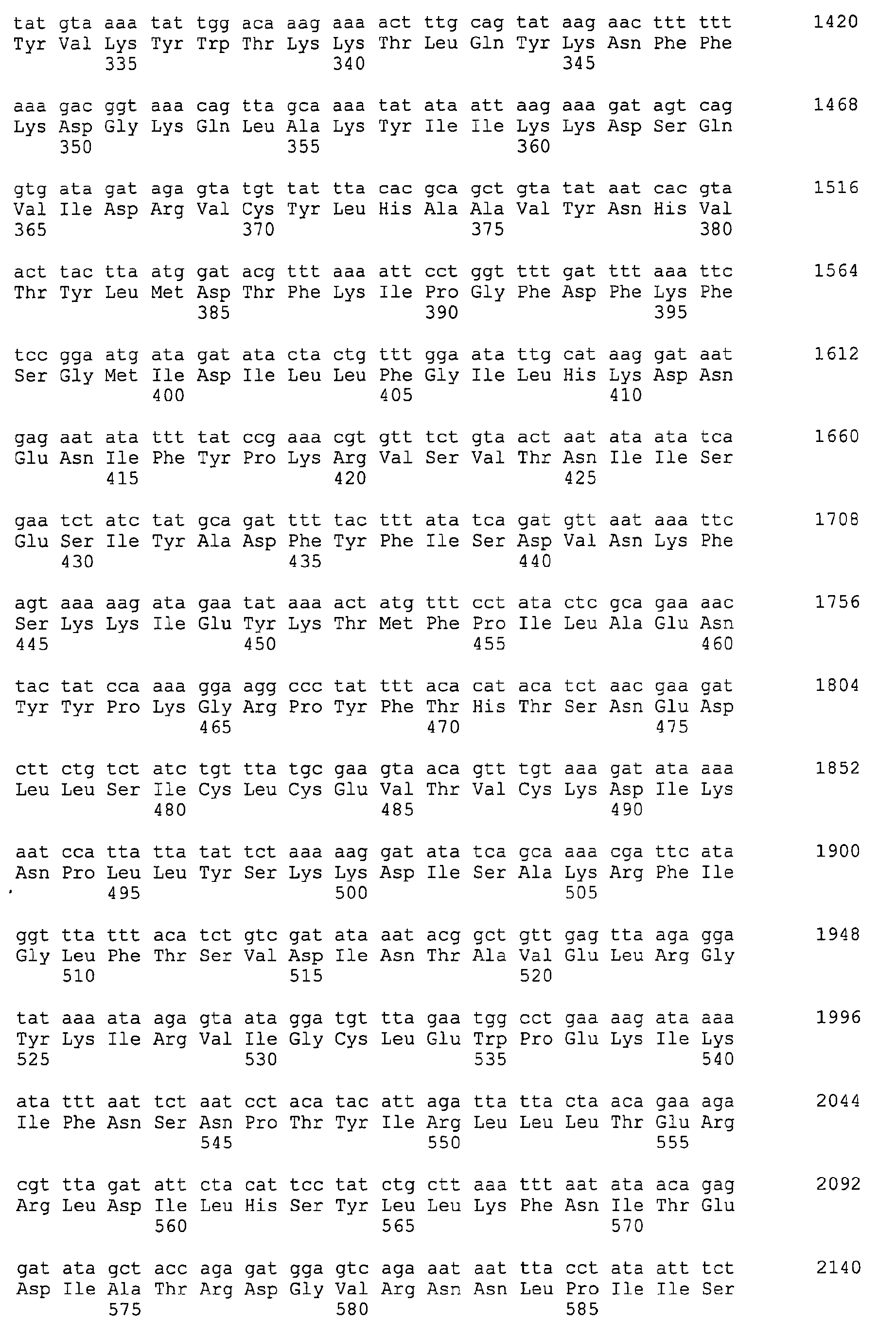


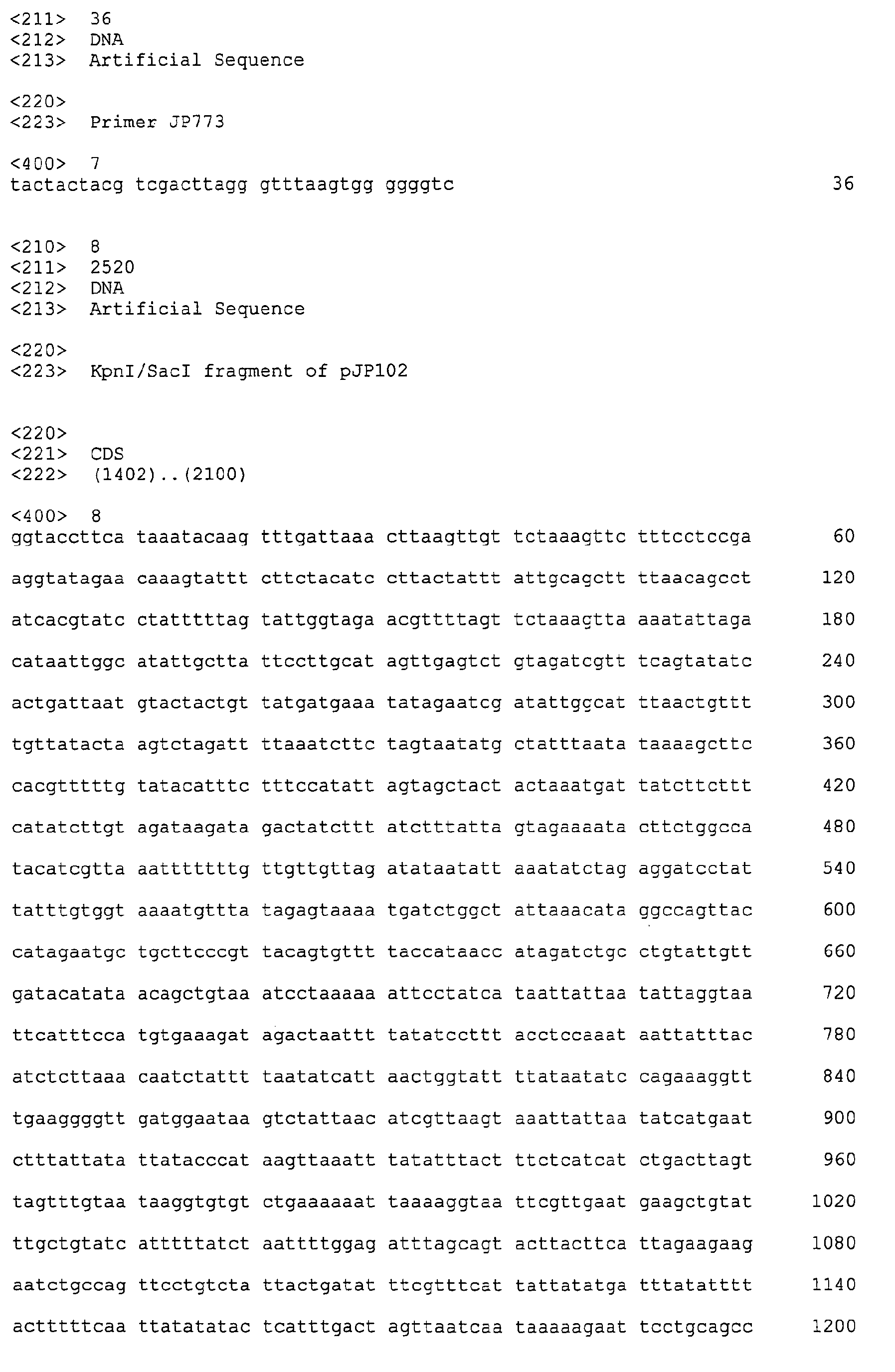

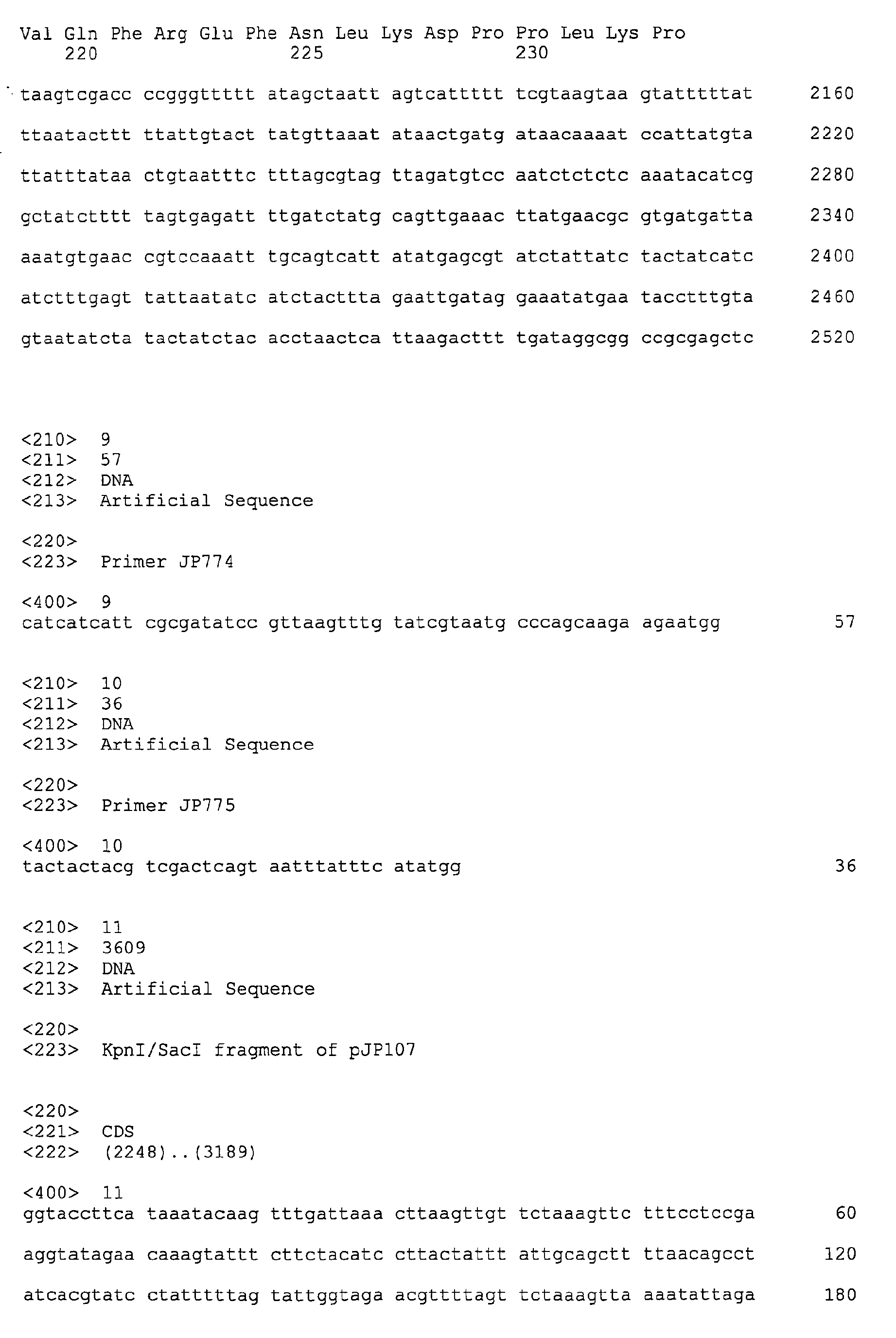

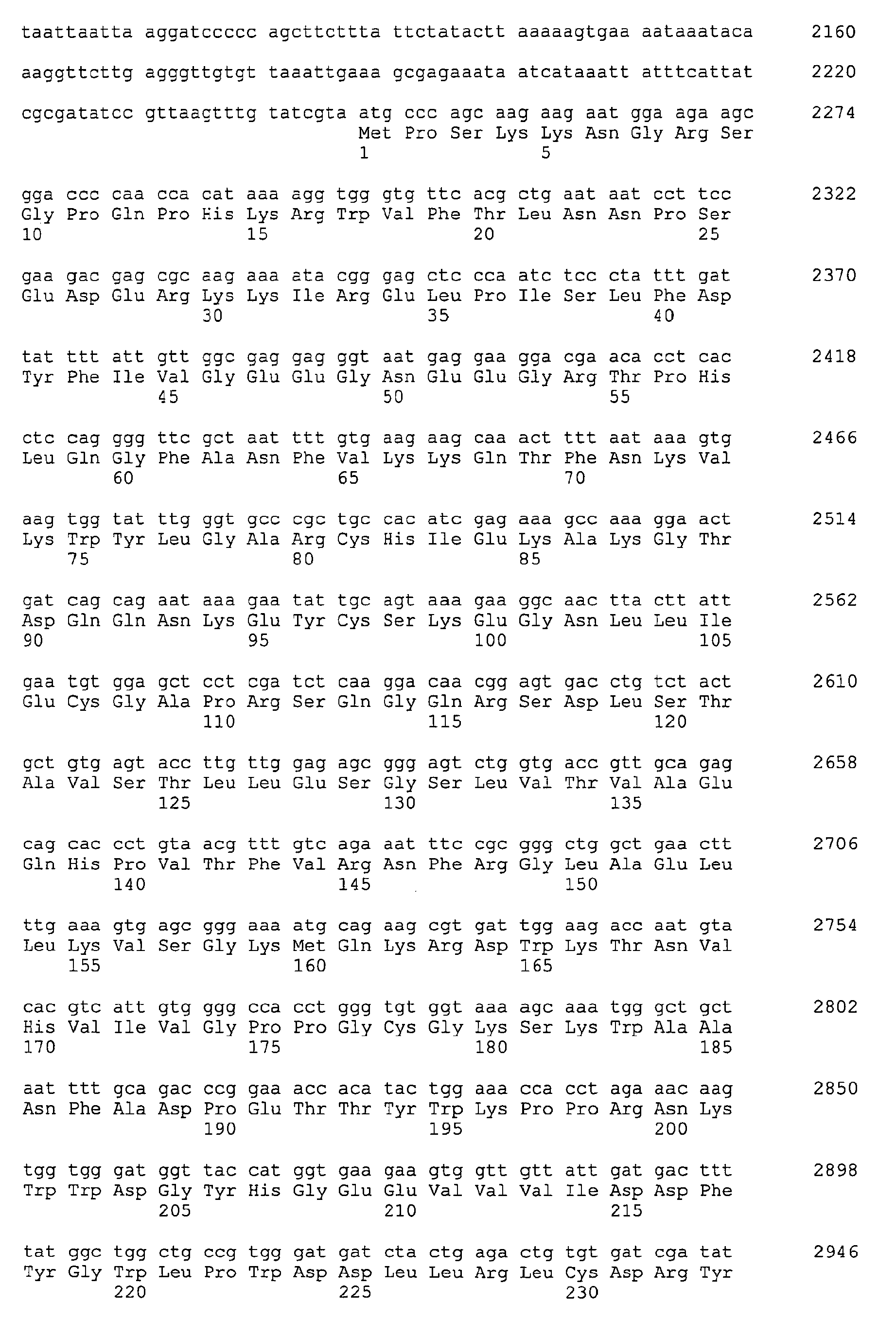


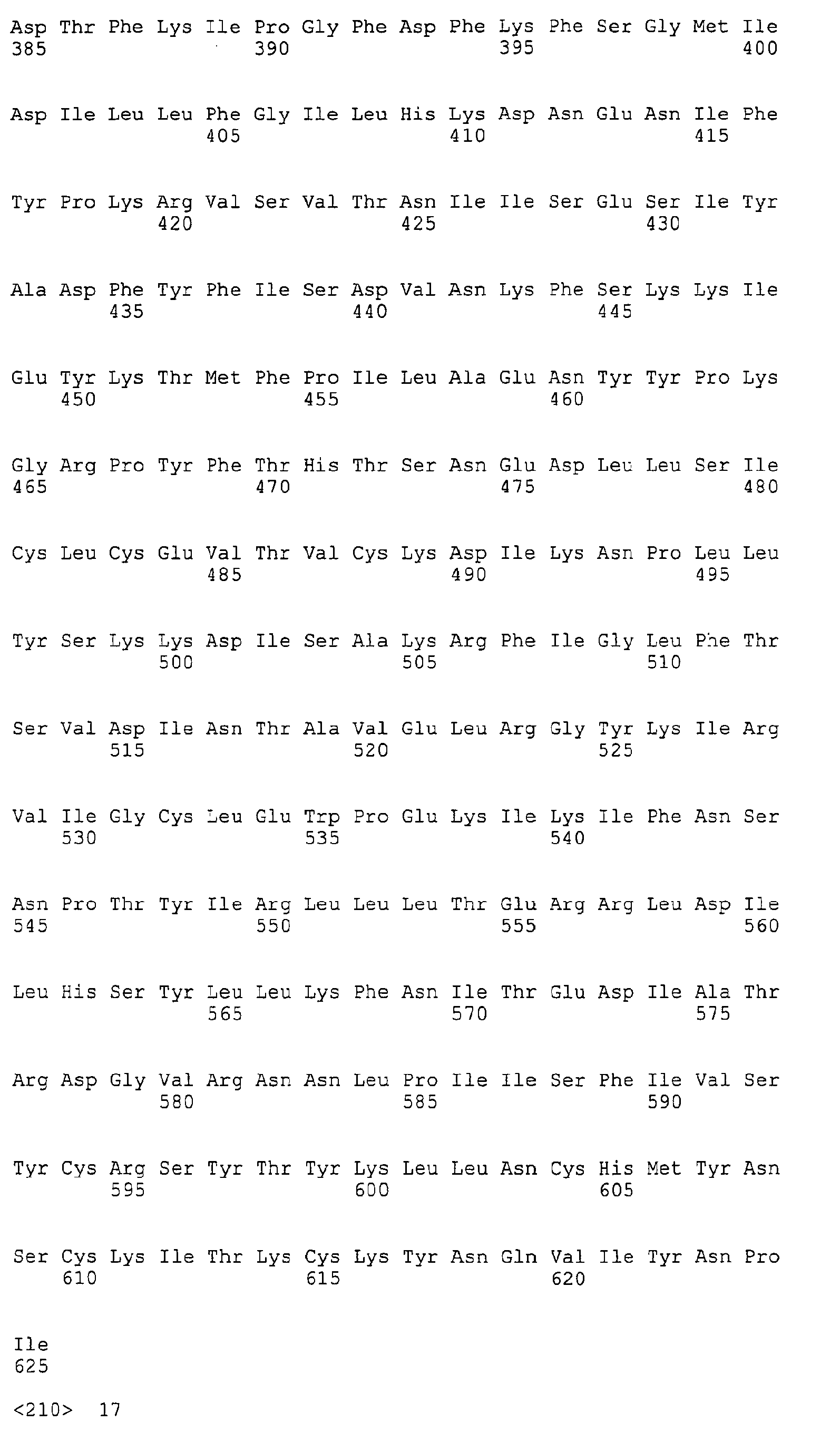


Claims (24)
- An immunogenic composition comprising (i) a recombinant poxvirus comprising an isolated DNA molecule selected from the group consisting of ORFs 1 and 3 to 13 of porcine circovirus type 2 (PCV2), wherein the poxvirus is:ALVAC, oran attenuated canarypox wherein said canarypox virus is attenuated through more than 200 serial passages on chick embryo fibroblasts, a master seed therefrom was subjected to four successive plaque purifications under agar, from which a plaque clone was amplified through five additional passages;and (ii) a carrier.
- The immunogenic composition of claim 1, wherein the recombinant poxvirus is a recombinant ALVAC canarypox virus.
- The immunogenic composition of claim 2, wherein the isolated DNA molecule is in the C6 locus of the ALVAC canarypox virus genome.
- The immunogenic composition of any one of claims 1 to 3, wherein the isolated DNA molecule comprises PCV2 ORF1, or PCV2 ORF1 and PCV2 ORF2.
- The immunogenic composition of claim 4, wherein the isolated DNA molecule is in the C6 locus of the ALVAC canarypox virus genome.
- The immunogenic composition of any one of claims 1 to 5, which contains an adjuvant.
- The immunogenic composition of claim 6, wherein the adjuvant is a carbomer.
- Use of a recombinant poxvirus comprising an isolated DNA molecule selected from the group consisting of ORFs 1 and 3 to 13 of porcine circovirus type 2 (PCV2), wherein the poxvirus is:ALVAC, oran attenuated canarypox wherein said canarypox virus is attenuated through more than 200 serial passages on chick embryo fibroblasts, a master seed therefrom was subjected to four successive plaque purifications under agar, from which a plaque clone was amplified through five additional passages,for the preparation of an immunogenic composition to induce an immune response against PCV2 in an adult pig, a young pig or a gestating female pig.
- The use of claim 8, wherein the immunogenic composition is administered to a female pig prior to serving and again during gestation.
- The use of claim 9, wherein the immunogenic composition is administered during gestation at about 6-8 weeks of gestation and/or at about 11-13 weeks of gestation.
- The use of any one of claims 8 to 10 to confer passive immunity to a newborn piglet.
- The use of any one of claims 8 to 10, wherein the immunogenic composition is administered to a gestating female and then to its piglet(s) after birth.
- The use of claim 8 or 12, wherein the immunogenic composition is administered to a piglet between birth and weaning.
- The use of claim 13, wherein the immunogenic composition is administered to a piglet within the first week of life or within the third week of life, and preferably administered again two to four weeks later.
- The use of any one of claims 8 to 14, wherein the immunogenic composition contains an adjuvant.
- The use of claim 15, wherein the adjuvant is a carbomer.
- The use of any one of claims 8 to 16, wherein the isolated DNA molecule comprises PCV2 ORF1, or PCV2 ORF1 and PCV2 ORF2.
- A vaccine comprising (i) a recombinant poxvirus comprising an isolated DNA molecule selected from the group consisting of ORFs 1 and 3 to 13 of porcine circovirus type 2 (PCV2), wherein the poxvirus is:ALVAC, oran attenuated canarypox wherein said canarypox virus is attenuated through more than 200 serial passages on chick embryo fibroblasts, a master seed therefrom was subjected to four successive plaque purifications under agar, from which a plaque clone was amplified through five additional passages;and (ii) a carrier.
- The vaccine of claim 18, wherein the recombinant poxvirus is a recombinant ALVAC canarypox virus.
- The vaccine of claim 19, wherein the isolated DNA molecule is in the C6 locus of the ALVAC canarypox virus genome.
- The vaccine of any one of claims 18 to 20, wherein the isolated DNA molecule comprises PCV2 ORF1, or PCV2 ORF1 and PCV2 ORF2.
- The vaccine of any one of claims 18 to 21, wherein the isolated DNA molecule is in the C6 locus of the ALVAC canarypox virus genome.
- The vaccine of any one of claims 18 to 22, which contains an adjuvant.
- The vaccine of claim 23, wherein the adjuvant is a carbomer.
Applications Claiming Priority (3)
| Application Number | Priority Date | Filing Date | Title |
|---|---|---|---|
| US13847899P | 1999-06-10 | 1999-06-10 | |
| US09/583,545 US6497883B1 (en) | 1999-06-10 | 2000-06-01 | Porcine circovirus recombinant poxvirus vaccine |
| EP00938971A EP1185660B1 (en) | 1999-06-10 | 2000-06-09 | Porcine circovirus vaccine in recombinant poxvirus |
Related Parent Applications (1)
| Application Number | Title | Priority Date | Filing Date |
|---|---|---|---|
| EP00938971A Division EP1185660B1 (en) | 1999-06-10 | 2000-06-09 | Porcine circovirus vaccine in recombinant poxvirus |
Publications (3)
| Publication Number | Publication Date |
|---|---|
| EP1975235A2 true EP1975235A2 (en) | 2008-10-01 |
| EP1975235A3 EP1975235A3 (en) | 2008-12-10 |
| EP1975235B1 EP1975235B1 (en) | 2015-10-28 |
Family
ID=26836231
Family Applications (2)
| Application Number | Title | Priority Date | Filing Date |
|---|---|---|---|
| EP08005549.4A Expired - Lifetime EP1975235B1 (en) | 1999-06-10 | 2000-06-09 | Porcine circovirus vaccine in recombinant poxvirus |
| EP00938971A Expired - Lifetime EP1185660B1 (en) | 1999-06-10 | 2000-06-09 | Porcine circovirus vaccine in recombinant poxvirus |
Family Applications After (1)
| Application Number | Title | Priority Date | Filing Date |
|---|---|---|---|
| EP00938971A Expired - Lifetime EP1185660B1 (en) | 1999-06-10 | 2000-06-09 | Porcine circovirus vaccine in recombinant poxvirus |
Country Status (17)
| Country | Link |
|---|---|
| US (1) | US6497883B1 (en) |
| EP (2) | EP1975235B1 (en) |
| JP (1) | JP4859316B2 (en) |
| KR (1) | KR100837724B1 (en) |
| CN (1) | CN1195854C (en) |
| AT (1) | ATE476510T1 (en) |
| AU (1) | AU778520B2 (en) |
| BR (2) | BRPI0011737B1 (en) |
| CA (1) | CA2376600C (en) |
| DE (1) | DE60044778D1 (en) |
| DK (2) | DK1975235T3 (en) |
| ES (1) | ES2560513T3 (en) |
| HU (1) | HU229051B1 (en) |
| MX (1) | MXPA01012723A (en) |
| PL (1) | PL205032B1 (en) |
| PT (2) | PT1975235E (en) |
| WO (1) | WO2000077216A2 (en) |
Cited By (1)
| Publication number | Priority date | Publication date | Assignee | Title |
|---|---|---|---|---|
| WO2017066772A1 (en) * | 2015-10-16 | 2017-04-20 | Kansas State University Research Foundation | Porcine circovirus type 3 immunogenic compositions and methods of making and using the same |
Families Citing this family (69)
| Publication number | Priority date | Publication date | Assignee | Title |
|---|---|---|---|---|
| US6517843B1 (en) * | 1999-08-31 | 2003-02-11 | Merial | Reduction of porcine circovirus-2 viral load with inactivated PCV-2 |
| US7211379B2 (en) * | 1997-10-03 | 2007-05-01 | Merial Sas | Prevention of myocarditis, abortion and intrauterine infection associated with porcine circovirus-2 |
| US7192594B2 (en) | 1997-10-03 | 2007-03-20 | Merial Limited | Postweaning multisystemic wasting syndrome and porcine circovirus from pigs |
| FR2772047B1 (en) * | 1997-12-05 | 2004-04-09 | Ct Nat D Etudes Veterinaires E | GENOMIC SEQUENCE AND POLYPEPTIDES OF CIRCOVIRUS ASSOCIATED WITH PIGLET LOSS DISEASE (MAP), APPLICATIONS TO DIAGNOSIS AND TO PREVENTION AND / OR TREATMENT OF INFECTION |
| US20040062775A1 (en) * | 1997-12-05 | 2004-04-01 | Agence Francaise De Securite Sanitaire Des Aliments | Circovirus sequences associated with piglet weight loss disease (PWD) |
| ID28224A (en) | 1997-12-11 | 2001-05-10 | Univ Saskatchewan | VIRUS SYNDROME OF POST-DECISION MULTISISTEMIC DAMAGE FROM PIG |
| US6943152B1 (en) | 1999-06-10 | 2005-09-13 | Merial | DNA vaccine-PCV |
| ES2170622B1 (en) * | 1999-12-03 | 2004-05-16 | Consejo Superior De Investigaciones Cientificas | CLONES AND INFECTIVE VECTORS DERIVED FROM CORONAVIRUS AND ITS APPLICATIONS. |
| CN101676389A (en) | 2000-11-23 | 2010-03-24 | 巴法里安诺迪克有限公司 | Modified vaccinia ankara virus variant |
| MXPA03008810A (en) | 2001-03-27 | 2004-02-17 | Univ Saskatchewan | Methods to culture circovirus. |
| US6676958B2 (en) * | 2001-06-19 | 2004-01-13 | Advanced Bioadjuvants, Llc | Adjuvant composition for mucosal and injection delivered vaccines |
| US7276353B2 (en) * | 2001-12-12 | 2007-10-02 | Virginia Tech Intellectual Properties, Inc. | Chimeric infectious DNA clones, chimeric porcine circoviruses and uses thereof |
| US7279166B2 (en) | 2001-12-12 | 2007-10-09 | Virginia Tech Intellectual Properties, Inc. | Chimeric infectious DNA clones, chimeric porcine circoviruses and uses thereof |
| US7906311B2 (en) | 2002-03-20 | 2011-03-15 | Merial Limited | Cotton rat lung cells for virus culture |
| AU2003264144C1 (en) * | 2002-09-05 | 2009-12-17 | Bavarian Nordic A/S | Method for the cultivation of primary cells and for the amplification of viruses under serum free conditions |
| EP2390352A1 (en) | 2003-03-18 | 2011-11-30 | Quantum Genetics Ireland Limited | Systems and methods for improving protein and milk production of dairy herds |
| US7468273B2 (en) | 2003-05-01 | 2008-12-23 | Meial Limited | Canine GHRH gene, polypeptides and methods of use |
| US20050214316A1 (en) | 2003-11-13 | 2005-09-29 | Brown Thomas P | Methods of characterizing infectious bursal disease virus |
| EP1718770B1 (en) | 2004-02-19 | 2011-05-25 | The Governors of the University of Alberta | Leptin promoter polymorphisms and uses thereof |
| US7700285B1 (en) | 2005-12-29 | 2010-04-20 | Boehringer Ingelheim Vetmedica, Inc. | PCV2 immunogenic compositions and methods of producing such compositions |
| EP2460818A3 (en) * | 2004-12-30 | 2013-01-09 | Boehringer Ingelheim Vetmedica, Inc. | PCV2 immunogenic compositions and methods of producing such compositions |
| UA95602C2 (en) | 2004-12-30 | 2011-08-25 | Берингер Ингельхейм Ветмедика, Инк. | Pcv2 immunogenic compositions and methods of producing such compositions |
| US7833707B2 (en) * | 2004-12-30 | 2010-11-16 | Boehringer Ingelheim Vetmedica, Inc. | Methods of overexpression and recovery of porcine circovirus type 2 ORF2 |
| CN1328373C (en) * | 2005-04-07 | 2007-07-25 | 南京农业大学 | Porcine circus-virus 2 type recombinant adenovirus and vaccine |
| RS51324B (en) | 2005-04-25 | 2010-12-31 | Merial Ltd. | NIPAH VIRUS VACCINES |
| TW200643171A (en) * | 2005-06-07 | 2006-12-16 | Temasek Life Sciences Lab Ltd | Porcine circovirus type 2 vaccines |
| US20080241184A1 (en) | 2005-08-25 | 2008-10-02 | Jules Maarten Minke | Canine influenza vaccines |
| US7771995B2 (en) | 2005-11-14 | 2010-08-10 | Merial Limited | Plasmid encoding human BMP-7 |
| CA2629522A1 (en) | 2005-11-14 | 2007-05-18 | Merial Limited | Gene therapy for renal failure |
| EP1792996A1 (en) * | 2005-12-01 | 2007-06-06 | Consejo Superior de Investigaciones Cientificas | Nucleic acid sequences encoding vaccines against Porcine reproductive and respiratory syndrome virus (PRRSV) |
| EP2275132B1 (en) * | 2005-12-29 | 2021-03-03 | Boehringer Ingelheim Animal Health USA Inc. | Multivalent PCV2 immunogenic compositions and methods of producing them |
| MX338626B (en) | 2005-12-29 | 2016-04-26 | Boehringer Ingelheim Vetmed | Use of a pcv2 immunogenic composition for lessening clinical symptoms in pigs. |
| US7862821B2 (en) | 2006-06-01 | 2011-01-04 | Merial Limited | Recombinant vaccine against bluetongue virus |
| CN100489092C (en) * | 2006-06-16 | 2009-05-20 | 中国农业科学院哈尔滨兽医研究所 | Type II genetic marker strain of porcine circovirus and its application |
| EP2859900A1 (en) * | 2006-12-11 | 2015-04-15 | Boehringer Ingelheim Vetmedica, Inc. | Effective method of treatment of porcine circovirus and lawsonia intracellularis infections |
| BRPI0721083A2 (en) * | 2006-12-15 | 2014-02-25 | Boehringer Ingelheim Vetmed | PCV2 ANTIGEN PIG TREATMENT |
| EP1941903A1 (en) * | 2007-01-03 | 2008-07-09 | Boehringer Ingelheim Vetmedica Gmbh | Prophylaxis and treatment of PRDC |
| EP1958644A1 (en) | 2007-02-13 | 2008-08-20 | Boehringer Ingelheim Vetmedica Gmbh | Prevention and treatment of sub-clinical pcvd |
| US20080292663A1 (en) * | 2007-05-22 | 2008-11-27 | Gerber Jay D | Adjuvant compositions and methods for delivering vaccines |
| US7829274B2 (en) | 2007-09-04 | 2010-11-09 | Boehringer Ingelheim Vetmedica, Inc. | Reduction of concomitant infections in pigs by the use of PCV2 antigen |
| JP2011508595A (en) * | 2007-12-31 | 2011-03-17 | ベーリンガー インゲルハイム フェトメディカ インコーポレイテッド | PCV2ORF2 virus-like particles containing foreign amino acid insertions |
| JP5613061B2 (en) * | 2008-01-23 | 2014-10-22 | ベーリンガー インゲルハイム フェトメディカ インコーポレイテッド | PCV2 Mycoplasma hyopneumoniae immunogenic composition and method for producing said composition |
| CN103585643A (en) | 2009-04-03 | 2014-02-19 | 梅里亚有限公司 | Newcastle disease virus vectored avian vaccines |
| TWI627281B (en) * | 2009-09-02 | 2018-06-21 | 百靈佳殷格翰家畜藥品公司 | Methods of reducing viricidal activity in pcv-2 compositions and pcv-2 compositions with an improved immunogenicity |
| CN101773667A (en) * | 2010-01-28 | 2010-07-14 | 洛阳普莱柯生物工程有限公司 | Preparation method for vaccine of porcine circovirus II |
| WO2012030720A1 (en) | 2010-08-31 | 2012-03-08 | Merial Limited | Newcastle disease virus vectored herpesvirus vaccines |
| TWI442935B (en) | 2010-12-22 | 2014-07-01 | Sbc Virbac Ltd | Porcine Circovirus Type 2, immunological composition containing the same, test kit and application thereof |
| WO2012090073A2 (en) | 2010-12-30 | 2012-07-05 | The Netherlands Cancer Institute | Methods and compositions for predicting chemotherapy sensitivity |
| CN102198268B (en) * | 2011-03-29 | 2013-08-14 | 范红结 | Recombinant Swine pox virus (SPV) vector vaccine for the expression of Streptococcus equi subsp zooepidemicus (SEZ) M-like protein (SzP) |
| AU2012240246A1 (en) | 2011-04-04 | 2013-05-09 | Netherlands Cancer Institute | Methods and compositions for predicting resistance to anticancer treatment with protein kinase inhibitors |
| US20140296248A1 (en) | 2011-04-04 | 2014-10-02 | Stichting het Nederlands Kanker Instiuut-Antoni van Leeuwenhoek ziekenhuis | Methods and compositions for predicting resistance to anticancer treatment |
| WO2012145577A1 (en) | 2011-04-20 | 2012-10-26 | Merial Limited | Adjuvanted rabies vaccine with improved viscosity profile |
| AP2013007180A0 (en) | 2011-04-25 | 2013-10-31 | Advanced Bioscience Lab Inc | Truncated HIV envelope proteins (ENV), methods andcompositions related thereto |
| EP2714077B1 (en) | 2011-06-01 | 2018-02-28 | Merial, Inc. | Needle-free administration of prrsv vaccines |
| LT2741740T (en) | 2011-08-12 | 2017-08-10 | Merial, Inc. | Vacuum-assisted preservation of biological products, in particular of vaccines |
| WO2013093629A2 (en) | 2011-12-20 | 2013-06-27 | Netherlands Cancer Institute | Modular vaccines, methods and compositions related thereto |
| AU2013221502C1 (en) | 2012-02-14 | 2018-03-01 | Boehringer Ingelheim Animal Health USA Inc. | Recombinant poxviral vectors expressing both rabies and OX40 proteins, and vaccines made therefrom |
| WO2013138776A1 (en) | 2012-03-16 | 2013-09-19 | Merial Limited | Novel methods for providing long-term protective immunity against rabies in animals, based upon administration of replication-deficient flavivirus expressing rabies g |
| CN102861327B (en) * | 2012-09-27 | 2015-01-21 | 郑州后羿制药有限公司 | Cell inactivated vaccine, egg yoke antibody and injection and freeze-dried powder containing same |
| EP2968514A1 (en) | 2013-03-12 | 2016-01-20 | Merial, Inc. | Reverse genetics schmallenberg virus vaccine compositions, and methods of use thereof |
| ES2882374T3 (en) | 2013-05-08 | 2021-12-01 | Pharmgate Biologics Inc | PCV2 and mycoplasma vaccine |
| WO2014187822A1 (en) * | 2013-05-22 | 2014-11-27 | Boehringer Ingelheim Espana, S.A. | Method for the reduction of pcv-2 in a herd of swine |
| KR102319843B1 (en) | 2013-09-25 | 2021-10-29 | 조에티스 서비시즈 엘엘씨 | Pcv2b divergent vaccine composition and methods of use |
| US9505808B2 (en) | 2013-10-02 | 2016-11-29 | Boehringer Ingelheim Vetmedica, Inc. | PCV2 ORF2 protein variant and virus like particles composed thereof |
| WO2016073410A1 (en) | 2014-11-03 | 2016-05-12 | Merial, Inc. | Methods of using microneedle vaccine formulations to elicit in animals protective immunity against rabies virus |
| HK1252427A1 (en) | 2015-05-14 | 2019-05-24 | Boehringer Ingelheim Animal Health USA Inc. | Method for porcine circovirus production and pcv2 vaccines |
| ES3050936T3 (en) | 2015-06-23 | 2025-12-23 | Boehringer Ingelheim Vetmedica Gmbh | Prrsv minor protein-containing recombinant viral vectors and methods of making and use thereof |
| WO2018023473A1 (en) * | 2016-08-03 | 2018-02-08 | 台湾生物制剂股份有限公司 | Fully expressing cell used as an antigen vector and uses thereof to prepare a vaccine or diagnostic reagent, or for monoclonal antibody screening |
| CN111087452A (en) * | 2019-12-18 | 2020-05-01 | 中国农业科学院兰州兽医研究所 | Prokaryotic soluble expression method of porcine circovirus 2b subtype Cap protein |
Citations (18)
| Publication number | Priority date | Publication date | Assignee | Title |
|---|---|---|---|---|
| US2909462A (en) | 1955-12-08 | 1959-10-20 | Bristol Myers Co | Acrylic acid polymer laxative compositions |
| US4603112A (en) | 1981-12-24 | 1986-07-29 | Health Research, Incorporated | Modified vaccinia virus |
| US4722848A (en) | 1982-12-08 | 1988-02-02 | Health Research, Incorporated | Method for immunizing animals with synthetically modified vaccinia virus |
| US4769330A (en) | 1981-12-24 | 1988-09-06 | Health Research, Incorporated | Modified vaccinia virus and methods for making and using the same |
| US5110587A (en) | 1981-12-24 | 1992-05-05 | Health Research, Incorporated | Immunogenic composition comprising synthetically modified vaccinia virus |
| US5174993A (en) | 1981-12-24 | 1992-12-29 | Health Research Inc. | Recombinant avipox virus and immunological use thereof |
| US5185146A (en) | 1988-01-12 | 1993-02-09 | Hoffmann-Laroche Inc. | Recombinant mva vaccinia virus |
| US5364773A (en) | 1991-03-07 | 1994-11-15 | Virogenetics Corporation | Genetically engineered vaccine strain |
| US5382425A (en) | 1992-01-13 | 1995-01-17 | Syntro Corporation | Recombinant swinepox virus |
| WO1995030018A2 (en) | 1994-04-29 | 1995-11-09 | Immuno Aktiengesellschaft | Recombinant poxviruses with foreign polynucleotides in essential regions |
| US5494807A (en) | 1991-03-07 | 1996-02-27 | Virogenetics Corporation | NYVAC vaccinia virus recombinants comprising heterologous inserts |
| US5505941A (en) | 1981-12-24 | 1996-04-09 | Health Research, Inc. | Recombinant avipox virus and method to induce an immune response |
| US5843456A (en) | 1991-03-07 | 1998-12-01 | Virogenetics Corporation | Alvac poxvirus-rabies compositions and combination compositions and uses |
| US5869312A (en) | 1992-01-13 | 1999-02-09 | Syntro Corporation | Recombinant swinepox virus |
| US5990091A (en) | 1997-03-12 | 1999-11-23 | Virogenetics Corporation | Vectors having enhanced expression, and methods of making and uses thereof |
| US6004777A (en) | 1997-03-12 | 1999-12-21 | Virogenetics Corporation | Vectors having enhanced expression, and methods of making and uses thereof |
| US6033904A (en) | 1992-01-13 | 2000-03-07 | Syntro Corporation | Recombinant swinepox virus |
| US6391314B1 (en) | 1997-10-03 | 2002-05-21 | Merial | Porcine circoviruses vaccines diagnostic reagents |
Family Cites Families (6)
| Publication number | Priority date | Publication date | Assignee | Title |
|---|---|---|---|---|
| US5833975A (en) | 1989-03-08 | 1998-11-10 | Virogenetics Corporation | Canarypox virus expressing cytokine and/or tumor-associated antigen DNA sequence |
| NZ261992A (en) * | 1993-02-08 | 1996-06-25 | Bayer Ag | Porcine reproductive and respiratory syndrome virus, cultures, attenuated forms and vaccines thereof |
| US5820869A (en) | 1995-06-07 | 1998-10-13 | American Home Products Corporation | Recombinant raccoon pox viruses and their use as an effective vaccine against feline immunodeficiency virus infection |
| US6517843B1 (en) * | 1999-08-31 | 2003-02-11 | Merial | Reduction of porcine circovirus-2 viral load with inactivated PCV-2 |
| FR2769322B1 (en) * | 1997-10-03 | 2002-03-08 | Merial Sas | NEW PORCINE CIRCOVIRUSES, VACCINES AND DIAGNOSTIC REAGENTS |
| UA78180C2 (en) * | 1997-10-03 | 2007-03-15 | Меріаль | Porcine circovirus, vaccines and diagnostic reagents |
-
2000
- 2000-06-01 US US09/583,545 patent/US6497883B1/en not_active Expired - Lifetime
- 2000-06-09 DK DK08005549.4T patent/DK1975235T3/en active
- 2000-06-09 AU AU54189/00A patent/AU778520B2/en not_active Expired
- 2000-06-09 PT PT80055494T patent/PT1975235E/en unknown
- 2000-06-09 WO PCT/IB2000/000882 patent/WO2000077216A2/en not_active Ceased
- 2000-06-09 PT PT00938971T patent/PT1185660E/en unknown
- 2000-06-09 EP EP08005549.4A patent/EP1975235B1/en not_active Expired - Lifetime
- 2000-06-09 DE DE60044778T patent/DE60044778D1/en not_active Expired - Lifetime
- 2000-06-09 BR BRPI0011737-4A patent/BRPI0011737B1/en unknown
- 2000-06-09 JP JP2001503659A patent/JP4859316B2/en not_active Expired - Lifetime
- 2000-06-09 DK DK00938971.9T patent/DK1185660T3/en active
- 2000-06-09 EP EP00938971A patent/EP1185660B1/en not_active Expired - Lifetime
- 2000-06-09 HU HU0201689A patent/HU229051B1/en unknown
- 2000-06-09 AT AT00938971T patent/ATE476510T1/en active
- 2000-06-09 BR BR0011737-4A patent/BR0011737A/en active IP Right Grant
- 2000-06-09 CN CNB00810560XA patent/CN1195854C/en not_active Expired - Lifetime
- 2000-06-09 MX MXPA01012723A patent/MXPA01012723A/en active IP Right Grant
- 2000-06-09 PL PL352201A patent/PL205032B1/en unknown
- 2000-06-09 KR KR1020017015883A patent/KR100837724B1/en not_active Expired - Lifetime
- 2000-06-09 CA CA2376600A patent/CA2376600C/en not_active Expired - Lifetime
- 2000-06-09 ES ES08005549.4T patent/ES2560513T3/en not_active Expired - Lifetime
Patent Citations (22)
| Publication number | Priority date | Publication date | Assignee | Title |
|---|---|---|---|---|
| US2909462A (en) | 1955-12-08 | 1959-10-20 | Bristol Myers Co | Acrylic acid polymer laxative compositions |
| US4603112A (en) | 1981-12-24 | 1986-07-29 | Health Research, Incorporated | Modified vaccinia virus |
| US4769330A (en) | 1981-12-24 | 1988-09-06 | Health Research, Incorporated | Modified vaccinia virus and methods for making and using the same |
| US5110587A (en) | 1981-12-24 | 1992-05-05 | Health Research, Incorporated | Immunogenic composition comprising synthetically modified vaccinia virus |
| US5174993A (en) | 1981-12-24 | 1992-12-29 | Health Research Inc. | Recombinant avipox virus and immunological use thereof |
| US5505941A (en) | 1981-12-24 | 1996-04-09 | Health Research, Inc. | Recombinant avipox virus and method to induce an immune response |
| US4722848A (en) | 1982-12-08 | 1988-02-02 | Health Research, Incorporated | Method for immunizing animals with synthetically modified vaccinia virus |
| US5185146A (en) | 1988-01-12 | 1993-02-09 | Hoffmann-Laroche Inc. | Recombinant mva vaccinia virus |
| US5494807A (en) | 1991-03-07 | 1996-02-27 | Virogenetics Corporation | NYVAC vaccinia virus recombinants comprising heterologous inserts |
| US5364773A (en) | 1991-03-07 | 1994-11-15 | Virogenetics Corporation | Genetically engineered vaccine strain |
| US5756103A (en) | 1991-03-07 | 1998-05-26 | Virogenetics Corporation | Alvac canarypox virus recombinants comprising heterlogous inserts |
| US5762938A (en) | 1991-03-07 | 1998-06-09 | Virogenetics Corporation | Modified recombinant vaccinia virus and expression vectors thereof |
| US5766599A (en) | 1991-03-07 | 1998-06-16 | Virogenetics Corporation | Trova fowl pox virus recombinants comprising heterologous inserts |
| US5843456A (en) | 1991-03-07 | 1998-12-01 | Virogenetics Corporation | Alvac poxvirus-rabies compositions and combination compositions and uses |
| US5869312A (en) | 1992-01-13 | 1999-02-09 | Syntro Corporation | Recombinant swinepox virus |
| US5382425A (en) | 1992-01-13 | 1995-01-17 | Syntro Corporation | Recombinant swinepox virus |
| US6033904A (en) | 1992-01-13 | 2000-03-07 | Syntro Corporation | Recombinant swinepox virus |
| US5770212A (en) | 1994-04-29 | 1998-06-23 | Immuno Aktiengesellschaft | Recombinant poxviruses with foreign DNA in essential regions |
| WO1995030018A2 (en) | 1994-04-29 | 1995-11-09 | Immuno Aktiengesellschaft | Recombinant poxviruses with foreign polynucleotides in essential regions |
| US5990091A (en) | 1997-03-12 | 1999-11-23 | Virogenetics Corporation | Vectors having enhanced expression, and methods of making and uses thereof |
| US6004777A (en) | 1997-03-12 | 1999-12-21 | Virogenetics Corporation | Vectors having enhanced expression, and methods of making and uses thereof |
| US6391314B1 (en) | 1997-10-03 | 2002-05-21 | Merial | Porcine circoviruses vaccines diagnostic reagents |
Non-Patent Citations (44)
| Title |
|---|
| "REMINGTON'S PHARMACEUTICAL SCIENCE", 1985 |
| A.L. HAMEL ET AL., J. VIROL., vol. 72, no. 6, June 1998 (1998-06-01), pages 5262 - 5267 |
| ALLAN G ET AL., VET. MICROBIOL., vol. 66, 1999, pages 115 - 123 |
| ALTSCHUL ET AL., NUCL. ACIDS RES., vol. 25, pages 3389 - 3402 |
| B. MEEHAN ET AL., J. GEN. VIROL., vol. 78, 1997, pages 221 - 227 |
| CLARK, E.G., PROC. AMER. ASSOC. SWINE PRACT., 1997, pages 499 - 501 |
| DEVEREUX J; HAEBERLIE P; SMITHIES 0: "A comprehensive set of sequence analysis program for the VAX", NUCL. ACIDS RES., vol. 12, 1984, pages 387 - 395 |
| EDBAUER, C. ET AL., VIROLOGY, vol. 179, 1990, pages 901 - 904 |
| ELLIS, J. ET AL., CAN. VET. J., vol. 39, 1998, pages 44 - 51 |
| FENG DF; DOLITTLE RF: "Progressive sequence alignment as a prerequisite to correct phylogenetic trees", J. OF MOLEC. EVOL., vol. 25, 1987, pages 351 - 360 |
| GOEBEL, S.J. ET AL., VIROLOGY, vol. 179, 1990, pages 247 - 266 |
| GUO, P. ET AL., J. VIROL., vol. 63, 1989, pages 4189 - 4198 |
| HAMEL, A.L.; L.L. LIN; G. P.S. NAYAR, J. VIROL., vol. 72, 1998, pages 5262 - 5267 |
| HARDING J.C., PROC. AM. ASSOC. SWINE PRACT., vol. 28, 1997, pages 503 |
| HIGGINS DG; SHARP PM: "Fast and sensitive multiple sequence alignment on a microcomputer", CABIOS, vol. 5, 1989, pages 151 - 153 |
| J. FIELDS ET AL., NATURE, vol. 186, 4 June 1960 (1960-06-04), pages 778 - 780 |
| MANKERTZ, A. ET AL., GEN. VIROL., vol. 79, 1998, pages 381 - 384 |
| MANKERTZ, J. ET AL., VIRUS GENE, vol. 16, 1998, pages 267 - 276 |
| MATTHEWS, R.E.F., INTERVIROLOGY, vol. 17, 1982, pages 42 - 44 |
| MEEHAN, B.M. ET AL., J. GEN. VIROL., vol. 78, 1997, pages 221 - 227 |
| MEEHAN, B.M. ET AL., J. GEN. VIROL., vol. 79, 1998, pages 2171 - 2179 |
| MOROZOV ET AL., J. CLINICAL MICROB., vol. 36, no. 9, September 1998 (1998-09-01), pages 2535 - 2541 |
| MYERS; MILLER: "Optimal Alignments in Linear Space", CABIOS, vol. 4, 1988, pages 11 - 17 |
| NAYAR, G.P.S.; A. HAMEL; L. LIN., CAN. VET. J., vol. 38, 1997, pages 385 - 386 |
| NEEDLEMAN SB; WUNSCH CD: "A general method applicable to the search for similarities in the amino acid sequences of two proteins", J. MOL. BIOL., vol. 48, 1970, pages 444 - 453 |
| PANICALI, D.; E. PAOLETTI, PROC. NATL. ACAD. SCI. USA, vol. 79, 1982, pages 4927 - 4931 |
| PAOLETTI, E. ET AL., PROC. NATL. ACAD. SCI. U.S.A., vol. 81, 1984, pages 193 - 197 |
| PERKUS, M.E.; K. LIMBACH; E. PAOLETTI, J. VIROL., vol. 63, 1989, pages 3829 - 3836 |
| PHAMEUROPA, vol. 8, no. 2, June 1996 (1996-06-01) |
| PICCINI, A.; M.E. PERKUS; E. PAOLETTI: "Methods in Enzymology", vol. 153, 1987, ACADEMIC PRESS, pages: 545 - 563 |
| SAMBROOK, J.; E.F. FRITSCH; T. MANIATIS: "Molecular cloning: A laboratory manual", 1989, COLD SPRING HARBOR PRESS |
| SMITH TF; WATERMAN MS: "Comparison of Bio-sequences", ADVANCES IN APPLIED MATHEMATICS, vol. 2, 1981, pages 482 - 489 |
| SMITH TF; WATERMAN MS; SADLER JR: "Statistical characterization of nucleic acid sequence functional domains", NUCLEIC ACIDS RES., vol. 11, 1983, pages 2205 - 2220 |
| TARTAGLIA, J. ET AL., J. GEN. VIROL., vol. 71, 1990, pages 1517 - 1524 |
| TARTAGLIA, J. ET AL., VIROLOGY, vol. 188, 1992, pages 217 - 32 |
| TAYLOR J ET AL., VIROLOGY, vol. 187, 1992, pages 321 - 328 |
| TAYLOR, J. ET AL., J. VIROL., vol. 64, 1990, pages 1441 - 1450 |
| TAYLOR, J. ET AL., VACCINE, vol. 6, 1988, pages 497 - 503 |
| TAYLOR, J. ET AL., VACCINE, vol. 6, 1988, pages 504 - 508 |
| TAYLOR, J. ET AL., VACCINE, vol. 9, 1991, pages 190 - 193 |
| TAYLOR, J.; E. PAOLETTI, VACCINE, vol. 6, 1988, pages 466 - 468 |
| THOMPSON JD; HIGGINS DG; GIBSON TJ: "ClusterW: improving the sensitivity of progressive multiple sequence alignment through sequence weighing, positions-specific gap penalties and weight matrix choice", NUCLEIC ACID RES., vol. 22, 1994, pages 4673 - 480 |
| TODD, D. ET AL., ARCH. VIROL., vol. 117, 1991, pages 129 - 135 |
| WILBUR; LIPMAN, PNAS USA, vol. 80, 1983, pages 726 |
Cited By (1)
| Publication number | Priority date | Publication date | Assignee | Title |
|---|---|---|---|---|
| WO2017066772A1 (en) * | 2015-10-16 | 2017-04-20 | Kansas State University Research Foundation | Porcine circovirus type 3 immunogenic compositions and methods of making and using the same |
Also Published As
| Publication number | Publication date |
|---|---|
| KR100837724B1 (en) | 2008-06-13 |
| HUP0201689A2 (en) | 2002-09-28 |
| ATE476510T1 (en) | 2010-08-15 |
| PT1975235E (en) | 2016-01-27 |
| DK1975235T3 (en) | 2015-11-16 |
| JP2003529323A (en) | 2003-10-07 |
| ES2560513T3 (en) | 2016-02-19 |
| HU229051B1 (en) | 2013-07-29 |
| CA2376600A1 (en) | 2000-12-21 |
| CA2376600C (en) | 2011-05-03 |
| EP1185660B1 (en) | 2010-08-04 |
| BRPI0011737B1 (en) | 2017-10-24 |
| PL205032B1 (en) | 2010-03-31 |
| PL352201A1 (en) | 2003-08-11 |
| WO2000077216A2 (en) | 2000-12-21 |
| KR20020028896A (en) | 2002-04-17 |
| CN1361824A (en) | 2002-07-31 |
| BR0011737A (en) | 2002-03-05 |
| US6497883B1 (en) | 2002-12-24 |
| EP1975235B1 (en) | 2015-10-28 |
| AU778520B2 (en) | 2004-12-09 |
| JP4859316B2 (en) | 2012-01-25 |
| DE60044778D1 (en) | 2010-09-16 |
| CN1195854C (en) | 2005-04-06 |
| AU5418900A (en) | 2001-01-02 |
| WO2000077216A3 (en) | 2001-08-09 |
| DK1185660T3 (en) | 2010-10-04 |
| PT1185660E (en) | 2010-10-22 |
| EP1975235A3 (en) | 2008-12-10 |
| MXPA01012723A (en) | 2002-07-22 |
| HUP0201689A3 (en) | 2004-01-28 |
| EP1185660A2 (en) | 2002-03-13 |
Similar Documents
| Publication | Publication Date | Title |
|---|---|---|
| EP1185660B1 (en) | Porcine circovirus vaccine in recombinant poxvirus | |
| CA2383367C (en) | Prevention of myocarditis, abortion and intrauterine infection associated with porcine circovirus-2 | |
| JP2003529323A5 (en) | ||
| KR101347503B1 (en) | Pcv-2 vaccine | |
| US20050058653A1 (en) | Prevention of myocarditis, abortion and intrauterine infection associated with porcine circovirus-2 | |
| AU5078600A (en) | DNA vaccine - PVC | |
| JP2020500843A (en) | Vaccines against porcine parvovirus and porcine reproductive and respiratory syndrome virus, and methods for producing them | |
| AU724172B2 (en) | Recombinant poxvirus-feline infectious peritonitis virus, compositions thereof and methods for making and using them | |
| US20130177582A1 (en) | Parapoxvirus expressing the vp60 major capsid protein of the rabbit haemorrhagic disease virus | |
| ES2348219T3 (en) | RECOMBINANT VIRUS POX VACCINE AGAINST SWINE CIRCOVIRUS. | |
| AU7219800A (en) | Recombinant poxvirus-feline infectious peritonitis virus, compositions thereof and methods for making and using them |
Legal Events
| Date | Code | Title | Description |
|---|---|---|---|
| PUAI | Public reference made under article 153(3) epc to a published international application that has entered the european phase |
Free format text: ORIGINAL CODE: 0009012 |
|
| 17P | Request for examination filed |
Effective date: 20080325 |
|
| AC | Divisional application: reference to earlier application |
Ref document number: 1185660 Country of ref document: EP Kind code of ref document: P |
|
| AK | Designated contracting states |
Kind code of ref document: A2 Designated state(s): AT BE CH CY DE DK ES FI FR GB GR IE IT LI LU MC NL PT SE |
|
| PUAL | Search report despatched |
Free format text: ORIGINAL CODE: 0009013 |
|
| AK | Designated contracting states |
Kind code of ref document: A3 Designated state(s): AT BE CH CY DE DK ES FI FR GB GR IE IT LI LU MC NL PT SE |
|
| RTI1 | Title (correction) |
Free format text: PORCINE CIRCOVIRUS VACCINE IN RECOMBINANT POXVIRUS |
|
| 17Q | First examination report despatched |
Effective date: 20090610 |
|
| AKX | Designation fees paid |
Designated state(s): AT BE CH CY DE DK ES FI FR GB GR IE IT LI LU MC NL PT SE |
|
| RAP1 | Party data changed (applicant data changed or rights of an application transferred) |
Owner name: MERIAL |
|
| GRAP | Despatch of communication of intention to grant a patent |
Free format text: ORIGINAL CODE: EPIDOSNIGR1 |
|
| INTG | Intention to grant announced |
Effective date: 20150515 |
|
| GRAS | Grant fee paid |
Free format text: ORIGINAL CODE: EPIDOSNIGR3 |
|
| GRAA | (expected) grant |
Free format text: ORIGINAL CODE: 0009210 |
|
| AC | Divisional application: reference to earlier application |
Ref document number: 1185660 Country of ref document: EP Kind code of ref document: P |
|
| AK | Designated contracting states |
Kind code of ref document: B1 Designated state(s): AT BE CH CY DE DK ES FI FR GB GR IE IT LI LU MC NL PT SE |
|
| REG | Reference to a national code |
Ref country code: GB Ref legal event code: FG4D |
|
| REG | Reference to a national code |
Ref country code: CH Ref legal event code: EP |
|
| REG | Reference to a national code |
Ref country code: AT Ref legal event code: REF Ref document number: 757962 Country of ref document: AT Kind code of ref document: T Effective date: 20151115 |
|
| REG | Reference to a national code |
Ref country code: DK Ref legal event code: T3 Effective date: 20151109 |
|
| REG | Reference to a national code |
Ref country code: IE Ref legal event code: FG4D |
|
| REG | Reference to a national code |
Ref country code: DE Ref legal event code: R096 Ref document number: 60049111 Country of ref document: DE |
|
| REG | Reference to a national code |
Ref country code: CH Ref legal event code: NV Representative=s name: BOHEST AG, CH |
|
| REG | Reference to a national code |
Ref country code: PT Ref legal event code: SC4A Free format text: AVAILABILITY OF NATIONAL TRANSLATION Effective date: 20151229 |
|
| REG | Reference to a national code |
Ref country code: SE Ref legal event code: TRGR |
|
| REG | Reference to a national code |
Ref country code: ES Ref legal event code: FG2A Ref document number: 2560513 Country of ref document: ES Kind code of ref document: T3 Effective date: 20160219 |
|
| REG | Reference to a national code |
Ref country code: NL Ref legal event code: FP |
|
| REG | Reference to a national code |
Ref country code: GR Ref legal event code: EP Ref document number: 20160400039 Country of ref document: GR Effective date: 20160414 |
|
| REG | Reference to a national code |
Ref country code: FR Ref legal event code: PLFP Year of fee payment: 17 |
|
| REG | Reference to a national code |
Ref country code: DE Ref legal event code: R097 Ref document number: 60049111 Country of ref document: DE |
|
| PLBE | No opposition filed within time limit |
Free format text: ORIGINAL CODE: 0009261 |
|
| STAA | Information on the status of an ep patent application or granted ep patent |
Free format text: STATUS: NO OPPOSITION FILED WITHIN TIME LIMIT |
|
| 26N | No opposition filed |
Effective date: 20160729 |
|
| REG | Reference to a national code |
Ref country code: FR Ref legal event code: PLFP Year of fee payment: 18 |
|
| REG | Reference to a national code |
Ref country code: AT Ref legal event code: UEP Ref document number: 757962 Country of ref document: AT Kind code of ref document: T Effective date: 20151028 |
|
| REG | Reference to a national code |
Ref country code: FR Ref legal event code: PLFP Year of fee payment: 19 |
|
| PGFP | Annual fee paid to national office [announced via postgrant information from national office to epo] |
Ref country code: LU Payment date: 20190627 Year of fee payment: 20 Ref country code: PT Payment date: 20190603 Year of fee payment: 20 Ref country code: MC Payment date: 20190605 Year of fee payment: 20 Ref country code: FI Payment date: 20190627 Year of fee payment: 20 Ref country code: NL Payment date: 20190626 Year of fee payment: 20 Ref country code: IT Payment date: 20190621 Year of fee payment: 20 Ref country code: IE Payment date: 20190627 Year of fee payment: 20 Ref country code: DK Payment date: 20190627 Year of fee payment: 20 |
|
| PGFP | Annual fee paid to national office [announced via postgrant information from national office to epo] |
Ref country code: BE Payment date: 20190627 Year of fee payment: 20 Ref country code: FR Payment date: 20190625 Year of fee payment: 20 Ref country code: GR Payment date: 20190627 Year of fee payment: 20 Ref country code: SE Payment date: 20190627 Year of fee payment: 20 |
|
| PGFP | Annual fee paid to national office [announced via postgrant information from national office to epo] |
Ref country code: GB Payment date: 20190627 Year of fee payment: 20 Ref country code: AT Payment date: 20190603 Year of fee payment: 20 Ref country code: DE Payment date: 20190627 Year of fee payment: 20 Ref country code: CY Payment date: 20190605 Year of fee payment: 20 Ref country code: ES Payment date: 20190701 Year of fee payment: 20 |
|
| PGFP | Annual fee paid to national office [announced via postgrant information from national office to epo] |
Ref country code: CH Payment date: 20190702 Year of fee payment: 20 |
|
| REG | Reference to a national code |
Ref country code: DE Ref legal event code: R071 Ref document number: 60049111 Country of ref document: DE |
|
| REG | Reference to a national code |
Ref country code: NL Ref legal event code: MK Effective date: 20200608 |
|
| REG | Reference to a national code |
Ref country code: DK Ref legal event code: EUP Expiry date: 20200609 Ref country code: CH Ref legal event code: PL |
|
| REG | Reference to a national code |
Ref country code: GB Ref legal event code: PE20 Expiry date: 20200608 |
|
| REG | Reference to a national code |
Ref country code: FI Ref legal event code: MAE |
|
| REG | Reference to a national code |
Ref country code: IE Ref legal event code: MK9A |
|
| REG | Reference to a national code |
Ref country code: SE Ref legal event code: EUG |
|
| PG25 | Lapsed in a contracting state [announced via postgrant information from national office to epo] |
Ref country code: PT Free format text: LAPSE BECAUSE OF EXPIRATION OF PROTECTION Effective date: 20200622 |
|
| REG | Reference to a national code |
Ref country code: AT Ref legal event code: MK07 Ref document number: 757962 Country of ref document: AT Kind code of ref document: T Effective date: 20200609 |
|
| REG | Reference to a national code |
Ref country code: BE Ref legal event code: MK Effective date: 20200609 |
|
| PG25 | Lapsed in a contracting state [announced via postgrant information from national office to epo] |
Ref country code: GB Free format text: LAPSE BECAUSE OF EXPIRATION OF PROTECTION Effective date: 20200608 |
|
| PG25 | Lapsed in a contracting state [announced via postgrant information from national office to epo] |
Ref country code: IE Free format text: LAPSE BECAUSE OF EXPIRATION OF PROTECTION Effective date: 20200609 |
|
| REG | Reference to a national code |
Ref country code: ES Ref legal event code: FD2A Effective date: 20201203 |
|
| PG25 | Lapsed in a contracting state [announced via postgrant information from national office to epo] |
Ref country code: ES Free format text: LAPSE BECAUSE OF EXPIRATION OF PROTECTION Effective date: 20200610 |