EP1975214A1 - Ink-jet ink and ink-jet recording method - Google Patents
Ink-jet ink and ink-jet recording method Download PDFInfo
- Publication number
- EP1975214A1 EP1975214A1 EP20080152883 EP08152883A EP1975214A1 EP 1975214 A1 EP1975214 A1 EP 1975214A1 EP 20080152883 EP20080152883 EP 20080152883 EP 08152883 A EP08152883 A EP 08152883A EP 1975214 A1 EP1975214 A1 EP 1975214A1
- Authority
- EP
- European Patent Office
- Prior art keywords
- ink
- group
- jet
- compound
- paper
- Prior art date
- Legal status (The legal status is an assumption and is not a legal conclusion. Google has not performed a legal analysis and makes no representation as to the accuracy of the status listed.)
- Granted
Links
- 0 *CCNc1cc(C(**)(C(c2cc(OCCO)ccc2)=O)O*)ccc1 Chemical compound *CCNc1cc(C(**)(C(c2cc(OCCO)ccc2)=O)O*)ccc1 0.000 description 5
Classifications
-
- C—CHEMISTRY; METALLURGY
- C09—DYES; PAINTS; POLISHES; NATURAL RESINS; ADHESIVES; COMPOSITIONS NOT OTHERWISE PROVIDED FOR; APPLICATIONS OF MATERIALS NOT OTHERWISE PROVIDED FOR
- C09D—COATING COMPOSITIONS, e.g. PAINTS, VARNISHES OR LACQUERS; FILLING PASTES; CHEMICAL PAINT OR INK REMOVERS; INKS; CORRECTING FLUIDS; WOODSTAINS; PASTES OR SOLIDS FOR COLOURING OR PRINTING; USE OF MATERIALS THEREFOR
- C09D11/00—Inks
- C09D11/02—Printing inks
- C09D11/10—Printing inks based on artificial resins
- C09D11/101—Inks specially adapted for printing processes involving curing by wave energy or particle radiation, e.g. with UV-curing following the printing
Definitions
- the present invention relates to an actinic radiation curable ink-jet ink and a recording method using the same, which excel in feathering in plain paper recording and are suitable for recording of no beading or color bleeding on a medium featuring low or no ink absorptivity.
- An ink-jet recording method is a relatively simple apparatus and is capable of recording highly detailed images, leading to the rapid development in various fields. Further, an ink-jet recording method is used in a wide variety of applications, and a suitable recording medium or ink for each application is employed. Specifically, recording speed has been significantly increased, and then printers with performance capable of meeting quick printing applications have been developed in recent years.
- a hot-melt ink-jet recording method wherein a hot-melt ink composition containing wax, which is solid at room temperature, is used as a basic material; the composition is liquefied by heat, ejected via an appropriate form of energy, and deposited on a recording medium to form recorded dots which are cool-solidified during the deposition. Since this ink is solid at room temperature, no smudging during handling or clogging of the nozzle occurs since there is substantially no evaporation of the ink while in its melted state.
- an ink-jet UV ink wherein an ink employing a colorant and a polymerizable material is ejected and cured via UV light irradiation (for example, refer to Patent Document 3).
- an ink employing a colorant and a polymerizable material is ejected and cured via UV light irradiation
- a image portion produced is thick, resulting in a major difference in glossiness, compared to a non-image portion, which produces an unnatural image, whereby no natural image can be produced.
- the above specific problem of the UV ink is that, since a large amount of a colorant is contained in the ink, much of the UV light irradiated from a UV light source is absorbed by the colorant, resulting in requiring a large amount of light for curing. It has been widely demanded that, since the amount of light required for curing yellow ink, magenta ink, cyan ink, and black ink is commonly increased in the stated order, the photocuring sensitivity of the black ink is specifically enhanced. As a method of enhancing the photocuring sensitivity, it is known that sensitizers are added or longer-wavelength initiators are used as the photoinitiator. However, most of these substances are oilbased and no water-soluble substances have been found practicable.
- Proposed substances include an initiator prepared by introducing a hydroxyethoxy group into 2-hydroxy-2-methyl-1-phenylpropane-1-one or benzophenone, as described in Unexamined Japanese Patent Application Publication No. (hereinafter, referred to as JP-A) 6-228218 , an alkylphenone derivative whose ⁇ -position is substituted with a polyalkyleneoxide, as described in JP-A No. 2003-192712 , a photopolymerization initiator which is a halomethyl-1,3,5-triazine anion, as described in JP-A No.
- a compound described in JP-A No. 2005-307199 has been proposed as a phosphine-based initiator, featuring an absorption sensitivity of a wavelength of up to 420 nm, which is considered to sufficiently cure even black ink.
- the initiator features an absorption sensitivity of a wavelength of up to 420 nm, then the feasibility of curing even under fluorescent lighting exists, whereby the initiator is not preferably used for the above water-based UV curable ink from the viewpoint of ink storage properties and working properties.
- Patent Document 1 U.S. Patent No. 4,391,369
- Patent Document 2 U.S. Patent No. 4,484,948
- Patent Document 3 U.S. Patent No. 4,228,438
- Patent Document 4 Examined Japanese Patent Application Publication No. 5-64667
- Patent Document 5 JP-A No. 7-224241
- Patent Document 6 PCT International Application Publication of WO 06/80139
- An object of the present invention is to provide an ink-jet ink that exhibits a high photocuring sensitivity, specifically exhibits a high photocuring sensitivity even to black ink, and is easily handled, as well as an recording method employing the ink-jet ink.
- Item 1 An ink-jet ink comprising at least water, a water-soluble solvent, a radically polymerizable compound, and a photoinitiator, wherein the photoinitiator is a benzyl ketal compound incorporating a pendant water-soluble group via an oxygen atom or a sulfur atom.
- Item 2 The ink-jet ink described in Item 1 above, wherein the radically polymerizable compound is an ethylenically unsaturated group-containing compound.
- Item 3 The ink-jet ink, described in Item2 above, wherein the photoinitiator is a compound represented by Formula (1) attached with a -X-Y group.
- Item 4 The ink-jet ink described in Item 3, wherein the photoinitiator a compound represented by following Formula (A), (B), or (C).
- the -X-Y group, R 1 , and R 2 are identical to those in Formula (1), and the two benzene rings may further incorporate a halogen atom, an alkyl group, an alkoxy group, or an alkylthio group.
- Item 5 The ink-jet ink described in any one of Items 1 - 4 above, wherein at least one of the ethylenically unsaturated group-containing compounds exhibits a molecular weight of at least 6,000.
- Item 6 The ink-jet ink described in any one of Items 1 - 5 above, wherein at least one of the ethylenically unsaturated group-containing compounds is a polymeric compound, and a hydrophilic main chain of the polymeric compound incorporates a plurality of side chains exhibiting the ethylenically unsaturated groups.
- Item 7 The ink-jet ink described in any one of Items 1 - 6 above, featuring pH of at least 5.5.
- Item 8 The ink-jet ink described in any one of Items 1 - 7 above, wherein the ink-jet ink incorporates a pigment.
- Item 9 The ink-jet ink described in Item 7 above, wherein the pigment is carbon black.
- Item 10 An ink-jet recording method comprising the steps of:
- An ink-jet ink and a recording method employing an improved photoinitiator of the present invention can be handled with no special care even under fluorescent lighting despite the high photocuring sensitivity of the ink, and also high quality images with no bleeding or beading can be realized.
- the present invention relates to a photocurable ink-jet ink characterized by containing at least water, a water-soluble solvent, an ethylenically unsaturated group-containing compound, and a photoinitiator wherein a benzyl ketal compound has a pendant water-soluble group via an oxygen atom or a sulfur atom.
- the photoinitiator wherein a benzyl ketal compound has a pendant water-soluble group via an oxygen atom or a sulfur atom, is more specifically a photoinitiator having the above -X-Y group in Formula (1) described above, and is preferably an initiator selected from Formulas (A), (B), or (C).
- X is O or S
- carboxylate, the sulfonate, or the phosphate, a sodium salt, a potassium salt, a lithium salt, and a quaternary ammonium salt are exemplified, and further, a carboxylate or a sulfonate is preferable for a salt.
- the above alkylene group includes ethylene, propylene, and butylene, each of which may have a substitute such as a hydroxyl group.
- the two benzene rings may further incorporate a halogen atom, an alkoxy group, or an alkylthio group, specifically including a fluorine atom, a chlorine atom, a bromine atom, a methyl group, an ethyl group, a propyl group, a butyl group, a hexyl group, a methoxy group, an ethoxy group, a propoxy group, a butoxy group, a methylthio group, an ethylthio group, a propylthio group, and a butylthio group.
- a halogen atom specifically including a fluorine atom, a chlorine atom, a bromine atom, a methyl group, an ethyl group, a propyl group, a butyl group, a hexyl group, a methoxy group, an ethoxy group, a propoxy group, a butoxy group, a
- R 1 and R 2 are each a substituted or an unsubstituted alkyl group.
- the unsubstituted alkyl group includes a methyl group, an ethyl group, a propyl group, and a butyl group
- the -X-Y group, R 1 , and R 2 in above Formulas (A), (B), and (C) are identical to those in Formula (1), and the two benzene rings may further incorporate a halogen atom, an alkyl group, an alkoxy group, or an alkylthio group.
- X preferably is an oxygen atom
- R 1 and R 2 are preferably a methyl group.
- solubility of an ethylenically unsaturated group which is used along with the initiator of the present invention
- water solubility is preferable.
- some components of the group are water soluble in an aqueous curable composition, even though the group as a whole is not water-soluble, compounds to be used are not specifically limited.
- the initiator of the present invention is anionic, ionicity of an ethylenically unsaturated group-containing compound may be either nonionic or anionic, as long as it does not aggregate in a photocurable/crosslinkable composition.
- a cationic compound may be added as long as it causes no aggregation.
- the "radical polymerizable group-containing compound” refers to a compound which incorporates at least one radical polymerizable group in the molecule.
- examples of the compound include an ethylenically unsaturated group-containing compound exhibiting a double bond and an acethylenically unsaturated group-containing compound exhibiting a triple bond.
- the ethylenically unsaturated group-containing compound is preferable in view of chemical reactivity, production safety and cost.
- the ethylenically unsaturated group-containing compound is a compound having at least one ethylenically unsaturated group therein, specifically a compound having at least one styrene group, acryl group, methacryl group, allyl group, crotonic acid group, maleic acid group, or itaconic acid group therein.
- a compound, having at least one acryl group or methacryl group, is preferable.
- Examples of a compound having a styrene group include styrene and styrene sulfonate.
- Examples of an acryl group and a methacryl group [hereinafter, both groups are referred to together as a (meth)acryl group] are cited as follows: (meth)acrylamide; a hydroxyalkyl(meth)acrylate such as 2-hydroxyethyl(meth)acrylate, 2- hydroxypropyl(meth)acrylate, or 1,4-butanediolmono(meth)acrylate; a polyolpoly(meth)acrylate having a hydroxyl group such as trimethylolpropanemono(meth)acrylate, trimethylolpropanedi(meth)acrylate, or a mono-, di-, or tri (meth) acrylate of pentaerythritol; a mono- or di(meth)acrylate of an alkylene glycol such as a mono- or di(meth)acrylate of ethylene glycol, or a mono- or di(meth)acrylate of propylene glycol; and a
- (meth)acrylonitrile vinyl acetate
- a cationic unsaturated compound a tertiary salt of a hydrochloride and a sulfate of a dialkylaminoalkyl(meth)acrylate such as dimethylaminoethyl(meth)acrylate, diethylaminoethyl(meth)acrylate, or diethylamino-2-hydroxypropyl(meth)acrylate.
- a tertiary salt of a hydrochloride and a sulfate of a dialkylaminoalkyl(meth)acrylamide such as dimethylaminopropyl(meth)acrylamide
- a quaternary salt of a halogenated alkyl adduct such as a methyl chloride adduct of a dialkylaminoalkyl(meth)acrylalate and of a halogenated aryl adduct such as a benzyl chloride adduct of a dialkylaminoalkyl(meth)acrylate
- a quaternary salt of a halogenated alkyl adduct such as a methyl chloride adduct a dialkylaminoalkyl(meth)acrylamide and of a halogenated aryl adduct such as a benzyl chloride adduct of a dialkylaminoalkyl(meth)acrylamide
- the ethylenically unsaturated group-containing compound may be an olygomer or a polymer.
- an inonic group a salt of a carboxyl group or of the acid group in sulfonic acid, an alkylene oxide group, and a hydroxyl group are exemplified.
- a polymer prepared by adding glycidyl(meth)acrylate to a carboxyl group-contaning copolymer which is a copolymer of a (meth)acrylate and (meth)acrylic acid, and a salt of the polymer
- those prepared by adding (meth)acrylic acid to an ester of a fatty acid and an alkyleneglycol monoglycidyl ether a polyurethane (meth)acrylate or a polyester (meth)acrylate having an ethylene double bond at the terminals and a polyalkylene oxide at the alcohol portions; and a polyvinyl alcohol polymer combined with a (meth)acrylate via a connecting group.
- polyurethane (meth)acrylate examples include, as a polyol, a polyether polyol such as polyethylene glycol, polypropylene glycol, or polytetramethylene glycol, as well as a polyester diol such as ethylene glycol adipate, butanediol adipate, butanediol phthalate, or hexanediol phthalate.
- a polyether polyol such as polyethylene glycol, polypropylene glycol, or polytetramethylene glycol
- polyester diol such as ethylene glycol adipate, butanediol adipate, butanediol phthalate, or hexanediol phthalate.
- polyisocyanate compound exemplified are trilenediisocyanate, diphenylmethane diisocyanate, isophorone diisocyanate, hexamethylene diisocyanate, and hydrogenated diphenylmethane diisocyanate.
- a hydroxyl group-containing (meth)acrylate exemplified is a hydroxyalkyl(meth)acrylate such as hydroxyethyl methacrylate or hydroxypropyl methacrylate.
- polyester (meth)acrylate exemplified is a reaction product of a polyester-type polyol with (meth)acrylic acid.
- the polyester-type polyol includes, for example, a polyprotic acid such as succinic acid, maleic acid, adipic acid, sebacic acid, phthalic acid, tetrahydrophthalic acid, hexahydrophthalic acid, or trimellitic acid, and an anhydride thereof.
- a polyprotic acid such as succinic acid, maleic acid, adipic acid, sebacic acid, phthalic acid, tetrahydrophthalic acid, hexahydrophthalic acid, or trimellitic acid, and an anhydride thereof.
- the alcohol component includes a polyester alcohol prepared via reaction of ethylene glycol, butanediol, hexanediol, diethylene glycol, propylene glycol, dipropylene glycol, trimethylol propane, pentaerythritol, a triol of an ethylene oxide adduct or a propylene oxide adduct of trimethylol propane, a triol of an ethylene oxide adduct or a propylene oxide adduct of glycerin, or a tetraol of an ethylene oxide adduct or a propylene oxide adduct of pentaerythritol.
- a polyester alcohol prepared via reaction of ethylene glycol, butanediol, hexanediol, diethylene glycol, propylene glycol, dipropylene glycol, trimethylol propane, pentaerythritol, a triol of an ethylene oxide adduct or a
- the ethylenically unsaturated group-containing compound may be used individually or in combination.
- Examples of the polyvinyl alcohol polymer combined with a (meth)acrylate via a connecting group include a polymer prepared by combining a compound having a (meth)acryl group at one terminal and having an aldehyde group at the other terminal with hydroxyl groups of polyvinyl alcohol via acetalization, as described in JP-A, Nos. 2000-181062 and 2004-189841 .
- a resin (a nonionic one) represented by following Formula (2), as described in JP-A Nos. 2000-181062 and 2004-189841 is preferable from the viewpoint of reactivity.
- R 1 is a methyl group or a hydrogen atom; n is 1 or 2; X is -(CH 2 ) m -COO- or -O-; Y is an aromatic ring or a single bond; and m is an integer of 0 - 6.
- a photocurable modifying group (a nonionic one) represented by Formula (3), as described in JP-A No. 2004-161942 , may be preferably employed for a water-soluble resin conventionally known in the art.
- R 1 is a methyl group or a hydrogen atom and R 2 is a straight chain or a branched alkylene group having 2 - 10 carbon atoms.
- pH of the ink-jet ink (hereinafter, also referred to simply as the ink) of the present invention is less than 5, since a photoinitiator according to the present invention tends to be hydrolyzed. Therefore, the pH needs to be at least 5, preferably at least 6.5.
- a compound featuring a molecular weight of at least 6000 is preferable, but more preferable is a polymer of a molecular weight of at least 6000 that has a plurality of side chains with ethylenically unsaturated groups in its hydrophilic main chain.
- the reason why the molecular weight needs to be at least 6000 is that, when the molecular weight is at least 6000, beading and bleeding can be efficiently prevented.
- a polymer having ethylenically unsaturated groups in its side chains is more preferable. For the reason, it is conceivable that, since a plurality of cross-linking groups are present in the side chain, the occuerence of combination of two portions between the side chains enables steric fixation, leading to curing in a shorter time.
- the amount of an ethylenically unsaturated group-containing compound used for the ink-jet ink of the present invention is not specifically limited, provided that curing can be carried out with the amount.
- any other appropriate photoinitiators or any appropriate photosensitizers may be added, if necessary.
- the above initiators may be added to the ink in the form of a dissolved material or a dispersed material, as appropriate.
- photosensitizers examples include ethyl p-dimethylaminobenzoate, isoamyl p-dimethylaminobenzoate, ethanolamine, diethanolamine, and triethanolamine.
- the amount of a photoinitiator used for the ink-jet ink of the present invention may be 0.05 - 10% based on the ink amount. In cases of less than 0.05%, a larger amount of light is required for curing, resulting in economic disadvantages, and in cases of at least 10%, an excess amount of the initiator exists in an image, resulting in poor stability of the final image.
- Any UV light sources featuring an emission light wavelength of 300 - 370 nm may be used with no spesific limitation.
- employed are those conventionally known in the art such as a low-pressure, a medium-pressure, or a high-pressure mercury lamp, a metal halide lamp, a xenon lamp featuring an emission light wavelength in the UV region, a cold-cathode tube, a hot-cathode tube, or an LED.
- those featuring a higher emission intensity at a 365 nm light wavelength are preferable.
- a high-pressure mercury lamp and an LED featuring a 365 nm emission light wavelength are preferable.
- UV irradiation conditions it is preferable to carry out UV irradiation 0.001 - 1.0 second after ink landing, more preferably 0.001 - 0.5 second after ink landing.
- UV irradiation timing it is specifically important that the irradiation timing is as early as possible.
- a basic method is disclosed in JP-A No. 60-132767 .
- a light source is placed on both sides of a head unit, and the head and the light source are scanned via a shuttle method. Irradiation is carried out after a predetermined period of time after ink landing. Further, using another light source independent of driving, curing is completed.
- U.S. Patent No. 6,145,979 discloses, as irradiation methods, an optical fiber method and a method wherein a collimated light source is irradiated on a mirror surface placed on the side of a head unit and then UV light is irradiated onto a recording section.
- any one of these methods may be used.
- one of the preferred emdodiments is also a method, wherein UV irradiation is devided into two steps: initially, UV is irradiated via the above method 0.001 - 2.0 seconds after ink langing; and further UV irradiation is carried out. Dividing the UV irradiation into two steps makes it possible to prevent recording material shrinkage which tends to occur during ink curing.
- colorant used for the ink-jet ink of the present invention various appropriate dyes or pigments known in the ink-jet field may be used. However, from the viewpoint of UV irradiation and image stability, pigments are preferablly used.
- Dyes usable in the present invention are not specifically limited, including water-soluble dyes such as acidic dyes, direct dyes, or reactive dyes, as well as dispersed dyes. Of these, anionic dyes are preferable.
- Water-soluble dyes usable in the present invention include, for example, azo dyes, methyne dyes, azomethyne dyes, xanthene dyes, quinone dyes, phthalocyanine dyes, triphenylmethane dyes, and diphenylmethane dyes. Specific compounds will now be listed that by no means limit the scope of the present invention.
- any appropriate organic and inorganic pigments conventionally known in the art may be used.
- azo pigments such as azo lakes, insoluble azo pigments, condensed azo pigments, or chelate azo pigments
- polycyclic pigments such as phthalocyanine pigments, perylene and perylene pigments, anthraquinone pigments, quinacridone pigments, dioxazine pigments, thioindigo pigments, isoindolinone pigments, or quinophtahrony pigments
- dye lakes such as basic dye-type lakes or acidic dye-type lakes
- organic pigments such as nitro pigments, nitroso pigments, aniline black, or daylight fluorescent pigments
- inorganic pigments such as carbon black.
- anion pigments are preferable.
- the ink-jet ink of this invention is characterized by excellent photo-curing sensitivity, and thus carbon black which is employed in a black ink is specifically preferable as a pigment to exhibit the full benefits of the characteristic.
- Magenta or red pigments include C.I. Pigment Red 2, C.I. Pigment Red 3, C.I. Pigment Red 5, C.I. Pigment Red 6, C.I. Pigment Red 7, C.I. Pigment Red 15, C.I. Pigment Red 16, C.I. Pigment Red 48:1, C.I. Pigment Red 53:1, C.I. Pigment Red 57:1, C.I. Pigment Red 122, C.I. Pigment Red 123, C.I. Pigment Red 139, C.I. Pigment Red 144, C.I. Pigment Red 149, C.I. Pigment Red 166, C.I. Pigment Red 177, C.I. Pigment Red 178, C.I. and Pigment Red 222.
- Orange or yellow pigments include C.I. Pigment Orange 31, C.I. Pigment Orange 43, C.I. Pigment Yellow 12, C.I. Pigment Yellow 13, C.I. Pigment yellow 14, C.I. Pigment Yellow 15, C.I. Pigment Yellow 17, C.I. Pigment yellow 74, C.I. Pigment Yellow 93, C.I. Pigment yellow 94, C.I. Pigment yellow 128, and C.I. Pigment Yellow 138.
- Green or cyan pigments include C.I. Pigment Blue 15, C.I. Pigment Blue 15:2, C.I. Pigment Blue 15:3, C.I. Pigment Blue 16, C.I. Pigment Blue 60, and C.I. Pigment Green 7.
- Water-soluble polymer dispersing agents used to stably disperse the above pigments in the ink, include water-soluble resins described below which are preferable from the viewpoint of ejection stability.
- the water-soluble resins to be preferably used include those such as styrene-acrylic acid-alkyl acrylate copolymers, styrene-acrylic acid copolymers, styrene-maleic acid copolymers, styrene-maleic acid-alkyl acrylate copolymers, styrene-methacrylic acid copolymers, styrene-methacrylic acid-alkyl acrylate copolymers, styrene-maleic acid half ester copolymers, vinyl naphthalene-acrylic acid copolymers, or vinyl naphthalene-maleic acid copolymers.
- the content of the water-soluble resins is preferably 0.1 - 10% by weight, more preferably 0.3 - 5% by weight based on the total ink amount.
- the above water-soluble resins may be used individually or in combination.
- an anionic pigment used in the present invention is preferably a pigment wherein the above pigment is dispersed using an anionic polymer dispersing agent or an anion-modified self-dispersed pigment from the viewpoint of dispersion stability.
- the anionic polymer dispersing agent is a dispersing agent having an anionic group prepared by neutralizing an acidic group in its molecule with a basic compound.
- the basic compound used in this case includes a hydroxide of an alkali metal such as sodium hydroxide or potassium hydroxide, ammonia, and an amine such as an alkyl amine or an alkanolamine, but an amine is specifically preferable in the present invention.
- Anionic polymer dispersing agents to be preferably used in the present invention are not specifically limited, provided that the agents feature molecular weights of at least 1000.
- Examples include polyvinyl alcohols; polyvinyl pylloridones; acryl resins such as polyacrylic acid, acrylic acid-acrylonitrile copolymers, potassium acrylate-acrylonitrile copolymers, vinyl acetate-acrylate copolymers, or acrylic acid-acrylate copolymers; styrene-acryl resins such as styrene-acrylic acid copolymers, styrene-methacrylic acid copolymers, styrene-methacrylic acid-acrylate copolymers, styrene- ⁇ -methylstyrene-acrylic acid copolymers, or styrene- ⁇ -methylstyrene-acrylic acid-acrylate copolymers; styrene-maleic acid copolymers;
- Monomers providing acidic functional groups include, for example, acrylic acid, methacrylic acid, crotonic acid, maleic acid, maleic anhydride, itaconic acid, mesaconic acid, fumaric acid, citraconic acid, vinylacetic acid, acryloxypropionic acid, vinyl sulfonic acid, styrene sulfonic acid, 2-acrylamido-2-methylpropane sulfonic acid, ally sulfonic acid, allyl phosphonic acid, vinyl phosphonic acid, and vinyl sulfonic acid.
- the anion-modified self-dispersed pigment to be preferably used in the present invention is referred to as a pigment, having an anionic group on the surface, which can be dispersed with no dispersing agent.
- the anionic self-dispersed pigment is a pigment that is capable of being dispersed in water with no dispersing agent, the pigment being modified with an acidic group that is then neutralized with a basic compound to form an anionic group.
- a pigment particle having an acidic group on its surface is referred to as a pigment wherein the surface of the pigment particle is directly modified with an acidic group, or an organic compound, having an organic pigment mother nucleus, which is combined with an acidic group directly or via a joint.
- the acidic group (referred to also as the polar group) includes, for example, a sulfonic acid group, a carboxylic acid group, a phosphonic acid group, a boric acid group, and a hydroxyl group, but the sulfonic acid group and the carboxylic acid group are preferable, and further the sulfonic acid group is more preferable.
- a modifying agent having an acidic group includes a treatment agent containing a sulfur atom such as sulfuric acid, fuming sulfuric acid, sulfur trioxide, chlorosulfuric acid, fluorosulfuric acid, amidosulfuric acid, a sulfonated pyridine salt, or sulfamic acid; and a carboxylating agent such as sodium hypochlorite or potassium hypochlorite which functions to introduce a carboxylic acid group via oxidation of the pigment particle surface.
- a sulfonating agent such as sulfur trioxide, a sulfonated pyridine salt, or sulfamic acid, or a carboxylating agent is preferable.
- a basic compound, which functions to neutralize the acidic group includes a hydroxide of an alkali metal such as sodium hydroxide or potassium hydroxide, ammonia, and an amine such as an alkyl amine or an alkanol amine, but the amine is specifically preferable in the present invention.
- a method of preparing a pigment particle having a polar group on its surface is a method wherein, via oxidation of the pigment particle surface with an appropriate oxidant, a polar group such as a sulfonic acid group or a salt thereof is introduced onto at least part of the pigment surface, as described, for example, in WO 97/48769 , JP-A Nos. 10-110129 , 11-246807 , 11-57458 , 11-189739 , 11-323232 , and 2000-265094 .
- employable is a preparation method wherein carbon black is oxidized with concentrated nitric acid, or in cases of a color pigment, the color pigment is oxidized with sulfamic acid, a sulfonated pyridine salt, or amidosulfuric acid in sulfolane or N-methyl-2-pyrrolidone.
- a pigment dispersion can be prepared.
- the acidic group may be neutralized with a basic compound, if appropriate.
- Other methods include a method of allowing a pigment derivative to adsorb to the pigment particle surface via treatment such as milling, as described in JP-A Nos. 11-49974 , 2000-273383 , and 2000-303014 , as well as a method wherein a pigment is dissolved in a solvent together with a pigment derivative, followed by being crystallized in a poor solvent, as described in JP-A Nos. 2002-179977 and 2002-201401 . Via any one of the methods, a pigment particle having a polar group on its surface can be readily prepared.
- the average particle diameter of a pigment dispersion used for the ink-jet ink of the present invention is preferably at most 500 nm, more preferably at most 200 nm, and further, preferably from 10 nm - 200 nm, more preferably from 10 nm - 150 nm.
- the average particle diameter of the pigment dispersion exceeds 500 nm, unstable dispersion tends to result.
- the average particle diameter of the pigment dispersion is less than 10 nm, the stability of the pigment dispersion is also likely to decrease, resulting in a tendency to degrade storage stability of the ink.
- Particle diameter measurement of the pigment dispersion is carried out with a commercially available particle diameter analyzer employing a light scattering method, an electrophoretic method, or a laser Doppler method. It is also possible to conduct the measurement via photographic particle images of at least 100 particles with a transmission electron microscope, followed by statistically processing these images using an image analyzing software such as Image-Pro (produced by Media Cybernetics, Inc.).
- a pigment dispersing method employable are various methods such as a ball mill, a sand mill, an atriter, a roll mill, an agitator, a Henschel mixer, a colloid mill, an ultrasonic homogenizer, a pearl mill, a wet-type jet mill, or a paint shaker.
- the content of a colorant, dispersible or soluble in water, used for the ink-jet ink of the present invention is preferably from 1 - 10% by weight based on the total ink weight.
- water-soluble media are preferably used.
- water-soluble media mixed solvents of water and water-soluble organic solvents are more preferably used.
- the water-soluble organic solvents include alcohols (for example, methanol, ethanol, propanol, isopropanol, butanol, isobutanol, sec-butanol, and tert-butanol), polyols (for example, ethylene glycol, diethylene glycol, triethylene glycol, polyethylene glycol, propylene glycol, dipropylene glycol, polypropylene glycol, butylene glycol, hexanediol, pentanediol, glycerin, hexanetriol, and thiodiglycol), polyol ethers (for example, ethylene glycol monomethyl ether, ethylene glycol monoethyl ether, ethylene glycol monobutyl ether, diethylene glycol monomethyl ether, diethylene glycol monoethyl ether, diethylene glycol monobutyl ether, diethylene glycol monomethyl ether, propylene glycol monobutyl ether, ethers
- Preferable surfactants used for the ink of the present invention include anionic surfactants such as alkyl sulfates, alkyl ester sulfates, dialkylsulfosuccinates, alkylnaphthalene sulfonates, alkyl phosphates, polyoxyalkylene alkyl ether phosphates, or fatty acid salts; nonionic surfactants such as polyoxyethylene alkyl ethers, polyoxyalkylene alkylphenyl ethers, acetylene glycols, or polyoxyethylene-polyoxypropylene block copolymers; surfactants such as glycerin esters, sorbitan esters, polyoxyethylene fatty acid amides, or amine oxides; and cathionic surfactants such as alkyl amine salts or quaternary ammonium salts.
- anionic surfactants such as alkyl sulfates, alkyl ester sulfates, dialkyl
- surfactants may be used as a dispersing agent for a pigment, and of these, specifically, the anionic surfactants can be preferably used.
- additives conventionally known in the art may be contained, including, for example, fluorescent brighteners, antifoamers, lubricants, preservatives, thickeners, antistatic agents, matting agents, water-soluble polyvalent metal salts, acids and bases, pH adjusters such as buffer solutions, antioxidants, surface tension adjusters, specific resistance regulators, anti-corrosion agents, and inorganic pigments.
- Paper includes coated paper and non-coated paper.
- the coated paper includes art paper in which the coated amount on one side is approximately 20 g/m 2 , coated paper in which the coated amount on one side is approximately 10 g/m 2 , light weight coated paper in which the coated amount on one side is approximately 5 g /m 2 , ultra light weight coated paper, matte finished coated paper, dull tone finished double coated paper, and newsprint paper.
- the non-coated paper includes printing paper A employing 100 percent chemical pulp, printing paper B employing at least 70 percent chemical pulp, printing paper C employing 40 percent - less than 70 percent chemical pulp, printing paper D employing less than 40 percent chemical pulp, and gravure paper, incorporating mechanical pulp, which has been subjected to calendering. More detailed reference will be made to "Saishin Kamikako Binran (Handbbok of Recent Paper Treatments)", edited by Kako Binran Henshuiinkai, published by Tech Times and “Insatsu Kogaku Binran (Printing Engineering Handbook)", edited by Nihon Insatsu Gakkai.
- plain paper used are 80 - 200 ⁇ m thick non-coated paper belonging to a part of non-coated paper sheets, special printing paper sheets, and information sheets.
- plain paper include high quality printing paper, medium quality printing paper, low quality printing paper, thin printing paper, ultra light weight coated printing paper, special printing paper such as high quality colored paper, form paper sheets, PPC sheets, and other kinds such as information sheets.
- plain paper available are paper sheets described below and various modified/treated paper sheets, but the present invention is not limited thereto.
- high quality paper high quality colored paper, recycled paper, copying paper/colored ones, OCR paper, non-carbon paper/colored ones, synthetic paper such as 60, 80, and 110 micron YUPO, and 70 and 90 micron YUPOCOAT, others such as ONE SIDE ART PAPER 68 kg, COATED PAPER 90 kg, MATTE FORM PAPER 70, 90, and 110 kg , FOAMED PET 38 micron, and MITSUORIKUN (all produced by Kobayashi Kirokushi Co., Ltd.); OK HIGH QUALITY PAPER, NEW OK HIGH QUALITY PAPER, SUN FLOWER, PHOENIX, OK ROYAL WHITE, EXPORT HIGH QUALITY PAPER (NPP, NCP, NWP, and ROYAL WHITE), OK BOOK PAPER, OK CREAM BOOK PAPER, CREAM HIGH QUALITY PAPER, OK MAP PAPER, OK ISHIKARI, KYULTREI, OK FORM, OKH, and NIP-N (
- any commonly used films are available. Exemplified are polyester film, polyolefin film, polyvinyl chloride film, and polyvinylidene chloride film. Further, there may be usable resin coated paper, which is photographic paper, and YUPO paper, which is synthetic paper.
- Wnk-jet recording media are those which are prepared in such a manner that an absorptive or a non-absorptive support is used as a substrate and an ink receptive layer is formed on its surface.
- Some of ink receptive layers are composed of a coated layer, a swelling layer, and a minute void layer.
- the swelling layer absorbs ink while an ink receptive layer composed of a water-soluble polymer swells.
- the minute void layer is composed of inorganic or organic fine particles of a secondary particle diameter of about 20 - about 200 nm, and a binder, and minute voids of about 100 nm absorb ink.
- ink-jet recording media in which the above minute void layer is provided on RC paper which is prepared by covering both sides of a paper substrate with an olefin resin.
- a benzyl derivative which is a precursor of a photoinitiator, is subjected to ketal reaction, followed by hydrolysis, if appropriate, to give the targeted substance.
- Methods of preparing the benzyl derivative are commonly well known, including a method via the Friedel-Crafts reaction of a phenyl compound and oxalyl chloride and a method of oxidizing benzoin in order to prepare a symmetrical benzyl compound. Also, in cases of preparing an unsymmetrical benzyl compound, a benzyl phenyl ketone derivative is prepared via the Friedel-Crafts reaction of phenylacetyl chloride and a phenyl compound, followed by bromination and by dehydrogen bromide reaction using an alcoxide to give a benzyl derivative.
- ketal reaction reaction under acidic or basic conditions, in which thionyl chloride and methanol, or DMF and sodium methoxide are respectively employed, is widely known.
- these reaction conditions tend to yield only a small amount of a ketal compound that is a precursor of the photoinitiator according to the present invention. Accordingly, it has been necessary to use an orthoformate and an alcohol employing p-toluenesulfonic acid or trifluoromethanesulfonic acid. Further, in view of the yield, trifluoromethanesulfonic acid is preferably employed.
- Ice-cooled is 11.7 g (84 mmol) of aluminum chloride having been added in 33 ml of dichloromethane.
- 6.6 g (40 mmol) of methyl phenoxyacetate (compound A) is dipped, followed by slowly dipping 2.8 g (22 mmol) of oxalyl chloride.
- 2.8 g (22 mmol) of oxalyl chloride is generated.
- the reaction liquid is poured into 100g of ice water, followed by adding 30 ml of ethyl acetate and by stirring to precipitate a crystal. This crystal is filtered and washed to give 2.5 g of compound B as a white crystal.
- a reaction container was charged with 56 g of glycidyl methacrylate, 48 g of p-hydroxybenzaldeyde, 2 g of pyridine, and 1 g of N-nitroso-phenylhydroxyamine ammonium salt, followed by being stirred for 8 hours in an 80°C water bath.
- Each of the additives described below was mixed and dispersed using a sand grinder filled with zirconia beads of 0.5 mm whose volume ratio was 50%, followed by dilution with water to give a black pigment dispersion having a black pigment content of 10%.
- the average particle diameter of black pigment particles contained in this black pigment dispersion was 106 nm.
- the particle diameter was determined using Zetasizer 1000HS (produced by Malvern Instruments Ltd).
- Carbon black 10 parts Polymer dispersing agent (styrene/acrylic acid/n-butyl acrylate copolymer, weight average molecular weight: 15,000, glass transition point: 70°C) 3 parts
- Black pigment dispersion 30 parts A-400 polyethyleneoxyacrylate, molecular weight: 500, produced by Shin-Nakamura Chemical Co., Ltd.
- UA-W2A water-soluble urethane acrylate oligomer, produced by Shin-Nakamura Chemical Co., Ltd.
- Olfin E1010 produced by Nissin Chemical Industry Co., Ltd.
- Purified water was added to 100 parts.
- the resultant product was designated as Black Ink 1.
- Black pigment dispersion 30 parts Acryl group-containing polyvinyl alcohol (polymerization degree: 500, modification rate: 3%, and concentration: 10%) 30 parts Diethylene glycol 30 parts Photoinitiator (refer to Tables 2 - 5) 1.2 parts Olfin E1010 (produced by Nissin Chemical Industry Co., Ltd.) 0.3 part Purified water was added to 100 parts. The resultant product was designated as Black Ink 2.
- DEG and EG therein represent diethylene glycol and ethylene glycol, respectively.
- Table 1 Black Ink No.1 No.2 No.3 No.4 No.5 Black Pigment Dispersion (concentration: 10%) 30 30 30 30 30 30 30 30 A-400 5 20 10 UA-W2A 5 Acryl Group-containing Polyvinyl Alcohol (concentration: 10%) 30 40 10 Photoinitiator 1.2 1.2 3 20 2.4 Water-soluble Solvent DEG DEG DEG EG EG 20 30 20 20 20 20 20 20 20 20 20 20 20 20 20 20 20 20 20 20 20 20 20 20 20 20 20 20 20 20 20 20 20 20 20 20 20 20 20 20 20 20 20 20 20 20 20 20 20 20 20 20 20 20 20 20 20 20 20 20 20 20 20 20 20 20 20 20 20 20 20 20 20 20 20 20 20 20 20 20 20 20 20 20 20 20 20 20 20 20 20 20 20 20 20 20 20 20 20 20 20 20 20 20 20 20 20 20 20
- a solid black image was printed on art paper while being irradiated with the high pressure halogen lamp at a light intensity of 100 mJ/cm 2 , and then hot-air dried for 1 minute using a drier, followed by being naturally dried for 24 hours.
- an LED produced by Nichia Corp.
- a 365 nm emission light wavelength was used to form an image, with other things remaining the same.
- the density uniformity of each of the resultant solid black images was visually observed and the image uniformity was evaluated based on the following criteria.
- Tables 2, 3, 4, and 5 show that excellent ink ejection properties and an image with no beading and with uniform glossiness, as well as excellent ink storage stability under fluorescent lighting can be realized employing the ink-jet ink of the present invention.
- An object of this example is to illustrate an ethylenically unsaturated group-containing compound suitable for the ink-jet ink of the present invention.
- Example 2 Using the black pigment dispersion (concentration: 10%) of Example 1, Black Inks, each of which has the composition shown in Table 6, were prepared. The materials shown in Table 6 are listed below.
- A-400 polyethyleneoxide diacrylate, molecular weight: ca. 500, produced by Shin-Nakamura Chemical Co., Ltd.
- A-900 polyethyleneoxide diacrylate, molecular weight: ca. 1,000, produced by Shin-Nakamura Chemical Co., Ltd.
- A-Gly-9E ethoxylated glycerin triacrylate, molecular weight: ca. 5,000, produced by Shin-Nakamura Chemical Co., Ltd.
- A-Gly-20E ethoxylated glycerin triacrylate, molecular weight: ca. 10,000, produced by Shin-Nakamura Chemical Co., Ltd.
- UA-W2A molecular weight: ca. 20,000, water-soluble urethane acrylate oligomer, produced by Shin-Nakamura Chemical Co., Ltd.
- Olfin E1010 (produced by Nissin Chemical Industry Co., Ltd.)
- Table 6 shows that, when the molecular weight of the ethylenically unsaturated group-containing compound used for the ink-jet ink of the present invention exceeds 6,000, beading prevention can be enhanced, and the employment of a polymer having an ethylenically unsaturated group-containing compound in its side chains can further enhance the beading prevention.
- a yellow pigment dispersion, a magenta pigment dispersion, and a cyan pigment, each featuring a 10% concentration, were prepared in the same manner as in preparation of the black pigment dispersion of Example 1 except that, instead of carbon black, .
- C. I. Pigment Yellow 128, C.I. Pigment Red 122, and C.I. Pigment Blue 15:3 were each used.
- ink samples were prepared, each of which had the same composition as Black Ink 2 of Example 1.
- Photoinitiators used are listed in Table 7. Further, Ink Sets 1 - 5 shown in Table 7 were prepared using each of the ink samples.
- each image of the individual colors was formed in the same manner as described in Example 1, and then in addition to evaluation of ink storage stability under fluorescent lighting as described in Example 1, evaluation of bleeding resistance of the formed images was conducted.
- magenta fine line images were visually observed and the bleeding resistance was evaluated based on the following criteria.
- Table 7 shows that, when image formation is conducted using the ink sets employing the ink-jet ink of the present invention, excellent ink ejection properties can be realized and an image with no beading and with uniform glossiness can be formed, and further ink storage properties under fluorescent lighting can be enhanced. Further, it is more effective to employ the ink-jet ink of the present invention for black and cyan inks.
Landscapes
- Chemical & Material Sciences (AREA)
- Life Sciences & Earth Sciences (AREA)
- Engineering & Computer Science (AREA)
- Materials Engineering (AREA)
- Wood Science & Technology (AREA)
- Organic Chemistry (AREA)
- Ink Jet Recording Methods And Recording Media Thereof (AREA)
- Inks, Pencil-Leads, Or Crayons (AREA)
- Ink Jet (AREA)
Abstract
Description
- This application is based on Japanese Patent Application No.
2007-087236 filed on Mar. 29, 2007 - The present invention relates to an actinic radiation curable ink-jet ink and a recording method using the same, which excel in feathering in plain paper recording and are suitable for recording of no beading or color bleeding on a medium featuring low or no ink absorptivity.
- An ink-jet recording method is a relatively simple apparatus and is capable of recording highly detailed images, leading to the rapid development in various fields. Further, an ink-jet recording method is used in a wide variety of applications, and a suitable recording medium or ink for each application is employed. Specifically, recording speed has been significantly increased, and then printers with performance capable of meeting quick printing applications have been developed in recent years.
- However, in order for an ink-jet printer to exert its optimal performance, special ink-jet paper featuring appropriate ink absorptivity is critical.
- When recording on coated paper or art paper with limited ink absorptivity or on a plastic film of no ink absorptivity, produced are problems such as bleeding, resulting in color mixing due to mixing of different liquid color inks on the recording medium, which has been a continuing problem in diversifying recording media in the ink-jet printing field.
- To overcome the above problems, a hot-melt ink-jet recording method has been proposed, wherein a hot-melt ink composition containing wax, which is solid at room temperature, is used as a basic material; the composition is liquefied by heat, ejected via an appropriate form of energy, and deposited on a recording medium to form recorded dots which are cool-solidified during the deposition. Since this ink is solid at room temperature, no smudging during handling or clogging of the nozzle occurs since there is substantially no evaporation of the ink while in its melted state.
- Further, an ink composition has been proposed which exhibits low color bleeding due to rapid solidification after deposition and provides excellent printing quality regardless of paper quality (for example, refer to Patent Documents 1 and 2).
- However, since images recorded via these methods are composed of soft wax-like ink dots, problems of quality degradation due to dot embossment and of deficient abrasion resistance have been noted.
- In contrast, an ink-jet UV ink has been disclosed, wherein an ink employing a colorant and a polymerizable material is ejected and cured via UV light irradiation (for example, refer to Patent Document 3). In this case, since all the ink is cured, a image portion produced is thick, resulting in a major difference in glossiness, compared to a non-image portion, which produces an unnatural image, whereby no natural image can be produced.
- To eliminate glossiness difference, a solvent-based UV ink has been proposed, wherein a pigment and a polymerizable material are dissolved in an organic solvent (for example, refer to Patent Document 4). In this case, although the thickness of the image portion can be controlled and the problem of glossiness can also be improved, in contrast, there is an essential disadvantage in such that a poor working environment, due to odor resulting from the organic solvent, is created. Therefore, the solvent-based UV ink has not been put into practice.
- To improve the glossiness of the image portion and also to overcome the odor problem, there have been proposed water-based UV light curable inks employing a water-based UV curable monomer (for example, refer to Patent Document 5), and a water-soluble crosslinkable polymer (for example, refer to Patent Document 6). Although the glossiness of the image portion is improved and the odor problem is overcome using these inks, sufficient image quality is yet be realized in overcoming the specific problem of the UV ink.
- The above specific problem of the UV ink is that, since a large amount of a colorant is contained in the ink, much of the UV light irradiated from a UV light source is absorbed by the colorant, resulting in requiring a large amount of light for curing. It has been widely demanded that, since the amount of light required for curing yellow ink, magenta ink, cyan ink, and black ink is commonly increased in the stated order, the photocuring sensitivity of the black ink is specifically enhanced. As a method of enhancing the photocuring sensitivity, it is known that sensitizers are added or longer-wavelength initiators are used as the photoinitiator. However, most of these substances are oilbased and no water-soluble substances have been found practicable.
- Proposed substances include an initiator prepared by introducing a hydroxyethoxy group into 2-hydroxy-2-methyl-1-phenylpropane-1-one or benzophenone, as described in Unexamined Japanese Patent Application Publication No. (hereinafter, referred to as
JP-A) 6-228218 JP-A No. 2003-192712 JP-A No. 2001-525887 JP-A No. 2000-273110 JP-A No. 2000-186242 JP-A No. 2005-307199 U.S. Patent No. 6,500,875 . - However, there have been noted disadvantages in that only a small amount of these photoinitiators can be dissolved in water; or the number of moles (the number of molecules) of an initiator containable in the ink is reduced, since the introduction of a long polyethylene oxide group into an initiator for enhancing its solubility increases the molecular weight.
- Further, a compound described in
JP-A No. 2005-307199 - Patent Document 1:
U.S. Patent No. 4,391,369 - Patent Document 2:
U.S. Patent No. 4,484,948 - Patent Document 3:
U.S. Patent No. 4,228,438 - Patent Document 4: Examined Japanese Patent Application Publication No.
5-64667 - Patent Document 5:
JP-A No. 7-224241 - Patent Document 6: PCT International Application Publication of
WO 06/80139 - In view of the above problems, the present invention was completed. An object of the present invention is to provide an ink-jet ink that exhibits a high photocuring sensitivity, specifically exhibits a high photocuring sensitivity even to black ink, and is easily handled, as well as an recording method employing the ink-jet ink.
- The object of the present invention was achieved employing the following constitutions.
- Item 1. An ink-jet ink comprising at least water, a water-soluble solvent, a radically polymerizable compound, and a photoinitiator, wherein the photoinitiator is a benzyl ketal compound incorporating a pendant water-soluble group via an oxygen atom or a sulfur atom.
- Item 2. The ink-jet ink described in Item 1 above, wherein the radically polymerizable compound is an ethylenically unsaturated group-containing compound.
- Item 3. The ink-jet ink, described in Item2 above, wherein the photoinitiator is a compound represented by Formula (1) attached with a -X-Y group.

- In the formula, at least one of the two benzene rings incorporates at least one of the -X-Y groups, and may further incorporate a halogen atom, an alkyl group, an alkoxy group, or an alkylthio group; in the -X-Y group, X is O or S, and Y is an alkylene-Z (in which Z is a hydroxyl group, a carboxylate, a sulfonate, a phosphate, or a quaternary ammonium salt), an (alkylene-O)n-H (where n = 1 - 9), or an (alkylene-O)n-sulfonate; and R1 and R2 are each a substituted or an unsubstituted alkyl group.
- Item 4. The ink-jet ink described in Item 3, wherein the photoinitiator a compound represented by following Formula (A), (B), or (C).


- In the formulas, the -X-Y group, R1, and R2 are identical to those in Formula (1), and the two benzene rings may further incorporate a halogen atom, an alkyl group, an alkoxy group, or an alkylthio group.
- Item 5. The ink-jet ink described in any one of Items 1 - 4 above, wherein at least one of the ethylenically unsaturated group-containing compounds exhibits a molecular weight of at least 6,000.
- Item 6. The ink-jet ink described in any one of Items 1 - 5 above, wherein at least one of the ethylenically unsaturated group-containing compounds is a polymeric compound, and a hydrophilic main chain of the polymeric compound incorporates a plurality of side chains exhibiting the ethylenically unsaturated groups.
- Item 7. The ink-jet ink described in any one of Items 1 - 6 above, featuring pH of at least 5.5.
- Item 8. The ink-jet ink described in any one of Items 1 - 7 above, wherein the ink-jet ink incorporates a pigment.
- Item 9. The ink-jet ink described in Item 7 above, wherein the pigment is carbon black.
- Item 10. An ink-jet recording method comprising the steps of:
- (a) ejecting the ink-jet ink described in any one of Items 1 - 9 above onto a recording medium from an ink-jet recording head, and
- (b) irradiating ultraviolet rays onto the ejected ink-jet ink to form an image.
- An ink-jet ink and a recording method employing an improved photoinitiator of the present invention can be handled with no special care even under fluorescent lighting despite the high photocuring sensitivity of the ink, and also high quality images with no bleeding or beading can be realized.
- The most preferred embodiment to carry out the present invention will now be described that by no means limits the scope of the present invention.
- The present invention relates to a photocurable ink-jet ink characterized by containing at least water, a water-soluble solvent, an ethylenically unsaturated group-containing compound, and a photoinitiator wherein a benzyl ketal compound has a pendant water-soluble group via an oxygen atom or a sulfur atom.
- The photoinitiator, wherein a benzyl ketal compound has a pendant water-soluble group via an oxygen atom or a sulfur atom, is more specifically a photoinitiator having the above -X-Y group in Formula (1) described above, and is preferably an initiator selected from Formulas (A), (B), or (C).
- In the -X-Y group, X is O or S, and Y is an alkylene-Z (Z is a hydroxyl group, a carboxylate, a sulfonate, or a phosphate), an (alkylene-O)nH (n = 1 - 9), or an (alkylene-O)n-sulfonate. In the carboxylate, the sulfonate, or the phosphate, a sodium salt, a potassium salt, a lithium salt, and a quaternary ammonium salt are exemplified, and further, a carboxylate or a sulfonate is preferable for a salt.
- The above alkylene group includes ethylene, propylene, and butylene, each of which may have a substitute such as a hydroxyl group. A preferable (alkylene-O)nH (n = 1 - 9) includes a 2,3-dihydroxypropyl group.
- The reason is that performance of an ink-jet ink is enhanced when a large number of moles of an initiator is contained in the ink, but in cases of a larger molecular weight thereof, only a limited number of moles can be contained in the ink. Further, the introduction of a large amount of a soluble group into the initiator in order to enhance its solubility increases the molecular weight, whereby the number of moles of the initiator containable in the ink is reduced, resulting in a dilemma of the decrease in the photocuring sensitivity of the ink. For this reason, as a group of a small molecular weight to be used to efficiently enhance the solubility, the 2,3-dihydroxypropyl group can be cited.
- The two benzene rings may further incorporate a halogen atom, an alkoxy group, or an alkylthio group, specifically including a fluorine atom, a chlorine atom, a bromine atom, a methyl group, an ethyl group, a propyl group, a butyl group, a hexyl group, a methoxy group, an ethoxy group, a propoxy group, a butoxy group, a methylthio group, an ethylthio group, a propylthio group, and a butylthio group.
- R1 and R2 are each a substituted or an unsubstituted alkyl group. The unsubstituted alkyl group includes a methyl group, an ethyl group, a propyl group, and a butyl group, and the substituted alkyl group includes a hyrdoxyalkyl group (for example, a hydroxyethyl group and a hydroxypropyl group), a glycidyl group, and - (CH2CH2O)nH (where n = 1 - 3) .
- The -X-Y group, R1, and R2 in above Formulas (A), (B), and (C) are identical to those in Formula (1), and the two benzene rings may further incorporate a halogen atom, an alkyl group, an alkoxy group, or an alkylthio group.
- In the -X-Y group, X preferably is an oxygen atom, and in Formula (1) and Formulas (A), (B), and (C), R1 and R2 are preferably a methyl group.
- Specific compounds of the initiator represented by Formula (1) will now be listed.


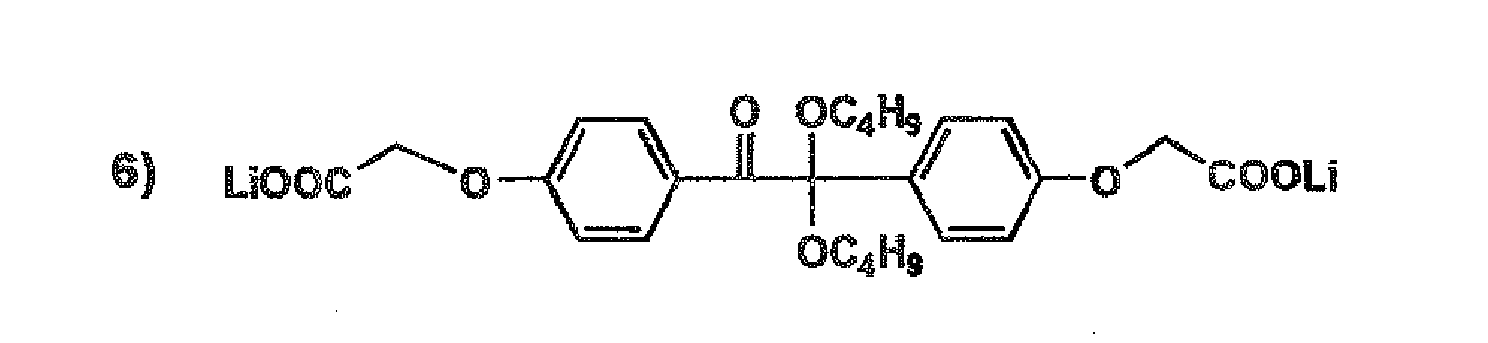


- With regard to the solubility of an ethylenically unsaturated group, which is used along with the initiator of the present invention, water solubility is preferable. However, since some components of the group are water soluble in an aqueous curable composition, even though the group as a whole is not water-soluble, compounds to be used are not specifically limited. Since the initiator of the present invention is anionic, ionicity of an ethylenically unsaturated group-containing compound may be either nonionic or anionic, as long as it does not aggregate in a photocurable/crosslinkable composition. However, even a cationic compound may be added as long as it causes no aggregation.
- The "radical polymerizable group-containing compound" refers to a compound which incorporates at least one radical polymerizable group in the molecule. Specifically, examples of the compound include an ethylenically unsaturated group-containing compound exhibiting a double bond and an acethylenically unsaturated group-containing compound exhibiting a triple bond. Of these, the ethylenically unsaturated group-containing compound is preferable in view of chemical reactivity, production safety and cost.
- The ethylenically unsaturated group-containing compound is a compound having at least one ethylenically unsaturated group therein, specifically a compound having at least one styrene group, acryl group, methacryl group, allyl group, crotonic acid group, maleic acid group, or itaconic acid group therein. A compound, having at least one acryl group or methacryl group, is preferable.
- Examples of a compound having a styrene group include styrene and styrene sulfonate.
- Examples of an acryl group and a methacryl group [hereinafter, both groups are referred to together as a (meth)acryl group] are cited as follows: (meth)acrylamide; a hydroxyalkyl(meth)acrylate such as 2-hydroxyethyl(meth)acrylate, 2- hydroxypropyl(meth)acrylate, or 1,4-butanediolmono(meth)acrylate; a polyolpoly(meth)acrylate having a hydroxyl group such as trimethylolpropanemono(meth)acrylate, trimethylolpropanedi(meth)acrylate, or a mono-, di-, or tri (meth) acrylate of pentaerythritol; a mono- or di(meth)acrylate of an alkylene glycol such as a mono- or di(meth)acrylate of ethylene glycol, or a mono- or di(meth)acrylate of propylene glycol; and a poly(meth)acrylate of an ethylene oxide adduct of a polyol such as hexanediol, nonanediol, trimethylolpropane, pentaerythritol, ditrimethylolpropane, tricyclodecanedimethylol, or dipentaerythritol.
- Further, there are cited (meth)acrylonitrile, vinyl acetate, and, as a cationic unsaturated compound, a tertiary salt of a hydrochloride and a sulfate of a dialkylaminoalkyl(meth)acrylate such as dimethylaminoethyl(meth)acrylate, diethylaminoethyl(meth)acrylate, or diethylamino-2-hydroxypropyl(meth)acrylate.
- Still further, there are cited a tertiary salt of a hydrochloride and a sulfate of a dialkylaminoalkyl(meth)acrylamide such as dimethylaminopropyl(meth)acrylamide, a quaternary salt of a halogenated alkyl adduct such as a methyl chloride adduct of a dialkylaminoalkyl(meth)acrylalate and of a halogenated aryl adduct such as a benzyl chloride adduct of a dialkylaminoalkyl(meth)acrylate, and a quaternary salt of a halogenated alkyl adduct such as a methyl chloride adduct a dialkylaminoalkyl(meth)acrylamide and of a halogenated aryl adduct such as a benzyl chloride adduct of a dialkylaminoalkyl(meth)acrylamide.
- The ethylenically unsaturated group-containing compound may be an olygomer or a polymer. As an inonic group, a salt of a carboxyl group or of the acid group in sulfonic acid, an alkylene oxide group, and a hydroxyl group are exemplified.
- More specifically, exemplified are a polymer prepared by adding glycidyl(meth)acrylate to a carboxyl group-contaning copolymer, which is a copolymer of a (meth)acrylate and (meth)acrylic acid, and a salt of the polymer; those prepared by adding (meth)acrylic acid to an ester of a fatty acid and an alkyleneglycol monoglycidyl ether; a polyurethane (meth)acrylate or a polyester (meth)acrylate having an ethylene double bond at the terminals and a polyalkylene oxide at the alcohol portions; and a polyvinyl alcohol polymer combined with a (meth)acrylate via a connecting group.
- Examples of the polyurethane (meth)acrylate include, as a polyol, a polyether polyol such as polyethylene glycol, polypropylene glycol, or polytetramethylene glycol, as well as a polyester diol such as ethylene glycol adipate, butanediol adipate, butanediol phthalate, or hexanediol phthalate.
- As a polyisocyanate compound, exemplified are trilenediisocyanate, diphenylmethane diisocyanate, isophorone diisocyanate, hexamethylene diisocyanate, and hydrogenated diphenylmethane diisocyanate.
- As a hydroxyl group-containing (meth)acrylate, exemplified is a hydroxyalkyl(meth)acrylate such as hydroxyethyl methacrylate or hydroxypropyl methacrylate.
- As a polyester (meth)acrylate, exemplified is a reaction product of a polyester-type polyol with (meth)acrylic acid.
- The polyester-type polyol includes, for example, a polyprotic acid such as succinic acid, maleic acid, adipic acid, sebacic acid, phthalic acid, tetrahydrophthalic acid, hexahydrophthalic acid, or trimellitic acid, and an anhydride thereof. The alcohol component includes a polyester alcohol prepared via reaction of ethylene glycol, butanediol, hexanediol, diethylene glycol, propylene glycol, dipropylene glycol, trimethylol propane, pentaerythritol, a triol of an ethylene oxide adduct or a propylene oxide adduct of trimethylol propane, a triol of an ethylene oxide adduct or a propylene oxide adduct of glycerin, or a tetraol of an ethylene oxide adduct or a propylene oxide adduct of pentaerythritol.
- The ethylenically unsaturated group-containing compound may be used individually or in combination.
- Examples of the polyvinyl alcohol polymer combined with a (meth)acrylate via a connecting group include a polymer prepared by combining a compound having a (meth)acryl group at one terminal and having an aldehyde group at the other terminal with hydroxyl groups of polyvinyl alcohol via acetalization, as described in
JP-A, Nos. 2000-181062 2004-189841 JP-A Nos. 2000-181062 2004-189841 
- Further, a photocurable modifying group (a nonionic one) represented by Formula (3), as described in
JP-A No. 2004-161942 
- It is not preferable that pH of the ink-jet ink (hereinafter, also referred to simply as the ink) of the present invention is less than 5, since a photoinitiator according to the present invention tends to be hydrolyzed. Therefore, the pH needs to be at least 5, preferably at least 6.5.
- Of the ethylenically unsaturated group-containing compounds, a compound featuring a molecular weight of at least 6000 is preferable, but more preferable is a polymer of a molecular weight of at least 6000 that has a plurality of side chains with ethylenically unsaturated groups in its hydrophilic main chain. The reason why the molecular weight needs to be at least 6000 is that, when the molecular weight is at least 6000, beading and bleeding can be efficiently prevented.
- Although the mechanism is still a matter for speculation, it is conceivable that, when the molecular weight is at least 6000, even very limited polymerization/cross-linking of the ethylenically unsaturated groups in the molecule dramatically increases the molecular weight, and therefore the apparent viscosity of the molecule is increased, whereby beading and bleeding may be prevented in a short time.
- A polymer having ethylenically unsaturated groups in its side chains is more preferable. For the reason, it is conceivable that, since a plurality of cross-linking groups are present in the side chain, the occuerence of combination of two portions between the side chains enables steric fixation, leading to curing in a shorter time.
- The amount of an ethylenically unsaturated group-containing compound used for the ink-jet ink of the present invention is not specifically limited, provided that curing can be carried out with the amount.
- In the present invention, in addition to a photoinitiator according to the present invention, any other appropriate photoinitiators or any appropriate photosensitizers may be added, if necessary.
- These initiators, which may be added, are exemplified as follows:
- 1) benzophenones such as benzophenone, hydroxybenzophenone, bis-N,N-dimethylaminobenzophenone, bis-N,N-diethylaminobenzophenone, or 4-methoxy-4'-dimethylaminobenzophenone, and salts thereof;
- 2) thioxanthones such as thioxanthone, 2,4-diethylthioxanthone, isopropylthioxanthone, chlorothioxanthone, or isopropoxychlorothioxanthone, and salts thereof;
- 3) anthraquinones such as ethylanthraquinone, benzanthraquinone, aminoanthraquinone, or chloroanthraquinone;
- 4) acetophenones;
- 5) benzoin ethers such as benzoin methyl ether;
- 6) 2,4,6-trihalomethyltriazines;
- 7) 1-hydroxycyclohexyl phenyl ketone, imidazoles such as 2-(o-chlorophenyl)-4,5-diphenylimidazole dimers, 2-(o-chlorophenyl)-4,5-di(m-methoxyphenyl)imidazole dimers, 2-(o-fluorophenyl)-4,5-phenylimidazole dimers, 2-(o-methoxyphenyl)-4,5-phenylimidazole dimers, 2-(p-methoxyphenyl)-4,5-diphenylimidazole dimers, 2-di(p-methoxyphenyl)-5-phenylimidazole dimers, 2-(2,4-dimethoxyphenyl)-4,5-diphenylimidazole dimers, or 2,4,5-triarylimidazole dimers;
- 8) benzyldimethylketal, 2-benzyl-2-dimethylamino-1-(4-morpholinophenyl)butane-1-one, 2-methyl-1-[4-(methylthio)phenyl]-2-morpholino-1-propanone, 2-hydroxy-2-methyl-1-phenyl-propane-1-one, 1-[4-(2-hydroxyethoxy)-phenyl]-2-hydroxy-2-methyl-1-propane-1-one, phenanthrenequinone, 9,10-phenanthrenequinone, and benzoins such as methylbenzoin or ethylbenzoin;
- 9) acridine derivatives such as 9-phenylacridine or 1,7-bis(9,9'-acridinyl)heptane;
- 10) bisacylphosphine oxide, bisphenylphosphine oxide, and bis(2,4,6-trimethylbenzoil)-phenylphosphine oxide; and
- 11) 4-(2-hydroxyethoxy)phenyl-(2-hydroxy-2-propyl)ketone and ethylene oxides thereof.
- Further, the above initiators may be added to the ink in the form of a dissolved material or a dispersed material, as appropriate.
- Examples of the photosensitizers include ethyl p-dimethylaminobenzoate, isoamyl p-dimethylaminobenzoate, ethanolamine, diethanolamine, and triethanolamine.
- The amount of a photoinitiator used for the ink-jet ink of the present invention may be 0.05 - 10% based on the ink amount. In cases of less than 0.05%, a larger amount of light is required for curing, resulting in economic disadvantages, and in cases of at least 10%, an excess amount of the initiator exists in an image, resulting in poor stability of the final image.
- Any UV light sources featuring an emission light wavelength of 300 - 370 nm may be used with no spesific limitation. Specifically, employed are those conventionally known in the art such as a low-pressure, a medium-pressure, or a high-pressure mercury lamp, a metal halide lamp, a xenon lamp featuring an emission light wavelength in the UV region, a cold-cathode tube, a hot-cathode tube, or an LED. However, in order for the initiator of the present invention to exert maximum performance, those featuring a higher emission intensity at a 365 nm light wavelength are preferable. From this viewpoint, a high-pressure mercury lamp and an LED featuring a 365 nm emission light wavelength are preferable.
- With regard to UV irradiation conditions, it is preferable to carry out UV irradiation 0.001 - 1.0 second after ink landing, more preferably 0.001 - 0.5 second after ink landing. To form an highly detailed image, it is specifically important that the irradiation timing is as early as possible.
- As a UV irradiation method, a basic method is disclosed in
JP-A No. 60-132767 -
U.S. Patent No. 6,145,979 discloses, as irradiation methods, an optical fiber method and a method wherein a collimated light source is irradiated on a mirror surface placed on the side of a head unit and then UV light is irradiated onto a recording section. In the ink-jet recording method of the present invention, any one of these methods may be used. - Further, one of the preferred emdodiments is also a method, wherein UV irradiation is devided into two steps: initially, UV is irradiated via the above method 0.001 - 2.0 seconds after ink langing; and further UV irradiation is carried out. Dividing the UV irradiation into two steps makes it possible to prevent recording material shrinkage which tends to occur during ink curing.
- As a colorant used for the ink-jet ink of the present invention, various appropriate dyes or pigments known in the ink-jet field may be used. However, from the viewpoint of UV irradiation and image stability, pigments are preferablly used.
- Dyes usable in the present invention are not specifically limited, including water-soluble dyes such as acidic dyes, direct dyes, or reactive dyes, as well as dispersed dyes. Of these, anionic dyes are preferable.
- Water-soluble dyes usable in the present invention include, for example, azo dyes, methyne dyes, azomethyne dyes, xanthene dyes, quinone dyes, phthalocyanine dyes, triphenylmethane dyes, and diphenylmethane dyes. Specific compounds will now be listed that by no means limit the scope of the present invention.
- Nos. 1, 3, 11, 17, 18, 19, 23, 25, 36, 38, 40, 42, 44, 49, 59, 61, 65, 67, 72, 73, 79, 99, 104, 110, 114, 116, 118, 121, 127, 129, 135, 137, 141, 143, 151, 155, 158, 159, 169, 176, 184, 193, 200, 204, 207, 215, 219, 220, 230, 232, 235, 241, 242, and 246
- Nos. 3, 7, 8, 10, 19, 24, 51, 56, 67, 74, 80, 86, 87, 88, 89, 94, 95, 107, 108, 116, 122, 127, 140, 142, 144, 149, 152, 156, 162, 166, and 168
- Nos. 88, 97, 106, 111, 114, 118, 119, 127, 131, 138, 143, 145, 151, 183, 195, 198, 211, 215, 217, 225, 226, 249, 251, 254, 256, 257, 260, 261, 265, 266, 274, 276, 277, 289, 296, 299, 315, 318, 336, 337, 357, 359, 361, 362, 364, 366, 399, 407, and 415
- Nos. 17, 19, 21, 42, 43, 47, 48, 49, 54, 66, 78, 90, 97, 102, 109, and 126
- Nos. 1, 7, 9, 15, 23, 25, 40, 62, 72, 74, 80, 83, 90, 92, 103, 104, 112, 113, 114, 120, 127, 128, 129, 138, 140, 142, 156, 158, 171, 182, 185, 193, 199, 201, 203, 204, 205, 207, 209, 220, 221, 224, 225, 229, 230, 239, 249, 258, 260, 264, 278, 279, 280, 284, 290, 296, 298, 300, 317, 324, 333, 335, 338, 342, and 350
- Nos. 9, 12, 16, 19, 20, 25, 27, 28, 40, 43, 56, 73, 81, 84, 104, 108, and 109
- Nos. 2, 4, 13, 14, 19, 28, 44, 123, 224, 226, 227, 248, 282, 283, 289, 294, 297, 298, 301, 355, 357, and 413
- Nos. 1, 2, 3, 24, 26, 31, 50, 52, 58, 60, 63, 107, 109, 112, 119, 132, 140, 155, 172, 187, 188, 194, 207, and 222
- Nos. 8, 9, 10, 11, 12, 22, 27, 28, 39, 44, 50, 58, 79, 86, 87, 98, 105, 106, 130, 132, 137, 142, 147, and 153
- Nos. 6, 26, 27, 34, 39, 40, 46, 102, 105, 107, and 118
- Nos. 2, 4, 9, 23, 24, 31, 54, 62, 69, 79, 80, 81, 83, 84, 89, 95, 212, 224, 225, 226, 227, 239, 242, 243, and 254 and
- Nos. 9, 35, 51, 66, 94, and 95
- Nos. 1, 15, 71, 76, 77, 78, 80, 86, 87, 90, 98, 106, 108, 160, 168, 189, 192, 193, 199, 200, 201, 202, 203, 218, 225, 229, 237, 244, 248, 251, 270, 273, 274, 290, and 291
- Nos. 26, 28, 59, 80, and 85
- Nos. 44, 106, 115, 195, 209, 210, 222, and 223
- Nos. 17, 19, 22, 32, 51, 62, 108, 112, 113, 117, 118, 132, 146, 154, 159, and 169
- Nos. 1, 2, 11, 13, 15, 19, 21, 28, 29, 32, 36, 40, 41, 45, 51, 63, 67, 70, 73, and 91
- Nos. 2, 21, and 22
- Nos. 1, 2, 12, 13, 14, 15, 18, 23, 24, 27, 29, 35, 36, 39, 46, 51, 52, 69, 70, 73, 82, and 109
- Nos. 1, 3, 7, 10, 11, 15, 16, 21, 27, and 39
- Nos. 1, 3, 7, 9, 21, 22, 26, 41, 45, 47, 52, 54, 65, 69, 75, 77, 92, 100, 105, 117, 124, 129, 147, and 151
- Nos. 1 and 4
- No. 1
- Nos. 2, 3, 7, 15, 17, 18, 22, 23, 24, 25, 27, 37, 39, 42, 57, 69, 76, 81, 84, 85, 86, 87, 92, 95, 102, 105, 111, 125, 135, 136, 137, 142, 143, 145, 151, 160, 161, 165, 167, 168, 175, and 176
- Nos. 1, 4, 5, 7, 11, 12, 13, 15, 16, 20, 30, 35, 56, 64, 67, 69, 70, 72, 74, 82, 84, 86, 87, 91, 92, 93, 95, and 107
- Nos. 2, 3, 5, 8, 11, 21, 22, 23, 24, 28, 29, 31, 33, 35, 43, 45, 49, 55, 56, 58, 65, 66, 78, 83, 84, 106, 111, 112, 113, 114, 116, 120, 123, 124, 128, 130, 136, 141, 147, 158, 159, 171, 174, 180, 183, 184, 187, 190, 193, 194, 195, 198, 218, 220, 222, 223, 228, and 235
- Nos. 1, 2, 4, 5, 6, 22, 23, 33, 36, and 38
- Nos. 2, 3, 4, 5, 7, 13, 14, 15, 19, 21, 25, 27, 28, 29, 38, 39, 41, 49, 50, 52, 63, 69, 71, 72, 77, 79, 89, 104, 109, 112, 113, 114, 116, 119, 120, 122, 137, 140, 143, 147, 160, 161, 162, 163, 168, 171, 176, 182, 184, 191, 194, 195, 198, 203, 204, 207, 209, 211, 214, 220, 221, 222, 231, 235, and 236
- Nos. 8, 12, 15, 19, and 21
- Nos. 2, 7, 9, 10, 11, 17, 18, 19, 21, 23, 31, 37, 43, and 46
- Nos. 5, 8, 13, 14, 31, 34, and 39
- Nos . 1 and 2
- As pigments usable in the present invention, any appropriate organic and inorganic pigments conventionally known in the art may be used. For example, preferable are azo pigments such as azo lakes, insoluble azo pigments, condensed azo pigments, or chelate azo pigments; polycyclic pigments such as phthalocyanine pigments, perylene and perylene pigments, anthraquinone pigments, quinacridone pigments, dioxazine pigments, thioindigo pigments, isoindolinone pigments, or quinophtahrony pigments; dye lakes such as basic dye-type lakes or acidic dye-type lakes; organic pigments such as nitro pigments, nitroso pigments, aniline black, or daylight fluorescent pigments; and inorganic pigments such as carbon black. However, anion pigments are preferable.
- Further, the ink-jet ink of this invention is characterized by excellent photo-curing sensitivity, and thus carbon black which is employed in a black ink is specifically preferable as a pigment to exhibit the full benefits of the characteristic.
- Specific organic pigments will now be listed.
- Magenta or red pigments include C.I. Pigment Red 2, C.I. Pigment Red 3, C.I. Pigment Red 5, C.I. Pigment Red 6, C.I. Pigment Red 7, C.I. Pigment Red 15, C.I. Pigment Red 16, C.I. Pigment Red 48:1, C.I. Pigment Red 53:1, C.I. Pigment Red 57:1, C.I. Pigment Red 122, C.I. Pigment Red 123, C.I. Pigment Red 139, C.I. Pigment Red 144, C.I. Pigment Red 149, C.I. Pigment Red 166, C.I. Pigment Red 177, C.I. Pigment Red 178, C.I. and Pigment Red 222.
- Orange or yellow pigments include C.I. Pigment Orange 31, C.I. Pigment Orange 43, C.I. Pigment Yellow 12, C.I. Pigment Yellow 13, C.I. Pigment yellow 14, C.I. Pigment Yellow 15, C.I. Pigment Yellow 17, C.I. Pigment yellow 74, C.I. Pigment Yellow 93, C.I. Pigment yellow 94, C.I. Pigment yellow 128, and C.I. Pigment Yellow 138.
- Green or cyan pigments include C.I. Pigment Blue 15, C.I. Pigment Blue 15:2, C.I. Pigment Blue 15:3, C.I. Pigment Blue 16, C.I. Pigment Blue 60, and C.I. Pigment Green 7.
- Water-soluble polymer dispersing agents, used to stably disperse the above pigments in the ink, include water-soluble resins described below which are preferable from the viewpoint of ejection stability.
- The water-soluble resins to be preferably used include those such as styrene-acrylic acid-alkyl acrylate copolymers, styrene-acrylic acid copolymers, styrene-maleic acid copolymers, styrene-maleic acid-alkyl acrylate copolymers, styrene-methacrylic acid copolymers, styrene-methacrylic acid-alkyl acrylate copolymers, styrene-maleic acid half ester copolymers, vinyl naphthalene-acrylic acid copolymers, or vinyl naphthalene-maleic acid copolymers.
- The content of the water-soluble resins is preferably 0.1 - 10% by weight, more preferably 0.3 - 5% by weight based on the total ink amount.
- The above water-soluble resins may be used individually or in combination.
- The form of an anionic pigment used in the present invention is preferably a pigment wherein the above pigment is dispersed using an anionic polymer dispersing agent or an anion-modified self-dispersed pigment from the viewpoint of dispersion stability.
- The anionic polymer dispersing agent is a dispersing agent having an anionic group prepared by neutralizing an acidic group in its molecule with a basic compound. The basic compound used in this case includes a hydroxide of an alkali metal such as sodium hydroxide or potassium hydroxide, ammonia, and an amine such as an alkyl amine or an alkanolamine, but an amine is specifically preferable in the present invention.
- Anionic polymer dispersing agents to be preferably used in the present invention are not specifically limited, provided that the agents feature molecular weights of at least 1000. Examples include polyvinyl alcohols; polyvinyl pylloridones; acryl resins such as polyacrylic acid, acrylic acid-acrylonitrile copolymers, potassium acrylate-acrylonitrile copolymers, vinyl acetate-acrylate copolymers, or acrylic acid-acrylate copolymers; styrene-acryl resins such as styrene-acrylic acid copolymers, styrene-methacrylic acid copolymers, styrene-methacrylic acid-acrylate copolymers, styrene-α-methylstyrene-acrylic acid copolymers, or styrene-α-methylstyrene-acrylic acid-acrylate copolymers; styrene-maleic acid copolymers; styrene-maleic anhydride copolymers; vinylnaphthalene-acrylic acid copolymers; vinylnaphthalene-maleic acid copolymers; vinyl acetate-based copolymers such as vinyl acetate-ethylene copolymers, vinyl acetate-fatty acid vinylethylene copolymers, vinyl acetate-maleate copolymers, vinyl acetate-crotonic acid copolymers, or vinyl acetate-acrylic acid copolymers; and copolymers or resins of salts thereof incorporating homopolymers, copolymers, or terpolymers having functional groups such as a carboxylic acid, a sulfonic acid, or a phosphonic acid.
- Monomers providing acidic functional groups include, for example, acrylic acid, methacrylic acid, crotonic acid, maleic acid, maleic anhydride, itaconic acid, mesaconic acid, fumaric acid, citraconic acid, vinylacetic acid, acryloxypropionic acid, vinyl sulfonic acid, styrene sulfonic acid, 2-acrylamido-2-methylpropane sulfonic acid, ally sulfonic acid, allyl phosphonic acid, vinyl phosphonic acid, and vinyl sulfonic acid.
- The anion-modified self-dispersed pigment to be preferably used in the present invention is referred to as a pigment, having an anionic group on the surface, which can be dispersed with no dispersing agent. The anionic self-dispersed pigment is a pigment that is capable of being dispersed in water with no dispersing agent, the pigment being modified with an acidic group that is then neutralized with a basic compound to form an anionic group.
- A pigment particle having an acidic group on its surface is referred to as a pigment wherein the surface of the pigment particle is directly modified with an acidic group, or an organic compound, having an organic pigment mother nucleus, which is combined with an acidic group directly or via a joint.
- The acidic group (referred to also as the polar group) includes, for example, a sulfonic acid group, a carboxylic acid group, a phosphonic acid group, a boric acid group, and a hydroxyl group, but the sulfonic acid group and the carboxylic acid group are preferable, and further the sulfonic acid group is more preferable.
- A modifying agent having an acidic group includes a treatment agent containing a sulfur atom such as sulfuric acid, fuming sulfuric acid, sulfur trioxide, chlorosulfuric acid, fluorosulfuric acid, amidosulfuric acid, a sulfonated pyridine salt, or sulfamic acid; and a carboxylating agent such as sodium hypochlorite or potassium hypochlorite which functions to introduce a carboxylic acid group via oxidation of the pigment particle surface. Of these, a sulfonating agent such as sulfur trioxide, a sulfonated pyridine salt, or sulfamic acid, or a carboxylating agent is preferable.
- A basic compound, which functions to neutralize the acidic group, includes a hydroxide of an alkali metal such as sodium hydroxide or potassium hydroxide, ammonia, and an amine such as an alkyl amine or an alkanol amine, but the amine is specifically preferable in the present invention.
- As a method of preparing a pigment particle having a polar group on its surface, mentioned is a method wherein, via oxidation of the pigment particle surface with an appropriate oxidant, a polar group such as a sulfonic acid group or a salt thereof is introduced onto at least part of the pigment surface, as described, for example, in
WO 97/48769 JP-A Nos. 10-110129 11-246807 11-57458 11-189739 11-323232 2000-265094 - Specifically, employable is a preparation method wherein carbon black is oxidized with concentrated nitric acid, or in cases of a color pigment, the color pigment is oxidized with sulfamic acid, a sulfonated pyridine salt, or amidosulfuric acid in sulfolane or N-methyl-2-pyrrolidone. Via removal of soluble products formed via excess oxidation and via the following purification, a pigment dispersion can be prepared. Further, when a sulfonic acid group is introduced onto the pigment surface via oxidation, the acidic group may be neutralized with a basic compound, if appropriate.
- Other methods include a method of allowing a pigment derivative to adsorb to the pigment particle surface via treatment such as milling, as described in
JP-A Nos. 11-49974 2000-273383 2000-303014 JP-A Nos. 2002-179977 2002-201401 - The average particle diameter of a pigment dispersion used for the ink-jet ink of the present invention is preferably at most 500 nm, more preferably at most 200 nm, and further, preferably from 10 nm - 200 nm, more preferably from 10 nm - 150 nm. When the average particle diameter of the pigment dispersion exceeds 500 nm, unstable dispersion tends to result. Further, when the average particle diameter of the pigment dispersion is less than 10 nm, the stability of the pigment dispersion is also likely to decrease, resulting in a tendency to degrade storage stability of the ink.
- Particle diameter measurement of the pigment dispersion is carried out with a commercially available particle diameter analyzer employing a light scattering method, an electrophoretic method, or a laser Doppler method. It is also possible to conduct the measurement via photographic particle images of at least 100 particles with a transmission electron microscope, followed by statistically processing these images using an image analyzing software such as Image-Pro (produced by Media Cybernetics, Inc.).
- As a pigment dispersing method, employable are various methods such as a ball mill, a sand mill, an atriter, a roll mill, an agitator, a Henschel mixer, a colloid mill, an ultrasonic homogenizer, a pearl mill, a wet-type jet mill, or a paint shaker.
- The content of a colorant, dispersible or soluble in water, used for the ink-jet ink of the present invention is preferably from 1 - 10% by weight based on the total ink weight.
- As solvents according to the present invention, water-soluble media are preferably used. As the water-soluble media, mixed solvents of water and water-soluble organic solvents are more preferably used.
- Preferable examples of the water-soluble organic solvents include alcohols (for example, methanol, ethanol, propanol, isopropanol, butanol, isobutanol, sec-butanol, and tert-butanol), polyols (for example, ethylene glycol, diethylene glycol, triethylene glycol, polyethylene glycol, propylene glycol, dipropylene glycol, polypropylene glycol, butylene glycol, hexanediol, pentanediol, glycerin, hexanetriol, and thiodiglycol), polyol ethers (for example, ethylene glycol monomethyl ether, ethylene glycol monoethyl ether, ethylene glycol monobutyl ether, diethylene glycol monomethyl ether, diethylene glycol monoethyl ether, diethylene glycol monobutyl ether, diethylene glycol monomethyl ether, propylene glycol monobutyl ether, ethylene glycol monomethyl ether acetate, triethylene glycol monomethyl ether, triethylene glycol monoethyl ether, triethylene glycol monobutyl ether, triethylene glycol monophenyl ether, and propylene glycol monophenyl ether), amines (for example, ethanolamine, diethanolamine, triethanolamine, N-methyldiethanolamine, N-ethyldiethanolamine, morpholine, N-ethylmorpholine, ethylenediamine, diethylenediamine, triethylenetetramine, tetraethylenepentamine, polyethyleneimine, pentamethyldiethylenetriamine, and tetramethylpropylenediamine), amides (for example, formamide, N, N-dimethylformamide, and N,N-dimethylacetamide), heterocycles (for example, 2-pyrrolidone, N-methyl-2-pyrrolidone, cyclohexyl pyrrolidone, 2-oxazolidone, and 1,3-dimethyl-2-imidazolidinone), and sulfoxides (for example, dimethylsulfoxide).
- Preferable surfactants used for the ink of the present invention include anionic surfactants such as alkyl sulfates, alkyl ester sulfates, dialkylsulfosuccinates, alkylnaphthalene sulfonates, alkyl phosphates, polyoxyalkylene alkyl ether phosphates, or fatty acid salts; nonionic surfactants such as polyoxyethylene alkyl ethers, polyoxyalkylene alkylphenyl ethers, acetylene glycols, or polyoxyethylene-polyoxypropylene block copolymers; surfactants such as glycerin esters, sorbitan esters, polyoxyethylene fatty acid amides, or amine oxides; and cathionic surfactants such as alkyl amine salts or quaternary ammonium salts.
- These surfactants may be used as a dispersing agent for a pigment, and of these, specifically, the anionic surfactants can be preferably used.
- In the present invention, other additives conventionally known in the art may be contained, including, for example, fluorescent brighteners, antifoamers, lubricants, preservatives, thickeners, antistatic agents, matting agents, water-soluble polyvalent metal salts, acids and bases, pH adjusters such as buffer solutions, antioxidants, surface tension adjusters, specific resistance regulators, anti-corrosion agents, and inorganic pigments.
- Paper includes coated paper and non-coated paper. The coated paper includes art paper in which the coated amount on one side is approximately 20 g/m2, coated paper in which the coated amount on one side is approximately 10 g/m2, light weight coated paper in which the coated amount on one side is approximately 5 g /m2, ultra light weight coated paper, matte finished coated paper, dull tone finished double coated paper, and newsprint paper.
- The non-coated paper includes printing paper A employing 100 percent chemical pulp, printing paper B employing at least 70 percent chemical pulp, printing paper C employing 40 percent - less than 70 percent chemical pulp, printing paper D employing less than 40 percent chemical pulp, and gravure paper, incorporating mechanical pulp, which has been subjected to calendering. More detailed reference will be made to "Saishin Kamikako Binran (Handbbok of Recent Paper Treatments)", edited by Kako Binran Henshuiinkai, published by Tech Times and "Insatsu Kogaku Binran (Printing Engineering Handbook)", edited by Nihon Insatsu Gakkai.
- As plain paper, used are 80 - 200 µm thick non-coated paper belonging to a part of non-coated paper sheets, special printing paper sheets, and information sheets. Examples of plain paper include high quality printing paper, medium quality printing paper, low quality printing paper, thin printing paper, ultra light weight coated printing paper, special printing paper such as high quality colored paper, form paper sheets, PPC sheets, and other kinds such as information sheets. Specifically, available are paper sheets described below and various modified/treated paper sheets, but the present invention is not limited thereto.
- There may be listed high quality paper, high quality colored paper, recycled paper, copying paper/colored ones, OCR paper, non-carbon paper/colored ones, synthetic paper such as 60, 80, and 110 micron YUPO, and 70 and 90 micron YUPOCOAT, others such as ONE SIDE ART PAPER 68 kg, COATED PAPER 90 kg, MATTE FORM PAPER 70, 90, and 110 kg , FOAMED PET 38 micron, and MITSUORIKUN (all produced by Kobayashi Kirokushi Co., Ltd.); OK HIGH QUALITY PAPER, NEW OK HIGH QUALITY PAPER, SUN FLOWER, PHOENIX, OK ROYAL WHITE, EXPORT HIGH QUALITY PAPER (NPP, NCP, NWP, and ROYAL WHITE), OK BOOK PAPER, OK CREAM BOOK PAPER, CREAM HIGH QUALITY PAPER, OK MAP PAPER, OK ISHIKARI, KYULTREI, OK FORM, OKH, and NIP-N (all produced by New Oji Paper Co., Ltd.); KINO, TOKO, EXPORT HIGH QUALITY PAPER, SPECIAL DEMAND HIGH QUALITY PAPER, BOOK PAPER, BOOK PAPER L, PALE CREAM BOOK PAPER, ELEMENTARY SCHOOL SCIENCE TEXT BOOK PAPER, CONTINUOUS SLIP PAPER, HIGH QUALITY NIP PAPER, GINKAN, KINYO, KINYO (W), BRIDGE, CAPITAL, GINKAN BOOK PAPER, HARP, HARP CREAM, SK COLOR, SECURITY PAPER, OPERA CREAM, OPERA, KYP CARTE, SYLVIA HN, EXCELLENT FORM, and NPI FORM DX (all produced by Nippon Paper Industries Co., Ltd.); PEARL, KINRYO, PALE CREAM HIGH QUALITY PAPER, SPECIAL BOOK PAPER, SUPER BOOK PAPER, DIAFORM, and INK-JET FORM (all produced by Mitsubishi Paper Mills Ltd.); KINMO V, KINMO SW, HAKUZO, HIGH QUALITY PUBLISHING PAPER, CREAM KINMO, CREAM HAKUZO, SECURITY/TRADABLE COUPON PAPER, BOOK PAPER, MAP PAPER, COPING PAPER, and HNF (all produced by Hokuetsu Paper Mills, Ltd.); SIORAI, TELEPHONE DIRECTORY COVER, BOOK PAPER, CREAM SHIORAI, CREAM SHIORAI MEDIUM ROUGH, CREAM SHIORAI HIGH ROUGH, and DSK (all produced by Daishowa Paper Manufacturing Co., Ltd.); SENDAI MP HIGH QUALITY PAPER, KINKO, RAICHO HIGH QUALITY, HANGING PAPER, COLORED PAPER BASE PAPER, DICTIONARY PAPER, CREAM BOOK, WHITE BOOK, CREAM HIGH QUALITY PAPER, MAP PAPER, and CONTINUOUS SLIP PAPER (all produced by Chuetsu Paper & Pulp Co., Ltd.) ; OP KINO (CHUETSU), KINSA, REFERENCE PAPER, TRADABLE COUPON PAPER (WHITE)), FORM PRINTING PAPER, KRF, WHITE FORM, COLOR FORM, (K)NIP, FINE PPC, and KISHU INK-JET PAPER (all produced by Kishu Paper Co., Ltd.); TAIOU, BRIGHT FORM, KANT, KANT WHITE, DANTE, CM PAPER, DANTE COMIC, HEINE, PAPER BACKS PAPER, HEINE S, NEW AD PAPER, UTRILLO EXCEL, EXCEL SUPER A, KANT EXCEL, EXCEL SUPER B, DANTE EXCEL, HEINE EXCEL, EXCEL SUPER C, EXCEL SUPER D, AD EXCEL, EXCEL SUPER E, NEW BRIGHT FORM, and NEW BRIGHT NIP (all produced by Daio Paper Corp.); NICHIRIN, GETSURIN, UNREI, GINGA, HAKUUN, WAISU, GETURIN ACE, HAKUUN ACE, and UNKIN ACE (all produced by Japan Paper Industry Co., Ltd.); TAIOU, BRIGHT FORM, and BRIGHT NIP (all produced by Nagoya Pulp Co., Ltd.); BOTAN A, KINBATO, TOKU BOTAN, SHIROBOTAN A, SHIROBOTAN C, GINBATO, SUPER SHIROBOTAN A, PALE CREAM SHIROBOTAN, SPECIAL MEDIUM QUALITY PAPER, SHIROBATO, SUPER MEDIUM QUALITY PAPER, AO BATO, AKA BATO, KIN BATO M SNOW VISION, SNOW VISION, KIN BATO SNOW VISION, SHIRO BATO M, SUPER DX, HAMANASU O, AKA BATO M, and HK SUPER PRINTING PAPER (all produced by Honshu Paper Co., Ltd.); STAR LINDEN (A·AW), STAR ELM, STAR MAPLE, STAR LAUREL; STAR POPLAR, MOP, STAR CHERRY I, CHERRY I SUPER, CHERRY II SUPER, STAR CHERRY III, STAR CHERRY IV, CHERRY III SUPER, and CHERRY IV SUPER (all produced by Marusumi Paper Co., Ltd.); SHF (produced by Toyo Pulp Co., Ltd.); and TRP (produced by Tokai Pulp & Paper Co., Ltd.).
- As various films to be used, any commonly used films are available. Exemplified are polyester film, polyolefin film, polyvinyl chloride film, and polyvinylidene chloride film. Further, there may be usable resin coated paper, which is photographic paper, and YUPO paper, which is synthetic paper.
- Wnk-jet recording media are those which are prepared in such a manner that an absorptive or a non-absorptive support is used as a substrate and an ink receptive layer is formed on its surface. Some of ink receptive layers are composed of a coated layer, a swelling layer, and a minute void layer. The swelling layer absorbs ink while an ink receptive layer composed of a water-soluble polymer swells. The minute void layer is composed of inorganic or organic fine particles of a secondary particle diameter of about 20 - about 200 nm, and a binder, and minute voids of about 100 nm absorb ink.
- In recent years, as recording media which produce photographic images, there are preferably used ink-jet recording media, in which the above minute void layer is provided on RC paper which is prepared by covering both sides of a paper substrate with an olefin resin.
- To prepare a photoinitiator according to the present invention, a benzyl derivative, which is a precursor of a photoinitiator, is subjected to ketal reaction, followed by hydrolysis, if appropriate, to give the targeted substance.
- Methods of preparing the benzyl derivative are commonly well known, including a method via the Friedel-Crafts reaction of a phenyl compound and oxalyl chloride and a method of oxidizing benzoin in order to prepare a symmetrical benzyl compound. Also, in cases of preparing an unsymmetrical benzyl compound, a benzyl phenyl ketone derivative is prepared via the Friedel-Crafts reaction of phenylacetyl chloride and a phenyl compound, followed by bromination and by dehydrogen bromide reaction using an alcoxide to give a benzyl derivative.
- As the following ketal reaction, reaction under acidic or basic conditions, in which thionyl chloride and methanol, or DMF and sodium methoxide are respectively employed, is widely known. However, these reaction conditions tend to yield only a small amount of a ketal compound that is a precursor of the photoinitiator according to the present invention. Accordingly, it has been necessary to use an orthoformate and an alcohol employing p-toluenesulfonic acid or trifluoromethanesulfonic acid. Further, in view of the yield, trifluoromethanesulfonic acid is preferably employed.
- Synthesis of Exemplified Compound 1)

- Ice-cooled is 11.7 g (84 mmol) of aluminum chloride having been added in 33 ml of dichloromethane. At an interior temperature of at most 15 °C, 6.6 g (40 mmol) of methyl phenoxyacetate (compound A) is dipped, followed by slowly dipping 2.8 g (22 mmol) of oxalyl chloride. Then, a great amount of hydrogen chloride gas is generated. After termination of the generation of hydrogen chloride gas, the reaction liquid is poured into 100g of ice water, followed by adding 30 ml of ethyl acetate and by stirring to precipitate a crystal. This crystal is filtered and washed to give 2.5 g of compound B as a white crystal.
- A mixture of 23.9 g (62 mmol) of compound B, 65.6 g (620 mmol) of trimethyl orthoformate, 19.8 g (618 mmol) of methanol, and 360 ml of toluene is refluxed. Into this liquid, 2.8 g (18.6 mmol) of trifluoromethanesulfonic acid is added by dipping, followed by being further refluxed for 5 hours. Then, this resultant liquid is poured into a liquid containing ethyl acetate and a sodium hydrogen carbonate aqueous solution while mixing, and then an ethyl acetate layer formed is isolated, followed by being evaporated. As a white crystal, 18.8 g of compound C is obtained via column-separation and purification.
- A mixture of 16.7 g of compound C, 130 ml of methanol, and 10 ml of a 30% by weight aqueous solution of sodium hydroxide is refluxed for 2 hours. Then, a precipitated yellow substance is isolated via filtration, followed by distilling away the solvent. A resultant transparent oil is crystallized via addition of ethanol, followed by being filtered and dried to give 15.1 g of Exemplified Compound 1).
- The compound was verified using 1H-NMR.
- A reaction container was charged with 56 g of glycidyl methacrylate, 48 g of p-hydroxybenzaldeyde, 2 g of pyridine, and 1 g of N-nitroso-phenylhydroxyamine ammonium salt, followed by being stirred for 8 hours in an 80°C water bath.
- Subsequently, 45 g of saponified polyvinyl acetate, featuring a 500 polymerization degree and an 88% saponification rate, was dispersed in 225 g of ion-exchanged water, and then 4.5 g of phosphoric acid and p-(3-methacryloxy-2-hydroxypropyloxy)benzaldehyde, having been prepared via the above reaction, were added to the resultant solution in such a manner that the modification rate is allowed to be 3 mol% based on polyvinyl alcohol, followed by being heated at 90 °C for 6 hours. The thus-prepared solution was cooled to room temperature, followed by addition of 30 g of a basic ion-exchanged resin, and by stirring for 1 hour. Then, the ion-exchanged resin was filtered, followed by dilution with ion-exchanged water to give an acryl group-containing polyvinyl alcohol of a 10% concentration.
- The present invention will now be detailed with reference to examples that by no means limit the scope of the present invention. Incidentally, "%" to be shown in the examples is "% by weight" unless otherwise specified.
- Each of the additives described below was mixed and dispersed using a sand grinder filled with zirconia beads of 0.5 mm whose volume ratio was 50%, followed by dilution with water to give a black pigment dispersion having a black pigment content of 10%. The average particle diameter of black pigment particles contained in this black pigment dispersion was 106 nm. Herein, the particle diameter was determined using Zetasizer 1000HS (produced by Malvern Instruments Ltd).
Carbon black 10 parts
Polymer dispersing agent (styrene/acrylic acid/n-butyl acrylate copolymer, weight average molecular weight: 15,000, glass transition point: 70°C) 3 parts
Glycerin 15 parts
Ion-exchanged water 60 parts - Black pigment dispersion 30 parts
A-400 (polyethyleneoxyacrylate, molecular weight: 500, produced by Shin-Nakamura Chemical Co., Ltd.) 5 parts UA-W2A (water-soluble urethane acrylate oligomer, produced by Shin-Nakamura Chemical Co., Ltd.) 5 parts
Diethylene glycol 20 parts
Photoinitiator (refer to Tables 2 - 5) 1.2 parts
Olfin E1010 (produced by Nissin Chemical Industry Co., Ltd.) 0.3 part
Purified water was added to 100 parts. The resultant product was designated as Black Ink 1. - Black pigment dispersion 30 parts
Acryl group-containing polyvinyl alcohol (polymerization degree: 500, modification rate: 3%, and concentration: 10%) 30 parts
Diethylene glycol 30 parts
Photoinitiator (refer to Tables 2 - 5) 1.2 parts
Olfin E1010 (produced by Nissin Chemical Industry Co., Ltd.) 0.3 part
Purified water was added to 100 parts. The resultant product was designated as Black Ink 2. - Black Inks 3, 4, and 5, each of which has the composition described in Table 1, were prepared. Herein, DEG and EG therein represent diethylene glycol and ethylene glycol, respectively.
Table 1 Black Ink No.1 No.2 No.3 No.4 No.5 Black Pigment Dispersion (concentration: 10%) 30 30 30 30 30 A-400 5 20 10 UA-W2A 5 Acryl Group-containing Polyvinyl Alcohol (concentration: 10%) 30 40 10 Photoinitiator 1.2 1.2 3 20 2.4 Water-soluble Solvent DEG DEG DEG EG EG 20 30 20 20 20 Olfin E-1010 0.3 0.3 0.3 0.3 0.3 Water the rest the rest the rest the rest the rest pH 6.5 8.3 8.4 7.3 6.8 - There was set up an on-demand type ink-jet printer, loaded with a piezo type head of a nozzle orifice diameter of 25 µm, a driving frequency of 12 kHz, 128 nozzles, and a nozzle density of 180 dpi (dpi refers to the number of dots per 2.54 cm), featuring a maximum recording density of 720 x 720 dpi, wherein a high pressure halogen lamp (produced by Ushio Inc.) was placed on both ends of the piezo type head. A solid black image was printed on art paper while being irradiated with the high pressure halogen lamp at a light intensity of 100 mJ/cm2, and then hot-air dried for 1 minute using a drier, followed by being naturally dried for 24 hours.
- Instead of the high pressure halogen lamp, an LED (produced by Nichia Corp.) of a 365 nm emission light wavelength was used to form an image, with other things remaining the same.
- Under the above formation conditions for an ink-jet image, a line and a solid images with a given interval therebetween were continuously printed on 9 sheets of art paper at each of ambiences of 40 °C and 30% RH, as well as 20 °C and 70% RH. Then, printing was stopped for 10 minutes, followed by printing of the tenth sheet. The ejection state of the nozzle on printing of the tenth sheet was visually observed and the ink ejection stability was evaluated based on the following criteria.
- A: No variation of the ejection state was observed in all of the nozzles.
- B: Slanting ejection of the ink was observed in 1 - 2% by number of the nozzles, but no nozzle clogging was observed.
- C: Nozzle clogging was observed in less than 3 - 10% by number of the nozzles.
- D: Nozzle clogging was observed in at least 10% by number of the nozzles.
- Image and non-image portions of each of the resulting solid magenta images were visually observed and the glossiness uniformity was evaluated based on the following criteria.
- A: An excellent uniform image exhibiting no glossiness difference between the printed portion and the non-printed portion
- B: An almost uniform image exhibiting a slight glossiness difference between the printed portion and the non-printed portion
- C: A non-uniform image exhibiting a difference in feeling of glassiness or roughness between the printed portion and the non-printed portion
- The density uniformity of each of the resultant solid black images was visually observed and the image uniformity was evaluated based on the following criteria.
- A: The density of the solid image was uniform.
- B: The density of the solid image was non-uniform but the non-uniformity was unnoticeable.
- C: The density of the solid image was apparently non-uniform.
- In a 50 ml beaker, 20 ml of each of the black inks, having been prepared above, was placed, followed by being 100-Watt fluorescent-lighted for 24 hours to evaluate the storage stability of the ink.
- A: No variation of the ink was observed.
- B: Gelation of part of the ink was observed.
- C: Insoluble material generated was observed.
- Tables 2, 3, 4, and 5 show that excellent ink ejection properties and an image with no beading and with uniform glossiness, as well as excellent ink storage stability under fluorescent lighting can be realized employing the ink-jet ink of the present invention.
- An object of this example is to illustrate an ethylenically unsaturated group-containing compound suitable for the ink-jet ink of the present invention.
- Using the black pigment dispersion (concentration: 10%) of Example 1, Black Inks, each of which has the composition shown in Table 6, were prepared. The materials shown in Table 6 are listed below.
- A-400 (polyethyleneoxide diacrylate, molecular weight: ca. 500, produced by Shin-Nakamura Chemical Co., Ltd.)
- A-900 (polyethyleneoxide diacrylate, molecular weight: ca. 1,000, produced by Shin-Nakamura Chemical Co., Ltd.)
- A-Gly-9E (ethoxylated glycerin triacrylate, molecular weight: ca. 5,000, produced by Shin-Nakamura Chemical Co., Ltd.)
- A-Gly-20E (ethoxylated glycerin triacrylate, molecular weight: ca. 10,000, produced by Shin-Nakamura Chemical Co., Ltd.)
- Acryl group-containing polyvinyl alcohol (molecular weight: ca. 10,000, polymerization degree: 200, modification rate: 3%, and concentration: 10%)
- Acryl group-containing polyvinyl alcohol (molecular weight: ca. 15,000, polymerization degree: 300, modification rate: 3%, and concentration: 10%)
- Acryl group-containing polyvinyl alcohol (molecular weight: ca. 25,000, polymerization degree: 500, modification rate: 3%, and concentration: 10%)
- UA-W2A (molecular weight: ca. 20,000, water-soluble urethane acrylate oligomer, produced by Shin-Nakamura Chemical Co., Ltd.)
- EG: ethylene glycol
- DEG: diethylene glycol
- Olfin E1010 (produced by Nissin Chemical Industry Co., Ltd.)
- Evaluation was carried out via the methods described in Example 1.
Table 6 Black Ink No.6 No.7 No.8 No.9 No.10 No.11 No.12 No.13 No.14 No.15 No.16 No.17 No.18 No.19 Black Pigment Dispersion (concentration: 10%) 30 30 30 30 30 30 30 30 30 30 30 30 30 30 A-400(M.W.: ca.500) 5 5 A-900(M.W.: ca.1,000) 10 10 10 A-Gly-9E(M.W.: ca.5,000) 10 3 A-Gly-20E(M.W. ca.10,000) 10 **(P.D.: 200, M.R.: 3 mol%, concentration: 10%, M.W.: ca.10,000) 40 40 **(P.D.: 300, M.R.: 3 mol%, concentration: 10%, M. W. : ca.15,000) 40 40 40 40 UA-W2A(M.W.: ca.20,000) 8 **(P.D.: 500, M.R.: 3 mol%, concentration: 10%, M.W.: ca.25,000) 30 Photoinitiator 1) 1.2 1.2 1.2 1.2 1.2 1.2 1.2 0.6 Photoinitiator 16) 1.2 1.2 1.2 Photoinitiator Compound A 1.2 1.2 0.6 1.2 Solvent DEG DEG DEG DEG DEG DEG DEG DEG DEG DEG DEG DEG DEG DEG 20 30 30 30 20 20 20 20 20 20 30 20 20 20 Olfin E-1010 0.3 0.3 0.3 0.3 0.3 0.3 0.3 0.3 0.3 0.3 0.3 0.3 0.3 0.3 Water *1 *1 *1 *1 *1 *1 *1 *1 *1 *1 *1 *1 *1 *1 pH 6.5 8.3 8.3 8.3 8.4 7.3 6.8 8.3 7.6 7.4 8.5 6.3 8.4 6.8 Glossiness Uniformity A A A A A A A A A B A A A A Beading under LED Lighting B B B C A A A A C A A A A C **: Acryl Group-containing Polyvinyl Alcohol, *1: the rest, P.D.: polymerization degree
M.W.: molecular weight, M.R.: modification rate - Table 6 shows that, when the molecular weight of the ethylenically unsaturated group-containing compound used for the ink-jet ink of the present invention exceeds 6,000, beading prevention can be enhanced, and the employment of a polymer having an ethylenically unsaturated group-containing compound in its side chains can further enhance the beading prevention.
- A yellow pigment dispersion, a magenta pigment dispersion, and a cyan pigment, each featuring a 10% concentration, were prepared in the same manner as in preparation of the black pigment dispersion of Example 1 except that, instead of carbon black, . C. I. Pigment Yellow 128, C.I. Pigment Red 122, and C.I. Pigment Blue 15:3 were each used. Using the thus-prepared yellow, magenta, and cyan pigment dispersions, as well as the black pigment dispersion, ink samples were prepared, each of which had the same composition as Black Ink 2 of Example 1.
- Photoinitiators used are listed in Table 7. Further, Ink Sets 1 - 5 shown in Table 7 were prepared using each of the ink samples.
- With regard to each of the ink sets having been prepared above, each image of the individual colors was formed in the same manner as described in Example 1, and then in addition to evaluation of ink storage stability under fluorescent lighting as described in Example 1, evaluation of bleeding resistance of the formed images was conducted.
- Each of the magenta fine line images was visually observed and the bleeding resistance was evaluated based on the following criteria.
- A: The boundary line between the fine line and the non-image portion was clear.
- B: Slight bleeding was observed in the boundary portion but the resultant quality fell within the limit of commercial viability.
- C: Bleeding was clearly observed in the boundary portion and the line width was increased 1.5 times, resulting in problematic quality for commercial viability.
- Table 7 shows that, when image formation is conducted using the ink sets employing the ink-jet ink of the present invention, excellent ink ejection properties can be realized and an image with no beading and with uniform glossiness can be formed, and further ink storage properties under fluorescent lighting can be enhanced. Further, it is more effective to employ the ink-jet ink of the present invention for black and cyan inks.
| Photo-initiator | Ink No. | Ink Ejection Stability | Glossiness Uniformity | Beading under LED Lighting | Beading under High Pressure Mercury Lighting | Ink Storage Stability under Room Lighting | Remarks |
| 1) | 1 | B | A | B | A | A | Inv. |
| 2 | A | A | A | A | A | ||
| 3 | B | A | A | A | A | ||
| 4 | A | B | A | A | A | ||
| 5 | B | A | A | A | A | ||
| 3) | 1 | B | A | B | A | A | Inv. |
| 2 | A | A | A | A | A | ||
| 3 | B | A | A | A | A | ||
| 4 | A | B | A | A | A | ||
| 5 | B | A | A | A | A | ||
| 9) | 1 | B | A | B | A | A | Inv. |
| 2 | A | A | A | A | A | ||
| 3 | B | A | A | A | A | ||
| 4 | A | B | A | A | A | ||
| 5 | B | A | A | A | A | ||
| 7) | 1 | B | A | B | A | A | Inv. |
| 2 | A | A | A | A | A | ||
| 3 | B | A | A | A | A | ||
| 4 | A | B | A | A | A | ||
| 5 | B | A | A | A | A | ||
| 6) | 1 | B | A | B | A | A | Inv. |
| 2 | A | A | A | A | A | ||
| 3 | B | A | A | A | A | ||
| 4 | A | B | A | A | A | ||
| 5 | B | A | A | A | A |
| Inv.: Present Invention |
| Photo-initiator | Ink No. | Ink Ejection Stability | Glossiness Uniformity | Beading under LED Lighting | Beading under High Pressure Mercury Lighting | Ink Storage Stability under Room Lighting | Remarks |
| 16) | 1 | A | A | B | B | A | Inv. |
| 2 | A | A | A | A | A | ||
| 3 | A | A | A | A | A | ||
| 4 | A | A | A | A | A | ||
| 5 | B | A | A | A | A | ||
| 20) | 1 | B | A | B | A | A | Inv. |
| 2 | A | A | A | A | A | ||
| 3 | A | A | A | A | A | ||
| 4 | A | A | A | A | A | ||
| 5 | B | A | A | A | A | ||
| 23) | 1 | B | A | B | B | A | Inv. |
| 2 | B | A | A | A | A | ||
| 3 | B | A | A | A | A | ||
| 4 | B | B | A | A | A | ||
| 5 | B | A | A | A | A | ||
| 24) | 1 | B | A | B | A | A | Inv. |
| 2 | A | A | A | A | A | ||
| 3 | A | A | A | A | A | ||
| 4 | A | A | A | A | A | ||
| 5 | B | A | A | A | A | ||
| 11) | 1 | B | A | A | A | A | Inv. |
| 2 | A | A | A | A | A | ||
| 3 | A | A | A | A | A | ||
| 4 | A | A | A | A | A. | ||
| 5 | B | A | A | A | A |
| Inv.: Present Invention |
| Photo-initiator | Ink No. | Ink Ejection Stability | Glossiness Uniformity | Beading under LED Lighting | Beading under High Pressure Mercury Lighting | Ink Storage. Stability under Room Lighting | Remarks |
| 26) | 1 | B | A | B | B | A | Inv. |
| 2 | A | A | A | A | A | ||
| 3 | A | A | A | A | A | ||
| 4 | A | A | A | A | A | ||
| 5 | B | A | A | A | A | ||
| 28) | 1 | B | B | B | B | A | Inv. |
| 2 | A | A | A | A | A | ||
| 3 | B | A | A | A | A | ||
| 4 | A | B | B | B | A | ||
| 5 | B | A | B | B | A |
| Inv.: Present Invention |
| Photo-initiator | Ink No. | Ink Ejection Stability | Glossiness Uniformity | Beading under LED Lighting | Beading under High Pressure Mercury Lighting | Ink Storage Stability under Room Lighting | Remarks |
| Compound A | 1 | B | B | C | C | A | Comparative Example |
| 2 | A | B | C | B | A | ||
| 3 | B | B | C | C | A | ||
| 4 | B | C | C | B | A | ||
| 5 | B | B | B | B | A | ||
| Compound B | 1 | B | C | C | C | A | Comparative Example JP-A No. 2000-186243 |
| 2 | A | B | C | C | A | ||
| 3 | B | B | C | C | A | ||
| 4 | B | C | C | C | A | ||
| 5 | B | C | C | C | A | ||
| Compound C | 1 | B | C | C | C | A | Comparative Example JP-A No. 2003-192712 |
| 2 | B | C | C | C | A | ||
| 3 | B | C | C | C | A | ||
| 4 | B | C | C | C | A | ||
| 5 | B | C | C | C | A | ||
| Compound D | 1 | B | A | B | A | C | Comparative Example JP-A No. 2005-307199 |
| 2 | B | A | A | A | C | ||
| 3 | B | A | A | A | C | ||
| 4 | B | A | B | A | C | ||
| 5 | B | A | B | A | C | ||
| Compound E | 1 | B | C | C | C | A | Comparative Example JP-A No. 06-228218 |
| 2 | B | C | C | C | A | ||
| 3 | B | C | C | C | A | ||
| 4 | B | C | C | C | A | ||
| 5 | B | C | C | C | A | ||
| Compound F | 1 | D | C | C | C | C | Comparative Example |
| 2 | D | C | C | C | C | ||
| 3 | D | C | C | C | C | ||
| 4 | D | C | C | C | C | ||
| 5 | D | C | C | C | C | ||
| Compound G | 1 | B | C | C | C | A | Comparative Example JP-A No. 2002-030024 |
| 2 | B | C | C | C | A | ||
| 3 | B | C | C | C | A | ||
| 4 | B | C | C | C | A | ||
| 5 | B | C | C | C | A |


| Ink Color | Photo-initiator | Bleeding Resistance | Storage Properties under Fluorescent Lighting | Remarks | ||
| High Pressure Mercury Lamp | LED | |||||
| Ink Set 1 | Yellow | Compound A | A | Comparative | ||
| Magenta | Compound A | C | C | A | ||
| Cyan | Compound A | A | ||||
| Black | Compound A | A | ||||
| Ink Set 2 | Yellow | Compound A | A | Comparative | ||
| Magenta | Compound A | A | A | A | ||
| Cyan | 1) | A | ||||
| Black | 1) | A | ||||
| Ink Set 3 | Yellow | 1) | A | Present Invention | ||
| Magenta | 1) | A | A | A | ||
| Cyan | 1) | A | ||||
| Black | 1) | A | ||||
| Ink Set 4 | Yellow | 24) | A | Present Invention | ||
| Magenta | 24) | A | A | A | ||
| Cyan | 24) | A | ||||
| Black | 24) | A | ||||
| Ink Set 5 | Yellow | Compound D | C | Comparative | ||
| Magenta | Compound D | A | A | C | ||
| Cyan | Compound D | C | ||||
| Black | Compound D | C | ||||
Claims (10)
- An ink-jet ink comprising at least water, a water-soluble solvent, a radically polymerizable compound, and a photoinitiator,
wherein the photoinitiator is a benzyl ketal compound incorporating a pendant water-soluble group via an oxygen atom or a sulfur atom. - The ink-jet ink described in claim 1,
wherein the radically polymerizable compound is an ethylenically unsaturated group-containing compound. - The ink-jet ink described in claim 1 or 2,
wherein the photoinitiator is a compound represented by Formula (1) attached with a -X-Y group:
- The ink-jet ink described in claim 3,
wherein the photoinitiator is a compound represented by Formula (A), (B), or (C) :


- The ink-jet ink described in any one of claims 1 - 4,
wherein at least one of the ethylenically unsaturated group-containing compounds exhibits a molecular weight of at least 6,000. - The ink-jet ink described in any one of claims 1 - 5,
wherein at least one of the ethylenically unsaturated group-containing compounds is a polymeric compound, and a hydrophilic main chain of the polymeric compound incorporates a plurality of side chains exhibiting the ethylenically unsaturated groups. - The ink-jet ink described in any one of claims 1 - 6, featuring a pH of at least 5.5.
- The ink-jet ink described in any one of claims 1 - 7,
wherein the ink-jet ink incorporates a pigment. - The ink-jet ink described in claim 7,
wherein the pigment is carbon black. - An ink-jet recording method comprising the steps of:(a) ejecting an ink-jet ink described in any one of claims 1 - 9 onto a recording medium from an ink-jet head, and(b) irradiating ultraviolet rays onto the ejected ink-jet ink to form an image.
Applications Claiming Priority (1)
| Application Number | Priority Date | Filing Date | Title |
|---|---|---|---|
| JP2007087236A JP5098397B2 (en) | 2007-03-29 | 2007-03-29 | Ink jet ink and ink jet recording method |
Publications (2)
| Publication Number | Publication Date |
|---|---|
| EP1975214A1 true EP1975214A1 (en) | 2008-10-01 |
| EP1975214B1 EP1975214B1 (en) | 2010-07-14 |
Family
ID=39472473
Family Applications (1)
| Application Number | Title | Priority Date | Filing Date |
|---|---|---|---|
| EP20080152883 Not-in-force EP1975214B1 (en) | 2007-03-29 | 2008-03-18 | Ink-jet ink and ink-jet recording method |
Country Status (5)
| Country | Link |
|---|---|
| US (1) | US8216353B2 (en) |
| EP (1) | EP1975214B1 (en) |
| JP (1) | JP5098397B2 (en) |
| AT (1) | ATE474027T1 (en) |
| DE (1) | DE602008001743D1 (en) |
Cited By (10)
| Publication number | Priority date | Publication date | Assignee | Title |
|---|---|---|---|---|
| EP2075293A1 (en) * | 2007-12-28 | 2009-07-01 | Konica Minolta Holdings, Inc. | Ink-jet ink and ink-jet recording method |
| WO2010104606A1 (en) * | 2009-03-13 | 2010-09-16 | Sun Chemical Corporation | Colored fluids for electrowetting, electrofluidic, and electrophoretic technologies |
| EP2272928A1 (en) | 2009-06-23 | 2011-01-12 | Fraunhofer-Gesellschaft zur Förderung der angewandten Forschung e.V. | High barrier compound and method for its production |
| WO2012022962A1 (en) * | 2010-08-20 | 2012-02-23 | Sericol Limited | Printing Ink |
| US8216353B2 (en) | 2007-03-29 | 2012-07-10 | Konica Minolta Holdings, Inc. | Ink-jet ink and ink-jet recording method |
| US8854714B2 (en) | 2009-08-04 | 2014-10-07 | Sun Chemical Corporation | Colored conductive fluids for electrowetting and electrofluidic technologies |
| EP2902417A4 (en) * | 2012-09-28 | 2016-03-16 | Fujifilm Corp | CURABLE RESIN COMPOSITION, WATER-SOLUBLE INK COMPOSITION, INK SET, AND IMAGE FORMING METHOD |
| WO2017067634A1 (en) * | 2015-10-23 | 2017-04-27 | Merck Patent Gmbh | Benzil monoketaland use thereof |
| CN106715478A (en) * | 2014-09-29 | 2017-05-24 | 富士胶片株式会社 | Active energy ray-curable composition and antistatic film |
| CN106715476B (en) * | 2014-09-29 | 2019-11-19 | 富士胶片株式会社 | Active energy ray curable composition and antistatic film |
Families Citing this family (3)
| Publication number | Priority date | Publication date | Assignee | Title |
|---|---|---|---|---|
| JP5070903B2 (en) * | 2007-03-29 | 2012-11-14 | コニカミノルタホールディングス株式会社 | Water-soluble photoinitiator and photopolymerization / crosslinking composition using the same |
| JP6004971B2 (en) * | 2013-03-12 | 2016-10-12 | 富士フイルム株式会社 | Inkjet ink composition for producing decorative sheet molded product or in-mold molded product, inkjet recording method for producing decorated sheet molded product or in-mold molded product, ink set for producing decorative sheet molded product or in-mold molded product, decorative Decorative sheet for producing sheet molded product or in-mold molded product, decorated sheet molded product, and method for producing in-mold molded product |
| EP3330295B1 (en) * | 2015-07-28 | 2019-08-21 | FUJIFILM Corporation | Photopolymerization initiator composition, active energy ray-curable composition, and cured product |
Citations (33)
| Publication number | Priority date | Publication date | Assignee | Title |
|---|---|---|---|---|
| US4228438A (en) | 1979-03-14 | 1980-10-14 | Bell Telephone Laboratories, Incorporated | Video jet printer process with radiation cured ink |
| US4391369A (en) | 1981-08-31 | 1983-07-05 | Pinckney Molded Plastics, Inc. | Four-level stacking container |
| US4484948A (en) | 1981-12-17 | 1984-11-27 | Exxon Research And Engineering Co. | Natural wax-containing ink jet inks |
| JPS60132767A (en) | 1983-12-21 | 1985-07-15 | Seikosha Co Ltd | Inkjet printer |
| JPH0564667A (en) | 1991-09-09 | 1993-03-19 | Olympus Optical Co Ltd | Applicator for thermal treatment |
| JPH05310635A (en) * | 1992-05-12 | 1993-11-22 | Fuji Photo Film Co Ltd | Benzyl ketal derivative |
| JPH06228218A (en) | 1985-04-03 | 1994-08-16 | Ciba Geigy Ag | Unsaturated photoinitiator for photopolymerization |
| JPH07224241A (en) | 1993-12-14 | 1995-08-22 | Canon Inc | INK, INKJET RECORDING METHOD AND DEVICE USING THE SAME |
| WO1997048769A1 (en) | 1996-06-17 | 1997-12-24 | Cabot Corporation | Colored pigment and aqueous compositions containing same |
| WO1997049664A1 (en) * | 1996-06-21 | 1997-12-31 | Lambson Fine Chemicals Limited | Photoinitiators |
| JPH10110129A (en) | 1996-10-07 | 1998-04-28 | Toyo Ink Mfg Co Ltd | Inkjet recording liquid |
| JPH1149974A (en) | 1996-12-20 | 1999-02-23 | Seiko Epson Corp | Pigment bulk material and production thereof, pigment aqueous dispersion and aqueous ink composition |
| JPH1157458A (en) | 1997-08-14 | 1999-03-02 | Stanley Electric Co Ltd | Ultrafine particle manufacturing method and modified ultrafine particle material |
| JPH11189739A (en) | 1997-10-22 | 1999-07-13 | Orient Chem Ind Ltd | Aqueous pigment ink composition |
| JPH11246807A (en) | 1998-03-02 | 1999-09-14 | Toyo Ink Mfg Co Ltd | Aqueous pigment dispersion and recording liquid for inkjet |
| JPH11323232A (en) | 1998-05-13 | 1999-11-26 | Toyo Ink Mfg Co Ltd | Inkjet recording liquid and recording method using the same |
| JP2000181062A (en) | 1998-12-21 | 2000-06-30 | Toyo Gosei Kogyo Kk | Photosensitive resin and photosensitive resin composition |
| JP2000186242A (en) | 1998-04-28 | 2000-07-04 | Canon Inc | Ink, inkjet recording method using the same, and photopolymerization initiator |
| JP2000265094A (en) | 1999-03-11 | 2000-09-26 | Sharp Corp | Yellow recording liquid, method for producing and using the same |
| JP2000273383A (en) | 1999-03-23 | 2000-10-03 | Toyo Ink Mfg Co Ltd | Aqueous pigment dispersion and recording liquid for inkjet |
| JP2000273110A (en) | 1999-03-26 | 2000-10-03 | Toagosei Co Ltd | Photoinitiator for water-soluble polymer preparation, process for preparation of water-soluble polymer, and polymer flocculant prepared by this process |
| JP2000303014A (en) | 1999-04-19 | 2000-10-31 | Toyo Ink Mfg Co Ltd | Aqueous pigment dispersion and recording liquid for inkjet |
| US6145979A (en) | 1995-08-02 | 2000-11-14 | Coates Brothers Plc | Ink jet printer with apparatus for curing ink and method |
| JP2001525887A (en) | 1997-05-23 | 2001-12-11 | ミネソタ マイニング アンド マニュファクチャリング カンパニー | Ionic halomethyl-1,3,5-triazine photopolymerization initiator |
| JP2002179977A (en) | 2000-12-12 | 2002-06-26 | Konica Corp | Method for manufacturing pigment dispersion and pigment ink |
| JP2002201401A (en) | 2001-01-09 | 2002-07-19 | Konica Corp | Pigment dispersion, and ink for ink jet |
| JP2003192712A (en) | 2001-12-28 | 2003-07-09 | Toagosei Co Ltd | Photopolymerization initiator |
| JP2004161942A (en) | 2002-11-14 | 2004-06-10 | Toyo Gosei Kogyo Kk | Photosensitive resin composition and method for forming aqueous gel |
| JP2004189841A (en) | 2002-12-10 | 2004-07-08 | Toyo Gosei Kogyo Kk | Novel saponified polyvinyl acetate-based photosensitive resin, photosensitive resin composition, method for preparing hydroscopic gel using the same, and compound |
| WO2005012448A2 (en) * | 2003-08-01 | 2005-02-10 | Sericol Limited | A printing ink |
| JP2005307199A (en) | 2004-03-26 | 2005-11-04 | Canon Inc | Active energy ray-curable aqueous ink composition, ink jet recording method, ink cartridge, recording unit and ink jet recording apparatus using the same |
| WO2006080139A1 (en) | 2005-01-27 | 2006-08-03 | Konica Minolta Holdings, Inc. | Inkjet ink, inkjet ink set and method of inkjet recording |
| JP2007087236A (en) | 2005-09-26 | 2007-04-05 | Alpine Electronics Inc | Vehicle surroundings monitoring method and device |
Family Cites Families (24)
| Publication number | Priority date | Publication date | Assignee | Title |
|---|---|---|---|---|
| US3715293A (en) * | 1971-12-17 | 1973-02-06 | Union Carbide Corp | Acetophenone-type photosensitizers for radiation curable coatings |
| EP0003002B1 (en) * | 1977-12-22 | 1984-06-13 | Ciba-Geigy Ag | Use of aromatic-aliphatic ketones as photoinitiators, photopolymerisable systems containing such ketones and aromatic-aliphatic ketones |
| JPS55104264A (en) * | 1979-02-05 | 1980-08-09 | Teijin Ltd | Bezyl ketal derivative |
| US4390369A (en) * | 1981-12-17 | 1983-06-28 | Exxon Research And Engineering Co. | Natural wax-containing ink jet inks |
| JPS6264874A (en) | 1985-09-18 | 1987-03-23 | Dainichi Color & Chem Mfg Co Ltd | UV-curable ink composition for inkjet recording |
| US4707432A (en) * | 1985-09-23 | 1987-11-17 | Ciba-Geigy Corporation | Ferrocenium/alpha-cleavage photoinitiator systems for free radical polymerizable compositions |
| KR910000199B1 (en) * | 1986-04-15 | 1991-01-23 | 시바-가이기 코오포레이숀 | Liquid photoinitiator mixture |
| DE3738567A1 (en) * | 1987-03-12 | 1988-09-22 | Merck Patent Gmbh | COREACTIVE PHOTOINITIATORS |
| US4950795A (en) * | 1987-08-27 | 1990-08-21 | Ciba-Geigy Corporation | Oligomeric benzil ketals and their use as photoinitiators |
| JP3893262B2 (en) | 2000-09-14 | 2007-03-14 | キヤノン株式会社 | Water-based photocurable resin composition, water-based ink, ink cartridge, recording unit, and ink jet recording apparatus |
| JP4284988B2 (en) * | 2002-12-12 | 2009-06-24 | コニカミノルタホールディングス株式会社 | Aqueous dispersion, ink jet ink and image forming method |
| US7591890B2 (en) * | 2002-12-20 | 2009-09-22 | Industrial Technology Research Institute | Photocurable pigment type inkjet ink composition |
| WO2004074328A1 (en) * | 2003-02-20 | 2004-09-02 | Ciba Specialty Chemicals Holding Inc. | Photocurable compositions |
| WO2005092993A1 (en) * | 2004-03-26 | 2005-10-06 | Canon Kabushiki Kaisha | Active energy radiation hardenable water base ink and utilizing the same, method of inkjet recording, ink cartridge, recording unit and inkjet recording apparatus |
| CN100564461C (en) * | 2004-03-26 | 2009-12-02 | 佳能株式会社 | Active energy ray-curable aqueous ink composition, inkjet recording method using same, ink cartridge, recording unit, and inkjet recording apparatus |
| DE602005002656T2 (en) * | 2004-04-19 | 2008-07-17 | Ciba Specialty Chemicals Holding Inc. Patent Departement | NEW PHOTOINITIATORS |
| JP2006124636A (en) * | 2004-06-28 | 2006-05-18 | Konica Minolta Medical & Graphic Inc | Active light-curing type composition, active light-curing type ink jet ink, method for forming image with the active light-curing type ink jet ink and ink jet recorder |
| EP1792744B1 (en) | 2004-08-30 | 2008-10-22 | Konica Minolta Medical & Graphic, Inc. | Image recording method |
| JP4050752B2 (en) * | 2005-02-24 | 2008-02-20 | 東芝テック株式会社 | Ink jet ink and printing method |
| US20070032571A1 (en) * | 2005-08-08 | 2007-02-08 | Konica Minolta Holdings, Inc. | Ink-jet ink, ink-jet ink set, and ink-jet recording method |
| US20070109375A1 (en) | 2005-11-16 | 2007-05-17 | Konica Minolta Holdings, Inc. | Ink-jet ink, ink-jet ink set and ink-jet recording method |
| JP5098397B2 (en) | 2007-03-29 | 2012-12-12 | コニカミノルタホールディングス株式会社 | Ink jet ink and ink jet recording method |
| JP2008246794A (en) * | 2007-03-29 | 2008-10-16 | Fujifilm Corp | Active energy ray curable ink jet recording apparatus |
| EP2075293B1 (en) * | 2007-12-28 | 2014-03-12 | Konica Minolta Holdings, Inc. | Ink-jet ink and ink-jet recording method |
-
2007
- 2007-03-29 JP JP2007087236A patent/JP5098397B2/en not_active Expired - Fee Related
-
2008
- 2008-03-18 AT AT08152883T patent/ATE474027T1/en not_active IP Right Cessation
- 2008-03-18 EP EP20080152883 patent/EP1975214B1/en not_active Not-in-force
- 2008-03-18 US US12/077,229 patent/US8216353B2/en not_active Expired - Fee Related
- 2008-03-18 DE DE200860001743 patent/DE602008001743D1/en active Active
Patent Citations (34)
| Publication number | Priority date | Publication date | Assignee | Title |
|---|---|---|---|---|
| US4228438A (en) | 1979-03-14 | 1980-10-14 | Bell Telephone Laboratories, Incorporated | Video jet printer process with radiation cured ink |
| US4391369A (en) | 1981-08-31 | 1983-07-05 | Pinckney Molded Plastics, Inc. | Four-level stacking container |
| US4484948A (en) | 1981-12-17 | 1984-11-27 | Exxon Research And Engineering Co. | Natural wax-containing ink jet inks |
| JPS60132767A (en) | 1983-12-21 | 1985-07-15 | Seikosha Co Ltd | Inkjet printer |
| JPH06228218A (en) | 1985-04-03 | 1994-08-16 | Ciba Geigy Ag | Unsaturated photoinitiator for photopolymerization |
| JPH0564667A (en) | 1991-09-09 | 1993-03-19 | Olympus Optical Co Ltd | Applicator for thermal treatment |
| JPH05310635A (en) * | 1992-05-12 | 1993-11-22 | Fuji Photo Film Co Ltd | Benzyl ketal derivative |
| JPH07224241A (en) | 1993-12-14 | 1995-08-22 | Canon Inc | INK, INKJET RECORDING METHOD AND DEVICE USING THE SAME |
| US6145979A (en) | 1995-08-02 | 2000-11-14 | Coates Brothers Plc | Ink jet printer with apparatus for curing ink and method |
| WO1997048769A1 (en) | 1996-06-17 | 1997-12-24 | Cabot Corporation | Colored pigment and aqueous compositions containing same |
| WO1997049664A1 (en) * | 1996-06-21 | 1997-12-31 | Lambson Fine Chemicals Limited | Photoinitiators |
| JPH10110129A (en) | 1996-10-07 | 1998-04-28 | Toyo Ink Mfg Co Ltd | Inkjet recording liquid |
| JPH1149974A (en) | 1996-12-20 | 1999-02-23 | Seiko Epson Corp | Pigment bulk material and production thereof, pigment aqueous dispersion and aqueous ink composition |
| JP2001525887A (en) | 1997-05-23 | 2001-12-11 | ミネソタ マイニング アンド マニュファクチャリング カンパニー | Ionic halomethyl-1,3,5-triazine photopolymerization initiator |
| JPH1157458A (en) | 1997-08-14 | 1999-03-02 | Stanley Electric Co Ltd | Ultrafine particle manufacturing method and modified ultrafine particle material |
| JPH11189739A (en) | 1997-10-22 | 1999-07-13 | Orient Chem Ind Ltd | Aqueous pigment ink composition |
| JPH11246807A (en) | 1998-03-02 | 1999-09-14 | Toyo Ink Mfg Co Ltd | Aqueous pigment dispersion and recording liquid for inkjet |
| JP2000186242A (en) | 1998-04-28 | 2000-07-04 | Canon Inc | Ink, inkjet recording method using the same, and photopolymerization initiator |
| US6500875B2 (en) | 1998-04-28 | 2002-12-31 | Canon Kabushiki Kaisha | Ink, ink-jet recording method using the same, and photopolymerization initiator |
| JPH11323232A (en) | 1998-05-13 | 1999-11-26 | Toyo Ink Mfg Co Ltd | Inkjet recording liquid and recording method using the same |
| JP2000181062A (en) | 1998-12-21 | 2000-06-30 | Toyo Gosei Kogyo Kk | Photosensitive resin and photosensitive resin composition |
| JP2000265094A (en) | 1999-03-11 | 2000-09-26 | Sharp Corp | Yellow recording liquid, method for producing and using the same |
| JP2000273383A (en) | 1999-03-23 | 2000-10-03 | Toyo Ink Mfg Co Ltd | Aqueous pigment dispersion and recording liquid for inkjet |
| JP2000273110A (en) | 1999-03-26 | 2000-10-03 | Toagosei Co Ltd | Photoinitiator for water-soluble polymer preparation, process for preparation of water-soluble polymer, and polymer flocculant prepared by this process |
| JP2000303014A (en) | 1999-04-19 | 2000-10-31 | Toyo Ink Mfg Co Ltd | Aqueous pigment dispersion and recording liquid for inkjet |
| JP2002179977A (en) | 2000-12-12 | 2002-06-26 | Konica Corp | Method for manufacturing pigment dispersion and pigment ink |
| JP2002201401A (en) | 2001-01-09 | 2002-07-19 | Konica Corp | Pigment dispersion, and ink for ink jet |
| JP2003192712A (en) | 2001-12-28 | 2003-07-09 | Toagosei Co Ltd | Photopolymerization initiator |
| JP2004161942A (en) | 2002-11-14 | 2004-06-10 | Toyo Gosei Kogyo Kk | Photosensitive resin composition and method for forming aqueous gel |
| JP2004189841A (en) | 2002-12-10 | 2004-07-08 | Toyo Gosei Kogyo Kk | Novel saponified polyvinyl acetate-based photosensitive resin, photosensitive resin composition, method for preparing hydroscopic gel using the same, and compound |
| WO2005012448A2 (en) * | 2003-08-01 | 2005-02-10 | Sericol Limited | A printing ink |
| JP2005307199A (en) | 2004-03-26 | 2005-11-04 | Canon Inc | Active energy ray-curable aqueous ink composition, ink jet recording method, ink cartridge, recording unit and ink jet recording apparatus using the same |
| WO2006080139A1 (en) | 2005-01-27 | 2006-08-03 | Konica Minolta Holdings, Inc. | Inkjet ink, inkjet ink set and method of inkjet recording |
| JP2007087236A (en) | 2005-09-26 | 2007-04-05 | Alpine Electronics Inc | Vehicle surroundings monitoring method and device |
Non-Patent Citations (1)
| Title |
|---|
| DATABASE WPI Week 199351, Derwent World Patents Index; AN 1993-410807, XP002483648 * |
Cited By (21)
| Publication number | Priority date | Publication date | Assignee | Title |
|---|---|---|---|---|
| US8216353B2 (en) | 2007-03-29 | 2012-07-10 | Konica Minolta Holdings, Inc. | Ink-jet ink and ink-jet recording method |
| US8052270B2 (en) | 2007-12-28 | 2011-11-08 | Konica Minolta Holdings, Inc. | Ink-jet ink and ink-jet recording method |
| EP2075293A1 (en) * | 2007-12-28 | 2009-07-01 | Konica Minolta Holdings, Inc. | Ink-jet ink and ink-jet recording method |
| CN102369474B (en) * | 2009-03-13 | 2015-05-27 | 太阳化学公司 | Colored fluids for electrowetting, electrofluidic, and electrophoretic technologies |
| USRE46318E1 (en) | 2009-03-13 | 2017-02-21 | Sun Chemical Corporation | Colored fluids for electrowetting, electrofluidic, and electrophoretic technologies |
| CN102369474A (en) * | 2009-03-13 | 2012-03-07 | 太阳化学公司 | Colored fluids for electrowetting, electrofluidic, and electrophoretic technologies |
| WO2010104606A1 (en) * | 2009-03-13 | 2010-09-16 | Sun Chemical Corporation | Colored fluids for electrowetting, electrofluidic, and electrophoretic technologies |
| US8717663B2 (en) | 2009-03-13 | 2014-05-06 | Sun Chemical Corporation | Colored fluids for electrowetting, electrofluidic, and electrophoretic technologies |
| EP2272928A1 (en) | 2009-06-23 | 2011-01-12 | Fraunhofer-Gesellschaft zur Förderung der angewandten Forschung e.V. | High barrier compound and method for its production |
| US8854714B2 (en) | 2009-08-04 | 2014-10-07 | Sun Chemical Corporation | Colored conductive fluids for electrowetting and electrofluidic technologies |
| GB2496571A (en) * | 2010-08-20 | 2013-05-15 | Sericol Ltd | Printing Ink |
| WO2012022962A1 (en) * | 2010-08-20 | 2012-02-23 | Sericol Limited | Printing Ink |
| GB2496571B (en) * | 2010-08-20 | 2017-09-06 | Sericol Ltd | Printing Ink |
| EP2902417A4 (en) * | 2012-09-28 | 2016-03-16 | Fujifilm Corp | CURABLE RESIN COMPOSITION, WATER-SOLUBLE INK COMPOSITION, INK SET, AND IMAGE FORMING METHOD |
| CN106715478A (en) * | 2014-09-29 | 2017-05-24 | 富士胶片株式会社 | Active energy ray-curable composition and antistatic film |
| CN106715478B (en) * | 2014-09-29 | 2019-08-06 | 富士胶片株式会社 | Active energy ray curable composition and antistatic film |
| CN106715476B (en) * | 2014-09-29 | 2019-11-19 | 富士胶片株式会社 | Active energy ray curable composition and antistatic film |
| WO2017067634A1 (en) * | 2015-10-23 | 2017-04-27 | Merck Patent Gmbh | Benzil monoketaland use thereof |
| CN108473409A (en) * | 2015-10-23 | 2018-08-31 | 默克专利股份有限公司 | Benzil single ketal and application thereof |
| US10899852B2 (en) * | 2015-10-23 | 2021-01-26 | Merck Patent Gmbh | Benzil monoketals and the use thereof |
| CN108473409B (en) * | 2015-10-23 | 2022-01-07 | 默克专利股份有限公司 | Benzil monoketal and application thereof |
Also Published As
| Publication number | Publication date |
|---|---|
| JP2008247939A (en) | 2008-10-16 |
| EP1975214B1 (en) | 2010-07-14 |
| JP5098397B2 (en) | 2012-12-12 |
| US8216353B2 (en) | 2012-07-10 |
| DE602008001743D1 (en) | 2010-08-26 |
| ATE474027T1 (en) | 2010-07-15 |
| US20080241424A1 (en) | 2008-10-02 |
Similar Documents
| Publication | Publication Date | Title |
|---|---|---|
| EP1975214B1 (en) | Ink-jet ink and ink-jet recording method | |
| US8052270B2 (en) | Ink-jet ink and ink-jet recording method | |
| JP2009221416A (en) | Ink set and inkjet recording method | |
| US7658485B2 (en) | Image forming method | |
| JP2009173879A (en) | Inkjet ink, and inkjet recording method | |
| JP2008280427A (en) | Ultraviolet-curable ink, and image recording method | |
| JP5136035B2 (en) | Ink jet ink and ink jet recording method | |
| EP1702961B1 (en) | Ink-jet ink, ink-jet ink set, and ink-jet recording method | |
| EP1752505B1 (en) | Ink-jet ink, ink-jet set, and ink-jet recording method | |
| US7588330B2 (en) | Ink-jet recording method | |
| EP1852476B1 (en) | Inkjet ink, inkjet ink set and method of inkjet recording | |
| JP2008280428A (en) | Ink-jet ink, and ink-jet recording method | |
| JP2007137964A (en) | Ink for inkjet | |
| JP2007084784A (en) | Ink-jet ink, ink-jet ink set and ink-jet recording method | |
| JP2007138092A (en) | Inkjet ink | |
| JP2007070604A (en) | Ink for inkjet, ink set for inkjet and method for inkjet recording | |
| JP2007160662A (en) | Inkjet recording method | |
| JP5217088B2 (en) | Inkjet ink, inkjet ink set, and inkjet recording method | |
| JP2007138093A (en) | Inkjet ink | |
| JP2007144685A (en) | Inkjet recording method | |
| JP2008024770A (en) | Mixed component of excitation-responsive polymeric compound and water, inkjet printing method, inkjet ink, and inkjet ink set | |
| JP2007154086A (en) | Inkjet ink, inkjet ink set and inkjet-recording method | |
| JP2007168427A (en) | Ink jet recording method and ink jet ink | |
| JP2007204622A (en) | Inkjet ink, ink set for inkjet, and method for inkjet recording | |
| JP2007169410A (en) | Ink jet ink, ink set and method for ink jet recording |
Legal Events
| Date | Code | Title | Description |
|---|---|---|---|
| PUAI | Public reference made under article 153(3) epc to a published international application that has entered the european phase |
Free format text: ORIGINAL CODE: 0009012 |
|
| AK | Designated contracting states |
Kind code of ref document: A1 Designated state(s): AT BE BG CH CY CZ DE DK EE ES FI FR GB GR HR HU IE IS IT LI LT LU LV MC MT NL NO PL PT RO SE SI SK TR |
|
| AX | Request for extension of the european patent |
Extension state: AL BA MK RS |
|
| 17P | Request for examination filed |
Effective date: 20090305 |
|
| 17Q | First examination report despatched |
Effective date: 20090402 |
|
| AKX | Designation fees paid |
Designated state(s): AT BE BG CH CY CZ DE DK EE ES FI FR GB GR HR HU IE IS IT LI LT LU LV MC MT NL NO PL PT RO SE SI SK TR |
|
| GRAP | Despatch of communication of intention to grant a patent |
Free format text: ORIGINAL CODE: EPIDOSNIGR1 |
|
| GRAS | Grant fee paid |
Free format text: ORIGINAL CODE: EPIDOSNIGR3 |
|
| GRAA | (expected) grant |
Free format text: ORIGINAL CODE: 0009210 |
|
| AK | Designated contracting states |
Kind code of ref document: B1 Designated state(s): AT BE BG CH CY CZ DE DK EE ES FI FR GB GR HR HU IE IS IT LI LT LU LV MC MT NL NO PL PT RO SE SI SK TR |
|
| REG | Reference to a national code |
Ref country code: GB Ref legal event code: FG4D |
|
| REG | Reference to a national code |
Ref country code: CH Ref legal event code: EP |
|
| REG | Reference to a national code |
Ref country code: IE Ref legal event code: FG4D |
|
| REF | Corresponds to: |
Ref document number: 602008001743 Country of ref document: DE Date of ref document: 20100826 Kind code of ref document: P |
|
| REG | Reference to a national code |
Ref country code: NL Ref legal event code: VDEP Effective date: 20100714 |
|
| LTIE | Lt: invalidation of european patent or patent extension |
Effective date: 20100714 |
|
| PG25 | Lapsed in a contracting state [announced via postgrant information from national office to epo] |
Ref country code: NL Free format text: LAPSE BECAUSE OF FAILURE TO SUBMIT A TRANSLATION OF THE DESCRIPTION OR TO PAY THE FEE WITHIN THE PRESCRIBED TIME-LIMIT Effective date: 20100714 Ref country code: NO Free format text: LAPSE BECAUSE OF FAILURE TO SUBMIT A TRANSLATION OF THE DESCRIPTION OR TO PAY THE FEE WITHIN THE PRESCRIBED TIME-LIMIT Effective date: 20101014 Ref country code: FI Free format text: LAPSE BECAUSE OF FAILURE TO SUBMIT A TRANSLATION OF THE DESCRIPTION OR TO PAY THE FEE WITHIN THE PRESCRIBED TIME-LIMIT Effective date: 20100714 Ref country code: LT Free format text: LAPSE BECAUSE OF FAILURE TO SUBMIT A TRANSLATION OF THE DESCRIPTION OR TO PAY THE FEE WITHIN THE PRESCRIBED TIME-LIMIT Effective date: 20100714 Ref country code: AT Free format text: LAPSE BECAUSE OF FAILURE TO SUBMIT A TRANSLATION OF THE DESCRIPTION OR TO PAY THE FEE WITHIN THE PRESCRIBED TIME-LIMIT Effective date: 20100714 |
|
| PG25 | Lapsed in a contracting state [announced via postgrant information from national office to epo] |
Ref country code: CY Free format text: LAPSE BECAUSE OF FAILURE TO SUBMIT A TRANSLATION OF THE DESCRIPTION OR TO PAY THE FEE WITHIN THE PRESCRIBED TIME-LIMIT Effective date: 20100714 Ref country code: HR Free format text: LAPSE BECAUSE OF FAILURE TO SUBMIT A TRANSLATION OF THE DESCRIPTION OR TO PAY THE FEE WITHIN THE PRESCRIBED TIME-LIMIT Effective date: 20100714 Ref country code: SI Free format text: LAPSE BECAUSE OF FAILURE TO SUBMIT A TRANSLATION OF THE DESCRIPTION OR TO PAY THE FEE WITHIN THE PRESCRIBED TIME-LIMIT Effective date: 20100714 Ref country code: BG Free format text: LAPSE BECAUSE OF FAILURE TO SUBMIT A TRANSLATION OF THE DESCRIPTION OR TO PAY THE FEE WITHIN THE PRESCRIBED TIME-LIMIT Effective date: 20101014 Ref country code: IS Free format text: LAPSE BECAUSE OF FAILURE TO SUBMIT A TRANSLATION OF THE DESCRIPTION OR TO PAY THE FEE WITHIN THE PRESCRIBED TIME-LIMIT Effective date: 20101114 Ref country code: PL Free format text: LAPSE BECAUSE OF FAILURE TO SUBMIT A TRANSLATION OF THE DESCRIPTION OR TO PAY THE FEE WITHIN THE PRESCRIBED TIME-LIMIT Effective date: 20100714 |
|
| PG25 | Lapsed in a contracting state [announced via postgrant information from national office to epo] |
Ref country code: SE Free format text: LAPSE BECAUSE OF FAILURE TO SUBMIT A TRANSLATION OF THE DESCRIPTION OR TO PAY THE FEE WITHIN THE PRESCRIBED TIME-LIMIT Effective date: 20100714 Ref country code: BE Free format text: LAPSE BECAUSE OF FAILURE TO SUBMIT A TRANSLATION OF THE DESCRIPTION OR TO PAY THE FEE WITHIN THE PRESCRIBED TIME-LIMIT Effective date: 20100714 Ref country code: GR Free format text: LAPSE BECAUSE OF FAILURE TO SUBMIT A TRANSLATION OF THE DESCRIPTION OR TO PAY THE FEE WITHIN THE PRESCRIBED TIME-LIMIT Effective date: 20101015 Ref country code: LV Free format text: LAPSE BECAUSE OF FAILURE TO SUBMIT A TRANSLATION OF THE DESCRIPTION OR TO PAY THE FEE WITHIN THE PRESCRIBED TIME-LIMIT Effective date: 20100714 |
|
| PG25 | Lapsed in a contracting state [announced via postgrant information from national office to epo] |
Ref country code: DK Free format text: LAPSE BECAUSE OF FAILURE TO SUBMIT A TRANSLATION OF THE DESCRIPTION OR TO PAY THE FEE WITHIN THE PRESCRIBED TIME-LIMIT Effective date: 20100714 |
|
| PLBE | No opposition filed within time limit |
Free format text: ORIGINAL CODE: 0009261 |
|
| STAA | Information on the status of an ep patent application or granted ep patent |
Free format text: STATUS: NO OPPOSITION FILED WITHIN TIME LIMIT |
|
| PG25 | Lapsed in a contracting state [announced via postgrant information from national office to epo] |
Ref country code: SK Free format text: LAPSE BECAUSE OF FAILURE TO SUBMIT A TRANSLATION OF THE DESCRIPTION OR TO PAY THE FEE WITHIN THE PRESCRIBED TIME-LIMIT Effective date: 20100714 Ref country code: EE Free format text: LAPSE BECAUSE OF FAILURE TO SUBMIT A TRANSLATION OF THE DESCRIPTION OR TO PAY THE FEE WITHIN THE PRESCRIBED TIME-LIMIT Effective date: 20100714 Ref country code: IT Free format text: LAPSE BECAUSE OF FAILURE TO SUBMIT A TRANSLATION OF THE DESCRIPTION OR TO PAY THE FEE WITHIN THE PRESCRIBED TIME-LIMIT Effective date: 20100714 Ref country code: CZ Free format text: LAPSE BECAUSE OF FAILURE TO SUBMIT A TRANSLATION OF THE DESCRIPTION OR TO PAY THE FEE WITHIN THE PRESCRIBED TIME-LIMIT Effective date: 20100714 Ref country code: RO Free format text: LAPSE BECAUSE OF FAILURE TO SUBMIT A TRANSLATION OF THE DESCRIPTION OR TO PAY THE FEE WITHIN THE PRESCRIBED TIME-LIMIT Effective date: 20100714 |
|
| 26N | No opposition filed |
Effective date: 20110415 |
|
| PG25 | Lapsed in a contracting state [announced via postgrant information from national office to epo] |
Ref country code: ES Free format text: LAPSE BECAUSE OF FAILURE TO SUBMIT A TRANSLATION OF THE DESCRIPTION OR TO PAY THE FEE WITHIN THE PRESCRIBED TIME-LIMIT Effective date: 20101025 |
|
| REG | Reference to a national code |
Ref country code: DE Ref legal event code: R097 Ref document number: 602008001743 Country of ref document: DE Effective date: 20110415 |
|
| PG25 | Lapsed in a contracting state [announced via postgrant information from national office to epo] |
Ref country code: MC Free format text: LAPSE BECAUSE OF NON-PAYMENT OF DUE FEES Effective date: 20110331 |
|
| PG25 | Lapsed in a contracting state [announced via postgrant information from national office to epo] |
Ref country code: MT Free format text: LAPSE BECAUSE OF FAILURE TO SUBMIT A TRANSLATION OF THE DESCRIPTION OR TO PAY THE FEE WITHIN THE PRESCRIBED TIME-LIMIT Effective date: 20100714 |
|
| REG | Reference to a national code |
Ref country code: IE Ref legal event code: MM4A |
|
| PG25 | Lapsed in a contracting state [announced via postgrant information from national office to epo] |
Ref country code: IE Free format text: LAPSE BECAUSE OF NON-PAYMENT OF DUE FEES Effective date: 20110318 |
|
| REG | Reference to a national code |
Ref country code: CH Ref legal event code: PL |
|
| PG25 | Lapsed in a contracting state [announced via postgrant information from national office to epo] |
Ref country code: CH Free format text: LAPSE BECAUSE OF NON-PAYMENT OF DUE FEES Effective date: 20120331 Ref country code: LI Free format text: LAPSE BECAUSE OF NON-PAYMENT OF DUE FEES Effective date: 20120331 |
|
| PG25 | Lapsed in a contracting state [announced via postgrant information from national office to epo] |
Ref country code: LU Free format text: LAPSE BECAUSE OF NON-PAYMENT OF DUE FEES Effective date: 20110318 |
|
| PG25 | Lapsed in a contracting state [announced via postgrant information from national office to epo] |
Ref country code: PT Free format text: LAPSE BECAUSE OF NON-PAYMENT OF DUE FEES Effective date: 20100714 |
|
| PG25 | Lapsed in a contracting state [announced via postgrant information from national office to epo] |
Ref country code: TR Free format text: LAPSE BECAUSE OF FAILURE TO SUBMIT A TRANSLATION OF THE DESCRIPTION OR TO PAY THE FEE WITHIN THE PRESCRIBED TIME-LIMIT Effective date: 20100714 |
|
| PG25 | Lapsed in a contracting state [announced via postgrant information from national office to epo] |
Ref country code: HU Free format text: LAPSE BECAUSE OF FAILURE TO SUBMIT A TRANSLATION OF THE DESCRIPTION OR TO PAY THE FEE WITHIN THE PRESCRIBED TIME-LIMIT Effective date: 20100714 |
|
| REG | Reference to a national code |
Ref country code: FR Ref legal event code: PLFP Year of fee payment: 9 |
|
| REG | Reference to a national code |
Ref country code: FR Ref legal event code: PLFP Year of fee payment: 10 |
|
| REG | Reference to a national code |
Ref country code: FR Ref legal event code: PLFP Year of fee payment: 11 |
|
| PGFP | Annual fee paid to national office [announced via postgrant information from national office to epo] |
Ref country code: GB Payment date: 20180314 Year of fee payment: 11 |
|
| PGFP | Annual fee paid to national office [announced via postgrant information from national office to epo] |
Ref country code: FR Payment date: 20180223 Year of fee payment: 11 |
|
| GBPC | Gb: european patent ceased through non-payment of renewal fee |
Effective date: 20190318 |
|
| PG25 | Lapsed in a contracting state [announced via postgrant information from national office to epo] |
Ref country code: GB Free format text: LAPSE BECAUSE OF NON-PAYMENT OF DUE FEES Effective date: 20190318 |
|
| PG25 | Lapsed in a contracting state [announced via postgrant information from national office to epo] |
Ref country code: FR Free format text: LAPSE BECAUSE OF NON-PAYMENT OF DUE FEES Effective date: 20190331 |
|
| PGFP | Annual fee paid to national office [announced via postgrant information from national office to epo] |
Ref country code: DE Payment date: 20220126 Year of fee payment: 15 |
|
| P01 | Opt-out of the competence of the unified patent court (upc) registered |
Effective date: 20230510 |
|
| REG | Reference to a national code |
Ref country code: DE Ref legal event code: R119 Ref document number: 602008001743 Country of ref document: DE |
|
| PG25 | Lapsed in a contracting state [announced via postgrant information from national office to epo] |
Ref country code: DE Free format text: LAPSE BECAUSE OF NON-PAYMENT OF DUE FEES Effective date: 20231003 |