EP1975202A2 - Novel azo compound and azo dye - Google Patents
Novel azo compound and azo dye Download PDFInfo
- Publication number
- EP1975202A2 EP1975202A2 EP08005576A EP08005576A EP1975202A2 EP 1975202 A2 EP1975202 A2 EP 1975202A2 EP 08005576 A EP08005576 A EP 08005576A EP 08005576 A EP08005576 A EP 08005576A EP 1975202 A2 EP1975202 A2 EP 1975202A2
- Authority
- EP
- European Patent Office
- Prior art keywords
- group
- ring
- formula
- azo
- substituent
- Prior art date
- Legal status (The legal status is an assumption and is not a legal conclusion. Google has not performed a legal analysis and makes no representation as to the accuracy of the status listed.)
- Granted
Links
- -1 azo compound Chemical class 0.000 title claims abstract description 119
- 239000000987 azo dye Substances 0.000 title claims abstract description 20
- 125000001424 substituent group Chemical group 0.000 claims abstract description 56
- 125000004432 carbon atom Chemical group C* 0.000 claims abstract description 53
- 125000003118 aryl group Chemical group 0.000 claims abstract description 34
- 229910052799 carbon Inorganic materials 0.000 claims abstract description 29
- 125000004433 nitrogen atom Chemical group N* 0.000 claims abstract description 20
- 125000000751 azo group Chemical group [*]N=N[*] 0.000 claims abstract description 19
- 229910052757 nitrogen Chemical group 0.000 claims abstract description 19
- 125000004429 atom Chemical group 0.000 claims abstract description 15
- 125000003178 carboxy group Chemical group [H]OC(*)=O 0.000 claims abstract description 15
- 125000000020 sulfo group Chemical group O=S(=O)([*])O[H] 0.000 claims abstract description 15
- 125000001453 quaternary ammonium group Chemical group 0.000 claims abstract description 14
- 150000001875 compounds Chemical class 0.000 claims description 61
- 125000000623 heterocyclic group Chemical group 0.000 claims description 32
- 125000004435 hydrogen atom Chemical group [H]* 0.000 claims description 20
- 125000001997 phenyl group Chemical group [H]C1=C([H])C([H])=C(*)C([H])=C1[H] 0.000 claims description 15
- 125000004442 acylamino group Chemical group 0.000 claims description 10
- 125000004093 cyano group Chemical group *C#N 0.000 claims description 10
- 125000005843 halogen group Chemical group 0.000 claims description 10
- 125000003917 carbamoyl group Chemical group [H]N([H])C(*)=O 0.000 claims description 9
- 125000000217 alkyl group Chemical group 0.000 claims description 8
- 125000004397 aminosulfonyl group Chemical group NS(=O)(=O)* 0.000 claims description 7
- 125000004453 alkoxycarbonyl group Chemical group 0.000 claims description 6
- 125000005842 heteroatom Chemical group 0.000 claims description 6
- 229920006395 saturated elastomer Polymers 0.000 claims description 6
- 125000001769 aryl amino group Chemical group 0.000 claims description 5
- 125000004391 aryl sulfonyl group Chemical group 0.000 claims description 5
- 125000004104 aryloxy group Chemical group 0.000 claims description 5
- 125000003545 alkoxy group Chemical group 0.000 claims description 4
- 125000004390 alkyl sulfonyl group Chemical group 0.000 claims description 4
- NAWXUBYGYWOOIX-SFHVURJKSA-N (2s)-2-[[4-[2-(2,4-diaminoquinazolin-6-yl)ethyl]benzoyl]amino]-4-methylidenepentanedioic acid Chemical compound C1=CC2=NC(N)=NC(N)=C2C=C1CCC1=CC=C(C(=O)N[C@@H](CC(=C)C(O)=O)C(O)=O)C=C1 NAWXUBYGYWOOIX-SFHVURJKSA-N 0.000 claims description 3
- KAESVJOAVNADME-UHFFFAOYSA-N Pyrrole Chemical group C=1C=CNC=1 KAESVJOAVNADME-UHFFFAOYSA-N 0.000 claims description 3
- 125000002252 acyl group Chemical group 0.000 claims description 3
- 125000005161 aryl oxy carbonyl group Chemical group 0.000 claims description 3
- 125000000449 nitro group Chemical group [O-][N+](*)=O 0.000 claims description 2
- 229910052755 nonmetal Inorganic materials 0.000 claims description 2
- 125000001931 aliphatic group Chemical group 0.000 description 24
- 239000000463 material Substances 0.000 description 19
- 150000001721 carbon Chemical group 0.000 description 18
- ZMXDDKWLCZADIW-UHFFFAOYSA-N N,N-Dimethylformamide Chemical compound CN(C)C=O ZMXDDKWLCZADIW-UHFFFAOYSA-N 0.000 description 14
- 238000010521 absorption reaction Methods 0.000 description 14
- 125000003277 amino group Chemical group 0.000 description 13
- 238000006243 chemical reaction Methods 0.000 description 11
- 239000000203 mixture Substances 0.000 description 11
- 238000012546 transfer Methods 0.000 description 10
- 230000015572 biosynthetic process Effects 0.000 description 9
- 239000000975 dye Substances 0.000 description 8
- 238000004043 dyeing Methods 0.000 description 8
- 238000000034 method Methods 0.000 description 8
- 239000003086 colorant Substances 0.000 description 7
- 239000013078 crystal Substances 0.000 description 7
- 238000003786 synthesis reaction Methods 0.000 description 7
- ZWEHNKRNPOVVGH-UHFFFAOYSA-N 2-Butanone Chemical compound CCC(C)=O ZWEHNKRNPOVVGH-UHFFFAOYSA-N 0.000 description 6
- WEVYAHXRMPXWCK-UHFFFAOYSA-N Acetonitrile Chemical compound CC#N WEVYAHXRMPXWCK-UHFFFAOYSA-N 0.000 description 6
- OKKJLVBELUTLKV-UHFFFAOYSA-N Methanol Chemical compound OC OKKJLVBELUTLKV-UHFFFAOYSA-N 0.000 description 6
- JUJWROOIHBZHMG-UHFFFAOYSA-N Pyridine Chemical group C1=CC=NC=C1 JUJWROOIHBZHMG-UHFFFAOYSA-N 0.000 description 6
- YXFVVABEGXRONW-UHFFFAOYSA-N Toluene Chemical compound CC1=CC=CC=C1 YXFVVABEGXRONW-UHFFFAOYSA-N 0.000 description 6
- XLYOFNOQVPJJNP-UHFFFAOYSA-N water Substances O XLYOFNOQVPJJNP-UHFFFAOYSA-N 0.000 description 6
- KJCVRFUGPWSIIH-UHFFFAOYSA-N 1-naphthol Chemical compound C1=CC=C2C(O)=CC=CC2=C1 KJCVRFUGPWSIIH-UHFFFAOYSA-N 0.000 description 5
- KFZMGEQAYNKOFK-UHFFFAOYSA-N Isopropanol Chemical compound CC(C)O KFZMGEQAYNKOFK-UHFFFAOYSA-N 0.000 description 5
- ISWSIDIOOBJBQZ-UHFFFAOYSA-N Phenol Chemical compound OC1=CC=CC=C1 ISWSIDIOOBJBQZ-UHFFFAOYSA-N 0.000 description 5
- 238000000862 absorption spectrum Methods 0.000 description 5
- 239000008199 coating composition Substances 0.000 description 5
- 238000001035 drying Methods 0.000 description 5
- 238000002844 melting Methods 0.000 description 5
- 230000008018 melting Effects 0.000 description 5
- 238000013508 migration Methods 0.000 description 5
- 125000001820 oxy group Chemical group [*:1]O[*:2] 0.000 description 5
- LFQSCWFLJHTTHZ-UHFFFAOYSA-N Ethanol Chemical compound CCO LFQSCWFLJHTTHZ-UHFFFAOYSA-N 0.000 description 4
- CSNNHWWHGAXBCP-UHFFFAOYSA-L Magnesium sulfate Chemical compound [Mg+2].[O-][S+2]([O-])([O-])[O-] CSNNHWWHGAXBCP-UHFFFAOYSA-L 0.000 description 4
- NBIIXXVUZAFLBC-UHFFFAOYSA-N Phosphoric acid Chemical compound OP(O)(O)=O NBIIXXVUZAFLBC-UHFFFAOYSA-N 0.000 description 4
- 125000000664 diazo group Chemical group [N-]=[N+]=[*] 0.000 description 4
- 238000001914 filtration Methods 0.000 description 4
- 230000005012 migration Effects 0.000 description 4
- 238000007363 ring formation reaction Methods 0.000 description 4
- LPXPTNMVRIOKMN-UHFFFAOYSA-M sodium nitrite Chemical compound [Na+].[O-]N=O LPXPTNMVRIOKMN-UHFFFAOYSA-M 0.000 description 4
- 239000002904 solvent Substances 0.000 description 4
- 229910052717 sulfur Inorganic materials 0.000 description 4
- 125000004434 sulfur atom Chemical group 0.000 description 4
- ISPYQTSUDJAMAB-UHFFFAOYSA-N 2-chlorophenol Chemical compound OC1=CC=CC=C1Cl ISPYQTSUDJAMAB-UHFFFAOYSA-N 0.000 description 3
- WFDIJRYMOXRFFG-UHFFFAOYSA-N Acetic anhydride Chemical compound CC(=O)OC(C)=O WFDIJRYMOXRFFG-UHFFFAOYSA-N 0.000 description 3
- OKTJSMMVPCPJKN-UHFFFAOYSA-N Carbon Chemical group [C] OKTJSMMVPCPJKN-UHFFFAOYSA-N 0.000 description 3
- 229940126062 Compound A Drugs 0.000 description 3
- XEKOWRVHYACXOJ-UHFFFAOYSA-N Ethyl acetate Chemical compound CCOC(C)=O XEKOWRVHYACXOJ-UHFFFAOYSA-N 0.000 description 3
- NLDMNSXOCDLTTB-UHFFFAOYSA-N Heterophylliin A Natural products O1C2COC(=O)C3=CC(O)=C(O)C(O)=C3C3=C(O)C(O)=C(O)C=C3C(=O)OC2C(OC(=O)C=2C=C(O)C(O)=C(O)C=2)C(O)C1OC(=O)C1=CC(O)=C(O)C(O)=C1 NLDMNSXOCDLTTB-UHFFFAOYSA-N 0.000 description 3
- FZWLAAWBMGSTSO-UHFFFAOYSA-N Thiazole Chemical group C1=CSC=N1 FZWLAAWBMGSTSO-UHFFFAOYSA-N 0.000 description 3
- ZMANZCXQSJIPKH-UHFFFAOYSA-N Triethylamine Chemical compound CCN(CC)CC ZMANZCXQSJIPKH-UHFFFAOYSA-N 0.000 description 3
- 125000005110 aryl thio group Chemical group 0.000 description 3
- 238000006149 azo coupling reaction Methods 0.000 description 3
- 125000001951 carbamoylamino group Chemical group C(N)(=O)N* 0.000 description 3
- 230000008859 change Effects 0.000 description 3
- JNGZXGGOCLZBFB-IVCQMTBJSA-N compound E Chemical compound N([C@@H](C)C(=O)N[C@@H]1C(N(C)C2=CC=CC=C2C(C=2C=CC=CC=2)=N1)=O)C(=O)CC1=CC(F)=CC(F)=C1 JNGZXGGOCLZBFB-IVCQMTBJSA-N 0.000 description 3
- 239000012954 diazonium Substances 0.000 description 3
- 150000001989 diazonium salts Chemical class 0.000 description 3
- 125000001495 ethyl group Chemical group [H]C([H])([H])C([H])([H])* 0.000 description 3
- 125000002887 hydroxy group Chemical group [H]O* 0.000 description 3
- RAXXELZNTBOGNW-UHFFFAOYSA-N imidazole Natural products C1=CNC=N1 RAXXELZNTBOGNW-UHFFFAOYSA-N 0.000 description 3
- 125000002883 imidazolyl group Chemical group 0.000 description 3
- 238000004519 manufacturing process Methods 0.000 description 3
- 125000002496 methyl group Chemical group [H]C([H])([H])* 0.000 description 3
- 125000000325 methylidene group Chemical group [H]C([H])=* 0.000 description 3
- 125000001624 naphthyl group Chemical group 0.000 description 3
- 125000004430 oxygen atom Chemical group O* 0.000 description 3
- 239000000049 pigment Substances 0.000 description 3
- 125000004149 thio group Chemical group *S* 0.000 description 3
- INXKVYFOWNAVMU-UHFFFAOYSA-N 2,5-difluorophenol Chemical compound OC1=CC(F)=CC=C1F INXKVYFOWNAVMU-UHFFFAOYSA-N 0.000 description 2
- JWAZRIHNYRIHIV-UHFFFAOYSA-N 2-naphthol Chemical compound C1=CC=CC2=CC(O)=CC=C21 JWAZRIHNYRIHIV-UHFFFAOYSA-N 0.000 description 2
- GRFNBEZIAWKNCO-UHFFFAOYSA-N 3-pyridinol Chemical compound OC1=CC=CN=C1 GRFNBEZIAWKNCO-UHFFFAOYSA-N 0.000 description 2
- 125000002471 4H-quinolizinyl group Chemical group C=1(C=CCN2C=CC=CC12)* 0.000 description 2
- KLSJWNVTNUYHDU-UHFFFAOYSA-N Amitrole Chemical group NC1=NC=NN1 KLSJWNVTNUYHDU-UHFFFAOYSA-N 0.000 description 2
- NLXLAEXVIDQMFP-UHFFFAOYSA-N Ammonia chloride Chemical compound [NH4+].[Cl-] NLXLAEXVIDQMFP-UHFFFAOYSA-N 0.000 description 2
- 0 CNC1Cl(C)C*1c(cc(*(*CCCI)c1)[N+])c1N Chemical compound CNC1Cl(C)C*1c(cc(*(*CCCI)c1)[N+])c1N 0.000 description 2
- YLQBMQCUIZJEEH-UHFFFAOYSA-N Furan Chemical group C=1C=COC=1 YLQBMQCUIZJEEH-UHFFFAOYSA-N 0.000 description 2
- VEXZGXHMUGYJMC-UHFFFAOYSA-N Hydrochloric acid Chemical compound Cl VEXZGXHMUGYJMC-UHFFFAOYSA-N 0.000 description 2
- 238000005684 Liebig rearrangement reaction Methods 0.000 description 2
- SKZKKFZAGNVIMN-UHFFFAOYSA-N Salicilamide Chemical compound NC(=O)C1=CC=CC=C1O SKZKKFZAGNVIMN-UHFFFAOYSA-N 0.000 description 2
- BUGBHKTXTAQXES-UHFFFAOYSA-N Selenium Chemical group [Se] BUGBHKTXTAQXES-UHFFFAOYSA-N 0.000 description 2
- YTPLMLYBLZKORZ-UHFFFAOYSA-N Thiophene Chemical group C=1C=CSC=1 YTPLMLYBLZKORZ-UHFFFAOYSA-N 0.000 description 2
- DGEZNRSVGBDHLK-UHFFFAOYSA-N [1,10]phenanthroline Chemical group C1=CN=C2C3=NC=CC=C3C=CC2=C1 DGEZNRSVGBDHLK-UHFFFAOYSA-N 0.000 description 2
- 125000000738 acetamido group Chemical group [H]C([H])([H])C(=O)N([H])[*] 0.000 description 2
- 125000002777 acetyl group Chemical group [H]C([H])([H])C(*)=O 0.000 description 2
- 125000000641 acridinyl group Chemical group C1(=CC=CC2=NC3=CC=CC=C3C=C12)* 0.000 description 2
- 125000004423 acyloxy group Chemical group 0.000 description 2
- 229910000147 aluminium phosphate Inorganic materials 0.000 description 2
- 125000005577 anthracene group Chemical group 0.000 description 2
- 125000005162 aryl oxy carbonyl amino group Chemical group 0.000 description 2
- IOJUPLGTWVMSFF-UHFFFAOYSA-N benzothiazole Chemical group C1=CC=C2SC=NC2=C1 IOJUPLGTWVMSFF-UHFFFAOYSA-N 0.000 description 2
- 125000000609 carbazolyl group Chemical group C1(=CC=CC=2C3=CC=CC=C3NC12)* 0.000 description 2
- 238000004040 coloring Methods 0.000 description 2
- 238000004440 column chromatography Methods 0.000 description 2
- JHIVVAPYMSGYDF-UHFFFAOYSA-N cyclohexanone Chemical compound O=C1CCCCC1 JHIVVAPYMSGYDF-UHFFFAOYSA-N 0.000 description 2
- ZUOUZKKEUPVFJK-UHFFFAOYSA-N diphenyl Chemical group C1=CC=CC=C1C1=CC=CC=C1 ZUOUZKKEUPVFJK-UHFFFAOYSA-N 0.000 description 2
- 230000007613 environmental effect Effects 0.000 description 2
- 239000000706 filtrate Substances 0.000 description 2
- 238000005755 formation reaction Methods 0.000 description 2
- 238000010438 heat treatment Methods 0.000 description 2
- 239000005457 ice water Substances 0.000 description 2
- 125000003406 indolizinyl group Chemical group C=1(C=CN2C=CC=CC12)* 0.000 description 2
- 125000001041 indolyl group Chemical group 0.000 description 2
- 125000002183 isoquinolinyl group Chemical group C1(=NC=CC2=CC=CC=C12)* 0.000 description 2
- ZLTPDFXIESTBQG-UHFFFAOYSA-N isothiazole Chemical group C=1C=NSC=1 ZLTPDFXIESTBQG-UHFFFAOYSA-N 0.000 description 2
- 229910052943 magnesium sulfate Inorganic materials 0.000 description 2
- 235000019341 magnesium sulphate Nutrition 0.000 description 2
- 125000004170 methylsulfonyl group Chemical group [H]C([H])([H])S(*)(=O)=O 0.000 description 2
- 230000003287 optical effect Effects 0.000 description 2
- 125000002971 oxazolyl group Chemical group 0.000 description 2
- 125000005740 oxycarbonyl group Chemical group [*:1]OC([*:2])=O 0.000 description 2
- 239000000123 paper Substances 0.000 description 2
- YNPNZTXNASCQKK-UHFFFAOYSA-N phenanthrene Chemical group C1=CC=C2C3=CC=CC=C3C=CC2=C1 YNPNZTXNASCQKK-UHFFFAOYSA-N 0.000 description 2
- RDOWQLZANAYVLL-UHFFFAOYSA-N phenanthridine Chemical group C1=CC=C2C3=CC=CC=C3C=NC2=C1 RDOWQLZANAYVLL-UHFFFAOYSA-N 0.000 description 2
- 125000003170 phenylsulfonyl group Chemical group C1(=CC=CC=C1)S(=O)(=O)* 0.000 description 2
- LFSXCDWNBUNEEM-UHFFFAOYSA-N phthalazine Chemical group C1=NN=CC2=CC=CC=C21 LFSXCDWNBUNEEM-UHFFFAOYSA-N 0.000 description 2
- 125000003373 pyrazinyl group Chemical group 0.000 description 2
- 125000003226 pyrazolyl group Chemical group 0.000 description 2
- PBMFSQRYOILNGV-UHFFFAOYSA-N pyridazine Chemical group C1=CC=NN=C1 PBMFSQRYOILNGV-UHFFFAOYSA-N 0.000 description 2
- 125000000714 pyrimidinyl group Chemical group 0.000 description 2
- QEIQICVPDMCDHG-UHFFFAOYSA-N pyrrolo[2,3-d]triazole Chemical compound N1=NC2=CC=NC2=N1 QEIQICVPDMCDHG-UHFFFAOYSA-N 0.000 description 2
- GZTPJDLYPMPRDF-UHFFFAOYSA-N pyrrolo[3,2-c]pyrazole Chemical compound N1=NC2=CC=NC2=C1 GZTPJDLYPMPRDF-UHFFFAOYSA-N 0.000 description 2
- 125000000168 pyrrolyl group Chemical group 0.000 description 2
- 125000002943 quinolinyl group Chemical group N1=C(C=CC2=CC=CC=C12)* 0.000 description 2
- 125000001567 quinoxalinyl group Chemical group N1=C(C=NC2=CC=CC=C12)* 0.000 description 2
- 239000011541 reaction mixture Substances 0.000 description 2
- 229960000581 salicylamide Drugs 0.000 description 2
- 229910052711 selenium Inorganic materials 0.000 description 2
- 229920002545 silicone oil Polymers 0.000 description 2
- 235000010288 sodium nitrite Nutrition 0.000 description 2
- 238000003756 stirring Methods 0.000 description 2
- 238000003860 storage Methods 0.000 description 2
- 125000000472 sulfonyl group Chemical group *S(*)(=O)=O 0.000 description 2
- 230000002194 synthesizing effect Effects 0.000 description 2
- KLMVOCFYZRCHEK-UHFFFAOYSA-N (3-nitrophenyl)hydrazine;sulfuric acid Chemical compound OS(O)(=O)=O.NNC1=CC=CC([N+]([O-])=O)=C1 KLMVOCFYZRCHEK-UHFFFAOYSA-N 0.000 description 1
- FNQJDLTXOVEEFB-UHFFFAOYSA-N 1,2,3-benzothiadiazole Chemical group C1=CC=C2SN=NC2=C1 FNQJDLTXOVEEFB-UHFFFAOYSA-N 0.000 description 1
- SLLFVLKNXABYGI-UHFFFAOYSA-N 1,2,3-benzoxadiazole Chemical group C1=CC=C2ON=NC2=C1 SLLFVLKNXABYGI-UHFFFAOYSA-N 0.000 description 1
- UGUHFDPGDQDVGX-UHFFFAOYSA-N 1,2,3-thiadiazole Chemical group C1=CSN=N1 UGUHFDPGDQDVGX-UHFFFAOYSA-N 0.000 description 1
- JYEUMXHLPRZUAT-UHFFFAOYSA-N 1,2,3-triazine Chemical group C1=CN=NN=C1 JYEUMXHLPRZUAT-UHFFFAOYSA-N 0.000 description 1
- 125000000355 1,3-benzoxazolyl group Chemical group O1C(=NC2=C1C=CC=C2)* 0.000 description 1
- RTTZISZSHSCFRH-UHFFFAOYSA-N 1,3-bis(isocyanatomethyl)benzene Chemical compound O=C=NCC1=CC=CC(CN=C=O)=C1 RTTZISZSHSCFRH-UHFFFAOYSA-N 0.000 description 1
- ZRHUHDUEXWHZMA-UHFFFAOYSA-N 1,4-dihydropyrazol-5-one Chemical compound O=C1CC=NN1 ZRHUHDUEXWHZMA-UHFFFAOYSA-N 0.000 description 1
- FLBAYUMRQUHISI-UHFFFAOYSA-N 1,8-naphthyridine Chemical group N1=CC=CC2=CC=CN=C21 FLBAYUMRQUHISI-UHFFFAOYSA-N 0.000 description 1
- IANQTJSKSUMEQM-UHFFFAOYSA-N 1-benzofuran Chemical group C1=CC=C2OC=CC2=C1 IANQTJSKSUMEQM-UHFFFAOYSA-N 0.000 description 1
- FCEHBMOGCRZNNI-UHFFFAOYSA-N 1-benzothiophene Chemical group C1=CC=C2SC=CC2=C1 FCEHBMOGCRZNNI-UHFFFAOYSA-N 0.000 description 1
- YQTCQNIPQMJNTI-UHFFFAOYSA-N 2,2-dimethylpropan-1-one Chemical group CC(C)(C)[C]=O YQTCQNIPQMJNTI-UHFFFAOYSA-N 0.000 description 1
- RPEPGIOVXBBUMJ-UHFFFAOYSA-N 2,3-difluorophenol Chemical compound OC1=CC=CC(F)=C1F RPEPGIOVXBBUMJ-UHFFFAOYSA-N 0.000 description 1
- VEPOHXYIFQMVHW-XOZOLZJESA-N 2,3-dihydroxybutanedioic acid (2S,3S)-3,4-dimethyl-2-phenylmorpholine Chemical group OC(C(O)C(O)=O)C(O)=O.C[C@H]1[C@@H](OCCN1C)c1ccccc1 VEPOHXYIFQMVHW-XOZOLZJESA-N 0.000 description 1
- 125000004201 2,4-dichlorophenyl group Chemical group [H]C1=C([H])C(*)=C(Cl)C([H])=C1Cl 0.000 description 1
- OEICGMPRFOJHKO-UHFFFAOYSA-N 2-(ethoxymethylidene)propanedinitrile Chemical compound CCOC=C(C#N)C#N OEICGMPRFOJHKO-UHFFFAOYSA-N 0.000 description 1
- UXGVMFHEKMGWMA-UHFFFAOYSA-N 2-benzofuran Chemical group C1=CC=CC2=COC=C21 UXGVMFHEKMGWMA-UHFFFAOYSA-N 0.000 description 1
- MOXDGMSQFFMNHA-UHFFFAOYSA-N 2-hydroxybenzenesulfonamide Chemical compound NS(=O)(=O)C1=CC=CC=C1O MOXDGMSQFFMNHA-UHFFFAOYSA-N 0.000 description 1
- 125000001494 2-propynyl group Chemical group [H]C#CC([H])([H])* 0.000 description 1
- 125000004105 2-pyridyl group Chemical group N1=C([*])C([H])=C([H])C([H])=C1[H] 0.000 description 1
- 125000000389 2-pyrrolyl group Chemical group [H]N1C([*])=C([H])C([H])=C1[H] 0.000 description 1
- ZPSJGADGUYYRKE-UHFFFAOYSA-N 2H-pyran-2-one Chemical group O=C1C=CC=CO1 ZPSJGADGUYYRKE-UHFFFAOYSA-N 0.000 description 1
- QMEQBOSUJUOXMX-UHFFFAOYSA-N 2h-oxadiazine Chemical group N1OC=CC=N1 QMEQBOSUJUOXMX-UHFFFAOYSA-N 0.000 description 1
- KDCGOANMDULRCW-UHFFFAOYSA-N 7H-purine Chemical group N1=CNC2=NC=NC2=C1 KDCGOANMDULRCW-UHFFFAOYSA-N 0.000 description 1
- KXDAEFPNCMNJSK-UHFFFAOYSA-N Benzamide Chemical group NC(=O)C1=CC=CC=C1 KXDAEFPNCMNJSK-UHFFFAOYSA-N 0.000 description 1
- ZOXJGFHDIHLPTG-UHFFFAOYSA-N Boron Chemical group [B] ZOXJGFHDIHLPTG-UHFFFAOYSA-N 0.000 description 1
- ZTQSAGDEMFDKMZ-UHFFFAOYSA-N Butyraldehyde Chemical compound CCCC=O ZTQSAGDEMFDKMZ-UHFFFAOYSA-N 0.000 description 1
- MEIGDUBRFRTKAF-UHFFFAOYSA-P CC(C)(C)c1n[n]2nc(-c3ccccc3)[nH]c2c1N[NH2+]c(cc1)cc(-[n]2nc3)c1N[NH2+]c2c3C#N Chemical compound CC(C)(C)c1n[n]2nc(-c3ccccc3)[nH]c2c1N[NH2+]c(cc1)cc(-[n]2nc3)c1N[NH2+]c2c3C#N MEIGDUBRFRTKAF-UHFFFAOYSA-P 0.000 description 1
- FCPLKSJYUGUSFN-UHFFFAOYSA-P CCOC(c([s]nc1-c(cc(cc2)[NH2+]Nc3c(C)nc(C(C#N)C#N)[s]3)c2N)c1[NH3+])=O Chemical compound CCOC(c([s]nc1-c(cc(cc2)[NH2+]Nc3c(C)nc(C(C#N)C#N)[s]3)c2N)c1[NH3+])=O FCPLKSJYUGUSFN-UHFFFAOYSA-P 0.000 description 1
- OXERIJXXAKWAPP-UHFFFAOYSA-N CCOC(c1cnc(N)[n]1-c1cc(NNC(C(c(cc2)ccc2OC)=O)C#N)ccc1N)=O Chemical compound CCOC(c1cnc(N)[n]1-c1cc(NNC(C(c(cc2)ccc2OC)=O)C#N)ccc1N)=O OXERIJXXAKWAPP-UHFFFAOYSA-N 0.000 description 1
- 229920000742 Cotton Polymers 0.000 description 1
- XEEYBQQBJWHFJM-UHFFFAOYSA-N Iron Chemical compound [Fe] XEEYBQQBJWHFJM-UHFFFAOYSA-N 0.000 description 1
- IOVCWXUNBOPUCH-UHFFFAOYSA-M Nitrite anion Chemical compound [O-]N=O IOVCWXUNBOPUCH-UHFFFAOYSA-M 0.000 description 1
- PCNDJXKNXGMECE-UHFFFAOYSA-N Phenazine Chemical group C1=CC=CC2=NC3=CC=CC=C3N=C21 PCNDJXKNXGMECE-UHFFFAOYSA-N 0.000 description 1
- VYPSYNLAJGMNEJ-UHFFFAOYSA-N Silicium dioxide Chemical compound O=[Si]=O VYPSYNLAJGMNEJ-UHFFFAOYSA-N 0.000 description 1
- XUIMIQQOPSSXEZ-UHFFFAOYSA-N Silicon Chemical group [Si] XUIMIQQOPSSXEZ-UHFFFAOYSA-N 0.000 description 1
- DPOPAJRDYZGTIR-UHFFFAOYSA-N Tetrazine Chemical group C1=CN=NN=N1 DPOPAJRDYZGTIR-UHFFFAOYSA-N 0.000 description 1
- JZFICWYCTCCINF-UHFFFAOYSA-N Thiadiazin Chemical group S=C1SC(C)NC(C)N1CCN1C(=S)SC(C)NC1C JZFICWYCTCCINF-UHFFFAOYSA-N 0.000 description 1
- 125000003668 acetyloxy group Chemical group [H]C([H])([H])C(=O)O[*] 0.000 description 1
- 239000002253 acid Substances 0.000 description 1
- 239000000654 additive Substances 0.000 description 1
- 230000000996 additive effect Effects 0.000 description 1
- 125000003368 amide group Chemical group 0.000 description 1
- 235000019270 ammonium chloride Nutrition 0.000 description 1
- 125000002490 anilino group Chemical group [H]N(*)C1=C([H])C([H])=C([H])C([H])=C1[H] 0.000 description 1
- 150000001491 aromatic compounds Chemical class 0.000 description 1
- 125000005135 aryl sulfinyl group Chemical group 0.000 description 1
- 125000005279 aryl sulfonyloxy group Chemical group 0.000 description 1
- 125000003785 benzimidazolyl group Chemical group N1=C(NC2=C1C=CC=C2)* 0.000 description 1
- 125000005605 benzo group Chemical group 0.000 description 1
- SWJXWSAKHXBQSY-UHFFFAOYSA-N benzo(c)cinnoline Chemical class C1=CC=C2C3=CC=CC=C3N=NC2=C1 SWJXWSAKHXBQSY-UHFFFAOYSA-N 0.000 description 1
- 125000004190 benzothiazol-2-yl group Chemical group [H]C1=C([H])C([H])=C2N=C(*)SC2=C1[H] 0.000 description 1
- 125000003354 benzotriazolyl group Chemical group N1N=NC2=C1C=CC=C2* 0.000 description 1
- 125000003236 benzoyl group Chemical group [H]C1=C([H])C([H])=C(C([H])=C1[H])C(*)=O 0.000 description 1
- 125000001231 benzoyloxy group Chemical group C(C1=CC=CC=C1)(=O)O* 0.000 description 1
- 229950011260 betanaphthol Drugs 0.000 description 1
- 239000004305 biphenyl Substances 0.000 description 1
- 235000010290 biphenyl Nutrition 0.000 description 1
- 229910052796 boron Inorganic materials 0.000 description 1
- 125000004106 butoxy group Chemical group [*]OC([H])([H])C([H])([H])C(C([H])([H])[H])([H])[H] 0.000 description 1
- 125000006309 butyl amino group Chemical group 0.000 description 1
- 125000004744 butyloxycarbonyl group Chemical group 0.000 description 1
- 239000003795 chemical substances by application Substances 0.000 description 1
- 229910052801 chlorine Inorganic materials 0.000 description 1
- 125000001309 chloro group Chemical group Cl* 0.000 description 1
- QZHPTGXQGDFGEN-UHFFFAOYSA-N chromene Chemical group C1=CC=C2C=C[CH]OC2=C1 QZHPTGXQGDFGEN-UHFFFAOYSA-N 0.000 description 1
- 238000000354 decomposition reaction Methods 0.000 description 1
- 238000001739 density measurement Methods 0.000 description 1
- 125000000532 dioxanyl group Chemical group 0.000 description 1
- 230000000694 effects Effects 0.000 description 1
- 125000005949 ethanesulfonyloxy group Chemical group 0.000 description 1
- 125000001301 ethoxy group Chemical group [H]C([H])([H])C([H])([H])O* 0.000 description 1
- 125000006627 ethoxycarbonylamino group Chemical group 0.000 description 1
- 125000006125 ethylsulfonyl group Chemical group 0.000 description 1
- 125000004705 ethylthio group Chemical group C(C)S* 0.000 description 1
- 238000011156 evaluation Methods 0.000 description 1
- 230000002349 favourable effect Effects 0.000 description 1
- 239000000835 fiber Substances 0.000 description 1
- 125000003983 fluorenyl group Chemical group C1(=CC=CC=2C3=CC=CC=C3CC12)* 0.000 description 1
- 239000007850 fluorescent dye Substances 0.000 description 1
- 229910052731 fluorine Inorganic materials 0.000 description 1
- 125000001153 fluoro group Chemical group F* 0.000 description 1
- 239000000118 hair dye Substances 0.000 description 1
- 150000002391 heterocyclic compounds Chemical class 0.000 description 1
- 150000002430 hydrocarbons Chemical group 0.000 description 1
- 229910052739 hydrogen Inorganic materials 0.000 description 1
- 239000001257 hydrogen Substances 0.000 description 1
- 238000007641 inkjet printing Methods 0.000 description 1
- 125000001449 isopropyl group Chemical group [H]C([H])([H])C([H])(*)C([H])([H])[H] 0.000 description 1
- 125000000842 isoxazolyl group Chemical group 0.000 description 1
- 238000007648 laser printing Methods 0.000 description 1
- 239000010985 leather Substances 0.000 description 1
- 238000005259 measurement Methods 0.000 description 1
- 230000007246 mechanism Effects 0.000 description 1
- 125000005948 methanesulfonyloxy group Chemical group 0.000 description 1
- 125000001434 methanylylidene group Chemical group [H]C#[*] 0.000 description 1
- 125000000956 methoxy group Chemical group [H]C([H])([H])O* 0.000 description 1
- 125000001160 methoxycarbonyl group Chemical group [H]C([H])([H])OC(*)=O 0.000 description 1
- 125000006626 methoxycarbonylamino group Chemical group 0.000 description 1
- 125000000250 methylamino group Chemical group [H]N(*)C([H])([H])[H] 0.000 description 1
- 125000002816 methylsulfanyl group Chemical group [H]C([H])([H])S[*] 0.000 description 1
- 125000006216 methylsulfinyl group Chemical group [H]C([H])([H])S(*)=O 0.000 description 1
- MNAUKBYOXDHFGZ-UHFFFAOYSA-N n-(1-hydroxynaphthalen-2-yl)propanamide Chemical compound C1=CC=CC2=C(O)C(NC(=O)CC)=CC=C21 MNAUKBYOXDHFGZ-UHFFFAOYSA-N 0.000 description 1
- VIPCILFKUBQRCQ-UHFFFAOYSA-N n-(2-hydroxyphenyl)propanamide Chemical compound CCC(=O)NC1=CC=CC=C1O VIPCILFKUBQRCQ-UHFFFAOYSA-N 0.000 description 1
- YKCHZHCCPAEVIN-UHFFFAOYSA-N n-(5-hydroxynaphthalen-1-yl)methanesulfonamide Chemical compound C1=CC=C2C(NS(=O)(=O)C)=CC=CC2=C1O YKCHZHCCPAEVIN-UHFFFAOYSA-N 0.000 description 1
- ACFLGFAYAGXMJV-UHFFFAOYSA-N n-[5-(benzenesulfonamido)-1-hydroxynaphthalen-2-yl]propanamide Chemical compound C=1C=CC2=C(O)C(NC(=O)CC)=CC=C2C=1NS(=O)(=O)C1=CC=CC=C1 ACFLGFAYAGXMJV-UHFFFAOYSA-N 0.000 description 1
- 125000006574 non-aromatic ring group Chemical group 0.000 description 1
- WCPAKWJPBJAGKN-UHFFFAOYSA-N oxadiazole Chemical group C1=CON=N1 WCPAKWJPBJAGKN-UHFFFAOYSA-N 0.000 description 1
- CQDAMYNQINDRQC-UHFFFAOYSA-N oxatriazole Chemical group C1=NN=NO1 CQDAMYNQINDRQC-UHFFFAOYSA-N 0.000 description 1
- 125000000636 p-nitrophenyl group Chemical group [H]C1=C([H])C(=C([H])C([H])=C1*)[N+]([O-])=O 0.000 description 1
- 230000002688 persistence Effects 0.000 description 1
- 150000002989 phenols Chemical class 0.000 description 1
- 125000001484 phenothiazinyl group Chemical group C1(=CC=CC=2SC3=CC=CC=C3NC12)* 0.000 description 1
- GJSGGHOYGKMUPT-UHFFFAOYSA-N phenoxathiine Chemical group C1=CC=C2OC3=CC=CC=C3SC2=C1 GJSGGHOYGKMUPT-UHFFFAOYSA-N 0.000 description 1
- 125000000951 phenoxy group Chemical group [H]C1=C([H])C([H])=C(O*)C([H])=C1[H] 0.000 description 1
- 125000006678 phenoxycarbonyl group Chemical group 0.000 description 1
- 125000003356 phenylsulfanyl group Chemical group [*]SC1=C([H])C([H])=C([H])C([H])=C1[H] 0.000 description 1
- 125000004437 phosphorous atom Chemical group 0.000 description 1
- 229910052698 phosphorus Inorganic materials 0.000 description 1
- 239000004033 plastic Substances 0.000 description 1
- 229920003023 plastic Polymers 0.000 description 1
- 229920002037 poly(vinyl butyral) polymer Polymers 0.000 description 1
- 125000003367 polycyclic group Chemical group 0.000 description 1
- 229920000139 polyethylene terephthalate Polymers 0.000 description 1
- 239000005020 polyethylene terephthalate Substances 0.000 description 1
- 229920001228 polyisocyanate Polymers 0.000 description 1
- 239000005056 polyisocyanate Substances 0.000 description 1
- 229920001296 polysiloxane Polymers 0.000 description 1
- 239000000047 product Substances 0.000 description 1
- 125000001436 propyl group Chemical group [H]C([*])([H])C([H])([H])C([H])([H])[H] 0.000 description 1
- LVTJOONKWUXEFR-FZRMHRINSA-N protoneodioscin Natural products O(C[C@@H](CC[C@]1(O)[C@H](C)[C@@H]2[C@]3(C)[C@H]([C@H]4[C@@H]([C@]5(C)C(=CC4)C[C@@H](O[C@@H]4[C@H](O[C@H]6[C@@H](O)[C@@H](O)[C@@H](O)[C@H](C)O6)[C@@H](O)[C@H](O[C@H]6[C@@H](O)[C@@H](O)[C@@H](O)[C@H](C)O6)[C@H](CO)O4)CC5)CC3)C[C@@H]2O1)C)[C@H]1[C@H](O)[C@H](O)[C@H](O)[C@@H](CO)O1 LVTJOONKWUXEFR-FZRMHRINSA-N 0.000 description 1
- CPNGPNLZQNNVQM-UHFFFAOYSA-N pteridine Chemical group N1=CN=CC2=NC=CN=C21 CPNGPNLZQNNVQM-UHFFFAOYSA-N 0.000 description 1
- 125000004309 pyranyl group Chemical group O1C(C=CC=C1)* 0.000 description 1
- JEXVQSWXXUJEMA-UHFFFAOYSA-N pyrazol-3-one Chemical compound O=C1C=CN=N1 JEXVQSWXXUJEMA-UHFFFAOYSA-N 0.000 description 1
- UMJSCPRVCHMLSP-UHFFFAOYSA-N pyridine Chemical group COC1=CC=CN=C1 UMJSCPRVCHMLSP-UHFFFAOYSA-N 0.000 description 1
- DWJMBQYORXLGAE-UHFFFAOYSA-N pyridine-2-sulfonamide Chemical group NS(=O)(=O)C1=CC=CC=N1 DWJMBQYORXLGAE-UHFFFAOYSA-N 0.000 description 1
- 238000010992 reflux Methods 0.000 description 1
- 239000004065 semiconductor Substances 0.000 description 1
- 229910052710 silicon Inorganic materials 0.000 description 1
- 239000007787 solid Substances 0.000 description 1
- 230000003595 spectral effect Effects 0.000 description 1
- 239000000126 substance Substances 0.000 description 1
- 125000000475 sulfinyl group Chemical group [*:2]S([*:1])=O 0.000 description 1
- 239000012209 synthetic fiber Substances 0.000 description 1
- 229920002994 synthetic fiber Polymers 0.000 description 1
- 238000010189 synthetic method Methods 0.000 description 1
- 229910052714 tellurium Inorganic materials 0.000 description 1
- PORWMNRCUJJQNO-UHFFFAOYSA-N tellurium atom Chemical group [Te] PORWMNRCUJJQNO-UHFFFAOYSA-N 0.000 description 1
- 125000000999 tert-butyl group Chemical group [H]C([H])([H])C(*)(C([H])([H])[H])C([H])([H])[H] 0.000 description 1
- 125000001935 tetracenyl group Chemical group C1(=CC=CC2=CC3=CC4=CC=CC=C4C=C3C=C12)* 0.000 description 1
- 125000003831 tetrazolyl group Chemical group 0.000 description 1
- 239000004753 textile Substances 0.000 description 1
- GVIJJXMXTUZIOD-UHFFFAOYSA-N thianthrene Chemical group C1=CC=C2SC3=CC=CC=C3SC2=C1 GVIJJXMXTUZIOD-UHFFFAOYSA-N 0.000 description 1
- YGNGABUJMXJPIJ-UHFFFAOYSA-N thiatriazole Chemical group C1=NN=NS1 YGNGABUJMXJPIJ-UHFFFAOYSA-N 0.000 description 1
- 125000003396 thiol group Chemical group [H]S* 0.000 description 1
- 150000003852 triazoles Chemical group 0.000 description 1
- 229940086542 triethylamine Drugs 0.000 description 1
- 125000005580 triphenylene group Chemical group 0.000 description 1
- 125000000391 vinyl group Chemical group [H]C([*])=C([H])[H] 0.000 description 1
- 238000005406 washing Methods 0.000 description 1
- 210000002268 wool Anatomy 0.000 description 1
- 125000001834 xanthenyl group Chemical group C1=CC=CC=2OC3=CC=CC=C3C(C12)* 0.000 description 1
Images

Classifications
-
- C—CHEMISTRY; METALLURGY
- C09—DYES; PAINTS; POLISHES; NATURAL RESINS; ADHESIVES; COMPOSITIONS NOT OTHERWISE PROVIDED FOR; APPLICATIONS OF MATERIALS NOT OTHERWISE PROVIDED FOR
- C09B—ORGANIC DYES OR CLOSELY-RELATED COMPOUNDS FOR PRODUCING DYES, e.g. PIGMENTS; MORDANTS; LAKES
- C09B29/00—Monoazo dyes prepared by diazotising and coupling
- C09B29/0025—Monoazo dyes prepared by diazotising and coupling from diazotized amino heterocyclic compounds
- C09B29/0029—Monoazo dyes prepared by diazotising and coupling from diazotized amino heterocyclic compounds the heterocyclic ring containing only nitrogen as heteroatom
- C09B29/0051—Monoazo dyes prepared by diazotising and coupling from diazotized amino heterocyclic compounds the heterocyclic ring containing only nitrogen as heteroatom containing a six-membered heterocyclic ring with two nitrogen atoms
-
- C—CHEMISTRY; METALLURGY
- C09—DYES; PAINTS; POLISHES; NATURAL RESINS; ADHESIVES; COMPOSITIONS NOT OTHERWISE PROVIDED FOR; APPLICATIONS OF MATERIALS NOT OTHERWISE PROVIDED FOR
- C09B—ORGANIC DYES OR CLOSELY-RELATED COMPOUNDS FOR PRODUCING DYES, e.g. PIGMENTS; MORDANTS; LAKES
- C09B27/00—Preparations in which the azo group is formed in any way other than by diazotising and coupling, e.g. oxidation
-
- C—CHEMISTRY; METALLURGY
- C09—DYES; PAINTS; POLISHES; NATURAL RESINS; ADHESIVES; COMPOSITIONS NOT OTHERWISE PROVIDED FOR; APPLICATIONS OF MATERIALS NOT OTHERWISE PROVIDED FOR
- C09B—ORGANIC DYES OR CLOSELY-RELATED COMPOUNDS FOR PRODUCING DYES, e.g. PIGMENTS; MORDANTS; LAKES
- C09B29/00—Monoazo dyes prepared by diazotising and coupling
- C09B29/0025—Monoazo dyes prepared by diazotising and coupling from diazotized amino heterocyclic compounds
- C09B29/0029—Monoazo dyes prepared by diazotising and coupling from diazotized amino heterocyclic compounds the heterocyclic ring containing only nitrogen as heteroatom
-
- C—CHEMISTRY; METALLURGY
- C09—DYES; PAINTS; POLISHES; NATURAL RESINS; ADHESIVES; COMPOSITIONS NOT OTHERWISE PROVIDED FOR; APPLICATIONS OF MATERIALS NOT OTHERWISE PROVIDED FOR
- C09B—ORGANIC DYES OR CLOSELY-RELATED COMPOUNDS FOR PRODUCING DYES, e.g. PIGMENTS; MORDANTS; LAKES
- C09B29/00—Monoazo dyes prepared by diazotising and coupling
- C09B29/0025—Monoazo dyes prepared by diazotising and coupling from diazotized amino heterocyclic compounds
- C09B29/0029—Monoazo dyes prepared by diazotising and coupling from diazotized amino heterocyclic compounds the heterocyclic ring containing only nitrogen as heteroatom
- C09B29/0037—Monoazo dyes prepared by diazotising and coupling from diazotized amino heterocyclic compounds the heterocyclic ring containing only nitrogen as heteroatom containing a five-membered heterocyclic ring with two nitrogen atoms
-
- C—CHEMISTRY; METALLURGY
- C09—DYES; PAINTS; POLISHES; NATURAL RESINS; ADHESIVES; COMPOSITIONS NOT OTHERWISE PROVIDED FOR; APPLICATIONS OF MATERIALS NOT OTHERWISE PROVIDED FOR
- C09B—ORGANIC DYES OR CLOSELY-RELATED COMPOUNDS FOR PRODUCING DYES, e.g. PIGMENTS; MORDANTS; LAKES
- C09B29/00—Monoazo dyes prepared by diazotising and coupling
- C09B29/0025—Monoazo dyes prepared by diazotising and coupling from diazotized amino heterocyclic compounds
- C09B29/0074—Monoazo dyes prepared by diazotising and coupling from diazotized amino heterocyclic compounds the heterocyclic ring containing nitrogen and sulfur as heteroatoms
- C09B29/0077—Monoazo dyes prepared by diazotising and coupling from diazotized amino heterocyclic compounds the heterocyclic ring containing nitrogen and sulfur as heteroatoms containing a five-membered heterocyclic ring with one nitrogen and one sulfur as heteroatoms
-
- C—CHEMISTRY; METALLURGY
- C09—DYES; PAINTS; POLISHES; NATURAL RESINS; ADHESIVES; COMPOSITIONS NOT OTHERWISE PROVIDED FOR; APPLICATIONS OF MATERIALS NOT OTHERWISE PROVIDED FOR
- C09B—ORGANIC DYES OR CLOSELY-RELATED COMPOUNDS FOR PRODUCING DYES, e.g. PIGMENTS; MORDANTS; LAKES
- C09B29/00—Monoazo dyes prepared by diazotising and coupling
- C09B29/0025—Monoazo dyes prepared by diazotising and coupling from diazotized amino heterocyclic compounds
- C09B29/0074—Monoazo dyes prepared by diazotising and coupling from diazotized amino heterocyclic compounds the heterocyclic ring containing nitrogen and sulfur as heteroatoms
- C09B29/0077—Monoazo dyes prepared by diazotising and coupling from diazotized amino heterocyclic compounds the heterocyclic ring containing nitrogen and sulfur as heteroatoms containing a five-membered heterocyclic ring with one nitrogen and one sulfur as heteroatoms
- C09B29/0081—Isothiazoles or condensed isothiazoles
-
- C—CHEMISTRY; METALLURGY
- C09—DYES; PAINTS; POLISHES; NATURAL RESINS; ADHESIVES; COMPOSITIONS NOT OTHERWISE PROVIDED FOR; APPLICATIONS OF MATERIALS NOT OTHERWISE PROVIDED FOR
- C09B—ORGANIC DYES OR CLOSELY-RELATED COMPOUNDS FOR PRODUCING DYES, e.g. PIGMENTS; MORDANTS; LAKES
- C09B29/00—Monoazo dyes prepared by diazotising and coupling
- C09B29/10—Monoazo dyes prepared by diazotising and coupling from coupling components containing hydroxy as the only directing group
- C09B29/103—Monoazo dyes prepared by diazotising and coupling from coupling components containing hydroxy as the only directing group of the naphthalene series
-
- C—CHEMISTRY; METALLURGY
- C09—DYES; PAINTS; POLISHES; NATURAL RESINS; ADHESIVES; COMPOSITIONS NOT OTHERWISE PROVIDED FOR; APPLICATIONS OF MATERIALS NOT OTHERWISE PROVIDED FOR
- C09B—ORGANIC DYES OR CLOSELY-RELATED COMPOUNDS FOR PRODUCING DYES, e.g. PIGMENTS; MORDANTS; LAKES
- C09B29/00—Monoazo dyes prepared by diazotising and coupling
- C09B29/10—Monoazo dyes prepared by diazotising and coupling from coupling components containing hydroxy as the only directing group
- C09B29/12—Monoazo dyes prepared by diazotising and coupling from coupling components containing hydroxy as the only directing group of the benzene series
-
- C—CHEMISTRY; METALLURGY
- C09—DYES; PAINTS; POLISHES; NATURAL RESINS; ADHESIVES; COMPOSITIONS NOT OTHERWISE PROVIDED FOR; APPLICATIONS OF MATERIALS NOT OTHERWISE PROVIDED FOR
- C09B—ORGANIC DYES OR CLOSELY-RELATED COMPOUNDS FOR PRODUCING DYES, e.g. PIGMENTS; MORDANTS; LAKES
- C09B29/00—Monoazo dyes prepared by diazotising and coupling
- C09B29/32—Monoazo dyes prepared by diazotising and coupling from coupling components containing a reactive methylene group
-
- C—CHEMISTRY; METALLURGY
- C09—DYES; PAINTS; POLISHES; NATURAL RESINS; ADHESIVES; COMPOSITIONS NOT OTHERWISE PROVIDED FOR; APPLICATIONS OF MATERIALS NOT OTHERWISE PROVIDED FOR
- C09B—ORGANIC DYES OR CLOSELY-RELATED COMPOUNDS FOR PRODUCING DYES, e.g. PIGMENTS; MORDANTS; LAKES
- C09B29/00—Monoazo dyes prepared by diazotising and coupling
- C09B29/32—Monoazo dyes prepared by diazotising and coupling from coupling components containing a reactive methylene group
- C09B29/33—Aceto- or benzoylacetylarylides
-
- C—CHEMISTRY; METALLURGY
- C09—DYES; PAINTS; POLISHES; NATURAL RESINS; ADHESIVES; COMPOSITIONS NOT OTHERWISE PROVIDED FOR; APPLICATIONS OF MATERIALS NOT OTHERWISE PROVIDED FOR
- C09B—ORGANIC DYES OR CLOSELY-RELATED COMPOUNDS FOR PRODUCING DYES, e.g. PIGMENTS; MORDANTS; LAKES
- C09B29/00—Monoazo dyes prepared by diazotising and coupling
- C09B29/34—Monoazo dyes prepared by diazotising and coupling from other coupling components
- C09B29/36—Monoazo dyes prepared by diazotising and coupling from other coupling components from heterocyclic compounds
- C09B29/3604—Monoazo dyes prepared by diazotising and coupling from other coupling components from heterocyclic compounds containing only a nitrogen as heteroatom
- C09B29/3617—Monoazo dyes prepared by diazotising and coupling from other coupling components from heterocyclic compounds containing only a nitrogen as heteroatom containing a six-membered heterocyclic with only one nitrogen as heteroatom
-
- C—CHEMISTRY; METALLURGY
- C09—DYES; PAINTS; POLISHES; NATURAL RESINS; ADHESIVES; COMPOSITIONS NOT OTHERWISE PROVIDED FOR; APPLICATIONS OF MATERIALS NOT OTHERWISE PROVIDED FOR
- C09B—ORGANIC DYES OR CLOSELY-RELATED COMPOUNDS FOR PRODUCING DYES, e.g. PIGMENTS; MORDANTS; LAKES
- C09B29/00—Monoazo dyes prepared by diazotising and coupling
- C09B29/34—Monoazo dyes prepared by diazotising and coupling from other coupling components
- C09B29/36—Monoazo dyes prepared by diazotising and coupling from other coupling components from heterocyclic compounds
- C09B29/3604—Monoazo dyes prepared by diazotising and coupling from other coupling components from heterocyclic compounds containing only a nitrogen as heteroatom
- C09B29/3647—Monoazo dyes prepared by diazotising and coupling from other coupling components from heterocyclic compounds containing only a nitrogen as heteroatom containing a five-membered ring with two nitrogen atoms as heteroatoms
-
- C—CHEMISTRY; METALLURGY
- C09—DYES; PAINTS; POLISHES; NATURAL RESINS; ADHESIVES; COMPOSITIONS NOT OTHERWISE PROVIDED FOR; APPLICATIONS OF MATERIALS NOT OTHERWISE PROVIDED FOR
- C09B—ORGANIC DYES OR CLOSELY-RELATED COMPOUNDS FOR PRODUCING DYES, e.g. PIGMENTS; MORDANTS; LAKES
- C09B29/00—Monoazo dyes prepared by diazotising and coupling
- C09B29/34—Monoazo dyes prepared by diazotising and coupling from other coupling components
- C09B29/36—Monoazo dyes prepared by diazotising and coupling from other coupling components from heterocyclic compounds
- C09B29/3604—Monoazo dyes prepared by diazotising and coupling from other coupling components from heterocyclic compounds containing only a nitrogen as heteroatom
- C09B29/3647—Monoazo dyes prepared by diazotising and coupling from other coupling components from heterocyclic compounds containing only a nitrogen as heteroatom containing a five-membered ring with two nitrogen atoms as heteroatoms
- C09B29/3652—Monoazo dyes prepared by diazotising and coupling from other coupling components from heterocyclic compounds containing only a nitrogen as heteroatom containing a five-membered ring with two nitrogen atoms as heteroatoms containing a 1,2-diazoles or hydrogenated 1,2-diazoles
- C09B29/366—Monoazo dyes prepared by diazotising and coupling from other coupling components from heterocyclic compounds containing only a nitrogen as heteroatom containing a five-membered ring with two nitrogen atoms as heteroatoms containing a 1,2-diazoles or hydrogenated 1,2-diazoles containing hydroxy-1,2-diazoles, e.g. pyrazolone
-
- C—CHEMISTRY; METALLURGY
- C09—DYES; PAINTS; POLISHES; NATURAL RESINS; ADHESIVES; COMPOSITIONS NOT OTHERWISE PROVIDED FOR; APPLICATIONS OF MATERIALS NOT OTHERWISE PROVIDED FOR
- C09B—ORGANIC DYES OR CLOSELY-RELATED COMPOUNDS FOR PRODUCING DYES, e.g. PIGMENTS; MORDANTS; LAKES
- C09B29/00—Monoazo dyes prepared by diazotising and coupling
- C09B29/34—Monoazo dyes prepared by diazotising and coupling from other coupling components
- C09B29/36—Monoazo dyes prepared by diazotising and coupling from other coupling components from heterocyclic compounds
- C09B29/3686—Monoazo dyes prepared by diazotising and coupling from other coupling components from heterocyclic compounds containing nitrogen and oxygen as heteroatom
-
- C—CHEMISTRY; METALLURGY
- C09—DYES; PAINTS; POLISHES; NATURAL RESINS; ADHESIVES; COMPOSITIONS NOT OTHERWISE PROVIDED FOR; APPLICATIONS OF MATERIALS NOT OTHERWISE PROVIDED FOR
- C09B—ORGANIC DYES OR CLOSELY-RELATED COMPOUNDS FOR PRODUCING DYES, e.g. PIGMENTS; MORDANTS; LAKES
- C09B29/00—Monoazo dyes prepared by diazotising and coupling
- C09B29/34—Monoazo dyes prepared by diazotising and coupling from other coupling components
- C09B29/36—Monoazo dyes prepared by diazotising and coupling from other coupling components from heterocyclic compounds
- C09B29/3691—Monoazo dyes prepared by diazotising and coupling from other coupling components from heterocyclic compounds containing nitrogen and sulfur as heteroatom
Definitions
- the present invention relates to an azo compound and an azo dye.
- Azo dyes are dyes prepared by an azo-coupling reaction between a so-called coupler component such as a compound having an active hydrogen, phenols, and p-dialkylaminobenzenes, and a diazonium salt prepared from an amino aryl compound or an aminohetero aromatic compound (so-called diazo component). Coupler components and azo components having various structures and one can freely select from them as the coupler component and the diazo component. Therefore, the azo dyes may have wide range of variety in terms of hue and may be representative in dyes.
- Azo dyes have numerous excellent properties such as high dyeing property, fastness to heat, light, and washing, and low production cost, and thus have been hitherto used widely as coloring agents.
- the azo dyes are utilized for advanced image-related equipment such as display components and used in a wide range of fields (see K. Hunger, Ed., Industrial Dyes, Chemistry, Properties, Applications, published by Wiley-VCH, 2003 ).
- Coloring agents used in these applications have been demanded to give desired absorption properties for color reproduction, fastness properties under environmental conditions in which the coloring agents can be used, and a higher molar absorption coefficient.
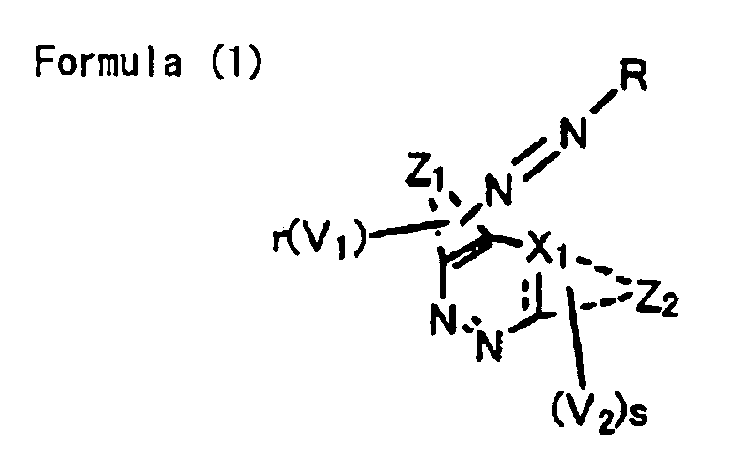
- the present invention resides in an azo compound represented by formula (1): wherein Z 1 represents a group of atoms necessary for forming an aromatic ring or an aromatic hetero ring; Z 2 represents a group of atoms necessary for forming an aromatic hetero ring; V 1 and V 2 each represent a substituent on the aromatic ring or the aromatic hetero ring formed by Z 1 or Z 2 ; r represents 0 to 3; s represents 0 to 3; R represents a coupler component; R, V 1 , and V 2 do not include a carboxyl group, a sulfo group, or a quaternary ammonium group; R is bonded with the azo group through a carbon atom; and X 1 represents a carbon atom or a nitrogen atom.
- Z 1 represents a group of atoms necessary for forming an aromatic ring or an aromatic hetero ring
- Z 2 represents a group of atoms necessary for forming an aromatic hetero ring
- V 1 and V 2 each represent a substituent on the aromatic
- the present invention resides in an azo dye containing the azo compound.
- the azo compound of the present invention is represented by formula (1).
- Z 1 represents a group of atoms necessary for forming an aromatic ring or an aromatic hetero ring
- Z 2 represents a group of atoms necessary for forming an aromatic hetero ring
- V 1 and V 2 each represent a substituent on the aromatic ring or the aromatic hetero ring formed by Z 1 or Z 2
- r represents 0 to 3
- s represents 0 to 3
- R represents a coupler component
- R, V 1 , and V 2 do not include any of a carboxyl group, a sulfo group and a quaternary ammonium group
- R is bonded with the azo group through a carbon atom
- X 1 represents a carbon atom or a nitrogen atom.
- any substituent represented by V 1 , V 2 , or V 3 descried later means a group which can substitute for any hydrogen atom in the aromatic ring or the aromatic hetero ring.
- the substituent include an aliphatic hydrocarbon group (groups having 1 to 15 carbon atoms such as a methyl group, an ethyl group, a propyl group, an isopropyl group, a propargyl group, and a vinyl group are preferred), an aryl group (groups having 6 to 16 carbon atoms such as a phenyl group, a 4-nitrophenyl group, and a 2,4-dichlorophenyl group are preferred), a heterocyclic group (5- to 10-membered ring groups such as a 2-tetrahydrofuryl group, a 2-pyridyl group, a pyrimidine-2-yl group, a 1-imidazolyl group, a 1-pyrazolyl group, a 2-pyrrolyl group, a benzothi
- an aliphatic group, an aryl group, a halogen atom, a cyano group, a carbamoyl group, a sulfamoyl group, an alkylsulfonyl group, an arylsulfonyl group, or an acylamino group is preferred.
- Specific preferred examples of the aliphatic group include a methyl group, an ethyl group, and a tert-butyl group, and more preferred examples include a methyl group and an ethyl group.
- the aryl group include a phenyl group and a naphthyl group, and a phenyl group is more preferable.
- a phenyl group is more preferable.
- a halogen atom a chlorine atom or a fluorine atom is preferred.
- the carbamoyl group or the sulfamoyl group an unsubstituted carbamoyl group or sulfamoyl group is particularly preferred.
- the alkylsulfonyl group a methylsulfonyl group or an ethylsulfonyl group is preferred.
- arylsulfonyl group a phenylsulfonyl group or a tosylsulfonyl is preferred.
- acylamino group an acetylamino group or a propionylamino group is preferred.
- the hydrogen atom may be removed and be substituted by any of the above-mentioned substituents.
- substituents include: a -CONHSO 2 - group (e.g. a sulfonylcarbamoyl group or a carbonylsulfamoyl group); a -CONHCO- group (e.g. a carbonylcarbamoyl group); and an -SO 2 NHSO 2 - group (e.g. a sulfonylsulfamoyl group).
- an alkylcarbonylaminosulfonyl group e.g. an acetylaminosulfonyl group
- an arylcarbonylaminosulfonyl group e.g. a benzoylaminosulfonyl group
- an alkylsulfonylaminocarbonyl group e.g. a methylsulfonylaminocarbonyl group
- an arylsulfonylaminocarbonyl group e.g. a p-methylphenylsulfonylaminocarbonyl group
- aromatic carbon ring examples include a benzene ring, a naphthalene ring, an anthracene ring, a phenanthrene ring, or a benzene ring obtained through ring condensation of an aromatic hetero ring described below.
- the aromatic carbon ring formed by Z 1 is preferably a benzene ring, a benzothiazole ring, or a benzimidazole ring, particularly preferably a benzene ring.
- aromatic hetero ring examples include a 5-, 6-, 7-, or 8-membered aromatic hetero ring.
- a preferred example of the aromatic hetero ring formed by Z 1 or Z 2 is a 5- or 6-membered nitrogen-containing hetero ring.
- the 5- or 6-membered nitrogen-containing hetero ring may be any 5- or 6-membered nitrogen-containing hetero ring, and may have a polycyclic heterocyclic structure obtained through ring condensation of a benzene ring or another hetero ring.
- the aromatic hetero ring formed by Z 1 or Z 2 contains a hetero atom.
- the hetero atom is preferably a nitrogen atom, a sulfur atom, an oxygen atom, a selenium atom, a tellurium atom, a phosphorus atom, a silicon atom, or a boron atom; more preferably a nitrogen atom, a sulfur atom, an oxygen atom, or a selenium atom; particularly preferably a nitrogen atom, a sulfur atom, or an oxygen atom; and most preferably a nitrogen atom or a sulfur atom.
- aromatic hetero ring examples include a furan ring, a pyrrole ring, a thiophene ring, an imidazole ring, a pyrazole ring, a thiazole ring, an isothiazole ring, an oxazole ring, an isoxazole ring, a triazole ring, a tetrazole ring, a thiadiazole ring, an oxadiazole ring, a pyran ring, a dioxane ring, a pyridine ring, a pyrazine ring, a pyrimidine ring, a pyridazine ring, a thiadiazine ring, an oxadiazine ring, an oxatriazole ring, a thiatriazole ring, an indolizine ring, a ring obtained by subjecting any of the above-mentioned rings to
- a benzothiazole ring a benzoxazole ring, a benzotriazole ring, a benzothiadiazole ring, a benzoxadiazole ring, a pyranone ring, a pyrillium ring, a triazine ring, a tetrazine ring, an indole ring, a quinolizine ring, a quinoline ring, a phthalazine ring, a quinoxaline ring, an isoquinoline ring, a carbazole ring, a phenanthridine ring, a phenanthroline ring, an acridine ring, a purine ring, and a pteridine ring.
- a pyridine ring, a pyrazole ring, an isothiazole ring, an imidazole ring, and a thiazole ring are preferable.
- heterocycles may be substituted with any substituent or may be a condensed ring, where examples of the substituent include those of V 1 and V 2 as described above.
- substituents include those of V 1 and V 2 as described above.
- they are chemically equivalent to each other.
- r represents the number of substituents represented by V 1 , preferably 0 to 3, more preferably 1 to 3, particularly preferably 1 or 2.
- s represents the number of substituents represented by V 2 , preferably 0 to 3, more preferably 1 to 3, particularly preferably 1 or 2.
- the azo compound represented by formula (1) preferably contains at least one of V 1 and V 2 as a substituent, more preferably both V 1 and V 2 as substituents.
- the azo compound represented by formula (1) is preferably represented by formula (2) as described below.
- Z 2 represents a group of atoms necessary for forming an aromatic hetero ring;
- V 1 represents a substituent on the aromatic ring;
- V 2 represents a substituent on the aromatic hetero ring formed by Z 2 ;
- r represents 0 to 3;
- s represents 0 to 3;
- R represents a coupler component;
- R, V 1 , and V 2 do not include any of a carboxyl group, a sulfo group and a quaternary ammonium group;
- R is bonded with the azo group through a carbon atom;
- X 1 represents a carbon atom or a nitrogen atom.
- the azo compound represented by formula (1) or (2) is preferably represented by formula (3) as described below.
- V 1 and V 2 each represent a substituent; r represents 0 to 3; R represents a coupler component; R, V 1 , and V 2 do not include any of a carboxyl group, a sulfo group and a quaternary ammonium group; and R is bonded with the azo group through a carbon atom.
- the azo compound represented by formula (1) or (2) is also preferably represented by formula (4) as described below.
- V 1 , V 2 and V 3 each represent a substituent; r represents 0 to 3; R represents a coupler component; R, V 1 , V 2 and V 3 do not include any of a carboxyl group, a sulfo group and a quaternary ammonium group; and R is bonded with the azo group through a carbon atom; V 2 and V 3 may be bonded with each other to form a saturated or unsaturated 5- or 6-membered ring; when V 2 and V 3 are bonded with each other to form a ring, the ring may be a heterocyclic or aromatic, saturated or unsaturated ring; and, when V 2 and V 3 are bonded with each other to form a ring, the total number of carbon atoms and hetero atoms in the ring is 3 to 6.
- the respective preferable ranges of Z 2 , V 1 , V 2 , and V 3 are synonymous with those of the azo compound represented by formula (1) described above.
- V 2 and V 3 may bonded with each other to form a ring (an aromatic or nonaromatic hydrocarbon ring, a heterocycle, or a polycyclic condensed ring formed by condensing thereof, such as a benzene ring, a naphthalene ring, an anthracene ring, a phenanthrene ring, a fluorene ring, a triphenylene ring, a naphthacene ring, a biphenyl ring, a pyrrole ring, a furan ring, a thiophene ring, an imidazole ring, an oxazole ring, a thiazole ring, a pyridine ring, a pyrazine ring, a pyrimidine ring, a pyridazine ring, an indolizine ring, an indole ring, a benzofur
- the azo compound represented by formula (1), (2), (3) or (4) may be synthesized, for example, through a method involving intramolecular azo coupling of a bi(hetero)aryl compound having an amino group (e.g. a method of forming the bond, according to the description by V. Benin et al., in J. Org. Chem., vol.65, p.6388, 2000 ) or a method of forming the bond through a reaction between an amino group on a bi(hetero)aryl compound and a nitrogen-containing compound (e.g. a method of forming the bond through a reaction between the amino group and a nitrite in the presence of an acid).
- a method of synthesizing the bi(hetero)aryl compound having an amino group may be determined, according to a target compound structure including the substituents V 1 and V 2 .
- the substituents V 1 , V 2 and V 3 may be introduced at any time in a reaction process, and are preferably introduced before the intramolecular azo coupling is performed.
- the substituents are arbitrarily protected or deprotected, to thereby obtain a compound having the target structure.
- JP-A-2006-143902 JP-A means unexamined published Japanese patent application
- JP-A-2006-169239 Liebigs Annal en der Chemie, GE, 1979, pp. 1534-1546 ; and the like.
- the coupler component represented by R means a partial structure originated from a coupler compound capable of giving an azo dye by reaction with a diazonium salt. This concept is usually used in the field of azo dye.
- the coupler component represented by R is preferably a coupler component represented by any of formulae (5) to (17) as described below.
- these coupler components include those collectively referred to as phenol-based couplers, naphthol-based couplers, active methylene-based couplers, pyrazolone-based couplers, pyrazolo azole-based couplers, and pyrrolo triazole-based couplers.
- Y represents a binding site to the azo group in the compound represented by formulae (1) to (4).
- R 6 , R 7 , R 8 , and R 9 each independently represent a hydrogen atom or a substituent, and may be bonded with each other to form a condensed ring;
- W represents a carbon atom or a nitrogen atom; when W represents a carbon atom, n is 1; and when W represents a nitrogen atom, n is 0.
- the substituents represented by R 6 , R 7 , R 8 , and R 9 each independently include those exemplified as the substituents represented by V 1 , V 2 , and V 3 as described above.
- the ring may be an aromatic ring or a nonaromatic ring.
- the ring may be a 5- to 7-membered, carbon ring or heterocycle (e.g., a benzene ring or a pyridine ring).
- R 6 , R 7 , R 8 , and R 9 include a hydrogen atom, an aliphatic hydrocarbon group, an aryl group, a heterocyclic group, an acyloxy group, an acylamino group, an aliphatic oxy group, an aryloxy group, a heterocyclic oxy group, an aliphatic sulfoneamide group, an arylsulfoneamide group, a heterocyclic sulfoneamide group, an amino group, an aliphatic amino group, an arylamino group, a heterocyclic amino group, an aliphatic oxycarbonylamino group, an aryloxycarbonylamino group, a heterocyclic oxycarbonylamino group, an aliphatic thio group, an arylthio group, a hydroxyl group, a cyano group, a sulfo group, a carboxyl group, a carbamoylamino group
- R 6 and R 8 are preferably a group selected from a hydrogen atom, a halogen atom, a cyano group, -CONR 18 R 19 , -SO 2 NR 18 R 19 , -NHCOR 18 , -NHCONR 18 R 19 , and -NHSO 2 NR 18 R 19 .
- R 18 and R 19 each represent a hydrogen atom or a substituent, preferably a hydrogen atom, an alkyl group having 1 to 10 carbon atoms, an aryl group having 6 to 10 carbon atoms, or a heterocyclic group having 1 to 10 carbon atoms.
- substituents represented by R 7 and R 9 each are preferably a hydrogen atom, an acylamino group, or a halogen atom.
- the coupler component R is also preferably an active methylene-based coupler component represented by any one of formulae (6) to (9).
- R 10 represents an acyl group, a cyano group, a nitro group, an aryl group, a heterocyclic group, an alkoxycarbonyl group, an aryloxycarbonyl group, a carbamoyl group, a sulfamoyl group, an alkylsulfonyl group, or an arylsulfonyl group, each of which may be substituted.
- R 11 represents an alkyl group, an aryl group, or a heterocyclic group, each of which may be substituted.
- R 12 represents an aryl group or a heterocyclic group, each of which may be substituted.
- R 10 , R 11 , and R 12 may have include those exemplified for the above substituent V 1 , V 2 , or V 3 .
- R 10 and R 11 may be bonded with each other to form a ring
- R 10 and R 12 may be bonded with each other to form a ring.
- the coupler component R is also preferably a 5-pyrazolone-based coupler component represented by formula (10).
- R 13 represents a cyano group, a carbamoyl group, an alkoxycarbonyl group, an acylamino group, an arylamino group, an alkoxy group, an aryloxy group, or an alkyl group.
- R 14 represents a phenyl group, or a phenyl group substituted by at least one halogen atom, alkyl group, cyano group, alkoxy group, alkoxycarbonyl group, or acylamino group.
- the coupler component R is also preferably a pyrazolo azole-based coupler component represented by formula (11).
- R 15 represents a hydrogen atom or a substituent
- Q represents a group of nonmetal atoms necessary for forming of a 5-membered azole ring containing 2 to 4 nitrogen atoms.
- the azole ring may have any of substituents including a condensed ring.
- the coupler component R is also preferably a pyrrolo triazole-based coupler component represented by any one of formulae (12) to (15).
- R 20 , R 21 , and R 22 each represent a hydrogen atom or a substituent.
- the substituents of R 20 , R 21 , and R 22 may include the substituents exemplified for the above substituents V 1 , V 2 , and V 3 .
- examples of the coupler component R further include a condensed phenol-based coupler, an imidazole-based coupler, a pyrrole-based coupler, a 3-hydroxypyridine-based coupler (e.g., couplers described in JP-A-1-315736 ), an active methylene-based coupler other than those described above, an active methine-based coupler, a 5,5-condensed heterocyclic coupler, and a 5,6-condensed heterocyclic coupler.
- a condensed phenol-based coupler an imidazole-based coupler, a pyrrole-based coupler, a 3-hydroxypyridine-based coupler (e.g., couplers described in JP-A-1-315736 ), an active methylene-based coupler other than those described above, an active methine-based coupler, a 5,5-condensed heterocyclic coupler, and a 5,6-condensed heterocyclic coupler.
- the coupler component R is also preferably represented by formula (16) or (17).
- the compound represented by formula (16) is a coupler referred to as phenol-based coupler.
- the compound represented by formula (17) is a coupler referred to as naphthol-based coupler.
- R 16 represents a group selected from a hydrogen atom, a halogen atom, -CONR 18 R 19 , -SO 2 NR 18 R 19 , -NHCOR 18 , -NHCONR 18 R 19 , and -NHSO 2 NR 18 R 19 .
- R 18 and R 19 each represent a hydrogen atom or a substituent.
- R 17 represents a substituent, 1 represents an integer from 0 to 2, and m represents an integer from 0 to 4.
- a plurality of R 17 may be the same or different from one another when 1 and m each represent 2 or more.
- R 17 , R 18 , or R 19 may be any of substituents including those exemplified for the above substituent V 1 , V 2 , or V 3 .
- R 18 and R 19 each are preferably a hydrogen atom, an alkyl group having 1 to 10 carbon atoms, an aryl group having 6 to 10 carbon atoms, or a heterocyclic group having 1 to 10 carbon atoms.
- R 17 is preferably located at the ortho-position of the hydroxyl group or the para-position of R 16 .
- R 17 is preferably located at the fifth position or the eighth position of the naphthol ring.
- coupler components R preferred as coupler components R are phenol, 2-chlorophenol, 2,5-dichloro or difluoro phenol, 2-carbamoylphenol, 2-sulfamoylphenol, 1-naphthol, 2-naphthol, 2-propionylaminophenol, 2-propionylamino-1-naphthol, 5-methylsulfonylamino-1-naphthol, 5-phenylsulfonylamino-2-propionylamino-1-naphthol, and particularly preferred are phenol, 2-chlorophenol, 2,5-difluorophenol, and 2-carbamoylphenol.
- azo dye represented by formula (1) Specific examples of the azo dye represented by formula (1) according to the present invention are shown below. However, the present invention should not be construed as being limited to these compounds. Herein, the following specific examples of the azo dye represented by formula (1) may include tautomers thereof.
- the compound of the present invention has a plurality of asymmetric carbon atoms in the molecule, a plurality of stereoisomers exist for the same structure.
- the compound of the present invention is shown to include all the possible stereoisomers. In the present invention, only one of the above plurality of stereoisomers may be used, or alternatively two or more stereoisomers may be used as a mixture.
- the azo compound of the present invention can be preferably used as a dye.
- the compound can be used for dyeing textile fibers (e.g. cotton, wool, or synthetic fiber), leather, paper, plastic, fur, etc., for food, for a hair dye, for an ink, for inkjet printing, for laser printing, for copying, for image formation by heat-sensitive transfer system, for an optical recording material, for an organic EL (electroluminescent) light-emitting material, for laser, for an organic semiconductor, for a solar cell, for a fluorescent probe, for a nonlinear optical material, for various filters for a solid state pickup tube, etc., or for a display (e.g. a color LCD).
- the azo dye of the present invention preferably has the absorption maximum in a desired region of absorption wavelength.
- the molar absorption coefficient ⁇ of the azo dye is preferably in the range of 10,000 to 150,000, more preferably in the range of 10,000 to 100,000.
- the content thereof is, but not specifically limited to, preferably in the range of 0.1 to 90% by mass.
- a novel azo compound and a novel azo dye each having excellent fastness properties to heat, light, and the like, sufficient dyeing properties, and migration properties, while having clearness and high color density.
- the azo compound and azo dye of the present invention show clearness and high color density and show excellent effects of expressing sufficient fastness properties to light, heat, and the like.
- the azo compound and the azo dye of the present invention can be favorably used as a pigment and a coloring agent and have sufficient dyeing properties and sufficient transfer-migration properties in transferred image formation while having a high spectral absorption coefficient.
- Compound E 1 g was dissolved in 20 ml of phosphoric acid (85% by weight). Then, 0.36 g of sodium nitrite was divided and gradually added to the solution over 30 minutes while being stirred at 0°C or lower. Further, the solution was further stirred for 2 hours at 0 to 5°C, thereby obtaining Compound F.
- Compound D-12 had a melting point of 258 to 260°C.
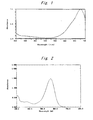
- the absorption spectrum of the compound was determined in DMF (N,N'-dimethyl formaldehyde). As a result, the compound showed the absorption maximum ⁇ max at 677 nm ( ⁇ 82,300), confirming that the dye had good hue (see FIG. 1 ).
- the dyeing properties, migration properties, and fastness properties of the compound D-12 were evaluated as follows:
- a heat-resistant slipping layer was formed on one surface of a polyethylene terephthalate film with a thickness of 5 ⁇ m, and the film was being served as a support.
- a coating composition (1) of a dye-supplying layer with a composition as described below was applied by a gravure coater so as to be 0.6 ⁇ m in thickness after drying. Consequently, a heat-sensitive transfer dye-supplying material (P-1) (hereinafter, also simply referred to as dye-supplying material).
- a sheet of laminating-type synthetic paper with a thickness of 150 ⁇ m was used as a support.
- a coating composition (1) of a receptive layer was applied on one surface of the support using a wire bar coater so as to be 5 ⁇ m in thickness after drying. Consequently, a heat-sensitive transfer image-receiving material (1) (hereinafter, also simply referred to as image-receiving material) was obtained.
- the drying was carried out in an oven at 80°C for 1 hour after pre-drying with a dryer.
- Pigment-fixing agent A-9 (trade name: AEA, manufactured by Sankyo Co., Ltd.) 26g Polyisocyanate (trade name: KP-90, manufactured by Dainippon Ink and Chemicals, Incorporated) 4 g Amino-modified silicone oil (trade name: KP-857, manufactured by Shin-Etsu Silicone Co., Ltd.) 0.5 g Methyl ethyl ketone 100 ml Toluene 50 ml Cyclohexanone 10 ml
- the heat-sensitive transfer dye-supplying material (P-1) obtained as described above was used to laminate the dye-supplying layer and a receptive layer of the heat-sensitive transfer image-receiving material, so as to be in contact with each other. Subsequently, from the side of the support of the heat-sensitive transfer dye-supplying material, heating was performed using a thermal head under the conditions in which the thermal head had an output of 0.25 W/dot, a pulse width of 0.1 to 10 msec, and a dot density of 6 dots/mm to place the dye on the receptive layer of the image-receiving material to make an image-like pattern thereon. Consequently, clear image recording without the transferal irregularity was obtained.
- the recorded image-receiving material was stored in an oven at 60°C for 2 weeks and the degree of image-bleeding was then observed.
- the evaluation was performed on the basis of the following criteria: good ( ⁇ ): no substantial change of an image from one before the storage; allowable ( ⁇ ): slightly bled; and unallowable practically (x): extremely bled and blurred. Any image formed with the compound D-12 of the present invention did not show any substantial change, compared with one before the storage (O).
- the azo compound of the present invention provides an image with high transfer density (with sufficient dyeing properties and migration properties) and a clear image with excellent fastness properties to light and heat as well as no substantial image blur over time.
- Coating compositions P-2 to P-4 of dye-supplying layers were prepared in a manner similar to one described above, except that the compounds D-9, D-25, and D-36 were used instead of the compound D-12, and then each of those were examined as described above. As a result, all of the compounds D-9, D-25, and D-36 showed good dyeing properties, migration properties, fastness properties just as in the case of the compound D-12.
Landscapes
- Chemical & Material Sciences (AREA)
- Organic Chemistry (AREA)
- Nitrogen And Oxygen Or Sulfur-Condensed Heterocyclic Ring Systems (AREA)
- Plural Heterocyclic Compounds (AREA)
- Nitrogen Condensed Heterocyclic Rings (AREA)
Abstract
Description
- The present invention relates to an azo compound and an azo dye.
- Azo dyes are dyes prepared by an azo-coupling reaction between a so-called coupler component such as a compound having an active hydrogen, phenols, and p-dialkylaminobenzenes, and a diazonium salt prepared from an amino aryl compound or an aminohetero aromatic compound (so-called diazo component). Coupler components and azo components having various structures and one can freely select from them as the coupler component and the diazo component. Therefore, the azo dyes may have wide range of variety in terms of hue and may be representative in dyes.
- Azo dyes have numerous excellent properties such as high dyeing property, fastness to heat, light, and washing, and low production cost, and thus have been hitherto used widely as coloring agents. At present, in addition to conventional coloring applications such as dyeing, the azo dyes are utilized for advanced image-related equipment such as display components and used in a wide range of fields (see K. Hunger, Ed., Industrial Dyes, Chemistry, Properties, Applications, published by Wiley-VCH, 2003).
- Recently, application fields of the dyes have diversified as described above, because color images have become the mainstream of image-recording materials. In the case of these color image recording materials and color filters, three primary-color coloring agents (dyes or pigments) are used for reproducing or recording full-color images based on a so-called additive color mixture method or subtractive color mixture method. However, at present, there is no coloring agent having absorbing properties that realize a favorable color-reproducing range, and showing good color hue and fastness under various usage conditions and environmental conditions. Therefore, improved coloring agents have been demanded in the art.
- Coloring agents used in these applications have been demanded to give desired absorption properties for color reproduction, fastness properties under environmental conditions in which the coloring agents can be used, and a higher molar absorption coefficient.
- Synthesis of a novel heterocyclic compound having an azo group in a ring, that is, a 1,10-heterodisubstituted benzo[c]cinnoline derivative has been reported recently (see V. Benin et al., J. Org. Chem., vol.65, p.6388, 2000, for example). However, the report focuses on a mechanism of a ring formation reaction and discussion of structural chemistry.
- The present invention resides in an azo compound represented by formula (1):

- Further, the present invention resides in an azo dye containing the azo compound.
- Other and further objects, features and advantages of the invention will appear more fully from the following description, appropriately referring to the accompanying drawings.
-
-
Fig. 1 is an absorption spectrum (N,N-dimethylformamide as a solvent) of the exemplified compound D-12 according to the present invention. -
Fig. 2 is an absorption spectrum (N,N-dimethylformamide as a solvent) of the exemplified compound D-9 according to the present invention. -
Fig. 3 is an absorption spectrum (N,N-dimethylformamide as a solvent) of the exemplified compound D-25 according to the present invention. -
Fig. 4 is an absorption spectrum (N,N-dimethylformamide as a solvent) of the exemplified compound D-36 according to the present invention. - According to the present invention, there is provided the following means:
- (1) An azo compound represented by formula (1):

- (2) The azo compound as described in the above item (1), wherein the azo compound represented by formula (1) is a compound represented by formula (2):

- (3) The azo compound as described in the above item (1) or (2), wherein the azo compound represented by formula (1) or (2) is a compound represented by formula (3):

- (4) The azo compound as described in the above item (1) or (2), wherein the azo compound represented by formula (1) or (2) is a compound represented by formula (4):

- (5) The azo compound as described in any one of the above items (1) to (4),
wherein the coupler component represented by R is represented by formula (5):
- (6) An azo dye, comprising the azo compound as described in any one of the above items (1) to (5).
- The present invention is explained in detail below.
- The azo compound of the present invention is represented by formula (1).

- In formula (1), Z1 represents a group of atoms necessary for forming an aromatic ring or an aromatic hetero ring; Z2 represents a group of atoms necessary for forming an aromatic hetero ring; V1 and V2 each represent a substituent on the aromatic ring or the aromatic hetero ring formed by Z1 or Z2; r represents 0 to 3; s represents 0 to 3; R represents a coupler component; R, V1, and V2 do not include any of a carboxyl group, a sulfo group and a quaternary ammonium group; R is bonded with the azo group through a carbon atom; and X1 represents a carbon atom or a nitrogen atom.
- Here, any substituent represented by V1, V2, or V3 descried later, means a group which can substitute for any hydrogen atom in the aromatic ring or the aromatic hetero ring. Examples of the substituent include an aliphatic hydrocarbon group (groups having 1 to 15 carbon atoms such as a methyl group, an ethyl group, a propyl group, an isopropyl group, a propargyl group, and a vinyl group are preferred), an aryl group (groups having 6 to 16 carbon atoms such as a phenyl group, a 4-nitrophenyl group, and a 2,4-dichlorophenyl group are preferred), a heterocyclic group (5- to 10-membered ring groups such as a 2-tetrahydrofuryl group, a 2-pyridyl group, a pyrimidine-2-yl group, a 1-imidazolyl group, a 1-pyrazolyl group, a 2-pyrrolyl group, a benzothiazol-2-yl group, and a benzoimidazol-2-yl group are preferred), an acyl group (groups having 1 to 15 carbon atoms such as an acetyl group, a 2-methylpropanoyl group, a pivaloyl group, and a benzoyl group are preferred), an acyloxy group (groups having 1 to 16 carbon atoms such as an acetoxy group, a propanoyloxy group, and a benzoyloxy group are preferred), an acylamino group (groups having 1 to 8 carbon atoms such as an acetylamino group, a propionylamino group, a 2-methylpropanoylamino group, a chloroacetylamino group, and a benzamide group are preferred), an aliphatic oxy group (groups having 1 to 16 carbon atoms such as a methoxy group, an ethoxy group, a butoxy group, and a 2-methoxyethoxy group are preferred), an aryloxy group (groups having 6 to 17 carbon atoms such as a phenoxy group, and a 4-nitrophenoxy group are preferred), a heterocyclic oxy group (5- to 10-membered ring groups such as a 2-pyrizyloxy group, a 2-furyloxy group, and a 3-pyrazoyloxy group are preferred), an aliphatic oxycarbonyl group (groups having 1 to 15 carbon atoms such as a methoxycarbonyl group, a 2-propyloxycarbonyl group, and a butoxycarbonyl group are preferred), an aryloxycarbonyl group (groups having 7 to 17 carbon atoms such as a phenoxycarbonyl group and a 4-methoxyphenoxy carbonyl group are preferred), a heterocyclic oxycarbonyl group (5- to 10-membered ring groups such as a 2-pyridyloxycarbonyl group and a 2-thienyloxycarbonyl group are preferred), a carbamoyl group (groups having 1 to 12 carbon atoms such as a carbamoyl group, an N-ethylcarbamoyl group, and an N,N-dimethylcarbamoyl group are preferred), an aliphatic sulfonyl group (groups having 1 to 15 carbon atoms such as a methanesulfonyl group, a butanesulfonyl group, a methoxyethanesulfonyl group are preferred), an arylsulfonyl group (groups having 6 to 16 carbon atoms such as a phenylsulfonyl group, a 4-t-butylphenylsulfonyl group, and a p-toluenesulfonyl group are preferred), a heterocyclic sulfonyl group (5- to 10-membered ring groups such as a 2-tetrahydropyranylsulfonyl group are preferred), an aliphatic sulfonyloxy group (groups having 1 to 15 carbon atoms such as a methanesulfonyloxy group and an ethanesulfonyloxy group are preferred), an arylsulfonyloxy group (groups having 6 to 16 carbon atoms such as a phenylsufonyloxy group are preferred), a heterocyclic sulfonyloxy group (5- to 10-membered ring groups such as a 2-pyridylsulfonyloxy group are preferred), a sulfamoyl group (groups having 0 to 12 carbon atoms such as a sulfamoyl group and an N,N-dimethylsulfamoyl group are preferred), an aliphatic sulfoneamide group (groups having 1 to 15 carbon atoms such as a methanesulfone amide group and a butanesulfoneamide group are preferred), an arylsufoneamide group (groups having 6 to 16 carbon atoms such as a benzenesulfoneamide group and a p-toluenesulfoneamide group are preferred), a heterocyclic sulfoneamide group (5- to 10-membered ring groups such as a 2-pyridylsulfonylamide group are preferred), an amino group, an aliphatic amino group (groups having 1 to 16 carbon atoms such as a methylamino group, an N,N-diethylamino group, and a butylamino group are preferred), an arylamino group (groups having 6 to 16 carbon atoms such as a phenylamino group are preferred), a heterocyclic amino group (5- to 10-membered ring groups such as a 2-pyridyl amino group, a pyrrazol-4-yl amino group, a benzoimidazol-2-yl amino group, a benzothiazol-2-yl amino group, a benzooxazol-2-yl amino group, a 2-oxazolyl amino group, a 1,2,4-triazol-3-yl amino group, a 1,2,4-thiadiazol-2-yl amino group, a 1,3,4-thiadiazol-2-yl amino group, a 1,2,4-oxadiazol-2-yl amino group, and a 1,3,4-oxadiazol-2-yl amino group are preferred), an aliphatic oxycarbonylamino group (groups having 2 to 12 carbon atoms such as a methoxycarbonylamino group, an ethoxycarbonylamino group, and a t-butoxycarbonylamino group are preferred), an aryloxycarbonylamino group (groups having 7 to 17 carbon atoms such as a phenoxycarbonylamino group are preferred), a heterocyclic oxycarbonylamino group (5- to 10-membered ring groups such as a 2-pyridyloxycarbonylamino group are preferred), an aliphatic sulfinyl group (groups having 1 to 12 carbon atoms such as a methylsulfinyl group and a butylsulfinyl group are preferred), an arylsulfinyl group (groups having 6 to 16 carbon atoms such as a phenylsulfinyl group are preferred), an aliphatic thio group (groups having 1 to 18 carbon atoms such as a methylthio group, an ethylthio group, a 2-ethoxyethylthio group, and a butylthio group are preferred), an arylthio group (groups having 6 to 18 carbon atoms such as a phenylthio group are preferred), an aliphatic oxyamino group (groups having 1 to 12 carbon atoms such as a methoxyamino group and a butoxyamino group are preferred), an aryloxyamino group (groups having 6 to 16 carbon atoms such as a phenoxyamino group are preferred), a carbamoylamino group (groups having 0 to 18 carbon atoms such as a carbamoyl amino group are preferred), a sulfamoyl amino group (groups having 0 to 18 carbon atoms such as a sulfamoylamino group and an N,N-dimethylsulfamoyl group are preferred), a sulfamoyl carbamoyl group (groups having 1 to 12 carbon atoms such as an N-(sulfamoyl)carbamoyl group and an N-(N',N'-dimethylsulfamoyl)carbamoyl group are preferred), a carbamoyl sulfamoyl group (groups having 1 to 12 carbon atoms such as an N-(carbamoyl)sulfamoyl group are preferred), a dialiphatic oxyphosphinyl (groups having 2 to 16 carbon atoms such as a dimethoxyphosphinyl group are preferred), a diaryloxyphosphinyl group (groups having 6 to 16 carbon atoms such as a phenoxyphosphinyl group are preferred), a hydroxyl group, a mercapto group, a cyano group, and a halogen atom.
- Of those, as the substituent represented by V1, V2, and V3, an aliphatic group, an aryl group, a halogen atom, a cyano group, a carbamoyl group, a sulfamoyl group, an alkylsulfonyl group, an arylsulfonyl group, or an acylamino group is preferred. Specific preferred examples of the aliphatic group include a methyl group, an ethyl group, and a tert-butyl group, and more preferred examples include a methyl group and an ethyl group. Specific preferred examples of the aryl group include a phenyl group and a naphthyl group, and a phenyl group is more preferable. As the halogen atom, a chlorine atom or a fluorine atom is preferred. As the carbamoyl group or the sulfamoyl group, an unsubstituted carbamoyl group or sulfamoyl group is particularly preferred. As the alkylsulfonyl group, a methylsulfonyl group or an ethylsulfonyl group is preferred. As the arylsulfonyl group, a phenylsulfonyl group or a tosylsulfonyl is preferred. As the acylamino group, an acetylamino group or a propionylamino group is preferred.
- Among the substituents represented by V1, V2 and V3, with respect to one having a hydrogen atom, the hydrogen atom may be removed and be substituted by any of the above-mentioned substituents. Examples of such a substituent include: a -CONHSO2- group (e.g. a sulfonylcarbamoyl group or a carbonylsulfamoyl group); a -CONHCO- group (e.g. a carbonylcarbamoyl group); and an -SO2NHSO2- group (e.g. a sulfonylsulfamoyl group). Specific examples thereof include: an alkylcarbonylaminosulfonyl group (e.g. an acetylaminosulfonyl group); an arylcarbonylaminosulfonyl group (e.g. a benzoylaminosulfonyl group); an alkylsulfonylaminocarbonyl group (e.g. a methylsulfonylaminocarbonyl group); and an arylsulfonylaminocarbonyl group (e.g. a p-methylphenylsulfonylaminocarbonyl group).
- Examples of the aromatic ring formed by Z1 (hereinafter, may be referred to as "aromatic carbon ring") include a benzene ring, a naphthalene ring, an anthracene ring, a phenanthrene ring, or a benzene ring obtained through ring condensation of an aromatic hetero ring described below.
- The aromatic carbon ring formed by Z1 is preferably a benzene ring, a benzothiazole ring, or a benzimidazole ring, particularly preferably a benzene ring.
- Examples of the aromatic hetero ring formed by Z1 or Z2 (hereinafter, also referred to as "aromatic hetero ring") include a 5-, 6-, 7-, or 8-membered aromatic hetero ring.
- A preferred example of the aromatic hetero ring formed by Z1 or Z2 is a 5- or 6-membered nitrogen-containing hetero ring. The 5- or 6-membered nitrogen-containing hetero ring may be any 5- or 6-membered nitrogen-containing hetero ring, and may have a polycyclic heterocyclic structure obtained through ring condensation of a benzene ring or another hetero ring.
- The aromatic hetero ring formed by Z1 or Z2 contains a hetero atom. The hetero atom is preferably a nitrogen atom, a sulfur atom, an oxygen atom, a selenium atom, a tellurium atom, a phosphorus atom, a silicon atom, or a boron atom; more preferably a nitrogen atom, a sulfur atom, an oxygen atom, or a selenium atom; particularly preferably a nitrogen atom, a sulfur atom, or an oxygen atom; and most preferably a nitrogen atom or a sulfur atom.
- Specific preferred examples of the aromatic hetero ring include a furan ring, a pyrrole ring, a thiophene ring, an imidazole ring, a pyrazole ring, a thiazole ring, an isothiazole ring, an oxazole ring, an isoxazole ring, a triazole ring, a tetrazole ring, a thiadiazole ring, an oxadiazole ring, a pyran ring, a dioxane ring, a pyridine ring, a pyrazine ring, a pyrimidine ring, a pyridazine ring, a thiadiazine ring, an oxadiazine ring, an oxatriazole ring, a thiatriazole ring, an indolizine ring, a ring obtained by subjecting any of the above-mentioned rings to benzo ring condensation, e.g. a benzothiazole ring, a benzoxazole ring, a benzotriazole ring, a benzothiadiazole ring, a benzoxadiazole ring, a pyranone ring, a pyrillium ring, a triazine ring, a tetrazine ring, an indole ring, a quinolizine ring, a quinoline ring, a phthalazine ring, a quinoxaline ring, an isoquinoline ring, a carbazole ring, a phenanthridine ring, a phenanthroline ring, an acridine ring, a purine ring, and a pteridine ring. Of those, a pyridine ring, a pyrazole ring, an isothiazole ring, an imidazole ring, and a thiazole ring are preferable.
- Those heterocycles may be substituted with any substituent or may be a condensed ring, where examples of the substituent include those of V1 and V2 as described above. In addition, even when there is another tautomeric structure of a heterocycle, they are chemically equivalent to each other.
- In formula (1), "r" represents the number of substituents represented by V1, preferably 0 to 3, more preferably 1 to 3, particularly preferably 1 or 2. In formula (1), "s" represents the number of substituents represented by V2, preferably 0 to 3, more preferably 1 to 3, particularly preferably 1 or 2.
- The azo compound represented by formula (1) preferably contains at least one of V1 and V2 as a substituent, more preferably both V1 and V2 as substituents.
- Next, compounds represented by formulae (2), (3) or (4) will be described.
- The azo compound represented by formula (1) is preferably represented by formula (2) as described below.

- In formula (2), Z2 represents a group of atoms necessary for forming an aromatic hetero ring; V1 represents a substituent on the aromatic ring; V2 represents a substituent on the aromatic hetero ring formed by Z2; r represents 0 to 3; s represents 0 to 3; R represents a coupler component; R, V1, and V2 do not include any of a carboxyl group, a sulfo group and a quaternary ammonium group; R is bonded with the azo group through a carbon atom; and X1 represents a carbon atom or a nitrogen atom.
- The azo compound represented by formula (1) or (2) is preferably represented by formula (3) as described below.

- In formula (3), V1 and V2 each represent a substituent; r represents 0 to 3; R represents a coupler component; R, V1, and V2 do not include any of a carboxyl group, a sulfo group and a quaternary ammonium group; and R is bonded with the azo group through a carbon atom.
- The azo compound represented by formula (1) or (2) is also preferably represented by formula (4) as described below.

- In formula (4), V1, V2 and V3 each represent a substituent; r represents 0 to 3; R represents a coupler component; R, V1, V2 and V3 do not include any of a carboxyl group, a sulfo group and a quaternary ammonium group; and R is bonded with the azo group through a carbon atom; V2 and V3 may be bonded with each other to form a saturated or unsaturated 5- or 6-membered ring; when V2 and V3 are bonded with each other to form a ring, the ring may be a heterocyclic or aromatic, saturated or unsaturated ring; and, when V2 and V3 are bonded with each other to form a ring, the total number of carbon atoms and hetero atoms in the ring is 3 to 6.
- In the azo compound represented by formula (2), (3), or (4), the respective preferable ranges of Z2, V1, V2, and V3 are synonymous with those of the azo compound represented by formula (1) described above.
- In formula (4), as described above, V2 and V3 may bonded with each other to form a ring (an aromatic or nonaromatic hydrocarbon ring, a heterocycle, or a polycyclic condensed ring formed by condensing thereof, such as a benzene ring, a naphthalene ring, an anthracene ring, a phenanthrene ring, a fluorene ring, a triphenylene ring, a naphthacene ring, a biphenyl ring, a pyrrole ring, a furan ring, a thiophene ring, an imidazole ring, an oxazole ring, a thiazole ring, a pyridine ring, a pyrazine ring, a pyrimidine ring, a pyridazine ring, an indolizine ring, an indole ring, a benzofuran ring, a benzothiophene ring, an isobenzofuran ring, a quinolizine ring, a quinoline ring, a phthalazine ring, a naphthyridine ring, a quinoxaline ring, a quinoxazoline ring, an isoquinoline ring, a carbazole ring, a phenanthridine ring, an acridine ring, a phenanthroline ring, a thianthrene ring, a chromene ring, a xanthene ring, a phenoxathiine ring, a phenothiazine ring, or a phenazine ring). Of those, a benzene ring and a pyridine ring are preferable.
- The azo compound represented by formula (1), (2), (3) or (4) may be synthesized, for example, through a method involving intramolecular azo coupling of a bi(hetero)aryl compound having an amino group (e.g. a method of forming the bond, according to the description by V. Benin et al., in J. Org. Chem., vol.65, p.6388, 2000) or a method of forming the bond through a reaction between an amino group on a bi(hetero)aryl compound and a nitrogen-containing compound (e.g. a method of forming the bond through a reaction between the amino group and a nitrite in the presence of an acid). A method of synthesizing the bi(hetero)aryl compound having an amino group may be determined, according to a target compound structure including the substituents V1 and V2.
- The substituents V1, V2 and V3 may be introduced at any time in a reaction process, and are preferably introduced before the intramolecular azo coupling is performed. For introducing the substituents V1, V2 and V3 at the beginning or during the reaction process, the substituents are arbitrarily protected or deprotected, to thereby obtain a compound having the target structure.
- In the synthesis of the azo compound of the present invention, the procedures of synthesizing the diazo component may be carried out with reference to
JP-A-2006-143902 JP-A-2006-169239 - The coupler component represented by R means a partial structure originated from a coupler compound capable of giving an azo dye by reaction with a diazonium salt. This concept is usually used in the field of azo dye.
- In the present invention, the coupler component represented by R is preferably a coupler component represented by any of formulae (5) to (17) as described below. In general, these coupler components include those collectively referred to as phenol-based couplers, naphthol-based couplers, active methylene-based couplers, pyrazolone-based couplers, pyrazolo azole-based couplers, and pyrrolo triazole-based couplers. In formulae (5) to (17), Y represents a binding site to the azo group in the compound represented by formulae (1) to (4).

- In formula (5), R6, R7, R8, and R9 each independently represent a hydrogen atom or a substituent, and may be bonded with each other to form a condensed ring; W represents a carbon atom or a nitrogen atom; when W represents a carbon atom, n is 1; and when W represents a nitrogen atom, n is 0.
- The substituents represented by R6, R7, R8, and R9 each independently include those exemplified as the substituents represented by V1, V2, and V3 as described above. When a ring is formed by bonding R6 and R7, or R8 and R9, the ring may be an aromatic ring or a nonaromatic ring. In addition, the ring may be a 5- to 7-membered, carbon ring or heterocycle (e.g., a benzene ring or a pyridine ring).
- Specific examples of the substituent represented by R6, R7, R8, and R9 include a hydrogen atom, an aliphatic hydrocarbon group, an aryl group, a heterocyclic group, an acyloxy group, an acylamino group, an aliphatic oxy group, an aryloxy group, a heterocyclic oxy group, an aliphatic sulfoneamide group, an arylsulfoneamide group, a heterocyclic sulfoneamide group, an amino group, an aliphatic amino group, an arylamino group, a heterocyclic amino group, an aliphatic oxycarbonylamino group, an aryloxycarbonylamino group, a heterocyclic oxycarbonylamino group, an aliphatic thio group, an arylthio group, a hydroxyl group, a cyano group, a sulfo group, a carboxyl group, a carbamoylamino group, a sulfamoylamino group, and a halogen atom. More preferred are a hydrogen atom, an aliphatic hydrocarbon group, a heterocyclic group, an acylamino group, an aliphatic oxy group, an aryloxy group, an aliphatic sulfoneamide group, an arylsulfoneamide group, an aliphatic amino group, an arylamino group, a heterocyclic amino group, an aliphatic thio group, an arylthio group, and a halogen atom.
- Of those, the substituents represented by R6 and R8 are preferably a group selected from a hydrogen atom, a halogen atom, a cyano group, -CONR18R19, -SO2NR18R19, -NHCOR18, -NHCONR18R19, and -NHSO2NR18R19. Here, R18 and R19 each represent a hydrogen atom or a substituent, preferably a hydrogen atom, an alkyl group having 1 to 10 carbon atoms, an aryl group having 6 to 10 carbon atoms, or a heterocyclic group having 1 to 10 carbon atoms.
- In addition, the substituents represented by R7 and R9 each are preferably a hydrogen atom, an acylamino group, or a halogen atom.
- The coupler component R is also preferably an active methylene-based coupler component represented by any one of formulae (6) to (9).

- In formulae (6) to (9), R10 represents an acyl group, a cyano group, a nitro group, an aryl group, a heterocyclic group, an alkoxycarbonyl group, an aryloxycarbonyl group, a carbamoyl group, a sulfamoyl group, an alkylsulfonyl group, or an arylsulfonyl group, each of which may be substituted. R11 represents an alkyl group, an aryl group, or a heterocyclic group, each of which may be substituted. R12 represents an aryl group or a heterocyclic group, each of which may be substituted.
- Examples of the substituent which R10, R11, and R12 may have include those exemplified for the above substituent V1, V2, or V3. In formulae (6) to (9), R10 and R11 may be bonded with each other to form a ring, and R10 and R12 may be bonded with each other to form a ring.
- The coupler component R is also preferably a 5-pyrazolone-based coupler component represented by formula (10).

- In formula (10), R13 represents a cyano group, a carbamoyl group, an alkoxycarbonyl group, an acylamino group, an arylamino group, an alkoxy group, an aryloxy group, or an alkyl group. R14 represents a phenyl group, or a phenyl group substituted by at least one halogen atom, alkyl group, cyano group, alkoxy group, alkoxycarbonyl group, or acylamino group.
- The coupler component R is also preferably a pyrazolo azole-based coupler component represented by formula (11).

- In formula (11), R15 represents a hydrogen atom or a substituent, and Q represents a group of nonmetal atoms necessary for forming of a 5-membered azole ring containing 2 to 4 nitrogen atoms. The azole ring may have any of substituents including a condensed ring.
- The coupler component R is also preferably a pyrrolo triazole-based coupler component represented by any one of formulae (12) to (15).

- In formulae (12) to (15), R20, R21, and R22 each represent a hydrogen atom or a substituent. The substituents of R20, R21, and R22 may include the substituents exemplified for the above substituents V1, V2, and V3.
- Further, examples of the coupler component R further include a condensed phenol-based coupler, an imidazole-based coupler, a pyrrole-based coupler, a 3-hydroxypyridine-based coupler (e.g., couplers described in
JP-A-1-315736 - The coupler component R is also preferably represented by formula (16) or (17).

- The compound represented by formula (16) is a coupler referred to as phenol-based coupler. The compound represented by formula (17) is a coupler referred to as naphthol-based coupler. In these formulae, R16 represents a group selected from a hydrogen atom, a halogen atom, -CONR18R19, -SO2NR18R19, -NHCOR18, -NHCONR18R19, and -NHSO2NR18R19. Here, R18 and R19 each represent a hydrogen atom or a substituent. R17 represents a substituent, 1 represents an integer from 0 to 2, and m represents an integer from 0 to 4. A plurality of R17 may be the same or different from one another when 1 and m each represent 2 or more.
- R17, R18, or R19 may be any of substituents including those exemplified for the above substituent V1, V2, or V3. Particularly, R18 and R19 each are preferably a hydrogen atom, an alkyl group having 1 to 10 carbon atoms, an aryl group having 6 to 10 carbon atoms, or a heterocyclic group having 1 to 10 carbon atoms. Further, in formula (16), R17 is preferably located at the ortho-position of the hydroxyl group or the para-position of R16. In formula (17), R17 is preferably located at the fifth position or the eighth position of the naphthol ring.
- Of those coupler components, preferred as coupler components R are phenol, 2-chlorophenol, 2,5-dichloro or difluoro phenol, 2-carbamoylphenol, 2-sulfamoylphenol, 1-naphthol, 2-naphthol, 2-propionylaminophenol, 2-propionylamino-1-naphthol, 5-methylsulfonylamino-1-naphthol, 5-phenylsulfonylamino-2-propionylamino-1-naphthol, and particularly preferred are phenol, 2-chlorophenol, 2,5-difluorophenol, and 2-carbamoylphenol.
- Specific examples of the azo dye represented by formula (1) according to the present invention are shown below. However, the present invention should not be construed as being limited to these compounds. Herein, the following specific examples of the azo dye represented by formula (1) may include tautomers thereof.


- In the case where the compound of the present invention has a plurality of asymmetric carbon atoms in the molecule, a plurality of stereoisomers exist for the same structure. In this connection, in the specification, the compound of the present invention is shown to include all the possible stereoisomers. In the present invention, only one of the above plurality of stereoisomers may be used, or alternatively two or more stereoisomers may be used as a mixture.
- The azo compound of the present invention can be preferably used as a dye. For example, the compound can be used for dyeing textile fibers (e.g. cotton, wool, or synthetic fiber), leather, paper, plastic, fur, etc., for food, for a hair dye, for an ink, for inkjet printing, for laser printing, for copying, for image formation by heat-sensitive transfer system, for an optical recording material, for an organic EL (electroluminescent) light-emitting material, for laser, for an organic semiconductor, for a solar cell, for a fluorescent probe, for a nonlinear optical material, for various filters for a solid state pickup tube, etc., or for a display (e.g. a color LCD).
- The azo dye of the present invention preferably has the absorption maximum in a desired region of absorption wavelength. In particular, but not limited to, it is preferable to have the absorption maximum at a wavelength of, for example, 400 to 800 nm, more preferably at a wavelength of 500 to 700 nm. Further, the molar absorption coefficient ε of the azo dye is preferably in the range of 10,000 to 150,000, more preferably in the range of 10,000 to 100,000.
- When the azo compound or the azo dye of the present invention is used as a pigment or a coloring composition, the content thereof is, but not specifically limited to, preferably in the range of 0.1 to 90% by mass.
- According to the present invention, it is possible to provide a novel azo compound and a novel azo dye, each having excellent fastness properties to heat, light, and the like, sufficient dyeing properties, and migration properties, while having clearness and high color density.
- The azo compound and azo dye of the present invention show clearness and high color density and show excellent effects of expressing sufficient fastness properties to light, heat, and the like. In addition, the azo compound and the azo dye of the present invention can be favorably used as a pigment and a coloring agent and have sufficient dyeing properties and sufficient transfer-migration properties in transferred image formation while having a high spectral absorption coefficient.
- The present invention will be described in more detail based on the following examples, but the invention is not intended to be limited thereto.
- The exemplified Compound D-12 was synthesized according to the following Scheme 1. Note that, in the scheme, "Ac" represents an acetyl group and "%" represents "% by mass".

- First, 240 ml of ethanol was added to 75 g of m-nitrophenylhydrazine sulfate and 55 ml of triethyl amine was then added thereto while being stirred. The resulting solution was refluxed under heat and 50 ml of an ethanol solution containing 76 g of ethoxymethylene malononitrile was then dropped into the solution. After completing the dropping, the reaction solution was refluxed under heat for 3 hours while being stirred. Subsequently, the reaction solution was concentrated under reduced pressure until it reached a total amount of about 150 ml. The concentrated reaction solution was cooled with water and the obtained crystals were then filtrated and dried. Consequently, 63.6 g of Compound A was obtained (75% in yield).
- First, 104 g of iron powder, 11.4 g of ammonium chloride, and 85 g of water were mixed together and then stirred for 10 minutes at an external temperature of 100°C. In addition, 850 ml of 2-propanol was added to the mixture. Subsequently, 81.8 g of Compound A was divided and gradually added to the mixture over 30 minutes while being stirred and refluxed under heat. After completing the addition, the resulting solution was further subjected to reflux under heat for 1 hour. The mixture solution was filtrated through a celite filter with heating and a filtrate was then concentrated under reduced pressure. To the concentrated solution, was added water, and the resulting solution was left standing at room temperature for 3 hours. Deposited crystals were obtained by filtration and then washed by applying methanol and dried. Consequently, 60 g of Compound B was obtained (84% in yield).
- First, 10 g of Compound B was suspended in 50 ml of acetonitrile, and then 4.5 ml of acetic anhydride was added thereto at room temperature. After stirring for 1 hour, the reaction solution was concentrated and dried under reduced pressure. The resulting product was extracted with ethyl acetate/water and then washed with water, followed by overnight-drying with magnesium sulfate. Subsequently, the magnesium sulfate was removed by filtration and a filtrate was then concentrated and dried (Compound C). After that, 150 g of phosphoric acid (85% by weight) was added to the resulting compound. Then, 3.1 g of sodium nitrite was divided and gradually added to the mixture for about 60 minutes, while stirring at 0°C or lower. A post-reaction was performed at 0 to 5°C for 2 hours. Subsequently, 500 ml of ice water was added to the reaction solution and deposited crystals were then collected by filtration. The crystals were washed by applying acetonitrile. The resulting crystals were purified by column chromatography. Consequently, 5 g of Compound D was obtained.
- First, 5 g of Compound D was suspended in a mixture of 30 ml of hydrochloric acid (35% by weight) and 30 ml of isopropanol and then stirred for 3 hours under heat at a temperature of 60 to 70°C. The reaction mixture was concentrated under reduced pressure. To the residue, 200 ml of ice water was added. Deposited crystals were collected by filtration and then dried. Consequently, 2.5 g of Compound E was obtained.
- First, 1 g of Compound E was dissolved in 20 ml of phosphoric acid (85% by weight). Then, 0.36 g of sodium nitrite was divided and gradually added to the solution over 30 minutes while being stirred at 0°C or lower. Further, the solution was further stirred for 2 hours at 0 to 5°C, thereby obtaining Compound F.
- Subsequently, 1.4 g of Compound G was dissolved in 150 ml of methanol. Then, the diazonium salt (Compound F), which was previously synthesized, was divided and gradually added to the solution of Compound G while being stirred at 0°C or less, so as to become 0°C or less. The mixture was stirred at 0 to 5°C for 1 hour and then stirred at 20 to 25°C (room temperature) for 1 hour. Subsequently, 200 ml of water was added to the reaction mixture. Deposited crystals thus obtained were filtrated and dried, and then purified by column chromatography. Consequently, 0.5 g of Compound D-12 was obtained (20% in yield).
- Compound D-12 had a melting point of 258 to 260°C. The absorption spectrum of the compound was determined in DMF (N,N'-dimethyl formaldehyde). As a result, the compound showed the absorption maximum λmax at 677 nm (ε 82,300), confirming that the dye had good hue (see
FIG. 1 ). - Compound D-9, Compound D-25 and Compound D-36 were each synthesized in a manner similar to the synthetic method of Compound D-12 as described above, except that the coupler component in the scheme 1 was replaced with 3-ethyl isoxazolone for Compound D-9, with 2,5-difluorophenol for Compound D-25, and with 2-chlorophenol for Compound D-36. The melting points and the maximum absorption of the synthesized compounds are shown below.
D-9 Melting point: 210 to 212°C (decomposition), Absorption maximum: 564 nm (seeFIG. 2 )
D-25 Melting point: 233°C, Absorption maximum: 624 nm (seeFIG. 3 )
D-36 Melting point: 237 to 238°C, Absorption maximum: 653 nm (seeFIG. 4 ) - Additionally, the compounds described in Table 1 below were synthesized in a manner similar to the synthetic scheme of the above Compound D-12, except that the coupler component in the scheme 1 was replaced with an appropriate component for each compound and a diazo component was optionally synthesized with reference to documents such as
JP-A-2006-143902 JP-A-2006-169239 - Both the absorption maximum wavelength (λmax) and the molar absorption coefficient(εmax) of each compound thus obtained were determined and the results thereof were then listed in Table 1 below together with the hue of the compound.
Table 1 Exemplified compound No. λmax (nm) εmax Yield Color D-2 650.0 20000 20% Blue-green D-4 640.0 21000 28% Blue-green D-9 564.0 32000 31% Reddish purple D-13 551.0 14700 31% Reddish purple D-15 599.0 22000 38% Blue D-16 558.0 15300 21% Reddish purple D-17 617.0 29600 23% Blue D-25 624.0 56700 33% Blue D-26 558.0 14200 18% Reddish purple D-27 564.0 36400 28% Reddish purple D-28 660.0 13100 16% Blue-green D-29 595.0 28600 22% Blue D-31 584.0 13600 20% Reddish purple D-32 550.0 25700 38% Reddish purple D-33 533.0 24800 21% Red D-35 667.0 51000 33% Blue-green D-36 653.0 53000 38% Blue-green - The dyeing properties, migration properties, and fastness properties of the compound D-12 were evaluated as follows:
- A heat-resistant slipping layer was formed on one surface of a polyethylene terephthalate film with a thickness of 5 µm, and the film was being served as a support. On the side of the support opposite to the heat-resistant slipping layer side, a coating composition (1) of a dye-supplying layer with a composition as described below was applied by a gravure coater so as to be 0.6 µm in thickness after drying. Consequently, a heat-sensitive transfer dye-supplying material (P-1) (hereinafter, also simply referred to as dye-supplying material).
-
Compound D-12 10 g Polyvinyl butyral (trade name: DENKA BUTYRAL 5000A, manufactured by Denki Kagaku Kogyo Kabushiki Kaisha) 10 g Silicone oil (trade name: KF-96, manufactured by Shin-Etsu Chemical Co., Ltd.) 0.2 g Polysocyanate (trade name: TAKENATE D110N, manufactured by Takeda Pharmaceutical Company Limited.) 0.5 g Methyl ethyl ketone 100 ml Toluene 80 ml - A sheet of laminating-type synthetic paper with a thickness of 150 µm was used as a support. A coating composition (1) of a receptive layer was applied on one surface of the support using a wire bar coater so as to be 5 µm in thickness after drying. Consequently, a heat-sensitive transfer image-receiving material (1) (hereinafter, also simply referred to as image-receiving material) was obtained. The drying was carried out in an oven at 80°C for 1 hour after pre-drying with a dryer.
-
Pigment-fixing agent: A-9 (trade name: AEA, manufactured by Sankyo Co., Ltd.) 26g Polyisocyanate (trade name: KP-90, manufactured by Dainippon Ink and Chemicals, Incorporated) 4 g Amino-modified silicone oil (trade name: KP-857, manufactured by Shin-Etsu Silicone Co., Ltd.) 0.5 g Methyl ethyl ketone 100 ml Toluene 50 ml Cyclohexanone 10 ml 
- The heat-sensitive transfer dye-supplying material (P-1) obtained as described above was used to laminate the dye-supplying layer and a receptive layer of the heat-sensitive transfer image-receiving material, so as to be in contact with each other. Subsequently, from the side of the support of the heat-sensitive transfer dye-supplying material, heating was performed using a thermal head under the conditions in which the thermal head had an output of 0.25 W/dot, a pulse width of 0.1 to 10 msec, and a dot density of 6 dots/mm to place the dye on the receptive layer of the image-receiving material to make an image-like pattern thereon. Consequently, clear image recording without the transferal irregularity was obtained.
- A portion (Dmax portion) where the density of the recorded image-receiving material obtained at this time was subjected to a measurement with a reflecting densitometer (status-A filter built-in type, manufactured by X Rite Inc.) and the maximum transfer density of an image was then measured. Subsequently, the recorded image-receiving material was irradiated for 7 days with light at 17,000 Ix from a fluorescent lamp and the light-fastness properties of the image were then investigated. The portion showing a reflection density of 1.0 was subjected to a reflection density measurement after the examination and the stability thereof was evaluated by the persistence (%) of the reflection density after the examination to the refection density 1.0 before the examination. In addition, the thermal stability of the image was evaluated after storing in an oven at 60°C for 1 week. As a result, the material using the compound D-12 of the present invention was stable because no decrease in density and no color change were observed.
- Further, the recorded image-receiving material was stored in an oven at 60°C for 2 weeks and the degree of image-bleeding was then observed. The evaluation was performed on the basis of the following criteria: good (○): no substantial change of an image from one before the storage; allowable (Δ): slightly bled; and unallowable practically (x): extremely bled and blurred. Any image formed with the compound D-12 of the present invention did not show any substantial change, compared with one before the storage (O).
- As is evident from the above results, the azo compound of the present invention provides an image with high transfer density (with sufficient dyeing properties and migration properties) and a clear image with excellent fastness properties to light and heat as well as no substantial image blur over time.
- Coating compositions P-2 to P-4 of dye-supplying layers were prepared in a manner similar to one described above, except that the compounds D-9, D-25, and D-36 were used instead of the compound D-12, and then each of those were examined as described above. As a result, all of the compounds D-9, D-25, and D-36 showed good dyeing properties, migration properties, fastness properties just as in the case of the compound D-12.
- Having described our invention as related to the present embodiments, it is our intention that the invention not be limited by any of the details of the description, unless otherwise specified, but rather be construed broadly within its spirit and scope as set out in the accompanying claims.
- This application claims priority on Patent Application No.
2007-080760 2007-134786
Claims (7)
- An azo compound represented by formula (1):

- The azo compound according to Claim 1, wherein the azo compound represented by formula (1) is a compound represented by formula (2):

- The azo compound according to Claim 1 or 2, wherein the azo compound represented by formula (1) or (2) is a compound represented by formula (3):

- The azo compound according to Claim 1 or 2, wherein s in formula (1) or formula (2) represents 1 or 2.
- The azo compound according to Claim 1 or 2, wherein the azo compound represented by formula (1) or (2) is a compound represented by formula (4):

- The azo compound according to any one of Claims 1 to 5, wherein the coupler component represented by R is represented by one selected from the group consisting of formula (5), formula (6), formula (7), formula (8), formula (9), formula (10), formula (11), formula (12), formula (13), formula (14) and formula (15):


- An azo dye, comprising the azo compound according to any one of Claims 1 to 6.
Applications Claiming Priority (2)
| Application Number | Priority Date | Filing Date | Title |
|---|---|---|---|
| JP2007080760 | 2007-03-27 | ||
| JP2007134786A JP5192728B2 (en) | 2007-03-27 | 2007-05-21 | Novel azo compounds and azo dyes |
Publications (3)
| Publication Number | Publication Date |
|---|---|
| EP1975202A2 true EP1975202A2 (en) | 2008-10-01 |
| EP1975202A3 EP1975202A3 (en) | 2009-07-22 |
| EP1975202B1 EP1975202B1 (en) | 2011-12-14 |
Family
ID=39667694
Family Applications (1)
| Application Number | Title | Priority Date | Filing Date |
|---|---|---|---|
| EP20080005576 Not-in-force EP1975202B1 (en) | 2007-03-27 | 2008-03-26 | Novel azo compound and azo dye |
Country Status (1)
| Country | Link |
|---|---|
| EP (1) | EP1975202B1 (en) |
Citations (5)
| Publication number | Priority date | Publication date | Assignee | Title |
|---|---|---|---|---|
| JPH01315736A (en) | 1988-03-16 | 1989-12-20 | Fuji Photo Film Co Ltd | Cyan dye forming coupler and silver halide photographic sensitive material containing same |
| JP2006143902A (en) | 2004-11-19 | 2006-06-08 | Fuji Photo Film Co Ltd | New azo pigment compound |
| JP2006169239A (en) | 2004-11-19 | 2006-06-29 | Fuji Photo Film Co Ltd | New azo dye compound |
| JP2007080760A (en) | 2005-09-16 | 2007-03-29 | Mitsubishi Materials Corp | Fuel cell |
| JP2007134786A (en) | 2005-11-08 | 2007-05-31 | Denso Corp | A / D conversion circuit |
Family Cites Families (3)
| Publication number | Priority date | Publication date | Assignee | Title |
|---|---|---|---|---|
| DE2348382C2 (en) * | 1973-09-26 | 1984-06-07 | Bayer Ag, 5090 Leverkusen | Cationic dyes, their preparation and use |
| EP1366752A1 (en) * | 2002-05-28 | 2003-12-03 | Kao Corporation | Hair dye composition |
| US7629459B2 (en) * | 2004-11-19 | 2009-12-08 | Fujifilm Corporation | Azo dye compound |
-
2008
- 2008-03-26 EP EP20080005576 patent/EP1975202B1/en not_active Not-in-force
Patent Citations (5)
| Publication number | Priority date | Publication date | Assignee | Title |
|---|---|---|---|---|
| JPH01315736A (en) | 1988-03-16 | 1989-12-20 | Fuji Photo Film Co Ltd | Cyan dye forming coupler and silver halide photographic sensitive material containing same |
| JP2006143902A (en) | 2004-11-19 | 2006-06-08 | Fuji Photo Film Co Ltd | New azo pigment compound |
| JP2006169239A (en) | 2004-11-19 | 2006-06-29 | Fuji Photo Film Co Ltd | New azo dye compound |
| JP2007080760A (en) | 2005-09-16 | 2007-03-29 | Mitsubishi Materials Corp | Fuel cell |
| JP2007134786A (en) | 2005-11-08 | 2007-05-31 | Denso Corp | A / D conversion circuit |
Non-Patent Citations (1)
| Title |
|---|
| V. BENIN ET AL., J. ORG. CHEM., vol. 65, 2000, pages 6388 |
Also Published As
| Publication number | Publication date |
|---|---|
| EP1975202A3 (en) | 2009-07-22 |
| EP1975202B1 (en) | 2011-12-14 |
Similar Documents
| Publication | Publication Date | Title |
|---|---|---|
| JPH02242859A (en) | Method for producing 4-chlorothiazolyl-containing azo disperse dye | |
| JPH07224230A (en) | Pyrazole azo dye | |
| KR101009809B1 (en) | Azo compounds | |
| JP4209486B2 (en) | Azo dye mixture | |
| US5789560A (en) | Azo dyes with a coupling component of the aminothiazole series | |
| JP5192728B2 (en) | Novel azo compounds and azo dyes | |
| DE2818101A1 (en) | MONOAZODISPERSION DYES, THE PROCESS FOR THEIR MANUFACTURING AND THEIR USE FOR COLORING SYNTHETIC TEXTILE MATERIALS | |
| EP1975202B1 (en) | Novel azo compound and azo dye | |
| US4341700A (en) | Monoazo compounds having a substituted 1,2,3-triazolyl-5 diazo component radical and an unsubstituted or substituted 1,4-phenylene coupling component radical | |
| US6458194B1 (en) | Azo dye compound having 1,2,4-triazole as the azo component | |
| US4052379A (en) | Dyes from trifluoromethyl-2-aminobenzothiazole diazo components | |
| US5328994A (en) | Azinoneutromethines | |
| EP1975204B1 (en) | Azo dye and azo compound | |
| US4009165A (en) | Naphtholactam dyes | |
| JP2008248212A (en) | Azo dyes and azo compounds | |
| GB2337527A (en) | Methine and azamethine dyes based on trifluoromethyl-substituted 5-membered heterocycles | |
| Dhamnaskar et al. | Synthesis of triazoflo [4, 5-b] pyrido [1', 2'-a] benzimidazole derivatives as fluorescent disperse dyes and whiteners for polyester fibre | |
| US5700757A (en) | Triazolopyridine dyes and intermediates therefor | |
| US5312926A (en) | Indonaphthol dyes and thermal transfer thereof | |
| JP2008248211A (en) | Azo dyes and azo compounds | |
| EP0495406B1 (en) | Azomethine compound | |
| JPH0565424A (en) | Bichromophoric methine dye | |
| US5179207A (en) | Substituted 2-amino-5-maleimido thiophenes and substituted 2-amino-maleimido thiazoles | |
| JPH05239367A (en) | Azomethine dyestuff having pyridine ring structure | |
| DE19650958A1 (en) | Indolenine methine dye, used for dyeing, printing and diffusion transfer |
Legal Events
| Date | Code | Title | Description |
|---|---|---|---|
| PUAI | Public reference made under article 153(3) epc to a published international application that has entered the european phase |
Free format text: ORIGINAL CODE: 0009012 |
|
| AK | Designated contracting states |
Kind code of ref document: A2 Designated state(s): AT BE BG CH CY CZ DE DK EE ES FI FR GB GR HR HU IE IS IT LI LT LU LV MC MT NL NO PL PT RO SE SI SK TR |
|
| AX | Request for extension of the european patent |
Extension state: AL BA MK RS |
|
| PUAL | Search report despatched |
Free format text: ORIGINAL CODE: 0009013 |
|
| AK | Designated contracting states |
Kind code of ref document: A3 Designated state(s): AT BE BG CH CY CZ DE DK EE ES FI FR GB GR HR HU IE IS IT LI LT LU LV MC MT NL NO PL PT RO SE SI SK TR |
|
| AX | Request for extension of the european patent |
Extension state: AL BA MK RS |
|
| RIC1 | Information provided on ipc code assigned before grant |
Ipc: C09B 29/036 20060101ALI20090612BHEP Ipc: C09B 29/00 20060101AFI20080807BHEP Ipc: C09B 27/00 20060101ALI20090612BHEP Ipc: C09B 29/33 20060101ALI20090612BHEP Ipc: B41M 5/035 20060101ALI20090612BHEP Ipc: C09B 29/32 20060101ALI20090612BHEP Ipc: C09B 29/36 20060101ALI20090612BHEP Ipc: C09B 29/10 20060101ALI20090612BHEP Ipc: C09B 29/039 20060101ALI20090612BHEP Ipc: C09B 29/12 20060101ALI20090612BHEP |
|
| 17P | Request for examination filed |
Effective date: 20100122 |
|
| AKX | Designation fees paid |
Designated state(s): AT BE BG CH CY CZ DE DK EE ES FI FR GB GR HR HU IE IS IT LI LT LU LV MC MT NL NO PL PT RO SE SI SK TR |
|
| 17Q | First examination report despatched |
Effective date: 20100816 |
|
| GRAP | Despatch of communication of intention to grant a patent |
Free format text: ORIGINAL CODE: EPIDOSNIGR1 |
|
| GRAC | Information related to communication of intention to grant a patent modified |
Free format text: ORIGINAL CODE: EPIDOSCIGR1 |
|
| GRAS | Grant fee paid |
Free format text: ORIGINAL CODE: EPIDOSNIGR3 |
|
| GRAA | (expected) grant |
Free format text: ORIGINAL CODE: 0009210 |
|
| AK | Designated contracting states |
Kind code of ref document: B1 Designated state(s): AT BE BG CH CY CZ DE DK EE ES FI FR GB GR HR HU IE IS IT LI LT LU LV MC MT NL NO PL PT RO SE SI SK TR |
|
| REG | Reference to a national code |
Ref country code: GB Ref legal event code: FG4D |
|
| REG | Reference to a national code |
Ref country code: CH Ref legal event code: EP |
|
| REG | Reference to a national code |
Ref country code: IE Ref legal event code: FG4D |
|
| REG | Reference to a national code |
Ref country code: DE Ref legal event code: R096 Ref document number: 602008011896 Country of ref document: DE Effective date: 20120216 |
|
| REG | Reference to a national code |
Ref country code: NL Ref legal event code: VDEP Effective date: 20111214 |
|
| PG25 | Lapsed in a contracting state [announced via postgrant information from national office to epo] |
Ref country code: NO Free format text: LAPSE BECAUSE OF FAILURE TO SUBMIT A TRANSLATION OF THE DESCRIPTION OR TO PAY THE FEE WITHIN THE PRESCRIBED TIME-LIMIT Effective date: 20120314 Ref country code: LT Free format text: LAPSE BECAUSE OF FAILURE TO SUBMIT A TRANSLATION OF THE DESCRIPTION OR TO PAY THE FEE WITHIN THE PRESCRIBED TIME-LIMIT Effective date: 20111214 |
|
| LTIE | Lt: invalidation of european patent or patent extension |
Effective date: 20111214 |
|
| PG25 | Lapsed in a contracting state [announced via postgrant information from national office to epo] |
Ref country code: SE Free format text: LAPSE BECAUSE OF FAILURE TO SUBMIT A TRANSLATION OF THE DESCRIPTION OR TO PAY THE FEE WITHIN THE PRESCRIBED TIME-LIMIT Effective date: 20111214 Ref country code: SI Free format text: LAPSE BECAUSE OF FAILURE TO SUBMIT A TRANSLATION OF THE DESCRIPTION OR TO PAY THE FEE WITHIN THE PRESCRIBED TIME-LIMIT Effective date: 20111214 Ref country code: LV Free format text: LAPSE BECAUSE OF FAILURE TO SUBMIT A TRANSLATION OF THE DESCRIPTION OR TO PAY THE FEE WITHIN THE PRESCRIBED TIME-LIMIT Effective date: 20111214 Ref country code: GR Free format text: LAPSE BECAUSE OF FAILURE TO SUBMIT A TRANSLATION OF THE DESCRIPTION OR TO PAY THE FEE WITHIN THE PRESCRIBED TIME-LIMIT Effective date: 20120315 Ref country code: NL Free format text: LAPSE BECAUSE OF FAILURE TO SUBMIT A TRANSLATION OF THE DESCRIPTION OR TO PAY THE FEE WITHIN THE PRESCRIBED TIME-LIMIT Effective date: 20111214 Ref country code: HR Free format text: LAPSE BECAUSE OF FAILURE TO SUBMIT A TRANSLATION OF THE DESCRIPTION OR TO PAY THE FEE WITHIN THE PRESCRIBED TIME-LIMIT Effective date: 20111214 |
|
| PG25 | Lapsed in a contracting state [announced via postgrant information from national office to epo] |
Ref country code: BE Free format text: LAPSE BECAUSE OF FAILURE TO SUBMIT A TRANSLATION OF THE DESCRIPTION OR TO PAY THE FEE WITHIN THE PRESCRIBED TIME-LIMIT Effective date: 20111214 Ref country code: CY Free format text: LAPSE BECAUSE OF FAILURE TO SUBMIT A TRANSLATION OF THE DESCRIPTION OR TO PAY THE FEE WITHIN THE PRESCRIBED TIME-LIMIT Effective date: 20111214 |
|
| PG25 | Lapsed in a contracting state [announced via postgrant information from national office to epo] |
Ref country code: EE Free format text: LAPSE BECAUSE OF FAILURE TO SUBMIT A TRANSLATION OF THE DESCRIPTION OR TO PAY THE FEE WITHIN THE PRESCRIBED TIME-LIMIT Effective date: 20111214 Ref country code: SK Free format text: LAPSE BECAUSE OF FAILURE TO SUBMIT A TRANSLATION OF THE DESCRIPTION OR TO PAY THE FEE WITHIN THE PRESCRIBED TIME-LIMIT Effective date: 20111214 Ref country code: IS Free format text: LAPSE BECAUSE OF FAILURE TO SUBMIT A TRANSLATION OF THE DESCRIPTION OR TO PAY THE FEE WITHIN THE PRESCRIBED TIME-LIMIT Effective date: 20120414 Ref country code: BG Free format text: LAPSE BECAUSE OF FAILURE TO SUBMIT A TRANSLATION OF THE DESCRIPTION OR TO PAY THE FEE WITHIN THE PRESCRIBED TIME-LIMIT Effective date: 20120314 Ref country code: CZ Free format text: LAPSE BECAUSE OF FAILURE TO SUBMIT A TRANSLATION OF THE DESCRIPTION OR TO PAY THE FEE WITHIN THE PRESCRIBED TIME-LIMIT Effective date: 20111214 |
|
| PG25 | Lapsed in a contracting state [announced via postgrant information from national office to epo] |
Ref country code: PT Free format text: LAPSE BECAUSE OF FAILURE TO SUBMIT A TRANSLATION OF THE DESCRIPTION OR TO PAY THE FEE WITHIN THE PRESCRIBED TIME-LIMIT Effective date: 20120416 Ref country code: RO Free format text: LAPSE BECAUSE OF FAILURE TO SUBMIT A TRANSLATION OF THE DESCRIPTION OR TO PAY THE FEE WITHIN THE PRESCRIBED TIME-LIMIT Effective date: 20111214 Ref country code: PL Free format text: LAPSE BECAUSE OF FAILURE TO SUBMIT A TRANSLATION OF THE DESCRIPTION OR TO PAY THE FEE WITHIN THE PRESCRIBED TIME-LIMIT Effective date: 20111214 |
|
| REG | Reference to a national code |
Ref country code: AT Ref legal event code: MK05 Ref document number: 537222 Country of ref document: AT Kind code of ref document: T Effective date: 20111214 |
|
| PLBE | No opposition filed within time limit |
Free format text: ORIGINAL CODE: 0009261 |
|
| STAA | Information on the status of an ep patent application or granted ep patent |
Free format text: STATUS: NO OPPOSITION FILED WITHIN TIME LIMIT |
|
| PG25 | Lapsed in a contracting state [announced via postgrant information from national office to epo] |
Ref country code: MC Free format text: LAPSE BECAUSE OF NON-PAYMENT OF DUE FEES Effective date: 20120331 Ref country code: DK Free format text: LAPSE BECAUSE OF FAILURE TO SUBMIT A TRANSLATION OF THE DESCRIPTION OR TO PAY THE FEE WITHIN THE PRESCRIBED TIME-LIMIT Effective date: 20111214 |
|
| REG | Reference to a national code |
Ref country code: CH Ref legal event code: PL |
|
| 26N | No opposition filed |
Effective date: 20120917 |
|
| GBPC | Gb: european patent ceased through non-payment of renewal fee |
Effective date: 20120326 |
|
| PG25 | Lapsed in a contracting state [announced via postgrant information from national office to epo] |
Ref country code: IT Free format text: LAPSE BECAUSE OF FAILURE TO SUBMIT A TRANSLATION OF THE DESCRIPTION OR TO PAY THE FEE WITHIN THE PRESCRIBED TIME-LIMIT Effective date: 20111214 |
|
| REG | Reference to a national code |
Ref country code: IE Ref legal event code: MM4A |
|
| REG | Reference to a national code |
Ref country code: DE Ref legal event code: R097 Ref document number: 602008011896 Country of ref document: DE Effective date: 20120917 |
|
| REG | Reference to a national code |
Ref country code: DE Ref legal event code: R119 Ref document number: 602008011896 Country of ref document: DE Effective date: 20121002 |
|
| PG25 | Lapsed in a contracting state [announced via postgrant information from national office to epo] |
Ref country code: IE Free format text: LAPSE BECAUSE OF NON-PAYMENT OF DUE FEES Effective date: 20120326 Ref country code: GB Free format text: LAPSE BECAUSE OF NON-PAYMENT OF DUE FEES Effective date: 20120326 Ref country code: AT Free format text: LAPSE BECAUSE OF FAILURE TO SUBMIT A TRANSLATION OF THE DESCRIPTION OR TO PAY THE FEE WITHIN THE PRESCRIBED TIME-LIMIT Effective date: 20111214 Ref country code: CH Free format text: LAPSE BECAUSE OF NON-PAYMENT OF DUE FEES Effective date: 20120331 Ref country code: LI Free format text: LAPSE BECAUSE OF NON-PAYMENT OF DUE FEES Effective date: 20120331 |
|
| PG25 | Lapsed in a contracting state [announced via postgrant information from national office to epo] |
Ref country code: ES Free format text: LAPSE BECAUSE OF FAILURE TO SUBMIT A TRANSLATION OF THE DESCRIPTION OR TO PAY THE FEE WITHIN THE PRESCRIBED TIME-LIMIT Effective date: 20120325 |
|
| PG25 | Lapsed in a contracting state [announced via postgrant information from national office to epo] |
Ref country code: FI Free format text: LAPSE BECAUSE OF FAILURE TO SUBMIT A TRANSLATION OF THE DESCRIPTION OR TO PAY THE FEE WITHIN THE PRESCRIBED TIME-LIMIT Effective date: 20111214 |
|
| PG25 | Lapsed in a contracting state [announced via postgrant information from national office to epo] |
Ref country code: MT Free format text: LAPSE BECAUSE OF FAILURE TO SUBMIT A TRANSLATION OF THE DESCRIPTION OR TO PAY THE FEE WITHIN THE PRESCRIBED TIME-LIMIT Effective date: 20111214 |
|
| PG25 | Lapsed in a contracting state [announced via postgrant information from national office to epo] |
Ref country code: TR Free format text: LAPSE BECAUSE OF FAILURE TO SUBMIT A TRANSLATION OF THE DESCRIPTION OR TO PAY THE FEE WITHIN THE PRESCRIBED TIME-LIMIT Effective date: 20111214 |
|
| PG25 | Lapsed in a contracting state [announced via postgrant information from national office to epo] |
Ref country code: LU Free format text: LAPSE BECAUSE OF NON-PAYMENT OF DUE FEES Effective date: 20120326 |
|
| PG25 | Lapsed in a contracting state [announced via postgrant information from national office to epo] |
Ref country code: HU Free format text: LAPSE BECAUSE OF FAILURE TO SUBMIT A TRANSLATION OF THE DESCRIPTION OR TO PAY THE FEE WITHIN THE PRESCRIBED TIME-LIMIT Effective date: 20080326 |
|
| PG25 | Lapsed in a contracting state [announced via postgrant information from national office to epo] |
Ref country code: DE Free format text: LAPSE BECAUSE OF FAILURE TO SUBMIT A TRANSLATION OF THE DESCRIPTION OR TO PAY THE FEE WITHIN THE PRESCRIBED TIME-LIMIT Effective date: 20121002 |
|
| REG | Reference to a national code |
Ref country code: FR Ref legal event code: PLFP Year of fee payment: 9 |
|
| REG | Reference to a national code |
Ref country code: FR Ref legal event code: PLFP Year of fee payment: 10 |
|
| REG | Reference to a national code |
Ref country code: FR Ref legal event code: PLFP Year of fee payment: 11 |
|
| PGFP | Annual fee paid to national office [announced via postgrant information from national office to epo] |
Ref country code: FR Payment date: 20210210 Year of fee payment: 14 |
|
| PG25 | Lapsed in a contracting state [announced via postgrant information from national office to epo] |
Ref country code: FR Free format text: LAPSE BECAUSE OF NON-PAYMENT OF DUE FEES Effective date: 20220331 |