EP1972673A1 - Radiation sensitive resin composition for forming a protective film, method of forming a protective film from the composition, liquid crystal display device and solid-state image sensing device - Google Patents
Radiation sensitive resin composition for forming a protective film, method of forming a protective film from the composition, liquid crystal display device and solid-state image sensing device Download PDFInfo
- Publication number
- EP1972673A1 EP1972673A1 EP08152994A EP08152994A EP1972673A1 EP 1972673 A1 EP1972673 A1 EP 1972673A1 EP 08152994 A EP08152994 A EP 08152994A EP 08152994 A EP08152994 A EP 08152994A EP 1972673 A1 EP1972673 A1 EP 1972673A1
- Authority
- EP
- European Patent Office
- Prior art keywords
- protective film
- acrylate
- carboxylic acid
- meth
- radiation sensitive
- Prior art date
- Legal status (The legal status is an assumption and is not a legal conclusion. Google has not performed a legal analysis and makes no representation as to the accuracy of the status listed.)
- Withdrawn
Links
- 230000001681 protective effect Effects 0.000 title claims abstract description 83
- 230000005855 radiation Effects 0.000 title claims abstract description 64
- 239000000203 mixture Substances 0.000 title claims abstract description 50
- 239000011342 resin composition Substances 0.000 title claims abstract description 38
- 239000004973 liquid crystal related substance Substances 0.000 title claims abstract description 26
- 238000000034 method Methods 0.000 title claims abstract description 13
- 150000001875 compounds Chemical class 0.000 claims abstract description 94
- 229920001577 copolymer Polymers 0.000 claims abstract description 35
- 150000001732 carboxylic acid derivatives Chemical class 0.000 claims abstract description 31
- 125000003178 carboxy group Chemical group [H]OC(*)=O 0.000 claims abstract description 12
- 150000001244 carboxylic acid anhydrides Chemical class 0.000 claims abstract description 12
- 239000003999 initiator Substances 0.000 claims abstract description 11
- 125000003700 epoxy group Chemical group 0.000 claims abstract description 8
- -1 alkyl methacrylate Chemical compound 0.000 claims description 92
- NIXOWILDQLNWCW-UHFFFAOYSA-M Acrylate Chemical compound [O-]C(=O)C=C NIXOWILDQLNWCW-UHFFFAOYSA-M 0.000 claims description 89
- 239000011248 coating agent Substances 0.000 claims description 36
- 238000000576 coating method Methods 0.000 claims description 36
- 239000000758 substrate Substances 0.000 claims description 29
- 238000011161 development Methods 0.000 claims description 22
- 150000002148 esters Chemical group 0.000 claims description 12
- DHKHKXVYLBGOIT-UHFFFAOYSA-N acetaldehyde Diethyl Acetal Natural products CCOC(C)OCC DHKHKXVYLBGOIT-UHFFFAOYSA-N 0.000 claims description 9
- CERQOIWHTDAKMF-UHFFFAOYSA-M Methacrylate Chemical compound CC(=C)C([O-])=O CERQOIWHTDAKMF-UHFFFAOYSA-M 0.000 claims description 8
- KAKZBPTYRLMSJV-UHFFFAOYSA-N Butadiene Chemical compound C=CC=C KAKZBPTYRLMSJV-UHFFFAOYSA-N 0.000 claims description 6
- 125000000999 tert-butyl group Chemical group [H]C([H])([H])C(*)(C([H])([H])[H])C([H])([H])[H] 0.000 claims description 6
- BQTPKSBXMONSJI-UHFFFAOYSA-N 1-cyclohexylpyrrole-2,5-dione Chemical compound O=C1C=CC(=O)N1C1CCCCC1 BQTPKSBXMONSJI-UHFFFAOYSA-N 0.000 claims description 4
- SDJHPPZKZZWAKF-UHFFFAOYSA-N 2,3-dimethylbuta-1,3-diene Chemical compound CC(=C)C(C)=C SDJHPPZKZZWAKF-UHFFFAOYSA-N 0.000 claims description 4
- RRHGJUQNOFWUDK-UHFFFAOYSA-N Isoprene Chemical compound CC(=C)C=C RRHGJUQNOFWUDK-UHFFFAOYSA-N 0.000 claims description 4
- 238000010438 heat treatment Methods 0.000 claims description 4
- HIDBROSJWZYGSZ-UHFFFAOYSA-N 1-phenylpyrrole-2,5-dione Chemical compound O=C1C=CC(=O)N1C1=CC=CC=C1 HIDBROSJWZYGSZ-UHFFFAOYSA-N 0.000 claims description 3
- XBDQKXXYIPTUBI-UHFFFAOYSA-M Propionate Chemical compound CCC([O-])=O XBDQKXXYIPTUBI-UHFFFAOYSA-M 0.000 claims description 3
- 125000002723 alicyclic group Chemical group 0.000 claims description 3
- NCFIKBMPEOEIED-UHFFFAOYSA-N 1-acridin-9-ylpyrrole-2,5-dione Chemical compound O=C1C=CC(=O)N1C1=C(C=CC=C2)C2=NC2=CC=CC=C12 NCFIKBMPEOEIED-UHFFFAOYSA-N 0.000 claims description 2
- MKRBAPNEJMFMHU-UHFFFAOYSA-N 1-benzylpyrrole-2,5-dione Chemical compound O=C1C=CC(=O)N1CC1=CC=CC=C1 MKRBAPNEJMFMHU-UHFFFAOYSA-N 0.000 claims description 2
- HRPVXLWXLXDGHG-UHFFFAOYSA-N Acrylamide Chemical compound NC(=O)C=C HRPVXLWXLXDGHG-UHFFFAOYSA-N 0.000 claims description 2
- NLHHRLWOUZZQLW-UHFFFAOYSA-N Acrylonitrile Chemical compound C=CC#N NLHHRLWOUZZQLW-UHFFFAOYSA-N 0.000 claims description 2
- FERIUCNNQQJTOY-UHFFFAOYSA-M Butyrate Chemical compound CCCC([O-])=O FERIUCNNQQJTOY-UHFFFAOYSA-M 0.000 claims description 2
- FERIUCNNQQJTOY-UHFFFAOYSA-N Butyric acid Natural products CCCC(O)=O FERIUCNNQQJTOY-UHFFFAOYSA-N 0.000 claims description 2
- GYCMBHHDWRMZGG-UHFFFAOYSA-N Methylacrylonitrile Chemical compound CC(=C)C#N GYCMBHHDWRMZGG-UHFFFAOYSA-N 0.000 claims description 2
- XTXRWKRVRITETP-UHFFFAOYSA-N Vinyl acetate Chemical compound CC(=O)OC=C XTXRWKRVRITETP-UHFFFAOYSA-N 0.000 claims description 2
- WPYMKLBDIGXBTP-UHFFFAOYSA-N benzoic acid Chemical compound OC(=O)C1=CC=CC=C1 WPYMKLBDIGXBTP-UHFFFAOYSA-N 0.000 claims description 2
- FUZZWVXGSFPDMH-UHFFFAOYSA-M hexanoate Chemical compound CCCCCC([O-])=O FUZZWVXGSFPDMH-UHFFFAOYSA-M 0.000 claims description 2
- FQPSGWSUVKBHSU-UHFFFAOYSA-N methacrylamide Chemical compound CC(=C)C(N)=O FQPSGWSUVKBHSU-UHFFFAOYSA-N 0.000 claims description 2
- 125000005250 alkyl acrylate group Chemical group 0.000 claims 1
- 229920002554 vinyl polymer Polymers 0.000 claims 1
- 238000003860 storage Methods 0.000 abstract description 16
- 239000010408 film Substances 0.000 description 130
- 239000000243 solution Substances 0.000 description 43
- 239000002904 solvent Substances 0.000 description 17
- 239000004094 surface-active agent Substances 0.000 description 15
- 229920000642 polymer Polymers 0.000 description 14
- 238000005259 measurement Methods 0.000 description 13
- PPBRXRYQALVLMV-UHFFFAOYSA-N Styrene Chemical compound C=CC1=CC=CC=C1 PPBRXRYQALVLMV-UHFFFAOYSA-N 0.000 description 12
- 125000000524 functional group Chemical group 0.000 description 12
- 125000004663 dialkyl amino group Chemical group 0.000 description 10
- KWYUFKZDYYNOTN-UHFFFAOYSA-M Potassium hydroxide Chemical compound [OH-].[K+] KWYUFKZDYYNOTN-UHFFFAOYSA-M 0.000 description 9
- 238000011156 evaluation Methods 0.000 description 9
- 150000001252 acrylic acid derivatives Chemical class 0.000 description 8
- 230000015572 biosynthetic process Effects 0.000 description 8
- 239000000126 substance Substances 0.000 description 8
- CERQOIWHTDAKMF-UHFFFAOYSA-N Methacrylic acid Chemical compound CC(=C)C(O)=O CERQOIWHTDAKMF-UHFFFAOYSA-N 0.000 description 7
- KWYHDKDOAIKMQN-UHFFFAOYSA-N N,N,N',N'-tetramethylethylenediamine Chemical compound CN(C)CCN(C)C KWYHDKDOAIKMQN-UHFFFAOYSA-N 0.000 description 7
- LYCAIKOWRPUZTN-UHFFFAOYSA-N ethylene glycol Natural products OCCO LYCAIKOWRPUZTN-UHFFFAOYSA-N 0.000 description 7
- VPVSTMAPERLKKM-UHFFFAOYSA-N glycoluril Chemical compound N1C(=O)NC2NC(=O)NC21 VPVSTMAPERLKKM-UHFFFAOYSA-N 0.000 description 7
- RAXXELZNTBOGNW-UHFFFAOYSA-N imidazole Natural products C1=CNC=N1 RAXXELZNTBOGNW-UHFFFAOYSA-N 0.000 description 7
- 238000006116 polymerization reaction Methods 0.000 description 7
- 238000002360 preparation method Methods 0.000 description 7
- WYGWHHGCAGTUCH-UHFFFAOYSA-N 2-[(2-cyano-4-methylpentan-2-yl)diazenyl]-2,4-dimethylpentanenitrile Chemical compound CC(C)CC(C)(C#N)N=NC(C)(C#N)CC(C)C WYGWHHGCAGTUCH-UHFFFAOYSA-N 0.000 description 6
- IJGRMHOSHXDMSA-UHFFFAOYSA-N Atomic nitrogen Chemical compound N#N IJGRMHOSHXDMSA-UHFFFAOYSA-N 0.000 description 6
- OKKJLVBELUTLKV-UHFFFAOYSA-N Methanol Chemical compound OC OKKJLVBELUTLKV-UHFFFAOYSA-N 0.000 description 6
- MPIAGWXWVAHQBB-UHFFFAOYSA-N [3-prop-2-enoyloxy-2-[[3-prop-2-enoyloxy-2,2-bis(prop-2-enoyloxymethyl)propoxy]methyl]-2-(prop-2-enoyloxymethyl)propyl] prop-2-enoate Chemical compound C=CC(=O)OCC(COC(=O)C=C)(COC(=O)C=C)COCC(COC(=O)C=C)(COC(=O)C=C)COC(=O)C=C MPIAGWXWVAHQBB-UHFFFAOYSA-N 0.000 description 6
- 239000007864 aqueous solution Substances 0.000 description 6
- 239000011521 glass Substances 0.000 description 6
- DNIAPMSPPWPWGF-UHFFFAOYSA-N monopropylene glycol Natural products CC(O)CO DNIAPMSPPWPWGF-UHFFFAOYSA-N 0.000 description 6
- LLHKCFNBLRBOGN-UHFFFAOYSA-N propylene glycol methyl ether acetate Chemical compound COCC(C)OC(C)=O LLHKCFNBLRBOGN-UHFFFAOYSA-N 0.000 description 6
- 239000007787 solid Substances 0.000 description 6
- XLYOFNOQVPJJNP-UHFFFAOYSA-N water Substances O XLYOFNOQVPJJNP-UHFFFAOYSA-N 0.000 description 6
- LWRBVKNFOYUCNP-UHFFFAOYSA-N 2-methyl-1-(4-methylsulfanylphenyl)-2-morpholin-4-ylpropan-1-one Chemical compound C1=CC(SC)=CC=C1C(=O)C(C)(C)N1CCOCC1 LWRBVKNFOYUCNP-UHFFFAOYSA-N 0.000 description 5
- 239000000654 additive Substances 0.000 description 5
- 239000003513 alkali Substances 0.000 description 5
- 238000004519 manufacturing process Methods 0.000 description 5
- 229910052757 nitrogen Inorganic materials 0.000 description 5
- 239000007870 radical polymerization initiator Substances 0.000 description 5
- 230000009257 reactivity Effects 0.000 description 5
- 230000035945 sensitivity Effects 0.000 description 5
- 238000003786 synthesis reaction Methods 0.000 description 5
- YXIWHUQXZSMYRE-UHFFFAOYSA-N 1,3-benzothiazole-2-thiol Chemical compound C1=CC=C2SC(S)=NC2=C1 YXIWHUQXZSMYRE-UHFFFAOYSA-N 0.000 description 4
- UAJRSHJHFRVGMG-UHFFFAOYSA-N 1-ethenyl-4-methoxybenzene Chemical compound COC1=CC=C(C=C)C=C1 UAJRSHJHFRVGMG-UHFFFAOYSA-N 0.000 description 4
- HIXDQWDOVZUNNA-UHFFFAOYSA-N 2-(3,4-dimethoxyphenyl)-5-hydroxy-7-methoxychromen-4-one Chemical compound C=1C(OC)=CC(O)=C(C(C=2)=O)C=1OC=2C1=CC=C(OC)C(OC)=C1 HIXDQWDOVZUNNA-UHFFFAOYSA-N 0.000 description 4
- YEJRWHAVMIAJKC-UHFFFAOYSA-N 4-Butyrolactone Chemical compound O=C1CCCO1 YEJRWHAVMIAJKC-UHFFFAOYSA-N 0.000 description 4
- KWOLFJPFCHCOCG-UHFFFAOYSA-N Acetophenone Natural products CC(=O)C1=CC=CC=C1 KWOLFJPFCHCOCG-UHFFFAOYSA-N 0.000 description 4
- LFQSCWFLJHTTHZ-UHFFFAOYSA-N Ethanol Chemical compound CCO LFQSCWFLJHTTHZ-UHFFFAOYSA-N 0.000 description 4
- 229920003171 Poly (ethylene oxide) Polymers 0.000 description 4
- DAKWPKUUDNSNPN-UHFFFAOYSA-N Trimethylolpropane triacrylate Chemical compound C=CC(=O)OCC(CC)(COC(=O)C=C)COC(=O)C=C DAKWPKUUDNSNPN-UHFFFAOYSA-N 0.000 description 4
- 239000002253 acid Substances 0.000 description 4
- 238000013019 agitation Methods 0.000 description 4
- 238000001816 cooling Methods 0.000 description 4
- 238000007334 copolymerization reaction Methods 0.000 description 4
- RTZKZFJDLAIYFH-UHFFFAOYSA-N ether Substances CCOCC RTZKZFJDLAIYFH-UHFFFAOYSA-N 0.000 description 4
- 229910052731 fluorine Inorganic materials 0.000 description 4
- 239000011737 fluorine Substances 0.000 description 4
- 238000005227 gel permeation chromatography Methods 0.000 description 4
- VOZRXNHHFUQHIL-UHFFFAOYSA-N glycidyl methacrylate Chemical compound CC(=C)C(=O)OCC1CO1 VOZRXNHHFUQHIL-UHFFFAOYSA-N 0.000 description 4
- 230000001771 impaired effect Effects 0.000 description 4
- QJGQUHMNIGDVPM-UHFFFAOYSA-N nitrogen group Chemical group [N] QJGQUHMNIGDVPM-UHFFFAOYSA-N 0.000 description 4
- 238000006902 nitrogenation reaction Methods 0.000 description 4
- 239000003505 polymerization initiator Substances 0.000 description 4
- 229920001296 polysiloxane Polymers 0.000 description 4
- 229920005989 resin Polymers 0.000 description 4
- 239000011347 resin Substances 0.000 description 4
- 239000011734 sodium Substances 0.000 description 4
- 229910052708 sodium Inorganic materials 0.000 description 4
- 125000006850 spacer group Chemical group 0.000 description 4
- XOLBLPGZBRYERU-UHFFFAOYSA-N tin dioxide Chemical compound O=[Sn]=O XOLBLPGZBRYERU-UHFFFAOYSA-N 0.000 description 4
- ARXJGSRGQADJSQ-UHFFFAOYSA-N 1-methoxypropan-2-ol Chemical compound COCC(C)O ARXJGSRGQADJSQ-UHFFFAOYSA-N 0.000 description 3
- JKQRNTIBBOTABS-UHFFFAOYSA-N 2-(2,4-dichlorophenyl)-1-[2-(2,4-dichlorophenyl)-4,5-diphenylimidazol-2-yl]-4,5-diphenylimidazole Chemical compound ClC1=CC(Cl)=CC=C1C(N1C2(N=C(C(=N2)C=2C=CC=CC=2)C=2C=CC=CC=2)C=2C(=CC(Cl)=CC=2)Cl)=NC(C=2C=CC=CC=2)=C1C1=CC=CC=C1 JKQRNTIBBOTABS-UHFFFAOYSA-N 0.000 description 3
- MHDULSOPQSUKBQ-UHFFFAOYSA-N 2-(2-chlorophenyl)-1-[2-(2-chlorophenyl)-4,5-diphenylimidazol-2-yl]-4,5-diphenylimidazole Chemical compound ClC1=CC=CC=C1C(N1C2(N=C(C(=N2)C=2C=CC=CC=2)C=2C=CC=CC=2)C=2C(=CC=CC=2)Cl)=NC(C=2C=CC=CC=2)=C1C1=CC=CC=C1 MHDULSOPQSUKBQ-UHFFFAOYSA-N 0.000 description 3
- ZWEHNKRNPOVVGH-UHFFFAOYSA-N 2-Butanone Chemical compound CCC(C)=O ZWEHNKRNPOVVGH-UHFFFAOYSA-N 0.000 description 3
- TXBCBTDQIULDIA-UHFFFAOYSA-N 2-[[3-hydroxy-2,2-bis(hydroxymethyl)propoxy]methyl]-2-(hydroxymethyl)propane-1,3-diol Chemical compound OCC(CO)(CO)COCC(CO)(CO)CO TXBCBTDQIULDIA-UHFFFAOYSA-N 0.000 description 3
- XEKOWRVHYACXOJ-UHFFFAOYSA-N Ethyl acetate Chemical compound CCOC(C)=O XEKOWRVHYACXOJ-UHFFFAOYSA-N 0.000 description 3
- YCKRFDGAMUMZLT-UHFFFAOYSA-N Fluorine atom Chemical compound [F] YCKRFDGAMUMZLT-UHFFFAOYSA-N 0.000 description 3
- DGAQECJNVWCQMB-PUAWFVPOSA-M Ilexoside XXIX Chemical compound C[C@@H]1CC[C@@]2(CC[C@@]3(C(=CC[C@H]4[C@]3(CC[C@@H]5[C@@]4(CC[C@@H](C5(C)C)OS(=O)(=O)[O-])C)C)[C@@H]2[C@]1(C)O)C)C(=O)O[C@H]6[C@@H]([C@H]([C@@H]([C@H](O6)CO)O)O)O.[Na+] DGAQECJNVWCQMB-PUAWFVPOSA-M 0.000 description 3
- ZMXDDKWLCZADIW-UHFFFAOYSA-N N,N-Dimethylformamide Chemical compound CN(C)C=O ZMXDDKWLCZADIW-UHFFFAOYSA-N 0.000 description 3
- HEMHJVSKTPXQMS-UHFFFAOYSA-M Sodium hydroxide Chemical compound [OH-].[Na+] HEMHJVSKTPXQMS-UHFFFAOYSA-M 0.000 description 3
- YXFVVABEGXRONW-UHFFFAOYSA-N Toluene Chemical compound CC1=CC=CC=C1 YXFVVABEGXRONW-UHFFFAOYSA-N 0.000 description 3
- ZMANZCXQSJIPKH-UHFFFAOYSA-N Triethylamine Chemical compound CCN(CC)CC ZMANZCXQSJIPKH-UHFFFAOYSA-N 0.000 description 3
- MTHSVFCYNBDYFN-UHFFFAOYSA-N anhydrous diethylene glycol Natural products OCCOCCO MTHSVFCYNBDYFN-UHFFFAOYSA-N 0.000 description 3
- VYHBFRJRBHMIQZ-UHFFFAOYSA-N bis[4-(diethylamino)phenyl]methanone Chemical compound C1=CC(N(CC)CC)=CC=C1C(=O)C1=CC=C(N(CC)CC)C=C1 VYHBFRJRBHMIQZ-UHFFFAOYSA-N 0.000 description 3
- 239000012986 chain transfer agent Substances 0.000 description 3
- 238000006243 chemical reaction Methods 0.000 description 3
- 230000000052 comparative effect Effects 0.000 description 3
- 230000000694 effects Effects 0.000 description 3
- 230000000977 initiatory effect Effects 0.000 description 3
- 239000000463 material Substances 0.000 description 3
- 230000003287 optical effect Effects 0.000 description 3
- SJMYWORNLPSJQO-UHFFFAOYSA-N tert-butyl 2-methylprop-2-enoate Chemical compound CC(=C)C(=O)OC(C)(C)C SJMYWORNLPSJQO-UHFFFAOYSA-N 0.000 description 3
- 239000010409 thin film Substances 0.000 description 3
- SSLASPHAKUVIRG-UHFFFAOYSA-N (2-methylcyclohexyl) prop-2-enoate Chemical compound CC1CCCCC1OC(=O)C=C SSLASPHAKUVIRG-UHFFFAOYSA-N 0.000 description 2
- MYWOJODOMFBVCB-UHFFFAOYSA-N 1,2,6-trimethylphenanthrene Chemical compound CC1=CC=C2C3=CC(C)=CC=C3C=CC2=C1C MYWOJODOMFBVCB-UHFFFAOYSA-N 0.000 description 2
- AZQWKYJCGOJGHM-UHFFFAOYSA-N 1,4-benzoquinone Chemical compound O=C1C=CC(=O)C=C1 AZQWKYJCGOJGHM-UHFFFAOYSA-N 0.000 description 2
- KBPLFHHGFOOTCA-UHFFFAOYSA-N 1-Octanol Chemical compound CCCCCCCCO KBPLFHHGFOOTCA-UHFFFAOYSA-N 0.000 description 2
- RWEAGLZFYKQPLZ-UHFFFAOYSA-N 1-[4,5-diphenyl-2-(2,4,6-trichlorophenyl)imidazol-2-yl]-4,5-diphenyl-2-(2,4,6-trichlorophenyl)imidazole Chemical compound ClC1=CC(Cl)=CC(Cl)=C1C(N1C2(N=C(C(=N2)C=2C=CC=CC=2)C=2C=CC=CC=2)C=2C(=CC(Cl)=CC=2Cl)Cl)=NC(C=2C=CC=CC=2)=C1C1=CC=CC=C1 RWEAGLZFYKQPLZ-UHFFFAOYSA-N 0.000 description 2
- RRQYJINTUHWNHW-UHFFFAOYSA-N 1-ethoxy-2-(2-ethoxyethoxy)ethane Chemical compound CCOCCOCCOCC RRQYJINTUHWNHW-UHFFFAOYSA-N 0.000 description 2
- CNJRPYFBORAQAU-UHFFFAOYSA-N 1-ethoxy-2-(2-methoxyethoxy)ethane Chemical compound CCOCCOCCOC CNJRPYFBORAQAU-UHFFFAOYSA-N 0.000 description 2
- PAMIQIKDUOTOBW-UHFFFAOYSA-N 1-methylpiperidine Chemical compound CN1CCCCC1 PAMIQIKDUOTOBW-UHFFFAOYSA-N 0.000 description 2
- OJVAMHKKJGICOG-UHFFFAOYSA-N 2,5-hexanedione Chemical compound CC(=O)CCC(C)=O OJVAMHKKJGICOG-UHFFFAOYSA-N 0.000 description 2
- OISVCGZHLKNMSJ-UHFFFAOYSA-N 2,6-dimethylpyridine Chemical compound CC1=CC=CC(C)=N1 OISVCGZHLKNMSJ-UHFFFAOYSA-N 0.000 description 2
- OZAIFHULBGXAKX-UHFFFAOYSA-N 2-(2-cyanopropan-2-yldiazenyl)-2-methylpropanenitrile Chemical compound N#CC(C)(C)N=NC(C)(C)C#N OZAIFHULBGXAKX-UHFFFAOYSA-N 0.000 description 2
- SMZOUWXMTYCWNB-UHFFFAOYSA-N 2-(2-methoxy-5-methylphenyl)ethanamine Chemical compound COC1=CC=C(C)C=C1CCN SMZOUWXMTYCWNB-UHFFFAOYSA-N 0.000 description 2
- LEJBBGNFPAFPKQ-UHFFFAOYSA-N 2-(2-prop-2-enoyloxyethoxy)ethyl prop-2-enoate Chemical compound C=CC(=O)OCCOCCOC(=O)C=C LEJBBGNFPAFPKQ-UHFFFAOYSA-N 0.000 description 2
- IEQWWMKDFZUMMU-UHFFFAOYSA-N 2-(2-prop-2-enoyloxyethyl)butanedioic acid Chemical compound OC(=O)CC(C(O)=O)CCOC(=O)C=C IEQWWMKDFZUMMU-UHFFFAOYSA-N 0.000 description 2
- NIXOWILDQLNWCW-UHFFFAOYSA-N 2-Propenoic acid Natural products OC(=O)C=C NIXOWILDQLNWCW-UHFFFAOYSA-N 0.000 description 2
- PFHOSZAOXCYAGJ-UHFFFAOYSA-N 2-[(2-cyano-4-methoxy-4-methylpentan-2-yl)diazenyl]-4-methoxy-2,4-dimethylpentanenitrile Chemical compound COC(C)(C)CC(C)(C#N)N=NC(C)(C#N)CC(C)(C)OC PFHOSZAOXCYAGJ-UHFFFAOYSA-N 0.000 description 2
- ZADXFVHUPXKZBJ-UHFFFAOYSA-N 2-[(4-ethenylphenyl)methoxymethyl]oxirane Chemical compound C1=CC(C=C)=CC=C1COCC1OC1 ZADXFVHUPXKZBJ-UHFFFAOYSA-N 0.000 description 2
- OENZCYOCXAUZOT-UHFFFAOYSA-N 2-[2-(2-ethenylphenyl)-1-[2-(2-ethenylphenyl)-1-(oxiran-2-yl)ethoxy]ethyl]oxirane Chemical compound C=CC1=CC=CC=C1CC(C1OC1)OC(C1OC1)CC1=CC=CC=C1C=C OENZCYOCXAUZOT-UHFFFAOYSA-N 0.000 description 2
- XFCMNSHQOZQILR-UHFFFAOYSA-N 2-[2-(2-methylprop-2-enoyloxy)ethoxy]ethyl 2-methylprop-2-enoate Chemical compound CC(=C)C(=O)OCCOCCOC(=O)C(C)=C XFCMNSHQOZQILR-UHFFFAOYSA-N 0.000 description 2
- CWMLFHKGLMSMPE-UHFFFAOYSA-N 2-[2-(3-ethenylphenyl)-1-[2-(3-ethenylphenyl)-1-(oxiran-2-yl)ethoxy]ethyl]oxirane Chemical compound C=CC1=CC=CC(CC(OC(CC=2C=C(C=C)C=CC=2)C2OC2)C2OC2)=C1 CWMLFHKGLMSMPE-UHFFFAOYSA-N 0.000 description 2
- AOBIOSPNXBMOAT-UHFFFAOYSA-N 2-[2-(oxiran-2-ylmethoxy)ethoxymethyl]oxirane Chemical compound C1OC1COCCOCC1CO1 AOBIOSPNXBMOAT-UHFFFAOYSA-N 0.000 description 2
- HCLJOFJIQIJXHS-UHFFFAOYSA-N 2-[2-[2-(2-prop-2-enoyloxyethoxy)ethoxy]ethoxy]ethyl prop-2-enoate Chemical compound C=CC(=O)OCCOCCOCCOCCOC(=O)C=C HCLJOFJIQIJXHS-UHFFFAOYSA-N 0.000 description 2
- FDSUVTROAWLVJA-UHFFFAOYSA-N 2-[[3-hydroxy-2,2-bis(hydroxymethyl)propoxy]methyl]-2-(hydroxymethyl)propane-1,3-diol;prop-2-enoic acid Chemical compound OC(=O)C=C.OC(=O)C=C.OC(=O)C=C.OC(=O)C=C.OC(=O)C=C.OCC(CO)(CO)COCC(CO)(CO)CO FDSUVTROAWLVJA-UHFFFAOYSA-N 0.000 description 2
- XLLIQLLCWZCATF-UHFFFAOYSA-N 2-methoxyethyl acetate Chemical compound COCCOC(C)=O XLLIQLLCWZCATF-UHFFFAOYSA-N 0.000 description 2
- BNCADMBVWNPPIZ-UHFFFAOYSA-N 2-n,2-n,4-n,4-n,6-n,6-n-hexakis(methoxymethyl)-1,3,5-triazine-2,4,6-triamine Chemical compound COCN(COC)C1=NC(N(COC)COC)=NC(N(COC)COC)=N1 BNCADMBVWNPPIZ-UHFFFAOYSA-N 0.000 description 2
- CPDZRCNACBWVFG-UHFFFAOYSA-N 2-n,2-n,4-n,4-n,6-n,6-n-hexakis(propoxymethyl)-1,3,5-triazine-2,4,6-triamine Chemical compound CCCOCN(COCCC)C1=NC(N(COCCC)COCCC)=NC(N(COCCC)COCCC)=N1 CPDZRCNACBWVFG-UHFFFAOYSA-N 0.000 description 2
- KUDUQBURMYMBIJ-UHFFFAOYSA-N 2-prop-2-enoyloxyethyl prop-2-enoate Chemical compound C=CC(=O)OCCOC(=O)C=C KUDUQBURMYMBIJ-UHFFFAOYSA-N 0.000 description 2
- VAJVDSVGBWFCLW-UHFFFAOYSA-N 3-Phenyl-1-propanol Chemical compound OCCCC1=CC=CC=C1 VAJVDSVGBWFCLW-UHFFFAOYSA-N 0.000 description 2
- VVBLNCFGVYUYGU-UHFFFAOYSA-N 4,4'-Bis(dimethylamino)benzophenone Chemical compound C1=CC(N(C)C)=CC=C1C(=O)C1=CC=C(N(C)C)C=C1 VVBLNCFGVYUYGU-UHFFFAOYSA-N 0.000 description 2
- SSIZVBOERWVGFR-UHFFFAOYSA-N 5-(oxiran-2-yl)pentyl 2-methylprop-2-enoate Chemical compound CC(=C)C(=O)OCCCCCC1CO1 SSIZVBOERWVGFR-UHFFFAOYSA-N 0.000 description 2
- FIHBHSQYSYVZQE-UHFFFAOYSA-N 6-prop-2-enoyloxyhexyl prop-2-enoate Chemical compound C=CC(=O)OCCCCCCOC(=O)C=C FIHBHSQYSYVZQE-UHFFFAOYSA-N 0.000 description 2
- GDUZPNKSJOOIDA-UHFFFAOYSA-N 7-oxabicyclo[4.1.0]heptan-4-yl 2-methylprop-2-enoate Chemical compound C1C(OC(=O)C(=C)C)CCC2OC21 GDUZPNKSJOOIDA-UHFFFAOYSA-N 0.000 description 2
- QGZKDVFQNNGYKY-UHFFFAOYSA-N Ammonia Chemical compound N QGZKDVFQNNGYKY-UHFFFAOYSA-N 0.000 description 2
- LCFVJGUPQDGYKZ-UHFFFAOYSA-N Bisphenol A diglycidyl ether Chemical class C=1C=C(OCC2OC2)C=CC=1C(C)(C)C(C=C1)=CC=C1OCC1CO1 LCFVJGUPQDGYKZ-UHFFFAOYSA-N 0.000 description 2
- SOGAXMICEFXMKE-UHFFFAOYSA-N Butylmethacrylate Chemical compound CCCCOC(=O)C(C)=C SOGAXMICEFXMKE-UHFFFAOYSA-N 0.000 description 2
- IEPRKVQEAMIZSS-UHFFFAOYSA-N Di-Et ester-Fumaric acid Natural products CCOC(=O)C=CC(=O)OCC IEPRKVQEAMIZSS-UHFFFAOYSA-N 0.000 description 2
- IEPRKVQEAMIZSS-WAYWQWQTSA-N Diethyl maleate Chemical compound CCOC(=O)\C=C/C(=O)OCC IEPRKVQEAMIZSS-WAYWQWQTSA-N 0.000 description 2
- IAZDPXIOMUYVGZ-UHFFFAOYSA-N Dimethylsulphoxide Chemical compound CS(C)=O IAZDPXIOMUYVGZ-UHFFFAOYSA-N 0.000 description 2
- QUSNBJAOOMFDIB-UHFFFAOYSA-N Ethylamine Chemical compound CCN QUSNBJAOOMFDIB-UHFFFAOYSA-N 0.000 description 2
- VZCYOOQTPOCHFL-OWOJBTEDSA-N Fumaric acid Chemical compound OC(=O)\C=C\C(O)=O VZCYOOQTPOCHFL-OWOJBTEDSA-N 0.000 description 2
- MHAJPDPJQMAIIY-UHFFFAOYSA-N Hydrogen peroxide Chemical compound OO MHAJPDPJQMAIIY-UHFFFAOYSA-N 0.000 description 2
- QIGBRXMKCJKVMJ-UHFFFAOYSA-N Hydroquinone Chemical compound OC1=CC=C(O)C=C1 QIGBRXMKCJKVMJ-UHFFFAOYSA-N 0.000 description 2
- 229920000877 Melamine resin Polymers 0.000 description 2
- BAPJBEWLBFYGME-UHFFFAOYSA-N Methyl acrylate Chemical compound COC(=O)C=C BAPJBEWLBFYGME-UHFFFAOYSA-N 0.000 description 2
- FXHOOIRPVKKKFG-UHFFFAOYSA-N N,N-Dimethylacetamide Chemical compound CN(C)C(C)=O FXHOOIRPVKKKFG-UHFFFAOYSA-N 0.000 description 2
- SECXISVLQFMRJM-UHFFFAOYSA-N N-Methylpyrrolidone Chemical compound CN1CCCC1=O SECXISVLQFMRJM-UHFFFAOYSA-N 0.000 description 2
- ATHHXGZTWNVVOU-UHFFFAOYSA-N N-methylformamide Chemical compound CNC=O ATHHXGZTWNVVOU-UHFFFAOYSA-N 0.000 description 2
- NQRYJNQNLNOLGT-UHFFFAOYSA-N Piperidine Chemical compound C1CCNCC1 NQRYJNQNLNOLGT-UHFFFAOYSA-N 0.000 description 2
- 239000004793 Polystyrene Substances 0.000 description 2
- JUJWROOIHBZHMG-UHFFFAOYSA-N Pyridine Chemical compound C1=CC=NC=C1 JUJWROOIHBZHMG-UHFFFAOYSA-N 0.000 description 2
- KAESVJOAVNADME-UHFFFAOYSA-N Pyrrole Chemical compound C=1C=CNC=1 KAESVJOAVNADME-UHFFFAOYSA-N 0.000 description 2
- SMWDFEZZVXVKRB-UHFFFAOYSA-N Quinoline Chemical compound N1=CC=CC2=CC=CC=C21 SMWDFEZZVXVKRB-UHFFFAOYSA-N 0.000 description 2
- 239000006087 Silane Coupling Agent Substances 0.000 description 2
- CDBYLPFSWZWCQE-UHFFFAOYSA-L Sodium Carbonate Chemical compound [Na+].[Na+].[O-]C([O-])=O CDBYLPFSWZWCQE-UHFFFAOYSA-L 0.000 description 2
- 239000004115 Sodium Silicate Substances 0.000 description 2
- WYURNTSHIVDZCO-UHFFFAOYSA-N Tetrahydrofuran Chemical compound C1CCOC1 WYURNTSHIVDZCO-UHFFFAOYSA-N 0.000 description 2
- HVVWZTWDBSEWIH-UHFFFAOYSA-N [2-(hydroxymethyl)-3-prop-2-enoyloxy-2-(prop-2-enoyloxymethyl)propyl] prop-2-enoate Chemical compound C=CC(=O)OCC(CO)(COC(=O)C=C)COC(=O)C=C HVVWZTWDBSEWIH-UHFFFAOYSA-N 0.000 description 2
- 150000001298 alcohols Chemical class 0.000 description 2
- 150000001412 amines Chemical class 0.000 description 2
- AOJOEFVRHOZDFN-UHFFFAOYSA-N benzyl 2-methylprop-2-enoate Chemical compound CC(=C)C(=O)OCC1=CC=CC=C1 AOJOEFVRHOZDFN-UHFFFAOYSA-N 0.000 description 2
- QUKGYYKBILRGFE-UHFFFAOYSA-N benzyl acetate Chemical compound CC(=O)OCC1=CC=CC=C1 QUKGYYKBILRGFE-UHFFFAOYSA-N 0.000 description 2
- 230000001588 bifunctional effect Effects 0.000 description 2
- QAAJIYDQNQAMEY-UHFFFAOYSA-N bis(oxan-2-yl) bicyclo[2.2.1]hept-5-ene-2,3-dicarboxylate Chemical compound C1=CC2CC1C(C(=O)OC1OCCCC1)C2C(=O)OC1CCCCO1 QAAJIYDQNQAMEY-UHFFFAOYSA-N 0.000 description 2
- 238000009835 boiling Methods 0.000 description 2
- DKPFZGUDAPQIHT-UHFFFAOYSA-N butyl acetate Chemical compound CCCCOC(C)=O DKPFZGUDAPQIHT-UHFFFAOYSA-N 0.000 description 2
- 210000004027 cell Anatomy 0.000 description 2
- JHIVVAPYMSGYDF-UHFFFAOYSA-N cyclohexanone Chemical compound O=C1CCCCC1 JHIVVAPYMSGYDF-UHFFFAOYSA-N 0.000 description 2
- 230000006866 deterioration Effects 0.000 description 2
- SWXVUIWOUIDPGS-UHFFFAOYSA-N diacetone alcohol Chemical compound CC(=O)CC(C)(C)O SWXVUIWOUIDPGS-UHFFFAOYSA-N 0.000 description 2
- 150000001991 dicarboxylic acids Chemical class 0.000 description 2
- 238000007607 die coating method Methods 0.000 description 2
- 229940019778 diethylene glycol diethyl ether Drugs 0.000 description 2
- SBZXBUIDTXKZTM-UHFFFAOYSA-N diglyme Chemical compound COCCOCCOC SBZXBUIDTXKZTM-UHFFFAOYSA-N 0.000 description 2
- 150000002170 ethers Chemical class 0.000 description 2
- LZCLXQDLBQLTDK-UHFFFAOYSA-N ethyl 2-hydroxypropanoate Chemical compound CCOC(=O)C(C)O LZCLXQDLBQLTDK-UHFFFAOYSA-N 0.000 description 2
- MTZQAGJQAFMTAQ-UHFFFAOYSA-N ethyl benzoate Chemical compound CCOC(=O)C1=CC=CC=C1 MTZQAGJQAFMTAQ-UHFFFAOYSA-N 0.000 description 2
- UHESRSKEBRADOO-UHFFFAOYSA-N ethyl carbamate;prop-2-enoic acid Chemical class OC(=O)C=C.CCOC(N)=O UHESRSKEBRADOO-UHFFFAOYSA-N 0.000 description 2
- MWVFVBBYAJKJME-UHFFFAOYSA-N ethylcyclodecane Chemical compound CCC1CCCCCCCCC1 MWVFVBBYAJKJME-UHFFFAOYSA-N 0.000 description 2
- 125000003709 fluoroalkyl group Chemical group 0.000 description 2
- FUZZWVXGSFPDMH-UHFFFAOYSA-N hexanoic acid Chemical compound CCCCCC(O)=O FUZZWVXGSFPDMH-UHFFFAOYSA-N 0.000 description 2
- IQPQWNKOIGAROB-UHFFFAOYSA-N isocyanate group Chemical group [N-]=C=O IQPQWNKOIGAROB-UHFFFAOYSA-N 0.000 description 2
- HJOVHMDZYOCNQW-UHFFFAOYSA-N isophorone Chemical compound CC1=CC(=O)CC(C)(C)C1 HJOVHMDZYOCNQW-UHFFFAOYSA-N 0.000 description 2
- 125000001449 isopropyl group Chemical group [H]C([H])([H])C([H])(*)C([H])([H])[H] 0.000 description 2
- BDJSOPWXYLFTNW-UHFFFAOYSA-N methyl 3-methoxypropanoate Chemical compound COCCC(=O)OC BDJSOPWXYLFTNW-UHFFFAOYSA-N 0.000 description 2
- ZWRUINPWMLAQRD-UHFFFAOYSA-N nonan-1-ol Chemical compound CCCCCCCCCO ZWRUINPWMLAQRD-UHFFFAOYSA-N 0.000 description 2
- 150000002848 norbornenes Chemical class 0.000 description 2
- NWAHZAIDMVNENC-UHFFFAOYSA-N octahydro-1h-4,7-methanoinden-5-yl methacrylate Chemical compound C12CCCC2C2CC(OC(=O)C(=C)C)C1C2 NWAHZAIDMVNENC-UHFFFAOYSA-N 0.000 description 2
- WWZKQHOCKIZLMA-UHFFFAOYSA-N octanoic acid Chemical compound CCCCCCCC(O)=O WWZKQHOCKIZLMA-UHFFFAOYSA-N 0.000 description 2
- NWVVVBRKAWDGAB-UHFFFAOYSA-N p-methoxyphenol Chemical compound COC1=CC=C(O)C=C1 NWVVVBRKAWDGAB-UHFFFAOYSA-N 0.000 description 2
- 238000000059 patterning Methods 0.000 description 2
- 239000000049 pigment Substances 0.000 description 2
- 229920001451 polypropylene glycol Polymers 0.000 description 2
- 229920002223 polystyrene Polymers 0.000 description 2
- YKYONYBAUNKHLG-UHFFFAOYSA-N propyl acetate Chemical compound CCCOC(C)=O YKYONYBAUNKHLG-UHFFFAOYSA-N 0.000 description 2
- WGYKZJWCGVVSQN-UHFFFAOYSA-N propylamine Chemical compound CCCN WGYKZJWCGVVSQN-UHFFFAOYSA-N 0.000 description 2
- 238000010526 radical polymerization reaction Methods 0.000 description 2
- NTHWMYGWWRZVTN-UHFFFAOYSA-N sodium silicate Chemical compound [Na+].[Na+].[O-][Si]([O-])=O NTHWMYGWWRZVTN-UHFFFAOYSA-N 0.000 description 2
- 229910052911 sodium silicate Inorganic materials 0.000 description 2
- 238000004528 spin coating Methods 0.000 description 2
- 229910052717 sulfur Inorganic materials 0.000 description 2
- 239000011593 sulfur Substances 0.000 description 2
- 238000012360 testing method Methods 0.000 description 2
- WGTYBPLFGIVFAS-UHFFFAOYSA-M tetramethylammonium hydroxide Chemical compound [OH-].C[N+](C)(C)C WGTYBPLFGIVFAS-UHFFFAOYSA-M 0.000 description 2
- 229920001187 thermosetting polymer Polymers 0.000 description 2
- VZCYOOQTPOCHFL-UHFFFAOYSA-N trans-butenedioic acid Natural products OC(=O)C=CC(O)=O VZCYOOQTPOCHFL-UHFFFAOYSA-N 0.000 description 2
- 238000011282 treatment Methods 0.000 description 2
- BPSIOYPQMFLKFR-UHFFFAOYSA-N trimethoxy-[3-(oxiran-2-ylmethoxy)propyl]silane Chemical compound CO[Si](OC)(OC)CCCOCC1CO1 BPSIOYPQMFLKFR-UHFFFAOYSA-N 0.000 description 2
- GETQZCLCWQTVFV-UHFFFAOYSA-N trimethylamine Chemical compound CN(C)C GETQZCLCWQTVFV-UHFFFAOYSA-N 0.000 description 2
- FMEBJQQRPGHVOR-UHFFFAOYSA-N (1-ethylcyclopentyl) 2-methylprop-2-enoate Chemical compound CC(=C)C(=O)OC1(CC)CCCC1 FMEBJQQRPGHVOR-UHFFFAOYSA-N 0.000 description 1
- ARYIITVULFDIQB-UHFFFAOYSA-N (2-methyloxiran-2-yl)methyl prop-2-enoate Chemical compound C=CC(=O)OCC1(C)CO1 ARYIITVULFDIQB-UHFFFAOYSA-N 0.000 description 1
- PSGCQDPCAWOCSH-UHFFFAOYSA-N (4,7,7-trimethyl-3-bicyclo[2.2.1]heptanyl) prop-2-enoate Chemical compound C1CC2(C)C(OC(=O)C=C)CC1C2(C)C PSGCQDPCAWOCSH-UHFFFAOYSA-N 0.000 description 1
- FFJCNSLCJOQHKM-CLFAGFIQSA-N (z)-1-[(z)-octadec-9-enoxy]octadec-9-ene Chemical compound CCCCCCCC\C=C/CCCCCCCCOCCCCCCCC\C=C/CCCCCCCC FFJCNSLCJOQHKM-CLFAGFIQSA-N 0.000 description 1
- QYGBYAQGBVHMDD-XQRVVYSFSA-N (z)-2-cyano-3-thiophen-2-ylprop-2-enoic acid Chemical compound OC(=O)C(\C#N)=C/C1=CC=CS1 QYGBYAQGBVHMDD-XQRVVYSFSA-N 0.000 description 1
- CFCRODHVHXGTPC-UHFFFAOYSA-N 1,1,2,2,3,3,4,4,5,5,6,6,7,7,8,8,9,9,10,10,11,11,12,12,12-pentacosafluorododecane-1-sulfonic acid Chemical compound OS(=O)(=O)C(F)(F)C(F)(F)C(F)(F)C(F)(F)C(F)(F)C(F)(F)C(F)(F)C(F)(F)C(F)(F)C(F)(F)C(F)(F)C(F)(F)F CFCRODHVHXGTPC-UHFFFAOYSA-N 0.000 description 1
- KMMOLDZBACYVIN-UHFFFAOYSA-N 1,1,2,2,3,3-hexafluoro-1-[2-[2-[2-[2-[2-[2-(1,1,2,2,3,3-hexafluoropentoxy)propoxy]propoxy]propoxy]propoxy]propoxy]propoxy]pentane Chemical compound CCC(F)(F)C(F)(F)C(F)(F)OCC(C)OCC(C)OCC(C)OCC(C)OCC(C)OCC(C)OC(F)(F)C(F)(F)C(F)(F)CC KMMOLDZBACYVIN-UHFFFAOYSA-N 0.000 description 1
- FWFUGQANHCJOAR-UHFFFAOYSA-N 1,1,2,2,3,3-hexafluorodecane Chemical compound CCCCCCCC(F)(F)C(F)(F)C(F)F FWFUGQANHCJOAR-UHFFFAOYSA-N 0.000 description 1
- NHMQIIWXKSTTCZ-UHFFFAOYSA-N 1,1,2,2,8,8,9,9,10,10-decafluorododecane Chemical compound CCC(F)(F)C(F)(F)C(F)(F)CCCCCC(F)(F)C(F)F NHMQIIWXKSTTCZ-UHFFFAOYSA-N 0.000 description 1
- MKNKAWHZNOFVLS-UHFFFAOYSA-N 1,1,2,2-tetrafluoro-1-(1,1,2,2-tetrafluoropropoxy)octane Chemical compound CCCCCCC(F)(F)C(F)(F)OC(F)(F)C(C)(F)F MKNKAWHZNOFVLS-UHFFFAOYSA-N 0.000 description 1
- GCCPAVALGCCVQZ-UHFFFAOYSA-N 1,1,2,2-tetrafluoro-1-[2-[2-[2-[2-[2-[2-[2-[2-(1,1,2,2-tetrafluorobutoxy)ethoxy]ethoxy]ethoxy]ethoxy]ethoxy]ethoxy]ethoxy]ethoxy]butane Chemical compound CCC(F)(F)C(F)(F)OCCOCCOCCOCCOCCOCCOCCOCCOC(F)(F)C(F)(F)CC GCCPAVALGCCVQZ-UHFFFAOYSA-N 0.000 description 1
- RIZMPBJZAHNFGY-UHFFFAOYSA-N 1,1,2,2-tetrafluoro-1-hexoxyoctane Chemical compound CCCCCCOC(F)(F)C(F)(F)CCCCCC RIZMPBJZAHNFGY-UHFFFAOYSA-N 0.000 description 1
- HSLFISVKRDQEBY-UHFFFAOYSA-N 1,1-bis(tert-butylperoxy)cyclohexane Chemical compound CC(C)(C)OOC1(OOC(C)(C)C)CCCCC1 HSLFISVKRDQEBY-UHFFFAOYSA-N 0.000 description 1
- YHMYGUUIMTVXNW-UHFFFAOYSA-N 1,3-dihydrobenzimidazole-2-thione Chemical compound C1=CC=C2NC(S)=NC2=C1 YHMYGUUIMTVXNW-UHFFFAOYSA-N 0.000 description 1
- SGUVLZREKBPKCE-UHFFFAOYSA-N 1,5-diazabicyclo[4.3.0]-non-5-ene Chemical compound C1CCN=C2CCCN21 SGUVLZREKBPKCE-UHFFFAOYSA-N 0.000 description 1
- UWFRVQVNYNPBEF-UHFFFAOYSA-N 1-(2,4-dimethylphenyl)propan-1-one Chemical compound CCC(=O)C1=CC=C(C)C=C1C UWFRVQVNYNPBEF-UHFFFAOYSA-N 0.000 description 1
- XIKOSBCHVLVLIE-UHFFFAOYSA-N 1-(2-methylpropoxy)ethyl 2-methylprop-2-enoate Chemical compound CC(C)COC(C)OC(=O)C(C)=C XIKOSBCHVLVLIE-UHFFFAOYSA-N 0.000 description 1
- NCWSYEUMCNBLPU-UHFFFAOYSA-N 1-(oxiran-2-yl)propyl 2-methylprop-2-enoate Chemical compound CC(=C)C(=O)OC(CC)C1CO1 NCWSYEUMCNBLPU-UHFFFAOYSA-N 0.000 description 1
- HPRNPSLJNKWKCO-UHFFFAOYSA-N 1-(oxiran-2-yl)propyl prop-2-enoate Chemical compound C=CC(=O)OC(CC)C1CO1 HPRNPSLJNKWKCO-UHFFFAOYSA-N 0.000 description 1
- MLYNUBSZHMBILG-UHFFFAOYSA-N 1-[(2-methylpropan-2-yl)oxy]ethyl 2-methylprop-2-enoate Chemical compound CC(C)(C)OC(C)OC(=O)C(C)=C MLYNUBSZHMBILG-UHFFFAOYSA-N 0.000 description 1
- WHVCGSUZBJVDAE-UHFFFAOYSA-N 1-[4,5-diphenyl-2-(2,4,6-tribromophenyl)imidazol-2-yl]-4,5-diphenyl-2-(2,4,6-tribromophenyl)imidazole Chemical compound BrC1=CC(Br)=CC(Br)=C1C(N1C2(N=C(C(=N2)C=2C=CC=CC=2)C=2C=CC=CC=2)C=2C(=CC(Br)=CC=2Br)Br)=NC(C=2C=CC=CC=2)=C1C1=CC=CC=C1 WHVCGSUZBJVDAE-UHFFFAOYSA-N 0.000 description 1
- RWNUSVWFHDHRCJ-UHFFFAOYSA-N 1-butoxypropan-2-ol Chemical compound CCCCOCC(C)O RWNUSVWFHDHRCJ-UHFFFAOYSA-N 0.000 description 1
- FUWDFGKRNIDKAE-UHFFFAOYSA-N 1-butoxypropan-2-yl acetate Chemical compound CCCCOCC(C)OC(C)=O FUWDFGKRNIDKAE-UHFFFAOYSA-N 0.000 description 1
- FNBHVKBYRFDOJK-UHFFFAOYSA-N 1-butoxypropan-2-yl propanoate Chemical compound CCCCOCC(C)OC(=O)CC FNBHVKBYRFDOJK-UHFFFAOYSA-N 0.000 description 1
- XXSDRURBACQHHW-UHFFFAOYSA-N 1-cyclohexyloxyethyl 2-methylprop-2-enoate Chemical compound CC(=C)C(=O)OC(C)OC1CCCCC1 XXSDRURBACQHHW-UHFFFAOYSA-N 0.000 description 1
- JZHGRUMIRATHIU-UHFFFAOYSA-N 1-ethenyl-3-methylbenzene Chemical compound CC1=CC=CC(C=C)=C1 JZHGRUMIRATHIU-UHFFFAOYSA-N 0.000 description 1
- HVBADOTWUFBZMF-UHFFFAOYSA-N 1-ethoxyethyl 2-methylprop-2-enoate Chemical compound CCOC(C)OC(=O)C(C)=C HVBADOTWUFBZMF-UHFFFAOYSA-N 0.000 description 1
- JOLQKTGDSGKSKJ-UHFFFAOYSA-N 1-ethoxypropan-2-ol Chemical compound CCOCC(C)O JOLQKTGDSGKSKJ-UHFFFAOYSA-N 0.000 description 1
- LIPRQQHINVWJCH-UHFFFAOYSA-N 1-ethoxypropan-2-yl acetate Chemical compound CCOCC(C)OC(C)=O LIPRQQHINVWJCH-UHFFFAOYSA-N 0.000 description 1
- ODDDCGGSPAPBOS-UHFFFAOYSA-N 1-ethoxypropan-2-yl propanoate Chemical compound CCOCC(C)OC(=O)CC ODDDCGGSPAPBOS-UHFFFAOYSA-N 0.000 description 1
- LMAUULKNZLEMGN-UHFFFAOYSA-N 1-ethyl-3,5-dimethylbenzene Chemical compound CCC1=CC(C)=CC(C)=C1 LMAUULKNZLEMGN-UHFFFAOYSA-N 0.000 description 1
- BPIUIOXAFBGMNB-UHFFFAOYSA-N 1-hexoxyhexane Chemical compound CCCCCCOCCCCCC BPIUIOXAFBGMNB-UHFFFAOYSA-N 0.000 description 1
- 239000012956 1-hydroxycyclohexylphenyl-ketone Substances 0.000 description 1
- DOVZUKKPYKRVIK-UHFFFAOYSA-N 1-methoxypropan-2-yl propanoate Chemical compound CCC(=O)OC(C)COC DOVZUKKPYKRVIK-UHFFFAOYSA-N 0.000 description 1
- FLVFPAIGVBQGET-UHFFFAOYSA-N 1-methylpyrrolidin-3-ol Chemical compound CN1CCC(O)C1 FLVFPAIGVBQGET-UHFFFAOYSA-N 0.000 description 1
- AVFZOVWCLRSYKC-UHFFFAOYSA-N 1-methylpyrrolidine Chemical compound CN1CCCC1 AVFZOVWCLRSYKC-UHFFFAOYSA-N 0.000 description 1
- FENFUOGYJVOCRY-UHFFFAOYSA-N 1-propoxypropan-2-ol Chemical compound CCCOCC(C)O FENFUOGYJVOCRY-UHFFFAOYSA-N 0.000 description 1
- DMFAHCVITRDZQB-UHFFFAOYSA-N 1-propoxypropan-2-yl acetate Chemical compound CCCOCC(C)OC(C)=O DMFAHCVITRDZQB-UHFFFAOYSA-N 0.000 description 1
- RVNBCIQRFGXLRD-UHFFFAOYSA-N 1-propoxypropan-2-yl propanoate Chemical compound CCCOCC(C)OC(=O)CC RVNBCIQRFGXLRD-UHFFFAOYSA-N 0.000 description 1
- GQHTUMJGOHRCHB-UHFFFAOYSA-N 2,3,4,6,7,8,9,10-octahydropyrimido[1,2-a]azepine Chemical compound C1CCCCN2CCCN=C21 GQHTUMJGOHRCHB-UHFFFAOYSA-N 0.000 description 1
- IVIDDMGBRCPGLJ-UHFFFAOYSA-N 2,3-bis(oxiran-2-ylmethoxy)propan-1-ol Chemical compound C1OC1COC(CO)COCC1CO1 IVIDDMGBRCPGLJ-UHFFFAOYSA-N 0.000 description 1
- QRIMLDXJAPZHJE-UHFFFAOYSA-N 2,3-dihydroxypropyl 2-methylprop-2-enoate Chemical compound CC(=C)C(=O)OCC(O)CO QRIMLDXJAPZHJE-UHFFFAOYSA-N 0.000 description 1
- LZHUBCULTHIFNO-UHFFFAOYSA-N 2,4-dihydroxy-1,5-bis[4-(2-hydroxyethoxy)phenyl]-2,4-dimethylpentan-3-one Chemical compound C=1C=C(OCCO)C=CC=1CC(C)(O)C(=O)C(O)(C)CC1=CC=C(OCCO)C=C1 LZHUBCULTHIFNO-UHFFFAOYSA-N 0.000 description 1
- RXPLWIYPJFSJCC-UHFFFAOYSA-N 2-(2-bromophenyl)-1-[2-(2-bromophenyl)-4,5-diphenylimidazol-2-yl]-4,5-diphenylimidazole Chemical compound BrC1=CC=CC=C1C(N1C2(N=C(C(=N2)C=2C=CC=CC=2)C=2C=CC=CC=2)C=2C(=CC=CC=2)Br)=NC(C=2C=CC=CC=2)=C1C1=CC=CC=C1 RXPLWIYPJFSJCC-UHFFFAOYSA-N 0.000 description 1
- FPZWZCWUIYYYBU-UHFFFAOYSA-N 2-(2-ethoxyethoxy)ethyl acetate Chemical compound CCOCCOCCOC(C)=O FPZWZCWUIYYYBU-UHFFFAOYSA-N 0.000 description 1
- SBASXUCJHJRPEV-UHFFFAOYSA-N 2-(2-methoxyethoxy)ethanol Chemical compound COCCOCCO SBASXUCJHJRPEV-UHFFFAOYSA-N 0.000 description 1
- JAHNSTQSQJOJLO-UHFFFAOYSA-N 2-(3-fluorophenyl)-1h-imidazole Chemical compound FC1=CC=CC(C=2NC=CN=2)=C1 JAHNSTQSQJOJLO-UHFFFAOYSA-N 0.000 description 1
- PTBAHIRKWPUZAM-UHFFFAOYSA-N 2-(oxiran-2-yl)ethyl 2-methylprop-2-enoate Chemical compound CC(=C)C(=O)OCCC1CO1 PTBAHIRKWPUZAM-UHFFFAOYSA-N 0.000 description 1
- CBKJLMZJKHOGEQ-UHFFFAOYSA-N 2-(oxiran-2-yl)ethyl prop-2-enoate Chemical compound C=CC(=O)OCCC1CO1 CBKJLMZJKHOGEQ-UHFFFAOYSA-N 0.000 description 1
- XNWFRZJHXBZDAG-UHFFFAOYSA-N 2-METHOXYETHANOL Chemical compound COCCO XNWFRZJHXBZDAG-UHFFFAOYSA-N 0.000 description 1
- RVGLEPQPVDUSOJ-UHFFFAOYSA-N 2-Methyl-3-hydroxypropanoate Chemical compound COC(=O)CCO RVGLEPQPVDUSOJ-UHFFFAOYSA-N 0.000 description 1
- HDPLHDGYGLENEI-UHFFFAOYSA-N 2-[1-(oxiran-2-ylmethoxy)propan-2-yloxymethyl]oxirane Chemical compound C1OC1COC(C)COCC1CO1 HDPLHDGYGLENEI-UHFFFAOYSA-N 0.000 description 1
- FVCHRIQAIOHAIC-UHFFFAOYSA-N 2-[1-[1-[1-(oxiran-2-ylmethoxy)propan-2-yloxy]propan-2-yloxy]propan-2-yloxymethyl]oxirane Chemical compound C1OC1COC(C)COC(C)COC(C)COCC1CO1 FVCHRIQAIOHAIC-UHFFFAOYSA-N 0.000 description 1
- LBNDGEZENJUBCO-UHFFFAOYSA-N 2-[2-(2-methylprop-2-enoyloxy)ethyl]butanedioic acid Chemical compound CC(=C)C(=O)OCCC(C(O)=O)CC(O)=O LBNDGEZENJUBCO-UHFFFAOYSA-N 0.000 description 1
- HCZMHWVFVZAHCR-UHFFFAOYSA-N 2-[2-(2-sulfanylethoxy)ethoxy]ethanethiol Chemical compound SCCOCCOCCS HCZMHWVFVZAHCR-UHFFFAOYSA-N 0.000 description 1
- SEFYJVFBMNOLBK-UHFFFAOYSA-N 2-[2-[2-(oxiran-2-ylmethoxy)ethoxy]ethoxymethyl]oxirane Chemical compound C1OC1COCCOCCOCC1CO1 SEFYJVFBMNOLBK-UHFFFAOYSA-N 0.000 description 1
- LTHJXDSHSVNJKG-UHFFFAOYSA-N 2-[2-[2-[2-(2-methylprop-2-enoyloxy)ethoxy]ethoxy]ethoxy]ethyl 2-methylprop-2-enoate Chemical compound CC(=C)C(=O)OCCOCCOCCOCCOC(=O)C(C)=C LTHJXDSHSVNJKG-UHFFFAOYSA-N 0.000 description 1
- MAUGGXUAHNSMKF-UHFFFAOYSA-N 2-[2-[2-[2-[2-[2-(1,1,2,2,3,3-hexafluoropentoxy)ethoxy]ethoxy]ethoxy]ethoxy]ethoxy]ethanol Chemical compound CCC(F)(F)C(F)(F)C(F)(F)OCCOCCOCCOCCOCCOCCO MAUGGXUAHNSMKF-UHFFFAOYSA-N 0.000 description 1
- ZZEANNAZZVVPKU-UHFFFAOYSA-N 2-[2-[2-[2-[2-[2-[2-(2-hydroxypropoxy)propoxy]propoxy]propoxy]propoxy]propoxy]propoxy]propan-1-ol Chemical compound CC(O)COC(C)COC(C)COC(C)COC(C)COC(C)COC(C)COC(C)CO ZZEANNAZZVVPKU-UHFFFAOYSA-N 0.000 description 1
- NQXNYVAALXGLQT-UHFFFAOYSA-N 2-[4-[9-[4-(2-hydroxyethoxy)phenyl]fluoren-9-yl]phenoxy]ethanol Chemical compound C1=CC(OCCO)=CC=C1C1(C=2C=CC(OCCO)=CC=2)C2=CC=CC=C2C2=CC=CC=C21 NQXNYVAALXGLQT-UHFFFAOYSA-N 0.000 description 1
- WTYYGFLRBWMFRY-UHFFFAOYSA-N 2-[6-(oxiran-2-ylmethoxy)hexoxymethyl]oxirane Chemical compound C1OC1COCCCCCCOCC1CO1 WTYYGFLRBWMFRY-UHFFFAOYSA-N 0.000 description 1
- KUAUJXBLDYVELT-UHFFFAOYSA-N 2-[[2,2-dimethyl-3-(oxiran-2-ylmethoxy)propoxy]methyl]oxirane Chemical compound C1OC1COCC(C)(C)COCC1CO1 KUAUJXBLDYVELT-UHFFFAOYSA-N 0.000 description 1
- YQZZHMXSIYMFDK-UHFFFAOYSA-N 2-[bis(2-prop-2-enoyloxyethoxy)phosphoryloxy]ethyl prop-2-enoate Chemical compound C=CC(=O)OCCOP(=O)(OCCOC(=O)C=C)OCCOC(=O)C=C YQZZHMXSIYMFDK-UHFFFAOYSA-N 0.000 description 1
- VVPLLZZDAKVSSO-UHFFFAOYSA-N 2-[bis[2-(2-methylprop-2-enoyloxy)ethoxy]phosphoryloxy]ethyl 2-methylprop-2-enoate Chemical compound CC(=C)C(=O)OCCOP(=O)(OCCOC(=O)C(C)=C)OCCOC(=O)C(C)=C VVPLLZZDAKVSSO-UHFFFAOYSA-N 0.000 description 1
- UHFFVFAKEGKNAQ-UHFFFAOYSA-N 2-benzyl-2-(dimethylamino)-1-(4-morpholin-4-ylphenyl)butan-1-one Chemical compound C=1C=C(N2CCOCC2)C=CC=1C(=O)C(CC)(N(C)C)CC1=CC=CC=C1 UHFFVFAKEGKNAQ-UHFFFAOYSA-N 0.000 description 1
- NQBXSWAWVZHKBZ-UHFFFAOYSA-N 2-butoxyethyl acetate Chemical compound CCCCOCCOC(C)=O NQBXSWAWVZHKBZ-UHFFFAOYSA-N 0.000 description 1
- ZNQVEEAIQZEUHB-UHFFFAOYSA-N 2-ethoxyethanol Chemical compound CCOCCO ZNQVEEAIQZEUHB-UHFFFAOYSA-N 0.000 description 1
- SVONRAPFKPVNKG-UHFFFAOYSA-N 2-ethoxyethyl acetate Chemical compound CCOCCOC(C)=O SVONRAPFKPVNKG-UHFFFAOYSA-N 0.000 description 1
- VOGSBOVWPQXXAH-UHFFFAOYSA-N 2-hydroxy-2-methyl-1-(4-propylphenyl)propan-1-one Chemical compound CCCC1=CC=C(C(=O)C(C)(C)O)C=C1 VOGSBOVWPQXXAH-UHFFFAOYSA-N 0.000 description 1
- XMLYCEVDHLAQEL-UHFFFAOYSA-N 2-hydroxy-2-methyl-1-phenylpropan-1-one Chemical compound CC(C)(O)C(=O)C1=CC=CC=C1 XMLYCEVDHLAQEL-UHFFFAOYSA-N 0.000 description 1
- OMIGHNLMNHATMP-UHFFFAOYSA-N 2-hydroxyethyl prop-2-enoate Chemical compound OCCOC(=O)C=C OMIGHNLMNHATMP-UHFFFAOYSA-N 0.000 description 1
- VHSHLMUCYSAUQU-UHFFFAOYSA-N 2-hydroxypropyl methacrylate Chemical compound CC(O)COC(=O)C(C)=C VHSHLMUCYSAUQU-UHFFFAOYSA-N 0.000 description 1
- GWZMWHWAWHPNHN-UHFFFAOYSA-N 2-hydroxypropyl prop-2-enoate Chemical compound CC(O)COC(=O)C=C GWZMWHWAWHPNHN-UHFFFAOYSA-N 0.000 description 1
- FLFWJIBUZQARMD-UHFFFAOYSA-N 2-mercapto-1,3-benzoxazole Chemical compound C1=CC=C2OC(S)=NC2=C1 FLFWJIBUZQARMD-UHFFFAOYSA-N 0.000 description 1
- ICPWFHKNYYRBSZ-UHFFFAOYSA-M 2-methoxypropanoate Chemical compound COC(C)C([O-])=O ICPWFHKNYYRBSZ-UHFFFAOYSA-M 0.000 description 1
- RUMACXVDVNRZJZ-UHFFFAOYSA-N 2-methylpropyl 2-methylprop-2-enoate Chemical compound CC(C)COC(=O)C(C)=C RUMACXVDVNRZJZ-UHFFFAOYSA-N 0.000 description 1
- CFVWNXQPGQOHRJ-UHFFFAOYSA-N 2-methylpropyl prop-2-enoate Chemical compound CC(C)COC(=O)C=C CFVWNXQPGQOHRJ-UHFFFAOYSA-N 0.000 description 1
- HULXHFBCDAMNOZ-UHFFFAOYSA-N 2-n,2-n,4-n,4-n,6-n,6-n-hexakis(butoxymethyl)-1,3,5-triazine-2,4,6-triamine Chemical compound CCCCOCN(COCCCC)C1=NC(N(COCCCC)COCCCC)=NC(N(COCCCC)COCCCC)=N1 HULXHFBCDAMNOZ-UHFFFAOYSA-N 0.000 description 1
- PEDRIHRZXCQSBN-UHFFFAOYSA-N 2-n,2-n,4-n,4-n,6-n,6-n-hexakis(ethoxymethyl)-1,3,5-triazine-2,4,6-triamine Chemical compound CCOCN(COCC)C1=NC(N(COCC)COCC)=NC(N(COCC)COCC)=N1 PEDRIHRZXCQSBN-UHFFFAOYSA-N 0.000 description 1
- GAAVMSNYRWOGKI-UHFFFAOYSA-N 2-n,2-n,4-n,4-n,6-n,6-n-hexakis[(2-methylpropan-2-yl)oxymethyl]-1,3,5-triazine-2,4,6-triamine Chemical compound CC(C)(C)OCN(COC(C)(C)C)C1=NC(N(COC(C)(C)C)COC(C)(C)C)=NC(N(COC(C)(C)C)COC(C)(C)C)=N1 GAAVMSNYRWOGKI-UHFFFAOYSA-N 0.000 description 1
- QCDWFXQBSFUVSP-UHFFFAOYSA-N 2-phenoxyethanol Chemical compound OCCOC1=CC=CC=C1 QCDWFXQBSFUVSP-UHFFFAOYSA-N 0.000 description 1
- WRMNZCZEMHIOCP-UHFFFAOYSA-N 2-phenylethanol Chemical compound OCCC1=CC=CC=C1 WRMNZCZEMHIOCP-UHFFFAOYSA-N 0.000 description 1
- WYYQKWASBLTRIW-UHFFFAOYSA-N 2-trimethoxysilylbenzoic acid Chemical compound CO[Si](OC)(OC)C1=CC=CC=C1C(O)=O WYYQKWASBLTRIW-UHFFFAOYSA-N 0.000 description 1
- UXTGJIIBLZIQPK-UHFFFAOYSA-N 3-(2-prop-2-enoyloxyethyl)phthalic acid Chemical compound OC(=O)C1=CC=CC(CCOC(=O)C=C)=C1C(O)=O UXTGJIIBLZIQPK-UHFFFAOYSA-N 0.000 description 1
- DWTKNKBWDQHROK-UHFFFAOYSA-N 3-[2-(2-methylprop-2-enoyloxy)ethyl]phthalic acid Chemical compound CC(=C)C(=O)OCCC1=CC=CC(C(O)=O)=C1C(O)=O DWTKNKBWDQHROK-UHFFFAOYSA-N 0.000 description 1
- DKIDEFUBRARXTE-UHFFFAOYSA-N 3-mercaptopropanoic acid Chemical compound OC(=O)CCS DKIDEFUBRARXTE-UHFFFAOYSA-N 0.000 description 1
- QMYGFTJCQFEDST-UHFFFAOYSA-N 3-methoxybutyl acetate Chemical compound COC(C)CCOC(C)=O QMYGFTJCQFEDST-UHFFFAOYSA-N 0.000 description 1
- MECNWXGGNCJFQJ-UHFFFAOYSA-N 3-piperidin-1-ylpropane-1,2-diol Chemical compound OCC(O)CN1CCCCC1 MECNWXGGNCJFQJ-UHFFFAOYSA-N 0.000 description 1
- XDLMVUHYZWKMMD-UHFFFAOYSA-N 3-trimethoxysilylpropyl 2-methylprop-2-enoate Chemical compound CO[Si](OC)(OC)CCCOC(=O)C(C)=C XDLMVUHYZWKMMD-UHFFFAOYSA-N 0.000 description 1
- VFXXTYGQYWRHJP-UHFFFAOYSA-N 4,4'-azobis(4-cyanopentanoic acid) Chemical compound OC(=O)CCC(C)(C#N)N=NC(C)(CCC(O)=O)C#N VFXXTYGQYWRHJP-UHFFFAOYSA-N 0.000 description 1
- CMSGUKVDXXTJDQ-UHFFFAOYSA-N 4-(2-naphthalen-1-ylethylamino)-4-oxobutanoic acid Chemical compound C1=CC=C2C(CCNC(=O)CCC(=O)O)=CC=CC2=C1 CMSGUKVDXXTJDQ-UHFFFAOYSA-N 0.000 description 1
- JLBJTVDPSNHSKJ-UHFFFAOYSA-N 4-Methylstyrene Chemical compound CC1=CC=C(C=C)C=C1 JLBJTVDPSNHSKJ-UHFFFAOYSA-N 0.000 description 1
- UNDXPKDBFOOQFC-UHFFFAOYSA-N 4-[2-nitro-4-(trifluoromethyl)phenyl]morpholine Chemical compound [O-][N+](=O)C1=CC(C(F)(F)F)=CC=C1N1CCOCC1 UNDXPKDBFOOQFC-UHFFFAOYSA-N 0.000 description 1
- DBCAQXHNJOFNGC-UHFFFAOYSA-N 4-bromo-1,1,1-trifluorobutane Chemical compound FC(F)(F)CCCBr DBCAQXHNJOFNGC-UHFFFAOYSA-N 0.000 description 1
- ACQVEWFMUBXEMR-UHFFFAOYSA-N 4-bromo-2-fluoro-6-nitrophenol Chemical compound OC1=C(F)C=C(Br)C=C1[N+]([O-])=O ACQVEWFMUBXEMR-UHFFFAOYSA-N 0.000 description 1
- LXDXJSHQARTINV-UHFFFAOYSA-N 4-bromoquinoline-6-carboxylic acid Chemical compound N1=CC=C(Br)C2=CC(C(=O)O)=CC=C21 LXDXJSHQARTINV-UHFFFAOYSA-N 0.000 description 1
- CYKONRWVCOIAHL-UHFFFAOYSA-N 5-(oxiran-2-yl)pentyl prop-2-enoate Chemical compound C=CC(=O)OCCCCCC1CO1 CYKONRWVCOIAHL-UHFFFAOYSA-N 0.000 description 1
- KOFBRZWVWJCLGM-UHFFFAOYSA-N 5-methoxy-1,3-dihydrobenzimidazole-2-thione Chemical compound COC1=CC=C2NC(S)=NC2=C1 KOFBRZWVWJCLGM-UHFFFAOYSA-N 0.000 description 1
- SAPGBCWOQLHKKZ-UHFFFAOYSA-N 6-(2-methylprop-2-enoyloxy)hexyl 2-methylprop-2-enoate Chemical compound CC(=C)C(=O)OCCCCCCOC(=O)C(C)=C SAPGBCWOQLHKKZ-UHFFFAOYSA-N 0.000 description 1
- VAYCBEIMJNGBGH-UHFFFAOYSA-N 7-oxabicyclo[4.1.0]heptan-4-yl prop-2-enoate Chemical compound C1C(OC(=O)C=C)CCC2OC21 VAYCBEIMJNGBGH-UHFFFAOYSA-N 0.000 description 1
- LPEKGGXMPWTOCB-UHFFFAOYSA-N 8beta-(2,3-epoxy-2-methylbutyryloxy)-14-acetoxytithifolin Natural products COC(=O)C(C)O LPEKGGXMPWTOCB-UHFFFAOYSA-N 0.000 description 1
- YJVIKVWFGPLAFS-UHFFFAOYSA-N 9-(2-methylprop-2-enoyloxy)nonyl 2-methylprop-2-enoate Chemical compound CC(=C)C(=O)OCCCCCCCCCOC(=O)C(C)=C YJVIKVWFGPLAFS-UHFFFAOYSA-N 0.000 description 1
- PGDIJTMOHORACQ-UHFFFAOYSA-N 9-prop-2-enoyloxynonyl prop-2-enoate Chemical compound C=CC(=O)OCCCCCCCCCOC(=O)C=C PGDIJTMOHORACQ-UHFFFAOYSA-N 0.000 description 1
- 239000004342 Benzoyl peroxide Substances 0.000 description 1
- OMPJBNCRMGITSC-UHFFFAOYSA-N Benzoylperoxide Chemical compound C=1C=CC=CC=1C(=O)OOC(=O)C1=CC=CC=C1 OMPJBNCRMGITSC-UHFFFAOYSA-N 0.000 description 1
- MRABAEUHTLLEML-UHFFFAOYSA-N Butyl lactate Chemical compound CCCCOC(=O)C(C)O MRABAEUHTLLEML-UHFFFAOYSA-N 0.000 description 1
- CSZWUYNBVQEOCR-UHFFFAOYSA-N C(C(=C)C)(=O)OC(C1CO1)C(C)C Chemical compound C(C(=C)C)(=O)OC(C1CO1)C(C)C CSZWUYNBVQEOCR-UHFFFAOYSA-N 0.000 description 1
- FBGCASUFGQLEFT-UHFFFAOYSA-N C(C=C)(=O)OC(C1CO1)C(C)C Chemical compound C(C=C)(=O)OC(C1CO1)C(C)C FBGCASUFGQLEFT-UHFFFAOYSA-N 0.000 description 1
- 239000005635 Caprylic acid (CAS 124-07-2) Substances 0.000 description 1
- CJQWLNNCQIHKHP-UHFFFAOYSA-N Ethyl 3-mercaptopropanoic acid Chemical compound CCOC(=O)CCS CJQWLNNCQIHKHP-UHFFFAOYSA-N 0.000 description 1
- JIGUQPWFLRLWPJ-UHFFFAOYSA-N Ethyl acrylate Chemical compound CCOC(=O)C=C JIGUQPWFLRLWPJ-UHFFFAOYSA-N 0.000 description 1
- KMTRUDSVKNLOMY-UHFFFAOYSA-N Ethylene carbonate Chemical compound O=C1OCCO1 KMTRUDSVKNLOMY-UHFFFAOYSA-N 0.000 description 1
- 206010073306 Exposure to radiation Diseases 0.000 description 1
- WOBHKFSMXKNTIM-UHFFFAOYSA-N Hydroxyethyl methacrylate Chemical compound CC(=C)C(=O)OCCO WOBHKFSMXKNTIM-UHFFFAOYSA-N 0.000 description 1
- YIVJZNGAASQVEM-UHFFFAOYSA-N Lauroyl peroxide Chemical compound CCCCCCCCCCCC(=O)OOC(=O)CCCCCCCCCCC YIVJZNGAASQVEM-UHFFFAOYSA-N 0.000 description 1
- VVQNEPGJFQJSBK-UHFFFAOYSA-N Methyl methacrylate Chemical compound COC(=O)C(C)=C VVQNEPGJFQJSBK-UHFFFAOYSA-N 0.000 description 1
- XYVQFUJDGOBPQI-UHFFFAOYSA-N Methyl-2-hydoxyisobutyric acid Chemical compound COC(=O)C(C)(C)O XYVQFUJDGOBPQI-UHFFFAOYSA-N 0.000 description 1
- AHVYPIQETPWLSZ-UHFFFAOYSA-N N-methyl-pyrrolidine Natural products CN1CC=CC1 AHVYPIQETPWLSZ-UHFFFAOYSA-N 0.000 description 1
- OHLUUHNLEMFGTQ-UHFFFAOYSA-N N-methylacetamide Chemical compound CNC(C)=O OHLUUHNLEMFGTQ-UHFFFAOYSA-N 0.000 description 1
- CTQNGGLPUBDAKN-UHFFFAOYSA-N O-Xylene Chemical compound CC1=CC=CC=C1C CTQNGGLPUBDAKN-UHFFFAOYSA-N 0.000 description 1
- 239000004695 Polyether sulfone Substances 0.000 description 1
- 239000002202 Polyethylene glycol Substances 0.000 description 1
- 239000004642 Polyimide Substances 0.000 description 1
- OFOBLEOULBTSOW-UHFFFAOYSA-N Propanedioic acid Natural products OC(=O)CC(O)=O OFOBLEOULBTSOW-UHFFFAOYSA-N 0.000 description 1
- YZCKVEUIGOORGS-IGMARMGPSA-N Protium Chemical compound [1H] YZCKVEUIGOORGS-IGMARMGPSA-N 0.000 description 1
- XUIMIQQOPSSXEZ-UHFFFAOYSA-N Silicon Chemical compound [Si] XUIMIQQOPSSXEZ-UHFFFAOYSA-N 0.000 description 1
- 235000000126 Styrax benzoin Nutrition 0.000 description 1
- 244000028419 Styrax benzoin Species 0.000 description 1
- NINIDFKCEFEMDL-UHFFFAOYSA-N Sulfur Chemical compound [S] NINIDFKCEFEMDL-UHFFFAOYSA-N 0.000 description 1
- 235000008411 Sumatra benzointree Nutrition 0.000 description 1
- GSEJCLTVZPLZKY-UHFFFAOYSA-N Triethanolamine Chemical compound OCCN(CCO)CCO GSEJCLTVZPLZKY-UHFFFAOYSA-N 0.000 description 1
- OKKRPWIIYQTPQF-UHFFFAOYSA-N Trimethylolpropane trimethacrylate Chemical compound CC(=C)C(=O)OCC(CC)(COC(=O)C(C)=C)COC(=O)C(C)=C OKKRPWIIYQTPQF-UHFFFAOYSA-N 0.000 description 1
- IAXXETNIOYFMLW-COPLHBTASA-N [(1s,3s,4s)-4,7,7-trimethyl-3-bicyclo[2.2.1]heptanyl] 2-methylprop-2-enoate Chemical compound C1C[C@]2(C)[C@@H](OC(=O)C(=C)C)C[C@H]1C2(C)C IAXXETNIOYFMLW-COPLHBTASA-N 0.000 description 1
- JUDXBRVLWDGRBC-UHFFFAOYSA-N [2-(hydroxymethyl)-3-(2-methylprop-2-enoyloxy)-2-(2-methylprop-2-enoyloxymethyl)propyl] 2-methylprop-2-enoate Chemical compound CC(=C)C(=O)OCC(CO)(COC(=O)C(C)=C)COC(=O)C(C)=C JUDXBRVLWDGRBC-UHFFFAOYSA-N 0.000 description 1
- JOBBTVPTPXRUBP-UHFFFAOYSA-N [3-(3-sulfanylpropanoyloxy)-2,2-bis(3-sulfanylpropanoyloxymethyl)propyl] 3-sulfanylpropanoate Chemical compound SCCC(=O)OCC(COC(=O)CCS)(COC(=O)CCS)COC(=O)CCS JOBBTVPTPXRUBP-UHFFFAOYSA-N 0.000 description 1
- AZWHFTKIBIQKCA-UHFFFAOYSA-N [Sn+2]=O.[O-2].[In+3] Chemical compound [Sn+2]=O.[O-2].[In+3] AZWHFTKIBIQKCA-UHFFFAOYSA-N 0.000 description 1
- NOZAQBYNLKNDRT-UHFFFAOYSA-N [diacetyloxy(ethenyl)silyl] acetate Chemical compound CC(=O)O[Si](OC(C)=O)(OC(C)=O)C=C NOZAQBYNLKNDRT-UHFFFAOYSA-N 0.000 description 1
- 150000001241 acetals Chemical class 0.000 description 1
- 229940022663 acetate Drugs 0.000 description 1
- KXKVLQRXCPHEJC-UHFFFAOYSA-N acetic acid trimethyl ester Natural products COC(C)=O KXKVLQRXCPHEJC-UHFFFAOYSA-N 0.000 description 1
- 150000008062 acetophenones Chemical class 0.000 description 1
- 239000000853 adhesive Substances 0.000 description 1
- 230000001070 adhesive effect Effects 0.000 description 1
- 125000001931 aliphatic group Chemical group 0.000 description 1
- 125000004849 alkoxymethyl group Chemical group 0.000 description 1
- 150000005215 alkyl ethers Chemical class 0.000 description 1
- 125000002947 alkylene group Chemical group 0.000 description 1
- XYLMUPLGERFSHI-UHFFFAOYSA-N alpha-Methylstyrene Chemical compound CC(=C)C1=CC=CC=C1 XYLMUPLGERFSHI-UHFFFAOYSA-N 0.000 description 1
- 229910021529 ammonia Inorganic materials 0.000 description 1
- 150000008064 anhydrides Chemical class 0.000 description 1
- HOPRXXXSABQWAV-UHFFFAOYSA-N anhydrous collidine Natural products CC1=CC=NC(C)=C1C HOPRXXXSABQWAV-UHFFFAOYSA-N 0.000 description 1
- 150000001491 aromatic compounds Chemical class 0.000 description 1
- 150000004945 aromatic hydrocarbons Chemical class 0.000 description 1
- 150000008378 aryl ethers Chemical class 0.000 description 1
- 239000011324 bead Substances 0.000 description 1
- 229960002130 benzoin Drugs 0.000 description 1
- 239000012965 benzophenone Substances 0.000 description 1
- 235000019400 benzoyl peroxide Nutrition 0.000 description 1
- 229940007550 benzyl acetate Drugs 0.000 description 1
- GCTPMLUUWLLESL-UHFFFAOYSA-N benzyl prop-2-enoate Chemical compound C=CC(=O)OCC1=CC=CC=C1 GCTPMLUUWLLESL-UHFFFAOYSA-N 0.000 description 1
- WZXCMTQKHYJYTM-UHFFFAOYSA-N bis(oxolan-2-yl) bicyclo[2.2.1]hept-5-ene-2,3-dicarboxylate Chemical compound C1=CC2CC1C(C(=O)OC1OCCC1)C2C(=O)OC1CCCO1 WZXCMTQKHYJYTM-UHFFFAOYSA-N 0.000 description 1
- NZJSFMSPOWHZSL-UHFFFAOYSA-N bis(triethylgermyl) bicyclo[2.2.1]hept-5-ene-2,3-dicarboxylate Chemical compound C1C2C=CC1C(C(=O)O[Ge](CC)(CC)CC)C2C(=O)O[Ge](CC)(CC)CC NZJSFMSPOWHZSL-UHFFFAOYSA-N 0.000 description 1
- WQGDRSUAWLTBCI-UHFFFAOYSA-N bis(triethylsilyl) bicyclo[2.2.1]hept-5-ene-2,3-dicarboxylate Chemical compound C1C2C=CC1C(C(=O)O[Si](CC)(CC)CC)C2C(=O)O[Si](CC)(CC)CC WQGDRSUAWLTBCI-UHFFFAOYSA-N 0.000 description 1
- COOSALAHIGBGQX-UHFFFAOYSA-N bis(trimethylgermyl) bicyclo[2.2.1]hept-5-ene-2,3-dicarboxylate Chemical compound C1C2C=CC1C(C(=O)O[Ge](C)(C)C)C2C(=O)O[Ge](C)(C)C COOSALAHIGBGQX-UHFFFAOYSA-N 0.000 description 1
- BODJRZJUEKKQIW-UHFFFAOYSA-N bis(trimethylsilyl) bicyclo[2.2.1]hept-5-ene-2,3-dicarboxylate Chemical compound C1C2C=CC1C(C(=O)O[Si](C)(C)C)C2C(=O)O[Si](C)(C)C BODJRZJUEKKQIW-UHFFFAOYSA-N 0.000 description 1
- MQDJYUACMFCOFT-UHFFFAOYSA-N bis[2-(1-hydroxycyclohexyl)phenyl]methanone Chemical compound C=1C=CC=C(C(=O)C=2C(=CC=CC=2)C2(O)CCCCC2)C=1C1(O)CCCCC1 MQDJYUACMFCOFT-UHFFFAOYSA-N 0.000 description 1
- YBWGLTMCTUBNQI-UHFFFAOYSA-N bis[tert-butyl(dimethyl)silyl] bicyclo[2.2.1]hept-5-ene-2,3-dicarboxylate Chemical compound C1C2C=CC1C(C(=O)O[Si](C)(C)C(C)(C)C)C2C(=O)O[Si](C)(C)C(C)(C)C YBWGLTMCTUBNQI-UHFFFAOYSA-N 0.000 description 1
- PXKLMJQFEQBVLD-UHFFFAOYSA-N bisphenol F Chemical compound C1=CC(O)=CC=C1CC1=CC=C(O)C=C1 PXKLMJQFEQBVLD-UHFFFAOYSA-N 0.000 description 1
- URBZEXMYYYABCQ-UHFFFAOYSA-N butyl 2-butoxyacetate Chemical compound CCCCOCC(=O)OCCCC URBZEXMYYYABCQ-UHFFFAOYSA-N 0.000 description 1
- IKRARXXOLDCMCX-UHFFFAOYSA-N butyl 2-butoxypropanoate Chemical compound CCCCOC(C)C(=O)OCCCC IKRARXXOLDCMCX-UHFFFAOYSA-N 0.000 description 1
- VUEYQLJAKGLDNR-UHFFFAOYSA-N butyl 2-ethoxyacetate Chemical compound CCCCOC(=O)COCC VUEYQLJAKGLDNR-UHFFFAOYSA-N 0.000 description 1
- FYRUCHOYGVFKLZ-UHFFFAOYSA-N butyl 2-ethoxypropanoate Chemical compound CCCCOC(=O)C(C)OCC FYRUCHOYGVFKLZ-UHFFFAOYSA-N 0.000 description 1
- VFGRALUHHHDIQI-UHFFFAOYSA-N butyl 2-hydroxyacetate Chemical compound CCCCOC(=O)CO VFGRALUHHHDIQI-UHFFFAOYSA-N 0.000 description 1
- IWPATTDMSUYMJV-UHFFFAOYSA-N butyl 2-methoxyacetate Chemical compound CCCCOC(=O)COC IWPATTDMSUYMJV-UHFFFAOYSA-N 0.000 description 1
- JDJWQETUMXXWPD-UHFFFAOYSA-N butyl 2-methoxypropanoate Chemical compound CCCCOC(=O)C(C)OC JDJWQETUMXXWPD-UHFFFAOYSA-N 0.000 description 1
- WVBJXEYRMVIDFD-UHFFFAOYSA-N butyl 2-propoxyacetate Chemical compound CCCCOC(=O)COCCC WVBJXEYRMVIDFD-UHFFFAOYSA-N 0.000 description 1
- YPQITXPMRWWJDO-UHFFFAOYSA-N butyl 2-propoxypropanoate Chemical compound CCCCOC(=O)C(C)OCCC YPQITXPMRWWJDO-UHFFFAOYSA-N 0.000 description 1
- BMOACRKLCOIODC-UHFFFAOYSA-N butyl 3-butoxypropanoate Chemical compound CCCCOCCC(=O)OCCCC BMOACRKLCOIODC-UHFFFAOYSA-N 0.000 description 1
- MVWVAXBILFBQIZ-UHFFFAOYSA-N butyl 3-ethoxypropanoate Chemical compound CCCCOC(=O)CCOCC MVWVAXBILFBQIZ-UHFFFAOYSA-N 0.000 description 1
- MENWVOUYOZQBDM-UHFFFAOYSA-N butyl 3-hydroxypropanoate Chemical compound CCCCOC(=O)CCO MENWVOUYOZQBDM-UHFFFAOYSA-N 0.000 description 1
- RRIRSNXZGJWTQM-UHFFFAOYSA-N butyl 3-methoxypropanoate Chemical compound CCCCOC(=O)CCOC RRIRSNXZGJWTQM-UHFFFAOYSA-N 0.000 description 1
- NPCIWFUNUUCNOM-UHFFFAOYSA-N butyl 3-propoxypropanoate Chemical compound CCCCOC(=O)CCOCCC NPCIWFUNUUCNOM-UHFFFAOYSA-N 0.000 description 1
- CQEYYJKEWSMYFG-UHFFFAOYSA-N butyl acrylate Chemical compound CCCCOC(=O)C=C CQEYYJKEWSMYFG-UHFFFAOYSA-N 0.000 description 1
- MNQOTJZCKIJDGG-UHFFFAOYSA-N butylcyclobutane Chemical compound CCCCC1[CH]CC1 MNQOTJZCKIJDGG-UHFFFAOYSA-N 0.000 description 1
- MKNCNAGNHGAOEP-UHFFFAOYSA-N butylcycloheptane Chemical compound [CH2]CCCC1CCCCCC1 MKNCNAGNHGAOEP-UHFFFAOYSA-N 0.000 description 1
- VCASFBOXJBUIKD-UHFFFAOYSA-N butylcyclononane Chemical compound CCCCC1CCCCCCCC1 VCASFBOXJBUIKD-UHFFFAOYSA-N 0.000 description 1
- OPRIFOFCLNADNH-UHFFFAOYSA-N butylcyclooctane Chemical compound [CH2]CCCC1CCCCCCC1 OPRIFOFCLNADNH-UHFFFAOYSA-N 0.000 description 1
- JURQCVSPCOXUIG-UHFFFAOYSA-N butylcyclopropane Chemical compound CCCCC1[CH]C1 JURQCVSPCOXUIG-UHFFFAOYSA-N 0.000 description 1
- 150000007942 carboxylates Chemical class 0.000 description 1
- 238000010538 cationic polymerization reaction Methods 0.000 description 1
- 239000003638 chemical reducing agent Substances 0.000 description 1
- HNEGQIOMVPPMNR-IHWYPQMZSA-N citraconic acid Chemical compound OC(=O)C(/C)=C\C(O)=O HNEGQIOMVPPMNR-IHWYPQMZSA-N 0.000 description 1
- 229940018557 citraconic acid Drugs 0.000 description 1
- UTBIMNXEDGNJFE-UHFFFAOYSA-N collidine Natural products CC1=CC=C(C)C(C)=N1 UTBIMNXEDGNJFE-UHFFFAOYSA-N 0.000 description 1
- 238000004040 coloring Methods 0.000 description 1
- 230000006835 compression Effects 0.000 description 1
- 238000007906 compression Methods 0.000 description 1
- LDHQCZJRKDOVOX-NSCUHMNNSA-N crotonic acid Chemical compound C\C=C\C(O)=O LDHQCZJRKDOVOX-NSCUHMNNSA-N 0.000 description 1
- 210000002858 crystal cell Anatomy 0.000 description 1
- OIWOHHBRDFKZNC-UHFFFAOYSA-N cyclohexyl 2-methylprop-2-enoate Chemical compound CC(=C)C(=O)OC1CCCCC1 OIWOHHBRDFKZNC-UHFFFAOYSA-N 0.000 description 1
- KBLWLMPSVYBVDK-UHFFFAOYSA-N cyclohexyl prop-2-enoate Chemical compound C=CC(=O)OC1CCCCC1 KBLWLMPSVYBVDK-UHFFFAOYSA-N 0.000 description 1
- ISAOCJYIOMOJEB-UHFFFAOYSA-N desyl alcohol Natural products C=1C=CC=CC=1C(O)C(=O)C1=CC=CC=C1 ISAOCJYIOMOJEB-UHFFFAOYSA-N 0.000 description 1
- FBUQSZGYDKOXAO-UHFFFAOYSA-N dibenzyl bicyclo[2.2.1]hept-5-ene-2,3-dicarboxylate Chemical compound C1=CC2CC1C(C(=O)OCC=1C=CC=CC=1)C2C(=O)OCC1=CC=CC=C1 FBUQSZGYDKOXAO-UHFFFAOYSA-N 0.000 description 1
- COEZIEZTBUYUMO-UHFFFAOYSA-N dicyclobutyl bicyclo[2.2.1]hept-5-ene-2,3-dicarboxylate Chemical compound C1=CC2CC1C(C(=O)OC1CCC1)C2C(=O)OC1CCC1 COEZIEZTBUYUMO-UHFFFAOYSA-N 0.000 description 1
- SXYNPZBBSJRDJW-UHFFFAOYSA-N dicycloheptyl bicyclo[2.2.1]hept-5-ene-2,3-dicarboxylate Chemical compound C1=CC2CC1C(C(=O)OC1CCCCCC1)C2C(=O)OC1CCCCCC1 SXYNPZBBSJRDJW-UHFFFAOYSA-N 0.000 description 1
- ATCZONOLUJITKL-UHFFFAOYSA-N dicyclohexyl bicyclo[2.2.1]hept-5-ene-2,3-dicarboxylate Chemical compound C1=CC2CC1C(C(=O)OC1CCCCC1)C2C(=O)OC1CCCCC1 ATCZONOLUJITKL-UHFFFAOYSA-N 0.000 description 1
- UKLIHLAOJVUFNZ-UHFFFAOYSA-N dicyclopentyl bicyclo[2.2.1]hept-5-ene-2,3-dicarboxylate Chemical compound C1=CC2CC1C(C(=O)OC1CCCC1)C2C(=O)OC1CCCC1 UKLIHLAOJVUFNZ-UHFFFAOYSA-N 0.000 description 1
- ZEFVHSWKYCYFFL-UHFFFAOYSA-N diethyl 2-methylidenebutanedioate Chemical compound CCOC(=O)CC(=C)C(=O)OCC ZEFVHSWKYCYFFL-UHFFFAOYSA-N 0.000 description 1
- IEPRKVQEAMIZSS-AATRIKPKSA-N diethyl fumarate Chemical compound CCOC(=O)\C=C\C(=O)OCC IEPRKVQEAMIZSS-AATRIKPKSA-N 0.000 description 1
- WYACBZDAHNBPPB-UHFFFAOYSA-N diethyl oxalate Chemical compound CCOC(=O)C(=O)OCC WYACBZDAHNBPPB-UHFFFAOYSA-N 0.000 description 1
- HPNMFZURTQLUMO-UHFFFAOYSA-N diethylamine Chemical compound CCNCC HPNMFZURTQLUMO-UHFFFAOYSA-N 0.000 description 1
- XXJWXESWEXIICW-UHFFFAOYSA-N diethylene glycol monoethyl ether Chemical compound CCOCCOCCO XXJWXESWEXIICW-UHFFFAOYSA-N 0.000 description 1
- 229940075557 diethylene glycol monoethyl ether Drugs 0.000 description 1
- 229940105990 diglycerin Drugs 0.000 description 1
- GPLRAVKSCUXZTP-UHFFFAOYSA-N diglycerol Chemical compound OCC(O)COCC(O)CO GPLRAVKSCUXZTP-UHFFFAOYSA-N 0.000 description 1
- NGCNKLIHGFZIIL-UHFFFAOYSA-N dimethylgermyl 2,3-ditert-butylbicyclo[2.2.1]hept-5-ene-4-carboxylate Chemical compound C1C2C=CC1(C(=O)O[GeH](C)C)C(C(C)(C)C)C2C(C)(C)C NGCNKLIHGFZIIL-UHFFFAOYSA-N 0.000 description 1
- HPYNZHMRTTWQTB-UHFFFAOYSA-N dimethylpyridine Natural products CC1=CC=CN=C1C HPYNZHMRTTWQTB-UHFFFAOYSA-N 0.000 description 1
- WEHWNAOGRSTTBQ-UHFFFAOYSA-N dipropylamine Chemical compound CCCNCCC WEHWNAOGRSTTBQ-UHFFFAOYSA-N 0.000 description 1
- FYPWTNDNZOOPAO-UHFFFAOYSA-N ditert-butyl bicyclo[2.2.1]hept-5-ene-2,3-dicarboxylate Chemical compound C1C2C=CC1C(C(=O)OC(C)(C)C)C2C(=O)OC(C)(C)C FYPWTNDNZOOPAO-UHFFFAOYSA-N 0.000 description 1
- ODQWQRRAPPTVAG-GZTJUZNOSA-N doxepin Chemical compound C1OC2=CC=CC=C2C(=C/CCN(C)C)/C2=CC=CC=C21 ODQWQRRAPPTVAG-GZTJUZNOSA-N 0.000 description 1
- FYZZJDABXBPMOG-UHFFFAOYSA-N ethanol;n-methylmethanamine Chemical compound CCO.CNC FYZZJDABXBPMOG-UHFFFAOYSA-N 0.000 description 1
- NKSJNEHGWDZZQF-UHFFFAOYSA-N ethenyl(trimethoxy)silane Chemical compound CO[Si](OC)(OC)C=C NKSJNEHGWDZZQF-UHFFFAOYSA-N 0.000 description 1
- DYRNLUFIUOSXNX-UHFFFAOYSA-N ethoxymethyl 2,3-dibenzylbicyclo[2.2.1]hept-5-ene-4-carboxylate Chemical compound C1=CC(C(=O)OCOCC)(C2CC=3C=CC=CC=3)CC1C2CC1=CC=CC=C1 DYRNLUFIUOSXNX-UHFFFAOYSA-N 0.000 description 1
- SSRIOAPUYHQWQG-UHFFFAOYSA-N ethoxymethyl 2,3-dicyclohexylbicyclo[2.2.1]hept-5-ene-4-carboxylate Chemical compound C1=CC2(C(=O)OCOCC)CC1C(C1CCCCC1)C2C1CCCCC1 SSRIOAPUYHQWQG-UHFFFAOYSA-N 0.000 description 1
- SVBSJWKYFYUHTF-UHFFFAOYSA-N ethyl 2-butoxyacetate Chemical compound CCCCOCC(=O)OCC SVBSJWKYFYUHTF-UHFFFAOYSA-N 0.000 description 1
- HMONIZCCNGYDDJ-UHFFFAOYSA-N ethyl 2-butoxypropanoate Chemical compound CCCCOC(C)C(=O)OCC HMONIZCCNGYDDJ-UHFFFAOYSA-N 0.000 description 1
- CKSRFHWWBKRUKA-UHFFFAOYSA-N ethyl 2-ethoxyacetate Chemical compound CCOCC(=O)OCC CKSRFHWWBKRUKA-UHFFFAOYSA-N 0.000 description 1
- UHKJHMOIRYZSTH-UHFFFAOYSA-N ethyl 2-ethoxypropanoate Chemical compound CCOC(C)C(=O)OCC UHKJHMOIRYZSTH-UHFFFAOYSA-N 0.000 description 1
- GFUIDHWFLMPAGY-UHFFFAOYSA-N ethyl 2-hydroxy-2-methylpropanoate Chemical compound CCOC(=O)C(C)(C)O GFUIDHWFLMPAGY-UHFFFAOYSA-N 0.000 description 1
- ZANNOFHADGWOLI-UHFFFAOYSA-N ethyl 2-hydroxyacetate Chemical compound CCOC(=O)CO ZANNOFHADGWOLI-UHFFFAOYSA-N 0.000 description 1
- JLEKJZUYWFJPMB-UHFFFAOYSA-N ethyl 2-methoxyacetate Chemical compound CCOC(=O)COC JLEKJZUYWFJPMB-UHFFFAOYSA-N 0.000 description 1
- WHRLOJCOIKOQGL-UHFFFAOYSA-N ethyl 2-methoxypropanoate Chemical compound CCOC(=O)C(C)OC WHRLOJCOIKOQGL-UHFFFAOYSA-N 0.000 description 1
- SUPCQIBBMFXVTL-UHFFFAOYSA-N ethyl 2-methylprop-2-enoate Chemical compound CCOC(=O)C(C)=C SUPCQIBBMFXVTL-UHFFFAOYSA-N 0.000 description 1
- ZXONMBCEAFIRDT-UHFFFAOYSA-N ethyl 2-propoxyacetate Chemical compound CCCOCC(=O)OCC ZXONMBCEAFIRDT-UHFFFAOYSA-N 0.000 description 1
- KGPIFKMWQYGTAU-UHFFFAOYSA-N ethyl 2-propoxypropanoate Chemical compound CCCOC(C)C(=O)OCC KGPIFKMWQYGTAU-UHFFFAOYSA-N 0.000 description 1
- GIRSHSVIZQASRJ-UHFFFAOYSA-N ethyl 3-butoxypropanoate Chemical compound CCCCOCCC(=O)OCC GIRSHSVIZQASRJ-UHFFFAOYSA-N 0.000 description 1
- BHXIWUJLHYHGSJ-UHFFFAOYSA-N ethyl 3-ethoxypropanoate Chemical compound CCOCCC(=O)OCC BHXIWUJLHYHGSJ-UHFFFAOYSA-N 0.000 description 1
- UKDLORMZNPQILV-UHFFFAOYSA-N ethyl 3-hydroxypropanoate Chemical compound CCOC(=O)CCO UKDLORMZNPQILV-UHFFFAOYSA-N 0.000 description 1
- IJUHLFUALMUWOM-UHFFFAOYSA-N ethyl 3-methoxypropanoate Chemical compound CCOC(=O)CCOC IJUHLFUALMUWOM-UHFFFAOYSA-N 0.000 description 1
- LLACVNYOVGHAKH-UHFFFAOYSA-N ethyl 3-propoxypropanoate Chemical compound CCCOCCC(=O)OCC LLACVNYOVGHAKH-UHFFFAOYSA-N 0.000 description 1
- XPKFLEVLLPKCIW-UHFFFAOYSA-N ethyl 4-(diethylamino)benzoate Chemical compound CCOC(=O)C1=CC=C(N(CC)CC)C=C1 XPKFLEVLLPKCIW-UHFFFAOYSA-N 0.000 description 1
- FKIRSCKRJJUCNI-UHFFFAOYSA-N ethyl 7-bromo-1h-indole-2-carboxylate Chemical compound C1=CC(Br)=C2NC(C(=O)OCC)=CC2=C1 FKIRSCKRJJUCNI-UHFFFAOYSA-N 0.000 description 1
- 229940116333 ethyl lactate Drugs 0.000 description 1
- NEZRFXZYPAIZAD-UHFFFAOYSA-N ethylcyclobutane Chemical compound CCC1CCC1 NEZRFXZYPAIZAD-UHFFFAOYSA-N 0.000 description 1
- ITZHTNFXLDFAPB-UHFFFAOYSA-N ethylcycloheptane Chemical compound CCC1CCCCCC1 ITZHTNFXLDFAPB-UHFFFAOYSA-N 0.000 description 1
- NGIZRHOHLWNWHK-UHFFFAOYSA-N ethylcyclononane Chemical compound CCC1CCCCCCCC1 NGIZRHOHLWNWHK-UHFFFAOYSA-N 0.000 description 1
- FBGUQAGGWLRXTP-UHFFFAOYSA-N ethylcyclooctane Chemical compound CCC1CCCCCCC1 FBGUQAGGWLRXTP-UHFFFAOYSA-N 0.000 description 1
- FOTXAJDDGPYIFU-UHFFFAOYSA-N ethylcyclopropane Chemical compound CCC1CC1 FOTXAJDDGPYIFU-UHFFFAOYSA-N 0.000 description 1
- STVZJERGLQHEKB-UHFFFAOYSA-N ethylene glycol dimethacrylate Substances CC(=C)C(=O)OCCOC(=O)C(C)=C STVZJERGLQHEKB-UHFFFAOYSA-N 0.000 description 1
- 125000001153 fluoro group Chemical group F* 0.000 description 1
- 239000001530 fumaric acid Substances 0.000 description 1
- 125000003055 glycidyl group Chemical group C(C1CO1)* 0.000 description 1
- 235000019382 gum benzoic Nutrition 0.000 description 1
- 239000000852 hydrogen donor Substances 0.000 description 1
- XMBWDFGMSWQBCA-UHFFFAOYSA-N hydrogen iodide Chemical compound I XMBWDFGMSWQBCA-UHFFFAOYSA-N 0.000 description 1
- 125000002887 hydroxy group Chemical group [H]O* 0.000 description 1
- WGCNASOHLSPBMP-UHFFFAOYSA-N hydroxyacetaldehyde Natural products OCC=O WGCNASOHLSPBMP-UHFFFAOYSA-N 0.000 description 1
- 229940119545 isobornyl methacrylate Drugs 0.000 description 1
- 150000002576 ketones Chemical class 0.000 description 1
- CDOSHBSSFJOMGT-UHFFFAOYSA-N linalool Chemical compound CC(C)=CCCC(C)(O)C=C CDOSHBSSFJOMGT-UHFFFAOYSA-N 0.000 description 1
- VZCYOOQTPOCHFL-UPHRSURJSA-N maleic acid Chemical compound OC(=O)\C=C/C(O)=O VZCYOOQTPOCHFL-UPHRSURJSA-N 0.000 description 1
- 239000011976 maleic acid Substances 0.000 description 1
- FPYJFEHAWHCUMM-UHFFFAOYSA-N maleic anhydride Chemical compound O=C1OC(=O)C=C1 FPYJFEHAWHCUMM-UHFFFAOYSA-N 0.000 description 1
- HNEGQIOMVPPMNR-NSCUHMNNSA-N mesaconic acid Chemical compound OC(=O)C(/C)=C/C(O)=O HNEGQIOMVPPMNR-NSCUHMNNSA-N 0.000 description 1
- ZQMHJBXHRFJKOT-UHFFFAOYSA-N methyl 2-[(1-methoxy-2-methyl-1-oxopropan-2-yl)diazenyl]-2-methylpropanoate Chemical compound COC(=O)C(C)(C)N=NC(C)(C)C(=O)OC ZQMHJBXHRFJKOT-UHFFFAOYSA-N 0.000 description 1
- BKFQHFFZHGUTEZ-UHFFFAOYSA-N methyl 2-butoxyacetate Chemical compound CCCCOCC(=O)OC BKFQHFFZHGUTEZ-UHFFFAOYSA-N 0.000 description 1
- QBVBLLGAMALJGB-UHFFFAOYSA-N methyl 2-butoxypropanoate Chemical compound CCCCOC(C)C(=O)OC QBVBLLGAMALJGB-UHFFFAOYSA-N 0.000 description 1
- PPFNAOBWGRMDLL-UHFFFAOYSA-N methyl 2-ethoxyacetate Chemical compound CCOCC(=O)OC PPFNAOBWGRMDLL-UHFFFAOYSA-N 0.000 description 1
- YVWPDYFVVMNWDT-UHFFFAOYSA-N methyl 2-ethoxypropanoate Chemical compound CCOC(C)C(=O)OC YVWPDYFVVMNWDT-UHFFFAOYSA-N 0.000 description 1
- YSGBMDFJWFIEDF-UHFFFAOYSA-N methyl 2-hydroxy-3-methylbutanoate Chemical compound COC(=O)C(O)C(C)C YSGBMDFJWFIEDF-UHFFFAOYSA-N 0.000 description 1
- GSJFXBNYJCXDGI-UHFFFAOYSA-N methyl 2-hydroxyacetate Chemical compound COC(=O)CO GSJFXBNYJCXDGI-UHFFFAOYSA-N 0.000 description 1
- AVVSSORVCLNBOS-UHFFFAOYSA-N methyl 2-propoxyacetate Chemical compound CCCOCC(=O)OC AVVSSORVCLNBOS-UHFFFAOYSA-N 0.000 description 1
- KSTORXDPAMPRFG-UHFFFAOYSA-N methyl 2-propoxypropanoate Chemical compound CCCOC(C)C(=O)OC KSTORXDPAMPRFG-UHFFFAOYSA-N 0.000 description 1
- VBCSBEIIIFLVQV-UHFFFAOYSA-N methyl 3-butoxypropanoate Chemical compound CCCCOCCC(=O)OC VBCSBEIIIFLVQV-UHFFFAOYSA-N 0.000 description 1
- HSDFKDZBJMDHFF-UHFFFAOYSA-N methyl 3-ethoxypropanoate Chemical compound CCOCCC(=O)OC HSDFKDZBJMDHFF-UHFFFAOYSA-N 0.000 description 1
- DMHHINXESLPPMV-UHFFFAOYSA-N methyl 3-propoxypropanoate Chemical compound CCCOCCC(=O)OC DMHHINXESLPPMV-UHFFFAOYSA-N 0.000 description 1
- LDTLDBDUBGAEDT-UHFFFAOYSA-N methyl 3-sulfanylpropanoate Chemical compound COC(=O)CCS LDTLDBDUBGAEDT-UHFFFAOYSA-N 0.000 description 1
- CRVGTESFCCXCTH-UHFFFAOYSA-N methyl diethanolamine Chemical compound OCCN(C)CCO CRVGTESFCCXCTH-UHFFFAOYSA-N 0.000 description 1
- 229940057867 methyl lactate Drugs 0.000 description 1
- BDJAEZRIGNCQBZ-UHFFFAOYSA-N methylcyclobutane Chemical compound CC1CCC1 BDJAEZRIGNCQBZ-UHFFFAOYSA-N 0.000 description 1
- GYNNXHKOJHMOHS-UHFFFAOYSA-N methylcycloheptane Chemical compound CC1CCCCCC1 GYNNXHKOJHMOHS-UHFFFAOYSA-N 0.000 description 1
- LFYYWGDFLAUSLV-UHFFFAOYSA-N methylcyclononane Chemical compound CC1CCCCCCCC1 LFYYWGDFLAUSLV-UHFFFAOYSA-N 0.000 description 1
- POCNHGFJLGYFIK-UHFFFAOYSA-N methylcyclooctane Chemical compound CC1CCCCCCC1 POCNHGFJLGYFIK-UHFFFAOYSA-N 0.000 description 1
- VNXBKJFUJUWOCW-UHFFFAOYSA-N methylcyclopropane Chemical compound CC1CC1 VNXBKJFUJUWOCW-UHFFFAOYSA-N 0.000 description 1
- LVHBHZANLOWSRM-UHFFFAOYSA-N methylenebutanedioic acid Natural products OC(=O)CC(=C)C(O)=O LVHBHZANLOWSRM-UHFFFAOYSA-N 0.000 description 1
- HNEGQIOMVPPMNR-UHFFFAOYSA-N methylfumaric acid Natural products OC(=O)C(C)=CC(O)=O HNEGQIOMVPPMNR-UHFFFAOYSA-N 0.000 description 1
- 238000002156 mixing Methods 0.000 description 1
- 150000002763 monocarboxylic acids Chemical class 0.000 description 1
- DAZXVJBJRMWXJP-UHFFFAOYSA-N n,n-dimethylethylamine Chemical compound CCN(C)C DAZXVJBJRMWXJP-UHFFFAOYSA-N 0.000 description 1
- 229940017144 n-butyl lactate Drugs 0.000 description 1
- GNVRJGIVDSQCOP-UHFFFAOYSA-N n-ethyl-n-methylethanamine Chemical compound CCN(C)CC GNVRJGIVDSQCOP-UHFFFAOYSA-N 0.000 description 1
- JIKUXBYRTXDNIY-UHFFFAOYSA-N n-methyl-n-phenylformamide Chemical compound O=CN(C)C1=CC=CC=C1 JIKUXBYRTXDNIY-UHFFFAOYSA-N 0.000 description 1
- 230000007935 neutral effect Effects 0.000 description 1
- 239000002736 nonionic surfactant Substances 0.000 description 1
- 229960002446 octanoic acid Drugs 0.000 description 1
- LWNSNYBMYBWJDN-UHFFFAOYSA-N octyl 3-sulfanylpropanoate Chemical compound CCCCCCCCOC(=O)CCS LWNSNYBMYBWJDN-UHFFFAOYSA-N 0.000 description 1
- ZDHCZVWCTKTBRY-UHFFFAOYSA-N omega-Hydroxydodecanoic acid Natural products OCCCCCCCCCCCC(O)=O ZDHCZVWCTKTBRY-UHFFFAOYSA-N 0.000 description 1
- 150000001451 organic peroxides Chemical class 0.000 description 1
- 239000003960 organic solvent Substances 0.000 description 1
- QHGUPRQTQITEPO-UHFFFAOYSA-N oxan-2-yl 2-methylprop-2-enoate Chemical compound CC(=C)C(=O)OC1CCCCO1 QHGUPRQTQITEPO-UHFFFAOYSA-N 0.000 description 1
- RPQRDASANLAFCM-UHFFFAOYSA-N oxiran-2-ylmethyl prop-2-enoate Chemical compound C=CC(=O)OCC1CO1 RPQRDASANLAFCM-UHFFFAOYSA-N 0.000 description 1
- CSVRUJBOWHSVMA-UHFFFAOYSA-N oxolan-2-yl 2-methylprop-2-enoate Chemical compound CC(=C)C(=O)OC1CCCO1 CSVRUJBOWHSVMA-UHFFFAOYSA-N 0.000 description 1
- FEUIEHHLVZUGPB-UHFFFAOYSA-N oxolan-2-yl prop-2-enoate Chemical compound C=CC(=O)OC1CCCO1 FEUIEHHLVZUGPB-UHFFFAOYSA-N 0.000 description 1
- NFHFRUOZVGFOOS-UHFFFAOYSA-N palladium;triphenylphosphane Chemical compound [Pd].C1=CC=CC=C1P(C=1C=CC=CC=1)C1=CC=CC=C1.C1=CC=CC=C1P(C=1C=CC=CC=1)C1=CC=CC=C1.C1=CC=CC=C1P(C=1C=CC=CC=1)C1=CC=CC=C1.C1=CC=CC=C1P(C=1C=CC=CC=1)C1=CC=CC=C1 NFHFRUOZVGFOOS-UHFFFAOYSA-N 0.000 description 1
- FZUGPQWGEGAKET-UHFFFAOYSA-N parbenate Chemical compound CCOC(=O)C1=CC=C(N(C)C)C=C1 FZUGPQWGEGAKET-UHFFFAOYSA-N 0.000 description 1
- 239000002245 particle Substances 0.000 description 1
- PNJWIWWMYCMZRO-UHFFFAOYSA-N pent‐4‐en‐2‐one Natural products CC(=O)CC=C PNJWIWWMYCMZRO-UHFFFAOYSA-N 0.000 description 1
- 125000005010 perfluoroalkyl group Chemical group 0.000 description 1
- 230000002093 peripheral effect Effects 0.000 description 1
- 150000002978 peroxides Chemical class 0.000 description 1
- QIWKUEJZZCOPFV-UHFFFAOYSA-N phenyl 2-methylprop-2-enoate Chemical compound CC(=C)C(=O)OC1=CC=CC=C1 QIWKUEJZZCOPFV-UHFFFAOYSA-N 0.000 description 1
- WRAQQYDMVSCOTE-UHFFFAOYSA-N phenyl prop-2-enoate Chemical compound C=CC(=O)OC1=CC=CC=C1 WRAQQYDMVSCOTE-UHFFFAOYSA-N 0.000 description 1
- WVDDGKGOMKODPV-ZQBYOMGUSA-N phenyl(114C)methanol Chemical compound O[14CH2]C1=CC=CC=C1 WVDDGKGOMKODPV-ZQBYOMGUSA-N 0.000 description 1
- UEZVMMHDMIWARA-UHFFFAOYSA-M phosphonate Chemical compound [O-]P(=O)=O UEZVMMHDMIWARA-UHFFFAOYSA-M 0.000 description 1
- 239000004033 plastic Substances 0.000 description 1
- 229920003023 plastic Polymers 0.000 description 1
- 229920001707 polybutylene terephthalate Polymers 0.000 description 1
- 229920000515 polycarbonate Polymers 0.000 description 1
- 239000004417 polycarbonate Substances 0.000 description 1
- 229920006393 polyether sulfone Polymers 0.000 description 1
- 229920001223 polyethylene glycol Polymers 0.000 description 1
- 229920000139 polyethylene terephthalate Polymers 0.000 description 1
- 239000005020 polyethylene terephthalate Substances 0.000 description 1
- 229920001721 polyimide Polymers 0.000 description 1
- 230000000379 polymerizing effect Effects 0.000 description 1
- 229920000259 polyoxyethylene lauryl ether Polymers 0.000 description 1
- FZYCEURIEDTWNS-UHFFFAOYSA-N prop-1-en-2-ylbenzene Chemical compound CC(=C)C1=CC=CC=C1.CC(=C)C1=CC=CC=C1 FZYCEURIEDTWNS-UHFFFAOYSA-N 0.000 description 1
- LVDAGIFABMFXSJ-UHFFFAOYSA-N propyl 2-butoxyacetate Chemical compound CCCCOCC(=O)OCCC LVDAGIFABMFXSJ-UHFFFAOYSA-N 0.000 description 1
- GYOCIFXDRJJHPF-UHFFFAOYSA-N propyl 2-butoxypropanoate Chemical compound CCCCOC(C)C(=O)OCCC GYOCIFXDRJJHPF-UHFFFAOYSA-N 0.000 description 1
- ADOFEJQZDCWAIL-UHFFFAOYSA-N propyl 2-ethoxyacetate Chemical compound CCCOC(=O)COCC ADOFEJQZDCWAIL-UHFFFAOYSA-N 0.000 description 1
- GXKPKHWZTLSCIB-UHFFFAOYSA-N propyl 2-ethoxypropanoate Chemical compound CCCOC(=O)C(C)OCC GXKPKHWZTLSCIB-UHFFFAOYSA-N 0.000 description 1
- NORCOOJYTVHQCR-UHFFFAOYSA-N propyl 2-hydroxyacetate Chemical compound CCCOC(=O)CO NORCOOJYTVHQCR-UHFFFAOYSA-N 0.000 description 1
- ILVGAIQLOCKNQA-UHFFFAOYSA-N propyl 2-hydroxypropanoate Chemical compound CCCOC(=O)C(C)O ILVGAIQLOCKNQA-UHFFFAOYSA-N 0.000 description 1
- FIABMSNMLZUWQH-UHFFFAOYSA-N propyl 2-methoxyacetate Chemical compound CCCOC(=O)COC FIABMSNMLZUWQH-UHFFFAOYSA-N 0.000 description 1
- CYIRLFJPTCUCJB-UHFFFAOYSA-N propyl 2-methoxypropanoate Chemical compound CCCOC(=O)C(C)OC CYIRLFJPTCUCJB-UHFFFAOYSA-N 0.000 description 1
- NHARPDSAXCBDDR-UHFFFAOYSA-N propyl 2-methylprop-2-enoate Chemical compound CCCOC(=O)C(C)=C NHARPDSAXCBDDR-UHFFFAOYSA-N 0.000 description 1
- BMVTVMIDGMNRRR-UHFFFAOYSA-N propyl 2-propoxyacetate Chemical compound CCCOCC(=O)OCCC BMVTVMIDGMNRRR-UHFFFAOYSA-N 0.000 description 1
- NTYKJZGJXSJPJP-UHFFFAOYSA-N propyl 2-propoxypropanoate Chemical compound CCCOC(C)C(=O)OCCC NTYKJZGJXSJPJP-UHFFFAOYSA-N 0.000 description 1
- HJIYVZIALQOKQI-UHFFFAOYSA-N propyl 3-butoxypropanoate Chemical compound CCCCOCCC(=O)OCCC HJIYVZIALQOKQI-UHFFFAOYSA-N 0.000 description 1
- IYVPXMGWHZBPIR-UHFFFAOYSA-N propyl 3-ethoxypropanoate Chemical compound CCCOC(=O)CCOCC IYVPXMGWHZBPIR-UHFFFAOYSA-N 0.000 description 1
- KNCDNPMGXGIVOM-UHFFFAOYSA-N propyl 3-hydroxypropanoate Chemical compound CCCOC(=O)CCO KNCDNPMGXGIVOM-UHFFFAOYSA-N 0.000 description 1
- JCMFJIHDWDKYIL-UHFFFAOYSA-N propyl 3-methoxypropanoate Chemical compound CCCOC(=O)CCOC JCMFJIHDWDKYIL-UHFFFAOYSA-N 0.000 description 1
- YTUFRRBSSNRYID-UHFFFAOYSA-N propyl 3-propoxypropanoate Chemical compound CCCOCCC(=O)OCCC YTUFRRBSSNRYID-UHFFFAOYSA-N 0.000 description 1
- PNXMTCDJUBJHQJ-UHFFFAOYSA-N propyl prop-2-enoate Chemical compound CCCOC(=O)C=C PNXMTCDJUBJHQJ-UHFFFAOYSA-N 0.000 description 1
- MVUZFIFOVJLXGY-UHFFFAOYSA-N propylcyclobutane Chemical compound CCCC1[CH]CC1 MVUZFIFOVJLXGY-UHFFFAOYSA-N 0.000 description 1
- QQZSLGAQETUBMU-UHFFFAOYSA-N propylcyclodecane Chemical compound CCCC1CCCCCCCCC1 QQZSLGAQETUBMU-UHFFFAOYSA-N 0.000 description 1
- OKQLSQRSLRIHAM-UHFFFAOYSA-N propylcycloheptane Chemical compound [CH2]CCC1CCCCCC1 OKQLSQRSLRIHAM-UHFFFAOYSA-N 0.000 description 1
- DTKUSIMTGKWIQN-UHFFFAOYSA-N propylcyclononane Chemical compound CCCC1CCCCCCCC1 DTKUSIMTGKWIQN-UHFFFAOYSA-N 0.000 description 1
- QJBQDKACFJHNNK-UHFFFAOYSA-N propylcyclooctane Chemical compound [CH2]CCC1CCCCCCC1 QJBQDKACFJHNNK-UHFFFAOYSA-N 0.000 description 1
- MQYXOMWAUCIROQ-UHFFFAOYSA-N propylcyclopropane Chemical compound CCCC1[CH]C1 MQYXOMWAUCIROQ-UHFFFAOYSA-N 0.000 description 1
- RUOJZAUFBMNUDX-UHFFFAOYSA-N propylene carbonate Chemical compound CC1COC(=O)O1 RUOJZAUFBMNUDX-UHFFFAOYSA-N 0.000 description 1
- UMJSCPRVCHMLSP-UHFFFAOYSA-N pyridine Natural products COC1=CC=CN=C1 UMJSCPRVCHMLSP-UHFFFAOYSA-N 0.000 description 1
- 150000003242 quaternary ammonium salts Chemical class 0.000 description 1
- 239000012966 redox initiator Substances 0.000 description 1
- 150000003839 salts Chemical class 0.000 description 1
- 238000006748 scratching Methods 0.000 description 1
- 230000002393 scratching effect Effects 0.000 description 1
- 239000003566 sealing material Substances 0.000 description 1
- 229910052710 silicon Inorganic materials 0.000 description 1
- 239000010703 silicon Substances 0.000 description 1
- 239000005361 soda-lime glass Substances 0.000 description 1
- 229910000029 sodium carbonate Inorganic materials 0.000 description 1
- 235000019795 sodium metasilicate Nutrition 0.000 description 1
- 238000005507 spraying Methods 0.000 description 1
- 238000004544 sputter deposition Methods 0.000 description 1
- 239000003381 stabilizer Substances 0.000 description 1
- BDHFUVZGWQCTTF-UHFFFAOYSA-M sulfonate Chemical compound [O-]S(=O)=O BDHFUVZGWQCTTF-UHFFFAOYSA-M 0.000 description 1
- 230000003746 surface roughness Effects 0.000 description 1
- GFYHSKONPJXCDE-UHFFFAOYSA-N sym-collidine Natural products CC1=CN=C(C)C(C)=C1 GFYHSKONPJXCDE-UHFFFAOYSA-N 0.000 description 1
- ISXSCDLOGDJUNJ-UHFFFAOYSA-N tert-butyl prop-2-enoate Chemical compound CC(C)(C)OC(=O)C=C ISXSCDLOGDJUNJ-UHFFFAOYSA-N 0.000 description 1
- 229940073455 tetraethylammonium hydroxide Drugs 0.000 description 1
- LRGJRHZIDJQFCL-UHFFFAOYSA-M tetraethylazanium;hydroxide Chemical compound [OH-].CC[N+](CC)(CC)CC LRGJRHZIDJQFCL-UHFFFAOYSA-M 0.000 description 1
- YLQBMQCUIZJEEH-UHFFFAOYSA-N tetrahydrofuran Natural products C=1C=COC=1 YLQBMQCUIZJEEH-UHFFFAOYSA-N 0.000 description 1
- 229910001887 tin oxide Inorganic materials 0.000 description 1
- LDHQCZJRKDOVOX-UHFFFAOYSA-N trans-crotonic acid Natural products CC=CC(O)=O LDHQCZJRKDOVOX-UHFFFAOYSA-N 0.000 description 1
- FRGPKMWIYVTFIQ-UHFFFAOYSA-N triethoxy(3-isocyanatopropyl)silane Chemical compound CCO[Si](OCC)(OCC)CCCN=C=O FRGPKMWIYVTFIQ-UHFFFAOYSA-N 0.000 description 1
- DQZNLOXENNXVAD-UHFFFAOYSA-N trimethoxy-[2-(7-oxabicyclo[4.1.0]heptan-4-yl)ethyl]silane Chemical compound C1C(CC[Si](OC)(OC)OC)CCC2OC21 DQZNLOXENNXVAD-UHFFFAOYSA-N 0.000 description 1
- 230000002087 whitening effect Effects 0.000 description 1
- 239000008096 xylene Substances 0.000 description 1
- 238000004383 yellowing Methods 0.000 description 1
Classifications
-
- C—CHEMISTRY; METALLURGY
- C08—ORGANIC MACROMOLECULAR COMPOUNDS; THEIR PREPARATION OR CHEMICAL WORKING-UP; COMPOSITIONS BASED THEREON
- C08F—MACROMOLECULAR COMPOUNDS OBTAINED BY REACTIONS ONLY INVOLVING CARBON-TO-CARBON UNSATURATED BONDS
- C08F220/00—Copolymers of compounds having one or more unsaturated aliphatic radicals, each having only one carbon-to-carbon double bond, and only one being terminated by only one carboxyl radical or a salt, anhydride ester, amide, imide or nitrile thereof
-
- C—CHEMISTRY; METALLURGY
- C09—DYES; PAINTS; POLISHES; NATURAL RESINS; ADHESIVES; COMPOSITIONS NOT OTHERWISE PROVIDED FOR; APPLICATIONS OF MATERIALS NOT OTHERWISE PROVIDED FOR
- C09D—COATING COMPOSITIONS, e.g. PAINTS, VARNISHES OR LACQUERS; FILLING PASTES; CHEMICAL PAINT OR INK REMOVERS; INKS; CORRECTING FLUIDS; WOODSTAINS; PASTES OR SOLIDS FOR COLOURING OR PRINTING; USE OF MATERIALS THEREFOR
- C09D201/00—Coating compositions based on unspecified macromolecular compounds
- C09D201/02—Coating compositions based on unspecified macromolecular compounds characterised by the presence of specified groups, e.g. terminal or pendant functional groups
- C09D201/06—Coating compositions based on unspecified macromolecular compounds characterised by the presence of specified groups, e.g. terminal or pendant functional groups containing oxygen atoms
- C09D201/08—Carboxyl groups
-
- C—CHEMISTRY; METALLURGY
- C08—ORGANIC MACROMOLECULAR COMPOUNDS; THEIR PREPARATION OR CHEMICAL WORKING-UP; COMPOSITIONS BASED THEREON
- C08F—MACROMOLECULAR COMPOUNDS OBTAINED BY REACTIONS ONLY INVOLVING CARBON-TO-CARBON UNSATURATED BONDS
- C08F2/00—Processes of polymerisation
- C08F2/46—Polymerisation initiated by wave energy or particle radiation
-
- C—CHEMISTRY; METALLURGY
- C08—ORGANIC MACROMOLECULAR COMPOUNDS; THEIR PREPARATION OR CHEMICAL WORKING-UP; COMPOSITIONS BASED THEREON
- C08F—MACROMOLECULAR COMPOUNDS OBTAINED BY REACTIONS ONLY INVOLVING CARBON-TO-CARBON UNSATURATED BONDS
- C08F220/00—Copolymers of compounds having one or more unsaturated aliphatic radicals, each having only one carbon-to-carbon double bond, and only one being terminated by only one carboxyl radical or a salt, anhydride ester, amide, imide or nitrile thereof
- C08F220/02—Monocarboxylic acids having less than ten carbon atoms; Derivatives thereof
- C08F220/10—Esters
-
- C—CHEMISTRY; METALLURGY
- C08—ORGANIC MACROMOLECULAR COMPOUNDS; THEIR PREPARATION OR CHEMICAL WORKING-UP; COMPOSITIONS BASED THEREON
- C08F—MACROMOLECULAR COMPOUNDS OBTAINED BY REACTIONS ONLY INVOLVING CARBON-TO-CARBON UNSATURATED BONDS
- C08F222/00—Copolymers of compounds having one or more unsaturated aliphatic radicals, each having only one carbon-to-carbon double bond, and at least one being terminated by a carboxyl radical and containing at least one other carboxyl radical in the molecule; Salts, anhydrides, esters, amides, imides, or nitriles thereof
Definitions
- the present invention relates to a radiation sensitive resin composition for forming a protective film, a method of forming a protective film from the composition, and a protective film. More specifically, it relates to a composition suitable for use as a material for forming a protective film for use in color filters for liquid crystal display devices (LCD) and color filters for solid-state image sensing devices such as charge-coupled devices (CCD), a method of forming a protective film from the composition, and a protective film formed from the composition.
- LCD liquid crystal display devices
- CCD charge-coupled devices
- a display device In the process of manufacturing a radiation device such as LCD or CCD, a display device is immersed in a solvent or an acid or alkali solution and the surface of the device is locally exposed to a high temperature when a wired electrode layer is formed by sputtering. Therefore, to prevent the deterioration or damage of the device by these treatments, a protective film composed of a thin film having resistance to these treatments is formed on the surface of the device.
- the protective film should have high adhesion to a substrate or an underlying layer on which the protective film is to be formed and a layer to be formed on the protective film, be smooth and tough itself, have transparency and high heat hesitance and light resistance, be free from deterioration such as coloring, yellowing or whitening for a long time and be excellent in water resistance, solvent resistance, acid resistance and alkali resistance.
- thermosetting composition containing a polymer having a glycidyl group (refer to JP-A 5-78453 and JP-A 2001-91732 ).
- this protective film When this protective film is used as a protective film for the color filter of a color liquid crystal display or a charge-coupled device, in general, the film needs to be able to flatten a level difference made by a color filter formed on an underlying substrate.
- a color liquid crystal display device for example, an STN (Super Twisted Nematic) or TFT (Thin Film Transistor) color liquid crystal display device
- panels are joined together after bead-like spacers are scattered over the protective film to keep the cell gap of a liquid crystal layer uniform.
- a liquid crystal cell is then sealed up by the thermal compression bonding of a sealing material.
- the protective film in a portion where the beads are existent is curved by heat and pressure applied at that time, thereby making the cell gap nonuniform.
- the assembly of a color filter and a substrate must be carried out with high accuracy, and the protective film must have extremely high level difference flattening ability and resistance to heat and pressure.
- thermosetting composition According to the structure of the device, the patterning of the protective film is required and therefore, the use of a thermosetting composition may be difficult.
- a radiation sensitive composition is used (refer to Japanese Patent No. 3151975 ).
- a radiation sensitive resin composition for forming a protective film which exhibits the above properties has a thermally crosslinkable group to form a firm crosslink, it has low storage stability at a temperature around room temperature and is not easy to handle.
- a radiation sensitive resin composition for forming a protective film which is excellent in storage stability as well as flatness, developability and heat resistance has been desired.
- a radiation sensitive resin composition for forming a protective film comprising:
- radiation sensitive resin composition for forming a protective film of the present invention
- the component [A] in the radiation sensitive resin composition of the present invention is a copolymer (to be referred to as "copolymer [A]” hereinafter) of (a1) an unsaturated carboxylic acid and/or an unsaturated carboxylic anhydride (to be collectively referred to as “compound (a1)” hereinafter), (a2) an epoxy group-containing unsaturated compound (to be referred to as “compound (a2)” hereinafter), and (a3) another unsaturated compound (to be referred to as “compound (a3)” hereinafter).
- a1 an unsaturated carboxylic acid and/or an unsaturated carboxylic anhydride
- compound (a2) an epoxy group-containing unsaturated compound
- compound (a3) another unsaturated compound
- the copolymer [A] in the present invention contributes to the curing reaction of an exposed portion and serves to develop the solubility in an alkali developer used in the step of developing a coating film of an unexposed portion of the composition of the present invention.
- Examples of the compound (a1) include monocarboxylic acids such as acrylic acid, methacrylic acid and crotonic acid; dicarboxylic acids such as maleic acid, fumaric acid, citraconic acid, mesaconic acid and itaconic acid; and anhydrides of these dicarboxylic acids.
- acrylic acid, methacrylic acid and maleic anhydride are preferred from the viewpoint of copolymerization reactivity and easy acquisition.
- the above compounds (a1) may be used alone or in combination of two or more.
- the content of the above structural unit is lower than 5 wt%, the developability of the obtained protective film may lower and when the content is higher than 50 wt%, the storage stability of the radiation sensitive resin composition may degrade.
- Examples of the compound (a2) include carboxylates such as glycidyl acrylate, glycidyl methacrylate, glycidyl ⁇ -ethylacrylate, glycidyl ⁇ -n-propylacrylate, glycidyl ⁇ -n-butylacrylate, 3,4-epoxybutyl acrylate, 3,4-epoxybutyl methacrylate, 3,4-epoxybutyl ⁇ -ethylacrylate, 6,7-epoxyheptyl acrylate, 6,7-epoxyheptyl methacrylate,
- glycidyl methacrylate 6,7-epoxyheptyl methacrylate, 3,4-epoxycyclohexyl methacrylate, ⁇ -methylglycidyl methacrylate, o-vinylbenzylglycidyl ether, m-vinylbenzylglycidyl ether and p-vinylbenzylglycidyl ether are preferred because they improve copolymerization reactivity and the strength of the obtained protective film.
- the above compounds (a2) may be used alone or in combination of two or more.
- the content of a structural unit derived from the compound (a2) is preferably 10 to 70 wt%, particularly preferably 20 to 60 wt%.
- the content of the above structural unit is lower than 10 wt%, the heat resistance and chemical resistance of the obtained protective film may lower and when the content is higher than 70 wt%, the storage stability of the radiation sensitive resin composition may degrade.
- preferred examples of the compound (a3) include polymerizable unsaturated compounds (to be collectively referred to as "compound (a3-1)" hereinafter) having at least one structure selected from the group consisting of the acetal ester structure of carboxylic acid, the ketal ester structure of carboxylic acid, the t-butyl ester structure of carboxylic acid and the 1-alkylcycloalkyl ester structure of carboxylic acid.
- examples of the polymerizable unsaturated compounds having the acetal ester structure of carboxylic acid or the ketal ester structure of carboxylic acid include norbornene compounds having the acetal ester structure of carboxylic acid or the ketal ester structure of carboxylic acid, and (meth)acrylate compounds having the acetal or ketal ester structure of carboxylic acid.
- the above norbornene compounds having the acetal ester structure of carboxylic acid or the ketal ester structure include 2,3-di-tetrahydropyran-2-yloxycarbonyl-5-norbornene, 2,3-di-trimethylsilanyloxycarbonyl-5-norbornene, 2,3-di-triethylsilanyloxycarbonyl-5-norbornene, 2,3-di-t-butyldimethylsilanyloxycarbonyl-5-norbornene, 2,3-di-trimethylgermyloxycarbonyl-5-norbornene, 2,3-di-triethylgermyloxycarbonyl-5-norbornene, 2,3-di-t-butyldimethylgermyloxycarbonyl-5-norbornene, 2,3-di-t-butyldimethylgermyloxycarbonyl-5-norbornene, 2,3-di-t-
- the above (meth)acrylate compounds having the acetal ester or ketal ester structure include 1-ethoxyethyl (meth)acrylate, tetrahydro-2H-pyran-2-yl (meth)acrylate, 1-(cyclohexyloxy)ethyl (meth)acrylate, 1-(2-methylpropoxy)ethyl (meth)acrylate, 1-(1,1-dimethyl-ethoxy)ethyl (meth)acrylate and 1-(cyclohexyloxy)ethyl (meth)acrylate.
- examples of the polymerizable unsaturated compounds having the t-butyl ester structure of carboxylic acid include t-butyl (meth) acrylate.
- examples of the polymerizable unsaturated compounds having the 1-alkylcycloalkyl ester structure of carboxylic acid include 1-methylcyclopropane (meth)acrylate, 1-methylcyclobutane (meth)acrylate, 1-methylcyclopentyl(meth)acrylate, 1-methylcyclohexyl (meth)acrylate, 1-methylcycloheptan (meth)acrylate, 1-methylcyclooctane (meth)acrylate, 1-methylcyclononane (meth)acrylate, 1-ethylcyclodecane (meth)acrylate, 1-ethylcyclopropane (meth)acrylate, 1-ethylcyclobutane (meth)acrylate, 1-ethylcyclopentyl (meth)acrylate, 1-ethylcyclohexyl (meth)acrylate, 1-ethylcycloheptane (meth)acrylate, 1-ethylcyclooct
- 1-diethylpropyl (meth)acrylate, 1-ethylcyclopentyl (meth)acrylate and 1-ethylcyclohexyl (meth)acrylate are more preferred, and 1-ethylcyclopentyl (meth)acrylate and 1-ethylcyclohexyl (meth)acrylate are particularly preferred. They are preferably used because they improve copolymerization reactivity, the heat resistance of the obtained protective film and the storage stability of a composition solution.
- the above compounds (a3-1) may be used alone or in combination of two or more.
- the content of a structural unit derived from the compound (a3-1) is preferably 10 to 80 wt%, particularly preferably 20 to 60 wt%.
- the content of the above structural unit is lower than 10 wt%, the storage stability of the radiation sensitive resin composition may lower and when the content is higher than 80 wt%, developability may degrade.
- Compounds (a3) (to be collectively referred to as "compound (a3-2)" hereinafter) other than the above compounds (a3-1) include alky acrylates such as methyl acrylate, ethyl acrylate, n-propyl acrylate, i-propyl acrylate, n-butyl acrylate, i-butyl acrylate, sec-butyl acrylate and t-butyl acrylate; alkyl methacrylates such as methyl methacrylate, ethyl methacrylate, n-propyl methacrylate, i-propyl methacrylate, n-butyl methacrylate, i-butyl methacrylate, sec-butyl methacrylate and t-butyl methacrylate; alicyclic acrylates such as cyclohexyl acrylate, 2-methylcyclohexyl acrylate, tricycle [5.2.1.0 2.6 ]decan
- the above compounds (a3-2) may be used alone or in combination of two or more.
- the content of a structural unit derived from the compound (a3-2) is preferably 10 to 80 wt%, particularly preferably 20 to 60 wt%.
- the content of the above structural unit is lower than 10 wt%, the storage stability of the radiation sensitive composition may lower and when the content is higher than 80 wt%, developability may degrade.
- the copolymer [A] can be manufactured by radically polymerizing the compound (a1), the compound (a2) and the compound (a3) in a solvent in the presence of a polymerization initiator.
- Examples of the solvent used for the manufacture of the copolymer [A] include alcohols such as methanol and ethanol; ethers such as tetrahydrofuran; ethylene glycol ethers such as ethylene glycol monomethyl ether and ethylene glycol monoethyl ether; ethylene glycol alkyl ether acetates such as ethylene glycol methyl ether acetate and ethylene glycol ethyl ether acetate; diethylene glycol alkyl ethers such as diethylene glycol monomethyl ether, diethylene glycol monoethyl ether, diethylene glycol dimethyl ether, diethylene glycol diethyl ether and diethylene glycol methyl ethyl ether; propylene glycol ethers such as propylene glycol methyl ether, propylene glycol ethyl ether, propylene glycol-n-propyl ether and propylene glycol-n-butyl ether; propylene glycol alkyl ether
- the above solvents may be used alone or in combination of two or more.
- the amount of the solvent is preferably 100 to 450 parts by weight, more preferably 150 to 400 parts by weight based on 100 parts by weight of the total of the components (a1) to (a3).
- the polymerization initiator used for the manufacture of the copolymer [A] maybe used what is generally known as a radical polymerization initiator.
- the polymerization initiator include azo compounds such as 2,2'-azobisisobutyronitrile, 2,2'-azobis-(2,4-dimethylvaleronitrile), 2,2'-azobis-(4-methoxy-2,4-dimethylvaleronitrile), 4,4'-azobis(4-cyanovalerianic acid), dimethyl 2,2'-azobis(2-methylpropionate) and 2,2'-azobis(4-methoxy-2,4-dimethylvaleronitrile); organic peroxides such as benzoyl peroxide, lauroyl peroxide, t-butylperoxypyvarate and 1,1-bis(t-butylperoxy)cyclohexane; and hydrogen peroxide.
- a peroxide is used as the radical polymerization initiator, it may be used in combination with
- radical polymerization initiators may be used alone or in combination of two or more.
- the amount of the radical polymerization initiator is preferably 0.5 to 50 parts by weight, more preferably 1.5 to 40 parts by weight based on 100 parts by weight of the total of the components (a1) to (a3).
- a surfactant and a chain transfer agent may be used for radical polymerization.
- the temperature is preferably 50 to 120°C, more preferably 60 to 110°C and the polymerization time is preferably 60 to 540 minutes, more preferably 180 to 420 minutes.
- the copolymer [A] obtained as described above has a weight average molecular weight in terms of polystyrene measured by gel permeation chromatography (GPC) (to be referred to as "Mw" hereinafter) of preferably 2 x 10 3 to 5 x 10 5 , more preferably 5 x 10 3 to 1 x 10 5 .
- Mw weight average molecular weight in terms of polystyrene measured by gel permeation chromatography
- the copolymers [A] may be used alone or in combination of two or more.
- the molecular weight of the copolymer [A] can be adjusted by the amount of the solvent and the amount of the radical polymerization initiator based on the total amount of the components (a1) to (a3), polymerization time, polymerization temperature and the use of a chain transfer agent.
- Examples of the monofunctional polymerizable unsaturated compound having a molecular weight of 180 or more and a carboxyl group in the radiation sensitive resin composition of the present invention include 2-acryloyloxyethyl-succinic acid, 2-methacryloyloxyethyl-succinic acid, 2-acryloyloxyethylhexahydrosuccinic acid, 2-methacryloyloxyethylhexahydrosuccinic acid, 2-acryloyloxyethylphthalic acid, 2-methacryloyloxyethylphthalic acid, ⁇ -carboxypolycaprolactone monoacrylate and ⁇ -carboxypolycaprolactone monomethacrylate.
- the above monofunctional polymerizable unsaturated compounds having a molecular weight of 180 or more and a carboxyl group serve to improve the storage stability and developability of the radiation sensitive resin composition and may be used alone or in combination of two or more.
- the amount of the monofunctional polymerizable unsaturated compound having a molecular weight of 180 or more and a carboxyl group [B] is preferably 1 to 50 parts by weight, more preferably 3 to 40 parts by weight based on 100 parts by weight of the copolymer [A].
- the amount of the monofunctional polymerizable unsaturated compound having a molecular weight of 180 or more and a carboxyl group is smaller than 1 part by weight, its effect of improving developability is not obtained and when the amount is larger than 50 parts by weight, the thickness of a cured film after the post-baking of the obtained protective film may decrease.
- the polyfunctional polymerizable unsaturated compound [C] serves to improve the film residual rate and curability.
- the polyfunctional polymerizable unsaturated compound [C] in the radiation sensitive resin composition of the present invention is preferably an acrylate or methacrylate having two or more functional groups (to be referred to as "(meth)acrylate” hereinafter).
- bifunctional (meth)acrylate examples include ethylene glycol diacrylate, ethylene glycol dimethacrylate, diethylene glycol diacrylate, diethylene glycol dimethacrylate, tetraethylene glycol diacrylate, tetraethylene glycol dimethacrylate, 1,6-hexanediol diacrylate, 1,6-hexanediol dimethacrylate, 1,9-nonanediol diacrylate, 1,9-nonanediol dimethacrylate, bisphenoxyethanolfluorene diacrylate and bisphenoxyethanolfluorene dimethacrylate.
- Examples of the (meth)acrylate having 3 or more functional groups include trimethylolpropane triacrylate, trimethylolpropane trimethacrylate, pentaerythritol triacrylate, pentaerythritol trimethacrylate, pentaerythritol tetraacrylate, pentaerythritol tetramethacrylate, dipentaerythritol pentaacrylate, dipentaerythritol pentamethacrylate, dipentaerythritol hexaacrylate, dipentaerythritol hexamethacrylate, tri(2-acryloyloxyethyl)phosphate and tri(2-methacryloyloxyethyl)phosphate.
- Examples of the (meth)acrylate having 9 or more functional groups include urethane acrylate compounds having an alkylene linear and alicyclic structures and obtained by reacting a compound having 2 or more isocyanate groups with a trifunctional, tetrafunctional or pentafunctional (meth) acrylate compound having 1 or more hydroxyl groups in the molecule.
- (meth)acrylates having 2, 3 or more functional groups (meth)acrylates having 3 or more functional groups are more preferred, and trimethylolpropane triacrylate, pentaerythritol triacrylate, pentaerythritol tetraacrylate, dipentaerythritol pentaacrylate and dipentaerythritol hexaacrylate are particularly preferred.
- the above (meth)acrylates having 2, 3 or more functional groups may be used alone or in combination of two or more.
- the amount of the polyfunctional polymerizable unsaturated compound [C] is preferably 50 to 200 parts by weight, more preferably 60 to 150 parts by weight based on 100 parts by weight of the copolymer [A].
- the amount of the polyfunctional polymerizable unsaturated compound [C] is smaller than 50 parts by weight, the development residue may be produced at the time of development and when the amount is larger than 200 parts by weight, the adhesion of the obtained protective film may lower.
- the amounts of the monofunctional polymerizable unsaturated compound having a molecular weight of 180 or more and a carboxyl group [B] and the polyfunctional polymerizable unsaturated compound [C] may be used in any amounts within the above ranges.
- the photopolymerization initiator [D] in the radiation sensitive resin composition comprises a component which forms active species capable of initiating the polymerization of a polymerizable unsaturated compound upon exposure to radiation such as visible radiation, ultraviolet radiation, far ultraviolet radiation, charged particle radiation or X radiation.
- the photopolymerization initiator [D] is, for example, an acetophenone compound, biimidazole compound, benzoin compound, benzophenone compound, ⁇ -diketone compound or radiation sensitive cationic polymerization initiator such as onium salt or metallocene compound. Out of these, acetophenone compound and biimidazole compound are preferred.
- acetophenone compound is, for example, a ⁇ -hydroxyketone compound, ⁇ -aminoketone compound or other compound.
- Examples of the above ⁇ -hydroxyketone compound include 1-phenyl-2-hydroxy-2-methylpropan-1-one, 1-(4-i-propylphenyl)-2-hydroxy-2-methylpropan-1-one, 4-(2-hydroxyethoxy)phenyl-(2-hydroxy-2-propyl)ketone and 1-hydroxycyclohexylphenyl ketone.
- Examples of the above ⁇ -aminoketone compound include 2-methyl-1-[4-(methylthio)phenyl]-2-morpholinopropan-1-o ne and 2-benzyl-2-dimethylamino-1-(4-morpholinophenyl)-butan-1-one. These acetophenone compounds may be used alone or in combination of two or more.
- the sensitivity of the obtained protective film can be improved by using an acetophenone compound.
- Examples of the above biimidazole compound include 2,2'-bis(2-chlorophenyl)-4,4',5,5'-tetrakis(4-ethoxycarb-onylphenyl)-1,2'-biimidazole, 2,2'-bis(2-bromophenyl)-4,4',5,5'-tetrakis(4-ethoxycarb-nylphenyl)-1,2'-biimidazole, 2,2'-bis(2-chlorophenyl)-4,4',5,5'-tetraphenyl-1,2'-biimidazole, 2,2'-bis(2,4-dichlorophenyl)-4,4',5,5'-tetraphenyl-1,2'-biimidazole, 2,2'-bis(2,4,6-trichlorophenyl)-4,4',5,5'-tetraphenyl-1, 2'-biimidazole, 2,
- the above biimidazole compounds may be used alone or in combination of two or more.
- Sensitivity, resolution and adhesion can be further improved by using these biimidazole compounds.
- dialkylamino group-containing sensitizer an aromatic compound having a dialkylamino group (to be referred to as "dialkylamino group-containing sensitizer" hereinafter) may be used to improve the sensitivity of the biimidazole compound.
- dialkylamino group-containing sensitizer examples include 4,4'-bis(dimethylamino)benzophenone, 4,4'-bis(diethylamino)benzophenone, ethyl p-dimethylaminobenzoate, ethyl p-diethylaminobenzoate, i-amyl p-dimethylaminobenzoate and i-amyl p-diethylaminobenzoate.
- the above dialkylamino group-containing sensitizers may be used alone or in combination of two or more.
- the amount of the dialkylamino group-containing sensitizer is preferably 0.1 to 50 parts by weight, more preferably 1 to 20 parts by weight based on 100 parts by weight of the copolymer [A].
- the amount of the dialkylamino group-containing sensitizer is smaller than 0.1 part by weight, the thickness of the obtained protective film may decrease or the pattern shape may be impaired.
- the amount is larger than 50 parts by weight, the pattern shape of the protective film may be impaired.
- a thiol compound may be added as a hydrogen donor.
- the sensitivity of the biimidazole compound is improved by the dialkylamino group-containing sensitizer to be cleaved, thereby forming an imidazole radical. It cannot be said that high polymerization initiation ability is always obtained, and the pattern edge of the obtained protective film is apt to have an unfavorable shape such as a reversely tapered shape. This problem can be eased by adding a thiol compound to a system where both the biimidazole compound and the dialkylamino group-containing sensitizer are existent.
- a hydrogen radical is provided to an imidazole radical from the thiol compound to become a neutral imidazole, thereby forming a component having a sulfur radical with high polymerization initiation ability to provide a protective film having a more preferred pattern edge.
- Examples of the above thiol compound include aromatic thiols such as 2-mercaptobenzothiazole, 2-mercaptobenzoxazole, 2-mercaptobenzimidazole, 2-mercapto-5-methoxybenzothiazole and 2-mercapto-5-methoxybenzimidazole, and aliphatic monothiols such as 3-mercaptopropionic acid, methyl 3-mercaptopropionate, ethyl 3-mercaptopropionate and octyl 3-mercaptopropionate.
- aromatic thiols such as 2-mercaptobenzothiazole, 2-mercaptobenzoxazole, 2-mercaptobenzimidazole, 2-mercapto-5-methoxybenzothiazole and 2-mercapto-5-methoxybenzimidazole
- aliphatic monothiols such as 3-mercaptopropionic acid, methyl 3-mercaptopropionate, ethyl 3-mercaptopropionate and oct
- Examples of the aliphatic thiol having 2 or more functional groups include 3,6-dioxa-1,8-octanedithiol, pentaerythritol tetra(mercaptoacetate) and pentaerythritol tetra(3-mercaptopropionate).
- thiol compounds may be used alone or in combination of two or more.
- the amount of the thiol compound is preferably 0.1 to 50 parts by weight, more preferably 1 to 20 parts by weight based on 100 parts by weight of the copolymer [A].
- the amount of the thiol compound is smaller than 0.1 part by weight, the thickness of the obtained protective film may decrease and when the amount is larger than 50 parts by weight, an unclear pattern edge (trailing edge) may be obtained.
- the above photopolymerization initiators [D] may be used alone or in combination of two or more.
- the amount of the photopolymerization initiator [D] is preferably 100 or less parts by weight, more preferably 0.1 to 80 parts by weight, particularly preferably 1 to 60 parts by weight based on 100 parts by weight of the copolymer [A].
- the amount of the photopolymerization initiator is larger than 100 parts by weight, the desired effect of the present invention may be impaired.
- the radiation sensitive resin composition may be optionally mixed with additives other than the above components in limits that the desired effect of the present invention is not impaired.
- a surfactant may be mixed to improve coatability.
- the surfactant is preferably a fluorine surfactant or a silicone surfactant.
- the fluorine surfactant is preferably a compound having a fluoroalkyl or fluoroalkylene group at one of a terminal, main chain and side chain.
- the fluorine surfactant include 1,1,2,2-tetrafluorooctyl(1,1,2,2-tetrafluoropropyl)ether, 1,1,2,2-tetrafluorooctylhexyl ether, octaethylene glycol di(1,1,2,2-tetrafluorobutyl)ether, hexaethylene glycol (1,1,2,2,3,3-hexafluoropentyl)ether, octapropylene glycol di(1,1,2,2, -tetrafluorobutyl)ether, hexapropylene glycol di(1,1,2,2,3,3-hexafluoropentyl)ether, sodium perfluorododecyl sulfonate, 1,1,2,2,8,8,9,9,10,10-decaflu
- BM-1000 and BM-1100 of BM CHEMIE Co., Ltd.
- Megafac F142D, F172, F173, F183, F178, F191, F471 and F476 of Dainippon Ink and Chemicals Inc.
- Florade FC 170C, FC-171, FC-430 and FC-431 of Sumitomo 3M Limited
- Surflon S-112, S-113, S-131, S-141, S-145, S-382, SC-101, SC-102, SC-103, SC-104, SC-105 and SC-106 of Asahi Glass Co.
- F Top EF301, 303 and 352 (of Shih Akita Kasei Co., Ltd.), Futargent FT-100, FT-110, FT-140A, FT-150, FT-250, FT-251, FTX-251, FTX-218, FT-300, FT-310 and FT-400S (of NEOS Co., Ltd.).
- silicone surfactant Commercially available products of the silicone surfactant include Toray Silicon DC3PA, DC7PA, SH11PA, SH21PA, SH28PA, SH29PA, SH30PA, SH-190, SH-193, SZ-6032, SF-8428, DC-57 and DC-190 (of Toray Dow Corning Silicone Co., Ltd.), and TSF-4440, TSF-4300, TSF-4445, TSF-4446, TSF-4460 and TSF-4452 (of GE Toshiba Silicone Co., Ltd.).
- surfactants include nonionic surfactants such as polyoxyethylene alkyl ethers including polyoxyethylene lauryl ether, polyoxyethylene stearyl ether and polyoxyethylene oleyl ether; polyoxyethylene aryl ethers including polyoxyethylene n-octylphenyl ether and polyoxyethylene n-nonylphenyl ether; polyoxyethylene dialkyl esters including polyoxyethylene dilaurate and polyoxyethylene distearate; and commercially available products including KP341 (of Shi-Etsu Chemical Co., Ltd.) and Polyflow Nos. 57 and 95 (of Kyoeisya Chemical Co., Ltd.) .
- nonionic surfactants such as polyoxyethylene alkyl ethers including polyoxyethylene lauryl ether, polyoxyethylene stearyl ether and polyoxyethylene oleyl ether; polyoxyethylene aryl ethers including polyoxyethylene n-octylphenyl ether and polyoxyethylene n-
- surfactants may be used alone or in combination of two or more.
- the amount of the surfactant is preferably 5 parts or less by weight, more preferably 2 parts or less by weight based on 100 parts by weight of the copolymer [A]. When the amount of the surfactant is larger than 5 parts by weight, the film may be roughened at the time of coating.
- an adhesion aid may be used.
- the above adhesion aid is preferably a functional silane coupling agent such as a silane coupling agent having a reactive functional group such as a carboxyl group, methacryloyl group, isocyanate group or epoxy group.
- a functional silane coupling agent such as a silane coupling agent having a reactive functional group such as a carboxyl group, methacryloyl group, isocyanate group or epoxy group.
- the adhesion aid include trimethoxysilylbenzoic acid, ⁇ -methacryloyloxypropyl trimethoxysilane, vinyltriacetoxysilane, vinyltrimethoxysilane, ⁇ -isocyanatopropyl triethoxysilane, ⁇ -glycidoxypropyl trimethoxysilane and 2-(3,4-epoxycyclohexyl)ethyltrimethoxysilane.
- adhesive aids may be used alone or in combination of two or more.
- the amount of the adhesion aid is preferably 20 parts or less by weight, more preferably 10 parts or less by weight based on 100 parts by weight of the copolymer [A]. When the amount of the adhesion aid is larger than 20 parts by weight, the development residue may be produced.
- additives are added to the radiation sensitive resin composition of the present invention to improve its storage stability.
- the additives include sulfur, quinone, hydroquinone, polyoxy compound, amine and nitronitroso compound.
- examples of the additives include 4-methoxyphenol and N-nitroso-N-phenylhydroxylamine aluminum.
- the amount of these compounds is preferably 3.0 parts or less by weight, more preferably 0.001 to 0.5 part by weight based on 100 parts by weight of the polymer [A]. When the amount is larger than 3.0 parts by weight, sufficiently high sensitivity cannot be obtained and the pattern shape becomes worse.
- N-(alkoxymethyl)glycoluril compound an N- (alkoxymethyl)melamine compound and a compound having an epoxy group in one molecule and two or more functional groups may be added to improve heat resistance.
- Examples of the above N-(alkoxymethyl)glycoluril compound include N,N,N',N'-tetra(methoxymethyl)glycoluril, N,N,N',N'-tetra(ethoxymethyl)glycoluril, N,N,N',N'-tetra(n-propoxymethyl)glycoluril, N,N,N',N'-tetra(i-propoxymethyl)glycoluril, N,N,N',N'-tetra(n-butoxymethyl)glycoluril and N,N,N',N'-tetra(t-butoxymethyl)glycoluril.
- N,N,N',N'-tetra(methoxymethyl)glycoluril is particularly preferred.
- N-(alkoxymethyl)melamine compound examples include N,N,N',N', N'', N''-hexa(methoxymethyl)melamine, N, N, N' , N' , N'', N''-hexa(ethoxymethyl)melamine, N,N,N',N', N", N''-hexa(n-propoxymethyl)melamine, N,N,N',N', N", N''hexa(i-propoxymethyl)melamine, N,N,N',N', N", N''-hexa(n-butoxymethyl)melamine and N,N,N',N', N", N'' -hexa(t-butoxymethyl)melamine.
- N,N,N',N', N'', N''-hexa(methoxymethyl)melamine is particularly preferred.
- Commercially available products of these compounds include Nicalak N-2702 and MW-30M (of Sanwa Chemical Co., Ltd.).
- Examples of the compound having an epoxy group in one molecule and 2 or more functional groups include ethylene glycol diglycidyl ether, diethylene glycol diglycidyl ether, polyethylene glycol diglycidyl ether, propylene glycol diglycidyl ether, tripropylene glycol diglycidyl ether, polypropylene glycol diglycidyl ether, neopentyl glycol diglycidyl ether, 1,6-hexanediol diglycidyl ether, glycerin diglycidyl ether, trimethylolpropane triglycidyl ether, hydrogenated bisphenol A diglycidyl ether and bisphenol A diglycidyl ether.
- Epolite 40E Epolite 100E, Epolite 200E, Epolite 70P, Epolite 200P, Epolite 400P, Epolite 40E, Epolite 1500NP, Epolite 1600, Epolite 80MF, Epolite 100MF, Epolite 4000 and Epolite 3002 (of Kyoeisya Chemical Co., Ltd.). They may be used alone or in combination of two or more.
- the radiation sensitive resin composition is prepared as a composition solution by dissolving the copolymer [A], the monofunctional polymerizable unsaturated compound having a molecular weight of 180 or more and a carboxyl group [B], the polyfunctional polymerizable unsaturated compound (C) and the photopolymerization initiator [D] in a suitable solvent.
- the solvent used to prepare the above composition solution is a solvent which dissolves the components constituting the radiation sensitive resin composition uniformly and does not react with these components.
- Examples of the solvent are the same as those listed for the solvent which can be used to manufacture the above copolymer [A].
- alcohols are preferred from the viewpoints of the solubility of the above components, reactivity with these components and the easy formation of a coating film.
- benzyl alcohol, 2-phenylethyl alcohol, 3-phenyl-1-propanol, ethylene glycol monobutyl ether acetate, diethylene glycol monoethyl ether acetate, diethylene glycol diethyl ether, diethylene glycol ethyl methyl ether, diethylene glycol dimethyl ether, propylene glycol monomethyl ether, propylene glycol monomethyl ether acetate, methyl methoxypropionate, ethyl ethoxypropionate and 3-methoxybutyl acetate are particularly preferably used.
- a high-boiling point solvent may be used in combination with the above solvent to improve in-plane uniformity in film thickness.
- the high-boiling point solvent include N-methylformamide, N,N-dimethylformamide, N-methylformanilide, N-methylacetamide, N,N-dimethylacetamide, N-methylpyrrolidone, dimethyl sulfoxide, benzyl ethyl ether, dihexyl ether, acetonylacetone, isophorone, caproic acid, caprylic acid, 1-octanol, 1-nonanol, benzyl acetate, ethyl benzoate, diethyl oxalate, diethyl maleate, ⁇ -butyrolactone, ethylene carbonate, propylene carbonate and phenyl cellosolve acetate.
- the amount of the solvent is such that the solid content of the radiation sensitive resin composition of the present invention becomes preferably 1 to 50 wt%, more preferably 5 to 40 wt%.
- composition solution prepared as described above may be optionally filtered with a millipore filter having an opening diameter of about 0.2 to 0.5 ⁇ m before use.
- the radiation sensitive resin composition is particularly suitable as a material for forming a radiation sensitive protective film for liquid crystal display devices and solid-state image sensing devices.
- the protective film of the present invention for liquid crystal display devices and solid-state image sensing devices can be formed by the following steps in the following order.
- a transparent conductive film is formed on one side of a transparent substrate, and the radiation sensitive resin composition is applied to the transparent conductive film preferably as a composition solution and prebaked to form a coating film.
- the transparent substrate is, for example, a glass substrate or resin substrate.
- the substrate include substrates made from glass such as soda lime glass and alkali-free glass; and resin substrates made from plastics such as polyethylene terephthalate, polybutylene terephthalate, polyether sulfone, polycarbonate and polyimide.
- the transparent conductive film formed on one side of the transparent substrate is a NESA film (registered trademark of PPG Co., Ltd. of the U.S.) made from tin oxide (SnO 2 ) or an ITO film made from indium oxide-tin oxide (In 2 O 3 -SnO 2 ).
- NESA film registered trademark of PPG Co., Ltd. of the U.S.
- ITO film made from indium oxide-tin oxide (In 2 O 3 -SnO 2 ).
- a suitable coating technique such as spray coating, roll coating, rotational coating (spin coating), slit-die coating, bar coating or ink jet coating may be employed. Spin coating and slit-die coating are preferred.
- the coating film is preferably prebaked at 70 to 150°C for about 1 to 15 minutes.
- Step (2)
- a photomask having a predetermined pattern is generally used to expose part of the coating film.
- the radiation used for exposure is selected from visible radiation, ultraviolet radiation, far ultraviolet radiation, electron radiation and X-radiation. Radiation having a wavelength of 190 to 450 nm is preferred, and radiation including ultraviolet rays having a wavelength of 365 nm is particularly preferred.
- the dose of the radiation is preferably 100 to 10,000 J/m 2 , more preferably 300 to 3,000 J/m 2 as a value obtained by measuring the intensity of the radiation at a wavelength of 365 nm with an illuminance meter (OAI model 356 of OAI Optical Associates Inc.).
- the exposed coating film is developed to remove an unrequired portion so as to form a predetermined pattern.
- the developer used for development is preferably an alkali developer.
- the alkali developer is, for example, an aqueous solution of an alkaline compound selected from inorganic alkalis such as sodium hydroxide, potassium hydroxide, sodium carbonate, sodium silicate, sodium metasilicate and ammonia; aliphatic primary amines such as ethylamine and n-propylamine; aliphatic secondary amines such as diethylamine and di-n-propylamine; aliphatic tertiary amines such as trimethylamine, methyldiethylamine, dimethylethylamine and triethylamine; alicyclic tertiary amines such as pyrrole, piperidine, N-methylpiperidine, N-methylpyrrolidine, 1,8-diazabicyclo[5.4.0]-7-undecene and 1,5-diazabicyclo[4.3.0]-5-nonene; aromatic tertiary amines
- a suitable amount of a water-soluble organic solvent such as methanol or ethanol, or a surfactant may be added to the above aqueous solution of the alkaline compound.
- Puddle development, dip development or shower development may be employed, and the development time is preferably about 10 to 180 seconds
- the coating film is rinsed with running water for 30 to 90 seconds and dried with air such as compressed air or compressed nitrogen to form a desired pattern.
- the obtained pattern is post-baked at a predetermined temperature, for example, 150 to 250°C with a heating device such as a hot plate or oven for a predetermined time, for example, 5 to 30 minutes on a hot plate and 15 to 120 minutes in an oven to obtain a predetermined protective film.
- a heating device such as a hot plate or oven for a predetermined time, for example, 5 to 30 minutes on a hot plate and 15 to 120 minutes in an oven to obtain a predetermined protective film.
- the structure of the liquid crystal display device of the present invention is not particularly limited but, for example, a structure having a color filter layer and a spacer which are formed on a transparent substrate, two alignment films opposed to each other with a liquid crystal layer therebetween, opposed transparent electrodes and a transparent substrate opposed to the above transparent substrate.
- the protective film is formed on a polarizing plate or a color filter layer.
- a TN-TFT type liquid crystal display device can be manufactured by forming a color filter layer and a spacer on a transparent substrate and opposing them to a thin film transistor (TFT) array with an alignment film and a liquid crystal layer therebetween. Also in this case, the protective film is formed on a polarizing plate or a color filter layer.
- TFT thin film transistor
- the solid-state image sensing device of the present invention comprises a substrate layer, a flattening layer which is the protective film of the present invention and a microlens.
- the flattening layer in the present invention includes (1) an entire protective film formed between a microlens and a color resist layer or a patterned color filter flattening layer, (2) a layer for covering a microlens (a light receiving flattening layer between microlenses), and (3) a layer formed between an anti-halation layer and a color resist layer (a light receiving flattening layer) (as for details of their structures, please refer to Figs. 1 to 3 of JP-A 2006-199902 ).
- a radiation sensitive resin composition for forming a protective film which has excellent flatness, heat resistance and developability at the time of patterning as a protective film for liquid crystal display devices and solid-state image sensing devices and high storage stability as a composition.
- the weight average molecular weight of the polymer was 15,000 (weight average molecular weight in terms of polystyrene measured by GPC (gel permeation chromatography) using the Shodex GPC-101 (of Showa Denko K. K. ), the same shall apply hereinafter).
- the weight average molecular weight of the polymer was 15,000.
- the weight average molecular weight of the polymer was 14,000.
- the temperature of the reaction solution was then raised to 80°C and maintained at that temperature for 3 hours. Thereafter, the reaction solution was heated at 100°C, and 0.5 part by weight of 2,2'-azobis(2,4-dimethylvaleronitrile) was added to carry out polymerization for another 1 hour to obtain a polymer solution containing a copolymer (A-4).
- the solid content of the obtained polymer solution was 33.0 wt%.
- the weight average molecular weight of the polymer was 15,000.
- composition solution (S-1) a composition solution (S-1).
- composition solutions (S-2) to (S-10) and (s-1) to (s-4) were prepared in the same manner as in Example 1 except that the types and amounts of the components [A], [B] and [C] were changed as shown in Table 1.
- a coating film having a thickness of 1.2 ⁇ m was formed by applying each of the above composition solutions to an alkali-free glass substrate with a spinner and prebaking it on a hot plate at 80°C for 3 minutes.
- the obtained coating film was exposed to ultraviolet radiation having an intensity of 40 W/m 2 at 365 nm through a photomask for 2.5 seconds (1,000 J/m 2 ). Thereafter, the coating film was developed with a 0.05 wt% aqueous solution of tetramethylammonium hydride (TMAH), rinsed with pure water for 1 minute and heated in an oven at 220°C for 30 minutes to form a protective film.
- TMAH tetramethylammonium hydride
- This protective film was evaluated by the following procedures. The evaluation results are shown in Table 2.
- a protective film was formed in the same manner as the above protective film except that the development time was changed.
- the residue on an unexposed portion was observed through an optical microscope for each development time. When it was confirmed that no residue was existent on the unexposed portion, the time was taken as development time. It can be said that as the development time is shorter, developability becomes higher.
- the film residual rate after development (film thickness after development x 100/initial film thickness) was obtained. It can be said that when the film residual rate at a dose of 1,000 J/m 2 is 90 % or more, it is satisfactory.
- the surface hardness of the protective film formed on the substrate as described above was measured by the 8.4.1 pencil scratching test of JIS K-5400-1990. This value is shown in Table 2. This value must be HB or more. It is more preferably 4H or more.
- a protective film was formed in the same manner as above except that a photomask was not used and evaluated by the 8.5.2 crosscut tape method out of 8.5 adhesion tests of JIS K-5400 (1900). The number of remaining squares out of 100 squares is shown in Table 2.
- Pigment-based color resists (JCR RED 689, JCR GREEN 706 and CR 8200B of JSR Corporation) were applied to a glass wafer substrate with a spinner and prebaked on a hot plate at 90°C for 150 seconds to form coating films.
- the surface unevenness of the substrate having this color filter was measured with the ⁇ -step surface roughness meter (of Tencal Co. , Ltd.), it was 1. 0 ⁇ m.
- the measurement length was 2,000 ⁇ m
- the measurement range was 2, 000 ⁇ m 2
- the number "n" of measurement points was 5. That is, the measurement directions were the short-axis direction of red, green and blue striped lines and the long-axis direction of the same red, green and blue striped lines, and the number "n" of measurement points was 5 in each direction (total number "n” was 10).
- the above composition for forming a protective film was applied to this color filter with a spinner and prebaked on a hot plate at 90°C for 5 minutes to form a coating film which was then heated in an oven at 220°C for 60 minutes to form a protective film having a thickness of 2.0 ⁇ m from the top of the color filter.
- film thickness means the thickness from the top surface of the color filter formed on the substrate.
- the surface unevenness of the substrate having the protective film on the color filter as described above was measured with the ⁇ -step contact type film thickness measuring instrument (of Tencal Japan Co., Ltd.). At this point, the measurement length was 2,000 ⁇ m, the measurement range was 2, 000 ⁇ m 2 , and the number "n" of measurement points was 5. That is, the measurement directions were the short-axis direction of red, green and blue striped lines and the long-axis direction of the same red, green and blue striped lines, and the number "n” of measurement points was 5 in each direction (total number "n” was 10).
- the mean value of 10 height differences (nm) between the highest portion and the lowest portion obtained by each measurement is shown in Table 2. It can be said that when this value is 300 nm or less, flatness is satisfactory.
- Viscosity increase rate ( % ) ( viscosity 10 days after preparation of composition solution ) - viscosity 0 day after preparation of composition solution / viscosity 0 day after preparation of composition solution ⁇ 100
- Film thickness increase rate ( % ) ( film thickness 21 days after preparation of composition solution ) - film thickness 0 day after preparation of composition solution / film thickness 0 day after preparation of composition solution ⁇ 100
- Pigment-based color resists JCR RED772D, JCR Blue849 and JCR GREEN856 of JSR Corporation
- JCR RED772D JCR Blue849
- JCR GREEN856 of JSR Corporation
- composition solution for forming a protective film was applied to these substrates with a spinner, it was prebaked on a hot plate at 90°C for 3 minutes to form a coating film having a thickness of 1.5 ⁇ m. Thereafter, it was exposed to ultraviolet radiation having an intensity of 40 W/m 2 at 365 nm for 5.0 seconds (2,000 J/m 2 ) through a predetermined pattern mask. Thereafter, it was developed with a 0.05 wt% aqueous solution of tetramethylammonium hydride (TMAH) for 60 seconds and rinsed with super pure water for 60 seconds to form a 50 ⁇ m 2 protective film pattern.
- TMAH tetramethylammonium hydride
- B-1 ⁇ -carboxypolycaprolactone monoacrylate (Aronix M-5300 of Toagosei Chemical Industry Co., Ltd.)
- B-2 2-acryloyloxyethyl-succinic acid (HOA-MS of Kyoeisya Chemical Co., Ltd.)
- Component [C] C-1 dipentaerythritol hexaactylate (KAYARAD DPHA of Nippon Kayaku Co., Ltd.)
- D-1 2-methyl-1-(4-methylthiophenyl)-2-morpholinopropan-1-one (Irgacure 907 of Ciba Specialty Chemicals Co., Ltd.)
- D-2 2,2'-bis(2-chlorophenyl)-4,4',5,5'-tetraphenyl-1,2'-biimidazole
- D-3 4,4'-bis(diethylamino)
- Table 1 Composition solution Component (A) Component (B) Component (C) Component (D) Type Parts by weight Type Parts by weight Type Parts by weight Type Parts by weight Type Parts by weight Ex. 1 (S-1) A-1 100 B-1 5 C-1 100 D-1 30 Ex. 2 (S-2) A-1 100 B-2 5 C-1 100 D-1 30 Ex. 3 (S-3) A-1 100 B-1 5 C-1 100 D-1+D-2+D-3+D-4 10+5+5+2.5 Ex. 4 (S-4) A-1+A-2 75+25 B-1 5 C-1 100 D-1 30 Ex. 5 (S-5) A-1+A-2 50+50 B-1 5 C-1 100 D-1 30 Ex.
- the radiation sensitive resin composition for forming a protective film of the present invention can provide a cured film having high flatness and has high developability and heat resistance, it is advantageously used to form a protective film for liquid crystal display devices and solid-state image sensing devices and further useful for spacers for liquid crystal display devices.
- a radiation sensitive resin composition for forming a protective film comprising:
- the composition can provide a cured film having high flatness, has high developability and heat resistance, is advantageously used to form a protective film for liquid crystal display devices and solid-state image sensing devices, and has high storage stability as a composition.
Landscapes
- Chemical & Material Sciences (AREA)
- Organic Chemistry (AREA)
- Health & Medical Sciences (AREA)
- Polymers & Plastics (AREA)
- Medicinal Chemistry (AREA)
- Chemical Kinetics & Catalysis (AREA)
- Wood Science & Technology (AREA)
- Life Sciences & Earth Sciences (AREA)
- Materials Engineering (AREA)
- Engineering & Computer Science (AREA)
- Materials For Photolithography (AREA)
- Liquid Crystal (AREA)
- Compositions Of Macromolecular Compounds (AREA)
- Epoxy Resins (AREA)
- Optical Filters (AREA)
- Photosensitive Polymer And Photoresist Processing (AREA)
- Graft Or Block Polymers (AREA)
Abstract
A radiation sensitive resin composition for forming a protective film, comprising:
[A] a copolymer of (a1) an unsaturated carboxylic acid and/or an unsaturated carboxylic anhydride, (a2) an epoxy group-containing unsaturated compound and (a3) an unsaturated compound different from the components (a1) and (a2) ;
[B] a monofunctional polymerizable unsaturated compound having a molecular weight of 180 or more and a carboxyl group;
[C] a polyfunctional polymerizable unsaturated compound; and
[D] a photopolymerization initiator,
a method of forming a protective film from the above composition and a protective film formed from the above composition.
[A] a copolymer of (a1) an unsaturated carboxylic acid and/or an unsaturated carboxylic anhydride, (a2) an epoxy group-containing unsaturated compound and (a3) an unsaturated compound different from the components (a1) and (a2) ;
[B] a monofunctional polymerizable unsaturated compound having a molecular weight of 180 or more and a carboxyl group;
[C] a polyfunctional polymerizable unsaturated compound; and
[D] a photopolymerization initiator,
a method of forming a protective film from the above composition and a protective film formed from the above composition.
The composition can provide a cured film having high flatness, has high developability and heat resistance, is advantageously used to form a protective film for liquid crystal display devices and solid-state image sensing devices, and has high storage stability as a composition.
Description
- The present invention relates to a radiation sensitive resin composition for forming a protective film, a method of forming a protective film from the composition, and a protective film. More specifically, it relates to a composition suitable for use as a material for forming a protective film for use in color filters for liquid crystal display devices (LCD) and color filters for solid-state image sensing devices such as charge-coupled devices (CCD), a method of forming a protective film from the composition, and a protective film formed from the composition.
- In the process of manufacturing a radiation device such as LCD or CCD, a display device is immersed in a solvent or an acid or alkali solution and the surface of the device is locally exposed to a high temperature when a wired electrode layer is formed by sputtering. Therefore, to prevent the deterioration or damage of the device by these treatments, a protective film composed of a thin film having resistance to these treatments is formed on the surface of the device.
- It is desired that the protective film should have high adhesion to a substrate or an underlying layer on which the protective film is to be formed and a layer to be formed on the protective film, be smooth and tough itself, have transparency and high heat hesitance and light resistance, be free from deterioration such as coloring, yellowing or whitening for a long time and be excellent in water resistance, solvent resistance, acid resistance and alkali resistance.
- As a material for forming the protective film which satisfies the above requirements, there is known, for example, a thermosetting composition containing a polymer having a glycidyl group (refer to
JP-A 5-78453 JP-A 2001-91732 - When this protective film is used as a protective film for the color filter of a color liquid crystal display or a charge-coupled device, in general, the film needs to be able to flatten a level difference made by a color filter formed on an underlying substrate.
- Further, in a color liquid crystal display device, for example, an STN (Super Twisted Nematic) or TFT (Thin Film Transistor) color liquid crystal display device, panels are joined together after bead-like spacers are scattered over the protective film to keep the cell gap of a liquid crystal layer uniform. A liquid crystal cell is then sealed up by the thermal compression bonding of a sealing material. The protective film in a portion where the beads are existent is curved by heat and pressure applied at that time, thereby making the cell gap nonuniform.
- Particularly in the case of the manufacture of an STN color liquid crystal display device, the assembly of a color filter and a substrate must be carried out with high accuracy, and the protective film must have extremely high level difference flattening ability and resistance to heat and pressure.
- According to the structure of the device, the patterning of the protective film is required and therefore, the use of a thermosetting composition may be difficult. In this case, a radiation sensitive composition is used (refer to Japanese Patent No.
3151975 - Since a radiation sensitive resin composition for forming a protective film which exhibits the above properties has a thermally crosslinkable group to form a firm crosslink, it has low storage stability at a temperature around room temperature and is not easy to handle.
- Then, a radiation sensitive resin composition for forming a protective film, which is excellent in storage stability as well as flatness, developability and heat resistance has been desired.
- It is an object of the present invention which has been made in the above situation to provide a composition which can provide a cured film having high flatness, is advantageously used to form a protective film for liquid crystal display devices and solid-state image sensing devices, and has excellent developability and heat resistance as well as excellent storage stability as a composition, a method of forming a protective film from the above composition, and a protective film formed from the above composition.
- Other objects and advantages of the present invention will become apparent from the following description.
- According to the present invention, firstly, the above objects and advantages of the present invention are attained by a radiation sensitive resin composition for forming a protective film, comprising:
- [A] a copolymer of (a1) an unsaturated carboxylic acid an unsaturated carboxylic anhydride or a mixture of an unsaturated carboxylic acid and an unsaturated carboxylic anhydride, (a2) an epoxy group-containing unsaturated compound and (a3) another unsaturated compound different from the above components (a1) and (a2),
- [B] a monofunctional polymerizable unsaturated compound having a carboxyl group and a molecular weight of 180 or more,
- [C] a polyfunctional polymerizable unsaturated compound, and
- [D] a photopolymerization initiator, preferably a radiation sensitive resin composition for forming a protective film, wherein
- (a3) of the copolymer [A] comprises a polymerizable unsaturated compound having at least one structure selected from the group consisting of the acetal ester structure of carboxylic acid, the ketal ester structure of carboxylic acid, the t-butyl ester structure of carboxylic acid and the 1-alkylcycloalkyl ester structure of carboxylic acid.
- Secondly, the above objects and advantages of the present invention are attained by a method of forming a protective film for liquid crystal display devices or solid-state image sensing devices, comprising at least the following steps in the following mentioned order:
- (1) forming a coating film of the above radiation sensitive resin composition for forming a protective film on a substrate;
- (2) exposing at least part of the coating film to radiation;
- (3) developing the coating film after exposure; and
- (4) heating the coating film after development.
- Thirdly, the above objects and advantages of the present invention are attained by a protective film for liquid crystal display devices or solid-state image sensing devices which is formed by the above method.
- In the fourth place, the above objects and advantages of the present invention are attained by a liquid crystal display device or solid-state image sensing device having the above protective film.
- Each of the components of the radiation sensitive resin composition for forming a protective film of the present invention (to be referred to as "radiation sensitive resin composition" hereinafter) will be described in detail hereinunder.
- The component [A] in the radiation sensitive resin composition of the present invention is a copolymer (to be referred to as "copolymer [A]" hereinafter) of (a1) an unsaturated carboxylic acid and/or an unsaturated carboxylic anhydride (to be collectively referred to as "compound (a1)" hereinafter), (a2) an epoxy group-containing unsaturated compound (to be referred to as "compound (a2)" hereinafter), and (a3) another unsaturated compound (to be referred to as "compound (a3)" hereinafter).
- The copolymer [A] in the present invention contributes to the curing reaction of an exposed portion and serves to develop the solubility in an alkali developer used in the step of developing a coating film of an unexposed portion of the composition of the present invention.
- Examples of the compound (a1) include monocarboxylic acids such as acrylic acid, methacrylic acid and crotonic acid; dicarboxylic acids such as maleic acid, fumaric acid, citraconic acid, mesaconic acid and itaconic acid; and anhydrides of these dicarboxylic acids.
- Out of these compounds (a1), acrylic acid, methacrylic acid and maleic anhydride are preferred from the viewpoint of copolymerization reactivity and easy acquisition.
- The above compounds (a1) may be used alone or in combination of two or more.
- In the copolymer [A], the content of a structural unit derived from the compound (a1) is preferably 5 to 50 wt%, more preferably 10 to 40 wt% [with the proviso that (a1) + (a2) + (a3) = 100 wt%, the same shall apply hereinafter]. When the content of the above structural unit is lower than 5 wt%, the developability of the obtained protective film may lower and when the content is higher than 50 wt%, the storage stability of the radiation sensitive resin composition may degrade.
- Examples of the compound (a2) include carboxylates such as glycidyl acrylate, glycidyl methacrylate, glycidyl α-ethylacrylate, glycidyl α-n-propylacrylate, glycidyl α-n-butylacrylate, 3,4-epoxybutyl acrylate, 3,4-epoxybutyl methacrylate, 3,4-epoxybutyl α-ethylacrylate, 6,7-epoxyheptyl acrylate, 6,7-epoxyheptyl methacrylate,
- 6,7-epoxyheptyl α-ethylacrylate, β-methylglycidyl acrylate, β-methylglycidyl methacrylate, β-ethylglycidyl acrylate, β-ethylglycidyl methacrylate, β-n-propylglycidyl acrylate, β-n-propylglycidyl methacrylate, 3,4-epoxycyclohexyl acrylate and 3,4-epoxycyclohexyl methacrylate; and ether compounds such as o-vinylbenzylglycidyl ether, m-vinylbenzylglycidyl ether and p-vinylbenzylglycidyl ether.
- Out of these compounds (a2), glycidyl methacrylate, 6,7-epoxyheptyl methacrylate, 3,4-epoxycyclohexyl methacrylate, β-methylglycidyl methacrylate, o-vinylbenzylglycidyl ether, m-vinylbenzylglycidyl ether and p-vinylbenzylglycidyl ether are preferred because they improve copolymerization reactivity and the strength of the obtained protective film.
- The above compounds (a2) may be used alone or in combination of two or more.
- In the copolymer [A], the content of a structural unit derived from the compound (a2) is preferably 10 to 70 wt%, particularly preferably 20 to 60 wt%. When the content of the above structural unit is lower than 10 wt%, the heat resistance and chemical resistance of the obtained protective film may lower and when the content is higher than 70 wt%, the storage stability of the radiation sensitive resin composition may degrade.
- In the present invention, preferred examples of the compound (a3) include polymerizable unsaturated compounds (to be collectively referred to as "compound (a3-1)" hereinafter) having at least one structure selected from the group consisting of the acetal ester structure of carboxylic acid, the ketal ester structure of carboxylic acid, the t-butyl ester structure of carboxylic acid and the 1-alkylcycloalkyl ester structure of carboxylic acid.
- Out of the compounds (a3-1), examples of the polymerizable unsaturated compounds having the acetal ester structure of carboxylic acid or the ketal ester structure of carboxylic acid include norbornene compounds having the acetal ester structure of carboxylic acid or the ketal ester structure of carboxylic acid, and (meth)acrylate compounds having the acetal or ketal ester structure of carboxylic acid.
- The above norbornene compounds having the acetal ester structure of carboxylic acid or the ketal ester structure include
2,3-di-tetrahydropyran-2-yloxycarbonyl-5-norbornene,
2,3-di-trimethylsilanyloxycarbonyl-5-norbornene,
2,3-di-triethylsilanyloxycarbonyl-5-norbornene,
2,3-di-t-butyldimethylsilanyloxycarbonyl-5-norbornene,
2,3-di-trimethylgermyloxycarbonyl-5-norbornene,
2,3-di-triethylgermyloxycarbonyl-5-norbornene,
2,3-di-t-butyldimethylgermyloxycarbonyl-5-norbornene,
2,3-di-t-butyloxycarbonyl-5-norbornene,
2,3-di-benzyloxycarbonyl-5-norbornene,
2,3-di-tetrahydrofuran-2-yloxycarbonyl-5-norbornene,
2,3-di-tetrahydropyran-2-yloxycarbonyl-5-norbornene,
2,3-di-cyclobutyloxycarbonyl-5-norbornene,
2,3-di-cyclopentyloxycarbonyl-5-norbornene,
2,3-di-cyclohexyloxycarbonyl-5-norbornene,
2,3-di-cycloheptyloxycarbonyl-5-norbornene,
2,3-di-1-methoxyethoxycarbonyl-5-norbornene,
2,3-di-1-t-butoxyethoxycarbonyl-5-norbornene,
2,3-di-1-benzyloxyethoxycarbonyl-5-norbornene,
2,3-di-(cyclohexyl)(ethoxy)methoxycarbonyl-5-norbornene,
2,3-di-1-methyl-1-methoxyethoxycarbonyl-5-norbornene,
2,3-di-l-methyl-1-i-butoxyethoxycarbonyl-5-norbornene and
2,3-di-(benzyl)(ethoxy)methoxycarbonyl-5-norbornene. - The above (meth)acrylate compounds having the acetal ester or ketal ester structure include 1-ethoxyethyl (meth)acrylate, tetrahydro-2H-pyran-2-yl (meth)acrylate, 1-(cyclohexyloxy)ethyl (meth)acrylate, 1-(2-methylpropoxy)ethyl (meth)acrylate, 1-(1,1-dimethyl-ethoxy)ethyl (meth)acrylate and 1-(cyclohexyloxy)ethyl (meth)acrylate.
- Out of the compounds (a3-1), examples of the polymerizable unsaturated compounds having the t-butyl ester structure of carboxylic acid include t-butyl (meth) acrylate.
- Out of the compounds (a3-1), examples of the polymerizable unsaturated compounds having the 1-alkylcycloalkyl ester structure of carboxylic acid include 1-methylcyclopropane (meth)acrylate, 1-methylcyclobutane (meth)acrylate, 1-methylcyclopentyl(meth)acrylate, 1-methylcyclohexyl (meth)acrylate, 1-methylcycloheptan (meth)acrylate, 1-methylcyclooctane (meth)acrylate, 1-methylcyclononane (meth)acrylate, 1-ethylcyclodecane (meth)acrylate, 1-ethylcyclopropane (meth)acrylate, 1-ethylcyclobutane (meth)acrylate, 1-ethylcyclopentyl (meth)acrylate, 1-ethylcyclohexyl (meth)acrylate, 1-ethylcycloheptane (meth)acrylate, 1-ethylcyclooctane (meth)acrylate, 1-ethylcyclononane (meth)acrylate, 1-ethylcyclodecane (meth)acrylate, 1-(iso)propylcyclopropane (meth)acrylate, 1-(iso)propylcyclobutane (meth)acrylate, 1-(iso)propylcyclopentyl (meth)acrylate, 1-(iso)propylcyclohexyl (meth)acrylate, 1-(iso)propylcycloheptane (meth)acrylate, 1-(iso)propylcyclooctane (meth)acrylate, 1-(iso)propylcyclononane (meth)acrylate, 1-(iso)propylcyclodecane (meth)acrylate, 1-(iso)butylcyclopropane (meth)acrylate, 1-(iso)butylcyclobutane (meth)acrylate, 1-(iso)butylcyclopentyl (meth)acrylate, 1-(iso)butylcyclohexyl (meth)acrylate, 1-(iso)butylcycloheptane (meth)acrylate, 1-(iso)butylcyclooctane (meth)acrylate, 1-(iso)butylcyclononane (meth)acrylate, 1-(iso)butylcyclodecanyl (meth)acrylate, 1-(iso)pentylcyclopropanyl (meth)acrylate, 1-(iso)pentylcyclobutanyl (meth)acrylate, 1-(iso)pentylcyclopentyl (meth)acrylate, 1-(iso)pentylcyclohexyl (meth)acrylate, 1-(iso)pentylcycloheptanyl (meth)acrylate, 1-(iso)pentylcyclooctanyl (meth)acrylate, 1-(iso)pentylcyclononanyl (meth)acrylate, 1-(iso)pentylcyclodecanyl (meth)acrylate, 1-(iso)hexylcyclopropanyl (meth)acrylate, 1-(iso)hexylcyclobutanyl (meth)acrylate, 1-(iso)hexylcyclohexyl (meth)acrylate, 1-(iso)hexylcycloheptanyl (meth)acrylate, 1-(iso)hexylcyclooctanyl (meth)acrylate, 1-(iso)hexylcyclononanyl (meth)acrylate, 1-(iso)hexylcyclodecanyl (meth)acrylate, 1-(iso)heptylcyclopropanyl (meth)acrylate, 1-(iso)heptylcyclobutanyl (meth)acrylate, 1-(iso)heptylcycloheptyl (meth)acrylate, 1-(iso)heptylcycloheptanyl (meth)acrylate, 1-(iso)heptylcyclootanyl (meth)acrylate, 1-(iso)heptylcyclononanyl (meth)acrylate, 1-(iso)heptylcyclodecanyl (meth)acrylate, 1-(iso)octylcyclopropanyl (meth)acrylate, 1-(iso)octylcyclobutanyl (meth)acrylate, 1-(iso)octylcyclooctyl (meth)acrylate, 1-(iso)octylcycloheptanyl (meth)acrylate, 1-(iso)octylcyclooctanyl (meth)acrylate, 1-(iso)octylcyclononanyl (meth)acrylate and 1-(iso)octylcyclodecanyl (meth)acrylate.
- Out of the above compounds (a3-1), 1-ethoxyethyl methacrylate, tetrahydro-2H-pyran-2-yl methacrylate, 1-(cyclohexyloxy)ethyl methacrylate, 1-(2-methylpropoxy)ethyl methacrylate, 1-(1,1-dimethyl-ethoxy)ethyl methacrylate, 1- (cyclohexyloxy) ethyl methacrylate, t-butyl methacrylate, 1-diethylpropyl (meth)acrylate, 1-ethylcyclopentyl (meth)acrylate, 1-ethylcyclohexyl (meth)acrylate, 1-(iso)propylcyclopentyl (meth)acrylate, 1-(iso)propylcyclohexyll (meth)acrylate, 1-(iso)butylcyclopentyl (meth)acrylate and 1-(iso)butylcyclohexyl (meth)acrylate are preferred. 1-diethylpropyl (meth)acrylate, 1-ethylcyclopentyl (meth)acrylate and 1-ethylcyclohexyl (meth)acrylate are more preferred, and 1-ethylcyclopentyl (meth)acrylate and 1-ethylcyclohexyl (meth)acrylate are particularly preferred. They are preferably used because they improve copolymerization reactivity, the heat resistance of the obtained protective film and the storage stability of a composition solution.
- The above compounds (a3-1) may be used alone or in combination of two or more.
- In the copolymer [A] , the content of a structural unit derived from the compound (a3-1) is preferably 10 to 80 wt%, particularly preferably 20 to 60 wt%. When the content of the above structural unit is lower than 10 wt%, the storage stability of the radiation sensitive resin composition may lower and when the content is higher than 80 wt%, developability may degrade.
- Compounds (a3) (to be collectively referred to as "compound (a3-2)" hereinafter) other than the above compounds (a3-1) include alky acrylates such as methyl acrylate, ethyl acrylate, n-propyl acrylate, i-propyl acrylate, n-butyl acrylate, i-butyl acrylate, sec-butyl acrylate and t-butyl acrylate; alkyl methacrylates such as methyl methacrylate, ethyl methacrylate, n-propyl methacrylate, i-propyl methacrylate, n-butyl methacrylate, i-butyl methacrylate, sec-butyl methacrylate and t-butyl methacrylate; alicyclic acrylates such as cyclohexyl acrylate, 2-methylcyclohexyl acrylate, tricycle [5.2.1.02.6]decan-8-yl acrylate ("tricyclo[5.2.1.02.6]decan-8-yl acrylate" will be referred to as "dicyclopentanyl" hereinafter), 2-dicyclopentanyloxyethyl acrylate, isobornyl acrylate and tetrahydrofuryl acrylate; alicyclic methacrylates such as cyclohexyl methacrylate, 2-methyclyclohexyl methacrylate, dicyclopentanyl methacrylate, 2-dicyclopentanyloxyethyl methacrylate, isobornyl methacrylate and tetrahydrofuryl methacrylate; aryl acrylates such as phenyl acrylate and benzyl acrylate; aryl methacrylates such as phenyl methacrylate and benzyl methacrylate; dialkyl dicarboxylates such as diethyl maleate, diethyl fumarate and diethyl itaconate; hydroxyalkyl acrylates such as 2-hydroxyethyl acrylate and 2-hydroxypropyl acrylate; hydroxyalkyl methacrylates such as 2-hydroxyethyl methacrylate and 2-hydroxypropyl methacrylate; aromatic vinyl compounds such as styrene, α-methylstyrene, m-methylstyrene, p-methylstyrene and p-methoxystyrene; and acrylonitrile, methacrylonitrile, acrylamide, methacrylamide, vinyl acetate, 1,3-butadiene, isoprene, 2,3-dimethyl-1,3-butadiene, N-cyclohexylmaleimide, N-phenylmaleimide, N-benzylmaleimide, N-succinimidyl-3-maleimide benzoate, N-succinimidyl-4-maleimide butyrate, N-succinimidyl-6-maleimide caproate, N-succinimidyl-3-maleimide propionate and N-(9-acridinyl)maleimide.
- Out of these compounds (a3-2), 2-methylcyclohexyl acrylate, t-butyl methacrylate, dicyclopentanyl methacrylate, styrene, p-methoxystyrene, 1,3-butadiene and N-cyclohexylmaleimide are preferred from the viewpoint of copolymerization reactivity.
- The above compounds (a3-2) may be used alone or in combination of two or more.
- In the copolymer [A] , the content of a structural unit derived from the compound (a3-2) is preferably 10 to 80 wt%, particularly preferably 20 to 60 wt%. When the content of the above structural unit is lower than 10 wt%, the storage stability of the radiation sensitive composition may lower and when the content is higher than 80 wt%, developability may degrade.
- The copolymer [A] can be manufactured by radically polymerizing the compound (a1), the compound (a2) and the compound (a3) in a solvent in the presence of a polymerization initiator.
- Examples of the solvent used for the manufacture of the copolymer [A] include alcohols such as methanol and ethanol; ethers such as tetrahydrofuran; ethylene glycol ethers such as ethylene glycol monomethyl ether and ethylene glycol monoethyl ether; ethylene glycol alkyl ether acetates such as ethylene glycol methyl ether acetate and ethylene glycol ethyl ether acetate; diethylene glycol alkyl ethers such as diethylene glycol monomethyl ether, diethylene glycol monoethyl ether, diethylene glycol dimethyl ether, diethylene glycol diethyl ether and diethylene glycol methyl ethyl ether; propylene glycol ethers such as propylene glycol methyl ether, propylene glycol ethyl ether, propylene glycol-n-propyl ether and propylene glycol-n-butyl ether; propylene glycol alkyl ether acetates such as propylene glycol methyl ether acetate, propylene glycol ethyl ether acetate, propylene glycol-n-propyl ether acetate and propylene glycol-n-butyl ether acetate; propylene glycol alkyl ether propionates such as propylene glycol methyl ether propionate, propylene glycol ethyl ether propionate, propylene glycol-n-propyl ether propionate and propylene glycol-n-butyl ether propionate; aromatic hydrocarbons such as toluene and xylene; ketones such as methyl ethyl ketone, cyclohexanone and 4-hydroxy-4-methyl-2-pentanone; and other esters such as methyl acetate, ethyl acetate, n-propyl acetate, n-butyl acetate, methyl hydroxyacetate, ethyl hydroxyacetate, n-propyl hydroxyacetate, n-butyl hydroxyacetate, methyl lactate, ethyl lactate, n-propyl lactate, n-butyl lactate, methyl 3-hydroxypropionate, ethyl 3-hydroxypropionate, n-propyl 3-hydroxypropionate, n-butyl 3-hydroxypropionate, methyl 2-hydroxy-2-methylpropionate, ethyl 2-hydroxy-2-methylpropionate, methyl 2-hydroxy-3-methylbutanoate, methyl methoxyacetate, ethyl methoxyacetate, n-propyl methoxyacetate, n-butyl methoxyacetate, methyl ethoxyacetate, ethyl ethoxyacetate, n-propyl ethoxyacetate, n-butyl ethoxyacetate, methyl n-propoxyacetate, ethyl n-propoxyacetate, n-propyl n-propoxyacetate, n-butyl n-propoxyacetate, methyl n-butoxyacetate, ethyl n-butoxyacetate, n-propyl n-butoxyacetate, n-butyl n-butoxyacetate, methyl 2-methoxypropionate, ethyl 2-methoxypropionate, n-propyl 2-methoxypropionate, n-butyl 2-methoxypropionate, methyl 2-ethoxypropionate, ethyl 2-ethoxypropionate, n-propyl 2-ethoxypropionate, n-butyl 2-ethoxypropionate, methyl 2-n-propoxypropionate, ethyl 2-n-propoxypropionate, n-propyl 2-n-propoxypropionate, n-butyl 2-n-propoxypropionate, methyl 2-n-butoxypropionate, ethyl 2-n-butoxypropionate, n-propyl 2-n-butoxypropionate, n-butyl 2-n-butoxypropionate, methyl 3-methoxypropionate, ethyl 3-methoxypropionate, n-propyl 3-methoxypropionate, n-butyl 3-methoxypropionate, methyl 3-ethoxypropionate, ethyl 3-ethoxypropionate, n-propyl 3-ethoxypropionate, n-butyl 3-ethoxypropionate, methyl 3-n-propoxypropionate, ethyl 3-n-propoxypropionate, n-propyl 3-n-propoxypropionate, n-butyl 3-n-propoxypropionate, methyl 3-n-butoxypropionate, ethyl 3-n-butoxypropionate, n-propyl 3-n-butoxypropionate and n-butyl 3-n-butoxypropionate.
- The above solvents may be used alone or in combination of two or more.
- The amount of the solvent is preferably 100 to 450 parts by weight, more preferably 150 to 400 parts by weight based on 100 parts by weight of the total of the components (a1) to (a3).
- As the polymerization initiator used for the manufacture of the copolymer [A] maybe used what is generally known as a radical polymerization initiator. Examples of the polymerization initiator include azo compounds such as 2,2'-azobisisobutyronitrile, 2,2'-azobis-(2,4-dimethylvaleronitrile), 2,2'-azobis-(4-methoxy-2,4-dimethylvaleronitrile), 4,4'-azobis(4-cyanovalerianic acid), dimethyl 2,2'-azobis(2-methylpropionate) and 2,2'-azobis(4-methoxy-2,4-dimethylvaleronitrile); organic peroxides such as benzoyl peroxide, lauroyl peroxide, t-butylperoxypyvarate and 1,1-bis(t-butylperoxy)cyclohexane; and hydrogen peroxide. When a peroxide is used as the radical polymerization initiator, it may be used in combination with a reducing agent as a redox initiator.
- These radical polymerization initiators may be used alone or in combination of two or more.
- The amount of the radical polymerization initiator is preferably 0.5 to 50 parts by weight, more preferably 1.5 to 40 parts by weight based on 100 parts by weight of the total of the components (a1) to (a3).
- A surfactant and a chain transfer agent may be used for radical polymerization.
- As for radical polymerization conditions, the temperature is preferably 50 to 120°C, more preferably 60 to 110°C and the polymerization time is preferably 60 to 540 minutes, more preferably 180 to 420 minutes.
- The copolymer [A] obtained as described above has a weight average molecular weight in terms of polystyrene measured by gel permeation chromatography (GPC) (to be referred to as "Mw" hereinafter) of preferably 2 x 10³ to 5 x 10⁵, more preferably 5 x 10³ to 1 x 10⁵. When Mw of the copolymer [A] is lower than 2 x 10³, the heat resistance of the obtained protective film may lower and when Mw is higher than 5 x 10⁵, developability may degrade.
- In the present invention, the copolymers [A] may be used alone or in combination of two or more.
- The molecular weight of the copolymer [A] can be adjusted by the amount of the solvent and the amount of the radical polymerization initiator based on the total amount of the components (a1) to (a3), polymerization time, polymerization temperature and the use of a chain transfer agent.
- Examples of the monofunctional polymerizable unsaturated compound having a molecular weight of 180 or more and a carboxyl group in the radiation sensitive resin composition of the present invention include 2-acryloyloxyethyl-succinic acid, 2-methacryloyloxyethyl-succinic acid, 2-acryloyloxyethylhexahydrosuccinic acid, 2-methacryloyloxyethylhexahydrosuccinic acid, 2-acryloyloxyethylphthalic acid, 2-methacryloyloxyethylphthalic acid, ω-carboxypolycaprolactone monoacrylate and ω-carboxypolycaprolactone monomethacrylate.
- When the above monofunctional polymerizable unsaturated compounds having a molecular weight of 180 or more and a carboxyl group are added in a suitable amount, they serve to improve the storage stability and developability of the radiation sensitive resin composition and may be used alone or in combination of two or more.
- In the radiation sensitive resin composition, the amount of the monofunctional polymerizable unsaturated compound having a molecular weight of 180 or more and a carboxyl group [B] is preferably 1 to 50 parts by weight, more preferably 3 to 40 parts by weight based on 100 parts by weight of the copolymer [A].
- When the amount of the monofunctional polymerizable unsaturated compound having a molecular weight of 180 or more and a carboxyl group is smaller than 1 part by weight, its effect of improving developability is not obtained and when the amount is larger than 50 parts by weight, the thickness of a cured film after the post-baking of the obtained protective film may decrease.
- In the radiation sensitive resin composition of the present invention, the polyfunctional polymerizable unsaturated compound [C] serves to improve the film residual rate and curability.
- The polyfunctional polymerizable unsaturated compound [C] in the radiation sensitive resin composition of the present invention is preferably an acrylate or methacrylate having two or more functional groups (to be referred to as "(meth)acrylate" hereinafter).
- Examples of the bifunctional (meth)acrylate include ethylene glycol diacrylate, ethylene glycol dimethacrylate, diethylene glycol diacrylate, diethylene glycol dimethacrylate, tetraethylene glycol diacrylate, tetraethylene glycol dimethacrylate, 1,6-hexanediol diacrylate, 1,6-hexanediol dimethacrylate, 1,9-nonanediol diacrylate, 1,9-nonanediol dimethacrylate, bisphenoxyethanolfluorene diacrylate and bisphenoxyethanolfluorene dimethacrylate. Commercially available products of the above bifunctional (meth) acrylates include Aronix M-210, M-240 and M-6200 (of Toagosei Chemical Industry Co., Ltd.), KAYARAD HDDA, HX-220 and R-604 (of Nippon Kayaku Co., Ltd., and Biscoat 260, 312 and 335HP (of Osaka Organic Chemical Industry, Ltd.).
- Examples of the (meth)acrylate having 3 or more functional groups include trimethylolpropane triacrylate, trimethylolpropane trimethacrylate, pentaerythritol triacrylate, pentaerythritol trimethacrylate, pentaerythritol tetraacrylate, pentaerythritol tetramethacrylate, dipentaerythritol pentaacrylate, dipentaerythritol pentamethacrylate, dipentaerythritol hexaacrylate, dipentaerythritol hexamethacrylate, tri(2-acryloyloxyethyl)phosphate and tri(2-methacryloyloxyethyl)phosphate.
- Examples of the (meth)acrylate having 9 or more functional groups include urethane acrylate compounds having an alkylene linear and alicyclic structures and obtained by reacting a compound having 2 or more isocyanate groups with a trifunctional, tetrafunctional or pentafunctional (meth) acrylate compound having 1 or more hydroxyl groups in the molecule.
- Commercially available products of the above (meth)acrylates having 3 or more functional groups include Aronix M-309, M-400, M-405, M-450, M-7100, M-8030, M-8060 and TO-1450 (of Toagosei Chemical Industry Co., Ltd.), KAYARAD TMPTA, DPHA, DPCA-20, DPCA-30, DPCA-60 and DPCA-120 (of Nippon Kayaku Co., Ltd.), and Biscoat 295, 300, 360, GPT, 3PA and 400 (of Osaka Organic Chemical Industry, Ltd.). Commercially available products of the polyfunctional urethane acrylates having 9 or more functional groups include New Frontier R-1150 (of Dai-Ichi Kogyo Seiyaku Co., Ltd.) and KAYARAD DPHA-40H (of Nippon Kayaku Co., Ltd.).
- Out of these (meth)acrylates having 2, 3 or more functional groups, (meth)acrylates having 3 or more functional groups are more preferred, and trimethylolpropane triacrylate, pentaerythritol triacrylate, pentaerythritol tetraacrylate, dipentaerythritol pentaacrylate and dipentaerythritol hexaacrylate are particularly preferred.
- The above (meth)acrylates having 2, 3 or more functional groups may be used alone or in combination of two or more.
- In the radiation sensitive resin composition, the amount of the polyfunctional polymerizable unsaturated compound [C] is preferably 50 to 200 parts by weight, more preferably 60 to 150 parts by weight based on 100 parts by weight of the copolymer [A]. When the amount of the polyfunctional polymerizable unsaturated compound [C] is smaller than 50 parts by weight, the development residue may be produced at the time of development and when the amount is larger than 200 parts by weight, the adhesion of the obtained protective film may lower.
- The amounts of the monofunctional polymerizable unsaturated compound having a molecular weight of 180 or more and a carboxyl group [B] and the polyfunctional polymerizable unsaturated compound [C] may be used in any amounts within the above ranges.
- The photopolymerization initiator [D] in the radiation sensitive resin composition comprises a component which forms active species capable of initiating the polymerization of a polymerizable unsaturated compound upon exposure to radiation such as visible radiation, ultraviolet radiation, far ultraviolet radiation, charged particle radiation or X radiation. The photopolymerization initiator [D] is, for example, an acetophenone compound, biimidazole compound, benzoin compound, benzophenone compound, α-diketone compound or radiation sensitive cationic polymerization initiator such as onium salt or metallocene compound. Out of these, acetophenone compound and biimidazole compound are preferred.
- The above acetophenone compound is, for example, a α-hydroxyketone compound, α-aminoketone compound or other compound.
- Examples of the above α-hydroxyketone compound include 1-phenyl-2-hydroxy-2-methylpropan-1-one, 1-(4-i-propylphenyl)-2-hydroxy-2-methylpropan-1-one, 4-(2-hydroxyethoxy)phenyl-(2-hydroxy-2-propyl)ketone and 1-hydroxycyclohexylphenyl ketone. Examples of the above α-aminoketone compound include 2-methyl-1-[4-(methylthio)phenyl]-2-morpholinopropan-1-o ne and 2-benzyl-2-dimethylamino-1-(4-morpholinophenyl)-butan-1-one. These acetophenone compounds may be used alone or in combination of two or more.
- In the present invention, the sensitivity of the obtained protective film can be improved by using an acetophenone compound.
- Examples of the above biimidazole compound include 2,2'-bis(2-chlorophenyl)-4,4',5,5'-tetrakis(4-ethoxycarb-onylphenyl)-1,2'-biimidazole, 2,2'-bis(2-bromophenyl)-4,4',5,5'-tetrakis(4-ethoxycarb-nylphenyl)-1,2'-biimidazole, 2,2'-bis(2-chlorophenyl)-4,4',5,5'-tetraphenyl-1,2'-biimidazole, 2,2'-bis(2,4-dichlorophenyl)-4,4',5,5'-tetraphenyl-1,2'-biimidazole, 2,2'-bis(2,4,6-trichlorophenyl)-4,4',5,5'-tetraphenyl-1, 2'-biimidazole, 2,2'-bis(2-bromophenyl)-4,4',5,5'-tetraphenyl-1,2'-biimidazole, 2,2'-bis(2,4-dibromophenyl)-4,4',5,5'-tetraphenyl-1,2'-biimidazoleand 2,2'-bis(2,4,6-tribromophenyl)-4,4',5,5'-tetraphenyl-1,2 '-biimidazole.
- Out of the above biimidazole compounds, 2,2'-bis(2-chlorophenyl)-4,4',5,5'-tetraphenyl-1,2'-biimidazole, 2,2'-bis(2,4-dichlorophenyl)-4,4',5,5'-tetraphenyl-1,2'-biimidazole and 2,2'-bis(2,4,6-trichlorophenyl)-4,4',5,5'-tetraphenyl-1, 2'-biimidazole are preferred, and 2,2'-bis(2,4-dichlorophenyl)-4,4',5,5'-tetraphenyl-1,2'-biimidazole is particularly preferred.
- The above biimidazole compounds may be used alone or in combination of two or more.
- Sensitivity, resolution and adhesion can be further improved by using these biimidazole compounds.
- When the biimidazole compound is used, an aromatic compound having a dialkylamino group (to be referred to as "dialkylamino group-containing sensitizer" hereinafter) may be used to improve the sensitivity of the biimidazole compound.
- Examples of the dialkylamino group-containing sensitizer include 4,4'-bis(dimethylamino)benzophenone, 4,4'-bis(diethylamino)benzophenone, ethyl p-dimethylaminobenzoate, ethyl p-diethylaminobenzoate, i-amyl p-dimethylaminobenzoate and i-amyl p-diethylaminobenzoate.
- Out of these dialkylamino group-containing sensitizers, 4,4'-bis(diethylamino)benzophenone is preferred.
- The above dialkylamino group-containing sensitizers may be used alone or in combination of two or more.
- The amount of the dialkylamino group-containing sensitizer is preferably 0.1 to 50 parts by weight, more preferably 1 to 20 parts by weight based on 100 parts by weight of the copolymer [A]. When the amount of the dialkylamino group-containing sensitizer is smaller than 0.1 part by weight, the thickness of the obtained protective film may decrease or the pattern shape may be impaired. When the amount is larger than 50 parts by weight, the pattern shape of the protective film may be impaired.
- Further, when the biimidazole compound and the dialkylamino group-containing sensitizer are used in combination, a thiol compound may be added as a hydrogen donor. The sensitivity of the biimidazole compound is improved by the dialkylamino group-containing sensitizer to be cleaved, thereby forming an imidazole radical. It cannot be said that high polymerization initiation ability is always obtained, and the pattern edge of the obtained protective film is apt to have an unfavorable shape such as a reversely tapered shape. This problem can be eased by adding a thiol compound to a system where both the biimidazole compound and the dialkylamino group-containing sensitizer are existent. That is, a hydrogen radical is provided to an imidazole radical from the thiol compound to become a neutral imidazole, thereby forming a component having a sulfur radical with high polymerization initiation ability to provide a protective film having a more preferred pattern edge.
- Examples of the above thiol compound include aromatic thiols such as 2-mercaptobenzothiazole, 2-mercaptobenzoxazole, 2-mercaptobenzimidazole, 2-mercapto-5-methoxybenzothiazole and 2-mercapto-5-methoxybenzimidazole, and aliphatic monothiols such as 3-mercaptopropionic acid, methyl 3-mercaptopropionate, ethyl 3-mercaptopropionate and octyl 3-mercaptopropionate. Examples of the aliphatic thiol having 2 or more functional groups include 3,6-dioxa-1,8-octanedithiol, pentaerythritol tetra(mercaptoacetate) and pentaerythritol tetra(3-mercaptopropionate).
- These thiol compounds may be used alone or in combination of two or more.
- The amount of the thiol compound is preferably 0.1 to 50 parts by weight, more preferably 1 to 20 parts by weight based on 100 parts by weight of the copolymer [A]. When the amount of the thiol compound is smaller than 0.1 part by weight, the thickness of the obtained protective film may decrease and when the amount is larger than 50 parts by weight, an unclear pattern edge (trailing edge) may be obtained.
- The above photopolymerization initiators [D] may be used alone or in combination of two or more.
- In the radiation sensitive resin composition, the amount of the photopolymerization initiator [D] is preferably 100 or less parts by weight, more preferably 0.1 to 80 parts by weight, particularly preferably 1 to 60 parts by weight based on 100 parts by weight of the copolymer [A]. When the amount of the photopolymerization initiator is larger than 100 parts by weight, the desired effect of the present invention may be impaired.
- The radiation sensitive resin composition may be optionally mixed with additives other than the above components in limits that the desired effect of the present invention is not impaired.
- For example, a surfactant may be mixed to improve coatability. The surfactant is preferably a fluorine surfactant or a silicone surfactant.
- The fluorine surfactant is preferably a compound having a fluoroalkyl or fluoroalkylene group at one of a terminal, main chain and side chain. Examples of the fluorine surfactant include 1,1,2,2-tetrafluorooctyl(1,1,2,2-tetrafluoropropyl)ether, 1,1,2,2-tetrafluorooctylhexyl ether, octaethylene glycol di(1,1,2,2-tetrafluorobutyl)ether, hexaethylene glycol (1,1,2,2,3,3-hexafluoropentyl)ether, octapropylene glycol di(1,1,2,2, -tetrafluorobutyl)ether, hexapropylene glycol di(1,1,2,2,3,3-hexafluoropentyl)ether, sodium perfluorododecyl sulfonate, 1,1,2,2,8,8,9,9,10,10-decafluorododecane, 1,1,2,2,3,3-hexafluorodecane, sodium fluoroalkylbenzene sulfonate, sodium fluoroalkyl phosphonate, sodium fluoroalkyl carboxylate, fluoroalkylpolyoxyethylene ether, diglycerin tetrakis(fluoroalkylpolyoxyethylene ether), fluoroalkylammonium iodide, fluoroalkylbetain, fluoroalkylpolyoxyethylene ether, perfluoroalkylpolyoxyethanol, perfluoroalkyl alkoxylate and fluoroalkyl ester.
- Commercially available products of the fluorine surfactant include BM-1000 and BM-1100 (of BM CHEMIE Co., Ltd.), Megafac F142D, F172, F173, F183, F178, F191, F471 and F476 (of Dainippon Ink and Chemicals Inc.), Florade FC 170C, FC-171, FC-430 and FC-431 (of Sumitomo 3M Limited), Surflon S-112, S-113, S-131, S-141, S-145, S-382, SC-101, SC-102, SC-103, SC-104, SC-105 and SC-106 (of Asahi Glass Co. , Ltd.), F Top EF301, 303 and 352 (of Shih Akita Kasei Co., Ltd.), Futargent FT-100, FT-110, FT-140A, FT-150, FT-250, FT-251, FTX-251, FTX-218, FT-300, FT-310 and FT-400S (of NEOS Co., Ltd.).
- Commercially available products of the silicone surfactant include Toray Silicon DC3PA, DC7PA, SH11PA, SH21PA, SH28PA, SH29PA, SH30PA, SH-190, SH-193, SZ-6032, SF-8428, DC-57 and DC-190 (of Toray Dow Corning Silicone Co., Ltd.), and TSF-4440, TSF-4300, TSF-4445, TSF-4446, TSF-4460 and TSF-4452 (of GE Toshiba Silicone Co., Ltd.).
- Other surfactants include nonionic surfactants such as polyoxyethylene alkyl ethers including polyoxyethylene lauryl ether, polyoxyethylene stearyl ether and polyoxyethylene oleyl ether; polyoxyethylene aryl ethers including polyoxyethylene n-octylphenyl ether and polyoxyethylene n-nonylphenyl ether; polyoxyethylene dialkyl esters including polyoxyethylene dilaurate and polyoxyethylene distearate; and commercially available products including KP341 (of Shi-Etsu Chemical Co., Ltd.) and Polyflow Nos. 57 and 95 (of Kyoeisya Chemical Co., Ltd.) .
- These surfactants may be used alone or in combination of two or more.
- The amount of the surfactant is preferably 5 parts or less by weight, more preferably 2 parts or less by weight based on 100 parts by weight of the copolymer [A]. When the amount of the surfactant is larger than 5 parts by weight, the film may be roughened at the time of coating.
- To further improve adhesion to a substrate, an adhesion aid may be used.
- The above adhesion aid is preferably a functional silane coupling agent such as a silane coupling agent having a reactive functional group such as a carboxyl group, methacryloyl group, isocyanate group or epoxy group. Examples of the adhesion aid include trimethoxysilylbenzoic acid, γ-methacryloyloxypropyl trimethoxysilane, vinyltriacetoxysilane, vinyltrimethoxysilane, γ-isocyanatopropyl triethoxysilane, γ-glycidoxypropyl trimethoxysilane and 2-(3,4-epoxycyclohexyl)ethyltrimethoxysilane.
- These adhesive aids may be used alone or in combination of two or more.
- The amount of the adhesion aid is preferably 20 parts or less by weight, more preferably 10 parts or less by weight based on 100 parts by weight of the copolymer [A]. When the amount of the adhesion aid is larger than 20 parts by weight, the development residue may be produced.
- Other additives are added to the radiation sensitive resin composition of the present invention to improve its storage stability. The additives include sulfur, quinone, hydroquinone, polyoxy compound, amine and nitronitroso compound. Examples of the additives include 4-methoxyphenol and N-nitroso-N-phenylhydroxylamine aluminum. The amount of these compounds is preferably 3.0 parts or less by weight, more preferably 0.001 to 0.5 part by weight based on 100 parts by weight of the polymer [A]. When the amount is larger than 3.0 parts by weight, sufficiently high sensitivity cannot be obtained and the pattern shape becomes worse.
- An N-(alkoxymethyl)glycoluril compound, an N- (alkoxymethyl)melamine compound and a compound having an epoxy group in one molecule and two or more functional groups may be added to improve heat resistance. Examples of the above N-(alkoxymethyl)glycoluril compound include N,N,N',N'-tetra(methoxymethyl)glycoluril, N,N,N',N'-tetra(ethoxymethyl)glycoluril, N,N,N',N'-tetra(n-propoxymethyl)glycoluril, N,N,N',N'-tetra(i-propoxymethyl)glycoluril, N,N,N',N'-tetra(n-butoxymethyl)glycoluril and N,N,N',N'-tetra(t-butoxymethyl)glycoluril. Out of these, N,N,N',N'-tetra(methoxymethyl)glycoluril is particularly preferred. Examples of the above N-(alkoxymethyl)melamine compound include N,N,N',N', N'', N''-hexa(methoxymethyl)melamine, N, N, N' , N' , N'', N''-hexa(ethoxymethyl)melamine, N,N,N',N', N", N''-hexa(n-propoxymethyl)melamine, N,N,N',N', N", N''hexa(i-propoxymethyl)melamine, N,N,N',N', N", N''-hexa(n-butoxymethyl)melamine and N,N,N',N', N", N'' -hexa(t-butoxymethyl)melamine. Out of these, N,N,N',N', N'', N''-hexa(methoxymethyl)melamine is particularly preferred. Commercially available products of these compounds include Nicalak N-2702 and MW-30M (of Sanwa Chemical Co., Ltd.).
- Examples of the compound having an epoxy group in one molecule and 2 or more functional groups include ethylene glycol diglycidyl ether, diethylene glycol diglycidyl ether, polyethylene glycol diglycidyl ether, propylene glycol diglycidyl ether, tripropylene glycol diglycidyl ether, polypropylene glycol diglycidyl ether, neopentyl glycol diglycidyl ether, 1,6-hexanediol diglycidyl ether, glycerin diglycidyl ether, trimethylolpropane triglycidyl ether, hydrogenated bisphenol A diglycidyl ether and bisphenol A diglycidyl ether. Commercially available products of these compounds include Epolite 40E, Epolite 100E, Epolite 200E, Epolite 70P, Epolite 200P, Epolite 400P, Epolite 40E, Epolite 1500NP, Epolite 1600, Epolite 80MF, Epolite 100MF, Epolite 4000 and Epolite 3002 (of Kyoeisya Chemical Co., Ltd.). They may be used alone or in combination of two or more.
- The radiation sensitive resin composition is prepared as a composition solution by dissolving the copolymer [A], the monofunctional polymerizable unsaturated compound having a molecular weight of 180 or more and a carboxyl group [B], the polyfunctional polymerizable unsaturated compound (C) and the photopolymerization initiator [D] in a suitable solvent.
- The solvent used to prepare the above composition solution is a solvent which dissolves the components constituting the radiation sensitive resin composition uniformly and does not react with these components.
- Examples of the solvent are the same as those listed for the solvent which can be used to manufacture the above copolymer [A].
- Out of these solvents, alcohols, glycol ethers, ethylene glycol alkylether acetates, esters and diethylene glycols are preferred from the viewpoints of the solubility of the above components, reactivity with these components and the easy formation of a coating film. Out of these, benzyl alcohol, 2-phenylethyl alcohol, 3-phenyl-1-propanol, ethylene glycol monobutyl ether acetate, diethylene glycol monoethyl ether acetate, diethylene glycol diethyl ether, diethylene glycol ethyl methyl ether, diethylene glycol dimethyl ether, propylene glycol monomethyl ether, propylene glycol monomethyl ether acetate, methyl methoxypropionate, ethyl ethoxypropionate and 3-methoxybutyl acetate are particularly preferably used.
- Further, a high-boiling point solvent may be used in combination with the above solvent to improve in-plane uniformity in film thickness. Examples of the high-boiling point solvent include N-methylformamide, N,N-dimethylformamide, N-methylformanilide, N-methylacetamide, N,N-dimethylacetamide, N-methylpyrrolidone, dimethyl sulfoxide, benzyl ethyl ether, dihexyl ether, acetonylacetone, isophorone, caproic acid, caprylic acid, 1-octanol, 1-nonanol, benzyl acetate, ethyl benzoate, diethyl oxalate, diethyl maleate, γ-butyrolactone, ethylene carbonate, propylene carbonate and phenyl cellosolve acetate. Out of these, N-methylpyrrolidone, γ-butyrolactone and N,N-dimethylacetamide are preferred.
- The amount of the solvent is such that the solid content of the radiation sensitive resin composition of the present invention becomes preferably 1 to 50 wt%, more preferably 5 to 40 wt%.
- The composition solution prepared as described above may be optionally filtered with a millipore filter having an opening diameter of about 0.2 to 0.5 µm before use.
- The radiation sensitive resin composition is particularly suitable as a material for forming a radiation sensitive protective film for liquid crystal display devices and solid-state image sensing devices.
- The protective film of the present invention for liquid crystal display devices and solid-state image sensing devices can be formed by the following steps in the following order.
- (1) the step of forming a coating film of the radiation sensitive resin composition for forming a protective film of the present invention on a substrate
- (2) the step of exposing at least part of the coating film to radiation
- (3) the step of developing the coating film after exposure
- (4) the step of heating the coating film after development
- Each of the above steps will be described hereinbelow.
- A transparent conductive film is formed on one side of a transparent substrate, and the radiation sensitive resin composition is applied to the transparent conductive film preferably as a composition solution and prebaked to form a coating film.
- The transparent substrate is, for example, a glass substrate or resin substrate. Specific examples of the substrate include substrates made from glass such as soda lime glass and alkali-free glass; and resin substrates made from plastics such as polyethylene terephthalate, polybutylene terephthalate, polyether sulfone, polycarbonate and polyimide.
- The transparent conductive film formed on one side of the transparent substrate is a NESA film (registered trademark of PPG Co., Ltd. of the U.S.) made from tin oxide (SnO2) or an ITO film made from indium oxide-tin oxide (In2O3-SnO2).
- As means of applying the composition solution, a suitable coating technique such as spray coating, roll coating, rotational coating (spin coating), slit-die coating, bar coating or ink jet coating may be employed. Spin coating and slit-die coating are preferred.
- As for prebaking conditions which differ according to the types and mixing ratio of the components, the coating film is preferably prebaked at 70 to 150°C for about 1 to 15 minutes.
- Thereafter, at least part of the formed coating film is exposed to radiation. A photomask having a predetermined pattern is generally used to expose part of the coating film.
- The radiation used for exposure is selected from visible radiation, ultraviolet radiation, far ultraviolet radiation, electron radiation and X-radiation. Radiation having a wavelength of 190 to 450 nm is preferred, and radiation including ultraviolet rays having a wavelength of 365 nm is particularly preferred.
- The dose of the radiation is preferably 100 to 10,000 J/m2, more preferably 300 to 3,000 J/m2 as a value obtained by measuring the intensity of the radiation at a wavelength of 365 nm with an illuminance meter (OAI model 356 of OAI Optical Associates Inc.).
- Thereafter, the exposed coating film is developed to remove an unrequired portion so as to form a predetermined pattern.
- The developer used for development is preferably an alkali developer. The alkali developer is, for example, an aqueous solution of an alkaline compound selected from inorganic alkalis such as sodium hydroxide, potassium hydroxide, sodium carbonate, sodium silicate, sodium metasilicate and ammonia; aliphatic primary amines such as ethylamine and n-propylamine; aliphatic secondary amines such as diethylamine and di-n-propylamine; aliphatic tertiary amines such as trimethylamine, methyldiethylamine, dimethylethylamine and triethylamine; alicyclic tertiary amines such as pyrrole, piperidine, N-methylpiperidine, N-methylpyrrolidine, 1,8-diazabicyclo[5.4.0]-7-undecene and 1,5-diazabicyclo[4.3.0]-5-nonene; aromatic tertiary amines such as pyridine, collidine, lutidine and quinoline; alkanol amines such as ethanoldimethylamine, methyl diethanolamine and triethanolamine; and quaternary ammonium salts such as tetramethylammonium hydroxide and tetraethylammonium hydroxide.
- A suitable amount of a water-soluble organic solvent such as methanol or ethanol, or a surfactant may be added to the above aqueous solution of the alkaline compound.
- Puddle development, dip development or shower development may be employed, and the development time is preferably about 10 to 180 seconds
- After development, the coating film is rinsed with running water for 30 to 90 seconds and dried with air such as compressed air or compressed nitrogen to form a desired pattern.
- Then, the obtained pattern is post-baked at a predetermined temperature, for example, 150 to 250°C with a heating device such as a hot plate or oven for a predetermined time, for example, 5 to 30 minutes on a hot plate and 15 to 120 minutes in an oven to obtain a predetermined protective film.
- The structure of the liquid crystal display device of the present invention is not particularly limited but, for example, a structure having a color filter layer and a spacer which are formed on a transparent substrate, two alignment films opposed to each other with a liquid crystal layer therebetween, opposed transparent electrodes and a transparent substrate opposed to the above transparent substrate. The protective film is formed on a polarizing plate or a color filter layer.
- A TN-TFT type liquid crystal display device can be manufactured by forming a color filter layer and a spacer on a transparent substrate and opposing them to a thin film transistor (TFT) array with an alignment film and a liquid crystal layer therebetween. Also in this case, the protective film is formed on a polarizing plate or a color filter layer.
- The solid-state image sensing device of the present invention comprises a substrate layer, a flattening layer which is the protective film of the present invention and a microlens. The flattening layer in the present invention includes (1) an entire protective film formed between a microlens and a color resist layer or a patterned color filter flattening layer, (2) a layer for covering a microlens (a light receiving flattening layer between microlenses), and (3) a layer formed between an anti-halation layer and a color resist layer (a light receiving flattening layer) (as for details of their structures, please refer to Figs. 1 to 3 of
JP-A 2006-199902 - As described above, according to the present invention, there is provided a radiation sensitive resin composition for forming a protective film, which has excellent flatness, heat resistance and developability at the time of patterning as a protective film for liquid crystal display devices and solid-state image sensing devices and high storage stability as a composition.
- The following examples and comparative examples are provided for the purpose of further illustrating the present invention but are in no way to be taken as limiting.
- 7 parts by weight of 2,2'-azobis(2,4-dimethylvaleronitrile) and 200 parts by weight of propylene glycol monomethyl ether acetate were fed to a flask equipped with a cooling tube and a stirrer. Subsequently, 19 parts by weight of styrene, 38 parts by weight of tricycle[5.2.1.02.6]decan-8-yl methacrylate, 13 parts by weight of methacrylic acid (MA) and 30 parts by weight of methyl glycidyl methacrylate were fed to the flask, the inside of the flask was substituted by nitrogen, and agitation was started gently. The temperature of the solution was raised to 70°C and maintained at that temperature for 7 hours to obtain a polymer solution containing a copolymer (A-1). The solid content of the obtained polymer solution was 32.9 wt%.
- The weight average molecular weight of the polymer was 15,000 (weight average molecular weight in terms of polystyrene measured by GPC (gel permeation chromatography) using the Shodex GPC-101 (of Showa Denko K. K. ), the same shall apply hereinafter).
- 5 parts by weight of 2,2'-azobis(2,4-dimethylvaleronitrile) and 200 parts by weight of propylene glycol monomethyl ether acetate were fed to a flask equipped with a cooling tube and a stirrer. Subsequently, 40 parts by weight of glycidyl methacrylate, 40 parts by weight of 1-ethylcyclopentyl methacrylate, 10 parts by weight of methacrylic acid, 5 parts by weight of styrene and 5 parts by weight of N-cyclohexylmaleimide were fed to the flask, the inside of the flask was substituted by nitrogen, and agitation was started gently. The temperature of the solution was raised to 70°C and maintained at that temperature for 5 hours to obtain a polymer solution containing a copolymer (A-2). The solid content of the obtained polymer solution was 32.8 wt%.
- The weight average molecular weight of the polymer was 15,000.
- 5 parts by weight of 2,2'-azobis(2,4-dimethylvaleronitrile) and 270 parts by weight of diethylene glycol methyl ethyl ether were fed to a flask equipped with a cooling tube and a stirrer. Subsequently, 18 parts by weight of methacrylic acid, 45 parts by weight of glycidyl methacrylate, 25 parts by weight of styrene and 12 parts by weight of tricyclo[5.2.1.02.6]decan-8-yl methacrylate were fed to the flask, the inside of the flask was substituted by nitrogen, and agitation was started gently. The temperature of the solution was raised to 70°C and maintained at that temperature for 4 hours to obtain a resin solution containing a copolymer (A-3) . The solid content of the obtained resin solution was 28.4 wt%.
- The weight average molecular weight of the polymer was 14,000.
- 3 parts by weight of 2,2'-azobis(2,4-dimethylvaleronitrile) and 200 parts by weight of propylene glycol monomethyl ether acetate were fed to a flask equipped with a cooling tube and a stirrer. Subsequently, 15 parts by weight of methacrylic acid, 15 parts by weight of styrene, 35 parts by weight of benzyl methacrylate, 10 parts by weight of glycerol monomethacrylate, 25 parts by weight of N-phenylmaleimide and 2.5 parts by weight of α-methylstyrene dimer as a chain transfer agent were fed to the flask, the inside of the flask was substituted by nitrogen, and agitation was started gently. The temperature of the reaction solution was then raised to 80°C and maintained at that temperature for 3 hours. Thereafter, the reaction solution was heated at 100°C, and 0.5 part by weight of 2,2'-azobis(2,4-dimethylvaleronitrile) was added to carry out polymerization for another 1 hour to obtain a polymer solution containing a copolymer (A-4). The solid content of the obtained polymer solution was 33.0 wt%.
- The weight average molecular weight of the polymer was 15,000.
- 100 parts by weight of the polymer solution obtained in Synthesis Example 1 in terms of the polymer [A-1] which is the component [A], 5 parts by weight of ω-carboxypolycaprolactone monoacrylate (Aronix M-5300 of Toagosei Chemical Industry Co., Ltd.) as the component [B], 100 parts by weight of dipentaerythritol hexaacrylate (KAYARAD DPHA of Nippon Kayaku Co., Ltd.) as the component [C], 30 parts by weight of 2-methyl-1-(4-methylthiophenyl)-2-morpholinopropan-1-one (Irgacure 907 of Ciba Specialty Chemicals Co., Ltd.) as the component [D], 10 parts by weight of γ-glycidoxypropyltrimethoxysilane as an adhesion aid, 0.05 part by weight of FTX-218 as a surfactant (manufactured by NEOS Co. , Ltd.) and ?? as a storage stabilizer were dissolved in propylene glycol monomethyl ether acetate to ensure that the solid content of the obtained solution became 30 wt%, and the resulting solution was filtered by a millipore filter having an opening diameter of 0.5 µm to prepare a composition solution (S-1).
- Composition solutions (S-2) to (S-10) and (s-1) to (s-4) were prepared in the same manner as in Example 1 except that the types and amounts of the components [A], [B] and [C] were changed as shown in Table 1.
- A coating film having a thickness of 1.2 µm was formed by applying each of the above composition solutions to an alkali-free glass substrate with a spinner and prebaking it on a hot plate at 80°C for 3 minutes.
- The obtained coating film was exposed to ultraviolet radiation having an intensity of 40 W/m2 at 365 nm through a photomask for 2.5 seconds (1,000 J/m2). Thereafter, the coating film was developed with a 0.05 wt% aqueous solution of tetramethylammonium hydride (TMAH), rinsed with pure water for 1 minute and heated in an oven at 220°C for 30 minutes to form a protective film.
- This protective film was evaluated by the following procedures. The evaluation results are shown in Table 2.
- A protective film was formed in the same manner as the above protective film except that the development time was changed. The residue on an unexposed portion was observed through an optical microscope for each development time. When it was confirmed that no residue was existent on the unexposed portion, the time was taken as development time. It can be said that as the development time is shorter, developability becomes higher.
- When the protective film was formed, the film residual rate after development (film thickness after development x 100/initial film thickness) was obtained. It can be said that when the film residual rate at a dose of 1,000 J/m2 is 90 % or more, it is satisfactory.
- The surface hardness of the protective film formed on the substrate as described above was measured by the 8.4.1 pencil scratching test of JIS K-5400-1990. This value is shown in Table 2. This value must be HB or more. It is more preferably 4H or more.
- A protective film was formed in the same manner as above except that a photomask was not used and evaluated by the 8.5.2 crosscut tape method out of 8.5 adhesion tests of JIS K-5400 (1900). The number of remaining squares out of 100 squares is shown in Table 2.
- Pigment-based color resists (JCR RED 689, JCR GREEN 706 and CR 8200B of JSR Corporation) were applied to a glass wafer substrate with a spinner and prebaked on a hot plate at 90°C for 150 seconds to form coating films. Thereafter, the coating films were exposed to a ghi line (intensity ratio of wavelengths 436 nm, 405 nm and 365 nm = 2.7:2.5:4.8) at a dose of 2,000 J/m2 in terms of an i line with the Canon PLA501F exposure machine (of Canon Corporation) through a predetermined pattern mask, developed with a 0.05 wt% aqueous solution of potassium hydroxide, rinsed with super pure water for 60 seconds and further heated in an oven at 220°C for 30 minutes to form a red, green and blue striped color filter (stripe width of 100 µm).
- When the surface unevenness of the substrate having this color filter was measured with the α-step surface roughness meter (of Tencal Co. , Ltd.), it was 1. 0 µm. At this point, the measurement length was 2,000 µm, the measurement range was 2, 000 µm2, and the number "n" of measurement points was 5. That is, the measurement directions were the short-axis direction of red, green and blue striped lines and the long-axis direction of the same red, green and blue striped lines, and the number "n" of measurement points was 5 in each direction (total number "n" was 10).
- The above composition for forming a protective film was applied to this color filter with a spinner and prebaked on a hot plate at 90°C for 5 minutes to form a coating film which was then heated in an oven at 220°C for 60 minutes to form a protective film having a thickness of 2.0 µm from the top of the color filter. The term "film thickness" means the thickness from the top surface of the color filter formed on the substrate.
- The surface unevenness of the substrate having the protective film on the color filter as described above was measured with the α-step contact type film thickness measuring instrument (of Tencal Japan Co., Ltd.). At this point, the measurement length was 2,000 µm, the measurement range was 2, 000 µm2, and the number "n" of measurement points was 5. That is, the measurement directions were the short-axis direction of red, green and blue striped lines and the long-axis direction of the same red, green and blue striped lines, and the number "n" of measurement points was 5 in each direction (total number "n" was 10). The mean value of 10 height differences (nm) between the highest portion and the lowest portion obtained by each measurement is shown in Table 2. It can be said that when this value is 300 nm or less, flatness is satisfactory.
- After a composition solution was prepared in the same manner as in Example 1, the viscosity of the composition solution was measured. After this solution was kept at 25°C for 21 days, its viscosity was measured. The viscosity increase rate (%) was calculated from the following equation. The viscosity measurement temperature was 20°C.

- It can be said that when the viscosity increase rate after 10 days is 2 % or less, storage stability is satisfactory.
- After a composition solution was prepared in the same manner as in Example 1, the film thickness of the composition solution was measured. After the solution was kept at 25°C for 21 days, the film thickness of the composition solution after 21 days was measured. The film thickness increase rate (%) was calculated from the following equation.
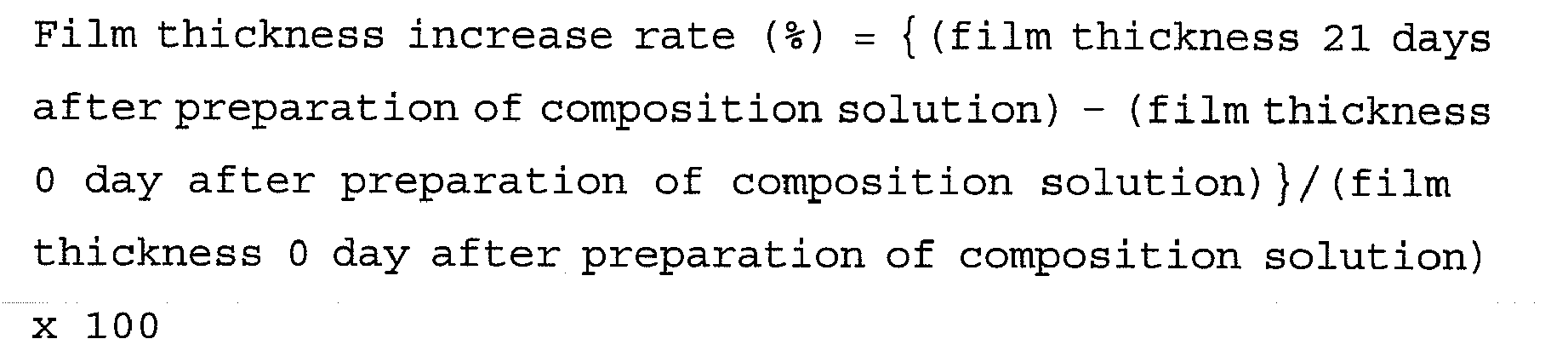
- It can be said that when the film thickness increase rate after 21 days is 2 % or less, storage stability is satisfactory.
- Pigment-based color resists (JCR RED772D, JCR Blue849 and JCR GREEN856 of JSR Corporation) were applied to an alkali-free glass substrate with a spinner and prebaked on a hot plate at 90 °C for 60 seconds to form coating films having a thickness of 1.5 µm. Thereafter, the coating films were exposed to a ghi line (intensity ratio of wavelengths 436 nm, 405 nm and 365 nm = 2.7:2.5:4.8) at a dose of 2,000 J/m2 in terms of an i line with the Canon PLA501F exposure machine (of Canon Corporation) without using a pattern mask, developed with a 0.05 wt% aqueous solution of potassium hydroxide, rinsed with super pure water for 60 seconds and further heated in an oven at 220°C for 20 minutes to form three substrates having red, green and blue coating films, respectively.
- After the above composition solution for forming a protective film was applied to these substrates with a spinner, it was prebaked on a hot plate at 90°C for 3 minutes to form a coating film having a thickness of 1.5 µm. Thereafter, it was exposed to ultraviolet radiation having an intensity of 40 W/m2 at 365 nm for 5.0 seconds (2,000 J/m2) through a predetermined pattern mask. Thereafter, it was developed with a 0.05 wt% aqueous solution of tetramethylammonium hydride (TMAH) for 60 seconds and rinsed with super pure water for 60 seconds to form a 50 µm2 protective film pattern.
- The peripheral portion of the protective film formed as described above was observed through an optical microscope. ○ in Table 2 means that the development residue was not seen and × means that the development residue was seen.
- The abbreviations in Table 1 denote the following compounds.
Component [B]
B-1: ω-carboxypolycaprolactone monoacrylate (Aronix M-5300 of Toagosei Chemical Industry Co., Ltd.)
B-2: 2-acryloyloxyethyl-succinic acid (HOA-MS of Kyoeisya Chemical Co., Ltd.)
Component [C]
C-1: dipentaerythritol hexaactylate (KAYARAD DPHA of Nippon Kayaku Co., Ltd.)
Component [D]
D-1:
2-methyl-1-(4-methylthiophenyl)-2-morpholinopropan-1-one (Irgacure 907 of Ciba Specialty Chemicals Co., Ltd.)
D-2:
2,2'-bis(2-chlorophenyl)-4,4',5,5'-tetraphenyl-1,2'-biimidazole
D-3: 4,4'-bis(diethylamino)benzophenone
D-4: 2-mercaptobenzothiazole - The mark "-" in Table 1 means that the above component is not added.
- The evaluation results are shown in Table 2.
Table 1 Composition solution Component (A) Component (B) Component (C) Component (D) Type Parts by weight Type Parts by weight Type Parts by weight Type Parts by weight Ex. 1 (S-1) A-1 100 B-1 5 C-1 100 D-1 30 Ex. 2 (S-2) A-1 100 B-2 5 C-1 100 D-1 30 Ex. 3 (S-3) A-1 100 B-1 5 C-1 100 D-1+D-2+D-3+D-4 10+5+5+2.5 Ex. 4 (S-4) A-1+A-2 75+25 B-1 5 C-1 100 D-1 30 Ex. 5 (S-5) A-1+A-2 50+50 B-1 5 C-1 100 D-1 30 Ex. 6 (S-6) A-1+A-2 25+75 B-1 5 C-1 100 D-1 30 Ex. 7 (S-7) A-1+A-2 50+50 B-1 10 C-1 100 D-1 30 Ex. 8 (S-8) A-3 100 B-1 5 C-1 100 D-1 30 Ex. 9 (S-9) A-3 100 B-1 10 C-1 100 D-1 30 Ex. 10 (S-10) A-3 100 B-1 5 C-1 100 D-1+D-2+D-3+D-4 10+5+5+2.5 C.Ex.1 (s-1) A-1 100 B-1 0 C-1 100 D-1 30 C.Ex.2 (s-2) A-1+A-2 50+50 B-1 0 C-1 100 D-1 30 C.Ex.3 (s-3) A-3 100 B-1 0 C-1 100 D-1 30 C.Ex.4 (s-4) A-4 100 B-1 0 C-1 100 D-1 30 Ex.:Example C.Ex.: Comparative Example 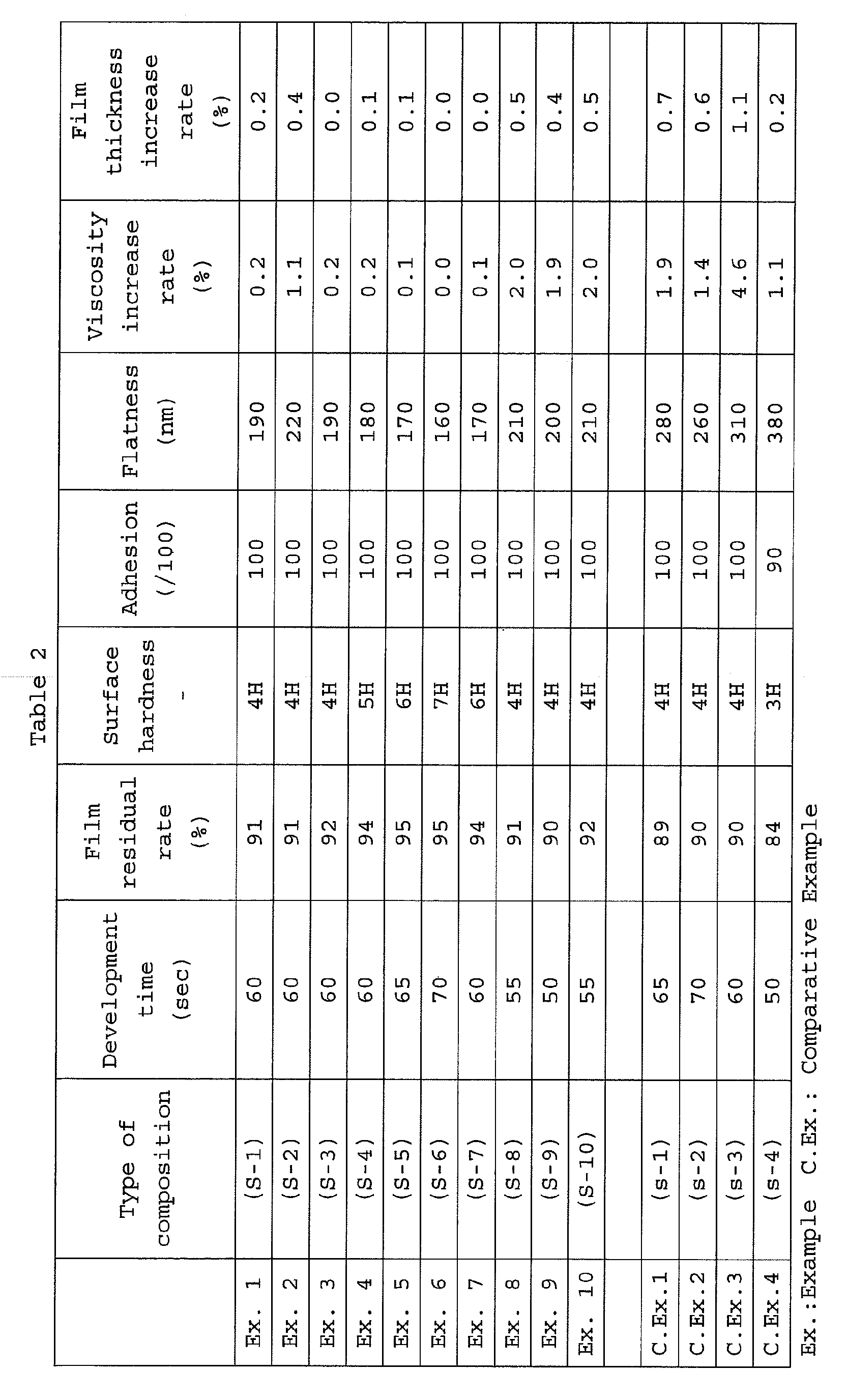

- Since the radiation sensitive resin composition for forming a protective film of the present invention can provide a cured film having high flatness and has high developability and heat resistance, it is advantageously used to form a protective film for liquid crystal display devices and solid-state image sensing devices and further useful for spacers for liquid crystal display devices.
- A radiation sensitive resin composition for forming a protective film, comprising:
- [A] a copolymer of (a1) an unsaturated carboxylic acid and/or an unsaturated carboxylic anhydride, (a2) an epoxy group-containing unsaturated compound and (a3) an unsaturated compound different from the components (a1) and (a2) ;
- [B] a monofunctional polymerizable unsaturated compound having a molecular weight of 180 or more and a carboxyl group;
- [C] a polyfunctional polymerizable unsaturated compound; and
- [D] a photopolymerization initiator, a method of forming a protective film from the above composition and a protective film formed from the above composition.
- The composition can provide a cured film having high flatness, has high developability and heat resistance, is advantageously used to form a protective film for liquid crystal display devices and solid-state image sensing devices, and has high storage stability as a composition.
Claims (6)
- A radiation sensitive resin composition for forming a protective film, comprising:[A] a copolymer of (a1) an unsaturated carboxylic acid, an unsaturated carboxylic anhydride or a mixture of an unsaturated carboxylic acid and an unsaturated carboxylic anhydride, (a2) an epoxy group-containing unsaturated compound and (a3) an unsaturated compound different from the components (a1) and (a2);[B] a monofunctional polymerizable unsaturated compound having a carboxyl group and a molecular weight of 180 or more;[C] a polyfunctional polymerizable unsaturated compound; and[D] a photopolymerization initiator.
- The radiation sensitive resin composition according to claim 1, wherein the component (a3) of the copolymer [A] comprises at least one unsaturated compound selected from the group consisting of a polymerizable unsaturated compound having at least one structure selected from the group consisting of the acetal ester structure of carboxylic acid, the ketal ester structure of carboxylic acid, the t-butyl ester structure of carboxylic acid and the 1-alkylcycloalkyl ester structure of carboxylic acid, alkyl acrylate, alkyl methacrylate, alicyclic acrylate, alicyclic methacrylate, aryl acrylate, aryl methacrylate, dialkyl dicarboxylate, hydroxyalkyl acrylate, hydroxyalkyl methacrylate, aromatic vinyl compound, acrylonitrile, methacrylonitrile, acrylamide, methacrylamide, vinyl acetate, 1,3-butadiene, isoprene, 2,3-dimethyl-1,3-butadiene, N-cyclohexylmaleimide, N-phenylmaleimide, N-benzylmaleimide, N-succinimidyl-3-maleimide benzoate, N-succinimidyl-4-maleimide butyrate, N-succinimidyl-6-maleimide caproate, N-succinimidyl-3-maleimide propionate and N-(9-acridinyl)maleimide.
- The radiation sensitive resin composition according to claim 1, wherein the component (a3) of the copolymer [A] comprises a polymerizable unsaturated compound having at least one structure selected from the group consisting of the acetal ester structure of carboxylic acid, the ketal ester structure of carboxylic acid, the t-butyl ester structure of carboxylic acid and the 1-alkylcycloalkyl ester structure of carboxylic acid.
- A protective film formed from the radiation sensitive resin composition of any one of claim 1 to 3.
- A method of forming a protective film for liquid crystal display devices or solid-state image sensing devices, comprising at least the following steps in the following mentioned order:(1) forming a coating film of the radiation sensitive resin composition of claim 1 or 2 on a substrate;(2) exposing at least part of the coating film to radiation;(3) developing the coating film after exposure; and(4) heating the coating film after development.
- A liquid crystal display device or solid-state image sensing device having the protective film of claim 4.
Applications Claiming Priority (1)
| Application Number | Priority Date | Filing Date | Title |
|---|---|---|---|
| JP2007072586 | 2007-03-20 |
Publications (1)
| Publication Number | Publication Date |
|---|---|
| EP1972673A1 true EP1972673A1 (en) | 2008-09-24 |
Family
ID=39361229
Family Applications (1)
| Application Number | Title | Priority Date | Filing Date |
|---|---|---|---|
| EP08152994A Withdrawn EP1972673A1 (en) | 2007-03-20 | 2008-03-19 | Radiation sensitive resin composition for forming a protective film, method of forming a protective film from the composition, liquid crystal display device and solid-state image sensing device |
Country Status (5)
| Country | Link |
|---|---|
| US (1) | US7713680B2 (en) |
| EP (1) | EP1972673A1 (en) |
| JP (1) | JP5083540B2 (en) |
| KR (1) | KR101476441B1 (en) |
| TW (1) | TWI405037B (en) |
Families Citing this family (20)
| Publication number | Priority date | Publication date | Assignee | Title |
|---|---|---|---|---|
| JP5483005B2 (en) * | 2009-03-31 | 2014-05-07 | Jsr株式会社 | Liquid crystal aligning agent and liquid crystal display element |
| JP5437027B2 (en) * | 2009-03-31 | 2014-03-12 | 東京応化工業株式会社 | Photosensitive resin composition and liquid crystal panel |
| US8492454B2 (en) | 2009-10-05 | 2013-07-23 | Creative Nail Design, Inc. | Removable color layer for artificial nail coatings and methods therefore |
| US8263677B2 (en) * | 2009-09-08 | 2012-09-11 | Creative Nail Design, Inc. | Removable color gel basecoat for artificial nail coatings and methods therefore |
| US8541482B2 (en) | 2009-10-05 | 2013-09-24 | Creative Nail Design, Inc. | Removable multilayer nail coating system and methods therefore |
| KR101642786B1 (en) * | 2009-11-26 | 2016-07-26 | 제이에스알 가부시끼가이샤 | Composition for organic semiconductor alignment, organic semiconductor alignment film, and organic semiconductor device and manufacturing method thereof |
| KR101779531B1 (en) * | 2010-02-26 | 2017-09-18 | 신닛테츠 수미킨 가가쿠 가부시키가이샤 | Curable resin composition, cured article thereof, and optical material |
| JP5548494B2 (en) * | 2010-03-19 | 2014-07-16 | 東京応化工業株式会社 | Surface modifying material, resist pattern forming method, and pattern forming method |
| KR101267674B1 (en) * | 2010-11-12 | 2013-05-24 | 롬엔드하스전자재료코리아유한회사 | Photo-sensitivity resin composition, its Dielectric insulating film and Electronic device |
| US8796349B2 (en) * | 2010-11-30 | 2014-08-05 | Nissan Chemical Industries, Ltd. | Photosensitive resin composition for microlenses |
| KR20120082169A (en) * | 2011-01-13 | 2012-07-23 | 삼성전자주식회사 | Photosensitive adhesive composition having alkali soluble epoxy resin, and patternable adhesive film using the same |
| BR112013023027A2 (en) | 2011-03-07 | 2016-08-16 | Creative Neail Design Inc | compositions and methods for UV curable nail polishes |
| TWI420244B (en) * | 2011-04-08 | 2013-12-21 | Chi Mei Corp | Photosensitive resin composition, and color filter and liquid crystal display device made by using the composition |
| JP5966268B2 (en) * | 2011-07-22 | 2016-08-10 | Jsr株式会社 | Array substrate, liquid crystal display element, and method of manufacturing array substrate |
| JP2015069161A (en) * | 2013-09-30 | 2015-04-13 | 東京応化工業株式会社 | Photosensitive resin composition, production method of resin pattern, and display device |
| KR101697402B1 (en) | 2013-09-30 | 2017-01-17 | 주식회사 엘지화학 | Polarizing plate and image display apparatus comprising the same |
| WO2015068703A1 (en) * | 2013-11-05 | 2015-05-14 | 太陽インキ製造株式会社 | Curable composition, cured coating film using same, and printed wiring board |
| JP6339346B2 (en) * | 2013-11-05 | 2018-06-06 | 太陽インキ製造株式会社 | Curable composition for printed wiring board, cured coating film using the same, and printed wiring board |
| JP2015202429A (en) * | 2014-04-11 | 2015-11-16 | Jsr株式会社 | Method for forming substrate edge protective layer |
| JP2016066605A (en) * | 2014-09-16 | 2016-04-28 | 積水化学工業株式会社 | Sealant for display element |
Citations (10)
| Publication number | Priority date | Publication date | Assignee | Title |
|---|---|---|---|---|
| JPH0578453A (en) | 1991-09-20 | 1993-03-30 | Japan Synthetic Rubber Co Ltd | Protecting film material |
| JPH06256684A (en) * | 1993-03-02 | 1994-09-13 | Japan Synthetic Rubber Co Ltd | Alkali-developing liquid photoresist composition for circuit board formation |
| EP0897938A2 (en) * | 1992-07-24 | 1999-02-24 | Japan Synthetic Rubber Co., Ltd. | Epoxy group-containing resin compositions |
| JP3151975B2 (en) | 1992-11-25 | 2001-04-03 | ジェイエスアール株式会社 | Heat-resistant radiation-sensitive resin composition |
| JP2001091732A (en) | 1999-07-22 | 2001-04-06 | Nippon Steel Chem Co Ltd | Composition for color filter protective film |
| JP2001164072A (en) * | 1999-12-09 | 2001-06-19 | Jsr Corp | Radiation-sensitive resin composition for spacer and spacer |
| JP2001302870A (en) * | 2000-04-25 | 2001-10-31 | Jsr Corp | Radiation-sensitive resin composition for forming partition of EL display element, partition and EL display element |
| JP2003096149A (en) * | 2001-09-25 | 2003-04-03 | Jsr Corp | Composition for forming light diffusion reflection film, light diffusion reflection film, and liquid crystal display device |
| JP2006083248A (en) * | 2004-09-15 | 2006-03-30 | Jsr Corp | Curable resin composition, protective film and method for forming the same |
| JP2006199902A (en) | 2004-12-24 | 2006-08-03 | Jsr Corp | Radiation curable resin composition for flattening layer, flattening layer, method for producing flattening layer, and solid-state imaging device |
Family Cites Families (10)
| Publication number | Priority date | Publication date | Assignee | Title |
|---|---|---|---|---|
| EP0902327A3 (en) * | 1997-09-09 | 2000-04-05 | JSR Corporation | Radiation sensitive composition |
| JP3867179B2 (en) | 1997-11-18 | 2007-01-10 | Jsr株式会社 | Radiation sensitive composition for color filter |
| JP4282783B2 (en) * | 1997-12-16 | 2009-06-24 | Jsr株式会社 | Radiation sensitive composition for color filter |
| JP2001215324A (en) * | 2000-02-03 | 2001-08-10 | Jsr Corp | Radiation-sensitive composition for color liquid crystal display device and color liquid crystal display device |
| JP3642048B2 (en) * | 2001-12-21 | 2005-04-27 | Jsr株式会社 | Composition for forming light diffusive reflective film, light diffusive reflective film, and liquid crystal display element |
| US6680158B2 (en) * | 2001-07-31 | 2004-01-20 | Chi Mei Corporation | Radiation-sensitive resin composition for spacer |
| JP3831947B2 (en) | 2003-03-10 | 2006-10-11 | Jsr株式会社 | Resin composition, protective film for color filter and method for forming the same |
| TWI312882B (en) * | 2003-03-24 | 2009-08-01 | Dainippon Printing Co Ltd | Curable resin composition, curable resin composition for photo-process patterning, color filter, substrate for liquid crystal panel and liquid crystal panel |
| JP4735818B2 (en) * | 2005-08-12 | 2011-07-27 | Jsr株式会社 | Resin composition, method for forming color filter protective film, and color filter protective film |
| JP2011012023A (en) * | 2009-07-02 | 2011-01-20 | Idemitsu Kosan Co Ltd | Fluorine-containing adamantane derivative having polyfunctional group and resin composition containing the same |
-
2007
- 2007-12-21 JP JP2007329512A patent/JP5083540B2/en active Active
-
2008
- 2008-03-19 EP EP08152994A patent/EP1972673A1/en not_active Withdrawn
- 2008-03-19 KR KR1020080025349A patent/KR101476441B1/en active Active
- 2008-03-19 US US12/051,037 patent/US7713680B2/en not_active Expired - Fee Related
- 2008-03-19 TW TW097109645A patent/TWI405037B/en active
Patent Citations (10)
| Publication number | Priority date | Publication date | Assignee | Title |
|---|---|---|---|---|
| JPH0578453A (en) | 1991-09-20 | 1993-03-30 | Japan Synthetic Rubber Co Ltd | Protecting film material |
| EP0897938A2 (en) * | 1992-07-24 | 1999-02-24 | Japan Synthetic Rubber Co., Ltd. | Epoxy group-containing resin compositions |
| JP3151975B2 (en) | 1992-11-25 | 2001-04-03 | ジェイエスアール株式会社 | Heat-resistant radiation-sensitive resin composition |
| JPH06256684A (en) * | 1993-03-02 | 1994-09-13 | Japan Synthetic Rubber Co Ltd | Alkali-developing liquid photoresist composition for circuit board formation |
| JP2001091732A (en) | 1999-07-22 | 2001-04-06 | Nippon Steel Chem Co Ltd | Composition for color filter protective film |
| JP2001164072A (en) * | 1999-12-09 | 2001-06-19 | Jsr Corp | Radiation-sensitive resin composition for spacer and spacer |
| JP2001302870A (en) * | 2000-04-25 | 2001-10-31 | Jsr Corp | Radiation-sensitive resin composition for forming partition of EL display element, partition and EL display element |
| JP2003096149A (en) * | 2001-09-25 | 2003-04-03 | Jsr Corp | Composition for forming light diffusion reflection film, light diffusion reflection film, and liquid crystal display device |
| JP2006083248A (en) * | 2004-09-15 | 2006-03-30 | Jsr Corp | Curable resin composition, protective film and method for forming the same |
| JP2006199902A (en) | 2004-12-24 | 2006-08-03 | Jsr Corp | Radiation curable resin composition for flattening layer, flattening layer, method for producing flattening layer, and solid-state imaging device |
Non-Patent Citations (1)
| Title |
|---|
| DATABASE WPI Week 200627, Derwent World Patents Index; AN 2006-256679, XP002480134 * |
Also Published As
| Publication number | Publication date |
|---|---|
| KR20080085759A (en) | 2008-09-24 |
| JP5083540B2 (en) | 2012-11-28 |
| JP2008260909A (en) | 2008-10-30 |
| KR101476441B1 (en) | 2014-12-24 |
| TWI405037B (en) | 2013-08-11 |
| US20080233515A1 (en) | 2008-09-25 |
| TW200903155A (en) | 2009-01-16 |
| US7713680B2 (en) | 2010-05-11 |
Similar Documents
| Publication | Publication Date | Title |
|---|---|---|
| US7713680B2 (en) | Radiation sensitive resin composition for forming a protective film, method of forming a protective film from the composition, liquid crystal display device and solid-state image sensing device | |
| JP4678271B2 (en) | Photosensitive resin composition, protective film for liquid crystal display panel and spacer, and liquid crystal display panel comprising them | |
| JP4650638B2 (en) | Radiation-sensitive resin composition, spacer, and formation method thereof | |
| JP4631594B2 (en) | Photosensitive resin composition, display panel spacer and display panel | |
| KR101853729B1 (en) | Radiation-sensitive resin composition, cured film, method for forming the cured film, and display device | |
| JP4539165B2 (en) | Radiation-sensitive resin composition, spacer, method for forming the same, and liquid crystal display device | |
| KR101815117B1 (en) | Radiation-sensitive resin composition, cured film, method for forming the cured film, and display device | |
| KR101433947B1 (en) | Radiation-sensitive resin composition, spacer and method for manufacturing the same and liquid crystal display device | |
| JP4766235B2 (en) | Radiation sensitive resin composition and spacer for liquid crystal display element | |
| JP4419736B2 (en) | Photosensitive resin composition, display panel spacer and display panel | |
| JP4380359B2 (en) | Radiation-sensitive resin composition for spacer formation, spacer, method for forming the spacer, and liquid crystal display element | |
| KR100856992B1 (en) | Radiation Sensitive Resin Composition for Forming Spacer, Spacer and Its Forming Method, and Liquid Crystal Display Device | |
| JP4631595B2 (en) | Photosensitive resin composition, display panel spacer and display panel | |
| KR101329436B1 (en) | Radiation sensitive resin composition, protrusion and spacer made therefrom, and liquid crystal display device comprising them | |
| KR101813138B1 (en) | Radiation-sensitive resin composition for forming cured film, method of manufacturing the radiation-sensitive resin composition for forming cured film, cured film, method for forming the cured film and liquid crystal display device | |
| JP2006257220A (en) | Copolymer, radiation-sensitive resin composition using the same, spacer for liquid crystal display element, and liquid crystal display element | |
| JP2006184841A (en) | Photosensitive resin composition, display panel spacer and display panel | |
| CN101131511B (en) | Polymer having unsaturated side chain, radiation-sensitive resin composition and spacer for liquid crystal display element | |
| JP2008216489A (en) | Radiation-sensitive resin composition and method for forming spacer | |
| JP2008151967A (en) | Radiation-sensitive resin composition, spacer, production method thereof, and liquid crystal display device | |
| KR20060131644A (en) | Photosensitive resin composition, spacer for display panel, and display panel | |
| KR100796123B1 (en) | Photosensitive resin composition, spacer for display panel, and display panel | |
| JP2006301148A (en) | Radiation-sensitive resin composition, protrusions and spacers formed therefrom, and liquid crystal display device comprising the same | |
| CN101017323A (en) | Radiation-sensitive resin composition, protrusion and spacer formed of the same, method of forming the radiation-sensitive resin composition, and liquid crystal display element | |
| KR20060100277A (en) | Radiation-sensitive resin composition, projections and spacers formed therefrom, and liquid crystal display device comprising the same |
Legal Events
| Date | Code | Title | Description |
|---|---|---|---|
| PUAI | Public reference made under article 153(3) epc to a published international application that has entered the european phase |
Free format text: ORIGINAL CODE: 0009012 |
|
| AK | Designated contracting states |
Kind code of ref document: A1 Designated state(s): AT BE BG CH CY CZ DE DK EE ES FI FR GB GR HR HU IE IS IT LI LT LU LV MC MT NL NO PL PT RO SE SI SK TR |
|
| AX | Request for extension of the european patent |
Extension state: AL BA MK RS |
|
| AKX | Designation fees paid | ||
| STAA | Information on the status of an ep patent application or granted ep patent |
Free format text: STATUS: THE APPLICATION IS DEEMED TO BE WITHDRAWN |
|
| 18D | Application deemed to be withdrawn |
Effective date: 20090325 |
|
| REG | Reference to a national code |
Ref country code: DE Ref legal event code: 8566 |