EP1969487B1 - Auf allograph basierende schreiberanpassung für die erkennung handschriftlicher zeichen - Google Patents
Auf allograph basierende schreiberanpassung für die erkennung handschriftlicher zeichen Download PDFInfo
- Publication number
- EP1969487B1 EP1969487B1 EP06845796.9A EP06845796A EP1969487B1 EP 1969487 B1 EP1969487 B1 EP 1969487B1 EP 06845796 A EP06845796 A EP 06845796A EP 1969487 B1 EP1969487 B1 EP 1969487B1
- Authority
- EP
- European Patent Office
- Prior art keywords
- allograph
- neural network
- character
- classifier
- component
- Prior art date
- Legal status (The legal status is an assumption and is not a legal conclusion. Google has not performed a legal analysis and makes no representation as to the accuracy of the status listed.)
- Not-in-force
Links
Images






Classifications
-
- G—PHYSICS
- G06—COMPUTING OR CALCULATING; COUNTING
- G06V—IMAGE OR VIDEO RECOGNITION OR UNDERSTANDING
- G06V30/00—Character recognition; Recognising digital ink; Document-oriented image-based pattern recognition
- G06V30/10—Character recognition
- G06V30/32—Digital ink
- G06V30/36—Matching; Classification
-
- G—PHYSICS
- G06—COMPUTING OR CALCULATING; COUNTING
- G06F—ELECTRIC DIGITAL DATA PROCESSING
- G06F18/00—Pattern recognition
- G06F18/20—Analysing
- G06F18/23—Clustering techniques
- G06F18/231—Hierarchical techniques, i.e. dividing or merging pattern sets so as to obtain a dendrogram
-
- G—PHYSICS
- G06—COMPUTING OR CALCULATING; COUNTING
- G06F—ELECTRIC DIGITAL DATA PROCESSING
- G06F18/00—Pattern recognition
- G06F18/20—Analysing
- G06F18/25—Fusion techniques
- G06F18/254—Fusion techniques of classification results, e.g. of results related to same input data
-
- G—PHYSICS
- G06—COMPUTING OR CALCULATING; COUNTING
- G06F—ELECTRIC DIGITAL DATA PROCESSING
- G06F18/00—Pattern recognition
- G06F18/20—Analysing
- G06F18/28—Determining representative reference patterns, e.g. by averaging or distorting; Generating dictionaries
-
- G—PHYSICS
- G06—COMPUTING OR CALCULATING; COUNTING
- G06F—ELECTRIC DIGITAL DATA PROCESSING
- G06F3/00—Input arrangements for transferring data to be processed into a form capable of being handled by the computer; Output arrangements for transferring data from processing unit to output unit, e.g. interface arrangements
- G06F3/01—Input arrangements or combined input and output arrangements for interaction between user and computer
- G06F3/02—Input arrangements using manually operated switches, e.g. using keyboards or dials
- G06F3/023—Arrangements for converting discrete items of information into a coded form, e.g. arrangements for interpreting keyboard generated codes as alphanumeric codes, operand codes or instruction codes
- G06F3/0233—Character input methods
-
- G—PHYSICS
- G06—COMPUTING OR CALCULATING; COUNTING
- G06F—ELECTRIC DIGITAL DATA PROCESSING
- G06F3/00—Input arrangements for transferring data to be processed into a form capable of being handled by the computer; Output arrangements for transferring data from processing unit to output unit, e.g. interface arrangements
- G06F3/01—Input arrangements or combined input and output arrangements for interaction between user and computer
- G06F3/03—Arrangements for converting the position or the displacement of a member into a coded form
- G06F3/033—Pointing devices displaced or positioned by the user, e.g. mice, trackballs, pens or joysticks; Accessories therefor
- G06F3/0354—Pointing devices displaced or positioned by the user, e.g. mice, trackballs, pens or joysticks; Accessories therefor with detection of two-dimensional [2D] relative movements between the device, or an operating part thereof, and a plane or surface, e.g. 2D mice, trackballs, pens or pucks
-
- G—PHYSICS
- G06—COMPUTING OR CALCULATING; COUNTING
- G06V—IMAGE OR VIDEO RECOGNITION OR UNDERSTANDING
- G06V10/00—Arrangements for image or video recognition or understanding
- G06V10/70—Arrangements for image or video recognition or understanding using pattern recognition or machine learning
- G06V10/762—Arrangements for image or video recognition or understanding using pattern recognition or machine learning using clustering, e.g. of similar faces in social networks
- G06V10/7625—Hierarchical techniques, i.e. dividing or merging patterns to obtain a tree-like representation; Dendograms
-
- G—PHYSICS
- G06—COMPUTING OR CALCULATING; COUNTING
- G06V—IMAGE OR VIDEO RECOGNITION OR UNDERSTANDING
- G06V10/00—Arrangements for image or video recognition or understanding
- G06V10/70—Arrangements for image or video recognition or understanding using pattern recognition or machine learning
- G06V10/77—Processing image or video features in feature spaces; using data integration or data reduction, e.g. principal component analysis [PCA] or independent component analysis [ICA] or self-organising maps [SOM]; Blind source separation
- G06V10/80—Fusion, i.e. combining data from various sources at the sensor level, preprocessing level, feature extraction level or classification level
- G06V10/809—Fusion, i.e. combining data from various sources at the sensor level, preprocessing level, feature extraction level or classification level of classification results, e.g. where the classifiers operate on the same input data
-
- G—PHYSICS
- G06—COMPUTING OR CALCULATING; COUNTING
- G06V—IMAGE OR VIDEO RECOGNITION OR UNDERSTANDING
- G06V30/00—Character recognition; Recognising digital ink; Document-oriented image-based pattern recognition
- G06V30/10—Character recognition
- G06V30/14—Image acquisition
- G06V30/142—Image acquisition using hand-held instruments; Constructional details of the instruments
- G06V30/1423—Image acquisition using hand-held instruments; Constructional details of the instruments the instrument generating sequences of position coordinates corresponding to handwriting
-
- G—PHYSICS
- G06—COMPUTING OR CALCULATING; COUNTING
- G06V—IMAGE OR VIDEO RECOGNITION OR UNDERSTANDING
- G06V30/00—Character recognition; Recognising digital ink; Document-oriented image-based pattern recognition
- G06V30/10—Character recognition
- G06V30/19—Recognition using electronic means
- G06V30/191—Design or setup of recognition systems or techniques; Extraction of features in feature space; Clustering techniques; Blind source separation
- G06V30/1914—Determining representative reference patterns, e.g. averaging or distorting patterns; Generating dictionaries, e.g. user dictionaries
Definitions
- consumers can scan and store documents, create an album of digital images with text overlays, search and retrieve specific information (e.g., web pages with various types of data), upload pictures from digital cameras, view financial statements, transmit and/or receive digital facsimiles, exchange correspondence (e.g., email, chat rooms, voice over IP%), etc.
- specific information e.g., web pages with various types of data
- upload pictures from digital cameras view financial statements
- transmit and/or receive digital facsimiles e.g., email, chat rooms, voice over IPCertainly, etc.
- computing systems and/or devices have incorporated a variety of techniques and/or methods for inputting information.
- Computing systems and/or devices facilitate entering information utilizing devices such as, but not limited to, keyboards, keypads, touch pads, touch-screens, speakers, stylus' ( e.g., wands), writing pads, ...
- input devices that leverage user handwriting bring forth user personalization deficiencies in which each user can not utilize the data entry technique (e.g., writing) similarly.
- a user's handwriting can be as unique as the user, wherein such uniqueness can be used for identification purposes.
- Commercial handwriting recognition systems implemented within various computing systems and/or devices attempt to reduce the impact of writer variation through utilizing large training datasets including data from a plurality of disparate users. Even when handwriting samples from as many as 1500 users are available, there is sufficient variation in the handwriting to uniquely identify each of the users.
- a pragmatic approach to improving recognizer performance on unseen writing styles is writer adaptation (or personalization).
- Personalization enables the recognizer to adapt to a particular user's handwriting by collecting and learning from additional data samples from the user.
- writer adaptation or personalization
- US 2005/018906 A1 relates to a method of modifying a classification scheme for classifying hand-written characters to thereby make the classification scheme user dependent.
- the classification scheme includes a number of allographs, each allograph representing a respective style of a respective letter.
- the method includes obtaining at least one hand-written character, and then selecting an allograph representing the character.
- One or more of the allographs are then modified in accordance with the selection, to thereby reflect the fact that the allograph corresponds to a style of letter used by the user.
- J-H Chiang "A hybrid neural network model in handwritten word recognition", Neural Networks, Elsevier Science Publishers, Barking, GB, vol. 11, no. 2, 1 March 1998 relates to a hybrid neural network model in handwritten word recognition.
- the word recognition system requires a module that assigns character class confidence values to segments of images of handwritten words.
- the module must accurately represent ambiguities between character classes and assign low confidence values to a wide variety of non-character segments resulting from erroneous segmentation.
- the proposed hybrid neural model is a cascaded system.
- the first stage is a self-organizing feature map algorithm (SOFM).
- SOFM self-organizing feature map algorithm
- the second stage maps distances into allograph membership values using a gradient descent learning algorithm.
- the third stage is a multi-layer feedforward network (MLFN).
- the subject innovation relates to systems and/or methods that facilitate recognizing a character associated with handwriting utilizing an allograph (e.g., character shapes and/or styles) trained classifier.
- a personalization component can receive data related to a handwritten character via an interface, wherein the personalization component can provide optimized recognition for the handwritten character by employing a classifier trained with allograph data.
- the allograph data can be, for instance, automatically generated and/or manually generated data related to a style of handwriting.
- the personalization component can provide writer adaptation, wherein writer adaptation can be the process of converting a generic ( e.g., writer-independent) handwriting recognizer into a personalized ( e.g., writer dependent) recognizer with improved accuracy for any particular user.
- the personalization component provides optimized handwriting recognition by employing a first classifier trained with allograph data and a second classifier trained with non-allograph data, wherein the first classifier and the second classifier output can be combined.
- the combination of the outputs can be implemented by, for instance, a linear combiner, a combiner classifier, a support vector machine, a linear classifier, a sequence of rules, etc.
- the combination of the outputs provides enhanced recognition and/or analysis of handwriting.
- the employment of the combination of outputs can be optimized by utilizing a user handwriting sample.
- the personalization component can further utilize an allograph component that generates allograph data to train at least one classifier to provide optimized handwriting recognition.
- the allograph component can generate allograph data automatically, manually, and/or any combination thereof. For instance, clustering can be implemented to automatically identify allographs (e.g., character shapes and/or styles) and/or allograph data from handwritten characters.
- the allograph data can be manually provided utilizing a handwriting expert to provide types and/or styles associated with handwriting.
- the allograph component can identify character writing styles (e.g., allographs and/or allograph data) using, for example, a hierarchical agglomerative clustering approach using dynamic time warping (DTW) as a distance measure.
- DTW dynamic time warping
- the personalization component can further utilize a classifier component to employ at least one classifier in accordance with the subject innovation.
- the classifier component can employ a first classifier that can be trained with allograph data.
- the first classifier can be a neural network.
- the classifier component can further employ a second classifier that can be trained with non-allograph data.
- the combine component can utilize various combining technologies such as a linear combiner, a combiner classifier, a linear classifier, a support vector machine, etc.
- ком ⁇ онент can be a process running on a processor, a processor, an object, an executable, a program, and/or a computer.
- a component can be a process running on a processor, a processor, an object, an executable, a program, and/or a computer.
- an application running on a server and the server can be a component.
- One or more components can reside within a process and a component can be localized on one computer and/or distributed between two or more computers.
- the claimed subject matter may be implemented as a method, apparatus, or article of manufacture using standard programming and/or engineering techniques to produce software, firmware, hardware, or any combination thereof to control a computer to implement the disclosed subject matter.
- article of manufacture as used herein is intended to encompass a computer program accessible from any computer-readable device, carrier, or media.
- computer readable media can include but are not limited to magnetic storage devices (e.g., hard disk, floppy disk, magnetic strips%), optical disks (e.g., compact disk (CD), digital versatile disk (DVD)...), smart cards, and flash memory devices (e.g., card, stick, key drive).
- a carrier wave can be employed to carry computer-readable electronic data such as those used in transmitting and receiving electronic mail or in accessing a network such as the Internet or a local area network (LAN).
- LAN local area network
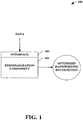
- Fig. 1 illustrates a system 100 that facilitates recognizing a character associated with handwriting utilizing an allograph trained classifier.
- the system 100 can include a personalization component 102 that can train a classifier (not shown) with allograph data, wherein such training facilitates recognizing handwritten characters.
- the allograph data can be, for instance, automatically generated and/or manually generated data related to a style of handwriting.
- the personalization component 102 can receive a handwritten character and/or data related to a handwriting sample via an interface component 104 (herein referred to as the "interface 104") and provide optimized handwriting recognition based at least in part upon the employment of allograph data in training of a classifier.
- the data received can be any character and/or input from a user that is handwritten.
- various computing devices and/or systems utilize handwriting inputs such as, but not limited to, tablets, portable data assistants (PDA's), mobile communication devices, a stylus pen, a wand, an interactive display device with touch screen ability, etc.
- PDA's portable data assistants
- mobile communication devices such as, but not limited to, tablets, portable data assistants (PDA's), mobile communication devices, a stylus pen, a wand, an interactive display device with touch screen ability, etc.
- the personalization component 102 can provide writer adaptation, wherein writer adaptation can be the process of converting a generic (e.g., writer-independent) handwriting recognizer into a personalized (e.g., writer dependent) recognizer with improved accuracy for any particular user.
- writer adaptation can be the process of converting a generic (e.g., writer-independent) handwriting recognizer into a personalized (e.g., writer dependent) recognizer with improved accuracy for any particular user.
- the personalization component 102 can implement the adaptation technique with a few samples from a particular user, while as conventional techniques train the generic recognizer employing large amounts of data from several writers and/or users.
- the allograph data can be generated manually, automatically, and/or any combination thereof.
- the allograph data can be automatically generated employing any suitable clustering technique (discussed infra ).
- any suitable clustering technique discussed infra
- an automatic approach for identifying allographs e.g., character shapes and/or styles
- the allograph data can be manually provided utilizing a handwriting expert to provide types and/or styles associated with handwriting.
- the personalization component 102 can train a classifier with allograph data and implement such results in combination with a non-allograph based classifier to provide the optimized handwriting recognition.
- the personalization component 102 can seamlessly integrate with an existing recognizer (e.g., handwriting character recognizer) and improve upon it equilaterally employing new samples from an individual. For instance, rather than simply matching a letter, the personalization component 102 can match a letter and/or character with a particular style and/or allograph.
- the personalization component 102 can utilize a mapping technique and/or function that can be learnable given writing samples and/or examples of the user.
- the personalization component 102 can utilize an output from a conventional and/or traditional classifier to apply the mapping function and/or technique to provide a probability of each letter and/or character to optimize handwriting recognition.
- the system 100 can include any suitable and/or necessary interface component 104, which provides various adapters, connectors, channels, communication paths, etc. to integrate the personalization component 102 into virtually any operating and/or database system(s).
- the interface component 104 can provide various adapters, connectors, channels, communication paths, etc., that provide for interaction with the personalization component 102, the data, handwriting data, data associated with optimized handwriting recognition, and optimized handwriting recognition.
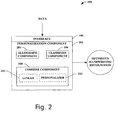
- Fig. 2 illustrates a system 200 that facilitates utilizing allograph data to employ handwriting character recognition.
- the system 200 can include a personalization component 202 that can provide optimized handwriting recognition by training a classifier utilizing allograph data.
- the personalization component 202 can receive data related to a handwritten character and/or symbol via the interface 104, wherein the personalization component 202 can infer and/or recognize the character and/or symbol by employing a classifier trained by allographs.
- the personalization component 202 can further utilize the classifier trained by allographs in connection with a classifier trained with non-allographs. It is to be appreciated that the personalization component 202 can be substantially similar to the personalization component 102 as described in Fig. 1 .
- the personalization component 202 can include an allograph component 204 that can automatically, manually, and/or any combination thereof generate allographs and/or allograph data.
- An automatic approach for identifying allographs (e.g., character shapes and/or styles) from handwritten characters through clustering can be implemented.
- the allograph data can be manually provided utilizing a handwriting expert to provide types and/or styles associated with handwriting.
- the allograph component 204 can identify character writing styles (e.g., allographs) using, for example, a hierarchical agglomerative clustering approach using dynamic time warping (DTW) as a distance measure.
- the allograph component 204 can identify and/or find any suitable allograph data and/or writing styles to be employed in accordance with the subject innovation.
- handwritten character styles can exist that can be termed "allographs" that a user can loosely adhere.
- Hierarchical clustering techniques can be used to learn letter handwriting styles from data. Two main approaches exist: 1) a top down approach of detecting coarse sub-styles; and 2) a bottom-up clustering approach.
- the allograph component 204 can adopt the bottom-up approach, for instance, based at least in part upon obtained style knowledge can be directly used in the system 200 ( e.g., the recognizer).
- the clustering C is computed independently for every letter and/or symbol.
- An hierarchical clustering algorithm produces an hierarchy of nested clusters [ C 1 , C 2 , ..., C M ] such that C m -1 is a subset of C m . This hierarchy can be built in M steps, where a clustering at step m can be produced from the clustering produced at step m -1.
- every member and/or a portion of the member in the sample set X can represent a cluster of its own.
- D c k ,c k'
- the cluster dissimilarity function D ( c k ,c k' ) can be defined in terms of the ink sample dissimilarity function D ( x k ,x k' ).
- Each ink sample can be first isotropically normalized and centered within a fixed size rectangle.
- P and P' are the corresponding re-sampled coordinate vectors of samples k, k' and N is the number of sampling points.
- An element p in the vector P has 3 coordinates ( x, y, ⁇ ) where x, y are the Cartesian coordinates of the point p and ⁇ is the estimate of the slope at the same point.
- ink samples with different stroke counts may not be merged in the same cluster until the very end. At that point the merging would have actually stopped.
- an ink sample can be selected to be the cluster representative.
- the chosen representative for every cluster can be the median center of the cluster.
- the median center x -k for cluster c k can be defined as the ink sample with the smallest median distance with respect to the remaining cluster member ink samples.
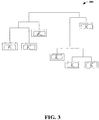
- Fig. 3 illustrates a block diagram of binary tree 300 that facilitates visualizing results associated with clustering for a character.
- the results from the allograph component 204 that can be related to the clustering for each letter and/or symbol can be visualized by the binary tree 300, referred to as a dissimilarity dendogram.
- the binary tree 300 can be an example of the resulting dendogram of the letter "K.” It is to be appreciated the binary tree 300 can incorporate the order in which a stroke occurs and/or a darkness and/or lightness associated with a tone of the stroke.
- the allograph component 204 can automatically generate clusters related to allographs and further determine the number of clusters employed For instance, the number of clusters for every letter and/or symbol can be determined by defining a threshold D max above which no further merging of clusters can occur.
- the active clusters at the time that merging stops represent the styles of the corresponding letter. Accordingly, the number of resulting styles can be different from one letter to the other, depending on the diversity of the letter and/or symbol shapes.
- the first table 400 can be the result of the hierarchical clustering algorithm utilized by the allograph component 204 when applied to a large set of ink samples.
- the first table 400 illustrates the resulting styles for the letters q, t, and X and relative frequencies among United States (US) writers. It is to be appreciated that the first table 400 is an example, and the subject innovation is not so limited. In other words, the personalization component 202 can map these styles to the styles taught in US schools.
- the second table 402 illustrates examples of the styles for the letters q, t, and X and their relative frequencies among United Kingdom (UK) writers.
- US and UK styles e.g., first table 400 and second table 402 respectively
- the following subjective observations can be made: 1) The dominant styles in both sets appear to be the same for most of the letters albeit with different frequencies (e.g., the shown US and UK styles for the letter q can illustrate a counter-example; 2) Some fringe ( e.g., low frequency) styles can exist in one set and not in the other; and 3) Even when fringe styles appear in both sets, it seems their frequencies can be significantly different.
- Each choice of a DTW distance threshold when applied to the hierarchical cluster can allow the allograph component 204 of Fig. 2 to produce a set of disjoint clusters.
- the larger the distance threshold the fewer the number of clusters obtained.
- a threshold of 792 can be chosen to obtain 2002 unique clusters for the 100 characters (e.g., printable ASCII characters including the euro and pound signs). With 2002 clusters and 100 characters, there can be approximately 20 allographs per character representing various written forms of the character.
- the personalization component 202 can include a classifier component 206 that can employ at least one classifier to be trained utilizing allograph data generated from the allograph component 204.
- the classifier component 206 can utilize a first neural network classifier that can be trained on allograph data and a second neural network classifier that can be trained on non-allograph data, wherein both outputs of the first and second neural network classifiers can be combined by employing a combine component 208 (discussed infra ).
- the classifier component 206 can include any suitable components and/or data related to training a classifier utilizing non-allograph data, allograph data, and/or any combination thereof.
- the classifier component 206 can employ a feature vector as an input for the at least one classifier.
- Each handwritten character can be viewed as a sequence of ( x,y,t ) segments representing continuous strokes. One or more strokes written in succession can make up a character. For instance, each handwritten character can be processed to obtain sixty five (65) polynomial features. It is to be appreciated that any suitable and/or alternative "featurizing" can be applied and utilized in association with the claimed subject matter.
- the ink for the characters can first be split into various segments, by cutting the ink at the bottoms of the characters. Segmentation thus takes place where the y-coordinate reaches a minimum value and starts to move in the other direction.
- Each of the segments can then be represented in the form of a Chebyshev polynomial.
- a feature vector containing 65 features can be obtained from each character. These feature vectors are then fed as inputs to each of the neural networks associated with the classifier component 206.
- the classifier component 206 can further train the at least one classifier utilizing at least one of allograph data and a feature vector. It is to be appreciated that the classifier component 206 can employ a first recognizer and a second recognizer, wherein the first and second recognizer can be trained utilizing the feature vectors. However, it is also to be appreciated and understood that the subject innovation is not so limited by the following example. In other words, the classifier component 206 can employ at least one classifier trained utilizing allograph data to provide optimized handwriting recognition.
- a first recognizer 500 e.g., a neural network allograph-neural network (NN)
- the neural network 500 has 2002 outputs and can be trained to map the character feature vector 504 to character allographs.
- a linear combiner (allograph-folder) 506 can be trained using gradient descent to fold the 2002 allographs back into the 100 character classes.
- the linear folder 506 can be considered to be a part of the allograph-NN.
- a second recognizer 502 can be a neural network (e.g., base-NN) that does not use allograph information and can be trained to directly map the feature vectors 504 to the output classes.
- Both neural networks can be multi-layer-perceptrons (MLP) with two layers each. While the allograph-NN 500 can have 1024 hidden nodes, the base-NN 502 can have 600 hidden nodes. It is to be appreciated and understood that back propagation can be used to train the neural networks with cross-entropy as the error function.
- MLP multi-layer-perceptrons
- the personalization component 202 can include the combine component 208 to combine the outputs associated with the at least one classifier utilized by the classifier component 206.
- the two neural networks e.g., the allograph-NN 500 and the base-NN 502 of Fig. 5
- the allograph-NN 500 can be trained using allograph data, while the latter may not. Due to these differences, the errors made by these two classifiers can be expected to be significantly different. Thus, any combiner built and/or employed by the combine component 208 using these two classifiers will likely have a lower error rate than either of them.
- the combine component 208 can employ a linear technique 210 to combine at least two sets of outputs.
- a simple linear classifier e.g., lin-combiner that can be a linear technique 210) can combine the outputs of the allograph-NN and the base-NN which includes the writer-independent (unpersonalized) recognizer. To further improve accuracy, the allograph classifier outputs can also be directly fed into the combine component 208.
- the combine component 208 can utilize a personalizer technique 212 to combine the outputs associated with at least two classifiers.
- the personalizer technique 212 can adapt to the writer-independent recognizer to the current user providing new training samples.
- the personalizer technique 212 can be in cascade with the two neural networks (discussed supra ), wherein the linear combiner ( e.g., instantiated by the linear technique 210) can be replaced by the personalizer technique 212 such that the outputs from the neural networks are received and utilized by the personalizer technique 212.
- any suitable combiner classifier and/or technique that can learn from data can be utilized to replace the linear combiner.
- Any suitable combiner classifier can be employed by the combine component 208, wherein such combiner classifier can learn from data ( e.g., when replacing the linear technique 210).
- a support vector machine SVMs
- Generalization- SVMs are well known for generalization properties. Since, the number of samples collected (per class) from the user can be very small ( e.g., typically less, for example, than 10 or 15), it is important that generalization can be achieved with such few samples.
- Each of the dropped classifiers can be represented by a single bit indicating that the unpersonalized recognizer's output is to be used instead (e.g., for dropping pairs, during the SVM voting, the corresponding pair of unpersonalized combiner's outputs can be compared to obtain the vote).
- FIG. 6 a block diagram of an exemplary system 600 that facilitates employing a personalizer support vector machine in accordance with the subject innovation.
- the personalizer SVM
- the personalizer can replace the linear technique as described above.
- the system 200 can utilize various data sets to provide experimental results.
- the following data sets can be utilized in the providing the optimized handwriting recognition (e.g., personalization experiments).
- the first set e.g., non-personalization set
- the non-personalization data can be used for building the unpersonalized recognizer.
- the second set e.g., personalization set
- the personalization set can be designed for evaluating the personalization technique.
- Data in both sets can be uniformly distributed over 100 possible western handwritten character classes given by the following: Ink samples in both the datasets can be featurized (discussed above with a feature vector) to obtain feature vectors describing the characters as employed by the allograph component 204.
- the feature vectors can be used to build the recognizers as desribed supra.
- the 200,000 ink samples from the non-personalization set can be hierarchically clustered as described above with the allograph component 204.
- a threshold of, for example, 792 can be implemented to obtain 2002 allographs. These clusters can be used to assign allograph labels for each of the 200,000 samples.
- a generic recognizer can include two classifiers: a) the allograph-NN (which also includes the allograph-folder), and b) the base-NN.
- the non-personalization set can be shuffled and split into 3 parts: 160,000 samples to be used for training, 20,000 samples to be used for validation ( e.g., to determine when to stop training), and the remaining 20,000 samples to be used for testing.
- the reported accuracies for the generic recognizer on the non-personalization data set are the ones from the 20,000 test set.
- the first percentage value indicated on a classifier is the error rate on the test set.
- the allograph-NN ( See Fig. 5 , 500 for an example) can be a two layered multi-layer perceptron (e.g., tanh nonlinearity) with 1024 nodes in the hidden layer and 2002 output nodes ( e.g., one per allograph).
- the allograph-folder can be a simple linear combiner that maps the allograph-NN outputs to the 100 output classes.
- the base-NN ( See Fig. 5 , 502 for an example) can also be a two layered multi-layer perceptron (e.g., tanh nonlinearity) with 600 hidden nodes and 100 outputs ( e.g., one per output class).
- the classifiers e.g., allograph-NN, allograph-folder, and base-NN
- the classifiers can be independently trained on the non-personalization set using, for instance, backpropagation and cross-entropy as the error measure. All weights can be initialized uniformly at random in, for instance, [-0.05,0.05], and a learning rate of, for instance, 0.001 was used in the following experiments.
- a generic combiner can be a simple linear classifier with 2202 inputs and 100 outputs.
- the generic combiner inputs including the outputs of the allograph-NN (2002), the allograph-folder (100) and the base-NN (100).
- a unique personalizer can be trained for each of the 21 users.
- the 84,000 samples in the personalization data set can produce 40 samples per character for each of the 21 users.
- Up to 15 samples per character can be used to train the personalizer.
- the remaining 25 samples per character can be used purely for testing purposes. It is to be appreciated that a typical user may not provide more than 15 samples per character for training the personalizer. However, having a large test set ( e.g., 30 samples per char) can provide a reliable manner of evaluating the performance of the personalized recognizer.
- the k samples can be used to not only train the recognizer, but also regularize it. ceil( k /2) samples can be used for training and floor( k /2) samples can be used for model selection.
- a RBF kernel was implemented as shown in Fig. 6 .
- SVM model selection can be performed using, for instance, a simple grid-search with C in ⁇ 2 -5 , 2 -4 ,..., 2 14 , 2 15 ⁇ and ⁇ in ⁇ 2 -10 , 2 -9 ,..., 2 3 , 2 4 ⁇ .
- the (C, ⁇ ) parameters from the model that gave the best error rate on the floor( k /2) samples can be chosen for the personalizer. This error rate is reported as the error rate of the personalized recognizer (discussed infra ).
- the base-NN (as seen in Fig. 5 , at 502) can be trained on the non-personalized dataset (e.g., containing 215 users) and achieved a test error rate of 7.8%. When tested on data from the 21 users in the personalized dataset (not included in the 215 users), the error rate increased to 9.36%. This is a relative increase of 20% in the error rate. Such a large increase in the error rate clearly indicates that the inter-user variation is much smaller than the intra-user variation in handwriting styles
- An allograph classifier can attempt to predict not only the character label but also the writing style of the character. On the non-personalized dataset, the allograph classifier can achieve an error rate of 24.65%, which can be interpreted as a very large error rate.
- the error rate drops to 8.25%.
- the simple folder can return the sum of the allograph outputs corresponding to that character.
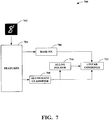
- Fig. 7 illustrates a block diagram of an exemplary system 700 that facilitates implementing an unpersonalized recognizer employing a linear combiner.
- the system can include a handwritten character and/or symbol 702, a features 704, a base-NN 706, an allograph classifier 708, an allograph folder 710 (also referred to as "allog folder 710"), and a linear combiner 712.
- the character and/or handwritten symbol 702 can be utilized with the features 704, wherein the feature vector can be applied (as discussed above).
- the unpersonalized combiner can be a linear classifier that takes as input the 2002 outputs of the allograph classifier 708, the 100 outputs of the allograph folder 710, and the 100 outputs from the base classifier 706. These inputs can be mapped to the 100 output classes.
- the unpersonalized combiner can achieve a test error rate of 5.8% on the non-personalized data set and a corresponding 9.51% test error rate on the personalized data set. The performance is slightly improved.
- Fig. 8 illustrates a block diagram of an exemplary system 800 that facilitates recognition of handwriting characters employing a personalizer support vector machine.
- the system 800 illustrates a personalized recognizer that can employ a personalizer (SVM) that can be substantially similar to the personalizer (SVM) described above and in particular Fig. 6 .
- SVM personalizer
- the unique personalized recognizer can be built for each of the 21 users in the personalized data sets.
- the personalizer can reduce the mean error rate from 9.51% to 5.64%. This relative reduction in error rate of over 40.6% indicates that the personalizer can be effective in tuning the recognizer to each of the individual users.
- FIG. 9 graphed results in accordance with the subject innovation.
- a graph 902 and a graph 904 illustrate the error rates for each of the users before and after personalization using 15 samples.
- the personalizer of Fig. 8 can reduce the error rate for 20 of the 21 users.
- the number of errors increased slightly by 3.7% (e.g., relative increase).
- the training time for each personalizer can be less than 300 seconds ( e.g., 5 minutes).
- Each pair-wise SVM classifier e.g., taking 8 samples for the first class and 8 samples for the second class
- Training 4950 pair-wise classifiers may take 1.33 seconds. However, this can be repeated for each of the 255 (C, ⁇ ) settings for model selection using grid search. Using more advanced model selection methods can reduce this by one or two orders of magnitude. Further reduction in training times can be achieved by building only those pair-wise classifiers that correspond to the largest values in the confusion matrix. Class pairs that have no confusion can be dropped from the personalizer.
- a graph 906 can illustrate personalized error rate as a function of the number of user samples.
- the personalized error rate was 7.37%, 6.06%, and 5.64%, with 5, 10, and 15 samples from the user. These values can correspond to a relative reduction of 23%, 36%, and 41%, respectively.
- the drop in error rate can be the highest in the first five samples.
- the error rate continues to decrease after 15 samples. However, given the rate of improvement, it appears that collecting more than 10 or 15 samples from the user may not warrant the subsequent reduction in the error rate, yet this can be determined by a particular user preference and is not to be limited on the subject innovation.
- the number of training samples can be expanded through the judicious use of ink based distortions.
- a simple distortion model can be assumed or built from existing ink samples (from the non-personalization set). The model can then be used to produce a 10-20 fold increase in the user samples. Using distortions can be effective in designing image based classifiers.
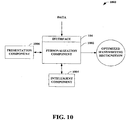
- Fig. 10 illustrates a block diagram of an exemplary system 1000 that employs intelligence to facilitate recognizing a character associated with handwriting utilizing an allograph trained classifier.
- the system 1000 can include a personalization component 1002, the interface 104, data, and optimized handwriting recognition that can all be substantially similar to respective components, data, and recognition described in previous figures.
- the system 1000 further includes an intelligent component 1004.
- the intelligent component 1004 can be utilized by the personalization component 1002 to provide optimized handwriting character recognition utilizing allograph classifiers and non-allograph classifiers.
- the intelligent component 1004 can infer handwriting characters, deterioration of handwriting characters, region specific packages, association with allographs, etc.
- the intelligent component 1004 can provide for reasoning about or infer states of the system, environment, and/or user from a set of observations as captured via events and/or data. Inference can be employed to identify a specific context or action, or can generate a probability distribution over states, for example.
- the inference can be probabilistic - that is, the computation of a probability distribution over states of interest based on a consideration of data and events.
- Inference can also refer to techniques employed for composing higher-level events from a set of events and/or data. Such inference results in the construction of new events or actions from a set of observed events and/or stored event data, whether or not the events are correlated in close temporal proximity, and whether the events and data come from one or several event and data sources.
- Such classification can employ a probabilistic and/or statistical-based analysis (e.g., factoring into the analysis utilities and costs) to prognose or infer an action that a user desires to be automatically performed.
- a support vector machine (SVM) is an example of a classifier that can be employed. The SVM operates by finding a hypersurface in the space of possible inputs, which hypersurface attempts to split the triggering criteria from the non-triggering events. Intuitively, this makes the classification correct for testing data that is near, but not identical to training data.
- directed and undirected model classification approaches include, e.g., naive Bayes, Bayesian networks, decision trees, neural networks, fuzzy logic models, and probabilistic classification models providing different patterns of independence can be employed. Classification as used herein also is inclusive of statistical regression that is utilized to develop models of priority.
- a presentation component 1006 can provide various types of user interfaces to facilitate interaction between a user and any component coupled to the personalization component 1002. As depicted, the presentation component 1006 is a separate entity that can be utilized with the personalization component 1002. However, it is to be appreciated that the presentation component 1006 and/or similar view components can be incorporated into the personalization component 1002 and/or a stand-alone unit.
- the presentation component 1006 can provide one or more graphical user interfaces (GUIs), command line interfaces, and the like. For example, a GUI can be rendered that provides a user with a region or means to load, import, read, etc., data, and can include a region to present the results of such.
- GUIs graphical user interfaces
- These regions can comprise known text and/or graphic regions comprising dialogue boxes, static controls, drop-down-menus, list boxes, pop-up menus, as edit controls, combo boxes, radio buttons, check boxes, push buttons, and graphic boxes.
- utilities to facilitate the presentation such as vertical and/or horizontal scroll bars for navigation and toolbar buttons to determine whether a region will be viewable can be employed.
- the user can interact with one or more of the components coupled to the personalization component 1002.
- the user can also interact with the regions to select and provide information via various devices such as a mouse, a roller ball, a keypad, a keyboard, a pen and/or voice activation, for example.
- a mechanism such as a push button or the enter key on the keyboard can be employed subsequent entering the information in order to initiate the search.
- a command line interface can be employed.
- the command line interface can prompt ( e.g., via a text message on a display and an audio tone) the user for information via providing a text message.
- command line interface can be employed in connection with a GUI and/or API.
- command line interface can be employed in connection with hardware (e.g., video cards) and/or displays (e.g., black and white, and EGA) with limited graphic support, and/or low bandwidth communication channels.
- Figs. 11-12 illustrate methodologies in accordance with the claimed subject matter.
- the methodologies are depicted and described as a series of acts. It is to be understood and appreciated that the subject innovation is not limited by the acts illustrated and/or by the order of acts, for example acts can occur in various orders and/or concurrently, and with other acts not presented and described herein. Furthermore, not all illustrated acts may be required to implement the methodologies in accordance with the claimed subject matter.
- those skilled in the art will understand and appreciate that the methodologies could alternatively be represented as a series of interrelated states via a state diagram or events.
- the methodologies disclosed hereinafter and throughout this specification are capable of being stored on an article of manufacture to facilitate transporting and transferring such methodologies to computers.
- the term article of manufacture, as used herein, is intended to encompass a computer program accessible from any computer-readable device, carrier, or media.
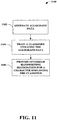
- Fig. 11 illustrates a methodology 1100 for training at least one classifier with allograph data to provide handwriting recognition.
- allograph data can be generated.
- the allograph data can be generated automatically, manually, and/or any combination thereof.
- the allograph data can be automatically generated employing any suitable clustering technique (discussed infra ).
- clustering technique discussed infra
- an automatic approach for identifying allographs e.g., character shapes and/or styles
- the allograph data can be manually provided utilizing a handwriting expert to provide types and/or styles associated with handwriting based on, for instance, geographic regions, school districts, a language, and a style of writing etc.
- handwritten character styles can exist that can be termed "allographs" that a user can loosely adhere.
- allographs There have been attempts to build a catalog of western handwritten styles, but none exist to date. Nonetheless, within the school system of any specific country, there are a handful of handwriting styles that are taught, with a particular style being adopted in any given school district.
- a classifier can be trained utilizing the allograph data.
- an allograph-neural network (NN) recognizer can be in cascade with a linear classifier, wherein the outputs from the NN can map the character feature vector to character allograph data.
- a linear combiner e.g., allograph-folder
- the allograph-trained classifier can be combined with a non-allograph trained classifier to improve accuracy for handwriting recognition.
- optimized handwriting recognition can be provided for a handwritten character by employing the classifier trained with allograph data.
- Fig. 12 illustrates a methodology 1200 that facilitates providing optimized handwriting recognition.
- a handwritten character can be received on which handwriting recognition can be implemented.
- an allograph can be created and a feature vector can be utilized.
- the allograph can be created automatically, manually, and/or any combination thereof. For instance, the allograph can be automatically created utilizing clustering ( e.g., described above).
- a first classifier can be trained with the allograph data and a second classifier can b trained with non-allograph data.
- the first classifier can be an allograph classifier (e.g., allograph-NN as described above).
- the second classifier can be a base classifier (e.g., base-NN as described above).
- the outputs of the first and second classifiers can be combined.
- the combination of the outputs can be implemented by any suitable combiner such as, but not limited to, a linear classifier (e.g., lin-combiner), a personalizer, RBF kernel, support-vector machine (SVM), etc.
- Figs. 13-14 and the following discussion is intended to provide a brief, general description of a suitable computing environment in which the various aspects of the subject innovation may be implemented.
- a personalization component provides optimized and/or enhanced handwriting recognition utilizing at least one classifier trained with allograph data, as described in the previous figures, can be implemented in such suitable computing environment.
- the claimed subject matter has been described above in the general context of computer-executable instructions of a computer program that runs on a local computer and/or remote computer, those skilled in the art will recognize that the subject innovation also may be implemented in combination with other program modules.
- program modules include routines, programs, components, data structures, etc., that perform particular tasks and/or implement particular abstract data types.
- inventive methods may be practiced with other computer system configurations, including single-processor or multi-processor computer systems, minicomputers, mainframe computers, as well as personal computers, hand-held computing devices, microprocessor-based and/or programmable consumer electronics, and the like, each of which may operatively communicate with one or more associated devices.
- the illustrated aspects of the claimed subject matter may also be practiced in distributed computing environments where certain tasks are performed by remote processing devices that are linked through a communications network. However, some, if not all, aspects of the subject innovation may be practiced on stand-alone computers.
- program modules may be located in local and/or remote memory storage devices.
- Fig. 13 is a schematic block diagram of a sample-computing environment 1300 with which the claimed subject matter can interact.
- the system 1300 includes one or more client(s) 1310.
- the client(s) 1310 can be hardware and/or software (e.g., threads, processes, computing devices).
- the system 1300 also includes one or more server(s) 1320.
- the server(s) 1320 can be hardware and/or software (e.g., threads, processes, computing devices).
- the servers 1320 can house threads to perform transformations by employing the subject innovation, for example.
- the system 1300 includes a communication framework 1340 that can be employed to facilitate communications between the client(s) 1310 and the server(s) 1320.
- the client(s) 1310 are operably connected to one or more client data store(s) 1350 that can be employed to store information local to the client(s) 1310.
- the server(s) 1320 are operably connected to one or more server data store(s) 1330 that can be employed to store information local to the servers 1320.
- an exemplary environment 1400 for implementing various aspects of the claimed subject matter includes a computer 1412.
- the computer 1412 includes a processing unit 1414, a system memory 1416, and a system bus 1418.
- the system bus 1418 couples system components including, but not limited to, the system memory 1416 to the processing unit 1414.
- the processing unit 1414 can be any of various available processors. Dual microprocessors and other multiprocessor architectures also can be employed as the processing unit 1414.
- the system bus 1418 can be any of several types of bus structure(s) including the memory bus or memory controller, a peripheral bus or external bus, and/or a local bus using any variety of available bus architectures including, but not limited to, Industrial Standard Architecture (ISA), Micro-Channel Architecture (MSA), Extended ISA (EISA), Intelligent Drive Electronics (IDE), VESA Local Bus (VLB), Peripheral Component Interconnect (PCI), Card Bus, Universal Serial Bus (USB), Advanced Graphics Port (AGP), Personal Computer Memory Card International Association bus (PCMCIA), Firewire (IEEE 1394), and Small Computer Systems Interface (SCSI).
- ISA Industrial Standard Architecture
- MSA Micro-Channel Architecture
- EISA Extended ISA
- IDE Intelligent Drive Electronics
- VLB VESA Local Bus
- PCI Peripheral Component Interconnect
- Card Bus Universal Serial Bus
- USB Universal Serial Bus
- AGP Advanced Graphics Port
- PCMCIA Personal Computer Memory Card International Association bus
- Firewire IEEE 1394
- SCSI Small Computer Systems Interface
- the system memory 1416 includes volatile memory 1420 and nonvolatile memory 1422.
- the basic input/output system (BIOS) containing the basic routines to transfer information between elements within the computer 1412, such as during start-up, is stored in nonvolatile memory 1422.
- nonvolatile memory 1422 can include read only memory (ROM), programmable ROM (PROM), electrically programmable ROM (EPROM), electrically erasable programmable ROM (EEPROM), or flash memory.
- Volatile memory 1420 includes random access memory (RAM), which acts as external cache memory.
- RAM is available in many forms such as static RAM (SRAM), dynamic RAM (DRAM), synchronous DRAM (SDRAM), double data rate SDRAM (DDR SDRAM), enhanced SDRAM (ESDRAM), Synchlink DRAM (SLDRAM), Rambus direct RAM (RDRAM), direct Rambus dynamic RAM (DRDRAM), and Rambus dynamic RAM (RDRAM).
- SRAM static RAM
- DRAM dynamic RAM
- SDRAM synchronous DRAM
- DDR SDRAM double data rate SDRAM
- ESDRAM enhanced SDRAM
- SLDRAM Synchlink DRAM
- RDRAM Rambus direct RAM
- DRAM direct Rambus dynamic RAM
- RDRAM Rambus dynamic RAM
- Disk storage 1424 includes, but is not limited to, devices like a magnetic disk drive, floppy disk drive, tape drive, Jaz drive, Zip drive, LS-100 drive, flash memory card, or memory stick.
- disk storage 1424 can include storage media separately or in combination with other storage media including, but not limited to, an optical disk drive such as a compact disk ROM device (CD-ROM), CD recordable drive (CD-R Drive), CD rewritable drive (CD-RW Drive) or a digital versatile disk ROM drive (DVD-ROM).
- an optical disk drive such as a compact disk ROM device (CD-ROM), CD recordable drive (CD-R Drive), CD rewritable drive (CD-RW Drive) or a digital versatile disk ROM drive (DVD-ROM).
- a removable or non-removable interface is typically used such as interface 1426.
- Fig. 14 describes software that acts as an intermediary between users and the basic computer resources described in the suitable operating environment 1400.
- Such software includes an operating system 1428.
- Operating system 1428 which can be stored on disk storage 1424, acts to control and allocate resources of the computer system 1412.
- System applications 1430 take advantage of the management of resources by operating system 1428 through program modules 1432 and program data 1434 stored either in system memory 1416 or on disk storage 1424. It is to be appreciated that the claimed subject matter can be implemented with various operating systems or combinations of operating systems.
- Input devices 1436 include, but are not limited to, a pointing device such as a mouse, trackball, stylus, touch pad, keyboard, microphone, joystick, game pad, satellite dish, scanner, TV tuner card, digital camera, digital video camera, web camera, and the like. These and other input devices connect to the processing unit 1414 through the system bus 1418 via interface port(s) 1438.
- Interface port(s) 1438 include, for example, a serial port, a parallel port, a game port, and a universal serial bus (USB).
- Output device(s) 1440 use some of the same type of ports as input device(s) 1436.
- a USB port may be used to provide input to computer 1412, and to output information from computer 1412 to an output device 1440.
- Output adapter 1442 is provided to illustrate that there are some output devices 1440 like monitors, speakers, and printers, among other output devices 1440, which require special adapters.
- the output adapters 1442 include, by way of illustration and not limitation, video and sound cards that provide a means of connection between the output device 1440 and the system bus 1418. It should be noted that other devices and/or systems of devices provide both input and output capabilities such as remote computer(s) 1444.
- Computer 1412 can operate in a networked environment using logical connections to one or more remote computers, such as remote computer(s) 1444.
- the remote computer(s) 1444 can be a personal computer, a server, a router, a network PC, a workstation, a microprocessor based appliance, a peer device or other common network node and the like, and typically includes many or all of the elements described relative to computer 1412. For purposes of brevity, only a memory storage device 1446 is illustrated with remote computer(s) 1444.
- Remote computer(s) 1444 is logically connected to computer 1412 through a network interface 1448 and then physically connected via communication connection 1450.
- Network interface 1448 encompasses wire and/or wireless communication networks such as local-area networks (LAN) and wide-area networks (WAN).
- LAN technologies include Fiber Distributed Data Interface (FDDI), Copper Distributed Data Interface (CDDI), Ethernet, Token Ring and the like.
- WAN technologies include, but are not limited to, point-to-point links, circuit switching networks like Integrated Services Digital Networks (ISDN) and variations thereon, packet switching networks, and Digital Subscriber Lines (DSL).
- ISDN Integrated Services Digital Networks
- DSL Digital Subscriber Lines
- Communication connection(s) 1450 refers to the hardware/software employed to connect the network interface 1448 to the bus 1418. While communication connection 1450 is shown for illustrative clarity inside computer 1412, it can also be external to computer 1412.
- the hardware/software necessary for connection to the network interface 1448 includes, for exemplary purposes only, internal and external technologies such as, modems including regular telephone grade modems, cable modems and DSL modems, ISDN adapters, and Ethernet cards.
- the terms (including a reference to a "means") used to describe such components are intended to correspond, unless otherwise indicated, to any component which performs the specified function of the described component (e.g., a functional equivalent), even though not structurally equivalent to the disclosed structure, which performs the function in the herein illustrated exemplary aspects of the claimed subject matter.
- the innovation includes a system as well as a computer-readable medium having computer-executable instructions for performing the acts and/or events of the various methods of the claimed subject matter.
Landscapes
- Engineering & Computer Science (AREA)
- Theoretical Computer Science (AREA)
- Computer Vision & Pattern Recognition (AREA)
- Physics & Mathematics (AREA)
- General Physics & Mathematics (AREA)
- Data Mining & Analysis (AREA)
- Multimedia (AREA)
- Evolutionary Computation (AREA)
- General Engineering & Computer Science (AREA)
- Artificial Intelligence (AREA)
- Life Sciences & Earth Sciences (AREA)
- Evolutionary Biology (AREA)
- Bioinformatics & Computational Biology (AREA)
- Bioinformatics & Cheminformatics (AREA)
- General Health & Medical Sciences (AREA)
- Health & Medical Sciences (AREA)
- Software Systems (AREA)
- Medical Informatics (AREA)
- Computing Systems (AREA)
- Databases & Information Systems (AREA)
- Human Computer Interaction (AREA)
- Character Discrimination (AREA)
Claims (11)
- System, das eine Auswertung von Handschriften ermöglicht, mit:einer Schnittstellenkomponente (104), die mindesten ein handschriftliches Zeichen empfängt; undeiner Personalisierungskomponente (102, 202, 1002), die aufweist:eine Klassifizierungskomponente (206), die aufweist:eine Allographen-Neuronales-Netzwerk-Klassifizierungseinheit (708), die unter Anwendung von Allographendaten trainiert ist, die mehrere unterschiedliche Handschreibstilarten für jedes Zeichen enthalten, um Zeicheneigenschaftsvektoren (504), die aus dem empfangenen mindestens einen handschriftlichen Zeichen erhalten werden, Zeichenallographen zuzuordnen; undeine Basis-Neuronales-Netzwerk-Klassifizierungseinheit (706), die dazu trainiert ist, die Eigenschaftsvektoren direkt Ausgangsklassen zuzuordnen, wobei die Klassen unterschiedlichen Zeichen entsprechen,wobei die Allographen-Neurales-Netzwerk-Klassifizierungseinheit und die Basis-Neuronales-Netzwerk-Klassifizierungseinheit verschiedene Architekturen besitzen; undeine Kombinierungskomponente (208), die Ausgaben aus der Allographen-Neuronales-Netzwerk-Klassifizierungseinheit und der Basis-Neuronales-Netzwerk-Klassifizierungseinheit kombiniert, sodass eine Handschriftenerkennung für das mindestens eine handschriftliche Zeichen bereitgestellt wird.
- System nach Anspruch 1, das ferner eine Allographenkomponente (204) aufweist, die Allographendaten erzeugt.
- System nach Anspruch 2, wobei die Allographenkomponente die Allographendaten unter Verwendung einer Clusterbildungstechnik automatisch erzeugt.
- System nach Anspruch 3, wobei die Allographendaten, die durch die Clusterbildungstechnik erzeugt sind, als ein binärer Baum visualisiert werden, der als ein Unähnlichkeitsdendogramm bezeichnet wird.
- System nach Anspruch 3, wobei die Clusterbildungstechnik eine hierarchische agglomerative Clusterbildungstechnik ist, wobei ein dynamischer Zeitverzug als ein Abstandsmaß verwendet wird.
- System nach Anspruch 1, wobei die Klassifizierungskomponente einen Eigenschaftsvektor, der aus handschriftlichen Zeichen erhalten wird, als Eingabe jeweils für die Allographen-Neuronales-Netzwerk-Klassifizierungseinheit und die Basis-Neuronales-Netzwerk-Klassifizierungseinheit verwendet.
- System nach Anspruch 6, wobei die Ausgaben der Allographen-Neuronales-Netzwerk-Klassifizierungseinheit zuerst an eine lineare Kombiniereinheit (506, 710) gesendet werden, bevor sie zu der Kombinierungskomponente gesendet werden.
- System nach Anspruch 1, wobei die Kombinierungskomponente entweder eine lineare Kombiniereinheit (210) oder eine Unterstützungsvektormaschine (212, 802) verwendet.
- System nach Anspruch 8, wobei die Unterstützungsvektormaschine lernt, die Ausgabe der Allographen-Neuronales-Netzwerk-Klassifizierungseinheit und die Ausgabe der Basis-Neuronales-Netzwerk-Klassifizierungseinheit unter Anwendung einer Handschriftenprobe von einem Benutzer zu kombinieren.
- System nach Anspruch 1, wobei die Allographendaten zumindest teilweise auf mindestens einem der folgenden beruhen: einem geografischen Gebiet, einem Schulbezirk, einer Sprache und einem Schreibstil.
- Maschinenimplementiertes Verfahren, das die Bereitstellung einer Handschriftenerkennung ermöglicht, mit:Empfangen (1202) eines handschriftlichen Zeichens;Erhalten eines Eigenschaftsvektors aus dem empfangenen handschriftlichen Zeichen;Verwenden des Eigenschaftsvektors als Eingabe in eine Allographen-Neuronales-Netzwerk-Klassifizierungseinheit (708), die unter Anwendung von Allographendaten trainiert ist, die mehrere unterschiedliche Handschriftenstile für jedes Zeichen enthalten, um Zeicheneigenschaftsvektoren (504), die aus dem empfangenen mindestens einen handschriftlichen Zeichen erhalten werden, Zeichenallographen zuzuordnen, und als Eingabe in eine Basis-Neuronales-Netzwerk-Klassifizierungseinheit (706), die dazu trainiert ist, die Zeicheneigenschaftsvektoren direkt Ausgangsklassen zuzuordnen, wobei die Klassen unterschiedlichen Zeichen entsprechen, und wobei die Allographen-Neuronales-Netzwerk-Klassifizierungseinheit und die Basis-Neuronales-Netzwerk-Klassifizierungseinheit unterschiedliche Architekturen haben; undKombinieren (1208) der Ausgaben der Allographen-Neuronales-Netzwerk-Klassifizierungseinheit und der Basis-Neuronales-Netzwerk-Klassifizierungseinheit, um eine Handschriftenerkennung für das handschriftliche Zeichen bereitzustellen.
Applications Claiming Priority (2)
| Application Number | Priority Date | Filing Date | Title |
|---|---|---|---|
| US11/305,968 US7646913B2 (en) | 2005-12-19 | 2005-12-19 | Allograph based writer adaptation for handwritten character recognition |
| PCT/US2006/048404 WO2007075669A1 (en) | 2005-12-19 | 2006-12-18 | Allograph based writer adaptation for handwritten character recognition |
Publications (3)
| Publication Number | Publication Date |
|---|---|
| EP1969487A1 EP1969487A1 (de) | 2008-09-17 |
| EP1969487A4 EP1969487A4 (de) | 2015-08-12 |
| EP1969487B1 true EP1969487B1 (de) | 2019-09-04 |
Family
ID=38173552
Family Applications (1)
| Application Number | Title | Priority Date | Filing Date |
|---|---|---|---|
| EP06845796.9A Not-in-force EP1969487B1 (de) | 2005-12-19 | 2006-12-18 | Auf allograph basierende schreiberanpassung für die erkennung handschriftlicher zeichen |
Country Status (6)
| Country | Link |
|---|---|
| US (1) | US7646913B2 (de) |
| EP (1) | EP1969487B1 (de) |
| JP (1) | JP5255450B2 (de) |
| KR (1) | KR101411241B1 (de) |
| CN (1) | CN101331476B (de) |
| WO (1) | WO2007075669A1 (de) |
Cited By (1)
| Publication number | Priority date | Publication date | Assignee | Title |
|---|---|---|---|---|
| EP4542511A1 (de) * | 2023-10-18 | 2025-04-23 | Zhejiang Hengyi Petrochemical Co., Ltd. | Modelltrainingsverfahren zur ziffern- und texterkennung, datenverarbeitungsverfahren und zugehörige vorrichtungen |
Families Citing this family (34)
| Publication number | Priority date | Publication date | Assignee | Title |
|---|---|---|---|---|
| AUPR824401A0 (en) * | 2001-10-15 | 2001-11-08 | Silverbrook Research Pty. Ltd. | Methods and systems (npw002) |
| US7418128B2 (en) * | 2003-07-31 | 2008-08-26 | Microsoft Corporation | Elastic distortions for automatic generation of labeled data |
| US7646913B2 (en) * | 2005-12-19 | 2010-01-12 | Microsoft Corporation | Allograph based writer adaptation for handwritten character recognition |
| US7886266B2 (en) * | 2006-04-06 | 2011-02-08 | Microsoft Corporation | Robust personalization through biased regularization |
| US20080199084A1 (en) * | 2007-02-19 | 2008-08-21 | Seiko Epson Corporation | Category Classification Apparatus and Category Classification Method |
| CN101373519B (zh) * | 2007-08-20 | 2011-01-19 | 富士通株式会社 | 字符识别装置和方法 |
| US8116569B2 (en) * | 2007-12-21 | 2012-02-14 | Microsoft Corporation | Inline handwriting recognition and correction |
| US8255822B2 (en) * | 2007-12-21 | 2012-08-28 | Microsoft Corporation | Incorporated handwriting input experience for textboxes |
| US8064702B2 (en) * | 2007-12-21 | 2011-11-22 | Microsoft Corporation | Handwriting templates |
| US8335381B2 (en) * | 2008-09-18 | 2012-12-18 | Xerox Corporation | Handwritten word spotter using synthesized typed queries |
| US9898187B2 (en) | 2013-06-09 | 2018-02-20 | Apple Inc. | Managing real-time handwriting recognition |
| US9495620B2 (en) | 2013-06-09 | 2016-11-15 | Apple Inc. | Multi-script handwriting recognition using a universal recognizer |
| US20140363082A1 (en) * | 2013-06-09 | 2014-12-11 | Apple Inc. | Integrating stroke-distribution information into spatial feature extraction for automatic handwriting recognition |
| US9524440B2 (en) | 2014-04-04 | 2016-12-20 | Myscript | System and method for superimposed handwriting recognition technology |
| US9384403B2 (en) | 2014-04-04 | 2016-07-05 | Myscript | System and method for superimposed handwriting recognition technology |
| KR20160073146A (ko) | 2014-12-16 | 2016-06-24 | 주식회사 디오텍 | 혼동행렬을 이용한 필기인식 단어 보정 방법 및 장치 |
| US9665769B2 (en) * | 2015-08-18 | 2017-05-30 | International Business Machines Corporation | Handwriting recognition with natural user input on multitouch surfaces |
| KR102482850B1 (ko) * | 2016-02-15 | 2022-12-29 | 삼성전자 주식회사 | 전자 장치 및 전자 장치의 필체 교정 기능 제공 방법 |
| CN107239786B (zh) | 2016-03-29 | 2022-01-11 | 阿里巴巴集团控股有限公司 | 一种字符识别方法和装置 |
| DK179374B1 (en) | 2016-06-12 | 2018-05-28 | Apple Inc | Handwriting keyboard for monitors |
| WO2018092957A1 (ko) * | 2016-11-21 | 2018-05-24 | 주식회사 알고리고 | 신경망 모델에서 입력값에 대한 재학습 여부 결정 방법, 장치 및 프로그램 |
| JP2018112839A (ja) * | 2017-01-10 | 2018-07-19 | 富士通株式会社 | 画像処理プログラム、画像認識プログラム、画像処理装置、画像認識装置、画像認識方法、及び画像処理方法 |
| KR102053885B1 (ko) * | 2018-03-07 | 2019-12-09 | 주식회사 엘렉시 | 판서 분석 시스템 및 방법과 어플리케이션 |
| KR101989960B1 (ko) * | 2018-06-21 | 2019-06-17 | 가천대학교 산학협력단 | 복수 개의 기계학습 모델을 사용한 실시간 필기 인식 방법, 이를 실행시키기 위한 프로그램을 기록한 컴퓨터 판독 가능한 기록 매체 및 실시간 필기 인식 시스템 |
| CN109784330B (zh) * | 2019-01-03 | 2021-03-23 | 北京百度网讯科技有限公司 | 招牌内容识别方法、装置及设备 |
| KR20200101481A (ko) | 2019-01-28 | 2020-08-28 | 삼성전자주식회사 | 전자 장치 및 그의 필체 보정 방법 |
| KR102759947B1 (ko) * | 2019-02-22 | 2025-02-03 | 삼성전자주식회사 | 수기에 기반한 입력을 디스플레이하기 위한 방법 및 장치 |
| US11194467B2 (en) | 2019-06-01 | 2021-12-07 | Apple Inc. | Keyboard management user interfaces |
| KR20220088166A (ko) * | 2020-12-18 | 2022-06-27 | 삼성전자주식회사 | 복수의 사용자 환경에서 필기 입력 인식 방법 및 장치 |
| EP4057182A1 (de) * | 2021-03-09 | 2022-09-14 | Société BIC | Handschriftliches feedback |
| US12046061B2 (en) | 2021-06-30 | 2024-07-23 | Konica Minolta Business Solutions U.S.A., Inc. | Handwriting recognition method and apparatus employing content aware and style aware data augmentation |
| US11914673B2 (en) | 2021-10-05 | 2024-02-27 | Prince Mohammad Bin Fahd University | System to identify authorship of handwritten text based on individual alphabets |
| KR20230080120A (ko) * | 2021-11-29 | 2023-06-07 | 삼성전자주식회사 | 전자 장치 및 전자 장치에서 필기 정보 마스킹 및 언마스킹 방법 |
| CN116841451A (zh) * | 2023-07-04 | 2023-10-03 | 上海交通大学 | 基于人体电容的手部拓展触摸屏交互方法、设备、介质 |
Family Cites Families (36)
| Publication number | Priority date | Publication date | Assignee | Title |
|---|---|---|---|---|
| US4701960A (en) | 1983-10-28 | 1987-10-20 | Texas Instruments Incorporated | Signature verification |
| US4972496A (en) | 1986-07-25 | 1990-11-20 | Grid Systems Corporation | Handwritten keyboardless entry computer system |
| FR2604004B1 (fr) | 1986-09-11 | 1990-05-11 | Anatex | Procede de reconnaissance d'ecriture manuscrite |
| US5369737A (en) | 1988-03-21 | 1994-11-29 | Digital Equipment Corporation | Normalization of vectors associated with a display pixels of computer generated images |
| JPH02263275A (ja) | 1989-04-03 | 1990-10-26 | Kiyadeitsukusu:Kk | 手書き文字の登録パターン作成方式 |
| JPH04253259A (ja) * | 1991-01-29 | 1992-09-09 | Kawasaki Steel Corp | ニューラルネットワークの学習方法 |
| JPH04279965A (ja) * | 1991-03-07 | 1992-10-06 | Koizumi Sangyo Kk | パターン認識装置 |
| US5105468A (en) | 1991-04-03 | 1992-04-14 | At&T Bell Laboratories | Time delay neural network for printed and cursive handwritten character recognition |
| US5285506A (en) | 1991-04-30 | 1994-02-08 | Ncr Corporation | Method of recording a handwritten message |
| US5544257A (en) | 1992-01-08 | 1996-08-06 | International Business Machines Corporation | Continuous parameter hidden Markov model approach to automatic handwriting recognition |
| US5442715A (en) | 1992-04-06 | 1995-08-15 | Eastman Kodak Company | Method and apparatus for cursive script recognition |
| US5502774A (en) | 1992-06-09 | 1996-03-26 | International Business Machines Corporation | Automatic recognition of a consistent message using multiple complimentary sources of information |
| US5287417A (en) | 1992-09-10 | 1994-02-15 | Microsoft Corporation | Method and system for recognizing a graphic object's shape, line style, and fill pattern in a pen environment |
| US5528699A (en) | 1992-11-24 | 1996-06-18 | Nippondenso Co., Ltd. | Information medium recognition device |
| US5491758A (en) | 1993-01-27 | 1996-02-13 | International Business Machines Corporation | Automatic handwriting recognition using both static and dynamic parameters |
| US5649068A (en) * | 1993-07-27 | 1997-07-15 | Lucent Technologies Inc. | Pattern recognition system using support vectors |
| JP2673871B2 (ja) * | 1993-08-26 | 1997-11-05 | 日本アイ・ビー・エム株式会社 | ニューラル・ネットワークによるパターン認識方法及び装置 |
| DE69425412T2 (de) * | 1993-11-23 | 2001-03-08 | International Business Machines Corp., Armonk | Anlage und Verfahren zur automatischen Handschrifterkennung mittels eines benutzerunabhängigen chirographischen Labelalphabets |
| US5854855A (en) * | 1994-09-09 | 1998-12-29 | Motorola, Inc. | Method and system using meta-classes and polynomial discriminant functions for handwriting recognition |
| US5764797A (en) | 1995-04-25 | 1998-06-09 | Microsoft Corporation | Method and system for modeling handwriting using polynomials as a function of time |
| US6094506A (en) | 1995-10-25 | 2000-07-25 | Microsoft Corporation | Automatic generation of probability tables for handwriting recognition systems |
| US5926566A (en) * | 1996-11-15 | 1999-07-20 | Synaptics, Inc. | Incremental ideographic character input method |
| US5884294A (en) * | 1997-04-18 | 1999-03-16 | Northrop Grumman Corporation | System and method for functional recognition of emitters |
| US5889523A (en) | 1997-11-25 | 1999-03-30 | Fuji Xerox Co., Ltd. | Method and apparatus for dynamically grouping a plurality of graphic objects |
| US6320985B1 (en) | 1998-07-31 | 2001-11-20 | International Business Machines Corporation | Apparatus and method for augmenting data in handwriting recognition system |
| US7336827B2 (en) * | 2000-11-08 | 2008-02-26 | New York University | System, process and software arrangement for recognizing handwritten characters |
| AUPR824401A0 (en) * | 2001-10-15 | 2001-11-08 | Silverbrook Research Pty. Ltd. | Methods and systems (npw002) |
| BR0309322A (pt) * | 2002-04-19 | 2007-03-06 | Computer Ass Think Inc | dados numéricos e/ou não numéricos misturados de processamento |
| SE0202446D0 (sv) * | 2002-08-16 | 2002-08-16 | Decuma Ab Ideon Res Park | Presenting recognised handwritten symbols |
| US7184591B2 (en) * | 2003-05-21 | 2007-02-27 | Microsoft Corporation | Systems and methods for adaptive handwriting recognition |
| AU2004271639B2 (en) * | 2003-09-05 | 2010-09-23 | Gannon Technologies Group | Systems and methods for biometric identification using handwriting recognition |
| JP4231375B2 (ja) * | 2003-10-03 | 2009-02-25 | 日本電信電話株式会社 | パターン認識装置、パターン認識方法、パターン認識プログラムおよびパターン認識プログラムを記録した記録媒体。 |
| KR100621845B1 (ko) * | 2004-04-07 | 2006-09-14 | 김계영 | 필기문자 자동인식을 통한 언어교육시스템 및 그 방법 |
| JP2005309920A (ja) * | 2004-04-23 | 2005-11-04 | Alliance Group Inc | 多数決装置及びその学習方法と多クラス識別装置 |
| US7646913B2 (en) * | 2005-12-19 | 2010-01-12 | Microsoft Corporation | Allograph based writer adaptation for handwritten character recognition |
| US7724957B2 (en) * | 2006-07-31 | 2010-05-25 | Microsoft Corporation | Two tiered text recognition |
-
2005
- 2005-12-19 US US11/305,968 patent/US7646913B2/en active Active
-
2006
- 2006-12-18 CN CN2006800471874A patent/CN101331476B/zh not_active Expired - Fee Related
- 2006-12-18 JP JP2008547437A patent/JP5255450B2/ja not_active Expired - Fee Related
- 2006-12-18 WO PCT/US2006/048404 patent/WO2007075669A1/en not_active Ceased
- 2006-12-18 EP EP06845796.9A patent/EP1969487B1/de not_active Not-in-force
- 2006-12-18 KR KR1020087013987A patent/KR101411241B1/ko not_active Expired - Fee Related
Non-Patent Citations (1)
| Title |
|---|
| None * |
Cited By (1)
| Publication number | Priority date | Publication date | Assignee | Title |
|---|---|---|---|---|
| EP4542511A1 (de) * | 2023-10-18 | 2025-04-23 | Zhejiang Hengyi Petrochemical Co., Ltd. | Modelltrainingsverfahren zur ziffern- und texterkennung, datenverarbeitungsverfahren und zugehörige vorrichtungen |
Also Published As
| Publication number | Publication date |
|---|---|
| KR101411241B1 (ko) | 2014-06-24 |
| EP1969487A1 (de) | 2008-09-17 |
| KR20080086449A (ko) | 2008-09-25 |
| JP2009520305A (ja) | 2009-05-21 |
| WO2007075669A1 (en) | 2007-07-05 |
| US20070140561A1 (en) | 2007-06-21 |
| US7646913B2 (en) | 2010-01-12 |
| EP1969487A4 (de) | 2015-08-12 |
| CN101331476B (zh) | 2012-07-11 |
| CN101331476A (zh) | 2008-12-24 |
| JP5255450B2 (ja) | 2013-08-07 |
Similar Documents
| Publication | Publication Date | Title |
|---|---|---|
| US7646913B2 (en) | Allograph based writer adaptation for handwritten character recognition | |
| CN101496036B (zh) | 两层文本识别系统和方法 | |
| Jayadevan et al. | Offline recognition of Devanagari script: a survey | |
| Zhou et al. | Handwritten Chinese/Japanese text recognition using semi-Markov conditional random fields | |
| CN101373519B (zh) | 字符识别装置和方法 | |
| CN104205126B (zh) | 对手写字符的无旋转识别 | |
| Awal et al. | First experiments on a new online handwritten flowchart database | |
| Kaur et al. | Offline handwritten Gurumukhi word recognition using eXtreme Gradient Boosting methodology: H. Kaur, M. Kumar | |
| Kaur et al. | A comprehensive survey on word recognition for non-Indic and Indic scripts | |
| Álvaro et al. | Classification of on-line mathematical symbols with hybrid features and recurrent neural networks | |
| Tavoli et al. | Statistical geometric components of straight lines (SGCSL) feature extraction method for offline Arabic/Persian handwritten words recognition | |
| Ghadhban et al. | Survey of offline Arabic handwriting word recognition | |
| Gummaraju et al. | Performance comparison of machine learning models for handwritten devanagari numerals classification | |
| Omidiora et al. | Comparison of machine learning classifiers for recognition of online and offline handwritten digits | |
| Srihari et al. | Offline Chinese handwriting recognition: A survey | |
| Murthy et al. | Choice of Classifiers in Hierarchical Recognition of Online Handwritten Kannada and Tamil Aksharas. | |
| Neves et al. | An efficient way of combining SVMs for handwritten digit recognition | |
| Ghosh et al. | SVM and HMM classifier combination based approach for online handwritten Indic character recognition | |
| JP5237110B2 (ja) | 論理構造およびレイアウトに基づくオフラインの文字認識 | |
| Neeba et al. | Recognition of Malayalam documents | |
| Chellapilla et al. | Allograph based writer adaptation for handwritten character recognition | |
| Awaida et al. | Automatic check digits recognition for Arabic using multi-scale features, HMM and SVM classifiers | |
| Alamri et al. | A new approach for segmentation and recognition of Arabic handwritten touching numeral pairs | |
| Sharma | Handwritten digit recognition using support vector machine | |
| Al-Boeridi et al. | A scalable hybrid decision system (HDS) for Roman word recognition using ANN SVM: study case on Malay word recognition |
Legal Events
| Date | Code | Title | Description |
|---|---|---|---|
| PUAI | Public reference made under article 153(3) epc to a published international application that has entered the european phase |
Free format text: ORIGINAL CODE: 0009012 |
|
| 17P | Request for examination filed |
Effective date: 20080715 |
|
| AK | Designated contracting states |
Kind code of ref document: A1 Designated state(s): AT BE BG CH CY CZ DE DK EE ES FI FR GB GR HU IE IS IT LI LT LU LV MC NL PL PT RO SE SI SK TR |
|
| DAX | Request for extension of the european patent (deleted) | ||
| RIC1 | Information provided on ipc code assigned before grant |
Ipc: G06K 9/22 20060101ALI20141112BHEP Ipc: G06K 9/62 20060101ALI20141112BHEP Ipc: G06K 9/00 20060101ALI20141112BHEP Ipc: G06F 17/00 20060101AFI20141112BHEP |
|
| RAP1 | Party data changed (applicant data changed or rights of an application transferred) |
Owner name: MICROSOFT TECHNOLOGY LICENSING, LLC |
|
| RA4 | Supplementary search report drawn up and despatched (corrected) |
Effective date: 20150713 |
|
| RIC1 | Information provided on ipc code assigned before grant |
Ipc: G06K 9/62 20060101ALI20150707BHEP Ipc: G06F 17/00 20060101AFI20150707BHEP Ipc: G06K 9/22 20060101ALI20150707BHEP Ipc: G06K 9/00 20060101ALI20150707BHEP |
|
| STAA | Information on the status of an ep patent application or granted ep patent |
Free format text: STATUS: EXAMINATION IS IN PROGRESS |
|
| 17Q | First examination report despatched |
Effective date: 20170524 |
|
| GRAP | Despatch of communication of intention to grant a patent |
Free format text: ORIGINAL CODE: EPIDOSNIGR1 |
|
| STAA | Information on the status of an ep patent application or granted ep patent |
Free format text: STATUS: GRANT OF PATENT IS INTENDED |
|
| INTG | Intention to grant announced |
Effective date: 20190404 |
|
| GRAS | Grant fee paid |
Free format text: ORIGINAL CODE: EPIDOSNIGR3 |
|
| GRAA | (expected) grant |
Free format text: ORIGINAL CODE: 0009210 |
|
| STAA | Information on the status of an ep patent application or granted ep patent |
Free format text: STATUS: THE PATENT HAS BEEN GRANTED |
|
| AK | Designated contracting states |
Kind code of ref document: B1 Designated state(s): AT BE BG CH CY CZ DE DK EE ES FI FR GB GR HU IE IS IT LI LT LU LV MC NL PL PT RO SE SI SK TR |
|
| REG | Reference to a national code |
Ref country code: GB Ref legal event code: FG4D |
|
| REG | Reference to a national code |
Ref country code: CH Ref legal event code: EP |
|
| REG | Reference to a national code |
Ref country code: AT Ref legal event code: REF Ref document number: 1176382 Country of ref document: AT Kind code of ref document: T Effective date: 20190915 |
|
| REG | Reference to a national code |
Ref country code: DE Ref legal event code: R096 Ref document number: 602006058559 Country of ref document: DE |
|
| REG | Reference to a national code |
Ref country code: IE Ref legal event code: FG4D |
|
| REG | Reference to a national code |
Ref country code: NL Ref legal event code: FP |
|
| REG | Reference to a national code |
Ref country code: LT Ref legal event code: MG4D |
|
| PG25 | Lapsed in a contracting state [announced via postgrant information from national office to epo] |
Ref country code: BG Free format text: LAPSE BECAUSE OF FAILURE TO SUBMIT A TRANSLATION OF THE DESCRIPTION OR TO PAY THE FEE WITHIN THE PRESCRIBED TIME-LIMIT Effective date: 20191204 Ref country code: LT Free format text: LAPSE BECAUSE OF FAILURE TO SUBMIT A TRANSLATION OF THE DESCRIPTION OR TO PAY THE FEE WITHIN THE PRESCRIBED TIME-LIMIT Effective date: 20190904 Ref country code: FI Free format text: LAPSE BECAUSE OF FAILURE TO SUBMIT A TRANSLATION OF THE DESCRIPTION OR TO PAY THE FEE WITHIN THE PRESCRIBED TIME-LIMIT Effective date: 20190904 Ref country code: SE Free format text: LAPSE BECAUSE OF FAILURE TO SUBMIT A TRANSLATION OF THE DESCRIPTION OR TO PAY THE FEE WITHIN THE PRESCRIBED TIME-LIMIT Effective date: 20190904 |
|
| PG25 | Lapsed in a contracting state [announced via postgrant information from national office to epo] |
Ref country code: GR Free format text: LAPSE BECAUSE OF FAILURE TO SUBMIT A TRANSLATION OF THE DESCRIPTION OR TO PAY THE FEE WITHIN THE PRESCRIBED TIME-LIMIT Effective date: 20191205 Ref country code: LV Free format text: LAPSE BECAUSE OF FAILURE TO SUBMIT A TRANSLATION OF THE DESCRIPTION OR TO PAY THE FEE WITHIN THE PRESCRIBED TIME-LIMIT Effective date: 20190904 Ref country code: ES Free format text: LAPSE BECAUSE OF FAILURE TO SUBMIT A TRANSLATION OF THE DESCRIPTION OR TO PAY THE FEE WITHIN THE PRESCRIBED TIME-LIMIT Effective date: 20190904 |
|
| REG | Reference to a national code |
Ref country code: AT Ref legal event code: MK05 Ref document number: 1176382 Country of ref document: AT Kind code of ref document: T Effective date: 20190904 |
|
| PG25 | Lapsed in a contracting state [announced via postgrant information from national office to epo] |
Ref country code: PT Free format text: LAPSE BECAUSE OF FAILURE TO SUBMIT A TRANSLATION OF THE DESCRIPTION OR TO PAY THE FEE WITHIN THE PRESCRIBED TIME-LIMIT Effective date: 20200106 Ref country code: IT Free format text: LAPSE BECAUSE OF FAILURE TO SUBMIT A TRANSLATION OF THE DESCRIPTION OR TO PAY THE FEE WITHIN THE PRESCRIBED TIME-LIMIT Effective date: 20190904 Ref country code: PL Free format text: LAPSE BECAUSE OF FAILURE TO SUBMIT A TRANSLATION OF THE DESCRIPTION OR TO PAY THE FEE WITHIN THE PRESCRIBED TIME-LIMIT Effective date: 20190904 Ref country code: EE Free format text: LAPSE BECAUSE OF FAILURE TO SUBMIT A TRANSLATION OF THE DESCRIPTION OR TO PAY THE FEE WITHIN THE PRESCRIBED TIME-LIMIT Effective date: 20190904 Ref country code: AT Free format text: LAPSE BECAUSE OF FAILURE TO SUBMIT A TRANSLATION OF THE DESCRIPTION OR TO PAY THE FEE WITHIN THE PRESCRIBED TIME-LIMIT Effective date: 20190904 Ref country code: RO Free format text: LAPSE BECAUSE OF FAILURE TO SUBMIT A TRANSLATION OF THE DESCRIPTION OR TO PAY THE FEE WITHIN THE PRESCRIBED TIME-LIMIT Effective date: 20190904 |
|
| PG25 | Lapsed in a contracting state [announced via postgrant information from national office to epo] |
Ref country code: CZ Free format text: LAPSE BECAUSE OF FAILURE TO SUBMIT A TRANSLATION OF THE DESCRIPTION OR TO PAY THE FEE WITHIN THE PRESCRIBED TIME-LIMIT Effective date: 20190904 Ref country code: SK Free format text: LAPSE BECAUSE OF FAILURE TO SUBMIT A TRANSLATION OF THE DESCRIPTION OR TO PAY THE FEE WITHIN THE PRESCRIBED TIME-LIMIT Effective date: 20190904 Ref country code: IS Free format text: LAPSE BECAUSE OF FAILURE TO SUBMIT A TRANSLATION OF THE DESCRIPTION OR TO PAY THE FEE WITHIN THE PRESCRIBED TIME-LIMIT Effective date: 20200224 |
|
| REG | Reference to a national code |
Ref country code: DE Ref legal event code: R097 Ref document number: 602006058559 Country of ref document: DE |
|
| PLBE | No opposition filed within time limit |
Free format text: ORIGINAL CODE: 0009261 |
|
| STAA | Information on the status of an ep patent application or granted ep patent |
Free format text: STATUS: NO OPPOSITION FILED WITHIN TIME LIMIT |
|
| PG2D | Information on lapse in contracting state deleted |
Ref country code: IS |
|
| PG25 | Lapsed in a contracting state [announced via postgrant information from national office to epo] |
Ref country code: DK Free format text: LAPSE BECAUSE OF FAILURE TO SUBMIT A TRANSLATION OF THE DESCRIPTION OR TO PAY THE FEE WITHIN THE PRESCRIBED TIME-LIMIT Effective date: 20190904 Ref country code: IS Free format text: LAPSE BECAUSE OF FAILURE TO SUBMIT A TRANSLATION OF THE DESCRIPTION OR TO PAY THE FEE WITHIN THE PRESCRIBED TIME-LIMIT Effective date: 20200105 |
|
| REG | Reference to a national code |
Ref country code: CH Ref legal event code: PL |
|
| 26N | No opposition filed |
Effective date: 20200605 |
|
| REG | Reference to a national code |
Ref country code: BE Ref legal event code: MM Effective date: 20191231 |
|
| PG25 | Lapsed in a contracting state [announced via postgrant information from national office to epo] |
Ref country code: SI Free format text: LAPSE BECAUSE OF FAILURE TO SUBMIT A TRANSLATION OF THE DESCRIPTION OR TO PAY THE FEE WITHIN THE PRESCRIBED TIME-LIMIT Effective date: 20190904 Ref country code: MC Free format text: LAPSE BECAUSE OF FAILURE TO SUBMIT A TRANSLATION OF THE DESCRIPTION OR TO PAY THE FEE WITHIN THE PRESCRIBED TIME-LIMIT Effective date: 20190904 |
|
| PG25 | Lapsed in a contracting state [announced via postgrant information from national office to epo] |
Ref country code: LU Free format text: LAPSE BECAUSE OF NON-PAYMENT OF DUE FEES Effective date: 20191218 Ref country code: IE Free format text: LAPSE BECAUSE OF NON-PAYMENT OF DUE FEES Effective date: 20191218 |
|
| PG25 | Lapsed in a contracting state [announced via postgrant information from national office to epo] |
Ref country code: CH Free format text: LAPSE BECAUSE OF NON-PAYMENT OF DUE FEES Effective date: 20191231 Ref country code: LI Free format text: LAPSE BECAUSE OF NON-PAYMENT OF DUE FEES Effective date: 20191231 Ref country code: BE Free format text: LAPSE BECAUSE OF NON-PAYMENT OF DUE FEES Effective date: 20191231 |
|
| PG25 | Lapsed in a contracting state [announced via postgrant information from national office to epo] |
Ref country code: CY Free format text: LAPSE BECAUSE OF FAILURE TO SUBMIT A TRANSLATION OF THE DESCRIPTION OR TO PAY THE FEE WITHIN THE PRESCRIBED TIME-LIMIT Effective date: 20190904 |
|
| PG25 | Lapsed in a contracting state [announced via postgrant information from national office to epo] |
Ref country code: HU Free format text: LAPSE BECAUSE OF FAILURE TO SUBMIT A TRANSLATION OF THE DESCRIPTION OR TO PAY THE FEE WITHIN THE PRESCRIBED TIME-LIMIT; INVALID AB INITIO Effective date: 20061218 |
|
| PGFP | Annual fee paid to national office [announced via postgrant information from national office to epo] |
Ref country code: FR Payment date: 20211109 Year of fee payment: 16 |
|
| PG25 | Lapsed in a contracting state [announced via postgrant information from national office to epo] |
Ref country code: TR Free format text: LAPSE BECAUSE OF FAILURE TO SUBMIT A TRANSLATION OF THE DESCRIPTION OR TO PAY THE FEE WITHIN THE PRESCRIBED TIME-LIMIT Effective date: 20190904 |
|
| P01 | Opt-out of the competence of the unified patent court (upc) registered |
Effective date: 20230505 |
|
| PG25 | Lapsed in a contracting state [announced via postgrant information from national office to epo] |
Ref country code: FR Free format text: LAPSE BECAUSE OF NON-PAYMENT OF DUE FEES Effective date: 20221231 |
|
| PGFP | Annual fee paid to national office [announced via postgrant information from national office to epo] |
Ref country code: NL Payment date: 20231121 Year of fee payment: 18 |
|
| PGFP | Annual fee paid to national office [announced via postgrant information from national office to epo] |
Ref country code: GB Payment date: 20231121 Year of fee payment: 18 |
|
| PGFP | Annual fee paid to national office [announced via postgrant information from national office to epo] |
Ref country code: DE Payment date: 20231121 Year of fee payment: 18 |
|
| REG | Reference to a national code |
Ref country code: DE Ref legal event code: R119 Ref document number: 602006058559 Country of ref document: DE |
|
| REG | Reference to a national code |
Ref country code: NL Ref legal event code: MM Effective date: 20250101 |
|
| GBPC | Gb: european patent ceased through non-payment of renewal fee |
Effective date: 20241218 |
|
| PG25 | Lapsed in a contracting state [announced via postgrant information from national office to epo] |
Ref country code: NL Free format text: LAPSE BECAUSE OF NON-PAYMENT OF DUE FEES Effective date: 20250101 |
|
| PG25 | Lapsed in a contracting state [announced via postgrant information from national office to epo] |
Ref country code: DE Free format text: LAPSE BECAUSE OF NON-PAYMENT OF DUE FEES Effective date: 20250701 |
|
| PG25 | Lapsed in a contracting state [announced via postgrant information from national office to epo] |
Ref country code: GB Free format text: LAPSE BECAUSE OF NON-PAYMENT OF DUE FEES Effective date: 20241218 |