EP1969397B1 - Method for preparing silicone hydrogels - Google Patents
Method for preparing silicone hydrogels Download PDFInfo
- Publication number
- EP1969397B1 EP1969397B1 EP06829539.3A EP06829539A EP1969397B1 EP 1969397 B1 EP1969397 B1 EP 1969397B1 EP 06829539 A EP06829539 A EP 06829539A EP 1969397 B1 EP1969397 B1 EP 1969397B1
- Authority
- EP
- European Patent Office
- Prior art keywords
- group
- silicone hydrogel
- vinylic monomer
- fluid composition
- polymerizable fluid
- Prior art date
- Legal status (The legal status is an assumption and is not a legal conclusion. Google has not performed a legal analysis and makes no representation as to the accuracy of the status listed.)
- Not-in-force
Links
- 239000000017 hydrogel Substances 0.000 title claims description 84
- 229920001296 polysiloxane Polymers 0.000 title claims description 84
- 238000000034 method Methods 0.000 title claims description 70
- 239000000203 mixture Substances 0.000 claims description 149
- 239000000463 material Substances 0.000 claims description 109
- 239000000178 monomer Substances 0.000 claims description 100
- 239000012530 fluid Substances 0.000 claims description 63
- 125000002348 vinylic group Chemical group 0.000 claims description 57
- 229920000642 polymer Polymers 0.000 claims description 53
- QVGXLLKOCUKJST-UHFFFAOYSA-N atomic oxygen Chemical compound [O] QVGXLLKOCUKJST-UHFFFAOYSA-N 0.000 claims description 45
- 239000001301 oxygen Substances 0.000 claims description 45
- 229910052760 oxygen Inorganic materials 0.000 claims description 45
- PPBRXRYQALVLMV-UHFFFAOYSA-N Styrene Chemical compound C=CC1=CC=CC=C1 PPBRXRYQALVLMV-UHFFFAOYSA-N 0.000 claims description 38
- 239000003999 initiator Substances 0.000 claims description 38
- 230000035699 permeability Effects 0.000 claims description 37
- 230000000845 anti-microbial effect Effects 0.000 claims description 28
- -1 phosphino group Chemical group 0.000 claims description 26
- KPUWHANPEXNPJT-UHFFFAOYSA-N disiloxane Chemical class [SiH3]O[SiH3] KPUWHANPEXNPJT-UHFFFAOYSA-N 0.000 claims description 23
- XLYOFNOQVPJJNP-UHFFFAOYSA-N water Substances O XLYOFNOQVPJJNP-UHFFFAOYSA-N 0.000 claims description 22
- GDOPTJXRTPNYNR-UHFFFAOYSA-N methyl-cyclopentane Natural products CC1CCCC1 GDOPTJXRTPNYNR-UHFFFAOYSA-N 0.000 claims description 20
- 238000002156 mixing Methods 0.000 claims description 20
- 125000000753 cycloalkyl group Chemical group 0.000 claims description 19
- 238000000465 moulding Methods 0.000 claims description 19
- 125000003118 aryl group Chemical group 0.000 claims description 16
- 125000000217 alkyl group Chemical group 0.000 claims description 14
- 230000005764 inhibitory process Effects 0.000 claims description 13
- 230000000379 polymerizing effect Effects 0.000 claims description 13
- 230000009467 reduction Effects 0.000 claims description 13
- 230000009477 glass transition Effects 0.000 claims description 12
- UZFMOKQJFYMBGY-UHFFFAOYSA-N 4-hydroxy-TEMPO Chemical compound CC1(C)CC(O)CC(C)(C)N1[O] UZFMOKQJFYMBGY-UHFFFAOYSA-N 0.000 claims description 10
- 125000000623 heterocyclic group Chemical group 0.000 claims description 10
- 239000004599 antimicrobial Substances 0.000 claims description 8
- 125000002887 hydroxy group Chemical group [H]O* 0.000 claims description 8
- 239000003431 cross linking reagent Substances 0.000 claims description 7
- KGIGUEBEKRSTEW-UHFFFAOYSA-N 2-vinylpyridine Chemical compound C=CC1=CC=CC=N1 KGIGUEBEKRSTEW-UHFFFAOYSA-N 0.000 claims description 6
- FOIXSVOLVBLSDH-UHFFFAOYSA-N Silver ion Chemical compound [Ag+] FOIXSVOLVBLSDH-UHFFFAOYSA-N 0.000 claims description 6
- NIXOWILDQLNWCW-UHFFFAOYSA-N acrylic acid group Chemical group C(C=C)(=O)O NIXOWILDQLNWCW-UHFFFAOYSA-N 0.000 claims description 6
- XXROGKLTLUQVRX-UHFFFAOYSA-N allyl alcohol Chemical compound OCC=C XXROGKLTLUQVRX-UHFFFAOYSA-N 0.000 claims description 6
- 239000003795 chemical substances by application Substances 0.000 claims description 6
- 244000005700 microbiome Species 0.000 claims description 6
- WHNWPMSKXPGLAX-UHFFFAOYSA-N N-Vinyl-2-pyrrolidone Chemical compound C=CN1CCCC1=O WHNWPMSKXPGLAX-UHFFFAOYSA-N 0.000 claims description 5
- 241000589517 Pseudomonas aeruginosa Species 0.000 claims description 5
- 241000191967 Staphylococcus aureus Species 0.000 claims description 5
- 125000003545 alkoxy group Chemical group 0.000 claims description 5
- 125000003277 amino group Chemical group 0.000 claims description 5
- QGZKDVFQNNGYKY-UHFFFAOYSA-O ammonium group Chemical group [NH4+] QGZKDVFQNNGYKY-UHFFFAOYSA-O 0.000 claims description 5
- 125000004104 aryloxy group Chemical group 0.000 claims description 5
- 125000000707 boryl group Chemical group B* 0.000 claims description 5
- 150000007942 carboxylates Chemical group 0.000 claims description 5
- 150000001875 compounds Chemical class 0.000 claims description 5
- 125000004122 cyclic group Chemical group 0.000 claims description 5
- 229920006395 saturated elastomer Polymers 0.000 claims description 5
- 125000003808 silyl group Chemical group [H][Si]([H])([H])[*] 0.000 claims description 5
- QAOWNCQODCNURD-UHFFFAOYSA-L sulfate group Chemical group S(=O)(=O)([O-])[O-] QAOWNCQODCNURD-UHFFFAOYSA-L 0.000 claims description 5
- 125000001273 sulfonato group Chemical group [O-]S(*)(=O)=O 0.000 claims description 5
- 125000004149 thio group Chemical group *S* 0.000 claims description 5
- 125000004169 (C1-C6) alkyl group Chemical group 0.000 claims description 4
- MYRTYDVEIRVNKP-UHFFFAOYSA-N 1,2-Divinylbenzene Chemical compound C=CC1=CC=CC=C1C=C MYRTYDVEIRVNKP-UHFFFAOYSA-N 0.000 claims description 4
- SMZOUWXMTYCWNB-UHFFFAOYSA-N 2-(2-methoxy-5-methylphenyl)ethanamine Chemical compound COC1=CC=C(C)C=C1CCN SMZOUWXMTYCWNB-UHFFFAOYSA-N 0.000 claims description 4
- JKNCOURZONDCGV-UHFFFAOYSA-N 2-(dimethylamino)ethyl 2-methylprop-2-enoate Chemical compound CN(C)CCOC(=O)C(C)=C JKNCOURZONDCGV-UHFFFAOYSA-N 0.000 claims description 4
- GNSFRPWPOGYVLO-UHFFFAOYSA-N 3-hydroxypropyl 2-methylprop-2-enoate Chemical compound CC(=C)C(=O)OCCCO GNSFRPWPOGYVLO-UHFFFAOYSA-N 0.000 claims description 4
- KFDVPJUYSDEJTH-UHFFFAOYSA-N 4-ethenylpyridine Chemical compound C=CC1=CC=NC=C1 KFDVPJUYSDEJTH-UHFFFAOYSA-N 0.000 claims description 4
- HRPVXLWXLXDGHG-UHFFFAOYSA-N Acrylamide Chemical compound NC(=O)C=C HRPVXLWXLXDGHG-UHFFFAOYSA-N 0.000 claims description 4
- NLHHRLWOUZZQLW-UHFFFAOYSA-N Acrylonitrile Chemical compound C=CC#N NLHHRLWOUZZQLW-UHFFFAOYSA-N 0.000 claims description 4
- GYCMBHHDWRMZGG-UHFFFAOYSA-N Methylacrylonitrile Chemical compound CC(=C)C#N GYCMBHHDWRMZGG-UHFFFAOYSA-N 0.000 claims description 4
- OMIGHNLMNHATMP-UHFFFAOYSA-N 2-hydroxyethyl prop-2-enoate Chemical compound OCCOC(=O)C=C OMIGHNLMNHATMP-UHFFFAOYSA-N 0.000 claims description 3
- 239000006096 absorbing agent Substances 0.000 claims description 3
- 238000011049 filling Methods 0.000 claims description 3
- FQPSGWSUVKBHSU-UHFFFAOYSA-N methacrylamide Chemical compound CC(=C)C(N)=O FQPSGWSUVKBHSU-UHFFFAOYSA-N 0.000 claims description 3
- QNILTEGFHQSKFF-UHFFFAOYSA-N n-propan-2-ylprop-2-enamide Chemical compound CC(C)NC(=O)C=C QNILTEGFHQSKFF-UHFFFAOYSA-N 0.000 claims description 3
- 125000000008 (C1-C10) alkyl group Chemical group 0.000 claims description 2
- CORMBJOFDGICKF-UHFFFAOYSA-N 1,3,5-trimethoxy 2-vinyl benzene Natural products COC1=CC(OC)=C(C=C)C(OC)=C1 CORMBJOFDGICKF-UHFFFAOYSA-N 0.000 claims description 2
- LVJZCPNIJXVIAT-UHFFFAOYSA-N 1-ethenyl-2,3,4,5,6-pentafluorobenzene Chemical compound FC1=C(F)C(F)=C(C=C)C(F)=C1F LVJZCPNIJXVIAT-UHFFFAOYSA-N 0.000 claims description 2
- QRIMLDXJAPZHJE-UHFFFAOYSA-N 2,3-dihydroxypropyl 2-methylprop-2-enoate Chemical compound CC(=C)C(=O)OCC(O)CO QRIMLDXJAPZHJE-UHFFFAOYSA-N 0.000 claims description 2
- PDELBHCVXBSVPJ-UHFFFAOYSA-N 2-ethenyl-1,3,5-trimethylbenzene Chemical compound CC1=CC(C)=C(C=C)C(C)=C1 PDELBHCVXBSVPJ-UHFFFAOYSA-N 0.000 claims description 2
- VHSHLMUCYSAUQU-UHFFFAOYSA-N 2-hydroxypropyl methacrylate Chemical compound CC(O)COC(=O)C(C)=C VHSHLMUCYSAUQU-UHFFFAOYSA-N 0.000 claims description 2
- KXYAVSFOJVUIHT-UHFFFAOYSA-N 2-vinylnaphthalene Chemical compound C1=CC=CC2=CC(C=C)=CC=C21 KXYAVSFOJVUIHT-UHFFFAOYSA-N 0.000 claims description 2
- DXIJHCSGLOHNES-UHFFFAOYSA-N 3,3-dimethylbut-1-enylbenzene Chemical compound CC(C)(C)C=CC1=CC=CC=C1 DXIJHCSGLOHNES-UHFFFAOYSA-N 0.000 claims description 2
- QZPSOSOOLFHYRR-UHFFFAOYSA-N 3-hydroxypropyl prop-2-enoate Chemical compound OCCCOC(=O)C=C QZPSOSOOLFHYRR-UHFFFAOYSA-N 0.000 claims description 2
- LVGSUQNJVOIUIW-UHFFFAOYSA-N 5-(dimethylamino)-2-methylpent-2-enamide Chemical compound CN(C)CCC=C(C)C(N)=O LVGSUQNJVOIUIW-UHFFFAOYSA-N 0.000 claims description 2
- WOBHKFSMXKNTIM-UHFFFAOYSA-N Hydroxyethyl methacrylate Chemical compound CC(=C)C(=O)OCCO WOBHKFSMXKNTIM-UHFFFAOYSA-N 0.000 claims description 2
- CERQOIWHTDAKMF-UHFFFAOYSA-N Methacrylic acid Chemical compound CC(=C)C(O)=O CERQOIWHTDAKMF-UHFFFAOYSA-N 0.000 claims description 2
- AOJOEFVRHOZDFN-UHFFFAOYSA-N benzyl 2-methylprop-2-enoate Chemical compound CC(=C)C(=O)OCC1=CC=CC=C1 AOJOEFVRHOZDFN-UHFFFAOYSA-N 0.000 claims description 2
- 125000000582 cycloheptyl group Chemical group [H]C1([H])C([H])([H])C([H])([H])C([H])([H])C([H])(*)C([H])([H])C1([H])[H] 0.000 claims description 2
- 125000000113 cyclohexyl group Chemical group [H]C1([H])C([H])([H])C([H])([H])C([H])(*)C([H])([H])C1([H])[H] 0.000 claims description 2
- 125000001511 cyclopentyl group Chemical group [H]C1([H])C([H])([H])C([H])([H])C([H])(*)C1([H])[H] 0.000 claims description 2
- 229940088644 n,n-dimethylacrylamide Drugs 0.000 claims description 2
- YLGYACDQVQQZSW-UHFFFAOYSA-N n,n-dimethylprop-2-enamide Chemical group CN(C)C(=O)C=C YLGYACDQVQQZSW-UHFFFAOYSA-N 0.000 claims description 2
- OMNKZBIFPJNNIO-UHFFFAOYSA-N n-(2-methyl-4-oxopentan-2-yl)prop-2-enamide Chemical compound CC(=O)CC(C)(C)NC(=O)C=C OMNKZBIFPJNNIO-UHFFFAOYSA-N 0.000 claims description 2
- GETQZCLCWQTVFV-UHFFFAOYSA-N trimethylamine Chemical compound CN(C)C GETQZCLCWQTVFV-UHFFFAOYSA-N 0.000 claims description 2
- WSGDRFHJFJRSFY-UHFFFAOYSA-N 4-oxo-TEMPO Chemical compound CC1(C)CC(=O)CC(C)(C)N1[O] WSGDRFHJFJRSFY-UHFFFAOYSA-N 0.000 claims 1
- 238000009472 formulation Methods 0.000 description 51
- OZAIFHULBGXAKX-UHFFFAOYSA-N 2-(2-cyanopropan-2-yldiazenyl)-2-methylpropanenitrile Chemical compound N#CC(C)(C)N=NC(C)(C)C#N OZAIFHULBGXAKX-UHFFFAOYSA-N 0.000 description 48
- 238000006116 polymerization reaction Methods 0.000 description 34
- 150000003254 radicals Chemical class 0.000 description 29
- IJGRMHOSHXDMSA-UHFFFAOYSA-N Atomic nitrogen Chemical compound N#N IJGRMHOSHXDMSA-UHFFFAOYSA-N 0.000 description 26
- 238000001723 curing Methods 0.000 description 22
- 230000008569 process Effects 0.000 description 21
- 230000010220 ion permeability Effects 0.000 description 19
- 238000000576 coating method Methods 0.000 description 16
- XKRFYHLGVUSROY-UHFFFAOYSA-N Argon Chemical compound [Ar] XKRFYHLGVUSROY-UHFFFAOYSA-N 0.000 description 14
- 239000011521 glass Substances 0.000 description 14
- 239000002904 solvent Substances 0.000 description 14
- 229910052757 nitrogen Inorganic materials 0.000 description 13
- 239000011248 coating agent Substances 0.000 description 12
- 230000003287 optical effect Effects 0.000 description 12
- 210000003660 reticulum Anatomy 0.000 description 12
- 238000007872 degassing Methods 0.000 description 10
- 238000009792 diffusion process Methods 0.000 description 10
- 239000003921 oil Substances 0.000 description 10
- 239000000049 pigment Substances 0.000 description 10
- 238000012360 testing method Methods 0.000 description 10
- KFZMGEQAYNKOFK-UHFFFAOYSA-N Isopropanol Chemical compound CC(C)O KFZMGEQAYNKOFK-UHFFFAOYSA-N 0.000 description 9
- 238000004519 manufacturing process Methods 0.000 description 9
- 239000000126 substance Substances 0.000 description 9
- NIXOWILDQLNWCW-UHFFFAOYSA-M Acrylate Chemical compound [O-]C(=O)C=C NIXOWILDQLNWCW-UHFFFAOYSA-M 0.000 description 8
- 238000006243 chemical reaction Methods 0.000 description 8
- 230000002209 hydrophobic effect Effects 0.000 description 8
- 229910052786 argon Inorganic materials 0.000 description 7
- 239000012986 chain transfer agent Substances 0.000 description 7
- 239000000499 gel Substances 0.000 description 7
- 229910052751 metal Inorganic materials 0.000 description 7
- 239000002184 metal Substances 0.000 description 7
- 229920000831 ionic polymer Polymers 0.000 description 6
- 239000007788 liquid Substances 0.000 description 6
- 238000005259 measurement Methods 0.000 description 6
- 239000002082 metal nanoparticle Substances 0.000 description 6
- 238000012986 modification Methods 0.000 description 6
- 230000004048 modification Effects 0.000 description 6
- 230000007547 defect Effects 0.000 description 5
- 239000000975 dye Substances 0.000 description 5
- 229920001971 elastomer Polymers 0.000 description 5
- 230000005660 hydrophilic surface Effects 0.000 description 5
- 238000011417 postcuring Methods 0.000 description 5
- 239000000243 solution Substances 0.000 description 5
- 150000001252 acrylic acid derivatives Chemical class 0.000 description 4
- 239000002801 charged material Substances 0.000 description 4
- 238000004132 cross linking Methods 0.000 description 4
- 238000010438 heat treatment Methods 0.000 description 4
- 150000002734 metacrylic acid derivatives Chemical class 0.000 description 4
- 239000002105 nanoparticle Substances 0.000 description 4
- 239000002861 polymer material Substances 0.000 description 4
- 230000005855 radiation Effects 0.000 description 4
- 239000003381 stabilizer Substances 0.000 description 4
- 238000003756 stirring Methods 0.000 description 4
- 238000004381 surface treatment Methods 0.000 description 4
- 238000001029 thermal curing Methods 0.000 description 4
- 238000009966 trimming Methods 0.000 description 4
- WYGWHHGCAGTUCH-UHFFFAOYSA-N 2-[(2-cyano-4-methylpentan-2-yl)diazenyl]-2,4-dimethylpentanenitrile Chemical compound CC(C)CC(C)(C#N)N=NC(C)(C#N)CC(C)C WYGWHHGCAGTUCH-UHFFFAOYSA-N 0.000 description 3
- 125000003903 2-propenyl group Chemical group [H]C([*])([H])C([H])=C([H])[H] 0.000 description 3
- BESKSSIEODQWBP-UHFFFAOYSA-N 3-tris(trimethylsilyloxy)silylpropyl 2-methylprop-2-enoate Chemical compound CC(=C)C(=O)OCCC[Si](O[Si](C)(C)C)(O[Si](C)(C)C)O[Si](C)(C)C BESKSSIEODQWBP-UHFFFAOYSA-N 0.000 description 3
- QTBSBXVTEAMEQO-UHFFFAOYSA-N Acetic acid Chemical compound CC(O)=O QTBSBXVTEAMEQO-UHFFFAOYSA-N 0.000 description 3
- CSCPPACGZOOCGX-UHFFFAOYSA-N Acetone Chemical compound CC(C)=O CSCPPACGZOOCGX-UHFFFAOYSA-N 0.000 description 3
- CERQOIWHTDAKMF-UHFFFAOYSA-M Methacrylate Chemical compound CC(=C)C([O-])=O CERQOIWHTDAKMF-UHFFFAOYSA-M 0.000 description 3
- OKKJLVBELUTLKV-UHFFFAOYSA-N Methanol Chemical compound OC OKKJLVBELUTLKV-UHFFFAOYSA-N 0.000 description 3
- VVQNEPGJFQJSBK-UHFFFAOYSA-N Methyl methacrylate Chemical compound COC(=O)C(C)=C VVQNEPGJFQJSBK-UHFFFAOYSA-N 0.000 description 3
- BQCADISMDOOEFD-UHFFFAOYSA-N Silver Chemical compound [Ag] BQCADISMDOOEFD-UHFFFAOYSA-N 0.000 description 3
- YXFVVABEGXRONW-UHFFFAOYSA-N Toluene Chemical compound CC1=CC=CC=C1 YXFVVABEGXRONW-UHFFFAOYSA-N 0.000 description 3
- ZMANZCXQSJIPKH-UHFFFAOYSA-N Triethylamine Chemical compound CCN(CC)CC ZMANZCXQSJIPKH-UHFFFAOYSA-N 0.000 description 3
- UKLDJPRMSDWDSL-UHFFFAOYSA-L [dibutyl(dodecanoyloxy)stannyl] dodecanoate Chemical compound CCCCCCCCCCCC(=O)O[Sn](CCCC)(CCCC)OC(=O)CCCCCCCCCCC UKLDJPRMSDWDSL-UHFFFAOYSA-L 0.000 description 3
- 230000015572 biosynthetic process Effects 0.000 description 3
- 210000001124 body fluid Anatomy 0.000 description 3
- 239000010839 body fluid Substances 0.000 description 3
- 238000007334 copolymerization reaction Methods 0.000 description 3
- 239000012975 dibutyltin dilaurate Substances 0.000 description 3
- 230000000694 effects Effects 0.000 description 3
- SUPCQIBBMFXVTL-UHFFFAOYSA-N ethyl 2-methylprop-2-enoate Chemical compound CCOC(=O)C(C)=C SUPCQIBBMFXVTL-UHFFFAOYSA-N 0.000 description 3
- 230000004438 eyesight Effects 0.000 description 3
- 239000007789 gas Substances 0.000 description 3
- 229920001519 homopolymer Polymers 0.000 description 3
- 230000001404 mediated effect Effects 0.000 description 3
- 150000002739 metals Chemical class 0.000 description 3
- 230000003647 oxidation Effects 0.000 description 3
- 238000007254 oxidation reaction Methods 0.000 description 3
- 238000002360 preparation method Methods 0.000 description 3
- 238000012545 processing Methods 0.000 description 3
- NHARPDSAXCBDDR-UHFFFAOYSA-N propyl 2-methylprop-2-enoate Chemical compound CCCOC(=O)C(C)=C NHARPDSAXCBDDR-UHFFFAOYSA-N 0.000 description 3
- 230000002829 reductive effect Effects 0.000 description 3
- 229910052709 silver Inorganic materials 0.000 description 3
- 238000009864 tensile test Methods 0.000 description 3
- RMVRSNDYEFQCLF-UHFFFAOYSA-N thiophenol Chemical compound SC1=CC=CC=C1 RMVRSNDYEFQCLF-UHFFFAOYSA-N 0.000 description 3
- 238000004448 titration Methods 0.000 description 3
- 125000000391 vinyl group Chemical group [H]C([*])=C([H])[H] 0.000 description 3
- VXNZUUAINFGPBY-UHFFFAOYSA-N 1-Butene Chemical compound CCC=C VXNZUUAINFGPBY-UHFFFAOYSA-N 0.000 description 2
- CSGAUKGQUCHWDP-UHFFFAOYSA-N 1-hydroxy-2,2,6,6-tetramethylpiperidin-4-ol Chemical compound CC1(C)CC(O)CC(C)(C)N1O CSGAUKGQUCHWDP-UHFFFAOYSA-N 0.000 description 2
- 239000012956 1-hydroxycyclohexylphenyl-ketone Substances 0.000 description 2
- PIZHFBODNLEQBL-UHFFFAOYSA-N 2,2-diethoxy-1-phenylethanone Chemical compound CCOC(OCC)C(=O)C1=CC=CC=C1 PIZHFBODNLEQBL-UHFFFAOYSA-N 0.000 description 2
- AVTLBBWTUPQRAY-UHFFFAOYSA-N 2-(2-cyanobutan-2-yldiazenyl)-2-methylbutanenitrile Chemical compound CCC(C)(C#N)N=NC(C)(CC)C#N AVTLBBWTUPQRAY-UHFFFAOYSA-N 0.000 description 2
- BQZJOQXSCSZQPS-UHFFFAOYSA-N 2-methoxy-1,2-diphenylethanone Chemical compound C=1C=CC=CC=1C(OC)C(=O)C1=CC=CC=C1 BQZJOQXSCSZQPS-UHFFFAOYSA-N 0.000 description 2
- ZIFLDVXQTMSDJE-UHFFFAOYSA-N 3-[[dimethyl-[3-(2-methylprop-2-enoyloxy)propyl]silyl]oxy-dimethylsilyl]propyl 2-methylprop-2-enoate Chemical compound CC(=C)C(=O)OCCC[Si](C)(C)O[Si](C)(C)CCCOC(=O)C(C)=C ZIFLDVXQTMSDJE-UHFFFAOYSA-N 0.000 description 2
- NWBTXZPDTSKZJU-UHFFFAOYSA-N 3-[dimethyl(trimethylsilyloxy)silyl]propyl 2-methylprop-2-enoate Chemical compound CC(=C)C(=O)OCCC[Si](C)(C)O[Si](C)(C)C NWBTXZPDTSKZJU-UHFFFAOYSA-N 0.000 description 2
- DBCAQXHNJOFNGC-UHFFFAOYSA-N 4-bromo-1,1,1-trifluorobutane Chemical group FC(F)(F)CCCBr DBCAQXHNJOFNGC-UHFFFAOYSA-N 0.000 description 2
- 239000004342 Benzoyl peroxide Substances 0.000 description 2
- OMPJBNCRMGITSC-UHFFFAOYSA-N Benzoylperoxide Chemical compound C=1C=CC=CC=1C(=O)OOC(=O)C1=CC=CC=C1 OMPJBNCRMGITSC-UHFFFAOYSA-N 0.000 description 2
- KAKZBPTYRLMSJV-UHFFFAOYSA-N Butadiene Chemical compound C=CC=C KAKZBPTYRLMSJV-UHFFFAOYSA-N 0.000 description 2
- HEDRZPFGACZZDS-UHFFFAOYSA-N Chloroform Chemical compound ClC(Cl)Cl HEDRZPFGACZZDS-UHFFFAOYSA-N 0.000 description 2
- 239000004971 Cross linker Substances 0.000 description 2
- LFQSCWFLJHTTHZ-UHFFFAOYSA-N Ethanol Chemical compound CCO LFQSCWFLJHTTHZ-UHFFFAOYSA-N 0.000 description 2
- QUSNBJAOOMFDIB-UHFFFAOYSA-N Ethylamine Chemical compound CCN QUSNBJAOOMFDIB-UHFFFAOYSA-N 0.000 description 2
- BAPJBEWLBFYGME-UHFFFAOYSA-N Methyl acrylate Chemical compound COC(=O)C=C BAPJBEWLBFYGME-UHFFFAOYSA-N 0.000 description 2
- HLJYBXJFKDDIBI-UHFFFAOYSA-N O=[PH2]C(=O)C1=CC=CC=C1 Chemical compound O=[PH2]C(=O)C1=CC=CC=C1 HLJYBXJFKDDIBI-UHFFFAOYSA-N 0.000 description 2
- IAXXETNIOYFMLW-COPLHBTASA-N [(1s,3s,4s)-4,7,7-trimethyl-3-bicyclo[2.2.1]heptanyl] 2-methylprop-2-enoate Chemical compound C1C[C@]2(C)[C@@H](OC(=O)C(=C)C)C[C@H]1C2(C)C IAXXETNIOYFMLW-COPLHBTASA-N 0.000 description 2
- 150000003926 acrylamides Chemical class 0.000 description 2
- 125000003282 alkyl amino group Chemical group 0.000 description 2
- 229910052782 aluminium Inorganic materials 0.000 description 2
- XAGFODPZIPBFFR-UHFFFAOYSA-N aluminium Chemical compound [Al] XAGFODPZIPBFFR-UHFFFAOYSA-N 0.000 description 2
- 230000008901 benefit Effects 0.000 description 2
- 235000019400 benzoyl peroxide Nutrition 0.000 description 2
- MQDJYUACMFCOFT-UHFFFAOYSA-N bis[2-(1-hydroxycyclohexyl)phenyl]methanone Chemical compound C=1C=CC=C(C(=O)C=2C(=CC=CC=2)C2(O)CCCCC2)C=1C1(O)CCCCC1 MQDJYUACMFCOFT-UHFFFAOYSA-N 0.000 description 2
- IISBACLAFKSPIT-UHFFFAOYSA-N bisphenol A Chemical compound C=1C=C(O)C=CC=1C(C)(C)C1=CC=C(O)C=C1 IISBACLAFKSPIT-UHFFFAOYSA-N 0.000 description 2
- 229920001400 block copolymer Polymers 0.000 description 2
- HQABUPZFAYXKJW-UHFFFAOYSA-N butan-1-amine Chemical compound CCCCN HQABUPZFAYXKJW-UHFFFAOYSA-N 0.000 description 2
- 230000008859 change Effects 0.000 description 2
- KBLWLMPSVYBVDK-UHFFFAOYSA-N cyclohexyl prop-2-enoate Chemical compound C=CC(=O)OC1CCCCC1 KBLWLMPSVYBVDK-UHFFFAOYSA-N 0.000 description 2
- 238000000151 deposition Methods 0.000 description 2
- 230000008021 deposition Effects 0.000 description 2
- 238000013461 design Methods 0.000 description 2
- 238000000113 differential scanning calorimetry Methods 0.000 description 2
- 239000004205 dimethyl polysiloxane Substances 0.000 description 2
- 238000003618 dip coating Methods 0.000 description 2
- LOKCTEFSRHRXRJ-UHFFFAOYSA-I dipotassium trisodium dihydrogen phosphate hydrogen phosphate dichloride Chemical compound P(=O)(O)(O)[O-].[K+].P(=O)(O)([O-])[O-].[Na+].[Na+].[Cl-].[K+].[Cl-].[Na+] LOKCTEFSRHRXRJ-UHFFFAOYSA-I 0.000 description 2
- DNJIEGIFACGWOD-UHFFFAOYSA-N ethanethiol Chemical compound CCS DNJIEGIFACGWOD-UHFFFAOYSA-N 0.000 description 2
- FJKIXWOMBXYWOQ-UHFFFAOYSA-N ethenoxyethane Chemical compound CCOC=C FJKIXWOMBXYWOQ-UHFFFAOYSA-N 0.000 description 2
- LYCAIKOWRPUZTN-UHFFFAOYSA-N ethylene glycol Natural products OCCO LYCAIKOWRPUZTN-UHFFFAOYSA-N 0.000 description 2
- STVZJERGLQHEKB-UHFFFAOYSA-N ethylene glycol dimethacrylate Substances CC(=C)C(=O)OCCOC(=O)C(C)=C STVZJERGLQHEKB-UHFFFAOYSA-N 0.000 description 2
- 238000002474 experimental method Methods 0.000 description 2
- 239000012632 extractable Substances 0.000 description 2
- 238000000605 extraction Methods 0.000 description 2
- 239000000945 filler Substances 0.000 description 2
- 238000000227 grinding Methods 0.000 description 2
- 230000036541 health Effects 0.000 description 2
- WGCNASOHLSPBMP-UHFFFAOYSA-N hydroxyacetaldehyde Natural products OCC=O WGCNASOHLSPBMP-UHFFFAOYSA-N 0.000 description 2
- 150000002500 ions Chemical class 0.000 description 2
- 229940119545 isobornyl methacrylate Drugs 0.000 description 2
- NIMLQBUJDJZYEJ-UHFFFAOYSA-N isophorone diisocyanate Chemical compound CC1(C)CC(N=C=O)CC(C)(CN=C=O)C1 NIMLQBUJDJZYEJ-UHFFFAOYSA-N 0.000 description 2
- RBQRWNWVPQDTJJ-UHFFFAOYSA-N methacryloyloxyethyl isocyanate Chemical compound CC(=C)C(=O)OCCN=C=O RBQRWNWVPQDTJJ-UHFFFAOYSA-N 0.000 description 2
- 238000005497 microtitration Methods 0.000 description 2
- 239000002245 particle Substances 0.000 description 2
- 239000010702 perfluoropolyether Substances 0.000 description 2
- 230000002093 peripheral effect Effects 0.000 description 2
- 150000002978 peroxides Chemical class 0.000 description 2
- 125000001997 phenyl group Chemical group [H]C1=C([H])C([H])=C(*)C([H])=C1[H] 0.000 description 2
- 239000002953 phosphate buffered saline Substances 0.000 description 2
- 229920000435 poly(dimethylsiloxane) Polymers 0.000 description 2
- 125000002924 primary amino group Chemical group [H]N([H])* 0.000 description 2
- BOQSSGDQNWEFSX-UHFFFAOYSA-N propan-2-yl 2-methylprop-2-enoate Chemical compound CC(C)OC(=O)C(C)=C BOQSSGDQNWEFSX-UHFFFAOYSA-N 0.000 description 2
- SUVIGLJNEAMWEG-UHFFFAOYSA-N propane-1-thiol Chemical compound CCCS SUVIGLJNEAMWEG-UHFFFAOYSA-N 0.000 description 2
- 230000010076 replication Effects 0.000 description 2
- YGSDEFSMJLZEOE-UHFFFAOYSA-N salicylic acid Chemical compound OC(=O)C1=CC=CC=C1O YGSDEFSMJLZEOE-UHFFFAOYSA-N 0.000 description 2
- VYPSYNLAJGMNEJ-UHFFFAOYSA-N silicon dioxide Inorganic materials O=[Si]=O VYPSYNLAJGMNEJ-UHFFFAOYSA-N 0.000 description 2
- 239000004332 silver Substances 0.000 description 2
- 150000003384 small molecules Chemical class 0.000 description 2
- 238000002791 soaking Methods 0.000 description 2
- 229910001415 sodium ion Inorganic materials 0.000 description 2
- 238000005507 spraying Methods 0.000 description 2
- 230000003068 static effect Effects 0.000 description 2
- SJMYWORNLPSJQO-UHFFFAOYSA-N tert-butyl 2-methylprop-2-enoate Chemical compound CC(=C)C(=O)OC(C)(C)C SJMYWORNLPSJQO-UHFFFAOYSA-N 0.000 description 2
- HJUGFYREWKUQJT-UHFFFAOYSA-N tetrabromomethane Chemical compound BrC(Br)(Br)Br HJUGFYREWKUQJT-UHFFFAOYSA-N 0.000 description 2
- VZGDMQKNWNREIO-UHFFFAOYSA-N tetrachloromethane Chemical compound ClC(Cl)(Cl)Cl VZGDMQKNWNREIO-UHFFFAOYSA-N 0.000 description 2
- DGVVWUTYPXICAM-UHFFFAOYSA-N β‐Mercaptoethanol Chemical compound OCCS DGVVWUTYPXICAM-UHFFFAOYSA-N 0.000 description 2
- PSGCQDPCAWOCSH-UHFFFAOYSA-N (4,7,7-trimethyl-3-bicyclo[2.2.1]heptanyl) prop-2-enoate Chemical compound C1CC2(C)C(OC(=O)C=C)CC1C2(C)C PSGCQDPCAWOCSH-UHFFFAOYSA-N 0.000 description 1
- 125000004178 (C1-C4) alkyl group Chemical group 0.000 description 1
- FMQPBWHSNCRVQJ-UHFFFAOYSA-N 1,1,1,3,3,3-hexafluoropropan-2-yl 2-methylprop-2-enoate Chemical compound CC(=C)C(=O)OC(C(F)(F)F)C(F)(F)F FMQPBWHSNCRVQJ-UHFFFAOYSA-N 0.000 description 1
- LCPUCXXYIYXLJY-UHFFFAOYSA-N 1,1,2,4,4,4-hexafluorobutyl 2-methylprop-2-enoate Chemical compound CC(=C)C(=O)OC(F)(F)C(F)CC(F)(F)F LCPUCXXYIYXLJY-UHFFFAOYSA-N 0.000 description 1
- WVAFEFUPWRPQSY-UHFFFAOYSA-N 1,2,3-tris(ethenyl)benzene Chemical compound C=CC1=CC=CC(C=C)=C1C=C WVAFEFUPWRPQSY-UHFFFAOYSA-N 0.000 description 1
- WKBPZYKAUNRMKP-UHFFFAOYSA-N 1-[2-(2,4-dichlorophenyl)pentyl]1,2,4-triazole Chemical compound C=1C=C(Cl)C=C(Cl)C=1C(CCC)CN1C=NC=N1 WKBPZYKAUNRMKP-UHFFFAOYSA-N 0.000 description 1
- CTXUTPWZJZHRJC-UHFFFAOYSA-N 1-ethenylpyrrole Chemical compound C=CN1C=CC=C1 CTXUTPWZJZHRJC-UHFFFAOYSA-N 0.000 description 1
- KGRVJHAUYBGFFP-UHFFFAOYSA-N 2,2'-Methylenebis(4-methyl-6-tert-butylphenol) Chemical compound CC(C)(C)C1=CC(C)=CC(CC=2C(=C(C=C(C)C=2)C(C)(C)C)O)=C1O KGRVJHAUYBGFFP-UHFFFAOYSA-N 0.000 description 1
- QTKPMCIBUROOGY-UHFFFAOYSA-N 2,2,2-trifluoroethyl 2-methylprop-2-enoate Chemical compound CC(=C)C(=O)OCC(F)(F)F QTKPMCIBUROOGY-UHFFFAOYSA-N 0.000 description 1
- OOHZIRUJZFRULE-UHFFFAOYSA-N 2,2-dimethylpropyl 2-methylprop-2-enoate Chemical compound CC(=C)C(=O)OCC(C)(C)C OOHZIRUJZFRULE-UHFFFAOYSA-N 0.000 description 1
- OEPOKWHJYJXUGD-UHFFFAOYSA-N 2-(3-phenylmethoxyphenyl)-1,3-thiazole-4-carbaldehyde Chemical compound O=CC1=CSC(C=2C=C(OCC=3C=CC=CC=3)C=CC=2)=N1 OEPOKWHJYJXUGD-UHFFFAOYSA-N 0.000 description 1
- 229920000536 2-Acrylamido-2-methylpropane sulfonic acid Polymers 0.000 description 1
- GOXQRTZXKQZDDN-UHFFFAOYSA-N 2-Ethylhexyl acrylate Chemical compound CCCCC(CC)COC(=O)C=C GOXQRTZXKQZDDN-UHFFFAOYSA-N 0.000 description 1
- GJKGAPPUXSSCFI-UHFFFAOYSA-N 2-Hydroxy-4'-(2-hydroxyethoxy)-2-methylpropiophenone Chemical compound CC(C)(O)C(=O)C1=CC=C(OCCO)C=C1 GJKGAPPUXSSCFI-UHFFFAOYSA-N 0.000 description 1
- XHZPRMZZQOIPDS-UHFFFAOYSA-N 2-Methyl-2-[(1-oxo-2-propenyl)amino]-1-propanesulfonic acid Chemical compound OS(=O)(=O)CC(C)(C)NC(=O)C=C XHZPRMZZQOIPDS-UHFFFAOYSA-N 0.000 description 1
- BQBSIHIZDSHADD-UHFFFAOYSA-N 2-ethenyl-4,5-dihydro-1,3-oxazole Chemical compound C=CC1=NCCO1 BQBSIHIZDSHADD-UHFFFAOYSA-N 0.000 description 1
- RIWRBSMFKVOJMN-UHFFFAOYSA-N 2-methyl-1-phenylpropan-2-ol Chemical compound CC(C)(O)CC1=CC=CC=C1 RIWRBSMFKVOJMN-UHFFFAOYSA-N 0.000 description 1
- 238000012935 Averaging Methods 0.000 description 1
- 239000004641 Diallyl-phthalate Substances 0.000 description 1
- CUDSBWGCGSUXDB-UHFFFAOYSA-N Dibutyl disulfide Chemical compound CCCCSSCCCC CUDSBWGCGSUXDB-UHFFFAOYSA-N 0.000 description 1
- BWGNESOTFCXPMA-UHFFFAOYSA-N Dihydrogen disulfide Chemical compound SS BWGNESOTFCXPMA-UHFFFAOYSA-N 0.000 description 1
- RWSOTUBLDIXVET-UHFFFAOYSA-N Dihydrogen sulfide Chemical class S RWSOTUBLDIXVET-UHFFFAOYSA-N 0.000 description 1
- JIGUQPWFLRLWPJ-UHFFFAOYSA-N Ethyl acrylate Chemical compound CCOC(=O)C=C JIGUQPWFLRLWPJ-UHFFFAOYSA-N 0.000 description 1
- 208000010412 Glaucoma Diseases 0.000 description 1
- 101150055539 HADH gene Proteins 0.000 description 1
- OAKJQQAXSVQMHS-UHFFFAOYSA-N Hydrazine Chemical compound NN OAKJQQAXSVQMHS-UHFFFAOYSA-N 0.000 description 1
- AVXURJPOCDRRFD-UHFFFAOYSA-N Hydroxylamine Chemical class ON AVXURJPOCDRRFD-UHFFFAOYSA-N 0.000 description 1
- 239000005058 Isophorone diisocyanate Substances 0.000 description 1
- LSDPWZHWYPCBBB-UHFFFAOYSA-N Methanethiol Chemical compound SC LSDPWZHWYPCBBB-UHFFFAOYSA-N 0.000 description 1
- NFFRLZCGHFMGEP-UHFFFAOYSA-N OC(C(C(C(C(C(C(C(C(F)(F)F)(F)F)(F)F)(F)F)(F)F)(F)F)(F)F)=C(C(C(N(F)F)(F)F)(F)F)C(C(C(F)(F)F)(F)F)=S)=O Chemical compound OC(C(C(C(C(C(C(C(C(F)(F)F)(F)F)(F)F)(F)F)(F)F)(F)F)(F)F)=C(C(C(N(F)F)(F)F)(F)F)C(C(C(F)(F)F)(F)F)=S)=O NFFRLZCGHFMGEP-UHFFFAOYSA-N 0.000 description 1
- 229920003171 Poly (ethylene oxide) Polymers 0.000 description 1
- 239000004698 Polyethylene Substances 0.000 description 1
- 229920001616 Polymacon Polymers 0.000 description 1
- 239000004743 Polypropylene Substances 0.000 description 1
- FAPWRFPIFSIZLT-UHFFFAOYSA-M Sodium chloride Chemical compound [Na+].[Cl-] FAPWRFPIFSIZLT-UHFFFAOYSA-M 0.000 description 1
- ZJCCRDAZUWHFQH-UHFFFAOYSA-N Trimethylolpropane Chemical compound CCC(CO)(CO)CO ZJCCRDAZUWHFQH-UHFFFAOYSA-N 0.000 description 1
- XTXRWKRVRITETP-UHFFFAOYSA-N Vinyl acetate Chemical compound CC(=O)OC=C XTXRWKRVRITETP-UHFFFAOYSA-N 0.000 description 1
- BZHJMEDXRYGGRV-UHFFFAOYSA-N Vinyl chloride Chemical compound ClC=C BZHJMEDXRYGGRV-UHFFFAOYSA-N 0.000 description 1
- QYKIQEUNHZKYBP-UHFFFAOYSA-N Vinyl ether Chemical compound C=COC=C QYKIQEUNHZKYBP-UHFFFAOYSA-N 0.000 description 1
- 125000003647 acryloyl group Chemical group O=C([*])C([H])=C([H])[H] 0.000 description 1
- 150000001298 alcohols Chemical class 0.000 description 1
- 150000001335 aliphatic alkanes Chemical class 0.000 description 1
- 125000002947 alkylene group Chemical group 0.000 description 1
- 150000001412 amines Chemical class 0.000 description 1
- 229910052787 antimony Inorganic materials 0.000 description 1
- 239000007864 aqueous solution Substances 0.000 description 1
- 150000001504 aryl thiols Chemical class 0.000 description 1
- 230000005540 biological transmission Effects 0.000 description 1
- QUDWYFHPNIMBFC-UHFFFAOYSA-N bis(prop-2-enyl) benzene-1,2-dicarboxylate Chemical compound C=CCOC(=O)C1=CC=CC=C1C(=O)OCC=C QUDWYFHPNIMBFC-UHFFFAOYSA-N 0.000 description 1
- 229910052797 bismuth Inorganic materials 0.000 description 1
- 230000000740 bleeding effect Effects 0.000 description 1
- 238000012662 bulk polymerization Methods 0.000 description 1
- WQAQPCDUOCURKW-UHFFFAOYSA-N butanethiol Chemical compound CCCCS WQAQPCDUOCURKW-UHFFFAOYSA-N 0.000 description 1
- 125000004432 carbon atom Chemical group C* 0.000 description 1
- 150000001735 carboxylic acids Chemical class 0.000 description 1
- 238000005266 casting Methods 0.000 description 1
- 239000000919 ceramic Substances 0.000 description 1
- 125000003636 chemical group Chemical group 0.000 description 1
- 239000013626 chemical specie Substances 0.000 description 1
- YACLQRRMGMJLJV-UHFFFAOYSA-N chloroprene Chemical compound ClC(=C)C=C YACLQRRMGMJLJV-UHFFFAOYSA-N 0.000 description 1
- 238000004140 cleaning Methods 0.000 description 1
- 238000004040 coloring Methods 0.000 description 1
- 238000007796 conventional method Methods 0.000 description 1
- 238000001816 cooling Methods 0.000 description 1
- 229910052802 copper Inorganic materials 0.000 description 1
- 210000004087 cornea Anatomy 0.000 description 1
- 238000012937 correction Methods 0.000 description 1
- 238000003869 coulometry Methods 0.000 description 1
- 229920006037 cross link polymer Polymers 0.000 description 1
- OIWOHHBRDFKZNC-UHFFFAOYSA-N cyclohexyl 2-methylprop-2-enoate Chemical compound CC(=C)C(=O)OC1CCCCC1 OIWOHHBRDFKZNC-UHFFFAOYSA-N 0.000 description 1
- QQODLKZGRKWIFG-UHFFFAOYSA-N cyfluthrin Chemical compound CC1(C)C(C=C(Cl)Cl)C1C(=O)OC(C#N)C1=CC=C(F)C(OC=2C=CC=CC=2)=C1 QQODLKZGRKWIFG-UHFFFAOYSA-N 0.000 description 1
- 230000003247 decreasing effect Effects 0.000 description 1
- 230000001419 dependent effect Effects 0.000 description 1
- 230000000249 desinfective effect Effects 0.000 description 1
- 238000001514 detection method Methods 0.000 description 1
- 239000010432 diamond Substances 0.000 description 1
- 229910003460 diamond Inorganic materials 0.000 description 1
- 239000000539 dimer Substances 0.000 description 1
- AFOSIXZFDONLBT-UHFFFAOYSA-N divinyl sulfone Chemical compound C=CS(=O)(=O)C=C AFOSIXZFDONLBT-UHFFFAOYSA-N 0.000 description 1
- 238000012377 drug delivery Methods 0.000 description 1
- 238000005516 engineering process Methods 0.000 description 1
- MEGHWIAOTJPCHQ-UHFFFAOYSA-N ethenyl butanoate Chemical compound CCCC(=O)OC=C MEGHWIAOTJPCHQ-UHFFFAOYSA-N 0.000 description 1
- BLZSRIYYOIZLJL-UHFFFAOYSA-N ethenyl pentanoate Chemical compound CCCCC(=O)OC=C BLZSRIYYOIZLJL-UHFFFAOYSA-N 0.000 description 1
- UIWXSTHGICQLQT-UHFFFAOYSA-N ethenyl propanoate Chemical compound CCC(=O)OC=C UIWXSTHGICQLQT-UHFFFAOYSA-N 0.000 description 1
- 125000000524 functional group Chemical group 0.000 description 1
- 230000005251 gamma ray Effects 0.000 description 1
- 238000001879 gelation Methods 0.000 description 1
- ZEKANFGSDXODPD-UHFFFAOYSA-N glyphosate-isopropylammonium Chemical compound CC(C)N.OC(=O)CNCP(O)(O)=O ZEKANFGSDXODPD-UHFFFAOYSA-N 0.000 description 1
- 229910052737 gold Inorganic materials 0.000 description 1
- 230000007407 health benefit Effects 0.000 description 1
- 238000000265 homogenisation Methods 0.000 description 1
- 230000036571 hydration Effects 0.000 description 1
- 238000006703 hydration reaction Methods 0.000 description 1
- 229920001477 hydrophilic polymer Polymers 0.000 description 1
- 229910052738 indium Inorganic materials 0.000 description 1
- APFVFJFRJDLVQX-UHFFFAOYSA-N indium atom Chemical compound [In] APFVFJFRJDLVQX-UHFFFAOYSA-N 0.000 description 1
- 239000011261 inert gas Substances 0.000 description 1
- 230000002401 inhibitory effect Effects 0.000 description 1
- 230000000977 initiatory effect Effects 0.000 description 1
- 238000001746 injection moulding Methods 0.000 description 1
- 230000037427 ion transport Effects 0.000 description 1
- 229910052741 iridium Inorganic materials 0.000 description 1
- 229940091853 isobornyl acrylate Drugs 0.000 description 1
- 239000012948 isocyanate Substances 0.000 description 1
- IQPQWNKOIGAROB-UHFFFAOYSA-N isocyanate group Chemical group [N-]=C=O IQPQWNKOIGAROB-UHFFFAOYSA-N 0.000 description 1
- 150000002513 isocyanates Chemical class 0.000 description 1
- 150000002605 large molecules Chemical class 0.000 description 1
- 239000012633 leachable Substances 0.000 description 1
- 230000000670 limiting effect Effects 0.000 description 1
- 150000002632 lipids Chemical class 0.000 description 1
- 238000003754 machining Methods 0.000 description 1
- 230000007246 mechanism Effects 0.000 description 1
- 239000000155 melt Substances 0.000 description 1
- 239000012528 membrane Substances 0.000 description 1
- 125000005641 methacryl group Chemical group 0.000 description 1
- 230000007935 neutral effect Effects 0.000 description 1
- 239000012299 nitrogen atmosphere Substances 0.000 description 1
- 231100000252 nontoxic Toxicity 0.000 description 1
- 230000003000 nontoxic effect Effects 0.000 description 1
- 229910052763 palladium Inorganic materials 0.000 description 1
- FJKROLUGYXJWQN-UHFFFAOYSA-N papa-hydroxy-benzoic acid Natural products OC(=O)C1=CC=C(O)C=C1 FJKROLUGYXJWQN-UHFFFAOYSA-N 0.000 description 1
- WXZMFSXDPGVJKK-UHFFFAOYSA-N pentaerythritol Chemical compound OCC(CO)(CO)CO WXZMFSXDPGVJKK-UHFFFAOYSA-N 0.000 description 1
- PNJWIWWMYCMZRO-UHFFFAOYSA-N pent‐4‐en‐2‐one Natural products CC(=O)CC=C PNJWIWWMYCMZRO-UHFFFAOYSA-N 0.000 description 1
- FZGSCNQUWMMDIG-UHFFFAOYSA-N phenyl(phosphanyl)methanone Chemical compound PC(=O)C1=CC=CC=C1 FZGSCNQUWMMDIG-UHFFFAOYSA-N 0.000 description 1
- 239000003504 photosensitizing agent Substances 0.000 description 1
- XNGIFLGASWRNHJ-UHFFFAOYSA-L phthalate(2-) Chemical compound [O-]C(=O)C1=CC=CC=C1C([O-])=O XNGIFLGASWRNHJ-UHFFFAOYSA-L 0.000 description 1
- 238000009832 plasma treatment Methods 0.000 description 1
- 229920003023 plastic Polymers 0.000 description 1
- 239000004033 plastic Substances 0.000 description 1
- 239000004014 plasticizer Substances 0.000 description 1
- 229910052697 platinum Inorganic materials 0.000 description 1
- 238000005498 polishing Methods 0.000 description 1
- 229920003229 poly(methyl methacrylate) Polymers 0.000 description 1
- 229920000867 polyelectrolyte Polymers 0.000 description 1
- 229920000573 polyethylene Polymers 0.000 description 1
- 239000004926 polymethyl methacrylate Substances 0.000 description 1
- 229920001155 polypropylene Polymers 0.000 description 1
- HJWLCRVIBGQPNF-UHFFFAOYSA-N prop-2-enylbenzene Chemical compound C=CCC1=CC=CC=C1 HJWLCRVIBGQPNF-UHFFFAOYSA-N 0.000 description 1
- BDERNNFJNOPAEC-UHFFFAOYSA-N propan-1-ol Chemical compound CCCO BDERNNFJNOPAEC-UHFFFAOYSA-N 0.000 description 1
- LYBIZMNPXTXVMV-UHFFFAOYSA-N propan-2-yl prop-2-enoate Chemical compound CC(C)OC(=O)C=C LYBIZMNPXTXVMV-UHFFFAOYSA-N 0.000 description 1
- PNXMTCDJUBJHQJ-UHFFFAOYSA-N propyl prop-2-enoate Chemical compound CCCOC(=O)C=C PNXMTCDJUBJHQJ-UHFFFAOYSA-N 0.000 description 1
- 239000010453 quartz Substances 0.000 description 1
- 125000001453 quaternary ammonium group Chemical group 0.000 description 1
- 238000010526 radical polymerization reaction Methods 0.000 description 1
- 239000012925 reference material Substances 0.000 description 1
- 229910052703 rhodium Inorganic materials 0.000 description 1
- 229960004889 salicylic acid Drugs 0.000 description 1
- 238000007573 shrinkage measurement Methods 0.000 description 1
- NLAIHECABDOZBR-UHFFFAOYSA-M sodium 2,2-bis(2-methylprop-2-enoyloxymethyl)butyl 2-methylprop-2-enoate 2-hydroxyethyl 2-methylprop-2-enoate 2-methylprop-2-enoate Chemical compound [Na+].CC(=C)C([O-])=O.CC(=C)C(=O)OCCO.CCC(COC(=O)C(C)=C)(COC(=O)C(C)=C)COC(=O)C(C)=C NLAIHECABDOZBR-UHFFFAOYSA-M 0.000 description 1
- 239000011780 sodium chloride Substances 0.000 description 1
- MNCGMVDMOKPCSQ-UHFFFAOYSA-M sodium;2-phenylethenesulfonate Chemical compound [Na+].[O-]S(=O)(=O)C=CC1=CC=CC=C1 MNCGMVDMOKPCSQ-UHFFFAOYSA-M 0.000 description 1
- BWYYYTVSBPRQCN-UHFFFAOYSA-M sodium;ethenesulfonate Chemical compound [Na+].[O-]S(=O)(=O)C=C BWYYYTVSBPRQCN-UHFFFAOYSA-M 0.000 description 1
- 239000007787 solid Substances 0.000 description 1
- 230000003595 spectral effect Effects 0.000 description 1
- 238000004528 spin coating Methods 0.000 description 1
- 238000003860 storage Methods 0.000 description 1
- 125000003011 styrenyl group Chemical group [H]\C(*)=C(/[H])C1=C([H])C([H])=C([H])C([H])=C1[H] 0.000 description 1
- 239000004094 surface-active agent Substances 0.000 description 1
- 238000003786 synthesis reaction Methods 0.000 description 1
- 229910052718 tin Inorganic materials 0.000 description 1
- 238000013519 translation Methods 0.000 description 1
- 238000011282 treatment Methods 0.000 description 1
- IMFACGCPASFAPR-UHFFFAOYSA-N tributylamine Chemical compound CCCCN(CCCC)CCCC IMFACGCPASFAPR-UHFFFAOYSA-N 0.000 description 1
- 230000001960 triggered effect Effects 0.000 description 1
- 238000009281 ultraviolet germicidal irradiation Methods 0.000 description 1
- 229960000834 vinyl ether Drugs 0.000 description 1
- 229920002554 vinyl polymer Polymers 0.000 description 1
- 239000002699 waste material Substances 0.000 description 1
- 230000029663 wound healing Effects 0.000 description 1
- 229910052725 zinc Inorganic materials 0.000 description 1
Classifications
-
- G—PHYSICS
- G02—OPTICS
- G02B—OPTICAL ELEMENTS, SYSTEMS OR APPARATUS
- G02B1/00—Optical elements characterised by the material of which they are made; Optical coatings for optical elements
- G02B1/04—Optical elements characterised by the material of which they are made; Optical coatings for optical elements made of organic materials, e.g. plastics
- G02B1/041—Lenses
- G02B1/043—Contact lenses
-
- C—CHEMISTRY; METALLURGY
- C08—ORGANIC MACROMOLECULAR COMPOUNDS; THEIR PREPARATION OR CHEMICAL WORKING-UP; COMPOSITIONS BASED THEREON
- C08F—MACROMOLECULAR COMPOUNDS OBTAINED BY REACTIONS ONLY INVOLVING CARBON-TO-CARBON UNSATURATED BONDS
- C08F283/00—Macromolecular compounds obtained by polymerising monomers on to polymers provided for in subclass C08G
- C08F283/12—Macromolecular compounds obtained by polymerising monomers on to polymers provided for in subclass C08G on to polysiloxanes
-
- C—CHEMISTRY; METALLURGY
- C08—ORGANIC MACROMOLECULAR COMPOUNDS; THEIR PREPARATION OR CHEMICAL WORKING-UP; COMPOSITIONS BASED THEREON
- C08F—MACROMOLECULAR COMPOUNDS OBTAINED BY REACTIONS ONLY INVOLVING CARBON-TO-CARBON UNSATURATED BONDS
- C08F290/00—Macromolecular compounds obtained by polymerising monomers on to polymers modified by introduction of aliphatic unsaturated end or side groups
- C08F290/02—Macromolecular compounds obtained by polymerising monomers on to polymers modified by introduction of aliphatic unsaturated end or side groups on to polymers modified by introduction of unsaturated end groups
- C08F290/06—Polymers provided for in subclass C08G
-
- C—CHEMISTRY; METALLURGY
- C08—ORGANIC MACROMOLECULAR COMPOUNDS; THEIR PREPARATION OR CHEMICAL WORKING-UP; COMPOSITIONS BASED THEREON
- C08F—MACROMOLECULAR COMPOUNDS OBTAINED BY REACTIONS ONLY INVOLVING CARBON-TO-CARBON UNSATURATED BONDS
- C08F290/00—Macromolecular compounds obtained by polymerising monomers on to polymers modified by introduction of aliphatic unsaturated end or side groups
- C08F290/08—Macromolecular compounds obtained by polymerising monomers on to polymers modified by introduction of aliphatic unsaturated end or side groups on to polymers modified by introduction of unsaturated side groups
- C08F290/14—Polymers provided for in subclass C08G
Definitions
- the present invention is related to a silicone hydrogel ophthalmic device comprising a silicone hydrogel material, and to a method for preparing contact lenses comprising a silicone hydrogel material.
- the present invention is related to a method and a formulation for consistently producing a silicone hydrogel material having relatively high oxygen permeability, relatively high ion permeability, and low modulus, and contact lenses prepared from a formulation of the invention or made of a silicone hydrogel material of the invention.
- silicone hydrogel contact lenses for example, Focus NIGHT & DAYTM and O2OPTIXTM (CIBA VISION), and PureVisionTM(Bausch & Lomb) become more and more popular because of corneal health benefits provided by their high oxygen permeability and comfort.
- silicone Hydrogels contact lenses are typically produced according to full molding processes involving disposable molds and a polymerizable mixture including at least one hydrophilic monomer, at least one silicone-containing monomer or macromer, and a solvent.
- no made-to-order (MTO) or customized silicone hydrogel contact lenses are commercially available.
- MTO or customized contact lenses can match a patient's prescription and/or have a base curve desired by the patient. But, there are at least two problems associated MTO or customized contact lenses.
- a silicone hydrogel material is generally soft and sticky. It can only be lathed at low temperature and low temperature lathing can have a relatively high operation cost.
- Commonly-assigned copending U.S. Patent Application No. 11/148,104 disclosed methods for making room-temperature lathable silicone hydrogel materials.
- the second problem is the difficulty to consistently produce a room-temperature lathable silicone hydrogel material with desired physical and mechanical properties (e.g., oxygen permeability, ion permeability, elastic modulus (modulus), elongation strength, etc.).
- desired physical and mechanical properties e.g., oxygen permeability, ion permeability, elastic modulus (modulus), elongation strength, etc.
- a polymer rod is first produced and then lathed to produce a MTO or customized contact lens.
- a polymer rod is obtained by slowly polymerizing a lens-forming material in long glass tubes under well controlled conditions (e.g., temperatures). This type of process has a number of disadvantages that are inherent to bulk polymerization. First, the polymerization is highly exothermic and reaction kinetics are highly temperature dependent.
- a polymer produced during uncontrolled polymerization can have non-homogenous composition, variability in the sequence of monomers and/or macromers in the polymer chain, and/or physical defects such as cracks and voids, resulting in low yield and high production cost.
- polymerization of a lens-forming material in a tube generally is performed very slowly at a relatively low temperature, e.g., at 45°C.
- a slight increase in temperature would result in formation of inhomogeneous material and defects such as cracks and voids and thereby decrease dramatically the yield of polymer rods suitable for making MTO contact lenses.
- variability in the sequence of monomers and/or macromers in the polymer chain or composition can result in variation in properties such as oxygen permeability (Dk), ion permeability (IP) and mechanical strength.
- the present invention in one aspect provides an ophthalmic device comprising a silicone hydrogel material having an oxygen permeability of at least 50 barrers and a modulus of 1.2 MPa or less, a water content of at least 15% by weight when fully hydrated, and a predominant glass-transition temperature of 25°C or higher, which is obtained by copolymerizing, at an elevated temperature of 60°C or above, a polymerizable fluid composition which is a solvent-free polymerizable composition and comprises (a) from 20 to 46 % of at least one siloxane-containing macromer with ethylenically unsaturated group(s); from 10% to 30% by weight of a siloxane-containing vinylic monomer; from 15% to 50% by weight of a hydrophilic vinylic monomer, 5% to 20% by weight of a blending vinylic monomer; (b) from 0.2% to 1.0% by weight of a radical initiator, and (c) an organonitroxide, wherein ratio of percentage by weight of the organonitroxide to
- the present invention in a further aspect, provides a method of making silicone-hydrogel contact lenses by directly lathing a silicone hydrogel material.
- the method of the invention comprises: obtaining a polymerizable fluid composition as defined in claim 1; filling one or more tubes with the polymerizable fluid composition; curing the polymerizable fluid composition at the elevated temperature of 60°C or above in the tubes to form a polymer in a form of rod which is free of cracks and voids; stripping away the tubes from the polymer; and lathing the polymer to produce the contact lenses having an oxygen permeability of at least 50 barrers, a modulus of 1.2 MPa or less, and a water content of at least 15% by weight when fully hydrated.
- the present invention in still a further aspect, provides a method for cast-molding of contact lenses.
- the method of the invention comprises: obtaining a polymerizable fluid composition as defined in claim 1; introducing the polymerizable fluid composition into a mold for making a contact lens; and polymerizing the polymerizable fluid composition in the mold to form a contact lens.
- an “ophthalmic device” refers to a contact lens (hard or soft), an intraocular lens, a corneal onlay, other ophthalmic devices (e.g., stents, glaucoma shunt, or the like) used on or about the eye or ocular vicinity.
- Contact Lens refers to a structure that can be placed on or within a wearer's eye.
- a contact lens can correct, improve, or alter a user's eyesight, but that need not be the case.
- a contact lens can be of any appropriate material known in the art or later developed, and can be a soft lens, a hard lens, or a hybrid lens.
- a contact lens has an anterior surface and an opposite posterior surface and a circumferential edge where the anterior and posterior surfaces are tapered off.
- the "front or anterior surface” of a contact lens refers to the surface of the lens that faces away from the eye during wear.
- the anterior surface which is typically substantially convex, may also be referred to as the front curve of the lens.
- the "rear or posterior surface” of a contact lens refers to the surface of the lens that faces towards the eye during wear.
- the rear surface which is typically substantially concave, may also be referred to as the base curve of the lens.
- Optacular environment refers to ocular fluids (e.g., tear fluid) and ocular tissue (e.g., the cornea) which may come into intimate contact with a contact lens used for vision correction, drug delivery, wound healing, eye color modification, or other ophthalmic applications.
- ocular fluids e.g., tear fluid
- ocular tissue e.g., the cornea
- hydrogel refers to a polymeric material which can absorb at least 10 percent by weight of water when it is fully hydrated. Generally, a hydrogel material is obtained by polymerization or copolymerization of at least one hydrophilic monomer in the presence of or in the absence of additional monomers and/or macromers.
- a “silicone hydrogel” refers to a hydrogel obtained by copolymerization of a polymerizable composition comprising at least one silicone-containing vinylic monomer or at least one silicone-containing macromer.
- Hydrophilic as used herein, describes a material or portion thereof that will more readily associate with water than with lipids.
- actinically in reference to curing or polymerizing of a polymerizable composition or material means that the curing (e.g., crosslinked and/or polymerized) is performed by actinic irradiation, such as, for example, UV irradiation, ionized radiation (e.g. gamma ray or X-ray irradiation), microwave irradiation, and the like.
- actinic irradiation such as, for example, UV irradiation, ionized radiation (e.g. gamma ray or X-ray irradiation), microwave irradiation, and the like.
- thermal curing or actinic curing methods are well-known to a person skilled in the art.
- a “prepolymer” refers to a starting polymer which can be cured (e.g., crosslinked and/or polymerized) actinically or thermally or chemically to obtain a crosslinked and/or polymerized polymer having a molecular weight much higher than the starting polymer.
- a “crosslinkable prepolymer” refers to a starting polymer which can be crosslinked upon actinic radiation to obtain a crosslinked polymer having a molecular weight much higher than the starting polymer.
- a “monomer” means a low molecular weight compound that can be polymerized. Low molecular weight typically means average molecular weights less than 700 Daltons.
- a "vinylic monomer”, as used herein, refers to a low molecular weight compound that has an ethylenically unsaturated group and can be polymerized actinically or thermally. Low molecular weight typically means average molecular weights less than 700 Daltons.
- hydrophilic vinylic monomer refers to a vinylic monomer which is capable of forming a homopolymer that is water-soluble or can absorb at least 10 percent by weight water.
- hydrophobic vinylic monomer refers to a vinylic monomer which is capable of forming a homopolymer that is insoluble in water and can absorb less than 10 percent by weight water.
- a “macromer” refers to a medium to high molecular weight compound or polymer that contains functional groups capable of undergoing further polymerizing/crosslinking reactions.
- Medium and high molecular weight typically means average molecular weights greater than 700 Daltons.
- a macromer contains ethylenically unsaturated groups and can be polymerized actinically or thermally.
- Molecular weight of a polymeric material refers to the number-average molecular weight unless otherwise specifically noted or unless testing conditions indicate otherwise.
- a "polymer” means a material formed by polymerizing/crosslinking one or more monomers, macromers and/or oligomers.
- a “photoinitiator” refers to a chemical that initiates radical crosslinking and/or polymerizing reaction by the use of light.
- Suitable photoinitiators include, without limitation, benzoin methyl ether, diethoxyacetophenone, a benzoylphosphine oxide, 1-hydroxycyclohexyl phenyl ketone, Darocure® types, and Irgacure® types, preferably Darocure® 1173, and Irgacure® 2959.
- thermal initiator refers to a chemical that initiates radical crosslinking/polymerizing reaction by the use of heat energy.
- suitable thermal initiators include, but are not limited to, 2,2'-azobis (2,4-dimethylpentanenitrile), 2,2'-azobis (2-methylpropanenitrile), 2,2'-azobis (2-methylbutanenitrile), peroxides such as benzoyl peroxide, and the like.
- the thermal initiator is azobisisobutyronitrile (AIBN).
- “Visibility tinting” in reference to a lens means dying (or coloring) of a lens to enable the user to easily locate a lens in a clear solution within a lens storage, disinfecting or cleaning container. It is well known in the art that a dye and/or a pigment can be used in visibility tinting a lens.
- Dyes means a substance that is soluble in a solvent and that is used to impart color. Dyes are typically translucent and absorb but do not scatter light. Any suitable biocompatible dye can be used in the present invention.
- a “Pigment” means a powdered substance that is suspended in a liquid in which it is insoluble.
- a pigment can be a fluorescent pigment, phosphorescent pigment, pearlescent pigment, or conventional pigment. While any suitable pigment may be employed, it is presently preferred that the pigment be heat resistant, non-toxic and insoluble in aqueous solutions.
- fluid indicates that a material is capable of flowing like a liquid.
- “Surface modification” means that an article has been treated in a surface treatment process (or a surface modification process), in which, by means of contact with a vapor or liquid, and/or by means of application of an energy source (1) a coating is applied to the surface of an article, (2) chemical species are adsorbed onto the surface of an article, (3) the chemical nature (e.g., electrostatic charge) of chemical groups on the surface of an article are altered, or (4) the surface properties of an article are otherwise modified.
- Exemplary surface treatment processes include, but are not limited to, a surface treatment by energy (e.g., a plasma, a static electrical charge, irradiation, or other energy source), chemical treatments, the grafting of hydrophilic monomers or macromers onto the surface of an article, and layer-by-layer (LbL) deposition of polyelectrolytes.
- energy e.g., a plasma, a static electrical charge, irradiation, or other energy source
- chemical treatments grafting of hydrophilic monomers or macromers onto the surface of an article
- LbL layer-by-layer deposition of polyelectrolytes.
- a preferred class of surface treatment processes are plasma processes, in which an ionized gas is applied to the surface of an article, and LbL coating processes.
- Plasma gases and processing conditions are described more fully in U.S. Pat. Nos. 4,312,575 and 4,632,844 and published U.S. Patent Application No. 2002/0025389 .
- the plasma gas is preferably a mixture of lower alkanes and nitrogen, oxygen or an inert gas.
- LbL coating refers to a coating that is not covalently attached to an article, preferably a medical device, and is obtained through a layer-by-layer (“LbL") deposition of polyionic (or charged) and/or non-charged materials on an article.
- An LbL coating can be composed of one or more layers, preferably one or more bilayers.
- bilayer is employed herein in a broad sense and is intended to encompass: a coating structure formed on a medical device by alternatively applying, in no particular order, one layer of a first polyionic material (or charged material) and subsequently one layer of a second polyionic material (or charged material) having charges opposite of the charges of the first polyionic material (or the charged material); or a coating structure formed on a medical device by alternatively applying, in no particular order, one layer of a first charged polymeric material and one layer of a non-charged polymeric material or a second charged polymeric material. It should be understood that the layers of the first and second coating materials (described above) may be intertwined with each other in the bilayer.
- Formation of an LbL coating on an ophthalmic device may be accomplished in a number of ways, for example, as described in US Patent Ser. No. 6,451,871 and U.S. patent application publication Nos. US 2001-0045676 A1 , US 2001-0048975 A1 , and US 2004-0067365 A1 .
- One coating process embodiment involves solely dip-coating and dip-rinsing steps.
- Another coating process embodiment involves solely spray-coating and spray-rinsing steps.
- a number of alternatives involve various combinations of spray- and dip-coating and rinsing steps may be designed by a person having ordinary skill in the art.
- an "antimicrobial agent”, as used herein, refers to a chemical that is capable of decreasing or eliminating or inhibiting the growth of microorganisms such as that term is known in the art.
- Antimicrobial metals are metals whose ions have an antimicrobial effect and which are biocompatible.
- Preferred antimicrobial metals include Ag, Au, Pt, Pd, Ir, Sn, Cu, Sb, Bi and Zn, with Ag being most preferred.
- Antimicrobial metal-containing nanoparticles refer to particles having a size of less than 1 micrometer and containing at least one antimicrobial metal present in one or more of its oxidation states.
- Antimicrobial metal nanoparticles refer to particles which is made essentially of an antimicrobial metal and have a size of less than 1 micrometer.
- the antimicrobial metal in the antimicrobial metal nanoparticles can be present in one or more of its oxidation states.
- silver-containing nanoparticles can contain silver in one or more of its oxidation states, such as Ag 0 , Ag 1+ , and Ag 2+ .
- Stabilized antimicrobial metal nanoparticles refer to antimicrobial metal nanoparticles which are stabilized by a stabilizer during their preparation. Stabilized antimicrobial metal nano-particles can be either positively charged or negatively charged or neutral, largely depending on a material (or so-called stabilizer) which is present in a solution for preparing the nano-particles and can stabilize the resultant nano-particles.
- a stabilizer can be any known suitable material. Exemplary stabilizers include, without limitation, positively charged polyionic materials, negatively charged polyionic materials, polymers, surfactants, salicylic acid, alcohols and the like.
- oxygen transmissibility of a lens is the rate at which oxygen will pass through a specific ophthalmic lens.
- Oxygen transmissibility, Dk/t is conventionally expressed in units of barrers/mm, where t is the average thickness of the material [in units of mm] over the area being measured and "barrer/mm” is defined as: cm 3 oxygen / cm 2 sec mm 2 Hg ⁇ 10 ⁇ 9
- the intrinsic "oxygen permeability", Dk, of a lens material does not depend on lens thickness. Intrinsic oxygen permeability is the rate at which oxygen will pass through a material. Oxygen permeability is conventionally expressed in units of barrers, where "barrer” is defined as: cm 3 oxygen mm / cm 2 sec mm 2 Hg ⁇ 10 ⁇ 10
- a lens having a Dk of 90 barrers (“oxygen permeability barrers”) and a thickness of 90 microns (0.090 mm) would have a Dk/t of 100 barrers/mm (oxygen transmissibility barrers/mm).
- a high oxygen permeability in reference to a material or a contact lens characterized by apparent oxygen permeability of at least 40 barrers or larger measured with a sample (film or lens) of 100 microns in thickness according to a coulometric method described in Examples.
- the "ion permeability" through a lens correlates with both the lonoflux Diffusion Coefficient and the lonoton Ion Permeability Coefficient.
- D The lonoflux Diffusion Coefficient
- An lonoflux Diffusion Coefficient, D of greater than 1.5 x 10 -6 mm 2 /min is preferred, while greater than 2.6 x 10 -6 mm 2 /min is more preferred and greater than 6.4 x 10 -6 mm 2 /min is most preferred.
- Ion permeability is one of the predictors of on-eye movement, because the permeability of ions is believed to be directly proportional to the permeability of water.
- oxygen component in a polymerizable composition refers to monomers, oligomers, macromers, and the like, and mixtures thereof, which are capable of polymerizing with like or unlike polymerizable materials to form a polymer which displays a relatively high rate of oxygen diffusion there through.
- a reduced elastic modulus is intended to describe that the elastic modulus of a silicone hydrogel material prepared from a polymerizable fluid composition with at least one chain transfer agent is lower than, preferably at least 20%, more preferably at least 30%, more preferably at least 40% lower than that of a control silicone hydrogel material prepared from a control polymerizable composition, wherein the polymerizable fluid composition is prepared by adding the chain transfer agent into the control polymerizable fluid composition.
- Room temperature (or ambient temperature) is defined as 22 ⁇ 6°C.
- lathability in reference to a material is referred to its capability to be machined into a contact lens with optical quality using typical lens lathing equipments.
- One gauge of lathability of a material is its predominant glass transition temperature (T g ).
- T g glass transition temperature
- Single phase polymeric materials with one T g below room temperature (i.e., lathing temperature) are considered to be too soft for room temperature lathing whereas those with T g above room temperature (i.e., lathing temperature), preferably at least 3 degrees above room temperature, have sufficient hardness for lathing at room temperature.
- Microscopically multiphasic polymeric materials may display one predominant (apparently single) T g or more than one T g .
- T g predominant glass transition temperature
- Dominant phase is defined herein as a phase in a multiphasic material that determines the overall (bulk or working) hardness of a material.
- rod refers to a cylinder cast-molded from a lens-forming material in a tube, wherein the cylinder has a length of 1 cm or longer.
- buttons refers to a short cylinder (with length of 1 cm or less) cast-molded from a lens-forming material in a mold or directly cut out of a rod.
- both the opposite surfaces of a button can be flat and curved.
- one of the two opposite surfaces of a button can be a concave curved (e.g., hemispherical) surface whereas the other surface is a convex curved (e.g., hemispherical) surface).
- bonnet refers to a polymeric button cast-molded from a lens-forming material in a mold, wherein at least one of the two opposite surfaces of the bonnet has an optically finished surface corresponding to one of the anterior and posterior surfaces of a contact lens.
- optically finished in reference to a surface or a zone in a surface refers to a surface of a contact lens or a zone in a surface of a contact lens, wherein the surface or zone does not need to undergo further processing, e.g., such as, polishing or lathing.
- a pseudo bonnet is a part that would require lathing of both sides of the material in order to obtain a contact lens. This type of part would allow for flexibility in the design of the front and back surfaces of a lens while minimizing material losses.
- polymerization shrinkage or volume change is intended to describe a process in which the volume of a polymer material obtained from polymerization of a polymerizable composition is smaller than the volume of the polymerizable composition.
- Polymerization shrinkage of a polymer material is preferably determined by first polymerizing a polymerizable composition in a glass tube (20 mm x 300 mm), then determining the difference between the inner diameter of the tube and the diameter of a resultant rod, and then calculating the polymerization shrinkage Inner Diameter of Tube ⁇ diameter of rod Inner diameter of tube . It is understood that other known polymerization shrinkage measurements can also be used in the invention.
- a reduced polymerization shrinkage is intended to describe that polymerization shrinkage of a polymer material prepared from a polymerizable fluid composition with a free radical initiator in the presence of at least one organonitrioxide is smaller than that of a control polymer material prepared from a control polymerizable composition, wherein the polymerizable fluid composition is prepared by adding the chain transfer agent into the control polymerizable fluid composition.
- the present invention is generally directed to methods for reliably producing a silicone hydrogel material, especially silicone hydrogel rods for making MTO contact lenses, with desired physical and mechanical properties.
- the present invention is partly based on the discovery that by adding an organonitroxide to a polymerizable fluid composition (or a lens-forming formulation or composition) in an amount to have a selected ratio of percentage by weight of the organonitroxide to the radical initiator in the polymerizable fluid composition, the polymerization fluid composition can be cured in tubes at an elevated temperature to form rods which are substantially free of defects, such as, cracks and voids) and have consistent properties (e.g., oxygen permeability, ion permeability, water content, elastic modulus, and/or elongation).
- organonitroxide can mediate a free radical polymerization.
- the polymerization rate can be controlled to produce silicone hydrogel rods of high quality (substantially free of structure defects, such as cracks and voids).
- organonitroxide mediated polymerization can be used to achieve better control of variability in the sequence of monomers and/or macromers in the polymer chain, molecular weight, and polydispersity before gelation and for better control of branching and of molecular weight between crosslinks.
- the resultant materials are more homogeneous and have a more controlled network microstructure and consequently more consistent material properties.
- Material properties such as oxygen permeability, ion permeability, and modulus play a critical role in corneal health and comfort of contact lens users. These properties depend, in part, on polymerization conditions and control of polymerization. By using such method, one can produce silicone hydrogel rods with consistent desired properties, such as, high oxygen permeability, adequate water content, high ion permeability, low modulus, etc.
- the invention is also related to an improved method for cast molding of contact lenses. It has been discovered that materials produced in this invention do not undergo significant shrinkage as evidenced by polymer rod having a very snug fit in glass tubes after curing and post curing operations. As monomer is converted to polymer there is generally a polymerization shrinkage and the polymer (if in rod form) often pulls away from the polymerization tube. Shrinkage during polymerization can lead to undesirable internal stress in the final part and poor replication of mold surfaces. Therefore, the technologies described here provide a means of producing low strain materials and parts that have good replication of molding surfaces. It is believed that low shrinkage observed here might be that the high temperature curing. High temperature curing could result in a more amorphous less efficiently packed structure. Low shrinkage and material homogeneity are important factors in the production of high quality precision moldings, such as contact lenses.
- the present invention in one aspect, provides a method of making silicone-hydrogel contact lenses by directly lathing a silicone hydrogel material.
- the method of the invention comprises: obtaining a polymerizable fluid composition as defined in claim 1; filling one or more tubes with the polymerizable fluid composition; curing the polymerizable fluid composition at the elevated temperature in the tubes to form a polymer in a form of rod which is free of cracks and voids; stripping away the tubes from the polymer; and lathing the polymer to produce the contact lenses having an oxygen permeability of at least 50 barrers, a modulus of 1.2 MPa or less, and a water content of at least 15% by weight when fully hydrated.
- a silicone hydrogel contact lens made according to a method of the invention is characterized by having an oxygen permeability of at least 50 barrers, more preferably 60 barrers, even more preferably 70 barrers and a modulus of less than 1.2 MPa, even more preferably less than 1.0 MPa.
- a polymerizable fluid composition can be a solvent-free liquid, or a melt at a temperature below 60°C.
- a polymerizable fluid composition of the invention can be obtained by adding desired amounts of a radical initiator and an organonitroxide into any formulations for making soft contact lenses.
- exemplary formulations include without limitation the formulation of lotrafilcon A, lotrafilcon B, etafilcon A, genfilcon A, lenefilcon A, polymacon, acquafilcon A, and balafilcon.
- a polymerizable fluid composition is a solvent-free liquid
- it can be prepared by dissolving at least one siloxane-containing macromer with ethylenically unsaturated group(s) and all other desired components in an amount of one or more blending vinylic monomers.
- an obtained silicone hydrogel material may not necessary to be subjected to a process in which a solvent is removed from the silicone hydrogel material so as to reduce its stickiness and/or softness and as such, the silicone hydrogel material can be directly lathed at room temperature to make contact lenses.
- a "blending vinylic monomer” refers to a vinylic monomer which can function both as a solvent to dissolve both hydrophilic and hydrophobic components of a polymerizable composition of the invention and as one of polymerizable components to be polymerized to form a silicone hydrogel material.
- the blending vinylic monomer is present in the polymerizable composition in an amount of from about 5% to about 20% by weight.
- Any suitable vinylic monomers capable of dissolving both hydrophilic and hydrophobic components of a polymerizable composition of the invention to form a solution, can be used in the invention.
- Preferred examples of blending vinylic monomers include, without limitation, aromatic vinylic monomers, cycloalkyl-containing vinylic monomers. Those preferred blending monomers can increase the predominant glass transition temperature of a silicone hydrogel material prepared by curing a polymerizable composition containing those preferred blending monomer.
- aromatic vinylic monomers examples include styrene, 2,4,6-trimethylstyrene (TMS), t-butyl styrene (TBS), 2,3,4,5,6-pentafluorostyrene, benzylmethacrylate, divinylbenzene, and 2-vinylnaphthalene. Of these monomers, a styrene-containing monomer is preferred.
- a styrene-containing monomer is defined herein to be a monomer that contains a vinyl group bonded directly to a phenyl group in which the phenyl group can be substituted by other than a fused ring, e.g., as above with one to three C 1 -C 6 alkyl groups.
- a cycloalkyl-containing vinylic monomer is defined herein to be a vinylic monomer containing a cycloalkyl which can be substituted by up to three C 1 -C 6 alkyl groups.
- Preferred cycloalkyl-containing vinylic monomers include, without limitation, acrylates and methacrylates each comprising a cyclopentyl or cyclohexyl or cycloheptyl, which can be substituted by up to 3 C 1 -C 6 alkyl groups.
- Examples of preferred cycloalkyl-containing vinylic monomers include isobornylmethacrylate, isobornylacrylate, cyclohexylmethacrylate, cyclohexylacrylate, and the like.
- one or more of acrylic acid, C 1 -C 10 alkyl methacrylate e.g., methylmethacrylate, ethylmethacrylate, propylmethacrylate, isopropylmethacrylate, t-butylmethacrylate, neopentyl methacrylate, methacrylonitrile, acrylonitrile, C 1 -C 10 alkyl acrylate, N-isopropyl acrylamide, 2-vinylpyridine, and 4-vinylpyridine can be used as blending vinylic monomers. They can also be used together with an aromatic vinylic monomer or a cycloalkyl-containing vinylic monomer.
- C 1 -C 10 alkyl methacrylate e.g., methylmethacrylate, ethylmethacrylate, propylmethacrylate, isopropylmethacrylate, t-butylmethacrylate, neopentyl methacrylate,
- Each of these blending vinylic monomer is capable of forming a homopolymer with a glass transition temperature of above 30°C. As such, by using one or more of these blending monomers one can increase the predominant glass transition temperature of a silicone hydrogel material prepared by curing a polymerizable composition containing those preferred blending monomers.
- any known suitable siloxane-containing macromer with ethylenically unsaturated group(s) can be used to produce a silicone hydrogel material.
- a particularly preferred siloxane-containing macromer is selected from the group consisting of Macromer A, Macromer B, Macromer C, and Macromer D described in US 5,760,100 .
- Macromers that contain two or more polymerizable groups (vinylic groups) can also serve as cross linkers.
- Di and triblock macromers consisting of polydimethylsiloxane and polyakyleneoxides could also be of utility.
- Such macromers could be mono or difunctionalized with acrylate, methacrylate or vinyl groups. For example one might use methacrylate end capped polyethyleneoxide-block-polydimethylsiloxane-block-polyethyleneoxide to enhance oxygen permeability.
- Radical initiators are materials well known for use in the polymerization art to promote, and/or increase the rate of, the polymerization reaction.
- a radical initiator can be a photoinitiator or preferably a thermal initiator.
- Suitable photoinitiators are benzoin methyl ether, diethoxyacetophenone, a benzoylphosphine oxide, 1-hydroxycyclohexyl phenyl ketone and Darocur and Irgacur types, preferably Darocur 1173® and Darocur 2959®.
- benzoylphosphine initiators include 2,4,6-trimethylbenzoyldiphenylophosphine oxide; bis-(2,6-dichlorobenzoyl)-4-N-propylphenylphosphine oxide; and bis-(2,6-dichlorobenzoyl)-4-N-butylphenylphosphine oxide.
- Reactive photoinitiators which can be incorporated, for example, into a macromer or can be used as a special monomer are also suitable.
- reactive photoinitiators are those disclosed in EP 632 329 .
- the polymerization can then be triggered off by actinic radiation, for example light, in particular UV light of a suitable wavelength.
- actinic radiation for example light, in particular UV light of a suitable wavelength.
- the spectral requirements can be controlled accordingly, if appropriate, by addition of suitable photosensitizers.
- thermal initiators examples include, but are not limited to, 2,2'-azobis (2,4-dimethylpentanenitrile), 2,2'-azobis (2-methylpropanenitrile), 2,2'-azobis (2-methylbutanenitrile), azobisisobutyronitrile (AIBN), peroxides such as benzoyl peroxide, and the like.
- the thermal initiator is 2,2'-azo-bis(2,4-dimethylvaleronitrile) (VAZO-52).
- An organonitroxide used according to the invention is a compound having the formula of in which R 1 , and R 2 are independently H, an alkyl group, a cycloalkyl group, an arenyl group, a heterocyclic group, or an aryl group; R 3 is an alkyl group, a cycloalkyl group, an arenyl group, a heterocyclic group, or an aryl group; R 3 and R 2 or R 1 and R 2 may be joined together to form a cyclic ring structure that may have fused with it another saturated or aromatic ring; each of R 1 , R 2 , or R 3 may be substituted by at least one member of the group consisting of hydroxyl group, sulfonate group, sulfate group, carboxylate group, amino group, ammonium group, alkoxy group, aryloxy group, silyl group, boryl group, phosphino group, thio group, seleno group, and combinations thereof, or 2,2,
- a polymerizable fluid composition comprises from 0.2% to 1.0%, even more preferably from 0.25% to 0.7% by weight of a radical initiator.
- ratio of percentage by weight of the organonitroxide to the radical initiator in the polymerizable fluid composition is from 0.3 to 1.1, even more preferably from 0.4 to 0.9.
- polymer rods can be prepared by curing at an elevated temperature to have a good quality (i.e., without substantial structure defects, such as cracks and voids).
- the resultant polymer rods can further have more consistent properties, such as, oxygen permeability, ion permeability, water content, modulus, elongation, or mixture thereof. In particular, oxygen permeability and ion permeability of polymer rods can be enhanced.
- Polymerization may be initiated by a number of well known techniques, which, depending on the polymerizable material, may include application of radiation such as microwave, thermal, e-beam and ultraviolet.
- a preferred method of initiating polymerization is by heating (i.e., thermal curing).
- an elevated temperature refers to a temperature of 60°C or above, more preferably 70°C or above, even more preferably 80°C or above.
- curing at an elevated temperature is intended to describe a process in which a polymerizable fluid composition is solidified, i.e., changing from liquid state to a solidified state (gel), at the elevated temperature. This term is not intended to describe a post-curing process in which a gel is further solidified by polymerizing residual polymerizable component in the gel.
- a polymerizable fluid composition also comprises siloxane-containing monomer.
- siloxane-containing monomers include, without limitation, methacryloxyalkylsiloxanes, tristrimethylsilyloxysilylpropyl methacrylate (TRIS), 3-methacryloxy propylpentamethyldisiloxane and bis(methacryloxypropyl)-tetramethyldisiloxane.
- a preferred siloxane-containing monomer is TRIS, which is referred to 3-methacryloxypropyltris(trimethylsiloxy) silane, and represented by CAS No. 17096-07-0 .
- TRIS tristrimethylsilyloxysilylpropyl methacrylate
- a preferred siloxane-containing monomer is TRIS, which is referred to 3-methacryloxypropyltris(trimethylsiloxy) silane, and represented by CAS No. 17096-07-0 .
- the term "TRIS" also includes
- a polymerizable fluid composition also comprises a hydrophilic monomer.
- a hydrophilic monomer that can act as a plasticizer can be used in the fluid composition of the invention.
- Suitable hydrophilic monomers are, without this being an exhaustive list, hydroxyl-substituted lower alkyl (C 1 to C 8 ) acrylates and methacrylates, acrylamide, methacrylamide, (lower allyl)acrylamides and -methacrylamides, ethoxylated acrylates and methacrylates, hydroxyl-substituted (lower alkyl)acrylamides and - methacrylamides, hydroxyl-substituted lower alkyl vinyl ethers, sodium vinylsulfonate, sodium styrenesulfonate, 2-acrylamido-2-methylpropanesulfonic acid, N-vinylpyrrole, N-vinyl-2-pyrrolidone, 2-vinyloxazoline, 2-vin
- hydrophilic monomers are N,N-dimethylacrylamide (DMA), 2-hydroxyethylmethacrylate (HEMA), hydroxyethyl acrylate, hydroxypropyl acrylate, hydroxypropyl methacrylate (HPMA), trimethylammonium 2-hydroxy propylmethacrylate hydrochloride, dimethylaminoethyl methacrylate (DMAEMA), dimethylaminoethylmethacrylamide, acrylamide, methacrylamide, allyl alcohol, vinylpyridine, glycerol methacrylate, N-(1,1dimethyl-3-oxobutyl)acrylamide, N-vinyl-2-pyrrolidone (NVP), acrylic acid, methacrylic acid, and N,N-dimethyacrylamide (DMA).
- DMA N,N-dimethylacrylamide
- HEMA 2-hydroxyethylmethacrylate
- HPMA hydroxypropyl methacrylate
- DMAEMA dimethylamino
- a polymerizable fluid composition can also comprise a hydrophobic monomer.
- a hydrophobic monomer By incorporating a certain amount of hydrophobic monomer in a polymerizable fluid composition, the mechanical properties (e.g., modulus of elasticity) of the resultant polymer may be improved.
- hydrophobic vinylic comonomers examples include methylacrylate, ethyl-acrylate, propylacrylate, isopropylacrylate, cyclohexylacrylate, 2-ethylhexylacrylate, methylmethacrylate, ethylmethacrylate, propylmethacrylate, vinyl acetate, vinyl propionate, vinyl butyrate, vinyl valerate, styrene, chloroprene, vinyl chloride, vinylidene chloride, acrylonitrile, 1-butene, butadiene, methacrylonitrile, vinyl toluene, vinyl ethyl ether, perfluorohexylethyl-thio-carbonyl-aminoethyl-methacrylate, isobornyl methacrylate, trifluoroethyl methacrylate, hexafluoro-isopropyl methacrylate, hexafluorobutyl
- a polymerizable fluid composition can further comprise an antimicrobial agent, preferably antimicrobial metal nanoparticles, more preferably silver nanoparticles.
- a polymerization fluid composition can comprise a chain transfer agent.
- Any chain transfer agent can be used.
- preferred chain transfer agent include without limitation mercaptans (e.g., 2-mercaptoethanol), alkane-thiols (e.g., ethanethiol, propanethiol, butanethiol), arylthiols (e.g., thiophenol), disulfide (e.g., di-n-butyl disulfide), carbon tetrabromide, carbon tetrachloride, chloroform, amines (e.g., ethylamine, diethlyamine, triethylamine, butylamine, di and tri-butylamine), methanol, ethanol, propanol, and isopropanol, acetic acid, and acetone.
- a mercaptan is the chain transfer agent.
- a polymerizable fluid composition can further comprise various components, such as cross-linking agents, initiator, UV-absorbers, fillers, visibility tinting agents (e.g., dyes, pigments, or mixtures thereof), and the like.
- Cross-linking agents may be used to improve structural integrity and mechanical strength.
- Examples of cross-linking agents include without limitation allyl(meth)acrylate, lower alkylene glycol di(meth)acrylate, poly lower alkylene glycol di(meth)acrylate, lower alkylene di(meth)acrylate, divinyl ether, divinyl sulfone, di- or trivinylbenzene, trimethylolpropane tri(meth)acrylate, pentaerythritol tetra(meth)acrylate, bisphenol A di(meth)acrylate, methylenebis(meth)acrylamide, triallyl phthalate or diallyl phthalate.
- a preferred cross-linking agent is ethylene glycol dimethacrylate (EGDMA).
- the amount of a cross-linking agent used is expressed in the weight content with respect to the total polymer and is preferably in the range from 0.05 to 5%, and more preferably in the range from 0.1 to 2%.
- Di-functional macromer e.g. betacon
- this material will be comprise from 20 to 46 weight percent of the total formulation.
- the polymerizable fluid composition can further have one or more Tg-enhancing vinylic monomers selected from the group consisting of acrylic acid, C 1 -C 4 alkyl methacrylate (e.g., methylmethacrylate, ethylmethacrylate, propylmethacrylate, isopropylmethacrylate, t-butylmethacrylate), methacrylonitrile, acrylonitrile, C 1 -C 4 alkyl acrylate, N-isopropyl acrylamide, 2-vinylpyridine, and 4-vinylpyridine.
- Tg-enhancing vinylic monomers selected from the group consisting of acrylic acid, C 1 -C 4 alkyl methacrylate (e.g., methylmethacrylate, ethylmethacrylate, propylmethacrylate, isopropylmethacrylate, t-butylmethacrylate), methacrylonitrile, acrylonitrile, C 1 -C 4 alky
- a solvent-free polymerizable composition of the invention comprises: from 20% to 46% by weight of a siloxane-containing macromer with ethylenically unsaturated group(s); from 10% to 30% by weight of a siloxane-containing vinylic monomer; from 15% to 50% by weight of a hydrophilic vinylic monomer; 5% to 20% by weight of a blending vinylic monomer; from 0.2% to 1.0% by weight of a radical initiator; and an amount of an organonitrioxide sufficient to have a ratio of percentage by weight of the organonitroxide to the radical initiator in the polymerizable fluid composition be from 0.3 to 1.1.
- a polymerizable composition of the invention comprises: from 20% to 46% by weight of a siloxane-containing macromer with ethylenically unsaturated group(s); from 10% to 30% by weight of a siloxane-containing vinylic monomer; from 15% to 50% by weight of a hydrophilic vinylic monomer; from 5% to 20% by weight of an aromatic vinylic monomer, a cycloalkylmethacrylate or a cycloalkylacrylate; from 0.2% to 1.0% by weight of a radical initiator; and an amount of an organonitrioxide sufficient to have a ratio of percentage by weight of the organonitroxide to the radical initiator in the polymerizable fluid composition be from 0.3 to 1.1.
- a polymerizable fluid composition further comprises at least one antimicrobial agent, preferably silver nanoparticles in an amount sufficient to impart to the resultant silicone hydrogel material an antimicrobial activity characterized by having at least a 5-fold reduction ( ⁇ 80% inhibition), preferably at least a 1-log reduction ( ⁇ 90% inhibition), more preferably at least a 2-log reduction ( ⁇ 99% inhibition), of viable microorganisms (e.g., Pseudomonas aeruginosa GSU # 3, or Staphylococcus aureus ATCC #6538), preferably by having a prolong antimicrobial activity (i.e., effective antimicrobial activity after direct contact with a body fluid over an extended period of time).
- Antimicrobial activity can be determined according to procedure described in the Examples of U.S. Patent Application No. 10/891,407 filed on July 14, 2004 .
- a "prolong antimicrobial activity” is characterized by having at least a 5-fold reduction ( ⁇ 80% inhibition), preferably at least a 1-log reduction ( ⁇ 90% inhibition), more preferably at least a 2-log reduction ( ⁇ 99% inhibition), of viable microorganisms (e.g., Pseudomonas aeruginosa GSU # 3, or Staphylococcus aureus ATCC #6538) after at least 5, preferably at least 10, more preferably at least 20, even more preferably at least 30 consecutive soaking/rinsing cycles, each cycle comprising soaking/rinsing one lens in a phosphate buffered saline (PBS) for a period of time from about 24 to about 72 hours, as shown in the Examples of U.S. Patent Application No. 10/891,407 filed on July 14, 2004 .
- PBS phosphate buffered saline
- the present invention in another aspect, provides a silicone hydrogel material having an oxygen permeability of at least 50 barrers and a modulus of 1.2 MPa or less, a water content of at least 15% by weight when fully hydrated, and a predominant glass-transition temperature of 25°C or higher, which is obtained by copolymerizing, at an elevated temperature of 60°C or above, a polymerizable fluid composition which is a solvent-free polymerizable composition and comprises (a) from 20 to 46 % of at least one siloxane-containing macromer with ethylenically unsaturated group(s); from 10% to 30% by weight of a siloxane-containing vinylic monomer; from 15% to 50% by weight of a hydrophilic vinylic monomer, 5% to 20% by weight of a blending vinylic monomer; (b) from 0.2% to 1.0% by weight of a radical initiator, and (c) an organonitroxide, wherein ratio of percentage by weight of the organonitroxide to the radical initiator in the poly
- Any silicone or siloxane-containing vinylic monomers, siloxane-containing polymerizable macromers, organonitrioxide, hydrophilic vinylic monomers, blending vinylic monomers, Tg-enhancing vinylic monomers, aromatic vinylic monomers, cycloalkyl-containing vinylic monomers, cross-linking agents, hydrophobic vinylic monomers, free radical initiator, UV-absorbers, fillers, visibility tinting agents, antimicrobial agents, and polymerizing (curing) techniques described above can be used in this aspect of the invention.
- a silicone hydrogel material of the invention has an oxygen permeability of at least 50 barrers, more preferably at least 65 barrers, even more preferably at least 80 barrers.
- an oxygen permeability is an apparent (directly measured when testing a sample with a thickness of about 100 microns) oxygen permeability according to procedures described in Examples.
- a silicone hydrogel material of the invention has a elastic modulus of 1.2 MPa or less, more preferably 1.0 or less, even more preferably from 0.4 MPa to 1.0 MPa.
- a silicone hydrogel material of the invention has an lonoflux Diffusion Coefficient, D, of, preferably at least 1.5 x 10 -6 mm 2 /min, more preferably at least 2.6 x 10 -6 mm 2 /min, even more preferably at least 6.4 x 10 -6 mm 2 /min.
- a silicone hydrogel material of the invention has a water content of preferably from 18% to 55%, more preferably from 20% to 38% by weight when fully hydrated.
- the water content of a silicone hydrogel material or a lens can be measured according to Bulk Technique as disclosed in US5,849,811 .
- a silicone hydrogel material of the invention can find use in production of ophthalmic devices, preferably contact lenses, more preferably MTO or customized contact lenses.
- a silicone hydrogel material of the invention has a predominant glass-transition temperature of 25°C or higher, preferably 30°C or higher, more preferably 35°C or higher, even more preferably 45°C or higher.
- a silicone hydrogel material of the invention can further comprise at least one antimicrobial agent, preferably silver nanoparticles in an amount sufficient to impart to the silicone hydrogel material an antimicrobial activity characterized by having at least a 5-fold reduction ( ⁇ 80% inhibition), preferably at least a 1-log reduction ( ⁇ 90% inhibition), more preferably at least a 2-log reduction ( ⁇ 99% inhibition), of viable microorganisms (e.g., Pseudomonas aeruginosa GSU # 3, or Staphylococcus aureus ATCC #6538), preferably by having a prolong antimicrobial activity (i.e., effective antimicrobial activity after direct contact with a body fluid over an extended period of time).
- Antimicrobial activity can be determined according to procedure described in the Examples of U.S. Patent Application No. 10/891,407 filed on July 14, 2004 .
- the present invention in a further aspect, provides an ophthalmic device comprising a silicone hydrogel material having an oxygen permeability of at least 50 barrers and a modulus of 1.2 MPa or less, a water content of at least 15% by weight when fully hydrated, and a predominant glass-transition temperature of 25°C or higher, which is obtained by copolymerizing, at an elevated temperature of 60°C or above, a polymerizable fluid composition which is a solvent-free polymerizable composition and comprises (a) from 20 to 46 % of at least one siloxane-containing macromer with ethylenically unsaturated group(s); from 10% to 30% by weight of a siloxane-containing vinylic monomer; from 15% to 50% by weight of a hydrophilic vinylic monomer, 5% to 20% by weight of a blending vinylic monomer; (b) from 0.2% to 1.0% by weight of a radical initiator, and (c) an organonitroxide, wherein ratio of percentage by weight of the organonit
- An ophthalmic device of the invention preferably is a contact lens.
- a contact lens of the invention has an oxygen permeability of preferably at least 50 barrers, more preferably at least 65 barrers, even more preferably at least 80 barrers.
- an oxygen permeability is an apparent (directly measured when testing a sample with a thickness of about 100 microns) oxygen permeability according to procedures described in Examples.
- a contact lens of the invention has a elastic modulus of 1.2 MPa or less, more preferably 1.0 or less, even more preferably from 0.4 MPa to 1.0 MPa.
- a contact lens of the invention further has an lonoflux Diffusion Coefficient, D, of, preferably at least 1.5 x 10 -6 mm 2 /min, more preferably at least 2.6 x 10 -6 mm 2 /min, even more preferably at least 6.4 x 10 -6 mm 2 /min.
- a contact lens of the invention further has a water content of preferably from 18% to 55%, more preferably from 20% to 38% by weight when fully hydrated.
- the water content of a silicone hydrogel contact lens can be measured according to Bulk Technique as disclosed in US5,849,811 .
- a contact lens of the invention further comprises at least one antimicrobial agent, preferably silver nanoparticles in an amount sufficient to impart to the silicone hydrogel material an antimicrobial activity characterized by having at least a 5-fold reduction ( ⁇ 80% inhibition), preferably at least a 1-log reduction ( ⁇ 90% inhibition), more preferably at least a 2-log reduction ( ⁇ 99% inhibition), of viable microorganisms (e.g., Pseudomonas aeruginosa GSU # 3, or Staphylococcus aureus ATCC #6538), preferably by having a prolong antimicrobial activity (i.e., effective antimicrobial activity after direct contact with a body fluid over an extended period of time).
- Antimicrobial activity can be determined according to procedure described in the Examples of U.S. Patent Application No. 10/891,407 filed on July 14, 2004 .
- An ophthalmic device of the invention can be made according to any known suitable methods, such as, double-sided molding processes, cast-molding processes, lathing, and combinations thereof.
- an ophthalmic device of the invention is a contact lens, in particular a MTO or customized contact lens
- a rod preferably a button, more preferably a bonnet of a silicone hydrogel material into the ophthalmic device.
- Any known suitable lathe apparatus can be used in this invention.
- a computer controllable (or numerically controlled) lathe is used in the invention. More preferably, a numerically controlled two-axis lathe with a 45° piezo cutter or a lathe apparatus disclosed by Durazo and Morgan in US patent No. 6,122,999 , is used in the invention.
- Exemplary preferred lathe apparatus include without limitation numerically controlled lathes from Precitech, Inc., for example, such as Optoform ultra-precision lathes (models 30, 40, 50 and 80) having Variform piezo-ceramic fast tool servo attachment.
- a person skilled in the art will know how to prepare rods, buttons, and bonnets.
- a rod can be produced preferably by thermally curing a polymerizable composition of the invention in a tube made of plastic or glass or quartz.
- the resultant rod optionally can be subjected to a post-curing treatment as described in the copending US patent application, entitled "Method for Lathing Silicone Hydrogel Lenses".
- the diameter of a tube used in the preparation is larger than the diameter of the contact lens.
- a rod can be further cut into buttons prior to lathing.
- a tube diameter it should be noted that it is possible for a tube diameter to be smaller than a wet lens diameter.
- Lens formulations that contain hydrophilic monomers usually have diameters which are larger in a hydrated state as compared to a dry state.
- a mold can be used to cast mold buttons, the two opposite surfaces of each of which are curved.
- one of the two opposite surfaces of a button can be a concave curved (e.g., hemispherical) surface whereas the other surface is a convex curved (e.g., hemispherical) surface.
- Advantage of cast-molding buttons with two opposite curved surfaces is that less silicone hydrogel material is cut away and therefore wasted.
- the two curved surfaces of a button can have identical or different curvatures.
- the two curved surfaces are spherical.
- a contact lens e.g., toric or translating multifocal lens
- the entire posterior surface and a target geometry, common to all contact lenses and outside of the optical zone, of the anterior surface of a contact lens can be formed by curing a polymerizable composition in a mold for making a bonnet while lathing of a bonnet could be reduced to the finish cuts defining any desired optical zone geometry of the anterior surface of a contact lens while directly molding.
- time, cost and material waste associated with the production of customized or made-to-order (MTO) contact lenses can be minimized.
- Customized or made-to-order (MTO) contact lenses can be made to match exactly to any patient's prescription.
- a mold for making such bonnets includes a first mold half having a first molding surface with optical quality and a second mold half having a second molding surface, wherein the second molding surface has a substantially-annular peripheral molding zone with optical quality, wherein the first molding surface defines the posterior surface of the contact lens, wherein the peripheral molding zone defines the one or more non-optical zones on the anterior surface of the contact lens.
- a bonnet prepared from such a mold has one optically finished surface corresponding to the posterior surface of the contact lens and one surface having an optically finished zone corresponding to the one or more substantially annular non-optical zones surrounding the central optical zone of the contact lens.
- an ophthalmic device of the invention has a hydrophilic surface obtained by using a surface modification process.
- the hydrophilic surface refers to a surface having an averaged contact angle of 85 degrees or less when the ophthalmic device is fully hydrated.
- the hydrophilic surface is a plasma coating or an LbL coating.
- a hydrophilic surface can be obtained by incorporating leachable (non-crosslinkable) hydrophilic polymer into the polymerizable fluid composition for making rods or buttons or bonnets.
- An “average contact angle” refers to a contact angle of water on a surface of a material (measured by Sessile Drop method), which is obtained by averaging measurements of at least 3 individual samples (e.g., contact lenses).
- Average contact angles (Sessile Drop) of contact lenses can be measured using a VCA 2500 XE contact angle measurement device from AST, Inc., located in Boston, Massachusetts. This equipment is capable of measuring advancing or receding contact angles or sessile (static) contact angles. The measurements are preferably performed on fully hydrated materials.
- Contact angle is a general measure of the surface hydrophilicity of a contact lens or an article (e.g., the cavity surface of a container).
- a low contact angle when the drop is hydrophilic, e.g. water corresponds to more hydrophilic surface.
- the antimicrobial ophthalmic device comprises at least 10 ppm, preferably at least 25 ppm, more preferably at least 40 ppm, even more preferably at least 60 ppm silver nanoparticles distributed therein.
- the present invention in still a further aspect, provides a method for cast-molding of contact lenses.
- the method of the invention comprises: obtaining a polymerizable fluid composition as defined in claim 1; introducing the polymerizable fluid composition into a mold for making a contact lens; and polymerizing the polymerizable fluid composition in the mold to form a polymer contact lens.
- this casting method is for making silicone hydrogel contact lenses.
- a polymerizable fluid composition and a method for making a silicone hydrogel material of the invention can be used in this aspect of the invention.
- Methods of forming mold sections for cast-molding a contact lens are generally well known to those of ordinary skill in the art.
- the process of the present invention is not limited to any particular method of forming a mold.
- any method of forming a mold can be used in the present invention.
- the following discussion has been provided as one embodiment of forming a contact lens mold.
- a mold comprises at least two mold sections (or portions) or mold halves, i.e. first and second mold halves.
- the first mold half defines a first optical surface and the second mold half defines a second optical surface.
- the first and second mold halves are configured to receive each other such that a contact lens forming cavity is formed between the first optical surface and the second optical surface.
- the first and second mold halves can be formed through various techniques, such as injection molding. These half sections can later be joined together such that a contact lens-forming cavity is formed therebetween. Thereafter, a contact lens can be formed within the contact lens-forming cavity using various processing techniques, such as ultraviolet curing.
- Thermal curing or actinic curing methods can be used to curing a polymerizable composition in a mold to form an ophthalmic lens. Such curing methods are well-known to a person skilled in the art.
- ratio of percentage by weight of the organonitroxide to the free radical initiator in the polymerizable fluid composition is selected to provide a polymerization shrinkage of preferably 10% or less, more preferably 7% or less, even more preferably 5% or less, most preferably 3% or less.
- DSC Differential scan calorimetric
- ion Permeability Measurements The ion permeability of a lens is measured according to procedures described in U.S. Patent No. 5,760,100 .
- the values of ion permeability reported in the following examples are relative ionoflux diffusion coefficients (D/D ref ) in reference to a lens material, Alsacon, as reference material.
- Alsacon has an ionoflux diffusion coefficient of 0.314X10 -3 mm 2 /minute.
- 202 g of the ⁇ , ⁇ -hydroxypropyl-terminated polydimethylsiloxane KF-6001 from Shin-Etsu having a mean molecular weight of 2000g/mol (1.00meq/g of hydroxyl groups according to titration) are introduced into a flask.
- the flask contents are evacuated to approx. 0.1 mbar and decompressed with argon. This operation is repeated twice.
- the degassed siloxane is dissolved in 202 ml of freshly distilled toluene kept under argon, and 100 mg of dibutyltin dilaurate (DBTDL) are added.
- DBTDL dibutyltin dilaurate
- the macromer prepared in this way is completely colorless and clear. It can be stored in air at room temperature for several months in the absence of light without any change in molecular weight.
- This example illustrates the effectiveness of high temperature polymer rod production utilizing organonitroxide mediated polymerization.
- Formulation 1 are thermally cured according to the following thermal curing schedule: (a) at 50 °C for 21 hours (not gel) in an oil bath; (b) at 70 °C for 6 hours (not gel); (c) at 80 °C for 48 hours (gel).
- the gelled rods are allowed to cool to room temperature and then post cured in a forced air oven, The post curing is performed as follows: 50 °C for 6 hours, then at 75 °C for 6 hours, then finally at 105 °C for 30 hours.
- One hour ramp times are utilized as temperature was increased during post cure operations.
- the oven is programmed to cool over 6 hours from the final cure temperature of 105°C. No substantial cracks and voids are observed in obtained rods.
- T g glass transition temperature
- Button Trimming Process Grinded polymer rods are converted into buttons using button trimming lathes. Each Silicone Hydrogel rod is loaded into the button trimming lathe collet mechanism and four (4) forming carbide tools form the button shape while the spindle rotates at 3000 revolutions per minutes. Silicone Hydrogel buttons are then packed into aluminum bags to avoid any pre-hydration. Button trimming process takes place in an environment condition of up to about 35 %, preferably about 20 % relative humidity (Rh) at about 72 °F (about 22°C).
- Mini File generation The geometry to achieve the lens design is described in a file called mini file.
- the mini file (.MNI) is a geometric description of the profile to be generated that allows complex geometries to be described with comparatively small files and the time to process these files is relatively small when compared with job files (.JFL).
- Mini files for silicone Hydrogel are created using Mini File Engine software package. The mini files describe any surface in a reasonable number of zones and is unique for each order.
- OPTOFORM lathes any one of Optoform 40, Optoform 50, and Optoform 80 with or without the Variform or Varimax third axis attachment
- their off axis conic generators are used to perform the concave or convex lens lathing.
- Lathing step take place in an environment of 20% ⁇ 2%Rh with a temperature of 72 ⁇ 2°F.
- natural or synthetic control waviness diamond tools are used. Machining speed of lens lathing goes form 2500-10,000 RPM with feed rates that ranges form 10-30 mm/min.
- a compress air at a dew point of about -60 °F (about -51 °C) is used for blow off debris for a clean cut. Finished parts are inspected for compliance.
- Non-plasma coated and sterilized lenses are tested for modulus and Oxygen permeability.
- strain rate 12 mm / min, gauge length of 6.5 mm, strips (2.90 mm width, and 0.096 mm thickness) are used. All samples are submerged in a saline bath during tensile testing.
- Lenses are autoclaved prior to testing.
- Oxygen permeability of lenses are determined according to the method disclosed by Nicolson et al. (US5,760,100 ). A plurality of lenses are tested and averaged oxygen and ion permeabilities are used in testing.
- the modulus of contact lenses is about 0.91 MPa.
- the averaged oxygen permeability of lenses is about 66 barrers.
- the averaged ion permeability, relative ionoflux diffusion coefficients (D/D ref ) in reference to a lens material (Alsacon) is about 1.8.
- Formulation number 2 DMA (319.05 g), macromer (380.51 g) prepared in Example 2, TRIS (200.15 g), styrene (100.01 g), a free radical initiator (AIBN) (2.5030 g), and 2,2,6,6-tetramethylpiperidinoxy (TEMPO) (0.5198 g) are mixed to prepare solvent free formulation shown in Table 2 for making room temperature lathable silicone hydrogel materials.
- DMA 319.05 g
- macromer 380.51 g
- TRIS 200.15 g
- styrene 100.01 g
- AIBN free radical initiator
- TEMPO 2,2,6,6-tetramethylpiperidinoxy
- Formulations 3 DMA (316.45 g), macromer (380.28 g) prepared in Example 2, TRIS (200.13 g), styrene (100.10 g), a free radical initiator (AIBN) (2.4995 g), and 2,2,6,6-tetramethylpiperidinoxy (TEMPO) (1.0936 g) are mixed to prepare solvent free formulation shown in Table 2 for making room temperature lathable silicone hydrogel materials.
- the above-prepared formulations are sparged with nitrogen and then poured into silanized glass test tubes (about 75 ml of the formulation). Each tube is capped with rubber septa and then underwent degassing cycles as follows. Vacuum is applied to each tube filled with the formulation for several minutes and then pressure is equalized with nitrogen.
- Glass tubes are washed, dried and then coated with a 2 weight percent solution of silanizing agent in 98 % isopropanol as follows. Tubes are filled with silanizing agent, drained, inverted, placed in a rack and then placed in an oven heated to 125 °C for 24 hours.
- the silanizing agent used is SR80M methylsiloxane product available from GE silicones (Waterford, NY).
- Samples are cured in an oil bath at 80 °C for 22 hours and then post cured in a forced air oven at 105 °C for 24 hours.
- Polymer rod quality is found to depend on the ratio of TEMPO to AIBN. Rods obtained from formulation 2 with a lower ratio (about 0.21) of TEMPO to AIBN have poor quality as judged by extent of cracks. However, polymer rods produced from formulation 3 with a higher ratio (about 0.44) of TEMPO to AIBN have good quality (only a few minor cracks).
- T g glass transition temperature
- This example illustrates the effect of TEMPO in the absence of AIBN and also the effect of having a 1:1 ratio of AIBN and TEMPO in a silicone hydrogel formulation.
- Formulation number 4 DMA (93.15 g), macromer (113.01 g) prepared in Example 2, TRIS (60.20 g), styrene (30.18 g), and TEMPO (0.4560 g) are mixed to prepare solvent free formulations shown in Table 7 for making room temperature lathable silicone hydrogel materials.
- Formulation number 5 DMA (93.51 g), macromer (113.28 g) prepared in Example 2, TRIS (60.06 g), styrene (30.21 g) AIBN (0.4560 grams), and TEMPO (0.4560 g) are mixed to prepare solvent free formulations shown in Table 7 for making room temperature lathable silicone hydrogel materials.
- the above-prepared formulation is thermally cured and post cured according to the following schedule: (a) at 30 °C for 24 hours in an oil bath; (b) at 45 °C for 17 hours in an oil bath; (c) at 55 °C for 24 hours in an oil bath; (d) at 65 °C for 7 hours in an oil bath; (e) at 75 °C for 17 hours in an oil bath; (f) at 85 °C for 18 hours in an oil bath; (f) at 95 °C for 2 hours in an oil bath; (g) at 110 °C for 1 hour in a preheated forced air oven; and (h) at 125°C for 4 hours in a forced air oven.
- Samples are subjected to additional heating in a forced air oven as follows: 50°C for 6 hours, 75 °C for 6 hours, and 105°C for 30 hours. 60 minute ramp rates are used in the cure oven to reach each cure temperature. A 6 hour cool down ramp is used to cool samples from 125°C to 30 °C at the end of post curing.
- Formulations 6 DMA (66.25 g), macromer (76.50 g) prepared in Example 2, TRIS (36.10 g), styrene (21.07g), a free radical initiator (AIBN) (0.5145 g), and 4-hydroxy-TEMPO (0.3027 g) are mixed to prepare solvent free formulation shown in Table 4 for making room temperature lathable silicone hydrogel materials.
- the above-prepared formulations are sparged with nitrogen and then poured into silanized glass test tubes (about 75 ml of the formulation). Each tube is capped with rubber septa and then underwent degassing cycles as follows. Vacuum is applied to each tube filled with the formulation for several minutes and then pressure is equalized with nitrogen. Such degassing pressure equalization operation is repeated three times.
- Formulations 7 DMA (126.16 g), macromer (152.15 g) prepared in Example 2, TRIS (80.43 g), styrene (40.52 g), a free radical initiator (AIBN) (0.1.092 g), and 4-hydroxy-TEMPO (0.4159 g) are mixed to prepare solvent free formulation shown in Table 5 for making room temperature lathable silicone hydrogel materials.
- the above-prepared formulation was sparged with nitrogen and then degassed.
- Formulation was poured into silanized glass test tubes (about 66 g of the formulation per tube). The tubes used in this experiment were 20 mm x 300 mm. Each tube is capped with rubber septa and then underwent degassing cycles as follows.
- formulation 4 containing about 0.15% TEMPO does not gel even after heating at 125°C.
- Formulation 5 containing about 1:1 ratio of TEMPO to AIBN is partly gelled after heating at about 85°C and is converted to solid polymer. But, the obtained polymer is soft, presumably due to high level of non-converted monomer and due to insufficient amount of free radical initiator present in the formulation.
Landscapes
- Chemical & Material Sciences (AREA)
- Health & Medical Sciences (AREA)
- Chemical Kinetics & Catalysis (AREA)
- Medicinal Chemistry (AREA)
- Polymers & Plastics (AREA)
- Organic Chemistry (AREA)
- Physics & Mathematics (AREA)
- General Physics & Mathematics (AREA)
- Optics & Photonics (AREA)
- Eyeglasses (AREA)
- Polymerisation Methods In General (AREA)
- Macromonomer-Based Addition Polymer (AREA)
- Silicon Polymers (AREA)
Description
- The present invention is related to a silicone hydrogel ophthalmic device comprising a silicone hydrogel material, and to a method for preparing contact lenses comprising a silicone hydrogel material. In particular, the present invention is related to a method and a formulation for consistently producing a silicone hydrogel material having relatively high oxygen permeability, relatively high ion permeability, and low modulus, and contact lenses prepared from a formulation of the invention or made of a silicone hydrogel material of the invention.
- In recent years, soft silicone hydrogel contact lenses, for example, Focus NIGHT & DAY™ and O2OPTIX™ (CIBA VISION), and PureVision™(Bausch & Lomb) become more and more popular because of corneal health benefits provided by their high oxygen permeability and comfort. Currently available silicone Hydrogels contact lenses are typically produced according to full molding processes involving disposable molds and a polymerizable mixture including at least one hydrophilic monomer, at least one silicone-containing monomer or macromer, and a solvent. However, no made-to-order (MTO) or customized silicone hydrogel contact lenses are commercially available.
- MTO or customized contact lenses can match a patient's prescription and/or have a base curve desired by the patient. But, there are at least two problems associated MTO or customized contact lenses. First, a silicone hydrogel material is generally soft and sticky. It can only be lathed at low temperature and low temperature lathing can have a relatively high operation cost. Commonly-assigned copending
U.S. Patent Application No. 11/148,104 disclosed methods for making room-temperature lathable silicone hydrogel materials. - The second problem is the difficulty to consistently produce a room-temperature lathable silicone hydrogel material with desired physical and mechanical properties (e.g., oxygen permeability, ion permeability, elastic modulus (modulus), elongation strength, etc.). Typically, a polymer rod is first produced and then lathed to produce a MTO or customized contact lens. A polymer rod is obtained by slowly polymerizing a lens-forming material in long glass tubes under well controlled conditions (e.g., temperatures). This type of process has a number of disadvantages that are inherent to bulk polymerization. First, the polymerization is highly exothermic and reaction kinetics are highly temperature dependent. Dissipation of heat and therefore maintaining a uniform temperature in the polymerization is a challenge since there is no stirring or solvent present during the polymerization process. Control of temperature within polymerization tubes is further complicated by increases in viscosity as conversion of monomer increases. These effects can lead to uncontrolled polymerization (run away reaction) and large temperature gradients within the polymerization tube. A polymer produced during uncontrolled polymerization can have non-homogenous composition, variability in the sequence of monomers and/or macromers in the polymer chain, and/or physical defects such as cracks and voids, resulting in low yield and high production cost. As such, polymerization of a lens-forming material in a tube generally is performed very slowly at a relatively low temperature, e.g., at 45°C. A slight increase in temperature, for example, an increase of about ten degrees, would result in formation of inhomogeneous material and defects such as cracks and voids and thereby decrease dramatically the yield of polymer rods suitable for making MTO contact lenses. Furthermore, variability in the sequence of monomers and/or macromers in the polymer chain or composition can result in variation in properties such as oxygen permeability (Dk), ion permeability (IP) and mechanical strength.
- Document
WO2005098478 and especially documentWO2005025843 represent relevant state of the art. The later disclosing a method of making contact lenses using a polymerisation composition including nelfilcon A, a radical initiator and HO-TEMPO as an organonitroxide. Therefore, there are needs for methods for consistently preparing a silicone hydrogel material with desired properties. - The present invention in one aspect provides an ophthalmic device comprising a silicone hydrogel material having an oxygen permeability of at least 50 barrers and a modulus of 1.2 MPa or less, a water content of at least 15% by weight when fully hydrated, and a predominant glass-transition temperature of 25°C or higher, which is obtained by copolymerizing, at an elevated temperature of 60°C or above, a polymerizable fluid composition which is a solvent-free polymerizable composition and comprises (a) from 20 to 46 % of at least one siloxane-containing macromer with ethylenically unsaturated group(s); from 10% to 30% by weight of a siloxane-containing vinylic monomer; from 15% to 50% by weight of a hydrophilic vinylic monomer, 5% to 20% by weight of a blending vinylic monomer; (b) from 0.2% to 1.0% by weight of a radical initiator, and (c) an organonitroxide, wherein ratio of percentage by weight of the organonitroxide to the radical initiator in the polymerizable fluid composition is from 0.3 to 1.1, wherein the organonitroxide is TEMPO, 4-hydroxy-TEMPO, 4-oxo-TEMPO, or a compound having the formula of
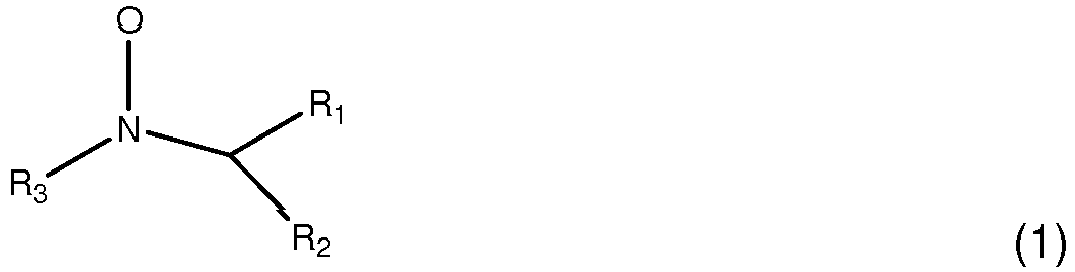
- The present invention, in a further aspect, provides a method of making silicone-hydrogel contact lenses by directly lathing a silicone hydrogel material. The method of the invention comprises: obtaining a polymerizable fluid composition as defined in claim 1; filling one or more tubes with the polymerizable fluid composition; curing the polymerizable fluid composition at the elevated temperature of 60°C or above in the tubes to form a polymer in a form of rod which is free of cracks and voids; stripping away the tubes from the polymer; and lathing the polymer to produce the contact lenses having an oxygen permeability of at least 50 barrers, a modulus of 1.2 MPa or less, and a water content of at least 15% by weight when fully hydrated.
- The present invention, in still a further aspect, provides a method for cast-molding of contact lenses. The method of the invention comprises: obtaining a polymerizable fluid composition as defined in claim 1; introducing the polymerizable fluid composition into a mold for making a contact lens; and polymerizing the polymerizable fluid composition in the mold to form a contact lens.
- Reference now will be made in detail to the embodiments of the invention. It will be apparent to those skilled in the art that various modifications and variations can be made in the present invention without departing from the scope of the invention. For instance, features illustrated or described as part of one embodiment, can be used on another embodiment to yield a still further embodiment. Thus, it is intended that the present invention cover such modifications and variations as common within the scope of the appended claims and their equivalents. Other objects, features and aspects of the present invention are disclosed in or are obvious from the following detailed description. It is to be understood by one of ordinary skill in the art that the present discussion is a description of exemplary embodiments only, and is not intended as limiting the broader aspects of the present invention.
- Unless defined otherwise, all technical and scientific terms used herein have the same meaning as commonly understood by one of ordinary skill in the art to which this invention belongs. Generally, the nomenclature used herein and the laboratory procedures are well known and commonly employed in the art. Conventional methods are used for these procedures, such as those provided in the art and various general references. Where a term is provided in the singular, the inventors also contemplate the plural of that term. The nomenclature used herein and the laboratory procedures described below are those well known and commonly employed in the art.
- An "ophthalmic device", as used herein, refers to a contact lens (hard or soft), an intraocular lens, a corneal onlay, other ophthalmic devices (e.g., stents, glaucoma shunt, or the like) used on or about the eye or ocular vicinity.
- "Contact Lens" refers to a structure that can be placed on or within a wearer's eye. A contact lens can correct, improve, or alter a user's eyesight, but that need not be the case. A contact lens can be of any appropriate material known in the art or later developed, and can be a soft lens, a hard lens, or a hybrid lens. Typically, a contact lens has an anterior surface and an opposite posterior surface and a circumferential edge where the anterior and posterior surfaces are tapered off.
- The "front or anterior surface" of a contact lens, as used herein, refers to the surface of the lens that faces away from the eye during wear. The anterior surface, which is typically substantially convex, may also be referred to as the front curve of the lens.
- The "rear or posterior surface" of a contact lens, as used herein, refers to the surface of the lens that faces towards the eye during wear. The rear surface, which is typically substantially concave, may also be referred to as the base curve of the lens.
- "Ocular environment", as used herein, refers to ocular fluids (e.g., tear fluid) and ocular tissue (e.g., the cornea) which may come into intimate contact with a contact lens used for vision correction, drug delivery, wound healing, eye color modification, or other ophthalmic applications.
- A "hydrogel" refers to a polymeric material which can absorb at least 10 percent by weight of water when it is fully hydrated. Generally, a hydrogel material is obtained by polymerization or copolymerization of at least one hydrophilic monomer in the presence of or in the absence of additional monomers and/or macromers.
- A "silicone hydrogel" refers to a hydrogel obtained by copolymerization of a polymerizable composition comprising at least one silicone-containing vinylic monomer or at least one silicone-containing macromer.
- "Hydrophilic," as used herein, describes a material or portion thereof that will more readily associate with water than with lipids.
- As used herein, "actinically" in reference to curing or polymerizing of a polymerizable composition or material means that the curing (e.g., crosslinked and/or polymerized) is performed by actinic irradiation, such as, for example, UV irradiation, ionized radiation (e.g. gamma ray or X-ray irradiation), microwave irradiation, and the like. Thermal curing or actinic curing methods are well-known to a person skilled in the art.
- A "prepolymer" refers to a starting polymer which can be cured (e.g., crosslinked and/or polymerized) actinically or thermally or chemically to obtain a crosslinked and/or polymerized polymer having a molecular weight much higher than the starting polymer. A "crosslinkable prepolymer" refers to a starting polymer which can be crosslinked upon actinic radiation to obtain a crosslinked polymer having a molecular weight much higher than the starting polymer.
- A "monomer" means a low molecular weight compound that can be polymerized. Low molecular weight typically means average molecular weights less than 700 Daltons.
- A "vinylic monomer", as used herein, refers to a low molecular weight compound that has an ethylenically unsaturated group and can be polymerized actinically or thermally. Low molecular weight typically means average molecular weights less than 700 Daltons.
- The term "olefinically unsaturated group" is employed herein in a broad sense and is intended to encompass any groups containing at least one >C=C< group. Exemplary ethylenically unsaturated groups include without limitation acryloyl, methacryloyl, allyl, vinyl, styrenyl, or other C=C containing groups.
- A "hydrophilic vinylic monomer", as used herein, refers to a vinylic monomer which is capable of forming a homopolymer that is water-soluble or can absorb at least 10 percent by weight water.
- A "hydrophobic vinylic monomer", as used herein, refers to a vinylic monomer which is capable of forming a homopolymer that is insoluble in water and can absorb less than 10 percent by weight water.
- A "macromer" refers to a medium to high molecular weight compound or polymer that contains functional groups capable of undergoing further polymerizing/crosslinking reactions. Medium and high molecular weight typically means average molecular weights greater than 700 Daltons. Preferably, a macromer contains ethylenically unsaturated groups and can be polymerized actinically or thermally.
- "Molecular weight" of a polymeric material (including monomeric or macromeric materials), as used herein, refers to the number-average molecular weight unless otherwise specifically noted or unless testing conditions indicate otherwise.
- A "polymer" means a material formed by polymerizing/crosslinking one or more monomers, macromers and/or oligomers.
- A "photoinitiator" refers to a chemical that initiates radical crosslinking and/or polymerizing reaction by the use of light. Suitable photoinitiators include, without limitation, benzoin methyl ether, diethoxyacetophenone, a benzoylphosphine oxide, 1-hydroxycyclohexyl phenyl ketone, Darocure® types, and Irgacure® types, preferably Darocure® 1173, and Irgacure® 2959.
- A "thermal initiator" refers to a chemical that initiates radical crosslinking/polymerizing reaction by the use of heat energy. Examples of suitable thermal initiators include, but are not limited to, 2,2'-azobis (2,4-dimethylpentanenitrile), 2,2'-azobis (2-methylpropanenitrile), 2,2'-azobis (2-methylbutanenitrile), peroxides such as benzoyl peroxide, and the like. Preferably, the thermal initiator is azobisisobutyronitrile (AIBN).
- "Visibility tinting" in reference to a lens means dying (or coloring) of a lens to enable the user to easily locate a lens in a clear solution within a lens storage, disinfecting or cleaning container. It is well known in the art that a dye and/or a pigment can be used in visibility tinting a lens.
- "Dye" means a substance that is soluble in a solvent and that is used to impart color. Dyes are typically translucent and absorb but do not scatter light. Any suitable biocompatible dye can be used in the present invention.
- A "Pigment" means a powdered substance that is suspended in a liquid in which it is insoluble. A pigment can be a fluorescent pigment, phosphorescent pigment, pearlescent pigment, or conventional pigment. While any suitable pigment may be employed, it is presently preferred that the pigment be heat resistant, non-toxic and insoluble in aqueous solutions.
- The term "fluid" as used herein indicates that a material is capable of flowing like a liquid.
- "Surface modification", as used herein, means that an article has been treated in a surface treatment process (or a surface modification process), in which, by means of contact with a vapor or liquid, and/or by means of application of an energy source (1) a coating is applied to the surface of an article, (2) chemical species are adsorbed onto the surface of an article, (3) the chemical nature (e.g., electrostatic charge) of chemical groups on the surface of an article are altered, or (4) the surface properties of an article are otherwise modified. Exemplary surface treatment processes include, but are not limited to, a surface treatment by energy (e.g., a plasma, a static electrical charge, irradiation, or other energy source), chemical treatments, the grafting of hydrophilic monomers or macromers onto the surface of an article, and layer-by-layer (LbL) deposition of polyelectrolytes. A preferred class of surface treatment processes are plasma processes, in which an ionized gas is applied to the surface of an article, and LbL coating processes.
- Plasma gases and processing conditions are described more fully in
U.S. Pat. Nos. 4,312,575 and4,632,844 and publishedU.S. Patent Application No. 2002/0025389 . The plasma gas is preferably a mixture of lower alkanes and nitrogen, oxygen or an inert gas. - "LbL coating", as used herein, refers to a coating that is not covalently attached to an article, preferably a medical device, and is obtained through a layer-by-layer ("LbL") deposition of polyionic (or charged) and/or non-charged materials on an article. An LbL coating can be composed of one or more layers, preferably one or more bilayers.
- The term "bilayer" is employed herein in a broad sense and is intended to encompass: a coating structure formed on a medical device by alternatively applying, in no particular order, one layer of a first polyionic material (or charged material) and subsequently one layer of a second polyionic material (or charged material) having charges opposite of the charges of the first polyionic material (or the charged material); or a coating structure formed on a medical device by alternatively applying, in no particular order, one layer of a first charged polymeric material and one layer of a non-charged polymeric material or a second charged polymeric material. It should be understood that the layers of the first and second coating materials (described above) may be intertwined with each other in the bilayer.
- Formation of an LbL coating on an ophthalmic device may be accomplished in a number of ways, for example, as described in
US Patent Ser. No. 6,451,871 and U.S. patent application publication Nos.US 2001-0045676 A1 ,US 2001-0048975 A1 , andUS 2004-0067365 A1 . One coating process embodiment involves solely dip-coating and dip-rinsing steps. Another coating process embodiment involves solely spray-coating and spray-rinsing steps. However, a number of alternatives involve various combinations of spray- and dip-coating and rinsing steps may be designed by a person having ordinary skill in the art. - An "antimicrobial agent", as used herein, refers to a chemical that is capable of decreasing or eliminating or inhibiting the growth of microorganisms such as that term is known in the art.
- "Antimicrobial metals" are metals whose ions have an antimicrobial effect and which are biocompatible. Preferred antimicrobial metals include Ag, Au, Pt, Pd, Ir, Sn, Cu, Sb, Bi and Zn, with Ag being most preferred.
- "Antimicrobial metal-containing nanoparticles" refer to particles having a size of less than 1 micrometer and containing at least one antimicrobial metal present in one or more of its oxidation states.
- "Antimicrobial metal nanoparticles" refer to particles which is made essentially of an antimicrobial metal and have a size of less than 1 micrometer. The antimicrobial metal in the antimicrobial metal nanoparticles can be present in one or more of its oxidation states. For example, silver-containing nanoparticles can contain silver in one or more of its oxidation states, such as Ag0, Ag1+, and Ag2+.
- "Stabilized antimicrobial metal nanoparticles" refer to antimicrobial metal nanoparticles which are stabilized by a stabilizer during their preparation. Stabilized antimicrobial metal nano-particles can be either positively charged or negatively charged or neutral, largely depending on a material (or so-called stabilizer) which is present in a solution for preparing the nano-particles and can stabilize the resultant nano-particles. A stabilizer can be any known suitable material. Exemplary stabilizers include, without limitation, positively charged polyionic materials, negatively charged polyionic materials, polymers, surfactants, salicylic acid, alcohols and the like.
- The "oxygen transmissibility" of a lens, as used herein, is the rate at which oxygen will pass through a specific ophthalmic lens. Oxygen transmissibility, Dk/t, is conventionally expressed in units of barrers/mm, where t is the average thickness of the material [in units of mm] over the area being measured and "barrer/mm" is defined as:

- The intrinsic "oxygen permeability", Dk, of a lens material does not depend on lens thickness. Intrinsic oxygen permeability is the rate at which oxygen will pass through a material. Oxygen permeability is conventionally expressed in units of barrers, where "barrer" is defined as:

- These are the units commonly used in the art. Thus, in order to be consistent with the use in the art, the unit "barrer" will have the meanings as defined above. For example, a lens having a Dk of 90 barrers ("oxygen permeability barrers") and a thickness of 90 microns (0.090 mm) would have a Dk/t of 100 barrers/mm (oxygen transmissibility barrers/mm). In accordance with the invention, a high oxygen permeability in reference to a material or a contact lens characterized by apparent oxygen permeability of at least 40 barrers or larger measured with a sample (film or lens) of 100 microns in thickness according to a coulometric method described in Examples.
- The "ion permeability" through a lens correlates with both the lonoflux Diffusion Coefficient and the lonoton Ion Permeability Coefficient.
- The lonoflux Diffusion Coefficient, D, is determined by applying Fick's law as follows:

- n' = rate of ion transport [mol/min]
- A = area of lens exposed [mm2]
- D = lonoflux Diffusion Coefficient [mm2/min]
- dc = concentration difference [mol/L]
- dx = thickness of lens [mm]
- The lonoton Ion Permeability Coefficient, P, is then determined in accordance with the following equation:

- C(t) = concentration of sodium ions at time t in the receiving cell
- C(0) = initial concentration of sodium ions in donor cell
- A = membrane area, i.e., lens area exposed to cells
- V = volume of cell compartment (3.0 ml)
- d = average lens thickness in the area exposed
- P = permeability coefficient
- An lonoflux Diffusion Coefficient, D, of greater than 1.5 x 10⁻⁶ mm2/min is preferred, while greater than 2.6 x 10⁻⁶ mm2/min is more preferred and greater than 6.4 x 10⁻⁶ mm2/min is most preferred.
- It is known that on-eye movement of the lens is required to ensure good tear exchange, and ultimately, to ensure good corneal health. Ion permeability is one of the predictors of on-eye movement, because the permeability of ions is believed to be directly proportional to the permeability of water.
- The term "oxyperm component in a polymerizable composition" as used herein, refers to monomers, oligomers, macromers, and the like, and mixtures thereof, which are capable of polymerizing with like or unlike polymerizable materials to form a polymer which displays a relatively high rate of oxygen diffusion there through.
- The term "a reduced elastic modulus" is intended to describe that the elastic modulus of a silicone hydrogel material prepared from a polymerizable fluid composition with at least one chain transfer agent is lower than, preferably at least 20%, more preferably at least 30%, more preferably at least 40% lower than that of a control silicone hydrogel material prepared from a control polymerizable composition, wherein the polymerizable fluid composition is prepared by adding the chain transfer agent into the control polymerizable fluid composition.
- Room temperature (or ambient temperature) is defined as 22±6°C.
- The term "lathability" in reference to a material is referred to its capability to be machined into a contact lens with optical quality using typical lens lathing equipments. One gauge of lathability of a material is its predominant glass transition temperature (Tg). Single phase polymeric materials with one Tg below room temperature (i.e., lathing temperature) are considered to be too soft for room temperature lathing whereas those with Tg above room temperature (i.e., lathing temperature), preferably at least 3 degrees above room temperature, have sufficient hardness for lathing at room temperature. Microscopically multiphasic polymeric materials may display one predominant (apparently single) Tg or more than one Tg. As long as a microscopically multiphasic polymeric material has a Tg (predominant glass transition temperature) associated with the dominant phase of the material being at room temperature or above, it can be lathed into contact lenses at room temperature. "Dominant phase" is defined herein as a phase in a multiphasic material that determines the overall (bulk or working) hardness of a material.
- The term "rod" refers to a cylinder cast-molded from a lens-forming material in a tube, wherein the cylinder has a length of 1 cm or longer.
- The term "button" refers to a short cylinder (with length of 1 cm or less) cast-molded from a lens-forming material in a mold or directly cut out of a rod. In accordance with the present invention, both the opposite surfaces of a button can be flat and curved. For example, one of the two opposite surfaces of a button can be a concave curved (e.g., hemispherical) surface whereas the other surface is a convex curved (e.g., hemispherical) surface).
- The term "bonnet" refers to a polymeric button cast-molded from a lens-forming material in a mold, wherein at least one of the two opposite surfaces of the bonnet has an optically finished surface corresponding to one of the anterior and posterior surfaces of a contact lens. The term "optically finished" in reference to a surface or a zone in a surface refers to a surface of a contact lens or a zone in a surface of a contact lens, wherein the surface or zone does not need to undergo further processing, e.g., such as, polishing or lathing. One could also machine lenses from pseudo bonnets. A pseudo bonnet is a part that would require lathing of both sides of the material in order to obtain a contact lens. This type of part would allow for flexibility in the design of the front and back surfaces of a lens while minimizing material losses.
- The term "polymerization shrinkage or volume change" as used herein is intended to describe a process in which the volume of a polymer material obtained from polymerization of a polymerizable composition is smaller than the volume of the polymerizable composition. Polymerization shrinkage of a polymer material is preferably determined by first polymerizing a polymerizable composition in a glass tube (20 mm x 300 mm), then determining the difference between the inner diameter of the tube and the diameter of a resultant rod, and then calculating the polymerization shrinkage

- The term "a reduced polymerization shrinkage" is intended to describe that polymerization shrinkage of a polymer material prepared from a polymerizable fluid composition with a free radical initiator in the presence of at least one organonitrioxide is smaller than that of a control polymer material prepared from a control polymerizable composition, wherein the polymerizable fluid composition is prepared by adding the chain transfer agent into the control polymerizable fluid composition.
- The present invention is generally directed to methods for reliably producing a silicone hydrogel material, especially silicone hydrogel rods for making MTO contact lenses, with desired physical and mechanical properties. The present invention is partly based on the discovery that by adding an organonitroxide to a polymerizable fluid composition (or a lens-forming formulation or composition) in an amount to have a selected ratio of percentage by weight of the organonitroxide to the radical initiator in the polymerizable fluid composition, the polymerization fluid composition can be cured in tubes at an elevated temperature to form rods which are substantially free of defects, such as, cracks and voids) and have consistent properties (e.g., oxygen permeability, ion permeability, water content, elastic modulus, and/or elongation). It is believed that an organonitroxide can mediate a free radical polymerization. By adjusting ratio of organonitrioxide to initiator, the polymerization rate can be controlled to produce silicone hydrogel rods of high quality (substantially free of structure defects, such as cracks and voids). Further, it is believed that organonitroxide mediated polymerization can be used to achieve better control of variability in the sequence of monomers and/or macromers in the polymer chain, molecular weight, and polydispersity before gelation and for better control of branching and of molecular weight between crosslinks. The resultant materials are more homogeneous and have a more controlled network microstructure and consequently more consistent material properties. Material properties such as oxygen permeability, ion permeability, and modulus play a critical role in corneal health and comfort of contact lens users. These properties depend, in part, on polymerization conditions and control of polymerization. By using such method, one can produce silicone hydrogel rods with consistent desired properties, such as, high oxygen permeability, adequate water content, high ion permeability, low modulus, etc.
- The invention is also related to an improved method for cast molding of contact lenses. It has been discovered that materials produced in this invention do not undergo significant shrinkage as evidenced by polymer rod having a very snug fit in glass tubes after curing and post curing operations. As monomer is converted to polymer there is generally a polymerization shrinkage and the polymer (if in rod form) often pulls away from the polymerization tube. Shrinkage during polymerization can lead to undesirable internal stress in the final part and poor replication of mold surfaces. Therefore, the technologies described here provide a means of producing low strain materials and parts that have good replication of molding surfaces. It is believed that low shrinkage observed here might be that the high temperature curing. High temperature curing could result in a more amorphous less efficiently packed structure. Low shrinkage and material homogeneity are important factors in the production of high quality precision moldings, such as contact lenses.
- The present invention, in one aspect, provides a method of making silicone-hydrogel contact lenses by directly lathing a silicone hydrogel material. The method of the invention comprises: obtaining a polymerizable fluid composition as defined in claim 1; filling one or more tubes with the polymerizable fluid composition; curing the polymerizable fluid composition at the elevated temperature in the tubes to form a polymer in a form of rod which is free of cracks and voids; stripping away the tubes from the polymer; and lathing the polymer to produce the contact lenses having an oxygen permeability of at least 50 barrers, a modulus of 1.2 MPa or less, and a water content of at least 15% by weight when fully hydrated.
- A silicone hydrogel contact lens made according to a method of the invention is characterized by having an oxygen permeability of at least 50 barrers, more preferably 60 barrers, even more preferably 70 barrers and a modulus of less than 1.2 MPa, even more preferably less than 1.0 MPa.
- In accordance with the present invention, a polymerizable fluid composition can be a solvent-free liquid, or a melt at a temperature below 60°C.
- Alternatively, a polymerizable fluid composition of the invention can be obtained by adding desired amounts of a radical initiator and an organonitroxide into any formulations for making soft contact lenses. Exemplary formulations include without limitation the formulation of lotrafilcon A, lotrafilcon B, etafilcon A, genfilcon A, lenefilcon A, polymacon, acquafilcon A, and balafilcon.
- Where a polymerizable fluid composition is a solvent-free liquid, it can be prepared by dissolving at least one siloxane-containing macromer with ethylenically unsaturated group(s) and all other desired components in an amount of one or more blending vinylic monomers. By removing solvent from a polymerizable composition, an obtained silicone hydrogel material may not necessary to be subjected to a process in which a solvent is removed from the silicone hydrogel material so as to reduce its stickiness and/or softness and as such, the silicone hydrogel material can be directly lathed at room temperature to make contact lenses. In addition, it is discovered that by using a solvent-free polymerizable composition, one can obtain a silicone hydrogel material having relatively low level of extractable chemicals (i.e., so called extractables). Therefore, a costly extraction process may not be needed in the production of contact lenses with a silicone hydrogel material prepared from a solvent-free polymerizable composition.
- In accordance with the invention, a "blending vinylic monomer" refers to a vinylic monomer which can function both as a solvent to dissolve both hydrophilic and hydrophobic components of a polymerizable composition of the invention and as one of polymerizable components to be polymerized to form a silicone hydrogel material. Preferably, the blending vinylic monomer is present in the polymerizable composition in an amount of from about 5% to about 20% by weight.
- Any suitable vinylic monomers, capable of dissolving both hydrophilic and hydrophobic components of a polymerizable composition of the invention to form a solution, can be used in the invention. Preferred examples of blending vinylic monomers include, without limitation, aromatic vinylic monomers, cycloalkyl-containing vinylic monomers. Those preferred blending monomers can increase the predominant glass transition temperature of a silicone hydrogel material prepared by curing a polymerizable composition containing those preferred blending monomer.
- Examples of preferred aromatic vinylic monomers include styrene, 2,4,6-trimethylstyrene (TMS), t-butyl styrene (TBS), 2,3,4,5,6-pentafluorostyrene, benzylmethacrylate, divinylbenzene, and 2-vinylnaphthalene. Of these monomers, a styrene-containing monomer is preferred. A styrene-containing monomer is defined herein to be a monomer that contains a vinyl group bonded directly to a phenyl group in which the phenyl group can be substituted by other than a fused ring, e.g., as above with one to three C1-C6 alkyl groups. Styrene itself [H2C=CH-C6H5] is a particularly preferred styrene-containing monomer.
- A cycloalkyl-containing vinylic monomer is defined herein to be a vinylic monomer containing a cycloalkyl which can be substituted by up to three C1-C6 alkyl groups. Preferred cycloalkyl-containing vinylic monomers include, without limitation, acrylates and methacrylates each comprising a cyclopentyl or cyclohexyl or cycloheptyl, which can be substituted by up to 3 C1-C6 alkyl groups. Examples of preferred cycloalkyl-containing vinylic monomers include isobornylmethacrylate, isobornylacrylate, cyclohexylmethacrylate, cyclohexylacrylate, and the like.
- In accordance with the present invention, one or more of acrylic acid, C1-C10 alkyl methacrylate (e.g., methylmethacrylate, ethylmethacrylate, propylmethacrylate, isopropylmethacrylate, t-butylmethacrylate, neopentyl methacrylate, methacrylonitrile, acrylonitrile, C1-C10 alkyl acrylate, N-isopropyl acrylamide, 2-vinylpyridine, and 4-vinylpyridine can be used as blending vinylic monomers. They can also be used together with an aromatic vinylic monomer or a cycloalkyl-containing vinylic monomer. Each of these blending vinylic monomer is capable of forming a homopolymer with a glass transition temperature of above 30°C. As such, by using one or more of these blending monomers one can increase the predominant glass transition temperature of a silicone hydrogel material prepared by curing a polymerizable composition containing those preferred blending monomers.
- In accordance with the present invention, any known suitable siloxane-containing macromer with ethylenically unsaturated group(s) can be used to produce a silicone hydrogel material. A particularly preferred siloxane-containing macromer is selected from the group consisting of Macromer A, Macromer B, Macromer C, and Macromer D described in
US 5,760,100 . Macromers that contain two or more polymerizable groups (vinylic groups) can also serve as cross linkers. Di and triblock macromers consisting of polydimethylsiloxane and polyakyleneoxides could also be of utility. Such macromers could be mono or difunctionalized with acrylate, methacrylate or vinyl groups. For example one might use methacrylate end capped polyethyleneoxide-block-polydimethylsiloxane-block-polyethyleneoxide to enhance oxygen permeability. - Radical initiators are materials well known for use in the polymerization art to promote, and/or increase the rate of, the polymerization reaction. In accordance with the invention, a radical initiator can be a photoinitiator or preferably a thermal initiator.
- Suitable photoinitiators are benzoin methyl ether, diethoxyacetophenone, a benzoylphosphine oxide, 1-hydroxycyclohexyl phenyl ketone and Darocur and Irgacur types, preferably Darocur 1173® and Darocur 2959®. Examples of benzoylphosphine initiators include 2,4,6-trimethylbenzoyldiphenylophosphine oxide; bis-(2,6-dichlorobenzoyl)-4-N-propylphenylphosphine oxide; and bis-(2,6-dichlorobenzoyl)-4-N-butylphenylphosphine oxide. Reactive photoinitiators which can be incorporated, for example, into a macromer or can be used as a special monomer are also suitable. Examples of reactive photoinitiators are those disclosed in
EP 632 329 - Examples of suitable thermal initiators include, but are not limited to, 2,2'-azobis (2,4-dimethylpentanenitrile), 2,2'-azobis (2-methylpropanenitrile), 2,2'-azobis (2-methylbutanenitrile), azobisisobutyronitrile (AIBN), peroxides such as benzoyl peroxide, and the like. Preferably, the thermal initiator is 2,2'-azo-bis(2,4-dimethylvaleronitrile) (VAZO-52).
- An organonitroxide used according to the invention is a compound having the formula of

- In accordance with the invention, a polymerizable fluid composition comprises from 0.2% to 1.0%, even more preferably from 0.25% to 0.7% by weight of a radical initiator.
- In accordance with the invention, ratio of percentage by weight of the organonitroxide to the radical initiator in the polymerizable fluid composition is from 0.3 to 1.1, even more preferably from 0.4 to 0.9. With a proper ratio of percentage by weight of the organonitroxide to the radical initiator in the polymerizable fluid composition, polymer rods can be prepared by curing at an elevated temperature to have a good quality (i.e., without substantial structure defects, such as cracks and voids). The resultant polymer rods can further have more consistent properties, such as, oxygen permeability, ion permeability, water content, modulus, elongation, or mixture thereof. In particular, oxygen permeability and ion permeability of polymer rods can be enhanced.
- Polymerization (curing) may be initiated by a number of well known techniques, which, depending on the polymerizable material, may include application of radiation such as microwave, thermal, e-beam and ultraviolet. A preferred method of initiating polymerization is by heating (i.e., thermal curing).
- As used herein, the term "an elevated temperature" refers to a temperature of 60°C or above, more preferably 70°C or above, even more preferably 80°C or above.
- The term "curing at an elevated temperature" as used herein is intended to describe a process in which a polymerizable fluid composition is solidified, i.e., changing from liquid state to a solidified state (gel), at the elevated temperature. This term is not intended to describe a post-curing process in which a gel is further solidified by polymerizing residual polymerizable component in the gel.
- In accordance with the present invention, a polymerizable fluid composition also comprises siloxane-containing monomer. Any known suitable siloxane-containing monomers can be used in the present invention. Exemplary siloxane-containing monomers include, without limitation, methacryloxyalkylsiloxanes, tristrimethylsilyloxysilylpropyl methacrylate (TRIS), 3-methacryloxy propylpentamethyldisiloxane and bis(methacryloxypropyl)-tetramethyldisiloxane. A preferred siloxane-containing monomer is TRIS, which is referred to 3-methacryloxypropyltris(trimethylsiloxy) silane, and represented by CAS No. 17096-07-0. The term "TRIS" also includes dimers of 3-methacryloxypropyltris(trimethylsiloxy) silane.
- In accordance with the present invention, a polymerizable fluid composition also comprises a hydrophilic monomer. Nearly any hydrophilic monomer that can act as a plasticizer can be used in the fluid composition of the invention. Suitable hydrophilic monomers are, without this being an exhaustive list, hydroxyl-substituted lower alkyl (C1 to C8) acrylates and methacrylates, acrylamide, methacrylamide, (lower allyl)acrylamides and -methacrylamides, ethoxylated acrylates and methacrylates, hydroxyl-substituted (lower alkyl)acrylamides and - methacrylamides, hydroxyl-substituted lower alkyl vinyl ethers, sodium vinylsulfonate, sodium styrenesulfonate, 2-acrylamido-2-methylpropanesulfonic acid, N-vinylpyrrole, N-vinyl-2-pyrrolidone, 2-vinyloxazoline, 2-vinyl4,4'-dialkyloxazolin-5-one, 2- and 4-vinylpyridine, vinylically unsaturated carboxylic acids having a total of 3 to 5 carbon atoms, amino(lower alkyl)- (where the term "amino" also includes quaternary ammonium), mono(lower alkylamino)(lower alkyl) and di(lower alkylamino)(lower alkyl)acrylates and methacrylates, allyl alcohol and the like.
- Among the preferred hydrophilic monomers are N,N-dimethylacrylamide (DMA), 2-hydroxyethylmethacrylate (HEMA), hydroxyethyl acrylate, hydroxypropyl acrylate, hydroxypropyl methacrylate (HPMA), trimethylammonium 2-hydroxy propylmethacrylate hydrochloride, dimethylaminoethyl methacrylate (DMAEMA), dimethylaminoethylmethacrylamide, acrylamide, methacrylamide, allyl alcohol, vinylpyridine, glycerol methacrylate, N-(1,1dimethyl-3-oxobutyl)acrylamide, N-vinyl-2-pyrrolidone (NVP), acrylic acid, methacrylic acid, and N,N-dimethyacrylamide (DMA).
- A polymerizable fluid composition can also comprise a hydrophobic monomer. By incorporating a certain amount of hydrophobic monomer in a polymerizable fluid composition, the mechanical properties (e.g., modulus of elasticity) of the resultant polymer may be improved. Examples of suitable hydrophobic vinylic comonomers include methylacrylate, ethyl-acrylate, propylacrylate, isopropylacrylate, cyclohexylacrylate, 2-ethylhexylacrylate, methylmethacrylate, ethylmethacrylate, propylmethacrylate, vinyl acetate, vinyl propionate, vinyl butyrate, vinyl valerate, styrene, chloroprene, vinyl chloride, vinylidene chloride, acrylonitrile, 1-butene, butadiene, methacrylonitrile, vinyl toluene, vinyl ethyl ether, perfluorohexylethyl-thio-carbonyl-aminoethyl-methacrylate, isobornyl methacrylate, trifluoroethyl methacrylate, hexafluoro-isopropyl methacrylate, hexafluorobutyl methacrylate, tris-trimethylsilyloxy-silyl-propyl methacrylate, 3-methacryloxypropyl-pentamethyl-disiloxane and bis(methacryloxypropyl)-tetramethyl-disiloxane. TRIS, which may act both to increase oxygen permeability and to improve the modulus of elasticity, is a particularly preferred hydrophobic monomer.
- A polymerizable fluid composition can further comprise an antimicrobial agent, preferably antimicrobial metal nanoparticles, more preferably silver nanoparticles.
- A polymerization fluid composition can comprise a chain transfer agent. Any chain transfer agent can be used. Examples of preferred chain transfer agent include without limitation mercaptans (e.g., 2-mercaptoethanol), alkane-thiols (e.g., ethanethiol, propanethiol, butanethiol), arylthiols (e.g., thiophenol), disulfide (e.g., di-n-butyl disulfide), carbon tetrabromide, carbon tetrachloride, chloroform, amines (e.g., ethylamine, diethlyamine, triethylamine, butylamine, di and tri-butylamine), methanol, ethanol, propanol, and isopropanol, acetic acid, and acetone. Preferably, a mercaptan is the chain transfer agent.
- In accordance with the present invention, a polymerizable fluid composition can further comprise various components, such as cross-linking agents, initiator, UV-absorbers, fillers, visibility tinting agents (e.g., dyes, pigments, or mixtures thereof), and the like.
- Cross-linking agents may be used to improve structural integrity and mechanical strength. Examples of cross-linking agents include without limitation allyl(meth)acrylate, lower alkylene glycol di(meth)acrylate, poly lower alkylene glycol di(meth)acrylate, lower alkylene di(meth)acrylate, divinyl ether, divinyl sulfone, di- or trivinylbenzene, trimethylolpropane tri(meth)acrylate, pentaerythritol tetra(meth)acrylate, bisphenol A di(meth)acrylate, methylenebis(meth)acrylamide, triallyl phthalate or diallyl phthalate. A preferred cross-linking agent is ethylene glycol dimethacrylate (EGDMA).
- The amount of a cross-linking agent used is expressed in the weight content with respect to the total polymer and is preferably in the range from 0.05 to 5%, and more preferably in the range from 0.1 to 2%. Di-functional macromer (e.g. betacon) can be used as both a crosslinker and a material to enhance Dk. In such cases this material will be comprise from 20 to 46 weight percent of the total formulation.
- In accordance with the present invention, the polymerizable fluid composition can further have one or more Tg-enhancing vinylic monomers selected from the group consisting of acrylic acid, C1-C4 alkyl methacrylate (e.g., methylmethacrylate, ethylmethacrylate, propylmethacrylate, isopropylmethacrylate, t-butylmethacrylate), methacrylonitrile, acrylonitrile, C1-C4 alkyl acrylate, N-isopropyl acrylamide, 2-vinylpyridine, and 4-vinylpyridine. It is understood that aromatic monomers and/or cycloalkyl-containing vinylic monomers can be replaced by one or more of the above Tg-enhancing vinylic monomers.
- A solvent-free polymerizable composition of the invention comprises: from 20% to 46% by weight of a siloxane-containing macromer with ethylenically unsaturated group(s); from 10% to 30% by weight of a siloxane-containing vinylic monomer; from 15% to 50% by weight of a hydrophilic vinylic monomer; 5% to 20% by weight of a blending vinylic monomer; from 0.2% to 1.0% by weight of a radical initiator; and an amount of an organonitrioxide sufficient to have a ratio of percentage by weight of the organonitroxide to the radical initiator in the polymerizable fluid composition be from 0.3 to 1.1.
- In a preferred embodiment, a polymerizable composition of the invention comprises: from 20% to 46% by weight of a siloxane-containing macromer with ethylenically unsaturated group(s); from 10% to 30% by weight of a siloxane-containing vinylic monomer; from 15% to 50% by weight of a hydrophilic vinylic monomer; from 5% to 20% by weight of an aromatic vinylic monomer, a cycloalkylmethacrylate or a cycloalkylacrylate; from 0.2% to 1.0% by weight of a radical initiator; and an amount of an organonitrioxide sufficient to have a ratio of percentage by weight of the organonitroxide to the radical initiator in the polymerizable fluid composition be from 0.3 to 1.1.
- In another preferred embodiment, a polymerizable fluid composition further comprises at least one antimicrobial agent, preferably silver nanoparticles in an amount sufficient to impart to the resultant silicone hydrogel material an antimicrobial activity characterized by having at least a 5-fold reduction (≥80% inhibition), preferably at least a 1-log reduction (≥90% inhibition), more preferably at least a 2-log reduction (≥99% inhibition), of viable microorganisms (e.g., Pseudomonas aeruginosa GSU # 3, or Staphylococcus aureus ATCC #6538), preferably by having a prolong antimicrobial activity (i.e., effective antimicrobial activity after direct contact with a body fluid over an extended period of time). Antimicrobial activity can be determined according to procedure described in the Examples of
U.S. Patent Application No. 10/891,407 filed on July 14, 2004 - As used herein, a "prolong antimicrobial activity" is characterized by having at least a 5-fold reduction (≥80% inhibition), preferably at least a 1-log reduction (≥90% inhibition), more preferably at least a 2-log reduction (≥99% inhibition), of viable microorganisms (e.g., Pseudomonas aeruginosa GSU # 3, or Staphylococcus aureus ATCC #6538) after at least 5, preferably at least 10, more preferably at least 20, even more preferably at least 30 consecutive soaking/rinsing cycles, each cycle comprising soaking/rinsing one lens in a phosphate buffered saline (PBS) for a period of time from about 24 to about 72 hours, as shown in the Examples of
U.S. Patent Application No. 10/891,407 filed on July 14, 2004 - The present invention, in another aspect, provides a silicone hydrogel material having an oxygen permeability of at least 50 barrers and a modulus of 1.2 MPa or less, a water content of at least 15% by weight when fully hydrated, and a predominant glass-transition temperature of 25°C or higher, which is obtained by copolymerizing, at an elevated temperature of 60°C or above, a polymerizable fluid composition which is a solvent-free polymerizable composition and comprises (a) from 20 to 46 % of at least one siloxane-containing macromer with ethylenically unsaturated group(s); from 10% to 30% by weight of a siloxane-containing vinylic monomer; from 15% to 50% by weight of a hydrophilic vinylic monomer, 5% to 20% by weight of a blending vinylic monomer; (b) from 0.2% to 1.0% by weight of a radical initiator, and (c) an organonitroxide, wherein ratio of percentage by weight of the organonitroxide to the radical initiator in the polymerizable fluid composition is from 0.3 to 1.1, wherein the organonitroxide is TEMPO, 4-hydroxy-TEMPO, 4-oxo-TEMPO, or a compound having the formula of

- Any silicone or siloxane-containing vinylic monomers, siloxane-containing polymerizable macromers, organonitrioxide, hydrophilic vinylic monomers, blending vinylic monomers, Tg-enhancing vinylic monomers, aromatic vinylic monomers, cycloalkyl-containing vinylic monomers, cross-linking agents, hydrophobic vinylic monomers, free radical initiator, UV-absorbers, fillers, visibility tinting agents, antimicrobial agents, and polymerizing (curing) techniques described above can be used in this aspect of the invention.
- A silicone hydrogel material of the invention has an oxygen permeability of at least 50 barrers, more preferably at least 65 barrers, even more preferably at least 80 barrers. In accordance with the invention, an oxygen permeability is an apparent (directly measured when testing a sample with a thickness of about 100 microns) oxygen permeability according to procedures described in Examples.
- A silicone hydrogel material of the invention has a elastic modulus of 1.2 MPa or less, more preferably 1.0 or less, even more preferably from 0.4 MPa to 1.0 MPa.
- A silicone hydrogel material of the invention has an lonoflux Diffusion Coefficient, D, of, preferably at least 1.5 x 10⁻⁶ mm2/min, more preferably at least 2.6 x 10⁻⁶ mm2/min, even more preferably at least 6.4 x 10⁻⁶ mm2/min.
- A silicone hydrogel material of the invention has a water content of preferably from 18% to 55%, more preferably from 20% to 38% by weight when fully hydrated. The water content of a silicone hydrogel material or a lens can be measured according to Bulk Technique as disclosed in
US5,849,811 . - A silicone hydrogel material of the invention can find use in production of ophthalmic devices, preferably contact lenses, more preferably MTO or customized contact lenses.
- A silicone hydrogel material of the invention has a predominant glass-transition temperature of 25°C or higher, preferably 30°C or higher, more preferably 35°C or higher, even more preferably 45°C or higher.
- A silicone hydrogel material of the invention can further comprise at least one antimicrobial agent, preferably silver nanoparticles in an amount sufficient to impart to the silicone hydrogel material an antimicrobial activity characterized by having at least a 5-fold reduction (≥80% inhibition), preferably at least a 1-log reduction (≥90% inhibition), more preferably at least a 2-log reduction (≥99% inhibition), of viable microorganisms (e.g., Pseudomonas aeruginosa GSU # 3, or Staphylococcus aureus ATCC #6538), preferably by having a prolong antimicrobial activity (i.e., effective antimicrobial activity after direct contact with a body fluid over an extended period of time). Antimicrobial activity can be determined according to procedure described in the Examples of
U.S. Patent Application No. 10/891,407 filed on July 14, 2004 - The present invention, in a further aspect, provides an ophthalmic device comprising a silicone hydrogel material having an oxygen permeability of at least 50 barrers and a modulus of 1.2 MPa or less, a water content of at least 15% by weight when fully hydrated, and a predominant glass-transition temperature of 25°C or higher, which is obtained by copolymerizing, at an elevated temperature of 60°C or above, a polymerizable fluid composition which is a solvent-free polymerizable composition and comprises (a) from 20 to 46 % of at least one siloxane-containing macromer with ethylenically unsaturated group(s); from 10% to 30% by weight of a siloxane-containing vinylic monomer; from 15% to 50% by weight of a hydrophilic vinylic monomer, 5% to 20% by weight of a blending vinylic monomer; (b) from 0.2% to 1.0% by weight of a radical initiator, and (c) an organonitroxide, wherein ratio of percentage by weight of the organonitroxide to the radical initiator in the polymerizable fluid composition is from 0.3 to 1.1, wherein the organonitroxide is TEMPO, 4-hydroxy-TEMPO, 4-oxo-TEMPO, or a compound having the formula of

- Above described various embodiments and preferred embodiments of a polymerizable fluid composition and a method for making a silicone hydrogel material of the invention can be used in this aspect of the invention.
- An ophthalmic device of the invention preferably is a contact lens.
- A contact lens of the invention has an oxygen permeability of preferably at least 50 barrers, more preferably at least 65 barrers, even more preferably at least 80 barrers. In accordance with the invention, an oxygen permeability is an apparent (directly measured when testing a sample with a thickness of about 100 microns) oxygen permeability according to procedures described in Examples.
- A contact lens of the invention has a elastic modulus of 1.2 MPa or less, more preferably 1.0 or less, even more preferably from 0.4 MPa to 1.0 MPa.
- A contact lens of the invention further has an lonoflux Diffusion Coefficient, D, of, preferably at least 1.5 x 10⁻⁶ mm2/min, more preferably at least 2.6 x 10⁻⁶ mm2/min, even more preferably at least 6.4 x 10⁻⁶ mm2/min.
- A contact lens of the invention further has a water content of preferably from 18% to 55%, more preferably from 20% to 38% by weight when fully hydrated. The water content of a silicone hydrogel contact lens can be measured according to Bulk Technique as disclosed in
US5,849,811 . - A contact lens of the invention further comprises at least one antimicrobial agent, preferably silver nanoparticles in an amount sufficient to impart to the silicone hydrogel material an antimicrobial activity characterized by having at least a 5-fold reduction (≥80% inhibition), preferably at least a 1-log reduction (≥90% inhibition), more preferably at least a 2-log reduction (≥99% inhibition), of viable microorganisms (e.g., Pseudomonas aeruginosa GSU # 3, or Staphylococcus aureus ATCC #6538), preferably by having a prolong antimicrobial activity (i.e., effective antimicrobial activity after direct contact with a body fluid over an extended period of time). Antimicrobial activity can be determined according to procedure described in the Examples of
U.S. Patent Application No. 10/891,407 filed on July 14, 2004 - An ophthalmic device of the invention can be made according to any known suitable methods, such as, double-sided molding processes, cast-molding processes, lathing, and combinations thereof.
- Where an ophthalmic device of the invention is a contact lens, in particular a MTO or customized contact lens, one can lathe directly at room temperature a rod, preferably a button, more preferably a bonnet of a silicone hydrogel material into the ophthalmic device. Any known suitable lathe apparatus can be used in this invention. Preferably, a computer controllable (or numerically controlled) lathe is used in the invention. More preferably, a numerically controlled two-axis lathe with a 45° piezo cutter or a lathe apparatus disclosed by
Durazo and Morgan in US patent No. 6,122,999 , is used in the invention. Exemplary preferred lathe apparatus include without limitation numerically controlled lathes from Precitech, Inc., for example, such as Optoform ultra-precision lathes (models 30, 40, 50 and 80) having Variform piezo-ceramic fast tool servo attachment. A person skilled in the art will know how to prepare rods, buttons, and bonnets. For example, a rod can be produced preferably by thermally curing a polymerizable composition of the invention in a tube made of plastic or glass or quartz. The resultant rod optionally can be subjected to a post-curing treatment as described in the copending US patent application, entitled "Method for Lathing Silicone Hydrogel Lenses". The diameter of a tube used in the preparation is larger than the diameter of the contact lens. A rod can be further cut into buttons prior to lathing. However, it should be noted that it is possible for a tube diameter to be smaller than a wet lens diameter. Lens formulations that contain hydrophilic monomers usually have diameters which are larger in a hydrated state as compared to a dry state. - A person skilled in the art knows how to make molds for cast-molding or spin-casting polymer buttons. Preferably, a mold can be used to cast mold buttons, the two opposite surfaces of each of which are curved. For example, one of the two opposite surfaces of a button can be a concave curved (e.g., hemispherical) surface whereas the other surface is a convex curved (e.g., hemispherical) surface. Advantage of cast-molding buttons with two opposite curved surfaces is that less silicone hydrogel material is cut away and therefore wasted. The two curved surfaces of a button can have identical or different curvatures. Preferably, the two curved surfaces are spherical. One could also produce a button with one flat surface and one curved surface.
- Where a contact lens (e.g., toric or translating multifocal lens) requires orientation and/or translation features, it would be advantageous that the entire posterior surface and a target geometry, common to all contact lenses and outside of the optical zone, of the anterior surface of a contact lens can be formed by curing a polymerizable composition in a mold for making a bonnet while lathing of a bonnet could be reduced to the finish cuts defining any desired optical zone geometry of the anterior surface of a contact lens while directly molding. As such, time, cost and material waste associated with the production of customized or made-to-order (MTO) contact lenses can be minimized. Customized or made-to-order (MTO) contact lenses can be made to match exactly to any patient's prescription. Such method is described in detail in the copending US patent application entitled "Method for Lathing Silicone Hydrogel Lenses". A mold for making such bonnets includes a first mold half having a first molding surface with optical quality and a second mold half having a second molding surface, wherein the second molding surface has a substantially-annular peripheral molding zone with optical quality, wherein the first molding surface defines the posterior surface of the contact lens, wherein the peripheral molding zone defines the one or more non-optical zones on the anterior surface of the contact lens. A bonnet prepared from such a mold has one optically finished surface corresponding to the posterior surface of the contact lens and one surface having an optically finished zone corresponding to the one or more substantially annular non-optical zones surrounding the central optical zone of the contact lens. One only needs to lathe surface areas, surrounded by the optically-finished zone on the side opposite to the optically-finished surface, of the bonnet, thereby obtaining the contact lens. It is understood that such lens can be made by two-side lathing.
- In a preferred embodiment, an ophthalmic device of the invention has a hydrophilic surface obtained by using a surface modification process. The hydrophilic surface refers to a surface having an averaged contact angle of 85 degrees or less when the ophthalmic device is fully hydrated. Preferably, the hydrophilic surface is a plasma coating or an LbL coating. Alternatively, a hydrophilic surface can be obtained by incorporating leachable (non-crosslinkable) hydrophilic polymer into the polymerizable fluid composition for making rods or buttons or bonnets.
- An "average contact angle" refers to a contact angle of water on a surface of a material (measured by Sessile Drop method), which is obtained by averaging measurements of at least 3 individual samples (e.g., contact lenses). Average contact angles (Sessile Drop) of contact lenses can be measured using a VCA 2500 XE contact angle measurement device from AST, Inc., located in Boston, Massachusetts. This equipment is capable of measuring advancing or receding contact angles or sessile (static) contact angles. The measurements are preferably performed on fully hydrated materials.
- Contact angle is a general measure of the surface hydrophilicity of a contact lens or an article (e.g., the cavity surface of a container). In particular, a low contact angle (when the drop is hydrophilic, e.g. water) corresponds to more hydrophilic surface.
- In a preferred embodiment, the antimicrobial ophthalmic device comprises at least 10 ppm, preferably at least 25 ppm, more preferably at least 40 ppm, even more preferably at least 60 ppm silver nanoparticles distributed therein.
- The present invention, in still a further aspect, provides a method for cast-molding of contact lenses. The method of the invention comprises: obtaining a polymerizable fluid composition as defined in claim 1; introducing the polymerizable fluid composition into a mold for making a contact lens; and polymerizing the polymerizable fluid composition in the mold to form a polymer contact lens.
- Preferably, this casting method is for making silicone hydrogel contact lenses. Above described various embodiments and preferred embodiments of a polymerizable fluid composition and a method for making a silicone hydrogel material of the invention can be used in this aspect of the invention.
- Methods of forming mold sections for cast-molding a contact lens are generally well known to those of ordinary skill in the art. The process of the present invention is not limited to any particular method of forming a mold. In fact, any method of forming a mold can be used in the present invention. However, for illustrative purposes, the following discussion has been provided as one embodiment of forming a contact lens mold.
- In general, a mold comprises at least two mold sections (or portions) or mold halves, i.e. first and second mold halves. The first mold half defines a first optical surface and the second mold half defines a second optical surface. The first and second mold halves are configured to receive each other such that a contact lens forming cavity is formed between the first optical surface and the second optical surface. The first and second mold halves can be formed through various techniques, such as injection molding. These half sections can later be joined together such that a contact lens-forming cavity is formed therebetween. Thereafter, a contact lens can be formed within the contact lens-forming cavity using various processing techniques, such as ultraviolet curing.
- Examples of suitable processes for forming the mold halves are disclosed in
U.S. Patent Nos. 4,444,711 to Schad ;4,460,534 to Boehm et al. ;5,843,346 to Morrill ; and5,894,002 to Boneberger et al. - Virtually all materials known in the art for making molds can be used to make molds for making contact lenses. For example, polymeric materials, such as polyethylene, polypropylene, Topas, and PMMA can be used. Other materials that allow UV light transmission could be used, such as quartz glass.
- Thermal curing or actinic curing methods can be used to curing a polymerizable composition in a mold to form an ophthalmic lens. Such curing methods are well-known to a person skilled in the art.
- In accordance with the invention, ratio of percentage by weight of the organonitroxide to the free radical initiator in the polymerizable fluid composition is selected to provide a polymerization shrinkage of preferably 10% or less, more preferably 7% or less, even more preferably 5% or less, most preferably 3% or less.
- The previous disclosure will enable one having ordinary skill in the art to practice the invention. In order to better enable the reader to understand specific embodiments and the advantages thereof, reference to the following examples is suggested.
- Unless otherwise stated, all chemicals are used as received. Differential scan calorimetric (DSC) experiments are carried out in aluminum pans in a nitrogen atmosphere using a TA Instruments 2910 DSC. The instrument is calibrated with indium. Glass tubes used for making rods of silicone hydrogel materials are silanized prior to use. Lenses are extracted with isopropanol (isopropyl alcohol) for at least 4 hours and subjected plasma treatment according to procedures described in published
US patent application No. 2002/0025389 to obtain plasma coatings. Oxygen and ion permeability measurements are carried out either with lenses after extraction and plasma coating or with lenses without plasma coating. Non-plasma coated lenses are used for tensile testing and water content measurements. Oxygen permeability is determined using polargraphic method. - Ion Permeability Measurements. The ion permeability of a lens is measured according to procedures described in
U.S. Patent No. 5,760,100 . The values of ion permeability reported in the following examples are relative ionoflux diffusion coefficients (D/Dref) in reference to a lens material, Alsacon, as reference material. Alsacon has an ionoflux diffusion coefficient of 0.314X10⁻³ mm2/minute. - 51.5 g (50 mmol) of the perfluoropolyether Fomblin® ZDOL (from Ausimont S.p.A, Milan) having a mean molecular weight of 1030 g/mol and containing 1.96meq/g of hydroxyl groups according to end-group titration is introduced into a three-neck flask together with 50mg of dibutyltin dilaurate. The flask contents are evacuated to about 20 mbar with stirring and subsequently decompressed with argon. This operation is repeated twice. 22.2 g (0.1 mol) of freshly distilled isophorone diisocyanate kept under argon are subsequently added in a counterstream of argon. The temperature in the flask is kept below 30 ºC by cooling with a waterbath. After stirring overnight at room temperature, the reaction is complete. Isocyanate titration gives an NCO content of 1.40 meq/g (theory: 1.35 meq/g).
- 202 g of the α,ω-hydroxypropyl-terminated polydimethylsiloxane KF-6001 from Shin-Etsu having a mean molecular weight of 2000g/mol (1.00meq/g of hydroxyl groups according to titration) are introduced into a flask. The flask contents are evacuated to approx. 0.1 mbar and decompressed with argon. This operation is repeated twice. The degassed siloxane is dissolved in 202 ml of freshly distilled toluene kept under argon, and 100 mg of dibutyltin dilaurate (DBTDL) are added. After complete homogenization of the solution, all the perfluoropolyether reacted with isophorone diisocyanate (IPDI) is added under argon. After stirring overnight at room temperature, the reaction is complete. The solvent is stripped off under a high vacuum at room temperature. Microtitration shows 0.36 meq/g of hydroxyl groups (theory 0.37 meq/g).
- 13.78 g (88.9 mmol) of 2-isocyanatoethyl methacrylate (IEM) are added under argon to 247 g of the α,σ-hydroxypropyl-terminated polysiloxane-perfluoropolyether-polysiloxane three-block copolymer (a three-block copolymer on stoichiometric average, but other block lengths are also present). The mixture is stirred at room temperature for three days. Microtitration then no longer shows any isocyanate groups (detection limit 0.01 meq/g). 0.34 meq/g of methacryl groups are found (theory 0.34 meq/g).
- The macromer prepared in this way is completely colorless and clear. It can be stored in air at room temperature for several months in the absence of light without any change in molecular weight.
- This example illustrates the effectiveness of high temperature polymer rod production utilizing organonitroxide mediated polymerization.
- DMA (192.04 g), macromer (225.36 g) prepared in Example 2, TRIS (120.36 g), styrene (60.29 g), a free radical initiator (AIBN) (1.5125 g), and 2,2,6,6-tetramethylpiperidinoxy (0.9980 g) (TEMPO) are mixed to prepare a solvent free formulation shown in Table 1 for making room temperature lathable silicone hydrogel materials. The above-prepared formulations are sparged with nitrogen and then poured into silanized glass test tubes (about 75 ml of the formulation). Each tube is capped with rubber septa and then underwent degassing cycles as follows. Vacuum is applied to each tube filled with the formulation for several minutes and then pressure is equalized with nitrogen. Such degassing pressure equalization operation is repeated three times.
Table 1 Formulation No. Macromer* TRIS DMA Styrene AIBN TEMPO 1 37.52 20.04 31.97 10.04 0.2518 0.1662 * Prepared in Example 2. - Formulation 1 are thermally cured according to the following thermal curing schedule: (a) at 50 °C for 21 hours (not gel) in an oil bath; (b) at 70 °C for 6 hours (not gel); (c) at 80 °C for 48 hours (gel). The gelled rods are allowed to cool to room temperature and then post cured in a forced air oven, The post curing is performed as follows: 50 °C for 6 hours, then at 75 °C for 6 hours, then finally at 105 °C for 30 hours. One hour ramp times are utilized as temperature was increased during post cure operations. The oven is programmed to cool over 6 hours from the final cure temperature of 105°C. No substantial cracks and voids are observed in obtained rods.
- Polymer cut from cured rod is tested for glass transition temperature (Tg) according to DSC analysis at a scan rate of 20°C/minute. Tg of dry polymer is 53-58°C at the first scan and 52-61 °C at the second scan.
- Button Generation Process: Polymerized Silicone Hydrogel rods are removed from the glass tubes. After separating the polymer rods from the glass tubes, rods are grinded using a center less grinding machine plus its grinding oil, in order to remove any superficial rod deformity due to its polymerization process and to assure the same rod diameter time after time.
- Button Trimming Process: Grinded polymer rods are converted into buttons using button trimming lathes. Each Silicone Hydrogel rod is loaded into the button trimming lathe collet mechanism and four (4) forming carbide tools form the button shape while the spindle rotates at 3000 revolutions per minutes. Silicone Hydrogel buttons are then packed into aluminum bags to avoid any pre-hydration. Button trimming process takes place in an environment condition of up to about 35 %, preferably about 20 % relative humidity (Rh) at about 72 °F (about 22°C).
- Mini File generation: The geometry to achieve the lens design is described in a file called mini file. The mini file (.MNI) is a geometric description of the profile to be generated that allows complex geometries to be described with comparatively small files and the time to process these files is relatively small when compared with job files (.JFL). Mini files for silicone Hydrogel are created using Mini File Engine software package. The mini files describe any surface in a reasonable number of zones and is unique for each order.
- Lens Lathing: Once the polymer button and mini files have been generated, OPTOFORM lathes (any one of Optoform 40, Optoform 50, and Optoform 80 with or without the Variform or Varimax third axis attachment) plus their off axis conic generators are used to perform the concave or convex lens lathing. Lathing step take place in an environment of 20%±2%Rh with a temperature of 72±2°F. During lathing natural or synthetic control waviness diamond tools are used. Machining speed of lens lathing goes form 2500-10,000 RPM with feed rates that ranges form 10-30 mm/min. During lathing process, a compress air at a dew point of about -60 °F (about -51 °C) is used for blow off debris for a clean cut. Finished parts are inspected for compliance.
- Non-plasma coated and sterilized lenses are tested for modulus and Oxygen permeability. For tensile testing, strain rate of 12 mm / min, gauge length of 6.5 mm, strips (2.90 mm width, and 0.096 mm thickness) are used. All samples are submerged in a saline bath during tensile testing. Lenses are autoclaved prior to testing. Oxygen permeability of lenses are determined according to the method disclosed by
Nicolson et al. (US5,760,100 ). A plurality of lenses are tested and averaged oxygen and ion permeabilities are used in testing. The modulus of contact lenses is about 0.91 MPa. The averaged oxygen permeability of lenses is about 66 barrers. The averaged ion permeability, relative ionoflux diffusion coefficients (D/Dref) in reference to a lens material (Alsacon), is about 1.8. - This example illustrates that polymer rod quality depends on the ratio of TEMPO to AIBN in nitroxide mediated copolymerization.
- Formulation number 2: DMA (319.05 g), macromer (380.51 g) prepared in Example 2, TRIS (200.15 g), styrene (100.01 g), a free radical initiator (AIBN) (2.5030 g), and 2,2,6,6-tetramethylpiperidinoxy (TEMPO) (0.5198 g) are mixed to prepare solvent free formulation shown in Table 2 for making room temperature lathable silicone hydrogel materials. Formulations 3: DMA (316.45 g), macromer (380.28 g) prepared in Example 2, TRIS (200.13 g), styrene (100.10 g), a free radical initiator (AIBN) (2.4995 g), and 2,2,6,6-tetramethylpiperidinoxy (TEMPO) (1.0936 g) are mixed to prepare solvent free formulation shown in Table 2 for making room temperature lathable silicone hydrogel materials. The above-prepared formulations are sparged with nitrogen and then poured into silanized glass test tubes (about 75 ml of the formulation). Each tube is capped with rubber septa and then underwent degassing cycles as follows. Vacuum is applied to each tube filled with the formulation for several minutes and then pressure is equalized with nitrogen. Such degassing pressure equalization operation is repeated three times.
Table 2 Formulation No. Macromer* TRIS DMA Styrene AIBN TEMPO 2 37.95 19.96 31.82 9.97 0.25 0.052 3 38.01 20.00 31.63 10.00 0.25 0.109 * Prepared in Example 2. - Glass tubes are washed, dried and then coated with a 2 weight percent solution of silanizing agent in 98 % isopropanol as follows. Tubes are filled with silanizing agent, drained, inverted, placed in a rack and then placed in an oven heated to 125 °C for 24 hours. The silanizing agent used is SR80M methylsiloxane product available from GE silicones (Waterford, NY).
- An amount of a formulation is added into the tubes after the above teatment. For curing in nitrogen, samples are de-gassed and then pressurized with nitrogen (until septa bulge) three times before being placed in the cure bath. For cases involving curing in air, the samples are de-gassed and then pressure is equalized by bleeding air into the tubes (three cycles) prior to placing samples in the cure bath.
- Samples are cured in an oil bath at 80 °C for 22 hours and then post cured in a forced air oven at 105 °C for 24 hours.
- Polymer rod quality is found to depend on the ratio of TEMPO to AIBN. Rods obtained from formulation 2 with a lower ratio (about 0.21) of TEMPO to AIBN have poor quality as judged by extent of cracks. However, polymer rods produced from formulation 3 with a higher ratio (about 0.44) of TEMPO to AIBN have good quality (only a few minor cracks).
- Polymer cut from cured rod is tested for glass transition temperature (Tg) according to DSC analysis at a scan rate of 20 °C/minute. Tg of dry polymer is about 70 °C at the second scan.
- This example illustrates the effect of TEMPO in the absence of AIBN and also the effect of having a 1:1 ratio of AIBN and TEMPO in a silicone hydrogel formulation.
- Formulation number 4: DMA (93.15 g), macromer (113.01 g) prepared in Example 2, TRIS (60.20 g), styrene (30.18 g), and TEMPO (0.4560 g) are mixed to prepare solvent free formulations shown in Table 7 for making room temperature lathable silicone hydrogel materials. Formulation number 5: DMA (93.51 g), macromer (113.28 g) prepared in Example 2, TRIS (60.06 g), styrene (30.21 g) AIBN (0.4560 grams), and TEMPO (0.4560 g) are mixed to prepare solvent free formulations shown in Table 7 for making room temperature lathable silicone hydrogel materials. The above-prepared formulations are sparged with nitrogen and then poured into silanized glass test tubes (about 75 ml of the formulation). Each tube is capped with rubber septa and then underwent degassing cycles as follows. Vacuum is applied to each tube filled with the formulation for several minutes and then pressure is equalized with nitrogen. Such degassing pressure equalization operation is repeated three times.
Table 3 Formulation No. Macromer* TRIS DMA Styrene AIBN TEMPO 4 38.05 20.27 31.36 10.16 0 0.153 5 38.02 20.16 31.38 10.14 0.154 0.153 * Prepared in Example 2. - The above-prepared formulation is thermally cured and post cured according to the following schedule: (a) at 30 °C for 24 hours in an oil bath; (b) at 45 °C for 17 hours in an oil bath; (c) at 55 °C for 24 hours in an oil bath; (d) at 65 °C for 7 hours in an oil bath; (e) at 75 °C for 17 hours in an oil bath; (f) at 85 °C for 18 hours in an oil bath; (f) at 95 °C for 2 hours in an oil bath; (g) at 110 °C for 1 hour in a preheated forced air oven; and (h) at 125°C for 4 hours in a forced air oven. Samples are subjected to additional heating in a forced air oven as follows: 50°C for 6 hours, 75 °C for 6 hours, and 105°C for 30 hours. 60 minute ramp rates are used in the cure oven to reach each cure temperature. A 6 hour cool down ramp is used to cool samples from 125°C to 30 °C at the end of post curing.
- This example illustrates the use of 4-hydroxy-TEMPO
- Formulations 6: DMA (66.25 g), macromer (76.50 g) prepared in Example 2, TRIS (36.10 g), styrene (21.07g), a free radical initiator (AIBN) (0.5145 g), and 4-hydroxy-TEMPO (0.3027 g) are mixed to prepare solvent free formulation shown in Table 4 for making room temperature lathable silicone hydrogel materials. The above-prepared formulations are sparged with nitrogen and then poured into silanized glass test tubes (about 75 ml of the formulation). Each tube is capped with rubber septa and then underwent degassing cycles as follows. Vacuum is applied to each tube filled with the formulation for several minutes and then pressure is equalized with nitrogen. Such degassing pressure equalization operation is repeated three times. The tubes were placed in a forced air oven and heated at 90°C for 24 hours. Polymer rods gelled within this time, but showed extensive cracks.
Table 4. Formulation No. Macromer* TRIS DMA Styrene AIBN 4-hydroxy-TEMPO 6 33.00 17.98 33.00 10.16 0.2563 0.1508 - Formulations 7: DMA (126.16 g), macromer (152.15 g) prepared in Example 2, TRIS (80.43 g), styrene (40.52 g), a free radical initiator (AIBN) (0.1.092 g), and 4-hydroxy-TEMPO (0.4159 g) are mixed to prepare solvent free formulation shown in Table 5 for making room temperature lathable silicone hydrogel materials. The above-prepared formulation was sparged with nitrogen and then degassed. Formulation was poured into silanized glass test tubes (about 66 g of the formulation per tube). The tubes used in this experiment were 20 mm x 300 mm. Each tube is capped with rubber septa and then underwent degassing cycles as follows. Vacuum is applied to each tube filled with the formulation for several minutes and then pressure is equalized with nitrogen. Such degassing pressure equalization operation is repeated three times. The tubes were placed in a forced air oven and heated at 80 °C for 24 hours (polymer gelled within 16 hours); 105°C for 24 hours; and 125 °C for 24 hours. Samples were allowed to cool from 105 °C to 30 °C over 6 hours. Some of the polymer rods showed some cracks, but more than ½ of the rod polymer was judged to be usable. If was noticed that minimal shrinkage occurred during polymerization as evidenced by the snug fittings of the polymer rods within the glass tubes at the end of cure.
Table 5. Formulation No. Macromer* TRIS DMA Styrene AIBN 4-hydroxy-TEMPO 7 37.96 20.07 31.48 10.11 0.2725 0.1038 - In the absence of AIBN, formulation 4 containing about 0.15% TEMPO does not gel even after heating at 125°C. Formulation 5 containing about 1:1 ratio of TEMPO to AIBN is partly gelled after heating at about 85°C and is converted to solid polymer. But, the obtained polymer is soft, presumably due to high level of non-converted monomer and due to insufficient amount of free radical initiator present in the formulation.
Claims (12)
- A silicone hydrogel ophthalmic device, comprising a silicone hydrogel material having an oxygen permeability of at least 50 barrers and a modulus of 1.2 MPa or less, a water content of at least 15% by weight when fully hydrated, and a predominant glass-transition temperature of 25°C or higher, which is obtained by copolymerizing, at an elevated temperature of 60°C or above, a polymerizable fluid composition which is a solvent-free polymerizable composition and comprises (a) from 20 to 46 % of at least one siloxane-containing macromer with ethylenically unsaturated group(s); from 10% to 30% by weight of a siloxane-containing vinylic monomer; from 15% to 50% by weight of a hydrophilic vinylic monomer, 5% to 20% by weight of a blending vinylic monomer; (b) from 0.2% to 1.0% by weight of a radical initiator, and (c) an organonitroxide, wherein ratio of percentage by weight of the organonitroxide to the radical initiator in the polymerizable fluid composition is from 0.3 to 1.1, wherein the organonitroxide is TEMPO, 4-hydroxy-TEMPO, 4-oxo-TEMPO, or a compound having the formula of

- The silicone hydrogel ophthalmic device of claim 1 which is a contact lens.
- The silicone hydrogel ophthalmic device of claim 1, wherein the polymerizable fluid composition further comprises one or more members selected from the group consisting of an antimicrobial agent, a cross-linking agent, an UV-absorber, a visibility tinting agent.
- The silicone hydrogel ophthalmic device of claim 1, wherein the blending vinylic monomer is an aromatic vinylic monomer, a cycloalkyl-containing vinylic monomer, a Tg-enhancing vinylic monomer, or a mixture thereof, wherein the Tg-enhancing vinylic monomer is selected from the group consisting of acrylic acid, C1-C10 alkyl methacrylate, methacrylonitrile, acrylonitrile, C1-C10 alkyl acrylate, N-isopropyl acrylamide, 2-vinylpyridine, and 4-vinylpyridine.
- The silicone hydrogel ophthalmic device of claim 4, wherein the blending vinylic monomer is an aromatic vinylic monomer which is styrene, 2,4,6-trimethylstyrene (TMS), t-butyl styrene (TBS), 2,3,4,5,6-pentafluorostyrene, benzylmethacrylate, divinylbenzene, or 2-vinylnaphthalene.
- The silicone hydrogel ophthalmic device of claim 4, wherein the blending vinylic monomer is a vinylic monomer containing a cyclopentyl, cyclohexyl or cycloheptyl, which can be substituted by up to 3 C1-C6 alkyl groups.
- The silicone hydrogel ophthalmic device of claim 1, wherein the hydrophilic vinylic monomer is N,N-dimethyl-acrylamide (DMA), 2-hydroxyethylmethacrylate (HEMA), 2-hydroxyethyl acrylate (HEA), hydroxypropyl acrylate, hydroxypropyl methacrylate (HPMA), trimethylammonium 2-hydroxy propylmethacrylate hydrochloride, dimethylaminoethyl methacrylate (DMAEMA), glycerol methacrylate (GMA), N-vinyl-2-pyrrolidone (NVP), dimethylaminoethylmethacrylamide, acrylamide, methacrylamide, allyl alcohol, vinylpyridine, N-(1,1dimethyl-3-oxobutyl)-acrylamide, acrylic acid, methacrylic acid, or a mixture thereof.
- The silicone hydrogel ophthalmic device of claim 1, wherein the blending vinylic monomer is an aromatic vinylic monomer, a cycloalkylmethacrylate, a cycloalkylacrylate, or a mixture thereof.
- The silicone hydrogel ophthalmic device of claim 1, wherein the polymerizable fluid composition further comprises silver nanoparticles in an amount sufficient to impart to the resultant silicone hydrogel material an antimicrobial activity characterized by having at least a 5-fold reduction (≥80% inhibition) of viable microorganisms (e.g., Pseudomonas aeruginosa GSU # 3, or Staphylococcus aureus ATCC #6538).
- A method for making silicone-hydrogel contact lenses according to claim 2, comprising the steps of:obtaining a polymerizable fluid composition as defined in claim 1;filling one or more tubes with the polymerizable fluid composition;curing the polymerizable fluid composition at an elevated temperature of 60°C or above_in the tubes to form a polymer in a form of rod which is free of cracks and voids;stripping away the tubes from the polymer; andlathing the polymer to produce the contact lenses.
- The method of claim 10, wherein the elevated temperature is 70°C or above.
- A method for cast-molding of contact lenses according to claim 2 comprising the steps of:obtaining a polymerizable fluid composition as defined in claim 1;introducing the polymerizable fluid composition into a mold for making a contact lens; andpolymerizing the polymerizable fluid composition in the mold to form a contact lens.
Applications Claiming Priority (2)
| Application Number | Priority Date | Filing Date | Title |
|---|---|---|---|
| US75019505P | 2005-12-14 | 2005-12-14 | |
| PCT/EP2006/011958 WO2007068453A2 (en) | 2005-12-14 | 2006-12-12 | Method for preparing silicone hydrogels |
Publications (2)
| Publication Number | Publication Date |
|---|---|
| EP1969397A2 EP1969397A2 (en) | 2008-09-17 |
| EP1969397B1 true EP1969397B1 (en) | 2017-11-08 |
Family
ID=36257006
Family Applications (1)
| Application Number | Title | Priority Date | Filing Date |
|---|---|---|---|
| EP06829539.3A Not-in-force EP1969397B1 (en) | 2005-12-14 | 2006-12-12 | Method for preparing silicone hydrogels |
Country Status (5)
| Country | Link |
|---|---|
| US (2) | US7744785B2 (en) |
| EP (1) | EP1969397B1 (en) |
| JP (1) | JP5068765B2 (en) |
| CA (1) | CA2630854C (en) |
| WO (1) | WO2007068453A2 (en) |
Families Citing this family (55)
| Publication number | Priority date | Publication date | Assignee | Title |
|---|---|---|---|---|
| US8062729B2 (en) | 2005-01-14 | 2011-11-22 | Ndsu Research Foundation | Polymeric material with surface microdomains |
| EP1879972A4 (en) * | 2005-05-09 | 2008-10-15 | Ndsu Res Foundation | ANTI-SOIL MATERIALS CONTAINING CATIONIC POLYSILOXANES |
| WO2008008077A2 (en) * | 2005-07-29 | 2008-01-17 | Ndsu Research Foundation | Functionalized polysiloxane polymers |
| US7785092B2 (en) * | 2005-08-09 | 2010-08-31 | Coopervision International Holding Company, Lp | Systems and methods for producing contact lenses from a polymerizable composition |
| US7989074B2 (en) * | 2006-06-09 | 2011-08-02 | Ndsu Research Foundation | Thermoset siloxane-urethane fouling release coatings |
| US8372384B2 (en) * | 2007-01-08 | 2013-02-12 | Ndsu Research Foundation | Quaternary ammonium functionalized cross-linked polyalkylsiloxanes with anti-fouling activity |
| MY147130A (en) * | 2007-05-18 | 2012-10-31 | Coopervision Int Holding Co Lp | Thermal curing methods and systems for forming contact lenses |
| WO2009025924A2 (en) * | 2007-06-11 | 2009-02-26 | Ndsu Research Foundation | Anchored polysiloxane-modified polyurethane coatings and uses thereof |
| US8053535B2 (en) * | 2007-07-11 | 2011-11-08 | Ndsu Research Foundation | Polysiloxanes with anti-fouling activity |
| US8317505B2 (en) | 2007-08-21 | 2012-11-27 | Johnson & Johnson Vision Care, Inc. | Apparatus for formation of an ophthalmic lens precursor and lens |
| US7905594B2 (en) | 2007-08-21 | 2011-03-15 | Johnson & Johnson Vision Care, Inc. | Free form ophthalmic lens |
| US8318055B2 (en) | 2007-08-21 | 2012-11-27 | Johnson & Johnson Vision Care, Inc. | Methods for formation of an ophthalmic lens precursor and lens |
| US8313828B2 (en) * | 2008-08-20 | 2012-11-20 | Johnson & Johnson Vision Care, Inc. | Ophthalmic lens precursor and lens |
| US8709394B2 (en) * | 2007-09-28 | 2014-04-29 | Ndsu Research Foundation | Antimicrobial polysiloxane materials containing metal species |
| WO2009045302A2 (en) * | 2007-09-28 | 2009-04-09 | Ndsu Research Foundation | Antimicrobial polysiloxane materials containing metal species |
| CN101896837B (en) * | 2007-12-10 | 2012-05-09 | 诺瓦提斯公司 | Method for preparing silicone hydrogel contact lenses |
| WO2009085902A1 (en) * | 2007-12-20 | 2009-07-09 | Novartis Ag | Method for making contact lenses |
| US8071706B2 (en) | 2008-02-13 | 2011-12-06 | Ndsu Research Foundation | Siloxane polymer containing tethered levofloxacin |
| US20100004202A1 (en) * | 2008-02-15 | 2010-01-07 | Ndsu Research Foundation | Quaternary ammonium-functionalized-POSS compounds |
| EP2268230B1 (en) | 2008-04-04 | 2016-03-30 | Battelle Memorial Institute | Adjustable intraocular lens |
| US10018853B2 (en) | 2008-04-04 | 2018-07-10 | Battelle Memorial Institute | Methods of altering the refractive index of materials |
| US10254562B2 (en) | 2008-04-04 | 2019-04-09 | Battelle Memorial Institute | Methods for tailoring the refractive index of lenses |
| WO2015038614A1 (en) | 2013-09-12 | 2015-03-19 | Battelle Memorial Institute | Methods of altering the refractive index of materials |
| US8440738B2 (en) * | 2008-07-09 | 2013-05-14 | Timothy Higgs | Silicone hydrogels and methods of manufacture |
| US9417464B2 (en) | 2008-08-20 | 2016-08-16 | Johnson & Johnson Vision Care, Inc. | Method and apparatus of forming a translating multifocal contact lens having a lower-lid contact surface |
| US20100109176A1 (en) * | 2008-11-03 | 2010-05-06 | Chris Davison | Machined lens molds and methods for making and using same |
| US8240849B2 (en) * | 2009-03-31 | 2012-08-14 | Johnson & Johnson Vision Care, Inc. | Free form lens with refractive index variations |
| CN102483467B (en) * | 2009-07-09 | 2014-01-08 | 博士伦公司 | Mono ethylenically unsaturated polymerizable group containing polycarbosiloxane monomers |
| US8807076B2 (en) | 2010-03-12 | 2014-08-19 | Johnson & Johnson Vision Care, Inc. | Apparatus for vapor phase processing ophthalmic devices |
| WO2011137191A1 (en) | 2010-04-27 | 2011-11-03 | Ramgopal Rao | Accommodating intraocular lens device |
| US9840595B2 (en) | 2012-06-25 | 2017-12-12 | Empire Technology Development Llc | Silicone rubber |
| US9823493B2 (en) * | 2012-08-30 | 2017-11-21 | Johnson & Johnson Vision Care, Inc. | Compliant dynamic translation zones for contact lenses |
| CN109806027A (en) | 2013-11-01 | 2019-05-28 | 雷恩斯根公司 | Two-part accommodating intraocular lens device |
| WO2015066502A1 (en) * | 2013-11-01 | 2015-05-07 | Thomas Silvestrini | Accomodating intraocular lens device |
| US10004596B2 (en) | 2014-07-31 | 2018-06-26 | Lensgen, Inc. | Accommodating intraocular lens device |
| JP6754755B2 (en) | 2014-09-23 | 2020-09-16 | レンスゲン、インコーポレイテッド | Polymeric material for adjustable intraocular lenses |
| US9645412B2 (en) | 2014-11-05 | 2017-05-09 | Johnson & Johnson Vision Care Inc. | Customized lens device and method |
| JP6900376B2 (en) | 2015-12-01 | 2021-07-07 | レンスゲン、インコーポレイテッド | Adjustable intraocular lens device |
| CA3003986C (en) | 2015-12-15 | 2020-07-21 | Novartis Ag | Polymerizable polysiloxanes with hydrophilic substituents |
| CN113480736A (en) | 2015-12-15 | 2021-10-08 | 爱尔康公司 | Hydrophilized polydiorganosiloxane vinyl crosslinkers and uses thereof |
| JP6615349B2 (en) | 2015-12-15 | 2019-12-04 | ノバルティス アーゲー | Amphiphilic branched polydiorganosiloxane macromer |
| US10359643B2 (en) | 2015-12-18 | 2019-07-23 | Johnson & Johnson Vision Care, Inc. | Methods for incorporating lens features and lenses having such features |
| WO2017137354A1 (en) * | 2016-02-08 | 2017-08-17 | Shell Internationale Research Maatschappij B.V. | Method for providing zonal isolation in an underground wellbore |
| EP3463188B1 (en) | 2016-05-27 | 2023-04-26 | LensGen, Inc. | Lens oil having a narrow molecular weight distribution for intraocular lens devices |
| US10850461B2 (en) * | 2016-09-27 | 2020-12-01 | Coopervision International Holding Company, Lp | Method of manufacturing contact lenses |
| CA3033595C (en) | 2016-10-11 | 2021-06-29 | Novartis Ag | Chain-extended polydimethylsiloxane vinylic crosslinkers and uses thereof |
| JP6839295B2 (en) | 2016-10-11 | 2021-03-03 | アルコン インク. | Polymerizable Polydimethylsiloxane-Polyoxyalkylene Block Copolymer |
| TWI626253B (en) * | 2017-05-25 | 2018-06-11 | 晶碩光學股份有限公司 | Water-soluble silicone macromer, silicone hydrogel composition, silicone hydrogel contact lenses and method for manufacturing the same |
| WO2019234590A1 (en) | 2018-06-04 | 2019-12-12 | Alcon Inc. | Method for making silicone hydrogel contact lenses |
| US10836855B2 (en) * | 2018-07-26 | 2020-11-17 | Palo Alto Research Center Incorporated | Method to produce colorless, high porosity, transparent polymer aerogels |
| JP2023511754A (en) * | 2020-02-03 | 2023-03-22 | ユン、キョン-テ | Contact lens and manufacturing method thereof |
| US11364696B2 (en) | 2020-09-18 | 2022-06-21 | Johnson & Johnson Vision Care, Inc | Apparatus for forming an ophthalmic lens |
| WO2022172154A1 (en) | 2021-02-09 | 2022-08-18 | Alcon Inc. | Hydrophilized polydiorganosiloxane vinylic crosslinkers |
| US20240417517A1 (en) * | 2021-10-15 | 2024-12-19 | Shin-Etsu Chemical Co., Ltd. | Organopolysiloxane having perfluoropolyether block and (meth)acryloyl group, and production method therefor |
| CN115505142B (en) * | 2022-09-30 | 2025-05-27 | 郑州轻工业大学 | A macroporous hydrogel with heat dissipation function and its application |
Family Cites Families (92)
| Publication number | Priority date | Publication date | Assignee | Title |
|---|---|---|---|---|
| US4136250A (en) * | 1977-07-20 | 1979-01-23 | Ciba-Geigy Corporation | Polysiloxane hydrogels |
| US4153641A (en) * | 1977-07-25 | 1979-05-08 | Bausch & Lomb Incorporated | Polysiloxane composition and contact lens |
| US4312575A (en) | 1979-09-18 | 1982-01-26 | Peyman Gholam A | Soft corneal contact lens with tightly cross-linked polymer coating and method of making same |
| US4444711A (en) | 1981-12-21 | 1984-04-24 | Husky Injection Molding Systems Ltd. | Method of operating a two-shot injection-molding machine |
| US4460534A (en) | 1982-09-07 | 1984-07-17 | International Business Machines Corporation | Two-shot injection molding |
| JPS60163901A (en) | 1984-02-04 | 1985-08-26 | Japan Synthetic Rubber Co Ltd | Plasma polymerization treatment method |
| US5115056A (en) * | 1989-06-20 | 1992-05-19 | Ciba-Geigy Corporation | Fluorine and/or silicone containing poly(alkylene-oxide)-block copolymers and contact lenses thereof |
| US5314960A (en) * | 1990-04-10 | 1994-05-24 | Permeable Technologies, Inc. | Silicone-containing polymers, oxygen permeable hydrophilic contact lenses and methods for making these lenses and treating patients with visual impairment |
| US5254760A (en) * | 1992-07-29 | 1993-10-19 | Ciba-Geigy Corporation | Inhibiting polymerization of vinyl aromatic monomers |
| US5260000A (en) * | 1992-08-03 | 1993-11-09 | Bausch & Lomb Incorporated | Process for making silicone containing hydrogel lenses |
| JP2774233B2 (en) * | 1992-08-26 | 1998-07-09 | 株式会社メニコン | Ophthalmic lens materials |
| US6458758B1 (en) | 1993-08-16 | 2002-10-01 | Synzyme Technologies, Inc. | Compositions and methods utilizing nitroxides in combination with biocompatible macromolecules |
| US5894002A (en) | 1993-12-13 | 1999-04-13 | Ciba Vision Corporation | Process and apparatus for the manufacture of a contact lens |
| US5843346A (en) | 1994-06-30 | 1998-12-01 | Polymer Technology Corporation | Method of cast molding contact lenses |
| US5760100B1 (en) | 1994-09-06 | 2000-11-14 | Ciba Vision Corp | Extended wear ophthalmic lens |
| US5530079A (en) | 1995-01-03 | 1996-06-25 | Xerox Corporation | Polymerization processes |
| US5616638A (en) * | 1995-03-20 | 1997-04-01 | Rohm And Haas Company | Cured composite and process therefor |
| WO1998030601A2 (en) | 1997-01-10 | 1998-07-16 | E.I. Du Pont De Nemours And Company | Method of controlling polymer molecular weight and structure |
| US6388004B1 (en) | 1997-01-10 | 2002-05-14 | E.I. Du Pont De Nemours And Company | Method of controlling polymer molecular weight and structure |
| US6122999A (en) | 1997-04-17 | 2000-09-26 | Novartis Ag | Lathe apparatus and method |
| MXPA97008152A (en) | 1997-10-23 | 2003-12-11 | Ct De Investigacion En Quimica | Method for the preparation of nanocomposites composed of dienic and thermoplastic elastomers. |
| FR2773158B1 (en) | 1997-12-30 | 2000-02-04 | Atochem Elf Sa | METHOD OF CONTROLLED RADICAL POLYMERIZATION INVOLVING A LOW QUANTITY OF STABLE FREE RADICAL |
| US6451871B1 (en) | 1998-11-25 | 2002-09-17 | Novartis Ag | Methods of modifying surface characteristics |
| US6642322B2 (en) | 1998-01-21 | 2003-11-04 | The University Of North Carolina At Chapel Hill | Methods of making telechelic oligomers, methods of making block copolymers, and novel block copolymers |
| US6822016B2 (en) | 2001-09-10 | 2004-11-23 | Johnson & Johnson Vision Care, Inc. | Biomedical devices containing internal wetting agents |
| DE69916455T2 (en) | 1998-07-31 | 2004-09-09 | Ciba Specialty Chemicals Holding Inc. | OPEN CHAIN ALKOXYAMINE COMPOUNDS AND THEIR USE AS A POLYMERIZATION REGULATOR |
| EP1117726B1 (en) * | 1998-08-26 | 2006-05-03 | Basf Aktiengesellschaft | Cosmetic products based on urethane(meth)acrylates containing siloxane groups and their free radical polymerisation products |
| ATE269362T1 (en) | 1998-10-06 | 2004-07-15 | Atofina | METHOD FOR THE CONTROLLED HIGH-PRESSURE RADICAL (CO)POLYMERIZATION OF ETHYLENE IN THE PRESENCE OF A CONTROL FUNCTION INITIATOR |
| FR2784111B1 (en) | 1998-10-06 | 2003-08-01 | Atochem Elf Sa | RADICAL POLYMERISATIN IN THE PRESENCE OF MULTIPLE FREE STABLE RADICALS |
| WO2000034527A2 (en) | 1998-12-11 | 2000-06-15 | The Regents Of The University Of California | Targeted molecular bar codes |
| FR2789991B1 (en) | 1999-02-18 | 2002-02-22 | Atochem Elf Sa | ALCOXYAMINES FROM NITROXIDE BETA-PHOSPHORUS, THEIR USE IN RADICAL POLYMERIZATION |
| WO2000053640A1 (en) | 1999-03-09 | 2000-09-14 | Symyx Technologies, Inc. | Controlled free radical emulsion and water-based polymerizations and seeded methodologies |
| US6472486B2 (en) | 1999-03-09 | 2002-10-29 | Symyx Technologies, Inc. | Controlled stable free radical emulsion polymerization processes |
| WO2001002032A1 (en) * | 1999-06-30 | 2001-01-11 | Novartis Ag | Ophthalmic molding |
| DE60027309T2 (en) | 1999-07-02 | 2006-08-31 | Symyx Technologies, Inc., Santa Clara | POLYMER BRANCHES FOR THE IMMOBILIZATION OF MOLECULES ON SURFACES OR SUBSTRATES WHERE THE POLYMERS HAVE WATER-SOLUBLE OR WATER-DISPERSIBLE SEGMENTS AND PROBES |
| US6716948B1 (en) | 1999-07-31 | 2004-04-06 | Symyx Technologies, Inc. | Controlled-architecture polymers and use thereof as separation media |
| DE50015539D1 (en) | 1999-09-07 | 2009-03-19 | Bayer Materialscience Ag | Oligomeric and polymeric telechelics |
| US6719929B2 (en) | 2000-02-04 | 2004-04-13 | Novartis Ag | Method for modifying a surface |
| US6793973B2 (en) | 2000-02-04 | 2004-09-21 | Novartis Ag | Single-dip process for achieving a layer-by-layer-like coating |
| DE60103597T2 (en) * | 2000-03-22 | 2005-06-09 | Menicon Co., Ltd., Nagoya | MATERIAL FOR AN OKULAR LENS |
| US6881269B2 (en) | 2000-08-17 | 2005-04-19 | Novartis Ag | Lens plasma coating system |
| US6852353B2 (en) * | 2000-08-24 | 2005-02-08 | Novartis Ag | Process for surface modifying substrates and modified substrates resulting therefrom |
| US6685823B2 (en) | 2000-10-16 | 2004-02-03 | Uniroyal Chemical Company, Inc. | C-nitrosoaniline compounds and their blends as polymerization inhibitors |
| ATE279267T1 (en) * | 2000-10-16 | 2004-10-15 | Novartis Pharma Gmbh | PROCESS FOR SURFACE COATING OF MATERIALS |
| TWI236482B (en) | 2000-11-13 | 2005-07-21 | Ciba Sc Holding Ag | Process for the (co)polymerization of vinyl chloride in the presence of a stable free nitroxyl radical |
| US20020197299A1 (en) | 2000-12-21 | 2002-12-26 | Vanderlaan Douglas G. | Antimicrobial contact lenses containing activated silver and methods for their production |
| EP1236742A1 (en) | 2001-02-28 | 2002-09-04 | Bayer Ag | Controlled free-radical polymerization products using new control agents |
| AUPR404801A0 (en) | 2001-03-28 | 2001-04-26 | Polymerat Pty Ltd | A method of polymerization |
| WO2002079269A1 (en) | 2001-03-30 | 2002-10-10 | Uab Research Foundation | Polymer formation in room temperature ionic liquids |
| JP2004529472A (en) | 2001-05-15 | 2004-09-24 | バラード パワー システムズ インコーポレイティド | Ion exchange materials with improved ionic conductivity |
| US6559198B2 (en) | 2001-07-05 | 2003-05-06 | Nick Novicky | Fluorocarbon-sulfone hydrophilic contact lenses, optical medical devices and compositions thereof |
| US6825286B2 (en) | 2001-11-29 | 2004-11-30 | Basf Corporation | Method for determining the water solubility or water dispersibility of waterborne beta-hydroxy primary carbamate functional graft materials |
| US6838530B2 (en) | 2001-11-29 | 2005-01-04 | Basf Corporation | Method of preparing various multifunctional materials using limited starting reactants |
| US6812300B2 (en) | 2001-11-29 | 2004-11-02 | Basf Corporation | Method for making multifunctional materials |
| EP1469893A1 (en) | 2002-02-01 | 2004-10-27 | Sustech GmbH & Co. KG | Stellate prepolymers for the production of ultra-thin coatings that form hydrogels |
| US6861103B2 (en) | 2002-02-07 | 2005-03-01 | The Regents Of The University Of California | Synthesis of functional polymers and block copolymers on silicon oxide surfaces by nitroxide-mediated living free radical polymerization in vapor phase |
| EP1493009B1 (en) | 2002-02-21 | 2007-11-14 | Johnson & Johnson Vision Care, Inc. | Dual inspection of ophthalmic lenses |
| US6828025B2 (en) | 2002-05-24 | 2004-12-07 | Mcmaster University | Microencapsulation of polar liquids in copolymer shells |
| EP1375457A1 (en) | 2002-06-25 | 2004-01-02 | Bayer Aktiengesellschaft | One-pot process for the preparation of functionalized alkoxyamines |
| US20050041299A1 (en) | 2003-08-20 | 2005-02-24 | Gallas James M. | Light filters using the oxidative polymerization product of 3-hydroxykynurenine (3-OHKyn) |
| US7163292B2 (en) | 2002-09-06 | 2007-01-16 | Synergeyes, Inc. | Hybrid contact lens system and method |
| US6926965B2 (en) | 2002-09-11 | 2005-08-09 | Novartis Ag | LbL-coated medical device and method for making the same |
| US20040054026A1 (en) | 2002-09-18 | 2004-03-18 | Kunzler Jay F. | Elastomeric, expandable hydrogel compositions |
| US6890994B2 (en) | 2002-10-31 | 2005-05-10 | Basf Corporation | Curable coating compositions with carbamate-containing acrylic polymers |
| US6806320B2 (en) | 2002-11-15 | 2004-10-19 | 3M Innovative Properties Company | Block copolymer melt-processable compositions, methods of their preparation, and articles therefrom |
| US6894133B2 (en) | 2002-12-11 | 2005-05-17 | 3M Innovative Properties Company | Azlactone initiators for atom transfer radical polymerization |
| US6677413B1 (en) * | 2003-02-05 | 2004-01-13 | 3M Innovative Properties Company | Azlactone initiators for nitroxide-mediated polymerization |
| US6680362B1 (en) | 2003-02-05 | 2004-01-20 | 3M Innovative Properties Company | Ring-opened azlactone initiators for nitroxide-mediated polymerization |
| US6906158B2 (en) | 2003-03-13 | 2005-06-14 | Irm, Llc | Compositions and methods of vinyl oxazolone polymerization |
| US6908952B2 (en) | 2003-03-21 | 2005-06-21 | 3M Innovative Properties Company | Ring-opened azlactone photoiniferters for radical polymerization |
| US6747104B1 (en) | 2003-03-21 | 2004-06-08 | 3M Innovative Properties Company | Azlactone photoiniferters for radical polymerization |
| US6874888B1 (en) | 2003-04-21 | 2005-04-05 | Wendy Dudai | Polarized contact lenses with a clear peripheral portion |
| US6753391B1 (en) | 2003-05-05 | 2004-06-22 | 3M Innovative Properties Company | Ring-opened azlactone chain transfer agents for radical polymerization |
| US6762257B1 (en) | 2003-05-05 | 2004-07-13 | 3M Innovative Properties Company | Azlactone chain transfer agents for radical polymerization |
| US20040253293A1 (en) | 2003-06-16 | 2004-12-16 | Afshin Shafiee | Rate controlled release of a pharmaceutical agent in a biodegradable device |
| US8425926B2 (en) | 2003-07-16 | 2013-04-23 | Yongxing Qiu | Antimicrobial medical devices |
| US20050033210A1 (en) | 2003-08-07 | 2005-02-10 | Parsa Shahinpoor | Soft Contact Patch for Treatment of Amblyopia |
| JP2007501794A (en) | 2003-08-08 | 2007-02-01 | カルホーン ビジョン | Lens that can be adjusted by light that can be changed in power after manufacturing by multiphoton process |
| US7101042B2 (en) | 2003-08-12 | 2006-09-05 | S.I.B. Investments Llc | Multifocal contact lens |
| US20050038219A1 (en) | 2003-08-14 | 2005-02-17 | Yu-Chin Lai | Process for the production of high refractive index polysiloxane-based polymeric compositions for use in medical devices |
| US7033391B2 (en) | 2003-09-08 | 2006-04-25 | Bausch & Lomb Incorporated | High refractive index silicone-containing prepolymers with blue light absorption capability |
| US20050055091A1 (en) | 2003-09-08 | 2005-03-10 | Yu-Chin Lai | Process for making silicone intraocular lens with blue light absorption properties |
| US20050056954A1 (en) * | 2003-09-12 | 2005-03-17 | Devlin Brian Gerrard | Method for making contact lenses |
| WO2005026216A1 (en) | 2003-09-12 | 2005-03-24 | The University Of Queensland | Process for the production of thin films of melanin and melanin-like molecules by electrosynthesis |
| EP1664909A1 (en) | 2003-09-25 | 2006-06-07 | Smart Holograms Limited | Ophthalmic device comprising a holographic sensor |
| US6871953B1 (en) | 2003-09-29 | 2005-03-29 | Softfocal Company, Inc. | Contact lens with transition |
| US20050070661A1 (en) | 2003-09-30 | 2005-03-31 | Frank Molock | Methods of preparing ophthalmic devices |
| NL1024513C2 (en) | 2003-10-10 | 2005-04-12 | Jon Holding B V | Method for disinfecting and / or cleaning contact lenses using a liquid aqueous composition as well as composition for applying them. |
| EP1525860A1 (en) | 2003-10-24 | 2005-04-27 | Bernard Gambini | Scleral expansion insert |
| US8147728B2 (en) * | 2004-04-01 | 2012-04-03 | Novartis Ag | Pad transfer printing of silicone hydrogel lenses using colored ink |
| MXPA06012125A (en) * | 2004-04-21 | 2007-01-17 | Novartis Ag | Curable colored inks for making colored silicone hydrogel lenses. |
| US9248614B2 (en) * | 2004-06-30 | 2016-02-02 | Novartis Ag | Method for lathing silicone hydrogel lenses |
-
2006
- 2006-12-12 EP EP06829539.3A patent/EP1969397B1/en not_active Not-in-force
- 2006-12-12 WO PCT/EP2006/011958 patent/WO2007068453A2/en not_active Ceased
- 2006-12-12 JP JP2008544861A patent/JP5068765B2/en not_active Expired - Fee Related
- 2006-12-12 CA CA2630854A patent/CA2630854C/en not_active Expired - Fee Related
- 2006-12-14 US US11/638,790 patent/US7744785B2/en active Active
-
2010
- 2010-05-18 US US12/782,177 patent/US8501833B2/en active Active
Non-Patent Citations (1)
| Title |
|---|
| None * |
Also Published As
| Publication number | Publication date |
|---|---|
| WO2007068453A2 (en) | 2007-06-21 |
| EP1969397A2 (en) | 2008-09-17 |
| JP2009519477A (en) | 2009-05-14 |
| CA2630854C (en) | 2016-01-26 |
| US7744785B2 (en) | 2010-06-29 |
| US20100227944A1 (en) | 2010-09-09 |
| US20070132949A1 (en) | 2007-06-14 |
| JP5068765B2 (en) | 2012-11-07 |
| CA2630854A1 (en) | 2007-06-21 |
| WO2007068453A3 (en) | 2007-12-13 |
| US8501833B2 (en) | 2013-08-06 |
Similar Documents
| Publication | Publication Date | Title |
|---|---|---|
| US8501833B2 (en) | Method for preparing silicone hydrogels | |
| US7671156B2 (en) | Silicone hydrogels | |
| EP1763433B1 (en) | Method for lathing silicone hydrogel lenses | |
| EP1763547B1 (en) | Silicone hydrogels with lathability at room temperature | |
| EP3268804B1 (en) | Mesh size control of lubrication in gemini hydrogels | |
| EP2092376B1 (en) | Production of ophthalmic devices based on photo-induced step growth polymerization | |
| EP2262631B1 (en) | Method and mold for cast molding contact lenses | |
| EP2307189B1 (en) | Silicone hydrogel contact lenses with convertible comfort agents | |
| US10081142B2 (en) | Method for producing contact lenses with a lubricious surface |
Legal Events
| Date | Code | Title | Description |
|---|---|---|---|
| PUAI | Public reference made under article 153(3) epc to a published international application that has entered the european phase |
Free format text: ORIGINAL CODE: 0009012 |
|
| 17P | Request for examination filed |
Effective date: 20080702 |
|
| AK | Designated contracting states |
Kind code of ref document: A2 Designated state(s): AT BE BG CH CY CZ DE DK EE ES FI FR GB GR HU IE IS IT LI LT LU LV MC NL PL PT RO SE SI SK TR |
|
| DAX | Request for extension of the european patent (deleted) | ||
| 17Q | First examination report despatched |
Effective date: 20150414 |
|
| GRAP | Despatch of communication of intention to grant a patent |
Free format text: ORIGINAL CODE: EPIDOSNIGR1 |
|
| RIC1 | Information provided on ipc code assigned before grant |
Ipc: C08F 290/06 20060101ALI20170529BHEP Ipc: C08F 290/14 20060101ALI20170529BHEP Ipc: G02B 1/04 20060101AFI20170529BHEP Ipc: C08F 283/12 20060101ALI20170529BHEP |
|
| INTG | Intention to grant announced |
Effective date: 20170614 |
|
| GRAS | Grant fee paid |
Free format text: ORIGINAL CODE: EPIDOSNIGR3 |
|
| GRAA | (expected) grant |
Free format text: ORIGINAL CODE: 0009210 |
|
| AK | Designated contracting states |
Kind code of ref document: B1 Designated state(s): AT BE BG CH CY CZ DE DK EE ES FI FR GB GR HU IE IS IT LI LT LU LV MC NL PL PT RO SE SI SK TR |
|
| REG | Reference to a national code |
Ref country code: GB Ref legal event code: FG4D |
|
| REG | Reference to a national code |
Ref country code: CH Ref legal event code: EP Ref country code: AT Ref legal event code: REF Ref document number: 944668 Country of ref document: AT Kind code of ref document: T Effective date: 20171115 |
|
| REG | Reference to a national code |
Ref country code: FR Ref legal event code: PLFP Year of fee payment: 12 |
|
| REG | Reference to a national code |
Ref country code: IE Ref legal event code: FG4D |
|
| REG | Reference to a national code |
Ref country code: DE Ref legal event code: R096 Ref document number: 602006054072 Country of ref document: DE |
|
| REG | Reference to a national code |
Ref country code: NL Ref legal event code: MP Effective date: 20171108 |
|
| REG | Reference to a national code |
Ref country code: LT Ref legal event code: MG4D |
|
| REG | Reference to a national code |
Ref country code: AT Ref legal event code: MK05 Ref document number: 944668 Country of ref document: AT Kind code of ref document: T Effective date: 20171108 |
|
| PG25 | Lapsed in a contracting state [announced via postgrant information from national office to epo] |
Ref country code: SE Free format text: LAPSE BECAUSE OF FAILURE TO SUBMIT A TRANSLATION OF THE DESCRIPTION OR TO PAY THE FEE WITHIN THE PRESCRIBED TIME-LIMIT Effective date: 20171108 Ref country code: ES Free format text: LAPSE BECAUSE OF FAILURE TO SUBMIT A TRANSLATION OF THE DESCRIPTION OR TO PAY THE FEE WITHIN THE PRESCRIBED TIME-LIMIT Effective date: 20171108 Ref country code: NL Free format text: LAPSE BECAUSE OF FAILURE TO SUBMIT A TRANSLATION OF THE DESCRIPTION OR TO PAY THE FEE WITHIN THE PRESCRIBED TIME-LIMIT Effective date: 20171108 Ref country code: LT Free format text: LAPSE BECAUSE OF FAILURE TO SUBMIT A TRANSLATION OF THE DESCRIPTION OR TO PAY THE FEE WITHIN THE PRESCRIBED TIME-LIMIT Effective date: 20171108 Ref country code: FI Free format text: LAPSE BECAUSE OF FAILURE TO SUBMIT A TRANSLATION OF THE DESCRIPTION OR TO PAY THE FEE WITHIN THE PRESCRIBED TIME-LIMIT Effective date: 20171108 |
|
| PG25 | Lapsed in a contracting state [announced via postgrant information from national office to epo] |
Ref country code: AT Free format text: LAPSE BECAUSE OF FAILURE TO SUBMIT A TRANSLATION OF THE DESCRIPTION OR TO PAY THE FEE WITHIN THE PRESCRIBED TIME-LIMIT Effective date: 20171108 Ref country code: IS Free format text: LAPSE BECAUSE OF FAILURE TO SUBMIT A TRANSLATION OF THE DESCRIPTION OR TO PAY THE FEE WITHIN THE PRESCRIBED TIME-LIMIT Effective date: 20180308 Ref country code: LV Free format text: LAPSE BECAUSE OF FAILURE TO SUBMIT A TRANSLATION OF THE DESCRIPTION OR TO PAY THE FEE WITHIN THE PRESCRIBED TIME-LIMIT Effective date: 20171108 Ref country code: BG Free format text: LAPSE BECAUSE OF FAILURE TO SUBMIT A TRANSLATION OF THE DESCRIPTION OR TO PAY THE FEE WITHIN THE PRESCRIBED TIME-LIMIT Effective date: 20180208 Ref country code: GR Free format text: LAPSE BECAUSE OF FAILURE TO SUBMIT A TRANSLATION OF THE DESCRIPTION OR TO PAY THE FEE WITHIN THE PRESCRIBED TIME-LIMIT Effective date: 20180209 |
|
| PG25 | Lapsed in a contracting state [announced via postgrant information from national office to epo] |
Ref country code: CZ Free format text: LAPSE BECAUSE OF FAILURE TO SUBMIT A TRANSLATION OF THE DESCRIPTION OR TO PAY THE FEE WITHIN THE PRESCRIBED TIME-LIMIT Effective date: 20171108 Ref country code: DK Free format text: LAPSE BECAUSE OF FAILURE TO SUBMIT A TRANSLATION OF THE DESCRIPTION OR TO PAY THE FEE WITHIN THE PRESCRIBED TIME-LIMIT Effective date: 20171108 Ref country code: EE Free format text: LAPSE BECAUSE OF FAILURE TO SUBMIT A TRANSLATION OF THE DESCRIPTION OR TO PAY THE FEE WITHIN THE PRESCRIBED TIME-LIMIT Effective date: 20171108 Ref country code: CY Free format text: LAPSE BECAUSE OF FAILURE TO SUBMIT A TRANSLATION OF THE DESCRIPTION OR TO PAY THE FEE WITHIN THE PRESCRIBED TIME-LIMIT Effective date: 20171108 Ref country code: SK Free format text: LAPSE BECAUSE OF FAILURE TO SUBMIT A TRANSLATION OF THE DESCRIPTION OR TO PAY THE FEE WITHIN THE PRESCRIBED TIME-LIMIT Effective date: 20171108 |
|
| REG | Reference to a national code |
Ref country code: CH Ref legal event code: PL |
|
| REG | Reference to a national code |
Ref country code: DE Ref legal event code: R097 Ref document number: 602006054072 Country of ref document: DE |
|
| PG25 | Lapsed in a contracting state [announced via postgrant information from national office to epo] |
Ref country code: RO Free format text: LAPSE BECAUSE OF FAILURE TO SUBMIT A TRANSLATION OF THE DESCRIPTION OR TO PAY THE FEE WITHIN THE PRESCRIBED TIME-LIMIT Effective date: 20171108 Ref country code: PL Free format text: LAPSE BECAUSE OF FAILURE TO SUBMIT A TRANSLATION OF THE DESCRIPTION OR TO PAY THE FEE WITHIN THE PRESCRIBED TIME-LIMIT Effective date: 20171108 |
|
| PLBE | No opposition filed within time limit |
Free format text: ORIGINAL CODE: 0009261 |
|
| STAA | Information on the status of an ep patent application or granted ep patent |
Free format text: STATUS: NO OPPOSITION FILED WITHIN TIME LIMIT |
|
| PG25 | Lapsed in a contracting state [announced via postgrant information from national office to epo] |
Ref country code: LU Free format text: LAPSE BECAUSE OF NON-PAYMENT OF DUE FEES Effective date: 20171212 |
|
| 26N | No opposition filed |
Effective date: 20180809 |
|
| REG | Reference to a national code |
Ref country code: BE Ref legal event code: MM Effective date: 20171231 |
|
| PG25 | Lapsed in a contracting state [announced via postgrant information from national office to epo] |
Ref country code: BE Free format text: LAPSE BECAUSE OF NON-PAYMENT OF DUE FEES Effective date: 20171231 Ref country code: SI Free format text: LAPSE BECAUSE OF FAILURE TO SUBMIT A TRANSLATION OF THE DESCRIPTION OR TO PAY THE FEE WITHIN THE PRESCRIBED TIME-LIMIT Effective date: 20171108 Ref country code: CH Free format text: LAPSE BECAUSE OF NON-PAYMENT OF DUE FEES Effective date: 20171231 Ref country code: LI Free format text: LAPSE BECAUSE OF NON-PAYMENT OF DUE FEES Effective date: 20171231 |
|
| PG25 | Lapsed in a contracting state [announced via postgrant information from national office to epo] |
Ref country code: HU Free format text: LAPSE BECAUSE OF FAILURE TO SUBMIT A TRANSLATION OF THE DESCRIPTION OR TO PAY THE FEE WITHIN THE PRESCRIBED TIME-LIMIT; INVALID AB INITIO Effective date: 20061212 Ref country code: MC Free format text: LAPSE BECAUSE OF FAILURE TO SUBMIT A TRANSLATION OF THE DESCRIPTION OR TO PAY THE FEE WITHIN THE PRESCRIBED TIME-LIMIT Effective date: 20171108 |
|
| PGFP | Annual fee paid to national office [announced via postgrant information from national office to epo] |
Ref country code: DE Payment date: 20191126 Year of fee payment: 14 Ref country code: IE Payment date: 20191209 Year of fee payment: 14 |
|
| REG | Reference to a national code |
Ref country code: DE Ref legal event code: R081 Ref document number: 602006054072 Country of ref document: DE Owner name: ALCON INC., CH Free format text: FORMER OWNER: NOVARTIS AG, 4056 BASEL, CH |
|
| REG | Reference to a national code |
Ref country code: GB Ref legal event code: 732E Free format text: REGISTERED BETWEEN 20200123 AND 20200129 |
|
| PGFP | Annual fee paid to national office [announced via postgrant information from national office to epo] |
Ref country code: IT Payment date: 20191209 Year of fee payment: 14 Ref country code: FR Payment date: 20191128 Year of fee payment: 14 |
|
| PG25 | Lapsed in a contracting state [announced via postgrant information from national office to epo] |
Ref country code: TR Free format text: LAPSE BECAUSE OF FAILURE TO SUBMIT A TRANSLATION OF THE DESCRIPTION OR TO PAY THE FEE WITHIN THE PRESCRIBED TIME-LIMIT Effective date: 20171108 |
|
| PGFP | Annual fee paid to national office [announced via postgrant information from national office to epo] |
Ref country code: GB Payment date: 20191213 Year of fee payment: 14 |
|
| PG25 | Lapsed in a contracting state [announced via postgrant information from national office to epo] |
Ref country code: PT Free format text: LAPSE BECAUSE OF FAILURE TO SUBMIT A TRANSLATION OF THE DESCRIPTION OR TO PAY THE FEE WITHIN THE PRESCRIBED TIME-LIMIT Effective date: 20171108 |
|
| REG | Reference to a national code |
Ref country code: DE Ref legal event code: R119 Ref document number: 602006054072 Country of ref document: DE |
|
| GBPC | Gb: european patent ceased through non-payment of renewal fee |
Effective date: 20201212 |
|
| PG25 | Lapsed in a contracting state [announced via postgrant information from national office to epo] |
Ref country code: IT Free format text: LAPSE BECAUSE OF NON-PAYMENT OF DUE FEES Effective date: 20201212 Ref country code: IE Free format text: LAPSE BECAUSE OF NON-PAYMENT OF DUE FEES Effective date: 20201212 Ref country code: FR Free format text: LAPSE BECAUSE OF NON-PAYMENT OF DUE FEES Effective date: 20201231 |
|
| PG25 | Lapsed in a contracting state [announced via postgrant information from national office to epo] |
Ref country code: DE Free format text: LAPSE BECAUSE OF NON-PAYMENT OF DUE FEES Effective date: 20210701 Ref country code: GB Free format text: LAPSE BECAUSE OF NON-PAYMENT OF DUE FEES Effective date: 20201212 |