EP1968141A1 - Secondary battery - Google Patents
Secondary battery Download PDFInfo
- Publication number
- EP1968141A1 EP1968141A1 EP08250617A EP08250617A EP1968141A1 EP 1968141 A1 EP1968141 A1 EP 1968141A1 EP 08250617 A EP08250617 A EP 08250617A EP 08250617 A EP08250617 A EP 08250617A EP 1968141 A1 EP1968141 A1 EP 1968141A1
- Authority
- EP
- European Patent Office
- Prior art keywords
- secondary battery
- cathode
- anode
- active material
- denotes
- Prior art date
- Legal status (The legal status is an assumption and is not a legal conclusion. Google has not performed a legal analysis and makes no representation as to the accuracy of the status listed.)
- Withdrawn
Links
- 239000011149 active material Substances 0.000 claims abstract description 51
- 239000011244 liquid electrolyte Substances 0.000 claims abstract description 41
- 239000002608 ionic liquid Substances 0.000 claims description 37
- 150000001768 cations Chemical class 0.000 claims description 24
- 238000004519 manufacturing process Methods 0.000 claims description 20
- -1 WO4 Inorganic materials 0.000 claims description 17
- 150000002500 ions Chemical class 0.000 claims description 16
- 229910052708 sodium Inorganic materials 0.000 claims description 16
- 229910052744 lithium Inorganic materials 0.000 claims description 15
- 239000000463 material Substances 0.000 claims description 13
- 239000002228 NASICON Substances 0.000 claims description 12
- 229910052782 aluminium Inorganic materials 0.000 claims description 12
- 229910019142 PO4 Inorganic materials 0.000 claims description 11
- 229910052739 hydrogen Inorganic materials 0.000 claims description 10
- 229910052749 magnesium Inorganic materials 0.000 claims description 9
- 229910052751 metal Inorganic materials 0.000 claims description 9
- 239000002184 metal Substances 0.000 claims description 9
- 229910052700 potassium Inorganic materials 0.000 claims description 8
- 229910052791 calcium Inorganic materials 0.000 claims description 7
- 229920000447 polyanionic polymer Polymers 0.000 claims description 6
- 229910015667 MoO4 Inorganic materials 0.000 claims description 5
- 229910052802 copper Inorganic materials 0.000 claims description 5
- 229910006130 SO4 Inorganic materials 0.000 claims description 4
- 229910052909 inorganic silicate Inorganic materials 0.000 claims description 4
- 229910052723 transition metal Inorganic materials 0.000 claims description 4
- 150000003624 transition metals Chemical class 0.000 claims description 4
- 229910021645 metal ion Inorganic materials 0.000 claims description 3
- 239000003792 electrolyte Substances 0.000 abstract description 24
- 238000003860 storage Methods 0.000 abstract description 23
- 230000015556 catabolic process Effects 0.000 abstract description 5
- 238000006731 degradation reaction Methods 0.000 abstract description 5
- 239000011734 sodium Substances 0.000 description 19
- 239000006182 cathode active material Substances 0.000 description 11
- 229910001367 Li3V2(PO4)3 Inorganic materials 0.000 description 9
- 239000003125 aqueous solvent Substances 0.000 description 7
- 239000007772 electrode material Substances 0.000 description 7
- 239000006183 anode active material Substances 0.000 description 6
- OKTJSMMVPCPJKN-UHFFFAOYSA-N Carbon Chemical compound [C] OKTJSMMVPCPJKN-UHFFFAOYSA-N 0.000 description 5
- 150000001875 compounds Chemical class 0.000 description 5
- 230000007423 decrease Effects 0.000 description 5
- RAXXELZNTBOGNW-UHFFFAOYSA-O Imidazolium Chemical compound C1=C[NH+]=CN1 RAXXELZNTBOGNW-UHFFFAOYSA-O 0.000 description 4
- 229910001319 LiVPO4F Inorganic materials 0.000 description 4
- 229910020657 Na3V2(PO4)3 Inorganic materials 0.000 description 4
- 239000012300 argon atmosphere Substances 0.000 description 4
- 239000011230 binding agent Substances 0.000 description 4
- 229910001496 lithium tetrafluoroborate Inorganic materials 0.000 description 4
- 239000008188 pellet Substances 0.000 description 4
- 229910001495 sodium tetrafluoroborate Inorganic materials 0.000 description 4
- NJMWOUFKYKNWDW-UHFFFAOYSA-N 1-ethyl-3-methylimidazolium Chemical compound CCN1C=C[N+](C)=C1 NJMWOUFKYKNWDW-UHFFFAOYSA-N 0.000 description 3
- WEVYAHXRMPXWCK-UHFFFAOYSA-N Acetonitrile Chemical compound CC#N WEVYAHXRMPXWCK-UHFFFAOYSA-N 0.000 description 3
- 238000002441 X-ray diffraction Methods 0.000 description 3
- 239000000919 ceramic Substances 0.000 description 3
- 230000008859 change Effects 0.000 description 3
- 239000013078 crystal Substances 0.000 description 3
- 239000003960 organic solvent Substances 0.000 description 3
- 239000000843 powder Substances 0.000 description 3
- RUOJZAUFBMNUDX-UHFFFAOYSA-N propylene carbonate Chemical compound CC1COC(=O)O1 RUOJZAUFBMNUDX-UHFFFAOYSA-N 0.000 description 3
- 229910001415 sodium ion Inorganic materials 0.000 description 3
- BAZAXWOYCMUHIX-UHFFFAOYSA-M sodium perchlorate Chemical compound [Na+].[O-]Cl(=O)(=O)=O BAZAXWOYCMUHIX-UHFFFAOYSA-M 0.000 description 3
- 229910001488 sodium perchlorate Inorganic materials 0.000 description 3
- 239000002904 solvent Substances 0.000 description 3
- 238000003466 welding Methods 0.000 description 3
- YEJRWHAVMIAJKC-UHFFFAOYSA-N 4-Butyrolactone Chemical compound O=C1CCCO1 YEJRWHAVMIAJKC-UHFFFAOYSA-N 0.000 description 2
- XKRFYHLGVUSROY-UHFFFAOYSA-N Argon Chemical compound [Ar] XKRFYHLGVUSROY-UHFFFAOYSA-N 0.000 description 2
- OIFBSDVPJOWBCH-UHFFFAOYSA-N Diethyl carbonate Chemical compound CCOC(=O)OCC OIFBSDVPJOWBCH-UHFFFAOYSA-N 0.000 description 2
- KMTRUDSVKNLOMY-UHFFFAOYSA-N Ethylene carbonate Chemical compound O=C1OCCO1 KMTRUDSVKNLOMY-UHFFFAOYSA-N 0.000 description 2
- UFHFLCQGNIYNRP-UHFFFAOYSA-N Hydrogen Chemical compound [H][H] UFHFLCQGNIYNRP-UHFFFAOYSA-N 0.000 description 2
- DGAQECJNVWCQMB-PUAWFVPOSA-M Ilexoside XXIX Chemical compound C[C@@H]1CC[C@@]2(CC[C@@]3(C(=CC[C@H]4[C@]3(CC[C@@H]5[C@@]4(CC[C@@H](C5(C)C)OS(=O)(=O)[O-])C)C)[C@@H]2[C@]1(C)O)C)C(=O)O[C@H]6[C@@H]([C@H]([C@@H]([C@H](O6)CO)O)O)O.[Na+] DGAQECJNVWCQMB-PUAWFVPOSA-M 0.000 description 2
- WHXSMMKQMYFTQS-UHFFFAOYSA-N Lithium Chemical compound [Li] WHXSMMKQMYFTQS-UHFFFAOYSA-N 0.000 description 2
- 229910019398 NaPF6 Inorganic materials 0.000 description 2
- 239000002033 PVDF binder Substances 0.000 description 2
- VYPSYNLAJGMNEJ-UHFFFAOYSA-N Silicium dioxide Chemical compound O=[Si]=O VYPSYNLAJGMNEJ-UHFFFAOYSA-N 0.000 description 2
- FKNQFGJONOIPTF-UHFFFAOYSA-N Sodium cation Chemical compound [Na+] FKNQFGJONOIPTF-UHFFFAOYSA-N 0.000 description 2
- WYURNTSHIVDZCO-UHFFFAOYSA-N Tetrahydrofuran Chemical compound C1CCOC1 WYURNTSHIVDZCO-UHFFFAOYSA-N 0.000 description 2
- 239000006230 acetylene black Substances 0.000 description 2
- 239000010405 anode material Substances 0.000 description 2
- 238000013329 compounding Methods 0.000 description 2
- 239000007799 cork Substances 0.000 description 2
- 238000002788 crimping Methods 0.000 description 2
- 238000005520 cutting process Methods 0.000 description 2
- 230000002349 favourable effect Effects 0.000 description 2
- 150000002222 fluorine compounds Chemical class 0.000 description 2
- 239000011888 foil Substances 0.000 description 2
- 239000001257 hydrogen Substances 0.000 description 2
- 230000006872 improvement Effects 0.000 description 2
- 239000007788 liquid Substances 0.000 description 2
- 229910001416 lithium ion Inorganic materials 0.000 description 2
- 238000000034 method Methods 0.000 description 2
- 239000000203 mixture Substances 0.000 description 2
- 239000004570 mortar (masonry) Substances 0.000 description 2
- 229920001343 polytetrafluoroethylene Polymers 0.000 description 2
- 239000004810 polytetrafluoroethylene Substances 0.000 description 2
- 229920002981 polyvinylidene fluoride Polymers 0.000 description 2
- 125000006850 spacer group Chemical group 0.000 description 2
- CDIWYWUGTVLWJM-UHFFFAOYSA-N 1,3,4-trimethylimidazol-1-ium Chemical compound CC1=C[N+](C)=CN1C CDIWYWUGTVLWJM-UHFFFAOYSA-N 0.000 description 1
- HVVRUQBMAZRKPJ-UHFFFAOYSA-N 1,3-dimethylimidazolium Chemical compound CN1C=C[N+](C)=C1 HVVRUQBMAZRKPJ-UHFFFAOYSA-N 0.000 description 1
- IQQRAVYLUAZUGX-UHFFFAOYSA-N 1-butyl-3-methylimidazolium Chemical compound CCCCN1C=C[N+](C)=C1 IQQRAVYLUAZUGX-UHFFFAOYSA-N 0.000 description 1
- BTBUEUYNUDRHOZ-UHFFFAOYSA-N Borate Chemical compound [O-]B([O-])[O-] BTBUEUYNUDRHOZ-UHFFFAOYSA-N 0.000 description 1
- 229920000049 Carbon (fiber) Polymers 0.000 description 1
- 229910000733 Li alloy Inorganic materials 0.000 description 1
- 229910011279 LiCoPO4 Inorganic materials 0.000 description 1
- 229910052493 LiFePO4 Inorganic materials 0.000 description 1
- HBBGRARXTFLTSG-UHFFFAOYSA-N Lithium ion Chemical compound [Li+] HBBGRARXTFLTSG-UHFFFAOYSA-N 0.000 description 1
- 229910020892 NaBOB Inorganic materials 0.000 description 1
- 229910001222 NaVPO4F Inorganic materials 0.000 description 1
- PXHVJJICTQNCMI-UHFFFAOYSA-N Nickel Chemical compound [Ni] PXHVJJICTQNCMI-UHFFFAOYSA-N 0.000 description 1
- 239000004642 Polyimide Substances 0.000 description 1
- 239000004743 Polypropylene Substances 0.000 description 1
- UCKMPCXJQFINFW-UHFFFAOYSA-N Sulphide Chemical compound [S-2] UCKMPCXJQFINFW-UHFFFAOYSA-N 0.000 description 1
- RTAQQCXQSZGOHL-UHFFFAOYSA-N Titanium Chemical compound [Ti] RTAQQCXQSZGOHL-UHFFFAOYSA-N 0.000 description 1
- 150000001450 anions Chemical class 0.000 description 1
- 229910052786 argon Inorganic materials 0.000 description 1
- 230000006399 behavior Effects 0.000 description 1
- 230000009286 beneficial effect Effects 0.000 description 1
- 229910052799 carbon Inorganic materials 0.000 description 1
- 239000006229 carbon black Substances 0.000 description 1
- 239000004917 carbon fiber Substances 0.000 description 1
- 239000002041 carbon nanotube Substances 0.000 description 1
- 229910021393 carbon nanotube Inorganic materials 0.000 description 1
- 239000010406 cathode material Substances 0.000 description 1
- 230000001413 cellular effect Effects 0.000 description 1
- 238000010276 construction Methods 0.000 description 1
- 230000003247 decreasing effect Effects 0.000 description 1
- 230000008021 deposition Effects 0.000 description 1
- IEJIGPNLZYLLBP-UHFFFAOYSA-N dimethyl carbonate Chemical compound COC(=O)OC IEJIGPNLZYLLBP-UHFFFAOYSA-N 0.000 description 1
- 238000005868 electrolysis reaction Methods 0.000 description 1
- 239000002001 electrolyte material Substances 0.000 description 1
- 238000005516 engineering process Methods 0.000 description 1
- 239000011521 glass Substances 0.000 description 1
- 239000010439 graphite Substances 0.000 description 1
- 229910002804 graphite Inorganic materials 0.000 description 1
- 239000010416 ion conductor Substances 0.000 description 1
- 229910052742 iron Inorganic materials 0.000 description 1
- 238000010030 laminating Methods 0.000 description 1
- 239000001989 lithium alloy Substances 0.000 description 1
- FUJCRWPEOMXPAD-UHFFFAOYSA-N lithium oxide Chemical compound [Li+].[Li+].[O-2] FUJCRWPEOMXPAD-UHFFFAOYSA-N 0.000 description 1
- 229910001947 lithium oxide Inorganic materials 0.000 description 1
- 229910001386 lithium phosphate Inorganic materials 0.000 description 1
- 230000008018 melting Effects 0.000 description 1
- 238000002844 melting Methods 0.000 description 1
- 150000002736 metal compounds Chemical class 0.000 description 1
- 239000012046 mixed solvent Substances 0.000 description 1
- 150000004767 nitrides Chemical class 0.000 description 1
- 239000011255 nonaqueous electrolyte Substances 0.000 description 1
- 238000006864 oxidative decomposition reaction Methods 0.000 description 1
- 238000002161 passivation Methods 0.000 description 1
- 229920001721 polyimide Polymers 0.000 description 1
- 229920001155 polypropylene Polymers 0.000 description 1
- 230000009467 reduction Effects 0.000 description 1
- 150000003839 salts Chemical class 0.000 description 1
- 238000007789 sealing Methods 0.000 description 1
- 229910000162 sodium phosphate Inorganic materials 0.000 description 1
- 239000001488 sodium phosphate Substances 0.000 description 1
- RPACBEVZENYWOL-XFULWGLBSA-M sodium;(2r)-2-[6-(4-chlorophenoxy)hexyl]oxirane-2-carboxylate Chemical compound [Na+].C=1C=C(Cl)C=CC=1OCCCCCC[C@]1(C(=O)[O-])CO1 RPACBEVZENYWOL-XFULWGLBSA-M 0.000 description 1
- 239000000126 substance Substances 0.000 description 1
- 230000001360 synchronised effect Effects 0.000 description 1
- YLQBMQCUIZJEEH-UHFFFAOYSA-N tetrahydrofuran Natural products C=1C=COC=1 YLQBMQCUIZJEEH-UHFFFAOYSA-N 0.000 description 1
- 229910052720 vanadium Inorganic materials 0.000 description 1
- 238000004804 winding Methods 0.000 description 1
Images


Classifications
-
- H—ELECTRICITY
- H01—ELECTRIC ELEMENTS
- H01M—PROCESSES OR MEANS, e.g. BATTERIES, FOR THE DIRECT CONVERSION OF CHEMICAL ENERGY INTO ELECTRICAL ENERGY
- H01M4/00—Electrodes
- H01M4/02—Electrodes composed of, or comprising, active material
- H01M4/36—Selection of substances as active materials, active masses, active liquids
- H01M4/58—Selection of substances as active materials, active masses, active liquids of inorganic compounds other than oxides or hydroxides, e.g. sulfides, selenides, tellurides, halogenides or LiCoFy; of polyanionic structures, e.g. phosphates, silicates or borates
- H01M4/5825—Oxygenated metallic salts or polyanionic structures, e.g. borates, phosphates, silicates, olivines
-
- H—ELECTRICITY
- H01—ELECTRIC ELEMENTS
- H01M—PROCESSES OR MEANS, e.g. BATTERIES, FOR THE DIRECT CONVERSION OF CHEMICAL ENERGY INTO ELECTRICAL ENERGY
- H01M10/00—Secondary cells; Manufacture thereof
- H01M10/05—Accumulators with non-aqueous electrolyte
- H01M10/052—Li-accumulators
- H01M10/0525—Rocking-chair batteries, i.e. batteries with lithium insertion or intercalation in both electrodes; Lithium-ion batteries
-
- H—ELECTRICITY
- H01—ELECTRIC ELEMENTS
- H01M—PROCESSES OR MEANS, e.g. BATTERIES, FOR THE DIRECT CONVERSION OF CHEMICAL ENERGY INTO ELECTRICAL ENERGY
- H01M10/00—Secondary cells; Manufacture thereof
- H01M10/05—Accumulators with non-aqueous electrolyte
- H01M10/054—Accumulators with insertion or intercalation of metals other than lithium, e.g. with magnesium or aluminium
-
- H—ELECTRICITY
- H01—ELECTRIC ELEMENTS
- H01M—PROCESSES OR MEANS, e.g. BATTERIES, FOR THE DIRECT CONVERSION OF CHEMICAL ENERGY INTO ELECTRICAL ENERGY
- H01M10/00—Secondary cells; Manufacture thereof
- H01M10/05—Accumulators with non-aqueous electrolyte
- H01M10/056—Accumulators with non-aqueous electrolyte characterised by the materials used as electrolytes, e.g. mixed inorganic/organic electrolytes
- H01M10/0564—Accumulators with non-aqueous electrolyte characterised by the materials used as electrolytes, e.g. mixed inorganic/organic electrolytes the electrolyte being constituted of organic materials only
- H01M10/0566—Liquid materials
-
- H—ELECTRICITY
- H01—ELECTRIC ELEMENTS
- H01M—PROCESSES OR MEANS, e.g. BATTERIES, FOR THE DIRECT CONVERSION OF CHEMICAL ENERGY INTO ELECTRICAL ENERGY
- H01M4/00—Electrodes
- H01M4/02—Electrodes composed of, or comprising, active material
- H01M4/13—Electrodes for accumulators with non-aqueous electrolyte, e.g. for lithium-accumulators; Processes of manufacture thereof
- H01M4/136—Electrodes based on inorganic compounds other than oxides or hydroxides, e.g. sulfides, selenides, tellurides, halogenides or LiCoFy
-
- Y—GENERAL TAGGING OF NEW TECHNOLOGICAL DEVELOPMENTS; GENERAL TAGGING OF CROSS-SECTIONAL TECHNOLOGIES SPANNING OVER SEVERAL SECTIONS OF THE IPC; TECHNICAL SUBJECTS COVERED BY FORMER USPC CROSS-REFERENCE ART COLLECTIONS [XRACs] AND DIGESTS
- Y02—TECHNOLOGIES OR APPLICATIONS FOR MITIGATION OR ADAPTATION AGAINST CLIMATE CHANGE
- Y02E—REDUCTION OF GREENHOUSE GAS [GHG] EMISSIONS, RELATED TO ENERGY GENERATION, TRANSMISSION OR DISTRIBUTION
- Y02E60/00—Enabling technologies; Technologies with a potential or indirect contribution to GHG emissions mitigation
- Y02E60/10—Energy storage using batteries
-
- Y—GENERAL TAGGING OF NEW TECHNOLOGICAL DEVELOPMENTS; GENERAL TAGGING OF CROSS-SECTIONAL TECHNOLOGIES SPANNING OVER SEVERAL SECTIONS OF THE IPC; TECHNICAL SUBJECTS COVERED BY FORMER USPC CROSS-REFERENCE ART COLLECTIONS [XRACs] AND DIGESTS
- Y02—TECHNOLOGIES OR APPLICATIONS FOR MITIGATION OR ADAPTATION AGAINST CLIMATE CHANGE
- Y02P—CLIMATE CHANGE MITIGATION TECHNOLOGIES IN THE PRODUCTION OR PROCESSING OF GOODS
- Y02P70/00—Climate change mitigation technologies in the production process for final industrial or consumer products
- Y02P70/50—Manufacturing or production processes characterised by the final manufactured product
-
- Y—GENERAL TAGGING OF NEW TECHNOLOGICAL DEVELOPMENTS; GENERAL TAGGING OF CROSS-SECTIONAL TECHNOLOGIES SPANNING OVER SEVERAL SECTIONS OF THE IPC; TECHNICAL SUBJECTS COVERED BY FORMER USPC CROSS-REFERENCE ART COLLECTIONS [XRACs] AND DIGESTS
- Y10—TECHNICAL SUBJECTS COVERED BY FORMER USPC
- Y10T—TECHNICAL SUBJECTS COVERED BY FORMER US CLASSIFICATION
- Y10T29/00—Metal working
- Y10T29/49—Method of mechanical manufacture
- Y10T29/49002—Electrical device making
- Y10T29/49108—Electric battery cell making
Definitions
- the present invention relates to a secondary battery including a liquid electrolyte excellent in storage characteristics and safety.
- a liquid electrolyte electrolyte liquid
- an ionic liquid is used as an electrolyte, which is a room-temperature molten salt, has been studied in order to improve safety.
- the ionic liquid is not combustible, and is not vaporized at room temperature, and it is thus expected that a possibility of ignition caused by leakage be decreased.
- Secondary batteries using the Li ion as a conductive cation component are known as a secondary battery using such an ionic liquid.
- One such secondary battery uses a lithium oxide as the cathode, and carbon or a lithium alloy as the anode (refer to Japanese Patent Publication Laid-Open No. H4-349365 , for example).
- a battery is known where an oxide, a sulfide, or a nitride of a metal is used for the anode (refer to Japanese Patent Publication Laid-Open No. H10-92467 ), and a battery where the anode is more noble than the metal lithium by 1V (refer to Japanese Patent Publication Laid-Open No. Z001-319688 ).
- a protection device or package is indispensable for a secondary battery using an organic-solvent type liquid electrolyte in order to secure the safety thereof.
- the ionic liquid is reduced since the anode is a base, resulting in a tendency of a decrease in cycle characteristics.
- the batteries according to Japanese Laid-Open Patent Publication No. H10-92467 and No. 2001-319688 though the electric potential of the anode is relatively high and an ionic liquid reduction is thus restrained, the overall electric potential of a battery decreases.
- the inventors conceived that the conventional secondary batteries are configured to always generate an electric potential difference between the cathode and anode materials, and a degradation of the electrolyte is thus accelerated, resulting in a decrease of the storage characteristics.
- the present inventors have found that a secondary battery excellent in storage characteristics can be provided by using the mutual compound for active materials of the cathode and the anode, and have completed the present invention. Moreover, the present inventors simultaneously found that a second battery, using as the electrolyte an ionic liquid excellent in storage characteristics and safety, can be provided by using a material having the so-called NASICON structure, as in a active material, for the cathode and the anode.
- the present invention provides the following means based upon the above knowledge.
- the present invention provides a second battery including a cathode, an anode, and a liquid electrolyte, where the cathode and the anode contain at least one mutual active material.
- the at least one mutual active material contains a material represented by the following formula (1): M a N b C x (1) , where M denotes any one selected from the group consisting of H, Li, Na, Mg, Al, K, and Ca; N denotes at least one selected from the group consisting of transition metals, Al, and Cu; X denotes a polyanion of at least one type selected from the group consisting of SiO 4 , PO 4 , MoO 4 , SO 4 , WO 4 , BO 4 , and BO 3 ; "a” denotes a number from 0 to 5, "b” denotes a number from 1 to 2, and “c” denotes a number from 1 to 3.
- M denotes any one selected from the group consisting of H, Li, Na, Mg, Al, K, and Ca
- N denotes at least one selected from the group consisting of transition metals, Al, and Cu
- X denotes a polyanion of at least one type selected from the group consist
- either one of the above secondary batteries is also provided where the at least one mutual active material has a NASICON structure.
- any one of the above secondary batteries is provided where the liquid electrolyte contains, as a conductive cation component, any one ion selected from the group consisting of H, Li, Na, Mg, Al, K, and Ca. Also, in any one of the above secondary batteries the at least one mutual active material contains the same metal as a metal ion constituting a conductive cation component of the liquid electrolyte.
- any one of the above secondary batteries is also provided where the liquid electrolyte contains an ionic liquid.
- a manufacturing method of a secondary battery that comprises a cathode, an anode, and a liquid electrolyte, including an electrode producing step of producing the cathode and the anode containing the at least one mutual active material is also provided.
- a material is used as the active material for the cathode and the anode, having a NASICON structure represented by the above formula (1), and either one of the above manufacturing methods further includes a secondary battery producing step where a secondary battery includes, as the liquid electrolyte, an ionic liquid containing an ion of M in the formula (1) as a conductive cation component.
- a second battery according to the present invention includes a cathode, an anode, and a liquid electrolyte, where the cathode and the anode can contain the at least one mutual active material. Due to this symmetrical electrode configuration, where the active materials for the cathode and the anode contain at least one mutual compound, it is possible to produce/make an electrode electric potential difference of zero or close to zero before a charge or after a discharge. As a result, electrolyte degradation is efficiently restrained, and thereby the storage characteristics are improved.
- an electrode active material having the NASICON structure has a proper electric potential which will not reduce an ionic liquid containing ions of the same metal as a conductive cation component, a secondary battery using these materials for the electrodes and the electrolyte can provide excellent storage characteristics and safety.
- the electrodes contain the at least one mutual active material, volume change of both the electrodes on charge and discharge can be canceled out, and inconvenience due to a difference in the volume change of both the electrodes can be avoided by easy prediction of the volume change.
- a manufacturing method of a secondary battery according to the present invention provides a manufacturing method which includes an electrode producing step of producing the cathode and the anode containing the at least one mutual active material. Providing this electrode producing step enables the manufacturing of a secondary battery in which the electrode electric potential difference is zero or close to zero, thereby constructing a secondary battery excellent in storage characteristics. Moreover, the electrodes containing the at least one mutual active material enable the efficient and simple electrode producing step. This symmetrical electrode configuration in which the active materials for the cathode and the anode are the same compound realizes easy equalization of the electrode electric potential difference before charge and after discharge, thereby causing an efficient decrease of electrolyte degradation, resulting in improvement in storage characteristics.
- an electrode active material having the NASICON structure has an especially proper electric potential which will not reduce an ionic liquid containing ions of the same metal as a conductive cation component, a secondary battery using these materials for the electrodes and the electrolyte can provide excellent storage characteristics and safety.
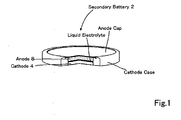
- FIG. 1 shows an embodiment of the secondary battery according to the present invention.
- the secondary battery 2 includes a cathode 4, an anode 8, and a liquid electrolyte 12 as shown in FIG 1 . It should be noted that the cathode 4 and the anode 8 are electrically connected to the respective collectors, which are not shown.
- the cathode 4 may be a similar embodiment to a conventionally known secondary battery provided with a liquid electrolyte.
- the shape, size, and the like of the electrode are not specifically limited, and can be properly set corresponding to the existing form and the manufacturing method of this secondary battery 2.
- the cathode 4 can contain a cathode active material.
- a cathode active material which can be used for this secondary battery 2 can contain at least one mutual active material for an anode as to be described later.
- Various metal compounds and the like can be used as the cathode active material.
- Specific examples of the cathode active material may include a lithium phosphate compound or a sodium phosphate compound.
- a cathode active material expressed by the following formula (1) may be included.
- M in the formula (1) denotes any one element selected from the group consisting of H, Li, Na, Mg, Al, K and Ca, and preferably denotes any one element selected from the group consisting of Li, Na, and Mg.
- X in the formula (1) is preferably a polyanion of at least one type selected from the group consisting of SiO 4 , PO 4 , SO 4 , MoO 4 , WO 4 , BO 4 , and BO 3 . X is more preferably PO 4 or MoO 4 .
- "a” denotes a number from 0 to 5
- "b” denotes a number from 1 to 2
- “c” denotes a number from 1 to 3 in the formula (1).
- N is at least one element selected from the group consisting of transition metals, Al, and Cu, and preferably at least one type selected from the group consisting of Fe, Co, V, and Cu in the formula (1).
- the material expressed by the formula (1) may be of a NASICON structure.
- these cathode active materials include LiFePO 4 , LiCoPO 4 , LiNa 2 PO 4 , Li 3 V 2 (PO 4 ) 3 , Na 3 V 2 (PO 4 ) 3 , LiVPO 4 F, and NaVPO 4 F.
- the cathode active materials are more preferably Li 3 V 2 (PO 4 ) 3 , Na 3 V 2 (PO 4 ) 3 , or LiVPO 4 F.
- the cathode 4 may properly contain an electron conduction aid and a binder in addition to the cathode active material.
- the electron conduction aid includes acetylene black, carbon black, graphite, various carbon fibers, and/or carbon nanotubes, for example.
- the binder includes polyvinylidene fluoride (PVDF), SBR, polyimide, and/or polytetrafluoroethylene, for example.
- PVDF polyvinylidene fluoride
- SBR polyvinylidene fluoride
- polyimide polyimide
- polytetrafluoroethylene for example.
- these active materials may be used individually or in combination for the cathode 4.
- the anode 8 may be a similar embodiment to that of a conventionally known secondary battery provided with a liquid electrolyte, as the cathode 4.
- the shape, size, and the like of the electrode are not specifically limited, and can be properly set corresponding to the existing form and the manufacturing method of this secondary battery 2.
- the anode 8 can contain an anode active material.
- An anode active material which can be used for this secondary battery 2 can contain at least one mutual active material for the above-described cathode, as to be described later. It means that the active material, which can be preferably used as the active material for the cathode 4, can also be similarly used as the active material for the anode 8. It should be noted that the anode 8 may properly contain an electron conduction aid and a binder in addition to the anode active material, as in the cathode 4. Moreover, these active materials may be used individually or in combination for the anode 8.
- a non-aqueous solvent type (organic solvent type) electrolyte and an ionic liquid may be used as the liquid electrolyte 12.
- a non-aqueous solvent includes carbonate ester type solvent such as ethylene carbonate (EC), diethyl carbonate (DEC), dimethyl carbonate (DMC), or propylene carbonate (PC); ⁇ -butyrolactone, tetrahydrofuran, acetonitrile, or the like.
- a single solvent or mixed solvent of these non-aqueous solvents can be used preferably as a non-aqueous solvent of the non-aqueous solvent type electrolyte.
- the electrolyte used for the non-aqueous solvent includes a lithium complex fluorine compound such as lithium hexafluorophosphate (LiPF 6 ) or lithium tetrafluoroborate (LiBF 4 ), a sodium complex fluorine compound such as sodium hexafluorophosphate (NaPF 6 ) or sodium tetrafluoroborate (NaBF 4 ), a sodium halide such as sodium perchlorate (NaClO 4 ), or sodium bis (oxalato) borate (NaBOB); or such electrolyte can be solved (dissolved) in the above solvent individually or in combination.
- LiPF 6 and NaPF 6 especially, which hardly present oxidative decomposition, and provide a high conductivity of the non-aqueous electrolyte, are preferably used.
- the ionic liquid is a material which has an ionic bonding property with a low melting point, and is thus liquid at the room temperature.
- the ionic liquid has an extremely low volatility, is incombustible, and is excellent in conductivity and heat resistance.
- a cation constituting the ionic liquid includes N, N'-dialkyl imidazolium cation and N-alkyl pyridinium cation.
- Specific examples of N, N'-dialkyl imidazolium cation especially include 1-butyl-3-methyl imidazolium cation, 1, 3-dimethyl imidazolium cation, 1, 3, 4-trimethyl imidazolium cation, 1-ethyl-3-methyl imidazolium cation (EMI), 1-hexyl-3-rnethyl imidazolium cation, and 1-methyl-3-octhyl imidazolium cation, and 1-ethyl-3-methyl imidazolium cation is preferable from among the above.
- 1-butyl pyridinium cations among N-alkyl pyridinium cations are especially preferable.
- the ionic liquid constituted by these cations is excellent in ion conductivity, chemical stability, and
- At least one of the anions constituting the ionic liquid are preferably selected from the group consisting of BF 4 - , PF 6 - , (CF 3 SO 2 ) 2 N - , CF 3 CO 2 - , and CF 3 SO 3 - .
- the ionic liquid constituted by these fluoride anions has a high thermal stability, and is thus hard to decomposed at a high temperature.
- a combination of 1-ethyl-3-methyl imidazolium cation and (CF 3 SO 2 ) 2 N - is especially preferable.
- a combination of an ionic liquid and an electrolyte is preferably used as the liquid electrolyte 12.
- the liquid electrolyte 12 preferably contains any one ion selected from the group consisting of H, Li, Na, Mg, Al, K, and Ca as the conductive cation component.
- Using an ionic liquid, as the liquid electrolyte 12, which contains Na or Li as the conductive cation component especially improves the output and the storage characteristics. Further, using Na as the conductive cation component, and thereby causing the ionic liquid to contain Na, improves the storage characteristics and additionally the cost of the secondary battery 2. It is also advantageous that Na does not form a passivation film.
- the electrolyte 12 is preferable for the electrolyte to be contained in the range from 0.1 mol/l to 1.5 mol/l with respect to the total amount.
- the mixture at this compounding ratio provides safety of the ionic liquid, and the benefits of the conductivity and the cost brought about by conductive cation components such as Na or Li. It is more preferable for the electrolyte to be contained in a range from 0.3 mol/l to 1.2 mol/l with respect to the total amount.
- the liquid electrolyte preferably contains an ionic liquid.
- the ionic liquid is non-volatile, incombustible, highly ion conductive, and chemically stabile, and thus can constitute a secondary battery exemplary in safety.
- the ionic liquid preferably contains any one ion selected from the group consisting of H, Li, Na, Mg, Al, K, and Ca as the conductive cation component. It is more preferable to use, as the liquid electrolyte, an ionic liquid which contains, as the conductive cation component, the same ion as that constitutes the active material of the cathode and anode, namely an ion of M in the formula (1).
- a secondary battery which is excellent in storage characteristics, output, and the safety can thus be easily manufactured.
- the cathode 4 and the anode 8 may contain the at least one mutual active material.
- Using the mutual compound for the active materials for both the cathode and anode easily causes the substantial electric potential difference to be zero or close to zero, and thereby resulting in the electric potential difference before a charge and after a discharge to be zero or close to zero.
- the electrolyte degradation caused by the electrolysis due to the electric potential difference between the cathode and anode can be restrained, and thereby remarkably increasing the storage characteristics for/over a long period.
- the cathode 4 and the anode 8 contain at least one mutual active material means that they contain at least one type of the same active material. All active materials of the cathode 4 and the anode 8 are preferably the same. It should be noted that the compounding ratios of the same active materials contained in the cathode 4 and the anode 8 can be the same. Typically, the cathode 4 and the anode 8 can contain a single and the same active material.
- the at least one mutual active material represented by the formula (1) is preferably used for the same active materials in the cathode and the anode. This is because the active material represented by the formula (1) can easily provide preferable electrode electric potentials. Especially, if the active material is a NASICON structure material using Li or Na as the active material M represented by the formula (1), it is possible to efficiently decrease the internal resistance. Moreover, in this case, the active material more preferably has a NASICON structure, and contains PO 4 as X. Also, the liquid electrolyte preferably contains an ionic liquid. This is because the active material represented by the formula (1) has a proper, the ionic liquid reduction-free electric potential (approximately 1V with respect to Li).
- Both the active material of the cathode 4 and the active material of the anode 8 preferably contain the metal (M) which is the same as the metal ion constituting the conductive cation component of the liquid electrolyte 12. Since this configuration causes the mutual ion conductivity to increase and thereby causes a characteristic for a large current supply and improvement in the charge/discharge characteristic, the secondary battery 2 is provided with high output and excellent storage characteristics. Moreover, in this case, if the liquid electrolyte 12 is an ionic liquid, and the conductive cation component is Li or Na, an even higher output is expected.
- a sodium ion secondary battery 2 is realized with the excellent safety and the storage characteristic, which are difficult for conventional Na batteries to realize, while enjoying the cost merit and the merit as the cation component of the Na.
- the battery structure of the secondary battery 2 according to the present invention is not specifically limited, and thus may be various structures which can be constituted by the electrolyte materials and electrode materials according to the present invention.
- These structures include various batteries including a coin battery which is constructed by providing a separator between a cathode active material and an anode active material formed into a plate shape, and filling an electrolyte, and cylindrical and prismatic batteries which use an electrode assembly constructed by winding or laminating a cathode plate constructed by applying a cathode active material on a surface of a metal foil and an anode plate constructed by applying an anode active material on a surface of a metal foil while a separator is interposed.
- a manufacturing method of a secondary battery according to the present invention may include an electrode producing step of producing a cathode and an anode containing the at least one mutual active material.
- the above-described various embodiments for the secondary battery 2 according to the present invention may be directly applied to the configuration of the cathode 4 and the anode 8, the active materials used for respective of them, and the liquid electrolyte 12.
- the at least one mutual active material is applied to the cathode 4 and the anode 8 in the manufacturing method of the secondary battery 2. This can simplify the manufacturing process as well as can increase the storage characteristic of the secondary battery 2.
- the present manufacturing method further includes a secondary battery producing step of producing a secondary battery using an ionic liquid containing an ion of M in the formula (1) as a conductive cation component.
- a secondary battery which is excellent in the storage characteristic, the output, and the safe thus can be easily manufactured.
- An electrode active material NVP (Na 3 V 2 (PO 4 ) 3 ), which is a NASICON structure material, was produced by baking 3NaH 2 PO 4 and V 2 O 3 at 900°C in an argon atmosphere containing 5% of hydrogen for 20 hours twice. An X ray diffraction was carried out for the produced ceramic powders, and a peak was observed according to a specific crystal structure.
- another electrode active material LVP Li 3 V 2 (PO 4 ) 3
- An X ray diffraction was carried out for the produced ceramic powders, and a peak was observed according to a specific crystal structure.
- LVPF LiVPO 4 F
- LVPF LiVPO 4 F
- a backbone structure which is a combination of a tetrahedron of PO 4 and an octahedron of VO 4 F 2
- LVPF was produced by baking V 2 O 5 and NH 4 PO 4 according to the carbothermal method at 700°C in an argon atmosphere for four hours, and by baking obtained VPO 4 and LiF at 700°C in an argon atmosphere for one hour.
- An X ray diffraction was carried out for the produced ceramic powders, and a peak was observed according to the specific crystal structure.
- the liquid electrolytes having the respective three types of compositions shown in Table 1 were provided.
- the ionic liquid and the electrolyte were commercially obtained.
- Coin cell type secondary batteries were produced using these battery materials according to a usual manner.
- the electrode active material and the electron conduction aid acetylene black of a 50% pressed product from DENKI KAGAKU KOGYO KABUSHIKI KAISHA
- the electron conduction aid acetylene black of a 50% pressed product from DENKI KAGAKU KOGYO KABUSHIKI KAISHA
- Polytetrafluoroethylene which is a binding agent
- An obtained electrode material was bored by a cork borer having a diameter of 10 mm for the cathode, and by a cork borer with a diameter of 15 mm for the anode, thereby forming pellets in a disk shape.
- the coin cells were produced in the following way.
- a cathode side part was produced by cutting a titan wire mesh into a circle with a diameter of 10 mm, then spot-welding the cut wire mesh to a spacer, and further spot-welding the resulting part to a coin cell case (R2032).
- the cathode pellet is placed on, and then is crimped to the spot-welded part.
- An anode side part was produced by cutting a nickel wire mesh into a circle having a diameter of 15 mm as a collector, then spot-welding the cut wire mesh to the spacer, and placing and crimping the cathode pellet on and to the spot-welded part.
- a disc spring was spot-welded to the coin cell case (R2032), and a gasket is placed over it.
- the finished coin cell part was dried under vacuum for approximately 14 hours at 100°C using a glass tube oven, and was then moved to a glove box filled with argon (dew point is equal to or less than -85°C).
- the coin cells were assembled by placing the anode pellets on an anode case, filling an electrolyte or an ionic liquid, placing over a polypropylene micro porous film separator having a diameter of 19mm, placing over the cathode part, and sealing the coin cell by a crimping machine.
- charge/discharge profiles were measured respectively for the four types of coin cell type secondary batteries produced in the example 1. It should be noted that charge/discharge characteristics were measured at 25°C for the LVP type in a voltage range from 0 to 2.5 V at a constant current charge/discharge of 0.1 mA/cm 2 , and for the NVP types in a voltage range from 0 to 1.85 V at a constant current/constant voltage charge and a constant current discharge of 0.1 mA/cm 2 . Moreover, the charge/discharge characteristic was measured for the LVPF type in a voltage range from 0 to 2.8 V at a constant current/constant voltage charge and a constant current discharge of 0.1 mA/cm 2 .
- FIG 2 to FIG 5 respectively show results for the batteries 1 to 4.
- FIG 6 shows a charge/discharge cycle characteristic (25°C, 0 - 1.85 V, and 0.2 mA/cm 2 ) of the battery 3 (coin cell containing NVP as the cathode active material, NaBF 4 /EMIBF 4 as the electrolyte, and NVP as the anode active material).
- the respective coin cells presented favorable charge/discharge behaviors as shown in FIG. 2 to FIG 5 .
- the battery 3 presented a favorable charge/discharge cycle characteristic as shown in FIG 6 .
Landscapes
- Chemical & Material Sciences (AREA)
- Engineering & Computer Science (AREA)
- Electrochemistry (AREA)
- General Chemical & Material Sciences (AREA)
- Chemical Kinetics & Catalysis (AREA)
- Materials Engineering (AREA)
- Inorganic Chemistry (AREA)
- Manufacturing & Machinery (AREA)
- Physics & Mathematics (AREA)
- Condensed Matter Physics & Semiconductors (AREA)
- General Physics & Mathematics (AREA)
- Crystallography & Structural Chemistry (AREA)
- Secondary Cells (AREA)
Abstract
Description
- The present invention relates to a secondary battery including a liquid electrolyte excellent in storage characteristics and safety.
- Recently, as portable devices such as personal computers and cellular phones have been developed, a need for batteries as a power supply thereto has largely increased. As the batteries for this application, a liquid electrolyte (electrolyte liquid) as a medium for transporting ions such as an organic solvent is widely used. Moreover, a secondary battery in which an ionic liquid is used as an electrolyte, which is a room-temperature molten salt, has been studied in order to improve safety. The ionic liquid is not combustible, and is not vaporized at room temperature, and it is thus expected that a possibility of ignition caused by leakage be decreased.
- Secondary batteries using the Li ion as a conductive cation component are known as a secondary battery using such an ionic liquid. One such secondary battery uses a lithium oxide as the cathode, and carbon or a lithium alloy as the anode (refer to Japanese Patent Publication Laid-Open No.
H4-349365 H10-92467 Z001-319688 - However, a protection device or package is indispensable for a secondary battery using an organic-solvent type liquid electrolyte in order to secure the safety thereof. Moreover, in the secondary battery according to Japanese Laid-Open Patent Publication No.
H4-349365 H10-92467 No. 2001-319688 - In addition, the inventors conceived that the conventional secondary batteries are configured to always generate an electric potential difference between the cathode and anode materials, and a degradation of the electrolyte is thus accelerated, resulting in a decrease of the storage characteristics.
- On the other hand, though using the sodium ion as a conductive cation component may be more beneficial in cost than using the lithium ion, it cannot be considered that a proper anode material has been found. Moreover, the issues of safety (in construction and operation have not yet been solved) on the deposition and the like have not been solved.
- In view of the foregoing problems, it is one object of the present invention to provide a secondary battery using a liquid electrolyte excellent in storage characteristics. Moreover, it is another object of the present invention to provide a secondary battery using a liquid electrolyte exemplary in safety. It is a further object of the present invention to provide a manufacturing method of the secondary battery using the liquid electrolytes excellent in storage characteristics and safety.
- The present inventors have found that a secondary battery excellent in storage characteristics can be provided by using the mutual compound for active materials of the cathode and the anode, and have completed the present invention. Moreover, the present inventors simultaneously found that a second battery, using as the electrolyte an ionic liquid excellent in storage characteristics and safety, can be provided by using a material having the so-called NASICON structure, as in a active material, for the cathode and the anode. The present invention provides the following means based upon the above knowledge.
- The present invention provides a second battery including a cathode, an anode, and a liquid electrolyte, where the cathode and the anode contain at least one mutual active material.
- According to the present secondary battery, there is also provided the above-described second battery where the at least one mutual active material contains a material represented by the following formula (1):
MaNbCx (1)
, where M denotes any one selected from the group consisting of H, Li, Na, Mg, Al, K, and Ca; N denotes at least one selected from the group consisting of transition metals, Al, and Cu; X denotes a polyanion of at least one type selected from the group consisting of SiO4, PO4, MoO4, SO4, WO4, BO4, and BO3; "a" denotes a number from 0 to 5, "b" denotes a number from 1 to 2, and "c" denotes a number from 1 to 3. - Further, either one of the above secondary batteries is also provided where the at least one mutual active material has a NASICON structure.
- Moreover, according to the present invention, any one of the above secondary batteries is provided where the liquid electrolyte contains, as a conductive cation component, any one ion selected from the group consisting of H, Li, Na, Mg, Al, K, and Ca. Also, in any one of the above secondary batteries the at least one mutual active material contains the same metal as a metal ion constituting a conductive cation component of the liquid electrolyte.
- Further, according to the present invention, any one of the above secondary batteries is also provided where the liquid electrolyte contains an ionic liquid.
- According to the present invention, a manufacturing method of a secondary battery that comprises a cathode, an anode, and a liquid electrolyte, including an electrode producing step of producing the cathode and the anode containing the at least one mutual active material is also provided. Moreover, included in the above manufacturing method of the electrode producing step, a material is used as the active material for the cathode and the anode, having a NASICON structure represented by the above formula (1), and either one of the above manufacturing methods further includes a secondary battery producing step where a secondary battery includes, as the liquid electrolyte, an ionic liquid containing an ion of M in the formula (1) as a conductive cation component.
-
-
FIG. 1 shows an example of a manufacturing process of a battery according to the present invention; -
FIG 2 shows a charge/discharge profile of abattery 1 produced in an example 1; -
FIG 3 shows a charge/discharge profile of abattery 2 produced in the example 1; -
FIG 4 shows a charge/discharge profile of abattery 3 produced in the example 1; -
FIG 5 shows a charge/discharge profile of a battery 4 produced in the example 1; and -
FIG 6 shows a charge/discharge cycle characteristic of thebattery 3 produced in the example 1. - A second battery according to the present invention includes a cathode, an anode, and a liquid electrolyte, where the cathode and the anode can contain the at least one mutual active material. Due to this symmetrical electrode configuration, where the active materials for the cathode and the anode contain at least one mutual compound, it is possible to produce/make an electrode electric potential difference of zero or close to zero before a charge or after a discharge. As a result, electrolyte degradation is efficiently restrained, and thereby the storage characteristics are improved. Moreover, since an electrode active material having the NASICON structure has a proper electric potential which will not reduce an ionic liquid containing ions of the same metal as a conductive cation component, a secondary battery using these materials for the electrodes and the electrolyte can provide excellent storage characteristics and safety.
- Moreover, since the electrodes contain the at least one mutual active material, volume change of both the electrodes on charge and discharge can be canceled out, and inconvenience due to a difference in the volume change of both the electrodes can be avoided by easy prediction of the volume change.
- A manufacturing method of a secondary battery according to the present invention provides a manufacturing method which includes an electrode producing step of producing the cathode and the anode containing the at least one mutual active material. Providing this electrode producing step enables the manufacturing of a secondary battery in which the electrode electric potential difference is zero or close to zero, thereby constructing a secondary battery excellent in storage characteristics. Moreover, the electrodes containing the at least one mutual active material enable the efficient and simple electrode producing step. This symmetrical electrode configuration in which the active materials for the cathode and the anode are the same compound realizes easy equalization of the electrode electric potential difference before charge and after discharge, thereby causing an efficient decrease of electrolyte degradation, resulting in improvement in storage characteristics. Moreover, since an electrode active material having the NASICON structure has an especially proper electric potential which will not reduce an ionic liquid containing ions of the same metal as a conductive cation component, a secondary battery using these materials for the electrodes and the electrolyte can provide excellent storage characteristics and safety.
- A description will now be given sequentially of the secondary battery and the manufacturing method thereof, which are embodiments of the present invention, with proper reference to the drawings.
FIG. 1 shows an embodiment of the secondary battery according to the present invention. - The
secondary battery 2 according to the present invention includes a cathode 4, an anode 8, and a liquid electrolyte 12 as shown inFIG 1 . It should be noted that the cathode 4 and the anode 8 are electrically connected to the respective collectors, which are not shown. - In the
secondary battery 2 according to the present invention, the cathode 4 may be a similar embodiment to a conventionally known secondary battery provided with a liquid electrolyte. The shape, size, and the like of the electrode are not specifically limited, and can be properly set corresponding to the existing form and the manufacturing method of thissecondary battery 2. - The cathode 4 can contain a cathode active material. A cathode active material which can be used for this
secondary battery 2 can contain at least one mutual active material for an anode as to be described later. Various metal compounds and the like can be used as the cathode active material. Specific examples of the cathode active material may include a lithium phosphate compound or a sodium phosphate compound. - Moreover, a cathode active material expressed by the following formula (1) may be included.
MaNbCx (1)
- It should be noted that M in the formula (1) denotes any one element selected from the group consisting of H, Li, Na, Mg, Al, K and Ca, and preferably denotes any one element selected from the group consisting of Li, Na, and Mg. Moreover, X in the formula (1) is preferably a polyanion of at least one type selected from the group consisting of SiO4, PO4, SO4, MoO4, WO4, BO4, and BO3. X is more preferably PO4 or MoO4. Further, "a" denotes a number from 0 to 5, "b" denotes a number from 1 to 2, and "c" denotes a number from 1 to 3 in the formula (1). Moreover, N is at least one element selected from the group consisting of transition metals, Al, and Cu, and preferably at least one type selected from the group consisting of Fe, Co, V, and Cu in the formula (1).
- The material expressed by the formula (1) may be of a NASICON structure. Specific examples of these cathode active materials include LiFePO4, LiCoPO4, LiNa2PO4, Li3V2(PO4)3, Na3V2(PO4)3, LiVPO4F, and NaVPO4F. The cathode active materials are more preferably Li3V2(PO4)3, Na3V2(PO4)3, or LiVPO4F.
- It should be noted that the cathode 4 may properly contain an electron conduction aid and a binder in addition to the cathode active material. The electron conduction aid includes acetylene black, carbon black, graphite, various carbon fibers, and/or carbon nanotubes, for example. The binder includes polyvinylidene fluoride (PVDF), SBR, polyimide, and/or polytetrafluoroethylene, for example. Moreover, these active materials may be used individually or in combination for the cathode 4.
- The anode 8 may be a similar embodiment to that of a conventionally known secondary battery provided with a liquid electrolyte, as the cathode 4. The shape, size, and the like of the electrode are not specifically limited, and can be properly set corresponding to the existing form and the manufacturing method of this
secondary battery 2. - The anode 8 can contain an anode active material. An anode active material which can be used for this
secondary battery 2 can contain at least one mutual active material for the above-described cathode, as to be described later. It means that the active material, which can be preferably used as the active material for the cathode 4, can also be similarly used as the active material for the anode 8. It should be noted that the anode 8 may properly contain an electron conduction aid and a binder in addition to the anode active material, as in the cathode 4. Moreover, these active materials may be used individually or in combination for the anode 8. - A non-aqueous solvent type (organic solvent type) electrolyte and an ionic liquid may be used as the liquid electrolyte 12. A non-aqueous solvent includes carbonate ester type solvent such as ethylene carbonate (EC), diethyl carbonate (DEC), dimethyl carbonate (DMC), or propylene carbonate (PC); γ-butyrolactone, tetrahydrofuran, acetonitrile, or the like. A single solvent or mixed solvent of these non-aqueous solvents can be used preferably as a non-aqueous solvent of the non-aqueous solvent type electrolyte. Moreover, the electrolyte used for the non-aqueous solvent includes a lithium complex fluorine compound such as lithium hexafluorophosphate (LiPF6) or lithium tetrafluoroborate (LiBF4), a sodium complex fluorine compound such as sodium hexafluorophosphate (NaPF6) or sodium tetrafluoroborate (NaBF4), a sodium halide such as sodium perchlorate (NaClO4), or sodium bis (oxalato) borate (NaBOB); or such electrolyte can be solved (dissolved) in the above solvent individually or in combination. LiPF6 and NaPF6 especially, which hardly present oxidative decomposition, and provide a high conductivity of the non-aqueous electrolyte, are preferably used.
- On this occasion, the ionic liquid is a material which has an ionic bonding property with a low melting point, and is thus liquid at the room temperature. The ionic liquid has an extremely low volatility, is incombustible, and is excellent in conductivity and heat resistance.
- A cation constituting the ionic liquid includes N, N'-dialkyl imidazolium cation and N-alkyl pyridinium cation. Specific examples of N, N'-dialkyl imidazolium cation especially include 1-butyl-3-methyl imidazolium cation, 1, 3-dimethyl imidazolium cation, 1, 3, 4-trimethyl imidazolium cation, 1-ethyl-3-methyl imidazolium cation (EMI), 1-hexyl-3-rnethyl imidazolium cation, and 1-methyl-3-octhyl imidazolium cation, and 1-ethyl-3-methyl imidazolium cation is preferable from among the above. Moreover, 1-butyl pyridinium cations among N-alkyl pyridinium cations are especially preferable. The ionic liquid constituted by these cations is excellent in ion conductivity, chemical stability, and electrochemical stability.
- Moreover, at least one of the anions constituting the ionic liquid are preferably selected from the group consisting of BF4 -, PF6 -, (CF3SO2)2N-, CF3CO2 -, and CF3SO3 -. The ionic liquid constituted by these fluoride anions has a high thermal stability, and is thus hard to decomposed at a high temperature. A combination of 1-ethyl-3-methyl imidazolium cation and (CF3SO2)2N- is especially preferable.
- A combination of an ionic liquid and an electrolyte is preferably used as the liquid electrolyte 12. The liquid electrolyte 12 preferably contains any one ion selected from the group consisting of H, Li, Na, Mg, Al, K, and Ca as the conductive cation component. Using an ionic liquid, as the liquid electrolyte 12, which contains Na or Li as the conductive cation component especially improves the output and the storage characteristics. Further, using Na as the conductive cation component, and thereby causing the ionic liquid to contain Na, improves the storage characteristics and additionally the cost of the
secondary battery 2. It is also advantageous that Na does not form a passivation film. - If a combination of an ionic liquid and an electrolyte is used as the liquid electrolyte 12, it is preferable for the electrolyte to be contained in the range from 0.1 mol/l to 1.5 mol/l with respect to the total amount. The mixture at this compounding ratio provides safety of the ionic liquid, and the benefits of the conductivity and the cost brought about by conductive cation components such as Na or Li. It is more preferable for the electrolyte to be contained in a range from 0.3 mol/l to 1.2 mol/l with respect to the total amount.
- In the
secondary battery 2 according to the present invention, the liquid electrolyte preferably contains an ionic liquid. The ionic liquid is non-volatile, incombustible, highly ion conductive, and chemically stabile, and thus can constitute a secondary battery exemplary in safety. Moreover, the ionic liquid preferably contains any one ion selected from the group consisting of H, Li, Na, Mg, Al, K, and Ca as the conductive cation component. It is more preferable to use, as the liquid electrolyte, an ionic liquid which contains, as the conductive cation component, the same ion as that constitutes the active material of the cathode and anode, namely an ion of M in the formula (1). A secondary battery which is excellent in storage characteristics, output, and the safety can thus be easily manufactured. - In the
secondary battery 2 according to the present invention, the cathode 4 and the anode 8 may contain the at least one mutual active material. Using the mutual compound for the active materials for both the cathode and anode easily causes the substantial electric potential difference to be zero or close to zero, and thereby resulting in the electric potential difference before a charge and after a discharge to be zero or close to zero. As a result, the electrolyte degradation caused by the electrolysis due to the electric potential difference between the cathode and anode can be restrained, and thereby remarkably increasing the storage characteristics for/over a long period. - On this occasion, the fact that the cathode 4 and the anode 8 contain at least one mutual active material means that they contain at least one type of the same active material. All active materials of the cathode 4 and the anode 8 are preferably the same. It should be noted that the compounding ratios of the same active materials contained in the cathode 4 and the anode 8 can be the same. Typically, the cathode 4 and the anode 8 can contain a single and the same active material.
- The at least one mutual active material represented by the formula (1) is preferably used for the same active materials in the cathode and the anode. This is because the active material represented by the formula (1) can easily provide preferable electrode electric potentials. Especially, if the active material is a NASICON structure material using Li or Na as the active material M represented by the formula (1), it is possible to efficiently decrease the internal resistance. Moreover, in this case, the active material more preferably has a NASICON structure, and contains PO4 as X. Also, the liquid electrolyte preferably contains an ionic liquid. This is because the active material represented by the formula (1) has a proper, the ionic liquid reduction-free electric potential (approximately 1V with respect to Li).
- Both the active material of the cathode 4 and the active material of the anode 8 preferably contain the metal (M) which is the same as the metal ion constituting the conductive cation component of the liquid electrolyte 12. Since this configuration causes the mutual ion conductivity to increase and thereby causes a characteristic for a large current supply and improvement in the charge/discharge characteristic, the
secondary battery 2 is provided with high output and excellent storage characteristics. Moreover, in this case, if the liquid electrolyte 12 is an ionic liquid, and the conductive cation component is Li or Na, an even higher output is expected. - Moreover, if an ion conductor containing Na ion as the conductive cation component is used as the liquid electrolyte 12 as described above, a sodium ion
secondary battery 2 is realized with the excellent safety and the storage characteristic, which are difficult for conventional Na batteries to realize, while enjoying the cost merit and the merit as the cation component of the Na. - The battery structure of the
secondary battery 2 according to the present invention is not specifically limited, and thus may be various structures which can be constituted by the electrolyte materials and electrode materials according to the present invention. These structures include various batteries including a coin battery which is constructed by providing a separator between a cathode active material and an anode active material formed into a plate shape, and filling an electrolyte, and cylindrical and prismatic batteries which use an electrode assembly constructed by winding or laminating a cathode plate constructed by applying a cathode active material on a surface of a metal foil and an anode plate constructed by applying an anode active material on a surface of a metal foil while a separator is interposed. - A manufacturing method of a secondary battery according to the present invention may include an electrode producing step of producing a cathode and an anode containing the at least one mutual active material. On this occasion, the above-described various embodiments for the
secondary battery 2 according to the present invention may be directly applied to the configuration of the cathode 4 and the anode 8, the active materials used for respective of them, and the liquid electrolyte 12. - The at least one mutual active material is applied to the cathode 4 and the anode 8 in the manufacturing method of the
secondary battery 2. This can simplify the manufacturing process as well as can increase the storage characteristic of thesecondary battery 2. - If the volumes of the cathode 4 and the anode 8 are the same, the changes in volume on a charge and discharge are synchronized, thereby always canceling out the changes in volumes.
- The present manufacturing method further includes a secondary battery producing step of producing a secondary battery using an ionic liquid containing an ion of M in the formula (1) as a conductive cation component. A secondary battery which is excellent in the storage characteristic, the output, and the safe thus can be easily manufactured.
- A description will now be given of the present invention while showing examples. The following examples are provided for illustrating the present invention, and are not intended to limit the present invention.
- Secondary batteries having various electrode configurations were produced in a present example. Table 1 shows the electrode configurations of the produced secondary batteries.
[Table 1] Type of battery Cathode Liquid electrolyte Anode Battery 1 LVP LiBF4(1mol/l)/EMIBF4 LVP Battery 2 NVP NaClO4(1mol/l)/ PC NVP Battery 3 NVP NaBF4(0.4mol/l)/EMIBF4 NVP Battery 4 LVPF LiBF4(1mol/l)/EMIBF4 LVPF LVP: Li3V2(PO4)3
NVP: Na3V2(PO4)3
LVPF: LiVPO4F - An electrode active material NVP (Na3V2(PO4)3), which is a NASICON structure material, was produced by baking 3NaH2PO4 and V2O3 at 900°C in an argon atmosphere containing 5% of hydrogen for 20 hours twice. An X ray diffraction was carried out for the produced ceramic powders, and a peak was observed according to a specific crystal structure. Moreover, another electrode active material LVP (Li3V2(PO4)3) was produced by baking 3LiH2PO4 and V2O3 at 900°C in an argon atmosphere containing 5% of hydrogen for 20 hours twice. An X ray diffraction was carried out for the produced ceramic powders, and a peak was observed according to a specific crystal structure.
- Further, LVPF (LiVPO4F), which belongs to the triclinic system, and has a backbone structure, which is a combination of a tetrahedron of PO4 and an octahedron of VO4F2, was produced by the following method. In other words, LVPF was produced by baking V2O5 and NH4PO4 according to the carbothermal method at 700°C in an argon atmosphere for four hours, and by baking obtained VPO4 and LiF at 700°C in an argon atmosphere for one hour. An X ray diffraction was carried out for the produced ceramic powders, and a peak was observed according to the specific crystal structure.
- The liquid electrolytes having the respective three types of compositions shown in Table 1 were provided. The ionic liquid and the electrolyte were commercially obtained.
- Coin cell type secondary batteries were produced using these battery materials according to a usual manner. In other words, the electrode active material and the electron conduction aid (acetylene black of a 50% pressed product from DENKI KAGAKU KOGYO KABUSHIKI KAISHA) were weighted to a weight ratio of 70:25, and were mixed using an agate mortar for approximately 15 minutes. Polytetrafluoroethylene, which is a binding agent, was weighted so that a weight ratio thereof in the evenly mixed specimen was 95:5, and was bound using an agate mortar. An obtained electrode material was bored by a cork borer having a diameter of 10 mm for the cathode, and by a cork borer with a diameter of 15 mm for the anode, thereby forming pellets in a disk shape.
- The coin cells were produced in the following way. A cathode side part was produced by cutting a titan wire mesh into a circle with a diameter of 10 mm, then spot-welding the cut wire mesh to a spacer, and further spot-welding the resulting part to a coin cell case (R2032). The cathode pellet is placed on, and then is crimped to the spot-welded part. An anode side part was produced by cutting a nickel wire mesh into a circle having a diameter of 15 mm as a collector, then spot-welding the cut wire mesh to the spacer, and placing and crimping the cathode pellet on and to the spot-welded part. Further, a disc spring was spot-welded to the coin cell case (R2032), and a gasket is placed over it. The finished coin cell part was dried under vacuum for approximately 14 hours at 100°C using a glass tube oven, and was then moved to a glove box filled with argon (dew point is equal to or less than -85°C). The coin cells were assembled by placing the anode pellets on an anode case, filling an electrolyte or an ionic liquid, placing over a polypropylene micro porous film separator having a diameter of 19mm, placing over the cathode part, and sealing the coin cell by a crimping machine.
- According to a present example, charge/discharge profiles were measured respectively for the four types of coin cell type secondary batteries produced in the example 1. It should be noted that charge/discharge characteristics were measured at 25°C for the LVP type in a voltage range from 0 to 2.5 V at a constant current charge/discharge of 0.1 mA/cm2, and for the NVP types in a voltage range from 0 to 1.85 V at a constant current/constant voltage charge and a constant current discharge of 0.1 mA/cm2. Moreover, the charge/discharge characteristic was measured for the LVPF type in a voltage range from 0 to 2.8 V at a constant current/constant voltage charge and a constant current discharge of 0.1 mA/cm2.
FIG 2 to FIG 5 respectively show results for thebatteries 1 to 4. Moreover,FIG 6 shows a charge/discharge cycle characteristic (25°C, 0 - 1.85 V, and 0.2 mA/cm2) of the battery 3 (coin cell containing NVP as the cathode active material, NaBF4/EMIBF4 as the electrolyte, and NVP as the anode active material). - The respective coin cells presented favorable charge/discharge behaviors as shown in
FIG. 2 to FIG 5 . Moreover, thebattery 3 presented a favorable charge/discharge cycle characteristic as shown inFIG 6 . From the above results, it has been found out that a secondary battery excellent in the storage characteristic can be built by using the same compound as the active materials for the cathode and the anode, and using an ionic liquid and/or a non-aqueous solvent type electrolyte as the liquid electrolyte. Moreover, it has been found out that a secondary battery using an ionic liquid containing Na salt as the liquid electrolyte can be build by using a NASICON structure material. Therefore, a secondary battery can be provided with the excellent safety and the storage characteristic, while using Na, which is cheap and free from energy depletion possibility, as the conductive cation component.
Claims (11)
- A secondary battery comprising: a cathode, an anode, and a liquid electrolyte, wherein said cathode and said anode contain at least one mutual active material.
- The secondary battery according to claim 1, wherein said at least one mutual active material contains a material represented by the following formula (1):
MaNbCx (1)
, where M denotes any one selected from the group consisting of H, Li, Na, Mg, Al, K, and Ca; N is at least one type selected from the group consisting of the transition metals, Al, and Cu; X denotes a polyanion; "a" denotes a number from 0 to 5, "b" denotes a number from 1 to 2, and "c" denotes a number from 1 to 3. - The secondary battery according to claim 2, wherein said polyanion is at least one type selected from the group consisting of SiO4, PO4, SO4, MoO4, WO4, BO4, and BO3.
- The secondary battery according to any one of claims 1 to 3, wherein said at least one mutual active material has a NASICON structure.
- The secondary battery according to any one of claims 1 to 4, wherein said liquid electrolyte contains, as a conductive cation component, any one ion selected from the group of ions consisting of H, Li, Na, Mg, Al, K, and Ca.
- The secondary battery according to any one of claims I to 5, wherein said at least one mutual active material contains the mutual metal as a metal ion constituting a conductive cation component of said liquid electrolyte.
- The secondary battery according to any one of claims 1 to 6, wherein said liquid electrolyte contains an ionic liquid.
- A manufacturing method of a secondary battery that comprises a cathode, an anode, and a liquid electrolyte, comprising an electrode producing step of producing the cathode and the anode containing at least one mutual active material.
- The manufacturing method according to claim 8, wherein said electrode producing step is a step of using a material, as the at least one mutual active material, having a NASICON structure represented by the following formula (1):
MaNbCx (1)
where M denotes any one selected from the group consisting of H, Li, Na, Mg, Al, K, and Ca, N is at least one selected from the group consisting of transition metals, Al, and Cu, X denotes a polyanion, "a" denotes a number from 0 to 5, "b" denotes a number from 1 to 2, and "c" denotes a number from 1 to 3. - The manufacturing method according to claim 9, wherein the polyanion is at least one selected from the group consisting of SiO4, PO4, SO4, MoO4, WO4, BO4, and BO3.
- The manufacturing method according to claim 9 or 10, further comprising a secondary battery producing step of producing a secondary battery comprising, as the liquid electrolyte, an ionic liquid containing an ion of M in the formula (1) as a conductive cation component.
Applications Claiming Priority (2)
| Application Number | Priority Date | Filing Date | Title |
|---|---|---|---|
| JP2007044791 | 2007-02-24 | ||
| JP2008037406A JP5293926B2 (en) | 2007-02-24 | 2008-02-19 | Secondary battery |
Publications (1)
| Publication Number | Publication Date |
|---|---|
| EP1968141A1 true EP1968141A1 (en) | 2008-09-10 |
Family
ID=39386431
Family Applications (1)
| Application Number | Title | Priority Date | Filing Date |
|---|---|---|---|
| EP08250617A Withdrawn EP1968141A1 (en) | 2007-02-24 | 2008-02-22 | Secondary battery |
Country Status (2)
| Country | Link |
|---|---|
| US (1) | US20080213674A1 (en) |
| EP (1) | EP1968141A1 (en) |
Cited By (2)
| Publication number | Priority date | Publication date | Assignee | Title |
|---|---|---|---|---|
| EP2485317A4 (en) * | 2009-09-28 | 2013-06-05 | Sumitomo Electric Industries | BATTERY AND ENERGY |
| CN107078350A (en) * | 2014-08-22 | 2017-08-18 | 法拉典有限公司 | The storage and/or transport of sodium-ion battery |
Families Citing this family (10)
| Publication number | Priority date | Publication date | Assignee | Title |
|---|---|---|---|---|
| EP2211398B1 (en) * | 2009-01-19 | 2018-01-10 | Renata AG | Heavy-duty galvanic element |
| US8900746B2 (en) * | 2009-10-13 | 2014-12-02 | Kabushiki Kaisha Toyota Chuo Kenkyusho | Aqueous secondary battery |
| JP5489063B2 (en) * | 2009-11-02 | 2014-05-14 | 株式会社Gsユアサ | Positive electrode active material for lithium secondary battery, electrode for lithium secondary battery, and lithium secondary battery |
| AU2012303284B2 (en) | 2011-08-29 | 2015-07-23 | Toyota Jidosha Kabushiki Kaisha | Positive electrode active material for sodium batteries and method for producing same |
| JP5678937B2 (en) * | 2011-09-16 | 2015-03-04 | 株式会社豊田中央研究所 | ELECTRODE MATERIAL FOR LITHIUM SECONDARY BATTERY, ITS MANUFACTURING METHOD, AND LITHIUM SECONDARY BATTERY HAVING THE SAME |
| EP2860800B1 (en) | 2012-06-12 | 2018-07-25 | Toyota Jidosha Kabushiki Kaisha | Positive electrode material for sodium batteries and method for producing same |
| US8945756B2 (en) | 2012-12-12 | 2015-02-03 | Aquion Energy Inc. | Composite anode structure for aqueous electrolyte energy storage and device containing same |
| KR101603635B1 (en) * | 2013-04-11 | 2016-03-15 | 주식회사 엘지화학 | Electrode Laminate Comprising Electrodes with Different Surface Areas and Secondary Battery Employed with the Same |
| CN108134074A (en) * | 2017-12-26 | 2018-06-08 | 宁波职业技术学院 | The preparation method of anode of magnesium ion battery material |
| KR102411149B1 (en) * | 2019-11-28 | 2022-06-17 | 삼성전기주식회사 | All solid battery |
Citations (5)
| Publication number | Priority date | Publication date | Assignee | Title |
|---|---|---|---|---|
| JPH04349365A (en) | 1991-05-27 | 1992-12-03 | Toshiba Corp | Lithium battery |
| JPH1092467A (en) | 1996-09-18 | 1998-04-10 | Toshiba Corp | Non-aqueous electrolyte secondary battery |
| JP2001319688A (en) | 2000-05-12 | 2001-11-16 | Yuasa Corp | Non-aqueous electrolyte lithium secondary battery |
| US20050003274A1 (en) | 1996-04-23 | 2005-01-06 | Michel Armand | Cathode materials for secondary (rechargeable) lithium batteries |
| EP1826860A1 (en) * | 2006-02-24 | 2007-08-29 | Ngk Insulators, Ltd. | All-solid-state battery |
Family Cites Families (11)
| Publication number | Priority date | Publication date | Assignee | Title |
|---|---|---|---|---|
| US5418090A (en) * | 1993-02-17 | 1995-05-23 | Valence Technology, Inc. | Electrodes for rechargeable lithium batteries |
| US5910382A (en) * | 1996-04-23 | 1999-06-08 | Board Of Regents, University Of Texas Systems | Cathode materials for secondary (rechargeable) lithium batteries |
| US6203946B1 (en) * | 1998-12-03 | 2001-03-20 | Valence Technology, Inc. | Lithium-containing phosphates, method of preparation, and uses thereof |
| EP0887654B1 (en) * | 1997-06-24 | 2004-10-13 | Matsushita Electric Industrial Co., Ltd. | Method for detecting working condition of non-aqueous electrolyte secondary batteries |
| CN1428012A (en) * | 2000-05-12 | 2003-07-02 | 株式会社汤浅 | Non-aqueous electrolyte lithium secondary battery |
| WO2002097907A2 (en) * | 2001-04-06 | 2002-12-05 | Valence Technology, Inc. | Sodium ion batteries |
| CN100379062C (en) * | 2002-06-21 | 2008-04-02 | 优米科尔公司 | Carbon-coated lithium-containing powder and manufacturing method thereof |
| JP2004146346A (en) * | 2002-08-28 | 2004-05-20 | Nisshinbo Ind Inc | Non-aqueous electrolyte and non-aqueous electrolyte secondary battery |
| US7041239B2 (en) * | 2003-04-03 | 2006-05-09 | Valence Technology, Inc. | Electrodes comprising mixed active particles |
| US20040202935A1 (en) * | 2003-04-08 | 2004-10-14 | Jeremy Barker | Cathode active material with increased alkali/metal content and method of making same |
| JPWO2007086289A1 (en) * | 2006-01-25 | 2009-06-18 | パナソニック株式会社 | Non-aqueous electrolyte secondary battery, manufacturing method and mounting method thereof |
-
2008
- 2008-02-22 EP EP08250617A patent/EP1968141A1/en not_active Withdrawn
- 2008-02-22 US US12/035,486 patent/US20080213674A1/en not_active Abandoned
Patent Citations (5)
| Publication number | Priority date | Publication date | Assignee | Title |
|---|---|---|---|---|
| JPH04349365A (en) | 1991-05-27 | 1992-12-03 | Toshiba Corp | Lithium battery |
| US20050003274A1 (en) | 1996-04-23 | 2005-01-06 | Michel Armand | Cathode materials for secondary (rechargeable) lithium batteries |
| JPH1092467A (en) | 1996-09-18 | 1998-04-10 | Toshiba Corp | Non-aqueous electrolyte secondary battery |
| JP2001319688A (en) | 2000-05-12 | 2001-11-16 | Yuasa Corp | Non-aqueous electrolyte lithium secondary battery |
| EP1826860A1 (en) * | 2006-02-24 | 2007-08-29 | Ngk Insulators, Ltd. | All-solid-state battery |
Cited By (3)
| Publication number | Priority date | Publication date | Assignee | Title |
|---|---|---|---|---|
| EP2485317A4 (en) * | 2009-09-28 | 2013-06-05 | Sumitomo Electric Industries | BATTERY AND ENERGY |
| CN107078350A (en) * | 2014-08-22 | 2017-08-18 | 法拉典有限公司 | The storage and/or transport of sodium-ion battery |
| CN107078350B (en) * | 2014-08-22 | 2020-09-22 | 法拉典有限公司 | Storage and/or transport of sodium ion batteries |
Also Published As
| Publication number | Publication date |
|---|---|
| US20080213674A1 (en) | 2008-09-04 |
Similar Documents
| Publication | Publication Date | Title |
|---|---|---|
| EP1968141A1 (en) | Secondary battery | |
| KR102435872B1 (en) | Lithium borosilicate glass as electrolyte and electrode protective layer | |
| KR101302858B1 (en) | Cathode active material for a lithium ion battery and method for preparing the same | |
| JP5293926B2 (en) | Secondary battery | |
| JP4202334B2 (en) | Electrochemical devices | |
| EP2482374B1 (en) | Electrolyte for electrochemical device and the electrochemical device thereof | |
| CN108701860A (en) | Solid electrolyte material and battery | |
| EP3240094B1 (en) | Electrolyte solution for secondary batteries, and secondary battery comprising the same | |
| JP6278385B2 (en) | Non-aqueous secondary battery pre-doping method and battery obtained by the pre-doping method | |
| JP5400451B2 (en) | Negative electrode for lithium primary battery and lithium primary battery | |
| EP4431455A1 (en) | Anode active material for lithium secondary battery and lithium secondary battery including the same | |
| JP2023509678A (en) | Metal ion capacitors based on hard carbon as the negative electrode and mixtures of activated carbon and sacrificial salts as the positive electrode | |
| KR20230137982A (en) | SO2 based electrolyte for rechargeable battery cells and rechargeable battery cells | |
| JP2015088437A5 (en) | ||
| CN113169379A (en) | Non-aqueous electrolyte, semi-solid electrolyte layer, sheet for secondary battery, and secondary battery | |
| KR102875124B1 (en) | Anode for lithium secondary battery and lithium secondary battery including the same | |
| Misiewicz et al. | Formation of a cathode electrolyte interphase on high-voltage Li-ion cathodes | |
| KR20230137979A (en) | rechargeable battery cells | |
| JP2006331702A (en) | Power storage device | |
| KR20240061891A (en) | Lithium secondary battery | |
| EP4553917A1 (en) | Anode active material for a lithium secondary battery and lithium secondary battery including the same | |
| KR102587972B1 (en) | Method for Preparing Anode and Anode Prepared Therefrom | |
| JP2020004598A (en) | battery | |
| WO2019150646A1 (en) | Negative electrode material for secondary battery and secondary battery using said negative electrode material | |
| KR20220134272A (en) | Lithium secondary battery and method of fabricating cathode for lithium secondary battery |
Legal Events
| Date | Code | Title | Description |
|---|---|---|---|
| PUAI | Public reference made under article 153(3) epc to a published international application that has entered the european phase |
Free format text: ORIGINAL CODE: 0009012 |
|
| AK | Designated contracting states |
Kind code of ref document: A1 Designated state(s): AT BE BG CH CY CZ DE DK EE ES FI FR GB GR HR HU IE IS IT LI LT LU LV MC MT NL NO PL PT RO SE SI SK TR |
|
| AX | Request for extension of the european patent |
Extension state: AL BA MK RS |
|
| 17P | Request for examination filed |
Effective date: 20081229 |
|
| AKX | Designation fees paid |
Designated state(s): DE FR GB |
|
| 17Q | First examination report despatched |
Effective date: 20140505 |
|
| 17Q | First examination report despatched |
Effective date: 20140610 |
|
| STAA | Information on the status of an ep patent application or granted ep patent |
Free format text: STATUS: THE APPLICATION IS DEEMED TO BE WITHDRAWN |
|
| 18D | Application deemed to be withdrawn |
Effective date: 20141223 |