EP1968134A1 - Core member for a cylindrical lithium secondary battery - Google Patents
Core member for a cylindrical lithium secondary battery Download PDFInfo
- Publication number
- EP1968134A1 EP1968134A1 EP08154358A EP08154358A EP1968134A1 EP 1968134 A1 EP1968134 A1 EP 1968134A1 EP 08154358 A EP08154358 A EP 08154358A EP 08154358 A EP08154358 A EP 08154358A EP 1968134 A1 EP1968134 A1 EP 1968134A1
- Authority
- EP
- European Patent Office
- Prior art keywords
- core member
- secondary battery
- cylindrical lithium
- lithium secondary
- electrode
- Prior art date
- Legal status (The legal status is an assumption and is not a legal conclusion. Google has not performed a legal analysis and makes no representation as to the accuracy of the status listed.)
- Granted
Links
Images





Classifications
-
- H—ELECTRICITY
- H01—ELECTRIC ELEMENTS
- H01M—PROCESSES OR MEANS, e.g. BATTERIES, FOR THE DIRECT CONVERSION OF CHEMICAL ENERGY INTO ELECTRICAL ENERGY
- H01M10/00—Secondary cells; Manufacture thereof
- H01M10/05—Accumulators with non-aqueous electrolyte
- H01M10/052—Li-accumulators
- H01M10/0525—Rocking-chair batteries, i.e. batteries with lithium insertion or intercalation in both electrodes; Lithium-ion batteries
-
- H—ELECTRICITY
- H01—ELECTRIC ELEMENTS
- H01M—PROCESSES OR MEANS, e.g. BATTERIES, FOR THE DIRECT CONVERSION OF CHEMICAL ENERGY INTO ELECTRICAL ENERGY
- H01M10/00—Secondary cells; Manufacture thereof
- H01M10/04—Construction or manufacture in general
- H01M10/0431—Cells with wound or folded electrodes
-
- H—ELECTRICITY
- H01—ELECTRIC ELEMENTS
- H01M—PROCESSES OR MEANS, e.g. BATTERIES, FOR THE DIRECT CONVERSION OF CHEMICAL ENERGY INTO ELECTRICAL ENERGY
- H01M10/00—Secondary cells; Manufacture thereof
- H01M10/05—Accumulators with non-aqueous electrolyte
- H01M10/058—Construction or manufacture
- H01M10/0587—Construction or manufacture of accumulators having only wound construction elements, i.e. wound positive electrodes, wound negative electrodes and wound separators
-
- H—ELECTRICITY
- H01—ELECTRIC ELEMENTS
- H01M—PROCESSES OR MEANS, e.g. BATTERIES, FOR THE DIRECT CONVERSION OF CHEMICAL ENERGY INTO ELECTRICAL ENERGY
- H01M50/00—Constructional details or processes of manufacture of the non-active parts of electrochemical cells other than fuel cells, e.g. hybrid cells
- H01M50/50—Current conducting connections for cells or batteries
- H01M50/572—Means for preventing undesired use or discharge
- H01M50/574—Devices or arrangements for the interruption of current
- H01M50/578—Devices or arrangements for the interruption of current in response to pressure
-
- H—ELECTRICITY
- H01—ELECTRIC ELEMENTS
- H01M—PROCESSES OR MEANS, e.g. BATTERIES, FOR THE DIRECT CONVERSION OF CHEMICAL ENERGY INTO ELECTRICAL ENERGY
- H01M50/00—Constructional details or processes of manufacture of the non-active parts of electrochemical cells other than fuel cells, e.g. hybrid cells
- H01M50/10—Primary casings; Jackets or wrappings
- H01M50/102—Primary casings; Jackets or wrappings characterised by their shape or physical structure
- H01M50/107—Primary casings; Jackets or wrappings characterised by their shape or physical structure having curved cross-section, e.g. round or elliptic
-
- Y—GENERAL TAGGING OF NEW TECHNOLOGICAL DEVELOPMENTS; GENERAL TAGGING OF CROSS-SECTIONAL TECHNOLOGIES SPANNING OVER SEVERAL SECTIONS OF THE IPC; TECHNICAL SUBJECTS COVERED BY FORMER USPC CROSS-REFERENCE ART COLLECTIONS [XRACs] AND DIGESTS
- Y02—TECHNOLOGIES OR APPLICATIONS FOR MITIGATION OR ADAPTATION AGAINST CLIMATE CHANGE
- Y02E—REDUCTION OF GREENHOUSE GAS [GHG] EMISSIONS, RELATED TO ENERGY GENERATION, TRANSMISSION OR DISTRIBUTION
- Y02E60/00—Enabling technologies; Technologies with a potential or indirect contribution to GHG emissions mitigation
- Y02E60/10—Energy storage using batteries
-
- Y—GENERAL TAGGING OF NEW TECHNOLOGICAL DEVELOPMENTS; GENERAL TAGGING OF CROSS-SECTIONAL TECHNOLOGIES SPANNING OVER SEVERAL SECTIONS OF THE IPC; TECHNICAL SUBJECTS COVERED BY FORMER USPC CROSS-REFERENCE ART COLLECTIONS [XRACs] AND DIGESTS
- Y02—TECHNOLOGIES OR APPLICATIONS FOR MITIGATION OR ADAPTATION AGAINST CLIMATE CHANGE
- Y02P—CLIMATE CHANGE MITIGATION TECHNOLOGIES IN THE PRODUCTION OR PROCESSING OF GOODS
- Y02P70/00—Climate change mitigation technologies in the production process for final industrial or consumer products
- Y02P70/50—Manufacturing or production processes characterised by the final manufactured product
Definitions
- aspects of the present invention relate to a cylindrical lithium ion secondary battery, and more particularly, to a cylindrical lithium ion secondary battery having an improved stability with respect to external pressure.
- a cylindrical lithium ion secondary battery includes an electrode assembly that is wound substantially in the form of a cylinder, a cylindrical can that is connected to the electrode assembly, an electrolytic solution that is infused inside the can to allow lithium ions to move, and a cap assembly that is connected to one side of the can and prevents the electrolytic solution from leaking and prevents the electrode assembly from separating.
- the cylindrical lithium ion secondary battery typically has a capacity of approximately 2000 to 2400mA, and thus is mainly used in electronic devices requiring high power such as notebook PCs, digital cameras, or camcorders.
- a required number of cylindrical lithium ion secondary batteries may be connected in series or parallel, may include a protection circuit, and may be assembled in a specific shape in a hard pack to be used as a power source connected to an electronic device.
- the cylindrical lithium ion secondary battery is manufactured by the following method.
- a negative electrode plate that includes an active material and a positive electrode plate that includes a separator and the active material are laminated together. One end thereof is then connected to a pole-shaped wind-axis, and is then wound in a substantial cylindrical shape, thereby forming an electrode assembly. Thereafter, the electrode assembly is inserted into a cylindrical can, an electrolytic solution is then infused therein, and a cap assembly is welded at an upper portion of the cylindrical can, thereby forming a lithium ion secondary battery having a substantial cylindrical shape.
- the core member 100 is generally formed by winding a material that initially has a form of a plate, so that a tube shape having a circular cross-section is formed. A portion thereof is cut along a longitudinal direction.
- the core member 100 may move due to an external impact such as a drop.
- the movement of the core member 100 may affect the cap assembly located at an upper portion of the core member 100.
- the safety belt may be inverted or damaged. If the safety belt is inverted or damaged, it may severely affect a safety of a lithium secondary battery.
- a lower end of the electrode assembly may come in contact with the core member 100, and thus a short may occur at the lower end of the electrode assembly.
- the separator of the electrode assembly may be damaged, and the damage to the separator may lead to a short between the positive electrode plate and the negative electrode plate, which may produce even greater damage or an explosion of the cylindrical lithium ion secondary battery.
- the core member 100 when external pressure is applied, the core member 100 may be deformed in a specific direction at a point where the external pressure is concentrated. The electrode assembly receives the pressure in the specific direction, thereby producing a short between the electrode plates.
- aspects of the present invention provide a cylindrical lithium ion secondary battery having an improved safety with respect to an external pressure.
- a core member insertable into a central space of an electrode assembly of a cylindrical lithium secondary battery has a tubular shape, has a cut-groove along a longitudinal direction, and includes at least one notch formed in a longitudinal direction at an inner lateral surface of the core member.
- the cylindrical lithium secondary battery comprising:
- FIG. 2A is a perspective view of a cylindrical lithium secondary battery.
- FIG. 2B is a cross-sectional view along the A-A line of FIG. 2A .
- FIG. 2C is a cross-sectional view along the B-B line of FIG. 2A .
- a cylindrical lithium ion secondary battery 200 includes an electrode assembly 300 which generates a voltage difference at charging/discharging time, a cylindrical case 400 which contains the electrode assembly 300, a cap assembly 500 which is assembled at an upper portion of the cylindrical case 400 and prevents the electrode assembly 300 from separation, and a core member 600 which is located at a central space of the electrode assembly 300.
- the electrode assembly 300 includes a positive (or negative) active material, such as, for example, a first electrode plate 310 coated with the positive active material, and a negative (or positive) active material, such as, for example, a second electrode plate 320 coated with the negative active material.
- a separator 330 is located between the first electrode plate 310 and the second electrode plate 320. The separator 330 prevents the first and second electrode plates 310 and 320 from shorting and allows only lithium ions to move. Further, the first electrode plate 310, the second electrode plate 320, and the separator 330 are wound in a spiral shape, have a specific space at the center of winding, and are contained in the cylindrical case 400.
- the first electrode plate 310 is generally made of aluminum (AI), and is bonded with a first electrode tab 315 that protrudes upwards in a specific length.
- the second electrode plate 320 is generally made of nickel (Ni), and is bonded with a second electrode tab 325 that protrudes downwards in a specific length.
- upper and lower isolating plates 341 and 345 are further included at upper and lower portions of the electrode assembly 300, respectively, in order to avoid a direct contact with a cap assembly 500 or the cylindrical case 400.
- a cylindrical surface 410 defines a specific space with a specific diameter.
- a bottom surface 420 is formed at a lower portion of the cylindrical surface 410 to block a lower space of the cylindrical surface 410, and an upper portion of the cylindrical surface 410 is open so that the electrode assembly 300 can be inserted.
- Either the first electrode tab 315 of the electrode plate 310 or the second electrode tab 325 of the second electrode plate 320 is bonded at the center of the bottom surface 420 of the cylindrical case 400, and thus, the cylindrical case 400 itself functions as an extension of the first electrode plate 310 or second electrode plate 320.
- the second electrode tab 325 may be bonded at the center of the bottom surface 420 of the cylindrical case 400 so that the cylindrical case functions as part of the negative electrode.
- the cylindrical case 400 is generally made of aluminum (Al), steel (Fe), or an alloy of Al and Fe. Further, in the upper portion of the cylindrical case 400, a crimping portion 430 is curved in one direction so as to press the cap assembly 500, and a beading portion 440 is concaved inwards to press the cap assembly 500 from bottom to top.
- the cap assembly 500 includes a conductive safety belt 510 which is welded to the first electrode tab 315 and which is inverted in the case of over-charging or abnormal heating, a printed circuit board (PCB) 520 which is electrically or mechanically connected to an upper portion of the safety belt 510 and cuts a circuit when the safety belt 510 is inverted, a positive temperature element 530 which is electrically and mechanically connected to an upper portion of the PCB 520 and cuts a circuit at a specific temperature and a higher temperature, a conductive electrode cap 540 which is electrically and mechanically connected to an upper portion of the positive temperature element 530 and applies a practical current to an external side, and a gasket 550 which encloses lateral circumferences of the safety belt 510, the PCB 520, the positive temperature element 530, and the electrode cap 540, to isolate them from the cylindrical case 400.
- PCB printed circuit board
- the electrode cap 540 may be bonded to either the first electrode 315 of the electrode assembly 300 or the second electrode tab 325 thereof.
- the electrode cap 540 may be bonded to the first electrode tab 315 and may function as part of the same electrode along with the first electrode plate 310, which may be, for example, the positive electrode.
- the core member 600 is inserted into the center portion of the wound type electrode assembly 300.
- the core member 600 prevents the wound type electrode assembly 300 from releasing and loosening, and also prevents the wound type electrode assembly 300 from deforming due to external pressure.
- the core member 600 is formed by winding a metal plate into a substantially tubular shape. Further, a cut-groove, gap, or slit opening 630 is formed along a longitudinal direction of the core member 600. Both lateral ends of the cut-groove 630 of the core member 600 are bent to face inwards, and the both lateral ends thereof are bent again so that the edges thereof face outwards with respect to the core member 600.
- diameters of the core member 600 are smaller at the first and second tube end portions than at the center portion.
- the core member 600 may be tapered at the first tube end and the second tube end.
- an electrolytic solution is infused into the cylindrical case 400 so that a lithium ion can move between the electrodes.
- the electrolytic solution functions as a medium for moving lithium (Li) ions generated by an electrochemical reaction that occurs in positive and negative electrode inside a battery during charging/discharging.
- the electrolytic solution may be a non-aqueous type organic electrolytic solution which is a mixture of a lithium salt and an organic solvent with high purity.
- the electrolytic solution may be a polymer using a polymer electrolyte, but the type of the electrolytic solution material is not limited thereto.
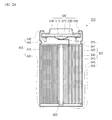
- FIG. 3A is a vertical cross-sectional view illustrating a cylindrical lithium secondary battery according to another embodiment of the present invention.
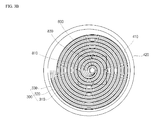
- FIG. 3B is a horizontal cross-sectional view illustrating a cylindrical lithium secondary battery according to this embodiment of the present invention.
- FIGS. 3A to 3B Overall structures of the cylindrical lithium secondary battery illustrated in FIGS. 3A to 3B are similar to those of the cylindrical lithium secondary battery illustrated in FIGS. 2A to 2C .
- the core member 800 is inserted into a central space of the wound type electrode assembly 300, prevents the wound type electrode assembly 300 from releasing and loosening, and also prevents the wound type electrode assembly 300 from deforming due to an external pressure.
- the core member 800 has a substantially tubular shape.
- a cut-groove 810 is formed along a longitudinal direction of the core member 800. The cut-groove 810 is bonded when the core member 800 is joined with the electrode assembly 300. In some cases, the cut-groove 810 may be separated to maintain a specific distance.
- the core member 800 includes a protrusion 820 that protrudes by a specific length at a lower portion of the core member 800, that is, at the tube end portion of the core member 800 that faces the bottom or closed end of the case, and at least one notch 830 is formed at an inner lateral surface of the tube shaped core member 800 along a longitudinal direction of the core member 800.
- the height of the core member 800 is 90 to 110% of the height of the electrode assembly 300 when a tube end portion of the core member 800 is located on the second electrode tab 325. If the height of the core member 800 is equal to or less than 90% of the height of the electrode assembly 300, the core member 800 lacks sufficient strength for fixing and supporting the electrode assembly 300. In addition, if the height of the core member 800 is equal to or greater than 110% of the height of the electrode assembly 300, the core member 600 may come into contact with an element of the cap assembly 500, thereby creating problems.
- an electrolytic solution is infused into the cylindrical case 400 so that lithium ions can move between the electrodes.
- the electrolytic solution functions as a medium for moving lithium (Li) ions generated by an electrochemical reaction that occurs in positive and negative electrodes inside a battery during charging/discharging.
- the electrolytic solution may be a non-aqueous type organic electrolytic solution which is a mixture of a lithium salt and an organic solvent with high purity.
- the electrolytic solution may be a polymer using a polymer electrolyte, but the type of the electrolytic solution material is not limited thereto.
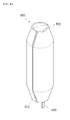
- FIGS. 4A and 4B are perspective views illustrating core members of a cylindrical lithium secondary battery according to additional embodiments of the present invention.
- core members 800 and 900 of the cylindrical lithium secondary battery 200 have a substantially tubular shape, and cut-grooves 810 and 910 are formed along longitudinal directions of the core members 800 and 900.
- the term "cut-groove" refers to any longitudinal gap in the wound core members 800 and 900.
- the cut-groove may be formed by cutting the core member after it has been formed into a tubular shape, or may be formed by cutting the plate from which the core member is formed so that when the core member is formed, the plate material does not extend in an entire circumference.
- the core members 800 and 900 each include a protrusion 820 and 920 that protrudes by a specific length from the lower portion, of the core member 800 or 900.
- the core members 800 and 900 each have a tubular shape in which diameters at edges of upper and lower portions of the core members 800 and 900 are smaller than diameters at center portions thereof. This prevents lower portions of elements of the electrode assembly 300, for example, the first electrode plate 310, the second electrode plate 320, and the separator 330, from being damaged by the cut-grooves 810 and 910, when the core member 800 and 900 rotate due to an external pressure.
- one or more notches 830 and 930 are formed at an inner lateral surface of the tube-shaped core members 800 and 900 along a longitudinal direction of the core members 800 and 900.
- a deformation direction of the core members 800 and 900 can be predetermined, so that when an external pressure equal to or greater than a specific pressure is applied, the core members 800 and 900 can be deformed in a predetermined direction, and thus a short of the electrode assembly 300 can be prevented which may otherwise occur when the core members 800 and 900 are deformed.
- the notches 830 and 930 formed at the inner lateral surface of the core members 800 and 900 may be disposed in various forms.
- the core member 800 may include a pair of notches 830 formed along a longitudinal direction of the core member 800.
- the notches 830 may be located in a symmetrical manner on left and right sides of the cut-groove 810, and may be located on a circumference with an angle of 45° from left and right sides of the cut-groove 810.
- the notches 830 may be located at the left and right sides of the cut-groove 810 at the same distance from the cut-groove.
- the core member 900 may include four notches 930 formed along a longitudinal direction of the core member 900 at an inner lateral surface of the core member 900.
- the four notches 930 may be respectively located in pairs at left and right sides with respect to the cut-groove 910 in a symmetrical manner, and may be located on the circumference of the core member at 45°, 135°, 225°, and 315° with respect to the cut-groove 910.
- imaginary lines connecting each adjacent notch may form a trapezoid.
- the four notches 930 formed on the circumference of the core member 900 may be located so that the imaginary lines connecting each adjacent notch form a square.
- the cylindrical lithium secondary battery 200 includes the protrusions 820 and 920 at lower portions of the core members 800 and 900 and the notches 830 and 930 formed in a longitudinal direction at the inner lateral surface of the core members 800 and 900, thereby improving the stability of the cylindrical lithium secondary battery 200.
- the protrusions 820 and 920 formed at the lower portions of the core members 800 and 900 may prevent damage to the lower portion of the electrode assembly 300 when the core members 800 and 900 rotate.
- the notches 830 and 930 may allow for the core members 800 and 900 to be deformed to a spiral shape in a central direction thereof. Thus, a short of the electrode assembly caused by deformation of the core members 800 and 900 can be prevented.
- the present invention provides a cylindrical lithium secondary battery having improved stability with respect to an external pressure.
Landscapes
- Chemical & Material Sciences (AREA)
- Engineering & Computer Science (AREA)
- Chemical Kinetics & Catalysis (AREA)
- Electrochemistry (AREA)
- General Chemical & Material Sciences (AREA)
- Manufacturing & Machinery (AREA)
- Materials Engineering (AREA)
- Secondary Cells (AREA)
Abstract
an electrode assembly (300) which has a first electrode plate (310), a second electrode plate (320), and a separator (330) provided between the first electrode plate (310) and the second electrode plate (320), and has a central space at the center of winding;
a core member (800, 900) which is formed in a tube shape having a cut-groove (810, 910) along a longitudinal direction, and includes at least one notch (830, 930) formed in a longitudinal direction at an inner lateral surface of the tube shape;
a case (400) which has a space for containing the electrode assembly (300) and including an open portion; and
a cap assembly (500) which is connected to the open portion of the case (400) so as to seal the case (400).
Description
- Aspects of the present invention relate to a cylindrical lithium ion secondary battery, and more particularly, to a cylindrical lithium ion secondary battery having an improved stability with respect to external pressure.
- In general, a cylindrical lithium ion secondary battery includes an electrode assembly that is wound substantially in the form of a cylinder, a cylindrical can that is connected to the electrode assembly, an electrolytic solution that is infused inside the can to allow lithium ions to move, and a cap assembly that is connected to one side of the can and prevents the electrolytic solution from leaking and prevents the electrode assembly from separating.
- The cylindrical lithium ion secondary battery typically has a capacity of approximately 2000 to 2400mA, and thus is mainly used in electronic devices requiring high power such as notebook PCs, digital cameras, or camcorders. For example, a required number of cylindrical lithium ion secondary batteries may be connected in series or parallel, may include a protection circuit, and may be assembled in a specific shape in a hard pack to be used as a power source connected to an electronic device.
- The cylindrical lithium ion secondary battery is manufactured by the following method.
- First, a negative electrode plate that includes an active material and a positive electrode plate that includes a separator and the active material are laminated together. One end thereof is then connected to a pole-shaped wind-axis, and is then wound in a substantial cylindrical shape, thereby forming an electrode assembly. Thereafter, the electrode assembly is inserted into a cylindrical can, an electrolytic solution is then infused therein, and a cap assembly is welded at an upper portion of the cylindrical can, thereby forming a lithium ion secondary battery having a substantial cylindrical shape.
- Recently, a
core member 100 having a substantial pole shape as shown inFIG. 1 has been inserted in the center of the electrode assembly, so that the electrode assembly is not deformed when the cylindrical lithium ion secondary battery is charged or discharged. Thecore member 100 is generally formed by winding a material that initially has a form of a plate, so that a tube shape having a circular cross-section is formed. A portion thereof is cut along a longitudinal direction. - However, in the cylindrical lithium ion secondary battery above, the
core member 100 may move due to an external impact such as a drop. The movement of thecore member 100 may affect the cap assembly located at an upper portion of thecore member 100. In particular, when thecore member 100 collides with a safety belt of the cap assembly, the safety belt may be inverted or damaged. If the safety belt is inverted or damaged, it may severely affect a safety of a lithium secondary battery. - Further, when the
core member 100 rotates, a lower end of the electrode assembly may come in contact with thecore member 100, and thus a short may occur at the lower end of the electrode assembly. - Furthermore, when the
core member 100 is deformed or damaged, the separator of the electrode assembly may be damaged, and the damage to the separator may lead to a short between the positive electrode plate and the negative electrode plate, which may produce even greater damage or an explosion of the cylindrical lithium ion secondary battery. In particular, when external pressure is applied, thecore member 100 may be deformed in a specific direction at a point where the external pressure is concentrated. The electrode assembly receives the pressure in the specific direction, thereby producing a short between the electrode plates. - Aspects of the present invention provide a cylindrical lithium ion secondary battery having an improved safety with respect to an external pressure.
- According to the present invention, a core member insertable into a central space of an electrode assembly of a cylindrical lithium secondary battery has a tubular shape, has a cut-groove along a longitudinal direction, and includes at least one notch formed in a longitudinal direction at an inner lateral surface of the core member. More precisely, the cylindrical lithium secondary battery comprising:
- an electrode assembly which has a first electrode plate, a second electrode plate, and a separator provided between the first electrode plate and the second electrode plate, and
- has a central space at the center of winding;
- a core member which is formed in a tube shape having a cut-groove along a longitudinal direction, and includes at least one notch formed in a longitudinal direction at an inner lateral surface of the tube shape;
- a case which has a space for containing the electrode assembly and including an open portion; and
- a cap assembly which is connected to an open portion of the case so as to seal the case.
- These and/or other aspects and advantages of the invention will become apparent and more readily appreciated from the following description of the embodiments, taken in conjunction with the accompanying drawings of which:
-
FIG. 1 is a perspective view of a conventional core member; -
FIG. 2A is a perspective view of a cylindrical lithium secondary battery; -
FIG. 2B is a cross-sectional view along the A-A line ofFIG. 2A ; -
FIG. 2C is a cross-sectional view along the B-B line ofFIG. 2A ; -
FIG. 3A is a vertical cross-sectional view illustrating a cylindrical lithium secondary battery according to the present invention; -
FIG. 3B is a horizontal cross-sectional view illustrating a cylindrical lithium secondary battery according to the embodiment of FIG. 5A; and -
FIGS. 4A and4B are perspective views illustrating core members of a cylindrical lithium secondary battery according to the present invention. - Reference will now be made in detail to the present embodiments of the present invention, examples of which are illustrated in the accompanying drawings, wherein like reference numerals refer to the like elements throughout. The embodiments are described below in order to explain the present invention by referring to the figures.
-
FIG. 2A is a perspective view of a cylindrical lithium secondary battery.FIG. 2B is a cross-sectional view along the A-A line ofFIG. 2A .FIG. 2C is a cross-sectional view along the B-B line ofFIG. 2A . - Referring to
FIGS. 2A to 2C , a cylindrical lithium ionsecondary battery 200 includes anelectrode assembly 300 which generates a voltage difference at charging/discharging time, acylindrical case 400 which contains theelectrode assembly 300, acap assembly 500 which is assembled at an upper portion of thecylindrical case 400 and prevents theelectrode assembly 300 from separation, and acore member 600 which is located at a central space of theelectrode assembly 300. - The
electrode assembly 300 includes a positive (or negative) active material, such as, for example, afirst electrode plate 310 coated with the positive active material, and a negative (or positive) active material, such as, for example, asecond electrode plate 320 coated with the negative active material. In addition, aseparator 330 is located between thefirst electrode plate 310 and thesecond electrode plate 320. Theseparator 330 prevents the first andsecond electrode plates first electrode plate 310, thesecond electrode plate 320, and theseparator 330 are wound in a spiral shape, have a specific space at the center of winding, and are contained in thecylindrical case 400. Thefirst electrode plate 310 is generally made of aluminum (AI), and is bonded with afirst electrode tab 315 that protrudes upwards in a specific length. Thesecond electrode plate 320 is generally made of nickel (Ni), and is bonded with asecond electrode tab 325 that protrudes downwards in a specific length. However, the present invention is not limited thereto. Moreover, upper and lower isolatingplates electrode assembly 300, respectively, in order to avoid a direct contact with acap assembly 500 or thecylindrical case 400. - In the
cylindrical case 400, acylindrical surface 410 defines a specific space with a specific diameter. Abottom surface 420 is formed at a lower portion of thecylindrical surface 410 to block a lower space of thecylindrical surface 410, and an upper portion of thecylindrical surface 410 is open so that theelectrode assembly 300 can be inserted. Either thefirst electrode tab 315 of theelectrode plate 310 or thesecond electrode tab 325 of thesecond electrode plate 320 is bonded at the center of thebottom surface 420 of thecylindrical case 400, and thus, thecylindrical case 400 itself functions as an extension of thefirst electrode plate 310 orsecond electrode plate 320. For example, thesecond electrode tab 325 may be bonded at the center of thebottom surface 420 of thecylindrical case 400 so that the cylindrical case functions as part of the negative electrode. Thecylindrical case 400 is generally made of aluminum (Al), steel (Fe), or an alloy of Al and Fe. Further, in the upper portion of thecylindrical case 400, a crimpingportion 430 is curved in one direction so as to press thecap assembly 500, and abeading portion 440 is concaved inwards to press thecap assembly 500 from bottom to top. - The
cap assembly 500 includes aconductive safety belt 510 which is welded to thefirst electrode tab 315 and which is inverted in the case of over-charging or abnormal heating, a printed circuit board (PCB) 520 which is electrically or mechanically connected to an upper portion of thesafety belt 510 and cuts a circuit when thesafety belt 510 is inverted, apositive temperature element 530 which is electrically and mechanically connected to an upper portion of thePCB 520 and cuts a circuit at a specific temperature and a higher temperature, aconductive electrode cap 540 which is electrically and mechanically connected to an upper portion of thepositive temperature element 530 and applies a practical current to an external side, and agasket 550 which encloses lateral circumferences of thesafety belt 510, thePCB 520, thepositive temperature element 530, and theelectrode cap 540, to isolate them from thecylindrical case 400. Here, theelectrode cap 540 may be bonded to either thefirst electrode 315 of theelectrode assembly 300 or thesecond electrode tab 325 thereof. For example, theelectrode cap 540 may be bonded to thefirst electrode tab 315 and may function as part of the same electrode along with thefirst electrode plate 310, which may be, for example, the positive electrode. - The
core member 600 is inserted into the center portion of the woundtype electrode assembly 300. Thecore member 600 prevents the woundtype electrode assembly 300 from releasing and loosening, and also prevents the woundtype electrode assembly 300 from deforming due to external pressure. - The
core member 600 is formed by winding a metal plate into a substantially tubular shape. Further, a cut-groove, gap, or slitopening 630 is formed along a longitudinal direction of thecore member 600. Both lateral ends of the cut-groove 630 of thecore member 600 are bent to face inwards, and the both lateral ends thereof are bent again so that the edges thereof face outwards with respect to thecore member 600. - Preferably, but not necessarily, diameters of the
core member 600 are smaller at the first and second tube end portions than at the center portion. In other words, thecore member 600 may be tapered at the first tube end and the second tube end. - Although not shown, an electrolytic solution is infused into the
cylindrical case 400 so that a lithium ion can move between the electrodes. The electrolytic solution functions as a medium for moving lithium (Li) ions generated by an electrochemical reaction that occurs in positive and negative electrode inside a battery during charging/discharging. The electrolytic solution may be a non-aqueous type organic electrolytic solution which is a mixture of a lithium salt and an organic solvent with high purity. Further, the electrolytic solution may be a polymer using a polymer electrolyte, but the type of the electrolytic solution material is not limited thereto. -
FIG. 3A is a vertical cross-sectional view illustrating a cylindrical lithium secondary battery according to another embodiment of the present invention.FIG. 3B is a horizontal cross-sectional view illustrating a cylindrical lithium secondary battery according to this embodiment of the present invention. - Overall structures of the cylindrical lithium secondary battery illustrated in
FIGS. 3A to 3B are similar to those of the cylindrical lithium secondary battery illustrated inFIGS. 2A to 2C . - The only difference can be seen in the structure of a core member. The
core member 800 is inserted into a central space of the woundtype electrode assembly 300, prevents the woundtype electrode assembly 300 from releasing and loosening, and also prevents the woundtype electrode assembly 300 from deforming due to an external pressure. Thecore member 800 has a substantially tubular shape. A cut-groove 810 is formed along a longitudinal direction of thecore member 800. The cut-groove 810 is bonded when thecore member 800 is joined with theelectrode assembly 300. In some cases, the cut-groove 810 may be separated to maintain a specific distance. - Further, the
core member 800 includes aprotrusion 820 that protrudes by a specific length at a lower portion of thecore member 800, that is, at the tube end portion of thecore member 800 that faces the bottom or closed end of the case, and at least onenotch 830 is formed at an inner lateral surface of the tube shapedcore member 800 along a longitudinal direction of thecore member 800. - In addition, the height of the
core member 800 is 90 to 110% of the height of theelectrode assembly 300 when a tube end portion of thecore member 800 is located on thesecond electrode tab 325. If the height of thecore member 800 is equal to or less than 90% of the height of theelectrode assembly 300, thecore member 800 lacks sufficient strength for fixing and supporting theelectrode assembly 300. In addition, if the height of thecore member 800 is equal to or greater than 110% of the height of theelectrode assembly 300, thecore member 600 may come into contact with an element of thecap assembly 500, thereby creating problems. - Although not shown, an electrolytic solution is infused into the
cylindrical case 400 so that lithium ions can move between the electrodes. The electrolytic solution functions as a medium for moving lithium (Li) ions generated by an electrochemical reaction that occurs in positive and negative electrodes inside a battery during charging/discharging. The electrolytic solution may be a non-aqueous type organic electrolytic solution which is a mixture of a lithium salt and an organic solvent with high purity. Further, the electrolytic solution may be a polymer using a polymer electrolyte, but the type of the electrolytic solution material is not limited thereto. -
FIGS. 4A and4B are perspective views illustrating core members of a cylindrical lithium secondary battery according to additional embodiments of the present invention. - Referring to
FIGS. 4A and4B ,core members secondary battery 200 have a substantially tubular shape, and cut-grooves core members wound core members - The
core members protrusion core member core members core members electrode assembly 300, for example, thefirst electrode plate 310, thesecond electrode plate 320, and theseparator 330, from being damaged by the cut-grooves core member - Further, one or
more notches core members core members notches core members core members electrode assembly 300 can be prevented which may otherwise occur when thecore members - The
notches core members - For example, as shown in
FIG. 4A , in an inner lateral surface of thecore member 800, thecore member 800 may include a pair ofnotches 830 formed along a longitudinal direction of thecore member 800. Here, thenotches 830 may be located in a symmetrical manner on left and right sides of the cut-groove 810, and may be located on a circumference with an angle of 45° from left and right sides of the cut-groove 810. In other words, thenotches 830 may be located at the left and right sides of the cut-groove 810 at the same distance from the cut-groove. - As shown in
FIG. 4B , thecore member 900 may include fournotches 930 formed along a longitudinal direction of thecore member 900 at an inner lateral surface of thecore member 900. The fournotches 930 may be respectively located in pairs at left and right sides with respect to the cut-groove 910 in a symmetrical manner, and may be located on the circumference of the core member at 45°, 135°, 225°, and 315° with respect to the cut-groove 910. In other words, in the fournotches 930 formed on the inner lateral circumferential surface of thecore member 800, imaginary lines connecting each adjacent notch may form a trapezoid. In particular, the fournotches 930 formed on the circumference of thecore member 900 may be located so that the imaginary lines connecting each adjacent notch form a square. - As described above, the cylindrical lithium
secondary battery 200 according to the present invention includes theprotrusions core members notches core members secondary battery 200. - In particular, the
protrusions core members electrode assembly 300 when thecore members - Further, when an external pressure equal to or greater than a specific pressure is applied to the
core members notches core members core members - Accordingly, the present invention provides a cylindrical lithium secondary battery having improved stability with respect to an external pressure.
Claims (6)
- A cylindrical lithium secondary battery (200) comprising:an electrode assembly (300) which has a first electrode plate (310), a second electrode plate (320), and a separator (330) provided between the first electrode plate (310) and the second electrode plate (320), and has a central space at the center of winding;a core member (800, 900) which is formed in a tube shape having a cut-groove (810, 910) along a longitudinal direction, and includes at least one notch (830, 930) formed in a longitudinal direction at an inner lateral surface of the tube shape;a case (400) which has a space for containing the electrode assembly (300) and including an open portion; anda cap assembly (500) which is connected to the open portion of the case (400) so as to seal the case (400).
- The cylindrical lithium secondary battery of claim 1, wherein the at least one notch (830, 930) allows the core member (800, 900) to deform in a predetermined direction when an external pressure is applied to the case (400).
- The cylindrical lithium secondary battery according to claim 1,
wherein the core member (900) comprises four notches (930) on a circumference, and wherein imaginary lines connecting adjacent notches (930) together form a trapezoid. - The cylindrical lithium secondary battery according to claim 3,
wherein, in the four notches (930) formed on an inner lateral circumferential surface of the core member (900), the imaginary lines connecting adjacent notches (930) form a square. - The cylindrical lithium secondary battery according to claim 1,
wherein the core member (830, 930) further comprises a protrusion (820, 920) which is protruded from a lower portion by a specific length. - The cylindrical lithium secondary battery according to claim 1,
wherein diameters at upper and lower portions of the core member (830, 930) are smaller than a diameter at a center portion.
Applications Claiming Priority (3)
| Application Number | Priority Date | Filing Date | Title |
|---|---|---|---|
| KR1020050035301A KR100646531B1 (en) | 2005-04-27 | 2005-04-27 | Cylindrical lithium secondary battery |
| KR1020050041422A KR100670453B1 (en) | 2005-05-18 | 2005-05-18 | Cylindrical lithium secondary battery |
| EP06113177A EP1717878B1 (en) | 2005-04-27 | 2006-04-27 | Core member for a cylindrical lithium secondary battery |
Related Parent Applications (1)
| Application Number | Title | Priority Date | Filing Date |
|---|---|---|---|
| EP06113177A Division EP1717878B1 (en) | 2005-04-27 | 2006-04-27 | Core member for a cylindrical lithium secondary battery |
Publications (2)
| Publication Number | Publication Date |
|---|---|
| EP1968134A1 true EP1968134A1 (en) | 2008-09-10 |
| EP1968134B1 EP1968134B1 (en) | 2009-06-24 |
Family
ID=36442047
Family Applications (3)
| Application Number | Title | Priority Date | Filing Date |
|---|---|---|---|
| EP08154360A Ceased EP1968135B1 (en) | 2005-04-27 | 2006-04-27 | Cylindrical lithium secondary battery |
| EP08154358A Ceased EP1968134B1 (en) | 2005-04-27 | 2006-04-27 | Core member for a cylindrical lithium secondary battery |
| EP06113177A Ceased EP1717878B1 (en) | 2005-04-27 | 2006-04-27 | Core member for a cylindrical lithium secondary battery |
Family Applications Before (1)
| Application Number | Title | Priority Date | Filing Date |
|---|---|---|---|
| EP08154360A Ceased EP1968135B1 (en) | 2005-04-27 | 2006-04-27 | Cylindrical lithium secondary battery |
Family Applications After (1)
| Application Number | Title | Priority Date | Filing Date |
|---|---|---|---|
| EP06113177A Ceased EP1717878B1 (en) | 2005-04-27 | 2006-04-27 | Core member for a cylindrical lithium secondary battery |
Country Status (4)
| Country | Link |
|---|---|
| US (1) | US7655349B2 (en) |
| EP (3) | EP1968135B1 (en) |
| JP (1) | JP5022621B2 (en) |
| DE (3) | DE602006007490D1 (en) |
Cited By (2)
| Publication number | Priority date | Publication date | Assignee | Title |
|---|---|---|---|---|
| US9153835B2 (en) | 2009-02-09 | 2015-10-06 | Varta Microbattery Gmbh | Button cells and method for producing same |
| US9799858B2 (en) | 2009-06-18 | 2017-10-24 | Varta Microbattery Gmbh | Button cell having winding electrode and method for the production thereof |
Families Citing this family (26)
| Publication number | Priority date | Publication date | Assignee | Title |
|---|---|---|---|---|
| US8527026B2 (en) | 1997-03-04 | 2013-09-03 | Dexcom, Inc. | Device and method for determining analyte levels |
| US6001067A (en) | 1997-03-04 | 1999-12-14 | Shults; Mark C. | Device and method for determining analyte levels |
| US20030032874A1 (en) | 2001-07-27 | 2003-02-13 | Dexcom, Inc. | Sensor head for use with implantable devices |
| US7828728B2 (en) | 2003-07-25 | 2010-11-09 | Dexcom, Inc. | Analyte sensor |
| US7613491B2 (en) | 2002-05-22 | 2009-11-03 | Dexcom, Inc. | Silicone based membranes for use in implantable glucose sensors |
| EP1648298A4 (en) | 2003-07-25 | 2010-01-13 | Dexcom Inc | Oxygen enhancing membrane systems for implantable devices |
| US7920906B2 (en) | 2005-03-10 | 2011-04-05 | Dexcom, Inc. | System and methods for processing analyte sensor data for sensor calibration |
| US9247900B2 (en) | 2004-07-13 | 2016-02-02 | Dexcom, Inc. | Analyte sensor |
| US8277713B2 (en) | 2004-05-03 | 2012-10-02 | Dexcom, Inc. | Implantable analyte sensor |
| US20070045902A1 (en) | 2004-07-13 | 2007-03-01 | Brauker James H | Analyte sensor |
| US8989833B2 (en) | 2004-07-13 | 2015-03-24 | Dexcom, Inc. | Transcutaneous analyte sensor |
| US8744546B2 (en) | 2005-05-05 | 2014-06-03 | Dexcom, Inc. | Cellulosic-based resistance domain for an analyte sensor |
| KR100670454B1 (en) * | 2005-05-18 | 2007-01-16 | 삼성에스디아이 주식회사 | Cylindrical lithium secondary battery |
| US8583204B2 (en) | 2008-03-28 | 2013-11-12 | Dexcom, Inc. | Polymer membranes for continuous analyte sensors |
| US8682408B2 (en) | 2008-03-28 | 2014-03-25 | Dexcom, Inc. | Polymer membranes for continuous analyte sensors |
| US11730407B2 (en) | 2008-03-28 | 2023-08-22 | Dexcom, Inc. | Polymer membranes for continuous analyte sensors |
| EP4549933A3 (en) | 2008-09-19 | 2025-05-21 | DexCom, Inc. | Particle-containing membrane and particulate electrode for analyte sensors |
| US8574749B2 (en) * | 2009-10-14 | 2013-11-05 | Samsung Sdi Co., Ltd. | Lithium secondary battery |
| CN103387160B (en) * | 2012-05-11 | 2016-12-14 | Tdk株式会社 | Spacer winding core and possess its roll thing |
| JP6242207B2 (en) * | 2013-12-20 | 2017-12-06 | 日東建設株式会社 | Method for estimating compressive strength of concrete by hammering |
| KR20160085063A (en) * | 2015-01-07 | 2016-07-15 | 삼성에스디아이 주식회사 | Secondary battery |
| USD798825S1 (en) * | 2016-01-04 | 2017-10-03 | Nomad Goods, Inc. | Cable with integrated in-line battery |
| WO2021020413A1 (en) * | 2019-07-31 | 2021-02-04 | パナソニックIpマネジメント株式会社 | Battery |
| EP3945617B1 (en) * | 2020-07-28 | 2025-04-23 | VARTA Microbattery GmbH | Electrochemical energy storage cell |
| SE548088C2 (en) * | 2022-01-28 | 2026-02-27 | Northvolt Ab | Center pin for a secondary cell having an engagement profile |
| CN114171777B (en) * | 2022-02-15 | 2022-07-08 | 江苏时代新能源科技有限公司 | Coil winding equipment and coil winding method |
Citations (5)
| Publication number | Priority date | Publication date | Assignee | Title |
|---|---|---|---|---|
| US5925482A (en) * | 1995-01-27 | 1999-07-20 | Asahi Kasei Kogyo Kabushiki Kaisha | Non-aqueous battery |
| EP1139458A2 (en) * | 2000-03-30 | 2001-10-04 | Ngk Insulators, Ltd. | Lithium secondary battery with wound electrode assembly and manufacturing method thereof |
| JP2001283894A (en) * | 2000-03-30 | 2001-10-12 | Sanyo Electric Co Ltd | Cylindrical battery |
| US20030148175A1 (en) * | 2001-11-28 | 2003-08-07 | Masato Iwanaga | Sealed battery |
| US20030198863A1 (en) * | 2002-04-19 | 2003-10-23 | Matsushita Electric Industrial Co., Ltd. | Cylindrical lithium ion secondary battery and fabrication method thereof |
Family Cites Families (15)
| Publication number | Priority date | Publication date | Assignee | Title |
|---|---|---|---|---|
| BE791609A (en) * | 1971-11-26 | 1973-05-21 | Accumulateurs Fixes | CYLINDRICAL ELECTRIC BATTERY |
| US5047068A (en) | 1989-10-02 | 1991-09-10 | Eveready Battery Company, Inc. | Process of assembling a cell |
| JP3143951B2 (en) * | 1991-05-02 | 2001-03-07 | ソニー株式会社 | Non-aqueous electrolyte secondary battery |
| JP3178586B2 (en) | 1995-01-27 | 2001-06-18 | 旭化成株式会社 | Non-aqueous battery |
| JP3614495B2 (en) | 1995-03-17 | 2005-01-26 | 旭化成エレクトロニクス株式会社 | Lithium ion secondary battery |
| JP2934827B2 (en) | 1996-04-01 | 1999-08-16 | 和男 田川 | Non-aqueous secondary battery and its gas emission prevention method |
| JPH10144339A (en) * | 1996-11-13 | 1998-05-29 | Sony Corp | Manufacturing method of cylindrical battery and cylindrical battery by this manufacturing method |
| JPH10162801A (en) | 1996-11-29 | 1998-06-19 | Nissan Motor Co Ltd | Rechargeable battery |
| US6020084A (en) * | 1998-02-17 | 2000-02-01 | Alcatel | Electrochemical cell design with a hollow core |
| JP2001015169A (en) * | 1999-06-29 | 2001-01-19 | Asahi Glass Co Ltd | Non-aqueous electrolyte secondary battery |
| JP3502984B2 (en) | 1999-12-01 | 2004-03-02 | モレックス インコーポレーテッド | Electrical connector equipment |
| JP3786349B2 (en) * | 2001-09-18 | 2006-06-14 | 日立マクセル株式会社 | Non-aqueous secondary battery |
| JP2003308873A (en) * | 2002-04-17 | 2003-10-31 | Sony Corp | Non-aqueous electrolyte secondary battery |
| JP4984892B2 (en) * | 2004-11-08 | 2012-07-25 | ソニー株式会社 | Battery and center pin |
| KR100696785B1 (en) * | 2005-04-25 | 2007-03-19 | 삼성에스디아이 주식회사 | Cylindrical lithium secondary battery |
-
2006
- 2006-04-17 JP JP2006113274A patent/JP5022621B2/en not_active Expired - Fee Related
- 2006-04-24 US US11/409,031 patent/US7655349B2/en active Active
- 2006-04-27 DE DE602006007490T patent/DE602006007490D1/en not_active Expired - Lifetime
- 2006-04-27 DE DE602006002054T patent/DE602006002054D1/en not_active Expired - Lifetime
- 2006-04-27 EP EP08154360A patent/EP1968135B1/en not_active Ceased
- 2006-04-27 EP EP08154358A patent/EP1968134B1/en not_active Ceased
- 2006-04-27 DE DE602006007382T patent/DE602006007382D1/en not_active Expired - Lifetime
- 2006-04-27 EP EP06113177A patent/EP1717878B1/en not_active Ceased
Patent Citations (5)
| Publication number | Priority date | Publication date | Assignee | Title |
|---|---|---|---|---|
| US5925482A (en) * | 1995-01-27 | 1999-07-20 | Asahi Kasei Kogyo Kabushiki Kaisha | Non-aqueous battery |
| EP1139458A2 (en) * | 2000-03-30 | 2001-10-04 | Ngk Insulators, Ltd. | Lithium secondary battery with wound electrode assembly and manufacturing method thereof |
| JP2001283894A (en) * | 2000-03-30 | 2001-10-12 | Sanyo Electric Co Ltd | Cylindrical battery |
| US20030148175A1 (en) * | 2001-11-28 | 2003-08-07 | Masato Iwanaga | Sealed battery |
| US20030198863A1 (en) * | 2002-04-19 | 2003-10-23 | Matsushita Electric Industrial Co., Ltd. | Cylindrical lithium ion secondary battery and fabrication method thereof |
Non-Patent Citations (1)
| Title |
|---|
| PATENT ABSTRACTS OF JAPAN vol. 2002, no. 02 2 April 2002 (2002-04-02) * |
Cited By (23)
| Publication number | Priority date | Publication date | Assignee | Title |
|---|---|---|---|---|
| US11233265B2 (en) | 2009-02-09 | 2022-01-25 | Varta Microbattery Gmbh | Button cells and method of producing same |
| US9496581B2 (en) | 2009-02-09 | 2016-11-15 | Varta Microbattery Gmbh | Button cells and method of producing same |
| US12206063B2 (en) | 2009-02-09 | 2025-01-21 | Varta Microbattery Gmbh | Button cells and method of producing same |
| US9799913B2 (en) | 2009-02-09 | 2017-10-24 | Varta Microbattery Gmbh | Button cells and method of producing same |
| US20200185755A1 (en) | 2009-02-09 | 2020-06-11 | Varta Microbattery Gmbh | Button cells and method of producing same |
| US9153835B2 (en) | 2009-02-09 | 2015-10-06 | Varta Microbattery Gmbh | Button cells and method for producing same |
| US11791493B2 (en) | 2009-02-09 | 2023-10-17 | Varta Microbattery Gmbh | Button cells and method of producing same |
| US11276875B2 (en) | 2009-02-09 | 2022-03-15 | Varta Microbattery Gmbh | Button cells and method of producing same |
| US11258092B2 (en) | 2009-02-09 | 2022-02-22 | Varta Microbattery Gmbh | Button cells and method of producing same |
| US11024869B2 (en) | 2009-02-09 | 2021-06-01 | Varta Microbattery Gmbh | Button cells and method of producing same |
| US11233264B2 (en) | 2009-02-09 | 2022-01-25 | Varta Microbattery Gmbh | Button cells and method of producing same |
| US10804506B2 (en) | 2009-06-18 | 2020-10-13 | Varta Microbattery Gmbh | Button cell having winding electrode and method for the production thereof |
| US11158896B2 (en) | 2009-06-18 | 2021-10-26 | Varta Microbattery Gmbh | Button cell having winding electrode and method for the production thereof |
| US11217844B2 (en) | 2009-06-18 | 2022-01-04 | Varta Microbattery Gmbh | Button cell having winding electrode and method for the production thereof |
| US11024905B2 (en) | 2009-06-18 | 2021-06-01 | Varta Microbattery Gmbh | Button cell having winding electrode and method for the production thereof |
| US11024907B1 (en) | 2009-06-18 | 2021-06-01 | Varta Microbattery Gmbh | Button cell having winding electrode and method for the production thereof |
| US11024906B2 (en) | 2009-06-18 | 2021-06-01 | Varta Microbattery Gmbh | Button cell having winding electrode and method for the production thereof |
| US11024904B2 (en) | 2009-06-18 | 2021-06-01 | Varta Microbattery Gmbh | Button cell having winding electrode and method for the production thereof |
| US11362384B2 (en) | 2009-06-18 | 2022-06-14 | Varta Microbattery Gmbh | Button cell having winding electrode and method for the production thereof |
| US11362385B2 (en) | 2009-06-18 | 2022-06-14 | Varta Microbattery Gmbh | Button cell having winding electrode and method for the production thereof |
| US10971776B2 (en) | 2009-06-18 | 2021-04-06 | Varta Microbattery Gmbh | Button cell having winding electrode and method for the production thereof |
| US11791512B2 (en) | 2009-06-18 | 2023-10-17 | Varta Microbattery Gmbh | Button cell having winding electrode and method for the production thereof |
| US9799858B2 (en) | 2009-06-18 | 2017-10-24 | Varta Microbattery Gmbh | Button cell having winding electrode and method for the production thereof |
Also Published As
| Publication number | Publication date |
|---|---|
| JP2006310301A (en) | 2006-11-09 |
| DE602006002054D1 (en) | 2008-09-18 |
| DE602006007490D1 (en) | 2009-08-06 |
| JP5022621B2 (en) | 2012-09-12 |
| EP1968135A1 (en) | 2008-09-10 |
| EP1968135B1 (en) | 2009-06-17 |
| EP1717878A1 (en) | 2006-11-02 |
| US7655349B2 (en) | 2010-02-02 |
| US20060263673A1 (en) | 2006-11-23 |
| EP1717878B1 (en) | 2008-08-06 |
| DE602006007382D1 (en) | 2009-07-30 |
| EP1968134B1 (en) | 2009-06-24 |
Similar Documents
| Publication | Publication Date | Title |
|---|---|---|
| EP1968134B1 (en) | Core member for a cylindrical lithium secondary battery | |
| JP4701071B2 (en) | Lithium secondary battery | |
| JP4494366B2 (en) | Cylindrical lithium secondary battery | |
| KR101893954B1 (en) | Secondary battery | |
| KR101310731B1 (en) | Secondary battery | |
| JP4787046B2 (en) | Cylindrical lithium secondary battery | |
| KR101320581B1 (en) | Secondary battery | |
| JP4515405B2 (en) | Cylindrical lithium secondary battery and manufacturing method thereof | |
| KR20110105953A (en) | Cap Assembly for Secondary Battery | |
| US7754376B2 (en) | Cylindrical lithium secondary battery and method of fabricating the same | |
| JP4594244B2 (en) | Cylindrical lithium secondary battery | |
| KR100670453B1 (en) | Cylindrical lithium secondary battery | |
| KR100624941B1 (en) | Cylindrical lithium secondary battery | |
| KR20060103028A (en) | Cylindrical lithium secondary battery | |
| CN101582520B (en) | Cylindrical lithium secondary battery | |
| KR100686811B1 (en) | Cylindrical lithium secondary battery | |
| KR100696790B1 (en) | Cylindrical lithium secondary battery | |
| KR20060037828A (en) | Cylindrical lithium secondary battery |
Legal Events
| Date | Code | Title | Description |
|---|---|---|---|
| PUAI | Public reference made under article 153(3) epc to a published international application that has entered the european phase |
Free format text: ORIGINAL CODE: 0009012 |
|
| 17P | Request for examination filed |
Effective date: 20080411 |
|
| AC | Divisional application: reference to earlier application |
Ref document number: 1717878 Country of ref document: EP Kind code of ref document: P |
|
| AK | Designated contracting states |
Kind code of ref document: A1 Designated state(s): DE FR GB |
|
| GRAP | Despatch of communication of intention to grant a patent |
Free format text: ORIGINAL CODE: EPIDOSNIGR1 |
|
| AKX | Designation fees paid |
Designated state(s): DE FR GB |
|
| GRAS | Grant fee paid |
Free format text: ORIGINAL CODE: EPIDOSNIGR3 |
|
| GRAA | (expected) grant |
Free format text: ORIGINAL CODE: 0009210 |
|
| AC | Divisional application: reference to earlier application |
Ref document number: 1717878 Country of ref document: EP Kind code of ref document: P |
|
| AK | Designated contracting states |
Kind code of ref document: B1 Designated state(s): DE FR GB |
|
| REG | Reference to a national code |
Ref country code: GB Ref legal event code: FG4D |
|
| REF | Corresponds to: |
Ref document number: 602006007490 Country of ref document: DE Date of ref document: 20090806 Kind code of ref document: P |
|
| PLBE | No opposition filed within time limit |
Free format text: ORIGINAL CODE: 0009261 |
|
| STAA | Information on the status of an ep patent application or granted ep patent |
Free format text: STATUS: NO OPPOSITION FILED WITHIN TIME LIMIT |
|
| 26N | No opposition filed |
Effective date: 20100325 |
|
| REG | Reference to a national code |
Ref country code: FR Ref legal event code: PLFP Year of fee payment: 11 |
|
| REG | Reference to a national code |
Ref country code: FR Ref legal event code: PLFP Year of fee payment: 12 |
|
| REG | Reference to a national code |
Ref country code: FR Ref legal event code: PLFP Year of fee payment: 13 |
|
| REG | Reference to a national code |
Ref country code: DE Ref legal event code: R079 Ref document number: 602006007490 Country of ref document: DE Free format text: PREVIOUS MAIN CLASS: H01M0002000000 Ipc: H01M0050000000 |
|
| P01 | Opt-out of the competence of the unified patent court (upc) registered |
Effective date: 20230528 |
|
| PGFP | Annual fee paid to national office [announced via postgrant information from national office to epo] |
Ref country code: FR Payment date: 20240328 Year of fee payment: 19 |
|
| PGFP | Annual fee paid to national office [announced via postgrant information from national office to epo] |
Ref country code: GB Payment date: 20240402 Year of fee payment: 19 |
|
| PGFP | Annual fee paid to national office [announced via postgrant information from national office to epo] |
Ref country code: DE Payment date: 20240328 Year of fee payment: 19 |
|
| REG | Reference to a national code |
Ref country code: DE Ref legal event code: R119 Ref document number: 602006007490 Country of ref document: DE |
|
| GBPC | Gb: european patent ceased through non-payment of renewal fee |
Effective date: 20250427 |
|
| PG25 | Lapsed in a contracting state [announced via postgrant information from national office to epo] |
Ref country code: DE Free format text: LAPSE BECAUSE OF NON-PAYMENT OF DUE FEES Effective date: 20251104 |
|
| PG25 | Lapsed in a contracting state [announced via postgrant information from national office to epo] |
Ref country code: GB Free format text: LAPSE BECAUSE OF NON-PAYMENT OF DUE FEES Effective date: 20250427 |
|
| PG25 | Lapsed in a contracting state [announced via postgrant information from national office to epo] |
Ref country code: FR Free format text: LAPSE BECAUSE OF NON-PAYMENT OF DUE FEES Effective date: 20250430 |