EP1967589A2 - An oleosin 5' regulatory region for the modification of plant seed lipid composition - Google Patents
An oleosin 5' regulatory region for the modification of plant seed lipid composition Download PDFInfo
- Publication number
- EP1967589A2 EP1967589A2 EP08155814A EP08155814A EP1967589A2 EP 1967589 A2 EP1967589 A2 EP 1967589A2 EP 08155814 A EP08155814 A EP 08155814A EP 08155814 A EP08155814 A EP 08155814A EP 1967589 A2 EP1967589 A2 EP 1967589A2
- Authority
- EP
- European Patent Office
- Prior art keywords
- gene
- plant
- expression
- fatty acid
- seq
- Prior art date
- Legal status (The legal status is an assumption and is not a legal conclusion. Google has not performed a legal analysis and makes no representation as to the accuracy of the status listed.)
- Granted
Links
- 230000001105 regulatory effect Effects 0.000 title claims abstract description 47
- 101710152905 Oleosin 5 Proteins 0.000 title claims description 23
- 150000002632 lipids Chemical class 0.000 title claims description 8
- 239000000203 mixture Substances 0.000 title description 7
- 230000004048 modification Effects 0.000 title description 4
- 238000012986 modification Methods 0.000 title description 4
- 108090000623 proteins and genes Proteins 0.000 claims abstract description 150
- 241000196324 Embryophyta Species 0.000 claims abstract description 134
- 230000014509 gene expression Effects 0.000 claims abstract description 85
- 238000000034 method Methods 0.000 claims abstract description 39
- 230000037356 lipid metabolism Effects 0.000 claims abstract description 37
- 230000004136 fatty acid synthesis Effects 0.000 claims abstract description 28
- 239000013604 expression vector Substances 0.000 claims abstract description 24
- 230000000295 complement effect Effects 0.000 claims abstract description 16
- 230000001131 transforming effect Effects 0.000 claims abstract description 13
- 108700001094 Plant Genes Proteins 0.000 claims abstract description 11
- 241000219194 Arabidopsis Species 0.000 claims description 38
- 108010037138 Linoleoyl-CoA Desaturase Proteins 0.000 claims description 36
- 244000061176 Nicotiana tabacum Species 0.000 claims description 28
- 235000002637 Nicotiana tabacum Nutrition 0.000 claims description 28
- 230000009261 transgenic effect Effects 0.000 claims description 26
- 239000012634 fragment Substances 0.000 claims description 25
- 102100034544 Acyl-CoA 6-desaturase Human genes 0.000 claims description 20
- 150000007523 nucleic acids Chemical class 0.000 claims description 20
- 239000002773 nucleotide Substances 0.000 claims description 20
- 125000003729 nucleotide group Chemical group 0.000 claims description 20
- 108020004707 nucleic acids Proteins 0.000 claims description 12
- 102000039446 nucleic acids Human genes 0.000 claims description 12
- 238000004519 manufacturing process Methods 0.000 claims description 11
- 108091028043 Nucleic acid sequence Proteins 0.000 claims description 10
- 230000037430 deletion Effects 0.000 claims description 9
- 238000012217 deletion Methods 0.000 claims description 9
- 230000001965 increasing effect Effects 0.000 claims description 9
- 240000002791 Brassica napus Species 0.000 claims description 8
- 235000006008 Brassica napus var napus Nutrition 0.000 claims description 5
- 240000008042 Zea mays Species 0.000 claims description 4
- 235000016383 Zea mays subsp huehuetenangensis Nutrition 0.000 claims description 4
- 235000002017 Zea mays subsp mays Nutrition 0.000 claims description 4
- 230000003247 decreasing effect Effects 0.000 claims description 4
- 235000009973 maize Nutrition 0.000 claims description 4
- 230000001172 regenerating effect Effects 0.000 claims description 4
- 101001074429 Bacillus subtilis (strain 168) Polyketide biosynthesis acyltransferase homolog PksD Proteins 0.000 claims description 3
- 101000936617 Bacillus velezensis (strain DSM 23117 / BGSC 10A6 / FZB42) Polyketide biosynthesis acyltransferase homolog BaeD Proteins 0.000 claims description 3
- 229920000742 Cotton Polymers 0.000 claims description 3
- 244000068988 Glycine max Species 0.000 claims description 3
- 235000010469 Glycine max Nutrition 0.000 claims description 3
- 244000299507 Gossypium hirsutum Species 0.000 claims description 3
- 125000002777 acetyl group Chemical group [H]C([H])([H])C(*)=O 0.000 claims description 3
- 108010011713 delta-15 desaturase Proteins 0.000 claims description 3
- 102000000452 Acetyl-CoA carboxylase Human genes 0.000 claims description 2
- 108010016219 Acetyl-CoA carboxylase Proteins 0.000 claims description 2
- 108010058912 Acyl-Carrier Protein S-Malonyltransferase Proteins 0.000 claims description 2
- 235000017060 Arachis glabrata Nutrition 0.000 claims description 2
- 244000105624 Arachis hypogaea Species 0.000 claims description 2
- 235000010777 Arachis hypogaea Nutrition 0.000 claims description 2
- 235000018262 Arachis monticola Nutrition 0.000 claims description 2
- 244000020551 Helianthus annuus Species 0.000 claims description 2
- 235000003222 Helianthus annuus Nutrition 0.000 claims description 2
- 230000001580 bacterial effect Effects 0.000 claims description 2
- 238000003780 insertion Methods 0.000 claims description 2
- 230000037431 insertion Effects 0.000 claims description 2
- 235000020232 peanut Nutrition 0.000 claims description 2
- 238000006467 substitution reaction Methods 0.000 claims description 2
- 108700026220 vif Genes Proteins 0.000 claims 4
- 108700037654 Acyl carrier protein (ACP) Proteins 0.000 claims 2
- 108010018763 Biotin carboxylase Proteins 0.000 claims 1
- ZSLZBFCDCINBPY-ZSJPKINUSA-N acetyl-CoA Chemical compound O[C@@H]1[C@H](OP(O)(O)=O)[C@@H](COP(O)(=O)OP(O)(=O)OCC(C)(C)[C@@H](O)C(=O)NCCC(=O)NCCSC(=O)C)O[C@H]1N1C2=NC=NC(N)=C2N=C1 ZSLZBFCDCINBPY-ZSJPKINUSA-N 0.000 claims 1
- 108091026890 Coding region Proteins 0.000 abstract description 19
- 108700021822 Arabidopsis oleosin Proteins 0.000 abstract description 9
- 230000009466 transformation Effects 0.000 abstract description 7
- 239000002299 complementary DNA Substances 0.000 description 70
- 235000007689 Borago officinalis Nutrition 0.000 description 51
- 230000000694 effects Effects 0.000 description 44
- 101710089395 Oleosin Proteins 0.000 description 42
- 241001072256 Boraginaceae Species 0.000 description 40
- 102000053187 Glucuronidase Human genes 0.000 description 40
- 108010060309 Glucuronidase Proteins 0.000 description 40
- 108020004414 DNA Proteins 0.000 description 37
- 239000000523 sample Substances 0.000 description 30
- 210000001519 tissue Anatomy 0.000 description 26
- 108091032973 (ribonucleotides)n+m Proteins 0.000 description 23
- 238000004458 analytical method Methods 0.000 description 20
- 235000020664 gamma-linolenic acid Nutrition 0.000 description 19
- 238000009396 hybridization Methods 0.000 description 19
- VZCCETWTMQHEPK-QNEBEIHSSA-N gamma-linolenic acid Chemical compound CCCCC\C=C/C\C=C/C\C=C/CCCCC(O)=O VZCCETWTMQHEPK-QNEBEIHSSA-N 0.000 description 17
- 210000002257 embryonic structure Anatomy 0.000 description 16
- 108020004999 messenger RNA Proteins 0.000 description 16
- 108020004635 Complementary DNA Proteins 0.000 description 15
- 210000004027 cell Anatomy 0.000 description 15
- 101150054900 gus gene Proteins 0.000 description 15
- 239000012528 membrane Substances 0.000 description 14
- 239000013598 vector Substances 0.000 description 14
- 150000001413 amino acids Chemical class 0.000 description 13
- 239000000047 product Substances 0.000 description 13
- 102000004169 proteins and genes Human genes 0.000 description 13
- 240000004355 Borago officinalis Species 0.000 description 11
- 238000006243 chemical reaction Methods 0.000 description 11
- 235000019387 fatty acid methyl ester Nutrition 0.000 description 11
- LGHXTTIAZFVCCU-SSVNFBSYSA-N (2E,4E,6E,8E)-octadeca-2,4,6,8-tetraenoic acid Chemical compound CCCCCCCCC\C=C\C=C\C=C\C=C\C(O)=O LGHXTTIAZFVCCU-SSVNFBSYSA-N 0.000 description 10
- FAPWRFPIFSIZLT-UHFFFAOYSA-M Sodium chloride Chemical compound [Na+].[Cl-] FAPWRFPIFSIZLT-UHFFFAOYSA-M 0.000 description 10
- 238000010276 construction Methods 0.000 description 10
- 230000029087 digestion Effects 0.000 description 10
- 238000010186 staining Methods 0.000 description 10
- 238000012546 transfer Methods 0.000 description 10
- 235000015112 vegetable and seed oil Nutrition 0.000 description 10
- 235000014113 dietary fatty acids Nutrition 0.000 description 8
- 239000000194 fatty acid Substances 0.000 description 8
- 229930195729 fatty acid Natural products 0.000 description 8
- 150000004665 fatty acids Chemical class 0.000 description 8
- 239000013612 plasmid Substances 0.000 description 8
- 238000012216 screening Methods 0.000 description 8
- 239000000243 solution Substances 0.000 description 8
- 241000589155 Agrobacterium tumefaciens Species 0.000 description 7
- 241000701489 Cauliflower mosaic virus Species 0.000 description 7
- 101150006573 PAN1 gene Proteins 0.000 description 7
- 230000002209 hydrophobic effect Effects 0.000 description 7
- 238000012163 sequencing technique Methods 0.000 description 7
- 238000011144 upstream manufacturing Methods 0.000 description 7
- 235000004496 Oenothera biennis Nutrition 0.000 description 6
- 238000009825 accumulation Methods 0.000 description 6
- 230000001744 histochemical effect Effects 0.000 description 6
- 230000008488 polyadenylation Effects 0.000 description 6
- XLYOFNOQVPJJNP-UHFFFAOYSA-N water Substances O XLYOFNOQVPJJNP-UHFFFAOYSA-N 0.000 description 6
- QKNYBSVHEMOAJP-UHFFFAOYSA-N 2-amino-2-(hydroxymethyl)propane-1,3-diol;hydron;chloride Chemical compound Cl.OCC(N)(CO)CO QKNYBSVHEMOAJP-UHFFFAOYSA-N 0.000 description 5
- 108020004705 Codon Proteins 0.000 description 5
- KCXVZYZYPLLWCC-UHFFFAOYSA-N EDTA Chemical compound OC(=O)CN(CC(O)=O)CCN(CC(O)=O)CC(O)=O KCXVZYZYPLLWCC-UHFFFAOYSA-N 0.000 description 5
- 238000003556 assay Methods 0.000 description 5
- 108010052305 exodeoxyribonuclease III Proteins 0.000 description 5
- 239000002609 medium Substances 0.000 description 5
- 229910052751 metal Inorganic materials 0.000 description 5
- 239000002184 metal Substances 0.000 description 5
- 239000011780 sodium chloride Substances 0.000 description 5
- 239000000758 substrate Substances 0.000 description 5
- IJGRMHOSHXDMSA-UHFFFAOYSA-N Atomic nitrogen Chemical compound N#N IJGRMHOSHXDMSA-UHFFFAOYSA-N 0.000 description 4
- 102000004190 Enzymes Human genes 0.000 description 4
- 108090000790 Enzymes Proteins 0.000 description 4
- LFQSCWFLJHTTHZ-UHFFFAOYSA-N Ethanol Chemical compound CCO LFQSCWFLJHTTHZ-UHFFFAOYSA-N 0.000 description 4
- TWRXJAOTZQYOKJ-UHFFFAOYSA-L Magnesium chloride Chemical compound [Mg+2].[Cl-].[Cl-] TWRXJAOTZQYOKJ-UHFFFAOYSA-L 0.000 description 4
- 241000192584 Synechocystis Species 0.000 description 4
- 125000000539 amino acid group Chemical group 0.000 description 4
- 230000003115 biocidal effect Effects 0.000 description 4
- 230000015572 biosynthetic process Effects 0.000 description 4
- 239000000499 gel Substances 0.000 description 4
- 238000002955 isolation Methods 0.000 description 4
- 238000002372 labelling Methods 0.000 description 4
- 239000007788 liquid Substances 0.000 description 4
- 230000004807 localization Effects 0.000 description 4
- 239000003921 oil Substances 0.000 description 4
- 235000019198 oils Nutrition 0.000 description 4
- 238000003786 synthesis reaction Methods 0.000 description 4
- -1 Δ12-desaturases Proteins 0.000 description 4
- JLIDBLDQVAYHNE-YKALOCIXSA-N (+)-Abscisic acid Chemical compound OC(=O)/C=C(/C)\C=C\[C@@]1(O)C(C)=CC(=O)CC1(C)C JLIDBLDQVAYHNE-YKALOCIXSA-N 0.000 description 3
- 102000040650 (ribonucleotides)n+m Human genes 0.000 description 3
- HSHNITRMYYLLCV-UHFFFAOYSA-N 4-methylumbelliferone Chemical compound C1=C(O)C=CC2=C1OC(=O)C=C2C HSHNITRMYYLLCV-UHFFFAOYSA-N 0.000 description 3
- ARQXEQLMMNGFDU-JHZZJYKESA-N 4-methylumbelliferone beta-D-glucuronide Chemical compound C1=CC=2C(C)=CC(=O)OC=2C=C1O[C@@H]1O[C@H](C(O)=O)[C@@H](O)[C@H](O)[C@H]1O ARQXEQLMMNGFDU-JHZZJYKESA-N 0.000 description 3
- 108091003079 Bovine Serum Albumin Proteins 0.000 description 3
- 102000004594 DNA Polymerase I Human genes 0.000 description 3
- 108010017826 DNA Polymerase I Proteins 0.000 description 3
- XEKOWRVHYACXOJ-UHFFFAOYSA-N Ethyl acetate Chemical compound CCOC(C)=O XEKOWRVHYACXOJ-UHFFFAOYSA-N 0.000 description 3
- DHMQDGOQFOQNFH-UHFFFAOYSA-N Glycine Natural products NCC(O)=O DHMQDGOQFOQNFH-UHFFFAOYSA-N 0.000 description 3
- 101710094902 Legumin Proteins 0.000 description 3
- 238000000636 Northern blotting Methods 0.000 description 3
- 239000004677 Nylon Substances 0.000 description 3
- 241000219925 Oenothera Species 0.000 description 3
- 240000008916 Oenothera biennis Species 0.000 description 3
- 108010029485 Protein Isoforms Proteins 0.000 description 3
- 102000001708 Protein Isoforms Human genes 0.000 description 3
- 108020004511 Recombinant DNA Proteins 0.000 description 3
- 108700008625 Reporter Genes Proteins 0.000 description 3
- 108010016634 Seed Storage Proteins Proteins 0.000 description 3
- HEMHJVSKTPXQMS-UHFFFAOYSA-M Sodium hydroxide Chemical compound [OH-].[Na+] HEMHJVSKTPXQMS-UHFFFAOYSA-M 0.000 description 3
- 108700026226 TATA Box Proteins 0.000 description 3
- 239000011543 agarose gel Substances 0.000 description 3
- DTOSIQBPPRVQHS-PDBXOOCHSA-N alpha-linolenic acid Chemical compound CC\C=C/C\C=C/C\C=C/CCCCCCCC(O)=O DTOSIQBPPRVQHS-PDBXOOCHSA-N 0.000 description 3
- 230000003321 amplification Effects 0.000 description 3
- 239000003153 chemical reaction reagent Substances 0.000 description 3
- 238000010367 cloning Methods 0.000 description 3
- NEKNNCABDXGBEN-UHFFFAOYSA-L disodium;4-(4-chloro-2-methylphenoxy)butanoate;4-(2,4-dichlorophenoxy)butanoate Chemical compound [Na+].[Na+].CC1=CC(Cl)=CC=C1OCCCC([O-])=O.[O-]C(=O)CCCOC1=CC=C(Cl)C=C1Cl NEKNNCABDXGBEN-UHFFFAOYSA-L 0.000 description 3
- 229940045761 evening primrose extract Drugs 0.000 description 3
- 235000008524 evening primrose extract Nutrition 0.000 description 3
- 239000000284 extract Substances 0.000 description 3
- 210000004209 hair Anatomy 0.000 description 3
- 210000001161 mammalian embryo Anatomy 0.000 description 3
- 230000007246 mechanism Effects 0.000 description 3
- 238000003199 nucleic acid amplification method Methods 0.000 description 3
- 229920001778 nylon Polymers 0.000 description 3
- 230000010152 pollination Effects 0.000 description 3
- 229920001184 polypeptide Polymers 0.000 description 3
- 230000032361 posttranscriptional gene silencing Effects 0.000 description 3
- 230000037452 priming Effects 0.000 description 3
- 108090000765 processed proteins & peptides Proteins 0.000 description 3
- 102000004196 processed proteins & peptides Human genes 0.000 description 3
- 108091008146 restriction endonucleases Proteins 0.000 description 3
- 241000894007 species Species 0.000 description 3
- 238000010561 standard procedure Methods 0.000 description 3
- 108020005029 5' Flanking Region Proteins 0.000 description 2
- JXCKZXHCJOVIAV-UHFFFAOYSA-N 6-[(5-bromo-4-chloro-1h-indol-3-yl)oxy]-3,4,5-trihydroxyoxane-2-carboxylic acid;cyclohexanamine Chemical compound [NH3+]C1CCCCC1.O1C(C([O-])=O)C(O)C(O)C(O)C1OC1=CNC2=CC=C(Br)C(Cl)=C12 JXCKZXHCJOVIAV-UHFFFAOYSA-N 0.000 description 2
- 101710146995 Acyl carrier protein Proteins 0.000 description 2
- 241000972773 Aulopiformes Species 0.000 description 2
- 241000219198 Brassica Species 0.000 description 2
- 235000011331 Brassica Nutrition 0.000 description 2
- 235000004977 Brassica sinapistrum Nutrition 0.000 description 2
- HEDRZPFGACZZDS-UHFFFAOYSA-N Chloroform Chemical compound ClC(Cl)Cl HEDRZPFGACZZDS-UHFFFAOYSA-N 0.000 description 2
- 244000000626 Daucus carota Species 0.000 description 2
- 235000002767 Daucus carota Nutrition 0.000 description 2
- ZGTMUACCHSMWAC-UHFFFAOYSA-L EDTA disodium salt (anhydrous) Chemical compound [Na+].[Na+].OC(=O)CN(CC([O-])=O)CCN(CC(O)=O)CC([O-])=O ZGTMUACCHSMWAC-UHFFFAOYSA-L 0.000 description 2
- 241000282326 Felis catus Species 0.000 description 2
- ZHNUHDYFZUAESO-UHFFFAOYSA-N Formamide Chemical compound NC=O ZHNUHDYFZUAESO-UHFFFAOYSA-N 0.000 description 2
- 239000004471 Glycine Substances 0.000 description 2
- 108091026898 Leader sequence (mRNA) Proteins 0.000 description 2
- OYHQOLUKZRVURQ-HZJYTTRNSA-N Linoleic acid Chemical compound CCCCC\C=C/C\C=C/CCCCCCCC(O)=O OYHQOLUKZRVURQ-HZJYTTRNSA-N 0.000 description 2
- 206010028980 Neoplasm Diseases 0.000 description 2
- 108700026244 Open Reading Frames Proteins 0.000 description 2
- 238000010222 PCR analysis Methods 0.000 description 2
- ISWSIDIOOBJBQZ-UHFFFAOYSA-N Phenol Chemical compound OC1=CC=CC=C1 ISWSIDIOOBJBQZ-UHFFFAOYSA-N 0.000 description 2
- 108091027981 Response element Proteins 0.000 description 2
- 229920005654 Sephadex Polymers 0.000 description 2
- 239000012507 Sephadex™ Substances 0.000 description 2
- CDBYLPFSWZWCQE-UHFFFAOYSA-L Sodium Carbonate Chemical compound [Na+].[Na+].[O-]C([O-])=O CDBYLPFSWZWCQE-UHFFFAOYSA-L 0.000 description 2
- 238000002105 Southern blotting Methods 0.000 description 2
- 229920004890 Triton X-100 Polymers 0.000 description 2
- 239000013504 Triton X-100 Substances 0.000 description 2
- 108090000704 Tubulin Proteins 0.000 description 2
- 235000020661 alpha-linolenic acid Nutrition 0.000 description 2
- 230000000692 anti-sense effect Effects 0.000 description 2
- 230000009286 beneficial effect Effects 0.000 description 2
- 238000010256 biochemical assay Methods 0.000 description 2
- 238000009835 boiling Methods 0.000 description 2
- 238000009395 breeding Methods 0.000 description 2
- 230000001488 breeding effect Effects 0.000 description 2
- 238000010805 cDNA synthesis kit Methods 0.000 description 2
- 238000012512 characterization method Methods 0.000 description 2
- 210000003763 chloroplast Anatomy 0.000 description 2
- 239000003086 colorant Substances 0.000 description 2
- 238000004440 column chromatography Methods 0.000 description 2
- SUYVUBYJARFZHO-RRKCRQDMSA-N dATP Chemical compound C1=NC=2C(N)=NC=NC=2N1[C@H]1C[C@H](O)[C@@H](COP(O)(=O)OP(O)(=O)OP(O)(O)=O)O1 SUYVUBYJARFZHO-RRKCRQDMSA-N 0.000 description 2
- SUYVUBYJARFZHO-UHFFFAOYSA-N dATP Natural products C1=NC=2C(N)=NC=NC=2N1C1CC(O)C(COP(O)(=O)OP(O)(=O)OP(O)(O)=O)O1 SUYVUBYJARFZHO-UHFFFAOYSA-N 0.000 description 2
- RGWHQCVHVJXOKC-SHYZEUOFSA-J dCTP(4-) Chemical compound O=C1N=C(N)C=CN1[C@@H]1O[C@H](COP([O-])(=O)OP([O-])(=O)OP([O-])([O-])=O)[C@@H](O)C1 RGWHQCVHVJXOKC-SHYZEUOFSA-J 0.000 description 2
- NHVNXKFIZYSCEB-XLPZGREQSA-N dTTP Chemical compound O=C1NC(=O)C(C)=CN1[C@@H]1O[C@H](COP(O)(=O)OP(O)(=O)OP(O)(O)=O)[C@@H](O)C1 NHVNXKFIZYSCEB-XLPZGREQSA-N 0.000 description 2
- 238000001514 detection method Methods 0.000 description 2
- 230000013020 embryo development Effects 0.000 description 2
- 238000005516 engineering process Methods 0.000 description 2
- 230000006870 function Effects 0.000 description 2
- 238000001030 gas--liquid chromatography Methods 0.000 description 2
- 150000003278 haem Chemical class 0.000 description 2
- 230000001939 inductive effect Effects 0.000 description 2
- 230000008595 infiltration Effects 0.000 description 2
- 238000001764 infiltration Methods 0.000 description 2
- BPHPUYQFMNQIOC-NXRLNHOXSA-N isopropyl beta-D-thiogalactopyranoside Chemical compound CC(C)S[C@@H]1O[C@H](CO)[C@H](O)[C@H](O)[C@H]1O BPHPUYQFMNQIOC-NXRLNHOXSA-N 0.000 description 2
- 229930027917 kanamycin Natural products 0.000 description 2
- 229960000318 kanamycin Drugs 0.000 description 2
- SBUJHOSQTJFQJX-NOAMYHISSA-N kanamycin Chemical compound O[C@@H]1[C@@H](O)[C@H](O)[C@@H](CN)O[C@@H]1O[C@H]1[C@H](O)[C@@H](O[C@@H]2[C@@H]([C@@H](N)[C@H](O)[C@@H](CO)O2)O)[C@H](N)C[C@@H]1N SBUJHOSQTJFQJX-NOAMYHISSA-N 0.000 description 2
- 229930182823 kanamycin A Natural products 0.000 description 2
- 235000020778 linoleic acid Nutrition 0.000 description 2
- OYHQOLUKZRVURQ-IXWMQOLASA-N linoleic acid Natural products CCCCC\C=C/C\C=C\CCCCCCCC(O)=O OYHQOLUKZRVURQ-IXWMQOLASA-N 0.000 description 2
- 229960004488 linolenic acid Drugs 0.000 description 2
- KWGKDLIKAYFUFQ-UHFFFAOYSA-M lithium chloride Chemical compound [Li+].[Cl-] KWGKDLIKAYFUFQ-UHFFFAOYSA-M 0.000 description 2
- 238000011068 loading method Methods 0.000 description 2
- 229910001629 magnesium chloride Inorganic materials 0.000 description 2
- 239000003550 marker Substances 0.000 description 2
- 238000010369 molecular cloning Methods 0.000 description 2
- 229910052757 nitrogen Inorganic materials 0.000 description 2
- QYSGYZVSCZSLHT-UHFFFAOYSA-N octafluoropropane Chemical compound FC(F)(F)C(F)(F)C(F)(F)F QYSGYZVSCZSLHT-UHFFFAOYSA-N 0.000 description 2
- CNVZJPUDSLNTQU-SEYXRHQNSA-N petroselinic acid Chemical compound CCCCCCCCCCC\C=C/CCCCC(O)=O CNVZJPUDSLNTQU-SEYXRHQNSA-N 0.000 description 2
- 210000002729 polyribosome Anatomy 0.000 description 2
- 238000001556 precipitation Methods 0.000 description 2
- 239000002243 precursor Substances 0.000 description 2
- 238000002360 preparation method Methods 0.000 description 2
- 230000002285 radioactive effect Effects 0.000 description 2
- 239000011541 reaction mixture Substances 0.000 description 2
- 238000011069 regeneration method Methods 0.000 description 2
- 235000019515 salmon Nutrition 0.000 description 2
- 239000001488 sodium phosphate Substances 0.000 description 2
- 229910000162 sodium phosphate Inorganic materials 0.000 description 2
- 239000002689 soil Substances 0.000 description 2
- 238000013518 transcription Methods 0.000 description 2
- 230000035897 transcription Effects 0.000 description 2
- 230000002103 transcriptional effect Effects 0.000 description 2
- 238000011426 transformation method Methods 0.000 description 2
- RYFMWSXOAZQYPI-UHFFFAOYSA-K trisodium phosphate Chemical compound [Na+].[Na+].[Na+].[O-]P([O-])([O-])=O RYFMWSXOAZQYPI-UHFFFAOYSA-K 0.000 description 2
- 230000017260 vegetative to reproductive phase transition of meristem Effects 0.000 description 2
- 239000001149 (9Z,12Z)-octadeca-9,12-dienoate Substances 0.000 description 1
- WTTJVINHCBCLGX-UHFFFAOYSA-N (9trans,12cis)-methyl linoleate Natural products CCCCCC=CCC=CCCCCCCCC(=O)OC WTTJVINHCBCLGX-UHFFFAOYSA-N 0.000 description 1
- WRIDQFICGBMAFQ-UHFFFAOYSA-N (E)-8-Octadecenoic acid Natural products CCCCCCCCCC=CCCCCCCC(O)=O WRIDQFICGBMAFQ-UHFFFAOYSA-N 0.000 description 1
- OXEDXHIBHVMDST-UHFFFAOYSA-N 12Z-octadecenoic acid Natural products CCCCCC=CCCCCCCCCCCC(O)=O OXEDXHIBHVMDST-UHFFFAOYSA-N 0.000 description 1
- DVWSXZIHSUZZKJ-UHFFFAOYSA-N 18:3n-3 Natural products CCC=CCC=CCC=CCCCCCCCC(=O)OC DVWSXZIHSUZZKJ-UHFFFAOYSA-N 0.000 description 1
- LQJBNNIYVWPHFW-UHFFFAOYSA-N 20:1omega9c fatty acid Natural products CCCCCCCCCCC=CCCCCCCCC(O)=O LQJBNNIYVWPHFW-UHFFFAOYSA-N 0.000 description 1
- LNJCGNRKWOHFFV-UHFFFAOYSA-N 3-(2-hydroxyethylsulfanyl)propanenitrile Chemical compound OCCSCCC#N LNJCGNRKWOHFFV-UHFFFAOYSA-N 0.000 description 1
- OPIFSICVWOWJMJ-AEOCFKNESA-N 5-bromo-4-chloro-3-indolyl beta-D-galactoside Chemical compound O[C@@H]1[C@@H](O)[C@@H](O)[C@@H](CO)O[C@H]1OC1=CNC2=CC=C(Br)C(Cl)=C12 OPIFSICVWOWJMJ-AEOCFKNESA-N 0.000 description 1
- DHJFFLKPAYHPHU-BYNIDDHOSA-N 5-bromo-4-chloro-3-indolyl beta-D-glucuronide Chemical compound O1[C@H](C(O)=O)[C@@H](O)[C@H](O)[C@@H](O)[C@@H]1OC1=CNC2=CC=C(Br)C(Cl)=C12 DHJFFLKPAYHPHU-BYNIDDHOSA-N 0.000 description 1
- QSBYPNXLFMSGKH-UHFFFAOYSA-N 9-Heptadecensaeure Natural products CCCCCCCC=CCCCCCCCC(O)=O QSBYPNXLFMSGKH-UHFFFAOYSA-N 0.000 description 1
- 102000006488 Acyl-Carrier Protein S-Malonyltransferase Human genes 0.000 description 1
- 241000589158 Agrobacterium Species 0.000 description 1
- 108010088751 Albumins Proteins 0.000 description 1
- 102000009027 Albumins Human genes 0.000 description 1
- 241000192542 Anabaena Species 0.000 description 1
- 101100020619 Arabidopsis thaliana LATE gene Proteins 0.000 description 1
- 241000894006 Bacteria Species 0.000 description 1
- 241000722877 Borago Species 0.000 description 1
- 101001047514 Bos taurus Lethal(2) giant larvae protein homolog 1 Proteins 0.000 description 1
- 238000009010 Bradford assay Methods 0.000 description 1
- 235000011293 Brassica napus Nutrition 0.000 description 1
- 101100328086 Caenorhabditis elegans cla-1 gene Proteins 0.000 description 1
- 108010035563 Chloramphenicol O-acetyltransferase Proteins 0.000 description 1
- 244000018436 Coriandrum sativum Species 0.000 description 1
- 235000002787 Coriandrum sativum Nutrition 0.000 description 1
- 102000018832 Cytochromes Human genes 0.000 description 1
- 108010052832 Cytochromes Proteins 0.000 description 1
- 102000007605 Cytochromes b5 Human genes 0.000 description 1
- 108010007167 Cytochromes b5 Proteins 0.000 description 1
- IMXSCCDUAFEIOE-UHFFFAOYSA-N D-Octopin Natural products OC(=O)C(C)NC(C(O)=O)CCCN=C(N)N IMXSCCDUAFEIOE-UHFFFAOYSA-N 0.000 description 1
- IMXSCCDUAFEIOE-RITPCOANSA-N D-octopine Chemical compound [O-]C(=O)[C@@H](C)[NH2+][C@H](C([O-])=O)CCCNC(N)=[NH2+] IMXSCCDUAFEIOE-RITPCOANSA-N 0.000 description 1
- 230000006820 DNA synthesis Effects 0.000 description 1
- 102000016928 DNA-directed DNA polymerase Human genes 0.000 description 1
- 108010014303 DNA-directed DNA polymerase Proteins 0.000 description 1
- 108060002716 Exonuclease Proteins 0.000 description 1
- 108091060211 Expressed sequence tag Proteins 0.000 description 1
- 102000009114 Fatty acid desaturases Human genes 0.000 description 1
- 108010087894 Fatty acid desaturases Proteins 0.000 description 1
- 229920001917 Ficoll Polymers 0.000 description 1
- 241000233866 Fungi Species 0.000 description 1
- 101000962359 Homo sapiens NACHT, LRR and PYD domains-containing protein 10 Proteins 0.000 description 1
- 208000035150 Hypercholesterolemia Diseases 0.000 description 1
- 206010020649 Hyperkeratosis Diseases 0.000 description 1
- ROHFNLRQFUQHCH-YFKPBYRVSA-N L-leucine Chemical compound CC(C)C[C@H](N)C(O)=O ROHFNLRQFUQHCH-YFKPBYRVSA-N 0.000 description 1
- ROHFNLRQFUQHCH-UHFFFAOYSA-N Leucine Natural products CC(C)CC(N)C(O)=O ROHFNLRQFUQHCH-UHFFFAOYSA-N 0.000 description 1
- 241000512015 Menetes Species 0.000 description 1
- PKIXXJPMNDDDOS-UHFFFAOYSA-N Methyl linoleate Natural products CCCCC=CCCC=CCCCCCCCC(=O)OC PKIXXJPMNDDDOS-UHFFFAOYSA-N 0.000 description 1
- 108010074633 Mixed Function Oxygenases Proteins 0.000 description 1
- 102100039260 NACHT, LRR and PYD domains-containing protein 10 Human genes 0.000 description 1
- 239000000020 Nitrocellulose Substances 0.000 description 1
- ZQPPMHVWECSIRJ-UHFFFAOYSA-N Oleic acid Natural products CCCCCCCCC=CCCCCCCCC(O)=O ZQPPMHVWECSIRJ-UHFFFAOYSA-N 0.000 description 1
- 239000005642 Oleic acid Substances 0.000 description 1
- 240000007594 Oryza sativa Species 0.000 description 1
- 235000007164 Oryza sativa Nutrition 0.000 description 1
- 238000012408 PCR amplification Methods 0.000 description 1
- CNVZJPUDSLNTQU-UHFFFAOYSA-N Petroselaidic acid Natural products CCCCCCCCCCCC=CCCCCC(O)=O CNVZJPUDSLNTQU-UHFFFAOYSA-N 0.000 description 1
- 235000008331 Pinus X rigitaeda Nutrition 0.000 description 1
- 241000018646 Pinus brutia Species 0.000 description 1
- 235000011613 Pinus brutia Nutrition 0.000 description 1
- 240000004713 Pisum sativum Species 0.000 description 1
- 235000010582 Pisum sativum Nutrition 0.000 description 1
- 241000201976 Polycarpon Species 0.000 description 1
- 239000013614 RNA sample Substances 0.000 description 1
- 235000001537 Ribes X gardonianum Nutrition 0.000 description 1
- 235000001535 Ribes X utile Nutrition 0.000 description 1
- 235000001466 Ribes nigrum Nutrition 0.000 description 1
- 241001312569 Ribes nigrum Species 0.000 description 1
- 235000016919 Ribes petraeum Nutrition 0.000 description 1
- 244000281247 Ribes rubrum Species 0.000 description 1
- 235000002355 Ribes spicatum Nutrition 0.000 description 1
- 102000006382 Ribonucleases Human genes 0.000 description 1
- 108010083644 Ribonucleases Proteins 0.000 description 1
- 239000012506 Sephacryl® Substances 0.000 description 1
- 238000012300 Sequence Analysis Methods 0.000 description 1
- 244000300264 Spinacia oleracea Species 0.000 description 1
- 235000009337 Spinacia oleracea Nutrition 0.000 description 1
- 108091081024 Start codon Proteins 0.000 description 1
- 101710154134 Stearoyl-[acyl-carrier-protein] 9-desaturase, chloroplastic Proteins 0.000 description 1
- 208000037065 Subacute sclerosing leukoencephalitis Diseases 0.000 description 1
- 206010042297 Subacute sclerosing panencephalitis Diseases 0.000 description 1
- 102000005488 Thioesterase Human genes 0.000 description 1
- 241000700605 Viruses Species 0.000 description 1
- 230000021736 acetylation Effects 0.000 description 1
- 238000006640 acetylation reaction Methods 0.000 description 1
- 108020002494 acetyltransferase Proteins 0.000 description 1
- 102000005421 acetyltransferase Human genes 0.000 description 1
- 230000009471 action Effects 0.000 description 1
- 238000013019 agitation Methods 0.000 description 1
- 230000009418 agronomic effect Effects 0.000 description 1
- 201000002838 amyotrophic lateral sclerosis type 21 Diseases 0.000 description 1
- 238000013459 approach Methods 0.000 description 1
- 239000011324 bead Substances 0.000 description 1
- 230000008901 benefit Effects 0.000 description 1
- 230000033228 biological regulation Effects 0.000 description 1
- 239000007844 bleaching agent Substances 0.000 description 1
- 229940098773 bovine serum albumin Drugs 0.000 description 1
- 239000000872 buffer Substances 0.000 description 1
- 238000010804 cDNA synthesis Methods 0.000 description 1
- FPPNZSSZRUTDAP-UWFZAAFLSA-N carbenicillin Chemical compound N([C@H]1[C@H]2SC([C@@H](N2C1=O)C(O)=O)(C)C)C(=O)C(C(O)=O)C1=CC=CC=C1 FPPNZSSZRUTDAP-UWFZAAFLSA-N 0.000 description 1
- 229960003669 carbenicillin Drugs 0.000 description 1
- 238000005119 centrifugation Methods 0.000 description 1
- 239000007795 chemical reaction product Substances 0.000 description 1
- 150000001875 compounds Chemical class 0.000 description 1
- 238000012790 confirmation Methods 0.000 description 1
- 239000000356 contaminant Substances 0.000 description 1
- 230000001276 controlling effect Effects 0.000 description 1
- 238000005520 cutting process Methods 0.000 description 1
- HAAZLUGHYHWQIW-KVQBGUIXSA-N dGTP Chemical compound C1=NC=2C(=O)NC(N)=NC=2N1[C@H]1C[C@H](O)[C@@H](COP(O)(=O)OP(O)(=O)OP(O)(O)=O)O1 HAAZLUGHYHWQIW-KVQBGUIXSA-N 0.000 description 1
- 239000008367 deionised water Substances 0.000 description 1
- 229910021641 deionized water Inorganic materials 0.000 description 1
- FCRACOPGPMPSHN-UHFFFAOYSA-N desoxyabscisic acid Natural products OC(=O)C=C(C)C=CC1C(C)=CC(=O)CC1(C)C FCRACOPGPMPSHN-UHFFFAOYSA-N 0.000 description 1
- 238000011161 development Methods 0.000 description 1
- 230000018109 developmental process Effects 0.000 description 1
- 235000005911 diet Nutrition 0.000 description 1
- 230000000378 dietary effect Effects 0.000 description 1
- 208000037265 diseases, disorders, signs and symptoms Diseases 0.000 description 1
- 235000021186 dishes Nutrition 0.000 description 1
- 208000035475 disorder Diseases 0.000 description 1
- 238000009826 distribution Methods 0.000 description 1
- 238000004520 electroporation Methods 0.000 description 1
- 239000012877 elongation medium Substances 0.000 description 1
- 230000002255 enzymatic effect Effects 0.000 description 1
- 238000001976 enzyme digestion Methods 0.000 description 1
- 235000004626 essential fatty acids Nutrition 0.000 description 1
- 102000013165 exonuclease Human genes 0.000 description 1
- 238000002474 experimental method Methods 0.000 description 1
- 239000013613 expression plasmid Substances 0.000 description 1
- 238000000605 extraction Methods 0.000 description 1
- 239000011536 extraction buffer Substances 0.000 description 1
- 238000011049 filling Methods 0.000 description 1
- 238000005558 fluorometry Methods 0.000 description 1
- 235000013305 food Nutrition 0.000 description 1
- 230000004927 fusion Effects 0.000 description 1
- VZCCETWTMQHEPK-UHFFFAOYSA-N gamma-Linolensaeure Natural products CCCCCC=CCC=CCC=CCCCCC(O)=O VZCCETWTMQHEPK-UHFFFAOYSA-N 0.000 description 1
- JFRWATCOFCPIBM-UHFFFAOYSA-N gamma-linolenic acid methyl ester Natural products CCCCCC=CCC=CCC=CCCCCC(=O)OC JFRWATCOFCPIBM-UHFFFAOYSA-N 0.000 description 1
- 229960002733 gamolenic acid Drugs 0.000 description 1
- 239000007789 gas Substances 0.000 description 1
- 239000011521 glass Substances 0.000 description 1
- 229940097043 glucuronic acid Drugs 0.000 description 1
- 239000003292 glue Substances 0.000 description 1
- 239000001963 growth medium Substances 0.000 description 1
- 230000036541 health Effects 0.000 description 1
- HNDVDQJCIGZPNO-UHFFFAOYSA-N histidine Natural products OC(=O)C(N)CC1=CN=CN1 HNDVDQJCIGZPNO-UHFFFAOYSA-N 0.000 description 1
- 238000005286 illumination Methods 0.000 description 1
- 230000001900 immune effect Effects 0.000 description 1
- 230000002055 immunohistochemical effect Effects 0.000 description 1
- 238000000338 in vitro Methods 0.000 description 1
- QXJSBBXBKPUZAA-UHFFFAOYSA-N isooleic acid Natural products CCCCCCCC=CCCCCCCCCC(O)=O QXJSBBXBKPUZAA-UHFFFAOYSA-N 0.000 description 1
- 239000004816 latex Substances 0.000 description 1
- 229920000126 latex Polymers 0.000 description 1
- 125000001909 leucine group Chemical group [H]N(*)C(C(*)=O)C([H])([H])C(C([H])([H])[H])C([H])([H])[H] 0.000 description 1
- KQQKGWQCNNTQJW-UHFFFAOYSA-N linolenic acid Natural products CC=CCCC=CCC=CCCCCCCCC(O)=O KQQKGWQCNNTQJW-UHFFFAOYSA-N 0.000 description 1
- 238000009630 liquid culture Methods 0.000 description 1
- 150000004668 long chain fatty acids Chemical class 0.000 description 1
- 239000006166 lysate Substances 0.000 description 1
- 230000035800 maturation Effects 0.000 description 1
- 230000001404 mediated effect Effects 0.000 description 1
- JFRWATCOFCPIBM-JPFHKJGASA-N methyl gamma-linolenate Chemical compound CCCCC\C=C/C\C=C/C\C=C/CCCCC(=O)OC JFRWATCOFCPIBM-JPFHKJGASA-N 0.000 description 1
- DVWSXZIHSUZZKJ-YSTUJMKBSA-N methyl linolenate Chemical compound CC\C=C/C\C=C/C\C=C/CCCCCCCC(=O)OC DVWSXZIHSUZZKJ-YSTUJMKBSA-N 0.000 description 1
- PSIPFWSTKQKADP-UHFFFAOYSA-N methyl octadeca-2,4,6,8-tetraenoate Chemical compound CCCCCCCCCC=CC=CC=CC=CC(=O)OC PSIPFWSTKQKADP-UHFFFAOYSA-N 0.000 description 1
- 238000002156 mixing Methods 0.000 description 1
- 230000035772 mutation Effects 0.000 description 1
- 229920001220 nitrocellulos Polymers 0.000 description 1
- 108010058731 nopaline synthase Proteins 0.000 description 1
- ZQPPMHVWECSIRJ-KTKRTIGZSA-N oleic acid Chemical compound CCCCCCCC\C=C/CCCCCCCC(O)=O ZQPPMHVWECSIRJ-KTKRTIGZSA-N 0.000 description 1
- 238000004806 packaging method and process Methods 0.000 description 1
- 239000002245 particle Substances 0.000 description 1
- 150000003904 phospholipids Chemical class 0.000 description 1
- 238000003976 plant breeding Methods 0.000 description 1
- 239000010773 plant oil Substances 0.000 description 1
- 239000004033 plastic Substances 0.000 description 1
- 229920003023 plastic Polymers 0.000 description 1
- 238000003752 polymerase chain reaction Methods 0.000 description 1
- 239000000276 potassium ferrocyanide Substances 0.000 description 1
- 230000008569 process Effects 0.000 description 1
- 150000003180 prostaglandins Chemical class 0.000 description 1
- 210000001938 protoplast Anatomy 0.000 description 1
- 230000008929 regeneration Effects 0.000 description 1
- 230000022532 regulation of transcription, DNA-dependent Effects 0.000 description 1
- 230000003362 replicative effect Effects 0.000 description 1
- 238000011160 research Methods 0.000 description 1
- 238000012552 review Methods 0.000 description 1
- 235000009566 rice Nutrition 0.000 description 1
- WBHHMMIMDMUBKC-XLNAKTSKSA-N ricinelaidic acid Chemical compound CCCCCC[C@@H](O)C\C=C\CCCCCCCC(O)=O WBHHMMIMDMUBKC-XLNAKTSKSA-N 0.000 description 1
- 229960003656 ricinoleic acid Drugs 0.000 description 1
- FEUQNCSVHBHROZ-UHFFFAOYSA-N ricinoleic acid Natural products CCCCCCC(O[Si](C)(C)C)CC=CCCCCCCCC(=O)OC FEUQNCSVHBHROZ-UHFFFAOYSA-N 0.000 description 1
- 239000012882 rooting medium Substances 0.000 description 1
- 229920006298 saran Polymers 0.000 description 1
- 238000000926 separation method Methods 0.000 description 1
- 238000002864 sequence alignment Methods 0.000 description 1
- 239000002356 single layer Substances 0.000 description 1
- 235000020183 skimmed milk Nutrition 0.000 description 1
- 229910000029 sodium carbonate Inorganic materials 0.000 description 1
- 239000012064 sodium phosphate buffer Substances 0.000 description 1
- ADWNFGORSPBALY-UHFFFAOYSA-M sodium;2-[dodecyl(methyl)amino]acetate Chemical compound [Na+].CCCCCCCCCCCCN(C)CC([O-])=O ADWNFGORSPBALY-UHFFFAOYSA-M 0.000 description 1
- 239000002904 solvent Substances 0.000 description 1
- 230000010473 stable expression Effects 0.000 description 1
- 238000012289 standard assay Methods 0.000 description 1
- 239000000126 substance Substances 0.000 description 1
- 239000006228 supernatant Substances 0.000 description 1
- 208000033692 susceptibility to 1 coronary heart disease Diseases 0.000 description 1
- 230000002194 synthesizing effect Effects 0.000 description 1
- 238000012360 testing method Methods 0.000 description 1
- XOGGUFAVLNCTRS-UHFFFAOYSA-N tetrapotassium;iron(2+);hexacyanide Chemical compound [K+].[K+].[K+].[K+].[Fe+2].N#[C-].N#[C-].N#[C-].N#[C-].N#[C-].N#[C-] XOGGUFAVLNCTRS-UHFFFAOYSA-N 0.000 description 1
- 230000001225 therapeutic effect Effects 0.000 description 1
- 108020002982 thioesterase Proteins 0.000 description 1
- AQWHMKSIVLSRNY-UHFFFAOYSA-N trans-Octadec-5-ensaeure Natural products CCCCCCCCCCCCC=CCCCC(O)=O AQWHMKSIVLSRNY-UHFFFAOYSA-N 0.000 description 1
- 241001515965 unidentified phage Species 0.000 description 1
- 239000010455 vermiculite Substances 0.000 description 1
- 229910052902 vermiculite Inorganic materials 0.000 description 1
- 235000019354 vermiculite Nutrition 0.000 description 1
- 238000001262 western blot Methods 0.000 description 1
- DGVVWUTYPXICAM-UHFFFAOYSA-N β‐Mercaptoethanol Chemical compound OCCS DGVVWUTYPXICAM-UHFFFAOYSA-N 0.000 description 1
Images


Classifications
-
- C—CHEMISTRY; METALLURGY
- C12—BIOCHEMISTRY; BEER; SPIRITS; WINE; VINEGAR; MICROBIOLOGY; ENZYMOLOGY; MUTATION OR GENETIC ENGINEERING
- C12N—MICROORGANISMS OR ENZYMES; COMPOSITIONS THEREOF; PROPAGATING, PRESERVING, OR MAINTAINING MICROORGANISMS; MUTATION OR GENETIC ENGINEERING; CULTURE MEDIA
- C12N9/00—Enzymes; Proenzymes; Compositions thereof; Processes for preparing, activating, inhibiting, separating or purifying enzymes
- C12N9/0004—Oxidoreductases (1.)
- C12N9/0071—Oxidoreductases (1.) acting on paired donors with incorporation of molecular oxygen (1.14)
- C12N9/0083—Miscellaneous (1.14.99)
-
- C—CHEMISTRY; METALLURGY
- C07—ORGANIC CHEMISTRY
- C07K—PEPTIDES
- C07K14/00—Peptides having more than 20 amino acids; Gastrins; Somatostatins; Melanotropins; Derivatives thereof
- C07K14/415—Peptides having more than 20 amino acids; Gastrins; Somatostatins; Melanotropins; Derivatives thereof from plants
-
- C—CHEMISTRY; METALLURGY
- C12—BIOCHEMISTRY; BEER; SPIRITS; WINE; VINEGAR; MICROBIOLOGY; ENZYMOLOGY; MUTATION OR GENETIC ENGINEERING
- C12N—MICROORGANISMS OR ENZYMES; COMPOSITIONS THEREOF; PROPAGATING, PRESERVING, OR MAINTAINING MICROORGANISMS; MUTATION OR GENETIC ENGINEERING; CULTURE MEDIA
- C12N15/00—Mutation or genetic engineering; DNA or RNA concerning genetic engineering, vectors, e.g. plasmids, or their isolation, preparation or purification; Use of hosts therefor
- C12N15/09—Recombinant DNA-technology
- C12N15/63—Introduction of foreign genetic material using vectors; Vectors; Use of hosts therefor; Regulation of expression
- C12N15/79—Vectors or expression systems specially adapted for eukaryotic hosts
- C12N15/82—Vectors or expression systems specially adapted for eukaryotic hosts for plant cells, e.g. plant artificial chromosomes (PACs)
- C12N15/8216—Methods for controlling, regulating or enhancing expression of transgenes in plant cells
- C12N15/8222—Developmentally regulated expression systems, tissue, organ specific, temporal or spatial regulation
- C12N15/823—Reproductive tissue-specific promoters
- C12N15/8234—Seed-specific, e.g. embryo, endosperm
-
- C—CHEMISTRY; METALLURGY
- C12—BIOCHEMISTRY; BEER; SPIRITS; WINE; VINEGAR; MICROBIOLOGY; ENZYMOLOGY; MUTATION OR GENETIC ENGINEERING
- C12N—MICROORGANISMS OR ENZYMES; COMPOSITIONS THEREOF; PROPAGATING, PRESERVING, OR MAINTAINING MICROORGANISMS; MUTATION OR GENETIC ENGINEERING; CULTURE MEDIA
- C12N15/00—Mutation or genetic engineering; DNA or RNA concerning genetic engineering, vectors, e.g. plasmids, or their isolation, preparation or purification; Use of hosts therefor
- C12N15/09—Recombinant DNA-technology
- C12N15/63—Introduction of foreign genetic material using vectors; Vectors; Use of hosts therefor; Regulation of expression
- C12N15/79—Vectors or expression systems specially adapted for eukaryotic hosts
- C12N15/82—Vectors or expression systems specially adapted for eukaryotic hosts for plant cells, e.g. plant artificial chromosomes (PACs)
- C12N15/8241—Phenotypically and genetically modified plants via recombinant DNA technology
- C12N15/8242—Phenotypically and genetically modified plants via recombinant DNA technology with non-agronomic quality (output) traits, e.g. for industrial processing; Value added, non-agronomic traits
- C12N15/8243—Phenotypically and genetically modified plants via recombinant DNA technology with non-agronomic quality (output) traits, e.g. for industrial processing; Value added, non-agronomic traits involving biosynthetic or metabolic pathways, i.e. metabolic engineering, e.g. nicotine, caffeine
- C12N15/8247—Phenotypically and genetically modified plants via recombinant DNA technology with non-agronomic quality (output) traits, e.g. for industrial processing; Value added, non-agronomic traits involving biosynthetic or metabolic pathways, i.e. metabolic engineering, e.g. nicotine, caffeine involving modified lipid metabolism, e.g. seed oil composition
Definitions
- Seed oil content has traditionally been modified by plant breeding.
- the use of recombinant DNA technology to alter seed oil composition can accelerate this process and in some cases alter seed oils in a way that cannot be accomplished by breeding alone,
- the oil composition of Brassica has been significantly altered by modifying the expression of a number of lipid metabolism genes.
- Such manipulations of seed oil composition have focused on altering the proportion of endogenous component fatty acids. For example, antisense repression of the ⁇ 12-desaturase gene in transgenic rapeseed has resulted in an increase in oleic acid of up to 83%. Topfer et al. 1995 Science 268:681-686 .
- Linoleic (18:2 ⁇ 9,12) and ⁇ -linolenic acid (18:3 ⁇ 9,12,15) are essential fatty acids found in many seed oils.
- the levels of these fatty-acids have been manipulated in oil seed crops through breeding and biotechnology ( Ohlrogge, et al 1991 Biochim. Biophis. Acta 1082:1-26 ; Topfer et al. 1995 Science 268:681-686 ). Additionally, the production of novel fatty acids in seed oils can be of considerable use in both human health and industrial applications.
- GLA ⁇ -linolenic acid
- Oleosins are abundant seed proteins associated with the phospholipid monolayer membrane of oil bodies.
- the first oleosin gene, L3 was cloned from maize by selecting clones whose in vitro translated products were recognized by an anti-L3 antibody ( Vance et a.l. 1987 J. Biol. Chem. 262:11275-11279 ) .
- L3 antibody Vance et a.l. 1987 J. Biol. Chem. 262:11275-11279
- isoforms of oleosin genes from such different species as Brassica , soybean, carrot, pine, and Arabidopsis have been cloned ( Huang, A.H.C., 1992, Ann. Reviews Plant Phys. and Plant Mol. Biol. 43:177-200 ; Kirik et al., 1996 Plant Mol.
- the present invention provides 5' regulatory sequences from an oleosin gene which direct high level expression of lipid metabolism genes in transgenic plants.
- chimeric constructs comprising an oleosin 5' regulatory region operably linked to coding sequence for a lipid metabolism gene such as a ⁇ 6-desaturase gene are provided.
- Transgenic plants comprising the subject chimeric constructs produce levels of GLA approaching the level found in those few plant species which naturally produce GLA such as evening primrose ( Oenothera biennis ).
- the present invention is directed to 5' regulatory regions of an Arabidopsis oleosin gene.
- the 5' regulatory regions when operably linked to either the coding sequence of a heterologous gene or sequence complementary to a native plant gene, direct expression of the heterologous gene or complementary sequence in a plant seed.
- the present invention thus provides expression cassettes and expression vectors comprising an oleosin 5' regulatory region operably linked to a heterologous gene or a sequence complementary to a native plant gene.
- Plant transformation vectors comprising the expression cassettes and expression vectors are also provided as are plant cells transformed by these vectors, and plants and their progeny containing the vectors,
- the heterologous gene or complementary gene sequence is a fatty acid synthesis gene or a lipid metabolism gene.
- a method for producing a plant with increased levels of a product of a fatty acid synthesis or lipid metabolism gene.
- a method for producing a plant with increased levels of a fatty acid synthesis or lipid metabolism gene by transforming a plant with the subject expression cassettes and expression vectors which comprise an oleosin 5' regulatory region and a coding sequence for a fatty acid synthesis or lipid metabolism gene.
- a method for cosuppressing a native fatty acid synthesis or lipid metabolism gene by transforming a plant with the subject expression cassettes and expression vectors which comprise an oleosin 5' regulatory region and a coding sequence for a fatty acid synthesis or lipid metabolism gene.
- a further aspect of this invention provides a method of decreasing production of a native plant gene such as a fatty acid synthesis gene or a lipid metabolism gene by transforming a plant with an expression vector comprising a oleosin 5' regulatory region operably linked to a nucleic acid sequence complementary to a native plant gene.
- the present invention provides isolated nucleic acids encoding 5' regulatory regions from an Arabidopsis oleosin gene.
- the subject 5' regulatory regions when operably linked to either a coding sequence of a heterologous gene or a sequence complementary to a native plant, gene, direct expression of the coding sequence or complementary sequence in a plant seed.
- the oleosin 5' regulatory regions of the present invention are useful in the construction of an expression cassette which comprises in the 5' to 3' direction, a subject oleosin 5' regulatory region, a heterologous gene or sequence complementary to a native plant gene under control of the regulatory region and a 3' termination sequence.
- Such an expression cassette can be incorporated into a variety of autonomously replicating vectors in order to construct an expression vector.
- plants transformed with the expression vectors of the present invention produce levels of GLA approaching the level found in those few plant species which naturally produce GL4 such as evening primrose ( Oenothera biennis ).
- the term «cassette» refers to a nucleotide sequence capable of expressing a particular gene if said gene is inserted so as to be operably linked to one or more regulatory regions present in the nucleotide sequence.
- the expression cassette may comprise a heterologous coding sequence which is desired to be expressed in a plant seed.
- the expression cassettes and expression vectors of the present invention are therefore useful for directing seed-specific expression of any number of heterologous genes.
- seed-specific expressions as used herein, refers to expression in various portions of a plant seed such as the endosperm and embryo.
- An isolated nucleic acid encoding a 5' regulatory region from an oleosin gene can be provided as follows. Oleosin recombinant genomic clones are isolated by screening a plant genomic DNA library with a cDNA (or a portion thereof) representing oleosin mRNA. A number of different oleosin cDNAs have been isolated. The methods used to isolate such cDNAs as well as the nucleotide and corresponding amino acid sequences have been published in Kirik et al. 1986 Plant Mol. Biol. 31:413-417 ; Zou et al. Plant Mol. Biol. 31:429-433 ; Van Rooigen et al. 1992 Plant Mol. biol 18: 1177-1179 .
- Virtual subtraction screening of a tissue specific library using a random primed polymerase chain (RP-PCR) cDNA probe is another method of obtaining an oleosin cDNA useful for screening a plant genomic DNA library
- Virtual subtraction screening refers to a method where a cDNA library is constructed from a target tissue and displayed at a low density so that individual cDNA clones can be easily separated. These cDNA clones are subtractively screened with driver quantities (i.e., concentrations of DNA to kinetically drive the hybridization reaction) of cDNA probes made from tissue or tissues other than the target tissue (i.e. driver tissue).
- driver quantities i.e., concentrations of DNA to kinetically drive the hybridization reaction
- the hybridized plaques represent genes that are expressed in both the target and the driver tissues; the unhybridized plaques represent genes that may be target tissue-specific or low abundant genes that can not be detected by the driver cDNA probe.
- the unhybridized cDNAs are selected as putative target tissue-specific genes and further analyzed by one-pass sequencing and Northern hybridization.
- Random primed PCR involves synthesis of large quantities of cDNA probes from a trace amount of cDNA template. The method combines the amplification power of PCR with the representation of random priming to simultaneously amplify and label double-stranded cDNA in a single tube reaction.
- the oleosin regulatory region comprises nucleotides 1-1267 of Fig. 9 (SEQ ID NO: 12).
- Modifications to the oleosin regulatory region as set forth in SEQ ID NO:12 which maintain the characteristic property of directing seed-specific expression, are within the scope of the present invention. Such modifications include insertions, deletions and substitutions of one or more nucleotides.
- the 5' regulatory region of the present invention can be derived from restriction endonuclease or exonuclease digestion of an oleosin genomic clone,
- the known nucleotide or amino acid sequence of the coding region of an isolated oleosin gene e.g. Fig. 7
- 5' flanking sequence i.e., sequence upstream from the translational start codon of the coding region
- the oleosin 5' regulatory region as set forth in SEQ ID NO:12 may be generated from a genomic clone having either or both excess 5' flanking sequence or coding sequence by exonuclease III-mediated deletion. This is accomplished by digesting appropriately prepared DNA with exonuclease III (exoIII) and removing aliquots at increasing intervals of time during the digestion. The resulting successively smaller fragments of DNA may be sequenced to determine the exact endpoint of the deletions.
- exonuclease III exoIII
- There are several commercially available systems which use exonuclease III (exoIII) to create such a deletion series e.g. Promega Biotech, «Erase - A-Ease» system.
- PCR primers can be defined to allow direct amplification of the subject 5' regulatory regions.
- oleosin 5' regulatory sequences which direct seed-specific expression comprising nucleotides 1-1267 of SEQ ID NO:12 and modifications or deletion fragments thereof, can be accomplished by transcriptional fusions of specific sequences with the coding sequences of a heterologous gene, transfer of the chimeric gene into an appropriate host, and detection of the expression of the heterologous gene
- the assay used to detect expression depends upon the nature of the heterologous sequence.
- reporter genes exemplified by chloramphenicol acetyl transferase and ⁇ -glucuronidase (GUS) are commonly used to assess transcriptional and translational competence of chimeric constructions. Standard assays are available to sensitively detect the reporter enzyme in a transgenic organism.
- the ⁇ -glucuroxiidase (GUS) gene is useful as a reporter of promoter activity in transgenic plants because of the high stability of the enzyme in plant cells, the lack of intrinsic ⁇ -glucuroni-dase activity in higher plants and availability of a quantitative fluorimetric assay and a histochemical localization technique.
- Jefferson et al. (1987 EMBO J 6:3901 ) have established standard procedures for biochemical and histochemical detection of GUS activity in plant tissues. Biochemical assays are performed by mixing plant tissue lysates with 4-methylumbelliferyl- ⁇ -D-glucuronide, a fluorimetric substrate for GUS, incubating one hour at 37°C, and then measuring the fluorescence of the resulting 4-methyl-umbelliferone.
- Histochemical localization for GUS activity is determined by incubating plant tissue samples in 5-bromo-4-chloro-3-indolyl-glucuronide (X-Glue) for about 18 hours at 37°C and observing the staining pattern of X-Gluc.
- X-Glue 5-bromo-4-chloro-3-indolyl-glucuronide
- Another aspect of the invention is directed to expression cassettes and expression vectors (also termed herein «chimeric genes») comprising a 5' regulatory region from an oleosin gene which directs seed specific expression operably linked to the coding sequence of a heterologous gene such that the regulatory element is capable of controlling expression of the product encoded by the heterologous gene
- the heterologous gene can be any gene other than oleosin. If necessary, additional regulatory elements or parts of these elements sufficient to cause expression resulting in production of an effective amount of the polypeptide encoded by the heterologous gene are included in the chimeric constructs,
- the present invention provides chimeric genes comprising sequences of the oleosin 5' regulatory region that confer seed-specific expression which are operably linked to a sequence encoding a heterologous gene such as a lipid metabolism enzyme.
- lipid metabolism genes useful for practicing the present invention include lipid desaturases such as ⁇ 6-desaturases, ⁇ 12-desaturases, ⁇ 15-desaturases and other related desaturases such as stearoyl-ACP desaturases, acyl carrier proteins (ACPs), thioesterases, acetyl transacylases, acetyl-coA carboxylases, ketoacyl-synthases, malonyl transacylases, and elongases.
- lipid desaturases such as ⁇ 6-desaturases, ⁇ 12-desaturases, ⁇ 15-desaturases and other related desaturases such as stearoyl-ACP desaturases, acyl carrier proteins (ACPs), thioesterase
- lipid metabolism genes have been isolated and characterized from a number of different bacteria and plant species. Their nucleotide coding sequences as well as methods of isolating such coding sequences are disclosed in the published literature and are widely available to those of skill in the art.
- the chimeric genes of the present invention are constructed by ligating a 5' regulatory region of a oleosin genomic DNA to the coding sequence of a heterologous gene,
- the juxtaposition of these sequences can be accomplished in a variety of ways.
- the order of the sequences, from 5' to 3' is an oleosin 5' regulatory region (including a promoter) a coding sequence, and a termination sequence which includes a polyadenylation site.
- the restriction or deletion fragments that contain the oleosin TATA box are ligated in a forward orientation to a promoterless heterologous gene such as the coding sequence of fi--glucuronidase ⁇ GUS ⁇ .
- a promoterless heterologous gene such as the coding sequence of fi--glucuronidase ⁇ GUS ⁇ .
- the skilled artisan will recognize that the subject oleosin 5' regulatory regions can be provided by other means, for example chemical or enzymatic synthesis.
- the 3' end of a heterologous coding sequence is optionally ligated to a termination sequence comprising a polyadenylation site, exemplified by, but not limited to, the nopaline synthase polyadenylation site, or the octopine T-DNA gene 7 polyadenylation site.
- the polyadenylation site can be provided by the heterologous gene.
- the present invention also provides methods of increasing levels of heterologous genes in plant seeds.
- the subject expression cassettes and expression vectors are introduced into a plant in order to effect expression of a heterologous gene.
- a method of producing a plant with increased levels of a product of a fatty acid synthesis or lipid metabolism gene is provided by transforming a plant cell with an expression vector comprising an oleosin 5' regulatory region operably linked to a fatty acid synthesis or lipid metabolism gene and regenerating a plant with increased levels of the product of said fatty acid synthesis or lipid metabolism gene.
- Another aspect of the present invention provides methods of reducing levels of a product of a gene which is native to a plant which comprises transforming a plant cell with an expression vector comprising a subject oleosin regulatory region operably linked to a nucleic acid sequence which is complementary to the native plant gene.
- levels of endogenous product of the native plant gene are reduced through the mechanism known as antisense regulation.
- levels of a product of a fatty acid synthesis gene or lipid metabolism gene are reduced by transforming a plant with an expression vector comprising a subject oleosin 5' regulatory region operably linked to a nucleic acid sequence which is complementary to a nucleic acid sequence coding for a native fatty acid synthesis or lipid metabolism gene
- the present invention also provides a method of cosuppressing a gene which is native to a plant which comprises transforming a plant cell with an expression vector comprising a subject oleosin 5' regulatory region operably linked to a nucleic acid sequence coding for the native plant gene.
- levels of endogenous product of the native plant gene are reduced through the mechanism known as cosuppression.
- levels of a product of a fatty acid synthesis gene or lipid metabolism gene are reduced by transforming a plant with an expression vector comprising a subject oleosin 5' regulatory region operably linked to a nucleic acid sequence coding for a native fatty acid synthesis or lipid metabolism gene native to the plant.
- plants are transformed with the chimeric gene constructions of the invention.
- Methods of gene transfer are well known in the art.
- the chimeric genes can be introduced into plants by leaf disk transformation-regeneration procedure as described by Horsch et al. 1985 Science 227:1229 .
- Other methods of transformation such as protoplast culture ( Horsch et al. 1984 Science 223:496 , DeBlock et al. 1984 EMBO J. 2:2143 , Barton et al. 1983, Cell 32:1033 ) can also be used and are within the scope of this invention.
- plants are transformed with Agrobacterium- derived vectors such as those described in Klett et al. (1987) Annu.
- the chimeric genes of the present invention can be inserted into a plant transformation vector, e.g. the binary vector described by Bevan, 1%. 1984 Nucleic Acids Res. 12:8711-8721 .
- Plant transformation vectors can be derived by modifying the natural gene transfer system of Agrobacterium tumefaciens.
- the natural system comprises large Ti (tumor-inducing)-plasmids containing a large segment, known as T-DNA, which is transferred to transformed plants. Another segment of the Ti plasmid, the vir region, is responsible, for T-DNA transfer.
- the T-DNA region is bordered by terminal repeats
- the tumor inducing genes have been deleted and the functions of the vir region are utilised to transfer foreign DNA bordered by the T-DNA border sequences.
- the T-regiön also contains a selectable marker for antibiotic resistance, and a multiple cloning site for inserting sequences for transfer.
- Such engineered strains are known as «disarmed» A. tumefaciens strains, and allow the efficient transfer of sequences bordered by the T-region into the nuclear genome of plants.
- heterologous or reporter gene in developing seeds, young seedlings and mature plants can be monitored by immunological, histochemical or activity assays.
- an assay for expression of the chimeric gene depends upon the nature of the heterologous coding region, For example, Northern analysis can be used to assess transcription if appropriate nucleotide probes are available. If antibodies to the polypeptide encoded by the heterolog-ous gene are available, Western analysis and immunohistochemical localization can be used to assess the production and localization of the polypeptide.
- appropriate biochemical assays can be used. For example, acetyltransferases are detected by measuring acetylation of a standard substrate. The expression of a lipid desaturase gene can be assayed by analysis of fatty acid methyl esters (FAMES).
- FAMES fatty acid methyl esters
- transgenic plants or progeny of these plants containing the chimeric genes of the invention Both monocotyledonous and dicotyledonous plants are contemplated.
- Plant cells are transformed with the chimeric genes by any of the plant transformation methods described above.
- the transformed plant cell usually in the form of a callus culture, leaf disk, explant or whole plant (via the vacuum infiltration method of Bechtold et al. 1993 C.R. Acad. Sci. Paris, 316:1194-1199 ) is regenerated into a complete transgenic plant by methods well-known to one of ordinary skill in the art (e.g. Horsch et al. 1985 Science 227:1129 ).
- the transgenic plant is sunflower, cotton, oil seed rape, maize, tobacco, Arabidopsis, peanut or soybean. Since progeny of transformed plants inherit the chimeric genes, seeds or cuttings from transformed plants are used to maintain the transgenic line.
- EXAMPLE 1 Isolation of Membrane-Bound Polysomal RNA and Construction of Borage cDNA Library
- Corresponding cDNA was made using Stratagene's ZAP cDNA synthesis kit.
- the cDNA library was constructed in the lambda ZAP II vector (Stratagene) using the lambda ZAP II kit.
- the primary library was packaged with Gigapack II Gold packaging extract (Stratagene).
- the amplified borage cDNA library was plated at low density (500 pfu on 150 mm petri dishes). Highly prevalent seed storage protein cDNAs were reduced (subtracted from the total cDNAs) by screening with the corresponding cDNAs.
- Hybridization probes for screening the borage cDNA library were generated by using random primed DNA synthesis as described by Ausubel et al (1994 Current Protocols in Molecular Biology, Wiley Interscience, N.Y .) and corresponded to previously identified abundantly expressed seed storage protein cDNP.s. Unincorporated nucleotides were removed by use of a G-50 spin column (Boehringer Manheim). Probe was denatured for hybridization by boiling in a water bath for 5 minutes, then quickly cooled on ice.
- Nitrocellulose filters carrying fixed recombinant bacteriophage were prehybridized at 60°C for 2-4 hours in hybridization solution [4X SET (600 mM NaCl, 80 mM Tris -HCl, 4 mM Na 2 EDTA; pH 7.8), 5X Denhardt's reagent (0.1% bovine serum albumin, 0.1% Ficoll, and (0.1% polyvinylpyrolidone), 100 ⁇ g/ml denatured salmon sperm DNA, 50 ⁇ g/ml polyadenine and 10 ⁇ g/ml polycytidine]. This was replaced with fresh hybridization solution to which denatured radioactive probe (2 ng/ml hybridization solution) was added.
- 4X SET 600 mM NaCl, 80 mM Tris -HCl, 4 mM Na 2 EDTA; pH 7.8
- 5X Denhardt's reagent 0.1% bovine serum albumin, 0.1% Ficoll, and (0.1% polyvinylpyr
- the filters were incubated at 60°c with agitation overnight. Filters were washed sequentially in 4X, 2X, and 1X SET (150 mM NaCl, 20 mM Tris-HCl, 1 mM Na 2 EDTA; pH7.8) for 15 minutes each at 60°C. Filters were air dried and then exposed to X-ray film for 24 hours with intensifying screens at -80°C,
- Non-hybridizing plaques were excised using Stratagene's excision protocol and reagents. Resulting bacterial colonies were used to inoculate liquid cultures and were either sequenced manually or by an ABI automated sequencer.
- Each cDNA corresponding to a non-hybridizing plaque was sequenced once and a sequence tag generated from 200-300 base pairs. All sequencing was performed by cycle sequencing (Epicentre). Over 300 expressed sequence tags (BSTs) were generated. Each sequence tag was compared to the GenBank database using the BLAST algorithm ( Altschul et al. 1990 J. Mol. Biol. 215:403-410 ) . A number of lipid metabolism genes, including the ⁇ 6-desaturase were identified.
- the resulting dendrogram ( Figure 2 ) shows that ⁇ 15-desaturases and ⁇ 12-desaturases comprise two groups, The newly isolated borage sequence and the previously isolated Synechocystis ⁇ 6-desaturase ( U.S. Patent No. 5,552,306 ) formed a third distinct group.
- a comparison of amino acid motifs common to desaturases and thought to be involved catalytically in metal binding illustrates the overall similarity of the protein encoded by the borage gene to desaturases in general and the Synechocystis ⁇ 6-desaturase in particular (Table 1). At the same time, comparison of the motifs in Table 1 indicates definite differences between this protein and other plant desaturases.
- borage sequence is also distinguished from known plant membrane associated fatty acid desaturases by the presence of a heme binding motif conserved in cytochrome b 5 proteins ( Schmidt et al. 1994 Pant Mol. Biol. 26:631-642 ) ( Figure 1 ).
- cytochrome b 5 proteins Schmidt et al. 1994 Pant Mol. Biol. 26:631-642
- Figure 1 the borage sequence was also distinguished from known plant membrane associated fatty acid desaturases by the presence of a heme binding motif conserved in cytochrome b 5 proteins ( Schmidt et al. 1994 Pant Mol. Biol. 26:631-642 ) ( Figure 1 ).
- the isolated cDNA was a borage ⁇ 6-desaturase gene, further confirmation was necessary.
- the cDNA insert from pAN1 was cloned into an expression cassette for stable expression.
- the vector pBI121 Jefferson et al. 1987 EMBO J.
- HRTHE SEQ. ID. NO:23
- HVIHH HRTHE
- SEQ. ID. NO:23 HVIHH.
- SEQ. ID. NO:31 ⁇ Glycine chloroplase VLGHDCGH SEQ. ID. NO:17
- HRTHH SEQ. ID- NO:23
- HRTHH SEQ. ID. NO:23
- HVIHH SEQ. ID. NO:31
- Bressica fad 3 VLGHDCGH SEQ. ID. NO:17
- HRTHH SEQ. ID. NO:23
- the expression plasmid, pAN2 was used to transform tobacco ( Nicotiana tabacum cv. xanthi) via Agrobacterium tumefaciens according to standard procedures ( Horsch, et al. 1965 Science 227:1229-1231 ; Bogue et al. 1990 Mol. Gen. Genet. 221:49-57 ) except that the initial transformants were selected on 100 ⁇ g/ml kanamycin.
- FAMEs were prepared as described by Dahmer, et al. (1989) J. Amer. Oil. Chem. Soc. 66: 543-548 . In some cases, the solvent was evaporated again, and the FAMEs were resuspended in ethyl acetate and extracted once with deionized water to remove any water soluble contaminants, FAMEs were analyzed using a Tracor-560 gas liquid chromatograph as previously described ( Reddy et al. 1996 Nature Biotech. 14:639-642 ).
- transgenic tobacco leaves containing the borage cDNA produced both GLA and octadecatetraenoic acid (OTA) (18:4 ⁇ 6,9,12,15). These results thus demonstrate that the isolated cDNA. encodes a borage ⁇ 6-desaturase.
- OTA octadecatetraenoic acid
- the filters were preincubated at 42°C in a solution containing 50%- deionized formamide, 5X Denhardt's reagent, 5X SSPE (900 mM NaCl, 50mM Sodium phosphate, pH7.7,- and 5 mM EDTA), 0.1% SDS, and 200 ⁇ g/ml denatured salmon sperm DNA.
- 5X SSPE 900 mM NaCl, 50mM Sodium phosphate, pH7.7,- and 5 mM EDTA
- SDS 200 ⁇ g/ml denatured salmon sperm DNA.
- the filters were added to a fresh solution of the same composition with the addition of denatured radioactive hybridization probe.
- the probes used were borage legumin cDNA ( Fig. 16A ), borage oleosin cDNA ( Fig.
- borage legumin and oleosin cDNAs were isolated by EST cloning and identified by comparison to the GenBank database using the BLAST algorithm as described in Example 2. Loading variation was corrected by normalizing to levels of borage EFla mRNA. EF1 ⁇ mRNA was identified by correlating to the corresponding cDNA obtained by the EST analysis described in Example 2. The filters were hybridized at 42°C for 12-20 hours, then washed as described above (except that the temperature was 65°C), air dried, and exposed to X-ray film.
- ⁇ 6-desaturase is expressed primarily in borage seed. Borage seeds reach maturation between 18-20 days post pollination (dpp). ⁇ 6-desaturase mRNA expression occurs throughout the time points collected (8-20 dpp), but appears maximal from 10-16 days post pollination. This expression profile is similar to that seen for borage oleosin and 12S seed storage protein mRNAs ( Figs. 16A, 16B, and 16C ).
- the oleosin cDNA (AtS21) was isolated by virtual subtraction screening of an Arabidopsis developing seed cDNA library using a random primed polymerase chain reaction (RP-PCR) cDNA probe derived from root tissue.
- RP-PCR random primed polymerase chain reaction
- RNA was isolated using oligo dT column chromatography according to manufacturers' protocols (PHARMACIA or STRATAGENE) or using oligotex-dT latex particles (QIAGEN),
- Nonrecombinant phage plaques were identified by blue color development on NZY plates containing X-gal (5 bromo-4-, chloro-3-indoyl- ⁇ -D-galactopyranoside) and IPTG (isopropyl-1- thio- ⁇ - D-galactopyranoside).
- the nonrecombinant backgrounds for the flower, one day silique, three day silique, leaf, root, and developing seed cDNA libraries were 2.8%, 2%m 3.3%, 6.5%, 2.5%, and 1,9% respectively.
- the cDNA inserts of isolated clones were excised by EcoRI/XhoI double digestion and gel-purified for random priming labeling.
- Klenow reaction mixture contained 50 ng DNA templates, 10 mM Tris - HCl, pH 7. 5., 5 mM MgCl 2 , 7,5 mM DTT, 50 uM each of dCTP, dGTP, and dTTP, 10 uM hexamer random primbers (Boehringer Mannheim), 50 ⁇ Ci ⁇ -32 P-dATP, 3000 Ci/mmole, 10 mCi/ml (DuPont), and 5 units of DNA polymerase I Klenow fragment (New England Biolabs).
- Double-stranded cDNA was synthesized from poly A+ RNA isolated from Arabidopsis root tissue using the cDNA Synthesis System (GIBCO BRL) with oligo dT12-18 as primers. cDNAs longer than 300 bp were enriched by Sephacryl S-400 column chromatography (Stratagene). Fractionated cDNAs were used as templates for RP-PCR labeling.
- the reaction contained 10 mM Tris-HCl, ph 9.0, 50 mM KCl, 0.1% Triton X-100, 2 mM MgCl2, 5 units Taq DNA polymeras (PROMEGA), 200 ⁇ M dCTP, cGTP, and dTTP, and different concentrations of hexamer random primers ⁇ -32P dATP 800 mci,/mmole, 10 mCi/ml (DuPont), and cold dATP in a final volume of 25 ⁇ l. After an initial 5 minutes at 95°C, different reactions were run through different programs to optimize RP-PCR cDNA conditions.
- RP-PCR cDNA probe labeling 95°C/5 minutes, then 40 cycles of 95°C 30 seconds, 18°C/1 second, ramp to 30°C at a rate of 0.1°C/second. 72°C/l minute.
- RP-PCR products were phenol/chloroform extracted and ethanol precipitated or purified by passing through Sephadex G-50 spin columns (Boehringer Mannheim).
- Mass excision of ⁇ -ZAP cDNA libraries was carried out by co-infecting XL1-Blue MRF' host cells with recombinant phage from the libraries and ExAssist helper phage (STRATAGENE). Excised phagemids were rescued by SOLR cells. Plasmid DNAs were prepared by boiling mini-prep method ( Holmes et al. 1981 Biochem. 114: 193-197 ) from randomly isolated clones. cDNA inserts were excised by EcoRI and XhoI double digestion, and resolved on 1% agarose gels.
- the DNAs were denatured in 0.5 N NaOH and 1.5 m NaCl for 45 minutes, neutralized in 0.5 M Tris-HCl, pH 8.0, and 1.5 M NaCl for 45 minutes, and then transferred by blotting to nylon membranes (Micron Separations, Inc.) in 10X SSC overnight, After one hour prehybridization at 65°C, root RP-cDNA probe was added to the same hybridization buffer containing 1% bovine albumin fraction V (Sigma), 1 mM EDTA, 0.5 M NaHP04, pH 7.2, 7% SDS. The hybridization continued for 24 hours at 65°C.
- the filters were washed in 0.5% bovine albumin, 1 mM: EDTA, 40 mM NaHPO4, pH 7.2, 5% SDS for ten minutes at room temperature, and 3 x 10 minutes in 1 mM EDTA, 40 mM NaHPO4, pH 7.2, 1% SDS at 65°C.
- Autoradiographs were exposed to X-ray films (Kodak) for two to five days at -80°C.
- the oleosin cDNA is 834 bp long including an 18 bp long poly A tail ( Fig. 4 , SEQ ID NO: 3) It has high homology to other oleosin genes from Arabidopsis as well as from other species, Recently, an identical oleosin gene has been reported ( Zou, et al., 1996, Plant Mol. Biol. 31: 429- 433 ).
- the predicted protein is 191 amino acids long with a highly hydrophobic middle domain flanked by a hydrophilic domain on each side, The existence of two upstream in frame stop codons and the similarity to other oleosin genes indicate that this cDNA is full-length.
- this cDNA is considered to be a full length cDNA ( Figure 4 , SEQ ID NO:3).
- the predicted protein has three distinctive domains based on the distribution of its amino acid residues. Both the N-terminal and C-terininal domains are rich in charged residues while the central domain is absolutely hydrophobic ( Figure 5 ). As many as 20 leucine residues are located in the central domain and arranged as repeats with one leucine occurring every 7-10 residues. Other non-polar amino acid residues are also clustered in the central domain making this domain absolutely hydrophobic ( Figure 6 ).
- AtS21 cDMA Extensive searches of different databases using both AtS21 cDMA and its predicted protein sequence identified oleosins from carrot, maize, cotton, rapeseed, Arabidopsis, and other plant species. The homology is mainly restricted to the central hydro-phobic domain. Seven Arabidopsis olesin sequences were found. AtS21 represents the same gene as Z54164 which has a few more bases in the 5' untranslated region. The seven Arabidopsis oleosin sequences available so far were aligned to each other ( Figure 7 ). The result suggested that the seven sequences fall into three groups.
- the first group includes AtS21 (SEQ ID NO:5), X91918 (SEQ ID NO:6), and the partial sequence Z29859 (SEQ ID NO:7). Since X91918 (SEQ ID NO: 6) has only its last residue different from AtS21 (SEQ ID NO:5), and since Z29859 (SEQ ID NO:7) has only three amino acid residues which are different from AtS21 (SEQ ID NO:5), all three sequences likely represent the same gene.
- AtS21 was strongly expressed in developing seeds and weakly expressed in silique coats (Figure BA).
- Genomic clones were isolated by screening an Arabidopsis genomic DNA library using the full length cDNA (AtS21) as a probe. Two genomic clones were mapped by restriction enzyme digestion followed by Southern hybridization using the 5' half of the cDNA cleaved by Sacl as a probe. A 2 kb SacI fragment was subcloned and sequenced ( Fig. 9 , SEQ ID NO:35). Two regions of the genomic clone are identical to the cDNA sequence. A 395 bp intron separates the two regions,
- the copy number of AtS21 gene in the Arabidopsis genome was determined by genomic DNA Southern hybridization following digestion with the enzymes BamHI, EcoRI, HindIII, SacI and XbaI, using the full length cDNA as a probe ( Figure BB). A single band was detected in all the lanes except SacI digestion where two bands were detected. Since the cDNA probe has an internal SacI site, these results indicated that AtS21 is a single copy gene in the Arabidopsis genome. Since it has been known that Arabidopsis genome contains different isoforms of oleosin genes, this Southern analysis also demonstrates that the different oleosin isoforms of Arabidopsis are divergent at the DNA sequence level.
- AtS21 cDNA sequence Two regions, separated by a 395 bp intron, of the genomic DNA fragment are identical to AtS21 cDNA sequence.
- Database searches using the 5' promoter sequence upstream of AtS21 cDNA sequence did not identify any sequence with significant homology.
- the comparison of AtS21 promoter sequence with another Arabidopsis oleosin promoter isolated previously revealed little similarity.
- the AtS21 promoter sequence is rich in A/T bases, and contains as many as 44 direct repeats ranging from 10 bp to 14 bp with only one mismatch allowed. Two 14 bp direct repeats, and a putative ABA response element are underlined in Figure 9 .
- EXAMPLE 7 Construction of AtS21 Promoter/GUS Gene Expression Cassette and Expression Patterns in Transgenic Arabidopsis and Tobacco
- the 1267 bp promoter fragment starting from the first G upstream of the ATO codon of the genomic DNA fragment was amplified using PCR and fused to the GUS reporter gene for analysis of its activity.
- the promoter fragment of the A1S21 genomic clone was amplified by PCR using the T7 primer GTAATACGACTCACTATAGGGC (SEQ ID NO:13) and the 21P primer GGGATCCTATACTAAAACTATAGAGTAAAGG (SEQ ID NO:14 ) complementary to the 5' untranslated region upstream of the first ATG codon ( Figure 9 ).
- a BamHI cloning site was introduced by the 21P primer.
- the amplified fragment was cloned into the BamHI and SacI sites of pBluescript KS (stratagene) . Individual clones were sequenced to check possible PCR mutations as well as the orientation of their inserts. The correct clone was digested with BamHI and HindIII, and the excised promoter fragment (1.3 kb) was cloned into the corresponding sites of pBT101.1 ( Jefferson, R.A. 1987a, Plant Mol. Biol. Rep. 5-387-405 ; Jefferson et al., 1987b, EMBO J. 6:3901-3907 ) upstream of the GUS gene. The resultant plasmid was designated pAN5 ( Fig. 10 ).
- AtS21 promoter/GUS construct (pAN5) was introduced into both tobacco (by the leaf disc method, Horsch et al., 1985; Bogue et al. 1990 Mol. Gen. Gen. 221:49-57 ) and Arabidopsis Colombia ecotype via vacuum infiltration as described by Bechtold, et al. (1993) C.R. Acad. Sci. Paris, 316: 1194-1199 . Seeds were sterilized and selected on media containing 50 ⁇ g/ml kanamycin, 500 ⁇ g/ml carbenicillin.
- GUS activity assay Expression patterns of the reporter GUS gene were revealed by histochemical staining ( Jefferson, et al., 1987a, Plant Mol Biol. Rep. 5:387-405 ).
- GUS activities were quantitatively measured by fluorometry using 2 mM 4-MUG (4-methylumbelliferyl- ⁇ -D-glucuronide) as substrate (Jefferson, et al., 1987). Developing Arabidopsis seeds were staged according to their colors, and other plant tissues were collected and kept at -80°C until use. Plant tissues were ground in extraction buffer containing 50 mM sodium phosphate, pH 7.0, 10 mM EDTA, 10 mM ⁇ -mercaptoethanol, 0.1% Triton X-100, and 0.1% sodium lauryl sarcosine. The tissue debris was removed by 5 minutes centrifugation in a microfuge.
- the supernatant was aliquoted and mixed with substrate and incubated at 37°C for 1 hour. Three replicas were assayed for each sample. The reactions were stopped by adding 4 volumes of 0.2 M sodium carbonate. Fluorescence was read using a TKO-100 DNA fluorometer (Hoefer Scientific Instruments). Protein concentrations of the extracts were determined by the Bradford method (Bio Rad).
- GUS activity was also detected in developing seedlings. Young seedlings of 3-5 days old were stained everywhere. Although some root hairs close to the hypocotyl were stained ( Figure 11K ), most of the newly formed structures such as root hairs, lateral root primordia and shoot apex were not stained ( Figures 11L. and 11N ). Later, the staining was restricted to cotyledons and hypocotyls when lateral roots grew from the elongating embryonic root. The staining on embryonic roots disappeared, No staining was observed on newly formed lateral roots, true leaves nor trichomes on true leaves ( Figures 11M and 11N ).
- ALS21 promoter/GUS expression patterns in tobacco are basically the same as in Arabidopsis. GUS activity was only detected in late stage seeds and different node regions of mature plants. In germinating seeds, strong staining was detected throughout the entire embryos as soon as one hour after they were dissected from imbibed seeds. Mature endosperm, which Arabidopsis seeds do not have, but not seed coat was also stained ( Figure 12A ), The root tips of some young seedlings of one transgenic line were not stained ( Figure 12B ), Otherwise, GUS expression patterns in developing tobacco seedlings were the same as in Arabidopsis seedlings ( Figures 12B, 12C, and 12D ). Newly formed structures such as lateral roots and true leaves were not stained.
- AtS21 promoter/GUS in both Arabidopsis and tobacco seedlings are not consistent with the seed-specific expression of oleosin genes
- Northern analysis was carried out to determine if AtS21 mRNA was present in developing seedlings where the GUS activity was so strong.
- RNAs prepared from seedlings at different stages from 24 hours to 12 days were analyzed by Northern hybridization using AtS21 cDNA as the probe.
- AtS21 mRNl ⁇ was detected at a high level comparable to that in developing seeds in 24-48 hour imbibed seeds. The mRNA level dropped dramatically when young seedlings first emerged at 74 hours ( Figures 13A and 13B ).
- the GUS activities in transgenic Arabidopsis developing seeds expressed by the AtS21 promoter were compared with those expressed by the 35S promoter in the construct pBI221 ( Jefferson et al. EMBO J. 6.3901-3907 ).
- the seeds were staged according to their colors (Table 2), The earliest stage was from globular to late heart stage when the seeds were still white but large enough to be dissected from the siliques.
- AtS21 promoter activity was detected at a level about three times lower than that of the 35S promoter at this stage.
- 35S promoter activity remained at the same low level throughout the entire embryo development. In contrast, AtS21 promoter activity increased quickly as the embryos passed torpedo stage and reached the highest level of 25.25 pmole 4-MD/min.
- the peak activity of the AtS21 promoter is as much as 210 times higher than its lowest activity at globular to heart stage, and is close to 100 times higher than the 35S promoter activity a.t the same stage (Table 2).
- the activity levels of the AtS21 promoter are similar to those of another Arabidopsis oleosin promoter expressed in Brassica napus ( Plant et al. 1994, Plant mol. Biol. 25:193-205 .
- AtS21 promoter activity was also detected at background level in leaf. The high standard deviation, higher than the average itself, indicated that the GUS activity was only detected in the leaves of some lines (Table 2).
- 35S promoter activity in leaf was more than 20 times higher than that in seed.
- the side by side comparisons of activities between AtS21 promoter and 35S promoter is shown in Figure 14 .
- AtS21 promoter activity was about 3 times lower in dry seed of tobacco than in Arabidopsis dry seed, the absolute GUS activity was still higher than that expressed by the 35S promoter in Arabidopsis (Table 2). No detectable AtS21 promoter activity was observed in tobacco leaf ( Figure 14 ).
- AtS21 promoter Comparison of the AtS21 promoter versus the 35S promoter revealed that the latter is not a good promoter to express genes at high levels in developing seeds. Because of its consistent low activities throughout the entire embryo development period, 35S promoter is useful for consistent low level expression of target genes.
- the AtS21 promoter is a very strong promoter that can be used to express genes starting from heart stage embryos and accumulating until the dry seed stage.
- the 35S promoter although not efficient, is better than the AtS21 promoter in expressing genes in embryos prior to heart stage.
- the GUS activities are in pmole 4-MU/ ⁇ g protein.min.
- AtS21 promoter the numbers are the average of five independent lines with standard deviations. Three repeats were assayed for each line.
- 35S promoter the numbers are the average of three repeats of the same line with standard deviations.
- EXAMPLE 9 Expression of the Borage ⁇ 6 -Desaturase Gene under the Control of the AtS21 Promoter and Comparison to Expression Under the Control of the CaMV 35S Promoter
- the GUS coding fragment from pAN5 was removed by digestion with SmaI and EcoICR I.
- the cDNA insert of pAN1 (Example 2) was then excised by first digesting with XhoI (and filling in the residual overhang as above), and then digesting with SmaI, The resulting fragment was used to replace the excised portion of pAN5, yielding pAN3.
- Oilseed rape, Cv. Westar was transformed with the strain of Agrobacterium tumefaciens EHA105 containing the plasmid pAN3 (i.e. the borage ⁇ 6 desaturase gene under the control of the Arabidopsis oleosin promoter-Example 9).
- Terminal internodes of westar were co-cultivated for 2-3 days with induced Agrobacterium tumefaciens strain EHA105 ( Alt-Moerbe et al. 1988 Mol. Gen. Genet. 213:1-8 ; James et al. 1993 Plant Cell Reports 12:559-563 ), then transferred onto regeneration medium ( Boulter etal. 1990 Plant Science 70: 91- 99 ; Fry et al. 1987 Plant Cell Reports 6:321-325 ). The regenerated shoots were transferred to growth medium ( Pelletier et al. 1983 1993 Mol.Gen. Menet. 191:244-250 ), and a polymerase chain, reaction (PCR) test was performed on leaf fragments to assess the presence of the gene.
- PCR polymerase chain, reaction
- Genomic DNA was extracted according to the procedure of Bouchez et al. (1996) Plan Molecular Biology Reporter 14:115-123 , digested with the restriction enzymes Bgl I and/or Cla I, electrophoretically separated on agarose gel ( Maniatis et al. 1982, in Molecular Cloning; a Laboratory Manual. Cold Spring Harbor Laboratory Press, Cold Spring Harbor/NY ), and prepared for transfer to nylon membranes (Nytran membrane, Schleicher & Schuell) according to the instructions of the manufacturer. DNA was then transferred to membranes overnight by capillary action using 20XSSC (Maniatis et al. 1982).
- the membranes were crosslinked by UV (Stratagene) for 30 seconds and pre-hybridized for 1 hour at 65°C in 15 ml of a solution containing 6X.SSC, 0.5%SDS and 2.25% w/w dehydrated skim milk in glass vials in hybridization oven (Appligene), The membranes were hybridized overnight in the same solution containing a denatured hybridization probe radiolabelled with 32 P to a specific activity of 10 8 cpm/ ⁇ g by the random primer method (with the Ready-ToGo kit obtained from Pharmacia). The probe represents a PCR fragment of the borage delta 6-desaturase gene (obtained in the conditions and with the primers detailed above).
- the filters were washed at 65°C in 2XSSC, 0.1% SDS for 15 minutes, and 0.2XSSC, 0.1%SDS for 15 minutes.
- the membranes were then wrapped in Saran-Wrap and exposed to Kodak XAR film using an intensifying screen at -70°C in a light-proof cassette. Exposure time was generally 3 days.
- the results obtained confirm the presence of the gene.
- the number of bands in each lane of DNA digested by Bgl I or Cla I represents the number of delta 6-desaturase genes present in the genomic DNA of the plant.
- the digestion with Bgl 1 and Cla 1 together generates a fragment of 3435 bp.
Landscapes
- Health & Medical Sciences (AREA)
- Life Sciences & Earth Sciences (AREA)
- Genetics & Genomics (AREA)
- Chemical & Material Sciences (AREA)
- Engineering & Computer Science (AREA)
- Organic Chemistry (AREA)
- Biomedical Technology (AREA)
- Biotechnology (AREA)
- Bioinformatics & Cheminformatics (AREA)
- Zoology (AREA)
- Wood Science & Technology (AREA)
- Molecular Biology (AREA)
- General Engineering & Computer Science (AREA)
- General Health & Medical Sciences (AREA)
- Biochemistry (AREA)
- Microbiology (AREA)
- Biophysics (AREA)
- Medicinal Chemistry (AREA)
- Physics & Mathematics (AREA)
- Cell Biology (AREA)
- Plant Pathology (AREA)
- Gastroenterology & Hepatology (AREA)
- Oil, Petroleum & Natural Gas (AREA)
- Botany (AREA)
- Nutrition Science (AREA)
- Proteomics, Peptides & Aminoacids (AREA)
- Developmental Biology & Embryology (AREA)
- Pregnancy & Childbirth (AREA)
- Reproductive Health (AREA)
- Breeding Of Plants And Reproduction By Means Of Culturing (AREA)
- Micro-Organisms Or Cultivation Processes Thereof (AREA)
- Preparation Of Compounds By Using Micro-Organisms (AREA)
Abstract
The 5' regulatory regions, when operably linked to either the coding sequence of a gene or a sequence complementary to a native plant gene, direct expression of the coding sequence or complementary sequence in a plant seed. The regulatory regions are useful in expression cassettes and expression vectors for the transformation of plants. Also provided are methods of modulating the levels of a heterologous gene such as a fatty acid synthesis or lipid metabolism gene by transforming a plant with the subject expression cassettes and expression vectors.
Description
- Seed oil content has traditionally been modified by plant breeding. The use of recombinant DNA technology to alter seed oil composition can accelerate this process and in some cases alter seed oils in a way that cannot be accomplished by breeding alone, The oil composition of Brassica has been significantly altered by modifying the expression of a number of lipid metabolism genes. Such manipulations of seed oil composition have focused on altering the proportion of endogenous component fatty acids. For example, antisense repression of the Δ12-desaturase gene in transgenic rapeseed has resulted in an increase in oleic acid of up to 83%. Topfer et al. 1995 Science 268:681-686.
- There have been some successful attempts at modifying the composition of seed oil in transgenic plants by introducing new genes that allow the production of a fatty acid that the host plants were not previously capable of synthesizing. Van de Loo, et al. (1995 Proc. Natl. Acad. Sci USA 92:6743-6747) have been able to introduce a Al2-hydroxyla.se gene into transgenic tobacco, resulting in the introduction of a novel fatty acid, ricinoleic acid, into its seed oil. The reported accumulation was modest from plants carrying constructs in which transcription of the hydroxylase gene was under the control of the cauliflower mosaic virus (CaMV) 35S promoter, Similarly, tobacco plants have been engineered to produce low levels of petroselinic acid by expression of an acyl-ACP desaturase from coriander (Cahoon et al. 1992 Proc. Natl. Acad, Sci USA 89: 11184-11188).
- The long chain fatty acids (C18 and larger), have significant economic value both as nutritionally and medically important foods and as industrial commodities (Ohlrogge.J.B. 1994 Plant Physiol. 104:811-826). Linoleic (18:2 Δ9,12) and α-linolenic acid (18:3 Δ9,12,15) are essential fatty acids found in many seed oils. The levels of these fatty-acids have been manipulated in oil seed crops through breeding and biotechnology (Ohlrogge, et al 1991 Biochim. Biophis. Acta 1082:1-26; Topfer et al. 1995 Science 268:681-686). Additionally, the production of novel fatty acids in seed oils can be of considerable use in both human health and industrial applications.
- Consumption of plant oils rich in γ-linolenic acid (GLA) (18:3 Δ6,9,12) is thought to alleviate hypercholesterolemia and other related clinical disorders which correlate with susceptibility to coronary heart disease (Brenner R.R. 1976 Adv. Exp, Med. Biol 83:85-101) . The therapeutic benefits of dietary GLA may result from its role as a precursor to prostaglandin synthesis (Weete, J.D. 1980 in Lipid Biochemistry of Fungi and Other Organisms, eds. Plenum Press, New York, pp. 59-62). Linoleic acid(18:2) (LA) is transformed into gamma linolenic acid (18.3) (GLA) by the enzyme Δ6-desaturase.
- Few seed oils contain GLA despite high contents of the precursor linoleic acid. This is due to the absence of Δ6-desaturase activity in most plants. For example, only borage (Borage officinalis), evening primrose (Oenothera biennis), and currants (Ribes nigrum) produce appreciable amounts of linolenic acid. Of these three species, only Genothera and Borage are cultivated as a commercial source for GLA. It would be beneficial if agronomic seed oils could be engineered to produce GLA in significant quantities by introducing a heterologous Δ6-desaturase gene. It would also be beneficial if other expression products associated with fatty acid synthesis and lipid metabolism could be produced in plants at high enough levels so that commercial production of a particular expression product becomes feasible.
- As disclosed in
U.S. Patent No. 5,552,306 , a cyanobacterial Δ6-desaturase gene has been recently isolated. Expression of this cyanobacterial gene in transgenic tobacco resulted in significant but low level GLA accumulation. (Reddy et al, 1996 Nature Biotech. 14:639-642). Applicant's copendingU.S. Application Serial No. 08,366,779 , discloses a Δ6-desaturase gene isolated from the plant Borago officinallis and its expression in tobacco under the control of the CaMV 35S promoter. Such expression resulted in significant but low level GLA and octadecatetraenoic acid (ODTA. or OTA) accumulation in seeds, Thus, a need exists for a promoter which functions in plants and which consistently directs high level expression of lipid metabolism genes in transgenic plant seeds. - Oleosins are abundant seed proteins associated with the phospholipid monolayer membrane of oil bodies. The first oleosin gene, L3, was cloned from maize by selecting clones whose in vitro translated products were recognized by an anti-L3 antibody (Vance et a.l. 1987 J. Biol. Chem. 262:11275-11279 ).Subsequently, different isoforms of oleosin genes from such different species as Brassica, soybean, carrot, pine, and Arabidopsis have been cloned (Huang, A.H.C., 1992, Ann. Reviews Plant Phys. and Plant Mol. Biol. 43:177-200; Kirik et al., 1996 Plant Mol. Biol. 31:413-417; Van Rooijen et al., 1992 Plant Mol. Biol. 18: 1177-1179 ; Zou et al. , Plant Mol. Biol . 31:429-433. Oleosin protein sequences predicted from these genes are highly conserved, especially for the central hydrophobic domain. All of these oleosins have the characteristic feature of three distinctive domains. An amphipathic domain of 40-60 amino acids is present at the N-termimus ; a totally hydrophobic domain of 68-74 amino acids is located at the center; and an amphipathic α-helical domain of 33-40 amino acids is situated at the C-terminus (Huang A.H.C. 1992).
- The present invention provides 5' regulatory sequences from an oleosin gene which direct high level expression of lipid metabolism genes in transgenic plants. In accordance with the present invention, chimeric constructs comprising an oleosin 5' regulatory region operably linked to coding sequence for a lipid metabolism gene such as a Δ6-desaturase gene are provided. Transgenic plants comprising the subject chimeric constructs produce levels of GLA approaching the level found in those few plant species which naturally produce GLA such as evening primrose (Oenothera biennis).
- The present invention is directed to 5' regulatory regions of an Arabidopsis oleosin gene. The 5' regulatory regions, when operably linked to either the coding sequence of a heterologous gene or sequence complementary to a native plant gene, direct expression of the heterologous gene or complementary sequence in a plant seed.
- The present invention, thus provides expression cassettes and expression vectors comprising an oleosin 5' regulatory region operably linked to a heterologous gene or a sequence complementary to a native plant gene.
- Plant transformation vectors comprising the expression cassettes and expression vectors are also provided as are plant cells transformed by these vectors, and plants and their progeny containing the vectors,
- In one embodiment of the invention, the heterologous gene or complementary gene sequence is a fatty acid synthesis gene or a lipid metabolism gene.
- In another aspect of the present invention, a method is provided for producing a plant with increased levels of a product of a fatty acid synthesis or lipid metabolism gene.
- In particular, there is provided a method for producing a plant with increased levels of a fatty acid synthesis or lipid metabolism gene by transforming a plant with the subject expression cassettes and expression vectors which comprise an oleosin 5' regulatory region and a coding sequence for a fatty acid synthesis or lipid metabolism gene.
- In another aspect of the present invention, there is provided a method for cosuppressing a native fatty acid synthesis or lipid metabolism gene by transforming a plant with the subject expression cassettes and expression vectors which comprise an oleosin 5' regulatory region and a coding sequence for a fatty acid synthesis or lipid metabolism gene.
- A further aspect of this invention provides a method of decreasing production of a native plant gene such as a fatty acid synthesis gene or a lipid metabolism gene by transforming a plant with an expression vector comprising a oleosin 5' regulatory region operably linked to a nucleic acid sequence complementary to a native plant gene.
- Also provided are methods of modulating the levels of a heterologous gene such as a fatty acid synthesis or lipid metabolism gene by transforming a plant with the subject expression cassettes and expression vectors.
-
-
Fig. 1 depicts the nucleotide and corresponding amino acid sequence of the borage Δ6-desaturase gene (SEQ ID NO:1). The cytochrome b5 heme-binding motif is boxed and the putative, metal binding, histidine rich motifs (HRMs) are underlined. The motifs recognized by the primers (PCR analysis) are underlined dotted lines, i.e. tgg aaa tgg aac cat aa; and gag cat cat ttg ttt cc. -
Fig. 2 is a dendrogram showing similarity of the borage Δ6-desaturas to other membrane-bound desaturases. The amino acid sequence of the borage Δ6-desaturase was compared to other known desaturases using Gene Works (IntelliGenetics). Numerical values correlate to relative phylogenetic distances between subgroups compared. -
Fig. 3A provides a gas liquid chromatography profile of the fatty acid methyl esters (FAMES) derived from leaf tissue of a wild type tobacco 'Xanthi'. -
Fig. 3B provides a gas liquid chromatography profile of the FAMES derived from leaf tissue of a tobacco plant transformed with the borage Δ6-desaturase cDNA under transcriptional control of the CaMV 35S promoter (pAN2). Peaks corresponding to methyl linoleate (18:2), methyl γ-linolenate (18:3γ), methyl α-linolenate (18:3α), and methyl octadecatetraenoate (18:4) are indicated. -
Fig. 4 is the nucleotide sequence and corresponding amino acid sequence of the oleosin AtS21 cDNA (SEQ ID NO: 3) -
Fig. 5 is an acidic-base map of the predicted AtS21 protein generated by DNA Strider 1.2, -
Fig. 6 is a Kyte-Doolittle plot of the predicted AtS21 protein generated by DNA Strider 1.2. -
Fig. 7 is a sequence alignment of oleosins isolated from Arabidopsis. Oleosin sequences published or deposited in EMBL, BCM, NCBI databases were aligned to each other using GeneWorks® 2.3. Identical residues are boxed with rectangles. The seven sequences fall into three groups. The first group includes AtS21 (SEQ ID NO:5), X91918 (SEQ ID NO:6) and Z29859 (SEQ ID NO:7). The second group includes X62352 (SEQ ID NO:8) and Ato13 (SEQ ID NO:9) . The third group includes X91956 (SEQ ID NO:10) and L40954 (SEQ ID NO:11). Differences in amino acid residues within the same group are indicated by shadows, Ato2/Z54164 is identical to AtS21. Atol.3 sequence (Accession No. Z541654 in EMBL database) is actually not disclosed in the EMBL database, The Z54165 Accession number designates the same sequence as Z54164. which is Atol2. -
Fig. 8A is a Northern analysis of the AtS21 gene. An RNA gel blot containing ten micrograms of total RNA extracted from Arabidopsis flowers (F), leaves (L), roots (R), developing seeds (Se), and developing silique coats (Si) was hybridized with a probe made from the full-length AtS21 cDNA. -
Fig. 8B is a Southern analysis of the AtS21 gene. A DNA gel blot containing ten micrograms of genomic DNA digested with BamHI (B), EcoRI (E), HindIII (H), SacI (S), and XbaI (X) was hybridized with a probe made from the full length AtS21 cDNA. -
Fig. 9 is the nucleotide sequence of the SacI fragment of AtS21 genomic DNA. (SEQ ID NO:12) , The promoter and intron sequences are in uppercase. The fragments corresponding to AtS21 cDNA sequence are in lower case- The first ATG codon and a putative TATA box are shadowed. The sequence complementary to 21P primer for PCR amplification is boxed. A putative abscisic acid response element (ABRE) and two 14 bp repeats are underlined. -
Fig. 10 is a map of AtS21 promoter/GUS construct (PAN5). -
Fig. 11A depicts AtS21/GUS gene expression in Arabidopsis bolt and leaves. -
Fig. 11B depicts AtS21 GUS gene expression in Arabidopsis siliques. -
Fig. 11C depicts AtS21 GUS gene expression in Arabidopsis developing seeds. -
Figs. 11D through 11J depict AtS21 GUS gene expression in Arabidopsis developing embryos, -
Fig. 11K depicts AtS21/GUS gene expression in Arabidopsis root and root hairs of a young seedling. -
Fig. 11L depicts Ats21/GUS: gene expression in Arabidopsis cotyledons and the shoot apex of a five day seedling. -
Figs. 11M and 11N depict AtS21/GUS gene expression in cotyledons and the shoot apex of 5-15 day seedlings. -
Fig. 12A depicts AtS21/GUS gene expression in tobacco embryos and endosperm. -
Fig. 12B depicts AtS21/GUS gene expression in germinating tobacco seeds. -
Fig. 12C depicts AtS21/GUS gene expression in a day old tobacco seedling. -
Fig. 12D depicts AtS21/GUS gene expression in 5-15 day old tobacco seedlings. -
Fig. 13A is a Northern analysis showing A1S21 mRNA levels in developing wild-type Arabidopsis seedlings,Lane 1 was loaded with RNA from developing seeds,lane 2 was loaded with RNA from seeds imbibed for 24-48 hours, lane 3: 3 day seedlings; lane 4: 4 day seedlings; lane 5: 5 day seedlings; lane 6: 6 day seedlings;lane 7; 9 day seedlings; lane 8: 12 day seedlings. Probe was labeled AtS21 cDNA. Exposure was for one hour at -80°C. -
Fig. 13B is the same blot asFig, 13A only exposure was for 24 hours at -80°C. -
Fig. 13C is the same blot depicted inFigs. 13A and 13B after stripping and hybridization, with an Arabidopsis tubulin gene probe. The small band in each oflanes -
Fig. 14 is a graph comparing GUS activities expressed by the AtS21 and 35S promoters. GUS activities expressed by the AtS21 promoter in developing Arabidopsis seeds and leaf are plotted side by side with those expressed by the 35S promoter. The GUS activities expressed by the AtS21 promoter in tobacco dry seed and leaf are plotted on the right side of the figure. GUS activity in tobacco leaf is so low that no column appears. «G-H» denotes globular to heart stage; «H-T» denotes heart to torpedo stage; «T-C» denotes torpedo to cotyledon stage; «Early C» denotes early cotyledon; «Late C» denotes late cotyledon, The standard deviations are listed in Table 2. -
Fig. 15A is an RNA gel blot analysis carried out on 5 µg samples of RNA isolated from borage leaf, root, and 12 dpp embryo tissue, using labeled borage Δ6-desaturase cDNA as a hybridization probe. - Fig. ISB depicts a graph corresponding to the Northern analysis results for the experiment shown in
Fig. 15A . -
Fig. 16A is a graph showing relative legumin RNA accumulation in developing borage embryos based on results of Northern blot. -
Fig. 16B is a graph showing relative oleosin RNA accumulation in developing borage embryos based on results of Northern blot. -
Fig. 16C is a graph showing relative Δ6-desaturase RNA accumulation in developing borage embryos based on results of Northern blot. -
Fig. 17 is a PCR analysis showing the presence of the borage delta 6-desaturase gene in transformed plants of oilseed rape.Lanes lanes 5 and 6: DNA from non-transformed plants, lane 7: molecular weight marker (1 kb ladder, Gibco BRL); lane 8: PCR without added template DNA; lane 9: control with DNA from Agrobacterium tumefaciens EHA 105 containing the plasmid pAN3 (i.e. the borage delta6-desaturase gene linked to theoleosin 5 regulatory region). - The present invention provides isolated nucleic acids encoding 5' regulatory regions from an Arabidopsis oleosin gene. In accordance with the present invention, the subject 5' regulatory regions, when operably linked to either a coding sequence of a heterologous gene or a sequence complementary to a native plant, gene, direct expression of the coding sequence or complementary sequence in a plant seed. The oleosin 5' regulatory regions of the present invention are useful in the construction of an expression cassette which comprises in the 5' to 3' direction, a subject oleosin 5' regulatory region, a heterologous gene or sequence complementary to a native plant gene under control of the regulatory region and a 3' termination sequence. Such an expression cassette can be incorporated into a variety of autonomously replicating vectors in order to construct an expression vector.
- It has been surprisingly found that plants transformed with the expression vectors of the present invention produce levels of GLA approaching the level found in those few plant species which naturally produce GL4 such as evening primrose (Oenothera biennis).
- As used herein, the term «cassette» refers to a nucleotide sequence capable of expressing a particular gene if said gene is inserted so as to be operably linked to one or more regulatory regions present in the nucleotide sequence. Thus, for example, the expression cassette may comprise a heterologous coding sequence which is desired to be expressed in a plant seed. The expression cassettes and expression vectors of the present invention are therefore useful for directing seed-specific expression of any number of heterologous genes. The term «seed-specific expressions as used herein, refers to expression in various portions of a plant seed such as the endosperm and embryo.
- An isolated nucleic acid encoding a 5' regulatory region from an oleosin gene can be provided as follows. Oleosin recombinant genomic clones are isolated by screening a plant genomic DNA library with a cDNA (or a portion thereof) representing oleosin mRNA. A number of different oleosin cDNAs have been isolated. The methods used to isolate such cDNAs as well as the nucleotide and corresponding amino acid sequences have been published in Kirik et al. 1986 Plant Mol. Biol. 31:413-417; Zou et al. Plant Mol. Biol. 31:429-433; Van Rooigen et al. 1992 Plant Mol. biol 18: 1177-1179.
- Virtual subtraction screening of a tissue specific library using a random primed polymerase chain (RP-PCR) cDNA probe is another method of obtaining an oleosin cDNA useful for screening a plant genomic DNA library, Virtual subtraction screening refers to a method where a cDNA library is constructed from a target tissue and displayed at a low density so that individual cDNA clones can be easily separated. These cDNA clones are subtractively screened with driver quantities (i.e., concentrations of DNA to kinetically drive the hybridization reaction) of cDNA probes made from tissue or tissues other than the target tissue (i.e. driver tissue). The hybridized plaques represent genes that are expressed in both the target and the driver tissues; the unhybridized plaques represent genes that may be target tissue-specific or low abundant genes that can not be detected by the driver cDNA probe. The unhybridized cDNAs are selected as putative target tissue-specific genes and further analyzed by one-pass sequencing and Northern hybridization.
- Random primed PCR (RP-PCR) involves synthesis of large quantities of cDNA probes from a trace amount of cDNA template. The method combines the amplification power of PCR with the representation of random priming to simultaneously amplify and label double-stranded cDNA in a single tube reaction.
- Methods considered useful in obtaining oleosin genomic recombinant DNA are provided in Sambrook et al. 1989, in Molecular Cloning: A Laboratory Manual, Cold Spring Harbor, NY, for example, or any of the myriad of laboratory manuals on recombinant DNA technology that are widely available. To determine nucleotide sequences, a multitude of techniques are available and known to the ordinarily skilled artisan. For example, restriction, fragments containing an oleosin regulatory region can be subcloned into the polylinker site of a sequencing vector such as pBluescript (Stratagene). These pBluescript subclones can then be sequenced by the double-stranded dideoxy method (Chen and Seeburg, 1985, DNA 4:165).
- In a preferred embodiment, the oleosin regulatory region comprises nucleotides 1-1267 of
Fig. 9 (SEQ ID NO: 12). Modifications to the oleosin regulatory region as set forth in SEQ ID NO:12 which maintain the characteristic property of directing seed-specific expression, are within the scope of the present invention. Such modifications include insertions, deletions and substitutions of one or more nucleotides. - The 5' regulatory region of the present invention can be derived from restriction endonuclease or exonuclease digestion of an oleosin genomic clone, Thus, for example, the known nucleotide or amino acid sequence of the coding region of an isolated oleosin gene (e.g.
Fig. 7 ) is aligned to the nucleic acid or deduced amino acid sequence of an isolated oleosin genomic clone and 5' flanking sequence (i.e., sequence upstream from the translational start codon of the coding region) of the isolated oleosin genomic clone located. - The oleosin 5' regulatory region as set forth in SEQ ID NO:12 (nucleotides 1-1267 of
Fig. 9 ) may be generated from a genomic clone having either or both excess 5' flanking sequence or coding sequence by exonuclease III-mediated deletion. This is accomplished by digesting appropriately prepared DNA with exonuclease III (exoIII) and removing aliquots at increasing intervals of time during the digestion. The resulting successively smaller fragments of DNA may be sequenced to determine the exact endpoint of the deletions. There are several commercially available systems which use exonuclease III (exoIII) to create such a deletion series, e.g. Promega Biotech, «Erase - A-Ease» system. Alternatively, PCR primers can be defined to allow direct amplification of the subject 5' regulatory regions. - Using the same methodologies, the ordinarily skilled artisan can generate one or more deletion fragments of nucleotides 1-1267 as set forth in SEQ ID NO:12. Any and all deletion fragments which comprise a contiguous portion of nucleotides set forth in SEQ ID NO:12 and which retain the capacity to direct seed-specific expression are contemplated by the present invention,
- The identification of oleosin 5' regulatory sequences which direct seed-specific expression comprising nucleotides 1-1267 of SEQ ID NO:12 and modifications or deletion fragments thereof, can be accomplished by transcriptional fusions of specific sequences with the coding sequences of a heterologous gene, transfer of the chimeric gene into an appropriate host, and detection of the expression of the heterologous gene The assay used to detect expression depends upon the nature of the heterologous sequence. For example, reporter genes, exemplified by chloramphenicol acetyl transferase and β-glucuronidase (GUS), are commonly used to assess transcriptional and translational competence of chimeric constructions. Standard assays are available to sensitively detect the reporter enzyme in a transgenic organism. The β-glucuroxiidase (GUS) gene is useful as a reporter of promoter activity in transgenic plants because of the high stability of the enzyme in plant cells, the lack of intrinsic β-glucuroni-dase activity in higher plants and availability of a quantitative fluorimetric assay and a histochemical localization technique. Jefferson et al. (1987 EMBO J 6:3901) have established standard procedures for biochemical and histochemical detection of GUS activity in plant tissues. Biochemical assays are performed by mixing plant tissue lysates with 4-methylumbelliferyl-β-D-glucuronide, a fluorimetric substrate for GUS, incubating one hour at 37°C, and then measuring the fluorescence of the resulting 4-methyl-umbelliferone. Histochemical localization for GUS activity is determined by incubating plant tissue samples in 5-bromo-4-chloro-3-indolyl-glucuronide (X-Glue) for about 18 hours at 37°C and observing the staining pattern of X-Gluc. The construction of such chimeric genes allows definition of specific regulatory sequences and demonstrates that these sequences can direct expression of heterologous genes in a seed-specific manner.
- Another aspect of the invention is directed to expression cassettes and expression vectors (also termed herein «chimeric genes») comprising a 5' regulatory region from an oleosin gene which directs seed specific expression operably linked to the coding sequence of a heterologous gene such that the regulatory element is capable of controlling expression of the product encoded by the heterologous gene, The heterologous gene can be any gene other than oleosin. If necessary, additional regulatory elements or parts of these elements sufficient to cause expression resulting in production of an effective amount of the polypeptide encoded by the heterologous gene are included in the chimeric constructs,
- Accordingly, the present invention provides chimeric genes comprising sequences of the oleosin 5' regulatory region that confer seed-specific expression which are operably linked to a sequence encoding a heterologous gene such as a lipid metabolism enzyme. Examples of lipid metabolism genes useful for practicing the present invention include lipid desaturases such as Δ6-desaturases, Δ12-desaturases, Δ15-desaturases and other related desaturases such as stearoyl-ACP desaturases, acyl carrier proteins (ACPs), thioesterases, acetyl transacylases, acetyl-coA carboxylases, ketoacyl-synthases, malonyl transacylases, and elongases. Such lipid metabolism genes have been isolated and characterized from a number of different bacteria and plant species. Their nucleotide coding sequences as well as methods of isolating such coding sequences are disclosed in the published literature and are widely available to those of skill in the art.
- In particular, the Δ6-desaturase genes disclosed in
U.S. Patent No. 5,552,306 and applicants' copendingU.S. Application serial No. 08/366,779 filed December 30, 1994 - The chimeric genes of the present invention are constructed by ligating a 5' regulatory region of a oleosin genomic DNA to the coding sequence of a heterologous gene, The juxtaposition of these sequences can be accomplished in a variety of ways. In a preferred embodiment the order of the sequences, from 5' to 3', is an oleosin 5' regulatory region (including a promoter) a coding sequence, and a termination sequence which includes a polyadenylation site.
- Standard techniques for construction of such chimeric genes are well known to those of ordinary skill in the art and can be found in references such as Sambrook et al.(1989), A variety of strategies are available for ligating fragments of DNA, the choice of which depends on the nature of the termini of the DNA fragments, One of ordinary skill in the art recognizes that in order for the heterologous gene to be expressed, the construction requires promoter elements and signals for efficient polyadenylation of the transcript. Accordingly, the oleosin 5' regulatory region that contains the consensus promoter sequence known as the TATA box can be ligated directly to a promoterless heterologous coding sequence.
- The restriction or deletion fragments that contain the oleosin TATA box are ligated in a forward orientation to a promoterless heterologous gene such as the coding sequence of fi--glucuronidase {GUS}. The skilled artisan will recognize that the subject oleosin 5' regulatory regions can be provided by other means, for example chemical or enzymatic synthesis. The 3' end of a heterologous coding sequence is optionally ligated to a termination sequence comprising a polyadenylation site, exemplified by, but not limited to, the nopaline synthase polyadenylation site, or the octopine T-
DNA gene 7 polyadenylation site. Alternatively, the polyadenylation site can be provided by the heterologous gene. - The present invention also provides methods of increasing levels of heterologous genes in plant seeds. In accordance with such methods, the subject expression cassettes and expression vectors are introduced into a plant in order to effect expression of a heterologous gene. For example, a method of producing a plant with increased levels of a product of a fatty acid synthesis or lipid metabolism gene is provided by transforming a plant cell with an expression vector comprising an oleosin 5' regulatory region operably linked to a fatty acid synthesis or lipid metabolism gene and regenerating a plant with increased levels of the product of said fatty acid synthesis or lipid metabolism gene.
- Another aspect of the present invention provides methods of reducing levels of a product of a gene which is native to a plant which comprises transforming a plant cell with an expression vector comprising a subject oleosin regulatory region operably linked to a nucleic acid sequence which is complementary to the native plant gene. In this manner, levels of endogenous product of the native plant gene are reduced through the mechanism known as antisense regulation. Thus, for example, levels of a product of a fatty acid synthesis gene or lipid metabolism gene are reduced by transforming a plant with an expression vector comprising a subject oleosin 5' regulatory region operably linked to a nucleic acid sequence which is complementary to a nucleic acid sequence coding for a native fatty acid synthesis or lipid metabolism gene
- The present invention also provides a method of cosuppressing a gene which is native to a plant which comprises transforming a plant cell with an expression vector comprising a subject oleosin 5' regulatory region operably linked to a nucleic acid sequence coding for the native plant gene. In this manner, levels of endogenous product of the native plant gene are reduced through the mechanism known as cosuppression. Thus, for example, levels of a product of a fatty acid synthesis gene or lipid metabolism gene are reduced by transforming a plant with an expression vector comprising a subject oleosin 5' regulatory region operably linked to a nucleic acid sequence coding for a native fatty acid synthesis or lipid metabolism gene native to the plant. Although the exact mechanism of cosuppression is not completely understood, one skilled in the art is familiar with published works reporting the experimental conditions and results associated with cosuppression (Napoli et al. 1990 The Plant Cell 2:270-289; Van der Krol 1990 The Plant Cell 2:291-299.
- To provide regulated expression of the heterologous or native genes, plants are transformed with the chimeric gene constructions of the invention. Methods of gene transfer are well known in the art. The chimeric genes can be introduced into plants by leaf disk transformation-regeneration procedure as described by Horsch et al. 1985 Science 227:1229 . Other methods of transformation such as protoplast culture (Horsch et al. 1984 Science 223:496, DeBlock et al. 1984 EMBO J. 2:2143, Barton et al. 1983, Cell 32:1033) can also be used and are within the scope of this invention. In a preferred embodiment, plants are transformed with Agrobacterium-derived vectors such as those described in Klett et al. (1987) Annu. Rev. Plant Physiol. 38: 467. Other well-known methods are available to insert the chimeric genes of the present invention into plant cells. Such alternative methods include biolistic approaches (Klein et al. 1987 Nature 327:70), electroporation, chemically-induced DNA uptake, and use of viruses or pollen as vectors.
- When necessary for the transformation method, the chimeric genes of the present invention can be inserted into a plant transformation vector, e.g. the binary vector described by Bevan, 1%. 1984 Nucleic Acids Res. 12:8711-8721. Plant transformation vectors can be derived by modifying the natural gene transfer system of Agrobacterium tumefaciens. The natural system comprises large Ti (tumor-inducing)-plasmids containing a large segment, known as T-DNA, which is transferred to transformed plants. Another segment of the Ti plasmid, the vir region, is responsible, for T-DNA transfer. The T-DNA region is bordered by terminal repeats, In the modified binary vectors, the tumor inducing genes have been deleted and the functions of the vir region are utilised to transfer foreign DNA bordered by the T-DNA border sequences. The T-regiön also contains a selectable marker for antibiotic resistance, and a multiple cloning site for inserting sequences for transfer. Such engineered strains are known as «disarmed» A. tumefaciens strains, and allow the efficient transfer of sequences bordered by the T-region into the nuclear genome of plants.
- Surface-sterilized leaf disks and other susceptible tissues are inoculated with the «disarmed» foreign DNA-containing A. tumefaciens, cultured for a number of days, and then transferred to antibiotic-containing medium, Transformed shoots are then selected after rooting in medium containing the appropriate antibiotic, and transferred to soil. Transgenic plants are pollinated and seeds from these plants are collected and grown on antibiotic medium.
- Expression of a heterologous or reporter gene in developing seeds, young seedlings and mature plants can be monitored by immunological, histochemical or activity assays. As discussed herein, the choice of an assay for expression of the chimeric gene depends upon the nature of the heterologous coding region, For example, Northern analysis can be used to assess transcription if appropriate nucleotide probes are available. If antibodies to the polypeptide encoded by the heterolog-ous gene are available, Western analysis and immunohistochemical localization can be used to assess the production and localization of the polypeptide. Depending upon the heterologous gene appropriate biochemical assays can be used. For example, acetyltransferases are detected by measuring acetylation of a standard substrate. The expression of a lipid desaturase gene can be assayed by analysis of fatty acid methyl esters (FAMES).
- Another aspect of the present invention provides transgenic plants or progeny of these plants containing the chimeric genes of the invention. Both monocotyledonous and dicotyledonous plants are contemplated. Plant cells are transformed with the chimeric genes by any of the plant transformation methods described above. The transformed plant cell, usually in the form of a callus culture, leaf disk, explant or whole plant (via the vacuum infiltration method of Bechtold et al. 1993 C.R. Acad. Sci. Paris, 316:1194-1199) is regenerated into a complete transgenic plant by methods well-known to one of ordinary skill in the art (e.g. Horsch et al. 1985 Science 227:1129). In a preferred embodiment, the transgenic plant is sunflower, cotton, oil seed rape, maize, tobacco, Arabidopsis, peanut or soybean. Since progeny of transformed plants inherit the chimeric genes, seeds or cuttings from transformed plants are used to maintain the transgenic line.
- The following, examples further illustrate the invention.
- Membrane-bound polysomes were isolated from
borage seeds 12 days post pollination (12 DPP)using the protocol established for peas by Larkins and Davies (1975 Plant Phys. 55: 749-756), > RNA was extracted from the polysomes as described by Mechler (1987 Methods in Enzymology 152: 241-248, Academic Press) Poly-A+ RNA was isolated from the membrane bound polysomal RNA using Oligotex-dT™ beads (Qiagen). - Corresponding cDNA was made using Stratagene's ZAP cDNA synthesis kit. The cDNA library was constructed in the lambda ZAP II vector (Stratagene) using the lambda ZAP II kit. The primary library was packaged with Gigapack II Gold packaging extract (Stratagene).
- The amplified borage cDNA library was plated at low density (500 pfu on 150 mm petri dishes). Highly prevalent seed storage protein cDNAs were reduced (subtracted from the total cDNAs) by screening with the corresponding cDNAs.
- Hybridization probes for screening the borage cDNA library were generated by using random primed DNA synthesis as described by Ausubel et al (1994 Current Protocols in Molecular Biology, Wiley Interscience, N.Y.) and corresponded to previously identified abundantly expressed seed storage protein cDNP.s. Unincorporated nucleotides were removed by use of a G-50 spin column (Boehringer Manheim). Probe was denatured for hybridization by boiling in a water bath for 5 minutes, then quickly cooled on ice. Nitrocellulose filters carrying fixed recombinant bacteriophage were prehybridized at 60°C for 2-4 hours in hybridization solution [4X SET (600 mM NaCl, 80 mM Tris -HCl, 4 mM Na2EDTA; pH 7.8), 5X Denhardt's reagent (0.1% bovine serum albumin, 0.1% Ficoll, and (0.1% polyvinylpyrolidone), 100 µg/ml denatured salmon sperm DNA, 50 µg/ml polyadenine and 10 µg/ml polycytidine]. This was replaced with fresh hybridization solution to which denatured radioactive probe (2 ng/ml hybridization solution) was added. The filters were incubated at 60°c with agitation overnight. Filters were washed sequentially in 4X, 2X, and 1X SET (150 mM NaCl, 20 mM Tris-HCl, 1 mM Na2EDTA; pH7.8) for 15 minutes each at 60°C. Filters were air dried and then exposed to X-ray film for 24 hours with intensifying screens at -80°C,
- Non-hybridizing plaques were excised using Stratagene's excision protocol and reagents. Resulting bacterial colonies were used to inoculate liquid cultures and were either sequenced manually or by an ABI automated sequencer.
- Each cDNA corresponding to a non-hybridizing plaque was sequenced once and a sequence tag generated from 200-300 base pairs. All sequencing was performed by cycle sequencing (Epicentre). Over 300 expressed sequence tags (BSTs) were generated. Each sequence tag was compared to the GenBank database using the BLAST algorithm (Altschul et al. 1990 J. Mol. Biol. 215:403-410) . A number of lipid metabolism genes, including the Δ6-desaturase were identified.
- Database searches with the cDNA clone designated mbp-65 using BLASTX with the GenBank database resulted in a significant match to the previously isolated Synechocystis Δ6-desaturase. It was determined however, that mbp-65 was not a full length cDNA. A full length cDNA was isolated using mbp-65 to screen the borage membrane-bound polysomal library. The resultant clone was designated pAN1 and the cDNA insert of pAN1 was sequenced by the cycle sequencing method. The amino acid sequence deduced from the open reading frame (
Fig. 1 , SEQ ID NO:1) was compared to other known desaturases using Geneworks (IntelligGenetics) protein alignment program. This alignment indicated that the cDNA insert of pAN1 was the borage □6-desaturase gene. - The resulting dendrogram (
Figure 2 ) shows that Δ15-desaturases and Δ12-desaturases comprise two groups, The newly isolated borage sequence and the previously isolated Synechocystis Δ6-desaturase (U.S. Patent No. 5,552,306 ) formed a third distinct group. A comparison of amino acid motifs common to desaturases and thought to be involved catalytically in metal binding illustrates the overall similarity of the protein encoded by the borage gene to desaturases in general and the Synechocystis Δ6-desaturase in particular (Table 1). At the same time, comparison of the motifs in Table 1 indicates definite differences between this protein and other plant desaturases. Furthermore, the borage sequence is also distinguished from known plant membrane associated fatty acid desaturases by the presence of a heme binding motif conserved in cytochrome b5 proteins (Schmidt et al. 1994 Pant Mol. Biol. 26:631-642) (Figure 1 ). Thus, while these results clearly suggested that the isolated cDNA was a borage Δ6-desaturase gene, further confirmation was necessary. To confirm the identity of the borage □6-desaturase cDNA, the cDNA insert from pAN1 was cloned into an expression cassette for stable expression. The vector pBI121 (Jefferson et al. 1987 EMBO J. 6:3901-3907) was prepared for ligation by digestion with BamHI and EcoICR I (an isoschizomer of SacI which leaves blunt ends; available from Promega) which excises the GUS coding region leaving the 35S promoter and NOS terminator intact. The borage Δ6-desaturase cDNA was excised from the recombinant plasmid (pAN1) by digestion with BanxHI and xhoI. The XhoI end was made blunt by performing a fill-in reaction catalyzed by the Klenow fragment of DNA polymerase I. This fragment was then cloned into the BamHI/EcoICR I sites of pBI121.1, resulting in the plasmid pMN2.TABLE 1 COMPARISON OF COMMOM AMINO ACID MOTIFS IN MEMBRANE-BOUND DESATURASES Desaturase Lipid Box Metal Box 1 Metal Box 2Borage 
WIGHDAGH (SEQ. ID. NO:15) HNAHH (SEQ. ID. NO:21) FQIEHH (SEQ ID. NO:29) Synechocystis 
NVGNDANH (SEQ. ID NO:16) HNYLHH (SEQ. ID. NO:22) HQVTHX (SEQ. ID. NO:30) Arab chloroplast 
VLCHDCGH (SEQ, ID. NO:17) HRTHE (SEQ. ID. NO:23) HVIHH (SEQ. ID, NO:31) Rice 
VLGHDCGH (SEQ. ID. NO:17) HRTHE (SEQ. ID. NO:23) HVIHH. (SEQ. ID. NO:31} Glycine chloroplase 
VLGHDCGH (SEQ. ID. NO:17) HRTHH (SEQ. ID- NO:23) HVIHH (SEQ, ID. NO:31) Arab. fad3 
VLGHDCGH (SEQ. ID. NO:17) HRTHH (SEQ. ID. NO:23) HVIHH (SEQ. ID. NO:31) Bressica fad 3
VLGHDCGH (SEQ. ID. NO:17) HRTHH (SEQ. ID. NO:23) HVIHH (SEQ. ID. NO:31) Borage (P1-81)*
VIAHECGH (SEQ. ID. NO:18) HRRHH (SEQ. ID NO:24) HVAHH (SEQ. ID. NO:32) Arab. fad2 
VIAHZCGH (SEQ). ID. NO;18) HRRHH (SEQ. ID. NO:24) HVAHH (SEQ. ID. NO:321 Arab. chloroplast 
VIGHDCAH (SEQ. ID. NO:19) HDRHH SEQ. (ID. NO:25)) HIPHE (SEQ. ID. NO:33) Glycine plastic 
VIGHDCAH (SEQ. ID. NO:19) HDRHH (SEQ. ID. NO:25) HIPHH (SEQ. ID. NO:33) Spinach plastidial n-6 VIGHDCAH (SEQ. ID. NO:19) HDQHH (Seq. ID. NO:26) HIPHH (SEQ. ID. NO:33) synechocystisis 
VVGHDCGH (SEQ. ID. NO:20) HDHHH (SEQ. ID. NO:27) HIFHH (SEQ. ID. NO:33) Anabaena 
VLGHDCGH (SEQ. ID. NO:17) HNHEH (SEQ. ID. NO:28) HVPHE (SEQ. ID. NO:34) +P1-81 is & full length cDNA which was identified by EST analysis and shows high similarity to the Arbidopsis Δ12 desaturase (fad2) - The expression plasmid, pAN2 was used to transform tobacco (Nicotiana tabacum cv. xanthi) via Agrobacterium tumefaciens according to standard procedures (Horsch, et al. 1965 Science 227:1229-1231; Bogue et al. 1990 Mol. Gen. Genet. 221:49-57) except that the initial transformants were selected on 100 µg/ml kanamycin.
- Tissue from transgenic plants was frozen in liquid nitrogen and lyophilized overnight. FAMEs were prepared as described by Dahmer, et al. (1989) J. Amer. Oil. Chem. Soc. 66: 543-548. In some cases, the solvent was evaporated again, and the FAMEs were resuspended in ethyl acetate and extracted once with deionized water to remove any water soluble contaminants, FAMEs were analyzed using a Tracor-560 gas liquid chromatograph as previously described (Reddy et al. 1996 Nature Biotech. 14:639-642).
- As shown in
Figure. 3 , transgenic tobacco leaves containing the borage cDNA produced both GLA and octadecatetraenoic acid (OTA) (18:4 Δ6,9,12,15). These results thus demonstrate that the isolated cDNA. encodes a borage Δ6-desaturase. - The native expression of Δ6-desaturase was examined by Northern Analysis of RNA derived from borage tissues. RNA was isolated from developing borage embryos following the method of Chang at al. 1993 Plant Mol. Biol. Rep. 11:113-116. RNA was electrophoretically separated on formaldehyde-agarose gels, blotted to nylon membranes by capillary transfer, and immobilized by baking at 80°C for 30 minutes following- standard protocols (Brown T., 1996 in Current Protocols in Molecular Biology, eds. Auselbel, et al. [Greene Publishing and Wiley-Interscience, New York] pp. 4.9.1-4.9.14.). The filters were preincubated at 42°C in a solution containing 50%- deionized formamide, 5X Denhardt's reagent, 5X SSPE (900 mM NaCl, 50mM Sodium phosphate, pH7.7,- and 5 mM EDTA), 0.1% SDS, and 200 µg/ml denatured salmon sperm DNA. After two hours, the filters were added to a fresh solution of the same composition with the addition of denatured radioactive hybridization probe. In this instance, the probes used were borage legumin cDNA (
Fig. 16A ), borage oleosin cDNA (Fig. 16B ), and borage Δ6-desaturase cDMA (pANI, Example 2) (Fig. 16C ). The borage legumin and oleosin cDNAs were isolated by EST cloning and identified by comparison to the GenBank database using the BLAST algorithm as described in Example 2. Loading variation was corrected by normalizing to levels of borage EFla mRNA. EF1α mRNA was identified by correlating to the corresponding cDNA obtained by the EST analysis described in Example 2. The filters were hybridized at 42°C for 12-20 hours, then washed as described above (except that the temperature was 65°C), air dried, and exposed to X-ray film. - As depicted in
Figs. 15A and 15B , Δ6-desaturase is expressed primarily in borage seed. Borage seeds reach maturation between 18-20 days post pollination (dpp). Δ6-desaturase mRNA expression occurs throughout the time points collected (8-20 dpp), but appears maximal from 10-16 days post pollination. This expression profile is similar to that seen for borage oleosin and 12S seed storage protein mRNAs (Figs. 16A, 16B, and 16C ). - The oleosin cDNA (AtS21) was isolated by virtual subtraction screening of an Arabidopsis developing seed cDNA library using a random primed polymerase chain reaction (RP-PCR) cDNA probe derived from root tissue.
- Arbidopsis thaliana Landsberg erecta plants were grown under continuous illumination in a vermiculite/soil mixture at ambient temperature (22°C). Siliques 2-5 days after flowering were dissected to separately collect developing seeds and silique coats. Inflorescences containing initial flower buds and fully opened flowers, leaves, and whole siliques one or three days after flowering were also collected. Roots were obtained from seedlings that had been grown in Gamborg B5 liquid medium (GIBCO BRL) for two weeks. The seeds for root culture were previously sterilized with 50% bleach for five minutes and rinsed with water extensively. All tissues were frozen in liquid nitrogen and stored at until use. Total RNAs were isolated following a hot phenol/SDS extraction and LiCl precipitation protocol (Harris et al. 1978 Biochem. 17:3251-3256; Galau et al. 1981 J. Biol. Chem. 256:2551-2560). Poly A+ RNA was isolated using oligo dT column chromatography according to manufacturers' protocols (PHARMACIA or STRATAGENE) or using oligotex-dT latex particles (QIAGEN),
- Flower, one day silique, three day silique, leaf, root, and developing seed cDNA libraries were each constructed from 5 µg poly A+ RN using the ZAP cDNA synthesis kit (Stratagene). cDNAs were directionally cloned into the EcoRI and XhoI sites of pBluescript SK(-) in the λ-EAPII vector (Short et al. 1988 Nucleic Acids Res. 16:7583-7600). Nonrecombinant phage plaques were identified by blue color development on NZY plates containing X-gal (5 bromo-4-, chloro-3-indoyl-β-D-galactopyranoside) and IPTG (isopropyl-1- thio-β- D-galactopyranoside). The nonrecombinant backgrounds for the flower, one day silique, three day silique, leaf, root, and developing seed cDNA libraries were 2.8%, 2%m 3.3%, 6.5%, 2.5%, and 1,9% respectively.
- The cDNA inserts of isolated clones (unhybridized cDNAs) were excised by EcoRI/XhoI double digestion and gel-purified for random priming labeling. Klenow reaction mixture contained 50 ng DNA templates, 10 mM Tris - HCl,
pH 7. 5., 5 mM MgCl2, 7,5 mM DTT, 50 uM each of dCTP, dGTP, and dTTP, 10 uM hexamer random primbers (Boehringer Mannheim), 50 µCi α-32 P-dATP, 3000 Ci/mmole, 10 mCi/ml (DuPont), and 5 units of DNA polymerase I Klenow fragment (New England Biolabs). The reactions were carried out at 37°C for one hour. Aliquots of diluted reaction mixtures were used for TCA precipitation and alkaline denaturing gel analysis. Hybridization probes were labeled only with Klenow DNA polymerase and the unincorporated dNTPs were removed using Sephadex R G-50 spin columns (Boehringer Mannheim). - Double-stranded cDNA was synthesized from poly A+ RNA isolated from Arabidopsis root tissue using the cDNA Synthesis System (GIBCO BRL) with oligo dT12-18 as primers. cDNAs longer than 300 bp were enriched by Sephacryl S-400 column chromatography (Stratagene). Fractionated cDNAs were used as templates for RP-PCR labeling. The reaction contained 10 mM Tris-HCl, ph 9.0, 50 mM KCl, 0.1% Triton X-100, 2 mM MgCl2, 5 units Taq DNA polymeras (PROMEGA), 200 µM dCTP, cGTP, and dTTP, and different concentrations of hexamer random primers α-32P dATP 800 mci,/mmole, 10 mCi/ml (DuPont), and cold dATP in a final volume of 25 µl. After an initial 5 minutes at 95°C, different reactions were run through different programs to optimize RP-PCR cDNA conditions. Unless otherwise indicated, the following program was used for most RP-PCR cDNA probe labeling 95°C/5 minutes, then 40 cycles of 95°
C 30 seconds, 18°C/1 second, ramp to 30°C at a rate of 0.1°C/second. 72°C/l minute. RP-PCR products were phenol/chloroform extracted and ethanol precipitated or purified by passing through Sephadex G-50 spin columns (Boehringer Mannheim). - Mass excision of λ-ZAP cDNA libraries was carried out by co-infecting XL1-Blue MRF' host cells with recombinant phage from the libraries and ExAssist helper phage (STRATAGENE). Excised phagemids were rescued by SOLR cells. Plasmid DNAs were prepared by boiling mini-prep method (Holmes et al. 1981 Biochem. 114: 193-197) from randomly isolated clones. cDNA inserts were excised by EcoRI and XhoI double digestion, and resolved on 1% agarose gels. The DNAs were denatured in 0.5 N NaOH and 1.5 m NaCl for 45 minutes, neutralized in 0.5 M Tris-HCl, pH 8.0, and 1.5 M NaCl for 45 minutes, and then transferred by blotting to nylon membranes (Micron Separations, Inc.) in 10X SSC overnight, After one hour prehybridization at 65°C, root RP-cDNA probe was added to the same hybridization buffer containing 1% bovine albumin fraction V (Sigma), 1 mM EDTA, 0.5 M NaHP04, pH 7.2, 7% SDS. The hybridization continued for 24 hours at 65°C. The filters were washed in 0.5% bovine albumin, 1 mM: EDTA, 40 mM NaHPO4, pH 7.2, 5% SDS for ten minutes at room temperature, and 3 x 10 minutes in 1 mM EDTA, 40 mM NaHPO4, pH 7.2, 1% SDS at 65°C. Autoradiographs were exposed to X-ray films (Kodak) for two to five days at -80°C.
- Hybridization of resulting blots with root RP-PCR probes «virtually subtracted» seed cDNAs shared with the root mRNA population. The remaining seed cDNAs representing putative seed-specific cDNAs, including those encoding oleosins, were sequenced by the cycle sequencing method, thereby identifying' AtS21 as an oleosin cDNA clone.
- The oleosin cDNA is 834 bp long including an 18 bp long poly A tail (
Fig. 4 , SEQ ID NO: 3) It has high homology to other oleosin genes from Arabidopsis as well as from other species, Recently, an identical oleosin gene has been reported (Zou, et al., 1996, Plant Mol. Biol. 31: 429- 433). The predicted protein is 191 amino acids long with a highly hydrophobic middle domain flanked by a hydrophilic domain on each side, The existence of two upstream in frame stop codons and the similarity to other oleosin genes indicate that this cDNA is full-length. Since there are two in frame stop codons just upstream of the first ATG, this cDNA is considered to be a full length cDNA (Figure 4 , SEQ ID NO:3). The predicted protein has three distinctive domains based on the distribution of its amino acid residues. Both the N-terminal and C-terininal domains are rich in charged residues while the central domain is absolutely hydrophobic (Figure 5 ). As many as 20 leucine residues are located in the central domain and arranged as repeats with one leucine occurring every 7-10 residues. Other non-polar amino acid residues are also clustered in the central domain making this domain absolutely hydrophobic (Figure 6 ). - Extensive searches of different databases using both AtS21 cDMA and its predicted protein sequence identified oleosins from carrot, maize, cotton, rapeseed, Arabidopsis, and other plant species. The homology is mainly restricted to the central hydro-phobic domain. Seven Arabidopsis olesin sequences were found. AtS21 represents the same gene as Z54164 which has a few more bases in the 5' untranslated region. The seven Arabidopsis oleosin sequences available so far were aligned to each other (
Figure 7 ). The result suggested that the seven sequences fall into three groups. The first group includes AtS21 (SEQ ID NO:5), X91918 (SEQ ID NO:6), and the partial sequence Z29859 (SEQ ID NO:7). Since X91918 (SEQ ID NO: 6) has only its last residue different from AtS21 (SEQ ID NO:5), and since Z29859 (SEQ ID NO:7) has only three amino acid residues which are different from AtS21 (SEQ ID NO:5), all three sequences likely represent the same gene. The two sequences of the second group, X62352 (SEQ ID NO:8) and Ato13 (SEQ ID NO:9), are different in both sequence and length, Thus, there is no doubt that they represent two independent genes, Like the first group, the two sequences of the third group, X91956 (SEQ ID NO:10) and L40954 (SEQ ID NO:11), also have only three divergent residues which may be due to sequence errors, Thus, X91956 (SEQ ID NO:10) and L40954 (SEQ ID NO:11) likely represent the same gene Unlike all the other oleosin sequences which were predicted from cDNA sequences, X62352 (SEQ ID NO:8) was deduced from a genomic sequence (Van Rooigen et al. 1992 Plant Mol Biol. 18:1177-1179). In conclusion, four different Arabidopsis oleosin genes have been identified so far, and they are conserved only in the middle of the hydrophobic domain. - In order to characterize the expression pattern of the native AtS21 gene, Northern analysis was performed as described in Example 4 except that the probe was the AtS21 cDNA (pAN1 insert) labeled with 32P-dATP to a specific activity of 5 x 10⁸ cpm/ug.
- Results indicated that the AtS21 gene is strongly expressed in developing seeds and weakly expressed in silique coats (Figure BA). A much larger transcript, which might represent unprocessed AtS21 pre-mRNA, was also detected in developing seed RNA. AtS21 was not detected in flower, leaf, root (
Figure 8A .), or one day silique RNAs. A different Northern analysis revealed that AtS21 is also strongly expressed in imbibed germinating seeds (Figs. 13A and 13B ) - Genomic clones were isolated by screening an Arabidopsis genomic DNA library using the full length cDNA (AtS21) as a probe. Two genomic clones were mapped by restriction enzyme digestion followed by Southern hybridization using the 5' half of the cDNA cleaved by Sacl as a probe. A 2 kb SacI fragment was subcloned and sequenced (
Fig. 9 , SEQ ID NO:35). Two regions of the genomic clone are identical to the cDNA sequence. A 395 bp intron separates the two regions, - The copy number of AtS21 gene in the Arabidopsis genome was determined by genomic DNA Southern hybridization following digestion with the enzymes BamHI, EcoRI, HindIII, SacI and XbaI, using the full length cDNA as a probe (Figure BB). A single band was detected in all the lanes except SacI digestion where two bands were detected. Since the cDNA probe has an internal SacI site, these results indicated that AtS21 is a single copy gene in the Arabidopsis genome. Since it has been known that Arabidopsis genome contains different isoforms of oleosin genes, this Southern analysis also demonstrates that the different oleosin isoforms of Arabidopsis are divergent at the DNA sequence level.
- Two regions, separated by a 395 bp intron, of the genomic DNA fragment are identical to AtS21 cDNA sequence. Database searches using the 5' promoter sequence upstream of AtS21 cDNA sequence did not identify any sequence with significant homology. Furthermore, the comparison of AtS21 promoter sequence with another Arabidopsis oleosin promoter isolated previously (Van Rooijen, et al., 1992) revealed little similarity. The AtS21 promoter sequence is rich in A/T bases, and contains as many as 44 direct repeats ranging from 10 bp to 14 bp with only one mismatch allowed. Two 14 bp direct repeats, and a putative ABA response element are underlined in
Figure 9 . - The 1267 bp promoter fragment starting from the first G upstream of the ATO codon of the genomic DNA fragment was amplified using PCR and fused to the GUS reporter gene for analysis of its activity. The promoter fragment of the A1S21 genomic clone was amplified by PCR using the T7 primer GTAATACGACTCACTATAGGGC (SEQ ID NO:13) and the 21P primer GGGATCCTATACTAAAACTATAGAGTAAAGG (SEQ ID NO:14 ) complementary to the 5' untranslated region upstream of the first ATG codon (
Figure 9 ). A BamHI cloning site was introduced by the 21P primer. The amplified fragment was cloned into the BamHI and SacI sites of pBluescript KS (stratagene) . Individual clones were sequenced to check possible PCR mutations as well as the orientation of their inserts. The correct clone was digested with BamHI and HindIII, and the excised promoter fragment (1.3 kb) was cloned into the corresponding sites of pBT101.1 (Jefferson, R.A. 1987a, Plant Mol. Biol. Rep. 5-387-405; Jefferson et al., 1987b, EMBO J. 6:3901-3907) upstream of the GUS gene. The resultant plasmid was designated pAN5 (Fig. 10 ). The AtS21 promoter/GUS construct (pAN5) was introduced into both tobacco (by the leaf disc method, Horsch et al., 1985; Bogue et al. 1990 Mol. Gen. Gen. 221:49-57) and Arabidopsis Colombia ecotype via vacuum infiltration as described by Bechtold, et al. (1993) C.R. Acad. Sci. Paris, 316: 1194-1199. Seeds were sterilized and selected on media containing 50 µg/ml kanamycin, 500 µg/ml carbenicillin. GUS activity assay: Expression patterns of the reporter GUS gene were revealed by histochemical staining (Jefferson, et al., 1987a, Plant Mol Biol. Rep. 5:387-405). Different tissues were stained in substrate solution containing 2 mg/ml 5-bromo-4-chioro-3-indolyl-β-glucuronic acid (X-Gluc) (Research Organics, Inc.), 0.5 mM potassium ferrocyanide, and 0.5 mM potassium ferricyanide in 50 mM sodium phosphate buffer, pH 7.0 at 37°C overnight, and then dehydrated successively in 20%, 40% and 80% ethanol (Jefferson, et al., 1987). Photographs were taken using an Axiophot (Zeiss) compound microscope or Olympus SZH10 dissecting microscope. Slides were converted to digital images using a Spring/Scan 35LE slide scanner (Polaroid) and compiled using Adobe Photoshop™ 3.0.5 and Canvas™ 3.5. - GUS activities were quantitatively measured by fluorometry using 2 mM 4-MUG (4-methylumbelliferyl-β-D-glucuronide) as substrate (Jefferson, et al., 1987). Developing Arabidopsis seeds were staged according to their colors, and other plant tissues were collected and kept at -80°C until use. Plant tissues were ground in extraction buffer containing 50 mM sodium phosphate, pH 7.0, 10 mM EDTA, 10 mM β-mercaptoethanol, 0.1% Triton X-100, and 0.1% sodium lauryl sarcosine. The tissue debris was removed by 5 minutes centrifugation in a microfuge. The supernatant was aliquoted and mixed with substrate and incubated at 37°C for 1 hour. Three replicas were assayed for each sample. The reactions were stopped by adding 4 volumes of 0.2 M sodium carbonate. Fluorescence was read using a TKO-100 DNA fluorometer (Hoefer Scientific Instruments). Protein concentrations of the extracts were determined by the Bradford method (Bio Rad).
- In Arabidopsis, GUS activity was detected in green seeds, and node regions where siliques, cauline leaves and branches join the inflorescence stem (
Figures 11A and 11B ). No GUS activity was detected in any leaf, root, flower, silique coat, or the internode regions of the inflorescence stem. Detailed studies of the GUS expression in developing seeds revealed that the AtS21 promoter was only active in green seeds in which the embryos had already developed beyond heart stage (Figures 11C and 11G ). The youngest embryos showing GUS activity that could be detected by histochemical staining were at early torpedo stage. Interestingly, the staining was only restricted to the lower part of the embryo including hypocotyl and embryonic radical. No staining was detected in the young cotyledons (Figures 11D and 11E ) . Cotyledons began to be stained when the embryos were at late torpedo or even early cotyledon stage (Figure 11F and 11H ). Later, the entire embryos were stained, and the staining became more intense as the embryos matured (Figures 11I and 11J ). It was also observed that GUS gene expression was restricted to the embryos. Seed coat and young endosperm were not stained (Figure 11C ). - GUS activity was also detected in developing seedlings. Young seedlings of 3-5 days old were stained everywhere. Although some root hairs close to the hypocotyl were stained (
Figure 11K ), most of the newly formed structures such as root hairs, lateral root primordia and shoot apex were not stained (Figures 11L. and 11N ). Later, the staining was restricted to cotyledons and hypocotyls when lateral roots grew from the elongating embryonic root. The staining on embryonic roots disappeared, No staining was observed on newly formed lateral roots, true leaves nor trichomes on true leaves (Figures 11M and 11N ). - ALS21 promoter/GUS expression patterns in tobacco are basically the same as in Arabidopsis. GUS activity was only detected in late stage seeds and different node regions of mature plants. In germinating seeds, strong staining was detected throughout the entire embryos as soon as one hour after they were dissected from imbibed seeds. Mature endosperm, which Arabidopsis seeds do not have, but not seed coat was also stained (
Figure 12A ), The root tips of some young seedlings of one transgenic line were not stained (Figure 12B ), Otherwise, GUS expression patterns in developing tobacco seedlings were the same as in Arabidopsis seedlings (Figures 12B, 12C, and 12D ). Newly formed structures such as lateral roots and true leaves were not stained. - AtS21 promoter/GUS in both Arabidopsis and tobacco seedlings are not consistent with the seed-specific expression of oleosin genes, Northern analysis was carried out to determine if AtS21 mRNA was present in developing seedlings where the GUS activity was so strong. RNAs prepared from seedlings at different stages from 24 hours to 12 days were analyzed by Northern hybridization using AtS21 cDNA as the probe. Surprisingly, AtS21 mRNl\ was detected at a high level comparable to that in developing seeds in 24-48 hour imbibed seeds. The mRNA level dropped dramatically when young seedlings first emerged at 74 hours (
Figures 13A and 13B ). In 96 hour and older seedlings, no signal was detected even with a longer exposure (Figure 13B ). The loadings of RNA samples were checked by hybridizing the same blot with a tubulin gene probe (Figure 13C ) which was isolated and identified by EST analysis as described in Example 2. - Since AtS21 mRNA was so abundant in seeds, residual AtS21 probes remained on the blot even after extensive stripping. These results indicated that AtS21 mRNA detected in imbibed seeds and very young seedlings are the carry-over of AtS21 mRNA from dry seeds. It has recently been reported that an oleosin Ato12 mRNA (identical to AtS21) is most abundant in dry seeds (Kirik, et al., 1996 Plant Mol. Biol. 31(2):413-417.) Similarly, the strong GUS activities in seedlings were most likely due to the carry-over of both β-glucuronidase protein and the de novo synthesis of β-glucuronidase from its mRNA carried over from the dry seed stage.
- The GUS activities in transgenic Arabidopsis developing seeds expressed by the AtS21 promoter were compared with those expressed by the 35S promoter in the construct pBI221 (Jefferson et al. EMBO J. 6.3901-3907). The seeds were staged according to their colors (Table 2), The earliest stage was from globular to late heart stage when the seeds were still white but large enough to be dissected from the siliques. AtS21 promoter activity was detected at a level about three times lower than that of the 35S promoter at this stage. 35S promoter activity remained at the same low level throughout the entire embryo development. In contrast, AtS21 promoter activity increased quickly as the embryos passed torpedo stage and reached the highest level of 25.25 pmole 4-MD/min. µg protein at mature stage (
Figure 5-8 ). The peak activity of the AtS21 promoter is as much as 210 times higher than its lowest activity at globular to heart stage, and is close to 100 times higher than the 35S promoter activity a.t the same stage (Table 2). The activity levels of the AtS21 promoter are similar to those of another Arabidopsis oleosin promoter expressed in Brassica napus (Plant et al. 1994, Plant mol. Biol. 25:193-205. AtS21 promoter activity was also detected at background level in leaf. The high standard deviation, higher than the average itself, indicated that the GUS activity was only detected in the leaves of some lines (Table 2). On the other hand, 35S promoter activity in leaf was more than 20 times higher than that in seed. The side by side comparisons of activities between AtS21 promoter and 35S promoter is shown inFigure 14 . - Although the AtS21 promoter activity was about 3 times lower in dry seed of tobacco than in Arabidopsis dry seed, the absolute GUS activity was still higher than that expressed by the 35S promoter in Arabidopsis (Table 2). No detectable AtS21 promoter activity was observed in tobacco leaf (
Figure 14 ). - Comparison of the AtS21 promoter versus the 35S promoter revealed that the latter is not a good promoter to express genes at high levels in developing seeds. Because of its consistent low activities throughout the entire embryo development period, 35S promoter is useful for consistent low level expression of target genes. On the other hand, the AtS21 promoter is a very strong promoter that can be used to express genes starting from heart stage embryos and accumulating until the dry seed stage. The 35S promoter, although not efficient, is better than the AtS21 promoter in expressing genes in embryos prior to heart stage.
TABLE 2 GUS ACTIVITIES OF AtS21 and 35S PROMOTER/GUS CONSTRUCTS COLOR STAGE WHITE G-H WHITE/YELLOW H-T YELLOW T-C LIGHT GREEN EARLY C DARK GREEN LATE C GREEN/YELLOW/BROWN MATURE BROWN DRY SEED LEAF AtS21 0.12±0.17 1.35±1.57 6.77±1.25 18.99±3.75 21.85±4.45 25.25±4.64 24.38±10.85 0.08±0.12 35S 0.30±0.06 0.25±0.08 0.29±0.04 0.28±0.03 0.33±0.06 0.26±0.04 0.31±0.02 6.56±0.74 AtS21 (In tobacco) 8.81±0.21 0.01±0.00 Abbreviations: G, globular stage; H, heart stage; T, torpedo stage; C, cotyledon stage. The GUS activities are in pmole 4-MU/µg protein.min. For AtS21 promoter the numbers are the average of five independent lines with standard deviations. Three repeats were assayed for each line. For 35S promoter the numbers are the average of three repeats of the same line with standard deviations. - In order to create an expression, construct with the AtS21 promoter driving expression of the borage Δ6-desaturase gene, the GUS coding fragment from pAN5 was removed by digestion with SmaI and EcoICR I. The cDNA insert of pAN1 (Example 2)was then excised by first digesting with XhoI (and filling in the residual overhang as above), and then digesting with SmaI, The resulting fragment was used to replace the excised portion of pAN5, yielding pAN3.
- After transformation of tobacco and Arabidopsis following the methods of Example 7, levels of Δ6-desaturase activity were monitored by assaying the corresponding fatty acid methyl esters of its reaction products, γ-linolenic acid (GLA) and octadecatetraenoic acid (OTA) using the methods referred to in Example 3. The GLA and OTA. levels (Table 3) of the transgenic seeds ranged up to 6.7% of C18 fatty acids (Mean = 3.1%) and 2..8% (Mean = 1.1%), respectively. No GLA or OTA was detected in the leaves of these plants, In comparison, CaMV 35 S promoter/Δ6-desaturase transgenic plants produced GLA levels in seeds ranging up to 3,1% of CIS fatty acids (Mean = 1.3%) and no measurable OTA in seeds.
TABLE 3 EXPRESSION OF THE BORAGE Δ6-DESATURASE IN TRANSGENIC PLANTS PROMOTER PLANT SEED LEAF GLA* RANGE OTA* RANGE GLA RANGE GTA RANGE Cauliflower mosaic virus 3SS tobacco 1.3 0.7-3.1 n.d 20 19-22 9.7 8-11 Arabidopsis oleosin Arabidopsis 3.1 0-6.7 1.1 0-2.8 n-d. n.d *mean value expressed as the percent of the C18 fatty acids n.d. not detected - Oilseed rape, Cv. Westar, was transformed with the strain of Agrobacterium tumefaciens EHA105 containing the plasmid pAN3 (i.e. the borage Δ6 desaturase gene under the control of the Arabidopsis oleosin promoter-Example 9).
- Terminal internodes of westar were co-cultivated for 2-3 days with induced Agrobacterium tumefaciens strain EHA105 (Alt-Moerbe et al. 1988 Mol. Gen. Genet. 213:1-8; James et al. 1993 Plant Cell Reports 12:559-563), then transferred onto regeneration medium (Boulter etal. 1990 Plant Science 70: 91- 99; Fry et al. 1987 Plant Cell Reports 6:321-325). The regenerated shoots were transferred to growth medium (Pelletier et al. 1983 1993 Mol.Gen. Menet. 191:244-250), and a polymerase chain, reaction (PCR) test was performed on leaf fragments to assess the presence of the gene.
- DNA was isolated from the leaves according to the protocol. of KM Haymes et al. (1996) Plant Molecular biology Reporter 14 (3) :280-284, and resuspended in 100µl of water, without RNase treatment. 5µl of extract were used for the PCR reaction, in a final volume of 50µl, The reaction was performed in a Perkin-Elmer 9600 thermocycler, with the following cycles:
- 1 cycle: 95°C, 5 minutes
- 30 cycles: 95°C, 45 sec; 52°C, 45 sec
72°C, 1 minute - 1 cycle: 72°C, 5 minutes
- 5' TGG AAA TGG AAC CAT AA 3'
- 5' GGA AAC AAA TGA TOG TC 3'
- The positive shoots were transferred to elongation medium, then to rooting medium (DeBlock et al 1989 Plant Physiol. 91: 694-701). Shoots with a well-developed root system were transferred to the greenhouse. When plants were well developed, leaves were collected for Southern analysis in order to assess gene copy number.
- Genomic DNA was extracted according to the procedure of Bouchez et al. (1996) Plan Molecular Biology Reporter 14:115-123, digested with the restriction enzymes Bgl I and/or Cla I, electrophoretically separated on agarose gel (Maniatis et al. 1982, in Molecular Cloning; a Laboratory Manual. Cold Spring Harbor Laboratory Press, Cold Spring Harbor/NY), and prepared for transfer to nylon membranes (Nytran membrane, Schleicher & Schuell) according to the instructions of the manufacturer. DNA was then transferred to membranes overnight by capillary action using 20XSSC (Maniatis et al. 1982). Following transfer, the membranes were crosslinked by UV (Stratagene) for 30 seconds and pre-hybridized for 1 hour at 65°C in 15 ml of a solution containing 6X.SSC, 0.5%SDS and 2.25% w/w dehydrated skim milk in glass vials in hybridization oven (Appligene), The membranes were hybridized overnight in the same solution containing a denatured hybridization probe radiolabelled with 32P to a specific activity of 108 cpm/µg by the random primer method (with the Ready-ToGo kit obtained from Pharmacia). The probe represents a PCR fragment of the borage delta 6-desaturase gene (obtained in the conditions and with the primers detailed above). After hybridization, the filters were washed at 65°C in 2XSSC, 0.1% SDS for 15 minutes, and 0.2XSSC, 0.1%SDS for 15 minutes. The membranes were then wrapped in Saran-Wrap and exposed to Kodak XAR film using an intensifying screen at -70°C in a light-proof cassette. Exposure time was generally 3 days.
- The results obtained confirm the presence of the gene. According to the gene construct, the number of bands in each lane of DNA digested by Bgl I or Cla I represents the number of delta 6-desaturase genes present in the genomic DNA of the plant. The digestion with
Bgl 1 andCla 1 together generates a fragment of 3435 bp.

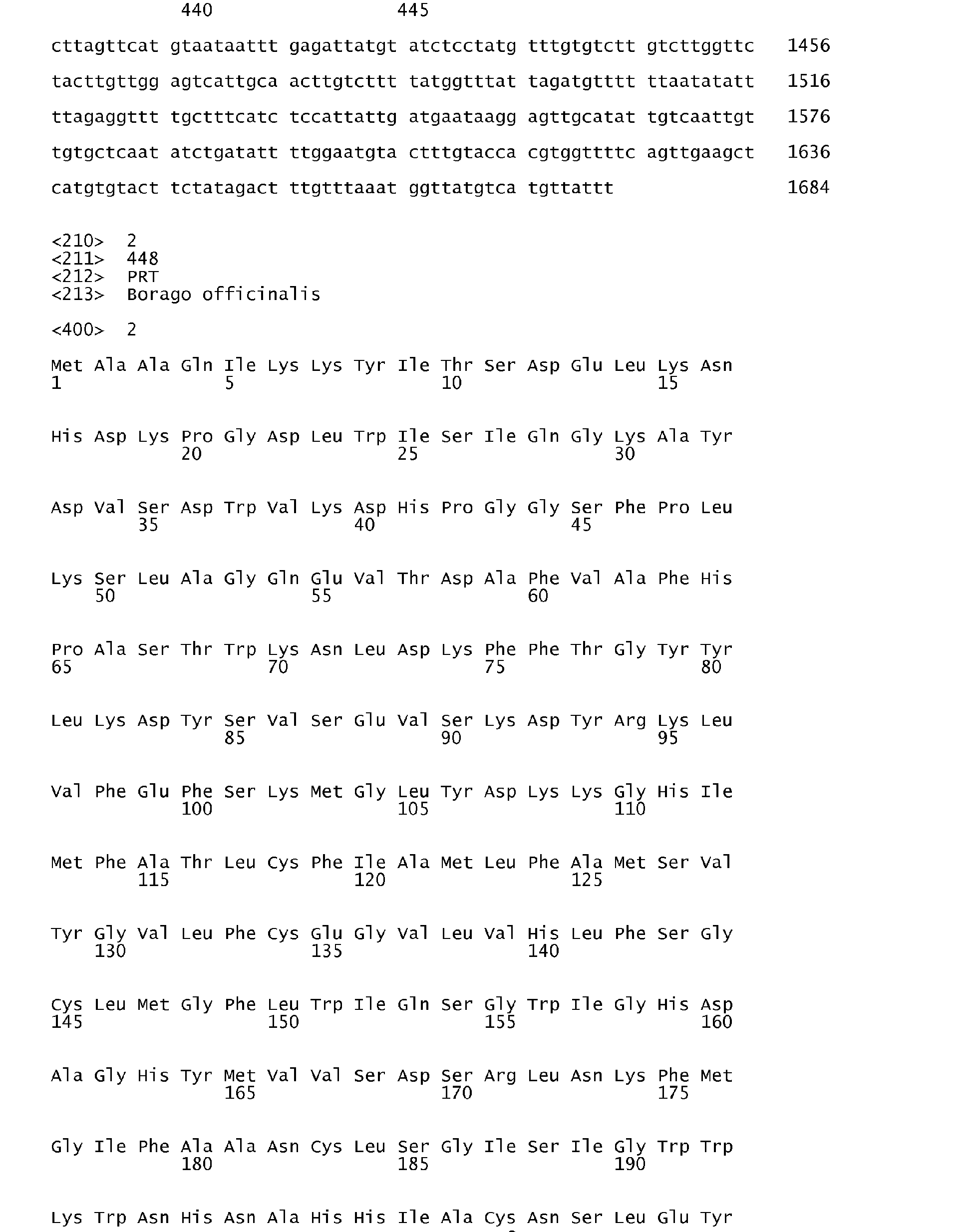


Claims (18)
- An isolated nucleic acid encoding an oleosin 5' regulatory region which directs seed-specific expression selected from the groups consisting of the nucleotide sequence set forth in SEQ ID NO: 12, the nucleotide sequence set forth in SEQ ID NO: 12 having an insertion, deletion, or substitution of one or more nucleotides, or a contiguous fragment of the nucleotide sequence set forth in SEQ ID NO:12.
- An expression cassette which comprises the oleosin 5' regulatory region of Claim 1 operably linked to at least one of a nucleic acid encoding a heterologous gene or a nucleic acid encoding a sequence complementary to a native plant gene.
- The expression cassette of Claim 2 wherein the heterologous gene is at least one of a fatty acid synthesis gene or a lipid metabolism gene.
- The expression cassette of Claim 3 wherein the heterologous gene is selected from the group consisting of an acetyl-coA carboxylase gene, a ketoacyl synthase gene, a malonyl transacylase gene, a lipid desaturase gene, an acyl carrier protein (ACP) gene, a thioesterase gene, an acetyl transacylase gene, or an elongase gene.
- The expression cassette of Claim 4 wherein the lipid desaturase gene is selected from the group consisting of a Δ6-desaturase gene, a Δ12-desaturase gene, and a Δ15-desaturase gene,
- An expression vector which comprises the expression cassette of any one of Claims 2-5.
- A cell comprising the expression cassette of any one of Claims 2-5.
- A cell comprising the expression vector of Claim 6.
- The cell of Claim 7 or 8 wherein said cell is a bacterial cell or a plant cell.
- A transgenic plant comprising the expression cassette of any one of Claims 2-5.
- A transgenic plant comprising the expression vector of Claim 6.
- The plant of Claim 10 or 11 wherein said plant is at least one of a sunflower, soybean, maize, cotton, tobacco, peanut, oil seed rape or Arabidopsis plant.
- Progeny of the plant of any one of claims 10 to 12.
- Seed from the plant of any one of claims 10 to 12.
- A method of producing a plant with increased levels of a product of a fatty acid synthesis gene or a lipid metabolism gene which comprises:(a) transforming a plant cell with an expression vector comprising the isolated nucleic acid of Claim 1 operably linked to at least one of an isolated nucleic acid coding for a fatty acid synthesis gene or a lipid metabolism gene; and(b) regenerating a plant with increased levels of the product of said fatty acid synthesis or said lipid metabolism gene from said plant cell.
- The method of Claim 15 wherein said fatty acid synthesis gene or said lipid metabolism gene is at least one of a lipid desaturase, an acyl carrier protein (ACP) gene, a thioesterase gene an elongase gene, an acetyl transacylase gene, an acetyl-coA. carboxylase gene, a ketoacyl synthase gene, or a malonyl transacylase gene.
- A method of decreasing production of a fatty acid synthesis or lipid metabolism gene in a plant which comprises:(a) transforming a plant cell with an expression vector comprising the isolated nucleic acid of Claim 1 operably linked to a nucleic acid sequence complementary to a fatty acid synthesis or lipid metabolism gene; and(b) regenerating a plant with decreased production of said fatty acid synthesis or said lipid metabolism gene.
- A method of cosuppressing a native fatty acid synthesis or lipid metabolism gene in a plant which comprises:(a) transforming a cell of the plant with an expression vector comprising the isolated nucleic acid of Claim 1 operably linked to a nucleic acid sequence encoding a fatty acid synthesis or lipid metabolism gene native to the plant; and(b) regenerating a plant with decreased production of said fatty acid synthesis or said lipid metabolism gene.
Applications Claiming Priority (2)
| Application Number | Priority Date | Filing Date | Title |
|---|---|---|---|
| US08/831,575 US5977436A (en) | 1997-04-09 | 1997-04-09 | Oleosin 5' regulatory region for the modification of plant seed lipid composition |
| EP98918081A EP0973920B1 (en) | 1997-04-09 | 1998-04-09 | An oleosin 5' regulatory region for the modification of plant seed lipid composition |
Related Parent Applications (2)
| Application Number | Title | Priority Date | Filing Date |
|---|---|---|---|
| EP98918081A Division EP0973920B1 (en) | 1997-04-09 | 1998-04-09 | An oleosin 5' regulatory region for the modification of plant seed lipid composition |
| EP98918081.5 Division | 1998-10-15 |
Publications (3)
| Publication Number | Publication Date |
|---|---|
| EP1967589A2 true EP1967589A2 (en) | 2008-09-10 |
| EP1967589A3 EP1967589A3 (en) | 2008-12-24 |
| EP1967589B1 EP1967589B1 (en) | 2012-11-21 |
Family
ID=25259377
Family Applications (2)
| Application Number | Title | Priority Date | Filing Date |
|---|---|---|---|
| EP08155814A Expired - Lifetime EP1967589B1 (en) | 1997-04-09 | 1998-04-09 | An oleosin 5' regulatory region for the modification of plant seed lipid composition |
| EP98918081A Expired - Lifetime EP0973920B1 (en) | 1997-04-09 | 1998-04-09 | An oleosin 5' regulatory region for the modification of plant seed lipid composition |
Family Applications After (1)
| Application Number | Title | Priority Date | Filing Date |
|---|---|---|---|
| EP98918081A Expired - Lifetime EP0973920B1 (en) | 1997-04-09 | 1998-04-09 | An oleosin 5' regulatory region for the modification of plant seed lipid composition |
Country Status (16)
| Country | Link |
|---|---|
| US (1) | US5977436A (en) |
| EP (2) | EP1967589B1 (en) |
| JP (1) | JP2001519668A (en) |
| CN (1) | CN1259168A (en) |
| AR (1) | AR012399A1 (en) |
| AT (1) | ATE399870T1 (en) |
| AU (1) | AU739442B2 (en) |
| BR (1) | BR9807969A (en) |
| CA (1) | CA2285687C (en) |
| CO (1) | CO4790116A1 (en) |
| DE (1) | DE69839667D1 (en) |
| DK (1) | DK0973920T3 (en) |
| ES (2) | ES2398603T3 (en) |
| PT (1) | PT973920E (en) |
| WO (1) | WO1998045461A1 (en) |
| ZA (1) | ZA983047B (en) |
Families Citing this family (218)
| Publication number | Priority date | Publication date | Assignee | Title |
|---|---|---|---|---|
| US6307123B1 (en) * | 1998-05-18 | 2001-10-23 | Dekalb Genetics Corporation | Methods and compositions for transgene identification |
| DE69937050T2 (en) * | 1998-06-12 | 2008-05-29 | Calgene Llc, Davis | POLYUNG-SATURATED FATTY ACIDS IN PLANTS |
| US6864077B1 (en) | 1998-12-03 | 2005-03-08 | Edgar B. Cahoon | Membrane-bound desaturases |
| WO2000032790A2 (en) * | 1998-12-03 | 2000-06-08 | E.I. Du Pont De Nemours And Company | Membrane-bound desaturases |
| US6825017B1 (en) | 1998-12-07 | 2004-11-30 | Washington State University Research Foundation | Desaturases and methods of using them for synthesis of polyunsaturated fatty acids |
| US8791327B2 (en) | 1998-12-07 | 2014-07-29 | Washington State University Research Foundation | Desaturases and methods of using them for synthesis of polyunsaturated fatty acids |
| US6342657B1 (en) * | 1999-05-06 | 2002-01-29 | Rhone-Poulenc Agro | Seed specific promoters |
| AU776447B2 (en) | 1999-06-07 | 2004-09-09 | Basf Plant Science Gmbh | Delta6-acetylenase and delta6-desaturase from ceratodon purpureus |
| DE10030976A1 (en) | 2000-06-30 | 2002-01-10 | Basf Ag | Production of unsaturated fatty acids, useful e.g. in nutrition, cosmetics or pharmaceuticals, in organisms transformed with Physcomitrella patens delta-6-desaturase nucleic acid |
| US6784342B1 (en) | 1999-08-04 | 2004-08-31 | The University Of British Columbia | Regulation of embryonic transcription in plants |
| GB9923306D0 (en) | 1999-10-01 | 1999-12-08 | Isis Innovation | Diagnostic and therapeutic epitope, and transgenic plant |
| EP2397031A1 (en) | 1999-11-10 | 2011-12-21 | The University Of Washington | Compositions and methods for modulation of plant cell division |
| US7544859B2 (en) | 2000-02-09 | 2009-06-09 | Basf Aktiengesellschaft | Elongase gene and method for producing multiple-unsaturated fatty acids |
| ATE339509T1 (en) | 2000-04-07 | 2006-10-15 | Basf Plant Science Gmbh | STRESS-COUPLED TRANSCRIPTION FACTOR AND ITS USE IN PLANTS |
| WO2001090386A2 (en) * | 2000-05-24 | 2001-11-29 | The University Of British Columbia | Gene regulatory region that promotes early seed-specific transcription |
| FR2815969B1 (en) | 2000-10-30 | 2004-12-10 | Aventis Cropscience Sa | TOLERANT PLANTS WITH HERBICIDES BY METABOLIC BYPASS |
| ATE540575T1 (en) | 2001-03-16 | 2012-01-15 | Basf Plant Science Gmbh | REGULATORS OF SUGAR AND LIPID METABOLISM IN PLANTS |
| GB0107510D0 (en) | 2001-03-26 | 2001-05-16 | Univ Bristol | New elongase gene and a process for the production of -9-polyunsaturated fatty acids |
| WO2002099076A2 (en) | 2001-06-04 | 2002-12-12 | Basf Plant Science Gmbh | Sugar and lipid metabolism regulators in plants ii |
| WO2003013225A2 (en) | 2001-08-09 | 2003-02-20 | Northwest Plant Breeding Company | Wheat plants having increased resistance to imidazolinone herbicides |
| EP1414288B1 (en) | 2001-08-10 | 2009-03-25 | BASF Plant Science GmbH | Sugar and lipid metabolism regulators in plants iii |
| US7456335B2 (en) | 2001-09-03 | 2008-11-25 | Basf Plant Science Gmbh | Nucleic acid sequences and their use in methods for achieving pathogen resistance in plants |
| ATE541920T1 (en) | 2001-09-05 | 2012-02-15 | Basf Plant Science Gmbh | STRESS-RELATED PROTEIN PHOSPHATASE POLYPEPTIDES AND METHOD FOR USE IN PLANTS |
| EP1451325B1 (en) | 2001-11-09 | 2011-05-18 | BASF Plant Science GmbH | Transcription factor stress-related polypeptides and methods of use in plants |
| GB2385852A (en) | 2002-02-27 | 2003-09-03 | Rothamsted Ex Station | Delta 6-desaturases from Primulaceae |
| DE10212892A1 (en) | 2002-03-20 | 2003-10-09 | Basf Plant Science Gmbh | Constructs and methods for regulating gene expression |
| BR0311449A (en) | 2002-05-08 | 2005-03-15 | Basf Plant Science Gmbh | A process for increasing the total oil content in a plant organism or a tissue, organ, part, cell, or propagating material, transgenic expression cassette, transgenic vector, transgenic plant organism, or tissue, organ, part, cell, or material. propagation, and use of them |
| GB0212885D0 (en) | 2002-06-05 | 2002-07-17 | Isis Innovation | Therapeutic epitopes and uses thereof |
| EP1551218B1 (en) | 2002-07-10 | 2017-05-17 | The Department of Agriculture, Western Australia | Wheat plants having increased resistance to imidazolinone herbicides |
| ATE405658T1 (en) | 2002-07-26 | 2008-09-15 | Basf Plant Science Gmbh | NEW SELECTION PROCEDURES |
| CA2492544A1 (en) * | 2002-08-02 | 2004-02-12 | Basf Plant Science Gmbh | Modification of seed oil by the expression of a putative cytidyltransferase in transgenic plants |
| EP1529112A2 (en) | 2002-08-07 | 2005-05-11 | BASF Plant Science GmbH | Nucleic acid sequences encoding proteins associated with abiotic stress response |
| FR2844142B1 (en) | 2002-09-11 | 2007-08-17 | Bayer Cropscience Sa | TRANSFORMED PLANTS WITH ENHANCED PRENYLQUINON BIOSYNTHESIS |
| FR2848570B1 (en) | 2002-12-12 | 2005-04-01 | Bayer Cropscience Sa | EXPRESSION CASSETTE ENCODING A 5-ENOL PYRUVYLSHIKIMATE-3-PHOSPHATE SYNTHASE (EPSPS) AND HERBICIDE TOLERANT PLANTS CONTAINING THE SAME |
| CN100552030C (en) | 2002-12-20 | 2009-10-21 | 梅坦诺米克斯有限及两合公司 | Process for producing amino acid |
| AU2004213800A1 (en) | 2003-02-17 | 2004-09-02 | Metanomics Gmbh | Preparation of organisms with faster growth and/or higher yield |
| BRPI0407138A (en) | 2003-02-27 | 2006-01-10 | Basf Plant Science Gmbh | Isolated nucleic acid sequence, amino acid sequence, gene construction, vector, non-human transgenic organism, process for producing polyunsaturated fatty acids, oil, lipid, or a polyunsaturated fatty acid or a fraction thereof, oil, lipid compositions, or fatty acid, and, use of oil, lipids or fatty acids or compositions of oil, lipids or fatty acid |
| AU2004225838B2 (en) | 2003-03-31 | 2009-11-05 | University Of Bristol | Novel plant acyltransferases specific for long-chained, multiply unsaturated fatty acids |
| US20100285985A1 (en) * | 2003-04-15 | 2010-11-11 | Applied Dna Sciences, Inc. | Methods and Systems for the Generation of Plurality of Security Markers and the Detection Therof |
| CN103131673A (en) | 2003-04-15 | 2013-06-05 | 巴斯福植物科学有限公司 | Nucleic acid sequences encoding proteins associated with abiotic stress response and plant cells and plants with increased tolerance to environmental stress |
| ES2389767T3 (en) | 2003-05-28 | 2012-10-31 | Basf Se | Wheat plants that have higher tolerance to imidazolinone herbicides |
| NO347177B1 (en) | 2003-08-01 | 2023-06-19 | Basf Plant Science Gmbh | Method for the production of polyunsaturated fatty acids in transgenic organisms |
| CA2532312A1 (en) | 2003-08-01 | 2005-02-17 | Basf Plant Science Gmbh | Process for the production of fine chemicals in plants |
| CA2534894C (en) | 2003-08-11 | 2020-01-21 | J.R. Simplot Company | Fungus resistant plants and their uses |
| CA2881252C (en) * | 2003-08-21 | 2017-02-28 | Monsanto Technology Llc | Soybean oil having 5 to 50% sda and less than 10% gla |
| BRPI0413917B1 (en) | 2003-08-29 | 2018-09-25 | Instituto Nacional De Tech Agropecuaria | non-transgenic mutagenized rice ahas nucleic acid, isolated ahas polypeptide, and weed control method within the vicinity of a rice plant |
| CN1898389A (en) | 2003-12-23 | 2007-01-17 | 巴斯福植物科学有限公司 | Sugar and lipid metabolism regulators in plants vi |
| CA2558726C (en) | 2004-02-27 | 2017-11-07 | Basf Plant Science Gmbh | Method for producing unsaturated .omega.-3-fatty acids in transgenic organisms |
| JP4567047B2 (en) | 2004-02-27 | 2010-10-20 | ビーエーエスエフ プラント サイエンス ゲーエムベーハー | Process for producing polyunsaturated fatty acids in transgenic plants |
| EP1734947B1 (en) | 2004-04-16 | 2015-04-15 | Monsanto Technology, LLC | Expression of fatty acid desaturases in corn |
| CA3056110C (en) | 2004-04-22 | 2020-07-14 | Surinder Pal Singh | Synthesis of long-chain polyunsaturated fatty acids by recombinant cells |
| US10105437B2 (en) | 2004-04-28 | 2018-10-23 | Btg International Limited | Epitopes related to coeliac disease |
| WO2005105129A2 (en) | 2004-04-28 | 2005-11-10 | Btg International Limited | Epitopes related to coeliac disease |
| US20070199103A1 (en) | 2004-06-16 | 2007-08-23 | Basf Plant Science Gmbh | Nucleic acid molecules encoding wrinkled1-like polypeptides and methods of use in plants |
| WO2006069610A2 (en) | 2004-07-02 | 2006-07-06 | Metanomics Gmbh | Process for the production of fine chemicals |
| ES2430827T3 (en) | 2004-07-31 | 2013-11-21 | Metanomics Gmbh | Preparation of organisms with faster growth and / or higher yield |
| EP1781784A2 (en) | 2004-08-02 | 2007-05-09 | BASF Plant Science GmbH | Method for isolation of transcription termination sequences |
| AR050881A1 (en) | 2004-09-20 | 2006-11-29 | Basf Plant Science Gmbh | ARABIDOPSIS GENES THAT CODIFY PROTEINS PARTICIPATING IN THE METABOLISM OF SUGARS AND LIPIDS AND METHODS OF USE |
| EP1794304B1 (en) | 2004-09-24 | 2013-06-19 | BASF Plant Science GmbH | Plant cells and plants with increased tolerance to environmental stress |
| WO2006032708A2 (en) | 2004-09-24 | 2006-03-30 | Basf Plant Science Gmbh | Nucleic acid sequences encoding proteins associated with abiotic stress response and plant cells and plants with increased tolerance to environmental stress |
| EP2096177A3 (en) | 2004-12-17 | 2010-01-13 | Metanomics GmbH | Process for the production of lutein |
| US20140199313A1 (en) | 2005-03-02 | 2014-07-17 | Metanomics Gmbh | Process for the Production of Fine Chemicals |
| WO2006092449A2 (en) | 2005-03-02 | 2006-09-08 | Metanomics Gmbh | Process for the production of fine chemicals |
| EP2166102B1 (en) | 2005-03-08 | 2012-12-19 | BASF Plant Science GmbH | Expression enhancing intron sequences |
| DE102005013779A1 (en) | 2005-03-22 | 2006-09-28 | Basf Plant Science Gmbh | Process for the preparation of polyunsaturated C20 and C22 fatty acids having at least four double bonds in transgenic plants |
| EP1874936B1 (en) | 2005-04-19 | 2013-10-30 | BASF Plant Science GmbH | Improved methods controlling gene expression |
| CA2612016A1 (en) | 2005-06-17 | 2006-12-21 | Basf Plant Science Gmbh | Lecitin-like protein kinase stress-related polypeptides and methods of use in plants |
| AU2006260924B2 (en) | 2005-06-23 | 2011-03-03 | Basf Plant Science Gmbh | Improved methods for the production of stably transformed, fertile zea mays plants |
| BRPI0613726A2 (en) * | 2005-07-01 | 2011-02-01 | Cornell Res Foundation Inc | coffee nucleic acid molecule (coffea spp), mrna and cdna molecule, oligonucleotide, vector, method for modulating the flavor or aroma of coffee beans, promoter, chimeric gene |
| US8119858B2 (en) | 2005-07-06 | 2012-02-21 | Cropdesign N.V. | Plant yield improvement by Ste20-like gene expression |
| US20100162434A1 (en) | 2005-07-18 | 2010-06-24 | Basf Plant Science Gmbh | Yield Increase in Plants Overexpressing the SHSRP Genes |
| CN101228277B (en) | 2005-07-18 | 2013-11-27 | 巴斯福植物科学有限公司 | Yield increase in plants overexpressing ACCDP genes |
| RU2421462C2 (en) | 2005-07-29 | 2011-06-20 | Таргитид Гроус, Инк. | Protective action of dominant-negative mutant protein krp from inhibiting wild-type active complex cyclin-cdk krp |
| CA2619411A1 (en) | 2005-08-12 | 2007-02-22 | Basf Plant Science Gmbh | Nucleic acid sequences encoding proteins associated with abiotic stress response and plant cells and plants with increased tolerance to environmental stress |
| AR055439A1 (en) | 2005-09-15 | 2007-08-22 | Cropdesign Nv | PLANTS WITH INCREASED PERFORMANCE AND METHOD FOR PREPARING THEM |
| WO2007039454A1 (en) | 2005-09-20 | 2007-04-12 | Basf Plant Science Gmbh | Methods for controlling gene expression using ta-siran |
| GB2431158A (en) | 2005-10-13 | 2007-04-18 | Rothamsted Res Ltd | Process for the production of arachidonic and/or eicosapentaenoic acid |
| DE102005052551A1 (en) | 2005-11-02 | 2007-05-16 | Rothamsted Res Harpenden | Process for the preparation of γ-linolenic acid and / or stearidonic acid in transgenic Brassicaceae and Linaceae |
| CA2628505A1 (en) | 2005-11-08 | 2007-05-18 | Basf Plant Science Gmbh | Use of armadillo repeat (arm1) polynucleotides for obtaining resistance to pathogens in plants |
| DK1965658T3 (en) | 2005-11-18 | 2019-01-21 | Commw Scient Ind Res Org | FEATURES FOR AQUACULTURE INCLUDING STEARIDONIC ACID |
| US7723574B2 (en) | 2005-11-24 | 2010-05-25 | Basf Plant Science Gmbh | Process for the production of Δ5-unsaturated fatty acids in transgenic organisms |
| WO2007065878A2 (en) | 2005-12-09 | 2007-06-14 | Basf Plant Science Gmbh | Nucleic acid molecules encoding polypeptides involved in regulation of sugar and lipid metabolism and methods of use viii |
| WO2007080143A1 (en) | 2006-01-12 | 2007-07-19 | Basf Plant Science Gmbh | Use of stomatin (stm1) polynucleotides for achieving a pathogen resistance in plants |
| GB0603160D0 (en) | 2006-02-16 | 2006-03-29 | Rothamsted Res Ltd | Nucleic acid |
| EP2343377A3 (en) | 2006-03-24 | 2011-11-16 | BASF Plant Science GmbH | Proteins associated with abiotic stress response and homologs |
| CA2638978A1 (en) | 2006-03-31 | 2007-10-11 | Basf Plant Science Gmbh | Plants having enhanced yield-related traits and a method for making the same |
| AU2007299219A1 (en) | 2006-04-05 | 2008-03-27 | Metanomics Gmbh | Process for the production of a fine chemical |
| US10741034B2 (en) | 2006-05-19 | 2020-08-11 | Apdn (B.V.I.) Inc. | Security system and method of marking an inventory item and/or person in the vicinity |
| EP2035562A2 (en) | 2006-05-30 | 2009-03-18 | CropDesign N.V. | Plants with modulated expression of extensin receptor-like kinase having enhanced yield-related traits and a method for making the same |
| WO2007137973A2 (en) | 2006-05-31 | 2007-12-06 | Metanomics Gmbh | Manipulation of the nitrogen metabolism using ammonium transporter or glucose 6-phosphate deshydrogenases or farnesyl phosphate synthetase (fpp) |
| EP2035555A2 (en) | 2006-06-08 | 2009-03-18 | BASF Plant Science GmbH | Plants having improved growth characteristics and method for making the same |
| CA2659414A1 (en) | 2006-08-02 | 2008-02-07 | Cropdesign N.V. | Use of synovial sarcoma translocation (syt) polypeptide for increasing plant yield under abiotic stress |
| CA2659993C (en) | 2006-08-24 | 2016-01-05 | Basf Plant Science Gmbh | Isolation and characterization of a novel pythium omega 3 desaturase with specificity to all omega 6 fatty acids longer than 18 carbon chains |
| RU2009111266A (en) | 2006-08-29 | 2010-10-10 | Коммонвелт Сайентифик энд Индастриал Рисерч Организейшн (AU) | FATTY ACID SYNTHESIS |
| CA2669812A1 (en) | 2006-08-30 | 2008-03-06 | Basf Plant Science Gmbh | Method for increasing resistance to pathogens in transgenic plants |
| ES2531391T3 (en) | 2006-10-06 | 2015-03-13 | Basf Plant Science Gmbh | Delta-5 desaturases and procedure for the preparation of polyunsaturated fatty acids in non-human transgenic organisms |
| AU2007306345B2 (en) | 2006-10-12 | 2013-05-23 | Basf Plant Science Gmbh | Method for increasing pathogen resistance in transgenic plants |
| BRPI0719824A2 (en) | 2006-10-13 | 2014-06-03 | Basf Plant Science Gmbh | METHOD FOR PRODUCING A TRANSGENIC VEGETABLE CELL, PLANT OR PART OF THE SAME, TRANSFORMED HOST CELL, A TRANSGENIC VEGETABLE CELL, A PLANT OR PART OF THE SAME, SEED, VEGETABLE TISSUE, MATERIAL AND MATERIAL, MATERIAL AND PLANT OF A NUCLEIC ACID MOLECULE. |
| EP2057273A2 (en) | 2007-01-15 | 2009-05-13 | BASF Plant Science GmbH | Use of subtilisin (rnr9) polynucleotides for achieving a pathogen resistance in plants |
| CA2674494A1 (en) | 2007-02-06 | 2008-08-14 | Basf Plant Science Gmbh | Compositions and methods using rna interference for control of nematodes |
| CN101605903B (en) | 2007-02-06 | 2012-09-05 | 巴斯福植物科学有限公司 | Use of alanine racemase genes to confer nematode resistance to plants |
| CA2674562A1 (en) | 2007-02-08 | 2008-08-14 | Basf Plant Science Gmbh | Compositions and methods using rna interference of opr3-like gene for control of nematodes |
| ES2373614T3 (en) | 2007-02-09 | 2012-02-07 | Basf Plant Science Gmbh | COMPOSITIONS AND METHODS THAT USE CDPK TYPE RNA INTERFERENCE FOR NEMATE CONTROL. |
| WO2008110522A1 (en) | 2007-03-15 | 2008-09-18 | Basf Plant Science Gmbh | Use of nematode chitinase genes to control plant parasitic nematodes |
| EP2537938A3 (en) | 2007-03-23 | 2013-04-10 | BASF Plant Science GmbH | Physcomitrella patents genes which improve stress tolerance |
| EP2492346A3 (en) | 2007-05-04 | 2013-03-27 | BASF Plant Science GmbH | Seed enhancement by combinations of pyruvate kinases |
| AU2008252998A1 (en) | 2007-05-22 | 2008-11-27 | Basf Plant Science Gmbh | Plant cells and plants with increased tolerance and/or resistance to environmental stress and increased biomass production-KO |
| US20100251416A1 (en) | 2007-05-22 | 2010-09-30 | Basf Plant Science Gmbh | Plants with increased tolerance and/or resistance to environmental stress and increased biomass production |
| MX2009012452A (en) | 2007-05-29 | 2010-03-30 | Basf Plant Science Gmbh | Transgenic plants with increased stress tolerance and yield. |
| MX2009013648A (en) | 2007-07-13 | 2010-01-27 | Basf Plant Science Gmbh | Transgenic plants with increased stress tolerance and yield. |
| EP2183373A2 (en) | 2007-08-02 | 2010-05-12 | BASF Plant Science GmbH | Transgenic plants with increased stress tolerance and yield |
| BRPI0817005A2 (en) | 2007-09-18 | 2019-09-24 | Basf Plant Science Gmbh | method for producing a transgenic plant cell, plant or part thereof with increased yield, nucleic acid molecule, nucleic acid construction, vector, host cell, process for producing a polypeptide, polypeptide, antibody, plant cell nucleus transgenic, plant cell, plant tissue, propagating material, harvested material, plant or part thereof, seed, process for identifying a compound, method for producing an agricultural composition, composition, and use of a nucleic acid molecule |
| EP2594645A3 (en) | 2007-09-21 | 2013-11-06 | BASF Plant Science GmbH | Plants with increased yield |
| DE112008003224T5 (en) | 2007-11-27 | 2010-12-23 | Basf Plant Science Gmbh | Transgenic plants with increased stress tolerance and increased yield |
| EP2578687A1 (en) * | 2007-12-04 | 2013-04-10 | Dow Global Technologies Inc. | Seed-preferred gene promotors from the castor plant |
| AU2008337600A1 (en) | 2007-12-14 | 2009-06-25 | Basf Plant Science Gmbh | Promoters from brassica napus for seed specific gene expression |
| US20110041215A1 (en) * | 2007-12-17 | 2011-02-17 | Basf Plant Science Gmbh | Lipid Metabolism Protein And Uses Thereof I (BZIP Transcription Factor) |
| US20110035841A1 (en) | 2007-12-17 | 2011-02-10 | Basf Plant Science Gmbh | Lipid Metabolism Proteins, Combinations of Lipid Metabolism Proteins and Uses Thereof |
| BRPI0821748A2 (en) | 2007-12-19 | 2019-09-24 | Basf Plant Science Gmbh | method for producing a plant with increased yield, isolated nucleic acid molecule, nucleic acid construction, vector, process for producing a polypeptide, polypeptide, antibody, plant cell nucleus, plant cell, plant tissue, propagation material, seed, pollen, progeny, or a plant part, or a high yielding plant, process for the identification of a compound, method for producing an agricultural composition, composition, polypeptide or nucleic acid molecule, use of nucleic acids, and method for the identification of a plant with increased yield |
| WO2009080743A2 (en) | 2007-12-21 | 2009-07-02 | Basf Plant Science Gmbh | Plants with increased yield (ko nue) |
| AU2009218478A1 (en) | 2008-02-27 | 2009-09-03 | Basf Plant Science Gmbh | Plants with increased yield |
| JP2009201435A (en) * | 2008-02-28 | 2009-09-10 | Toyota Motor Corp | Method for evaluating amount of oil and fat in seed, and method for screening plant body having changed oil and fat content |
| CA2722276A1 (en) | 2008-04-25 | 2009-10-29 | Commonwealth Scientific Industrial Research Organisation | Recombinant cells and methods for hydroxylating fatty acids |
| US8901374B2 (en) | 2008-06-03 | 2014-12-02 | Basf Plant Science Gmbh | Fatty acid dehydratases and uses thereof |
| CA2729496C (en) | 2008-07-01 | 2018-02-13 | Basf Plant Science Gmbh | Promoters from brassica napus for seed specific gene expression |
| CA2734347A1 (en) | 2008-08-19 | 2010-02-25 | Basf Plant Science Gmbh | Plants with increased yield by increasing or generating one or more activities in a plant or a part thereof |
| EP2331695B1 (en) | 2008-08-26 | 2014-07-23 | BASF Plant Science GmbH | Nucleic acids encoding desaturases and modified plant oil |
| WO2010023186A1 (en) | 2008-08-27 | 2010-03-04 | Basf Plant Science Gmbh | Nematode-resistant transgenic plants |
| EP2337853A1 (en) | 2008-09-23 | 2011-06-29 | BASF Plant Science Company GmbH | Plants with increased yield (lt) |
| DE112009002577T5 (en) | 2008-10-23 | 2012-06-21 | Basf Plant Science Gmbh | Increased Yield Plants (NUE) |
| WO2010046471A2 (en) | 2008-10-23 | 2010-04-29 | Basf Plant Science Gmbh | A method for producing a transgenic cell with increased gamma-aminobutyric acid (gaba) content |
| DK2358882T3 (en) | 2008-11-18 | 2017-11-06 | Commw Scient Ind Res Org | ENZYMES AND METHODS FOR MANUFACTURING OMEGA-3 FAT ACIDS |
| AU2009326129B2 (en) | 2008-12-12 | 2016-05-12 | Basf Plant Science Gmbh | Desaturases and process for the production of polyunsaturated fatty acids in transgenic organisms |
| CA2760326A1 (en) | 2009-05-13 | 2010-11-18 | Basf Plant Science Company Gmbh | Acyltransferases and uses thereof in fatty acid production |
| AU2010257729B2 (en) | 2009-06-08 | 2016-03-24 | Basf Plant Science Company Gmbh | Novel fatty acid elongation components and uses thereof |
| CA3161358A1 (en) | 2009-07-17 | 2011-01-20 | Basf Plant Science Company Gmbh | Novel fatty acid desaturases and elongases and uses thereof |
| DE112010003032T5 (en) | 2009-07-23 | 2012-08-02 | Basf Plant Science Company Gmbh | Plants with increased yield |
| WO2011023571A1 (en) | 2009-08-25 | 2011-03-03 | Basf Plant Science Company Gmbh | Nematode-resistant transgenic plants |
| JP5168511B2 (en) * | 2009-08-25 | 2013-03-21 | 独立行政法人農業生物資源研究所 | Seed-specific promoter and its use |
| AU2010288482A1 (en) | 2009-08-31 | 2012-04-12 | Basf Plant Science Company Gmbh | Regulatory nucleic acid molecules for enhancing seed-specific gene expression in plants promoting enhanced polyunsaturated fatty acid synthesis |
| MX2012005719A (en) | 2009-11-17 | 2012-07-30 | Basf Plant Science Co Gmbh | Plants with increased yield. |
| WO2011064183A1 (en) | 2009-11-24 | 2011-06-03 | Basf Plant Science Company Gmbh | Novel fatty acid elongase and uses thereof |
| CA2780956A1 (en) | 2009-11-24 | 2011-06-03 | Basf Plant Science Company Gmbh | Novel fatty acid desaturase and uses thereof |
| WO2011069953A1 (en) | 2009-12-09 | 2011-06-16 | Basf Plant Science Company Gmbh | Methods for increasing the resistance of plants to fungi by silencing the fungal smt1-gene |
| AU2010334808B2 (en) | 2009-12-23 | 2015-07-09 | Bayer Intellectual Property Gmbh | Plants tolerant to HPPD inhibitor herbicides |
| ES2658990T3 (en) | 2009-12-23 | 2018-03-13 | Bayer Intellectual Property Gmbh | HPPD-inhibiting herbicide-tolerant plants |
| WO2011076885A1 (en) | 2009-12-23 | 2011-06-30 | Bayer Cropscience Ag | Plants tolerant to hppd inhibitor herbicides |
| CN102869769A (en) | 2009-12-23 | 2013-01-09 | 拜尔知识产权有限公司 | Plants tolerant to HPPD inhibitor herbicides |
| EA201290560A1 (en) | 2009-12-23 | 2014-05-30 | Байер Интеллектуэль Проперти Гмбх | PLANTS RESISTANT TO HERBICIDES - HPPD INHIBITORS |
| WO2011095460A1 (en) | 2010-02-02 | 2011-08-11 | Bayer Cropscience Ag | Soybean transformation using hppd inhibitors as selection agents |
| CA2788036A1 (en) | 2010-02-23 | 2011-09-01 | Basf Plant Science Company Gmbh | Nematode-resistant transgenic plants |
| AU2011264074B2 (en) | 2010-06-09 | 2015-01-22 | Bayer Cropscience Nv | Methods and means to modify a plant genome at a nucleotide sequence commonly used in plant genome engineering |
| MX347575B (en) | 2010-06-09 | 2017-05-03 | Bayer Cropscience N V * | Methods and means to modify a plant genome at a nucleotide sequence commonly used in plant genome engineering. |
| EP2585603B1 (en) | 2010-06-25 | 2017-12-20 | BASF Plant Science Company GmbH | Acyltransferases and uses therof in fatty acid production |
| CA2804025C (en) | 2010-06-28 | 2023-02-21 | Commonwealth Scientific And Industrial Research Organisation | Methods of producing lipids |
| WO2012004013A2 (en) | 2010-07-08 | 2012-01-12 | Bayer Bioscience N.V. | Glucosinolate transporter protein and uses thereof |
| EP2630235B1 (en) | 2010-10-21 | 2017-04-05 | BASF Plant Science Company GmbH | Novel fatty acid desaturases, elongases, elongation components and uses therof |
| EP2669371A1 (en) | 2010-11-10 | 2013-12-04 | Bayer CropScience AG | HPPD variants and methods of use |
| CA2822004A1 (en) | 2010-12-20 | 2012-06-28 | Basf Plant Science Company Gmbh | Nematode-resistant transgenic plants |
| PL2688406T3 (en) | 2011-03-25 | 2015-10-30 | Bayer Ip Gmbh | Use of n-(tetrazol-4-yl)- or n-(triazol-3-yl)arylcarboxamides or their salts for controlling unwanted plants in areas of transgenic crop plants being tolerant to hppd inhibitor herbicides |
| CA2830802A1 (en) | 2011-03-25 | 2012-10-04 | Bayer Intellectual Property Gmbh | Use of n-(1,2,5-oxadiazol-3-yl)benzamides for controlling unwanted plants in areas of transgenic crop plants being tolerant to hppd inhibitor herbicides |
| WO2013024121A2 (en) | 2011-08-18 | 2013-02-21 | Basf Plant Science Company Gmbh | Increase of sucrose transporter activity in the seeds of plants |
| BR112014003919A2 (en) | 2011-08-22 | 2017-03-14 | Bayer Cropscience Ag | methods and means for modifying a plant genome |
| UA115132C2 (en) | 2011-10-04 | 2017-09-25 | Байєр Інтелекчуал Проперті Гмбх | RNAi FOR THE CONTROL OF FUNGI AND OOMYCETES BY INHIBITING SACCHAROPINE DEHYDROGENASE GENE |
| CA2860416C (en) | 2011-12-27 | 2024-04-30 | Commonwealth Scientific And Industrial Research Organisation | Production of dihydrosterculic acid and derivatives thereof |
| PH12014501474B1 (en) | 2011-12-27 | 2024-01-19 | Nuseed Global Innovation Ltd | Processes for producing lipids |
| EP2798065B1 (en) | 2011-12-27 | 2019-06-05 | Commonwealth Scientific and Industrial Research Organisation | Simultaneous gene silencing and supressing gene silencing in the same cell |
| EP2612918A1 (en) | 2012-01-06 | 2013-07-10 | BASF Plant Science Company GmbH | In planta recombination |
| AU2013246661B2 (en) | 2012-04-12 | 2018-12-20 | Rothamsted Research Ltd | Production of omega-3 long chain polyunsaturated fatty acids |
| US8946460B2 (en) | 2012-06-15 | 2015-02-03 | Commonwealth Scientific And Industrial Research Organisation | Process for producing polyunsaturated fatty acids in an esterified form |
| US10119147B2 (en) | 2012-07-06 | 2018-11-06 | Washington State University | Brassica plants with modified seed oil composition |
| US9968041B2 (en) | 2012-07-06 | 2018-05-15 | Bayer Cropscience Nv | Soybean ROD1 gene sequences and uses thereof |
| WO2014006158A1 (en) | 2012-07-06 | 2014-01-09 | Bayer Cropscience Nv | Brassica rod1 gene sequences and uses thereof |
| AU2013298113A1 (en) | 2012-08-03 | 2015-01-29 | Basf Plant Science Company Gmbh | Novel enzymes, enzyme components and uses thereof |
| UY35035A (en) | 2012-09-14 | 2014-04-30 | Bayer Cropscience Ag | ? RECOMBINANT NUCLEIC ACID MOLECULE THAT CODIFIES AN HPPD ENVIRONMENT, VECTOR, GUEST CELL, SEED, PLANT, POLYPEPTIDE, PRIMARY PRODUCT, METHODS AND USES ?. |
| CN104994725B (en) | 2013-01-29 | 2022-07-01 | 巴斯夫植物科学有限公司 | Antifungal plants expressing HCP6 |
| WO2014118018A1 (en) | 2013-01-29 | 2014-08-07 | Basf Plant Science Company Gmbh | Fungal resistant plants expressing ein2 |
| CA2897482A1 (en) | 2013-01-29 | 2014-08-07 | Basf Plant Science Company Gmbh | Fungal resistant plants expressing hcp7 |
| US9963740B2 (en) | 2013-03-07 | 2018-05-08 | APDN (B.V.I.), Inc. | Method and device for marking articles |
| BR112015021857B1 (en) | 2013-03-08 | 2022-05-10 | Basf Plant Science Company Gmbh | METHOD TO INCREASE SOYBEAN RUST RESISTANCE IN A SOYBEAN PLANT EXPRESSING MYBTF PROTEIN AND METHOD FOR PRODUCTION OF A TRANSGENIC SOYBEAN PLANT EXPRESSING MYBTF PROTEIN |
| WO2014142647A1 (en) | 2013-03-14 | 2014-09-18 | Wageningen Universiteit | Fungals strains with improved citric acid and itaconic acid production |
| BR112016005859A2 (en) | 2013-09-24 | 2017-09-19 | Basf Se | HETEROTRANSGLYCOSYLASE AND USES THEREOF |
| EP3058339B1 (en) | 2013-10-07 | 2019-05-22 | APDN (B.V.I.) Inc. | Multimode image and spectral reader |
| CN106029877A (en) | 2013-12-17 | 2016-10-12 | 巴斯夫植物科学有限公司 | Method for shifting the substrate specificity of a desaturase |
| KR102386838B1 (en) | 2013-12-18 | 2022-04-15 | 커먼웰쓰 사이언티픽 앤 인더스트리알 리서치 오거니제이션 | Lipid comprising long chain polyunsaturated fatty acids |
| WO2015196250A1 (en) | 2014-06-27 | 2015-12-30 | Commonwealth Scientific And Industrial Research Organisation | Lipid comprising docosapentaenoic acid |
| CN106459986B (en) | 2014-03-11 | 2020-06-30 | 拜耳作物科学有限合伙公司 | HPPD variants and how to use them |
| CN106103121B (en) | 2014-03-18 | 2019-12-06 | 亚普蒂恩(B.V.I.)公司 | Encrypted optical marker for security applications |
| US10745825B2 (en) | 2014-03-18 | 2020-08-18 | Apdn (B.V.I.) Inc. | Encrypted optical markers for security applications |
| MY204560A (en) | 2014-07-07 | 2024-09-04 | Nuseed Global Innovation Ltd | Process for producing industrial products from plant lipids |
| WO2016075326A2 (en) | 2014-11-14 | 2016-05-19 | Basf Plant Science Company Gmbh | Materials and methods for pufa production, and pufa-containing compositions |
| WO2016128470A1 (en) | 2015-02-11 | 2016-08-18 | Basf Se | Herbicide-resistant hydroxyphenylpyruvate dioxygenases |
| WO2017042259A1 (en) | 2015-09-11 | 2017-03-16 | Bayer Cropscience Aktiengesellschaft | Hppd variants and methods of use |
| WO2017083920A1 (en) | 2015-11-18 | 2017-05-26 | Commonwealth Scientific And Industrial Research Organisation | Rice grain with thickened aleurone |
| DE102016204033A1 (en) | 2016-03-11 | 2017-09-14 | Universität Rostock | Measures and methods for the fight against chickens |
| DE102016204700A1 (en) | 2016-03-22 | 2017-09-28 | Universität Rostock | Recombinant production of subfatin |
| WO2017180302A1 (en) | 2016-04-11 | 2017-10-19 | Apdn (B.V.I.) Inc. | Method of marking cellulosic products |
| WO2017184727A1 (en) | 2016-04-21 | 2017-10-26 | Bayer Cropscience Lp | Tal-effector mediated herbicide tolerance |
| US11021713B2 (en) | 2016-05-25 | 2021-06-01 | Cargill, Incorporated | Engineered nucleases to generate deletion mutants in plants |
| EP3269816A1 (en) | 2016-07-11 | 2018-01-17 | Kws Saat Se | Development of fungal resistant crops by higs (host-induced gene silencing) mediated inhibition of gpi-anchored cell wall protein synthesis |
| US10995371B2 (en) | 2016-10-13 | 2021-05-04 | Apdn (B.V.I.) Inc. | Composition and method of DNA marking elastomeric material |
| BR112019010476A2 (en) | 2016-11-23 | 2019-09-10 | BASF Agricultural Solutions Seed US LLC | recombinant nucleic acid molecule, vector, host cell, transgenic plant, transgenic seed, recombinant polypeptide, composition, method for controlling a pest population, for killing pests, for producing a polypeptide, plant or plant cell, method for protecting a plant against a pest, to increase yield on a plant, use and primary product |
| US20190364908A1 (en) | 2016-12-22 | 2019-12-05 | BASF Agricultural Solutions Seed US LLC | Use of cry14 for the control of nematode pests |
| CN110431234B (en) | 2017-01-18 | 2024-04-16 | 巴斯夫农业种子解决方案美国有限责任公司 | BP005 toxin gene and method of use thereof |
| AR110756A1 (en) | 2017-01-18 | 2019-05-02 | Bayer Cropscience Lp | USE OF BP005 FOR PLANT PATHOGEN CONTROL |
| US10920274B2 (en) | 2017-02-21 | 2021-02-16 | Apdn (B.V.I.) Inc. | Nucleic acid coated submicron particles for authentication |
| US11708565B2 (en) | 2017-03-07 | 2023-07-25 | BASF Agricultural Solutions Seesi US LLC | HPPD variants and methods of use |
| BR112020008096A2 (en) | 2017-10-24 | 2020-11-03 | Basf Se | method for checking tolerance to a GM herbicide and soy plant |
| BR112020008092A2 (en) | 2017-10-24 | 2020-09-15 | BASF Agricultural Solutions Seed US LLC | method for checking tolerance to a GM herbicide and soy plant |
| AU2020204657A1 (en) | 2019-01-04 | 2021-07-29 | Pioneer Hi-Bred International, Inc. | Engineered nucleases to generate mutations in plants |
| US20220127630A1 (en) | 2019-02-14 | 2022-04-28 | Cargill, Incorporated | Brassica Plants Producing Elevated Levels of Polyunsaturated Fatty Acids |
| MX2022004552A (en) | 2019-10-14 | 2022-10-10 | BASF Agricultural Solutions Seed US LLC | NEW INSECT RESISTANCE GENES AND METHODS OF USE. |
| BR112022007119A2 (en) | 2019-10-14 | 2022-07-05 | BASF Agricultural Solutions Seed US LLC | NUCLEIC ACID MOLECULE, NUCLEIC ACID, POLYPEPTIDES, VECTOR, HOST CELL, TRANSGENIC PLANT, TRANSGENIC SEED, COMPOSITION, METHODS TO CONTROL A PEST POPULATION, TO KILL A PEST, TO PRODUCE A POLYPEPTIDE, TO PROTECT A PLANT AND TO INCREASE YIELD IN A PLANT, PLANT, NUCLEIC ACID USE AND BASIC PRODUCT |
| AU2023408197A1 (en) | 2022-12-19 | 2025-06-26 | Basf Agricultural Solutions Us Llc | Insect toxin genes and methods for their use |
| JP2026522972A (en) | 2023-07-07 | 2026-07-09 | ビーエーエスエフ アグリカルチュラル ソリューションズ ユーエス エルエルシー | Use of the CRY gene to control nematode pests |
| KR20260096857A (en) | 2023-10-27 | 2026-06-24 | 바스프 아그리컬쳐럴 솔루션즈 유에스 엘엘씨 | Use of novel genes for the control of nematode pests |
| WO2025132372A1 (en) | 2023-12-21 | 2025-06-26 | Technische Universität München | Plant sensor twa1 as molecular thermogenetic control switch and for improvement of thermotolerance and modifying of senescence |
| WO2026010930A1 (en) | 2024-07-05 | 2026-01-08 | BASF Agricultural Solutions Seed US LLC | Use of axmi277 for the control of rotylenchulus reniformis nematode pests |
Citations (2)
| Publication number | Priority date | Publication date | Assignee | Title |
|---|---|---|---|---|
| US5552306A (en) | 1991-10-10 | 1996-09-03 | Rhone-Poulenc Agrochimie | Production of γ-linolenic acid by a Δ6-desaturase |
| US5614393A (en) | 1991-10-10 | 1997-03-25 | Rhone-Poulenc Agrochimie | Production of γ-linolenic acid by a Δ6-desaturase |
Family Cites Families (7)
| Publication number | Priority date | Publication date | Assignee | Title |
|---|---|---|---|---|
| GB8916213D0 (en) * | 1989-07-14 | 1989-08-31 | Ici Plc | Dna constructs,cells and plants derived therefrom |
| WO1993020216A1 (en) * | 1991-02-22 | 1993-10-14 | University Technologies International, Inc. | Oil-body protein cis-elements as regulatory signals |
| CA2124673C (en) * | 1991-12-04 | 2008-08-05 | John Browse | Fatty acid desaturase genes from plants |
| US5850022A (en) * | 1992-10-30 | 1998-12-15 | Calgene, Inc. | Production of myristate in plant cells |
| DE69333025T2 (en) * | 1992-11-17 | 2004-04-29 | E.I. Du Pont De Nemours And Co., Wilmington | GENES ENCODING FOR MICROSOME DELTA 12 FATTY ACID DESATURASE AND RELATED ENZYMS OF PLANTS |
| WO1994018337A1 (en) * | 1993-02-05 | 1994-08-18 | Monsanto Company | Altered linolenic and linoleic acid content in plants |
| AU706866B2 (en) * | 1994-08-31 | 1999-06-24 | E.I. Du Pont De Nemours And Company | Nucleotide sequences of canola and soybean palmitoyl-acp thioesterase genes and their use in the regulation of fatty acid content of the oils of soybean and canola plants |
-
1997
- 1997-04-09 US US08/831,575 patent/US5977436A/en not_active Expired - Lifetime
-
1998
- 1998-04-09 EP EP08155814A patent/EP1967589B1/en not_active Expired - Lifetime
- 1998-04-09 WO PCT/US1998/007179 patent/WO1998045461A1/en not_active Ceased
- 1998-04-09 JP JP54314198A patent/JP2001519668A/en active Pending
- 1998-04-09 DE DE69839667T patent/DE69839667D1/en not_active Expired - Lifetime
- 1998-04-09 ES ES08155814T patent/ES2398603T3/en not_active Expired - Lifetime
- 1998-04-09 DK DK98918081T patent/DK0973920T3/en active
- 1998-04-09 AU AU71071/98A patent/AU739442B2/en not_active Ceased
- 1998-04-09 CN CN98805683A patent/CN1259168A/en active Pending
- 1998-04-09 CA CA2285687A patent/CA2285687C/en not_active Expired - Lifetime
- 1998-04-09 ES ES98918081T patent/ES2307320T3/en not_active Expired - Lifetime
- 1998-04-09 EP EP98918081A patent/EP0973920B1/en not_active Expired - Lifetime
- 1998-04-09 ZA ZA983047A patent/ZA983047B/en unknown
- 1998-04-09 AT AT98918081T patent/ATE399870T1/en active
- 1998-04-09 BR BR9807969-7A patent/BR9807969A/en not_active IP Right Cessation
- 1998-04-09 PT PT98918081T patent/PT973920E/en unknown
- 1998-04-13 CO CO98020058A patent/CO4790116A1/en unknown
- 1998-04-13 AR ARP980101675A patent/AR012399A1/en unknown
Patent Citations (2)
| Publication number | Priority date | Publication date | Assignee | Title |
|---|---|---|---|---|
| US5552306A (en) | 1991-10-10 | 1996-09-03 | Rhone-Poulenc Agrochimie | Production of γ-linolenic acid by a Δ6-desaturase |
| US5614393A (en) | 1991-10-10 | 1997-03-25 | Rhone-Poulenc Agrochimie | Production of γ-linolenic acid by a Δ6-desaturase |
Non-Patent Citations (63)
| Title |
|---|
| ALT-MOERBE ET AL., MOL. GEN. GENENT., vol. 213, 1988, pages 1 - 8 |
| ALTSCHUL ET AL., J. MOL. BIOL., vol. 215, 1990, pages 403 - 410 |
| AUSUBEL ET AL.: "Current Protocols in Molecular Biology", 1994, WILEY INTERSCIENCE |
| BARTON ET AL., CELL, vol. 32, 1983, pages 1033 |
| BECHTOLD ET AL., C.R. ACAD SCI. PARIS, vol. 316, 1993, pages 1194 - 1199 |
| BECHTOLD ET AL., C.R. ACAD. SCI. PARIS, vol. 316, 1993, pages 1194 - 1199 |
| BEVAN, M., NUCLEIC ACIDS RES., vol. 12, 1984, pages 8711 - 8721 |
| BOGUE ET AL., MOL. GEN. GEN., vol. 221, 1990, pages 49 - 57 |
| BOGUE ET AL., MOL. GEN. GENET., vol. 221, 1990, pages 49 - 57 |
| BOUCHEZ ET AL., PLAN T MOLECULAR BIOLOGY REPORTER, vol. 14, 1996, pages 115 - 123 |
| BOULTER ET AL., PLANT SCIENCE, vol. 70, 1990, pages 91 - 99 |
| BRENNER R.R., ADV. EXP. MED. BIOL., vol. 83, 1976, pages 85 - 101 |
| BROWN T. ET AL.: "Current Protocols in Molecular Biology", 1996, GREENE PUBLISHING AND WILEY-INTERSCIENCE, pages: 4.9.1 - 4.9.14 |
| CAHOON ET AL., PROC. NATL. ACAD. SCI USA, vol. 89, 1992, pages 11134 - 11188 |
| CHANG ET AL., PLANT MOL. BIOL. REP., vol. 11, 1993, pages 113 - 116 |
| CHEN; SEEBURG, DNA, vol. 4, 1985, pages 165 |
| DAHMER ET AL., J. AMER. OIL. CHEM. SOC., vol. 66, 1989, pages 543 - 548 |
| DEBLOCK ET AL., EMBO. J, vol. 2, 1984, pages 2143 |
| DEBLOCK ET AL., PLANT PYSIOL., vol. 91, 1989, pages 694 - 701 |
| FRY ET AL., PLANT CELL REPORTS, vol. 6, 1987, pages 321 - 325 |
| GALAU ET AL., J. BIOL. CHEM., vol. 256, 1981, pages 2551 - 2560 |
| HARRIS ET AL., BIOCHEM., vol. 17, 1978, pages 3251 - 3256 |
| HOLMES ET AL., ANAL. BIOCHEM, vol. 114, 1981, pages 193 - 197 |
| HORSCH ET AL., SCIENCE, vol. 227, 1985, pages 1129 |
| HORSCH ET AL., SCIENCE, vol. 227, 1985, pages 1229 |
| HORSCH ET AL., SCIENCE, vol. 227, no. 122, 1985, pages 9 - 1231 |
| HORSCH ET AL., SCIENEE, vol. 223, 1984, pages 496 |
| HUANG, A.H.C., ANN. REVIEWS PLANT PHYS. ARID PLANT MOL. BIOL, vol. 43, 1992, pages 177 - 200 |
| JAMES ET AL., PLANT CELL REPORTS, vol. 12, 1993, pages 559 - 563 |
| JEFFERSON ET AL., EMBC J., vol. 6, 1987, pages 3901 - 3907 |
| JEFFERSON ET AL., EMBO J, vol. 6, 1987, pages 3901 |
| JEFFERSON ET AL., EMBO J, vol. 6, pages 3901 - 3907 |
| JEFFERSON ET AL., EMBO J., vol. 6, 1987, pages 3901 - 3907 |
| JEFFERSON ET AL., PLANT MOL. BIOL. REP., vol. 5, 1987, pages 387 - 405 |
| JEFFERSON, R.A., PLANT MOL. BIOL. REP., vol. 5, 1987, pages 387 - 405 |
| KIRIK ET AL., PLANT MOL. BIOL., vol. 31, 1986, pages 413 - 417 |
| KIRIK ET AL., PLANT MOL. BIOL., vol. 31, 1996, pages 413 - 417 |
| KIRIK ET AL., PLANT MOL. BIOL., vol. 31, no. 2, 1996, pages 413 - 417 |
| KLEIN ET AL., NATURE, vol. 327, 1987, pages 70 |
| KLETT ET AL., ANNU. REV. PLANT PHYSIOL., vol. 38, 1987, pages 467 |
| KM HAYMES ET AL., PLANT MOLECULAR BIOLOGY REPORTER, vol. 14, no. 3, 1996, pages 280 - 284 |
| LARKINA; DAVIES, PLANT PHYS., vol. 55, 1975, pages 749 - 756 |
| MANIATIS ET AL.: "Molecular Cloning; a Laboratory Manual.", 1982, COLD SPRING HARBOR LABORATORY PRESS |
| MECHLER: "Methods in Enzymology", vol. 152, 1987, ACADEMIC PRESS, pages: 241 - 248 |
| NAPOLI ET AL., THE PLANT CELL, vol. 2, 1990, pages 270 - 289 |
| OHIROGGE ET AL., BIOCHIM. BIOPHYS. ACTA, vol. 1062, 1991, pages 1 - 26 |
| OHLROGGE.J.B., PLANT PHYSIOL., vol. 104, 1994, pages 821 - 826 |
| PELLETIER ET AL., MOL. GEN. MENET., vol. 191, 1983, pages 244 - 250 |
| PLANT ET AL., PLANT MOL. BIOL., vol. 25, 1994, pages 193 - 205 |
| REDDY ET AL., NATURE BIOTECH., vol. 14, 1996, pages 639 - 642 |
| SCHMIDT ET AL., PLANT MOL. BIOL., vol. 26, 1994, pages 631 - 642 |
| SHORT ET AL., NUCLEIC ACIDS RES, vol. 16, 1988, pages 7583 - 7600 |
| TOPFER ET AL., SCIENCE, vol. 268, 1995, pages 681 - 686 |
| VAN DE LOO ET AL., PROC. NATL. ACAD. SCI USA, vol. 92, 1995, pages 6743 - 6747 |
| VAN DER KROL, THE PLANT CELL, vol. 2, 1990, pages 291 - 299 |
| VAN ROOIGEN ET AL., PLANT MOL. BIOL., vol. 18, 1992, pages 1177 - 117.9 |
| VAN ROOIGEN ET AL., PLANT MOL. BIOL., vol. 18, 1992, pages 1177 - 1179 |
| VAN ROOIJEN ET AL., PLANT MOL. BIOL., vol. 18, 1992, pages 1177 - 1179 |
| VANCE ET AL., J. BIOL. CHEM., vol. 262, 1987, pages 11275 - 11279 |
| WEETE, J.D.: "Lipid Biochemistry of Fungi and Other Organisms", 1980, PLENUM PRESS, pages: 59 - 62 |
| ZOU ET AL., PLANT MOL. BIOL, vol. 31, pages 429 - 433 |
| ZOU ET AL., PLANT MOL. BIOL., vol. 31, 1996, pages 429 - 433 |
| ZOU ET AL., PLANT MOL. BIOL., vol. 31, pages 429 - 433 |
Also Published As
| Publication number | Publication date |
|---|---|
| ZA983047B (en) | 1999-03-05 |
| ATE399870T1 (en) | 2008-07-15 |
| EP1967589A3 (en) | 2008-12-24 |
| CA2285687C (en) | 2010-03-30 |
| ES2398603T3 (en) | 2013-03-20 |
| EP1967589B1 (en) | 2012-11-21 |
| WO1998045461A1 (en) | 1998-10-15 |
| US5977436A (en) | 1999-11-02 |
| CO4790116A1 (en) | 1999-05-31 |
| DK0973920T3 (en) | 2008-10-13 |
| AU739442B2 (en) | 2001-10-11 |
| PT973920E (en) | 2008-08-13 |
| EP0973920B1 (en) | 2008-07-02 |
| ES2307320T3 (en) | 2008-11-16 |
| AU7107198A (en) | 1998-10-30 |
| AR012399A1 (en) | 2000-10-18 |
| JP2001519668A (en) | 2001-10-23 |
| DE69839667D1 (en) | 2008-08-14 |
| CN1259168A (en) | 2000-07-05 |
| BR9807969A (en) | 2000-03-08 |
| CA2285687A1 (en) | 1998-10-15 |
| EP0973920A1 (en) | 2000-01-26 |
Similar Documents
| Publication | Publication Date | Title |
|---|---|---|
| EP1967589B1 (en) | An oleosin 5' regulatory region for the modification of plant seed lipid composition | |
| US5959175A (en) | Sunflower albumin 5' regulatory region for the modification of plant seed lipid composition | |
| WO1998045461A9 (en) | An oleosin 5' regulatory region for the modification of plant seed lipid composition | |
| EP0929686B1 (en) | Early seed 5' regulatory sequence | |
| CA2332628C (en) | Seed-preferred promoters | |
| US6528704B1 (en) | Seed-preferred promoters from end genes | |
| WO1998045460A9 (en) | A sunflower albumin 5' regulatory region for the modification of plant seed lipid composition | |
| US7847153B2 (en) | Plant promoters for use in early seed development | |
| US6403862B1 (en) | Seed-preferred promoter from maize | |
| US6342657B1 (en) | Seed specific promoters | |
| US20020148007A1 (en) | Seed-preferred promoter from barley | |
| JP2002531096A (en) | Methods for transforming plastids | |
| AU1468401A (en) | Seed-preferred promoter from barley |
Legal Events
| Date | Code | Title | Description |
|---|---|---|---|
| PUAI | Public reference made under article 153(3) epc to a published international application that has entered the european phase |
Free format text: ORIGINAL CODE: 0009012 |
|
| AC | Divisional application: reference to earlier application |
Ref document number: 0973920 Country of ref document: EP Kind code of ref document: P |
|
| AK | Designated contracting states |
Kind code of ref document: A2 Designated state(s): AT BE CH DE DK ES FI FR GB GR IE IT LI LU NL PT SE |
|
| RIN1 | Information on inventor provided before grant (corrected) |
Inventor name: THOMAS, TERRY Inventor name: LI, ZHONGSEN |
|
| PUAL | Search report despatched |
Free format text: ORIGINAL CODE: 0009013 |
|
| AK | Designated contracting states |
Kind code of ref document: A3 Designated state(s): AT BE CH DE DK ES FI FR GB GR IE IT LI LU NL PT SE |
|
| RIC1 | Information provided on ipc code assigned before grant |
Ipc: A01H 5/00 20060101ALI20081120BHEP Ipc: A01H 5/10 20060101ALI20081120BHEP Ipc: C12N 15/29 20060101ALI20081120BHEP Ipc: C12N 15/82 20060101AFI20080714BHEP Ipc: C12N 15/53 20060101ALI20081120BHEP |
|
| 17P | Request for examination filed |
Effective date: 20090624 |
|
| 17Q | First examination report despatched |
Effective date: 20090727 |
|
| AKX | Designation fees paid |
Designated state(s): AT BE CH DE DK ES FI FR GB GR IE IT LI LU NL PT SE |
|
| RAP1 | Party data changed (applicant data changed or rights of an application transferred) |
Owner name: BAYER S.A.S. |
|
| GRAP | Despatch of communication of intention to grant a patent |
Free format text: ORIGINAL CODE: EPIDOSNIGR1 |
|
| GRAS | Grant fee paid |
Free format text: ORIGINAL CODE: EPIDOSNIGR3 |
|
| GRAA | (expected) grant |
Free format text: ORIGINAL CODE: 0009210 |
|
| AC | Divisional application: reference to earlier application |
Ref document number: 0973920 Country of ref document: EP Kind code of ref document: P |
|
| AK | Designated contracting states |
Kind code of ref document: B1 Designated state(s): AT BE CH DE DK ES FI FR GB GR IE IT LI LU NL PT SE |
|
| REG | Reference to a national code |
Ref country code: GB Ref legal event code: FG4D |
|
| REG | Reference to a national code |
Ref country code: CH Ref legal event code: EP |
|
| REG | Reference to a national code |
Ref country code: AT Ref legal event code: REF Ref document number: 585115 Country of ref document: AT Kind code of ref document: T Effective date: 20121215 |
|
| REG | Reference to a national code |
Ref country code: IE Ref legal event code: FG4D |
|
| REG | Reference to a national code |
Ref country code: DE Ref legal event code: R096 Ref document number: 69842897 Country of ref document: DE Effective date: 20130117 |
|
| REG | Reference to a national code |
Ref country code: NL Ref legal event code: T3 |
|
| REG | Reference to a national code |
Ref country code: ES Ref legal event code: FG2A Ref document number: 2398603 Country of ref document: ES Kind code of ref document: T3 Effective date: 20130320 |
|
| REG | Reference to a national code |
Ref country code: AT Ref legal event code: MK05 Ref document number: 585115 Country of ref document: AT Kind code of ref document: T Effective date: 20121121 |
|
| PG25 | Lapsed in a contracting state [announced via postgrant information from national office to epo] |
Ref country code: SE Free format text: LAPSE BECAUSE OF FAILURE TO SUBMIT A TRANSLATION OF THE DESCRIPTION OR TO PAY THE FEE WITHIN THE PRESCRIBED TIME-LIMIT Effective date: 20121121 Ref country code: FI Free format text: LAPSE BECAUSE OF FAILURE TO SUBMIT A TRANSLATION OF THE DESCRIPTION OR TO PAY THE FEE WITHIN THE PRESCRIBED TIME-LIMIT Effective date: 20121121 |
|
| PG25 | Lapsed in a contracting state [announced via postgrant information from national office to epo] |
Ref country code: PT Free format text: LAPSE BECAUSE OF FAILURE TO SUBMIT A TRANSLATION OF THE DESCRIPTION OR TO PAY THE FEE WITHIN THE PRESCRIBED TIME-LIMIT Effective date: 20130321 Ref country code: BE Free format text: LAPSE BECAUSE OF FAILURE TO SUBMIT A TRANSLATION OF THE DESCRIPTION OR TO PAY THE FEE WITHIN THE PRESCRIBED TIME-LIMIT Effective date: 20121121 Ref country code: GR Free format text: LAPSE BECAUSE OF FAILURE TO SUBMIT A TRANSLATION OF THE DESCRIPTION OR TO PAY THE FEE WITHIN THE PRESCRIBED TIME-LIMIT Effective date: 20130222 |
|
| PG25 | Lapsed in a contracting state [announced via postgrant information from national office to epo] |
Ref country code: AT Free format text: LAPSE BECAUSE OF FAILURE TO SUBMIT A TRANSLATION OF THE DESCRIPTION OR TO PAY THE FEE WITHIN THE PRESCRIBED TIME-LIMIT Effective date: 20121121 |
|
| PG25 | Lapsed in a contracting state [announced via postgrant information from national office to epo] |
Ref country code: DK Free format text: LAPSE BECAUSE OF FAILURE TO SUBMIT A TRANSLATION OF THE DESCRIPTION OR TO PAY THE FEE WITHIN THE PRESCRIBED TIME-LIMIT Effective date: 20121121 |
|
| PG25 | Lapsed in a contracting state [announced via postgrant information from national office to epo] |
Ref country code: IT Free format text: LAPSE BECAUSE OF FAILURE TO SUBMIT A TRANSLATION OF THE DESCRIPTION OR TO PAY THE FEE WITHIN THE PRESCRIBED TIME-LIMIT Effective date: 20121121 |
|
| PLBE | No opposition filed within time limit |
Free format text: ORIGINAL CODE: 0009261 |
|
| STAA | Information on the status of an ep patent application or granted ep patent |
Free format text: STATUS: NO OPPOSITION FILED WITHIN TIME LIMIT |
|
| 26N | No opposition filed |
Effective date: 20130822 |
|
| REG | Reference to a national code |
Ref country code: CH Ref legal event code: PL |
|
| REG | Reference to a national code |
Ref country code: DE Ref legal event code: R097 Ref document number: 69842897 Country of ref document: DE Effective date: 20130822 |
|
| GBPC | Gb: european patent ceased through non-payment of renewal fee |
Effective date: 20130409 |
|
| REG | Reference to a national code |
Ref country code: IE Ref legal event code: MM4A |
|
| PG25 | Lapsed in a contracting state [announced via postgrant information from national office to epo] |
Ref country code: CH Free format text: LAPSE BECAUSE OF NON-PAYMENT OF DUE FEES Effective date: 20130430 Ref country code: GB Free format text: LAPSE BECAUSE OF NON-PAYMENT OF DUE FEES Effective date: 20130409 Ref country code: LI Free format text: LAPSE BECAUSE OF NON-PAYMENT OF DUE FEES Effective date: 20130430 |
|
| REG | Reference to a national code |
Ref country code: FR Ref legal event code: ST Effective date: 20131231 |
|
| PG25 | Lapsed in a contracting state [announced via postgrant information from national office to epo] |
Ref country code: FR Free format text: LAPSE BECAUSE OF NON-PAYMENT OF DUE FEES Effective date: 20130430 |
|
| PG25 | Lapsed in a contracting state [announced via postgrant information from national office to epo] |
Ref country code: IE Free format text: LAPSE BECAUSE OF NON-PAYMENT OF DUE FEES Effective date: 20130409 |
|
| PG25 | Lapsed in a contracting state [announced via postgrant information from national office to epo] |
Ref country code: LU Free format text: LAPSE BECAUSE OF NON-PAYMENT OF DUE FEES Effective date: 20130409 |
|
| PGFP | Annual fee paid to national office [announced via postgrant information from national office to epo] |
Ref country code: NL Payment date: 20170412 Year of fee payment: 20 |
|
| PGFP | Annual fee paid to national office [announced via postgrant information from national office to epo] |
Ref country code: DE Payment date: 20170404 Year of fee payment: 20 |
|
| PGFP | Annual fee paid to national office [announced via postgrant information from national office to epo] |
Ref country code: ES Payment date: 20170503 Year of fee payment: 20 |
|
| REG | Reference to a national code |
Ref country code: DE Ref legal event code: R071 Ref document number: 69842897 Country of ref document: DE |
|
| REG | Reference to a national code |
Ref country code: NL Ref legal event code: MK Effective date: 20180408 |
|
| REG | Reference to a national code |
Ref country code: ES Ref legal event code: FD2A Effective date: 20220128 |
|
| PG25 | Lapsed in a contracting state [announced via postgrant information from national office to epo] |
Ref country code: ES Free format text: LAPSE BECAUSE OF EXPIRATION OF PROTECTION Effective date: 20180410 |