EP1966220B1 - Mglur1 anatgonists as therapeutic agents - Google Patents
Mglur1 anatgonists as therapeutic agents Download PDFInfo
- Publication number
- EP1966220B1 EP1966220B1 EP06848624A EP06848624A EP1966220B1 EP 1966220 B1 EP1966220 B1 EP 1966220B1 EP 06848624 A EP06848624 A EP 06848624A EP 06848624 A EP06848624 A EP 06848624A EP 1966220 B1 EP1966220 B1 EP 1966220B1
- Authority
- EP
- European Patent Office
- Prior art keywords
- compound
- mmol
- found
- pharmaceutically acceptable
- solvate
- Prior art date
- Legal status (The legal status is an assumption and is not a legal conclusion. Google has not performed a legal analysis and makes no representation as to the accuracy of the status listed.)
- Active
Links
- 0 CC(CC(C)C1)CN1C1CN(*)CC1 Chemical compound CC(CC(C)C1)CN1C1CN(*)CC1 0.000 description 4
- QHHPUCRMYVOGGD-UHFFFAOYSA-N CC(Oc(cc1)ccc1N(C=Nc1c2[s]c3c1c(N(C)C)ccn3)C2=O)=O Chemical compound CC(Oc(cc1)ccc1N(C=Nc1c2[s]c3c1c(N(C)C)ccn3)C2=O)=O QHHPUCRMYVOGGD-UHFFFAOYSA-N 0.000 description 2
- UZULHLSDFLCOLB-UHFFFAOYSA-N CN(C)c1c(c(N=CN(c(cc2)ccc2O)C2=O)c2[s]2)c2ncc1 Chemical compound CN(C)c1c(c(N=CN(c(cc2)ccc2O)C2=O)c2[s]2)c2ncc1 UZULHLSDFLCOLB-UHFFFAOYSA-N 0.000 description 2
- JEFLQDRCSVUOSG-UHFFFAOYSA-N O=C(c([s]c1c2c(Cl)ccn1)c2N=C1)N1c(cc1)ccc1Cl Chemical compound O=C(c([s]c1c2c(Cl)ccn1)c2N=C1)N1c(cc1)ccc1Cl JEFLQDRCSVUOSG-UHFFFAOYSA-N 0.000 description 2
- BKLYEXZXVIVUGG-UHFFFAOYSA-N OCCCCNc1ccnc2c1c(N=CN(c(cc1)ccc1Cl)C1=O)c1[s]2 Chemical compound OCCCCNc1ccnc2c1c(N=CN(c(cc1)ccc1Cl)C1=O)c1[s]2 BKLYEXZXVIVUGG-UHFFFAOYSA-N 0.000 description 2
- DONYACLROXFZDE-UHFFFAOYSA-N C=CCNc1ncnc2c1c(N=CN(c(cc1)ccc1Br)C1=O)c1[s]2 Chemical compound C=CCNc1ncnc2c1c(N=CN(c(cc1)ccc1Br)C1=O)c1[s]2 DONYACLROXFZDE-UHFFFAOYSA-N 0.000 description 1
- LQJVQKRWSOEFTO-UHFFFAOYSA-N CC#Cc1ccnc2c1c(N=CN(c(cc1)ccc1Cl)C1=O)c1[s]2 Chemical compound CC#Cc1ccnc2c1c(N=CN(c(cc1)ccc1Cl)C1=O)c1[s]2 LQJVQKRWSOEFTO-UHFFFAOYSA-N 0.000 description 1
- UUQQSKXQLXEGQK-UHFFFAOYSA-N CC(C)(c1c(c(N=CN(c(cc2)ccc2Cl)C2=O)c2[s]2)c2ncc1)O Chemical compound CC(C)(c1c(c(N=CN(c(cc2)ccc2Cl)C2=O)c2[s]2)c2ncc1)O UUQQSKXQLXEGQK-UHFFFAOYSA-N 0.000 description 1
- JKZZTKBOVMJYIY-UHFFFAOYSA-N CC(c1c(c(N=CN(c(cc2)ccc2Cl)C2=O)c2[s]2)c2ncc1)=O Chemical compound CC(c1c(c(N=CN(c(cc2)ccc2Cl)C2=O)c2[s]2)c2ncc1)=O JKZZTKBOVMJYIY-UHFFFAOYSA-N 0.000 description 1
- KKICNKIQLIUCEI-UHFFFAOYSA-N CC(c1c(c(N=CN(c(cc2)ccc2Cl)C2=O)c2[s]2)c2ncc1)O Chemical compound CC(c1c(c(N=CN(c(cc2)ccc2Cl)C2=O)c2[s]2)c2ncc1)O KKICNKIQLIUCEI-UHFFFAOYSA-N 0.000 description 1
- GNAJDGPWIHCCBC-UHFFFAOYSA-N CCCCC(N(c(cc1)ccc1OC)C1=O)=Nc2c1[s]c1c2c(N(C)C)ccn1 Chemical compound CCCCC(N(c(cc1)ccc1OC)C1=O)=Nc2c1[s]c1c2c(N(C)C)ccn1 GNAJDGPWIHCCBC-UHFFFAOYSA-N 0.000 description 1
- ULSZVMPNWJXUOU-UHFFFAOYSA-N CCN(C)c1ccnc2c1c(N=CN(c(cc1)ccc1Cl)C1=O)c1[s]2 Chemical compound CCN(C)c1ccnc2c1c(N=CN(c(cc1)ccc1Cl)C1=O)c1[s]2 ULSZVMPNWJXUOU-UHFFFAOYSA-N 0.000 description 1
- CHAFSYZRYYGDIB-UHFFFAOYSA-N CCNc(ncnc1O)c1C#N Chemical compound CCNc(ncnc1O)c1C#N CHAFSYZRYYGDIB-UHFFFAOYSA-N 0.000 description 1
- WQBHCYKFJRBICQ-UHFFFAOYSA-N CCOC(c1c(c(N=CN(c(cc2)ccc2Cl)C2=O)c2[s]2)c2ncc1)=C Chemical compound CCOC(c1c(c(N=CN(c(cc2)ccc2Cl)C2=O)c2[s]2)c2ncc1)=C WQBHCYKFJRBICQ-UHFFFAOYSA-N 0.000 description 1
- AJYKCTIFVKLJSY-UHFFFAOYSA-N CCc1nc([s]c2c3N=CN(c4ccc(C)cc4)C2=O)c3c(N(C)C)c1 Chemical compound CCc1nc([s]c2c3N=CN(c4ccc(C)cc4)C2=O)c3c(N(C)C)c1 AJYKCTIFVKLJSY-UHFFFAOYSA-N 0.000 description 1
- WNKGGGKAENAXLB-UHFFFAOYSA-N CN(C)c(c1c2[s]c3c1N=CN(C1CCCCC1)C3=O)ccc2Br Chemical compound CN(C)c(c1c2[s]c3c1N=CN(C1CCCCC1)C3=O)ccc2Br WNKGGGKAENAXLB-UHFFFAOYSA-N 0.000 description 1
- ZSQMQRNDFLYCPY-UHFFFAOYSA-N CN(C)c(c1c2[s]c3c1N=CN(C1CCCCC1)C3=O)ccc2C#N Chemical compound CN(C)c(c1c2[s]c3c1N=CN(C1CCCCC1)C3=O)ccc2C#N ZSQMQRNDFLYCPY-UHFFFAOYSA-N 0.000 description 1
- UFHMTPGCHVKRJV-UHFFFAOYSA-N CN(C)c(ncnc1O)c1C#N Chemical compound CN(C)c(ncnc1O)c1C#N UFHMTPGCHVKRJV-UHFFFAOYSA-N 0.000 description 1
- VNNHYXYDAQHYMB-UHFFFAOYSA-N CN(C)c1c2c(N)c(C(OC)=O)[s]c2cnc1 Chemical compound CN(C)c1c2c(N)c(C(OC)=O)[s]c2cnc1 VNNHYXYDAQHYMB-UHFFFAOYSA-N 0.000 description 1
- ARPPRFFKGJIWOD-UHFFFAOYSA-N CN(C)c1c2c(N=CN(c(cc3)cc4c3[s]cn4)C3=O)c3[s]c2cnc1 Chemical compound CN(C)c1c2c(N=CN(c(cc3)cc4c3[s]cn4)C3=O)c3[s]c2cnc1 ARPPRFFKGJIWOD-UHFFFAOYSA-N 0.000 description 1
- GYWGXEGOXODOQU-UHFFFAOYSA-N CN(C)c1ccnc2c1c(N=CN(C1=O)N3CCCCCC3)c1[s]2 Chemical compound CN(C)c1ccnc2c1c(N=CN(C1=O)N3CCCCCC3)c1[s]2 GYWGXEGOXODOQU-UHFFFAOYSA-N 0.000 description 1
- PCYLYUVMNKMAJY-UHFFFAOYSA-N CN(C)c1ccnc2c1c(N=CN(C1=O)NC3CCCCC3)c1[s]2 Chemical compound CN(C)c1ccnc2c1c(N=CN(C1=O)NC3CCCCC3)c1[s]2 PCYLYUVMNKMAJY-UHFFFAOYSA-N 0.000 description 1
- OSUDBBAWLVEYBJ-UHFFFAOYSA-N CN(C)c1cncc(SCC(OC)=O)c1C#N Chemical compound CN(C)c1cncc(SCC(OC)=O)c1C#N OSUDBBAWLVEYBJ-UHFFFAOYSA-N 0.000 description 1
- PFVMZFCRDJVYJR-UHFFFAOYSA-N CN(C)c1cncc2c1c(N=CN(C1=O)N3CCCCC3)c1[s]2 Chemical compound CN(C)c1cncc2c1c(N=CN(C1=O)N3CCCCC3)c1[s]2 PFVMZFCRDJVYJR-UHFFFAOYSA-N 0.000 description 1
- QUOVGPRYYDPRND-UHFFFAOYSA-N CN(C)c1cncc2c1c(N=CN(c1ccccc1)C1=O)c1[s]2 Chemical compound CN(C)c1cncc2c1c(N=CN(c1ccccc1)C1=O)c1[s]2 QUOVGPRYYDPRND-UHFFFAOYSA-N 0.000 description 1
- KSSPGPSHQNCEJH-UHFFFAOYSA-N CN(CC=C)c1ccnc2c1c(N=CN(c(cc1)ccc1Cl)C1=O)c1[s]2 Chemical compound CN(CC=C)c1ccnc2c1c(N=CN(c(cc1)ccc1Cl)C1=O)c1[s]2 KSSPGPSHQNCEJH-UHFFFAOYSA-N 0.000 description 1
- BUJLUAVAOBKLDU-UHFFFAOYSA-N CNc(ncnc1O)c1C#N Chemical compound CNc(ncnc1O)c1C#N BUJLUAVAOBKLDU-UHFFFAOYSA-N 0.000 description 1
- MRBWAHCBUNBSSP-UHFFFAOYSA-N COC(CSC(C=NN(C1OCCCC1)C1=O)=C1Br)=O Chemical compound COC(CSC(C=NN(C1OCCCC1)C1=O)=C1Br)=O MRBWAHCBUNBSSP-UHFFFAOYSA-N 0.000 description 1
- FCIJVZPGEBGXDK-UHFFFAOYSA-N COc(cc1)ccc1C(Nc1ccnc2c1c(N=CN(C1CCCCC1)C1=O)c1[s]2)=O Chemical compound COc(cc1)ccc1C(Nc1ccnc2c1c(N=CN(C1CCCCC1)C1=O)c1[s]2)=O FCIJVZPGEBGXDK-UHFFFAOYSA-N 0.000 description 1
- PQSQDCRSWYCOFQ-UHFFFAOYSA-N COc(cc1)ccc1N(C=Nc1c2[s]c3c1c(Nc1ccncc1)ncn3)C2=O Chemical compound COc(cc1)ccc1N(C=Nc1c2[s]c3c1c(Nc1ccncc1)ncn3)C2=O PQSQDCRSWYCOFQ-UHFFFAOYSA-N 0.000 description 1
- ZISJLOGIOQEPDK-UHFFFAOYSA-N COc(cc1)ccc1N(C=Nc1c2[s]c3c1c(OC)ncn3)C2=O Chemical compound COc(cc1)ccc1N(C=Nc1c2[s]c3c1c(OC)ncn3)C2=O ZISJLOGIOQEPDK-UHFFFAOYSA-N 0.000 description 1
- JHDQCOWAWJAONJ-UHFFFAOYSA-N COc(cc1)ccc1N(C=Nc1c2[s]c3nccnc13)C2=O Chemical compound COc(cc1)ccc1N(C=Nc1c2[s]c3nccnc13)C2=O JHDQCOWAWJAONJ-UHFFFAOYSA-N 0.000 description 1
- KDAQFUKAKFUJKM-UHFFFAOYSA-N COc(cc1)ccc1NC(c([s]c1nccc(OC)c11)c1N)=O Chemical compound COc(cc1)ccc1NC(c([s]c1nccc(OC)c11)c1N)=O KDAQFUKAKFUJKM-UHFFFAOYSA-N 0.000 description 1
- WBLKBYLCGVMVSD-UHFFFAOYSA-N COc1ccnc2c1c(N=CN(c(cc1)ccc1Cl)C1=O)c1[s]2 Chemical compound COc1ccnc2c1c(N=CN(c(cc1)ccc1Cl)C1=O)c1[s]2 WBLKBYLCGVMVSD-UHFFFAOYSA-N 0.000 description 1
- ZEZSZQFQJQVSPD-UHFFFAOYSA-N Cc(cc1)ccc1N(C=Nc1c2[n](Cc(cc3)ccc3OC)c3c1c(N(C)C)ccn3)C2=O Chemical compound Cc(cc1)ccc1N(C=Nc1c2[n](Cc(cc3)ccc3OC)c3c1c(N(C)C)ccn3)C2=O ZEZSZQFQJQVSPD-UHFFFAOYSA-N 0.000 description 1
- DZQYTRVXUFITAH-UHFFFAOYSA-N Cc(cc1)ccc1N(C=Nc1c2[s]c(C=NN3C4[O]=CCCC4)c1C3=O)C2=O Chemical compound Cc(cc1)ccc1N(C=Nc1c2[s]c(C=NN3C4[O]=CCCC4)c1C3=O)C2=O DZQYTRVXUFITAH-UHFFFAOYSA-N 0.000 description 1
- JLCZHBQOIBSIEH-UHFFFAOYSA-N Cc(cc1)ccc1N(C=Nc1c2[s]c(SC)c1C#N)C2=O Chemical compound Cc(cc1)ccc1N(C=Nc1c2[s]c(SC)c1C#N)C2=O JLCZHBQOIBSIEH-UHFFFAOYSA-N 0.000 description 1
- VDEDOYOMONFEDM-UHFFFAOYSA-N Cc(cc1)ccc1N(C=Nc1c2[s]c(nc3)c1cc3C(Cl)=O)C2=O Chemical compound Cc(cc1)ccc1N(C=Nc1c2[s]c(nc3)c1cc3C(Cl)=O)C2=O VDEDOYOMONFEDM-UHFFFAOYSA-N 0.000 description 1
- YUYXTEQRTYRFEF-UHFFFAOYSA-N Cc(cc1)ccc1N(C=Nc1c2[s]c(nc3)c1cc3N)C2=O Chemical compound Cc(cc1)ccc1N(C=Nc1c2[s]c(nc3)c1cc3N)C2=O YUYXTEQRTYRFEF-UHFFFAOYSA-N 0.000 description 1
- HTJXEJDPJGAKJF-UHFFFAOYSA-N Cc(cc1)ccc1N(C=Nc1c2[s]c3c1c(N(C)C)nnc3)C2=O Chemical compound Cc(cc1)ccc1N(C=Nc1c2[s]c3c1c(N(C)C)nnc3)C2=O HTJXEJDPJGAKJF-UHFFFAOYSA-N 0.000 description 1
- DXCRCIZCMZILAQ-UHFFFAOYSA-N Cc(cc1)ccc1N(C=Nc1c2[s]c3c1c(NCCO)ccn3)C2=O Chemical compound Cc(cc1)ccc1N(C=Nc1c2[s]c3c1c(NCCO)ccn3)C2=O DXCRCIZCMZILAQ-UHFFFAOYSA-N 0.000 description 1
- YREWFXMUMRIQJI-UHFFFAOYSA-N Cc(cc1)ccc1NC(CSc1nccc(NC)c1C#N)=O Chemical compound Cc(cc1)ccc1NC(CSc1nccc(NC)c1C#N)=O YREWFXMUMRIQJI-UHFFFAOYSA-N 0.000 description 1
- OXMLFAXMGRBZQM-UHFFFAOYSA-N Cc(cc1)ccc1NC(c([s]c(SC)c1N)c1N)=O Chemical compound Cc(cc1)ccc1NC(c([s]c(SC)c1N)c1N)=O OXMLFAXMGRBZQM-UHFFFAOYSA-N 0.000 description 1
- HWHUFYZSIYKMIU-UHFFFAOYSA-N Cc1cc(N(C)C)c(c(N)c(C(OC)=O)[s]2)c2n1 Chemical compound Cc1cc(N(C)C)c(c(N)c(C(OC)=O)[s]2)c2n1 HWHUFYZSIYKMIU-UHFFFAOYSA-N 0.000 description 1
- SSWRGLHERZYBEB-NKVSQWTQSA-N Cc1ccc(CCC(C=Nc2c3[s]c(/C=N\N)c2C=O)C3=O)cc1 Chemical compound Cc1ccc(CCC(C=Nc2c3[s]c(/C=N\N)c2C=O)C3=O)cc1 SSWRGLHERZYBEB-NKVSQWTQSA-N 0.000 description 1
- YQTHAZOJLCJBBR-UHFFFAOYSA-N Cc1ncnc(N(C)C)c1C#N Chemical compound Cc1ncnc(N(C)C)c1C#N YQTHAZOJLCJBBR-UHFFFAOYSA-N 0.000 description 1
- VTNWELAMCDKXGM-UHFFFAOYSA-N O=C1N(C2CCCCC2)C=Nc2c1[s]c1nccc(NCCc3ccccc3)c21 Chemical compound O=C1N(C2CCCCC2)C=Nc2c1[s]c1nccc(NCCc3ccccc3)c21 VTNWELAMCDKXGM-UHFFFAOYSA-N 0.000 description 1
- AKAIEZROQJZHIR-UHFFFAOYSA-N O=C1N(C2OCCCC2)N=CC(Br)=C1Br Chemical compound O=C1N(C2OCCCC2)N=CC(Br)=C1Br AKAIEZROQJZHIR-UHFFFAOYSA-N 0.000 description 1
- VDRQIFVMHWGQFF-UHFFFAOYSA-N OCCCNc1ccnc2c1c(N=CN(c(cc1)ccc1Br)C1=O)c1[s]2 Chemical compound OCCCNc1ccnc2c1c(N=CN(c(cc1)ccc1Br)C1=O)c1[s]2 VDRQIFVMHWGQFF-UHFFFAOYSA-N 0.000 description 1
- GLHSZHUDFWCUMZ-UHFFFAOYSA-N Oc1ccnc2c1c(N=CN(c(cc1)ccc1Cl)C1=O)c1[s]2 Chemical compound Oc1ccnc2c1c(N=CN(c(cc1)ccc1Cl)C1=O)c1[s]2 GLHSZHUDFWCUMZ-UHFFFAOYSA-N 0.000 description 1
Classifications
-
- C—CHEMISTRY; METALLURGY
- C07—ORGANIC CHEMISTRY
- C07D—HETEROCYCLIC COMPOUNDS
- C07D495/00—Heterocyclic compounds containing in the condensed system at least one hetero ring having sulfur atoms as the only ring hetero atoms
- C07D495/12—Heterocyclic compounds containing in the condensed system at least one hetero ring having sulfur atoms as the only ring hetero atoms in which the condensed system contains three hetero rings
- C07D495/14—Ortho-condensed systems
-
- A—HUMAN NECESSITIES
- A61—MEDICAL OR VETERINARY SCIENCE; HYGIENE
- A61P—SPECIFIC THERAPEUTIC ACTIVITY OF CHEMICAL COMPOUNDS OR MEDICINAL PREPARATIONS
- A61P1/00—Drugs for disorders of the alimentary tract or the digestive system
- A61P1/08—Drugs for disorders of the alimentary tract or the digestive system for nausea, cinetosis or vertigo; Antiemetics
-
- A—HUMAN NECESSITIES
- A61—MEDICAL OR VETERINARY SCIENCE; HYGIENE
- A61P—SPECIFIC THERAPEUTIC ACTIVITY OF CHEMICAL COMPOUNDS OR MEDICINAL PREPARATIONS
- A61P13/00—Drugs for disorders of the urinary system
-
- A—HUMAN NECESSITIES
- A61—MEDICAL OR VETERINARY SCIENCE; HYGIENE
- A61P—SPECIFIC THERAPEUTIC ACTIVITY OF CHEMICAL COMPOUNDS OR MEDICINAL PREPARATIONS
- A61P21/00—Drugs for disorders of the muscular or neuromuscular system
-
- A—HUMAN NECESSITIES
- A61—MEDICAL OR VETERINARY SCIENCE; HYGIENE
- A61P—SPECIFIC THERAPEUTIC ACTIVITY OF CHEMICAL COMPOUNDS OR MEDICINAL PREPARATIONS
- A61P21/00—Drugs for disorders of the muscular or neuromuscular system
- A61P21/02—Muscle relaxants, e.g. for tetanus or cramps
-
- A—HUMAN NECESSITIES
- A61—MEDICAL OR VETERINARY SCIENCE; HYGIENE
- A61P—SPECIFIC THERAPEUTIC ACTIVITY OF CHEMICAL COMPOUNDS OR MEDICINAL PREPARATIONS
- A61P25/00—Drugs for disorders of the nervous system
-
- A—HUMAN NECESSITIES
- A61—MEDICAL OR VETERINARY SCIENCE; HYGIENE
- A61P—SPECIFIC THERAPEUTIC ACTIVITY OF CHEMICAL COMPOUNDS OR MEDICINAL PREPARATIONS
- A61P25/00—Drugs for disorders of the nervous system
- A61P25/02—Drugs for disorders of the nervous system for peripheral neuropathies
-
- A—HUMAN NECESSITIES
- A61—MEDICAL OR VETERINARY SCIENCE; HYGIENE
- A61P—SPECIFIC THERAPEUTIC ACTIVITY OF CHEMICAL COMPOUNDS OR MEDICINAL PREPARATIONS
- A61P25/00—Drugs for disorders of the nervous system
- A61P25/04—Centrally acting analgesics, e.g. opioids
-
- A—HUMAN NECESSITIES
- A61—MEDICAL OR VETERINARY SCIENCE; HYGIENE
- A61P—SPECIFIC THERAPEUTIC ACTIVITY OF CHEMICAL COMPOUNDS OR MEDICINAL PREPARATIONS
- A61P25/00—Drugs for disorders of the nervous system
- A61P25/06—Antimigraine agents
-
- A—HUMAN NECESSITIES
- A61—MEDICAL OR VETERINARY SCIENCE; HYGIENE
- A61P—SPECIFIC THERAPEUTIC ACTIVITY OF CHEMICAL COMPOUNDS OR MEDICINAL PREPARATIONS
- A61P25/00—Drugs for disorders of the nervous system
- A61P25/14—Drugs for disorders of the nervous system for treating abnormal movements, e.g. chorea, dyskinesia
-
- A—HUMAN NECESSITIES
- A61—MEDICAL OR VETERINARY SCIENCE; HYGIENE
- A61P—SPECIFIC THERAPEUTIC ACTIVITY OF CHEMICAL COMPOUNDS OR MEDICINAL PREPARATIONS
- A61P25/00—Drugs for disorders of the nervous system
- A61P25/14—Drugs for disorders of the nervous system for treating abnormal movements, e.g. chorea, dyskinesia
- A61P25/16—Anti-Parkinson drugs
-
- A—HUMAN NECESSITIES
- A61—MEDICAL OR VETERINARY SCIENCE; HYGIENE
- A61P—SPECIFIC THERAPEUTIC ACTIVITY OF CHEMICAL COMPOUNDS OR MEDICINAL PREPARATIONS
- A61P25/00—Drugs for disorders of the nervous system
- A61P25/18—Antipsychotics, i.e. neuroleptics; Drugs for mania or schizophrenia
-
- A—HUMAN NECESSITIES
- A61—MEDICAL OR VETERINARY SCIENCE; HYGIENE
- A61P—SPECIFIC THERAPEUTIC ACTIVITY OF CHEMICAL COMPOUNDS OR MEDICINAL PREPARATIONS
- A61P25/00—Drugs for disorders of the nervous system
- A61P25/22—Anxiolytics
-
- A—HUMAN NECESSITIES
- A61—MEDICAL OR VETERINARY SCIENCE; HYGIENE
- A61P—SPECIFIC THERAPEUTIC ACTIVITY OF CHEMICAL COMPOUNDS OR MEDICINAL PREPARATIONS
- A61P25/00—Drugs for disorders of the nervous system
- A61P25/24—Antidepressants
-
- A—HUMAN NECESSITIES
- A61—MEDICAL OR VETERINARY SCIENCE; HYGIENE
- A61P—SPECIFIC THERAPEUTIC ACTIVITY OF CHEMICAL COMPOUNDS OR MEDICINAL PREPARATIONS
- A61P25/00—Drugs for disorders of the nervous system
- A61P25/28—Drugs for disorders of the nervous system for treating neurodegenerative disorders of the central nervous system, e.g. nootropic agents, cognition enhancers, drugs for treating Alzheimer's disease or other forms of dementia
-
- A—HUMAN NECESSITIES
- A61—MEDICAL OR VETERINARY SCIENCE; HYGIENE
- A61P—SPECIFIC THERAPEUTIC ACTIVITY OF CHEMICAL COMPOUNDS OR MEDICINAL PREPARATIONS
- A61P25/00—Drugs for disorders of the nervous system
- A61P25/30—Drugs for disorders of the nervous system for treating abuse or dependence
-
- A—HUMAN NECESSITIES
- A61—MEDICAL OR VETERINARY SCIENCE; HYGIENE
- A61P—SPECIFIC THERAPEUTIC ACTIVITY OF CHEMICAL COMPOUNDS OR MEDICINAL PREPARATIONS
- A61P25/00—Drugs for disorders of the nervous system
- A61P25/30—Drugs for disorders of the nervous system for treating abuse or dependence
- A61P25/34—Tobacco-abuse
-
- A—HUMAN NECESSITIES
- A61—MEDICAL OR VETERINARY SCIENCE; HYGIENE
- A61P—SPECIFIC THERAPEUTIC ACTIVITY OF CHEMICAL COMPOUNDS OR MEDICINAL PREPARATIONS
- A61P27/00—Drugs for disorders of the senses
- A61P27/02—Ophthalmic agents
-
- A—HUMAN NECESSITIES
- A61—MEDICAL OR VETERINARY SCIENCE; HYGIENE
- A61P—SPECIFIC THERAPEUTIC ACTIVITY OF CHEMICAL COMPOUNDS OR MEDICINAL PREPARATIONS
- A61P29/00—Non-central analgesic, antipyretic or antiinflammatory agents, e.g. antirheumatic agents; Non-steroidal antiinflammatory drugs [NSAID]
-
- A—HUMAN NECESSITIES
- A61—MEDICAL OR VETERINARY SCIENCE; HYGIENE
- A61P—SPECIFIC THERAPEUTIC ACTIVITY OF CHEMICAL COMPOUNDS OR MEDICINAL PREPARATIONS
- A61P43/00—Drugs for specific purposes, not provided for in groups A61P1/00-A61P41/00
-
- A—HUMAN NECESSITIES
- A61—MEDICAL OR VETERINARY SCIENCE; HYGIENE
- A61P—SPECIFIC THERAPEUTIC ACTIVITY OF CHEMICAL COMPOUNDS OR MEDICINAL PREPARATIONS
- A61P9/00—Drugs for disorders of the cardiovascular system
- A61P9/10—Drugs for disorders of the cardiovascular system for treating ischaemic or atherosclerotic diseases, e.g. antianginal drugs, coronary vasodilators, drugs for myocardial infarction, retinopathy, cerebrovascula insufficiency, renal arteriosclerosis
Definitions
- the present disclosure relates to tricyclic compounds useful as metabotropic glutamate receptor (mGluR) antagonists, particularly as selective metabotropic glutamate receptor 1 antagonists, pharmaceutical compositions containing the compounds, and methods of treatment using the compounds and compositions to treat diseases associated with metabotropic glutamate receptor (e.g., mGluR1) such as, for example, pain, migraine, anxiety, urinary incontinence and neurodegenerative diseases such as Alzheimer's disease.
- mGluR1 metabotropic glutamate receptor
- Glutamate is an important excitatory neurotransmitter in the mammalian central nervous system. Glutamate synaptic responses in the central nervous system (CNS) are mediated via activation of two families of receptors; ligand-gated cation channels termed ionotropic glutamate receptors, and G-protein-coupled receptors known as metabotropic glutamate receptors (mGluRs).
- CNS central nervous system
- mGluRs G-protein-coupled receptors
- Group I receptors (mGluR1 and mGluR5) couple through G q / 11 proteins to the activation of phospholipase C (PLC) resulting in phosphoinositide (PI) hydrolysis, the release of calcium from intracellular stores.
- group II mGluR2 and mGluR3
- III mGluR4, mGluR6 mGluR7 and mGluR8
- AC adenyl cyclase
- cAMP cyclic AMP
- Glutamate plays a major role in nociceptive processing. Glutamate receptors, including mGluRs, are expressed in relevant areas of the brain, spinal cord and periphery that are involved in pain sensation and transmission.
- Chronic pain may be due to tissue injury and diseases (inflammatory pain) or of the central and peripheral nervous system (neuropathic pain) and is associated with severe chronic sensory disturbances characterized by spontaneous pain, hyperalgesia (exaggerated responsiveness to painful stimuli) and allodynia (wrong perception of non noxious stimuli as painful).
- Prevalent symptoms in human patients include cold hyperalgesia, mechanical allodynia and less commonly, heat hyperalgesia.
- Chronic pain is a true disease. It is believed to be a result of the plasticity at synapses in nociceptive processing centers, a phenomenon referred to as "central sensitization" which consists of increased excitability of spinal cord dorsal horn neurons. Glutamate receptors have been identified for their key role in central sensitization. Plasticity at synapses involved in nociceptive processing requires activation of ionotropic glutamate receptors NMDA and this plasticity is modulated by mGluRs including mGluR1. NMDA receptor antagonists have been tested in experimental therapies for the prevention and treatment of persistent pain following injury.
- NMDA antagonists due largely to the critical role of those receptors in normal excitatory synaptic transmission throughout the nervous system. These side effects include psychosis, hyperactivity, fatigue, dizziness, and in the case of higher levels of NMDA antagonists, amnesia and neuronal toxicity.
- Drugs designed to target mGluRs responsible for persistent alterations in nociception such as antagonists at mGluR1 might have reduced effects on excitatory transmission since their role of modulators of NMDA receptor-dependent plasticity in the dorsal horn, while effectively modifying the abnormal elevation of transmission thought to underlie persistent pain states.
- mGluR antagonists might perform well clinically in chronic pain states without the side effects inherent to NMDA receptor antagonists.
- mGluR1 appears to be localized primarily on postsynaptic elements throughout the dorsal and ventral horns. ( Neugebauer, Trends Neurosci., 2001, 24, 550-552 ). The intrinsic activation of spinal mGluR1 in chronic nociception has been demonstrated using antagonists, antibodies and antisense oligonucleotides.
- Intrathecal administration of an mGluR1 antagonist produced antinociceptive effects in the second phase of formalin-induced nociceptive behavior ( Neugebauer, Trends Neurosci., 2001, 24, 550-552 ). Behavioral studies have also addressed the role of spinal mGluR1 receptors in the spinal injury and ligation models of neuropathic pain. Expression of mGluR1 is increased in rats following spinal cord injury and this may mediate the chronic central pain induced by the injury ( Mills and Hulsebosch, Neurosci. Lett., 2002, 319, 59-62 ).
- the present disclosure is directed to tricyclic compounds useful as metabotropic glutamate receptor (mGluR) antagonists, particularly as selective mGluR1 antagonists, methods of preparing such compounds, pharmaceutical compositions comprising one or more such compounds, methods of preparing pharmaceutical formulations comprising one or more such compounds, and methods of treatment, prevention, inhibition or amelioration of one or more diseases associated with the mGluRs, particularly mGluR1, using such compounds or pharmaceutical compositions.
- mGluR metabotropic glutamate receptor
- the present invention provides a compound or a pharmaceutically acceptable salt, solvate or ester thereof, wherein said compound is selected from the group consisting of:
- Compounds of the invention are useful as selective metabotropic glutamate receptor 1 antagonists and thus are useful in the treatment and prevention of pain (neurotropic or inflammatory), migraine, anxiety, urinary incontinence and neurodegenerative diseases such Alzheimer's disease.
- Table 1 A representative compound of the present invention is shown in Table 1 below.
- Preferred compounds include 28Z or a pharmaceutically acceptable salt, solvate or ester thereof.
- composition is intended to encompass a product comprising the specified ingredients in the specified amounts, as well as any product which results, directly or indirectly, from combination of the specified ingredients in the specified amounts.
- Solvates of the compounds of the invention are also contemplated herein.
- “Solvate” means a physical association of a compound of this invention with one or more solvent molecules. This physical association involves varying degrees of ionic and covalent bonding, including hydrogen bonding. In certain instances the solvate will be capable of isolation, for example when one or more solvent molecules are incorporated in the crystal lattice of the crystalline solid.
- “Solvate” encompasses both solution-phase and isolatable solvates. Non-limiting examples of suitable solvates include ethanolates, methanolates, and the like.
- “Hydrate” is a solvate wherein the solvent molecule is H 2 O.
- Effective amount or “therapeutically effective amount” is meant to describe an amount of a compound or a composition of the present invention effective in antagonizing mGluRs, in particular mGluR1, and thus producing the desired therapeutic, ameliorative, inhibitory or preventative effect in a suitable patient.
- salts form salts which are also within the scope of this invention.
- Reference to a compound of the invention herein is understood to include reference to salts thereof, unless otherwise indicated.
- zwitterions inner salts may be formed and are included within the term "salt(s)" as used herein.
- Salts of the compounds of the invention may be formed, for example, by reacting a compound of the invention with an amount of acid or base, such as an equivalent amount, in a medium such as one in which the salt precipitates or in an aqueous medium followed by lyophilization.
- Acids (and bases) which are generally considered suitable for the formation of pharmaceutically useful salts from basic (or acidic) pharmaceutical compounds are discussed, for example, by S. Berge et al, Journal of Pharmaceutical Sciences (1977) 66(1) 1-19 ; P. Gould, International J.
- Exemplary acid addition salts include acetates, adipates, alginates, ascorbates, aspartates, benzoates, benzenesulfonates, bisulfates, borates, butyrates, citrates, camphorates, camphorsulfonates, cyclopentanepropionates, digluconates, dodecylsulfates, ethanesulfonates, fumarates, glucoheptanoates, glycerophosphates, hemisulfates, heptanoates, hexanoates, hydrochlorides, hydrobromides, hydroiodides, 2-hydroxyethanesulfonates, lactates, maleates, methanesulfonates, methyl sulfates, 2-naphthalenesulfonates, nicotinates, nitrates, oxalates, pamoates, pectinates, persulfates, 3-
- Exemplary basic salts include ammonium salts, alkali metal salts such as sodium, lithium, and potassium salts, alkaline earth metal salts such as calcium and magnesium salts, aluminum salts, zinc salts, salts with organic bases (for example, organic amines) such as benzathines, diethylamine, dicyclohexylamines, hydrabamines (formed with N,N-bis(dehydroabietyl) ethylenediamine), N-methyl-D-glucamines, N-methyl-D-glucamides, t-butyl amines, piperazine, phenylcyclohexylamine, choline, tromethamine, and salts with amino acids such as arginine, lysine and the like.
- organic bases for example, organic amines
- organic bases for example, organic amines
- benzathines diethylamine, dicyclohexylamines, hydrabamines (formed with N,N-
- Basic nitrogen-containing groups may be quarternized with agents such as lower alkyl halides (e.g. methyl, ethyl, propyl, and butyl chlorides, bromides and iodides), dialkyl sulfates (e.g. dimethyl, diethyl, dibutyl, and diamyl sulfates), long chain halides (e.g. decyl, lauryl, myristyl and stearyl chlorides, bromides and iodides), aralkyl halides (e.g. benzyl and phenethyl bromides), and others.
- lower alkyl halides e.g. methyl, ethyl, propyl, and butyl chlorides, bromides and iodides
- dialkyl sulfates e.g. dimethyl, diethyl, dibutyl, and diamyl sulfates
- long chain halides
- All stereoisomers (for example, geometric isomers, optical isomers and the like) of the present compounds including those of the salts and solvates of the compounds), such as those which may exist due to asymmetric carbons on various substituents, including enantiomeric forms (which may exist even in the absence of asymmetric carbons), rotameric forms, atropisomers, and diastereomeric forms, are contemplated within the scope of this invention.
- Individual stereoisomers of the compounds of the invention may, for example, be substantially free of other isomers, or may be admixed, for example, as racemates or with all other, or other selected, stereoisomers.
- the chiral centers of the present invention can have the S or R configuration as defined by the IUPAC 1974 Recommendations.
- the use of the terms "salt”, “solvate” and the like, is intended to equally apply to the salt and solvate of enantiomers, stereoisomers, rotamers, tautomers or racemates of the present compounds.
- the compounds according to the invention have pharmacological properties; in particular, the compounds can be mGluR (metabotropic glutamate receptor) antagonists, more particularly, selective mGluR1 antagonists. Accordingly, the present compounds are useful in the treatment or prevention of conditions that are treatable or preventable by inhibiting mGluR, more particularly, mGluR1 function. Such conditions include a variety of acute and chronic neurological disorders associated with excessive or inappropriate stimulation of excitatory amino acid transmission as well as conditions which lead to glutamate-deficient functions.
- mGluR metalabotropic glutamate receptor
- treatable or preventable acute neurological disorders include, but are not limited to, cerebral deficits subsequent to cardiac bypass surgery and grafting, cerebral ischemia, stroke (ischemic or hemorrhagic), spinal cord injuries (due to trauma, infarction/ischemia or inflammation), head trauma, perinatal hypoxia, cardiac arrest and hypoglycemic neuronal damage.
- treatable or preventable chronic neurological disorders include, but are not limited to, Alzheimer's disease, Huntington's Chorea, amyotrophic lateral sclerosis (ALS), AIDS-induced dementia, inherited ataxias, ocular damage and retinopathy, cognitive disorders, and idiopathic and drug-induced Parkinson's.
- Other conditions associated with glutamate dysfunctions treatable or preventable by compounds of the invention include, but are not limited to, muscle spasms, convulsions (e.g., epilepsy), spasticity, migraine (including menstrual migraine), psychoses (e.g., schizophrenia and bipolar disorder), urinary incontinence, anxiety and related disorders (e.g. panic attack), emesis, brain edema, tardive dyskinesia, depression, drug tolerance and withdrawal (e.g., opiates, benzodiazepines, nicotine, cocaine, or ethanol), and smoking cessation.
- muscle spasms e.g., epilepsy
- spasticity migraine (including menstrual migraine)
- psychoses e.g., schizophrenia and bipolar disorder
- urinary incontinence e.g. panic attack
- emesis e.g., brain edema, tardive dyskinesia, depression, drug tolerance and withdrawal (e.g., opiates, benzodiazep
- the compounds of the invention are also useful for treating or preventing pain which may be neuropathic (nerve damage) or inflammatory (tissue damage). These compounds are particularly useful for treating or preventing neuropathic pain.
- Neuropathic pain used herein refers to an abnormal state of pain sensation, in which a reduction of pain threshold and the like are continued, due to functional abnormalities accompanying damage or degeneration of a nerve, plexus or perineural soft tissue, which is caused by wound, compression, infection, cancer, ischemia and the like, or metabolic disorders such as diabetes mellitus and the like.
- Neuropathic pain includes pain caused by either central or peripheral nerve damage. It also includes the pain caused by either mononeuropathy or polyneuropathy.
- the neuropathic pain is induced by diabetes. In other embodiments, the neuropathic pain is induced by compression of nerves.
- neuropathic pain treatable or preventable by the present compounds include, but are not limited to, allodynia (a pain sensation induced by mechanical or thermal stimulus that does not normally provoke pain), hyperalgesia (an excessive response to a stimulus that is normally painful), hyperesthesia (an excessive response to a contact stimulus), diabetic polyneuropathy, entrapment neuropathy, cancer pain, central pain, labor pain, myocardial infarction pain, post-stroke pain, pancreatic pain, colic pain, muscle pain, post-operative pain, pain associated with intensive care, pain associated with a periodontal disease (including gingivitis and periodontitis), menstrual pain, migraine pain, persistent headaches (e.g., cluster headache or chronic tension headache), persistent pain states (e.g., fibromyalgia or myofascial pain), trigeminal neuralgia, postherpetic neuralgia, arthritic pain (e.g., pain due to osteoarthritis or rheumatoid arthritis), burs
- Compounds of the invention are also useful for treating or preventing pain associated with inflammation or an inflammatory disease in a mammal.
- the pain associated with inflammation or an inflammatory disease treatable or preventable by the present compounds may arise where there is an inflammation of the body tissue which may be a local inflammatory response and/or a systemic inflammation.
- the present compounds can be used to treat or prevent pain associated with inflammatory diseases including, but not limited to, organ transplant rejection; reoxygenation injury resulting from organ transplantation including transplantation of the heart, lung, liver, or kidney; chronic inflammatory diseases of the joints, including arthritis, rheumatoid arthritis, osteoarthritis and bone diseases associated with increased bone resorption; inflammatory lung diseases, such as asthma, adult respiratory distress syndrome, and chronic obstructive airway disease; inflammatory diseases of the eye, including comeal dystrophy, trachoma, onchocerciasis, uveitis, sympathetic ophthalmitis and endophthalmitis; chronic inflammatory diseases of the gum, including gingivitis and periodontitis; tuberculosis; leprosy; inflammatory diseases of the kidney, including uremic complications, glomerulonephritis and nephrosis; inflammatory diseases of the skin, including sclerodermatitis, psoriasis and eczema;
- the present compounds can also be used for treating or preventing pain associated with an inflammatory disease that involves a systemic inflammation of the body, such as gram-positive or gram negative shock, hemorrhagic or anaphylactic shock, shock induced by cancer chemotherapy in response to pro-inflammatory cytokines (e.g., shock associated with pro-inflammatory cytokines), and shock induced by a chemotherapeutic agent that is administered as a treatment for cancer.
- an inflammatory disease that involves a systemic inflammation of the body
- cytokines e.g., shock associated with pro-inflammatory cytokines
- chemotherapeutic agent e.g., chemotherapeutic agent that is administered as a treatment for cancer.
- One aspect of this invention relates to a method of selectively antagonizing mGluR1 in a cell in need thereof, comprising contacting said cell in vitro with at least one compound of the invention or a pharmaceutically acceptable salt or solvate thereof.
- an antagonist of metabatropic glutamate receptor refers to a compound that binds to the metabatropic glutamate receptor (e.g., mGluR1) but fails to elicit a response thereby blocking agonist action, i.e, inhibiting a function of mGluRs (e.g., mGluR1). Accordingly, mGluR (e.g., mGluR1) mediated processes and responses can be inhibited with an antagonist of mGluR (e.g., mGluR1).
- an antagonist selectively antagonizes group I mGluRs. More preferably, an antagonist of the present invention is a selective antagonist of mGluR1.
- a selective antagonist of mGluR1 is one that antagonizes mGluR1, but antagonizes other mGluRs only weakly or substantially not at all, or at least antagonizes other mGluRs with an IC 50 at least 10 or even 100 or 1000 times greater than the IC 50 at which it antagonizes mGluR1.
- Most preferred antagonists are those which can selectively antagonize mGluR1 at low concentrations, for example, those that cause a level of antagonism of 50% or greater at a concentration of 100nM or less.
- Another aspect of this disclosure is directed to a method of treating or preventing a disease or condition associated with mGluR1 in a mammal (e.g., human) in need thereof comprising administering a therapeutically effective amount of at least one compound of the invention or a pharmaceutically acceptable salt or solvate thereof to said mammal.
- a mammal e.g., human
- a preferred dosage is about 0.001 to 500 mg/kg of body weight/day of the compound of formula III.
- An especially preferred dosage is about 0.01 to 25 mg/kg of body weight/day of a compound of the invention or a pharmaceutically acceptable salt or solvate thereof.
- the compounds of this invention may also be useful in combination (administered together or sequentially) with one or more additional therapeutic agents for the treatment of the above disorders or conditions.
- additional therapeutic agents may be a pain management agent, including non-opioid analgesics such as acetylsalicylic acid, choline magnesium trisalicylate, acetaminophen, ibuprofen, fenoprofen, diflusinal, and naproxen; and opioid analgesics, such as morphine, hydromorphone, methadone, levorphanol, fentanyl, oxycodone, and oxymorphone.
- non-opioid analgesics such as acetylsalicylic acid, choline magnesium trisalicylate, acetaminophen, ibuprofen, fenoprofen, diflusinal, and naproxen
- opioid analgesics such as morphine, hydromorphone, methad
- Such therapeutic agents may be a non-steroid anti-inflammatory agent, an antimigraine agent, a Cox-II inhibitor, an antiemetic, a ⁇ -adrenergic blocker, an anticonvulsant, an antidepressant, a Ca 2+ -channel blocker, an anticancer agent, an agent for treating or preventing UI, an agent for treating Alzheimer's disease, an agent for treating or preventing IBD, an agent for treating or preventing IBS, an agent for treating Parkinson's disease and parkinsonism, an agent for treating anxiety, an agent for treating epilepsy, an agent for treating a stroke, an agent for treating psychosis, an agent for treating Huntington's chorea, an agent for treating ALS, an agent for treating vomiting, an agent for treating dyskinesia, or an agent for treating depression, and mixtures thereof.
- a non-steroid anti-inflammatory agent an antimigraine agent, a Cox-II inhibitor, an antiemetic, a ⁇ -adrenergic
- combination products employ the compounds of this invention within the dosage range described herein and the other pharmaceutically active agent or treatment within its dosage range.
- Compounds of the invention may also be administered sequentially with known therapeutic agents when a combination formulation is inappropriate.
- the invention is not limited in the sequence of administration; compounds of the invention may be administered either prior to or after administration of the known therapeutic agent. Such techniques are within the skills of persons skilled in the art as well as attending physicians.
- this invention includes combinations comprising an amount of at least one compound of the invention or a pharmaceutically acceptable salt or solvate thereof, and an amount of one or more additional therapeutic agents listed above wherein the amounts of the compounds/ treatments result in desired therapeutic effect.
- the pharmacological properties of the compounds of this invention may be confirmed by a number of pharmacological assays.
- the selective antagonistic activity of the present compounds towards the metabotropic glutamate receptor 1 (mGluR1) may be assayed by methods known in the art, for example, by using the methods as described in the examples.
- L5 and L6 spinal nerve ligation of the sciatic nerve The peripheral neuropathy is produced by ligating the L5 and L6 spinal nerves of the right sciatic nerve, according to the method previously described by Kim and Chung (1992) except for small changes. Briefly, rats are anaesthetized with chloral hydrate (400 mg/kg, i.p.), placed in a prone position and the right paraspinal muscles separated from the spinous processes at the L4-S2 levels. The L5 transverse process is carefully removed with a small rongeur to identify the L4-L5 spinal nerves. The right L5 and L6 spinal nerves are isolated and tightly ligated with 7/0 silk thread. A complete hemostasis is confirmed and the wound sutured.
- chloral hydrate 400 mg/kg, i.p.
- CCI Chronic constriction injury of the sciatic nerve (neuropathic pain model): Surgery is performed according to the method described by Bennett & Xie (1987). Rats are anaesthetized with chloral hydrate (400 mg/kg, i.p.) and the common sciatic nerve is exposed at the level of the mid-thigh. Proximally, at about 1 cm from the nerve trifurcation, four loose ligatures (4/0 silk) spaced 1 mm are tied around the nerve. The ligature delays, but does not arrest, circulation through the superficial epineural vasculature. The same procedure is performed except for ligature placement (sham surgery) in a second group of animals.
- Carrageenan (inflammatory pain model): The right hind paw of each animal is injected at subplantar level with 0.1 mL of carrageenan (25 GA needle). Pre-tests are determined prior to carrageenan or drug administration. In POST-TREATMENT protocol, rats are tested 3 hours after carrageenan treatment to establish the presence of hyperalgesia and then at different times after drug administration. In PRE-TREATMENT protocol, one hour after drug administration, rats are treated with carrageenan and they are tested starting from 3 hours later.
- Freund's adjuvant-induced arthritic model (inflammatory pain model): Animals receive a single subplantar injection of 100 mL of a 500 mg dose of heat-killed and dried Mycobacterium tuberculosis (H37 Ra, Difco Laboratories, Detroit, MI, USA) in a mixture of paraffin oil and an emulsifying agent, mannide monooleate (complete Freund's adjuvant). Control animals are injected with 0.1 mL mineral oil (incomplete Freund's adjuvant).
- Measurement of tactile allodynia Behavioral tests are conducted by observer blinded to the treatment during the light cycle to avoid circadian rhythm fluctuation. Tactile sensitivity is evaluated using a series of calibrated Semmes-Weinstein (Stoelting, IL) von Frey filaments, bending force ranging from 0.25 to 15 g. Rats are placed in a transparent plastic box endowed with a metal mesh floor and are habituated to this environment before experiment initiation. The von Frey filaments are applied perpendicularly to the midplantar surface of the ipsilateral hind paws and the mechanical allodynia is determined by sequentially increasing and decreasing the stimulus strength ( "up-down" paradigm of the filament presentation). Data are analysed with a Dixon non-parametric test (Chaplan et al. 1994). Paw licking or vigorously shaking after stimulation is considered pain-like responses.
- a Dixon non-parametric test Choplan et al. 1994. Paw licking or vigorously shaking after stimulation is considered pain-like responses.
- Thermal hyperalgesia (behavioural test): Thermal hyperalgesia to radiant heat is assessed by measuring the withdrawal latency as an index of thermal nociception (Hargreaves et al., 1998).
- the plantar test (Basile, Comerio, Italy) is chosen because of its sensitivity to hyperalgesia. Briefly, the test consists of a movable infrared source placed below a glass plane onto which the rat is placed. Three individual perspex boxes allow three rats to be tested simultaneously. The infrared source is placed directly below the plantar surface of the hind paw and the paw withdrawal latency (PWL) is defined as the time taken by the rat to remove its hind paw from the heat source.
- PWL paw withdrawal latency
- PWLs are taken three times for both hind paws of each rat and the mean value for each paw represented the thermal pain threshold of rat.
- the radiant heat source is adjusted to result in baseline latencies of 10-12 sec.
- the instrument cut-off is fixed at 21 sec to prevent tissue damage.
- Weight bearing (behavioural test): An incapacitance tester is employed for determination of hind paw weight distribution. Rats are placed in an angled plexiglass chamber positioned so that each hind paw rested on a separate force plate. The weight bearing test represents a direct measure of the pathological condition of the arthritic rats without applying any stress or stimulus, thus this test measures a spontaneous pain behaviour of the animals.
- compositions of the present invention comprise at least one active ingredient, as defined above, together with one or more acceptable carriers, adjuvants or vehicles thereof and optionally other therapeutic agents.
- Each carrier, adjuvant or vehicle must be acceptable in the sense of being compatible with the other ingredients of the composition and not injurious to the mammal in need of treatment.
- this invention also relates to pharmaceutical compositions comprising at least one compound of the invention, or a pharmaceutically acceptable salt, solvate or ester thereof and at least one pharmaceutically acceptable carrier, adjuvant or vehicle.
- inert, pharmaceutically acceptable carriers can be either solid or liquid.
- Solid form preparations include powders, tablets, dispersible granules, capsules, cachets and suppositories.
- the powders and tablets may be comprised of from about 5 to about 95 percent active ingredient.
- Suitable solid carriers are known in the art, e.g., magnesium carbonate, magnesium stearate, talc, sugar or lactose. Tablets, powders, cachets and capsules can be used as solid dosage forms suitable for oral administration. Examples of pharmaceutically acceptable carriers and methods of manufacture for various compositions may be found in A. Gennaro (ed.), Remington's Pharmaceutical Sciences, 18th Edition, (1990), Mack Publishing Co., Easton, Pennsylvania .
- Liquid form preparations include solutions, suspensions and emulsions. As an example may be mentioned water or water-propylene glycol solutions for parenteral injection or addition of sweeteners and opacifiers for oral solutions, suspensions and emulsions. Liquid form preparations may also include solutions for intranasal administration.
- Aerosol preparations suitable for inhalation may include solutions and solids in powder form, which may be in combination with a pharmaceutically acceptable carrier, such as an inert compressed gas, e.g. nitrogen.
- a pharmaceutically acceptable carrier such as an inert compressed gas, e.g. nitrogen.
- solid form preparations that are intended to be converted, shortly before use, to liquid form preparations for either oral or parenteral administration.
- liquid forms include solutions, suspensions and emulsions.
- the compounds of the invention may also be deliverable transdermally.
- the transdermal compositions can take the form of creams, lotions, aerosols and/or emulsions and can be included in a transdermal patch of the matrix or reservoir type as are conventional in the art for this purpose.
- the compounds of this invention may also be delivered subcutaneously.
- the compound is administered orally.
- the pharmaceutical preparation is in a unit dosage form.
- the preparation is subdivided into suitably sized unit doses containing appropriate quantities of the active component, e.g., an effective amount to achieve the desired purpose.
- the quantity of active compound in a unit dose of preparation may be varied or adjusted from about 1 mg to about 100 mg, preferably from about 1 mg to about 50 mg, more preferably from about 1 mg to about 25 mg, according to the particular application.
- the actual dosage employed may be varied depending upon the requirements of the patient and the severity of the condition being treated. Determination of the proper dosage regimen for a particular situation is within the skill of the art. For convenience, the total daily dosage may be divided and administered in portions during the day as required.
- a typical recommended daily dosage regimen for oral administration can range from about 1 mg/day to about 500 mg/day, preferably 1 mg/day to 200 mg/day, in two to four divided doses.
- kits comprising a therapeutically effective amount of at least one compound of the invention or a pharmaceutically acceptable salt, solvate, or ester thereof and at least one pharmaceutically acceptable carrier, adjuvant or vehicle.
- kits comprising an amount of at least one compound of the invention or a pharmaceutically acceptable salt, solvate or ester thereof and an amount of at least one additional therapeutic agent listed above, wherein the amounts of the two or more ingredients result in desired therapeutic effect.
- the compounds of this invention may be prepared from known or readily prepared starting materials, following methods known to one skilled in the art and those illustrated below. All stereoisomers and tautomeric forms of the compounds are contemplated.
- Method B (ref.: M. Yu. Yakovlev, O. B. Romanova, S. I. Grizik, A. V. Kadushkin, and V. G. Granik, Khimiko-Farmatsevticheskii Zhurmal, 1997, 31(11), 44-47.)
- Method E (ref.: N. P. Solov'eva, A. V. Kadushkin, and V. G. Granik, Khimiko-Farmatsevticheskii Zhurmal, 1993, 27(3), 40-43.)
- the basic aqueous mixture was extracted with dichloromethane, dried with sodium sulfate, filtered, and concentrated under reduced pressure. The residue was purified via preparative TLC or column chromatography on silica gel with dichloromethane/ethyl acetate to afford the desired compound.
- Method E (alternate 2) (ref.: N. P. Solov'eva, A. V. Kadushkin, and V. G. Granik, Khimiko-Farmatsevticheskii Zhurmal, 1993, 27(3), 40-43.)
- the reaction was stirred at -78 °C for 2 hrs and poured into 400 mL of sodium bicarbonate. The mixture was stirred vigorously and portioned with 600-700 mL of ethyl acetate. The combined organic extracts were washed with two 100 mL portions of sodium bicarbonate, 100 mL of brine and dried over. magnesium sulfate.
- N-Chlorosuccinimide N-Chlorosuccinimide
- a stirring mixture of the compound 78 (0.400 g, 1.21 mmol) in acetic anhydride (5.00 mL) was heated at 130 to 135 °C for 3 hrs.
- the reaction was monitored by quenching a sample with saturated sodium bicarbonate and extracting with ethyl acetate.
- the ethyl acetate was analyzed by tlc (5% acetone / dichloromethane).
- the reaction was added in portions to a stirring ice cold saturated sodium bicarbonate solution (200 mL).
- the aqueous phase was partitioned with dichloromethane (150 mL).
- the organic extract was washed with saturated sodium bicarbonate (100 mL) and brine (50 mL).
- the dichloromethane was dried over anhydrous sodium sulfate and evaporated to a solid (0.440 g). This material was purified by flash column chromatography on silica gel (20 g) eluting with a solvent gradient 1 % acetone / dichloromethane to 5% acetone / dichloromethane yielded the resulting acetoxy analog as a solid (0.174 g, 40%).
- a stirring suspension of the acetate (0.100 g, 0.268 mmol) in MeOH (15 mL) at room temperature was treated with 1N-NaOH (1 mL) to give a solution.
- the 2M-dimethylamine / MeOH (0.555 mL, 1.11 mmol) was added to a stirring mixture of the triflate 82 (0.400 g, 0.855 mmol) in methanol (6mL) at room temperature. The suspension was continued to be stirred at room temperature for 3 hrs. The methanol was evaporated under vacuum and the solid residue was partitioned between dichloromethane (70 mL) and saturated sodium bicarbonate (15 mL). The organic phase was washed with water (15 mL) and brine (15 mL).
- the chloro compound 83 (0.010 g, 0.028 mmol), zinc cyanide (0.0033 g, 0.028 mmol) and tetrakis (triphenylphosphine) palladium (0) (0.005 g, 0.0043 mmol) in DMF (1.50mL) were subjected to microwave conditions at 180 °C for 10 min. The DMF was evaporated under vacuum. The solid residue obtained was washed several times with dichloromethane. The combined washings were evaporated to a solid (0.018 g).
- the chloro compound 57 (0.015 g, 0.040 mmol) was dissolved in THF (2mL) containing NMP (0.20 mL) at room temperature.
- the iron (III) acetylacetonate (1.4 mg, 0.004 mmol) was added. An orange-red solution was obtained.
- the 2M isopropyl magnesium chloride in THF (0.034 mL, 0.068 mmol) was added dropwise. The reaction was stirred at room temperature for 40 min. The reaction was quenched with saturated sodium bicarbonate (1-2 mL) and was diluted with water (3-4 mL). It was extracted with ethyl acetate (15 mL).
- the ethyl acetate extracts were washed with brine (10 mL), dried over anhydrous sodium sulfate and evaporated to an oil.
- the crude material was purified by flash column chromatography on silica gel (10 g) eluting with a solvent gradient from 100% dichloromethane to 3% acetone in dichloromethane to give the isopropyl derivative 87A as a solid (0.003 g, 20%).
- Step 1 (ref: A. A. Santilli, D. H. Kim, and S. V. Wanser; J. Heterocyclic Chem., 1971, 8 , 445-453) Aldehyde 89 (29.0 g, 164 mmoles) and hydroxylamine hydrochloride were dissolved in AcOH (0.83 M, 198 mL) by heating to reflux. The reaction was allowed to stir at reflux for 0.5 h and then cooled to room temperature. The solvents were removed in vacuo. The resulting yellow solids were taken up in H 2 O and the product filtered off. The solid product was then dried under vacuum overnight to provide the oxime as a yellow solid which was dried under vacuum and used crude in the next step.
- Step 2 (ref: A. A. Santilli, D. H. Kim, and S. V. Wanser; J. Heterocyclic Chem., 1971, 8, 445-453 )
- a solution of the above oxime (5.00 g, 26.0 mmol) in thionyl chloride (104 mL) was allowed to stir at reflux for 3 h.
- the reaction was cooled to room temperature and the solvents removed in vacuo.
- the resulting yellow-brown solid was dried under vacuum overnight to yield 90 (3.90 g, 96% yield).
- 13 C NMR (DMSO-d 6 ) ⁇ 164.7, 159.5, 152.3, 117.4, 102.2.
- Step 3 A mixture of compound 207 (0.2 g, 0.00055 mol), cyclobutylamine (0.1 mL) and Na(OAc) 3 BH (0.19 g, 0. 87 mmol) in dichloromethane (20 ml) was stirred at RT under a nitrogen atmosphere for 24h. Added a NaOH solution (1M) and extracted with dichloromethane (100 mLx3), dried (Na 2 SO 4 ), filtered and evaporated under vacuum. Purification prep TLC using 4 % methanol in dichloromethane followed tritration in ether to give the product 208 after filtration.
- a CHO cell line stably expressing hmGluR1 receptor was established.
- cells were split in growth media at concentration of 50,000 cells/well in a volume of 100 ⁇ l and seeded into black clear-bottom 96-well plates.
- growth medium was replaced with assay medium (100 ⁇ L) consisting of DMEM high glucose, supplemented with GPT (1 U/mL) and Sodium pyruvate, 1 mM.
- assay medium 100 ⁇ L
- assay medium 100 ⁇ L
- DMEM high glucose supplemented with GPT (1 U/mL) and Sodium pyruvate, 1 mM.
- medium was discarded and cells were loaded for 2 h with dye from the Calcium 3 Assay Reagent Kit (Molecular Devices, # R8033), prepared according to manufacturers' instructions.
- a 96-tip pipettor/fluorometric imaging plate reader (FLIPR 384; Molecular Devices) was used and intracellular calcium mobilization was measured by increases in fluorescence upon agonist Quisqualate stimulation following 6 sec-baseline measurement. Test compounds were added 10 minutes before Quisqualate. IC 50 determinations for tested compounds were generated against Quisqualate 1 ⁇ M corresponding to EC 80 value in a standard dose response curve.
- IC 50 s for representative compounds are shown in Tables 2 and 2a below, in which compounds with IC 50 values less than 50 nM are designated as A class compounds.
- Table 2 Cpd mGluR 1 IC 50 (nM) Structure 28Z A Table 2a Compound # IC50 Class 193 A 28BQ A 28DL A 28DP A 28DQ A 28DS A 28DV A 28DZ A 28GE A 28GQ A 28HZ A 281C A 95AP A 95AS A 95AT A 95AU A 95BO A 95BP A 95DV A
- Representative preferred compounds have IC 50 values as shown in Table 3.
- Table 3 Cpd mGluR 1 IC 50 (nM) Cpd mGluR 1 IC 50 (nM) 28Z 1.47 28GE 0.28 193 0.18 28GQ 0.66 95AT 0.58 28DZ 1.08 28DL 0.91 95BP 1.31 28HZ 1.22 95BO 1.54 95AU 1.37 95AP 1.6 95AS 1.48 28DV 1.87 28BQ 1.57 28DS 1.95 28DP 1.75 95DV 1.94 28IC 2.09
Landscapes
- Health & Medical Sciences (AREA)
- Chemical & Material Sciences (AREA)
- Organic Chemistry (AREA)
- Engineering & Computer Science (AREA)
- Bioinformatics & Cheminformatics (AREA)
- Veterinary Medicine (AREA)
- General Health & Medical Sciences (AREA)
- Chemical Kinetics & Catalysis (AREA)
- General Chemical & Material Sciences (AREA)
- Medicinal Chemistry (AREA)
- Nuclear Medicine, Radiotherapy & Molecular Imaging (AREA)
- Public Health (AREA)
- Pharmacology & Pharmacy (AREA)
- Life Sciences & Earth Sciences (AREA)
- Animal Behavior & Ethology (AREA)
- Neurology (AREA)
- Biomedical Technology (AREA)
- Neurosurgery (AREA)
- Psychiatry (AREA)
- Pain & Pain Management (AREA)
- Addiction (AREA)
- Hospice & Palliative Care (AREA)
- Urology & Nephrology (AREA)
- Psychology (AREA)
- Physical Education & Sports Medicine (AREA)
- Orthopedic Medicine & Surgery (AREA)
- Cardiology (AREA)
- Rheumatology (AREA)
- Ophthalmology & Optometry (AREA)
- Otolaryngology (AREA)
- Vascular Medicine (AREA)
- Heart & Thoracic Surgery (AREA)
- Pharmaceuticals Containing Other Organic And Inorganic Compounds (AREA)
- Nitrogen Condensed Heterocyclic Rings (AREA)
- Heterocyclic Carbon Compounds Containing A Hetero Ring Having Oxygen Or Sulfur (AREA)
- Medicines That Contain Protein Lipid Enzymes And Other Medicines (AREA)
Abstract
Description
- The present disclosure relates to tricyclic compounds useful as metabotropic glutamate receptor (mGluR) antagonists, particularly as selective metabotropic glutamate receptor 1 antagonists, pharmaceutical compositions containing the compounds, and methods of treatment using the compounds and compositions to treat diseases associated with metabotropic glutamate receptor (e.g., mGluR1) such as, for example, pain, migraine, anxiety, urinary incontinence and neurodegenerative diseases such as Alzheimer's disease.
- Glutamate is an important excitatory neurotransmitter in the mammalian central nervous system. Glutamate synaptic responses in the central nervous system (CNS) are mediated via activation of two families of receptors; ligand-gated cation channels termed ionotropic glutamate receptors, and G-protein-coupled receptors known as metabotropic glutamate receptors (mGluRs). Thus far, eight mGluR subtypes, together with splice variants, have been cloned and characterized in functional studies (Schoepp et al. Neuropharmacology, 1999, 38, 1431-1476). The eight mGluRs are grouped into three classes based on structural homology, pharmacology and signal transduction mechanisms.
- Group I receptors (mGluR1 and mGluR5) couple through Gq/11 proteins to the activation of phospholipase C (PLC) resulting in phosphoinositide (PI) hydrolysis, the release of calcium from intracellular stores. While group II (mGluR2 and mGluR3) and III (mGluR4, mGluR6 mGluR7 and mGluR8) are negatively coupled to adenyl cyclase (AC) through G1/Go proteins thereby inhibiting cyclic AMP (cAMP) formation (Francesconi and Duvoisin, 1998).
- Chronic pain is an area of high unmet medical need. Current therapies are not adequate and chronic pain is often refractory to most commonly used analgesics, including opioids. Glutamate plays a major role in nociceptive processing. Glutamate receptors, including mGluRs, are expressed in relevant areas of the brain, spinal cord and periphery that are involved in pain sensation and transmission.
- Chronic pain may be due to tissue injury and diseases (inflammatory pain) or of the central and peripheral nervous system (neuropathic pain) and is associated with severe chronic sensory disturbances characterized by spontaneous pain, hyperalgesia (exaggerated responsiveness to painful stimuli) and allodynia (wrong perception of non noxious stimuli as painful). Prevalent symptoms in human patients include cold hyperalgesia, mechanical allodynia and less commonly, heat hyperalgesia.
- Chronic pain is a true disease. It is believed to be a result of the plasticity at synapses in nociceptive processing centers, a phenomenon referred to as "central sensitization" which consists of increased excitability of spinal cord dorsal horn neurons. Glutamate receptors have been identified for their key role in central sensitization. Plasticity at synapses involved in nociceptive processing requires activation of ionotropic glutamate receptors NMDA and this plasticity is modulated by mGluRs including mGluR1. NMDA receptor antagonists have been tested in experimental therapies for the prevention and treatment of persistent pain following injury. However there are significant undesirable side effects associated with the use of NMDA antagonists due largely to the critical role of those receptors in normal excitatory synaptic transmission throughout the nervous system. These side effects include psychosis, hyperactivity, fatigue, dizziness, and in the case of higher levels of NMDA antagonists, amnesia and neuronal toxicity. Drugs designed to target mGluRs responsible for persistent alterations in nociception such as antagonists at mGluR1 might have reduced effects on excitatory transmission since their role of modulators of NMDA receptor-dependent plasticity in the dorsal horn, while effectively modifying the abnormal elevation of transmission thought to underlie persistent pain states. Thus mGluR antagonists might perform well clinically in chronic pain states without the side effects inherent to NMDA receptor antagonists.
- A number of behavioral (Fisher et al. Neuroreport, 1998, 20, 1169-1172; Fundytus et al. Neuroreport, 1998, 9, 731-735; Bhave et al. Nature Neurosci., 2001, 4, 417-423; Dolan et al. Neuropharmacology, 2002, 43, 319-326; Dolan et al. Pain, 2003, 106, 501-512) and electrophysiological (Young et al. Neuropharmacology, 1994, 33, 141-144; and Young et al. Brain Res., 1997, 777, 161-169) studies have demonstrated a specific role for Group I mGluRs, and in particular mGluR1 receptors, in nociceptive processing in the CNS, including mechanisms of hyperalgesia and inflammation. In the spinal cord, mGluR1 appears to be localized primarily on postsynaptic elements throughout the dorsal and ventral horns. (Neugebauer, Trends Neurosci., 2001, 24, 550-552). The intrinsic activation of spinal mGluR1 in chronic nociception has been demonstrated using antagonists, antibodies and antisense oligonucleotides. Intrathecal administration of an mGluR1 antagonist produced antinociceptive effects in the second phase of formalin-induced nociceptive behavior (Neugebauer, Trends Neurosci., 2001, 24, 550-552). Behavioral studies have also addressed the role of spinal mGluR1 receptors in the spinal injury and ligation models of neuropathic pain. Expression of mGluR1 is increased in rats following spinal cord injury and this may mediate the chronic central pain induced by the injury (Mills and Hulsebosch, Neurosci. Lett., 2002, 319, 59-62). Knockdown of spinal mGluR1 by intrathecal infusion of antisense oligonucleotides attenuated cold hyperalgesia and mechanical allodynia in neuropathic rats (Fundytus et al. Br. J. Pharmacol., 2001, 132, 354-367; and Fundytus et al. Pharmacol. Biochem. Behav., 2002, 73, 401-410). Additionally, spinal administration of anti-mGluR1 IgG antibodies reduced cold hyperalgesia, but not mechanical allodynia, in neuropathic rats (Fundytus et al. Neuroreport, 1998, 9, 731-735). The critical role of spinal mGluR1 receptors in pain-related central sensitization is emphasized at the single cell level by electrophysiological in vivo studies in anesthetized animals. Intraspinal administration of an mGluR1 antagonist inhibited the responses of primate spinothalamic tract neurons to brief noxious, but not innocuous, mechanical cutaneous stimuli, as well as central sensitization in the capsaicin pain model (Neugebauer et al. J. Neurophysiol., 1999, 82, 272-282). In rats with knocked down mGluR1 expression, the responses of multireceptive dorsal horn neurons to noxious input evoked by repeated topical applications of the C-fiber irritant mustard oil were significantly reduced compared to control neurons; the responses to innocuous cutaneous stimuli were not significantly different (Young et al. J. Neurosci., 1998, 18, 10180-10188).
- The present disclosure is directed to tricyclic compounds useful as metabotropic glutamate receptor (mGluR) antagonists, particularly as selective mGluR1 antagonists, methods of preparing such compounds, pharmaceutical compositions comprising one or more such compounds, methods of preparing pharmaceutical formulations comprising one or more such compounds, and methods of treatment, prevention, inhibition or amelioration of one or more diseases associated with the mGluRs, particularly mGluR1, using such compounds or pharmaceutical compositions.
- In one aspect, the present invention provides a compound or a pharmaceutically acceptable salt, solvate or ester thereof, wherein said compound is selected from the group consisting of:


- Compounds of the invention are useful as selective metabotropic glutamate receptor 1 antagonists and thus are useful in the treatment and prevention of pain (neurotropic or inflammatory), migraine, anxiety, urinary incontinence and neurodegenerative diseases such Alzheimer's disease.
- A representative compound of the present invention is shown in Table 1 below.
Table 1 Cpd Structure 28Z 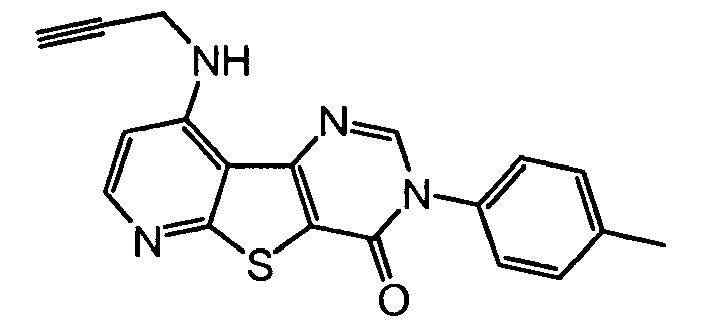
- Preferred compounds include 28Z or a pharmaceutically acceptable salt, solvate or ester thereof.
- As used above, and throughout the specification, the following terms, unless otherwise indicated, shall be understood to have the following meanings:
- "Patient" includes both human and animals.
- "Mammal" means humans and other mammalian animals.
- "Alkyl" means an aliphatic hydrocarbon group which may be straight or branched and comprising about 1 to about 20 carbon atoms in the chain. Preferred alkyl groups contain about 1 to about 12 carbon atoms in the chain. More preferred alkyl groups contain about 1 to about 6 carbon atoms in the chain. Branched means that one or more lower alkyl groups such as methyl, ethyl or propyl, are attached to a linear alkyl chain. "Lower alkyl" means a group having about 1 to about 6 carbon atoms in the chain which may be straight or branched.
- "Aryl" (sometimes abbreviated "ar") means an aromatic monocyclic or multicyclic ring system comprising about 6 to about 14 carbon atoms, preferably about 6 to about 10 carbon atoms. The aryl group can be optionally substituted with one or more "ring system substituents" which may be the same or different, and are as defined herein. Non-limiting examples of suitable aryl groups include phenyl and naphthyl.
- "Aralkyl" or "arylalkyl" means an aryl-alkyl- group in which the aryl and alkyl are as previously described. Preferred aralkyls comprise a lower alkyl group. Non-limiting examples of suitable aralkyl groups include benzyl, 2-phenethyl and naphthalenylmethyl. The bond to the parent moiety is through the alkyl.
- "Halo" means fluoro, chloro, bromo, or iodo groups. Preferred are fluoro, chloro or bromo, and more preferred are fluoro and chloro.
- "Halogen" means fluorine, chlorine, bromine, or iodine. Preferred are fluorine, chlorine and bromine.
- "Haloalkyl" means an alkyl as defined above wherein one or more hydrogen atoms on the alkyl is replaced by a halo group defined above.
- With reference to the number of moieties (e.g., substituents, groups or rings) in a compound, unless otherwise defined, the phrases "one or more" and "at least one" mean that there can be as many moieties as chemically permitted, and the determination of the maximum number of such moieties is well within the knowledge of those skilled in the art.
- As used herein, the term "composition" is intended to encompass a product comprising the specified ingredients in the specified amounts, as well as any product which results, directly or indirectly, from combination of the specified ingredients in the specified amounts.
- As well known in the art, a bond drawn from a particular atom wherein no moiety is depicted at the terminal end of the bond indicates a methyl group bound through that bond to the atom, unless stated otherwise. For example:

- It should also be noted that any carbon or heteroatom with unsatisfied valences in the text, schemes, examples, structural formulae, and any Tables herein is assumed to have the hydrogen atom or atoms to satisfy the valences.
- Solvates of the compounds of the invention are also contemplated herein. "Solvate" means a physical association of a compound of this invention with one or more solvent molecules. This physical association involves varying degrees of ionic and covalent bonding, including hydrogen bonding. In certain instances the solvate will be capable of isolation, for example when one or more solvent molecules are incorporated in the crystal lattice of the crystalline solid. "Solvate" encompasses both solution-phase and isolatable solvates. Non-limiting examples of suitable solvates include ethanolates, methanolates, and the like. "Hydrate" is a solvate wherein the solvent molecule is H2O.
- "Effective amount" or "therapeutically effective amount" is meant to describe an amount of a compound or a composition of the present invention effective in antagonizing mGluRs, in particular mGluR1, and thus producing the desired therapeutic, ameliorative, inhibitory or preventative effect in a suitable patient.
- The compounds of the invention form salts which are also within the scope of this invention. Reference to a compound of the invention herein is understood to include reference to salts thereof, unless otherwise indicated. The term "salt(s)", as employed herein, denotes acidic salts formed with inorganic and/or organic acids, as well as basic salts formed with inorganic and/or organic bases. In addition, when a compound contains both a basic moiety, such as, but not limited to a pyridine or imidazole, and an acidic moiety, such as, but not limited to a carboxylic acid, zwitterions ("inner salts") may be formed and are included within the term "salt(s)" as used herein. Pharmaceutically acceptable (i.e., non-toxic, physiologically acceptable) salts are preferred, although other salts are also useful. Salts of the compounds of the invention may be formed, for example, by reacting a compound of the invention with an amount of acid or base, such as an equivalent amount, in a medium such as one in which the salt precipitates or in an aqueous medium followed by lyophilization. Acids (and bases) which are generally considered suitable for the formation of pharmaceutically useful salts from basic (or acidic) pharmaceutical compounds are discussed, for example, by S. Berge et al, Journal of Pharmaceutical Sciences (1977) 66(1) 1-19; P. Gould, International J. of Pharmaceutics (1986) 33 201-217; Anderson et al, The Practice of Medicinal Chemistry (1996), Academic Press, New York; in The Orange Book (Food & Drug Administration, Washington, D.C. on their website); and P. Heinrich Stahl, Camille G. Wermuth (Eds.), Handbook of Pharmaceutical Salts: Properties, Selection, and Use, (2002) Int'l. Union of Pure and Applied Chemistry, pp. 330-331. These disclosures are incorporated herein by reference thereto.
- Exemplary acid addition salts include acetates, adipates, alginates, ascorbates, aspartates, benzoates, benzenesulfonates, bisulfates, borates, butyrates, citrates, camphorates, camphorsulfonates, cyclopentanepropionates, digluconates, dodecylsulfates, ethanesulfonates, fumarates, glucoheptanoates, glycerophosphates, hemisulfates, heptanoates, hexanoates, hydrochlorides, hydrobromides, hydroiodides, 2-hydroxyethanesulfonates, lactates, maleates, methanesulfonates, methyl sulfates, 2-naphthalenesulfonates, nicotinates, nitrates, oxalates, pamoates, pectinates, persulfates, 3-phenylpropionates, phosphates, picrates, pivalates, propionates, salicylates, succinates, sulfates, sulfonates (such as those mentioned herein), tartarates, thiocyanates, toluenesulfonates (also known as tosylates), undecanoates, and the like.
- Exemplary basic salts include ammonium salts, alkali metal salts such as sodium, lithium, and potassium salts, alkaline earth metal salts such as calcium and magnesium salts, aluminum salts, zinc salts, salts with organic bases (for example, organic amines) such as benzathines, diethylamine, dicyclohexylamines, hydrabamines (formed with N,N-bis(dehydroabietyl) ethylenediamine), N-methyl-D-glucamines, N-methyl-D-glucamides, t-butyl amines, piperazine, phenylcyclohexylamine, choline, tromethamine, and salts with amino acids such as arginine, lysine and the like. Basic nitrogen-containing groups may be quarternized with agents such as lower alkyl halides (e.g. methyl, ethyl, propyl, and butyl chlorides, bromides and iodides), dialkyl sulfates (e.g. dimethyl, diethyl, dibutyl, and diamyl sulfates), long chain halides (e.g. decyl, lauryl, myristyl and stearyl chlorides, bromides and iodides), aralkyl halides (e.g. benzyl and phenethyl bromides), and others.
- All such acid salts and base salts are intended to be pharmaceutically acceptable salts within the scope of the invention and all acid and base salts are considered equivalent to the free forms of the corresponding compounds for purposes of the invention.
- Compounds of the invention, and salts and solvates thereof, may exist in their tautomeric form (for example, as an amide or imino ether). All such tautomeric forms are contemplated herein as part of the present invention.
- All stereoisomers (for example, geometric isomers, optical isomers and the like) of the present compounds (including those of the salts and solvates of the compounds), such as those which may exist due to asymmetric carbons on various substituents, including enantiomeric forms (which may exist even in the absence of asymmetric carbons), rotameric forms, atropisomers, and diastereomeric forms, are contemplated within the scope of this invention. Individual stereoisomers of the compounds of the invention may, for example, be substantially free of other isomers, or may be admixed, for example, as racemates or with all other, or other selected, stereoisomers. The chiral centers of the present invention can have the S or R configuration as defined by the IUPAC 1974 Recommendations. The use of the terms "salt", "solvate" and the like, is intended to equally apply to the salt and solvate of enantiomers, stereoisomers, rotamers, tautomers or racemates of the present compounds.
- Polymorphic forms of the compounds of the invention, and of the salts and solvates of the compounds of the invention, are intended to be included in the present invention.
- The compounds according to the invention have pharmacological properties; in particular, the compounds can be mGluR (metabotropic glutamate receptor) antagonists, more particularly, selective mGluR1 antagonists. Accordingly, the present compounds are useful in the treatment or prevention of conditions that are treatable or preventable by inhibiting mGluR, more particularly, mGluR1 function. Such conditions include a variety of acute and chronic neurological disorders associated with excessive or inappropriate stimulation of excitatory amino acid transmission as well as conditions which lead to glutamate-deficient functions.
- Examples of treatable or preventable acute neurological disorders include, but are not limited to, cerebral deficits subsequent to cardiac bypass surgery and grafting, cerebral ischemia, stroke (ischemic or hemorrhagic), spinal cord injuries (due to trauma, infarction/ischemia or inflammation), head trauma, perinatal hypoxia, cardiac arrest and hypoglycemic neuronal damage. Examples of treatable or preventable chronic neurological disorders include, but are not limited to, Alzheimer's disease, Huntington's Chorea, amyotrophic lateral sclerosis (ALS), AIDS-induced dementia, inherited ataxias, ocular damage and retinopathy, cognitive disorders, and idiopathic and drug-induced Parkinson's. Other conditions associated with glutamate dysfunctions treatable or preventable by compounds of the invention include, but are not limited to, muscle spasms, convulsions (e.g., epilepsy), spasticity, migraine (including menstrual migraine), psychoses (e.g., schizophrenia and bipolar disorder), urinary incontinence, anxiety and related disorders (e.g. panic attack), emesis, brain edema, tardive dyskinesia, depression, drug tolerance and withdrawal (e.g., opiates, benzodiazepines, nicotine, cocaine, or ethanol), and smoking cessation.
- The compounds of the invention are also useful for treating or preventing pain which may be neuropathic (nerve damage) or inflammatory (tissue damage). These compounds are particularly useful for treating or preventing neuropathic pain. Neuropathic pain used herein refers to an abnormal state of pain sensation, in which a reduction of pain threshold and the like are continued, due to functional abnormalities accompanying damage or degeneration of a nerve, plexus or perineural soft tissue, which is caused by wound, compression, infection, cancer, ischemia and the like, or metabolic disorders such as diabetes mellitus and the like. Neuropathic pain includes pain caused by either central or peripheral nerve damage. It also includes the pain caused by either mononeuropathy or polyneuropathy. In some embodiments, the neuropathic pain is induced by diabetes. In other embodiments, the neuropathic pain is induced by compression of nerves.
- Examples of neuropathic pain treatable or preventable by the present compounds include, but are not limited to, allodynia (a pain sensation induced by mechanical or thermal stimulus that does not normally provoke pain), hyperalgesia (an excessive response to a stimulus that is normally painful), hyperesthesia (an excessive response to a contact stimulus), diabetic polyneuropathy, entrapment neuropathy, cancer pain, central pain, labor pain, myocardial infarction pain, post-stroke pain, pancreatic pain, colic pain, muscle pain, post-operative pain, pain associated with intensive care, pain associated with a periodontal disease (including gingivitis and periodontitis), menstrual pain, migraine pain, persistent headaches (e.g., cluster headache or chronic tension headache), persistent pain states (e.g., fibromyalgia or myofascial pain), trigeminal neuralgia, postherpetic neuralgia, arthritic pain (e.g., pain due to osteoarthritis or rheumatoid arthritis), bursitis, pain associated with AIDS, visceral pain (e.g., interstitial cystitis and irritable bowel syndrome (IBS)), pain due to spinal trauma and/or degeneration, burn pain, referred pain, enhanced memory of pain and neuronal mechanisms involved in coping with pain. The compounds of the present invention are particularly useful for treating or preventing allodynia and hyperalgesia.
- Compounds of the invention are also useful for treating or preventing pain associated with inflammation or an inflammatory disease in a mammal. The pain associated with inflammation or an inflammatory disease treatable or preventable by the present compounds may arise where there is an inflammation of the body tissue which may be a local inflammatory response and/or a systemic inflammation. For example, the present compounds can be used to treat or prevent pain associated with inflammatory diseases including, but not limited to, organ transplant rejection; reoxygenation injury resulting from organ transplantation including transplantation of the heart, lung, liver, or kidney; chronic inflammatory diseases of the joints, including arthritis, rheumatoid arthritis, osteoarthritis and bone diseases associated with increased bone resorption; inflammatory lung diseases, such as asthma, adult respiratory distress syndrome, and chronic obstructive airway disease; inflammatory diseases of the eye, including comeal dystrophy, trachoma, onchocerciasis, uveitis, sympathetic ophthalmitis and endophthalmitis; chronic inflammatory diseases of the gum, including gingivitis and periodontitis; tuberculosis; leprosy; inflammatory diseases of the kidney, including uremic complications, glomerulonephritis and nephrosis; inflammatory diseases of the skin, including sclerodermatitis, psoriasis and eczema; inflammatory diseases of the central nervous system, including chronic demyelinating diseases of the nervous system, multiple sclerosis, AIDS-related neurodegeneration and Alzheimer's disease, infectious meningitis, encephalomyelitis, Parkinson's disease, Huntington's disease, amyotrophic lateral sclerosis and viral or autoimmune encephalitis; autoimmune diseases, including Type I and Type II diabetes mellitus; diabetic complications, including diabetic cataract, glaucoma, retinopathy, nephropathy (such as microaluminuria and progressive diabetic nephropathy), polyneuropathy, mononeuropathies, autonomic neuropathy, gangrene of the feet, atherosclerotic coronary arterial disease, peripheral arterial disease, nonketotic hyperglycemic-hyperosmolar coma, foot ulcers, joint problems, and a skin or mucous membrane complication (such as an infection, a shin spot, a candidal infection and necrobiosis lipoidica diabeticorum); immune-complex vasculitis, and systemic lupus erythematosus (SLE); inflammatory diseases of the heart, such as cardiomyopathy, ischemic heart disease hypercholesterolemia, and atherosclerosis; as well as various other diseases that can have significant inflammatory components, including preeclampsia, chronic liver failure, brain and spinal cord trauma, and cancer.
- The present compounds can also be used for treating or preventing pain associated with an inflammatory disease that involves a systemic inflammation of the body, such as gram-positive or gram negative shock, hemorrhagic or anaphylactic shock, shock induced by cancer chemotherapy in response to pro-inflammatory cytokines (e.g., shock associated with pro-inflammatory cytokines), and shock induced by a chemotherapeutic agent that is administered as a treatment for cancer.
- One aspect of this invention relates to a method of selectively antagonizing mGluR1 in a cell in need thereof, comprising contacting said cell in vitro with at least one compound of the invention or a pharmaceutically acceptable salt or solvate thereof.
- The term "antagonist of metabatropic glutamate receptor (e.g., mGluR1)" refers to a compound that binds to the metabatropic glutamate receptor (e.g., mGluR1) but fails to elicit a response thereby blocking agonist action, i.e, inhibiting a function of mGluRs (e.g., mGluR1). Accordingly, mGluR (e.g., mGluR1) mediated processes and responses can be inhibited with an antagonist of mGluR (e.g., mGluR1). Preferably, an antagonist selectively antagonizes group I mGluRs. More preferably, an antagonist of the present invention is a selective antagonist of mGluR1. A selective antagonist of mGluR1 is one that antagonizes mGluR1, but antagonizes other mGluRs only weakly or substantially not at all, or at least antagonizes other mGluRs with an IC50 at least 10 or even 100 or 1000 times greater than the IC50 at which it antagonizes mGluR1. Most preferred antagonists are those which can selectively antagonize mGluR1 at low concentrations, for example, those that cause a level of antagonism of 50% or greater at a concentration of 100nM or less.
- Another aspect of this disclosure is directed to a method of treating or preventing a disease or condition associated with mGluR1 in a mammal (e.g., human) in need thereof comprising administering a therapeutically effective amount of at least one compound of the invention or a pharmaceutically acceptable salt or solvate thereof to said mammal.
- A preferred dosage is about 0.001 to 500 mg/kg of body weight/day of the compound of formula III. An especially preferred dosage is about 0.01 to 25 mg/kg of body weight/day of a compound of the invention or a pharmaceutically acceptable salt or solvate thereof.
- The compounds of this invention may also be useful in combination (administered together or sequentially) with one or more additional therapeutic agents for the treatment of the above disorders or conditions. Such additional therapeutic agents may be a pain management agent, including non-opioid analgesics such as acetylsalicylic acid, choline magnesium trisalicylate, acetaminophen, ibuprofen, fenoprofen, diflusinal, and naproxen; and opioid analgesics, such as morphine, hydromorphone, methadone, levorphanol, fentanyl, oxycodone, and oxymorphone. Other such therapeutic agents may be a non-steroid anti-inflammatory agent, an antimigraine agent, a Cox-II inhibitor, an antiemetic, a β-adrenergic blocker, an anticonvulsant, an antidepressant, a Ca2+-channel blocker, an anticancer agent, an agent for treating or preventing UI, an agent for treating Alzheimer's disease, an agent for treating or preventing IBD, an agent for treating or preventing IBS, an agent for treating Parkinson's disease and parkinsonism, an agent for treating anxiety, an agent for treating epilepsy, an agent for treating a stroke, an agent for treating psychosis, an agent for treating Huntington's chorea, an agent for treating ALS, an agent for treating vomiting, an agent for treating dyskinesia, or an agent for treating depression, and mixtures thereof.
- If formulated as a fixed dose, such combination products employ the compounds of this invention within the dosage range described herein and the other pharmaceutically active agent or treatment within its dosage range. Compounds of the invention may also be administered sequentially with known therapeutic agents when a combination formulation is inappropriate. The invention is not limited in the sequence of administration; compounds of the invention may be administered either prior to or after administration of the known therapeutic agent. Such techniques are within the skills of persons skilled in the art as well as attending physicians.
- Accordingly, in one aspect, this invention includes combinations comprising an amount of at least one compound of the invention or a pharmaceutically acceptable salt or solvate thereof, and an amount of one or more additional therapeutic agents listed above wherein the amounts of the compounds/ treatments result in desired therapeutic effect.
- The pharmacological properties of the compounds of this invention may be confirmed by a number of pharmacological assays. The selective antagonistic activity of the present compounds towards the metabotropic glutamate receptor 1 (mGluR1) may be assayed by methods known in the art, for example, by using the methods as described in the examples.
- The actions of the compounds of the invention for the treatment or prevention of pain may be assessed by various animal models, for example, by the following tests:
- Formalin test: Mice are gently restrained and 30 µl of formalin solution (1.5% in saline) is injected subcutaneously into the plantar surface of the right hind paw of the mouse, using a microsyringe with a 27 gauge needle. After the formalin injection, the mouse is immediately put back into the Plexiglas observation chamber (30 x 20 x 20 cm) and the nociceptive response of the animal to formalin injection is observed for a period of 60 min. The duration of licking and flinching of the injected paw is recorded and quantified every 5 min for the total observation period. The recording of the early phase (first phase) starts immediately and lasts for 5 min. The late phase (second phase) starts about 10-15 min after formalin injection.
- L5 and L6 spinal nerve ligation of the sciatic nerve (neuropathic pain model): The peripheral neuropathy is produced by ligating the L5 and L6 spinal nerves of the right sciatic nerve, according to the method previously described by Kim and Chung (1992) except for small changes. Briefly, rats are anaesthetized with chloral hydrate (400 mg/kg, i.p.), placed in a prone position and the right paraspinal muscles separated from the spinous processes at the L4-S2 levels. The L5 transverse process is carefully removed with a small rongeur to identify the L4-L5 spinal nerves. The right L5 and L6 spinal nerves are isolated and tightly ligated with 7/0 silk thread. A complete hemostasis is confirmed and the wound sutured.
- Chronic constriction injury (CCI) of the sciatic nerve (neuropathic pain model): Surgery is performed according to the method described by Bennett & Xie (1987). Rats are anaesthetized with chloral hydrate (400 mg/kg, i.p.) and the common sciatic nerve is exposed at the level of the mid-thigh. Proximally, at about 1 cm from the nerve trifurcation, four loose ligatures (4/0 silk) spaced 1 mm are tied around the nerve. The ligature delays, but does not arrest, circulation through the superficial epineural vasculature. The same procedure is performed except for ligature placement (sham surgery) in a second group of animals.
- Carrageenan (inflammatory pain model): The right hind paw of each animal is injected at subplantar level with 0.1 mL of carrageenan (25 GA needle). Pre-tests are determined prior to carrageenan or drug administration. In POST-TREATMENT protocol, rats are tested 3 hours after carrageenan treatment to establish the presence of hyperalgesia and then at different times after drug administration. In PRE-TREATMENT protocol, one hour after drug administration, rats are treated with carrageenan and they are tested starting from 3 hours later.
- Freund's adjuvant-induced arthritic model (inflammatory pain model): Animals receive a single subplantar injection of 100 mL of a 500 mg dose of heat-killed and dried Mycobacterium tuberculosis (H37 Ra, Difco Laboratories, Detroit, MI, USA) in a mixture of paraffin oil and an emulsifying agent, mannide monooleate (complete Freund's adjuvant). Control animals are injected with 0.1 mL mineral oil (incomplete Freund's adjuvant).
- Measurement of tactile allodynia (behavioural test): Behavioral tests are conducted by observer blinded to the treatment during the light cycle to avoid circadian rhythm fluctuation. Tactile sensitivity is evaluated using a series of calibrated Semmes-Weinstein (Stoelting, IL) von Frey filaments, bending force ranging from 0.25 to 15 g. Rats are placed in a transparent plastic box endowed with a metal mesh floor and are habituated to this environment before experiment initiation. The von Frey filaments are applied perpendicularly to the midplantar surface of the ipsilateral hind paws and the mechanical allodynia is determined by sequentially increasing and decreasing the stimulus strength ("up-down" paradigm of the filament presentation). Data are analysed with a Dixon non-parametric test (Chaplan et al. 1994). Paw licking or vigorously shaking after stimulation is considered pain-like responses.
- Thermal hyperalgesia (behavioural test): Thermal hyperalgesia to radiant heat is assessed by measuring the withdrawal latency as an index of thermal nociception (Hargreaves et al., 1998). The plantar test (Basile, Comerio, Italy) is chosen because of its sensitivity to hyperalgesia. Briefly, the test consists of a movable infrared source placed below a glass plane onto which the rat is placed. Three individual perspex boxes allow three rats to be tested simultaneously. The infrared source is placed directly below the plantar surface of the hind paw and the paw withdrawal latency (PWL) is defined as the time taken by the rat to remove its hind paw from the heat source. PWLs are taken three times for both hind paws of each rat and the mean value for each paw represented the thermal pain threshold of rat. The radiant heat source is adjusted to result in baseline latencies of 10-12 sec. The instrument cut-off is fixed at 21 sec to prevent tissue damage.
- Weight bearing (behavioural test): An incapacitance tester is employed for determination of hind paw weight distribution. Rats are placed in an angled plexiglass chamber positioned so that each hind paw rested on a separate force plate. The weight bearing test represents a direct measure of the pathological condition of the arthritic rats without applying any stress or stimulus, thus this test measures a spontaneous pain behaviour of the animals.
- While it is possible for the active ingredient to be administered alone, it is preferable to present it as a pharmaceutical composition. The compositions of the present invention comprise at least one active ingredient, as defined above, together with one or more acceptable carriers, adjuvants or vehicles thereof and optionally other therapeutic agents. Each carrier, adjuvant or vehicle must be acceptable in the sense of being compatible with the other ingredients of the composition and not injurious to the mammal in need of treatment.
- Accordingly, this invention also relates to pharmaceutical compositions comprising at least one compound of the invention, or a pharmaceutically acceptable salt, solvate or ester thereof and at least one pharmaceutically acceptable carrier, adjuvant or vehicle.
- For preparing pharmaceutical compositions from the compounds described by this invention, inert, pharmaceutically acceptable carriers can be either solid or liquid. Solid form preparations include powders, tablets, dispersible granules, capsules, cachets and suppositories. The powders and tablets may be comprised of from about 5 to about 95 percent active ingredient. Suitable solid carriers are known in the art, e.g., magnesium carbonate, magnesium stearate, talc, sugar or lactose. Tablets, powders, cachets and capsules can be used as solid dosage forms suitable for oral administration. Examples of pharmaceutically acceptable carriers and methods of manufacture for various compositions may be found in A. Gennaro (ed.), Remington's Pharmaceutical Sciences, 18th Edition, (1990), Mack Publishing Co., Easton, Pennsylvania.
- Liquid form preparations include solutions, suspensions and emulsions. As an example may be mentioned water or water-propylene glycol solutions for parenteral injection or addition of sweeteners and opacifiers for oral solutions, suspensions and emulsions. Liquid form preparations may also include solutions for intranasal administration.
- Aerosol preparations suitable for inhalation may include solutions and solids in powder form, which may be in combination with a pharmaceutically acceptable carrier, such as an inert compressed gas, e.g. nitrogen.
- Also included are solid form preparations that are intended to be converted, shortly before use, to liquid form preparations for either oral or parenteral administration. Such liquid forms include solutions, suspensions and emulsions.
- The compounds of the invention may also be deliverable transdermally. The transdermal compositions can take the form of creams, lotions, aerosols and/or emulsions and can be included in a transdermal patch of the matrix or reservoir type as are conventional in the art for this purpose.
- The compounds of this invention may also be delivered subcutaneously.
- Preferably the compound is administered orally.
- Preferably, the pharmaceutical preparation is in a unit dosage form. In such form, the preparation is subdivided into suitably sized unit doses containing appropriate quantities of the active component, e.g., an effective amount to achieve the desired purpose.
- The quantity of active compound in a unit dose of preparation may be varied or adjusted from about 1 mg to about 100 mg, preferably from about 1 mg to about 50 mg, more preferably from about 1 mg to about 25 mg, according to the particular application.
- The actual dosage employed may be varied depending upon the requirements of the patient and the severity of the condition being treated. Determination of the proper dosage regimen for a particular situation is within the skill of the art. For convenience, the total daily dosage may be divided and administered in portions during the day as required.
- The amount and frequency of administration of the compounds of the invention and/or the pharmaceutically acceptable salts, solvates or esters thereof will be regulated according to the judgment of the attending clinician considering such factors as age, condition and size of the patient as well as severity of the symptoms being treated. A typical recommended daily dosage regimen for oral administration can range from about 1 mg/day to about 500 mg/day, preferably 1 mg/day to 200 mg/day, in two to four divided doses.
- Another aspect of this invention is a kit comprising a therapeutically effective amount of at least one compound of the invention or a pharmaceutically acceptable salt, solvate, or ester thereof and at least one pharmaceutically acceptable carrier, adjuvant or vehicle.
- Yet another aspect of this invention is a kit comprising an amount of at least one compound of the invention or a pharmaceutically acceptable salt, solvate or ester thereof and an amount of at least one additional therapeutic agent listed above, wherein the amounts of the two or more ingredients result in desired therapeutic effect.
- The present disclosure, including the present invention, is exemplified by the following preparations and examples which should not be construed to limit the scope of the disclosure. Alternative mechanistic pathways and analogous structures will be apparent to those skilled in the art.
- In general, the compounds of this invention may be prepared from known or readily prepared starting materials, following methods known to one skilled in the art and those illustrated below. All stereoisomers and tautomeric forms of the compounds are contemplated.


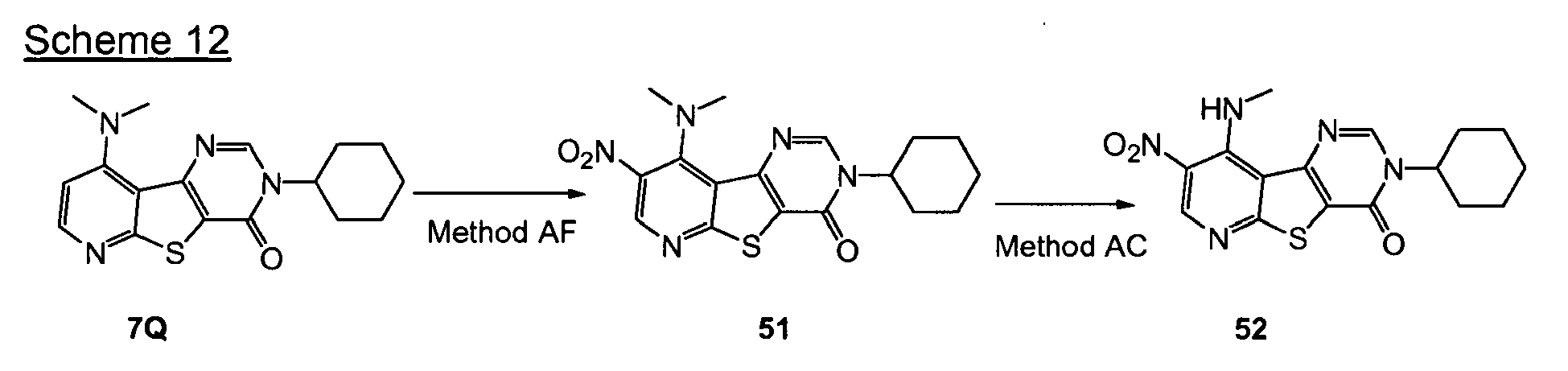


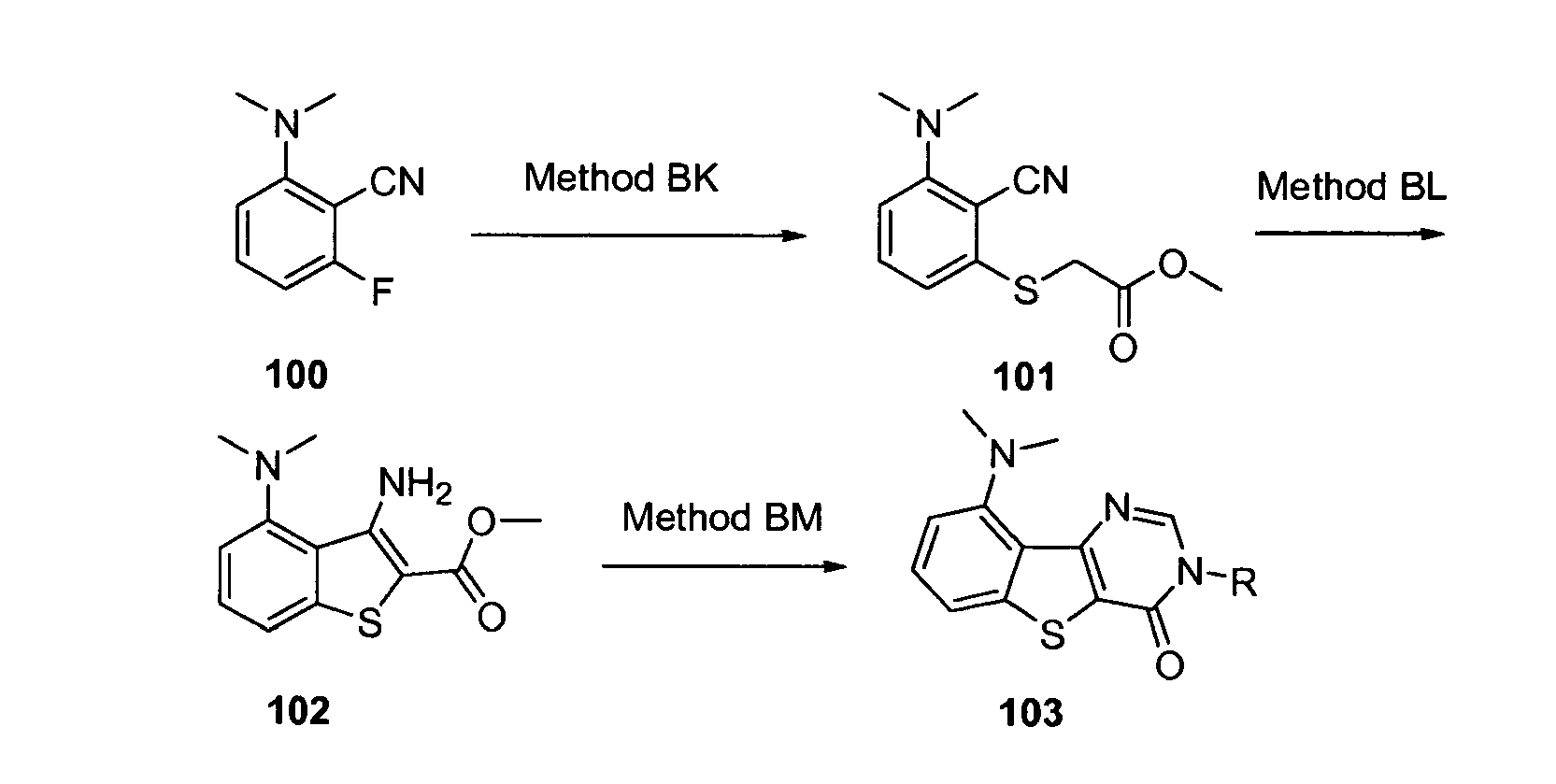


- A mixture of cyanoacetamide (8.4 g, 0.1 mol) and dimethylacetamide dimethylacetal (14.6 mL, 0.1 mol) was heated under reflux in dry ethanol (150 mL) for 2.5 h under a nitrogen atmosphere. The resulting white crystals of 2-cyano-3-(dimethylamino)-2-butenamide (10.0 g, 0.068 mol) were filtered, washed with ethanol and dried under vacuum. To this, was added N, N-dimethyl-formamide dimethylacetal (8.1 g, 0.068 mol) and the mixture heated under reflux in dry toluene (100 mL) for 1 h before evaporating the solvent under reduced pressure. The residue was heated neat at 150 °C for 30 min, cooled, washed twice with acetone and dried under vacuum to give compound 2. 1H NMR (DMSO-d6) δ
7.22 (d, 1H), 5.86 (d, 1H), 3.13 (s, 6H); Mass Spectrum (M+1): m/z calcd. for C8H10N3O+ = 164.1, found m/z = 164.2. - Alternatively, the intermediate 2-cyano-3-(dimethylamino)-2-butenamide (2.5 g, 0.0163 mol) (intermediate from above) and dimethylacetamide dimethyl acetal (2.2 ml, 0.0163 mol) was heated under reflux in dry toluene (25 ml) for 2.5 h under a nitrogen atmosphere before evaporating the solvent under reduced pressure. The residue was then heated neat at 150 °C for 30 minutes, cooled and washed twice with acetone and dried under vacuum to give compound 119. 1H NMR (DMSO-d6) δ 11.12 (br. s, 1H), 5.74 (s, 1H), 3.10 (s,6H), 2.14 (s, 3H).
- To compound 2 (9.34 g, 0.057 mol) was added phosphorous oxychloride (95 mL, 1.02 mol) and to the mixture was added triethylamine (4 mL, 0.029 mol) dropwise. The resultant mixture was heated at reflux for a period of 3 h, cooled to room temperature and quenched with ice-water. The mixture was then basified using 40% sodium hydroxide solution and the resulting precipitate filtered, washed with water until neutral and dried in a vacuum oven to give chloropyridine compound 3. 1H NMR (CDCl3): δ
7.95 (d, 1H), 6.48 (d, 1H), 3.20 (s, 6H). - The following compounds 120, 128, 158 and 166 were prepared analogously from 119, 127, 157 and 165, respectively.
Cpd Structure Formula MW m/z Found (M+1)+ 120 
C9H10ClN3 195.6 196.0 128 
C8H8ClN3 181.6 182.1 158 
C6H4ClN3O 169.6 170.1 166 
C15H9ClN4OS 328.8 329.1 - A solution of compound 3 (6.02 g, 0.033 mol), methyl thioglycolate (7.05 g, 0.066 mol) and potassium carbonate (6.88 g, 0.050 mol) in DMF (50 mL) was stirred for a period of 5 h at room temperature under a nitrogen atmosphere. Water (200 mL) was added, and the resulting precipitate filtered and dried in a vacuum oven to give ester 4. 1H NMR (CDCl3): δ
7.97 (d, 1H), 6.28 (d, 1H), 3.93 (s, 2H), 3.70 (s, 3H), 3.18 (s, 6H). - The following compounds were prepared analogously:
Cpd Structure Formula m/z calcd (M+1)+ m/z Found (M+1)+ 34 
C11H14N3O2S+ 252.1 252.1 121 
1H NMR (CDCl3) δ 6.13 (s, 1H), 3.89 (s, 2H), 3.69 (s, 3H), 3.14 (s, 6H), 2.29 (s, 3H). 159 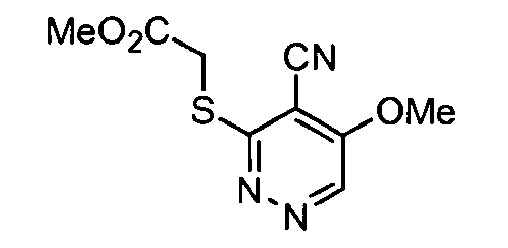
C9H10N3O3S+ 240.04 240.09 162 
1H NMR (CDCl3) δ 7.69(s, 1H), 5.99 (dd, 1H), 4.05 (d, 1H), 3.73-3.68 (m, 6H), 2.10-1.98(m, 2H), 1.66-1.50 (m, 4H). - A solution of compound 4 (8.33 g, 0.033 mol) and sodium methoxide (3.77 g, 0.070 mol) in methanol was heated at reflux for 3 h under a nitrogen atmosphere. The reaction was cooled to room temperature, water was added and the product isolated by extraction with dichloromethane (150 mL). The organic layer was dried over anhydrous sodium sulfate, filtered and evaporated under reduced pressure to give the desired product 5. 1H NMR (CDCl3): δ
8.41 (d, 1H), 6.81 (d, 1H), 6.70 (br.s, 2H), 3.82 (s, 3H), 2.81 (s, 6H). Mass Spectrum (M+1): m/z calcd. for C11H14N3O2S+ = 252.1, found m/z = 252.1. - The following compounds were prepared analogously:
Cpd Structure Formula m/z calcd (M+1)+ m/z Found (M+1)+ 35 
C11H14N3O2S+ 252.1 252.1 122 
1H NMR (CDCl3) δ 6.67 (br. s, 3H), 3.82 (s, 3H), 2.79 (s, 6H), 2.55 (s, 3H). 160 
C9H10N3O3S+ 240.04 240.09 - To bicyclic ester 5 (7.24 g, 0.029 mol) was added N, N-dimethylformamide dimethylacetal (7.7 mL, 0.058 mol) and mixture heated in toluene under reflux for a period of 5-24 h under a nitrogen atmosphere. The solvent was evaporated under reduced pressure to give amidine product 6 by proton NMR and mass spectrum. 1H NMR (CDCl3): δ
8.24 (d, 1H), 7.35 (s, 1H), 6.54 (d, 1H), 3.76 (s, 3H), 3.11 (s, 3H), 3.01 (s, 3H), 2.92 (s, 6H). - The following compounds were prepared analogously:
Cpd Structure Formula m/z calcd (M+1)+ m/z Found (M+1)+ 36 
C14H19N4O2S+ 307.1 307.1 123 
C15H21N4O2S+ 321.1 321.1 133A 
C16H24N5O2 + 318.2 318.2 133B 
C22H27N5O3 409.5 410.2 - Amidine 6 (0.22 g, 0.7 mmol) and 3,4-(methylenedioxy)aniline (0.20 g, 1.4 mmol) was heated in 10% acetic acid in toluene or 100 % acetic acid at 80 - 100 °C for a period of 30 minutes to 24h. The reaction was cooled to room temperature, ice-water was added. The mixture was made basic with saturated sodium bicarbonate or concentrated ammonium hydroxide solutions, and the resultant solid filtered. The solid was dissolved in dichloromethane, dried with sodium sulfate, filtered, and concentrate under reduced pressure. Trituration of the residue with diethyl ether, ethyl acetate, or hexane/ethyl acetate affords the desired compound 7A. 1H NMR (CDCl3): δ
8.40 (d, 1H), 8.22 (s, 1H), 6.91 (d, 2H), 6.82 (dd, 1H), 6.76 (d, 1H), 6.04 (s, 2H), 3.11 (s, 6H). Mass spectrum (M+1)+: m/z calcd. for C18H15N4O3S+ = 367.1, found m/z = 367.2. - Alternatively, the basic aqueous mixture was extracted with dichloromethane, dried with sodium sulfate, filtered, and concentrated under reduced pressure. The residue was purified via preparative TLC or column chromatography on silica gel with dichloromethane/ethyl acetate to afford the desired compound.
- The following compounds were prepared analogously.
Cpd Structure Formula MW m/z Found (M+1)+ 7H 
C17H13BrN4OS 401.3 403.1 7Q 
C17H20N4OS 328.4 329.1 7AK 
C17H14N4O2S 338.4 339.1 7BF 
C18H16N4OS 336.4 337.1 37A 
C17H20N4OS 328.1 329.1 37B 
C18H13N5OS2 379.1 380.2 37C 
C19H16N4O3S 380.1 381.2 37D 
C17H14N4OS 322.1 323.1 37E 
C17H13ClN4OS 356.1 357.2 37F 
C18H16N4O2S 352.1 353.2 37G 
C18H15FN4O2S 370.4 371.2 37H 
C17H14N4O2S 338.4 339.2 40 
C15H10N4O2S 310.1 311.0 134A 
C19H19N5O 333.4 334.1 134B 
C19H19N5O2 349.4 350.1 134C 
C19H19N5OS 365.5 366.1 134D 
C19H17F2N5O2 385.4 386.1 134E 
C19H16N6OS 376.4 377.1 134F 
C18H16ClN5O 353.8 354.1 134G 
C18H23N5O 325.4 326.1 134H 
C26H25N5O2 439.5 440.1 134I 
C25H23N5O2 425.5 426.1 -

- To 5.00 g (36.1 mmol) of 2-chloro-3-pyridine carbonitrile (8) in 75 mL of DMF was added 6.04 g of thiol 9 (36.1 mmol) followed by the addition of 1.95 g of sodium methoxide (36.1 mmol). The reaction mixture was allowed to stir at room temperature for 1 hour and subsequently poured onto H2O (300 mL). The resulting suspension was filtered and the yellow solids recrystallized from absolute ethanol to yield 5.30 g of 10Aas a yellow solid. 1H NMR (DMSO-d6) δ
9.44 (s, 1H), 8.66 (dd, 1H), 8.49 (dd, 1H), 7.69 (d, 1H), 7.67 (d, 1H), 7.46 (dd, 1H), 7.38 (bs, 2H), 7.30 (dd, 2H), 7.06 (t, 1H). MS m/z calcd. for C14H12N3OS+ = 270.1; found m/z = 270.1. - To compound 10A (5.00 g, 18.5 mmol) was added trimethylorthoformate (116 mL). The resulting mixture was heated to reflux and stirred overnight. The reaction was then cooled and the solvents removed in vacuo. The crude solid was purified via silica gel chromatography eluting with 5% acetone/dichloro-methane to give 2.52 g of tricycle 11 as a yellow solid. 1H NMR (CDCl3) δ
8.82 (dd, 1H), 8.59 (dd, 1H), 8.29 (s, 1H), 7.62-7.50 (m, 4H), 7.47 (d, 2H). MS m/z calcd. for C15H10N3OS+ = 280.1; found m/z = 280.1. - To a stirred solution of compound 11 (1.42 g, 5.07 mmol) in dichloro-methane (34 mL) was added MCPBA (70%) (1.88 g, 7.61 mmol) at 0°C. The reaction mixture was stirred at 0°C and allowed to warm to room temperature overnight. The mixture was washed with NaHCO3 (sat. aq.) (50 mL). The organic layer was separated, dried over MgSO4 and the solvents removed in vacuo. The crude off-white solid was purified via silica chromatography eluting with 10% methanol/dichloromethane to afford 902 mg of pure 12A as a white solid. 1H NMR (DMSO-d6) δ
8.71 (d, 1H), 8.71 (s, 1H), 8.26 (d, 1H), 7.89-7.86 (m, 1H), 7.72 (dd, 1H), 7.61-7.50 (m, 4H). MS m/z calcd for C14H12N3O2S+ = 296.1; found m/z = 296.1. - The following compounds were prepared analogously.
Cpd Structure Formula MW m/z Found (M+1)+ 53 
C17H13ClN4O2S 372.8 373.1 56 
C18H16N4O2S 352.4 ... - To compound 12 (902 mg, 3.04 mmol) was added POCl3 (30 mL). The reaction mixture was stirred at reflux for 4h. The solvents were then removed in vacuo, the residue taken up in dichloromethane (50 mL) and washed with 20% NaOH (50 mL). The organic layer was separated, dried over MgSO4 and concentrated in vacuo. The resulting residue was chromatographed on silica gel eluting with 5% acetone/dichloromethane to provide a white solid product containing a mixture of 2 and 4 chlorinated pyridines (13, 14). 1H NMR (CDCl3) (13) δ 8.51 (d, 1H), 8.29 (s, 1H), 7.62-7.51 (m, 4H), 7.48-7.43 (m, 2H). MS m/z calcd. for C15H9ClN3OS+ = 314.0; found m/z = 314.1. 1H NMR (CDCl3) (14) & 8.67 (bs, 1H), 8.36 (s, 1H), 7.64-7.50 (m, 4H), 7.50-7.43 (m, 2H). MS m/z calcd. for C15H9ClN3OS+ = 314.0; found m/z = 314.1.
- The following analogs can be prepared similarly:
Cpd Structure Formula MW m/z Found (M+1)+ 54 
C17H12Cl2N4OS 391.3 391.1 57 
C18H15ClN4OS 370.9 371.2 78 
C16H16ClN3O2S 349.8 350.1 - Compound 6 (0.150 g, 0.49 mmol) and ethanolamine (0.120 g, 1.96 mmol) in 10% acetic acid in toluene or 100% acetic acid (∼ 0.20 M) were combined and irradiated in a 300 W power microwave oven at 160 °C for 10 minutes. The mixture was concentrated in vacuo, diluted with ice-water, basified with concentrated NH4OH (aq.). The resultant solid was collected by filtration. The solid was then dissolved in dichloromethane, dried with MgSO4, filtered and concentrated in vacuo. The residue was triturate d with Et2O. The resulting solid was collected by filtration, washed with Et2O, and dried to afford the compound 15A as a solid. 1H NMR (CDCl3): δ
8.37 (d, 1H), 8.23 (s, 1H), 6.74 (d, 1H), 4.23 (t, 2H), 4.00 (q, 2H), 3.09 (s, 6H), 2.29 (t, 1H). MS m/z calcd. for C13H15N4O2S+ = 291.1; found m/z = 291.1. - Alternatively, the basic aqueous mixture was extracted with dichloro-methane, dried with MgSO4, filtered, and concentrated in vacuo. Purification via preparative TLC or column chromatography on silica gel with dichloromethane/ ethyl acetate (1:1) or methanol/dichloromethane (1:10) afforded the desired compound.
- The following compound was prepared analogously:
Cpd Structure Formula MW m/z Found (M+1)+ 15AH 
C19H22N4O3S 386.5 387.2 - Compound 3 (1.0 g, 5.5 mmol), methyl glyocate (2.47 g, 0.028 mol) and sodium hydride (1.10 g, 0.028 mol of 60 % in mineral oil) in ethylene glycol dimethyl ether (20 mL) were heated at 60 °C for 4 h under a nitrogen atmosphere. The reaction was cooled to room temperature and added ice-water, extracted by dichloromethane, dried using sodium sulfate, filtered and evaporated under reduced pressure to give the desired ester 16. 1H NMR (CDCl3): & 7.71 (d, 1H), 6.21 (d, 1H), 4.87 (s, 2H), 3.70 (s, 3H), 3.20 (s, 6H). MS m/z calcd. for C11H14N3O3 + = 236.1; found m/z = 236.1.
- A solution of 16 (1.00 g, 0.004 mol) and sodium methoxide (2.30 g, 0.043 mol) in methanol was heated under reflux for 3 h under a nitrogen atmosphere. The reaction was cooled to room temperature, partitioned between water and dichloromethane (150 mL). The dichloromethane layer was dried using anhydrous sodium sulfate, filtered and evaporated under reduced pressure to give the desired bicyclic ester 17. 1H NMR (CDCl3): δ
8.17 (d, 1H), 6.56 (d, 1H), 5.21 (br.s, 2H), 3.89 (s, 3H), 2.94 (s, 6H). - To compound 17 (0.04 g, 0.20 mmol) was added N, N-dimethylformamide dimethyl acetal (0.20 g, 1.7 mmol) and the mixture was heated in toluene (10 mL) under reflux for a period of 11/2 h under a nitrogen atmosphere. The solvent was then evaporated under reduced pressure to give product 18 which was used without purification. MS m/z calcd. for C14H19N4O3 + = 291.1; found m/z = 291.1.
- Compound 18 (0.049 g, 0.2 mmol) and 4-chloroaniline (0.033 g, 2.6 mmol) were heated in acetic acid (3 mL) at 80 °C for a period of 5h. The reaction was cooled to room temperature, ice-water was added and the mixture was basified using concentrated ammonium hydroxide solution. The mixture was then extracted by dichloromethane, dried using sodium sulfate, filtered and evaporated under reduced pressure. Purification using preparative TLC on silica gel using dichloromethane/ethyl acetate (9:1) led to product 19. 1H NMR (CDCl3): δ 8.17 (d, 1H), 8.08 (s, 1H), 7.50 (d, 2H), 7.36 (d, 2H), 6.49 (d, 1H), 3.37 (s, 6H). MS m/z calcd. for C17H14ClN4O2 = 341.1; found m/z = 341.1.
- (1-Ethoxyethylidene)malononitrile (20) (40.0 g, 294 mmol) and N,N-dimethylformamide dimethyl acetal (63.0 ml, 470 mmol) were reacted according to Mittelbach and Yano's procedures to give 23.5 g of 21 as a yellow-orange solid. 1H NMR (DMSO-d6) δ 12.12 (bs, 1H), 7.77 (d, 1H), 6.33 (d, 1H), 3.95 (s, 3H).
- To compound 21 (23.5 g, 157 mmol) was added POCl3 (300 mL) and Et3N (15 mL). The reaction mixture was stirred at reflux for 2h and the solvents removed in vacuo. The resulting brown solid was quenched dropwise with water and basified with 40% aq. NaOH. The aqueous suspension was extracted with three 100 mL portions of dichloromethane, dried over MgSO4 and concentrated in vacuo to provide 23.9 g of compound 22 as a brown solid. 1H NMR (CDCl3) δ 8.42 (d, 1H), 6.89 (d, 1H), 4.03 (s, 3H).
- To a solution of compound 22 (10.0 g, 59.2 mmol) in 200 mL of DMF was added methylthioglycolate (7.15 mL, 65.0 mmol) and sodium methoxide (3.60 g, 65.0 mmol). The reaction was allowed to stir at room temperature for 2h and poured onto 500 mL of water. The solid was filtered off and recrystallized from ethanol to give 10.0 g of compound 23 as a yellow solid. 1H NMR (CDCl3) δ
8.37 (d, 1H), 6.64 (d, 1H), 4.02 (s, 2H), 3.97 (s, 3H), 3.74 (s, 3H). - A solution of compound 23 (10.0 g, 42.0 mmol), and N,N-dimethyl-formamide dimethyl acetal (25.0 mL, 187 mmol) in abs. ethanol (36 mL) was allowed to stir at reflux for 3h. The solvent was removed in vacuo and the resulting solid was recrystallized from ethanol to give 7.50 g of compound 24 as a yellow solid. 1H NMR (CDCl3) δ 8.46 (d, 1H), 7.55 (s, 1H), 6.65 (d, 1H), 3.94 (s, 3H), 3.82 (s, 3H), 3.10 (bd, 6H).
-
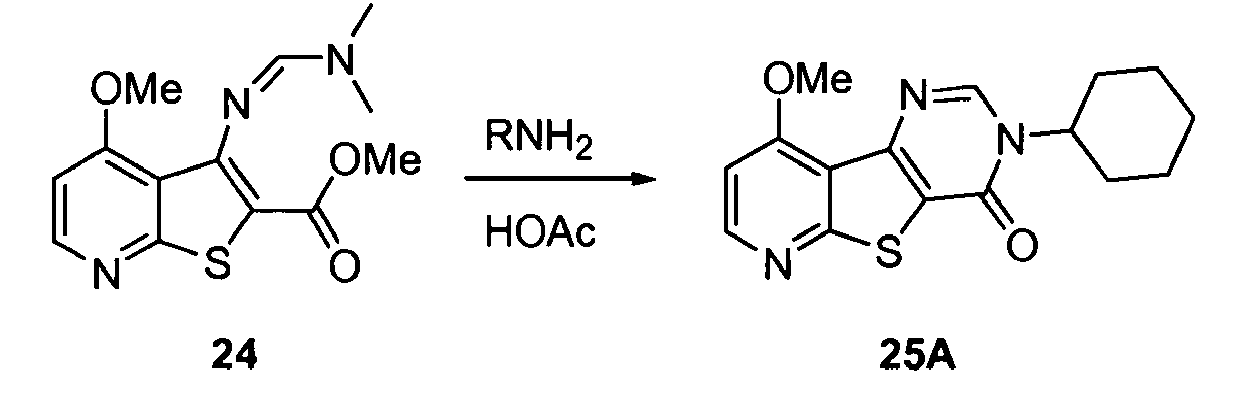
- To a mixture of compound 24 (3.00 g, 10.2 mmol) in glacial acetic acid (11 mL) was added cyclohexylamine (2.40 mL, 20.5 mmol). The reaction was allowed to stir at 80 °C overnight. The reaction mixture was then poured onto water (100 mL), basified with conc. NH4OH and extracted with 3-25 mL portions of dichloromethane. The organic layer was separated, dried over MgSO4 and concentrated in vacuo. The crude solid was then purified via silica gel chromatography eluting with 10% acetone/dichloromethane to give 2.07 g of compound 25A as a white solid. 1H NMR (CDCl3) δ 8.62 (d, 1H), 8.34 (s, 1H), 6.91 (d, 1H), 4.90 (tt, 1H), 4.16 (s, 3H), 2.06 (d, 2H), 1.96 (d, 2H), 1.81 (d, 1H), 1.69-1.47 (m, 5H), 1.34-1.21 (m, 1H). C16H18N3O2S+ = 316.1; found m/z = 316.1.
- The following compounds were prepared analogously:
Cpd Structure Formula MW m/z Found (M+1)+ 25A 
C16H17N3O2S 315.4 316.1 25B 
C17H13N3O3S 399.4 340.1 25C 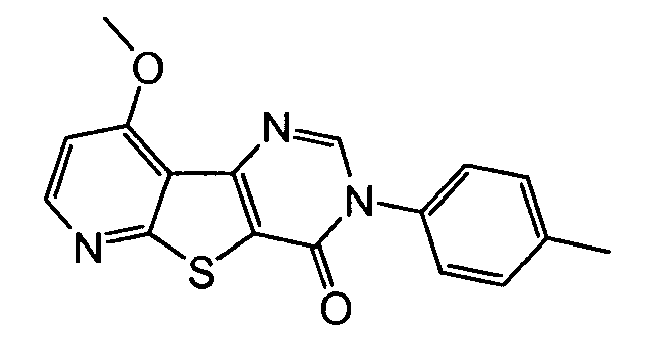
C17H13N3O2S 323.4 324.1 25D 
C17H10N4O2S2 366.4 367.1 -

- To compound 25A (2.07 g, 6.55 mmol) was added 33% HBr in acetic acid (26.0 mL). The reaction mixture was stirred at 100 °C in a sealed tube for 2h, cooled to room temperature, filtered and washed with water. The resulting white solid was dried in vacuo overnight to give 1.90 g of 26A as a white solid. 1H NMR (CD3OD) δ 8.70 (s, 1H), 8.69 (d, 1H), 7.22 (d, 1H), 4.80 (tt, 1H), 2.08-1.75 (m, 7H), 1.62-1.49 (m, 2H), 1.43-1.30 (m, 1H). MS m/z calcd. for C15H16N3O2S+ = 302.1; found m/z = 302.1.
- The following compounds were prepared analogously:
Cpd Structure Formula MW m/z Found (M+1)+ 26A 
C15H15N3O2S 301.4 302.1 26C 
C16H11N3O2S 309.3 310.0 111 
C16H11N3O2S 309.3 310.0 -

- To a solution of compound 26A (1.90 g, 6.30 mmol) in 1,4-dioxane (17 mL) was added N,N-diisopropylethylamine (1.91 mL, 10.9 mmol) and N-phenyltrifluoromethane sulfonimide (3.79 g, 10.6 mmol). The reaction was allowed to stir at room temperature overnight and diluted with ethyl acetate (50 mL). The mixture was then washed with 50 mL of water, 50 mL of saturated aqueous NH4Cl, and 50 mL of saturated aqueous NaHCO3. The organic layer was separated, dried over MgSO4, and concentrated in vacuo. The resulting crude off-white solid was purified via silica gel chromatography eluting with 5% acetone/dichloromethane to yield 1.20 g of compound 27A as a white solid. 1H NMR (CDCl3) δ 8.84 (d, 1H), 8.35 (s, 1H), 7.35 (d, 1H), 4.89 (tt, 1H), 2.09 (d, 2H), 1.98 (d, 2H), 1.82 (d, 1H), 1.71-1.68 (m, 2H), 1.62-1.47 (m, 2H), 1.34-1.21 (m, 1H). MS m/z calcd. for C16H15F3N3O4S2 + = 434.1; found m/z = 434.1.
- The following compounds were prepared analogously:
Cpd Structure Formula MW m/z Found (M+1)+ 27A 
C16H14F3N3O4S2 433.4 434.1 27B 
C17H10F3N3O5S2 457.4 457.9 27C 
C17H10F3N3O4S2 441.4 441.8 112A 
C18H12F3N3O4S2 455.4 456.0 112B 
C17H10F3N3O4S2 441.4 441.9 -

- To a solution of compound 27A (100 mg, .231 mmol) in 3 mL of THF was added pyrrolidine (95 δ I, 1.15 mmol). The reaction mixture was allowed to stir at 60 °C for 1 h. Upon completion (as indicated by TLC) the reaction was diluted with 20 mL of ethyl acetate and washed with four 25 mL portions of water. The organic layer was separated, dried over MgSO4, and concentrated in vacuo. The resulting crude white solid was applied to a 2000 micron silica gel prep plate that was developed twice in 10% acetone/dichloromethane. The band was eluted with 50% acetone/dichloromethane to yield 26 mg of product 28A as a white solid. 1H NMR (CDCl3) δ
8.26 (d, 1H), 8.19 (s, 1H), 6.58 (d, 1H), 4.89 (tt, 1H), 3.73 (t, 4H), 2.13-1.99 (m, 6H), 1.95 (d, 2H), 1.81 (d, 1H), 1.73-1.46 (m, 4H), 1.33-1.19 (m, 1H). MS m/z calcd. for C19H23N4OS+ m/z = 355.2; found m/z = 355.1. - Analogously, to a solution of compound 27C (300 mg, .680 mmol) in 9 mL of THF was added ethanolamine (90 δ
I, 1.36 mmol). The reaction mixture was allowed to stir at reflux for 3h. Upon completion (as indicated by TLC) the solvents were removed in vacuo. The resulting residue was purified via silica gel chromatography eluting with 10% methanol/dichloromethane to yield 180 mg of product 28AV as a white solid. 1H NMR (CDCl3) δ 8.11 (bs, 1H), 8.10 (s, 1H), 7.95 (bt, 1H), 7.24 (d, 2H), 7.22 (d, 2H), 6.39 (d, 1H), 3.95 (t, 2H), 3.52 (q, 2H), 2.39 (s, 3H). MS m/z calcd. for C18H16N4O2S+ m/z = 353.1; found m/z = 353.2. - The following compounds were prepared using this method:
Cpd Structure Formula MW m/z Found (M+1)+ 28A 
C19H22N4OS 354.5 355.1 28U 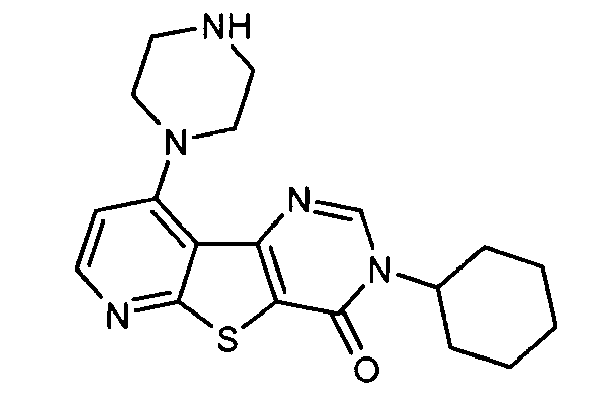
C19H23N5OS 369.5 370.1 28AV 
C18H16N4O2S 352.4 353.2 -

- To a solution of compound 112A (50 mg, 0.11 mmol) in 1.4 mL of THF was added 2 M dimethyl amine in THF (0.55 mL, 1.1 mmol). The reaction mixture was stirred and refluxed for 11/2 h. Upon completion (as indicated by TLC) the reaction mixture was concentrated in vacuo. The resultant yellow oil was purified via preparative silica gel TLC with 11 % acetone/methylene chloride to afford 36 mg of compound 113A as a white foam. 1H NMR (CDCl3): δ 8.37 (d, 1H), 7.33 (d, 2H), 7.12 (d, 2H), 6.72 (d, 1H), 3.14 (s, 6H), 2.41 (s, 3H), 2.30 (s, 3H). MS m/z calcd. for C19H19N4OS+ = 351.1; found m/z = 351.1.
- To a suspension of 0.063 g (0.2 mmol) of compound 25A in 4 mL of toluene was added 0.2 mL (0.4 mmol) of isopropylmagnesium bromide at room temperature. After being stirred for 2 h, it was quenched with 30 mL of water, and extracted with two 30 mL portions of dichloromethane. The combined organic extracts were washed with 15 mL of brine and concentrated. The residue was purified by preparative TLC eluting with 5% methanol in dichloromethane to give 0.019 g of compound 29A. MS m/z calcd. for C19H22N3OS+ m/z = 328.1; found m/z = 328.1.
- To a solution of 0.04 g (0.6 mmol) of pyrrole in 3 mL of THF was added 0.38 mL (0.6 mmol) of n-BuLi at 0 °C. After being stirred for 15 min., 0.063 g of compound 25A (0.2 mmol) was added as a solid. The mixture was stirred at room temperature for 2h and at reflux for 18 h, then cooled to room temperature. It was quenched with 0.2 mL of water, and concentrated. The residue was purified by preparative TLC eluting with 4% methanol in dichloromethane containing 0.2% NH4OH to give 0.038 g of compound 30A. MS m/z calcd. for C19H19N4OS+ m/z = 351.1; found m/z = 351.1.
- To a solution of 5.21 g (37.2 mmol) of diisopropylamine in 10 mL of THF was added 23.1 mL (37 mmol) of n-BuLi in hexanes at 0 °C. After 30 min, it was diluted with 30 mL of THF and cooled to -78°C. To this solution was added a solution of 5.00g (33.8 mmol) of 3,5-dichloropyridine in 60 mL of THF. After 1 h, a solution of 3.14 mL (50.7 mmol) of N,N-dimethyl formate in 15 mL of THF was added dropwise over 30 min. The reaction was stirred at -78 °C for 2 hrs and poured into 400 mL of sodium bicarbonate. The mixture was stirred vigorously and portioned with 600-700 mL of ethyl acetate. The combined organic extracts were washed with two 100 mL portions of sodium bicarbonate, 100 mL of brine and dried over. magnesium sulfate.
- It was filtered and the filtrate was concentrated. The residue was chromatographed over SiO2 eluting with 10% ethyl acetate in hexanes to give 4.81 g (81 %) of product 31. 1H NMR(CDCl3) δ 0.42 (s, 1H), 8.61 (s, 2H).
- A mixture of 4.71 g (26.8 mmol) of the aldehyde 31, 20 mL of formic acid, 2.42 g (34.8 mmol) of hydroxylamine hydrochloride and 2-3 drops of conc. sulfuric acid was heated at reflux for 4 hrs. The reaction was cooled to room temperature and the formic acid was evaporated under vacuum. The residue was partitioned between 80 mL of ether and 40 mL of water. The organic layer was washed with two 50 mL portions of saturated sodium bicarbonate and 40 mL of brine. It was dried over anhydrous sodium sulfate and filtered. The filtrate was concentrated to give 4.48 g (96%) of compound 32. 1H NMR(CDCl3) δ
8.70 (s, 2H). - A sealed tube containing 6-8 mL of dimethylamine and 4.18 g (24.2 mmol) of compound 32 was warmed from -78°C to room temperature over 1 h and then heated at 50°C for an additional 1 h. The reaction mixture was cooled to 0°C and partitioned between 20 mL of water and 50 mL of ethyl acetate. The organic layer was washed with 10 mL of water, 20 mL of brine, and dried over sodium sulfate. It was filtered and the filtrate was concentrated to give 4.37 g (98%) of compound 33. MS calcd for C8H9ClN3 =182.1; found = 182.1.
- To a solution of 0.13 g (0.40 mmol) of compound 7Q in 5 mL of acetonitrile was added 0.10 g (0.8 mmol) of N-Chlorosuccinimide (NCS). The mixture was stirred at reflux for 18 h and concentrated. The residue was purified by chromatography eluting with 1 to 3% methanol in methylene chloride plus 1% ammonium hydroxide to give 0.11 g of compound 41. Calcd MS for C17H20ClN4OS = 363.1; found m/z = 363.1.
- Compound 42 was prepared analogously. MS calcd for C16H18ClN4OS = 349.1; found m/z = 349.2.
Cpd Structure Formula MW m/z Found (M+1)+ 41 
C17H19ClN4OS 362.9 363.1 42 
C16H17ClN4OS 348.8 349.2 - To a solution of 0.16 g (0.5 mmol) of compound 7Q in 4 mL of THF was added 0.086 g (0.3 mmol) of 1,3-dibromohydantoin. The mixture was stirred at room temperature for 30 min, quenched with 20 mL of saturated sodium bicarbonate. It was extracted with two 30 mL portions of methylene chloride. The combined organic extracts were washed with 10 mL of brine, then concentrated. The residue was purified by preparative TLC eluting with 3% methanol in methylene chloride to give 0.060 g of compound 43 and 0.022 g of compound 44. Compound 43, MS calcd for C76H20BrN4OS = 409.1; found m/z = 409.2. Compound 44, MS calcd for C16H18BrN4OS = 395.1; found m/z = 395.2.
- To a stirred solution of 0.10 g (0.25 mmol) of compound 43 in 4 mL of ether was added 0.25 mL (0.4 mmol) of n-BuLi at - 78 °C. After 1 h, a solution of 0.1 mL of DMF in 1 mL of ether was introduced. The mixture was stirred for 3 h and quenched with 30 mL of water. It was extracted with two 30 mL portions of ethyl acetate. The combined organic extracts were washed 20 mL of brine, and concentrated. The residue was purified by preparative TLC eluting with 7% methanol in methylene chloride to give 0.03 g of compound 45. MS calcd for C18H21N4O2S = 357.1; found m/z = 357.2.
- A mixture of 0.285 g (0.7 mmol) of compound 43, 0.082 g (0.7 mmol) of zinc cyanide and 0.025 g (0.021 mmol) of Pd(PPh3)4 in 5 mL of DMF was heated at 120 °C using microwave irradiation (PersonalChemistry) for 5 min., and concentrated. The residue was purified by chromatography eluting with 1 to 4% methanol in methylene chloride plus 1% ammonium hydroxide to give 0.225 g of compound 46. MS calcd for C18H20N5OS = 354.1; found m/z = 354.2.
- Compounds 55, 156 and 163 could be prepared analogously from compounds 54, 155 and 162 respectively:
Cpd Structure Formula MW m/z Found (M+1)+ 46 
C18H19N5OS 353.4 354.2 55 
C18H12ClN5OS 381.8 382.1 156 
C11H13N3O3 235.2 236.2 163 
C13H15N3O4S 309.3 310.1 - A mixture of 0.04 g (0.1 mmol) of compound 43, 0.02 g (0.135 mmol) of 3-cyanophenylboronic acid, 0.015 g (cat.) of Pd (PPh3)4 in 4 mL of toluene-methanol (1:1) and 0.2 mL of 2N sodium carbonate in a sealed tube was heated at 120 °C for 5 min. using microwave irradiation (Personalchemistry). It was diluted with 25 mL of methanol and filtered. The filtrate was concentrated; the residue was purified by preparative TLC eluting with 5% methanol in methylene chloride to give 0.036 g of compound 47A. MS calcd for C24H24N5OS = 430.2; found m/z = 430.2.
- Compound 47B was prepared analogously.
Cpd Structure Formula MW m/z Found (M+1)+ 47A 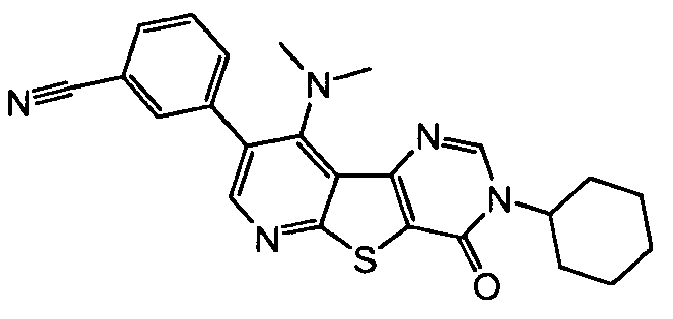
C24H23N5OS 429.5 430.2 47B 
C23H24FN4OS 422.5 423.2 - The following compounds were prepared analogously from compounds 57 or 83.
Cpd Structure Formula MW m/z Found (M+1)+ 86A 
C24H26N4OS 418.6 419.2 86B 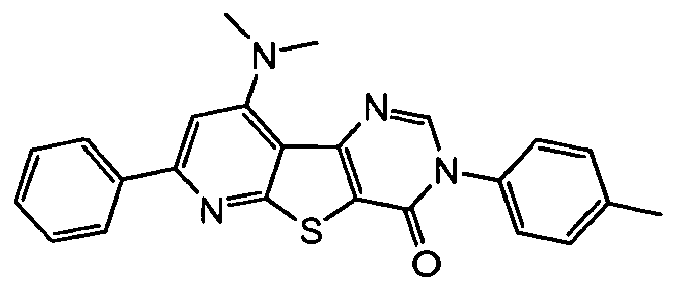
C24H20N4OS 412.5 413.1 86C 
C25H19N5OS 437.5 438.1 86D 
C25H22N4OS 426.5 427.1 86E 
C23H19N5OS 413.5 414.2 - To a solution of 0.042 g (0.12 mmol) of Compound 46 in 4 mL of acetonitrile was added a solution of 0.023 g (0.13 mmol) of N-bromosuccinimide (NBS). The mixture was stirred at the same temperature for 3 h, and concentrated. The residue was purified by preparative TLC eluting with 4% methanol in methylene chloride to give 0.03 g of compound 48. MS calcd for C17H18N5OS = 340.1; found m/z = 340.1.
- Compound 52 was prepared from compound 51 analogously. MS calcd for C16H18N5O3S = 360.1; found m/z = 360.1.
Cpd Structure Formula MW m/z Found (M+1)+ 48 
C17H17N5OS 339.4 340.1 52 
C16H17N4O3S 422.5 423.2 - A solution of 0.036 g (0.1 mmol) of compound 46 in 1.5 mL of concentrated sulfuric acid was stirred at 60 °C for 18 h, and poured into 40 mL of water. It was basified with sodium bicarbonate, and extracted with two 40 mL portions of methylene chloride. The combined organic extracts were washed with 20 mL of brine, and concentrated. The residue was purified by preparative TLC eluting with 7% methanol in methylene chloride to give 0.021 g of compound 49. MS calcd for C18H22N5O2S = 372.2; found m/z = 372.2.
- A solution of 0.039 g (0.11 mmol) of compound 46 and 0.5 mL (1 mmol) of ethylamine (2.0M THF solution) in 2 mL of acetonitrile in a sealed tube was heated at 80 °C for 18 h and 120 °C for 16 h, and concentrated. The residue was purified by preparative TLC eluting with 4% methanol in methylene chloride to give 0.030 g of compound 50. MS calcd for C18H20N5OS = 354.1; found m/z = 354.2.
- To a solution of 0.066 g (0.2 mmol) of compound 7Q in 2 mL of concentrated sulfuric acid was added 0.2 mL of concentrated nitric acid at 0°C. The mixture was stirred at room temperature for 1 h, and poured into 20 mL of ice-water. It was basified with sodium carbonate, and extracted with two 30 mL portions of methylene chloride. The combined organic extracts were washed with 20 mL of brine, and concentrated. The residue was purified by preparative TLC eluting with 4% methanol in methylene chloride to give 0.021 g of compound 51. MS calcd for C17H20N5O3S = 374.1; found m/z = 374.1.
- A mixture of 0.075 g (0.2 mmol) of compound 57, 0.11 g (2 mmol) of sodium methoxide in 3 mL of methanol in a sealed tube was heated at 80 °C for 50 h and cooled to room temperature. It was quenched with 30 mL of 95% methanol and concentrated. The residue was purified by preparative TLC eluting with 4% methanol in methylene chloride to give 0.05 g of compound 58. MS calcd for C19H19N4O2S = 367.1; found m/z = 367.1.
- A mixture of 0.022 g (0.06 mmol) of compound 57, 0.02 g (0.2 mmol) of 1-methylpiperazine in 3 mL of ethanol in a sealed tube was heated at 120 °C for 90 h and cooled to room temperature. It was concentrated; the residue was purified by preparative TLC eluting with 10% methanol in methylene chloride plus 1% ammonium hydroxide to give 0.027 g of compound 59A. Calcd MS for C23H27N6OS = 435.2; found m/z = 435.1.
- Compounds 59B and 59C can be prepared analogously. Compounds 79 can be prepared analogously starting with chloropyridine 78.
Cpd Structure Formula MW m/z Found (M+1)+ 59A 
C23H26N6OS 434.6 435.1 59B 
C22H24N6OS 420.5 421.1 59C 
C22H23N5O2S 421.5 422.1 79A 
C18H22N4O2S 358.5 359.1 - A mixture of 0.092 g (0.3 mmol) of compound C18, 0.04 g (0.2 mmol) of 1-aminopiperidine and 0.1 mL of acetic acid in 5 mL of toluene was heated at reflux for 2 h and cooled to room temperature. It was concentrated; the residue was purified by preparative TLC eluting with 5% methanol in methylene chloride plus 1% ammonium hydroxide to give 0.083 g of compound 60A. MS calcd for C16H20N5OS = 330.1; found m/z = 330.1.
- The following compounds can be prepared analogously from the appropriate starting materials:
Cpd Structure Formula MW m/z Found (M+1)+ 60A 
C16H19N5OS 329.4 330.1 60B 
C17H15N5OS 337.4 338.1 60C 
C18H17N5OS 351.4 352.1 60D 
C17H21N5OS 343.4 344.2 60E 
C18H21N5OS 355.5 356.1 60F 
C18H23N5OS 357.5 358.1 60G 
C17H21N5OS 343.4 344.1 60H 
C11H11N5OS 261.3 262.1 601 
C15H17N5OS 315.4 316.1 60J 
C23H19N5OS 413.5 414.1 60L 
C16H19N5OS 329.4 330.1 - The following compound can be prepared from compound 23 analogously.
Cpd Structure Formula MW m/z Found (M+1)+ 60K 
C15H17N4O2S 337.4 338.1 - A mixture of 0.037 g (0.1 mmol) of compound 28U, 0.1 mL of 37% formaldehyde and 0.05 g (0.23 mmol) of sodium triacetoxyborohydride in 2.5 mL of methylene chloride was stirred at room temperature for 18 h. It was purified by chromatography eluting with 1 to 7% methanol in methylene chloride plus 1% ammonium hydroxide to give 0.039 g of compound 61A. Calcd MS for C20H26N5OS = 384.2; found m/z = 384.1.
- Compound 61B could be prepared analogously:
Cpd Structure Formula MW m/z Found (M+1)+ 61A 
C20H25N5OS 383.5 384.1 61B 
C23H29N5O2S 423.6 424.1 - A mixture of 0.037 g (0.1 mmol) of compound 28U, 0.02 g (0.2 mmol) of acetic anhydride and 0.05 g (0.5 mmol) of triethylamine in 2 mL of methylene chloride was stirred at room temperature for 70 h. It was purified by chromatography eluting with 1 to 7% methanol in methylene chloride plus 1% ammonium hydroxide to give 0.037 g of compound 62. MS calcd for C21H26N5O2S = 412.2; found m/z = 412.2.
- A mixture of 0.037 g (0.1 mmol) of compound 28U, 0.028 g (0.2 mmol) of methanesulfonyl chloride and 0.05 g (0.5 mmol) of triethylamine in 2 mL of methylene chloride was stirred at room temperature for 70 h. It was purified by chromatography eluting with 1 to 6% methanol in methylene chloride plus 1% ammonium hydroxide to give 0.036 g of compound 63. Calcd MS for C20H26N5O3S2 = 448.2; found m/z = 448.2.
- A mixture of 0.037 g (0.1 mmol) of compound 28U, 0.027 g (0.2 mmol) of N,N-diethylaminocarbonyl chloride and 0.05 g (0.5 mmol) of triethylamine in 2 mL of methylene chloride was stirred at room temperature for 70 h. It was purified by chromatography eluting with 1 to 6% methanol in methylene chloride plus 1% ammonium hydroxide to give 0.036 g of compound 64. MS calcd for C24H33N6O2S = 469.2; found m/z = 469.3.
-

- To a solution of 5 (0.2 g, 0.796 mmol) in ethanol (2 mL) was added hydrazine hydrate (0.5 mL, excess) and the mixture was heated at 10 °C in a sealed tube for 16 hours. The reaction mixture was cooled to room temperature and the precipitated hydrazide was isolated by filtration. The product was washed several times with pentane to intermediate hydrazide. 1H NMR (CDCl3): δ
8.45 (d, 1H), 6.88 (d, 1H), 6.87 (s, 2H), 6.8 (s, 1H), 4.03 (s, 1H), 2.87 (s, 6H). MS calcd for C10H14N5OS+ m/z = 252.09, found m/z = 252.1 - The hydrazide (0.1 g, 0.398 mmol) was dissolved in glacial acetic acid (10 mL) and heated at 100 °C for 48 h. The solvent was removed in vacuo and the product was isolated by column chromatography using 0-5% methanol in dichloromethane as eluent to afford compound 65A. 1H NMR (CDCl3): δ
8.83 (s, 1H), 8.35 (d, 1H), 6.74 (d, 1H), 3.18 (s, 6H), 2.64 (s, 3H), 2.30 (s, 3H). MS calcd for C14H16N5O2S+ = 318.1, found m/z = 318.1 - The following compounds could be prepared analogously:
Cpd Structure Formula MW m/z Found (M+1)+ 65A 
C14H15N5O2S 317.4 318.1 65B 
C14H9F6N5O2S 425.3 426.1 65C 
C18H19N5O2S 369.4 370.1 65D 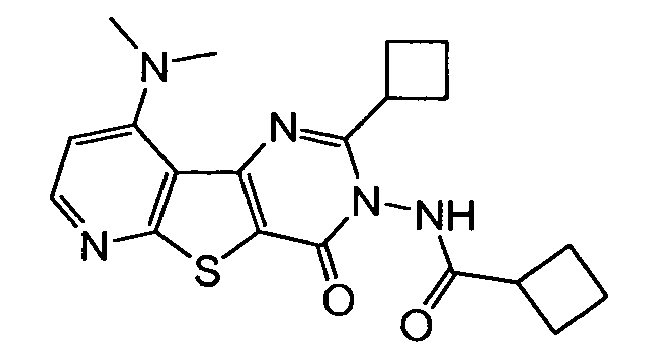
C20H23N5O2S 397.5 398.1 65E 
C17H15N5OS 337.4 338.1 -

- Hydroxy pyridine 26C (0.05 g, 0.16 mmol) was dissolved in DMF (2 mL) and treated with K2CO3 (0.05 g, 0.36 mmol) followed by propargyl chloride (0.05 g, 0.67 mmol) and the reaction mixture was stirred at room temperature overnight. Water was added and the mixture was extracted with dichloromethane. The organic layer was dried and concentrated in vacuo. The product was isolated by silica gel chromatography eluting with 0-10% methanol in dichloromethane to give compound 66A. 1H NMR (CDCl3): δ 8.68 (d, 1H), 8.34 (s, 1H), 7.33 (m, 4H), 7.11 (d, 1H), 5.10 (s, 2H), 2.65 (s, 1H), 2.45 (s, 3H). MS calcd. for C19H14N3O2S+ = 348.1, found m/z = 348.1
- The following compounds could be prepared analogously:
Cpd Structure Formula MW m/z Found (M+1)+ 66A 
C19H13N3O2S 347.4 348.1 66B 
C20H15N3O2S 361.4 362.1 66C 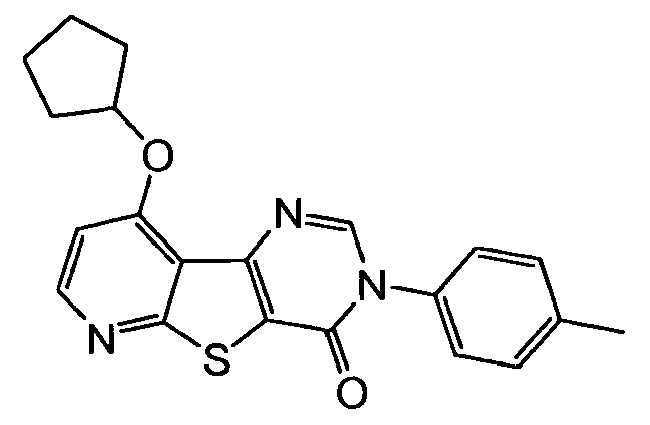
C21H19N3O2S 377.5 378.2 66D 
C19H15N3O2S 349.4 350.2 66E 
C18H15N3O3S 353.4 354.1 -

- To a solution of p-toluidine (2.5 g, 0.0233 mol) in toluene (50 mL) was added trimethyl aluminum (2 M in THF, 12 mL) at 0°C and the reaction was stirred for 10 minutes. Compound 67 (5 g, 0.0219 mol) was introduced to the above solution and the contents were heated at 120 °C for 16 h. The reaction mixture was cooled to room temperature and quenched by the addition of water (5 mL) and extracted several times with dichloromethane and ethyl acetate. The combined extracts were washed with Rochelle salt, dried and the solvents were removed in vacuo. The residue 68A was used for the next step without further purification.
1H NMR (CDCl3): δ 7.32 (d, 2H), 7.11 (d, 2H), 6.82 (s, 1H), 6.00 (s, 2H), 2.63 (s, 3H), 2.30 (s, 3H). MS calcd. for C14H14N3OS2 + = 304.06, found m/z = 304.1 -

- Solid 68A was suspended in triethyl orthoformate (50 mL) and treated with acetic anhydride (10 mL). The contents were heated at 100 °C for 7 hours. The solvent was removed in vacuo and the product was isolated by column chromatography using 0-5% MeOH/dichloromethane as eluent to give compound 69A. 1H NMR (CDCl3): δ 8.52 (s, 1H), 7.40 (m, 4H), 2.87 (s, 3H), 2.39 (s, 3H). MS calcd. for C15H12N3OS2 + = 314.04, found m/z = 314.2
-

- Compound 69A (2.5 g, 7.98 mmol) was dissolved in glacial acetic acid (50 mL) and treated with 10 mL 30% hydrogen peroxide. The reaction mixture was heated at 100 °C for 2h. The reaction mixture was cooled to 0 °C and the precipitated sulfone 70A was washed several times with water and ether.
1H NMR (CDCl3): δ 8.70 (s, 1H), 7.42 (m, 4H), 3.66 (s, 3H), 2.40 (s, 3H). MS calcd. for C15H12N3O3S2 + = 346.03, found m/z = 346.1 -

- A solution of compound 70A (0.05 g, 0.1449 mmol) and guanidine hydrochloride (0.02 g, 0.2 mmol) in DMF was heated at 100°C for 16 h. The solvent was removed in vacuo and the product was isolated by reverse phase HPLC using CH3CN/H2O as eluent to give compound 71A. 1H NMR (CDCl3): δ
8.43 (s, 1H), 7.62 (s, 1H), 7.34 (d, 2H), 7.29 (d, 2H), 6.9 (s, 1H), 6.76 (s, 1H), 2.33 (s, 3H). MS calcd. for C15H13N6OS+ = 325.09, found m/z = 325.1 -

- To compound 25A (0.60 g, 0.0019 mol) was added ammonium acetate (5 g) and the contents were heated in a sealed tube at 150°C for 16 hours. The reaction mixture was cooled to room temperature and water was added (50 mL). The precipitated solid was collected by filtration and dried over vacuum. The crude solid was purified by silica gel column chromatography using 5% methanol in dichloromethane as eluent to afford compound 72A. 1H NMR (CD3OD) δ 8.56 (s, 1H), 8.11 (d, 1H), 6.64 (d, 1H), 3.31-3.29 (m, 3H), 1.99-1.36(m, 10H). MS m/z calcd. for C15H16N4OS+ = 301.4; found m/z = 301.2.
- The following compounds could be prepared analogously:
Cpd Structure Formula MW m/z Found (M+1)+ 72A 
C15H15N4OS 300.4 301.2 72B 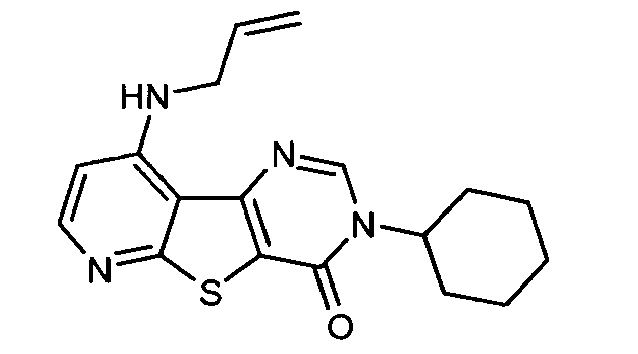
C18H20N4OS 340.4 341.2 72C 
C16H12N4O2S 324.4 325.2 72D 
C24H24N4OS 416.5 417.1 72E 
C22H22N4OS 390.5 391.1 72F 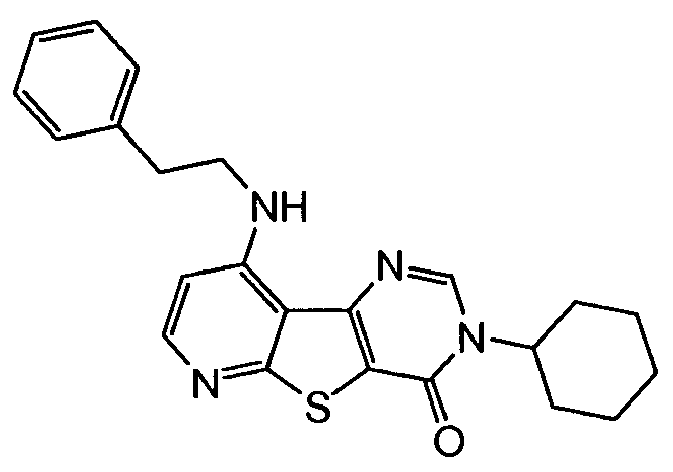
C23H24N4OS 404.5 405.1 72G 
C18H18N4OS 338.4 339.1 72H 
C16H12N4OS 308.4 309.0 721 
C19H16N4OS 348.4 349.1 -

- Compound 72A (0.010 g, 0.033 mmol) in dichloroethane (1 mL) was treated with triethylamine (0.025 mL, 0.018 mmol) and propionyl chloride (0.040 mL, 0.46 mmol) and allowed to stir at room temperature for 3 hours. The solvent was evaporated in vacuo and the resulting residue was purified by preparative TLC eluting with 5% methanol/94.5%dichloromethane/0.5% ammonia hydroxide to give compound 73A. 1H NMR (CDCl3) δ
8.61(d, 1H), 8.51 (d, 1H), 8.30 (s, 1H), 2.62-2.11 (q, 2H), 2.11-2.09(d, 2H), 2.00-1.95(d, 2H), 1.80-1.82(d, 1H), 1.55-1.68 (m, 5H), 1.36-1.32(t, 3H). MS m/z calcd. for C18H20N4O2S+ = 357.4; found m/z = 357.1. - The following compounds were prepared analogously:
Cpd Structure Formula MW m/z Found (M+1)+ 73A 
C18H20N4O2S 356.4 357.1 73B 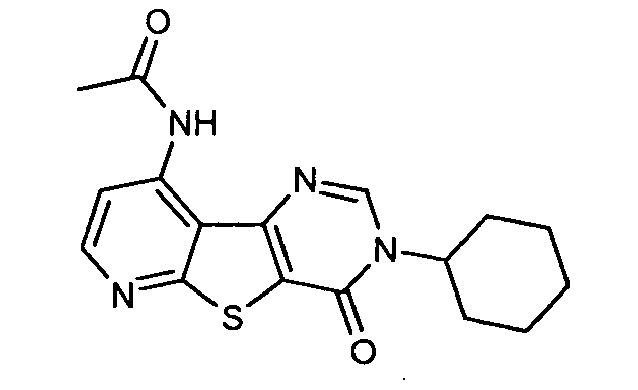
C17 H18 N4 O2 S 342.4 343.2 73C 
C22H20N4O2S 404.5 405.1 73D 
C20H22N4O2S 382.5 383.1 73E 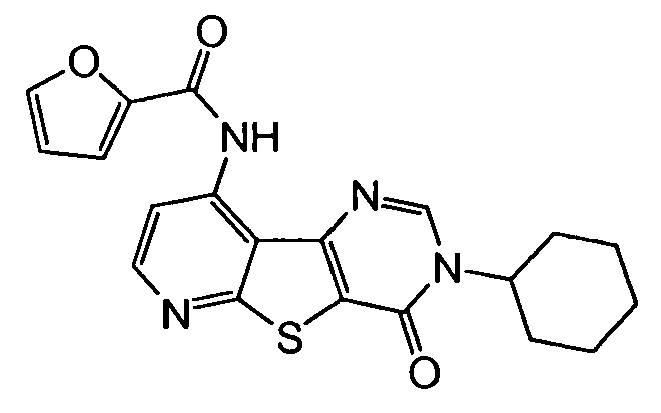
C20H18N4O3S 394.4 395.1 73F 
C23H22N4O3S 434.5 435.1 73G 
C22H19ClN4O2S 438.9 439.1 -

- Compound 26C (0.020 g, 0.045 mmol) in DMF (1 mL) was treated with zinc cyanide(0.005 g, 0.043 mmol), dppf (0.005 g, 0.009 mmol), water (5 µL) followed by tris(dibenzylideneacetone)dipalladium(0) (0.004 g, 0.0044 mmol) under nitrogen atmosphere and the contents were heated in a sealed tube at 130°C for 3 hours. The reaction mixture was passed through a short pad of celite and all the solvent was evaporated under reduced pressure. The residue was redissolved in dichloromethane (10 mL) and washed with water (10 mL). The organic layer was dried with sodium sulfate and evaporated under reduced pressure. The resulting residue was purified by preparative TLC eluting with dichloromethane to give compound 74A. 1H NMR (CDCl3) δ 8.94(d, 1H), 8.40 (s, 1H), 7.80 (d, 1H), 7.38-7.26(m, 4H), 2.47(s, 3H). MS m/z calcd. for C17H10N4OS+ = 319.4; found m/z = 319.1.
-

- Compound 74A (0.025 g, 0.079 mmol) was suspended in methanol (10 mL) and HCl gas was bubbled for 5 minutes at 0°C. The reaction mixture was allowed to stir at room temperature for 20 minutes and then heated under reflux for 10 minutes. The reaction mixture was cooled and the solvent was removed in vacuo. The residue was redissolved in dichloromethane (20 mL) and washed with sodium bicarbonate solution (10 mL). The organic layer was dried with sodium sulfate and evaporated under reduced pressure. The resulting residue was purified by preparative TLC eluting with 2% methanol/ 97.5%dichloromethane/0.5% ammonia hydroxide to give compound 75A. 1H NMR (CDCl3) δ 8.82(s, 1H), 8.20 (s, 1H), 7.47 (d, 1H), 7.33-7.26(m, 4H), 4.02(s, 3H), 2.41(s, 3H).MS m/z calcd. for C18H13N3O3S+ = 352.4; found m/z = 352.1.
-

- To compound 74A (0.038 g, 0.11 mmol) was added PPA (0.25 mL) and heated at 130°C for 3 hours. The reaction mixture was cooled to room temperature and diluted with water (30 mL). The white precipitate was collected by filtration and dried under vacuum. The solid was dissolved in 1 mL of 60%DMSO/30%MeCN/10%formic acid and purified by BHK alpha C-18 column ramping from 95%water/5%MeCN/0.1 %fromic acid to 5%water/95%MeCN/0.1 %formic acid over 12 minutes at flow rate of 20 mL/min to give compounds 76 and 77. Compound 76 1H NMR (DMSO) δ
8.88-8.85(m, 1H), 8.60 (d, 1H), 7.65-7.62 (m, 1H), 7.47-7.37(m, 4H), 2.48 (s, 3H). MS m/z calcd. for C17H12N4O2S+ = 337.4; found m/z = 337.1. Compound 77 1H NMR (DMSO) δ 8.88-8.85(m, 1H), 8.60 (d, 1H), 7.66-7.62 (m, 1H), 7.47-7.37(m, 4H), 2.48 (s, 3H). MS m/z calcd. for C17H11N3O3S+ = 338.4; found m/z = 338.1. -

- A stirring mixture of the compound 78 (0.400 g, 1.21 mmol) in acetic anhydride (5.00 mL) was heated at 130 to 135 °C for 3 hrs. The reaction was monitored by quenching a sample with saturated sodium bicarbonate and extracting with ethyl acetate. The ethyl acetate was analyzed by tlc (5% acetone / dichloromethane). Upon completion, the reaction was added in portions to a stirring ice cold saturated sodium bicarbonate solution (200 mL). The aqueous phase was partitioned with dichloromethane (150 mL). The organic extract was washed with saturated sodium bicarbonate (100 mL) and brine (50 mL). The dichloromethane was dried over anhydrous sodium sulfate and evaporated to a solid (0.440 g). This material was purified by flash column chromatography on silica gel (20 g) eluting with a solvent gradient 1 % acetone / dichloromethane to 5% acetone / dichloromethane yielded the resulting acetoxy analog as a solid (0.174 g, 40%). A stirring suspension of the acetate (0.100 g, 0.268 mmol) in MeOH (15 mL) at room temperature was treated with 1N-NaOH (1 mL) to give a solution. The solution was continued to be stirred for 20 min and was analyzed by tlc (5% acetone / dichloromethane). 1N-HCl (1 mL) was added dropwise to yield a precipitate. This was followed by the addition of saturated sodium bicarbonate until weakly basic (pH 8). The material was collected by vacuum filtration and was washed with water (1-2 mLi). The hydroxyl product was dried under vacuum to give compound 80 as a solid (0.075 g, 85%). MS m/z calcd. for C16H18N3O3S+ = 332.1; found m/z = 332.1.
-

- A solution of the methoxy compound 78 (0.101 g, 0.286 mmol) in dichloromethane (10 mL) at room temperature was treated with the dropwise addition of 1M boron tribromide in dichloromethane (1.15 mL, 1.15 mmol). The reaction was stirred at room temperature for 20 hrs. It was cooled to 0 °C and methanol (1 mL) was added dropwise. The solution was then stirred at room temperature for 20 min and then heated to reflux for 1 hr. The reaction was cooled and was concentrated under vacuum. The solid was stirred with water (3 mL) and made basic with saturated sodium bicarbonate. The solid was stirred and collected by filtration. This material was washed with water and dried under vacuum to give the hydroxyl product 81 as a powder (0.082 g, 85%). MS m/z calcd. for C15H15ClN3O2S+ = 336.0 (M+1)+; found m/z = 336.0.
-

- A stirring mixture of the hydroxyl compound 81 (0.050 g, 0.149 mmol) and triethylamine (0.030 g, 0.298 mmol) in dichloromethane (1.50 mL) was treated with the dropwise addition of triflic anhydride (0.084 g, 0.298 mmol) at room temperature. The reaction was stirred at room temperature for 4 hrs. The reaction was diluted with dichloromethane (5 mL) and was washed with saturated sodium bicarbonate (3 mL). The layers were separated and the water was washed with dichloromethane (5 mL). The combined dichloromethane extracts were dried over anhydrous sodium sulfate, filtered and evaporated to a semi-solid (0.097 g). This material was purified by flash column on silica gel (5 g) eluting with 100% dichloromethane to give the triflate 82 as a solid (0.059 g, 84%). MS m/z calcd. for C16H14ClF3N3O4S2 + = 468.0 (M+1)+; found m/z = 467.9.
-

- The 2M-dimethylamine / MeOH (0.555 mL, 1.11 mmol) was added to a stirring mixture of the triflate 82 (0.400 g, 0.855 mmol) in methanol (6mL) at room temperature. The suspension was continued to be stirred at room temperature for 3 hrs. The methanol was evaporated under vacuum and the solid residue was partitioned between dichloromethane (70 mL) and saturated sodium bicarbonate (15 mL). The organic phase was washed with water (15 mL) and brine (15 mL). The dichloromethane solution was dried over anhydrous sodium sulfate and evaporated to a solid, which was purified by flash column chromatography on silica gel (10 g) eluting with a solvent gradient from 100% dichloromethane to 2% acetone / dichloromethane yielded the dimethylamino product 83 as a solid (0.200 g, 65%). MS calcd for C17H20ClN4OS+ m/z = 363.1, found m/z = 363.1.
-

- The chloro compound 83 (0.010 g, 0.028 mmol), zinc cyanide (0.0033 g, 0.028 mmol) and tetrakis (triphenylphosphine) palladium (0) (0.005 g, 0.0043 mmol) in DMF (1.50mL) were subjected to microwave conditions at 180 °C for 10 min. The DMF was evaporated under vacuum. The solid residue obtained was washed several times with dichloromethane. The combined washings were evaporated to a solid (0.018 g). This crude product was purified by flash column chromatography on silica gel (1 g) eluting with 1% acetone / dichloromethane gave the cyano product 84 as a solid (0.009 g, 90%). MS calcd for C18H20N5OS+ m/z = 354.1, found m/z = 354.1.
-

- A stirring mixture of the chloro compound 83 (0.010 g, 0.028 mmol) and pyrrolidine (0.100 g, 1.41 mmol) in methanol (0.80 mL) was heated in an oil bath at 100 °C for 1.50 hrs. The reaction was cooled and concentrated under vacuum to give an oily residue (0.013 g). This material was purified by flash column chromatography on silica gel (1 g) eluting with a solvent gradient from 1% acetone / dichloromethane to 4% acetone / dichloromethane to give the pyrrolidinyl product 85 (0.009 g, 81 %). MS calcd for C21H28N5OS+ m/z = 398.2, found m/z = 398.2.
-

- A stirring mixture of the chloro compound 57 (0.020 g, 0.054 mmol) in MeOH (1 mL) / 2M methylamine in methanol (2.50 mL) was subjected to microwave conditions at 140 °C for 1 hr. The solvent was evaporated under vacuum. The residue was purified by flash column chromatography on silica gel (2 g) eluting with a solvent gradient from 100% dichloromethane to 8% acetone / dichloromethane to give the methylamino product 59D as a solid (0.014 g, 70%). MS calcd for C19H20N5OS+ m/z = 366.1, found m/z = 366.2.
-

- A stirring mixture of the chloro compound 57 (0.250 g, 0.674 mmol) in 7N ammonia in methanol (50 mL) was sealed in a Parr steel reaction vessel and was heated in an oil bath at 180-185 °C for 20 hrs. The reaction was cooled to room temperature concentrated under vacuum to a solid (0.269 g). The solid was purified by flash column chromatography on silica gel (25 g) eluting with a solvent gradient from 100% dichloromethane to 2% methanol in dichloromethane to give 59E as a solid (0.101 g, 43%). MS calcd for C18H18N5OS+ m/z = 352.1, found m/z = 352.1.
-

- The chloro compound 57 (0.015 g, 0.040 mmol) was dissolved in THF (2mL) containing NMP (0.20 mL) at room temperature. The iron (III) acetylacetonate (1.4 mg, 0.004 mmol) was added. An orange-red solution was obtained. The 2M isopropyl magnesium chloride in THF (0.034 mL, 0.068 mmol) was added dropwise. The reaction was stirred at room temperature for 40 min. The reaction was quenched with saturated sodium bicarbonate (1-2 mL) and was diluted with water (3-4 mL). It was extracted with ethyl acetate (15 mL). The ethyl acetate extracts were washed with brine (10 mL), dried over anhydrous sodium sulfate and evaporated to an oil. The crude material was purified by flash column chromatography on silica gel (10 g) eluting with a solvent gradient from 100% dichloromethane to 3% acetone in dichloromethane to give the isopropyl derivative 87A as a solid (0.003 g, 20%).
- The following compounds could be prepared analogously starting with 57 or with 83:
Cpd Structure Formula MW m/z Found (M+1)+ 87A 
C21H22N4OS 378.5 379.1 87B 
C20H20N4OS 364.5 365.1 87C 
C20H26N4OS 370.5 371.2 -

- A mixture of DMF (32 mL) and POCl3 (100 mL) at 0 °C was stirred for 1 h, treated with 4,6-dihydroxypyrimidine (25.0 g, 223 mmol), and stirred for 0.5 h at room temperature. The heterogeneous mixture was then heated to refluxed and stirred for 3 h. The reaction was cooled to room temperature and the resulting viscous, black liquid was poured onto ice water and extracted with diethyl ether (6 x 100 mL). The organic phase was subsequently washed with NaHCO3, and water, dried over MgSO4, and concentrated to give 89 as a yellow solid (20.0 g, 57% yield). 1H NMR (CDCl3) δ 10.41 (s, 1H), 8.85 (s, 1H).
- The following compound was prepared using Method BB:
Cpd Structure Formula MW m/z Found (M+1)+ 57E 
C15H7Cl2N30S 348.2 348.2 -

- Step 1: (ref: A. A. Santilli, D. H. Kim, and S. V. Wanser; J. Heterocyclic Chem., 1971, 8, 445-453) Aldehyde 89 (29.0 g, 164 mmoles) and hydroxylamine hydrochloride were dissolved in AcOH (0.83 M, 198 mL) by heating to reflux. The reaction was allowed to stir at reflux for 0.5 h and then cooled to room temperature. The solvents were removed in vacuo. The resulting yellow solids were taken up in H2O and the product filtered off. The solid product was then dried under vacuum overnight to provide the oxime as a yellow solid which was dried under vacuum and used crude in the next step.
- Step 2: (ref: A. A. Santilli, D. H. Kim, and S. V. Wanser; J. Heterocyclic Chem., 1971, 8, 445-453) A solution of the above oxime (5.00 g, 26.0 mmol) in thionyl chloride (104 mL) was allowed to stir at reflux for 3 h. The reaction was cooled to room temperature and the solvents removed in vacuo. The resulting yellow-brown solid was dried under vacuum overnight to yield 90 (3.90 g, 96% yield). 13C NMR (DMSO-d6) δ 164.7, 159.5, 152.3, 117.4, 102.2.
-
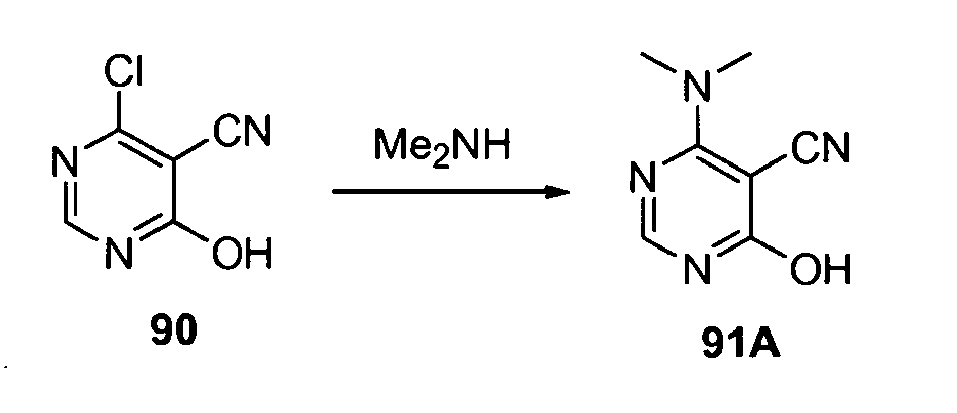
- To a solution of compound 90 (3.00 g, 19.2 mmoles) in THF (65 mL) was added dimethyl amine (2.0 M in THF, 11.5 mL). The reaction mixture was stirred at reflux for 3 h and subsequently cooled to room temperature. The solvents were then removed in vacuo to provide 91A as a yellow-brown solid (3.0 g, 95% yield). Mass Spectrum (M+1): m/z calcd. for C7H8N4O+ = 165.1, found m/z = 165.2.
- The following compounds were prepared analogously:
Cpd Structure Formula MW m/z Found (M+1)+ 91A 
C7H7N4O 164.2 165.2 91B 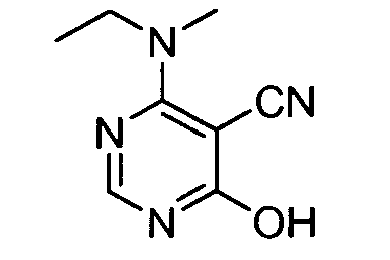
C8H10N4O 178.2 179.2 91C 
C7H8N4O 164.2 165.2 91D 
C8H8N40 176.2 177.2 91E 
C7H5F3N4O 218.1 219.1 91F 
C6H6N4O 150.1 151.1 - The following compounds was prepared using Methid BD:
Cpd Structure Formula MW m/z Found (M+1)+ 167A 
C17H15N5OS 337.4 338.2 -

- To compound 91A (3.00 g, 18.2 mmoles) was added POCl3 (35.2 mL) and Et3N (2.0 mL). The reaction mixture was stirred at reflux for 3h and the solvents removed in vacuo. The resulting brown solid was quenched dropwise with water and basified with 40% aq. NaOH. The aqueous suspension was extracted with dichloromethane (100 ml x 3), dried over MgSO4 and concentrated in vacuo to provide 2.50 g of 92A as a brown solid. Mass Spectrum (M+1): m/z calcd. for C7H7N4Cl+ = 183.1, found m/z = 183.1.
- The following compounds were prepared analogously:
Cpd Structure Formula MW m/z Found (M+1)+ 92A 
C7H6N4Cl 182.6 183.1 92B 
C8H9ClN4 196.6 197.2 92C 
C7H7ClN4 182.6 182.1 92D 
C8H7ClN4 194.6 195.1 92E 
C7H4ClF3N4 236.6 237.0 92F 
C6H5ClN4 168.6 169.1 -

- To a solution of 92A (2.50 g, 13.7 mmoles) in ethanol (70 mL) was added methylthioglycolate (1.65 mL, 15.0 mmoles) and sodium carbonate (2.20 g, 20.5 mmoles). The reaction was allowed to stir at reflux for 3h and cooled to room temperature. The solvents were removed in vacuo. The resulting solids were taken up in H2O and filtered to yield 93A as a yellow solid (3.10 g, 90% yield). 1H NMR (CDCl3) δ
8.56 (s, 1H), 6.23 (bs, 2H), 3.83 (s, 3H), 3.03 (s, 6H). - The following compounds were prepared analogously:
Cpd Structure Formula MW m/z Found (M+1)+ 93A 
C10H12N4O2S 252.3 253.1 93B 
C11H14N4O2S 266.3 267.2 93C 
C10H12N4O2S 252.3 253.2 93D 
C11H12N4O2S 264.3 265.2 93E 
C10H9F3N4OS 306.3 307.1 93F 
C9H10N4O2S 238.3 239.1 -

- A solution of 93A (3.10 g, 12.3 mmoles), and N,N-dimethylformamide dimethyl acetal (8.21 mL, 61.3 mmoles) in abs. EtOH (13 ml) was allowed to stir at reflux for 3h. The solvents were removed in vacuo and the resulting solids triturated with boiling ethanol to give 94A as a yellow solid (2.0 g, 53% yield). 1H NMR (CDCl3) δ 8.38 (s, 1H), 7.35 (s, 1H), 3.74 (s, 3H), 3.17 (s, 6H), 3.10 (s, 3H), 3.02 (s, 3H).
- The following compounds were prepared analogously from compounds 93:
Cpd Structure Formula MW m/z Found (M+1)+ 94A 
C13H17N5O2S 307.4 308.1 94B 
C14H19N5O2S 321.4 322.2 -

- To a mixture of 94A (200 mg, .649 mmoles) in toluene (2 mL) and glacial acetic acid (400 δ L) was added p-anisidine (160 mg, 1.30 mmoles). The reaction was allowed to stir at 80°C for 1 h. The reaction mixture was then poured onto water (100 ml), basified with conc. NH4OH and extracted with dichloromethane (25 ml x 3). The organic layer was separated, dried over MgSO4 and concentrated in vacuo. The crude solid was then purified via silica gel chromatography eluting with 10% acetone/ dichloromethane to give 95A as a white solid (77.6 mg, 34% yield). Mass Spectrum (M+1): m/z calcd. for C17H16N5O2S+ = 354.1, found m/z = 354.1
-

- To compound 90 (2.50 g, 16.0 mmoles) was added POCl3 (31 mL) and Et3N (2.0 mL). The reaction mixture was stirred at reflux for 3h and the solvents removed in vacuo. The resulting brown solid was quenched dropwise with water and basified with 40% aq. NaOH. The aqueous suspension was extracted with dichloromethane (100 ml x 3), dried over MgSO4 and concentrated in vacuo to provide 2.64 g of 97 as a brown solid. Mass Spectrum (M+1): m/z calcd. for C7H7N4Cl+ = 183.1, found m/z = 183.1.
-
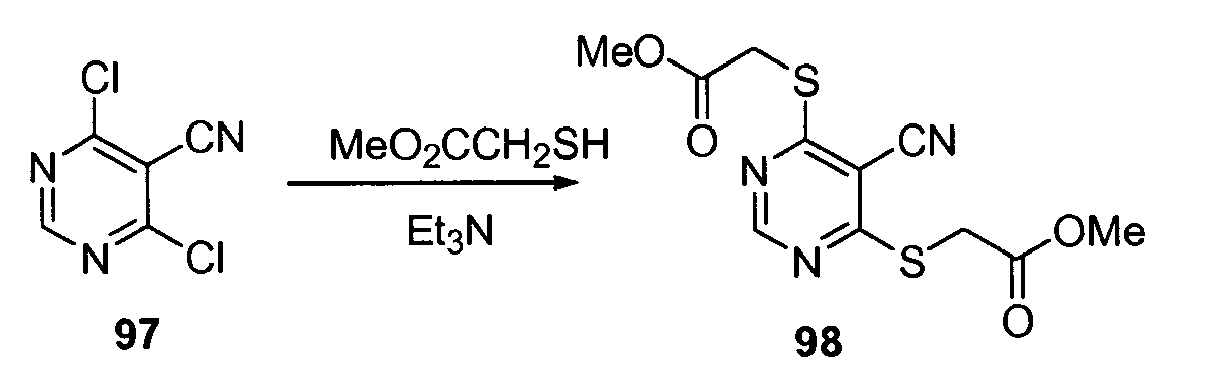
- To compound 97 (100 mg, 0.58 mmols) and methyl thioglycolate (127 L, 1.16 mmols) in THF (2.5 mL) was added Et3N (162 δ L, 1.16 mmols). The reaction immediately formed yellow precipitate and was allowed to stir for 10 min. at room temperature. The solvents were subsequently removed in vacuo and the resulting yellow solid taken up in a minimum amount of H2O. The aqueous suspension was stirred for 5 min. and room temperature and filtered to yield 150 mg of 98 as a yellow solid. Mass Spectrum (M+1): m/z calcd. for C11H11N3O4S2 + = 314.0, found m/z = 314.0.
-
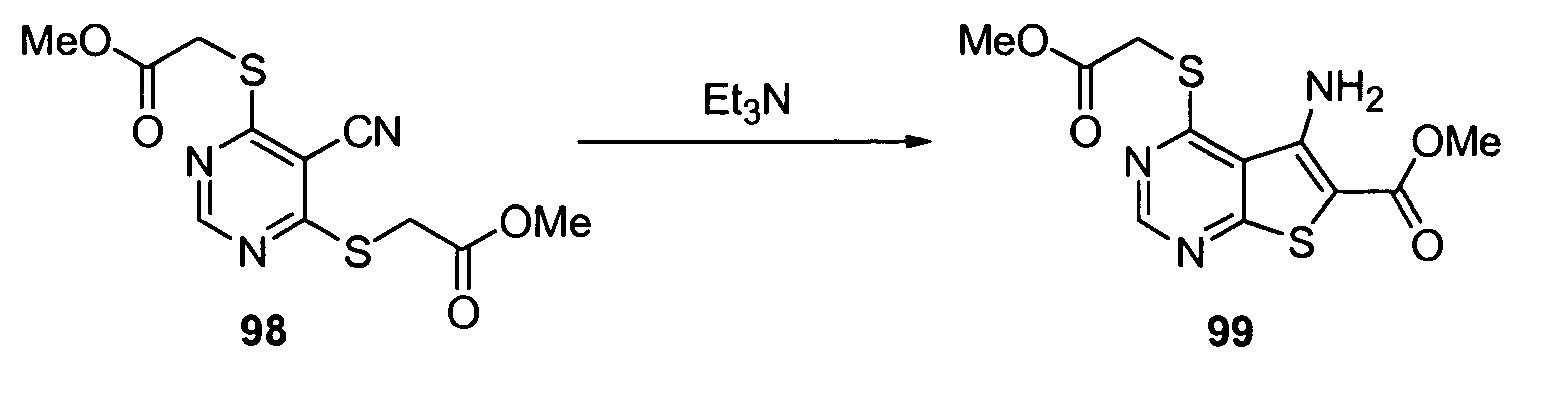
- To compound 98 (156 mg, 0.50 mmols) in toluene (3.1 mL) was added Et3N (80 µL, 0.55 mmols). The reaction was stirred at reflux for 4 hours. The mixture was subsequently cooled to room temperature and the solvents removed in vacuo to provide 150 mg of 99 as a yellow solid. 1H NMR (CDCl3) δ
8.71 (s, 1H), 6.43 (bs, 2H), 4.17 (s, 2H), 3.84 (s, 3H), 3.74 (s, 3H). -

- To compound 99 (1.34 g, 4.27 mmols) in methanol (14.5 mL) was added ethanol amine (7.0 mL, 113 mmols). The reaction was stirred at reflux for 0.5 h. The mixture was cooled to room temperature and the solvents removed in vacuo. The resulting residue was taken up in 1:1 dichloromethane:water (50mL). The aqueous layer was extracted with dichloromethane (3 x 25 mL). The organic layers were combined, dried with MgSO4, and the solvents removed in vacuo to yield 1.0 g of 93G as a yellow solid. Mass Spectrum (M+1): m/z calcd. for C10H12N4O3S+ = 269.1, found m/z = 269.1
-

- To compound 100 (9.5 g, 0.0578 mol) in DMF (100 mL) was added K2CO3 (10 g, 0.0723 mol) at room temperature. Methylthioglycolate ( 5.5 mL, 0.0615 mol) was added to the above solution and heated at 70 °C for 48 hours. The reaction mixture was poured into 500 mL ice water and extracted with ethyl acetate. The solvent was removed in vacuo to give 101 which was used for the next step without further purification. 1H NMR (CDCl3): δ 7.32 (t, 1H), 6.94 (d, 1H), 6.78 (d, 1H), 3.72 (s, 3H), 3.71 (s, 2H), 3.01 (s, 6H). Mass Spectrum (M+1): m/z calcd. for C12H14N2O2S+ = 251.1, found m/z = 251.0.
-

- The above oil 101 was dissolved in methanol (200 mL) and treated with a 25% solution of sodium methoxide in methanol (50 mL) and the contents were heated at 80 °C for 1 hour. The solvent was removed in vacuo and the precipitate was washed several times with water to afford compound 102 as white solid. 1H NMR (CDCl3): δ
7.34 (d, 1H), 7.28 (t, 1H), 6.99 (d, 1H), 3.78 (s, 3H), 2.68 (s, 6H). Mass Spectrum (M+1): m/z calcd. for C12H14N2O2S+ = 251.08, found m/z = 251.0. -

- Compound 102 (0.1 g, 0.399 mmol) was dissolved in 1 mL triethyl orthoformate and treated with acetic acid (0.1 mL) and 4-chloroaniline (0.15 g, 1.17 mmol). The contents were heated in a sealed tube at 150 °C for 16 h. The solvent was removed in vacuo and the product was isolated by preparative TLC using 5% methanol in dichloromethane to afford compound 103A as off white solid. 1H NMR (CDCl3): δ 7.30 (s, 1H), 7.50 (m, 6H), 7.05 (d, 1H), 3.01 (s, 6H). Mass Spectrum (M+1): m/z calcd. for C18H15ClN3OS+ = 356.1, found m/z = 356.2.
- The following compounds were prepared analogously:
Cpd Structure Formula MW m/z Found (M+1)+ 103A 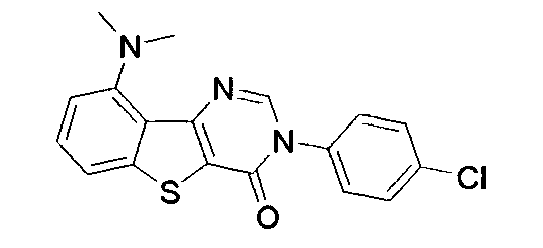
C18H14ClN3OS 355.8 356.2 103B 
C18H21N3OS 327.4 328.2 103C 
C18H15N3OS 321.4 322.2 103D 
C19H17N3OS 335.4 336.2 103E 
C19H17N3O2S 351.4 352.2 103F 
C19H14N4OS2 378.5 379.2 - The following compounds were prepared using Method BM:
Cpd Structure Formula MW m/z Found (M+1)+ 161A 
C17H14N4O2S 338.4 339.2 164 
C20H18N4O3S 394.5 395.2 -
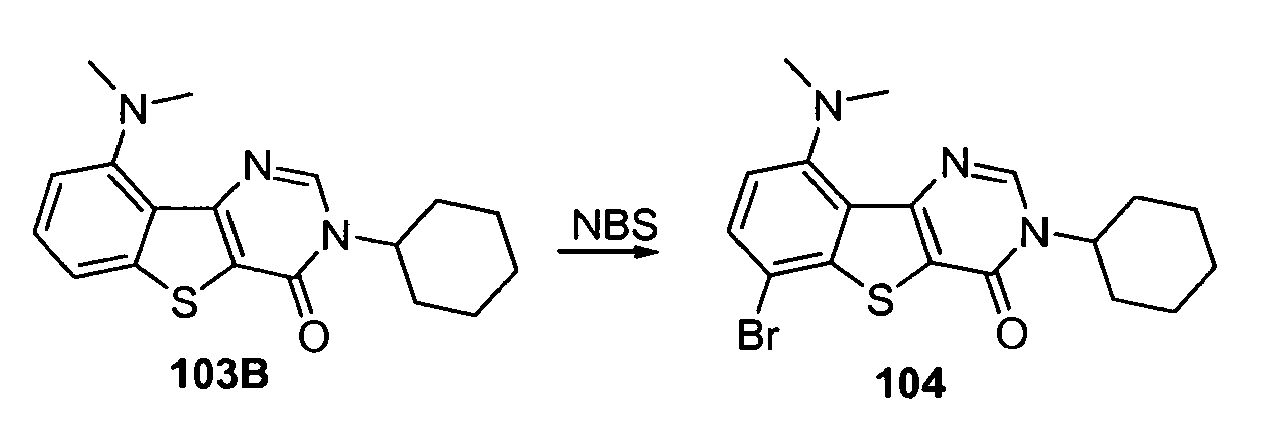
- Compound 103B (0.05 g, 0.152 mmol) was dissolved in acetonitrile (2 mL) and treated with NBS (0.03 g, 0.168 mmol) and the reaction mixture was stirred at room temperature for 1 hour. The solvent was removed in vacuo and the product was isolated by preparative TLC using 4% methanol in dichloromethane to give compound 104 as an off-white solid. 1H NMR (CDCl3): δ 8.36 (s, 1H), 7.55 (d, 1H), 6.91 (d, 1H), 4.92 (m, 1H), 2.99 (s, 6H), 2.09-1.25 (m, 10H). Mass Spectrum (M+1): m/z calcd. for C18H21BrN3OS+ = 406.1, found m/z = 406.2.
-

- Compound 104 (0.023 g, 0.0567 mmol) was dissolved in DMF (2 mL) and treated with Zn(CN) 2 (0.01 g, 0.0851 mmol) followed by Pd (PPh3)4 (0.01 g, 0.0086 mmol). The contents were heated at 180 °C in a microwave oven for 10 minutes. The solvent was removed in vacuo and the product was isolated by preparative TLC to get compound 105. 1H NMR (CDCl3): δ 8.33 (s, 1H), 7.72 (d, 1H), 6.97 (d, 1H), 4.91 (m, 1H), 3.10 (s, 6H), 2.09-1.25 (m, 10H). Mass Spectrum (M+1): m/z calcd. for C19H21N4OS+ = 353.1, found m/z = 353.2.
-
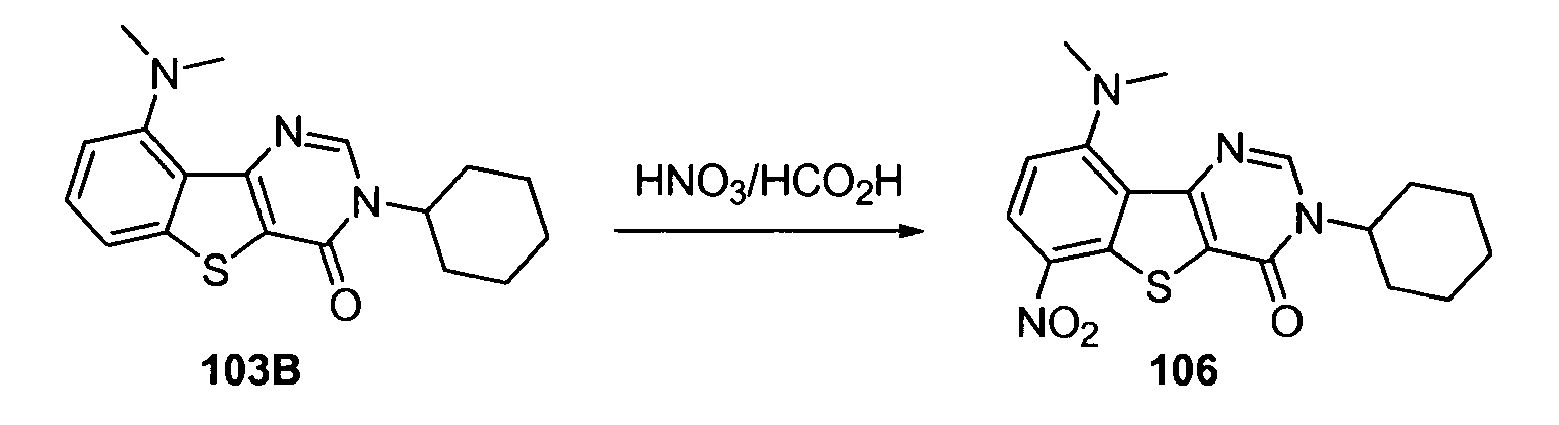
- Compound 103B (0.2 g, 0.61 mmol) was dissolved in formic acid (3 mL) and treated with conc. HNO3 (0.05 mL, 1.25 eq) at 0 °C. Stirred at 0 °C for 30 minutes and warmed to room temperature. The reaction mixture was stirred at rt for 2 hours. The solvent was removed in vacuo and the product was isolated by preparative TLC using 50% ethyl acetate-hexane as eluent to afford compound 106. 1H NMR (CDCl3): δ 8.45 (d, 1H), 8.31 (s, 1H), 6.97 (d, 1H), 4.91 (m, 1H), 3.18 (s, 6H), 2.10-1.26 (m, 10H). Mass Spectrum (M+1): m/z calcd. for C18H21N4O3S+ = 373.1, found m/z = 373.1.
-

- Thioglycolic acid (20 g, 217 mmol) and p-toluidine (23.26 g, 217 mmol) and benzene (110 mL) were combined in a one neck round bottom flask fitted with a Dean Stark apparatus, a reflux condenser, and a N2 inlet line. The mixture was stirred and heated under reflux for 7 h and then cooled to RT and stored under N2 for 48 h. The resultant solid was quickly collected via vacuum filtration and immediately washed with a 110 mL of benzene (acidified with several drops of conc. HCl). Next, the solid was quickly transferred to a flask containing 250 mL of water (acidified to pH = 3 with conc. HCl). The flask was sealed with a glass stopper and stored at RT for 1 week. The resultant white crystals were collected via vacuum filtration, washed with water (acidified to pH = 3 with conc. HCl), and dried to afford 13.56 g of 108A which was stored in a dark glass bottle sealed under N2. 1H NMR (CDCl3) δ 8.40 (bs, 1H), 7.38 (d, 2H), 7.10 (d, 2H), 3.35 (d, 2H), 2.28 (s, 3H), 1.97 (t, 1 H). MS m/z calcd.for C9H12NOS+ = 182.0; found m/z = 182.0.
- The following compound was prepared analogously.
Cpd Structure Formula MW m/z Found (M+1)+ 108B 
C9H11NO2S 197.3 198.2 -

- Compound 22 (1.0 g, 5.92 mmol), compound 108A (1.18 g, 6.51 mmol), potassium carbonate (1.23 g, 8.89 mmol), and DMF (23 mL) were combined, stirred under N2, and heated at ∼ 80 °C for 2 h. The reaction mixture was poured into ice water and stirred vigorously. The resultant solid was collected via vacuum filtration, washed with water, and dried under vacuum to afford 1.75 g of a pale pink solid which was combined with sodium methoxide (0.408 g, 7.55 mmol) and methanol (87 mL), stirred under N2, refluxed for 2 h, and then stirred overnight at RT. The mixture was concentrated in vacuo and mixed vigorously with ice water. The resultant solid was collected via vacuum filtration, washed with water, and dried in a vacuum oven at 40 °C to afford 1.59 g of compound 109A as a pale yellow solid. 1H NMR (CDCl3): δ 8.45 (d, 1H), 7.39 (d, 2H), 7.12 (d, 2H), 6.99 (s, 1H), 6.82 (bs, H), 6.67 (d, 1H), 4.01 (s, 3H), 2.29 (s, 3H). Mass Spectrum (M+1): m/z calcd. for C16H16N3O2S+ = 314.1, found m/z = 314.1.
- The following compounds were prepared analogously.
Cpd Structure Formula MW m/z Found (M+1)+ 109B 
C16H15N3O3S 329.4 330.1 109C 
C15H13N3O2S 299.4 300.0 -

- Compound 109A (1.0 g, 3.20 mmol), triethyl orthoacetate (11.2 mL), and acetic anhydride (5.60 mL) were combined, stirred, and irradiated in a 300 W power microwave oven at 180 °C for 20 minutes. The mixture was concentrated in vacuo, diluted with ice water, basified with concentrated NH4OH (aq.), and stirred vigorously overnight. The resultant solid was collected by filtration, washed with water, and dried to afford 1.05 g of compound 110A as a light tan solid. 1H NMR (CDCl3): δ 8.58 (d, 1H), 7.33 (d, 2H), 7.11 (d, 2H), 6.86 (d, 1H), 4.11 (s, 3H), 2.41 (s, 3H), 2.33 (s, 3H). MS m/z calcd. for C18H16N3O2S+ = 338.1; found m/z = 338.1.
- The following compounds were prepared analogously.
Cpd Structure Formula MW m/z Found (M+1)+ 110B 
C18H15N3O3S 353.4 354.2 110C 
C17H13N3O2S 323.4 324.1 116A 
C20H20N4OS 364.5 365.2 116B 
C21H22N4OS 378.5 379.1 116C 
C22H24N4OS 392.5 393.1 116D 
C19H18N4O2S 366.4 367.1 116E 
C20H20N4O2S 380.5 381.1 116F 
C21H22N4O2S 394.5 395.1 116G 
C22H24N4O2S 408.5 409.2 -

- Compound 115A (50 mg, 0.15 mmol), trifluoroacetic anhydride (0.25 mL), and toluene (1 mL) were combined, stirred, and irradiated in a 300 W power microwave oven at 150 °C for 15 minutes. The mixture was concentrated in vacuo, diluted with ice water, basified with concentrated NH4OH (aq.), and stirred vigorously overnight. The resultant solid was collected by filtration, washed with water, and dried in a vacuum oven at 40 °C to afford 30 mg of compound 117A as a pale yellow solid. 1H NMR (CDCl3): δ 8.38 (d, 1H), 7.31 (d, 2H), 7.16 (d, 2H), 6.73 (d, 1H), 3.17 (s, 6H), 2.42 (s, 3H). MS m/z calcd. for C19H16F3N4OS+ = 405.1; found m/z = 405.1.
- The following compounds were prepared by this method:
Cpd Structure Formula MW m/z Found (M+1)+ 117A 
C19H15F3N4OS 404.4 405.1 117B 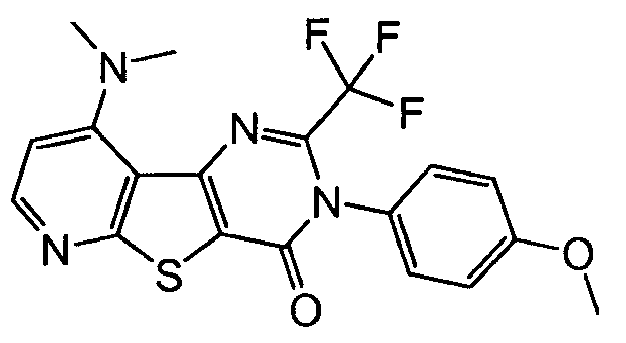
C19H15F3N4O2S 420.4 421.2 -

- Compound 3 (1.5 g, 8.26 mmol), compound 108A (1.65 g, 9.09 mmol), potassium carbonate (1.71 g, 12.4 mmol), and DMF (20 mL) were combined, stirred under N2, and heated for 3 h at 65 °C. The reaction mixture was poured into ice water and stirred vigorously. The resultant solid was collected via vacuum filtration, washed with water, and dried in a vacuum oven at 40 °C to afford 2.62 g of compound 114A as a light yellow solid. 1H NMR (CDCl3): δ 9.65 (bs, 1H), 8.09 (d, 1H), 7.29 (d, 2H), 7.04 (d, 2H), 6.39 (d, 1H), 3.86 (s, 2H), 3.23 (s, 6H), 2.24 (s, 3H). MS m/z calcd. for C17H19N4OS + = 327.1; found m/z = 327.1.
- The following compound was prepared analogously.
Cpd Structure Formula MW m/z Found (M+1)+ 114A 
C17H18N4OS 326.4 327.1 114B 
C17H18N4O2S 342.4 343.1 -

- Compound 114A (2.62 g, 8.03 mmol), sodium methoxide (0.59 g, 10.8 mmol), and methanol (125 mL) were combined, stirred under N2, heated under reflux for 21/2 h, and then stirred overnight at RT. The mixture was concentrated in vacuo and mixed vigorously with ice water. The resultant solid was collected via vacuum filtration, washed with water, and dried in a vacuum oven at 40 °C to afford 2.53 g of compound 115A as a pale yellow solid. 1H NMR (CDCl3): δ
8.42 (dd, 1H), 7.40 (d, 2H), 7.12 (d, 2H), 7.02 (s, 1H), 6.96 (bs, 2H), 6.86 (d, 1H), 2.84 (s, 6H), 2.30 (s, 3H). MS m/z calcd. for C17H19N4OS + = 327.1; found m/z = 327.1. - The following compound was prepared analogously.
Cpd Structure Formula MW m/z Found (M+1)+ 115A 
C17H18N4OS 326.4 327.1 115B 
C17H18N4O2S 342.4 343.1 -

- To compound 15AH (780 mg, 2.02 mmol) in methanol (35 mL) was added 6 N HCl(aq) (7 mL) at RT. The reaction mixture was stirred under N2 and heated at 90 °C for 18 h after which time the reaction was ∼ 50% complete (as indicated by TLC). Consequently, refluxing at 110 °C was continued for another 6 h after which time the reaction was ∼ 90% complete (as indicated by TLC). Additional 6 N HCl(aq) (1.5 mL) was added to the reaction mixture and refluxing at 110 °C was continued for another 15 h. After cooling to RT, water (3 mL) was added to the reaction mixture and the MeOH was removed in vacuo at ≤ 25 °C. The residue was partitioned between dichloromethane and saturated NaHCO3. The organic layer was removed and the aqueous layer was re-extracted with dichloromethane. The organics were combined, washed with saturated NaCl, dried over MgSO4, filtered, and concentrated in vacuo to afford 656 mg of compound 15AI as an off white solid. 1H NMR (CDCl3): δ 8.38 (d, 1H), 8.21 (s, 1H), 6.75 (d, 1H), 5.37 (m, 1H), 3.09 (s, 6H), 2.69 - 2.13 (m, 8H). MS m/z calcd. for C17H19N4O2S+ = 343.1; found m/z = 343.1.
-

- Compound 15AI (70 mg, 0.21 mmol), DAST (0.08 mL, 0.62 mmol), and dichloroethane (1.5 mL) were combined, stirred, and irradiated in a 300 W power microwave oven at 100 °C (high absorbtion) for 10 minutes. The reaction mixture was partitioned between dichloromethane and 1N NaOH. The organic layer was removed and the aqueous layer was re-extracted with dichloromethane. The organics were combined, washed with saturated NaCl, dried over MgSO4, filtered, and concentrated in vacuo to afford a tan residue which was purified via preparative silica gel TLC with 5% methanol/ dichloromethane to afford 35 mg of a ∼ 1:1 mixture of compounds a16 and a17, along with other minor impurities, as a pale yellow foam. Crystallization from ethyl acetate/hexane afforded 25 mg of an analytically pure, 1:1 mixture of compounds 15AJ and 15AK as a pale yellow solid. 15AJ 1H NMR (CDCl3): δ
8.39 (d, 1H), 8.24 (s, 1H), 6.75 (d, 1H), 5.15 (m, 1H), 3.09 (s, 6H), 2.35 - 1.95 (m, 8H). MS m/z calcd. for C17H19F2N4OS+ = 365.1; found m/z = 365.1. 15AK 1H NMR (CDCl3): δ
8.38 (d, 1H), 8.23 (s, 1H), 6.74 (d, 1H), 5.28 (m, 1H), 5.06 (m, 1H), 3.09 (s, 6H), 2.65 - 2.20 (m, 6H). MS m/z calcd. for C17H18FN4OS+ = 345.1; found m/z = 345.1. -

- To a mixture of compound 115A (100 mg, 0.31 mmol) and Et3N (69 mg, 0.68 mmol) in dichloromethane (2.5 mL), cooled to -78 °C under N2, was added 1.9 M phosgene in toluene (0.16 mL, 0.31 mmol). The mixture was stirred at -78 °C for 2 h and then at RT for 48 h. After concentrating the reaction mixture in vacuo, the residue was suspended in THF (2 mL), treated with 1 M KOtBu in THF (0.37 mL), and stirred under N2 at RT for 4 days. Insoluble material was removed from the reaction mixture via filtration and washed with dichloromethane. The filtrate was concentrated in vacuo and purified via preparative silica gel TLC with 40% ethyl acetate/ dichloromethane to afford 22 mg of compound 118 as a yellow-orange solid. This solid was repurified via preparative silica gel TLC with 40% ethyl acetate/ dichloromethane to afford 3.3 mg of compound 118 as a yellow solid. 1H NMR (CDCl3): δ 9.28 (bs, 1H), 8.57 (d, 1H), 7.30 (d, 2H), 7.17 (d, 2H), 7.01 (d, 1H), 2.88 (s, 6H), 2.38 (s, 3H). MS m/z calcd. for C18H17N4O2S+ = 353.1; found m/z = 353.1.
-

- A mixture of 2-cyano-3-(dimethylamino)-2-butenamide (5 g, 0.0327 mol) (intermediate from method A) and ethylamine (49 ml of 2.0 M solution in THF) in ethanol (40 ml) was stirred at room temperature for a period of 22 h. The precipitate was filtered to give the product 125 as white crystals. 1H NMR (DMSO-d6): δ 6.63 (br. s, 2H), 3.31 (q, 2H), 2.15 (s, 3H), 1.11 (t, 3H).
-

- Compound 125 (5.0 g, 0.0327) and N, N-dimethylformamide dimethyl acetal (26.1 ml, ) in ethanol (33 ml) were heated at reflux under a nitrogen atmosphere for 30 minutes. The reaction mixture was concentrated under reduced pressure to give compound 126. Compound 126 (7.12 g, 0.0327 mol) was heated under reflux with 5% sodium hydroxide solution (130 ml) for 1 h, cooled to room temperature and then acidified with dilute hydrochloric acid to pH 6-7 and the product 127 was isolated by filtration. After drying in a vacuum oven, 127 was used without further purification.
1H NMR (DMSO-d6) δ 11.04 (br. s, 1H), 7.31 (br. s, 2H), 5.86 (m, 1H), 3.26 (m, 2H), 1.08 (t, 3H). -

- Compound 128 (1.42 g, 0.0079 mol), thiol (1.41 ml, 0.0157 mol) and potassium carbonate (1.63 g, 0.0118 mol) in DMF (20 ml) were stirred at room temperature. Water was then added and the resulting precipitate filtered. The precipitate was then dried in a vacuum oven to provide product 129 which was used in subsequent reactions without purification. 1H NMR (CDCl3) δ 8.09 (d, 1H), 6.80 (br. s, 3H), 6.44 (d, 1H), 3.74 (s, 3H), 3.25 (q, 2H), 1.20 (t, 3H).
-

- Compound 129 (1.44 g, 0.0057 mol) and N, N-dimethylformamide dimethyl acetal (1.53 ml, 0.0114 mol) in toluene (15 ml) were heated at reflux for 2 h. The reaction was cooled to room temperature and product 130 which precipitated was collected by filtration. 1H NMR (CDCl3): δ 8.36 (d, 1H), 7.58 (s, 1H), 6.32 (d, 1H), 3.88 (s, 3H), 3.75 (q, 2H), 1.37 (t, 3H). MS m/z calcd. for C12H12N3O2S + = 262.1; found m/z = 262.1(M+1).
-

- A mixture of p-anisidine (0.26 g, 0.0021 mol) and sodium hydride (0.132 g, 0.0033 mol of 60% slurry in mineral oil) in THF (10 ml) were stirred at room temperature for 30 minutes before adding compound 130 (0.145 g, 0.00055 mol). The resultant mixture was heated at reflux for 3 h, cooled to room temperature and ice-water was added. The precipitate was collected by filtration, dissolved in dichloromethane, dried (Na2SO4) and evaporated to give the desired product 131A. 1H NMR (CDCl3): δ 8.27 (d, 1H), 8.16(s, 1H), 7.60 (br. s, 1H), 7.31 (d, 2H), 7.02 (d, 2H), 6.42 (d, 1H), 3.84 (s, 3H), 3.37 (q, 2H), 1.36 (t, 3H). MS m/z calcd. for C18H17N4O2S + = 353.1; found m/z = 353.1 (M+1).
- The following compounds were prepared analogously:
Cpd Structure Formula MW m/z Found (M+1)+ 131A 
C18H16N4O2S 352.4 353.1 131B 
C17H14N4O2S 338.4 339.1 131C 
C18H13N5OS2 379.5 380.1 131D 
C18H16N4OS 336.4 337.1 131E 
C18H14N4O3S 366.4 367.1 131F 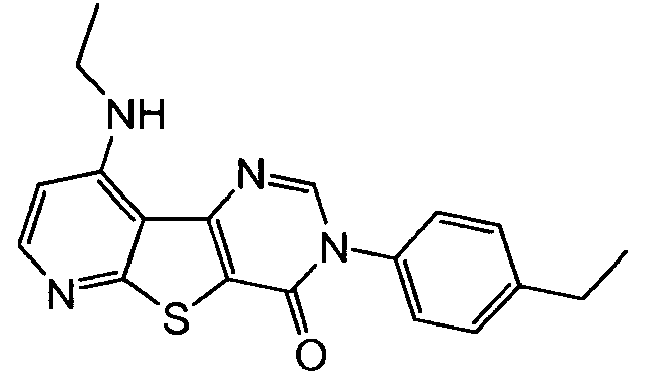
C19H18N4OS 350.4 351.1 131G 
C18H15N5O2S2 397.5 397.1 -

- Compound 3 (4.89 g, 0.0269 mol), N-methylglycine ethyl ester (8.25 g, 0.0537 mol) and potassium carbonate (11.14 g, 0.0806 mol) in NMP (50 mL) were heated at 135 °C overnight under a nitrogen atmosphere. The reaction was cooled to room temperature and ice-water was added. It was extracted by ethyl acetate (100 mL x3) combined fractions washed with water and dried using sodium sulfate, filtered and evaporated under reduced pressure. Purification by column chramotography on silica gel using dichloromethane/ethyl acetate (9:1 to 4:1) led to product 132A. 1H NMR (CDCl3): δ 8.17 (d, 1H), 6.36 (d, 1H), 5.28 (br. s, 2H), 4.35 (q, 2H), 3.91 (s, 3H), 2.87 (s, 6H), 1.37 (t, 3H). MS m/z calcd. for C13H19N4O2 + = 263.2; found m/z = 263.3 (M+1).
- The following compounds were prepared analogously:
Cpd Structure Formula MW m/z Found (M+1)+ 132A 
C13H18N4O2 262.3 263.3 132B 
1H NMR (CDCl3): δ 8.20 (d, 1H), 7.02 (d, 2H), 6.69 (d, 2H), 6.40 (d, 1H), 5.65 (s, 2H), 5.30 (br. s, 2H), 3.79 (s, 3H), 3.68 (s, 3H), 2.87 (s, 6H) -

- A solution of compound 134H (0.017 g, 0.00004 mol) in trifluoroacetic acid (1.5 ml) was stirred in a microwave oven at 120 °C for 2 h. After the evaporation of the solvent, the residue was transferred to a preparative TLC and eluted using dichlomethane/ethyl acetate (4:1) to give the product 135A. 1H NMR (CDCl3): δ 8.33 (br. s, 1H), 8.03 (s, 1H), 7.31 (m, 4H), 6.40 (d, 1H), (s, 6H), 2.41 (s, 3H). MS m/z calcd. for C18H18N5O + = 320.2; found m/z = 320.2 (M+1).
-

- A mixture of compound 7H (0.12 g, 0.3 mmol), vinyltributyltin (0.099 g, 0.31 mmol) and tetrakis(triphenylphosphine) palladium (0.017 g, 0.015 mmol) in toluene (10 mL) was heated at reflux under a nitrogen atmosphere for 16 h. The reaction mixture was cooled to room temperature and transferred to a prep TLC and eluted using dichloromethane/ethyl acetate (9:1) several times to give the product 136. 1H NMR (CDCl3): δ 8.40 (d, 1H), 8.25 (s, 1H), 7.55 (d, 2H), 7.39 (d, 2H), 6.76 (d, 1H), 6.74 (dd, 1H), 5.81 (d, 1H), 5.34 (d, 1H), 3.12 (s, 6H). MS m/z calcd. for C19H17N4OS + = 349.1; found m/z = 349.1 (M+1).
-

- To a suspension of bromide 7H (0.40 g, 0.99 mmol), cyclopropyl boronic acid (0.11 g, 1.3 mmol), potassium phosphate (0.74 g, 0.0035 mol), and tricyclohexylphosphine (0.028 g, 0.99 mmol) in toluene (5 mL) and water (200 L) under a nitrogen atmosphere was added palladium acetate (0.011 g, 0.05 mmol). The mixture was heated at 100 °C for 3 h and then cooled to room temperature. The reaction was transferred to a prep TLC and eluted using dichloromethane/ ethyl acetate (9:1) to give the product 137A. 1H NMR (CDCl3): δ 8.39 (d, 1H), 8.23 (s, 1H), 7.29 (d, 2H), 7.19 (d, 2H), 6.76 (d, 1H), 3.13 (s, 6H), 1.94 (m, 1H), 1.02 (m, 2H), 0.73 (m, 2H). MS m/z calcd. for C20H19N4OS + = 363.1; found m/z = 363.1 (M+1).
- The following compound was prepared analogously:
Cpd Structure Formula MW m/z Found (M+1)+ 137B 
C20H18N4OS 362.4 363.1 -

- Compound 7AK (0.056 g, 0.17 mmol) was heated at reflux in acetic anhydride (3 mL) for 15 minutes. The reaction was cooled to room temperature and transferred to a preparative TLC. Elution using dichloromethane/ethyl acetate (9:1) led to product 138. 1H NMR (CDCl3): δ 8.40 (d, 1H), 8.25 (s, 1H), 7.45 (d, 2H), 7.26 (d, 2H), 6.77 (d, 1H), 3.13 (s, 6H), 2.31 (s, 3H). MS m/z calcd. for C19H17N4O3S + = 381.1; found m/z = 381.1 (M+1).
-

- To a solution of compound 139 (10.54 g, 0.0752 mol) in dry DMF (60 mL) at 0 °C, was added phosphorous oxychloride (14 ml, 0.150 mol) and mixture heated at 90 °C for 1 h. The solvent was evaporated under reduced pressure and ice-water was added. Product 140 was obtained by extracting the aqueous solution several times using dichloromethane, dried (Na2SO4) and concentration. 1H NMR (CDCl3): δ 9.99 (s, 1H), 8.02 (s, 1H), 3.49 (s, 3H), 3.45 (s, 3H).
-

- To a solution of NaOEt in ethanol, prepared by slowly adding sodium (4.78 g) to dry ethanol (600 mL), was added aldehyde 140 (10.59 g, 0.063 mol) and cyanoacetamide (17.50 g, 0.208 mol). The mixture was then heated at reflux for a period of 2 h before evaporating solvent under reduced pressure. Water was then added to the residue and acidified by slow addition of conc. HCl until crystals started forming. This mixture was cooled in ice and filtered to give product 141. 1H NMR (DMSO-d6): δ 8.41 (d, 1H), 8.27 (d, 1H), 4.19 (q, 2H), 1.22 (t, 3H).
-

- A solution of 141 (6.75 g, 0.0352 mol) in phosphorous oxychloride (40 mL) was heated at reflux for 1 h, and excess solvent was evaporated under reduced pressure. Water was then added and the pH adjusted to pH∼7.5 using a 1N sodium hydroxide solution. The resulting precipitate 142 was collected, washed with water and dried under vacuum. 1H NMR (CDCl3): δ 9.11 (d, 1H), 8.54 (d, 1H), 4.22 (q, 2H), 1.39 (t, 3H).
-

- A mixture of 2-chloro-3-pyridine carbonitrile derivative 142 (1.97 g, 0.0094 mol), thiol derivative 108A (1.95 g, 0.0108 mol) and potassium carbonate (1.94 g, 0.014 mol) in DMF (30 mL) was stirred at 60 °C for 2 h. The reaction was cooled to room temperature before adding ice-water. The precipitate 143 was collected by filtration, washed with water and dried in a vacuum oven. 1H NMR (CDCl3): δ 9.22 (d, 1H), 8.55 (d, 1H), 7.41 (d, 2H), 7.14 (d, 2H), 7.13 (s, 1H), 6.24 (s, 2H), 4.43 (q, 2H), 2.30 (s, 3H), 1.41 (t, 3H). MS m/z calcd. for C18H18N3O3S + = 356.1; found m/z = 356.1 (M+1).
-

- A mixture of compound 143A (3.06 g, 0.0086 mol) and triethylorthoformate (7.2 ml, 0.0431 mol) in 1% solution of acetic acid in toluene (30 mL) was heated at reflux overnight. The reaction was cooled to room temperature, diluted with ether and the solid precipitate was filtered. The solid was washed with more ether and dried under vacuum to give the desired product 144A. 1H NMR (CDCl3): δ 9.37 (d, 1H), 9.15 (d, 1H), 8.27 (s, 1H), 7.26-7.34 (m, 4H), 4.45 (q, 2H), 2.42 (s, 3H), 1.43 (t, 3H). MS m/z calcd. for C19H16N3O3S + = 366.1; found m/z = 366.1 (M+1).
- The following compounds were also prepared using Method CJ:
Cpd Structure Formula MW m/z Found (M+1)+ 144B 
C19H15N3O4S 381.4 382.2 144C 
C20H14F3N3O3 S 433.4 434.2 -

- Compound 144A (1.02 g, 0.00279 mol) and potassium hydroxide (0.25 g, 0.0062 mol) were heated in refluxing ethanol for 1 h. Evaporated the solvent under vacuum and then quenched with water. The resulting solution was acidified with conc. HCl and the precipitate was filtered, washed with water and dried in a vacuum oven to give the desired acid 145A. 1H NMR (CDCl3): δ 9.24 (d, 1H), 8.91 (d, 1H), 8.63 (s, 1H), 7.42 (d, 2H), 7.34 (d, 2H), 2.35 (s, 3H). MS m/z calcd. for C17H12N3O3S + = 338.1; found m/z = 338.0 (M+1).
-

- Compound 145A (0.656 g, 0.00195 mol) was heated under reflux in thionyl chloride (10 mL) for a period of 2 h. The solvent was evaporated under reduced pressure and the residue was used in subsequent reactions without purification. 1H NMR (CDCl3): δ 9.34 (d, 1H), 9.22 (d, 1H), 8.27 (s, 1H), 7.33 (d, 2H), 7.28 (d, 2H), 2.40 (s, 3H). MS m/z calcd. for C17H11ClN3O2S + = 356.0; found m/z = 356.0 (M+1).
-
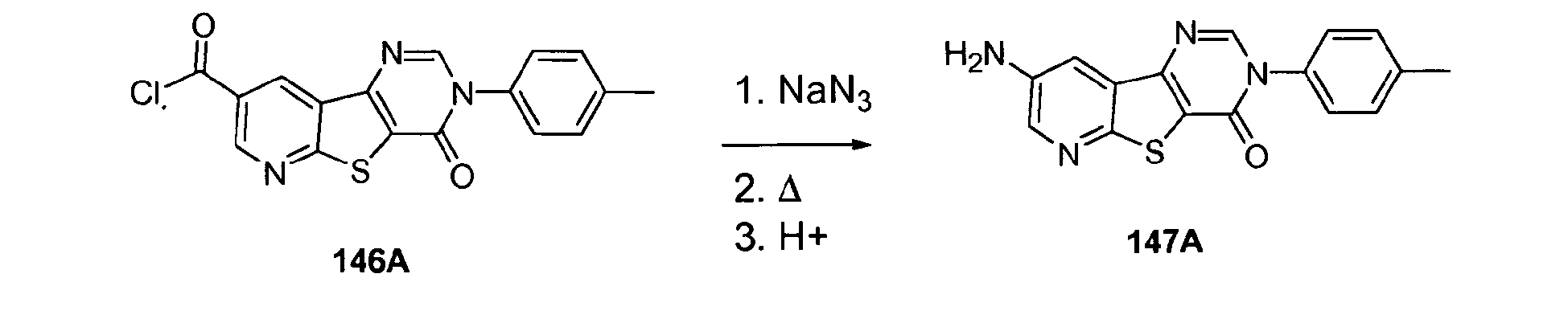
- Compound 146A (0.692 g, 0.00195 mol) and sodium azide (0.127 g, 0.00195 mol) were heated in a mixture of toluene and DMF (1:1) at 90 °C under a nitrogen atmosphere for 2 h. The solvent was then evaporated under reduced pressure leaving a solid residue. To this was added 8N hydrochloric acid (15 ml) and the mixture heated at reflux for 1 h. The reaction was cooled to room temperature and filtered. The filtrate was basified using concentrated ammonium hydroxide and extracted with dichloromethane. The organic layer was dried (Na2SO4) and evaporated in vacuo. Purification by preparative TLC using dichloromethane/acetone (9:1) led to product 147A.
1H NMR (DMSO-d6): δ 8.47 (s, 1H), 8.23 (d, 1H), 7.61 (d, 1H), 7.39 (d, 2H), 7.32 (d, 2H), 5.72 (s, 2H), 2.34 (s, 3H). MS m/z calcd. for C16H13N4OS + = 309.1; found m/z = 309.1 (M+1). -

- To a solution of compound 148 (4.70 g, 0.0134 mol) in acetic acid (60 mL) was added bromine (1.4 mL, 0.0267 mol) and the mixture heated at reflux overnight. The solvent was then evaporated under reduced pressure leaving a solid residue to which was added water. This mixture was basified using concentrated ammonium hydroxide and extracted with dichloromethane, dried (Na2SO4), filtered and evaporated under reduced pressure. Purification by column chromatography on silica gel followed by preparative TLC led to the isolation of compounds 149 - 152. Compound 149: 1H NMR (CDCl3): δ 8.60 (s, 1H), 8.19 (s, 1H), 7.62 (d, 1H), 7.37 (dd, 1H), 7.02 (d, 1H), 3.94 (s, 3H), 3.20 (s, 6H). Compound 150: 1H NMR (CDCl3): δ 8.51 (d, 1H), 8.31 (s, 1H), 7.69 (d, 1H), 7.33 (d, 2H), 7.03 (d, 2H), 3.85 (s, 3H). Compound 151: 1H NMR (CDCl3): δ 8.60 (s, 1H), 8.22 (s, 1H), 7.33 (d, 2H), 7.02 (d, 2H), 3.84 (s, 3H), 3.21 (s, 6H). MS m/z calcd. for C18H16BrN4O2S + = 433.0; found m/z = 433.1 (M+1). Compound 41: 1H NMR (DMSO-d6): δ 8.58 (s, 1H), 8.38 (s, 1H), 8.30 (m, 1H), 7.44 (d, 2H), 7.06 (d, 2H), 3.78 (s, 3H), 3.38 (d, 3H). MS m/z calcd. for C17H14BrN4O2S + = 419.0; found m/z = 419.1 (M+1).
-

- The mixture of mucobromic acid (5.0 g, 0.019mol), hydrazine dihydrochloride (2.13g, 0.020mol) and sodium acetate (3.97g, 0.048mol) in water (30mL) was heated to 100°C for 16 hours. The reaction mixture was cooled to room temperature. The precipitated solid was collected by filtration and dried over vacuum to afford the crude solid 153 (2.58g). 1H NMR (CD3OD) δ 8.02(s, 1H). MS m/z calcd. for C4H3Br2N2O+ = 254.88.; found m/z = 254.96.
-

- The mixture of 153 (2.58 g, 0.01 mol), dihydropyran (1.4mL, 0.015mol), p-toluenesulfonic acid monohydrate (0.19g, 0.001 mol) and 30 mL THF was heated to reflux for 24 hours. Additional dihydropyran (2.8mL, 0.030mol) was added at 16 hours. The reaction mixture was allowed to cool to room temperature and concentrated in-vacuo to an oily residue. The residue was taken up in ethyl acetate (100mL) and washed with sodium bicarbonate solution (50mL). The organic layer was washed with Brine (50 mL) and dried with sodium sulfate. The solvent was removed in-vacuo to give an oily residue. The residue was purified by flash chromatography eluting with 0-40% ethyl acetate/hexane to afford 154 (2.96g). MS m/z calcd. for C9H11Br2N2O+ = 339.0; found m/z = 338.93.
-

- Compound 154 (1.5g, 0.0044mol) was dissolved in 10 mL methanol and cooled to 0°C. To this solution was added 25% sodium methoxide in methanol (1.02mL, 0.0044mol). The reaction mixture was allowed to stir for additional 2 hours at room temperature. The solvent was evaporated to give a residue. This residue was taken up in ethyl acetate (100mL) washed with water (50mL) and then brine (50mL). The organic layer was dried with sodium sulfate and evaporated to afford the crude 155. 1H NMR (CDCl3) δ 7.75(s, 1H), 6.04 (dd, 1H), 4.05 (d, 1H), 4.00(s, 3H), 3.69 (t, 1H), 2.15-1.98(m, 2H), 1.69-1.65 (m, 4H).
-

- Compound 156 (0.58g, 0.0025mol) and 4 mL methanol was added 6N HCl (8mL) and heated to reflux for 1 hour. The reaction mixture was allowed to cool to room temperature. The solvent was evaporated in-vacuo. The residue was taken up in ethyl acetate (50mL), then washed with saturated sodium bicarbonate (25mL). The aqueous layer was extracted with ethyl acetate (2X50mL). The combined organic layer was washed with brine, dried with sodium sulfate and evaporated in-vacuo. The residue was purified by flash column eluting with 0-6% methanol/methylene chloride with 0.5% ammonia hydroxide to afford 157. 1H NMR (CD3OD) δ 8.13 (s, 1H), 4.16 (s, 3H). MS m/z calcd. for C6H6N3O2 + = 152.12; found m/z = 152.10.
- The following compound was also prepared using Method CQ:
Cpd Structure Formula MW m/z Found (M+1)+ 165 
C15H10N4O2S 310.3 311.1 -

- To a solution of 74 (0.1 g, 0.314 mmol) in con HCl (1 mL) was added anhydrous tin chloride (0.1 g, 0.527 mmol) and heated at 70°C for one hour. The excess HCl was removed in vacuo and redissolved in DCM. The product was isolated by preparative reverse phase HPLC using acetonitrile/water as the eluent to get compound 168. 1HNMR (CDCl3): 8.8 (d, 1H), 8.67 (s, 1H), 8.60 (m, 1H), 7.7 (d, 1H), 7.39 (m, 3H), 4.8 (s, 2H), 2.35 (s, 3H). Mass Spectrum (M++1)m/z calcd. for C17H15N4OS+ = 323.10, found m/z = 323.2
-

- The 1M Br2 / AcOH (17.80 mls, 17.80 mmol) was added dropwise to a stirring suspension of phenol (5.00g, 16.20 mmol) in glacial AcOH (500 mls) at room temperature. The reaction was continued to be stirred at room temperature for 6 hrs. The AcOH was evaporated under vacuum. The solid was taken up with CH2Cl2 (2 x 100 mls) and evaporated each time. The product 170 was fully dried to a powder (7.07g, 97%) (obtained as the acetic acid salt). MS (M+1)+ m/z calcd for C16H11BrN3O2S+ = 389.2, observed m/z = 389.9
-

- To a solution of 0.013 g (0.040 mmol) of compound 58 in 5 mL of 1,2-dichloroethane was added 0.3 mL (excess) of iodotrimethylsilane. The mixture was stirred at 60 °C for 5h and cooled to room temperature. It was quenched with 5 mL of methanol and concentrated. The residue was purified by preparative TLC eluting with 7% methanol in methylene chloride to give 0.002 g of compound 172A. Calcd MS for C17H15N4O2S = 353.1; found m/z = 353.2. And 0.002 g of Compound 172B. Calcd MS for C16H18ClN4OS = 339.1; found m/z = 339.2
-

- A solution of 0.11 g (0.3 mmol) of compound 51 and 0.5 mL of 28% aqueous ammonium hydroxide in 5 mL of MeCN in a sealed tube was stirred at 100 °C for 3 h, and cooled to room temperature. It was lilued with 4 mL of methanol and filtered to give 0.074 g of compound. Compound 174, Calcd MS for C15H16N5O3S = 346; found m/z = 346.1
-

- To a suspension of 0.031 g (0.12 mmol) of compound 11 in 5 mL of acetic acid were added a solution of 0.026 g (0.1 mmol) of iodine and 0.022 g (0.1 mmol) of sodium periodate. The mixture was stirred at the same temperature for 2 days, and concentrated. The residue was purified by chromatography eluting with 1% to 3% methanol in methylene chloride to give 0.021 g of compound 175. Calcd MS for C16H12IN4OS = 435.0; found m/z = 435.1
-

- A mixture of 0.63 g (0.18 mmol) of compound 57E and 2 g of phenol was stirred at 120 °C for 18 h and 140 °C for 4 h. It was concentrated; the residue was purified by preparative TLC eluting with 3% methanol in methylene chloride to give 0.028 g of compound 176. Calcd MS for C21H13ClN3O2S = 372.2; found m/z = 406.2
-

- A mixture of 0.050 g (0.14 mmol) of compound 57E , 0.07 g (0.22 mmol) of 1-propargyltributyltin, and 0.06 g(0.49 mmol) of diisopropylethylamine, and 0.02 g of Pd (PPh3)4 in 3 mL of toluene anf 2 mL of trifluoromethylbenzene in a sealed tube was heated at 180 °C for 40 min (in microwave, personalChemistry). It was concentrated, the residue was purified by preparative TLC eluting with 4% methanol in methylene chloride to give 0.034 g of compound 177. Calcd MS for C18H11ClN3OS = 352.0; found m/z = 352.2
- A mixture of 0.24 g (0.7 mmol) of compound 57E, 0.37 g (1.1 mmol) of allylltributyltin, and 0.27 g (2.1 mmol) of diisopropylethylamine, and 0.06 g of Pd (PPh3)4 in 3 mL of toluene anf 2 mL of trifluoromethylbenzene in a sealed tube was heated at 180 °C for 40 min (in microwave, personalChemistry). It was concentrated, the residue was purified by chromatography eluting with 4% methanol in methylene chloride to give 0.034 g of compound 178A. Calcd MS for C18H13ClN3OS = 354.1; found m/z = 354.2.
- The following compounds were prepared using method CY:
Cpd Structure Formula MW m/z Found (M+1)+ 178A 
C18H12ClN3OS 353.8 354.2 178B 
C18H13ClN4OS 368.8 369.2 -

- To a solution of 0.1 mL (1.36 mmol) of chloroiodomethane in 3 mL of 1,2-dichloroethane was added 1 mL (1.0 mmol) of diethylzinc in ether. After 5 min, a solution of 0.03 g (0.1 mmol) of compound 178 in 2 mL of dichloroethane was added. the mixture was stirred at room temperature for 30 min, and quenched with 1 mL of methanol. It was concentrated, the residue was purified by preparative TLC eluting with 4% methanol in methylene chloride to give 0.04 g of compound 179. Calcd MS for C19H15ClN3OS = 368.1; found m/z = 368.2.
-

- A mixture of 0.28 g (0.6 mmol) of compound 182, 0.33 g (1.1 mmol) of ethoxyvinyltributyltin, and 0.23 g (1.8 mmol) of diisopropylethylamine, and 0.04 g of Pd (PPh3)4 in 4 mL of toluene and 1 mL of trifluoromethylbenzene in a sealed tube was heated at 140 °C for 1 min (in microwave, personalChemistry). It was concentrated, the residue was purified by chromatography eluting with 1% to 4% methanol in methylene chloride plus 1% ammonium hydroxide to give 0.106 g of compound 183A. Calcd MS for C19H15ClN3O2S = 384.1; found m/z = 384.2. and 0.047 g of compound 183B Calcd MS for C15H9ClN3OS = 314.1; found m/z = 314.2.
-

- A mixture of 0.1 g (0.26 mmol) of compound 183A 1 m L of conc. HCl in 8 mL of THF was stirred at reflux for 18 h and concentrated. The residue was purified by preparative TLC eluting with 5% methanol in methylene chloride to give 0.073 g of compound 184. Calcd MS for C17H11ClN3O2S = 356.0; found m/z = 356.2.
-

- To a suspension of 0.015 g (0.04 mmol) of compound 184 in 15 mL of methanol was added 0.004 g (0.1 mmol) og sodium borohydride slowly. The reaction was monitored by TLC and quenched with 1 drop of 37% aqueous HCHO. It was concentrated; the residue was purified by preparative TLC eluting with 6% methanol in methylene chloride to give 0.011 g of compound 185. Calcd MS for C17H13ClN3O2S = 358.0; found m/z = 358.2
-

- To a suspension of 0.03 g (0.08 mmol) of compound 184 in 3 mL of THF was added 0.4 mL (0.12 mmol) og methylmagnesiumbromide in ether at -78°C. The reaction was stirred for 20 min and quenched with 1 mL of methanol It was concentrated; the residue was purified by preparative TLC eluting with 5% methanol in methylene chloride to give 0.027 g of compound 186. Calcd MS for C18H15ClN3O2S = 372.0; found m/z = 372.2.
-

- A mixture of 0.046 g (0.1 mmol) of compound 182, 0.1 g (0.12 mmol) of cyclopropylboronic acid, 0.036 g (0.4 mmol) of potassium fluoride dehydrate, 0.1 g (0.1 mmol) of sodium bromide and 0.1 g of Pd(PPh3)4 in 3 mL of toluene in a sealed tube was stirred at 100 °C for 3 h. It was diluted with 10 mL of methylene chloride and filtered. The filtrate was concentrated; the residue was purified by preparative TLC eluting with 5% methanol in methylene chloride to give 0.029 g of compound 187. Calcd MS for C18H13ClN3OS = 354.1; found m/z = 354.2.
-

- To a stirred solution of 0.044 g (0.4 mmol) of 4-fluoroaniline in 5 mL of THF was added 0.25 mL (0.4 mmol) of n-BuLi in hexanes at 0 °C. After 20 min, 0.068 g (0.2 mmol) of compound 93GO was added. The mixture was stirred at reflux for 4 h, and concentrated. The residue was purified preparative TLC eluting with 5% methanol in methylene chloride to give 0.01 g of compound 190A. Calcd MS for C21H15FN5O2S = 420.1; found m/z = 420.2 and 0.004 g of compound 191 : Calcd MS for C19H19N4O3S = 383.1; found m/z = 383.2
- The following compounds were prepared using Method DF:
Cpd Structure Formula MW m/z Found (M+1)+ 190A 
C21H14FN5O2S 419.4 420.2 190B 
C22H17N5O3S 431.5 432.2 190C 
C21H13ClN4OS 404.9 405.2 190D 
C18H12N6O2S2 408.5 408.2 190E 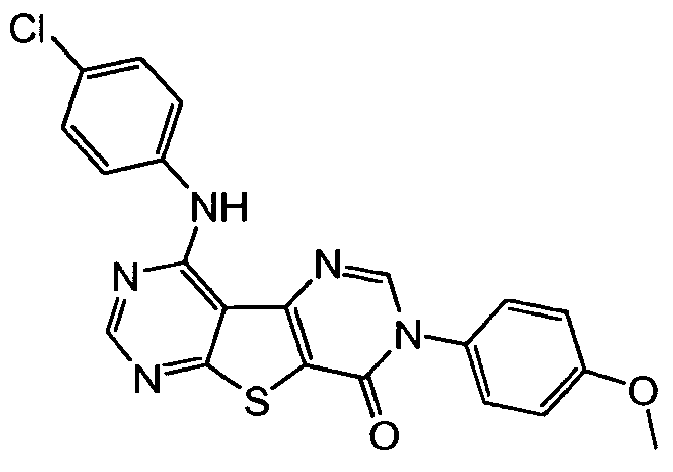
C21H14ClN5O2 S 435.9 436.2 190F 
C21H14FN5O2S 419.4 420.2 190G 
C21H14ClN5O2 S 435.9 436.2 190H 
C20H14N6O2S 402.4 403.2 190I 
C22H14N6O2S 426.5 427.2 190J 
C20H14N6O2S 402.4 403.2 190K 
C20H14N6O2S 402.4 403.2 190L 
C22H17N5O2S 415.5 416.2 190M 
C22H14N6O2S 426.5 427.2 190N 
C21H14ClN5O2 S 435.9 436.2 191 
C19H18N4O3S 382.4 383.2 -

- To a stirred solution of 0.018 g (0.05 mmol) of compound 148 in 4 mL of MeCN was added 0.036 g (0.1 mmol) of Selectfluor. The mixture was stirred at room temperature for 2 h and concentrated. The residue was purified preparative TLC eluting with 5% methanol in methylene chloride to give 0.002 g of compound 192. Calcd MS for C18H15FN4O2S = 371.1; found m/z = 371.2
-

- To a stirred suspension of 2.0 g (6.38 mmol) of compound 99 and 0.1 g of Pd(PPh3)4 in 40 mL of THF was added 20 mL (20 mmol) of diethylzinc in hexanes at room temperature. The mixture was stirred at reflux for 1.5 h, cooled to room temperature, and quenched with 15 mL of saturated sodium bicarbonate. It was diluted with 300 mL of methylene chloride, filtered through a pad of celite. The filtrate was concentrated; the residue was purified by chromatography eluting with 1% to 5% methanol in methylene chloride plus 1% ammonium hydroxide to give 0.7 g of compound 203. Calcd MS for C10H12N3O2S = 238.1; found m/z = 238.1.
-

- To a solution of compound 7AK (0.143 g, 0.0004 mol) and diisopropylethylamine (0.11 mL, 0.0007 mol) in CH2Cl2 (5 mL) was added methylsulfonyl chloride (0.05 mL, 0.0006 mol) dropwise at RT. After 1 h, the mixture was transferred to a preparative TLC and Eluted using 10 % acetone in dichloromethane to product. 1H NMR (CDCl3): δ 8.46 ( br.s, 1H), 8.29 (s, 1H), 7.50 (m, 2H), 7.30 (m, 2H), 6.83 (br.s, 1H), 3.12 (s, 6H) .Mass spectrum (M+1): 417.2
-

- To a solution of acyl chloride 146A in dichloromethane (10 mL) at RT under nitrogen atmosphere, was added dimethylamine (2 mL, 40% solution in water). After 30 min., water was added and the mixture extracted with CH2Cl2, dried (Na2SO4), filtered and evaporated under vacuum. Solid residue was then tritrated in ether and filtered to give product 205A. 1H NMR (CDCl3): δ 8.86 ( s, 1H), 8.61 (s, 1H), 8.24 (s, 1H), 7.34 (d, 2H), 7.31 (d, 2H), 3.16 (s, 3H), 3.07 (s, 3H), 2.42 (s, 3H) .Mass spectrum (M+1): 365.1
- The following compounds were prepared using Method DJ:
Cpd Structure Formula MW m/z Found (M+1)+ 205A 
C19H16N4O2S 364.4 365.1 205B 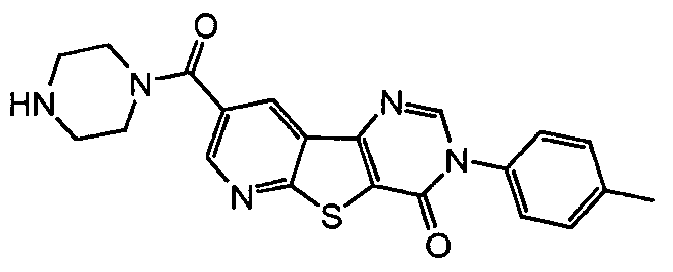
C21H19N5O2S 405.5 406.2 205C 
C17H12N4O2S 336.4 337.1 -

- Step 1: A mixture of compound 152 (1.83 g, 0.0044 mol), vinyltributyltin (1.52 g, 0.0048 mol) and tetrakis(triphenylphosphine) palladium (0.25 g, 0.00022 mol) in toluene (50 ml) was heated at reflux under a nitrogen atmosphere for 1 h. This was then cooled to room temperature, evaporated the solvent and purified by column eluted using dichloromethane/ethyl acetate to give the product 206. Mass spectrum (M+1): m/z = 365.07
- Step 2: To a suspension compound 206 (0.23 g, 0. 6 mmol) in THF/water (2:1), was added OsO4 (0.4 mL, 4%wt in water). After 5min., NalO4 (0.14 g, 0.0006 mol) was added and mixture stirred at RT overnight. Added 10% Na2SO3 solution and extracted by dichloromethane (100 mLx2) dried (Na2SO4), filtered and evaporated to give product 207. Mass spectrum (M+1): m/z = 366.99.
- Step 3: A mixture of compound 207 (0.2 g, 0.00055 mol), cyclobutylamine (0.1 mL) and Na(OAc)3BH (0.19 g, 0. 87 mmol) in dichloromethane (20 ml) was stirred at RT under a nitrogen atmosphere for 24h. Added a NaOH solution (1M) and extracted with dichloromethane (100 mLx3), dried (Na2SO4), filtered and evaporated under vacuum. Purification prep TLC using 4 % methanol in dichloromethane followed tritration in ether to give the product 208 after filtration. 1H NMR (DMSO-d6): δ 8.59 (s, 1H), 8.29 (m, 1H), 8.08 (s, 1H), 7.48 (d, 2H), 7.10 (d, 2H), 4.08 (m, 1H), 3.82 (s, 3H), 3.41 (d, 3H), 3.20 (m, 1H), 3.14 (d, 2H), 2.08 (m, 2H), 1.45-1.75 (m, 4H). Mass spectrum (M+1): m/z = 422.2.
- The following compound was prepared using Method F (alternate 1):
Cpd Structure Formula MW m/z Found (M+1)+ 180 
C16H10FN3O2S 327.3 328.2 - The following compounds were prepared using Method F (alternate 3):
Cpd Structure Formula MW m/z Found (M+1)+ 201 
C17H14N4O2S 338.4 339.2 202 
C16H11ClN4OS 342.8 343.2 -

- To a mixture of 94A (2.50 g, 8.12 mmoles) in toluene (36 mL) and glacial acetic acid (9.0 mL) was added 2-fluoro-4-methoxyaniline (160 mg, 1.30 mmoles) freshly prepared from the corresponding carboxylic acid. The reaction was allowed to stir at reflux for 2h. The reaction mixture was then poured onto water (360 ml), basified with conc. NH4OH and filtered. The crude solid was then purified via silica gel chromatography eluting with 10% acetone/CH2Cl2 to give 95AQ as an off-white solid (381 mg, 13% yield). 1H NMR (CDCl3): δ 8.58 (s, 1H), 8.5 (s, 1H), 7.36-7.31 (m, 1H), 6.89-6.82 (m, 2H), 3.88 (s, 3H), 3.49 (s, 6H), MS m/z calcd. for C17H15FN5O2S+ = 372.1; found m/z = 372.2 (M+1)
-

- A stirring mixture of n-propargyl amine tricyclic (0.035g, 0.088 mmol) in 7N-NH3 / methanol (40 mls) was sealed in a Parr steel reaction vessel and was heated in an oil bath at 180-185°C for 20 hrs. The reaction was cooled to room temperature and was analyzed by tlc (20% acetone / CH2Cl2). The solvent was concentrated under vacuum to give a solid (0.056g). The crude product was purified by reverse-phase HPLC ( C18 column ). Elution with solvent gradient 5% CH3CN / H2O / 0.1% formic acid to 95% CH3CN / H2O / 0.1% formic acid gave 59H (0.005g) and 59I (0.011g). Product 59H: MS (M+1)+ m/z calcd for C16H14N5O2S+ = 340.1, observed m/z = 340.2 Product 59I: MS (M+1)+ m/z calcd for C16H12ClN4O2S+ = 359.0, observed m/z = 359.2
- The following compounds of the invention were prepared using Method K:
Cpd Structure Formula MW m/z Found (M+1)+ 95AP 
C18H13NF5O2S 363.4 364.2 95AS 
C16H12ClN5OS 357.8 358.2 95AT 
C16H12BrN5OS 402.3 404.2 95AU 
C17H12BrN5OS 414.3 416.2 95BO 
C17H12BrN5OS 414.3 416.2 95BP 
C17H12ClN5OS 369.8 370.2 - The following compounds of the invention were prepared using Method R:
Cpd Structure Formula MW m/z Found (M+1)+ 28BQ 
C19H16N4O2S 364.4 365.2 28DL 
C18H11ClN4OS 366.8 367.1 28DP 
C18H11BrN4OS 411.3 411.2 28DQ 
C19H14N4O2S 362.4 363.2 28DS 
C19H16N4O2S 364.4 365.2 28DV 
C19H13BrN4OS 425.3 425.2 28DZ 
C19H15ClN4OS 382.9 383.2 28GE 
C19H17ClN4O2S 400.9 401.2 28GQ 
C18H15BrN4O2S 431.3 433.2 28HZ 
C17H13ClN4OS 356.8 357.2 28IC 
C18H15ClN4OS 370.9 371.2 - The following compound of the invention was prepared using Method R:
Cpd Structure Formula MW m/z Found (M+1)+ 28Z 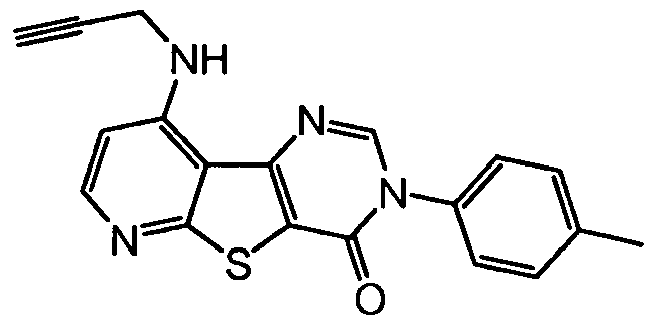
C19H14N4OS 346.4 347.1 - The following compound of the invention was prepared using Method DG:
Cpd Structure Formula MW m/z Found (M+1)+ 193 
C16H11ClN4OS 342.8 343.2 - The following compound of the invention was prepared using Method F (alternate 3):
Cpd Structure Formula MW m/z Found (M+1)+ 95DV 
C18H14BrN5OS 428.3 430.2 - A CHO cell line stably expressing hmGluR1 receptor was established. One day prior to assay, cells were split in growth media at concentration of 50,000 cells/well in a volume of 100 µl and seeded into black clear-bottom 96-well plates. After two to six hours, when cells were well attached to the plate, growth medium was replaced with assay medium (100 µL) consisting of DMEM high glucose, supplemented with GPT (1 U/mL) and Sodium pyruvate, 1 mM. Following overnight incubation, medium was discarded and cells were loaded for 2 h with dye from the Calcium 3 Assay Reagent Kit (Molecular Devices, # R8033), prepared according to manufacturers' instructions. A 96-tip pipettor/fluorometric imaging plate reader (FLIPR 384; Molecular Devices) was used and intracellular calcium mobilization was measured by increases in fluorescence upon agonist Quisqualate stimulation following 6 sec-baseline measurement. Test compounds were added 10 minutes before Quisqualate. IC50 determinations for tested compounds were generated against Quisqualate 1 µM corresponding to EC80 value in a standard dose response curve.
- IC50s for representative compounds are shown in Tables 2 and 2a below, in which compounds with IC50 values less than 50 nM are designated as A class compounds.
Table 2 Cpd mGluR 1 IC50 (nM) Structure 28Z A 
Table 2a Compound # IC50
Class193 A 28BQ A 28DL A 28DP A 28DQ A 28DS A 28DV A 28DZ A 28GE A 28GQ A 28HZ A 281C A 95AP A 95AS A 95AT A 95AU A 95BO A 95BP A 95DV A - Representative preferred compounds have IC50 values as shown in Table 3.
Table 3 Cpd mGluR 1 IC50 (nM) Cpd mGluR 1 IC50 (nM) 28Z 1.47 28GE 0.28 193 0.18 28GQ 0.66 95AT 0.58 28DZ 1.08 28DL 0.91 95BP 1.31 28HZ 1.22 95BO 1.54 95AU 1.37 95AP 1.6 95AS 1.48 28DV 1.87 28BQ 1.57 28DS 1.95 28DP 1.75 95DV 1.94 28IC 2.09
Claims (40)
- A compound or a pharmaceutically acceptable salt, solvate or ester thereof, wherein said compound is selected from the group consisting of:


- A compound according to claim 1, which is of the formula:

- A compound according to claim 1, which is of the formula:

- A compound according to claim 1, which is of the formula:

- A compound according to claim 1, which is of the formula:

- A compound according to claim 1, which is of the formula:

- A compound according to claim 1, which is of the formula:

- A compound according to claim 1, which is of the formula:

- A compound according to claim 1, which is of the formula:

- A compound according to claim 1, which is of the formula:

- A pharmaceutical composition comprising a compound of claim 1.
- The pharmaceutical composition of claim 11, further comprising at least one pharmaceutically acceptable carrier, adjuvant or vehicle.
- The pharmaceutical composition of claim 12, further comprising one or more additional therapeutic agents.
- The pharmaceutical composition of claim 13, wherein said additional therapeutic agents are selected from the group consisting of therapeutic agents suitable for pain management, anti-anxiety agents, anti-migraine agents, and therapeutic agents suitable for treating urinary incontinence.
- The pharmaceutical composition of claim 11, wherein the compound is a compound of any of claims 2 to 10, or a pharmaceutically acceptable salt, solvate or ester thereof.
- A method of selectively antagonizing metabotropic glutamate receptor 1 (mGluR1) activity in a cell in need thereof, comprising contacting said cell in vitro with a therapeutically effective amount of at least one compound of claim 1, or a pharmaceutically acceptable salt, solvate or ester of said compound.
- The method of claim 16, wherein the compound is a compound of any of claims 2 to 10, or a pharmaceutically acceptable salt, solvate or ester thereof.
- Use of at least one compound of claim 1, or a pharmaceutically acceptable salt, solvate or ester of said compound, for the manufacture of a medicament for the treatment of a disease or condition associated with metabotropic glutamate receptor 1 (mGluR1) function in a mammal.
- The use of claim 18, wherein said disease or condition is pain.
- The use of claim 18, wherein said disease or condition is neuropathic pain.
- The use of claim 18, wherein said disease or condition is allodynia.
- The use of claim 18, wherein said disease or condition is hyperalgesia.
- The use of claim 18, wherein said disease or condition is pain associated with inflammation or an inflammatory disease.
- The use of any one of claims 18 to 23, wherein the treatment further comprises administering one or more additional therapeutic agent(s) suitable for pain management.
- The use of claim 24, wherein said additional therapeutic agent is an opioid analgesic.
- The use of claim 24, wherein said additional therapeutic agent is a non-opioid analgesic.
- The use of claim 18, wherein said disease or condition is selected from the group consisting of muscle spasms, convulsions, spasticity, migraine, psychoses, urinary incontinence, anxiety and related disorders, emesis, brain edema, tardive dyskinesia, depression, drug tolerance and withdrawal, and smoking cessation.
- The use of claim 27, wherein said disease or condition is anxiety.
- The use of claim 28, wherein the treatment further comprises administering one or more additional anti-anxiety agent(s).
- The use of claim 27, wherein said disease or condition is migraine.
- The use of claim 30, wherein the treatment further comprises administering one or more additional anti-migraine agent(s).
- The use of claim 27, wherein said disease or condition is urinary incontinence.
- The use of claim 32, wherein the treatment further comprises administering one or more additional therapeutic agent(s) suitable for treating urinary incontinence.
- The use of claim 18, wherein said disease or condition is selected from the group consisting of cerebral deficits subsequent to cardiac bypass surgery or grafting, cerebral ischemia, stroke, spinal cord injuries, head trauma, perinatal hypoxia, cardiac arrest, hypoglycemic neuronal damage, Alzheimer's disease, Huntington's Chorea, amyotrophic lateral sclerosis (ALS), AIDS-induced dementia, inherited ataxias, ocular damage and retinopathy, cognitive disorders, and idiopathic or drug-induced Parkinson's.
- The use of claim 34, wherein the treatment further comprises administering one or more additional therapeutic agent(s).
- The use of claim 18, wherein the compound is a compound of any of claims 2 to 10, or a pharmaceutically acceptable salt, solvate or ester thereof.
- A compound of claim 1, or a pharmaceutically acceptable salt, solvate or ester thereof, for use in therapy.
- A compound according to claim 37, wherein the compound is a compound of any of claims 2 to 10, or a pharmaceutically acceptable salt, solvate or ester thereof.
- A compound of claim 1, or a pharmaceutically acceptable salt, solvate or ester thereof, for use in the treatment of a disease or condition associated with metabotropic glutamate receptor 1 (mGluR1) function in a mammal.
- A compound according to claim 39, wherein the compound is a compound of any of claims 2 to 10, or a pharmaceutically acceptable salt, solvate or ester thereof.
Applications Claiming Priority (2)
| Application Number | Priority Date | Filing Date | Title |
|---|---|---|---|
| US11/301,672 US7598259B2 (en) | 2004-06-15 | 2005-12-13 | mGluR1 antagonists as therapeutic agents |
| PCT/US2006/046943 WO2007070393A2 (en) | 2005-12-13 | 2006-12-11 | Mglur1 anatgonists as therapeutic agents |
Publications (2)
| Publication Number | Publication Date |
|---|---|
| EP1966220A2 EP1966220A2 (en) | 2008-09-10 |
| EP1966220B1 true EP1966220B1 (en) | 2011-01-26 |
Family
ID=38163430
Family Applications (1)
| Application Number | Title | Priority Date | Filing Date |
|---|---|---|---|
| EP06848624A Active EP1966220B1 (en) | 2005-12-13 | 2006-12-11 | Mglur1 anatgonists as therapeutic agents |
Country Status (8)
| Country | Link |
|---|---|
| US (2) | US7598259B2 (en) |
| EP (1) | EP1966220B1 (en) |
| JP (1) | JP2009519337A (en) |
| CN (1) | CN101437828A (en) |
| AT (1) | ATE496922T1 (en) |
| CA (1) | CA2633093A1 (en) |
| DE (1) | DE602006019911D1 (en) |
| WO (1) | WO2007070393A2 (en) |
Families Citing this family (19)
| Publication number | Priority date | Publication date | Assignee | Title |
|---|---|---|---|---|
| US7598259B2 (en) * | 2004-06-15 | 2009-10-06 | Schering Corporation | mGluR1 antagonists as therapeutic agents |
| AR049300A1 (en) * | 2004-06-15 | 2006-07-12 | Schering Corp | MGLUR1 ANTAGONIST TRICICLIC COMPOUNDS AS THERAPEUTIC AGENTS |
| WO2006081072A1 (en) * | 2005-01-24 | 2006-08-03 | Abbott Laboratories | Antagonists of the mglu receptor and uses thereof |
| ATE516292T1 (en) * | 2005-08-19 | 2011-07-15 | Schering Corp | CONDENSED TRICYCLIC MGLUR1 ANTAGONISTS AS THERAPEUTIC AGENTS |
| US7482360B2 (en) * | 2005-09-23 | 2009-01-27 | Schering Corporation | Fused tetracyclic mGluR1 antagonists as therapeutic agents |
| CA2672327A1 (en) * | 2006-11-30 | 2008-06-05 | Genentech, Inc. | Aza-indolyl compounds and methods of use |
| GB0713686D0 (en) * | 2007-07-13 | 2007-08-22 | Addex Pharmaceuticals Sa | New compounds 2 |
| EP2872144A4 (en) * | 2012-07-11 | 2015-12-02 | Nimbus Iris Inc | IRAQ INHIBITORS AND USES THEREOF |
| HK1210732A1 (en) * | 2012-07-11 | 2016-05-06 | Nimbus Iris, Inc. | Irak inhibitors and uses thereof |
| WO2014110114A1 (en) | 2013-01-10 | 2014-07-17 | Nimbus Iris, Inc. | Irak inhibitors and uses thereof |
| KR102153040B1 (en) | 2013-11-28 | 2020-09-07 | 삼성전자주식회사 | Condensed cyclic compound and organic light emitting diode including the same |
| GB201401886D0 (en) | 2014-02-04 | 2014-03-19 | Lytix Biopharma As | Neurodegenerative therapies |
| WO2017112777A1 (en) | 2015-12-22 | 2017-06-29 | SHY Therapeutics LLC | Compounds for the treatment of cancer and inflammatory disease |
| KR102736865B1 (en) | 2017-06-21 | 2024-12-03 | 샤이 테라퓨틱스 엘엘씨 | Compounds that interact with the Ras superfamily for the treatment of cancer, inflammatory diseases, neurodevelopmental diseases and fibrotic diseases |
| JP7407461B2 (en) | 2018-12-19 | 2024-01-04 | シャイ・セラピューティクス・エルエルシー | Compounds that interact with the RAS superfamily for the treatment of cancer, inflammatory diseases, RAS diseases, and fibrotic diseases |
| WO2023081800A1 (en) * | 2021-11-05 | 2023-05-11 | The Regents Of The University Of California | Alpha-2a adrenergic receptor modulators and uses thereof |
| WO2024035622A1 (en) * | 2022-08-10 | 2024-02-15 | Bellbrook Labs, Llc | INHIBITORS OF cGAS ACTIVITY AS THERAPEUTIC AGENTS |
| EP4611749A2 (en) * | 2022-11-04 | 2025-09-10 | Cedars-Sinai Medical Center | Compounds and methods for treating cancers |
| CN118388414A (en) * | 2023-01-17 | 2024-07-26 | 中国药科大学 | Pyridazinone compound and preparation method, pharmaceutical composition and application thereof |
Family Cites Families (9)
| Publication number | Priority date | Publication date | Assignee | Title |
|---|---|---|---|---|
| US6232320B1 (en) * | 1998-06-04 | 2001-05-15 | Abbott Laboratories | Cell adhesion-inhibiting antiinflammatory compounds |
| SV2002000205A (en) | 1999-11-01 | 2002-06-07 | Lilly Co Eli | PHARMACEUTICAL COMPOUNDS REF. X-01095 |
| US6608053B2 (en) * | 2000-04-27 | 2003-08-19 | Yamanouchi Pharmaceutical Co., Ltd. | Fused heteroaryl derivatives |
| WO2002062803A1 (en) | 2001-02-08 | 2002-08-15 | Yamanouchi Pharmaceutical Co., Ltd. | Thienopyrimidine derivative |
| BR0311605A (en) | 2002-06-06 | 2005-02-22 | Boehringer Ingelheim Pharma | Substituted 3-Aminothieno [2,3-b] pyridine-2-carboxylic acid amide compounds and processes for preparation and uses |
| AU2003293555A1 (en) * | 2002-12-17 | 2004-07-29 | Schering Corporation | 17 beta-hydroxysteroid dehydrogenase type 3 inhibitors for the treatment of androgen dependent diseases |
| AR049300A1 (en) * | 2004-06-15 | 2006-07-12 | Schering Corp | MGLUR1 ANTAGONIST TRICICLIC COMPOUNDS AS THERAPEUTIC AGENTS |
| US7598259B2 (en) | 2004-06-15 | 2009-10-06 | Schering Corporation | mGluR1 antagonists as therapeutic agents |
| WO2006081072A1 (en) * | 2005-01-24 | 2006-08-03 | Abbott Laboratories | Antagonists of the mglu receptor and uses thereof |
-
2005
- 2005-12-13 US US11/301,672 patent/US7598259B2/en not_active Expired - Fee Related
-
2006
- 2006-12-11 EP EP06848624A patent/EP1966220B1/en active Active
- 2006-12-11 WO PCT/US2006/046943 patent/WO2007070393A2/en not_active Ceased
- 2006-12-11 CA CA002633093A patent/CA2633093A1/en not_active Abandoned
- 2006-12-11 JP JP2008545679A patent/JP2009519337A/en not_active Withdrawn
- 2006-12-11 AT AT06848624T patent/ATE496922T1/en not_active IP Right Cessation
- 2006-12-11 CN CNA2006800527795A patent/CN101437828A/en active Pending
- 2006-12-11 DE DE602006019911T patent/DE602006019911D1/en active Active
-
2009
- 2009-01-21 US US12/356,867 patent/US7989464B2/en not_active Expired - Fee Related
Also Published As
| Publication number | Publication date |
|---|---|
| WO2007070393A3 (en) | 2007-10-25 |
| EP1966220A2 (en) | 2008-09-10 |
| JP2009519337A (en) | 2009-05-14 |
| WO2007070393A2 (en) | 2007-06-21 |
| US7989464B2 (en) | 2011-08-02 |
| DE602006019911D1 (en) | 2011-03-10 |
| CN101437828A (en) | 2009-05-20 |
| US20060167029A1 (en) | 2006-07-27 |
| US20090192178A1 (en) | 2009-07-30 |
| CA2633093A1 (en) | 2007-06-21 |
| US7598259B2 (en) | 2009-10-06 |
| ATE496922T1 (en) | 2011-02-15 |
Similar Documents
| Publication | Publication Date | Title |
|---|---|---|
| EP1765829B1 (en) | Tricyclic compounds and their use as mglur1 antagonists | |
| US7989464B2 (en) | mGluR1 antagonists as therapeutic agents | |
| US7482360B2 (en) | Fused tetracyclic mGluR1 antagonists as therapeutic agents | |
| DE60017575T2 (en) | TRICYCLIC INHIBITORS OF POLY (ADP-RIBOSE) POLYMERASES | |
| CZ224897A3 (en) | Tricyclic diazepine derivatives, process of their preparation and pharmaceutical composition containing thereof | |
| TW201136936A (en) | Pyrrolopyrazine kinase inhibitors | |
| CZ286814B6 (en) | Pyridazino/4,5-b/quinoline, process of its preparation, pharmaceutical composition in which this quinoline is comprised and use of this quinoline for preparing a medicament | |
| EP1931683B1 (en) | Fused tricyclic mglur1 antagonists as therapeutic agents | |
| US7687501B2 (en) | Pyridothienopyridazinone derivatives as mGluR1 antagonists | |
| Galanski et al. | Studies on the chemistry of thienoanellated O, N-and S, N-containing heterocycles. Part 30: Synthesis and pharmacological properties of thieno [2, 3-b][1, 4] thiazines with potential vasopressin receptor antagonistic activity | |
| HK1097269B (en) | Tricyclic compounds and their use as mglur1 antagonists | |
| HK1108882A1 (en) | Pyrazolo[1,5-a]pyrimidine adenosine a2a receptor antagonists |
Legal Events
| Date | Code | Title | Description |
|---|---|---|---|
| PUAI | Public reference made under article 153(3) epc to a published international application that has entered the european phase |
Free format text: ORIGINAL CODE: 0009012 |
|
| 17P | Request for examination filed |
Effective date: 20080328 |
|
| AK | Designated contracting states |
Kind code of ref document: A2 Designated state(s): AT BE BG CH CY CZ DE DK EE ES FI FR GB GR HU IE IS IT LI LT LU LV MC NL PL PT RO SE SI SK TR |
|
| AX | Request for extension of the european patent |
Extension state: AL BA HR MK RS |
|
| 17Q | First examination report despatched |
Effective date: 20081205 |
|
| REG | Reference to a national code |
Ref country code: HK Ref legal event code: DE Ref document number: 1120787 Country of ref document: HK |
|
| GRAP | Despatch of communication of intention to grant a patent |
Free format text: ORIGINAL CODE: EPIDOSNIGR1 |
|
| GRAS | Grant fee paid |
Free format text: ORIGINAL CODE: EPIDOSNIGR3 |
|
| GRAA | (expected) grant |
Free format text: ORIGINAL CODE: 0009210 |
|
| AK | Designated contracting states |
Kind code of ref document: B1 Designated state(s): AT BE BG CH CY CZ DE DK EE ES FI FR GB GR HU IE IS IT LI LT LU LV MC NL PL PT RO SE SI SK TR |
|
| AX | Request for extension of the european patent |
Extension state: AL BA HR MK RS |
|
| REG | Reference to a national code |
Ref country code: GB Ref legal event code: FG4D |
|
| REG | Reference to a national code |
Ref country code: CH Ref legal event code: EP |
|
| REG | Reference to a national code |
Ref country code: IE Ref legal event code: FG4D |
|
| REF | Corresponds to: |
Ref document number: 602006019911 Country of ref document: DE Date of ref document: 20110310 Kind code of ref document: P |
|
| REG | Reference to a national code |
Ref country code: DE Ref legal event code: R096 Ref document number: 602006019911 Country of ref document: DE Effective date: 20110310 |
|
| REG | Reference to a national code |
Ref country code: NL Ref legal event code: T3 |
|
| REG | Reference to a national code |
Ref country code: CH Ref legal event code: NV Representative=s name: SERVOPATENT GMBH |
|
| LTIE | Lt: invalidation of european patent or patent extension |
Effective date: 20110126 |
|
| PG25 | Lapsed in a contracting state [announced via postgrant information from national office to epo] |
Ref country code: LT Free format text: LAPSE BECAUSE OF FAILURE TO SUBMIT A TRANSLATION OF THE DESCRIPTION OR TO PAY THE FEE WITHIN THE PRESCRIBED TIME-LIMIT Effective date: 20110126 Ref country code: IS Free format text: LAPSE BECAUSE OF FAILURE TO SUBMIT A TRANSLATION OF THE DESCRIPTION OR TO PAY THE FEE WITHIN THE PRESCRIBED TIME-LIMIT Effective date: 20110526 Ref country code: PT Free format text: LAPSE BECAUSE OF FAILURE TO SUBMIT A TRANSLATION OF THE DESCRIPTION OR TO PAY THE FEE WITHIN THE PRESCRIBED TIME-LIMIT Effective date: 20110526 Ref country code: SE Free format text: LAPSE BECAUSE OF FAILURE TO SUBMIT A TRANSLATION OF THE DESCRIPTION OR TO PAY THE FEE WITHIN THE PRESCRIBED TIME-LIMIT Effective date: 20110126 Ref country code: GR Free format text: LAPSE BECAUSE OF FAILURE TO SUBMIT A TRANSLATION OF THE DESCRIPTION OR TO PAY THE FEE WITHIN THE PRESCRIBED TIME-LIMIT Effective date: 20110427 Ref country code: LV Free format text: LAPSE BECAUSE OF FAILURE TO SUBMIT A TRANSLATION OF THE DESCRIPTION OR TO PAY THE FEE WITHIN THE PRESCRIBED TIME-LIMIT Effective date: 20110126 Ref country code: ES Free format text: LAPSE BECAUSE OF FAILURE TO SUBMIT A TRANSLATION OF THE DESCRIPTION OR TO PAY THE FEE WITHIN THE PRESCRIBED TIME-LIMIT Effective date: 20110507 |
|
| PG25 | Lapsed in a contracting state [announced via postgrant information from national office to epo] |
Ref country code: FI Free format text: LAPSE BECAUSE OF FAILURE TO SUBMIT A TRANSLATION OF THE DESCRIPTION OR TO PAY THE FEE WITHIN THE PRESCRIBED TIME-LIMIT Effective date: 20110126 Ref country code: AT Free format text: LAPSE BECAUSE OF FAILURE TO SUBMIT A TRANSLATION OF THE DESCRIPTION OR TO PAY THE FEE WITHIN THE PRESCRIBED TIME-LIMIT Effective date: 20110126 Ref country code: BE Free format text: LAPSE BECAUSE OF FAILURE TO SUBMIT A TRANSLATION OF THE DESCRIPTION OR TO PAY THE FEE WITHIN THE PRESCRIBED TIME-LIMIT Effective date: 20110126 Ref country code: PL Free format text: LAPSE BECAUSE OF FAILURE TO SUBMIT A TRANSLATION OF THE DESCRIPTION OR TO PAY THE FEE WITHIN THE PRESCRIBED TIME-LIMIT Effective date: 20110126 Ref country code: SI Free format text: LAPSE BECAUSE OF FAILURE TO SUBMIT A TRANSLATION OF THE DESCRIPTION OR TO PAY THE FEE WITHIN THE PRESCRIBED TIME-LIMIT Effective date: 20110126 Ref country code: BG Free format text: LAPSE BECAUSE OF FAILURE TO SUBMIT A TRANSLATION OF THE DESCRIPTION OR TO PAY THE FEE WITHIN THE PRESCRIBED TIME-LIMIT Effective date: 20110426 Ref country code: CY Free format text: LAPSE BECAUSE OF FAILURE TO SUBMIT A TRANSLATION OF THE DESCRIPTION OR TO PAY THE FEE WITHIN THE PRESCRIBED TIME-LIMIT Effective date: 20110126 |
|
| PG25 | Lapsed in a contracting state [announced via postgrant information from national office to epo] |
Ref country code: EE Free format text: LAPSE BECAUSE OF FAILURE TO SUBMIT A TRANSLATION OF THE DESCRIPTION OR TO PAY THE FEE WITHIN THE PRESCRIBED TIME-LIMIT Effective date: 20110126 Ref country code: DK Free format text: LAPSE BECAUSE OF FAILURE TO SUBMIT A TRANSLATION OF THE DESCRIPTION OR TO PAY THE FEE WITHIN THE PRESCRIBED TIME-LIMIT Effective date: 20110126 |
|
| PG25 | Lapsed in a contracting state [announced via postgrant information from national office to epo] |
Ref country code: CZ Free format text: LAPSE BECAUSE OF FAILURE TO SUBMIT A TRANSLATION OF THE DESCRIPTION OR TO PAY THE FEE WITHIN THE PRESCRIBED TIME-LIMIT Effective date: 20110126 Ref country code: RO Free format text: LAPSE BECAUSE OF FAILURE TO SUBMIT A TRANSLATION OF THE DESCRIPTION OR TO PAY THE FEE WITHIN THE PRESCRIBED TIME-LIMIT Effective date: 20110126 Ref country code: SK Free format text: LAPSE BECAUSE OF FAILURE TO SUBMIT A TRANSLATION OF THE DESCRIPTION OR TO PAY THE FEE WITHIN THE PRESCRIBED TIME-LIMIT Effective date: 20110126 |
|
| PLBE | No opposition filed within time limit |
Free format text: ORIGINAL CODE: 0009261 |
|
| STAA | Information on the status of an ep patent application or granted ep patent |
Free format text: STATUS: NO OPPOSITION FILED WITHIN TIME LIMIT |
|
| 26N | No opposition filed |
Effective date: 20111027 |
|
| PGFP | Annual fee paid to national office [announced via postgrant information from national office to epo] |
Ref country code: NL Payment date: 20111220 Year of fee payment: 6 Ref country code: FR Payment date: 20111021 Year of fee payment: 6 Ref country code: CH Payment date: 20111010 Year of fee payment: 6 |
|
| REG | Reference to a national code |
Ref country code: DE Ref legal event code: R097 Ref document number: 602006019911 Country of ref document: DE Effective date: 20111027 |
|
| PG25 | Lapsed in a contracting state [announced via postgrant information from national office to epo] |
Ref country code: IT Free format text: LAPSE BECAUSE OF FAILURE TO SUBMIT A TRANSLATION OF THE DESCRIPTION OR TO PAY THE FEE WITHIN THE PRESCRIBED TIME-LIMIT Effective date: 20110126 |
|
| PG25 | Lapsed in a contracting state [announced via postgrant information from national office to epo] |
Ref country code: MC Free format text: LAPSE BECAUSE OF NON-PAYMENT OF DUE FEES Effective date: 20111231 |
|
| REG | Reference to a national code |
Ref country code: IE Ref legal event code: MM4A |
|
| PG25 | Lapsed in a contracting state [announced via postgrant information from national office to epo] |
Ref country code: IE Free format text: LAPSE BECAUSE OF NON-PAYMENT OF DUE FEES Effective date: 20111211 |
|
| PG25 | Lapsed in a contracting state [announced via postgrant information from national office to epo] |
Ref country code: LU Free format text: LAPSE BECAUSE OF NON-PAYMENT OF DUE FEES Effective date: 20111211 |
|
| REG | Reference to a national code |
Ref country code: NL Ref legal event code: V1 Effective date: 20130701 |
|
| REG | Reference to a national code |
Ref country code: CH Ref legal event code: PL |
|
| GBPC | Gb: european patent ceased through non-payment of renewal fee |
Effective date: 20121211 |
|
| REG | Reference to a national code |
Ref country code: FR Ref legal event code: ST Effective date: 20130830 |
|
| PG25 | Lapsed in a contracting state [announced via postgrant information from national office to epo] |
Ref country code: TR Free format text: LAPSE BECAUSE OF FAILURE TO SUBMIT A TRANSLATION OF THE DESCRIPTION OR TO PAY THE FEE WITHIN THE PRESCRIBED TIME-LIMIT Effective date: 20110126 |
|
| REG | Reference to a national code |
Ref country code: DE Ref legal event code: R119 Ref document number: 602006019911 Country of ref document: DE Effective date: 20130702 |
|
| PG25 | Lapsed in a contracting state [announced via postgrant information from national office to epo] |
Ref country code: NL Free format text: LAPSE BECAUSE OF NON-PAYMENT OF DUE FEES Effective date: 20130701 Ref country code: DE Free format text: LAPSE BECAUSE OF NON-PAYMENT OF DUE FEES Effective date: 20130702 Ref country code: CH Free format text: LAPSE BECAUSE OF NON-PAYMENT OF DUE FEES Effective date: 20121231 Ref country code: HU Free format text: LAPSE BECAUSE OF FAILURE TO SUBMIT A TRANSLATION OF THE DESCRIPTION OR TO PAY THE FEE WITHIN THE PRESCRIBED TIME-LIMIT Effective date: 20110126 Ref country code: LI Free format text: LAPSE BECAUSE OF NON-PAYMENT OF DUE FEES Effective date: 20121231 |
|
| PG25 | Lapsed in a contracting state [announced via postgrant information from national office to epo] |
Ref country code: FR Free format text: LAPSE BECAUSE OF NON-PAYMENT OF DUE FEES Effective date: 20130102 Ref country code: GB Free format text: LAPSE BECAUSE OF NON-PAYMENT OF DUE FEES Effective date: 20121211 |
|
| PGFP | Annual fee paid to national office [announced via postgrant information from national office to epo] |
Ref country code: DE Payment date: 20110328 Year of fee payment: 6 |
|
| REG | Reference to a national code |
Ref country code: HK Ref legal event code: WD Ref document number: 1120787 Country of ref document: HK |