EP1965255A1 - Colored photosensitive composition, color filter and method for making the color filter - Google Patents
Colored photosensitive composition, color filter and method for making the color filter Download PDFInfo
- Publication number
- EP1965255A1 EP1965255A1 EP08101959A EP08101959A EP1965255A1 EP 1965255 A1 EP1965255 A1 EP 1965255A1 EP 08101959 A EP08101959 A EP 08101959A EP 08101959 A EP08101959 A EP 08101959A EP 1965255 A1 EP1965255 A1 EP 1965255A1
- Authority
- EP
- European Patent Office
- Prior art keywords
- group
- aliphatic
- colored photosensitive
- photosensitive composition
- acid
- Prior art date
- Legal status (The legal status is an assumption and is not a legal conclusion. Google has not performed a legal analysis and makes no representation as to the accuracy of the status listed.)
- Granted
Links
- 239000000203 mixture Substances 0.000 title claims abstract description 106
- 238000000034 method Methods 0.000 title claims description 32
- 150000001875 compounds Chemical class 0.000 claims abstract description 78
- 229920005989 resin Polymers 0.000 claims abstract description 65
- 239000011347 resin Substances 0.000 claims abstract description 65
- 239000003086 colorant Substances 0.000 claims abstract description 50
- 239000002253 acid Substances 0.000 claims abstract description 22
- 239000007787 solid Substances 0.000 claims abstract description 9
- 239000000975 dye Substances 0.000 claims description 57
- -1 metal complex salts Chemical class 0.000 description 139
- 125000001931 aliphatic group Chemical group 0.000 description 122
- 125000004432 carbon atom Chemical group C* 0.000 description 78
- 239000000049 pigment Substances 0.000 description 72
- 125000001424 substituent group Chemical group 0.000 description 61
- KWYUFKZDYYNOTN-UHFFFAOYSA-M Potassium hydroxide Chemical compound [OH-].[K+] KWYUFKZDYYNOTN-UHFFFAOYSA-M 0.000 description 48
- 125000004435 hydrogen atom Chemical group [H]* 0.000 description 44
- 229920000642 polymer Polymers 0.000 description 41
- 125000000623 heterocyclic group Chemical group 0.000 description 33
- 125000003866 trichloromethyl group Chemical group ClC(Cl)(Cl)* 0.000 description 28
- 125000001820 oxy group Chemical group [*:1]O[*:2] 0.000 description 26
- NIXOWILDQLNWCW-UHFFFAOYSA-M Acrylate Chemical compound [O-]C(=O)C=C NIXOWILDQLNWCW-UHFFFAOYSA-M 0.000 description 25
- 239000003999 initiator Substances 0.000 description 25
- 230000002378 acidificating effect Effects 0.000 description 23
- JHIVVAPYMSGYDF-UHFFFAOYSA-N cyclohexanone Chemical compound O=C1CCCCC1 JHIVVAPYMSGYDF-UHFFFAOYSA-N 0.000 description 22
- 239000000126 substance Substances 0.000 description 22
- 125000003118 aryl group Chemical group 0.000 description 21
- 125000005740 oxycarbonyl group Chemical group [*:1]OC([*:2])=O 0.000 description 19
- 125000004430 oxygen atom Chemical group O* 0.000 description 19
- 125000002887 hydroxy group Chemical group [H]O* 0.000 description 18
- 125000002496 methyl group Chemical group [H]C([H])([H])* 0.000 description 18
- 125000000547 substituted alkyl group Chemical group 0.000 description 18
- 229910052717 sulfur Inorganic materials 0.000 description 18
- 125000004434 sulfur atom Chemical group 0.000 description 18
- 125000004149 thio group Chemical group *S* 0.000 description 18
- 125000000472 sulfonyl group Chemical group *S(*)(=O)=O 0.000 description 17
- 125000004391 aryl sulfonyl group Chemical group 0.000 description 16
- 125000003178 carboxy group Chemical group [H]OC(*)=O 0.000 description 16
- 235000011118 potassium hydroxide Nutrition 0.000 description 16
- 125000000020 sulfo group Chemical group O=S(=O)([*])O[H] 0.000 description 16
- 125000003917 carbamoyl group Chemical group [H]N([H])C(*)=O 0.000 description 15
- 125000001951 carbamoylamino group Chemical group C(N)(=O)N* 0.000 description 14
- 125000005843 halogen group Chemical group 0.000 description 14
- 125000004397 aminosulfonyl group Chemical group NS(=O)(=O)* 0.000 description 13
- 239000000178 monomer Substances 0.000 description 13
- 239000003960 organic solvent Substances 0.000 description 13
- 125000005161 aryl oxy carbonyl group Chemical group 0.000 description 12
- 239000010949 copper Substances 0.000 description 12
- 239000010408 film Substances 0.000 description 12
- 150000003839 salts Chemical class 0.000 description 12
- 239000000758 substrate Substances 0.000 description 12
- 125000004104 aryloxy group Chemical group 0.000 description 11
- 230000000052 comparative effect Effects 0.000 description 11
- 229910052710 silicon Inorganic materials 0.000 description 11
- 125000006296 sulfonyl amino group Chemical group [H]N(*)S(*)(=O)=O 0.000 description 11
- 239000004094 surface-active agent Substances 0.000 description 11
- XUIMIQQOPSSXEZ-UHFFFAOYSA-N Silicon Chemical compound [Si] XUIMIQQOPSSXEZ-UHFFFAOYSA-N 0.000 description 10
- MPIAGWXWVAHQBB-UHFFFAOYSA-N [3-prop-2-enoyloxy-2-[[3-prop-2-enoyloxy-2,2-bis(prop-2-enoyloxymethyl)propoxy]methyl]-2-(prop-2-enoyloxymethyl)propyl] prop-2-enoate Chemical compound C=CC(=O)OCC(COC(=O)C=C)(COC(=O)C=C)COCC(COC(=O)C=C)(COC(=O)C=C)COC(=O)C=C MPIAGWXWVAHQBB-UHFFFAOYSA-N 0.000 description 10
- WREOTYWODABZMH-DTZQCDIJSA-N [[(2r,3s,4r,5r)-3,4-dihydroxy-5-[2-oxo-4-(2-phenylethoxyamino)pyrimidin-1-yl]oxolan-2-yl]methoxy-hydroxyphosphoryl] phosphono hydrogen phosphate Chemical compound O[C@@H]1[C@H](O)[C@@H](COP(O)(=O)OP(O)(=O)OP(O)(O)=O)O[C@H]1N(C=C\1)C(=O)NC/1=N\OCCC1=CC=CC=C1 WREOTYWODABZMH-DTZQCDIJSA-N 0.000 description 10
- 238000002835 absorbance Methods 0.000 description 10
- 125000004657 aryl sulfonyl amino group Chemical group 0.000 description 10
- 229940125758 compound 15 Drugs 0.000 description 10
- 229920006395 saturated elastomer Polymers 0.000 description 10
- 239000010703 silicon Substances 0.000 description 10
- 125000004453 alkoxycarbonyl group Chemical group 0.000 description 9
- 239000002585 base Substances 0.000 description 9
- 239000011248 coating agent Substances 0.000 description 9
- 238000000576 coating method Methods 0.000 description 9
- 125000004093 cyano group Chemical group *C#N 0.000 description 9
- QVQGTNFYPJQJNM-UHFFFAOYSA-N dicyclohexylmethanamine Chemical compound C1CCCCC1C(N)C1CCCCC1 QVQGTNFYPJQJNM-UHFFFAOYSA-N 0.000 description 9
- 239000000539 dimer Substances 0.000 description 9
- 125000001495 ethyl group Chemical group [H]C([H])([H])C([H])([H])* 0.000 description 9
- 125000001997 phenyl group Chemical group [H]C1=C([H])C([H])=C(*)C([H])=C1[H] 0.000 description 9
- 239000000243 solution Substances 0.000 description 9
- 239000001052 yellow pigment Substances 0.000 description 9
- 239000011701 zinc Substances 0.000 description 9
- 125000002252 acyl group Chemical group 0.000 description 8
- 125000005162 aryl oxy carbonyl amino group Chemical group 0.000 description 8
- 125000005110 aryl thio group Chemical group 0.000 description 8
- 229920001577 copolymer Polymers 0.000 description 8
- 125000004122 cyclic group Chemical group 0.000 description 8
- 125000005717 substituted cycloalkylene group Chemical group 0.000 description 8
- 125000004423 acyloxy group Chemical group 0.000 description 7
- 125000000217 alkyl group Chemical group 0.000 description 7
- 125000003277 amino group Chemical group 0.000 description 7
- 229910052802 copper Inorganic materials 0.000 description 7
- 125000005156 substituted alkylene group Chemical group 0.000 description 7
- 125000003107 substituted aryl group Chemical group 0.000 description 7
- PEDCQBHIVMGVHV-UHFFFAOYSA-N Glycerine Chemical compound OCC(O)CO PEDCQBHIVMGVHV-UHFFFAOYSA-N 0.000 description 6
- HEMHJVSKTPXQMS-UHFFFAOYSA-M Sodium hydroxide Chemical compound [OH-].[Na+] HEMHJVSKTPXQMS-UHFFFAOYSA-M 0.000 description 6
- PYKYMHQGRFAEBM-UHFFFAOYSA-N anthraquinone Natural products CCC(=O)c1c(O)c2C(=O)C3C(C=CC=C3O)C(=O)c2cc1CC(=O)OC PYKYMHQGRFAEBM-UHFFFAOYSA-N 0.000 description 6
- 239000006185 dispersion Substances 0.000 description 6
- 230000000694 effects Effects 0.000 description 6
- 125000005842 heteroatom Chemical group 0.000 description 6
- 229910052725 zinc Inorganic materials 0.000 description 6
- XLLIQLLCWZCATF-UHFFFAOYSA-N 2-methoxyethyl acetate Chemical compound COCCOC(C)=O XLLIQLLCWZCATF-UHFFFAOYSA-N 0.000 description 5
- CDBYLPFSWZWCQE-UHFFFAOYSA-L Sodium Carbonate Chemical compound [Na+].[Na+].[O-]C([O-])=O CDBYLPFSWZWCQE-UHFFFAOYSA-L 0.000 description 5
- 150000001252 acrylic acid derivatives Chemical class 0.000 description 5
- 125000002947 alkylene group Chemical group 0.000 description 5
- 150000004056 anthraquinones Chemical class 0.000 description 5
- 239000011230 binding agent Substances 0.000 description 5
- 238000001444 catalytic combustion detection Methods 0.000 description 5
- 238000006243 chemical reaction Methods 0.000 description 5
- 230000001747 exhibiting effect Effects 0.000 description 5
- 229910044991 metal oxide Inorganic materials 0.000 description 5
- 150000004706 metal oxides Chemical class 0.000 description 5
- 125000000962 organic group Chemical group 0.000 description 5
- IEQIEDJGQAUEQZ-UHFFFAOYSA-N phthalocyanine Chemical class N1C(N=C2C3=CC=CC=C3C(N=C3C4=CC=CC=C4C(=N4)N3)=N2)=C(C=CC=C2)C2=C1N=C1C2=CC=CC=C2C4=N1 IEQIEDJGQAUEQZ-UHFFFAOYSA-N 0.000 description 5
- 239000001007 phthalocyanine dye Substances 0.000 description 5
- LLHKCFNBLRBOGN-UHFFFAOYSA-N propylene glycol methyl ether acetate Chemical compound COCC(C)OC(C)=O LLHKCFNBLRBOGN-UHFFFAOYSA-N 0.000 description 5
- 239000001054 red pigment Substances 0.000 description 5
- 239000002904 solvent Substances 0.000 description 5
- ARXJGSRGQADJSQ-UHFFFAOYSA-N 1-methoxypropan-2-ol Chemical compound COCC(C)O ARXJGSRGQADJSQ-UHFFFAOYSA-N 0.000 description 4
- DVZCOQQFPCMIPO-UHFFFAOYSA-N 2-Methoxyxanthone Chemical compound C1=CC=C2C(=O)C3=CC(OC)=CC=C3OC2=C1 DVZCOQQFPCMIPO-UHFFFAOYSA-N 0.000 description 4
- SVONRAPFKPVNKG-UHFFFAOYSA-N 2-ethoxyethyl acetate Chemical compound CCOCCOC(C)=O SVONRAPFKPVNKG-UHFFFAOYSA-N 0.000 description 4
- QTBSBXVTEAMEQO-UHFFFAOYSA-M Acetate Chemical compound CC([O-])=O QTBSBXVTEAMEQO-UHFFFAOYSA-M 0.000 description 4
- RTZKZFJDLAIYFH-UHFFFAOYSA-N Diethyl ether Chemical compound CCOCC RTZKZFJDLAIYFH-UHFFFAOYSA-N 0.000 description 4
- OFOBLEOULBTSOW-UHFFFAOYSA-N Propanedioic acid Natural products OC(=O)CC(O)=O OFOBLEOULBTSOW-UHFFFAOYSA-N 0.000 description 4
- 239000012670 alkaline solution Substances 0.000 description 4
- 125000004429 atom Chemical group 0.000 description 4
- 229910052799 carbon Inorganic materials 0.000 description 4
- 150000001732 carboxylic acid derivatives Chemical class 0.000 description 4
- LZCLXQDLBQLTDK-UHFFFAOYSA-N ethyl 2-hydroxypropanoate Chemical compound CCOC(=O)C(C)O LZCLXQDLBQLTDK-UHFFFAOYSA-N 0.000 description 4
- 238000011156 evaluation Methods 0.000 description 4
- 125000000524 functional group Chemical group 0.000 description 4
- 239000011521 glass Substances 0.000 description 4
- 125000003055 glycidyl group Chemical group C(C1CO1)* 0.000 description 4
- CATSNJVOTSVZJV-UHFFFAOYSA-N heptan-2-one Chemical compound CCCCCC(C)=O CATSNJVOTSVZJV-UHFFFAOYSA-N 0.000 description 4
- 239000003112 inhibitor Substances 0.000 description 4
- 230000003993 interaction Effects 0.000 description 4
- 239000004973 liquid crystal related substance Substances 0.000 description 4
- 229910052751 metal Inorganic materials 0.000 description 4
- 239000002184 metal Substances 0.000 description 4
- 238000006116 polymerization reaction Methods 0.000 description 4
- FYNROBRQIVCIQF-UHFFFAOYSA-N pyrrolo[3,2-b]pyrrole-5,6-dione Chemical compound C1=CN=C2C(=O)C(=O)N=C21 FYNROBRQIVCIQF-UHFFFAOYSA-N 0.000 description 4
- 238000010189 synthetic method Methods 0.000 description 4
- BFQFFNWLTHFJOZ-UHFFFAOYSA-N 2-(1,3-benzodioxol-5-yl)-4,6-bis(trichloromethyl)-1,3,5-triazine Chemical compound ClC(Cl)(Cl)C1=NC(C(Cl)(Cl)Cl)=NC(C=2C=C3OCOC3=CC=2)=N1 BFQFFNWLTHFJOZ-UHFFFAOYSA-N 0.000 description 3
- VXQBJTKSVGFQOL-UHFFFAOYSA-N 2-(2-butoxyethoxy)ethyl acetate Chemical compound CCCCOCCOCCOC(C)=O VXQBJTKSVGFQOL-UHFFFAOYSA-N 0.000 description 3
- ZWEHNKRNPOVVGH-UHFFFAOYSA-N 2-Butanone Chemical compound CCC(C)=O ZWEHNKRNPOVVGH-UHFFFAOYSA-N 0.000 description 3
- QTBSBXVTEAMEQO-UHFFFAOYSA-N Acetic acid Chemical compound CC(O)=O QTBSBXVTEAMEQO-UHFFFAOYSA-N 0.000 description 3
- OKTJSMMVPCPJKN-UHFFFAOYSA-N Carbon Chemical compound [C] OKTJSMMVPCPJKN-UHFFFAOYSA-N 0.000 description 3
- XEKOWRVHYACXOJ-UHFFFAOYSA-N Ethyl acetate Chemical compound CCOC(C)=O XEKOWRVHYACXOJ-UHFFFAOYSA-N 0.000 description 3
- XEEYBQQBJWHFJM-UHFFFAOYSA-N Iron Chemical compound [Fe] XEEYBQQBJWHFJM-UHFFFAOYSA-N 0.000 description 3
- MUBZPKHOEPUJKR-UHFFFAOYSA-N Oxalic acid Chemical compound OC(=O)C(O)=O MUBZPKHOEPUJKR-UHFFFAOYSA-N 0.000 description 3
- 239000002202 Polyethylene glycol Substances 0.000 description 3
- JUJWROOIHBZHMG-UHFFFAOYSA-N Pyridine Chemical group C1=CC=NC=C1 JUJWROOIHBZHMG-UHFFFAOYSA-N 0.000 description 3
- YXFVVABEGXRONW-UHFFFAOYSA-N Toluene Chemical compound CC1=CC=CC=C1 YXFVVABEGXRONW-UHFFFAOYSA-N 0.000 description 3
- ZMANZCXQSJIPKH-UHFFFAOYSA-N Triethylamine Chemical compound CCN(CC)CC ZMANZCXQSJIPKH-UHFFFAOYSA-N 0.000 description 3
- CYKMNKXPYXUVPR-UHFFFAOYSA-N [C].[Ti] Chemical compound [C].[Ti] CYKMNKXPYXUVPR-UHFFFAOYSA-N 0.000 description 3
- 239000003513 alkali Substances 0.000 description 3
- 125000004390 alkyl sulfonyl group Chemical group 0.000 description 3
- DKPFZGUDAPQIHT-UHFFFAOYSA-N butyl acetate Chemical compound CCCCOC(C)=O DKPFZGUDAPQIHT-UHFFFAOYSA-N 0.000 description 3
- 239000003795 chemical substances by application Substances 0.000 description 3
- FUZZWVXGSFPDMH-UHFFFAOYSA-N hexanoic acid Chemical compound CCCCCC(O)=O FUZZWVXGSFPDMH-UHFFFAOYSA-N 0.000 description 3
- 125000005462 imide group Chemical group 0.000 description 3
- 239000007788 liquid Substances 0.000 description 3
- 239000011777 magnesium Substances 0.000 description 3
- 229910052748 manganese Inorganic materials 0.000 description 3
- 229910052759 nickel Inorganic materials 0.000 description 3
- PXHVJJICTQNCMI-UHFFFAOYSA-N nickel Substances [Ni] PXHVJJICTQNCMI-UHFFFAOYSA-N 0.000 description 3
- 125000000449 nitro group Chemical group [O-][N+](*)=O 0.000 description 3
- 125000004433 nitrogen atom Chemical group N* 0.000 description 3
- 239000012860 organic pigment Substances 0.000 description 3
- 125000002080 perylenyl group Chemical group C1(=CC=C2C=CC=C3C4=CC=CC5=CC=CC(C1=C23)=C45)* 0.000 description 3
- CSHWQDPOILHKBI-UHFFFAOYSA-N peryrene Natural products C1=CC(C2=CC=CC=3C2=C2C=CC=3)=C3C2=CC=CC3=C1 CSHWQDPOILHKBI-UHFFFAOYSA-N 0.000 description 3
- 229920001223 polyethylene glycol Polymers 0.000 description 3
- 229920002451 polyvinyl alcohol Polymers 0.000 description 3
- 239000011164 primary particle Substances 0.000 description 3
- 150000003254 radicals Chemical group 0.000 description 3
- 125000005415 substituted alkoxy group Chemical group 0.000 description 3
- 125000005650 substituted phenylene group Chemical group 0.000 description 3
- 125000000565 sulfonamide group Chemical group 0.000 description 3
- 125000003396 thiol group Chemical group [H]S* 0.000 description 3
- 238000002834 transmittance Methods 0.000 description 3
- QGKMIGUHVLGJBR-UHFFFAOYSA-M (4z)-1-(3-methylbutyl)-4-[[1-(3-methylbutyl)quinolin-1-ium-4-yl]methylidene]quinoline;iodide Chemical compound [I-].C12=CC=CC=C2N(CCC(C)C)C=CC1=CC1=CC=[N+](CCC(C)C)C2=CC=CC=C12 QGKMIGUHVLGJBR-UHFFFAOYSA-M 0.000 description 2
- JIHQDMXYYFUGFV-UHFFFAOYSA-N 1,3,5-triazine Chemical compound C1=NC=NC=N1 JIHQDMXYYFUGFV-UHFFFAOYSA-N 0.000 description 2
- KWVGIHKZDCUPEU-UHFFFAOYSA-N 2,2-dimethoxy-2-phenylacetophenone Chemical compound C=1C=CC=CC=1C(OC)(OC)C(=O)C1=CC=CC=C1 KWVGIHKZDCUPEU-UHFFFAOYSA-N 0.000 description 2
- STMDPCBYJCIZOD-UHFFFAOYSA-N 2-(2,4-dinitroanilino)-4-methylpentanoic acid Chemical compound CC(C)CC(C(O)=O)NC1=CC=C([N+]([O-])=O)C=C1[N+]([O-])=O STMDPCBYJCIZOD-UHFFFAOYSA-N 0.000 description 2
- FPZWZCWUIYYYBU-UHFFFAOYSA-N 2-(2-ethoxyethoxy)ethyl acetate Chemical compound CCOCCOCCOC(C)=O FPZWZCWUIYYYBU-UHFFFAOYSA-N 0.000 description 2
- TXBCBTDQIULDIA-UHFFFAOYSA-N 2-[[3-hydroxy-2,2-bis(hydroxymethyl)propoxy]methyl]-2-(hydroxymethyl)propane-1,3-diol Chemical compound OCC(CO)(CO)COCC(CO)(CO)CO TXBCBTDQIULDIA-UHFFFAOYSA-N 0.000 description 2
- WXUAQHNMJWJLTG-UHFFFAOYSA-N 2-methylbutanedioic acid Chemical compound OC(=O)C(C)CC(O)=O WXUAQHNMJWJLTG-UHFFFAOYSA-N 0.000 description 2
- XMIIGOLPHOKFCH-UHFFFAOYSA-N 3-phenylpropionic acid Chemical compound OC(=O)CCC1=CC=CC=C1 XMIIGOLPHOKFCH-UHFFFAOYSA-N 0.000 description 2
- VVBLNCFGVYUYGU-UHFFFAOYSA-N 4,4'-Bis(dimethylamino)benzophenone Chemical compound C1=CC(N(C)C)=CC=C1C(=O)C1=CC=C(N(C)C)C=C1 VVBLNCFGVYUYGU-UHFFFAOYSA-N 0.000 description 2
- ZEHOVWPIGREOPO-UHFFFAOYSA-N 4,5,6,7-tetrachloro-2-[2-(4,5,6,7-tetrachloro-1,3-dioxoinden-2-yl)quinolin-8-yl]isoindole-1,3-dione Chemical compound O=C1C(C(=C(Cl)C(Cl)=C2Cl)Cl)=C2C(=O)N1C(C1=N2)=CC=CC1=CC=C2C1C(=O)C2=C(Cl)C(Cl)=C(Cl)C(Cl)=C2C1=O ZEHOVWPIGREOPO-UHFFFAOYSA-N 0.000 description 2
- 125000003341 7 membered heterocyclic group Chemical group 0.000 description 2
- 102100033806 Alpha-protein kinase 3 Human genes 0.000 description 2
- 101710082399 Alpha-protein kinase 3 Proteins 0.000 description 2
- WKBOTKDWSSQWDR-UHFFFAOYSA-N Bromine atom Chemical group [Br] WKBOTKDWSSQWDR-UHFFFAOYSA-N 0.000 description 2
- FERIUCNNQQJTOY-UHFFFAOYSA-N Butyric acid Chemical compound CCCC(O)=O FERIUCNNQQJTOY-UHFFFAOYSA-N 0.000 description 2
- QUSNBJAOOMFDIB-UHFFFAOYSA-N Ethylamine Chemical compound CCN QUSNBJAOOMFDIB-UHFFFAOYSA-N 0.000 description 2
- IAYPIBMASNFSPL-UHFFFAOYSA-N Ethylene oxide Chemical group C1CO1 IAYPIBMASNFSPL-UHFFFAOYSA-N 0.000 description 2
- QIGBRXMKCJKVMJ-UHFFFAOYSA-N Hydroquinone Chemical compound OC1=CC=C(O)C=C1 QIGBRXMKCJKVMJ-UHFFFAOYSA-N 0.000 description 2
- UQSXHKLRYXJYBZ-UHFFFAOYSA-N Iron oxide Chemical compound [Fe]=O UQSXHKLRYXJYBZ-UHFFFAOYSA-N 0.000 description 2
- CERQOIWHTDAKMF-UHFFFAOYSA-N Methacrylic acid Chemical compound CC(=C)C(O)=O CERQOIWHTDAKMF-UHFFFAOYSA-N 0.000 description 2
- YNAVUWVOSKDBBP-UHFFFAOYSA-N Morpholine Chemical compound C1COCCN1 YNAVUWVOSKDBBP-UHFFFAOYSA-N 0.000 description 2
- JGFZNNIVVJXRND-UHFFFAOYSA-N N,N-Diisopropylethylamine (DIPEA) Chemical compound CCN(C(C)C)C(C)C JGFZNNIVVJXRND-UHFFFAOYSA-N 0.000 description 2
- NBIIXXVUZAFLBC-UHFFFAOYSA-N Phosphoric acid Chemical compound OP(O)(O)=O NBIIXXVUZAFLBC-UHFFFAOYSA-N 0.000 description 2
- 206010034972 Photosensitivity reaction Diseases 0.000 description 2
- NQRYJNQNLNOLGT-UHFFFAOYSA-N Piperidine Chemical compound C1CCNCC1 NQRYJNQNLNOLGT-UHFFFAOYSA-N 0.000 description 2
- 239000004372 Polyvinyl alcohol Substances 0.000 description 2
- KAESVJOAVNADME-UHFFFAOYSA-N Pyrrole Chemical compound C=1C=CNC=1 KAESVJOAVNADME-UHFFFAOYSA-N 0.000 description 2
- 239000004115 Sodium Silicate Substances 0.000 description 2
- UIIMBOGNXHQVGW-UHFFFAOYSA-M Sodium bicarbonate Chemical compound [Na+].OC([O-])=O UIIMBOGNXHQVGW-UHFFFAOYSA-M 0.000 description 2
- WQDUMFSSJAZKTM-UHFFFAOYSA-N Sodium methoxide Chemical compound [Na+].[O-]C WQDUMFSSJAZKTM-UHFFFAOYSA-N 0.000 description 2
- KKEYFWRCBNTPAC-UHFFFAOYSA-N Terephthalic acid Chemical compound OC(=O)C1=CC=C(C(O)=O)C=C1 KKEYFWRCBNTPAC-UHFFFAOYSA-N 0.000 description 2
- WYURNTSHIVDZCO-UHFFFAOYSA-N Tetrahydrofuran Chemical compound C1CCOC1 WYURNTSHIVDZCO-UHFFFAOYSA-N 0.000 description 2
- 150000008065 acid anhydrides Chemical class 0.000 description 2
- RZUBARUFLYGOGC-MTHOTQAESA-L acid fuchsin Chemical compound [Na+].[Na+].[O-]S(=O)(=O)C1=C(N)C(C)=CC(C(=C\2C=C(C(=[NH2+])C=C/2)S([O-])(=O)=O)\C=2C=C(C(N)=CC=2)S([O-])(=O)=O)=C1 RZUBARUFLYGOGC-MTHOTQAESA-L 0.000 description 2
- 238000007259 addition reaction Methods 0.000 description 2
- 239000000654 additive Substances 0.000 description 2
- WNLRTRBMVRJNCN-UHFFFAOYSA-N adipic acid Chemical compound OC(=O)CCCCC(O)=O WNLRTRBMVRJNCN-UHFFFAOYSA-N 0.000 description 2
- 238000004220 aggregation Methods 0.000 description 2
- 230000002776 aggregation Effects 0.000 description 2
- XXROGKLTLUQVRX-UHFFFAOYSA-N allyl alcohol Chemical compound OCC=C XXROGKLTLUQVRX-UHFFFAOYSA-N 0.000 description 2
- 239000003963 antioxidant agent Substances 0.000 description 2
- 230000003078 antioxidant effect Effects 0.000 description 2
- 125000001769 aryl amino group Chemical group 0.000 description 2
- 125000005129 aryl carbonyl group Chemical group 0.000 description 2
- 125000005279 aryl sulfonyloxy group Chemical group 0.000 description 2
- 125000004421 aryl sulphonamide group Chemical group 0.000 description 2
- WXLFIFHRGFOVCD-UHFFFAOYSA-L azophloxine Chemical compound [Na+].[Na+].OC1=C2C(NC(=O)C)=CC(S([O-])(=O)=O)=CC2=CC(S([O-])(=O)=O)=C1N=NC1=CC=CC=C1 WXLFIFHRGFOVCD-UHFFFAOYSA-L 0.000 description 2
- QMKYBPDZANOJGF-UHFFFAOYSA-N benzene-1,3,5-tricarboxylic acid Chemical compound OC(=O)C1=CC(C(O)=O)=CC(C(O)=O)=C1 QMKYBPDZANOJGF-UHFFFAOYSA-N 0.000 description 2
- WPYMKLBDIGXBTP-UHFFFAOYSA-N benzoic acid Chemical compound OC(=O)C1=CC=CC=C1 WPYMKLBDIGXBTP-UHFFFAOYSA-N 0.000 description 2
- ISAOCJYIOMOJEB-UHFFFAOYSA-N benzoin Chemical compound C=1C=CC=CC=1C(O)C(=O)C1=CC=CC=C1 ISAOCJYIOMOJEB-UHFFFAOYSA-N 0.000 description 2
- 239000012965 benzophenone Substances 0.000 description 2
- 125000000649 benzylidene group Chemical group [H]C(=[*])C1=C([H])C([H])=C([H])C([H])=C1[H] 0.000 description 2
- 239000001055 blue pigment Substances 0.000 description 2
- XUPYJHCZDLZNFP-UHFFFAOYSA-N butyl butanoate Chemical compound CCCCOC(=O)CCC XUPYJHCZDLZNFP-UHFFFAOYSA-N 0.000 description 2
- 125000002915 carbonyl group Chemical group [*:2]C([*:1])=O 0.000 description 2
- 125000002843 carboxylic acid group Chemical group 0.000 description 2
- BEQIIZJSZSVJJK-UHFFFAOYSA-M chembl2028372 Chemical compound [Na+].OC1=CC=C(S([O-])(=O)=O)C=C1N=NC1=C(O)C=CC2=CC=CC=C12 BEQIIZJSZSVJJK-UHFFFAOYSA-M 0.000 description 2
- 239000007795 chemical reaction product Substances 0.000 description 2
- 238000007334 copolymerization reaction Methods 0.000 description 2
- XCJYREBRNVKWGJ-UHFFFAOYSA-N copper(II) phthalocyanine Chemical compound [Cu+2].C12=CC=CC=C2C(N=C2[N-]C(C3=CC=CC=C32)=N2)=NC1=NC([C]1C=CC=CC1=1)=NC=1N=C1[C]3C=CC=CC3=C2[N-]1 XCJYREBRNVKWGJ-UHFFFAOYSA-N 0.000 description 2
- IOJUPLGTWVMSFF-UHFFFAOYSA-N cyclobenzothiazole Natural products C1=CC=C2SC=NC2=C1 IOJUPLGTWVMSFF-UHFFFAOYSA-N 0.000 description 2
- 230000007423 decrease Effects 0.000 description 2
- 125000004663 dialkyl amino group Chemical group 0.000 description 2
- 125000000664 diazo group Chemical group [N-]=[N+]=[*] 0.000 description 2
- XXJWXESWEXIICW-UHFFFAOYSA-N diethylene glycol monoethyl ether Chemical compound CCOCCOCCO XXJWXESWEXIICW-UHFFFAOYSA-N 0.000 description 2
- SBZXBUIDTXKZTM-UHFFFAOYSA-N diglyme Chemical compound COCCOCCOC SBZXBUIDTXKZTM-UHFFFAOYSA-N 0.000 description 2
- XBDQKXXYIPTUBI-UHFFFAOYSA-N dimethylselenoniopropionate Natural products CCC(O)=O XBDQKXXYIPTUBI-UHFFFAOYSA-N 0.000 description 2
- HRMOLDWRTCFZRP-UHFFFAOYSA-L disodium 5-acetamido-3-[(4-acetamidophenyl)diazenyl]-4-hydroxynaphthalene-2,7-disulfonate Chemical compound [Na+].OC1=C(C(=CC2=CC(=CC(=C12)NC(C)=O)S(=O)(=O)[O-])S(=O)(=O)[O-])N=NC1=CC=C(C=C1)NC(C)=O.[Na+] HRMOLDWRTCFZRP-UHFFFAOYSA-L 0.000 description 2
- 239000003822 epoxy resin Substances 0.000 description 2
- 150000002148 esters Chemical class 0.000 description 2
- 229940116333 ethyl lactate Drugs 0.000 description 2
- 230000002349 favourable effect Effects 0.000 description 2
- 239000000945 filler Substances 0.000 description 2
- 229910052731 fluorine Inorganic materials 0.000 description 2
- 239000001056 green pigment Substances 0.000 description 2
- 150000002366 halogen compounds Chemical class 0.000 description 2
- 125000004970 halomethyl group Chemical group 0.000 description 2
- NGAZZOYFWWSOGK-UHFFFAOYSA-N heptan-3-one Chemical compound CCCCC(=O)CC NGAZZOYFWWSOGK-UHFFFAOYSA-N 0.000 description 2
- MNWFXJYAOYHMED-UHFFFAOYSA-N heptanoic acid Chemical compound CCCCCCC(O)=O MNWFXJYAOYHMED-UHFFFAOYSA-N 0.000 description 2
- 229910052739 hydrogen Inorganic materials 0.000 description 2
- 239000001257 hydrogen Substances 0.000 description 2
- 150000002484 inorganic compounds Chemical class 0.000 description 2
- 229910010272 inorganic material Inorganic materials 0.000 description 2
- 239000001023 inorganic pigment Substances 0.000 description 2
- 229910052742 iron Inorganic materials 0.000 description 2
- GJRQTCIYDGXPES-UHFFFAOYSA-N iso-butyl acetate Natural products CC(C)COC(C)=O GJRQTCIYDGXPES-UHFFFAOYSA-N 0.000 description 2
- MLFHJEHSLIIPHL-UHFFFAOYSA-N isoamyl acetate Chemical compound CC(C)CCOC(C)=O MLFHJEHSLIIPHL-UHFFFAOYSA-N 0.000 description 2
- FGKJLKRYENPLQH-UHFFFAOYSA-M isocaproate Chemical compound CC(C)CCC([O-])=O FGKJLKRYENPLQH-UHFFFAOYSA-M 0.000 description 2
- IQPQWNKOIGAROB-UHFFFAOYSA-N isocyanate group Chemical group [N-]=C=O IQPQWNKOIGAROB-UHFFFAOYSA-N 0.000 description 2
- GWVMLCQWXVFZCN-UHFFFAOYSA-N isoindoline Chemical compound C1=CC=C2CNCC2=C1 GWVMLCQWXVFZCN-UHFFFAOYSA-N 0.000 description 2
- QQVIHTHCMHWDBS-UHFFFAOYSA-N isophthalic acid Chemical compound OC(=O)C1=CC=CC(C(O)=O)=C1 QQVIHTHCMHWDBS-UHFFFAOYSA-N 0.000 description 2
- OQAGVSWESNCJJT-UHFFFAOYSA-N isovaleric acid methyl ester Natural products COC(=O)CC(C)C OQAGVSWESNCJJT-UHFFFAOYSA-N 0.000 description 2
- 239000011133 lead Substances 0.000 description 2
- 229910052749 magnesium Inorganic materials 0.000 description 2
- 239000011976 maleic acid Substances 0.000 description 2
- 238000004519 manufacturing process Methods 0.000 description 2
- 229910001510 metal chloride Inorganic materials 0.000 description 2
- 229910000000 metal hydroxide Inorganic materials 0.000 description 2
- 150000004692 metal hydroxides Chemical class 0.000 description 2
- 125000001160 methoxycarbonyl group Chemical group [H]C([H])([H])OC(*)=O 0.000 description 2
- BDJSOPWXYLFTNW-UHFFFAOYSA-N methyl 3-methoxypropanoate Chemical compound COCCC(=O)OC BDJSOPWXYLFTNW-UHFFFAOYSA-N 0.000 description 2
- CWKLZLBVOJRSOM-UHFFFAOYSA-N methyl pyruvate Chemical compound COC(=O)C(C)=O CWKLZLBVOJRSOM-UHFFFAOYSA-N 0.000 description 2
- 125000002950 monocyclic group Chemical group 0.000 description 2
- BDJRBEYXGGNYIS-UHFFFAOYSA-N nonanedioic acid Chemical compound OC(=O)CCCCCCCC(O)=O BDJRBEYXGGNYIS-UHFFFAOYSA-N 0.000 description 2
- 229910052755 nonmetal Inorganic materials 0.000 description 2
- WWZKQHOCKIZLMA-UHFFFAOYSA-N octanoic acid Chemical compound CCCCCCCC(O)=O WWZKQHOCKIZLMA-UHFFFAOYSA-N 0.000 description 2
- 150000002894 organic compounds Chemical class 0.000 description 2
- 229920000620 organic polymer Polymers 0.000 description 2
- CKMXAIVXVKGGFM-UHFFFAOYSA-N p-cumic acid Chemical compound CC(C)C1=CC=C(C(O)=O)C=C1 CKMXAIVXVKGGFM-UHFFFAOYSA-N 0.000 description 2
- NWVVVBRKAWDGAB-UHFFFAOYSA-N p-methoxyphenol Chemical compound COC1=CC=C(O)C=C1 NWVVVBRKAWDGAB-UHFFFAOYSA-N 0.000 description 2
- WXZMFSXDPGVJKK-UHFFFAOYSA-N pentaerythritol Chemical compound OCC(CO)(CO)CO WXZMFSXDPGVJKK-UHFFFAOYSA-N 0.000 description 2
- 230000036211 photosensitivity Effects 0.000 description 2
- XNGIFLGASWRNHJ-UHFFFAOYSA-N phthalic acid Chemical compound OC(=O)C1=CC=CC=C1C(O)=O XNGIFLGASWRNHJ-UHFFFAOYSA-N 0.000 description 2
- WLJVNTCWHIRURA-UHFFFAOYSA-N pimelic acid Chemical compound OC(=O)CCCCCC(O)=O WLJVNTCWHIRURA-UHFFFAOYSA-N 0.000 description 2
- 229920000647 polyepoxide Polymers 0.000 description 2
- 229920000728 polyester Polymers 0.000 description 2
- BWHMMNNQKKPAPP-UHFFFAOYSA-L potassium carbonate Chemical compound [K+].[K+].[O-]C([O-])=O BWHMMNNQKKPAPP-UHFFFAOYSA-L 0.000 description 2
- 238000002360 preparation method Methods 0.000 description 2
- 230000001737 promoting effect Effects 0.000 description 2
- 125000001436 propyl group Chemical group [H]C([*])([H])C([H])([H])C([H])([H])[H] 0.000 description 2
- WQGWDDDVZFFDIG-UHFFFAOYSA-N pyrogallol Chemical compound OC1=CC=CC(O)=C1O WQGWDDDVZFFDIG-UHFFFAOYSA-N 0.000 description 2
- CYIDZMCFTVVTJO-UHFFFAOYSA-N pyromellitic acid Chemical compound OC(=O)C1=CC(C(O)=O)=C(C(O)=O)C=C1C(O)=O CYIDZMCFTVVTJO-UHFFFAOYSA-N 0.000 description 2
- 230000005855 radiation Effects 0.000 description 2
- 235000012739 red 2G Nutrition 0.000 description 2
- 239000011342 resin composition Substances 0.000 description 2
- CXMXRPHRNRROMY-UHFFFAOYSA-N sebacic acid Chemical compound OC(=O)CCCCCCCCC(O)=O CXMXRPHRNRROMY-UHFFFAOYSA-N 0.000 description 2
- 229910000029 sodium carbonate Inorganic materials 0.000 description 2
- 235000017550 sodium carbonate Nutrition 0.000 description 2
- 235000011121 sodium hydroxide Nutrition 0.000 description 2
- NTHWMYGWWRZVTN-UHFFFAOYSA-N sodium silicate Chemical compound [Na+].[Na+].[O-][Si]([O-])=O NTHWMYGWWRZVTN-UHFFFAOYSA-N 0.000 description 2
- 229910052911 sodium silicate Inorganic materials 0.000 description 2
- AXMCIYLNKNGNOT-UHFFFAOYSA-N sodium;3-[[4-[(4-dimethylazaniumylidenecyclohexa-2,5-dien-1-ylidene)-[4-[ethyl-[(3-sulfophenyl)methyl]amino]phenyl]methyl]-n-ethylanilino]methyl]benzenesulfonate Chemical compound [Na+].C=1C=C(C(=C2C=CC(C=C2)=[N+](C)C)C=2C=CC(=CC=2)N(CC)CC=2C=C(C=CC=2)S([O-])(=O)=O)C=CC=1N(CC)CC1=CC=CC(S(O)(=O)=O)=C1 AXMCIYLNKNGNOT-UHFFFAOYSA-N 0.000 description 2
- TYFQFVWCELRYAO-UHFFFAOYSA-N suberic acid Chemical compound OC(=O)CCCCCCC(O)=O TYFQFVWCELRYAO-UHFFFAOYSA-N 0.000 description 2
- 238000006467 substitution reaction Methods 0.000 description 2
- 230000002194 synthesizing effect Effects 0.000 description 2
- YKENVNAJIQUGKU-UHFFFAOYSA-N tetraazaporphin Chemical group C=1C(C=N2)=NC2=NC(NN2)=NC2=CC(C=C2)=NC2=CC2=NC=1C=C2 YKENVNAJIQUGKU-UHFFFAOYSA-N 0.000 description 2
- WGTYBPLFGIVFAS-UHFFFAOYSA-M tetramethylammonium hydroxide Chemical compound [OH-].C[N+](C)(C)C WGTYBPLFGIVFAS-UHFFFAOYSA-M 0.000 description 2
- OGIDPMRJRNCKJF-UHFFFAOYSA-N titanium oxide Inorganic materials [Ti]=O OGIDPMRJRNCKJF-UHFFFAOYSA-N 0.000 description 2
- VZCYOOQTPOCHFL-UHFFFAOYSA-N trans-butenedioic acid Natural products OC(=O)C=CC(O)=O VZCYOOQTPOCHFL-UHFFFAOYSA-N 0.000 description 2
- KQTIIICEAUMSDG-UHFFFAOYSA-N tricarballylic acid Chemical compound OC(=O)CC(C(O)=O)CC(O)=O KQTIIICEAUMSDG-UHFFFAOYSA-N 0.000 description 2
- ARCGXLSVLAOJQL-UHFFFAOYSA-N trimellitic acid Chemical compound OC(=O)C1=CC=C(C(O)=O)C(C(O)=O)=C1 ARCGXLSVLAOJQL-UHFFFAOYSA-N 0.000 description 2
- QXJQHYBHAIHNGG-UHFFFAOYSA-N trimethylolethane Chemical compound OCC(C)(CO)CO QXJQHYBHAIHNGG-UHFFFAOYSA-N 0.000 description 2
- 239000006097 ultraviolet radiation absorber Substances 0.000 description 2
- NQPDZGIKBAWPEJ-UHFFFAOYSA-N valeric acid Chemical compound CCCCC(O)=O NQPDZGIKBAWPEJ-UHFFFAOYSA-N 0.000 description 2
- JNELGWHKGNBSMD-UHFFFAOYSA-N xanthone Chemical compound C1=CC=C2C(=O)C3=CC=CC=C3OC2=C1 JNELGWHKGNBSMD-UHFFFAOYSA-N 0.000 description 2
- QNODIIQQMGDSEF-UHFFFAOYSA-N (1-hydroxycyclohexyl)-phenylmethanone Chemical compound C=1C=CC=CC=1C(=O)C1(O)CCCCC1 QNODIIQQMGDSEF-UHFFFAOYSA-N 0.000 description 1
- AOSZTAHDEDLTLQ-AZKQZHLXSA-N (1S,2S,4R,8S,9S,11S,12R,13S,19S)-6-[(3-chlorophenyl)methyl]-12,19-difluoro-11-hydroxy-8-(2-hydroxyacetyl)-9,13-dimethyl-6-azapentacyclo[10.8.0.02,9.04,8.013,18]icosa-14,17-dien-16-one Chemical compound C([C@@H]1C[C@H]2[C@H]3[C@]([C@]4(C=CC(=O)C=C4[C@@H](F)C3)C)(F)[C@@H](O)C[C@@]2([C@@]1(C1)C(=O)CO)C)N1CC1=CC=CC(Cl)=C1 AOSZTAHDEDLTLQ-AZKQZHLXSA-N 0.000 description 1
- QBYIENPQHBMVBV-HFEGYEGKSA-N (2R)-2-hydroxy-2-phenylacetic acid Chemical compound O[C@@H](C(O)=O)c1ccccc1.O[C@@H](C(O)=O)c1ccccc1 QBYIENPQHBMVBV-HFEGYEGKSA-N 0.000 description 1
- GHYOCDFICYLMRF-UTIIJYGPSA-N (2S,3R)-N-[(2S)-3-(cyclopenten-1-yl)-1-[(2R)-2-methyloxiran-2-yl]-1-oxopropan-2-yl]-3-hydroxy-3-(4-methoxyphenyl)-2-[[(2S)-2-[(2-morpholin-4-ylacetyl)amino]propanoyl]amino]propanamide Chemical compound C1(=CCCC1)C[C@@H](C(=O)[C@@]1(OC1)C)NC([C@H]([C@@H](C1=CC=C(C=C1)OC)O)NC([C@H](C)NC(CN1CCOCC1)=O)=O)=O GHYOCDFICYLMRF-UTIIJYGPSA-N 0.000 description 1
- FEIQOMCWGDNMHM-KBXRYBNXSA-N (2e,4e)-5-phenylpenta-2,4-dienoic acid Chemical compound OC(=O)\C=C\C=C\C1=CC=CC=C1 FEIQOMCWGDNMHM-KBXRYBNXSA-N 0.000 description 1
- WYTZZXDRDKSJID-UHFFFAOYSA-N (3-aminopropyl)triethoxysilane Chemical compound CCO[Si](OCC)(OCC)CCCN WYTZZXDRDKSJID-UHFFFAOYSA-N 0.000 description 1
- IWZSHWBGHQBIML-ZGGLMWTQSA-N (3S,8S,10R,13S,14S,17S)-17-isoquinolin-7-yl-N,N,10,13-tetramethyl-2,3,4,7,8,9,11,12,14,15,16,17-dodecahydro-1H-cyclopenta[a]phenanthren-3-amine Chemical compound CN(C)[C@H]1CC[C@]2(C)C3CC[C@@]4(C)[C@@H](CC[C@@H]4c4ccc5ccncc5c4)[C@@H]3CC=C2C1 IWZSHWBGHQBIML-ZGGLMWTQSA-N 0.000 description 1
- 239000001124 (E)-prop-1-ene-1,2,3-tricarboxylic acid Substances 0.000 description 1
- WBYWAXJHAXSJNI-VOTSOKGWSA-M .beta-Phenylacrylic acid Natural products [O-]C(=O)\C=C\C1=CC=CC=C1 WBYWAXJHAXSJNI-VOTSOKGWSA-M 0.000 description 1
- MSAHTMIQULFMRG-UHFFFAOYSA-N 1,2-diphenyl-2-propan-2-yloxyethanone Chemical compound C=1C=CC=CC=1C(OC(C)C)C(=O)C1=CC=CC=C1 MSAHTMIQULFMRG-UHFFFAOYSA-N 0.000 description 1
- YHMYGUUIMTVXNW-UHFFFAOYSA-N 1,3-dihydrobenzimidazole-2-thione Chemical compound C1=CC=C2NC(S)=NC2=C1 YHMYGUUIMTVXNW-UHFFFAOYSA-N 0.000 description 1
- AZQWKYJCGOJGHM-UHFFFAOYSA-N 1,4-benzoquinone Chemical compound O=C1C=CC(=O)C=C1 AZQWKYJCGOJGHM-UHFFFAOYSA-N 0.000 description 1
- AXSZZSHFOKFEMC-UHFFFAOYSA-N 1,5-bis[4-(dimethylamino)-4-methylcyclohexa-1,5-dien-1-yl]-2,4-diphenylpenta-1,4-dien-3-one Chemical compound C1=CC(N(C)C)(C)CC=C1C=C(C=1C=CC=CC=1)C(=O)C(C=1C=CC=CC=1)=CC1=CCC(C)(N(C)C)C=C1 AXSZZSHFOKFEMC-UHFFFAOYSA-N 0.000 description 1
- PEPPWTSJNYVLAU-UHFFFAOYSA-N 1,5-bis[4-(dimethylamino)phenyl]-2,4-diphenylpenta-1,4-dien-3-one Chemical compound C1=CC(N(C)C)=CC=C1C=C(C=1C=CC=CC=1)C(=O)C(C=1C=CC=CC=1)=CC1=CC=C(N(C)C)C=C1 PEPPWTSJNYVLAU-UHFFFAOYSA-N 0.000 description 1
- HNAGHMKIPMKKBB-UHFFFAOYSA-N 1-benzylpyrrolidine-3-carboxamide Chemical compound C1C(C(=O)N)CCN1CC1=CC=CC=C1 HNAGHMKIPMKKBB-UHFFFAOYSA-N 0.000 description 1
- JWYVGKFDLWWQJX-UHFFFAOYSA-N 1-ethenylazepan-2-one Chemical compound C=CN1CCCCCC1=O JWYVGKFDLWWQJX-UHFFFAOYSA-N 0.000 description 1
- OSSNTDFYBPYIEC-UHFFFAOYSA-N 1-ethenylimidazole Chemical compound C=CN1C=CN=C1 OSSNTDFYBPYIEC-UHFFFAOYSA-N 0.000 description 1
- LIPRQQHINVWJCH-UHFFFAOYSA-N 1-ethoxypropan-2-yl acetate Chemical compound CCOCC(C)OC(C)=O LIPRQQHINVWJCH-UHFFFAOYSA-N 0.000 description 1
- RTBFRGCFXZNCOE-UHFFFAOYSA-N 1-methylsulfonylpiperidin-4-one Chemical compound CS(=O)(=O)N1CCC(=O)CC1 RTBFRGCFXZNCOE-UHFFFAOYSA-N 0.000 description 1
- DMFAHCVITRDZQB-UHFFFAOYSA-N 1-propoxypropan-2-yl acetate Chemical compound CCCOCC(C)OC(C)=O DMFAHCVITRDZQB-UHFFFAOYSA-N 0.000 description 1
- HFZLSTDPRQSZCQ-UHFFFAOYSA-N 1-pyrrolidin-3-ylpyrrolidine Chemical compound C1CCCN1C1CNCC1 HFZLSTDPRQSZCQ-UHFFFAOYSA-N 0.000 description 1
- VYMSWGOFSKMMCE-UHFFFAOYSA-N 10-butyl-2-chloroacridin-9-one Chemical compound ClC1=CC=C2N(CCCC)C3=CC=CC=C3C(=O)C2=C1 VYMSWGOFSKMMCE-UHFFFAOYSA-N 0.000 description 1
- WJFKNYWRSNBZNX-UHFFFAOYSA-N 10H-phenothiazine Chemical compound C1=CC=C2NC3=CC=CC=C3SC2=C1 WJFKNYWRSNBZNX-UHFFFAOYSA-N 0.000 description 1
- KGRVJHAUYBGFFP-UHFFFAOYSA-N 2,2'-Methylenebis(4-methyl-6-tert-butylphenol) Chemical compound CC(C)(C)C1=CC(C)=CC(CC=2C(=C(C=C(C)C=2)C(C)(C)C)O)=C1O KGRVJHAUYBGFFP-UHFFFAOYSA-N 0.000 description 1
- CDPPYCZVWYZBJH-UHFFFAOYSA-N 2,2,3,3-tetramethylbutanedioic acid Chemical compound OC(=O)C(C)(C)C(C)(C)C(O)=O CDPPYCZVWYZBJH-UHFFFAOYSA-N 0.000 description 1
- YQTCQNIPQMJNTI-UHFFFAOYSA-N 2,2-dimethylpropan-1-one Chemical group CC(C)(C)[C]=O YQTCQNIPQMJNTI-UHFFFAOYSA-N 0.000 description 1
- GQHTUMJGOHRCHB-UHFFFAOYSA-N 2,3,4,6,7,8,9,10-octahydropyrimido[1,2-a]azepine Chemical compound C1CCCCN2CCCN=C21 GQHTUMJGOHRCHB-UHFFFAOYSA-N 0.000 description 1
- RIZUCYSQUWMQLX-UHFFFAOYSA-N 2,3-dimethylbenzoic acid Chemical compound CC1=CC=CC(C(O)=O)=C1C RIZUCYSQUWMQLX-UHFFFAOYSA-N 0.000 description 1
- MJCJFUJXVGIUOD-UHFFFAOYSA-N 2,3-dimethylbutane-1,2,3-tricarboxylic acid Chemical compound OC(=O)C(C)(C)C(C)(C(O)=O)CC(O)=O MJCJFUJXVGIUOD-UHFFFAOYSA-N 0.000 description 1
- QWQNFXDYOCUEER-UHFFFAOYSA-N 2,3-ditert-butyl-4-methylphenol Chemical compound CC1=CC=C(O)C(C(C)(C)C)=C1C(C)(C)C QWQNFXDYOCUEER-UHFFFAOYSA-N 0.000 description 1
- 125000004201 2,4-dichlorophenyl group Chemical group [H]C1=C([H])C(*)=C(Cl)C([H])=C1Cl 0.000 description 1
- BTJPUDCSZVCXFQ-UHFFFAOYSA-N 2,4-diethylthioxanthen-9-one Chemical compound C1=CC=C2C(=O)C3=CC(CC)=CC(CC)=C3SC2=C1 BTJPUDCSZVCXFQ-UHFFFAOYSA-N 0.000 description 1
- HGEFWFBFQKWVMY-DUXPYHPUSA-N 2,4-dihydroxy-trans cinnamic acid Chemical compound OC(=O)\C=C\C1=CC=C(O)C=C1O HGEFWFBFQKWVMY-DUXPYHPUSA-N 0.000 description 1
- DKCPKDPYUFEZCP-UHFFFAOYSA-N 2,6-di-tert-butylphenol Chemical compound CC(C)(C)C1=CC=CC(C(C)(C)C)=C1O DKCPKDPYUFEZCP-UHFFFAOYSA-N 0.000 description 1
- KJGPMAHVCDFRBN-UHFFFAOYSA-N 2,6-dichloroanthracene-9,10-dione Chemical compound ClC1=CC=C2C(=O)C3=CC(Cl)=CC=C3C(=O)C2=C1 KJGPMAHVCDFRBN-UHFFFAOYSA-N 0.000 description 1
- SBASXUCJHJRPEV-UHFFFAOYSA-N 2-(2-methoxyethoxy)ethanol Chemical compound COCCOCCO SBASXUCJHJRPEV-UHFFFAOYSA-N 0.000 description 1
- NNZJWOOLGPPUKX-UHFFFAOYSA-N 2-(2-phenylethenyl)-5-(trichloromethyl)-1,3,4-oxadiazole Chemical compound O1C(C(Cl)(Cl)Cl)=NN=C1C=CC1=CC=CC=C1 NNZJWOOLGPPUKX-UHFFFAOYSA-N 0.000 description 1
- QRHHZFRCJDAUNA-UHFFFAOYSA-N 2-(4-methoxyphenyl)-4,6-bis(trichloromethyl)-1,3,5-triazine Chemical compound C1=CC(OC)=CC=C1C1=NC(C(Cl)(Cl)Cl)=NC(C(Cl)(Cl)Cl)=N1 QRHHZFRCJDAUNA-UHFFFAOYSA-N 0.000 description 1
- OXQGTIUCKGYOAA-UHFFFAOYSA-N 2-Ethylbutanoic acid Chemical compound CCC(CC)C(O)=O OXQGTIUCKGYOAA-UHFFFAOYSA-N 0.000 description 1
- XNWFRZJHXBZDAG-UHFFFAOYSA-N 2-METHOXYETHANOL Chemical compound COCCO XNWFRZJHXBZDAG-UHFFFAOYSA-N 0.000 description 1
- MCNPOZMLKGDJGP-QPJJXVBHSA-N 2-[(e)-2-(4-methoxyphenyl)ethenyl]-4,6-bis(trichloromethyl)-1,3,5-triazine Chemical compound C1=CC(OC)=CC=C1\C=C\C1=NC(C(Cl)(Cl)Cl)=NC(C(Cl)(Cl)Cl)=N1 MCNPOZMLKGDJGP-QPJJXVBHSA-N 0.000 description 1
- JENKIIWNWASCFW-VOTSOKGWSA-N 2-[(e)-2-(4-methylphenyl)ethenyl]-4,6-bis(trichloromethyl)-1,3,5-triazine Chemical compound C1=CC(C)=CC=C1\C=C\C1=NC(C(Cl)(Cl)Cl)=NC(C(Cl)(Cl)Cl)=N1 JENKIIWNWASCFW-VOTSOKGWSA-N 0.000 description 1
- JIKJXWFVPDDJNU-UHFFFAOYSA-N 2-[2-(4-methoxyphenyl)ethenyl]-5-(trichloromethyl)-1,3,4-oxadiazole Chemical compound C1=CC(OC)=CC=C1C=CC1=NN=C(C(Cl)(Cl)Cl)O1 JIKJXWFVPDDJNU-UHFFFAOYSA-N 0.000 description 1
- SITYOOWCYAYOKL-UHFFFAOYSA-N 2-[4,6-bis(2,4-dimethylphenyl)-1,3,5-triazin-2-yl]-5-(3-dodecoxy-2-hydroxypropoxy)phenol Chemical compound OC1=CC(OCC(O)COCCCCCCCCCCCC)=CC=C1C1=NC(C=2C(=CC(C)=CC=2)C)=NC(C=2C(=CC(C)=CC=2)C)=N1 SITYOOWCYAYOKL-UHFFFAOYSA-N 0.000 description 1
- RXJXDPDHNAYULH-UHFFFAOYSA-N 2-benzyl-2-(dimethylamino)-4-morpholin-4-yl-1-phenylbutan-1-one Chemical class C=1C=CC=CC=1CC(C(=O)C=1C=CC=CC=1)(N(C)C)CCN1CCOCC1 RXJXDPDHNAYULH-UHFFFAOYSA-N 0.000 description 1
- PTVAPTQIJMLNKJ-UHFFFAOYSA-N 2-bromo-10h-anthracen-9-one Chemical compound C1=CC=C2C(=O)C3=CC(Br)=CC=C3CC2=C1 PTVAPTQIJMLNKJ-UHFFFAOYSA-N 0.000 description 1
- RBPGISZOPGTNMV-UHFFFAOYSA-N 2-chlorofluoren-9-one Chemical compound C1=CC=C2C(=O)C3=CC(Cl)=CC=C3C2=C1 RBPGISZOPGTNMV-UHFFFAOYSA-N 0.000 description 1
- 125000004182 2-chlorophenyl group Chemical group [H]C1=C([H])C(Cl)=C(*)C([H])=C1[H] 0.000 description 1
- ZNQVEEAIQZEUHB-UHFFFAOYSA-N 2-ethoxyethanol Chemical compound CCOCCO ZNQVEEAIQZEUHB-UHFFFAOYSA-N 0.000 description 1
- JHTIRPSWNPNDDC-UHFFFAOYSA-N 2-ethyl-10h-anthracen-9-one Chemical compound C1=CC=C2C(=O)C3=CC(CC)=CC=C3CC2=C1 JHTIRPSWNPNDDC-UHFFFAOYSA-N 0.000 description 1
- SJEBAWHUJDUKQK-UHFFFAOYSA-N 2-ethylanthraquinone Chemical compound C1=CC=C2C(=O)C3=CC(CC)=CC=C3C(=O)C2=C1 SJEBAWHUJDUKQK-UHFFFAOYSA-N 0.000 description 1
- FEWFXBUNENSNBQ-UHFFFAOYSA-N 2-hydroxyacrylic acid Chemical compound OC(=C)C(O)=O FEWFXBUNENSNBQ-UHFFFAOYSA-N 0.000 description 1
- 125000000954 2-hydroxyethyl group Chemical group [H]C([*])([H])C([H])([H])O[H] 0.000 description 1
- BQZJOQXSCSZQPS-UHFFFAOYSA-N 2-methoxy-1,2-diphenylethanone Chemical compound C=1C=CC=CC=1C(OC)C(=O)C1=CC=CC=C1 BQZJOQXSCSZQPS-UHFFFAOYSA-N 0.000 description 1
- 125000004204 2-methoxyphenyl group Chemical group [H]C1=C([H])C(*)=C(OC([H])([H])[H])C([H])=C1[H] 0.000 description 1
- KXXOMIPLRDTZCC-UHFFFAOYSA-N 2-methylfluoren-9-one Chemical compound C1=CC=C2C(=O)C3=CC(C)=CC=C3C2=C1 KXXOMIPLRDTZCC-UHFFFAOYSA-N 0.000 description 1
- WLJVXDMOQOGPHL-PPJXEINESA-N 2-phenylacetic acid Chemical compound O[14C](=O)CC1=CC=CC=C1 WLJVXDMOQOGPHL-PPJXEINESA-N 0.000 description 1
- LVFFZQQWIZURIO-UHFFFAOYSA-N 2-phenylbutanedioic acid Chemical compound OC(=O)CC(C(O)=O)C1=CC=CC=C1 LVFFZQQWIZURIO-UHFFFAOYSA-N 0.000 description 1
- ONPJWQSDZCGSQM-UHFFFAOYSA-N 2-phenylprop-2-enoic acid Chemical compound OC(=O)C(=C)C1=CC=CC=C1 ONPJWQSDZCGSQM-UHFFFAOYSA-N 0.000 description 1
- 125000003903 2-propenyl group Chemical group [H]C([*])([H])C([H])=C([H])[H] 0.000 description 1
- 125000004105 2-pyridyl group Chemical group N1=C([*])C([H])=C([H])C([H])=C1[H] 0.000 description 1
- HXIQYSLFEXIOAV-UHFFFAOYSA-N 2-tert-butyl-4-(5-tert-butyl-4-hydroxy-2-methylphenyl)sulfanyl-5-methylphenol Chemical compound CC1=CC(O)=C(C(C)(C)C)C=C1SC1=CC(C(C)(C)C)=C(O)C=C1C HXIQYSLFEXIOAV-UHFFFAOYSA-N 0.000 description 1
- IKEHOXWJQXIQAG-UHFFFAOYSA-N 2-tert-butyl-4-methylphenol Chemical compound CC1=CC=C(O)C(C(C)(C)C)=C1 IKEHOXWJQXIQAG-UHFFFAOYSA-N 0.000 description 1
- YTPSFXZMJKMUJE-UHFFFAOYSA-N 2-tert-butylanthracene-9,10-dione Chemical compound C1=CC=C2C(=O)C3=CC(C(C)(C)C)=CC=C3C(=O)C2=C1 YTPSFXZMJKMUJE-UHFFFAOYSA-N 0.000 description 1
- XBNVWXKPFORCRI-UHFFFAOYSA-N 2h-naphtho[2,3-f]quinolin-1-one Chemical compound C1=CC=CC2=CC3=C4C(=O)CC=NC4=CC=C3C=C21 XBNVWXKPFORCRI-UHFFFAOYSA-N 0.000 description 1
- UMVOQQDNEYOJOK-UHFFFAOYSA-N 3,5-dimethylbenzoic acid Chemical compound CC1=CC(C)=CC(C(O)=O)=C1 UMVOQQDNEYOJOK-UHFFFAOYSA-N 0.000 description 1
- OXYZDRAJMHGSMW-UHFFFAOYSA-N 3-chloropropyl(trimethoxy)silane Chemical compound CO[Si](OC)(OC)CCCCl OXYZDRAJMHGSMW-UHFFFAOYSA-N 0.000 description 1
- KNTKCYKJRSMRMZ-UHFFFAOYSA-N 3-chloropropyl-dimethoxy-methylsilane Chemical compound CO[Si](C)(OC)CCCCl KNTKCYKJRSMRMZ-UHFFFAOYSA-N 0.000 description 1
- NVMKRLZSODWEKS-UHFFFAOYSA-N 3-hydroxy-2-phenylprop-2-enoic acid Chemical compound OC=C(C(O)=O)C1=CC=CC=C1 NVMKRLZSODWEKS-UHFFFAOYSA-N 0.000 description 1
- MWKAGZWJHCTVJY-UHFFFAOYSA-N 3-hydroxyoctadecan-2-one Chemical compound CCCCCCCCCCCCCCCC(O)C(C)=O MWKAGZWJHCTVJY-UHFFFAOYSA-N 0.000 description 1
- 125000003349 3-pyridyl group Chemical group N1=C([H])C([*])=C([H])C([H])=C1[H] 0.000 description 1
- JIGUICYYOYEXFS-UHFFFAOYSA-N 3-tert-butylbenzene-1,2-diol Chemical compound CC(C)(C)C1=CC=CC(O)=C1O JIGUICYYOYEXFS-UHFFFAOYSA-N 0.000 description 1
- UUEWCQRISZBELL-UHFFFAOYSA-N 3-trimethoxysilylpropane-1-thiol Chemical compound CO[Si](OC)(OC)CCCS UUEWCQRISZBELL-UHFFFAOYSA-N 0.000 description 1
- XDLMVUHYZWKMMD-UHFFFAOYSA-N 3-trimethoxysilylpropyl 2-methylprop-2-enoate Chemical compound CO[Si](OC)(OC)CCCOC(=O)C(C)=C XDLMVUHYZWKMMD-UHFFFAOYSA-N 0.000 description 1
- VBNIYPOGDJUMEM-UHFFFAOYSA-N 4-[2-(4-methoxyphenyl)ethenyl]-6-(trichloromethyl)-1,3,5-triazin-2-amine Chemical compound C1=CC(OC)=CC=C1C=CC1=NC(N)=NC(C(Cl)(Cl)Cl)=N1 VBNIYPOGDJUMEM-UHFFFAOYSA-N 0.000 description 1
- LYIQTCFBZCGPLD-UHFFFAOYSA-N 4-[2-[5-(trichloromethyl)-1,3,4-oxadiazol-2-yl]ethenyl]benzonitrile Chemical compound O1C(C(Cl)(Cl)Cl)=NN=C1C=CC1=CC=C(C#N)C=C1 LYIQTCFBZCGPLD-UHFFFAOYSA-N 0.000 description 1
- UOMLGAMSKNHPLU-UHFFFAOYSA-N 4-[4,6-bis(trichloromethyl)-1,3,5-triazin-2-yl]-2-bromo-n,n-bis(2-chloroethyl)aniline Chemical compound C1=C(Br)C(N(CCCl)CCCl)=CC=C1C1=NC(C(Cl)(Cl)Cl)=NC(C(Cl)(Cl)Cl)=N1 UOMLGAMSKNHPLU-UHFFFAOYSA-N 0.000 description 1
- AQTORSSHAAZKLL-UHFFFAOYSA-N 4-[4,6-bis(trichloromethyl)-1,3,5-triazin-2-yl]-2-chloro-n,n-bis(2-chloroethyl)aniline Chemical compound C1=C(Cl)C(N(CCCl)CCCl)=CC=C1C1=NC(C(Cl)(Cl)Cl)=NC(C(Cl)(Cl)Cl)=N1 AQTORSSHAAZKLL-UHFFFAOYSA-N 0.000 description 1
- NIGDNDNJKZHYKT-UHFFFAOYSA-N 4-[4,6-bis(trichloromethyl)-1,3,5-triazin-2-yl]-3-bromo-n,n-bis(2-chloroethyl)aniline Chemical compound BrC1=CC(N(CCCl)CCCl)=CC=C1C1=NC(C(Cl)(Cl)Cl)=NC(C(Cl)(Cl)Cl)=N1 NIGDNDNJKZHYKT-UHFFFAOYSA-N 0.000 description 1
- PXBCFDNVTITEQG-UHFFFAOYSA-N 4-[4,6-bis(trichloromethyl)-1,3,5-triazin-2-yl]-3-chloro-n,n-bis(2-chloroethyl)aniline Chemical compound ClC1=CC(N(CCCl)CCCl)=CC=C1C1=NC(C(Cl)(Cl)Cl)=NC(C(Cl)(Cl)Cl)=N1 PXBCFDNVTITEQG-UHFFFAOYSA-N 0.000 description 1
- JYLFMKNRULITSM-UHFFFAOYSA-N 4-[4,6-bis(trichloromethyl)-1,3,5-triazin-2-yl]-n,n-bis(2-chloroethyl)-2-fluoroaniline Chemical compound C1=C(N(CCCl)CCCl)C(F)=CC(C=2N=C(N=C(N=2)C(Cl)(Cl)Cl)C(Cl)(Cl)Cl)=C1 JYLFMKNRULITSM-UHFFFAOYSA-N 0.000 description 1
- CACHODQPBWUNKN-UHFFFAOYSA-N 4-[4,6-bis(trichloromethyl)-1,3,5-triazin-2-yl]-n,n-bis(2-chloroethyl)-3-fluoroaniline Chemical compound FC1=CC(N(CCCl)CCCl)=CC=C1C1=NC(C(Cl)(Cl)Cl)=NC(C(Cl)(Cl)Cl)=N1 CACHODQPBWUNKN-UHFFFAOYSA-N 0.000 description 1
- LAEBUJPYQPXECD-UHFFFAOYSA-N 4-[4,6-bis(trichloromethyl)-1,3,5-triazin-2-yl]-n,n-bis(2-chloroethyl)-3-methylaniline Chemical compound CC1=CC(N(CCCl)CCCl)=CC=C1C1=NC(C(Cl)(Cl)Cl)=NC(C(Cl)(Cl)Cl)=N1 LAEBUJPYQPXECD-UHFFFAOYSA-N 0.000 description 1
- HPRZYUDAGNHLOH-UHFFFAOYSA-N 4-[4,6-bis(trichloromethyl)-1,3,5-triazin-2-yl]-n,n-bis(2-chloroethyl)aniline Chemical compound C1=CC(N(CCCl)CCCl)=CC=C1C1=NC(C(Cl)(Cl)Cl)=NC(C(Cl)(Cl)Cl)=N1 HPRZYUDAGNHLOH-UHFFFAOYSA-N 0.000 description 1
- IMGUTCMQQXOLTP-UHFFFAOYSA-N 4-[4,6-bis(trichloromethyl)-1,3,5-triazin-2-yl]-n,n-diphenylaniline Chemical compound ClC(Cl)(Cl)C1=NC(C(Cl)(Cl)Cl)=NC(C=2C=CC(=CC=2)N(C=2C=CC=CC=2)C=2C=CC=CC=2)=N1 IMGUTCMQQXOLTP-UHFFFAOYSA-N 0.000 description 1
- MCXLQFOCWZMFHV-UHFFFAOYSA-N 4-ethenyl-2h-triazole Chemical compound C=CC1=CNN=N1 MCXLQFOCWZMFHV-UHFFFAOYSA-N 0.000 description 1
- 125000004172 4-methoxyphenyl group Chemical group [H]C1=C([H])C(OC([H])([H])[H])=C([H])C([H])=C1* 0.000 description 1
- STOOUUMSJPLRNI-UHFFFAOYSA-N 5-amino-4-hydroxy-3-[[4-[4-[(4-hydroxyphenyl)diazenyl]phenyl]phenyl]diazenyl]-6-[(4-nitrophenyl)diazenyl]naphthalene-2,7-disulfonic acid Chemical compound OS(=O)(=O)C1=CC2=CC(S(O)(=O)=O)=C(N=NC=3C=CC(=CC=3)C=3C=CC(=CC=3)N=NC=3C=CC(O)=CC=3)C(O)=C2C(N)=C1N=NC1=CC=C([N+]([O-])=O)C=C1 STOOUUMSJPLRNI-UHFFFAOYSA-N 0.000 description 1
- KYARBIJYVGJZLB-UHFFFAOYSA-N 7-amino-4-hydroxy-2-naphthalenesulfonic acid Chemical compound OC1=CC(S(O)(=O)=O)=CC2=CC(N)=CC=C21 KYARBIJYVGJZLB-UHFFFAOYSA-N 0.000 description 1
- HUKPVYBUJRAUAG-UHFFFAOYSA-N 7-benzo[a]phenalenone Chemical compound C1=CC(C(=O)C=2C3=CC=CC=2)=C2C3=CC=CC2=C1 HUKPVYBUJRAUAG-UHFFFAOYSA-N 0.000 description 1
- CGLVZFOCZLHKOH-UHFFFAOYSA-N 8,18-dichloro-5,15-diethyl-5,15-dihydrodiindolo(3,2-b:3',2'-m)triphenodioxazine Chemical compound CCN1C2=CC=CC=C2C2=C1C=C1OC3=C(Cl)C4=NC(C=C5C6=CC=CC=C6N(C5=C5)CC)=C5OC4=C(Cl)C3=NC1=C2 CGLVZFOCZLHKOH-UHFFFAOYSA-N 0.000 description 1
- RZVHIXYEVGDQDX-UHFFFAOYSA-N 9,10-anthraquinone Chemical compound C1=CC=C2C(=O)C3=CC=CC=C3C(=O)C2=C1 RZVHIXYEVGDQDX-UHFFFAOYSA-N 0.000 description 1
- 229940076442 9,10-anthraquinone Drugs 0.000 description 1
- GJCOSYZMQJWQCA-UHFFFAOYSA-N 9H-xanthene Chemical compound C1=CC=C2CC3=CC=CC=C3OC2=C1 GJCOSYZMQJWQCA-UHFFFAOYSA-N 0.000 description 1
- IKHGUXGNUITLKF-UHFFFAOYSA-N Acetaldehyde Chemical compound CC=O IKHGUXGNUITLKF-UHFFFAOYSA-N 0.000 description 1
- RZVAJINKPMORJF-UHFFFAOYSA-N Acetaminophen Chemical compound CC(=O)NC1=CC=C(O)C=C1 RZVAJINKPMORJF-UHFFFAOYSA-N 0.000 description 1
- KWOLFJPFCHCOCG-UHFFFAOYSA-N Acetophenone Natural products CC(=O)C1=CC=CC=C1 KWOLFJPFCHCOCG-UHFFFAOYSA-N 0.000 description 1
- GDALETGZDYOOGB-UHFFFAOYSA-N Acridone Natural products C1=C(O)C=C2N(C)C3=CC=CC=C3C(=O)C2=C1O GDALETGZDYOOGB-UHFFFAOYSA-N 0.000 description 1
- HRPVXLWXLXDGHG-UHFFFAOYSA-N Acrylamide Chemical compound NC(=O)C=C HRPVXLWXLXDGHG-UHFFFAOYSA-N 0.000 description 1
- 229920002126 Acrylic acid copolymer Polymers 0.000 description 1
- AOMZHDJXSYHPKS-DROYEMJCSA-L Amido Black 10B Chemical compound [Na+].[Na+].[O-]S(=O)(=O)C1=CC2=CC(S([O-])(=O)=O)=C(\N=N\C=3C=CC=CC=3)C(O)=C2C(N)=C1\N=N\C1=CC=C(N(=O)=O)C=C1 AOMZHDJXSYHPKS-DROYEMJCSA-L 0.000 description 1
- VHUUQVKOLVNVRT-UHFFFAOYSA-N Ammonium hydroxide Chemical compound [NH4+].[OH-] VHUUQVKOLVNVRT-UHFFFAOYSA-N 0.000 description 1
- 239000005711 Benzoic acid Substances 0.000 description 1
- KYNSBQPICQTCGU-UHFFFAOYSA-N Benzopyrane Chemical compound C1=CC=C2C=CCOC2=C1 KYNSBQPICQTCGU-UHFFFAOYSA-N 0.000 description 1
- LSNNMFCWUKXFEE-UHFFFAOYSA-M Bisulfite Chemical compound OS([O-])=O LSNNMFCWUKXFEE-UHFFFAOYSA-M 0.000 description 1
- 239000005635 Caprylic acid (CAS 124-07-2) Substances 0.000 description 1
- 239000004215 Carbon black (E152) Substances 0.000 description 1
- VYZAMTAEIAYCRO-UHFFFAOYSA-N Chromium Chemical compound [Cr] VYZAMTAEIAYCRO-UHFFFAOYSA-N 0.000 description 1
- WBYWAXJHAXSJNI-SREVYHEPSA-N Cinnamic acid Chemical compound OC(=O)\C=C/C1=CC=CC=C1 WBYWAXJHAXSJNI-SREVYHEPSA-N 0.000 description 1
- 229940126657 Compound 17 Drugs 0.000 description 1
- RYGMFSIKBFXOCR-UHFFFAOYSA-N Copper Chemical compound [Cu] RYGMFSIKBFXOCR-UHFFFAOYSA-N 0.000 description 1
- 239000004593 Epoxy Substances 0.000 description 1
- LFQSCWFLJHTTHZ-UHFFFAOYSA-N Ethanol Chemical compound CCO LFQSCWFLJHTTHZ-UHFFFAOYSA-N 0.000 description 1
- XXRCUYVCPSWGCC-UHFFFAOYSA-N Ethyl pyruvate Chemical compound CCOC(=O)C(C)=O XXRCUYVCPSWGCC-UHFFFAOYSA-N 0.000 description 1
- YCKRFDGAMUMZLT-UHFFFAOYSA-N Fluorine atom Chemical compound [F] YCKRFDGAMUMZLT-UHFFFAOYSA-N 0.000 description 1
- 229910006111 GeCl2 Inorganic materials 0.000 description 1
- UFHFLCQGNIYNRP-UHFFFAOYSA-N Hydrogen Chemical compound [H][H] UFHFLCQGNIYNRP-UHFFFAOYSA-N 0.000 description 1
- 235000000177 Indigofera tinctoria Nutrition 0.000 description 1
- 229910021617 Indium monochloride Inorganic materials 0.000 description 1
- IJMWOMHMDSDKGK-UHFFFAOYSA-N Isopropyl propionate Chemical compound CCC(=O)OC(C)C IJMWOMHMDSDKGK-UHFFFAOYSA-N 0.000 description 1
- FYYHWMGAXLPEAU-UHFFFAOYSA-N Magnesium Chemical compound [Mg] FYYHWMGAXLPEAU-UHFFFAOYSA-N 0.000 description 1
- CNCOEDDPFOAUMB-UHFFFAOYSA-N N-Methylolacrylamide Chemical compound OCNC(=O)C=C CNCOEDDPFOAUMB-UHFFFAOYSA-N 0.000 description 1
- WHNWPMSKXPGLAX-UHFFFAOYSA-N N-Vinyl-2-pyrrolidone Chemical compound C=CN1CCCC1=O WHNWPMSKXPGLAX-UHFFFAOYSA-N 0.000 description 1
- UEEJHVSXFDXPFK-UHFFFAOYSA-N N-dimethylaminoethanol Chemical compound CN(C)CCO UEEJHVSXFDXPFK-UHFFFAOYSA-N 0.000 description 1
- CTQNGGLPUBDAKN-UHFFFAOYSA-N O-Xylene Chemical compound CC1=CC=CC=C1C CTQNGGLPUBDAKN-UHFFFAOYSA-N 0.000 description 1
- 229910004727 OSO3H Inorganic materials 0.000 description 1
- 229910018828 PO3H2 Inorganic materials 0.000 description 1
- SJEYSFABYSGQBG-UHFFFAOYSA-M Patent blue Chemical compound [Na+].C1=CC(N(CC)CC)=CC=C1C(C=1C(=CC(=CC=1)S([O-])(=O)=O)S([O-])(=O)=O)=C1C=CC(=[N+](CC)CC)C=C1 SJEYSFABYSGQBG-UHFFFAOYSA-M 0.000 description 1
- DIQMPQMYFZXDAX-UHFFFAOYSA-N Pentyl formate Chemical compound CCCCCOC=O DIQMPQMYFZXDAX-UHFFFAOYSA-N 0.000 description 1
- 229920003171 Poly (ethylene oxide) Polymers 0.000 description 1
- 239000004952 Polyamide Substances 0.000 description 1
- 229920002396 Polyurea Polymers 0.000 description 1
- GOOHAUXETOMSMM-UHFFFAOYSA-N Propylene oxide Chemical compound CC1CO1 GOOHAUXETOMSMM-UHFFFAOYSA-N 0.000 description 1
- IWYDHOAUDWTVEP-UHFFFAOYSA-N R-2-phenyl-2-hydroxyacetic acid Natural products OC(=O)C(O)C1=CC=CC=C1 IWYDHOAUDWTVEP-UHFFFAOYSA-N 0.000 description 1
- 229910006069 SO3H Inorganic materials 0.000 description 1
- VYPSYNLAJGMNEJ-UHFFFAOYSA-N Silicium dioxide Chemical compound O=[Si]=O VYPSYNLAJGMNEJ-UHFFFAOYSA-N 0.000 description 1
- 229920002125 Sokalan® Polymers 0.000 description 1
- 235000000126 Styrax benzoin Nutrition 0.000 description 1
- 244000028419 Styrax benzoin Species 0.000 description 1
- KDYFGRWQOYBRFD-UHFFFAOYSA-N Succinic acid Natural products OC(=O)CCC(O)=O KDYFGRWQOYBRFD-UHFFFAOYSA-N 0.000 description 1
- 235000008411 Sumatra benzointree Nutrition 0.000 description 1
- 229910010068 TiCl2 Inorganic materials 0.000 description 1
- 229910021626 Tin(II) chloride Inorganic materials 0.000 description 1
- GWEVSGVZZGPLCZ-UHFFFAOYSA-N Titan oxide Chemical compound O=[Ti]=O GWEVSGVZZGPLCZ-UHFFFAOYSA-N 0.000 description 1
- RTAQQCXQSZGOHL-UHFFFAOYSA-N Titanium Chemical compound [Ti] RTAQQCXQSZGOHL-UHFFFAOYSA-N 0.000 description 1
- ZJCCRDAZUWHFQH-UHFFFAOYSA-N Trimethylolpropane Chemical compound CCC(CO)(CO)CO ZJCCRDAZUWHFQH-UHFFFAOYSA-N 0.000 description 1
- ACIAHEMYLLBZOI-ZZXKWVIFSA-N Unsaturated alcohol Chemical compound CC\C(CO)=C/C ACIAHEMYLLBZOI-ZZXKWVIFSA-N 0.000 description 1
- 235000010724 Wisteria floribunda Nutrition 0.000 description 1
- HCHKCACWOHOZIP-UHFFFAOYSA-N Zinc Chemical compound [Zn] HCHKCACWOHOZIP-UHFFFAOYSA-N 0.000 description 1
- LNUFLCYMSVYYNW-ZPJMAFJPSA-N [(2r,3r,4s,5r,6r)-2-[(2r,3r,4s,5r,6r)-6-[(2r,3r,4s,5r,6r)-6-[(2r,3r,4s,5r,6r)-6-[[(3s,5s,8r,9s,10s,13r,14s,17r)-10,13-dimethyl-17-[(2r)-6-methylheptan-2-yl]-2,3,4,5,6,7,8,9,11,12,14,15,16,17-tetradecahydro-1h-cyclopenta[a]phenanthren-3-yl]oxy]-4,5-disulfo Chemical compound O([C@@H]1[C@@H](COS(O)(=O)=O)O[C@@H]([C@@H]([C@H]1OS(O)(=O)=O)OS(O)(=O)=O)O[C@@H]1[C@@H](COS(O)(=O)=O)O[C@@H]([C@@H]([C@H]1OS(O)(=O)=O)OS(O)(=O)=O)O[C@@H]1[C@@H](COS(O)(=O)=O)O[C@H]([C@@H]([C@H]1OS(O)(=O)=O)OS(O)(=O)=O)O[C@@H]1C[C@@H]2CC[C@H]3[C@@H]4CC[C@@H]([C@]4(CC[C@@H]3[C@@]2(C)CC1)C)[C@H](C)CCCC(C)C)[C@H]1O[C@H](COS(O)(=O)=O)[C@@H](OS(O)(=O)=O)[C@H](OS(O)(=O)=O)[C@H]1OS(O)(=O)=O LNUFLCYMSVYYNW-ZPJMAFJPSA-N 0.000 description 1
- IDLJKTNBZKSHIY-UHFFFAOYSA-N [4-(diethylamino)phenyl]-phenylmethanone Chemical compound C1=CC(N(CC)CC)=CC=C1C(=O)C1=CC=CC=C1 IDLJKTNBZKSHIY-UHFFFAOYSA-N 0.000 description 1
- BEUGBYXJXMVRFO-UHFFFAOYSA-N [4-(dimethylamino)phenyl]-phenylmethanone Chemical compound C1=CC(N(C)C)=CC=C1C(=O)C1=CC=CC=C1 BEUGBYXJXMVRFO-UHFFFAOYSA-N 0.000 description 1
- 238000010521 absorption reaction Methods 0.000 description 1
- IPTNXMGXEGQYSY-UHFFFAOYSA-N acetic acid;1-methoxybutan-1-ol Chemical compound CC(O)=O.CCCC(O)OC IPTNXMGXEGQYSY-UHFFFAOYSA-N 0.000 description 1
- 125000002777 acetyl group Chemical group [H]C([H])([H])C(*)=O 0.000 description 1
- 125000003668 acetyloxy group Chemical group [H]C([H])([H])C(=O)O[*] 0.000 description 1
- 125000004018 acid anhydride group Chemical group 0.000 description 1
- 150000007513 acids Chemical class 0.000 description 1
- 229940091181 aconitic acid Drugs 0.000 description 1
- FZEYVTFCMJSGMP-UHFFFAOYSA-N acridone Chemical compound C1=CC=C2C(=O)C3=CC=CC=C3NC2=C1 FZEYVTFCMJSGMP-UHFFFAOYSA-N 0.000 description 1
- NIXOWILDQLNWCW-UHFFFAOYSA-N acrylic acid group Chemical group C(C=C)(=O)O NIXOWILDQLNWCW-UHFFFAOYSA-N 0.000 description 1
- 125000004442 acylamino group Chemical group 0.000 description 1
- 238000012644 addition polymerization Methods 0.000 description 1
- 239000001361 adipic acid Substances 0.000 description 1
- 235000011037 adipic acid Nutrition 0.000 description 1
- 125000003342 alkenyl group Chemical group 0.000 description 1
- 150000004703 alkoxides Chemical class 0.000 description 1
- 125000004183 alkoxy alkyl group Chemical group 0.000 description 1
- 150000001346 alkyl aryl ethers Chemical class 0.000 description 1
- 125000005907 alkyl ester group Chemical group 0.000 description 1
- 229910052782 aluminium Inorganic materials 0.000 description 1
- XAGFODPZIPBFFR-UHFFFAOYSA-N aluminium Chemical compound [Al] XAGFODPZIPBFFR-UHFFFAOYSA-N 0.000 description 1
- PNEYBMLMFCGWSK-UHFFFAOYSA-N aluminium oxide Inorganic materials [O-2].[O-2].[O-2].[Al+3].[Al+3] PNEYBMLMFCGWSK-UHFFFAOYSA-N 0.000 description 1
- 229910000147 aluminium phosphate Inorganic materials 0.000 description 1
- 235000011114 ammonium hydroxide Nutrition 0.000 description 1
- JFCQEDHGNNZCLN-UHFFFAOYSA-N anhydrous glutaric acid Natural products OC(=O)CCCC(O)=O JFCQEDHGNNZCLN-UHFFFAOYSA-N 0.000 description 1
- 125000000129 anionic group Chemical group 0.000 description 1
- 239000003945 anionic surfactant Substances 0.000 description 1
- RJGDLRCDCYRQOQ-UHFFFAOYSA-N anthrone Chemical compound C1=CC=C2C(=O)C3=CC=CC=C3CC2=C1 RJGDLRCDCYRQOQ-UHFFFAOYSA-N 0.000 description 1
- 229910052787 antimony Inorganic materials 0.000 description 1
- WATWJIUSRGPENY-UHFFFAOYSA-N antimony atom Chemical compound [Sb] WATWJIUSRGPENY-UHFFFAOYSA-N 0.000 description 1
- 239000007864 aqueous solution Substances 0.000 description 1
- 150000004945 aromatic hydrocarbons Chemical class 0.000 description 1
- 125000005135 aryl sulfinyl group Chemical group 0.000 description 1
- 125000000751 azo group Chemical group [*]N=N[*] 0.000 description 1
- 150000007514 bases Chemical class 0.000 description 1
- 239000000981 basic dye Substances 0.000 description 1
- GCAIEATUVJFSMC-UHFFFAOYSA-N benzene-1,2,3,4-tetracarboxylic acid Chemical compound OC(=O)C1=CC=C(C(O)=O)C(C(O)=O)=C1C(O)=O GCAIEATUVJFSMC-UHFFFAOYSA-N 0.000 description 1
- JGFLAAWSLCPCDY-UHFFFAOYSA-N benzene;cyclopenta-1,3-diene;iron Chemical compound [Fe].C1C=CC=C1.C1=CC=CC=C1 JGFLAAWSLCPCDY-UHFFFAOYSA-N 0.000 description 1
- ZYGHJZDHTFUPRJ-UHFFFAOYSA-N benzo-alpha-pyrone Natural products C1=CC=C2OC(=O)C=CC2=C1 ZYGHJZDHTFUPRJ-UHFFFAOYSA-N 0.000 description 1
- 235000010233 benzoic acid Nutrition 0.000 description 1
- 229960002130 benzoin Drugs 0.000 description 1
- RWCCWEUUXYIKHB-UHFFFAOYSA-N benzophenone Chemical compound C=1C=CC=CC=1C(=O)C1=CC=CC=C1 RWCCWEUUXYIKHB-UHFFFAOYSA-N 0.000 description 1
- 125000003236 benzoyl group Chemical group [H]C1=C([H])C([H])=C(C([H])=C1[H])C(*)=O 0.000 description 1
- 125000001231 benzoyloxy group Chemical group C(C1=CC=CC=C1)(=O)O* 0.000 description 1
- AOJOEFVRHOZDFN-UHFFFAOYSA-N benzyl 2-methylprop-2-enoate Chemical compound CC(=C)C(=O)OCC1=CC=CC=C1 AOJOEFVRHOZDFN-UHFFFAOYSA-N 0.000 description 1
- 125000001797 benzyl group Chemical group [H]C1=C([H])C([H])=C(C([H])=C1[H])C([H])([H])* 0.000 description 1
- 230000008033 biological extinction Effects 0.000 description 1
- 230000015572 biosynthetic process Effects 0.000 description 1
- ZLSMCQSGRWNEGX-UHFFFAOYSA-N bis(4-aminophenyl)methanone Chemical compound C1=CC(N)=CC=C1C(=O)C1=CC=C(N)C=C1 ZLSMCQSGRWNEGX-UHFFFAOYSA-N 0.000 description 1
- PXKLMJQFEQBVLD-UHFFFAOYSA-N bisphenol F Chemical compound C1=CC(O)=CC=C1CC1=CC=C(O)C=C1 PXKLMJQFEQBVLD-UHFFFAOYSA-N 0.000 description 1
- 238000009835 boiling Methods 0.000 description 1
- 239000005388 borosilicate glass Substances 0.000 description 1
- OCWYEMOEOGEQAN-UHFFFAOYSA-N bumetrizole Chemical compound CC(C)(C)C1=CC(C)=CC(N2N=C3C=C(Cl)C=CC3=N2)=C1O OCWYEMOEOGEQAN-UHFFFAOYSA-N 0.000 description 1
- KDYFGRWQOYBRFD-NUQCWPJISA-N butanedioic acid Chemical compound O[14C](=O)CC[14C](O)=O KDYFGRWQOYBRFD-NUQCWPJISA-N 0.000 description 1
- OBNCKNCVKJNDBV-UHFFFAOYSA-N butanoic acid ethyl ester Natural products CCCC(=O)OCC OBNCKNCVKJNDBV-UHFFFAOYSA-N 0.000 description 1
- 125000000484 butyl group Chemical group [H]C([*])([H])C([H])([H])C([H])([H])C([H])([H])[H] 0.000 description 1
- 125000004744 butyloxycarbonyl group Chemical group 0.000 description 1
- 229910052793 cadmium Inorganic materials 0.000 description 1
- BDOSMKKIYDKNTQ-UHFFFAOYSA-N cadmium atom Chemical compound [Cd] BDOSMKKIYDKNTQ-UHFFFAOYSA-N 0.000 description 1
- 150000001721 carbon Chemical group 0.000 description 1
- 239000006229 carbon black Substances 0.000 description 1
- 125000002091 cationic group Chemical group 0.000 description 1
- 239000003093 cationic surfactant Substances 0.000 description 1
- 239000001913 cellulose Substances 0.000 description 1
- 229920002678 cellulose Polymers 0.000 description 1
- OIQPTROHQCGFEF-UHFFFAOYSA-L chembl1371409 Chemical compound [Na+].[Na+].OC1=CC=C2C=C(S([O-])(=O)=O)C=CC2=C1N=NC1=CC=C(S([O-])(=O)=O)C=C1 OIQPTROHQCGFEF-UHFFFAOYSA-L 0.000 description 1
- WPWNIQBSYQVEKJ-UHFFFAOYSA-M chembl2028451 Chemical compound [Na+].CC1=CC(S([O-])(=O)=O)=CC=C1N=NC1=C(O)C=CC2=CC=CC=C12 WPWNIQBSYQVEKJ-UHFFFAOYSA-M 0.000 description 1
- 229910052801 chlorine Inorganic materials 0.000 description 1
- 125000001309 chloro group Chemical group Cl* 0.000 description 1
- OEYIOHPDSNJKLS-UHFFFAOYSA-N choline Chemical compound C[N+](C)(C)CCO OEYIOHPDSNJKLS-UHFFFAOYSA-N 0.000 description 1
- 229960001231 choline Drugs 0.000 description 1
- 229910052804 chromium Inorganic materials 0.000 description 1
- 239000011651 chromium Substances 0.000 description 1
- 229930016911 cinnamic acid Natural products 0.000 description 1
- 235000013985 cinnamic acid Nutrition 0.000 description 1
- FEIQOMCWGDNMHM-UHFFFAOYSA-N cinnamylideneacetic acid Natural products OC(=O)C=CC=CC1=CC=CC=C1 FEIQOMCWGDNMHM-UHFFFAOYSA-N 0.000 description 1
- GTZCVFVGUGFEME-IWQZZHSRSA-N cis-aconitic acid Chemical compound OC(=O)C\C(C(O)=O)=C\C(O)=O GTZCVFVGUGFEME-IWQZZHSRSA-N 0.000 description 1
- HNEGQIOMVPPMNR-IHWYPQMZSA-N citraconic acid Chemical compound OC(=O)C(/C)=C\C(O)=O HNEGQIOMVPPMNR-IHWYPQMZSA-N 0.000 description 1
- 229940018557 citraconic acid Drugs 0.000 description 1
- 229910017052 cobalt Inorganic materials 0.000 description 1
- 239000010941 cobalt Substances 0.000 description 1
- GUTLYIVDDKVIGB-UHFFFAOYSA-N cobalt atom Chemical compound [Co] GUTLYIVDDKVIGB-UHFFFAOYSA-N 0.000 description 1
- 230000000295 complement effect Effects 0.000 description 1
- 229940125904 compound 1 Drugs 0.000 description 1
- 229940125797 compound 12 Drugs 0.000 description 1
- 229940125782 compound 2 Drugs 0.000 description 1
- 229940125810 compound 20 Drugs 0.000 description 1
- 229940126214 compound 3 Drugs 0.000 description 1
- 229940125898 compound 5 Drugs 0.000 description 1
- 150000004696 coordination complex Chemical class 0.000 description 1
- 235000001671 coumarin Nutrition 0.000 description 1
- 229960000956 coumarin Drugs 0.000 description 1
- 125000000392 cycloalkenyl group Chemical group 0.000 description 1
- 125000000753 cycloalkyl group Chemical group 0.000 description 1
- 125000000596 cyclohexenyl group Chemical group C1(=CCCCC1)* 0.000 description 1
- 229960002887 deanol Drugs 0.000 description 1
- 230000003247 decreasing effect Effects 0.000 description 1
- 125000004985 dialkyl amino alkyl group Chemical group 0.000 description 1
- WMKGGPCROCCUDY-PHEQNACWSA-N dibenzylideneacetone Chemical compound C=1C=CC=CC=1\C=C\C(=O)\C=C\C1=CC=CC=C1 WMKGGPCROCCUDY-PHEQNACWSA-N 0.000 description 1
- 150000001991 dicarboxylic acids Chemical class 0.000 description 1
- BUMGIEFFCMBQDG-UHFFFAOYSA-N dichlorosilicon Chemical compound Cl[Si]Cl BUMGIEFFCMBQDG-UHFFFAOYSA-N 0.000 description 1
- HPNMFZURTQLUMO-UHFFFAOYSA-N diethylamine Chemical compound CCNCC HPNMFZURTQLUMO-UHFFFAOYSA-N 0.000 description 1
- 229940028356 diethylene glycol monobutyl ether Drugs 0.000 description 1
- 229940075557 diethylene glycol monoethyl ether Drugs 0.000 description 1
- 238000009792 diffusion process Methods 0.000 description 1
- WHGNXNCOTZPEEK-UHFFFAOYSA-N dimethoxy-methyl-[3-(oxiran-2-ylmethoxy)propyl]silane Chemical compound CO[Si](C)(OC)CCCOCC1CO1 WHGNXNCOTZPEEK-UHFFFAOYSA-N 0.000 description 1
- 239000012972 dimethylethanolamine Substances 0.000 description 1
- OREAFAJWWJHCOT-UHFFFAOYSA-N dimethylmalonic acid Chemical compound OC(=O)C(C)(C)C(O)=O OREAFAJWWJHCOT-UHFFFAOYSA-N 0.000 description 1
- 239000000982 direct dye Substances 0.000 description 1
- FTZLWXQKVFFWLY-UHFFFAOYSA-L disodium;2,5-dichloro-4-[3-methyl-5-oxo-4-[(4-sulfonatophenyl)diazenyl]-4h-pyrazol-1-yl]benzenesulfonate Chemical compound [Na+].[Na+].CC1=NN(C=2C(=CC(=C(Cl)C=2)S([O-])(=O)=O)Cl)C(=O)C1N=NC1=CC=C(S([O-])(=O)=O)C=C1 FTZLWXQKVFFWLY-UHFFFAOYSA-L 0.000 description 1
- FPVGTPBMTFTMRT-UHFFFAOYSA-L disodium;2-amino-5-[(4-sulfonatophenyl)diazenyl]benzenesulfonate Chemical compound [Na+].[Na+].C1=C(S([O-])(=O)=O)C(N)=CC=C1N=NC1=CC=C(S([O-])(=O)=O)C=C1 FPVGTPBMTFTMRT-UHFFFAOYSA-L 0.000 description 1
- SKKIWNWLPWAHTF-UHFFFAOYSA-L disodium;5-(4-acetamidoanilino)-8-amino-9,10-dioxoanthracene-1,2-disulfonate Chemical compound [Na+].[Na+].C1=CC(NC(=O)C)=CC=C1NC1=CC=C(N)C2=C1C(=O)C(C=CC(=C1S([O-])(=O)=O)S([O-])(=O)=O)=C1C2=O SKKIWNWLPWAHTF-UHFFFAOYSA-L 0.000 description 1
- FPAYXBWMYIMERV-UHFFFAOYSA-L disodium;5-methyl-2-[[4-(4-methyl-2-sulfonatoanilino)-9,10-dioxoanthracen-1-yl]amino]benzenesulfonate Chemical compound [Na+].[Na+].[O-]S(=O)(=O)C1=CC(C)=CC=C1NC(C=1C(=O)C2=CC=CC=C2C(=O)C=11)=CC=C1NC1=CC=C(C)C=C1S([O-])(=O)=O FPAYXBWMYIMERV-UHFFFAOYSA-L 0.000 description 1
- 238000004070 electrodeposition Methods 0.000 description 1
- 238000001493 electron microscopy Methods 0.000 description 1
- 238000003379 elimination reaction Methods 0.000 description 1
- 238000005516 engineering process Methods 0.000 description 1
- FWDBOZPQNFPOLF-UHFFFAOYSA-N ethenyl(triethoxy)silane Chemical compound CCO[Si](OCC)(OCC)C=C FWDBOZPQNFPOLF-UHFFFAOYSA-N 0.000 description 1
- NKSJNEHGWDZZQF-UHFFFAOYSA-N ethenyl(trimethoxy)silane Chemical compound CO[Si](OC)(OC)C=C NKSJNEHGWDZZQF-UHFFFAOYSA-N 0.000 description 1
- WOXXJEVNDJOOLV-UHFFFAOYSA-N ethenyl-tris(2-methoxyethoxy)silane Chemical compound COCCO[Si](OCCOC)(OCCOC)C=C WOXXJEVNDJOOLV-UHFFFAOYSA-N 0.000 description 1
- 150000002170 ethers Chemical class 0.000 description 1
- 125000003754 ethoxycarbonyl group Chemical group C(=O)(OCC)* 0.000 description 1
- NDMXSCGMYOVVJE-UHFFFAOYSA-N ethoxymethyl acetate Chemical compound CCOCOC(C)=O NDMXSCGMYOVVJE-UHFFFAOYSA-N 0.000 description 1
- WDAJBGVXZPDSNX-UHFFFAOYSA-N ethyl 2-[(2-ethoxy-2-oxoethyl)-[4-phenyl-2,6-bis(trichloromethyl)-2h-1,3,5-triazin-1-yl]amino]acetate Chemical compound N1=C(C(Cl)(Cl)Cl)N(N(CC(=O)OCC)CC(=O)OCC)C(C(Cl)(Cl)Cl)N=C1C1=CC=CC=C1 WDAJBGVXZPDSNX-UHFFFAOYSA-N 0.000 description 1
- CVWQEEVWNJYISL-UHFFFAOYSA-N ethyl 2-[3-[4,6-bis(trichloromethyl)-1,3,5-triazin-2-yl]-n-(2-ethoxy-2-oxoethyl)anilino]acetate Chemical compound CCOC(=O)CN(CC(=O)OCC)C1=CC=CC(C=2N=C(N=C(N=2)C(Cl)(Cl)Cl)C(Cl)(Cl)Cl)=C1 CVWQEEVWNJYISL-UHFFFAOYSA-N 0.000 description 1
- DSNISQNGLMDZQX-UHFFFAOYSA-N ethyl 2-[4-[4,6-bis(trichloromethyl)-1,3,5-triazin-2-yl]-2-bromo-n-(2-ethoxy-2-oxoethyl)anilino]acetate Chemical compound C1=C(Br)C(N(CC(=O)OCC)CC(=O)OCC)=CC=C1C1=NC(C(Cl)(Cl)Cl)=NC(C(Cl)(Cl)Cl)=N1 DSNISQNGLMDZQX-UHFFFAOYSA-N 0.000 description 1
- MISLLBNLBYHPFR-UHFFFAOYSA-N ethyl 2-[4-[4,6-bis(trichloromethyl)-1,3,5-triazin-2-yl]-2-chloro-n-(2-ethoxy-2-oxoethyl)anilino]acetate Chemical compound C1=C(Cl)C(N(CC(=O)OCC)CC(=O)OCC)=CC=C1C1=NC(C(Cl)(Cl)Cl)=NC(C(Cl)(Cl)Cl)=N1 MISLLBNLBYHPFR-UHFFFAOYSA-N 0.000 description 1
- GLHBZXAMBGYQJO-UHFFFAOYSA-N ethyl 2-[4-[4,6-bis(trichloromethyl)-1,3,5-triazin-2-yl]-3-bromo-n-(2-ethoxy-2-oxoethyl)anilino]acetate Chemical compound BrC1=CC(N(CC(=O)OCC)CC(=O)OCC)=CC=C1C1=NC(C(Cl)(Cl)Cl)=NC(C(Cl)(Cl)Cl)=N1 GLHBZXAMBGYQJO-UHFFFAOYSA-N 0.000 description 1
- QYTGZOPMIAMDNC-UHFFFAOYSA-N ethyl 2-[4-[4,6-bis(trichloromethyl)-1,3,5-triazin-2-yl]-n-(2-ethoxy-2-oxoethyl)-2-fluoroanilino]acetate Chemical compound C1=C(F)C(N(CC(=O)OCC)CC(=O)OCC)=CC=C1C1=NC(C(Cl)(Cl)Cl)=NC(C(Cl)(Cl)Cl)=N1 QYTGZOPMIAMDNC-UHFFFAOYSA-N 0.000 description 1
- XMHQDFFIDKCQBG-UHFFFAOYSA-N ethyl 2-[4-[4,6-bis(trichloromethyl)-1,3,5-triazin-2-yl]-n-(2-ethoxy-2-oxoethyl)-3-fluoroanilino]acetate Chemical compound FC1=CC(N(CC(=O)OCC)CC(=O)OCC)=CC=C1C1=NC(C(Cl)(Cl)Cl)=NC(C(Cl)(Cl)Cl)=N1 XMHQDFFIDKCQBG-UHFFFAOYSA-N 0.000 description 1
- OYKQQQOFKUKXET-UHFFFAOYSA-N ethyl 2-[4-[4,6-bis(trichloromethyl)-1,3,5-triazin-2-yl]-n-(2-ethoxy-2-oxoethyl)-3-methylanilino]acetate Chemical compound CC1=CC(N(CC(=O)OCC)CC(=O)OCC)=CC=C1C1=NC(C(Cl)(Cl)Cl)=NC(C(Cl)(Cl)Cl)=N1 OYKQQQOFKUKXET-UHFFFAOYSA-N 0.000 description 1
- QUIGCNOBIDGFMP-UHFFFAOYSA-N ethyl 2-[4-[4,6-bis(trichloromethyl)-1,3,5-triazin-2-yl]-n-(2-ethoxy-2-oxoethyl)anilino]acetate Chemical compound C1=CC(N(CC(=O)OCC)CC(=O)OCC)=CC=C1C1=NC(C(Cl)(Cl)Cl)=NC(C(Cl)(Cl)Cl)=N1 QUIGCNOBIDGFMP-UHFFFAOYSA-N 0.000 description 1
- WNIHNYUROPJCLW-UHFFFAOYSA-N ethyl 2-ethoxy-2-methylpropanoate Chemical compound CCOC(=O)C(C)(C)OCC WNIHNYUROPJCLW-UHFFFAOYSA-N 0.000 description 1
- WHRLOJCOIKOQGL-UHFFFAOYSA-N ethyl 2-methoxypropanoate Chemical compound CCOC(=O)C(C)OC WHRLOJCOIKOQGL-UHFFFAOYSA-N 0.000 description 1
- FJAKCEHATXBFJT-UHFFFAOYSA-N ethyl 2-oxobutanoate Chemical compound CCOC(=O)C(=O)CC FJAKCEHATXBFJT-UHFFFAOYSA-N 0.000 description 1
- IJUHLFUALMUWOM-UHFFFAOYSA-N ethyl 3-methoxypropanoate Chemical compound CCOC(=O)CCOC IJUHLFUALMUWOM-UHFFFAOYSA-N 0.000 description 1
- 229940093499 ethyl acetate Drugs 0.000 description 1
- 235000019439 ethyl acetate Nutrition 0.000 description 1
- XYIBRDXRRQCHLP-UHFFFAOYSA-N ethyl acetoacetate Chemical compound CCOC(=O)CC(C)=O XYIBRDXRRQCHLP-UHFFFAOYSA-N 0.000 description 1
- UHESRSKEBRADOO-UHFFFAOYSA-N ethyl carbamate;prop-2-enoic acid Chemical class OC(=O)C=C.CCOC(N)=O UHESRSKEBRADOO-UHFFFAOYSA-N 0.000 description 1
- 229940117360 ethyl pyruvate Drugs 0.000 description 1
- 125000000816 ethylene group Chemical group [H]C([H])([*:1])C([H])([H])[*:2] 0.000 description 1
- UKFXDFUAPNAMPJ-UHFFFAOYSA-N ethylmalonic acid Chemical compound CCC(C(O)=O)C(O)=O UKFXDFUAPNAMPJ-UHFFFAOYSA-N 0.000 description 1
- 125000004705 ethylthio group Chemical group C(C)S* 0.000 description 1
- 125000002534 ethynyl group Chemical group [H]C#C* 0.000 description 1
- 235000019233 fast yellow AB Nutrition 0.000 description 1
- YLQWCDOCJODRMT-UHFFFAOYSA-N fluoren-9-one Chemical compound C1=CC=C2C(=O)C3=CC=CC=C3C2=C1 YLQWCDOCJODRMT-UHFFFAOYSA-N 0.000 description 1
- 239000011737 fluorine Substances 0.000 description 1
- 125000001153 fluoro group Chemical group F* 0.000 description 1
- 239000000989 food dye Substances 0.000 description 1
- 238000009472 formulation Methods 0.000 description 1
- QHGIKMVOLGCZIP-UHFFFAOYSA-N germanium dichloride Chemical compound Cl[Ge]Cl QHGIKMVOLGCZIP-UHFFFAOYSA-N 0.000 description 1
- JAXFJECJQZDFJS-XHEPKHHKSA-N gtpl8555 Chemical compound OC(=O)C[C@H](N)C(=O)N[C@@H](CCC(O)=O)C(=O)N[C@@H](C(C)C)C(=O)N[C@@H](C(C)C)C(=O)N1CCC[C@@H]1C(=O)N[C@H](B1O[C@@]2(C)[C@H]3C[C@H](C3(C)C)C[C@H]2O1)CCC1=CC=C(F)C=C1 JAXFJECJQZDFJS-XHEPKHHKSA-N 0.000 description 1
- 235000019382 gum benzoic Nutrition 0.000 description 1
- 238000010438 heat treatment Methods 0.000 description 1
- ACCCMOQWYVYDOT-UHFFFAOYSA-N hexane-1,1-diol Chemical compound CCCCCC(O)O ACCCMOQWYVYDOT-UHFFFAOYSA-N 0.000 description 1
- 125000002768 hydroxyalkyl group Chemical group 0.000 description 1
- 230000006872 improvement Effects 0.000 description 1
- 229940097275 indigo Drugs 0.000 description 1
- COHYTHOBJLSHDF-UHFFFAOYSA-N indigo powder Natural products N1C2=CC=CC=C2C(=O)C1=C1C(=O)C2=CC=CC=C2N1 COHYTHOBJLSHDF-UHFFFAOYSA-N 0.000 description 1
- APHGZSBLRQFRCA-UHFFFAOYSA-M indium(1+);chloride Chemical compound [In]Cl APHGZSBLRQFRCA-UHFFFAOYSA-M 0.000 description 1
- 239000004615 ingredient Substances 0.000 description 1
- 230000000977 initiatory effect Effects 0.000 description 1
- 229910017053 inorganic salt Inorganic materials 0.000 description 1
- 150000002500 ions Chemical class 0.000 description 1
- 229940117955 isoamyl acetate Drugs 0.000 description 1
- 239000012948 isocyanate Substances 0.000 description 1
- ZFSLODLOARCGLH-UHFFFAOYSA-N isocyanuric acid Chemical compound OC1=NC(O)=NC(O)=N1 ZFSLODLOARCGLH-UHFFFAOYSA-N 0.000 description 1
- 125000000555 isopropenyl group Chemical group [H]\C([H])=C(\*)C([H])([H])[H] 0.000 description 1
- 125000005928 isopropyloxycarbonyl group Chemical group [H]C([H])([H])C([H])(OC(*)=O)C([H])([H])[H] 0.000 description 1
- 150000002576 ketones Chemical class 0.000 description 1
- 229910052745 lead Inorganic materials 0.000 description 1
- QDLAGTHXVHQKRE-UHFFFAOYSA-N lichenxanthone Natural products COC1=CC(O)=C2C(=O)C3=C(C)C=C(OC)C=C3OC2=C1 QDLAGTHXVHQKRE-UHFFFAOYSA-N 0.000 description 1
- 125000005647 linker group Chemical group 0.000 description 1
- 229960002510 mandelic acid Drugs 0.000 description 1
- 239000011572 manganese Substances 0.000 description 1
- 239000011159 matrix material Substances 0.000 description 1
- 150000002736 metal compounds Chemical class 0.000 description 1
- 150000002739 metals Chemical class 0.000 description 1
- 229920003145 methacrylic acid copolymer Polymers 0.000 description 1
- 229940117841 methacrylic acid copolymer Drugs 0.000 description 1
- 125000000956 methoxy group Chemical group [H]C([H])([H])O* 0.000 description 1
- 125000006626 methoxycarbonylamino group Chemical group 0.000 description 1
- MDEDOIDXVJXDBW-UHFFFAOYSA-N methoxymethyl acetate Chemical compound COCOC(C)=O MDEDOIDXVJXDBW-UHFFFAOYSA-N 0.000 description 1
- YVWPDYFVVMNWDT-UHFFFAOYSA-N methyl 2-ethoxypropanoate Chemical compound CCOC(C)C(=O)OC YVWPDYFVVMNWDT-UHFFFAOYSA-N 0.000 description 1
- AKWHOGIYEOZALP-UHFFFAOYSA-N methyl 2-methoxy-2-methylpropanoate Chemical compound COC(=O)C(C)(C)OC AKWHOGIYEOZALP-UHFFFAOYSA-N 0.000 description 1
- XPIWVCAMONZQCP-UHFFFAOYSA-N methyl 2-oxobutanoate Chemical compound CCC(=O)C(=O)OC XPIWVCAMONZQCP-UHFFFAOYSA-N 0.000 description 1
- UJRDRFZCRQNLJM-UHFFFAOYSA-N methyl 3-[3-(benzotriazol-2-yl)-5-tert-butyl-4-hydroxyphenyl]propanoate Chemical compound CC(C)(C)C1=CC(CCC(=O)OC)=CC(N2N=C3C=CC=CC3=N2)=C1O UJRDRFZCRQNLJM-UHFFFAOYSA-N 0.000 description 1
- HSDFKDZBJMDHFF-UHFFFAOYSA-N methyl 3-ethoxypropanoate Chemical compound CCOCCC(=O)OC HSDFKDZBJMDHFF-UHFFFAOYSA-N 0.000 description 1
- WBYWAXJHAXSJNI-UHFFFAOYSA-N methyl p-hydroxycinnamate Natural products OC(=O)C=CC1=CC=CC=C1 WBYWAXJHAXSJNI-UHFFFAOYSA-N 0.000 description 1
- LVHBHZANLOWSRM-UHFFFAOYSA-N methylenebutanedioic acid Natural products OC(=O)CC(=C)C(O)=O LVHBHZANLOWSRM-UHFFFAOYSA-N 0.000 description 1
- ZIYVHBGGAOATLY-UHFFFAOYSA-N methylmalonic acid Chemical compound OC(=O)C(C)C(O)=O ZIYVHBGGAOATLY-UHFFFAOYSA-N 0.000 description 1
- 125000002816 methylsulfanyl group Chemical group [H]C([H])([H])S[*] 0.000 description 1
- 125000004170 methylsulfonyl group Chemical group [H]C([H])([H])S(*)(=O)=O 0.000 description 1
- 229910052750 molybdenum Inorganic materials 0.000 description 1
- 239000000983 mordant dye Substances 0.000 description 1
- 125000006203 morpholinoethyl group Chemical group [H]C([H])(*)C([H])([H])N1C([H])([H])C([H])([H])OC([H])([H])C1([H])[H] 0.000 description 1
- PHQOGHDTIVQXHL-UHFFFAOYSA-N n'-(3-trimethoxysilylpropyl)ethane-1,2-diamine Chemical compound CO[Si](OC)(OC)CCCNCCN PHQOGHDTIVQXHL-UHFFFAOYSA-N 0.000 description 1
- MQWFLKHKWJMCEN-UHFFFAOYSA-N n'-[3-[dimethoxy(methyl)silyl]propyl]ethane-1,2-diamine Chemical compound CO[Si](C)(OC)CCCNCCN MQWFLKHKWJMCEN-UHFFFAOYSA-N 0.000 description 1
- JMXROTHPANUTOJ-UHFFFAOYSA-H naphthol green b Chemical compound [Na+].[Na+].[Na+].[Fe+3].C1=C(S([O-])(=O)=O)C=CC2=C(N=O)C([O-])=CC=C21.C1=C(S([O-])(=O)=O)C=CC2=C(N=O)C([O-])=CC=C21.C1=C(S([O-])(=O)=O)C=CC2=C(N=O)C([O-])=CC=C21 JMXROTHPANUTOJ-UHFFFAOYSA-H 0.000 description 1
- 125000001624 naphthyl group Chemical group 0.000 description 1
- SLCVBVWXLSEKPL-UHFFFAOYSA-N neopentyl glycol Chemical compound OCC(C)(C)CO SLCVBVWXLSEKPL-UHFFFAOYSA-N 0.000 description 1
- 229910052757 nitrogen Inorganic materials 0.000 description 1
- 239000002736 nonionic surfactant Substances 0.000 description 1
- ZWLPBLYKEWSWPD-UHFFFAOYSA-N o-toluic acid Chemical compound CC1=CC=CC=C1C(O)=O ZWLPBLYKEWSWPD-UHFFFAOYSA-N 0.000 description 1
- 125000003261 o-tolyl group Chemical group [H]C1=C([H])C(*)=C(C([H])=C1[H])C([H])([H])[H] 0.000 description 1
- 229960002446 octanoic acid Drugs 0.000 description 1
- QQBDLJCYGRGAKP-UHFFFAOYSA-N olsalazine Chemical compound C1=C(O)C(C(=O)O)=CC(N=NC=2C=C(C(O)=CC=2)C(O)=O)=C1 QQBDLJCYGRGAKP-UHFFFAOYSA-N 0.000 description 1
- 230000003287 optical effect Effects 0.000 description 1
- 235000006408 oxalic acid Nutrition 0.000 description 1
- JCGNDDUYTRNOFT-UHFFFAOYSA-N oxolane-2,4-dione Chemical compound O=C1COC(=O)C1 JCGNDDUYTRNOFT-UHFFFAOYSA-N 0.000 description 1
- 125000005702 oxyalkylene group Chemical group 0.000 description 1
- 125000000636 p-nitrophenyl group Chemical group [H]C1=C([H])C(=C([H])C([H])=C1*)[N+]([O-])=O 0.000 description 1
- 229910052763 palladium Inorganic materials 0.000 description 1
- 238000000059 patterning Methods 0.000 description 1
- ZZSIDSMUTXFKNS-UHFFFAOYSA-N perylene red Chemical compound CC(C)C1=CC=CC(C(C)C)=C1N(C(=O)C=1C2=C3C4=C(OC=5C=CC=CC=5)C=1)C(=O)C2=CC(OC=1C=CC=CC=1)=C3C(C(OC=1C=CC=CC=1)=CC1=C2C(C(N(C=3C(=CC=CC=3C(C)C)C(C)C)C1=O)=O)=C1)=C2C4=C1OC1=CC=CC=C1 ZZSIDSMUTXFKNS-UHFFFAOYSA-N 0.000 description 1
- ISWSIDIOOBJBQZ-UHFFFAOYSA-N phenol group Chemical group C1(=CC=CC=C1)O ISWSIDIOOBJBQZ-UHFFFAOYSA-N 0.000 description 1
- 229950000688 phenothiazine Drugs 0.000 description 1
- 125000000951 phenoxy group Chemical group [H]C1=C([H])C([H])=C(O*)C([H])=C1[H] 0.000 description 1
- 125000006678 phenoxycarbonyl group Chemical group 0.000 description 1
- 125000003170 phenylsulfonyl group Chemical group C1(=CC=CC=C1)S(=O)(=O)* 0.000 description 1
- 238000000206 photolithography Methods 0.000 description 1
- 125000005544 phthalimido group Chemical group 0.000 description 1
- 229940110337 pigment blue 1 Drugs 0.000 description 1
- CLYVDMAATCIVBF-UHFFFAOYSA-N pigment red 224 Chemical compound C=12C3=CC=C(C(OC4=O)=O)C2=C4C=CC=1C1=CC=C2C(=O)OC(=O)C4=CC=C3C1=C42 CLYVDMAATCIVBF-UHFFFAOYSA-N 0.000 description 1
- 229940067265 pigment yellow 138 Drugs 0.000 description 1
- 125000000587 piperidin-1-yl group Chemical group [H]C1([H])N(*)C([H])([H])C([H])([H])C([H])([H])C1([H])[H] 0.000 description 1
- IUGYQRQAERSCNH-UHFFFAOYSA-N pivalic acid Chemical compound CC(C)(C)C(O)=O IUGYQRQAERSCNH-UHFFFAOYSA-N 0.000 description 1
- 229910052697 platinum Inorganic materials 0.000 description 1
- 229920001495 poly(sodium acrylate) polymer Polymers 0.000 description 1
- 239000004584 polyacrylic acid Substances 0.000 description 1
- 229920002647 polyamide Polymers 0.000 description 1
- 239000002952 polymeric resin Substances 0.000 description 1
- 230000000379 polymerizing effect Effects 0.000 description 1
- 229920001451 polypropylene glycol Polymers 0.000 description 1
- 150000007519 polyprotic acids Polymers 0.000 description 1
- 229920001296 polysiloxane Polymers 0.000 description 1
- 229920002635 polyurethane Polymers 0.000 description 1
- 239000004814 polyurethane Substances 0.000 description 1
- 229920000036 polyvinylpyrrolidone Polymers 0.000 description 1
- 239000001267 polyvinylpyrrolidone Substances 0.000 description 1
- 235000013855 polyvinylpyrrolidone Nutrition 0.000 description 1
- 239000011736 potassium bicarbonate Substances 0.000 description 1
- 235000015497 potassium bicarbonate Nutrition 0.000 description 1
- 229910000028 potassium bicarbonate Inorganic materials 0.000 description 1
- 229910000027 potassium carbonate Inorganic materials 0.000 description 1
- 235000011181 potassium carbonates Nutrition 0.000 description 1
- TYJJADVDDVDEDZ-UHFFFAOYSA-M potassium hydrogencarbonate Chemical compound [K+].OC([O-])=O TYJJADVDDVDEDZ-UHFFFAOYSA-M 0.000 description 1
- LPNYRYFBWFDTMA-UHFFFAOYSA-N potassium tert-butoxide Chemical compound [K+].CC(C)(C)[O-] LPNYRYFBWFDTMA-UHFFFAOYSA-N 0.000 description 1
- 235000019260 propionic acid Nutrition 0.000 description 1
- CYIRLFJPTCUCJB-UHFFFAOYSA-N propyl 2-methoxypropanoate Chemical compound CCCOC(=O)C(C)OC CYIRLFJPTCUCJB-UHFFFAOYSA-N 0.000 description 1
- ILPVOWZUBFRIAX-UHFFFAOYSA-N propyl 2-oxopropanoate Chemical compound CCCOC(=O)C(C)=O ILPVOWZUBFRIAX-UHFFFAOYSA-N 0.000 description 1
- 125000004307 pyrazin-2-yl group Chemical group [H]C1=C([H])N=C(*)C([H])=N1 0.000 description 1
- 239000005297 pyrex Substances 0.000 description 1
- UMJSCPRVCHMLSP-UHFFFAOYSA-N pyridine Natural products COC1=CC=CN=C1 UMJSCPRVCHMLSP-UHFFFAOYSA-N 0.000 description 1
- 125000000246 pyrimidin-2-yl group Chemical group [H]C1=NC(*)=NC([H])=C1[H] 0.000 description 1
- 229940079877 pyrogallol Drugs 0.000 description 1
- 229940030966 pyrrole Drugs 0.000 description 1
- GZTPJDLYPMPRDF-UHFFFAOYSA-N pyrrolo[3,2-c]pyrazole Chemical compound N1=NC2=CC=NC2=C1 GZTPJDLYPMPRDF-UHFFFAOYSA-N 0.000 description 1
- 150000003242 quaternary ammonium salts Chemical class 0.000 description 1
- IUVKMZGDUIUOCP-BTNSXGMBSA-N quinbolone Chemical compound O([C@H]1CC[C@H]2[C@H]3[C@@H]([C@]4(C=CC(=O)C=C4CC3)C)CC[C@@]21C)C1=CCCC1 IUVKMZGDUIUOCP-BTNSXGMBSA-N 0.000 description 1
- IZMJMCDDWKSTTK-UHFFFAOYSA-N quinoline yellow Chemical compound C1=CC=CC2=NC(C3C(C4=CC=CC=C4C3=O)=O)=CC=C21 IZMJMCDDWKSTTK-UHFFFAOYSA-N 0.000 description 1
- 150000004053 quinones Chemical class 0.000 description 1
- 238000010526 radical polymerization reaction Methods 0.000 description 1
- 230000009467 reduction Effects 0.000 description 1
- 229910052703 rhodium Inorganic materials 0.000 description 1
- 239000004065 semiconductor Substances 0.000 description 1
- UWMZZSRDUVJJDP-UHFFFAOYSA-N sodium 4-[[9-(2-carboxyphenyl)-6-(2-methylanilino)xanthen-10-ium-3-yl]amino]-3-methylbenzenesulfonate Chemical compound [Na+].Cc1ccccc1Nc1ccc2c(-c3ccccc3C(O)=O)c3ccc(Nc4ccc(cc4C)S([O-])(=O)=O)cc3[o+]c2c1 UWMZZSRDUVJJDP-UHFFFAOYSA-N 0.000 description 1
- 229910000030 sodium bicarbonate Inorganic materials 0.000 description 1
- 235000017557 sodium bicarbonate Nutrition 0.000 description 1
- QDRKDTQENPPHOJ-UHFFFAOYSA-N sodium ethoxide Chemical compound [Na+].CC[O-] QDRKDTQENPPHOJ-UHFFFAOYSA-N 0.000 description 1
- 235000019795 sodium metasilicate Nutrition 0.000 description 1
- NNMHYFLPFNGQFZ-UHFFFAOYSA-M sodium polyacrylate Chemical compound [Na+].[O-]C(=O)C=C NNMHYFLPFNGQFZ-UHFFFAOYSA-M 0.000 description 1
- FJBHGWADYLMEJG-UHFFFAOYSA-M sodium;3-[[4-[[4-(diethylamino)phenyl]-[4-[ethyl-[(3-sulfonatophenyl)methyl]azaniumylidene]cyclohexa-2,5-dien-1-ylidene]methyl]-n-ethylanilino]methyl]benzenesulfonate Chemical compound [Na+].C1=CC(N(CC)CC)=CC=C1C(C=1C=CC(=CC=1)N(CC)CC=1C=C(C=CC=1)S([O-])(=O)=O)=C(C=C1)C=CC1=[N+](CC)CC1=CC=CC(S([O-])(=O)=O)=C1 FJBHGWADYLMEJG-UHFFFAOYSA-M 0.000 description 1
- STZCRXQWRGQSJD-UHFFFAOYSA-N sodium;4-[[4-(dimethylamino)phenyl]diazenyl]benzenesulfonic acid Chemical compound [Na+].C1=CC(N(C)C)=CC=C1N=NC1=CC=C(S(O)(=O)=O)C=C1 STZCRXQWRGQSJD-UHFFFAOYSA-N 0.000 description 1
- 241000894007 species Species 0.000 description 1
- 230000003595 spectral effect Effects 0.000 description 1
- 238000003860 storage Methods 0.000 description 1
- 125000000475 sulfinyl group Chemical group [*:2]S([*:1])=O 0.000 description 1
- 229920003002 synthetic resin Polymers 0.000 description 1
- 229940073455 tetraethylammonium hydroxide Drugs 0.000 description 1
- LRGJRHZIDJQFCL-UHFFFAOYSA-M tetraethylazanium;hydroxide Chemical compound [OH-].CC[N+](CC)(CC)CC LRGJRHZIDJQFCL-UHFFFAOYSA-M 0.000 description 1
- YLQBMQCUIZJEEH-UHFFFAOYSA-N tetrahydrofuran Natural products C=1C=COC=1 YLQBMQCUIZJEEH-UHFFFAOYSA-N 0.000 description 1
- WNQPPENQFWLADQ-UHFFFAOYSA-J tetrasodium;4-hydroxy-5-[[4-[[4-[(8-hydroxy-3,6-disulfonatonaphthalen-1-yl)diazenyl]-2-methoxy-5-methylphenyl]carbamoylamino]-5-methoxy-2-methylphenyl]diazenyl]naphthalene-2,7-disulfonate Chemical compound [Na+].[Na+].[Na+].[Na+].[O-]S(=O)(=O)C1=CC(O)=C2C(N=NC3=C(C)C=C(C(=C3)OC)NC(=O)NC3=CC(C)=C(N=NC=4C5=C(O)C=C(C=C5C=C(C=4)S([O-])(=O)=O)S([O-])(=O)=O)C=C3OC)=CC(S([O-])(=O)=O)=CC2=C1 WNQPPENQFWLADQ-UHFFFAOYSA-J 0.000 description 1
- 239000010409 thin film Substances 0.000 description 1
- YRHRIQCWCFGUEQ-UHFFFAOYSA-N thioxanthen-9-one Chemical compound C1=CC=C2C(=O)C3=CC=CC=C3SC2=C1 YRHRIQCWCFGUEQ-UHFFFAOYSA-N 0.000 description 1
- 229910052718 tin Inorganic materials 0.000 description 1
- AXZWODMDQAVCJE-UHFFFAOYSA-L tin(II) chloride (anhydrous) Chemical compound [Cl-].[Cl-].[Sn+2] AXZWODMDQAVCJE-UHFFFAOYSA-L 0.000 description 1
- 239000010936 titanium Substances 0.000 description 1
- 229910052719 titanium Inorganic materials 0.000 description 1
- ZWYDDDAMNQQZHD-UHFFFAOYSA-L titanium(ii) chloride Chemical compound [Cl-].[Cl-].[Ti+2] ZWYDDDAMNQQZHD-UHFFFAOYSA-L 0.000 description 1
- GTZCVFVGUGFEME-UHFFFAOYSA-N trans-aconitic acid Natural products OC(=O)CC(C(O)=O)=CC(O)=O GTZCVFVGUGFEME-UHFFFAOYSA-N 0.000 description 1
- LDHQCZJRKDOVOX-UHFFFAOYSA-N trans-crotonic acid Natural products CC=CC(O)=O LDHQCZJRKDOVOX-UHFFFAOYSA-N 0.000 description 1
- DQZNLOXENNXVAD-UHFFFAOYSA-N trimethoxy-[2-(7-oxabicyclo[4.1.0]heptan-4-yl)ethyl]silane Chemical compound C1C(CC[Si](OC)(OC)OC)CCC2OC21 DQZNLOXENNXVAD-UHFFFAOYSA-N 0.000 description 1
- BPSIOYPQMFLKFR-UHFFFAOYSA-N trimethoxy-[3-(oxiran-2-ylmethoxy)propyl]silane Chemical compound CO[Si](OC)(OC)CCCOCC1CO1 BPSIOYPQMFLKFR-UHFFFAOYSA-N 0.000 description 1
- AAAQKTZKLRYKHR-UHFFFAOYSA-N triphenylmethane Chemical compound C1=CC=CC=C1C(C=1C=CC=CC=1)C1=CC=CC=C1 AAAQKTZKLRYKHR-UHFFFAOYSA-N 0.000 description 1
- VRVDFJOCCWSFLI-UHFFFAOYSA-K trisodium 3-[[4-[(6-anilino-1-hydroxy-3-sulfonatonaphthalen-2-yl)diazenyl]-5-methoxy-2-methylphenyl]diazenyl]naphthalene-1,5-disulfonate Chemical compound [Na+].[Na+].[Na+].COc1cc(N=Nc2cc(c3cccc(c3c2)S([O-])(=O)=O)S([O-])(=O)=O)c(C)cc1N=Nc1c(O)c2ccc(Nc3ccccc3)cc2cc1S([O-])(=O)=O VRVDFJOCCWSFLI-UHFFFAOYSA-K 0.000 description 1
- 229940005605 valeric acid Drugs 0.000 description 1
- 125000000391 vinyl group Chemical group [H]C([*])=C([H])[H] 0.000 description 1
- 229920002554 vinyl polymer Polymers 0.000 description 1
- XLYOFNOQVPJJNP-UHFFFAOYSA-N water Substances O XLYOFNOQVPJJNP-UHFFFAOYSA-N 0.000 description 1
- 239000008096 xylene Substances 0.000 description 1
Classifications
-
- G—PHYSICS
- G03—PHOTOGRAPHY; CINEMATOGRAPHY; ANALOGOUS TECHNIQUES USING WAVES OTHER THAN OPTICAL WAVES; ELECTROGRAPHY; HOLOGRAPHY
- G03F—PHOTOMECHANICAL PRODUCTION OF TEXTURED OR PATTERNED SURFACES, e.g. FOR PRINTING, FOR PROCESSING OF SEMICONDUCTOR DEVICES; MATERIALS THEREFOR; ORIGINALS THEREFOR; APPARATUS SPECIALLY ADAPTED THEREFOR
- G03F7/00—Photomechanical, e.g. photolithographic, production of textured or patterned surfaces, e.g. printing surfaces; Materials therefor, e.g. comprising photoresists; Apparatus specially adapted therefor
- G03F7/0005—Production of optical devices or components in so far as characterised by the lithographic processes or materials used therefor
- G03F7/0007—Filters, e.g. additive colour filters; Components for display devices
Definitions
- the present invention relates to a colored photosensitive composition, a color filter including the same, and a method for making the color filter, wherein the colored photosensitive composition is suitable for forming colored images in color filters used for liquid crystal display devices and solid-state image pickup devices such as CCD and CMOS.
- a dying method, a printing method, an electrodeposition method and a pigment dispersion method are known as methods of preparing a color filter that is used for liquid crystal display devices and solid-state image pickup devices.
- the pigment dispersion method is a method where a color filter is prepared by photolithography with a colored photosensitive composition in which a pigment is dispersed in various kinds of photosensitive compositions and, since a pigment is used, this method is advantageous in terms of stability with respect to light and heat. Furthermore, since the photolithographic method is used for patterning, the method has high positioning precision, and has hitherto been widely used as a preferable method for producing color filters for large screens and high definition color displays.
- a photosensitive composition is applied to a glass substrate using a spin coater or a roll coater and dried to form a coated film and then the coated film is pattern-wise exposed and developed to form colored pixels. These steps are repeated for respective colors to obtain a color filter.
- a pigment dispersion method a method that uses a negative type photosensitive composition containing an alkali-soluble resin in combination with a photopolymerizable monomer and a photopolymerization initiator has been described (see, for example, Japanese Patent Application Laid-Open (JP-A) No. 2-199403 ).
- color filters for solid-state image pickup devices are required to have higher definition and smaller thickness.
- a technique for forming a thin film while maintaining spectral characteristics there is disclosed a technique of increasing the content of coloring agents to the total solid content in the colored photosensitive composition to improve pattern forming properties by the use of a resin (for example, see Japanese Patent Application Laid-Open (JP-A) No. 2006-276878 ).
- the present invention has been made in view of the above circumstances and provides a colored photosensitive composition, a color filter, and a method for making the color filter.
- a first aspect of the present invention provides a colored photosensitive composition containing coloring agents at a ratio of 50% by mass to 80% by mass with reference to the total solid content, and a resin having an acid value of 1 mg KOH/g to 70 mg KOH/g.
- a second aspect of the present invention provides a method for making a color filter, the method including; applying the colored photosensitive composition of the first aspect onto a support to form a colored photosensitive composition layer; exposing the colored photosensitive composition layer with light through a mask; and developing the exposed colored photosensitive composition layer to form a pattern on the support.
- a third aspect of the present invention provides a color filter that has been manufactured from the colored photosensitive composition of any one of the first aspect or the second aspect.
- a fourth aspect of the present invention provides a color filter made by the method for making a color filter of the second aspect.
- the colored photosensitive composition of the invention (hereinafter referred to as, "the composition of the invention") contains at least one coloring agent (A) and at least one resin (B), and may contain other components as necessary.
- the components of the colored photosensitive composition of the invention are described below in detail.
- known pigments and dyes conventionally used for color filters may be used as the coloring agent with no particular limitation.
- Examples of the pigment which may be contained in the colored photosensitive composition of the invention may include various kinds of known inorganic pigments and organic pigments.
- the pigment preferably has a high transmittance.
- the pigment having a high transmittance refers to pigments having a small absorbance from 600 to 700 nm in the case of a red filter, pigments having a small absorbance from 525 to 575 nm in the case of a green filter, or pigments having a small absorbance from 425 to 475 nm in the case of a blue filter.
- the inorganic pigment examples include metal compounds such as metal oxides and metal complex salts, and specific examples thereof include metal oxides of iron, cobalt, aluminum, cadmium, lead, copper, titanium, magnesium, chromium, zinc, and antimony, and metal complex oxides of these metals.
- Examples of the organic pigment include: C. I. Pigment Yellow 11, 24, 31, 53, 83, 93, 99, 108, 109, 110, 138, 139, 147, 150, 151, 154, 155, 167, 180, 185, and 199; C. I. Pigment Orange 36, 38, 43, and 71; C. I. Pigment Red 81, 105, 122, 149, 150, 155, 171, 175, 176, 177, 209, 220, 224, 242, 254, 255, 264, and 270; C. I. Pigment Violet 19, 23, 32, and 39; C. I. Pigment Blue 1, 2, 15, 15:1, 15:3, 15:6, 16, 22, 60, and 66; C. I. Pigment Green 7, 36, and 37; C. I. Pigment Brown 25 and 28; and C. I. Pigment Black 1 and 7; and carbon black.
- pigments containing a basic N atom in the structural formula thereof are particularly preferred.
- Such pigments containing a basic N atom exhibit good dispersibility in the colored photosensitive composition of the invention. The reason is not evident, but is likely due to the high affinity between the polymerizable component and the pigments.
- pigment used in the invention include, but not limited to, the followings:
- organic pigments may be used alone or in combination of two or more of them. When two or more of them are used in combination, color purity of the pigment can be improved.
- the colored photosensitive composition of the invention is used for forming a color pattern in a color filter, it is preferable that two or more pigments be combined. This further improves the color purity of the color pattern of the color filter.
- Specific examples of the pigments and combination of the pigments are listed below.
- the red pigment examples include an anthraquinone pigment, a perylene pigment, and a diketopyrrolopyrrole pigment, which may be used alone, or at least one of the red pigments may be combined with at least one selected from the group consisting of a disazo yellow pigment, an isoindoline yellow pigment, a quinophthalone yellow pigment, and a perylene red pigment.
- the anthraquinone pigment include: C. I. Pigment Red 177; examples of the perylene pigment include C. I. Pigment Red 155 and C. I. Pigment Red 224; and examples of the diketopyrrolopyrrole pigment include C. I. Pigment Red 254.
- the combination of C. I. Pigment Yellow 139 with an anthraquinone pigment, perylene pigment, or diketopyrrolopyrrole pigment is preferred from the viewpoint of color reproducibility.
- the mass ratio of the red pigment to the yellow pigment in the combination is preferably from 100/50 to 100/5.
- the mass ratio is 100/5 or less, the light transmittance in the range from 400 nm to 500 nm can be suppressed, thereby facilitating further improvement of color purity.
- the mass ratio is 100/50 or more, the shift of the dominant wavelength toward the shorter wavelength side can be prevented, and the amount of deviation from the intended NTSC hue is further decreased.
- the mass ratio is particularly preferably from 100/30 to 100/10. In the case of where two or more red pigments are used in combination, the content ratio between them may be adjusted in accordance with the intended chromaticity.
- the green pigment examples include a halogenated phthalocyanine pigment, which may be used alone or in combination with a disazo yellow pigment, a quinophthalone yellow pigment, an azomethine yellow pigment, or an isoindoline yellow pigment.
- a halogenated phthalocyanine pigment which may be used alone or in combination with a disazo yellow pigment, a quinophthalone yellow pigment, an azomethine yellow pigment, or an isoindoline yellow pigment.
- Preferable examples of the combination include a combination of C. I. Pigment Green 7, 36, or 37 with C. I. Pigment Yellow 83, C.I. pigment Yellow 138, C. I. Pigment Yellow 139, C. I. Pigment Yellow 150, C. I. Pigment Yellow 180, or C. I. Pigment Yellow 185.
- the mass ratio of the green pigment to the yellow pigment in the combination is preferably from 100/150 to 100/5, particularly preferably from 100/120 to 100/30.
- the blue pigment examples include a phthalocyanine pigment, which may be used alone or in combination with a dioxazine violet pigment.
- a combination of C. I. Pigment Blue 15:6 and C. I. Pigment Violet 23 is preferred.
- the mass ratio of the blue pigment to the violet pigment in the combination is preferably from 100/30 to 100/1, and more preferably from 100/10 to 100/1.
- examples of the pigment used therein include carbon, titanium carbon, iron oxide, or titanium oxide, which may be used alone or in combination. Among them, the combination of carbon and titanium carbon is preferred.
- the mass ratio of carbon to titanium carbon in the combination is preferably from 100/60 to 100/1.
- the primary particle diameter of the pigment as a coloring agent is preferably 100 nm or less from the viewpoint of color unevenness and contrast, and preferably 5 nm or more from the viewpoint of dispersion stability.
- the primary particle diameter of the pigment is more preferably from 5 to 75 nm, even more preferably from 5 to 55 nm, and particularly preferably from 5 to 35 nm.
- the primary particle diameter of the pigment may be measured by a known method such as electron microscopy.
- the pigment is preferably selected from an anthraquinone pigment, an azomethine pigment, a benzylidene pigment, a cyanine pigment, a diketopyrrolopyrrole pigment, and a phthalocyanine pigment.
- the coloring agent in the invention is preferably a dye from the viewpoint of forming a pattern with a higher definition.
- a coloring agent be a dye soluble in an organic solvent, and more preferable that all of coloring agents be dyes soluble in an organic solvent.
- the dye include known dyes, for example, dyes disclosed in JP-A Nos. 64-90403 , 64-91102 , 1-94301 , and 6-11614 , Japanese Patent No. 2592207 , U.S. Patent Nos. 4,808,501 , 5,667,920 , and 5,059,500 , and JP-ANo. 6-35183 .
- Examples of the chemical structure of the dye include triphenylmethane, anthraquinone, benzylidene, oxonol, cyanine, phenothiazine, pyrrolopyrazole azomethine, xanthene, phthalocyanine, benzopyran, and indigo pigments. Particularly preferred are pyrazoleazo, anilinoazo, pyrazolotriazoleazo, pyridoneazo, and anthrapyridone dyes. Other useful examples include a direct dye, a basic dye, a mordant dye, an acidic dye, an azoic dye, a dispersion dye, an oil-soluble dye, a food dye, and/or, derivatives thereof.
- the acidic dye in the invention is not particularly limited as long as the acidic dye is a dye having an acidic group such as a sulfo group, a carboxyl group, or a phenolic hydroxyl group within the dye molecule.
- the acidic dye is selected in consideration of all functions required, such as solubility in an organic solvent or developing solution, salt forming properties with a basic compound, light absorbance, interaction with other components in the composition of the invention, light-fastness, and heat resistance.
- the acidic dye include, but not limited to: Acid Alizarin Violet N; Acid Black 1, 2, 24, and 48; acid blue 1, 7, 9, 15, 18, 23, 25, 27, 29, 40, 42, 45, 51, 62, 70, 74, 80, 83, 86, 87, 90, 92, 96, 103, 112, 113, 120, 129, 138, 147, 150, 158, 171, 182, 192, 210, 242, 243, 256, 259, 267, 278, 280, 285, 290, 296, 315, 324:1, 335, and 340; Acid Chrome Violet K; acid Fuchsin; Acid Green 1, 3, 5, 9, 16, 25, 27, 50, 58, 63, 65, 80, 104, 105, 106, and 109; Acid Oorange 6, 7, 8, 10, 12, 26, 50, 51, 52, 56, 62, 63, 64, 74, 75, 94, 95107, 108, 169, and 173;
- Direct Yellow 2 33, 34, 35, 38, 39, 43, 47, 50, 54, 58, 68, 69, 70, 71, 86, 93, 94, 95, 98, 102, 108, 109, 129, 136, 138, and 141;
- Acid Black 24 is Acid Blue 23, 25, 29, 62, 80, 86, 87, 92, 138, 158, 182, 243, and 324:1; Acid Orange 8, 51, 56, 74, and 63; Acid Red 1, 4, 8, 34, 37, 42, 52, 57, 80, 97, 114, 143, 145, 151, 183, 217, and 249; Acid Violet 7; Acid Yellow 17, 25, 29, 34, 42, 72, 76, 99, 111, 112, 114, 116, 134, 155, 169, 172, 184, 220, 228, 230, 232, and 243; Acid Green 25; and derivatives of these dyes.
- the derivative of the acidic dye may be an inorganic salt of an acidic dye having a sulfo group or a carboxyl group, a salt and/or an amide compound with a nitrogen-containing compound, and is not particularly limited as long as it is soluble in the composition of the invention.
- the acidic dye derivative is selected in consideration of all functions required, such as solubility in an organic solvent or developing solution, light absorbance, interaction with other components in the composition of the invention, light-fastnes, and heat resistance.
- the salt and amide compound of an acidic dye with a nitrogen-containing compound are further described below.
- the acidic dye has an improved solubility (impart the solubility in an organic solvent) and improved heat resistance and light-fastness.
- the nitrogen-containing compound which forms a salt with an acidic dye, the nitrogen-containing compound which forms an amide bond with an acidic dye is selected in consideration of the solubility of the salt or amide compound in an organic solvent or developing solution, salt forming properties, light absorbance and chromatic valence of the dye, interaction with other components in the composition of the invention, and heat resistance and light-fastness as a coloring agent.
- the nitrogen-containing compound preferably has a smaller molecular weight, and the molecular weight is preferably 300 or less, more preferably 280 or less, and particularly preferably 250 or less.
- n The molar ratio (hereinafter referred to as "n") of the nitrogen-containing compound to the acidic dye in the salt thereof is described below.
- the “n” is a value that determines the molar ratio of an acidic dye molecule to a nitrogen-containing compound as a counter ion, and the value may be freely selected in accordance with the conditions of salt formation between the acidic dye and nitrogen-containing compound.
- a value in the range of 0 ⁇ n ⁇ 5 is frequently used in practical cases in accordance with the number of acidic functional groups in the acidic dye, and is selected in consideration of all functions required, such as solubility in an organic solvent or developing solution, salt forming properties, absorbance, interaction with other components in the composition of the invention, light-fastness, and heat resistance.
- the value "n" is preferably in the range of 0 ⁇ n ⁇ 4.5, more preferably in the range of 0 ⁇ n ⁇ 4, and particularly preferably in the range of 0 ⁇ n ⁇ 3.5.
- the photosensitive composition of the invention is particularly preferably composed of a dye having two or more hydrogen bond donors as a coloring agent from the viewpoint of suppressing development residues.
- the dye include the dyes described in JP-A No. 2006-243040 .
- the colored photosensitive composition of the invention particularly preferably contains at least one phthalocyanine dye soluble in an organic solvent as a coloring agent from the viewpoints of light-fastness and heat resistance.
- a phthalocyanine dye soluble in an organic solvent can be favorably used without particular limitation.
- the phthalocyanine dye soluble in an organic solvent include the dyes described in JP-ANos. 5-333207 , 6-51115 , and 6-194828 .
- Particularly preferable examples of the organic solvent-soluble phthalocyanine dye include the dye compound represented by formula (I).
- the dye compound represented by formula (I) is further described below.
- the dye compound represented by formula (I) is an organic solvent-soluble phthalocyanine dye which has a favorable molar extinction coefficient ⁇ and a favorable chromatic valence, and meets the requirement for high light-fastness and high heat resistance at the same time.
- Rc 1 represents a halogen atom, an aliphatic group, an aryl group, a heterocyclic group, a cyano group, a carboxyl group, a carbamoyl group, an aliphatic oxycarbonyl group, an aryloxycarbonyl group, an acyl group, a hydroxyl group, an aliphaticoxy group, an aryloxy group, an acyloxy group, a carbamoyloxy group, a heterocyclic oxy group, an aliphatic oxycarbonyloxy group, an N-alkylacylamino group, a carbamoylamino group, a sulfamoylamino group, an aliphatic oxycarbonylamino group, an aryloxycarbonylamino group, an aliphatic sulfonylamino group, an arylsulfonylamino group, an aliphatic thio group, an ary
- Zc 1 represents a group of nonmetal atoms necessary for forming a six-membered ring with carbon atoms, wherein four Zc 1 s may be the same as or different from each other.
- M represents two hydrogen atoms, a divalent metal atom, a divalent metal oxide, a divalent metal hydroxide, or a divalent metal chloride.
- cm represents 0, 1, or 2
- cn represents 0 or an integral number from 1 to 5, and four cns may be the same or different from each other.
- At least one cn represents an integral number from 1 to 5, and a plurality of Rc 1 in the molecule may be the same as or different from each other.
- cr1, cr2, cr3, and cr4 represent 0 or 1, and satisfies cr1 + cr2 + cr3 + cr4 ⁇ 1.
- aliphatic group may be linear, branched, or cyclic, and may be saturated or unsaturated. Examples thereof include an alkyl group, an alkenyl group, a cycloalkyl group, and a cycloalkenyl group which may be unsubstituted or substituted by a substituent.
- the "aryl group” may be a monocyclic or fused ring, and may be unsubstituted or substituted by a substituent.
- heterocyclic group has a heteroatom (for example, nitrogen atom, sulfur atom, or oxygen atom) in the hetero ring, wherein the ring may be saturated or unsaturated, may be monocyclic or fused ring, and may be unsubstituted or substituted by a substituent.
- a heteroatom for example, nitrogen atom, sulfur atom, or oxygen atom
- the "substituent” refers to a group capable of substitution, and examples thereof include an aliphatic group, an aryl group, a heterocyclic group, an acyl group, an imide group, an azo group, an acyloxy group, an acylamino group, an aliphatic oxy group, an aryloxy group, a heterocyclic oxy group, an aliphatic oxycarbonyl group, an aryloxycarbonyl group, a heterocyclic oxy carbonyl group, a carbamoyl group, an aliphatic sulfonyl group, an arylsulfonyl group, a heterocyclic sulfonyl group, an aliphatic sulfonyloxy group, an arylsulfonyloxy group, a heterocyclic sulfonyloxy group, a sulfamoyl group, an aliphatic sulfonamide group, an aliphatic
- Rc 1 represents a halogen atom, an aliphatic group, an aryl group, a heterocyclic group, a cyano group, a carboxyl group, a carbamoyl group, an aliphatic oxycarbonyl group, an aryloxycarbonyl group, an acyl group, a hydroxyl group, an aliphatic oxy group, an aryloxy group, an acyloxy group, a carbamoyloxy group, a heterocyclic oxy group, an aliphatic oxycarbonyloxy group, an N-alkylacylamino group, a carbamoylamino group, a sulfamoylamino group, an aliphatic oxycarbonylamino group, an aryloxycarbonylamino group, an aliphatic sulfonylamino group, an arylsulfonylamino group, an aliphaticthio group, an ary
- halogen atom represented by Rc examples include a fluorine atom, a chlorine atom, and a bromine atom.
- the aliphatic group represented by Rc 1 may be unsubstituted or substituted by a substituent.
- the aliphatic group may be saturated or unsaturated, and may be cyclic.
- an aliphatic group having 1 to 15 carbon atoms is preferred, and examples thereof include methyl group, ethyl group, vinyl group, allyl group, ethynyl group, isopropenyl group and 2-ethylhexyl group.
- the aryl group represented by Rc 1 may be unsubstituted or substituted by a substituent.
- a substituent As the aryl group, an aryl group having 6 to 16 carbon atoms is preferred and an aryl group having 6 to 12 carbon atoms is more preferred. Examples thereof include phenyl group, 4-nitrophenyl group, 2-nitrophenyl group, 2-chlorophenyl group, 2,4-dichlorophenyl group, 2,4-dimethylphenyl group, 2-methylphenyl group, 4-methoxyphenyl group, 2-methoxyphenyl group and 2-methoxycarbonyl-4-nitrophenyl group.
- the heterocyclic group represented by Rc 1 may be saturated or unsaturated.
- a heterocyclic group having 1 to 15 carbon atoms is preferred, and a heterocyclic group having 3 to 10 carbon atoms is more preferred. Examples thereof include 3-pyridyl group, 2-pyridyl group, 2-pyrimidinyl group, 2-pyrazinyl group and 1-piperidinyl group.
- the heterocyclic group may further have a substituent.
- the carbamoyl group represented by Rc 1 may be unsubstituted or substituted by a substituent.
- a carbamoyl group having 1 to 16 carbon atoms is preferred, and a carbamoyl group having 1 to 12 carbon atoms is more preferred. Examples thereof include carbamoyl group, dimethylcarbamoyl group and dimethoxyethylcarbamoyl group.
- the aliphatic oxycarbonyl group represented by Rc 1 may be unsubstituted or substituted by a substituent.
- the aliphatic oxycarbonyl group may be saturated or unsaturated, and may be cyclic.
- an aliphatic oxycarbonyl group having 2 to 16 carbon atoms is preferred, and an aliphatic oxycarbonyl group having 2 to 10 carbon atoms is more preferred. Examples thereof include methoxycarbonyl group and butoxycarbonyl group.
- the aryloxycarbonyl group represented by Rc 1 may be unsubstituted or substituted by a substituent.
- a substituent As the aryloxycarbonyl group, an aryloxycarbonyl group having 7 to 17 carbon atoms is preferred, and an aryloxycarbonyl group having 7 to 15 carbon atoms is more preferred. Examples thereof include phenoxycarbonyl group.
- the acyl group represented by Rc 1 may be an aliphatic carbonyl group or an arylcarbonyl group, wherein the aliphatic carbonyl group may be substituted by a substituent, and the arylcarbonyl group may be substituted by a substituent, and the acyl group may be saturated or unsaturated, and may be cyclic.
- the acyl group is preferably an acyl group having 2 to 15 carbon atoms, more preferably an acyl group having 2 to 10 carbon atoms. Examples thereof include an acetyl group, a pivaloyl group, and a benzoyl group. These groups may be substituted by a substituent.
- the aliphatic oxy group represented by Rc 1 may be unsubstituted or substituted by a substituent.
- the aliphatic oxy group may be saturated or unsaturated, and may be cyclic.
- an aliphatic oxy group having 1 to 12 carbon atoms is preferred, and an aliphatic oxy group having 1 to 10 carbon atoms is more preferred. Examples thereof include methoxy group, ethoxyethoxy group, phenoxyethoxy group and thiophenoxyethoxy group.
- the aryloxy group represented by Rc 1 may be unsubstituted or substituted by a substituent.
- a substituent As the aryloxy group, an aryloxy group having 6 to 18 carbon atoms is preferred, and an aryloxy group having 6 to 14 carbon atoms is more preferred. Examples thereof include phenoxy group and 4-methylpheoxy group.
- the acyloxy group represented by Rc 1 may be unsubstituted or substituted by a substituent.
- a substituent As the acyloxy group, an acyloxy group having 2 to 14 carbon atoms is preferred, and an acyloxy group having 2 to 10 carbon atoms is more preferred. Examples thereof include acetoxy group, methoxyacetoxy group and benzoyloxy group.
- the carbamoyloxy group represented by Rc 1 may be unsubstituted or substituted by a substituent.
- a carbamoyloxy group having 1 to 16 carbon atoms is preferred, and a carbamoyloxy group having 1 to 12 carbon atoms is more preferred. Examples thereof include dimethylcarbamoyloxy group and diisopropylcarbamoyloxy group.
- the heterocyclic oxy group represented by Rc 1 may be unsubstituted or substituted by a substituent.
- a heterocyclic oxy group having 1 to 15 carbon atoms is preferred, and a heterocyclic oxy group having 3 to 10 carbon atoms is more preferred. Examples thereof include 3-furyloxy group, 3-pyridyloxy group and N-methyl-2-piperidyloxy group.
- the aliphatic oxycarbonyloxy group represented by Rc 1 may be unsubstituted or substituted by a substituent.
- the aliphatic oxycarbonyloxy group may be saturated or unsaturated, and may be cyclic.
- an aliphatic oxycarbonyloxy group having 2 to 16 carbon atoms is preferred, and an aliphatic oxycarbonyloxy group having 2 to 10 carbon atoms is more preferred. Examples thereof include methoxycarbonyloxy group and (t)-butoxycarbonyloxy group.
- the N-alkylacylamino group represented by Rc 1 may be unsubstituted or substituted by a substituent.
- an N-alkylacylamino group having 3 to 15 carbon atoms is preferred, and an N-alkylacylamino group having 3 to 12 carbon atoms is more preferred.
- Examples thereof include N-methylacetylamino group, N-ethoxyethylbenzoylamino group and N-methylmethoxyacetylamino group.
- the carbamoylamino group represented by Rc 1 may be unsubstituted or substituted by a substituent.
- a carbamoylamino group having 1 to 16 carbon atoms is preferred, and a carbamoylamino group having 1 to 12 carbon atoms is more preferred. Examples thereof include N,N-dimethylcarbamoylamino group and N-methyl-N-methoxyethylcarbamoylamino group.
- the sulfamoylamino group represented by Rc 1 may be unsubstituted or substituted by a substituent.
- a sulfamoylamino group having 0 to 16 carbon atoms is preferred, and a sulfamoylamino group having 0 to 12 carbon atoms is more preferred. Examples thereof include N,N-dimethylsulfamoylamino group and N,N-diehtylsulfamoyl group.
- the aliphatic oxycarbonylamino group represented by Rc 1 may be unsubstituted or substituted by a substituent.
- a substituent As the aliphatic oxycarbonylamino group, an aliphatic oxycarbonylamino group having 2 to 15 carbon atoms is preferred, and an aliphatic oxycarbonylamino group having 2 to 10 carbon atoms is more preferred. Examples thereof include methoxycarbonylamino group and methoxyethoxycarbonylamino group.
- the aryloxycarbonylamino group represented by Rc 1 may be unsubstituted or substituted by a substituent.
- a substituent As the aryloxycarbonylamino group, an aryloxycarbonylamino group having 7 to 17 carbon atoms is preferred, and an aryloxycarbonylamino group having 7 to 15 carbon atoms is more preferred. Examples thereof include a phenoxycarbonylamino group and a 4-methoxyphenoxycarbonylamino group.
- the aliphatic sulfonylamino group represented by Rc 1 may be unsubstituted or substituted by a substituent.
- the aliphatic sulfonylamino group may be saturated or unsaturated, and may be cyclic.
- an aliphatic sulfonylamino group having 1 to 12 carbon atoms is preferred, and an aliphatic sulfonylamino group having 1 to 8 carbon atoms is more preferred. Examples thereof include methanesulfonylamino group and butanesulfonylamino group.
- the arylsulfonylamino group represented by Rc 1 may be unsubstituted or substituted by a substituent.
- a substituent As the arylsulfonylamino group, an arylsulfonylamino group having 6 to 15 carbon atoms is preferred, and an arylsulfonylamino group having 6 to 12 carbon atoms is more preferred. Examples thereof include benzenesulfonylamino group and 4-toluenesulfonylamino group.
- the aliphatic thio group represented by Rc 1 may be unsubstituted or substituted by a substituent.
- the aliphatic thio group may be saturated or unsaturated, and may be cyclic.
- an aliphatic thio group having 1 to 16 carbon atoms is preferred, and an aliphatic thio group having 1 to 10 carbon atoms is more preferred. Examples thereof include methylthio group, ethylthio group and ethoxyehtylthio group.
- the aliphatic sulfonyl group represented by Rc 1 may be unsubstituted or substituted by a substituent.
- a substituent As the aliphatic sulfonyl group, an aliphatic sulfonyl group having 1 to 15 carbon atoms is preferred, and an aliphatic sulfonyl group having 1 to 8 carbon atoms is more preferred. Examples thereof include a methanesulfonyl group, a butanesulfonyl group, and a methoxyethanesulfonyl group.
- the arylsulfonyl group represented by Rc 1 may be unsubstituted or substituted by a substituent.
- arylsulfonyl group an arylsulfonyl group having 6 to 16 carbon atoms is preferred, and an arylsulfonyl group having 6 to 12 carbon atoms is more preferred.
- examples thereof include a benzenesulfonyl group, a 4-t-butylbenzenesulfonyl group, a 4-toluenesulfonyl group, and a 2-toluenesulfonyl group.
- the sulfamoyl group represented by Rc 1 may be unsubstituted or substituted by a substituent.
- a sulfamoyl group having 0 to 16 carbon atoms is preferred, and a sulfamoyl group having 0 to 12 carbon atoms is more preferred. Examples thereof include sulfamoyl group and dimethylsulfamoyl group.
- the imido group represented by Rc 1 may be further condensed.
- an imido group having 3 to 22 carbon atoms is preferred, and an imido group having 3 to 15 carbon atoms is more preferred. Examples thereof include succinimido group and phthalimido group.
- the heterocyclic thio group represented by Rc 1 may be unsubstituted or substituted by a substituent.
- a 5 to 7-membered heterocyclic thio group having 1 to 20 carbon atoms is preferred, and a 5 to 7-membered heterocyclic thio group having 1 to 12 carbon atoms is more preferred. Examples thereof include 3-furylthio group and 3-pyridylthio group.
- Zc 1 represents a group of nonmetal atoms necessary for forming a six-membered ring together with carbon atoms, wherein four Zc 1 s may be the same as or different from each other.
- the six-membered rings to be formed may be aryl rings or heterocycles, wherein the rings may be fused, and the fused rings may be substituted by a substituent.
- the six-membered ring may be, for example, a benzene ring, a pyridine ring, a cyclohexene ring, or a naphthalene ring, and is preferably a benzene ring.
- M represents two hydrogen atoms, a divalent metal atom, a divalent metal oxide, a divalent metal hydroxide, or a divalent metal chloride.
- the M may be, for example, VO, TiO, Zn, Mg, Si, Sn, Rh, Pt, Pd, Mo, Mn, Pb, Cu, Ni, Co, Fe, AlCl, InCl, FeCl, TiCl 2 , SnCl 2 , SiCl 2 , GeCl 2 , Si(OH) 2 , or H 2 , and is preferably VO, Zn, Mn, Cu, Ni, or Co.
- cm represents 0, 1, or 2 (preferably 0), and cn represents 0 or an integral number from 1 to 5 (preferably 0 or 1).
- the four cns in the molecule may be the same as or different from each other, wherein one of the cn represents an integral number from 1 to 5,
- a plurality of Rc 1 s may be the same as or different from each other.
- cr1, cr2, cr3, and cr4 represent 0 or 1, and satisfy cr1 + cr2 + cr3 + cr4 ⁇ 1.
- the sum of cr1, cr2, cr3, and cr4 is preferably 3 or 4.
- the dye represented by formula (I) is preferred.
- Rc 2 represents a substituent
- the substituent may be a group capable of substitution, and examples thereof include groups listed in the above-described section "Substituent".
- the substituent is preferably an aliphatic group, an aryl group, a heterocyclic group, an N-alkylacylamino group, an aliphatic oxy group, an aryloxy group, a heterocyclic oxy group, an aliphatic oxycarbonyl group, an aryloxycarbonyl group, a heterocyclic oxycarbonyl group, a carbamoyl group, an aliphatic sulfonyl group, a sulfamoyl group, an aliphatic sulfonamide group, an arylsulfonamide group, an aliphatic amino group, an arylamino group, an aliphatic oxycarbonylamino group, an aryloxycarbonylamino group, an aliphatic thio group,
- cp represents an integral number from 0 to 4, and is preferably 0 or 1. All of cp + cr1, cp + cr2, cp + cr3, and cp + cr4 represent an integral number from 0 to 4.
- Rc 1 , M, cm, cn, cr1, cr2, cr3, and cr4 in formula (I-1) are the same meaning as those in formula (I), and preferable exemplary embodiments are also the same.
- the dye represented by formula (I-2) is more preferred.
- Rc 1 , Rc 2 , M, cm, and cn are the same meaning as those in formulae (I) and (I-1), and preferable exemplary embodiments are also the same.
- cq in formula (I-2) represents 0 or 1.
- the phthalocyanine skeleton has a structure wherein four benzene rings are fused on the outside of a tetraazaporphyrin skeleton, and each benzene ring has four substitutable sites (carbon atoms).
- hydrogen atoms combine with two site ( ⁇ sites) placed far from the tetraazaporphyrin skeleton of each benzene ring.
- Rc 1 is a halogen atom, aliphatic group, cyano group, carbamoyl group, aliphatic oxycarbonyl group, aryloxycarbonyl group, hydroxyl group, aliphatic oxy group, carbamoyloxy group, heterocyclic oxy group, aliphatic oxycarbonyloxy group, carbamoylamino group, sulfamoylamino group, aliphatic oxycarbonylamino group, aliphatic sulfonylamino group, arylsulfonylamino group, aliphatic thio group, arylthio group, aliphatic sulfonyl group, arylsulfonyl group, sulfamoyl group, imido group or sulfo group, is preferred, an embodiment wherein Rc 1 is aliphatic group,
- Rc 2 is preferably an aliphatic group, an N-alkylacylamino group, an aliphatic oxy group, an aliphatic oxycarbonyl group, an aliphatic sulfonyl group, an aliphatic thio group, an arylthio group, a sulfo group, a carboxyl group, or a halogen atom, and more preferably an aliphatic group or a halogen atom.
- cq is preferably 0.
- M is preferably VO, Mn, Co, Ni, Cu, Zn, or Mg, more preferably VO, Co, Cu, or Zn, and most preferably Cu.
- cm is preferably 0; and cn is preferably 1 or 2, and more preferably 1.
- Rc 1 is a halogen atom, aliphatic group, cyano group, carbamoyl group, aliphatic oxycarbonyl group, aryloxycarbonyl group, hydroxyl group, aliphatic oxy group, carbamoyloxy group, heterocyclic oxy group, aliphatic oxy carbonyloxy group, carbamoylamino group, sulfamoylamino group, aliphatic oxycarbonylamino group, aliphatic sulfonylamino group, arylsulfonylamino group, aliphatic-thio group, arylthio group, aliphatic sulfonyl group, arylsulfonyl group, sulfamoyl group, imido group or sulfo group; M is VO, Co, Cu or Zn; c
- Rc 1 is an aliphatic group, carbamoyl group, aliphatic oxycarbonyl group, aryloxycarbonyl group, aliphatic oxy group, aliphatic oxycarbonyloxy group, carbamoylamino group, sulfamoylamino group, aliphatic oxycarbonylamino group, aliphatic sulfonylamino group, arylsulfonylamino group, aliphatic sulfonyl group, arylsulfonyl group, sulfamoyl group, imido group or sulfo group; M is VO, Co, Cu or Zn; cq is 0; cm is 0; and cn is 1, is more preferred.
- Rc 1 is a carbamoyl group, aliphatic oxycarbonyl group, aliphatic oxy group, carbamoylamino group, aliphatic oxycarbonylamino group, aliphatic sulfonyl group, arylsulfonyl group or imido group; M is Cu; cq is 0; cm is 0; and cn is 1, is the most preferred.
- the content of the coloring agent in the colored photosensitive composition of the invention with reference to the total solid content is about 50% by mass to about 80% by mass, preferably from about 52 to about 75% by mass, and particularly preferably from about 55 to about 70% by mass from the viewpoint of absorbance attributable to the coloring agent and film curability.
- the resin is described below.
- binder is not particularly limited, but is preferably selected in consideration of heat resistance, developability, and availability.
- the binder is preferably a linear organic polymer which is soluble in an organic solvent and developable with a weakly alkaline aqueous solution.
- the linear organic polymer may be a polymer having a carboxylic acid group in the side chain thereof, and examples thereof include a methacrylic acid copolymer, an acrylic acid copolymer, an itaconic acid copolymer, a crotonic acid copolymer, a maleic acid copolymer, and a partially esterified maleic acid copolymer described in, for example, JP-A No. 59-44615 , Japanese Patent Application Publication (JP-B) Nos. 54-34327 , 58-12577 , 54-25957 , JP-A No.
- 59-53836 and JP-A No. 59-71048 , and acidic cellulose derivatives having a carboxylic acid group in the side chain thereof are also useful.
- Other useful examples include a polymer having a hydroxyl group to which an acid anhydride group is added, a polyhydroxystyrene resin, a polysiloxane resin, poly(2-hydroxyethyl (meth)acrylate), polyvinyl pyrrolidone, polyethylene oxide, and polyvinyl alcohol.
- the binder may be a copolymer of a hydrophilic monomer, and examples thereof include alkoxyalkyl (meth)acrylate, hydroxyalkyl (meth)acrylate, glycerol (meth)acrylate, (meth)acrylamide, N-methylol acrylamide, secondary and tertiary alkylacrylamides, dialkylaminoalkyl (meth)acrylate, morpholine (meth)acrylate, N-vinyl pyrrolidone, N-vinyl caprolactam, vinyl imidazole, vinyl triazole, methyl (meth)acrylate, ethyl (meth)acrylate, branched or linear propyl (meth)acrylate, branched or linear butyl (meth)acrylate, and phenoxyhydroxypropyl (meth)acrylate.
- useful hydrophilic monomers include a monomer having, for example, a tetrahydrofurfuryl group, phosphoric acid, a phosphoric ester, a quaternary ammonium salt, an ethyleneoxy chain, a propyleneoxy chain, sulfonic acid, and salts thereof, or a morpholinoethyl group.
- the resin in the invention is preferably a resin containing an unsaturated group.
- the photosensitivity of the resin can be increased by incorporating an unsaturated group into the resin.
- Typical examples of the resin containing an unsaturated group include: resins obtained by reacting a carboxyl group-containing resin with a glycidyl group-containing unsaturated compound such as glycidyl (meth)acrylate or allyl glycidyl ether, or an unsaturated alcohol such as allyl alcohol, 2-hydroxyacrylate, or 2-hydroxymethacrylate; resins obtained by reacting a carboxyl group-containing resin having a hydroxyl group with a free isocyanate group-containing unsaturated compound or an unsaturated acid anhydride; resins obtained by reacting an addition reaction product of an epoxy resin and an unsaturated carboxylic acid with a polybasic acid anhydride; resins obtained by reacting an addition reaction product of a conjugated diene copolymer and an unsaturated dicarbox
- resins obtained by reacting a carboxyl group-containing resin with a glycidyl group-containing unsaturated compound such as glycidyl (meth)acrylate or allylglycidyl ether resins obtained by reacting a polymer resin of a hydroxyl group-containing (meth)acrylic ester compound with a (meth)acrylic ester having a free isocyanate group such as (meth)acrylic acid-2-isocyanate ethyl, resins corresponding to formulae (1) to (3), and resins having an unsaturated group which is obtained by synthesizing a resin having a specific functional group which causes elimination reaction by base treatment, and then subjecting the resin to base treatment.
- a glycidyl group-containing unsaturated compound such as glycidyl (meth)acrylate or allylglycidyl ether
- the resin in the invention is particularly preferably a polymer compound having at least one unsaturated double bond selected from the structural units represented by formulae (1) to (3).
- a 1 , A 2 , and A 3 each independently represent an oxygen atom, a sulfur atom, or -N(R 21 )-, wherein R 21 represents an optionally substituted alkyl group.
- G 1 , G 2 , and G 3 each independently represent a divalent organic group.
- X and Z each independently represent an oxygen atom, a sulfur atom, or -N(R 22 )-, wherein R 22 represents an optionally substituted alkyl group.
- Y represents an oxygen atom, a sulfur atom, an optionally substituted phenylene group, or -N(R 23 )-, wherein R 23 represents an optionally substituted alkyl group.
- R 1 to R 20 each independently represent a monovalent substituent.
- R 1 to R 3 each independently represent a monovalent substituent such as a hydrogen atom or an optionally substituted alkyl group.
- R 1 and R 2 are preferably hydrogen atoms
- R 3 is preferably a hydrogen atom or a methyl group.
- R 4 to R 6 each independently represent a monovalent substituent, wherein R 4 may be a hydrogen atom or an optionally substituted alkyl group. Among them, a hydrogen atom, a methyl group, and an ethyl group are preferred.
- R 5 and R 6 each independently represent, for example, a hydrogen atom, a halogen atom, an alkoxycarbonyl group, a sulfo group, a nitro group, a cyano group, an optionally substituted alkyl group, an optionally substituted aryl group, an optionally substituted alkoxy group, an optionally substituted aryloxy group, an optionally substituted alkylsulfonyl group, or an optionally substituted arylsulfonyl group.
- a hydrogen atom, an alkoxycarbonyl group, an optionally substituted alkyl group, and an optionally substituted aryl group are preferred.
- the substituent include a methoxycarbonyl group, an ethoxycarbonyl group, an isopropyloxycarbonyl group, a methyl group, an ethyl group, and a phenyl group.
- a 1 represents an oxygen atom, a sulfur atom, or -N(R 21 )-
- X represents an oxygen atom, a sulfur atom, or -N(R 22 )-
- R 21 and R 22 may be an optionally substituted alkyl group
- G 1 represent a divalent organic group, and is preferably an optionally substituted alkylene group, and more preferably an optionally substituted alkylene group having 1 to 20 carbon atoms, an optionally substituted cycloalkylene group having 3 to 20 carbon atoms, or an optionally substituted aromatic group having 6 to 20 carbon atoms.
- an optionally substituted linear or branched alkylene group having 1 to 10 carbon atoms, an optionally substituted cycloalkylene group having 3 to 10 carbon atoms, an optionally substituted aromatic group having 6 to 12 carbon atoms are preferred from the viewpoint of performance such as strength and developability.
- substituent in G 1 include a hydroxyl group, and substituents excluding the substituents having a hetero atom to which a hydrogen atom other than a hydrogen atom in a hydroxyl group is bonded (for example, an amino group, a thiol group, and a carboxyl group).
- a 1 is preferably an oxygen atom, a sulfur atom, or -N(R 21 )-
- X is preferably an oxygen atom, a sulfur atom, or -N(R 22 )-
- G 1 is preferably an optionally substituted alkylene group
- R 1 and R 2 are preferably hydrogen atoms
- R 3 is preferably a hydrogen atom or a methyl group
- R 4 is preferably a hydrogen atom or an alkyl group
- R 5 , and R 6 are each independently preferably a hydrogen atom, an alkoxycarbonyl group, an alkyl group, or an aryl group
- R 21 and R 22 are preferably alkyl groups.
- R 7 to R 9 each independently represent a monovalent substituent such as a hydrogen atom or an optionally substituted alkyl group.
- R 7 and R 8 are preferably hydrogen atoms
- R 9 is preferably a hydrogen atom or a methyl group.
- R 10 to R 12 each independently represent a monovalent substituent.
- substituents include a hydrogen atom, a halogen atom, a dialkylamino group, an alkoxycarbonyl group, a sulfo group, a nitro group, a cyano group, an optionally substituted alkyl group, an optionally substituted aryl group, an optionally substituted alkoxy group, an optionally substituted aryloxy group, an optionally substituted alkylsulfonyl group, and an optionally substituted arylsulfonyl group.
- a hydrogen atom, an alkoxycarbonyl group, an optionally substituted alkyl group, and an optionally substituted aryl group are preferred.
- substituent include those listed for formula (1).
- a 2 represents an oxygen atom, a sulfur atom, or -N(R 21 )-, wherein, R 21 may be, for example, a hydrogen atom or an optionally substituted alkyl group.
- G 2 represents a divalent organic group, and is preferably an optionally substituted alkylene group. Preferable examples thereof include an optionally substituted alkylene group having 1 to 20 carbon atoms, an optionally substituted cycloalkylene group having 3 to 20 carbon atoms, and an optionally substituted aromatic group having 6 to 20 carbon atoms.
- an optionally substituted linear or branched alkylene group having 1 to 10 carbon atoms, an optionally substituted cycloalkylene group having 3 to 10 carbon atoms, and an optionally substituted aromatic group having 6 to 12 carbon atoms are preferred from the viewpoint of performance such as strength and developability.
- the substituent in G 2 include a hydroxyl group, and substituents excluding the substituents having a hetero atom to which a hydrogen atom other than a hydrogen atom in a hydroxyl group is bonded (for example, an amino group, a thiol group, and a carboxyl group).
- G 2 has a substituent having a hetero atom to which a hydrogen atom other than a hydrogen atom in a hydroxyl group is bonded, storage stability may deteriorate by the combined use of an onium salt compound as the below-described initiator.
- Y represents an oxygen atom, a sulfur atom, -N(R 23 )- or an optionally substituted phenylene group, wherein R 23 may be, for example, a hydrogen atom or an optionally substituted alkyl group.
- R 10 is preferably a hydrogen atom or an alkyl group
- R 11 and R 12 are each independently preferably a hydrogen atom, an alkoxycarbonyl group, an alkyl group, or an aryl group
- R 7 and R 8 are preferably hydrogen atoms
- R 9 is preferably a hydrogen atom or a methyl group
- a 2 is an oxygen atom, a sulfur atom, or -N(R 21 )-
- G 2 is preferably an optionally substituted linear or branched alkylene group having 1 to 10 carbon atoms, an optionally substituted cycloalkylene group having 3 to 10 carbon atoms, or an optionally substituted aromatic group having 6 to 12 carbon atoms
- Y is preferably an oxygen atom, a sulfur atom, -N(R 23 )-, or an optionally substituted phenylene group
- R 21 and R 23 are preferably hydrogen atoms or optionally substituted alkyl groups.
- R 13 to R 15 each independently represent a monovalent substituent such as a hydrogen atom or an optionally substituted alkyl group.
- R 13 and R 14 are preferably hydrogen atoms
- R 15 is preferably a hydrogen atom or a methyl group.
- R 16 to R 20 each independently represent a monovalent substituent, wherein R 16 to R 20 may be, for example, a hydrogen atom, a halogen atom, a dialkylamino group, an alkoxycarbonyl group, a sulfo group, a nitro group, a cyano group, an optionally substituted alkyl group, an optionally substituted aryl group, an optionally substituted alkoxy group, an optionally substituted aryloxy group, an optionally substituted alkylsulfonyl group, or an optionally substituted arylsulfonyl group.
- R 16 to R 20 may be, for example, a hydrogen atom, a halogen atom, a dialkylamino group, an alkoxycarbonyl group, a sulfo group, a nitro group, a cyano group, an optionally substituted alkyl group, an optionally substituted aryl group, an optionally substituted alkoxy group, an
- a hydrogen atom, an alkoxycarbonyl group, an optionally substituted alkyl group, and an optionally substituted aryl group are preferred.
- substituents include those listed for formula (1).
- a 3 represents an oxygen atom, a sulfur atom, or -N(R 21 )-
- Z represents an oxygen atom, a sulfur atom, or -N(R 22 )-.
- R 21 and R 22 include those listed for formula (1).
- G 3 represent a divalent organic group, and is preferably an optionally substituted alkylene group.
- Preferable examples thereof include an optionally substituted alkylene group having 1 to 20 carbon atoms, an optionally substituted cycloalkylene group having 3 to 20 carbon atoms, and an optionally substituted aromatic group having 6 to 20 carbon atoms.
- an optionally substituted linear or branched alkylene group having 1 to 10 carbon atoms, an optionally substituted cycloalkylene group having 3 to 10 carbon atoms, and an optionally substituted aromatic group having 6 to 12 carbon atoms are preferred from the viewpoint of from the viewpoint of performance such as strength and developability.
- substituents in G 3 include a hydroxyl group, and substituents excluding the substituents having a hetero atom to which a hydrogen atom other than a hydrogen atom in a hydroxyl group is bonded (for example, an amino group, a thiol group, and a carboxyl group).
- R 13 and R 14 are preferably hydrogen atoms
- R 15 is preferably a hydrogen atom or a methyl group
- R 16 to R 20 are preferably hydrogen atoms, alkoxycarbonyl groups, optionally substituted alkyl groups, or optionally substituted aryl groups
- a 3 is preferably an oxygen atom, a sulfur atom, or -N(R 21 )-
- Z is preferably an oxygen atom, a sulfur atom, or -N(R 22 )-
- R 21 and R 22 are the same as those in formula (1)
- G 3 is preferably an optionally substituted linear or branched alkylene group having 1 to 10 carbon atoms, an optionally substituted cycloalkylene group having 3 to 10 carbon atoms, or an optionally substituted aromatic group having 6 to 12 carbon atoms.
- the resin in the invention is preferably a compound containing at least one structural unit selected from those represented by formula (1) to (3) at a ratio of 20 mol% or more and less than 95 mol%, more preferably from 25 to 90 mol%, and even more preferably 30 mol% or more and less than 85 mol% within one molecule.
- the polymer compound having a structural unit represented by any of formulae (1) to (3) may be synthesized in accordance with the synthetic method described in JP-A No. 2003-262958 , paragraphs [0027] to [0057].
- the synthetic method 1) described therein is preferred.
- polymer compound having at least one structural unit represented by any of formulae (1) to (3) include the polymer compounds 1 to 17 listed in Tables 1 to 4.
- Polymer compound Structural unit Acid value (mg KOH/g) Mw 1 33.1 97000 2 45.5 31000 3 35.6 50000 4 25.6 18000 5 17.1 30000 6 32.6 11000 7 31.8 75000 8 20.2 40000 9 46.9 55000 10 38.4 25000 11 42.2 34000 12 46.9 7000 13 45.0 23000 14 46.2 31000 15 43.4 59000 16 47.4 72000 17 29.0 90000 18 1.5 50000 19 69.4 300000 20 32.6 320000
- the resin containing the unsaturated group is preferably a resin obtained by the below-described synthetic method (1) or (2).
- a 4 represents an oxygen atom, a sulfur atom, or -N(R 27 )-
- a 5 represents an oxygen atom, a sulfur atom, or -NR 28 -
- R 24 , R 25 , R 26 , R 27 , R 28 , R 29 , R 30 , and R 31 each independently represent a hydrogen or a monovalent organic group
- X 1 represents a group removed by releasing reaction
- G 4 represents an organic linking group.
- n represents an integral number from 1 to 10.
- a 4 is preferably an oxygen atom.
- R 24 is preferably a methyl group
- R 25 , R 26 , R 29 , and R 30 are preferably hydrogen atoms
- R 31 is preferably a methyl group or a hydrogen atom.
- X 1 is preferably a bromine atom
- G 4 is preferably an ethylene group.
- Examples of the resin obtained by the synthetic method (2) include polymer compounds described in JP-A No. 2003-335814 , and specific preferable examples thereof include (i) polyvinyl polymer compounds, (ii) polyurethane polymer compounds, (iii) polyurea polymer compounds, (iv) poly(urethane-urea) polymer compounds, (V) polyester polymer compounds, (vi) polyamide polymer compounds , (vii) acetal-modified polyvinyl alcohol polymer compounds, and specific compounds obtained in accordance with these descriptions.
- Examples of the compound represented by formula (5) include the compounds (i-1) to (i-52) listed below, but the invention is not limited to them.
- the resin in the invention particularly preferably has a photopolymerizable unsaturated bond from the viewpoint of improving photosensitivity.
- the resin preferably has at least one acid group selected from COOH, SO 3 H, PO 3 H 2 , OSO 3 H, and OPO 2 H 2 .
- the acid value of the resin in the invention is from 1 to 70 mg KOH/g, preferably from 5 to 50 mg KOH/g, and more preferably from 10 to 45 mg KOH/g. If the acid value is more than 70 mg KOH/g, peeling of patterns tends to occur during development. On the other hand, if the acid value is less than 1 mg KOH/g, alkali developability deteriorates.
- the acid value may be calculated, for example, from the average content of acid groups in the resin molecule.
- a resin having an intended acid value is obtained by changing the content of the monomer unit having the acid group composing the resin.
- the resin in the invention is preferably a copolymer composed of a component containing an amide bond in the resin.
- the mass average molecular weight of the resin in the invention is preferably from 30,000 to 300,000, more preferably from 40,000 to 250,000, even more preferably from 50,000 to 200,000, and particularly preferably from 50,000 to 100,000.
- the mass average molecular weight of the resin may be determined, for example, by GPC.
- the content of the resin in the colored photosensitive composition of the invention with reference to the total solid content is preferably from 0.01 to 20% by mass, more preferably from 1 to 10% by mass, and even more preferably from 3 to 7% by mass.
- the polymerizable compound (polymerizable monomer) is further described below.
- the polymerizable monomer is preferably a compound having a boiling point of 100°C or more under normal pressure, and having at least one ethylenic unsaturated group capable of addition polymerization.
- Examples of the compound include monofunctional acrylates and metaacrylates such as polyethylene glycol mono(meth)acrylate, polypropylene glycol mono(meth)acrylate, and phenoxyethyl (meth)acrylate; polyethylene glycol di(meth)acrylate, trimethylolethane tri(meth)acrylate, neopentyl glycol di(meth)acrylate, pentaerythritol tri(meth)acrylate, pentaerythritol tetra(meth)acrylate, dipentaerythritol penta(meth)acrylate, dipentaerythritol hexa(meth)acrylate, hexanediol (meth)acrylate; (meth)acrylates obtained through addition of ethylene oxide or propylene oxide to a polyfunctional alcohol such as trimethylolpropane tri(acryloyloxypropyl)ether, tri(acryloyloxyethyl) isocyanur
- radical polymerizable monomers containing a carboxyl group represented by formulae (III-1) and (III-2) are also preferred.
- formulae (III-1) and (III-2) in the case of where T or G is an oxyalkylene group, the end on the carbon atom side combines with R, X, and W.
- n is from 0 to 14, and m is from 1 to 8.
- W is the same meaning as R or X in formula (III-1), wherein three of more of the six Ws are Rs. p is from 0 to 14, and q is from 1 to 8.
- a plurality of Rs, Xs, Ts, and Gs in one molecule may be the same as or different from each other.
- Specific examples of the radical polymerizable monomers represented by formulae (III-1) and (III-2) include those represented by the following formulae.
- the content of the polymerizable monomer in the colored photosensitive composition is preferably from 10 to 45% by mass, more preferably from 12 to 40% by mass, and particularly preferably from 15 to 35% by mass with reference to the total solid content in the composition.
- the content is within the range, sufficient cure in the exposed areas and solubility of the unexposed areas are maintained, and cure of exposed areas can sufficiently be maintained, and extreme reduction in solubility of the unexposed areas can be prevented.
- the photopolymerization initiator is described below.
- the colored photosensitive composition of the invention preferably contains at least one photopolymerization initiator.
- the photopolymerization initiator is not particularly limited as long as it is capable of polymerizing a polymerizable monomer, and is preferably selected in consideration of, for example, properties, initiation efficiency, absorption wavelength, availability, and cost.
- the photopolymerization initiator examples include at least one active halogen compound selected from a halomethyloxadiazole compound and a halomethyl-s-triazine compound, a 3-aryl-substituted coumarin compound, a rofin dimer, a benzophenone compound, an acetophenone compound and derivatives thereof, a cyclopentadiene-benzene-iron complex and salts thereof, and an oxime compound.
- active halogen compound selected from a halomethyloxadiazole compound and a halomethyl-s-triazine compound, a 3-aryl-substituted coumarin compound, a rofin dimer, a benzophenone compound, an acetophenone compound and derivatives thereof, a cyclopentadiene-benzene-iron complex and salts thereof, and an oxime compound.
- Examples of the active halogen compound such as halomethyloxadiazole include 2-halomethyl-5-vinyl-1,3,4-oxadiazole compound described in JP-B No. 57-6096 , 2-trichloromethyl-5-styryl-1,3,4-oxadiazole, 2-trichloromethyl-5-(p-cyanostyryl)-1,3,4-oxadiazole, and 2-trichloromethyl-5-(p-methoxystyryl)-1,3,4-oxadiazole.
- Examples of the photopolymerization initiator of a halomethyl-s-triazine compound include a vinyl-halomethyl-s-triazine compound described in JP-B No. 59-1281 , a 2-(naphtho-1-yl)-4,6-bis(halomethyl)-s-triazine compound and a 4-(p-aminophenyl)-2,6-bis(halomethyl)-s-triazine compound described in JP-ANo. 53-133428 .
- TAZ Series manufactured by Midori Kagaku Co., Ltd. such as TAZ-107, TAZ-110, TAZ-104, TAZ-109, TAZ-140, TAZ-204, TAZ-113, and TAZ-123
- T Series manufactured by PANCHIM such as T-OMS, T-BMP, T-R, and T-B
- IRGACURE Series and DALOCURE Series manufactured by Ciba Specialty Chemicals such as IRGACURE 651, IRGACURE 184, IRGACURE 500, IRGACURE 1000, IRGACURE 149, IRGACURE 819, IRGACURE 261, and DALOCURE 11734, 4'-bis(diethylamino)-benzophenone, 2-(o-benzoyloxime)-1-[4-(phenylthio)phenyl]-1,2-octanedione, 2-benzyl-2-dimethylamino-4-morpholino butyrophenone, 2,2-dimeth
- oxime compounds are preferred, and 2-(o-benzoyloxime)-1-[4-(phenylthio)phenyl]-1,2-octane dione, and 1-(o-acetyloxime)-1-[9-ethyl-6-(2-methylbenzoyl)-9H-carbazole-3-yl]ethanone are most preferred.
- composition of the invention may contain, in addition to the photopolymerization initiator, other known photopolymerization initiator.
- other known photopolymerization initiator include the vicinal polyketaldonyl disclosed in U.S. Patent No. 2,367,660 , the ⁇ -carbonyl compounds disclosed in U.S. Patent Nos. 2,367,661 and 2,367,670 , the acyloin ether disclosed in U.S. Patent No. 2,448,828 , the aromatic acyloin compound substituted by ⁇ -hydrocarbon disclosed in U.S. Patent No. 2,722,512 , the polynuclear quinone compounds disclosed in U.S. Patent Nos.
- photopolymerization initiators may be combined with a sensitizer and a photostabilizer.
- a sensitizer include benzoin, benzoinmethyl ether, 9-fluorenone, 2-chloro-9-fluorenone, 2-methyl-9-fluorenone, 9-anthrone, 2-bromo-9-anthrone, 2-ethyl-9-anthrone, 9,10-anthraquinone, 2-ethyl-9,10-anthraquinone, 2-t-butyl-9,10-anthraquinone, 2,6-dichloro-9, 10-anthraquinone, xanthone, 2-methyl xanthone, 2-methoxyxanthone, 2-methoxyxanthone, thioxanthone, 2,4-diethylthioxanthone, acridone, 10-butyl-2-chloroacridone, benzyl, dibenzal acetone, p-(d
- the amount of the photopolymerization initiator to be used is preferably from 1.0% by mass to 40.0% by mass, more preferably from 2.5% by mass to 30.0% by mass, and particularly preferably from 5.0% by mass to 20.0% by mass with reference to the total solid content. If the amount of the photopolymerization initiator is less than 1.0% by mass, polymerization does not proceed smoothly, and if more than 40.0% by mass, the degree of polymerization increases but the molecular weight decreases, which may result in the decrease in the film strength.
- composition of the invention preferably contains, in addition to the above-described agents, a heat polymerization inhibitor.
- a heat polymerization inhibitor include hydroquinone, p-methoxyphenol, di-t-butyl-p-cresol, pyrogallol, t-butylcatechol, benzoquinone, 4,4'-thiobis(3-methyl-6-t-butylphenol), 2,2'-methylenebis(4-methyl-6-t-butylphenol), and 2-mercaptobenzoimidazole.
- the colored photosensitive composition of the invention preferably contains a solvent.
- the solvent is not particularly limited as long as the solubility of components and coating property of the composition are satisfied, and is preferably selected in consideration of, in particular, solubility of dyes and binders, coating property, and safety.
- esters such as ethylacetate, n-butyl acetate, isobutyl acetate, amyl formate, isoamyl acetate, isobutyl acetate, butyl propionate, isopropyl propionate, ethyl butyrate, butyl butyrate, alkyl esters, oxymethyl acetate, oxyethyl acetate, oxybutyl acetate, methoxymethyl acetate, methoxyethyl acetate, methoxybutyl acetate, ethoxymethyl acetate, ethoxyethyl acetate, methyl 3-oxypropionate, ethyl 3-oxypropanoate, methyl 3-methoxypropionate, ethyl 3-methoxypropionate, ethyl 3-methoxypropanoate, methyl 3-ethoxypropionate, ethyl 3-methoxypropanoate, methyl 3-eth
- composition of the invention may contain various additives as necessary, such as a filler, polymer compound other than the above-described ones, a surfactant, an adhesion promoting agent, an antioxidant, an ultraviolet absorber, and an aggregation inhibitor.
- the additives include: a filler such as glass or alumina; a polymer compound other than binder resins, such as polyvinyl alcohol, polyacrylic acid, polyethylene glycol monoalkyl ether, or polyfluoroalkyl acrylate; a nonionic, cationic, or anionic surfactant; an adhesion promoting agent such as vinyltrimethoxysilane, vinyltriethoxysilane, vinyltris(2-methoxyethoxy)silane, N-(2-aminoethyl)-3-aminopropylmethyldimethoxysilane, N-(2-aminoethyl)-3-aminopropyltrimethoxysilane, 3-aminopropyltriethoxysilane, 3-glycidoxypropyltrimethoxysilane, 3-glycidoxypropylmethyldimethoxysilane, 2-(3,4-epoxycyclohexyl)ethyltrimeth,
- the composition of the invention may contain an organic carboxylic acid, preferably organic carboxylic acid having a molecular weight as low as 1000 or less.
- organic carboxylic acid preferably organic carboxylic acid having a molecular weight as low as 1000 or less.
- Specific examples thereof include: aliphatic monocarboxylic acids such as acetic acid, propionic acid, butyric acid, valeric acid, pivalic acid, caproic acid, diethylacetic acid, enanthic acid, and caprylic acid; aliphatic dicarboxylic acids such as oxalic acid, malonic acid, succinic acid, glutaric acid, adipic acid, pimelic acid, suberic acid, azelaic acid, sebacic acid, brasylic acid, methylmalonic acid, ethylmalonic acid, dimethylmalonic acid, methylsuccinic acid, tetramethylsuccinic acid, and citraconic acid; aliphatic tricarboxy
- the color filter of the invention is formed by use of the colored photosensitive composition of the invention.
- the method for making the color filter of the invention may include: applying the colored photosensitive composition of the invention onto a support by, for example, rotary coating, cast coating, or roll coating thereby forming a colored photosensitive composition layer; exposing the colored photosensitive composition layer with light through a predetermined mask pattern and developing the colored photosensitive composition layer with a developing solution to form a color pattern.
- the method for making the color filter of the invention may include, as necessary, curing the resist pattern by heating and/or exposure.
- the radiation used herein is particularly preferably ultraviolet light such as g-line, h-line, or i-line.
- the support examples include soda glass used in liquid crystal display devices, borosilicate glass such as PYREX (registered trademark), quartz glass, and these glasses having a transparent conductive film, and photoelectric conversion device substrates used in an image pick up element, such as a silicon substrate and a complementary metal oxide semiconductor (CMOS).
- CMOS complementary metal oxide semiconductor
- These supports may have black stripes for isolating respective pixels.
- these supports may have thereon an undercoat layer for improving adhesion with the upper layer, preventing diffusion of substances, or planarizing the substrate surface.
- the developing solution used to make the color filter of the invention may be any composition as long as it dissolves the composition of the invention and does not dissolve the exposed areas to radiation.
- Specific examples thereof include combinations of various organic solvents and aqueous alkaline solutions.
- Examples of the organic solvent include the above-described solvents used for preparing the composition of the invention.
- the aqueous alkaline solution may be, for example, an aqueous alkaline solution containing from 0.001 to 10% by mass, preferably from 0.01 to 1% by mass of an alkaline compound such as sodium hydroxide, potassium hydroxide, sodium carbonate, sodium silicate, sodium metasilicate, ammonia water, ethylamine, diethylamine, dimethylethanolamine, tetramethylammonium hydroxide, tetraethylammonium hydroxide, choline, pyrrole, piperidine, or 1,8-diazabicyclo-[5.4.0]-7-undecene.
- an alkaline compound such as sodium hydroxide, potassium hydroxide, sodium carbonate, sodium silicate, sodium metasilicate, ammonia water, ethylamine, diethylamine, dimethylethanolamine, tetramethylammonium hydroxide, tetraethylammonium hydroxide, choline, pyrrole
- the color filter of the invention may be used in liquid crystal display devices and solid-state image pickup devices such as and CCDs, and is particularly suitable for high resolution CCDs and CMOS devices having more than 100,0000 pixels.
- the color filter of the invention is useful as, for example, a color filter for CCD, wherein the color filter is disposed between the light receiving portions of the pixels for forming the CCD and the microlens for condensing light.
- a 6-inch silicon wafer was heated in an oven at 200°C for 30 minutes. Subsequently, the resist liquid was applied onto the silicon wafer to give a dry film thickness of 1 ⁇ m, dried in an oven at 220°C for 1 hour to form an undercoat layer, and thus a silicon wafer substrate having an undercoat layer was obtained.
- composition A-1 The compounds of the following composition A-1 were mixed and dissolved to make a colored photosensitive resin composition A-1.
- the colored photosensitive resin composition A-1 prepared as described in 3) was applied onto the undercoat layer of the silicon wafer substrate having an undercoat layer obtained as described in 2), whereby a photocurable coating film was formed.
- the coating film was prebaked on a hot plate at 100°C for 120 seconds to give a dry film having a thickness of 0.6 ⁇ m.
- the coating film was irradiated with light using an i-line stepper exposure device (Trade name: FPA-3000i5+, manufactured by Canon. Inc.) at a wavelength of 365 nm through an island pattern mask with a 1.2 ⁇ m square pattern in exposure amounts of from 100 to 2500 mJ/cm 2 with the amount increased in increments of 100 mJ/cm 2 .
- the silicon wafer substrate having an irradiated coating film was placed on a horizontal rotary table of a spin-shower developing machine (model: DW-30, manufactured by Chemitronics Co.), and subjected to paddle development at 23°C for 60 seconds using CD-2000 (manufactured by Fuji Film Electronic Materials Co., Ltd.), whereby a color pattern was formed on the silicon wafer substrate.
- a spin-shower developing machine model: DW-30, manufactured by Chemitronics Co.
- CD-2000 manufactured by Fuji Film Electronic Materials Co., Ltd.
- the silicon wafer substrate having the color pattern was fixed on the horizontal rotary table with a vacuum chuck system. While the silicon wafer substrate was rotated by a rotator at a rotation speed of 50 rpm, the substrate was rinsed with a shower of pure water supplied from a jet nozzle above the center of rotation, and then spray-dried to make a color filter.
- the color filter was observed under an optical microscope at a magnification of 100 times, and the minimum exposure amount (mJ/cm 2 ) necessary for adhering all portions of the pattern was determined.
- the evaluation of developability of unexposed areas was conducted by observing the pattern after development with SEM at a magnification of 10,000 times, and rating the result on the basis of the following criteria.
- Color filters were made in the same manner as Example 1, except that the colored photosensitive composition A-1 was replaced with colored photosensitive compositions A-2 to A-17 containing the coloring agents and the resins listed in Table 1, and the minimum exposure amount (mJ/cm 2 ) necessary for adhering all portions of the pattern after development and developability of the unexposed areas were evaluated.
- Color filters were made in the same manner as Example 1, except that the colored photosensitive composition A-1 was replaced with colored photosensitive compositions A-18 to A-23 in accordance with Table 2, and the obtained filters were evaluated. The results are summarized in Table 2.
- the pixel pattern formed using the composition was apt to peel off at a low exposure amount.
- the tendency was significant particularly for the negative working type photosensitive composition which contained a dye as a coloring agent and was polymerized by radical polymerization.
- the invention provides a colored photosensitive composition, a color filter including the colored photosensitive composition, and a method for making the color filter, wherein the colored photosensitive composition prevents the occurrence of peeling off of the pixel pattern during development even at a low exposure amount.
Landscapes
- Physics & Mathematics (AREA)
- General Physics & Mathematics (AREA)
- Materials For Photolithography (AREA)
- Optical Filters (AREA)
- Liquid Crystal (AREA)
Abstract
Description
- The present invention relates to a colored photosensitive composition, a color filter including the same, and a method for making the color filter, wherein the colored photosensitive composition is suitable for forming colored images in color filters used for liquid crystal display devices and solid-state image pickup devices such as CCD and CMOS.
- A dying method, a printing method, an electrodeposition method and a pigment dispersion method are known as methods of preparing a color filter that is used for liquid crystal display devices and solid-state image pickup devices.
- Among these, the pigment dispersion method is a method where a color filter is prepared by photolithography with a colored photosensitive composition in which a pigment is dispersed in various kinds of photosensitive compositions and, since a pigment is used, this method is advantageous in terms of stability with respect to light and heat. Furthermore, since the photolithographic method is used for patterning, the method has high positioning precision, and has hitherto been widely used as a preferable method for producing color filters for large screens and high definition color displays.
- When preparing a color filter by means of the pigment dispersion method, a photosensitive composition is applied to a glass substrate using a spin coater or a roll coater and dried to form a coated film and then the coated film is pattern-wise exposed and developed to form colored pixels. These steps are repeated for respective colors to obtain a color filter. As such a pigment dispersion method, a method that uses a negative type photosensitive composition containing an alkali-soluble resin in combination with a photopolymerizable monomer and a photopolymerization initiator has been described (see, for example, Japanese Patent Application Laid-Open (JP-A) No.
2-199403 - In recent years, color filters for solid-state image pickup devices are required to have higher definition and smaller thickness. For example, as a technology for forming a thin film while maintaining spectral characteristics, there is disclosed a technique of increasing the content of coloring agents to the total solid content in the colored photosensitive composition to improve pattern forming properties by the use of a resin (for example, see Japanese Patent Application Laid-Open (JP-A) No.
2006-276878 - The present invention has been made in view of the above circumstances and provides a colored photosensitive composition, a color filter, and a method for making the color filter.
- A first aspect of the present invention provides a colored photosensitive composition containing coloring agents at a ratio of 50% by mass to 80% by mass with reference to the total solid content, and a resin having an acid value of 1 mg KOH/g to 70 mg KOH/g.
- A second aspect of the present invention provides a method for making a color filter, the method including; applying the colored photosensitive composition of the first aspect onto a support to form a colored photosensitive composition layer; exposing the colored photosensitive composition layer with light through a mask; and developing the exposed colored photosensitive composition layer to form a pattern on the support.
- A third aspect of the present invention provides a color filter that has been manufactured from the colored photosensitive composition of any one of the first aspect or the second aspect.
- A fourth aspect of the present invention provides a color filter made by the method for making a color filter of the second aspect.
- The colored photosensitive composition of the invention (hereinafter referred to as, "the composition of the invention") contains at least one coloring agent (A) and at least one resin (B), and may contain other components as necessary. The components of the colored photosensitive composition of the invention are described below in detail.
- In the invention, known pigments and dyes conventionally used for color filters may be used as the coloring agent with no particular limitation.
- Examples of the pigment which may be contained in the colored photosensitive composition of the invention may include various kinds of known inorganic pigments and organic pigments. The pigment preferably has a high transmittance. The pigment having a high transmittance refers to pigments having a small absorbance from 600 to 700 nm in the case of a red filter, pigments having a small absorbance from 525 to 575 nm in the case of a green filter, or pigments having a small absorbance from 425 to 475 nm in the case of a blue filter.
- Examples of the inorganic pigment include metal compounds such as metal oxides and metal complex salts, and specific examples thereof include metal oxides of iron, cobalt, aluminum, cadmium, lead, copper, titanium, magnesium, chromium, zinc, and antimony, and metal complex oxides of these metals.
- Examples of the organic pigment include: C. I. Pigment Yellow 11, 24, 31, 53, 83, 93, 99, 108, 109, 110, 138, 139, 147, 150, 151, 154, 155, 167, 180, 185, and 199; C. I. Pigment Orange 36, 38, 43, and 71; C. I. Pigment Red 81, 105, 122, 149, 150, 155, 171, 175, 176, 177, 209, 220, 224, 242, 254, 255, 264, and 270; C. I. Pigment Violet 19, 23, 32, and 39; C. I. Pigment Blue 1, 2, 15, 15:1, 15:3, 15:6, 16, 22, 60, and 66; C. I. Pigment Green 7, 36, and 37; C. I. Pigment Brown 25 and 28; and C. I. Pigment Black 1 and 7; and carbon black.
- In the invention, pigments containing a basic N atom in the structural formula thereof are particularly preferred. Such pigments containing a basic N atom exhibit good dispersibility in the colored photosensitive composition of the invention. The reason is not evident, but is likely due to the high affinity between the polymerizable component and the pigments.
- Preferable examples of the pigment used in the invention include, but not limited to, the followings:
- C. I. Pigment Yellow 11,24,108, 109, 110, 138, 139, 150, 151, 154, 167, 180, and 185; C. I. Pigment Orange 36 and 71; C. I. Pigment Red 122, 150, 171, 175, 177, 209, 224, 242, 254, 255, and 264; C. I. Pigment Violet 19, 23, and 32; C. I. Pigment Blue 15:1, 15:3, 15:6, 16, 22, 60, and 66; and C. I. Pigment Black 1.
- These organic pigments may be used alone or in combination of two or more of them. When two or more of them are used in combination, color purity of the pigment can be improved. For example, in the case of where the colored photosensitive composition of the invention is used for forming a color pattern in a color filter, it is preferable that two or more pigments be combined. This further improves the color purity of the color pattern of the color filter. Specific examples of the pigments and combination of the pigments are listed below.
- Examples of the red pigment include an anthraquinone pigment, a perylene pigment, and a diketopyrrolopyrrole pigment, which may be used alone, or at least one of the red pigments may be combined with at least one selected from the group consisting of a disazo yellow pigment, an isoindoline yellow pigment, a quinophthalone yellow pigment, and a perylene red pigment. Examples of the anthraquinone pigment include: C. I. Pigment Red 177; examples of the perylene pigment include C. I. Pigment Red 155 and C. I. Pigment Red 224; and examples of the diketopyrrolopyrrole pigment include C. I. Pigment Red 254. In the invention, the combination of C. I. Pigment Yellow 139 with an anthraquinone pigment, perylene pigment, or diketopyrrolopyrrole pigment is preferred from the viewpoint of color reproducibility.
- The mass ratio of the red pigment to the yellow pigment in the combination is preferably from 100/50 to 100/5. When the mass ratio is 100/5 or less, the light transmittance in the range from 400 nm to 500 nm can be suppressed, thereby facilitating further improvement of color purity. In addition, when the mass ratio is 100/50 or more, the shift of the dominant wavelength toward the shorter wavelength side can be prevented, and the amount of deviation from the intended NTSC hue is further decreased. The mass ratio is particularly preferably from 100/30 to 100/10. In the case of where two or more red pigments are used in combination, the content ratio between them may be adjusted in accordance with the intended chromaticity.
- Examples of the green pigment include a halogenated phthalocyanine pigment, which may be used alone or in combination with a disazo yellow pigment, a quinophthalone yellow pigment, an azomethine yellow pigment, or an isoindoline yellow pigment. Preferable examples of the combination include a combination of C. I. Pigment Green 7, 36, or 37 with C. I. Pigment Yellow 83, C.I. pigment Yellow 138, C. I. Pigment Yellow 139, C. I. Pigment Yellow 150, C. I. Pigment Yellow 180, or C. I. Pigment Yellow 185. The mass ratio of the green pigment to the yellow pigment in the combination is preferably from 100/150 to 100/5, particularly preferably from 100/120 to 100/30.
- Examples of the blue pigment include a phthalocyanine pigment, which may be used alone or in combination with a dioxazine violet pigment. For example, a combination of C. I. Pigment Blue 15:6 and C. I. Pigment Violet 23 is preferred. The mass ratio of the blue pigment to the violet pigment in the combination is preferably from 100/30 to 100/1, and more preferably from 100/10 to 100/1.
- In the case of where the colored photosensitive composition of the invention is used for forming a black matrix of a color filter, examples of the pigment used therein include carbon, titanium carbon, iron oxide, or titanium oxide, which may be used alone or in combination. Among them, the combination of carbon and titanium carbon is preferred. The mass ratio of carbon to titanium carbon in the combination is preferably from 100/60 to 100/1.
- In the case of where the colored photosensitive composition of the invention is used for a color filter, the primary particle diameter of the pigment as a coloring agent is preferably 100 nm or less from the viewpoint of color unevenness and contrast, and preferably 5 nm or more from the viewpoint of dispersion stability. The primary particle diameter of the pigment is more preferably from 5 to 75 nm, even more preferably from 5 to 55 nm, and particularly preferably from 5 to 35 nm. The primary particle diameter of the pigment may be measured by a known method such as electron microscopy.
- In particular, the pigment is preferably selected from an anthraquinone pigment, an azomethine pigment, a benzylidene pigment, a cyanine pigment, a diketopyrrolopyrrole pigment, and a phthalocyanine pigment.
- The coloring agent in the invention is preferably a dye from the viewpoint of forming a pattern with a higher definition. In particular, from the viewpoint of forming a fine rectangular pattern, it is preferable that a coloring agent be a dye soluble in an organic solvent, and more preferable that all of coloring agents be dyes soluble in an organic solvent. Examples of the dye include known dyes, for example, dyes disclosed in
JP-A Nos. 64-90403 64-91102 1-94301 6-11614 2592207 U.S. Patent Nos. 4,808,501 ,5,667,920 , and5,059,500 , andJP-ANo. 6-35183 - Among the above dyes, the acidic dye is further described below. The acidic dye in the invention is not particularly limited as long as the acidic dye is a dye having an acidic group such as a sulfo group, a carboxyl group, or a phenolic hydroxyl group within the dye molecule. The acidic dye is selected in consideration of all functions required, such as solubility in an organic solvent or developing solution, salt forming properties with a basic compound, light absorbance, interaction with other components in the composition of the invention, light-fastness, and heat resistance.
- Specific examples of the acidic dye include, but not limited to: Acid Alizarin Violet N; Acid Black 1, 2, 24, and 48; acid blue 1, 7, 9, 15, 18, 23, 25, 27, 29, 40, 42, 45, 51, 62, 70, 74, 80, 83, 86, 87, 90, 92, 96, 103, 112, 113, 120, 129, 138, 147, 150, 158, 171, 182, 192, 210, 242, 243, 256, 259, 267, 278, 280, 285, 290, 296, 315, 324:1, 335, and 340; Acid Chrome Violet K; acid Fuchsin; Acid Green 1, 3, 5, 9, 16, 25, 27, 50, 58, 63, 65, 80, 104, 105, 106, and 109; Acid Oorange 6, 7, 8, 10, 12, 26, 50, 51, 52, 56, 62, 63, 64, 74, 75, 94, 95107, 108, 169, and 173;
- Acid Red 1, 4, 8, 14, 17, 18, 26, 27, 29, 31, 34, 35, 37, 42, 44, 50, 51, 52, 57, 66, 73, 80, 87, 88, 91, 92, 94, 97, 103, 111, 114, 129, 133, 134, 138, 143, 145, 150, 151, 158, 176, 182, 183, 198, 206, 211, 215, 216, 217, 227, 228, 249, 252, 257, 258, 260, 261, 266, 268, 270, 274, 277, 280, 281, 195, 308, 312, 315, 316, 339, 341, 345, 346, 349, 382, 383, 394, 401, 412, 417, 418, 422, and 426; Acid Violet 6B, 7, 9, 17, and 19; Acid Yellow 1,3, 7, 9, 11, 17, 23, 25, 29, 34, 36, 38, 40, 42, 54, 65, 72, 73, 76, 79, 98, 99, 111, 112, 113, 114, 116, 119, 123, 128, 134, 135, 138, 139, 140, 144, 150, 155, 157, 160, 161, 163, 168, 169, 172, 177, 178, 179, 184, 190, 193, 196, 197, 199, 202, 203, 204, 205, 207, 212, 214, 220, 221, 228, 230, 232, 235, 238, 240, 242, 243, and 251;
- Direct Yellow 2, 33, 34, 35, 38, 39, 43, 47, 50, 54, 58, 68, 69, 70, 71, 86, 93, 94, 95, 98, 102, 108, 109, 129, 136, 138, and 141; Direct Orange 34, 39, 41, 46, 50, 52, 56, 57, 61, 64, 65, 68, 70, 96, 97, 106, and 107; Direct Red 79, 82, 83, 84, 91, 92, 96, 97, 98, 99, 105, 106, 107, 172, 173, 176, 177, 179, 181, 182, 184, 204, 207, 211, 213, 218, 220, 221, 222, 232, 233, 234, 241, 243, 246, and 250; Direct Violet 47, 52, 54, 59, 60, 65, 66, 79, 80, 81, 82, 84, 89, 90, 93, 95, 96, 103, and 104;
- Direct Blue 57, 77, 80, 81, 84, 85, 86, 90, 93, 94, 95, 97, 98, 99, 100, 101, 106, 107, 108, 109, 113, 114, 115, 117, 119, 137, 149, 150, 153, 155, 156, 158, 159, 160, 161, 162, 163, 164, 166, 167, 170, 171, 172, 173, 188, 189, 190, 192, 193, 194, 196, 198, 199, 200, 207, 209, 210, 212, 213, 214, 222, 228, 229, 237, 238, 242, 243, 244, 245, 247, 248, 250, 251, 252, 256, 257, 259, 260, 268, 274, 275, and 293;Direct Green 25, 27, 31, 32, 34, 37, 63, 65, 66, 67, 68, 69, 72, 77, 79, and 82; Mordant Yellow 5, 8, 10, 16, 20, 26, 30, 31, 33, 42, 43, 45, 56, 50, 61, 62, and 65; Mordant Orange 3, 4, 5, 8, 12, 13, 14, 20, 21, 23, 24, 28, 29, 32, 34, 35, 36, 37, 42, 43, 47, and 48;
- Mordant Red 1, 2, 3, 4, 9, 11, 12, 14, 17, 18, 19, 22, 23, 24, 25, 26, 30, 32, 33, 36, 37, 38, 39, 41, 43, 45, 46, 48, 53, 56, 63, 71, 74, 85, 86, 88, 90, 94, and 95; Mordant Violet 2, 4, 5, 7, 14, 22, 24, 30, 31, 32, 37, 40, 41, 44, 45, 47, 48, 53, and 58; Mordant Blue 2, 3, 7, 8, 9, 12, 13, 15, 16, 19, 20, 21, 22, 23, 24, 26, 30, 31, 32, 39, 40, 41, 43, 44, 48, 49, 53, 61, 74, 77, 83, and 84; Mordant Green 1, 3, 4, 5, 10, 15, 19, 26, 29, 33, 34, 35, 41, 43, and 53; Food Yellow 3; and derivatives of these dyes.
- Among these acidic dyes, preferred dyes are Acid Black 24; Acid Blue 23, 25, 29, 62, 80, 86, 87, 92, 138, 158, 182, 243, and 324:1; Acid Orange 8, 51, 56, 74, and 63; Acid Red 1, 4, 8, 34, 37, 42, 52, 57, 80, 97, 114, 143, 145, 151, 183, 217, and 249; Acid Violet 7; Acid Yellow 17, 25, 29, 34, 42, 72, 76, 99, 111, 112, 114, 116, 134, 155, 169, 172, 184, 220, 228, 230, 232, and 243; Acid Green 25; and derivatives of these dyes.
- The derivative of the acidic dye may be an inorganic salt of an acidic dye having a sulfo group or a carboxyl group, a salt and/or an amide compound with a nitrogen-containing compound, and is not particularly limited as long as it is soluble in the composition of the invention. The acidic dye derivative is selected in consideration of all functions required, such as solubility in an organic solvent or developing solution, light absorbance, interaction with other components in the composition of the invention, light-fastnes, and heat resistance.
- The salt and amide compound of an acidic dye with a nitrogen-containing compound are further described below. When an acidic dye forms a salt or amide compound with a nitrogen-containing compound, the acidic dye has an improved solubility (impart the solubility in an organic solvent) and improved heat resistance and light-fastness. The nitrogen-containing compound which forms a salt with an acidic dye, the nitrogen-containing compound which forms an amide bond with an acidic dye is selected in consideration of the solubility of the salt or amide compound in an organic solvent or developing solution, salt forming properties, light absorbance and chromatic valence of the dye, interaction with other components in the composition of the invention, and heat resistance and light-fastness as a coloring agent. From the viewpoint of absorbance and chromatic valence, the nitrogen-containing compound preferably has a smaller molecular weight, and the molecular weight is preferably 300 or less, more preferably 280 or less, and particularly preferably 250 or less.
- The molar ratio (hereinafter referred to as "n") of the nitrogen-containing compound to the acidic dye in the salt thereof is described below. The "n" is a value that determines the molar ratio of an acidic dye molecule to a nitrogen-containing compound as a counter ion, and the value may be freely selected in accordance with the conditions of salt formation between the acidic dye and nitrogen-containing compound. Specifically, a value in the range of 0 < n ≤ 5 is frequently used in practical cases in accordance with the number of acidic functional groups in the acidic dye, and is selected in consideration of all functions required, such as solubility in an organic solvent or developing solution, salt forming properties, absorbance, interaction with other components in the composition of the invention, light-fastness, and heat resistance. From the viewpoint of absorbance, the value "n" is preferably in the range of 0 < n ≤ 4.5, more preferably in the range of 0<n≤4, and particularly preferably in the range of 0 < n ≤ 3.5.
- The photosensitive composition of the invention is particularly preferably composed of a dye having two or more hydrogen bond donors as a coloring agent from the viewpoint of suppressing development residues. Specific examples of the dye include the dyes described in
JP-A No. 2006-243040 JP-ANos. 5-333207 6-51115 6-194828 - The dye compound represented by formula (I) is further described below. The dye compound represented by formula (I) is an organic solvent-soluble phthalocyanine dye which has a favorable molar extinction coefficient ε and a favorable chromatic valence, and meets the requirement for high light-fastness and high heat resistance at the same time.

- In formula (I), Rc1 represents a halogen atom, an aliphatic group, an aryl group, a heterocyclic group, a cyano group, a carboxyl group, a carbamoyl group, an aliphatic oxycarbonyl group, an aryloxycarbonyl group, an acyl group, a hydroxyl group, an aliphaticoxy group, an aryloxy group, an acyloxy group, a carbamoyloxy group, a heterocyclic oxy group, an aliphatic oxycarbonyloxy group, an N-alkylacylamino group, a carbamoylamino group, a sulfamoylamino group, an aliphatic oxycarbonylamino group, an aryloxycarbonylamino group, an aliphatic sulfonylamino group, an arylsulfonylamino group, an aliphatic thio group, an arylthio group, an aliphatic sulfonyl group, an arylsulfonyl group, a sulfamoyl group, a sulfo group, an imide group, or a heterocyclic thio group. Zc1 represents a group of nonmetal atoms necessary for forming a six-membered ring with carbon atoms, wherein four Zc1s may be the same as or different from each other. M represents two hydrogen atoms, a divalent metal atom, a divalent metal oxide, a divalent metal hydroxide, or a divalent metal chloride. cm represents 0, 1, or 2, cn represents 0 or an integral number from 1 to 5, and four cns may be the same or different from each other. At least one cn represents an integral number from 1 to 5, and a plurality of Rc1 in the molecule may be the same as or different from each other. cr1, cr2, cr3, and cr4 represent 0 or 1, and satisfies cr1 + cr2 + cr3 + cr4 ≥ 1.
- In formula (I), "aliphatic group" may be linear, branched, or cyclic, and may be saturated or unsaturated. Examples thereof include an alkyl group, an alkenyl group, a cycloalkyl group, and a cycloalkenyl group which may be unsubstituted or substituted by a substituent. The "aryl group" may be a monocyclic or fused ring, and may be unsubstituted or substituted by a substituent. The "heterocyclic group" has a heteroatom (for example, nitrogen atom, sulfur atom, or oxygen atom) in the hetero ring, wherein the ring may be saturated or unsaturated, may be monocyclic or fused ring, and may be unsubstituted or substituted by a substituent.
- In formula (I), the "substituent" refers to a group capable of substitution, and examples thereof include an aliphatic group, an aryl group, a heterocyclic group, an acyl group, an imide group, an azo group, an acyloxy group, an acylamino group, an aliphatic oxy group, an aryloxy group, a heterocyclic oxy group, an aliphatic oxycarbonyl group, an aryloxycarbonyl group, a heterocyclic oxy carbonyl group, a carbamoyl group, an aliphatic sulfonyl group, an arylsulfonyl group, a heterocyclic sulfonyl group, an aliphatic sulfonyloxy group, an arylsulfonyloxy group, a heterocyclic sulfonyloxy group, a sulfamoyl group, an aliphatic sulfonamide group, an arylsulfonamide group, a heterocyclic sulfonamide group, an amino group, an aliphatic amino group, an arylamino group, a heterocyclic amino group, an aliphatic oxycarbonylamino group, an aryloxycarbonylamino group, a heterocyclic oxycarbonylamino group, an aliphatic sulfinyl group, an arylsulfinyl group, an aliphatic thio group, an arylthio group, a heterocyclic thio group, a hydroxyl group, a cyano group, a sulfo group, a carboxyl group, an aliphatic oxyamino group, an aryloxyamino group, a carbamoylamino group, a sulfamoylamino group, a halogen atom, a sulfamoylcarbamoyl group, a carbamoylsulfamoyl group, a dialiphatic oxyphosphinyl group, and a diaryloxyphosphinyl group.
- In formula (I), Rc1 represents a halogen atom, an aliphatic group, an aryl group, a heterocyclic group, a cyano group, a carboxyl group, a carbamoyl group, an aliphatic oxycarbonyl group, an aryloxycarbonyl group, an acyl group, a hydroxyl group, an aliphatic oxy group, an aryloxy group, an acyloxy group, a carbamoyloxy group, a heterocyclic oxy group, an aliphatic oxycarbonyloxy group, an N-alkylacylamino group, a carbamoylamino group, a sulfamoylamino group, an aliphatic oxycarbonylamino group, an aryloxycarbonylamino group, an aliphatic sulfonylamino group, an arylsulfonylamino group, an aliphaticthio group, an arylthio group, an aliphatic sulfonyl group, an arylsulfonyl group, a sulfamoyl group, a sulfo group, an imide group, or a heterocyclic thio group.
- Examples of the halogen atom represented by Rc include a fluorine atom, a chlorine atom, and a bromine atom.
- The aliphatic group represented by Rc1 may be unsubstituted or substituted by a substituent. The aliphatic group may be saturated or unsaturated, and may be cyclic. As the aliphatic group, an aliphatic group having 1 to 15 carbon atoms is preferred, and examples thereof include methyl group, ethyl group, vinyl group, allyl group, ethynyl group, isopropenyl group and 2-ethylhexyl group.
- The aryl group represented by Rc1 may be unsubstituted or substituted by a substituent. As the aryl group, an aryl group having 6 to 16 carbon atoms is preferred and an aryl group having 6 to 12 carbon atoms is more preferred. Examples thereof include phenyl group, 4-nitrophenyl group, 2-nitrophenyl group, 2-chlorophenyl group, 2,4-dichlorophenyl group, 2,4-dimethylphenyl group, 2-methylphenyl group, 4-methoxyphenyl group, 2-methoxyphenyl group and 2-methoxycarbonyl-4-nitrophenyl group.
- The heterocyclic group represented by Rc1 may be saturated or unsaturated. As the heterocyclic group, a heterocyclic group having 1 to 15 carbon atoms is preferred, and a heterocyclic group having 3 to 10 carbon atoms is more preferred. Examples thereof include 3-pyridyl group, 2-pyridyl group, 2-pyrimidinyl group, 2-pyrazinyl group and 1-piperidinyl group. Moreover, the heterocyclic group may further have a substituent.
- The carbamoyl group represented by Rc1 may be unsubstituted or substituted by a substituent. As the carbamoyl group, a carbamoyl group having 1 to 16 carbon atoms is preferred, and a carbamoyl group having 1 to 12 carbon atoms is more preferred. Examples thereof include carbamoyl group, dimethylcarbamoyl group and dimethoxyethylcarbamoyl group.
- The aliphatic oxycarbonyl group represented by Rc1 may be unsubstituted or substituted by a substituent. The aliphatic oxycarbonyl group may be saturated or unsaturated, and may be cyclic. As the aliphatic oxycarbonyl group, an aliphatic oxycarbonyl group having 2 to 16 carbon atoms is preferred, and an aliphatic oxycarbonyl group having 2 to 10 carbon atoms is more preferred. Examples thereof include methoxycarbonyl group and butoxycarbonyl group.
- The aryloxycarbonyl group represented by Rc1 may be unsubstituted or substituted by a substituent. As the aryloxycarbonyl group, an aryloxycarbonyl group having 7 to 17 carbon atoms is preferred, and an aryloxycarbonyl group having 7 to 15 carbon atoms is more preferred. Examples thereof include phenoxycarbonyl group.
- The acyl group represented by Rc1 may be an aliphatic carbonyl group or an arylcarbonyl group, wherein the aliphatic carbonyl group may be substituted by a substituent, and the arylcarbonyl group may be substituted by a substituent, and the acyl group may be saturated or unsaturated, and may be cyclic. The acyl group is preferably an acyl group having 2 to 15 carbon atoms, more preferably an acyl group having 2 to 10 carbon atoms. Examples thereof include an acetyl group, a pivaloyl group, and a benzoyl group. These groups may be substituted by a substituent.
- The aliphatic oxy group represented by Rc1 may be unsubstituted or substituted by a substituent. The aliphatic oxy group may be saturated or unsaturated, and may be cyclic. As the aliphatic oxy group, an aliphatic oxy group having 1 to 12 carbon atoms is preferred, and an aliphatic oxy group having 1 to 10 carbon atoms is more preferred. Examples thereof include methoxy group, ethoxyethoxy group, phenoxyethoxy group and thiophenoxyethoxy group.
- The aryloxy group represented by Rc1 may be unsubstituted or substituted by a substituent. As the aryloxy group, an aryloxy group having 6 to 18 carbon atoms is preferred, and an aryloxy group having 6 to 14 carbon atoms is more preferred. Examples thereof include phenoxy group and 4-methylpheoxy group.
- The acyloxy group represented by Rc1 may be unsubstituted or substituted by a substituent. As the acyloxy group, an acyloxy group having 2 to 14 carbon atoms is preferred, and an acyloxy group having 2 to 10 carbon atoms is more preferred. Examples thereof include acetoxy group, methoxyacetoxy group and benzoyloxy group.
- The carbamoyloxy group represented by Rc1 may be unsubstituted or substituted by a substituent. As the carbamoyloxy group, a carbamoyloxy group having 1 to 16 carbon atoms is preferred, and a carbamoyloxy group having 1 to 12 carbon atoms is more preferred. Examples thereof include dimethylcarbamoyloxy group and diisopropylcarbamoyloxy group.
- The heterocyclic oxy group represented by Rc1 may be unsubstituted or substituted by a substituent. As the heterocyclic oxy group, a heterocyclic oxy group having 1 to 15 carbon atoms is preferred, and a heterocyclic oxy group having 3 to 10 carbon atoms is more preferred. Examples thereof include 3-furyloxy group, 3-pyridyloxy group and N-methyl-2-piperidyloxy group.
- The aliphatic oxycarbonyloxy group represented by Rc1 may be unsubstituted or substituted by a substituent. The aliphatic oxycarbonyloxy group may be saturated or unsaturated, and may be cyclic. As the aliphatic oxycarbonyloxy group, an aliphatic oxycarbonyloxy group having 2 to 16 carbon atoms is preferred, and an aliphatic oxycarbonyloxy group having 2 to 10 carbon atoms is more preferred. Examples thereof include methoxycarbonyloxy group and (t)-butoxycarbonyloxy group.
- The N-alkylacylamino group represented by Rc1 may be unsubstituted or substituted by a substituent. As the N-alkylacylamino group, an N-alkylacylamino group having 3 to 15 carbon atoms is preferred, and an N-alkylacylamino group having 3 to 12 carbon atoms is more preferred. Examples thereof include N-methylacetylamino group, N-ethoxyethylbenzoylamino group and N-methylmethoxyacetylamino group.
- The carbamoylamino group represented by Rc1 may be unsubstituted or substituted by a substituent. As the carbamoylamino group, a carbamoylamino group having 1 to 16 carbon atoms is preferred, and a carbamoylamino group having 1 to 12 carbon atoms is more preferred. Examples thereof include N,N-dimethylcarbamoylamino group and N-methyl-N-methoxyethylcarbamoylamino group.
- The sulfamoylamino group represented by Rc1 may be unsubstituted or substituted by a substituent. As the sulfamoylamino group, a sulfamoylamino group having 0 to 16 carbon atoms is preferred, and a sulfamoylamino group having 0 to 12 carbon atoms is more preferred. Examples thereof include N,N-dimethylsulfamoylamino group and N,N-diehtylsulfamoyl group.
- The aliphatic oxycarbonylamino group represented by Rc1 may be unsubstituted or substituted by a substituent. As the aliphatic oxycarbonylamino group, an aliphatic oxycarbonylamino group having 2 to 15 carbon atoms is preferred, and an aliphatic oxycarbonylamino group having 2 to 10 carbon atoms is more preferred. Examples thereof include methoxycarbonylamino group and methoxyethoxycarbonylamino group.
- The aryloxycarbonylamino group represented by Rc1 may be unsubstituted or substituted by a substituent. As the aryloxycarbonylamino group, an aryloxycarbonylamino group having 7 to 17 carbon atoms is preferred, and an aryloxycarbonylamino group having 7 to 15 carbon atoms is more preferred. Examples thereof include a phenoxycarbonylamino group and a 4-methoxyphenoxycarbonylamino group.
- The aliphatic sulfonylamino group represented by Rc1 may be unsubstituted or substituted by a substituent. The aliphatic sulfonylamino group may be saturated or unsaturated, and may be cyclic. As the aliphatic sulfonylamino group, an aliphatic sulfonylamino group having 1 to 12 carbon atoms is preferred, and an aliphatic sulfonylamino group having 1 to 8 carbon atoms is more preferred. Examples thereof include methanesulfonylamino group and butanesulfonylamino group.
- The arylsulfonylamino group represented by Rc1 may be unsubstituted or substituted by a substituent. As the arylsulfonylamino group, an arylsulfonylamino group having 6 to 15 carbon atoms is preferred, and an arylsulfonylamino group having 6 to 12 carbon atoms is more preferred. Examples thereof include benzenesulfonylamino group and 4-toluenesulfonylamino group.
- The aliphatic thio group represented by Rc1 may be unsubstituted or substituted by a substituent. The aliphatic thio group may be saturated or unsaturated, and may be cyclic. As the aliphatic thio group, an aliphatic thio group having 1 to 16 carbon atoms is preferred, and an aliphatic thio group having 1 to 10 carbon atoms is more preferred. Examples thereof include methylthio group, ethylthio group and ethoxyehtylthio group.
- The aliphatic sulfonyl group represented by Rc1 may be unsubstituted or substituted by a substituent. As the aliphatic sulfonyl group, an aliphatic sulfonyl group having 1 to 15 carbon atoms is preferred, and an aliphatic sulfonyl group having 1 to 8 carbon atoms is more preferred. Examples thereof include a methanesulfonyl group, a butanesulfonyl group, and a methoxyethanesulfonyl group. The arylsulfonyl group represented by Rc1 may be unsubstituted or substituted by a substituent. As the arylsulfonyl group, an arylsulfonyl group having 6 to 16 carbon atoms is preferred, and an arylsulfonyl group having 6 to 12 carbon atoms is more preferred. Examples thereof include a benzenesulfonyl group, a 4-t-butylbenzenesulfonyl group, a 4-toluenesulfonyl group, and a 2-toluenesulfonyl group.
- The sulfamoyl group represented by Rc1 may be unsubstituted or substituted by a substituent. As the sulfamoyl group, a sulfamoyl group having 0 to 16 carbon atoms is preferred, and a sulfamoyl group having 0 to 12 carbon atoms is more preferred. Examples thereof include sulfamoyl group and dimethylsulfamoyl group.
- The imido group represented by Rc1 may be further condensed. As the imido group, an imido group having 3 to 22 carbon atoms is preferred, and an imido group having 3 to 15 carbon atoms is more preferred. Examples thereof include succinimido group and phthalimido group.
- The heterocyclic thio group represented by Rc1 may be unsubstituted or substituted by a substituent. As the heterocyclic thio group, a 5 to 7-membered heterocyclic thio group having 1 to 20 carbon atoms is preferred, and a 5 to 7-membered heterocyclic thio group having 1 to 12 carbon atoms is more preferred. Examples thereof include 3-furylthio group and 3-pyridylthio group.
- In formula (I), Zc1 represents a group of nonmetal atoms necessary for forming a six-membered ring together with carbon atoms, wherein four Zc1s may be the same as or different from each other. The six-membered rings to be formed may be aryl rings or heterocycles, wherein the rings may be fused, and the fused rings may be substituted by a substituent. The six-membered ring may be, for example, a benzene ring, a pyridine ring, a cyclohexene ring, or a naphthalene ring, and is preferably a benzene ring.
- In formula (I), M represents two hydrogen atoms, a divalent metal atom, a divalent metal oxide, a divalent metal hydroxide, or a divalent metal chloride. The M may be, for example, VO, TiO, Zn, Mg, Si, Sn, Rh, Pt, Pd, Mo, Mn, Pb, Cu, Ni, Co, Fe, AlCl, InCl, FeCl, TiCl2, SnCl2, SiCl2, GeCl2, Si(OH)2, or H2, and is preferably VO, Zn, Mn, Cu, Ni, or Co.
- In formula (I), cm represents 0, 1, or 2 (preferably 0), and cn represents 0 or an integral number from 1 to 5 (preferably 0 or 1). The four cns in the molecule may be the same as or different from each other, wherein one of the cn represents an integral number from 1 to 5, In the case of where a plurality of cns are contained in one molecule, a plurality of Rc1s may be the same as or different from each other. cr1, cr2, cr3, and cr4 represent 0 or 1, and satisfy cr1 + cr2 + cr3 + cr4 ≥ 1. In particular, the sum of cr1, cr2, cr3, and cr4 is preferably 3 or 4.
- Among the dye compounds represented by formula (I), the dye represented by formula (I-1) is preferred.

- In formula (I-1), Rc2 represents a substituent, the substituent may be a group capable of substitution, and examples thereof include groups listed in the above-described section "Substituent". The substituent is preferably an aliphatic group, an aryl group, a heterocyclic group, an N-alkylacylamino group, an aliphatic oxy group, an aryloxy group, a heterocyclic oxy group, an aliphatic oxycarbonyl group, an aryloxycarbonyl group, a heterocyclic oxycarbonyl group, a carbamoyl group, an aliphatic sulfonyl group, a sulfamoyl group, an aliphatic sulfonamide group, an arylsulfonamide group, an aliphatic amino group, an arylamino group, an aliphatic oxycarbonylamino group, an aryloxycarbonylamino group, an aliphatic thio group, an arylthio group, a hydroxyl group, a cyano group, a sulfo group, a carboxyl group, a carbamoylamino group, a sulfamoylamino group, or a halogen atom, and more preferably an aliphatic group, an N-alkylacylamino group, an aliphatic oxy group, an aliphatic oxycarbonyl group, an aliphatic sulfonyl group, an aliphatic thio group, an arylthio group, a sulfo group, a carboxyl group, or a halogen atom.
- In formula (I-1), cp represents an integral number from 0 to 4, and is preferably 0 or 1. All of cp + cr1, cp + cr2, cp + cr3, and cp + cr4 represent an integral number from 0 to 4. When a plurality of Rc2s are present in one molecule, the plurality of Rc2s may be the same as or different from each other. Rc1, M, cm, cn, cr1, cr2, cr3, and cr4 in formula (I-1) are the same meaning as those in formula (I), and preferable exemplary embodiments are also the same.
- Among the dye compounds represented by formula (I-1), the dye represented by formula (I-2) is more preferred.

- In formula (I-2), Rc1, Rc2, M, cm, and cn are the same meaning as those in formulae (I) and (I-1), and preferable exemplary embodiments are also the same. cq in formula (I-2) represents 0 or 1. The phthalocyanine skeleton has a structure wherein four benzene rings are fused on the outside of a tetraazaporphyrin skeleton, and each benzene ring has four substitutable sites (carbon atoms). In formula (I-2), hydrogen atoms combine with two site (β sites) placed far from the tetraazaporphyrin skeleton of each benzene ring.
- In formula (I-2), from the viewpoint of exhibiting the effect of the invention more effectively, an embodiment wherein Rc1 is a halogen atom, aliphatic group, cyano group, carbamoyl group, aliphatic oxycarbonyl group, aryloxycarbonyl group, hydroxyl group, aliphatic oxy group, carbamoyloxy group, heterocyclic oxy group, aliphatic oxycarbonyloxy group, carbamoylamino group, sulfamoylamino group, aliphatic oxycarbonylamino group, aliphatic sulfonylamino group, arylsulfonylamino group, aliphatic thio group, arylthio group, aliphatic sulfonyl group, arylsulfonyl group, sulfamoyl group, imido group or sulfo group, is preferred, an embodiment wherein Rc1 is aliphatic group, carbamoyl group, aliphatic oxycarbonyl group, aryloxycarbonyl group, aliphatic oxy group, aliphatic oxycarbonyloxy group, carbamoylamino group, sulfamoylamino group, aliphatic oxycarbonylamino group, aliphatic sulfonylamino group, arylsulfonylamino group, aliphatic sulfonyl group, arylsulfonyl group, sulfamoyl group, imido group or sulfo group, is more preferred, and an embodiment wherein Rc1 is a carbamoyl group, aliphatic oxycarbonyl group, aliphatic oxy group, aliphatic oxycarbonyloxy group, carbamoylamino group, aliphatic oxycarbonylamino group, arylsulfonyl group, imido group or aliphatic sulfonyl group, is the most preferred.
- Similarly, from the viewpoint of exerting the effect of the invention more effectively, Rc2 is preferably an aliphatic group, an N-alkylacylamino group, an aliphatic oxy group, an aliphatic oxycarbonyl group, an aliphatic sulfonyl group, an aliphatic thio group, an arylthio group, a sulfo group, a carboxyl group, or a halogen atom, and more preferably an aliphatic group or a halogen atom. Similarly, from the viewpoint of exhibiting the effect of the invention more effectively, cq is preferably 0. Similarly, from the viewpoint of exhibiting the effect of the invention more effectively, M is preferably VO, Mn, Co, Ni, Cu, Zn, or Mg, more preferably VO, Co, Cu, or Zn, and most preferably Cu. cm is preferably 0; and cn is preferably 1 or 2, and more preferably 1.
- From the viewpoint of exhibiting the effect of the invention even more effectively, in formula (II-2), an embodiment wherein the Rc1 is a halogen atom, aliphatic group, cyano group, carbamoyl group, aliphatic oxycarbonyl group, aryloxycarbonyl group, hydroxyl group, aliphatic oxy group, carbamoyloxy group, heterocyclic oxy group, aliphatic oxy carbonyloxy group, carbamoylamino group, sulfamoylamino group, aliphatic oxycarbonylamino group, aliphatic sulfonylamino group, arylsulfonylamino group, aliphatic-thio group, arylthio group, aliphatic sulfonyl group, arylsulfonyl group, sulfamoyl group, imido group or sulfo group; M is VO, Co, Cu or Zn; cq is 0; cm is 0; and cn is 1, is preferred. Moreover, an embodiment wherein Rc1 is an aliphatic group, carbamoyl group, aliphatic oxycarbonyl group, aryloxycarbonyl group, aliphatic oxy group, aliphatic oxycarbonyloxy group, carbamoylamino group, sulfamoylamino group, aliphatic oxycarbonylamino group, aliphatic sulfonylamino group, arylsulfonylamino group, aliphatic sulfonyl group, arylsulfonyl group, sulfamoyl group, imido group or sulfo group; M is VO, Co, Cu or Zn; cq is 0; cm is 0; and cn is 1, is more preferred.
- Similarly, the viewpoint of exhibiting the effect of the invention even more effectively, an embodiment wherein Rc1 is a carbamoyl group, aliphatic oxycarbonyl group, aliphatic oxy group, carbamoylamino group, aliphatic oxycarbonylamino group, aliphatic sulfonyl group, arylsulfonyl group or imido group; M is Cu; cq is 0; cm is 0; and cn is 1, is the most preferred.
- Specific examples of the dyes represented by formulae (I), (I-1), and (I-2) (exemplary compounds C-1 to C-59) are listed below. However, the invention is not limited to them.

Exemplary compound M Substituents at 1 or 4, 5 or 8, 9 or 12, and 13 or 16 (other four sites are unsubstituted) Substituents at the other eight sites C-1 Cu 
H C-2 Cu 
H C-3 Cu 
H C-4 Cu 
H C-5 Cu 
H C-6 Cu 
H C-7 Cu 
H C-8 Cu 
H C-9 Cu 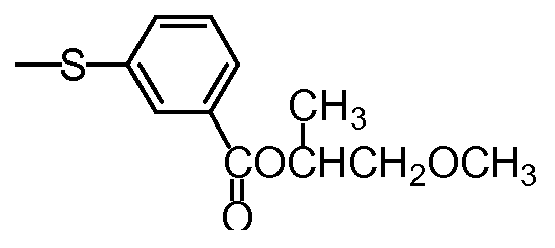
H C-10 Cu 
H C-11 Cu 
H C-12 Cu 
2 or 3, 6 or 7, 10 or 11, and 14 or 15 are substituted with CH3, respectively, and other four sites are unsubstituted. C-13 Cu 
H C-14 Cu 
H C-15 Cu 
2 or 3, 6 or 7, 10 or 11, and 14 or 15 are substituted with CH3, respectively, and other four sites are unsubstituted. C-16 Cu 
H C-17 Cu 
H C-18 Cu 
H C-19 Cu 
H C-20 Cu 
H C-21 Cu 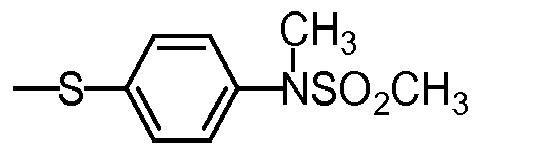
H C-22 Cu 
H C-23 Cu 
H C-24 Cu 
H C-25 Cu 
H C-26 V=0 
H C-27 Co 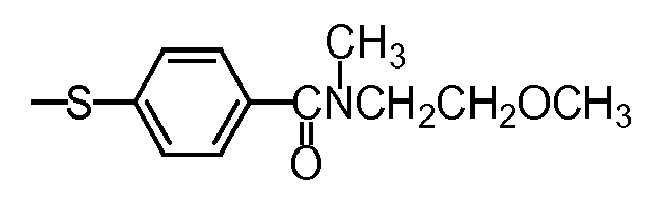
H C-28 Co 
H C-29 Zn 
H C-30 V=0 
H C-31 Cu 
H C-32 Cu 
H C-33 Cu 
H C-34 Cu 
H C-35 Cu 
H 
Exemplary compound M Substituents at 2 or 3, 6 or 7, 10 or 11, and 14 or 15 (other four sites are unsubstituted) Substituents at the other eight sites C-41 Cu 
H C-42 Cu 
H C-43 Cu 
H C-44 Cu 
H C-45 Co 
H C-46 Zn 
H C-47 V=0 
H C-48 Cu 
1 or 4, 5 or 8, 9 or 12, and 13 or 16 are substituted by CH3, respectively, and other four sites are unsubstituted. C-49 Cu 
H 


- The content of the coloring agent in the colored photosensitive composition of the invention with reference to the total solid content is about 50% by mass to about 80% by mass, preferably from about 52 to about 75% by mass, and particularly preferably from about 55 to about 70% by mass from the viewpoint of absorbance attributable to the coloring agent and film curability.
- Next, the resin is described below. When the colored photosensitive composition of the invention contains a resin having an acid value of 1 mg KOH/g to 70 mg KOH/g, peeling of patterns in low exposure amount areas can be prevented during development. The resin used in the invention (hereinafter may be referred to as binder) is not particularly limited, but is preferably selected in consideration of heat resistance, developability, and availability.
- The binder is preferably a linear organic polymer which is soluble in an organic solvent and developable with a weakly alkaline aqueous solution. The linear organic polymer may be a polymer having a carboxylic acid group in the side chain thereof, and examples thereof include a methacrylic acid copolymer, an acrylic acid copolymer, an itaconic acid copolymer, a crotonic acid copolymer, a maleic acid copolymer, and a partially esterified maleic acid copolymer described in, for example,
JP-A No. 59-44615 54-34327 58-12577 54-25957 JP-A No. 59-53836 JP-A No. 59-71048 - The binder may be a copolymer of a hydrophilic monomer, and examples thereof include alkoxyalkyl (meth)acrylate, hydroxyalkyl (meth)acrylate, glycerol (meth)acrylate, (meth)acrylamide, N-methylol acrylamide, secondary and tertiary alkylacrylamides, dialkylaminoalkyl (meth)acrylate, morpholine (meth)acrylate, N-vinyl pyrrolidone, N-vinyl caprolactam, vinyl imidazole, vinyl triazole, methyl (meth)acrylate, ethyl (meth)acrylate, branched or linear propyl (meth)acrylate, branched or linear butyl (meth)acrylate, and phenoxyhydroxypropyl (meth)acrylate. Other examples of useful hydrophilic monomers include a monomer having, for example, a tetrahydrofurfuryl group, phosphoric acid, a phosphoric ester, a quaternary ammonium salt, an ethyleneoxy chain, a propyleneoxy chain, sulfonic acid, and salts thereof, or a morpholinoethyl group.
- The resin in the invention is preferably a resin containing an unsaturated group. The photosensitivity of the resin can be increased by incorporating an unsaturated group into the resin. Typical examples of the resin containing an unsaturated group include: resins obtained by reacting a carboxyl group-containing resin with a glycidyl group-containing unsaturated compound such as glycidyl (meth)acrylate or allyl glycidyl ether, or an unsaturated alcohol such as allyl alcohol, 2-hydroxyacrylate, or 2-hydroxymethacrylate; resins obtained by reacting a carboxyl group-containing resin having a hydroxyl group with a free isocyanate group-containing unsaturated compound or an unsaturated acid anhydride; resins obtained by reacting an addition reaction product of an epoxy resin and an unsaturated carboxylic acid with a polybasic acid anhydride; resins obtained by reacting an addition reaction product of a conjugated diene copolymer and an unsaturated dicarboxylic acid anhydride with a hydroxyl group-containing polymerizable monomer; and resins having an unsaturated group which is obtained by synthesizing a resin having a specific functional group which causes a releasing reaction by base treatment, and then subjecting the resin to base treatment.
- In particular, more preferred are resins obtained by reacting a carboxyl group-containing resin with a glycidyl group-containing unsaturated compound such as glycidyl (meth)acrylate or allylglycidyl ether, resins obtained by reacting a polymer resin of a hydroxyl group-containing (meth)acrylic ester compound with a (meth)acrylic ester having a free isocyanate group such as (meth)acrylic acid-2-isocyanate ethyl, resins corresponding to formulae (1) to (3), and resins having an unsaturated group which is obtained by synthesizing a resin having a specific functional group which causes elimination reaction by base treatment, and then subjecting the resin to base treatment.
- The resin in the invention is particularly preferably a polymer compound having at least one unsaturated double bond selected from the structural units represented by formulae (1) to (3).
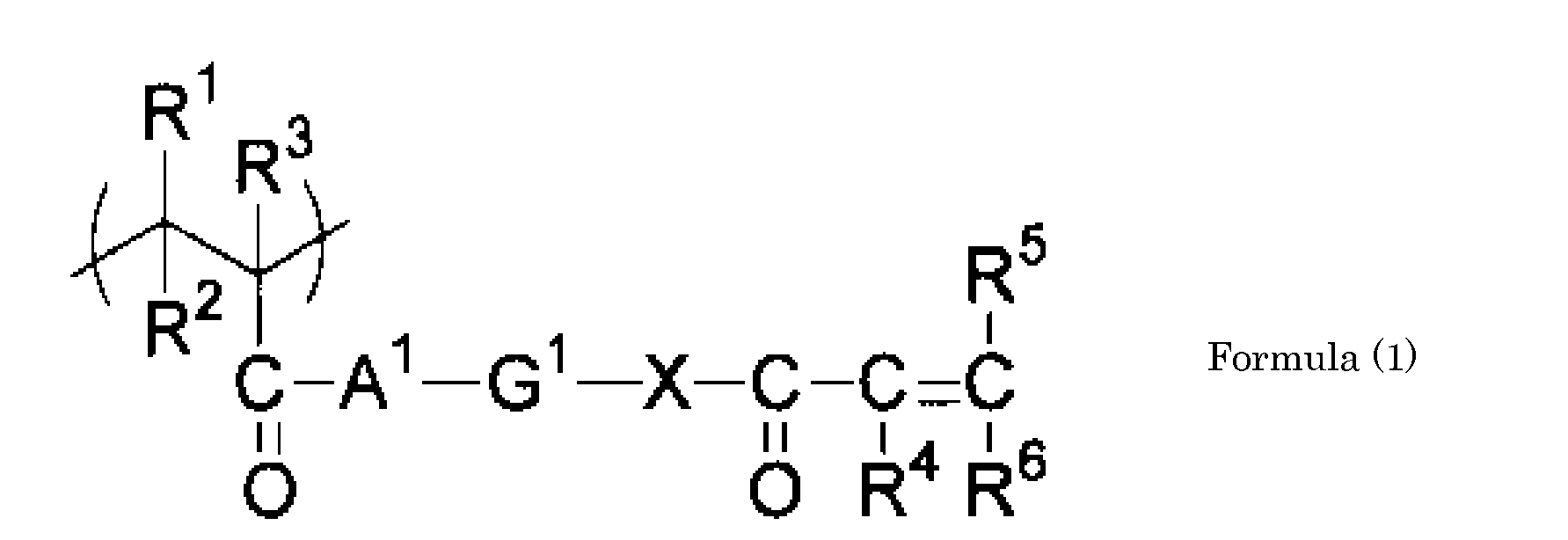

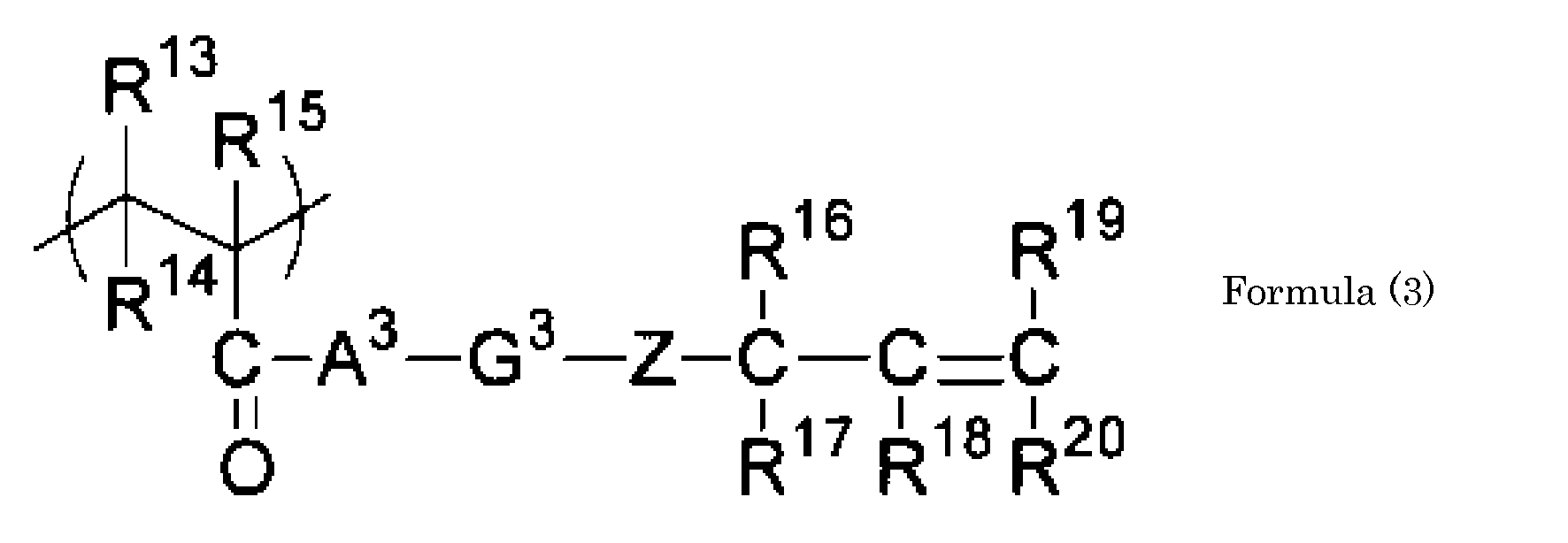
- In formulae (1) to (3), A1, A2, and A3 each independently represent an oxygen atom, a sulfur atom, or -N(R21)-, wherein R21 represents an optionally substituted alkyl group. G1, G2, and G3 each independently represent a divalent organic group. X and Z each independently represent an oxygen atom, a sulfur atom, or -N(R22)-, wherein R22 represents an optionally substituted alkyl group. Y represents an oxygen atom, a sulfur atom, an optionally substituted phenylene group, or -N(R23)-, wherein R23 represents an optionally substituted alkyl group. R1 to R20 each independently represent a monovalent substituent.
- In formula (1), R1 to R3 each independently represent a monovalent substituent such as a hydrogen atom or an optionally substituted alkyl group. In particular, R1 and R2 are preferably hydrogen atoms, and R3 is preferably a hydrogen atom or a methyl group. R4 to R6 each independently represent a monovalent substituent, wherein R4 may be a hydrogen atom or an optionally substituted alkyl group. Among them, a hydrogen atom, a methyl group, and an ethyl group are preferred. R5 and R6 each independently represent, for example, a hydrogen atom, a halogen atom, an alkoxycarbonyl group, a sulfo group, a nitro group, a cyano group, an optionally substituted alkyl group, an optionally substituted aryl group, an optionally substituted alkoxy group, an optionally substituted aryloxy group, an optionally substituted alkylsulfonyl group, or an optionally substituted arylsulfonyl group. Among them, a hydrogen atom, an alkoxycarbonyl group, an optionally substituted alkyl group, and an optionally substituted aryl group are preferred. Examples of the substituent include a methoxycarbonyl group, an ethoxycarbonyl group, an isopropyloxycarbonyl group, a methyl group, an ethyl group, and a phenyl group.
- A1 represents an oxygen atom, a sulfur atom, or -N(R21)-, and X represents an oxygen atom, a sulfur atom, or -N(R22)-, wherein R21 and R22 may be an optionally substituted alkyl group. G1 represent a divalent organic group, and is preferably an optionally substituted alkylene group, and more preferably an optionally substituted alkylene group having 1 to 20 carbon atoms, an optionally substituted cycloalkylene group having 3 to 20 carbon atoms, or an optionally substituted aromatic group having 6 to 20 carbon atoms. Among them, an optionally substituted linear or branched alkylene group having 1 to 10 carbon atoms, an optionally substituted cycloalkylene group having 3 to 10 carbon atoms, an optionally substituted aromatic group having 6 to 12 carbon atoms are preferred from the viewpoint of performance such as strength and developability.
- Preferable examples of the substituent in G1 include a hydroxyl group, and substituents excluding the substituents having a hetero atom to which a hydrogen atom other than a hydrogen atom in a hydroxyl group is bonded (for example, an amino group, a thiol group, and a carboxyl group).
- In the structural unit represented by formula (1) in the invention, A1 is preferably an oxygen atom, a sulfur atom, or -N(R21)-, X is preferably an oxygen atom, a sulfur atom, or -N(R22)-, G1 is preferably an optionally substituted alkylene group, R1 and R2 are preferably hydrogen atoms, R3 is preferably a hydrogen atom or a methyl group, R4 is preferably a hydrogen atom or an alkyl group, R5, and R6 are each independently preferably a hydrogen atom, an alkoxycarbonyl group, an alkyl group, or an aryl group, and R21 and R22 are preferably alkyl groups.
- In formula (2), R7 to R9 each independently represent a monovalent substituent such as a hydrogen atom or an optionally substituted alkyl group. In particular, R7 and R8 are preferably hydrogen atoms, and R9 is preferably a hydrogen atom or a methyl group. R10 to R12 each independently represent a monovalent substituent. Specific examples of the substituent include a hydrogen atom, a halogen atom, a dialkylamino group, an alkoxycarbonyl group, a sulfo group, a nitro group, a cyano group, an optionally substituted alkyl group, an optionally substituted aryl group, an optionally substituted alkoxy group, an optionally substituted aryloxy group, an optionally substituted alkylsulfonyl group, and an optionally substituted arylsulfonyl group. Among them, a hydrogen atom, an alkoxycarbonyl group, an optionally substituted alkyl group, and an optionally substituted aryl group are preferred. Examples of the substituent include those listed for formula (1).
- A2 represents an oxygen atom, a sulfur atom, or -N(R21)-, wherein, R21 may be, for example, a hydrogen atom or an optionally substituted alkyl group. G2 represents a divalent organic group, and is preferably an optionally substituted alkylene group. Preferable examples thereof include an optionally substituted alkylene group having 1 to 20 carbon atoms, an optionally substituted cycloalkylene group having 3 to 20 carbon atoms, and an optionally substituted aromatic group having 6 to 20 carbon atoms. Among them, an optionally substituted linear or branched alkylene group having 1 to 10 carbon atoms, an optionally substituted cycloalkylene group having 3 to 10 carbon atoms, and an optionally substituted aromatic group having 6 to 12 carbon atoms are preferred from the viewpoint of performance such as strength and developability. Examples of the substituent in G2 include a hydroxyl group, and substituents excluding the substituents having a hetero atom to which a hydrogen atom other than a hydrogen atom in a hydroxyl group is bonded (for example, an amino group, a thiol group, and a carboxyl group). If G2 has a substituent having a hetero atom to which a hydrogen atom other than a hydrogen atom in a hydroxyl group is bonded, storage stability may deteriorate by the combined use of an onium salt compound as the below-described initiator. Y represents an oxygen atom, a sulfur atom, -N(R23)- or an optionally substituted phenylene group, wherein R23 may be, for example, a hydrogen atom or an optionally substituted alkyl group.
- In the structural unit represented by formula (2) in the invention, R10 is preferably a hydrogen atom or an alkyl group, R11 and R12 are each independently preferably a hydrogen atom, an alkoxycarbonyl group, an alkyl group, or an aryl group, R7 and R8 are preferably hydrogen atoms, R9 is preferably a hydrogen atom or a methyl group, A2 is an oxygen atom, a sulfur atom, or -N(R21)-, G2 is preferably an optionally substituted linear or branched alkylene group having 1 to 10 carbon atoms, an optionally substituted cycloalkylene group having 3 to 10 carbon atoms, or an optionally substituted aromatic group having 6 to 12 carbon atoms, Y is preferably an oxygen atom, a sulfur atom, -N(R23)-, or an optionally substituted phenylene group, and R21 and R23 are preferably hydrogen atoms or optionally substituted alkyl groups.
- In formula (3), R13 to R15 each independently represent a monovalent substituent such as a hydrogen atom or an optionally substituted alkyl group. In particular, R13 and R14 are preferably hydrogen atoms, R15 is preferably a hydrogen atom or a methyl group. R16 to R20 each independently represent a monovalent substituent, wherein R16 to R20 may be, for example, a hydrogen atom, a halogen atom, a dialkylamino group, an alkoxycarbonyl group, a sulfo group, a nitro group, a cyano group, an optionally substituted alkyl group, an optionally substituted aryl group, an optionally substituted alkoxy group, an optionally substituted aryloxy group, an optionally substituted alkylsulfonyl group, or an optionally substituted arylsulfonyl group. Among them, a hydrogen atom, an alkoxycarbonyl group, an optionally substituted alkyl group, and an optionally substituted aryl group are preferred. Examples of the substituent include those listed for formula (1). A3 represents an oxygen atom, a sulfur atom, or -N(R21)-, and Z represents an oxygen atom, a sulfur atom, or -N(R22)-. Examples of R21 and R22 include those listed for formula (1).
- G3 represent a divalent organic group, and is preferably an optionally substituted alkylene group. Preferable examples thereof include an optionally substituted alkylene group having 1 to 20 carbon atoms, an optionally substituted cycloalkylene group having 3 to 20 carbon atoms, and an optionally substituted aromatic group having 6 to 20 carbon atoms. Among them, an optionally substituted linear or branched alkylene group having 1 to 10 carbon atoms, an optionally substituted cycloalkylene group having 3 to 10 carbon atoms, and an optionally substituted aromatic group having 6 to 12 carbon atoms are preferred from the viewpoint of from the viewpoint of performance such as strength and developability. Preferable examples of the substituent in G3 include a hydroxyl group, and substituents excluding the substituents having a hetero atom to which a hydrogen atom other than a hydrogen atom in a hydroxyl group is bonded (for example, an amino group, a thiol group, and a carboxyl group).
- In the structural unit represented by formula (3) in the invention, R13 and R14 are preferably hydrogen atoms, R15 is preferably a hydrogen atom or a methyl group, R16 to R20 are preferably hydrogen atoms, alkoxycarbonyl groups, optionally substituted alkyl groups, or optionally substituted aryl groups, A3 is preferably an oxygen atom, a sulfur atom, or -N(R21)-, Z is preferably an oxygen atom, a sulfur atom, or -N(R22)-, R21 and R22 are the same as those in formula (1), G3 is preferably an optionally substituted linear or branched alkylene group having 1 to 10 carbon atoms, an optionally substituted cycloalkylene group having 3 to 10 carbon atoms, or an optionally substituted aromatic group having 6 to 12 carbon atoms.
- From the viewpoints of improving curability and reducing development residues, the resin in the invention is preferably a compound containing at least one structural unit selected from those represented by formula (1) to (3) at a ratio of 20 mol% or more and less than 95 mol%, more preferably from 25 to 90 mol%, and even more preferably 30 mol% or more and less than 85 mol% within one molecule.
- The polymer compound having a structural unit represented by any of formulae (1) to (3) may be synthesized in accordance with the synthetic method described in
JP-A No. 2003-262958 - Specific examples of the polymer compound having at least one structural unit represented by any of formulae (1) to (3) include the polymer compounds 1 to 17 listed in Tables 1 to 4.
Polymer compound Structural unit Acid value (mg KOH/g) Mw 1 
33.1 97000 2 
45.5 31000 3 
35.6 50000 4 
25.6 18000 5 
17.1 30000 6 
32.6 11000 7 
31.8 75000 8 
20.2 40000 9 
46.9 55000 10 
38.4 25000 11 
42.2 34000 12 
46.9 7000 13 
45.0 23000 14 
46.2 31000 15 
43.4 59000 16 
47.4 72000 17 
29.0 90000 18 
1.5 50000 19 
69.4 300000 20 
32.6 320000 - The resin containing the unsaturated group is preferably a resin obtained by the below-described synthetic method (1) or (2).
- (1) A polymer synthesized using the compound represented by formula (4) as a copolymerization component is allowed to react with a base to withdraw protons to release L, and obtain the intended polymer compound having a structure represented by formula (1).

JP-A No. 2003-262958
Preferable examples of the inorganic compound base include sodium hydroxide, potassium hydroxide, sodium carbonate, sodium hydrogen carbonate, potassium carbonate, and potassium bicarbonate, and examples of the organic compound base include metal alkoxide such as sodium methoxide, sodium ethoxide, and potassium t-butoxide, and organic amine compounds such as triethylamine, pyridine, and diisopropyl ethylamine. - (2) A polymer synthesized using the compound represented by formula (5) as a copolymerization component is subjected to base treatment to release the specific functional group thereof, whereby X1 is released to form a radical reactive group.
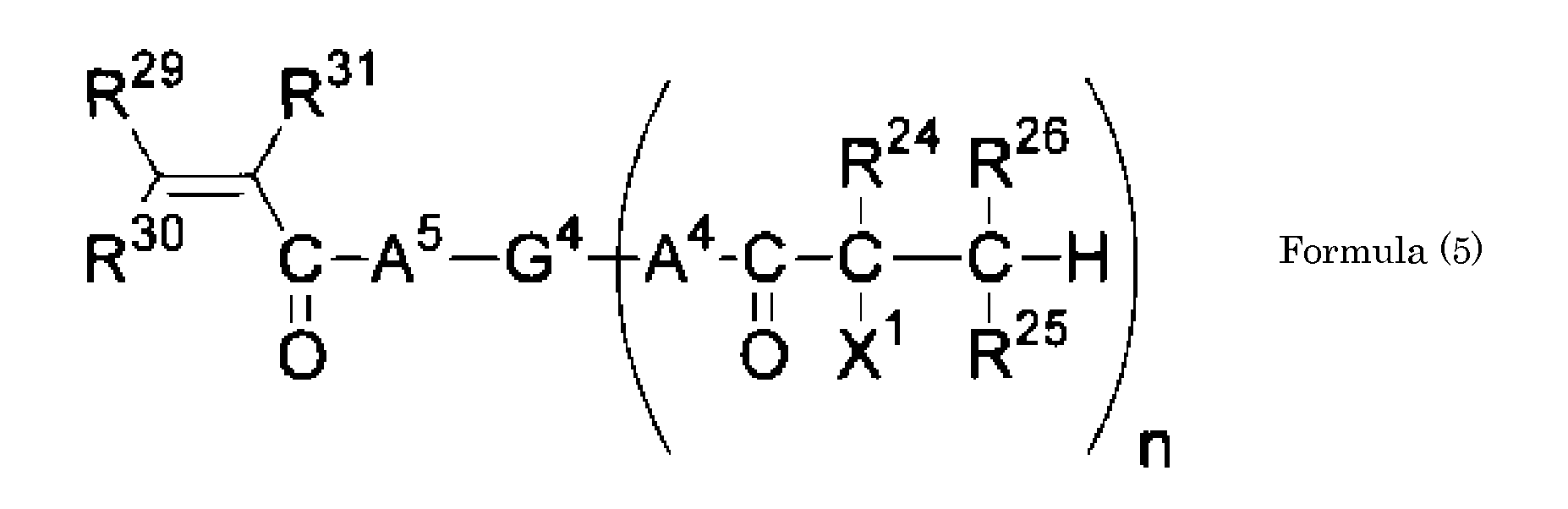
- In formula (5), A4 represents an oxygen atom, a sulfur atom, or -N(R27)-, A5 represents an oxygen atom, a sulfur atom, or -NR28-, R24, R25, R26, R27, R28, R29, R30, and R31 each independently represent a hydrogen or a monovalent organic group, X1 represents a group removed by releasing reaction, and G4 represents an organic linking group. n represents an integral number from 1 to 10.
- In the invention, in particular, A4 is preferably an oxygen atom. R24 is preferably a methyl group, R25, R26, R29, and R30 are preferably hydrogen atoms, and R31 is preferably a methyl group or a hydrogen atom. In addition, X1 is preferably a bromine atom, and G4 is preferably an ethylene group.
- The details and preferable exemplary embodiments of the method are described in
JP-A No. 2003-335814 - Examples of the resin obtained by the synthetic method (2) include polymer compounds described in
JP-A No. 2003-335814 - Specific examples of the compound represented by formula (4) include the compounds (M-1) to (M-12) listed below, but the invention is not limited to them.


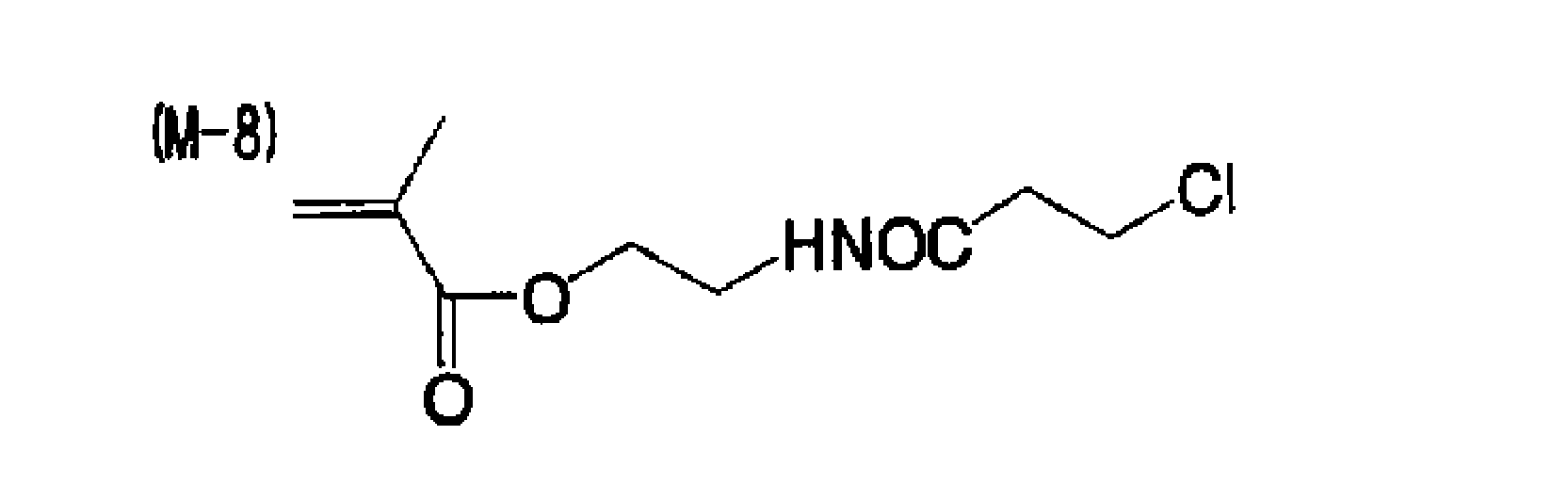
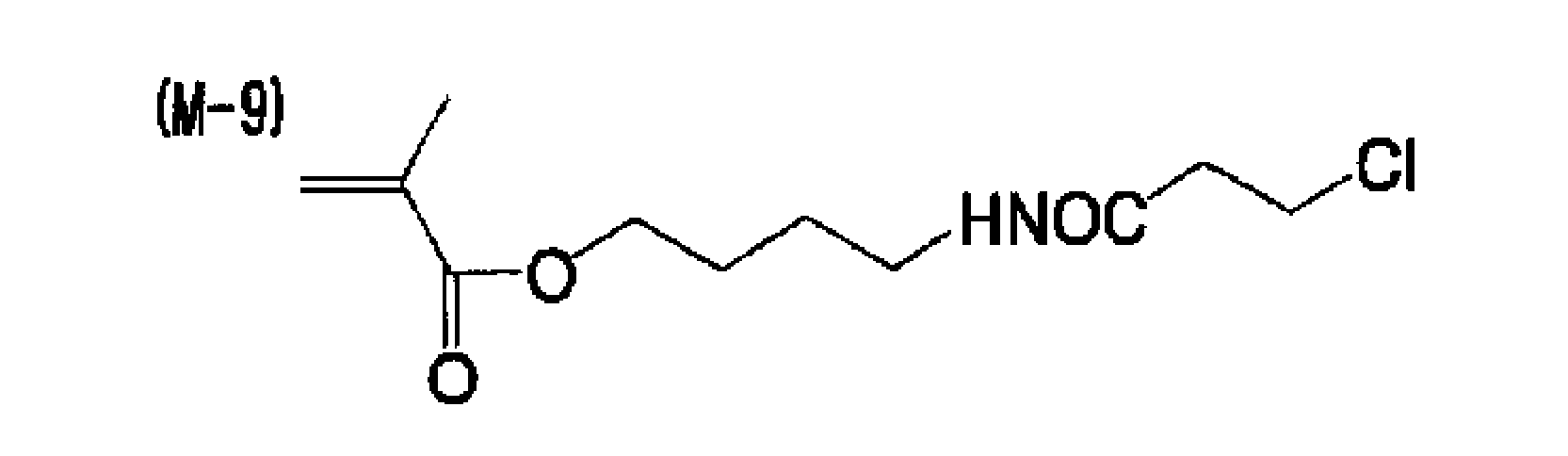


- Examples of the compound represented by formula (5) include the compounds (i-1) to (i-52) listed below, but the invention is not limited to them.


- The resin in the invention particularly preferably has a photopolymerizable unsaturated bond from the viewpoint of improving photosensitivity. In addition, from the viewpoint of enabling alkali development, the resin preferably has at least one acid group selected from COOH, SO3H, PO3H2, OSO3H, and OPO2H2. In addition, the acid value of the resin in the invention is from 1 to 70 mg KOH/g, preferably from 5 to 50 mg KOH/g, and more preferably from 10 to 45 mg KOH/g. If the acid value is more than 70 mg KOH/g, peeling of patterns tends to occur during development. On the other hand, if the acid value is less than 1 mg KOH/g, alkali developability deteriorates.
- In the invention, the acid value may be calculated, for example, from the average content of acid groups in the resin molecule. A resin having an intended acid value is obtained by changing the content of the monomer unit having the acid group composing the resin.
- From the viewpoint of development residues in unexposed areas, the resin in the invention is preferably a copolymer composed of a component containing an amide bond in the resin.
- From the viewpoints of developability and preventing peeling of patterns during development, the mass average molecular weight of the resin in the invention is preferably from 30,000 to 300,000, more preferably from 40,000 to 250,000, even more preferably from 50,000 to 200,000, and particularly preferably from 50,000 to 100,000. The mass average molecular weight of the resin may be determined, for example, by GPC.
- From the viewpoint of achieving both developability and preventing peeling of the pattern during development, the content of the resin in the colored photosensitive composition of the invention with reference to the total solid content is preferably from 0.01 to 20% by mass, more preferably from 1 to 10% by mass, and even more preferably from 3 to 7% by mass.
- The polymerizable compound (polymerizable monomer) is further described below. The polymerizable monomer is preferably a compound having a boiling point of 100°C or more under normal pressure, and having at least one ethylenic unsaturated group capable of addition polymerization.
- Examples of the compound include monofunctional acrylates and metaacrylates such as polyethylene glycol mono(meth)acrylate, polypropylene glycol mono(meth)acrylate, and phenoxyethyl (meth)acrylate; polyethylene glycol di(meth)acrylate, trimethylolethane tri(meth)acrylate, neopentyl glycol di(meth)acrylate, pentaerythritol tri(meth)acrylate, pentaerythritol tetra(meth)acrylate, dipentaerythritol penta(meth)acrylate, dipentaerythritol hexa(meth)acrylate, hexanediol (meth)acrylate;
(meth)acrylates obtained through addition of ethylene oxide or propylene oxide to a polyfunctional alcohol such as trimethylolpropane tri(acryloyloxypropyl)ether, tri(acryloyloxyethyl) isocyanurate, glycerol, or trimethylolethane; urethane acrylates described inJP-B Nos. 48-41708 50-6034 JP-A No. 51-37193 JP-A No. 48-64183 JP-B Nos. 49-43191 52-30490 - In addition to the above-described compounds, radical polymerizable monomers containing a carboxyl group represented by formulae (III-1) and (III-2) are also preferred. In formulae (III-1) and (III-2), in the case of where T or G is an oxyalkylene group, the end on the carbon atom side combines with R, X, and W.


T: -CH2- -OCH2- -OCH2CH2- -OCH2CH2CH2- -OCH2CH2CH2CH2-

G: -CH2- , -OCH2- , -OCH2CH2- , -OCH2CH2CH2- , -OCH2CH2CH2CH2-
- In formula (III-1), n is from 0 to 14, and m is from 1 to 8. In formula (III-2), W is the same meaning as R or X in formula (III-1), wherein three of more of the six Ws are Rs. p is from 0 to 14, and q is from 1 to 8. A plurality of Rs, Xs, Ts, and Gs in one molecule may be the same as or different from each other. Specific examples of the radical polymerizable monomers represented by formulae (III-1) and (III-2) include those represented by the following formulae.


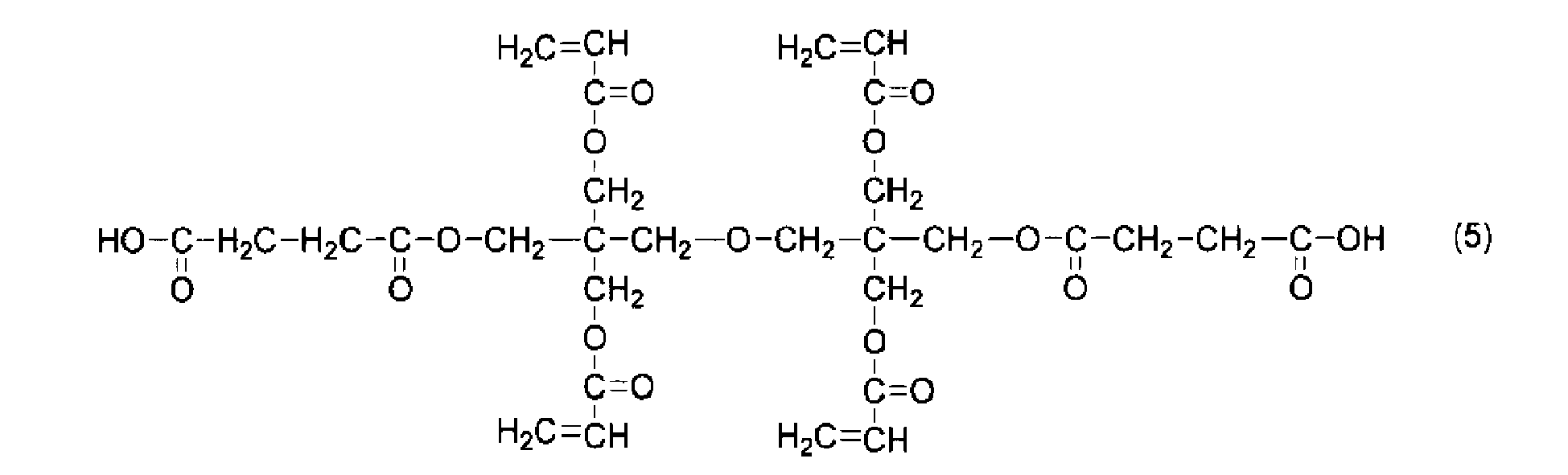


- The content of the polymerizable monomer in the colored photosensitive composition is preferably from 10 to 45% by mass, more preferably from 12 to 40% by mass, and particularly preferably from 15 to 35% by mass with reference to the total solid content in the composition. When the content is within the range, sufficient cure in the exposed areas and solubility of the unexposed areas are maintained, and cure of exposed areas can sufficiently be maintained, and extreme reduction in solubility of the unexposed areas can be prevented.
- The photopolymerization initiator is described below. The colored photosensitive composition of the invention preferably contains at least one photopolymerization initiator. The photopolymerization initiator is not particularly limited as long as it is capable of polymerizing a polymerizable monomer, and is preferably selected in consideration of, for example, properties, initiation efficiency, absorption wavelength, availability, and cost. Examples of the photopolymerization initiator include at least one active halogen compound selected from a halomethyloxadiazole compound and a halomethyl-s-triazine compound, a 3-aryl-substituted coumarin compound, a rofin dimer, a benzophenone compound, an acetophenone compound and derivatives thereof, a cyclopentadiene-benzene-iron complex and salts thereof, and an oxime compound.
- Examples of the active halogen compound such as halomethyloxadiazole include 2-halomethyl-5-vinyl-1,3,4-oxadiazole compound described in
JP-B No. 57-6096 - Examples of the photopolymerization initiator of a halomethyl-s-triazine compound include a vinyl-halomethyl-s-triazine compound described in
JP-B No. 59-1281 JP-ANo. 53-133428 - Other examples include 2,4-bis(trichloromethyl)-6-p-methoxystyryl-s-triazine, 2,6-bis(trichloromethyl)-4-(3,4-methylenedioxyphenyl)-1,3,5-triazine, 2,6-bis(trichloromethyl)-4-(4-methoxyphenyl)-1,3,5-triazine, 2,4-bis(trichloromethyl)-6-(1-p-dimethylaminophenyl-1,3-butadienyl)-s-triazine, 2-trichloromethyl-4-amino-6-p-methoxystyryl-s-triazine, 2-(naphtho-1-yl)-4, 6-bis(trichloromethyl)-s-triazine, 2-(4-methoxy-naphtho-1-yl)-4,6-bis(trichloromethyl)-s-triazine, 2-(4-ethoxy-naphtho-1-yl)-4,6-bis(trichloromethyl)-s-triazine, 2-(4-butoxy-naphtho-1-yl)-4,6-bis(trichloromethyl)-s-triazine, 2-[4-(2-methoxyethyl)-naphtho-1-yl]-4,6-bis(trichloromethyl)-s-triazine, 2-[4-(2-ethoxyethyl)-naphtho-1-yl]-4,6-bis(trichloromethyl)-s-triazine, 2-[4-(2-butoxyethyl)-naphtho-1-yl]-4,6-bis(trichloromethyl)-s-triazine, 2-(2-methoxy-naphtho-1-yl)-4,6-bis(trichloromethyl)-s-triazine, 2-(6-methoxy-5-methyl-naphtho-2-yl)-4,6-bis(trichloromethyl)-s-triazine, 2-(6-methoxy-naphtho-2-yl)-4,6-bis(trichloromethyl)-s-triazine, 2-(5-methoxy-naphtho-1-yl)-4,6-bis(trichloromethyl)-s-triazine, 2-(4,7-dimethoxy-naphtho-1-yl)-4,6-bis(trichloromethyl)-s-triazine,
2-(6-ethoxy-naphtho-2-yl)-4,6-bis(trichloromethyl)s-triazine, 2-(4,5-dimethoxy-naphtho-1-yl)-4,6-bis(trichloromethyl)s-triazine, 4-[p-N, N-bis(ethoxycarbonylmethyl)aminophenyl]-2,6-bis(trichloromethyl)-s-triazine, 4-[o-methyl-p-N, N-bis(ethoxycarbonylmethyl)aminophenyl]-2,6-bis(trichloromethyl)-s-triazine, 4-[p-N, N-bis(chloroethyl)aminophenyl]-2,6-bis(trichloromethyl)-s-triazine, 4-[o-methyl-p-N, N-bis(chloroethyl)aminophenyl]-2,6-bis(trichloromethyl)-s-triazine, 4-(p-N-chloroethylaminophenyl)-2,6-bis(trichloromethyl)-s-triazine, 4-(p-N-ethoxycarbonylmethylaminophenyl)-2,6-bis(trichloromethyl)-s-triazine, 4-[p-N, N-di(phenyl)aminophenyl]-2,6-bis(trichloromethyl)-s-triazine, 4-(p-N-chloroethylcarbonylaminophenyl)-2,6-bis(trichloromethyl)-s-triazine, 4-[p-N-(p-methoxyphenyl)carbonylaminophenyl]-2,6-bis(trichloromethyl)-s-triazine, 4-[m-N, N-bis(ethoxycarbonylmethyl)aminophenyl]-2,6-bis(trichloromethyl)-s-triazine, 4-[m-bromo-p-N, N-bis(ethoxycarbonylmethyl)aminophenyl]-2,6-bis(trichloromethyl)-s-triazine, 4-[m-chloro-p-N, N-bis(ethoxycarbonylmethyl)aminophenyl]-2,6-bis(trichloromethyl)-s-triazine, 4-[m-fluoro-p-N, N-bis(ethoxycarbonylmethyl)aminophenyl]-2,6-bis(trichloromethyl)-s-triazine,
4-[o-bromo-p-N, N-bis(ethoxycarbonylmethyl)aminophenyl]-2,6-bis(trichloromethyl)-s-triazine, 4-[o-chloro-p-N, N-bis(ethoxycarbonylmethyl)aminophenyl-2,6-bis(trichloromethyl)-s-triazine, 4-[o-fluoro-p-N, N-bis(ethoxycarbonylmethyl)aminophenyl]-2,6-bis(trichloromethyl)-s-triazine, 4-[o-bromo-p-N, N-bis(chloroethyl)aminophenyl]-2,6-bis(trichloromethyl)-s-triazine, 4-[o-chloro-p-N, N-bis(chloroethyl)aminophenyl]-2,6-bis(trichloromethyl)-s-triazine, 4-[o-fluoro-p-N, N-bis(chloroethyl)aminophenyl]-2,6-bis(trichloromethyl)-s-triazine, 4-[m-bromo-p-N, N-bis(chloroethyl)aminophenyl]-2,6-bis(trichloromethyl)-s-triazine, 4-[m-chloro-p-N, N-bis(chloroethyl)aminophenyl]-2,6-bis(trichloromethyl)-s-triazine,
4-[m-fluoro-p-N, N-bis(chloroethyl)aminophenyl]-2,6-bis(trichloromethyl)-s-triazine, 4-(m-bromo-p-N-ethoxycarbonylmethylaminophenyl)-2,6-bis(trichloromethyl)-s-triazine, 4-(m-chloro-p-N-ethoxycarbonylmethylaminophenyl)-2,6-bis(trichloromethyl)-s-triazine, 4-(m-fluoro-p-N-ethoxycarbonylmethylaminophenyl)-2,6-bis(trichloromethyl)-s-triazine, 4-(o-bromo-p-N-ethoxycarbonylmethylaminophenyl)-2,6-bis(trichloromethyl)-s-triazine, 4-(o-chloro-p-N-ethoxycarbonylmethylaminophenyl)-2,6-bis(trichloromethyl)-s-triazine, 4-(o-fluoro-p-N-ethoxycarbonylmethylaminophenyl)-2,6-bis(trichloromethyl)-s-triazine, 4-(m-bromo-p-N-chloroethylaminophenyl)-2,6-bis(trichloromethyl)-s-triazine, 4-(m-chloro-p-N-chloroethylaminophenyl)-2,6-bis(trichloromethyl)-s-triazine, 4-(m-fluoro-p-N-chloroethylaminophenyl)-2,6-di(trichloromethyl)-s-triazine, 4-(o-bromo-p-N-chloroethylaminophenyl)-2,6-bis(trichloromethyl)-s-triazine, 4-(o-chloro-p-N-chloroethylaminophenyl)-2,6-bis(trichloromethyl)-s-triazine, and 4-(o-fluoro-p-N-chloroethylaminophenyl)-2,6-bis(trichloromethyl)-s-triazine. - Other useful examples include TAZ Series manufactured by Midori Kagaku Co., Ltd., such as TAZ-107, TAZ-110, TAZ-104, TAZ-109, TAZ-140, TAZ-204, TAZ-113, and TAZ-123, T Series manufactured by PANCHIM, such as T-OMS, T-BMP, T-R, and T-B, IRGACURE Series and DALOCURE Series manufactured by Ciba Specialty Chemicals, such as IRGACURE 651, IRGACURE 184, IRGACURE 500, IRGACURE 1000, IRGACURE 149, IRGACURE 819, IRGACURE 261, and DALOCURE 11734, 4'-bis(diethylamino)-benzophenone, 2-(o-benzoyloxime)-1-[4-(phenylthio)phenyl]-1,2-octanedione, 2-benzyl-2-dimethylamino-4-morpholino butyrophenone, 2,2-dimethoxy-2-phenylacetophenone, 2-(o-chlorophenyl)-4,5-diphenylimidazolyl dimer, 2-(o-fluorophenyl)-4,5-diphenylimidazolyl dimer, 2-(o-methoxyphenyl)-4,5-diphenylimidazolyl dimer, 2-(p-methoxyphenyl)-4,5-diphenylimidazolyl dimer, 2-(p-dimethoxyphenyl)-4,5-diphenylimidazolyl dimer, 2-(2,4-dimethoxyphenyl)-4,5-diphenylimidazolyl dimer, 2-(p-methylmercaptophenyl)-4,5-diphenylimidazolyl dimer, and benzoin isopropyl ether.
- Among the above-described initiator species, oxime compounds are preferred, and 2-(o-benzoyloxime)-1-[4-(phenylthio)phenyl]-1,2-octane dione, and 1-(o-acetyloxime)-1-[9-ethyl-6-(2-methylbenzoyl)-9H-carbazole-3-yl]ethanone are most preferred.
- The composition of the invention may contain, in addition to the photopolymerization initiator, other known photopolymerization initiator. Specific examples thereof include the vicinal polyketaldonyl disclosed in
U.S. Patent No. 2,367,660 , the α-carbonyl compounds disclosed inU.S. Patent Nos. 2,367,661 and2,367,670 , the acyloin ether disclosed inU.S. Patent No. 2,448,828 , the aromatic acyloin compound substituted by α-hydrocarbon disclosed inU.S. Patent No. 2,722,512 , the polynuclear quinone compounds disclosed inU.S. Patent Nos. 3,046,127 and2,951,758 , the combination of a triallylimidazole dimer and p-aminophenyl ketone disclosed inU.S. Patent No. 3,549,367 , and the benzothiazole compound and trihalomethy-s-triazine compound disclosed inJP-B No. 51-48516 - These photopolymerization initiators may be combined with a sensitizer and a photostabilizer. Specific examples thereof include benzoin, benzoinmethyl ether, 9-fluorenone, 2-chloro-9-fluorenone, 2-methyl-9-fluorenone, 9-anthrone, 2-bromo-9-anthrone, 2-ethyl-9-anthrone, 9,10-anthraquinone, 2-ethyl-9,10-anthraquinone, 2-t-butyl-9,10-anthraquinone, 2,6-dichloro-9, 10-anthraquinone, xanthone, 2-methyl xanthone, 2-methoxyxanthone, 2-methoxyxanthone, thioxanthone, 2,4-diethylthioxanthone, acridone, 10-butyl-2-chloroacridone, benzyl, dibenzal acetone, p-(dimethylamino)phenylstyryl ketone, p-(dimethylamino)phenyl-p-methylstyryl ketone, benzophenone, p-(dimethylamino)benzophenone (or Michler ketone), p-(diethylamino)benzophenone, benzoanthrone, the benzothiazole compound described in
JP-B No. 51-48516 - The amount of the photopolymerization initiator to be used is preferably from 1.0% by mass to 40.0% by mass, more preferably from 2.5% by mass to 30.0% by mass, and particularly preferably from 5.0% by mass to 20.0% by mass with reference to the total solid content. If the amount of the photopolymerization initiator is less than 1.0% by mass, polymerization does not proceed smoothly, and if more than 40.0% by mass, the degree of polymerization increases but the molecular weight decreases, which may result in the decrease in the film strength.
- The composition of the invention preferably contains, in addition to the above-described agents, a heat polymerization inhibitor. Useful examples thereof include hydroquinone, p-methoxyphenol, di-t-butyl-p-cresol, pyrogallol, t-butylcatechol, benzoquinone, 4,4'-thiobis(3-methyl-6-t-butylphenol), 2,2'-methylenebis(4-methyl-6-t-butylphenol), and 2-mercaptobenzoimidazole.
- The colored photosensitive composition of the invention preferably contains a solvent. The solvent is not particularly limited as long as the solubility of components and coating property of the composition are satisfied, and is preferably selected in consideration of, in particular, solubility of dyes and binders, coating property, and safety. Preferable examples of the solvent used to prepare the composition of the invention include: esters such as ethylacetate, n-butyl acetate, isobutyl acetate, amyl formate, isoamyl acetate, isobutyl acetate, butyl propionate, isopropyl propionate, ethyl butyrate, butyl butyrate, alkyl esters, oxymethyl acetate, oxyethyl acetate, oxybutyl acetate, methoxymethyl acetate, methoxyethyl acetate, methoxybutyl acetate, ethoxymethyl acetate, ethoxyethyl acetate,
methyl 3-oxypropionate, ethyl 3-oxypropanoate, methyl 3-methoxypropionate, ethyl 3-methoxypropanoate, methyl 3-ethoxypropionate, ethyl 3-ethoxypropionnate, methyl 2-oxypropionate, ethyl 2-oxypropanoate, propyl 2-oxypropionate, methyl 2-methoxypropionate, ethyl 2-methoxypropanoate, propyl 2-methoxypropionate, methyl 2-ethoxypropionate, ethyl 2-ethoxypropionnate, methyl 2-oxy-2-methylpropionate, ethyl 2-oxy-2-methylpropanoate, methyl 2-methoxy-2-methyl propionate, ethyl 2-ethoxy-2-methylpropanoate, methyl pyruvate, ethyl pyruvate, propyl pyruvate, methyl pyruvate, ethyl acetoacetate, methyl 2-oxobutanoate, and ethyl 2-oxobutanoate;
ethers such as diethylene glycol dimethyl ether, tetrahydrofuran, ethylene glycol monomethyl ether, ethylene glycol monoethyl ether, methyl cellosolve acetate (ethylene glycol monomethyl ether acetate), ethyl cellosolve acetate (ethylene glycol monoethyl ether acetate), diethylene glycol monomethyl ether, diethylene glycol monoethyl ether, diethylene glycol monobutyl ether, diethylene glycol monoethyl ether acetate, diethylene glycol monobutyl ether acetate, propylene glycol methyl ether, propylene glycol methyl ether acetate, propylene glycol ethyl ether acetate, and propylene glycol propyl ether acetate; ketones such as methyl ethyl ketone, cyclohexanone, 2-heptanone, and 3-heptanone; and aromatic hydrocarbons such as toluene and xylene. - Among them, 3-methyl ethoxypropionate, 3-ethyl ethoxypropionnate, ethyl cellosolve acetate, ethyl lactate, diethylene glycol dimethyl ether, butyl acetate, methyl 3-methoxypropionate, 2-heptanone, cyclohexanone, ethylcarbitol acetate (diethylene glycol monoethyl ether acetate), butylcarbitol acetate (diethylene glycol monobutyl ether acetate), propylene glycol methyl ether, and propylene glycol methyl ether acetate are more preferred.
- The composition of the invention may contain various additives as necessary, such as a filler, polymer compound other than the above-described ones, a surfactant, an adhesion promoting agent, an antioxidant, an ultraviolet absorber, and an aggregation inhibitor.
- Specific examples of the additives include: a filler such as glass or alumina; a polymer compound other than binder resins, such as polyvinyl alcohol, polyacrylic acid, polyethylene glycol monoalkyl ether, or polyfluoroalkyl acrylate; a nonionic, cationic, or anionic surfactant; an adhesion promoting agent such as vinyltrimethoxysilane, vinyltriethoxysilane, vinyltris(2-methoxyethoxy)silane, N-(2-aminoethyl)-3-aminopropylmethyldimethoxysilane, N-(2-aminoethyl)-3-aminopropyltrimethoxysilane, 3-aminopropyltriethoxysilane, 3-glycidoxypropyltrimethoxysilane, 3-glycidoxypropylmethyldimethoxysilane, 2-(3,4-epoxycyclohexyl)ethyltrimethoxysilane, 3-chloropropylmethyldimethoxysilane, 3-chloropropyltrimethoxysilane, 3-methacryloxypropyltrimethoxysilane, or 3-mercaptopropyltrimethoxysilane; an antioxidant such as 2,2-thiobis(4-methyl-6-t-butylphenol) and 2,6-di-t-butylphenol; an ultraviolet absorber such as 2-(3-t-butyl-5-methyl-2-hydroxyphenyl)-5-chlorobenzotriazole and alkoxybenzophenone; and an aggregation inhibitor such as sodium polyacrylate.
- In order to promote alkali solubility of unexposed areas thereby improving developability of the composition of the invention, the composition of the invention may contain an organic carboxylic acid, preferably organic carboxylic acid having a molecular weight as low as 1000 or less. Specific examples thereof include: aliphatic monocarboxylic acids such as acetic acid, propionic acid, butyric acid, valeric acid, pivalic acid, caproic acid, diethylacetic acid, enanthic acid, and caprylic acid; aliphatic dicarboxylic acids such as oxalic acid, malonic acid, succinic acid, glutaric acid, adipic acid, pimelic acid, suberic acid, azelaic acid, sebacic acid, brasylic acid, methylmalonic acid, ethylmalonic acid, dimethylmalonic acid, methylsuccinic acid, tetramethylsuccinic acid, and citraconic acid; aliphatic tricarboxylic acids such as tricarballylic acid, aconitic acid, and camphoronic acid; aromatic monocarboxylic acids such as benzoic acid, toluic acid, cumic acid, hemellitic acid, and mesitylenic acid; aromatic polycarboxylic acids such as phthalic acid, isophthalic acid, terephthalic acid, trimellitic acid, trimesic acid, mellophanic acid acid, and pyromellitic acid; and other carboxylic acid such as phenylacetic acid, hydroxyatropic acid, hydrocinnamic acid, mandelic acid, phenylsuccinic acid, atropic acid, cinnamic acid, cinnamylideneacetic acid, coumaric acid, and umbellic acid.
- The color filter of the invention is formed by use of the colored photosensitive composition of the invention. The method for making the color filter of the invention may include: applying the colored photosensitive composition of the invention onto a support by, for example, rotary coating, cast coating, or roll coating thereby forming a colored photosensitive composition layer; exposing the colored photosensitive composition layer with light through a predetermined mask pattern and developing the colored photosensitive composition layer with a developing solution to form a color pattern. The method for making the color filter of the invention may include, as necessary, curing the resist pattern by heating and/or exposure. The radiation used herein is particularly preferably ultraviolet light such as g-line, h-line, or i-line.
- Examples of the support include soda glass used in liquid crystal display devices, borosilicate glass such as PYREX (registered trademark), quartz glass, and these glasses having a transparent conductive film, and photoelectric conversion device substrates used in an image pick up element, such as a silicon substrate and a complementary metal oxide semiconductor (CMOS). These supports may have black stripes for isolating respective pixels. As necessary, these supports may have thereon an undercoat layer for improving adhesion with the upper layer, preventing diffusion of substances, or planarizing the substrate surface.
- The developing solution used to make the color filter of the invention may be any composition as long as it dissolves the composition of the invention and does not dissolve the exposed areas to radiation. Specific examples thereof include combinations of various organic solvents and aqueous alkaline solutions. Examples of the organic solvent include the above-described solvents used for preparing the composition of the invention.
- The aqueous alkaline solution may be, for example, an aqueous alkaline solution containing from 0.001 to 10% by mass, preferably from 0.01 to 1% by mass of an alkaline compound such as sodium hydroxide, potassium hydroxide, sodium carbonate, sodium silicate, sodium metasilicate, ammonia water, ethylamine, diethylamine, dimethylethanolamine, tetramethylammonium hydroxide, tetraethylammonium hydroxide, choline, pyrrole, piperidine, or 1,8-diazabicyclo-[5.4.0]-7-undecene. In the case of where a developing solution composed of such an aqueous alkaline solution is used, the developing solution is washed away after development.
- The color filter of the invention may be used in liquid crystal display devices and solid-state image pickup devices such as and CCDs, and is particularly suitable for high resolution CCDs and CMOS devices having more than 100,0000 pixels. The color filter of the invention is useful as, for example, a color filter for CCD, wherein the color filter is disposed between the light receiving portions of the pixels for forming the CCD and the microlens for condensing light.
-
- (1) A colored photosensitive composition containing coloring agents at a ratio of 50% by mass to 80% by mass with reference to the total solid content, and a resin having an acid value of 1 mg KOH/g to 70 mg KOH/g.
- (2) The colored photosensitive composition of (1), wherein the mass average molecular weight of the resin is 30,000 to 300,000.
- (3) The colored photosensitive compositions of (1) or (2), wherein the resin contains an unsaturated group.
- (4) The colored photosensitive composition of any one of (1) to (3), wherein all of the coloring agents are organic solvent-soluble dyes.
- (5) The colored photosensitive composition of any one of (1) to (4), which further contains a polymerizable compound, wherein the colored photosensitive composition is a negative-working composition.
- (6) A method for making a color filter, of the method comprising: applying the colored photosensitive composition of any one of (1) to (5) onto a support to form a colored photosensitive composition layer; exposing the colored photosensitive composition layer with light through a mask; and developing the exposed colored photosensitive composition layer to form a pattern on the support.
- (7) A color filter that has been manufactured from the colored photosensitive composition of any one of (1) to (5).
- (8) A color filter made by the method of making a color filter according to (6).
- The present invention is further described below in detail with reference to the following examples, but the invention is not limited to the following examples without departing from the scope of the invention. "Part" is based on mass unless otherwise noted.
-
Propylene glycol monomethyl ether acetate (PGMEA) 19.20 parts Ethyl lactate 36.67 parts Resin 30.51 parts [40% PGMEA solution of benzyl methacrylate/methacrylic acid/methacrylic acid-2-hydroxyethyl copolymer (molar ratio = 60:22:18)] 12.20 parts Dipentaerythritol hexaacrylate 12.20 parts (photopolymerizable compound) Polymerization inhibitor (p-methoxyphenol) 0.0061 parts Fluorine surfactant (trade name: F-475, manufactured by Dainippon Ink and Chemicals, Incorporated) 0.83 parts Photopolymerization initiator (Trade name: TAZ-107, manufactured by Midori Kagaku Co., Ltd., trihalomethyl triazine photopolymerization initiator) 0.586 parts - Above ingredients were mixed and dissolved to make a resist liquid.
- A 6-inch silicon wafer was heated in an oven at 200°C for 30 minutes. Subsequently, the resist liquid was applied onto the silicon wafer to give a dry film thickness of 1 µm, dried in an oven at 220°C for 1 hour to form an undercoat layer, and thus a silicon wafer substrate having an undercoat layer was obtained.
- The compounds of the following composition A-1 were mixed and dissolved to make a colored photosensitive resin composition A-1.
-
Cyclohexanone 80 parts Coloring agent A (above-described exemplary compound C-25) 8.16 parts Coloring agent B (below-described exemplary compound a) 3.84 parts KARAYAD DPHA (polymerizable compound manufactured by Nippon Kayaku Co., Ltd.) 4.91 parts Photopolymerization initiator 1.50 parts (Trade name: CGI-242, manufactured by Ciba Specialty Chemicals) Resin (above-described polymer compound 15) 0.98 parts Dicyclohexylmethylamine 0.61 parts Surfactant (Trade name: F-781, manufactured by Dainippon Ink and Chemicals, Incorporated) 0.02 parts - The colored photosensitive resin composition A-1 prepared as described in 3) was applied onto the undercoat layer of the silicon wafer substrate having an undercoat layer obtained as described in 2), whereby a photocurable coating film was formed. The coating film was prebaked on a hot plate at 100°C for 120 seconds to give a dry film having a thickness of 0.6 µm. Subsequently, the coating film was irradiated with light using an i-line stepper exposure device (Trade name: FPA-3000i5+, manufactured by Canon. Inc.) at a wavelength of 365 nm through an island pattern mask with a 1.2 µm square pattern in exposure amounts of from 100 to 2500 mJ/cm2 with the amount increased in increments of 100 mJ/cm2. Subsequently, the silicon wafer substrate having an irradiated coating film was placed on a horizontal rotary table of a spin-shower developing machine (model: DW-30, manufactured by Chemitronics Co.), and subjected to paddle development at 23°C for 60 seconds using CD-2000 (manufactured by Fuji Film Electronic Materials Co., Ltd.), whereby a color pattern was formed on the silicon wafer substrate.
- The silicon wafer substrate having the color pattern was fixed on the horizontal rotary table with a vacuum chuck system. While the silicon wafer substrate was rotated by a rotator at a rotation speed of 50 rpm, the substrate was rinsed with a shower of pure water supplied from a jet nozzle above the center of rotation, and then spray-dried to make a color filter.
- The color filter was observed under an optical microscope at a magnification of 100 times, and the minimum exposure amount (mJ/cm2) necessary for adhering all portions of the pattern was determined.
- The evaluation of developability of unexposed areas was conducted by observing the pattern after development with SEM at a magnification of 10,000 times, and rating the result on the basis of the following criteria.
-
- A: Unexposed areas are completely removed.
- B: Residue occurs at acceptable level.
- C: Residue occurs at unacceptable level.
- D: Significant residue occurs at unacceptable level.
- Color filters were made in the same manner as Example 1, except that the colored photosensitive composition A-1 was replaced with colored photosensitive compositions A-2 to A-17 containing the coloring agents and the resins listed in Table 1, and the minimum exposure amount (mJ/cm2) necessary for adhering all portions of the pattern after development and developability of the unexposed areas were evaluated.
[Table 1] Colored photosensitive composition Coloring agents Resin Minimum exposure amount (mJ/cm2) Developability of unexposed areas Coloring agent A Coloring agent B Content of coloring agents Structure Acid value (mg KOH/g) Mass average molecular weight Example 1 A-1 C-25 a 60% Polymer compound 15 43.4 59,000 200 A Example 2 A-2 C-5 b 60% Polymer compound 1 33.1 97,000 100 A Example 3 A-3 C-58 c 60% Polymer compound 17 29.0 90,000 100 A Example 4 A-4 C-1 d 60% Polymer compound 3 35.6 50,000 100 A Example 5 A-5 C-6 f 60% Polymer compound 5 17.1 30,000 200 A Example 6 A-6 e c 60% Polymer compound 6 32.6 11,000 400 A Example 7 A-7 e f 60% Polymer compound 7 31.8 75,000 100 A Example 8 A-8 C.IAcid Red 57 f 60% Polymer compound 2 45.5 31,000 300 A Example 9 A-9 C.I Acid Blue 249 d 60% Polymer compound 12 46.9 7,000 400 A Example 10 A-10 C.IAcid Blue 249 b 60% g 33.6 30,000 500 A Example 11 A-11 C.IAcid Blue 249 b 60% Polymer compound 18 1.5 50,000 100 A Example 12 A-12 C.IAcid Blue 249 b 60% Polymer compound 19 69.4 300,000 300 A Example 13 A-13 C.IAcid Blue 249 b 60% Polymer compound 20 32.6 320,000 100 B Example 14 A-14 C.I. Pigment Green 7 C.I Pigment Yellow 83 60% Polymer compound 15 43.4 59,000 100 B Comparative example 1 A-15 C.IAcid Blue 249 b 60% h 70.9 20,000 1500 A Comparative example 2 A-16 C.IAcid Blue 249 b 60% i 0.6 50,000 100 D Comparative example 3 A-17 C.IAcid Blue 249 b 60% None - - 2500 A 


- Color filters were made in the same manner as Example 1, except that the colored photosensitive composition A-1 was replaced with colored photosensitive compositions A-18 to A-23 in accordance with Table 2, and the obtained filters were evaluated. The results are summarized in Table 2.
-
Cyclohexanone 80 parts Coloring agent A (above-described exemplary compound C-25) 6.12 parts Coloring agent B (below-described exemplary compound a) 2.88 parts KARAYAD DPHA (polymerizable compound manufactured by Nippon Kayaku Co., Ltd.) 7.91 parts Photopolymerization initiator 1.50 parts (Trade name: CGI-242, manufactured by Ciba Specialty Chemicals) Resin (above-described polymer compound 15) 0.98 parts Dicyclohexylmethylamine Surfactant (Trade name: F-781, manufactured by Dainippon Ink and Chemicals, 0.61 parts Incorporated) 0.02 parts -
Cyclohexanone 80 parts Coloring agent A (above-described exemplary compound C-25) 6.12 parts Coloring agent B (below-described exemplary compound a) 2.88 parts KARAYAD DPHA (polymerizable compound manufactured by Nippon Kayaku Co., Ltd.) 8.89 parts Photopolymerization initiator 1.50 parts (Trade name: CGI-242, manufactured by Ciba Specialty Chemicals) Dicyclohexylmethylamine 0.61 parts Surfactant (Trade name: F-781, manufactured by Dainippon Ink and Chemicals, Incorporated) 0.02 parts -
Cyclohexanone 80 parts Coloring agent A (above-described exemplary compound C-25) 6.80 parts Coloring agent B (below-described exemplary compound a) 3.20 parts KARAYAD DPHA (polymerizable compound manufactured by Nippon Kayaku Co., Ltd.) 6.89 parts Photopolymerization initiator (Trade name: CGI-242, manufactured by Ciba Specialty Chemicals) 1.50 parts Resin (above-described polymer compound 15) 0.98 parts Dicyclohexylmethylamine 0.61 parts Surfactant (Trade name: F-781, manufactured by Dainippon Ink and Chemicals, Incorporated) 0.02 parts -
Cyclohexanone 80 parts Coloring agent A (above-described exemplary compound C-25) 6.80 parts Coloring agent B (below-described exemplary compound a) 3.20 parts KARAYAD DPHA (polymerizable compound manufactured by Nippon Kayaku Co., Ltd.) 7.87 parts Photopolymerization initiator 1.50 parts (Trade name: CGI-242, manufactured by Ciba Specialty Chemicals) Dicyclohexylmethylamine 0.61 parts Surfactant (Trade name: F-781, manufactured by Dainippon Ink And Chemicals, Incorporated) 0.02 parts -
Cyclohexanone 80 parts Coloring agent A (above-described exemplary compound C-25) 10.88 parts Coloring agent B (below-described exemplary compound a) 5.12 parts KARAYAD DPHA (polymerizable compound manufactured by Nippon Kayaku Co., Ltd.) 2.37 parts Photopolymerization initiator 0.50 parts (Trade name: CGI-242, manufactured by Ciba Specialty Chemicals) Resin (above-described polymer compound 15) 0.50 parts Dicyclohexylmethylamine 0.61 parts Surfactant (Trade name: F-781, manufactured by Dainippon Ink And Chemicals, Incorporated) 0.02 parts -
Cyclohexanone 80 parts Coloring agent A (above-described exemplary compound C-25) 10.88 parts Coloring agent B (below-described exemplary compound a) 5.12 parts KARAYAD DPHA (polymerizable compound manufactured by Nippon Kayaku Co., Ltd.) 2.87 parts Photopolymerization initiator (Trade name: CGI-242, manufactured by Ciba Specialty Chemicals) 0.50 parts Dicyclohexylmethylamine 0.61 parts Surfactant (Trade name: F-781, manufactured by Dainippon Ink and Chemicals, Incorporated) 0.02 parts -
Cyclohexanone 80 parts Coloring agent A (above-described exemplary compound C-25) 11.22 parts Coloring agent B (below-described exemplary compound a) 5.28 parts KARAYAD DPHA (polymerizable compound manufactured by Nippon Kayaku Co., Ltd.) 1.87 parts Photopolymerization initiator 0.50 parts (Trade name: CGI-242, manufactured by Ciba Specialty Chemicals) Resin (above-described polymer compound 15) 0.50 parts Dicyclohexylmethylamine 0.61 parts Surfactant (Trade name: F-781, manufactured by Dainippon Ink and Chemicals, Incorporated) 0.02 parts -
Cyclohexanone 80 parts Coloring agent A (above-described exemplary compound C-25) 11.22 parts Coloring agent B (below-described exemplary compound a) 5.28 parts KARAYAD DPHA (polymerizable compound manufactured by Nippon Kayaku Co., Ltd.) 2.37 parts Photopolymerization initiator 0.50 parts (Trade name: CGI-242, manufactured by Ciba Specialty Chemicals) Dicyclohexylmethylamine 0.61 parts Surfactant (trade name: F-781, manufactured by Dainippon Ink and Chemicals, Incorporated) 0.02 parts [Table 2] Colored photosensitive composition Coloring agents Resin Minimum exposure amount (mJ/cm2) Developability of unexposed areas Coloring agent A Coloring agent B Content of coloring agents Structure Acid value (mg KOH/ g) Mass average molecular weight Example 15 A-20 C-25 a 50% Polymer compound 15 43.4 59,000 100 A Example 16 A-22 C-25 a 80% Polymer compound 15 43.4 59,000 500 A Comparative example 4 A-18 C-25 a 45% Polymer compound 15 43.4 59,000 100 C Comparative example 5 A-19 C-25 a 45% None - - 300 A Comparative example 6 A-21 C-25 a 50% None - - 700 A Comparative example 7 A-23 C-25 a 80% None - - 2400 A Comparative example 8 A-24 C-25 a 82.5% Polymer compound 7 43.4 59,000 1300 A Comparative example 9 A-25 C-25 a 82.5% None - - >2500 A - The results summarized in Tables 1 and 2 indicate that the color patterns formed with the colored photosensitive composition of the invention exhibited good adhesiveness even at a low exposure amount.
- However, when the content of the coloring agents in the colored photosensitive composition was increased in accordance with the formulation as described in
JP-A No. 2006-276878 - The invention provides a colored photosensitive composition, a color filter including the colored photosensitive composition, and a method for making the color filter, wherein the colored photosensitive composition prevents the occurrence of peeling off of the pixel pattern during development even at a low exposure amount.
- All publications, and technical standards mentioned in this specification are herein incorporated by reference to the same extent as if each individual publication, patent application, or technical standard was specifically and individually indicated to be incorporated by reference.
Claims (8)
- A colored photosensitive composition comprising coloring agents at a ratio of 50% by mass to 80% by mass with reference to the total solid content, and a resin having an acid value of 1 mg KOH/g to 70 mg KOH/g.
- The colored photosensitive composition of Claim 1, wherein the mass average molecular weight of the resin is 30,000 to 300,000.
- The colored photosensitive composition of Claims 1 or 2, wherein the resin contains an unsaturated group.
- The colored photosensitive composition of any one of Claims 1 to 3, wherein all of the coloring agents are organic solvent-soluble dyes.
- The colored photosensitive composition of any one of Claims 1 to 4, which further comprises a polymerizable compound, wherein the colored photosensitive composition is a negative-working composition.
- A method for making a color filter, the method comprising: applying the colored photosensitive composition of any one of Claims 1 to 5 onto a support to form a colored photosensitive composition layer; exposing the colored photosensitive composition layer with light through a mask; and developing the exposed colored photosensitive composition layer to form a pattern on the support.
- A color filter that has been manufactured from the colored photosensitive composition of any one of Claims 1 to 5.
- A color filter made by the method for making a color filter of Claim 6.
Applications Claiming Priority (1)
| Application Number | Priority Date | Filing Date | Title |
|---|---|---|---|
| JP2007047540A JP4855299B2 (en) | 2007-02-27 | 2007-02-27 | Colored photosensitive composition, color filter and method for producing the same |
Publications (2)
| Publication Number | Publication Date |
|---|---|
| EP1965255A1 true EP1965255A1 (en) | 2008-09-03 |
| EP1965255B1 EP1965255B1 (en) | 2015-08-12 |
Family
ID=39493507
Family Applications (1)
| Application Number | Title | Priority Date | Filing Date |
|---|---|---|---|
| EP08101959.8A Not-in-force EP1965255B1 (en) | 2007-02-27 | 2008-02-25 | Color filter and method for making the color filter |
Country Status (3)
| Country | Link |
|---|---|
| US (1) | US20080206660A1 (en) |
| EP (1) | EP1965255B1 (en) |
| JP (1) | JP4855299B2 (en) |
Cited By (1)
| Publication number | Priority date | Publication date | Assignee | Title |
|---|---|---|---|---|
| CN110073253A (en) * | 2016-12-14 | 2019-07-30 | 昭和电工株式会社 | Colour filter resin combination, the manufacturing method of colour filter resin combination and colour filter |
Families Citing this family (2)
| Publication number | Priority date | Publication date | Assignee | Title |
|---|---|---|---|---|
| JP5393092B2 (en) * | 2008-09-30 | 2014-01-22 | 富士フイルム株式会社 | Dye-containing negative curable composition, color filter using the same, method for producing the same, and solid-state imaging device |
| JP5705459B2 (en) | 2009-09-04 | 2015-04-22 | 富士フイルム株式会社 | Photocurable composition for color filter, color filter formed with the photocurable composition, and image display device including the same |
Citations (7)
| Publication number | Priority date | Publication date | Assignee | Title |
|---|---|---|---|---|
| JPS5425957B2 (en) | 1974-10-04 | 1979-08-31 | ||
| JPS5434327B1 (en) | 1970-12-28 | 1979-10-26 | ||
| JPS5812577B2 (en) | 1973-12-21 | 1983-03-09 | ヘキスト アクチエンゲゼルシヤフト | Photopolymerizable copying material |
| JPS5953836A (en) | 1982-09-21 | 1984-03-28 | Fuji Photo Film Co Ltd | Photosensitive lithographic plate |
| JPS5971048A (en) | 1982-10-18 | 1984-04-21 | Mitsubishi Chem Ind Ltd | Photopolymerizable photosensitive composition |
| EP1571469A1 (en) * | 2002-11-29 | 2005-09-07 | DAICEL CHEMICAL INDUSTRIES, Ltd. | Colored photosensitive composition for color filters, color filters, and process for the production thereof |
| JP2006276878A (en) | 2006-05-25 | 2006-10-12 | Mitsubishi Chemicals Corp | Photopolymerizable composition for color filter and color filter |
Family Cites Families (8)
| Publication number | Priority date | Publication date | Assignee | Title |
|---|---|---|---|---|
| US5541235A (en) * | 1995-03-06 | 1996-07-30 | Minnesota Mining And Manufacturing Company | Organic soluble cationic dyes with fluorinated alkylsulfonyl counterions |
| JPH08297366A (en) * | 1995-04-27 | 1996-11-12 | Toppan Printing Co Ltd | Photosensitive coloring composition and color filter using the same |
| JP2001042521A (en) * | 1999-08-03 | 2001-02-16 | Toppan Printing Co Ltd | Photosensitive coloring composition and color filter using the same |
| JP2002341533A (en) * | 2001-05-15 | 2002-11-27 | Showa Denko Kk | Color composition and photosensitive color composition for color filter |
| CN1301276C (en) * | 2001-09-25 | 2007-02-21 | 大日本印刷株式会社 | Alkali-soluble maleimide copolymer and liquid crystal display comprising the same |
| DE60327571D1 (en) * | 2002-03-11 | 2009-06-25 | Fujifilm Corp | Process for the preparation of polymer compounds by elimination reaction |
| JP4442292B2 (en) * | 2003-06-10 | 2010-03-31 | 三菱化学株式会社 | Photopolymerizable composition, color filter and liquid crystal display device |
| JP4885459B2 (en) * | 2005-02-07 | 2012-02-29 | 東洋インキScホールディングス株式会社 | Green coloring composition for color filter and color filter |
-
2007
- 2007-02-27 JP JP2007047540A patent/JP4855299B2/en active Active
-
2008
- 2008-02-25 EP EP08101959.8A patent/EP1965255B1/en not_active Not-in-force
- 2008-02-26 US US12/037,502 patent/US20080206660A1/en not_active Abandoned
Patent Citations (7)
| Publication number | Priority date | Publication date | Assignee | Title |
|---|---|---|---|---|
| JPS5434327B1 (en) | 1970-12-28 | 1979-10-26 | ||
| JPS5812577B2 (en) | 1973-12-21 | 1983-03-09 | ヘキスト アクチエンゲゼルシヤフト | Photopolymerizable copying material |
| JPS5425957B2 (en) | 1974-10-04 | 1979-08-31 | ||
| JPS5953836A (en) | 1982-09-21 | 1984-03-28 | Fuji Photo Film Co Ltd | Photosensitive lithographic plate |
| JPS5971048A (en) | 1982-10-18 | 1984-04-21 | Mitsubishi Chem Ind Ltd | Photopolymerizable photosensitive composition |
| EP1571469A1 (en) * | 2002-11-29 | 2005-09-07 | DAICEL CHEMICAL INDUSTRIES, Ltd. | Colored photosensitive composition for color filters, color filters, and process for the production thereof |
| JP2006276878A (en) | 2006-05-25 | 2006-10-12 | Mitsubishi Chemicals Corp | Photopolymerizable composition for color filter and color filter |
Cited By (1)
| Publication number | Priority date | Publication date | Assignee | Title |
|---|---|---|---|---|
| CN110073253A (en) * | 2016-12-14 | 2019-07-30 | 昭和电工株式会社 | Colour filter resin combination, the manufacturing method of colour filter resin combination and colour filter |
Also Published As
| Publication number | Publication date |
|---|---|
| US20080206660A1 (en) | 2008-08-28 |
| EP1965255B1 (en) | 2015-08-12 |
| JP4855299B2 (en) | 2012-01-18 |
| JP2008209765A (en) | 2008-09-11 |
Similar Documents
| Publication | Publication Date | Title |
|---|---|---|
| EP2028544B1 (en) | Colored photosensitive composition, color filter, and method for manufacturing color filter | |
| EP2348361B1 (en) | Negative-type dye-containing curable composition, color filter and method for production thereof both utilizing the composition, and solid imaging element | |
| KR101596338B1 (en) | Color filter and production method thereof and solid-state image sensor using the same | |
| JP2014001390A (en) | Photopolymerizable composition, color filter, and process for producing the same | |
| US7914956B2 (en) | Dye-containing negative working curable composition, color filter and production method thereof | |
| JP5317614B2 (en) | Colored photosensitive composition for solid-state imaging device, color filter for solid-state imaging device, and method for producing the same | |
| EP1508597B1 (en) | Curable composition, negative type color filter and method of producing the same | |
| US7645545B2 (en) | Colorant-containing curable composition, color filter and production method thereof | |
| JP2006071822A (en) | Colored hardenability composition, color filter, and its manufacturing method | |
| JP4837603B2 (en) | Negative curable composition, color filter and method for producing the same | |
| EP1965255B1 (en) | Color filter and method for making the color filter | |
| KR101000374B1 (en) | Photocurable compositions, components for liquid crystal display devices and components for solid-state image pickup devices using the same, and methods for manufacturing the same | |
| KR101244722B1 (en) | Dye-containing negative-type curable composition, color filter and method of producing the same | |
| KR101511202B1 (en) | Processed pigment, pigment dispersion composition, photocurable composition, color filter, and method of manufacturing color filter | |
| JP4884832B2 (en) | Dye-containing negative curable composition, color filter and method for producing the same | |
| JP4384585B2 (en) | Dye-containing negative curable composition, color filter and method for producing the same | |
| JP4884833B2 (en) | Dye-containing negative curable composition, color filter and method for producing the same | |
| JP2007219025A (en) | Dye-containing negative photosensitive composition, color filter and production method thereof | |
| JP5214001B2 (en) | Negative curable composition | |
| JP5676699B2 (en) | Color filter, method for forming the same, and solid-state imaging device |
Legal Events
| Date | Code | Title | Description |
|---|---|---|---|
| PUAI | Public reference made under article 153(3) epc to a published international application that has entered the european phase |
Free format text: ORIGINAL CODE: 0009012 |
|
| AK | Designated contracting states |
Kind code of ref document: A1 Designated state(s): AT BE BG CH CY CZ DE DK EE ES FI FR GB GR HR HU IE IS IT LI LT LU LV MC MT NL NO PL PT RO SE SI SK TR |
|
| AX | Request for extension of the european patent |
Extension state: AL BA MK RS |
|
| 17P | Request for examination filed |
Effective date: 20090227 |
|
| AKX | Designation fees paid |
Designated state(s): AT BE BG CH CY CZ DE DK EE ES FI FR GB GR HR HU IE IS IT LI LT LU LV MC MT NL NO PL PT RO SE SI SK TR |
|
| GRAP | Despatch of communication of intention to grant a patent |
Free format text: ORIGINAL CODE: EPIDOSNIGR1 |
|
| INTG | Intention to grant announced |
Effective date: 20150402 |
|
| RIN1 | Information on inventor provided before grant (corrected) |
Inventor name: SHIMADA, KAZUTO Inventor name: TAKAKUWA, HIDEKI Inventor name: NAKASHIMA, TAEKO |
|
| GRAS | Grant fee paid |
Free format text: ORIGINAL CODE: EPIDOSNIGR3 |
|
| GRAA | (expected) grant |
Free format text: ORIGINAL CODE: 0009210 |
|
| AK | Designated contracting states |
Kind code of ref document: B1 Designated state(s): AT BE BG CH CY CZ DE DK EE ES FI FR GB GR HR HU IE IS IT LI LT LU LV MC MT NL NO PL PT RO SE SI SK TR |
|
| REG | Reference to a national code |
Ref country code: GB Ref legal event code: FG4D |
|
| REG | Reference to a national code |
Ref country code: CH Ref legal event code: EP |
|
| REG | Reference to a national code |
Ref country code: AT Ref legal event code: REF Ref document number: 742669 Country of ref document: AT Kind code of ref document: T Effective date: 20150815 |
|
| REG | Reference to a national code |
Ref country code: IE Ref legal event code: FG4D |
|
| REG | Reference to a national code |
Ref country code: DE Ref legal event code: R096 Ref document number: 602008039454 Country of ref document: DE |
|
| REG | Reference to a national code |
Ref country code: FR Ref legal event code: PLFP Year of fee payment: 9 |
|
| REG | Reference to a national code |
Ref country code: LT Ref legal event code: MG4D |
|
| REG | Reference to a national code |
Ref country code: AT Ref legal event code: MK05 Ref document number: 742669 Country of ref document: AT Kind code of ref document: T Effective date: 20150812 |
|
| REG | Reference to a national code |
Ref country code: NL Ref legal event code: MP Effective date: 20150812 |
|
| PG25 | Lapsed in a contracting state [announced via postgrant information from national office to epo] |
Ref country code: LT Free format text: LAPSE BECAUSE OF FAILURE TO SUBMIT A TRANSLATION OF THE DESCRIPTION OR TO PAY THE FEE WITHIN THE PRESCRIBED TIME-LIMIT Effective date: 20150812 Ref country code: LV Free format text: LAPSE BECAUSE OF FAILURE TO SUBMIT A TRANSLATION OF THE DESCRIPTION OR TO PAY THE FEE WITHIN THE PRESCRIBED TIME-LIMIT Effective date: 20150812 Ref country code: FI Free format text: LAPSE BECAUSE OF FAILURE TO SUBMIT A TRANSLATION OF THE DESCRIPTION OR TO PAY THE FEE WITHIN THE PRESCRIBED TIME-LIMIT Effective date: 20150812 Ref country code: GR Free format text: LAPSE BECAUSE OF FAILURE TO SUBMIT A TRANSLATION OF THE DESCRIPTION OR TO PAY THE FEE WITHIN THE PRESCRIBED TIME-LIMIT Effective date: 20151113 Ref country code: NO Free format text: LAPSE BECAUSE OF FAILURE TO SUBMIT A TRANSLATION OF THE DESCRIPTION OR TO PAY THE FEE WITHIN THE PRESCRIBED TIME-LIMIT Effective date: 20151112 |
|
| PG25 | Lapsed in a contracting state [announced via postgrant information from national office to epo] |
Ref country code: AT Free format text: LAPSE BECAUSE OF FAILURE TO SUBMIT A TRANSLATION OF THE DESCRIPTION OR TO PAY THE FEE WITHIN THE PRESCRIBED TIME-LIMIT Effective date: 20150812 Ref country code: PL Free format text: LAPSE BECAUSE OF FAILURE TO SUBMIT A TRANSLATION OF THE DESCRIPTION OR TO PAY THE FEE WITHIN THE PRESCRIBED TIME-LIMIT Effective date: 20150812 Ref country code: HR Free format text: LAPSE BECAUSE OF FAILURE TO SUBMIT A TRANSLATION OF THE DESCRIPTION OR TO PAY THE FEE WITHIN THE PRESCRIBED TIME-LIMIT Effective date: 20150812 Ref country code: SE Free format text: LAPSE BECAUSE OF FAILURE TO SUBMIT A TRANSLATION OF THE DESCRIPTION OR TO PAY THE FEE WITHIN THE PRESCRIBED TIME-LIMIT Effective date: 20150812 Ref country code: PT Free format text: LAPSE BECAUSE OF FAILURE TO SUBMIT A TRANSLATION OF THE DESCRIPTION OR TO PAY THE FEE WITHIN THE PRESCRIBED TIME-LIMIT Effective date: 20151214 Ref country code: IS Free format text: LAPSE BECAUSE OF FAILURE TO SUBMIT A TRANSLATION OF THE DESCRIPTION OR TO PAY THE FEE WITHIN THE PRESCRIBED TIME-LIMIT Effective date: 20151212 Ref country code: ES Free format text: LAPSE BECAUSE OF FAILURE TO SUBMIT A TRANSLATION OF THE DESCRIPTION OR TO PAY THE FEE WITHIN THE PRESCRIBED TIME-LIMIT Effective date: 20150812 |
|
| PG25 | Lapsed in a contracting state [announced via postgrant information from national office to epo] |
Ref country code: NL Free format text: LAPSE BECAUSE OF FAILURE TO SUBMIT A TRANSLATION OF THE DESCRIPTION OR TO PAY THE FEE WITHIN THE PRESCRIBED TIME-LIMIT Effective date: 20150812 |
|
| PG25 | Lapsed in a contracting state [announced via postgrant information from national office to epo] |
Ref country code: EE Free format text: LAPSE BECAUSE OF FAILURE TO SUBMIT A TRANSLATION OF THE DESCRIPTION OR TO PAY THE FEE WITHIN THE PRESCRIBED TIME-LIMIT Effective date: 20150812 Ref country code: IT Free format text: LAPSE BECAUSE OF FAILURE TO SUBMIT A TRANSLATION OF THE DESCRIPTION OR TO PAY THE FEE WITHIN THE PRESCRIBED TIME-LIMIT Effective date: 20150812 Ref country code: DK Free format text: LAPSE BECAUSE OF FAILURE TO SUBMIT A TRANSLATION OF THE DESCRIPTION OR TO PAY THE FEE WITHIN THE PRESCRIBED TIME-LIMIT Effective date: 20150812 Ref country code: SK Free format text: LAPSE BECAUSE OF FAILURE TO SUBMIT A TRANSLATION OF THE DESCRIPTION OR TO PAY THE FEE WITHIN THE PRESCRIBED TIME-LIMIT Effective date: 20150812 Ref country code: CZ Free format text: LAPSE BECAUSE OF FAILURE TO SUBMIT A TRANSLATION OF THE DESCRIPTION OR TO PAY THE FEE WITHIN THE PRESCRIBED TIME-LIMIT Effective date: 20150812 |
|
| REG | Reference to a national code |
Ref country code: DE Ref legal event code: R097 Ref document number: 602008039454 Country of ref document: DE |
|
| PG25 | Lapsed in a contracting state [announced via postgrant information from national office to epo] |
Ref country code: BE Free format text: LAPSE BECAUSE OF NON-PAYMENT OF DUE FEES Effective date: 20160229 Ref country code: RO Free format text: LAPSE BECAUSE OF FAILURE TO SUBMIT A TRANSLATION OF THE DESCRIPTION OR TO PAY THE FEE WITHIN THE PRESCRIBED TIME-LIMIT Effective date: 20150812 |
|
| PLBE | No opposition filed within time limit |
Free format text: ORIGINAL CODE: 0009261 |
|
| STAA | Information on the status of an ep patent application or granted ep patent |
Free format text: STATUS: NO OPPOSITION FILED WITHIN TIME LIMIT |
|
| 26N | No opposition filed |
Effective date: 20160513 |
|
| PG25 | Lapsed in a contracting state [announced via postgrant information from national office to epo] |
Ref country code: SI Free format text: LAPSE BECAUSE OF FAILURE TO SUBMIT A TRANSLATION OF THE DESCRIPTION OR TO PAY THE FEE WITHIN THE PRESCRIBED TIME-LIMIT Effective date: 20150812 |
|
| REG | Reference to a national code |
Ref country code: DE Ref legal event code: R119 Ref document number: 602008039454 Country of ref document: DE |
|
| PG25 | Lapsed in a contracting state [announced via postgrant information from national office to epo] |
Ref country code: LU Free format text: LAPSE BECAUSE OF FAILURE TO SUBMIT A TRANSLATION OF THE DESCRIPTION OR TO PAY THE FEE WITHIN THE PRESCRIBED TIME-LIMIT Effective date: 20160225 Ref country code: MC Free format text: LAPSE BECAUSE OF FAILURE TO SUBMIT A TRANSLATION OF THE DESCRIPTION OR TO PAY THE FEE WITHIN THE PRESCRIBED TIME-LIMIT Effective date: 20150812 |
|
| REG | Reference to a national code |
Ref country code: CH Ref legal event code: PL |
|
| GBPC | Gb: european patent ceased through non-payment of renewal fee |
Effective date: 20160225 |
|
| PG25 | Lapsed in a contracting state [announced via postgrant information from national office to epo] |
Ref country code: LI Free format text: LAPSE BECAUSE OF NON-PAYMENT OF DUE FEES Effective date: 20160229 Ref country code: CH Free format text: LAPSE BECAUSE OF NON-PAYMENT OF DUE FEES Effective date: 20160229 |
|
| REG | Reference to a national code |
Ref country code: IE Ref legal event code: MM4A |
|
| PG25 | Lapsed in a contracting state [announced via postgrant information from national office to epo] |
Ref country code: BE Free format text: LAPSE BECAUSE OF FAILURE TO SUBMIT A TRANSLATION OF THE DESCRIPTION OR TO PAY THE FEE WITHIN THE PRESCRIBED TIME-LIMIT Effective date: 20150812 |
|
| REG | Reference to a national code |
Ref country code: FR Ref legal event code: PLFP Year of fee payment: 10 |
|
| PG25 | Lapsed in a contracting state [announced via postgrant information from national office to epo] |
Ref country code: IE Free format text: LAPSE BECAUSE OF NON-PAYMENT OF DUE FEES Effective date: 20160225 Ref country code: DE Free format text: LAPSE BECAUSE OF NON-PAYMENT OF DUE FEES Effective date: 20160901 Ref country code: GB Free format text: LAPSE BECAUSE OF NON-PAYMENT OF DUE FEES Effective date: 20160225 |
|
| PG25 | Lapsed in a contracting state [announced via postgrant information from national office to epo] |
Ref country code: MT Free format text: LAPSE BECAUSE OF FAILURE TO SUBMIT A TRANSLATION OF THE DESCRIPTION OR TO PAY THE FEE WITHIN THE PRESCRIBED TIME-LIMIT Effective date: 20150812 |
|
| REG | Reference to a national code |
Ref country code: FR Ref legal event code: PLFP Year of fee payment: 11 |
|
| PG25 | Lapsed in a contracting state [announced via postgrant information from national office to epo] |
Ref country code: HU Free format text: LAPSE BECAUSE OF FAILURE TO SUBMIT A TRANSLATION OF THE DESCRIPTION OR TO PAY THE FEE WITHIN THE PRESCRIBED TIME-LIMIT; INVALID AB INITIO Effective date: 20080225 Ref country code: CY Free format text: LAPSE BECAUSE OF FAILURE TO SUBMIT A TRANSLATION OF THE DESCRIPTION OR TO PAY THE FEE WITHIN THE PRESCRIBED TIME-LIMIT Effective date: 20150812 |
|
| PG25 | Lapsed in a contracting state [announced via postgrant information from national office to epo] |
Ref country code: TR Free format text: LAPSE BECAUSE OF FAILURE TO SUBMIT A TRANSLATION OF THE DESCRIPTION OR TO PAY THE FEE WITHIN THE PRESCRIBED TIME-LIMIT Effective date: 20150812 Ref country code: MT Free format text: LAPSE BECAUSE OF FAILURE TO SUBMIT A TRANSLATION OF THE DESCRIPTION OR TO PAY THE FEE WITHIN THE PRESCRIBED TIME-LIMIT Effective date: 20160229 |
|
| PG25 | Lapsed in a contracting state [announced via postgrant information from national office to epo] |
Ref country code: BG Free format text: LAPSE BECAUSE OF FAILURE TO SUBMIT A TRANSLATION OF THE DESCRIPTION OR TO PAY THE FEE WITHIN THE PRESCRIBED TIME-LIMIT Effective date: 20150812 |
|
| PGFP | Annual fee paid to national office [announced via postgrant information from national office to epo] |
Ref country code: FR Payment date: 20200113 Year of fee payment: 13 |
|
| PG25 | Lapsed in a contracting state [announced via postgrant information from national office to epo] |
Ref country code: FR Free format text: LAPSE BECAUSE OF NON-PAYMENT OF DUE FEES Effective date: 20210228 |