EP1965169A2 - Magnetic data processing device, method, and program, and magnetic processing system - Google Patents
Magnetic data processing device, method, and program, and magnetic processing system Download PDFInfo
- Publication number
- EP1965169A2 EP1965169A2 EP08003801A EP08003801A EP1965169A2 EP 1965169 A2 EP1965169 A2 EP 1965169A2 EP 08003801 A EP08003801 A EP 08003801A EP 08003801 A EP08003801 A EP 08003801A EP 1965169 A2 EP1965169 A2 EP 1965169A2
- Authority
- EP
- European Patent Office
- Prior art keywords
- magnetic
- vertical
- magnetic data
- dimensional
- data
- Prior art date
- Legal status (The legal status is an assumption and is not a legal conclusion. Google has not performed a legal analysis and makes no representation as to the accuracy of the status listed.)
- Withdrawn
Links
- 238000000034 method Methods 0.000 title claims description 5
- 239000013598 vector Substances 0.000 claims abstract description 67
- 239000011159 matrix material Substances 0.000 claims description 44
- 238000003672 processing method Methods 0.000 claims description 3
- 230000001133 acceleration Effects 0.000 description 12
- 230000033001 locomotion Effects 0.000 description 10
- 238000010586 diagram Methods 0.000 description 8
- 238000004364 calculation method Methods 0.000 description 5
- 230000001413 cellular effect Effects 0.000 description 2
- 239000000523 sample Substances 0.000 description 2
- 238000013507 mapping Methods 0.000 description 1
- 230000035945 sensitivity Effects 0.000 description 1
- 230000003068 static effect Effects 0.000 description 1
- 238000011426 transformation method Methods 0.000 description 1
Images


Classifications
-
- G—PHYSICS
- G01—MEASURING; TESTING
- G01C—MEASURING DISTANCES, LEVELS OR BEARINGS; SURVEYING; NAVIGATION; GYROSCOPIC INSTRUMENTS; PHOTOGRAMMETRY OR VIDEOGRAMMETRY
- G01C17/00—Compasses; Devices for ascertaining true or magnetic north for navigation or surveying purposes
- G01C17/02—Magnetic compasses
- G01C17/28—Electromagnetic compasses
-
- G—PHYSICS
- G01—MEASURING; TESTING
- G01C—MEASURING DISTANCES, LEVELS OR BEARINGS; SURVEYING; NAVIGATION; GYROSCOPIC INSTRUMENTS; PHOTOGRAMMETRY OR VIDEOGRAMMETRY
- G01C9/00—Measuring inclination, e.g. by clinometers, by levels
Definitions
- the present invention relates to a magnetic data processing device, method, and program, and a magnetic processing system, and more particularly, to a technology for deducing an attitude and an orientation without use of an acceleration sensor.
- the magnetic sensor includes magnetic sensor modules for decomposing a vector of a magnetic field into mutually orthogonal components and detecting the decomposed components.
- Magnetic data that is an output of the magnetic sensor is a combination of the outputs of the respective magnetic sensor modules, and is vector data represented by a linear combination of mutually orthogonal fundamental vectors.
- the direction and magnitude of the magnetic data correspond to the direction and magnitude of the magnetic field detected by the magnetic sensor.
- the acceleration sensor detects a gravitational acceleration in a static state, and can therefore detect the inclination of a mobile entity with a vertical direction as a reference.
- the attitude of the mobile entity can be deduced with an azimuth as a reference.
- International Patent Publication No. WO/2006-009247 Pamphlet for example, Reference is made to International Patent Publication No. WO/2006-009247 Pamphlet.
- both a magnetic sensor and an acceleration sensor are conventionally needed.
- An object of the present invention is to deduce the attitude of a mobile entity on the basis of an output of a magnetic sensor without use of an output of an acceleration sensor under a specific condition.
- the inventive magnetic data processing device under a condition that a mobile entity rotates with an almost vertical-direction axis as a center, the vertical direction with the attitude of the magnetic sensor as a reference can be deduced without use of an output of an acceleration sensor.
- the mobile entity in which the three-dimensional magnetic sensor is mounted rotates with a vertical-direction axis as a center, magnetic data samples outputted from the three-dimensional magnetic sensor are distributed on a plane. Consequently, when the mobile entity rotates with the vertical-direction axis as a center, the distribution of magnetic data samples outputted from the three-dimensional magnetic sensor is flat. The distribution can therefore be approximated with a plane.
- a direction perpendicular to the approximation plane coincides with the vertical-direction axis. Consequently, under the condition that the mobile entity rotates with the almost vertical-direction axis as a center, the magnetic data processing device can deduce the vertical direction with the attitude of the magnetic sensor as a reference without use of an output of an acceleration sensor.
- the condition that the mobile entity rotates with the almost vertical-direction axis as a center is met by a movement made by such a mobile entity as a ground transport machine or a marine transport machine, for example, an automobile, a train, or a ship that makes a parallel movement on an almost horizontal surface, or information equipment fixed to the transport machine such as a PDA or a notebook personal computer.
- an advantage that the vertical direction can be deduced under this condition is significant for mobile entities each of which is not always used in a specific attitude, though it is held in a nearly constant attitude when used.
- an attitude of a PDA mounted in a vehicle can be identified using the inventive magnetic data processing device.
- a predetermined range is a range determined with one or more thresholds.
- the vertical-direction data may be data permitting identification of the vertical direction and represents an array signifying a matrix or an array of multiple angles.
- Eigenvalues of a distribution can be deduced relatively efficiently by a computer. Therefore, the vertical direction can be efficiently deduced.
- vectors shall be all column vectors, and row vectors shall be expressed as a transposed matrix of column vectors.
- an attitude deducing means may be further included for deducing three-dimensional attitude data, which represents the attitude of the three-dimensional magnetic sensor with an azimuth as a reference, on the basis of the magnetic data samples and the vertical-direction data.
- orientation data can be deduced, permitting the orientation to be displayed on the screen so that the orientation can be intuitively and more easily recognized in such situations.
- the vertical direction can be deduced without use of an output of an acceleration sensor.
- a support base 33 having a hinge 31 as shown in Fig. 1 is fixed to a dashboard or the like of an automobile 2.
- a driver can arbitrarily adjust an angle of attachment of the PDA 3 so that the driver can easily view the display screen of the PDA 3.
- an angle formed by the screen and a horizontal plane may be adjusted, or the screen may be rotated with a vertical axis as a center so that a line of vision will be parallel to a perpendicular to the screen.
- the screen of the PDA 3 can be adjusted so that it can be easily seen.
- a magnetic processing system that deduces one-dimensional orientation data for use in indicating an orientation on the screen of the PDA 3 in such a situation will be described.
- Fig. 2 is an illustrative diagram showing a coordinate system employed in the present embodiment. Since a magnetic sensor 4 incorporated in the PDA 3 makes a motion as an integral part of the PDA 3, the motions or attitudes of the magnetic sensor 4 and PDA 3 can be uniquely expressed in the same coordinate system.
- the attitudes of the PDA 3 and magnetic sensor 4 shall be expressed in the coordinate system having as bases a vertically upward vector c, a horizontally north-oriented vector b, and a horizontally east-oriented vector a.
- the vectors a, b, and c are defined as equations (2) below so that the vectors will be regarded as standard bases.
- a 1 0 0
- a 0 1 0
- c 0 0 1
- vectors x, y, and z whose magnitudes are 1 and whose orientations are the directions of three respective reference axes x, y, and z that are mutually orthogonal and settled in the PDA 3 are expressed as linear combinations of the standard bases (a, b, c), it is equivalent to expressing of the attitude of the PDA 3.
- the vectors x, y, and z are expressed as the linear combinations of the reference bases ⁇ a, b, c ⁇ using coefficients xa, xb, xc, ya, yb, yc, za, zb, and zc as provided by equations (3), (4), and (5) below.
- the direction of the vector y shall coincide with the direction from below the screen of the PDA 3 to above, and the direction of the vector z shall coincide with the direction from the back of the screen of the PDA 3 to the front thereof.
- a matrix A of an equation (8) expressing the vectors x, y, and z as one matrix shall be called an attitude matrix.
- the matrix A is an orthogonal matrix. Although the determinant of the orthogonal matrix is generally 1 or - 1, a reference axis is designated in the PDA 3 in the present embodiment so that the determinant of the matrix A will be 1.
- the thus defined proper orthogonal matrix A is associated with the attitude of the PDA 3 on a one-to-one correspondence basis.
- A x y z
- H A three-dimensional vector that is oriented to the north and represented by magnetic data outputted from the magnetic sensor 4 shall be defined as H, and a three-dimensional vector that is oriented vertically downward shall be defined as G.
- H and G denote vector data expressed in the coordinate system settled in the PDA 3.
- H denotes magnetic data itself, and G denotes vertical-direction data itself to be described later.
- G ⁇ H ⁇ 0 a symbol ⁇ denotes a cross product
- the vector F is oriented horizontally to the east in the coordinate system settled in the PDA 3. This is because a direction perpendicular to both a north direction and a vertically upward direction is the direction of the east or west indicated on a horizontal plane.
- the vector F is oriented horizontally to the east due to the reference axes x, y, and z and the order of the components of the cross product defining the vector F.
- the vector F may be oriented horizontally to the west depending on the definitions of the reference axes x, y, and z, and the order of the components of the cross product defining the vector F.
- the vector K is oriented horizontally to the north in the coordinate system settled in the PDA 3. This is because a direction perpendicular to both a horizontally east direction and a vertical direction is the direction of the south or north.
- the vector K is oriented horizontally to the north due to the definitions of the reference axes x, y, and z, and the order of the components of the cross product defining the vector K.
- the vector K may be oriented horizontally to the south depending on the definitions of the reference axes x, y, and z, and the order of the components of the cross product defining the vector K.
- a matrix of an equation (9) below having F, K, and - G normalized to have a magnitude of 1 and lined as a column vector is a matrix produced by performing some rotating operation on the attitude matrix A.
- the matrix of the equation (9) is the attitude matrix A itself.
- a three-dimensional attitude of the PDA 3 with an azimuth as a reference can be deduced based on magnetic data samples outputted from the magnetic sensor 4 and the vertical-direction data representing a vertical upward orientation.
- the vertical direction can be inferred in the coordinate system settled in the PDA 3 on the basis of the magnetic data samples.
- one of the principal values of the distribution of magnetic data samples is used to deduce the direction perpendicular to the approximation plane.
- Fig. 4 is a block diagram showing a magnetic processing system including the magnetic sensor 4 and a magnetic data processing device 1.
- the magnetic sensor 4 includes an x-axis sensor 30, a y-axis sensor 32, and a z-axis sensor 34 that detect an x-direction component, a y-direction component, and a z-direction component, respectively, of a magnetic field vector representing geomagnetism.
- the x-axis sensor 30, y-axis sensor 32, and z-axis sensor 34 are formed of magneto-resistance elements, Hall elements, or magneto-impedance (MI) elements, and may be any sensors as long as they are one-dimensional magnetic sensors having directivity.
- MI magneto-impedance
- the axes of sensitivity of the x-axis sensor 30, y-axis sensor 32, and z-axis sensor 34 are fixed to be mutually orthogonal.
- the outputs of the x-axis sensor 30, y-axis sensor 32, and z-axis sensor 34 are inputted to a magnetic sensor interface (I/F) 22 in a time-sharing manner.
- I/F magnetic sensor interface
- the magnetic sensor interface 22 after the inputs from the x-axis sensor 30, y-axis sensor 32, and z-axis sensor 34 are amplified, they are analog-to-digital (A/D) converted.
- Digital magnetic data outputted from the magnetic sensor interface 22 is inputted to the magnetic data processing device 1 over a bus 5.
- the magnetic data processing device 1 is a so-called computer including a CPU 40, a ROM 42, and a RAM 44.
- the CPU 40 is a main processor that is, for example, in charge of overall control of the PDA 3.
- the ROM 42 is a non-volatile and machine-readable storage medium in which a magnetic data processing program to be executed by the CPU 40 and various programs needed to realize the functions of the PDA 3 are stored.
- the RAM 44 is a volatile storage medium in which data to be processed by the CPU 40 is temporarily held.
- the magnetic data processing device 1 and the magnetic sensor 4 may be constructed as a one-chip magnetic processing system.
- Fig. 5 is a block diagram showing the configuration of a magnetic data processing program 90.
- the magnetic data processing program 90 is a program for providing an orientation display module 98 with orientation data, and is stored in the ROM 42.
- the orientation data is one-dimensional data for use in indicating a north azimuth on a display screen in an easy-to-see manner.
- the magnetic data processing program 90 includes a group of modules such as a buffer management module 92, a vertical-direction deduction module 94, and an orientation deduction module 96.
- the buffer management module 92 is a program part that inputs magnetic data from the magnetic sensor 4 at intervals of a certain time, and that stores the inputted magnetic data samples in a buffer in a FIFO manner, and allows the CPU 40, RAM 44, and ROM 42 to function as an input means.
- a group of magnetic data samples stored in the buffer shall be regarded as a statistical population data group.
- the statistical population data group is composed of N magnetic data samples that are inputted from the magnetic sensor 4 to the magnetic data processing device 1 at intervals of a certain time and that are stored in the buffer as represented by q0, q1, etc., and qN-1.
- the vertical-direction deduction module 94 is a program part that detects a rotation of the PDA 3 on the basis of the statistical population data group held by the buffer management module 92, and that, when having detected the rotation, deduces the aforesaid vertical-direction data G, which represents a vertical direction, on the basis of the statistical population data group.
- the vertical-direction deduction module 94 allows the CPU 40, RAM 44, and ROM 42 to function as a vertical direction deducing means.
- the orientation deduction module 96 is a program part that produces orientation data on the basis of magnetic data samples sequentially inputted from the magnetic sensor 4 and the vertical-direction data G held by the vertical-direction deduction module 94, and allows the CPU 40, RAM 44, and ROM 42 to function as an attitude deducing means and an orientation deducing means.
- the orientation display module 98 displays one-dimensional information, which represents a north azimuth, on the display screen of the PDA 3 on the basis of the orientation data.
- the orientation data may be used only to display an orientation on the screen in the form of characters or an arrow or may be used to perform heading-up processing on a map displayed on the screen.
- Fig. 6 is a flowchart presenting a processing flow for displaying an orientation on the screen of the PDA 3.
- the processing presented in Fig. 6 proceeds when an electronic compass function is invoked in the PDA 3 and the CPU 40 runs the buffer management module 92, vertical-direction deduction module 94, orientation deduction module 96, and orientation display module 98.
- step S100 vertical-direction data held by the vertical-direction deduction module 94 is reset to an initial value.
- the initial value is, for example, a vector - y (the definition of a vector y is as mentioned previously).
- all magnetic data samples stored in the buffer where a statistical population data group is stored are deleted.
- step S102 magnetic data is inputted and stored in the buffer. If magnetic data is sequentially inputted from the magnetic sensor 4 at intervals of a too short time, the distribution of magnetic data samples to be stored in the buffer whose capacity is limited gets narrowed. Consequently, unless the automobile 2 whirls abruptly, a rotation would not be detected. Therefore, a time interval for update of the buffer (that is, a time interval for input of magnetic data) has to be properly designated.
- orientation data is deduced by the orientation deduction module 96. Specifically, the components of the aforesaid attitude matrix A are deduced as attitude data on the basis of the vertical-direction data G held by the vertical-direction deduction module 94 and magnetic data samples, and the orientation data is deduced from the attitude matrix A.
- the degree of freedom of the attitude of the PDA 3 is three, since the PDA 3 makes a three-dimensional motion together with the automobile 2.
- the number of components of the attitude matrix A having three rows and three columns is 9, since the attitude matrix A is an orthogonal matrix, the degree of freedom of the attitude matrix A is also 3.
- displaying an orientation as one-dimensional information would be helpful. For example, when an orientation may be indicated with the magnitude of an angle or the characters of the east, west, south, and north on four respective sides of the screen, the orientation can be displayed in an intuitively discernible manner.
- mapping of information whose degree of freedom is 3 to one-dimensional information is defined, one-dimensional orientation data could be deduced from the attitude matrix A.
- a single-valued function f(A) is defined for an arbitrary attitude matrix A
- one-dimensional orientation data can be deduced from the arbitrary attitude matrix A.
- the single-valued function f(A) will be described below.
- the direction of the vector y is supposed to coincide with the direction from below the screen to above, and the direction of the vector z is supposed to coincide with the direction from the back of the screen to the front thereof.
- orientation data for use in indicating an orientation projected on the horizontal plane is deduced.
- orientation data for use in indicating an orientation of the vector - z projected on the horizontal plane is deduced.
- the magnitudes of aij correlate to an angle formed by the screen of the PDA 3 and the horizontal plane. Consequently, when an equation (10) below is established for a threshold t, the screen of the PDA 3 is thought to be nearly horizontal.
- the t value is, for example, 1/2 1/2 . a 32 ⁇ t
- orientation display free from discomfort can be achieved based on orientation data deduced with the aforesaid single-valued function f(A). Moreover, since the transformation method from the attitude matrix A to orientation data has no singular point, program codes can be shortened.
- an orientation is displayed on the screen of the PDA 3 on the basis of orientation data by the orientation display module 98. Specifically, for example, as shown in Fig. 2 , an arrow D is displayed on the screen of the PDA 3.
- step S108 whether the PDA 3 has made a rotational motion within a predetermined range is decided based on the statistical population data group, which is stored in the buffer, by the vertical-direction deduction module 94. Specifically, a decision is made as described below.
- a matrix B defined by an equation (14) below is conceived.
- a 1/N of the matrix B is a variance covariance matrix of a statistical population data group qi.
- Q is defined by an equation (15) below and is equivalent to a centroid of qi.
- step S108 is not limited to the one presented in Fig. 6 . Since the matrix B can be used to perform offset calculation for the magnetic sensor 4, if a vertical direction is deduced simultaneously with calibration of the magnetic sensor 4, calculation efficiency would improve.
- a maximum eigenvalue of the matrix B is ⁇ 1
- a minimum eigenvalue is ⁇ 3
- the ratio thereof is ⁇ 3/ ⁇ 1
- the PDA 3 can be recognized as having rotated by a predetermined angle or more.
- r is a somewhat small value
- the distribution of the statistical population data group is as flat as being approximated to a plane.
- the threshold s is an appropriately large value, if ⁇ 1 is larger than an properly designated s, the distribution of the statistical population data group is not presumed to be linear.
- the distribution of the statistical population data group becomes planar. Specifically, when ⁇ 1 is larger than s, ⁇ 2 naturally gets somewhat large, and the statistical population data group does not exhibit a linear distribution but exhibits a planar and somewhat wide distribution.
- step S108 the components of the matrix B are deduced, the maximum eigenvalue ⁇ 1 and minimum eigenvalue ⁇ 3 of the matrix B are deduced, and calculations of ⁇ 3/ ⁇ 1-r and ⁇ 1-s are executed.
- the PDA 3 is recognized as having rotated by a predetermined angle or more, control is passed to processing of step S110. Otherwise, control is passed to processing of step S102.
- the direction perpendicular to an approximation plane representing the distribution of the statistical population data group is deduced as vertical-direction data, which represents a vertical direction, by the vertical-direction deduction module 94.
- one of the principal values of the distribution of the statistical population data group is used to deduce the direction perpendicular to the approximation plane of the distribution. More particularly, an eigenvector 1 3 of the matrix B corresponding to the above ⁇ 3 is deduced as vertical-direction data. This is because the direction of the eigenvector 1 3 corresponding to the minimum eigenvalue of the matrix B is parallel to the direction perpendicular to the approximation plane of the distribution.
- the attitude of the PDA 3 that is a mobile entity can be deduced based on an output of the magnetic sensor 4 without use of an acceleration sensor. Consequently, according to the present embodiment, power consumption required for deduction of the attitude of the PDA 3 that is a mobile entity can be reduced as compared with the conventional one, or a calculation time required for deduction of the attitude of the PDA 3 can be shortened as compared with the conventional one. Moreover, according to the present embodiment, since one of the eigenvalues of the matrix B is used to deduce a vertical direction, an attitude and an orientation, the vertical direction, attitude and orientation can be efficiently deduced.
- the present invention is not limited to the aforesaid embodiment but can be implemented in various manners without departure from the gist.
- the present invention can be adapted to a magnetic processing system mounted in a notebook personal computer having a magnetic sensor incorporated in a display thereof, a portable cellular phone, or an integrated navigation apparatus whose display has the angle thereof made adjustable.
- an approximation plane of a distribution of magnetic data samples may be actually deduced, and the direction of the perpendicular may be deduced as a vertical direction.
Landscapes
- Physics & Mathematics (AREA)
- Engineering & Computer Science (AREA)
- Radar, Positioning & Navigation (AREA)
- Remote Sensing (AREA)
- General Physics & Mathematics (AREA)
- Electromagnetism (AREA)
- Measuring Magnetic Variables (AREA)
- Navigation (AREA)
Abstract
Description
- The present invention relates to a magnetic data processing device, method, and program, and a magnetic processing system, and more particularly, to a technology for deducing an attitude and an orientation without use of an acceleration sensor.
- In recent years, mounting a magnetic sensor and an acceleration sensor in a mobile entity such as a personal digital assistant (PDA), a portable cellular phone, or a vehicle has prevailed. The magnetic sensor includes magnetic sensor modules for decomposing a vector of a magnetic field into mutually orthogonal components and detecting the decomposed components. Magnetic data that is an output of the magnetic sensor is a combination of the outputs of the respective magnetic sensor modules, and is vector data represented by a linear combination of mutually orthogonal fundamental vectors. The direction and magnitude of the magnetic data correspond to the direction and magnitude of the magnetic field detected by the magnetic sensor.
- The acceleration sensor detects a gravitational acceleration in a static state, and can therefore detect the inclination of a mobile entity with a vertical direction as a reference. Once the direction of geomagnetism is identified with a mobile entity as a reference and the inclination of the mobile entity is identified with the vertical direction as a reference, the attitude of the mobile entity can be deduced with an azimuth as a reference. For example, Reference is made to International Patent Publication No.
WO/2006-009247 Pamphlet. - However, in order to deduce the attitude of a mobile entity with an azimuth as a reference, both a magnetic sensor and an acceleration sensor are conventionally needed.
- An object of the present invention is to deduce the attitude of a mobile entity on the basis of an output of a magnetic sensor without use of an output of an acceleration sensor under a specific condition.
-
- (1) A magnetic data processing device for accomplishing the above object includes: an input means for sequentially inputting magnetic data samples each of which is three-dimensional vector data represented by a linear combination of fundamental vectors and which are outputted from a three-dimensional magnetic sensor; and a vertical direction deducing means for defining a statistical population which includes a plurality of the magnetic data samples sequentially inputted by the input means and which signifies a rotation of the three-dimensional magnetic sensor of a predetermined range, and operating when a distribution of the magnetic data samples of the statistical population is flat, for deducing a direction perpendicular to a plane which approximates the flat distribution of the statistical population, as vertical-direction data representing a vertical direction.
- According to the inventive magnetic data processing device, under a condition that a mobile entity rotates with an almost vertical-direction axis as a center, the vertical direction with the attitude of the magnetic sensor as a reference can be deduced without use of an output of an acceleration sensor. The reasons will be described below. When the mobile entity in which the three-dimensional magnetic sensor is mounted rotates with a vertical-direction axis as a center, magnetic data samples outputted from the three-dimensional magnetic sensor are distributed on a plane. Consequently, when the mobile entity rotates with the vertical-direction axis as a center, the distribution of magnetic data samples outputted from the three-dimensional magnetic sensor is flat. The distribution can therefore be approximated with a plane. A direction perpendicular to the approximation plane coincides with the vertical-direction axis. Consequently, under the condition that the mobile entity rotates with the almost vertical-direction axis as a center, the magnetic data processing device can deduce the vertical direction with the attitude of the magnetic sensor as a reference without use of an output of an acceleration sensor. The condition that the mobile entity rotates with the almost vertical-direction axis as a center is met by a movement made by such a mobile entity as a ground transport machine or a marine transport machine, for example, an automobile, a train, or a ship that makes a parallel movement on an almost horizontal surface, or information equipment fixed to the transport machine such as a PDA or a notebook personal computer.
An advantage that the vertical direction can be deduced under this condition is significant for mobile entities each of which is not always used in a specific attitude, though it is held in a nearly constant attitude when used. For example, an attitude of a PDA mounted in a vehicle can be identified using the inventive magnetic data processing device. Incidentally, what is referred to as a "predetermined range" is a range determined with one or more thresholds. Moreover, the vertical-direction data may be data permitting identification of the vertical direction and represents an array signifying a matrix or an array of multiple angles. -
- (2) In a magnetic data processing device for accomplishing the aforesaid object, the vertical direction deducing means may deduce as the vertical-direction data the direction of an eigenvector corresponding to a minimum principal value of the distribution of the statistical population of the magnetic data sample.
- Eigenvalues of a distribution can be deduced relatively efficiently by a computer. Therefore, the vertical direction can be efficiently deduced.
-
- (3) In a magnetic data processing device for accomplishing the aforesaid object, assuming that the statistical population is qiT=(qix,qiy,qiz) (where i denotes 0, 1, 2, etc.... N-1) and a vector Q is a centroid of magnetic data samples qi, the vertical direction deducing means preferably deduces as the vertical-direction data the direction of an eigenvector corresponding to a minimum eigenvalue of a matrix B defined by an equation (1) below.

- In the present specification, vectors shall be all column vectors, and row vectors shall be expressed as a transposed matrix of column vectors.
-
- (4) In a magnetic data processing device for accomplishing the aforesaid object, when λ3/λ1<r (where r denotes a constant) is satisfied relative to a maximum eigenvalue λ1 of the matrix B and a minimum eigenvalue λ3 thereof, the vertical direction deducing means may deduce as the vertical-direction data the direction of an eigenvector corresponding to the minimum eigenvalue λ3.
- In this case, only when λ3/λ1 that indicates a degree of flatness of the distribution of the magnetic data samples is a somewhat small value close to 0, that is, only when a deflection of an axis of rotation of a mobile entity is small, vertical-direction data can be deduced. Therefore, the precision in estimation of the vertical direction improves.
-
- (5) In a magnetic data processing device for accomplishing the aforesaid object, when λ1>s (where s denotes a constant) is satisfied relative to the maximum eigenvalue λ1 of the matrix B, the vertical direction deducing means may deduce as the vertical-direction data the direction of an eigenvector corresponding to the minimum eigenvalue λ3.
- In this case, only when the distribution of the magnetic data samples has some width, that is, only when an angle of rotation of a magnetic sensor is somewhat large, vertical-direction data can be deduced. Therefore, the precision in estimation of the vertical direction improves.
- (6) In a magnetic data processing device for accomplishing the aforesaid object, an attitude deducing means may be further included for deducing three-dimensional attitude data, which represents the attitude of the three-dimensional magnetic sensor with an azimuth as a reference, on the basis of the magnetic data samples and the vertical-direction data.
- In this case, a three-dimensional attitude of the mobile entity in which the magnetic sensor is mounted, can be deduced with the azimuth as a reference.
-
- (7) In a magnetic data processing device for accomplishing the aforesaid object, an orientation deducing means may be further included for deducing one-dimensional orientation data, which is used to indicate an orientation on a display screen, on the basis of the attitude data.
- In many situations, a user can intuitively and more easily understand an orientation when the orientation is displayed as one-dimensional information on a display screen than when the orientation is displayed as three-dimensional information. In this case, orientation data can be deduced, permitting the orientation to be displayed on the screen so that the orientation can be intuitively and more easily recognized in such situations.
-
- (8) A magnetic processing system for accomplishing the aforesaid object comprises the magnetic data processing device as set forth in any of (1) to (7) and the three-dimensional magnetic sensor.
-
- (9) A magnetic data processing method for accomplishing the aforesaid object includes: sequentially inputting magnetic data samples each of which is three-dimensional vector data represented by a linear combination of fundamental vectors and which are outputted from a three-dimensional magnetic sensor; defining a statistical population which includes a plurality of the magnetic data samples sequentially inputted and which signifies a rotation of the three-dimensional magnetic sensor of a predetermined range, and when a distribution of the magnetic data samples of the statistical population is flat, deducing a direction perpendicular to a plane which approximates the flat distribution of the statistical population, as vertical-direction data representing a vertical direction.
- According to the magnetic data processing method, under a condition that a mobile entity rotates with an almost vertical-direction axis as a center, the vertical direction can be deduced without use of an output of an acceleration sensor.
-
- (10) A machine readable medium is provided for use in a computer, the medium containing a magnetic data processing program executable by the computer to perform a process of: sequentially inputting magnetic data samples each of which is three-dimensional vector data represented by a linear combination of fundamental vectors and which are outputted from a three-dimensional magnetic sensor; defining a statistical population which includes a plurality of the magnetic data samples sequentially inputted and which signifies a rotation of the three-dimensional magnetic sensor of a predetermined range, and when a distribution of the magnetic data samples of the statistical population is flat, deducing a direction perpendicular to a plane which approximates the flat distribution of the statistical population, as vertical-direction data representing a vertical direction.
- When the magnetic data processing program is run in a computer, under a condition that a mobile entity is rotated with an almost vertical-direction axis as a center, a vertical direction can be deduced without use of an output of an acceleration sensor.
-
-
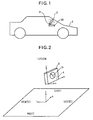
Fig. 1 is an illustrative diagram concerning an embodiment of the present invention. -
Fig. 2 is an illustrative diagram concerning the embodiment of the present invention. -
Fig. 3 is an illustrative diagram concerning the embodiment of the present invention. -
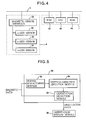
Fig. 4 is a block diagram concerning the embodiment of the present invention. -
Fig. 5 is a block diagram concerning a first embodiment of the present invention. -
Fig. 6 is a flowchart concerning the first embodiment of the present invention. - An embodiment of the present invention will be described in a sequence described below on the assumption that a PDA is functioned as an electronic compass while being attached to a transport machine such as a vehicle.
- [1. Overview]
- 1-1. Description of principles
- 1-2. Hardware configuration
- 1-3. Software configuration
- [2. Processing flow]
- [3. Other embodiments]
- A
support base 33 having ahinge 31 as shown inFig. 1 is fixed to a dashboard or the like of anautomobile 2. When aPDA 3 is secured to theautomobile 2 via thebase 33, a driver can arbitrarily adjust an angle of attachment of thePDA 3 so that the driver can easily view the display screen of thePDA 3. For example, an angle formed by the screen and a horizontal plane may be adjusted, or the screen may be rotated with a vertical axis as a center so that a line of vision will be parallel to a perpendicular to the screen. Thus, the screen of thePDA 3 can be adjusted so that it can be easily seen. In the present embodiment, a magnetic processing system that deduces one-dimensional orientation data for use in indicating an orientation on the screen of thePDA 3 in such a situation will be described. -
Fig. 2 is an illustrative diagram showing a coordinate system employed in the present embodiment.
Since amagnetic sensor 4 incorporated in thePDA 3 makes a motion as an integral part of thePDA 3, the motions or attitudes of themagnetic sensor 4 andPDA 3 can be uniquely expressed in the same coordinate system. The attitudes of thePDA 3 andmagnetic sensor 4 shall be expressed in the coordinate system having as bases a vertically upward vector c, a horizontally north-oriented vector b, and a horizontally east-oriented vector a. The vectors a, b, and c are defined as equations (2) below so that the vectors will be regarded as standard bases.
- When vectors x, y, and z whose magnitudes are 1 and whose orientations are the directions of three respective reference axes x, y, and z that are mutually orthogonal and settled in the
PDA 3 are expressed as linear combinations of the standard bases (a, b, c), it is equivalent to expressing of the attitude of thePDA 3. The vectors x, y, and z are expressed as the linear combinations of the reference bases {a, b, c} using coefficients xa, xb, xc, ya, yb, yc, za, zb, and zc as provided by equations (3), (4), and (5) below. As for the vectors x, y, and z, the direction of the vector y shall coincide with the direction from below the screen of thePDA 3 to above, and the direction of the vector z shall coincide with the direction from the back of the screen of thePDA 3 to the front thereof.


- The relationship among the equations (3), (4), and (5) can be rewritten as expressed by an equation (6) below.

- Since the standard bases are defined as expressed by the equations (2), the equation (6) can be transformed into an equation (7) below.

- A matrix A of an equation (8) expressing the vectors x, y, and z as one matrix shall be called an attitude matrix. The matrix A is an orthogonal matrix. Although the determinant of the orthogonal matrix is generally 1 or - 1, a reference axis is designated in the
PDA 3 in the present embodiment so that the determinant of the matrix A will be 1. The thus defined proper orthogonal matrix A is associated with the attitude of thePDA 3 on a one-to-one correspondence basis.
- A three-dimensional vector that is oriented to the north and represented by magnetic data outputted from the
magnetic sensor 4 shall be defined as H, and a three-dimensional vector that is oriented vertically downward shall be defined as G. H and G denote vector data expressed in the coordinate system settled in thePDA 3. H denotes magnetic data itself, and G denotes vertical-direction data itself to be described later.
When G×H≠0 (a symbol × denotes a cross product) is established, the attitude matrix A can be deduced. When G and H are parallel to each other, GxH=0 is established. However, G and H almost never become parallel to each other. - When a vector F meeting F=GxH is defined, the vector F is oriented horizontally to the east in the coordinate system settled in the
PDA 3. This is because a direction perpendicular to both a north direction and a vertically upward direction is the direction of the east or west indicated on a horizontal plane. In the present embodiment, the vector F is oriented horizontally to the east due to the reference axes x, y, and z and the order of the components of the cross product defining the vector F. However, the vector F may be oriented horizontally to the west depending on the definitions of the reference axes x, y, and z, and the order of the components of the cross product defining the vector F. - Moreover, when a vector K meeting K=F×G is defined, the vector K is oriented horizontally to the north in the coordinate system settled in the
PDA 3. This is because a direction perpendicular to both a horizontally east direction and a vertical direction is the direction of the south or north. Incidentally, in the present embodiment, the vector K is oriented horizontally to the north due to the definitions of the reference axes x, y, and z, and the order of the components of the cross product defining the vector K. However, the vector K may be oriented horizontally to the south depending on the definitions of the reference axes x, y, and z, and the order of the components of the cross product defining the vector K. - At this time, a matrix of an equation (9) below having F, K, and - G normalized to have a magnitude of 1 and lined as a column vector is a matrix produced by performing some rotating operation on the attitude matrix A. In particular, when the bases of H and G are oriented in the directions of the reference axes x, y, and z, the matrix of the equation (9) is the attitude matrix A itself.

- Therefore, a three-dimensional attitude of the
PDA 3 with an azimuth as a reference can be deduced based on magnetic data samples outputted from themagnetic sensor 4 and the vertical-direction data representing a vertical upward orientation. - Next, the principle of the deduction of vertical-direction data, which represents a vertical direction, from magnetic data samples will be described below.
A motion of a ground transport machine such as theautomobile 2 or a marine transport machine is made on a nearly horizontal plane. When theautomobile 2 whirls, thePDA 3 makes a rotational motion with a nearly vertical axis as a center together with theautomobile 2. When theautomobile 2 whirls on a slope, the axis of rotation deviates from the vertical axis. Even in this case, in the present embodiment, an error in deduction of the vertical direction caused by the deviation is negligible. - In a period during which the
automobile 2 whirls 360°, when magnetic data samples sequentially outputted from themagnetic sensor 4 at discrete time instants are plotted in the coordinate system settled in the PDA 3 (which is also a coordinate system settled in the magnetic sensor 4), the magnetic data samples are distributed in a doughnut-shaped domain indicated with a hatched area inFig. 3 . As mentioned previously, since theautomobile 2 makes a motion on a nearly horizontal plane, the deflection of the axis of rotation is limited. Consequently, the distribution of magnetic data samples is flat and can therefore be approximated to a plane. A vertical-direction axis in the coordinate system settled in thePDA 3 nearly coincides with a direction perpendicular to the approximation plane. Consequently, when theautomobile 2 is making a rotational motion, the vertical direction can be inferred in the coordinate system settled in thePDA 3 on the basis of the magnetic data samples. In the present embodiment, one of the principal values of the distribution of magnetic data samples is used to deduce the direction perpendicular to the approximation plane. -
Fig. 4 is a block diagram showing a magnetic processing system including themagnetic sensor 4 and a magnetic data processing device 1. Themagnetic sensor 4 includes anx-axis sensor 30, a y-axis sensor 32, and a z-axis sensor 34 that detect an x-direction component, a y-direction component, and a z-direction component, respectively, of a magnetic field vector representing geomagnetism. Thex-axis sensor 30, y-axis sensor 32, and z-axis sensor 34 are formed of magneto-resistance elements, Hall elements, or magneto-impedance (MI) elements, and may be any sensors as long as they are one-dimensional magnetic sensors having directivity. The axes of sensitivity of thex-axis sensor 30, y-axis sensor 32, and z-axis sensor 34 are fixed to be mutually orthogonal. The outputs of thex-axis sensor 30, y-axis sensor 32, and z-axis sensor 34 are inputted to a magnetic sensor interface (I/F) 22 in a time-sharing manner. In themagnetic sensor interface 22, after the inputs from thex-axis sensor 30, y-axis sensor 32, and z-axis sensor 34 are amplified, they are analog-to-digital (A/D) converted. Digital magnetic data outputted from themagnetic sensor interface 22 is inputted to the magnetic data processing device 1 over abus 5. - The magnetic data processing device 1 is a so-called computer including a
CPU 40, aROM 42, and aRAM 44. TheCPU 40 is a main processor that is, for example, in charge of overall control of thePDA 3. TheROM 42 is a non-volatile and machine-readable storage medium in which a magnetic data processing program to be executed by theCPU 40 and various programs needed to realize the functions of thePDA 3 are stored. TheRAM 44 is a volatile storage medium in which data to be processed by theCPU 40 is temporarily held. Incidentally, the magnetic data processing device 1 and themagnetic sensor 4 may be constructed as a one-chip magnetic processing system. -
Fig. 5 is a block diagram showing the configuration of a magneticdata processing program 90. The magneticdata processing program 90 is a program for providing anorientation display module 98 with orientation data, and is stored in theROM 42. The orientation data is one-dimensional data for use in indicating a north azimuth on a display screen in an easy-to-see manner. The magneticdata processing program 90 includes a group of modules such as abuffer management module 92, a vertical-direction deduction module 94, and anorientation deduction module 96. - The
buffer management module 92 is a program part that inputs magnetic data from themagnetic sensor 4 at intervals of a certain time, and that stores the inputted magnetic data samples in a buffer in a FIFO manner, and allows theCPU 40,RAM 44, andROM 42 to function as an input means. A group of magnetic data samples stored in the buffer shall be regarded as a statistical population data group. The statistical population data group is composed of N magnetic data samples that are inputted from themagnetic sensor 4 to the magnetic data processing device 1 at intervals of a certain time and that are stored in the buffer as represented by q0, q1, etc., and qN-1. - The vertical-
direction deduction module 94 is a program part that detects a rotation of thePDA 3 on the basis of the statistical population data group held by thebuffer management module 92, and that, when having detected the rotation, deduces the aforesaid vertical-direction data G, which represents a vertical direction, on the basis of the statistical population data group. The vertical-direction deduction module 94 allows theCPU 40,RAM 44, andROM 42 to function as a vertical direction deducing means. - The
orientation deduction module 96 is a program part that produces orientation data on the basis of magnetic data samples sequentially inputted from themagnetic sensor 4 and the vertical-direction data G held by the vertical-direction deduction module 94, and allows theCPU 40,RAM 44, andROM 42 to function as an attitude deducing means and an orientation deducing means. - The
orientation display module 98 displays one-dimensional information, which represents a north azimuth, on the display screen of thePDA 3 on the basis of the orientation data. Incidentally, the orientation data may be used only to display an orientation on the screen in the form of characters or an arrow or may be used to perform heading-up processing on a map displayed on the screen. -
Fig. 6 is a flowchart presenting a processing flow for displaying an orientation on the screen of thePDA 3. The processing presented inFig. 6 proceeds when an electronic compass function is invoked in thePDA 3 and theCPU 40 runs thebuffer management module 92, vertical-direction deduction module 94,orientation deduction module 96, andorientation display module 98. - At step S100, vertical-direction data held by the vertical-
direction deduction module 94 is reset to an initial value. The initial value is, for example, a vector - y (the definition of a vector y is as mentioned previously). At this time, all magnetic data samples stored in the buffer where a statistical population data group is stored are deleted. - At step S102, magnetic data is inputted and stored in the buffer. If magnetic data is sequentially inputted from the
magnetic sensor 4 at intervals of a too short time, the distribution of magnetic data samples to be stored in the buffer whose capacity is limited gets narrowed. Consequently, unless theautomobile 2 whirls abruptly, a rotation would not be detected. Therefore, a time interval for update of the buffer (that is, a time interval for input of magnetic data) has to be properly designated. - At step S104, orientation data is deduced by the
orientation deduction module 96. Specifically, the components of the aforesaid attitude matrix A are deduced as attitude data on the basis of the vertical-direction data G held by the vertical-direction deduction module 94 and magnetic data samples, and the orientation data is deduced from the attitude matrix A. - The degree of freedom of the attitude of the
PDA 3 is three, since thePDA 3 makes a three-dimensional motion together with theautomobile 2. Although the number of components of the attitude matrix A having three rows and three columns is 9, since the attitude matrix A is an orthogonal matrix, the degree of freedom of the attitude matrix A is also 3. For intuitively easier recognition of an orientation, displaying an orientation as one-dimensional information would be helpful. For example, when an orientation may be indicated with the magnitude of an angle or the characters of the east, west, south, and north on four respective sides of the screen, the orientation can be displayed in an intuitively discernible manner. If mapping of information whose degree of freedom is 3 to one-dimensional information is defined, one-dimensional orientation data could be deduced from the attitude matrix A. Specifically, as long as a single-valued function f(A) is defined for an arbitrary attitude matrix A, one-dimensional orientation data can be deduced from the arbitrary attitude matrix A. The single-valued function f(A) will be described below. - As described above, in the present embodiment, as for the vectors x, y, and z expressed using the vectors a, b, and c as bases, the direction of the vector y is supposed to coincide with the direction from below the screen to above, and the direction of the vector z is supposed to coincide with the direction from the back of the screen to the front thereof. At this time, when an angle formed by the vector y and a horizontal plane is much smaller than 90°, orientation data for use in indicating an orientation projected on the horizontal plane is deduced. When the angle formed by the vector y and horizontal plane is close to 90°, orientation data for use in indicating an orientation of the vector - z projected on the horizontal plane is deduced. Thus, since an orientation is indicated based on the deduced orientation data, a viewer can intuitively discern the orientation.
- Assuming that the components in i rows and j columns of the attitude matrix A are aij, the magnitudes of aij correlate to an angle formed by the screen of the
PDA 3 and the horizontal plane. Consequently, when an equation (10) below is established for a threshold t, the screen of thePDA 3 is thought to be nearly horizontal. The t value is, for example, 1/21/2.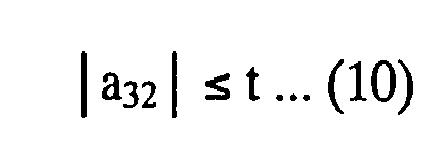
- At this time, since a projection of the vector y on the horizontal plane is expressed by an equation (11) below, one-dimensional orientation data can be deduced by applying the ratio of two values a12 and a22 to an inverse tangent fuction.

- When an equation (12) below is established for the threshold t, the screen of the PDA is thought to be nearly perpendicular.

- At this time, since a projection of the vector - z on the horizontal plane is expressed as an equation (13) below, one-dimensional orientation data can be deduced by applying the ratio of two values - a13 and - a23 to an inverter tangent function.

- Even when a calculation technique is switched from one to another with the threshold t as a border, orientation display free from discomfort can be achieved based on orientation data deduced with the aforesaid single-valued function f(A). Moreover, since the transformation method from the attitude matrix A to orientation data has no singular point, program codes can be shortened.
- At step S106, an orientation is displayed on the screen of the
PDA 3 on the basis of orientation data by theorientation display module 98. Specifically, for example, as shown inFig. 2 , an arrow D is displayed on the screen of thePDA 3. - At step S108, whether the
PDA 3 has made a rotational motion within a predetermined range is decided based on the statistical population data group, which is stored in the buffer, by the vertical-direction deduction module 94. Specifically, a decision is made as described below. - To begin with, a matrix B defined by an equation (14) below is conceived. A 1/N of the matrix B is a variance covariance matrix of a statistical population data group qi. Herein, Q is defined by an equation (15) below and is equivalent to a centroid of qi.


- The executional turn of step S108 is not limited to the one presented in
Fig. 6 . Since the matrix B can be used to perform offset calculation for themagnetic sensor 4, if a vertical direction is deduced simultaneously with calibration of themagnetic sensor 4, calculation efficiency would improve. - Assuming that a maximum eigenvalue of the matrix B is λ1, a minimum eigenvalue is λ3, and the ratio thereof is λ3/λ1, when the ratio is smaller than r (that is, close to 0) and λ1 is larger than a specific threshold s, the
PDA 3 can be recognized as having rotated by a predetermined angle or more. When a deflection of the axis of rotation of thePDA 3 is small, r is a somewhat small value, and the distribution of the statistical population data group is as flat as being approximated to a plane. Incidentally, when the threshold s is an appropriately large value, if λ1 is larger than an properly designated s, the distribution of the statistical population data group is not presumed to be linear. Moreover, as mentioned above, when thePDA 3 rotates together with theautomobile 2, the distribution of the statistical population data group becomes planar. Specifically, when λ1 is larger than s, λ2 naturally gets somewhat large, and the statistical population data group does not exhibit a linear distribution but exhibits a planar and somewhat wide distribution. - Consequently, at step S108, the components of the matrix B are deduced, the maximum eigenvalue λ1 and minimum eigenvalue λ3 of the matrix B are deduced, and calculations of λ3/λ1-r and λ1-s are executed. As a result, if the
PDA 3 is recognized as having rotated by a predetermined angle or more, control is passed to processing of step S110. Otherwise, control is passed to processing of step S102. - At step S110, the direction perpendicular to an approximation plane representing the distribution of the statistical population data group is deduced as vertical-direction data, which represents a vertical direction, by the vertical-
direction deduction module 94. In the present embodiment, one of the principal values of the distribution of the statistical population data group is used to deduce the direction perpendicular to the approximation plane of the distribution. More particularly, an eigenvector 13 of the matrix B corresponding to the above λ3 is deduced as vertical-direction data. This is because the direction of the eigenvector 13 corresponding to the minimum eigenvalue of the matrix B is parallel to the direction perpendicular to the approximation plane of the distribution. Incidentally, assuming that the eigenvector 13 is an eigenvector corresponding to λ3, a vector - 13 is also an eigenvector corresponding to λ3, and both the directions are parallel to a vertical axis. Since a range of attitudes thePDA 3 may assume is restricted by a form in which thePDA 3 is attached to theautomobile 2, either of the vectors l3 and - l3 can be identified as vertical-direction data representing a vertically downward orientation. For example, when a constant vector Gc is designated, if a condition that the vertical-direction data G should always satisfy an equation (16) below is imposed, G can be set to either of G=l3 and G=-l3.
As described so far, according to the present embodiment, the attitude of thePDA 3 that is a mobile entity can be deduced based on an output of themagnetic sensor 4 without use of an acceleration sensor. Consequently, according to the present embodiment, power consumption required for deduction of the attitude of thePDA 3 that is a mobile entity can be reduced as compared with the conventional one, or a calculation time required for deduction of the attitude of thePDA 3 can be shortened as compared with the conventional one. Moreover, according to the present embodiment, since one of the eigenvalues of the matrix B is used to deduce a vertical direction, an attitude and an orientation, the vertical direction, attitude and orientation can be efficiently deduced. - The present invention is not limited to the aforesaid embodiment but can be implemented in various manners without departure from the gist. For example, naturally, the present invention can be adapted to a magnetic processing system mounted in a notebook personal computer having a magnetic sensor incorporated in a display thereof, a portable cellular phone, or an integrated navigation apparatus whose display has the angle thereof made adjustable. Moreover, an approximation plane of a distribution of magnetic data samples may be actually deduced, and the direction of the perpendicular may be deduced as a vertical direction.
Claims (10)
- A magnetic data processing device for detecting a vertical direction using a three-dimensional magnetic sensor, comprising:an input means for sequentially inputting magnetic data samples each of which is three-dimensional vector data represented by a linear combination of fundamental vectors and which are outputted from the three-dimensional magnetic sensor; anda vertical direction deducing means for defining a statistical population which includes a plurality of the magnetic data samples sequentially inputted by the input means and which signifies a rotation of the three-dimensional magnetic sensor of a predetermined range, and operating when a distribution of the magnetic data samples of the statistical population is flat, for deducing a direction perpendicular to a plane which approximates the flat distribution of the statistical population, as vertical-direction data representing the vertical direction.
- The magnetic data processing device according to Claim 1, wherein the vertical direction deducing means calculates a minimum principal value of the distribution of the magnetic data samples of the statistical population and deduces as the vertical-direction data a direction of an eigenvector corresponding to the minimum principal value.
- The magnetic data processing device according to Claim 2, wherein assuming that the vertical direction deducing means defines the statistical population as qiT=(qix,qiy,qiz) (where q denotes a magnetic data sample and i denotes 0, 1, 2, ... N-1), the vertical direction deducing means deduces as the vertical-direction data the direction of the eigenvector corresponding to a minimum eigenvalue of a matrix B defined by the following equation (1):

where vector Q is a centroid of qi. - The magnetic data processing device according to Claim 3, wherein the vertical direction deducing means deduces as the vertical-direction data the direction of the eigenvector corresponding to a minimum eigenvalue λ3, when λ3/λ1<r (where r denotes a constant) is satisfied relative to a maximum eigenvalue λ1 of the matrix B and a minimum eigenvalue λ3 thereof.
- The magnetic data processing device according to Claim 3, wherein the vertical direction deducing means deduces as the vertical-direction data the direction of the eigenvector corresponding to a minimum eigenvalue λ3 of the matrix B, when λ1>s (where s denotes a constant) is satisfied relative to a maximum eigenvalue λ1 of the matrix B.
- The magnetic data processing device according to Claim 1, further comprising an attitude deducing means for deducing three-dimensional attitude data, which signifies an attitude of the three-dimensional magnetic sensor with reference to an azimuth on the basis of the magnetic data samples and the vertical-direction data.
- The magnetic data processing device according to Claim 6, further comprising an orientation deducing means for deducing one-dimensional orientation data, which is used to indicate an orientation of a display screen, on the basis of the attitude data.
- A magnetic processing system comprising:a three-dimensional magnetic sensor; anda magnetic data processing device connected to the three-dimensional magnetic sensor, whereinthe magnetic sensor device comprises:an input means for sequentially inputting magnetic data samples each of which is three-dimensional vector data represented by a linear combination of fundamental vectors and which are outputted from the three-dimensional magnetic sensor; anda vertical direction deducing means for defining a statistical population which includes a plurality of the magnetic data samples sequentially inputted by the input means and which signifies a rotation of the three-dimensional magnetic sensor of a predetermined range, and operating when a distribution of the magnetic data samples of the statistical population is flat, for deducing a direction perpendicular to a plane which approximates the flat distribution of the statistical population, as vertical-direction data representing the vertical direction.
- A magnetic data processing method of detecting a vertical direction using a three-dimensional magnetic sensor, comprising:sequentially inputting magnetic data samples each of which is three-dimensional vector data represented by a linear combination of fundamental vectors and which are outputted from the three-dimensional magnetic sensor;defining a statistical population which includes a plurality of the magnetic data samples sequentially inputted and which signifies a rotation of the three-dimensional magnetic sensor of a predetermined range, andwhen a distribution of the magnetic data samples of the statistical population is flat, deducing a direction perpendicular to a plane which approximates the flat distribution of the statistical population, as vertical-direction data representing the vertical direction.
- A machine readable medium for use in a computer, the medium containing a magnetic data processing program executable by the computer to perform a process of:sequentially inputting magnetic data samples each of which is three-dimensional vector data represented by a linear combination of fundamental vectors and which are outputted from a three-dimensional magnetic sensor;defining a statistical population which includes a plurality of the magnetic data samples sequentially inputted and which signifies a rotation of the three-dimensional magnetic sensor of a predetermined range, andwhen a distribution of the magnetic data samples of the statistical population is flat, deducing a direction perpendicular to a plane which approximates the flat distribution of the statistical population, as vertical-direction data representing the vertical direction.
Applications Claiming Priority (1)
| Application Number | Priority Date | Filing Date | Title |
|---|---|---|---|
| JP2007051117A JP4935427B2 (en) | 2007-03-01 | 2007-03-01 | Magnetic data processing apparatus, method and program, and magnetic processing system. |
Publications (2)
| Publication Number | Publication Date |
|---|---|
| EP1965169A2 true EP1965169A2 (en) | 2008-09-03 |
| EP1965169A3 EP1965169A3 (en) | 2012-11-07 |
Family
ID=39467847
Family Applications (1)
| Application Number | Title | Priority Date | Filing Date |
|---|---|---|---|
| EP08003801A Withdrawn EP1965169A3 (en) | 2007-03-01 | 2008-02-29 | Magnetic data processing device, method, and program, and magnetic processing system |
Country Status (5)
| Country | Link |
|---|---|
| US (1) | US8032326B2 (en) |
| EP (1) | EP1965169A3 (en) |
| JP (1) | JP4935427B2 (en) |
| CN (1) | CN101256219B (en) |
| TW (1) | TWI352193B (en) |
Cited By (2)
| Publication number | Priority date | Publication date | Assignee | Title |
|---|---|---|---|---|
| JP2013511729A (en) * | 2009-11-20 | 2013-04-04 | クアルコム,インコーポレイテッド | Spatial alignment judgment for inertial measurement unit (IMU) |
| EP1985233B1 (en) * | 2007-04-25 | 2018-07-18 | Commissariat à l'Énergie Atomique et aux Énergies Alternatives | Method and device for detecting a substantially invariant axis of rotation |
Families Citing this family (6)
| Publication number | Priority date | Publication date | Assignee | Title |
|---|---|---|---|---|
| WO2010103966A1 (en) * | 2009-03-10 | 2010-09-16 | アルプス電気株式会社 | Geomagnetism detection device |
| JP5453969B2 (en) * | 2009-07-10 | 2014-03-26 | ヤマハ株式会社 | Magnetic data processing apparatus, magnetic data processing method, and magnetic data processing program |
| JP2013064695A (en) * | 2011-09-20 | 2013-04-11 | Yamaha Corp | State estimating device, offset updating method, and offset updating program |
| CN104081164B (en) * | 2012-02-03 | 2016-08-24 | 旭化成株式会社 | signal processing device |
| JP6844338B2 (en) * | 2017-03-10 | 2021-03-17 | カシオ計算機株式会社 | Information processing equipment, information processing methods and programs |
| JP7141094B2 (en) * | 2018-08-06 | 2022-09-22 | サイトテック株式会社 | device with an electronic compass |
Citations (1)
| Publication number | Priority date | Publication date | Assignee | Title |
|---|---|---|---|---|
| WO2006009247A1 (en) | 2004-07-23 | 2006-01-26 | Yamaha Corporation | Direction processor, direction processing method, direction processing program, direction measuring instrument, inclination offset correcting method, direction measuring method, direction sensor unit and portable electronic device |
Family Cites Families (15)
| Publication number | Priority date | Publication date | Assignee | Title |
|---|---|---|---|---|
| JP2000346634A (en) * | 1999-06-09 | 2000-12-15 | Minolta Co Ltd | Three-dimensionally inputting device |
| US20030053669A1 (en) * | 2001-07-18 | 2003-03-20 | Marconi Medical Systems, Inc. | Magnetic resonance angiography method and apparatus |
| JP3782915B2 (en) * | 2000-02-16 | 2006-06-07 | セイコーインスツル株式会社 | Electronic device having a magnetic sensor |
| JP4244561B2 (en) * | 2001-07-10 | 2009-03-25 | ヤマハ株式会社 | Portable electronic device with orientation measurement function |
| US6968273B2 (en) * | 2002-03-01 | 2005-11-22 | Gentex Corporation | Electronic compass system |
| US7177779B2 (en) * | 2002-07-01 | 2007-02-13 | Asahi Kasei Emd Corporation | Azimuth measuring device and azimuth measuring method |
| JP4151785B2 (en) * | 2003-04-03 | 2008-09-17 | 旭化成エレクトロニクス株式会社 | Azimuth measuring device, azimuth measuring program, and azimuth measuring method |
| EP1698857B1 (en) * | 2003-12-22 | 2009-11-25 | Asahi Kasei EMD Corporation | Azimuth measurement device |
| WO2006008790A1 (en) * | 2004-07-15 | 2006-01-26 | C & N Inc | Mobile terminal device |
| US8065083B2 (en) * | 2004-07-23 | 2011-11-22 | Yamaha Corporation | Azimuth processing device, azimuth processing method, azimuth processing program, direction finding device, tilt offset correcting method, azimuth measuring method, compass sensor unit, and portable electronic device |
| EP1775550B1 (en) * | 2005-10-11 | 2013-12-11 | Yamaha Corporation | Magnetic sensor control device |
| JP4919142B2 (en) * | 2005-10-19 | 2012-04-18 | アイチ・マイクロ・インテリジェント株式会社 | Magnetic compass |
| US7532991B2 (en) * | 2006-03-07 | 2009-05-12 | Yamaha Corporation | Magnetic data processing device |
| FR2915568B1 (en) * | 2007-04-25 | 2009-07-31 | Commissariat Energie Atomique | METHOD AND DEVICE FOR DETECTING A SUBSTANTIALLY INVARIANT ROTATION AXIS |
| JP5067155B2 (en) * | 2007-12-28 | 2012-11-07 | ヤマハ株式会社 | Magnetic data processing device, navigation device, magnetic data processing method, and magnetic data processing program |
-
2007
- 2007-03-01 JP JP2007051117A patent/JP4935427B2/en not_active Expired - Fee Related
-
2008
- 2008-02-29 EP EP08003801A patent/EP1965169A3/en not_active Withdrawn
- 2008-02-29 CN CN2008100077281A patent/CN101256219B/en not_active Expired - Fee Related
- 2008-02-29 TW TW097107231A patent/TWI352193B/en not_active IP Right Cessation
- 2008-02-29 US US12/040,373 patent/US8032326B2/en not_active Expired - Fee Related
Patent Citations (1)
| Publication number | Priority date | Publication date | Assignee | Title |
|---|---|---|---|---|
| WO2006009247A1 (en) | 2004-07-23 | 2006-01-26 | Yamaha Corporation | Direction processor, direction processing method, direction processing program, direction measuring instrument, inclination offset correcting method, direction measuring method, direction sensor unit and portable electronic device |
Cited By (2)
| Publication number | Priority date | Publication date | Assignee | Title |
|---|---|---|---|---|
| EP1985233B1 (en) * | 2007-04-25 | 2018-07-18 | Commissariat à l'Énergie Atomique et aux Énergies Alternatives | Method and device for detecting a substantially invariant axis of rotation |
| JP2013511729A (en) * | 2009-11-20 | 2013-04-04 | クアルコム,インコーポレイテッド | Spatial alignment judgment for inertial measurement unit (IMU) |
Also Published As
| Publication number | Publication date |
|---|---|
| CN101256219B (en) | 2012-07-04 |
| JP4935427B2 (en) | 2012-05-23 |
| TWI352193B (en) | 2011-11-11 |
| TW200900661A (en) | 2009-01-01 |
| JP2008215915A (en) | 2008-09-18 |
| US8032326B2 (en) | 2011-10-04 |
| US20080215287A1 (en) | 2008-09-04 |
| EP1965169A3 (en) | 2012-11-07 |
| CN101256219A (en) | 2008-09-03 |
Similar Documents
| Publication | Publication Date | Title |
|---|---|---|
| US8032326B2 (en) | Magnetic data processing device, method, and program, and magnetic processing system | |
| EP1519148B1 (en) | Azimuth measuring device and azimuth measuring method | |
| EP1929246B1 (en) | Calibration of 3d field sensors | |
| US8531180B2 (en) | Determining heading using magnetometer data and angular rate data | |
| US8581935B2 (en) | Orientation-following display apparatus, orientation-following display method, and orientation-following display program | |
| US7870678B2 (en) | Hybrid sensor module and sensing method using the same | |
| US9157736B2 (en) | Portable electronic device adapted to provide an improved attitude matrix | |
| EP1832889A2 (en) | Magnetic data processing device | |
| US7930133B2 (en) | Magnetic-sensor controller, magnetism measurement apparatus, offset setting method, and computer-readable medium on which offset setting program is recorded | |
| US20060066295A1 (en) | Control method of controlling magnetic-field sensor, control device, and mobile terminal device | |
| US20040133349A1 (en) | Apparatus and method of compensating for an attitude error of an earth magnetic sensor | |
| US8896301B2 (en) | Portable electronic device adapted to compensate for gyroscope bias | |
| US20140214317A1 (en) | Position calculating method and position calculating device | |
| CN101586958A (en) | Azimuth measurement device | |
| US7548827B2 (en) | Magnetic data processing apparatus, method and machine readable medium | |
| JP2006113019A (en) | Triaxial type electronic compass, and azimuth detecting method using same | |
| US8862418B2 (en) | Magnetic data processing device, magnetic data processing method, and magnetic data processing program | |
| US20130110451A1 (en) | State estimation apparatus | |
| US20240085960A1 (en) | Lid angle detection | |
| CA2769085C (en) | Portable electronic device adapted to compensate for gyroscope bias | |
| JP5678748B2 (en) | Terminal device and geomagnetic environment determination program | |
| JP4448957B2 (en) | Magnetic measuring device and magnetic measuring method | |
| JP2012202749A (en) | Orientation detection device | |
| EP2487460A2 (en) | Navigation system with estimation of n-dimensional parameters while sensing fewer than n dimensions | |
| KR20070049419A (en) | Virtual axis magnetic field data estimation device and method for compensating tilt angle error of two-axis geomagnetic field sensor, and azimuth angle calculation device using the same |
Legal Events
| Date | Code | Title | Description |
|---|---|---|---|
| PUAI | Public reference made under article 153(3) epc to a published international application that has entered the european phase |
Free format text: ORIGINAL CODE: 0009012 |
|
| AK | Designated contracting states |
Kind code of ref document: A2 Designated state(s): AT BE BG CH CY CZ DE DK EE ES FI FR GB GR HR HU IE IS IT LI LT LU LV MC MT NL NO PL PT RO SE SI SK TR |
|
| AX | Request for extension of the european patent |
Extension state: AL BA MK RS |
|
| PUAL | Search report despatched |
Free format text: ORIGINAL CODE: 0009013 |
|
| AK | Designated contracting states |
Kind code of ref document: A3 Designated state(s): AT BE BG CH CY CZ DE DK EE ES FI FR GB GR HR HU IE IS IT LI LT LU LV MC MT NL NO PL PT RO SE SI SK TR |
|
| AX | Request for extension of the european patent |
Extension state: AL BA MK RS |
|
| RIC1 | Information provided on ipc code assigned before grant |
Ipc: G01C 9/00 20060101AFI20120928BHEP Ipc: G01C 17/28 20060101ALI20120928BHEP |
|
| AKY | No designation fees paid | ||
| REG | Reference to a national code |
Ref country code: DE Ref legal event code: R108 |
|
| REG | Reference to a national code |
Ref country code: DE Ref legal event code: R108 Effective date: 20130710 |
|
| STAA | Information on the status of an ep patent application or granted ep patent |
Free format text: STATUS: THE APPLICATION IS DEEMED TO BE WITHDRAWN |
|
| 18D | Application deemed to be withdrawn |
Effective date: 20130508 |