EP1964840A1 - Imidazo[1,2-a]pyridines and their use as pharmaceuticals - Google Patents
Imidazo[1,2-a]pyridines and their use as pharmaceuticals Download PDFInfo
- Publication number
- EP1964840A1 EP1964840A1 EP07004120A EP07004120A EP1964840A1 EP 1964840 A1 EP1964840 A1 EP 1964840A1 EP 07004120 A EP07004120 A EP 07004120A EP 07004120 A EP07004120 A EP 07004120A EP 1964840 A1 EP1964840 A1 EP 1964840A1
- Authority
- EP
- European Patent Office
- Prior art keywords
- imidazo
- pyridine
- phenyl
- carboxylic acid
- methyl ester
- Prior art date
- Legal status (The legal status is an assumption and is not a legal conclusion. Google has not performed a legal analysis and makes no representation as to the accuracy of the status listed.)
- Withdrawn
Links
- 239000003814 drug Substances 0.000 title claims abstract description 23
- 150000005234 imidazo[1,2-a]pyridines Chemical class 0.000 title abstract description 4
- 150000001875 compounds Chemical class 0.000 claims abstract description 284
- 208000037265 diseases, disorders, signs and symptoms Diseases 0.000 claims abstract description 33
- 230000014509 gene expression Effects 0.000 claims abstract description 29
- 201000010099 disease Diseases 0.000 claims abstract description 27
- 230000003511 endothelial effect Effects 0.000 claims abstract description 27
- 238000011282 treatment Methods 0.000 claims abstract description 26
- 102000008299 Nitric Oxide Synthase Human genes 0.000 claims abstract description 22
- 108010021487 Nitric Oxide Synthase Proteins 0.000 claims abstract description 22
- 201000001320 Atherosclerosis Diseases 0.000 claims abstract description 15
- 208000029078 coronary artery disease Diseases 0.000 claims abstract description 15
- 230000000638 stimulation Effects 0.000 claims abstract description 14
- 238000004519 manufacturing process Methods 0.000 claims abstract description 13
- 208000024172 Cardiovascular disease Diseases 0.000 claims abstract description 12
- 206010019280 Heart failures Diseases 0.000 claims abstract description 12
- 239000008194 pharmaceutical composition Substances 0.000 claims abstract description 11
- 206010020772 Hypertension Diseases 0.000 claims abstract description 7
- 208000007536 Thrombosis Diseases 0.000 claims abstract description 4
- 239000001257 hydrogen Substances 0.000 claims description 209
- 229910052739 hydrogen Inorganic materials 0.000 claims description 209
- 125000004169 (C1-C6) alkyl group Chemical group 0.000 claims description 146
- UFHFLCQGNIYNRP-UHFFFAOYSA-N Hydrogen Chemical compound [H][H] UFHFLCQGNIYNRP-UHFFFAOYSA-N 0.000 claims description 116
- -1 -C(=O)-NR9R10 Chemical group 0.000 claims description 100
- PXBRQCKWGAHEHS-UHFFFAOYSA-N dichlorodifluoromethane Chemical compound FC(F)(Cl)Cl PXBRQCKWGAHEHS-UHFFFAOYSA-N 0.000 claims description 80
- 125000006615 aromatic heterocyclic group Chemical group 0.000 claims description 76
- 125000001424 substituent group Chemical group 0.000 claims description 66
- 125000004433 nitrogen atom Chemical group N* 0.000 claims description 57
- 229920006395 saturated elastomer Polymers 0.000 claims description 54
- 125000004191 (C1-C6) alkoxy group Chemical group 0.000 claims description 53
- 150000003839 salts Chemical class 0.000 claims description 52
- 125000004093 cyano group Chemical group *C#N 0.000 claims description 48
- 125000004435 hydrogen atom Chemical group [H]* 0.000 claims description 48
- 150000002431 hydrogen Chemical class 0.000 claims description 46
- 229910052736 halogen Inorganic materials 0.000 claims description 44
- 150000002367 halogens Chemical class 0.000 claims description 44
- 125000004454 (C1-C6) alkoxycarbonyl group Chemical group 0.000 claims description 40
- 125000006297 carbonyl amino group Chemical group [H]N([*:2])C([*:1])=O 0.000 claims description 40
- 229910052757 nitrogen Inorganic materials 0.000 claims description 40
- 125000000449 nitro group Chemical group [O-][N+](*)=O 0.000 claims description 36
- 125000001153 fluoro group Chemical group F* 0.000 claims description 34
- 125000002887 hydroxy group Chemical group [H]O* 0.000 claims description 34
- 125000002023 trifluoromethyl group Chemical group FC(F)(F)* 0.000 claims description 32
- 125000001997 phenyl group Chemical group [H]C1=C([H])C([H])=C(*)C([H])=C1[H] 0.000 claims description 28
- 125000003118 aryl group Chemical group 0.000 claims description 26
- 125000002496 methyl group Chemical group [H]C([H])([H])* 0.000 claims description 26
- 125000004432 carbon atom Chemical group C* 0.000 claims description 24
- 125000002924 primary amino group Chemical group [H]N([H])* 0.000 claims description 23
- 125000000623 heterocyclic group Chemical group 0.000 claims description 21
- KRHDLMHEVNLAFT-UHFFFAOYSA-N 2-(4-fluorophenyl)imidazo[1,2-a]pyridine-6-carbonitrile Chemical compound C1=CC(F)=CC=C1C1=CN(C=C(C=C2)C#N)C2=N1 KRHDLMHEVNLAFT-UHFFFAOYSA-N 0.000 claims description 20
- 125000005915 C6-C14 aryl group Chemical group 0.000 claims description 18
- 125000004397 aminosulfonyl group Chemical group NS(=O)(=O)* 0.000 claims description 17
- 229910052731 fluorine Inorganic materials 0.000 claims description 17
- 229910052801 chlorine Inorganic materials 0.000 claims description 16
- 125000004739 (C1-C6) alkylsulfonyl group Chemical group 0.000 claims description 15
- 125000006272 (C3-C7) cycloalkyl group Chemical group 0.000 claims description 14
- QSAHHSODGGETOF-UHFFFAOYSA-N methyl 2-(4-sulfamoylphenyl)imidazo[1,2-a]pyridine-6-carboxylate Chemical compound C=1N2C=C(C(=O)OC)C=CC2=NC=1C1=CC=C(S(N)(=O)=O)C=C1 QSAHHSODGGETOF-UHFFFAOYSA-N 0.000 claims description 14
- 229910052794 bromium Inorganic materials 0.000 claims description 11
- VKGAXRGLKZMTOO-UHFFFAOYSA-N [[amino-[2-(4-fluorophenyl)imidazo[1,2-a]pyridin-6-yl]methylidene]amino] ethyl carbonate Chemical compound C=1N2C=C(C(=N)NOC(=O)OCC)C=CC2=NC=1C1=CC=C(F)C=C1 VKGAXRGLKZMTOO-UHFFFAOYSA-N 0.000 claims description 10
- NMTQMAQYAYWMQV-UHFFFAOYSA-N methyl 2-(4-nitrophenyl)imidazo[1,2-a]pyridine-6-carboxylate Chemical compound C=1N2C=C(C(=O)OC)C=CC2=NC=1C1=CC=C([N+]([O-])=O)C=C1 NMTQMAQYAYWMQV-UHFFFAOYSA-N 0.000 claims description 10
- IWYAOYMSUXAEHT-UHFFFAOYSA-N 2-(4-fluorophenyl)imidazo[1,2-a]pyridin-6-amine Chemical compound C=1N2C=C(N)C=CC2=NC=1C1=CC=C(F)C=C1 IWYAOYMSUXAEHT-UHFFFAOYSA-N 0.000 claims description 9
- 125000005974 C6-C14 arylcarbonyl group Chemical group 0.000 claims description 9
- 125000004916 (C1-C6) alkylcarbonyl group Chemical group 0.000 claims description 8
- AXBJLFVSFUWPSB-UHFFFAOYSA-N 2-(3-chlorophenyl)imidazo[1,2-a]pyridine-6-carbonitrile Chemical compound ClC1=CC=CC(C=2N=C3C=CC(=CN3C=2)C#N)=C1 AXBJLFVSFUWPSB-UHFFFAOYSA-N 0.000 claims description 8
- 150000001408 amides Chemical class 0.000 claims description 8
- BYAXXDNBADFYEZ-UHFFFAOYSA-N azetidin-1-yl-[2-(4-fluorophenyl)imidazo[1,2-a]pyridin-6-yl]methanone Chemical compound C1=CC(F)=CC=C1C1=CN(C=C(C=C2)C(=O)N3CCC3)C2=N1 BYAXXDNBADFYEZ-UHFFFAOYSA-N 0.000 claims description 8
- 125000003917 carbamoyl group Chemical group [H]N([H])C(*)=O 0.000 claims description 8
- LBZHYDWWACLLKV-UHFFFAOYSA-N methyl 2-(3,4-dichlorophenyl)imidazo[1,2-a]pyridine-6-carboxylate Chemical compound C=1N2C=C(C(=O)OC)C=CC2=NC=1C1=CC=C(Cl)C(Cl)=C1 LBZHYDWWACLLKV-UHFFFAOYSA-N 0.000 claims description 8
- ZSPSFLJVVIFMLT-UHFFFAOYSA-N methyl 2-(3-chlorophenyl)imidazo[1,2-a]pyridine-6-carboxylate Chemical compound C=1N2C=C(C(=O)OC)C=CC2=NC=1C1=CC=CC(Cl)=C1 ZSPSFLJVVIFMLT-UHFFFAOYSA-N 0.000 claims description 8
- LMXXIQBHZAJXHE-UHFFFAOYSA-N 2-(3-chlorophenyl)-n'-hydroxyimidazo[1,2-a]pyridine-6-carboximidamide Chemical compound C=1N2C=C(C(=N)NO)C=CC2=NC=1C1=CC=CC(Cl)=C1 LMXXIQBHZAJXHE-UHFFFAOYSA-N 0.000 claims description 7
- JSPOTCRFLLHGGL-UHFFFAOYSA-N 2-(4-fluorophenyl)-n'-hydroxyimidazo[1,2-a]pyridine-6-carboximidamide Chemical compound C=1N2C=C(C(=N)NO)C=CC2=NC=1C1=CC=C(F)C=C1 JSPOTCRFLLHGGL-UHFFFAOYSA-N 0.000 claims description 7
- QMRKQCDWLSBHHR-UHFFFAOYSA-N 2-(4-fluorophenyl)-n,n-dimethylimidazo[1,2-a]pyridine-6-carboxamide Chemical compound C=1N2C=C(C(=O)N(C)C)C=CC2=NC=1C1=CC=C(F)C=C1 QMRKQCDWLSBHHR-UHFFFAOYSA-N 0.000 claims description 7
- WSUQKNWJOSECHD-UHFFFAOYSA-N 2-(4-fluorophenyl)imidazo[1,2-a]pyridine-6-carboximidamide Chemical compound C=1N2C=C(C(=N)N)C=CC2=NC=1C1=CC=C(F)C=C1 WSUQKNWJOSECHD-UHFFFAOYSA-N 0.000 claims description 7
- JPKXKGGARFMURM-UHFFFAOYSA-N 2-(4-methylphenyl)imidazo[1,2-a]pyridine-6-carbonitrile Chemical compound C1=CC(C)=CC=C1C1=CN(C=C(C=C2)C#N)C2=N1 JPKXKGGARFMURM-UHFFFAOYSA-N 0.000 claims description 7
- UEPSCOFAAWBZNL-UHFFFAOYSA-N 2-(4-methylphenyl)imidazo[1,2-a]pyridine-6-carboxylic acid Chemical compound C1=CC(C)=CC=C1C1=CN(C=C(C=C2)C(O)=O)C2=N1 UEPSCOFAAWBZNL-UHFFFAOYSA-N 0.000 claims description 7
- MFKQVXHSHIWPKM-UHFFFAOYSA-N 2-[4-(diethylamino)phenyl]-n'-hydroxyimidazo[1,2-a]pyridine-6-carboximidamide Chemical compound C1=CC(N(CC)CC)=CC=C1C1=CN(C=C(C=C2)C(=N)NO)C2=N1 MFKQVXHSHIWPKM-UHFFFAOYSA-N 0.000 claims description 7
- YEWLLBRZKFZCMC-UHFFFAOYSA-N 2-[4-(diethylamino)phenyl]imidazo[1,2-a]pyridine-6-carbonitrile Chemical compound C1=CC(N(CC)CC)=CC=C1C1=CN(C=C(C=C2)C#N)C2=N1 YEWLLBRZKFZCMC-UHFFFAOYSA-N 0.000 claims description 7
- ZGLAPTZGRVDXAS-UHFFFAOYSA-N 2-[4-(diethylamino)phenyl]imidazo[1,2-a]pyridine-6-carboxylic acid Chemical compound C1=CC(N(CC)CC)=CC=C1C1=CN(C=C(C=C2)C(O)=O)C2=N1 ZGLAPTZGRVDXAS-UHFFFAOYSA-N 0.000 claims description 7
- RTLFRMLOBFINOV-UHFFFAOYSA-N 3-[2-(4-fluorophenyl)imidazo[1,2-a]pyridin-6-yl]-2h-1,2,4-oxadiazol-5-one Chemical compound C1=CC(F)=CC=C1C1=CN(C=C(C=C2)C=3NC(=O)ON=3)C2=N1 RTLFRMLOBFINOV-UHFFFAOYSA-N 0.000 claims description 7
- QWMLTYKHILUVCN-UHFFFAOYSA-N 3-[2-(4-fluorophenyl)imidazo[1,2-a]pyridin-6-yl]imidazolidine-2,4-dione Chemical compound C1=CC(F)=CC=C1C1=CN(C=C(C=C2)N3C(NCC3=O)=O)C2=N1 QWMLTYKHILUVCN-UHFFFAOYSA-N 0.000 claims description 7
- IPGWFLCOPXZHOM-UHFFFAOYSA-N 4-(6-bromoimidazo[1,2-a]pyridin-2-yl)-n,n-diethylaniline Chemical compound C1=CC(N(CC)CC)=CC=C1C1=CN(C=C(Br)C=C2)C2=N1 IPGWFLCOPXZHOM-UHFFFAOYSA-N 0.000 claims description 7
- NKIQEILZYPFNFA-UHFFFAOYSA-N 6-bromo-2-(4-fluorophenyl)imidazo[1,2-a]pyridine Chemical compound C1=CC(F)=CC=C1C1=CN(C=C(Br)C=C2)C2=N1 NKIQEILZYPFNFA-UHFFFAOYSA-N 0.000 claims description 7
- JCXJVPUVTGWSNB-UHFFFAOYSA-N Nitrogen dioxide Chemical compound O=[N]=O JCXJVPUVTGWSNB-UHFFFAOYSA-N 0.000 claims description 7
- LDTHSYLWHYLHSR-UHFFFAOYSA-N methyl 2-(2,3-dihydro-1,4-benzodioxin-6-yl)imidazo[1,2-a]pyridine-6-carboxylate Chemical compound O1CCOC2=CC(C=3N=C4C=CC(=CN4C=3)C(=O)OC)=CC=C21 LDTHSYLWHYLHSR-UHFFFAOYSA-N 0.000 claims description 7
- CGOPDQDDJMXLDC-UHFFFAOYSA-N methyl 2-(2,4-dichlorophenyl)imidazo[1,2-a]pyridine-6-carboxylate Chemical compound C=1N2C=C(C(=O)OC)C=CC2=NC=1C1=CC=C(Cl)C=C1Cl CGOPDQDDJMXLDC-UHFFFAOYSA-N 0.000 claims description 7
- GTMFEPVNYFKATR-UHFFFAOYSA-N methyl 2-(2,4-dimethylphenyl)imidazo[1,2-a]pyridine-6-carboxylate Chemical compound C=1N2C=C(C(=O)OC)C=CC2=NC=1C1=CC=C(C)C=C1C GTMFEPVNYFKATR-UHFFFAOYSA-N 0.000 claims description 7
- XXYBIINWDYQCDS-UHFFFAOYSA-N methyl 2-(2-chlorophenyl)imidazo[1,2-a]pyridine-6-carboxylate Chemical compound C=1N2C=C(C(=O)OC)C=CC2=NC=1C1=CC=CC=C1Cl XXYBIINWDYQCDS-UHFFFAOYSA-N 0.000 claims description 7
- YOETTZBXVWFAMW-UHFFFAOYSA-N methyl 2-(2-fluorophenyl)imidazo[1,2-a]pyridine-6-carboxylate Chemical compound C=1N2C=C(C(=O)OC)C=CC2=NC=1C1=CC=CC=C1F YOETTZBXVWFAMW-UHFFFAOYSA-N 0.000 claims description 7
- AXSCLZTWJXHZLA-UHFFFAOYSA-N methyl 2-(2-nitrophenyl)imidazo[1,2-a]pyridine-6-carboxylate Chemical compound C=1N2C=C(C(=O)OC)C=CC2=NC=1C1=CC=CC=C1[N+]([O-])=O AXSCLZTWJXHZLA-UHFFFAOYSA-N 0.000 claims description 7
- QPNZLAXBOVZWSZ-UHFFFAOYSA-N methyl 2-(2-oxo-3,4-dihydro-1h-quinolin-6-yl)imidazo[1,2-a]pyridine-6-carboxylate Chemical compound N1C(=O)CCC2=CC(C=3N=C4C=CC(=CN4C=3)C(=O)OC)=CC=C21 QPNZLAXBOVZWSZ-UHFFFAOYSA-N 0.000 claims description 7
- ZZBZWUZENHDHSP-UHFFFAOYSA-N methyl 2-(3-bromophenyl)imidazo[1,2-a]pyridine-6-carboxylate Chemical compound C=1N2C=C(C(=O)OC)C=CC2=NC=1C1=CC=CC(Br)=C1 ZZBZWUZENHDHSP-UHFFFAOYSA-N 0.000 claims description 7
- VJIDQQMHORQNRI-UHFFFAOYSA-N methyl 2-(3-cyanophenyl)imidazo[1,2-a]pyridine-6-carboxylate Chemical compound C=1N2C=C(C(=O)OC)C=CC2=NC=1C1=CC=CC(C#N)=C1 VJIDQQMHORQNRI-UHFFFAOYSA-N 0.000 claims description 7
- BOZOUYYPSYLRTO-UHFFFAOYSA-N methyl 2-(3-fluorophenyl)imidazo[1,2-a]pyridine-6-carboxylate Chemical compound C=1N2C=C(C(=O)OC)C=CC2=NC=1C1=CC=CC(F)=C1 BOZOUYYPSYLRTO-UHFFFAOYSA-N 0.000 claims description 7
- YRMPCSQATCSADO-UHFFFAOYSA-N methyl 2-(4-bromo-3-sulfamoylphenyl)imidazo[1,2-a]pyridine-6-carboxylate Chemical compound C=1N2C=C(C(=O)OC)C=CC2=NC=1C1=CC=C(Br)C(S(N)(=O)=O)=C1 YRMPCSQATCSADO-UHFFFAOYSA-N 0.000 claims description 7
- NPSURZKJSZQXOV-UHFFFAOYSA-N methyl 2-(4-bromophenyl)-3-methylimidazo[1,2-a]pyridine-6-carboxylate Chemical compound CC=1N2C=C(C(=O)OC)C=CC2=NC=1C1=CC=C(Br)C=C1 NPSURZKJSZQXOV-UHFFFAOYSA-N 0.000 claims description 7
- PKSWTTNISBQXPB-UHFFFAOYSA-N methyl 2-(4-chloro-3-methylphenyl)imidazo[1,2-a]pyridine-6-carboxylate Chemical compound C=1N2C=C(C(=O)OC)C=CC2=NC=1C1=CC=C(Cl)C(C)=C1 PKSWTTNISBQXPB-UHFFFAOYSA-N 0.000 claims description 7
- XEROGKQDDRMZFB-UHFFFAOYSA-N methyl 2-(4-cyanophenyl)imidazo[1,2-a]pyridine-6-carboxylate Chemical compound C=1N2C=C(C(=O)OC)C=CC2=NC=1C1=CC=C(C#N)C=C1 XEROGKQDDRMZFB-UHFFFAOYSA-N 0.000 claims description 7
- JEEJZLIZOHJBSS-UHFFFAOYSA-N methyl 2-(4-fluoro-3-sulfamoylphenyl)imidazo[1,2-a]pyridine-6-carboxylate Chemical compound C=1N2C=C(C(=O)OC)C=CC2=NC=1C1=CC=C(F)C(S(N)(=O)=O)=C1 JEEJZLIZOHJBSS-UHFFFAOYSA-N 0.000 claims description 7
- GGBGKTKRISZKAC-UHFFFAOYSA-N methyl 2-(4-methylphenyl)imidazo[1,2-a]pyridine-6-carboxylate Chemical compound C=1N2C=C(C(=O)OC)C=CC2=NC=1C1=CC=C(C)C=C1 GGBGKTKRISZKAC-UHFFFAOYSA-N 0.000 claims description 7
- HQLJGUWXXWJGJE-UHFFFAOYSA-N methyl 2-(4-phenylphenyl)imidazo[1,2-a]pyridine-6-carboxylate Chemical compound C=1N2C=C(C(=O)OC)C=CC2=NC=1C(C=C1)=CC=C1C1=CC=CC=C1 HQLJGUWXXWJGJE-UHFFFAOYSA-N 0.000 claims description 7
- MKXFEGGTSIUQNW-UHFFFAOYSA-N methyl 2-(4-pyrrolidin-1-ylphenyl)imidazo[1,2-a]pyridine-6-carboxylate Chemical compound C=1N2C=C(C(=O)OC)C=CC2=NC=1C(C=C1)=CC=C1N1CCCC1 MKXFEGGTSIUQNW-UHFFFAOYSA-N 0.000 claims description 7
- JRSZEOJDRZNGGO-UHFFFAOYSA-N methyl 2-[2,6-dichloro-4-(trifluoromethyl)phenyl]imidazo[1,2-a]pyridine-6-carboxylate Chemical compound C=1N2C=C(C(=O)OC)C=CC2=NC=1C1=C(Cl)C=C(C(F)(F)F)C=C1Cl JRSZEOJDRZNGGO-UHFFFAOYSA-N 0.000 claims description 7
- LWGWBQNEGWDMJP-UHFFFAOYSA-N methyl 2-[2-(trifluoromethyl)phenyl]imidazo[1,2-a]pyridine-6-carboxylate Chemical compound C=1N2C=C(C(=O)OC)C=CC2=NC=1C1=CC=CC=C1C(F)(F)F LWGWBQNEGWDMJP-UHFFFAOYSA-N 0.000 claims description 7
- LMHXBZSJTSTYTD-UHFFFAOYSA-N methyl 2-[3-(trifluoromethyl)phenyl]imidazo[1,2-a]pyridine-6-carboxylate Chemical compound C=1N2C=C(C(=O)OC)C=CC2=NC=1C1=CC=CC(C(F)(F)F)=C1 LMHXBZSJTSTYTD-UHFFFAOYSA-N 0.000 claims description 7
- AXVBIHXXMVVCND-UHFFFAOYSA-N methyl 2-[4-(diethylamino)phenyl]imidazo[1,2-a]pyridine-6-carboxylate Chemical compound C1=CC(N(CC)CC)=CC=C1C1=CN(C=C(C=C2)C(=O)OC)C2=N1 AXVBIHXXMVVCND-UHFFFAOYSA-N 0.000 claims description 7
- MTNIDFLSLAXYEH-UHFFFAOYSA-N methyl 2-[4-(trifluoromethoxy)phenyl]imidazo[1,2-a]pyridine-6-carboxylate Chemical compound C=1N2C=C(C(=O)OC)C=CC2=NC=1C1=CC=C(OC(F)(F)F)C=C1 MTNIDFLSLAXYEH-UHFFFAOYSA-N 0.000 claims description 7
- SSXYYNMVCNVOPK-UHFFFAOYSA-N methyl 2-[4-(trifluoromethyl)phenyl]imidazo[1,2-a]pyridine-6-carboxylate Chemical compound C=1N2C=C(C(=O)OC)C=CC2=NC=1C1=CC=C(C(F)(F)F)C=C1 SSXYYNMVCNVOPK-UHFFFAOYSA-N 0.000 claims description 7
- MUZLEJNUZZQYDY-UHFFFAOYSA-N methyl 2-naphthalen-2-ylimidazo[1,2-a]pyridine-6-carboxylate Chemical compound C1=CC=CC2=CC(C=3N=C4C=CC(=CN4C=3)C(=O)OC)=CC=C21 MUZLEJNUZZQYDY-UHFFFAOYSA-N 0.000 claims description 7
- YSTQKHHOERQXEW-UHFFFAOYSA-N methyl 3-methyl-2-phenylimidazo[1,2-a]pyridine-6-carboxylate Chemical compound CC=1N2C=C(C(=O)OC)C=CC2=NC=1C1=CC=CC=C1 YSTQKHHOERQXEW-UHFFFAOYSA-N 0.000 claims description 7
- UQBSHBRXAKNWHU-UHFFFAOYSA-N n'-hydroxy-2-(4-methylphenyl)imidazo[1,2-a]pyridine-6-carboximidamide Chemical compound C1=CC(C)=CC=C1C1=CN(C=C(C=C2)C(=N)NO)C2=N1 UQBSHBRXAKNWHU-UHFFFAOYSA-N 0.000 claims description 7
- DMQTYBODCSDXPV-UHFFFAOYSA-N n-[2-(4-fluorophenyl)imidazo[1,2-a]pyridin-6-yl]formamide Chemical compound C1=CC(F)=CC=C1C1=CN(C=C(NC=O)C=C2)C2=N1 DMQTYBODCSDXPV-UHFFFAOYSA-N 0.000 claims description 7
- GOMQFBXQQUNSTL-UHFFFAOYSA-N n-tert-butyl-2-(4-fluorophenyl)imidazo[1,2-a]pyridine-6-carboxamide Chemical compound C=1N2C=C(C(=O)NC(C)(C)C)C=CC2=NC=1C1=CC=C(F)C=C1 GOMQFBXQQUNSTL-UHFFFAOYSA-N 0.000 claims description 7
- 125000004738 (C1-C6) alkyl sulfinyl group Chemical group 0.000 claims description 6
- NJKNWPSOLIXLGG-UHFFFAOYSA-N 2-(4-fluorophenyl)-6-nitroimidazo[1,2-a]pyridine Chemical compound C=1N2C=C([N+](=O)[O-])C=CC2=NC=1C1=CC=C(F)C=C1 NJKNWPSOLIXLGG-UHFFFAOYSA-N 0.000 claims description 6
- NDWDOXBWVQISOA-UHFFFAOYSA-N 2-(4-fluorophenyl)imidazo[1,2-a]pyridine-6-carboxylic acid Chemical compound C=1N2C=C(C(=O)O)C=CC2=NC=1C1=CC=C(F)C=C1 NDWDOXBWVQISOA-UHFFFAOYSA-N 0.000 claims description 6
- VDLPEVYNLGYWAW-UHFFFAOYSA-N methyl 2-(3,5-difluorophenyl)imidazo[1,2-a]pyridine-6-carboxylate Chemical compound C=1N2C=C(C(=O)OC)C=CC2=NC=1C1=CC(F)=CC(F)=C1 VDLPEVYNLGYWAW-UHFFFAOYSA-N 0.000 claims description 6
- MWFWBKQHKHGHCZ-UHFFFAOYSA-N methyl 2-(4-fluorophenyl)imidazo[1,2-a]pyridine-6-carboxylate Chemical compound C=1N2C=C(C(=O)OC)C=CC2=NC=1C1=CC=C(F)C=C1 MWFWBKQHKHGHCZ-UHFFFAOYSA-N 0.000 claims description 6
- AYOLCLNPAHQKBX-UHFFFAOYSA-N 2-(4-cyanophenyl)imidazo[1,2-a]pyridine-6-carboxylic acid Chemical compound C=1N2C=C(C(=O)O)C=CC2=NC=1C1=CC=C(C#N)C=C1 AYOLCLNPAHQKBX-UHFFFAOYSA-N 0.000 claims description 5
- DXQZQRYCHCVGOB-UHFFFAOYSA-N 2-(4-fluorophenyl)imidazo[1,2-a]pyridine-6-carboxamide Chemical compound C=1N2C=C(C(=O)N)C=CC2=NC=1C1=CC=C(F)C=C1 DXQZQRYCHCVGOB-UHFFFAOYSA-N 0.000 claims description 5
- HRYONIHVKTWMKB-UHFFFAOYSA-N 2-(4-methylsulfonylphenyl)-6-imidazo[1,2-a]pyridinecarboxylic acid methyl ester Chemical compound C=1N2C=C(C(=O)OC)C=CC2=NC=1C1=CC=C(S(C)(=O)=O)C=C1 HRYONIHVKTWMKB-UHFFFAOYSA-N 0.000 claims description 5
- 125000002147 dimethylamino group Chemical group [H]C([H])([H])N(*)C([H])([H])[H] 0.000 claims description 5
- 239000003937 drug carrier Substances 0.000 claims description 5
- UXFWHJDZBYMTQO-UHFFFAOYSA-N methyl 2-(4-aminophenyl)imidazo[1,2-a]pyridine-6-carboxylate Chemical compound C=1N2C=C(C(=O)OC)C=CC2=NC=1C1=CC=C(N)C=C1 UXFWHJDZBYMTQO-UHFFFAOYSA-N 0.000 claims description 5
- ZMPREOOJEDSADE-UHFFFAOYSA-N methyl 2-(4-bromophenyl)imidazo[1,2-a]pyridine-6-carboxylate Chemical compound C=1N2C=C(C(=O)OC)C=CC2=NC=1C1=CC=C(Br)C=C1 ZMPREOOJEDSADE-UHFFFAOYSA-N 0.000 claims description 5
- JPRJISIWZBJFLC-UHFFFAOYSA-N methyl 2-(4-cyclohexylphenyl)imidazo[1,2-a]pyridine-6-carboxylate Chemical compound C=1N2C=C(C(=O)OC)C=CC2=NC=1C(C=C1)=CC=C1C1CCCCC1 JPRJISIWZBJFLC-UHFFFAOYSA-N 0.000 claims description 5
- VZCFAIYRKFHFCC-UHFFFAOYSA-N methyl 2-(4-methoxyphenyl)imidazo[1,2-a]pyridine-6-carboxylate Chemical compound C=1N2C=C(C(=O)OC)C=CC2=NC=1C1=CC=C(OC)C=C1 VZCFAIYRKFHFCC-UHFFFAOYSA-N 0.000 claims description 5
- MKFYPUJNLFXDKT-UHFFFAOYSA-N n-[2-(4-fluorophenyl)imidazo[1,2-a]pyridin-6-yl]acetamide Chemical compound C=1N2C=C(NC(=O)C)C=CC2=NC=1C1=CC=C(F)C=C1 MKFYPUJNLFXDKT-UHFFFAOYSA-N 0.000 claims description 5
- 206010002383 Angina Pectoris Diseases 0.000 claims description 4
- 208000002249 Diabetes Complications Diseases 0.000 claims description 4
- 206010048554 Endothelial dysfunction Diseases 0.000 claims description 4
- 208000007718 Stable Angina Diseases 0.000 claims description 4
- 210000001367 artery Anatomy 0.000 claims description 4
- 230000008694 endothelial dysfunction Effects 0.000 claims description 4
- SWKNDGXPGFZACX-UHFFFAOYSA-N methyl 2-(3-nitrophenyl)imidazo[1,2-a]pyridine-6-carboxylate Chemical compound C=1N2C=C(C(=O)OC)C=CC2=NC=1C1=CC=CC([N+]([O-])=O)=C1 SWKNDGXPGFZACX-UHFFFAOYSA-N 0.000 claims description 4
- UJLRMEAGEVCFNJ-UHFFFAOYSA-N methyl imidazo[1,2-a]pyridine-8-carboxylate Chemical compound COC(=O)C1=CC=CN2C=CN=C12 UJLRMEAGEVCFNJ-UHFFFAOYSA-N 0.000 claims description 4
- 208000010125 myocardial infarction Diseases 0.000 claims description 4
- YFEGWUHIVFYPNM-UHFFFAOYSA-N 6-bromo-2-(3-chlorophenyl)imidazo[1,2-a]pyridine Chemical compound ClC1=CC=CC(C=2N=C3C=CC(Br)=CN3C=2)=C1 YFEGWUHIVFYPNM-UHFFFAOYSA-N 0.000 claims description 3
- OPMUYIDHWOOLTK-UHFFFAOYSA-N 6-bromo-2-(4-methylphenyl)imidazo[1,2-a]pyridine Chemical compound C1=CC(C)=CC=C1C1=CN(C=C(Br)C=C2)C2=N1 OPMUYIDHWOOLTK-UHFFFAOYSA-N 0.000 claims description 3
- 208000006011 Stroke Diseases 0.000 claims description 3
- 208000006673 asthma Diseases 0.000 claims description 3
- 230000002526 effect on cardiovascular system Effects 0.000 claims description 3
- MXFFOYOLJOVXJB-UHFFFAOYSA-N methyl 2,8-diazatetracyclo[7.7.0.02,7.010,15]hexadeca-1(9),3,5,7,10,12,14-heptaene-4-carboxylate Chemical compound C12=CC=CC=C2CC2=C1N=C1C=CC(C(=O)OC)=CN12 MXFFOYOLJOVXJB-UHFFFAOYSA-N 0.000 claims description 3
- WMTWCOINJCALHE-UHFFFAOYSA-N methyl 2-phenylimidazo[1,2-a]pyridine-6-carboxylate Chemical compound C=1N2C=C(C(=O)OC)C=CC2=NC=1C1=CC=CC=C1 WMTWCOINJCALHE-UHFFFAOYSA-N 0.000 claims description 3
- 208000002815 pulmonary hypertension Diseases 0.000 claims description 3
- 208000004476 Acute Coronary Syndrome Diseases 0.000 claims description 2
- 206010007558 Cardiac failure chronic Diseases 0.000 claims description 2
- 208000010228 Erectile Dysfunction Diseases 0.000 claims description 2
- 208000007530 Essential hypertension Diseases 0.000 claims description 2
- 206010016654 Fibrosis Diseases 0.000 claims description 2
- 206010018367 Glomerulonephritis chronic Diseases 0.000 claims description 2
- 208000001132 Osteoporosis Diseases 0.000 claims description 2
- 201000001068 Prinzmetal angina Diseases 0.000 claims description 2
- 201000003099 Renovascular Hypertension Diseases 0.000 claims description 2
- 208000017442 Retinal disease Diseases 0.000 claims description 2
- 206010038923 Retinopathy Diseases 0.000 claims description 2
- 201000004239 Secondary hypertension Diseases 0.000 claims description 2
- 208000007814 Unstable Angina Diseases 0.000 claims description 2
- 208000009325 Variant Angina Pectoris Diseases 0.000 claims description 2
- 206010047281 Ventricular arrhythmia Diseases 0.000 claims description 2
- 230000033115 angiogenesis Effects 0.000 claims description 2
- 208000020832 chronic kidney disease Diseases 0.000 claims description 2
- 208000022831 chronic renal failure syndrome Diseases 0.000 claims description 2
- 230000007882 cirrhosis Effects 0.000 claims description 2
- 208000019425 cirrhosis of liver Diseases 0.000 claims description 2
- 229940124558 contraceptive agent Drugs 0.000 claims description 2
- 239000003433 contraceptive agent Substances 0.000 claims description 2
- 230000006378 damage Effects 0.000 claims description 2
- 206010012601 diabetes mellitus Diseases 0.000 claims description 2
- 201000001881 impotence Diseases 0.000 claims description 2
- 208000017169 kidney disease Diseases 0.000 claims description 2
- 210000004185 liver Anatomy 0.000 claims description 2
- 230000007334 memory performance Effects 0.000 claims description 2
- 230000002093 peripheral effect Effects 0.000 claims description 2
- 208000037803 restenosis Diseases 0.000 claims description 2
- 125000003178 carboxy group Chemical group [H]OC(*)=O 0.000 claims 11
- ODPXUGCIYZFOEV-UHFFFAOYSA-N 2-(3-chlorophenyl)imidazo[1,2-a]pyridine-6-carbonitrile;methyl 2-(3-nitrophenyl)imidazo[1,2-a]pyridine-6-carboxylate Chemical compound ClC1=CC=CC(C=2N=C3C=CC(=CN3C=2)C#N)=C1.C=1N2C=C(C(=O)OC)C=CC2=NC=1C1=CC=CC([N+]([O-])=O)=C1 ODPXUGCIYZFOEV-UHFFFAOYSA-N 0.000 claims 1
- KKJUPNGICOCCDW-UHFFFAOYSA-N 7-N,N-Dimethylamino-1,2,3,4,5-pentathiocyclooctane Chemical compound CN(C)C1CSSSSSC1 KKJUPNGICOCCDW-UHFFFAOYSA-N 0.000 claims 1
- MWUXSHHQAYIFBG-UHFFFAOYSA-N Nitric oxide Chemical compound O=[N] MWUXSHHQAYIFBG-UHFFFAOYSA-N 0.000 abstract description 50
- 238000013518 transcription Methods 0.000 abstract description 16
- 238000000034 method Methods 0.000 abstract description 15
- 230000035897 transcription Effects 0.000 abstract description 15
- 238000002360 preparation method Methods 0.000 abstract description 8
- 102000004190 Enzymes Human genes 0.000 abstract description 6
- 108090000790 Enzymes Proteins 0.000 abstract description 6
- 230000003247 decreasing effect Effects 0.000 abstract description 3
- 238000010606 normalization Methods 0.000 abstract description 3
- 230000008569 process Effects 0.000 abstract description 3
- 229910052740 iodine Inorganic materials 0.000 description 62
- RWRDLPDLKQPQOW-UHFFFAOYSA-N Pyrrolidine Chemical compound C1CCNC1 RWRDLPDLKQPQOW-UHFFFAOYSA-N 0.000 description 33
- 239000000203 mixture Substances 0.000 description 29
- 101710090055 Nitric oxide synthase, endothelial Proteins 0.000 description 28
- 102100028452 Nitric oxide synthase, endothelial Human genes 0.000 description 25
- 125000000896 monocarboxylic acid group Chemical group 0.000 description 22
- 239000000460 chlorine Substances 0.000 description 19
- NQRYJNQNLNOLGT-UHFFFAOYSA-N Piperidine Chemical compound C1CCNCC1 NQRYJNQNLNOLGT-UHFFFAOYSA-N 0.000 description 18
- 230000000694 effects Effects 0.000 description 15
- 238000006243 chemical reaction Methods 0.000 description 13
- XLYOFNOQVPJJNP-UHFFFAOYSA-N water Substances O XLYOFNOQVPJJNP-UHFFFAOYSA-N 0.000 description 13
- RAXXELZNTBOGNW-UHFFFAOYSA-N imidazole Natural products C1=CNC=N1 RAXXELZNTBOGNW-UHFFFAOYSA-N 0.000 description 12
- 241000699670 Mus sp. Species 0.000 description 11
- 125000001495 ethyl group Chemical group [H]C([H])([H])C([H])([H])* 0.000 description 11
- WEVYAHXRMPXWCK-UHFFFAOYSA-N Acetonitrile Chemical compound CC#N WEVYAHXRMPXWCK-UHFFFAOYSA-N 0.000 description 10
- HONIICLYMWZJFZ-UHFFFAOYSA-N azetidine Chemical compound C1CNC1 HONIICLYMWZJFZ-UHFFFAOYSA-N 0.000 description 10
- 241001465754 Metazoa Species 0.000 description 9
- ZMXDDKWLCZADIW-UHFFFAOYSA-N N,N-Dimethylformamide Chemical compound CN(C)C=O ZMXDDKWLCZADIW-UHFFFAOYSA-N 0.000 description 9
- ZMANZCXQSJIPKH-UHFFFAOYSA-N Triethylamine Chemical compound CCN(CC)CC ZMANZCXQSJIPKH-UHFFFAOYSA-N 0.000 description 9
- 125000004122 cyclic group Chemical group 0.000 description 9
- 239000002904 solvent Substances 0.000 description 9
- QGZKDVFQNNGYKY-UHFFFAOYSA-N Ammonia Chemical compound N QGZKDVFQNNGYKY-UHFFFAOYSA-N 0.000 description 8
- UFWIBTONFRDIAS-UHFFFAOYSA-N Naphthalene Chemical compound C1=CC=CC2=CC=CC=C21 UFWIBTONFRDIAS-UHFFFAOYSA-N 0.000 description 8
- JUJWROOIHBZHMG-UHFFFAOYSA-N Pyridine Chemical compound C1=CC=NC=C1 JUJWROOIHBZHMG-UHFFFAOYSA-N 0.000 description 8
- KAESVJOAVNADME-UHFFFAOYSA-N Pyrrole Chemical compound C=1C=CNC=1 KAESVJOAVNADME-UHFFFAOYSA-N 0.000 description 8
- 239000008186 active pharmaceutical agent Substances 0.000 description 8
- ZSIQJIWKELUFRJ-UHFFFAOYSA-N azepane Chemical compound C1CCCNCC1 ZSIQJIWKELUFRJ-UHFFFAOYSA-N 0.000 description 8
- 230000015572 biosynthetic process Effects 0.000 description 8
- 229940088679 drug related substance Drugs 0.000 description 8
- 239000000126 substance Substances 0.000 description 8
- 238000003786 synthesis reaction Methods 0.000 description 8
- LFQSCWFLJHTTHZ-UHFFFAOYSA-N Ethanol Chemical compound CCO LFQSCWFLJHTTHZ-UHFFFAOYSA-N 0.000 description 7
- 230000002950 deficient Effects 0.000 description 7
- 210000001105 femoral artery Anatomy 0.000 description 7
- QTBSBXVTEAMEQO-UHFFFAOYSA-N Acetic acid Chemical compound CC(O)=O QTBSBXVTEAMEQO-UHFFFAOYSA-N 0.000 description 6
- IAZDPXIOMUYVGZ-UHFFFAOYSA-N Dimethylsulphoxide Chemical compound CS(C)=O IAZDPXIOMUYVGZ-UHFFFAOYSA-N 0.000 description 6
- XEKOWRVHYACXOJ-UHFFFAOYSA-N Ethyl acetate Chemical compound CCOC(C)=O XEKOWRVHYACXOJ-UHFFFAOYSA-N 0.000 description 6
- 125000000217 alkyl group Chemical group 0.000 description 6
- WJRBRSLFGCUECM-UHFFFAOYSA-N hydantoin Chemical compound O=C1CNC(=O)N1 WJRBRSLFGCUECM-UHFFFAOYSA-N 0.000 description 6
- 125000001624 naphthyl group Chemical group 0.000 description 6
- WCPAKWJPBJAGKN-UHFFFAOYSA-N oxadiazole Chemical compound C1=CON=N1 WCPAKWJPBJAGKN-UHFFFAOYSA-N 0.000 description 6
- 230000002265 prevention Effects 0.000 description 6
- 101150037123 APOE gene Proteins 0.000 description 5
- 102000013918 Apolipoproteins E Human genes 0.000 description 5
- 108010025628 Apolipoproteins E Proteins 0.000 description 5
- 101100216294 Danio rerio apoeb gene Proteins 0.000 description 5
- RTZKZFJDLAIYFH-UHFFFAOYSA-N Diethyl ether Chemical compound CCOCC RTZKZFJDLAIYFH-UHFFFAOYSA-N 0.000 description 5
- 208000034827 Neointima Diseases 0.000 description 5
- DTQVDTLACAAQTR-UHFFFAOYSA-N Trifluoroacetic acid Chemical compound OC(=O)C(F)(F)F DTQVDTLACAAQTR-UHFFFAOYSA-N 0.000 description 5
- 230000004913 activation Effects 0.000 description 5
- 210000004027 cell Anatomy 0.000 description 5
- 208000035475 disorder Diseases 0.000 description 5
- 210000003038 endothelium Anatomy 0.000 description 5
- 238000002474 experimental method Methods 0.000 description 5
- 239000007787 solid Substances 0.000 description 5
- 239000000243 solution Substances 0.000 description 5
- 238000012360 testing method Methods 0.000 description 5
- 238000002560 therapeutic procedure Methods 0.000 description 5
- OTPDWCMLUKMQNO-UHFFFAOYSA-N 1,2,3,4-tetrahydropyrimidine Chemical compound C1NCC=CN1 OTPDWCMLUKMQNO-UHFFFAOYSA-N 0.000 description 4
- OVFJHQBWUUTRFT-UHFFFAOYSA-N 1,2,3,4-tetrahydrotetrazine Chemical compound C1=CNNNN1 OVFJHQBWUUTRFT-UHFFFAOYSA-N 0.000 description 4
- FIDRAVVQGKNYQK-UHFFFAOYSA-N 1,2,3,4-tetrahydrotriazine Chemical compound C1NNNC=C1 FIDRAVVQGKNYQK-UHFFFAOYSA-N 0.000 description 4
- JYEUMXHLPRZUAT-UHFFFAOYSA-N 1,2,3-triazine Chemical compound C1=CN=NN=C1 JYEUMXHLPRZUAT-UHFFFAOYSA-N 0.000 description 4
- WCFAPJDPAPDDAQ-UHFFFAOYSA-N 1,2-dihydropyrimidine Chemical compound C1NC=CC=N1 WCFAPJDPAPDDAQ-UHFFFAOYSA-N 0.000 description 4
- YNGDWRXWKFWCJY-UHFFFAOYSA-N 1,4-Dihydropyridine Chemical compound C1C=CNC=C1 YNGDWRXWKFWCJY-UHFFFAOYSA-N 0.000 description 4
- YBYIRNPNPLQARY-UHFFFAOYSA-N 1H-indene Chemical compound C1=CC=C2CC=CC2=C1 YBYIRNPNPLQARY-UHFFFAOYSA-N 0.000 description 4
- XTBAPWCYTNCZTO-UHFFFAOYSA-N 1H-isoindolone Natural products C1=CC=C2C(=O)N=CC2=C1 XTBAPWCYTNCZTO-UHFFFAOYSA-N 0.000 description 4
- JEJKTJKRRRARGT-UHFFFAOYSA-N 1h-diazet-4-one Chemical compound O=C1NN=C1 JEJKTJKRRRARGT-UHFFFAOYSA-N 0.000 description 4
- WUEPMEXUMQVEGN-UHFFFAOYSA-N 2,2,2-trifluoroacetic acid;2,2,2-trifluoro-n-[2-[2-[(2,2,2-trifluoroacetyl)amino]ethylamino]ethyl]acetamide Chemical compound OC(=O)C(F)(F)F.FC(F)(F)C(=O)NCCNCCNC(=O)C(F)(F)F WUEPMEXUMQVEGN-UHFFFAOYSA-N 0.000 description 4
- SCEIUGQQBYRBPP-UHFFFAOYSA-N 2,3,4,5-tetrahydro-1h-azepine Chemical compound C1CCC=CNC1 SCEIUGQQBYRBPP-UHFFFAOYSA-N 0.000 description 4
- YYVKQFQZKSLYFN-UHFFFAOYSA-N 2,3,4,5-tetrahydro-1h-diazepine Chemical compound C1CNNC=CC1 YYVKQFQZKSLYFN-UHFFFAOYSA-N 0.000 description 4
- KKHOGHOVVPDPKE-UHFFFAOYSA-N 2,3,4,5-tetrahydro-1h-triazepine Chemical compound C1CC=CNNN1 KKHOGHOVVPDPKE-UHFFFAOYSA-N 0.000 description 4
- GLCYMVDVOVIDBB-UHFFFAOYSA-N 2,3,4,5-tetrahydrooxadiazepine Chemical compound C1CC=CONN1 GLCYMVDVOVIDBB-UHFFFAOYSA-N 0.000 description 4
- WHUAPUGLAGYTQS-UHFFFAOYSA-N 2,3,4,5-tetrahydrothiadiazepine Chemical compound C1CC=CSNN1 WHUAPUGLAGYTQS-UHFFFAOYSA-N 0.000 description 4
- BEWVAZNECYSPMT-UHFFFAOYSA-N 2,3-dihydro-1h-azepine Chemical compound C1CC=CC=CN1 BEWVAZNECYSPMT-UHFFFAOYSA-N 0.000 description 4
- LWTIGYSPAXKMDG-UHFFFAOYSA-N 2,3-dihydro-1h-imidazole Chemical compound C1NC=CN1 LWTIGYSPAXKMDG-UHFFFAOYSA-N 0.000 description 4
- SNTWKPAKVQFCCF-UHFFFAOYSA-N 2,3-dihydro-1h-triazole Chemical compound N1NC=CN1 SNTWKPAKVQFCCF-UHFFFAOYSA-N 0.000 description 4
- VXMDOKODOQETRU-UHFFFAOYSA-N 2-[(4-amino-2,5-dihydro-1H-1,3,5-triazin-6-ylidene)-methylazaniumyl]acetate Chemical compound C\[N+](CC([O-])=O)=C1\NCN=C(N)N1 VXMDOKODOQETRU-UHFFFAOYSA-N 0.000 description 4
- VSWICNJIUPRZIK-UHFFFAOYSA-N 2-piperideine Chemical compound C1CNC=CC1 VSWICNJIUPRZIK-UHFFFAOYSA-N 0.000 description 4
- RSEBUVRVKCANEP-UHFFFAOYSA-N 2-pyrroline Chemical compound C1CC=CN1 RSEBUVRVKCANEP-UHFFFAOYSA-N 0.000 description 4
- QMEQBOSUJUOXMX-UHFFFAOYSA-N 2h-oxadiazine Chemical compound N1OC=CC=N1 QMEQBOSUJUOXMX-UHFFFAOYSA-N 0.000 description 4
- UXIVXGFGVAWZCH-UHFFFAOYSA-N 2h-triazepine Chemical compound N1N=CC=CC=N1 UXIVXGFGVAWZCH-UHFFFAOYSA-N 0.000 description 4
- TZOYXRMEFDYWDQ-UHFFFAOYSA-N 3,4-dihydro-1h-quinolin-2-one Chemical compound C1=CC=C2NC(=O)CCC2=C1 TZOYXRMEFDYWDQ-UHFFFAOYSA-N 0.000 description 4
- HBAQYPYDRFILMT-UHFFFAOYSA-N 8-[3-(1-cyclopropylpyrazol-4-yl)-1H-pyrazolo[4,3-d]pyrimidin-5-yl]-3-methyl-3,8-diazabicyclo[3.2.1]octan-2-one Chemical class C1(CC1)N1N=CC(=C1)C1=NNC2=C1N=C(N=C2)N1C2C(N(CC1CC2)C)=O HBAQYPYDRFILMT-UHFFFAOYSA-N 0.000 description 4
- 239000004475 Arginine Substances 0.000 description 4
- CIWBSHSKHKDKBQ-JLAZNSOCSA-N Ascorbic acid Chemical compound OC[C@H](O)[C@H]1OC(=O)C(O)=C1O CIWBSHSKHKDKBQ-JLAZNSOCSA-N 0.000 description 4
- WSFSSNUMVMOOMR-UHFFFAOYSA-N Formaldehyde Chemical compound O=C WSFSSNUMVMOOMR-UHFFFAOYSA-N 0.000 description 4
- SIKJAQJRHWYJAI-UHFFFAOYSA-N Indole Chemical compound C1=CC=C2NC=CC2=C1 SIKJAQJRHWYJAI-UHFFFAOYSA-N 0.000 description 4
- PMKBLBDMQOYLGP-UHFFFAOYSA-N N1NN=CC=N1 Chemical compound N1NN=CC=N1 PMKBLBDMQOYLGP-UHFFFAOYSA-N 0.000 description 4
- CZPWVGJYEJSRLH-UHFFFAOYSA-N Pyrimidine Chemical compound C1=CN=CN=C1 CZPWVGJYEJSRLH-UHFFFAOYSA-N 0.000 description 4
- SMWDFEZZVXVKRB-UHFFFAOYSA-N Quinoline Chemical compound N1=CC=CC2=CC=CC=C21 SMWDFEZZVXVKRB-UHFFFAOYSA-N 0.000 description 4
- 241000283984 Rodentia Species 0.000 description 4
- SSNXSQPIYLEESD-UHFFFAOYSA-N S1SN=NC=C1 Chemical compound S1SN=NC=C1 SSNXSQPIYLEESD-UHFFFAOYSA-N 0.000 description 4
- WYURNTSHIVDZCO-UHFFFAOYSA-N Tetrahydrofuran Chemical compound C1CCOC1 WYURNTSHIVDZCO-UHFFFAOYSA-N 0.000 description 4
- DPOPAJRDYZGTIR-UHFFFAOYSA-N Tetrazine Chemical compound C1=CN=NN=N1 DPOPAJRDYZGTIR-UHFFFAOYSA-N 0.000 description 4
- JZFICWYCTCCINF-UHFFFAOYSA-N Thiadiazin Chemical compound S=C1SC(C)NC(C)N1CCN1C(=S)SC(C)NC1C JZFICWYCTCCINF-UHFFFAOYSA-N 0.000 description 4
- ISAKRJDGNUQOIC-UHFFFAOYSA-N Uracil Chemical compound O=C1C=CNC(=O)N1 ISAKRJDGNUQOIC-UHFFFAOYSA-N 0.000 description 4
- 229910021529 ammonia Inorganic materials 0.000 description 4
- 210000000709 aorta Anatomy 0.000 description 4
- ODKSFYDXXFIFQN-UHFFFAOYSA-N arginine Natural products OC(=O)C(N)CCCNC(N)=N ODKSFYDXXFIFQN-UHFFFAOYSA-N 0.000 description 4
- XYOVOXDWRFGKEX-UHFFFAOYSA-N azepine Chemical compound N1C=CC=CC=C1 XYOVOXDWRFGKEX-UHFFFAOYSA-N 0.000 description 4
- LKSPYOVNNMPMIZ-UHFFFAOYSA-N azete Chemical compound C1=CN=C1 LKSPYOVNNMPMIZ-UHFFFAOYSA-N 0.000 description 4
- 230000033228 biological regulation Effects 0.000 description 4
- 239000003795 chemical substances by application Substances 0.000 description 4
- HVYWMOMLDIMFJA-DPAQBDIFSA-N cholesterol Chemical compound C1C=C2C[C@@H](O)CC[C@]2(C)[C@@H]2[C@@H]1[C@@H]1CC[C@H]([C@H](C)CCCC(C)C)[C@@]1(C)CC2 HVYWMOMLDIMFJA-DPAQBDIFSA-N 0.000 description 4
- AAOVKJBEBIDNHE-UHFFFAOYSA-N diazepam Chemical compound N=1CC(=O)N(C)C2=CC=C(Cl)C=C2C=1C1=CC=CC=C1 AAOVKJBEBIDNHE-UHFFFAOYSA-N 0.000 description 4
- LZGYEBMWMJOPPV-UHFFFAOYSA-N dioxadiazine Chemical compound O1ON=NC=C1 LZGYEBMWMJOPPV-UHFFFAOYSA-N 0.000 description 4
- 230000006870 function Effects 0.000 description 4
- 238000001727 in vivo Methods 0.000 description 4
- PQNFLJBBNBOBRQ-UHFFFAOYSA-N indane Chemical compound C1=CC=C2CCCC2=C1 PQNFLJBBNBOBRQ-UHFFFAOYSA-N 0.000 description 4
- 239000000543 intermediate Substances 0.000 description 4
- 125000001449 isopropyl group Chemical group [H]C([H])([H])C([H])(*)C([H])([H])[H] 0.000 description 4
- AWJUIBRHMBBTKR-UHFFFAOYSA-N isoquinoline Chemical compound C1=NC=CC2=CC=CC=C21 AWJUIBRHMBBTKR-UHFFFAOYSA-N 0.000 description 4
- JVTAAEKCZFNVCJ-UHFFFAOYSA-N lactic acid Chemical compound CC(O)C(O)=O JVTAAEKCZFNVCJ-UHFFFAOYSA-N 0.000 description 4
- RYDICHIKLKVOEJ-UHFFFAOYSA-N oxadiazepine Chemical compound O1C=CC=CN=N1 RYDICHIKLKVOEJ-UHFFFAOYSA-N 0.000 description 4
- TWDYWMZACFQBQO-UHFFFAOYSA-N oxadiazin-4-one Chemical compound O=C1C=CON=N1 TWDYWMZACFQBQO-UHFFFAOYSA-N 0.000 description 4
- ZVTQYRVARPYRRE-UHFFFAOYSA-N oxadiazol-4-one Chemical compound O=C1CON=N1 ZVTQYRVARPYRRE-UHFFFAOYSA-N 0.000 description 4
- 239000000902 placebo Substances 0.000 description 4
- 229940068196 placebo Drugs 0.000 description 4
- 239000002243 precursor Substances 0.000 description 4
- 230000036316 preload Effects 0.000 description 4
- 108090000623 proteins and genes Proteins 0.000 description 4
- UMJSCPRVCHMLSP-UHFFFAOYSA-N pyridine Natural products COC1=CC=CN=C1 UMJSCPRVCHMLSP-UHFFFAOYSA-N 0.000 description 4
- 208000024891 symptom Diseases 0.000 description 4
- 150000003536 tetrazoles Chemical class 0.000 description 4
- BXVYJQULAWJPSR-UHFFFAOYSA-N thiadiazepine Chemical compound S1C=CC=CN=N1 BXVYJQULAWJPSR-UHFFFAOYSA-N 0.000 description 4
- VLLMWSRANPNYQX-UHFFFAOYSA-N thiadiazole Chemical compound C1=CSN=N1.C1=CSN=N1 VLLMWSRANPNYQX-UHFFFAOYSA-N 0.000 description 4
- LKHDXIBHVSGUHN-UHFFFAOYSA-N thiadiazole 1,1-dioxide Chemical compound O=S1(=O)C=CN=N1 LKHDXIBHVSGUHN-UHFFFAOYSA-N 0.000 description 4
- XWMXMWHHTIEXRE-UHFFFAOYSA-N thiadiazole 1-oxide Chemical compound O=S1C=CN=N1 XWMXMWHHTIEXRE-UHFFFAOYSA-N 0.000 description 4
- 150000003852 triazoles Chemical class 0.000 description 4
- RYHBNJHYFVUHQT-UHFFFAOYSA-N 1,4-Dioxane Chemical compound C1COCCO1 RYHBNJHYFVUHQT-UHFFFAOYSA-N 0.000 description 3
- YMWUJEATGCHHMB-UHFFFAOYSA-N Dichloromethane Chemical compound ClCCl YMWUJEATGCHHMB-UHFFFAOYSA-N 0.000 description 3
- PXGOKWXKJXAPGV-UHFFFAOYSA-N Fluorine Chemical compound FF PXGOKWXKJXAPGV-UHFFFAOYSA-N 0.000 description 3
- PEDCQBHIVMGVHV-UHFFFAOYSA-N Glycerine Chemical compound OCC(O)CO PEDCQBHIVMGVHV-UHFFFAOYSA-N 0.000 description 3
- 229940121710 HMGCoA reductase inhibitor Drugs 0.000 description 3
- VEXZGXHMUGYJMC-UHFFFAOYSA-N Hydrochloric acid Chemical compound Cl VEXZGXHMUGYJMC-UHFFFAOYSA-N 0.000 description 3
- CPELXLSAUQHCOX-UHFFFAOYSA-N Hydrogen bromide Chemical compound Br CPELXLSAUQHCOX-UHFFFAOYSA-N 0.000 description 3
- OFOBLEOULBTSOW-UHFFFAOYSA-N Malonic acid Chemical compound OC(=O)CC(O)=O OFOBLEOULBTSOW-UHFFFAOYSA-N 0.000 description 3
- OKKJLVBELUTLKV-UHFFFAOYSA-N Methanol Chemical compound OC OKKJLVBELUTLKV-UHFFFAOYSA-N 0.000 description 3
- PVNIIMVLHYAWGP-UHFFFAOYSA-N Niacin Chemical compound OC(=O)C1=CC=CN=C1 PVNIIMVLHYAWGP-UHFFFAOYSA-N 0.000 description 3
- MUBZPKHOEPUJKR-UHFFFAOYSA-N Oxalic acid Chemical compound OC(=O)C(O)=O MUBZPKHOEPUJKR-UHFFFAOYSA-N 0.000 description 3
- 239000004698 Polyethylene Substances 0.000 description 3
- YXFVVABEGXRONW-UHFFFAOYSA-N Toluene Chemical compound CC1=CC=CC=C1 YXFVVABEGXRONW-UHFFFAOYSA-N 0.000 description 3
- 239000002253 acid Substances 0.000 description 3
- 230000002378 acidificating effect Effects 0.000 description 3
- 239000000654 additive Substances 0.000 description 3
- 150000001412 amines Chemical class 0.000 description 3
- 238000010171 animal model Methods 0.000 description 3
- 230000036523 atherogenesis Effects 0.000 description 3
- 239000002585 base Substances 0.000 description 3
- 239000011575 calcium Substances 0.000 description 3
- 229910052799 carbon Inorganic materials 0.000 description 3
- KRKNYBCHXYNGOX-UHFFFAOYSA-N citric acid Chemical compound OC(=O)CC(O)(C(O)=O)CC(O)=O KRKNYBCHXYNGOX-UHFFFAOYSA-N 0.000 description 3
- 125000000113 cyclohexyl group Chemical group [H]C1([H])C([H])([H])C([H])([H])C([H])(*)C([H])([H])C1([H])[H] 0.000 description 3
- 230000007423 decrease Effects 0.000 description 3
- 210000002889 endothelial cell Anatomy 0.000 description 3
- 239000003925 fat Substances 0.000 description 3
- 239000011737 fluorine Substances 0.000 description 3
- 239000007903 gelatin capsule Substances 0.000 description 3
- 239000002471 hydroxymethylglutaryl coenzyme A reductase inhibitor Substances 0.000 description 3
- 230000006698 induction Effects 0.000 description 3
- 239000007924 injection Substances 0.000 description 3
- 238000002347 injection Methods 0.000 description 3
- 239000007788 liquid Substances 0.000 description 3
- 125000001570 methylene group Chemical group [H]C([H])([*:1])[*:2] 0.000 description 3
- VLKZOEOYAKHREP-UHFFFAOYSA-N n-Hexane Chemical compound CCCCCC VLKZOEOYAKHREP-UHFFFAOYSA-N 0.000 description 3
- 125000004043 oxo group Chemical group O=* 0.000 description 3
- 230000010412 perfusion Effects 0.000 description 3
- 230000007505 plaque formation Effects 0.000 description 3
- 230000001124 posttranscriptional effect Effects 0.000 description 3
- 238000002953 preparative HPLC Methods 0.000 description 3
- 239000000047 product Substances 0.000 description 3
- 125000006239 protecting group Chemical group 0.000 description 3
- 238000000926 separation method Methods 0.000 description 3
- 239000007858 starting material Substances 0.000 description 3
- 239000003826 tablet Substances 0.000 description 3
- 230000001225 therapeutic effect Effects 0.000 description 3
- 230000002103 transcriptional effect Effects 0.000 description 3
- UWYZHKAOTLEWKK-UHFFFAOYSA-N 1,2,3,4-tetrahydroisoquinoline Chemical compound C1=CC=C2CNCCC2=C1 UWYZHKAOTLEWKK-UHFFFAOYSA-N 0.000 description 2
- PKORYTIUMAOPED-UHFFFAOYSA-N 1,2,3,4-tetrahydroquinazoline Chemical compound C1=CC=C2NCNCC2=C1 PKORYTIUMAOPED-UHFFFAOYSA-N 0.000 description 2
- LBUJPTNKIBCYBY-UHFFFAOYSA-N 1,2,3,4-tetrahydroquinoline Chemical compound C1=CC=C2CCCNC2=C1 LBUJPTNKIBCYBY-UHFFFAOYSA-N 0.000 description 2
- IOEPOEDBBPRAEI-UHFFFAOYSA-N 1,2-dihydroisoquinoline Chemical compound C1=CC=C2CNC=CC2=C1 IOEPOEDBBPRAEI-UHFFFAOYSA-N 0.000 description 2
- KEIFWROAQVVDBN-UHFFFAOYSA-N 1,2-dihydronaphthalene Chemical compound C1=CC=C2C=CCCC2=C1 KEIFWROAQVVDBN-UHFFFAOYSA-N 0.000 description 2
- IRFSXVIRXMYULF-UHFFFAOYSA-N 1,2-dihydroquinoline Chemical compound C1=CC=C2C=CCNC2=C1 IRFSXVIRXMYULF-UHFFFAOYSA-N 0.000 description 2
- HPARLNRMYDSBNO-UHFFFAOYSA-N 1,4-benzodioxine Chemical compound C1=CC=C2OC=COC2=C1 HPARLNRMYDSBNO-UHFFFAOYSA-N 0.000 description 2
- HZAXFHJVJLSVMW-UHFFFAOYSA-N 2-Aminoethan-1-ol Chemical compound NCCO HZAXFHJVJLSVMW-UHFFFAOYSA-N 0.000 description 2
- ZJFWCELATJMDNO-UHFFFAOYSA-N 2-bromo-1-(4-fluorophenyl)ethanone Chemical compound FC1=CC=C(C(=O)CBr)C=C1 ZJFWCELATJMDNO-UHFFFAOYSA-N 0.000 description 2
- VHMICKWLTGFITH-UHFFFAOYSA-N 2H-isoindole Chemical compound C1=CC=CC2=CNC=C21 VHMICKWLTGFITH-UHFFFAOYSA-N 0.000 description 2
- CTOUNZIAEBIWAW-UHFFFAOYSA-N 3,4-dihydro-1h-quinazolin-2-one Chemical compound C1=CC=C2NC(=O)NCC2=C1 CTOUNZIAEBIWAW-UHFFFAOYSA-N 0.000 description 2
- IJGRMHOSHXDMSA-UHFFFAOYSA-N Atomic nitrogen Chemical compound N#N IJGRMHOSHXDMSA-UHFFFAOYSA-N 0.000 description 2
- WKBOTKDWSSQWDR-UHFFFAOYSA-N Bromine atom Chemical compound [Br] WKBOTKDWSSQWDR-UHFFFAOYSA-N 0.000 description 2
- OYPRJOBELJOOCE-UHFFFAOYSA-N Calcium Chemical compound [Ca] OYPRJOBELJOOCE-UHFFFAOYSA-N 0.000 description 2
- ZAMOUSCENKQFHK-UHFFFAOYSA-N Chlorine atom Chemical compound [Cl] ZAMOUSCENKQFHK-UHFFFAOYSA-N 0.000 description 2
- RGHNJXZEOKUKBD-SQOUGZDYSA-N D-gluconic acid Chemical compound OC[C@@H](O)[C@@H](O)[C@H](O)[C@@H](O)C(O)=O RGHNJXZEOKUKBD-SQOUGZDYSA-N 0.000 description 2
- NTURVSFTOYPGON-UHFFFAOYSA-N Dihydroquinazoline Chemical compound C1=CC=C2C=NCNC2=C1 NTURVSFTOYPGON-UHFFFAOYSA-N 0.000 description 2
- QUSNBJAOOMFDIB-UHFFFAOYSA-N Ethylamine Chemical compound CCN QUSNBJAOOMFDIB-UHFFFAOYSA-N 0.000 description 2
- VZCYOOQTPOCHFL-OWOJBTEDSA-N Fumaric acid Chemical compound OC(=O)\C=C\C(O)=O VZCYOOQTPOCHFL-OWOJBTEDSA-N 0.000 description 2
- AEMRFAOFKBGASW-UHFFFAOYSA-N Glycolic acid Chemical compound OCC(O)=O AEMRFAOFKBGASW-UHFFFAOYSA-N 0.000 description 2
- WTDHULULXKLSOZ-UHFFFAOYSA-N Hydroxylamine hydrochloride Chemical compound Cl.ON WTDHULULXKLSOZ-UHFFFAOYSA-N 0.000 description 2
- KFZMGEQAYNKOFK-UHFFFAOYSA-N Isopropanol Chemical compound CC(C)O KFZMGEQAYNKOFK-UHFFFAOYSA-N 0.000 description 2
- AFVFQIVMOAPDHO-UHFFFAOYSA-N Methanesulfonic acid Chemical compound CS(O)(=O)=O AFVFQIVMOAPDHO-UHFFFAOYSA-N 0.000 description 2
- NBIIXXVUZAFLBC-UHFFFAOYSA-N Phosphoric acid Chemical compound OP(O)(O)=O NBIIXXVUZAFLBC-UHFFFAOYSA-N 0.000 description 2
- 108700008625 Reporter Genes Proteins 0.000 description 2
- FAPWRFPIFSIZLT-UHFFFAOYSA-M Sodium chloride Chemical compound [Na+].[Cl-] FAPWRFPIFSIZLT-UHFFFAOYSA-M 0.000 description 2
- QAOWNCQODCNURD-UHFFFAOYSA-N Sulfuric acid Chemical compound OS(O)(=O)=O QAOWNCQODCNURD-UHFFFAOYSA-N 0.000 description 2
- 235000011054 acetic acid Nutrition 0.000 description 2
- 150000007513 acids Chemical class 0.000 description 2
- 230000009471 action Effects 0.000 description 2
- 230000001154 acute effect Effects 0.000 description 2
- WNLRTRBMVRJNCN-UHFFFAOYSA-N adipic acid Chemical compound OC(=O)CCCCC(O)=O WNLRTRBMVRJNCN-UHFFFAOYSA-N 0.000 description 2
- 150000001298 alcohols Chemical class 0.000 description 2
- 125000003545 alkoxy group Chemical group 0.000 description 2
- 150000001413 amino acids Chemical class 0.000 description 2
- 125000003277 amino group Chemical class 0.000 description 2
- 238000013459 approach Methods 0.000 description 2
- 238000003556 assay Methods 0.000 description 2
- 230000001746 atrial effect Effects 0.000 description 2
- WPYMKLBDIGXBTP-UHFFFAOYSA-N benzoic acid Chemical compound OC(=O)C1=CC=CC=C1 WPYMKLBDIGXBTP-UHFFFAOYSA-N 0.000 description 2
- 230000036772 blood pressure Effects 0.000 description 2
- 210000004204 blood vessel Anatomy 0.000 description 2
- 238000009835 boiling Methods 0.000 description 2
- GDTBXPJZTBHREO-UHFFFAOYSA-N bromine Substances BrBr GDTBXPJZTBHREO-UHFFFAOYSA-N 0.000 description 2
- 239000000872 buffer Substances 0.000 description 2
- 229910052791 calcium Inorganic materials 0.000 description 2
- 125000002843 carboxylic acid group Chemical group 0.000 description 2
- 238000009903 catalytic hydrogenation reaction Methods 0.000 description 2
- 235000012000 cholesterol Nutrition 0.000 description 2
- VZWXIQHBIQLMPN-UHFFFAOYSA-N chromane Chemical compound C1=CC=C2CCCOC2=C1 VZWXIQHBIQLMPN-UHFFFAOYSA-N 0.000 description 2
- 238000004587 chromatography analysis Methods 0.000 description 2
- 230000001684 chronic effect Effects 0.000 description 2
- 238000001816 cooling Methods 0.000 description 2
- 239000012043 crude product Substances 0.000 description 2
- 125000000753 cycloalkyl group Chemical group 0.000 description 2
- 230000001419 dependent effect Effects 0.000 description 2
- 125000001664 diethylamino group Chemical group [H]C([H])([H])C([H])([H])N(*)C([H])([H])C([H])([H])[H] 0.000 description 2
- 239000003085 diluting agent Substances 0.000 description 2
- XBDQKXXYIPTUBI-UHFFFAOYSA-N dimethylselenoniopropionate Natural products CCC(O)=O XBDQKXXYIPTUBI-UHFFFAOYSA-N 0.000 description 2
- 239000008298 dragée Substances 0.000 description 2
- 239000000839 emulsion Substances 0.000 description 2
- 125000004185 ester group Chemical group 0.000 description 2
- 150000002148 esters Chemical class 0.000 description 2
- 229940093499 ethyl acetate Drugs 0.000 description 2
- 235000019439 ethyl acetate Nutrition 0.000 description 2
- 125000000524 functional group Chemical group 0.000 description 2
- 230000000004 hemodynamic effect Effects 0.000 description 2
- 238000005984 hydrogenation reaction Methods 0.000 description 2
- YAMHXTCMCPHKLN-UHFFFAOYSA-N imidazolidin-2-one Chemical compound O=C1NCCN1 YAMHXTCMCPHKLN-UHFFFAOYSA-N 0.000 description 2
- 239000007943 implant Substances 0.000 description 2
- 230000006872 improvement Effects 0.000 description 2
- 238000000338 in vitro Methods 0.000 description 2
- QNLOWBMKUIXCOW-UHFFFAOYSA-N indol-2-one Chemical compound C1=CC=CC2=NC(=O)C=C21 QNLOWBMKUIXCOW-UHFFFAOYSA-N 0.000 description 2
- PZOUSPYUWWUPPK-UHFFFAOYSA-N indole Natural products CC1=CC=CC2=C1C=CN2 PZOUSPYUWWUPPK-UHFFFAOYSA-N 0.000 description 2
- RKJUIXBNRJVNHR-UHFFFAOYSA-N indolenine Natural products C1=CC=C2CC=NC2=C1 RKJUIXBNRJVNHR-UHFFFAOYSA-N 0.000 description 2
- LPAGFVYQRIESJQ-UHFFFAOYSA-N indoline Chemical compound C1=CC=C2NCCC2=C1 LPAGFVYQRIESJQ-UHFFFAOYSA-N 0.000 description 2
- FGFUBBNNYLNVLJ-UHFFFAOYSA-N indolone Natural products C1=CC=C2C(=O)C=NC2=C1 FGFUBBNNYLNVLJ-UHFFFAOYSA-N 0.000 description 2
- 238000001802 infusion Methods 0.000 description 2
- 239000003112 inhibitor Substances 0.000 description 2
- TWBYWOBDOCUKOW-UHFFFAOYSA-N isonicotinic acid Chemical compound OC(=O)C1=CC=NC=C1 TWBYWOBDOCUKOW-UHFFFAOYSA-N 0.000 description 2
- 239000004310 lactic acid Substances 0.000 description 2
- 235000014655 lactic acid Nutrition 0.000 description 2
- 150000002632 lipids Chemical class 0.000 description 2
- 238000011068 loading method Methods 0.000 description 2
- 230000007246 mechanism Effects 0.000 description 2
- BDAGIHXWWSANSR-UHFFFAOYSA-N methanoic acid Natural products OC=O BDAGIHXWWSANSR-UHFFFAOYSA-N 0.000 description 2
- 125000000956 methoxy group Chemical group [H]C([H])([H])O* 0.000 description 2
- 125000001160 methoxycarbonyl group Chemical group [H]C([H])([H])OC(*)=O 0.000 description 2
- RMRLMIYHFVLIJC-UHFFFAOYSA-N methyl 2-(3,4-difluorophenyl)imidazo[1,2-a]pyridine-6-carboxylate Chemical compound C=1N2C=C(C(=O)OC)C=CC2=NC=1C1=CC=C(F)C(F)=C1 RMRLMIYHFVLIJC-UHFFFAOYSA-N 0.000 description 2
- 239000003094 microcapsule Substances 0.000 description 2
- 150000007522 mineralic acids Chemical class 0.000 description 2
- 239000007922 nasal spray Substances 0.000 description 2
- 150000002825 nitriles Chemical class 0.000 description 2
- 150000007524 organic acids Chemical class 0.000 description 2
- 239000012044 organic layer Substances 0.000 description 2
- 230000003647 oxidation Effects 0.000 description 2
- 238000007254 oxidation reaction Methods 0.000 description 2
- 239000012188 paraffin wax Substances 0.000 description 2
- WEXRUCMBJFQVBZ-UHFFFAOYSA-N pentobarbital Chemical compound CCCC(C)C1(CC)C(=O)NC(=O)NC1=O WEXRUCMBJFQVBZ-UHFFFAOYSA-N 0.000 description 2
- 239000006187 pill Substances 0.000 description 2
- WLJVNTCWHIRURA-UHFFFAOYSA-N pimelic acid Chemical compound OC(=O)CCCCCC(O)=O WLJVNTCWHIRURA-UHFFFAOYSA-N 0.000 description 2
- 229920005862 polyol Polymers 0.000 description 2
- 150000003077 polyols Chemical class 0.000 description 2
- 230000035755 proliferation Effects 0.000 description 2
- 230000000069 prophylactic effect Effects 0.000 description 2
- 102000004169 proteins and genes Human genes 0.000 description 2
- 210000003492 pulmonary vein Anatomy 0.000 description 2
- LXNHXLLTXMVWPM-UHFFFAOYSA-N pyridoxine Chemical compound CC1=NC=C(CO)C(CO)=C1O LXNHXLLTXMVWPM-UHFFFAOYSA-N 0.000 description 2
- JWVCLYRUEFBMGU-UHFFFAOYSA-N quinazoline Chemical compound N1=CN=CC2=CC=CC=C21 JWVCLYRUEFBMGU-UHFFFAOYSA-N 0.000 description 2
- 230000009467 reduction Effects 0.000 description 2
- YGSDEFSMJLZEOE-UHFFFAOYSA-N salicylic acid Chemical compound OC(=O)C1=CC=CC=C1O YGSDEFSMJLZEOE-UHFFFAOYSA-N 0.000 description 2
- 238000010561 standard procedure Methods 0.000 description 2
- 239000007940 sugar coated tablet Substances 0.000 description 2
- 239000000829 suppository Substances 0.000 description 2
- 238000001356 surgical procedure Methods 0.000 description 2
- 239000006188 syrup Substances 0.000 description 2
- 235000020357 syrup Nutrition 0.000 description 2
- 125000000999 tert-butyl group Chemical group [H]C([H])([H])C(*)(C([H])([H])[H])C([H])([H])[H] 0.000 description 2
- CXWXQJXEFPUFDZ-UHFFFAOYSA-N tetralin Chemical compound C1=CC=C2CCCCC2=C1 CXWXQJXEFPUFDZ-UHFFFAOYSA-N 0.000 description 2
- JOXIMZWYDAKGHI-UHFFFAOYSA-N toluene-4-sulfonic acid Chemical compound CC1=CC=C(S(O)(=O)=O)C=C1 JOXIMZWYDAKGHI-UHFFFAOYSA-N 0.000 description 2
- VZCYOOQTPOCHFL-UHFFFAOYSA-N trans-butenedioic acid Natural products OC(=O)C=CC(O)=O VZCYOOQTPOCHFL-UHFFFAOYSA-N 0.000 description 2
- 230000001052 transient effect Effects 0.000 description 2
- 230000002792 vascular Effects 0.000 description 2
- 230000002861 ventricular Effects 0.000 description 2
- 238000005303 weighing Methods 0.000 description 2
- 238000001262 western blot Methods 0.000 description 2
- BJEPYKJPYRNKOW-REOHCLBHSA-N (S)-malic acid Chemical compound OC(=O)[C@@H](O)CC(O)=O BJEPYKJPYRNKOW-REOHCLBHSA-N 0.000 description 1
- SCYULBFZEHDVBN-UHFFFAOYSA-N 1,1-Dichloroethane Chemical compound CC(Cl)Cl SCYULBFZEHDVBN-UHFFFAOYSA-N 0.000 description 1
- GXEDSUSOEGOZQW-UHFFFAOYSA-N 1-N,1-N-diethyl-3-methoxy-2-(trifluoromethoxy)pyrrolidine-1,2-diamine Chemical compound COC1C(N(CC1)N(CC)CC)(N)OC(F)(F)F GXEDSUSOEGOZQW-UHFFFAOYSA-N 0.000 description 1
- 125000001637 1-naphthyl group Chemical group [H]C1=C([H])C([H])=C2C(*)=C([H])C([H])=C([H])C2=C1[H] 0.000 description 1
- RAOFYGJUVBMBMU-UHFFFAOYSA-N 2-(4-fluorophenyl)-n'-hydroxy-3h-benzimidazole-5-carboximidamide Chemical compound N=1C2=CC(C(=N)NO)=CC=C2NC=1C1=CC=C(F)C=C1 RAOFYGJUVBMBMU-UHFFFAOYSA-N 0.000 description 1
- OXQGTIUCKGYOAA-UHFFFAOYSA-N 2-Ethylbutanoic acid Chemical compound CCC(CC)C(O)=O OXQGTIUCKGYOAA-UHFFFAOYSA-N 0.000 description 1
- QKNYBSVHEMOAJP-UHFFFAOYSA-N 2-amino-2-(hydroxymethyl)propane-1,3-diol;hydron;chloride Chemical compound Cl.OCC(N)(CO)CO QKNYBSVHEMOAJP-UHFFFAOYSA-N 0.000 description 1
- 125000001622 2-naphthyl group Chemical group [H]C1=C([H])C([H])=C2C([H])=C(*)C([H])=C([H])C2=C1[H] 0.000 description 1
- BMYNFMYTOJXKLE-UHFFFAOYSA-N 3-azaniumyl-2-hydroxypropanoate Chemical compound NCC(O)C(O)=O BMYNFMYTOJXKLE-UHFFFAOYSA-N 0.000 description 1
- KXSQZDZKOGNZDB-UHFFFAOYSA-N 3-ethoxy-1-N,1-N-diethyl-4-methoxy-2-N',2-N'-dimethyl-3-(trifluoromethoxy)azetidine-1,2,2-triamine Chemical compound COC1C(C(N1N(CC)CC)(N(C)C)N)(OC(F)(F)F)OCC KXSQZDZKOGNZDB-UHFFFAOYSA-N 0.000 description 1
- XMIIGOLPHOKFCH-UHFFFAOYSA-N 3-phenylpropionic acid Chemical compound OC(=O)CCC1=CC=CC=C1 XMIIGOLPHOKFCH-UHFFFAOYSA-N 0.000 description 1
- OSWFIVFLDKOXQC-UHFFFAOYSA-N 4-(3-methoxyphenyl)aniline Chemical compound COC1=CC=CC(C=2C=CC(N)=CC=2)=C1 OSWFIVFLDKOXQC-UHFFFAOYSA-N 0.000 description 1
- 108020005029 5' Flanking Region Proteins 0.000 description 1
- KDVBYUUGYXUXNL-UHFFFAOYSA-N 6-aminopyridine-3-carbonitrile Chemical compound NC1=CC=C(C#N)C=N1 KDVBYUUGYXUXNL-UHFFFAOYSA-N 0.000 description 1
- 239000005541 ACE inhibitor Substances 0.000 description 1
- 102000007469 Actins Human genes 0.000 description 1
- 108010085238 Actins Proteins 0.000 description 1
- 208000030090 Acute Disease Diseases 0.000 description 1
- 102000002260 Alkaline Phosphatase Human genes 0.000 description 1
- 108020004774 Alkaline Phosphatase Proteins 0.000 description 1
- 238000013258 ApoE Receptor knockout mouse model Methods 0.000 description 1
- 206010003225 Arteriospasm coronary Diseases 0.000 description 1
- 208000037260 Atherosclerotic Plaque Diseases 0.000 description 1
- 239000005711 Benzoic acid Substances 0.000 description 1
- 238000011746 C57BL/6J (JAX™ mouse strain) Methods 0.000 description 1
- WURDLJQNINDQCC-UHFFFAOYSA-N CCCC(C)(C)NC(c(cc1)c[n]2c1nc(-c(cc1)ccc1F)c2)=O Chemical compound CCCC(C)(C)NC(c(cc1)c[n]2c1nc(-c(cc1)ccc1F)c2)=O WURDLJQNINDQCC-UHFFFAOYSA-N 0.000 description 1
- ULPXYDWGGBHEHL-UHFFFAOYSA-N COC(c(cc1)c[n]2c1nc(-c(cccc1)c1[N+](O)=O)c2)=O Chemical compound COC(c(cc1)c[n]2c1nc(-c(cccc1)c1[N+](O)=O)c2)=O ULPXYDWGGBHEHL-UHFFFAOYSA-N 0.000 description 1
- 229940127291 Calcium channel antagonist Drugs 0.000 description 1
- HEDRZPFGACZZDS-UHFFFAOYSA-N Chloroform Chemical compound ClC(Cl)Cl HEDRZPFGACZZDS-UHFFFAOYSA-N 0.000 description 1
- 208000017667 Chronic Disease Diseases 0.000 description 1
- 108020004705 Codon Proteins 0.000 description 1
- 229920002261 Corn starch Polymers 0.000 description 1
- FBPFZTCFMRRESA-KVTDHHQDSA-N D-Mannitol Chemical compound OC[C@@H](O)[C@@H](O)[C@H](O)[C@H](O)CO FBPFZTCFMRRESA-KVTDHHQDSA-N 0.000 description 1
- ZZZCUOFIHGPKAK-UHFFFAOYSA-N D-erythro-ascorbic acid Natural products OCC1OC(=O)C(O)=C1O ZZZCUOFIHGPKAK-UHFFFAOYSA-N 0.000 description 1
- RGHNJXZEOKUKBD-UHFFFAOYSA-N D-gluconic acid Natural products OCC(O)C(O)C(O)C(O)C(O)=O RGHNJXZEOKUKBD-UHFFFAOYSA-N 0.000 description 1
- FEWJPZIEWOKRBE-JCYAYHJZSA-N Dextrotartaric acid Chemical compound OC(=O)[C@H](O)[C@@H](O)C(O)=O FEWJPZIEWOKRBE-JCYAYHJZSA-N 0.000 description 1
- 108090000331 Firefly luciferases Proteins 0.000 description 1
- WQZGKKKJIJFFOK-GASJEMHNSA-N Glucose Natural products OC[C@H]1OC(O)[C@H](O)[C@@H](O)[C@@H]1O WQZGKKKJIJFFOK-GASJEMHNSA-N 0.000 description 1
- 239000007821 HATU Substances 0.000 description 1
- 241000282412 Homo Species 0.000 description 1
- 108010044467 Isoenzymes Proteins 0.000 description 1
- 102000007330 LDL Lipoproteins Human genes 0.000 description 1
- 108010007622 LDL Lipoproteins Proteins 0.000 description 1
- GUBGYTABKSRVRQ-QKKXKWKRSA-N Lactose Natural products OC[C@H]1O[C@@H](O[C@H]2[C@H](O)[C@@H](O)C(O)O[C@@H]2CO)[C@H](O)[C@@H](O)[C@H]1O GUBGYTABKSRVRQ-QKKXKWKRSA-N 0.000 description 1
- 235000019759 Maize starch Nutrition 0.000 description 1
- 241000124008 Mammalia Species 0.000 description 1
- 229930195725 Mannitol Natural products 0.000 description 1
- 229920000881 Modified starch Polymers 0.000 description 1
- 241000699666 Mus <mouse, genus> Species 0.000 description 1
- 108010075520 Nitric Oxide Synthase Type III Proteins 0.000 description 1
- GRYLNZFGIOXLOG-UHFFFAOYSA-N Nitric acid Chemical compound O[N+]([O-])=O GRYLNZFGIOXLOG-UHFFFAOYSA-N 0.000 description 1
- 239000000020 Nitrocellulose Substances 0.000 description 1
- NPGIHFRTRXVWOY-UHFFFAOYSA-N Oil red O Chemical compound Cc1ccc(C)c(c1)N=Nc1cc(C)c(cc1C)N=Nc1c(O)ccc2ccccc12 NPGIHFRTRXVWOY-UHFFFAOYSA-N 0.000 description 1
- QGMRQYFBGABWDR-UHFFFAOYSA-M Pentobarbital sodium Chemical compound [Na+].CCCC(C)C1(CC)C(=O)NC(=O)[N-]C1=O QGMRQYFBGABWDR-UHFFFAOYSA-M 0.000 description 1
- 108010050276 Protein Kinase C-alpha Proteins 0.000 description 1
- 108010078137 Protein Kinase C-epsilon Proteins 0.000 description 1
- 102100024924 Protein kinase C alpha type Human genes 0.000 description 1
- 102100037339 Protein kinase C epsilon type Human genes 0.000 description 1
- RYMZZMVNJRMUDD-UHFFFAOYSA-N SJ000286063 Natural products C12C(OC(=O)C(C)(C)CC)CC(C)C=C2C=CC(C)C1CCC1CC(O)CC(=O)O1 RYMZZMVNJRMUDD-UHFFFAOYSA-N 0.000 description 1
- CDBYLPFSWZWCQE-UHFFFAOYSA-L Sodium Carbonate Chemical compound [Na+].[Na+].[O-]C([O-])=O CDBYLPFSWZWCQE-UHFFFAOYSA-L 0.000 description 1
- 208000005392 Spasm Diseases 0.000 description 1
- 229920002472 Starch Polymers 0.000 description 1
- 235000021355 Stearic acid Nutrition 0.000 description 1
- KDYFGRWQOYBRFD-UHFFFAOYSA-N Succinic acid Natural products OC(=O)CCC(O)=O KDYFGRWQOYBRFD-UHFFFAOYSA-N 0.000 description 1
- CZMRCDWAGMRECN-UGDNZRGBSA-N Sucrose Chemical compound O[C@H]1[C@H](O)[C@@H](CO)O[C@@]1(CO)O[C@@H]1[C@H](O)[C@@H](O)[C@H](O)[C@@H](CO)O1 CZMRCDWAGMRECN-UGDNZRGBSA-N 0.000 description 1
- 229930006000 Sucrose Natural products 0.000 description 1
- FEWJPZIEWOKRBE-UHFFFAOYSA-N Tartaric acid Natural products [H+].[H+].[O-]C(=O)C(O)C(O)C([O-])=O FEWJPZIEWOKRBE-UHFFFAOYSA-N 0.000 description 1
- GSEJCLTVZPLZKY-UHFFFAOYSA-N Triethanolamine Chemical compound OCCN(CCO)CCO GSEJCLTVZPLZKY-UHFFFAOYSA-N 0.000 description 1
- 229930003268 Vitamin C Natural products 0.000 description 1
- ZVQOOHYFBIDMTQ-UHFFFAOYSA-N [methyl(oxido){1-[6-(trifluoromethyl)pyridin-3-yl]ethyl}-lambda(6)-sulfanylidene]cyanamide Chemical compound N#CN=S(C)(=O)C(C)C1=CC=C(C(F)(F)F)N=C1 ZVQOOHYFBIDMTQ-UHFFFAOYSA-N 0.000 description 1
- 230000021736 acetylation Effects 0.000 description 1
- 238000006640 acetylation reaction Methods 0.000 description 1
- 239000004480 active ingredient Substances 0.000 description 1
- 125000002015 acyclic group Chemical group 0.000 description 1
- 239000001361 adipic acid Substances 0.000 description 1
- 235000011037 adipic acid Nutrition 0.000 description 1
- 230000002776 aggregation Effects 0.000 description 1
- 238000004220 aggregation Methods 0.000 description 1
- 230000001476 alcoholic effect Effects 0.000 description 1
- 229910052783 alkali metal Inorganic materials 0.000 description 1
- 229910052784 alkaline earth metal Inorganic materials 0.000 description 1
- 125000004453 alkoxycarbonyl group Chemical group 0.000 description 1
- 125000002947 alkylene group Chemical group 0.000 description 1
- 239000002160 alpha blocker Substances 0.000 description 1
- 229940124308 alpha-adrenoreceptor antagonist Drugs 0.000 description 1
- BJEPYKJPYRNKOW-UHFFFAOYSA-N alpha-hydroxysuccinic acid Natural products OC(=O)C(O)CC(O)=O BJEPYKJPYRNKOW-UHFFFAOYSA-N 0.000 description 1
- 229910000147 aluminium phosphate Inorganic materials 0.000 description 1
- 125000003368 amide group Chemical group 0.000 description 1
- 150000001409 amidines Chemical class 0.000 description 1
- 150000003863 ammonium salts Chemical class 0.000 description 1
- 239000002269 analeptic agent Substances 0.000 description 1
- 238000004458 analytical method Methods 0.000 description 1
- 239000002333 angiotensin II receptor antagonist Substances 0.000 description 1
- 229940044094 angiotensin-converting-enzyme inhibitor Drugs 0.000 description 1
- 238000005349 anion exchange Methods 0.000 description 1
- 230000003276 anti-hypertensive effect Effects 0.000 description 1
- 239000003963 antioxidant agent Substances 0.000 description 1
- 235000006708 antioxidants Nutrition 0.000 description 1
- 210000002376 aorta thoracic Anatomy 0.000 description 1
- 239000011668 ascorbic acid Substances 0.000 description 1
- 235000010323 ascorbic acid Nutrition 0.000 description 1
- 229960005070 ascorbic acid Drugs 0.000 description 1
- 235000010233 benzoic acid Nutrition 0.000 description 1
- 125000001797 benzyl group Chemical group [H]C1=C([H])C([H])=C(C([H])=C1[H])C([H])([H])* 0.000 description 1
- 239000002876 beta blocker Substances 0.000 description 1
- 229940097320 beta blocking agent Drugs 0.000 description 1
- WQZGKKKJIJFFOK-VFUOTHLCSA-N beta-D-glucose Chemical compound OC[C@H]1O[C@@H](O)[C@H](O)[C@@H](O)[C@@H]1O WQZGKKKJIJFFOK-VFUOTHLCSA-N 0.000 description 1
- 239000011230 binding agent Substances 0.000 description 1
- 230000000975 bioactive effect Effects 0.000 description 1
- 230000004071 biological effect Effects 0.000 description 1
- 239000012472 biological sample Substances 0.000 description 1
- 230000017531 blood circulation Effects 0.000 description 1
- 230000037396 body weight Effects 0.000 description 1
- 239000007853 buffer solution Substances 0.000 description 1
- 244000309464 bull Species 0.000 description 1
- KDYFGRWQOYBRFD-NUQCWPJISA-N butanedioic acid Chemical compound O[14C](=O)CC[14C](O)=O KDYFGRWQOYBRFD-NUQCWPJISA-N 0.000 description 1
- 125000000484 butyl group Chemical group [H]C([*])([H])C([H])([H])C([H])([H])C([H])([H])[H] 0.000 description 1
- 159000000007 calcium salts Chemical class 0.000 description 1
- 229950005499 carbon tetrachloride Drugs 0.000 description 1
- 125000002915 carbonyl group Chemical group [*:2]C([*:1])=O 0.000 description 1
- 125000003262 carboxylic acid ester group Chemical group [H]C([H])([*:2])OC(=O)C([H])([H])[*:1] 0.000 description 1
- 150000001735 carboxylic acids Chemical class 0.000 description 1
- 239000000969 carrier Substances 0.000 description 1
- 238000005341 cation exchange Methods 0.000 description 1
- 238000004113 cell culture Methods 0.000 description 1
- 229960001701 chloroform Drugs 0.000 description 1
- 230000004087 circulation Effects 0.000 description 1
- 239000011248 coating agent Substances 0.000 description 1
- 239000003086 colorant Substances 0.000 description 1
- 230000002508 compound effect Effects 0.000 description 1
- 238000004590 computer program Methods 0.000 description 1
- 229920001577 copolymer Polymers 0.000 description 1
- 238000007887 coronary angioplasty Methods 0.000 description 1
- 238000002425 crystallisation Methods 0.000 description 1
- 230000008025 crystallization Effects 0.000 description 1
- 125000001995 cyclobutyl group Chemical group [H]C1([H])C([H])([H])C([H])(*)C1([H])[H] 0.000 description 1
- 125000000582 cycloheptyl group Chemical group [H]C1([H])C([H])([H])C([H])([H])C([H])([H])C([H])(*)C([H])([H])C1([H])[H] 0.000 description 1
- 125000001511 cyclopentyl group Chemical group [H]C1([H])C([H])([H])C([H])([H])C([H])(*)C1([H])[H] 0.000 description 1
- 125000001559 cyclopropyl group Chemical group [H]C1([H])C([H])([H])C1([H])* 0.000 description 1
- 210000004292 cytoskeleton Anatomy 0.000 description 1
- 230000007812 deficiency Effects 0.000 description 1
- 230000003297 denaturating effect Effects 0.000 description 1
- 230000008021 deposition Effects 0.000 description 1
- 238000001212 derivatisation Methods 0.000 description 1
- 238000001514 detection method Methods 0.000 description 1
- 230000006866 deterioration Effects 0.000 description 1
- 125000004663 dialkyl amino group Chemical group 0.000 description 1
- 125000004925 dihydropyridyl group Chemical group N1(CC=CC=C1)* 0.000 description 1
- UXGNZZKBCMGWAZ-UHFFFAOYSA-N dimethylformamide dmf Chemical compound CN(C)C=O.CN(C)C=O UXGNZZKBCMGWAZ-UHFFFAOYSA-N 0.000 description 1
- 229940042399 direct acting antivirals protease inhibitors Drugs 0.000 description 1
- 239000007884 disintegrant Substances 0.000 description 1
- 239000002270 dispersing agent Substances 0.000 description 1
- 239000002552 dosage form Substances 0.000 description 1
- 230000004064 dysfunction Effects 0.000 description 1
- 239000003995 emulsifying agent Substances 0.000 description 1
- 229940011871 estrogen Drugs 0.000 description 1
- 239000000262 estrogen Substances 0.000 description 1
- 125000003754 ethoxycarbonyl group Chemical group C(=O)(OCC)* 0.000 description 1
- RIFGWPKJUGCATF-UHFFFAOYSA-N ethyl chloroformate Chemical compound CCOC(Cl)=O RIFGWPKJUGCATF-UHFFFAOYSA-N 0.000 description 1
- 239000013613 expression plasmid Substances 0.000 description 1
- 230000002349 favourable effect Effects 0.000 description 1
- 239000000945 filler Substances 0.000 description 1
- 235000003599 food sweetener Nutrition 0.000 description 1
- 235000019253 formic acid Nutrition 0.000 description 1
- 230000022244 formylation Effects 0.000 description 1
- 238000006170 formylation reaction Methods 0.000 description 1
- 239000012634 fragment Substances 0.000 description 1
- 239000001530 fumaric acid Substances 0.000 description 1
- 239000000174 gluconic acid Substances 0.000 description 1
- 235000012208 gluconic acid Nutrition 0.000 description 1
- 229950006191 gluconic acid Drugs 0.000 description 1
- 239000008103 glucose Substances 0.000 description 1
- 235000001727 glucose Nutrition 0.000 description 1
- 239000008187 granular material Substances 0.000 description 1
- 229940093915 gynecological organic acid Drugs 0.000 description 1
- 230000036541 health Effects 0.000 description 1
- 238000007490 hematoxylin and eosin (H&E) staining Methods 0.000 description 1
- 125000001072 heteroaryl group Chemical group 0.000 description 1
- 125000004051 hexyl group Chemical group [H]C([H])([H])C([H])([H])C([H])([H])C([H])([H])C([H])([H])C([H])([H])* 0.000 description 1
- 238000004128 high performance liquid chromatography Methods 0.000 description 1
- 150000004677 hydrates Chemical class 0.000 description 1
- 229910000042 hydrogen bromide Inorganic materials 0.000 description 1
- IXCSERBJSXMMFS-UHFFFAOYSA-N hydrogen chloride Substances Cl.Cl IXCSERBJSXMMFS-UHFFFAOYSA-N 0.000 description 1
- 229910000041 hydrogen chloride Inorganic materials 0.000 description 1
- 238000010191 image analysis Methods 0.000 description 1
- 238000003384 imaging method Methods 0.000 description 1
- 238000011534 incubation Methods 0.000 description 1
- 239000012442 inert solvent Substances 0.000 description 1
- 230000005764 inhibitory process Effects 0.000 description 1
- 230000003993 interaction Effects 0.000 description 1
- 239000007927 intramuscular injection Substances 0.000 description 1
- 238000010255 intramuscular injection Methods 0.000 description 1
- 238000007912 intraperitoneal administration Methods 0.000 description 1
- 239000007928 intraperitoneal injection Substances 0.000 description 1
- 229960004903 invert sugar Drugs 0.000 description 1
- PNDPGZBMCMUPRI-UHFFFAOYSA-N iodine Chemical compound II PNDPGZBMCMUPRI-UHFFFAOYSA-N 0.000 description 1
- 125000000959 isobutyl group Chemical group [H]C([H])([H])C([H])(C([H])([H])[H])C([H])([H])* 0.000 description 1
- 125000001972 isopentyl group Chemical group [H]C([H])([H])C([H])(C([H])([H])[H])C([H])([H])C([H])([H])* 0.000 description 1
- 239000008101 lactose Substances 0.000 description 1
- 210000005246 left atrium Anatomy 0.000 description 1
- 210000005240 left ventricle Anatomy 0.000 description 1
- 230000003902 lesion Effects 0.000 description 1
- 210000000265 leukocyte Anatomy 0.000 description 1
- 239000000314 lubricant Substances 0.000 description 1
- 238000003670 luciferase enzyme activity assay Methods 0.000 description 1
- 238000002961 luciferase induction Methods 0.000 description 1
- 239000006166 lysate Substances 0.000 description 1
- 239000012139 lysis buffer Substances 0.000 description 1
- 159000000003 magnesium salts Chemical class 0.000 description 1
- VZCYOOQTPOCHFL-UPHRSURJSA-N maleic acid Chemical compound OC(=O)\C=C/C(O)=O VZCYOOQTPOCHFL-UPHRSURJSA-N 0.000 description 1
- 239000011976 maleic acid Substances 0.000 description 1
- 239000001630 malic acid Substances 0.000 description 1
- 235000011090 malic acid Nutrition 0.000 description 1
- 239000000594 mannitol Substances 0.000 description 1
- 235000010355 mannitol Nutrition 0.000 description 1
- 239000012528 membrane Substances 0.000 description 1
- 239000002207 metabolite Substances 0.000 description 1
- 229940098779 methanesulfonic acid Drugs 0.000 description 1
- PMRYVIKBURPHAH-UHFFFAOYSA-N methimazole Chemical compound CN1C=CNC1=S PMRYVIKBURPHAH-UHFFFAOYSA-N 0.000 description 1
- KLEIZLSURQBLPH-UHFFFAOYSA-N methyl 2-(4-chlorophenyl)imidazo[1,2-a]pyridine-6-carboxylate Chemical compound C=1N2C=C(C(=O)OC)C=CC2=NC=1C1=CC=C(Cl)C=C1 KLEIZLSURQBLPH-UHFFFAOYSA-N 0.000 description 1
- JACPDLJUQLKABC-UHFFFAOYSA-N methyl 6-aminopyridine-3-carboxylate Chemical compound COC(=O)C1=CC=C(N)N=C1 JACPDLJUQLKABC-UHFFFAOYSA-N 0.000 description 1
- CPRRHERYRRXBRZ-SRVKXCTJSA-N methyl n-[(2s)-1-[[(2s)-1-hydroxy-3-[(3s)-2-oxopyrrolidin-3-yl]propan-2-yl]amino]-4-methyl-1-oxopentan-2-yl]carbamate Chemical compound COC(=O)N[C@@H](CC(C)C)C(=O)N[C@H](CO)C[C@@H]1CCNC1=O CPRRHERYRRXBRZ-SRVKXCTJSA-N 0.000 description 1
- 125000004170 methylsulfonyl group Chemical group [H]C([H])([H])S(*)(=O)=O 0.000 description 1
- 235000019426 modified starch Nutrition 0.000 description 1
- 210000001616 monocyte Anatomy 0.000 description 1
- 230000004660 morphological change Effects 0.000 description 1
- 230000003562 morphometric effect Effects 0.000 description 1
- 238000013425 morphometry Methods 0.000 description 1
- 230000035772 mutation Effects 0.000 description 1
- LNOPIUAQISRISI-UHFFFAOYSA-N n'-hydroxy-2-propan-2-ylsulfonylethanimidamide Chemical compound CC(C)S(=O)(=O)CC(N)=NO LNOPIUAQISRISI-UHFFFAOYSA-N 0.000 description 1
- SYSQUGFVNFXIIT-UHFFFAOYSA-N n-[4-(1,3-benzoxazol-2-yl)phenyl]-4-nitrobenzenesulfonamide Chemical class C1=CC([N+](=O)[O-])=CC=C1S(=O)(=O)NC1=CC=C(C=2OC3=CC=CC=C3N=2)C=C1 SYSQUGFVNFXIIT-UHFFFAOYSA-N 0.000 description 1
- YZMHQCWXYHARLS-UHFFFAOYSA-N naphthalene-1,2-disulfonic acid Chemical class C1=CC=CC2=C(S(O)(=O)=O)C(S(=O)(=O)O)=CC=C21 YZMHQCWXYHARLS-UHFFFAOYSA-N 0.000 description 1
- 230000008692 neointimal formation Effects 0.000 description 1
- 125000001971 neopentyl group Chemical group [H]C([*])([H])C(C([H])([H])[H])(C([H])([H])[H])C([H])([H])[H] 0.000 description 1
- 239000011664 nicotinic acid Substances 0.000 description 1
- 229960003512 nicotinic acid Drugs 0.000 description 1
- 235000001968 nicotinic acid Nutrition 0.000 description 1
- 229910017604 nitric acid Inorganic materials 0.000 description 1
- 229920001220 nitrocellulos Polymers 0.000 description 1
- 231100000252 nontoxic Toxicity 0.000 description 1
- 230000003000 nontoxic effect Effects 0.000 description 1
- QIQXTHQIDYTFRH-UHFFFAOYSA-N octadecanoic acid Chemical compound CCCCCCCCCCCCCCCCCC(O)=O QIQXTHQIDYTFRH-UHFFFAOYSA-N 0.000 description 1
- OQCDKBAXFALNLD-UHFFFAOYSA-N octadecanoic acid Natural products CCCCCCCC(C)CCCCCCCCC(O)=O OQCDKBAXFALNLD-UHFFFAOYSA-N 0.000 description 1
- 239000003921 oil Substances 0.000 description 1
- 235000019198 oils Nutrition 0.000 description 1
- 239000002674 ointment Substances 0.000 description 1
- 230000008816 organ damage Effects 0.000 description 1
- 235000005985 organic acids Nutrition 0.000 description 1
- 238000006053 organic reaction Methods 0.000 description 1
- 239000003960 organic solvent Substances 0.000 description 1
- 230000008520 organization Effects 0.000 description 1
- 230000003204 osmotic effect Effects 0.000 description 1
- 230000002018 overexpression Effects 0.000 description 1
- 235000006408 oxalic acid Nutrition 0.000 description 1
- 125000004430 oxygen atom Chemical group O* 0.000 description 1
- FJKROLUGYXJWQN-UHFFFAOYSA-N papa-hydroxy-benzoic acid Natural products OC(=O)C1=CC=C(O)C=C1 FJKROLUGYXJWQN-UHFFFAOYSA-N 0.000 description 1
- 230000007170 pathology Effects 0.000 description 1
- 230000004796 pathophysiological change Effects 0.000 description 1
- 230000001991 pathophysiological effect Effects 0.000 description 1
- 229960001412 pentobarbital Drugs 0.000 description 1
- 125000001147 pentyl group Chemical group C(CCCC)* 0.000 description 1
- 239000000137 peptide hydrolase inhibitor Substances 0.000 description 1
- 239000000825 pharmaceutical preparation Substances 0.000 description 1
- 230000000144 pharmacologic effect Effects 0.000 description 1
- 239000002590 phosphodiesterase V inhibitor Substances 0.000 description 1
- 230000026731 phosphorylation Effects 0.000 description 1
- 238000006366 phosphorylation reaction Methods 0.000 description 1
- IUGYQRQAERSCNH-UHFFFAOYSA-N pivalic acid Chemical compound CC(C)(C)C(O)=O IUGYQRQAERSCNH-UHFFFAOYSA-N 0.000 description 1
- 238000002264 polyacrylamide gel electrophoresis Methods 0.000 description 1
- 229920000573 polyethylene Polymers 0.000 description 1
- 159000000001 potassium salts Chemical class 0.000 description 1
- 239000003755 preservative agent Substances 0.000 description 1
- 150000003141 primary amines Chemical class 0.000 description 1
- 239000000651 prodrug Substances 0.000 description 1
- 229940002612 prodrug Drugs 0.000 description 1
- 238000011321 prophylaxis Methods 0.000 description 1
- 235000019260 propionic acid Nutrition 0.000 description 1
- 125000001436 propyl group Chemical group [H]C([*])([H])C([H])([H])C([H])([H])[H] 0.000 description 1
- 230000001681 protective effect Effects 0.000 description 1
- 238000002331 protein detection Methods 0.000 description 1
- 238000000746 purification Methods 0.000 description 1
- RADKZDMFGJYCBB-UHFFFAOYSA-N pyridoxal hydrochloride Natural products CC1=NC=C(CO)C(C=O)=C1O RADKZDMFGJYCBB-UHFFFAOYSA-N 0.000 description 1
- 150000003242 quaternary ammonium salts Chemical class 0.000 description 1
- IUVKMZGDUIUOCP-BTNSXGMBSA-N quinbolone Chemical compound O([C@H]1CC[C@H]2[C@H]3[C@@H]([C@]4(C=CC(=O)C=C4CC3)C)CC[C@@]21C)C1=CCCC1 IUVKMZGDUIUOCP-BTNSXGMBSA-N 0.000 description 1
- 230000007115 recruitment Effects 0.000 description 1
- 238000001953 recrystallisation Methods 0.000 description 1
- 238000011160 research Methods 0.000 description 1
- 230000004044 response Effects 0.000 description 1
- 230000004043 responsiveness Effects 0.000 description 1
- 229960004889 salicylic acid Drugs 0.000 description 1
- 239000000523 sample Substances 0.000 description 1
- 238000005070 sampling Methods 0.000 description 1
- 238000007127 saponification reaction Methods 0.000 description 1
- FNKQXYHWGSIFBK-RPDRRWSUSA-N sapropterin Chemical compound N1=C(N)NC(=O)C2=C1NC[C@H]([C@@H](O)[C@@H](O)C)N2 FNKQXYHWGSIFBK-RPDRRWSUSA-N 0.000 description 1
- 229960004617 sapropterin Drugs 0.000 description 1
- 125000002914 sec-butyl group Chemical group [H]C([H])([H])C([H])([H])C([H])(*)C([H])([H])[H] 0.000 description 1
- 238000007086 side reaction Methods 0.000 description 1
- 229960002855 simvastatin Drugs 0.000 description 1
- RYMZZMVNJRMUDD-HGQWONQESA-N simvastatin Chemical compound C([C@H]1[C@@H](C)C=CC2=C[C@H](C)C[C@@H]([C@H]12)OC(=O)C(C)(C)CC)C[C@@H]1C[C@@H](O)CC(=O)O1 RYMZZMVNJRMUDD-HGQWONQESA-N 0.000 description 1
- 150000003384 small molecules Chemical class 0.000 description 1
- 210000000329 smooth muscle myocyte Anatomy 0.000 description 1
- 235000011182 sodium carbonates Nutrition 0.000 description 1
- 239000011780 sodium chloride Substances 0.000 description 1
- 159000000000 sodium salts Chemical class 0.000 description 1
- 239000012453 solvate Substances 0.000 description 1
- 239000007921 spray Substances 0.000 description 1
- 239000003381 stabilizer Substances 0.000 description 1
- 238000010186 staining Methods 0.000 description 1
- 239000008107 starch Substances 0.000 description 1
- 235000019698 starch Nutrition 0.000 description 1
- 239000008117 stearic acid Substances 0.000 description 1
- 230000000707 stereoselective effect Effects 0.000 description 1
- 230000004936 stimulating effect Effects 0.000 description 1
- 125000000547 substituted alkyl group Chemical group 0.000 description 1
- 125000005346 substituted cycloalkyl group Chemical group 0.000 description 1
- 239000005720 sucrose Substances 0.000 description 1
- 238000006557 surface reaction Methods 0.000 description 1
- 239000000725 suspension Substances 0.000 description 1
- 239000003765 sweetening agent Substances 0.000 description 1
- 208000011580 syndromic disease Diseases 0.000 description 1
- 239000000454 talc Substances 0.000 description 1
- 229910052623 talc Inorganic materials 0.000 description 1
- 235000012222 talc Nutrition 0.000 description 1
- 239000011975 tartaric acid Substances 0.000 description 1
- 235000002906 tartaric acid Nutrition 0.000 description 1
- LMBFAGIMSUYTBN-MPZNNTNKSA-N teixobactin Chemical compound C([C@H](C(=O)N[C@@H]([C@@H](C)CC)C(=O)N[C@@H](CO)C(=O)N[C@H](CCC(N)=O)C(=O)N[C@H]([C@@H](C)CC)C(=O)N[C@@H]([C@@H](C)CC)C(=O)N[C@@H](CO)C(=O)N[C@H]1C(N[C@@H](C)C(=O)N[C@@H](C[C@@H]2NC(=N)NC2)C(=O)N[C@H](C(=O)O[C@H]1C)[C@@H](C)CC)=O)NC)C1=CC=CC=C1 LMBFAGIMSUYTBN-MPZNNTNKSA-N 0.000 description 1
- YBRBMKDOPFTVDT-UHFFFAOYSA-N tert-butylamine Chemical compound CC(C)(C)N YBRBMKDOPFTVDT-UHFFFAOYSA-N 0.000 description 1
- 150000005621 tetraalkylammonium salts Chemical class 0.000 description 1
- VZGDMQKNWNREIO-UHFFFAOYSA-N tetrachloromethane Chemical compound ClC(Cl)(Cl)Cl VZGDMQKNWNREIO-UHFFFAOYSA-N 0.000 description 1
- YLQBMQCUIZJEEH-UHFFFAOYSA-N tetrahydrofuran Natural products C=1C=COC=1 YLQBMQCUIZJEEH-UHFFFAOYSA-N 0.000 description 1
- WROMPOXWARCANT-UHFFFAOYSA-N tfa trifluoroacetic acid Chemical compound OC(=O)C(F)(F)F.OC(=O)C(F)(F)F WROMPOXWARCANT-UHFFFAOYSA-N 0.000 description 1
- 239000002562 thickening agent Substances 0.000 description 1
- 210000001519 tissue Anatomy 0.000 description 1
- 238000011200 topical administration Methods 0.000 description 1
- 238000012549 training Methods 0.000 description 1
- 230000026683 transduction Effects 0.000 description 1
- 238000010361 transduction Methods 0.000 description 1
- 238000012546 transfer Methods 0.000 description 1
- 125000000876 trifluoromethoxy group Chemical group FC(F)(F)O* 0.000 description 1
- 210000003606 umbilical vein Anatomy 0.000 description 1
- 230000003827 upregulation Effects 0.000 description 1
- 230000000304 vasodilatating effect Effects 0.000 description 1
- 229940124549 vasodilator Drugs 0.000 description 1
- 239000003071 vasodilator agent Substances 0.000 description 1
- 230000001196 vasorelaxation Effects 0.000 description 1
- 235000015112 vegetable and seed oil Nutrition 0.000 description 1
- 239000008158 vegetable oil Substances 0.000 description 1
- 239000003981 vehicle Substances 0.000 description 1
- 239000011782 vitamin Substances 0.000 description 1
- 229930003231 vitamin Natural products 0.000 description 1
- 229940088594 vitamin Drugs 0.000 description 1
- 235000013343 vitamin Nutrition 0.000 description 1
- 235000019158 vitamin B6 Nutrition 0.000 description 1
- 239000011726 vitamin B6 Substances 0.000 description 1
- 235000019154 vitamin C Nutrition 0.000 description 1
- 239000011718 vitamin C Substances 0.000 description 1
- 229940011671 vitamin b6 Drugs 0.000 description 1
- 239000001993 wax Substances 0.000 description 1
- 239000000080 wetting agent Substances 0.000 description 1
- BPICBUSOMSTKRF-UHFFFAOYSA-N xylazine Chemical compound CC1=CC=CC(C)=C1NC1=NCCCS1 BPICBUSOMSTKRF-UHFFFAOYSA-N 0.000 description 1
Classifications
-
- C—CHEMISTRY; METALLURGY
- C07—ORGANIC CHEMISTRY
- C07D—HETEROCYCLIC COMPOUNDS
- C07D471/00—Heterocyclic compounds containing nitrogen atoms as the only ring hetero atoms in the condensed system, at least one ring being a six-membered ring with one nitrogen atom, not provided for by groups C07D451/00 - C07D463/00
- C07D471/02—Heterocyclic compounds containing nitrogen atoms as the only ring hetero atoms in the condensed system, at least one ring being a six-membered ring with one nitrogen atom, not provided for by groups C07D451/00 - C07D463/00 in which the condensed system contains two hetero rings
- C07D471/04—Ortho-condensed systems
-
- A—HUMAN NECESSITIES
- A61—MEDICAL OR VETERINARY SCIENCE; HYGIENE
- A61P—SPECIFIC THERAPEUTIC ACTIVITY OF CHEMICAL COMPOUNDS OR MEDICINAL PREPARATIONS
- A61P1/00—Drugs for disorders of the alimentary tract or the digestive system
- A61P1/16—Drugs for disorders of the alimentary tract or the digestive system for liver or gallbladder disorders, e.g. hepatoprotective agents, cholagogues, litholytics
-
- A—HUMAN NECESSITIES
- A61—MEDICAL OR VETERINARY SCIENCE; HYGIENE
- A61P—SPECIFIC THERAPEUTIC ACTIVITY OF CHEMICAL COMPOUNDS OR MEDICINAL PREPARATIONS
- A61P11/00—Drugs for disorders of the respiratory system
-
- A—HUMAN NECESSITIES
- A61—MEDICAL OR VETERINARY SCIENCE; HYGIENE
- A61P—SPECIFIC THERAPEUTIC ACTIVITY OF CHEMICAL COMPOUNDS OR MEDICINAL PREPARATIONS
- A61P11/00—Drugs for disorders of the respiratory system
- A61P11/06—Antiasthmatics
-
- A—HUMAN NECESSITIES
- A61—MEDICAL OR VETERINARY SCIENCE; HYGIENE
- A61P—SPECIFIC THERAPEUTIC ACTIVITY OF CHEMICAL COMPOUNDS OR MEDICINAL PREPARATIONS
- A61P13/00—Drugs for disorders of the urinary system
- A61P13/12—Drugs for disorders of the urinary system of the kidneys
-
- A—HUMAN NECESSITIES
- A61—MEDICAL OR VETERINARY SCIENCE; HYGIENE
- A61P—SPECIFIC THERAPEUTIC ACTIVITY OF CHEMICAL COMPOUNDS OR MEDICINAL PREPARATIONS
- A61P15/00—Drugs for genital or sexual disorders; Contraceptives
- A61P15/10—Drugs for genital or sexual disorders; Contraceptives for impotence
-
- A—HUMAN NECESSITIES
- A61—MEDICAL OR VETERINARY SCIENCE; HYGIENE
- A61P—SPECIFIC THERAPEUTIC ACTIVITY OF CHEMICAL COMPOUNDS OR MEDICINAL PREPARATIONS
- A61P19/00—Drugs for skeletal disorders
- A61P19/08—Drugs for skeletal disorders for bone diseases, e.g. rachitism, Paget's disease
- A61P19/10—Drugs for skeletal disorders for bone diseases, e.g. rachitism, Paget's disease for osteoporosis
-
- A—HUMAN NECESSITIES
- A61—MEDICAL OR VETERINARY SCIENCE; HYGIENE
- A61P—SPECIFIC THERAPEUTIC ACTIVITY OF CHEMICAL COMPOUNDS OR MEDICINAL PREPARATIONS
- A61P25/00—Drugs for disorders of the nervous system
-
- A—HUMAN NECESSITIES
- A61—MEDICAL OR VETERINARY SCIENCE; HYGIENE
- A61P—SPECIFIC THERAPEUTIC ACTIVITY OF CHEMICAL COMPOUNDS OR MEDICINAL PREPARATIONS
- A61P27/00—Drugs for disorders of the senses
- A61P27/02—Ophthalmic agents
-
- A—HUMAN NECESSITIES
- A61—MEDICAL OR VETERINARY SCIENCE; HYGIENE
- A61P—SPECIFIC THERAPEUTIC ACTIVITY OF CHEMICAL COMPOUNDS OR MEDICINAL PREPARATIONS
- A61P3/00—Drugs for disorders of the metabolism
- A61P3/08—Drugs for disorders of the metabolism for glucose homeostasis
- A61P3/10—Drugs for disorders of the metabolism for glucose homeostasis for hyperglycaemia, e.g. antidiabetics
-
- A—HUMAN NECESSITIES
- A61—MEDICAL OR VETERINARY SCIENCE; HYGIENE
- A61P—SPECIFIC THERAPEUTIC ACTIVITY OF CHEMICAL COMPOUNDS OR MEDICINAL PREPARATIONS
- A61P43/00—Drugs for specific purposes, not provided for in groups A61P1/00-A61P41/00
-
- A—HUMAN NECESSITIES
- A61—MEDICAL OR VETERINARY SCIENCE; HYGIENE
- A61P—SPECIFIC THERAPEUTIC ACTIVITY OF CHEMICAL COMPOUNDS OR MEDICINAL PREPARATIONS
- A61P7/00—Drugs for disorders of the blood or the extracellular fluid
- A61P7/02—Antithrombotic agents; Anticoagulants; Platelet aggregation inhibitors
-
- A—HUMAN NECESSITIES
- A61—MEDICAL OR VETERINARY SCIENCE; HYGIENE
- A61P—SPECIFIC THERAPEUTIC ACTIVITY OF CHEMICAL COMPOUNDS OR MEDICINAL PREPARATIONS
- A61P9/00—Drugs for disorders of the cardiovascular system
-
- A—HUMAN NECESSITIES
- A61—MEDICAL OR VETERINARY SCIENCE; HYGIENE
- A61P—SPECIFIC THERAPEUTIC ACTIVITY OF CHEMICAL COMPOUNDS OR MEDICINAL PREPARATIONS
- A61P9/00—Drugs for disorders of the cardiovascular system
- A61P9/02—Non-specific cardiovascular stimulants, e.g. drugs for syncope, antihypotensives
-
- A—HUMAN NECESSITIES
- A61—MEDICAL OR VETERINARY SCIENCE; HYGIENE
- A61P—SPECIFIC THERAPEUTIC ACTIVITY OF CHEMICAL COMPOUNDS OR MEDICINAL PREPARATIONS
- A61P9/00—Drugs for disorders of the cardiovascular system
- A61P9/04—Inotropic agents, i.e. stimulants of cardiac contraction; Drugs for heart failure
-
- A—HUMAN NECESSITIES
- A61—MEDICAL OR VETERINARY SCIENCE; HYGIENE
- A61P—SPECIFIC THERAPEUTIC ACTIVITY OF CHEMICAL COMPOUNDS OR MEDICINAL PREPARATIONS
- A61P9/00—Drugs for disorders of the cardiovascular system
- A61P9/06—Antiarrhythmics
-
- A—HUMAN NECESSITIES
- A61—MEDICAL OR VETERINARY SCIENCE; HYGIENE
- A61P—SPECIFIC THERAPEUTIC ACTIVITY OF CHEMICAL COMPOUNDS OR MEDICINAL PREPARATIONS
- A61P9/00—Drugs for disorders of the cardiovascular system
- A61P9/08—Vasodilators for multiple indications
-
- A—HUMAN NECESSITIES
- A61—MEDICAL OR VETERINARY SCIENCE; HYGIENE
- A61P—SPECIFIC THERAPEUTIC ACTIVITY OF CHEMICAL COMPOUNDS OR MEDICINAL PREPARATIONS
- A61P9/00—Drugs for disorders of the cardiovascular system
- A61P9/10—Drugs for disorders of the cardiovascular system for treating ischaemic or atherosclerotic diseases, e.g. antianginal drugs, coronary vasodilators, drugs for myocardial infarction, retinopathy, cerebrovascula insufficiency, renal arteriosclerosis
-
- A—HUMAN NECESSITIES
- A61—MEDICAL OR VETERINARY SCIENCE; HYGIENE
- A61P—SPECIFIC THERAPEUTIC ACTIVITY OF CHEMICAL COMPOUNDS OR MEDICINAL PREPARATIONS
- A61P9/00—Drugs for disorders of the cardiovascular system
- A61P9/12—Antihypertensives
Definitions
- the present invention relates to derivatives of imidazo[1,2-a]pyridines of the formula (I), in which R, R1 to R4 and n have the meanings indicated below, which modulate the transcription of endothelial nitric oxide (NO) synthase and are valuable pharmacologically active compounds.
- the compounds of the formula I upregulate the expression of the enzyme endothelial NO synthase and can be applied in conditions in which an increased expression of said enzyme or an increased NO level or the normalization of a decreased NO level is desired.
- the invention further relates to processes for the preparation of compounds of the formula I, to pharmaceutical compositions comprising them, and to the use of compounds of the formula I for the manufacture of a medicament for the stimulation of the expression of endothelial NO synthase or for the treatment of various diseases including cardiovascular disorders such as atherosclerosis, thrombosis, coronary artery disease, hypertension and cardiac insufficiency, for example.
- cardiovascular disorders such as atherosclerosis, thrombosis, coronary artery disease, hypertension and cardiac insufficiency, for example.
- Endothelial NO synthase belongs to a group of three isoenzymes which produce nitric oxide (nitrogen monoxide, NO) by oxidation of arginine. Endothelially released NO is of central importance in a number of key cardiovascular mechanisms. It has a vasodilating effect and inhibits the aggregation of platelets, the adhesion of leukocytes to the endothelium and the proliferation of intimal smooth muscle cells.
- Endothelial NO synthase is subject to physiological and pathophysiological regulation both at the transcriptional and at the post-transcriptional level.
- Enzyme already present in the endothelium may undergo calcium-dependent and calcium-independent activation through phosphorylation of specific amino acids, but also by direct interactions with specific proteins.
- Stimulators of this, usually transient, NO release are extracellular arginine, 17 ⁇ -estrogen and the mechanical stimulus exerted on the luminal surface of the endothelium by the blood flow (shear stress). The latter additionally leads to regulation of eNOS at the transcriptional level.
- Sessa et al. (Circ. Research 74 (1994) 349 ) were able to obtain a marked increase in eNOS by means of exercise training and the increase in shear stress associated therewith.
- eNOS promoter single point mutations in the 5'-flanking region of the eNOS gene
- a consequence of atherogenesis is the formation of plaques on the inside of the blood vessels, which may in turn lead, through a diminution in the shear stress, to a further decrease in endothelial NO release and a further deterioration in the pathology. Since endothelial NO is also a vasodilator, a decrease thereof frequently also leads to hypertension which may, as an independent risk factor, cause further organ damage.
- the compounds of the formula I are modulators of the transcription of endothelial NO synthase and in particular stimulate, or upregulate, the expression of eNOS, and are useful for the treatment of various diseases such as the mentioned cardiovascular disorders.
- Another subject of the present invention is the use of a compound of the formula I in which
- a more preferred embodiment of the present invention relates to the use of a compound of the formula I, in which
- Another preferred embodiment of the present invention relates to the use of a compound of the formula I, wherein the compound of formula I is chosen from:
- Another embodiment of the present invention relates to the use of a compound of the formula I in any of its stereoisomeric forms or a mixture of stereoisomeric forms in any ratio, or a physiologically acceptable salt thereof, for the manufacture of a medicament for the stimulation of the expression of endothelial NO synthase and for the treatment of a disease in which such a stimulation, or an increase in NO level, is desired, for example a cardiovascular disorder such as atherosclerosis, coronary artery disease or cardiac insufficiency or any other disease mentioned above or below herein, wherein the compound of the formula I is a compound of the formula la or lb as defined below.
- Another subject of the present invention relates to a compound of the formula la, for use as a pharmaceutical, in which
- a preferred embodiment of the present invention relates to the use of a compound of the formula la, for use as a pharmaceutical, in which
- a more preferred embodiment of the present invention relates to the use of a compound of the formula la, for use as a pharmaceutical, in which
- Another preferred embodiment of the present invention relates to a compound of the formula I for use as a pharmaceutical, wherein the compound of formula I is chosen from:
- Another embodiment of the present invention relates to a compound of the formula la in any of its stereoisomeric forms or a mixture of stereoisomeric forms in any ratio, or a physiologically acceptable salt thereof, for use as a pharmaceutical, wherein the compound of the formula la is a compound of the formula Ib as defined below.
- Another subject of the present invention relates to a compound of the formula lb, in which
- a preferred embodiment of the present invention relates to a compound of the formula Ib, in which
- Another preferred embodiment of the present invention relates to a compound of the formula I, wherein the compound of formula I is chosen from:
- any groups, substituents, ring members, numbers or other features such as, for example, R, R4, alkyl groups etc. occur several times, they can all independently of one another have any of the indicated meanings and can in each case be identical or different from one another.
- R, R4, alkyl groups etc. occur several times, they can all independently of one another have any of the indicated meanings and can in each case be identical or different from one another.
- the alkyl groups can be identical or different.
- the compounds of formula la encompass the compounds of formula Ib.
- the compounds of formula I encompass the compounds of formula Ib and Ia.
- alkyl groups are methyl, ethyl, propyl, butyl, pentyl, hexyl, the n-isomers of these groups, isopropyl, isobutyl, isopentyl, sec-butyl, tert-butyl, neopentyl or 3,3-dimethylbutyl.
- Substituted alkyl groups can be substituted by one or more, for example one, two, three, four or five, identical or different substituents, for example F, which can be located in any desired positions.
- alkyl groups apply correspondingly to divalent alkyl groups, i.e. alkanediyl groups and alkylene groups, such as a methylene group.
- cycloalkyl groups are cyclopropyl, cyclobutyl, cyclopentyl, cyclohexyl and cycloheptyl.
- Substituted cycloalkyl groups can be substituted by one or more, for example one, two, three, four or five, identical or different substituents which can be located in any desired positions.
- Examples of (C 6 -C 14 )-aryl residues are phenyl and 2- or 3-naphthyl. If a (C 6 -C 14 )-aryl residue, for example phenyl or naphthyl, which can be unsubstituted or substituted, is substituted by one or more substituents, in general it can carry one, two, three, four or five identical or different substituents, for example one or two substitutents.
- the substituents can be located in any desired positions.This likewise applies to (C 6 -C 14 )-aryl radicals in groups such as, for example, (C 6 -C 14 )-arylcarbonyl, (C 6 -C 14 )-aryloxycarbonyl or (C 6 -C 14 )-aryl-(C 1 -C 6 )-alkoxycarbonyl.
- the substituent can be located in the 2-position, the 3-position or the 4-position.
- the substituents In a disubstituted phenyl group the substituents can be located in 2,3-position, 2,4-position, 2,5-position, 2,6-position, 3,4-position or 3,5-position.
- monosubstituted naphthalen-1-yl groups the substituent can be located in the 2-, 3-, 4-, 5-, 6-, 7-, or 8-position, in monosubstituted naphthalen-2-yl groups the substituent can be located in the 1-, 3-, 4-, 5-, 6-, 7-, or 8-position.
- disubstituted naphthalenyl groups the substituents can likewise occur in any desired positions in the ring via which the naphthalenyl group is bonded, and/or in the other ring.
- the ring which can be formed by two adjacent R groups together with the carbon atoms which carry them can be 4-membered, 5-membered, 6-membered or 7-membered, for example 6-membered, and can be partially unsaturated or aromatic, and contains, for example, one, two or three double bonds within the ring, provided the respective ring system is known in the art to be stable and suitable as a subgroup in a drug substance.
- the heterocyclic ring which can be formed by two adjacent R groups together with the carbon atoms which carry them can be substituted by one or more identical or different substituents R13.
- Examples of the bicyclic ring systems formed by two adjacent R groups together with the annulated phenyl ring which carries the two R groups are: indan, indene, indole, dihydro-indole, isoindole, dihydro-isoindole, isoindolone, indolone, naphthalene, dihydro-naphthalene, tetrahydro-naphthalene, chromane, dihydo-benzodioxine, benzodioxine, quinoline, dihydro-quinoline, tetrahydro-chinoline, isoquinoline, dihydro-isoquinoline, tetrahydro-isochinoline, dihydro-quinolinone, dihydro-isochin
- the heterocyclic ring which can be formed by R7 and R8 together with the nitrogen atom which carries them can be 4-membered, 5-membered, 6-membered or 7-membered, for example 5-membered, and can be saturated, partially unsaturated or aromatic, in particular saturated, and can contain, for example, one, two or three double bonds within the ring, provided the respective ring system is known in the art to be stable and suitable as a subgroup in a drug substance.
- residues of heterocyclic rings formed by R7 and R8 together with the nitrogen atom which carries them are: azetidine, pyrrolidine, piperidine, azepane, dihydro-azete, azete, dihydro-pyrrole, pyrrole, tetrahydro-pyridine, dihydro-pyridine, pyridine, tetrahydro-azepine, dihydro-azepine, azepine, preferably azetidine, pyrrolidine, piperidine or azepane, for example pyrrolidine.
- the heterocyclic ring which can be formed by R9 and R10 together with the nitrogen atom which carries them can be 4-membered, 5-membered, 6-membered or 7-membered, for example 4-membered, and can be saturated, partially unsaturated or aromatic, in particular saturated, and can contain, for example, one, two or three double bonds within the ring, provided the respective ring system is known in the art to be stable and suitable as a subgroup in a drug substance.
- residues of heterocyclic rings formed by R9 and R10 together with the nitrogen atom which carries them are: azetidine, pyrrolidine, piperidine, azepane, dihydro-azete, azete, dihydro-pyrrole, pyrrole, tetrahydro-pyridine, dihydro-pyridine, pyridine, tetrahydro-azepine, dihydro-azepine, azepine, preferably azetidine, pyrrolidine, piperidine or azepane, for example azetidine.
- the heterocyclic ring which can be formed by R11 and R12 together with the carbonylamino group which carries them can be 4-membered, 5-membered, 6-membered or 7-membered, for example 5-membered, and can be saturated, partially unsaturated or aromatic, in particular saturated, and can contain, for example, one, two or three double bonds within the ring, provided the respective ring system is known in the art to be stable and suitable as a subgroup in a drug substance.
- the heterocyclic ring which can be formed by R11 and R12 together with the carbonylamino group which carries them can be substituted by one or more identical or different substituents R15.
- residues of heterocyclic rings formed by R11 and R12 together with the carbonylamino group which carries them are: imidazole, dihydro-imidazole, pyrimidine, dihydro-pyrimidine, tetrahydro-pyrimidine, diazepin, dihydro-diazepin, tetrahydro-diazepin, diazete-one, oxadiazole, dihydro-oxadiazole, oxadiazole-one, thiadiazole, dihydro-thiadiazole, thiadiazole-one, imidazolidine-one, imidazolidine-dione, triazole, dihydro-triazole, dihydro-triazole-one, dihydro-dioxo-thiadiazole
- Halogen is fluorine, chlorine, bromine or iodine, preferably fluorine, chlorine or bromine, for example fluorine.
- An oxo group when bonded to a carbon atom, replaces two hydrogen atoms on a carbon atom of the parent system.
- an oxo group cannot occur as a substituent on a carbon atom in an aromatic ring.
- the present invention includes all stereoisomeric forms of the compounds of the formulae I, la and Ib and their salts.
- the compounds of formulae I, la and Ib can be present in S configuration or substantially S configuration, or in R configuration or substantially R configuration, or as a mixture of the S isomer and the R isomer in any ratio.
- the invention includes all possible enantiomers and diastereomers and mixtures of two or more stereoisomers, for example mixtures of enantiomers and/or diastereomers, in all ratios.
- compounds according to the invention which can exist as enantiomers can be present in enantiomerically pure form, both as levorotatory and as dextrorotatory antipodes, and in the form of mixtures of the two enantiomers in all ratios including racemates.
- the invention includes both the E form and Z form, or the cis form and the trans form, as well as mixtures of these forms in all ratios.
- the preparation of individual stereoisomers can be carried out, for example, by separation of a mixture of isomers by customary methods, for example by chromatography or crystallization, by the use of stereochemically uniform starting materials in the synthesis, or by stereoselective synthesis.
- a derivatization can be carried out before a separation of stereoisomers.
- the separation of a mixture of stereoisomers can be carried out at the stage of the compound of the formulae I, Ia or Ib or at the stage of a starting material or an intermediate during the synthesis.
- the present invention also includes all tautomeric forms of the compounds of formulae I, Ia and Ib and their salts.
- the invention also comprises their corresponding physiologically or toxicologically acceptable salts, i.e. non-toxic salts, in particular their pharmaceutically acceptable salts.
- the compounds of the formulae I, la and lb which contain an acidic group can be present on such groups, and can be used according to the invention, for example, as alkali metal salts, alkaline earth metal salts or as ammonium salts.
- salts include sodium salts, potassium salts, calcium salts, magnesium salts, quaternary ammonium salts such as tetraalkylammonium salts, or acid addition salts with ammonia or organic amines such as, for example, ethylamine, ethanolamine, triethanolamine or amino acids.
- Compounds of the formulae I, la and Ib which contain a basic group, i.e. a group which can be protonated, can be present on such groups, and can be used according to the invention, for example, in the form of their addition salts with inorganic or organic acids.
- acids examples include hydrogen chloride, hydrogen bromide, phosphoric acid, sulfuric acid, nitric acid, methanesulfonic acid, p-toluenesulfonic acid, naphthalenedisulfonic acids, oxalic acid, acetic acid, tartaric acid, lactic acid, salicylic acid, benzoic acid, formic acid, propionic acid, pivalic acid, diethylacetic acid, malonic acid, succinic acid, pimelic acid, fumaric acid, maleic acid, malic acid, sulfamic acid, phenylpropionic acid, gluconic acid, ascorbic acid, nicotinic acid, isonicotinic acid, citric acid, adipic acid, and other acids known to the person skilled in the art.
- the invention also includes, in addition to the salt forms mentioned, inner salts or betaines or zwitterions.
- the salts of the compounds of the formulae I, la and Ib can be obtained by customary methods which are known to the person skilled in the art like, for example, by contacting the compound of the formulae I, la and Ib or la with an organic or inorganic acid or base in a solvent or diluent, or by anion exchange or cation exchange from another salt.
- the present invention also includes all salts of the compounds of the formulae I, la and Ib which, owing to low physiological compatibility, are not directly suitable for use in pharmaceuticals but which can be used, for example, as intermediates for chemical reactions or for the preparation of physiologically acceptable salts.
- the present invention furthermore includes all solvates of compounds of the formulae I, la and Ib, for example hydrates or adducts with alcohols, active metabolites of the compounds of the formulae I, la and Ib, and also prodrugs and derivatives of the compounds of the formulae I, la and Ib which in vitro may not necessarily exhibit pharmacological activity but which in vivo are converted into pharmacologically active compounds, for example esters or amides of carboxylic acid groups.
- R in the compounds of formulae I and la is chosen from halogen, (C 1 -C 6 )-alkyl which can be substituted by one or more fluorine atoms, (C 1 -C 6 )-alkoxy which can be substituted by one or more fluorine atoms, NR7R8, cyano, (C 1 -C 6 )-alkylsulfonyl, aminosulfonyl, nitro, (C 3 -C 7 )-cycloalkyl or (C 6 -C 14 )-aryl, wherein the aryl residue can be substituted by one or more identical or different substituents chosen from halogen, (C 1 -C 6 )-alkyl, (C 1 -C 6 )-alkoxy or trifluoromethyl, or two adjacent R groups form together with carbon atoms which carry them a 4- to 7-membered, partially unsaturated or aromatic heterocyclic ring which can be substituted by one or more identical or
- R is chosen from F, Cl, Br, I, methyl, ethyl, trifluormethyl, methoxy, ethoxy, trifluormethoxy, amino, dimethylamino, diethylamino, azetidine, pyrrolidine, piperidine, cyano, methylsulfonyl, aminosulfonyl, nitro, cyclopentyl, cyclohexyl, naphthyl or phenyl, for example F, Cl, Br, methyl, trifluormethyl, methoxy, trifluormethoxy, amino, diethylamino, pyrrolidine, cyano, methylsulfonyl, aminosulfonyl, nitro, cyclohexyl or phenyl.
- compounds of formula I or la are more preferred in which two adjacent R groups form together with the annulated phenyl ring which carries the two R groups a bicyclic ring system, for example indan, indene, indole, dihydro-indole, isoindole, dihydro-isoindole, isoindolone, indolone, naphthalene, dihydro-naphthalene, tetrahydro-naphthalene, chromane, dihydo-benzodioxine, benzodioxine, quinoline, dihydro-quinoline, tetrahydro-chinoline, isoquinoline, dihydro-isoquinoline, tetrahydro-isochinoline, dihydro-quinolinone, dihydro-isochinolinone, quinazoline, dihydro-quinazoline, tetrahydro-quinazoline or dihydro
- R in the compounds of formula Ib is chosen from F, Cl, (C 1 -C 6 )-alkyl or NR7R8; in the compounds of formula Ib R is preferably chosen from F, Cl, methyl, ethyl, amino, dimethylamino or diethylamino, for example F, Cl or diethylamino.
- R1 in the compounds of formulae I, la and lb is chosen from hydrogen or (C 1 -C 6 )-alkyl; in the compounds of formulae I and la R1 is preferably chosen from hydrogen or methyl, for example hydrogen; in the compounds of formula lb R1 is preferably hydrogen.
- R1 and R in the compounds of formulae I and la form together a (C1-C2)-alkylene chain, for example a methylene chain, if R is attached in ortho-position of the phenyl ring.
- R2 in the compounds of formulae I, la and Ib is chosen from hydrogen, hydroxy or methyl, preferably hydrogen.
- compounds of formulae I, la and Ib are preferred, in which R5 is defined as hydrogen, (C 1 -C 6 )-alkoxycarbonyl-oxy or hydroxyl; more preferably R5 in the compounds of formulae I, la and Ib are chosen from hydrogen, ethyloxycarbonyl-oxy, methyloxycarbonyl-oxy or hydroxyl, for example hydrogen, ethyloxycarbonyl-oxy or hydroxyl.
- R7 and R8 in compounds of formulae I, la and Ib are independently chosen from hydrogen or (C 1 -C 6 )-alkyl, preferably chosen from hydrogen, methyl, ethyl or isopropyl; more preferably R7 and R8 in the compounds of formulae I and la are chosen from hydrogen, methyl or ethyl, for example hydrogen or ethyl; in compounds of for formula lb R7 and R8 are preferably ethyl.
- R7 and R8 in the compounds of formulae I, la and Ib form together with the nitrogen atom which carries them a 4- to 7-membered, for example 5-membered, saturated, partially unsaturated or aromatic, preferably saturated, heterocyclic ring; for example R6 and R7 in the compounds of formulae I and la form together with the nitrogen atom which carries them azetidine, pyrrolidine, piperidine, azepane, dihydro-azete, azete, dihydro-pyrrole, pyrrole, tetrahydro-pyridine, dihydro-pyridine, pyridine, tetrahydro-azepine, dihydro-azepine, azepine, preferably azetidine, pyrrolidine, piperidine or azepane, for example pyrrolidine.
- R9 and R10 in compounds of formulae I and la are independently chosen from hydrogen or (C 1 -C 6 )-alkyl; more preferably R9 and R10 in the compounds of formulae I and Ia are independently chosen from hydrogen, methyl, ethyl, isopropyl or tert.-butyl, for example R9 and R10 are independently chosen from hydrogen, methyl or tert.-butyl.
- R9 and R10 are preferably independently chosen from hydrogen or (C 1 -C 6 )-alkyl, with the proviso that at least one of R9 and R10 is not hydrogen; more preferably R9 and R10 in the compounds of formula lb are independently chosen from hydrogen, methyl, ethyl, isopropyl or tert.-butyl, for example R7 and R8 are independently chosen from hydrogen, methyl or tert.-butyl, with the proviso that at least one of R9 and R10 is not hydrogen.
- R9 and R10 in the compounds of formulae I, la and Ib form together with the nitrogen atom which carries them a 4- to 7-membered, for example 4-membered, saturated, partially unsaturated or aromatic, preferably saturated, heterocyclic ring; for example R9 and R10 in the compounds of formulae I, la and lb form together with the nitrogen atom which carries them azetidine, pyrrolidine, piperidine, azepane, dihydro-azete, azete, dihydro-pyrrole, pyrrole, tetrahydro-pyridine, dihydro-pyridine, pyridine, tetrahydro-azepine, dihydro-azepine, azepine, preferably azetidine, pyrrolidine, piperidine or azepane, for example azetidine.
- R11 in the compounds of formulae I, la and Ib is preferably chosen from hydrogen.
- R12 in the compounds of formulae I and la is chosen from hydrogen or (C 1 -C 6 )-alkyl, preferably from hydrogen, methyl or ethyl, for example hydrogen or methyl. In one embodiment R12 in the compounds of formulae Ib is chosen from hydrogen.
- compounds of formula I, la and lb are preferred, in which R13, R14 and R15 are independently chosen from halogen, (C 1 -C 6 )-alkyl, (C 1 -C 6 )-alkoxy or trifluoromethyl, preferably from F, Cl, Br, methyl, ethyl, methoxy or trifluoromethyl.
- n is chosen from zero, 1, 2 or 5, for example 1.
- compounds of formula I, la and Ib are preferred in which o is chosen from zero or 1, preferably 1.
- compounds of formulae I and la are preferred, in which R1 is H or (C 1 -C 6 )-alkyl or R and R1 form together a (C1-C2)-alkylene chain if R is attached in ortho-position of the phenyl ring when R3 is defined as (C 1 -C 6 )-alkoxycarbonyl.
- compounds of formulae I and la are preferred, in which n is 0, 1, 2 or 5 when R3 is defined as (C 1 -C 6 )-alkoxycarbonyl.
- compounds of formulae I and la are preferred, in which R is chosen from F, Cl, (C 1 -C 6 )-alkyl or NR7R8 when R3 is defined as Br.
- compounds of formulae I, la and Ib are preferred, in which R is chosen from F, Cl, (C 1 -C 6 )-alkyl or NR7R8 when R3 is defined a cyano.
- compounds of formulae I and la are preferred, in which R is F when R3 is defined as nitro.
- compounds of formulae I, la and Ib are preferred, in which R is F when R3 is defined as amino.
- compounds of formulae I and la are preferred, in which R is F, (C 1 -C 6 )-alkyl or NR7R8 when R3 is defined as COOH.
- the compounds according to general formula I, la and Ib and their precursors can be prepared according to methods published in the literature or, respectively, analogous methods.
- the compounds of formula I, Ia and Ib can be prepared by reacting a compound of formula II with a compound of formula III:
- the variables R, R1, R2, R3, R4 and n are defined as in the compounds of the formula I.
- an inert solvent which can be protic or aprotic and aqueous or non-aqueous, for example hexane, toluene, dichloromethane, dichloroethane
- the reaction can be carries out under solvent-free conditions.
- the reaction can be carried out in the presence of a base or with irradiation of microwaves.
- the reaction of the compounds of the formulae II and III can be carried out in a wide temperature range. Usually it is advantageous to perform the reaction at temperatures from about -20 °C to about the boiling point of the solvent used, preferably at from about 0 °C to about 140 °C, more preferably about the boiling point of the solvent.
- the detailed conditions of a specific preparation including the solvent, the base, the temperature, the order of addition, the molar ratios and other parameters, are routinely chosen by the person skilled in the art in view of the characteristics of the starting compounds and the target compound.
- ester protecting groups of carboxylic acid groups may be mentioned, such as tert-butyl esters which can be deprotected by treatment with trifluoroacetic acid, or benzyl esters which can be deprotected by catalytic hydrogenation.
- a precursor group the nitro group may be mentioned which can be converted into an amino group by reduction, for example by catalytic hydrogenation.
- Such synthesis strategies, and protective groups and precursor groups which are suitable in a specific case, are known to the skilled person.
- Another type of conversion is starting from compounds of the formula I, where R3 is a carboxylic acid ester group.
- the ester group can be transferred to amide groups by direct reaction with ammonia or amines or indirectly via saponification of the ester groups and reaction of the free carboxylic acids with ammonia or amines.
- the primary amines can be dehydrated to get the corresponding nitriles. Numerous procedures are described in the literature to conduct these types of reactions, as example mentioned is D. S. Bose, B. Jayalakshmi, Synthesis 1999, 64-65 .
- Nitriles are easily converted to nitrogen derived adducts like amidines or hydroxy amidines; numerous examples are described in the literature, like in Houben-Weyl, Methoden der Organischen Chemie (Methods of Organic Chemistry) volume XI/2, p 39 -, Thieme-Verlag, Stuttgart ; G. Wagner, P. Richter and Ch. Garbe, Pharmazie (1974), 29,12-15 ; Z. Li et al, J. Med. Chem. (2005), 48(20), 6169-6173 ; M.D: Bjorklund and M.D. Coburn, J. Het. Chem. (1980), 17(4), 819-21 ;
- the obtained compounds of formula I, as well as any intermediate compounds can be purified by customary purification procedures, for example by recrystallization or chromatography.
- the compounds of the formulae I, Ia and Ib are useful pharmacologically active, or pharmaceutically active compounds which modulate the expression of endothelial NO synthase, and more specifically upregulate, or stimulate, the expression, or transcription, of endothelial NO synthase, and which can be employed as pharmaceuticals, or active ingredients of medicaments, for the treatment of various diseases.
- treatment is understood as comprising both therapy, including alleviation and cure, of diseases and disease symptoms and prevention and prophylaxis of diseases and disease symptoms, such as, for example, the prevention of the appearance of asthmatic disease symptoms or the prevention of myocardial infarction or of myocardial reinfarction in affected patients.
- the diseases or disease symptoms can be acute or chronic.
- the compounds of the formulae I, Ia and Ib lower the cardiovascular risk of postmenopausal women or after intake of contraceptives.
- Compounds of the formulae I, Ia and Ib can additionally be used in the treatment, including therapy and prevention, of diabetes and diabetes complications such as nephropathy or retinopathy, angiogenesis, asthma bronchiale, chronic renal failure, cirrhosis of the liver, osteoporosis, restricted memory performance or a restricted ability to learn.
- Preferred indications are chronic heart failure, stable angina pectoris, coronary heart disease, hypertension, endothelial dysfunction, atherosclerosis and diabetes complications.
- the compounds of the formulae I, la and Ib can be used in combination with other pharmacologically active compounds or pharmaceuticals, preferably with compounds which are able to enhance the effect of the compounds according to the formulae I, Ia and Ib.
- examples of such other compounds include statins; ACE inhibitors; AT1 antagonists; argininase inhibitors; PDE V inhibitors; calcium antagonists; alpha blockers; beta blockers; metimazol and analogous compounds; arginine; tetrahydrobiopterin; vitamins, in particular vitamin C and vitamin B6; niacine.
- the compounds of the formulae I, la and Ib and their physiologically acceptable salts, optionally in combination with other pharmacologically active compounds, can be administered to animals, preferably to mammals, and in particular to humans, as pharmaceuticals by themselves, in mixtures with one another, or in the form of pharmaceutical compositions.
- compositions of the formulae I, Ia and Ib and their physiologically acceptable salts for use as pharmaceuticals, their use as modulating agents, and more specifically as stimulating agents or upregulating agents, of the expression or transcription of endothelial NO synthase, for example in conditions in which an increased expression of said enzyme or an increased NO level or the normalization of a decreased NO level in a patient is desired, and in particular their use in the treatment, including therapy and prevention, of the above-mentioned diseases or syndromes, as well as their use for the preparation or manufacture of medicaments for these purposes.
- compositions, or pharmaceutical preparations which comprise an effective dose of at least one compound of the formulae I or Ia and/or a physiologically acceptable salt thereof and a pharmaceutically acceptable carrier, i.e. one or more pharmaceutically acceptable carrier substances and/or additives.
- Suitable administration forms are, for example, percutaneous or topical administration, for example in the form of ointments, tinctures, sprays or transdermal therapeutic systems, or the inhalative administration in the form of nasal sprays or aerosol mixtures, or, for example, microcapsules, implants or rods.
- the preferred administration form depends, among others, on the disease to be treated and on its severity.
- the amount of a compound of the formulae I, la or Ib and/or its physiologically acceptable salts present in the pharmaceutical compositions normally ranges from about 0.2 to about 800 mg, preferably from about 0.5 to about 500 mg, in particular from about 1 to about 200 mg, per dose, but depending on the type of the pharmaceutical composition it may also be higher.
- the pharmaceutical compositions usually comprise from about 0.5 to about 90 percent by weight of the compounds of the formulae I or la and/or their physiologically acceptable salts.
- the production of the pharmaceutical compositions can be carried out in a manner known per se.
- one or more compounds of the formulae I or Ia and/or their physiologically acceptable salts together with one or more solid or liquid pharmaceutical carrier substances (or vehicles) and/or additives (or auxiliary substances) and, if a combination medicament is desired, other pharmacologically active compounds having therapeutic or prophylactic action are brought into a suitable administration form or dosage form which can then be used as a pharmaceutical in human or veterinary medicine.
- soft gelatin capsules and suppositories can comprise, for example, fats, waxes, semisolid and liquid polyols, natural or hardened oils, etc.
- Suitable carrier substances for the preparation of solutions, for example of solutions for injection, or of emulsions or syrups are, for example, water, physiologically sodium chloride solution, alcohols such as ethanol, glycerol, polyols, sucrose, invert sugar, glucose, mannitol, vegetable oils, etc.
- Suitable carriers for microcapsules, implants or rods are, for example, copolymers of glycolic acid and lactic acid.
- the pharmaceutical compositions can also contain additives such as, for example, fillers, disintegrants, binders, lubricants, wetting agents, stabilizers, emulsifiers, dispersants, preservatives, sweeteners, colorants, flavorings, aromatizers, thickeners, diluents, buffer substances, solvents, solubilizers, agents for achieving a depot effect, salts for altering the osmotic pressure, coating agents or antioxidants.
- additives such as, for example, fillers, disintegrants, binders, lubricants, wetting agents, stabilizers, emulsifiers, dispersants, preservatives, sweeteners, colorants, flavorings, aromatizers, thickeners, diluents, buffer substances, solvents, solubilizers, agents for achieving a depot effect, salts for altering the osmotic pressure, coating agents or antioxidants.
- the dosage of the compound of the formulae I, Ia or Ib to be administered and/or of a physiologically acceptable salt thereof depends on the individual case and, as is customary, has to be adapted to the individual circumstances to achieve an optimum effect. Thus, it depends on the nature and the severity of the disorder to be treated, and also on the sex, age, weight and individual responsiveness of the human or animal to be treated, on the efficacy and duration of action of the compounds used, on whether the use is for the therapy of a acute or chronic disease or prophylactic, or on whether other active compounds are administered in addition to compounds of the formulae I or Ia.
- a daily dose from about 0.01 mg/kg to about 100 mg/kg, preferably from about 0.1 mg/kg to about 10 mg/kg, in particular from about 0.3 mg/kg to about 5 mg/kg (in each case mg per kg of bodyweight) is appropriate for administration to an adult weighing about 75 kg in order to obtain the desired results.
- the daily dose can be administered in a single dose or, in particular when larger amounts are administered, divided into several, for example two, three or four individual doses. In some cases, depending on the individual response, it may be necessary to deviate upwards or downwards from the given daily dose.
- the compounds of the formulae I, Ia and Ib can also be used for other purposes than those indicated in the foregoing.
- Non-limiting examples include the use as diagnostics, for example the use in methods for determining the activity of endothelial NO synthase in biological samples, the use as biochemical tools and the use as intermediates for the preparation of further compounds, for example further pharmacologically active compounds.
- Example 64 [4-(6-Bromo-imidazo[1,2-a]pyridin-2-yl)-phenyl]-diethyl-amine; compound with trifluoro-acetic acid
- the compound was synthesized by hydrogenation of 2-(4-Fluoro-phenyl)-6-nitro-imidazo[1,2-a]pyridine (example 65). Yield: 20%, M+H+:228.08.
- the compound was synthesized by treatment of 2-(4-Fluoro-phenyl)-N-ethoxycarbonyloxy-imidazo[1,2-a]pyridine-6-carboxamidine (example 60) with aqueous sodium carbonat.Yield: 14%, M+H+:296.95.
- Example 71 2-(4-Fluoro-phenyl)-imidazo[1,2-a]pyridine-6-carboxamidine; compound with trifluoro-acetic acid
- Activation of eNOS transcription was measured as described in detail by Li et al., "Activation of protein kinase C alpha and/or epsilon enhances transcription of the human endothelial nitric oxide synthase gene", Mol. Pharmacol. 53 (1998) 630. Briefly, a 3.5 kB long fragment 5' of the starting codon of the eNOS gene was cloned, sequenced and cloned in firefly luciferase expression plasmids to monitor activation of the eNOS promoter by reporter gene activity. A human endothelial cell line stable transfected and expressing this promoter-reporter construct was used for compound testing. Cells were incubated for 18 h with the compounds.
- TIR transcription induction ratio
- the tested compounds exhibited EC 50 values of less than about 50 ⁇ M.
- Preferred compounds exhibited EC 50 values of from about 5 ⁇ M to about 0.5 ⁇ M. More preferred compounds, for example the compounds of examples 1, 2, 3, 5, 7, 8, 10, 12, 13, 14, 15, 16, 17, 19, 20, 21, 23, 24, 25, 28, 31, 32, 33, 34, 37, 38, 42, 44, 46, 52, 53, 54, 56, 57, 60, 61, 66 and 67 exhibited EC 50 values of less than 0.5 ⁇ M.
- a standard rodent chow containing 4 % of fat and 0.001 % of cholesterol; in the following designated as placebo group
- a standard rodent chow + test compound 10 or 30 mg/kg/day p.o.
- Blood-pressure is determined in conscious mice using a computerized tail-cuff system (Visitech Systems, Apex, Nc). After treatment of ApoE deficient mice and eNOS deficient mice with the test compounds the blood pressure is compared to the results obtained with a placebo treatment.
- mice After 3 day treatment of ApoE deficient mice with the respective compound (10 mg/kg/day pressed in chow), animals are anesthetized with an intraperitoneal injection of pentobarbital (60 mg/kg) followed by an intramuscular injection of xylazin (2 mg/kg) and a cuff is placed around the femoral artery as described in Moroi et al. (J Clin. Invest. 101 (1998) 1225 ). Briefly, the left femoral artery is dissected.
- a non-occlusive 2.0 mm polyethylene cuff made of PE 50 tubing (inner diameter 0.56 mm, outer diameter 0.965 mm, Becton Dickinson, Mountain View, Ca) is placed around the artery and tied in place with two 7-0 sutures.
- the right femoral artery is isolated from the surrounding tissues but a cuff is not placed.
- Treatment with the respective compound is continued for 14 days after surgery.
- Then the animals are sacrificed.
- the aorta are taken for determination of vascular eNOS expressions by quantitative western blotting. Both femoral arteries are harvested, fixed in formalin and embedded in paraffin.
- ApoE deficient mice are treated for 16 weeks with the respective compound pressed in chow and finally sacrificed. Aortas are removed from each mouse, fixed in formalin and embedded in paraffin. Plaque formation is measured via lipid lesions formation in the aortas (from aortic arch to diaphragm) and is analyzed by oil red O staining. For quantifying the effect of the respective compound on vascular eNOS expression the femoral arteries are used in this experiment. The results obtained in the compound group are compared to those obtained in the placebo group.
- a standard rodent chow containing 4 % of fat and 0.001 % of cholesterol
- a standard rodent chow + respective compound (30 mg/kg/day p.o.
- mice are anesthetized with sodium pentobarbitone (100 mg/kg i.p.), and the hearts are rapidly excised and placed into ice-cold perfusion buffer.
- the aorta is cannulated and connected to a perfusion apparatus (Hugo Sachs Electronics, Freiburg, Germany) which is started immediately at a constant perfusion pressure of 60 mm Hg.
- Hearts are perfused in a retrograde fashion with modified Krebs bicarbonate buffer, equilibrated with 95 % O 2 and 5 % CO 2 and maintained at 37.5 °C.
- a beveled small tube (PE 50) is passed through a pulmonary vein into the left ventricle and pulled through the ventricular wall, anchored in the apex by a fluted end, and connected to a tip-micromanometer (Millar 1.4 French).
- the left atrium is cannulated through the same pulmonary vein and the heart switched to the working mode with a constant preload pressure of 10 mm Hg and an afterload pressure of 60 mm Hg.
- Aortic outflow and atrial inflow are continuously measured using ultrasonic flow probes (HSE/Transonic Systems Inc.). Coronary flow is calculated as the difference between atrial flow and aortic flow. All hemodynamic data are digitized at a sampling rate of 1000 Hz and recorded with a PC using spezialized software (HEM, Notocord).
- Hearts are allowed to stabilize for 30 min. All functional hemodynamic data are measured during steady state, and during volume and pressure loading. Left ventricular function curves are constructed by varying pre-load pressure. For acquisition of preload curves, afterload is set at 60 mm Hg and preload is adjusted in 5 mm Hg steps over a range of 5 to 25 mm Hg. Hearts are allowed to stabilize at baseline conditions between pressure and volume loading.
Landscapes
- Health & Medical Sciences (AREA)
- Organic Chemistry (AREA)
- Chemical & Material Sciences (AREA)
- Bioinformatics & Cheminformatics (AREA)
- Engineering & Computer Science (AREA)
- Chemical Kinetics & Catalysis (AREA)
- Public Health (AREA)
- General Chemical & Material Sciences (AREA)
- Medicinal Chemistry (AREA)
- Nuclear Medicine, Radiotherapy & Molecular Imaging (AREA)
- Pharmacology & Pharmacy (AREA)
- Life Sciences & Earth Sciences (AREA)
- Animal Behavior & Ethology (AREA)
- General Health & Medical Sciences (AREA)
- Veterinary Medicine (AREA)
- Cardiology (AREA)
- Heart & Thoracic Surgery (AREA)
- Diabetes (AREA)
- Pulmonology (AREA)
- Physical Education & Sports Medicine (AREA)
- Urology & Nephrology (AREA)
- Endocrinology (AREA)
- Orthopedic Medicine & Surgery (AREA)
- Rheumatology (AREA)
- Hematology (AREA)
- Gynecology & Obstetrics (AREA)
- Neurosurgery (AREA)
- Ophthalmology & Optometry (AREA)
- Neurology (AREA)
- Emergency Medicine (AREA)
- Biomedical Technology (AREA)
- Obesity (AREA)
- Reproductive Health (AREA)
- Gastroenterology & Hepatology (AREA)
- Hospice & Palliative Care (AREA)
- Vascular Medicine (AREA)
- Pharmaceuticals Containing Other Organic And Inorganic Compounds (AREA)
- Nitrogen Condensed Heterocyclic Rings (AREA)
Abstract
Imidazo[1,2-a]pyridines and their use as pharmaceuticals
The present invention relates to derivatives of imidazo[1,2-a]pyridines of the formula (I),
in which R, R1 to R4 and n have the meanings indicated in the claims, which modulate the transcription of endothelial nitric oxide (NO) synthase and are valuable pharmacologically active compounds. Specifically, the compounds of the formula I upregulate the expression of the enzyme endothelial NO synthase and can be applied in conditions in which an increased expression of said enzyme or an increased NO level or the normalization of a decreased NO level is desired. The invention further relates to processes for the preparation of compounds of the formula I, to pharmaceutical compositions comprising them, and to the use of compounds of the formula I for the manufacture of a medicament for the stimulation of the expression of endothelial NO synthase or for the treatment of various diseases including cardiovascular disorders such as atherosclerosis, thrombosis, coronary artery disease, hypertension and cardiac insufficiency, for example.
Description
- The present invention relates to derivatives of imidazo[1,2-a]pyridines of the formula (I),

- Endothelial NO synthase (eNOS, NOS-III) belongs to a group of three isoenzymes which produce nitric oxide (nitrogen monoxide, NO) by oxidation of arginine. Endothelially released NO is of central importance in a number of key cardiovascular mechanisms. It has a vasodilating effect and inhibits the aggregation of platelets, the adhesion of leukocytes to the endothelium and the proliferation of intimal smooth muscle cells.
- Endothelial NO synthase is subject to physiological and pathophysiological regulation both at the transcriptional and at the post-transcriptional level. Enzyme already present in the endothelium may undergo calcium-dependent and calcium-independent activation through phosphorylation of specific amino acids, but also by direct interactions with specific proteins. Stimulators of this, usually transient, NO release are extracellular arginine, 17β-estrogen and the mechanical stimulus exerted on the luminal surface of the endothelium by the blood flow (shear stress). The latter additionally leads to regulation of eNOS at the transcriptional level. Thus, for example, Sessa et al. (Circ. Research 74 (1994) 349) were able to obtain a marked increase in eNOS by means of exercise training and the increase in shear stress associated therewith.
- Whether regulation at the post-transcriptional level is relevant in vivo, has not been unambiguously proven. Thus, for example, administration of a high arginine dose is followed by only a transient improvement in the endothelium-dependent vasorelaxation in patients with coronary heart disease.
- On the other hand, the significance of the upregulation of the eNOS protein is scientifically accepted. Thus, there are findings which show that the protective properties of the HMG-CoA reductase inhibitor simvastatin can be attributed, besides to the lipid lowering, also in part to an increase in eNOS expression in vivo (Endres et al., Proc. Natl. Acad. Sci. USA 95 (1998) 8880). It is additionally known that single point mutations in the 5'-flanking region of the eNOS gene ("eNOS promoter"), and the reduction in the rate of eNOS gene transcription associated therewith, in the Japanese population is associated with an increase in the risk of coronary spasms (Nakayama et al., Circulation 99 (1999) 2864).
- The current assumption therefore is that the transcriptional and post-transcriptional mechanisms of eNOS regulation are seriously disturbed in a large number of disorders, especially in cardiovascular disorders. Even in very early stages of a wide variety of cardiovascular disorders it is possible for a dysfunction of this type in the endothelium lining the blood vessels to lead to a deficiency of bioactive NO, which is manifested as the disorder progresses in the form of measurable pathophysiological and morphological changes. Thus, critical steps in early atherogenesis are speeded up by a decrease in endothelial NO release, such as, for example, the oxidation of low density lipoproteins, the recruitment and deposition of monocytes in the intima of vessels, and the proliferation of intimal cells. A consequence of atherogenesis is the formation of plaques on the inside of the blood vessels, which may in turn lead, through a diminution in the shear stress, to a further decrease in endothelial NO release and a further deterioration in the pathology. Since endothelial NO is also a vasodilator, a decrease thereof frequently also leads to hypertension which may, as an independent risk factor, cause further organ damage.
- The aim of a therapeutic approach to the treatment of these disorders must accordingly be to interrupt this chain of events by increasing the endothelial NO expression. Gene transfer experiments which lead in vitro to overexpression of NO synthase in previously damaged vessels are in fact able to counteract the described processes and are thus evidence of the correctness of this approach (Varenne et al., Hum. Gene Ther. 11 (2000) 1329).
- Some low molecular weight compounds which, in cell cultures, may lead to a direct effect on eNOS transcription and expression are disclosed in the literature. For the statins, as has already been mentioned, it has been possible to show such an increase in eNOS in vivo as a side effect. In view of the known range of side effects of this class of substances, however, it is unclear how far use of this effect can be made in a toxicologically unproblematic dose. Liao et al. claim in
WO 99/47153 WO 00/03746 WO 02/064146 WO 02/064545 WO 02/064546 WO 02/064565 WO 2004/014369 ,WO 2004/014372 andWO 2004/014842 . Certain triaza- and tetraaza-anthracenedione derivatives which upregulate the expression of endothelial NO synthase have been described inWO 2004/094425 . There still exists a need for further compounds which upregulate the expression of endothelial NO synthase and have a favorable property profile and are useful as pharmaceuticals for the treatment of various diseases such as atherosclerosis, coronary artery disease or cardiac insufficiency, for example. - Surprisingly it has now been found that the compounds of the formula I are modulators of the transcription of endothelial NO synthase and in particular stimulate, or upregulate, the expression of eNOS, and are useful for the treatment of various diseases such as the mentioned cardiovascular disorders.
- Certain compounds which are encompassed by the formula I, in which, are described in a number of documents including
EP668278 W02006088246 ,WO02085903 WO2003000689 ,WO02066477 FR2606409 EP267111 WO2005086808 ,WO2004087641 ,WO200304188 WO2003000689 ,US4767755 , Journal of Medicinal Chemistry (1972), 15(9), 982-5, Farmaco, Edizione Scientifica (1963), 18(1), 42-6, Bull. a Soc. Chim. France (1961), 1344-6, Journal of Medicinal Chemistry (1998), 41(22), 4317-4328, Tetrahedron (2006), 62(25), 6042-6049, Chemical & Pharmaceutical Bulletin (1990), 38(9), 2352-6, Journal of Heterocyclic Chemistry (1988), 25(1), 129-37, Tetrahedron Letters (2006), 47(26), 4449-4452, Nuclear Science and Techniques (2005), 16(5), 289-292, Journal of Combinatorial Chemistry (2005), 7(4), 530-538, Letters in Organic Chemistry (2005), 2(2), 184-187, Tetrahedron Letters (2003), 44(33), 6265-6267, Journal of Medicinal Chemistry (2003), 46(2), 237-243. A stimulating effect of these known compounds of the formula I on the transcription or the expression of eNOS and their use in the treatment of diseases which is based on such effect, has not yet been described. - A subject of the present invention is the use of a compound of the formula I

- R is chosen from halogen, (C1-C6)-alkyl which can be substituted by one or more fluorine atoms, (C1-C3)-alkyl-oxy-(C1-C3)-alkyl, hydroxy, (C1-C6)-alkoxy which can be substituted by one or more fluorine atoms, (C1-C6)-alkylmercapto, NR7R8, mono-(C1-C6)-alkylaminocarbonyl, di-(C2-C6)-alkylaminocarbonyl, (C1-C6)-alkoxycarbonyl, cyano, (C1-C6)-alkylsulfinyl, (C1-C6)-alkylsulfonyl, aminosulfonyl, nitro, pentafluorosulfonyl, (C3-C7)-cycloalkyl or (C6-C14)-aryl, wherein the aryl residue can be substituted by one or more identical or different substituents chosen from halogen, (C1-C6)-alkyl, (C1-C6)-alkoxy or trifluoromethyl;
- or two adjacent R groups form together with carbon atoms which carry them a 4- to 7-membered, partially unsaturated or aromatic heterocyclic ring which can be substituted by one or more identical or different substituents R13 and which can contain one or two ring members chosen from =N-, -NR4-, -C(=O)-, -O-, -S-, -SO- and -SO2- which can be identical or different, with the proviso that two ring members from the series -O-, -S-, -SO-, -SO2- cannot be present in adjacent ring positions;
- R1 is chosen from hydrogen or (C1-C6)-alkyl;
- or R and R1 form together a (C1-C2)-alkylene or (C1-C2)-alkenylene chain if R is attached in ortho-position of the phenyl ring;
- R2 is chosen from hydrogen, hydroxy or (C1-C6)-alkyl;
- R3 is chosen from Br, cyano, nitro, -C(=O)-NR9R10, amino, -NR11-C(=O)R12, COOH, (C1-C6)-alkoxycarbonyl or -C(=NR5)-NHR6;
- R4 is each time independently chosen from hydrogen or (C1-C6)-alkyl;
- R5 is chosen from hydrogen, (C1-C6)-alkyl, (C1-C6)-alkylcarbonyl, (C1-C6)-alkoxycarbonyl, (C1-C6)-alkoxycarbonyl-oxy, (C1-C18)-alkylcarbonyloxy-(C1-C6)-alkoxycarbonyl, (C6-C14)-arylcarbonyl, (C6-C14)-aryloxycarbonyl, hydroxy, (C1-C6)-alkylcarbonyl-oxy, (C6-C14)-aryl-(C1-C6)-alkoxycarbonyl, (C1-C6)-alkylaminocarbonyl-oxy, di-((C1-C6)-alkyl)aminocarbonyl-oxy, (C1-C6)-alkylaminocarbonyl, di-((C1-C6)-alkyl)aminocarbonyl, wherein all aryl groups can be substituted by one or more identical or different substituents chosen from halogen, (C1-C6)-alkyl, (C1-C6)-alkoxy or trifluoromethyl ;
- R6 is chosen from hydrogen, cyano, hydroxy, (C1-C6)-alkoxy or (C6-C14)-aryl-(C1-C6) alkoxy;
- or R5 and R6 form together with the -N=C-NH- group which carries them a 4- to 7-membered, partially unsaturated or aromatic heterocyclic ring which can be substituted by one or more identical or different substituents R14 and which, in addition to the nitrogen atoms being part of the -N=C-NH- group, can contain one or two further ring members chosen from =N-, -NR4-, -C(=O)-, -O-, -S-, -SO- and -SO2- which can be identical or different, with the proviso that two ring members from the series -O-, -S-, -SO-, -SO2- cannot be present in adjacent ring positions;
- R7 and R8 are independently chosen from hydrogen or (C1-C6)-alkyl;
- or R7 and R8 form together with the nitrogen atom which carries them a 4- to 7-membered, saturated, partially unsaturated or aromatic heterocyclic ring.
- R9 and R10 are independently chosen from hydrogen or (C1-C6)-alkyl;
- or R9 and R10 form together with the nitrogen atom which carries them a 4- to 7-membered, saturated, partially unsaturated or aromatic heterocyclic ring;
- R11 is chosen from hydrogen or (C1-C6)-alkyl;
- R12 is chosen from hydrogen or (C1-C6)-alkyl;
- or R11 and R12 form together with the carbonylamino group which carries them a 4-to 7-membered, saturated, partially unsaturated or aromatic heterocyclic ring which can be substituted by one or more identical or different substituents R15 and which, in addition to the carbonylamino group connecting R11 and R12, can contain one or two further ring members chosen from =N-, -NR4-, -C(=O)-, -O-, -S-, -SO- and -SO2- which can be identical or different, with the proviso that two ring members from the series -O-, -S-, -SO-, -SO2- cannot be present in adjacent ring positions;
- R13, R14 and R15 are independently chosen from halogen, (C1-C6)-alkyl, (C1-C6)-alkoxy or trifluoromethyl;
- n is chosen from 0, 1, 2, 3, 4 or 5;
- o is chosen form 0, 1, 2, 3, 4 or 5;
- Another subject of the present invention is the use of a compound of the formula I

- R is chosen from halogen, (C1-C6)-alkyl which can be substituted by one or more fluorine atoms, (C1-C3)-alkyl-oxy-(C1-C3)-alkyl, hydroxy, (C1-C6)-alkoxy which can be substituted by one or more fluorine atoms, (C1-C6)-alkylmercapto, NR7R8, mono-(C1-C6)-alkylaminocarbonyl, di-(C2-C6)-alkylaminocarbonyl, (C1-C6)-alkoxycarbonyl, cyano, (C1-C6)-alkylsulfinyl, (C1-C6)-alkylsulfonyl, aminosulfonyl, nitro, pentafluorosulfonyl, (C3-C7)-cycloalkyl or (C6-C14)-aryl, wherein the aryl residue can be substituted by one or more identical or different substituents chosen from halogen, (C1-C6)-alkyl, (C1-C6)-alkoxy or trifluoromethyl;
- or two adjacent R groups form together with carbon atoms which carry them a 4- to 7-membered, partially unsaturated or aromatic heterocyclic ring which can be substituted by one or more identical or different substituents R13 and which can contain one or two ring members chosen from =N-, -NR4-, -C(=O)-, -O-, -S-, -SO- and -SO2- which can be identical or different, with the proviso that two ring members from the series -O-, -S-, -SO-, -SO2- cannot be present in adjacent ring positions;
- R1 is chosen from hydrogen or (C1-C6)-alkyl;
- or R and R1 form together a (C1-C2)-alkylene or (C1-C2)-alkenylene chain if R is attached in ortho-position of the phenyl ring;
- R2 is chosen from hydrogen, hydroxy or (C1-C6)-alkyl;
- R3 is chosen from Br, cyano, nitro, -C(=O)-NR9R10, amino, -NR11-C(=O)R12, COOH, (C1-C6)-alkoxycarbonyl or -C(=NR5)-NHR6;
- R4 is each time independently chosen from hydrogen or (C1-C6)-alkyl;
- R5 is chosen from hydrogen, (C1-C6)-alkyl, (C1-C6)-alkylcarbonyl, (C1-C6)-alkoxycarbonyl, (C1-C6)-alkoxycarbonyl-oxy, (C1-C18)-alkylcarbonyloxy-(C1-C6)-alkoxycarbonyl, (C6-C14)-arylcarbonyl, (C6-C14)-aryloxycarbonyl, hydroxy, (C1-C6)-alkylcarbonyl-oxy, (C6-C14)-aryl-(C1-C6)-alkoxycarbonyl, (C1-C6)-alkylaminocarbonyl-oxy, di-((C1-C6)-alkyl)aminocarbonyl-oxy, (C1-C6)-alkylaminocarbonyl, di-((C1-C6)-alkyl)aminocarbonyl, wherein all aryl groups can be substituted by one or more identical or different substituents chosen from halogen, (C1-C6)-alkyl, (C1-C6)-alkoxy or trifluoromethyl ;
- R6 is chosen from hydrogen, cyano, hydroxy, (C1-C6)-alkoxy or (C6-C14)-aryl-(C1-C6) alkoxy;
- or R5 and R6 form together with the -N=C-NH- group which carries them a 4- to 7-membered, partially unsaturated or aromatic heterocyclic ring which can be substituted by one or more identical or different substituents R14 and which, in addition to the nitrogen atoms being part of the -N=C-NH- group, can contain one or two further ring members chosen from =N-, -NR4-, -C(=O)-, -O-, -S-, -SO- and -SO2- which can be identical or different, with the proviso that two ring members from the series -O-, -S-, -SO-, -SO2- cannot be present in adjacent ring positions;
- R7 and R8 are independently chosen from hydrogen or (C1-C6)-alkyl;
- or R7 and R8 form together with the nitrogen atom which carries them a 4- to 7-membered, saturated, partially unsaturated or aromatic heterocyclic ring.
- R9 and R10 are independently chosen from hydrogen or (C1-C6)-alkyl;
- or R9 and R10 form together with the nitrogen atom which carries them a 4- to 7-membered, saturated, partially unsaturated or aromatic heterocyclic ring;
- R11 is chosen from hydrogen or (C1-C6)-alkyl;
- R12 is chosen from hydrogen or (C1-C6)-alkyl;
- or R11 and R12 form together with the carbonylamino group which carries them a 4-to 7-membered, saturated, partially unsaturated or aromatic heterocyclic ring which can be substituted by one or more identical or different substituents R15 and which, in addition to the carbonylamino group connecting R11 and R12, can contain one or two further ring members chosen from =N-, -NR4-, -C(=O)-, -O-, -S-, -SO- and -SO2- which can be identical or different, with the proviso that two ring members from the series -O-, -S-, -SO-, -SO2- cannot be present in adjacent ring positions;
- R13, R14 and R15 are independently chosen from halogen, (C1-C6)-alkyl, (C1-C6)-alkoxy or trifluoromethyl;
- n is chosen from 0, 1, 2, 3, 4 or 5;
- o is chosen form 0, 1, 2, 3, 4 or 5;
- in any of its stereoisomeric forms or a mixture of stereoisomeric forms in any ratio, or a physiologically acceptable salt thereof,
- A preferred embodiment of the present invention relates to the use of a compound of the formula I, in which
- R is chosen from halogen, (C1-C6)-alkyl which can be substituted by one or more fluorine atoms, (C1-C6)-alkoxy which can be substituted by one or more fluorine atoms, NR7R8, cyano, (C1-C6)-alkylsulfonyl, aminosulfonyl, nitro, (C3-C7)-cycloalkyl or (C6-C14)-aryl, wherein the aryl residue can be substituted by one or more identical or different substituents chosen from halogen, (C1-C6)-alkyl, (C1-C6)-alkoxy or trifluoromethyl;
- or two adjacent R groups form together with carbon atoms which carry them a 4- to 7-membered, partially unsaturated or aromatic heterocyclic ring which can be substituted by one or more identical or different substituents R13 and which can contain one or two ring members chosen from =N-, -NR4-, -C(=O)-, -O-, -S-, -SO- and -SO2- which can be identical or different, with the proviso that two ring members from the series -O-, -S-, -SO-, -SO2- cannot be present in adjacent ring positions;
- R1 is chosen from hydrogen or (C1-C6)-alkyl;
- or R and R1 form together a (C1-C2)-alkylene chain if R is attached in ortho-position of the phenyl ring;
- R2 is hydrogen;
- R3 is chosen from Br, cyano, nitro, -C(=O)-NR9R10, amino, -NR11-C(=O)R12, COOH, (C1-C6)-alkoxycarbonyl or -C(=NR5)-NHR6;
- R4 is each time hydrogen;
- R5 is chosen from hydrogen, (C1-C6)-alkoxycarbonyl-oxy or hydroxyl;
- R6 is hydrogen;
- or R5 and R6 form together with the -N=C-NH- group which carries them a 4- to 7-membered, partially unsaturated or aromatic heterocyclic ring which can be substituted by one or more identical or different substituents R14 and which, in addition to the nitrogen atoms being part of the -N=C-NH- group, can contain one or two further ring members chosen from =N-, -NR4-, -C(=O)-, -O-, -S-, -SO- and -SO2- which can be identical or different, with the proviso that two ring members from the series -O-, -S-, -SO-, -SO2- cannot be present in adjacent ring positions;
- R7 and R8 are independently chosen from hydrogen, (C1-C6)-alkyl;
- or R7 and R8 form together with the nitrogen atom which carries them a 4- to 7-membered, saturated, partially unsaturated or aromatic heterocyclic ring.
- R9 and R10 are independently chosen from hydrogen or (C1-C6)-alkyl;
- or R9 and R10 form together with the nitrogen atom which carries them a 4- to 7-membered, saturated, partially unsaturated or aromatic heterocyclic ring;
- R11 is hydrogen;
- R12 is chosen from hydrogen or (C1-C6)-alkyl;
- or R11 and R12 form together with the carbonylamino group which carries them a 4-to 7-membered, saturated, partially unsaturated or aromatic heterocyclic ring which can be substituted by one or more identical or different substituents R15 and which, in addition to the carbonylamino group connecting R11 and R12, can contain one or two further ring members chosen from =N-, -NR4-, -C(=O)-, -O-, -S-, -SO- and -SO2- which can be identical or different, with the proviso that two ring members from the series -O-, -S-, -SO-, -SO2- cannot be present in adjacent ring positions;
- R13, R14 and R15 are independently chosen from halogen, (C1-C6)-alkyl, (C1-C6)-alkoxy or trifluoromethyl;
- n is chosen from 0, 1, 2, 3, 4 or 5;
- o is chosen form 0 or 1;
- A more preferred embodiment of the present invention relates to the use of a compound of the formula I, in which
- R is chosen from halogen, (C1-C6)-alkyl which can be substituted by one or more fluorine atoms, (C1-C6)-alkoxy which can be substituted by one or more fluorine atoms, NR7R8, cyano, (C1-C6)-alkylsulfonyl, aminosulfonyl, nitro, (C3-C7)-cycloalkyl or (C6-C14)-aryl;
- or two adjacent R groups form together with carbon atoms which carry them a 4- to 7-membered, partially unsaturated or aromatic heterocyclic ring and which can contain one or two ring members chosen from -NR4-, -C(=O)- or -O- which can be identical or different;
- R1 is chosen from hydrogen or (C1-C6)-alkyl;
- or R and R1 form together a (C1-C2)-alkylene chain if R is attached in ortho-position of the phenyl ring;
- R2 is hydrogen;
- R3 is chosen from Br, cyano, nitro, -C(=O)-NR9R10, amino, -NR11-C(=O)R12, COOH, (C1-C6)-alkoxycarbonyl or -C(=NR5)-NHR6;
- R4 is each time hydrogen;
- R5 is chosen from hydrogen, (C1-C6)-alkoxycarbonyl-oxy or hydroxyl;
- R6 is hydrogen;
- or R5 and R6 form together with the -N=C-NH- group which carries them a 4- to 7-membered, partially unsaturated or aromatic heterocyclic ring and which, in addition to the nitrogen atoms being part of the -N=C-NH- group, can contain one or two further ring members chosen from -C(=O)- or -O-;
- R7 and R8 are independently chosen from hydrogen, (C1-C6)-alkyl;
- or R7 and R8 form together with the nitrogen atom which carries them a 4- to 7-membered, saturated, partially unsaturated or aromatic heterocyclic ring.
- R9 and R10 are independently chosen from hydrogen or (C1-C6)-alkyl;
- or R9 and R10 form together with the nitrogen atom which carries them a 4- to 7-membered, saturated, partially unsaturated or aromatic heterocyclic ring;
- R11 is hydrogen;
- R12 is chosen from hydrogen or (C1-C6)-alkyl;
- or R11 and R12 form together with the carbonylamino group which carries them a 4-to 7-membered, saturated, partially unsaturated or aromatic heterocyclic ring and which, in addition to the carbonylamino group connecting R11 and R12, can contain one or two further ring members chosen from -NR4- or -C(=O)-;
- n is chosen from 0, 1, 2, 3, 4 or 5;
- o is 1;
- Another preferred embodiment of the present invention relates to the use of a compound of the formula I, wherein the compound of formula I is chosen from:
- 2-(4-Fluoro-phenyl)-imidazo[1,2-a]pyridine-6-carboxylic acid methyl ester,
- 2-(4-Bromo-phenyl)-3-methyl-imidazo[1,2-a]pyridine-6-carboxylic acid methyl ester,
- 3-Methyl-2-phenyl-imidazo[1,2-a]pyridine-6-carboxylic acid methyl ester,
- 2-(2-Oxo-1,2,3,4-tetrahydro-quinolin-6-yl)-imidazo[1,2-a]pyridine-6-carboxylic acid methyl ester,
- 2-(2-Fluoro-phenyl)-imidazo[1,2-a]pyridine-6-carboxylic acid methyl ester,
- 2-Pentafluorophenyl-imidazo[1,2-a]pyridine-6-carboxylic acid methyl ester,
- 2-p-Tolyl-imidazo[1,2-a]pyridine-6-carboxylic acid methyl ester,
- 2-(3-Chloro-phenyl)-imidazo[1,2-a]pyridine-6-carbonitrile
- 2-(3-Nitro-phenyl)-imidazo[1,2-a]pyridine-6-carboxylic acid methyl ester,
- 2-(4-Methoxy-phenyl)-imidazo[1,2-a]pyridine-6-carboxylic acid methyl ester,
- 2-Naphthalen-2-yl-imidazo[1,2-a]pyridine-6-carboxylic acid methyl ester,
- 2-(4-Bromo-phenyl)-imidazo[1,2-a]pyridine-6-carboxylic acid methyl ester,
- 2-Phenyl-imidazo[1 ,2-a]pyridine-6-carboxylic acid methyl ester,
- 2-(3-Fluoro-phenyl)-imidazo[1,2-a]pyridine-6-carboxylic acid methyl ester,
- 2-(4-Trifluoromethyl-phenyl)-imidazo[1,2-a]pyridine-6-carboxylic acid methyl ester,
- 2-(4-Trifluoromethoxy-phenyl)-imidazo[1,2-a]pyridine-6-carboxylic acid methyl ester,
- 2-(4-Diethylamino-phenyl)-imidazo[1,2-a]pyridine-6-carboxylic acid methyl ester,
- 2-(4-Cyano-phenyl)-imidazo[1,2-a]pyridine-6-carboxylic acid methyl ester,
- 2-(2-Chloro-phenyl)-imidazo[1,2-a]pyridine-6-carboxylic acid methyl ester,
- 2-(4-Bromo-3-sulfamoyl-phenyl)-imidazo[1,2-a]pyridine-6-carboxylic acid methyl ester,
- 2-(4-Fluoro-3-sulfamoyl-phenyl)-imidazo[1,2-a]pyridine-6-carboxylic acid methyl ester,
- 2-(3-Cyano-phenyl)-imidazo[1,2-a]pyridine-6-carboxylic acid methyl ester,
- 2-(3-Bromo-phenyl)-imidazo[1,2-a]pyridine-6-carboxylic acid methyl ester,
- 2-(2,4-Dimethyl-phenyl)-imidazo[1,2-a]pyridine-6-carboxylic acid methyl ester,
- 2-(3,4-Dichloro-phenyl)-imidazo[1,2-a]pyridine-6-carboxylic acid methyl ester,
- 2-(4-Chloro-3-methyl-phenyl)-imidazo[1,2-a]pyridine-6-carboxylic acid methyl ester,
- 2-(2,4-Dichloro-phenyl)-imidazo[1,2-a]pyridine-6-carboxylic acid methyl ester,
- 2-(4-Cyclohexyl-phenyl)-imidazo[1,2-a]pyridine-6-carboxylic acid methyl ester,
- 2-(4-Methanesulfonyl-phenyl)-imidazo[1,2-a]pyridine-6-carboxylic acid methyl ester,
- 2-(3-Chloro-phenyl)-imidazo[1 ,2-a]pyridine-6-carboxylic acid methyl ester,
- 2-(3,5-Difluoro-phenyl)-imidazo[1,2-a]pyridine-6-carboxylic acid methyl ester,
- 2-(3-Trifluoromethyl-phenyl)-imidazo[1,2-a]pyridine-6-carboxylic acid methyl ester,
- 2-(2,3-Dihydro-benzo[1,4]dioxin-6-yl)-imidazo[1,2-a]pyridine-6-carboxylic acid methyl ester,
- 2-(2,6-Dichloro-4-trifluoromethyl-phenyl)-imidazo[1,2-a]pyridine-6-carboxylic acid methyl ester,
- 2-(2-Nitro-phenyl)-imidazo[1,2-a]pyridine-6-carboxylic acid methyl ester,
- 2-Biphenyl-4-yl-imidazo[1,2-a]pyridine-6-carboxylic acid methyl ester,
- 2-(4-Nitro-phenyl)-imidazo[1,2-a]pyridine-6-carboxylic acid methyl ester,
- 2-(4-Sulfamoyl-phenyl)-imidazo[1,2-a]pyridine-6-carboxylic acid methyl ester,
- 2-(4-Sulfamoyl-phenyl)-imidazo[1,2-a]pyridine-6-carboxylic acid methyl ester,
- 2-(2-Trifluoromethyl-phenyl)-imidazo[1,2-a]pyridine-6-carboxylic acid methyl ester,
- 11H-Indeno[1',2':4,5]imidazo[1,2-a]pyridine-8-carboxylic acid methyl ester,
- 2-(4-Pyrrolidin-1-yl-phenyl)-imidazo[1,2-a]pyridine-6-carboxylic acid methyl ester,
- 2-(4-Amino-phenyl)-imidazo[1,2-a]pyridine-6-carboxylic acid methyl ester,
- 2-(4-Fluoro-phenyl)-imidazo[1,2-a]pyridine-6-carboxylic acid,
- 2-p-Tolyl-imidazo[1,2-a]pyridine-6-carboxylic acid,
- 2-(4-Diethylamino-phenyl)-imidazo[1,2-a]pyridine-6-carboxylic acid,
- 2-(4-Fluoro-phenyl)-imidazo[1,2-a]pyridine-6-carboxylic acid tert-butylamide,
- 2-(4-Fluoro-phenyl)-imidazo[1 ,2-a]pyridine-6-carboxylic acid amide,
- 2-(4-Fluoro-phenyl)-imidazo[1,2-a]pyridine-6-carboxylic acid dimethylamide,
- Azetidin-1-yl-[2-(4-fluoro-phenyl)-imidazo[1,2-a]pyridin-6-yl]-methanone,
- 2-(4-Fluoro-phenyl)-imidazo[1,2-a]pyridine-6-carbonitrile,
- 2-(4-Diethylamino-phenyl)-imidazo[1,2-a]pyridine-6-carbonitrile,
- 2-p-Tolyl-imidazo[1,2-a]pyridine-6-carbonitrile,
- 2-(3-Chloro-phenyl)-imidazo[1,2-a]pyridine-6-carbonitrile,
- 2-(4-Fluoro-phenyl)-N-hydroxy-imidazo[1,2-a]pyridine-6-carboxamidine,
- N-Hydroxy-2-p-tolyl-imidazo[1,2-a]pyridine-6-carboxamidine,
- 2-(4-Diethylamino-phenyl)-N-hydroxy-imidazo[1,2-a]pyridine-6-carboxamidine,
- 2-(3-Chloro-phenyl)-N-hydroxy-imidazo[1,2-a]pyridine-6-carboxamidine,
- 2-(4-Fluoro-phenyl)-N-ethoxycarbonyloxy-imidazo[1,2-a]pyridine-6-carboxamidine,
- 6-Bromo-2-(4-fluoro-phenyl)-imidazo[1,2-a]pyridine,
- 6-Bromo-2-p-tolyl-imidazo[1,2-a]pyridine,
- 6-Bromo-2-(3-chloro-phenyl)-imidazo[1,2-a]pyridine,
- [4-(6-Bromo-imidazo[1,2-a]pyridin-2-yl)-phenyl]-diethyl-amine,
- 2-(4-Fluoro-phenyl)-6-nitro-imidazo[1,2-a]pyridine,
- 2-(4-Fluoro-phenyl)-imidazo[1,2-a]pyridin-6-ylamine,
- N-[2-(4-Fluoro-phenyl)-imidazo[1,2-a]pyridin-6-yl]-formamide,
- N-[2-(4-Fluoro-phenyl)-imidazo[1,2-a]pyridin-6-yl]-acetamide,
- 3-[2-(4-Fluoro-phenyl)-imidazo[1,2-a]pyridin-6-yl]-imidazolidine-2,4-dione,
- 3-[2-(4-Fluoro-phenyl)-imidazo[1,2-a]pyridin-6-yl]-4H-1,2,4-oxadiazol-5-one,
- 2-(4-Fluoro-phenyl)-imidazo[1,2-a]pyridine-6-carboxamidine,
- Another embodiment of the present invention relates to the use of a compound of the formula I in any of its stereoisomeric forms or a mixture of stereoisomeric forms in any ratio, or a physiologically acceptable salt thereof, for the manufacture of a medicament for the stimulation of the expression of endothelial NO synthase and for the treatment of a disease in which such a stimulation, or an increase in NO level, is desired, for example a cardiovascular disorder such as atherosclerosis, coronary artery disease or cardiac insufficiency or any other disease mentioned above or below herein, wherein the compound of the formula I is a compound of the formula la or lb as defined below.
- Another subject of the present invention relates to a compound of the formula la,

- R is chosen from halogen, (C1-C6)-alkyl which can be substituted by one or more fluorine atoms, (C1-C3)-alkyl-oxy-(C1-C3)-alkyl, hydroxy, (C1-C6)-alkoxy which can be substituted by one or more fluorine atoms, (C1-C6)-alkylmercapto, NR7R8, mono-(C1-C6)-alkylaminocarbonyl, di-(C2-C6)-alkylaminocarbonyl, (C1-C6)-alkoxycarbonyl, cyano, (C1-C6)-alkylsulfinyl, (C1-C6)-alkylsulfonyl, aminosulfonyl, nitro, pentafluorosulfonyl, (C3-C7)-cycloalkyl or (C6-C14)-aryl, wherein the aryl residue can be substituted by one or more identical or different substituents chosen from halogen, (C1-C6)-alkyl, (C1-C6)-alkoxy or trifluoromethyl;
- or two adjacent R groups form together with carbon atoms which carry them a 4- to 7-membered, partially unsaturated or aromatic heterocyclic ring which can be substituted by one or more identical or different substituents R13 and which can contain one or two ring members chosen from =N-, -NR4-, -C(=O)-, -O-, -S-, -SO- and -SO2- which can be identical or different, with the proviso that two ring members from the series -O-, -S-, -SO-, -SO2- cannot be present in adjacent ring positions;
- R1 is chosen from hydrogen or (C1-C6)-alkyl;
- or R and R1 form together a (C1-C2)-alkylene or (C1-C2)-alkenylene chain if R is attached in ortho-position of the phenyl ring;
- R2 is chosen from hydrogen, hydroxy or (C1-C6)-alkyl;
- R3 is chosen from Br, cyano, nitro, -C(=O)-NR9R10, amino, -NR11-C(=O)R12, COOH, (C1-C6)-alkoxycarbonyl or -C(=NR5)-NHR6;
- R4 is each time independently chosen from hydrogen or (C1-C6)-alkyl;
- R5 is chosen from hydrogen, (C1-C6)-alkyl, (C1-C6)-alkylcarbonyl, (C1-C6)-alkoxycarbonyl, (C1-C6)-alkoxycarbonyl-oxy, (C1-C18)-alkylcarbonyloxy-(C1-C6)-alkoxycarbonyl, (C6-C14)-arylcarbonyl, (C6-C14)-aryloxycarbonyl, hydroxy, (C1-C6)-alkylcarbonyl-oxy, (C6-C14)-aryl-(C1-C6)-alkoxycarbonyl, (C1-C6)-alkylaminocarbonyl-oxy, di-((C1-C6)-alkyl)aminocarbonyl-oxy, (C1-C6)-alkylaminocarbonyl, di-((C1-C6)-alkyl)aminocarbonyl, wherein all aryl groups can be substituted by one or more identical or different substituents chosen from halogen, (C1-C6)-alkyl, (C1-C6)-alkoxy or trifluoromethyl ;
- R6 is chosen from hydrogen, cyano, hydroxy, (C1-C6)-alkoxy or (C6-C14)-aryl-(C1-C6) alkoxy;
- or R5 and R6 form together with the -N=C-NH- group which carries them a 4- to 7-membered, partially unsaturated or aromatic heterocyclic ring which can be substituted by one or more identical or different substituents R14 and which, in addition to the nitrogen atoms being part of the -N=C-NH- group, can contain one or two further ring members chosen from =N-, -NR4-, -C(=O)-, -O-, -S-, -SO- and -SO2- which can be identical or different, with the proviso that two ring members from the series -O-, -S-, -SO-, -SO2- cannot be present in adjacent ring positions;
- R7 and R8 are independently chosen from hydrogen or (C1-C6)-alkyl;
- or R7 and R8 form together with the nitrogen atom which carries them a 4- to 7-membered, saturated, partially unsaturated or aromatic heterocyclic ring.
- R9 and R10 are independently chosen from hydrogen or (C1-C6)-alkyl;
- or R9 and R10 form together with the nitrogen atom which carries them a 4- to 7-membered, saturated, partially unsaturated or aromatic heterocyclic ring;
- R11 is chosen from hydrogen or (C1-C6)-alkyl;
- R12 is chosen from hydrogen or (C1-C6)-alkyl;
- or R11 and R12 form together with the carbonylamino group which carries them a 4-to 7-membered, saturated, partially unsaturated or aromatic heterocyclic ring which can be substituted by one or more identical or different substituents R15 and which, in addition to the carbonylamino group connecting R11 and R12, can contain one or two further ring members chosen from =N-, -NR4-, -C(=O)-, -O-, -S-, -SO- and -SO2- which can be identical or different, with the proviso that two ring members from the series -O-, -S-, -SO-, -SO2- cannot be present in adjacent ring positions;
- R13, R14 and R15 are independently chosen from halogen, (C1-C6)-alkyl, (C1-C6)-alkoxy or trifluoromethyl;
- n is chosen from 0, 1, 2, 3, 4 or 5;
- o is chosen form 0, 1, 2, 3, 4 or 5;
- A preferred embodiment of the present invention relates to the use of a compound of the formula la, for use as a pharmaceutical, in which
- R is chosen from halogen, (C1-C6)-alkyl which can be substituted by one or more fluorine atoms, (C1-C6)-alkoxy which can be substituted by one or more fluorine atoms, NR7R8, cyano, (C1-C6)-alkylsulfonyl, aminosulfonyl, nitro, (C3-C7)-cycloalkyl or (C6-C14)-aryl, wherein the aryl residue can be substituted by one or more identical or different substituents chosen from halogen, (C1-C6)-alkyl, (C1-C6)-alkoxy or trifluoromethyl;
- or two adjacent R groups form together with carbon atoms which carry them a 4- to 7-membered, partially unsaturated or aromatic heterocyclic ring which can be substituted by one or more identical or different substituents R13 and which can contain one or two ring members chosen from =N-, -NR4-, -C(=O)-, -O-, -S-, -SO- and -SO2- which can be identical or different, with the proviso that two ring members from the series -O-, -S-, -SO-, -SO2- cannot be present in adjacent ring positions;
- R1 is chosen from hydrogen or (C1-C6)-alkyl;
- or R and R1 form together a (C1-C2)-alkylene chain if R is attached in ortho-position of the phenyl ring;
- R2 is hydrogen;
- R3 is chosen from Br, cyano, nitro, -C(=O)-NR9R10, amino, -NR11-C(=O)R12, COOH, (C1-C6)-alkoxycarbonyl or -C(=NR5)-NHR6;
- R4 is each time hydrogen;
- R5 is chosen from hydrogen, (C1-C6)-alkoxycarbonyl-oxy or hydroxyl;
- R6 is hydrogen;
- or R5 and R6 form together with the -N=C-NH- group which carries them a 4- to 7-membered, partially unsaturated or aromatic heterocyclic ring which can be substituted by one or more identical or different substituents R14 and which, in addition to the nitrogen atoms being part of the -N=C-NH- group, can contain one or two further ring members chosen from =N-, -NR4-, -C(=O)-, -O-, -S-, -SO- and -SO2- which can be identical or different, with the proviso that two ring members from the series -O-, -S-, -SO-, -SO2- cannot be present in adjacent ring positions;
- R7 and R8 are independently chosen from hydrogen or (C1-C6)-alkyl;
- or R7 and R8 form together with the nitrogen atom which carries them a 4- to 7-membered, saturated, partially unsaturated or aromatic heterocyclic ring.
- R9 and R10 are independently chosen from hydrogen or (C1-C6)-alkyl;
- or R9 and R10 form together with the nitrogen atom which carries them a 4- to 7-membered, saturated, partially unsaturated or aromatic heterocyclic ring;
- R11 is hydrogen;
- R12 is chosen from hydrogen or (C1-C6)-alkyl;
- or R11 and R12 form together with the carbonylamino group which carries them a 4-to 7-membered, saturated, partially unsaturated or aromatic heterocyclic ring which can be substituted by one or more identical or different substituents R15 and which, in addition to the carbonylamino group connecting R11 and R12, can contain one or two further ring members chosen from =N-, -NR4-, -C(=O)-, -O-, -S-, -SO- and -SO2- which can be identical or different, with the proviso that two ring members from the series -O-, -S-, -SO-, -SO2- cannot be present in adjacent ring positions;
- R13, R14 and R15 are independently chosen from halogen, (C1-C6)-alkyl, (C1-C6)-alkoxy or trifluoromethyl;
- n is chosen from 0, 1, 2, 3, 4 or 5;
- o is chosen form 0 or 1;
- A more preferred embodiment of the present invention relates to the use of a compound of the formula la, for use as a pharmaceutical, in which
- R is chosen from halogen, (C1-C6)-alkyl which can be substituted by one or more fluorine atoms, (C1-C6)-alkoxy which can be substituted by one or more fluorine atoms, NR7R8, cyano, (C1-C6)-alkylsulfonyl, aminosulfonyl, nitro, (C3-C7)-cycloalkyl or (C6-C14)-aryl;
- or two adjacent R groups form together with carbon atoms which carry them a 4- to 7-membered, partially unsaturated or aromatic heterocyclic ring and which can contain one or two ring members chosen from -NR4-, -C(=O)- or -O- which can be identical or different;
- R1 is chosen from hydrogen or (C1-C6)-alkyl;
- or R and R1 form together a (C1-C2)-alkylene chain if R is attached in ortho-position of the phenyl ring;
- R2 is hydrogen;
- R3 is chosen from Br, cyano, nitro, -C(=O)-NR9R10, amino, -NR11-C(=O)R12, COOH, (C1-C6)-alkoxycarbonyl or -C(=NR5)-NHR6;
- R4 is each time hydrogen;
- R5 is chosen from hydrogen, (C1-C6)-alkoxycarbonyl-oxy or hydroxyl;
- R6 is hydrogen;
- or R5 and R6 form together with the -N=C-NH- group which carries them a 4- to 7-membered, partially unsaturated or aromatic heterocyclic ring and which, in addition to the nitrogen atoms being part of the -N=C-NH- group, can contain one or two further ring members chosen from -C(=O)- or -O-;
- R7 and R8 are independently chosen from hydrogen, (C1-C6)-alkyl;
- or R7 and R8 form together with the nitrogen atom which carries them a 4- to 7-membered, saturated, partially unsaturated or aromatic heterocyclic ring.
- R9 and R10 are independently chosen from hydrogen or (C1-C6)-alkyl;
- or R9 and R10 form together with the nitrogen atom which carries them a 4- to 7-membered, saturated, partially unsaturated or aromatic heterocyclic ring;
- R11 is hydrogen;
- R12 is chosen from hydrogen or (C1-C6)-alkyl;
- or R11 and R12 form together with the carbonylamino group which carries them a 4-to 7-membered, saturated, partially unsaturated or aromatic heterocyclic ring and which, in addition to the carbonylamino group connecting R11 and R12, can contain one or two further ring members chosen from -NR4- or -C(=O)-;
- n is chosen from 0, 1, 2, 3, 4 or 5;
- o is 1;
- Another preferred embodiment of the present invention relates to a compound of the formula I for use as a pharmaceutical, wherein the compound of formula I is chosen from:
- 2-(4-Fluoro-phenyl)-imidazo[1,2-a]pyridine-6-carboxylic acid methyl ester,
- 2-(4-Bromo-phenyl)-3-methyl-imidazo[1 ,2-a]pyridine-6-carboxylic acid methyl ester,
- 3-Methyl-2-phenyl-imidazo[1,2-a]pyridine-6-carboxylic acid methyl ester,
- 2-(2-Oxo-1,2,3,4-tetrahydro-quinolin-6-yl)-imidazo[1,2-a]pyridine-6-carboxylic acid methyl ester,
- 2-(2-Fluoro-phenyl)-imidazo[1,2-a]pyridine-6-carboxylic acid methyl ester,
- 2-Pentafluorophenyl-imidazo[1,2-a]pyridine-6-carboxylic acid methyl ester,
- 2-p-Tolyl-imidazo[1,2-a]pyridine-6-carboxylic acid methyl ester,
- 2-(3-Nitro-phenyl)-imidazo[1,2-a]pyridine-6-carboxylic acid methyl ester,
- 2-(4-Methoxy-phenyl)-imidazo[1 ,2-a]pyridine-6-carboxylic acid methyl ester,
- 2-Naphthalen-2-yl-imidazo[1,2-a]pyridine-6-carboxylic acid methyl ester,
- 2-(4-Bromo-phenyl)-imidazo[1,2-a]pyridine-6-carboxylic acid methyl ester,
- 2-(3-Fluoro-phenyl)-imidazo[1,2-a]pyridine-6-carboxylic acid methyl ester,
- 2-(4-Trifluoromethyl-phenyl)-imidazo[1,2-a]pyridine-6-carboxylic acid methyl ester,
- 2-(4-Trifluoromethoxy-phenyl)-imidazo[1,2-a]pyridine-6-carboxylic acid methyl ester,
- 2-(4-Diethylamino-phenyl)-imidazo[1,2-a]pyridine-6-carboxylic acid methyl ester,
- 2-(4-Cyano-phenyl)-imidazo[1,2-a]pyridine-6-carboxylic acid methyl ester,
- 2-(2-Chloro-phenyl)-imidazo[1,2-a]pyridine-6-carboxylic acid methyl ester,
- 2-(4-Bromo-3-sulfamoyl-phenyl)-imidazo[1,2-a]pyridine-6-carboxylic acid methyl ester,
- 2-(4-Fluoro-3-sulfamoyl-phenyl)-imidazo[1,2-a]pyridine-6-carboxylic acid methyl ester,
- 2-(3-Cyano-phenyl)-imidazo[1,2-a]pyridine-6-carboxylic acid methyl ester,
- 2-(3-Bromo-phenyl)-imidazo[1,2-a]pyridine-6-carboxylic acid methyl ester,
- 2-(2,4-Dimethyl-phenyl)-imidazo[1,2-a]pyridine-6-carboxylic acid methyl ester,
- 2-(3,4-Dichloro-phenyl)-imidazo[1,2-a]pyridine-6-carboxylic acid methyl ester,
- 2-(4-Chloro-3-methyl-phenyl)-imidazo[1 ,2-a]pyridine-6-carboxylic acid methyl ester,
- 2-(2,4-Dichloro-phenyl)-imidazo[1,2-a]pyridine-6-carboxylic acid methyl ester,
- 2-(4-Cyclohexyl-phenyl)-imidazo[1,2-a]pyridine-6-carboxylic acid methyl ester,
- 2-(4-Methanesulfonyl-phenyl)-imidazo[1,2-a]pyridine-6-carboxylic acid methyl ester,
- 2-(3-Chloro-phenyl)-imidazo[1,2-a]pyridine-6-carboxylic acid methyl ester,
- 2-(3,5-Difluoro-phenyt)-imidazo[1,2-a]pyridine-6-carboxylic acid methyl ester,
- 2-(3-Trifluoromethyl-phenyl)-imidazo[1,2-a]pyridine-6-carboxylic acid methyl ester,
- 2-(2,3-Dihydro-benzo[1,4]dioxin-6-yl)-imidazo[1,2-a]pyridine-6-carboxylic acid methyl ester,
- 2-(2,6-Dichloro-4-trifluoromethyl-phenyl)-imidazo[1,2-a]pyridine-6-carboxylic acid methyl ester,
- 2-(2-Nitro-phenyl)-imidazo[1,2-a]pyridine-6-carboxylic acid methyl ester,
- 2-Biphenyl-4-yl-imidazo[1 ,2-a]pyridine-6-carboxylic acid methyl ester,
- 2-(4-Nitro-phenyl)-imidazo[1,2-a]pyridine-6-carboxylic acid methyl ester,
- 2-(4-Sulfamoyl-phenyl)-imidazo[1,2-a]pyridine-6-carboxylic acid methyl ester,
- 2-(4-Sulfamoyl-phenyl)-imidazo[1,2-a]pyridine-6-carboxylic acid methyl ester,
- 2-(2-Trifluoromethyl-phenyl)-imidazo[1,2-a]pyridine-6-carboxylic acid methyl ester,
- 11H-Indeno[1',2':4,5]imidazo[1,2-a]pyridine-8-carboxylic acid methyl ester,
- 2-(4-Pyrrolidin-1-yl-phenyl)-imidazo[1,2-a]pyridine-6-carboxylic acid methyl ester,
- 2-(4-Amino-phenyl)-imidazo[1,2-a]pyridine-6-carboxylic acid methyl ester,
- 2-(4-Fluoro-phenyl)-imidazo[1,2-a]pyridine-6-carboxylic acid,
- 2-p-Tolyl-imidazo[1,2-a]pyridine-6-carboxylic acid,
- 2-(4-Diethylamino-phenyl)-imidazo[1,2-a]pyridine-6-carboxylic acid,
- 2-(4-Fluoro-phenyl)-imidazo[1,2-a]pyridine-6-carboxylic acid tert-butylamide,
- 2-(4-Fluoro-phenyl)-imidazo[1,2-a]pyridine-6-carboxylic acid amide,
- 2-(4-Fluoro-phenyl)-imidazo[1,2-a]pyridine-6-carboxylic acid dimethylamide,
- Azetidin-1-yl-[2-(4-fluoro-phenyl)-imidazo[1,2-a]pyridin-6-yl]-methanone,
- 2-(4-Fluoro-phenyl)-imidazo[1,2-a]pyridine-6-carbonitrile,
- 2-(4-Diethylamino-phenyl)-imidazo[1,2-a]pyridine-6-carbonitrile,
- 2-p-Tolyl-imidazo[1,2-a]pyridine-6-carbonitrile,
- 2-(3-Chloro-phenyl)-imidazo[1,2-a]pyridine-6-carbonitrile,
- 2-(4-Fluoro-phenyl)-N-hydroxy-imidazo[1,2-a]pyridine-6-carboxamidine,
- N-Hydroxy-2-p-tolyl-imidazo[1,2-a]pyridine-6-carboxamidine,
- 2-(4-Diethylamino-phenyl)-N-hydroxy-imidazo[1,2-a]pyridine-6-carboxamidine,
- 2-(3-Chloro-phenyl)-N-hydroxy-imidazo[1,2-a]pyridine-6-carboxamidine,
- 2-(4-Fluoro-phenyl)-N-ethoxycarbonyloxy-imidazo[1,2-a]pyridine-6-carboxamidine,
- 6-Bromo-2-(4-fluoro-phenyl)-imidazo[1,2-a]pyridine,
- [4-(6-Bromo-imidazo[1,2-a]pyridin-2-yl)-phenyl]-diethyl-amine,
- 2-(4-Fluoro-phenyl)-6-nitro-imidazo[1,2-a]pyridine,
- 2-(4-Fluoro-phenyl)-imidazo[1,2-a]pyridin-6-ylamine,
- N-[2-(4-Fluoro-phenyl)-imidazo[1,2-a]pyridin-6-yl]-formamide,
- N-[2-(4-Fluoro-phenyl)-imidazo[1,2-a]pyridin-6-yl]-acetamide,
- 3-[2-(4-Fluoro-phenyl)-imidazo[1,2-a]pyridin-6-yl]-imidazolidine-2,4-dione,
- 3-[2-(4-Fluoro-phenyl)-imidazo[1,2-a]pyridin-6-yl]-4H-1,2,4-oxadiazol-5-one,
- 2-(4-Fluoro-phenyl)-imidazo[1,2-a]pyridine-6-carboxamidine,
- Another embodiment of the present invention relates to a compound of the formula la in any of its stereoisomeric forms or a mixture of stereoisomeric forms in any ratio, or a physiologically acceptable salt thereof, for use as a pharmaceutical, wherein the compound of the formula la is a compound of the formula Ib as defined below.
- Another subject of the present invention relates to a compound of the formula lb,
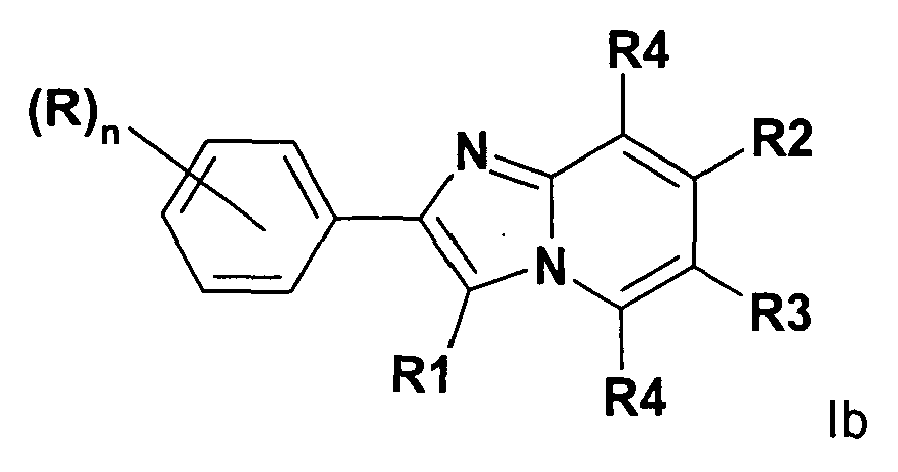
- R is chosen from F, Cl, (C1-C6)-alkyl which can be substituted by one or more fluorine atoms, (C1-C6)-alkoxy which can be substituted by one or more fluorine atoms, NR7R8, nitro or pentafluorosulfonyl;
- or two adjacent R groups form together with carbon atoms which carry them a 4- to 7-membered, partially unsaturated or aromatic heterocyclic ring which can be substituted by one or more identical or different substituents R13 and which can contain one or two ring members chosen from =N-, -NR4-, -C(=O)-, -O-, -S-, -SO- and -SO2- which can be identical or different, with the proviso that two ring members from the series -O-, -S-, -SO-, -SO2- cannot be present in adjacent ring positions;
- R1 is chosen from hydrogen or (C1-C6)-alkyl;
- or R and R1 form together a (C1-C2)-alkylene or (C1-C2)-alkenylene chain if R is attached in ortho-position of the phenyl ring;
- R2 is chosen from hydrogen, hydroxy or (C1-C6)-alkyl;
- R3 is chosen from cyano, -C(=O)-NR9R10, amino, -NR11-C(=O)R12 or -C(=NR5)-NHR6;
- R4 is each time independently chosen from hydrogen or (C1-C6)-alkyl;
- R5 is chosen from hydrogen, (C1-C6)-alkyl, (C1-C6)-alkylcarbonyl, (C1-C6)-alkoxycarbonyl, (C1-C6)-alkoxycarbonyl-oxy, (C1-C18)-alkylcarbonyloxy-(C1-C6)-alkoxycarbonyl, (C6-C14)-arylcarbonyl, (C6-C14)-aryloxycarbonyl, hydroxy, (C1-C6)-alkylcarbonyl-oxy, (C6-C14)-aryl-(C1-C6)-alkoxycarbonyl, (C1-C6)-alkylaminocarbonyl-oxy, di-((C1-C6)-alkyl)aminocarbonyl-oxy, (C1-C6)-alkylaminocarbonyl, di-((C1-C6)-alkyl)aminocarbonyl, wherein all aryl groups can be substituted by one or more identical or different substituents chosen from halogen, (C1-C6)-alkyl, (C1-C6)-alkoxy or trifluoromethyl ;
- R6 is chosen from hydrogen, cyano, hydroxy, (C1-C6)-alkoxy or (C6-C14)-aryl-(C1-C6) alkoxy;
- or R5 and R6 form together with the -N=C-NH- group which carries them a 4- to 7-membered, partially unsaturated or aromatic heterocyclic ring which can be substituted by one or more identical or different substituents R14 and which, in addition to the nitrogen atoms being part of the -N=C-NH- group, can contain one or two further ring members chosen from =N-, -NR4-, -C(=O)-, -O-, -S-, -SO- and -SO2- which can be identical or different, with the proviso that two ring members from the series -O-, -S-, -SO-, -SO2- cannot be present in adjacent ring positions;
- R7 and R8 are independently chosen from hydrogen or (C1-C6)-alkyl;
- or R7 and R8 form together with the nitrogen atom which carries them a 4- to 7-membered, saturated, partially unsaturated or aromatic heterocyclic ring.
- R9 and R10 are independently chosen from hydrogen or (C1-C6)-alkyl, with the proviso that at least one of R9 and R10 is not hydrogen;
- or R9 and R10 form together with the nitrogen atom which carries them a 4- to 7-membered, saturated, partially unsaturated or aromatic heterocyclic ring;
- R11 is hydrogen;
- R12 is hydrogen;
- or R11 and R12 form together with the carbonylamino group which carries them a 4-to 7-membered, saturated, partially unsaturated or aromatic heterocyclic ring which can be substituted by one or more identical or different substituents R15 and which, in addition to the carbonylamino group connecting R11 and R12, contains one or two further ring members chosen from =N-, -NR4-, -C(=O)-, -O-, -S-, -SO- and -SO2- which can be identical or different, with the proviso that two ring members from the series -O-, -S-, -SO-, -SO2- cannot be present in adjacent ring positions;
- R13, R14 and R15 are independently chosen from halogen, (C1-C6)-alkyl, (C1-C6)-alkoxy or trifluoromethyl;
- n is chosen from 1, 2, 3, 4 or 5;
- o is chosen form 0, 1, 2, 3, 4 or 5;
- in any of its stereoisomeric forms or a mixture of stereoisomeric forms in any ratio, or a physiologically acceptable salt thereof.
- A preferred embodiment of the present invention relates to a compound of the formula Ib, in which
- R is chosen from F, Cl, (C1-C6)-alkyl or NR7R8;
- R1 is chosen from hydrogen;
- R2 is hydrogen;
- R3 is chosen from cyano, -C(=O)-NR9R10, amino, -NR11-C(=O)R12 or -C(=NR5)-NHR6;
- R4 is each time hydrogen;
- R5 is chosen from hydrogen, (C1-C6)-alkoxycarbonyi-oxy or hydroxy;
- R6 is hydrogen;
- or R5 and R6 form together with the -N=C-NH- group which carries them a 4- to 7-membered, partially unsaturated or aromatic heterocyclic ring which, in addition to the nitrogen atoms being part of the -N=C-NH- group, can contain one or two further ring members chosen from -C(=O)- and -O-;
- R7 and R8 are independently chosen from (C1-C6)-alkyl;
- R9 and R10 are independently chosen from hydrogen or (C1-C6)-alkyl, with the proviso that at least one of R9 and R10 is not hydrogen;
- or R9 and R10 form together with the nitrogen atom which carries them a 4- to 7-membered, saturated heterocyclic ring;
- R11 is hydrogen;
- R12 is hydrogen;
- or R11 and R12 form together with the carbonylamino group which carries them a 4-to 7-membered, saturated heterocyclic ring which, in addition to the carbonylamino group connecting R11 and R12, contains one or two further ring members chosen from -NR4- and -C(=O)-;
- n is 1;
- o is 1;
- in any of its stereoisomeric forms or a mixture of stereoisomeric forms in any ratio, or a physiologically acceptable salt thereof.
- Another preferred embodiment of the present invention relates to a compound of the formula I, wherein the compound of formula I is chosen from:
- 2-(4-Bromo-phenyl)-3-methyl-imidazo[1,2-a]pyridine-6-carboxylic acid methyl ester,
- 3-Methyl-2-phenyl-imidazo[1,2-a]pyridine-6-carboxylic acid methyl ester,
- 2-(2-Oxo-1,2,3,4-tetrahydro-quinolin-6-yl)-imidazo[1,2-a]pyridine-6-carboxylic acid methyl ester,
- 2-(2-Fluoro-phenyl)-imidazo[1,2-a]pyridine-6-carboxylic acid methyl ester,
- 2-Pentafluorophenyl-imidazo[1,2-a]pyridine-6-carboxylic acid methyl ester,
- 2-p-Tolyl-imidazo[1,2-a]pyridine-6-carboxylic acid methyl ester,
- 2-Naphthalen-2-yl-imidazo[1,2-a]pyridine-6-carboxylic acid methyl ester,
- 2-(3-Fluoro-phenyl)-imidazo[1,2-a]pyridine-6-carboxylic acid methyl ester,
- 2-(4-Trifluoromethyl-phenyl)-imidazo[1,2-a]pyridine-6-carboxylic acid methyl ester,
- 2-(4-Trifluoromethoxy-phenyl)-imidazo[1 ,2-a]pyridine-6-carboxylic acid methyl ester,
- 2-(4-Diethylamino-phenyl)-imidazo[1 ,2-a]pyridine-6-carboxylic acid methyl ester,
- 2-(4-Cyano-phenyl)-imidazo[1,2-a]pyridine-6-carboxylic acid methyl ester,
- 2-(2-Chloro-phenyl)-imidazo[1,2-a]pyridine-6-carboxylic acid methyl ester,
- 2-(4-Bromo-3-sulfamoyl-phenyl)-imidazo[1,2-a]pyridine-6-carboxylic acid methyl ester,
- 2-(4-Fluoro-3-sulfamoyl-phenyl)-imidazo[1,2-a]pyridine-6-carboxylic acid methyl ester,
- 2-(3-Cyano-phenyl)-imidazo[1,2-a]pyridine-6-carboxylic acid methyl ester,
- 2-(3-Bromo-phenyl)-imidazo[1,2-a]pyridine-6-carboxylic acid methyl ester,
- 2-(2,4-Dimethyl-phenyl)-imidazo[1,2-a]pyridine-6-carboxylic acid methyl ester,
- 2-(3,4-Dichloro-phenyl)-imidazo[1 ,2-a]pyridine-6-carboxylic acid methyl ester,
- 2-(4-Chloro-3-methyl-phenyl)-imidazo[1,2-a]pyridine-6-carboxylic acid methyl ester,
- 2-(2,4-Dichloro-phenyl)-imidazo[1,2-a]pyridine-6-carboxylic acid methyl ester,
- 2-(3-Chloro-phenyl)-imidazo[1,2-a]pyridine-6-carboxylic acid methyl ester,
- 2-(3,5-Difluoro-phenyl)-imidazo[1,2-a]pyridine-6-carboxylic acid methyl ester,
- 2-(3-Trifluoromethyl-phenyl)-imidazo[1,2-a]pyridine-6-carboxylic acid methyl ester,
- 2-(2,3-Dihydro-benzo[1,4]dioxin-6-yl)-imidazo[1,2-a]pyridine-6-carboxylic acid methyl ester,
- 2-(2,6-Dichloro-4-trifluoromethyl-phenyl)-imidazo[1,2-a]pyridine-6-carboxylic acid methyl ester,
- 2-(2-Nitro-phenyl)-imidazo[1,2-a]pyridine-6-carboxylic acid methyl ester,
- 2-Biphenyl-4-yl-imidazo[1,2-a]pyridine-6-carboxylic acid methyl ester,
- 2-(4-Nitro-phenyl)-imidazo[1,2-a]pyridine-6-carboxylic acid methyl ester,
- 2-(4-Sulfamoyl-phenyl)-imidazo[1,2-a]pyridine-6-carboxylic acid methyl ester,
- 2-(4-Sulfamoyl-phenyl)-imidazo[1,2-a]pyridine-6-carboxylic acid methyl ester,
- 2-(2-Trifluoromethyl-phenyl)-imidazo[1,2-a]pyridine-6-carboxylic acid methyl ester,
- 11 H-Indeno[1',2':4,5]imidazo[1,2-a]pyridine-8-carboxylic acid methyl ester,
- 2-(4-Pyrrolidin-1-yl-phenyl)-imidazo[1,2-a]pyridine-6-carboxylic acid methyl ester,
- 2-p-Tolyl-imidazo[1,2-a]pyridine-6-carboxylic acid,
- 2-(4-Diethylamino-phenyl)-imidazo[1,2-a]pyridine-6-carboxylic acid,
- 2-(4-Fluoro-phenyl)-imidazo[1,2-a]pyridine-6-carboxylic acid tert-butylamide,
- 2-(4-Fluoro-phenyl)-imidazo[1,2-a]pyridine-6-carboxylic acid dimethylamide,
- Azetidin-1-yl-[2-(4-fluoro-phenyl)-imidazo[1,2-a]pyridin-6-yl]-methanone,
- 2-(4-Fluoro-phenyl)-imidazo[1,2-a]pyridine-6-carbonitrile,
- 2-(4-Diethylamino-phenyl)-imidazo[1,2-a]pyridine-6-carbonitrile,
- 2-p-Tolyl-imidazo[1,2-a]pyridine-6-carbonitrile,
- 2-(3-Chloro-phenyl)-imidazo[1,2-a]pyridine-6-carbonitrile,
- 2-(4-Fluoro-phenyl)-N-hydroxy-imidazo[1,2-a]pyridine-6-carboxamidine,
- N-Hydroxy-2-p-tolyl-imidazo[1,2-a]pyridine-6-carboxamidine,
- 2-(4-Diethylamino-phenyl)-N-hydroxy-imidazo[1,2-a]pyridine-6-carboxamidine,
- 2-(3-Chloro-phenyl)-N-hydroxy-imidazo[1,2-a]pyridine-6-carboxamidine,
- 2-(4-Fluoro-phenyl)-N-ethoxycarbonyloxy-imidazo[1,2-a]pyridine-6-carboxamidine,
- 6-Bromo-2-(4-fluoro-phenyl)-imidazo[1,2-a]pyridine,
- [4-(6-Bromo-imidazo[1,2-a]pyridin-2-yl)-phenyl]-diethyl-amine,
- 2-(4-Fluoro-phenyl)-imidazo[1,2-a]pyridin-6-ylamine,
- N-[2-(4-Fluoro-phenyl)-imidazo[1,2-a]pyridin-6-yl]-formamide,
- 3-[2-(4-Fluoro-phenyl)-imidazo[1,2-a]pyridin-6-yl]-imidazolidine-2,4-dione,
- 3-[2-(4-Fluoro-phenyl)-imidazo[1,2-a]pyridin-6-yl]-4H-1,2,4-oxadiazol-5-one,
- 2-(4-Fluoro-phenyl)-imidazo[1,2-a]pyridine-6-carboxamidine,
- If in the compounds of the formulae I, la and Ib any groups, substituents, ring members, numbers or other features such as, for example, R, R4, alkyl groups etc. occur several times, they can all independently of one another have any of the indicated meanings and can in each case be identical or different from one another. In a dialkylamino group, for example, the alkyl groups can be identical or different.
- The compounds of formula la encompass the compounds of formula Ib. The compounds of formula I encompass the compounds of formula Ib and Ia.
- Alkyl residues can be linear, i.e. straight-chain, or branched, acyclic or cyclic. This also applies when they are part of other groups, for example alkyloxy groups (= alkoxy groups, i.e. alkyl-O- groups), alkyloxycarbonyl groups or alkyl-substituted amino groups, or when they are substituted. Examples of alkyl groups are methyl, ethyl, propyl, butyl, pentyl, hexyl, the n-isomers of these groups, isopropyl, isobutyl, isopentyl, sec-butyl, tert-butyl, neopentyl or 3,3-dimethylbutyl. Substituted alkyl groups can be substituted by one or more, for example one, two, three, four or five, identical or different substituents, for example F, which can be located in any desired positions.
- As far as applicable, the preceding explanations regarding alkyl groups apply correspondingly to divalent alkyl groups, i.e. alkanediyl groups and alkylene groups, such as a methylene group.
- Examples of cycloalkyl groups are cyclopropyl, cyclobutyl, cyclopentyl, cyclohexyl and cycloheptyl. Substituted cycloalkyl groups can be substituted by one or more, for example one, two, three, four or five, identical or different substituents which can be located in any desired positions.
- Examples of (C6-C14)-aryl residues are phenyl and 2- or 3-naphthyl. If a (C6-C14)-aryl residue, for example phenyl or naphthyl, which can be unsubstituted or substituted, is substituted by one or more substituents, in general it can carry one, two, three, four or five identical or different substituents, for example one or two substitutents. The substituents can be located in any desired positions.This likewise applies to (C6-C14)-aryl radicals in groups such as, for example, (C6-C14)-arylcarbonyl, (C6-C14)-aryloxycarbonyl or (C6-C14)-aryl-(C1-C6)-alkoxycarbonyl. In monosubstituted phenyl groups the substituent can be located in the 2-position, the 3-position or the 4-position. In a disubstituted phenyl group the substituents can be located in 2,3-position, 2,4-position, 2,5-position, 2,6-position, 3,4-position or 3,5-position. In trisubstituted phenyl groups the substituents can be located in 2,3,4-position, 2,3,5-position, 2,3,6-position, 2,4,5-position, 2,4,6-position or 3,4,5-position. Naphthalenyl (= naphthyl) can be naphthalen-1-yl or naphthalen-2-yl. In monosubstituted naphthalen-1-yl groups the substituent can be located in the 2-, 3-, 4-, 5-, 6-, 7-, or 8-position, in monosubstituted naphthalen-2-yl groups the substituent can be located in the 1-, 3-, 4-, 5-, 6-, 7-, or 8-position. In disubstituted naphthalenyl groups the substituents can likewise occur in any desired positions in the ring via which the naphthalenyl group is bonded, and/or in the other ring.
- The ring which can be formed by two adjacent R groups together with the carbon atoms which carry them can be 4-membered, 5-membered, 6-membered or 7-membered, for example 6-membered, and can be partially unsaturated or aromatic, and contains, for example, one, two or three double bonds within the ring, provided the respective ring system is known in the art to be stable and suitable as a subgroup in a drug substance. The ring which can be formed by two adjacent R groups together with the carbon atoms which carry them can contain one or two further ring members chosen from =N-, -NR4-, -C(=O)-, -O-, -S-, -SO- and -SO2-, for example -NR4-, -C(=O)- and -O-, which can be identical or different, with the proviso that two ring members from the series -O-, -S-, -SO-, -SO2- cannot be present in adjacent ring positions and provided the respective ring system is known in the art to be stable and suitable as a subgroup in a drug substance. The heterocyclic ring which can be formed by two adjacent R groups together with the carbon atoms which carry them can be substituted by one or more identical or different substituents R13. Examples of the bicyclic ring systems formed by two adjacent R groups together with the annulated phenyl ring which carries the two R groups are: indan, indene, indole, dihydro-indole, isoindole, dihydro-isoindole, isoindolone, indolone, naphthalene, dihydro-naphthalene, tetrahydro-naphthalene, chromane, dihydo-benzodioxine, benzodioxine, quinoline, dihydro-quinoline, tetrahydro-chinoline, isoquinoline, dihydro-isoquinoline, tetrahydro-isochinoline, dihydro-quinolinone, dihydro-isochinolinone, quinazoline, dihydro-quinazoline, tetrahydro-quinazoline or dihydro-quinazolinone, for example naphthalene, dihydro-benzodioxine or dihydro-quinolinone.
- The heterocyclic ring which can be formed by R5 and R6 together with the -N=C-NH- group which carries them can be 4-membered, 5-membered, 6-membered or 7-membered, for example 5-membered, and can be partially unsaturated or aromatic, in particular partially unsaturated, and contains, for example, one, two or three double bonds within the ring, provided the respective ring system is known in the art to be stable and suitable as a subgroup in a drug substance. The heterocyclic ring which can be formed by R5 and R6 together with the -N=C-NH- group which carries them can contain, in addition to the nitrogen atoms being part of the -N=C-NH- group, one or two further ring members chosen from =N-, -NR4-, -C(=O)-, -O-, -S-, - SO- and -SO2-, for example -C(=O)- and -O-, which can be identical or different, with the proviso that two ring members from the series -O-, -S-, -SO-, -SO2- cannot be present in adjacent ring positions and provided the respective ring system is known in the art to be stable and suitable as a subgroup in a drug substance. The heterocyclic ring which can be formed by R5 and R6 together with the -N=C-NH- group which carries them can be substituted by one or more identical or different substituents R14. Examples of residues of heterocyclic rings formed by R5 and R6 together with the -N=C-NH- group which carries them are: imidazole, dihydro-imidazole, pyrimidine, dihydro-pyrimidine, tetrahydro-pyrimidine, diazepin, dihydro-diazepin, tetrahydro-diazepin, diazete-one, oxadiazole, dihydro-oxadiazole, oxadiazole-one, thiadiazole, dihydro-thiadiazole, thiadiazole-one, triazole, dihydro-triazole, dihydro-triazole-one, dihydro-dioxo-thiadiazole, dihydro-oxo-thiadiazole, dioxo-thiadiazole, dihydro-tetrazole, tetrazole, tetrahydro-triazine, dihydro-triazine, triazine, tetrahydro-tetrazine, dihydro-tetrazine, tetrazine, dihydro-oxadiazine, dioxadiazine, oxadiazine, dihydro-thiadiazine, dithiadiazine, thiadiazine, dihydo-oxadiazine-one, oxadiazine-one, pyrimidine-dione, tetrahydro-oxadiazepine, dihydro-oxadiazepine, oxadiazepine, tetrahydro-thiadiazepine, dihydro-thiadiazepine, thiadiazepine, tetrahydro-triazepine, dihydro-triazepine or triazepine, for example oxadiazole.
- The heterocyclic ring which can be formed by R7 and R8 together with the nitrogen atom which carries them can be 4-membered, 5-membered, 6-membered or 7-membered, for example 5-membered, and can be saturated, partially unsaturated or aromatic, in particular saturated, and can contain, for example, one, two or three double bonds within the ring, provided the respective ring system is known in the art to be stable and suitable as a subgroup in a drug substance. Examples of residues of heterocyclic rings formed by R7 and R8 together with the nitrogen atom which carries them are: azetidine, pyrrolidine, piperidine, azepane, dihydro-azete, azete, dihydro-pyrrole, pyrrole, tetrahydro-pyridine, dihydro-pyridine, pyridine, tetrahydro-azepine, dihydro-azepine, azepine, preferably azetidine, pyrrolidine, piperidine or azepane, for example pyrrolidine.
- The heterocyclic ring which can be formed by R9 and R10 together with the nitrogen atom which carries them can be 4-membered, 5-membered, 6-membered or 7-membered, for example 4-membered, and can be saturated, partially unsaturated or aromatic, in particular saturated, and can contain, for example, one, two or three double bonds within the ring, provided the respective ring system is known in the art to be stable and suitable as a subgroup in a drug substance. Examples of residues of heterocyclic rings formed by R9 and R10 together with the nitrogen atom which carries them are: azetidine, pyrrolidine, piperidine, azepane, dihydro-azete, azete, dihydro-pyrrole, pyrrole, tetrahydro-pyridine, dihydro-pyridine, pyridine, tetrahydro-azepine, dihydro-azepine, azepine, preferably azetidine, pyrrolidine, piperidine or azepane, for example azetidine.
- The heterocyclic ring which can be formed by R11 and R12 together with the carbonylamino group which carries them can be 4-membered, 5-membered, 6-membered or 7-membered, for example 5-membered, and can be saturated, partially unsaturated or aromatic, in particular saturated, and can contain, for example, one, two or three double bonds within the ring, provided the respective ring system is known in the art to be stable and suitable as a subgroup in a drug substance. The heterocyclic ring which can be formed by R11 and R12 together with the carbonylamino group which carries them can contain, in addition to the nitrogen atom and the carbonyl group being part of the carbonylamino group, one or two further ring members chosen from =N-, -NR4-, -C(=O)-, -O-, -S-, -SO- and -SO2-, for example -C(=O)- and -NR4-, which can be identical or different, with the proviso that two ring members from the series -O-, -S-, -SO-, -SO2- cannot be present in adjacent ring positions and provided the respective ring system is known in the art to be stable and suitable as a subgroup in a drug substance. The heterocyclic ring which can be formed by R11 and R12 together with the carbonylamino group which carries them can be substituted by one or more identical or different substituents R15. Examples of residues of heterocyclic rings formed by R11 and R12 together with the carbonylamino group which carries them are: imidazole, dihydro-imidazole, pyrimidine, dihydro-pyrimidine, tetrahydro-pyrimidine, diazepin, dihydro-diazepin, tetrahydro-diazepin, diazete-one, oxadiazole, dihydro-oxadiazole, oxadiazole-one, thiadiazole, dihydro-thiadiazole, thiadiazole-one, imidazolidine-one, imidazolidine-dione, triazole, dihydro-triazole, dihydro-triazole-one, dihydro-dioxo-thiadiazole, dihydro-oxo-thiadiazole, dioxo-thiadiazole, dihydro-tetrazole, tetrazole, tetrahydro-triazine, dihydro-triazine, triazine, tetrahydro-tetrazine, dihydro-tetrazine, tetrazine, dihydro-oxadiazine, dioxadiazine, oxadiazine, dihydro-thiadiazine, dithiadiazine, thiadiazine, dihydo-oxadiazine-one, oxadiazine-one, pyrimidine-dione, tetrahydro-oxadiazepine, dihydro-oxadiazepine, oxadiazepine, tetrahydro-thiadiazepine, dihydro-thiadiazepine, thiadiazepine, tetrahydro-triazepine, dihydro-triazepine or triazepine, for example imidazolidine-2,4-dione.
- Halogen is fluorine, chlorine, bromine or iodine, preferably fluorine, chlorine or bromine, for example fluorine.
- An oxo group, when bonded to a carbon atom, replaces two hydrogen atoms on a carbon atom of the parent system. Thus, if a CH2 group is substituted by oxo, i.e. by a doubly bonded oxygen atom, it becomes a C(=O) group. Evidently, an oxo group cannot occur as a substituent on a carbon atom in an aromatic ring.
- The present invention includes all stereoisomeric forms of the compounds of the formulae I, la and Ib and their salts. With respect to each chiral center, independently of any other chiral center, the compounds of formulae I, la and Ib can be present in S configuration or substantially S configuration, or in R configuration or substantially R configuration, or as a mixture of the S isomer and the R isomer in any ratio. The invention includes all possible enantiomers and diastereomers and mixtures of two or more stereoisomers, for example mixtures of enantiomers and/or diastereomers, in all ratios. Thus, compounds according to the invention which can exist as enantiomers can be present in enantiomerically pure form, both as levorotatory and as dextrorotatory antipodes, and in the form of mixtures of the two enantiomers in all ratios including racemates. In the case of a E/Z isomerism, or cis/trans isomerism, for example on double bonds or rings, the invention includes both the E form and Z form, or the cis form and the trans form, as well as mixtures of these forms in all ratios. The preparation of individual stereoisomers can be carried out, for example, by separation of a mixture of isomers by customary methods, for example by chromatography or crystallization, by the use of stereochemically uniform starting materials in the synthesis, or by stereoselective synthesis. Optionally a derivatization can be carried out before a separation of stereoisomers. The separation of a mixture of stereoisomers can be carried out at the stage of the compound of the formulae I, Ia or Ib or at the stage of a starting material or an intermediate during the synthesis.
- The present invention also includes all tautomeric forms of the compounds of formulae I, Ia and Ib and their salts. For example, the invention includes the tautomeric forms of the group C(=NR5)-NHR6:

- In case the compounds of the formulae I, la and Ib contain one or more acidic and/or basic groups, i.e. salt-forming groups, the invention also comprises their corresponding physiologically or toxicologically acceptable salts, i.e. non-toxic salts, in particular their pharmaceutically acceptable salts. Thus, the compounds of the formulae I, la and lb which contain an acidic group can be present on such groups, and can be used according to the invention, for example, as alkali metal salts, alkaline earth metal salts or as ammonium salts. More specific examples of such salts include sodium salts, potassium salts, calcium salts, magnesium salts, quaternary ammonium salts such as tetraalkylammonium salts, or acid addition salts with ammonia or organic amines such as, for example, ethylamine, ethanolamine, triethanolamine or amino acids. Compounds of the formulae I, la and Ib which contain a basic group, i.e. a group which can be protonated, can be present on such groups, and can be used according to the invention, for example, in the form of their addition salts with inorganic or organic acids. Examples for suitable acids include hydrogen chloride, hydrogen bromide, phosphoric acid, sulfuric acid, nitric acid, methanesulfonic acid, p-toluenesulfonic acid, naphthalenedisulfonic acids, oxalic acid, acetic acid, tartaric acid, lactic acid, salicylic acid, benzoic acid, formic acid, propionic acid, pivalic acid, diethylacetic acid, malonic acid, succinic acid, pimelic acid, fumaric acid, maleic acid, malic acid, sulfamic acid, phenylpropionic acid, gluconic acid, ascorbic acid, nicotinic acid, isonicotinic acid, citric acid, adipic acid, and other acids known to the person skilled in the art. If the compounds of the formulae I, la and Ib simultaneously contain acidic and basic groups in the molecule, the invention also includes, in addition to the salt forms mentioned, inner salts or betaines or zwitterions. The salts of the compounds of the formulae I, la and Ib can be obtained by customary methods which are known to the person skilled in the art like, for example, by contacting the compound of the formulae I, la and Ib or la with an organic or inorganic acid or base in a solvent or diluent, or by anion exchange or cation exchange from another salt. The present invention also includes all salts of the compounds of the formulae I, la and Ib which, owing to low physiological compatibility, are not directly suitable for use in pharmaceuticals but which can be used, for example, as intermediates for chemical reactions or for the preparation of physiologically acceptable salts.
- The present invention furthermore includes all solvates of compounds of the formulae I, la and Ib, for example hydrates or adducts with alcohols, active metabolites of the compounds of the formulae I, la and Ib, and also prodrugs and derivatives of the compounds of the formulae I, la and Ib which in vitro may not necessarily exhibit pharmacological activity but which in vivo are converted into pharmacologically active compounds, for example esters or amides of carboxylic acid groups.
- In one embodiment R in the compounds of formulae I and la is chosen from halogen, (C1-C6)-alkyl which can be substituted by one or more fluorine atoms, (C1-C6)-alkoxy which can be substituted by one or more fluorine atoms, NR7R8, cyano, (C1-C6)-alkylsulfonyl, aminosulfonyl, nitro, (C3-C7)-cycloalkyl or (C6-C14)-aryl, wherein the aryl residue can be substituted by one or more identical or different substituents chosen from halogen, (C1-C6)-alkyl, (C1-C6)-alkoxy or trifluoromethyl, or two adjacent R groups form together with carbon atoms which carry them a 4- to 7-membered, partially unsaturated or aromatic heterocyclic ring which can be substituted by one or more identical or different substituents R13 and which can contain one or two ring members chosen from =N-, -NR4-, -C(=O)-, -O-, -S-, -SO- and -SO2- which can be identical or different, with the proviso that two ring members from the series -O-, -S-, -SO-, -SO2- cannot be present in adjacent ring positions; in the compounds of formula I and la R is preferably chosen from halogen, for example F, Cl or Br, (C1-C6)-alkyl which can be substituted by one or more fluorine atoms, for example methyl or trifluormethyl, (C1-C6)-alkoxy which can be substituted by one or more fluorine atoms, for example methoxy or trifluormethoxy, NR7R8, cyano, (C1-C6)-alkylsulfonyl, for example methylsulfonyl, aminosulfonyl, nitro, (C3-C7)-cycloalkyl, for example cyclohexyl, or (C6-C14)-aryl , for example phenyl, or two adjacent R groups form together with carbon atoms which carry them a 4- to 7-membered, preferably 6-membered, partially unsaturated or aromatic heterocyclic ring and which can contain one or two ring members chosen from -NR4-, -C(=O)- or -O- which can be identical or different, for example the ring formed by the two adjacent R groups together with the carbon atoms which carry them is a phenyl, dihydro-dioxane or dihydro-pyridine ring. More preferably in the compounds of formula I and la R is chosen from F, Cl, Br, I, methyl, ethyl, trifluormethyl, methoxy, ethoxy, trifluormethoxy, amino, dimethylamino, diethylamino, azetidine, pyrrolidine, piperidine, cyano, methylsulfonyl, aminosulfonyl, nitro, cyclopentyl, cyclohexyl, naphthyl or phenyl, for example F, Cl, Br, methyl, trifluormethyl, methoxy, trifluormethoxy, amino, diethylamino, pyrrolidine, cyano, methylsulfonyl, aminosulfonyl, nitro, cyclohexyl or phenyl. In another embodiment compounds of formula I or la are more preferred in which two adjacent R groups form together with the annulated phenyl ring which carries the two R groups a bicyclic ring system, for example indan, indene, indole, dihydro-indole, isoindole, dihydro-isoindole, isoindolone, indolone, naphthalene, dihydro-naphthalene, tetrahydro-naphthalene, chromane, dihydo-benzodioxine, benzodioxine, quinoline, dihydro-quinoline, tetrahydro-chinoline, isoquinoline, dihydro-isoquinoline, tetrahydro-isochinoline, dihydro-quinolinone, dihydro-isochinolinone, quinazoline, dihydro-quinazoline, tetrahydro-quinazoline or dihydro-quinazolinone, preferably naphthalene, dihydro-benzodioxine or dihydro-quinolinone. In one embodiment R in the compounds of formula Ib is chosen from F, Cl, (C1-C6)-alkyl or NR7R8; in the compounds of formula Ib R is preferably chosen from F, Cl, methyl, ethyl, amino, dimethylamino or diethylamino, for example F, Cl or diethylamino.
In one embodiment R1 in the compounds of formulae I, la and lb is chosen from hydrogen or (C1-C6)-alkyl; in the compounds of formulae I and la R1 is preferably chosen from hydrogen or methyl, for example hydrogen; in the compounds of formula lb R1 is preferably hydrogen.
In another embodiment R1 and R in the compounds of formulae I and la form together a (C1-C2)-alkylene chain, for example a methylene chain, if R is attached in ortho-position of the phenyl ring. - In one embodiment R2 in the compounds of formulae I, la and Ib is chosen from hydrogen, hydroxy or methyl, preferably hydrogen.
- In one embodiment R3 in the compounds of formulae I and la is chosen from Br, cyano, nitro, -C(=O)-NR9R10, amino, -NR11-C(=O)R12, COOH, (C1-C6)-alkoxycarbonyl or -C(=NR5)-NHR6; preferably R3 in the compounds of formulae I and la is defined as Br, cyano, nitro, -C(=O)-NR9R10, amino, -NR11-C(=O)R12, COOH, methoxycarbonyl, ethoxycarbonyl, or -C(=NR5)-NHR6, for example Br, cyano, nitro, -C(=O)-NR9R10, amino, -NR11-C(=O)R12, COOH, methoxycarbonyl or -C(=NR5)-NHR6.
In one embodiment R3 in the compounds of formula lb is chosen from
cyano, -C(=O)-NR9R10, amino, -NR11-C(=O)R12 or-C(=NR5)-NHR6. - In one embodiment compounds of formulae I, Ia and lb are preferred, in which R4 is defined as hydrogen.
- In one embodiment compounds of formulae I, la and Ib are preferred, in which R5 is defined as hydrogen, (C1-C6)-alkoxycarbonyl-oxy or hydroxyl; more preferably R5 in the compounds of formulae I, la and Ib are chosen from hydrogen, ethyloxycarbonyl-oxy, methyloxycarbonyl-oxy or hydroxyl, for example hydrogen, ethyloxycarbonyl-oxy or hydroxyl.
- In one embodiment compounds of formulae I, la and Ib are preferred, in which R6 is defined as hydrogen.
- In another embodiment R4 and R5 in the compounds of formulae I, Ia and Ib form together with the -N=C-NH- group which carries them a 4- to 7-membered, for example a 5- or 6-membered, partially unsaturated or aromatic heterocyclic ring which can be substituted by one or more identical or different substituents R14 and which, in addition to the nitrogen atoms being part of the -N=C-NH- group, can contain one or two further ring members chosen from =N-, -NR1-, -C(=O)-, -O-, -S-, -SO- and -SO2-, for example -C(=O)- and -O-, which can be identical or different, with the proviso that two ring members from the series -O-, -S-, -SO-, -SO2- cannot be present in adjacent ring positions; for example R4 and R5 in the compounds of formulae I, la and Ib form together with the -N=C-NH- group which carries them imidazole, dihydro-imidazole, pyrimidine, dihydro-pyrimidine, tetrahydro-pyrimidine, diazepin, dihydro-diazepin, tetrahydro-diazepin, diazete-one, oxadiazole, dihydro-oxadiazole, oxadiazole-one, thiadiazole, dihydro-thiadiazole, thiadiazole-one, triazole, dihydro-triazole, dihydro-triazole-one, dihydro-dioxo-thiadiazole, dihydro-oxo-thiadiazole, dioxo-thiadiazole, dihydro-tetrazole, tetrazole, tetrahydro-triazine, dihydro-triazine, triazine, tetrahydro-tetrazine, dihydro-tetrazine, tetrazine, dihydro-oxadiazine, dioxadiazine, oxadiazine, dihydro-thiadiazine, dithiadiazine, thiadiazine, dihydo-oxadiazine-one, oxadiazine-one, pyrimidine-dione, tetrahydro-oxadiazepine, dihydro-oxadiazepine, oxadiazepine, tetrahydro-thiadiazepine, dihydro-thiadiazepine, thiadiazepine, tetrahydro-triazepine, dihydro-triazepine or triazepine, for example oxadiazole.
- In one embodiment R7 and R8 in compounds of formulae I, la and Ib are independently chosen from hydrogen or (C1-C6)-alkyl, preferably chosen from hydrogen, methyl, ethyl or isopropyl; more preferably R7 and R8 in the compounds of formulae I and la are chosen from hydrogen, methyl or ethyl, for example hydrogen or ethyl; in compounds of for formula lb R7 and R8 are preferably ethyl.
- In another embodiment R7 and R8 in the compounds of formulae I, la and Ib form together with the nitrogen atom which carries them a 4- to 7-membered, for example 5-membered, saturated, partially unsaturated or aromatic, preferably saturated, heterocyclic ring; for example R6 and R7 in the compounds of formulae I and la form together with the nitrogen atom which carries them azetidine, pyrrolidine, piperidine, azepane, dihydro-azete, azete, dihydro-pyrrole, pyrrole, tetrahydro-pyridine, dihydro-pyridine, pyridine, tetrahydro-azepine, dihydro-azepine, azepine, preferably azetidine, pyrrolidine, piperidine or azepane, for example pyrrolidine.
- In one embodiment R9 and R10 in compounds of formulae I and la are independently chosen from hydrogen or (C1-C6)-alkyl; more preferably R9 and R10 in the compounds of formulae I and Ia are independently chosen from hydrogen, methyl, ethyl, isopropyl or tert.-butyl, for example R9 and R10 are independently chosen from hydrogen, methyl or tert.-butyl.
In compounds of for formula lb R9 and R10 are preferably independently chosen from hydrogen or (C1-C6)-alkyl, with the proviso that at least one of R9 and R10 is not hydrogen; more preferably R9 and R10 in the compounds of formula lb are independently chosen from hydrogen, methyl, ethyl, isopropyl or tert.-butyl, for example R7 and R8 are independently chosen from hydrogen, methyl or tert.-butyl, with the proviso that at least one of R9 and R10 is not hydrogen. - In another embodiment R9 and R10 in the compounds of formulae I, la and Ib form together with the nitrogen atom which carries them a 4- to 7-membered, for example 4-membered, saturated, partially unsaturated or aromatic, preferably saturated, heterocyclic ring; for example R9 and R10 in the compounds of formulae I, la and lb form together with the nitrogen atom which carries them azetidine, pyrrolidine, piperidine, azepane, dihydro-azete, azete, dihydro-pyrrole, pyrrole, tetrahydro-pyridine, dihydro-pyridine, pyridine, tetrahydro-azepine, dihydro-azepine, azepine, preferably azetidine, pyrrolidine, piperidine or azepane, for example azetidine.
- In one embodiment R11 in the compounds of formulae I, la and Ib is preferably chosen from hydrogen.
- In one embodiment R12 in the compounds of formulae I and la is chosen from hydrogen or (C1-C6)-alkyl, preferably from hydrogen, methyl or ethyl, for example hydrogen or methyl.
In one embodiment R12 in the compounds of formulae Ib is chosen from hydrogen. - In another embodiment R11 and R12 in the compounds of formulae I, Ia and Ib form together with the carbonylamino group which carries them a 4- to 7-membered, for example 5-membered, saturated, partially unsaturated or aromatic, preferably saturated, heterocyclic ring which can be substituted by one or more identical or different substituents R15 and which, in addition to the carbonylamino group connecting R11 and R12, can contain one or two further ring members chosen from =N-, -NR4-, -C(=O)-, -O-, -S-, -SO- and -SO2-, for example -NR4- or -C(=O)-, which can be identical or different, with the proviso that two ring members from the series -O-, -S-, -SO-, -SO2- cannot be present in adjacent ring positions; for example R11 and R12 in the compounds of formulae I, la and Ib form together with the carbonylamino group which carries them imidazole, dihydro-imidazole, pyrimidine, dihydro-pyrimidine, tetrahydro-pyrimidine, diazepin, dihydro-diazepin, tetrahydro-diazepin, diazete-one, oxadiazole, dihydro-oxadiazole, oxadiazole-one, thiadiazole, dihydro-thiadiazole, thiadiazole-one, imidazolidine-one, imidazolidine-dione, triazole, dihydro-triazole, dihydro-triazole-one, dihydro-dioxo-thiadiazole, dihydro-oxo-thiadiazole, dioxo-thiadiazole, dihydro-tetrazole, tetrazole, tetrahydro-triazine, dihydro-triazine, triazine, tetrahydro-tetrazine, dihydro-tetrazine, tetrazine, dihydro-oxadiazine, dioxadiazine, oxadiazine, dihydro-thiadiazine, dithiadiazine, thiadiazine, dihydo-oxadiazine-one, oxadiazine-one, pyrimidine-dione, tetrahydro-oxadiazepine, dihydro-oxadiazepine, oxadiazepine, tetrahydro-thiadiazepine, dihydro-thiadiazepine, thiadiazepine, tetrahydro-triazepine, dihydro-triazepine or triazepine, for example imidazolidine-2,4-dione.
- In one embodiment compounds of formula I, la and lb are preferred, in which R13, R14 and R15 are independently chosen from halogen, (C1-C6)-alkyl, (C1-C6)-alkoxy or trifluoromethyl, preferably from F, Cl, Br, methyl, ethyl, methoxy or trifluoromethyl.
- In one embodiment compounds of formula I, la and lb are preferred in which n is chosen from zero, 1, 2 or 5, for example 1.
- In one embodiment compounds of formula I, la and Ib are preferred in which o is chosen from zero or 1, preferably 1.
- In another embodiment compounds of formulae I and la are preferred, in which R1 is H or (C1-C6)-alkyl or R and R1 form together a (C1-C2)-alkylene chain if R is attached in ortho-position of the phenyl ring when R3 is defined as (C1-C6)-alkoxycarbonyl.
In another embodiment compounds of formulae I, la and Ib are preferred, in which R1 is H when R3 is defined as Br, cyano, nitro, -C(=O)-NR9R10, amino, -NR11-C(=O)R12, COOH or-C(=NR5)-NHR6. - In another embodiment compounds of formulae I and la are preferred, in which n is 0, 1, 2 or 5 when R3 is defined as (C1-C6)-alkoxycarbonyl.
In another embodiment compounds of formulae I, la and Ib are preferred, in which n is 1 when R3 is defined as Br, cyano, nitro, -C(=O)-NR9R10, amino, -NR11-C(=O)R12, COOH or -C(=NR5)-NHR6. - In another embodiment compounds of formulae I and la are preferred, in which R is chosen from F, Cl, (C1-C6)-alkyl or NR7R8 when R3 is defined as Br.
In another embodiment compounds of formulae I, la and Ib are preferred, in which R is chosen from F, Cl, (C1-C6)-alkyl or NR7R8 when R3 is defined a cyano.
In another embodiment compounds of formulae I and la are preferred, in which R is F when R3 is defined as nitro.
In another embodiment compounds of formulae I, la and lb are preferred, in which R is F when R3 is defined as -C(=O)-NR9R10.
In another embodiment compounds of formulae I, la and Ib are preferred, in which R is F when R3 is defined as amino.
In another embodiment compounds of formulae I, Ia and lb are preferred, in which R is F when R3 is defined as -NR11-C(=O)R12.
In another embodiment compounds of formulae I and la are preferred, in which R is F, (C1-C6)-alkyl or NR7R8 when R3 is defined as COOH.
In another embodiment compounds of formulae I and la are preferred, in which R is halogen, (C1-C6)-alkyl which can be substituted by one or more fluorine atoms, (C1-C6)-alkoxy which can be substituted by one or more fluorine atoms, NR7R8, cyano, (C1-C6)-alkylsulfonyl, aminosulfonyl, nitro, (C3-C7)-cycloalkyl or (C6-C14)-aryl or two adjacent R groups form together with carbon atoms which carry them a 4- to 7-membered, partially unsaturated or aromatic heterocyclic ring and which can contain one or two ring members chosen from -NR4-, -C(=O)- or -O- which can be identical or different when R3 is defined as (C1-C6)-alkoxycarbonyl. - In another embodiment compounds of formulae I, Ia and Ib are preferred, in which R is F, Cl (C1-C6)-alkyl or NR7R8 when R3 is defined as -C(=NR5)-NHR6.
- The compounds according to general formula I, la and Ib and their precursors can be prepared according to methods published in the literature or, respectively, analogous methods. For example, the compounds of formula I, Ia and Ib can be prepared by reacting a compound of formula II with a compound of formula III:

The reaction of the compounds of the formulae II and III can be carried out in an inert solvent, which can be protic or aprotic and aqueous or non-aqueous, for example hexane, toluene, dichloromethane, dichloroethane, trichloromethane, tetrachloromethane, an ether, for example diethyl ether, tetrahydrofuran (= THF), dioxane, an amide, for example N,N-dimethylformamide (= DMF), an alcohol, for example methanol or ethanol, water or acetonitril, or a mixture of two or more solvents, including a mixture of water and an organic solvent which is miscible or immiscible with water. Alternatively, the reaction can be carries out under solvent-free conditions.
The reaction can be carried out in the presence of a base or with irradiation of microwaves.
The reaction of the compounds of the formulae II and III can be carried out in a wide temperature range. Usually it is advantageous to perform the reaction at temperatures from about -20 °C to about the boiling point of the solvent used, preferably at from about 0 °C to about 140 °C, more preferably about the boiling point of the solvent.
As is usual, the detailed conditions of a specific preparation, including the solvent, the base, the temperature, the order of addition, the molar ratios and other parameters, are routinely chosen by the person skilled in the art in view of the characteristics of the starting compounds and the target compound.
Appropriate methods have been published, for example, in P. Sanfilippo et al., Journal of Medicinal Chemistry (1988), 31(11), 2221-7, G.Trapani et al., Journal of Medicinal Chemistry (1997), 40(19), 3109-3118. - All reactions used in the above-described syntheses of the compounds of the formula I are per se well-known to the skilled person and can be carried out under standard conditions according to or analogously to procedures described in the literature, for example in Houben-Weyl, Methoden der Organischen Chemie (Methods of Organic Chemistry), Thieme-Verlag, Stuttgart, or Organic Reactions, John Wiley & Sons, New York. Depending on the circumstances of the individual case, in order to avoid an unwanted course of a reaction or side reactions during the synthesis of a compound, it can generally be necessary or advantageous to temporarily block functional groups by introducing protective groups and deprotect them at a later stage of the synthesis, or introduce functional groups in the form of precursor groups which later are converted into the desired functional groups. As a further example of protecting groups, besides the above-mentioned amino-protecting groups, ester protecting groups of carboxylic acid groups may be mentioned, such as tert-butyl esters which can be deprotected by treatment with trifluoroacetic acid, or benzyl esters which can be deprotected by catalytic hydrogenation. As an example of a precursor group the nitro group may be mentioned which can be converted into an amino group by reduction, for example by catalytic hydrogenation. Such synthesis strategies, and protective groups and precursor groups which are suitable in a specific case, are known to the skilled person. Another type of conversion is starting from compounds of the formula I, where R3 is a carboxylic acid ester group. By standard procedures, known in the literature, the ester group can be transferred to amide groups by direct reaction with ammonia or amines or indirectly via saponification of the ester groups and reaction of the free carboxylic acids with ammonia or amines. The primary amines can be dehydrated to get the corresponding nitriles. Numerous procedures are described in the literature to conduct these types of reactions, as example mentioned is D. S. Bose, B. Jayalakshmi, Synthesis 1999, 64-65. Nitriles are easily converted to nitrogen derived adducts like amidines or hydroxy amidines; numerous examples are described in the literature, like in Houben-Weyl, Methoden der Organischen Chemie (Methods of Organic Chemistry) volume XI/2, p 39 -, Thieme-Verlag, Stuttgart; G. Wagner, P. Richter and Ch. Garbe, Pharmazie (1974), 29,12-15; Z. Li et al, J. Med. Chem. (2005), 48(20), 6169-6173; M.D: Bjorklund and M.D. Coburn, J. Het. Chem. (1980), 17(4), 819-21;
- If desired, the obtained compounds of formula I, as well as any intermediate compounds, can be purified by customary purification procedures, for example by recrystallization or chromatography.
- The compounds of the formulae I, Ia and Ib are useful pharmacologically active, or pharmaceutically active compounds which modulate the expression of endothelial NO synthase, and more specifically upregulate, or stimulate, the expression, or transcription, of endothelial NO synthase, and which can be employed as pharmaceuticals, or active ingredients of medicaments, for the treatment of various diseases. In the context of the present invention, treatment is understood as comprising both therapy, including alleviation and cure, of diseases and disease symptoms and prevention and prophylaxis of diseases and disease symptoms, such as, for example, the prevention of the appearance of asthmatic disease symptoms or the prevention of myocardial infarction or of myocardial reinfarction in affected patients. The diseases or disease symptoms can be acute or chronic. Diseases which can be treated with the compounds of the formulae I, Ia and Ib include, for example, cardiovascular diseases like stable and unstable angina pectoris, coronary heart disease, coronary artery disease, Prinzmetal angina (spasm), acute coronary syndrome, cardiac insufficiency, heart failure, myocardial infarction, stroke, thrombosis, peripheral artery occlusive disease (= PAOD), endothelial dysfunction, atherosclerosis, restenosis, endothel damage after PTCA (= percutaneous transluminal coronary angioplasty), hypertension including essential hypertension, pulmonary hypertension and secondary hypertension (renovascular hypertension, chronic glomerulonephritis), erectile dysfunction, and ventricular arrhythmia. Further, the compounds of the formulae I, Ia and Ib lower the cardiovascular risk of postmenopausal women or after intake of contraceptives. Compounds of the formulae I, Ia and Ib can additionally be used in the treatment, including therapy and prevention, of diabetes and diabetes complications such as nephropathy or retinopathy, angiogenesis, asthma bronchiale, chronic renal failure, cirrhosis of the liver, osteoporosis, restricted memory performance or a restricted ability to learn. Preferred indications are chronic heart failure, stable angina pectoris, coronary heart disease, hypertension, endothelial dysfunction, atherosclerosis and diabetes complications.
- The compounds of the formulae I, la and Ib can be used in combination with other pharmacologically active compounds or pharmaceuticals, preferably with compounds which are able to enhance the effect of the compounds according to the formulae I, Ia and Ib. Examples of such other compounds include statins; ACE inhibitors; AT1 antagonists; argininase inhibitors; PDE V inhibitors; calcium antagonists; alpha blockers; beta blockers; metimazol and analogous compounds; arginine; tetrahydrobiopterin; vitamins, in particular vitamin C and vitamin B6; niacine.
- The compounds of the formulae I, la and Ib and their physiologically acceptable salts, optionally in combination with other pharmacologically active compounds, can be administered to animals, preferably to mammals, and in particular to humans, as pharmaceuticals by themselves, in mixtures with one another, or in the form of pharmaceutical compositions. Further subjects of the present invention therefore also are the compounds of the formulae I, Ia and Ib and their physiologically acceptable salts for use as pharmaceuticals, their use as modulating agents, and more specifically as stimulating agents or upregulating agents, of the expression or transcription of endothelial NO synthase, for example in conditions in which an increased expression of said enzyme or an increased NO level or the normalization of a decreased NO level in a patient is desired, and in particular their use in the treatment, including therapy and prevention, of the above-mentioned diseases or syndromes, as well as their use for the preparation or manufacture of medicaments for these purposes. Furthermore, a subject of the present invention are pharmaceutical compositions, or pharmaceutical preparations, which comprise an effective dose of at least one compound of the formulae I or Ia and/or a physiologically acceptable salt thereof and a pharmaceutically acceptable carrier, i.e. one or more pharmaceutically acceptable carrier substances and/or additives.
- The pharmaceuticals according to the invention can be administered orally, for example in the form of pills, tablets, lacquered tablets, sugar-coated tablets, granules, hard and soft gelatin capsules, aqueous, alcoholic or oily solutions, syrups, emulsions or suspensions, or rectally, for example in the form of suppositories. Administration can also be carried out parenterally, for example subcutaneously, intramuscularly or intravenously, for example in the form of solutions for injection or infusion. Other suitable administration forms are, for example, percutaneous or topical administration, for example in the form of ointments, tinctures, sprays or transdermal therapeutic systems, or the inhalative administration in the form of nasal sprays or aerosol mixtures, or, for example, microcapsules, implants or rods. The preferred administration form depends, among others, on the disease to be treated and on its severity.
- The amount of a compound of the formulae I, la or Ib and/or its physiologically acceptable salts present in the pharmaceutical compositions normally ranges from about 0.2 to about 800 mg, preferably from about 0.5 to about 500 mg, in particular from about 1 to about 200 mg, per dose, but depending on the type of the pharmaceutical composition it may also be higher. The pharmaceutical compositions usually comprise from about 0.5 to about 90 percent by weight of the compounds of the formulae I or la and/or their physiologically acceptable salts. The production of the pharmaceutical compositions can be carried out in a manner known per se. To this end, one or more compounds of the formulae I or Ia and/or their physiologically acceptable salts together with one or more solid or liquid pharmaceutical carrier substances (or vehicles) and/or additives (or auxiliary substances) and, if a combination medicament is desired, other pharmacologically active compounds having therapeutic or prophylactic action are brought into a suitable administration form or dosage form which can then be used as a pharmaceutical in human or veterinary medicine.
- For the production of pills, tablets, sugar-coated tablets and hard gelatin capsules it is possible to use, for example, lactose, starch, for example maize starch, starch derivatives, talc, stearic acid or its salts, etc. Soft gelatin capsules and suppositories can comprise, for example, fats, waxes, semisolid and liquid polyols, natural or hardened oils, etc. Suitable carrier substances for the preparation of solutions, for example of solutions for injection, or of emulsions or syrups are, for example, water, physiologically sodium chloride solution, alcohols such as ethanol, glycerol, polyols, sucrose, invert sugar, glucose, mannitol, vegetable oils, etc. It is also possible to lyophilize the compounds of the formulae I, Ia and Ib and their physiologically acceptable salts and to use the resulting lyophilisates, for example, for preparing compositions for injection or infusion. Suitable carriers for microcapsules, implants or rods are, for example, copolymers of glycolic acid and lactic acid. Besides the compound or compounds according to the invention and carrier substances, the pharmaceutical compositions can also contain additives such as, for example, fillers, disintegrants, binders, lubricants, wetting agents, stabilizers, emulsifiers, dispersants, preservatives, sweeteners, colorants, flavorings, aromatizers, thickeners, diluents, buffer substances, solvents, solubilizers, agents for achieving a depot effect, salts for altering the osmotic pressure, coating agents or antioxidants.
- The dosage of the compound of the formulae I, Ia or Ib to be administered and/or of a physiologically acceptable salt thereof depends on the individual case and, as is customary, has to be adapted to the individual circumstances to achieve an optimum effect. Thus, it depends on the nature and the severity of the disorder to be treated, and also on the sex, age, weight and individual responsiveness of the human or animal to be treated, on the efficacy and duration of action of the compounds used, on whether the use is for the therapy of a acute or chronic disease or prophylactic, or on whether other active compounds are administered in addition to compounds of the formulae I or Ia. In general, a daily dose from about 0.01 mg/kg to about 100 mg/kg, preferably from about 0.1 mg/kg to about 10 mg/kg, in particular from about 0.3 mg/kg to about 5 mg/kg (in each case mg per kg of bodyweight) is appropriate for administration to an adult weighing about 75 kg in order to obtain the desired results. The daily dose can be administered in a single dose or, in particular when larger amounts are administered, divided into several, for example two, three or four individual doses. In some cases, depending on the individual response, it may be necessary to deviate upwards or downwards from the given daily dose.
- The compounds of the formulae I, Ia and Ib can also be used for other purposes than those indicated in the foregoing. Non-limiting examples include the use as diagnostics, for example the use in methods for determining the activity of endothelial NO synthase in biological samples, the use as biochemical tools and the use as intermediates for the preparation of further compounds, for example further pharmacologically active compounds.
- List of abbreviations:
- DMF
- N,N-Dimethylformamide
- HPLC
- High Performance Liquid Chromatograpgy
- RT
- Room temperature
- TFA
- Trifluoroacetic acid
-

-

- The compound was synthesized analogously to example 1. M+H+:345.03.
-

- The compound was synthesized analogously to example 1. M+H+:267.13.
-

- The compound was synthesized analogously to example 1. M+H+:322.15.
-

- The compound was synthesized analogously to example 1. M+H+:271.10.
-
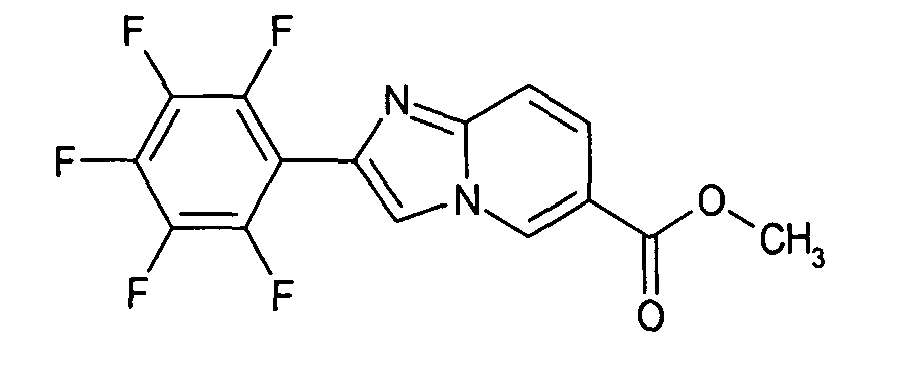
- The compound was synthesized analogously to example 1.Yield: %, M+H+:343.06.
-

- The compound was synthesized analogously to example 1. M+H+:267.13.
-

- The compound was synthesized analogously to example 1. M+H+:298.12.
-

- The compound was synthesized analogously to example 1.Yield: %, M+H+:287.08.
-

- The compound was synthesized analogously to example 1. M+H+:283.13.
-

- The compound was synthesized analogously to example 1.Yield: %, M+H+:303.13.
-

- The compound was synthesized analogously to example 1. M+H+:331.02.
-
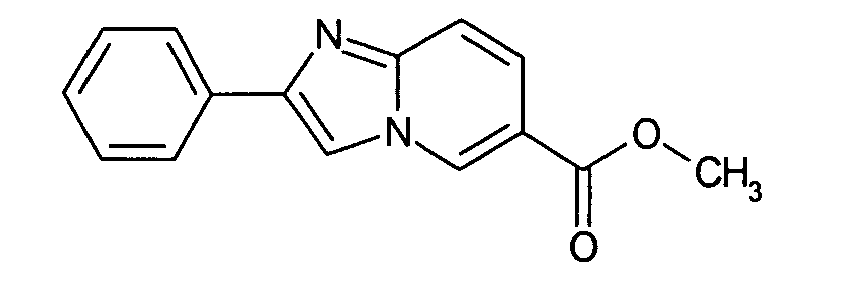
- The compound was synthesized analogously to example 1. M+H+:253.11.
-

- The compound was synthesized analogously to example 1. M+H+:271.10.
-

- The compound was synthesized analogously to example 1. M+H+:321.10.
-

- The compound was synthesized analogously to example 1. M+H+:337.08.
-
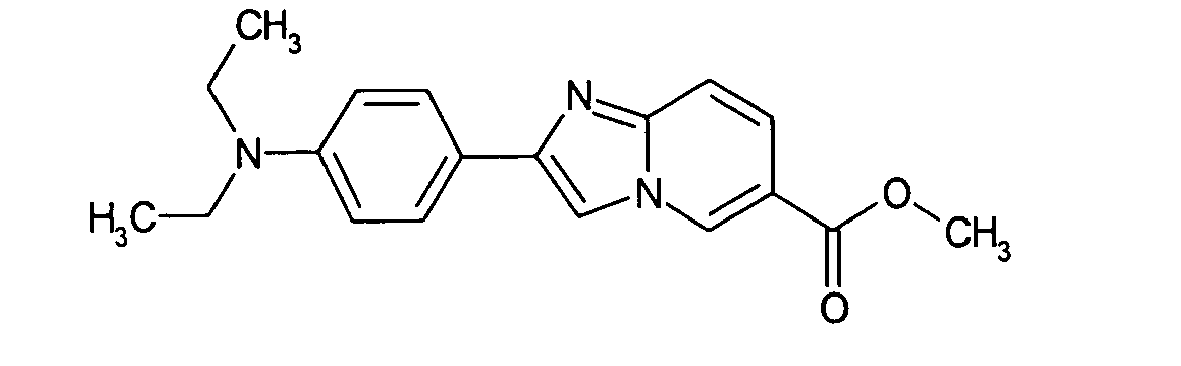
- The compound was synthesized analogously to example 1. M+H+:324.18.
-

- The compound was synthesized analogously to example 1. M+H+:278.12.
-
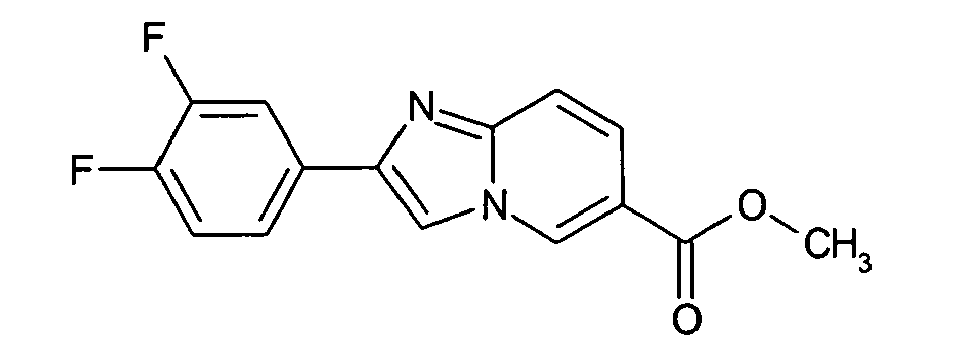
- The compound was synthesized analogously to example 1. M+H+:289.07.
-

- The compound was synthesized analogously to example 1. M+H+:287.05.
-

- The compound was synthesized analogously to example 1. M+H+:410.03.
-

- The compound was synthesized analogously to example 1. M+H+:350.10.
-

- The compound was synthesized analogously to example 1. M+H+:278.12.
-

- The compound was synthesized analogously to example 1. M+H+:331.06.
-

- The compound was synthesized analogously to example 1. M+H+:281.15.
-

- The compound was synthesized analogously to example 1. M+H+:321.04.
-

- The compound was synthesized analogously to example 1. M+H+:301.09.
-

- The compound was synthesized analogously to example 1. M+H+:321.07.
-

- The compound was synthesized analogously to example 1. M+H+:335.20.
-

- The compound was synthesized analogously to example 1. M+H+:331.09.
-

- The compound was synthesized analogously to example 1. M+H+:287.08.
-

- The compound was synthesized analogously to example 1. M+H+:289.07.
-

- The compound was synthesized analogously to example 1. M+H+:321.07.
-

- The compound was synthesized analogously to example 1. M+H+:311.09.
-

- The compound was synthesized analogously to example 1. M+H+:389.10.
-

- The compound was synthesized analogously to example 1. M+H+:289.09.
-
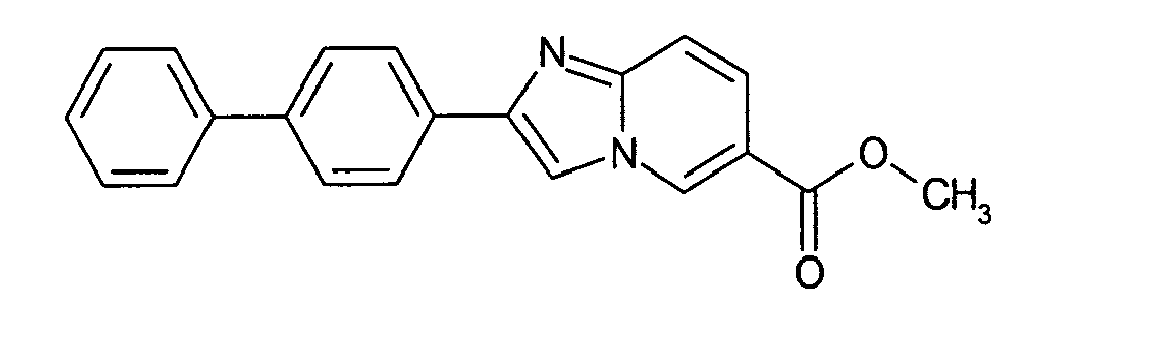
- The compound was synthesized analogously to example 1. M+H+:329.16.
-

- The compound was synthesized analogously to example 1.Yield: 91%, M+H+:298.04.
-

- The compound was synthesized analogously to example 1. M+H+:232.02.
-

- The compound was synthesized analogously to example 1. M+H+:283.19.
-

- The compound was synthesized analogously to example 1. M+H+:321.10.
-

- The compound was synthesized analogously to example 1. M+H+:265.05.
-

- The compound was synthesized analogously to example 1. M+H+:322.15.
-

- The compound was synthesized by hydrogenation of 2-(4-Nitro-phenyl)-imidazo[1,2-a]pyridine-6-carboxylic acid methyl ester (example 38).Yield: 83%, M+H+:268.09.
-
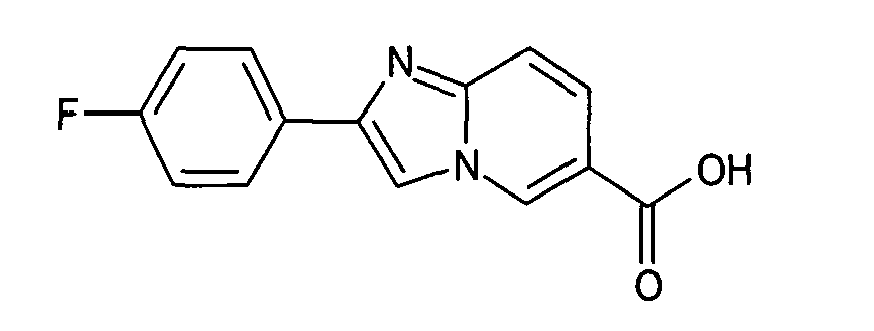
- 2-(4-Fluoro-phenyl)-imidazo[1,2-a]pyridine-6-carboxylic acid methyl ester (example 1; 590 mg, 2.18 mmol) weren heated in 5 ml hydrobromic acid (48%) and 15 ml acetic acid at 120 °C for 10 hours. The solid was filtered, washed and dried. Yield: 38%, M+H+:257.04.
-

- The compound was synthesized analogously to example 45 using example 7.Yield: 26%, M+H+:253.04.
-

- The compound was synthesized analogously to example 45 using example 17.Yield: 17%, M+H+:310.08.
-

- 2-(4-Fluoro-phenyl)-imidazo[1,2-a]pyridine-6-carboxylic acid (example 45; 40 mg, 0.14 mmol), tert. butylamine (73.1 mg, 0.0.27 mmol), HATU (57.2 mg, 0.15 mmol) and triethylamine (56.8 µl, 0.41 mmol) in 3 ml DMF were stirred at RT for 2 hours. The mixture was evaporated. ethylacetate and water were added, the organic layer was separated, washed with water, dried and evaporated. The crude product was purified by preparative HPLC (PR18, acetonitrile/water 0.1 % TFA) to yield 44 mg (99%) of the desired product. M+H+: 312.15.
-

- The compound was synthesized analogously to example 48.Yield: 47%, M+H+:256.09.
-

- The compound was synthesized analogously to example 48.Yield: 12%, M+H+:284.21.
-

- The compound was synthesized analogously to example 48.Yield: 25%, M+H+:296.13.
-

- 2-Bromo-1-(4-fluoro-phenyl)-ethanone (2.08 g, 9.6 mmol) and 6-Aminonicotinonitrile (1.14 g, 9.6 mmol) were refluxed in 50 ml dioxane for 13 hours. After cooling the solid was filtered and purified by preparative HPLC (PR18, acetonitrile/water 0.1 % TFA) to yield 1.05 g (46%) of the desired product. M+H+: 238.04.
-

- The compound was synthesized analogously to example 52.Yield: 29%, M+H+:291.17.
-

- The compound was synthesized analogously to example 52.Yield: 31 %, M+H+:234.04.
-

- The compound was synthesized analogously to example 52. Yield: 62%, M+H+:254.05.
-

- 2-(4-Fluoro-phenyl)-imidazo[1,2-a]pyridine-6-carbonitrile (example 52, 537 mg, 2.26 mmol), hydroxylamine hydrochloride (943.8 mg, 13.58 mmol) and triethylamine (2.19 ml, 15.84 mmol) were stirred in 40 ml of isopropanol at 90°C for 5 hours. The solvent was removed in vacuo and water was added. The solid was filtered, washed with diluted hydrochloric acid, water and was dried. Yield: 610 mg, 99%, M+H+: 271.03.
-

- The compound was synthesized analogously to example 57 using example 54.Yield: 62%, M+H+:267.08.
-

- The compound was synthesized analogously to example 56 using example 53.Yield: 50%, M+H+:324.10.
-

- The compound was synthesized analogously to example 56 using example 55.Yield: 59%, M+H+:287.00.
-

- 2-(4-Fluoro-phenyl)-N-hydroxy-1 H-benzoimidazole-5-carboxamidine (example 56; 85.1 mg, 0.315 mmol) was dissolved in 5 ml DMF. The mixture was heated to 80°C after addition of triethylamine (87.8 µl, 0.63 mmol) and ethyl chloroformate (33 µl, 0.34 mmol) for 2.5 hours. The mixture was evaporated. Ethylacetate and water were added, the organic layer was separated, washed with water, dried and evaporated. The crude product was purified by preparative HPLC (PR18, acetonitrile/water 0.1 % TFA) to yield 48 mg (45%) of the desired product. M+H+: 343.05.
-

- The compound was synthesized analogously to example 52.Yield: 51 %, M+H+:290.99.
-

- The compound was synthesized analogously to example 52.Yield: 48%, M+H+:287.00.
-

- The compound was synthesized analogously to example 52.Yield: 41 %, M+H+:306.99.
-

- The compound was synthesized analogously to example 52.Yield: 39%, M+H+:344.01.
-

- The compound was synthesized analogously to example 52.Yield: 20%, M+H+:258.08.
-

- The compound was synthesized by hydrogenation of 2-(4-Fluoro-phenyl)-6-nitro-imidazo[1,2-a]pyridine (example 65). Yield: 20%, M+H+:228.08.
-

- The compound was synthesized by formylation of 2-(4-Fluoro-phenyl)-imidazo[1,2-a]pyridin-6-ylamine (example 66). Yield: 48%, M+H+:256.08.
-

- The compound was synthesized by acetylation of 2-(4-Fluoro-phenyl)-imidazo[1,2-a]pyridin-6-ylamine (example 66). Yield: 37%, M+H+:270.10.
-

- The compound was synthesized analogously to example 52.Yield: 57%, M+H+:311.12.
-

- The compound was synthesized by treatment of 2-(4-Fluoro-phenyl)-N-ethoxycarbonyloxy-imidazo[1,2-a]pyridine-6-carboxamidine (example 60) with aqueous sodium carbonat.Yield: 14%, M+H+:296.95.
-

- The compound was synthesized by treatment of 2-(4-Fluoro-phenyl)-imidazo[1,2-a]pyridine-6-carbonitrile (example 52) with hydrochloric acid in ethanol and subsequent reaction with ammonia. Yield: 75%, M+H+:255.09.
- Activation of eNOS transcription was measured as described in detail by Li et al., "Activation of protein kinase C alpha and/or epsilon enhances transcription of the human endothelial nitric oxide synthase gene", Mol. Pharmacol. 53 (1998) 630. Briefly, a 3.5 kB long fragment 5' of the starting codon of the eNOS gene was cloned, sequenced and cloned in firefly luciferase expression plasmids to monitor activation of the eNOS promoter by reporter gene activity. A human endothelial cell line stable transfected and expressing this promoter-reporter construct was used for compound testing. Cells were incubated for 18 h with the compounds.
- All compounds were dissolved in sterile dimethyl sulfoxide (DMSO). A final concentration of 0.5 % DMSO in complete medium was allowed. Induction of reporter gene expression in these cells was measured using a standard luciferase assay system (Promega, Cat. No. E150) according to the manufacturer's instructions. Luciferase induction in cells incubated with compounds were compared to those incubated with solvent alone. The ratio of both activities (transcription induction ratio, TIR) was plotted as a function of compound concentration. Typically, TIR values started at low concentrations at a ratio of 1, indicating no compound effect, and extended up to a maximum TIR value TIR(max) which indicates the increase of the eNOS transcription. EC50 values of transcription induction ratios as a function of compound concentration were determined graphically.
- Numerous compounds of the instant invention were tested by the above-described assay and found to increase protein transcription. Generally, the tested compounds exhibited EC50 values of less than about 50 µM. Preferred compounds exhibited EC50 values of from about 5 µM to about 0.5 µM. More preferred compounds, for example the compounds of examples 1, 2, 3, 5, 7, 8, 10, 12, 13, 14, 15, 16, 17, 19, 20, 21, 23, 24, 25, 28, 31, 32, 33, 34, 37, 38, 42, 44, 46, 52, 53, 54, 56, 57, 60, 61, 66 and 67 exhibited EC50 values of less than 0.5 µM.
- The effect of compounds on eNOS-transcription was confirmed in a second assay based on eNOS protein detection. Primary human umbilical vein cord endothelial cells (HUVEC) were isolated and cultivated according to standard procedures. Confluent cells were incubated with compounds for 18 h and the effect on eNOS protein expression determined by a quantitative Western blotting procedure. After compound incubation, HUVEC were lysed in ice-cold lysis buffer containing 10 mM Tris-HCl, pH 8.0, 1 % SDS and protease inhibitors. The lysate was subjected to a standard denaturating polyacrylamide gel electrophoresis and blotted to nitrocellulose membranes. Using a specific primary monoclonal antibody (Transduction Laboratories, UK) and alkaline phosphatase labelled secondary antibody (Jackson Labs), a specific eNOS protein band was visualized and quantified based on a chemofluorescence detection method.
- The effect of the compounds of the formulae I, la and Ib can also be investigated in the following animal models (animal experiments are performed in accordance with the German animal protection law and the guidelines for the use of experimental animals as given by the Guide for the Care and Use of Laboratory Animals of the US National Institutes of Health).
- ApoE and eNOS deficient mice (C57BL/6J background, Jackson Laboratory, Bar Harbor, Me) are used. All animals are 10 to 12 weeks of age and weigh 22 to 28 g. Three days before surgery mice are divided into 4 groups (apoE control, n = 10 to 12; apoE with test compounds, n = 10 to 12; eNOS control, n = 10 to 12; eNOS with test compounds, n = 10 to 12) and receive either a standard rodent chow (containing 4 % of fat and 0.001 % of cholesterol; in the following designated as placebo group) or a standard rodent chow + test compound (10 or 30 mg/kg/day p.o.).
- Blood-pressure is determined in conscious mice using a computerized tail-cuff system (Visitech Systems, Apex, Nc). After treatment of ApoE deficient mice and eNOS deficient mice with the test compounds the blood pressure is compared to the results obtained with a placebo treatment.
- After 3 day treatment of ApoE deficient mice with the respective compound (10 mg/kg/day pressed in chow), animals are anesthetized with an intraperitoneal injection of pentobarbital (60 mg/kg) followed by an intramuscular injection of xylazin (2 mg/kg) and a cuff is placed around the femoral artery as described in Moroi et al. (J Clin. Invest. 101 (1998) 1225). Briefly, the left femoral artery is dissected. A non-occlusive 2.0 mm polyethylene cuff made of PE 50 tubing (inner diameter 0.56 mm, outer diameter 0.965 mm, Becton Dickinson, Mountain View, Ca) is placed around the artery and tied in place with two 7-0 sutures. The right femoral artery is isolated from the surrounding tissues but a cuff is not placed. Treatment with the respective compound is continued for 14 days after surgery. Then the animals are sacrificed. The aorta are taken for determination of vascular eNOS expressions by quantitative western blotting. Both femoral arteries are harvested, fixed in formalin and embedded in paraffin. 20 cross sections (10 µm) are cut from the cuffed portion of the left femoral artery and from the corresponding segment of the right artery. Sections are subjected to standard hematoxylin and eosin staining. Morphometric analyses are performed using an image analysis computer program (LeicaQWin, Leica Imaging Systems, Cambridge, GB). For each cross section the area of the lumen, the neointima and the media are determined. To this end, the neointima is defined as the area between the lumen and the internal elastic lamina and the media is defined as the area between the internal and the external elastic lamina. The ratio between the area of the neointima and the area of the media is expressed as the neointima/media ratio. The results obtained in the compound group are compared to those obtained in the placebo group.
- ApoE deficient mice are treated for 16 weeks with the respective compound pressed in chow and finally sacrificed. Aortas are removed from each mouse, fixed in formalin and embedded in paraffin. Plaque formation is measured via lipid lesions formation in the aortas (from aortic arch to diaphragm) and is analyzed by oil red O staining. For quantifying the effect of the respective compound on vascular eNOS expression the femoral arteries are used in this experiment. The results obtained in the compound group are compared to those obtained in the placebo group.
- Old Male wild-type C57BL/6J mice (Charles River Wiga GmbH, Sulzfeld), and apoE deficient mice (C57BL/6J background, Jackson Laboratory, Bar Harbor, Me) of 6 month of age and weighing 28 to 36 g are used in the experiments. Mice are divided into 3 groups (C57BL/6J, n = 8; apoE control, n = 8; apoE with respective compound, n = 8) and receive for 8 weeks either a standard rodent chow (containing 4 % of fat and 0.001 % of cholesterol) or a standard rodent chow + respective compound (30 mg/kg/day p.o.). Mice are anesthetized with sodium pentobarbitone (100 mg/kg i.p.), and the hearts are rapidly excised and placed into ice-cold perfusion buffer. The aorta is cannulated and connected to a perfusion apparatus (Hugo Sachs Electronics, Freiburg, Germany) which is started immediately at a constant perfusion pressure of 60 mm Hg. Hearts are perfused in a retrograde fashion with modified Krebs bicarbonate buffer, equilibrated with 95 % O2 and 5 % CO2 and maintained at 37.5 °C. A beveled small tube (PE 50) is passed through a pulmonary vein into the left ventricle and pulled through the ventricular wall, anchored in the apex by a fluted end, and connected to a tip-micromanometer (Millar 1.4 French). The left atrium is cannulated through the same pulmonary vein and the heart switched to the working mode with a constant preload pressure of 10 mm Hg and an afterload pressure of 60 mm Hg. Aortic outflow and atrial inflow are continuously measured using ultrasonic flow probes (HSE/Transonic Systems Inc.). Coronary flow is calculated as the difference between atrial flow and aortic flow. All hemodynamic data are digitized at a sampling rate of 1000 Hz and recorded with a PC using spezialized software (HEM, Notocord).
- Hearts are allowed to stabilize for 30 min. All functional hemodynamic data are measured during steady state, and during volume and pressure loading. Left ventricular function curves are constructed by varying pre-load pressure. For acquisition of preload curves, afterload is set at 60 mm Hg and preload is adjusted in 5 mm Hg steps over a range of 5 to 25 mm Hg. Hearts are allowed to stabilize at baseline conditions between pressure and volume loading.
for the stimulation of the expression of endothelial NO synthase.
provided that 2-(4-cyanophenyl)-imidazo[1,2-a]pyridine-6-carboxylic acid is excluded and provided that compounds are excluded in which R1 is hydrogen or methyl, R2 and R4 are hydrogen, n is 1, R3 is COOH or (C1-C6)-alkoxycarbonyl and R is Cl.
for the manufacture of a medicament for the stimulation of the expression of endothelial NO synthase and for the treatment of a disease in which such a stimulation, or an increase in NO level, is desired, for example a cardiovascular disorder such as atherosclerosis, coronary artery disease or cardiac insufficiency or any other disease mentioned above or below herein,
provided that 2-(4-cyanophenyl)-imidazo[1,2-a]pyridine-6-carboxylic acid is excluded and provided that compounds are excluded in which R1 is hydrogen or methyl, R2 and R4 are hydrogen, n is 1, R3 is COOH or (C1-C6)-alkoxycarbonyl and R is CI.
for the manufacture of a medicament for the stimulation of the expression of endothelial NO synthase and for the treatment of a disease in which such a stimulation, or an increase in NO level, is desired, for example a cardiovascular disorder such as atherosclerosis, coronary artery disease or cardiac insufficiency or any other disease mentioned above or below herein,
provided that 2-(4-cyanophenyl)-imidazo[1,2-a]pyridine-6-carboxylic acid is excluded and provided that compounds are excluded in which R1 is hydrogen or methyl, R2 and R4 are hydrogen, n is 1, R3 is COOH or (C1-C6)-alkoxycarbonyl and R is Cl.
for the manufacture of a medicament for the stimulation of the expression of endothelial NO synthase and for the treatment of a disease in which such a stimulation, or an increase in NO level, is desired, for example a cardiovascular disorder such as atherosclerosis, coronary artery disease or cardiac insufficiency or any other disease mentioned above or below herein.
provided that compounds are excluded in which R1, R2 and R4 are hydrogen, n is 1, R is cyano and R3 is cyano or COOH,
provided that compounds are excluded in which R1 is hydrogen or methyl, R2 and R4 are hydrogen, n is 1, R3 is COOH or (C1-C6)-alkoxycarbonyl and R is Cl, provided that compounds are excluded in which R1, R2 and R4 are hydrogen and n is 0
and provided that compounds are excluded in which R1, R2 and R4 are hydrogen, R3 is Br, n is 1 and R is Br, NO2, NMe2, amino, methyl, amide or F.
provided that compounds are excluded in which R1, R2 and R4 are hydrogen, n is 1, R is cyano and R3 is cyano or COOH,
provided that compounds are excluded in which R1 is hydrogen or methyl, R2 and R4 are hydrogen, n is 1, R3 is COOH or (C1-C6)-alkoxycarbonyl and R is Cl, provided that compounds are excluded in which R1, R2 and R4 are hydrogen and n is 0
and provided that compounds are excluded in which R1, R2 and R4 are hydrogen, R3 is Br, n is 1 and R is Br, N02, NMe2, amino, methyl, amide or F.
provided that compounds are excluded in which R1, R2 and R4 are hydrogen, n is 1, R is cyano and R3 is cyano or COOH,
provided that compounds are excluded in which R1 is hydrogen or methyl, R2 and R4 are hydrogen, n is 1, R3 is COOH or (C1-C6)-alkoxycarbonyl and R is Cl, provided that compounds are excluded in which R1, R2 and R4 are hydrogen and n is 0
and provided that compounds are excluded in which R1, R2 and R4 are hydrogen, R3 is Br, n is 1 and R is Br, NO2, NMe2, amino, methyl, amide or F.
Claims (17)
- The use of a compound of the formula I
 R is chosen from halogen, (C1-C6)-alkyl which can be substituted by one or more fluorine atoms, (C1-C3)-alkyl-oxy-(C1-C3)-alkyl, hydroxy, (C1-C6)-alkoxy which can be substituted by one or more fluorine atoms, (C1-C6)-alkylmercapto, NR7R8, mono-(C1-C6)-alkylaminocarbonyl, di-(C2-C6)-alkylaminocarbonyl, (C1-C6)-alkoxycarbonyl, cyano, (C1-C6)-alkylsulfinyl, (C1-C6)-alkylsulfonyl, aminosulfonyl, nitro, pentafluorosulfonyl, (C3-C7)-cydoalkyl or (C6-C14)-aryl, wherein the aryl residue can be substituted by one or more identical or different substituents chosen from halogen, (C1-C6)-alkyl, (C1-C6)-alkoxy or trifluoromethyl;or two adjacent R groups form together with carbon atoms which carry them a 4- to 7-membered, partially unsaturated or aromatic heterocyclic ring which can be substituted by one or more identical or different substituents R13 and which can contain one or two ring members chosen from =N-, -NR4-, -C(=O)-, -O-, -S-, -SO- and -SO2- which can be identical or different, with the proviso that two ring members from the series -O-, -S-, -SO-, -SO2- cannot be present in adjacent ring positions;R1 is chosen from hydrogen or (C1-C6)-alkyl;or R and R1 form together a (C1-C2)-alkylene or (C1-C2)-alkenylene chain if R is attached in ortho-position of the phenyl ring;R2 is chosen from hydrogen, hydroxy or (C1-C6)-alkyl;R3 is chosen from Br, cyano, nitro, -C(=O)-NR9R10, amino, -NR11-C(=O)R12, COOH, (C1-C6)-alkoxycarbonyl or -C(=NR5)-NHR6;R4 is each time independently chosen from hydrogen or (C1-C6)-alkyl;R5 is chosen from hydrogen, (C1-C6)-alkyl, (C1-C6)-alkylcarbonyl, (C1-C6)-alkoxycarbonyl, (C1-C6)-alkoxycarbonyl-oxy, (C1-C18)-alkylcarbonyloxy-(C1-C6)-alkoxycarbonyl, (C6-C14)-arylcarbonyl, (C6-C14)-aryloxycarbonyl, hydroxy, (C1-C6)-alkylcarbonyl-oxy, (C6-C14)-aryl-(C1-C6)-alkoxycarbonyl, (C1-C6)-alkylaminocarbonyl-oxy, di-((C1-C6)-alkyl)aminocarbonyl-oxy, (C1-C6)-alkylaminocarbonyl, di-((C1-C6)-alkyl)aminocarbonyl, wherein all aryl groups can be substituted by one or more identical or different substituents chosen from halogen, (C1-C6)-alkyl, (C1-C6)-alkoxy or trifluoromethyl ;R6 is chosen from hydrogen, cyano, hydroxy, (C1-C6)-alkoxy or (C6-C14)-aryl-(C1-C6) alkoxy;or R5 and R6 form together with the -N=C-NH- group which carries them a 4- to 7-membered, partially unsaturated or aromatic heterocyclic ring which can be substituted by one or more identical or different substituents R14 and which, in addition to the nitrogen atoms being part of the -N=C-NH- group, can contain one or two further ring members chosen from =N-, -NR4-, -C(=O)-, -O-, -S-, -SO- and -SO2- which can be identical or different, with the proviso that two ring members from the series -O-, -S-, -SO-, -SO2- cannot be present in adjacent ring positions;R7 and R8 are independently chosen from hydrogen or (C1-C6)-alkyl;or R7 and R8 form together with the nitrogen atom which carries them a 4- to 7-membered, saturated, partially unsaturated or aromatic heterocyclic ring.R9 and R10 are independently chosen from hydrogen or (C1-C6)-alkyl;or R9 and R10 form together with the nitrogen atom which carries them a 4- to 7-membered, saturated, partially unsaturated or aromatic heterocyclic ring;R11 is chosen from hydrogen or (C1-C6)-alkyl;R12 is chosen from hydrogen or (C1-C6)-alkyl;or R11 and R12 form together with the carbonylamino group which carries them a 4-to 7-membered, saturated, partially unsaturated or aromatic heterocyclic ring which can be substituted by one or more identical or different substituents R15 and which, in addition to the carbonylamino group connecting R11 and R12, can contain one or two further ring members chosen from =N-, -NR4-, -C(=O)-, -O-, -S-, -SO- and -SO2- which can be identical or different, with the proviso that two ring members from the series -O-, -S-, -SO-, -SO2- cannot be present in adjacent ring positions;R13, R14 and R15 are independently chosen from halogen, (C1-C6)-alkyl, (C1-C6)-alkoxy or trifluoromethyl;n is chosen from 0, 1, 2, 3, 4 or 5;o is chosen form 0, 1, 2, 3, 4 or 5;or a physiologically acceptable salt thereof, for the manufacture of a medicament for the stimulation of the expression of endothelial NO synthase.
 - The use as claimed in claim 1 for the manufacture of a medicament for the treatment of cardiovascular diseases, stable or unstable angina pectoris, coronary heart disease, coronary artery disease, Prinzmetal angina, acute coronary syndrome, cardiac insufficiency, heart failure, myocardial infarction, stroke, thrombosis, peripheral artery occlusive disease, endothelial dysfunction, atherosclerosis, restenosis, endothel damage after PTCA, hypertension, essential hypertension, pulmonary hypertension, secondary hypertension, renovascular hypertension, chronic glomerulonephritis, erectile dysfunction, ventricular arrhythmia, diabetes, diabetes complications, nephropathy, retinopathy, angiogenesis, asthma bronchiale, chronic renal failure, cirrhosis of the liver, osteoporosis, restricted memory performance or a restricted ability to learn, or for the lowering of cardiovascular risk of postmenopausal women or after intake of contraceptives.
- The use as claimed in claims 1 or 2 for the manufacture of a medicament for the treatment of chronic heart failure, stable angina pectoris, coronary heart disease, hypertension, endothelial dysfunction, atherosclerosis or diabetes complications.
- The use as claimed in any of claims 1 to 3, wherein in the compound of the formula I or a physiologically acceptable salt thereofR is chosen from halogen, (C1-C6)-alkyl which can be substituted by one or more fluorine atoms, (C1-C3)-alkyl-oxy-(C1-C3)-alkyl, hydroxy, (C1-C6)-alkoxy which can be substituted by one or more fluorine atoms, (C1-C6)-alkylmercapto, NR7R8, mono-(C1-C6)-alkylaminocarbonyl, di-(C2-C6)-alkylaminocarbonyl, (C1-C6)-alkoxycarbonyl, cyano, (C1-C6)-alkylsulfinyl, (C1-C6)-alkylsulfonyl, aminosulfonyl, nitro, pentafluorosulfonyl, (C3-C7)-cycloalkyl or (C6-C14)-aryl, wherein the aryl residue can be substituted by one or more identical or different substituents chosen from halogen, (C1-C6)-alkyl, (C1-C6)-alkoxy or trifluoromethyl;or two adjacent R groups form together with carbon atoms which carry them a 4- to 7-membered, partially unsaturated or aromatic heterocyclic ring which can be substituted by one or more identical or different substituents R13 and which can contain one or two ring members chosen from =N-, -NR4-, -C(=O)-, -O-, -S-, -SO- and -SO2- which can be identical or different, with the proviso that two ring members from the series -O-, -S-, -SO-, -SO2- cannot be present in adjacent ring positions;R1 is chosen from hydrogen or (C1-C6)-alkyl;or R and R1 form together a (C1-C2)-alkylene or (C1-C2)-alkenylene chain if R is attached in ortho-position of the phenyl ring;R2 is chosen from hydrogen, hydroxy or (C1-C6)-alkyl;R3 is chosen from Br, cyano, nitro, -C(=O)-NR9R10, amino, -NR11-C(=O)R12, COOH, (C1-C6)-alkoxycarbonyl or -C(=NR5)-NHR6;R4 is each time independently chosen from hydrogen or (C1-C6)-alkyl;R5 is chosen from hydrogen, (C1-C6)-alkyl, (C1-C6)-alkylcarbonyl, (C1-C6)-alkoxycarbonyl, (C1-C6)-alkoxycarbonyl-oxy, (C1-C18)-alkylcarbonyloxy-( C1-C6)-alkoxycarbonyl, (C6-C14)-arylcarbonyl, (C6-C14)-aryloxycarbonyl, hydroxy, (C1-C6)-alkylcarbonyl-oxy, (C6-C14)-aryl-(C1-C6)-alkoxycarbonyl, (C1-C6)-alkylaminocarbonyl-oxy, di-((C1-C6)-alkyl)aminocarbonyl-oxy, (C1-C6)-alkylaminocarbonyl, di-((C1-C6)-alkyl)aminocarbonyl, wherein all aryl groups can be substituted by one or more identical or different substituents chosen from halogen, (C1-C6)-alkyl, (C1-C6)-alkoxy or trifluoromethyl ;R6 is chosen from hydrogen, cyano, hydroxy, (C1-C6)-alkoxy or (C6-C14)-aryl-(C1-C6) alkoxy;or R5 and R6 form together with the -N=C-NH- group which carries them a 4- to 7-membered, partially unsaturated or aromatic heterocyclic ring which can be substituted by one or more identical or different substituents R14 and which, in addition to the nitrogen atoms being part of the -N=C-NH- group, can contain one or two further ring members chosen from =N-, -NR4-, -C(=O)-, -O-, -S-, -SO- and -SO2- which can be identical or different, with the proviso that two ring members from the series -O-, -S-, -SO-, -SO2- cannot be present in adjacent ring positions;R7 and R8 are independently chosen from hydrogen or (C1-C6)-alkyl;or R7 and R8 form together with the nitrogen atom which carries them a 4- to 7-membered, saturated, partially unsaturated or aromatic heterocyclic ring.R9 and R10 are independently chosen from hydrogen or (C1-C6)-alkyl;or R9 and R10 form together with the nitrogen atom which carries them a 4- to 7-membered, saturated, partially unsaturated or aromatic heterocyclic ring;R11 is chosen from hydrogen or (C1-C6)-alkyl;R12 is chosen from hydrogen or (C1-C6)-alkyl;or R11 and R12 form together with the carbonylamino group which carries them a 4-to 7-membered, saturated, partially unsaturated or aromatic heterocyclic ring which can be substituted by one or more identical or different substituents R15 and which, in addition to the carbonylamino group connecting R11 and R12, can contain one or two further ring members chosen from =N-, -NR4-, -C(=O)-, -O-, -S-, -SO- and -SO2- which can be identical or different, with the proviso that two ring members from the series -O-, -S-, -SO-, -SO2- cannot be present in adjacent ring positions;R13, R14 and R15 are independently chosen from halogen, (C1-C6)-alkyl, (C1-C6)-alkoxy or trifluoromethyl;n is chosen from 0, 1, 2, 3, 4 or 5;o is chosen form 0, 1, 2, 3, 4 or 5;provided that 2-(4-cyanophenyl)-imidazo[1,2-a]pyridine-6-carboxylic acid is excluded and provided that compounds are excluded in which R1 is hydrogen or methyl, R2 and R4 are hydrogen, n is 1, R3 is COOH or (C1-C6)-alkoxycarbonyl and R is Cl.
- The use as claimed in any of claims 1 to 4, wherein in the compound of the formula I or a physiologically acceptable salt thereofR is chosen from halogen, (C1-C6)-alkyl which can be substituted by one or more fluorine atoms, (C1-C6)-alkoxy which can be substituted by one or more fluorine atoms, NR7R8, cyano, (C1-C6)-alkylsulfonyl, aminosulfonyl, nitro, (C3-C7)-cycloalkyl or (C6-C14)-aryl;or two adjacent R groups form together with carbon atoms which carry them a 4- to 7-membered, partially unsaturated or aromatic heterocyclic ring and which can contain one or two ring members chosen from -NR4-, -C(=O)- or -O- which can be identical or different;R1 is chosen from hydrogen or (C1-C6)-alkyl;or R and R1 form together a (C1-C2)-alkylene chain if R is attached in ortho-position of the phenyl ring;R2 is hydrogen;R3 is chosen from Br, cyano, nitro, -C(=O)-NR9R10, amino, -NR11-C(=O)R12, COOH, (C1-C6)-alkoxycarbonyl or -C(=NR5)-NHR6;R4 is each time hydrogen;R5 is chosen from hydrogen, (C1-C6)-alkoxycarbonyl-oxy or hydroxyl;R6 is hydrogen;or R5 and R6 form together with the -N=C-NH- group which carries them a 4- to 7-membered, partially unsaturated or aromatic heterocyclic ring and which, in addition to the nitrogen atoms being part of the -N=C-NH- group, can contain one or two further ring members chosen from -C(=O)- or -O-;R7 and R8 are independently chosen from hydrogen, (C1-C6)-alkyl;or R7 and R8 form together with the nitrogen atom which carries them a 4- to 7-membered, saturated, partially unsaturated or aromatic heterocyclic ring.R9 and R10 are independently chosen from hydrogen or (C1-C6)-alkyl;or R9 and R10 form together with the nitrogen atom which carries them a 4- to 7-membered, saturated, partially unsaturated or aromatic heterocyclic ring;R11 is hydrogen;R12 is chosen from hydrogen or (C1-C6)-alkyl;or R11 and R12 form together with the carbonylamino group which carries them a 4-to 7-membered, saturated, partially unsaturated or aromatic heterocyclic ring and which, in addition to the carbonylamino group connecting R11 and R12, can contain one or two further ring members chosen from -NR4- or -C(=O)-;n is chosen from 0, 1, 2, 3, 4 or 5;o is 1;provided that 2-(4-cyanophenyl)-imidazo[1,2-a]pyridine-6-carboxylic acid is excluded and provided that compounds are excluded in which R1 is hydrogen or methyl, R2 and R4 are hydrogen, n is 1, R3 is COOH or (C1-C6)-alkoxycarbonyl and R is Cl.
- The use as claimed in any of claims 1 to 5, wherein in the compound of the formula I is chosen from2-(4-Fluoro-phenyl)-imidazo[1,2-a]pyridine-6-carboxylic acid methyl ester,2-(4-Bromo-phenyl)-3-methyl-imidazo[1,2-a]pyridine-6-carboxylic acid methyl ester,3-Methyl-2-phenyl-imidazo[1,2-a]pyridine-6-carboxylic acid methyl ester,2-(2-Oxo-1,2,3,4-tetrahydro-quinolin-6-yl)-imidazo[1,2-a]pyridine-6-carboxylic acid methyl ester,2-(2-Fluoro-phenyl)-imidazo[1,2-a]pyridine-6-carboxylic acid methyl ester,2-Pentafluorophenyl-imidazo[1 ,2-a]pyridine-6-carboxylic acid methyl ester,2-p-Tolyl-imidazo[1,2-a]pyridine-6-carboxylic acid methyl ester,2-(3-Chloro-phenyl)-imidazo[1,2-a]pyridine-6-carbonitrile2-(3-Nitro-phenyl)-imidazo[1,2-a]pyridine-6-carboxylic acid methyl ester,2-(4-Methoxy-phenyl)-imidazo[1,2-a]pyridine-6-carboxylic acid methyl ester,2-Naphthalen-2-yl-imidazo[1,2-a]pyridine-6-carboxylic acid methyl ester,2-(4-Bromo-phenyl)-imidazo[1,2-a]pyridine-6-carboxylic acid methyl ester,2-Phenyl-imidazo[1,2-a]pyridine-6-carboxylic acid methyl ester,2-(3-Fluoro-phenyl)-imidazo[1,2-a]pyridine-6-carboxylic acid methyl ester,2-(4-Trifluoromethyl-phenyl)-imidazo[1,2-a]pyridine-6-carboxylic acid methyl ester,2-(4-Trifluoromethoxy-phenyl)-imidazo[1,2-a]pyridine-6-carboxylic acid methyl ester,2-(4-Diethylamino-phenyl)-imidazo[1,2-a]pyridine-6-carboxylic acid methyl ester,2-(4-Cyano-phenyl)-imidazo[1,2-a]pyridine-6-carboxylic acid methyl ester,2-(2-Chloro-phenyl)-imidazo[1,2-a]pyridine-6-carboxylic acid methyl ester,2-(4-Bromo-3-sulfamoyl-phenyl)-imidazo[1,2-a]pyridine-6-carboxylic acid methyl ester,2-(4-Fluoro-3-sulfamoyl-phenyl)-imidazo[1,2-a]pyridine-6-carboxylic acid methyl ester,2-(3-Cyano-phenyl)-imidazo[1,2-a]pyridine-6-carboxylic acid methyl ester,2-(3-Bromo-phenyl)-imidazo[1,2-a]pyridine-6-carboxylic acid methyl ester,2-(2,4-Dimethyl-phenyl)-imidazo[1,2-a]pyridine-6-carboxylic acid methyl ester,2-(3,4-Dichloro-phenyl)-imidazo[1,2-a]pyridine-6-carboxylic acid methyl ester,2-(4-Chloro-3-methyl-phenyl)-imidazo[1,2-a]pyridine-6-carboxylic acid methyl ester,2-(2,4-Dichloro-phenyl)-imidazo[1,2-a]pyridine-6-carboxylic acid methyl ester,2-(4-Cyclohexyl-phenyl)-imidazo[1,2-a]pyridine-6-carboxylic acid methyl ester,2-(4-Methanesulfonyl-phenyl)-imidazo[1,2-a]pyridine-6-carboxylic acid methyl ester,2-(3-Chloro-phenyl)-imidazo[1,2-a]pyridine-6-carboxylic acid methyl ester,2-(3,5-Difluoro-phenyl)-imidazo[1 ,2-a]pyridine-6-carboxylic acid methyl ester,2-(3-Trifluoromethyl-phenyl)-imidazo[1,2-a]pyridine-6-carboxylic acid methyl ester,2-(2,3-Dihydro-benzo[1,4]dioxin-6-yl)-imidazo[1,2-a]pyridine-6-carboxylic acid methyl ester,2-(2,6-Dichloro-4-trifluoromethyl-phenyl)-imidazo[1,2-a]pyridine-6-carboxylic acid methyl ester,2-(2-Nitro-phenyl)-imidazo[1,2-a]pyridine-6-carboxylic acid methyl ester,2-Biphenyl-4-yl-imidazo[1,2-a]pyridine-6-carboxylic acid methyl ester,2-(4-Nitro-phenyl)-imidazo[1,2-a]pyridine-6-carboxylic acid methyl ester,2-(4-Sulfamoyl-phenyl)-imidazo[1,2-a]pyridine-6-carboxylic acid methyl ester,2-(4-Sulfamoyl-phenyl)-imidazo[1,2-a]pyridine-6-carboxylic acid methyl ester,2-(2-Trifluoromethyl-phenyl)-imidazo[1,2-a]pyridine-6-carboxylic acid methyl ester,11H-Indeno[1',2':4,5]imidazo[1,2-a]pyridine-8-carboxylic acid methyl ester,2-(4-Pyrrolidin-1-yl-phenyl)-imidazo[1,2-a]pyridine-6-carboxylic acid methyl ester,2-(4-Amino-phenyl)-imidazo[1,2-a]pyridine-6-carboxylic acid methyl ester,2-(4-Fluoro-phenyl)-imidazo[1,2-a]pyridine-6-carboxylic acid,2-p-Tolyl-imidazo[1,2-a]pyridine-6-carboxylic acid,2-(4-Diethylamino-phenyl)-imidazo[1,2-a]pyridine-6-carboxylic acid,2-(4-Fluoro-phenyl)-imidazo[1,2-a]pyridine-6-carboxylic acid tert-butylamide,2-(4-Fluoro-phenyl)-imidazo[1,2-a]pyridine-6-carboxylic acid amide,2-(4-Fluoro-phenyl)-imidazo[1,2-a]pyridine-6-carboxylic acid dimethylamide,Azetidin-1-yl-[2-(4-fluoro-phenyl)-imidazo[1,2-a]pyridin-6-yl]-methanone,2-(4-Fluoro-phenyl)-imidazo[1,2-a]pyridine-6-carbonitrile,2-(4-Diethylamino-phenyl)-imidazo[1,2-a]pyridine-6-carbonitrile,2-p-Tolyl-imidazo[1,2-a]pyridine-6-carbonitrile,2-(3-Chloro-phenyl)-imidazo[1,2-a]pyridine-6-carbonitrile,2-(4-Fluoro-phenyl)-N-hydroxy-imidazo[1,2-a]pyridine-6-carboxamidine,N-Hydroxy-2-p-tolyl-imidazo[1,2-a]pyridine-6-carboxamidine,2-(4-Diethylamino-phenyl)-N-hydroxy-imidazo[1,2-a]pyridine-6-carboxamidine,2-(3-Chloro-phenyl)-N-hydroxy-imidazo[1,2-a]pyridine-6-carboxamidine,2-(4-Fluoro-phenyl)-N-ethoxycarbonyloxy-imidazo[1,2-a]pyridine-6-carboxamidine,6-Bromo-2-(4-fluoro-phenyl)-imidazo[1,2-a]pyridine,6-Bromo-2-p-tolyl-imidazo[1,2-a]pyridine,6-Bromo-2-(3-chloro-phenyl)-imidazo[1,2-a]pyridine,[4-(6-Bromo-imidazo[1,2-a]pyridin-2-yl)-phenyl]-diethyl-amine,2-(4-Fluoro-phenyl)-6-nitro-imidazo[1,2-a]pyridine,2-(4-Fluoro-phenyl)-imidazo[1,2-a]pyridin-6-ylamine,N-[2-(4-Fluoro-phenyl)-imidazo[1,2-a]pyridin-6-yl]-formamide,N-[2-(4-Fluoro-phenyl)-imidazo[1,2-a]pyridin-6-yl]-acetamide,3-[2-(4-Fluoro-phenyl)-imidazo[1,2-a]pyridin-6-yl]-imidazolidine-2,4-dione,3-[2-(4-Fluoro-phenyl)-imidazo[1,2-a]pyridin-6-yl]-4H-1,2,4-oxadiazol-5-one,2-(4-Fluoro-phenyl)-imidazo[1,2-a]pyridine-6-carboxamidine,or a physiologically acceptable salt thereof.
- A compound of the formula la
 or a physiologically acceptable salt thereof, for use as a pharmaceutical, in whichR is chosen from halogen, (C1-C6)-alkyl which can be substituted by one or more fluorine atoms, (C1-C3)-alkyl-oxy-(C1-C3)-alkyl, hydroxy, (C1-C6)-alkoxy which can be substituted by one or more fluorine atoms, (C1-C6)-alkylmercapto, NR7R8, mono-(C1-C6)-alkylaminocarbonyl, di-(C2-C6)-alkylaminocarbonyl, (C1-C6)-alkoxycarbonyl, cyano, (C1-C6)-alkylsulfinyl, (C1-C6)-alkylsulfonyl, aminosulfonyl, nitro, pentafluorosulfonyl, (C3-C7)-cycloalkyl or (C6-C14)-aryl, wherein the aryl residue can be substituted by one or more identical or different substituents chosen from halogen, (C1-C6)-alkyl, (C1-C6)-alkoxy or trifluoromethyl;or two adjacent R groups form together with carbon atoms which carry them a 4- to 7-membered, partially unsaturated or aromatic heterocyclic ring which can be substituted by one or more identical or different substituents R13 and which can contain one or two ring members chosen from =N-, -NR4-, -C(=O)-, -O-, -S-, -SO- and -SO2- which can be identical or different, with the proviso that two ring members from the series -O-, -S-, -SO-, -SO2- cannot be present in adjacent ring positions;R1 is chosen from hydrogen or (C1-C6)-alkyl;or R and R1 form together a (C1-C2)-alkylene or (C1-C2)-alkenylene chain if R is attached in ortho-position of the phenyl ring;R2 is chosen from hydrogen, hydroxy or (C1-C6)-alkyl;R3 is chosen from Br, cyano, nitro, -C(=O)-NR9R10, amino, -NR11-C(=O)R12, COOH, (C1-C6)-alkoxycarbonyl or -C(=NR5)-NHR6;R4 is each time independently chosen from hydrogen or (C1-C6)-alkyl;R5 is chosen from hydrogen, (C1-C6)-alkyl, (C1-C6)-alkylcarbonyl, (C1-C6)-alkoxycarbonyl, (C1-C6)-alkoxycarbonyl-oxy, (C1-C18)-alkylcarbonyloxy-(C1-C6)-alkoxycarbonyl, (C6-C14)-arylcarbonyl, (C6-C14)-aryloxycarbonyl, hydroxy, (C1-C6)-alkylcarbonyl-oxy, (C6-C14)-aryl-(C1-C6)-alkoxycarbonyl, (C1-C6)-alkylaminocarbonyl-oxy, di-((C1-C6)-alkyl)aminocarbonyl-oxy, (C1-C6)-alkylaminocarbonyl, di-((C1-C6)-alkyl)aminocarbonyl, wherein all aryl groups can be substituted by one or more identical or different substituents chosen from halogen, (C1-C6)-alkyl, (C1-C6)-alkoxy or trifluoromethyl ;R6 is chosen from hydrogen, cyano, hydroxy, (C1-C6)-alkoxy or (C6-C14)-aryl-(C1-C6) alkoxy;or R5 and R6 form together with the -N=C-NH- group which carries them a 4- to 7-membered, partially unsaturated or aromatic heterocyclic ring which can be substituted by one or more identical or different substituents R14 and which, in addition to the nitrogen atoms being part of the -N=C-NH- group, can contain one or two further ring members chosen from =N-, -NR4-, -C(=O)-, -O-, -S-, -SO- and -SO2- which can be identical or different, with the proviso that two ring members from the series -O-, -S-, -SO-, -SO2- cannot be present in adjacent ring positions;R7 and R8 are independently chosen from hydrogen or (C1-C6)-alkyl;or R7 and R8 form together with the nitrogen atom which carries them a 4- to 7-membered, saturated, partially unsaturated or aromatic heterocyclic ring.R9 and R10 are independently chosen from hydrogen or (C1-C6)-alkyl;or R9 and R10 form together with the nitrogen atom which carries them a 4- to 7-membered, saturated, partially unsaturated or aromatic heterocyclic ring;R11 is chosen from hydrogen or (C1-C6)-alkyl;R12 is chosen from hydrogen or (C1-C6)-alkyl;or R11 and R12 form together with the carbonylamino group which carries them a 4-to 7-membered, saturated, partially unsaturated or aromatic heterocyclic ring which can be substituted by one or more identical or different substituents R15 and which, in addition to the carbonylamino group connecting R11 and R12, can contain one or two further ring members chosen from =N-, -NR4-, -C(=O)-, -O-, -S-, -SO- and -SO2- which can be identical or different, with the proviso that two ring members from the series -O-, -S-, -SO-, -SO2- cannot be present in adjacent ring positions;R13, R14 and R15 are independently chosen from halogen, (C1-C6)-alkyl, (C1-C6)-alkoxy or trifluoromethyl;n is chosen from 0, 1, 2, 3, 4 or 5;o is chosen form 0, 1, 2, 3, 4 or 5;provided that compounds are excluded in which R1, R2 and R4 are hydrogen, n is 1, R is cyano and R3 is cyano or COOH,
provided that compounds are excluded in which R1 is hydrogen or methyl, R2 and R4 are hydrogen, n is 1, R3 is COOH or (C1-C6)-alkoxycarbonyl and R is Cl, provided that compounds are excluded in which R1, R2 and R4 are hydrogen and n is 0
and provided that compounds are excluded in which R1, R2 and R4 are hydrogen, R3 is Br, n is 1 and R is Br, NO2, NMe2, amino, methyl, amide or F. - A compound as claimed in claim 7 for use as pharmaceutical wherein in the compound of the formula la or a physiologically acceptable salt thereofR is chosen from halogen, (C1-C6)-alkyl which can be substituted by one or more fluorine atoms, (C1-C6)-alkoxy which can be substituted by one or more fluorine atoms, NR7R8, cyano, (C1-C6)-alkylsulfonyl, aminosulfonyl, nitro, (C3-C7)-cycloalkyl or (C6-C14)-aryl;or two adjacent R groups form together with carbon atoms which carry them a 4- to 7-membered, partially unsaturated or aromatic heterocyclic ring and which can contain one or two ring members chosen from -NR4-, -C(=O)- or -O- which can be identical or different;R1 is chosen from hydrogen or (C1-C6)-alkyl;or R and R1 form together a (C1-C2)-alkylene chain if R is attached in ortho-position of the phenyl ring;R2 is hydrogen;R3 is chosen from Br, cyano, nitro, -C(=O)-NR9R10, amino, -NR11-C(=O)R12, COOH, (C1-C6)-alkoxycarbonyl or -C(=NR5)-NHR6;R4 is each time hydrogen;R5 is chosen from hydrogen, (C1-C6)-alkoxycarbonyl-oxy or hydroxyl;R6 is hydrogen;or R5 and R6 form together with the -N=C-NH- group which carries them a 4- to 7-membered, partially unsaturated or aromatic heterocyclic ring and which, in addition to the nitrogen atoms being part of the -N=C-NH- group, can contain one or two further ring members chosen from -C(=O)- or -O-;R7 and R8 are independently chosen from hydrogen, (C1-C6)-alkyl;or R7 and R8 form together with the nitrogen atom which carries them a 4- to 7-membered, saturated, partially unsaturated or aromatic heterocyclic ring.R9 and R10 are independently chosen from hydrogen or (C1-C6)-alkyl;or R9 and R10 form together with the nitrogen atom which carries them a 4- to 7-membered, saturated, partially unsaturated or aromatic heterocyclic ring;R11 is hydrogen;R12 is chosen from hydrogen or (C1-C6)-alkyl;or R11 and R12 form together with the carbonylamino group which carries them a 4-to 7-membered, saturated, partially unsaturated or aromatic heterocyclic ring and which, in addition to the carbonylamino group connecting R11 and R12, can contain one or two further ring members chosen from -NR4- or -C(=O)-;n is chosen from 0, 1, 2, 3, 4 or 5;o is 1;provided that compounds are excluded in which R1, R2 and R4 are hydrogen, n is 1, R is cyano and R3 is cyano or COOH,
provided that compounds are excluded in which R1 is hydrogen or methyl, R2 and R4 are hydrogen, n is 1, R3 is COOH or (C1-C6)-alkoxycarbonyl and R is Cl, provided that compounds are excluded in which R1, R2 and R4 are hydrogen and n is 0
and provided that compounds are excluded in which R1, R2 and R4 are hydrogen, R3 is Br, n is 1 and R is Br, NO2, NMe2, amino, methyl, amide or F. - A compound of the formula I according to claim 1 for use as a pharmaceutical, in which the compound of the formula I is chosen from2-(4-Fluoro-phenyl)-imidazo[1,2-a]pyridine-6-carboxylic acid methyl ester,2-(4-Bromo-phenyl)-3-methyl-imidazo[1,2-a]pyridine-6-carboxylic acid methyl ester,3-Methyl-2-phenyl-imidazo[1,2-a]pyridine-6-carboxylic acid methyl ester,2-(2-Oxo-1,2,3,4-tetrahydro-quinolin-6-yl)-imidazo[1,2-a]pyridine-6-carboxylic acid methyl ester,2-(2-Fluoro-phenyl)-imidazo[1,2-a]pyridine-6-carboxylic acid methyl ester,2-Pentafluorophenyl-imidazo[1,2-a]pyridine-6-carboxylic acid methyl ester,2-p-Tolyl-imidazo[1,2-a]pyridine-6-carboxylic acid methyl ester,2-(3-Nitro-phenyl)-imidazo[1,2-a]pyridine-6-carboxylic acid methyl ester,2-(4-Methoxy-phenyl)-imidazo[1,2-a]pyridine-6-carboxylic acid methyl ester,2-Naphthalen-2-yl-imidazo[1,2-a]pyridine-6-carboxylic acid methyl ester,2-(4-Bromo-phenyl)-imidazo[1,2-a]pyridine-6-carboxylic acid methyl ester,2-(3-Fluoro-phenyl)-imidazo[1,2-a]pyridine-6-carboxylic acid methyl ester,2-(4-Trifluoromethyl-phenyl)-imidazo[1,2-a]pyridine-6-carboxylic acid methyl ester,2-(4-Trifluoromethoxy-phenyl)-imidazo[1,2-a]pyridine-6-carboxylic acid methyl ester,2-(4-Diethylamino-phenyl)-imidazo[1,2-a]pyridine-6-carboxylic acid methyl ester,2-(4-Cyano-phenyl)-imidazo[1,2-a]pyridine-6-carboxylic acid methyl ester,2-(2-Chloro-phenyl)-imidazo[1,2-a]pyridine-6-carboxylic acid methyl ester,2-(4-Bromo-3-sulfamoyl-phenyl)-imidazo[1,2-a]pyridine-6-carboxylic acid methyl ester,2-(4-Fluoro-3-sulfamoyl-phenyl)-imidazo[1,2-a]pyridine-6-carboxylic acid methyl ester,2-(3-Cyano-phenyl)-imidazo[1 ,2-a]pyridine-6-carboxylic acid methyl ester,2-(3-Bromo-phenyl)-imidazo[1,2-a]pyridine-6-carboxylic acid methyl ester,2-(2,4-Dimethyl-phenyl)-imidazo[1,2-a]pyridine-6-carboxylic acid methyl ester,2-(3,4-Dichloro-phenyl)-imidazo[1,2-a]pyridine-6-carboxylic acid methyl ester,2-(4-Chloro-3-methyl-phenyl)-imidazo[1,2-a]pyridine-6-carboxylic acid methyl ester,2-(2,4-Dichloro-phenyl)-imidazo[1,2-a]pyridine-6-carboxylic acid methyl ester,2-(4-Cyclohexyl-phenyl)-imidazo[1,2-a]pyridine-6-carboxylic acid methyl ester,2-(4-Methanesulfonyl-phenyl)-imidazo[1,2-a]pyridine-6-carboxylic acid methyl ester,2-(3-Chloro-phenyl)-imidazo[1,2-a]pyridine-6-carboxylic acid methyl ester,2-(3,5-Difluoro-phenyl)-imidazo[1,2-a]pyridine-6-carboxylic acid methyl ester,2-(3-Trifluoromethyl-phenyl)-imidazo[1,2-a]pyridine-6-carboxylic acid methyl ester,2-(2,3-Dihydro-benzo[1,4]dioxin-6-yl)-imidazo[1,2-a]pyridine-6-carboxylic acid methyl ester,2-(2,6-Dichloro-4-trifluoromethyl-phenyl)-imidazo[1,2-a]pyridine-6-carboxylic acid methyl ester,2-(2-Nitro-phenyl)-imidazo[1 ,2-a]pyridine-6-carboxylic acid methyl ester,2-Biphenyl-4-yl-imidazo[1,2-a]pyridine-6-carboxylic acid methyl ester,2-(4-Nitro-phenyl)-imidazo[1,2-a]pyridine-6-carboxylic acid methyl ester,2-(4-Sulfamoyl-phenyl)-imidazo[1,2-a]pyridine-6-carboxylic acid methyl ester,2-(4-Sulfamoyl-phenyl)-imidazo[1,2-a]pyridine-6-carboxylic acid methyl ester,2-(2-Trifluoromethyl-phenyl)-imidazo[1,2-a]pyridine-6-carboxylic acid methyl ester,11 H-Indeno[1',2':4,5]imidazo[1,2-a]pyridine-8-carboxylic acid methyl ester,2-(4-Pyrrolidin-1-yl-phenyl)-imidazo[1,2-a]pyridine-6-carboxylic acid methyl ester,2-(4-Amino-phenyl)-imidazo[1,2-a]pyridine-6-carboxylic acid methyl ester,2-(4-Fluoro-phenyl)-imidazo[1,2-a]pyridine-6-carboxylic acid,2-p-Tolyl-imidazo[1,2-a]pyridine-6-carboxylic acid,2-(4-Diethylamino-phenyl)-imidazo[1,2-a]pyridine-6-carboxylic acid,2-(4-Fluoro-phenyl)-imidazo[1,2-a]pyridine-6-carboxylic acid tert-butylamide,2-(4-Fluoro-phenyl)-imidazo[1,2-a]pyridine-6-carboxylic acid amide,2-(4-Fluoro-phenyl)-imidazo[1,2-a]pyridine-6-carboxylic acid dimethylamide,Azetidin-1-yl-[2-(4-fluoro-phenyl)-imidazo[1,2-a]pyridin-6-yl]-methanone,2-(4-Fluoro-phenyl)-imidazo[1,2-a]pyridine-6-carbonitrile,2-(4-Diethylamino-phenyl)-imidazo[1,2-a]pyridine-6-carbonitrile,2-p-Tolyl-imidazo[1,2-a]pyridine-6-carbonitrile,2-(3-Chloro-phenyl)-imidazo[1,2-a]pyridine-6-carbonitrile,2-(4-Fluoro-phenyl)-N-hydroxy-imidazo[1,2-a]pyridine-6-carboxamidine,N-Hydroxy-2-p-tolyl-imidazo[1,2-a]pyridine-6-carboxamidine,2-(4-Diethylamino-phenyl)-N-hydroxy-imidazo[1,2-a]pyridine-6-carboxamidine,2-(3-Chloro-phenyl)-N-hydroxy-imidazo[1,2-a]pyridine-6-carboxamidine,2-(4-Fluoro-phenyl)-N-ethoxycarbonyloxy-imidazo[1,2-a]pyridine-6-carboxamidine,6-Bromo-2-(4-fluoro-phenyl)-imidazo[1,2-a]pyridine,[4-(6-Bromo-imidazo[1,2-a]pyridin-2-yl)-phenyl]-diethyl-amine,2-(4-Fluoro-phenyl)-6-nitro-imidazo[1,2-a]pyridine,2-(4-Fluoro-phenyl)-imidazo[1,2-a]pyridin-6-ylamine,N-[2-(4-Fluoro-phenyl)-imidazo[1,2-a]pyridin-6-yl]-formamide,N-[2-(4-Fluoro-phenyl)-imidazo[1,2-a]pyridin-6-yl]-acetamide,3-[2-(4-Fluoro-phenyl)-imidazo[1,2-a]pyridin-6-yl]-imidazolidine-2,4-dione,3-[2-(4-Fluoro-phenyl)-imidazo[1,2-a]pyridin-6-yl]-4H-1,2,4-oxadiazol-5-one,2-(4-Fluoro-phenyl)-imidazo[1,2-a]pyridine-6-carboxamidine,or a physiologically acceptable salt thereof.
- A pharmaceutical composition, comprising an effective dose of at least one compound as claimed in any of claims 7 to 9 and/or a physiologically acceptable salt thereof, and a pharmaceutically acceptable carrier.
- The use as claimed in any of claims 1 to 3, wherein the compound of the formula I is a compound of the formula la as defined in any of claims 7 to 8 or a physiologically acceptable salt thereof.
- A compound of the formula Ib
 R is chosen from F, Cl, (C1-C6)-alkyl which can be substituted by one or more fluorine atoms, (C1-C6)-alkoxy which can be substituted by one or more fluorine atoms, NR7R8, nitro or pentafluorosulfonyl;or two adjacent R groups form together with carbon atoms which carry them a 4- to 7-membered, partially unsaturated or aromatic heterocyclic ring which can be substituted by one or more identical or different substituents R13 and which can contain one or two ring members chosen from =N-, -NR4-, -C(=O)-, -O-, -S-, -SO- and -SO2- which can be identical or different, with the proviso that two ring members from the series -O-, -S-, -SO-, -SO2- cannot be present in adjacent ring positions;R1 is chosen from hydrogen or (C1-C6)-alkyl;or R and R1 form together a (C1-C2)-alkylene or (C1-C2)-alkenylene chain if R is attached in ortho-position of the phenyl ring;R2 is chosen from hydrogen, hydroxy or (C1-C6)-alkyl;R3 is chosen from cyano, -C(=O)-NR9R10, amino, -NR11-C(=O)R12 or-C(=NR5)-NHR6;R4 is each time independently chosen from hydrogen or (C1-C6)-alkyl;R5 is chosen from hydrogen, (C1-C6)-alkyl, (C1-C6)-alkylcarbonyl, (C1-C6)-alkoxycarbonyl, (C1-C6)-alkoxycarbonyl-oxy, (C1-C18)-alkylcarbonyloxy-(C1-C6)-alkoxycarbonyl, (C6-C14)-arylcarbonyl, (C6-C14)-aryloxycarbonyl, hydroxy, (C1-C6)-alkylcarbonyl-oxy, (C6-C14)-aryl-(C1-C6)-alkoxycarbonyl, (C1-C6)-alkylaminocarbonyl-oxy, di-((C1-C6)-alkyl)aminocarbonyl-oxy, (C1-C6)-alkylaminocarbonyl, di-((C1-C6)-alkyl)aminocarbonyl, wherein all aryl groups can be substituted by one or more identical or different substituents chosen from halogen, (C1-C6)-alkyl, (C1-C6)-alkoxy or trifluoromethyl ;R6 is chosen from hydrogen, cyano, hydroxy, (C1-C6)-alkoxy or (C6-C14)-aryl-(C1-C6) alkoxy;or R5 and R6 form together with the -N=C-NH- group which carries them a 4- to 7-membered, partially unsaturated or aromatic heterocyclic ring which can be substituted by one or more identical or different substituents R14 and which, in addition to the nitrogen atoms being part of the -N=C-NH- group, can contain one or two further ring members chosen from =N-, -NR4-, -C(=O)-, -O-, -S-, -SO- and -SO2- which can be identical or different, with the proviso that two ring members from the series -O-, -S-, -SO-, -SO2- cannot be present in adjacent ring positions;R7 and R8 are independently chosen from hydrogen or (C1-C6)-alkyl;or R7 and R8 form together with the nitrogen atom which carries them a 4- to 7-membered, saturated, partially unsaturated or aromatic heterocyclic ring.R9 and R10 are independently chosen from hydrogen or (C1-C6)-alkyl, with the proviso that at least one of R9 and R10 is not hydrogen;or R9 and R10 form together with the nitrogen atom which carries them a 4- to 7-membered, saturated, partially unsaturated or aromatic heterocyclic ring;R11 is hydrogen;R12 is hydrogen;or R11 and R12 form together with the carbonylamino group which carries them a 4-to 7-membered, saturated, partially unsaturated or aromatic heterocyclic ring which can be substituted by one or more identical or different substituents R15 and which, in addition to the carbonylamino group connecting R11 and R12, contains one or two further ring members chosen from =N-, -NR4-, -C(=O)-, -O-, -S-, -SO- and -SO2- which can be identical or different, with the proviso that two ring members from the series -O-, -S-, -SO-, -SO2- cannot be present in adjacent ring positions;R13, R14 and R15 are independently chosen from halogen, (C1-C6)-alkyl, (C1-C6)-alkoxy or trifluoromethyl;n is chosen from 1, 2, 3, 4 or 5;o is chosen form 0, 1, 2, 3, 4 or 5;or a physiologically acceptable salt thereof.
 - A compound of formula Ib as claimed in claim 12, in whichR is chosen from F, Cl, (C1-C6)-alkyl or NR7R8;R1 is chosen from hydrogen;R2 is hydrogen;R3 is chosen from cyano, -C(=O)-NR9R10, amino, -NR11-C(=O)R12 or -C(=NR5)-NHR6;R4 is each time hydrogen;R5 is chosen from hydrogen, (C1-C6)-alkoxycarbonyl-oxy or hydroxy;R6 is hydrogen;or R5 and R6 form together with the -N=C-NH- group which carries them a 4- to 7-membered, partially unsaturated or aromatic heterocyclic ring which, in addition to the nitrogen atoms being part of the -N=C-NH- group, can contain one or two further ring members chosen from -C(=O)- and -O-;R7 and R8 are independently chosen from (C1-C6)-alkyl;R9 and R10 are independently chosen from hydrogen or (C1-C6)-alkyl, with the proviso that at least one of R9 and R10 is not hydrogen;or R9 and R10 form together with the nitrogen atom which carries them a 4- to 7-membered, saturated heterocyclic ring;R11 is hydrogen;R12 is hydrogen;or R11 and R12 form together with the carbonylamino group which carries them a 4-to 7-membered, saturated heterocyclic ring which, in addition to the carbonylamino group connecting R11 and R12, contains one or two further ring members chosen from -NR4- and -C(=O)-;n is 1;o is 1;or a physiologically acceptable salt thereof.
- A compound of formula I according to claim 1, chosen from2-(4-Bromo-phenyl)-3-methyl-imidazo[1,2-a]pyridine-6-carboxylic acid methyl ester,3-Methyl-2-phenyl-imidazo[1,2-a]pyridine-6-carboxylic acid methyl ester,2-(2-Oxo-1,2,3,4-tetrahydro-quinolin-6-yl)-imidazo[1,2-a]pyridine-6-carboxylic acid methyl ester,2-(2-Fluoro-phenyl)-imidazo[1,2-a]pyridine-6-carboxylic acid methyl ester,2-Pentafluorophenyl-imidazo[1,2-a]pyridine-6-carboxylic acid methyl ester,2-p-Tolyl-imidazo[1 ,2-a]pyridine-6-carboxylic acid methyl ester,2-Naphthalen-2-yl-imidazo[1,2-a]pyridine-6-carboxylic acid methyl ester,2-(3-Fluoro-phenyl)-imidazo[1,2-a]pyridine-6-carboxylic acid methyl ester,2-(4-Trifluoromethyl-phenyl)-imidazo[1,2-a]pyridine-6-carboxylic acid methyl ester,2-(4-Trifluoromethoxy-phenyl)-imidazo[1 ,2-a]pyridine-6-carboxylic acid methyl ester,2-(4-Diethylamino-phenyl)-imidazo[1,2-a]pyridine-6-carboxylic acid methyl ester,2-(4-Cyano-phenyl)-imidazo[1,2-a]pyridine-6-carboxylic acid methyl ester,2-(2-Chloro-phenyl)-imidazo[1,2-a]pyridine-6-carboxylic acid methyl ester,2-(4-Bromo-3-sulfamoyl-phenyl)-imidazo[1,2-a]pyridine-6-carboxylic acid methyl ester,2-(4-Fluoro-3-sulfamoyl-phenyl)-imidazo[1,2-a]pyridine-6-carboxylic acid methyl ester,2-(3-Cyano-phenyl)-imidazo[1,2-a]pyridine-6-carboxylic acid methyl ester,2-(3-Bromo-phenyl)-imidazo[1,2-a]pyridine-6-carboxylic acid methyl ester,2-(2,4-Dimethyl-phenyl)-imidazo[1,2-a]pyridine-6-carboxylic acid methyl ester,2-(3,4-Dichloro-phenyl)-imidazo[1,2-a]pyridine-6-carboxylic acid methyl ester,2-(4-Chloro-3-methyl-phenyl)-imidazo[1,2-a]pyridine-6-carboxylic acid methyl ester,2-(2,4-Dichloro-phenyl)-imidazo[1,2-a]pyridine-6-carboxylic acid methyl ester,2-(3-Chloro-phenyl)-imidazo[1,2-a]pyridine-6-carboxylic acid methyl ester,2-(3,5-Difluoro-phenyl)-imidazo[1,2-a]pyridine-6-carboxylic acid methyl ester,2-(3-Trifluoromethyl-phenyl)-imidazo[1,2-a]pyridine-6-carboxylic acid methyl ester,2-(2,3-Dihydro-benzo[1,4]dioxin-6-yl)-imidazo[1,2-a]pyridine-6-carboxylic acid methyl ester,2-(2,6-Dichloro-4-trifluoromethyl-phenyl)-imidazo[1,2-a]pyridine-6-carboxylic acid methyl ester,2-(2-Nitro-phenyl)-imidazo[1,2-a]pyridine-6-carboxylic acid methyl ester,2-Biphenyl-4-yl-imidazo[1 ,2-a]pyridine-6-carboxylic acid methyl ester,2-(4-Nitro-phenyl)-imidazo[1,2-a]pyridine-6-carboxylic acid methyl ester,2-(4-Sulfamoyl-phenyl)-imidazo[1,2-a]pyridine-6-carboxylic acid methyl ester,2-(4-Sulfamoyl-phenyl)-imidazo[1,2-a]pyridine-6-carboxylic acid methyl ester,2-(2-Trifluoromethyl-phenyl)-imidazo[1,2-a]pyridine-6-carboxylic acid methyl ester,11 H-Indeno[1',2':4,5]imidazo[1,2-a]pyridine-8-carboxylic acid methyl ester,2-(4-Pyrrolidin-1-yl-phenyl)-imidazo[1,2-a]pyridine-6-carboxylic acid methyl ester,2-p-Tolyl-imidazo[1,2-a]pyridine-6-carboxylic acid,2-(4-Diethylamino-phenyl)-imidazo[1,2-a]pyridine-6-carboxylic acid,2-(4-Fluoro-phenyl)-imidazo[1,2-a]pyridine-6-carboxylic acid tert-butylamide,2-(4-Fluoro-phenyl)-imidazo[1,2-a]pyridine-6-carboxylic acid dimethylamide,Azetidin-1-yl-[2-(4-fluoro-phenyl)-imidazo[1,2-a]pyridin-6-yl]-methanone,2-(4-Fluoro-phenyl)-imidazo[1,2-a]pyridine-6-carbonitrile,2-(4-Diethylamino-phenyl)-imidazo[1,2-a]pyridine-6-carbonitrile,2-p-Tolyl-imidazo[1,2-a]pyridine-6-carbonitrile,2-(3-Chloro-phenyl)-imidazo[1,2-a]pyridine-6-carbonitrile,2-(4-Fluoro-phenyl)-N-hydroxy-imidazo[1,2-a]pyridine-6-carboxamidine,N-Hydroxy-2-p-tolyl-imidazo[1,2-a]pyridine-6-carboxamidine,2-(4-Diethylamino-phenyl)-N-hydroxy-imidazo[1,2-a]pyridine-6-carboxamidine,2-(3-Chloro-phenyl)-N-hydroxy-imidazo[1,2-a]pyridine-6-carboxamidine,2-(4-Fluoro-phenyl)-N-ethoxycarbonyloxy-imidazo[1,2-a]pyridine-6-carboxamidine,6-Bromo-2-(4-fluoro-phenyl)-imidazo[1,2-a]pyridine,[4-(6-Bromo-imidazo[1,2-a]pyridin-2-yl)-phenyl]-diethyl-amine,2-(4-Fluoro-phenyl)-imidazo[1,2-a]pyridin-6-ylamine,N-[2-(4-Fluoro-phenyl)-imidazo[1,2-a]pyridin-6-yl]-formamide,3-[2-(4-Fluoro-phenyl)-imidazo[1,2-a]pyridin-6-yl]-imidazolidine-2,4-dione,3-[2-(4-Fluoro-phenyl)-imidazo[1,2-a]pyridin-6-yl]-4H-1,2,4-oxadiazol-5-one,2-(4-Fluoro-phenyl)-imidazo[1,2-a]pyridine-6-carboxamidine,or a physiologically acceptable salt thereof.
- A compound as claimed in any of claims 12 to 14 for use as a pharmaceutical.
- A pharmaceutical composition, comprising an effective dose of at least one compound as claimed in any of claims 12 to 14 and/or a physiologically acceptable salt thereof, and a pharmaceutically acceptable carrier.
- The use as claimed in any of claims 1 to 3, wherein the compound of the formula I is a compound of the formula Ib as defined in any of claims 12 to 13 or a physiologically acceptable salt thereof.
Priority Applications (6)
| Application Number | Priority Date | Filing Date | Title |
|---|---|---|---|
| EP07004120A EP1964840A1 (en) | 2007-02-28 | 2007-02-28 | Imidazo[1,2-a]pyridines and their use as pharmaceuticals |
| EP08707726A EP2129375B1 (en) | 2007-02-28 | 2008-02-15 | Imidazo[1,2-a]pyridines and their use as pharmaceuticals |
| AT08707726T ATE554765T1 (en) | 2007-02-28 | 2008-02-15 | IMIDAZOÄ1,2-AÜPYRIDINES AND THEIR USE AS MEDICINAL PRODUCTS |
| JP2009551927A JP5618548B2 (en) | 2007-02-28 | 2008-02-15 | Imidazo [1,2-a] pyridine and their use as pharmaceuticals |
| PCT/EP2008/001150 WO2008104278A1 (en) | 2007-02-28 | 2008-02-15 | Imidazo[1,2-a] pyridines and their use as pharmaceuticals |
| US12/548,636 US8399476B2 (en) | 2007-02-28 | 2009-08-27 | Imidazo[1,2-a]pyridines and their use as pharmaceuticals |
Applications Claiming Priority (1)
| Application Number | Priority Date | Filing Date | Title |
|---|---|---|---|
| EP07004120A EP1964840A1 (en) | 2007-02-28 | 2007-02-28 | Imidazo[1,2-a]pyridines and their use as pharmaceuticals |
Publications (1)
| Publication Number | Publication Date |
|---|---|
| EP1964840A1 true EP1964840A1 (en) | 2008-09-03 |
Family
ID=38325644
Family Applications (2)
| Application Number | Title | Priority Date | Filing Date |
|---|---|---|---|
| EP07004120A Withdrawn EP1964840A1 (en) | 2007-02-28 | 2007-02-28 | Imidazo[1,2-a]pyridines and their use as pharmaceuticals |
| EP08707726A Not-in-force EP2129375B1 (en) | 2007-02-28 | 2008-02-15 | Imidazo[1,2-a]pyridines and their use as pharmaceuticals |
Family Applications After (1)
| Application Number | Title | Priority Date | Filing Date |
|---|---|---|---|
| EP08707726A Not-in-force EP2129375B1 (en) | 2007-02-28 | 2008-02-15 | Imidazo[1,2-a]pyridines and their use as pharmaceuticals |
Country Status (5)
| Country | Link |
|---|---|
| US (1) | US8399476B2 (en) |
| EP (2) | EP1964840A1 (en) |
| JP (1) | JP5618548B2 (en) |
| AT (1) | ATE554765T1 (en) |
| WO (1) | WO2008104278A1 (en) |
Cited By (2)
| Publication number | Priority date | Publication date | Assignee | Title |
|---|---|---|---|---|
| WO2009139076A1 (en) * | 2008-05-14 | 2009-11-19 | Otsuka Pharmaceutical Factory, Inc. | Lipoprotein lipase-activating compositions comprising benzene derivates |
| CN103781792A (en) * | 2011-07-07 | 2014-05-07 | 赛诺菲 | Carboxylic acid derivatives having an oxazolo[5,4-d]pyridine ring |
Families Citing this family (27)
| Publication number | Priority date | Publication date | Assignee | Title |
|---|---|---|---|---|
| US9079866B2 (en) | 2013-02-04 | 2015-07-14 | Janssen Pharmaceutica Nv | Flap modulators |
| TWI644899B (en) | 2013-02-04 | 2018-12-21 | 健生藥品公司 | Flap modulators |
| WO2017070089A1 (en) | 2015-10-19 | 2017-04-27 | Incyte Corporation | Heterocyclic compounds as immunomodulators |
| SG10202004618TA (en) | 2015-11-19 | 2020-06-29 | Incyte Corp | Heterocyclic compounds as immunomodulators |
| MA44075A (en) | 2015-12-17 | 2021-05-19 | Incyte Corp | N-PHENYL-PYRIDINE-2-CARBOXAMIDE DERIVATIVES AND THEIR USE AS MODULATORS OF PROTEIN / PROTEIN PD-1 / PD-L1 INTERACTIONS |
| AU2016379372A1 (en) | 2015-12-22 | 2018-08-02 | Incyte Corporation | Heterocyclic compounds as immunomodulators |
| AR108396A1 (en) | 2016-05-06 | 2018-08-15 | Incyte Corp | HETEROCYCLIC COMPOUNDS AS IMMUNOMODULATORS |
| WO2017205464A1 (en) | 2016-05-26 | 2017-11-30 | Incyte Corporation | Heterocyclic compounds as immunomodulators |
| HUE060256T2 (en) | 2016-06-20 | 2023-02-28 | Incyte Corp | Heterocyclic compounds as immunomodulators |
| EP3484866B1 (en) | 2016-07-14 | 2022-09-07 | Incyte Corporation | Heterocyclic compounds as immunomodulators |
| WO2018044783A1 (en) | 2016-08-29 | 2018-03-08 | Incyte Corporation | Heterocyclic compounds as immunomodulators |
| US20180179202A1 (en) | 2016-12-22 | 2018-06-28 | Incyte Corporation | Heterocyclic compounds as immunomodulators |
| LT3558990T (en) | 2016-12-22 | 2022-12-27 | Incyte Corporation | Tetrahydro imidazo[4,5-c]pyridine derivatives as pd-l1 internalization inducers |
| ES2874756T3 (en) | 2016-12-22 | 2021-11-05 | Incyte Corp | Triazolo [1,5-A] pyridine derivatives as immunomodulators |
| WO2018119221A1 (en) | 2016-12-22 | 2018-06-28 | Incyte Corporation | Pyridine derivatives as immunomodulators |
| JP7101678B2 (en) | 2016-12-22 | 2022-07-15 | インサイト・コーポレイション | Heterocyclic compounds as immunomodulators |
| KR101910586B1 (en) | 2017-03-03 | 2018-10-23 | 한국화학연구원 | 2-phenylimidazo[1,2-a]pyridine derivatives substituted with heteroaryl, preparation method thereof, and pharmaceutical composition for use in preventing or treating Glucagon-like peptide 1 Receptor activity related diseases containing the same as an active ingredient |
| SMT202500157T1 (en) | 2018-03-30 | 2025-05-12 | Incyte Corp | Heterocyclic compounds as immunomodulators |
| TW201946624A (en) * | 2018-05-09 | 2019-12-16 | 新旭生技股份有限公司 | Heteroaryl compounds and uses thereof |
| HUE061503T2 (en) | 2018-05-11 | 2023-07-28 | Incyte Corp | Tetrahydroimidazo[4,5-C]pyridine derivatives as PD-L1 immunomodulators |
| JP7665593B2 (en) | 2019-08-09 | 2025-04-21 | インサイト・コーポレイション | Salts of PD-1/PD-L1 inhibitors |
| PE20221038A1 (en) | 2019-09-30 | 2022-06-17 | Incyte Corp | PYRIDO[3,2-D] PYRIMIDINE COMPOUNDS AS IMMUNOMODULATORS |
| CA3160131A1 (en) | 2019-11-11 | 2021-05-20 | Incyte Corporation | Salts and crystalline forms of a pd-1/pd-l1 inhibitor |
| WO2022099018A1 (en) | 2020-11-06 | 2022-05-12 | Incyte Corporation | Process of preparing a pd-1/pd-l1 inhibitor |
| TW202233615A (en) | 2020-11-06 | 2022-09-01 | 美商英塞特公司 | Crystalline form of a pd-1/pd-l1 inhibitor |
| CR20230230A (en) | 2020-11-06 | 2023-07-27 | Incyte Corp | PROCESS FOR MAKING A PD-1/PDL1 INHIBITOR AND SALTS AND CRYSTALLINE FORMS THEREOF |
| EP4265248A1 (en) * | 2022-04-22 | 2023-10-25 | Université Paris Cité | Compounds inducing production of proteins by immune cells |
Citations (2)
| Publication number | Priority date | Publication date | Assignee | Title |
|---|---|---|---|---|
| WO2002030428A1 (en) * | 2000-10-13 | 2002-04-18 | Grünenthal GmbH | Use of substituted imidazo[1,2-a]pyridine-, imidazo[1,2-a]pyrimidine and imidazo[1,2-a]pyrazine-3-yl-amine derivatives for producing nos-inhibiting medicaments |
| WO2004033453A1 (en) * | 2002-10-08 | 2004-04-22 | Grünenthal GmbH | Substituted c-imidazo[1,2-a]pyridin-3-yl-methylamines |
Family Cites Families (30)
| Publication number | Priority date | Publication date | Assignee | Title |
|---|---|---|---|---|
| US561453A (en) * | 1896-06-02 | Hog-trough | ||
| US23972A (en) * | 1859-05-10 | Improvement in harvesting-machines | ||
| US239822A (en) * | 1881-04-05 | Crosscut-saw handle | ||
| US276433A (en) * | 1883-04-24 | Seed-planter | ||
| BE598759A (en) * | 1960-01-04 | |||
| US3133076A (en) * | 1961-04-06 | 1964-05-12 | Simes | Phenyl-imidazo(1, 2-a)pyridine-6-car-boxylic acids and their esters |
| DE3446778A1 (en) * | 1984-12-21 | 1986-07-03 | Dr. Karl Thomae Gmbh, 7950 Biberach | NEW IMIDAZO DERIVATIVES, THEIR PRODUCTION AND MEDICINAL PRODUCTS CONTAINING THESE COMPOUNDS |
| FR2593818B1 (en) | 1986-02-05 | 1988-04-29 | Synthelabo | IMIDAZO (1,2-A) PYRIDINE ACYLAMINOMETHYL-3 DERIVATIVES, THEIR PREPARATION AND THEIR THERAPEUTIC APPLICATION |
| FR2606409B1 (en) * | 1986-11-07 | 1989-05-05 | Synthelabo | IMIDAZOPYRIDINE DERIVATIVES, THEIR PREPARATION AND THEIR THERAPEUTIC APPLICATION |
| FR2606410B1 (en) * | 1986-11-07 | 1989-02-24 | Synthelabo | IMIDAZOPYRIDINES, THEIR PREPARATION AND THEIR APPLICATION IN THERAPEUTICS |
| DE4405378A1 (en) | 1994-02-19 | 1995-08-24 | Merck Patent Gmbh | Adhesion receptor antagonists |
| US6180597B1 (en) | 1998-03-19 | 2001-01-30 | Brigham And Women's Hospital, Inc. | Upregulation of Type III endothelial cell nitric oxide synthase by rho GTPase function inhibitors |
| WO2000003746A2 (en) | 1998-07-14 | 2000-01-27 | The Brigham And Women's Hospital, Inc. | Upregulation of type iii endothelial cell nitric oxide synthase by agents that disrupt actin cytoskeletal organization |
| PE20020856A1 (en) | 2001-02-13 | 2002-11-11 | Aventis Pharma Gmbh | 1,2,3,4-TETRAHYDRONAFTIL ACILATED AMINES |
| TWI241190B (en) | 2001-02-13 | 2005-10-11 | Aventis Pharma Gmbh | 4-Fluoro-N-indan-2-yl benzamide and its use as pharmaceutical |
| MY136316A (en) | 2001-02-13 | 2008-09-30 | Sanofi Aventis Deutschland | Acylated 6,7,8,9-tetrahydro-5h-benzocycloheptenyl amines and their use as pharmaceutical. |
| TWI243164B (en) | 2001-02-13 | 2005-11-11 | Aventis Pharma Gmbh | Acylated indanyl amines and their use as pharmaceuticals |
| SE0100567D0 (en) | 2001-02-20 | 2001-02-20 | Astrazeneca Ab | Compounds |
| CA2444214A1 (en) | 2001-04-23 | 2002-10-31 | The Trustees Of The University Of Pennsylvania | Amyloid plaque aggregation inhibitors and diagnostic imaging agents |
| ATE337316T1 (en) | 2001-06-21 | 2006-09-15 | Smithkline Beecham Corp | IMIDAZO 1,2-AÖPYRIDINE DERIVATIVES FOR THE PROPHYLAXIS AND TREATMENT OF HERPES INFECTIONS |
| JP2005298333A (en) | 2001-11-15 | 2005-10-27 | Meiji Seika Kaisha Ltd | Novel triazole derivative and antimycotic agent having the same as active ingredient |
| EP1388535A1 (en) | 2002-08-07 | 2004-02-11 | Aventis Pharma Deutschland GmbH | Acylated arylcycloalkylamines and their use as pharmaceuticals |
| EP1388342A1 (en) | 2002-08-07 | 2004-02-11 | Aventis Pharma Deutschland GmbH | Acylated, heteroaryl-condensed cycloalkenylamines and their use as pharmaceuticals |
| EP1388341A1 (en) | 2002-08-07 | 2004-02-11 | Aventis Pharma Deutschland GmbH | Acylamino-substituted heteroaromatic compounds and their use as pharmaceuticals |
| WO2004087641A1 (en) | 2003-03-31 | 2004-10-14 | Daiichi Pharmaceutical Co., Ltd. | Hydrazone derivative |
| EP1471066A1 (en) | 2003-04-24 | 2004-10-27 | Aventis Pharma Deutschland GmbH | Triaza- and tetraaza-anthracenedione derivates, their preparation and their use as pharmaceuticals |
| WO2005086808A2 (en) | 2004-03-08 | 2005-09-22 | The University Of North Carolina At Chapel Hill | NOVEL DICATIONIC IMIDAZO[1,2-a]PYRIDINES AND 5,6,7,8-TETRAHYDRO-IMIDAZO[1,2a]PYRIDINES AS ANTIPROTOZOAL AGENTS |
| WO2006088246A1 (en) | 2005-02-18 | 2006-08-24 | Takeda Pharmaceutical Company Limited | Agent for controlling function of gpr34 receptor |
| US20120065196A1 (en) * | 2006-07-21 | 2012-03-15 | Shuji Kitamura | Amide compounds |
| WO2008029152A2 (en) * | 2006-09-08 | 2008-03-13 | Summit Corporation Plc | Treatment of duchenne muscular dystrophy |
-
2007
- 2007-02-28 EP EP07004120A patent/EP1964840A1/en not_active Withdrawn
-
2008
- 2008-02-15 AT AT08707726T patent/ATE554765T1/en active
- 2008-02-15 WO PCT/EP2008/001150 patent/WO2008104278A1/en not_active Ceased
- 2008-02-15 EP EP08707726A patent/EP2129375B1/en not_active Not-in-force
- 2008-02-15 JP JP2009551927A patent/JP5618548B2/en not_active Expired - Fee Related
-
2009
- 2009-08-27 US US12/548,636 patent/US8399476B2/en not_active Expired - Fee Related
Patent Citations (2)
| Publication number | Priority date | Publication date | Assignee | Title |
|---|---|---|---|---|
| WO2002030428A1 (en) * | 2000-10-13 | 2002-04-18 | Grünenthal GmbH | Use of substituted imidazo[1,2-a]pyridine-, imidazo[1,2-a]pyrimidine and imidazo[1,2-a]pyrazine-3-yl-amine derivatives for producing nos-inhibiting medicaments |
| WO2004033453A1 (en) * | 2002-10-08 | 2004-04-22 | Grünenthal GmbH | Substituted c-imidazo[1,2-a]pyridin-3-yl-methylamines |
Non-Patent Citations (3)
| Title |
|---|
| DATABASE BEILSTEIN BEILSTEIN INSTITUTE FOR ORGANIC CHEMISTRY, FRANKFURT-MAIN, DE; 1988 * |
| SUNDBERG ET AL.: "Preparation of 2-Aryl and 2-Aryloxymethyl Imidazo[1,2-a]pyridines and Related Compounds", J. HETEROCYCLIC CHEM., vol. 25, 1988, pages 129 - 137, XP002446717 * |
| ZHI-PING ZHUANG ET AL.: "Structure-activity Relationship of Imidazo[1,2-a]pyridines as Ligands for Detecting beta-Amyloid Plaques in the Brain", J. MED. CHEM., vol. 46, 2003, pages 237 - 243, XP002446716 * |
Cited By (4)
| Publication number | Priority date | Publication date | Assignee | Title |
|---|---|---|---|---|
| WO2009139076A1 (en) * | 2008-05-14 | 2009-11-19 | Otsuka Pharmaceutical Factory, Inc. | Lipoprotein lipase-activating compositions comprising benzene derivates |
| US8895599B2 (en) | 2008-05-14 | 2014-11-25 | Otsuka Pharmaceutical Factory, Inc. | Lipoprotein lipase-activating compositions comprising benzene derivates |
| CN103781792A (en) * | 2011-07-07 | 2014-05-07 | 赛诺菲 | Carboxylic acid derivatives having an oxazolo[5,4-d]pyridine ring |
| CN103781792B (en) * | 2011-07-07 | 2016-06-29 | 赛诺菲 | There is the carboxylic acid derivates of azoles also [5,4-d] pyrimidine ring |
Also Published As
| Publication number | Publication date |
|---|---|
| WO2008104278A8 (en) | 2009-01-29 |
| EP2129375A1 (en) | 2009-12-09 |
| JP2010519334A (en) | 2010-06-03 |
| ATE554765T1 (en) | 2012-05-15 |
| US8399476B2 (en) | 2013-03-19 |
| US20100113412A1 (en) | 2010-05-06 |
| WO2008104278A1 (en) | 2008-09-04 |
| EP2129375B1 (en) | 2012-04-25 |
| JP5618548B2 (en) | 2014-11-05 |
Similar Documents
| Publication | Publication Date | Title |
|---|---|---|
| EP2129375B1 (en) | Imidazo[1,2-a]pyridines and their use as pharmaceuticals | |
| US8044050B2 (en) | Imidazo[1,2-a]azines and their use as pharmaceuticals | |
| AU2003250159B2 (en) | Acylated arylcycloalkylamines and their use as pharmaceuticals | |
| US20040082628A1 (en) | Acylated arylcycloalkylamines and their use as pharmaceuticals | |
| NO330011B1 (en) | Acylated heteroaryl condensed cycloalkenylamines and their use in the preparation of pharmaceutical agents, as well as pharmaceutical preparations containing at least one such compound | |
| MXPA05000697A (en) | Acylamino-substituted heteroaromatic compounds and their use as pharmaceuticals. | |
| JP4603530B2 (en) | Triaza- and tetraaza-anthracenedione derivatives, processes for their preparation and their use as medicaments | |
| EP2086537B1 (en) | Imidazo[2,1-b]thiazoles and their use as pharmaceuticals | |
| US8168665B2 (en) | Substituted 2-phenyl-benzimidazoles and their use as pharmaceuticals | |
| US20040248900A1 (en) | Triaza- and tetraaza-anthracenedione derivatives, their preparation and their use as pharmaceuticals |
Legal Events
| Date | Code | Title | Description |
|---|---|---|---|
| PUAI | Public reference made under article 153(3) epc to a published international application that has entered the european phase |
Free format text: ORIGINAL CODE: 0009012 |
|
| AK | Designated contracting states |
Kind code of ref document: A1 Designated state(s): AT BE BG CH CY CZ DE DK EE ES FI FR GB GR HU IE IS IT LI LT LU LV MC NL PL PT RO SE SI SK TR |
|
| AX | Request for extension of the european patent |
Extension state: AL BA HR MK RS |
|
| STAA | Information on the status of an ep patent application or granted ep patent |
Free format text: STATUS: THE APPLICATION HAS BEEN WITHDRAWN |
|
| 18W | Application withdrawn |
Effective date: 20081112 |