EP1962407A2 - Electronic device and system for DC voltage conversion - Google Patents
Electronic device and system for DC voltage conversion Download PDFInfo
- Publication number
- EP1962407A2 EP1962407A2 EP07121447A EP07121447A EP1962407A2 EP 1962407 A2 EP1962407 A2 EP 1962407A2 EP 07121447 A EP07121447 A EP 07121447A EP 07121447 A EP07121447 A EP 07121447A EP 1962407 A2 EP1962407 A2 EP 1962407A2
- Authority
- EP
- European Patent Office
- Prior art keywords
- supply voltage
- secondary battery
- voltage
- fuel cell
- electronic device
- Prior art date
- Legal status (The legal status is an assumption and is not a legal conclusion. Google has not performed a legal analysis and makes no representation as to the accuracy of the status listed.)
- Withdrawn
Links
Images



Classifications
-
- H—ELECTRICITY
- H02—GENERATION; CONVERSION OR DISTRIBUTION OF ELECTRIC POWER
- H02J—ELECTRIC POWER NETWORKS; CIRCUIT ARRANGEMENTS OR SYSTEMS FOR SUPPLYING OR DISTRIBUTING ELECTRIC POWER; SYSTEMS FOR STORING ELECTRIC ENERGY
- H02J7/00—Circuit arrangements for charging or discharging batteries or for supplying loads from batteries
- H02J7/34—Parallel operation in networks using both storage and other DC sources, e.g. providing buffering
-
- B—PERFORMING OPERATIONS; TRANSPORTING
- B60—VEHICLES IN GENERAL
- B60L—PROPULSION OF ELECTRICALLY-PROPELLED VEHICLES; SUPPLYING ELECTRIC POWER FOR AUXILIARY EQUIPMENT OF ELECTRICALLY-PROPELLED VEHICLES; ELECTRODYNAMIC BRAKE SYSTEMS FOR VEHICLES IN GENERAL; MAGNETIC SUSPENSION OR LEVITATION FOR VEHICLES; MONITORING OPERATING VARIABLES OF ELECTRICALLY-PROPELLED VEHICLES; ELECTRIC SAFETY DEVICES FOR ELECTRICALLY-PROPELLED VEHICLES
- B60L58/00—Methods or circuit arrangements for monitoring or controlling batteries or fuel cells, specially adapted for electric vehicles
- B60L58/30—Methods or circuit arrangements for monitoring or controlling batteries or fuel cells, specially adapted for electric vehicles for monitoring or controlling fuel cells
-
- H—ELECTRICITY
- H02—GENERATION; CONVERSION OR DISTRIBUTION OF ELECTRIC POWER
- H02J—ELECTRIC POWER NETWORKS; CIRCUIT ARRANGEMENTS OR SYSTEMS FOR SUPPLYING OR DISTRIBUTING ELECTRIC POWER; SYSTEMS FOR STORING ELECTRIC ENERGY
- H02J1/00—Circuit arrangements for DC mains or DC distribution networks
- H02J1/10—Parallel operation of DC sources
-
- Y—GENERAL TAGGING OF NEW TECHNOLOGICAL DEVELOPMENTS; GENERAL TAGGING OF CROSS-SECTIONAL TECHNOLOGIES SPANNING OVER SEVERAL SECTIONS OF THE IPC; TECHNICAL SUBJECTS COVERED BY FORMER USPC CROSS-REFERENCE ART COLLECTIONS [XRACs] AND DIGESTS
- Y02—TECHNOLOGIES OR APPLICATIONS FOR MITIGATION OR ADAPTATION AGAINST CLIMATE CHANGE
- Y02T—CLIMATE CHANGE MITIGATION TECHNOLOGIES RELATED TO TRANSPORTATION
- Y02T90/00—Enabling technologies or technologies with a potential or indirect contribution to GHG emissions mitigation
- Y02T90/40—Application of hydrogen technology to transportation, e.g. using fuel cells
Definitions
- the present invention generally relates to an electronic device for use with a fuel cell and, more particularly, to the control of the fuel cell by the electronic device in accordance with the voltage of a secondary battery of the electronic device and the power consumption of a load in the electronic device.
- a rechargeable secondary battery unit is used for a mobile notebook personal computer (PC).
- PC mobile notebook personal computer
- a fuel cell unit as a new electric energy source has been developed, a fuel cell which alone can supply sufficient current to a notebook PC has not been realized.
- a fuel cell unit cannot provide sufficient current for a notebook PC when it is used alone. Accordingly, it has been proposed to use a secondary battery unit in combination with a fuel cell unit for a notebook PC.
- Japanese Patent Application Publication JP 2006-73503-A laid open to the public on November 11, 2004 discloses a fuel cell system.
- This fuel cell system includes a fuel cell stack, a fuel supply part to supply fuel to the fuel cell stack, a secondary battery as an accumulator device, a bidirectional DC/DC converter which selectively performs an operation of converting the output voltage of the secondary battery to a prescribed voltage to output it, and an operation of charging the secondary battery by using the output power of the fuel cell stack, and a mode control circuit.
- the mode control circuit detects the output voltage of the fuel cell stack to cause the bidirectional DC/DC converter to perform the charge operation, when the output voltage of the fuel cell stack is higher than a set value, and to cause the bidirectional DC/DC converter to perform the discharge operation, when the output voltage of the fuel cell stack is not higher than the set value.
- a fuel cell in combination with a conventional AC adapter and a conventional secondary battery pack.
- the fuel cell system is treated similarly to the AC adapter, and adapted to supply power through a DC-IN terminal.
- the fuel cell system has an output DC voltage which is equal to the supply voltage (e.g., 19 V) of the AC adapter.
- the supply voltage e.g. 19 V
- the output voltage supplied by the fuel cell system is converted to a lower voltage required for the load in such a mobile terminal device.
- the inventors have recognized that the conversion loss of the power supplied by the fuel cell system may be reduced by variably controlling the output DC voltage of the fuel cell system so as to be slightly higher than the output DC voltage of the secondary battery.
- an electronic device including: a first input terminal to which a first DC supply voltage of a fuel cell system having a controllable supply voltage is provided; a second input terminal to which a second DC supply voltage of a rechargeable secondary battery is provided; a DC voltage conversion circuit receiving the first and second DC supply voltages from the first and second input terminals, and supplies a current of a desired voltage to a load; a charging circuit receiving the first DC supply voltage from the first input terminal, and supplies a DC supply voltage for charging to the second input terminal; and a control circuit determining a desired value of the first DC supply voltage in accordance with a value of the second DC supply voltage of the secondary battery, and provides the determined desired value to the fuel cell system.
- An embodiment of a second aspect of the present invention also relates to a DC voltage conversion system for use in the electronic device as described.
- an output voltage of a fuel cell system can be variably controlled, and a voltage of a fuel cell can be efficiently converted to a voltage for a load depending on an output DC voltage of a secondary battery.
- FIGURE 1 shows a previously-proposed electronic device 10 including a main unit 11, a previously-proposed fuel cell (FC) system or device 20, and a rechargeable secondary battery 240.
- FC fuel cell
- the output of the fuel cell system 20 is connected to a DC power input terminal (DC-IN) 102 of the main unit 11
- the output of the secondary battery 240 is connected to a battery connector (Battery-CN) 104 of the main unit 11
- an AC adapter 190 is connectable to the DC power input terminal 102 of the main unit 11.
- the output powers of the fuel cell system 20 and the AC adapter 190 are supplied to a DC voltage conversion circuit 110 in the main unit 11 through the DC power input terminal 102 and a diode D1.
- the output power of the secondary battery 240 is supplied to the DC voltage conversion circuit 110 through the battery connector 104 and a diode D2.
- the DC power input terminal 102 is connected to the battery connector 104 through a charging circuit 120.
- a power controller 14 controls the charging circuit 120 in accordance with values of the output DC voltage of the secondary battery 240 and the voltage supplied to the DC voltage conversion circuit 110. In this case, the voltage of the fuel cell system 20 is boosted to the same voltage (e.g., 19 V) as the output voltage of the AC adapter 190.
- the DC voltage conversion circuit 110 which includes a plurality of DC-DC or DC voltage converters, converts the input DC voltage into desired DC voltages and supplies the desired DC voltages to respective loads of the components.
- Vin 3.3 V and 5 V
- the power efficiency of the voltage conversion for the input voltage V IN of 5 V is lower than that for the input voltage V IN of 3.3 V.
- the larger the difference between the output voltage and the input voltage is, the lower the power efficiency of the voltage conversion is.
- the DC output voltage of the fuel cell of approximately 1.8 V is converted to a higher DC voltage of 19 V which is equal to as the output DC voltage of the AC adapter, and then the output voltage of 19 V from the fuel cell system 20 is converted to a lower voltage between 1.5 and 5 V by the DC voltage conversion circuit 110 of the electronic device 10.
- the power loss in the DC voltage conversion for stepping up and stepping down the voltages is large.
- the charging of the secondary battery 240 by the fuel cell system 20 requires the output voltage from the fuel cell system 20 to be higher than that of the secondary battery 240.
- the output power capability per unit time of the fuel cell system 20 is insufficient for driving a PC in operating in a high-load state, and hence the secondary battery 240 cannot be separated from the DC voltage conversion circuit 110 to compensate for the insufficient power capability.
- the inventors have recognized that the conversion loss of the power supplied by the fuel cell system can be reduced by variably controlling the output DC voltage of the fuel cell system so as to be slightly higher than the output DC voltage of the secondary battery.
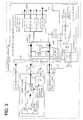
- FIGURE 3 shows an electronic device 100 including a main unit 101, a fuel cell (FC) system 200 and a rechargeable secondary battery 240, in accordance with an embodiment of the present invention.
- the electronic device 100 may be, for example, a mobile telephone or a mobile personal computer.
- the electronic device main unit 101 is connectable to a DC voltage output terminal of the AC adapter 190.
- the fuel cell system 200 is connected to the electronic device main unit 101 through the DC power input terminal (DC-IN) 102.
- the secondary battery 240 is connected to the electronic device main unit 101 through the battery connector (Battery-CN) 104.
- the AC adapter 190 is connectable to the electronic device main unit 101 through the DC power input terminal 102.
- the fuel cell system 200 includes a fuel cell (FC) controller 202, a fuel cell power generator 204, a fuel cartridge 206, a DC voltage conversion circuit 210 having one controllable DC-DC converter, an output voltage selector or switch 220, and a communication interface (I/F) 232.
- the fuel cell power generator 204 generates power by causing the methanol supplied from the fuel cartridge 206 to chemically react under the control of the FC controller 202, and supplies the output DC voltage to the DC voltage conversion circuit 210.
- the electronic device main unit 101 includes the DC power input terminal 102 to which the output terminals of the AC adapter 190 and/or the fuel cell system 200 are connected, the battery connector 104 to which the output terminal of the secondary battery 240 is connected, the DC voltage conversion circuit 110 which supplies powers of desired voltage to the loads of different components, the charging circuit 120 which charges the secondary battery 240 with the power from the fuel cell system 200, a power controller 140 which controls the power supply to the DC voltage conversion circuit 110, and a load state determiner 152 which determines a detected power consumption value or a state P of the load of the system of the electronic device main unit 101.
- a plurality of DC voltage outputs of the DC voltage conversion circuit 110 are coupled to the loads of the components of the electronic device system.
- the electronic device main unit 101 further includes a feeding path 103 including the diode D1 having an anode coupled to the DC power input terminal 102 and a cathode coupled to the DC power input terminal of the DC voltage conversion circuit 110, a feeding path 108 including the diode D2 having an anode coupled to the battery connector 104 and a cathode coupled to the cathode of the diode D1 and the DC voltage input of the DC voltage conversion circuit 110, a voltage and current detector 132 which detects the values of the supply voltage Vs and the current Is at the DC power input of the DC voltage conversion circuit 110, and possibly a voltage and current detector 134 which detects the voltage Vfc of the DC output voltage and the current Ifc of the fuel cell system 200 at the DC power input terminal 102.
- the DC power input terminal 102 and the battery connector 104 are connected to the input of the DC voltage conversion circuit 110 through the diodes D1 and D2.
- the power controller 140 includes a control processor 144, and a communication interface (I/F) 142.
- the communication interface 142 is connected to the communication interface 232 of the fuel cell system 200 through a communication line 105 and connected to a communication interface (not shown) of the secondary battery 240 through a communication line 109 passing through the battery connector 104.
- the functions of control processor 144 may be implemented in the form of hardware such as an integrated circuit, or in the form of software as a program stored in a memory 154.
- the communication path or line 105 between the communication interface 142 and the communication interface 232 may be formed on the feeding path 103 by superimposing a modulated signal at a predetermined frequency carrying a control signal CTRL and the like, on the feeding path 103 according to the power line carrier method.
- the communication path 105 may be formed by a separate communication line without passing through the battery connector 104 as shown by a dashed line.
- the communication path between the communication interface 142 and the communication interface 232 may be formed by a wireless communication of feeble power through antennas 145 and 235 according to a contactless communication method based on the RF ID technology or the short-range wireless communication technology such as the Bluetooth standard.
- the voltage and current detector 132 detects the supply voltage Vs supplied to the DC voltage conversion circuit 110 at the junction of the cathodes of the diodes D1 and D2.
- the load state determiner 152 measures the total load power of the system of the electronic device main unit 101 or detects the operating states of the loads.
- the control processor 144 generates and supplies the control signal CTRL to the fuel cell system 200 and the charging circuit 120.
- the control signal CTRL is generated by the control processor 144 in accordance with at least an output DC voltage value Vli from the secondary battery 240, preferably, further with a measured value of the load power consumption or a state P of the load determined by the load state determiner 152, and further, possibly with the supply voltage Vs detected by the voltage and current detector 132 and/or the present supply voltage Vfc of the fuel cell system 200 detected by the voltage and current detector 134.
- the output voltage selector 220 of the fuel cell system 200 changes or selects the value of the DC output voltage of the DC voltage conversion circuit 210 in accordance with the control signal CTRL received from the power controller 140 through the communication line 105.
- the charging circuit 120 operates to start supplying the output voltage Vfc from the fuel cell system 200 to the secondary battery 240 and to stop supplying the output voltage Vfc.
- the control processor 144 instructs a CPU 61 or the system of the electronic device main unit 101 to execute a forced system shutdown process, when the supply voltage Vs supplied to the DC power input of the electronic device main unit 101 by the AC adapter 190, the fuel cell system 200 and/or the secondary battery 240 becomes lower than a predetermined voltage (e.g., about 5.5 V, or a voltage at which the DC-DC converter of the DC voltage conversion circuit 110 cannot maintain an output voltage of 5 V).
- a predetermined voltage e.g., about 5.5 V, or a voltage at which the DC-DC converter of the DC voltage conversion circuit 110 cannot maintain an output voltage of 5 V.
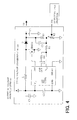
- FIGURE 4 shows an example of the arrangement of the DC voltage conversion circuit 210.
- the DC voltage conversion circuit 210 includes an inductor L, a switching transistor NMOS, a diode D, resistors R1 to R4, capacitors C1 to C4 and a controller 222.
- the resistor R2 is a variable resistor controlled by the output voltage selector 220.
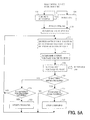
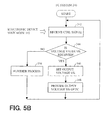
- FIGURES 5A and 5B show flow charts for controlling the fuel cell system 200, executed by the power controller 140 and the fuel cell system 200 of the electronic device 100.
- the user first at Step 302 connects the fuel cell system 200 to the electronic device main unit 101, and then at Step 304 powers on the electronic device main unit 101 as indicated by the solid line with an arrow.
- the user may first at Step 304 powers on the electronic device main unit 101 before he or she at Step 302 connects the fuel cell system 200 to the electronic device main unit 101 as indicated by the dashed line with an arrow. After that, the procedure proceeds to Step 310.
- the power controller 140 communicates with the fuel cell system 200 through the communication line 105, and authenticates the fuel cell system 200.
- the power controller 140 receives the output DC voltage value Vli of the secondary battery 240 through the communication line 109 from the secondary battery 240, and receives information indicative of the measured power consumption value or the state P of the load of the electronic device system from the load state determiner 152.
- the added voltage value ⁇ (P) may be determined in accordance with the operating state of the charging circuit 120.
- the power controller 140 supplies the determined value of the output DC voltage Vfc in the control signal CTRL through the communication line 109 to the fuel cell system 200.
- the communication interface 232 of the fuel cell system 200 receives the control signal CTRL from the power controller 140.
- the communication interface 232 determines whether or not the communication interface 232 has received a required value of the output DC voltage Vfc in the control signal CTRL from the power controller 140. If it is determined that the communication interface 232 has not received it, the communication interface 232 at Step 356 performs a further desired process. As such a further desired process, for example, when the authentication information of the fuel cell system 200 required for the authentication processing is requested in the control signal CTRL, the communication interface 232 may send the authentication information to the power controller 140.
- the output voltage selector 220 at Step 346 sets the received required value of the output DC voltage Vfc to the DC voltage conversion circuit 210.
- Step 348 the DC voltage conversion circuit 210 of the fuel cell system 200 operates to supply the output DC voltage Vfc of the set required value as the output. After that, the procedure returns to Step 342, where the communication interface 232 waits for the reception of the next control signal.
- the power controller 140 determines whether or not the charging circuit 120 is charging the secondary battery 240, i.e., whether or not it is supplying current to the secondary battery 240. For the determination, the power controller 140 may use any of the control signal CTRL provided to the charging circuit 120, the voltage and current values of the voltage and current detectors 132 and 134, and the voltage value Vli of the secondary battery 240. If it is determined that the charging circuit 120 is not charging the secondary battery, the power controller 140 at Step 320 determines whether or not the condition for starting the charging of the secondary battery 240 is satisfied. If it is determined that the condition is not satisfied, the procedure returns to Step 312. If it is determined that the condition is satisfied, the power controller 140 at Step 322 sends, to the charging circuit 120, the control signal CTRL for controlling the charging circuit 120 to start charging the secondary battery 240. After that, the procedure returns to Step 312.
- the power controller 140 at Step 330 determines whether or not the condition for stopping the charging is satisfied, i.e., whether or not the charging is to be stopped.
- the condition for stopping the charging may be, for example, that the value of the output DC voltage Vfc on the feeding path 103 detected by the voltage and current detector 105 is significantly lower (e.g. 0.5 V) than the output voltage Vli of the secondary battery 240 over a long period of time (e.g. two seconds) and that the power from the fuel cell system 200 is significantly lower (e.g. 5 W) than the power consumption P of the load.
- the procedure returns to Step 312.
- the power controller 140 at Step 332 sends to the charging circuit 120 the control signal CTRL for controlling the charging circuit 120 to stop the charging of the secondary battery 240. After that, the procedure returns to Step 312.
- the voltage values Vfc and Vli slightly vary with time depending on the load current.
- power is supplied by the fuel cell system 200 and the secondary battery 240 to the DC voltage conversion circuit 110.
- the predetermined value ⁇ may be a fixed value prestored in the memory 154 for the power controller 140 or may be a fixed value predetermined by the user or the software for implementing the system on the CPU 61.
- the control processor 144 of the power controller 140 may determine a value ⁇ (V) corresponding to the power of the load or the state P of the load by looking up a table stored in the memory 154, in accordance with the measured power value or the state P of the load.
- FIGURES 6A and 6B illustrate respective tables showing respective relations of the load Ldr (%) representative of the CPU occupancy as the state P of the load with the added voltage ⁇ (V), and of the load Ldp (W) representative of the system load power consumption P with the added voltage ⁇ (V). These tables may be stored in the memory 154 of the power controller 140.
- the added voltage ⁇ is determined to be 0.2 V.
- the added voltage ⁇ is determined to be 0.5 V.
- the added voltage ⁇ is determined to be 1.0 V.
- the added voltage ⁇ is determined to be 2.0 V.
- the added voltage ⁇ is determined to be 0.2 V.
- the added voltage ⁇ is determined to be 0.5 V.
- the added voltage ⁇ is determined to be 1.0 V.
- the added voltage ⁇ is determined to be 2.0 V.
- the control processor 144 can determine the remaining power of the secondary battery 240 in accordance with the value of the output DC voltage Vli and with a characteristic curve stored in a memory (not shown) of the secondary battery 240, according to a known method.
- the output DC voltage Vli decreases as the remaining power decreases.
- the control processor 144 determines the output DC voltage value Vfc to be a higher voltage value Vli + ⁇ ' (for ⁇ ' > ⁇ ) for charging the secondary battery 240. Under the control of the control processor 144, the charging circuit 120 applies the output DC voltage Vfc on the feeding path 103 of the fuel cell system 200 to the secondary battery 240, to thereby charge the secondary battery 240.
- the DC output power of the fuel cell system 200 is preferentially supplied to the DC voltage conversion circuit 110 of the electronic device main unit 101.
- the control processor 144 prevents or stops the charging circuit 120 from performing the charging, and further, causes the secondary battery 240 to supply a power undersupply for compensating insufficiency.
- the accumulated charge of the secondary battery 240 gradually decreases and the voltage of the secondary battery 240 gradually decreases.
- Vfc Vli MAX + ⁇ , where ⁇ is constant between 0 and 0.9 inclusive
- the control processor 144 prevents the charging circuit 120 from starting the charging if the remaining power (A ⁇ hr) of the secondary battery 240 is higher than a predetermined percentage (e.g., 80%) of the full remaining power corresponding to the maximum voltage Vli MAx .
- the control processor 144 allows the charging circuit 120 to start the charging when the remaining power is decreased to not more than the predetermined percentage (e.g., 80%) of the full remaining power. This reduces the deterioration of the discharge-recharge capacity of the secondary battery 240 due to excessive repetition of charging and discharging.
- the invention also provides a computer program or a computer program product for carrying out any of the methods described herein, and a computer readable medium having stored thereon a program for carrying out any of the methods described herein.
- a computer program embodying the invention may be stored on a computer-readable medium, or it could, for example, be in the form of a signal such as a downloadable data signal provided from an Internet website, or it could be in any other form.
Landscapes
- Engineering & Computer Science (AREA)
- Power Engineering (AREA)
- Life Sciences & Earth Sciences (AREA)
- Sustainable Development (AREA)
- Sustainable Energy (AREA)
- Transportation (AREA)
- Mechanical Engineering (AREA)
- Charge And Discharge Circuits For Batteries Or The Like (AREA)
- Fuel Cell (AREA)
- Dc-Dc Converters (AREA)
Abstract
Description
- The present invention generally relates to an electronic device for use with a fuel cell and, more particularly, to the control of the fuel cell by the electronic device in accordance with the voltage of a secondary battery of the electronic device and the power consumption of a load in the electronic device.
- A rechargeable secondary battery unit is used for a mobile notebook personal computer (PC). Although a fuel cell unit as a new electric energy source has been developed, a fuel cell which alone can supply sufficient current to a notebook PC has not been realized. At present, a fuel cell unit cannot provide sufficient current for a notebook PC when it is used alone. Accordingly, it has been proposed to use a secondary battery unit in combination with a fuel cell unit for a notebook PC.
- Japanese Patent Application Publication
JP 2006-73503-A laid open to the public on November 11, 2004 - It has been contemplated to use, as a power source of a mobile terminal device, a fuel cell in combination with a conventional AC adapter and a conventional secondary battery pack. Typically, it is assumed that, in a mobile terminal device, the fuel cell system is treated similarly to the AC adapter, and adapted to supply power through a DC-IN terminal. Thus, the fuel cell system has an output DC voltage which is equal to the supply voltage (e.g., 19 V) of the AC adapter. Thus, it is required to convert the DC supply voltage of the fuel cell to a higher DC output voltage. On the other hand, the output voltage supplied by the fuel cell system is converted to a lower voltage required for the load in such a mobile terminal device.
- Generally, conversion of a DC voltage into a different DC voltage that may be higher or lower results in a larger conversion power loss. The DC output voltage of the fuel cell is converted to a higher DC voltage in the fuel cell system, and then an output voltage from the fuel cell system is converted to a lower voltage in the mobile terminal. Thus, the power conversion efficiency in the DC voltage conversion to higher and lower voltages is low.
- The inventors have recognized that the conversion loss of the power supplied by the fuel cell system may be reduced by variably controlling the output DC voltage of the fuel cell system so as to be slightly higher than the output DC voltage of the secondary battery.
- It is desirable to allow an output voltage of a fuel cell system to be variably controlled.
- It is also desirable to efficiently convert a voltage of a fuel cell to a voltage for a load depending on an output DC voltage of a secondary battery.
- In accordance with an embodiment of a first aspect of the present invention, there is provided an electronic device including: a first input terminal to which a first DC supply voltage of a fuel cell system having a controllable supply voltage is provided; a second input terminal to which a second DC supply voltage of a rechargeable secondary battery is provided; a DC voltage conversion circuit receiving the first and second DC supply voltages from the first and second input terminals, and supplies a current of a desired voltage to a load; a charging circuit receiving the first DC supply voltage from the first input terminal, and supplies a DC supply voltage for charging to the second input terminal; and a control circuit determining a desired value of the first DC supply voltage in accordance with a value of the second DC supply voltage of the secondary battery, and provides the determined desired value to the fuel cell system.
- An embodiment of a second aspect of the present invention also relates to a DC voltage conversion system for use in the electronic device as described.
- According to an embodiment of the invention, an output voltage of a fuel cell system can be variably controlled, and a voltage of a fuel cell can be efficiently converted to a voltage for a load depending on an output DC voltage of a secondary battery.
- The invention will be described in connection with non-limiting embodiments with reference to the accompanying drawings. Throughout the drawings, similar symbols and numerals indicate similar items and functions.
-
-
FIGURE 1 shows a previously-proposedelectronic device 10 including a main unit, a previously-proposed fuel cell (FC) system or device, and a rechargeable secondary battery; -
FIGURE 2 shows an example of variations of power efficiency versus the load current in the voltage conversion, when one DC-DC converter in the DC voltage conversion circuit converts the DC supply voltage from either of two different input voltages into a desired low supply voltage; -
FIGURE 3 shows an electronic device including a main unit, a fuel cell (FC) system and a rechargeable secondary battery, in accordance with an embodiment of the present invention; -
FIGURE 4 shows an example of the arrangement of the DC voltage conversion circuit; -
FIGURES 5A and5B show flow charts for controlling the fuel cell system, executed by the power controller and the fuel cell system of the electronic device; and -
FIGURES 6A and 6B illustrate respective tables showing respective relations of the load representative of the CPU occupancy as the state of the load with the added voltage, and of the load representative of the system load power consumption with the added voltage. -
FIGURE 1 shows a previously-proposedelectronic device 10 including amain unit 11, a previously-proposed fuel cell (FC) system ordevice 20, and a rechargeablesecondary battery 240. - Referring to
FIGURE 1 , in theelectronic device 10, the output of thefuel cell system 20 is connected to a DC power input terminal (DC-IN) 102 of themain unit 11, the output of thesecondary battery 240 is connected to a battery connector (Battery-CN) 104 of themain unit 11, and anAC adapter 190 is connectable to the DCpower input terminal 102 of themain unit 11. - In the
electronic device 10, the output powers of thefuel cell system 20 and theAC adapter 190 are supplied to a DCvoltage conversion circuit 110 in themain unit 11 through the DCpower input terminal 102 and a diode D1. The output power of thesecondary battery 240 is supplied to the DCvoltage conversion circuit 110 through thebattery connector 104 and a diode D2. The DCpower input terminal 102 is connected to thebattery connector 104 through acharging circuit 120. Apower controller 14 controls thecharging circuit 120 in accordance with values of the output DC voltage of thesecondary battery 240 and the voltage supplied to the DCvoltage conversion circuit 110. In this case, the voltage of thefuel cell system 20 is boosted to the same voltage (e.g., 19 V) as the output voltage of theAC adapter 190. The DCvoltage conversion circuit 110, which includes a plurality of DC-DC or DC voltage converters, converts the input DC voltage into desired DC voltages and supplies the desired DC voltages to respective loads of the components. -
FIGURE 2 shows examples of variation of power efficiency versus the load current in the voltage conversion, when one DC-DC converter for an output voltage of 2.5 V in the DCvoltage conversion circuit 110 converts the DC supply voltage from either of two different input voltages Vin (= 3.3 V and 5 V) into a desired low supply voltage of 2.5 V. In the range of the load current between 0 A and 3.5 A, the power efficiency of the voltage conversion for the input voltage VIN of 5 V is lower than that for the input voltage VIN of 3.3 V. Generally, the larger the difference between the output voltage and the input voltage is, the lower the power efficiency of the voltage conversion is. - In the previously-proposed
fuel cell system 20, the DC output voltage of the fuel cell of approximately 1.8 V is converted to a higher DC voltage of 19 V which is equal to as the output DC voltage of the AC adapter, and then the output voltage of 19 V from thefuel cell system 20 is converted to a lower voltage between 1.5 and 5 V by the DCvoltage conversion circuit 110 of theelectronic device 10. Thus the power loss in the DC voltage conversion for stepping up and stepping down the voltages is large. On the other hand, the charging of thesecondary battery 240 by thefuel cell system 20 requires the output voltage from thefuel cell system 20 to be higher than that of thesecondary battery 240. The output power capability per unit time of thefuel cell system 20 is insufficient for driving a PC in operating in a high-load state, and hence thesecondary battery 240 cannot be separated from the DCvoltage conversion circuit 110 to compensate for the insufficient power capability. - The inventors have recognized that the conversion loss of the power supplied by the fuel cell system can be reduced by variably controlling the output DC voltage of the fuel cell system so as to be slightly higher than the output DC voltage of the secondary battery.
-
FIGURE 3 shows anelectronic device 100 including amain unit 101, a fuel cell (FC)system 200 and a rechargeablesecondary battery 240, in accordance with an embodiment of the present invention. Theelectronic device 100 may be, for example, a mobile telephone or a mobile personal computer. The electronic devicemain unit 101 is connectable to a DC voltage output terminal of theAC adapter 190. - Referring to
FIGURE 3 , in theelectronic device 100, thefuel cell system 200 is connected to the electronic devicemain unit 101 through the DC power input terminal (DC-IN) 102. Thesecondary battery 240 is connected to the electronic devicemain unit 101 through the battery connector (Battery-CN) 104. TheAC adapter 190 is connectable to the electronic devicemain unit 101 through the DCpower input terminal 102. - In
FIGURE 3 , thefuel cell system 200 includes a fuel cell (FC)controller 202, a fuelcell power generator 204, afuel cartridge 206, a DCvoltage conversion circuit 210 having one controllable DC-DC converter, an output voltage selector orswitch 220, and a communication interface (I/F) 232. The fuelcell power generator 204 generates power by causing the methanol supplied from thefuel cartridge 206 to chemically react under the control of theFC controller 202, and supplies the output DC voltage to the DCvoltage conversion circuit 210. - The electronic device
main unit 101 includes the DCpower input terminal 102 to which the output terminals of theAC adapter 190 and/or thefuel cell system 200 are connected, thebattery connector 104 to which the output terminal of thesecondary battery 240 is connected, the DCvoltage conversion circuit 110 which supplies powers of desired voltage to the loads of different components, thecharging circuit 120 which charges thesecondary battery 240 with the power from thefuel cell system 200, apower controller 140 which controls the power supply to the DCvoltage conversion circuit 110, and a load state determiner 152 which determines a detected power consumption value or a state P of the load of the system of the electronic devicemain unit 101. A plurality of DC voltage outputs of the DCvoltage conversion circuit 110 are coupled to the loads of the components of the electronic device system. - The electronic device
main unit 101 further includes afeeding path 103 including the diode D1 having an anode coupled to the DCpower input terminal 102 and a cathode coupled to the DC power input terminal of the DCvoltage conversion circuit 110, afeeding path 108 including the diode D2 having an anode coupled to thebattery connector 104 and a cathode coupled to the cathode of the diode D1 and the DC voltage input of the DCvoltage conversion circuit 110, a voltage andcurrent detector 132 which detects the values of the supply voltage Vs and the current Is at the DC power input of the DCvoltage conversion circuit 110, and possibly a voltage andcurrent detector 134 which detects the voltage Vfc of the DC output voltage and the current Ifc of thefuel cell system 200 at the DCpower input terminal 102. Thus, the DCpower input terminal 102 and thebattery connector 104 are connected to the input of the DCvoltage conversion circuit 110 through the diodes D1 and D2. - The
power controller 140 includes acontrol processor 144, and a communication interface (I/F) 142. Thecommunication interface 142 is connected to thecommunication interface 232 of thefuel cell system 200 through acommunication line 105 and connected to a communication interface (not shown) of thesecondary battery 240 through acommunication line 109 passing through thebattery connector 104. The functions ofcontrol processor 144 may be implemented in the form of hardware such as an integrated circuit, or in the form of software as a program stored in amemory 154. - The communication path or
line 105 between thecommunication interface 142 and thecommunication interface 232 may be formed on thefeeding path 103 by superimposing a modulated signal at a predetermined frequency carrying a control signal CTRL and the like, on thefeeding path 103 according to the power line carrier method. Thecommunication path 105 may be formed by a separate communication line without passing through thebattery connector 104 as shown by a dashed line. Alternatively, the communication path between thecommunication interface 142 and thecommunication interface 232 may be formed by a wireless communication of feeble power throughantennas - The voltage and
current detector 132 detects the supply voltage Vs supplied to the DCvoltage conversion circuit 110 at the junction of the cathodes of the diodes D1 and D2. Theload state determiner 152 measures the total load power of the system of the electronic devicemain unit 101 or detects the operating states of the loads. - The
control processor 144 generates and supplies the control signal CTRL to thefuel cell system 200 and the chargingcircuit 120. The control signal CTRL is generated by thecontrol processor 144 in accordance with at least an output DC voltage value Vli from thesecondary battery 240, preferably, further with a measured value of the load power consumption or a state P of the load determined by theload state determiner 152, and further, possibly with the supply voltage Vs detected by the voltage andcurrent detector 132 and/or the present supply voltage Vfc of thefuel cell system 200 detected by the voltage andcurrent detector 134. - The
output voltage selector 220 of thefuel cell system 200 changes or selects the value of the DC output voltage of the DCvoltage conversion circuit 210 in accordance with the control signal CTRL received from thepower controller 140 through thecommunication line 105. In accordance with the control signal CTRL from thepower controller 140, the chargingcircuit 120 operates to start supplying the output voltage Vfc from thefuel cell system 200 to thesecondary battery 240 and to stop supplying the output voltage Vfc. - Further, in accordance with the supply voltage Vs detected by the voltage and
current detector 132, thecontrol processor 144 instructs aCPU 61 or the system of the electronic devicemain unit 101 to execute a forced system shutdown process, when the supply voltage Vs supplied to the DC power input of the electronic devicemain unit 101 by theAC adapter 190, thefuel cell system 200 and/or thesecondary battery 240 becomes lower than a predetermined voltage (e.g., about 5.5 V, or a voltage at which the DC-DC converter of the DCvoltage conversion circuit 110 cannot maintain an output voltage of 5 V). This prevents the system of the electronic devicemain unit 101 from operating abnormally due to the low supply voltage when the supply voltage to the electronic devicemain unit 101 becomes a low voltage at which required minimum or higher supply voltages cannot be maintained. -
FIGURE 4 shows an example of the arrangement of the DCvoltage conversion circuit 210. The DCvoltage conversion circuit 210 includes an inductor L, a switching transistor NMOS, a diode D, resistors R1 to R4, capacitors C1 to C4 and acontroller 222. The resistor R2 is a variable resistor controlled by theoutput voltage selector 220. -
FIGURES 5A and5B show flow charts for controlling thefuel cell system 200, executed by thepower controller 140 and thefuel cell system 200 of theelectronic device 100. - Referring to
FIGURE 5A , the user first atStep 302 connects thefuel cell system 200 to the electronic devicemain unit 101, and then atStep 304 powers on the electronic devicemain unit 101 as indicated by the solid line with an arrow. Alternatively, the user may first atStep 304 powers on the electronic devicemain unit 101 before he or she atStep 302 connects thefuel cell system 200 to the electronic devicemain unit 101 as indicated by the dashed line with an arrow. After that, the procedure proceeds to Step 310. - At
Step 310, thepower controller 140 communicates with thefuel cell system 200 through thecommunication line 105, and authenticates thefuel cell system 200. - At
Step 312, the power controller 140 (the control processor 144) receives the output DC voltage value Vli of thesecondary battery 240 through thecommunication line 109 from thesecondary battery 240, and receives information indicative of the measured power consumption value or the state P of the load of the electronic device system from theload state determiner 152. - At
Step 314, thepower controller 140 determines the output DC voltage value Vfc = Vli + α(P) of thefuel cell system 200 in accordance with the voltage value Vli of thesecondary battery 240 and the power value or the state P of the load of the electronic device system, where α(P) represents an added voltage value as a function of P. The added voltage value α(P) may be determined in accordance with the operating state of the chargingcircuit 120. AtStep 316, thepower controller 140 supplies the determined value of the output DC voltage Vfc in the control signal CTRL through thecommunication line 109 to thefuel cell system 200. - Referring to
FIGURE 5B , atStep 342, thecommunication interface 232 of thefuel cell system 200 receives the control signal CTRL from thepower controller 140. AtStep 344, thecommunication interface 232 determines whether or not thecommunication interface 232 has received a required value of the output DC voltage Vfc in the control signal CTRL from thepower controller 140. If it is determined that thecommunication interface 232 has not received it, thecommunication interface 232 atStep 356 performs a further desired process. As such a further desired process, for example, when the authentication information of thefuel cell system 200 required for the authentication processing is requested in the control signal CTRL, thecommunication interface 232 may send the authentication information to thepower controller 140. - If it is determined at
Step 344 that thecommunication interface 232 has received the required value of the output DC voltage Vfc, theoutput voltage selector 220 atStep 346 sets the received required value of the output DC voltage Vfc to the DCvoltage conversion circuit 210. - At
Step 348, the DCvoltage conversion circuit 210 of thefuel cell system 200 operates to supply the output DC voltage Vfc of the set required value as the output. After that, the procedure returns to Step 342, where thecommunication interface 232 waits for the reception of the next control signal. - Referring back to
FIGURE 5A , atStep 318, thepower controller 140 determines whether or not the chargingcircuit 120 is charging thesecondary battery 240, i.e., whether or not it is supplying current to thesecondary battery 240. For the determination, thepower controller 140 may use any of the control signal CTRL provided to the chargingcircuit 120, the voltage and current values of the voltage andcurrent detectors secondary battery 240. If it is determined that the chargingcircuit 120 is not charging the secondary battery, thepower controller 140 atStep 320 determines whether or not the condition for starting the charging of thesecondary battery 240 is satisfied. If it is determined that the condition is not satisfied, the procedure returns to Step 312. If it is determined that the condition is satisfied, thepower controller 140 atStep 322 sends, to the chargingcircuit 120, the control signal CTRL for controlling the chargingcircuit 120 to start charging thesecondary battery 240. After that, the procedure returns to Step 312. - If it is determined at
Step 318 that the chargingcircuit 120 is charging, thepower controller 140 atStep 330 determines whether or not the condition for stopping the charging is satisfied, i.e., whether or not the charging is to be stopped. The condition for stopping the charging may be, for example, that the value of the output DC voltage Vfc on thefeeding path 103 detected by the voltage andcurrent detector 105 is significantly lower (e.g. 0.5 V) than the output voltage Vli of thesecondary battery 240 over a long period of time (e.g. two seconds) and that the power from thefuel cell system 200 is significantly lower (e.g. 5 W) than the power consumption P of the load. If it is determined that the charging is not to be stopped, the procedure returns to Step 312. If it is determined that the charging is to be stopped, thepower controller 140 atStep 332 sends to the chargingcircuit 120 the control signal CTRL for controlling the chargingcircuit 120 to stop the charging of thesecondary battery 240. After that, the procedure returns to Step 312. - In a first method of determining the output DC voltage value Vfc at
Step 314, the output DC voltage value Vfc may be determined to be a value equal to the voltage value Vli of the secondary battery 240 (Vfc = Vli, α= 0) . The voltage values Vfc and Vli slightly vary with time depending on the load current. When the voltage value Vfc is equal to the voltage value Vli (i.e., Vfc = Vli), power is supplied by thefuel cell system 200 and thesecondary battery 240 to the DCvoltage conversion circuit 110. When the voltage value Vfc is temporarily higher than the voltage value Vli (i.e., Vfc > Vli), power is preferentially supplied by thefuel cell system 200 to the DCvoltage conversion circuit 110, and further, if possible, thesecondary battery 240 is charged. On the other hand, when the voltage value Vli is temporarily higher than the voltage value Vfc (i.e., Vfc > Vli), power is preferentially supplied by thesecondary battery 240 to the DCvoltage conversion circuit 110. - In a second method of determining the output DC voltage value Vfc at
Step 314, the output DC voltage value Vfc may be determined to be the sum of the voltage value Vli of thesecondary battery 240 and a predetermined value α (e.g., α = 1.5 V) (Vfc = Vli + α [constant]). The predetermined value α may be a fixed value prestored in thememory 154 for thepower controller 140 or may be a fixed value predetermined by the user or the software for implementing the system on theCPU 61. - In a third method of determining the output DC voltage value Vfc at
Step 314, the output DC voltage value Vfc may be determined to be the sum of the voltage value Vli of thesecondary battery 240 and the value α(P) associated with the measured power value or the state P of the load (Vfc = Vli + α(P)). - Now, a method of determining the value of the output DC voltage value Vfc in accordance with the measured power value or the state P of the load is described. The
control processor 144 of thepower controller 140 may determine a value α(V) corresponding to the power of the load or the state P of the load by looking up a table stored in thememory 154, in accordance with the measured power value or the state P of the load. -
FIGURES 6A and 6B illustrate respective tables showing respective relations of the load Ldr (%) representative of the CPU occupancy as the state P of the load with the added voltage α (V), and of the load Ldp (W) representative of the system load power consumption P with the added voltage α (V). These tables may be stored in thememory 154 of thepower controller 140. - In
FIGURE 6A , for the detected CPU occupancy or load Ldr which is less than 10% (i.e, Ldr < 10%), the added voltage α is determined to be 0.2 V. For the CPU load which is not less than 10% and less than 30% (i.e, 10%≤ Ldr < 30%), the added voltage α is determined to be 0.5 V. For the CPU load which is not less than 30% and less than 50% (i.e, 30% ≤ Ldr < 50%), the added voltage α is determined to be 1.0 V. For the CPU load which is not less than 51 % (i.e., Ldr ≥ 50%), the added voltage α is determined to be 2.0 V. - In
FIGURE 6B , for the detected power consumption Ldp of the load of the system which is less than 5 W, the added voltage α is determined to be 0.2 V. For the power consumption of the load of the system which is not less than 5 W and less than 8 W, the added voltage α is determined to be 0.5 V. For the power consumption of the load of the system which is not less than 8 W and less than 12 W, the added voltage α is determined to be 1.0 V. For the power consumption of the load of the system which is not less than 12 W, the added voltage α is determined to be 2.0 V. - The
control processor 144 can determine the remaining power of thesecondary battery 240 in accordance with the value of the output DC voltage Vli and with a characteristic curve stored in a memory (not shown) of thesecondary battery 240, according to a known method. The output DC voltage Vli decreases as the remaining power decreases. - When the
secondary battery 240 is not full and can be charged, and the load power Ldp is low and the condition Vfc > Vli can be satisfied and maintained, thecontrol processor 144 determines the output DC voltage value Vfc to be a higher voltage value Vli + α' (for α' > α) for charging thesecondary battery 240. Under the control of thecontrol processor 144, the chargingcircuit 120 applies the output DC voltage Vfc on thefeeding path 103 of thefuel cell system 200 to thesecondary battery 240, to thereby charge thesecondary battery 240. - The DC output power of the
fuel cell system 200 is preferentially supplied to the DCvoltage conversion circuit 110 of the electronic devicemain unit 101. The higher the set value of the predetermined value α or α' is, the larger the number of opportunities or the longer the time to charge thesecondary battery 240 is. However, when the load Ldp of the system of the electronic devicemain unit 101 increases and the output DC voltage Vfc of thefuel cell system 200 is insufficient for charging thesecondary battery 240, thecontrol processor 144 prevents or stops the chargingcircuit 120 from performing the charging, and further, causes thesecondary battery 240 to supply a power undersupply for compensating insufficiency. Thus, as the state of the high load power Ldp continues, the accumulated charge of thesecondary battery 240 gradually decreases and the voltage of thesecondary battery 240 gradually decreases. - Alternatively, when the
secondary battery 240 is not full and can be charged, and the load power Ldp is low and a condition Vfc = VliMAX can be satisfied and maintained, the output DC voltage Vfc may be determined to be a predetermined voltage (e.g., 15 V) not less than the maximum voltage VliMAX (e.g., 12.6 V) of thesecondary battery 240 for charging the secondary battery 240 (Vfc = VliMAX + α, where α is constant between 0 and 0.9 inclusive). Thereby, thesecondary battery 240 is charged at a higher speed. - Even when the
secondary battery 240 is not full and can be charged atStep 320 in such a state that thesecondary battery 240 is neither operating nor charged, it is preferable for thecontrol processor 144 to prevent thecharging circuit 120 from starting the charging if the remaining power (A·hr) of thesecondary battery 240 is higher than a predetermined percentage (e.g., 80%) of the full remaining power corresponding to the maximum voltage VliMAx. In this case, thecontrol processor 144 allows the chargingcircuit 120 to start the charging when the remaining power is decreased to not more than the predetermined percentage (e.g., 80%) of the full remaining power. This reduces the deterioration of the discharge-recharge capacity of thesecondary battery 240 due to excessive repetition of charging and discharging. - In any of the above aspects, the various features may be implemented in hardware, or as software modules running on one or more processors. Features of one aspect may be applied to any of the other aspects.
- The invention also provides a computer program or a computer program product for carrying out any of the methods described herein, and a computer readable medium having stored thereon a program for carrying out any of the methods described herein. A computer program embodying the invention may be stored on a computer-readable medium, or it could, for example, be in the form of a signal such as a downloadable data signal provided from an Internet website, or it could be in any other form.
- The above-described embodiments are only typical examples, and their combination, modifications and variations are apparent to those skilled in the art. It should be noted that those skilled in the art can make various modifications to the above-described embodiments without departing from the principle of the invention and the accompanying claims.
Claims (16)
- An electronic device comprising:a first input terminal to which a first DC supply voltage of a fuel cell system having a controllable supply voltage is provided;a second input terminal to which a second DC supply voltage of a rechargeable secondary battery is provided;a DC voltage conversion circuit receiving the first and second DC supply voltages from said first and second input terminals, and supplying a current of a desired voltage to a load;a charging circuit receiving the first DC supply voltage from said first input terminal, and supplying a DC supply voltage for charging to said second input terminal; anda control circuit determining a desired value of the first DC supply voltage in accordance with a value of the second DC supply voltage of said secondary battery, and providing the determined desired value to said fuel cell system.
- The electronic device according to claim 1, wherein said control circuit determines the desired value of the first DC supply voltage to be a sum of the value of the second DC supply voltage of said secondary battery and a predetermined value.
- The electronic device according to claim 1, further comprising a load state determination unit determining a state of the load,
wherein said control circuit determines the desired value of the first DC supply voltage in accordance with the value of the second DC supply voltage of said secondary battery and the state of the load determined by said load state determination unit. - The electronic device according to claim 1, further comprising a load state determination unit determining a state of the load,
wherein said control circuit looks up a table and determines a predetermined value corresponding to the state of the load in the table based on the state of the load determined by said load state determination unit, and determines the desired value of the first DC supply voltage to be a sum of the value of the second DC supply voltage of said secondary battery and a predetermined value. - The electronic device according to claim 4, wherein the state of the load is a CPU occupancy.
- The electronic device according to claim 4, wherein the state of the load is a load power in said electronic device.
- The electronic device according to claim 1, wherein when said secondary battery is not full and can be charged by the first DC supply voltage of said fuel cell system, said control circuit determines the desired value of the first DC supply voltage to be a value higher than a voltage required for charging said secondary battery.
- The electronic device according to claim 1, wherein when said secondary battery is not full and can be charged by the first DC supply voltage of said fuel cell system, said control circuit determines the desired value of the first DC supply voltage to be a value not less than a maximum DC supply voltage of said secondary battery.
- The electronic device according to any preceding claim, wherein said control circuit allows said charging circuit to start charging said secondary battery when a remaining power of said secondary battery is lower than a predetermined percentage of full remaining power of said secondary battery.
- The electronic device according to any preceding claim, wherein a communication between said fuel cell system and said control circuit is performed through said first input terminal in a superimposed manner.
- The electronic device according to any one of claims 1 to 9, wherein a communication between said fuel cell system and said control circuit is performed by wireless communication.
- A DC voltage conversion system comprising:a first input terminal to which a first DC supply voltage of a fuel cell system having a controllable supply voltage is provided;a second input terminal to which a second DC supply voltage of a rechargeable secondary battery is provided;a DC voltage conversion circuit receiving the first and second DC supply voltages from said first and second input terminals, and supplies a current of a desired voltage to a load;a charging circuit receiving the first DC supply voltage from said first input terminal, and supplies a DC supply voltage for charging to said second input terminal; anda control circuit determining a desired value of the first DC supply voltage in accordance with a value of the second DC supply voltage of said secondary battery, and provides the determined desired value to said fuel cell system.
- A program for an electronic device stored on a computer-readable storage medium, the electronic device comprising: a DC voltage conversion circuit receiving a first DC supply voltage from a fuel cell system and a second DC supply voltage from a rechargeable secondary battery and supplies a current at a desired voltage to a load, a charging circuit, and a control circuit, said program being operable to effect:determining a desired value of the first DC supply voltage in accordance with a value of the second DC supply voltage of the secondary battery,providing the determined desired value to the fuel cell system, and causing the fuel cell system to supply the first DC supply voltage at the determined desired value, andcausing the charging circuit to receive the first DC supply voltage at the determined desired value and supply a DC supply voltage for charging to the secondary battery.
- The program for an electronic device stored on a computer-readable storage medium according to claim 13, wherein the step of determining a desired value of the first DC supply voltage comprises determining the desired value of the first DC supply voltage to be a value higher than a voltage required for charging the secondary battery when the secondary battery is not full and can be charged by the first DC supply voltage of the fuel cell system.
- The program for an electronic device stored on a computer-readable storage medium according to claim 13, wherein the step of determining a desired value of the first DC supply voltage comprises determining the desired value of the first DC supply voltage to be a value not less than a maximum DC supply voltage of the secondary battery when the secondary battery is not full and can be charged by the first DC supply voltage of the fuel cell system.
- The program for an electronic device stored on a computer-readable storage medium according to claim 13, 14 or 15, wherein the step of causing the charging circuit to receive the first DC supply voltage comprises allowing the charging circuit to start charging the secondary battery when a remaining power of the secondary battery is lower than a predetermined percentage of full remaining power of the secondary battery.
Applications Claiming Priority (1)
| Application Number | Priority Date | Filing Date | Title |
|---|---|---|---|
| JP2007019832A JP5167645B2 (en) | 2007-01-30 | 2007-01-30 | Electronic equipment and DC voltage conversion system |
Publications (2)
| Publication Number | Publication Date |
|---|---|
| EP1962407A2 true EP1962407A2 (en) | 2008-08-27 |
| EP1962407A3 EP1962407A3 (en) | 2013-02-27 |
Family
ID=39596546
Family Applications (1)
| Application Number | Title | Priority Date | Filing Date |
|---|---|---|---|
| EP20070121447 Withdrawn EP1962407A3 (en) | 2007-01-30 | 2007-11-23 | Electronic device and system for DC voltage conversion |
Country Status (4)
| Country | Link |
|---|---|
| US (1) | US7816812B2 (en) |
| EP (1) | EP1962407A3 (en) |
| JP (1) | JP5167645B2 (en) |
| CN (1) | CN101237152B (en) |
Cited By (3)
| Publication number | Priority date | Publication date | Assignee | Title |
|---|---|---|---|---|
| WO2013007681A3 (en) * | 2011-07-13 | 2013-04-04 | J. Eberspächer GmbH & Co. KG | Arrangement comprising a fuel cell system |
| EP2830182A1 (en) * | 2013-07-24 | 2015-01-28 | General Electric Company | Isolated battery management systems and methods thereof |
| EP2586572A4 (en) * | 2010-06-23 | 2016-01-13 | Makita Corp | POWER SUPPLY DEVICE FOR ELECTRIC TOOL |
Families Citing this family (20)
| Publication number | Priority date | Publication date | Assignee | Title |
|---|---|---|---|---|
| JP5110913B2 (en) * | 2007-02-28 | 2012-12-26 | 三洋電機株式会社 | Power supply |
| US8358107B2 (en) * | 2007-12-31 | 2013-01-22 | Intel Corporation | Bidirectional power management techniques |
| US8409760B2 (en) * | 2009-01-20 | 2013-04-02 | Adaptive Materials, Inc. | Method for controlling a water based fuel reformer |
| JP5489525B2 (en) * | 2009-05-11 | 2014-05-14 | 矢崎総業株式会社 | Equalization equipment |
| JP5369184B2 (en) * | 2009-06-25 | 2013-12-18 | パナソニック株式会社 | Power supply |
| TWI464415B (en) * | 2009-08-14 | 2014-12-11 | Hon Hai Prec Ind Co Ltd | Measurement system and method for power conversion efficiency |
| US20110215752A1 (en) * | 2009-09-11 | 2011-09-08 | Adaptive Materials, Inc. | Fuel Cell Battery Charger |
| US20110189578A1 (en) * | 2010-02-01 | 2011-08-04 | Adaptive Materials, Inc. | Fuel cell system including a resilient manifold interconnecting member |
| CN102025172B (en) * | 2010-07-07 | 2012-10-10 | 新源动力股份有限公司 | An airship energy control system |
| US8796888B2 (en) | 2010-07-07 | 2014-08-05 | Adaptive Materials, Inc. | Wearable power management system |
| JP5787114B2 (en) * | 2011-09-05 | 2015-09-30 | トヨタ自動車株式会社 | Fuel cell system |
| US20130241464A1 (en) * | 2012-03-14 | 2013-09-19 | Samsung Sdi Co., Ltd. | Fuel cell hybrid system and method for charging rechargeable battery thereof |
| CN106415984A (en) * | 2014-01-15 | 2017-02-15 | 株式会社理光 | Power supply device and image forming apparatus including such power supply device |
| KR20150085642A (en) * | 2014-01-16 | 2015-07-24 | 삼성전자주식회사 | Power supply, electronic apparatus including the same and method for power supplying |
| EP3046215B1 (en) * | 2015-01-15 | 2019-08-21 | ABB Schweiz AG | An uninterruptible power supply device for outdoor medium voltage electric installations. |
| BE1023784B1 (en) * | 2016-01-20 | 2017-07-25 | Unibind Limited | METHOD FOR BINDING A BUNDLE OF SHEETS AND BOOK OR FARDE THEREFORE |
| JP6397871B2 (en) * | 2016-11-04 | 2018-09-26 | 本田技研工業株式会社 | Power system |
| JP6974060B2 (en) * | 2017-07-28 | 2021-12-01 | 株式会社Subaru | In-vehicle electrical system |
| DE102021206144A1 (en) * | 2021-06-16 | 2022-12-22 | Robert Bosch Gesellschaft mit beschränkter Haftung | Control unit for a vehicle and reset method for such a control unit |
| CN114785238A (en) * | 2022-03-23 | 2022-07-22 | 广东威灵电机制造有限公司 | Motor control method, motor control system and fan equipment |
Family Cites Families (13)
| Publication number | Priority date | Publication date | Assignee | Title |
|---|---|---|---|---|
| JPH07123609A (en) * | 1993-10-22 | 1995-05-12 | Fuji Electric Co Ltd | Fuel cell power supply system |
| JP3445561B2 (en) * | 2000-07-17 | 2003-09-08 | 株式会社東芝 | Computer system |
| EP1433239B1 (en) * | 2000-07-28 | 2016-03-30 | International Power Systems,Inc. | Dc to dc converter and power management system |
| JP4218202B2 (en) * | 2000-10-04 | 2009-02-04 | トヨタ自動車株式会社 | DC power supply with fuel cell |
| JP3832417B2 (en) * | 2002-10-22 | 2006-10-11 | 日産自動車株式会社 | Fuel cell system |
| JP2005032039A (en) * | 2003-07-07 | 2005-02-03 | Sony Corp | Electronic device, power management method for electronic device, and power supply device |
| JP2005078925A (en) * | 2003-08-29 | 2005-03-24 | Toshiba Corp | Battery unit and power supply control method |
| JP3732211B2 (en) * | 2004-03-25 | 2006-01-05 | 松下電器産業株式会社 | FUEL CELL POWER SUPPLY SYSTEM, ELECTRONIC DEVICE, AND POWER SUPPLY METHOD |
| JP4799026B2 (en) * | 2004-08-06 | 2011-10-19 | 三洋電機株式会社 | Fuel cell system |
| JP4207886B2 (en) * | 2004-12-10 | 2009-01-14 | パナソニック株式会社 | Power supply |
| KR100637224B1 (en) * | 2005-04-21 | 2006-10-20 | 삼성에스디아이 주식회사 | Power supply apparatus using fuel cell, method of controling the power supply apparatus, and computer readable recoding medium |
| CN1893216B (en) | 2005-06-30 | 2010-10-27 | 松下电器产业株式会社 | Electronic equipment and battery components and load devices used in the electronic equipment |
| US20080157918A1 (en) * | 2006-12-29 | 2008-07-03 | Motorola, Inc. | System for validating refillable fuel cartridges |
-
2007
- 2007-01-30 JP JP2007019832A patent/JP5167645B2/en not_active Expired - Fee Related
- 2007-11-20 US US11/986,081 patent/US7816812B2/en not_active Expired - Fee Related
- 2007-11-23 EP EP20070121447 patent/EP1962407A3/en not_active Withdrawn
- 2007-12-20 CN CN2007101600192A patent/CN101237152B/en not_active Expired - Fee Related
Cited By (5)
| Publication number | Priority date | Publication date | Assignee | Title |
|---|---|---|---|---|
| EP2586572A4 (en) * | 2010-06-23 | 2016-01-13 | Makita Corp | POWER SUPPLY DEVICE FOR ELECTRIC TOOL |
| WO2013007681A3 (en) * | 2011-07-13 | 2013-04-04 | J. Eberspächer GmbH & Co. KG | Arrangement comprising a fuel cell system |
| US9722424B2 (en) | 2011-07-13 | 2017-08-01 | Eberspächer Climate Control Systems GmbH & Co. KG | Arrangement comprising a fuel cell system |
| EP2830182A1 (en) * | 2013-07-24 | 2015-01-28 | General Electric Company | Isolated battery management systems and methods thereof |
| US9318893B2 (en) | 2013-07-24 | 2016-04-19 | General Electric Company | Isolated battery management systems and methods thereof |
Also Published As
| Publication number | Publication date |
|---|---|
| JP2008187833A (en) | 2008-08-14 |
| JP5167645B2 (en) | 2013-03-21 |
| EP1962407A3 (en) | 2013-02-27 |
| CN101237152B (en) | 2011-01-05 |
| US7816812B2 (en) | 2010-10-19 |
| US20080179955A1 (en) | 2008-07-31 |
| CN101237152A (en) | 2008-08-06 |
Similar Documents
| Publication | Publication Date | Title |
|---|---|---|
| US7816812B2 (en) | Electronic device, and system for DC voltage conversion | |
| US8896155B2 (en) | Electric power supply system | |
| KR102290478B1 (en) | Battery management circuits, charging standby equipment and power management methods | |
| JP5261942B2 (en) | POWER SUPPLY CIRCUIT FOR POWER SUPPLYING CHARGE CONTROL CIRCUIT, CHARGING DEVICE HAVING THE POWER SOURCE CIRCUIT, AND METHOD FOR POWER SUPPLYING CHARGE CONTROL CIRCUIT | |
| US7994765B2 (en) | Power supply device | |
| US7994660B2 (en) | Supply topology with power limiting feedback loop | |
| JP2009232665A (en) | Power supply device and power supply control method | |
| US6300744B1 (en) | High-efficiency battery charger | |
| US7750597B2 (en) | Power supply apparatus | |
| JP4553879B2 (en) | Electronics | |
| US7692330B2 (en) | Electronic equipment, and battery pack and load apparatus used in the same | |
| US20050242772A1 (en) | Electronic device | |
| CN111106601B (en) | Control of DC voltage distribution system | |
| US20110062912A1 (en) | Energy and power management integrated circuit device | |
| US20240072574A1 (en) | Wireless charging method and apparatus, and storage medium | |
| JP2008243728A (en) | Power circuit equipment | |
| JPWO2006061894A1 (en) | Power supply | |
| US20070285048A1 (en) | Fuel cell charger interface with multiple voltage outputs for portable devices | |
| JP5131805B2 (en) | Fuel cell system | |
| US12027894B2 (en) | Power transmission system and method | |
| JP2011211812A (en) | Power unit | |
| KR20080073029A (en) | Voltage supply for portable devices | |
| JP5461779B2 (en) | Fuel cell apparatus and control program | |
| JP2006271086A (en) | Charger | |
| CN118316316A (en) | DC-DC conversion circuit, fuel cell system and control method |
Legal Events
| Date | Code | Title | Description |
|---|---|---|---|
| PUAI | Public reference made under article 153(3) epc to a published international application that has entered the european phase |
Free format text: ORIGINAL CODE: 0009012 |
|
| AK | Designated contracting states |
Kind code of ref document: A2 Designated state(s): AT BE BG CH CY CZ DE DK EE ES FI FR GB GR HU IE IS IT LI LT LU LV MC MT NL PL PT RO SE SI SK TR |
|
| AX | Request for extension of the european patent |
Extension state: AL BA HR MK RS |
|
| RIC1 | Information provided on ipc code assigned before grant |
Ipc: B60L 11/18 20060101ALI20121004BHEP Ipc: H02J 1/10 20060101ALI20121004BHEP Ipc: H02J 7/34 20060101AFI20121004BHEP |
|
| PUAL | Search report despatched |
Free format text: ORIGINAL CODE: 0009013 |
|
| AK | Designated contracting states |
Kind code of ref document: A3 Designated state(s): AT BE BG CH CY CZ DE DK EE ES FI FR GB GR HU IE IS IT LI LT LU LV MC MT NL PL PT RO SE SI SK TR |
|
| AX | Request for extension of the european patent |
Extension state: AL BA HR MK RS |
|
| RIC1 | Information provided on ipc code assigned before grant |
Ipc: H02J 1/10 20060101ALI20130121BHEP Ipc: H02J 7/34 20060101AFI20130121BHEP Ipc: B60L 11/18 20060101ALI20130121BHEP |
|
| 17P | Request for examination filed |
Effective date: 20130624 |
|
| RBV | Designated contracting states (corrected) |
Designated state(s): AT BE BG CH CY CZ DE DK EE ES FI FR GB GR HU IE IS IT LI LT LU LV MC MT NL PL PT RO SE SI SK TR |
|
| AKX | Designation fees paid |
Designated state(s): DE FR GB |
|
| GRAP | Despatch of communication of intention to grant a patent |
Free format text: ORIGINAL CODE: EPIDOSNIGR1 |
|
| INTG | Intention to grant announced |
Effective date: 20140704 |
|
| STAA | Information on the status of an ep patent application or granted ep patent |
Free format text: STATUS: THE APPLICATION IS DEEMED TO BE WITHDRAWN |
|
| 18D | Application deemed to be withdrawn |
Effective date: 20141115 |