EP1962296A2 - Improved UTP cable - Google Patents
Improved UTP cable Download PDFInfo
- Publication number
- EP1962296A2 EP1962296A2 EP08305019A EP08305019A EP1962296A2 EP 1962296 A2 EP1962296 A2 EP 1962296A2 EP 08305019 A EP08305019 A EP 08305019A EP 08305019 A EP08305019 A EP 08305019A EP 1962296 A2 EP1962296 A2 EP 1962296A2
- Authority
- EP
- European Patent Office
- Prior art keywords
- cable
- pairs
- jacket
- unshielded twisted
- twisted pairs
- Prior art date
- Legal status (The legal status is an assumption and is not a legal conclusion. Google has not performed a legal analysis and makes no representation as to the accuracy of the status listed.)
- Withdrawn
Links
Images

Classifications
-
- H—ELECTRICITY
- H01—ELECTRIC ELEMENTS
- H01B—CABLES; CONDUCTORS; INSULATORS; SELECTION OF MATERIALS FOR THEIR CONDUCTIVE, INSULATING OR DIELECTRIC PROPERTIES
- H01B11/00—Communication cables or conductors
- H01B11/02—Cables with twisted pairs or quads
- H01B11/04—Cables with twisted pairs or quads with pairs or quads mutually positioned to reduce cross-talk
-
- H—ELECTRICITY
- H01—ELECTRIC ELEMENTS
- H01B—CABLES; CONDUCTORS; INSULATORS; SELECTION OF MATERIALS FOR THEIR CONDUCTIVE, INSULATING OR DIELECTRIC PROPERTIES
- H01B11/00—Communication cables or conductors
- H01B11/02—Cables with twisted pairs or quads
- H01B11/06—Cables with twisted pairs or quads with means for reducing effects of electromagnetic or electrostatic disturbances, e.g. screens
- H01B11/08—Screens specially adapted for reducing cross-talk
Definitions
- the present invention relates to copper wire cables. More particularly, the present invention relates to improved UTP (Unshielded Twisted Pair) cables.
- UTP Unshielded Twisted Pair
- the copper wires are arranged in pairs. Although a single pair may stand alone, it is common for copper wire pairs to be bundled into multiple pairs within a single outer jacket. Although any number of pairs may be contained within a single jacket, a particularly common arrangement is to include four pairs within a jacket.
- crosstalk generally refers to communication signal interference that occurs between signals traveling along two different adjacent or near by copper wire pairs.
- the copper wire pairs are twisted around one another at a particular rate, forming a twisted pair, so as reduce crosstalk between the pairs.
- the twisting of the copper wire pairs reduces the instances that a first pair of wires runs in parallel to a second pair of wires, thus reducing crosstalk between the pairs.
- the rate of twisting in the pairs results in a particular lay length referring to the longitudinal length along which one full twist of the copper wires occurs.
- ALIEN crosstalk In addition to the crosstalk that occurs between pairs within the same cable, an additional type of interference occurs between twisted pairs in adjacent cables referred to as ALIEN crosstalk. Although crosstalk within a jacket is easier to manage because the lay lengths of the closest pairs can be tightly managed, ALIEN crosstalk is harder to predict and mitigate, since external cable conditions (the number of adjacent cables, having the exact same twist rate from cable to cable, the distance between adjacent cables, longer pair lay length in adjacent cables, unknown lay lengths of twisted pairs in adjacent cables, etc%) can not be easily predicted.
- One prior art method for preventing such ALIEN crosstalk is to provide shielding for the cable jacket.
- this shielding is not always feasible as it adds significant costs, installation time and weight to the cable.
- Another manner for providing protection against ALIEN crosstalk is to provide a gap between the pairs and the inside diameter of the jacket by placing a helical filament around the pairs within the cable. The gap produces a greater physical distance between the pairs of a first cable and the pairs of an adjacent cable, but the filament adds complexity to the production process and furthermore results in significantly larger cable diameter (0.350" when applied to a typical four twisted pair cable).
- the present invention overcomes the drawbacks associated with the prior art and provides a cable design for reducing ALIEN crosstalk between pairs of adjacent cables, without the need for complex, heavy or expensive shielding or helical filaments, and also simultaneously reduces the total outer diameter of the cable and the incidences of crosstalk between pairs within the cable itself.
- the present invention is directed to a cable for reducing crosstalk.
- the cable includes a plurality of unshielded twisted pairs, each of which has a different lay length.
- a jacket encloses the plurality of unshielded twisted pairs, where an unshielded twisted pair that has the longest lay length among the plurality of unshielded twisted pairs is positioned within the center of the jacket, substantially along the central longitudinal axis of the cable.
- a cable 10 is provided having four twisted pairs 12a - 12d of unshielded copper wire within an outer extruded jacket 14.
- cable 10 is shown to have four twisted pairs 12. However, the invention is not limited in this respect. The present invention may also be applied to cables having larger or smaller counts of twisted pairs 12 as desired.
- Twisted pairs 12a -12d are described as copper, but any desired conductive metal may be substituted as desired. Furthermore, the copper in pairs 12 are coated with typical polymer coatings, such as PE (Polyethylene) or FEP (Fluoronated Ethylene Polymer) or other insulators based on the desired cost and fire safety standards.
- Jacket 14 is also an extruded polymer as well, formed from PVC (Poly Vinyl Chloride) or FRPVC (Flame Resistant PVC), or other such polymer compositions.
- each of twisted pairs 12a - 12d have a different rate of rotational twisting resulting in different lay lengths.
- twisted pair 12a is presumed to have the shortest lay length and pair 12d has the longest lay length.
- a typical cable 10 may employ lay lengths in the ranges of 0.3" to 0.55" (0.3", 0.325", 0.35" and 0.55").
- lay lengths for pairs 12 are by way of illustration only, with the invention being equally applicable to any desired lay lengths depending on the desired crosstalk tolerance and desired mechanical (weight etc%) specifications.
- pairs 12a - 12d are arranged in a three spoked wheel arrangement with pair 12d, having the longest lay length, being centrally located substantially along the center longitudinal axis of cable 10.
- the three pairs 12a - 12c having the shorter lay lengths are disposed apart from one another, outwards towards the inside diameter of jacket 14.
- pairs 12a -12c are disposed substantially 120° apart.
- bumper elements 16 are disposed around central pair 12d and in between pairs 12a, 12b and 12c respectively.
- Bumper elements 16 are typically polymers formed as solid, foamed or hollow structures, however, alternative materials and structures may be used. Bumpers 16 are advantageously of a dimension substantially equal to the diameter of a twisted pair 12, and are used for maintaining a regular geometry along the length of cable 10 as shown in Figure 2 . Additional functions may be added to bumpers 16 if necessary, such as tensile strength, crush resistance etc..., by modifying the shape, size and/or composition of bumpers 16.
- Figure 2 shows a cross section of twisted pairs 12 and bumper elements 16 within jacket 14.
- these elements are stranded within jacket 14 in a typical manner such that they exhibit either a helical or SZ (periodically reversing helical) geometry to address mechanical issues such as cable spooling and unwinding/installation.
- a binder ribbon may be optionally applied over pairs 12 around the core under jacket 14, for example by extrusion, on top so that pairs 12 maintain their correct geometry.
- twisted pair 12d having the longest lay length, encounters the greatest amount of problems with ALIEN crosstalk.
- the arrangement of the present invention by locating twisted pair 12d, having the longest lay length, in the center of cable 10, provides for an increased distance from the twisted pairs in adjacent cables without the need for additional gaps or shielding.
- a typical four twisted pair cable has six different crosstalk combinations (C1 - C6) that need to be addressed because all four pairs are either near or in direct contact with one another.
- C1 - C6 crosstalk combinations
- twisted pairs 12a - 12c exhibit a separation from one another, reducing the crosstalk combinations to three, namely 12a - 12d, 12b - 12d and 12c - 12d. This allows for the manufacture of more lay length options for the shorter three lay length pairs 12a-12c, possibly allowing for lighter and less expensive longer (though not longer than 12d) lay lengths.
- jacket 114 may be formed in a different manner, having alternating grooves 20 and ridges 22 disposed about the inner circumference of jacket 114. These ridges 22 are configured to further distance pairs 12a - 12d from the outer circumference of jacket 114, further reducing the incidences of ALIEN crosstalk with pairs located in adjacent cables. Furthermore, such a configuration reduces the contact surface between pairs 12a - 12c and the inside diameter of jacket 114, providing the further benefit of reducing any insertion loss in the signals within pairs 12 caused by the polymer jacket 114.
- the insertion loss may be significantly reduced by 2-3% over a similarly arranged non-ridged cable with a reduction in propagation delay of 4 to 6 nanoseconds per 100m, amounting to a substantially 1% reduction.
- an alternative arrangement cable 10 is formed with a jacket 14 and four twisted pairs 12a - 12d.
- pair 12d in the center of cable 10 be encased within an additional polymer jacket 30 having three separators 31a -31c.
- the polymer jacket 30 places an additional barrier between each of pairs 12a -12c and pair 12d, while separators 31a - 31c maintain the separation between pairs 12a -12c, both of which assist in reducing internal crosstalk between pairs 12 as well as allowing cable 10 to centrally locate the longest lay length pair 12d.
- polymer jacket 30 is formed with branches 31a-31c as a single unit, or alternatively, branches 31a - 31 may be formed separately and later attached or folded into jacket 30.
- branches 31a - 31c are shown as straight branches, it is contemplated that they be of any useful shape and design (solid/hollow, rectangular/oval/trapezoidal) as desired for maintaining a desired weight and geometry for cable 10.
- jacket 30 is optionally, formed as a metal or metallized sheath material for improved cross talk reduction.
- separators 31a - 31c are made of metal or are metallized for improved cross talk reduction among the peripheral pairs 12a-12c.
- foil wrapping may be used around pairs 12a - 12d to even further improve the cross-talk reduction within cable 10.
Landscapes
- Physics & Mathematics (AREA)
- Electromagnetism (AREA)
- Communication Cables (AREA)
Abstract
a plurality of unshielded twisted pairs, each of which has a different lay length; and
a jacket enclosing said plurality of unshielded twisted pairs, wherein an unshielded twisted pair having the longest lay length among said plurality of unshielded twisted pairs is positioned within the center of said jacket, substantially along the central longitudinal axis of said cable.
Description
- The present invention relates to copper wire cables. More particularly, the present invention relates to improved UTP (Unshielded Twisted Pair) cables.
- In the field of copper wire communication cables, the copper wires are arranged in pairs. Although a single pair may stand alone, it is common for copper wire pairs to be bundled into multiple pairs within a single outer jacket. Although any number of pairs may be contained within a single jacket, a particularly common arrangement is to include four pairs within a jacket.
- A common problem in unshielded copper wire cables (containing only twisted pairs of insulated copper wire without any metal shielding) is crosstalk which generally refers to communication signal interference that occurs between signals traveling along two different adjacent or near by copper wire pairs. To address this, the copper wire pairs are twisted around one another at a particular rate, forming a twisted pair, so as reduce crosstalk between the pairs. The twisting of the copper wire pairs reduces the instances that a first pair of wires runs in parallel to a second pair of wires, thus reducing crosstalk between the pairs. The rate of twisting in the pairs results in a particular lay length referring to the longitudinal length along which one full twist of the copper wires occurs.
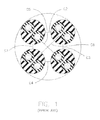
- In prior art arrangements where four twisted pairs are included in one jacket it is common to use four different lay lengths, one for each of the four twisted pairs. These varied rates of twisting results in a reduced number of incidences where the wires in the pairs run parallel to one another, affecting a reduction in crosstalk. For example, in a typical four pair cable, arranged in a compact square/rectangle, there are six different crosstalk combinations that need to be addressed, as shown in prior art
Figure 1 (labeled C1 - C6). - It is typically known that the shorter the lay length of a particular pair in a multi-pair cable, the more crosstalk is reduced. However, shorter lay lengths obviously use more wire per length of cable, and thus there are limitations on how short the lay length can be in any given copper wire twisted pair. Therefore, it is ideal to have the longest lay length possible that meets the desired crosstalk threshold.
- In addition to the crosstalk that occurs between pairs within the same cable, an additional type of interference occurs between twisted pairs in adjacent cables referred to as ALIEN crosstalk. Although crosstalk within a jacket is easier to manage because the lay lengths of the closest pairs can be tightly managed, ALIEN crosstalk is harder to predict and mitigate, since external cable conditions (the number of adjacent cables, having the exact same twist rate from cable to cable, the distance between adjacent cables, longer pair lay length in adjacent cables, unknown lay lengths of twisted pairs in adjacent cables, etc...) can not be easily predicted.
- One prior art method for preventing such ALIEN crosstalk is to provide shielding for the cable jacket. However, this shielding is not always feasible as it adds significant costs, installation time and weight to the cable. Another manner for providing protection against ALIEN crosstalk is to provide a gap between the pairs and the inside diameter of the jacket by placing a helical filament around the pairs within the cable. The gap produces a greater physical distance between the pairs of a first cable and the pairs of an adjacent cable, but the filament adds complexity to the production process and furthermore results in significantly larger cable diameter (0.350" when applied to a typical four twisted pair cable).
- Thus, the problem of ALIEN crosstalk between twisted pairs in adjacent cables still persists, yet the prior art solutions have proven to be inadequate for smaller cable diameters.
- The present invention overcomes the drawbacks associated with the prior art and provides a cable design for reducing ALIEN crosstalk between pairs of adjacent cables, without the need for complex, heavy or expensive shielding or helical filaments, and also simultaneously reduces the total outer diameter of the cable and the incidences of crosstalk between pairs within the cable itself.
- To this end the present invention is directed to a cable for reducing crosstalk. The cable includes a plurality of unshielded twisted pairs, each of which has a different lay length. A jacket encloses the plurality of unshielded twisted pairs, where an unshielded twisted pair that has the longest lay length among the plurality of unshielded twisted pairs is positioned within the center of the jacket, substantially along the central longitudinal axis of the cable.
- The present invention can be best understood through the following description and accompanying drawings, wherein:
-
Figure 1 is a prior art figure of a four twisted pair cable showing the six cross-talk combinations; -
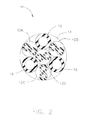
Figure 2 is a cross section of a four twisted pair cable according to one embodiment of the present invention; -
Figure 3 is a cross section of a four twisted pair cable according to another embodiment of the present invention; and -
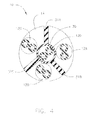
Figure 4 is a cross section of a four twisted pair cable according to another embodiment of the present invention. - In one embodiment of the present invention, as illustrated in
Figure 2 , acable 10 is provided having four twisted pairs 12a - 12d of unshielded copper wire within an outer extrudedjacket 14. - For the purposes of illustrating the salient features of the
present invention cable 10 is shown to have four twisted pairs 12. However, the invention is not limited in this respect. The present invention may also be applied to cables having larger or smaller counts of twisted pairs 12 as desired. - Twisted pairs 12a -12d are described as copper, but any desired conductive metal may be substituted as desired. Furthermore, the copper in pairs 12 are coated with typical polymer coatings, such as PE (Polyethylene) or FEP (Fluoronated Ethylene Polymer) or other insulators based on the desired cost and fire safety standards.
Jacket 14 is also an extruded polymer as well, formed from PVC (Poly Vinyl Chloride) or FRPVC (Flame Resistant PVC), or other such polymer compositions. - As with standard four pair cables each of twisted pairs 12a - 12d have a different rate of rotational twisting resulting in different lay lengths. In the present illustration, twisted pair 12a is presumed to have the shortest lay length and pair 12d has the longest lay length. For example a
typical cable 10 may employ lay lengths in the ranges of 0.3" to 0.55" (0.3", 0.325", 0.35" and 0.55"). Obviously, these lay lengths for pairs 12 are by way of illustration only, with the invention being equally applicable to any desired lay lengths depending on the desired crosstalk tolerance and desired mechanical (weight etc...) specifications. - As shown in
Figure 2 , pairs 12a - 12d are arranged in a three spoked wheel arrangement with pair 12d, having the longest lay length, being centrally located substantially along the center longitudinal axis ofcable 10. The three pairs 12a - 12c having the shorter lay lengths are disposed apart from one another, outwards towards the inside diameter ofjacket 14. Ideally, pairs 12a -12c are disposed substantially 120° apart. - In one embodiment of the present invention,
bumper elements 16, are disposed around central pair 12d and in between pairs 12a, 12b and 12c respectively.Bumper elements 16 are typically polymers formed as solid, foamed or hollow structures, however, alternative materials and structures may be used.Bumpers 16 are advantageously of a dimension substantially equal to the diameter of a twisted pair 12, and are used for maintaining a regular geometry along the length ofcable 10 as shown inFigure 2 . Additional functions may be added tobumpers 16 if necessary, such as tensile strength, crush resistance etc..., by modifying the shape, size and/or composition ofbumpers 16. - It is noted that
Figure 2 shows a cross section of twisted pairs 12 andbumper elements 16 withinjacket 14. However, it is understood that these elements are stranded withinjacket 14 in a typical manner such that they exhibit either a helical or SZ (periodically reversing helical) geometry to address mechanical issues such as cable spooling and unwinding/installation. Additionally, a binder ribbon may be optionally applied over pairs 12 around the core underjacket 14, for example by extrusion, on top so that pairs 12 maintain their correct geometry. - This configuration provides a distinct advantage over prior art arrangements in addressing issues arising from ALIEN crosstalk. As noted above in the background, twisted pair 12d, having the longest lay length, encounters the greatest amount of problems with ALIEN crosstalk. The arrangement of the present invention, by locating twisted pair 12d, having the longest lay length, in the center of
cable 10, provides for an increased distance from the twisted pairs in adjacent cables without the need for additional gaps or shielding. - In addition to this advantage achieved to reduce ALIEN crosstalk, the same arrangement also provides an advantage over prior art in managing the cross-talk within
cable 10 itself. As noted in the background and as shown in prior artFigure 1 , a typical four twisted pair cable has six different crosstalk combinations (C1 - C6) that need to be addressed because all four pairs are either near or in direct contact with one another. However, in the present invention, because of the central location of twisted pair 12d and the 120° separation between the other pairs 12, twisted pairs 12a - 12c exhibit a separation from one another, reducing the crosstalk combinations to three, namely 12a - 12d, 12b - 12d and 12c - 12d. This allows for the manufacture of more lay length options for the shorter three lay length pairs 12a-12c, possibly allowing for lighter and less expensive longer (though not longer than 12d) lay lengths. - According to the arrangement of the present invention an improvement in internal crosstalk is found over prior art. For example, in a prior art four pair cable, with corresponding lay lengths, (P1 0.3", P2 0.45", P3 0.35", P4 0.4") there is crosstalk measured at 52.5 -18Log(f/100) dB between 1-2, 2-3 and 2-4 and 49.5 -18Log(f/100) dB between 1-3, 1-4 and 3-4, where f = frequency.
- On the other hand, the arrangement of the present invention from
Figure 2 where P1 (12a) 0.3", P3 (12b) 0.325", P4 (12c) 0.35" and P2 (12d) 0.55", a crosstalk of 63.5 - 18Log(f/100) dB is achieved between pairs 1-2, 2-3 and 2-4 for an improvement of 21% and a crosstalk of 58.5 -18Log(f/100) dB is achieved between pairs 1-3, 1-4 and 3-4 for an improvement for 18%. Additionally, it is noted that such reduction in internal crosstalk is achieved with closer twist rates/lay lengths and with a positioning of the longest lay length P2 in the center thus simultaneously reducing ALIEN cross talk. - In another embodiment of the present invention, as illustrated in
Figure 3 ,jacket 114 may be formed in a different manner, having alternatinggrooves 20 and ridges 22 disposed about the inner circumference ofjacket 114. These ridges 22 are configured to further distance pairs 12a - 12d from the outer circumference ofjacket 114, further reducing the incidences of ALIEN crosstalk with pairs located in adjacent cables. Furthermore, such a configuration reduces the contact surface between pairs 12a - 12c and the inside diameter ofjacket 114, providing the further benefit of reducing any insertion loss in the signals within pairs 12 caused by thepolymer jacket 114. Such an arrangement, even with the addedgrooves 20 and ridges 22, maintains a smaller total outer diameter forcable 10 than the prior art of substantially (0.29" - 0.32"). According to such an arrangement, the insertion loss may be significantly reduced by 2-3% over a similarly arranged non-ridged cable with a reduction in propagation delay of 4 to 6 nanoseconds per 100m, amounting to a substantially 1% reduction. - In one embodiment of the present invention as illustrated in
Figure 4 , analternative arrangement cable 10 is formed with ajacket 14 and four twisted pairs 12a - 12d. However, instead of using threebumper elements 16 to maintain the separation between pairs 12a -12c it is contemplated that pair 12d in the center ofcable 10 be encased within anadditional polymer jacket 30 having three separators 31a -31c. Thepolymer jacket 30 places an additional barrier between each of pairs 12a -12c and pair 12d, while separators 31a - 31c maintain the separation between pairs 12a -12c, both of which assist in reducing internal crosstalk between pairs 12 as well as allowingcable 10 to centrally locate the longest lay length pair 12d. - Advantageously,
polymer jacket 30 is formed with branches 31a-31c as a single unit, or alternatively, branches 31a - 31 may be formed separately and later attached or folded intojacket 30. Although branches 31a - 31c are shown as straight branches, it is contemplated that they be of any useful shape and design (solid/hollow, rectangular/oval/trapezoidal) as desired for maintaining a desired weight and geometry forcable 10. - In another embodiment of the
present invention jacket 30 is optionally, formed as a metal or metallized sheath material for improved cross talk reduction. Likewise, separators 31a - 31c are made of metal or are metallized for improved cross talk reduction among the peripheral pairs 12a-12c. Furthermore, foil wrapping may be used around pairs 12a - 12d to even further improve the cross-talk reduction withincable 10. - While only certain features of the invention have been illustrated and described herein, many modifications, substitutions, changes or equivalents will now occur to those skilled in the art. It is therefore, to be understood that this application is intended to cover all such modifications and changes that fall within the true spirit of the invention.
Claims (12)
- A cable for reducing crosstalk, said cable comprising:a plurality of unshielded twisted pairs, each of which has a different lay length; anda jacket enclosing said plurality of unshielded twisted pairs, wherein an unshielded twisted pair having the longest lay length among said plurality of unshielded twisted pairs is positioned within the center of said jacket, substantially along the central longitudinal axis of said cable.
- The cable as claimed in claim 1, wherein said unshielded twisted pairs are twisted pairs of copper wire.
- The cable as claimed in claim 2, wherein said twisted pairs are wrapped in foil.
- The cable as claimed in claim 1, wherein said cable maintains four unshielded twisted pairs, each of different lay lengths, the longest lay length of said four twisted pairs, being said centrally located unshielded twisted pair.
- The cable as claimed in claim 4, wherein the three non-longest lay length unshielded twisted pairs are located away from the center of said cable along an inside diameter of said jacket, disposed substantially 120 degrees apart from one another.
- The cable as claimed in 5, wherein said cable further comprises three bumper elements disposed between said non-longest lay length unshielded twisted pairs.
- The cable as claimed in claim 5, wherein said unshielded twisted pair having the longest lay length and being centrally located maintains an additional jacket.
- The cable as claimed in claim 7, wherein said unshielded twisted pair having the longest lay length and being centrally located is shielded.
- The cable as claimed in 7, wherein said additional jacket around said unshielded twisted pair having the longest lay length and being centrally located further comprises three radially extending branches.
- The cable as claimed in claim 9, wherein each of said radially extending branch is disposed between two of said three non-longest lay length unshielded twisted pairs.
- The cable as claimed in claim 10, wherein said jacket has alternating grooves and ridges.
- The cable as claimed in claim 1, wherein said jacket has alternating grooves and ridges.
Applications Claiming Priority (1)
| Application Number | Priority Date | Filing Date | Title |
|---|---|---|---|
| US11/709,913 US7550674B2 (en) | 2007-02-22 | 2007-02-22 | UTP cable |
Publications (2)
| Publication Number | Publication Date |
|---|---|
| EP1962296A2 true EP1962296A2 (en) | 2008-08-27 |
| EP1962296A3 EP1962296A3 (en) | 2013-03-06 |
Family
ID=38610563
Family Applications (1)
| Application Number | Title | Priority Date | Filing Date |
|---|---|---|---|
| EP08305019A Withdrawn EP1962296A3 (en) | 2007-02-22 | 2008-02-07 | Improved UTP cable |
Country Status (4)
| Country | Link |
|---|---|
| US (1) | US7550674B2 (en) |
| EP (1) | EP1962296A3 (en) |
| KR (1) | KR101446178B1 (en) |
| CN (1) | CN101299357B (en) |
Families Citing this family (15)
| Publication number | Priority date | Publication date | Assignee | Title |
|---|---|---|---|---|
| US8735726B2 (en) * | 2009-01-14 | 2014-05-27 | General Cable Technologies Corporation | Jacket for data cable |
| US8143522B2 (en) * | 2009-03-17 | 2012-03-27 | Nexans | LAN cable and method for making the same |
| CN101630543B (en) * | 2009-08-14 | 2011-09-21 | 深圳市联嘉祥科技股份有限公司 | Residence intelligence system combination lead and production method thereof |
| JP5482622B2 (en) | 2010-11-04 | 2014-05-07 | 日立金属株式会社 | Cable fixing bracket |
| JP5553001B2 (en) | 2010-11-04 | 2014-07-16 | 日立金属株式会社 | Conductive path |
| JP5573696B2 (en) * | 2011-01-21 | 2014-08-20 | 日立金属株式会社 | Conductive path |
| JP5673164B2 (en) * | 2011-02-04 | 2015-02-18 | 日立金属株式会社 | 3-core cable |
| US8895858B2 (en) * | 2012-07-02 | 2014-11-25 | Nexans | Profile filler tubes in LAN cables |
| US20150144377A1 (en) * | 2013-11-26 | 2015-05-28 | General Cable Technologies Corporation | Reduced delay data cable |
| WO2016052506A1 (en) * | 2014-10-03 | 2016-04-07 | タツタ電線株式会社 | Shielded electric wire |
| US10809134B2 (en) | 2017-05-24 | 2020-10-20 | Cisco Technology, Inc. | Thermal modeling for cables transmitting data and power |
| US11054457B2 (en) * | 2017-05-24 | 2021-07-06 | Cisco Technology, Inc. | Safety monitoring for cables transmitting data and power |
| US10741305B2 (en) * | 2017-08-24 | 2020-08-11 | Sterlite Technologies Limited | Double P jacket for telecommunications cable |
| US11495370B2 (en) * | 2020-02-06 | 2022-11-08 | Schlumberger Technology Corporation | Thermal expansion and swell compensated jacket for ESP cable |
| JP7655123B2 (en) * | 2020-09-07 | 2025-04-02 | 株式会社プロテリアル | cable |
Family Cites Families (27)
| Publication number | Priority date | Publication date | Assignee | Title |
|---|---|---|---|---|
| US3843829A (en) * | 1973-03-02 | 1974-10-22 | Bendix Corp | Center strength member cable |
| FR2776120B1 (en) | 1998-03-12 | 2000-04-07 | Alsthom Cge Alcatel | FLEXIBLE LOW CROSS CABLE |
| US6462268B1 (en) * | 1998-08-06 | 2002-10-08 | Krone, Inc. | Cable with twisting filler and shared sheath |
| ID28533A (en) * | 1998-08-06 | 2001-05-31 | Prestolite Wire Corp | CABLE WITH PILIN FILLER (WIRE WIRE) |
| US6153826A (en) * | 1999-05-28 | 2000-11-28 | Prestolite Wire Corporation | Optimizing lan cable performance |
| JP3636001B2 (en) | 1999-09-27 | 2005-04-06 | 住友電装株式会社 | Twisted pair cable |
| US6297454B1 (en) * | 1999-12-02 | 2001-10-02 | Belden Wire & Cable Company | Cable separator spline |
| US6800811B1 (en) * | 2000-06-09 | 2004-10-05 | Commscope Properties, Llc | Communications cables with isolators |
| WO2002068397A1 (en) | 2001-02-28 | 2002-09-06 | Melacure Therapeutics Ab | Diaminoquinazoline esters for use as dihydrofolate reductade inhibitors |
| US6639152B2 (en) * | 2001-08-25 | 2003-10-28 | Cable Components Group, Llc | High performance support-separator for communications cable |
| US20030106704A1 (en) * | 2001-12-06 | 2003-06-12 | Isley James A. | Electrical cable apparatus |
| US7214880B2 (en) * | 2002-09-24 | 2007-05-08 | Adc Incorporated | Communication wire |
| US7015397B2 (en) * | 2003-02-05 | 2006-03-21 | Belden Cdt Networking, Inc. | Multi-pair communication cable using different twist lay lengths and pair proximity control |
| US6875928B1 (en) * | 2003-10-23 | 2005-04-05 | Commscope Solutions Properties, Llc | Local area network cabling arrangement with randomized variation |
| US7214884B2 (en) * | 2003-10-31 | 2007-05-08 | Adc Incorporated | Cable with offset filler |
| US7115815B2 (en) * | 2003-10-31 | 2006-10-03 | Adc Telecommunications, Inc. | Cable utilizing varying lay length mechanisms to minimize alien crosstalk |
| US20050133246A1 (en) * | 2003-12-22 | 2005-06-23 | Parke Daniel J. | Finned Jackets for lan cables |
| KR100603087B1 (en) | 2004-07-22 | 2006-07-20 | 엘에스전선 주식회사 | UTP cable assembly with crosstalk prevention means |
| US7358436B2 (en) * | 2004-07-27 | 2008-04-15 | Belden Technologies, Inc. | Dual-insulated, fixed together pair of conductors |
| EP1812937A4 (en) | 2004-11-15 | 2012-03-28 | Belden Cdt Canada Inc | High performance telecommunications cable |
| WO2006065414A2 (en) | 2004-12-16 | 2006-06-22 | General Cable Technology Corporation | Reduced alien crosstalk electrical cable with filler element |
| US7465879B2 (en) * | 2005-04-25 | 2008-12-16 | Cable Components Group | Concentric-eccentric high performance, multi-media communications cables and cable support-separators utilizing roll-up designs |
| US7473849B2 (en) * | 2005-04-25 | 2009-01-06 | Cable Components Group | Variable diameter conduit tubes for high performance, multi-media communication cable |
| US7390971B2 (en) * | 2005-04-29 | 2008-06-24 | Nexans | Unsheilded twisted pair cable and method for manufacturing the same |
| US7173189B1 (en) * | 2005-11-04 | 2007-02-06 | Adc Telecommunications, Inc. | Concentric multi-pair cable with filler |
| US7145080B1 (en) * | 2005-11-08 | 2006-12-05 | Hitachi Cable Manchester, Inc. | Off-set communications cable |
| US7375284B2 (en) * | 2006-06-21 | 2008-05-20 | Adc Telecommunications, Inc. | Multi-pair cable with varying lay length |
-
2007
- 2007-02-22 US US11/709,913 patent/US7550674B2/en active Active
-
2008
- 2008-02-07 EP EP08305019A patent/EP1962296A3/en not_active Withdrawn
- 2008-02-22 KR KR1020080016400A patent/KR101446178B1/en not_active Expired - Fee Related
- 2008-02-22 CN CN2008100951181A patent/CN101299357B/en not_active Expired - Fee Related
Also Published As
| Publication number | Publication date |
|---|---|
| CN101299357A (en) | 2008-11-05 |
| CN101299357B (en) | 2011-06-15 |
| EP1962296A3 (en) | 2013-03-06 |
| KR101446178B1 (en) | 2014-10-01 |
| US20070235208A1 (en) | 2007-10-11 |
| US7550674B2 (en) | 2009-06-23 |
| KR20080078612A (en) | 2008-08-27 |
Similar Documents
| Publication | Publication Date | Title |
|---|---|---|
| US7550674B2 (en) | UTP cable | |
| US6297454B1 (en) | Cable separator spline | |
| CA2545161C (en) | Data cable with cross-twist cabled core profile | |
| US8143522B2 (en) | LAN cable and method for making the same | |
| EP1607985B1 (en) | Multi-pair data cable with configurable core filling and pair separation | |
| CA2677681C (en) | Data cable with cross-twist cabled core profile | |
| CN106463207B (en) | Power cable with strength member | |
| CN101707067A (en) | Low-smoke halogen-free flame-retardant multifunctional armored cable for ship and marine engineering | |
| JP5929484B2 (en) | Multi-core cable and manufacturing method thereof | |
| EP3564970B1 (en) | Single-core submarine cable | |
| CN101331559A (en) | Communication cable with spacers formed in the sheath | |
| US9972422B1 (en) | Communication cables with separators formed from discrete components of insulation material | |
| CN205542160U (en) | Digital communication cable with structure grips | |
| US8895858B2 (en) | Profile filler tubes in LAN cables | |
| CN205656899U (en) | Compound environmental protection cable of multipurpose | |
| JP2024086662A (en) | Communication Cables | |
| CN211208027U (en) | Seven kinds of data cables of high shielding performance | |
| CN204632371U (en) | security cable | |
| JP2025503684A (en) | Vehicle Ethernet Cable | |
| KR101160160B1 (en) | Utp cable for high speed communication | |
| CN218123015U (en) | Flame-retardant high-low voltage cable | |
| CN203325484U (en) | Intrinsically safe flexible cable for DCS system | |
| EP4730365A1 (en) | Highly shielded ethernet cable for vehicle, and manufacturing method thereof | |
| CN104464921A (en) | Intrinsically safe explosion-proof cable | |
| JP2024086666A (en) | Communication Cables |
Legal Events
| Date | Code | Title | Description |
|---|---|---|---|
| PUAI | Public reference made under article 153(3) epc to a published international application that has entered the european phase |
Free format text: ORIGINAL CODE: 0009012 |
|
| AK | Designated contracting states |
Kind code of ref document: A2 Designated state(s): AT BE BG CH CY CZ DE DK EE ES FI FR GB GR HR HU IE IS IT LI LT LU LV MC MT NL NO PL PT RO SE SI SK TR |
|
| AX | Request for extension of the european patent |
Extension state: AL BA MK RS |
|
| RAP1 | Party data changed (applicant data changed or rights of an application transferred) |
Owner name: NEXANS |
|
| PUAL | Search report despatched |
Free format text: ORIGINAL CODE: 0009013 |
|
| AK | Designated contracting states |
Kind code of ref document: A3 Designated state(s): AT BE BG CH CY CZ DE DK EE ES FI FR GB GR HR HU IE IS IT LI LT LU LV MC MT NL NO PL PT RO SE SI SK TR |
|
| AX | Request for extension of the european patent |
Extension state: AL BA MK RS |
|
| RIC1 | Information provided on ipc code assigned before grant |
Ipc: H01B 11/04 20060101AFI20130131BHEP |
|
| 17P | Request for examination filed |
Effective date: 20130906 |
|
| RBV | Designated contracting states (corrected) |
Designated state(s): AT BE BG CH CY CZ DE DK EE ES FI FR GB GR HR HU IE IS IT LI LT LU LV MC MT NL NO PL PT RO SE SI SK TR |
|
| AKX | Designation fees paid |
Designated state(s): AT BE BG CH CY CZ DE DK EE ES FI FR GB GR HR HU IE IS IT LI LT LU LV MC MT NL NO PL PT RO SE SI SK TR |
|
| STAA | Information on the status of an ep patent application or granted ep patent |
Free format text: STATUS: THE APPLICATION IS DEEMED TO BE WITHDRAWN |
|
| 18D | Application deemed to be withdrawn |
Effective date: 20170901 |