EP1961758A1 - Metal complex compound and organic electroluminescent device using same - Google Patents
Metal complex compound and organic electroluminescent device using same Download PDFInfo
- Publication number
- EP1961758A1 EP1961758A1 EP06834275A EP06834275A EP1961758A1 EP 1961758 A1 EP1961758 A1 EP 1961758A1 EP 06834275 A EP06834275 A EP 06834275A EP 06834275 A EP06834275 A EP 06834275A EP 1961758 A1 EP1961758 A1 EP 1961758A1
- Authority
- EP
- European Patent Office
- Prior art keywords
- group
- carbon atoms
- substituent
- general formula
- metal complex
- Prior art date
- Legal status (The legal status is an assumption and is not a legal conclusion. Google has not performed a legal analysis and makes no representation as to the accuracy of the status listed.)
- Withdrawn
Links
Classifications
-
- H—ELECTRICITY
- H10—SEMICONDUCTOR DEVICES; ELECTRIC SOLID-STATE DEVICES NOT OTHERWISE PROVIDED FOR
- H10K—ORGANIC ELECTRIC SOLID-STATE DEVICES
- H10K85/00—Organic materials used in the body or electrodes of devices covered by this subclass
- H10K85/30—Coordination compounds
- H10K85/341—Transition metal complexes, e.g. Ru(II)polypyridine complexes
- H10K85/342—Transition metal complexes, e.g. Ru(II)polypyridine complexes comprising iridium
-
- C—CHEMISTRY; METALLURGY
- C07—ORGANIC CHEMISTRY
- C07D—HETEROCYCLIC COMPOUNDS
- C07D213/00—Heterocyclic compounds containing six-membered rings, not condensed with other rings, with one nitrogen atom as the only ring hetero atom and three or more double bonds between ring members or between ring members and non-ring members
- C07D213/02—Heterocyclic compounds containing six-membered rings, not condensed with other rings, with one nitrogen atom as the only ring hetero atom and three or more double bonds between ring members or between ring members and non-ring members having three double bonds between ring members or between ring members and non-ring members
- C07D213/04—Heterocyclic compounds containing six-membered rings, not condensed with other rings, with one nitrogen atom as the only ring hetero atom and three or more double bonds between ring members or between ring members and non-ring members having three double bonds between ring members or between ring members and non-ring members having no bond between the ring nitrogen atom and a non-ring member or having only hydrogen or carbon atoms directly attached to the ring nitrogen atom
- C07D213/06—Heterocyclic compounds containing six-membered rings, not condensed with other rings, with one nitrogen atom as the only ring hetero atom and three or more double bonds between ring members or between ring members and non-ring members having three double bonds between ring members or between ring members and non-ring members having no bond between the ring nitrogen atom and a non-ring member or having only hydrogen or carbon atoms directly attached to the ring nitrogen atom containing only hydrogen and carbon atoms in addition to the ring nitrogen atom
-
- C—CHEMISTRY; METALLURGY
- C07—ORGANIC CHEMISTRY
- C07D—HETEROCYCLIC COMPOUNDS
- C07D213/00—Heterocyclic compounds containing six-membered rings, not condensed with other rings, with one nitrogen atom as the only ring hetero atom and three or more double bonds between ring members or between ring members and non-ring members
- C07D213/02—Heterocyclic compounds containing six-membered rings, not condensed with other rings, with one nitrogen atom as the only ring hetero atom and three or more double bonds between ring members or between ring members and non-ring members having three double bonds between ring members or between ring members and non-ring members
- C07D213/04—Heterocyclic compounds containing six-membered rings, not condensed with other rings, with one nitrogen atom as the only ring hetero atom and three or more double bonds between ring members or between ring members and non-ring members having three double bonds between ring members or between ring members and non-ring members having no bond between the ring nitrogen atom and a non-ring member or having only hydrogen or carbon atoms directly attached to the ring nitrogen atom
- C07D213/06—Heterocyclic compounds containing six-membered rings, not condensed with other rings, with one nitrogen atom as the only ring hetero atom and three or more double bonds between ring members or between ring members and non-ring members having three double bonds between ring members or between ring members and non-ring members having no bond between the ring nitrogen atom and a non-ring member or having only hydrogen or carbon atoms directly attached to the ring nitrogen atom containing only hydrogen and carbon atoms in addition to the ring nitrogen atom
- C07D213/22—Heterocyclic compounds containing six-membered rings, not condensed with other rings, with one nitrogen atom as the only ring hetero atom and three or more double bonds between ring members or between ring members and non-ring members having three double bonds between ring members or between ring members and non-ring members having no bond between the ring nitrogen atom and a non-ring member or having only hydrogen or carbon atoms directly attached to the ring nitrogen atom containing only hydrogen and carbon atoms in addition to the ring nitrogen atom containing two or more pyridine rings directly linked together, e.g. bipyridyl
-
- C—CHEMISTRY; METALLURGY
- C07—ORGANIC CHEMISTRY
- C07F—ACYCLIC, CARBOCYCLIC OR HETEROCYCLIC COMPOUNDS CONTAINING ELEMENTS OTHER THAN CARBON, HYDROGEN, HALOGEN, OXYGEN, NITROGEN, SULFUR, SELENIUM OR TELLURIUM
- C07F15/00—Compounds containing elements of Groups 8, 9, 10 or 18 of the Periodic Table
- C07F15/0006—Compounds containing elements of Groups 8, 9, 10 or 18 of the Periodic Table compounds of the platinum group
- C07F15/0033—Iridium compounds
-
- H—ELECTRICITY
- H10—SEMICONDUCTOR DEVICES; ELECTRIC SOLID-STATE DEVICES NOT OTHERWISE PROVIDED FOR
- H10K—ORGANIC ELECTRIC SOLID-STATE DEVICES
- H10K50/00—Organic light-emitting devices
- H10K50/10—OLEDs or polymer light-emitting diodes [PLED]
- H10K50/11—OLEDs or polymer light-emitting diodes [PLED] characterised by the electroluminescent [EL] layers
-
- H—ELECTRICITY
- H10—SEMICONDUCTOR DEVICES; ELECTRIC SOLID-STATE DEVICES NOT OTHERWISE PROVIDED FOR
- H10K—ORGANIC ELECTRIC SOLID-STATE DEVICES
- H10K85/00—Organic materials used in the body or electrodes of devices covered by this subclass
- H10K85/20—Carbon compounds, e.g. carbon nanotubes or fullerenes
- H10K85/221—Carbon nanotubes
- H10K85/225—Carbon nanotubes comprising substituents
-
- H—ELECTRICITY
- H10—SEMICONDUCTOR DEVICES; ELECTRIC SOLID-STATE DEVICES NOT OTHERWISE PROVIDED FOR
- H10K—ORGANIC ELECTRIC SOLID-STATE DEVICES
- H10K85/00—Organic materials used in the body or electrodes of devices covered by this subclass
- H10K85/60—Organic compounds having low molecular weight
- H10K85/649—Aromatic compounds comprising a hetero atom
-
- H—ELECTRICITY
- H10—SEMICONDUCTOR DEVICES; ELECTRIC SOLID-STATE DEVICES NOT OTHERWISE PROVIDED FOR
- H10K—ORGANIC ELECTRIC SOLID-STATE DEVICES
- H10K2101/00—Properties of the organic materials covered by group H10K85/00
- H10K2101/10—Triplet emission
Definitions
- the present invention relates to a novel metal complex compound and an organic electroluminescence device using the compound, in particular, an organic electroluminescence device whose wavelength of light emission is shortened so that blue light emission is obtained, which exhibits high efficiency of light emission, and which has a long life, and a metal complex compound for realizing the device.
- Non-patent Document 1 Non-patent Document 2
- the color of light emitted from an organic EL device utilizing phosphorescence has been limited to a green color, so the scope of application of the device as a color display is narrow, and the development of a device with improved light emitting property for any other color has been demanded. Inparticular, no blue light emitting device having an outer quantum yield in excess of 5% has been reported. If the blue light emitting device can be improved, a color display composed only of phosphorescent organic EL devices will be able to display full colors and a white color. Accordingly, the improvement makes great strides forward in putting a phosphorescent EL device to practical use.
- the development of a compound containing Ir as a phosphorescent complex has been vigorously conducted, and the following compound A has been known as a compound for a green light emitting device.
- the following compound B has been known as a compound for a blue light emitting device, but is not practical in terms of the life and efficiency of a device formed of the compound.
- no factor other than the compound B capable of turning the color of light into a blue color has been found at present.
- the above-mentioned compounds belong to the group of complexes each using a bidentate chelate ligand.
- a tridentate chelate ligand similar to the bidentate ligand has been known, and only a compound C (Non-patent Document 3) and a compound D (Non-patent Document 4) shown below, and a few other examples have been known.
- the wavelength of light emission of each of those compounds is in a region of 585 to 600 nm, that is, a red color region, not in a blue color region. If a complex capable of emitting light in a blue color region can be realized by using the new tridentate ligand group, the realization will lead to the possibility of new technical development.
- the present invention has been made with a view to solving the above-mentioned problems, and an object of the present invention is to provide an organic EL device whose wavelength of light emission is shortened so that blue light emission is obtained, which exhibits high efficiency of light emission, and which has a long life, and a metal complex compound for realizing the device.
- the inventors of the present invention have revealed a new structural factor for turning the color of light into a blue color, in which the use of a metal complex compound included in any one of the following general formulae (1) to (3) having a partial structure composed of a tridentate chelate ligand shortens a wavelength of light emission so that blue light emission is obtained.
- the present invention provides a metal complex compound including a partial structure represented by one of the following general formulae (1) to (3) comprising a tridentate chelate ligand.
- an organic EL device including an organic thin film layer which has one layer or a plurality of layers including at least a light emitting layer and is disposed between a pair of electrodes, in which: at least one layer of the organic thin film layer contains the metal complex compound; and light is emitted by applying a voltage between both the electrodes.
- the use of the metal complex compound of the present invention as a material for an organic EL device can provide an organic EL device whose wavelength of light emission is shortened so that blue light emission is obtained, which exhibits high efficiency of light emission, and which has a long life.
- a metal complex compound of the present invention is a metal complex compound represented by the following general formula (1), (2), or (3) having a tridentate chelate ligand.
- a solid line represents a covalent bond
- a dotted line represents a coordinate bond.
- M represents a trivalent metal atom belonging to Group 9 in the periodic table.
- the trivalent metal atom include cobalt (Co), rhodium (Rh), and iridium (Ir) atoms. Of those, Ir is preferable.
- L 1 to L 6 each independently represent an aromatic hydrocarbon group which has 5 to 30 carbon atoms and which may have a substituent, a heterocyclic group which has 2 to 30 carbon atoms and which may have a substituent, or a group containing an atom belonging to any one of Groups 14 to 17 in the periodic table.
- An example of the aromatic hydrocarbon group includes residues such as benzene, naphthalene, anthracene, phenanthrene, pyrene, biphenyl, terphenyl, and fluoranthene.
- An example of the heterocyclic group includes residues such as imidazole, benzoimidazole, pyrrole, furan, thiophene, benzothiophene, oxadiazoline, indoline, carbazole, pyridine, quinoline, isoquinoline, benzoquinone, pyralodine, imidazolidine, and piperidine.
- Examples of the atom belonging to any one of Groups 14 to 17 in the periodic table include carbon (C), nitrogen (N), oxygen (O), silicon (Si), phosphorus (P), sulfur (S), germanium (Ge), arsenic (As), and selenium (Se) atoms, and halogen atoms. Of those, carbon, nitrogen, and oxygen atoms, and a chlorine atom are preferable.
- Groups each containing such atom belonging to any one of Groups 14 to 17 in the periodic table are each independently, for example, a cyano group, a halogen atom, an alkyl group which has 1 to 12 carbon atoms and which may have a substituent, an alkylamino group which has 1 to 12 carbon atoms and which may have a substituent, an arylamino group which has 6 to 20 carbon atoms and which may have a substituent, an alkoxy group which has 1 to 12 carbon atoms and which may have a substituent, a halogenated alkoxy group which has 1 to 12 carbon atoms and which may have a substituent, an aryloxy group which has 6 to 20 carbon atoms and which may have a substituent, an aromatic hydrocarbon group which has 6 to 20 carbon atoms and which may have a substituent, a heterocyclic group which has 3 to 20 carbon atoms and which may have a substituent, a halogenated alkyl group which has 1 to 12
- halogen atom examples include fluorine, chlorine, bromine, and iodine atoms.
- alkyl group examples include a methyl group, an ethyl group, a propyl group, an isopropyl group, an n-butyl group, an s-butyl group, an isobutyl group, a t-butyl group, an n-pentyl group, an n-hexyl group, an n-heptyl group, and an n-octyl group.
- Examples of the aromatic hydrocarbon group include residues of benzene,naphthalene, anthracene, phenanthrene, pyrene, biphenyl, terphenyl, fluoranthene, and the like.
- Examples of the heterocyclic group include residues of imidazole, benzimidazole, pyrrole, furan, thiophene, benzothiophene, oxadiazoline, indoline, carbazole, pyridine, quinoline, isoquinoline, benzoquinone, pyralozine, imidazolidine, piperidine, and the like.
- Examples of the alkylamino group include groups each obtained by substituting a hydrogen atom of an amino group with the alkyl group.
- Examples of the arylamino group include groups each obtained by substituting a hydrogen atom of an amino group with the aromatic hydrocarbon group.
- the alkoxy group is represented as -OY', and examples of Y' include the groups described above as the examples of the alkyl group.
- Examples of the halogenated alkoxy group include groups each obtained by substituting a hydrogen atom of the alkoxy group with the halogen atom.
- the aryloxy group is represented as -OY", and examples of Y" include the groups described above as the examples of the aromatic hydrocarbon group.
- Examples of the halogenated alkyl group include groups each obtained by substituting a hydrogen atom of the alkyl group with the halogen atom.
- Examples of the alkenyl group include a vinyl group, an allyl group, a 2-butenyl group, and a 3-pentenyl group.
- Examples of the alkynyl group include an ethinyl group and a methylethinyl group.
- Examples of the cycloalkyl group include a cyclopropyl group, a cyclobutyl group, a cyclopentyl group, and a cyclohexyl group.
- L 1 to L 3 each represent, for example, a divalent residue derived from any one of the above-mentioned specific examples
- L 4 represents, for example, a monovalent residue derived from any one of the above-mentioned specific examples
- L 5 and L 6 each represent, for example, a zero-valent compound (monodentate ligand).
- an element in L 2 directly bonded to M is an atom belonging to Group 15 in the periodic table, and the atom is preferably N or P.
- L 4 and L 5 , or L 5 and L 6 may be bonded to each other to form a bidentate chelate ligand.
- An L 1 L 2 L 3 M part in the general formula (1) is preferably a structure represented by the following general formula (4).
- R 1 to R 11 each independently represent a hydrogen atom, a cyano group, a halogen atom, an alkyl group which has 1 to 12 carbon atoms and which may have a substituent, an alkylamino group which has 1 to 12 carbon atoms, an arylamino group which has 6 to 20 carbon atoms and which may have a substituent, an alkoxy group which has 1 to 12 carbon atoms and which may have a substituent, a halogenated alkoxy group which has 1 to 12 carbon atoms and which may have a substituent, an aryloxy group which has 6 to 20 carbon atoms and which may have a substituent, an aromatic hydrocarbon group which has 6 to 20 carbon atoms and which may have a substituent, a heterocyclic group which has 3 to 20 carbon atoms and which may have a substituent, a halogenated alkyl group which has 1 to 12 carbon atoms and which may have a substituent, an alkeny
- each of those groups include the groups described above as the examples of the group containing an atom belonging to any one of Groups 14 to 17 in the periodic table represented by each of L 1 to L 6 .
- examples of the cyclic structure formed by the bonding of adjacent groups include: cycloalkanes (such as cyclopropane, cyclobutane, cyclohexane, and cycloheptane); aromatic hydrocarbon rings (such as benzene, naphthalene, anthracene, phenanthrene, pyrene, biphenyl, terphenyl, and fluoranthene); and heterocyclic rings (such as imidazole, benzimidazole, pyrrole, furan, thiophene, benzothiophene, oxadiazoline, diphenylanthracene, indoline, carbazole, pyridine, quinoline, isoquinoline, benzoquinone, pyralozine,
- the metal complex compound represented by the general formula (1) is preferably a metal complex compound represented by the following general formula (7), (8), or (9).
- R 1 to R 19 each independently represent the same group as that described for each of R 1 to R 11 in the general formula (4), specific examples of each of R 1 to R 19 include examples similar to those described above, and examples of a cyclic structure formed by the bonding of adj acent groups include examples similar to those described above.
- X represents an alkylene group which has 1 to 4 carbon atoms and which may have a substituent, an alkenylene group which has 1 to 4 carbon atoms and which may have a substituent, or a phenylene group which may have a substituent.
- alkenylene group examples include a methylene group, an ethylene group, a propylene group, an isopropylene group, an n-butylene group, an s-butylene group, an isobutylene group, and a t-butylene group.
- alkenyl group examples include a vinylene group, an allylene group, and a 2-butenylene group.
- L 19 represents a monodentate ligand containing an atom belonging to any one of Groups 14 to 16 in the periodic table, and specific examples of the monodentate ligand include zero-valent compounds each obtained by removing a halogen atom from the group containing an atom belonging to any one of Groups 14 to 17 in the periodic table in the general formula (1).
- PR 3 , NR 3 , CO, or isonitrile (RNC) is preferable.
- R has the same meaning as that of each of R 1 to R 19 described above.
- L 20 and L 21 each represent a group obtained by removing a hydrogen atom from a group represented by any one of R 1 to R 19 described above, and specific examples of each of L 20 and L 21 include the groups described above as the examples of each of R 1 to R 19 .
- M has the same meaning as that described above, and specific examples of M include examples similar to those described above.
- L 7 to L 12 each independently represent the same group as that represented by any one of L 1 to L 6 described above, and specific examples of the group represented by any one of L 7 to L 12 include the groups described above as the examples of each of L 1 to L 6 , L 8 and L 9 each represent, for example, a divalent residue derived from any one of the above-mentioned specific examples, L 7 , L 10 , and L 12 each represent, for example, a monovalent residue derived from any one of the above-mentioned specific examples, and L 11 represents, for example, a zero-valent compound (monodentate ligand).
- L 7 and L 8 directly bonded to M is an atom belonging to Group 15 in the periodic table, and the atom is preferably N or P.
- L 10 and L 11 , or L 11 and L 12 may be bonded to each other to form a bidentate chelate ligand.
- An L 7 L 8 L 9 M part in the general formula (2) is preferably a structure represented by the following general formula (5).
- R 1 to R 11 each have the same meaning as that described above, specific examples of each of R 1 to R 11 include examples similar to those described above, and examples of a cyclic structure which may be formed by the bonding of adjacent groups include examples similar to those described above.
- the metal complex compound represented by the general formula (2) is preferably a metal complex compound represented by the following general formula (10).
- R 1 to R 19 each independently represent the same group as that described for each of R 1 to R 11 in the general formula (4), specific examples of each of R 1 to R 19 include examples similar to those described above, and examples of a cyclic structure formed by the bonding of adj acent groups include examples similar to those described above.
- L 22 represents a group obtained by removing a hydrogen atom from a group represented by any one of R 1 to R 19 described above, and specific examples of L 22 include the groups described above as the examples of each of R 1 to R 19 .
- M has the same meaning as that described above, and specific examples of M include examples similar to those described above.
- L 13 to L 18 each independently represent the same group as that represented by any one of L 1 to L 6 described above, and specific examples of the group represented by any one of L 13 to L 18 include the groups described above as the examples of each of L 1 to L 6
- L 14 represents, for example, a trivalent residue derived from any one of the above-mentioned specific examples
- L 13 , L 15 , L 16 , and L 18 each represent, for example, a monovalent residue derived from anyone of the above-mentioned specific examples
- L 17 represents, for example, a zero-valent compound (monodentate ligand).
- L 13 and L 15 directly bonded to M is a phosphorus atom.
- L 16 and L 17 , or L 17 and L 18 may be bonded to each other to form a bidentate chelate ligand.
- An L 13 L 14 L 15 M part in the general formula (3) is preferably a structure represented by the following general formula (6).
- R 1 to R 11 each have the same meaning as that described above, specific examples of each of R 1 to R 11 include examples similar to those described above, and examples of a cyclic structure which may be formed by the bonding of adjacent groups include examples similar to those described above.
- the metal complex compound represented by the general formula (3) is preferably a metal complex compound represented by the following general formula (11).
- R 1 to R 19 each independently represent the same group as that described for each of R 1 to R 11 in the general formula (4), specific examples of each of R 1 to R 19 include examples similar to those described above, and examples of a cyclic structure formed by the bonding of adjacent groups include examples similar to those described above.
- L 23 represents a group obtained by removing a hydrogen atom from a group represented by any one of R 1 to R 19 described above, and specific examples of L 23 include the groups described above as the examples of each of R 1 to R 19 .
- examples of a substituent for each of the groups represented by the general formulae (1) to (11) include a halogen atom, a hydroxyl group, a substituted or unsubstituted amino group, a nitro group, a cyano group, a substituted or unsubstituted alkyl group, an alkyl group substituted with a fluorine atom, a substituted or unsubstituted alkenyl group, a substituted or unsubstituted cycloalkyl group, a substituted or unsubstituted alkoxyl group, a substituted or unsubstituted heterocyclic group, a substituted or unsubstituted arylalkyl group, a substituted or unsubstituted aryloxy group, a substituted or unsubstituted alkoxycarbonyl group, and a carboxyl group.
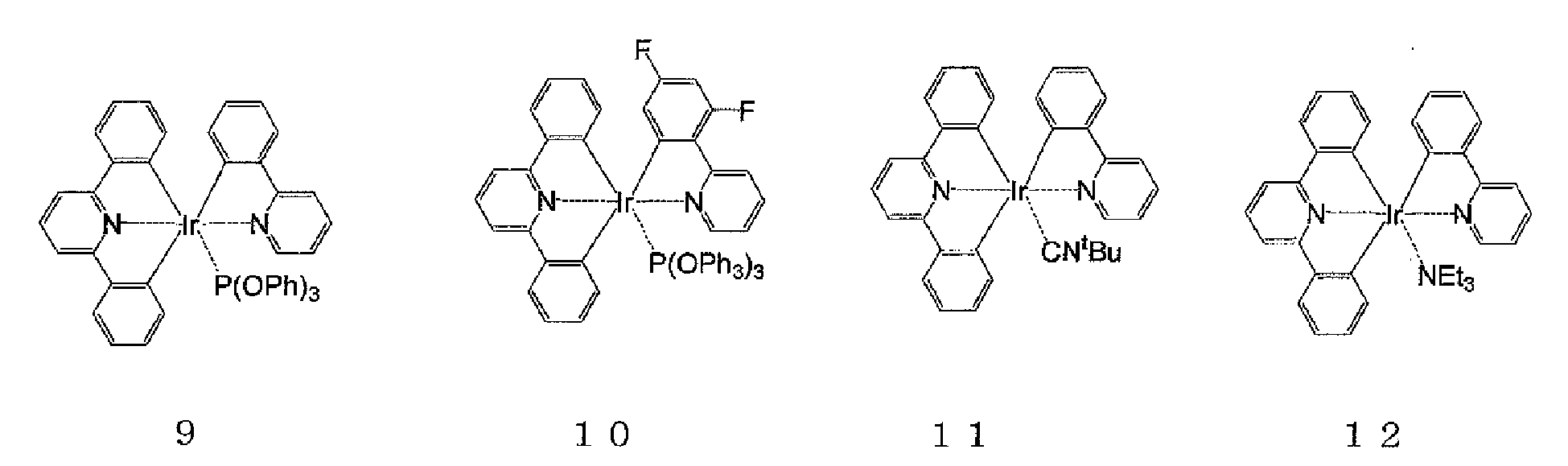
- metal complex compound of the present invention Specific examples of the metal complex compound of the present invention are shown below. However, the metal complex compound is not limited to these exemplified compounds.
- the organic EL device of the present invention includes: an organic thin film layer which has one layer or a plurality of layers including at least a light emitting layer and is disposed between a pair of electrodes consisting of a cathode and an anode, in which at least one layer of the organic thin film layer contains the metal complex compound represented by at least one kind of a compound selected from the general formulae (1) to (3) of the present invention.
- the content of the metal complex compound of the present invention in the organic thin film layer is typically 0.1 to 100 % by weight, or preferably 1 to 30% by weight with respect to the mass of the entirety of the light emitting layer.
- the light emitting layer preferably contains the metal complex compound of the present invention as a light emitting material or as a dopant.
- the light emitting layer is typically formed into a thin film by vacuum deposition or application; a layer containing the metal complex compound of the present invention is preferably formed into a film by application because the application can simplify a production process.
- the organic thin film layer is of a single-layer type, the organic thin film layer is a light emitting layer, and the light emitting layer contains the metal complex compound of the present invention.
- examples of a multilayer type organic EL device include: an organic EL device having a constitution of (anode/hole injecting layer (hole transporting layer)/light emitting layer/cathode) ; an organic EL device having a constitution of (anode/light emitting layer/electron injecting layer (electron transporting layer)/cathode); and an organic EL device having a constitution of (anode/hole injecting layer (hole transporting layer)/light emitting layer/electron injecting layer (electron transporting layer)/cathode).
- the anode of the organic EL device of the present invention supplies a hole to the hole injecting layer, the hole transporting layer, the light emitting layer, or the like, and is effective when the anode has a work function of 4.5 eV or more.
- a material that can be used for the anode include a metal, an alloy, a metal oxide, an electroconductive compound, and a mixture of them.
- a material for the anode include: conductive metal oxides such as tin oxide, zinc oxide, indium oxide, and indium tin oxide (ITO); metals such as gold, silver, chromium, and nickel; a mixture or laminate of the conductive metal oxides and the metals; inorganic conductive substances such as copper iodide and copper sulfide; organic conductive materials such as polyaniline, polythiophene, and polypyrrole; and a laminate of the conductive substances or materials and ITO.
- the conductive metal oxides are preferable, and ITO is particularly preferably used in terms of, for example, productivity, high conductivity, and transparency.
- the thickness of the anode can be appropriately selected depending on the material.
- the cathode of the organic EL device of the present invention supplies an electron to the electron injecting layer, the electron transporting layer, the light emitting layer, or the like.
- Examples of a material that can be used for the cathode include a metal, an alloy, a metal halide, a metal oxide, an electroconductive compound, and a mixture of them.
- a material for the cathode include: alkali metals (such as Li, Na, and K), and fluorides or oxides of the metals; alkali earth metals (such as Mg and Ca), and fluorides or oxides of the metals; gold; silver; lead; aluminum; a sodium-potassium alloy or a sodium-potassium mixed metal; a lithium-aluminum alloy or a lithium-aluminum mixed metal; a magnesium-silver alloy or a magnesium-silver mixed metal; and rare earth metals such as indium and ytterbium.
- the cathode may be structured by a single layer containing any one of the materials, ormaybe structured by laminating layers each containing any one of the materials.
- the cathode is preferably of a laminate structure of aluminum/lithium fluoride or of aluminum/lithium oxide. The thickness of the cathode can be appropriately selected depending on the material.
- Each of the hole injecting layer and hole transporting layer of the organic EL device of the present invention only needs to have any one of a function of injecting a hole from the anode, a function of transporting a hole, and a function of blocking an electron injected from the cathode.
- a material for each of the layers include: a carbazole derivative; a triazole derivative; an oxazole derivative; an oxadiazole derivative; an imidazole derivative; a polyarylalkane derivative; a pyrazoline derivative; a pyrazolone derivative; a phenylenediamine derivative; an arylamine derivative; an amino-substituted chalcone derivative; a styrylanthracene derivative; a fluorenone derivative; a hydrazone derivative; a stilbene derivative; a silazane derivative; an aromatic tertiary amine compound; a styrylamine compound; an aromatic dimethylidyne-based compound; a porphyrin-based compound; a polysilane-based compound; a poly (N-vinylcarbazole) derivative; an aniline-based copolymer; a conductive, high-molecular-weight oligomer such as a
- Each of the electron injecting layer and electron transporting layer of the organic EL device of the present invention only needs to have any one of a function of injecting an electron from the cathode, a function of transporting an electron, and a function of blocking a hole injected from the anode.
- a material for each of the layers include: a triazole derivative; an oxazole derivative; an oxadiazole derivative; an imidazole derivative; a fluorenone derivative; an anthraquinodimethane derivative; an anthrone derivative; a diphenylquinone derivative; a thiopyranedioxide derivative; a carbodiimide derivative; a fluorenylidenemethane derivative; a distyrylpyrazine derivative; aromatic tetracarboxylic anhydrides such as naphthalene and perylene; various metal complexes typified by metal complexes of a phthalocyanine derivative and an 8-quinolinol derivative, a metal phthalocyanine, and a metal complex using benzoxazole or benzothiazole as a ligand; an organic silane derivative; and the metal complex compound of the present invention.
- each of the electron injecting layer and the electron transporting layer may be of a single-layered structure composed of one or two or more of the materials, or may be of a multi-layered structure composed of a plurality of layers identical to or different from each other in composition.
- At least one of the electron injecting layer and the electron transporting layer preferably contains a n-electron-deficient, nitrogen-containing heterocyclic derivative as a main component.
- an insulating or semi-conducting inorganic compound is preferably used as a substance constituting the electron injecting or transporting layer.
- At least one metal compound selected from the group consisting of alkali metal chalcogenides, alkaline earth metal chalcogenides, alkali metal halides, and alkaline earth metal halides be used as such the insulator.
- the electron injecting or transporting layer be constituted with the above-mentioned alkali metal chalcogenide or the like since the electron injecting property can be improved.
- the alkali metal chalcogenide include Li 2 O, Na 2 S, and Na 2 Se.
- Preferable examples of the alkaline earth metal chalcogenide include CaO, BaO, SrO, BeO, BaS, and CaSe.
- Preferable examples of the alkali metal halide include LiF, NaF, KF, LiCl, KCl, and NaCl.
- Preferable examples of the alkaline earth metal halide include fluorides such as CaF 2 , BaF 2 , SrF 2 , MgF 2 , and BeF 2 , and halides other than the fluorides.
- examples of the semiconductor for constituting the electron injecting or transporting layer include oxides, nitrides, and oxide nitrides containing at least one element selected from the group consisting of Ba, Ca, Sr, Yb, Al, Ga, In, Li, Na, Cd, Mg, Si, Ta, Sb, and Zn, which are used alone or in combination of two or more. It is preferable that the inorganic compound constituting the electron transporting layer be in the form of a fine crystalline or amorphous insulating thin film. When the electron transporting layer is constituted of the above-mentioned insulating thin film, a more uniform thin film can be formed, and defective pixels such as dark spots can be decreased.
- examples of the inorganic compound include the alkali metal chalcogenides, the alkaline earth metal chalcogenides, the alkali metal halides, and the alkaline earth metal halides which are described above.
- a reducing dopant is preferably added to an interfacial region between the cathode and the organic thin film layer so that at least part of an organic layer in the interfacial region is reduced and turned into an anion.
- a preferable reducing dopant is at least one compound selected from the group consisting of an alkali metal, an oxide of an alkali earth metal, an alkali earth metal, a rare earth metal, an oxide of an alkali metal, a halide of an alkali metal, an oxide of an alkali earth metal, a halide of an alkali earth metal, an oxide or halide of a rare earth metal, an alkali metal complex, an alkali earth metal complex, and a rare earth metal complex.
- a preferable reducing dopant is at least one alkali metal selected from the group consisting of Na (work function: 2.36 eV), K (work function: 2.28 eV), Rb (work function: 2.16 eV), and Cs (work function: 1.95 eV) or at least one alkali earth metal selected from the group consisting of Ca (work function: 2.9 eV), Sr (work function: 2.0 to 2. 5 eV), and Ba (work function: 2. 52 eV) ; a reducing dopant having a work function of 2.9 eV is particularly preferable.
- a more preferable reducing dopant is at least one alkali metal selected from the group consisting of K, Rb, and Cs
- a still more preferable reducing dopant is Rb or Cs
- the most preferable reducing dopant is Cs.
- Those alkali metals each have a particularly high reducing ability. The addition of a relatively small amount of each of those alkali metals to a region into which an electron is injected can improve the emission luminance and lifetime of the organic EL device.
- the alkali earth metal oxide examples include BaO, SrO, CaO, Ba x Sr 1-x O (0 ⁇ x ⁇ 1) obtained by mixing BaO and SrO, and Ba x Ca 1-x O (0 ⁇ x ⁇ 1) obtained by mixing BaO and CaO.
- Examples of an alkali oxide or an alkali fluoride include LiF, Li 2 O, and NaF.
- the alkali metal complex is not particularly limited as long as it contains at least an alkali metal ion as a metal ion.
- the alkali earth metal complex is not particularly limited as long as it contains at least an alkali earth metal ion as a metal ion.
- the rare earth metal complex is not particularly limited as long as it contains at least a rare earth metal ion as a metal ion.
- a ligand include, but not limited to, quinolinol, benzoquinolinol, acridinol, phenanthridinol, hydroxyphenyloxazole, hydroxyphenylthiazole, hydroxydiaryloxadiazole, hydroxydiarylthiadiazole, hydroxyphenylpyridine, hydroxyphenylbenzoimidazole, hydroxybenzotriazole, hydroxy fluborane, bipyridyl, phenanthroline, phthalocyanine, porphyrin, cyclopentadiene, ⁇ -diketones, azomethines, and derivatives of them.
- the reducing dopant is preferably formed into a layer shape or an island shape.
- the thickness of the reducing dopant to be used in a layer shape is preferably 0.05 to 8 nm.
- a preferable approach to forming an electron injecting or transporting layer containing the reducing dopant is a method involving: depositing organic matter as a light emitting material or electron injecting material for forming the interfacial region simultaneously with the deposition of the reducing dopant by a resistance heating deposition method; and dispersing the reducing dopant in the organic matter.
- a molar concentration ratio between the reducing dopant to be dispersed and the organic matter is 100:1 to 1:100, or preferably 5: 1 to 1:5.
- the light emitting material or the electron injecting material is formed into a layer shape to serve as an interfacial organic layer, and then the reducing dopant is deposited alone by the resistance heating deposition method to be formed into a layer shape having a thickness of preferably 0.5 nm to 15 nm.
- the light emitting material or the electron injecting material is formed to serve as an interfacial organic layer, and then the reducing dopant is deposited alone by the resistance heating deposition method to be formed into an island shape having a thickness of preferably 0.05 to 1 nm.
- the light emitting layer of the organic EL device of the present invention has: a function with which a hole can be injected from the anode or the hole injecting layer and an electron can be injected from the cathode or the electron injecting layer upon application of an electric field; a function of moving injected charge (the electron and the hole) with the force of the electric field; and a function with which a field for recombination between the electron and the hole is provided so that the recombination can lead to light emission.
- the light emitting layer of the organic EL device of the present invention preferably contains at least the metal complex compound of the present invention, and may contain a host material using the metal complex compound as a guest material.
- the host material examples include a host material having a carbazole skeleton, a host material having a diarylamine skeleton, a host material having a pyridine skeleton, a host material having a pyrazine skeleton, a host material having a triazine skeleton, and a host material having an arylsilane skeleton.
- the energy level of the lowest triplet excited state (T1) of the host material is preferably larger than the Tl level of the guest material.
- the host material may be a low-molecular-weight compound, or may be a high-molecular-weight compound.
- a light emitting layer in which the host material is doped with a light emitting material such as the metal complex compound can be formed by, for example, the co-deposition of the host material and the light emitting material.
- a method of forming each of the layers in the organic EL device of the present invention is not particularly limited. Various methods such as a vacuum deposition method, an LB method, a resistance heating deposition method, an electron beam method, a sputtering method, a molecular lamination method, a coating method (such as a spin coating method, a cast method, or a dip coating method), an ink-jet method, and a printing method can be employed. In the present invention, a coating method as an application method is preferable.
- the organic thin film layer containing the metal complex compound of the present invention can be formed in accordance with a conventionally known method such as the vacuum deposition method, the molecular beam epitaxy method (i.e., MBE method), or the coating method such as the dipping method, the spin coating method, the casting method, a bar coat method, and a roll coat method, each of which uses a solution with a substance dissolved in a solvent.
- a conventionally known method such as the vacuum deposition method, the molecular beam epitaxy method (i.e., MBE method), or the coating method such as the dipping method, the spin coating method, the casting method, a bar coat method, and a roll coat method, each of which uses a solution with a substance dissolved in a solvent.
- Examples of a solvent to be used in the coating process include: halogen-based hydrocarbon-based solvents such as dichloromethane, dichloroethane, chloroform, carbon tetrachloride, tetrachloroethane, trichloroethane, chlorobenzene, dichlorobenzene, and chlorotoluene; ether-based solvents such as dibutyl ether, tetrahydrofuran, dioxane, and anisole; alcohol-based solvents such as methanol, ethanol, propanol, butanol, pentanol, hexanol, cyclohexanol, methyl cellosolve, ethyl cellosolve, and ethylene glycol; hydrocarbon-based solvents suchasbenzene, toluene, xylene, ethylbenzene, hexane, octane, and decane; and ester-based
- Each layer can be formed by the coating method, which involves: dissolving the metal complex compound of the present invention in a solvent to prepare an application liquid; applying the application liquid onto a desired layer (or electrode) ; and drying the liquid.
- the application liquid may contain a resin, and the resin may be in a dissolved state or in a dispersed state in the solvent.
- a disconjugate polymer such as polyvinyl carbazole
- a conjugate polymer such as a polyolefin-based polymer
- examples of the resin include polyvinyl chloride, polycarbonate, polystyrene, polymethyl methacrylate, polybutyl methacrylate, polyester, polysulfone, polyphenylene oxide, polybutadiene,poly(N-vinylcarbazole), a hydrocarbon resin, a ketone resin, a phenoxy resin, polyamide, ethyl cellulose, vinyl acetate, an ABS resin, polyurethane, a melamine resin, an unsaturated polyester resin, an alkyd resin, an epoxy resin, and a silicone resin.
- the thickness of each organic layer of the organic EL device of the present invention is not particularly limited.
- the thickness is preferably in the range of several nanometers to 1 ⁇ m in ordinary cases.
- a metal complex compound (24) was synthesized by the following process.
- a metal complex compound (25) was synthesized via the following route.
- Example 1 production of organic EL device
- a glass substrate equipped with a transparent electrode after being washed was mounted on the substrate holder of a vacuum deposition device.
- a copper phthalocyanine film (CuPc film) having a thickness of 10 nm was formed on the surface on the side where the transparent electrode was formed in such a manner that the film would cover the transparent electrode.
- the CuPc film functions as a hole injecting layer.
- NPD shown below was formed into a film having a thickness of 30 nm on the CuPc film.
- the NPD film functions as a hole transporting layer.
- the following host material (CBP) was deposited from the vapor in such a manner that a light emitting layer having a thickness of 30 nm would be formed on the NPD film.
- CBP host material
- the metal complex compound (25) was added as a phosphorescent Ir metal complex dopant simultaneously with the formation.
- the concentration of the compound (25) in the light emitting layer was set to 6% by weight.
- BAlq shown below was formed into a film having a thickness of 10 nm on the light emitting layer.
- the BAlq film functions as a hole blocking layer.
- Alq shown below was formed into a film having a thickness of 30 nm on the BAlq film.
- the Alq film functions as an electron injecting layer.
- LiF as an alkali metal halide was deposited from the vapor to have a thickness of 0.15 nm, and then aluminum was deposited from the vapor to have a thickness of 150 nm.
- the Al/LiF film functions as a cathode.
- an organic EL device was produced. The device was subjected to a current test at a voltage of 7.2 V. As a result, the device was observed to emit green light.
- the use of the metal complex compound of the present invention as a material for an organic EL device can provide an organic EL device whose wavelength of light emission is shortened so that blue light emission is obtained, which exhibits high efficiency of light emission, and which has a long life. Accordingly, the device is applicable to fields such as various display devices, displays, back lights, light sources for illumination, marking signs, signboards, and interior lighting, and is particularly suitable as a display device for color display.
Landscapes
- Chemical & Material Sciences (AREA)
- Organic Chemistry (AREA)
- Engineering & Computer Science (AREA)
- Materials Engineering (AREA)
- Nanotechnology (AREA)
- Physics & Mathematics (AREA)
- Crystallography & Structural Chemistry (AREA)
- Inorganic Chemistry (AREA)
- Optics & Photonics (AREA)
- Spectroscopy & Molecular Physics (AREA)
- Electroluminescent Light Sources (AREA)
Abstract
Provided are an organic electroluminescence device whose wavelength of light emission is short and which can emit blue light having a high color purity, and a metal complex compound for realizing the device. The metal complex compound is of a specific structure having a partial structure including a tridentate ligand. The organic electroluminescence device includes: a pair of electrodes; and an organic thin film layer which has one layer or a plurality of layers including at least a light emitting layer and is disposed between the pair of electrodes. In the organic electroluminescence device, at least one layer of the organic thin film layer contains the metal complex compound. The organic electroluminescence device emits light by applying a voltage between both the electrodes.
Description
- The present invention relates to a novel metal complex compound and an organic electroluminescence device using the compound, in particular, an organic electroluminescence device whose wavelength of light emission is shortened so that blue light emission is obtained, which exhibits high efficiency of light emission, and which has a long life, and a metal complex compound for realizing the device.
- Investigation has been vigorously conducted on the use of an organic electroluminescence (EL) device as a display device for color display that replaces liquid crystal in recent years. However, the performance of the organic EL device as a light emitting device is still insufficient to realize the enlargement of the screen size of a display device using the organic EL device. A green light emitting device using an ortho-metallized iridium complex (fac-tris(2-phenylpyridine)iridium), which is a phosphorescent material, as a light emitting material has been proposed as means for improving the performance of the organic EL device (Non-patent Document 1; Non-patent Document 2).
At present, the color of light emitted from an organic EL device utilizing phosphorescence (in other words, a phosphorescent EL device) has been limited to a green color, so the scope of application of the device as a color display is narrow, and the development of a device with improved light emitting property for any other color has been demanded. Inparticular, no blue light emitting device having an outer quantum yield in excess of 5% has been reported. If the blue light emitting device can be improved, a color display composed only of phosphorescent organic EL devices will be able to display full colors and a white color. Accordingly, the improvement makes great strides forward in putting a phosphorescent EL device to practical use. - At present, the development of a compound containing Ir as a phosphorescent complex has been vigorously conducted, and the following compound A has been known as a compound for a green light emitting device. On the other hand, the following compound B has been known as a compound for a blue light emitting device, but is not practical in terms of the life and efficiency of a device formed of the compound. In view of the foregoing, there arises a need for developing another complex for a blue light emitting device. However, no factor other than the compound B capable of turning the color of light into a blue color has been found at present.

- The above-mentioned compounds belong to the group of complexes each using a bidentate chelate ligand. However, few complex using a tridentate chelate ligand similar to the bidentate ligand has been known, and only a compound C (Non-patent Document 3) and a compound D (Non-patent Document 4) shown below, and a few other examples have been known. However, the wavelength of light emission of each of those compounds is in a region of 585 to 600 nm, that is, a red color region, not in a blue color region. If a complex capable of emitting light in a blue color region can be realized by using the new tridentate ligand group, the realization will lead to the possibility of new technical development.

-
- [Non-patent Document 1] D. F. O' Brien and M. A. Baldo et al. "Improved energy transfer in electrophosphorescence devices" Applied Physics letters Vol. 74 No. 3, pp442-444, January 18, 1999
- [Non-patent Document 2] M. A. Baldo et al. "Very high-efficiency green organic light-emitting devices based on electrophosphorescence" Applied Physics letters Vol. 75 No. 1, pp4-6, July 5, 1999
- [Non-patent Document 3] J-P. Collin et al., J. Am. Chem. Soc., 121, 5009 (1999)
- [Non-patent Document 4] J. A. G. Williams, Inorg. Chem., 43, 6513 (2004)
- The present invention has been made with a view to solving the above-mentioned problems, and an object of the present invention is to provide an organic EL device whose wavelength of light emission is shortened so that blue light emission is obtained, which exhibits high efficiency of light emission, and which has a long life, and a metal complex compound for realizing the device.
- The inventors of the present invention have revealed a new structural factor for turning the color of light into a blue color, in which the use of a metal complex compound included in any one of the following general formulae (1) to (3) having a partial structure composed of a tridentate chelate ligand shortens a wavelength of light emission so that blue light emission is obtained. Thus, the inventors have completed the present invention.
In other words, the present invention provides a metal complex compound including a partial structure represented by one of the following general formulae (1) to (3) comprising a tridentate chelate ligand. -

- (In the general formula, a solid line represents a covalent bond; and a dotted line represents a coordinate bond.
- M represents a trivalent metal atom belonging to Group 9 in the periodic table.
- L1 to L6 each independently represent an aromatic hydrocarbon group which has 5 to 30 carbon atoms and which may have a substituent, a heterocyclic group which has 2 to 30 carbon atoms and which may have a substituent, or a group containing an atom belonging to any one of Groups 14 to 17 in the periodic table, and each of L1 to L3 is divalent, L4 is monovalent, and each of L5 and L6 is zero-valent. However, an element in L2 directly bonded to M is an atom belonging to Group 15 in the periodic table.
- Further, L4 and L5, or L5 and L6 may be bonded to each other to form a bidentate chelate ligand.)
-

- (In the general formula, a solid line represents a covalent bond, and a dotted line represents a coordinate bond.
- M represents a trivalent metal atom belonging to Group 9 in the periodic table.
- L7 to L12 each independently represent an aromatic hydrocarbon group which has 5 to 30 carbon atoms and which may have a substituent, a heterocyclic group which has 2 to 30 carbon atoms and which may have a substituent, or a group containing an atom belonging to any one of Groups 14 to 17 in the periodic table, and each of L8 and L9 is divalent, each of L7, L10, and L12 is monovalent, L11 is zero-valent. However, an element in each of L7 and L8 directly bonded to M is an atom belonging to Group 15 in the periodic table.
- Further, L10 and L11, or L11 and L12 may be bonded to each other to form a bidentate chelate ligand.)
-

- (In the general formula, a solid line represents a covalent bond, and a dotted line represents a coordinate bond.
- M represents a trivalent metal atom belonging to Group 9 in the periodic table.
- L13 to L18 each independently represent an aromatic hydrocarbon group which has 5 to 30 carbon atoms and which may have a substituent, a heterocyclic group which has 2 to 30 carbon atoms and which may have a substituent, or a group containing an atom belonging to any one of Groups 14 to 17 in the periodic table, and L14 is trivalent, each of L13, L15, L16, and L18 is monovalent, and L17 is zero-valent. However, an element in each of L13 and L15 directly bonded to M is a phosphorous atom.
- Further, L16 and L17, or L17 and L18 may be bonded to each other to form a bidentate chelate ligand.)
- According to the present invention, there is provided an organic EL device including an organic thin film layer which has one layer or a plurality of layers including at least a light emitting layer and is disposed between a pair of electrodes, in which: at least one layer of the organic thin film layer contains the metal complex compound; and light is emitted by applying a voltage between both the electrodes.
- The use of the metal complex compound of the present invention as a material for an organic EL device can provide an organic EL device whose wavelength of light emission is shortened so that blue light emission is obtained, which exhibits high efficiency of light emission, and which has a long life. [Best Modes for carrying out the Invention]
- A metal complex compound of the present invention is a metal complex compound represented by the following general formula (1), (2), or (3) having a tridentate chelate ligand.
In each of the general formulae (1) to (3), a solid line represents a covalent bond, and a dotted line represents a coordinate bond.
Hereinafter, a metal complex compound represented by the general formula (1) will be described first.
- In the general formula (1), M represents a trivalent metal atom belonging to Group 9 in the periodic table. Examples of the trivalent metal atom include cobalt (Co), rhodium (Rh), and iridium (Ir) atoms. Of those, Ir is preferable.
In the general formula (1), L1 to L6 each independently represent an aromatic hydrocarbon group which has 5 to 30 carbon atoms and which may have a substituent, a heterocyclic group which has 2 to 30 carbon atoms and which may have a substituent, or a group containing an atom belonging to any one of Groups 14 to 17 in the periodic table.
An example of the aromatic hydrocarbon group includes residues such as benzene, naphthalene, anthracene, phenanthrene, pyrene, biphenyl, terphenyl, and fluoranthene.
An example of the heterocyclic group includes residues such as imidazole, benzoimidazole, pyrrole, furan, thiophene, benzothiophene, oxadiazoline, indoline, carbazole, pyridine, quinoline, isoquinoline, benzoquinone, pyralodine, imidazolidine, and piperidine. - Examples of the atom belonging to any one of Groups 14 to 17 in the periodic table include carbon (C), nitrogen (N), oxygen (O), silicon (Si), phosphorus (P), sulfur (S), germanium (Ge), arsenic (As), and selenium (Se) atoms, and halogen atoms. Of those, carbon, nitrogen, and oxygen atoms, and a chlorine atom are preferable.
Groups each containing such atom belonging to any one of Groups 14 to 17 in the periodic table are each independently, for example, a cyano group, a halogen atom, an alkyl group which has 1 to 12 carbon atoms and which may have a substituent, an alkylamino group which has 1 to 12 carbon atoms and which may have a substituent, an arylamino group which has 6 to 20 carbon atoms and which may have a substituent, an alkoxy group which has 1 to 12 carbon atoms and which may have a substituent, a halogenated alkoxy group which has 1 to 12 carbon atoms and which may have a substituent, an aryloxy group which has 6 to 20 carbon atoms and which may have a substituent, an aromatic hydrocarbon group which has 6 to 20 carbon atoms and which may have a substituent, a heterocyclic group which has 3 to 20 carbon atoms and which may have a substituent, a halogenated alkyl group which has 1 to 12 carbon atoms and which may have a substituent, an alkenyl group which has 2 to 12 carbon atoms and which may have a substituent, an alkynyl group which has 2 to 12 carbon atoms and which may have a substituent, or a cycloalkyl group which has 3 to 20 carbon atoms and which may have a substituent in addition to the atom itself. - Examples of the halogen atom include fluorine, chlorine, bromine, and iodine atoms.
Examples of the alkyl group include a methyl group, an ethyl group, a propyl group, an isopropyl group, an n-butyl group, an s-butyl group, an isobutyl group, a t-butyl group, an n-pentyl group, an n-hexyl group, an n-heptyl group, and an n-octyl group.
Examples of the aromatic hydrocarbon group include residues of benzene,naphthalene, anthracene, phenanthrene, pyrene, biphenyl, terphenyl, fluoranthene, and the like.
Examples of the heterocyclic group include residues of imidazole, benzimidazole, pyrrole, furan, thiophene, benzothiophene, oxadiazoline, indoline, carbazole, pyridine, quinoline, isoquinoline, benzoquinone, pyralozine, imidazolidine, piperidine, and the like.
Examples of the alkylamino group include groups each obtained by substituting a hydrogen atom of an amino group with the alkyl group.
Examples of the arylamino group include groups each obtained by substituting a hydrogen atom of an amino group with the aromatic hydrocarbon group.
The alkoxy group is represented as -OY', and examples of Y' include the groups described above as the examples of the alkyl group.
Examples of the halogenated alkoxy group include groups each obtained by substituting a hydrogen atom of the alkoxy group with the halogen atom.
The aryloxy group is represented as -OY", and examples of Y" include the groups described above as the examples of the aromatic hydrocarbon group.
Examples of the halogenated alkyl group include groups each obtained by substituting a hydrogen atom of the alkyl group with the halogen atom.
Examples of the alkenyl group include a vinyl group, an allyl group, a 2-butenyl group, and a 3-pentenyl group.
Examples of the alkynyl group include an ethinyl group and a methylethinyl group.
Examples of the cycloalkyl group include a cyclopropyl group, a cyclobutyl group, a cyclopentyl group, and a cyclohexyl group. - L1 to L3 each represent, for example, a divalent residue derived from any one of the above-mentioned specific examples, L4 represents, for example, a monovalent residue derived from any one of the above-mentioned specific examples, and L5 and L6 each represent, for example, a zero-valent compound (monodentate ligand).
It should be noted that an element in L2 directly bonded to M is an atom belonging to Group 15 in the periodic table, and the atom is preferably N or P.
In addition, L4 and L5, or L5 and L6 may be bonded to each other to form a bidentate chelate ligand. - An L1L2L3M part in the general formula (1) is preferably a structure represented by the following general formula (4).

- In the general formula (4), R1 to R11 each independently represent a hydrogen atom, a cyano group, a halogen atom, an alkyl group which has 1 to 12 carbon atoms and which may have a substituent, an alkylamino group which has 1 to 12 carbon atoms, an arylamino group which has 6 to 20 carbon atoms and which may have a substituent, an alkoxy group which has 1 to 12 carbon atoms and which may have a substituent, a halogenated alkoxy group which has 1 to 12 carbon atoms and which may have a substituent, an aryloxy group which has 6 to 20 carbon atoms and which may have a substituent, an aromatic hydrocarbon group which has 6 to 20 carbon atoms and which may have a substituent, a heterocyclic group which has 3 to 20 carbon atoms and which may have a substituent, a halogenated alkyl group which has 1 to 12 carbon atoms and which may have a substituent, an alkenyl group which has 2 to 12 carbon atoms and which may have a substituent, an alkynyl group which has 2 to 12 carbon atoms and which may have a substituent, or a cycloalkyl group which has 3 to 20 carbon atoms and which may have a substituent, and adjacent groups may be bonded to each other to form a cyclic structure.
Specific examples of each of those groups include the groups described above as the examples of the group containing an atom belonging to any one of Groups 14 to 17 in the periodic table represented by each of L1 to L6.
In addition, examples of the cyclic structure formed by the bonding of adjacent groups include: cycloalkanes (such as cyclopropane, cyclobutane, cyclohexane, and cycloheptane); aromatic hydrocarbon rings (such as benzene, naphthalene, anthracene, phenanthrene, pyrene, biphenyl, terphenyl, and fluoranthene); and heterocyclic rings (such as imidazole, benzimidazole, pyrrole, furan, thiophene, benzothiophene, oxadiazoline, diphenylanthracene, indoline, carbazole, pyridine, quinoline, isoquinoline, benzoquinone, pyralozine, imidazolidine, and piperidine). - The metal complex compound represented by the general formula (1) is preferably a metal complex compound represented by the following general formula (7), (8), or (9).


- In the general formulae (7) to (9), R1 to R19 each independently represent the same group as that described for each of R1 to R11 in the general formula (4), specific examples of each of R1 to R19 include examples similar to those described above, and examples of a cyclic structure formed by the bonding of adj acent groups include examples similar to those described above.
In the general formula (9), X represents an alkylene group which has 1 to 4 carbon atoms and which may have a substituent, an alkenylene group which has 1 to 4 carbon atoms and which may have a substituent, or a phenylene group which may have a substituent.
Examples of the alkenylene group include a methylene group, an ethylene group, a propylene group, an isopropylene group, an n-butylene group, an s-butylene group, an isobutylene group, and a t-butylene group.
Examples of the alkenyl group include a vinylene group, an allylene group, and a 2-butenylene group.
In the general formula (7), L19 represents a monodentate ligand containing an atom belonging to any one of Groups 14 to 16 in the periodic table, and specific examples of the monodentate ligand include zero-valent compounds each obtained by removing a halogen atom from the group containing an atom belonging to any one of Groups 14 to 17 in the periodic table in the general formula (1). Of those, PR3, NR3, CO, or isonitrile (RNC) is preferable. R has the same meaning as that of each of R1 to R19 described above.
In the general formulae (8) and (9), L20 and L21 each represent a group obtained by removing a hydrogen atom from a group represented by any one of R1 to R19 described above, and specific examples of each of L20 and L21 include the groups described above as the examples of each of R1 to R19. - Next, a metal complex compound represented by the general formula (2) will be described.

- In the general formula (2), M has the same meaning as that described above, and specific examples of M include examples similar to those described above.
In the general formula (2), L7 to L12 each independently represent the same group as that represented by any one of L1 to L6 described above, and specific examples of the group represented by any one of L7 to L12 include the groups described above as the examples of each of L1 to L6, L8 and L9 each represent, for example, a divalent residue derived from any one of the above-mentioned specific examples, L7, L10, and L12 each represent, for example, a monovalent residue derived from any one of the above-mentioned specific examples, and L11 represents, for example, a zero-valent compound (monodentate ligand).
It should be noted that an element in each of L7 and L8 directly bonded to M is an atom belonging to Group 15 in the periodic table, and the atom is preferably N or P.
In addition, L10 and L11, or L11 and L12 may be bonded to each other to form a bidentate chelate ligand. - An L7L8L9M part in the general formula (2) is preferably a structure represented by the following general formula (5).

- The metal complex compound represented by the general formula (2) is preferably a metal complex compound represented by the following general formula (10).

In addition, L22 represents a group obtained by removing a hydrogen atom from a group represented by any one of R1 to R19 described above, and specific examples of L22 include the groups described above as the examples of each of R1 to R19. - Next, a metal complex compound represented by the general formula (3) will be described.

- In the general formula (3), M has the same meaning as that described above, and specific examples of M include examples similar to those described above.
In the general formula (3), L13 to L18 each independently represent the same group as that represented by any one of L1 to L6 described above, and specific examples of the group represented by any one of L13 to L18 include the groups described above as the examples of each of L1 to L6, L14 represents, for example, a trivalent residue derived from any one of the above-mentioned specific examples, L13, L15, L16, and L18 each represent, for example, a monovalent residue derived from anyone of the above-mentioned specific examples, and L17 represents, for example, a zero-valent compound (monodentate ligand).
It should be noted that an element in each of L13 and L15 directly bonded to M is a phosphorus atom.
In addition, L16 and L17, or L17 and L18 may be bonded to each other to form a bidentate chelate ligand. - An L13L14L15M part in the general formula (3) is preferably a structure represented by the following general formula (6).

- The metal complex compound represented by the general formula (3) is preferably a metal complex compound represented by the following general formula (11).

- In the general formula (11), R1 to R19 each independently represent the same group as that described for each of R1 to R11 in the general formula (4), specific examples of each of R1 to R19 include examples similar to those described above, and examples of a cyclic structure formed by the bonding of adjacent groups include examples similar to those described above.
In addition, L23 represents a group obtained by removing a hydrogen atom from a group represented by any one of R1 to R19 described above, and specific examples of L23 include the groups described above as the examples of each of R1 to R19. - It should be noted that examples of a substituent for each of the groups represented by the general formulae (1) to (11) include a halogen atom, a hydroxyl group, a substituted or unsubstituted amino group, a nitro group, a cyano group, a substituted or unsubstituted alkyl group, an alkyl group substituted with a fluorine atom, a substituted or unsubstituted alkenyl group, a substituted or unsubstituted cycloalkyl group, a substituted or unsubstituted alkoxyl group, a substituted or unsubstituted heterocyclic group, a substituted or unsubstituted arylalkyl group, a substituted or unsubstituted aryloxy group, a substituted or unsubstituted alkoxycarbonyl group, and a carboxyl group.
- Specific examples of the metal complex compound of the present invention are shown below. However, the metal complex compound is not limited to these exemplified compounds.

-



-


- The organic EL device of the present invention includes: an organic thin film layer which has one layer or a plurality of layers including at least a light emitting layer and is disposed between a pair of electrodes consisting of a cathode and an anode, in which at least one layer of the organic thin film layer contains the metal complex compound represented by at least one kind of a compound selected from the general formulae (1) to (3) of the present invention.
The content of the metal complex compound of the present invention in the organic thin film layer is typically 0.1 to 100 % by weight, or preferably 1 to 30% by weight with respect to the mass of the entirety of the light emitting layer.
In the organic EL device of the present invention, the light emitting layer preferably contains the metal complex compound of the present invention as a light emitting material or as a dopant. In addition, the light emitting layer is typically formed into a thin film by vacuum deposition or application; a layer containing the metal complex compound of the present invention is preferably formed into a film by application because the application can simplify a production process.
In the organic EL device of the present invention, when the organic thin film layer is of a single-layer type, the organic thin film layer is a light emitting layer, and the light emitting layer contains the metal complex compound of the present invention. In addition, examples of a multilayer type organic EL device include: an organic EL device having a constitution of (anode/hole injecting layer (hole transporting layer)/light emitting layer/cathode) ; an organic EL device having a constitution of (anode/light emitting layer/electron injecting layer (electron transporting layer)/cathode); and an organic EL device having a constitution of (anode/hole injecting layer (hole transporting layer)/light emitting layer/electron injecting layer (electron transporting layer)/cathode). - The anode of the organic EL device of the present invention supplies a hole to the hole injecting layer, the hole transporting layer, the light emitting layer, or the like, and is effective when the anode has a work function of 4.5 eV or more. Examples of a material that can be used for the anode include a metal, an alloy, a metal oxide, an electroconductive compound, and a mixture of them. Specific examples of a material for the anode include: conductive metal oxides such as tin oxide, zinc oxide, indium oxide, and indium tin oxide (ITO); metals such as gold, silver, chromium, and nickel; a mixture or laminate of the conductive metal oxides and the metals; inorganic conductive substances such as copper iodide and copper sulfide; organic conductive materials such as polyaniline, polythiophene, and polypyrrole; and a laminate of the conductive substances or materials and ITO. Of those, the conductive metal oxides are preferable, and ITO is particularly preferably used in terms of, for example, productivity, high conductivity, and transparency. The thickness of the anode can be appropriately selected depending on the material.
- The cathode of the organic EL device of the present invention supplies an electron to the electron injecting layer, the electron transporting layer, the light emitting layer, or the like. Examples of a material that can be used for the cathode include a metal, an alloy, a metal halide, a metal oxide, an electroconductive compound, and a mixture of them. Specific examples of a material for the cathode include: alkali metals (such as Li, Na, and K), and fluorides or oxides of the metals; alkali earth metals (such as Mg and Ca), and fluorides or oxides of the metals; gold; silver; lead; aluminum; a sodium-potassium alloy or a sodium-potassium mixed metal; a lithium-aluminum alloy or a lithium-aluminum mixed metal; a magnesium-silver alloy or a magnesium-silver mixed metal; and rare earth metals such as indium and ytterbium. Of those, aluminum, the lithium-aluminum alloy or the lithium-aluminum mixed metal, the magnesium-silver alloy or the magnesium-silver mixed metal, or the like is preferable. The cathode may be structured by a single layer containing any one of the materials, ormaybe structured by laminating layers each containing any one of the materials. For example, the cathode is preferably of a laminate structure of aluminum/lithium fluoride or of aluminum/lithium oxide. The thickness of the cathode can be appropriately selected depending on the material.
- Each of the hole injecting layer and hole transporting layer of the organic EL device of the present invention only needs to have any one of a function of injecting a hole from the anode, a function of transporting a hole, and a function of blocking an electron injected from the cathode. Specific examples of a material for each of the layers include: a carbazole derivative; a triazole derivative; an oxazole derivative; an oxadiazole derivative; an imidazole derivative; a polyarylalkane derivative; a pyrazoline derivative; a pyrazolone derivative; a phenylenediamine derivative; an arylamine derivative; an amino-substituted chalcone derivative; a styrylanthracene derivative; a fluorenone derivative; a hydrazone derivative; a stilbene derivative; a silazane derivative; an aromatic tertiary amine compound; a styrylamine compound; an aromatic dimethylidyne-based compound; a porphyrin-based compound; a polysilane-based compound; a poly (N-vinylcarbazole) derivative; an aniline-based copolymer; a conductive, high-molecular-weight oligomer such as a thiophene oligomer or polythiophene; an organic silane derivative; and the metal complex compound of the present invention. In addition, each of the hole injecting layer and the hole transporting layer maybe of a single-layered structure composed of one or two or more of the materials, or may be of a multi-layered structure composed of a plurality of layers identical to or different from each other in composition.
- Each of the electron injecting layer and electron transporting layer of the organic EL device of the present invention only needs to have any one of a function of injecting an electron from the cathode, a function of transporting an electron, and a function of blocking a hole injected from the anode. Specific examples of a material for each of the layers include: a triazole derivative; an oxazole derivative; an oxadiazole derivative; an imidazole derivative; a fluorenone derivative; an anthraquinodimethane derivative; an anthrone derivative; a diphenylquinone derivative; a thiopyranedioxide derivative; a carbodiimide derivative; a fluorenylidenemethane derivative; a distyrylpyrazine derivative; aromatic tetracarboxylic anhydrides such as naphthalene and perylene; various metal complexes typified by metal complexes of a phthalocyanine derivative and an 8-quinolinol derivative, a metal phthalocyanine, and a metal complex using benzoxazole or benzothiazole as a ligand; an organic silane derivative; and the metal complex compound of the present invention. In addition, each of the electron injecting layer and the electron transporting layer may be of a single-layered structure composed of one or two or more of the materials, or may be of a multi-layered structure composed of a plurality of layers identical to or different from each other in composition.
- In the organic EL device of the present invention, at least one of the electron injecting layer and the electron transporting layer preferably contains a n-electron-deficient, nitrogen-containing heterocyclic derivative as a main component.
In addition, in the organic EL device of the present invention, an insulating or semi-conducting inorganic compound is preferably used as a substance constituting the electron injecting or transporting layer. When the electron injecting or transporting layer is constituted by an insulator or a semiconductor, a current leak can be effectively prevented, and electron injecting property can be improved. It is preferable that at least one metal compound selected from the group consisting of alkali metal chalcogenides, alkaline earth metal chalcogenides, alkali metal halides, and alkaline earth metal halides be used as such the insulator. It is preferable that the electron injecting or transporting layer be constituted with the above-mentioned alkali metal chalcogenide or the like since the electron injecting property can be improved.
To be specific, preferable examples of the alkali metal chalcogenide include Li2O, Na2S, and Na2Se. Preferable examples of the alkaline earth metal chalcogenide include CaO, BaO, SrO, BeO, BaS, and CaSe. Preferable examples of the alkali metal halide include LiF, NaF, KF, LiCl, KCl, and NaCl. Preferable examples of the alkaline earth metal halide include fluorides such as CaF2, BaF2, SrF2, MgF2, and BeF2, and halides other than the fluorides. - Further, examples of the semiconductor for constituting the electron injecting or transporting layer include oxides, nitrides, and oxide nitrides containing at least one element selected from the group consisting of Ba, Ca, Sr, Yb, Al, Ga, In, Li, Na, Cd, Mg, Si, Ta, Sb, and Zn, which are used alone or in combination of two or more. It is preferable that the inorganic compound constituting the electron transporting layer be in the form of a fine crystalline or amorphous insulating thin film. When the electron transporting layer is constituted of the above-mentioned insulating thin film, a more uniform thin film can be formed, and defective pixels such as dark spots can be decreased. Examples of the inorganic compound include the alkali metal chalcogenides, the alkaline earth metal chalcogenides, the alkali metal halides, and the alkaline earth metal halides which are described above.
- In addition, in the present invention, a reducing dopant is preferably added to an interfacial region between the cathode and the organic thin film layer so that at least part of an organic layer in the interfacial region is reduced and turned into an anion. A preferable reducing dopant is at least one compound selected from the group consisting of an alkali metal, an oxide of an alkali earth metal, an alkali earth metal, a rare earth metal, an oxide of an alkali metal, a halide of an alkali metal, an oxide of an alkali earth metal, a halide of an alkali earth metal, an oxide or halide of a rare earth metal, an alkali metal complex, an alkali earth metal complex, and a rare earth metal complex. To be specific, a preferable reducing dopant is at least one alkali metal selected from the group consisting of Na (work function: 2.36 eV), K (work function: 2.28 eV), Rb (work function: 2.16 eV), and Cs (work function: 1.95 eV) or at least one alkali earth metal selected from the group consisting of Ca (work function: 2.9 eV), Sr (work function: 2.0 to 2. 5 eV), and Ba (work function: 2. 52 eV) ; a reducing dopant having a work function of 2.9 eV is particularly preferable. Of those, a more preferable reducing dopant is at least one alkali metal selected from the group consisting of K, Rb, and Cs, a still more preferable reducing dopant is Rb or Cs, and the most preferable reducing dopant is Cs. Those alkali metals each have a particularly high reducing ability. The addition of a relatively small amount of each of those alkali metals to a region into which an electron is injected can improve the emission luminance and lifetime of the organic EL device.
- Preferable examples of the alkali earth metal oxide include BaO, SrO, CaO, BaxSr1-xO (0 < x < 1) obtained by mixing BaO and SrO, and BaxCa1-xO (0 < x < 1) obtained by mixing BaO and CaO. Examples of an alkali oxide or an alkali fluoride include LiF, Li2O, and NaF. The alkali metal complex is not particularly limited as long as it contains at least an alkali metal ion as a metal ion. The alkali earth metal complex is not particularly limited as long as it contains at least an alkali earth metal ion as a metal ion. The rare earth metal complex is not particularly limited as long as it contains at least a rare earth metal ion as a metal ion. In addition, examples of a ligand include, but not limited to, quinolinol, benzoquinolinol, acridinol, phenanthridinol, hydroxyphenyloxazole, hydroxyphenylthiazole, hydroxydiaryloxadiazole, hydroxydiarylthiadiazole, hydroxyphenylpyridine, hydroxyphenylbenzoimidazole, hydroxybenzotriazole, hydroxy fluborane, bipyridyl, phenanthroline, phthalocyanine, porphyrin, cyclopentadiene, β-diketones, azomethines, and derivatives of them.
- In addition, the reducing dopant is preferably formed into a layer shape or an island shape. The thickness of the reducing dopant to be used in a layer shape is preferably 0.05 to 8 nm.
A preferable approach to forming an electron injecting or transporting layer containing the reducing dopant is a method involving: depositing organic matter as a light emitting material or electron injecting material for forming the interfacial region simultaneously with the deposition of the reducing dopant by a resistance heating deposition method; and dispersing the reducing dopant in the organic matter. A molar concentration ratio between the reducing dopant to be dispersed and the organic matter is 100:1 to 1:100, or preferably 5: 1 to 1:5. Upon formation of the reducing dopant into a layer shape, the light emitting material or the electron injecting material is formed into a layer shape to serve as an interfacial organic layer, and then the reducing dopant is deposited alone by the resistance heating deposition method to be formed into a layer shape having a thickness of preferably 0.5 nm to 15 nm. Upon formation of the reducing dopant into an island shape, the light emitting material or the electron injecting material is formed to serve as an interfacial organic layer, and then the reducing dopant is deposited alone by the resistance heating deposition method to be formed into an island shape having a thickness of preferably 0.05 to 1 nm. - The light emitting layer of the organic EL device of the present invention has: a function with which a hole can be injected from the anode or the hole injecting layer and an electron can be injected from the cathode or the electron injecting layer upon application of an electric field; a function of moving injected charge (the electron and the hole) with the force of the electric field; and a function with which a field for recombination between the electron and the hole is provided so that the recombination can lead to light emission. The light emitting layer of the organic EL device of the present invention preferably contains at least the metal complex compound of the present invention, and may contain a host material using the metal complex compound as a guest material. Examples of the host material include a host material having a carbazole skeleton, a host material having a diarylamine skeleton, a host material having a pyridine skeleton, a host material having a pyrazine skeleton, a host material having a triazine skeleton, and a host material having an arylsilane skeleton. The energy level of the lowest triplet excited state (T1) of the host material is preferably larger than the Tl level of the guest material. The host material may be a low-molecular-weight compound, or may be a high-molecular-weight compound. In addition, a light emitting layer in which the host material is doped with a light emitting material such as the metal complex compound can be formed by, for example, the co-deposition of the host material and the light emitting material.
- A method of forming each of the layers in the organic EL device of the present invention is not particularly limited. Various methods such as a vacuum deposition method, an LB method, a resistance heating deposition method, an electron beam method, a sputtering method, a molecular lamination method, a coating method (such as a spin coating method, a cast method, or a dip coating method), an ink-jet method, and a printing method can be employed. In the present invention, a coating method as an application method is preferable.
Further, the organic thin film layer containing the metal complex compound of the present invention can be formed in accordance with a conventionally known method such as the vacuum deposition method, the molecular beam epitaxy method (i.e., MBE method), or the coating method such as the dipping method, the spin coating method, the casting method, a bar coat method, and a roll coat method, each of which uses a solution with a substance dissolved in a solvent.
Examples of a solvent to be used in the coating process include: halogen-based hydrocarbon-based solvents such as dichloromethane, dichloroethane, chloroform, carbon tetrachloride, tetrachloroethane, trichloroethane, chlorobenzene, dichlorobenzene, and chlorotoluene; ether-based solvents such as dibutyl ether, tetrahydrofuran, dioxane, and anisole; alcohol-based solvents such as methanol, ethanol, propanol, butanol, pentanol, hexanol, cyclohexanol, methyl cellosolve, ethyl cellosolve, and ethylene glycol; hydrocarbon-based solvents suchasbenzene, toluene, xylene, ethylbenzene, hexane, octane, and decane; and ester-based solvents such as ethyl acetate, butyl acetate, and amyl acetate. Of those, the halogen-based hydrocarbon-based solvents and the hydrocarbon-based solvents are preferable. In addition, one kind of those solvents may be used alone, or two or more kinds of them may be used as a mixture. - Each layer can be formed by the coating method, which involves: dissolving the metal complex compound of the present invention in a solvent to prepare an application liquid; applying the application liquid onto a desired layer (or electrode) ; and drying the liquid. The application liquid may contain a resin, and the resin may be in a dissolved state or in a dispersed state in the solvent. A disconjugate polymer (such as polyvinyl carbazole) or a conjugate polymer (such as a polyolefin-based polymer) can be used as the resin. To be specific, examples of the resin include polyvinyl chloride, polycarbonate, polystyrene, polymethyl methacrylate, polybutyl methacrylate, polyester, polysulfone, polyphenylene oxide, polybutadiene,poly(N-vinylcarbazole), a hydrocarbon resin, a ketone resin, a phenoxy resin, polyamide, ethyl cellulose, vinyl acetate, an ABS resin, polyurethane, a melamine resin, an unsaturated polyester resin, an alkyd resin, an epoxy resin, and a silicone resin.
In addition, the thickness of each organic layer of the organic EL device of the present invention is not particularly limited. In general, however, an excessively small thickness is apt to generate defects such as a pinhole, and an excessively large thickness requires a high applied voltage, thereby resulting in poor efficiency. Accordingly, the thickness is preferably in the range of several nanometers to 1 µm in ordinary cases. - Next, the present invention will be described in more detail by way of examples. However, the present invention is not limited to these examples.
- A metal complex compound (24) was synthesized by the following process.

- 1.5 mmol (0.557 g) of iridium chloride, 1.5 mmol (0.342 g) of 6-phenyl-2, 2'-bipyridyl, and 50 ml of methanol were loaded into a 100-ml egg plant flask, and the whole was refluxed for 1 day in a stream of nitrogen. After having been left standing to cool, the resultant was filtered and dried, whereby 0. 35 g of a yellow crystal as a target product was obtained (47% yield).
- 0.21 mmol (0.20 g) of the compound (a), 0.525 mmol (0.081 g) of 2-phenylpyridine, and 20 ml of glycerin were loaded into a 100-ml egg plant flask, and the whole was irradiated with a microwave from a 650-W microwave irradiation device (ZMW-007 manufactured by Shikoku Instrumentation CO., LTD.) for 10 minutes. Then, the resultant was refluxed under heat. After the resultant had been left standing to cool to room temperature, 50 ml of pure water were added to the resultant. The resultant precipitate was recovered by filtration, washed with hexane and diethyl ether, and purified with methylene chloride, whereby 0.05 g of the yellow crystal of the compound (24) was obtained (31% yield).
- A metal complex compound (25) was synthesized via the following route.
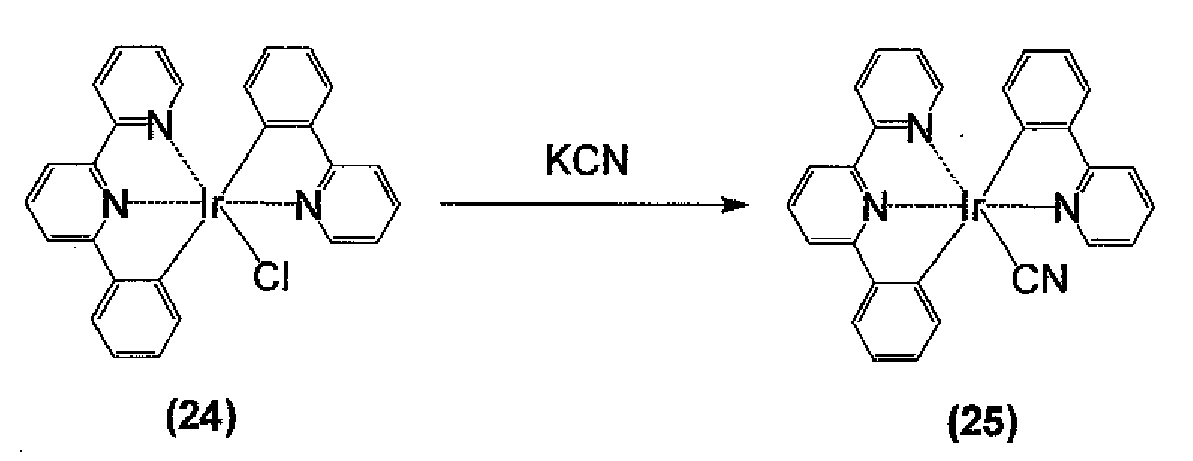
- 0.1 mmol (0.064 g) of the metal complex compound (24), 0.2 mmol (0.012 g) of potassium cyanide, and 10 ml of ethylene glycol were loaded into a 100-ml egg plant flask, and the whole was irradiated with a microwave for 3.5 minutes in a stream of nitrogen. Then, the resultant was refluxed under heat. After the resultant had been left standing to cool to room temperature, 50 ml of pure water were added to the resultant. The resultant precipitate was recovered by filtration, washed with hexane and diethyl ether, and recrystallized with methylene hexane chloride, whereby 0.041 g of the metal complex compound (25) was obtained (83% yield).
- A glass substrate equipped with a transparent electrode after being washed was mounted on the substrate holder of a vacuum deposition device. First, a copper phthalocyanine film (CuPc film) having a thickness of 10 nm was formed on the surface on the side where the transparent electrode was formed in such a manner that the film would cover the transparent electrode. The CuPc film functions as a hole injecting layer. Subsequently, NPD shown below was formed into a film having a thickness of 30 nm on the CuPc film. The NPD film functions as a hole transporting layer. Further, the following host material (CBP) was deposited from the vapor in such a manner that a light emitting layer having a thickness of 30 nm would be formed on the NPD film. The metal complex compound (25) was added as a phosphorescent Ir metal complex dopant simultaneously with the formation. The concentration of the compound (25) in the light emitting layer was set to 6% by weight. BAlq shown below was formed into a film having a thickness of 10 nm on the light emitting layer. The BAlq film functions as a hole blocking layer. Further, Alq shown below was formed into a film having a thickness of 30 nm on the BAlq film. The Alq film functions as an electron injecting layer. After that, LiF as an alkali metal halide was deposited from the vapor to have a thickness of 0.15 nm, and then aluminum was deposited from the vapor to have a thickness of 150 nm. The Al/LiF film functions as a cathode. Thus, an organic EL device was produced.
The device was subjected to a current test at a voltage of 7.2 V. As a result, the device was observed to emit green light. -


- As described above in detail, the use of the metal complex compound of the present invention as a material for an organic EL device can provide an organic EL device whose wavelength of light emission is shortened so that blue light emission is obtained, which exhibits high efficiency of light emission, and which has a long life. Accordingly, the device is applicable to fields such as various display devices, displays, back lights, light sources for illumination, marking signs, signboards, and interior lighting, and is particularly suitable as a display device for color display.
Claims (14)
- A metal complex compound, which is represented by the following general formula (1) comprising a tridentate chelate ligand.
 M represents a trivalent metal atom belonging to Group 9 in the periodic table.L1 to L5 each independently represent an aromatic hydrocarbon group which has 5 to 30 carbon atoms and which may have a substituent, a heterocyclic group which has 2 to 30 carbon atoms and which may have a substituent, or a group containing an atom belonging to any one of Groups 14 to 17 in the periodic table, and each of L1 to L3 is divalent, L4 is monovalent, and each of L5 and L6 is zero-valent. However, an element in L2 directly bonded to M is an atom belonging to Group 15 in the periodic table.Further, L4 and L5, or L5 and L6 may be bonded to each other to form a bidentate chelate ligand.)
 - A metal complex compound, which is represented by the following general formula (2) comprising a tridentate chelate ligand.
 M represents a trivalent metal atom belonging to Group 9 in the periodic table.L7 to L12 each independently represent an aromatic hydrocarbon group which has 5 to 30 carbon atoms and which may have a substituent, a heterocyclic group which has 2 to 30 carbon atoms and which may have a substituent, or a group containing an atom belonging to any one of Groups 14 to 17 in the periodic table, and each of L8 and L9 is divalent, each of L7, L10, and L12 is monovalent, L11 is zero-valent. However, an element in each of L7 and L8 directly bonded to M is an atom belonging to Group 15 in the periodic table.Further, L10 and L11, or L11 and L12 may be bonded to each other to form a bidentate chelate ligand.)
 - A metal complex compound, which is represented by the following general formula (3) comprising a tridentate chelate ligand:
 M represents a trivalent metal atom belonging to Group 9 in the periodic table.L13 to L18 each independently represent an aromatic hydrocarbon group which has 5 to 30 carbon atoms and which may have a substituent, a heterocyclic group which has 2 to 30 carbon atoms and which may have a substituent, or a group containing an atom belonging to any one of Groups 14 to 17 in the periodic table, and L14 is trivalent, each of L13, L15, L16, and L18 is monovalent, and L17 is zero-valent. However, an element in each of L13 and L15 directly bonded to M is a phosphorous atom.Further, L16 and L17, or L17 and L18 may be bonded to each other to form a bidentate chelate ligand.)
 - A metal complex compound according to claim 1,
wherein an L1L2L3Mpart in the general formula (1) comprises a structure represented by the following general formula (4)
- A metal complex compound according to claim 2, wherein an L7L8L9M part in the general formula (2) comprises a structure represented by the following general formula (5).

- A metal complex compound according to claim 3, wherein an L13L14L15M part in the general formula (3) comprises a structure represented by the following general formula (6).

- A metal complex compound according to claim 1, wherein the metal complex compound represented by the general formula (1) is represented by the following general formula (7).
 L19 represents a monodentate ligand containing an atom belonging to any one of Groups 14 to 16 in the periodic table.)
 - A metal complex compound according to claim 1, wherein the metal complex compound represented by the general formula (1) is represented by one of the following general formulae (8) and (9).
 X represents an alkylene group which has 1 to 4 carbon atoms and which may have a substituent, an alkenylene group which has 1 to 4 carbon atoms and which may have a substituent, or a phenylene group which may have a substituent.L20 and L21 each represent a group obtained by removing a hydrogen atom from a group represented by any one of R1 to R19 described above.)
 - A metal complex compound according to claim 2, wherein the metal complex compound represented by the general formula (2) is represented by the following general formula (10).
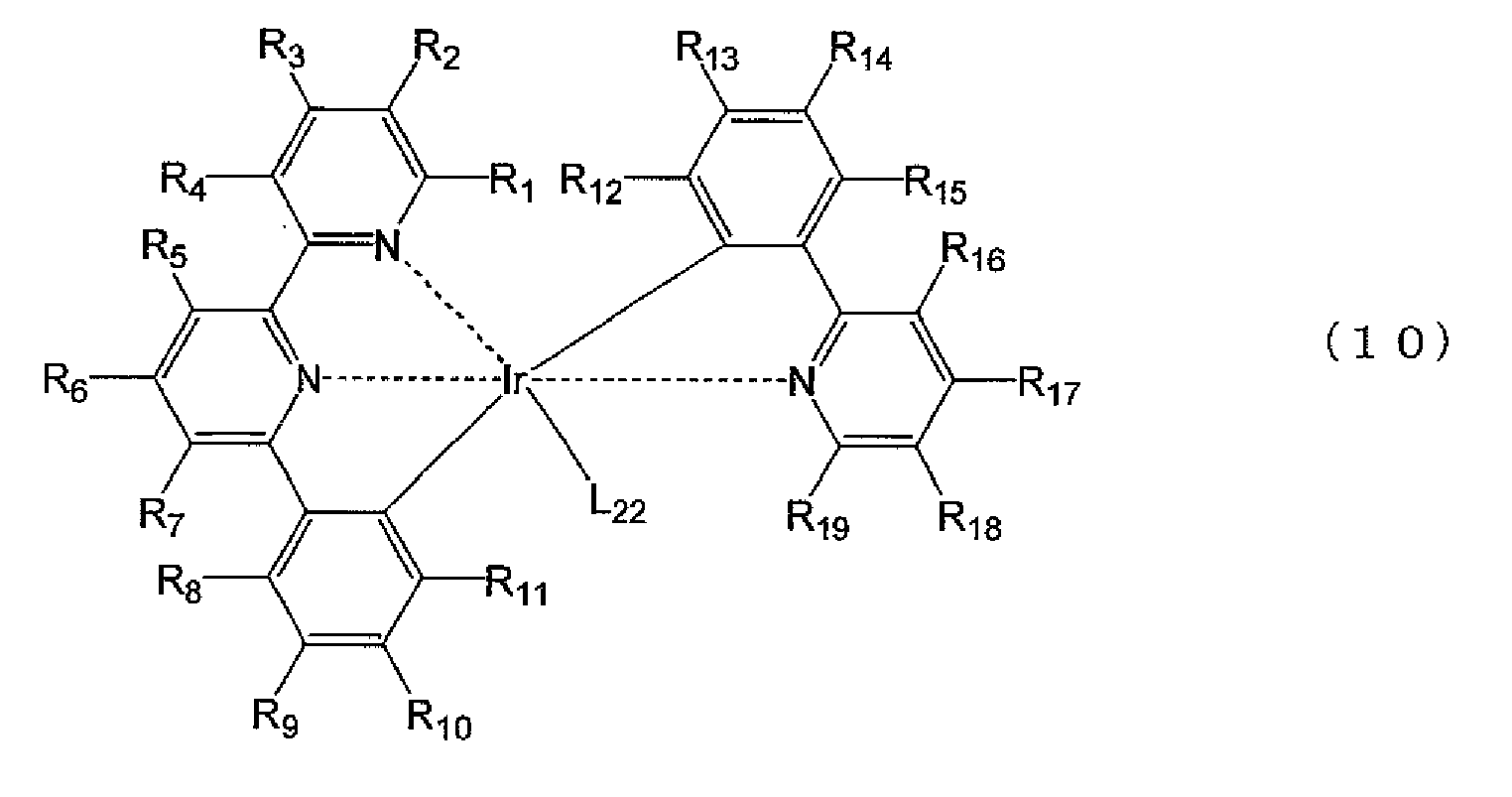 L22 represents a group obtained by removing a hydrogen atom from a group represented by any one of R1 to R19 described above.)
 - A metal complex compound according to claim 2, wherein the metal complex compound represented by the general formula (3) is represented by the following general formula (11).
 L23 represents a group obtained by removing a hydrogen atom from a group represented by any one of R1 to R19 described above.)
 - An organic electroluminescence device, comprising an organic thin film layer which has one layer or a plurality of layers including at least a light emitting layer and is disposed between a pair of electrodes, wherein:at least one layer of the organic thin film layer contains the metal complex compound according to any one of claims 1 to 3; andlight is emitted by applying a voltage between both the electrodes.
- An organic electroluminescence device according to claim 11, wherein the light emitting layer contains the metal complex compound according to any one of claims 1 to 3.
- An organic electroluminescence device according to claim 11, wherein the organic electroluminescence device emits bluish light.
- An organic electroluminescence device according to claim 11, wherein the layer containing the metal complex compound is formed by coating.
Applications Claiming Priority (2)
| Application Number | Priority Date | Filing Date | Title |
|---|---|---|---|
| US75037705P | 2005-12-15 | 2005-12-15 | |
| PCT/JP2006/324520 WO2007069537A1 (en) | 2005-12-15 | 2006-12-08 | Metal complex compound and organic electroluminescent device using same |
Publications (1)
| Publication Number | Publication Date |
|---|---|
| EP1961758A1 true EP1961758A1 (en) | 2008-08-27 |
Family
ID=38162845
Family Applications (1)
| Application Number | Title | Priority Date | Filing Date |
|---|---|---|---|
| EP06834275A Withdrawn EP1961758A1 (en) | 2005-12-15 | 2006-12-08 | Metal complex compound and organic electroluminescent device using same |
Country Status (6)
| Country | Link |
|---|---|
| EP (1) | EP1961758A1 (en) |
| JP (1) | JPWO2007069537A1 (en) |
| KR (1) | KR20080081278A (en) |
| CN (1) | CN101331145A (en) |
| TW (1) | TW200734346A (en) |
| WO (1) | WO2007069537A1 (en) |
Family Cites Families (3)
| Publication number | Priority date | Publication date | Assignee | Title |
|---|---|---|---|---|
| US7198730B2 (en) * | 2003-08-28 | 2007-04-03 | E. I. Du Pont De Nemours And Company | Phosphorescent material |
| JP2006160724A (en) * | 2004-11-10 | 2006-06-22 | Idemitsu Kosan Co Ltd | Metal complex compound and organic electroluminescence device using the same |
| JPWO2006100888A1 (en) * | 2005-03-22 | 2008-08-28 | コニカミノルタホールディングス株式会社 | Organic EL element material, organic EL element, display device and lighting device |
-
2006
- 2006-12-08 CN CNA2006800474054A patent/CN101331145A/en active Pending
- 2006-12-08 KR KR1020087014473A patent/KR20080081278A/en not_active Withdrawn
- 2006-12-08 JP JP2007550153A patent/JPWO2007069537A1/en active Pending
- 2006-12-08 EP EP06834275A patent/EP1961758A1/en not_active Withdrawn
- 2006-12-08 WO PCT/JP2006/324520 patent/WO2007069537A1/en not_active Ceased
- 2006-12-13 TW TW095146716A patent/TW200734346A/en unknown
Non-Patent Citations (1)
| Title |
|---|
| See references of WO2007069537A1 * |
Also Published As
| Publication number | Publication date |
|---|---|
| TW200734346A (en) | 2007-09-16 |
| CN101331145A (en) | 2008-12-24 |
| KR20080081278A (en) | 2008-09-09 |
| JPWO2007069537A1 (en) | 2009-05-21 |
| WO2007069537A1 (en) | 2007-06-21 |
Similar Documents
| Publication | Publication Date | Title |
|---|---|---|
| US7999103B2 (en) | Metal complex compound and organic electroluminescence device using the compound | |
| EP1961743A1 (en) | Metal complex compound and organic electroluminescent device using same | |
| JP7376656B2 (en) | Iridium complexes with aza-benzo fused ligands | |
| JP6639544B2 (en) | L2MX-type complexes as phosphorescent dopants for organic LEDs | |
| JP4313308B2 (en) | Organic metal complex, organic EL element, and organic EL display | |
| KR102103062B1 (en) | METAL COMPLEXES OF CYCLOMETALLATED IMIDAZO[1,2-f]PHENANTHRIDINE AND DIIMIDAZO[1,2-A:1',2'-C]QUINAZOLINE LIGANDS AND ISOELECTRONIC AND BENZANNULATED ANALOGS THEREOF | |
| KR102145633B1 (en) | Organic electroluminescent device with delayed fluorescence | |
| TWI409317B (en) | Electro luminescent metal complexes | |
| JP2019069965A (en) | Carbazole-containing compounds | |
| KR100686265B1 (en) | Organometallic complexes, luminescent solids, organic electroluminescent devices and organic electroluminescent displays | |
| TW201030012A (en) | Materials for organic electroluminescent devices | |
| EP2983222A1 (en) | Material for organic electroluminescent elements, organic electroluminescent element, display device and lighting device | |
| WO2006073112A1 (en) | Metal complex compound and organic electroluminescent element using the same | |
| EP1816134B1 (en) | Metal complex compound and organic electroluminescent device using same | |
| JP4786917B2 (en) | Organometallic complex, luminescent solid, organic EL device and organic EL display | |
| JP2006069936A (en) | Metal complex, luminescent solid, organic EL device and organic EL display | |
| JP4928867B2 (en) | Organic electroluminescence device | |
| US20070141398A1 (en) | Metal complex compound and organic electroluminescence device using the compound | |
| US20060159954A1 (en) | Metal-complex compound and organic electroluminescence device using the compound | |
| JP2005089367A (en) | Metal complex compound and organic electroluminescence device using the same | |
| JPWO2007069537A1 (en) | Metal complex compound and organic electroluminescence device using the same | |
| US20090039767A1 (en) | Metal complex compound, material for organic electroluminescence device and organic electroluminescence device using the same |
Legal Events
| Date | Code | Title | Description |
|---|---|---|---|
| PUAI | Public reference made under article 153(3) epc to a published international application that has entered the european phase |
Free format text: ORIGINAL CODE: 0009012 |
|
| 17P | Request for examination filed |
Effective date: 20080603 |
|
| AK | Designated contracting states |
Kind code of ref document: A1 Designated state(s): BE DE FR GB IT NL |
|
| DAX | Request for extension of the european patent (deleted) | ||
| RBV | Designated contracting states (corrected) |
Designated state(s): BE DE FR GB IT NL |
|
| STAA | Information on the status of an ep patent application or granted ep patent |
Free format text: STATUS: THE APPLICATION HAS BEEN WITHDRAWN |
|
| 18W | Application withdrawn |
Effective date: 20091015 |