EP1961740B1 - Method for producing vitamin d derivative utilizing photoreaction - Google Patents
Method for producing vitamin d derivative utilizing photoreaction Download PDFInfo
- Publication number
- EP1961740B1 EP1961740B1 EP06833694.0A EP06833694A EP1961740B1 EP 1961740 B1 EP1961740 B1 EP 1961740B1 EP 06833694 A EP06833694 A EP 06833694A EP 1961740 B1 EP1961740 B1 EP 1961740B1
- Authority
- EP
- European Patent Office
- Prior art keywords
- compound
- formula
- group
- compound represented
- reaction
- Prior art date
- Legal status (The legal status is an assumption and is not a legal conclusion. Google has not performed a legal analysis and makes no representation as to the accuracy of the status listed.)
- Active
Links
- 0 C[C@@](C1=CCC2C3=CC=C(CC(CC4)O)C4(C)C3CCC12C)OCC(NC*)=O Chemical compound C[C@@](C1=CCC2C3=CC=C(CC(CC4)O)C4(C)C3CCC12C)OCC(NC*)=O 0.000 description 2
Classifications
-
- C—CHEMISTRY; METALLURGY
- C07—ORGANIC CHEMISTRY
- C07C—ACYCLIC OR CARBOCYCLIC COMPOUNDS
- C07C401/00—Irradiation products of cholesterol or its derivatives; Vitamin D derivatives, 9,10-seco cyclopenta[a]phenanthrene or analogues obtained by chemical preparation without irradiation
-
- A—HUMAN NECESSITIES
- A61—MEDICAL OR VETERINARY SCIENCE; HYGIENE
- A61P—SPECIFIC THERAPEUTIC ACTIVITY OF CHEMICAL COMPOUNDS OR MEDICINAL PREPARATIONS
- A61P17/00—Drugs for dermatological disorders
-
- A—HUMAN NECESSITIES
- A61—MEDICAL OR VETERINARY SCIENCE; HYGIENE
- A61P—SPECIFIC THERAPEUTIC ACTIVITY OF CHEMICAL COMPOUNDS OR MEDICINAL PREPARATIONS
- A61P17/00—Drugs for dermatological disorders
- A61P17/06—Antipsoriatics
-
- C—CHEMISTRY; METALLURGY
- C07—ORGANIC CHEMISTRY
- C07J—STEROIDS
- C07J41/00—Normal steroids containing one or more nitrogen atoms not belonging to a hetero ring
-
- C—CHEMISTRY; METALLURGY
- C07—ORGANIC CHEMISTRY
- C07J—STEROIDS
- C07J71/00—Steroids in which the cyclopenta(a)hydrophenanthrene skeleton is condensed with a heterocyclic ring
Definitions
- the present invention relates to a novel process for producing a vitamin D derivative useful as a pharmaceutical, to an intermediate useful for carrying out the process, and to a process for producing the intermediate.
- Patent Literature 1 WO 2001/096293
- the above-described conventional process has a problem in that a carbon monoxide-inserting reaction is necessary for obtaining (1S,3R,20S)-1,3-bis(tert-butyldimethylsilyloxy)-20-hydroxypregna-5,7,16-triene which is an intermediate in the process, which problem can be an obstacle in scaling up the conventional process.
- the conventional process has various problems which can be obstacles in scaling up the process, such as that the reactions must be carried out at a temperature not higher than -15°C since the stereoselectivity over the reactions carried out in the conventional process is sensitive to a temperature. Therefore, development of a more practical process is desired.
- the above-described conventional process is not satisfactory in the yield, number of steps and so on in the production of the vitamin D derivative represented by Formula (1) from the above-described intermediate, so that development of a more efficient process is also desired.
- an object of the present invention is to provide a practical and efficient process for producing [ ⁇ (5Z,7E)-(1S,3R,20S)-1,3-dihydroxy-9,10-secopregna-5,7,10(19),16-tetraen-20-yl ⁇ oxy]-N-(2,2,3,3,3-pentafluoropropyl)acetamide.
- the desired compound can be efficiently produced by irradiating the compound represented by Formula (2): with UV to open the B-ring of the steroid skeleton of the compound; and then isomerizing the resulting compound.
- the present invention provides a novel process for producing the compound represented by Formula (1): comprising the steps of:
- the compound represented by Formula (2) is obtained by a process comprising the steps of:
- the compound represented by Formula (2) is obtained by a process comprising the steps of:
- the present invention also provides the compound of Formula (2) and the compound of Formula (3).
- the substituents in the "substituted silyl group” are selected from C 1 -C 7 linear or branched alkyl groups, phenyl groups optionally substituted with one of more linear or branched C 1 -C 3 alkyl groups, or phenylalkyl groups (the alkyl groups in the phenylalkyl group are each C 1 -C 5 linear or branched alkyl group, and the phenyl group in the phenyl alkyl group is optionally further substituted with one of more C 1 -C 3 linear or branched alkyl groups).
- Examples of the C 1 -C 7 linear or branched alkyl groups include methyl group, ethyl group, n-propyl group, i-propyl group, n-butyl group, sec-butyl group, tert-butyl group, n-pentyl group, n-hexyl group, 1-methylpentyl group, 2-methylpentyl group, 3-methylpentyl group, 4-methylpentyl group, 1,1-dimethylbutyl group, 1,2-dimethylbutyl group, 1,3-dimethylbutyl group, 2,2-dimethylbutyl group, 2,3-dimethylbutyl group, 3,3-dimethylbutyl group, 1-ethylbutyl group, 2-ethylbutyl group, 1,1,2-trimethylpropyl group (thexyl group), n-heptyl group and the like.
- Examples of the phenyl group optionally substituted with one of more linear or branched C 1 -C 3 alkyl groups include phenyl group, tolyl group, ethylphenyl group and the like.
- Examples of the above-described phenylalkyl group include benzyl group, phenethyl group, xylyl group and the like.
- Substituted silyl group means a tri-substituted silyl group which is substituted with 3 substituents arbitrarily selected from the above-mentioned substituents. Combination of the 3 substituents may be any of the cases where all of them are the same, all of them are different, and two of them are the same and one is different therefrom. The cases where all of them are the same or two of them are the same and one is different therefrom are preferred, and the cases where two of them are the same and one is different therefrom are more preferred.
- substituted silyl group examples include trimethylsilyl group, triethylsilyl group, triisopropylsilyl group, dimethylisopropylsilyl group, diethylisopropylsilyl group, dimethylthexylsilyl group, tert-butyldimethylsilyl group, tert-butyldiphenylsilyl group, tribenzylsilyl group, tri- p -xylylsilyl group, triphenylsilyl group, diphenylmethylsilyl group and tert-butylmethoxyphenylsilyl group.
- TBS tert-butyldimethylsilyl group
- R 1 and R 2 which are each "substituted silyl group" may be the same or different. Preferably, they are the same group, and more preferably, both of them are TBS groups.
- compounds C6 and C8 are sometimes also referred to as compounds (2) and (1), respectively.
- the present invention also provides the compound of Formula (6).
- Compound C1 is a known substance, and can be synthesized according to the method described in, for example, Chem. Pharm. Bull., 40(5), 1120-4(1992 ), Org. Process. Res. Dev., 2005, 9, 278-287 ; JP 5-19094 A ; or the like.
- Compound C2 (the compound represented by the above-described Formula (3)) can be obtained by epoxidizing Compound C1.
- This epoxidation is carried out by, for example, reacting Compound C1 with a suitable epoxidizing agent in a suitable solvent in the presence of, if necessary, a catalyst, for usually 5 minutes to 10 hours, preferably 2 hours to 4 hours.
- the epoxydizing agent include peracids such as m-chloroperbenzoic acid, perbenzoic acid, peracetic acid, magnesium monoperoxyphthalate; and hydroperoxides such as hydrogen peroxide and tert-butylhydroperoxide.
- peracids such as m-chloroperbenzoic acid and magnesium monoperoxyphthalate are preferred, and in view of avoiding side reactions and ease of purification of the product in the next step, m-chloroperbenzoic acid is preferred
- the amount of the epoxidizing agent to be used is appropriately selected taking the reactivity of the substrate having a double bond into consideration, and is usually 1 to 3 equivalents, preferably 1.1 to 1.5 equivalents with respect to Compound C1.
- solvent to be used examples include halogenated solvents such as dichloromethane, chloroform, bromoform, carbon tetrachloride and carbon tetrabromide; hydrocarbon solvents such as n-pentane, n-hexane, cyclohexane, n-heptane, n-octane, toluene and xylene; acetate solvents such as methyl acetate, ethyl acetate, n-propyl acetate, i-propyl acetate and t-butyl acetate; nitrile solvents such as acetonitrile, benzonitrile and benzyl cyanide; alcohol solvents such as methanol, ethanol, n-propanol, i-propanol and n-butanol; and water.
- halogenated solvents such as dichloromethane, chloroform, bromoform, carbon te
- solvents may be used individually or in combination. From the viewpoint of ease of checking the reaction progress, using ethyl acetate alone or the combination of ethyl acetate and acetonitrile is preferred, and from the viewpoint of simplicity of the operation, using ethyl acetate alone is preferred.
- the catalyst which may be present in the reaction system as required include inorganic alkali salts, organic amines, vanadium complexes, titanium alkoxides, tartaric acid esters and the like, the catalyst is preferably not present.
- the reaction temperature is usually -50°C to +50°C, and in view of the reactivity and safety, the reaction temperature is preferably 10°C to 25°C.
- the unreacted epoxidizing agent remained at the completion of the reaction may be inactivated by, for example, the treatment with a reducing agent.
- epoxidation of Compound C1 is carried out by using m-chloroperbenzoic acid as an epoxidizing agent, using ethyl acetate and/or heptane, preferably ethyl acetate as a solvent, at a temperature between 10°C and 30°C for 2 to 4 hours.
- Compound C3 can be obtained by subjecting the thus obtained Compound C2 to a reaction for formation of a conjugated diene in the B-ring of the steroid skeleton of Compound C2.
- the reaction for forming a conjugated diene in Compound C2 is carried out by brominating the methylene group at the 7-position in the B-ring of the steroid skeleton of Compound C2, and then dehydrobrominating the resulting group.
- the bromination of Compound C2 can be attained by carrying out the reaction using a suitable brominating agent, in the presence of a radical initiator, in a suitable solvent for 5 minutes to 1 hour.
- a suitable brominating agent include N-bromosuccinimide, bromohydantoin and the like, and N-bromosuccinimide is preferred.
- the amount of the brominating agent is appropriately selected taking the reactivity of the substrate into consideration, and preferably 1.3 to 1.4 equivalents with respect to Compound C2.
- the radical initiator include benzoyl peroxide and 2,2'-azobis(isobutyronitrile) and the like, and 2,2'-azobis(isobutyronitrile) is preferred.
- the solvent to be used is not restricted as long as the side reactions are within the acceptable degree and it does not influence on the safety or the like, and examples thereof include hydrocarbon solvents such as n-pentane, n-hexane, cyclohexane, n-heptane, n-octane, toluene and xylene; and halogenated solvents such as dichloromethane, chloroform, bromoform, carbon tetrachloride and carbon tetrabromide.
- hydrocarbon solvents such as n-pentane, n-hexane, cyclohexane, n-heptane, n-octane, toluene and xylene
- halogenated solvents such as dichloromethane, chloroform, bromoform, carbon tetrachloride and carbon tetrabromide.
- Preferred are hydrocarbon solvents, and more preferred is n-
- a base used in the next dehydrobromination step which base is an organic amine such as triethylamine, diethylamine, diisopropylamine, pyridine, dimethylaminopyridine or ⁇ -collidine, or an inorganic alkali salt such as sodium carbonate, potassium carbonate, sodium hydrogen carbonate, sodium hydroxide or calcium hydroxide.
- ⁇ -collidine is especially preferred.
- the reaction temperature is usually -10°C to 150°C, and in view of the reactivity and safety, the reaction temperature is preferably 0°C to 100°C, more preferably 65°C to 85°C.
- the reaction time is usually 3 minutes to 3 hours, preferably 5 minutes to 30 minutes.
- bromination of Compound C2 is carried out by using N-bromosuccinimide as the brominating agent, using 2,2'-azobis(isobtyronitrile) as the radical initiator, adding ⁇ -collidine, in n-heptane solvent at 70°C to 80°C.
- the product may be subjected to the dehydrobromination, which is the next reaction, without isolation and purification of the desired compound, and this is preferred.
- the dehydrobromination after the bromination may be carried out by, for example, allowing the reaction in the presence of a base, in a hydrocarbon solvent such as n-pentane, n-hexane, cyclohexane, n-heptane, n-octane, toluene or xylene, preferably in toluene, at a temperature between room temperature and reflux temperature, preferably at a temperature between 110°C and 120°C, for 30 minutes to 3 hours.
- a base such as n-pentane, n-hexane, cyclohexane, n-heptane, n-octane, toluene or xylene, preferably in toluene, at a temperature between room temperature and reflux temperature, preferably at a temperature between 110°C and 120°C, for 30 minutes to 3 hours.
- the amount of the base to be used is appropriately selected taking the reactivity of the
- the remaining base may be used as the base in this step to make it unnecessary to further add a base, and this is preferred from the viewpoint of efficiency, although a base may be further added in this step.
- the obtained Compound C3 is a known substance, and is described in, for example, WO 98/28266 .
- Compound C1 (the compound represented by the above-described Formula (4)) can be obtained by subjecting the thus obtained Compound C3 to a formation of an allyl alcohol moiety via ring-opening of the epoxy group.
- the formation of allyl alcohol moiety in Compound C3 via the ring-opening of the epoxy group can be carried out by allowing the reaction in the presence of a suitable Lewis acid in a catalytic amount or stoichiometric amount, preferably in an amount of 0.1 to 0.2 equivalents with respect to Compound C3, in a suitable solvent, at a temperature between room temperature and reflux temperature for 30 minutes to 3 hours.
- a suitable Lewis acid in a catalytic amount or stoichiometric amount, preferably in an amount of 0.1 to 0.2 equivalents with respect to Compound C3, in a suitable solvent, at a temperature between room temperature and reflux temperature for 30 minutes to 3 hours.
- the Lewis acid which can be used include aluminum trialkoxides, aluminum chloride, titanium chloride and the like.
- the suitable solvent is not restricted as long as it does not influence the reaction, and examples thereof include hydrocarbon solvents such as n-pentane, n-hexane, cyclohexane, n-heptane, n-octane, toluene and xylene; and halogenated solvents such as dichloromethane, chloroform, bromoform, carbon tetrachloride and carbon tetrabromide. These solvents may be used individually or they may be used in combination. Among these solvents, use of a hydrocarbon solvent alone is preferred, and use of toluene alone is more preferred.
- the formation of allyl alcohol moiety in Compound C3 via the ring-opening of the epoxy group is carried out in the presence of an aluminum trialkoxide in toluene at 110°C to 120°C.
- the reactions with the base and with the Lewis acid may be carried out simultaneously, that is, the step of dehydrobromination in which Compound C3 is synthesized from Compound C2, and the step of obtaining Compound C4 from Compound C3 may be simultaneously carried out, and this is preferred.
- Compound C4 is also a known substance and is described in, for example, WO 98/28266 .
- Compound C5 (the compound represented by the above-described Formula (5)) can be obtained by alkylating the hydroxyl group in the thus obtained Compound C4 using 2-halo-N-(2,2,3,3,3-pentafluoropropyl)acetamide.
- the alkylation of the hydroxyl group in Compound C4 is carried out by, for example, adding the above-described halo compound to Compound C4 to allow the reaction in the presence of a suitable base in a suitable solvent at a temperature between -80°C and +10°C.
- the suitable base examples include the bases capable of carrying out deprotonation of hydroxyl group, including metal disilazides such as potassium bis(trimethylsilyl)amide, lithium bis(trimethylsilyl)amide and sodium bis(trimethylsilyl)amide; and metal hydrides such as sodium hydride, potassium hydride and calcium hydride. Among these, metal disilazides, particularly potassium bis(trimethylsilyl)amide is preferred.
- the amount of the base to be used is preferably 2 to 3 equivalents, more preferably 2.2 to 2.8 equivalents with respect to Compound C5.
- the "halo" in the above-described halo compound include chloro, bromo and iodo, and bromo is preferred.
- Suitable solvents include ether solvents such as tetrahydrofuran, dioxane and ether; and hydrocarbon solvents such as n-pentane, n-hexane, cyclohexane, n-heptane, n-octane, toluene and xylene.
- solvents may be used individually or they may be used in combination, and from the viewpoint of avoiding side reactions, avoiding drastic elevation of the reaction temperature occurred when the above-described halo compound is added, decreasing the side products produced due to the elevation of temperature, and/or of shortening the time required until the completion of the addition of the above-described halo compound, combination of an ether solvent and a hydrocarbon solvent is preferred, and the combination of tetrahydrofuran and toluene is more preferred,
- the volume ratio of tetrahydrofuran to toluene in the reaction system is preferably 7:3 to 8:2.
- alkylation of the hydroxyl group of Compound C4 is carried out using potassium bis(trimethylsilyl)amide in a mixed solvent of tetrahydrofuran and toluene at -10°C to 0°C, and using as the halo compound C2-bromo-N-(2,2,3,3,3-pentafluoropropyl)acetamide (Compound C9) shown in Scheme 1.
- the 2-halo-N-(2,2,3,3,3-pentafluoropropyl)acetamide may be obtained by reacting 2,2,3,3,3-pentafluoroamine with a haloacetic acid, a haloacetyl halide or the like in the presence of a tertiary amine, a condensation reagent or the like in an acetate solvent such as methyl acetate, ethyl acetate, n-propyl acetate, i-propyl acetate or t-butyl acetate; in a halogenated solvent such as dichloromethane, chloroform, bromoform, carbon tetrachloride or carbon tetrabromide; or in an ether solvent such as tetrahydrofuran, dioxane or ether.
- a haloacetic acid such as methyl acetate, ethyl acetate, n-propyl acetate,
- the reaction is carried out using bromoacetyl bromide as the haloacetyl halide, in an acetate solvent, preferably in ethyl acetate, in the presence of N,N-dimethylaniline at -20°C to 0°C.
- Compound C6 (the compound represented by the above-described Formula (2)) can be obtained by subjecting Compound C5 obtained in the previous step to desilylation reaction which is a deprotection step.
- TBS group that is, tert-butyldimethylsilyl group is converted to a hydrogen atom.
- the desilylation reaction of Compound C5 can be carried out, for example, using an appropriate fluorine-containing reagent in a suitable solvent at a temperature between room temperature and reflux temperature for 10 minutes to 10 hours.
- the fluorine-containing reagent include tetra-n-butylammonium fluoride, hydrogen fluoride pyridine and the like.
- the substrates and products which are not stable under basic conditions may be stabilized, and adding the organic acid is preferred.
- the suitable solvents include amide solvents such as N,N-dimethylacetamide, N,N-dimethylimidazolidinone (DMI) and N,N-dimethylformamide (DMF); and ether solvents such as tetrahydrofuran, dioxane and ether. From the viewpoint of shortening the reaction time, amide solvents are preferred.
- desilylation of Compound C5 is carried out using tetra-n-butylammonium fluoride, adding acetic acid or benzoic acid, preferably acetic acid in order to neutralize the reaction solution, in an amide solvent, preferably in N,N-dimethylacetamide, at a temperature of 60°C to 150°C, preferably 90°C to 120°C, for 6 to 12 hours.
- the amount of the tetra-n-butylammonium fluoride to be used is preferably 2 to 5 equivalents, more preferably 2.3 to 2.7 equivalents with respect to Compound C5.
- the amount of the acetic acid to be used is preferably 1 to 5 equivalents, more preferably 1.5 to 2.5 equivalents with respect to Compound C5.
- Compound C7 (the compound represented by the above-described Formula (6)) can be obtained by ring-opening reaction of the B-ring of the steroid skeleton of Compound C6 which is caused by the presence of the diene moiety.
- the opening of the B-ring of the steroid skeleton caused by the presence of the diene moiety can be carried out by, for example, irradiating Compound C6 with UV in a suitable solvent.
- the wavelength of UV to be radiated is not restricted as long as it is within the range which can be employed by those skilled in the art, and the wavelength is preferably 280 nm to 300 nm.
- ether solvents such as ether, dioxane, tetrahydrofuran and tetrahydropyrane
- alcohol solvents such as methanol, ethanol, n-propanol, i-propanol and n-butanol
- acetate solvents such as methyl acetate, ethyl acetate, n-propyl acetate, i-propyl acetate and t-butyl acetate are preferred, and ethyl acetate is more preferred.
- Irradiation with UV may be carried out at a temperature between about -30°C and +20°C for 1 hour to 10 hours.
- the ring-opening of Compound C6 is carried out by irradiating Compound C6 with UV in an acetate solvent, preferably in ethyl acetate, at -10°C to 0°C for 7 to 9 hours.
- Compound C8 (the compound represented by the above-described Formula (1)) can be obtained by subjecting Compound C7 to an isomerization reaction.
- Isomerization reaction of Compound C7 is carried out, for example, in a suitable solvent at a temperature between room temperature and reflux temperature for 1 to 48 hours.
- the solvent is not restricted as long as it can dissolve the substrates and the products, and as long as it does not adversely affect their stabilities, and the solvent used in the reaction by UV irradiation may be used as it is.
- An acetate solvent is preferably used, and ethyl acetate is more preferably used.
- the isomerization of Compound C7 is carried out by heating Compound C7 to reflux in ethyl acetate for 1 to 4 hours.
- MMR was measured using JEOL ECP-500 (Example 1) or JEOL EX-270 (Examples 3 and 4).
- 2,2,3,3,3-Pentafluoropropylamine (produced by Synquest) (389 g) was dissolved in ethyl acetate (1.56 L), and N,N-dimethylaniline (316 g) was added thereto. After cooling the mixture to -10°C, bromoacetyl bromide (500 g) was added dropwise thereto, and the resulting mixture was stirred at a temperature between 10°C and 0°C for 2 hours.
- the obtained concentrated residue was then dissolved in N,N-dimethylacetamide (300 mL), and the resulting mixture was added to a solution of 75% aqueous tetra n-butylammonium fluoride solution (51 mL) and acetic acid (6.1 mL) in N,N-dimethylacetamide (60 mL), followed by stirring the resulting mixture at 100°C to 105°C for 7 hours. Ethyl acetate was added to the reaction mixture, and the organic layer was sequentially washed with water and brine, followed by concentration of the organic layer under reduced pressure.
- Example 4 [ ⁇ (1S,3R,20S)-1,3-dihydroxypregna-5,7,16-traene-20-yl ⁇ oxy]-N-(2,2,3,3,3-pentafluoropropyl)acetamide obtained in Example 4 was dissolved in ethyl acetate (100 mL), and the resulting mixture was irradiated with UV under argon gas flow at a reaction temperature of -5°C to 7°C for 8 hours. The solution was then heated to reflux for 2 hours, and concentrated under reduced pressure.
Landscapes
- Chemical & Material Sciences (AREA)
- Organic Chemistry (AREA)
- Health & Medical Sciences (AREA)
- General Health & Medical Sciences (AREA)
- Engineering & Computer Science (AREA)
- Bioinformatics & Cheminformatics (AREA)
- Dermatology (AREA)
- Chemical Kinetics & Catalysis (AREA)
- General Chemical & Material Sciences (AREA)
- Medicinal Chemistry (AREA)
- Nuclear Medicine, Radiotherapy & Molecular Imaging (AREA)
- Pharmacology & Pharmacy (AREA)
- Life Sciences & Earth Sciences (AREA)
- Animal Behavior & Ethology (AREA)
- Public Health (AREA)
- Veterinary Medicine (AREA)
- Organic Low-Molecular-Weight Compounds And Preparation Thereof (AREA)
- Steroid Compounds (AREA)
- Pharmaceuticals Containing Other Organic And Inorganic Compounds (AREA)
Description
- The present invention relates to a novel process for producing a vitamin D derivative useful as a pharmaceutical, to an intermediate useful for carrying out the process, and to a process for producing the intermediate.
- The vitamin D derivative represented by Formula (1):

- As a process for producing this compound, a process is known, in which [{1α,3β-bis(tert-butyldimethylsilyloxy)-9,10-secopregna-5,7,10(19),16-tetraen-20(S)-yl}oxy]acetic acid is reacted with 2,2,3,3,3-pentafluoropropylamine. See
WO 2001/096293 (Patent Literature 1).
Patent Literature 1:WO 2001/096293 - However, the above-described conventional process has a problem in that a carbon monoxide-inserting reaction is necessary for obtaining (1S,3R,20S)-1,3-bis(tert-butyldimethylsilyloxy)-20-hydroxypregna-5,7,16-triene which is an intermediate in the process, which problem can be an obstacle in scaling up the conventional process. Further, in addition thereto, the conventional process has various problems which can be obstacles in scaling up the process, such as that the reactions must be carried out at a temperature not higher than -15°C since the stereoselectivity over the reactions carried out in the conventional process is sensitive to a temperature. Therefore, development of a more practical process is desired. Further, the above-described conventional process is not satisfactory in the yield, number of steps and so on in the production of the vitamin D derivative represented by Formula (1) from the above-described intermediate, so that development of a more efficient process is also desired.
- The present invention was made under the above-described circumstances. Accordingly, an object of the present invention is to provide a practical and efficient process for producing [{(5Z,7E)-(1S,3R,20S)-1,3-dihydroxy-9,10-secopregna-5,7,10(19),16-tetraen-20-yl}oxy]-N-(2,2,3,3,3-pentafluoropropyl)acetamide.
- As a result of extensive research for attaining the above-described object, it has been found that the desired compound can be efficiently produced by irradiating the compound represented by Formula (2):

- Therefore, the present invention provides a novel process for producing the compound represented by Formula (1):

- irradiating a compound represented by Formula (2):

- isomerizing the resulting compound to obtain the compound of Formula (1).
- In a preferred embodiment, the compound represented by Formula (2) is obtained by a process comprising the steps of:
- subjecting a compound represented by Formula (3):
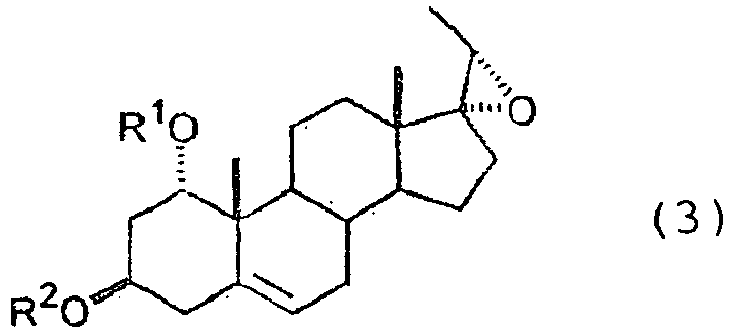
to a formation of a conjugated diene in the B-ring of the steroid skeleton of the compound; - subjecting the resulting compound to a formation of an allyl alcohol moiety via ring-opening of the epoxy group to obtain a compound represented by Formula (4):

- reacting the obtained compound with 2-bromo-N-(2,2,3,3,3-pentafluoropropyl)acetamide to obtain a compound represented by Formula (5):

- replacing R1 and R2 of the obtained compound with hydrogen atoms, respectively.
- In another preferred embodiment, the compound represented by Formula (2) is obtained by a process comprising the steps of:
- reacting a compound represented by Formula (4):

with 2-bromo-N-(2,2,3,3,3-pentafluoropropyl)acetamide to obtain a compound represented by Formula (5):
- replacing R1 and R2 of the obtained compound with hydrogen atoms, respectively.
- The main intermediates used in the above-described process, that is, the compound represented by Formula (2):


are novel. - Therefore, the present invention also provides the compound of Formula (2) and the compound of Formula (3).
- In the present invention, the substituents in the "substituted silyl group" are selected from C1-C7 linear or branched alkyl groups, phenyl groups optionally substituted with one of more linear or branched C1-C3 alkyl groups, or phenylalkyl groups (the alkyl groups in the phenylalkyl group are each C1-C5 linear or branched alkyl group, and the phenyl group in the phenyl alkyl group is optionally further substituted with one of more C1-C3 linear or branched alkyl groups). Examples of the C1-C7 linear or branched alkyl groups include methyl group, ethyl group, n-propyl group, i-propyl group, n-butyl group, sec-butyl group, tert-butyl group, n-pentyl group, n-hexyl group, 1-methylpentyl group, 2-methylpentyl group, 3-methylpentyl group, 4-methylpentyl group, 1,1-dimethylbutyl group, 1,2-dimethylbutyl group, 1,3-dimethylbutyl group, 2,2-dimethylbutyl group, 2,3-dimethylbutyl group, 3,3-dimethylbutyl group, 1-ethylbutyl group, 2-ethylbutyl group, 1,1,2-trimethylpropyl group (thexyl group), n-heptyl group and the like. Examples of the phenyl group optionally substituted with one of more linear or branched C1-C3 alkyl groups include phenyl group, tolyl group, ethylphenyl group and the like. Examples of the above-described phenylalkyl group include benzyl group, phenethyl group, xylyl group and the like.
- "Substituted silyl group" means a tri-substituted silyl group which is substituted with 3 substituents arbitrarily selected from the above-mentioned substituents. Combination of the 3 substituents may be any of the cases where all of them are the same, all of them are different, and two of them are the same and one is different therefrom. The cases where all of them are the same or two of them are the same and one is different therefrom are preferred, and the cases where two of them are the same and one is different therefrom are more preferred.
- Specific examples of the "substituted silyl group" include trimethylsilyl group, triethylsilyl group, triisopropylsilyl group, dimethylisopropylsilyl group, diethylisopropylsilyl group, dimethylthexylsilyl group, tert-butyldimethylsilyl group, tert-butyldiphenylsilyl group, tribenzylsilyl group, tri-p-xylylsilyl group, triphenylsilyl group, diphenylmethylsilyl group and tert-butylmethoxyphenylsilyl group. Among these groups, tert-butyldimethylsilyl group (hereinafter also referred to as "TBS" group) is preferred.
- R1 and R2 which are each "substituted silyl group", may be the same or different. Preferably, they are the same group, and more preferably, both of them are TBS groups.
- In a preferred embodiment of the present invention, the process of the present invention is carried out according to the reaction steps shown in Scheme 1 below.


- In the present specification and claims, compounds C6 and C8 are sometimes also referred to as compounds (2) and (1), respectively.
- Among the intermediates shown in Scheme 1, the compound of Formula (6):

- Therefore, the present invention also provides the compound of Formula (6).
- Each of the reaction steps shown in the above-described Scheme will now be explained.
- Compound C1 is a known substance, and can be synthesized according to the method described in, for example, Chem. Pharm. Bull., 40(5), 1120-4(1992), Org. Process. Res. Dev., 2005, 9, 278-287;
JP 5-19094 A - Compound C2 (the compound represented by the above-described Formula (3)) can be obtained by epoxidizing Compound C1. This epoxidation is carried out by, for example, reacting Compound C1 with a suitable epoxidizing agent in a suitable solvent in the presence of, if necessary, a catalyst, for usually 5 minutes to 10 hours, preferably 2 hours to 4 hours. Examples of the epoxydizing agent include peracids such as m-chloroperbenzoic acid, perbenzoic acid, peracetic acid, magnesium monoperoxyphthalate; and hydroperoxides such as hydrogen peroxide and tert-butylhydroperoxide. Among these epoxydizing agents, peracids such as m-chloroperbenzoic acid and magnesium monoperoxyphthalate are preferred, and in view of avoiding side reactions and ease of purification of the product in the next step, m-chloroperbenzoic acid is preferred The amount of the epoxidizing agent to be used is appropriately selected taking the reactivity of the substrate having a double bond into consideration, and is usually 1 to 3 equivalents, preferably 1.1 to 1.5 equivalents with respect to Compound C1. Examples of the solvent to be used include halogenated solvents such as dichloromethane, chloroform, bromoform, carbon tetrachloride and carbon tetrabromide; hydrocarbon solvents such as n-pentane, n-hexane, cyclohexane, n-heptane, n-octane, toluene and xylene; acetate solvents such as methyl acetate, ethyl acetate, n-propyl acetate, i-propyl acetate and t-butyl acetate; nitrile solvents such as acetonitrile, benzonitrile and benzyl cyanide; alcohol solvents such as methanol, ethanol, n-propanol, i-propanol and n-butanol; and water. These solvents may be used individually or in combination. From the viewpoint of ease of checking the reaction progress, using ethyl acetate alone or the combination of ethyl acetate and acetonitrile is preferred, and from the viewpoint of simplicity of the operation, using ethyl acetate alone is preferred. Although examples of the catalyst which may be present in the reaction system as required include inorganic alkali salts, organic amines, vanadium complexes, titanium alkoxides, tartaric acid esters and the like, the catalyst is preferably not present. The reaction temperature is usually -50°C to +50°C, and in view of the reactivity and safety, the reaction temperature is preferably 10°C to 25°C. The unreacted epoxidizing agent remained at the completion of the reaction may be inactivated by, for example, the treatment with a reducing agent.
- In a preferred embodiment, epoxidation of Compound C1 is carried out by using m-chloroperbenzoic acid as an epoxidizing agent, using ethyl acetate and/or heptane, preferably ethyl acetate as a solvent, at a temperature between 10°C and 30°C for 2 to 4 hours.
- Compound C3 can be obtained by subjecting the thus obtained Compound C2 to a reaction for formation of a conjugated diene in the B-ring of the steroid skeleton of Compound C2. The reaction for forming a conjugated diene in Compound C2 is carried out by brominating the methylene group at the 7-position in the B-ring of the steroid skeleton of Compound C2, and then dehydrobrominating the resulting group.
- First, the bromination of Compound C2 can be attained by carrying out the reaction using a suitable brominating agent, in the presence of a radical initiator, in a suitable solvent for 5 minutes to 1 hour. Examples of the brominating agent include N-bromosuccinimide, bromohydantoin and the like, and N-bromosuccinimide is preferred. The amount of the brominating agent is appropriately selected taking the reactivity of the substrate into consideration, and preferably 1.3 to 1.4 equivalents with respect to Compound C2. Examples of the radical initiator include benzoyl peroxide and 2,2'-azobis(isobutyronitrile) and the like, and 2,2'-azobis(isobutyronitrile) is preferred. The solvent to be used is not restricted as long as the side reactions are within the acceptable degree and it does not influence on the safety or the like, and examples thereof include hydrocarbon solvents such as n-pentane, n-hexane, cyclohexane, n-heptane, n-octane, toluene and xylene; and halogenated solvents such as dichloromethane, chloroform, bromoform, carbon tetrachloride and carbon tetrabromide. Preferred are hydrocarbon solvents, and more preferred is n-heptane. From the viewpoint of avoiding side reactions and/or decomposition of Compound C2, it is preferred to further add a base used in the next dehydrobromination step, which base is an organic amine such as triethylamine, diethylamine, diisopropylamine, pyridine, dimethylaminopyridine or γ-collidine, or an inorganic alkali salt such as sodium carbonate, potassium carbonate, sodium hydrogen carbonate, sodium hydroxide or calcium hydroxide. Among these bases, to add γ-collidine is especially preferred. The reaction temperature is usually -10°C to 150°C, and in view of the reactivity and safety, the reaction temperature is preferably 0°C to 100°C, more preferably 65°C to 85°C. The reaction time is usually 3 minutes to 3 hours, preferably 5 minutes to 30 minutes.
- In a preferred embodiment, bromination of Compound C2 is carried out by using N-bromosuccinimide as the brominating agent, using 2,2'-azobis(isobtyronitrile) as the radical initiator, adding γ-collidine, in n-heptane solvent at 70°C to 80°C.
- After the bromination, the product may be subjected to the dehydrobromination, which is the next reaction, without isolation and purification of the desired compound, and this is preferred.
- The dehydrobromination after the bromination may be carried out by, for example, allowing the reaction in the presence of a base, in a hydrocarbon solvent such as n-pentane, n-hexane, cyclohexane, n-heptane, n-octane, toluene or xylene, preferably in toluene, at a temperature between room temperature and reflux temperature, preferably at a temperature between 110°C and 120°C, for 30 minutes to 3 hours. The amount of the base to be used is appropriately selected taking the reactivity of the substrate into consideration, and preferably 3 to 4 equivalents with respect to Compound C2. In cases where the base added in the bromination step remains at the completion of the bromination step, the remaining base may be used as the base in this step to make it unnecessary to further add a base, and this is preferred from the viewpoint of efficiency, although a base may be further added in this step. The obtained Compound C3 is a known substance, and is described in, for example,
WO 98/28266 - Compound C1 (the compound represented by the above-described Formula (4)) can be obtained by subjecting the thus obtained Compound C3 to a formation of an allyl alcohol moiety via ring-opening of the epoxy group. The formation of allyl alcohol moiety in Compound C3 via the ring-opening of the epoxy group can be carried out by allowing the reaction in the presence of a suitable Lewis acid in a catalytic amount or stoichiometric amount, preferably in an amount of 0.1 to 0.2 equivalents with respect to Compound C3, in a suitable solvent, at a temperature between room temperature and reflux temperature for 30 minutes to 3 hours. Examples of the Lewis acid which can be used include aluminum trialkoxides, aluminum chloride, titanium chloride and the like. Among these, aluminum trialkoxides are preferred, and aluminum isopropoxide is more preferred. The suitable solvent is not restricted as long as it does not influence the reaction, and examples thereof include hydrocarbon solvents such as n-pentane, n-hexane, cyclohexane, n-heptane, n-octane, toluene and xylene; and halogenated solvents such as dichloromethane, chloroform, bromoform, carbon tetrachloride and carbon tetrabromide. These solvents may be used individually or they may be used in combination. Among these solvents, use of a hydrocarbon solvent alone is preferred, and use of toluene alone is more preferred.
- In a preferred embodiment, the formation of allyl alcohol moiety in Compound C3 via the ring-opening of the epoxy group is carried out in the presence of an aluminum trialkoxide in toluene at 110°C to 120°C.
- The above-described steps from Compound C2 to the obtainment of Compound C4 may be carried out in one pot as continuous reactions without isolating Compound C3, and this is preferred.
- After bromination of Compound C2, the reactions with the base and with the Lewis acid may be carried out simultaneously, that is, the step of dehydrobromination in which Compound C3 is synthesized from Compound C2, and the step of obtaining Compound C4 from Compound C3 may be simultaneously carried out, and this is preferred.
- Compound C4 is also a known substance and is described in, for example,
WO 98/28266 - Compound C5 (the compound represented by the above-described Formula (5)) can be obtained by alkylating the hydroxyl group in the thus obtained Compound C4 using 2-halo-N-(2,2,3,3,3-pentafluoropropyl)acetamide. The alkylation of the hydroxyl group in Compound C4 is carried out by, for example, adding the above-described halo compound to Compound C4 to allow the reaction in the presence of a suitable base in a suitable solvent at a temperature between -80°C and +10°C. Examples of the suitable base include the bases capable of carrying out deprotonation of hydroxyl group, including metal disilazides such as potassium bis(trimethylsilyl)amide, lithium bis(trimethylsilyl)amide and sodium bis(trimethylsilyl)amide; and metal hydrides such as sodium hydride, potassium hydride and calcium hydride. Among these, metal disilazides, particularly potassium bis(trimethylsilyl)amide is preferred. The amount of the base to be used is preferably 2 to 3 equivalents, more preferably 2.2 to 2.8 equivalents with respect to Compound C5. Examples of the "halo" in the above-described halo compound include chloro, bromo and iodo, and bromo is preferred. Suitable solvents include ether solvents such as tetrahydrofuran, dioxane and ether; and hydrocarbon solvents such as n-pentane, n-hexane, cyclohexane, n-heptane, n-octane, toluene and xylene. These solvents may be used individually or they may be used in combination, and from the viewpoint of avoiding side reactions, avoiding drastic elevation of the reaction temperature occurred when the above-described halo compound is added, decreasing the side products produced due to the elevation of temperature, and/or of shortening the time required until the completion of the addition of the above-described halo compound, combination of an ether solvent and a hydrocarbon solvent is preferred, and the combination of tetrahydrofuran and toluene is more preferred, The volume ratio of tetrahydrofuran to toluene in the reaction system is preferably 7:3 to 8:2. When the reaction is carried out at this volume ratio of solvents, there is an advantage in that the time required for the addition of the above-described halo compound is not likely to be influenced by the reaction scale.
- In a preferred embodiment, alkylation of the hydroxyl group of Compound C4 is carried out using potassium bis(trimethylsilyl)amide in a mixed solvent of tetrahydrofuran and toluene at -10°C to 0°C, and using as the halo compound C2-bromo-N-(2,2,3,3,3-pentafluoropropyl)acetamide (Compound C9) shown in Scheme 1.
- The 2-halo-N-(2,2,3,3,3-pentafluoropropyl)acetamide may be obtained by reacting 2,2,3,3,3-pentafluoroamine with a haloacetic acid, a haloacetyl halide or the like in the presence of a tertiary amine, a condensation reagent or the like in an acetate solvent such as methyl acetate, ethyl acetate, n-propyl acetate, i-propyl acetate or t-butyl acetate; in a halogenated solvent such as dichloromethane, chloroform, bromoform, carbon tetrachloride or carbon tetrabromide; or in an ether solvent such as tetrahydrofuran, dioxane or ether. When the "halo" is bromo, it can be easily synthesized according to the following Scheme 2.
-

- In a preferred embodiment, the reaction is carried out using bromoacetyl bromide as the haloacetyl halide, in an acetate solvent, preferably in ethyl acetate, in the presence of N,N-dimethylaniline at -20°C to 0°C.
- Compound C6 (the compound represented by the above-described Formula (2)) can be obtained by subjecting Compound C5 obtained in the previous step to desilylation reaction which is a deprotection step. By the desilylation reaction, TBS group, that is, tert-butyldimethylsilyl group is converted to a hydrogen atom. The desilylation reaction of Compound C5 can be carried out, for example, using an appropriate fluorine-containing reagent in a suitable solvent at a temperature between room temperature and reflux temperature for 10 minutes to 10 hours. Examples of the fluorine-containing reagent include tetra-n-butylammonium fluoride, hydrogen fluoride pyridine and the like. In this case, by further adding an organic acid such as acetic acid or benzoic acid, preferably acetic acid, to neutralize the basicity of the reaction solution, the substrates and products which are not stable under basic conditions may be stabilized, and adding the organic acid is preferred. Examples of the suitable solvents include amide solvents such as N,N-dimethylacetamide, N,N-dimethylimidazolidinone (DMI) and N,N-dimethylformamide (DMF); and ether solvents such as tetrahydrofuran, dioxane and ether. From the viewpoint of shortening the reaction time, amide solvents are preferred.
- In a preferred embodiment, desilylation of Compound C5 is carried out using tetra-n-butylammonium fluoride, adding acetic acid or benzoic acid, preferably acetic acid in order to neutralize the reaction solution, in an amide solvent, preferably in N,N-dimethylacetamide, at a temperature of 60°C to 150°C, preferably 90°C to 120°C, for 6 to 12 hours.
- From the viewpoint of the balance between the avoidance of side reactions and shortening of the reaction time, the amount of the tetra-n-butylammonium fluoride to be used is preferably 2 to 5 equivalents, more preferably 2.3 to 2.7 equivalents with respect to Compound C5. From the same viewpoint, the amount of the acetic acid to be used is preferably 1 to 5 equivalents, more preferably 1.5 to 2.5 equivalents with respect to Compound C5. The above-described steps from Compound C4 to obtainment of Compound C6 may be carried out as continuous reactions without isolating Compound C5.
- In Scheme 1, the protective groups of the hydroxyl groups at 1- and 3-positions of Compounds C1 to C5 are specified to TBS group. However, even if silyl groups other than TBS group are employed, the same conversions as those of Compound C1 → Compound C2, Compound C2 → Compound C3, Compound C3 → Compound C4, Compound C4 → Compound C5, and Compound C5 → Compound C6 can be attained. Compounds C1 to C5 in which the protective groups are not TBS groups can be obtained by deprotecting Compounds C1 to C5, respectively, and protecting the hydroxyl groups with the protective groups other than TBS groups. As for the deprotection and protection, after considering whether a functional group which is not appropriate to the reaction is contained or not, the method described in Greene and Wuts, "Protective Groups in Organic Synthesis", (Second Edition, John Wiley & Sons 1991) or the like may be referred to, and the method described in Example 4 of the present description may also be referred to. Compounds C1 to C5 having different substituted silyl groups at the 1- and 3-positions can be easily synthesized, utilized and deprotected by virtue of the difference in the reactivity between the hydroxyl groups at the 1- and 3-positions.
- Compound C7 (the compound represented by the above-described Formula (6)) can be obtained by ring-opening reaction of the B-ring of the steroid skeleton of Compound C6 which is caused by the presence of the diene moiety. The opening of the B-ring of the steroid skeleton caused by the presence of the diene moiety can be carried out by, for example, irradiating Compound C6 with UV in a suitable solvent. The wavelength of UV to be radiated is not restricted as long as it is within the range which can be employed by those skilled in the art, and the wavelength is preferably 280 nm to 300 nm. As the solvent, ether solvents such as ether, dioxane, tetrahydrofuran and tetrahydropyrane; alcohol solvents such as methanol, ethanol, n-propanol, i-propanol and n-butanol; and acetate solvents such as methyl acetate, ethyl acetate, n-propyl acetate, i-propyl acetate and t-butyl acetate are preferred, and ethyl acetate is more preferred. Irradiation with UV may be carried out at a temperature between about -30°C and +20°C for 1 hour to 10 hours.
- In a preferred embodiment, the ring-opening of Compound C6 is carried out by irradiating Compound C6 with UV in an acetate solvent, preferably in ethyl acetate, at -10°C to 0°C for 7 to 9 hours.
- Compound C8 (the compound represented by the above-described Formula (1)) can be obtained by subjecting Compound C7 to an isomerization reaction. Isomerization reaction of Compound C7 is carried out, for example, in a suitable solvent at a temperature between room temperature and reflux temperature for 1 to 48 hours. The solvent is not restricted as long as it can dissolve the substrates and the products, and as long as it does not adversely affect their stabilities, and the solvent used in the reaction by UV irradiation may be used as it is. An acetate solvent is preferably used, and ethyl acetate is more preferably used.
- In a preferred embodiment, the isomerization of Compound C7 is carried out by heating Compound C7 to reflux in ethyl acetate for 1 to 4 hours.
- The above-described steps from Compound C6 to the obtainment of Compound C8 may be carried out in one pot as continuous reactions without isolating Compound C7. Examples
- An embodiment of the present invention will now be described in more detail by way of examples. In the following examples, MMR was measured using JEOL ECP-500 (Example 1) or JEOL EX-270 (Examples 3 and 4).
- (17Z)-(1S,3R)-1,3-bis(tert-butyldimethylsilyloxy)pregna-5,17-diene (150 g) obtained according to the method described in Org. Process. Res. Dev., 2005, 9, 278-287 was dissolved in ethyl acetate (1.65 L), and m-chloroperbenzoic acid (81.6 g) was added thereto, followed by stirring the mixture at room temperature for 3 hours. Acetonitrile (2.25 L) was added to the reaction solution, and the reaction solution was cooled to 0°C. After collecting a precipitate by filtration, the precipitate was washed with acetonitrile and dried under reduced pressure to obtain (1S,3R,17R,20S)-1,3-bis(tert-butyldimethylsilyloxy)-17,20-epoxypregna-5-ene as white crystals (123 g; yield: 80%).
1H-NMR (CDCl3): δ 0.03 (s, 3H), 0.04 (s, 3H), 0.05 (s, 3H), 0.06 (s, 3H), 0.88 (s, 18H), 0.89 (s, 3H), 0.97 (s, 3H), 1.22 (m, 1H), 1.38 (d, J=6.0 Hz, 3H), 1.35-1.65 (m, 8H), 1.65-1.90 (m, 4H), 1.95-2.00 (m, 1H), 2.16-2.25 (m, 2H), 2.30 (m, 1H), 2.97 (q, J=5.5 Hz, 1H), 3.77 (q, J=1.8 Hz, 1H), 4.00 (m, 1H), 5.47 (m, 1H). - To (1S,3R,17R,20S)-1,3-bis(tert-butyldimethylsilyloxy)-17,20-epoxypregna-5-ene (100 g) obtained in Example 1, 2,2'-azobis(isobutyronitrile) (7.98 g) and γ-collidine (82.4 mL) were added, and the resulting mixture was stirred in n-heptane (1000 mL) at 75°C for 15 minutes. After cooling the mixture to room temperature, a precipitate was removed by filtration, and the filtrate which was a solution in n-heptane was concentrated under reduced pressure. To the obtained concentrated residue containing γ-collidine, toluene (650 mL) and aluminum isopropoxide (3.64 g) were added, and the resulting mixture was heated to reflux for 2 hours. The reaction solution was cooled, and the organic layer was sequentially washed with aqueous hydrochloric acid, aqueous sodium bicarbonate and with water, followed by concentration under reduced pressure. After suspending the obtained concentrated residue in a mixed solvent of ethyl acetate, acetonitrile and triethylamine, a precipitate was collected by filtration, washed with acetonitrile, heat-dried under reduced pressure to obtain (1S,3R,20S)-1,3-bis(tert-butyldimethylsilyloxy)-20-hydroxypregna-5,7,16-triene as slightly yellow powder (37.5 g; yield: 37.7%).
- The spectra data of the obtained (1S,3R,20S)-1,3-bis(tert-butyldimethylsilyloxy)-20-hydroxypregna-5,7,16-triene were identical with the spectra data of (1S,3R,20S)-1,3-bis(tert-butyldimethylsilyloxy)-20-hydroxypregna-5,7,16-triene described in Example 61 of
WO 98/28266 - 2,2,3,3,3-Pentafluoropropylamine (produced by Synquest) (389 g) was dissolved in ethyl acetate (1.56 L), and N,N-dimethylaniline (316 g) was added thereto. After cooling the mixture to -10°C, bromoacetyl bromide (500 g) was added dropwise thereto, and the resulting mixture was stirred at a temperature between 10°C and 0°C for 2 hours. The organic layer was sequentially washed with aqueous hydrochloric acid, aqueous sodium bicarbonate and with brine, and dried over anhydrous magnesium sulfate, followed by concentration under reduced pressure to obtain 2-bromo-N-(2,2,3,3,3-pentafluoropropyl)acetamide (678 g) as a white powder.
1H-NMR (CDCl3) δ: 3.95 (s, 3H), 3.93-4.09 (m, 2H), 6.74 (bs, 1H). - Under a nitrogen atmosphere, (1S,3R,20S)-1,3-bis(tert-butyldimethylsilyloxy)-20-hydroxypregna-5,7,16-triene (30.0 g) was dissolved in tetrahydrofuran (630 mL), and 0.55 mol/L potassium bis(trimethylsilyl)amide solution in toluene (244 mL) was added thereto dropwise at -10°C. After stirring the resulting mixture for 30 minutes, a solution of 2-bromo-N-(2,2,3,3,3-pentafluoropropyl)acetamide (15.9 g) obtained in Example 3 in tetrahydrofuran was added thereto dropwise over 20 minutes at -15°C, and the resulting mixture was continued to be stirred at the same temperature for 30 minutes. Aqueous ammonium chloride solution and ethyl acetate were added to the reaction solution to carry out extraction, and the organic layer was sequentially washed with water and brine, followed by concentration under reduced pressure. Further, ethyl acetate was removed by azeotropic distillation with methanol under reduced pressure. The obtained concentrated residue was then dissolved in N,N-dimethylacetamide (300 mL), and the resulting mixture was added to a solution of 75% aqueous tetra n-butylammonium fluoride solution (51 mL) and acetic acid (6.1 mL) in N,N-dimethylacetamide (60 mL), followed by stirring the resulting mixture at 100°C to 105°C for 7 hours. Ethyl acetate was added to the reaction mixture, and the organic layer was sequentially washed with water and brine, followed by concentration of the organic layer under reduced pressure. The obtained residue was recrystallized from 2-propanol and water to obtain [{(1S,3R,20S)-1,3-dihydroxypregna-5,7,16-triene-20-yl}oxy]-N-(2,2,3,3,3-pentafluoropropyl)acetamide as a gray powder (13.1 g: yield: 46.7%).
1H-NMR (CDCl3) δ: 0.06 (s, 6H), 0.07 (s, 3H), 0.11 (s, 3H), 0.86-0.92 (m, 21H), 0.95 (s, 3H), 1.37 (d, J=6.4 Hz, 3H), 2.79-2.92 (m, 1H), 3.67-3.74 (m, 1H), 3.87 (d, J=15.7 Hz, 1H), 3.92-4.13 (m, 5H), 5.36-5.44 (m, 1H), 5.58-5.67 (m, 2H), 6.87-6.96 (m, 1H); MS m/z: 748 (M+), 73 (100%); UV λmax: 293, 281, 270, 261 nm; IR (neat): 2954, 2931, 2896 1698, 1525, 1253, 1197, 1151, 1097 cm-1. - [{(1S,3R,20S)-1,3-dihydroxypregna-5,7,16-traene-20-yl}oxy]-N-(2,2,3,3,3-pentafluoropropyl)acetamide obtained in Example 4 was dissolved in ethyl acetate (100 mL), and the resulting mixture was irradiated with UV under argon gas flow at a reaction temperature of -5°C to 7°C for 8 hours. The solution was then heated to reflux for 2 hours, and concentrated under reduced pressure.
- The above-described reaction was repeated 10 times. The obtained concentrated residues were combined and purified by silica gel column chromatography (silica gel: Merck Silica Gel 60 (230 - 400 mesh); mobile phase: ethyl acetate/n-hexane = 2/1), followed by concentration under reduced pressure to obtain 30.0 g of [{(5Z,7E)-(1S,3R,20S)-1,3-dihydroxy-9,10-secopregna-5,7,10(19),16-tetraen-20-yl}oxy]-N-(2,2,3,3,3-pentafluoropropyl)acetamide as a slightly yellow oil (yield: 25%).
- The spectra data of the obtained [{(5Z,7E)-(1S,3R,20S)-1,3-dihydroxy-9,10-secopregna-5,7,10(19),16-tetraen-20-yl}oxy]-N-(2,2,3,3,3-pentafluoropropyl)acetamide were identical with the spectra data of [{(5Z,7E)-(1S,3R,20S)-1,3-dihydroxy-9,10-secopregna-5,7,10(19),16-tetraen-20-yl}oxy]-N-(2,2,3,3,3-pentafluoropropyl)acetamide described in Example 22(2) of
WO 2001/096293 . - In the production of Compound C8 from Compound C4, the process of the present invention has the following advantages over the conventional process:
- Number of Steps: 5 steps in the conventional process (the steps described in Example 11(1), 17(1), 17(2), 22(1) and 22(2) in
WO 2001/096293 ) versus 3 steps in the process of the present invention (the steps in Examples 3, 4 and 5 described above). - • Number of Purification by Chromatography: 5 times in the conventional process (in each step mentioned in the item Number of Steps described above) versus once in the process of the present invention (only in Example 5 described above).
- • Yield: 5.7% in the conventional process (25% (Example 11(1) of
WO 2001/096293 ) x 69% (17(1) and (2)) x 33% (22(1) and (2)) versus 11.7% in the process of the present invention (46.7% (above-described Example 4) x 25% (Example 5)). - By the process according to the present invention, practical and efficient synthesis of [{(5Z,7E)-(1S,3R,20S)-1,3-dihydroxy-9,10-secopregna-5,7,10(19),16-tetraen-20-yl}oxy]-N-(2,2,3,3,3-pentafluoropropyl)acetamide, which is useful as a pharmaceutical, is attained.
Claims (7)
- A process for producing a compound represented by Formula (1):
 irradiating a compound represented by Formula (2):
 isomerizing the resulting compound to obtain said compound of Formula (1).
 - The process according to claim 1, wherein said compound represented by Formula (2) is obtained by a process comprising the steps of:subjecting a compound represented by Formula (3):

to a formation of a conjugated diene in the B-ring of the steroid skeleton of the compound;subjecting the resulting compound to a formation of an allyl alcohol moiety via ring-opening of the epoxy group to obtain a compound represented by Formula (4):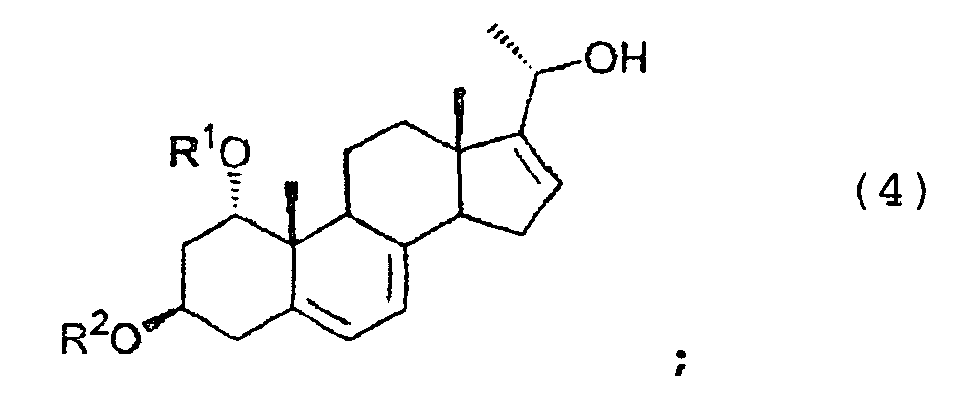

replacing R1 and R2 of the obtained compound with hydrogen atoms. - The process according to claim 1, wherein said compound represented by Formula (2) is obtained by a process comprising the steps of:reacting a compound represented by Formula (4):

with 2-bromo-N-(2,2,3,3,3-pentafluoropropyl)acetamide to obtain a compound represented by Formula (5): replacing R1 and R2 of the obtained compound with hydrogen atoms.
 - The process according to claim 2 or 3, wherein both of R1 and R2 are tert-butyldimethylsilyl groups.
- A compound represented by Formula (3):

- The compound according to claim 5, wherein both of R1 and R2 are tert-butyldimethylsilyl groups.
- A compound represented by Formula (2):

Applications Claiming Priority (2)
| Application Number | Priority Date | Filing Date | Title |
|---|---|---|---|
| JP2005346356 | 2005-11-30 | ||
| PCT/JP2006/323891 WO2007063930A1 (en) | 2005-11-30 | 2006-11-30 | Method for producing vitamin d derivative utilizing photoreaction |
Publications (3)
| Publication Number | Publication Date |
|---|---|
| EP1961740A1 EP1961740A1 (en) | 2008-08-27 |
| EP1961740A4 EP1961740A4 (en) | 2011-08-10 |
| EP1961740B1 true EP1961740B1 (en) | 2013-04-24 |
Family
ID=38092264
Family Applications (1)
| Application Number | Title | Priority Date | Filing Date |
|---|---|---|---|
| EP06833694.0A Active EP1961740B1 (en) | 2005-11-30 | 2006-11-30 | Method for producing vitamin d derivative utilizing photoreaction |
Country Status (7)
| Country | Link |
|---|---|
| US (1) | US8212059B2 (en) |
| EP (1) | EP1961740B1 (en) |
| JP (1) | JP5095413B2 (en) |
| CN (1) | CN101316814B (en) |
| DK (1) | DK1961740T3 (en) |
| ES (1) | ES2406947T3 (en) |
| WO (1) | WO2007063930A1 (en) |
Families Citing this family (1)
| Publication number | Priority date | Publication date | Assignee | Title |
|---|---|---|---|---|
| CA2411409C (en) * | 2000-06-15 | 2011-05-17 | Chugai Seiyaku Kabushiki Kaisha | Vitamin d derivatives |
Family Cites Families (5)
| Publication number | Priority date | Publication date | Assignee | Title |
|---|---|---|---|---|
| JP4012293B2 (en) * | 1996-12-20 | 2007-11-21 | 中外製薬株式会社 | 16-ene-vitamin D derivative |
| KR20050123185A (en) | 1996-12-20 | 2005-12-29 | 쥬가이 세이야쿠 가부시키가이샤 | 16-ene-vitamin d derivatives |
| US6184398B1 (en) * | 1996-12-20 | 2001-02-06 | Chugai Seiyaku Kabushiki Kaisha | 16-ene-vitamin D derivatives |
| AU2001248777A1 (en) * | 2000-04-19 | 2001-10-30 | Chugai Seiyaku Kabushiki Kaisha | Vitamin d derivatives |
| CA2411409C (en) | 2000-06-15 | 2011-05-17 | Chugai Seiyaku Kabushiki Kaisha | Vitamin d derivatives |
-
2006
- 2006-11-30 JP JP2007547988A patent/JP5095413B2/en not_active Expired - Fee Related
- 2006-11-30 WO PCT/JP2006/323891 patent/WO2007063930A1/en not_active Ceased
- 2006-11-30 ES ES06833694T patent/ES2406947T3/en active Active
- 2006-11-30 EP EP06833694.0A patent/EP1961740B1/en active Active
- 2006-11-30 CN CN2006800442922A patent/CN101316814B/en not_active Expired - Fee Related
- 2006-11-30 US US12/095,734 patent/US8212059B2/en active Active
- 2006-11-30 DK DK06833694.0T patent/DK1961740T3/en active
Also Published As
| Publication number | Publication date |
|---|---|
| EP1961740A1 (en) | 2008-08-27 |
| CN101316814A (en) | 2008-12-03 |
| JPWO2007063930A1 (en) | 2009-05-07 |
| US20100261917A1 (en) | 2010-10-14 |
| WO2007063930A1 (en) | 2007-06-07 |
| ES2406947T3 (en) | 2013-06-10 |
| CN101316814B (en) | 2012-07-18 |
| JP5095413B2 (en) | 2012-12-12 |
| US8212059B2 (en) | 2012-07-03 |
| DK1961740T3 (en) | 2013-05-27 |
| EP1961740A4 (en) | 2011-08-10 |
Similar Documents
| Publication | Publication Date | Title |
|---|---|---|
| JP5274453B2 (en) | Industrial process for the synthesis of 17α-acetoxy-11β- [4- (N, N-dimethyl-amino) -phenyl] -19-norpregna-4,9-diene-3,20-dione and a new intermediate of the process body | |
| DK2714712T3 (en) | A process for the preparation of intermediates estetrol | |
| MX2013014045A (en) | Process for the production of estetrol intermediates. | |
| WO2021175296A1 (en) | Intermediate of remdesivir and preparation method therefor | |
| EP2183267B1 (en) | Process for preparing 7-alpha-[9-(4,4,5,5,5-pentafluorothiopentyl) nonyl]estra-1,3,5(10)-triene-3,17-beta-diol | |
| US8183402B2 (en) | Industrial method for the synthesis of 17-acetoxy-11β[4-(dimethylamino)-phenyl]-21-methoxy-19-norpregna-4,9-dien-3,20-dione and the key intermediates of the process | |
| CA2859897A1 (en) | Synthesis of abiraterone and related compounds | |
| US4554105A (en) | Process for the preparation of 1-hydroxylated vitamin D compounds | |
| JP2019048838A (en) | Process and Intermediates for Preparing α, ω-Dicarboxylic Acid-Terminated Dialkane Ethers | |
| WO1993012083A1 (en) | 22-oxacholecalciferol derivative and production thereof | |
| US20030195176A1 (en) | Vitamin d derivatives | |
| US8212059B2 (en) | Process for producing vitamin D derivative using photoreaction | |
| KR101059339B1 (en) | Method for preparing carbapenem compound for oral administration | |
| EP4130020A1 (en) | Novel method for preparing inotodiol | |
| EP0528209B1 (en) | Process for preparing intermediates for vitamin D derivatives and compounds obtained thereby | |
| JPH10130244A (en) | Method for producing acyclonucleoside | |
| JP2004534796A (en) | Method for producing estrogen derivative | |
| KR100286421B1 (en) | Improved Preparation of Hyperlipidemia Therapeutic Compounds | |
| JP3776478B2 (en) | Method for producing coprostandiol derivative | |
| PL216135B1 (en) | New synthons and application thereof for the preparation of 19-nor vitamin D derivatives | |
| JP2009508898A (en) | Process for the preparation of 1'-hydroxy-2'-substituted cyclohexylazetidin-2-one compounds | |
| JPH09249691A (en) | Process for producing 25-hydroxycholesterols and synthetic intermediate thereof | |
| WO2003031455A1 (en) | Optically active dihydroxycyclohexane compounds and process for producing optically active hydroxyethylenedihydroxycycohexane compound | |
| EP0021235A1 (en) | Preparation of 25-hydroxycholesterol | |
| JPS6145999B2 (en) |
Legal Events
| Date | Code | Title | Description |
|---|---|---|---|
| PUAI | Public reference made under article 153(3) epc to a published international application that has entered the european phase |
Free format text: ORIGINAL CODE: 0009012 |
|
| 17P | Request for examination filed |
Effective date: 20080617 |
|
| AK | Designated contracting states |
Kind code of ref document: A1 Designated state(s): AT BE BG CH CY CZ DE DK EE ES FI FR GB GR HU IE IS IT LI LT LU LV MC NL PL PT RO SE SI SK TR |
|
| A4 | Supplementary search report drawn up and despatched |
Effective date: 20110711 |
|
| RIC1 | Information provided on ipc code assigned before grant |
Ipc: C07J 71/00 20060101ALI20110705BHEP Ipc: C07J 41/00 20060101ALI20110705BHEP Ipc: C07C 401/00 20060101AFI20110705BHEP |
|
| DAX | Request for extension of the european patent (deleted) | ||
| GRAP | Despatch of communication of intention to grant a patent |
Free format text: ORIGINAL CODE: EPIDOSNIGR1 |
|
| GRAS | Grant fee paid |
Free format text: ORIGINAL CODE: EPIDOSNIGR3 |
|
| GRAA | (expected) grant |
Free format text: ORIGINAL CODE: 0009210 |
|
| AK | Designated contracting states |
Kind code of ref document: B1 Designated state(s): AT BE BG CH CY CZ DE DK EE ES FI FR GB GR HU IE IS IT LI LT LU LV MC NL PL PT RO SE SI SK TR |
|
| REG | Reference to a national code |
Ref country code: GB Ref legal event code: FG4D |
|
| REG | Reference to a national code |
Ref country code: CH Ref legal event code: NV Representative=s name: E. BLUM AND CO. AG PATENT- UND MARKENANWAELTE , CH Ref country code: CH Ref legal event code: EP |
|
| REG | Reference to a national code |
Ref country code: AT Ref legal event code: REF Ref document number: 608554 Country of ref document: AT Kind code of ref document: T Effective date: 20130515 |
|
| REG | Reference to a national code |
Ref country code: IE Ref legal event code: FG4D |
|
| REG | Reference to a national code |
Ref country code: DK Ref legal event code: T3 |
|
| REG | Reference to a national code |
Ref country code: ES Ref legal event code: FG2A Ref document number: 2406947 Country of ref document: ES Kind code of ref document: T3 Effective date: 20130610 |
|
| REG | Reference to a national code |
Ref country code: DE Ref legal event code: R096 Ref document number: 602006035957 Country of ref document: DE Effective date: 20130613 |
|
| REG | Reference to a national code |
Ref country code: AT Ref legal event code: MK05 Ref document number: 608554 Country of ref document: AT Kind code of ref document: T Effective date: 20130424 |
|
| REG | Reference to a national code |
Ref country code: LT Ref legal event code: MG4D |
|
| REG | Reference to a national code |
Ref country code: NL Ref legal event code: VDEP Effective date: 20130424 |
|
| PG25 | Lapsed in a contracting state [announced via postgrant information from national office to epo] |
Ref country code: SE Free format text: LAPSE BECAUSE OF FAILURE TO SUBMIT A TRANSLATION OF THE DESCRIPTION OR TO PAY THE FEE WITHIN THE PRESCRIBED TIME-LIMIT Effective date: 20130424 Ref country code: PT Free format text: LAPSE BECAUSE OF FAILURE TO SUBMIT A TRANSLATION OF THE DESCRIPTION OR TO PAY THE FEE WITHIN THE PRESCRIBED TIME-LIMIT Effective date: 20130826 Ref country code: BE Free format text: LAPSE BECAUSE OF FAILURE TO SUBMIT A TRANSLATION OF THE DESCRIPTION OR TO PAY THE FEE WITHIN THE PRESCRIBED TIME-LIMIT Effective date: 20130424 Ref country code: IS Free format text: LAPSE BECAUSE OF FAILURE TO SUBMIT A TRANSLATION OF THE DESCRIPTION OR TO PAY THE FEE WITHIN THE PRESCRIBED TIME-LIMIT Effective date: 20130824 Ref country code: LT Free format text: LAPSE BECAUSE OF FAILURE TO SUBMIT A TRANSLATION OF THE DESCRIPTION OR TO PAY THE FEE WITHIN THE PRESCRIBED TIME-LIMIT Effective date: 20130424 Ref country code: GR Free format text: LAPSE BECAUSE OF FAILURE TO SUBMIT A TRANSLATION OF THE DESCRIPTION OR TO PAY THE FEE WITHIN THE PRESCRIBED TIME-LIMIT Effective date: 20130725 Ref country code: FI Free format text: LAPSE BECAUSE OF FAILURE TO SUBMIT A TRANSLATION OF THE DESCRIPTION OR TO PAY THE FEE WITHIN THE PRESCRIBED TIME-LIMIT Effective date: 20130424 Ref country code: SI Free format text: LAPSE BECAUSE OF FAILURE TO SUBMIT A TRANSLATION OF THE DESCRIPTION OR TO PAY THE FEE WITHIN THE PRESCRIBED TIME-LIMIT Effective date: 20130424 Ref country code: AT Free format text: LAPSE BECAUSE OF FAILURE TO SUBMIT A TRANSLATION OF THE DESCRIPTION OR TO PAY THE FEE WITHIN THE PRESCRIBED TIME-LIMIT Effective date: 20130424 |
|
| PG25 | Lapsed in a contracting state [announced via postgrant information from national office to epo] |
Ref country code: LV Free format text: LAPSE BECAUSE OF FAILURE TO SUBMIT A TRANSLATION OF THE DESCRIPTION OR TO PAY THE FEE WITHIN THE PRESCRIBED TIME-LIMIT Effective date: 20130424 Ref country code: PL Free format text: LAPSE BECAUSE OF FAILURE TO SUBMIT A TRANSLATION OF THE DESCRIPTION OR TO PAY THE FEE WITHIN THE PRESCRIBED TIME-LIMIT Effective date: 20130424 Ref country code: BG Free format text: LAPSE BECAUSE OF FAILURE TO SUBMIT A TRANSLATION OF THE DESCRIPTION OR TO PAY THE FEE WITHIN THE PRESCRIBED TIME-LIMIT Effective date: 20130724 Ref country code: CY Free format text: LAPSE BECAUSE OF FAILURE TO SUBMIT A TRANSLATION OF THE DESCRIPTION OR TO PAY THE FEE WITHIN THE PRESCRIBED TIME-LIMIT Effective date: 20130424 |
|
| PG25 | Lapsed in a contracting state [announced via postgrant information from national office to epo] |
Ref country code: SK Free format text: LAPSE BECAUSE OF FAILURE TO SUBMIT A TRANSLATION OF THE DESCRIPTION OR TO PAY THE FEE WITHIN THE PRESCRIBED TIME-LIMIT Effective date: 20130424 Ref country code: EE Free format text: LAPSE BECAUSE OF FAILURE TO SUBMIT A TRANSLATION OF THE DESCRIPTION OR TO PAY THE FEE WITHIN THE PRESCRIBED TIME-LIMIT Effective date: 20130424 Ref country code: CZ Free format text: LAPSE BECAUSE OF FAILURE TO SUBMIT A TRANSLATION OF THE DESCRIPTION OR TO PAY THE FEE WITHIN THE PRESCRIBED TIME-LIMIT Effective date: 20130424 |
|
| PG25 | Lapsed in a contracting state [announced via postgrant information from national office to epo] |
Ref country code: NL Free format text: LAPSE BECAUSE OF FAILURE TO SUBMIT A TRANSLATION OF THE DESCRIPTION OR TO PAY THE FEE WITHIN THE PRESCRIBED TIME-LIMIT Effective date: 20130424 Ref country code: RO Free format text: LAPSE BECAUSE OF FAILURE TO SUBMIT A TRANSLATION OF THE DESCRIPTION OR TO PAY THE FEE WITHIN THE PRESCRIBED TIME-LIMIT Effective date: 20130424 |
|
| PLBE | No opposition filed within time limit |
Free format text: ORIGINAL CODE: 0009261 |
|
| STAA | Information on the status of an ep patent application or granted ep patent |
Free format text: STATUS: NO OPPOSITION FILED WITHIN TIME LIMIT |
|
| 26N | No opposition filed |
Effective date: 20140127 |
|
| REG | Reference to a national code |
Ref country code: DE Ref legal event code: R097 Ref document number: 602006035957 Country of ref document: DE Effective date: 20140127 |
|
| PG25 | Lapsed in a contracting state [announced via postgrant information from national office to epo] |
Ref country code: MC Free format text: LAPSE BECAUSE OF FAILURE TO SUBMIT A TRANSLATION OF THE DESCRIPTION OR TO PAY THE FEE WITHIN THE PRESCRIBED TIME-LIMIT Effective date: 20130424 |
|
| REG | Reference to a national code |
Ref country code: IE Ref legal event code: MM4A |
|
| PG25 | Lapsed in a contracting state [announced via postgrant information from national office to epo] |
Ref country code: IE Free format text: LAPSE BECAUSE OF NON-PAYMENT OF DUE FEES Effective date: 20131130 |
|
| PG25 | Lapsed in a contracting state [announced via postgrant information from national office to epo] |
Ref country code: TR Free format text: LAPSE BECAUSE OF FAILURE TO SUBMIT A TRANSLATION OF THE DESCRIPTION OR TO PAY THE FEE WITHIN THE PRESCRIBED TIME-LIMIT Effective date: 20130424 |
|
| PG25 | Lapsed in a contracting state [announced via postgrant information from national office to epo] |
Ref country code: HU Free format text: LAPSE BECAUSE OF FAILURE TO SUBMIT A TRANSLATION OF THE DESCRIPTION OR TO PAY THE FEE WITHIN THE PRESCRIBED TIME-LIMIT; INVALID AB INITIO Effective date: 20061130 Ref country code: LU Free format text: LAPSE BECAUSE OF NON-PAYMENT OF DUE FEES Effective date: 20131130 |
|
| REG | Reference to a national code |
Ref country code: FR Ref legal event code: PLFP Year of fee payment: 10 |
|
| REG | Reference to a national code |
Ref country code: FR Ref legal event code: PLFP Year of fee payment: 11 |
|
| REG | Reference to a national code |
Ref country code: FR Ref legal event code: PLFP Year of fee payment: 12 |
|
| REG | Reference to a national code |
Ref country code: FR Ref legal event code: PLFP Year of fee payment: 13 |
|
| PGFP | Annual fee paid to national office [announced via postgrant information from national office to epo] |
Ref country code: FR Payment date: 20230929 Year of fee payment: 18 |
|
| PGFP | Annual fee paid to national office [announced via postgrant information from national office to epo] |
Ref country code: GB Payment date: 20231012 Year of fee payment: 18 |
|
| PGFP | Annual fee paid to national office [announced via postgrant information from national office to epo] |
Ref country code: ES Payment date: 20231201 Year of fee payment: 18 |
|
| PGFP | Annual fee paid to national office [announced via postgrant information from national office to epo] |
Ref country code: IT Payment date: 20231010 Year of fee payment: 18 Ref country code: DE Payment date: 20231003 Year of fee payment: 18 Ref country code: CH Payment date: 20231201 Year of fee payment: 18 |
|
| PGFP | Annual fee paid to national office [announced via postgrant information from national office to epo] |
Ref country code: DK Payment date: 20240105 Year of fee payment: 18 |
|
| REG | Reference to a national code |
Ref country code: DE Ref legal event code: R119 Ref document number: 602006035957 Country of ref document: DE |
|
| REG | Reference to a national code |
Ref country code: DK Ref legal event code: EBP Effective date: 20241130 |
|
| REG | Reference to a national code |
Ref country code: CH Ref legal event code: PL |
|
| REG | Reference to a national code |
Ref country code: CH Ref legal event code: PL |
|
| GBPC | Gb: european patent ceased through non-payment of renewal fee |
Effective date: 20241130 |
|
| PG25 | Lapsed in a contracting state [announced via postgrant information from national office to epo] |
Ref country code: CH Free format text: LAPSE BECAUSE OF NON-PAYMENT OF DUE FEES Effective date: 20241130 |
|
| PG25 | Lapsed in a contracting state [announced via postgrant information from national office to epo] |
Ref country code: DK Free format text: LAPSE BECAUSE OF NON-PAYMENT OF DUE FEES Effective date: 20241130 Ref country code: DE Free format text: LAPSE BECAUSE OF NON-PAYMENT OF DUE FEES Effective date: 20250603 |
|
| PG25 | Lapsed in a contracting state [announced via postgrant information from national office to epo] |
Ref country code: IT Free format text: LAPSE BECAUSE OF NON-PAYMENT OF DUE FEES Effective date: 20241130 |
|
| PG25 | Lapsed in a contracting state [announced via postgrant information from national office to epo] |
Ref country code: GB Free format text: LAPSE BECAUSE OF NON-PAYMENT OF DUE FEES Effective date: 20241130 |
|
| PG25 | Lapsed in a contracting state [announced via postgrant information from national office to epo] |
Ref country code: FR Free format text: LAPSE BECAUSE OF NON-PAYMENT OF DUE FEES Effective date: 20241130 |
|
| REG | Reference to a national code |
Ref country code: ES Ref legal event code: FD2A Effective date: 20260105 |
|
| PG25 | Lapsed in a contracting state [announced via postgrant information from national office to epo] |
Ref country code: ES Free format text: LAPSE BECAUSE OF NON-PAYMENT OF DUE FEES Effective date: 20241201 |