EP1961410A2 - Leistungsgesteigerte Haarbehandlungsmittel gegen Schuppen - Google Patents
Leistungsgesteigerte Haarbehandlungsmittel gegen Schuppen Download PDFInfo
- Publication number
- EP1961410A2 EP1961410A2 EP20070022749 EP07022749A EP1961410A2 EP 1961410 A2 EP1961410 A2 EP 1961410A2 EP 20070022749 EP20070022749 EP 20070022749 EP 07022749 A EP07022749 A EP 07022749A EP 1961410 A2 EP1961410 A2 EP 1961410A2
- Authority
- EP
- European Patent Office
- Prior art keywords
- mono
- oder
- weight
- und
- branched
- Prior art date
- Legal status (The legal status is an assumption and is not a legal conclusion. Google has not performed a legal analysis and makes no representation as to the accuracy of the status listed.)
- Withdrawn
Links
- 210000004209 hair Anatomy 0.000 title claims abstract description 105
- 238000011282 treatment Methods 0.000 title claims abstract description 56
- 208000001840 Dandruff Diseases 0.000 title description 19
- 210000002969 egg yolk Anatomy 0.000 claims abstract description 28
- 235000013345 egg yolk Nutrition 0.000 claims abstract description 25
- 102000002322 Egg Proteins Human genes 0.000 claims abstract description 21
- 108010000912 Egg Proteins Proteins 0.000 claims abstract description 21
- 239000000284 extract Substances 0.000 claims abstract description 13
- -1 fatty alcohol ether sulfates Chemical class 0.000 claims description 221
- 229920001577 copolymer Polymers 0.000 claims description 163
- 239000003795 chemical substances by application Substances 0.000 claims description 88
- 229920006395 saturated elastomer Polymers 0.000 claims description 83
- 239000000203 mixture Substances 0.000 claims description 81
- 229920000642 polymer Polymers 0.000 claims description 56
- KDCGOANMDULRCW-UHFFFAOYSA-N 7H-purine Chemical compound N1=CNC2=NC=NC2=C1 KDCGOANMDULRCW-UHFFFAOYSA-N 0.000 claims description 53
- 150000003254 radicals Chemical class 0.000 claims description 53
- 125000004432 carbon atom Chemical group C* 0.000 claims description 51
- 125000002496 methyl group Chemical group [H]C([H])([H])* 0.000 claims description 51
- 239000004215 Carbon black (E152) Substances 0.000 claims description 50
- 229930195733 hydrocarbon Natural products 0.000 claims description 50
- NIXOWILDQLNWCW-UHFFFAOYSA-N 2-Propenoic acid Natural products OC(=O)C=C NIXOWILDQLNWCW-UHFFFAOYSA-N 0.000 claims description 47
- RYYVLZVUVIJVGH-UHFFFAOYSA-N caffeine Chemical compound CN1C(=O)N(C)C(=O)C2=C1N=CN2C RYYVLZVUVIJVGH-UHFFFAOYSA-N 0.000 claims description 47
- CERQOIWHTDAKMF-UHFFFAOYSA-N Methacrylic acid Chemical compound CC(=C)C(O)=O CERQOIWHTDAKMF-UHFFFAOYSA-N 0.000 claims description 44
- 150000001875 compounds Chemical class 0.000 claims description 44
- 125000000217 alkyl group Chemical group 0.000 claims description 35
- 229910052739 hydrogen Inorganic materials 0.000 claims description 32
- 108060003951 Immunoglobulin Proteins 0.000 claims description 30
- 102000018358 immunoglobulin Human genes 0.000 claims description 30
- 239000000126 substance Substances 0.000 claims description 30
- 239000001257 hydrogen Substances 0.000 claims description 29
- UFHFLCQGNIYNRP-UHFFFAOYSA-N Hydrogen Chemical compound [H][H] UFHFLCQGNIYNRP-UHFFFAOYSA-N 0.000 claims description 28
- SMZOUWXMTYCWNB-UHFFFAOYSA-N 2-(2-methoxy-5-methylphenyl)ethanamine Chemical compound COC1=CC=C(C)C=C1CCN SMZOUWXMTYCWNB-UHFFFAOYSA-N 0.000 claims description 27
- 150000002148 esters Chemical class 0.000 claims description 26
- 201000004384 Alopecia Diseases 0.000 claims description 22
- DHMQDGOQFOQNFH-UHFFFAOYSA-N Glycine Chemical compound NCC(O)=O DHMQDGOQFOQNFH-UHFFFAOYSA-N 0.000 claims description 22
- 125000002091 cationic group Chemical group 0.000 claims description 22
- 229920000289 Polyquaternium Polymers 0.000 claims description 21
- 210000004761 scalp Anatomy 0.000 claims description 21
- 150000002431 hydrogen Chemical class 0.000 claims description 19
- LPHGQDQBBGAPDZ-UHFFFAOYSA-N Isocaffeine Natural products CN1C(=O)N(C)C(=O)C2=C1N(C)C=N2 LPHGQDQBBGAPDZ-UHFFFAOYSA-N 0.000 claims description 17
- VJEONQKOZGKCAK-UHFFFAOYSA-N caffeine Natural products CN1C(=O)N(C)C(=O)C2=C1C=CN2C VJEONQKOZGKCAK-UHFFFAOYSA-N 0.000 claims description 17
- 229960001948 caffeine Drugs 0.000 claims description 17
- 150000003212 purines Chemical class 0.000 claims description 17
- 108010001160 IgY Proteins 0.000 claims description 15
- 229930006000 Sucrose Natural products 0.000 claims description 15
- 150000001413 amino acids Chemical class 0.000 claims description 15
- RGZSQWQPBWRIAQ-CABCVRRESA-N (-)-alpha-Bisabolol Chemical compound CC(C)=CCC[C@](C)(O)[C@H]1CCC(C)=CC1 RGZSQWQPBWRIAQ-CABCVRRESA-N 0.000 claims description 14
- WHNWPMSKXPGLAX-UHFFFAOYSA-N N-Vinyl-2-pyrrolidone Chemical compound C=CN1CCCC1=O WHNWPMSKXPGLAX-UHFFFAOYSA-N 0.000 claims description 14
- AUNGANRZJHBGPY-SCRDCRAPSA-N Riboflavin Chemical compound OC[C@@H](O)[C@@H](O)[C@@H](O)CN1C=2C=C(C)C(C)=CC=2N=C2C1=NC(=O)NC2=O AUNGANRZJHBGPY-SCRDCRAPSA-N 0.000 claims description 14
- 239000002253 acid Substances 0.000 claims description 14
- 239000011720 vitamin B Substances 0.000 claims description 14
- DFPAKSUCGFBDDF-UHFFFAOYSA-N Nicotinamide Chemical compound NC(=O)C1=CC=CN=C1 DFPAKSUCGFBDDF-UHFFFAOYSA-N 0.000 claims description 13
- 229940024606 amino acid Drugs 0.000 claims description 13
- 235000001014 amino acid Nutrition 0.000 claims description 13
- 239000002453 shampoo Substances 0.000 claims description 13
- 235000019156 vitamin B Nutrition 0.000 claims description 13
- YBJHBAHKTGYVGT-ZKWXMUAHSA-N (+)-Biotin Chemical compound N1C(=O)N[C@@H]2[C@H](CCCCC(=O)O)SC[C@@H]21 YBJHBAHKTGYVGT-ZKWXMUAHSA-N 0.000 claims description 12
- 229930003270 Vitamin B Natural products 0.000 claims description 12
- 150000007513 acids Chemical class 0.000 claims description 12
- SRBFZHDQGSBBOR-UHFFFAOYSA-N beta-D-Pyranose-Lyxose Natural products OC1COC(O)C(O)C1O SRBFZHDQGSBBOR-UHFFFAOYSA-N 0.000 claims description 12
- 208000024963 hair loss Diseases 0.000 claims description 12
- 230000003676 hair loss Effects 0.000 claims description 12
- CIWBSHSKHKDKBQ-JLAZNSOCSA-N Ascorbic acid Chemical compound OC[C@H](O)[C@H]1OC(=O)C(O)=C1O CIWBSHSKHKDKBQ-JLAZNSOCSA-N 0.000 claims description 11
- KZSNJWFQEVHDMF-UHFFFAOYSA-N Valine Natural products CC(C)C(N)C(O)=O KZSNJWFQEVHDMF-UHFFFAOYSA-N 0.000 claims description 11
- RGZSQWQPBWRIAQ-LSDHHAIUSA-N alpha-Bisabolol Natural products CC(C)=CCC[C@@](C)(O)[C@@H]1CCC(C)=CC1 RGZSQWQPBWRIAQ-LSDHHAIUSA-N 0.000 claims description 11
- 229940036350 bisabolol Drugs 0.000 claims description 11
- 229920006317 cationic polymer Polymers 0.000 claims description 11
- RTZKZFJDLAIYFH-UHFFFAOYSA-N ether Substances CCOCC RTZKZFJDLAIYFH-UHFFFAOYSA-N 0.000 claims description 11
- JZRWCGZRTZMZEH-UHFFFAOYSA-N thiamine Chemical compound CC1=C(CCO)SC=[N+]1CC1=CN=C(C)N=C1N JZRWCGZRTZMZEH-UHFFFAOYSA-N 0.000 claims description 11
- 229940088594 vitamin Drugs 0.000 claims description 11
- 229930003231 vitamin Natural products 0.000 claims description 11
- 235000013343 vitamin Nutrition 0.000 claims description 11
- 239000011782 vitamin Substances 0.000 claims description 11
- OSCJHTSDLYVCQC-UHFFFAOYSA-N 2-ethylhexyl 4-[[4-[4-(tert-butylcarbamoyl)anilino]-6-[4-(2-ethylhexoxycarbonyl)anilino]-1,3,5-triazin-2-yl]amino]benzoate Chemical compound C1=CC(C(=O)OCC(CC)CCCC)=CC=C1NC1=NC(NC=2C=CC(=CC=2)C(=O)NC(C)(C)C)=NC(NC=2C=CC(=CC=2)C(=O)OCC(CC)CCCC)=N1 OSCJHTSDLYVCQC-UHFFFAOYSA-N 0.000 claims description 10
- SNPLKNRPJHDVJA-ZETCQYMHSA-N D-panthenol Chemical compound OCC(C)(C)[C@@H](O)C(=O)NCCCO SNPLKNRPJHDVJA-ZETCQYMHSA-N 0.000 claims description 10
- WQZGKKKJIJFFOK-GASJEMHNSA-N Glucose Natural products OC[C@H]1OC(O)[C@H](O)[C@@H](O)[C@@H]1O WQZGKKKJIJFFOK-GASJEMHNSA-N 0.000 claims description 10
- 235000017471 coenzyme Q10 Nutrition 0.000 claims description 10
- 235000020957 pantothenol Nutrition 0.000 claims description 10
- 239000005720 sucrose Substances 0.000 claims description 10
- GHOKWGTUZJEAQD-ZETCQYMHSA-N (D)-(+)-Pantothenic acid Chemical compound OCC(C)(C)[C@@H](O)C(=O)NCCC(O)=O GHOKWGTUZJEAQD-ZETCQYMHSA-N 0.000 claims description 9
- 241000282414 Homo sapiens Species 0.000 claims description 9
- XOAAWQZATWQOTB-UHFFFAOYSA-N taurine Chemical compound NCCS(O)(=O)=O XOAAWQZATWQOTB-UHFFFAOYSA-N 0.000 claims description 9
- WTVHAMTYZJGJLJ-UHFFFAOYSA-N (+)-(4S,8R)-8-epi-beta-bisabolol Natural products CC(C)=CCCC(C)C1(O)CCC(C)=CC1 WTVHAMTYZJGJLJ-UHFFFAOYSA-N 0.000 claims description 8
- ACTIUHUUMQJHFO-UHFFFAOYSA-N Coenzym Q10 Natural products COC1=C(OC)C(=O)C(CC=C(C)CCC=C(C)CCC=C(C)CCC=C(C)CCC=C(C)CCC=C(C)CCC=C(C)CCC=C(C)CCC=C(C)CCC=C(C)C)=C(C)C1=O ACTIUHUUMQJHFO-UHFFFAOYSA-N 0.000 claims description 8
- 239000004471 Glycine Substances 0.000 claims description 8
- QNAYBMKLOCPYGJ-REOHCLBHSA-N L-alanine Chemical compound C[C@H](N)C(O)=O QNAYBMKLOCPYGJ-REOHCLBHSA-N 0.000 claims description 8
- KZSNJWFQEVHDMF-BYPYZUCNSA-N L-valine Chemical compound CC(C)[C@H](N)C(O)=O KZSNJWFQEVHDMF-BYPYZUCNSA-N 0.000 claims description 8
- 241000555688 Malassezia furfur Species 0.000 claims description 8
- 125000002252 acyl group Chemical group 0.000 claims description 8
- 235000004279 alanine Nutrition 0.000 claims description 8
- 239000003945 anionic surfactant Substances 0.000 claims description 8
- HHGZABIIYIWLGA-UHFFFAOYSA-N bisabolol Natural products CC1CCC(C(C)(O)CCC=C(C)C)CC1 HHGZABIIYIWLGA-UHFFFAOYSA-N 0.000 claims description 8
- 150000001720 carbohydrates Chemical class 0.000 claims description 8
- 230000002265 prevention Effects 0.000 claims description 8
- 239000004474 valine Substances 0.000 claims description 8
- PYMYPHUHKUWMLA-LMVFSUKVSA-N aldehydo-D-ribose Chemical compound OC[C@@H](O)[C@@H](O)[C@@H](O)C=O PYMYPHUHKUWMLA-LMVFSUKVSA-N 0.000 claims description 7
- ACTIUHUUMQJHFO-UPTCCGCDSA-N coenzyme Q10 Chemical compound COC1=C(OC)C(=O)C(C\C=C(/C)CC\C=C(/C)CC\C=C(/C)CC\C=C(/C)CC\C=C(/C)CC\C=C(/C)CC\C=C(/C)CC\C=C(/C)CC\C=C(/C)CCC=C(C)C)=C(C)C1=O ACTIUHUUMQJHFO-UPTCCGCDSA-N 0.000 claims description 7
- 229940101267 panthenol Drugs 0.000 claims description 7
- 239000011619 pantothenol Substances 0.000 claims description 7
- WQZGKKKJIJFFOK-SVZMEOIVSA-N (+)-Galactose Chemical compound OC[C@H]1OC(O)[C@H](O)[C@@H](O)[C@H]1O WQZGKKKJIJFFOK-SVZMEOIVSA-N 0.000 claims description 6
- LRFVTYWOQMYALW-UHFFFAOYSA-N 9H-xanthine Chemical compound O=C1NC(=O)NC2=C1NC=N2 LRFVTYWOQMYALW-UHFFFAOYSA-N 0.000 claims description 6
- DHMQDGOQFOQNFH-UHFFFAOYSA-M Aminoacetate Chemical compound NCC([O-])=O DHMQDGOQFOQNFH-UHFFFAOYSA-M 0.000 claims description 6
- SHZGCJCMOBCMKK-UHFFFAOYSA-N D-mannomethylose Natural products CC1OC(O)C(O)C(O)C1O SHZGCJCMOBCMKK-UHFFFAOYSA-N 0.000 claims description 6
- 241000233866 Fungi Species 0.000 claims description 6
- PNNNRSAQSRJVSB-UHFFFAOYSA-N L-rhamnose Natural products CC(O)C(O)C(O)C(O)C=O PNNNRSAQSRJVSB-UHFFFAOYSA-N 0.000 claims description 6
- CERQOIWHTDAKMF-UHFFFAOYSA-M Methacrylate Chemical compound CC(=C)C([O-])=O CERQOIWHTDAKMF-UHFFFAOYSA-M 0.000 claims description 6
- PVNIIMVLHYAWGP-UHFFFAOYSA-N Niacin Chemical compound OC(=O)C1=CC=CN=C1 PVNIIMVLHYAWGP-UHFFFAOYSA-N 0.000 claims description 6
- 231100000360 alopecia Toxicity 0.000 claims description 6
- PYMYPHUHKUWMLA-UHFFFAOYSA-N arabinose Natural products OCC(O)C(O)C(O)C=O PYMYPHUHKUWMLA-UHFFFAOYSA-N 0.000 claims description 6
- 235000014633 carbohydrates Nutrition 0.000 claims description 6
- OVBPIULPVIDEAO-LBPRGKRZSA-N folic acid Chemical compound C=1N=C2NC(N)=NC(=O)C2=NC=1CNC1=CC=C(C(=O)N[C@@H](CCC(O)=O)C(O)=O)C=C1 OVBPIULPVIDEAO-LBPRGKRZSA-N 0.000 claims description 6
- UYTPUPDQBNUYGX-UHFFFAOYSA-N guanine Chemical compound O=C1NC(N)=NC2=C1N=CN2 UYTPUPDQBNUYGX-UHFFFAOYSA-N 0.000 claims description 6
- FDGQSTZJBFJUBT-UHFFFAOYSA-N hypoxanthine Chemical compound O=C1NC=NC2=C1NC=N2 FDGQSTZJBFJUBT-UHFFFAOYSA-N 0.000 claims description 6
- 239000011570 nicotinamide Substances 0.000 claims description 6
- 235000005152 nicotinamide Nutrition 0.000 claims description 6
- NPCOQXAVBJJZBQ-UHFFFAOYSA-N reduced coenzyme Q9 Natural products COC1=C(O)C(C)=C(CC=C(C)CCC=C(C)CCC=C(C)CCC=C(C)CCC=C(C)CCC=C(C)CCC=C(C)CCC=C(C)CCC=C(C)C)C(O)=C1OC NPCOQXAVBJJZBQ-UHFFFAOYSA-N 0.000 claims description 6
- 235000019192 riboflavin Nutrition 0.000 claims description 6
- 239000002151 riboflavin Substances 0.000 claims description 6
- YGSDEFSMJLZEOE-UHFFFAOYSA-N salicylic acid Chemical compound OC(=O)C1=CC=CC=C1O YGSDEFSMJLZEOE-UHFFFAOYSA-N 0.000 claims description 6
- ROHFNLRQFUQHCH-YFKPBYRVSA-N L-leucine Chemical compound CC(C)C[C@H](N)C(O)=O ROHFNLRQFUQHCH-YFKPBYRVSA-N 0.000 claims description 5
- ROHFNLRQFUQHCH-UHFFFAOYSA-N Leucine Natural products CC(C)CC(N)C(O)=O ROHFNLRQFUQHCH-UHFFFAOYSA-N 0.000 claims description 5
- KDXKERNSBIXSRK-UHFFFAOYSA-N Lysine Natural products NCCCCC(N)C(O)=O KDXKERNSBIXSRK-UHFFFAOYSA-N 0.000 claims description 5
- 239000004472 Lysine Substances 0.000 claims description 5
- 229920000691 Poly[bis(2-chloroethyl) ether-alt-1,3-bis[3-(dimethylamino)propyl]urea] Polymers 0.000 claims description 5
- 240000004808 Saccharomyces cerevisiae Species 0.000 claims description 5
- YAPQBXQYLJRXSA-UHFFFAOYSA-N Theobromine Natural products CN1C(=O)NC(=O)C2=C1N=CN2C YAPQBXQYLJRXSA-UHFFFAOYSA-N 0.000 claims description 5
- AYFVYJQAPQTCCC-UHFFFAOYSA-N Threonine Natural products CC(O)C(N)C(O)=O AYFVYJQAPQTCCC-UHFFFAOYSA-N 0.000 claims description 5
- 239000004473 Threonine Substances 0.000 claims description 5
- 239000004480 active ingredient Substances 0.000 claims description 5
- RHDGNLCLDBVESU-UHFFFAOYSA-N but-3-en-4-olide Chemical class O=C1CC=CO1 RHDGNLCLDBVESU-UHFFFAOYSA-N 0.000 claims description 5
- 150000001768 cations Chemical class 0.000 claims description 5
- 150000002772 monosaccharides Chemical class 0.000 claims description 5
- 229920001542 oligosaccharide Polymers 0.000 claims description 5
- 150000002482 oligosaccharides Chemical class 0.000 claims description 5
- 229920002451 polyvinyl alcohol Polymers 0.000 claims description 5
- ZFXYFBGIUFBOJW-UHFFFAOYSA-N theophylline Chemical compound O=C1N(C)C(=O)N(C)C2=C1NC=N2 ZFXYFBGIUFBOJW-UHFFFAOYSA-N 0.000 claims description 5
- WYWHKKSPHMUBEB-UHFFFAOYSA-N tioguanine Chemical compound N1C(N)=NC(=S)C2=C1N=CN2 WYWHKKSPHMUBEB-UHFFFAOYSA-N 0.000 claims description 5
- 150000003722 vitamin derivatives Chemical class 0.000 claims description 5
- HZAXFHJVJLSVMW-UHFFFAOYSA-N 2-Aminoethan-1-ol Chemical compound NCCO HZAXFHJVJLSVMW-UHFFFAOYSA-N 0.000 claims description 4
- AUNGANRZJHBGPY-UHFFFAOYSA-N D-Lyxoflavin Natural products OCC(O)C(O)C(O)CN1C=2C=C(C)C(C)=CC=2N=C2C1=NC(=O)NC2=O AUNGANRZJHBGPY-UHFFFAOYSA-N 0.000 claims description 4
- VZCYOOQTPOCHFL-OWOJBTEDSA-N Fumaric acid Chemical compound OC(=O)\C=C\C(O)=O VZCYOOQTPOCHFL-OWOJBTEDSA-N 0.000 claims description 4
- OVBPIULPVIDEAO-UHFFFAOYSA-N N-Pteroyl-L-glutaminsaeure Natural products C=1N=C2NC(N)=NC(=O)C2=NC=1CNC1=CC=C(C(=O)NC(CCC(O)=O)C(O)=O)C=C1 OVBPIULPVIDEAO-UHFFFAOYSA-N 0.000 claims description 4
- 229930003756 Vitamin B7 Natural products 0.000 claims description 4
- 150000001408 amides Chemical class 0.000 claims description 4
- 239000002280 amphoteric surfactant Substances 0.000 claims description 4
- 229960002685 biotin Drugs 0.000 claims description 4
- 235000020958 biotin Nutrition 0.000 claims description 4
- 239000011616 biotin Substances 0.000 claims description 4
- 229920002678 cellulose Polymers 0.000 claims description 4
- 239000001913 cellulose Substances 0.000 claims description 4
- 229940110767 coenzyme Q10 Drugs 0.000 claims description 4
- YIOJGTBNHQAVBO-UHFFFAOYSA-N dimethyl-bis(prop-2-enyl)azanium Chemical class C=CC[N+](C)(C)CC=C YIOJGTBNHQAVBO-UHFFFAOYSA-N 0.000 claims description 4
- 150000002016 disaccharides Chemical class 0.000 claims description 4
- 229960003966 nicotinamide Drugs 0.000 claims description 4
- 239000011713 pantothenic acid Substances 0.000 claims description 4
- 229920002553 poly(2-methacrylolyloxyethyltrimethylammonium chloride) polymer Polymers 0.000 claims description 4
- 229960002477 riboflavin Drugs 0.000 claims description 4
- 229960003080 taurine Drugs 0.000 claims description 4
- 235000019157 thiamine Nutrition 0.000 claims description 4
- 239000011721 thiamine Substances 0.000 claims description 4
- 229940035936 ubiquinone Drugs 0.000 claims description 4
- 235000011912 vitamin B7 Nutrition 0.000 claims description 4
- 239000011735 vitamin B7 Substances 0.000 claims description 4
- 239000011701 zinc Substances 0.000 claims description 4
- HDTRYLNUVZCQOY-UHFFFAOYSA-N α-D-glucopyranosyl-α-D-glucopyranoside Natural products OC1C(O)C(O)C(CO)OC1OC1C(O)C(O)C(O)C(CO)O1 HDTRYLNUVZCQOY-UHFFFAOYSA-N 0.000 claims description 3
- 239000001500 (2R)-6-methyl-2-[(1R)-4-methyl-1-cyclohex-3-enyl]hept-5-en-2-ol Substances 0.000 claims description 3
- RBCOYOYDYNXAFA-UHFFFAOYSA-L (5-hydroxy-4,6-dimethylpyridin-3-yl)methyl phosphate Chemical compound CC1=NC=C(COP([O-])([O-])=O)C(C)=C1O RBCOYOYDYNXAFA-UHFFFAOYSA-L 0.000 claims description 3
- OWEGWHBOCFMBLP-UHFFFAOYSA-N 1-(4-chlorophenoxy)-1-(1H-imidazol-1-yl)-3,3-dimethylbutan-2-one Chemical compound C1=CN=CN1C(C(=O)C(C)(C)C)OC1=CC=C(Cl)C=C1 OWEGWHBOCFMBLP-UHFFFAOYSA-N 0.000 claims description 3
- OWEGMIWEEQEYGQ-UHFFFAOYSA-N 100676-05-9 Natural products OC1C(O)C(O)C(CO)OC1OCC1C(O)C(O)C(O)C(OC2C(OC(O)C(O)C2O)CO)O1 OWEGMIWEEQEYGQ-UHFFFAOYSA-N 0.000 claims description 3
- 229930024421 Adenine Natural products 0.000 claims description 3
- GFFGJBXGBJISGV-UHFFFAOYSA-N Adenine Chemical compound NC1=NC=NC2=C1N=CN2 GFFGJBXGBJISGV-UHFFFAOYSA-N 0.000 claims description 3
- GHOKWGTUZJEAQD-UHFFFAOYSA-N Chick antidermatitis factor Natural products OCC(C)(C)C(O)C(=O)NCCC(O)=O GHOKWGTUZJEAQD-UHFFFAOYSA-N 0.000 claims description 3
- 244000303965 Cyamopsis psoralioides Species 0.000 claims description 3
- GUBGYTABKSRVRQ-CUHNMECISA-N D-Cellobiose Chemical compound O[C@@H]1[C@@H](O)[C@H](O)[C@@H](CO)O[C@H]1O[C@@H]1[C@@H](CO)OC(O)[C@H](O)[C@H]1O GUBGYTABKSRVRQ-CUHNMECISA-N 0.000 claims description 3
- RFSUNEUAIZKAJO-VRPWFDPXSA-N D-Fructose Natural products OC[C@H]1OC(O)(CO)[C@@H](O)[C@@H]1O RFSUNEUAIZKAJO-VRPWFDPXSA-N 0.000 claims description 3
- ZZZCUOFIHGPKAK-UHFFFAOYSA-N D-erythro-ascorbic acid Natural products OCC1OC(=O)C(O)=C1O ZZZCUOFIHGPKAK-UHFFFAOYSA-N 0.000 claims description 3
- AYRXSINWFIIFAE-SCLMCMATSA-N Isomaltose Natural products OC[C@H]1O[C@H](OC[C@@H](O)[C@@H](O)[C@H](O)[C@@H](O)C=O)[C@@H](O)[C@@H](O)[C@@H]1O AYRXSINWFIIFAE-SCLMCMATSA-N 0.000 claims description 3
- SHZGCJCMOBCMKK-PQMKYFCFSA-N L-Fucose Natural products C[C@H]1O[C@H](O)[C@@H](O)[C@@H](O)[C@@H]1O SHZGCJCMOBCMKK-PQMKYFCFSA-N 0.000 claims description 3
- GUBGYTABKSRVRQ-QKKXKWKRSA-N Lactose Natural products OC[C@H]1O[C@@H](O[C@H]2[C@H](O)[C@@H](O)C(O)O[C@@H]2CO)[C@H](O)[C@@H](O)[C@H]1O GUBGYTABKSRVRQ-QKKXKWKRSA-N 0.000 claims description 3
- 241000555676 Malassezia Species 0.000 claims description 3
- GUBGYTABKSRVRQ-PICCSMPSSA-N Maltose Natural products O[C@@H]1[C@@H](O)[C@H](O)[C@@H](CO)O[C@@H]1O[C@@H]1[C@@H](CO)OC(O)[C@H](O)[C@H]1O GUBGYTABKSRVRQ-PICCSMPSSA-N 0.000 claims description 3
- AYRXSINWFIIFAE-UHFFFAOYSA-N O6-alpha-D-Galactopyranosyl-D-galactose Natural products OCC1OC(OCC(O)C(O)C(O)C(O)C=O)C(O)C(O)C1O AYRXSINWFIIFAE-UHFFFAOYSA-N 0.000 claims description 3
- 239000004372 Polyvinyl alcohol Substances 0.000 claims description 3
- HDTRYLNUVZCQOY-WSWWMNSNSA-N Trehalose Natural products O[C@@H]1[C@@H](O)[C@@H](O)[C@@H](CO)O[C@@H]1O[C@@H]1[C@H](O)[C@@H](O)[C@@H](O)[C@@H](CO)O1 HDTRYLNUVZCQOY-WSWWMNSNSA-N 0.000 claims description 3
- 229930003268 Vitamin C Natural products 0.000 claims description 3
- 229960003344 climbazole Drugs 0.000 claims description 3
- MRUAUOIMASANKQ-UHFFFAOYSA-N cocamidopropyl betaine Chemical compound CCCCCCCCCCCC(=O)NCCC[N+](C)(C)CC([O-])=O MRUAUOIMASANKQ-UHFFFAOYSA-N 0.000 claims description 3
- 229940073507 cocamidopropyl betaine Drugs 0.000 claims description 3
- 229940047642 disodium cocoamphodiacetate Drugs 0.000 claims description 3
- 239000000835 fiber Substances 0.000 claims description 3
- 235000012907 honey Nutrition 0.000 claims description 3
- 230000006872 improvement Effects 0.000 claims description 3
- 239000008101 lactose Substances 0.000 claims description 3
- 235000001968 nicotinic acid Nutrition 0.000 claims description 3
- 229960003512 nicotinic acid Drugs 0.000 claims description 3
- 239000011664 nicotinic acid Substances 0.000 claims description 3
- 229940055726 pantothenic acid Drugs 0.000 claims description 3
- 235000019161 pantothenic acid Nutrition 0.000 claims description 3
- FJKROLUGYXJWQN-UHFFFAOYSA-N papa-hydroxy-benzoic acid Natural products OC(=O)C1=CC=C(O)C=C1 FJKROLUGYXJWQN-UHFFFAOYSA-N 0.000 claims description 3
- BTSZTGGZJQFALU-UHFFFAOYSA-N piroctone olamine Chemical compound NCCO.CC(C)(C)CC(C)CC1=CC(C)=CC(=O)N1O BTSZTGGZJQFALU-UHFFFAOYSA-N 0.000 claims description 3
- 229940081510 piroctone olamine Drugs 0.000 claims description 3
- 239000002243 precursor Substances 0.000 claims description 3
- 229960004889 salicylic acid Drugs 0.000 claims description 3
- 229960000278 theophylline Drugs 0.000 claims description 3
- 229960003495 thiamine Drugs 0.000 claims description 3
- RRHXZLALVWBDKH-UHFFFAOYSA-M trimethyl-[2-(2-methylprop-2-enoyloxy)ethyl]azanium;chloride Chemical compound [Cl-].CC(=C)C(=O)OCC[N+](C)(C)C RRHXZLALVWBDKH-UHFFFAOYSA-M 0.000 claims description 3
- 235000019154 vitamin C Nutrition 0.000 claims description 3
- 239000011718 vitamin C Substances 0.000 claims description 3
- 229940043810 zinc pyrithione Drugs 0.000 claims description 3
- PICXIOQBANWBIZ-UHFFFAOYSA-N zinc;1-oxidopyridine-2-thione Chemical compound [Zn+2].[O-]N1C=CC=CC1=S.[O-]N1C=CC=CC1=S PICXIOQBANWBIZ-UHFFFAOYSA-N 0.000 claims description 3
- 239000011703 D-panthenol Substances 0.000 claims description 2
- UGQMRVRMYYASKQ-UHFFFAOYSA-N Hypoxanthine nucleoside Natural products OC1C(O)C(CO)OC1N1C(NC=NC2=O)=C2N=C1 UGQMRVRMYYASKQ-UHFFFAOYSA-N 0.000 claims description 2
- 239000002211 L-ascorbic acid Substances 0.000 claims description 2
- 235000000069 L-ascorbic acid Nutrition 0.000 claims description 2
- LEHOTFFKMJEONL-UHFFFAOYSA-N Uric Acid Chemical compound N1C(=O)NC(=O)C2=C1NC(=O)N2 LEHOTFFKMJEONL-UHFFFAOYSA-N 0.000 claims description 2
- TVWHNULVHGKJHS-UHFFFAOYSA-N Uric acid Natural products N1C(=O)NC(=O)C2NC(=O)NC21 TVWHNULVHGKJHS-UHFFFAOYSA-N 0.000 claims description 2
- 229960000643 adenine Drugs 0.000 claims description 2
- 239000003242 anti bacterial agent Substances 0.000 claims description 2
- 229960005070 ascorbic acid Drugs 0.000 claims description 2
- 229940077731 carbohydrate nutrients Drugs 0.000 claims description 2
- FDJOLVPMNUYSCM-UVKKECPRSA-L cobalt(3+);[(2r,3s,4r,5s)-5-(5,6-dimethylbenzimidazol-1-yl)-4-hydroxy-2-(hydroxymethyl)oxolan-3-yl] [(2r)-1-[3-[(2r,3r,4z,7s,9z,12s,13s,14z,17s,18s,19r)-2,13,18-tris(2-amino-2-oxoethyl)-7,12,17-tris(3-amino-3-oxopropyl)-3,5,8,8,13,15,18,19-octamethyl-2,7, Chemical compound [Co+3].N#[C-].C1([C@H](CC(N)=O)[C@@]2(C)CCC(=O)NC[C@@H](C)OP([O-])(=O)O[C@H]3[C@H]([C@H](O[C@@H]3CO)N3C4=CC(C)=C(C)C=C4N=C3)O)[N-]\C2=C(C)/C([C@H](C\2(C)C)CCC(N)=O)=N/C/2=C\C([C@H]([C@@]/2(CC(N)=O)C)CCC(N)=O)=N\C\2=C(C)/C2=N[C@]1(C)[C@@](C)(CC(N)=O)[C@@H]2CCC(N)=O FDJOLVPMNUYSCM-UVKKECPRSA-L 0.000 claims description 2
- SNPLKNRPJHDVJA-UHFFFAOYSA-N dl-panthenol Chemical compound OCC(C)(C)C(O)C(=O)NCCCO SNPLKNRPJHDVJA-UHFFFAOYSA-N 0.000 claims description 2
- 235000019152 folic acid Nutrition 0.000 claims description 2
- 239000011724 folic acid Substances 0.000 claims description 2
- 229960000304 folic acid Drugs 0.000 claims description 2
- 239000001530 fumaric acid Substances 0.000 claims description 2
- 230000003806 hair structure Effects 0.000 claims description 2
- CBOIHMRHGLHBPB-UHFFFAOYSA-N hydroxymethyl Chemical compound O[CH2] CBOIHMRHGLHBPB-UHFFFAOYSA-N 0.000 claims description 2
- VIDTVPHHDGRGAF-UHFFFAOYSA-N selenium sulfide Chemical compound [Se]=S VIDTVPHHDGRGAF-UHFFFAOYSA-N 0.000 claims description 2
- 229960005265 selenium sulfide Drugs 0.000 claims description 2
- 229960004559 theobromine Drugs 0.000 claims description 2
- 229960003087 tioguanine Drugs 0.000 claims description 2
- VZCYOOQTPOCHFL-UHFFFAOYSA-N trans-butenedioic acid Natural products OC(=O)C=CC(O)=O VZCYOOQTPOCHFL-UHFFFAOYSA-N 0.000 claims description 2
- 229940040064 ubiquinol Drugs 0.000 claims description 2
- QNTNKSLOFHEFPK-UPTCCGCDSA-N ubiquinol-10 Chemical compound COC1=C(O)C(C)=C(C\C=C(/C)CC\C=C(/C)CC\C=C(/C)CC\C=C(/C)CC\C=C(/C)CC\C=C(/C)CC\C=C(/C)CC\C=C(/C)CC\C=C(/C)CCC=C(C)C)C(O)=C1OC QNTNKSLOFHEFPK-UPTCCGCDSA-N 0.000 claims description 2
- 229940116269 uric acid Drugs 0.000 claims description 2
- 235000019159 vitamin B9 Nutrition 0.000 claims description 2
- 239000011727 vitamin B9 Substances 0.000 claims description 2
- 229940075420 xanthine Drugs 0.000 claims description 2
- OIQJEQLSYJSNDS-UHFFFAOYSA-N piroctone Chemical compound CC(C)(C)CC(C)CC1=CC(C)=CC(=O)N1O OIQJEQLSYJSNDS-UHFFFAOYSA-N 0.000 claims 1
- 230000000694 effects Effects 0.000 abstract description 9
- 230000000844 anti-bacterial effect Effects 0.000 abstract 1
- 230000000855 fungicidal effect Effects 0.000 abstract 1
- 239000000417 fungicide Substances 0.000 abstract 1
- 230000010534 mechanism of action Effects 0.000 abstract 1
- 229920001296 polysiloxane Polymers 0.000 description 41
- 239000000047 product Substances 0.000 description 37
- UIERETOOQGIECD-ONEGZZNKSA-N tiglic acid Chemical compound C\C=C(/C)C(O)=O UIERETOOQGIECD-ONEGZZNKSA-N 0.000 description 36
- 239000000178 monomer Substances 0.000 description 35
- FMRHJJZUHUTGKE-UHFFFAOYSA-N Ethylhexyl salicylate Chemical compound CCCCC(CC)COC(=O)C1=CC=CC=C1O FMRHJJZUHUTGKE-UHFFFAOYSA-N 0.000 description 33
- 239000004904 UV filter Substances 0.000 description 33
- 239000002537 cosmetic Substances 0.000 description 29
- 239000000194 fatty acid Substances 0.000 description 24
- 235000014113 dietary fatty acids Nutrition 0.000 description 23
- 229930195729 fatty acid Natural products 0.000 description 23
- 229910003849 O-Si Inorganic materials 0.000 description 22
- 229910003872 O—Si Inorganic materials 0.000 description 22
- IAYPIBMASNFSPL-UHFFFAOYSA-N Ethylene oxide Chemical compound C1CO1 IAYPIBMASNFSPL-UHFFFAOYSA-N 0.000 description 20
- LDHQCZJRKDOVOX-NSCUHMNNSA-N crotonic acid Chemical compound C\C=C\C(O)=O LDHQCZJRKDOVOX-NSCUHMNNSA-N 0.000 description 20
- LDHQCZJRKDOVOX-UHFFFAOYSA-N trans-crotonic acid Natural products CC=CC(O)=O LDHQCZJRKDOVOX-UHFFFAOYSA-N 0.000 description 20
- 239000003995 emulsifying agent Substances 0.000 description 19
- 229940072221 immunoglobulins Drugs 0.000 description 16
- DNIAPMSPPWPWGF-UHFFFAOYSA-N Propylene glycol Chemical compound CC(O)CO DNIAPMSPPWPWGF-UHFFFAOYSA-N 0.000 description 15
- 150000004665 fatty acids Chemical class 0.000 description 15
- 108090000623 proteins and genes Proteins 0.000 description 15
- YBGZDTIWKVFICR-JLHYYAGUSA-N Octyl 4-methoxycinnamic acid Chemical compound CCCCC(CC)COC(=O)\C=C\C1=CC=C(OC)C=C1 YBGZDTIWKVFICR-JLHYYAGUSA-N 0.000 description 14
- CZMRCDWAGMRECN-UGDNZRGBSA-N Sucrose Chemical compound O[C@H]1[C@H](O)[C@@H](CO)O[C@@]1(CO)O[C@@H]1[C@H](O)[C@@H](O)[C@H](O)[C@@H](CO)O1 CZMRCDWAGMRECN-UGDNZRGBSA-N 0.000 description 14
- 150000002191 fatty alcohols Chemical class 0.000 description 14
- 239000004615 ingredient Substances 0.000 description 14
- 238000002360 preparation method Methods 0.000 description 14
- 235000018102 proteins Nutrition 0.000 description 14
- 102000004169 proteins and genes Human genes 0.000 description 14
- 239000011734 sodium Substances 0.000 description 14
- 229960004793 sucrose Drugs 0.000 description 14
- WSSJONWNBBTCMG-UHFFFAOYSA-N 2-hydroxybenzoic acid (3,3,5-trimethylcyclohexyl) ester Chemical compound C1C(C)(C)CC(C)CC1OC(=O)C1=CC=CC=C1O WSSJONWNBBTCMG-UHFFFAOYSA-N 0.000 description 13
- PEDCQBHIVMGVHV-UHFFFAOYSA-N Glycerine Chemical compound OCC(O)CO PEDCQBHIVMGVHV-UHFFFAOYSA-N 0.000 description 13
- 229960001031 glucose Drugs 0.000 description 13
- 125000002914 sec-butyl group Chemical group [H]C([H])([H])C([H])([H])C([H])(*)C([H])([H])[H] 0.000 description 13
- QGZKDVFQNNGYKY-UHFFFAOYSA-O Ammonium Chemical compound [NH4+] QGZKDVFQNNGYKY-UHFFFAOYSA-O 0.000 description 12
- RFSUNEUAIZKAJO-ARQDHWQXSA-N Fructose Chemical compound OC[C@H]1O[C@](O)(CO)[C@@H](O)[C@@H]1O RFSUNEUAIZKAJO-ARQDHWQXSA-N 0.000 description 12
- WQZGKKKJIJFFOK-VFUOTHLCSA-N beta-D-glucose Chemical compound OC[C@H]1O[C@@H](O)[C@H](O)[C@@H](O)[C@@H]1O WQZGKKKJIJFFOK-VFUOTHLCSA-N 0.000 description 12
- 229910052708 sodium Inorganic materials 0.000 description 12
- 235000000346 sugar Nutrition 0.000 description 12
- FPIPGXGPPPQFEQ-OVSJKPMPSA-N all-trans-retinol Chemical compound OC\C=C(/C)\C=C\C=C(/C)\C=C\C1=C(C)CCCC1(C)C FPIPGXGPPPQFEQ-OVSJKPMPSA-N 0.000 description 11
- 125000003178 carboxy group Chemical group [H]OC(*)=O 0.000 description 11
- 150000001735 carboxylic acids Chemical class 0.000 description 11
- 229940027941 immunoglobulin g Drugs 0.000 description 11
- SERHXTVXHNVDKA-UHFFFAOYSA-N pantolactone Chemical compound CC1(C)COC(=O)C1O SERHXTVXHNVDKA-UHFFFAOYSA-N 0.000 description 11
- 229930091371 Fructose Natural products 0.000 description 10
- 239000005715 Fructose Substances 0.000 description 10
- DGAQECJNVWCQMB-PUAWFVPOSA-M Ilexoside XXIX Chemical compound C[C@@H]1CC[C@@]2(CC[C@@]3(C(=CC[C@H]4[C@]3(CC[C@@H]5[C@@]4(CC[C@@H](C5(C)C)OS(=O)(=O)[O-])C)C)[C@@H]2[C@]1(C)O)C)C(=O)O[C@H]6[C@@H]([C@H]([C@@H]([C@H](O6)CO)O)O)O.[Na+] DGAQECJNVWCQMB-PUAWFVPOSA-M 0.000 description 10
- 241000209140 Triticum Species 0.000 description 10
- 235000021307 Triticum Nutrition 0.000 description 10
- 125000000129 anionic group Chemical group 0.000 description 10
- 229910052757 nitrogen Inorganic materials 0.000 description 10
- 229960001679 octinoxate Drugs 0.000 description 10
- 229910052700 potassium Inorganic materials 0.000 description 10
- 239000004808 2-ethylhexylester Substances 0.000 description 9
- ZLMJMSJWJFRBEC-UHFFFAOYSA-N Potassium Chemical compound [K] ZLMJMSJWJFRBEC-UHFFFAOYSA-N 0.000 description 9
- 125000001449 isopropyl group Chemical group [H]C([H])([H])C([H])(*)C([H])([H])[H] 0.000 description 9
- DXGLGDHPHMLXJC-UHFFFAOYSA-N oxybenzone Chemical compound OC1=CC(OC)=CC=C1C(=O)C1=CC=CC=C1 DXGLGDHPHMLXJC-UHFFFAOYSA-N 0.000 description 9
- 229920006294 polydialkylsiloxane Polymers 0.000 description 9
- 229920000223 polyglycerol Polymers 0.000 description 9
- 238000006116 polymerization reaction Methods 0.000 description 9
- 239000011591 potassium Substances 0.000 description 9
- 150000003839 salts Chemical class 0.000 description 9
- 239000004094 surface-active agent Substances 0.000 description 9
- UABZBFJRDPRXJR-UHFFFAOYSA-N 2-methylidenebutanoate;trimethylazanium Chemical compound C[NH+](C)C.CCC(=C)C([O-])=O UABZBFJRDPRXJR-UHFFFAOYSA-N 0.000 description 8
- 102000008186 Collagen Human genes 0.000 description 8
- 108010035532 Collagen Proteins 0.000 description 8
- LYCAIKOWRPUZTN-UHFFFAOYSA-N Ethylene glycol Chemical compound OCCO LYCAIKOWRPUZTN-UHFFFAOYSA-N 0.000 description 8
- LZPYLGRXDHHJLV-UHFFFAOYSA-N N,N-dimethylethanamine ethyl prop-2-enoate Chemical compound CCN(C)C.CCOC(=O)C=C LZPYLGRXDHHJLV-UHFFFAOYSA-N 0.000 description 8
- 150000001450 anions Chemical class 0.000 description 8
- 229920001436 collagen Polymers 0.000 description 8
- UVCJGUGAGLDPAA-UHFFFAOYSA-N ensulizole Chemical compound N1C2=CC(S(=O)(=O)O)=CC=C2N=C1C1=CC=CC=C1 UVCJGUGAGLDPAA-UHFFFAOYSA-N 0.000 description 8
- 125000001495 ethyl group Chemical group [H]C([H])([H])C([H])([H])* 0.000 description 8
- 229920000191 poly(N-vinyl pyrrolidone) Polymers 0.000 description 8
- 125000001453 quaternary ammonium group Chemical group 0.000 description 8
- 210000003491 skin Anatomy 0.000 description 8
- 125000001424 substituent group Chemical group 0.000 description 8
- XLYOFNOQVPJJNP-UHFFFAOYSA-N water Chemical compound O XLYOFNOQVPJJNP-UHFFFAOYSA-N 0.000 description 8
- FPIPGXGPPPQFEQ-UHFFFAOYSA-N 13-cis retinol Natural products OCC=C(C)C=CC=C(C)C=CC1=C(C)CCCC1(C)C FPIPGXGPPPQFEQ-UHFFFAOYSA-N 0.000 description 7
- 241000287828 Gallus gallus Species 0.000 description 7
- ZFMITUMMTDLWHR-UHFFFAOYSA-N Minoxidil Chemical compound NC1=[N+]([O-])C(N)=CC(N2CCCCC2)=N1 ZFMITUMMTDLWHR-UHFFFAOYSA-N 0.000 description 7
- 235000013330 chicken meat Nutrition 0.000 description 7
- 239000008103 glucose Substances 0.000 description 7
- 210000003780 hair follicle Anatomy 0.000 description 7
- 125000004435 hydrogen atom Chemical group [H]* 0.000 description 7
- 125000004029 hydroxymethyl group Chemical group [H]OC([H])([H])* 0.000 description 7
- 229960003632 minoxidil Drugs 0.000 description 7
- 229920000435 poly(dimethylsiloxane) Polymers 0.000 description 7
- 108010076876 Keratins Proteins 0.000 description 6
- 102000011782 Keratins Human genes 0.000 description 6
- KWYUFKZDYYNOTN-UHFFFAOYSA-M Potassium hydroxide Chemical compound [OH-].[K+] KWYUFKZDYYNOTN-UHFFFAOYSA-M 0.000 description 6
- GOOHAUXETOMSMM-UHFFFAOYSA-N Propylene oxide Chemical compound CC1CO1 GOOHAUXETOMSMM-UHFFFAOYSA-N 0.000 description 6
- 229910002808 Si–O–Si Inorganic materials 0.000 description 6
- 108010073771 Soybean Proteins Proteins 0.000 description 6
- ULUAUXLGCMPNKK-UHFFFAOYSA-N Sulfobutanedioic acid Chemical compound OC(=O)CC(C(O)=O)S(O)(=O)=O ULUAUXLGCMPNKK-UHFFFAOYSA-N 0.000 description 6
- 238000010521 absorption reaction Methods 0.000 description 6
- 239000013543 active substance Substances 0.000 description 6
- 150000001298 alcohols Chemical class 0.000 description 6
- 229910052784 alkaline earth metal Inorganic materials 0.000 description 6
- 150000001412 amines Chemical class 0.000 description 6
- 230000008901 benefit Effects 0.000 description 6
- NJKOMDUNNDKEAI-UHFFFAOYSA-N beta-sitosterol Natural products CCC(CCC(C)C1CCC2(C)C3CC=C4CC(O)CCC4C3CCC12C)C(C)C NJKOMDUNNDKEAI-UHFFFAOYSA-N 0.000 description 6
- KRKNYBCHXYNGOX-UHFFFAOYSA-N citric acid Chemical compound OC(=O)CC(O)(C(O)=O)CC(O)=O KRKNYBCHXYNGOX-UHFFFAOYSA-N 0.000 description 6
- BTCSSZJGUNDROE-UHFFFAOYSA-N gamma-aminobutyric acid Chemical compound NCCCC(O)=O BTCSSZJGUNDROE-UHFFFAOYSA-N 0.000 description 6
- 229920001519 homopolymer Polymers 0.000 description 6
- 125000004433 nitrogen atom Chemical group N* 0.000 description 6
- 244000052769 pathogen Species 0.000 description 6
- 229940083251 peripheral vasodilators purine derivative Drugs 0.000 description 6
- 239000000419 plant extract Substances 0.000 description 6
- 150000003077 polyols Chemical group 0.000 description 6
- 235000013772 propylene glycol Nutrition 0.000 description 6
- 239000000243 solution Substances 0.000 description 6
- 229940001941 soy protein Drugs 0.000 description 6
- CXVGEDCSTKKODG-UHFFFAOYSA-N sulisobenzone Chemical compound C1=C(S(O)(=O)=O)C(OC)=CC(O)=C1C(=O)C1=CC=CC=C1 CXVGEDCSTKKODG-UHFFFAOYSA-N 0.000 description 6
- 125000000999 tert-butyl group Chemical group [H]C([H])([H])C(*)(C([H])([H])[H])C([H])([H])[H] 0.000 description 6
- 239000002888 zwitterionic surfactant Substances 0.000 description 6
- 229920000536 2-Acrylamido-2-methylpropane sulfonic acid Polymers 0.000 description 5
- XHZPRMZZQOIPDS-UHFFFAOYSA-N 2-Methyl-2-[(1-oxo-2-propenyl)amino]-1-propanesulfonic acid Chemical compound OS(=O)(=O)CC(C)(C)NC(=O)C=C XHZPRMZZQOIPDS-UHFFFAOYSA-N 0.000 description 5
- QTBSBXVTEAMEQO-UHFFFAOYSA-M Acetate Chemical compound CC([O-])=O QTBSBXVTEAMEQO-UHFFFAOYSA-M 0.000 description 5
- OKTJSMMVPCPJKN-UHFFFAOYSA-N Carbon Chemical group [C] OKTJSMMVPCPJKN-UHFFFAOYSA-N 0.000 description 5
- FEWJPZIEWOKRBE-JCYAYHJZSA-N Dextrotartaric acid Chemical compound OC(=O)[C@H](O)[C@@H](O)C(O)=O FEWJPZIEWOKRBE-JCYAYHJZSA-N 0.000 description 5
- 229920002472 Starch Polymers 0.000 description 5
- MUMGGOZAMZWBJJ-DYKIIFRCSA-N Testosterone Natural products O=C1CC[C@]2(C)[C@H]3CC[C@](C)([C@H](CC4)O)[C@@H]4[C@@H]3CCC2=C1 MUMGGOZAMZWBJJ-DYKIIFRCSA-N 0.000 description 5
- 240000007313 Tilia cordata Species 0.000 description 5
- UBNYRXMKIIGMKK-RMKNXTFCSA-N amiloxate Chemical compound COC1=CC=C(\C=C\C(=O)OCCC(C)C)C=C1 UBNYRXMKIIGMKK-RMKNXTFCSA-N 0.000 description 5
- 239000003098 androgen Substances 0.000 description 5
- 229940030486 androgens Drugs 0.000 description 5
- 125000001797 benzyl group Chemical group [H]C1=C([H])C([H])=C(C([H])=C1[H])C([H])([H])* 0.000 description 5
- 238000006243 chemical reaction Methods 0.000 description 5
- 235000013681 dietary sucrose Nutrition 0.000 description 5
- 235000013870 dimethyl polysiloxane Nutrition 0.000 description 5
- KPUWHANPEXNPJT-UHFFFAOYSA-N disiloxane Chemical class [SiH3]O[SiH3] KPUWHANPEXNPJT-UHFFFAOYSA-N 0.000 description 5
- 235000011187 glycerol Nutrition 0.000 description 5
- KWIUHFFTVRNATP-UHFFFAOYSA-N glycine betaine Chemical compound C[N+](C)(C)CC([O-])=O KWIUHFFTVRNATP-UHFFFAOYSA-N 0.000 description 5
- 239000000118 hair dye Substances 0.000 description 5
- 239000002563 ionic surfactant Substances 0.000 description 5
- 229920005862 polyol Polymers 0.000 description 5
- 125000002924 primary amino group Chemical group [H]N([H])* 0.000 description 5
- 239000008107 starch Substances 0.000 description 5
- 235000019698 starch Nutrition 0.000 description 5
- 235000015961 tonic Nutrition 0.000 description 5
- 230000001256 tonic effect Effects 0.000 description 5
- OILXMJHPFNGGTO-UHFFFAOYSA-N (22E)-(24xi)-24-methylcholesta-5,22-dien-3beta-ol Natural products C1C=C2CC(O)CCC2(C)C2C1C1CCC(C(C)C=CC(C)C(C)C)C1(C)CC2 OILXMJHPFNGGTO-UHFFFAOYSA-N 0.000 description 4
- BWEICTHJUIJQPH-UHFFFAOYSA-N 3-Hydroxyadipic acid 3,6-lactone Chemical compound OC(=O)CC1CCC(=O)O1 BWEICTHJUIJQPH-UHFFFAOYSA-N 0.000 description 4
- KKJKXQYVUVWWJP-UHFFFAOYSA-N 4-[(4,7,7-trimethyl-3-oxo-2-bicyclo[2.2.1]heptanylidene)methyl]benzenesulfonic acid Chemical compound CC1(C)C2CCC1(C)C(=O)C2=CC1=CC=C(S(O)(=O)=O)C=C1 KKJKXQYVUVWWJP-UHFFFAOYSA-N 0.000 description 4
- ALYNCZNDIQEVRV-UHFFFAOYSA-N 4-aminobenzoic acid Chemical compound NC1=CC=C(C(O)=O)C=C1 ALYNCZNDIQEVRV-UHFFFAOYSA-N 0.000 description 4
- OQMZNAMGEHIHNN-UHFFFAOYSA-N 7-Dehydrostigmasterol Natural products C1C(O)CCC2(C)C(CCC3(C(C(C)C=CC(CC)C(C)C)CCC33)C)C3=CC=C21 OQMZNAMGEHIHNN-UHFFFAOYSA-N 0.000 description 4
- HRPVXLWXLXDGHG-UHFFFAOYSA-N Acrylamide Chemical compound NC(=O)C=C HRPVXLWXLXDGHG-UHFFFAOYSA-N 0.000 description 4
- 239000004475 Arginine Substances 0.000 description 4
- VEXZGXHMUGYJMC-UHFFFAOYSA-M Chloride anion Chemical compound [Cl-] VEXZGXHMUGYJMC-UHFFFAOYSA-M 0.000 description 4
- 235000008733 Citrus aurantifolia Nutrition 0.000 description 4
- 235000013162 Cocos nucifera Nutrition 0.000 description 4
- 244000060011 Cocos nucifera Species 0.000 description 4
- WQZGKKKJIJFFOK-QTVWNMPRSA-N D-mannopyranose Chemical compound OC[C@H]1OC(O)[C@@H](O)[C@@H](O)[C@@H]1O WQZGKKKJIJFFOK-QTVWNMPRSA-N 0.000 description 4
- SRBFZHDQGSBBOR-IOVATXLUSA-N D-xylopyranose Chemical compound O[C@@H]1COC(O)[C@H](O)[C@H]1O SRBFZHDQGSBBOR-IOVATXLUSA-N 0.000 description 4
- 241000196324 Embryophyta Species 0.000 description 4
- DNVPQKQSNYMLRS-NXVQYWJNSA-N Ergosterol Natural products CC(C)[C@@H](C)C=C[C@H](C)[C@H]1CC[C@H]2C3=CC=C4C[C@@H](O)CC[C@]4(C)[C@@H]3CC[C@]12C DNVPQKQSNYMLRS-NXVQYWJNSA-N 0.000 description 4
- 229920000663 Hydroxyethyl cellulose Polymers 0.000 description 4
- KFZMGEQAYNKOFK-UHFFFAOYSA-N Isopropanol Chemical compound CC(C)O KFZMGEQAYNKOFK-UHFFFAOYSA-N 0.000 description 4
- AHLPHDHHMVZTML-BYPYZUCNSA-N L-Ornithine Chemical compound NCCC[C@H](N)C(O)=O AHLPHDHHMVZTML-BYPYZUCNSA-N 0.000 description 4
- RHGKLRLOHDJJDR-BYPYZUCNSA-N L-citrulline Chemical compound NC(=O)NCCC[C@H]([NH3+])C([O-])=O RHGKLRLOHDJJDR-BYPYZUCNSA-N 0.000 description 4
- KDXKERNSBIXSRK-YFKPBYRVSA-N L-lysine Chemical compound NCCCC[C@H](N)C(O)=O KDXKERNSBIXSRK-YFKPBYRVSA-N 0.000 description 4
- AYFVYJQAPQTCCC-GBXIJSLDSA-N L-threonine Chemical compound C[C@@H](O)[C@H](N)C(O)=O AYFVYJQAPQTCCC-GBXIJSLDSA-N 0.000 description 4
- DATAGRPVKZEWHA-YFKPBYRVSA-N N(5)-ethyl-L-glutamine Chemical compound CCNC(=O)CC[C@H]([NH3+])C([O-])=O DATAGRPVKZEWHA-YFKPBYRVSA-N 0.000 description 4
- 229910019142 PO4 Inorganic materials 0.000 description 4
- RADKZDMFGJYCBB-UHFFFAOYSA-N Pyridoxal Chemical compound CC1=NC=C(CO)C(C=O)=C1O RADKZDMFGJYCBB-UHFFFAOYSA-N 0.000 description 4
- 229930182558 Sterol Natural products 0.000 description 4
- QAOWNCQODCNURD-UHFFFAOYSA-L Sulfate Chemical compound [O-]S([O-])(=O)=O QAOWNCQODCNURD-UHFFFAOYSA-L 0.000 description 4
- 235000011941 Tilia x europaea Nutrition 0.000 description 4
- FPIPGXGPPPQFEQ-BOOMUCAASA-N Vitamin A Natural products OC/C=C(/C)\C=C\C=C(\C)/C=C/C1=C(C)CCCC1(C)C FPIPGXGPPPQFEQ-BOOMUCAASA-N 0.000 description 4
- XDLGATIAMPGERU-UHFFFAOYSA-N [2-[[4-[[7,7-dimethyl-3-oxo-4-(sulfomethyl)-2-bicyclo[2.2.1]heptanyl]methyl]phenyl]methyl]-7,7-dimethyl-3-oxo-4-bicyclo[2.2.1]heptanyl]methanesulfonic acid Chemical compound CC1(C)C2CCC1(CS(O)(=O)=O)C(=O)C2CC(C=C1)=CC=C1CC1C(=O)C2(CS(O)(=O)=O)CCC1C2(C)C XDLGATIAMPGERU-UHFFFAOYSA-N 0.000 description 4
- 125000003277 amino group Chemical group 0.000 description 4
- ODKSFYDXXFIFQN-UHFFFAOYSA-N arginine Natural products OC(=O)C(N)CCCNC(N)=N ODKSFYDXXFIFQN-UHFFFAOYSA-N 0.000 description 4
- 125000003118 aryl group Chemical group 0.000 description 4
- 239000002585 base Substances 0.000 description 4
- LGJMUZUPVCAVPU-UHFFFAOYSA-N beta-Sitostanol Natural products C1CC2CC(O)CCC2(C)C2C1C1CCC(C(C)CCC(CC)C(C)C)C1(C)CC2 LGJMUZUPVCAVPU-UHFFFAOYSA-N 0.000 description 4
- UCMIRNVEIXFBKS-UHFFFAOYSA-N beta-alanine Chemical compound NCCC(O)=O UCMIRNVEIXFBKS-UHFFFAOYSA-N 0.000 description 4
- WXNRYSGJLQFHBR-UHFFFAOYSA-N bis(2,4-dihydroxyphenyl)methanone Chemical compound OC1=CC(O)=CC=C1C(=O)C1=CC=C(O)C=C1O WXNRYSGJLQFHBR-UHFFFAOYSA-N 0.000 description 4
- SODJJEXAWOSSON-UHFFFAOYSA-N bis(2-hydroxy-4-methoxyphenyl)methanone Chemical compound OC1=CC(OC)=CC=C1C(=O)C1=CC=C(OC)C=C1O SODJJEXAWOSSON-UHFFFAOYSA-N 0.000 description 4
- 239000005018 casein Substances 0.000 description 4
- BECPQYXYKAMYBN-UHFFFAOYSA-N casein, tech. Chemical compound NCCCCC(C(O)=O)N=C(O)C(CC(O)=O)N=C(O)C(CCC(O)=N)N=C(O)C(CC(C)C)N=C(O)C(CCC(O)=O)N=C(O)C(CC(O)=O)N=C(O)C(CCC(O)=O)N=C(O)C(C(C)O)N=C(O)C(CCC(O)=N)N=C(O)C(CCC(O)=N)N=C(O)C(CCC(O)=N)N=C(O)C(CCC(O)=O)N=C(O)C(CCC(O)=O)N=C(O)C(COP(O)(O)=O)N=C(O)C(CCC(O)=N)N=C(O)C(N)CC1=CC=CC=C1 BECPQYXYKAMYBN-UHFFFAOYSA-N 0.000 description 4
- 235000021240 caseins Nutrition 0.000 description 4
- 239000004359 castor oil Substances 0.000 description 4
- 235000019438 castor oil Nutrition 0.000 description 4
- 239000003093 cationic surfactant Substances 0.000 description 4
- HVYWMOMLDIMFJA-DPAQBDIFSA-N cholesterol Chemical compound C1C=C2C[C@@H](O)CC[C@]2(C)[C@@H]2[C@@H]1[C@@H]1CC[C@H]([C@H](C)CCCC(C)C)[C@@]1(C)CC2 HVYWMOMLDIMFJA-DPAQBDIFSA-N 0.000 description 4
- 239000013065 commercial product Substances 0.000 description 4
- CVSVTCORWBXHQV-UHFFFAOYSA-N creatine Chemical compound NC(=[NH2+])N(C)CC([O-])=O CVSVTCORWBXHQV-UHFFFAOYSA-N 0.000 description 4
- 239000004205 dimethyl polysiloxane Substances 0.000 description 4
- 235000013601 eggs Nutrition 0.000 description 4
- 239000000839 emulsion Substances 0.000 description 4
- DNVPQKQSNYMLRS-APGDWVJJSA-N ergosterol Chemical compound C1[C@@H](O)CC[C@]2(C)[C@@H](CC[C@@]3([C@@H]([C@H](C)/C=C/[C@H](C)C(C)C)CC[C@H]33)C)C3=CC=C21 DNVPQKQSNYMLRS-APGDWVJJSA-N 0.000 description 4
- 125000004494 ethyl ester group Chemical group 0.000 description 4
- 238000000605 extraction Methods 0.000 description 4
- DBEPLOCGEIEOCV-WSBQPABSSA-N finasteride Chemical compound N([C@@H]1CC2)C(=O)C=C[C@]1(C)[C@@H]1[C@@H]2[C@@H]2CC[C@H](C(=O)NC(C)(C)C)[C@@]2(C)CC1 DBEPLOCGEIEOCV-WSBQPABSSA-N 0.000 description 4
- 229960003692 gamma aminobutyric acid Drugs 0.000 description 4
- 239000000499 gel Substances 0.000 description 4
- ZEMPKEQAKRGZGQ-XOQCFJPHSA-N glycerol triricinoleate Natural products CCCCCC[C@@H](O)CC=CCCCCCCCC(=O)OC[C@@H](COC(=O)CCCCCCCC=CC[C@@H](O)CCCCCC)OC(=O)CCCCCCCC=CC[C@H](O)CCCCCC ZEMPKEQAKRGZGQ-XOQCFJPHSA-N 0.000 description 4
- 235000019447 hydroxyethyl cellulose Nutrition 0.000 description 4
- 239000004571 lime Substances 0.000 description 4
- FQPSGWSUVKBHSU-UHFFFAOYSA-N methacrylamide Chemical compound CC(=C)C(N)=O FQPSGWSUVKBHSU-UHFFFAOYSA-N 0.000 description 4
- 125000004108 n-butyl group Chemical group [H]C([H])([H])C([H])([H])C([H])([H])C([H])([H])* 0.000 description 4
- 239000002736 nonionic surfactant Substances 0.000 description 4
- 125000004430 oxygen atom Chemical group O* 0.000 description 4
- 235000021317 phosphate Nutrition 0.000 description 4
- 229920000151 polyglycol Polymers 0.000 description 4
- 239000010695 polyglycol Substances 0.000 description 4
- KZJWDPNRJALLNS-VJSFXXLFSA-N sitosterol Chemical compound C1C=C2C[C@@H](O)CC[C@]2(C)[C@@H]2[C@@H]1[C@@H]1CC[C@H]([C@H](C)CC[C@@H](CC)C(C)C)[C@@]1(C)CC2 KZJWDPNRJALLNS-VJSFXXLFSA-N 0.000 description 4
- NLQLSVXGSXCXFE-UHFFFAOYSA-N sitosterol Natural products CC=C(/CCC(C)C1CC2C3=CCC4C(C)C(O)CCC4(C)C3CCC2(C)C1)C(C)C NLQLSVXGSXCXFE-UHFFFAOYSA-N 0.000 description 4
- 150000003432 sterols Chemical class 0.000 description 4
- 235000003702 sterols Nutrition 0.000 description 4
- HCXVJBMSMIARIN-PHZDYDNGSA-N stigmasterol Chemical compound C1C=C2C[C@@H](O)CC[C@]2(C)[C@@H]2[C@@H]1[C@@H]1CC[C@H]([C@H](C)/C=C/[C@@H](CC)C(C)C)[C@@]1(C)CC2 HCXVJBMSMIARIN-PHZDYDNGSA-N 0.000 description 4
- BFDNMXAIBMJLBB-UHFFFAOYSA-N stigmasterol Natural products CCC(C=CC(C)C1CCCC2C3CC=C4CC(O)CCC4(C)C3CCC12C)C(C)C BFDNMXAIBMJLBB-UHFFFAOYSA-N 0.000 description 4
- 150000008163 sugars Chemical class 0.000 description 4
- VZTGWJFIMGVKSN-UHFFFAOYSA-O trimethyl-[3-(2-methylprop-2-enoylamino)propyl]azanium Chemical compound CC(=C)C(=O)NCCC[N+](C)(C)C VZTGWJFIMGVKSN-UHFFFAOYSA-O 0.000 description 4
- LOIYMIARKYCTBW-UHFFFAOYSA-N urocanic acid Chemical compound OC(=O)C=CC1=CNC=N1 LOIYMIARKYCTBW-UHFFFAOYSA-N 0.000 description 4
- 235000019155 vitamin A Nutrition 0.000 description 4
- 239000011719 vitamin A Substances 0.000 description 4
- 229940045997 vitamin a Drugs 0.000 description 4
- AALXZHPCKJILAZ-UHFFFAOYSA-N (4-propan-2-ylphenyl)methyl 2-hydroxybenzoate Chemical compound C1=CC(C(C)C)=CC=C1COC(=O)C1=CC=CC=C1O AALXZHPCKJILAZ-UHFFFAOYSA-N 0.000 description 3
- GVJHHUAWPYXKBD-UHFFFAOYSA-N (±)-α-Tocopherol Chemical compound OC1=C(C)C(C)=C2OC(CCCC(C)CCCC(C)CCCC(C)C)(C)CCC2=C1C GVJHHUAWPYXKBD-UHFFFAOYSA-N 0.000 description 3
- ZXDDPOHVAMWLBH-UHFFFAOYSA-N 2,4-Dihydroxybenzophenone Chemical compound OC1=CC(O)=CC=C1C(=O)C1=CC=CC=C1 ZXDDPOHVAMWLBH-UHFFFAOYSA-N 0.000 description 3
- LRHFWTSUYLXTPU-UHFFFAOYSA-N 2-methoxy-2h-furan-5-one Chemical compound COC1OC(=O)C=C1 LRHFWTSUYLXTPU-UHFFFAOYSA-N 0.000 description 3
- INAXVXBDKKUCGI-UHFFFAOYSA-N 4-hydroxy-2,5-dimethylfuran-3-one Chemical compound CC1OC(C)=C(O)C1=O INAXVXBDKKUCGI-UHFFFAOYSA-N 0.000 description 3
- QVADRSWDTZDDGR-UHFFFAOYSA-N 5-oxotetrahydrofuran-2-carboxylic acid Chemical compound OC(=O)C1CCC(=O)O1 QVADRSWDTZDDGR-UHFFFAOYSA-N 0.000 description 3
- 235000009434 Actinidia chinensis Nutrition 0.000 description 3
- 244000298697 Actinidia deliciosa Species 0.000 description 3
- 235000009436 Actinidia deliciosa Nutrition 0.000 description 3
- QNAYBMKLOCPYGJ-UHFFFAOYSA-N Alanine Chemical compound CC([NH3+])C([O-])=O QNAYBMKLOCPYGJ-UHFFFAOYSA-N 0.000 description 3
- 235000002961 Aloe barbadensis Nutrition 0.000 description 3
- 244000144927 Aloe barbadensis Species 0.000 description 3
- QGZKDVFQNNGYKY-UHFFFAOYSA-N Ammonia Chemical compound N QGZKDVFQNNGYKY-UHFFFAOYSA-N 0.000 description 3
- 244000144725 Amygdalus communis Species 0.000 description 3
- 235000011437 Amygdalus communis Nutrition 0.000 description 3
- CPELXLSAUQHCOX-UHFFFAOYSA-M Bromide Chemical compound [Br-] CPELXLSAUQHCOX-UHFFFAOYSA-M 0.000 description 3
- 235000004936 Bromus mango Nutrition 0.000 description 3
- KRKNYBCHXYNGOX-UHFFFAOYSA-K Citrate Chemical compound [O-]C(=O)CC(O)(CC([O-])=O)C([O-])=O KRKNYBCHXYNGOX-UHFFFAOYSA-K 0.000 description 3
- 244000241257 Cucumis melo Species 0.000 description 3
- 235000015510 Cucumis melo subsp melo Nutrition 0.000 description 3
- SRBFZHDQGSBBOR-SOOFDHNKSA-N D-ribopyranose Chemical compound O[C@@H]1COC(O)[C@H](O)[C@@H]1O SRBFZHDQGSBBOR-SOOFDHNKSA-N 0.000 description 3
- LFQSCWFLJHTTHZ-UHFFFAOYSA-N Ethanol Chemical compound CCO LFQSCWFLJHTTHZ-UHFFFAOYSA-N 0.000 description 3
- ODKSFYDXXFIFQN-BYPYZUCNSA-P L-argininium(2+) Chemical compound NC(=[NH2+])NCCC[C@H]([NH3+])C(O)=O ODKSFYDXXFIFQN-BYPYZUCNSA-P 0.000 description 3
- HNDVDQJCIGZPNO-YFKPBYRVSA-N L-histidine Chemical compound OC(=O)[C@@H](N)CC1=CN=CN1 HNDVDQJCIGZPNO-YFKPBYRVSA-N 0.000 description 3
- 235000014826 Mangifera indica Nutrition 0.000 description 3
- 240000007228 Mangifera indica Species 0.000 description 3
- ZVASEYDJJBTOME-UHFFFAOYSA-N N,N-dimethylethanamine ethyl 2-methylprop-2-enoate Chemical compound CCN(C)C.CCOC(=O)C(C)=C ZVASEYDJJBTOME-UHFFFAOYSA-N 0.000 description 3
- WYWZRNAHINYAEF-UHFFFAOYSA-N Padimate O Chemical compound CCCCC(CC)COC(=O)C1=CC=C(N(C)C)C=C1 WYWZRNAHINYAEF-UHFFFAOYSA-N 0.000 description 3
- 235000009827 Prunus armeniaca Nutrition 0.000 description 3
- 244000018633 Prunus armeniaca Species 0.000 description 3
- HEMHJVSKTPXQMS-UHFFFAOYSA-M Sodium hydroxide Chemical compound [OH-].[Na+] HEMHJVSKTPXQMS-UHFFFAOYSA-M 0.000 description 3
- 235000009184 Spondias indica Nutrition 0.000 description 3
- 244000269722 Thea sinensis Species 0.000 description 3
- GSEJCLTVZPLZKY-UHFFFAOYSA-N Triethanolamine Chemical class OCCN(CCO)CCO GSEJCLTVZPLZKY-UHFFFAOYSA-N 0.000 description 3
- FJJCIZWZNKZHII-UHFFFAOYSA-N [4,6-bis(cyanoamino)-1,3,5-triazin-2-yl]cyanamide Chemical compound N#CNC1=NC(NC#N)=NC(NC#N)=N1 FJJCIZWZNKZHII-UHFFFAOYSA-N 0.000 description 3
- 125000005210 alkyl ammonium group Chemical group 0.000 description 3
- 235000020224 almond Nutrition 0.000 description 3
- 235000011399 aloe vera Nutrition 0.000 description 3
- 229920006318 anionic polymer Polymers 0.000 description 3
- RWZYAGGXGHYGMB-UHFFFAOYSA-N anthranilic acid Chemical class NC1=CC=CC=C1C(O)=O RWZYAGGXGHYGMB-UHFFFAOYSA-N 0.000 description 3
- XNEFYCZVKIDDMS-UHFFFAOYSA-N avobenzone Chemical compound C1=CC(OC)=CC=C1C(=O)CC(=O)C1=CC=C(C(C)(C)C)C=C1 XNEFYCZVKIDDMS-UHFFFAOYSA-N 0.000 description 3
- 239000012965 benzophenone Substances 0.000 description 3
- 229960000846 camphor Drugs 0.000 description 3
- 229910052799 carbon Inorganic materials 0.000 description 3
- 150000007942 carboxylates Chemical class 0.000 description 3
- 150000001805 chlorine compounds Chemical class 0.000 description 3
- 239000003431 cross linking reagent Substances 0.000 description 3
- 150000005690 diesters Chemical class 0.000 description 3
- DENRZWYUOJLTMF-UHFFFAOYSA-N diethyl sulfate Chemical compound CCOS(=O)(=O)OCC DENRZWYUOJLTMF-UHFFFAOYSA-N 0.000 description 3
- 229940008099 dimethicone Drugs 0.000 description 3
- 229930182478 glucoside Natural products 0.000 description 3
- 150000008131 glucosides Chemical class 0.000 description 3
- 235000009569 green tea Nutrition 0.000 description 3
- IPCSVZSSVZVIGE-UHFFFAOYSA-N hexadecanoic acid Chemical compound CCCCCCCCCCCCCCCC(O)=O IPCSVZSSVZVIGE-UHFFFAOYSA-N 0.000 description 3
- 229960002885 histidine Drugs 0.000 description 3
- HNDVDQJCIGZPNO-UHFFFAOYSA-N histidine Natural products OC(=O)C(N)CC1=CN=CN1 HNDVDQJCIGZPNO-UHFFFAOYSA-N 0.000 description 3
- 125000001183 hydrocarbyl group Chemical group 0.000 description 3
- 125000002887 hydroxy group Chemical group [H]O* 0.000 description 3
- WGCNASOHLSPBMP-UHFFFAOYSA-N hydroxyacetaldehyde Natural products OCC=O WGCNASOHLSPBMP-UHFFFAOYSA-N 0.000 description 3
- RAXXELZNTBOGNW-UHFFFAOYSA-N imidazole Natural products C1=CNC=N1 RAXXELZNTBOGNW-UHFFFAOYSA-N 0.000 description 3
- 239000007788 liquid Substances 0.000 description 3
- 239000006210 lotion Substances 0.000 description 3
- 239000011777 magnesium Substances 0.000 description 3
- 238000000034 method Methods 0.000 description 3
- ZIUHHBKFKCYYJD-UHFFFAOYSA-N n,n'-methylenebisacrylamide Chemical compound C=CC(=O)NCNC(=O)C=C ZIUHHBKFKCYYJD-UHFFFAOYSA-N 0.000 description 3
- 125000004123 n-propyl group Chemical group [H]C([H])([H])C([H])([H])C([H])([H])* 0.000 description 3
- NBIIXXVUZAFLBC-UHFFFAOYSA-K phosphate Chemical compound [O-]P([O-])([O-])=O NBIIXXVUZAFLBC-UHFFFAOYSA-K 0.000 description 3
- NHZMQXZHNVQTQA-UHFFFAOYSA-N pyridoxamine Chemical compound CC1=NC=C(CO)C(CN)=C1O NHZMQXZHNVQTQA-UHFFFAOYSA-N 0.000 description 3
- LXNHXLLTXMVWPM-UHFFFAOYSA-N pyridoxine Chemical compound CC1=NC=C(CO)C(CO)=C1O LXNHXLLTXMVWPM-UHFFFAOYSA-N 0.000 description 3
- 159000000000 sodium salts Chemical class 0.000 description 3
- 239000007787 solid Substances 0.000 description 3
- 125000000542 sulfonic acid group Chemical group 0.000 description 3
- 229940095064 tartrate Drugs 0.000 description 3
- 229960003604 testosterone Drugs 0.000 description 3
- 229930003799 tocopherol Natural products 0.000 description 3
- 239000011732 tocopherol Substances 0.000 description 3
- 229960000716 tonics Drugs 0.000 description 3
- GSEJCLTVZPLZKY-UHFFFAOYSA-O triethanolammonium Chemical class OCC[NH+](CCO)CCO GSEJCLTVZPLZKY-UHFFFAOYSA-O 0.000 description 3
- GVJHHUAWPYXKBD-IEOSBIPESA-N α-tocopherol Chemical compound OC1=C(C)C(C)=C2O[C@@](CCC[C@H](C)CCC[C@H](C)CCCC(C)C)(C)CCC2=C1C GVJHHUAWPYXKBD-IEOSBIPESA-N 0.000 description 3
- KZJWDPNRJALLNS-VPUBHVLGSA-N (-)-beta-Sitosterol Natural products O[C@@H]1CC=2[C@@](C)([C@@H]3[C@H]([C@H]4[C@@](C)([C@H]([C@H](CC[C@@H](C(C)C)CC)C)CC4)CC3)CC=2)CC1 KZJWDPNRJALLNS-VPUBHVLGSA-N 0.000 description 2
- HEOCBCNFKCOKBX-RELGSGGGSA-N (1s,2e,4r)-4,7,7-trimethyl-2-[(4-methylphenyl)methylidene]bicyclo[2.2.1]heptan-3-one Chemical compound C1=CC(C)=CC=C1\C=C/1C(=O)[C@]2(C)CC[C@H]\1C2(C)C HEOCBCNFKCOKBX-RELGSGGGSA-N 0.000 description 2
- CSVWWLUMXNHWSU-UHFFFAOYSA-N (22E)-(24xi)-24-ethyl-5alpha-cholest-22-en-3beta-ol Natural products C1CC2CC(O)CCC2(C)C2C1C1CCC(C(C)C=CC(CC)C(C)C)C1(C)CC2 CSVWWLUMXNHWSU-UHFFFAOYSA-N 0.000 description 2
- RQOCXCFLRBRBCS-UHFFFAOYSA-N (22E)-cholesta-5,7,22-trien-3beta-ol Natural products C1C(O)CCC2(C)C(CCC3(C(C(C)C=CCC(C)C)CCC33)C)C3=CC=C21 RQOCXCFLRBRBCS-UHFFFAOYSA-N 0.000 description 2
- MTCFGRXMJLQNBG-REOHCLBHSA-N (2S)-2-Amino-3-hydroxypropansäure Chemical compound OC[C@H](N)C(O)=O MTCFGRXMJLQNBG-REOHCLBHSA-N 0.000 description 2
- OIQXFRANQVWXJF-ACCUITESSA-N (2e)-2-benzylidene-4,7,7-trimethylbicyclo[2.2.1]heptan-3-one Chemical compound CC1(C)C2CCC1(C)C(=O)\C2=C\C1=CC=CC=C1 OIQXFRANQVWXJF-ACCUITESSA-N 0.000 description 2
- MJGBOFOZSAEULI-RUCXOUQFSA-N (2s)-5-oxopyrrolidine-2-carboxylic acid Chemical compound OC(=O)[C@@H]1CCC(=O)N1.OC(=O)[C@@H]1CCC(=O)N1 MJGBOFOZSAEULI-RUCXOUQFSA-N 0.000 description 2
- OIQXFRANQVWXJF-QBFSEMIESA-N (2z)-2-benzylidene-4,7,7-trimethylbicyclo[2.2.1]heptan-3-one Chemical compound CC1(C)C2CCC1(C)C(=O)\C2=C/C1=CC=CC=C1 OIQXFRANQVWXJF-QBFSEMIESA-N 0.000 description 2
- NSISJFFVIMQBRN-BYPYZUCNSA-N (5s)-5-(hydroxymethyl)oxolan-2-one Chemical compound OC[C@@H]1CCC(=O)O1 NSISJFFVIMQBRN-BYPYZUCNSA-N 0.000 description 2
- PHIQHXFUZVPYII-ZCFIWIBFSA-N (R)-carnitine Chemical compound C[N+](C)(C)C[C@H](O)CC([O-])=O PHIQHXFUZVPYII-ZCFIWIBFSA-N 0.000 description 2
- SERHXTVXHNVDKA-BYPYZUCNSA-N (R)-pantolactone Chemical compound CC1(C)COC(=O)[C@@H]1O SERHXTVXHNVDKA-BYPYZUCNSA-N 0.000 description 2
- MYRTYDVEIRVNKP-UHFFFAOYSA-N 1,2-Divinylbenzene Chemical compound C=CC1=CC=CC=C1C=C MYRTYDVEIRVNKP-UHFFFAOYSA-N 0.000 description 2
- QLAJNZSPVITUCQ-UHFFFAOYSA-N 1,3,2-dioxathietane 2,2-dioxide Chemical compound O=S1(=O)OCO1 QLAJNZSPVITUCQ-UHFFFAOYSA-N 0.000 description 2
- ULQISTXYYBZJSJ-UHFFFAOYSA-M 12-hydroxyoctadecanoate Chemical compound CCCCCCC(O)CCCCCCCCCCC([O-])=O ULQISTXYYBZJSJ-UHFFFAOYSA-M 0.000 description 2
- 229940114069 12-hydroxystearate Drugs 0.000 description 2
- KJLQRNHFNKXWTO-UHFFFAOYSA-N 2-(3,3,5-trimethylcyclohexyl)oxybenzoic acid Chemical compound C1C(C)(C)CC(C)CC1OC1=CC=CC=C1C(O)=O KJLQRNHFNKXWTO-UHFFFAOYSA-N 0.000 description 2
- ORWUQAQITKSSRZ-UHFFFAOYSA-N 2-hydroxyethyl 4-[bis[2-(2-hydroxyethoxy)ethyl]amino]benzoate Chemical compound OCCOCCN(CCOCCO)C1=CC=C(C(=O)OCCO)C=C1 ORWUQAQITKSSRZ-UHFFFAOYSA-N 0.000 description 2
- BANXPJUEBPWEOT-UHFFFAOYSA-N 2-methyl-Pentadecane Chemical compound CCCCCCCCCCCCCC(C)C BANXPJUEBPWEOT-UHFFFAOYSA-N 0.000 description 2
- KLEXDBGYSOIREE-UHFFFAOYSA-N 24xi-n-propylcholesterol Natural products C1C=C2CC(O)CCC2(C)C2C1C1CCC(C(C)CCC(CCC)C(C)C)C1(C)CC2 KLEXDBGYSOIREE-UHFFFAOYSA-N 0.000 description 2
- XUHLIQGRKRUKPH-ITZCMCNPSA-N 3-(Allylsulphinyl)-L-alanine Chemical compound OC(=O)[C@@H](N)CS(=O)CC=C XUHLIQGRKRUKPH-ITZCMCNPSA-N 0.000 description 2
- BXAAQNFGSQKPDZ-UHFFFAOYSA-N 3-[1,2,2-tris(prop-2-enoxy)ethoxy]prop-1-ene Chemical compound C=CCOC(OCC=C)C(OCC=C)OCC=C BXAAQNFGSQKPDZ-UHFFFAOYSA-N 0.000 description 2
- ALYNCZNDIQEVRV-PZFLKRBQSA-N 4-amino-3,5-ditritiobenzoic acid Chemical compound [3H]c1cc(cc([3H])c1N)C(O)=O ALYNCZNDIQEVRV-PZFLKRBQSA-N 0.000 description 2
- NSISJFFVIMQBRN-UHFFFAOYSA-N 5-(hydroxymethyl)oxolan-2-one Chemical compound OCC1CCC(=O)O1 NSISJFFVIMQBRN-UHFFFAOYSA-N 0.000 description 2
- 235000007754 Achillea millefolium Nutrition 0.000 description 2
- 240000000073 Achillea millefolium Species 0.000 description 2
- 240000005528 Arctium lappa Species 0.000 description 2
- 235000003130 Arctium lappa Nutrition 0.000 description 2
- 235000008078 Arctium minus Nutrition 0.000 description 2
- DCXYFEDJOCDNAF-UHFFFAOYSA-N Asparagine Natural products OC(=O)C(N)CC(N)=O DCXYFEDJOCDNAF-UHFFFAOYSA-N 0.000 description 2
- 235000018185 Betula X alpestris Nutrition 0.000 description 2
- 235000018212 Betula X uliginosa Nutrition 0.000 description 2
- 241000195940 Bryophyta Species 0.000 description 2
- WWZKQHOCKIZLMA-UHFFFAOYSA-N Caprylic acid Natural products CCCCCCCC(O)=O WWZKQHOCKIZLMA-UHFFFAOYSA-N 0.000 description 2
- 240000003538 Chamaemelum nobile Species 0.000 description 2
- 235000007866 Chamaemelum nobile Nutrition 0.000 description 2
- 239000004380 Cholic acid Substances 0.000 description 2
- LPZCCMIISIBREI-MTFRKTCUSA-N Citrostadienol Natural products CC=C(CC[C@@H](C)[C@H]1CC[C@H]2C3=CC[C@H]4[C@H](C)[C@@H](O)CC[C@]4(C)[C@H]3CC[C@]12C)C(C)C LPZCCMIISIBREI-MTFRKTCUSA-N 0.000 description 2
- 240000000560 Citrus x paradisi Species 0.000 description 2
- 244000007835 Cyamopsis tetragonoloba Species 0.000 description 2
- FBPFZTCFMRRESA-FSIIMWSLSA-N D-Glucitol Natural products OC[C@H](O)[C@H](O)[C@@H](O)[C@H](O)CO FBPFZTCFMRRESA-FSIIMWSLSA-N 0.000 description 2
- FBPFZTCFMRRESA-JGWLITMVSA-N D-glucitol Chemical compound OC[C@H](O)[C@@H](O)[C@H](O)[C@H](O)CO FBPFZTCFMRRESA-JGWLITMVSA-N 0.000 description 2
- ARVGMISWLZPBCH-UHFFFAOYSA-N Dehydro-beta-sitosterol Natural products C1C(O)CCC2(C)C(CCC3(C(C(C)CCC(CC)C(C)C)CCC33)C)C3=CC=C21 ARVGMISWLZPBCH-UHFFFAOYSA-N 0.000 description 2
- 108010082495 Dietary Plant Proteins Proteins 0.000 description 2
- QXNVGIXVLWOKEQ-UHFFFAOYSA-N Disodium Chemical compound [Na][Na] QXNVGIXVLWOKEQ-UHFFFAOYSA-N 0.000 description 2
- 241000195955 Equisetum hyemale Species 0.000 description 2
- QSVJYFLQYMVBDR-UHFFFAOYSA-N Ergosterin Natural products C1C(O)CCC2(C)C3=CCC4(C)C(C(C)C=CC(C)C(C)C)CCC4C3=CC=C21 QSVJYFLQYMVBDR-UHFFFAOYSA-N 0.000 description 2
- ZHNUHDYFZUAESO-UHFFFAOYSA-N Formamide Chemical compound NC=O ZHNUHDYFZUAESO-UHFFFAOYSA-N 0.000 description 2
- WHUUTDBJXJRKMK-UHFFFAOYSA-N Glutamic acid Natural products OC(=O)C(N)CCC(O)=O WHUUTDBJXJRKMK-UHFFFAOYSA-N 0.000 description 2
- ZRALSGWEFCBTJO-UHFFFAOYSA-N Guanidine Chemical compound NC(N)=N ZRALSGWEFCBTJO-UHFFFAOYSA-N 0.000 description 2
- 241000208680 Hamamelis mollis Species 0.000 description 2
- 241001456088 Hesperocnide Species 0.000 description 2
- 235000008694 Humulus lupulus Nutrition 0.000 description 2
- 244000025221 Humulus lupulus Species 0.000 description 2
- MHAJPDPJQMAIIY-UHFFFAOYSA-N Hydrogen peroxide Chemical compound OO MHAJPDPJQMAIIY-UHFFFAOYSA-N 0.000 description 2
- 239000004354 Hydroxyethyl cellulose Substances 0.000 description 2
- WTDHULULXKLSOZ-UHFFFAOYSA-N Hydroxylamine hydrochloride Chemical compound Cl.ON WTDHULULXKLSOZ-UHFFFAOYSA-N 0.000 description 2
- PMMYEEVYMWASQN-DMTCNVIQSA-N Hydroxyproline Chemical compound O[C@H]1CN[C@H](C(O)=O)C1 PMMYEEVYMWASQN-DMTCNVIQSA-N 0.000 description 2
- 229920002153 Hydroxypropyl cellulose Polymers 0.000 description 2
- 206010061218 Inflammation Diseases 0.000 description 2
- LKDRXBCSQODPBY-AMVSKUEXSA-N L-(-)-Sorbose Chemical compound OCC1(O)OC[C@H](O)[C@@H](O)[C@@H]1O LKDRXBCSQODPBY-AMVSKUEXSA-N 0.000 description 2
- XUJNEKJLAYXESH-REOHCLBHSA-N L-Cysteine Chemical compound SC[C@H](N)C(O)=O XUJNEKJLAYXESH-REOHCLBHSA-N 0.000 description 2
- WTDRDQBEARUVNC-LURJTMIESA-N L-DOPA Chemical compound OC(=O)[C@@H](N)CC1=CC=C(O)C(O)=C1 WTDRDQBEARUVNC-LURJTMIESA-N 0.000 description 2
- WTDRDQBEARUVNC-UHFFFAOYSA-N L-Dopa Natural products OC(=O)C(N)CC1=CC=C(O)C(O)=C1 WTDRDQBEARUVNC-UHFFFAOYSA-N 0.000 description 2
- FFFHZYDWPBMWHY-UHFFFAOYSA-N L-Homocysteine Natural products OC(=O)C(N)CCS FFFHZYDWPBMWHY-UHFFFAOYSA-N 0.000 description 2
- ONIBWKKTOPOVIA-BYPYZUCNSA-N L-Proline Chemical compound OC(=O)[C@@H]1CCCN1 ONIBWKKTOPOVIA-BYPYZUCNSA-N 0.000 description 2
- DCXYFEDJOCDNAF-REOHCLBHSA-N L-asparagine Chemical compound OC(=O)[C@@H](N)CC(N)=O DCXYFEDJOCDNAF-REOHCLBHSA-N 0.000 description 2
- CKLJMWTZIZZHCS-REOHCLBHSA-N L-aspartic acid Chemical compound OC(=O)[C@@H](N)CC(O)=O CKLJMWTZIZZHCS-REOHCLBHSA-N 0.000 description 2
- LEVWYRKDKASIDU-IMJSIDKUSA-N L-cystine Chemical compound [O-]C(=O)[C@@H]([NH3+])CSSC[C@H]([NH3+])C([O-])=O LEVWYRKDKASIDU-IMJSIDKUSA-N 0.000 description 2
- 239000004158 L-cystine Substances 0.000 description 2
- 235000019393 L-cystine Nutrition 0.000 description 2
- SHZGCJCMOBCMKK-DHVFOXMCSA-N L-fucopyranose Chemical compound C[C@@H]1OC(O)[C@@H](O)[C@H](O)[C@@H]1O SHZGCJCMOBCMKK-DHVFOXMCSA-N 0.000 description 2
- DATAGRPVKZEWHA-UHFFFAOYSA-N L-gamma-glutamyl-n-ethylamine Natural products CCNC(=O)CCC(N)C(O)=O DATAGRPVKZEWHA-UHFFFAOYSA-N 0.000 description 2
- WHUUTDBJXJRKMK-VKHMYHEASA-N L-glutamic acid Chemical compound OC(=O)[C@@H](N)CCC(O)=O WHUUTDBJXJRKMK-VKHMYHEASA-N 0.000 description 2
- ZDXPYRJPNDTMRX-VKHMYHEASA-N L-glutamine Chemical compound OC(=O)[C@@H](N)CCC(N)=O ZDXPYRJPNDTMRX-VKHMYHEASA-N 0.000 description 2
- FFFHZYDWPBMWHY-VKHMYHEASA-N L-homocysteine Chemical compound OC(=O)[C@@H](N)CCS FFFHZYDWPBMWHY-VKHMYHEASA-N 0.000 description 2
- AGPKZVBTJJNPAG-WHFBIAKZSA-N L-isoleucine Chemical compound CC[C@H](C)[C@H](N)C(O)=O AGPKZVBTJJNPAG-WHFBIAKZSA-N 0.000 description 2
- FFEARJCKVFRZRR-BYPYZUCNSA-N L-methionine Chemical compound CSCC[C@H](N)C(O)=O FFEARJCKVFRZRR-BYPYZUCNSA-N 0.000 description 2
- COLNVLDHVKWLRT-QMMMGPOBSA-N L-phenylalanine Chemical compound OC(=O)[C@@H](N)CC1=CC=CC=C1 COLNVLDHVKWLRT-QMMMGPOBSA-N 0.000 description 2
- QIVBCDIJIAJPQS-VIFPVBQESA-N L-tryptophane Chemical compound C1=CC=C2C(C[C@H](N)C(O)=O)=CNC2=C1 QIVBCDIJIAJPQS-VIFPVBQESA-N 0.000 description 2
- OUYCCCASQSFEME-QMMMGPOBSA-N L-tyrosine Chemical compound OC(=O)[C@@H](N)CC1=CC=C(O)C=C1 OUYCCCASQSFEME-QMMMGPOBSA-N 0.000 description 2
- JVTAAEKCZFNVCJ-UHFFFAOYSA-M Lactate Chemical compound CC(O)C([O-])=O JVTAAEKCZFNVCJ-UHFFFAOYSA-M 0.000 description 2
- 241001072282 Limnanthes Species 0.000 description 2
- 235000007232 Matricaria chamomilla Nutrition 0.000 description 2
- 108010052285 Membrane Proteins Proteins 0.000 description 2
- 102000018697 Membrane Proteins Human genes 0.000 description 2
- 241001465754 Metazoa Species 0.000 description 2
- JDHILDINMRGULE-LURJTMIESA-N N(pros)-methyl-L-histidine Chemical compound CN1C=NC=C1C[C@H](N)C(O)=O JDHILDINMRGULE-LURJTMIESA-N 0.000 description 2
- QUBHKIHVNBLQBS-UHFFFAOYSA-N N-benzyl-N',N'-dimethyl-N-(3-methylphenyl)-1-phenylethane-1,2-diamine 2,3-dihydroxybutanedioic acid Chemical compound OC(=O)C(O)C(O)C(O)=O.C=1C=CC=CC=1C(CN(C)C)N(C=1C=C(C)C=CC=1)CC1=CC=CC=C1 QUBHKIHVNBLQBS-UHFFFAOYSA-N 0.000 description 2
- CAHGCLMLTWQZNJ-UHFFFAOYSA-N Nerifoliol Natural products CC12CCC(O)C(C)(C)C1CCC1=C2CCC2(C)C(C(CCC=C(C)C)C)CCC21C CAHGCLMLTWQZNJ-UHFFFAOYSA-N 0.000 description 2
- AHLPHDHHMVZTML-UHFFFAOYSA-N Orn-delta-NH2 Natural products NCCCC(N)C(O)=O AHLPHDHHMVZTML-UHFFFAOYSA-N 0.000 description 2
- 235000007164 Oryza sativa Nutrition 0.000 description 2
- 240000007594 Oryza sativa Species 0.000 description 2
- 235000021314 Palmitic acid Nutrition 0.000 description 2
- 240000004371 Panax ginseng Species 0.000 description 2
- 235000005035 Panax pseudoginseng ssp. pseudoginseng Nutrition 0.000 description 2
- 235000003140 Panax quinquefolius Nutrition 0.000 description 2
- 241000282372 Panthera onca Species 0.000 description 2
- ONIBWKKTOPOVIA-UHFFFAOYSA-N Proline Natural products OC(=O)C1CCCN1 ONIBWKKTOPOVIA-UHFFFAOYSA-N 0.000 description 2
- 208000003251 Pruritus Diseases 0.000 description 2
- 244000305267 Quercus macrolepis Species 0.000 description 2
- 244000178231 Rosmarinus officinalis Species 0.000 description 2
- XUHLIQGRKRUKPH-UHFFFAOYSA-N S-allyl-L-cysteine sulfoxide Natural products OC(=O)C(N)CS(=O)CC=C XUHLIQGRKRUKPH-UHFFFAOYSA-N 0.000 description 2
- YDBYJHTYSHBBAU-YFKPBYRVSA-O S-methyl-L-methionine Chemical compound C[S+](C)CC[C@H]([NH3+])C([O-])=O YDBYJHTYSHBBAU-YFKPBYRVSA-O 0.000 description 2
- 206010039793 Seborrhoeic dermatitis Diseases 0.000 description 2
- MTCFGRXMJLQNBG-UHFFFAOYSA-N Serine Natural products OCC(N)C(O)=O MTCFGRXMJLQNBG-UHFFFAOYSA-N 0.000 description 2
- XUIMIQQOPSSXEZ-UHFFFAOYSA-N Silicon Chemical compound [Si] XUIMIQQOPSSXEZ-UHFFFAOYSA-N 0.000 description 2
- 229920002125 Sokalan® Polymers 0.000 description 2
- NLDBCFRIELDMRO-UHFFFAOYSA-N Stigmasterin Natural products CCCC(CC)C=CC(C)C1CCC2C3CC=C4CC(O)CCC4(C)C3CCC12C NLDBCFRIELDMRO-UHFFFAOYSA-N 0.000 description 2
- QAOWNCQODCNURD-UHFFFAOYSA-N Sulfuric acid Chemical compound OS(O)(=O)=O QAOWNCQODCNURD-UHFFFAOYSA-N 0.000 description 2
- FEWJPZIEWOKRBE-UHFFFAOYSA-N Tartaric acid Natural products [H+].[H+].[O-]C(=O)C(O)C(O)C([O-])=O FEWJPZIEWOKRBE-UHFFFAOYSA-N 0.000 description 2
- QIVBCDIJIAJPQS-UHFFFAOYSA-N Tryptophan Natural products C1=CC=C2C(CC(N)C(O)=O)=CNC2=C1 QIVBCDIJIAJPQS-UHFFFAOYSA-N 0.000 description 2
- HZYXFRGVBOPPNZ-UHFFFAOYSA-N UNPD88870 Natural products C1C=C2CC(O)CCC2(C)C2C1C1CCC(C(C)=CCC(CC)C(C)C)C1(C)CC2 HZYXFRGVBOPPNZ-UHFFFAOYSA-N 0.000 description 2
- XSQUKJJJFZCRTK-UHFFFAOYSA-N Urea Chemical compound NC(N)=O XSQUKJJJFZCRTK-UHFFFAOYSA-N 0.000 description 2
- 235000009108 Urtica dioica Nutrition 0.000 description 2
- XWCYDHJOKKGVHC-UHFFFAOYSA-N Vitamin A2 Chemical compound OCC=C(C)C=CC=C(C)C=CC1=C(C)C=CCC1(C)C XWCYDHJOKKGVHC-UHFFFAOYSA-N 0.000 description 2
- 229920006322 acrylamide copolymer Polymers 0.000 description 2
- 150000003926 acrylamides Chemical class 0.000 description 2
- 239000000654 additive Substances 0.000 description 2
- PNNNRSAQSRJVSB-BXKVDMCESA-N aldehydo-L-rhamnose Chemical compound C[C@H](O)[C@H](O)[C@@H](O)[C@@H](O)C=O PNNNRSAQSRJVSB-BXKVDMCESA-N 0.000 description 2
- 125000001931 aliphatic group Chemical group 0.000 description 2
- 239000003513 alkali Substances 0.000 description 2
- 229910052783 alkali metal Inorganic materials 0.000 description 2
- 150000008051 alkyl sulfates Chemical class 0.000 description 2
- 125000002947 alkylene group Chemical group 0.000 description 2
- XUHLIQGRKRUKPH-DYEAUMGKSA-N alliin Chemical compound OC(=O)[C@@H](N)C[S@@](=O)CC=C XUHLIQGRKRUKPH-DYEAUMGKSA-N 0.000 description 2
- HDTRYLNUVZCQOY-LIZSDCNHSA-N alpha,alpha-trehalose Chemical compound O[C@@H]1[C@@H](O)[C@H](O)[C@@H](CO)O[C@@H]1O[C@@H]1[C@H](O)[C@@H](O)[C@H](O)[C@@H](CO)O1 HDTRYLNUVZCQOY-LIZSDCNHSA-N 0.000 description 2
- WQZGKKKJIJFFOK-PHYPRBDBSA-N alpha-D-galactose Chemical compound OC[C@H]1O[C@H](O)[C@H](O)[C@@H](O)[C@H]1O WQZGKKKJIJFFOK-PHYPRBDBSA-N 0.000 description 2
- 150000001449 anionic compounds Chemical class 0.000 description 2
- 239000000427 antigen Substances 0.000 description 2
- 108091007433 antigens Proteins 0.000 description 2
- 102000036639 antigens Human genes 0.000 description 2
- PYMYPHUHKUWMLA-WDCZJNDASA-N arabinose Chemical compound OC[C@@H](O)[C@@H](O)[C@H](O)C=O PYMYPHUHKUWMLA-WDCZJNDASA-N 0.000 description 2
- YZXBAPSDXZZRGB-DOFZRALJSA-N arachidonic acid Chemical compound CCCCC\C=C/C\C=C/C\C=C/C\C=C/CCCC(O)=O YZXBAPSDXZZRGB-DOFZRALJSA-N 0.000 description 2
- 125000003710 aryl alkyl group Chemical group 0.000 description 2
- 229960001230 asparagine Drugs 0.000 description 2
- 235000009582 asparagine Nutrition 0.000 description 2
- 235000003704 aspartic acid Nutrition 0.000 description 2
- 210000003719 b-lymphocyte Anatomy 0.000 description 2
- 150000001556 benzimidazoles Chemical class 0.000 description 2
- BLFLLBZGZJTVJG-UHFFFAOYSA-N benzocaine Chemical class CCOC(=O)C1=CC=C(N)C=C1 BLFLLBZGZJTVJG-UHFFFAOYSA-N 0.000 description 2
- 229940111759 benzophenone-2 Drugs 0.000 description 2
- 150000008366 benzophenones Chemical class 0.000 description 2
- MJVXAPPOFPTTCA-UHFFFAOYSA-N beta-Sistosterol Natural products CCC(CCC(C)C1CCC2C3CC=C4C(C)C(O)CCC4(C)C3CCC12C)C(C)C MJVXAPPOFPTTCA-UHFFFAOYSA-N 0.000 description 2
- 229940000635 beta-alanine Drugs 0.000 description 2
- OQFSQFPPLPISGP-UHFFFAOYSA-N beta-carboxyaspartic acid Natural products OC(=O)C(N)C(C(O)=O)C(O)=O OQFSQFPPLPISGP-UHFFFAOYSA-N 0.000 description 2
- 229960003237 betaine Drugs 0.000 description 2
- 230000008033 biological extinction Effects 0.000 description 2
- 230000015572 biosynthetic process Effects 0.000 description 2
- WERYXYBDKMZEQL-UHFFFAOYSA-N butane-1,4-diol Chemical compound OCCCCO WERYXYBDKMZEQL-UHFFFAOYSA-N 0.000 description 2
- 125000000484 butyl group Chemical group [H]C([*])([H])C([H])([H])C([H])([H])C([H])([H])[H] 0.000 description 2
- 239000011575 calcium Chemical class 0.000 description 2
- 229910052791 calcium Inorganic materials 0.000 description 2
- 229920003086 cellulose ether Polymers 0.000 description 2
- 230000008859 change Effects 0.000 description 2
- 235000019416 cholic acid Nutrition 0.000 description 2
- APEJMQOBVMLION-UHFFFAOYSA-N cinnamamide Chemical compound NC(=O)C=CC1=CC=CC=C1 APEJMQOBVMLION-UHFFFAOYSA-N 0.000 description 2
- 229960002173 citrulline Drugs 0.000 description 2
- 238000004140 cleaning Methods 0.000 description 2
- 229940080421 coco glucoside Drugs 0.000 description 2
- 230000003766 combability Effects 0.000 description 2
- 230000003750 conditioning effect Effects 0.000 description 2
- 239000000470 constituent Substances 0.000 description 2
- 229960003624 creatine Drugs 0.000 description 2
- 239000006046 creatine Substances 0.000 description 2
- 125000004122 cyclic group Chemical group 0.000 description 2
- XUJNEKJLAYXESH-UHFFFAOYSA-N cysteine Natural products SCC(N)C(O)=O XUJNEKJLAYXESH-UHFFFAOYSA-N 0.000 description 2
- 235000018417 cysteine Nutrition 0.000 description 2
- 229960003067 cystine Drugs 0.000 description 2
- GHVNFZFCNZKVNT-UHFFFAOYSA-N decanoic acid Chemical compound CCCCCCCCCC(O)=O GHVNFZFCNZKVNT-UHFFFAOYSA-N 0.000 description 2
- 239000000551 dentifrice Substances 0.000 description 2
- 229950006137 dexfosfoserine Drugs 0.000 description 2
- 229940008406 diethyl sulfate Drugs 0.000 description 2
- 238000004455 differential thermal analysis Methods 0.000 description 2
- 239000006185 dispersion Substances 0.000 description 2
- 239000004815 dispersion polymer Substances 0.000 description 2
- PMMYEEVYMWASQN-UHFFFAOYSA-N dl-hydroxyproline Natural products OC1C[NH2+]C(C([O-])=O)C1 PMMYEEVYMWASQN-UHFFFAOYSA-N 0.000 description 2
- POULHZVOKOAJMA-UHFFFAOYSA-N dodecanoic acid Chemical compound CCCCCCCCCCCC(O)=O POULHZVOKOAJMA-UHFFFAOYSA-N 0.000 description 2
- 239000003814 drug Substances 0.000 description 2
- 229960000655 ensulizole Drugs 0.000 description 2
- 229960004697 enzacamene Drugs 0.000 description 2
- 125000001033 ether group Chemical group 0.000 description 2
- 150000002170 ethers Chemical class 0.000 description 2
- 125000001301 ethoxy group Chemical group [H]C([H])([H])C([H])([H])O* 0.000 description 2
- 239000003925 fat Substances 0.000 description 2
- 235000019197 fats Nutrition 0.000 description 2
- 229960004039 finasteride Drugs 0.000 description 2
- 239000000834 fixative Substances 0.000 description 2
- ZZUFCTLCJUWOSV-UHFFFAOYSA-N furosemide Chemical compound C1=C(Cl)C(S(=O)(=O)N)=CC(C(O)=O)=C1NCC1=CC=CO1 ZZUFCTLCJUWOSV-UHFFFAOYSA-N 0.000 description 2
- 229930182830 galactose Natural products 0.000 description 2
- DLRVVLDZNNYCBX-CQUJWQHSSA-N gentiobiose Chemical compound O[C@@H]1[C@@H](O)[C@H](O)[C@@H](CO)O[C@H]1OC[C@@H]1[C@@H](O)[C@H](O)[C@@H](O)C(O)O1 DLRVVLDZNNYCBX-CQUJWQHSSA-N 0.000 description 2
- 229940102465 ginger root Drugs 0.000 description 2
- 235000008434 ginseng Nutrition 0.000 description 2
- 229940107131 ginseng root Drugs 0.000 description 2
- 235000013922 glutamic acid Nutrition 0.000 description 2
- 239000004220 glutamic acid Substances 0.000 description 2
- ZDXPYRJPNDTMRX-UHFFFAOYSA-N glutamine Natural products OC(=O)C(N)CCC(N)=O ZDXPYRJPNDTMRX-UHFFFAOYSA-N 0.000 description 2
- 239000008266 hair spray Substances 0.000 description 2
- 150000004820 halides Chemical class 0.000 description 2
- 230000002209 hydrophobic effect Effects 0.000 description 2
- 239000001863 hydroxypropyl cellulose Substances 0.000 description 2
- 235000010977 hydroxypropyl cellulose Nutrition 0.000 description 2
- 230000003053 immunization Effects 0.000 description 2
- 208000015181 infectious disease Diseases 0.000 description 2
- 230000004054 inflammatory process Effects 0.000 description 2
- 229910001412 inorganic anion Inorganic materials 0.000 description 2
- 229960000310 isoleucine Drugs 0.000 description 2
- AGPKZVBTJJNPAG-UHFFFAOYSA-N isoleucine Natural products CCC(C)C(N)C(O)=O AGPKZVBTJJNPAG-UHFFFAOYSA-N 0.000 description 2
- DLRVVLDZNNYCBX-RTPHMHGBSA-N isomaltose Chemical compound O[C@@H]1[C@@H](O)[C@H](O)[C@@H](CO)O[C@@H]1OC[C@@H]1[C@@H](O)[C@H](O)[C@@H](O)C(O)O1 DLRVVLDZNNYCBX-RTPHMHGBSA-N 0.000 description 2
- 230000007803 itching Effects 0.000 description 2
- CAHGCLMLTWQZNJ-BQNIITSRSA-N lanosterol Chemical compound C([C@@]12C)C[C@H](O)C(C)(C)[C@@H]1CCC1=C2CC[C@]2(C)[C@@H]([C@@H](CCC=C(C)C)C)CC[C@]21C CAHGCLMLTWQZNJ-BQNIITSRSA-N 0.000 description 2
- 239000000787 lecithin Substances 0.000 description 2
- 235000010445 lecithin Nutrition 0.000 description 2
- 229910052749 magnesium Inorganic materials 0.000 description 2
- FPYJFEHAWHCUMM-UHFFFAOYSA-N maleic anhydride Chemical compound O=C1OC(=O)C=C1 FPYJFEHAWHCUMM-UHFFFAOYSA-N 0.000 description 2
- 238000005259 measurement Methods 0.000 description 2
- SOXAGEOHPCXXIO-DVOMOZLQSA-N menthyl anthranilate Chemical compound CC(C)[C@@H]1CC[C@@H](C)C[C@H]1OC(=O)C1=CC=CC=C1N SOXAGEOHPCXXIO-DVOMOZLQSA-N 0.000 description 2
- 229960002248 meradimate Drugs 0.000 description 2
- 125000005395 methacrylic acid group Chemical group 0.000 description 2
- BDAGIHXWWSANSR-UHFFFAOYSA-N methanoic acid Natural products OC=O BDAGIHXWWSANSR-UHFFFAOYSA-N 0.000 description 2
- 229930182817 methionine Natural products 0.000 description 2
- 229960004452 methionine Drugs 0.000 description 2
- 229960005173 methiosulfonium chloride Drugs 0.000 description 2
- HOVAGTYPODGVJG-UHFFFAOYSA-N methyl beta-galactoside Natural products COC1OC(CO)C(O)C(O)C1O HOVAGTYPODGVJG-UHFFFAOYSA-N 0.000 description 2
- 239000002480 mineral oil Substances 0.000 description 2
- 235000010446 mineral oil Nutrition 0.000 description 2
- 150000007522 mineralic acids Chemical class 0.000 description 2
- 235000011929 mousse Nutrition 0.000 description 2
- RNTIBYGPJVJCCJ-UHFFFAOYSA-N n,n-dimethylmethanamine;ethyl 2-methylprop-2-enoate Chemical compound CN(C)C.CCOC(=O)C(C)=C RNTIBYGPJVJCCJ-UHFFFAOYSA-N 0.000 description 2
- WQEPLUUGTLDZJY-UHFFFAOYSA-N n-Pentadecanoic acid Natural products CCCCCCCCCCCCCCC(O)=O WQEPLUUGTLDZJY-UHFFFAOYSA-N 0.000 description 2
- 229930014626 natural product Natural products 0.000 description 2
- 239000012875 nonionic emulsifier Substances 0.000 description 2
- FMJSMJQBSVNSBF-UHFFFAOYSA-N octocrylene Chemical group C=1C=CC=CC=1C(=C(C#N)C(=O)OCC(CC)CCCC)C1=CC=CC=C1 FMJSMJQBSVNSBF-UHFFFAOYSA-N 0.000 description 2
- 229960000601 octocrylene Drugs 0.000 description 2
- 150000007524 organic acids Chemical class 0.000 description 2
- 150000002891 organic anions Chemical class 0.000 description 2
- 150000002894 organic compounds Chemical class 0.000 description 2
- 229960003104 ornithine Drugs 0.000 description 2
- 229960001173 oxybenzone Drugs 0.000 description 2
- 229940115458 pantolactone Drugs 0.000 description 2
- SIEVQTNTRMBCHO-UHFFFAOYSA-N pantolactone Natural products CC1(C)OC(=O)CC1O SIEVQTNTRMBCHO-UHFFFAOYSA-N 0.000 description 2
- WXZMFSXDPGVJKK-UHFFFAOYSA-N pentaerythritol Chemical compound OCC(CO)(CO)CO WXZMFSXDPGVJKK-UHFFFAOYSA-N 0.000 description 2
- 230000005501 phase interface Effects 0.000 description 2
- COLNVLDHVKWLRT-UHFFFAOYSA-N phenylalanine Natural products OC(=O)C(N)CC1=CC=CC=C1 COLNVLDHVKWLRT-UHFFFAOYSA-N 0.000 description 2
- 229960005190 phenylalanine Drugs 0.000 description 2
- 239000010452 phosphate Substances 0.000 description 2
- 150000008105 phosphatidylcholines Chemical class 0.000 description 2
- 150000003904 phospholipids Chemical class 0.000 description 2
- BZQFBWGGLXLEPQ-REOHCLBHSA-N phosphoserine Chemical compound OC(=O)[C@@H](N)COP(O)(O)=O BZQFBWGGLXLEPQ-REOHCLBHSA-N 0.000 description 2
- 229940068065 phytosterols Drugs 0.000 description 2
- FKUYMLZIRPABFK-IQSNHBBHSA-N plastoquinone-9 Chemical compound CC(C)=CCC\C(C)=C\CC\C(C)=C\CC\C(C)=C\CC\C(C)=C\CC\C(C)=C\CC\C(C)=C\CC\C(C)=C\CC\C(C)=C\CC1=CC(=O)C(C)=C(C)C1=O FKUYMLZIRPABFK-IQSNHBBHSA-N 0.000 description 2
- 229940051841 polyoxyethylene ether Drugs 0.000 description 2
- 229920000056 polyoxyethylene ether Polymers 0.000 description 2
- 229920001282 polysaccharide Polymers 0.000 description 2
- 239000005017 polysaccharide Substances 0.000 description 2
- 229920000136 polysorbate Polymers 0.000 description 2
- 229920000036 polyvinylpyrrolidone Polymers 0.000 description 2
- 239000001267 polyvinylpyrrolidone Substances 0.000 description 2
- 235000013855 polyvinylpyrrolidone Nutrition 0.000 description 2
- 229940115476 ppg-1 trideceth-6 Drugs 0.000 description 2
- 229940117382 propecia Drugs 0.000 description 2
- 239000003531 protein hydrolysate Substances 0.000 description 2
- 229960003581 pyridoxal Drugs 0.000 description 2
- 239000011674 pyridoxal Substances 0.000 description 2
- 235000008164 pyridoxal Nutrition 0.000 description 2
- 239000011699 pyridoxamine Substances 0.000 description 2
- 235000008151 pyridoxamine Nutrition 0.000 description 2
- 150000003856 quaternary ammonium compounds Chemical class 0.000 description 2
- 229960003471 retinol Drugs 0.000 description 2
- 235000020944 retinol Nutrition 0.000 description 2
- 239000011607 retinol Substances 0.000 description 2
- 235000009566 rice Nutrition 0.000 description 2
- 235000002020 sage Nutrition 0.000 description 2
- 208000008742 seborrheic dermatitis Diseases 0.000 description 2
- 229910052710 silicon Inorganic materials 0.000 description 2
- 239000010703 silicon Substances 0.000 description 2
- 229920005573 silicon-containing polymer Polymers 0.000 description 2
- 229950005143 sitosterol Drugs 0.000 description 2
- 235000015500 sitosterol Nutrition 0.000 description 2
- 210000004927 skin cell Anatomy 0.000 description 2
- GEHJYWRUCIMESM-UHFFFAOYSA-L sodium sulfite Chemical compound [Na+].[Na+].[O-]S([O-])=O GEHJYWRUCIMESM-UHFFFAOYSA-L 0.000 description 2
- 239000002904 solvent Substances 0.000 description 2
- 239000000600 sorbitol Substances 0.000 description 2
- LXMSZDCAJNLERA-ZHYRCANASA-N spironolactone Chemical compound C([C@@H]1[C@]2(C)CC[C@@H]3[C@@]4(C)CCC(=O)C=C4C[C@H]([C@@H]13)SC(=O)C)C[C@@]21CCC(=O)O1 LXMSZDCAJNLERA-ZHYRCANASA-N 0.000 description 2
- 229960002256 spironolactone Drugs 0.000 description 2
- 230000000087 stabilizing effect Effects 0.000 description 2
- 150000003431 steroids Chemical class 0.000 description 2
- 229940032091 stigmasterol Drugs 0.000 description 2
- 235000016831 stigmasterol Nutrition 0.000 description 2
- KDYFGRWQOYBRFD-UHFFFAOYSA-N succinic acid Chemical compound OC(=O)CCC(O)=O KDYFGRWQOYBRFD-UHFFFAOYSA-N 0.000 description 2
- 150000005846 sugar alcohols Chemical class 0.000 description 2
- BDHFUVZGWQCTTF-UHFFFAOYSA-M sulfonate Chemical compound [O-]S(=O)=O BDHFUVZGWQCTTF-UHFFFAOYSA-M 0.000 description 2
- 125000001273 sulfonato group Chemical class [O-]S(*)(=O)=O 0.000 description 2
- 229960000368 sulisobenzone Drugs 0.000 description 2
- 230000000153 supplemental effect Effects 0.000 description 2
- 239000011975 tartaric acid Substances 0.000 description 2
- 235000002906 tartaric acid Nutrition 0.000 description 2
- CWERGRDVMFNCDR-UHFFFAOYSA-N thioglycolic acid Chemical compound OC(=O)CS CWERGRDVMFNCDR-UHFFFAOYSA-N 0.000 description 2
- 125000002640 tocopherol group Chemical class 0.000 description 2
- 235000019149 tocopherols Nutrition 0.000 description 2
- 150000003628 tricarboxylic acids Chemical class 0.000 description 2
- 229960004799 tryptophan Drugs 0.000 description 2
- OUYCCCASQSFEME-UHFFFAOYSA-N tyrosine Natural products OC(=O)C(N)CC1=CC=C(O)C=C1 OUYCCCASQSFEME-UHFFFAOYSA-N 0.000 description 2
- 150000003669 ubiquinones Chemical class 0.000 description 2
- 125000000391 vinyl group Chemical group [H]C([*])=C([H])[H] 0.000 description 2
- 229940011671 vitamin b6 Drugs 0.000 description 2
- 239000001993 wax Substances 0.000 description 2
- 229940118846 witch hazel Drugs 0.000 description 2
- 239000001841 zingiber officinale Substances 0.000 description 2
- DNIAPMSPPWPWGF-VKHMYHEASA-N (+)-propylene glycol Chemical compound C[C@H](O)CO DNIAPMSPPWPWGF-VKHMYHEASA-N 0.000 description 1
- BQPPJGMMIYJVBR-UHFFFAOYSA-N (10S)-3c-Acetoxy-4.4.10r.13c.14t-pentamethyl-17c-((R)-1.5-dimethyl-hexen-(4)-yl)-(5tH)-Delta8-tetradecahydro-1H-cyclopenta[a]phenanthren Natural products CC12CCC(OC(C)=O)C(C)(C)C1CCC1=C2CCC2(C)C(C(CCC=C(C)C)C)CCC21C BQPPJGMMIYJVBR-UHFFFAOYSA-N 0.000 description 1
- XMAYWYJOQHXEEK-OZXSUGGESA-N (2R,4S)-ketoconazole Chemical compound C1CN(C(=O)C)CCN1C(C=C1)=CC=C1OC[C@@H]1O[C@@](CN2C=NC=C2)(C=2C(=CC(Cl)=CC=2)Cl)OC1 XMAYWYJOQHXEEK-OZXSUGGESA-N 0.000 description 1
- PDHSAQOQVUXZGQ-JKSUJKDBSA-N (2r,3s)-2-(3,4-dihydroxyphenyl)-3-methoxy-3,4-dihydro-2h-chromene-5,7-diol Chemical compound C1([C@H]2OC3=CC(O)=CC(O)=C3C[C@@H]2OC)=CC=C(O)C(O)=C1 PDHSAQOQVUXZGQ-JKSUJKDBSA-N 0.000 description 1
- CHGIKSSZNBCNDW-UHFFFAOYSA-N (3beta,5alpha)-4,4-Dimethylcholesta-8,24-dien-3-ol Natural products CC12CCC(O)C(C)(C)C1CCC1=C2CCC2(C)C(C(CCC=C(C)C)C)CCC21 CHGIKSSZNBCNDW-UHFFFAOYSA-N 0.000 description 1
- OYHQOLUKZRVURQ-NTGFUMLPSA-N (9Z,12Z)-9,10,12,13-tetratritiooctadeca-9,12-dienoic acid Chemical compound C(CCCCCCC\C(=C(/C\C(=C(/CCCCC)\[3H])\[3H])\[3H])\[3H])(=O)O OYHQOLUKZRVURQ-NTGFUMLPSA-N 0.000 description 1
- 125000004178 (C1-C4) alkyl group Chemical group 0.000 description 1
- 125000004169 (C1-C6) alkyl group Chemical group 0.000 description 1
- 125000003161 (C1-C6) alkylene group Chemical group 0.000 description 1
- 125000004209 (C1-C8) alkyl group Chemical group 0.000 description 1
- DNIAPMSPPWPWGF-GSVOUGTGSA-N (R)-(-)-Propylene glycol Chemical compound C[C@@H](O)CO DNIAPMSPPWPWGF-GSVOUGTGSA-N 0.000 description 1
- BIDDLDNGQCUOJQ-KAMYIIQDSA-N (z)-2,3-diphenylprop-2-enoic acid Chemical class C=1C=CC=CC=1/C(C(=O)O)=C/C1=CC=CC=C1 BIDDLDNGQCUOJQ-KAMYIIQDSA-N 0.000 description 1
- 150000000180 1,2-diols Chemical class 0.000 description 1
- 229940015975 1,2-hexanediol Drugs 0.000 description 1
- 150000000185 1,3-diols Chemical class 0.000 description 1
- YPFDHNVEDLHUCE-UHFFFAOYSA-N 1,3-propanediol Substances OCCCO YPFDHNVEDLHUCE-UHFFFAOYSA-N 0.000 description 1
- JOLQKTGDSGKSKJ-UHFFFAOYSA-N 1-ethoxypropan-2-ol Chemical compound CCOCC(C)O JOLQKTGDSGKSKJ-UHFFFAOYSA-N 0.000 description 1
- OVYMWJFNQQOJBU-UHFFFAOYSA-N 1-octanoyloxypropan-2-yl octanoate Chemical compound CCCCCCCC(=O)OCC(C)OC(=O)CCCCCCC OVYMWJFNQQOJBU-UHFFFAOYSA-N 0.000 description 1
- HANWHVWXFQSQGJ-UHFFFAOYSA-N 1-tetradecoxytetradecane Chemical compound CCCCCCCCCCCCCCOCCCCCCCCCCCCCC HANWHVWXFQSQGJ-UHFFFAOYSA-N 0.000 description 1
- XYTLYKGXLMKYMV-UHFFFAOYSA-N 14alpha-methylzymosterol Natural products CC12CCC(O)CC1CCC1=C2CCC2(C)C(C(CCC=C(C)C)C)CCC21C XYTLYKGXLMKYMV-UHFFFAOYSA-N 0.000 description 1
- NVKAWKQGWWIWPM-ABEVXSGRSA-N 17-β-hydroxy-5-α-Androstan-3-one Chemical compound C1C(=O)CC[C@]2(C)[C@H]3CC[C@](C)([C@H](CC4)O)[C@@H]4[C@@H]3CC[C@H]21 NVKAWKQGWWIWPM-ABEVXSGRSA-N 0.000 description 1
- HYZJCKYKOHLVJF-UHFFFAOYSA-N 1H-benzimidazole Chemical compound C1=CC=C2NC=NC2=C1 HYZJCKYKOHLVJF-UHFFFAOYSA-N 0.000 description 1
- 229940043268 2,2,4,4,6,8,8-heptamethylnonane Drugs 0.000 description 1
- QHVBLSNVXDSMEB-UHFFFAOYSA-N 2-(diethylamino)ethyl prop-2-enoate Chemical compound CCN(CC)CCOC(=O)C=C QHVBLSNVXDSMEB-UHFFFAOYSA-N 0.000 description 1
- JKNCOURZONDCGV-UHFFFAOYSA-N 2-(dimethylamino)ethyl 2-methylprop-2-enoate Chemical compound CN(C)CCOC(=O)C(C)=C JKNCOURZONDCGV-UHFFFAOYSA-N 0.000 description 1
- DPBJAVGHACCNRL-UHFFFAOYSA-N 2-(dimethylamino)ethyl prop-2-enoate Chemical compound CN(C)CCOC(=O)C=C DPBJAVGHACCNRL-UHFFFAOYSA-N 0.000 description 1
- RFIMISVNSAUMBU-UHFFFAOYSA-N 2-(hydroxymethyl)-2-(prop-2-enoxymethyl)propane-1,3-diol Chemical compound OCC(CO)(CO)COCC=C RFIMISVNSAUMBU-UHFFFAOYSA-N 0.000 description 1
- DWHIUNMOTRUVPG-UHFFFAOYSA-N 2-[2-[2-[2-[2-[2-(2-dodecoxyethoxy)ethoxy]ethoxy]ethoxy]ethoxy]ethoxy]ethanol Chemical compound CCCCCCCCCCCCOCCOCCOCCOCCOCCOCCOCCO DWHIUNMOTRUVPG-UHFFFAOYSA-N 0.000 description 1
- VSXIZXFGQGKZQG-UHFFFAOYSA-N 2-cyano-3,3-diphenylprop-2-enoic acid Chemical compound C=1C=CC=CC=1C(=C(C#N)C(=O)O)C1=CC=CC=C1 VSXIZXFGQGKZQG-UHFFFAOYSA-N 0.000 description 1
- NICLKHGIKDZZGV-UHFFFAOYSA-N 2-cyanopentanoic acid Chemical compound CCCC(C#N)C(O)=O NICLKHGIKDZZGV-UHFFFAOYSA-N 0.000 description 1
- NFIHXTUNNGIYRF-UHFFFAOYSA-N 2-decanoyloxypropyl decanoate Chemical compound CCCCCCCCCC(=O)OCC(C)OC(=O)CCCCCCCCC NFIHXTUNNGIYRF-UHFFFAOYSA-N 0.000 description 1
- 125000003903 2-propenyl group Chemical group [H]C([*])([H])C([H])=C([H])[H] 0.000 description 1
- CZMRCDWAGMRECN-UHFFFAOYSA-N 2-{[3,4-dihydroxy-2,5-bis(hydroxymethyl)oxolan-2-yl]oxy}-6-(hydroxymethyl)oxane-3,4,5-triol Chemical compound OCC1OC(CO)(OC2OC(CO)C(O)C(O)C2O)C(O)C1O CZMRCDWAGMRECN-UHFFFAOYSA-N 0.000 description 1
- GKHOOSNEXYJMQR-UHFFFAOYSA-N 3,4-dimethyl-5-pentylideneoxolan-2-one Chemical compound CCCCC=C1OC(=O)C(C)C1C GKHOOSNEXYJMQR-UHFFFAOYSA-N 0.000 description 1
- HVYWMOMLDIMFJA-UHFFFAOYSA-N 3-cholesterol Natural products C1C=C2CC(O)CCC2(C)C2C1C1CCC(C(C)CCCC(C)C)C1(C)CC2 HVYWMOMLDIMFJA-UHFFFAOYSA-N 0.000 description 1
- JJMOMMLADQPZNY-UHFFFAOYSA-N 3-hydroxy-2,2-dimethylpropanal Chemical compound OCC(C)(C)C=O JJMOMMLADQPZNY-UHFFFAOYSA-N 0.000 description 1
- ATVJXMYDOSMEPO-UHFFFAOYSA-N 3-prop-2-enoxyprop-1-ene Chemical compound C=CCOCC=C ATVJXMYDOSMEPO-UHFFFAOYSA-N 0.000 description 1
- FPTJELQXIUUCEY-UHFFFAOYSA-N 3beta-Hydroxy-lanostan Natural products C1CC2C(C)(C)C(O)CCC2(C)C2C1C1(C)CCC(C(C)CCCC(C)C)C1(C)CC2 FPTJELQXIUUCEY-UHFFFAOYSA-N 0.000 description 1
- OSWFIVFLDKOXQC-UHFFFAOYSA-N 4-(3-methoxyphenyl)aniline Chemical compound COC1=CC=CC(C=2C=CC(N)=CC=2)=C1 OSWFIVFLDKOXQC-UHFFFAOYSA-N 0.000 description 1
- WZISPVCKWGNITO-UHFFFAOYSA-N 4-(diethylamino)-2-methylidenebutanamide Chemical compound CCN(CC)CCC(=C)C(N)=O WZISPVCKWGNITO-UHFFFAOYSA-N 0.000 description 1
- 125000002528 4-isopropyl benzyl group Chemical group [H]C1=C([H])C(=C([H])C([H])=C1C([H])([H])*)C([H])(C([H])([H])[H])C([H])([H])[H] 0.000 description 1
- AARXMLGCTGYZTD-UHFFFAOYSA-N 5-(1h-imidazol-5-yl)pentanoic acid Chemical compound OC(=O)CCCCC1=CN=CN1 AARXMLGCTGYZTD-UHFFFAOYSA-N 0.000 description 1
- ZWAPMFBHEQZLGK-UHFFFAOYSA-N 5-(dimethylamino)-2-methylidenepentanamide Chemical compound CN(C)CCCC(=C)C(N)=O ZWAPMFBHEQZLGK-UHFFFAOYSA-N 0.000 description 1
- LVGSUQNJVOIUIW-UHFFFAOYSA-N 5-(dimethylamino)-2-methylpent-2-enamide Chemical compound CN(C)CCC=C(C)C(N)=O LVGSUQNJVOIUIW-UHFFFAOYSA-N 0.000 description 1
- ODHCTXKNWHHXJC-VKHMYHEASA-N 5-oxo-L-proline Chemical compound OC(=O)[C@@H]1CCC(=O)N1 ODHCTXKNWHHXJC-VKHMYHEASA-N 0.000 description 1
- FLCAEMBIQVZWIF-UHFFFAOYSA-N 6-(dimethylamino)-2-methylhex-2-enamide Chemical compound CN(C)CCCC=C(C)C(N)=O FLCAEMBIQVZWIF-UHFFFAOYSA-N 0.000 description 1
- PFLDJQYJUVGXQA-UHFFFAOYSA-N 6h-purine;7h-purine Chemical compound C1N=CN=C2N=CN=C12.C1=NC=C2NC=NC2=N1 PFLDJQYJUVGXQA-UHFFFAOYSA-N 0.000 description 1
- RNIHAPSVIGPAFF-UHFFFAOYSA-N Acrylamide-acrylic acid resin Chemical compound NC(=O)C=C.OC(=O)C=C RNIHAPSVIGPAFF-UHFFFAOYSA-N 0.000 description 1
- 241000157282 Aesculus Species 0.000 description 1
- 235000001674 Agaricus brunnescens Nutrition 0.000 description 1
- 241001136792 Alle Species 0.000 description 1
- 244000208874 Althaea officinalis Species 0.000 description 1
- 235000006576 Althaea officinalis Nutrition 0.000 description 1
- BVKZGUZCCUSVTD-UHFFFAOYSA-M Bicarbonate Chemical class OC([O-])=O BVKZGUZCCUSVTD-UHFFFAOYSA-M 0.000 description 1
- 229930189957 Bisabolol oxide Natural products 0.000 description 1
- LSNNMFCWUKXFEE-UHFFFAOYSA-M Bisulfite Chemical compound OS([O-])=O LSNNMFCWUKXFEE-UHFFFAOYSA-M 0.000 description 1
- 208000035985 Body Odor Diseases 0.000 description 1
- 0 C**(C(*)=*1)c(c(*I)*2*)c1*(*)c2[Np] Chemical compound C**(C(*)=*1)c(c(*I)*2*)c1*(*)c2[Np] 0.000 description 1
- 125000004648 C2-C8 alkenyl group Chemical group 0.000 description 1
- NQQCVCRELFTDJA-UHFFFAOYSA-N CC1(C)C2CCC1(C)C(=O)C2=CC1=CC=CC=C1.CC1(C)C2CCC1(C)C(=O)C2=CC1=CC=CC=C1 Chemical compound CC1(C)C2CCC1(C)C(=O)C2=CC1=CC=CC=C1.CC1(C)C2CCC1(C)C(=O)C2=CC1=CC=CC=C1 NQQCVCRELFTDJA-UHFFFAOYSA-N 0.000 description 1
- AOGQUMFPBTYKDD-UHFFFAOYSA-N CCCCCCCCCCCCCC1=C(C(=C(C=C1)S(=O)(=O)O)CCCNC(=O)C2=CC=CC=C2)N(C)C Chemical compound CCCCCCCCCCCCCC1=C(C(=C(C=C1)S(=O)(=O)O)CCCNC(=O)C2=CC=CC=C2)N(C)C AOGQUMFPBTYKDD-UHFFFAOYSA-N 0.000 description 1
- GAWIXWVDTYZWAW-UHFFFAOYSA-N C[CH]O Chemical group C[CH]O GAWIXWVDTYZWAW-UHFFFAOYSA-N 0.000 description 1
- OYPRJOBELJOOCE-UHFFFAOYSA-N Calcium Chemical compound [Ca] OYPRJOBELJOOCE-UHFFFAOYSA-N 0.000 description 1
- 239000005632 Capric acid (CAS 334-48-5) Substances 0.000 description 1
- 239000005635 Caprylic acid (CAS 124-07-2) Substances 0.000 description 1
- 235000009917 Crataegus X brevipes Nutrition 0.000 description 1
- 235000013204 Crataegus X haemacarpa Nutrition 0.000 description 1
- 235000009685 Crataegus X maligna Nutrition 0.000 description 1
- 235000009444 Crataegus X rubrocarnea Nutrition 0.000 description 1
- 235000009486 Crataegus bullatus Nutrition 0.000 description 1
- 235000017181 Crataegus chrysocarpa Nutrition 0.000 description 1
- 235000009682 Crataegus limnophila Nutrition 0.000 description 1
- 240000000171 Crataegus monogyna Species 0.000 description 1
- 235000004423 Crataegus monogyna Nutrition 0.000 description 1
- 235000002313 Crataegus paludosa Nutrition 0.000 description 1
- 235000009840 Crataegus x incaedua Nutrition 0.000 description 1
- WQZGKKKJIJFFOK-CBPJZXOFSA-N D-Gulose Chemical compound OC[C@H]1OC(O)[C@H](O)[C@H](O)[C@H]1O WQZGKKKJIJFFOK-CBPJZXOFSA-N 0.000 description 1
- FBPFZTCFMRRESA-KVTDHHQDSA-N D-Mannitol Chemical compound OC[C@@H](O)[C@@H](O)[C@H](O)[C@H](O)CO FBPFZTCFMRRESA-KVTDHHQDSA-N 0.000 description 1
- WQZGKKKJIJFFOK-WHZQZERISA-N D-aldose Chemical compound OC[C@H]1OC(O)[C@@H](O)[C@@H](O)[C@H]1O WQZGKKKJIJFFOK-WHZQZERISA-N 0.000 description 1
- WQZGKKKJIJFFOK-IVMDWMLBSA-N D-allopyranose Chemical compound OC[C@H]1OC(O)[C@H](O)[C@H](O)[C@@H]1O WQZGKKKJIJFFOK-IVMDWMLBSA-N 0.000 description 1
- HEBKCHPVOIAQTA-QWWZWVQMSA-N D-arabinitol Chemical compound OC[C@@H](O)C(O)[C@H](O)CO HEBKCHPVOIAQTA-QWWZWVQMSA-N 0.000 description 1
- XMSXQFUHVRWGNA-UHFFFAOYSA-N Decamethylcyclopentasiloxane Chemical compound C[Si]1(C)O[Si](C)(C)O[Si](C)(C)O[Si](C)(C)O[Si](C)(C)O1 XMSXQFUHVRWGNA-UHFFFAOYSA-N 0.000 description 1
- RWSOTUBLDIXVET-UHFFFAOYSA-N Dihydrogen sulfide Chemical class S RWSOTUBLDIXVET-UHFFFAOYSA-N 0.000 description 1
- 108090000790 Enzymes Proteins 0.000 description 1
- 102000004190 Enzymes Human genes 0.000 description 1
- 239000004386 Erythritol Substances 0.000 description 1
- UNXHWFMMPAWVPI-UHFFFAOYSA-N Erythritol Natural products OCC(O)C(O)CO UNXHWFMMPAWVPI-UHFFFAOYSA-N 0.000 description 1
- 102000009109 Fc receptors Human genes 0.000 description 1
- 108010087819 Fc receptors Proteins 0.000 description 1
- KRHYYFGTRYWZRS-UHFFFAOYSA-M Fluoride anion Chemical compound [F-] KRHYYFGTRYWZRS-UHFFFAOYSA-M 0.000 description 1
- 108010010803 Gelatin Proteins 0.000 description 1
- BKLIAINBCQPSOV-UHFFFAOYSA-N Gluanol Natural products CC(C)CC=CC(C)C1CCC2(C)C3=C(CCC12C)C4(C)CCC(O)C(C)(C)C4CC3 BKLIAINBCQPSOV-UHFFFAOYSA-N 0.000 description 1
- 235000010469 Glycine max Nutrition 0.000 description 1
- 244000068988 Glycine max Species 0.000 description 1
- 102000003886 Glycoproteins Human genes 0.000 description 1
- 108090000288 Glycoproteins Proteins 0.000 description 1
- AVXURJPOCDRRFD-UHFFFAOYSA-N Hydroxylamine Chemical compound ON AVXURJPOCDRRFD-UHFFFAOYSA-N 0.000 description 1
- 206010020751 Hypersensitivity Diseases 0.000 description 1
- 241000721662 Juniperus Species 0.000 description 1
- WQZGKKKJIJFFOK-VSOAQEOCSA-N L-altropyranose Chemical compound OC[C@@H]1OC(O)[C@H](O)[C@@H](O)[C@H]1O WQZGKKKJIJFFOK-VSOAQEOCSA-N 0.000 description 1
- LOPKHWOTGJIQLC-UHFFFAOYSA-N Lanosterol Natural products CC(CCC=C(C)C)C1CCC2(C)C3=C(CCC12C)C4(C)CCC(C)(O)C(C)(C)C4CC3 LOPKHWOTGJIQLC-UHFFFAOYSA-N 0.000 description 1
- 241000594592 Lanugo Species 0.000 description 1
- 239000005639 Lauric acid Substances 0.000 description 1
- 244000208060 Lawsonia inermis Species 0.000 description 1
- WLLGXSLBOPFWQV-UHFFFAOYSA-N MGK 264 Chemical compound C1=CC2CC1C1C2C(=O)N(CC(CC)CCCC)C1=O WLLGXSLBOPFWQV-UHFFFAOYSA-N 0.000 description 1
- FYYHWMGAXLPEAU-UHFFFAOYSA-N Magnesium Chemical compound [Mg] FYYHWMGAXLPEAU-UHFFFAOYSA-N 0.000 description 1
- 240000000982 Malva neglecta Species 0.000 description 1
- 235000000060 Malva neglecta Nutrition 0.000 description 1
- 229930195725 Mannitol Natural products 0.000 description 1
- 235000010654 Melissa officinalis Nutrition 0.000 description 1
- 244000062730 Melissa officinalis Species 0.000 description 1
- 239000004165 Methyl ester of fatty acids Substances 0.000 description 1
- 102000014171 Milk Proteins Human genes 0.000 description 1
- 108010011756 Milk Proteins Proteins 0.000 description 1
- CHJJGSNFBQVOTG-UHFFFAOYSA-N N-methyl-guanidine Natural products CNC(N)=N CHJJGSNFBQVOTG-UHFFFAOYSA-N 0.000 description 1
- FSYKKLYZXJSNPZ-UHFFFAOYSA-N N-methylaminoacetic acid Natural products C[NH2+]CC([O-])=O FSYKKLYZXJSNPZ-UHFFFAOYSA-N 0.000 description 1
- 229910004727 OSO3H Inorganic materials 0.000 description 1
- ALQSHHUCVQOPAS-UHFFFAOYSA-N Pentane-1,5-diol Chemical compound OCCCCCO ALQSHHUCVQOPAS-UHFFFAOYSA-N 0.000 description 1
- 241000218657 Picea Species 0.000 description 1
- FKUYMLZIRPABFK-UHFFFAOYSA-N Plastoquinone 9 Natural products CC(C)=CCCC(C)=CCCC(C)=CCCC(C)=CCCC(C)=CCCC(C)=CCCC(C)=CCCC(C)=CCCC(C)=CCC1=CC(=O)C(C)=C(C)C1=O FKUYMLZIRPABFK-UHFFFAOYSA-N 0.000 description 1
- 108010009736 Protein Hydrolysates Proteins 0.000 description 1
- NCYCYZXNIZJOKI-OVSJKPMPSA-N Retinaldehyde Chemical compound O=C\C=C(/C)\C=C\C=C(/C)\C=C\C1=C(C)CCCC1(C)C NCYCYZXNIZJOKI-OVSJKPMPSA-N 0.000 description 1
- 240000000513 Santalum album Species 0.000 description 1
- 235000008632 Santalum album Nutrition 0.000 description 1
- 108010077895 Sarcosine Proteins 0.000 description 1
- 229920001800 Shellac Polymers 0.000 description 1
- 206010040904 Skin odour abnormal Diseases 0.000 description 1
- PMZURENOXWZQFD-UHFFFAOYSA-L Sodium Sulfate Chemical compound [Na+].[Na+].[O-]S([O-])(=O)=O PMZURENOXWZQFD-UHFFFAOYSA-L 0.000 description 1
- DBMJMQXJHONAFJ-UHFFFAOYSA-M Sodium laurylsulphate Chemical compound [Na+].CCCCCCCCCCCCOS([O-])(=O)=O DBMJMQXJHONAFJ-UHFFFAOYSA-M 0.000 description 1
- 235000021355 Stearic acid Nutrition 0.000 description 1
- VBIIFPGSPJYLRR-UHFFFAOYSA-M Stearyltrimethylammonium chloride Chemical compound [Cl-].CCCCCCCCCCCCCCCCCC[N+](C)(C)C VBIIFPGSPJYLRR-UHFFFAOYSA-M 0.000 description 1
- NINIDFKCEFEMDL-UHFFFAOYSA-N Sulfur Chemical compound [S] NINIDFKCEFEMDL-UHFFFAOYSA-N 0.000 description 1
- LSNNMFCWUKXFEE-UHFFFAOYSA-N Sulfurous acid Chemical group OS(O)=O LSNNMFCWUKXFEE-UHFFFAOYSA-N 0.000 description 1
- 235000007303 Thymus vulgaris Nutrition 0.000 description 1
- 240000002657 Thymus vulgaris Species 0.000 description 1
- 101710120037 Toxin CcdB Proteins 0.000 description 1
- 240000000377 Tussilago farfara Species 0.000 description 1
- 235000004869 Tussilago farfara Nutrition 0.000 description 1
- 241000251539 Vertebrata <Metazoa> Species 0.000 description 1
- QYKIQEUNHZKYBP-UHFFFAOYSA-N Vinyl ether Chemical class C=COC=C QYKIQEUNHZKYBP-UHFFFAOYSA-N 0.000 description 1
- 229930003427 Vitamin E Natural products 0.000 description 1
- 208000027418 Wounds and injury Diseases 0.000 description 1
- 238000002835 absorbance Methods 0.000 description 1
- 230000001133 acceleration Effects 0.000 description 1
- 150000008065 acid anhydrides Chemical class 0.000 description 1
- ODHCTXKNWHHXJC-UHFFFAOYSA-N acide pyroglutamique Natural products OC(=O)C1CCC(=O)N1 ODHCTXKNWHHXJC-UHFFFAOYSA-N 0.000 description 1
- 230000002378 acidificating effect Effects 0.000 description 1
- 150000001253 acrylic acids Chemical class 0.000 description 1
- 230000009471 action Effects 0.000 description 1
- 125000005041 acyloxyalkyl group Chemical group 0.000 description 1
- 102000030621 adenylate cyclase Human genes 0.000 description 1
- 108060000200 adenylate cyclase Proteins 0.000 description 1
- 239000000853 adhesive Substances 0.000 description 1
- 230000001070 adhesive effect Effects 0.000 description 1
- 150000001342 alkaline earth metals Chemical class 0.000 description 1
- 150000001345 alkine derivatives Chemical class 0.000 description 1
- 125000003545 alkoxy group Chemical group 0.000 description 1
- 230000002152 alkylating effect Effects 0.000 description 1
- OENHQHLEOONYIE-UKMVMLAPSA-N all-trans beta-carotene Natural products CC=1CCCC(C)(C)C=1/C=C/C(/C)=C/C=C/C(/C)=C/C=C/C=C(C)C=CC=C(C)C=CC1=C(C)CCCC1(C)C OENHQHLEOONYIE-UKMVMLAPSA-N 0.000 description 1
- SHGAZHPCJJPHSC-YCNIQYBTSA-N all-trans-retinoic acid Chemical compound OC(=O)\C=C(/C)\C=C\C=C(/C)\C=C\C1=C(C)CCCC1(C)C SHGAZHPCJJPHSC-YCNIQYBTSA-N 0.000 description 1
- 235000019169 all-trans-retinol Nutrition 0.000 description 1
- 239000011717 all-trans-retinol Substances 0.000 description 1
- 208000026935 allergic disease Diseases 0.000 description 1
- 229940086737 allyl sucrose Drugs 0.000 description 1
- 229940087168 alpha tocopherol Drugs 0.000 description 1
- HMFHBZSHGGEWLO-UHFFFAOYSA-N alpha-D-Furanose-Ribose Natural products OCC1OC(O)C(O)C1O HMFHBZSHGGEWLO-UHFFFAOYSA-N 0.000 description 1
- SRBFZHDQGSBBOR-STGXQOJASA-N alpha-D-lyxopyranose Chemical compound O[C@@H]1CO[C@H](O)[C@@H](O)[C@H]1O SRBFZHDQGSBBOR-STGXQOJASA-N 0.000 description 1
- DTOSIQBPPRVQHS-PDBXOOCHSA-N alpha-linolenic acid Chemical compound CC\C=C/C\C=C/C\C=C/CCCCCCCC(O)=O DTOSIQBPPRVQHS-PDBXOOCHSA-N 0.000 description 1
- 235000020661 alpha-linolenic acid Nutrition 0.000 description 1
- 125000003368 amide group Chemical group 0.000 description 1
- 150000001409 amidines Chemical class 0.000 description 1
- DFNYGALUNNFWKJ-UHFFFAOYSA-N aminoacetonitrile Chemical compound NCC#N DFNYGALUNNFWKJ-UHFFFAOYSA-N 0.000 description 1
- 125000004202 aminomethyl group Chemical group [H]N([H])C([H])([H])* 0.000 description 1
- 229910021529 ammonia Inorganic materials 0.000 description 1
- ROOXNKNUYICQNP-UHFFFAOYSA-N ammonium persulfate Chemical compound [NH4+].[NH4+].[O-]S(=O)(=O)OOS([O-])(=O)=O ROOXNKNUYICQNP-UHFFFAOYSA-N 0.000 description 1
- 150000003863 ammonium salts Chemical class 0.000 description 1
- 239000012935 ammoniumperoxodisulfate Substances 0.000 description 1
- 230000003698 anagen phase Effects 0.000 description 1
- 239000003936 androgen receptor antagonist Substances 0.000 description 1
- 102000001307 androgen receptors Human genes 0.000 description 1
- 108010080146 androgen receptors Proteins 0.000 description 1
- 230000003656 anti-hair-loss Effects 0.000 description 1
- 239000007864 aqueous solution Substances 0.000 description 1
- 235000021342 arachidonic acid Nutrition 0.000 description 1
- 229940114079 arachidonic acid Drugs 0.000 description 1
- 229960005193 avobenzone Drugs 0.000 description 1
- 230000001580 bacterial effect Effects 0.000 description 1
- 239000003788 bath preparation Substances 0.000 description 1
- JBIROUFYLSSYDX-UHFFFAOYSA-M benzododecinium chloride Chemical compound [Cl-].CCCCCCCCCCCC[N+](C)(C)CC1=CC=CC=C1 JBIROUFYLSSYDX-UHFFFAOYSA-M 0.000 description 1
- RWCCWEUUXYIKHB-UHFFFAOYSA-N benzophenone Chemical compound C=1C=CC=CC=1C(=O)C1=CC=CC=C1 RWCCWEUUXYIKHB-UHFFFAOYSA-N 0.000 description 1
- 235000013734 beta-carotene Nutrition 0.000 description 1
- 239000011648 beta-carotene Substances 0.000 description 1
- TUPZEYHYWIEDIH-WAIFQNFQSA-N beta-carotene Natural products CC(=C/C=C/C=C(C)/C=C/C=C(C)/C=C/C1=C(C)CCCC1(C)C)C=CC=C(/C)C=CC2=CCCCC2(C)C TUPZEYHYWIEDIH-WAIFQNFQSA-N 0.000 description 1
- 229960002747 betacarotene Drugs 0.000 description 1
- 230000003851 biochemical process Effects 0.000 description 1
- 229920001400 block copolymer Polymers 0.000 description 1
- 210000004369 blood Anatomy 0.000 description 1
- 239000008280 blood Substances 0.000 description 1
- 230000037237 body shape Effects 0.000 description 1
- 238000009835 boiling Methods 0.000 description 1
- 150000001649 bromium compounds Chemical class 0.000 description 1
- 125000004799 bromophenyl group Chemical group 0.000 description 1
- IQIXQINTSRHNDE-UHFFFAOYSA-N butanimidamide;dihydrochloride Chemical compound Cl.Cl.CCCC(N)=N IQIXQINTSRHNDE-UHFFFAOYSA-N 0.000 description 1
- 239000004202 carbamide Substances 0.000 description 1
- BVKZGUZCCUSVTD-UHFFFAOYSA-N carbonic acid Chemical class OC(O)=O BVKZGUZCCUSVTD-UHFFFAOYSA-N 0.000 description 1
- 150000004649 carbonic acid derivatives Chemical class 0.000 description 1
- XEVRDFDBXJMZFG-UHFFFAOYSA-N carbonyl dihydrazine Chemical compound NNC(=O)NN XEVRDFDBXJMZFG-UHFFFAOYSA-N 0.000 description 1
- 230000006315 carbonylation Effects 0.000 description 1
- 238000005810 carbonylation reaction Methods 0.000 description 1
- 150000001732 carboxylic acid derivatives Chemical class 0.000 description 1
- 239000000679 carrageenan Substances 0.000 description 1
- 235000010418 carrageenan Nutrition 0.000 description 1
- 229920001525 carrageenan Polymers 0.000 description 1
- 229940113118 carrageenan Drugs 0.000 description 1
- 230000015556 catabolic process Effects 0.000 description 1
- 210000004027 cell Anatomy 0.000 description 1
- 230000001413 cellular effect Effects 0.000 description 1
- WOWHHFRSBJGXCM-UHFFFAOYSA-M cetyltrimethylammonium chloride Chemical compound [Cl-].CCCCCCCCCCCCCCCC[N+](C)(C)C WOWHHFRSBJGXCM-UHFFFAOYSA-M 0.000 description 1
- SFZULDYEOVSIKM-UHFFFAOYSA-N chembl321317 Chemical compound C1=CC(C(=N)NO)=CC=C1C1=CC=C(C=2C=CC(=CC=2)C(=N)NO)O1 SFZULDYEOVSIKM-UHFFFAOYSA-N 0.000 description 1
- 239000003153 chemical reaction reagent Substances 0.000 description 1
- NEHMKBQYUWJMIP-NJFSPNSNSA-N chloro(114C)methane Chemical compound [14CH3]Cl NEHMKBQYUWJMIP-NJFSPNSNSA-N 0.000 description 1
- 125000000068 chlorophenyl group Chemical group 0.000 description 1
- 235000012000 cholesterol Nutrition 0.000 description 1
- 150000001851 cinnamic acid derivatives Chemical class 0.000 description 1
- 239000012459 cleaning agent Substances 0.000 description 1
- 238000004581 coalescence Methods 0.000 description 1
- 239000003086 colorant Substances 0.000 description 1
- 230000004154 complement system Effects 0.000 description 1
- 108010006161 conchiolin Proteins 0.000 description 1
- 238000007334 copolymerization reaction Methods 0.000 description 1
- 238000004132 cross linking Methods 0.000 description 1
- 125000001995 cyclobutyl group Chemical group [H]C1([H])C([H])([H])C([H])(*)C1([H])[H] 0.000 description 1
- 125000000113 cyclohexyl group Chemical group [H]C1([H])C([H])([H])C([H])([H])C([H])(*)C([H])([H])C1([H])[H] 0.000 description 1
- 229940086555 cyclomethicone Drugs 0.000 description 1
- 125000001511 cyclopentyl group Chemical group [H]C1([H])C([H])([H])C([H])([H])C([H])(*)C1([H])[H] 0.000 description 1
- 230000006378 damage Effects 0.000 description 1
- 125000003074 decanoyl group Chemical group [H]C([H])([H])C([H])([H])C([H])([H])C([H])([H])C([H])([H])C([H])([H])C([H])([H])C([H])([H])C([H])([H])C(*)=O 0.000 description 1
- 230000007123 defense Effects 0.000 description 1
- 230000007812 deficiency Effects 0.000 description 1
- 238000006731 degradation reaction Methods 0.000 description 1
- 239000002781 deodorant agent Substances 0.000 description 1
- 230000001419 dependent effect Effects 0.000 description 1
- 239000007854 depigmenting agent Substances 0.000 description 1
- 230000002951 depilatory effect Effects 0.000 description 1
- 239000003599 detergent Substances 0.000 description 1
- 230000006866 deterioration Effects 0.000 description 1
- MTHSVFCYNBDYFN-UHFFFAOYSA-N diethylene glycol Chemical group OCCOCCO MTHSVFCYNBDYFN-UHFFFAOYSA-N 0.000 description 1
- QBSJHOGDIUQWTH-UHFFFAOYSA-N dihydrolanosterol Natural products CC(C)CCCC(C)C1CCC2(C)C3=C(CCC12C)C4(C)CCC(C)(O)C(C)(C)C4CC3 QBSJHOGDIUQWTH-UHFFFAOYSA-N 0.000 description 1
- VAYGXNSJCAHWJZ-UHFFFAOYSA-N dimethyl sulfate Chemical compound COS(=O)(=O)OC VAYGXNSJCAHWJZ-UHFFFAOYSA-N 0.000 description 1
- GQOKIYDTHHZSCJ-UHFFFAOYSA-M dimethyl-bis(prop-2-enyl)azanium;chloride Chemical compound [Cl-].C=CC[N+](C)(C)CC=C GQOKIYDTHHZSCJ-UHFFFAOYSA-M 0.000 description 1
- SWSQBOPZIKWTGO-UHFFFAOYSA-N dimethylaminoamidine Natural products CN(C)C(N)=N SWSQBOPZIKWTGO-UHFFFAOYSA-N 0.000 description 1
- REZZEXDLIUJMMS-UHFFFAOYSA-M dimethyldioctadecylammonium chloride Chemical compound [Cl-].CCCCCCCCCCCCCCCCCC[N+](C)(C)CCCCCCCCCCCCCCCCCC REZZEXDLIUJMMS-UHFFFAOYSA-M 0.000 description 1
- 150000002009 diols Chemical class 0.000 description 1
- 239000004664 distearyldimethylammonium chloride (DHTDMAC) Substances 0.000 description 1
- 239000012153 distilled water Substances 0.000 description 1
- 238000009826 distribution Methods 0.000 description 1
- ZITKDVFRMRXIJQ-UHFFFAOYSA-N dodecane-1,2-diol Chemical compound CCCCCCCCCCC(O)CO ZITKDVFRMRXIJQ-UHFFFAOYSA-N 0.000 description 1
- PGQAXGHQYGXVDC-UHFFFAOYSA-N dodecyl(dimethyl)azanium;chloride Chemical compound Cl.CCCCCCCCCCCCN(C)C PGQAXGHQYGXVDC-UHFFFAOYSA-N 0.000 description 1
- 229940079593 drug Drugs 0.000 description 1
- 239000000890 drug combination Substances 0.000 description 1
- 230000001804 emulsifying effect Effects 0.000 description 1
- UNXHWFMMPAWVPI-ZXZARUISSA-N erythritol Chemical compound OC[C@H](O)[C@H](O)CO UNXHWFMMPAWVPI-ZXZARUISSA-N 0.000 description 1
- 229940009714 erythritol Drugs 0.000 description 1
- 235000019414 erythritol Nutrition 0.000 description 1
- 235000004626 essential fatty acids Nutrition 0.000 description 1
- 230000032050 esterification Effects 0.000 description 1
- 238000005886 esterification reaction Methods 0.000 description 1
- DNJIEGIFACGWOD-UHFFFAOYSA-N ethanethiol Chemical compound CCS DNJIEGIFACGWOD-UHFFFAOYSA-N 0.000 description 1
- 230000001747 exhibiting effect Effects 0.000 description 1
- 235000019387 fatty acid methyl ester Nutrition 0.000 description 1
- 239000000706 filtrate Substances 0.000 description 1
- 235000013305 food Nutrition 0.000 description 1
- 210000001061 forehead Anatomy 0.000 description 1
- 235000019253 formic acid Nutrition 0.000 description 1
- 238000009472 formulation Methods 0.000 description 1
- 239000003205 fragrance Substances 0.000 description 1
- 108010074605 gamma-Globulins Proteins 0.000 description 1
- WIGCFUFOHFEKBI-UHFFFAOYSA-N gamma-tocopherol Natural products CC(C)CCCC(C)CCCC(C)CCCC1CCC2C(C)C(O)C(C)C(C)C2O1 WIGCFUFOHFEKBI-UHFFFAOYSA-N 0.000 description 1
- 238000001502 gel electrophoresis Methods 0.000 description 1
- 239000008273 gelatin Substances 0.000 description 1
- 229920000159 gelatin Polymers 0.000 description 1
- 235000019322 gelatine Nutrition 0.000 description 1
- 235000011852 gelatine desserts Nutrition 0.000 description 1
- 150000002303 glucose derivatives Chemical class 0.000 description 1
- 229930182470 glycoside Natural products 0.000 description 1
- 239000000122 growth hormone Substances 0.000 description 1
- 230000031774 hair cycle Effects 0.000 description 1
- 210000003128 head Anatomy 0.000 description 1
- 125000000623 heterocyclic group Chemical group 0.000 description 1
- IPCSVZSSVZVIGE-UHFFFAOYSA-M hexadecanoate Chemical compound CCCCCCCCCCCCCCCC([O-])=O IPCSVZSSVZVIGE-UHFFFAOYSA-M 0.000 description 1
- UQEAIHBTYFGYIE-UHFFFAOYSA-N hexamethyldisiloxane Chemical compound C[Si](C)(C)O[Si](C)(C)C UQEAIHBTYFGYIE-UHFFFAOYSA-N 0.000 description 1
- FHKSXSQHXQEMOK-UHFFFAOYSA-N hexane-1,2-diol Chemical compound CCCCC(O)CO FHKSXSQHXQEMOK-UHFFFAOYSA-N 0.000 description 1
- XXMIOPMDWAUFGU-UHFFFAOYSA-N hexane-1,6-diol Chemical compound OCCCCCCO XXMIOPMDWAUFGU-UHFFFAOYSA-N 0.000 description 1
- 125000004051 hexyl group Chemical group [H]C([H])([H])C([H])([H])C([H])([H])C([H])([H])C([H])([H])C([H])([H])* 0.000 description 1
- 229960004881 homosalate Drugs 0.000 description 1
- 230000003054 hormonal effect Effects 0.000 description 1
- 235000010181 horse chestnut Nutrition 0.000 description 1
- 150000007857 hydrazones Chemical class 0.000 description 1
- 150000002430 hydrocarbons Chemical class 0.000 description 1
- XMBWDFGMSWQBCA-UHFFFAOYSA-N hydrogen iodide Chemical compound I XMBWDFGMSWQBCA-UHFFFAOYSA-N 0.000 description 1
- 125000004356 hydroxy functional group Chemical group O* 0.000 description 1
- 125000002768 hydroxyalkyl group Chemical group 0.000 description 1
- 230000009610 hypersensitivity Effects 0.000 description 1
- 125000002951 idosyl group Chemical class C1([C@@H](O)[C@H](O)[C@@H](O)[C@H](O1)CO)* 0.000 description 1
- 150000004693 imidazolium salts Chemical class 0.000 description 1
- 125000001841 imino group Chemical group [H]N=* 0.000 description 1
- 238000002649 immunization Methods 0.000 description 1
- 230000000977 initiatory effect Effects 0.000 description 1
- 208000014674 injury Diseases 0.000 description 1
- 239000000543 intermediate Substances 0.000 description 1
- 230000016507 interphase Effects 0.000 description 1
- 125000003010 ionic group Chemical group 0.000 description 1
- 150000002500 ions Chemical class 0.000 description 1
- 125000000959 isobutyl group Chemical group [H]C([H])([H])C([H])(C([H])([H])[H])C([H])([H])* 0.000 description 1
- 125000004491 isohexyl group Chemical group C(CCC(C)C)* 0.000 description 1
- KUVMKLCGXIYSNH-UHFFFAOYSA-N isopentadecane Natural products CCCCCCCCCCCCC(C)C KUVMKLCGXIYSNH-UHFFFAOYSA-N 0.000 description 1
- 125000001972 isopentyl group Chemical group [H]C([H])([H])C([H])(C([H])([H])[H])C([H])([H])C([H])([H])* 0.000 description 1
- 229960004125 ketoconazole Drugs 0.000 description 1
- 238000009533 lab test Methods 0.000 description 1
- 150000003951 lactams Chemical class 0.000 description 1
- 150000002596 lactones Chemical class 0.000 description 1
- 229940058690 lanosterol Drugs 0.000 description 1
- 229940031674 laureth-7 Drugs 0.000 description 1
- 125000000400 lauroyl group Chemical group O=C([*])C([H])([H])C([H])([H])C([H])([H])C([H])([H])C([H])([H])C([H])([H])C([H])([H])C([H])([H])C([H])([H])C([H])([H])C([H])([H])[H] 0.000 description 1
- 239000004611 light stabiliser Substances 0.000 description 1
- 125000005647 linker group Chemical group 0.000 description 1
- KQQKGWQCNNTQJW-UHFFFAOYSA-N linolenic acid Natural products CC=CCCC=CCC=CCCCCCCCC(O)=O KQQKGWQCNNTQJW-UHFFFAOYSA-N 0.000 description 1
- 229960004488 linolenic acid Drugs 0.000 description 1
- 150000002632 lipids Chemical class 0.000 description 1
- 210000002751 lymph Anatomy 0.000 description 1
- 239000000594 mannitol Substances 0.000 description 1
- 235000010355 mannitol Nutrition 0.000 description 1
- 229960001855 mannitol Drugs 0.000 description 1
- 238000004519 manufacturing process Methods 0.000 description 1
- 235000001035 marshmallow Nutrition 0.000 description 1
- 238000002844 melting Methods 0.000 description 1
- 230000008018 melting Effects 0.000 description 1
- GLVAUDGFNGKCSF-UHFFFAOYSA-N mercaptopurine Chemical compound S=C1NC=NC2=C1NC=N2 GLVAUDGFNGKCSF-UHFFFAOYSA-N 0.000 description 1
- HEBKCHPVOIAQTA-UHFFFAOYSA-N meso ribitol Natural products OCC(O)C(O)C(O)CO HEBKCHPVOIAQTA-UHFFFAOYSA-N 0.000 description 1
- 230000004060 metabolic process Effects 0.000 description 1
- 239000002207 metabolite Substances 0.000 description 1
- XJRBAMWJDBPFIM-UHFFFAOYSA-N methyl vinyl ether Chemical compound COC=C XJRBAMWJDBPFIM-UHFFFAOYSA-N 0.000 description 1
- 230000000813 microbial effect Effects 0.000 description 1
- 244000005700 microbiome Species 0.000 description 1
- 230000005012 migration Effects 0.000 description 1
- 238000013508 migration Methods 0.000 description 1
- 235000021239 milk protein Nutrition 0.000 description 1
- 238000002156 mixing Methods 0.000 description 1
- 210000000214 mouth Anatomy 0.000 description 1
- 239000002324 mouth wash Substances 0.000 description 1
- 230000035772 mutation Effects 0.000 description 1
- 125000001419 myristoyl group Chemical group O=C([*])C([H])([H])C([H])([H])C([H])([H])C([H])([H])C([H])([H])C([H])([H])C([H])([H])C([H])([H])C([H])([H])C([H])([H])C([H])([H])C([H])([H])C([H])([H])[H] 0.000 description 1
- NEYDFSYOIJKORW-UHFFFAOYSA-N n,n-bis(methylamino)benzamide Chemical compound CNN(NC)C(=O)C1=CC=CC=C1 NEYDFSYOIJKORW-UHFFFAOYSA-N 0.000 description 1
- RCLLINSDAJVOHP-UHFFFAOYSA-N n-ethyl-n',n'-dimethylprop-2-enehydrazide Chemical compound CCN(N(C)C)C(=O)C=C RCLLINSDAJVOHP-UHFFFAOYSA-N 0.000 description 1
- 125000000740 n-pentyl group Chemical group [H]C([H])([H])C([H])([H])C([H])([H])C([H])([H])C([H])([H])* 0.000 description 1
- 125000004957 naphthylene group Chemical group 0.000 description 1
- 230000007935 neutral effect Effects 0.000 description 1
- 150000002825 nitriles Chemical class 0.000 description 1
- 239000007764 o/w emulsion Substances 0.000 description 1
- QIQXTHQIDYTFRH-UHFFFAOYSA-N octadecanoic acid Chemical compound CCCCCCCCCCCCCCCCCC(O)=O QIQXTHQIDYTFRH-UHFFFAOYSA-N 0.000 description 1
- OQCDKBAXFALNLD-UHFFFAOYSA-N octadecanoic acid Natural products CCCCCCCC(C)CCCCCCCCC(O)=O OQCDKBAXFALNLD-UHFFFAOYSA-N 0.000 description 1
- 125000002801 octanoyl group Chemical group C(CCCCCCC)(=O)* 0.000 description 1
- 229960003921 octisalate Drugs 0.000 description 1
- WCJLCOAEJIHPCW-UHFFFAOYSA-N octyl 2-hydroxybenzoate Chemical compound CCCCCCCCOC(=O)C1=CC=CC=C1O WCJLCOAEJIHPCW-UHFFFAOYSA-N 0.000 description 1
- 239000003921 oil Substances 0.000 description 1
- 238000006384 oligomerization reaction Methods 0.000 description 1
- 239000008385 outer phase Substances 0.000 description 1
- 125000004043 oxo group Chemical group O=* 0.000 description 1
- AFDXODALSZRGIH-UHFFFAOYSA-N p-coumaric acid methyl ether Natural products COC1=CC=C(C=CC(O)=O)C=C1 AFDXODALSZRGIH-UHFFFAOYSA-N 0.000 description 1
- 125000001312 palmitoyl group Chemical group O=C([*])C([H])([H])C([H])([H])C([H])([H])C([H])([H])C([H])([H])C([H])([H])C([H])([H])C([H])([H])C([H])([H])C([H])([H])C([H])([H])C([H])([H])C([H])([H])C([H])([H])C([H])([H])[H] 0.000 description 1
- 230000001575 pathological effect Effects 0.000 description 1
- 230000035515 penetration Effects 0.000 description 1
- WCVRQHFDJLLWFE-UHFFFAOYSA-N pentane-1,2-diol Chemical compound CCCC(O)CO WCVRQHFDJLLWFE-UHFFFAOYSA-N 0.000 description 1
- 239000002304 perfume Substances 0.000 description 1
- 125000001997 phenyl group Chemical group [H]C1=C([H])C([H])=C(*)C([H])=C1[H] 0.000 description 1
- WVDDGKGOMKODPV-ZQBYOMGUSA-N phenyl(114C)methanol Chemical compound O[14CH2]C1=CC=CC=C1 WVDDGKGOMKODPV-ZQBYOMGUSA-N 0.000 description 1
- 125000000843 phenylene group Chemical group C1(=C(C=CC=C1)*)* 0.000 description 1
- 125000002467 phosphate group Chemical group [H]OP(=O)(O[H])O[*] 0.000 description 1
- WTJKGGKOPKCXLL-RRHRGVEJSA-N phosphatidylcholine Chemical compound CCCCCCCCCCCCCCCC(=O)OC[C@H](COP([O-])(=O)OCC[N+](C)(C)C)OC(=O)CCCCCCCC=CCCCCCCCC WTJKGGKOPKCXLL-RRHRGVEJSA-N 0.000 description 1
- 150000003013 phosphoric acid derivatives Chemical class 0.000 description 1
- 150000003014 phosphoric acid esters Chemical class 0.000 description 1
- 230000000704 physical effect Effects 0.000 description 1
- 125000004193 piperazinyl group Chemical group 0.000 description 1
- 210000002381 plasma Anatomy 0.000 description 1
- 210000004180 plasmocyte Anatomy 0.000 description 1
- 229920002401 polyacrylamide Polymers 0.000 description 1
- 229920001521 polyalkylene glycol ether Polymers 0.000 description 1
- 239000000244 polyoxyethylene sorbitan monooleate Substances 0.000 description 1
- 235000010482 polyoxyethylene sorbitan monooleate Nutrition 0.000 description 1
- 229920001184 polypeptide Polymers 0.000 description 1
- 229950008882 polysorbate Drugs 0.000 description 1
- 229940068968 polysorbate 80 Drugs 0.000 description 1
- 229920000053 polysorbate 80 Polymers 0.000 description 1
- 229940068965 polysorbates Drugs 0.000 description 1
- 229920000166 polytrimethylene carbonate Polymers 0.000 description 1
- 235000019353 potassium silicate Nutrition 0.000 description 1
- 230000002028 premature Effects 0.000 description 1
- 150000003138 primary alcohols Chemical class 0.000 description 1
- 230000008569 process Effects 0.000 description 1
- 108090000765 processed proteins & peptides Proteins 0.000 description 1
- 102000004196 processed proteins & peptides Human genes 0.000 description 1
- FJWSMXKFXFFEPV-UHFFFAOYSA-N prop-2-enamide;hydrochloride Chemical compound Cl.NC(=O)C=C FJWSMXKFXFFEPV-UHFFFAOYSA-N 0.000 description 1
- 235000019260 propionic acid Nutrition 0.000 description 1
- 125000001436 propyl group Chemical group [H]C([*])([H])C([H])([H])C([H])([H])[H] 0.000 description 1
- QQONPFPTGQHPMA-UHFFFAOYSA-N propylene Natural products CC=C QQONPFPTGQHPMA-UHFFFAOYSA-N 0.000 description 1
- 125000004805 propylene group Chemical group [H]C([H])([H])C([H])([*:1])C([H])([H])[*:2] 0.000 description 1
- 239000011677 pyridoxine Substances 0.000 description 1
- 235000008160 pyridoxine Nutrition 0.000 description 1
- ZUFQODAHGAHPFQ-UHFFFAOYSA-N pyridoxine hydrochloride Chemical compound Cl.CC1=NC=C(CO)C(CO)=C1O ZUFQODAHGAHPFQ-UHFFFAOYSA-N 0.000 description 1
- 229940079053 quaternium-27 Drugs 0.000 description 1
- 238000005956 quaternization reaction Methods 0.000 description 1
- 150000004053 quinones Chemical class 0.000 description 1
- 230000006798 recombination Effects 0.000 description 1
- 238000005215 recombination Methods 0.000 description 1
- 238000011084 recovery Methods 0.000 description 1
- 230000009467 reduction Effects 0.000 description 1
- 235000020945 retinal Nutrition 0.000 description 1
- 239000011604 retinal Substances 0.000 description 1
- 229930002330 retinoic acid Natural products 0.000 description 1
- 238000000518 rheometry Methods 0.000 description 1
- 150000003902 salicylic acid esters Chemical class 0.000 description 1
- 238000005185 salting out Methods 0.000 description 1
- 229940043230 sarcosine Drugs 0.000 description 1
- 235000003441 saturated fatty acids Nutrition 0.000 description 1
- 150000004671 saturated fatty acids Chemical class 0.000 description 1
- 210000001732 sebaceous gland Anatomy 0.000 description 1
- 230000028327 secretion Effects 0.000 description 1
- 238000007493 shaping process Methods 0.000 description 1
- 239000004208 shellac Substances 0.000 description 1
- ZLGIYFNHBLSMPS-ATJNOEHPSA-N shellac Chemical compound OCCCCCC(O)C(O)CCCCCCCC(O)=O.C1C23[C@H](C(O)=O)CCC2[C@](C)(CO)[C@@H]1C(C(O)=O)=C[C@@H]3O ZLGIYFNHBLSMPS-ATJNOEHPSA-N 0.000 description 1
- 229940113147 shellac Drugs 0.000 description 1
- 235000013874 shellac Nutrition 0.000 description 1
- 238000004904 shortening Methods 0.000 description 1
- 230000008054 signal transmission Effects 0.000 description 1
- 239000000344 soap Substances 0.000 description 1
- JVBXVOWTABLYPX-UHFFFAOYSA-L sodium dithionite Chemical compound [Na+].[Na+].[O-]S(=O)S([O-])=O JVBXVOWTABLYPX-UHFFFAOYSA-L 0.000 description 1
- 238000002415 sodium dodecyl sulfate polyacrylamide gel electrophoresis Methods 0.000 description 1
- NTHWMYGWWRZVTN-UHFFFAOYSA-N sodium silicate Chemical compound [Na+].[Na+].[O-][Si]([O-])=O NTHWMYGWWRZVTN-UHFFFAOYSA-N 0.000 description 1
- 229910052938 sodium sulfate Inorganic materials 0.000 description 1
- 235000011152 sodium sulphate Nutrition 0.000 description 1
- 235000010265 sodium sulphite Nutrition 0.000 description 1
- RPACBEVZENYWOL-XFULWGLBSA-M sodium;(2r)-2-[6-(4-chlorophenoxy)hexyl]oxirane-2-carboxylate Chemical compound [Na+].C=1C=C(Cl)C=CC=1OCCCCCC[C@]1(C(=O)[O-])CO1 RPACBEVZENYWOL-XFULWGLBSA-M 0.000 description 1
- QKHBMQWPOUUMQZ-BDQAORGHSA-M sodium;hydron;(2s)-2-(octadecanoylamino)pentanedioate Chemical compound [Na+].CCCCCCCCCCCCCCCCCC(=O)N[C@H](C(O)=O)CCC([O-])=O QKHBMQWPOUUMQZ-BDQAORGHSA-M 0.000 description 1
- 229960002920 sorbitol Drugs 0.000 description 1
- 238000001179 sorption measurement Methods 0.000 description 1
- 241000894007 species Species 0.000 description 1
- 229940043517 specific immunoglobulins Drugs 0.000 description 1
- 239000003381 stabilizer Substances 0.000 description 1
- 239000007858 starting material Substances 0.000 description 1
- 239000008117 stearic acid Substances 0.000 description 1
- 230000004936 stimulating effect Effects 0.000 description 1
- 238000005728 strengthening Methods 0.000 description 1
- 125000003107 substituted aryl group Chemical group 0.000 description 1
- 238000006467 substitution reaction Methods 0.000 description 1
- KDYFGRWQOYBRFD-UHFFFAOYSA-L succinate(2-) Chemical compound [O-]C(=O)CCC([O-])=O KDYFGRWQOYBRFD-UHFFFAOYSA-L 0.000 description 1
- 239000001384 succinic acid Substances 0.000 description 1
- 229910052717 sulfur Inorganic materials 0.000 description 1
- 239000011593 sulfur Substances 0.000 description 1
- 229910021653 sulphate ion Inorganic materials 0.000 description 1
- 230000008961 swelling Effects 0.000 description 1
- 238000003786 synthesis reaction Methods 0.000 description 1
- 125000001302 tertiary amino group Chemical group 0.000 description 1
- CIHOLLKRGTVIJN-UHFFFAOYSA-N tert‐butyl hydroperoxide Chemical compound CC(C)(C)OO CIHOLLKRGTVIJN-UHFFFAOYSA-N 0.000 description 1
- TUNFSRHWOTWDNC-HKGQFRNVSA-N tetradecanoic acid Chemical compound CCCCCCCCCCCCC[14C](O)=O TUNFSRHWOTWDNC-HKGQFRNVSA-N 0.000 description 1
- DPJRMOMPQZCRJU-UHFFFAOYSA-M thiamine hydrochloride Chemical compound Cl.[Cl-].CC1=C(CCO)SC=[N+]1CC1=CN=C(C)N=C1N DPJRMOMPQZCRJU-UHFFFAOYSA-M 0.000 description 1
- 125000003396 thiol group Chemical group [H]S* 0.000 description 1
- DHCDFWKWKRSZHF-UHFFFAOYSA-L thiosulfate(2-) Chemical group [O-]S([S-])(=O)=O DHCDFWKWKRSZHF-UHFFFAOYSA-L 0.000 description 1
- 125000000464 thioxo group Chemical group S=* 0.000 description 1
- 239000001585 thymus vulgaris Substances 0.000 description 1
- 210000001519 tissue Anatomy 0.000 description 1
- 238000004448 titration Methods 0.000 description 1
- 229960000984 tocofersolan Drugs 0.000 description 1
- 229960001295 tocopherol Drugs 0.000 description 1
- 235000010384 tocopherol Nutrition 0.000 description 1
- JOXIMZWYDAKGHI-UHFFFAOYSA-M toluene-4-sulfonate Chemical compound CC1=CC=C(S([O-])(=O)=O)C=C1 JOXIMZWYDAKGHI-UHFFFAOYSA-M 0.000 description 1
- 150000003626 triacylglycerols Chemical class 0.000 description 1
- UFTFJSFQGQCHQW-UHFFFAOYSA-N triformin Chemical compound O=COCC(OC=O)COC=O UFTFJSFQGQCHQW-UHFFFAOYSA-N 0.000 description 1
- FAGMGMRSURYROS-UHFFFAOYSA-M trihexadecyl(methyl)azanium;chloride Chemical compound [Cl-].CCCCCCCCCCCCCCCC[N+](C)(CCCCCCCCCCCCCCCC)CCCCCCCCCCCCCCCC FAGMGMRSURYROS-UHFFFAOYSA-M 0.000 description 1
- OEIXGLMQZVLOQX-UHFFFAOYSA-N trimethyl-[3-(prop-2-enoylamino)propyl]azanium;chloride Chemical compound [Cl-].C[N+](C)(C)CCCNC(=O)C=C OEIXGLMQZVLOQX-UHFFFAOYSA-N 0.000 description 1
- 150000004072 triols Chemical class 0.000 description 1
- 125000001655 ubiquinone group Chemical group 0.000 description 1
- 150000003672 ureas Chemical class 0.000 description 1
- 235000019871 vegetable fat Nutrition 0.000 description 1
- 229920001567 vinyl ester resin Polymers 0.000 description 1
- 229920002554 vinyl polymer Polymers 0.000 description 1
- 230000000007 visual effect Effects 0.000 description 1
- NCYCYZXNIZJOKI-UHFFFAOYSA-N vitamin A aldehyde Natural products O=CC=C(C)C=CC=C(C)C=CC1=C(C)CCCC1(C)C NCYCYZXNIZJOKI-UHFFFAOYSA-N 0.000 description 1
- 239000011691 vitamin B1 Substances 0.000 description 1
- 239000011716 vitamin B2 Substances 0.000 description 1
- 239000011708 vitamin B3 Substances 0.000 description 1
- 239000011675 vitamin B5 Substances 0.000 description 1
- 239000011726 vitamin B6 Substances 0.000 description 1
- 235000019165 vitamin E Nutrition 0.000 description 1
- 239000011709 vitamin E Substances 0.000 description 1
- 229940046009 vitamin E Drugs 0.000 description 1
- 229940046001 vitamin b complex Drugs 0.000 description 1
- 239000007762 w/o emulsion Substances 0.000 description 1
- 238000005406 washing Methods 0.000 description 1
- 239000003643 water by type Substances 0.000 description 1
- 229910052725 zinc Chemical class 0.000 description 1
- UHVMMEOXYDMDKI-JKYCWFKZSA-L zinc;1-(5-cyanopyridin-2-yl)-3-[(1s,2s)-2-(6-fluoro-2-hydroxy-3-propanoylphenyl)cyclopropyl]urea;diacetate Chemical compound [Zn+2].CC([O-])=O.CC([O-])=O.CCC(=O)C1=CC=C(F)C([C@H]2[C@H](C2)NC(=O)NC=2N=CC(=CC=2)C#N)=C1O UHVMMEOXYDMDKI-JKYCWFKZSA-L 0.000 description 1
- 239000004711 α-olefin Substances 0.000 description 1
- 239000002076 α-tocopherol Substances 0.000 description 1
- 235000004835 α-tocopherol Nutrition 0.000 description 1
- OENHQHLEOONYIE-JLTXGRSLSA-N β-Carotene Chemical compound CC=1CCCC(C)(C)C=1\C=C\C(\C)=C\C=C\C(\C)=C\C=C\C=C(/C)\C=C\C=C(/C)\C=C\C1=C(C)CCCC1(C)C OENHQHLEOONYIE-JLTXGRSLSA-N 0.000 description 1
Classifications
-
- A—HUMAN NECESSITIES
- A61—MEDICAL OR VETERINARY SCIENCE; HYGIENE
- A61K—PREPARATIONS FOR MEDICAL, DENTAL OR TOILETRY PURPOSES
- A61K8/00—Cosmetics or similar toiletry preparations
- A61K8/18—Cosmetics or similar toiletry preparations characterised by the composition
- A61K8/30—Cosmetics or similar toiletry preparations characterised by the composition containing organic compounds
- A61K8/64—Proteins; Peptides; Derivatives or degradation products thereof
-
- A—HUMAN NECESSITIES
- A61—MEDICAL OR VETERINARY SCIENCE; HYGIENE
- A61K—PREPARATIONS FOR MEDICAL, DENTAL OR TOILETRY PURPOSES
- A61K8/00—Cosmetics or similar toiletry preparations
- A61K8/18—Cosmetics or similar toiletry preparations characterised by the composition
- A61K8/96—Cosmetics or similar toiletry preparations characterised by the composition containing materials, or derivatives thereof of undetermined constitution
- A61K8/98—Cosmetics or similar toiletry preparations characterised by the composition containing materials, or derivatives thereof of undetermined constitution of animal origin
- A61K8/981—Cosmetics or similar toiletry preparations characterised by the composition containing materials, or derivatives thereof of undetermined constitution of animal origin of mammals or bird
- A61K8/982—Reproductive organs; Embryos, Eggs
-
- A—HUMAN NECESSITIES
- A61—MEDICAL OR VETERINARY SCIENCE; HYGIENE
- A61Q—SPECIFIC USE OF COSMETICS OR SIMILAR TOILETRY PREPARATIONS
- A61Q17/00—Barrier preparations; Preparations brought into direct contact with the skin for affording protection against external influences, e.g. sunlight, X-rays or other harmful rays, corrosive materials, bacteria or insect stings
- A61Q17/005—Antimicrobial preparations
-
- A—HUMAN NECESSITIES
- A61—MEDICAL OR VETERINARY SCIENCE; HYGIENE
- A61Q—SPECIFIC USE OF COSMETICS OR SIMILAR TOILETRY PREPARATIONS
- A61Q5/00—Preparations for care of the hair
- A61Q5/006—Antidandruff preparations
-
- A—HUMAN NECESSITIES
- A61—MEDICAL OR VETERINARY SCIENCE; HYGIENE
- A61Q—SPECIFIC USE OF COSMETICS OR SIMILAR TOILETRY PREPARATIONS
- A61Q5/00—Preparations for care of the hair
- A61Q5/12—Preparations containing hair conditioners
-
- A—HUMAN NECESSITIES
- A61—MEDICAL OR VETERINARY SCIENCE; HYGIENE
- A61Q—SPECIFIC USE OF COSMETICS OR SIMILAR TOILETRY PREPARATIONS
- A61Q7/00—Preparations for affecting hair growth
Definitions
- the present invention relates to hair treatment cosmetic compositions, i. Cosmetic or dermatological compositions for use on the hair and the scalp, which are effective against dandruff, and their use.
- cosmetic products for example for skin care (bath preparations, skin washing and cleaning agents, skin care products, ocular cosmetics, lip care products, nail care products, personal care products, foot care products), those having a specific action (light stabilizers, skin tanning agents, depigmenting agents, deodorants, Antihidrotika, depilatories, shaving, fragrance), such as tooth & uid.
- Oral care dental and oral care products, dentifrices, denture adhesives
- hair care shampoos, hair care products, hair setting agents, hair shaping agents, color change agents.
- Cosmetic compositions according to the present invention are therefore selected, for example, from the group of shower gels, shower baths, dentifrices, mouthwashes, hair shampoos, hair conditioners, conditioning shampoos, hair sprays, hair rinses, hair treatments, hair wraps, hair tonics, perming solutions, hair dye shampoos, hair dyes, Hair fixatives, hair dressings, hair styling preparations, hair lotions, mousses, hair gels, hair waxes or combinations thereof.
- ingredients that give the preparations further benefits be it from an application point of view, from a manufacturing point of view or from the consumer's point of view, for example, develops an improved subjective sensibility to the cosmetic product due to certain ingredients.
- the focus of the performance of an ingredient may also vary depending on the cosmetic agent.
- one and the same substance in a shampoo or conditioner can provide nourishing properties for the treated hair, while in a hair dye it also reduces the color of the scalp or compensates for the sometimes aggressive effect of the colorant.
- the most common cause of dandruff is the skin fungus Pityrosporum ovale, which colonizes the healthy scalp without causing dandruff and feeds on fats from the scalp sebaceous glands. When digesting these fats, the skin fungus releases substances that irritate the scalp and cause itching. If you scratch yourself, it irritates the scalp even more. It becomes more sensitive to inflammation and infection. The scalp responds to the stimuli by increasingly forming new cells, which are increasingly repelled. The result is dandruff. If, in addition, there are visible sources of inflammation, which are manifested by severe reddening and tormenting itching, this is called seborrheic eczema. Seborrhoeic dermatitis mainly affects middle-aged men
- Alopecia the condition of hairlessness is achieved at loss of about 60% of the hair.
- men are affected by hair poverty or increased hair loss since, at a certain point in time, the hair follicles in the forehead and central scalp area develop hypersensitivity to testosterone and 5- ⁇ -dihydrotestosterone (testosterone metabolite).
- 5- ⁇ -dihydrotestosterone testosterone metabolite
- the enzyme adenyl cyclase is inhibited.
- the active hair follicle spontaneously initiates a resting phase in which the affected hair fails prematurely.
- the hair loss caused by androgens is an acceleration of the hair cycle by shortening the anagen phase, hair and hair follicles will be thinner or smaller until finally just small lanugo hairs are produced. After a longer period of time, the hair follicle disappears and the scalp is hairless.
- the object of the present invention was to provide hair treatment preparations which effectively combat dandruff and are also effective against hair loss. In this case, further advantages should be achieved, if necessary, without the means degrease the scalp too much or bring other disadvantages.
- the present invention is in a first embodiment, a hair treatment agent containing egg yolk and / or egg yolk extracts.
- Hair treatment compositions for the purposes of the present invention are, for example, hair shampoos, hair conditioners, conditioning shampoos, hairsprays, hair conditioners, hair treatments, hair wraps, hair tonics, perming solutions, hair dye shampoos, hair dyes, hair fixatives, hair dressings, hairstyling preparations, hair lotions, mousses, hair gels , Hair waxes or their combinations.
- means according to the invention are preferably agents which the man applies anyway.
- Preferred agents according to the invention are therefore shampoos, conditioners or hair tonics.
- compositions of the invention contain certain ingredients of egg yolk in concentrated form.
- ingredients of egg yolk in concentrated form.
- a further advantage is the better resistance to deterioration, since fresh egg yolks would have to be protected against spoilage.
- the present invention particularly effective ingredients of egg yolk are immunoglobulins. Accordingly, particularly preferred hair treatment compositions according to the invention contain at least one immunoglobulin from egg yolk.
- Immunoglobulins are specific defense proteins in the blood plasma, the lymph and other body secretions of all vertebrates.
- the immunoglobulins are secreted by plasma cells derived from B lymphocytes and functionally represent the antibodies. Due to electrophoretic migration in the gamma fraction, they have also been termed gamma globulins.
- Immunoglobulins are glycoproteins with a carbohydrate content of about 5-20%.
- immunoglobulins are heterodimeric molecules composed of two identically heavy chains ( H chains) and two identical light chains ( L chains). Immunoglobulins of this basic structure have molecular weights around 150000, the molecular weight of the L chains being 25,000 and that of the H chains corresponding to the Ig class between 50,000 and 77,000. In the immunoglobulin molecule, individual chain segments form homologous regions that are called domains (immunoglobulin domains ). They are stabilized by disulfide bridges and consist of about 110 amino acids. The polypeptide chains of immunoglobulins are held together by covalent and non-covalent forces.
- L chains can be distinguished from so-called constant regions (C, from English constant) and variable regions (V, from English variable).
- C constant regions
- V variable regions
- the amino acid sequence of the C region is identical for immunoglobulins of the same class or subclass, while the amino acid sequence of the V region is different for each antibody.
- the V region and V domain of H and L chain (V H and V L, respectively) together form an antigen-binding region.
- a B lymphocyte only produces antibodies of specificity. The variety of specificities arises from recombinations and mutations of genes.
- the agents according to the invention preferably contain immunoglobulins of a certain molecular weight range.
- Preferred hair treatment compositions according to the invention are characterized in that they contain immunoglobulin (s) which have molecular weights of from 100 to 300 kDa, preferably from 130 to 250 kDa, more preferably from 150 to 200 kDa and in particular from 160 to 180 kDa.
- immunoglobulin Y is the functional equivalent of mammalian immunoglobulin G (IgG) and, like this, is composed of two light chains and two heavy chains. Structurally, both immunoglobulin classes differ mainly in the heavy chains, which have a molecular weight of about 65.1 kilodaltons in IgY and are thus larger than in IgG.
- the light chains of IgY with a molecular weight of about 18.7 kilodaltons, are slightly smaller compared to IgG.
- the molecular weight of IgY is thus about 167 kilodaltons.
- the steric flexibility of the IgY molecule is lower than that of IgG.
- IgY is partially comparable to both IgE and IgG. However, unlike IgG, IgY does not bind to protein A or protein G, nor to cellular Fc receptors. In addition, IgY does not activate the complement system.
- immunoglobulin Y was proposed by GA Leslie and LW Clem in 1969, after showing differences between immunoglobulins found in chicken eggs and immunoglobulin G. Other synonymous names are Chicken IgG , Egg Yolk IgG or 7S IgG .
- Hair treatment agents preferred according to the invention are characterized in that they contain immunoglobulin Y.
- the chickens from the eggs of which egg yolks or egg yolk products are obtained for the compositions according to the invention, are previously immunized.
- imunoglobulins are obtained which, for example, are directed against the fungi responsible for dandruff. It is believed that these specific immunoglobulins act against proteins or surface proteins of the respective pathogens. Since these proteins or surface proteins are responsible for the adhesion of the microorganisms to surfaces, the liability of the pathogens is hampered, resulting in improved cleaning and a reduced risk of infection.
- immunoglobulins are directed against fungi, especially against yeasts, in particular against Pityrosporum ovale and / or against Malassezia, in particular Malassezia furfur.
- immunoglobulins preferably IgY types, which are active against the said fungi.
- Recovery of the immunoglobulins from the egg yolk may be accomplished, for example, by the method of Akita and Nakai by mixing egg yolk with the same volume of distilled water, adding 0.15% (w / v) lambda carrageenan and centrifuging at 20 ° C and 10,000 x for 30 minutes g .
- the water-soluble fraction may then be filtered through filter paper # 1 to remove solid lipids.
- the resulting IgY-containing filtrate can be further purified by salting out with 19% (w / v) sodium sulfate and Ulrafiltration. Purity and yield of IgY can be monitored at various stages of the process by sodium dodecyl sulfate gel electrophoresis (SDS-PAGE) and measurement of absorbance at 280 nm.
- SDS-PAGE sodium dodecyl sulfate gel electrophoresis
- hair treatment compositions according to the invention are preferred which, based on their weight, are from 0.001 to 5% by weight, preferably from 0.005 to 2.5% by weight, particularly preferably from 0.01 to 1% by weight and in particular from 0 , 05 to 0.25 wt .-% immunoglobulin (s) included.
- the agents according to the invention preferably additionally comprise at least one emulsifier or a surfactant, surface-active substances being referred to as surfactants or as emulsifiers, depending on the field of use, and selected from anionic, cationic, zwitterionic, ampholytic and nonionic surfactants and emulsifiers.
- Preferred anionic surfactants and emulsifiers are acylglutamates, acyl isethionates, acyl sarcosinates and acyl taurates, each with a linear or branched acyl radical having 6 to 22 carbon atoms and 0, 1, 2 or 3 double bonds, which in particularly preferred embodiments of an octanoyl, decanoyl, lauroyl , Myristoyl, palmitoyl and stearoyl radical, esters of tartaric acid, citric acid or succinic acid or the salts of these acids with alkylated glucose, in particular the products with the INCI name Disodium Coco-Glucoside Citrate, Sodium Coco-Glucoside Tartrate and Disodium Coco-glucosides sulfosuccinates, alkyl polyglycol ether sulfates and ether carboxylic acids having 8 to 18 carbon atoms in the alkyl group and up to 12 ethoxy groups in the
- Zwitterionic surfactants and emulsifiers are those surface-active compounds which carry at least one quaternary ammonium group and at least one -COO (-) or -SO 3 (-) group in the molecule.
- Particularly suitable zwitterionic surfactants and emulsifiers are the so-called betaines such as N-alkyl-N, N-dimethylammonium glycinates, for example cocoalkyldimethylammonium glycinate, N-acylaminopropyl-N, N-dimethylammonium glycinates, for example cocoacylaminopropyldimethylammonium glycinate, and 2-alkyl-3-carboxymethyl 3-hydroxyethylimidazolines each having 8 to 18 carbon atoms in the alkyl or acyl group and cocoacylaminoethylhydroxyethylcarboxymethylglycinate.
- a preferred zwitterionic surfactant is the
- Ampholytic surfactants and emulsifiers are understood as meaning those surface-active compounds which, apart from a C 8 -C 24 -alkyl or -acyl group, contain at least one free amino group and at least one -COOH or -SO 3 H group and are capable of forming internal salts
- suitable ampholytic surfactants are N-alkylglycines, N-alkylaminopropionic acids, N-alkylaminobutyric acids, N-alkyliminodipropionic acids, N-hydroxyethyl-N-alkylamidopropylglycines, N-alkyltaurines, N-alkylsarcosines, 2-alkylaminopropionic acids and alkylaminoacetic acids each having about 8 to 24 C Atoms in the alkyl group.
- Particularly preferred ampholytic surfactants are N-cocoalkylaminopropionate, cocoacylaminoethylaminopropionate and
- the preferred nonionic surface-active substances have been the alkylpolyglycosides, optionally mixed with fatty alcohols, alkoxylated polydialkylsiloxanes, alkylene oxide addition products of saturated linear fatty alcohols and fatty acids with 2 to 30 moles of ethylene oxide per mole of fatty alcohol or fatty acid.
- cationic surfactants of the quaternary ammonium compound type are ammonium halides, especially chlorides and bromides, such as alkyltrimethylammonium chlorides, dialkyldimethylammonium chlorides and trialkylmethylammonium chlorides.
- the long alkyl chains of these surfactants preferably have 10 to 18 carbon atoms, such as.
- cetyl trimethyl ammonium chloride stearyl trimethyl ammonium chloride, distearyl dimethyl ammonium chloride, lauryl dimethyl ammonium chloride, lauryl dimethyl benzyl ammonium chloride and tricetylmethyl ammonium chloride.
- Further preferred cationic surfactants are the imidazolium compounds known under the INCl designations Quaternium-27 and Quaternium-83.
- compositions according to the invention which additionally contain fatty alcohol (s) and / or fatty alcohol alkoxylate (s), preferably C 12-22 fatty alcohol (s) and / or C 12-22 fatty alcohol ethoxylate (s) with 10 to 30 EO units , Particularly preferably C 16-18 fatty alcohol (s) and / or C 16-18 fatty alcohol ethoxylate (s) having 12 to 20 EO units, preferably in amounts of 5 to 20 wt .-%, preferably from 7.5 to 17.5 wt .-% and in particular from 10 to 15 wt .-%, each based on the weight of the composition.
- hair-treatment compositions according to the invention contain, by weight, from 0.1 to 20% by weight, preferably from 0.25 to 17.5% by weight and in particular from 5 to 15% by weight of anionic surfactant ( e), particularly preferably fatty alcohol ether sulfates of the formula H 3 C- (CH 2 ) n - (OCH 2 CH 2 ) k -OSO 3 - M + in which n represents values of from 5 to 21, preferably from 7 to 19, more preferably from 9 to 17 and in particular from 11 to 13 and k for values of 1, 2, 3, 4, 5, 6, 7, 8 , 9 or 10, preferably 1, 2 or 3 and especially 2, and M is a cation from the group Na + , K + NH 4 + , 1 ⁇ 2 Mg 2+ , 1 ⁇ 2 Zn 2+ , preferably Na + , stand.
- anionic surfactant e
- e fatty alcohol ether sulfates of the formula H 3 C- (CH 2 ) n - (OCH 2 CH 2 )
- the agents according to the invention may contain from 0.01 to 10% by weight of at least one polymer from the group of cationic and / or amphoteric polymers.
- Cationic or amphoteric polymers are to be understood as meaning polymers which have a group in the main and / or side chain which may be “temporary” or “permanent” cationic.
- "permanently cationic” refers to those polymers which have a cationic group, irrespective of the pH of the agent. These are usually polymers containing a quaternary nitrogen atom, for example in the form of an ammonium group.
- Preferred cationic groups are quaternary ammonium groups.
- those polymers in which the quaternary ammonium group is bonded via a C 1-4 hydrocarbon group to a polymer main chain constructed from acrylic acid, methacrylic acid or derivatives thereof have proven to be particularly suitable.
- the agents according to the invention can also contain amphoteric polymers. These additionally have at least one negatively charged group in the molecule and are also referred to as zwitterionic polymers.
- agents according to the invention are preferred which, based on their weight, are from 0.05 to 7.5% by weight, preferably from 0.1 to 5% by weight, more preferably from 0.2 to 3.5% by weight and in particular from 0.25 to 2.5% by weight of amphoteric polymer (s).
- agents contain amphoteric polymers or not
- further preferred agents according to the invention are characterized in that they contain, by weight, 0.05 to 7.5% by weight, preferably 0.1 to 5% by weight. -%, particularly preferably 0.2 to 3.5 wt .-% and in particular 0.25 to 2.5 wt .-% cationic (s) polymer (s) included.
- Suitable physiologically tolerated counterions X - include, for example, halide ions, sulfate ions, phosphate ions, methosulfate ions and organic ions such as lactate, citrate, tartrate and acetate ions. Preference is given to halide ions, in particular chloride.
- a particularly suitable homopolymer is the, if desired crosslinked, poly (methacryloyloxyethyltrimethylammonium chloride) with the INCl designation Polyquaternium-37.
- poly (methacryloyloxyethyltrimethylammonium chloride) with the INCl designation Polyquaternium-37.
- Rheocare ® CTH Cosmetic Rheologies
- Synthalen® ® CR Ethnichem
- the crosslinking can be carried out with the aid of poly olefinically unsaturated compounds, for example divinylbenzene, tetraallyloxyethane, methylenebisacrylamide, diallyl ether, polyallylpolyglyceryl ethers, or allyl ethers of sugars or sugar derivatives such as erythritol, pentaerythritol, arabitol, mannitol, sorbitol, sucrose or glucose.
- Methylenebisacrylamide is a preferred crosslinking agent.
- the homopolymer is preferably used in the form of a nonaqueous polymer dispersion which should not have a polymer content of less than 30% by weight.
- Such polymer dispersions are (under the names Salcare ® SC 95 about 50% polymer content, additional components: mineral oil (INCI name: Mineral Oil) and tridecyl-polyoxypropylene-polyoxyethylene-ether (INCI name: PPG-1 trideceth-6) ) and Salcare ® SC 96 (about 50% polymer content, additional components: mixture of diesters of propylene glycol with a mixture of caprylic and capric acid (INCI name: propylene glycol Dicaprylate / Dicaprate) and tridecyl-polyoxypropylene-polyoxyethylene-ether (INCI Designation: PPG-1-trideceth-6)) are commercially available.
- Copolymers having monomer units of the formula (G1-I) contain as nonionic monomer units preferably acrylamide, methacrylamide, acrylic acid-C 1-4 -alkyl esters and methacrylic acid-C 1-4 -alkyl esters. Among these nonionic monomers, the acrylamide is particularly preferred. These copolymers can also be crosslinked, as described above in the case of the homopolymers. A copolymer preferred according to the invention is the crosslinked acrylamide-methacryloyloxyethyltrimethylammonium chloride copolymer. Such copolymers in which the monomers are present in a weight ratio of about 20:80, are commercially available as approximately 50% non-aqueous polymer dispersion 92 under the name Salcare ® SC.
- Can be used as cationic polymers are sold under the names Polyquaternium-24 (commercial product z. B. Quatrisoft ® LM 200), known polymers.
- Gaffix ® VC 713 manufactured by ISP:
- the copolymers of vinylpyrrolidone such as the commercial products Copolymer 845 (ISP manufacturer) are Gafquat ® ASCP 1011, Gafquat ® HS 110, Luviquat ® 8155 and Luviquat ® MS 370 available are.
- Cationic protein hydrolysates may also be used as cationic polymers, preferred agents being one or more cationic protein hydrolyzates from the group Cocodimonium Hydroxypropyl Hydrolyzed Collagen, Cocodimonium Hydroxypropyl Hydrolyzed Casein, Cocodimonium Hydroxypropyl Hydrolyzed Collagen, Cocodimonium Hydroxypropyl Hydrolyzed Hair Keratin, Cocodimonium Hydroxypropyl Hydrolyzed Keratin, Cocodimonium Hydroxypropyl Hydrolyzed Rice Protein, Cocodimonium Hydroxypropyl Hydrolyzed Soy Protein, Cocodimonium Hydroxypropyl Hydrolyzed Wheat Protein, Hydroxypropyl Arginine Lauryl / Myristyl Ether HCl, Hydroxypropyltrimonium Gelatin, Hydroxypropyltrimonium Hydrolyzed Casein, Hydroxypropyltrimonium Hydrolyzed Collagen, Hydroxypropyltrimonium Hydrolyzed Con
- Suitable starting monomers are, for. Dimethylaminoethylacrylamide, dimethylaminoethylmethacrylamide, dimethylaminopropylacrylamide, dimethylaminopropylmethacrylamide and diethylaminoethylacrylamide when Z is an NH group or dimethylaminoethyl acrylate, dimethylaminoethyl methacrylate and diethylaminoethyl acrylate when Z is an oxygen atom.
- the monomers containing a tertiary amino group are then quaternized in a known manner, methyl chloride, dimethyl sulfate or diethyl sulfate being particularly suitable as alkylating reagents.
- the quaternization reaction can be carried out in aqueous solution or in the solvent.
- the acrylamidopropyltrimethylammonium chloride is a most preferred monomer of formula (Z-I).
- Suitable monomeric carboxylic acids of the formula (Z-II) are acrylic acid, methacrylic acid, crotonic acid and 2-methylcrotonic acid. Preference is given to using acrylic or methacrylic acid, in particular acrylic acid.
- the zwitterionic polymers which can be used according to the invention are prepared from monomers of the formulas (Z-I) and (Z-II) by polymerization processes known per se.
- the polymerization can be carried out either in aqueous or aqueous-alcoholic solution.
- the alcohols used are alcohols having 1 to 4 carbon atoms, preferably isopropanol, which simultaneously serve as polymerization regulators.
- other components than regulators may also be added to the monomer solution, eg.
- formic acid or mercaptans such as thioethanol and thioglycolic acid.
- the initiation of the polymerization takes place with the aid of free-radical-forming substances.
- redox systems and / or thermally decomposing radical formers of the azo compound type such.
- azoisobutyronitrile azo-bis (cyanopentanoic acid) or azo-bis (amidinopropane) dihydrochloride can be used.
- redox systems are z. B. combinations of hydrogen peroxide, potassium or ammonium peroxodisulfate and tertiary butyl hydroperoxide with sodium sulfite, sodium dithionite or hydroxylamine hydrochloride as a reduction component.
- the polymerization can be carried out isothermally or under adiabatic conditions, depending on the concentration ratios by the heat of polymerization released, the temperature range for the course of the reaction between 20 and 200 ° C may vary, and the reaction may be carried out under the autogenous pressure.
- the reaction temperature is between 20 and 100 ° C.
- the pH during the copolymerization may vary within a wide range.
- polymerization is carried out at low pH values; however, pH values above the neutral point are also possible.
- an aqueous base for. As sodium hydroxide, potassium hydroxide or ammonia, to a pH between 5 and 10, preferably 6 to 8, set. Further details of the polymerization process can be found in the examples.
- amphoteric polymers used in the agents according to the invention contain monomers from the group of the acrylamides and / or methacrylamides with alkylammonium groups.
- Acrylic acid and / or methacrylic acid and / or crotonic acid and / or 2-methyl-crotonic acid have proven useful as monomers with anionic groups which are additionally present in the polymers.
- the agents according to the invention may with particular preference contain one or more amino acids.
- Amino acids which can be used particularly preferably according to the invention are selected from the group glycine, alanine, valine, leucine, isoleucine, phenylalanine, tyrosine, tryptophan, proline, aspartic acid, glutamic acid, asparagine, glutamine, serine, threonine, cysteine, methionine, lysine, arginine, histidine, ⁇ Alanine, 4-aminobutyric acid (GABA), betaine, L-cystine (L-Cyss), L-carnitine, L-citrulline, L-theanine, 3 ', 4'-dihydroxy-L-phenylalanine (L-dopa), 5'-hydroxy-L-tryptophan, L-homocysteine, S-methyl-L-methionine, S-allyl-L-L-
- Preferred agents according to the invention contain one or more amino acids in narrower quantitative ranges.
- preferred hair treatment compositions according to the invention are characterized in that they contain as care substance - based on their weight - 0.01 to 5 wt .-%, preferably 0.02 to 2.5 wt .-%, particularly preferably 0.05 to 1.5 Wt .-%, more preferably 0.075 to 1 wt .-% and in particular 0.1 to 0.25 wt .-% amino acid (s), preferably from the group of glycine and / or alanine and / or valine and / or lysine and / or leucine and / or threonine.
- compositions of the invention are vitamins, provitamins or vitamin precursors. These are described below:
- vitamin A includes retinol (vitamin A 1 ) and 3,4-didehydroretinol (vitamin A 2 ).
- the ⁇ -carotene is the provitamin of retinol.
- vitamin A component according to the invention for example, vitamin A acid and its esters, vitamin A aldehyde and vitamin A alcohol and its esters such as palmitate and acetate.
- the agents according to the invention preferably contain the vitamin A component in amounts of 0.05-1% by weight, based on the total preparation.
- Vitamin C (ascorbic acid). Vitamin C is used in the agents according to the invention preferably in amounts of 0.1 to 3 wt .-%, based on the total agent. Use in the form of palmitic acid ester, glucosides or phosphates may be preferred. The use in combination with tocopherols may also be preferred.
- Vitamin E tocopherols, especially ⁇ -tocopherol.
- Tocopherol and its derivatives which include in particular the esters such as the acetate, the nicotinate, the phosphate and the succinate, are preferably present in the agents according to the invention in amounts of 0.05-1% by weight, based on the total agent.
- Vitamin F is usually understood as meaning essential fatty acids, in particular linoleic acid, linolenic acid and arachidonic acid.
- Vitamin H the compound (3aS, 4S, 6a R) -2-Oxohexahydrothienol [3,4-d] imidazole-4-valeric acid is referred to as Vitamin H, for which, however in the meantime the trivial name biotin.
- biotin is contained in the agents according to the invention preferably in amounts of 0.0001 to 1.0 wt .-%, in particular in amounts of 0.001 to 0.01 wt .-%.
- hair treatment compositions according to the invention are preferred which additionally contain as care substance - based on its weight - 0.1 to 5 wt .-%, preferably 0.2 to 4 wt .-%, particularly preferably 0.25 to 3.5 wt .-% , more preferably 0.5 to 3 wt .-% and in particular 0.5 to 2.5 wt .-% vitamins and / or pro-vitamins and / or vitamin precursors containing, preferably, the groups A, B, C, E, Panthenol (( ⁇ ) -2,4-dihydroxy-N- (3-hydroxypropyl) -3,3-dimethyl-butyramide, provitamin B 5 ) and / or pantothenic acid (vitamin B 3 , Vitamin B 5 ) and / or niacin, niacinamide or nicotinamide (vitamin B 3 ) and / or L-ascorbic acid (vitamin C) and / or thiamine (vitamin C
- the agents according to the invention may also contain plastoquinones.
- plastoquinones are preferred according to the invention Characterized by being 0.0002 to 4% by weight, preferably 0.0005 to 3% by weight, particularly preferably 0.001 to 2% by weight, more preferably 0.0015 to 1 and in particular 0.002 to 0, 5 wt .-% of at least one plastoquinone of the formula (Ib) in which n stands for values of 1 to 20, preferably of 2 to 15 and in particular for 5, 6, 7, 8, 9, 10, whereby particularly preferred means Plastochinon PQ-9 of the formula contain.
- compositions according to the invention may contain purine and / or purine derivatives.
- purine and / or purine derivatives with ubiquinones and / or plastoquinones results in the hairs treated with appropriate agents exhibiting inter alia higher measured values in differential thermal analysis and improved wet and dry combabilities.
- Agents according to the invention are thus suitable for the prevention and treatment of alopecia and for the prevention and treatment of hereditary hair loss.
- agents according to the invention activate and stimulate the scalp and strengthen the hair.
- the agents according to the invention may therefore contain purine and / or derivative (s) of the purine.
- Purine (7 H -imidazo [4,5- d ] pyrimidine) does not occur freely in nature, but forms the main body of the purines.
- Purines are a group of important compounds naturally involved in human, animal, plant and microbial metabolic processes which are different from the parent by substitution with OH, NH 2 , SH at the 2-, 6-, and 8-positions and / or with CH 3 in 1-, 3-, 7-position derived.
- purine can be made from aminoacetonitrile and Formamide are produced.
- Purines and purine derivatives are often isolated from natural products, but are also synthetically accessible in many ways.
- Preferred agents according to the invention contain purine and / or purine derivatives in narrower quantitative ranges.
- inventively preferred cosmetic agents characterized in that they - based on their weight - 0.001 to 2.5 wt .-%, preferably 0.0025 to 1 wt .-%, particularly preferably 0.005 to 0.5 wt .-% and in particular from 0.01 to 0.1% by weight of purine (s) and / or purine derivative (s).
- the type and amount of the purine derivative may vary.
- Caffeine has proved particularly useful in hair cosmetic formulations, preferably in quantities of 0.005 to 0.25% by weight, more preferably 0.01%, for example in shampoos to 0.1 wt .-% and in particular from 0.01 to 0.05 wt .-% (in each case based on the shampoo) can be used.
- Agents according to the invention are preferred in which the weight ratio of ingredients a) and b) is from 10: 1 to 1: 100, preferably from 5: 1 to 1:50, particularly preferably from 2: 1 to 1:20 and in particular from 1: 1 to 1 : 10.
- caffeine is a particularly preferred purine derivative
- coenzyme Q10 is a particularly preferred biochinone.
- Particularly preferred agents according to the invention are therefore characterized in that they contain, based on their weight, from 0.001 to 2.5% by weight, preferably from 0.0025 to 1% by weight, particularly preferably from 0.005 to 0.5% by weight and in particular 0.01 to 0.1 wt .-% caffeine and 0.0002 to 4 wt .-%, preferably 0.0005 to 3 wt .-%, particularly preferably 0.001 to 2 wt .-%, more preferably 0.0015 to 1 and in particular 0.002 to 0.5 wt .-% coenzyme Q10 included.
- preferred agents according to the invention contain (a) amino acid (s).
- Amino acids which can be used particularly preferably according to the invention are selected from the group glycine, alanine, valine, leucine, isoleucine, phenylalanine, tyrosine, tryptophan, proline, aspartic acid, glutamic acid, asparagine, glutamine, serine, threonine, cysteine, methionine, lysine, arginine, histidine, ⁇ Alanine, 4-aminobutyric acid (GABA), betaine, L-cystine (L-Cyss), L-carnitine, L-citrulline, L-theanine, 3 ', 4'-dihydroxy-L-phenylalanine (L-dopa), 5'-hydroxy-L-tryptophan, L-homocysteine, S-methyl-L-methionine, S-allyl-L-cysteine sulfoxide (L-alliin), L- trans -4-
- Preferred agents according to the invention contain one or more amino acids in narrower quantitative ranges.
- preferred cosmetic agents are characterized in that they additionally contain from 0.05 to 5% by weight, preferably from 0.1 to 2.5% by weight, more preferably from 0.15 to 1% by weight and in particular from 0 , 2 to 0.5 wt .-% amino acid (s), preferably (one) amino acid (s) from the group glycine and / or alanine and / or valine and / or lysine and / or leucine and / or threonine.
- the compounds of the formulas (Fur-I) and (Fur-II) are used as intermediates in the synthesis of natural products and in the preparation of medicaments and vitamins.
- the preparation of the active compounds according to the formulas (Fur-I) and (Fur-II) can be carried out, for example, by reacting primary alcohols with acrylic acids.
- compounds of the formula (Fur-I) are obtained by reactions starting from hydroxypivaldehyde. Also, carbonylations of alkynes lead to substituted 2-furanones of the formula (Fur-I) or (Fur-II).
- the compounds of the formula (Fur-I) or of the formula (Fur-II) can be obtained by intramolecular esterification of the corresponding hydroxycarboxylic acids.
- the following compounds are obtained in one of the previously identified synthetic routes: 2,5-dihydro-5-methoxy-2-furanone, Tetrahydro-5-oxo-2-furancarboxylic acid, dihydro-3-hydroxy-4,4-dimethyl-2 (3H) -furanone, or 3,4-dimethyl-5-pentylidenedihydro-2 (5H) -furanone or 4-hydroxy -2,5-dimethyl-3 (2H) -furanone.
- the 2-furanones according to the invention include all possible stereoisomers as well as their mixtures.
- the odor of the cosmetic agent is not permanently affected, so that a perfuming of the agent must be done separately.
- compositions according to the invention may contain, in addition to the active complex, further substances which prevent, alleviate or cure hair loss.
- further substances which prevent, alleviate or cure hair loss.
- a content of hair root stabilizing agents is advantageous.
- Propecia (Finasteride) is currently the only preparation that is approved worldwide and has been proven in many studies to be effective and tolerable. Propecia causes less DHT to form from testosterone.
- Minoxidil is probably the oldest proven hair restorer with or without supplemental additives. For the treatment of hair loss, it may only be used for external application. There are hair lotions containing 2% -5% minoxidil, as well as gels with up to 15% minoxidil. The effectiveness increases with the dosage, in hair waters Minoxidil is only up to 5% share soluble. In many countries, hair tonic with up to 2% minoxidil content is available without prescription.
- spironolactone in the form of hair tonic and in combination with minoxidil can be used for external application.
- Spironolactone acts as an androgen receptor blocker, ie. the binding of DHT to the hair follicles is prevented.
- cosmetic agents according to the invention are preferred which additionally contain, based on their weight, from 0.001 to 5% by weight of hair root stabilizing substances, in particular minoxidil and / or finasteride and / or ketoconazole.
- the agents according to the invention are effective per se against dandruff.
- the effect of egg yolk or yolk extracts, and in particular of immunoglobulins, can be further enhanced by supplemental antidandruff agents.
- the additional antidandruff active ingredients are used to purposefully reduce the amount of yeast, to restore the normal bacterial count to the normal percentage and to reduce the scaling to the physiological level.
- additional antidandruff active ingredients for example climbazole, piroctone olamine or zinc pyrithione
- climbazole for example climbazole, piroctone olamine or zinc pyrithione
- hair treatment compositions according to the invention which additionally comprise, based on their weight, from 0.001 to 5% by weight of antidandruff active ingredients, in particular piroctone olamine (1-hydroxy-4-methyl-6- (2,4,4-tri-methylpentyl) -pyridine-2 ( 1H) -one, compound with 2-aminoethanol, 1: 1) and / or zinc pyrithione and / or selenium sulfide and / or climbazole and / or salicylic acid or fumaric acid.
- antidandruff active ingredients in particular piroctone olamine (1-hydroxy-4-methyl-6- (2,4,4-tri-methylpentyl) -pyridine-2 ( 1H) -one, compound with 2-aminoethanol, 1: 1) and / or zinc pyrithione and / or selenium sulfide and / or climbazole and / or salicylic acid or fumaric acid.
- preferred hair-treatment compositions contain as care substance - based on their weight - 0.01 to 15 wt .-%, preferably 0.025 to 12.5 wt .-%, particularly preferably 0.05 to 10 wt .-%, more preferably 0.1 to 7.5% by weight and in particular 0.5 to 5% by weight of taurine (2-aminoethanesulfonic acid).
- compositions according to the invention may furthermore contain all active substances, additives and auxiliaries known for such preparations.
- the agents contain at least one surfactant, wherein in principle both anionic and zwitterionic, ampholytic, nonionic and cationic surfactants are suitable.
- the surfactants anionic, zwitterionic or nonionic surfactants.
- the agents according to the invention preferably contain the emulsifiers in amounts of from 0.1 to 25% by weight, in particular from 0.5 to 15% by weight, based on the total agent.
- compositions according to the invention may preferably contain at least one nonionic emulsifier having an HLB value of 8 to 18.
- Nonionic emulsifiers having an HLB value of 10 to 15 may be particularly preferred according to the invention.
- the anionic polymers (G2) are anionic polymers which have carboxylate and / or sulfonate groups.
- anionic monomers from which such polymers may consist are acrylic acid, methacrylic acid, crotonic acid, maleic anhydride and 2-acrylamido-2-methylpropanesulfonic acid.
- the acidic groups may be wholly or partly present as sodium, potassium, ammonium, mono- or triethanolammonium salt.
- Preferred monomers are 2-acrylamido-2-methylpropanesulfonic acid and acrylic acid.
- Anionic polymers which contain 2-acrylamido-2-methylpropanesulfonic acid as sole or Co monomer have been found to be particularly effective, it being possible for all or part of the sulfonic acid group to be in the form of sodium, potassium, ammonium, mono- or triethanolammonium salt.
- the homopolymer of 2-acrylamido-2-methyl propane sulfonic acid which is available for example under the name Rheothik ® 11-80 is commercially.
- copolymers of at least one anionic monomer and at least one nonionic monomer may be preferable to use copolymers of at least one anionic monomer and at least one nonionic monomer.
- anionic monomers reference is made to the substances listed above.
- Preferred nonionic monomers are acrylamide, methacrylamide, acrylic esters, methacrylic esters, vinylpyrrolidone, vinyl ethers and vinyl esters.
- Preferred anionic copolymers are acrylic acid-acrylamide copolymers and in particular polyacrylamide copolymers with sulfonic acid-containing monomers.
- a particularly preferred anionic copolymer consists of 70 to 55 mol% of acrylamide and 30 to 45 mol% of 2-acrylamido-2-methylpropanesulfonic acid, wherein the sulfonic acid group is wholly or partly in the form of sodium, potassium, ammonium, mono- or triethanolammonium Salt is present.
- This copolymer may also be crosslinked, with crosslinking agents preferably polyolefinically unsaturated compounds such as tetraallyloxyethane, allylsucrose, allylpentaerythritol and methylene-bisacrylamide are used.
- crosslinking agents preferably polyolefinically unsaturated compounds such as tetraallyloxyethane, allylsucrose, allylpentaerythritol and methylene-bisacrylamide are used.
- Such a polymer is contained in the commercial product Sepigel ® 305 from SEPPIC.
- this compound which in addition to the polymer component contains a hydrocarbon mixture (C 13 -C 14 isoparaffin) and a nonionic emulsifier (laureth-7), has proved to be particularly advantageous within the scope of the teaching according to the invention.
- Simulgel ® 600 as a compound with isohexadecane and polysorbate-80 Natriumacryloyldimethyltaurat copolymers have proved to be particularly effective according to the invention.
- anionic homopolymers are uncrosslinked and crosslinked polyacrylic acids. Allyl ethers of pentaerythritol, sucrose and propylene may be preferred crosslinking agents. Such compounds are for example available under the trademark Carbopol ® commercially.
- Copolymers of maleic anhydride and methyl vinyl ether, especially those with crosslinks, are also color-retaining polymers.
- the agents according to the invention may contain nonionic polymers (G4).
- Structural parts U which are derived from cinnamic acid amide or from N, N-dimethylaminobenzoic acid amide are preferred according to the invention.
- the structural parts U can in principle be selected such that the absorption maximum of the UV filters can be in both the UVA (315-400 nm) and in the UVB (280-315 nm) or in the UVC ( ⁇ 280 nm) range. UV filters with an absorption maximum in the UVB range, in particular in the range from about 280 to about 300 nm, are particularly preferred.
- the structural part U also as a function of structural part Q, is preferably selected so that the molar extinction coefficient of the UV filter at the absorption maximum is above 15,000, in particular above 20,000.
- the structural part Q preferably contains, as a cationic group, a quaternary ammonium group.
- This quaternary ammonium group can in principle be connected directly to the structural part U, so that the structural part U represents one of the four substituents of the positively charged nitrogen atom.
- one of the four substituents on the positively charged nitrogen atom is a group, especially an alkylene group of 2 to 6 carbon atoms, which functions as a compound between the structural portion U and the positively charged nitrogen atom.
- the group Q has the general structure - (CH 2 ) X -N + R 1 R 2 R 3 X - , in which x is an integer from 1 to 4, R 1 and R 2 independently of one another are C 1 -4 alkyl groups, R 3 is a C 1-22 alkyl group or a benzyl group and X - is a physiologically acceptable anion.
- x preferably represents the number 3
- R 1 and R 2 each represent a methyl group and R 3 represents either a methyl group or a saturated or unsaturated, linear or branched hydrocarbon chain having 8 to 22, in particular 10 to 18, carbon atoms.
- Physiologically acceptable anions are, for example, inorganic anions such as halides, in particular chloride, bromide and fluoride, sulfate ions and phosphate ions and organic anions such as lactate, citrate, acetate, tartrate, methosulfate and tosylate.
- inorganic anions such as halides, in particular chloride, bromide and fluoride, sulfate ions and phosphate ions and organic anions such as lactate, citrate, acetate, tartrate, methosulfate and tosylate.
- UV filters with cationic groups are the commercially available compounds cinnamic acid trimethyl ammonium chloride (Incroquat ® UV-283) and Dodecyldimethylaminobenzamidopropyl-tosylate (Escalol ® HP 610).
- the teaching of the invention also includes the use of a combination of several UV filters.
- the combination of at least one water-insoluble UV filter with at least one UV filter with a cationic group is preferred.
- the UV filters (I) are usually contained in the agents according to the invention in amounts of 0.1-5% by weight, based on the total agent. Levels of 0.4-2.5 wt .-% are preferred.
- compositions of the invention may further contain a 2-pyrrolidinone-5-carboxylic acid and its derivatives (J).
- a 2-pyrrolidinone-5-carboxylic acid and its derivatives Preference is given to the sodium, potassium, calcium, magnesium or ammonium salts in which the ammonium ion carries, in addition to hydrogen, one to three C 1 - to C 4 -alkyl groups.
- the sodium salt is most preferred.
- the amounts used in the compositions according to the invention are preferably from 0.05 to 10% by weight, based on the total composition, particularly preferably from 0.1 to 5, and in particular from 0.1 to 3,% by weight.
- compositions according to the invention may also contain plant extracts (L).
- extracts are produced by extraction of the whole plant. However, in individual cases it may also be preferred to prepare the extracts exclusively from flowers and / or leaves of the plant.
- Especially suitable for the use according to the invention are the extracts of green tea, almond, aloe vera, coconut, mango, apricot, lime, wheat, kiwi and melon.
- alcohols and mixtures thereof can be used as extraction agent for the preparation of said plant extracts water.
- the alcohols are lower alcohols such as ethanol and isopropanol, but especially polyhydric alcohols such as ethylene glycol and propylene glycol, both as sole extractant and in admixture with water, are preferred.
- Plant extracts based on water / propylene glycol in a ratio of 1:10 to 10: 1 have proven to be particularly suitable.
- the plant extracts can be used according to the invention both in pure and in diluted form. If they are used in diluted form, they usually contain about 2 to 80 wt .-% of active substance and as a solvent used in their extraction agent or extractant mixture.
- compositions according to the invention mixtures of several, especially two, different plant extracts.
- compositions according to the invention contain penetration aids and / or swelling agents (M).
- M penetration aids and / or swelling agents
- M include, for example, urea and urea derivatives, guanidine and its derivatives, arginine and its derivatives, water glass, imidazole and its derivatives, histidine and its derivatives, benzyl alcohol, glycerol, glycol and glycol ethers, propylene glycol and propylene glycol ethers, for example propylene glycol monoethyl ether, carbonates, bicarbonates, Diols and triols, and especially 1,2-diols and 1,3-diols such as 1,2-propanediol, 1,2-pentanediol, 1,2-hexanediol, 1,2-dodecanediol, 1,3-propanediol, 1 , 6-hexanediol, 1,5-pentanediol, 1,
- short-chain carboxylic acids may additionally support the active substance complex (A).
- Short-chain carboxylic acids and their derivatives in the context of the invention are understood to mean carboxylic acids which may be saturated or unsaturated and / or straight-chain or branched or cyclic and / or aromatic and / or heterocyclic and have a molecular weight of less than 750.
- preference may be given to saturated or unsaturated straight-chain or branched carboxylic acids having a chain length of from 1 to 16 carbon atoms in the chain, very particularly preferred are those with a chain length of 1 to 12 C - atoms in the chain.
- the short-chain carboxylic acids according to the invention may have one, two, three or more carboxy groups.
- Preferred within the meaning of the invention are carboxylic acids having a plurality of carboxy groups, in particular di- and tricarboxylic acids.
- the carboxy groups may be wholly or partly present as esters, acid anhydride, lactone, amide, imidic acid, lactam, lactim, dicarboximide, carbohydrazide, hydrazone, hydroxam, hydroxime, amidine, amidoxime, nitrile, phosphonic or phosphate ester.
- the carboxylic acids used according to the invention may of course be substituted along the carbon chain or the ring skeleton.
- the substituents of the carboxylic acids used according to the invention include, for example, C 1 -C 8 -alkyl, C 2 -C 8 -alkenyl, aryl, aralkyl and aralkenyl, hydroxymethyl, C 2 -C 8 -hydroxyalkyl, C 2 -C 8 -hydroxyalkenyl , Aminomethyl, C 2 -C 8 -aminoalkyl, cyano, formyl, oxo, thioxo, hydroxy, mercapto, amino, carboxy or imino groups.
- Preferred substituents are C 1 -C 8 alkyl, hydroxymethyl, hydroxy, amino and carboxy groups.
- substituents in the ⁇ position are hydroxy, alkoxy and amino groups, where the amino function may optionally be further substituted by alkyl, aryl, aralkyl and / or alkenyl radicals.
- preferred carboxylic acid derivatives are the phosphonic and phosphate esters.
- a particularly preferred group of ingredients are the silicones.
- compositions according to the invention comprise the silicone (s) preferably in amounts of from 0.1 to 10% by weight, preferably from 0.25 to 7% by weight and in particular from 0.5 to 5% by weight. , in each case based on the total mean.
- Particularly preferred agents according to the invention are characterized in that they contain at least one silicone of the formula Si-I (CH 3 ) 3 Si- [O-Si (CH 3 ) 2 ] x -O-Si (CH 3 ) 3 (Si-I), in which x is a number from 0 to 100, preferably from 0 to 50, more preferably from 0 to 20 and in particular 0 to 10.
- the compounds are preferably: (CH 3 ) 3 Si-O-Si (CH 3 ) 3 (CH 3 ) 3 Si-O- (CH 3 ) 2 Si-O-Si (CH 3 ) 3 (CH 3 ) 3 Si [O- (CH 3 ) 2 Si] 2 -O-Si (CH 3 ) 3 (CH 3 ) 3 Si [O- (CH 3 ) 2 Si] 3 -O-Si (CH 3 ) 3 (CH 3 ) 3 Si [O- (CH 3 ) 2 Si] 4 -O-Si (CH 3 ) 3 (CH 3 ) 3 Si [O- (CH 3 ) 2 Si] 5 -O-Si (CH 3 ) 3 (CH 3 ) 3 Si [O- (CH 3 ) 2 Si] 6 -O-Si (CH 3 ) 3 (CH 3 ) 3 Si [O- (CH 3 ) 3 Si [O- (CH 3 ) 3 Si [O- (CH 3 ) 3 (CH 3 ) 3 Si [O- (
- compositions of the invention may be included in the compositions of the invention.
- Preferred silicones which can be used according to the invention have viscosities of from 0.2 to 2 mm 2 s -1 at 20 ° C., silicones having viscosities of from 0.5 to 1 mm 2 s -1 being particularly preferred.
- Particularly preferred agents according to the invention contain one or more amino-functional silicones.
- Such silicones may, for example, be represented by the formula M (R a Q b SiO (4-ab) / 2) x (R c SiO (4-c) / 2) y M in the above formula, R is a hydrocarbon or a hydrocarbon radical having 1 to about 6 carbon atoms, Q is a polar group of the general Formula -R 1 HZ is wherein R 1 is a divalent linking group bonded to hydrogen and the radical Z composed of carbon and hydrogen atoms, carbon, hydrogen and oxygen atoms or carbon, hydrogen and nitrogen atoms, and Z is an organic, amino-functional group containing at least one amino-functional group; "a” assumes values in the range of about 0 to about 2, “b” assumes values in the range of about 1 to about 3, "a” + “b” is less than or equal to 3, and "c” is a number in the range from about 1 to about 3, and x is a number ranging from 1 to
- Non-limiting examples of the groups represented by R include alkyl groups such as methyl, ethyl, propyl, isopropyl, isopropyl, butyl, isobutyl, amyl, isoamyl, hexyl, isohexyl and the like; Alkenyl radicals such as vinyl, halovinyl, alkylvinyl, allyl, haloallyl, alkylallyl; Cycloalkyl radicals such as cyclobutyl, cyclopentyl, cyclohexyl and the like; Phenyl radicals, benzyl radicals, halohydrocarbon radicals such as 3-chloropropyl, 4-bromobutyl, 3,3,3-trifluoropropyl, chlorocyclohexyl, bromophenyl, chlorophenyl and the like, and sulfur containing radicals such as mercaptoethyl, mercaptopropyl,
- R 1 examples include methylene, ethylene, propylene, hexamethylene, decamethylene, -CH 2 CH (CH 3 ) CH 2 -, phenylene, naphthylene, -CH 2 CH 2 SCH 2 CH 2 -, -CH 2 CH 2 OCH 2 - , -OCH 2 CH 2 -, -OCH 2 CH 2 CH 2 -, -CH 2 CH (CH 3 ) C (O) OCH 2 -, - (CH 2 ) 3 CC (O) OCH 2 CH 2 -, C 6 H 4 C 6 H 4 -, -C 6 H 4 CH 2 C 6 H 4 -; and - (CH 2 ) 3 C (O) SCH 2 CH 2 -.
- Z is an organic, amino-functional radical containing at least one functional amino group.
- a possible formula for Z is NH (CH 2 ) z NH 2 , wherein z is 1 or more.
- Another possible formula for Z is -NH (CH 2 ) z (CH 2 ) zz NH, wherein both z and zz are independently 1 or more, which structure includes diamino ring structures, such as piperazinyl.
- Z is most preferably a -NHCH 2 CH 2 NH 2 radical.
- Z is - N (CH 2 ) z (CH 2 ) zz NX 2 or -NX 2 , wherein each X of X 2 is independently selected from the group consisting of hydrogen and alkyl groups of 1 to 12 carbon atoms, and zz is 0.
- Q is most preferably a polar, amine functional group of the formula -CH 2 CH 2 CH 2 NHCH 2 CH 2 NH 2 .
- "a” assumes values in the range of about 0 to about 2
- "b” assumes values in the range of about 2 to about 3
- "a” + “b” is less than or equal to 3
- the molar ratio of the R a Q b SiO (4-ab) / 2 units to the R c SiO (4-c) / 2 units is in the range of about 1: 2 to 1:65, preferably from about 1: 5 to about 1:65, and most preferably from about 1:15 to about 1:20.
- the various variable substituents in the above formula may be different for the various silicone components present in the silicone blend.
- Particularly preferred agents according to the invention are characterized in that they contain at least one amino-functional silicone of the formula (Si-IIa) in which m and n are numbers whose sum (m + n) is between 1 and 2000, preferably between 50 and 150, where n preferably values of 0 to 1999 and in particular of 49 to 149 and m preferably values of 1 to 2000 , in particular from 1 to 10 assumes.
- Si-IIa amino-functional silicone of the formula (Si-IIa) in which m and n are numbers whose sum (m + n) is between 1 and 2000, preferably between 50 and 150, where n preferably values of 0 to 1999 and in particular of 49 to 149 and m preferably values of 1 to 2000 , in particular from 1 to 10 assumes.
- agents according to the invention which are an amino-functional silicone of the formula (Si-IIb) in which R is -OH, -O-CH 3 or a -CH 3 group and m, n1 and n2 are numbers whose sum (m + n1 + n2) is between 1 and 2,000, preferably between 50 and 150 , where the sum (n1 + n2) preferably assumes values from 0 to 1999 and in particular from 49 to 149 and m preferably values from 1 to 2000, in particular from 1 to 10.
- agents according to the invention which contain an amino-functional silicone whose amine number is above 0.25 meq / g, preferably above 0.3 meq / g and in particular above 0.4 meq / g, are preferred ,
- the amine number stands for the milliequivalents of amine per gram of amino-functional silicone. It can be determined by titration and also expressed in mg KOH / g.
- Agents preferred according to the invention are characterized in that, based on their weight, they contain 0.01 to 10% by weight, preferably 0.1 to 8% by weight, more preferably 0.25 to 7.5% by weight and in particular 0, 5 to 5 wt.% Amino-functional silicone (s) included.
- agents according to the invention which contain at least one silicone of the formula Si-III in which x is a number from 3 to 200, preferably from 3 to 10, more preferably from 30 to 7 and in particular 3, 4, 5 or 6.
- the silicones described above have a backbone composed of -Si-O-Si units.
- these Si-O-Si units may also be interrupted by carbon chains.
- Appropriate molecules are accessible by chain extension reactions and are preferably used in the form of silicone-in-water emulsions.
- Agents which are likewise preferred according to the invention are characterized in that they contain at least one silicone of the formula Si-IV R 3 Si- [O-SiR 2 ) x - (CH 2 ) n - [O-SiR 2 ] y -O-SiR 3 (Si-IV), in which R is identical or different radicals from the group -H, -phenyl, -benzyl, -CH 2 -CH (CH 3 ) Ph, the C 1-20 -alkyl radicals, preferably -CH 3 , -CH 2 CH 3 , -CH 2 CH 2 CH 3 , -CH (CH 3 ) 2 , -CH 2 CH 2 CH 2 H 3 , -CH 2 CH (CH 3 ) 2 , -CH (CH 3 ) CH 2 CH 3 , - C (CH 3 ) 3 , x and y are a number from 0 to 200, preferably from 0 to 10, more preferably from 0 to 7 and especially 0, 1,
- the silicones are preferably water-soluble. Agents preferred according to the invention are characterized in that they contain at least one water-soluble silicone.
- hair treatment compositions which are preferred according to the invention are therefore characterized in that they are transparent or translucent.
- Transparent or translucent means in the context of the present invention a composition which has an NTU value of less than 100.
- the NTU value Nephelometric Turbidity Unit, nephelometric turbidity value; NTU
- NTU Nephelometric Turbidity Unit
- compositions according to the invention have advantageous properties and also confer advantageous properties on the body parts treated with them. Benefits have been observed especially in hair and scalp treatment.
- hair treatment compositions according to the invention increase the elasticity of the hair treated with them and lead to an inner-structural strengthening of the hair fibers, which is e.g. reflected in higher melting temperatures in differential thermal analysis.
- compositions according to the invention cause an increase in the elasticity and, surprisingly, sebum-regulating effects.
- the visual impression of "greasy" skin or hair is thus avoided or weakened.
- Another object of the present invention is the use of egg yolk and / or egg yolk extracts in hair treatment compositions, in particular in shampoos.
- the chickens from which the eggs are obtained, which later serve the extraction of extracts, previously immunized against certain pathogens.
- Uses preferred according to the invention are characterized in that immunoglobulin (s), preferably immunoglobulin (s), which are used against fungi, especially against yeasts, in particular against Pityrosporum ovale and / or against Malassezia, in particular Malassezia furfur, are used.
Landscapes
- Health & Medical Sciences (AREA)
- Life Sciences & Earth Sciences (AREA)
- Veterinary Medicine (AREA)
- Animal Behavior & Ethology (AREA)
- General Health & Medical Sciences (AREA)
- Public Health (AREA)
- Dermatology (AREA)
- Birds (AREA)
- Epidemiology (AREA)
- Developmental Biology & Embryology (AREA)
- Reproductive Health (AREA)
- Zoology (AREA)
- Cosmetics (AREA)
Abstract
Zubereitungen zur Haarbehandlung, die Kopfschuppen wirksam bekämpfen und zusätzlich gegen Haarsufall wirksam sind, ohne daß die Mittel die Kopfhaut zu sehr entfetten oder andere Nachteile mit sich bringen, enthalten Eigelb und/oder Eigelb-Extrakte.
Description
- Die vorliegende Erfindung betrifft kosmetische Zusammensetzungen zur Haarbehandlung, d.h. kosmetische oder dermatologische Zusammensetzungen zur Anwendung auf den Haaren und der Kopfhaut, die wirksam gegen Schuppen sind, und deren Verwendung.
- Die erfindungsgemäßen Zusammensetzungen sind kosmetische Mittel. Während man früher zwischen Mitteln zur Pflege des menschlichen Körpers und solchen zur Verschönerung seines Aussehens unterschied nach "Körperpflegemitteln" und "dekorativen Kosmetika", werden diese Produkte heute zusammengefaßt definiert als "kosmetische Mittel" oder kosmetische Zusammensetzungen. Angesichts der Allgemeinzugänglichkeit der kosmetischen Mittel und ihrer Anwendung am menschlichen Körper besteht zum Schutz des Verbrauchers in Deutschland und der Europäischen Union ein umfangreiches Regelwerk. Gesetzliche Grundlage in Deutschland ist das Lebensmittel- und Bedarfsgegenstände-Gesetz (LMBG), das kosmetische Mittel in § 4 wie folgt definiert:
- "(1) kosmetische Mittel im Sinne dieses Gesetzes sind Stoffe oder Zubereitungen aus Stoffen, die dazu bestimmt sind, äußerlich am Menschen oder in seiner Mundhöhle zur Reinigung, Pflege oder zur Beeinflussung des Aussehens oder des Körpergeruchs oder zur Vermittlung von Geruchseindrücken angewendet zu werden, es sei denn, daß sie überwiegend dazu bestimmt sind, Krankheiten, Leiden, Körperschäden oder krankhafte Beschwerden zu lindern oder zu beseitigen." [§ 4 LMBG ist bisher nicht an die EU-Kosmetikrichtlinie angepasst, die Kosmetika sechs Funktionen (reinigen, parfümieren, Aussehen verändern, Körpergeruch beeinflussen, schützen und in gutem Zustand halten) zuspricht.]
- "(2) Den kosmetischen Mitteln stehen Stoffe oder Zubereitungen aus Stoffen zur Reinigung oder Pflege von Zahnersatz gleich.
- (3) Als kosmetische Mittel gelten nicht Stoffe oder Zubereitungen aus Stoffen, die zur Beeinflussung der Körperformen bestimmt sind."
- Je nach Anwendungsgebiet unterscheidet man daher ein breite Palette kosmetischer Mittel, beispielsweise zur Hautpflege (Badepräparate, Hautwasch- und -reinigungsmittel, Hautpflegemittel, Augenkosmetika, Lippenpflegemittel, Nagelpflegemittel, Intimpflegemittel, Fußpflegemittel), solche mit spezieller Wirkung (Lichtschutzmittel, Hautbräunungsmittel, Depigmentierungsmittel, Desodorantien, Antihidrotika, Haarentfernungsmittel, Rasiermittel, Duftmittel), solche zur Zahn- u. Mundpflege (Zahn-und Mundpflegemittel, Gebißpflegemittel, Prothesenhaftmittel) und solche zur Haarpflege (Haarwaschmittel, Haarpflegemittel, Haarverfestigungsmittel, Haarverformungsmittel, Mittel zur Farbänderung).
- Kosmetische Zusammensetzungen im Sinne der vorliegenden Erfindung sind daher beispielsweise ausgewählt aus der Gruppe der Duschgele, Duschbäder, Zahnreinigungsmittel, Mundwässer, Haarshampoos, Haarkonditionierer, konditionierenden Shampoos, Haarsprays, Haarspülungen, Haarkuren, Haarpackungen, Haar-Tonics, Dauerwell-Fixierlösungen, Haarfärbeshampoos, Haarfärbemittel, Haarfestiger, Haarlegemittel, Haarstyling-Zubereitungen, Fönwell-Lotionen, Schaumfestiger, Haargele, Haarwachse oder deren Kombinationen.
- Bei allen diesen Mitteln besteht ein Bedarf nach Inhaltsstoffen, die den Zubereitungen weiteren Nutzen verleihen, sei es aus anwendungstechnischer Sicht, aus herstelltechnischer Sicht oder aus Sicht des Verbrauchers, der beispielsweise aufgrund bestimmter Inhaltstoffe ein verbessertes subjektives Empfinden dem kosmetischen Mittel gegenüber entwickelt. Der Schwerpunkt der Leistung eines Inhaltsstoffes kann dabei je nach kosmetischem Mittel auch unterschiedlich sein. So kann ein und derselbe Stoff in einem Shampoo oder einer Spülung pflegende Eigenschaften für die behandelten Haare bewirken, während er in einem Haarfärbemittel darüber hinaus die Anfärbung der Kopfhaut verringert oder die zum Teil aggressive Wirkung des Färbemittels kompensiert.
- Es besteht daher auf dem Gebiet der Kosmetik ständig der Wunsch, neue Einsatzstoffe bereitzustellen, die in einzelnen, vorzugsweise in allen Produktkategorien vorteilhafte Wirkungen entfalten.
- Ein Problem, mit dem insbesondere Männer konfrontiert sind, stellen Kopfschuppen dar. Da die Kopfhaut sich ständig erneuert, werden laufend tote Hautzellen als Schuppen abgestoßen; sichtbar werden diese Schuppen dann, wenn viele abgestorbene Hautzellen zusammenhängen und Aggregate von 500 oder mehr einzelnen Schüppchen bilden.
- Bei den sichtbaren Kopfhautschuppen unterscheidet man trockene Kopfschuppen, welche klein sind, im ganzen Haar verteilt vorliegen und vom Kopf herabfallen sowie fettige Kopfschuppen, die relativ groß und meist gelblich sind.
- Die häufigste Ursache für Kopfschuppen ist der Hautpilz Pityrosporum ovale, der die gesunde Kopfhaut besiedelt, ohne Schuppen zu verursachen und sich von Fetten aus den Talgdrüsen der Kopfhaut ernährt. Bei der Verdauung dieser Fette setzt der Hautpilz Substanzen frei, die die Kopfhaut reizen und zu Juckreiz führen. Wenn man sich dann noch kratzt, reizt das die Kopfhaut noch mehr. Sie wird empfindlicher für Entzündungen und Infektionen. Die Kopfhaut reagiert auf die Reize, indem sie verstärkt neue Zellen bildet, die auch wieder verstärkt abgestoßen werden. Das Ergebnis sind Schuppen. Treten zudem sichtbare Entzündungsherde auf, die sich durch starke Rötung und quälenden Juckreiz bemerkbar machen, spricht man von einem seborrhoischen Ekzem. Vom seborrhoischen Ekzem sind vorwiegend Männer mittleren Alters betroffen
- Es besteht daher nach wie vor das Bedürfnis, Schuppen zu bekämpfen und Wirkstoffe oder Wirkstoffkombinationen dafür bereitzustellen, die gegebenenfalls zusätzlichen Nutzen haben.
- Im Hinblick darauf, daß überwiegend Männer an Kopfschuppen leiden, sind insbesondere weitere Probleme des Haares und der Kopfhaut bei Männern zu berücksichtigen. Ein Problem, das ebenfalls überwiegend bei Männern auftritt, ist dabei der Haarausfall. Dabei wird von Haarausfall gesprochen, wenn täglich mehr als 100 Haare ausgefallen sind und wenn es einen deutlichen Unterschied zwischen der Zahl der abgestoßenen und der der nachgewachsenen Haare gibt. In der Bundesrepublik Deutschland verlieren 40% aller Frauen und 44% aller Männer täglich mehr als 100 Haare.
- Alopezie, der Zustand der Haarlosigkeit ist bei Verlust von etwa 60 % der Haare erreicht. Von Haararmut bzw. verstärktem Haarausfall sind insbesondere Männer betroffen, da ab einem bestimmten Zeitpunkt die Haarfollikel im Stirn- und Zentralkopfhautbereich eine Überempfindlichkeit gegen Testosteron und 5-α-Dihydrotestosteron (Testosteron-Metabolit) entwickeln. Durch eine Signalübertragung vom 5-α-Dihydrotestosteron-Rezeptor wird das Enzym Adenylcyclase gehemmt. Unter einer Mangelsituation leitet der aktive Haarfollikel spontan eine Ruhephase ein, in der das betroffene Haar vorzeitig ausfällt.
- Allerdings ist das biochemische Geschehen wesentlich komplexer und von verschiedensten Faktoren abhängig. Diese können u.a. sein:
- Anwesenheit steuernder Wachstumshormone, die es in verschiedensten Formen und Typen gibt
- Konzentration von Androgenen im Blut
- Konzentration von Enzymen, die die aktiven Androgene bilden
- Anzahl und Art von Haarfollikeln, die auf Androgene reagieren
- Abbau der Androgene
- Der letztlich durch Androgene ausgelöste Haarausfall ist eine Beschleunigung des Haarzyklus durch Verkürzung der Anagenphase, Haare und Haarfollikel werden bei jedem Haarwechsel dünner bzw. kleiner bis schließlich nur noch kleine Lanugohaare produziert werden. Bei längerer Dauer verschwindet dann auch das Haarfollikel, die Kopfhaut ist dann haarlos.
- Die Aufgabe der vorliegenden Erfindung bestand darin, Zubereitungen zur Haarbehandlung bereitzustellen, die Kopfschuppen wirksam bekämpfen und zusätzlich gegen Haarausfall wirksam sind. Dabei sollten gegebenenfalls weitere Vorteile erreicht werden, ohne daß die Mittel die Kopfhaut zu sehr entfetten oder andere Nachteile mit sich bringen.
- Es wurde nun gefunden, daß sich Eigelb und insbesondere bestimmte Inhaltsstoffe des Eigelbs zur Lösung des vorstehend genannten Aufgabenkomplexes eignen.
- Gegenstand der vorliegenden Erfindung ist in einer ersten Ausführungsform ein Haarbehandlungsmittel, enthaltend Eigelb und/oder Eigelb-Extrakte.
- Haarbehandlungsmittel im Sinne der vorliegenden Erfindung sind beispielsweise Haarshampoos, Haarkonditionierer, konditionierenden Shampoos, Haarsprays, Haarspülungen, Haarkuren, Haarpackungen, Haar-Tonics, Dauerwell-Fixierlösungen, Haarfärbeshampoos, Haarfärbemittel, Haarfestiger, Haarlegemittel, Haarstyling-Zubereitungen, Fönwell-Lotionen, Schaumfestiger, Haargele, Haarwachse oder deren Kombinationen. Im Hinblick auf die Tatsache, daß Männer oft die Anwendung mehrerer unterschiedlicher Mittel und/oder mehrere Anwendungsschritte scheuen, sind erfindungsgemäße Mittel bevorzugt solche Mittel, die der Mann ohnehin anwendet. Bevorzugte erfindungsgemäße Mittel sind daher Shampoos, Konditioniermittel oder Haar-Tonics.
- Mit besonderem Vorteil enthalten die erfindungsgemäßen Mittel bestimmte Inhaltsstoffe des Eigelbs in konzentrierter Form. Neben der einfacheren Handhabbarkeit der zumeist als Feststoff oder Lösung definierter Konzentration vorliegenden extrahierten Inhaltstoffe ist ein weiterer Vorteil in der besseren Beständigkeit gegen Verfall zu sehen, da frisches Eigelb gegen Verderben geschützt werden müßte.
- Die erfindungsgemäß besonders wirksamen Inhaltsstoffe des Eigelbs sind Immunoglobuline. Besonders bevorzugte erfindungsgemäße Haarbehandlungsmittel enthalten demnach mindestens ein Immunoglobulin aus Eigelb.
- Immunoglobuline sind spezifische Abwehrproteine im Blutplasma, der Lymphe und in anderen Körpersekreten aller Wirbeltiere. Die Immunoglobuline werden von Plasmazellen sezerniert, die von B-Lymphocyten abstammen, und stellen funktionell die Antikörper dar. Auf Grund der elektrophoretischen Wanderung in der Gamma-Fraktion wurden sie auch als Gamma-Globuline bezeichnet. Immunoglobuline sind Glycoproteine mit einem Kohlenhydrat-Anteil von ca. 5-20%.
- Immunglobuline sind in ihrer Grundstruktur heterodimere Moleküle, die aus zwei identisch schweren Ketten (H-Ketten, von englisch heavy chains) und zwei identischen leichten Ketten (L-Ketten, von englisch light chains) aufgebaut sind. Immunoglobuline dieser Grundstruktur haben Molmassen um 150000, dabei ist die Molmasse der L-Ketten 25000 und die der H-Ketten entsprechend der Ig-Klasse zwischen 50000 und 77000. Im Immunoglobulin-Molekül bilden einzelne Kettenabschnitte homologe Regionen, die als Domänen (Immunglobulin-Domänen) bezeichnet werden. Sie sind durch DisulfidBrücken stabilisiert und bestehen aus etwa 110 Aminosäuren. Die Polypeptidketten der Immunoglobuline werden durch kovalente und nicht kovalente Kräfte zusammengehalten.
- Auf den H- u. L-Ketten können sog. konstante Regionen (C, von englisch constant) und variable Regionen (V, von englisch variable) unterschieden werden. Dabei ist die Aminosäure-Sequenz der C-Region für Immunoglobuline der gleichen Klasse bzw. Subklasse identisch, während die Aminosäure-Sequenz der V-Region für jeden Antikörper unterschiedlich ist. Die V-Region bzw. V-Domäne einer H-und einer L-Kette (VH bzw. VL) bilden zusammen eine Antigen-Bindungsregion. Insgesamt werden mehr als 108 verschiedene Antikörperspezifitäten angenommen, die auf strukturell unterschiedliche Antigen-Bindungsregionen zurückzuführen sind. Dabei produziert ein B-Lymphocyt nur Antikörper einer Spezifität. Die Vielfalt der Spezifitäten entsteht durch Rekombinationen und Mutationen der Gene.
- Vorzugsweise enthalten die erfindungsgemäßen Mittel Immunoglobuline eines bestimmten Molmassenbereichs. Bevorzugte erfindungsgemäße Haarbehandlungsmittel sind dadurch gekennzeichnet, daß sie Immunoglobulin(e) enthalten, das/die Molmassen von 100 bis 300 kDa, vorzugsweise von 130 bis 250 kDa, besonders bevorzugt von 150 bis 200 kDa und insbesondere von 160 bis 180 kDa aufweist/aufweisen.
- Durch Immunisierung von Organismen mit geeigneten Erregern lassen sich geeignete Immunoglobulin-Antikörper erzeugen, die gegen die Erreger wirksam sind. Diese Methode läßt sich auch bei Hühnern anwenden, wodurch die Immunoglobuline aus dem Eigelb spezifisch gegen bestimmte Erreger wirksam werden.
- In Hühnern ist Immunglobulin Y (lgY) das funktionelle Äquivalent zu Immunoglobulin G (lgG) der Säugetiere und ist wie dieses aus zwei leichten und zwei schweren Ketten aufgebaut. Strukturell unterscheiden sich beide Immunglobulinklassen vor allem in den schweren Ketten, die bei IgY ein Molekulargewicht von etwa 65,1 Kilodalton haben und damit größer sind als bei IgG. Die leichten Ketten von IgY sind mit einem Molekulargewicht von etwa 18,7 Kilodalton etwas kleiner im Vergleich zu IgG. Das Molekulargewicht von IgY beträgt damit etwa 167 Kilodalton. Die sterische Flexibilität des IgY-Moleküls ist geringer als die von IgG. Funktionell ist IgY sowohl teilweise mit IgE als auch mit IgG vergleichbar. IgY bindet jedoch im Gegensatz zu IgG nicht an Protein A beziehungsweise Protein G und auch nicht an zelluläre Fc-Rezeptoren. Darüber hinaus aktiviert IgY nicht das Komplementsystem . Der Name Immunglobulin Y wurde 1969 von G.A. Leslie und L.W. Clem vorgeschlagen, nachdem sie Unterschiede zwischen den in Hühnereiern gefundenen Immunglobulinen und Immunglobulin G zeigen konnten. Andere synonyme Namen sind Chicken IgG , Egg Yolk IgG oder 7S-IgG .
- Erfindungsgemäß bevorzugte Haarbehandlungsmittel sind dadurch gekennzeichnet, daß sie Immunglobulin Y enthalten.
- Mit besonderem Vorzug werden die Hühner, aus deren Eiern das Eigelb bzw. die Eigelbfolgeprodukte für die erfindungsgemäßen Mittel gewonnen werden, vorher immunisiert. So werden besonders bevorzugte Imunoglobuline gewonnen, die sich beispielsweise gegen die Pilze richten, die für Schuppen verantwortlich sind. Es wird angenommen, daß diese spezifischen Immunoglobuline gegen Proteine oder Oberflächenproteine der jeweiligen Erreger wirken. Da diese Proteine bzw. Oberflächenproteine für die Anhaftung der Mikroorganismen an Oberflächen verantwortlich sind, wird die Haftung der Erreger erschwert, so daß eine verbesserte Reinigung und eine verringerte Infektionsgefahr resultiert.
- Besonders bevorzugte Immunoglobuline richten sich gegen Pilze, besonders gegen Hefepilze, insbesondere gegen Pityrosporum ovale und/oder gegen Malassezia, insbesondere Malassezia furfur.
- Durch geeignete Immunisierung der Hühner, aus deren Eiern das Eigelb bzw. die Eigelbfolgeprodukte für die erfindungsgemäßen Mittel gewonnen werden, lassen sich Immunoglobuline, vorzugsweise IgY-Typen, gewinnen, die gegen die genannten Pilze wirksam sind.
- Die Gewinnung der Immunoglobuline aus de m Eigelb kann beispielsweise nach der Methode von Akita and Nakai durch Vermischen von Eigelb mit dem gleichen Volumen destilliertem Wasser, Zugabe von 0.15% (Gewicht/Volumen) lambda-Carrageenan und 30minütige Zentrifugation bei 20°C und 10,000 × g erfolgen. Die wasserlösliche Fraktion kann dann durch ein Filterpapier Nr. 1 filtriert werden, um feste Lipide zu entfernen. Das resultierende, IgY enthaltende Filtrat kann durch Aussalzen mit 19%igem (Gewicht/Volumen) Natriumsulfat und Ulrafiltration weiter aufgereinigt werden. Reinheit und Ausbeute an IgY können an verschiedenen Stufen des Prozesses durch Natriumdodecylsulfat-Gel-Elektrophorese (SDS-PAGE) und Messung der Absorption bei 280 nm verfolgt werden.
- Bezogen auf die aufgereinigten Immunoglobuline sind erfindungsgemäße Haarbehandlungsmittel bevorzugt, die -bezogen auf ihr Gewicht - 0,001 bis 5 Gew.-%, vorzugsweise 0,005 bis 2,5 Gew.-%, besonders bevorzugt 0,01 bis 1 Gew.-% und insbesondere 0,05 bis 0,25 Gew.-% Immounoglobulin(e) enthalten.
- Vorzugsweise enthalten die erfindungsgemäßen Mittel zusätzlich mindestens einen Emulgator bzw. ein Tensid, wobei oberflächenaktive Substanzen je nach Anwendungsgebiet als Tenside oder als Emulgatoren bezeichnet werden und aus anionischen, kationischen, zwitterionischen, ampholytischen und nichtionischen Tensiden und Emulgatoren ausgewählt sind.
- Als anionische Tenside und Emulgatoren eignen sich für die erfindungsgemäßen Zusammensetzungen alle für die Verwendung am menschlichen Körper geeigneten anionischen oberflächenaktiven Stoffe. Diese sind gekennzeichnet durch eine wasserlöslich machende, anionische Gruppe wie z. B. eine Carboxylat-, Sulfat-, Sulfonat- oder Phosphat-Gruppe und eine lipophile Alkylgruppe mit etwa 8 bis 30 C-Atomen. Zusätzlich können im Molekül Glycol- oder Polyglycolether-Gruppen, Ester-, Ether- und Amidgruppen sowie Hydroxylgruppen enthalten sein. Beispiele für geeignete anionische Tenside und Emulgatoren sind, jeweils in Form der Natrium-, Kalium- und Ammonium- sowie der Mono-, Di- und Trialkanolammoniumsalze mit 2 bis 4 C-Atomen in der Alkanolgruppe,
- lineare und verzweigte Fettsäuren mit 8 bis 30 C-Atomen (Seifen),
- Ethercarbonsäuren der Formel R-O-(CH2-CH2O)x-CH2-COOH, in der R eine lineare Alkylgruppe mit 8 bis 30 C-Atomen und x = 0 oder 1 bis 16 ist,
- Acylsarcoside mit 8 bis 24 C-Atomen in der Acylgruppe,
- Acyltauride mit 8 bis 24 C-Atomen in der Acylgruppe,
- Acylisethionate mit 8 bis 24 C-Atomen in der Acylgruppe,
- lineare Alkansulfonate mit 8 bis 24 C-Atomen,
- lineare Alpha-Olefinsulfonate mit 8 bis 24 C-Atomen,
- Alpha-Sulfofettsäuremethylester von Fettsäuren mit 8 bis 30 C-Atomen,
- Acylglutamate der Formel (I),

- Ester einer hydroxysubstituierten Di- oder Tricarbonsäure der allgemeinen Formel (II),
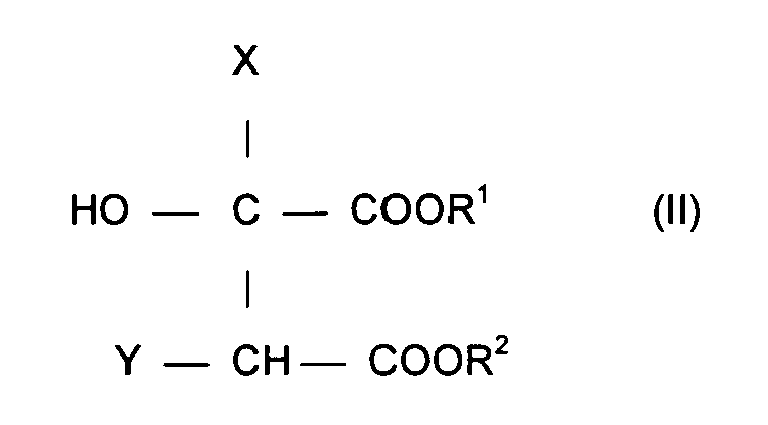
- Ester der Sulfobernsteinsäure oder der Sulfosuccinate der allgemeinen Formel (III),

- Sulfobernsteinsäuremono- und -dialkylester mit 8 bis 24 C-Atomen in der Alkylgruppe und Sulfobernsteinsäuremonoalkylpolyoxyethylester mit 8 bis 24 C-Atomen in der Alkylgruppe und 1 bis 6 Oxyethylgruppen,
- Alkylsulfate und Alkylpolyglycolethersulfate der Formel R-(O-CH2-CH2)x-OSO3H, in der R eine bevorzugt lineare Alkylgruppe mit 8 bis 30 C-Atomen und x = 0 oder 1 - 12 ist,
- gemischte oberflächenaktive Hydroxysulfonate gemäß
DE-A-37 25 030 , - Ester der Weinsäure und Zitronensäure mit Alkoholen, die Anlagerungsprodukte von etwa 2-15 Molekülen Ethylenoxid und/oder Propylenoxid an C8-22-Fettalkohole darstellen,
- Alkyl- und/oder Alkenyletherphosphate,
- sulfatierte Fettsäurealkylenglycolester,
- Monoglyceridsulfate und Monoglyceridethersulfate.
- Bevorzugte anionische Tenside und Emulgatoren sind Acylglutamate, Acylisethionate, Acylsarcosinate und Acyltaurate, jeweils mit einem linearen oder verzweigten Acylrest mit 6 bis 22 Kohlenstoffatomen und 0, 1, 2 oder 3 Doppelbindungen, der in besonders bevorzugten Ausführungsformen aus einem Octanoyl-, Decanoyl-, Lauroyl-, Myristoyl-, Palmitoyl- und Stearoylrest ausgewählt ist, Ester der Weinsäure, Zitronensäure oder Bernsteinsäure bzw. der Salze dieser Säuren mit alkylierter Glucose, insbesondere die Produkte mit der INCl-Bezeichnung Disodium Coco-Glucoside Citrate, Sodium Coco-Glucoside Tartrate und Disodium Coco-Glucoside Sulfosuccinate, Alkylpolyglycolethersulfate und Ethercarbonsäuren mit 8 bis 18 C-Atomen in der Alkylgruppe und bis zu 12 Ethoxygruppen im Molekül, Sulfobernsteinsäuremono- und -dialkylester mit 8 bis 18 C-Atomen in der Alkylgruppe und Sulfobernsteinsäuremonoalkylpolyoxyethylester mit 8 bis 18 C-Atomen in der Alkylgruppe und 1 bis 6 Ethoxygruppen.
- Als zwitterionische Tenside und Emulgatoren werden solche oberflächenaktiven Verbindungen bezeichnet, die im Molekül mindestens eine quartäre Ammoniumgruppe und mindestens eine -COO(-) - oder -SO3 (-) -Gruppe tragen. Besonders geeignete zwitterionische Tenside und Emulgatoren sind die sogenannten Betaine wie die N-Alkyl-N,N-dimethylammoniumglycinate, beispielsweise das Kokosalkyldimethylammoniumglycinat, N-Acyl-aminopropyl-N,N-dimethylammoniumglycinate, beispielsweise das Kokosacylaminopropyldimethylammoniumglycinat, und 2-Alkyl-3-carboxymethyl-3-hydroxyethylimidazoline mit jeweils 8 bis 18 C-Atomen in der Alkyl- oder Acylgruppe sowie das Kokosacylaminoethylhydroxyethylcarboxymethylglycinat. Ein bevorzugtes zwitterionisches Tensid ist das unter der INCl-Bezeichnung Cocamidopropyl Betaine bekannte Fettsäureamidderivat.
- Unter ampholytischen Tensiden und Emulgatoren werden solche oberflächenaktiven Verbindungen verstanden, die außer einer C8 - C24- Alkyl- oder -Acylgruppe mindestens eine freie Aminogruppe und mindestens eine -COOH- oder -SO3H-Gruppe enthalten und zur Ausbildung innerer Salze befähigt sind. Beispiele für geeignete ampholytische Tenside sind N-Alkylglycine, N-Alkylaminopropionsäuren, N-Alkylaminobuttersäuren, N-Alkyliminodipropionsäuren, N-Hydroxyethyl-N-alkylamidopropylglycine, N-Alkyltaurine, N-Alkylsarcosine, 2-Alkylaminopropionsäuren und Alkylaminoessigsäuren mit jeweils etwa 8 bis 24 C-Atomen in der Alkylgruppe. Besonders bevorzugte ampholytische Tenside sind das N-Kokosalkylaminopropionat, das Kokosacylaminoethylaminopropionat und das C12- C18 - Acylsarcosin.
- Nichtionische Tenside und Emulgatoren enthalten als hydrophile Gruppe z. B. eine Polyolgruppe, eine Polyalkylenglycolethergruppe oder eine Kombination aus Polyol- und Polyglycolethergruppe. Solche Verbindungen sind beispielsweise
- Anlagerungsprodukte von 2 bis 50 Mol Ethylenoxid und/oder 0 bis 5 Mol Propylenoxid an lineare und verzweigte Fettalkohole mit 8 bis 30 C-Atomen, an Fettsäuren mit 8 bis 30 C-Atomen und an Alkylphenole mit 8 bis 15 C-Atomen in der Alkylgruppe,
- C12-C30-Fettsäuremono- und -diester von Anlagerungsprodukten von 1 bis 30 Mol Ethylenoxid an Polyole mit 3 bis 6 Kohlenstoffatomen, insbesondere an Glycerin,
- Anlagerungsprodukte von 5 bis 60 Mol Ethylenoxid an Rizinusöl und gehärtetes Rizinusöl,
- Polyolfettsäure(partial)ester, wie Hydagen® HSP (Cognis) oder Sovermol® - Typen (Cognis), insbesondere von gesättigten C8-30-Fettsäuren,
- alkoxylierte Triglyceride,
- alkoxylierte Fettsäurealkylester,
- Aminoxide,
- Fettsäurealkanolamide, Fettsäure-N-alkylglucamide und Fettamine sowie deren Ethylenoxid- oder Polyglycerin-Anlagerungsprodukte,
- Sorbitanfettsäureester und Anlagerungsprodukte von Ethylenoxid an Sorbitanfettsäureester wie beispielsweise die Polysorbate,
- Zuckerfettsäureester und Methylglucosid-Fettsäureester sowie deren Ethylenoxid- oder Polyglycerin-Anlagerungsprodukte,
- Alkylpolyglycoside entsprechend der allgemeinen Formel RO-(Z)x wobei R für Alkyl, Z für Zucker sowie x für die Anzahl der Zuckereinheiten steht. Besonders bevorzugt sind solche Alkylpolyglycoside, bei denen R
- im wesentlichen aus C8- und C10-Alkylgruppen,
- im wesentlichen aus C12- und C14-Alkylgruppen,
- im wesentlichen aus C8- bis C16-Alkylgruppen oder
- im wesentlichen aus C12- bis C16-Alkylgruppen oder
- im wesentlichen aus C16 bis C18-Alkylgruppen
- Als Zuckerbaustein Z können beliebige Mono- oder Oligosaccharide eingesetzt werden. Üblicherweise werden Zucker mit 5 bzw. 6 Kohlenstoffatomen sowie die entsprechenden Oligosaccharide eingesetzt. Solche Zucker sind beispielsweise Glucose, Fructose, Galactose, Arabinose, Ribose, Xylose, Lyxose, Allose, Altrose, Mannose, Gulose, Idose, Talose und Sucrose. Bevorzugte Zuckerbausteine sind Glucose, Fructose, Galactose, Arabinose und Sucrose; Glucose ist besonders bevorzugt.
Die erfindungsgemäß verwendbaren Alkylpolyglycoside enthalten im Schnitt 1,1 bis 5 Zuckereinheiten. Alkylpolyglycoside mit x-Werten von 1,1 bis 2,0 sind bevorzugt. Ganz besonders bevorzugt sind Alkylglycoside, bei denen x 1,1 bis 1,8 beträgt. - Gemische aus Alkyl-(oligo)-glucosiden und Fettalkoholen, z. B. Montanov®68,
- Sterine, z. B. Ergosterin, Stigmasterin, Sitosterin und Mykosterine,
- Phospholipide, z. B. Lecithine bzw. Phosphatidylcholine,
- Polyglycerine und Polyglycerinderivate wie beispielsweise Polyglycerinpoly-12-hydroxystearat (Dehymuls® PGPH) oder Triglycerindiisostearat (Lameform® TGI),
- alkoxylierte Polydialkylsiloxane (INCl-Bezeichnung: Dimethicone Copolyol).
- Als bevorzugte nichtionische oberflächenaktive Substanzen haben sich die Alkylpolyglycoside, gegebenenfalls im Gemisch mit Fettalkoholen, alkoxylierte Polydialkylsiloxane, Alkylenoxid-Anlagerungsprodukte an gesättigte lineare Fettalkohole und Fettsäuren mit jeweils 2 bis 30 Mol Ethylenoxid pro Mol Fettalkohol bzw. Fettsäure erwiesen.
- Erfindungsgemäß einsetzbar sind weiterhin kationische Tenside vom Typ der quartären Ammoniumverbindungen, der Esterquats und der Amidoamine. Bevorzugte quaternäre Ammoniumverbindungen sind Ammoniumhalogenide, insbesondere Chloride und Bromide, wie Alkyltrimethylammoniumchloride, Dialkyldimethylammoniumchloride und Trialkylmethylammoniumchloride. Die langen Alkylketten dieser Tenside weisen bevorzugt 10 bis 18 Kohlenstoffatome auf, wie z. B. in Cetyltrimethylammoniumchlorid, Stearyltrimethylammoniumchlorid, Distearyldimethylammoniumchlorid, Lauryldimethylammoniumchlorid, Lauryldimethylbenzylammoniumchlorid und Tricetylmethylammoniumchlorid. Weitere bevorzugte kationische Tenside sind die unter den INCl-Bezeichnungen Quaternium-27 und Quaternium-83 bekannten Imidazolium-Verbindungen.
- Ganz besonders bevorzugt sind erfindungsgemäße Mittel, die zusätzlich Fettalkohol(e) und/oder Fettalkoholalkoxylat(e), vorzugsweise C12-22-Fettalkohol(e) und/oder C12-22-Fettalkoholethoxylat(e) mit 10 bis 30 EO-Einheiten, besonders bevorzugt C16-18-Fettalkohol(e) und/oder C16-18-Fettalkoholethoxylat(e) mit 12 bis 20 EO-Einheiten, vorzugsweise in Mengen von 5 bis 20 Gew.-%, bevorzugt von 7,5 bis 17,5 Gew.-% und insbesondere von 10 bis 15 Gew.-%, jeweils bezogen auf das Gewicht des Mittels, enthalten.
- Zusammenfassend sind erfindungsgemäße Haarbehandlungsmittel bevorzugt, die - bezogen auf ihr Gewicht - 0,1 bis 20 Gew.-%, vorzugsweise 0,25 bis 17,5 Gew.-% und insbesondere 5 bis 15 Gew.-% anionische(s) Tensid(e), besonders bevorzugt Fettalkoholethersulfate der Formel
H3C-(CH2)n-(OCH2CH2)k-OSO3 - M+
enthalten, in der n für Werte von 5 bis 21, vorzugsweise von 7 bis 19, besonders bevorzugt von 9 bis 17 und insbesondere von 11 bis 13 und k für Werte von 1, 2, 3, 4, 5, 6, 7, 8, 9 oder 10, vorzugsweise für 1, 2 oder 3 und insbesondere für 2 stehen, und M für ein Kation aus der Gruppe Na+, K+ NH4 +, ½ Mg2+, ½ Zn2+, vorzugsweise für Na+, stehen. - Bevorzugte erfindungsgemäße Haarbehandlungsmittel sind weiter dadurch gekennzeichnet, daß sie zusätzlich amphotere(s) Tensid(e), vorzugsweise aus den Gruppen der
- N-Alkylglycine,
- N-Alkylpropionsäuren,
- N-Alkylaminobuttersäuren,
- N-Alkyliminodipropionsäuren,
- N-Hydroxyethyl-N-alkylamidopropylglycine,
- N-Alkyltaurine,
- N-Alkylsarcosine,
- 2-Alkylaminopropionsäuren mit jeweils etwa 8 bis 24 C-Atomen in der Alkylgruppe,
- Alkylaminoessigsäuren mit jeweils etwa 8 bis 24 C-Atomen in der Alkylgruppe,
- N-Kokosalkylaminopropionat,
- Kokosacylaminoethylaminopropionat
- C12-C18 - Acylsarcosin,
- N-Alkyl-N,N-dimethylammonium-glycinate, beispielsweise Kokosalkyl-dimethylammoniumglycinat,
- N-Acyl-aminopropyl-N,N-dimethylammoniumglycinate, beispielsweise Kokosacylaminopropyl-dimethylammoniumglycinat,
- 2-Alkyl-3-carboxymethyl-3-hydroxyethyl-imidazoline mit jeweils 8 bis 18 C-Atomen in der Alkyl- oder Acylgruppe
- Kokosacylaminoethylhydroxyethylcarboxymethylglycinat
- der unter der INCl-Bezeichnung Cocamidopropyl Betain bekannten Verbindungen,
- der unter der INCl-Bezeichnung Disodium Cocoamphodiacetate bekannten Verbindungen,
- Als weiteren optionalen Bestandteil können die erfindungsgemäßen Mittel 0,01 bis 10 Gew.-% mindestens eines Polymers aus der Gruppe der kationischen und/oder amphoteren Polymere enthalten.
- Unter kationischen bzw. amphoteren Polymeren sind Polymere zu verstehen, welche in der Haupt-und/oder Seitenkette eine Gruppe aufweisen, welche "temporär" oder "permanent" kationisch sein kann. Als "permanent kationisch" werden erfindungsgemäß solche Polymere bezeichnet, die unabhängig vom pH-Wert des Mittels eine kationische Gruppe aufweisen. Dies sind in der Regel Polymere, die ein quartäres Stickstoffatom, beispielsweise in Form einer Ammoniumgruppe, enthalten. Bevorzugte kationische Gruppen sind quartäre Ammoniumgruppen. Insbesondere solche Polymere, bei denen die quartäre Ammoniumgruppe über eine C1-4-Kohlenwasserstoffgruppe an eine aus Acrylsäure, Methacrylsäure oder deren Derivaten aufgebaute Polymerhauptkette gebunden sind, haben sich als besonders geeignet erwiesen.
- Zusätzlich zu kationischen Polymerisaten oder an ihrer Stelle können die erfindungsgemäßen Mittel auch amphotere Polymere enthalten. Diese weisen zusätzlich mindestens eine negativ geladene Gruppe im Molekül auf und werden auch als zwitterionische Polymere bezeichnet.
- Vorzugsweise wird das Polymer bzw. werden die Polymere innerhalb engerer Mengenbereiche eingesetzt. So sind erfindungsgemäße Mittel bevorzugt, die - bezogen auf ihr Gewicht - 0,05 bis 7,5 Gew.-%, vorzugsweise 0,1 bis 5 Gew.-%, besonders bevorzugt 0,2 bis 3,5 Gew.-% und insbesondere 0,25 bis 2,5 Gew.-% amphotere(s) Polymer(e), enthalten.
- Unabhängig davon, ob in den Mitteln amphotere Polymere enthalten sind oder nicht, sind weiter bevorzugte erfindungsgemäße Mittel dadurch gekennzeichnet, daß sie - bezogen auf ihr Gewicht-0,05 bis 7,5 Gew.-%, vorzugsweise 0,1 bis 5 Gew.-%, besonders bevorzugt 0,2 bis 3,5 Gew.-% und insbesondere 0,25 bis 2,5 Gew.-% kationische(s) Polymer(e), enthalten.
- Homopolymere der allgemeinen Formel (G1-I),

- R1 steht für eine Methylgruppe
- R2, R3 und R4 stehen für Methylgruppen
- m hat den Wert 2.
- Als physiologisch verträgliches Gegenionen X- kommen beispielsweise Halogenidionen, Sulfationen, Phosphationen, Methosulfationen sowie organische Ionen wie Lactat-, Citrat-, Tartrat- und Acetationen in Betracht. Bevorzugt sind Halogenidionen, insbesondere Chlorid.
- Ein besonders geeignetes Homopolymer ist das, gewünschtenfalls vernetzte, Poly(methacryloyloxyethyltrimethylammoniumchlorid) mit der INCl-Bezeichnung Polyquaternium-37. Solche Produkte sind beispielsweise unter den Bezeichnungen Rheocare® CTH (Cosmetic Rheologies) und Synthalen® CR (Ethnichem) im Handel erhältlich. Die Vernetzung kann gewünschtenfalls mit Hilfe mehrfach olefinisch ungesättigter Verbindungen, beispielsweise Divinylbenzol, Tetraallyloxyethan, Methylenbisacrylamid, Diallylether, Polyallylpolyglycerylether, oder Allylethern von Zuckern oder Zuckerderivaten wie Erythritol, Pentaerythritol, Arabitol, Mannitol, Sorbitol, Sucrose oder Glucose erfolgen. Methylenbisacrylamid ist ein bevorzugtes Vernetzungsagens.
- Das Homopolymer wird bevorzugt in Form einer nichtwäßrigen Polymerdispersion, die einen Polymeranteil nicht unter 30 Gew.-% aufweisen sollte, eingesetzt. Solche Polymerdispersionen sind unter den Bezeichnungen Salcare® SC 95 (ca. 50 % Polymeranteil, weitere Komponenten: Mineralöl (INCl-Bezeichnung: Mineral Oil) und Tridecyl-polyoxypropylen-polyoxyethylen-ether (INCl-Bezeichnung: PPG-1-Trideceth-6)) und Salcare® SC 96 (ca. 50 % Polymeranteil, weitere Komponenten: Mischung von Diestern des Propylenglykols mit einer Mischung aus Capryl- und Caprinsäure (INCl-Bezeichnung: Propylene Glycol Dicaprylate/Dicaprate) und Tridecyl-polyoxypropylen-polyoxyethylen-ether (INCl-Bezeichnung: PPG-1-Trideceth-6)) im Handel erhältlich.
- Copolymere mit Monomereinheiten gemäß Formel (G1-I) enthalten als nichtionogene Monomereinheiten bevorzugt Acrylamid, Methacrylamid, Acrylsäure-C1-4-alkylester und Methacrylsäure-C1-4-alkylester. Unter diesen nichtionogenen Monomeren ist das Acrylamid besonders bevorzugt. Auch diese Copolymere können, wie im Falle der Homopolymere oben beschrieben, vernetzt sein. Ein erfindungsgemäß bevorzugtes Copolymer ist das vernetzte Acrylamid-Methacryloyloxyethyltrimethylammoniumchlorid-Copolymer. Solche Copolymere, bei denen die Monomere in einem Gewichtsverhältnis von etwa 20:80 vorliegen, sind im Handel als ca. 50 %ige nichtwäßrige Polymerdispersion unter der Bezeichnung Salcare® SC 92 erhältlich.
- Weitere bevorzugte kationische Polymere sind beispielsweise
- quaternisierte Cellulose-Derivate, wie sie unter den Bezeichnungen Celquat® und Polymer JR® im Handel erhältlich sind. Die Verbindungen Celquat® H 100, Celquat® L 200 und Polymer JR®400 sind bevorzugte quaternierte Cellulose-Derivate,
- kationische Alkylpolyglycoside gemäß der
DE-PS 44 13 686 - kationisierter Honig, beispielsweise das Handelsprodukt Honeyquat® 50,
- kationische Guar-Derivate, wie insbesondere die unter den Handelsnamen Cosmedia®Guar und Jaguar® vertriebenen Produkte,
- polymere Dimethyldiallylammoniumsalze und deren Copolymere mit Estern und Amiden von Acrylsäure und Methacrylsäure. Die unter den Bezeichnungen Merquat®100 (Poly(dimethyldiallylammoniumchlorid)) und Merquat®550 (Dimethyldiallylammoniumchlorid-Acrylamid-Copolymer) im Handel erhältlichen Produkte sind Beispiele für solche kationischen Polymere,
- Copolymere des Vinylpyrrolidons mit quaternierten Derivaten des Dialkylaminoalkylacrylats und - methacrylats, wie beispielsweise mit Diethylsulfat quaternierte Vinylpyrrolidon-Dimethylaminoethylmethacrylat-Copolymere. Solche Verbindungen sind unter den Bezeichnungen Gafquat®734 und Gafquat®755 im Handel erhältlich,
- Vinylpyrrolidon-Vinylimidazoliummethochlorid-Copolymere, wie sie unter den Bezeichnungen Luviquat® FC 370, FC 550, FC 905 und HM 552 angeboten werden,
- quaternierter Polyvinylalkohol,
- sowie die unter den Bezeichnungen Polyquaternium 2, Polyquaternium 17, Polyquaternium 18 und Polyquaternium 27 bekannten Polymeren mit quartären Stickstoffatomen in der Polymerhauptkette.
- Gleichfalls als kationische Polymere eingesetzt werden können die unter den Bezeichnungen Polyquaternium-24 (Handelsprodukt z. B. Quatrisoft® LM 200), bekannten Polymere. Ebenfalls erfindungsgemäß verwendbar sind die Copolymere des Vinylpyrrolidons, wie sie als Handelsprodukte Copolymer 845 (Hersteller: ISP), Gaffix® VC 713 (Hersteller: ISP), Gafquat®ASCP 1011, Gafquat®HS 110, Luviquat®8155 und Luviquat® MS 370 erhältlich sind.
- Als kationische Polymere können auch kationische Proteinhydrolysate eingesetzt werden, wobei bevorzugte Mittel ein oder mehrere kationische Proteinhydrolysate aus der Gruppe Cocodimonium Hydroxypropyl Hydrolyzed Collagen, Cocodimonium Hydroxypropyl Hydrolyzed Casein, Cocodimonium Hydroxypropyl Hydrolyzed Collagen, Cocodimonium Hydroxypropyl Hydrolyzed Hair Keratin, Cocodimonium Hydroxypropyl Hydrolyzed Keratin, Cocodimonium Hydroxypropyl Hydrolyzed Rice Protein, Cocodimonium Hydroxypropyl Hydrolyzed Soy Protein, Cocodimonium Hydroxypropyl Hydrolyzed Wheat Protein, Hydroxypropyl Arginine Lauryl/Myristyl Ether HCl, Hydroxypropyltrimonium Gelatin, Hydroxypropyltrimonium Hydrolyzed Casein, Hydroxypropyltrimonium Hydrolyzed Collagen, Hydroxypropyltrimonium Hydrolyzed Conchiolin Protein, Hydroxypropyltrimonium Hydrolyzed Keratin, Hydroxypropyltrimonium Hydrolyzed Rice Bran Protein, Hydroxypropyltrimonium Hydrolyzed Soy Protein, Hydroxypropyl Hydrolyzed Vegetable Protein, Hydroxypropyltrimonium Hydrolyzed Wheat Protein, Hydroxypropyltrimonium Hydrolyzed Wheat Protein/Siloxysilicate, Laurdimonium Hydroxypropyl Hydrolyzed Soy Protein, Laurdimonium Hydroxypropyl Hydrolyzed Wheat Protein, Laurdimonium Hydroxypropyl Hydrolyzed Wheat Protein/Siloxysilicate, Lauryldimonium Hydroxypropyl Hydrolyzed Casein, Lauryldimonium Hydroxypropyl Hydrolyzed Collagen, Lauryldimonium Hydroxypropyl Hydrolyzed Keratin, Lauryldimonium Hydroxypropyl Hydrolyzed Soy Protein, Steardimonium Hydroxypropyl Hydrolyzed Casein, Steardimonium Hydroxypropyl Hydrolyzed Collagen, Steardimonium Hydroxypropyl Hydrolyzed Keratin, Steardimonium Hydroxypropyl Hydrolyzed Rice Protein, Steardimonium Hydroxypropyl Hydrolyzed Soy Protein, Steardimonium Hydroxypropyl Hydrolyzed Vegetable Protein, Steardimonium Hydroxypropyl Hydrolyzed Wheat Protein, Steartrimonium Hydroxyethyl Hydrolyzed Collagen, Quaternium-76 Hydrolyzed Collagen, Quaternium-79 Hydrolyzed Collagen, Quaternium-79 Hydrolyzed Keratin, Quaternium-79 Hydrolyzed Milk Protein, Quaternium-79 Hydrolyzed Soy Protein, Quaternium-79 Hydrolyzed Wheat Protein enthalten.
- Zusammenfassend sind erfindungsgemäße Haarbehandlungsmittel bevorzugt, die - bezogen auf ihr Gewicht - 0,05 bis 7,5 Gew.-%, vorzugsweise 0,1 bis 5 Gew.-%, besonders bevorzugt 0,2 bis 3,5 Gew.-% und insbesondere 0,25 bis 2,5 Gew.-% kationische(s) Polymer(e), enthalten, wobei bevorzugte kationische(s) Polymer(e) ausgewählt ist/sind aus
- a. Poly(methacryloyloxyethyltrimethylammoniumchlorid) (INCl: Polyquaternium-37) und/oder;
- b. quaternisierten Cellulose-Derivaten (INCl: Polyquaternium 10) und/oder
- c. kationischen Alkylpolyglycosiden und/oder
- d. kationisertem Honig und/oder
- e. kationischen Guar-Derivaten und/oder
- f. polymeren Dimethyldiallylammoniumsalzen und deren Copolymeren mit Estern und Amiden von Acrylsäure und Methacrylsäure und/oder
- g. Copolymeren des Vinylpyrrolidons mit quaternierten Derivaten des Dialkylaminoalkylacrylats und -methacrylats und/oder
- h. Vinylpyrrolidon-Vinylimidazoliummethochlorid-Copolymeren und/oder
- i. quaterniertem Polyvinylalkohol und/oder
- j. Polyquaternium 2 und/oder
- k. Polyquaternium-7 und/oder
- l. Polyquaternium 17 und/oder
- m. Polyquaternium 18 und/oder
- n. Polyquaternium 24 und/oder
- o. Polyquaternium 27.
- Zusätzlich zu den kationischen Polymeren oder an ihrer Stelle können die erfindungsgemäßen Mittel amphotere Polymere enthalten. Im Rahmen der vorliegenden Erfindung bevorzugt einsetzbare amphotere Polymerisate setzen sich im wesentlichen zusammen aus
- A) Monomeren mit quartären Ammoniumgruppen der allgemeinen Formel (Z-I),
R1-CH=CR2-CO-Z-(CnH2n)-N(+)R3R4R5 A(-) (Z-I)
In der R1 und R2 unabhängig voneinander stehen für Wasserstoff oder eine Methylgruppe und R3, R4 und R5 unabhängig voneinander für Alkylgruppen mit 1 bis 4 Kohlenstoff-Atomen, Z eine NH-Gruppe oder ein Sauerstoffatom, n eine ganze Zahl von 2 bis 5 und A(-) das Anion einer organischen oder anorganischen Säure ist
und - B) monomeren Carbonsäuren der allgemeinen Formel (Z-II),
R6-CH=CR7-COOH (Z-II)
in denen R6 und R7 unabhängig voneinander Wasserstoff oder Methylgruppen sind. - Geeignete Ausgangsmonomere sind z. B. Dimethylaminoethylacrylamid, Dimethylaminoethylmethacrylamid, Dimethylaminopropylacrylamid, Dimethylaminopropylmethacrylamid und Diethylaminoethylacrylamid, wenn Z eine NH-Gruppe bedeutet oder Dimethylaminoethylacrylat, Dimethylaminoethylmethacrylat und Diethylaminoethylacrylat, wenn Z ein Sauerstoffatom ist.
- Die eine tertiäre Aminogruppe enthaltenden Monomeren werden dann in bekannter Weise quarterniert, wobei als Alkylierungsreagenzien Methylchlorid, Dimethylsulfat oder Diethylsulfat besonders geeignet sind. Die Quaternisierungsreaktion kann in wäßriger Lösung oder im Lösungsmittel erfolgen.
- Vorteilhafterweise werden solche Monomere der Formel (Z-I), die Derivate des Acrylamids oder Methacrylamids darstellen. Weiterhin bevorzugt sind solche Monomeren, die als Gegenionen Halogenid-, Methoxysulfat- oder Ethoxysulfat-Ionen enthalten. Ebenfalls bevorzugt sind solche Monomeren der Formel (Z-I), bei denen R3, R4 und R5 Methylgruppen sind.
- Das Acrylamidopropyl-trimethylammoniumchlorid ist ein ganz besonders bevorzugtes Monomer der Formel (Z-I).
- Als monomere Carbonsäuren der Formel (Z-II) eignen sich Acrylsäure, Methacrylsäure, Crotonsäure und 2-Methyl-crotonsäure. Bevorzugt werden Acryl- oder Methacrylsäure, insbesondere Acrylsäure, eingesetzt.
- Die erfindungsgemäß einsetzbaren zwitterionischen Polymerisate werden aus Monomeren der Formeln (Z-I) und (Z-II) nach an sich bekannten Polymerisationsverfahren hergestellt. Die Polymerisation kann entweder in wäßriger oder wäßrig-alkoholischer Lösung erfolgen. Als Alkohole werden Alkohole mit 1 bis 4 Kohlenstoffatomen, vorzugsweise Isopropanol, verwendet, die gleichzeitig als Polymerisationsregler dienen. Der Monomerlösung können aber auch andere Komponenten als Regler zugesetzt werden, z. B. Ameisensäure oder Mercaptane, wie Thioethanol und Thioglykolsäure. Die Initiierung der Polymerisation erfolgt mit Hilfe von radikalbildenden Substanzen. Hierzu können Redoxsysteme und/oder thermisch zerfallende Radikalbildner vom Typ der Azoverbindungen, wie z. B. Azoisobuttersäurenitril, Azo-bis-(cyanopentansäure) oder Azo-bis-(amidinopropan)dihydrochlorid verwendet werden. Als Redoxsysteme eignen sich z. B. Kombinationen aus Wasserstoffperoxid, Kalium- oder Ammoniumperoxodisulfat sowie tertiäres Butylhydroperoxid mit Natriumsulfit, Natriumdithionit oder Hydroxylaminhydrochlorid als Reduktionskomponente.
- Die Polymerisation kann isotherm oder unter adiabatischen Bedingungen durchgeführt werden, wobei in Abhängigkeit von den Konzentrationsverhältnissen durch die freiwerdende Polymerisationswärme der Temperaturbereich für den Ablauf der Reaktion zwischen 20 und 200 °C schwanken kann, und die Reaktion gegebenenfalls unter dem sich einstellenden Überdruck durchgeführt werden muß. Bevorzugterweise liegt die Reaktionstemperatur zwischen 20 und 100 °C.
- Der pH-Wert während der Copolymerisation kann in einem weiten Bereich schwanken. Vorteilhafterweise wird bei niedrigen pH-Werten polymerisiert; möglich sind jedoch auch pH-Werte oberhalb des Neutralpunktes. Nach der Polymerisation wird mit einer wäßrigen Base, z. B. Natronlauge, Kalilauge oder Ammoniak, auf einen pH-Wert zwischen 5 und 10, vorzugsweise 6 bis 8, eingestellt. Nähere Angaben zum Polymerisationsverfahren können den Beispielen entnommen werden.
- Als besonders wirksam haben sich solche Polymerisate erwiesen, bei denen die Monomeren der Formel (Z-I) gegenüber den Monomeren der Formel (Z-II) im Überschuß vorlagen. Es ist daher erfindungsgemäß bevorzugt, solche Polymerisate zu verwenden, die aus Monomeren der Formel (Z-I) und die Monomeren der Formel (Z-II) in einem Molverhältnis von 60:40 bis 95:5, insbesondere von 75:25 bis 95:5, bestehen.
- Erfindungsgemäß bevorzugte Mittel sind dadurch gekennzeichnet, daß das/die amphotere(n) Polymer(e) Monomere A) und B) umfassen, wobei A) und B) ausgewählt sind aus
- A) Monomeren mit quartären Ammoniumgruppen der allgemeinen Formel (Z-I),
R1-CH=CR2-CO-Z-(CnH2n)-N(+)R3R4R5 A(-) (Z-I)
in der R1 und R2 unabhängig voneinander stehen für Wasserstoff oder eine Methylgruppe und R3, R4 und R5 unabhängig voneinander für Alkylgruppen mit 1 bis 4 Kohlenstoff-Atomen, Z eine NH-Gruppe oder ein Sauerstoffatom, n eine ganze Zahl von 2 bis 5 und A(-) das Anion einer organischen oder anorganischen Säure ist
und - B) monomeren Carbonsäuren der allgemeinen Formel (Z-II),
R6-CH=CR7-COOH (Z-II)
in der R6 und R7 unabhängig voneinander Wasserstoff oder Methylgruppen sind. - Mit besonderem Vorzug enthalten die in den erfindungsgemäßen Mitteln eingesetzten amphoteren Polymere Monomere aus der Gruppe der Acrylamide und/oder Methacrylamide mit Alkylammoniumgruppen. Als zusätzlich in den Polymeren enthaltene Monomere mit anionischen Gruppen haben sich Acrylsäure und/oder Methacrylsäure und/oder Crotonsäure und/oder 2-Methyl-crotonsäure bewährt.
- Zusammenfassend sind erfindungsgemäße Mittel bevorzugt, bei denen das/die amphotere(n) Polymer(e) Co-Polymerisate mindestens eines der Monomere
- Trimethylammoniumethylacrylamid und/oder,
- Trimethylammoniumethylmethacrylamid und/oder
- Trimethylammoniumpropylacrylamid und/oder
- Trimethylammoniumpropylmethacrylamid und/oder
- Trimethylammoniumethylacrylamid und/oder
- Trimethylammoniumethylacrylat und/oder
- Trimethylammoniumethylmethacrylat und/oder
- Trimethylammoniumethylacrylat und/oder
- Ethyldimethylammoniumethylacrylamid und/oder,
- Ethyldimethylammoniumethylmethacrylamid und/oder
- Ethyldimethylammoniumpropylacrylamid und/oder
- Ethyldimethylammoniumpropylmethacrylamid und/oder
- Ethyldimethylammoniumethylacrylamid und/oder
- Ethyldimethylammoniumethylacrylat und/oder
- Ethyldimethylammoniumethylmethacrylat und/oder
- Ethyldimethylammoniumethylacrylat
mit mindetsnes einem der Monomere - Acrylsäure und/oder
- Methacrylsäure und/oder
- Crotonsäure und/oder
- 2-Methyl-crotonsäure
sind. - Erfindungsgemäß besonders bevorzugte amphotere Polymere sind:
- Copolymere von Trimethylammoniumethylacrylamid mit Acrylsäure
- Copolymere von Trimethylammoniumethylacrylamid mit Methacrylsäure
- Copolymere von Trimethylammoniumethylacrylamid mit Crotonsäure
- Copolymere von Trimethylammoniumethylacrylamid mit 2-Methyl-crotonsäure
- Copolymere von Trimethylammoniumethylmethacrylamid mit Acrylsäure
- Copolymere von Trimethylammoniumethylmethacrylamid mit Methacrylsäure
- Copolymere von Trimethylammoniumethylmethacrylamid mit Crotonsäure
- Copolymere von Trimethylammoniumethylmethacrylamid mit 2-Methyl-crotonsäure
- Copolymere von Trimethylammoniumpropylacrylamid mit Acrylsäure
- Copolymere von Trimethylammoniumpropylacrylamid mit Methacrylsäure
- Copolymere von Trimethylammoniumpropylacrylamid mit Crotonsäure
- Copolymere von Trimethylammoniumpropylacrylamid mit 2-Methyl-crotonsäure
- Copolymere von Trimethylammoniumpropylmethacrylamid mit Acrylsäure
- Copolymere von Trimethylammoniumpropylmethacrylamid mit Methacrylsäure
- Copolymere von Trimethylammoniumpropylmethacrylamid mit Crotonsäure
- Copolymere von Trimethylammoniumpropylmethacrylamid mit 2-Methyl-crotonsäure
- Copolymere von Trimethylammoniumethylacrylamid mit Acrylsäure
- Copolymere von Trimethylammoniumethylacrylamid mit Methacrylsäure
- Copolymere von Trimethylammoniumethylacrylamid mit Crotonsäure
- Copolymere von Trimethylammoniumethylacrylamid mit 2-Methyl-crotonsäure
- Copolymere von Trimethylammoniumethylacrylat mit Acrylsäure
- Copolymere von Trimethylammoniumethylacrylat mit Methacrylsäure
- Copolymere von Trimethylammoniumethylacrylat mit Crotonsäure
- Copolymere von Trimethylammoniumethylacrylat mit 2-Methyl-crotonsäure
- Copolymere von Trimethylammoniumethylmethacrylat mit Acrylsäure
- Copolymere von Trimethylammoniumethylmethacrylat mit Methacrylsäure
- Copolymere von Trimethylammoniumethylmethacrylat mit Crotonsäure
- Copolymere von Trimethylammoniumethylmethacrylat mit 2-Methyl-crotonsäure
- Copolymere von Trimethylammoniumethylacrylat mit Acrylsäure
- Copolymere von Trimethylammoniumethylacrylat mit Methacrylsäure
- Copolymere von Trimethylammoniumethylacrylat mit Crotonsäure
- Copolymere von Trimethylammoniumethylacrylat mit 2-Methyl-crotonsäure
- Copolymere von Ethyldimethylammoniumethylacrylamid mit Acrylsäure
- Copolymere von Ethyldimethylammoniumethylacrylamid mit Methacrylsäure
- Copolymere von Ethyldimethylammoniumethylacrylamid mit Crotonsäure
- Copolymere von Ethyldimethylammoniumethylacrylamid mit 2-Methyl-crotonsäure
- Copolymere von Ethyldimethylammoniumethylmethacrylamid mit Acrylsäure
- Copolymere von Ethyldimethylammoniumethylmethacrylamid mit Methacrylsäure
- Copolymere von Ethyldimethylammoniumethylmethacrylamid mit Crotonsäure
- Copolymere von Ethyldimethylammoniumethylmethacrylamid mit 2-Methyl-crotonsäure
- Copolymere von Ethyldimethylammoniumpropylacrylamid mit Acrylsäure
- Copolymere von Ethyldimethylammoniumpropylacrylamid mit Methacrylsäure
- Copolymere von Ethyldimethylammoniumpropylacrylamid mit Crotonsäure
- Copolymere von Ethyldimethylammoniumpropylacrylamid mit 2-Methyl-crotonsäure
- Copolymere von Ethyldimethylammoniumpropylmethacrylamid mit Acrylsäure
- Copolymere von Ethyldimethylammoniumpropylmethacrylamid mit Methacrylsäure
- Copolymere von Ethyldimethylammoniumpropylmethacrylamid mit Crotonsäure
- Copolymere von Ethyldimethylammoniumpropylmethacrylamid mit 2-Methyl-crotonsäure
- Copolymere von Ethyldimethylammoniumethylacrylamid mit Acrylsäure
- Copolymere von Ethyldimethylammoniumethylacrylamid mit Methacrylsäure
- Copolymere von Ethyldimethylammoniumethylacrylamid mit Crotonsäure
- Copolymere von Ethyldimethylammoniumethylacrylamid mit 2-Methyl-crotonsäure
- Copolymere von Ethyldimethylammoniumethylacrylat mit Acrylsäure
- Copolymere von Ethyldimethylammoniumethylacrylat mit Methacrylsäure
- Copolymere von Ethyldimethylammoniumethylacrylat mit Crotonsäure
- Copolymere von Ethyldimethylammoniumethylacrylat mit 2-Methyl-crotonsäure
- Copolymere von Ethyldimethylammoniumethylmethacrylat mit Acrylsäure
- Copolymere von Ethyldimethylammoniumethylmethacrylat mit Methacrylsäure
- Copolymere von Ethyldimethylammoniumethylmethacrylat mit Crotonsäure
- Copolymere von Ethyldimethylammoniumethylmethacrylat mit 2-Methyl-crotonsäure
- Copolymere von Ethyldimethylammoniumethylacrylat mit Acrylsäure
- Copolymere von Ethyldimethylammoniumethylacrylat mit Methacrylsäure
- Copolymere von Ethyldimethylammoniumethylacrylat mit Crotonsäure
- Copolymere von Ethyldimethylammoniumethylacrylat mit 2-Methyl-crotonsäure
- Als weiteren Inhaltsstoff können die erfindungsgemäßen Mittel mit besonderem Vorzug eine oder mehrere Aminosäuren enthalten. Erfindungsgemäß besonders bevorzugt einsetzbare Aminosäuren stammen aus der Gruppe Glycin, Alanin, Valin, Leucin, Isoleucin, Phenylalanin, Tyrosin, Tryptophan, Prolin, Asparaginsäure, Glutaminsäure, Asparagin, Glutamin, Serin, Threonin, Cystein, Methionin, Lysin, Arginin, Histidin, β-Alanin, 4-Aminobuttersäure (GABA), Betain, L-Cystin (L-Cyss), L-Carnitin, L-Citrullin, L-Theanin, 3',4 '-Dihydroxy-L-phenylalanin (L-Dopa), 5 '-Hydroxy-L-tryptophan, L-Homocystein, S-Methyl-L-methionin, S-Allyl-L-cystein-sulfoxid (L-Alliin), L-trans-4-Hydroxyprolin, L-5-Oxoprolin (L-Pyroglutaminsäure), L-Phosphoserin, Kreatin, 3-Methyl-L-histidin, L-Ornithin, wobei sowohl die einzelnen Aminosäuren als auch Mischungen eingesetzt werden können.
- Bevorzugte erfindungsgemäße Mittel enthalten eine oder mehrere Aminosäuren in engeren Mengenbereichen. Hier sind erfindungsgemäß bevorzugte Haarbehandlungsmittel dadurch gekennzeichnet, daß sie als Pflegestoff - bezogen auf ihr Gewicht - 0,01 bis 5 Gew.-%, vorzugsweise 0,02 bis 2,5 Gew.-%, besonders bevorzugt 0,05 bis 1,5 Gew.-%, weiter bevorzugt 0,075 bis 1 Gew.-% und insbesondere 0,1 bis 0,25 Gew.-% Aminosäure(n), vorzugsweise aus der Gruppe Glycin und/oder Alanain und/oder Valin und/oder Lysin und/oder Leucin und/oder Threonin enthalten.
- Eine weitere bevorzugte Gruppe von Inhaltsstoffen der erfindungsgemäßen Mittel sind Vitamine, Provitamine oder Vitaminvorstufen. Diese werden nachfolgend beschrieben:
- Zur Gruppe der als Vitamin A bezeichneten Substanzen gehören das Retinol (Vitamin A1) sowie das 3,4-Didehydroretinol (Vitamin A2). Das β-Carotin ist das Provitamin des Retinols. Als Vitamin A-Komponente kommen erfindungsgemäß beispielsweise Vitamin A-Säure und deren Ester, Vitamin A-Aldehyd und Vitamin A-Alkohol sowie dessen Ester wie das Palmitat und das Acetat in Betracht. Die erfindungsgemäßen Mittel enthalten die Vitamin A-Komponente bevorzugt in Mengen von 0,05-1 Gew.-%, bezogen auf die gesamte Zubereitung.
- Zur Vitamin B-Gruppe oder zu dem Vitamin B-Komplex gehören u. a.
- Vitamin B1 (Thiamin)
- Vitamin B2 (Riboflavin)
- Vitamin B3. Unter dieser Bezeichnung werden häufig die Verbindungen Nicotinsäure und Nicotinsäureamid (Niacinamid) geführt. Erfindungsgemäß bevorzugt ist das Nicotinsäureamid, das in den erfindungsgemäß verwendeten Mitteln bevorzugt in Mengen von 0,05 bis 1 Gew.-%, bezogen auf das gesamte Mittel, enthalten ist.
- Vitamin B5 (Pantothensäure, Panthenol und Pantolacton). Im Rahmen dieser Gruppe wird bevorzugt das Panthenol und/oder Pantolacton eingesetzt. Erfindungsgemäß einsetzbare Derivate des Panthenols sind insbesondere die Ester und Ether des Panthenols sowie kationisch derivatisierte Panthenole. Einzelne Vertreter sind beispielsweise das Panthenoltriacetat, der Panthenolmonoethylether und dessen Monoacetat sowie die in der
WO 92/13829 - Vitamin B6 (Pyridoxin sowie Pyridoxamin und Pyridoxal).
- Vitamin C (Ascorbinsäure). Vitamin C wird in den erfindungsgemäßen Mitteln bevorzugt in Mengen von 0,1 bis 3 Gew.-%, bezogen auf das gesamte Mittel eingesetzt. Die Verwendung in Form des Palmitinsäureesters, der Glucoside oder Phosphate kann bevorzugt sein. Die Verwendung in Kombination mit Tocopherolen kann ebenfalls bevorzugt sein.
- Vitamin E (Tocopherole, insbesondere α-Tocopherol). Tocopherol und seine Derivate, worunter insbesondere die Ester wie das Acetat, das Nicotinat, das Phosphat und das Succinat fallen, sind in den erfindungsgemäßen Mitteln bevorzugt in Mengen von 0,05-1 Gew.-%, bezogen auf das gesamte Mittel, enthalten.
Vitamin F. Unter dem Begriff "Vitamin F" werden üblicherweise essentielle Fettsäuren, insbesondere Linolsäure, Linolensäure und Arachidonsäure, verstanden. - Vitamin H. Als Vitamin H wird die Verbindung (3aS,4S, 6aR)-2-Oxohexahydrothienol[3,4-d]-imidazol-4-valeriansäure bezeichnet, für die sich aber inzwischen der Trivialname Biotin durchgesetzt hat. Biotin ist in den erfindungsgemäßen Mitteln bevorzugt in Mengen von 0,0001 bis 1,0 Gew.-%, insbesondere in Mengen von 0,001 bis 0,01 Gew.-% enthalten.
- Zusammenfassend sind erfindungsgemäße Haarbehandlungsmittel bevorzugt, die zusätzlich als Pflegestoff - bezogen auf sein Gewicht - 0,1 bis 5 Gew.-%, vorzugsweise 0,2 bis 4 Gew.-%, besonders bevorzugt 0,25 bis 3,5 Gew.-%, weiter bevorzugt 0,5 bis 3 Gew.-% und insbesondere 0,5 bis 2,5 Gew.-% Vitamine und/oder Pro-Vitamine und/oder Vitaminvorstufen enthalten, die vorzugsweise den Gruppen A, B, C, E, F und H zugeordnet werden, wobei bevorzugte Mittel Panthenol ((±)-2,4-Dihydroxy-N-(3-hydroxypropyl)-3,3-dimethyl-butyramid, Provitamin B5) und/oder Pantothensäure (Vitamin B3, Vitamin B5) und/oder Niacin, Niacinamid bzw. Nicotinamid (Vitamin B3) und/oder L-Ascorbinsäure (Vitamin C) und/oder Thiamin (Vitamin B1) und/oder Riboflavin (Vitamin B2, Vitamin G) und/oder Biotin (Vitamin B7, Vitamin H) und/oder Folsäure (Vitamin B9, Vitamin Bc oder Vitamin M) und/oder Vitamin B6 und/oder Vitamin B12 enthalten.
- Es hat sich gezeigt, daß der Einsatz bestimmter Chinone die Antischuppen- und Anti-Haarausfallwirkung verstärkt. Als weiteren Bestandteil können die erfindungsgemäßen Mittel daher 0,0001 bis 5 Gew.-% mindestens eines Biochinons der Formel (I)

- X, Y, Z
- stehen unabhängig voneinander für -O- oder -NH- oder NR4- oder eine chemische Bindung
- R1, R2, R3
- stehen unabhängig voneinander für ein Wasserstoffatom oder eine gegebenenfalls substituierte Arylgruppe oder eine gegebenenfalls substituierte (C1-C6)-Alkylgruppe oder eine Hydroxyalkylgruppe oder eine Polyhydroxyalkylgruppe oder eine gegebenenfalls substituierte (C1-C6)-Alkylengruppe, oder einen (C1-C6)-Acylrest, wobei bevorzugte Reste unabhängig voneinander ausgewählt sind aus -H, -CH3, -CH2CH3, -(CH2)2CH2, -CH(CH3)2, -(CH2)3CH3, -CH(CH3)CH2CH3, -CH2CH(CH3)2, -C(CH3)3
- R4
- steht für -CH3, -CH2CH3, -(CH2)2CH2, -CH(CH3)2, -(CH2)3CH3, -CH(CH3)CH2CH3, -CH2CH(CH3)2, -C(CH3)3
- n
- steht für Werte von 1 bis 20, vorzugsweise von 2 bis 15 und insbesondere für 5, 6, 7, 8, 9, 10.
- Erfindungsgemäß bevorzugte Verbindungen der Formel (I), sind beispielsweise


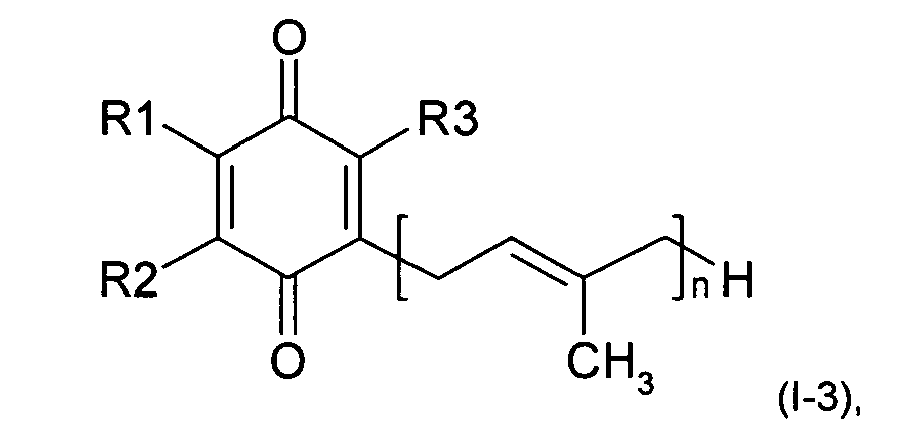

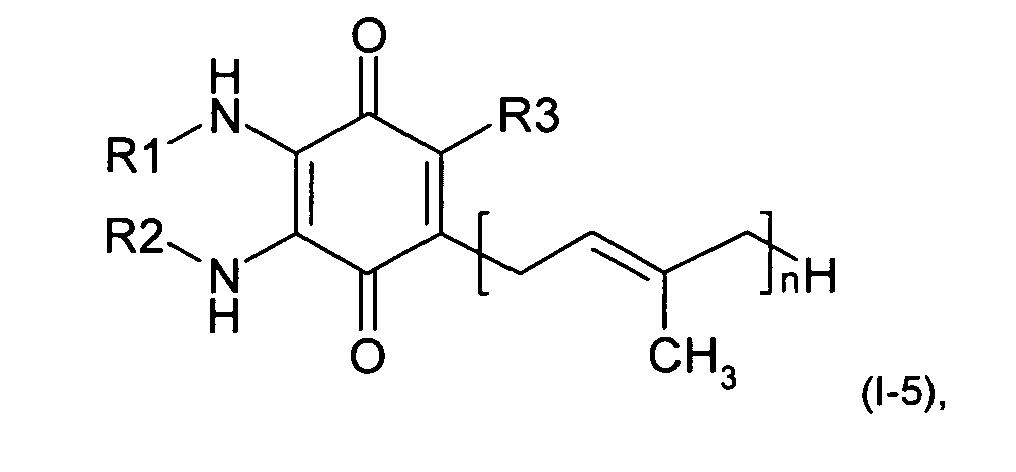

- R1, R2, R3
- stehen jeweils unabhängig voneinander für -H, -CH3, -CH2CH3, -(CH2)2CH2,-CH(CH3)2, -(CH2)3CH3, -CH(CH3)CH2CH3, -CH2CH(CH3)2, -C(CH3)3
- R4
- steht für -CH3, oder -CH2CH3, oder -(CH2)2CH2, oder -CH(CH3)2
- n
- steht für Werte von 1 bis 20, vorzugsweise von 2 bis 15 und insbesondere für 5, 6, 7, 8, 9, 10.
- Besonders bevorzugte erfindungsgemäße Haarbehandlungsmittel sind dadurch gekennzeichnet, daß sie als Pflegestoff - bezogen auf ihr Gewicht - 0,0001 bis 1 Gew.-%, bevorzugt 0,001 bis 0,5 Gew.-% und besonders bevorzugt 0,005 bis 0,1 Gew.-% mindestens eines Ubichinons und/oder mindestens eines Ubichinols und/oder mindestens eines Derivates dieser Substanzen enthalten, wobei bevorzugte Mittel ein Ubichinon der Formel (Ubi) enthalten

- Alternativ zu den besonders bevorzugten Ubichinonen oder zusätzlich zu ihnen können die erfindungsgemäßen Mittel auch Plastochinone enthalten. Hier sind bevorzugte erfindungsgemäße Mittel dadurch gekennzeichnet, daß sie 0,0002 bis 4 Gew.-%, vorzugsweise 0,0005 bis 3 Gew.-%, besonders bevorzugt 0,001 bis 2 Gew.-%, weiter bevorzugt 0,0015 bis 1 und insbesondere 0,002 bis 0,5 Gew.-% mindestens eines Plastochinons der Formel (Ib) enthalten


- Zur Verbesserung der Elastizität und Festigung der inneren Struktur der mit erfindungsgemäßen Mitteln behandelter Haare können die erfindungsgemäßen Mittel Purin und/oder Purinderivate enthalten. Insbesondere die Kombination von Purin und/oder Purinderivaten mit Ubichinonen und/oder Plastochinonen führt dazu, daß die mit entsprechenden Mitteln behandelten Haare unter anderem höhere Meßwerte bei der Differenzthermoanalyse und verbesserte Naß- und Trockenkämmbarkeiten zeigen.
- Erfindungsgemäße Mittel eignen sich damit zur Vorbeugung und Behandlung von Alopezie und zur Vorbeugung und Behandlung von erblich bedingtem Haarausfall. Darüber hinaus aktivieren und stimulieren erfindungsgemäße Mittel die Kopfhaut und stärken das Haar.
- Als weiteren Inhaltsstoff können die erfindungsgemäßen Mittel daher Purin und/oder Derivat(e) des Purins enthalten. Purin (7H-Imidazo[4,5-d]pyrimidin) kommt frei in der Natur nicht vor, bildet jedoch den Grundkörper der Purine. Purine ihrerseits sind eine Gruppe wichtiger, in der Natur weit verbreiteter und an menschlichen, tierischen, pflanzlichen und mikrobiellen Stoffwechselvorgängen beteiligter Verbindungen, die sich vom Grundkörper durch Substitution mit OH, NH2, SH in 2-, 6- und 8-Stellung und/oder mit CH3 in 1-, 3-, 7-Stellung ableiten. Purin kann beispielsweise aus Aminoacetonitril und Formamid hergestellt werden. Purine und Purinderivate werden oft aus Naturstoffen isoliert, sind aber auch auf vielen Wegen synthetisch zugänglich.
- Bevorzugte erfindungsgemäße Mitteln enthalten Purin und/oder Purinderivate in engeren Mengenbereichen. Hier sind erfindungsgemäß bevorzugte kosmetische Mittel dadurch gekennzeichnet, daß sie - bezogen auf ihr Gewicht - 0,001 bis 2,5 Gew.-%, vorzugsweise 0,0025 bis 1 Gew.-%, besonders bevorzugt 0,005 bis 0,5 Gew.-% und insbesondere 0,01 bis 0,1 Gew.-% Purin(e) und/oder Purinderivat(e) enthalten.
- Unter Purin, den Purinen und den Purinderivaten sind erfindungsgemäß einige Vertreter besonders bevorzugt. Erfindungsgemäß bevorzugte Haarbehandlungsmittel sind dadurch gekennzeichnet, daß sie als Pflegesgtoff - bezogen auf ihr Gewicht - 0,001 bis 2,5 Gew.-%, vorzugsweise 0,0025 bis 1 Gew.-%, besonders bevorzugt 0,005 bis 0,5 Gew.-% und insbesondere 0,01 bis 0,1 Gew.-% Purin(e) und/oder Purinderivat(e) enthält, wobei bevorzugte Mittel Purin und/oder Purinderivat(e) der Formel (Pur-I) enthalten

- Purin (R1 = R2 = R3 = R4 = R5 = R6 = H)
- Adenin (R1 = NH2, R2 = R3 = R4 = R5 = R6 = H)
- Guanin (R1 = OH, R2 = NH2, R3 = R4 = R5 = R6 = H)
- Harnsäure (R1 = R2 = R3 = OH, R4 = R5 = R6 = H)
- Hypoxanthin (R1 = OH, R2 = R3 = R4 = R5 = R6 = H)
- 6-Purinthiol (R1 = SH, R2 = R3 = R4 = R5 = R6 = H)
- 6-Thioguanin (R1 = SH, R2 = NH2, R3 = R4 R5 = R6 = H)
- Xanthin (R1 = R2 = OH, R3 = R4 = R5 = R6 = H)
- Coffein (R1 = R2 = OH, R3 = H, R4 = R5 = R6 = CH3)
- Theobromin (R1 = R2 = OH, R3 = R4 = H, R5 = R6 = CH3)
- Theophyllin (R1 = R2 = OH, R3 = H, R4 = CH3, R5 = CH3, R6 = H).
- Je nach gewünschtem Anwendungszweck der erfindungsgemäßen Mittel kann dabei die Art und Menge des Purinderivates variieren, In haarkosmetischen Formulierungen hat sich insbesondere Coffein bewährt, das beispielsweise in Shampoos vorzugsweise in Mengen von 0,005 bis 0,25 Gew.-%, weiter bevorzugt von 0,01 bis 0,1 Gew.-% und insbesondere von 0,01 bis 0,05 Gew.-% (jeweils bezogen auf das Shampoo) eingesetzt werden kann.
- Es ist weiterhin vorteilhaft, Purin bzw. Purinderivate und Biochinone in einem bestimmten Verhältnis zueinander einzusetzen. Hier sind erfindungsgemäße Mittel bevorzugt, bei denen das Gewichtsverhältnis der Inhaltsstoffe a) und b) 10:1 bis 1:100, vorzugsweise 5:1 bis 1:50, besonders bevorzugt 2:1 bis 1:20 und insbesondere 1:1 bis 1:10 beträgt.
- Wie bereits erwähnt, ist Coffein ein besonders bevorzugtes Purinderivat, und das Coenzym Q10 ist ein besonders bevorzugtes Biochinon. Besonders bevorzugte erfindungsgemäße Mittel sind daher dadurch gekennzeichnet, daß sie - bezogen auf ihr Gewicht - 0,001 bis 2,5 Gew.-%, vorzugsweise 0,0025 bis 1 Gew.-%, besonders bevorzugt 0,005 bis 0,5 Gew.-% und insbesondere 0,01 bis 0,1 Gew.-% Coffein und 0,0002 bis 4 Gew.-%, vorzugsweise 0,0005 bis 3 Gew.-%, besonders bevorzugt 0,001 bis 2 Gew.-%, weiter bevorzugt 0,0015 bis 1 und insbesondere 0,002 bis 0,5 Gew.-% Coenzym Q10 enthalten.
- Als weiteren Bestandteil können die erfindungsgemäßen Mittel mindestens ein Kohlenhydrat aus der Gruppe der Monosaccharide, Disaccharide und/oder Oligosaccharide enthalten. Hier sind erfindungsgemäß bevorzugte Haarbehandlungsmittel dadurch gekennzeichnet, daß sie als Pflegesgtoff - bezogen auf ihr Gewicht - 0,01 bis 5 Gew.-%, vorzugsweise 0,05 bis 4,5 Gew.-%, besonders bevorzugt 0,1 bis 4 Gew.-%, weiter bevorzugt 0,5 bis 3,5 Gew.-% und insbesondere 0,75 bis 2,5 Gew.-% Kohlenhydrat(e), ausgewählt aus Monosacchariden, Disacchariden und/oder Oligosacchariden enthalten, wobei bevorzugte Kohlenhydrate ausgewählt sind aus
- Monosachhariden, insbesondere
- D-Ribose und/oder
- D-Xylose und/oder
- L-Arabinose und/oder
- D-Glucose und/oder
- D-Mannose und/oder
- D-Galactose und/oder
- D-Fructose und/oder
- Sorbose und/oder
- L-Fucose und/oder
- L-Rhamnose
- Disacchariden, insbesondere
- Saccharose und/oder
- Maltose und/oder
- Lactose und/oder
- Trehalose und/oder
- Cellobiose und/oder
- Gentiobiose und/oder
- Isomaltose.
- Besonders bevorzugte erfindungsgemäße Mittel enthalten bezogen auf ihr Gewicht
- 0,005 bis 0,015 Gew.-% Coffein und 0,75 bis 1,5 Gew.-% Glucosemonohydrat,
- 0,005 bis 0,015 Gew.-% Coffein und 0,75 bis 1,5 Gew.-% Saccharose,
- 0,005 bis 0,015 Gew.-% Coffein und 0,75 bis 1,5 Gew.-% Fructose.
- Wie bereits erwähnt, enthalten bevorzugte erfindungsgemäße Mittel (eine) Aminosäure(n).
- Erfindungsgemäß besonders bevorzugt einsetzbare Aminosäuren stammen aus der Gruppe Glycin, Alanin, Valin, Leucin, Isoleucin, Phenylalanin, Tyrosin, Tryptophan, Prolin, Asparaginsäure, Glutaminsäure, Asparagin, Glutamin, Serin, Threonin, Cystein, Methionin, Lysin, Arginin, Histidin, β-Alanin, 4-Aminobuttersäure (GABA), Betain, L-Cystin (L-Cyss), L-Carnitin, L-Citrullin, L-Theanin, 3 ',4 '-Dihydroxy-L-phenylalanin (L-Dopa), 5'-Hydroxy-L-tryptophan, L-Homocystein, S-Methyl-L-methionin, S-Allyl-L-cystein-sulfoxid (L-Alliin), L-trans-4-Hydroxyprolin, L-5-Oxoprolin (L-Pyroglutaminsäure), L-Phosphoserin, Kreatin, 3-Methyl-L-histidin, L-Ornithin, wobei sowohl die einzelnen Aminosäuren als auch Mischungen eingesetzt werden können.
- Bevorzugte erfindungsgemäße Mittel enthalten eine oder mehrere Aminosäuren in engeren Mengenbereichen. Hier sind erfindungsgemäß bevorzugte kosmetische Mittel dadurch gekennzeichnet, daß sie zusätzlich - 0,05 bis 5 Gew.-%, vorzugsweise 0,1 bis 2,5 Gew.-%, besonders bevorzugt 0,15 bis 1 Gew.-% und insbesondere 0,2 bis 0,5 Gew.-% Aminosäure(n), vorzugsweise (eine) Aminosäure(n) aus der Gruppe Glycin und/oder Alanain und/oder Valin und/oder Lysin und/oder Leucin und/oder Threonin enthalten.
- Besonders bevorzugte erfindungsgemäße Mittel enthalten bezogen auf ihr Gewicht
- 0,005 bis 0,015 Gew.-% Coffein und 0,75 bis 1,5 Gew.-% Glucosemonohydrat und 0,1 bis 0,25 Gew.-% Glycin,
- 0,005 bis 0,015 Gew.-% Coffein und 0,75 bis 1,5 Gew.-% Saccharose und 0,1 bis 0,25 Gew.-% Glycin,
- 0,005 bis 0,015 Gew.-% Coffein und 0,75 bis 1,5 Gew.-% Fructose und 0,1 bis 0,25 Gew.-% Glycin,
- 0,005 bis 0,015 Gew.-% Coffein und 0,75 bis 1,5 Gew.-% Glucosemonohydrat und 0,1 bis 0,25 Gew.-% Alanin,
- 0,005 bis 0,015 Gew.-% Coffein und 0,75 bis 1,5 Gew.-% Saccharose und 0,1 bis 0,25 Gew.-% Alanin,
- 0,005 bis 0,015 Gew.-% Coffein und 0,75 bis 1,5 Gew.-% Fructose und 0,1 bis 0,25 Gew.-% Alanin,
- 0,005 bis 0,015 Gew.-% Coffein und 0,75 bis 1,5 Gew.-% Glucosemonohydrat und 0,1 bis 0,25 Gew.-% Valin,
- 0,005 bis 0,015 Gew.-% Coffein und 0,75 bis 1,5 Gew.-% Saccharose und 0,1 bis 0,25 Gew.-% Valin,
- 0,005 bis 0,015 Gew.-% Coffein und 0,75 bis 1,5 Gew.-% Fructose und 0,1 bis 0,25 Gew.-% Valin.
- Erfindungsgemäß bevorzugte Mittel enthalten als Pflegesgtoff - bezogen auf ihr Gewicht - 0,01 bis 15 Gew.-%, vorzugsweise 0,025 bis 12,5 Gew.-%, besonders bevorzugt 0,05 bis 10 Gew.-%, weiter bevorzugt 0,1 bis 7,5 Gew.-% und insbesondere 0,5 bis 5 Gew.-% mindestens eines 2-Furanonderivats der Formel (Fur-I) und/oder der Formel (Fur-II)

- Wasserstoff, -OH, einen Methyl-, Methoxy-, Aminomethyl- oder Hydroxymethylrest,
- -C2 - C4 - gesättigten oder ein- oder zweifach ungesättigten, verzweigten oder linearen Kohlenwasserstoffrest,
- -C2 - C4 - gesättigten oder ein- oder zweifach ungesättigten, verzweigten oder linearen Mono-, Di- oder Trihydroxykohlenwasserstoffrest,
- -C2 - C4 - gesättigten oder ein- oder zweifach ungesättigten, verzweigten oder linearen Mono-, Di- oder Triaminokohlenwasserstoffrest,
- eine Gruppe -OR11, mit R11 als einem -C2 - C4 - gesättigten oder ein- oder zweifach ungesättigten, verzweigten oder linearen Kohlenwasserstoffrest, -C2 - C4 - gesättigten oder ein- oder zweifach ungesättigten, verzweigten oder linearen Mono-, Di- oder Trihydroxykohlenwasserstoffrest,
- eine Gruppe -NR12R13, wobei R12 und R13 jeweils unabhängig voneinander stehen für Wasserstoff, einen Methyl-, einen -C2 - C4 - gesättigten oder ein- oder zweifach ungesättigten, verzweigten oder linearen Kohlenwasserstoffrest, einen -C2 - C4 - gesättigten oder ein- oder zweifach ungesättigten, verzweigten oder linearen Mono-, Di- oder Trihydroxykohlenwasserstoffrest,
- eine Gruppe -COOR14, wobei R14 steht für Wasserstoff, einen Methyl-, einen -C2-C4 - gesättigten oder ein- oder zweifach ungesättigten, verzweigten oder linearen Kohlenwasserstoffrest, einen -C2 - C4 - gesättigten ein- oder zweifach ungesättigten, verzweigten oder linearen Mono-, Di- oder Trihydroxykohlenwasserstoffrest, einen -C2 - C4 - gesättigten oder ein- oder zweifach ungesättigten, verzweigten oder linearen Mono-, Di- oder Triaminokohlenwasserstoffrest,
- eine Gruppe -CONR15R16, wobei R15 und R16 jeweils stehen für Wasserstoff, Methyl-, einen -C2 - C4 - gesättigten oder ein- oder zweifach ungesättigten, verzweigten oder linearen Kohlenwasserstoffrest, einen -C2 - C4 - gesättigten ein- oder zweifach ungesättigten, verzweigten oder linearen Mono-, Di- oder Trihydroxykohlenwasserstoffrest, einen -C2 - C4 - gesättigten oder ein- oder zweifach ungesättigten, verzweigten oder linearen Mono-, Di- oder Triaminokohlenwasserstoffrest,
- eine Gruppe -COR16, wobei R16 steht für einen Methyl-, einen -C2 - C4 - gesättigten oder ein- oder zweifach ungesättigten, verzweigten oder linearen Kohlenwasserstoffrest, einen -C2 - C4 - gesättigten oder ein- oder zweifach ungesättigten, verzweigten oder linearen Mono-, Di- oder Trihydroxykohlenwasserstoffrest, einen -C2 - C4 - gesättigten oder ein- oder zweifach ungesättigten, verzweigten oder linearen Mono-, Di- oder Triaminokohlenwasserstoffrest,
- eine Gruppe -OCOR17, wobei R17 steht für einen Methyl-, einen -C2 - C30 - gesättigten oder ein- oder mehrfach ungesättigten, verzweigten oder linearen Kohlenwasserstoffrest, einen -C2 - C30 - gesättigten oder ein- oder mehrfach ungesättigten, verzweigten oder linearen Mono-, Di-, Tri- oder Polyhydroxykohlenwasserstoffrest, einen -C2 - C30 - gesättigten oder ein- oder mehrfach ungesättigten, verzweigten oder linearen Mono-, Di-, Tri- oder Polyaminokohlenwasserstoffrest,
- Die Verbindungen der Formeln (Fur-I) und (Fur-II) werden als Zwischenstufen in der Naturstoffsynthese sowie der Herstellung von Arzneimitteln und Vitaminen eingesetzt. Die Herstellung der Wirkstoffe gemäß der Formeln (Fur-I) und (Fur-II) kann beispielsweise durch Umsetzung von primären Alkoholen mit Acrylsäuren erfolgen. Weiterhin gelangt man zu Verbindungen der Formel (Fur-I) durch Reaktionen ausgehend von Hydroxypivaldehyd. Ebenfalls führen Carbonylierungen von Alkynen zu substituierten 2-Furanonen der Formel (Fur-I) oder (Fur-II). Schließlich können die Verbindungen der Formel (Fur-I) oder der Formel (Fur-II) durch intramolekulare Veresterung der entsprechenden Hydroxycarbonsäuren erhalten werden. Beispielsweise werden die folgenden Verbindungen auf einem der zuvor aufgezeigten Synthesewege erhalten: 2,5-Dihydro-5-methoxy-2-furanon,
Tetrahydro-5-oxo-2-furancarbonsäure, Dihydro-3-hydroxy-4,4-dimethyl-2(3H)-furanon, oder 3,4-Dimethyl-5-pentylidenedihydro-2(5H)-furanon oder 4-Hydroxy-2,5-dimethyl-3(2H)-furanon. Die erfindungsgemäßen 2-Furanone umfassen selbstverständlich alle möglichen Stereoisomere wie auch deren Gemische. Durch die erfindungsgemäßen 2-Furanone wird der Geruch der kosmetischen Mittel nicht nachhaltig beeinflußt, so daß eine Parfümierung der Mittel separat erfolgen muß. - Bevorzugte Verbindungen der Formel (Fur-I) und/oder der Formel (Fur-II) können Verbindungen sein, bei welchen die Substituenten R1, R2 und R7 unabhängig voneinander stehen für:
- Wasserstoff, einen -OH-, einen Methyl-, Methoxy-, Aminomethyl-, Hydroxymethylrest,
- einen -C2 - C4 - gesättigten oder ein- oder zweifach ungesättigten, verzweigten oder linearen Mono-, Di- oder Trihydroxykohlenwasserstoffrest,
- einen -C2 - C4 - gesättigten oder ein- oder zweifach ungesättigten, verzweigten oder linearen Mono-, Di- oder Triaminokohlenwasserstoffrest,
- eine Gruppe -OR11, mit R11 als einem -C2 - C4 - gesättigten oder ein- oder zweifach ungesättigten, verzweigten oder linearen Kohlenwasserstoffrest, -C2 - C4 - gesättigten oder ein-oder zweifach ungesättigten, verzweigten oder linearen Mono-, Di- oder Trihydroxykohlenwasserstoffrest,
- eine Gruppe -NR12R13, wobei R12 und R13 jeweils unabhängig voneinander stehen für Wasserstoff, einen Methyl-, einen -C2 - C4 - gesättigten oder ein- oder zweifach ungesättigten, verzweigten oder linearen Kohlenwasserstoffrest, einen -C2 - C4 - gesättigten oder ein- oder zweifach ungesättigten, verzweigten oder linearen Mono-, Di- oder Trihydroxykohlenwasserstoffrest,
- eine Gruppe -COOR14, wobei R14 steht für Wasserstoff, einen Methyl-, einen -C2 - C4 - gesättigten oder ein- oder zweifach ungesättigten, verzweigten oder linearen Kohlenwasserstoffrest, einen -C2 - C4 - gesättigten oder ein- oder zweifach ungesättigten, verzweigten oder linearen Mono-, Di- oder Trihydroxykohlenwasserstoffrest, einen -C2 - C4 - gesättigten oder ein- oder zweifach ungesättigten, verzweigten oder linearen Mono-, Di- oder Triaminokohlenwasserstoffrest,
- eine Gruppe -COR16, wobei R16 steht für einen Methyl-, einen -C2 - C4 - gesättigten oder ein- oder zweifach ungesättigten, verzweigten oder linearen Kohlenwasserstoffrest, einen -C2 - C4 - gesättigten oder ein- oder zweifach ungesättigten, verzweigten oder linearen Mono-, Di- oder Trihydroxykohlenwasserstoffrest, einen -C2 - C4 - gesättigten oder ein- oder zweifach ungesättigten, verzweigten oder linearen Mono-, Di- oder Triaminokohlenwasserstoffrest,
- eine Gruppe -OCOR17, wobei R17 steht für einen Methyl-, einen -C2 - C30 - gesättigten oder ein-oder mehrfach ungesättigten, verzweigten oder linearen Kohlenwasserstoffrest, einen -C2 - C30
- gesättigten oder ein- oder mehrfach ungesättigten, verzweigten oder linearen Mono-, Di-, Tri-oder Polyhydroxyalkylrest, oder einen -C2 - C30 - gesättigten oder ein- oder mehrfach ungesättigten, verzweigten oder linearen Mono-, Di-, Tri- oder Polyaminokohlenwasserstoffrest.
- In einer weiteren Ausführungsform der erfindungsgemäßen Lehre hat es sich gezeigt, daß bei den Verbindungen der Formel (Fur-I) oder der Formel (Fur-II) die Reste R3, R4 und R8 bevorzugt unabhängig voneinander stehen für:
- Wasserstoff, einen -OH-, einen Methyl-, Methoxy-, Aminomethyl-, Hydroxymethylrest,
- einen -C2 - C4 - gesättigten oder ein- oder zweifach ungesättigten, verzweigten oder linearen Kohlenwasserstoffrest,
- einen -C2 - C4 - gesättigten oder ein- oder zweifach ungesättigten, verzweigten oder linearen Mono-, Di- oder Trihydroxykohlenwasserstoffrest oder
- einen -C2 - C4 - gesättigten oder ein- oder zweifach ungesättigten, verzweigten oder linearen Mono-, Di- oder Triaminokohlenwasserstoffrest.
- Weiterhin kann es bevorzugt sein, wenn in dem erfindungsgemäßen Wirkstoff gemäß der Formel(I) und/oder der Formel(II) für die Reste R5, R6, R9 und R10 unabhängig voneinander stehen für:
- Wasserstoff, einen -OH-, einen Methyl-, Methoxy-, Aminomethyl-, Hydroxymethylrest,
- einen -C2 - C4 - gesättigten oder ein- oder zweifach ungesättigten, verzweigten oder linearen Kohlenwasserstoffrest,
- einen -C2 - C4 - gesättigten oder ein- oder zweifach ungesättigten, verzweigten oder linearen Mono-, Di- oder Trihydroxykohlenwasserstoffrest oder
- einen -C2 - C4 - gesättigten oder ein- oder zweifach ungesättigten, verzweigten oder linearen Mono-, Di- oder Triaminokohlenwasserstoffrest.
- In einer besonders bevorzugten Ausführungsform der erfindungsgemäßen Lehre wird eine Verbindung der Formel (Fur-I) eingesetzt. Dabei kann es bevorzugt sein, daß in einer Verbindung der Formel (Fur-I) die Reste R1 und R2 unabhängig voneinander stehen für:
- Wasserstoff, einen -OH-, einen Methyl-, Methoxy-, Aminomethyl-, Hydroxymethylrest,
- einen -C2 - C4 - gesättigten oder ein- oder zweifach ungesättigten, verzweigten oder linearen Mono-, Di- oder Trihydroxykohlenwasserstoffrest,
- eine Gruppe -OR11, mit R11 als einem -C2 - C4 - gesättigten oder ein- oder zweifach ungesättigten, verzweigten oder linearen Kohlenwasserstoffrest, -C2 - C4 - gesättigten oder ein-oder zweifach ungesättigten, verzweigten oder linearen Mono-, Di- oder Trihydroxykohlenwasserstoffrest,
- eine Gruppe -COOR14, wobei R14 steht für Wasserstoff, einen Methyl-, einen -C2 - C4 - gesättigten oder ein- oder zweifach ungesättigten, verzweigten oder linearen Kohlenwasserstoffrest, einen -C2 - C4 - gesättigten ein- oder zweifach ungesättigten, verzweigten oder linearen Mono-, Di- oder Trihydroxykohlenwasserstoffrest,
- eine Gruppe -COR16, wobei R16 steht für einen Methyl-, einen -C2 - C4 - gesättigten oder ein- oder zweifach ungesättigten, verzweigten oder linearen Kohlenwasserstoffrest, einen -C2 - C4 - gesättigten oder ein- oder zweifach ungesättigten, verzweigten oder linearen Mono-, Di- oder Trihydroxykohlenwasserstoffrest,
- eine Gruppe -OCOR17, wobei R17 steht für einen Methyl-, einen -C2 - C30 - gesättigten oder ein-oder mehrfach ungesättigten, verzweigten oder linearen Kohlenwasserstoffrest, einen -C2 - C30 - gesättigten oder ein- oder mehrfach ungesättigten, verzweigten oder linearen Mono-, Di-, Tri-oder Polyhydroxykohlenwasserstoffrest.
- Weiterhin kann es in dieser besonders bevorzugten Ausführungsform der erfindungsgemäßen Lehre vorteilhaft sein, wenn in den Verbindungen der Formel (Fur-I) die Reste R3 und R4 unabhängig voneinander stehen für:
- Wasserstoff, einen -OH-, einen Methyl-, Methoxy-, Aminomethyl-, Hydroxymethylrest,
- einen -C2 - C4 - gesättigten oder ein- oder zweifach ungesättigten, verzweigten oder linearen Mono-, Di- oder Trihydroxykohlenwasserstoffrest,
- eine Gruppe -OR11, mit R11 als einem -C2 - C4 - gesättigten oder ein- oder zweifach ungesättigten, verzweigten oder linearen Kohlenwasserstoffrest, -C2 - C4 - gesättigten oder ein-oder zweifach ungesättigten, verzweigten oder linearen Mono-, Di- oder Trihydroxykohlenwasserstoffrest,
- eine Gruppe -COOR14, wobei R14 steht für Wasserstoff, einen Methyl-, einen -C2 - C4 - gesättigten oder ein- oder zweifach ungesättigten, verzweigten oder linearen Kohlenwasserstoffrest, einen -C2 - C4 - gesättigten ein- oder zweifach ungesättigten, verzweigten oder linearen Mono-, Di- oder Trihydroxykohlenwasserstoffrest,
- eine Gruppe -OCOR17, wobei R17 steht für einen Methyl-, einen -C2 - C30 - gesättigten oder ein-oder mehrfach ungesättigten, verzweigten oder linearen Kohlenwasserstoffrest, einen -C2 - C30 - gesättigten oder ein- oder mehrfach ungesättigten, verzweigten oder linearen Mono-, Di-, Tri-und/oder Polyhydroxykohlenwasserstoffrest.
- In dieser bevorzugten Ausführungsform kann es weiterhin vorteilhaft sein, daß die Verbindungen gemäß Formel (Fur-I) für die Reste R5 und R6 unabhängig voneinander stehen für:
- einen -C2 - C4 - gesättigten oder ein- oder zweifach ungesättigten, verzweigten oder linearen Mono-, Di- oder Trihydroxykohlenwasserstoffrest,
- eine Gruppe -OR11, mit R11 als einem -C2 - C4 - gesättigten oder ein- oder zweifach ungesättigten, verzweigten oder linearen Kohlenwasserstoffrest, -C2 - C4 - gesättigten oder ein-oder zweifach ungesättigten, verzweigten oder linearen Mono-, Di- oder Trihydroxykohlenwasserstoffrest.
- In einer besonders bevorzugten Ausführungsform der erfindungsgemäßen Lehre wird als Verbindung entsprechend der Formel (Fur-I)
- (R)-(-)-4-Hydroxymethyl-Υ-butyrolacton und/oder
- D,L-4-Hydroxymethyl-γ-butyrolacton und/oder
- (S)-(+)-4-Hydroxymethyl-γ-butyrolacton und/oder
- R-(-)-2-Hydroxy-3,3-dimethyl-γ-butyrolacton und/oder
- D,L-2-Hydroxy-3,3-dimethyl-γ-butyrolacton und/oder
- S(+)-2-Hydroxy-3,3-dimethyl-γ-butyrolacton und/oder
- 4-Hydroxy-2,5-dimethyl-3(2H)-furanon und/oder
- Tetrahydro-5-oxo-2-furancarbonsäure und/oder
- Tetrahydro-5-oxo-2-furancarbonsäure, Na-Salz und/oder
- Tetrahydro-5-oxo-2-furancarbonsäure, K-Salz und/oder
- 2,5-Dihydro-5-methoxy-2-furanon und/oder
- Dihydro-3-hydroxy-4,4-dimethyl-2(3H)-furanon
eingesetzt. In einer ganz besonders bevorzugten Ausführungsform der erfindungsgemäßen Lehre wird als Verbindung entsprechend der Formel (Fur-1) Dihydro-3-hydroxy-4,4-dimethyl-2(3H)-furanon eingesetzt.
Bevorzugt ist auch der zusätzlich Einsatz von Bisabolol und/oder Bisabololoxiden in den erfindungsgemäßen Mitteln. Hier sind erfindungsgemäße Haarbehandlungsmittel bevorzugt, die zusätzlich 0,001 bis 5 Gew.-%, vorzugsweise 0,01 bis 4 Gew.-%, besonders bevorzugt 0,02 bis 2,5 Gew.-% und insbesondere 0,1 bis 1,5 Gew.-% Bisabolol und/oder Oxide von Bisabolol, vorzugsweise (-)-alpha-Bisabolol
- Die erfindungsgemäßen Mittel können zusätzlich zum Wirkkomplex weitere Stoffe enthalten, die Haarausfall verhindern, lindern oder heilen. Insbesondere ist ein Gehalt an haarwurzelstabilisierenden Wirkstoffen vorteilhaft. Diese Stoffe werden nachstehend beschrieben:
- Propecia (Finasterid) ist das zur Zeit einzige Präparat, das weltweit zugelassen ist und für das in zahlreichen Studien eine Wirksamkeit und Verträglichkeit nachgewiesen wurde. Propecia bewirkt, daß sich weniger DHT aus Testosteron bilden kann.
- Minoxidil ist mit oder ohne ergänzende Zusatzstoffe das wohl älteste nachweislich wirkende Haarwuchsmittel. Zur Behandlung von Haarausfall darf es nur zur äußeren Anwendung verwendet werden. Es gibt Haarwasser, die 2%-5% Minoxidil enthalten, außerdem Gels mit bis zu 15% Minoxidil. Die Wirksamkeit nimmt mit der Dosierung zu, in Haarwassern ist Minoxidil jedoch nur bis zu 5% Anteil löslich. In vielen Ländern sind Haarwasser mit bis zu 2% Minoxidilgehalt verschreibungsfrei erhältlich.
- Zur Bekämpfung der hormonellen Einflüße auf die Haarfollikel kann zur äußeren Anwendung Spironolactone in Form von Haarwasser und in Kombination mit Minoxidil angewandt werden.
- Spironolactone wirkt als Androgen-Rezeptor-Blocker, dh. die Bindung von DHT an die Haarfollikel wird verhindert.
- Zusammenfassend sind erfindungsgemäße kosmetische Mittel bevorzugt, die zusätzlich - bezogen auf sein Gewicht - 0,001 bis 5 Gew.-% Haarwurzel-stabilisierende Stoffe, insbesondere Minoxidil und/oder Finasterid und/oder Ketoconazol enthalten.
- Die erfindungsgemäßen Mittel wirken per se gut gegen Kopfschuppen. Die Wirkung des Eigelbs bzw. der Eigelbextrakte und insbesondere der Immunoglobuline kann durch ergänzende Antischuppenwirkstoffe noch weiter verstärkt werden.
- Durch die zusätzlichen Antischuppenwirkstoffe (beispielsweise Climbazol, Piroctone Olamine oder Zink-Pyrithion) wird die Menge des Hefepilzes gezielt reduziert, die Keimflora erreicht wieder die normale prozentuale Zusammensetzung und die Abschuppung wird auf das physiologische Maß reduziert. Labortests haben jedoch nachgewiesen, daß die unterschiedlichen Artvertreter des Pityrosporum ovale unterschiedlich gut auf die Antischuppenwirkstoffe reagieren. Um alle Schuppenerreger maximal zu bekämpfen ist daher eine Kombination von Anti-Schuppenwirkstoffen am erfolgreichsten.
- Zusammenfassend sind erfindungsgemäße Haarbehandlungsmittel bevorzugt, die zusätzlich - bezogen auf ihr Gewicht - 0,001 bis 5 Gew.-% Antischuppenwirkstoffe, insbesondere Piroctone Olamine (1-Hydroxy-4-methyl-6-(2,4,4-trirnethylpentyl)pyridin-2(1H)-on, Verbindung mit 2-Aminoethanol, 1:1) und/oder Zink-Pyrithion und/oder Selensulfid und/oder Climbazol und/oder Salicylsäure oder Fumarsäure enthalten.
- Auch der Einsatz von Taurin hat sich erfindungsgemäß bewährt, da die Kopfhaut aktiviert und die erfindungsgemäß erzielten Effekte verstärkt werden. Erfindungsgemäß bevorzugte Haarbehandlungsmittel enthalten als Pflegestoff - bezogen auf ihr Gewicht - 0,01 bis 15 Gew.-%, vorzugsweise 0,025 bis 12,5 Gew.-%, besonders bevorzugt 0,05 bis 10 Gew.-%, weiter bevorzugt 0,1 bis 7,5 Gew.-% und insbesondere 0,5 bis 5 Gew.-% Taurin (2-Aminoethansulfonsäure).
- Die erfindungsgemäßen Mittel können weiterhin alle für solche Zubereitungen bekannten Wirk-, Zusatz- und Hilfsstoffe enthalten. In vielen Fällen enthalten die Mittel mindestens ein Tensid, wobei prinzipiell sowohl anionische als auch zwitterionische, ampholytische, nichtionische und kationische Tenside geeignet sind. In vielen Fällen hat es sich aber als vorteilhaft erwiesen, die Tenside aus anionischen, zwitterionischen oder nichtionischen Tensiden auszuwählen. Diese Tenside wurden weiter oben ausführlich beschrieben.
- In einer weiteren bevorzugten Ausführungsform können die erfindungsgemäßen Mittel Emulgatoren (F) enthalten. Emulgatoren bewirken an der Phasengrenzfläche die Ausbildung von wasser- bzw. ölstabilen Adsorptionsschichten, welche die dispergierten Tröpfchen gegen Koaleszenz schützen und damit die Emulsion stabilisieren. Emulgatoren sind daher wie Tenside aus einem hydrophoben und einem hydrophilen Molekülteil aufgebaut. Hydrophile Emulgatoren bilden bevorzugt O/W - Emulsionen und hydrophobe Emulgatoren bilden bevorzugt W/O - Emulsionen. Unter einer Emulsion ist eine tröpfchenförmige Verteilung (Dispersion) einer Flüssigkeit in einer anderen Flüssigkeit unter Aufwand von Energie zur Schaffung von stabilisierenden Phasengrenzflächen mittels Tensiden zu verstehen. Die Auswahl dieser emulgierenden Tenside oder Emulgatoren richtet sich dabei nach den zu dispergierenden Stoffen und der jeweiligen äußeren Phase sowie der Feinteiligkeit der Emulsion. Erfindungsgemäß verwendbare Emulgatoren sind beispielsweise
- Anlagerungsprodukte von 4 bis 30 Mol Ethylenoxid und/oder 0 bis 5 Mol Propylenoxid an lineare Fettalkohole mit 8 bis 22 C-Atomen, an Fettsäuren mit 12 bis 22 C-Atomen und an Alkylphenole mit 8 bis 15 C-Atomen in der Alkylgruppe,
- C12-C22-Fettsäuremono- und -diester von Anlagerungsprodukten von 1 bis 30 Mol Ethylenoxid an Polyole mit 3 bis 6 Kohlenstoffatomen, insbesondere an Glycerin,
- Ethylenoxid- und Polyglycerin-Anlagerungsprodukte an Methylglucosid-Fettsäureester, Fettsäurealkanolamide und Fettsäureglucamide,
- C8-C22-Alkylmono- und -oligoglycoside und deren ethoxylierte Analoga, wobei Oligomerisierungsgrade von 1,1 bis 5, insbesondere 1,2 bis 2,0, und Glucose als Zuckerkomponente bevorzugt sind,
- Gemische aus Alkyl-(oligo)-glucosiden und Fettalkoholen zum Beispiel das im Handel erhältliche Produkt Montanov®68,
- Anlagerungsprodukte von 5 bis 60 Mol Ethylenoxid an Rizinusöl und gehärtetes Rizinusöl,
- Partialester von Polyolen mit 3-6 Kohlenstoffatomen mit gesättigten Fettsäuren mit 8 bis 22 C-Atomen,
- Sterine. Als Sterine wird eine Gruppe von Steroiden verstanden, die am C-Atom 3 des Steroid-Gerüstes eine Hydroxylgruppe tragen und sowohl aus tierischem Gewebe (Zoosterine) wie auch aus pflanzlichen Fetten (Phytosterine) isoliert werden. Beispiele für Zoosterine sind das Cholesterin und das Lanosterin. Beispiele geeigneter Phytosterine sind Ergosterin, Stigmasterin und Sitosterin. Auch aus Pilzen und Hefen werden Sterine, die sogenannten Mykosterine, isoliert.
- Phospholipide. Hierunter werden vor allem die Glucose-Phospolipide, die z.B. als Lecithine bzw. Phospahtidylcholine aus z.B. Eidotter oder Pflanzensamen (z.B. Sojabohnen) gewonnen werden, verstanden.
- Fettsäureester von Zuckern und Zuckeralkoholen, wie Sorbit,
- Polyglycerine und Polyglycerinderivate wie beispielsweise Polyglycerinpoly-12-hydroxystearat (Handelsprodukt Dehymuls® PGPH),
- Lineare und verzweigte Fettsäuren mit 8 bis 30 C - Atomen und deren Na-, K-, Ammonium-, Ca-, Mg- und Zn - Salze.
- Die erfindungsgemäßen Mittel enthalten die Emulgatoren bevorzugt in Mengen von 0,1 25 Gew.-%, insbesondere 0,5 - 15 Gew.-%, bezogen auf das gesamte Mittel.
- Bevorzugt können die erfindungsgemäßen Zusammensetzungen mindestens einen nichtionogenen Emulgator mit einem HLB-Wert von 8 bis 18 enthalten. Nichtionogene Emulgatoren mit einem HLB-Wert von 10 - 15 können erfindungsgemäß besonders bevorzugt sein.
- Als weiterhin vorteilhaft hat es sich gezeigt, wenn zusätzlich zu dem bzw. den Polymer(en) aus der Gruppe der kationischen und/oder amphoteren Polymere weitere Polymere (G) in den erfindungsgemäßen Mitteln enthalten sind. In einer bevorzugten Ausführungsform werden den erfindungsgemäßen Mitteln daher weitere Polymere zugesetzt, wobei sich sowohl anionische als auch nichtionische Polymere als wirksam erwiesen haben.
- Bei den anionischen Polymeren (G2) handelt es sich um anionische Polymere, welche Carboxylat-und/oder Sulfonatgruppen aufweisen. Beispiele für anionische Monomere, aus denen derartige Polymere bestehen können, sind Acrylsäure, Methacrylsäure, Crotonsäure, Maleinsäureanhydrid und 2-Acrylamido-2-methylpropansulfonsäure. Dabei können die sauren Gruppen ganz oder teilweise als Natrium-, Kalium-, Ammonium-, Mono- oder Triethanolammonium-Salz vorliegen. Bevorzugte Monomere sind 2-Acrylamido-2-methylpropansulfonsäure und Acrylsäure.
- Als ganz besonders wirkungsvoll haben sich anionische Polymere erwiesen, die als alleiniges oder CoMonomer 2-Acrylamido-2-methylpropansulfonsäure enthalten, wobei die Sulfonsäuregruppe ganz oder teilweise als Natrium-, Kalium-, Ammonium-, Mono- oder Triethanolammonium-Salz vorliegen kann.
- Besonders bevorzugt ist das Homopolymer der 2-Acrylamido-2-methylpropansulfonsäure, das beispielsweise unter der Bezeichnung Rheothik®11-80 im Handel erhältlich ist.
- Innerhalb dieser Ausführungsform kann es bevorzugt sein, Copolymere aus mindestens einem anionischen Monomer und mindestens einem nichtionogenen Monomer einzusetzen. Bezüglich der anionischen Monomere wird auf die oben aufgeführten Substanzen verwiesen. Bevorzugte nichtionogene Monomere sind Acrylamid, Methacrylamid, Acrylsäureester, Methacrylsäureester, Vinylpyrrolidon, Vinylether und Vinylester.
Bevorzugte anionische Copolymere sind Acrylsäure-Acrylamid-Copolymere sowie insbesondere Polyacrylamidcopolymere mit Sulfonsäuregruppen-haltigen Monomeren. Ein besonders bevorzugtes anionisches Copolymer besteht aus 70 bis 55 Mol-% Acrylamid und 30 bis 45 Mol-% 2-Acrylamido-2-methylpropansulfonsäure, wobei die Sulfonsäuregruppe ganz oder teilweise als Natrium-, Kalium-, Ammonium-, Mono- oder Triethanolammonium-Salz vorliegt. Dieses Copolymer kann auch vernetzt vorliegen, wobei als Vernetzungsagentien bevorzugt polyolefinisch ungesättigte Verbindungen wie Tetraallyloxyethan, Allylsucrose, Allylpentaerythrit und Methylen-bisacrylamid zum Einsatz kommen. Ein solches Polymer ist in dem Handelsprodukt Sepigel®305 der Firma SEPPIC enthalten. Die Verwendung dieses Compounds, das neben der Polymerkomponente eine Kohlenwasserstoffmischung (C13-C14-Isoparaffin) und einen nichtionogenen Emulgator (Laureth-7) enthält, hat sich im Rahmen der erfindungsgemäßen Lehre als besonders vorteilhaft erwiesen. - Auch die unter der Bezeichnung Simulgel®600 als Compound mit Isohexadecan und Polysorbat-80 vertriebenen Natriumacryloyldimethyltaurat-Copolymere haben sich als erfindungsgemäß besonders wirksam erwiesen.
- Ebenfalls bevorzugte anionische Homopolymere sind unvernetzte und vernetzte Polyacrylsäuren. Dabei können Allylether von Pentaerythrit, von Sucrose und von Propylen bevorzugte Vernetzungsagentien sein. Solche Verbindungen sind beispielsweise unter dem Warenzeichen Carbopol® im Handel erhältlich.
- Copolymere aus Maleinsäureanhydrid und Methylvinylether, insbesondere solche mit Vernetzungen, sind ebenfalls farberhaltende Polymere. Ein mit 1,9-Decadiene vernetztes Maleinsäure-Methylvinylether-Copolymer ist unter der Bezeichnung Stabileze® QM im Handel erhältlich.
- Die erfindungsgemäßen Mittel können in einer weiteren Ausführungsform nichtionogene Polymere (G4) enthalten.
- Geeignete nichtionogene Polymere sind beispielsweise:
- VinylpyrrolidonNinylester-Copolymere, wie sie beispielsweise unter dem Warenzeichen Luviskol® (BASF) vertrieben werden. Luviskol® VA 64 und Luviskol® VA 73, jeweils VinylpyrrolidonNinylacetat-Copolymere, sind ebenfalls bevorzugte nichtionische Polymere.
- Celluloseether, wie Hydroxypropylcellulose, Hydroxyethylcellulose und Methylhydroxypropylcellulose, wie sie beispielsweise unter den Warenzeichen Culminal® und Benecel® (AQUALON) und Natrosol®-Typen (Hercules) vertrieben werden.
- Stärke und deren Derivate, insbesondere Stärkeether, beispielsweise Structure® XL (National Starch), eine multifunktionelle, salztolerante Stärke;
- Schellack
- Polyvinylpyrrolidone, wie sie beispielsweise unter der Bezeichnung Luviskol® (BASF) vertrieben werden.
- Siloxane. Diese Siloxane können sowohl wasserlöslich als auch wasserunlöslich sein. Geeignet sind sowohl flüchtige als auch nichtflüchtige Siloxane, wobei als nichtflüchtige Siloxane solche Verbindungen verstanden werden, deren Siedepunkt bei Normaldruck oberhalb von 200 °C liegt. Bevorzugte Siloxane sind Polydialkylsiloxane, wie beispielsweise Polydimethylsiloxan, Polyalkylarylsiloxane, wie beispielsweise Polyphenylmethylsiloxan, ethoxylierte Polydialkylsiloxane sowie Polydialkylsiloxane, die Amin- und/oder Hydroxy-Gruppen enthalten.
- Glycosidisch substituierte Silicone.
Es ist erfindungsgemäß auch möglich, daß die Zubereitungen mehrere, insbesondere zwei verschiedene Polymere gleicher Ladung und/oder jeweils ein ionisches und ein amphoteres und/oder nicht ionisches Polymer enthalten.
Die weiteren Polymere (G) sind in den erfindungsgemäßen Mitteln bevorzugt in Mengen von 0,05 bis 10 Gew.-%, bezogen auf das gesamte Mittel, enthalten. Mengen von 0,1 bis 5, insbesondere von 0,1 bis 3 Gew.-%, sind besonders bevorzugt.
Weiterhin kann in einer bevorzugten Ausführungsform der Erfindung ein erfindungsgemäßes Mittel auch UV - Filter (I) enthalten. Die erfindungsgemäß zu verwendenden UV-Filter unterliegen hinsichtlich ihrer Struktur und ihrer physikalischen Eigenschaften keinen generellen Einschränkungen. Vielmehr eignen sich alle im Kosmetikbereich einsetzbaren UV-Filter, deren Absorptionsmaximum im UVA(315-400 nm)-, im UVB(280-315nm)- oder im UVC(<280 nm)-Bereich liegt. UV-Filter mit einem Absorptionsmaximum im UVB-Bereich, insbesondere im Bereich von etwa 280 bis etwa 300 nm, sind besonders bevorzugt.
Die erfindungsgemäß verwendeten UV-Filter können beispielsweise ausgewählt werden aus substituierten Benzophenonen, p-Aminobenzoesäureestern, Diphenylacrylsäureestern, Zimtsäureestern, Salicylsäureestern, Benzimidazolen und o-Aminobenzoesäureestern.
Beispiele für erfindungsgemäß verwendbar UV-Filter sind 4-Amino-benzoesäure, N,N,N-Trimethyl-4-(2-oxoborn-3-ylidenmethyl)anilin-methylsulfat, 3,3,5-Trimethyl-cyclohexylsalicylat (Homosalate), 2-Hydroxy-4-methoxy-benzophenon (Benzophenone-3; Uvinul®M 40, Uvasorb®MET, Neo Heliopan®BB, Eusolex®4360), 2-Phenylbenzimidazol-5-sulfonsäure und deren Kalium-, Natrium- und Triethanolaminsalze (Phenylbenzimidazole sulfonic acid; Parsol®HS; Neo Heliopan®Hydro), 3,3'-(1,4-Phenylendimethylen)-bis(7,7-dimethyl-2-oxo-bicyclo-[2.2.1]hept-1-yl-methan-sulfonsäure) und deren Salze, 1-(4-tert.-Butylphenyl)-3-(4-methoxyphenyl)-propan-1,3-dion (Butyl methoxydibenzoylmethane; Parsol®1789, Eusolex®9020), α-(2-Oxoborn-3-yliden)-toluol-4-sulfonsäure und deren Salze, ethoxylierte 4-Aminobenzoesäure-ethylester (PEG-25 PABA; Uvinul®P 25), 4-Dimethylaminobenzoesäure-2-ethylhexylester (Octyl Dimethyl PABA; Uvasorb®DMO, Escalol®507, Eusolex®6007), Salicylsäure-2-ethylhexylester (Octyl Salicylat; Escalol®587, Neo Heliopan®OS, Uvinul®O18), 4-Methoxyzimtsäure-isopentylester (Isoamyl p-Methoxycinnamate; Neo Heliopan®E 1000), 4-Methoxyzimtsäure-2-ethylhexyl-ester (Octyl Methoxycinnamate; Parsol®MCX, Escalol®557, Neo Heliopan®AV), 2-Hydroxy-4-methoxybenzophenon-5-sulfonsäure und deren Natriumsalz (Benzophenone-4; Uvinul®MS 40; Uvasorb®S 5), 3-(4'-Methylbenzyliden)-D,L-Campher (4-Methylbenzylidene camphor; Parsol®5000, Eusolex®6300), 3-Benzyliden-campher (3-Benzylidene camphor), 4-Isopropylbenzylsalicylat, 2,4,6-Trianilino-(p-carbo-2'-ethylhexyl-1'-oxi)-1,3,5-triazin, 3-Imidazol-4-yl-acrylsäure und deren Ethylester, Polymere des N-{(2 und 4)-[2-oxoborn-3-ylidenmethyl]benzyl}-acrylamids, 2,4-Dihydroxybenzophenon (Benzophenone-1; Uvasorb®20 H, Uvinul®400), 1,1'-Diphenylacrylonitrilsäure-2-ethylhexyl-ester (Octocrylene; Eusolex®OCR, Neo Heliopan®Type 303, Uvinul®N 539 SG), o-Aminobenzoesäure-menthylester (Menthyl Anthranilate; Neo Heliopan®MA), 2,2',4,4'-Tetrahydroxybenzophenon (Benzophenone-2; Uvinul®D-50), 2,2'-Dihydroxy-4,4'-dimethoxybenzophenon (Benzophenone-6), 2,2'-Dihydroxy-4,4'-dimethoxybenzophenon-5-natriumsulfonat und 2-Cyano-3,3-diphenylacrylsäure-2'-ethylhexylester. Bevorzugt sind 4-Aminobenzoesäure, N,N,N-Trimethyl-4-(2-oxoborn-3-ylidenmethyl)anilin-methylsulfat, 3,3,5-Trimethyl-cyclohexylsalicylat, 2-Hydroxy-4-methoxy-benzophenon, 2-Phenylbenzimidazol-5-sulfonsäure und deren Kalium-, Natrium- und Triethanolaminsalze, 3,3'-(1,4-Phenylendimethylen)-bis(7,7-dimethyl-2-oxo-bicyclo-[2.2.1]hept-1-yl-methan-sulfonsäure) und deren Salze, 1-(4-tert.-Butylphenyl)-3-(4-methoxyphenyl)-propan-1,3-dion, α-(2-Oxoborn-3-yliden)-toluol-4-sulfonsäure und deren Salze, ethoxylierte 4-Aminobenzoesäure-ethylester, 4-Dimethylaminobenzoesäure-2-ethylhexylester, Salicylsäure-2-ethylhexylester, 4-Methoxyzimtsäure-isopentylester, 4-Methoxyzimtsäure-2-ethylhexylester, 2-Hydroxy-4-methoxybenzophenon-5-sulfonsäure und deren Natriumsalz, 3-(4'-Methylbenzyliden)-D,L-Campher, 3-Benzyliden-campher, 4-Isopropylbenzylsalicylat, 2,4,6-Trianilino-(p-carbo-2'-ethylhexyl-1'-oxi)-1,3,5-triazin, 3-Imidazol-4-yl-acrylsäure und deren Ethylester, Polymere des N-{(2 und 4)-[2-oxoborn-3-ylidenmethyl]benzyl}-acrylamid. Erfindungsgemäß ganz besonders bevorzugt sind 2-Hydroxy-4-methoxy-benzophenon, 2-Phenylbenzimidazol-5-sulfonsäure und deren Kalium-, Natrium-und Triethanolaminsalze, 1-(4-tert.-Butylphenyl)-3-(4-methoxyphenyl)-propan-1,3-dion, 4-Methoxyzimtsäure-2-ethylhexyl-ester und 3-(4'-Methylbenzyliden)-D,L-Campher.
Bevorzugt sind solche UV-Filter, deren molarer Extinktionskoeffizient am Absorptionsmaximum oberhalb von 15 000, insbesondere oberhalb von 20000, liegt.
Weiterhin wurde gefunden, daß bei strukturell ähnlichen UV-Filtern in vielen Fällen die wasserunlösliche Verbindung im Rahmen der erfindungsgemäßen Lehre die höhere Wirkung gegenüber solchen wasserlöslichen Verbindungen aufweist, die sich von ihr durch eine oder mehrere zusätzlich ionische Gruppen unterscheiden. Als wasserunlöslich sind im Rahmen der Erfindung solche UV-Filter zu verstehen, die sich bei 20 °C zu nicht mehr als 1 Gew.-%, insbesondere zu nicht mehr als 0,1 Gew.-%, in Wasser lösen. Weiterhin sollten diese Verbindungen in üblichen kosmetischen Ölkomponenten bei Raumtemperatur zu mindestens 0,1, insbesondere zu mindestens 1 Gew.-% löslich sein). Die Verwendung wasserunlöslicher UV-Filter kann daher erfindungsgemäß bevorzugt sein.
Gemäß einer weiteren Ausführungsform der Erfindung sind solche UV-Filter bevorzugt, die eine kationische Gruppe, insbesondere eine quartäre Ammoniumgruppe, aufweisen.
Diese UV-Filter weisen die allgemeine Struktur U - Q auf.
Der Strukturteil U steht dabei für eine UV-Strahlen absorbierende Gruppe. Diese Gruppe kann sich im Prinzip von den bekannten, im Kosmetikbereich einsetzbaren, oben genannten UV-Filtern ableiten, in dem eine Gruppe, in der Regel ein Wasserstoffatom, des UV-Filters durch eine kationische Gruppe Q, insbesondere mit einer quartären Aminofunktion, ersetzt wird. Verbindungen, von denen sich der Strukturteil U ableiten kann, sind beispielsweise - substituierte Benzophenone,
- p-Aminobenzoesäureester,
- Diphenylacrylsäureester,
- Zimtsäureester,
- Salicylsäureester,
- Benzimidazole und
- o-Aminobenzoesäureester.
- Strukturteile U, die sich vom Zimtsäureamid oder vom N,N-Dimethylamino-benzoesäureamid ableiten, sind erfindungsgemäß bevorzugt.
- Die Strukturteile U können prinzipiell so gewählt werden, daß das Absorptionsmaximum der UV-Filter sowohl im UVA(315-400 nm)-, als auch im UVB(280-315nm)- oder im UVC(<280 nm)-Bereich liegen kann. UV-Filter mit einem Absorptionsmaximum im UVB-Bereich, insbesondere im Bereich von etwa 280 bis etwa 300 nm, sind besonders bevorzugt.
- Weiterhin wird der Strukturteil U, auch in Abhängigkeit von Strukturteil Q, bevorzugt so gewählt, daß der molare Extinktionskoeffizient des UV-Filters am Absorptionsmaximum oberhalb von 15 000, insbesondere oberhalb von 20000, liegt.
- Der Strukturteil Q enthält als kationische Gruppe bevorzugt eine quartäre Ammoniumgruppe. Diese quartäre Ammoniumgruppe kann prinzipiell direkt mit dem Strukturteil U verbunden sein, so daß der Strukturteil U einen der vier Substituenten des positiv geladenen Stickstoffatomes darstellt. Bevorzugt ist jedoch einer der vier Substituenten am positiv geladenen Stickstoffatom eine Gruppe, insbesondere eine Alkylengruppe mit 2 bis 6 Kohlenstoffatomen, die als Verbindung zwischen dem Strukturteil U und dem positiv geladenen Stickstoffatom fungiert.
- Vorteilhafterweise hat die Gruppe Q die allgemeine Struktur -(CH2)X-N+R1R2R3 X-, in der x steht für eine ganze Zahl von 1 bis 4, R1 und R2 unabhängig voneinander stehen für C1-4-Alkylgruppen, R3 steht für eine C1-22-Alkylgruppe oder eine Benzylgruppe und X- für ein physiologisch verträgliches Anion. Im Rahmen dieser allgemeinen Struktur steht x bevorzugt für die die Zahl 3, R1 und R2 jeweils für eine Methylgruppe und R3 entweder für eine Methylgruppe oder eine gesättigte oder ungesättigte, lineare oder verzweigte Kohlenwasserstoffkette mit 8 bis 22, insbesondere 10 bis 18, Kohlenstoffatomen.
- Physiologisch verträgliche Anionen sind beispielsweise anorganische Anionen wie Halogenide, insbesondere Chlorid, Bromid und Fluorid, Sulfationen und Phosphationen sowie organische Anionen wie Lactat, Citrat, Acetat, Tartrat, Methosulfat und Tosylat.
- Zwei bevorzugte UV-Filter mit kationischen Gruppen sind die als Handelsprodukte erhältlichen Verbindungen Zimtsäureamidopropyl-trimethylammoniumchlorid (Incroquat®UV-283) und Dodecyldimethylaminobenzamidopropyl-dimethylammoniumtosylat (Escalol® HP 610).
- Selbstverständlich umfaßt die erfindungsgemäße Lehre auch die Verwendung einer Kombination von mehreren UV-Filtern. Im Rahmen dieser Ausführungsform ist die Kombination mindestens eines wasserunlöslichen UV-Filters mit mindestens einem UV-Filter mit einer kationischen Gruppe bevorzugt.
- Die UV-Filter (I) sind in den erfindungsgemäßen Mitteln üblicherweise in Mengen 0,1-5 Gew.-%, bezogen auf das gesamte Mittel, enthalten. Mengen von 0,4-2,5 Gew.-% sind bevorzugt.
- Die erfindungsgemäßen Mittel können weiterhin eine 2-Pyrrolidinon-5-carbonsäure und deren Derivate (J) enthalten. Bevorzugt sind die Natrium-, Kalium-, Calcium-, Magnesium- oder Ammoniumsalze, bei denen das Ammoniumion neben Wasserstoff eine bis drei C1- bis C4-Alkylgruppen trägt. Das Natriumsalz ist ganz besonders bevorzugt. Die eingesetzten Mengen in den erfindungsgemäßen Mitteln betragen vorzugsweise 0,05 bis 10 Gew.%, bezogen auf das gesamte Mittel, besonders bevorzugt 0,1 bis 5, und insbesondere 0,1 bis 3 Gew.%.
- Schließlich können die erfindungsgemäßen Mittel auch Pflanzenextrakte (L) enthalten.
- Üblicherweise werden diese Extrakte durch Extraktion der gesamten Pflanze hergestellt. Es kann aber in einzelnen Fällen auch bevorzugt sein, die Extrakte ausschließlich aus Blüten und/oder Blättern der Pflanze herzustellen.
- Hinsichtlich der erfindungsgemäß verwendbaren Pflanzenextrakte wird insbesondere auf die Extrakte hingewiesen, die in der auf Seite 44 der 3. Auflage des Leitfadens zur Inhaltsstoffdeklaration kosmetischer Mittel, herausgegeben vom Industrieverband Körperpflege- und Waschmittel e.V. (IKW), Frankfurt, beginnenden Tabelle aufgeführt sind.
- Erfindungsgemäß sind vor allem die Extrakte aus Grünem Tee, Eichenrinde, Brennessel, Hamamelis, Hopfen, Henna, Kamille, Klettenwurzel, Schachtelhalm, Weißdorn, Lindenblüten, Mandel, Aloe Vera, Fichtennadel, Roßkastanie, Sandelholz, Wacholder, Kokosnuß, Mango, Aprikose, Limone, Weizen, Kiwi, Melone, Orange, Grapefruit, Salbei, Rosmarin, Birke, Malve, Wiesenschaumkraut, Quendel, Schafgarbe, Thymian, Melisse, Hauhechel, Huflattich, Eibisch, Meristem, Ginseng und Ingwerwurzel bevorzugt.
- Besonders bevorzugt sind die Extrakte aus Grünem Tee, Eichenrinde, Brennessel, Hamamelis, Hopfen, Kamille, Klettenwurzel, Schachtelhalm, Lindenblüten, Mandel, Aloe Vera, Kokosnuß, Mango, Aprikose, Limone, Weizen, Kiwi, Melone, Orange, Grapefruit, Salbei, Rosmarin, Birke, Wiesenschaumkraut, Quendel, Schafgarbe, Hauhechel, Meristem, Ginseng und Ingwerwurzel.
- Ganz besonders für die erfindungsgemäße Verwendung geeignet sind die Extrakte aus Grünem Tee, Mandel, Aloe Vera, Kokosnuß, Mango, Aprikose, Limone, Weizen, Kiwi und Melone.
- Als Extraktionsmittel zur Herstellung der genannten Pflanzenextrakte können Wasser, Alkohole sowie deren Mischungen verwendet werden. Unter den Alkoholen sind dabei niedere Alkohole wie Ethanol und Isopropanol, insbesondere aber mehrwertige Alkohole wie Ethylenglykol und Propylenglykol, sowohl als alleiniges Extraktionsmittel als auch in Mischung mit Wasser, bevorzugt. Pflanzenextrakte auf Basis von Wasser/Propylenglykol im Verhältnis 1:10 bis 10:1 haben sich als besonders geeignet erwiesen.
- Die Pflanzenextrakte können erfindungsgemäß sowohl in reiner als auch in verdünnter Form eingesetzt werden. Sofern sie in verdünnter Form eingesetzt werden, enthalten sie üblicherweise ca. 2 - 80 Gew.-% Aktivsubstanz und als Lösungsmittel das bei ihrer Gewinnung eingesetzte Extraktionsmittel oder Extraktionsmittelgemisch.
- Weiterhin kann es bevorzugt sein, in den erfindungsgemäßen Mitteln Mischungen aus mehreren, insbesondere aus zwei, verschiedenen Pflanzenextrakten einzusetzen.
- Zusätzlich kann es sich als vorteilhaft erweisen, wenn in den erfindungsgemäßen Mitteln Penetrationshilfsstoffe und/ oder Quellmittel (M) enthalten sind. Hierzu sind beispielsweise zu zählen Harnstoff und Harnstoffderivate, Guanidin und dessen Derivate, Arginin und dessen Derivate, Wasserglas, Imidazol und dessen Derivate, Histidin und dessen Derivate, Benzylalkohol, Glycerin, Glykol und Glykolether, Propylenglykol und Propylenglykolether, beispielsweise Propylenglykolmonoethylether, Carbonate, Hydrogencarbonate, Diole und Triole, und insbesondere 1,2-Diole und 1,3-Diole wie beispielsweise 1,2-Propandiol, 1,2-Pentandiol, 1,2-Hexandiol, 1,2-Dodecandiol, 1,3-Propandiol, 1,6-Hexandiol, 1,5-Pentandiol, 1,4-Butandiol.
- Vorteilhaft im Sinne der Erfindung können zusätzlich kurzkettige Carbonsäuren (N) den Wirkstoffkomplex (A) unterstützen. Unter kurzkettigen Carbonsäuren und deren Derivaten im Sinne der Erfindung werden Carbonsäuren verstanden, welche gesättigt oder ungesättigt und/oder geradkettig oder verzweigt oder cyclisch und/oder aromatisch und/oder heterocyclisch sein können und ein Molekulargewicht kleiner 750 aufweisen. Bevorzugt im Sinne der Erfindung können gesättigte oder ungesättigte geradkettige oder verzweigte Carbonsäuren mit einer Kettenlänge von 1 bis zu 16 C-Atomen in der Kette sein, ganz besonders bevorzugt sind solche mit einer Kettenlänge von 1 bis zu 12 C - Atomen in der Kette.
- Die kurzkettigen Carbonsäuren im Sinne der Erfindung können ein, zwei, drei oder mehr Carboxygruppen aufweisen. Bevorzugt im Sinne der Erfindung sind Carbonsäuren mit mehreren Carboxygruppen, insbesondere Di- und Tricarbonsäuren. Die Carboxygruppen können ganz oder teilweise als Ester, Säureanhydrid, Lacton, Amid, Imidsäure, Lactam, Lactim, Dicarboximid, Carbohydrazid, Hydrazon, Hydroxam, Hydroxim, Amidin, Amidoxim, Nitril, Phosphon- oder Phosphatester vorliegen. Die erfindungsgemäß verwendeten Carbonsäuren können selbstverständlich entlang der Kohlenstoffkette oder des Ringgerüstes substituiert sein. Zu den Substituenten der erfindungsgemäß verwendeten Carbonsäuren sind beispielsweise zu zählen C1-C8-Alkyl-, C2-C8-Alkenyl-, Aryl-, Aralkyl- und Aralkenyl-, Hydroxymethyl-, C2-C8-Hydroxyalkyl-,C2-C8-Hydroxyalkenyl-, Aminomethyl-, C2-C8-Aminoalkyl-, Cyano-, Formyl-, Oxo-, Thioxo-, Hydroxy-, Mercapto-, Amino-, Carboxy- oder Iminogruppen. Bevorzugte Substituenten sind C1-C8-Alkyl-, Hydroxymethyl-, Hydroxy-, Amino- und Carboxygruppen. Besonders bevorzugt sind Substituenten in □ - Stellung. Ganz besonders bevorzugte Substituenten sind Hydroxy-, Alkoxy- und Aminogruppen, wobei die Aminofunktion gegebenenfalls durch Alkyl-, Aryl-, Aralkyl- und/oder Alkenylreste weiter substituiert sein kann. Weiterhin sind ebenfalls bevorzugte Carbonsäurederivate die Phosphon- und Phosphatester.
- Eine besonders bevorzugte Gruppe von Inhaltsstoffen stellen die Silikone dar.
- Erfindungsgemäße bevorzugte Mittel sind dadurch gekennzeichnet, daß sie mindestens ein Silicon, vorzugsweise ein Silicon enthalten, das ausgewählt ist unter:
- (i) Polyalkylsiloxanen, Polyarylsiloxanen, Polyalkylarylsiloxanen, die flüchtig oder nicht flüchtig, geradkettig, verzweigt oder cyclisch, vernetzt oder nicht vernetzt sind;
- (ii) Polysiloxanen, die in ihrer allgemeinen Struktur eine oder mehrere organofunktionelle Gruppen enthalten, die ausgewählt sind unter:
- a) substituierten oder unsubstituierten aminierten Gruppen;
- b) (per)fluorierten Gruppen;
- c) Thiolgruppen;
- d) Carboxylatgruppen;
- e) hydroxylierten Gruppen;
- f) alkoxylierten Gruppen;
- g) Acyloxyalkylgruppen;
- h) amphoteren Gruppen;
- i) Bisulfitgruppen;
- j) Hydroxyacylaminogruppen;
- k) Carboxygruppen;
- l) Sulfonsäuregruppen; und
- m) Sulfat- oder Thiosulfatgruppen;
- (iii) linearen Polysiloxan(A)- Polyoxyalkylen(B)- Blockcopoylmeren vom Typ (A-B)n mit n > 3;
- (iv) gepfropften Siliconpolymeren mit nicht siliconhaltigem, organischen Grundgerüst, die aus einer organischen Hauptkette bestehen, welche aus organischen Monomeren gebildet wird, die kein Silicon enthalten, auf die in der Kette sowie gegebenenfalls an mindestens einem Kettenende mindestens ein Polysiloxanmakromer gepfropft wurde;
- (v) gepfropften Siliconpolymeren mit Polysiloxan-Grundgerüst, auf das nicht siliconhaltige, organische Monomere gepfropft wurden, die eine Polysiloxan-Hauptkette aufweisen, auf die in der Kette sowie gegebenenfalls an mindestens einem ihrer Enden mindestens ein organisches Makromer gepfropft wurde, das kein Silicon enthält;
- Erfindungsgemäß besonders bevorzugte Mittel enthalten das bzw. die Silikon(e) vorzugsweise in Mengen von 0,1 bis 10 Gew.-%, vorzugsweise von 0,25 bis 7 Gew.-% und insbesondere von 0,5 bis 5 Gew.-%, jeweils bezogen auf das gesamte Mittel.
- Bevorzugte Silikone werden nachstehend beschrieben.
- Besonders bevorzugte erfindungsgemäße Mittel sind dadurch gekennzeichnet, daß sie mindestens ein Silikon der Formel Si-I
(CH3)3Si-[O-Si(CH3)2]x-O-Si(CH3)3 (Si-I),
enthalten, in der x für eine Zahl von 0 bis 100, vorzugsweise von 0 bis 50, weiter bevorzugt von 0 bis 20 und insbesondere 0 bis 10, steht. - Diese Silikone werden nach der INCl-Nomenklatur als DIMETHICONE bezeichnet. Es werden im Rahmen der vorliegenden Erfindung als Silicon der Formel Si-I vorzugsweise die Verbindungen:
(CH3)3Si-O-Si(CH3)3
(CH3)3Si-O-(CH3)2Si-O-Si(CH3)3
(CH3)3Si-[O-(CH3)2Si]2-O-Si(CH3)3
(CH3)3Si-[O-(CH3)2Si]3-O-Si(CH3)3
(CH3)3Si-[O-(CH3)2Si]4-O-Si(CH3)3
(CH3)3Si-[O-(CH3)2Si]5-O-Si(CH3)3
(CH3)3Si-[O-(CH3)2Si]6-O-Si(CH3)3
(CH3)3Si-[O-(CH3)2Si]7-O-Si(CH3)3
(CH3)3Si-[O-(CH3)2Si]8-O-Si(CH3)3
(CH3)3Si-[O-(CH3)2Si]9-O-Si(CH3)3
(CH3)3Si-[O-(CH3)2Si]10-O-Si(CH3)3
(CH3)3Si-[O-(CH3)2Si]11-O-Si(CH3)3
(CH3)3Si-[O-(CH3)2Si]12-O-Si(CH3)3
(CH3)3Si-[O-(CH3)2Si]13-O-Si(CH3)3
(CH3)3Si-[O-(CH3)2Si]14-O-Si(CH3)3
(CH3)3Si-[O-(CH3)2Si]15-O-Si(CH3)3
(CH3)3Si-[O-(CH3)2Si]16-O-Si(CH3)3
(CH3)3Si-[O-(CH3)2Si]17-O-Si(CH3)3
(CH3)3Si-[O-(CH3)2Si]18-O-Si(CH3)3
(CH3)3Si-[O-(CH3)2Si]19-O-Si(CH3)3
(CH3)3Si-[O-(CH3)2Si]20-O-Si(CH3)3
eingesetzt, wobei (CH3)3Si--O-Si(CH3)3, (CH3)3Si-O-(CH3)2Si-O-Si(CH3)3 und/oder (CH3)3Si-[O-(CH3)2Si]2-O-Si(CH3)3 besonders bevorzugt sind. - Selbstverständlich können auch Mischungen der o.g. Silikone in den erfindungsgemäßen Mitteln enthalten sein.
- Bevorzugte erfindungsgemäß einsetzbare Silikone weisen bei 20°C Viskositäten von 0,2 bis 2 mm2s-1 auf, wobei Silikone mit Viskositäten von 0,5 bis 1 mm2s-1 besonders bevorzugt sind.
- Besonders bevorzugte erfindungsgemäße Mittel enthalten ein oder mehrere aminofunktionelle Silicone. Solche Silicone können z.B. durch die Formel
M(RaQbSiO(4-a-b)/2)x(RcSiO(4-c)/2)yM
beschrieben werden, wobei in der obigen Formel R ein Kohlenwasserstoff oder ein Kohlenwasserstoffrest mit 1 bis etwa 6 Kohlenstoffatomen ist, Q ein polarer Rest der allgemeinen Formel -R1HZ ist, worin R1 eine zweiwertige, verbindende Gruppe ist, die an Wasserstoff und den Rest Z gebunden ist, zusammengesetzt aus Kohlenstoff- und Wasserstoffatomen, Kohlenstoff-, Wasserstoff- und Sauerstoffatomen oder Kohlenstoff-, Wasserstoff- und Stickstoffatomen, und Z ein organischer, aminofunktioneller Rest ist, der mindestens eine aminofunktionelle Gruppe enthält; "a" Werte im Bereich von etwa 0 bis etwa 2 annimmt, "b" Werte im Bereich von etwa 1 bis etwa 3 annimmt, "a" + "b" kleiner als oder gleich 3 ist, und "c" eine Zahl im Bereich von etwa 1 bis etwa 3 ist, und x eine Zahl im Bereich von 1 bis etwa 2.000, vorzugsweise von etwa 3 bis etwa 50 und am bevorzugtesten von etwa 3 bis etwa 25 ist, und y eine Zahl im Bereich von etwa 20 bis etwa 10.000, vorzugsweise von etwa 125 bis etwa 10.000 und am bevorzugtesten von etwa 150 bis etwa 1.000 ist, und M eine geeignete Silicon-Endgruppe ist, wie sie im Stande der Technik bekannt ist, vorzugsweise Trimethylsiloxy. Nicht einschränkende Beispiele der durch R repräsentierten Reste schließen Alkylreste, wie Methyl, Ethyl, Propyl, Isopropyl, Isopropyl, Butyl, Isobutyl, Amyl, Isoamyl, Hexyl, Isohexyl und ähnliche; Alkenylreste, wie Vinyl, Halogenvinyl, Alkylvinyl, Allyl, Halogenallyl, Alkylallyl; Cycloalkylreste, wie Cyclobutyl, Cyclopentyl, Cyclohexyl und ähnliche; Phenylreste, Benzylreste, Halogenkohlenwasserstoffreste, wie 3- Chlorpropyl, 4-Brombutyl, 3,3,3-Trifluorpropyl, Chlorcyclohexyl, Bromphenyl, Chlorphenyl und ähnliche sowie schwefelhaltige Reste, wie Mercaptoethyl, Mercaptopropyl, Mercaptohexyl, Mercaptophenyl und ähnliche ein; vorzugsweise ist R ein Alkylrest, der 1 bis etwa 6 Kohlenstoffatomen enthält, und am bevorzugtesten ist R Methyl. Beispiele von R1 schließen Methylen, Ethylen, Propylen, Hexamethylen, Decamethylen, -CH2CH(CH3)CH2-, Phenylen, Naphthylen, -CH2CH2SCH2CH2-, -CH2CH20CH2-, -OCH2CH2-, -OCH2 CH2CH2-, -CH2CH(CH3)C(O)OCH2-, -(CH2)3CC(O)OCH2CH2-, -C6H4C6H4-, -C6H4CH2C6H4-; und -(CH 2)3C(O)SCH2CH2- ein. - Z ist ein organischer, aminofunktioneller Rest, enthaltend mindestens eine funktionelle Aminogruppe. Eine mögliche Formel für Z ist NH(CH2)zNH2, worin z 1 oder mehr ist. Eine andere mögliche Formel für Z ist -NH(CH2)z(CH2)zzNH, worin sowohl z als auch zz unabhängig 1 oder mehr sind, wobei diese Struktur Diamino-Ringstrukturen umfaßt, wie Piperazinyl. Z ist am bevorzugtesten ein -NHCH2CH 2NH2-Rest. Eine andere mögliche Formel für Z ist - N(CH2)z(CH2)zzNX2 oder -NX2, worin jedes X von X2 unabhängig ausgewählt ist aus der Gruppe bestehend aus Wasserstoff und Alkylgruppen mit 1 bis 12 Kohlenstoffatomen, und zz 0 ist.
- Q ist am bevorzugtesten ein polarer, aminfunktioneller Rest der Formel -CH2CH2CH2NHCH2CH2NH2. In den Formeln nimmt "a" Werte im Bereich von etwa 0 bis etwa 2 an, "b" nimmt Werte im Bereich von etwa 2 bis etwa 3 an, "a" + "b" ist kleiner als oder gleich 3, und "c" ist eine Zahl im Bereich von etwa 1 bis etwa 3. Das molare Verhältnis der RaQb SiO(4-a-b)/2-Einheiten zu den RcSiO(4-c)/2-Einheiten liegt im Bereich von etwa 1 : 2 bis 1 : 65, vorzugsweise von etwa 1 : 5 bis etwa 1 : 65 und am bevorzugtesten von etwa 1 : 15 bis etwa 1 : 20. Werden ein oder mehrere Silicone der obigen Formel eingesetzt, dann können die verschiedenen variablen Substituenten in der obigen Formel bei den verschiedenen Siliconkomponenten, die in der Siliconmischung vorhanden sind, verschieden sein.
- Bevorzugte erfindungsgemäße Mittel sind dadurch gekennzeichnet, daß sie ein aminofunktionelles Silikon der Formel (Si-II)
R'aG3-a-Si(OSiG2)n-(OSiGbR'2-b)m-O-SiG3-a-R'a (Si-II),
enthalten, worin bedeutet: - G ist-H, eine Phenylgruppe, -OH, -O-CH3, -CH3, -O-CH2CH3, -CH2CH3, -O-CH2CH2CH3,-CH2CH2CH3, -O-CH(CH3)2, -CH(CH3)2, -O-CH2CH2CH2CH3, -CH2CH2CH2CH3, -O-CH2CH(CH3)2, -CH2CH(CH3)2, -O-CH(CH3)CH2CH3, -CH(CH3)CH2CH3, -O-C(CH3)3, -C(CH3)3;
- a steht für eine Zahl zwischen 0 und 3, insbesondere 0;
- b steht für eine Zahl zwischen 0 und 1, insbesondere 1,
- m und n sind Zahlen, deren Summe (m + n) zwischen 1 und 2000, vorzugsweise zwischen 50 und 150 beträgt, wobei n vorzugsweise Werte von 0 bis 1999 und insbesondere von 49 bis 149 und m vorzugsweise Werte von 1 bis 2000, insbesondere von 1 bis 10 annimmt,
- R' ist ein monovalenter Rest ausgewählt aus
- ○ -Q-N(R")-CH2-CH2-N(R")2
- ○ -Q-N(R")2
- ○ -Q-N+(R")3A-
- ○ -Q-N+H(R")2 A-
- ○ -Q-N+H2(R")A-
- ○ -Q-N(R")-CH2-CH2-N+R"H2A-,
- Besonders bevorzugte erfindungsgemäße Mittel sind dadurch gekennzeichnet, daß sie mindestens ein aminofunktionelles Silikon der Formel (Si-IIa)

- Diese Silicone werden nach der INCl-Deklaration als Trimethylsilylamodimethicone bezeichnet.
- Besonders bevorzugt sind auch erfindungsgemäße Mittel, die ein aminofunktionelles Silikon der Formel (Si-IIb)

- Diese Silicone werden nach der INCl-Deklaration als Amodimethicone bezeichnet.
- Unabhängig davon, welche aminofunktionellen Silicone eingesetzt werden, sind erfindungsgemäße Mittel bevorzugt, die ein aminofunktionalles Silikon enthalten dessen Aminzahl oberhalb von 0,25 meq/g, vorzugsweise oberhalb von 0,3 meq/g und insbesondere oberhalb von 0,4 meq/g liegt. Die Aminzahl steht dabei für die Milli-Äquivalente Amin pro Gramm des aminofunktioinelen Silicons. Sie kann durch Titration ermittelt und auch in der Einheit mg KOH/g angegeben werden.
- Erfindungsgemäß bevorzugte Mittel sind dadurch gekennzeichnet, daß sie, bezogen auf ihr Gewicht, 0,01 bis 10 Gew.%, vorzugsweise 0,1 bis 8 Gew.%, besonders bevorzugt 0,25 bis 7,5 Gew.% und insbesondere 0,5 bis 5 Gew.% aminofunktionelle(s) Silikon(e) enthalten.
- Auch die nach INCl als CYCLOMETHICONE bezeichneten cyclischen Dimethicone sind erfindungsgemäß mit Vorzug einsetzbar. Hier sind erfindungsgemäße Mittel bevorzugt, die mindestens ein Silikon der Formel Si-III

- Die vorstehend beschriebenen Silicone weisen ein Rückgrat auf, welches aus -Si-O-Si-Einheiten aufgebaut ist. Selbstverständlich können diese Si-O-Si-Einheiten auch durch Kohlenstoffketten unterbrochen sein. Entsprechende Moleküle sind durch Kettenverlängerungsreaktionen zugänglich und kommen vorzugsweise in Form von Silikon-in-Wasser-Emulsionen zum Einsatz.
- Erfindungsgemäß ebenfalls bevorzugte Mittel sind dadurch gekennzeichnet, daß sie mindestens ein Silikon der Formel Si-IV
R3Si-[O-SiR2)x-(CH2)n-[O-SiR2]y-O-SiR3 (Si-IV),
enthalten, in der R für gleiche oder verschiedene Reste aus der Gruppe -H, -Phenyl, -Benzyl, -CH2-CH(CH3)Ph, der C1-20-Alkylreste, vorzugsweise -CH3, -CH2CH3, -CH2CH2CH3, -CH(CH3)2, -CH2CH2CH2H3, -CH2CH(CH3)2, -CH(CH3)CH2CH3, -C(CH3)3, steht, x bzw. y für eine Zahl von 0 bis 200, vorzugsweise von 0 bis 10, weiter bevorzugt von 0 bis 7 und insbesondere 0, 1, 2, 3, 4, 5 oder 6, stehen, und n für eine Zahl von 0 bis 10, bevorzugt von 1 bis 8 und insbesondere für 2, 3, 4, 5, 6 steht. - Mit Vorzug sind die Silikone wasserlöslich. Erfindungsgemäß bevorzugte Mittel sind dadurch gekennzeichnet, daß sie mindestens ein wasserlösliches Silikon enthalten.
- Aus ästhetischen Gründen werden "klare" Produkte von Männern oft bevorzugt. Erfindungsgemäß bevorzugte Haarbehandlungsmittel sind daher dadurch gekennzeichnet, daß sie transparent bzw. transluzent sind.
- Unter transparent oder transluzenz wird im Rahmen der vorliegenden Erfindung eine Zusammensetzung verstanden, die einen NTU-Wert von unter 100 aufweist. Der NTU-Wert (Nephelometric Turbidity Unit, Nephelometrischer Trübungswert; NTU) ist eine in der Wasseraufbereitung verwendete Einheit für Trübungsmessungen in Flüssigkeiten. Sie ist die Einheit einer mit einem kalibriertem Nephelometer gemessenen Trübung einer Flüssigkeit.
- Die erfindungsgemäßen Mittel weisen vorteilhafte Eigenschaften auf und verleihen den mit ihnen behandelten Körperpartien ebenfalls vorteilhafte Eigenschaften. Insbesondere bei der Haar- und Kopfhautbehandlung wurden Vorteile beobachtet. So steigern erfindungsgemäße Haarbehandlungsmittel die Elastizität der mit ihnen behandelten Haare und führen zu einer innerstrukturellen Stärkung der Haarfasern, welche sich z.B. in höheren Schmelztemperaturen bei der Differenzthermoanalyse niederschlägt.
- Es zeigt sich auch eine Verbesserung der Naß- und Trockenkämmbarkeiten sowie eine Verhinderung frühzeitiger Splißbildung bei den behandelten Haaren.
- Auf der Haut und insbesondere der Kopfhaut bewirken die erfindungsgemäßen Mittel eine Erhöhung der Elastizität und überraschenderweise sebumregulierende Effekte. Der optische Eindruck "fettiger" Haut oder Haare wird damit vermieden bzw. abgeschwächt.
- Ein weiterer Gegenstand der vorliegenden Erfindung ist die Verwendung von Eigelb und/oder Eigelb-Extrakten in Haarbehandlungsmitteln, insbesondere in Shampoos.
- Bevorzugte erfindungsgemäße Verwendungen dienen
- als antibakterielles Mittel und/oder
- als Antischuppenwirkstoff und/oder
- zur Steigerung der Elastitizität keratinischer Fasern, insbesondere menschlicher Haare und/oder,
- zur Haarstrukturverbesserung und/oder
- zur Aktivierung der Kopfhaut und/oder
- zur Stimulierung der Kopfhaut und/oder
- zur Vorbeugung vor Alopezie und/oder
- zur Behandlung von Alopezie und/oder
- zur Vorbeugung vor erblich bedingtem Haarausfall und/oder
- zur Behandlung von erblich bedingtem Haarausfall und/oder
- zur Vorbeugung vor dünnen und/oder brüchigen Haaren und/oder
- zur Behandlung von dünnen und/oder brüchigen Haaren.
- Besonders bevorzugt werden die Hühner, aus denen die Eier gewonnen werden, die später der Gewinnung der Extrakte dienen, vorher gegen bestimmte Erreger immunisiert. Erfindungsgemäß bevorzugte Verwendungen sind dadurch gekennzeichnet, daß Immunoglobulin(e), vorzugsweise Immunoglobulin(e), das/die sich gegen Pilze, besonders gegen Hefepilze, insbesondere gegen Pityrosporum ovale und/oder gegen Malassezia, insbesondere Malassezia furfur, richten, verwendet werden.
- Bezüglich weiterer bevorzugter Ausführungsformen der erfindungsgemäßen Verwendung gilt mutatis mutandis das zu den erfindungsgemäßen Mitteln Gesagte.
R" für gleiche oder verschiedene Reste aus der Gruppe -H, -Phenyl, -Benzyl, -CH2-CH(CH3)Ph, der C1-20-Alkylreste, vorzugsweise -CH3, -CH2CH3, -CH2CH2CH3, -CH(CH3)2, -CH2CH2CH2H3, -CH2CH(CH3)2, -CH(CH3)CH2CH3, -C(CH3)3, steht und A ein Anion repräsentiert, welches vorzugsweise ausgewählt ist aus Chlorid, Bromid, lodid oder Methosulfat.
Claims (21)
- Haarbehandlungsmittel, enthaltend Eigelb und/oder Eigelb-Extrakte.
- Haarbehandlungsmittel nach Anspruch 1, dadurch gekennzeichnet, daß es mindestens ein Immunoglobulin aus Eigelb enthält.
- Haarbehandlungsmittel nach einem der Ansprüche 1 oder 2, dadurch gekennzeichnet, daß es Immunoglobulin(e) enthält, das/die Molmassen von 100 bis 300 kDa, vorzugsweise von 130 bis 250 kDa, besonders bevorzugt von 150 bis 200 kDa und insbesondere von 160 bis 180 kDa aufweist/aufweisen.
- Haarbehandlungsmittel nach einem der Ansprüche 1 bis 3, dadurch gekennzeichnet, daß es Immunglobulin Y enthält.
- Haarbehandlungsmittel nach einem der Ansprüche 2 bis 4, dadurch gekennzeichnet, daß es - bezogen auf sein Gewicht - 0,001 bis 5 Gew.-%, vorzugsweise 0,005 bis 2,5 Gew.-%, besonders bevorzugt 0,01 bis 1 Gew.-% und insbesondere 0,05 bis 0,25 Gew.-% Immounoglobulin(e) enthält.
- Haarbehandlungsmittel nach einem der Ansprüche 1 bis 5, dadurch gekennzeichnet, daß es - bezogen auf sein Gewicht - 0,1 bis 20 Gew.-%, vorzugsweise 0,25 bis 17,5 Gew.-% und insbesondere 5 bis 15 Gew.-% anionische(s) Tensid(e), besonders bevorzugt Fettalkoholethersulfate der Formel
H3C-(CH2)n-(OCH2CH2)k-OSO3 - M+
enthält, in der n für Werte von 5 bis 21, vorzugsweise von 7 bis 19, besonders bevorzugt von 9 bis 17 und insbesondere von 11 bis 13 und k für Werte von 1, 2, 3, 4, 5, 6, 7, 8, 9 oder 10, vorzugsweise für 1, 2 oder 3 und insbesondere für 2 stehen, und M für ein Kation aus der Gruppe Na+, K+ NH4 +, ½ Mg2+, ½ Zn2+, vorzugsweise für Na+, stehen. - Haarbehandlungsmittel nach einem der Ansprüche 1 bis 6, dadurch gekennzeichnet, daß es zusätzlich amphotere(s) Tensid(e), vorzugsweise aus den Gruppen der- N-Alkylglycine,- N-Alkylpropionsäuren,- N-Alkylaminobuttersäuren,- N-Alkyliminodipropionsäuren,- N-Hydroxyethyl-N-alkylamidopropylglycine,- N-Alkyltaurine,- N-Alkylsarcosine,- 2-Alkylaminopropionsäuren mit jeweils etwa 8 bis 24 C-Atomen in der Alkylgruppe,- Alkylaminoessigsäuren mit jeweils etwa 8 bis 24 C-Atomen in der Alkylgruppe,- N-Kokosalkylaminopropionat,- Kokosacylaminoethylaminopropionat- C12 - C18 - Acylsarcosin,- N-Alkyl-N,N-dimethylammonium-glycinate, beispielsweise Kokosalkyl-dimethylammoniumglycinat,- N-Acyl-aminopropyl-N,N-dimethylammoniumglycinate, beispielsweise Kokosacylaminopropyl-dimethylammoniumglycinat,- 2-Alkyl-3-carboxymethyl-3-hydroxyethyl-imidazoline mit jeweils 8 bis 18 C-Atomen in der Alkyl- oder Acylgruppe- Kokosacylaminoethylhydroxyethylcarboxymethylglycinat- der unter der INCl-Bezeichnung Cocamidopropyl Betain bekannten Verbindungen,- der unter der INCl-Bezeichnung Disodium Cocoamphodiacetate bekannten Verbindungen,wobei bevorzugte Mittel das bzw. die amphotere(n) Tensid(e) in Mengen von 1 bis 15 Gew.-%, vorzugsweise von 2,5 bis 12 Gew.-% und insbesondere von 5 bis 10 Gew.-%, jeweils bezogen auf das gesamte Mittel, enthalten.
- Haarbehandlungsmittel nach einem der Ansprüche 1 bis 6, dadurch gekennzeichnet, daß es - bezogen auf sein Gewicht - 0,05 bis 7,5 Gew.-%, vorzugsweise 0,1 bis 5 Gew.-%, besonders bevorzugt 0,2 bis 3,5 Gew.-% und insbesondere 0,25 bis 2,5 Gew.-% kationische(s) Polymer(e), enthält, wobei bevorzugte kationische(s) Polymer(e) ausgewählt ist/sind aus- Poly(methacryloyloxyethyltrimethylammoniumchlorid) (INCl: Polyquaternium-37) und/oder;- quaternisierten Cellulose-Derivaten (INCl: Polyquaternium 10) und/oder- kationischen Alkylpolyglycosiden und/oder- kationisertem Honig und/oder- kationischen Guar-Derivaten und/oder- polymeren Dimethyldiallylammoniumsalzen und deren Copolymeren mit Estern und Amiden von Acrylsäure und Methacrylsäure und/oder- Copolymeren des Vinylpyrrolidons mit quaternierten Derivaten des Dialkylaminoalkylacrylats und -methacrylats und/oder- Vinylpyrrolidon-Vinylimidazoliummethochlorid-Copolymeren und/oder- quaterniertem Polyvinylalkohol und/oder- Polyquaternium 2 und/oder- Polyquaternium-7 und/oder- Polyquaternium 17 und/oder- Polyquaternium 18 und/oder- Polyquaternium 24 und/oder- Polyquaternium 27.
- Haarbehandlungsmittel nach einem der Ansprüche 1 bis 8, dadurch gekennzeichnet, daß es als Pflegestoff - bezogen auf sein Gewicht - 0,01 bis 5 Gew.-%, vorzugsweise 0,02 bis 2,5 Gew.-%, besonders bevorzugt 0,05 bis 1,5 Gew.-%, weiter bevorzugt 0,075 bis 1 Gew.-% und insbesondere 0,1 bis 0,25 Gew.-% Aminosäure(n), vorzugsweise aus der Gruppe Glycin und/oder Alanain und/oder Valin und/oder Lysin und/oder Leucin und/oder Threonin enthält.
- Haarbehandlungsmittel nach einem der Ansprüche 1 bis 9, dadurch gekennzeichnet, daß es als Pflegestoff - bezogen auf sein Gewicht - 0,1 bis 5 Gew.-%, vorzugsweise 0,2 bis 4 Gew.-%, besonders bevorzugt 0,25 bis 3,5 Gew.-%, weiter bevorzugt 0,5 bis 3 Gew.-% und insbesondere 0,5 bis 2,5 Gew.-% Vitamine und/oder Pro-Vitamine und/oder Vitaminvorstufen enthält, die vorzugsweise den Gruppen A, B, C, E, F und H zugeordnet werden, wobei bevorzugte Mittel Panthenol ((±)-2,4-Dihydroxy-N-(3-hydroxypropyl)-3,3-dimethyl-butyramid, Provitamin B5) und/oder Pantothensäure (Vitamin B3, Vitamin B5) und/oder Niacin, Niacinamid bzw. Nicotinamid (Vitamin B3) und/oder L-Ascorbinsäure (Vitamin C) und/oder Thiamin (Vitamin B1) und/oder Riboflavin (Vitamin B2, Vitamin G) und/oder Biotin (Vitamin B7, Vitamin H) und/oder Folsäure (Vitamin B9, Vitamin Bc oder Vitamin M) und/oder Vitamin B6 und/oder Vitamin B12 enthalten.
- Haarbehandlungsmittel nach einem der Ansprüche 1 bis 10, dadurch gekennzeichnet, daß es als Pflegestoff - bezogen auf sein Gewicht - 0,0001 bis 1 Gew.-%, bevorzugt 0,001 bis 0,5 Gew.-% und besonders bevorzugt 0,005 bis 0,1 Gew.-% mindestens eines Ubichinons und/oder mindestens eines Ubichinols und/oder mindestens eines Derivates dieser Substanzen enthält, wobei bevorzugte Mittel ein Ubichinon der Formel (Ubi) enthalten

- Haarbehandlungsmittel nach einem der Ansprüche 1 bis 11, dadurch gekennzeichnet, daß es als Pflegestoff - bezogen auf sein Gewicht - 0,001 bis 2,5 Gew.-%, vorzugsweise 0,0025 bis 1 Gew.-%, besonders bevorzugt 0,005 bis 0,5 Gew.-% und insbesondere 0,01 bis 0,1 Gew.-% Purin(e) und/oder Purinderivat(e) enthält, wobei bevorzugte Mittel Purin und/oder Purinderivat(e) der Formel (Pur-I) enthalten
 - Purin (R1 = R2 = R3 = R4 = R5 = R6 = H)- Adenin (R1 = NH2, R2 = R3 = R4 = R5 = R6 = H)- Guanin (R1 = OH, R2 = NH2, R3 = R4 = R5 = R6 = H)- Harnsäure (R1 = R2 = R3 = OH, R4 = R5 = R6 = H)- Hypoxanthin (R1 = OH, R2 = R3 = R4 = R5 = R6 = H)- 6-Purinthiol (R1 = SH, R2 = R3 = R4 = R5 = R6 = H)- 6-Thioguanin (R1 = SH, R2 = NH2, R3 = R4 = R5 = R6 = H)- Xanthin (R1 = R2 = OH, R3 = R4 = R5 = R6 = H)- Coffein (R1 = R2 = OH, R3 = H, R4 = R5 = R6 = CH3)- Theobromin (R1 = R2 = OH, R3 = R4 = H, R5 = R6 = CH3)- Theophyllin (R1 R2 = OH, R3 = H, R4 = CH3, R5 = CH3, R6 = H).
 - Haarbehandlungsmittel nach einem der Ansprüche 1 bis 12, dadurch gekennzeichnet, daß es als Pflegestoff - bezogen auf sein Gewicht - 0,01 bis 5 Gew.-%, vorzugsweise 0,05 bis 4,5 Gew.-%, besonders bevorzugt 0,1 bis 4 Gew.-%, weiter bevorzugt 0,5 bis 3,5 Gew.-% und insbesondere 0,75 bis 2,5 Gew.-% Kohlenhydrat(e), ausgewählt aus Monosacchariden, Disacchariden und/oder Oligosacchariden enthält, wobei bevorzugte Kohlenhydrate ausgewählt sind aus- Monosachhariden, insbesondere- D-Ribose und/oder- D-Xylose und/oder- L-Arabinose und/oder- D-Glucose und/oder- D-Mannose und/oder- D-Galactose und/oder- D-Fructose und/oder- Sorbose und/oder- L-Fucose und/oder- L-Rhamnose- Disacchariden, insbesondere- Saccharose und/oder- Maltose und/oder- Lactose und/oder- Trehalose und/oder- Cellobiose und/oder- Gentiobiose und/oder- Isomaltose.
- Haarbehandlungsmittel nach einem der Ansprüche 1 bis 13, dadurch gekennzeichnet, daß es als Pflegestoff - bezogen auf sein Gewicht - 0,01 bis 15 Gew.-%, vorzugsweise 0,025 bis 12,5 Gew.-%, besonders bevorzugt 0,05 bis 10 Gew.-%, weiter bevorzugt 0,1 bis 7,5 Gew.-% und insbesondere 0,5 bis 5 Gew.-% mindestens eines 2-Furanonderivats der Formel (Fur-I) und/oder der Formel (Fur-II)
 - Wasserstoff, -OH, einen Methyl-, Methoxy-, Aminomethyl- oder Hydroxymethylrest,- -C2 - C4 - gesättigten oder ein- oder zweifach ungesättigten, verzweigten oder linearen Kohlenwasserstoffrest,- -C2 - C4 - gesättigten oder ein- oder zweifach ungesättigten, verzweigten oder linearen Mono-, Di- oder Trihydroxykohlenwasserstoffrest,- -C2 - C4 - gesättigten oder ein- oder zweifach ungesättigten, verzweigten oder linearen Mono-, Di- oder Triaminokohlenwasserstoffrest,- eine Gruppe -OR11, mit R11 als einem -C2 - C4 - gesättigten oder ein- oder zweifach ungesättigten, verzweigten oder linearen Kohlenwasserstoffrest, -C2 - C4 - gesättigten oder ein- oder zweifach ungesättigten, verzweigten oder linearen Mono-, Di- oder Trihydroxykohlenwasserstoffrest,- eine Gruppe -NR12R13, wobei R12 und R13 jeweils unabhängig voneinander stehen für Wasserstoff, einen Methyl-, einen -C2 - C4 - gesättigten oder ein- oder zweifach ungesättigten, verzweigten oder linearen Kohlenwasserstoffrest, einen -C2 - C4 - gesättigten oder ein- oder zweifach ungesättigten, verzweigten oder linearen Mono-, Di- oder Trihydroxykohlenwasserstoffrest,- eine Gruppe -COOR14, wobei R14 steht für Wasserstoff, einen Methyl-, einen -C2 - C4 - gesättigten oder ein- oder zweifach ungesättigten, verzweigten oder linearen Kohlenwasserstoffrest, einen -C2 - C4 - gesättigten ein- oder zweifach ungesättigten, verzweigten oder linearen Mono-, Di- oder Trihydroxykohlenwasserstoffrest, einen -C2 - C4 - gesättigten oder ein- oder zweifach ungesättigten, verzweigten oder linearen Mono-, Di- oder Triaminokohlenwasserstoffrest,- eine Gruppe -CONR15R16, wobei R15 und R16 jeweils stehen für Wasserstoff, Methyl-, einen -C2 - C4 - gesättigten oder ein- oder zweifach ungesättigten, verzweigten oder linearen Kohlenwasserstoffrest, einen -C2 - C4 - gesättigten ein- oder zweifach ungesättigten, verzweigten oder linearen Mono-, Di- oder Trihydroxykohlenwasserstoffrest, einen -C2 - C4 - gesättigten oder ein- oder zweifach ungesättigten, verzweigten oder linearen Mono-, Di- oder Triaminokohlenwasserstoffrest,- eine Gruppe -COR16, wobei R16 steht für einen Methyl-, einen -C2 - C4 - gesättigten oder ein- oder zweifach ungesättigten, verzweigten oder linearen Kohlenwasserstoffrest, einen -C2 - C4 - gesättigten oder ein- oder zweifach ungesättigten, verzweigten oder linearen Mono-, Di- oder Trihydroxykohlenwasserstoffrest, einen -C2 - C4 - gesättigten oder ein- oder zweifach ungesättigten, verzweigten oder linearen Mono-, Di- oder Triaminokohlenwasserstoffrest,- eine Gruppe -OCOR17, wobei R17 steht für einen Methyl-, einen -C2 - C30-gesättigten oder ein- oder mehrfach ungesättigten, verzweigten oder linearen Kohlenwasserstoffrest, einen -C2 - C30 - gesättigten oder ein- oder mehrfach ungesättigten, verzweigten oder linearen Mono-, Di-, Tri- oder Polyhydroxykohlenwasserstoffrest, einen -C2 - C30 - gesättigten oder ein- oder mehrfach ungesättigten, verzweigten oder linearen Mono-, Di-, Tri- oder Polyaminokohlenwasserstoffrest,mit der Maßgabe, daß für den Fall, wenn R7 und R8 für -OH und gleichzeitig R9 oder R10 für Wasserstoff stehen, die verbleibende Gruppe R9 oder R10 nicht für einen Dihydroxyethylrest steht.
 - Haarbehandlungsmittel nach einem der Ansprüche 1 bis 14, dadurch gekennzeichnet, daß es als Pflegestoff - bezogen auf sein Gewicht - 0,01 bis 15 Gew.-%, vorzugsweise 0,025 bis 12,5 Gew.-%, besonders bevorzugt 0,05 bis 10 Gew.-%, weiter bevorzugt 0,1 bis 7,5 Gew.-% und insbesondere 0,5 bis 5 Gew.-% Taurin (2-Aminoethansulfonsäure) enthält.
- Haarbehandlungsmittel nach einem der Ansprüche 1 bis 15, dadurch gekennzeichnet, daß es zusätzlich 0,001 bis 5 Gew.-%, vorzugsweise 0,01 bis 4 Gew.-%, besonders bevorzugt 0,02 bis 2,5 Gew.-% und insbesondere 0,1 bis 1,5 Gew.-% Bisabolol und/oder Oxide von Bisabolol, vorzugsweise (-)-alpha-Bisabolol

- Haarbehandlungsmittel nach einem der Ansprüche 1 bis 16, dadurch gekennzeichnet, daß es transparent bzw. transluzent ist.
- Haarbehandlungsmittel nach einem der Ansprüche 1 bis 17, dadurch gekennzeichnet, daß es zusätzlich - bezogen auf sein Gewicht - 0,001 bis 5 Gew.-% Antischuppenwirkstoffe, insbesondere Piroctone Olamine (1-Hydroxy-4-methyl-6-(2,4,4-trirnethylpentyl)pyridin-2(1H)-on, Verbindung mit 2-Aminoethanol, 1:1) und/oder Zink-Pyrithion und/oder Selensulfid und/oder Climbazol und/oder Salicylsäure oder Fumarsäure enthält.
- Verwendung von Eigelb und/oder Eigelb-Extrakten in Haarbehandlungsmitteln, insbesondere in Shampoos.
- Verwendung nach Anspruch 18- als antibakterielles Mittel und/oder- als Antischuppenwirkstoff und/oder- zur Steigerung der Elastitizität keratinischer Fasern, insbesondere menschlicher Haare und/oder,- zur Haarstrukturverbesserung und/oder- zur Aktivierung der Kopfhaut und/oder- zur Stimulierung der Kopfhaut und/oder- zur Vorbeugung vor Alopezie und/oder- zur Behandlung von Alopezie und/oder- zur Vorbeugung vor erblich bedingtem Haarausfall und/oder- zur Behandlung von erblich bedingtem Haarausfall und/oder- zur Vorbeugung vor dünnen und/oder brüchigen Haaren und/oder- zur Behandlung von dünnen und/oder brüchigen Haaren.
- Verwendung nach einem der Ansprüche 19 oder 20, dadurch gekennzeichnet, daß Immunoglobulin(e), vorzugsweise Immunoglobulin(e), das/die sich gegen Pilze, besonders gegen Hefepilze, insbesondere gegen Pityrosporum ovale und/oder gegen Malassezia, insbesondere Malassezia furfur, richten, verwendet werden.
Applications Claiming Priority (1)
| Application Number | Priority Date | Filing Date | Title |
|---|---|---|---|
| DE200710009373 DE102007009373A1 (de) | 2007-02-23 | 2007-02-23 | Leistungsgesteigerte Haarbehandlungsmittel gegen Schuppen |
Publications (1)
| Publication Number | Publication Date |
|---|---|
| EP1961410A2 true EP1961410A2 (de) | 2008-08-27 |
Family
ID=39535458
Family Applications (1)
| Application Number | Title | Priority Date | Filing Date |
|---|---|---|---|
| EP20070022749 Withdrawn EP1961410A2 (de) | 2007-02-23 | 2007-11-23 | Leistungsgesteigerte Haarbehandlungsmittel gegen Schuppen |
Country Status (2)
| Country | Link |
|---|---|
| EP (1) | EP1961410A2 (de) |
| DE (1) | DE102007009373A1 (de) |
Cited By (4)
| Publication number | Priority date | Publication date | Assignee | Title |
|---|---|---|---|---|
| WO2014131919A1 (es) * | 2013-02-28 | 2014-09-04 | Jimeno Martínez Leonardo | Producto de uso tópico para el cuero cabelludo y proceso de elaboración del mismo |
| CN110944649A (zh) * | 2017-07-28 | 2020-03-31 | 艾思丁公司 | 鼠李糖及其衍生物作为抗真菌剂的用途 |
| US10617621B2 (en) | 2016-08-19 | 2020-04-14 | Conopco, Inc. | Antimicrobial composition |
| US11246817B2 (en) | 2016-08-19 | 2022-02-15 | Conopco, Inc. | Antimicrobial composition |
Families Citing this family (1)
| Publication number | Priority date | Publication date | Assignee | Title |
|---|---|---|---|---|
| DE102009019342A1 (de) * | 2009-04-30 | 2010-11-04 | Mehran Behrang | Haarpflegemittel und Verfahren zu ihrer Herstellung |
Citations (3)
| Publication number | Priority date | Publication date | Assignee | Title |
|---|---|---|---|---|
| DE3725030A1 (de) | 1987-07-29 | 1989-02-09 | Henkel Kgaa | Oberflaechenaktive hydroxysulfonate |
| WO1992013829A1 (en) | 1991-02-06 | 1992-08-20 | Smith Ronald J | Quaternized panthenol compounds and their use |
| DE4413686A1 (de) | 1994-04-20 | 1995-10-26 | Henkel Kgaa | Kationische Zuckertenside |
-
2007
- 2007-02-23 DE DE200710009373 patent/DE102007009373A1/de not_active Withdrawn
- 2007-11-23 EP EP20070022749 patent/EP1961410A2/de not_active Withdrawn
Patent Citations (3)
| Publication number | Priority date | Publication date | Assignee | Title |
|---|---|---|---|---|
| DE3725030A1 (de) | 1987-07-29 | 1989-02-09 | Henkel Kgaa | Oberflaechenaktive hydroxysulfonate |
| WO1992013829A1 (en) | 1991-02-06 | 1992-08-20 | Smith Ronald J | Quaternized panthenol compounds and their use |
| DE4413686A1 (de) | 1994-04-20 | 1995-10-26 | Henkel Kgaa | Kationische Zuckertenside |
Cited By (5)
| Publication number | Priority date | Publication date | Assignee | Title |
|---|---|---|---|---|
| WO2014131919A1 (es) * | 2013-02-28 | 2014-09-04 | Jimeno Martínez Leonardo | Producto de uso tópico para el cuero cabelludo y proceso de elaboración del mismo |
| US10617621B2 (en) | 2016-08-19 | 2020-04-14 | Conopco, Inc. | Antimicrobial composition |
| US11246817B2 (en) | 2016-08-19 | 2022-02-15 | Conopco, Inc. | Antimicrobial composition |
| CN110944649A (zh) * | 2017-07-28 | 2020-03-31 | 艾思丁公司 | 鼠李糖及其衍生物作为抗真菌剂的用途 |
| CN110944649B (zh) * | 2017-07-28 | 2024-01-26 | 怡思丁公司 | 鼠李糖及其衍生物作为抗真菌剂的用途 |
Also Published As
| Publication number | Publication date |
|---|---|
| DE102007009373A1 (de) | 2008-08-28 |
Similar Documents
| Publication | Publication Date | Title |
|---|---|---|
| DE102008045511A1 (de) | Haarbehandlungsmittel mit niedrigdosierten Oligopeptiden | |
| DE102009044974A1 (de) | Verwendung von Dihydroquercetin und mindestens einer Aminosäure zur positiven Beeinflussung des natürlichen Pigmentierungsprozesses | |
| DE102010043074A1 (de) | Wirkstoffkombination und Haarbehandlungsmittel gegen Schuppen III | |
| DE102009048299A1 (de) | Haarbehandlungsmittel mit Tensid(en) und Proteolipid(en) | |
| DE102007039519A1 (de) | Kosmetische Mittel mit Chitosan und Silikonelastomeren | |
| DE102011087621A1 (de) | Haarbehandlungsmittel mit 4-morpholinomethyl-substuierten Silikon(en) und Verdickungsmittel(n) | |
| WO2009024359A1 (de) | Haarbehandlungsmittel mit pflegestoff(en) und melatonin/agomelatin | |
| EP2164456B1 (de) | Haarbehandlungsmittel mit oligopeptiden | |
| DE102008036075A1 (de) | Pflegendes Haarreinigungsmittel mit Bioaktivstoffen | |
| WO2009024360A1 (de) | Haarbehandlungsmittel mit tensid(en) und malatonin/agomelatin | |
| DE102011087343A1 (de) | Haarbehandlungsmittel mit 4-morpholinomethyl-substituierten Silikon(en) | |
| DE102009044970A1 (de) | Verwendung von humanem beta-Defensin zur Beeinflussung des natürlichen Pigmentierungsprozesses | |
| EP1961410A2 (de) | Leistungsgesteigerte Haarbehandlungsmittel gegen Schuppen | |
| DE102009044977A1 (de) | Kosmetisches Mittel enthaltend Purin und/oder ein Purinderivat und Sclareol | |
| DE102009044976A1 (de) | Verwendung von Purin und/oder einem Purinderivat und mindestens einem Oligonukleotid zur Beeinflussung des natürlichen Pigmentierungsprozesses | |
| WO2009074366A1 (de) | Haarreinigungsmittel mit tensid-/pflegekombination | |
| WO2009024361A1 (de) | Haarbehandlungmittel mit alkohol(en) und melatonin/agomelatin | |
| DE102009044964A1 (de) | Verwendung einer Kombination aus Carnitin und/oder eines Carnitin-Derivats mit Purin und/oder einem Purin-Derivat zur Beeinflussung des natürlichen Pigmentierungsprozesses | |
| DE102008062771A1 (de) | Kosmetische Mittel mit Edelholzextrakten | |
| DE102013219919A1 (de) | leistungsgesteigerte Haarpflegemittel | |
| DE102008063372A1 (de) | Haarbehandlungsmittel mit Imidazolinen und Diestern des Ethylenglycols | |
| DE102009044975A1 (de) | Verwendung von Carnitin und Dihydroquercetin zur positiven Beeinflussung des natürlichen Pigmentierungsprozesses | |
| DE102010043071A1 (de) | Haarbehandlungsmittel mit 3-Methyl-1,3-Butandiol und Alkylpolyglycosid(en) | |
| WO2009071355A1 (de) | Haarreinigungsmittel mit tensid-/verdickerkombination | |
| DE102013219920A1 (de) | leistungsgesteigerte Haarbehandlungsmittel |
Legal Events
| Date | Code | Title | Description |
|---|---|---|---|
| PUAI | Public reference made under article 153(3) epc to a published international application that has entered the european phase |
Free format text: ORIGINAL CODE: 0009012 |
|
| 17P | Request for examination filed |
Effective date: 20071123 |
|
| AK | Designated contracting states |
Kind code of ref document: A2 Designated state(s): AT BE BG CH CY CZ DE DK EE ES FI FR GB GR HU IE IS IT LI LT LU LV MC MT NL PL PT RO SE SI SK TR |
|
| AX | Request for extension of the european patent |
Extension state: AL BA HR MK RS |
|
| STAA | Information on the status of an ep patent application or granted ep patent |
Free format text: STATUS: THE APPLICATION IS DEEMED TO BE WITHDRAWN |
|
| 18D | Application deemed to be withdrawn |
Effective date: 20100601 |