EP1958574A1 - Suture passing instrument - Google Patents
Suture passing instrument Download PDFInfo
- Publication number
- EP1958574A1 EP1958574A1 EP08445006A EP08445006A EP1958574A1 EP 1958574 A1 EP1958574 A1 EP 1958574A1 EP 08445006 A EP08445006 A EP 08445006A EP 08445006 A EP08445006 A EP 08445006A EP 1958574 A1 EP1958574 A1 EP 1958574A1
- Authority
- EP
- European Patent Office
- Prior art keywords
- suture
- needle
- lower jaw
- passing instrument
- jaw member
- Prior art date
- Legal status (The legal status is an assumption and is not a legal conclusion. Google has not performed a legal analysis and makes no representation as to the accuracy of the status listed.)
- Granted
Links
Images



Classifications
-
- A—HUMAN NECESSITIES
- A61—MEDICAL OR VETERINARY SCIENCE; HYGIENE
- A61B—DIAGNOSIS; SURGERY; IDENTIFICATION
- A61B17/00—Surgical instruments, devices or methods
- A61B17/04—Surgical instruments, devices or methods for suturing wounds; Holders or packages for needles or suture materials
- A61B17/0469—Suturing instruments for use in minimally invasive surgery, e.g. endoscopic surgery
-
- A—HUMAN NECESSITIES
- A61—MEDICAL OR VETERINARY SCIENCE; HYGIENE
- A61B—DIAGNOSIS; SURGERY; IDENTIFICATION
- A61B17/00—Surgical instruments, devices or methods
- A61B17/04—Surgical instruments, devices or methods for suturing wounds; Holders or packages for needles or suture materials
- A61B17/06—Needles ; Sutures; Needle-suture combinations; Holders or packages for needles or suture materials
- A61B17/062—Needle manipulators
- A61B17/0625—Needle manipulators the needle being specially adapted to interact with the manipulator, e.g. being ridged to snap fit in a hole of the manipulator
-
- A—HUMAN NECESSITIES
- A61—MEDICAL OR VETERINARY SCIENCE; HYGIENE
- A61B—DIAGNOSIS; SURGERY; IDENTIFICATION
- A61B17/00—Surgical instruments, devices or methods
- A61B17/04—Surgical instruments, devices or methods for suturing wounds; Holders or packages for needles or suture materials
- A61B17/0482—Needle or suture guides
-
- A—HUMAN NECESSITIES
- A61—MEDICAL OR VETERINARY SCIENCE; HYGIENE
- A61B—DIAGNOSIS; SURGERY; IDENTIFICATION
- A61B17/00—Surgical instruments, devices or methods
- A61B17/28—Surgical forceps
- A61B17/29—Forceps for use in minimally invasive surgery
- A61B17/2909—Handles
-
- A—HUMAN NECESSITIES
- A61—MEDICAL OR VETERINARY SCIENCE; HYGIENE
- A61B—DIAGNOSIS; SURGERY; IDENTIFICATION
- A61B17/00—Surgical instruments, devices or methods
- A61B17/00234—Surgical instruments, devices or methods for minimally invasive surgery
- A61B2017/00353—Surgical instruments, devices or methods for minimally invasive surgery one mechanical instrument performing multiple functions, e.g. cutting and grasping
-
- A—HUMAN NECESSITIES
- A61—MEDICAL OR VETERINARY SCIENCE; HYGIENE
- A61B—DIAGNOSIS; SURGERY; IDENTIFICATION
- A61B17/00—Surgical instruments, devices or methods
- A61B2017/00367—Details of actuation of instruments, e.g. relations between pushing buttons, or the like, and activation of the tool, working tip, or the like
- A61B2017/00371—Multiple actuation, e.g. pushing of two buttons, or two working tips becoming operational
-
- A—HUMAN NECESSITIES
- A61—MEDICAL OR VETERINARY SCIENCE; HYGIENE
- A61B—DIAGNOSIS; SURGERY; IDENTIFICATION
- A61B17/00—Surgical instruments, devices or methods
- A61B17/04—Surgical instruments, devices or methods for suturing wounds; Holders or packages for needles or suture materials
- A61B17/06—Needles ; Sutures; Needle-suture combinations; Holders or packages for needles or suture materials
- A61B17/06066—Needles, e.g. needle tip configurations
- A61B2017/06095—Needles, e.g. needle tip configurations pliable
-
- A—HUMAN NECESSITIES
- A61—MEDICAL OR VETERINARY SCIENCE; HYGIENE
- A61B—DIAGNOSIS; SURGERY; IDENTIFICATION
- A61B17/00—Surgical instruments, devices or methods
- A61B17/28—Surgical forceps
- A61B17/29—Forceps for use in minimally invasive surgery
- A61B17/2909—Handles
- A61B2017/2912—Handles transmission of forces to actuating rod or piston
- A61B2017/2918—Handles transmission of forces to actuating rod or piston flexible handles
-
- A—HUMAN NECESSITIES
- A61—MEDICAL OR VETERINARY SCIENCE; HYGIENE
- A61B—DIAGNOSIS; SURGERY; IDENTIFICATION
- A61B17/00—Surgical instruments, devices or methods
- A61B17/28—Surgical forceps
- A61B17/29—Forceps for use in minimally invasive surgery
- A61B17/2909—Handles
- A61B2017/2912—Handles transmission of forces to actuating rod or piston
- A61B2017/2919—Handles transmission of forces to actuating rod or piston details of linkages or pivot points
- A61B2017/292—Handles transmission of forces to actuating rod or piston details of linkages or pivot points connection of actuating rod to handle, e.g. ball end in recess
-
- A—HUMAN NECESSITIES
- A61—MEDICAL OR VETERINARY SCIENCE; HYGIENE
- A61B—DIAGNOSIS; SURGERY; IDENTIFICATION
- A61B17/00—Surgical instruments, devices or methods
- A61B17/28—Surgical forceps
- A61B17/29—Forceps for use in minimally invasive surgery
- A61B17/2909—Handles
- A61B2017/2925—Pistol grips
-
- A—HUMAN NECESSITIES
- A61—MEDICAL OR VETERINARY SCIENCE; HYGIENE
- A61B—DIAGNOSIS; SURGERY; IDENTIFICATION
- A61B17/00—Surgical instruments, devices or methods
- A61B17/28—Surgical forceps
- A61B17/29—Forceps for use in minimally invasive surgery
- A61B2017/2946—Locking means
Definitions
- the present invention relates to surgical instruments and, more specifically, to a suture passing instrument for arthroscopic tissue repair procedures and/or mini-open procedures.
- the present invention fulfills the needs noted above by providing a suture passing instrument for arthroscopic and mini-open procedures.
- the handle assembly includes a ratchet-like mechanism and a handle, the ratchet-like mechanism being pivotally connected to the handle.
- the ratchet-like mechanism consists of a grasper with a ratchet, and releaser with a pawl.
- a cannulation on a proximal end of the shaft is provided to receive a proximal end of a flexible needle.
- a distal end of the flexible needle is carried by the lower jaw and the needle is movable between a first position wherein the needle is substantially housed within the lower jaw and a second position wherein a distal portion of the needle protrudes from the lower jaw. The needle is moved between the first position and the second position by using the handle assembly.
- An another method for suturing a tissue using the suture passing instrument of the present invention.
- the method includes the steps of loading the needle onto the instrument, loading a suture into the lower jaw, using the grasper to close the jaws and to advance the instrument into the subacromial space.
- the method includes the additional steps of opening the jaws by releasing the grasper and grasping the desired bite of tissue, closing the jaws using the grasper and advancing the needle and suture through the tissue, retracting the needle by disabling the ratchet from the pawl, and retrieving the suture using a retriever or grasper.
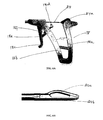
- FIG. 1 illustrates front, top and perspective views of a suture passing instrument, in accordance with a first embodiment of the present invention
- FIG. 4 illustrates a partially removed side elevation view of the lower jaw of the suture passing instrument, in accordance with a first embodiment of the present invention
- FIGS. 6A-6B illustrate a side elevation view of a proximal side and a distal side, respectively, of the suture passing instrument when a ratchet of the suture passing instrument is enabled, in accordance with the first embodiment of the present invention
- FIG. 7A-7B illustrate a side elevation view of the proximal and distal sides, respectively, of the suture passing instrument when the ratchet of the suture passing instrument is disabled, in accordance with the first embodiment of the present invention
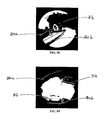
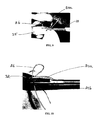
- FIGS. 8A-8F illustrate a method of use of the suture passing instrument, in accordance to a second embodiment of the present invention
- FIG. 9 illustrates a method of use of the suture passing instrument, in accordance to a third embodiment of the present invention.
- the suture passing instrument 10 has an elongate configuration with a proximal end 12 and a distal end 14.
- a pair of jaws, an upper jaw 20a and a lower jaw 20b, are disposed at the distal end 14 and are coupled to a handle assembly 18 disposed at the proximal end 12 through an elongate shaft or tube 16.
- the shaft 16 preferably has a length and diameter of 16 mm and 4.5 mm respectively.
- the lower jaw 20b of the suture passing instrument 10 is substantially straight with respect to the shaft 16.
- the lower jaw 20b may include a "V" groove or slot 42 ( FIG. 2 ) on the bottom of a distal portion for receiving a suture 26 ( FIG. 5 ).
- the upper jaw 20a is curve-shaped, preferably hump-back shaped, having a certain radius of curvature and is pivotally connected to the lower jaw 20b.
- the upper jaw 20a is designed such as to stay parallel with the lower jaw 20b even when grasping a thick tissue.
- the handle assembly 18 includes a handle (not shown) having a proximal end 18a and a distal end 18b, and a ratchet-like mechanism (not shown) having a grasper 18c with a ratchet 18e and a releaser 18d with a pawl 18f.
- the grasper 18c and the releaser 18d perform substantially similar to a ratchet and a pawl.
- the grasper 18c and the releaser 18d are pivotally connected to the distal end 18b of the handle (not shown).
- the proximal and distal ends 18a, 18b of the handle (not shown) are linkably connected via a link 18g and tension between the proximal and distal ends 18a, 18b is maintained using springs 18h.
- a securing mechanism 40 has a spring 41 formed at a distal tip of the lower jaw 20b.
- the spring 41 includes a cantilever portion bent back on itself.
- a wedge, slot or groove,42 is defined between the cantilever portion (not shown) and an opposite wall (not shown).
- the securing mechanism 40 is formed integrally with the jaw 20b.
- the suture is preferably a braided suture such as a Fiberwire TM , sold by Arthrex, Inc., Naples, Florida.
- the lower jaw 20b is configured to house the bendable needle 24.
- the bendable needle 24 is substantially disposed in a channel 23 within the lower jaw 20b when the needle 24 is in a non-operative, or non-piercing, position. In an operative position, the needle 24 is advanced distally to exit from an opening 23a in the lower jaw 20b.
- the needle 24 is bendable so that it can be moved generally with an axial force and can be bent on a curve, for example, 90° to move generally toward the upper jaw 20a. It is to be expressly understood that the needle 24 can be bent at any angle and advanced in any direction.
- a pointed tip of the needle 24 is designed to pierce and carry the suture 26 ( FIG. 2 ).
- the movement of the upper jaw 20a with respect to the lower jaw 20b is controlled by the handle assembly 18, as shown in FIGS. 6A-6B and 7A-7B .
- the upper jaw 20a is engaged to the lower jaw 20b when the ratchet 18e on the grasper 18c is engaged to the pawl 18f on the releaser 18d, as shown in FIGS. 6A-6B .
- the upper jaw 20a disengages from the lower jaw 20b when the ratchet 18e on the grasper 18c is disenabled from the pawl 18f, as shown in FIGS. 7A-7B .
- the needle 24 may be moved between a first position and a second position using the hand assembly 18.
- the user may disengage the upper jaw 20a from the lower jaw 20b by disengaging the pawl 18f on the releaser 18d from the ratchet 18e on the grasper 18c.
- the grasper 18c is pushed, one or more times, toward the distal end 18b while firmly holding the proximal end 18a of the handle to bring the proximal and distal ends 18a, 18b closer to each other and to advance the needle 24 distally.
- the upper jaw 20a is then engaged to the lower jaw 20b by engaging the pawl 18f to the ratchet 18e.
- FIGS. 8A-8F illustrate a method of use of the suture passing instrument 10, in accordance with a second embodiment of the invention.
- a needle 24 is loaded into the cannulation 18k on the proximal end of the shaft 16 of the suture passing instrument 10.
- the hub end 24a ( FIG. 6A ) of the needle 24 is snapped securely into a slot 18j ( FIG. 1 ) on the proximal end 18a of the suture passing instrument's 10 handle.
- the needle 24 facilitates passing the suture 26 ( FIG. 8B ) through the tissue.
- 1-2 inches of suture 26 is loaded into the wedge, slot or groove 42 ( FIG. 2 ) on the lower jaw 20b of the suture passing instrument 10.
- the suture 26 should snap as it fully engages into the lower jaw 20b.
- the upper jaw 20a is engaged to the lower jaw 20b, and the suture passing instrument 10 ( FIG. 8A ) is advanced into the subacromial space, as shown in FIG. 8C .
- the upper jaw 20a is then disengaged from the lower jaw 20b ( FIG. 7A ) by releasing the ratchet 18e ( FIG. 7A ) from the pawl 18f ( FIG. 7A ) and a desired bite of tissue 31 is grasped.
- the needle 24 is advanced distally such that the needle 24 exits the opening 23a ( FIG. 4 ) on the lower jaw 20b ( FIG. 4 ).
- the pointed tip of the needle 24 then pierces partly through and carries the suture 26.
- the needle 24 and the suture 26 are advanced distally using the handle assembly 18 ( FIG. 7A ) to advance the suture 26 through the tissue 31.
- the suture retriever or tissue grasper 34 may be, for example, a KingFisher TM Suture Retriever/Tissue Grasper AR-13970SR, made by Arthrex, Inc., Naples, Florida.
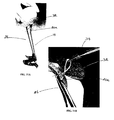
- FIG. 9 illustrates a method for suturing a tissue using the suture passing instrument 10 of the present invention, in accordance with a third embodiment of the invention.
- the suture passing instrument 10 is used in a rotator cuff repair.
- the suture passing instrument 10 loaded with a suture 26 is advanced into the acromion to grab the torn rotator cuff 35.
- the curve-shaped upper jaw 20a of the suture passing instrument 10 helps in grabbing thick tissues, as shown in FIG. 9 .
- the surgeon or the user of the suture passing instrument 10 may release the suture passing instrument 10 from his or her hand.
- the suture 26 is then grabbed using a grasper or a retriever 34 from an accessory portal, as shown in FIG. 11B .
- the upper jaw 20a is then released by disabling the ratchet (not shown) and the suture 26 is then retrieved.
Landscapes
- Health & Medical Sciences (AREA)
- Life Sciences & Earth Sciences (AREA)
- Surgery (AREA)
- Heart & Thoracic Surgery (AREA)
- Engineering & Computer Science (AREA)
- Biomedical Technology (AREA)
- Nuclear Medicine, Radiotherapy & Molecular Imaging (AREA)
- Medical Informatics (AREA)
- Molecular Biology (AREA)
- Animal Behavior & Ethology (AREA)
- General Health & Medical Sciences (AREA)
- Public Health (AREA)
- Veterinary Medicine (AREA)
- Surgical Instruments (AREA)
Abstract
Description
- The present invention relates to surgical instruments and, more specifically, to a suture passing instrument for arthroscopic tissue repair procedures and/or mini-open procedures.
- Both open and endoscopic surgical procedures often require sutures to ligate, join or otherwise treat tissue. Generally, suture needles with attached suture strands are grasped either manually or by forceps and passed through the desired work site so a knot can be tied. While the procedures are fairly uncomplicated in open surgery where most suture sites are readily accessible, in endoscopic procedures, where access to the work site is not readily available, the surgeon must use auxiliary devices to be able to grasp the suture strands and pass them through desired tissue.
- Various instruments and techniques have been developed and are known for surgical repairs requiring the passing of sutures to distant locations. However, there is a need for an improved device and technique that enables the surgeon to pass sutures arthroscopically to an internal body part where the work site is only accessible through a small portal or cannula and it is difficult to pass sutures within the body.
- There is also a need for a suture passing instrument that may operated by one-hand, provides maximum comfort and ease of use, and is ideal for single row, double row or margin convergence.
- The present invention fulfills the needs noted above by providing a suture passing instrument for arthroscopic and mini-open procedures.
- The present invention includes a suture passing instrument for use in arthroscopic and mini-open procedures having a handle assembly at a proximal end and a pair of jaws (an upper jaw, and a lower jaw) at a distal end with a shaft connecting the handle assembly and the jaws. The upper jaw is pivotally connected to the lower jaw and the jaws are movable with respect to each other. The lower jaw is substantially straight with respect to the shaft while the upper jaw is curve-shaped, preferably humpback-shaped. The humpback-shaped upper jaw is designed to stay parallel with the lower jaw even when grasping a thick tissue.
- The handle assembly includes a ratchet-like mechanism and a handle, the ratchet-like mechanism being pivotally connected to the handle. The ratchet-like mechanism consists of a grasper with a ratchet, and releaser with a pawl.
- A cannulation on a proximal end of the shaft is provided to receive a proximal end of a flexible needle. A distal end of the flexible needle is carried by the lower jaw and the needle is movable between a first position wherein the needle is substantially housed within the lower jaw and a second position wherein a distal portion of the needle protrudes from the lower jaw. The needle is moved between the first position and the second position by using the handle assembly.
- The apparatus further includes a securing mechanism to secure the suture in place in the lower jaw prior to being carried by the flexible needle. The securing mechanism may include a "V" groove on the bottom of a distal portion of the lower jaw, a spring in the distal portion of the lower jaw, an elastomeric pad or any other suitable securing mechanisms.
- A method is provided for suturing a tissue using the suture passing instrument of the present invention. The method includes the steps of clamping a piece of tissue to be sutured using the instrument, securing a suture in place for engagement with a flexible needle, engaging the suture with the needle, releasing the instrument from a user's hand, grabbing the suture with a retriever, releasing an upper jaw of the instrument, and retrieving the suture.
- An another method is provided for suturing a tissue using the suture passing instrument of the present invention. The method includes the steps of loading the needle onto the instrument, loading a suture into the lower jaw, using the grasper to close the jaws and to advance the instrument into the subacromial space. The method includes the additional steps of opening the jaws by releasing the grasper and grasping the desired bite of tissue, closing the jaws using the grasper and advancing the needle and suture through the tissue, retracting the needle by disabling the ratchet from the pawl, and retrieving the suture using a retriever or grasper.
- These and other features and advantages of the present invention will become apparent from the following description of the invention that is provided in connection with the accompanying drawings and illustrated embodiments of the invention.
-
FIG. 1 illustrates front, top and perspective views of a suture passing instrument, in accordance with a first embodiment of the present invention; -
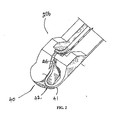
FIG. 2 illustrates a close-up, perspective view of a lower jaw of the suture passing instrument, in accordance with a first embodiment of the present invention; -
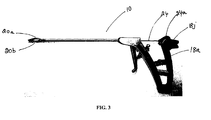
FIG. 3 illustrates a perspective view of the suture passing instrument having a needle, in accordance with the first embodiment of the present invention; -
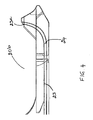
FIG. 4 illustrates a partially removed side elevation view of the lower jaw of the suture passing instrument, in accordance with a first embodiment of the present invention; -
FIG. 5 illustrates a side elevation view of a distal end of the suture passing instrument, in accordance with the first embodiment of the present invention; -
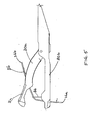
FIGS. 6A-6B illustrate a side elevation view of a proximal side and a distal side, respectively, of the suture passing instrument when a ratchet of the suture passing instrument is enabled, in accordance with the first embodiment of the present invention; -
FIG. 7A-7B illustrate a side elevation view of the proximal and distal sides, respectively, of the suture passing instrument when the ratchet of the suture passing instrument is disabled, in accordance with the first embodiment of the present invention; -
FIGS. 8A-8F illustrate a method of use of the suture passing instrument, in accordance to a second embodiment of the present invention; -
FIG. 9 illustrates a method of use of the suture passing instrument, in accordance to a third embodiment of the present invention; and -
FIGS. 10 and11A-11B illustrate a method of use of the suture passing instrument, in accordance to a fourth embodiment of the present invention. - The present invention is an instrument for passing sutures in arthroscopic tissue repair procedures and/or mini-open procedures.
- Referring to
FIG. 1 , a first preferred embodiment of asuture passing instrument 10 according to the present invention is shown. Thesuture passing instrument 10 has an elongate configuration with aproximal end 12 and adistal end 14. A pair of jaws, anupper jaw 20a and alower jaw 20b, are disposed at thedistal end 14 and are coupled to ahandle assembly 18 disposed at theproximal end 12 through an elongate shaft ortube 16. Theshaft 16 preferably has a length and diameter of 16 mm and 4.5 mm respectively. - The
lower jaw 20b of thesuture passing instrument 10 is substantially straight with respect to theshaft 16. Thelower jaw 20b may include a "V" groove or slot 42 (FIG. 2 ) on the bottom of a distal portion for receiving a suture 26 (FIG. 5 ). Theupper jaw 20a is curve-shaped, preferably hump-back shaped, having a certain radius of curvature and is pivotally connected to thelower jaw 20b. Theupper jaw 20a is designed such as to stay parallel with thelower jaw 20b even when grasping a thick tissue. - The
handle assembly 18 includes a handle (not shown) having aproximal end 18a and adistal end 18b, and a ratchet-like mechanism (not shown) having agrasper 18c with aratchet 18e and areleaser 18d with apawl 18f. Thegrasper 18c and thereleaser 18d perform substantially similar to a ratchet and a pawl. Thegrasper 18c and thereleaser 18d are pivotally connected to thedistal end 18b of the handle (not shown). The proximal anddistal ends distal ends springs 18h. - Referring to
FIG. 2 , asecuring mechanism 40 has aspring 41 formed at a distal tip of thelower jaw 20b. Thespring 41 includes a cantilever portion bent back on itself. A wedge, slot or groove,42 is defined between the cantilever portion (not shown) and an opposite wall (not shown). Thesecuring mechanism 40 is formed integrally with thejaw 20b. To assemble thesuture 26, afirst end 26a (FIG. 5 ) is held beneath the lower jaw 26b and the other end 26b (FIG. 5 ) above thelower jaw 20b. Theends 26a, 26b (FIG. 5 ) may be pulled in a proximal direction such that thesuture 26 is wedged into thegroove 42. When disposed in thegroove 42, the cantilever portion (not shown) biases thesuture 26 against the opposite wall (not shown), thus pinching thesuture 26 securely in place for engagement by the needle 24 (FIG.3 ). The suture is preferably a braided suture such as a Fiberwire™, sold by Arthrex, Inc., Naples, Florida. - Referring to
FIG. 3 , thesuture passing instrument 10 further includes abendable needle 24, preferably formed of nitinol.Needle 24 is received in acannulation 18k (FIG. 8A ) passing through theshaft 16. The hub end 24a of theneedle 24 is snapped securely into a slot on theproximal end 18a of the handle. Theneedle 24 has a generally flat, narrow and elongate configuration. - Referring now to
FIG. 4 , thelower jaw 20b is configured to house thebendable needle 24. Thebendable needle 24 is substantially disposed in achannel 23 within thelower jaw 20b when theneedle 24 is in a non-operative, or non-piercing, position. In an operative position, theneedle 24 is advanced distally to exit from an opening 23a in thelower jaw 20b. Theneedle 24 is bendable so that it can be moved generally with an axial force and can be bent on a curve, for example, 90° to move generally toward theupper jaw 20a. It is to be expressly understood that theneedle 24 can be bent at any angle and advanced in any direction. A pointed tip of theneedle 24 is designed to pierce and carry the suture 26 (FIG. 2 ). - An actuator 22 (
FIG. 1 ), preferably a thumb rocker or slide, is coupled to theneedle 24. The actuator 22 (FIG. 1 ) enables a user to advance theneedle 24 distally and/or proximally using the hand assembly 18 (FIG. 1 ). - The movement of the
upper jaw 20a with respect to thelower jaw 20b is controlled by thehandle assembly 18, as shown inFIGS. 6A-6B and7A-7B . Theupper jaw 20a is engaged to thelower jaw 20b when theratchet 18e on thegrasper 18c is engaged to thepawl 18f on thereleaser 18d, as shown inFIGS. 6A-6B . Theupper jaw 20a disengages from thelower jaw 20b when theratchet 18e on thegrasper 18c is disenabled from thepawl 18f, as shown inFIGS. 7A-7B . - The
needle 24 may be moved between a first position and a second position using thehand assembly 18. First, the user may disengage theupper jaw 20a from thelower jaw 20b by disengaging thepawl 18f on thereleaser 18d from theratchet 18e on thegrasper 18c. Next, thegrasper 18c is pushed, one or more times, toward thedistal end 18b while firmly holding theproximal end 18a of the handle to bring the proximal anddistal ends needle 24 distally. Theupper jaw 20a is then engaged to thelower jaw 20b by engaging thepawl 18f to theratchet 18e. -
FIGS. 8A-8F illustrate a method of use of thesuture passing instrument 10, in accordance with a second embodiment of the invention. In a first step of suturing using thesuture passing instrument 10, referring toFIG. 8A , aneedle 24 is loaded into thecannulation 18k on the proximal end of theshaft 16 of thesuture passing instrument 10. The hub end 24a (FIG. 6A ) of theneedle 24 is snapped securely into aslot 18j (FIG. 1 ) on theproximal end 18a of the suture passing instrument's 10 handle. Theneedle 24 facilitates passing the suture 26 (FIG. 8B ) through the tissue. - Referring to
FIG. 8B , 1-2 inches ofsuture 26 is loaded into the wedge, slot or groove 42 (FIG. 2 ) on thelower jaw 20b of thesuture passing instrument 10. Thesuture 26 should snap as it fully engages into thelower jaw 20b. - Using the
grasper 18c (FIG. 7A ) on thesuture passing instrument 10, theupper jaw 20a is engaged to thelower jaw 20b, and the suture passing instrument 10 (FIG. 8A ) is advanced into the subacromial space, as shown inFIG. 8C . Theupper jaw 20a is then disengaged from thelower jaw 20b (FIG. 7A ) by releasing theratchet 18e (FIG. 7A ) from thepawl 18f (FIG. 7A ) and a desired bite oftissue 31 is grasped. - Referring to
FIG. 8D , with the jaws closed around thetissue 31, theneedle 24 is advanced distally such that theneedle 24 exits the opening 23a (FIG. 4 ) on thelower jaw 20b (FIG. 4 ). The pointed tip of theneedle 24 then pierces partly through and carries thesuture 26. Theneedle 24 and thesuture 26 are advanced distally using the handle assembly 18 (FIG. 7A ) to advance thesuture 26 through thetissue 31. - Finally, the
suture 26 is retrieved with a suture retriever ortissue grasper 34, as shown inFIGS. 8E-8F . The suture retriever ortissue grasper 34 may be, for example, a KingFisher™ Suture Retriever/Tissue Grasper AR-13970SR, made by Arthrex, Inc., Naples, Florida. -
FIG. 9 illustrates a method for suturing a tissue using thesuture passing instrument 10 of the present invention, in accordance with a third embodiment of the invention. In this method, thesuture passing instrument 10 is used in a rotator cuff repair. Thesuture passing instrument 10 loaded with asuture 26 is advanced into the acromion to grab the tornrotator cuff 35. The curve-shapedupper jaw 20a of thesuture passing instrument 10 helps in grabbing thick tissues, as shown inFIG. 9 . -
FIGS. 10 ,11A-11B further illustrate a method for suturing aprototype tissue 32 using thesuture passing instrument 10 of the present invention, showing the advantages of the humpback jaw design. In a first step of suturing using thesuture passing instrument 10, asuture 26 is secured in place on thelower jaw 20b for engagement with a flexible needle 24 (not shown). The handle assembly of thesuture passing instrument 10 is used to close the upper andlower jaws prototype tissue 32 using thejaws suture 26 is then engaged with theneedle 24. The humpback-shapedupper jaw 20a is designed to stay parallel with thelower jaw 20b even when theprototype tissues 32 are thick, as shown inFIG. 10 . - Referring to
FIG. 11A , the surgeon or the user of thesuture passing instrument 10 may release thesuture passing instrument 10 from his or her hand. Thesuture 26 is then grabbed using a grasper or aretriever 34 from an accessory portal, as shown inFIG. 11B . Theupper jaw 20a is then released by disabling the ratchet (not shown) and thesuture 26 is then retrieved. - While the present invention is described herein with reference to illustrative embodiments for particular applications, it should be understood that the invention is not limited thereto. Those having ordinary skill in the art and access to the teachings provided herein will recognize additional modifications, applications, embodiments and substitution of equivalents all fall within the scope of the invention. Accordingly, the invention is not to be considered as limited by the foregoing description.
Claims (7)
- A suture passing instrument comprising:an elongate body member having a distal end and a proximal end, the proximal end having a cannulation to receive a needle;a lower jaw member mounted to the distal end of the elongate member, the lower jaw member having a slot and a securing mechanism to secure a suture, and a passage for receiving the needle;an upper jaw member mounted to the distal end of the elongate member and pivotally connected to the lower jaw member such that the upper jaw member is moveable with respect to the lower jaw member, and the upper jaw member being curve-shaped and having a given radius of curvature;a hand assembly comprising a handle and a ratchet-like mechanism, the hand assembly being capable of moving the needle from a first position to a second position, and being capable of moving the upper jaw member with respect to the lower jaw member.
- The suture passing instrument of claim 1, wherein the elongate member is a shaft.
- The suture passing instrument of claim 1, wherein the upper jaw member further comprises a channel at a distal end to allow the needle and the suture to pass therethrough.
- The suture passing instrument of claim 1, wherein the securing mechanism includes a spring formed at a distal tip of the lower jaw member, the spring including a cantilever portion.
- The suture passing instrument of claim 1, wherein the handle further comprises a proximal end and a distal end, and wherein the ratchet-like mechanism further comprises a grasper with a ratchet and a releaser with a pawl, the grasper and the releaser being pivotally connected to the distal end of the handle.
- The suture passing instrument of claim 5, wherein the proximal and distal ends of the handle are linkably connected and tension between the proximal and distal ends of the handle is maintained using springs.
- The suture passing instrument of claim 5, wherein the lower jaw member further comprises an opening at its distal end to allow the needle to pass therethrough.
Applications Claiming Priority (1)
| Application Number | Priority Date | Filing Date | Title |
|---|---|---|---|
| US90099307P | 2007-02-13 | 2007-02-13 |
Publications (2)
| Publication Number | Publication Date |
|---|---|
| EP1958574A1 true EP1958574A1 (en) | 2008-08-20 |
| EP1958574B1 EP1958574B1 (en) | 2011-10-12 |
Family
ID=39273242
Family Applications (1)
| Application Number | Title | Priority Date | Filing Date |
|---|---|---|---|
| EP08445006A Active EP1958574B1 (en) | 2007-02-13 | 2008-02-11 | Suture passing instrument |
Country Status (2)
| Country | Link |
|---|---|
| US (1) | US7972344B2 (en) |
| EP (1) | EP1958574B1 (en) |
Cited By (3)
| Publication number | Priority date | Publication date | Assignee | Title |
|---|---|---|---|---|
| EP2030575A1 (en) * | 2007-08-27 | 2009-03-04 | Arthrex Inc. | Suturing instrument with dual needles |
| EP2184015A2 (en) | 2008-11-07 | 2010-05-12 | Arthrex, Inc. | Suturing instrument for passing multiple sutures |
| WO2017136026A1 (en) | 2016-02-05 | 2017-08-10 | Dura Tap Llc | Devices and methods for suture placement |
Families Citing this family (74)
| Publication number | Priority date | Publication date | Assignee | Title |
|---|---|---|---|---|
| US7842050B2 (en) * | 2001-02-26 | 2010-11-30 | Diduch David R | Suture passing devices |
| US8226667B2 (en) | 2006-10-05 | 2012-07-24 | Tyco Healthcare Group Lp | Axial stitching device |
| WO2008045394A2 (en) | 2006-10-05 | 2008-04-17 | Tyco Healthcare Group Lp | Flexible endoscopic stitching devices |
| US20110130773A1 (en) * | 2007-07-03 | 2011-06-02 | Saliman Justin D | Methods for continuous suture passing |
| US9314234B2 (en) | 2007-07-03 | 2016-04-19 | Ceterix Orthopaedics, Inc. | Pre-tied surgical knots for use with suture passers |
| US8465505B2 (en) | 2011-05-06 | 2013-06-18 | Ceterix Orthopaedics, Inc. | Suture passer devices and methods |
| US9861354B2 (en) | 2011-05-06 | 2018-01-09 | Ceterix Orthopaedics, Inc. | Meniscus repair |
| US9211119B2 (en) | 2007-07-03 | 2015-12-15 | Ceterix Orthopaedics, Inc. | Suture passers and methods of passing suture |
| US8663253B2 (en) | 2007-07-03 | 2014-03-04 | Ceterix Orthopaedics, Inc. | Methods of meniscus repair |
| US8911456B2 (en) | 2007-07-03 | 2014-12-16 | Ceterix Orthopaedics, Inc. | Methods and devices for preventing tissue bridging while suturing |
| US20090012538A1 (en) * | 2007-07-03 | 2009-01-08 | Justin Saliman | Methods and devices for continuous suture passing |
| US8500809B2 (en) | 2011-01-10 | 2013-08-06 | Ceterix Orthopaedics, Inc. | Implant and method for repair of the anterior cruciate ligament |
| US10441273B2 (en) | 2007-07-03 | 2019-10-15 | Ceterix Orthopaedics, Inc. | Pre-tied surgical knots for use with suture passers |
| US8702731B2 (en) | 2007-07-03 | 2014-04-22 | Ceterix Orthopaedics, Inc. | Suturing and repairing tissue using in vivo suture loading |
| EP2033583B1 (en) * | 2007-08-27 | 2013-03-13 | Arthrex, Inc. | In-line suture passer |
| EP2211725A4 (en) | 2007-11-05 | 2015-04-01 | Ceterix Orthopedics Inc | Suture passing instrument and method |
| US8864776B2 (en) | 2008-04-11 | 2014-10-21 | Covidien Lp | Deployment system for surgical suture |
| US20110040308A1 (en) | 2008-06-13 | 2011-02-17 | Ramiro Cabrera | Endoscopic Stitching Devices |
| US8628545B2 (en) | 2008-06-13 | 2014-01-14 | Covidien Lp | Endoscopic stitching devices |
| WO2010019973A1 (en) * | 2008-08-19 | 2010-02-25 | A.M.I. Agency For Medical Innovations Gmbh | Surgical device |
| USD708746S1 (en) | 2009-06-10 | 2014-07-08 | Covidien Lp | Handle for surgical device |
| US20110060350A1 (en) * | 2009-09-04 | 2011-03-10 | Cost Containment, Inc. | Suture passer device and suture needle |
| US8490713B2 (en) | 2009-10-06 | 2013-07-23 | Covidien Lp | Handle assembly for endoscopic suturing device |
| JP5719374B2 (en) | 2009-11-09 | 2015-05-20 | セテリックス オーソピーディクス インコーポレイテッド | Device, system, and method for repairing a meniscus |
| US9011454B2 (en) | 2009-11-09 | 2015-04-21 | Ceterix Orthopaedics, Inc. | Suture passer with radiused upper jaw |
| US11744575B2 (en) | 2009-11-09 | 2023-09-05 | Ceterix Orthopaedics, Inc. | Suture passer devices and methods |
| US9848868B2 (en) | 2011-01-10 | 2017-12-26 | Ceterix Orthopaedics, Inc. | Suture methods for forming locking loops stitches |
| US20110251626A1 (en) * | 2010-01-20 | 2011-10-13 | Howmedica Osteonics Corp. | Suture passer assembly |
| US9913638B2 (en) | 2011-01-10 | 2018-03-13 | Ceterix Orthopaedics, Inc. | Transosteal anchoring methods for tissue repair |
| US8968340B2 (en) | 2011-02-23 | 2015-03-03 | Covidien Lp | Single actuating jaw flexible endolumenal stitching device |
| AU2012225668A1 (en) * | 2011-03-07 | 2013-10-10 | Passer Stitch, Llc | Suture passing devices and methods |
| US12029412B2 (en) * | 2011-03-07 | 2024-07-09 | Passer Stitch, Llc | Apparatus and method for passing suture through soft tissue |
| US10765422B2 (en) * | 2012-03-05 | 2020-09-08 | Passer Stitch, Llc | Apparatus and method for passing suture through soft tissue |
| US10973622B2 (en) * | 2011-04-25 | 2021-04-13 | Arthrex, Inc. | Internal brace for tissue repairs and reinforcements |
| US8882834B2 (en) | 2011-07-08 | 2014-11-11 | Smith & Nephew, Inc. | Soft tissue repair |
| US8801727B2 (en) | 2011-07-08 | 2014-08-12 | Smith & Nephew, Inc. | Orthopedic suture passer and method |
| US8888849B2 (en) | 2011-07-08 | 2014-11-18 | Smith & Nephew, Inc. | Soft tissue repair |
| US9662105B2 (en) | 2011-07-08 | 2017-05-30 | Smith & Nephew, Inc. | Suture passer and method |
| US8951263B2 (en) | 2011-07-08 | 2015-02-10 | Smith & Nephew, Inc. | Orthopedic suture passer and method |
| US9357997B2 (en) | 2011-07-08 | 2016-06-07 | Smith & Nephew, Inc. | Suture passer and method |
| DE102011107178A1 (en) * | 2011-07-13 | 2013-01-17 | Karl Storz Gmbh & Co. Kg | Medical cutting instrument for cutting muscles and tendons |
| US10524778B2 (en) * | 2011-09-28 | 2020-01-07 | Ceterix Orthopaedics | Suture passers adapted for use in constrained regions |
| US20140155914A1 (en) * | 2012-08-03 | 2014-06-05 | David James Schneider | Devices and methods for passing sutures through tissue |
| DE102012016396B4 (en) * | 2012-08-21 | 2015-04-02 | Olympus Winter & Ibe Gmbh | Surgical forceps |
| US9271722B2 (en) | 2012-12-31 | 2016-03-01 | Medos International Sarl | Methods for passing multiple sutures through tissue |
| WO2014172589A1 (en) | 2013-04-17 | 2014-10-23 | Sp Surgical Inc. | Method and apparatus for passing suture |
| US9247935B2 (en) | 2013-09-23 | 2016-02-02 | Ceterix Orthopaedics, Inc. | Arthroscopic knot pusher and suture cutter |
| WO2015095133A1 (en) | 2013-12-16 | 2015-06-25 | Ceterix Orthopaedics, Inc. | Automatically reloading suture passer devices having pre-tied knots and methods |
| US9687225B2 (en) | 2013-12-20 | 2017-06-27 | Biomet Sports Medicine, Llc | Suture passer with tissue reinforcement positioner |
| CN105250001B (en) | 2014-04-08 | 2019-07-12 | 赛特里克斯整形公司 | Suitable for suture passer used in confined area |
| US9468434B2 (en) | 2014-06-03 | 2016-10-18 | Covidien Lp | Stitching end effector |
| US9895153B2 (en) * | 2014-07-01 | 2018-02-20 | Boston Scientific Scimed, Inc. | Hemostatic clip with needle passer |
| US10092286B2 (en) | 2015-05-27 | 2018-10-09 | Covidien Lp | Suturing loading unit |
| US10226245B2 (en) | 2015-07-21 | 2019-03-12 | Ceterix Orthopaedics, Inc. | Automatically reloading suture passer devices that prevent entanglement |
| US10405853B2 (en) | 2015-10-02 | 2019-09-10 | Ceterix Orthpaedics, Inc. | Knot tying accessory |
| US9439647B1 (en) | 2016-03-02 | 2016-09-13 | Arthrogenx, LLC. | Suture passing instruments and methods |
| US10542970B2 (en) | 2016-05-31 | 2020-01-28 | Covidien Lp | Endoscopic stitching device |
| USD804025S1 (en) | 2016-06-20 | 2017-11-28 | Karl Storz Gmbh & Co. Kg | Suture retriever |
| USD804028S1 (en) | 2016-06-20 | 2017-11-28 | Karl Storz Gmbh & Co. Kg | Suture retriever |
| USD804026S1 (en) | 2016-06-20 | 2017-11-28 | Karl Storz Gmbh & Co. Kg | Suture retriever |
| USD804027S1 (en) | 2016-06-20 | 2017-11-28 | Karl Storz Gmbh & Co. Kg | Suture retriever |
| CA3083804C (en) | 2017-12-14 | 2022-09-20 | Conmed Corporation | Suture passer device |
| AU2019261567B2 (en) * | 2018-04-27 | 2024-12-19 | Ceterix Orthopaedics, Inc. | Suture passer devices and methods |
| US11197665B2 (en) | 2018-08-06 | 2021-12-14 | Covidien Lp | Needle reload device for use with endostitch device |
| CN110123400A (en) * | 2019-05-22 | 2019-08-16 | 杭州锐健马斯汀医疗器材有限公司 | A kind of device for meniscus suture |
| CN113017730B (en) * | 2021-04-12 | 2025-03-04 | 辽宁思恩医疗科技有限公司 | A threading device for deep surgical suturing and an operating method thereof |
| CN113995455B (en) * | 2021-12-30 | 2022-04-22 | 杭州锐健马斯汀医疗器材有限公司 | Suturing device and suturing method |
| CN114642464B (en) * | 2022-03-15 | 2022-11-08 | 青岛智兴医疗器械有限公司 | Supinal dura mater stitching instrument and using method thereof |
| CN114668437B (en) * | 2022-05-31 | 2022-08-26 | 杭州锐健马斯汀医疗器材有限公司 | Suturing device |
| US12390213B1 (en) * | 2023-04-02 | 2025-08-19 | Passer Stitch, Llc | Systems, apparatus and methods for passing suture through soft tissue |
| US20250017719A1 (en) | 2023-07-12 | 2025-01-16 | Integrity Medical Services Inc. | Tissue repair devices, systems, and methods |
| IT202300022728A1 (en) * | 2023-10-30 | 2025-04-30 | Rino Frisina | SURGICAL FORCEPS |
| US12594097B2 (en) * | 2024-05-31 | 2026-04-07 | Integrity Medical Services Inc. | Systems and methods for orthopedic tool connectors |
| US20250366850A1 (en) * | 2024-05-31 | 2025-12-04 | Integrity Medical Services Inc. | Systems and methods for surgical tissue repair |
Citations (5)
| Publication number | Priority date | Publication date | Assignee | Title |
|---|---|---|---|---|
| US20020103493A1 (en) * | 2001-01-26 | 2002-08-01 | Raymond Thal | Surgical suture passer |
| US20030065337A1 (en) * | 2001-10-01 | 2003-04-03 | Brad Topper | Suturing apparatus and method |
| US20030233106A1 (en) * | 2002-05-15 | 2003-12-18 | Dreyfuss Peter J. | Suture passing instrument |
| EP1498075A1 (en) * | 2003-06-23 | 2005-01-19 | Ethicon, Inc. | Tissue grasper/suture passer instrument |
| US20050288690A1 (en) * | 2004-06-16 | 2005-12-29 | Bourque Bernard J | Suture passing |
Family Cites Families (3)
| Publication number | Priority date | Publication date | Assignee | Title |
|---|---|---|---|---|
| US4957498A (en) * | 1987-11-05 | 1990-09-18 | Concept, Inc. | Suturing instrument |
| US5947982A (en) * | 1997-04-02 | 1999-09-07 | Smith & Nephew, Inc. | Suture-passing forceps |
| DE60230084D1 (en) * | 2001-03-23 | 2009-01-15 | Arthrex Inc | Instrument for pulling a thread during arthroscopic suturing of tissue |
-
2008
- 2008-02-11 EP EP08445006A patent/EP1958574B1/en active Active
- 2008-02-13 US US12/030,782 patent/US7972344B2/en active Active
Patent Citations (5)
| Publication number | Priority date | Publication date | Assignee | Title |
|---|---|---|---|---|
| US20020103493A1 (en) * | 2001-01-26 | 2002-08-01 | Raymond Thal | Surgical suture passer |
| US20030065337A1 (en) * | 2001-10-01 | 2003-04-03 | Brad Topper | Suturing apparatus and method |
| US20030233106A1 (en) * | 2002-05-15 | 2003-12-18 | Dreyfuss Peter J. | Suture passing instrument |
| EP1498075A1 (en) * | 2003-06-23 | 2005-01-19 | Ethicon, Inc. | Tissue grasper/suture passer instrument |
| US20050288690A1 (en) * | 2004-06-16 | 2005-12-29 | Bourque Bernard J | Suture passing |
Cited By (9)
| Publication number | Priority date | Publication date | Assignee | Title |
|---|---|---|---|---|
| EP2030575A1 (en) * | 2007-08-27 | 2009-03-04 | Arthrex Inc. | Suturing instrument with dual needles |
| US8663250B2 (en) | 2007-08-27 | 2014-03-04 | Arthrex, Inc. | Suturing instrument with dual needles and method of passing suture |
| EP2184015A2 (en) | 2008-11-07 | 2010-05-12 | Arthrex, Inc. | Suturing instrument for passing multiple sutures |
| EP2184015A3 (en) * | 2008-11-07 | 2010-11-24 | Arthrex, Inc. | Suturing instrument for passing multiple sutures |
| US8460318B2 (en) | 2008-11-07 | 2013-06-11 | Arthrex, Inc. | Suturing instrument and method for passing multiple sutures |
| US9393010B2 (en) | 2008-11-07 | 2016-07-19 | Arthrex, Inc. | Suturing instrument for passing multiple sutures |
| WO2017136026A1 (en) | 2016-02-05 | 2017-08-10 | Dura Tap Llc | Devices and methods for suture placement |
| EP3410950A4 (en) * | 2016-02-05 | 2019-10-30 | Dura Tap LLC | DEVICES AND METHODS FOR SUTURE PLACEMENT |
| US11090042B2 (en) | 2016-02-05 | 2021-08-17 | Durastat Llc | Devices and methods for suture placement |
Also Published As
| Publication number | Publication date |
|---|---|
| US20080208221A1 (en) | 2008-08-28 |
| US7972344B2 (en) | 2011-07-05 |
| EP1958574B1 (en) | 2011-10-12 |
Similar Documents
| Publication | Publication Date | Title |
|---|---|---|
| EP1958574B1 (en) | Suture passing instrument | |
| EP2033583B1 (en) | In-line suture passer | |
| US8663250B2 (en) | Suturing instrument with dual needles and method of passing suture | |
| US9393010B2 (en) | Suturing instrument for passing multiple sutures | |
| US7585305B2 (en) | Suture passing instrument | |
| US8282656B2 (en) | Suture passing instrument | |
| US9610075B2 (en) | Suture passing devices and methods | |
| US10058325B2 (en) | Suture passer and method of tissue repair | |
| US8852088B2 (en) | Tissue retractor assembly | |
| US9211118B2 (en) | Suture passer | |
| US20100249498A1 (en) | Endoscopic Apparatus for Manipulating Tissue | |
| US8177796B2 (en) | Suture passing apparatus and method | |
| EP2177167B1 (en) | Suturing apparatus | |
| KR20250048111A (en) | Endoscopic suturing system having external instrument channel | |
| AU2003254006A1 (en) | Surgical suturing instrument | |
| US11090041B2 (en) | Device and method for securing endoscope relative to suturing system |
Legal Events
| Date | Code | Title | Description |
|---|---|---|---|
| PUAI | Public reference made under article 153(3) epc to a published international application that has entered the european phase |
Free format text: ORIGINAL CODE: 0009012 |
|
| AK | Designated contracting states |
Kind code of ref document: A1 Designated state(s): AT BE BG CH CY CZ DE DK EE ES FI FR GB GR HR HU IE IS IT LI LT LU LV MC MT NL NO PL PT RO SE SI SK TR |
|
| AX | Request for extension of the european patent |
Extension state: AL BA MK RS |
|
| 17P | Request for examination filed |
Effective date: 20081219 |
|
| 17Q | First examination report despatched |
Effective date: 20090206 |
|
| AKX | Designation fees paid |
Designated state(s): DE FR GB IT NL |
|
| GRAP | Despatch of communication of intention to grant a patent |
Free format text: ORIGINAL CODE: EPIDOSNIGR1 |
|
| GRAS | Grant fee paid |
Free format text: ORIGINAL CODE: EPIDOSNIGR3 |
|
| GRAA | (expected) grant |
Free format text: ORIGINAL CODE: 0009210 |
|
| AK | Designated contracting states |
Kind code of ref document: B1 Designated state(s): DE FR GB IT NL |
|
| REG | Reference to a national code |
Ref country code: GB Ref legal event code: FG4D |
|
| REG | Reference to a national code |
Ref country code: NL Ref legal event code: T3 |
|
| REG | Reference to a national code |
Ref country code: DE Ref legal event code: R096 Ref document number: 602008010384 Country of ref document: DE Effective date: 20111215 |
|
| PLBE | No opposition filed within time limit |
Free format text: ORIGINAL CODE: 0009261 |
|
| STAA | Information on the status of an ep patent application or granted ep patent |
Free format text: STATUS: NO OPPOSITION FILED WITHIN TIME LIMIT |
|
| 26N | No opposition filed |
Effective date: 20120713 |
|
| REG | Reference to a national code |
Ref country code: DE Ref legal event code: R097 Ref document number: 602008010384 Country of ref document: DE Effective date: 20120713 |
|
| REG | Reference to a national code |
Ref country code: FR Ref legal event code: PLFP Year of fee payment: 9 |
|
| REG | Reference to a national code |
Ref country code: FR Ref legal event code: PLFP Year of fee payment: 10 |
|
| REG | Reference to a national code |
Ref country code: FR Ref legal event code: PLFP Year of fee payment: 11 |
|
| PGFP | Annual fee paid to national office [announced via postgrant information from national office to epo] |
Ref country code: GB Payment date: 20251218 Year of fee payment: 19 |
|
| PGFP | Annual fee paid to national office [announced via postgrant information from national office to epo] |
Ref country code: NL Payment date: 20251215 Year of fee payment: 19 Ref country code: FR Payment date: 20251208 Year of fee payment: 19 |
|
| PGFP | Annual fee paid to national office [announced via postgrant information from national office to epo] |
Ref country code: DE Payment date: 20251216 Year of fee payment: 19 |
|
| PGFP | Annual fee paid to national office [announced via postgrant information from national office to epo] |
Ref country code: IT Payment date: 20260122 Year of fee payment: 19 |