EP1953171A1 - Aminoglycoside antibiotics targeting bacterial 16S ribosomal RNA - Google Patents
Aminoglycoside antibiotics targeting bacterial 16S ribosomal RNA Download PDFInfo
- Publication number
- EP1953171A1 EP1953171A1 EP07002363A EP07002363A EP1953171A1 EP 1953171 A1 EP1953171 A1 EP 1953171A1 EP 07002363 A EP07002363 A EP 07002363A EP 07002363 A EP07002363 A EP 07002363A EP 1953171 A1 EP1953171 A1 EP 1953171A1
- Authority
- EP
- European Patent Office
- Prior art keywords
- substituted
- compounds according
- calc
- alkyl
- hydrogen
- Prior art date
- Legal status (The legal status is an assumption and is not a legal conclusion. Google has not performed a legal analysis and makes no representation as to the accuracy of the status listed.)
- Withdrawn
Links
- 230000001580 bacterial effect Effects 0.000 title claims description 17
- 108020004465 16S ribosomal RNA Proteins 0.000 title abstract description 10
- 239000002647 aminoglycoside antibiotic agent Substances 0.000 title description 12
- 230000008685 targeting Effects 0.000 title description 3
- 150000001875 compounds Chemical class 0.000 claims abstract description 143
- 238000000034 method Methods 0.000 claims abstract description 63
- 239000003814 drug Substances 0.000 claims abstract description 25
- 238000006243 chemical reaction Methods 0.000 claims description 100
- 229910052739 hydrogen Inorganic materials 0.000 claims description 60
- 239000001257 hydrogen Substances 0.000 claims description 48
- -1 3-amino-3-deoxy-α-D-glucopyranosyl moiety Chemical group 0.000 claims description 42
- 125000002887 hydroxy group Chemical group [H]O* 0.000 claims description 31
- 150000002431 hydrogen Chemical class 0.000 claims description 25
- 125000003118 aryl group Chemical group 0.000 claims description 21
- 150000002772 monosaccharides Chemical group 0.000 claims description 20
- 125000002924 primary amino group Chemical group [H]N([H])* 0.000 claims description 18
- 125000001118 alkylidene group Chemical group 0.000 claims description 16
- 239000003153 chemical reaction reagent Substances 0.000 claims description 16
- 125000000304 alkynyl group Chemical group 0.000 claims description 14
- 125000000623 heterocyclic group Chemical group 0.000 claims description 13
- 229910052760 oxygen Inorganic materials 0.000 claims description 13
- IJGRMHOSHXDMSA-UHFFFAOYSA-N Atomic nitrogen Chemical compound N#N IJGRMHOSHXDMSA-UHFFFAOYSA-N 0.000 claims description 12
- UFHFLCQGNIYNRP-UHFFFAOYSA-N Hydrogen Chemical group [H][H] UFHFLCQGNIYNRP-UHFFFAOYSA-N 0.000 claims description 12
- UOZODPSAJZTQNH-UHFFFAOYSA-N Paromomycin II Natural products NC1C(O)C(O)C(CN)OC1OC1C(O)C(OC2C(C(N)CC(N)C2O)OC2C(C(O)C(O)C(CO)O2)N)OC1CO UOZODPSAJZTQNH-UHFFFAOYSA-N 0.000 claims description 12
- 150000002016 disaccharides Chemical class 0.000 claims description 12
- 229960001914 paromomycin Drugs 0.000 claims description 12
- 125000004209 (C1-C8) alkyl group Chemical group 0.000 claims description 11
- RTZKZFJDLAIYFH-UHFFFAOYSA-N Diethyl ether Chemical compound CCOCC RTZKZFJDLAIYFH-UHFFFAOYSA-N 0.000 claims description 11
- 125000001072 heteroaryl group Chemical group 0.000 claims description 11
- 125000000852 azido group Chemical group *N=[N+]=[N-] 0.000 claims description 10
- 125000004432 carbon atom Chemical group C* 0.000 claims description 10
- 125000000753 cycloalkyl group Chemical group 0.000 claims description 10
- 150000003839 salts Chemical class 0.000 claims description 10
- YWWDBCBWQNCYNR-UHFFFAOYSA-N trimethylphosphine Chemical compound CP(C)C YWWDBCBWQNCYNR-UHFFFAOYSA-N 0.000 claims description 10
- 125000003342 alkenyl group Chemical group 0.000 claims description 9
- QVGXLLKOCUKJST-UHFFFAOYSA-N atomic oxygen Chemical compound [O] QVGXLLKOCUKJST-UHFFFAOYSA-N 0.000 claims description 9
- 125000004435 hydrogen atom Chemical group [H]* 0.000 claims description 9
- 229910052757 nitrogen Inorganic materials 0.000 claims description 9
- 239000001301 oxygen Substances 0.000 claims description 9
- 238000011282 treatment Methods 0.000 claims description 9
- 150000001241 acetals Chemical class 0.000 claims description 8
- 239000002253 acid Substances 0.000 claims description 8
- 125000003277 amino group Chemical group 0.000 claims description 8
- 229910052731 fluorine Inorganic materials 0.000 claims description 8
- 150000004676 glycans Chemical group 0.000 claims description 8
- 150000004678 hydrides Chemical class 0.000 claims description 8
- 229920001282 polysaccharide Chemical group 0.000 claims description 8
- 239000005017 polysaccharide Chemical group 0.000 claims description 8
- 125000000547 substituted alkyl group Chemical group 0.000 claims description 8
- 238000012546 transfer Methods 0.000 claims description 8
- 150000004043 trisaccharides Chemical class 0.000 claims description 8
- 125000004178 (C1-C4) alkyl group Chemical group 0.000 claims description 7
- 125000000217 alkyl group Chemical group 0.000 claims description 7
- 150000002170 ethers Chemical class 0.000 claims description 7
- 229910052736 halogen Inorganic materials 0.000 claims description 7
- 150000002367 halogens Chemical class 0.000 claims description 7
- 239000008194 pharmaceutical composition Substances 0.000 claims description 7
- 230000002265 prevention Effects 0.000 claims description 7
- 239000000651 prodrug Substances 0.000 claims description 7
- 229940002612 prodrug Drugs 0.000 claims description 7
- 239000002904 solvent Substances 0.000 claims description 7
- 229910052717 sulfur Inorganic materials 0.000 claims description 7
- HZNVUJQVZSTENZ-UHFFFAOYSA-N 2,3-dichloro-5,6-dicyano-1,4-benzoquinone Chemical compound ClC1=C(Cl)C(=O)C(C#N)=C(C#N)C1=O HZNVUJQVZSTENZ-UHFFFAOYSA-N 0.000 claims description 6
- WFDIJRYMOXRFFG-UHFFFAOYSA-N Acetic anhydride Chemical compound CC(=O)OC(C)=O WFDIJRYMOXRFFG-UHFFFAOYSA-N 0.000 claims description 6
- WKBOTKDWSSQWDR-UHFFFAOYSA-N Bromine atom Chemical compound [Br] WKBOTKDWSSQWDR-UHFFFAOYSA-N 0.000 claims description 6
- GDTBXPJZTBHREO-UHFFFAOYSA-N bromine Substances BrBr GDTBXPJZTBHREO-UHFFFAOYSA-N 0.000 claims description 6
- 229910052794 bromium Inorganic materials 0.000 claims description 6
- 125000004122 cyclic group Chemical group 0.000 claims description 6
- 230000000813 microbial effect Effects 0.000 claims description 6
- PXGOKWXKJXAPGV-UHFFFAOYSA-N Fluorine Chemical compound FF PXGOKWXKJXAPGV-UHFFFAOYSA-N 0.000 claims description 5
- NINIDFKCEFEMDL-UHFFFAOYSA-N Sulfur Chemical compound [S] NINIDFKCEFEMDL-UHFFFAOYSA-N 0.000 claims description 5
- 125000003710 aryl alkyl group Chemical group 0.000 claims description 5
- 150000002148 esters Chemical class 0.000 claims description 5
- 239000011737 fluorine Substances 0.000 claims description 5
- 125000003147 glycosyl group Chemical group 0.000 claims description 5
- 150000007523 nucleic acids Chemical group 0.000 claims description 5
- 229910052705 radium Inorganic materials 0.000 claims description 5
- 229910052701 rubidium Inorganic materials 0.000 claims description 5
- 125000005346 substituted cycloalkyl group Chemical group 0.000 claims description 5
- 125000006273 (C1-C3) alkyl group Chemical group 0.000 claims description 4
- 125000006701 (C1-C7) alkyl group Chemical group 0.000 claims description 4
- 125000006552 (C3-C8) cycloalkyl group Chemical group 0.000 claims description 4
- XYFCBTPGUUZFHI-UHFFFAOYSA-N Phosphine Chemical compound P XYFCBTPGUUZFHI-UHFFFAOYSA-N 0.000 claims description 4
- MJOQJPYNENPSSS-XQHKEYJVSA-N [(3r,4s,5r,6s)-4,5,6-triacetyloxyoxan-3-yl] acetate Chemical compound CC(=O)O[C@@H]1CO[C@@H](OC(C)=O)[C@H](OC(C)=O)[C@H]1OC(C)=O MJOQJPYNENPSSS-XQHKEYJVSA-N 0.000 claims description 4
- 125000003668 acetyloxy group Chemical group [H]C([H])([H])C(=O)O[*] 0.000 claims description 4
- 150000007513 acids Chemical class 0.000 claims description 4
- 125000000051 benzyloxy group Chemical group [H]C1=C([H])C([H])=C(C([H])=C1[H])C([H])([H])O* 0.000 claims description 4
- 239000000969 carrier Substances 0.000 claims description 4
- 239000000460 chlorine Substances 0.000 claims description 4
- KPUWHANPEXNPJT-UHFFFAOYSA-N disiloxane Chemical class [SiH3]O[SiH3] KPUWHANPEXNPJT-UHFFFAOYSA-N 0.000 claims description 4
- 150000002440 hydroxy compounds Chemical class 0.000 claims description 4
- 150000007522 mineralic acids Chemical class 0.000 claims description 4
- 150000007524 organic acids Chemical class 0.000 claims description 4
- 230000009467 reduction Effects 0.000 claims description 4
- 238000006722 reduction reaction Methods 0.000 claims description 4
- 238000006894 reductive elimination reaction Methods 0.000 claims description 4
- 230000001131 transforming effect Effects 0.000 claims description 4
- JXUSHYWKLNIYIR-JCNXQQRHSA-N (2s,3s,4r,5r,6r)-5-amino-2-(aminomethyl)-6-[(2r,3s,4r,5s)-5-[(1r,2r,3s,5r,6s)-3,5-diamino-2-[(2s,3r,4r,5s,6r)-3-amino-4,5-dihydroxy-6-(phenylmethoxymethyl)oxan-2-yl]oxy-6-hydroxycyclohexyl]oxy-4-hydroxy-2-(hydroxymethyl)oxolan-3-yl]oxyoxane-3,4-diol Chemical compound N[C@@H]1[C@@H](O)[C@H](O)[C@H](CN)O[C@@H]1O[C@H]1[C@@H](O)[C@H](O[C@H]2[C@@H]([C@@H](N)C[C@@H](N)[C@@H]2O)O[C@@H]2[C@@H]([C@@H](O)[C@H](O)[C@@H](COCC=3C=CC=CC=3)O2)N)O[C@@H]1CO JXUSHYWKLNIYIR-JCNXQQRHSA-N 0.000 claims description 3
- DRHDMQJFWDZMND-JCNXQQRHSA-N (2s,3s,4r,5r,6r)-5-amino-2-(aminomethyl)-6-[(2r,3s,4r,5s)-5-[(1r,2r,3s,5r,6s)-3,5-diamino-2-[(2s,3r,4r,5s,6r)-3-amino-4-hydroxy-6-(hydroxymethyl)-5-phenylmethoxyoxan-2-yl]oxy-6-hydroxycyclohexyl]oxy-4-hydroxy-2-(hydroxymethyl)oxolan-3-yl]oxyoxane-3,4-diol Chemical compound N[C@@H]1[C@@H](O)[C@H](O)[C@H](CN)O[C@@H]1O[C@H]1[C@@H](O)[C@H](O[C@H]2[C@@H]([C@@H](N)C[C@@H](N)[C@@H]2O)O[C@@H]2[C@@H]([C@@H](O)[C@H](OCC=3C=CC=CC=3)[C@@H](CO)O2)N)O[C@@H]1CO DRHDMQJFWDZMND-JCNXQQRHSA-N 0.000 claims description 3
- BJNRNAHKVYQUCR-CQXNUXSXSA-N (2s,3s,4r,5r,6r)-6-[(2r,3s,4r,5s)-5-[(1r,2r,3s,5r,6s)-2-[[(2r,4ar,6s,7r,8r,8as)-7-amino-8-hydroxy-2-phenyl-4,4a,6,7,8,8a-hexahydropyrano[3,2-d][1,3]dioxin-6-yl]oxy]-3,5-diamino-6-hydroxycyclohexyl]oxy-4-hydroxy-2-(hydroxymethyl)oxolan-3-yl]oxy-5-amino-2-( Chemical compound N[C@@H]1[C@@H](O)[C@H](O)[C@H](CN)O[C@@H]1O[C@H]1[C@@H](O)[C@H](O[C@H]2[C@@H]([C@@H](N)C[C@@H](N)[C@@H]2O)O[C@@H]2[C@@H]([C@@H](O)[C@@H]3O[C@@H](OC[C@H]3O2)C=2C=CC=CC=2)N)O[C@@H]1CO BJNRNAHKVYQUCR-CQXNUXSXSA-N 0.000 claims description 3
- 125000006710 (C2-C12) alkenyl group Chemical group 0.000 claims description 3
- HBAQYPYDRFILMT-UHFFFAOYSA-N 8-[3-(1-cyclopropylpyrazol-4-yl)-1H-pyrazolo[4,3-d]pyrimidin-5-yl]-3-methyl-3,8-diazabicyclo[3.2.1]octan-2-one Chemical class C1(CC1)N1N=CC(=C1)C1=NNC2=C1N=C(N=C2)N1C2C(N(CC1CC2)C)=O HBAQYPYDRFILMT-UHFFFAOYSA-N 0.000 claims description 3
- ZAMOUSCENKQFHK-UHFFFAOYSA-N Chlorine atom Chemical compound [Cl] ZAMOUSCENKQFHK-UHFFFAOYSA-N 0.000 claims description 3
- 108091093037 Peptide nucleic acid Proteins 0.000 claims description 3
- DHKHKXVYLBGOIT-UHFFFAOYSA-N acetaldehyde Diethyl Acetal Natural products CCOC(C)OCC DHKHKXVYLBGOIT-UHFFFAOYSA-N 0.000 claims description 3
- 238000005903 acid hydrolysis reaction Methods 0.000 claims description 3
- 239000013543 active substance Substances 0.000 claims description 3
- 239000003054 catalyst Substances 0.000 claims description 3
- 229910052801 chlorine Inorganic materials 0.000 claims description 3
- 125000005843 halogen group Chemical group 0.000 claims description 3
- PNDPGZBMCMUPRI-UHFFFAOYSA-N iodine Chemical compound II PNDPGZBMCMUPRI-UHFFFAOYSA-N 0.000 claims description 3
- 125000002496 methyl group Chemical group [H]C([H])([H])* 0.000 claims description 3
- 239000000546 pharmaceutical excipient Substances 0.000 claims description 3
- BDHFUVZGWQCTTF-UHFFFAOYSA-M sulfonate Chemical compound [O-]S(=O)=O BDHFUVZGWQCTTF-UHFFFAOYSA-M 0.000 claims description 3
- ILJSQTXMGCGYMG-UHFFFAOYSA-N triacetic acid Chemical compound CC(=O)CC(=O)CC(O)=O ILJSQTXMGCGYMG-UHFFFAOYSA-N 0.000 claims description 3
- 125000004400 (C1-C12) alkyl group Chemical group 0.000 claims description 2
- 125000006527 (C1-C5) alkyl group Chemical group 0.000 claims description 2
- HEVMDQBCAHEHDY-UHFFFAOYSA-N (Dimethoxymethyl)benzene Chemical compound COC(OC)C1=CC=CC=C1 HEVMDQBCAHEHDY-UHFFFAOYSA-N 0.000 claims description 2
- 238000006027 Birch reduction reaction Methods 0.000 claims description 2
- 208000004554 Leishmaniasis Diseases 0.000 claims description 2
- 239000002841 Lewis acid Substances 0.000 claims description 2
- 239000012448 Lithium borohydride Substances 0.000 claims description 2
- 229910003827 NRaRb Inorganic materials 0.000 claims description 2
- 238000003800 Staudinger reaction Methods 0.000 claims description 2
- RBHODKISOUZAKB-UHFFFAOYSA-N [methylperoxy(diphenyl)methyl]benzene Chemical group C=1C=CC=CC=1C(C=1C=CC=CC=1)(OOC)C1=CC=CC=C1 RBHODKISOUZAKB-UHFFFAOYSA-N 0.000 claims description 2
- 125000002252 acyl group Chemical group 0.000 claims description 2
- 125000003545 alkoxy group Chemical group 0.000 claims description 2
- 150000001350 alkyl halides Chemical class 0.000 claims description 2
- 125000005002 aryl methyl group Chemical group 0.000 claims description 2
- 125000001797 benzyl group Chemical group [H]C1=C([H])C([H])=C(C([H])=C1[H])C([H])([H])* 0.000 claims description 2
- SIPUZPBQZHNSDW-UHFFFAOYSA-N bis(2-methylpropyl)aluminum Chemical compound CC(C)C[Al]CC(C)C SIPUZPBQZHNSDW-UHFFFAOYSA-N 0.000 claims description 2
- MCQRPQCQMGVWIQ-UHFFFAOYSA-N boron;methylsulfanylmethane Chemical compound [B].CSC MCQRPQCQMGVWIQ-UHFFFAOYSA-N 0.000 claims description 2
- 238000009903 catalytic hydrogenation reaction Methods 0.000 claims description 2
- 125000000664 diazo group Chemical group [N-]=[N+]=[*] 0.000 claims description 2
- 150000004662 dithiols Chemical class 0.000 claims description 2
- 125000001495 ethyl group Chemical group [H]C([H])([H])C([H])([H])* 0.000 claims description 2
- 238000005984 hydrogenation reaction Methods 0.000 claims description 2
- 208000015181 infectious disease Diseases 0.000 claims description 2
- 150000007517 lewis acids Chemical class 0.000 claims description 2
- 238000007248 oxidative elimination reaction Methods 0.000 claims description 2
- 229910000073 phosphorus hydride Inorganic materials 0.000 claims description 2
- 230000002829 reductive effect Effects 0.000 claims description 2
- BEOOHQFXGBMRKU-UHFFFAOYSA-N sodium cyanoborohydride Chemical compound [Na+].[B-]C#N BEOOHQFXGBMRKU-UHFFFAOYSA-N 0.000 claims description 2
- 238000003797 solvolysis reaction Methods 0.000 claims description 2
- 150000003871 sulfonates Chemical class 0.000 claims description 2
- 239000011593 sulfur Substances 0.000 claims description 2
- 201000002311 trypanosomiasis Diseases 0.000 claims description 2
- 229910052720 vanadium Inorganic materials 0.000 claims description 2
- 150000002222 fluorine compounds Chemical class 0.000 claims 1
- 239000012280 lithium aluminium hydride Substances 0.000 claims 1
- 210000003705 ribosome Anatomy 0.000 abstract description 17
- JGSMDVGTXBPWIM-HKEUSBCWSA-N paromamine Chemical compound O[C@@H]1[C@@H](O)[C@H](N)C[C@H](N)[C@H]1O[C@@H]1[C@H](N)[C@@H](O)[C@H](O)[C@@H](CO)O1 JGSMDVGTXBPWIM-HKEUSBCWSA-N 0.000 abstract description 6
- JGSMDVGTXBPWIM-UHFFFAOYSA-N Paromamine Natural products OC1C(O)C(N)CC(N)C1OC1C(N)C(O)C(O)C(CO)O1 JGSMDVGTXBPWIM-UHFFFAOYSA-N 0.000 abstract description 4
- 230000000845 anti-microbial effect Effects 0.000 abstract description 4
- 239000000825 pharmaceutical preparation Substances 0.000 abstract description 2
- OKKJLVBELUTLKV-UHFFFAOYSA-N Methanol Chemical compound OC OKKJLVBELUTLKV-UHFFFAOYSA-N 0.000 description 262
- HEDRZPFGACZZDS-UHFFFAOYSA-N Chloroform Chemical compound ClC(Cl)Cl HEDRZPFGACZZDS-UHFFFAOYSA-N 0.000 description 114
- 239000007787 solid Substances 0.000 description 88
- XEKOWRVHYACXOJ-UHFFFAOYSA-N Ethyl acetate Chemical compound CCOC(C)=O XEKOWRVHYACXOJ-UHFFFAOYSA-N 0.000 description 82
- 239000011734 sodium Substances 0.000 description 77
- 238000001906 matrix-assisted laser desorption--ionisation mass spectrometry Methods 0.000 description 58
- VLKZOEOYAKHREP-UHFFFAOYSA-N n-Hexane Chemical compound CCCCCC VLKZOEOYAKHREP-UHFFFAOYSA-N 0.000 description 39
- QGZKDVFQNNGYKY-UHFFFAOYSA-N Ammonia Chemical compound N QGZKDVFQNNGYKY-UHFFFAOYSA-N 0.000 description 36
- HEMHJVSKTPXQMS-UHFFFAOYSA-M Sodium hydroxide Chemical compound [OH-].[Na+] HEMHJVSKTPXQMS-UHFFFAOYSA-M 0.000 description 33
- 108020004418 ribosomal RNA Proteins 0.000 description 27
- 238000003818 flash chromatography Methods 0.000 description 24
- CSNNHWWHGAXBCP-UHFFFAOYSA-L Magnesium sulfate Chemical compound [Mg+2].[O-][S+2]([O-])([O-])[O-] CSNNHWWHGAXBCP-UHFFFAOYSA-L 0.000 description 22
- YMWUJEATGCHHMB-UHFFFAOYSA-N Dichloromethane Chemical compound ClCCl YMWUJEATGCHHMB-UHFFFAOYSA-N 0.000 description 18
- XDTMQSROBMDMFD-UHFFFAOYSA-N Cyclohexane Chemical compound C1CCCCC1 XDTMQSROBMDMFD-UHFFFAOYSA-N 0.000 description 17
- SYJXFKPQNSDJLI-HKEUSBCWSA-N neamine Chemical compound N[C@@H]1[C@@H](O)[C@H](O)[C@@H](CN)O[C@@H]1O[C@H]1[C@H](O)[C@@H](O)[C@H](N)C[C@@H]1N SYJXFKPQNSDJLI-HKEUSBCWSA-N 0.000 description 17
- 108700022487 rRNA Genes Proteins 0.000 description 13
- BRARRAHGNDUELT-UHFFFAOYSA-N 3-hydroxypicolinic acid Chemical compound OC(=O)C1=NC=CC=C1O BRARRAHGNDUELT-UHFFFAOYSA-N 0.000 description 12
- 239000002585 base Substances 0.000 description 12
- 229910052943 magnesium sulfate Inorganic materials 0.000 description 11
- UOZODPSAJZTQNH-LSWIJEOBSA-N paromomycin Chemical compound N[C@@H]1[C@@H](O)[C@H](O)[C@H](CN)O[C@@H]1O[C@H]1[C@@H](O)[C@H](O[C@H]2[C@@H]([C@@H](N)C[C@@H](N)[C@@H]2O)O[C@@H]2[C@@H]([C@@H](O)[C@H](O)[C@@H](CO)O2)N)O[C@@H]1CO UOZODPSAJZTQNH-LSWIJEOBSA-N 0.000 description 11
- 230000002759 chromosomal effect Effects 0.000 description 10
- 229940079593 drug Drugs 0.000 description 10
- 238000001704 evaporation Methods 0.000 description 10
- 230000008020 evaporation Effects 0.000 description 10
- 239000000203 mixture Substances 0.000 description 10
- 239000013612 plasmid Substances 0.000 description 10
- 239000013598 vector Substances 0.000 description 10
- 241000187480 Mycobacterium smegmatis Species 0.000 description 9
- 230000000694 effects Effects 0.000 description 9
- QTBSBXVTEAMEQO-UHFFFAOYSA-N Acetic acid Chemical compound CC(O)=O QTBSBXVTEAMEQO-UHFFFAOYSA-N 0.000 description 8
- 230000015572 biosynthetic process Effects 0.000 description 8
- 239000012267 brine Substances 0.000 description 8
- 239000003795 chemical substances by application Substances 0.000 description 8
- 230000001086 cytosolic effect Effects 0.000 description 8
- HPALAKNZSZLMCH-UHFFFAOYSA-M sodium;chloride;hydrate Chemical compound O.[Na+].[Cl-] HPALAKNZSZLMCH-UHFFFAOYSA-M 0.000 description 8
- 239000012634 fragment Substances 0.000 description 7
- 125000005842 heteroatom Chemical group 0.000 description 7
- 238000002114 high-resolution electrospray ionisation mass spectrometry Methods 0.000 description 7
- 230000000869 mutational effect Effects 0.000 description 7
- DTFAJAKTSMLKAT-JDCCYXBGSA-N 2-deoxystreptamine Chemical compound N[C@H]1C[C@@H](N)[C@H](O)[C@@H](O)[C@@H]1O DTFAJAKTSMLKAT-JDCCYXBGSA-N 0.000 description 6
- UIIMBOGNXHQVGW-UHFFFAOYSA-M Sodium bicarbonate Chemical compound [Na+].OC([O-])=O UIIMBOGNXHQVGW-UHFFFAOYSA-M 0.000 description 6
- YXFVVABEGXRONW-UHFFFAOYSA-N Toluene Chemical compound CC1=CC=CC=C1 YXFVVABEGXRONW-UHFFFAOYSA-N 0.000 description 6
- 230000003115 biocidal effect Effects 0.000 description 6
- 239000002552 dosage form Substances 0.000 description 6
- OKTJSMMVPCPJKN-UHFFFAOYSA-N Carbon Chemical compound [C] OKTJSMMVPCPJKN-UHFFFAOYSA-N 0.000 description 5
- 229940126575 aminoglycoside Drugs 0.000 description 5
- 239000002775 capsule Substances 0.000 description 5
- 238000012217 deletion Methods 0.000 description 5
- 230000037430 deletion Effects 0.000 description 5
- 238000000990 heteronuclear single quantum coherence spectrum Methods 0.000 description 5
- 230000002401 inhibitory effect Effects 0.000 description 5
- 239000000543 intermediate Substances 0.000 description 5
- WXTMDXOMEHJXQO-UHFFFAOYSA-N 2,5-dihydroxybenzoic acid Chemical compound OC(=O)C1=CC(O)=CC=C1O WXTMDXOMEHJXQO-UHFFFAOYSA-N 0.000 description 4
- VYPSYNLAJGMNEJ-UHFFFAOYSA-N Silicium dioxide Chemical compound O=[Si]=O VYPSYNLAJGMNEJ-UHFFFAOYSA-N 0.000 description 4
- ZMANZCXQSJIPKH-UHFFFAOYSA-N Triethylamine Chemical compound CCN(CC)CC ZMANZCXQSJIPKH-UHFFFAOYSA-N 0.000 description 4
- 239000002671 adjuvant Substances 0.000 description 4
- 230000004075 alteration Effects 0.000 description 4
- 239000003242 anti bacterial agent Substances 0.000 description 4
- 229940088710 antibiotic agent Drugs 0.000 description 4
- 125000002485 formyl group Chemical group [H]C(*)=O 0.000 description 4
- 239000003112 inhibitor Substances 0.000 description 4
- 230000002438 mitochondrial effect Effects 0.000 description 4
- KJIFKLIQANRMOU-UHFFFAOYSA-N oxidanium;4-methylbenzenesulfonate Chemical compound O.CC1=CC=C(S(O)(=O)=O)C=C1 KJIFKLIQANRMOU-UHFFFAOYSA-N 0.000 description 4
- 101150025220 sacB gene Proteins 0.000 description 4
- 239000000243 solution Substances 0.000 description 4
- 231100000419 toxicity Toxicity 0.000 description 4
- 230000001988 toxicity Effects 0.000 description 4
- 108091032973 (ribonucleotides)n+m Proteins 0.000 description 3
- 238000005160 1H NMR spectroscopy Methods 0.000 description 3
- 102100026396 ADP/ATP translocase 2 Human genes 0.000 description 3
- 230000010558 Gene Alterations Effects 0.000 description 3
- MUBZPKHOEPUJKR-UHFFFAOYSA-N Oxalic acid Chemical compound OC(=O)C(O)=O MUBZPKHOEPUJKR-UHFFFAOYSA-N 0.000 description 3
- WQDUMFSSJAZKTM-UHFFFAOYSA-N Sodium methoxide Chemical compound [Na+].[O-]C WQDUMFSSJAZKTM-UHFFFAOYSA-N 0.000 description 3
- 239000005864 Sulphur Substances 0.000 description 3
- 229910052799 carbon Inorganic materials 0.000 description 3
- 210000004027 cell Anatomy 0.000 description 3
- 125000001995 cyclobutyl group Chemical group [H]C1([H])C([H])([H])C([H])(*)C1([H])[H] 0.000 description 3
- 238000010511 deprotection reaction Methods 0.000 description 3
- 230000003993 interaction Effects 0.000 description 3
- 230000000670 limiting effect Effects 0.000 description 3
- 239000002808 molecular sieve Substances 0.000 description 3
- 125000001624 naphthyl group Chemical group 0.000 description 3
- 239000002773 nucleotide Substances 0.000 description 3
- 125000003729 nucleotide group Chemical group 0.000 description 3
- 230000036961 partial effect Effects 0.000 description 3
- 108090000623 proteins and genes Proteins 0.000 description 3
- 125000004076 pyridyl group Chemical group 0.000 description 3
- 238000000926 separation method Methods 0.000 description 3
- URGAHOPLAPQHLN-UHFFFAOYSA-N sodium aluminosilicate Chemical compound [Na+].[Al+3].[O-][Si]([O-])=O.[O-][Si]([O-])=O URGAHOPLAPQHLN-UHFFFAOYSA-N 0.000 description 3
- 229910000030 sodium bicarbonate Inorganic materials 0.000 description 3
- 239000000126 substance Substances 0.000 description 3
- 125000001424 substituent group Chemical group 0.000 description 3
- 239000000725 suspension Substances 0.000 description 3
- 238000003786 synthesis reaction Methods 0.000 description 3
- 125000001712 tetrahydronaphthyl group Chemical group C1(CCCC2=CC=CC=C12)* 0.000 description 3
- 125000004169 (C1-C6) alkyl group Chemical group 0.000 description 2
- SPEUIVXLLWOEMJ-UHFFFAOYSA-N 1,1-dimethoxyethane Chemical compound COC(C)OC SPEUIVXLLWOEMJ-UHFFFAOYSA-N 0.000 description 2
- 238000001644 13C nuclear magnetic resonance spectroscopy Methods 0.000 description 2
- YBYIRNPNPLQARY-UHFFFAOYSA-N 1H-indene Natural products C1=CC=C2CC=CC2=C1 YBYIRNPNPLQARY-UHFFFAOYSA-N 0.000 description 2
- 102100026400 ADP/ATP translocase 4 Human genes 0.000 description 2
- 108030000652 Aminoglycoside 6'-N-acetyltransferases Proteins 0.000 description 2
- 208000035143 Bacterial infection Diseases 0.000 description 2
- RGJOEKWQDUBAIZ-IBOSZNHHSA-N CoASH Chemical compound O[C@@H]1[C@H](OP(O)(O)=O)[C@@H](COP(O)(=O)OP(O)(=O)OCC(C)(C)[C@@H](O)C(=O)NCCC(=O)NCCS)O[C@H]1N1C2=NC=NC(N)=C2N=C1 RGJOEKWQDUBAIZ-IBOSZNHHSA-N 0.000 description 2
- LFQSCWFLJHTTHZ-UHFFFAOYSA-N Ethanol Chemical compound CCO LFQSCWFLJHTTHZ-UHFFFAOYSA-N 0.000 description 2
- 101000718417 Homo sapiens ADP/ATP translocase 2 Proteins 0.000 description 2
- 101000718447 Homo sapiens ADP/ATP translocase 4 Proteins 0.000 description 2
- 101000578062 Homo sapiens Nicastrin Proteins 0.000 description 2
- 101000818588 Homo sapiens Palmitoyltransferase ZDHHC16 Proteins 0.000 description 2
- 241000713772 Human immunodeficiency virus 1 Species 0.000 description 2
- 241000124008 Mammalia Species 0.000 description 2
- 102100021132 Palmitoyltransferase ZDHHC16 Human genes 0.000 description 2
- JUJWROOIHBZHMG-UHFFFAOYSA-N Pyridine Chemical compound C1=CC=NC=C1 JUJWROOIHBZHMG-UHFFFAOYSA-N 0.000 description 2
- 101100309436 Streptococcus mutans serotype c (strain ATCC 700610 / UA159) ftf gene Proteins 0.000 description 2
- GWEVSGVZZGPLCZ-UHFFFAOYSA-N Titan oxide Chemical compound O=[Ti]=O GWEVSGVZZGPLCZ-UHFFFAOYSA-N 0.000 description 2
- 125000002877 alkyl aryl group Chemical group 0.000 description 2
- 108010082008 aminoglycoside 2''-phosphotransferase Proteins 0.000 description 2
- 238000003556 assay Methods 0.000 description 2
- 125000004429 atom Chemical group 0.000 description 2
- 208000022362 bacterial infectious disease Diseases 0.000 description 2
- 125000000649 benzylidene group Chemical group [H]C(=[*])C1=C([H])C([H])=C([H])C([H])=C1[H] 0.000 description 2
- 125000002619 bicyclic group Chemical group 0.000 description 2
- 238000004166 bioassay Methods 0.000 description 2
- RGJOEKWQDUBAIZ-UHFFFAOYSA-N coenzime A Natural products OC1C(OP(O)(O)=O)C(COP(O)(=O)OP(O)(=O)OCC(C)(C)C(O)C(=O)NCCC(=O)NCCS)OC1N1C2=NC=NC(N)=C2N=C1 RGJOEKWQDUBAIZ-UHFFFAOYSA-N 0.000 description 2
- 239000005516 coenzyme A Substances 0.000 description 2
- 229940093530 coenzyme a Drugs 0.000 description 2
- 239000013078 crystal Substances 0.000 description 2
- 125000001162 cycloheptenyl group Chemical group C1(=CCCCCC1)* 0.000 description 2
- 125000000596 cyclohexenyl group Chemical group C1(=CCCCC1)* 0.000 description 2
- 125000000113 cyclohexyl group Chemical group [H]C1([H])C([H])([H])C([H])([H])C([H])(*)C([H])([H])C1([H])[H] 0.000 description 2
- 125000002433 cyclopentenyl group Chemical group C1(=CCCC1)* 0.000 description 2
- 125000001511 cyclopentyl group Chemical group [H]C1([H])C([H])([H])C([H])([H])C([H])(*)C1([H])[H] 0.000 description 2
- 125000001559 cyclopropyl group Chemical group [H]C1([H])C([H])([H])C1([H])* 0.000 description 2
- KDTSHFARGAKYJN-UHFFFAOYSA-N dephosphocoenzyme A Natural products OC1C(O)C(COP(O)(=O)OP(O)(=O)OCC(C)(C)C(O)C(=O)NCCC(=O)NCCS)OC1N1C2=NC=NC(N)=C2N=C1 KDTSHFARGAKYJN-UHFFFAOYSA-N 0.000 description 2
- FAVAVMFXAKZTMV-UHFFFAOYSA-N dibutylboranyl trifluoromethanesulfonate Chemical compound CCCCB(CCCC)OS(=O)(=O)C(F)(F)F FAVAVMFXAKZTMV-UHFFFAOYSA-N 0.000 description 2
- 125000005046 dihydronaphthyl group Chemical group 0.000 description 2
- 238000010790 dilution Methods 0.000 description 2
- 239000012895 dilution Substances 0.000 description 2
- 238000012581 double quantum filtered COSY Methods 0.000 description 2
- 238000002330 electrospray ionisation mass spectrometry Methods 0.000 description 2
- 238000005570 heteronuclear single quantum coherence Methods 0.000 description 2
- 230000007062 hydrolysis Effects 0.000 description 2
- 238000006460 hydrolysis reaction Methods 0.000 description 2
- 238000000338 in vitro Methods 0.000 description 2
- 125000003392 indanyl group Chemical group C1(CCC2=CC=CC=C12)* 0.000 description 2
- 125000003454 indenyl group Chemical group C1(C=CC2=CC=CC=C12)* 0.000 description 2
- 239000002207 metabolite Substances 0.000 description 2
- 238000002703 mutagenesis Methods 0.000 description 2
- 238000006386 neutralization reaction Methods 0.000 description 2
- 125000006574 non-aromatic ring group Chemical group 0.000 description 2
- 108020004707 nucleic acids Proteins 0.000 description 2
- 102000039446 nucleic acids Human genes 0.000 description 2
- 230000003287 optical effect Effects 0.000 description 2
- 229910052763 palladium Inorganic materials 0.000 description 2
- 125000001997 phenyl group Chemical group [H]C1=C([H])C([H])=C(*)C([H])=C1[H] 0.000 description 2
- 238000002360 preparation method Methods 0.000 description 2
- 125000000714 pyrimidinyl group Chemical group 0.000 description 2
- 125000002943 quinolinyl group Chemical group N1=C(C=CC2=CC=CC=C12)* 0.000 description 2
- 239000000741 silica gel Substances 0.000 description 2
- 229910002027 silica gel Inorganic materials 0.000 description 2
- 229960001866 silicon dioxide Drugs 0.000 description 2
- 229910052708 sodium Inorganic materials 0.000 description 2
- 238000010561 standard procedure Methods 0.000 description 2
- 238000012360 testing method Methods 0.000 description 2
- 125000003718 tetrahydrofuranyl group Chemical group 0.000 description 2
- 238000002560 therapeutic procedure Methods 0.000 description 2
- AEVBPXDFDKBGLT-YOUFYPILSA-N (2s,3s,4r,5r)-n-[2-[4-(diethoxyphosphorylmethyl)anilino]-2-oxoethyl]-5-(2,4-dioxopyrimidin-1-yl)-3,4-dihydroxyoxolane-2-carboxamide Chemical compound C1=CC(CP(=O)(OCC)OCC)=CC=C1NC(=O)CNC(=O)[C@@H]1[C@@H](O)[C@@H](O)[C@H](N2C(NC(=O)C=C2)=O)O1 AEVBPXDFDKBGLT-YOUFYPILSA-N 0.000 description 1
- WCWOEQFAYSXBRK-GASJEMHNSA-N (3r,4s,5s,6r)-2-amino-6-(hydroxymethyl)oxane-3,4,5-triol Chemical compound NC1O[C@H](CO)[C@@H](O)[C@H](O)[C@H]1O WCWOEQFAYSXBRK-GASJEMHNSA-N 0.000 description 1
- 0 *C1[C@@](*C(C(C[C@](C2*)N)N)=C2O)*C(C*C(*)(*)*2)[C@@]2C1* Chemical compound *C1[C@@](*C(C(C[C@](C2*)N)N)=C2O)*C(C*C(*)(*)*2)[C@@]2C1* 0.000 description 1
- RYHBNJHYFVUHQT-UHFFFAOYSA-N 1,4-Dioxane Chemical compound C1COCCO1 RYHBNJHYFVUHQT-UHFFFAOYSA-N 0.000 description 1
- 125000005940 1,4-dioxanyl group Chemical group 0.000 description 1
- IIZPXYDJLKNOIY-JXPKJXOSSA-N 1-palmitoyl-2-arachidonoyl-sn-glycero-3-phosphocholine Chemical compound CCCCCCCCCCCCCCCC(=O)OC[C@H](COP([O-])(=O)OCC[N+](C)(C)C)OC(=O)CCC\C=C/C\C=C/C\C=C/C\C=C/CCCCC IIZPXYDJLKNOIY-JXPKJXOSSA-N 0.000 description 1
- 238000004293 19F NMR spectroscopy Methods 0.000 description 1
- FJMQJSUOOGOWBD-UHFFFAOYSA-N 2-(2-chlorophenyl)-3-(4-chlorophenyl)-7-(2,2-difluoropropyl)-5,6-dihydropyrazolo[3,4-f][1,4]oxazepin-8-one Chemical compound O=C1N(CC(F)(F)C)CCOC=2C1=NN(C=1C(=CC=CC=1)Cl)C=2C1=CC=C(Cl)C=C1 FJMQJSUOOGOWBD-UHFFFAOYSA-N 0.000 description 1
- 108020005065 3' Flanking Region Proteins 0.000 description 1
- 125000004217 4-methoxybenzyl group Chemical group [H]C1=C([H])C(=C([H])C([H])=C1OC([H])([H])[H])C([H])([H])* 0.000 description 1
- 108020005029 5' Flanking Region Proteins 0.000 description 1
- 108020005075 5S Ribosomal RNA Proteins 0.000 description 1
- 101150039109 AAC3 gene Proteins 0.000 description 1
- 102100026397 ADP/ATP translocase 3 Human genes 0.000 description 1
- 229910000497 Amalgam Inorganic materials 0.000 description 1
- QGZKDVFQNNGYKY-UHFFFAOYSA-O Ammonium Chemical compound [NH4+] QGZKDVFQNNGYKY-UHFFFAOYSA-O 0.000 description 1
- 206010001986 Amoebic dysentery Diseases 0.000 description 1
- 102000004506 Blood Proteins Human genes 0.000 description 1
- 108010017384 Blood Proteins Proteins 0.000 description 1
- SGHZXLIDFTYFHQ-UHFFFAOYSA-L Brilliant Blue Chemical compound [Na+].[Na+].C=1C=C(C(=C2C=CC(C=C2)=[N+](CC)CC=2C=C(C=CC=2)S([O-])(=O)=O)C=2C(=CC=CC=2)S([O-])(=O)=O)C=CC=1N(CC)CC1=CC=CC(S([O-])(=O)=O)=C1 SGHZXLIDFTYFHQ-UHFFFAOYSA-L 0.000 description 1
- CPELXLSAUQHCOX-UHFFFAOYSA-M Bromide Chemical compound [Br-] CPELXLSAUQHCOX-UHFFFAOYSA-M 0.000 description 1
- COVZYZSDYWQREU-UHFFFAOYSA-N Busulfan Chemical compound CS(=O)(=O)OCCCCOS(C)(=O)=O COVZYZSDYWQREU-UHFFFAOYSA-N 0.000 description 1
- 125000000882 C2-C6 alkenyl group Chemical group 0.000 description 1
- 125000004648 C2-C8 alkenyl group Chemical group 0.000 description 1
- 102000006303 Chaperonin 60 Human genes 0.000 description 1
- 108010058432 Chaperonin 60 Proteins 0.000 description 1
- 241000819038 Chichester Species 0.000 description 1
- 206010010071 Coma Diseases 0.000 description 1
- 206010011668 Cutaneous leishmaniasis Diseases 0.000 description 1
- 108020004414 DNA Proteins 0.000 description 1
- RWSOTUBLDIXVET-UHFFFAOYSA-N Dihydrogen sulfide Chemical compound S RWSOTUBLDIXVET-UHFFFAOYSA-N 0.000 description 1
- QMMFVYPAHWMCMS-UHFFFAOYSA-N Dimethyl sulfide Chemical compound CSC QMMFVYPAHWMCMS-UHFFFAOYSA-N 0.000 description 1
- 241000588724 Escherichia coli Species 0.000 description 1
- KMTRUDSVKNLOMY-UHFFFAOYSA-N Ethylene carbonate Chemical compound O=C1OCCO1 KMTRUDSVKNLOMY-UHFFFAOYSA-N 0.000 description 1
- 238000001157 Fourier transform infrared spectrum Methods 0.000 description 1
- 108010010803 Gelatin Proteins 0.000 description 1
- 101000884399 Homo sapiens Arylamine N-acetyltransferase 2 Proteins 0.000 description 1
- DGAQECJNVWCQMB-PUAWFVPOSA-M Ilexoside XXIX Chemical compound C[C@@H]1CC[C@@]2(CC[C@@]3(C(=CC[C@H]4[C@]3(CC[C@@H]5[C@@]4(CC[C@@H](C5(C)C)OS(=O)(=O)[O-])C)C)[C@@H]2[C@]1(C)O)C)C(=O)O[C@H]6[C@@H]([C@H]([C@@H]([C@H](O6)CO)O)O)O.[Na+] DGAQECJNVWCQMB-PUAWFVPOSA-M 0.000 description 1
- 206010022678 Intestinal infections Diseases 0.000 description 1
- 229910021578 Iron(III) chloride Inorganic materials 0.000 description 1
- KFZMGEQAYNKOFK-UHFFFAOYSA-N Isopropanol Chemical compound CC(C)O KFZMGEQAYNKOFK-UHFFFAOYSA-N 0.000 description 1
- FYYHWMGAXLPEAU-UHFFFAOYSA-N Magnesium Chemical compound [Mg] FYYHWMGAXLPEAU-UHFFFAOYSA-N 0.000 description 1
- 101100170604 Mus musculus Dmap1 gene Proteins 0.000 description 1
- 101100492388 Mus musculus Nat3 gene Proteins 0.000 description 1
- 206010029155 Nephropathy toxic Diseases 0.000 description 1
- 108091028043 Nucleic acid sequence Proteins 0.000 description 1
- 108700026244 Open Reading Frames Proteins 0.000 description 1
- 206010033109 Ototoxicity Diseases 0.000 description 1
- 206010034133 Pathogen resistance Diseases 0.000 description 1
- WTKZEGDFNFYCGP-UHFFFAOYSA-N Pyrazole Chemical compound C=1C=NNC=1 WTKZEGDFNFYCGP-UHFFFAOYSA-N 0.000 description 1
- 102000001218 Rec A Recombinases Human genes 0.000 description 1
- 108010055016 Rec A Recombinases Proteins 0.000 description 1
- 101150102498 SLC25A6 gene Proteins 0.000 description 1
- 241000295644 Staphylococcaceae Species 0.000 description 1
- QAOWNCQODCNURD-UHFFFAOYSA-N Sulfuric acid Chemical compound OS(O)(=O)=O QAOWNCQODCNURD-UHFFFAOYSA-N 0.000 description 1
- YPWFISCTZQNZAU-UHFFFAOYSA-N Thiane Chemical compound C1CCSCC1 YPWFISCTZQNZAU-UHFFFAOYSA-N 0.000 description 1
- 238000010521 absorption reaction Methods 0.000 description 1
- 239000004480 active ingredient Substances 0.000 description 1
- GFFGJBXGBJISGV-UHFFFAOYSA-N adenyl group Chemical group N1=CN=C2N=CNC2=C1N GFFGJBXGBJISGV-UHFFFAOYSA-N 0.000 description 1
- 230000002411 adverse Effects 0.000 description 1
- 150000001338 aliphatic hydrocarbons Chemical class 0.000 description 1
- 229910052783 alkali metal Inorganic materials 0.000 description 1
- 150000001340 alkali metals Chemical class 0.000 description 1
- 229910052784 alkaline earth metal Inorganic materials 0.000 description 1
- 150000001342 alkaline earth metals Chemical class 0.000 description 1
- 125000004453 alkoxycarbonyl group Chemical group 0.000 description 1
- 150000001348 alkyl chlorides Chemical class 0.000 description 1
- AZDRQVAHHNSJOQ-UHFFFAOYSA-N alumane Chemical compound [AlH3] AZDRQVAHHNSJOQ-UHFFFAOYSA-N 0.000 description 1
- PNEYBMLMFCGWSK-UHFFFAOYSA-N aluminium oxide Inorganic materials [O-2].[O-2].[O-2].[Al+3].[Al+3] PNEYBMLMFCGWSK-UHFFFAOYSA-N 0.000 description 1
- CEGOLXSVJUTHNZ-UHFFFAOYSA-K aluminium tristearate Chemical compound [Al+3].CCCCCCCCCCCCCCCCCC([O-])=O.CCCCCCCCCCCCCCCCCC([O-])=O.CCCCCCCCCCCCCCCCCC([O-])=O CEGOLXSVJUTHNZ-UHFFFAOYSA-K 0.000 description 1
- 125000003368 amide group Chemical group 0.000 description 1
- 239000002259 anti human immunodeficiency virus agent Substances 0.000 description 1
- 230000000844 anti-bacterial effect Effects 0.000 description 1
- 229940124411 anti-hiv antiviral agent Drugs 0.000 description 1
- 125000004104 aryloxy group Chemical group 0.000 description 1
- 125000004069 aziridinyl group Chemical group 0.000 description 1
- 230000008953 bacterial degradation Effects 0.000 description 1
- 238000010945 base-catalyzed hydrolysis reactiony Methods 0.000 description 1
- 150000008107 benzenesulfonic acids Chemical class 0.000 description 1
- 125000003785 benzimidazolyl group Chemical group N1=C(NC2=C1C=CC=C2)* 0.000 description 1
- WPYMKLBDIGXBTP-UHFFFAOYSA-N benzoic acid group Chemical group C(C1=CC=CC=C1)(=O)O WPYMKLBDIGXBTP-UHFFFAOYSA-N 0.000 description 1
- RWCCWEUUXYIKHB-UHFFFAOYSA-N benzophenone Chemical compound C=1C=CC=CC=1C(=O)C1=CC=CC=C1 RWCCWEUUXYIKHB-UHFFFAOYSA-N 0.000 description 1
- 239000012965 benzophenone Substances 0.000 description 1
- 125000001164 benzothiazolyl group Chemical group S1C(=NC2=C1C=CC=C2)* 0.000 description 1
- 125000004196 benzothienyl group Chemical group S1C(=CC2=C1C=CC=C2)* 0.000 description 1
- 125000004541 benzoxazolyl group Chemical group O1C(=NC2=C1C=CC=C2)* 0.000 description 1
- 230000037396 body weight Effects 0.000 description 1
- QDWJUBJKEHXSMT-UHFFFAOYSA-N boranylidynenickel Chemical compound [Ni]#B QDWJUBJKEHXSMT-UHFFFAOYSA-N 0.000 description 1
- 235000012745 brilliant blue FCF Nutrition 0.000 description 1
- 239000004161 brilliant blue FCF Substances 0.000 description 1
- 239000000872 buffer Substances 0.000 description 1
- 239000007894 caplet Substances 0.000 description 1
- 238000001460 carbon-13 nuclear magnetic resonance spectrum Methods 0.000 description 1
- 239000001913 cellulose Substances 0.000 description 1
- 229920002678 cellulose Polymers 0.000 description 1
- 229910000355 cerium(IV) sulfate Inorganic materials 0.000 description 1
- 229920001429 chelating resin Polymers 0.000 description 1
- OIQPTROHQCGFEF-UHFFFAOYSA-L chembl1371409 Chemical compound [Na+].[Na+].OC1=CC=C2C=C(S([O-])(=O)=O)C=CC2=C1N=NC1=CC=C(S([O-])(=O)=O)C=C1 OIQPTROHQCGFEF-UHFFFAOYSA-L 0.000 description 1
- 239000003638 chemical reducing agent Substances 0.000 description 1
- 239000013611 chromosomal DNA Substances 0.000 description 1
- 239000013599 cloning vector Substances 0.000 description 1
- 238000002648 combination therapy Methods 0.000 description 1
- 238000010276 construction Methods 0.000 description 1
- 230000008878 coupling Effects 0.000 description 1
- 238000010168 coupling process Methods 0.000 description 1
- 238000005859 coupling reaction Methods 0.000 description 1
- 125000000392 cycloalkenyl group Chemical group 0.000 description 1
- 125000004856 decahydroquinolinyl group Chemical group N1(CCCC2CCCCC12)* 0.000 description 1
- 238000000354 decomposition reaction Methods 0.000 description 1
- 238000001212 derivatisation Methods 0.000 description 1
- 238000001514 detection method Methods 0.000 description 1
- 230000001627 detrimental effect Effects 0.000 description 1
- IJKVHSBPTUYDLN-UHFFFAOYSA-N dihydroxy(oxo)silane Chemical compound O[Si](O)=O IJKVHSBPTUYDLN-UHFFFAOYSA-N 0.000 description 1
- 239000000539 dimer Substances 0.000 description 1
- 125000004276 dioxalanyl group Chemical group 0.000 description 1
- 150000002012 dioxanes Chemical class 0.000 description 1
- 208000037265 diseases, disorders, signs and symptoms Diseases 0.000 description 1
- IVKWXPBUMQZFCW-UHFFFAOYSA-L disodium;2-(2,4,5,7-tetraiodo-3-oxido-6-oxoxanthen-9-yl)benzoate;hydrate Chemical compound O.[Na+].[Na+].[O-]C(=O)C1=CC=CC=C1C1=C2C=C(I)C(=O)C(I)=C2OC2=C(I)C([O-])=C(I)C=C21 IVKWXPBUMQZFCW-UHFFFAOYSA-L 0.000 description 1
- 239000006185 dispersion Substances 0.000 description 1
- 238000004090 dissolution Methods 0.000 description 1
- 239000003937 drug carrier Substances 0.000 description 1
- 238000012377 drug delivery Methods 0.000 description 1
- 239000003792 electrolyte Substances 0.000 description 1
- 239000012039 electrophile Substances 0.000 description 1
- 238000000132 electrospray ionisation Methods 0.000 description 1
- 239000000839 emulsion Substances 0.000 description 1
- 235000012732 erythrosine Nutrition 0.000 description 1
- 239000004174 erythrosine Substances 0.000 description 1
- 229940011411 erythrosine Drugs 0.000 description 1
- 210000003527 eukaryotic cell Anatomy 0.000 description 1
- 239000013604 expression vector Substances 0.000 description 1
- 229940051147 fd&c yellow no. 6 Drugs 0.000 description 1
- 238000001914 filtration Methods 0.000 description 1
- PGBHMTALBVVCIT-VCIWKGPPSA-N framycetin Chemical compound N[C@@H]1[C@@H](O)[C@H](O)[C@H](CN)O[C@@H]1O[C@H]1[C@@H](O)[C@H](O[C@H]2[C@@H]([C@@H](N)C[C@@H](N)[C@@H]2O)O[C@@H]2[C@@H]([C@@H](O)[C@H](O)[C@@H](CN)O2)N)O[C@@H]1CO PGBHMTALBVVCIT-VCIWKGPPSA-N 0.000 description 1
- 229960003704 framycetin Drugs 0.000 description 1
- 125000002541 furyl group Chemical group 0.000 description 1
- 239000008273 gelatin Substances 0.000 description 1
- 229940014259 gelatin Drugs 0.000 description 1
- 229920000159 gelatin Polymers 0.000 description 1
- 235000019322 gelatine Nutrition 0.000 description 1
- 235000011852 gelatine desserts Nutrition 0.000 description 1
- 238000012224 gene deletion Methods 0.000 description 1
- 230000002068 genetic effect Effects 0.000 description 1
- 229960005219 gentisic acid Drugs 0.000 description 1
- 239000011521 glass Substances 0.000 description 1
- 229930182470 glycoside Natural products 0.000 description 1
- 150000002338 glycosides Chemical class 0.000 description 1
- 239000008187 granular material Substances 0.000 description 1
- 230000036541 health Effects 0.000 description 1
- 238000010438 heat treatment Methods 0.000 description 1
- 125000005241 heteroarylamino group Chemical group 0.000 description 1
- 231100000086 high toxicity Toxicity 0.000 description 1
- 230000006801 homologous recombination Effects 0.000 description 1
- 238000002744 homologous recombination Methods 0.000 description 1
- 150000004677 hydrates Chemical class 0.000 description 1
- 150000002430 hydrocarbons Chemical group 0.000 description 1
- 229910000037 hydrogen sulfide Inorganic materials 0.000 description 1
- 125000002883 imidazolyl group Chemical group 0.000 description 1
- 230000002779 inactivation Effects 0.000 description 1
- 238000011534 incubation Methods 0.000 description 1
- 125000003453 indazolyl group Chemical group N1N=C(C2=C1C=CC=C2)* 0.000 description 1
- 125000001041 indolyl group Chemical group 0.000 description 1
- 238000001802 infusion Methods 0.000 description 1
- 239000004615 ingredient Substances 0.000 description 1
- 230000005764 inhibitory process Effects 0.000 description 1
- 230000010354 integration Effects 0.000 description 1
- 238000001990 intravenous administration Methods 0.000 description 1
- 238000011835 investigation Methods 0.000 description 1
- 150000002500 ions Chemical class 0.000 description 1
- RBTARNINKXHZNM-UHFFFAOYSA-K iron trichloride Chemical compound Cl[Fe](Cl)Cl RBTARNINKXHZNM-UHFFFAOYSA-K 0.000 description 1
- 230000002427 irreversible effect Effects 0.000 description 1
- 125000000842 isoxazolyl group Chemical group 0.000 description 1
- 229960000318 kanamycin Drugs 0.000 description 1
- SBUJHOSQTJFQJX-NOAMYHISSA-N kanamycin Chemical compound O[C@@H]1[C@@H](O)[C@H](O)[C@@H](CN)O[C@@H]1O[C@H]1[C@H](O)[C@@H](O[C@@H]2[C@@H]([C@@H](N)[C@H](O)[C@@H](CO)O2)O)[C@H](N)C[C@@H]1N SBUJHOSQTJFQJX-NOAMYHISSA-N 0.000 description 1
- 229930182823 kanamycin A Natural products 0.000 description 1
- 235000010445 lecithin Nutrition 0.000 description 1
- 239000000787 lecithin Substances 0.000 description 1
- 229940067606 lecithin Drugs 0.000 description 1
- 239000007788 liquid Substances 0.000 description 1
- 239000007937 lozenge Substances 0.000 description 1
- 229910052749 magnesium Inorganic materials 0.000 description 1
- 239000011777 magnesium Substances 0.000 description 1
- 238000004519 manufacturing process Methods 0.000 description 1
- 239000000463 material Substances 0.000 description 1
- 239000011159 matrix material Substances 0.000 description 1
- 235000012054 meals Nutrition 0.000 description 1
- 230000001404 mediated effect Effects 0.000 description 1
- FJQXCDYVZAHXNS-UHFFFAOYSA-N methadone hydrochloride Chemical compound Cl.C=1C=CC=CC=1C(CC(C)N(C)C)(C(=O)CC)C1=CC=CC=C1 FJQXCDYVZAHXNS-UHFFFAOYSA-N 0.000 description 1
- STZCRXQWRGQSJD-GEEYTBSJSA-M methyl orange Chemical compound [Na+].C1=CC(N(C)C)=CC=C1\N=N\C1=CC=C(S([O-])(=O)=O)C=C1 STZCRXQWRGQSJD-GEEYTBSJSA-M 0.000 description 1
- 229940012189 methyl orange Drugs 0.000 description 1
- 244000005700 microbiome Species 0.000 description 1
- 108091064355 mitochondrial RNA Proteins 0.000 description 1
- 238000012986 modification Methods 0.000 description 1
- 230000004048 modification Effects 0.000 description 1
- 125000002950 monocyclic group Chemical group 0.000 description 1
- 125000002757 morpholinyl group Chemical group 0.000 description 1
- 231100000350 mutagenesis Toxicity 0.000 description 1
- 230000035772 mutation Effects 0.000 description 1
- VJMRKWPMFQGIPI-UHFFFAOYSA-N n-(2-hydroxyethyl)-5-(hydroxymethyl)-3-methyl-1-[2-[[3-(trifluoromethyl)phenyl]methyl]-1-benzothiophen-7-yl]pyrazole-4-carboxamide Chemical compound OCC1=C(C(=O)NCCO)C(C)=NN1C1=CC=CC2=C1SC(CC=1C=C(C=CC=1)C(F)(F)F)=C2 VJMRKWPMFQGIPI-UHFFFAOYSA-N 0.000 description 1
- 125000004593 naphthyridinyl group Chemical group N1=C(C=CC2=CC=CN=C12)* 0.000 description 1
- 231100000417 nephrotoxicity Toxicity 0.000 description 1
- 230000007694 nephrotoxicity Effects 0.000 description 1
- PXHVJJICTQNCMI-UHFFFAOYSA-N nickel Substances [Ni] PXHVJJICTQNCMI-UHFFFAOYSA-N 0.000 description 1
- 125000004433 nitrogen atom Chemical group N* 0.000 description 1
- 235000005985 organic acids Nutrition 0.000 description 1
- 231100000262 ototoxicity Toxicity 0.000 description 1
- 235000006408 oxalic acid Nutrition 0.000 description 1
- 125000002971 oxazolyl group Chemical group 0.000 description 1
- 239000007800 oxidant agent Substances 0.000 description 1
- 230000003647 oxidation Effects 0.000 description 1
- 238000007254 oxidation reaction Methods 0.000 description 1
- 230000001590 oxidative effect Effects 0.000 description 1
- 244000052769 pathogen Species 0.000 description 1
- 230000000144 pharmacologic effect Effects 0.000 description 1
- 125000002467 phosphate group Chemical group [H]OP(=O)(O[H])O[*] 0.000 description 1
- 229910052698 phosphorus Inorganic materials 0.000 description 1
- 125000004193 piperazinyl group Chemical group 0.000 description 1
- 125000003386 piperidinyl group Chemical group 0.000 description 1
- 235000010482 polyoxyethylene sorbitan monooleate Nutrition 0.000 description 1
- 229920000053 polysorbate 80 Polymers 0.000 description 1
- 231100000683 possible toxicity Toxicity 0.000 description 1
- 239000000843 powder Substances 0.000 description 1
- 230000000069 prophylactic effect Effects 0.000 description 1
- 125000006239 protecting group Chemical group 0.000 description 1
- 238000001243 protein synthesis Methods 0.000 description 1
- 238000000425 proton nuclear magnetic resonance spectrum Methods 0.000 description 1
- 125000000561 purinyl group Chemical group N1=C(N=C2N=CNC2=C1)* 0.000 description 1
- 125000004309 pyranyl group Chemical group O1C(C=CC=C1)* 0.000 description 1
- 125000003373 pyrazinyl group Chemical group 0.000 description 1
- 125000003226 pyrazolyl group Chemical group 0.000 description 1
- 125000002098 pyridazinyl group Chemical group 0.000 description 1
- UMJSCPRVCHMLSP-UHFFFAOYSA-N pyridine Natural products COC1=CC=CN=C1 UMJSCPRVCHMLSP-UHFFFAOYSA-N 0.000 description 1
- 125000000719 pyrrolidinyl group Chemical group 0.000 description 1
- 125000001422 pyrrolinyl group Chemical group 0.000 description 1
- 125000000168 pyrrolyl group Chemical group 0.000 description 1
- 125000002294 quinazolinyl group Chemical group N1=C(N=CC2=CC=CC=C12)* 0.000 description 1
- 235000012752 quinoline yellow Nutrition 0.000 description 1
- 229940051201 quinoline yellow Drugs 0.000 description 1
- FZUOVNMHEAPVBW-UHFFFAOYSA-L quinoline yellow ws Chemical compound [Na+].[Na+].O=C1C2=CC=CC=C2C(=O)C1C1=NC2=C(S([O-])(=O)=O)C=C(S(=O)(=O)[O-])C=C2C=C1 FZUOVNMHEAPVBW-UHFFFAOYSA-L 0.000 description 1
- 125000001567 quinoxalinyl group Chemical group N1=C(C=NC2=CC=CC=C12)* 0.000 description 1
- 239000011541 reaction mixture Substances 0.000 description 1
- 238000010992 reflux Methods 0.000 description 1
- 230000027756 respiratory electron transport chain Effects 0.000 description 1
- 230000002441 reversible effect Effects 0.000 description 1
- 229910052703 rhodium Inorganic materials 0.000 description 1
- 210000004708 ribosome subunit Anatomy 0.000 description 1
- 239000000523 sample Substances 0.000 description 1
- 229920006395 saturated elastomer Polymers 0.000 description 1
- 238000011451 sequencing strategy Methods 0.000 description 1
- 238000012163 sequencing technique Methods 0.000 description 1
- 238000009097 single-agent therapy Methods 0.000 description 1
- 238000003756 stirring Methods 0.000 description 1
- 125000005017 substituted alkenyl group Chemical group 0.000 description 1
- 125000004426 substituted alkynyl group Chemical group 0.000 description 1
- HXJUTPCZVOIRIF-UHFFFAOYSA-N sulfolane Chemical compound O=S1(=O)CCCC1 HXJUTPCZVOIRIF-UHFFFAOYSA-N 0.000 description 1
- 125000004434 sulfur atom Chemical group 0.000 description 1
- 150000003467 sulfuric acid derivatives Chemical class 0.000 description 1
- 239000000829 suppository Substances 0.000 description 1
- 239000006188 syrup Substances 0.000 description 1
- 235000020357 syrup Nutrition 0.000 description 1
- 239000003826 tablet Substances 0.000 description 1
- LMBFAGIMSUYTBN-MPZNNTNKSA-N teixobactin Chemical compound C([C@H](C(=O)N[C@@H]([C@@H](C)CC)C(=O)N[C@@H](CO)C(=O)N[C@H](CCC(N)=O)C(=O)N[C@H]([C@@H](C)CC)C(=O)N[C@@H]([C@@H](C)CC)C(=O)N[C@@H](CO)C(=O)N[C@H]1C(N[C@@H](C)C(=O)N[C@@H](C[C@@H]2NC(=N)NC2)C(=O)N[C@H](C(=O)O[C@H]1C)[C@@H](C)CC)=O)NC)C1=CC=CC=C1 LMBFAGIMSUYTBN-MPZNNTNKSA-N 0.000 description 1
- 125000001412 tetrahydropyranyl group Chemical group 0.000 description 1
- 125000000147 tetrahydroquinolinyl group Chemical group N1(CCCC2=CC=CC=C12)* 0.000 description 1
- RAOIDOHSFRTOEL-UHFFFAOYSA-N tetrahydrothiophene Chemical compound C1CCSC1 RAOIDOHSFRTOEL-UHFFFAOYSA-N 0.000 description 1
- ISXOBTBCNRIIQO-UHFFFAOYSA-N tetrahydrothiophene 1-oxide Chemical compound O=S1CCCC1 ISXOBTBCNRIIQO-UHFFFAOYSA-N 0.000 description 1
- 125000003831 tetrazolyl group Chemical group 0.000 description 1
- 230000001225 therapeutic effect Effects 0.000 description 1
- 125000001113 thiadiazolyl group Chemical group 0.000 description 1
- BUGOPWGPQGYYGR-UHFFFAOYSA-N thiane 1,1-dioxide Chemical compound O=S1(=O)CCCCC1 BUGOPWGPQGYYGR-UHFFFAOYSA-N 0.000 description 1
- NNLBRYQGMOYARS-UHFFFAOYSA-N thiane 1-oxide Chemical compound O=S1CCCCC1 NNLBRYQGMOYARS-UHFFFAOYSA-N 0.000 description 1
- 125000000335 thiazolyl group Chemical group 0.000 description 1
- 125000001544 thienyl group Chemical group 0.000 description 1
- 150000003573 thiols Chemical class 0.000 description 1
- 125000004568 thiomorpholinyl group Chemical group 0.000 description 1
- WCNFFKHKJLERFM-UHFFFAOYSA-N thiomorpholinyl sulfone group Chemical group N1(CCSCC1)S(=O)(=O)N1CCSCC1 WCNFFKHKJLERFM-UHFFFAOYSA-N 0.000 description 1
- ZCAGUOCUDGWENZ-UHFFFAOYSA-N thiomorpholinyl sulfoxide group Chemical group N1(CCSCC1)S(=O)N1CCSCC1 ZCAGUOCUDGWENZ-UHFFFAOYSA-N 0.000 description 1
- 125000000464 thioxo group Chemical group S=* 0.000 description 1
- 239000004408 titanium dioxide Substances 0.000 description 1
- 229960005196 titanium dioxide Drugs 0.000 description 1
- 230000009466 transformation Effects 0.000 description 1
- 230000014616 translation Effects 0.000 description 1
- 238000011269 treatment regimen Methods 0.000 description 1
- 125000001425 triazolyl group Chemical group 0.000 description 1
- 125000001889 triflyl group Chemical group FC(F)(F)S(*)(=O)=O 0.000 description 1
- 239000013638 trimer Substances 0.000 description 1
- YFHICDDUDORKJB-UHFFFAOYSA-N trimethylene carbonate Chemical compound O=C1OCCCO1 YFHICDDUDORKJB-UHFFFAOYSA-N 0.000 description 1
- 238000011144 upstream manufacturing Methods 0.000 description 1
- 230000009278 visceral effect Effects 0.000 description 1
- XLYOFNOQVPJJNP-UHFFFAOYSA-N water Substances O XLYOFNOQVPJJNP-UHFFFAOYSA-N 0.000 description 1
- 229910052725 zinc Inorganic materials 0.000 description 1
Images


Classifications
-
- C—CHEMISTRY; METALLURGY
- C07—ORGANIC CHEMISTRY
- C07H—SUGARS; DERIVATIVES THEREOF; NUCLEOSIDES; NUCLEOTIDES; NUCLEIC ACIDS
- C07H15/00—Compounds containing hydrocarbon or substituted hydrocarbon radicals directly attached to hetero atoms of saccharide radicals
- C07H15/20—Carbocyclic rings
- C07H15/22—Cyclohexane rings, substituted by nitrogen atoms
- C07H15/222—Cyclohexane rings substituted by at least two nitrogen atoms
- C07H15/226—Cyclohexane rings substituted by at least two nitrogen atoms with at least two saccharide radicals directly attached to the cyclohexane rings
- C07H15/228—Cyclohexane rings substituted by at least two nitrogen atoms with at least two saccharide radicals directly attached to the cyclohexane rings attached to adjacent ring-carbon atoms of the cyclohexane rings
- C07H15/232—Cyclohexane rings substituted by at least two nitrogen atoms with at least two saccharide radicals directly attached to the cyclohexane rings attached to adjacent ring-carbon atoms of the cyclohexane rings with at least three saccharide radicals in the molecule, e.g. lividomycin, neomycin, paromomycin
-
- A—HUMAN NECESSITIES
- A61—MEDICAL OR VETERINARY SCIENCE; HYGIENE
- A61P—SPECIFIC THERAPEUTIC ACTIVITY OF CHEMICAL COMPOUNDS OR MEDICINAL PREPARATIONS
- A61P31/00—Antiinfectives, i.e. antibiotics, antiseptics, chemotherapeutics
-
- A—HUMAN NECESSITIES
- A61—MEDICAL OR VETERINARY SCIENCE; HYGIENE
- A61P—SPECIFIC THERAPEUTIC ACTIVITY OF CHEMICAL COMPOUNDS OR MEDICINAL PREPARATIONS
- A61P31/00—Antiinfectives, i.e. antibiotics, antiseptics, chemotherapeutics
- A61P31/04—Antibacterial agents
-
- A—HUMAN NECESSITIES
- A61—MEDICAL OR VETERINARY SCIENCE; HYGIENE
- A61P—SPECIFIC THERAPEUTIC ACTIVITY OF CHEMICAL COMPOUNDS OR MEDICINAL PREPARATIONS
- A61P33/00—Antiparasitic agents
-
- A—HUMAN NECESSITIES
- A61—MEDICAL OR VETERINARY SCIENCE; HYGIENE
- A61P—SPECIFIC THERAPEUTIC ACTIVITY OF CHEMICAL COMPOUNDS OR MEDICINAL PREPARATIONS
- A61P33/00—Antiparasitic agents
- A61P33/02—Antiprotozoals, e.g. for leishmaniasis, trichomoniasis, toxoplasmosis
Definitions
- the present invention relates to paromamine-based compounds according to formula I having selective antimicrobial activity directed at ribosomal 16S RNA. Furthermore, the invention is directed to the use of said compounds for preparing a medicament, pharmaceutical preparations, and methods for preparing said compounds.
- Aminoglycoside antibiotics are clinically important drugs effective against a broad range of microorganisms.
- the clinical use of AGAs is restricted by toxicity (irreversible ototoxicity and reversible nephrotoxicity) and by the resistance of pathogens to AGAs.
- 2-deoxystreptamine derived AGAs is a pseudodisaccharide core of the neamine type. It is composed of 2-deoxystreptamine (ring II) glycosidically linked to an aminodeoxyglucopyranose (ring I).
- Additional glycosyl moieties are attached to the hydroxy groups of the 2-deoxystreptamine moiety to give rise to a variety of compounds, categorized as 4,5- or 4,6-substituted deoxystreptamine-derived aminoglycosides, such as paromomycin (1a) and kanamycin A (1b).
- AGAs affect the fidelity of protein synthesis through binding to specific sites of the ribosomal RNA (rRNA) ( Magnet et al., Chem. Rev. 2005, 105, 477 ; Jana et al., Appl. Microbiol. Biotechnol. 2006, 70, 140 ; Vicens et al., Chembiochem 2003, 4, 1018 ; Ogle et al., Trends Biochem Sci 2003, 28, 259 ).
- rRNA ribosomal RNA
- ring I shows two non-specific interactions with the phosphate groups of the two flipped-out adenines 1492 and 1493: C(3')-OH forms an hydrogen bond with O2P of A1492, and C(4')-OH forms a hydrogen bond with O2P of A1493.
- Neamine-based derivatives are currently under investigation for reducing bacterial aminoglyoside resistance and for use as anti-HIV agents.
- U.S. patent application 2006/0211634 A1 teaches the use of neamine-based compounds for inhibting aminoglycoside-6'-N-acetyltransferases capable of reversing or inhibiting bacterial resistance to aminoglycoside antibiotics. These compounds are characterized by large substituents on the 6'position such as Coenzyme A. They are not suggested for use as antibiotics.
- WO 2005/060573 teaches compositions for modulating the activity of a nucleic acid molecule comprising a peptide nucleic acid moiety conjugated to a neamine moiety. The document does not disclose antibiotic activity for these compositions.
- Feng et al. discloses the regio- and chemoselective 6'-N-derivatisation of neamine-based aminoglycosides with coenzyme A resulting in bisubstrate inhibitors as probes for studying aminoglycoside 6'-N-acetyltransferases (AAC(6')inhibitors).
- AAC(6')inhibitors The same authors ( Feng et al., J. Med. Chem 2006,4,5273-5281 ) describe second generation AAC(6') inhibitors based on neamine having long polypeptidic substituents in the 6'position.
- neamine-based aminoglycosides Due to their high toxicity and significant levels of antibiotic resistance neamine-based aminoglycosides are presently of limited use.
- the object underlying the present invention is to provide novel and improved antimicrobial compounds that are not modified by common microbial resistance determinants and that target microbial, in particular bacterial 16S ribosomal RNA, i.e. the compounds do not target at all or target to a substantially less degree eukaryotic cytosolic and/or mitochiondrial ribosomes.
- paromamine-based compounds selectively target microbial 16 S RNA.
- linear or branched, substituted or non-substituted indicate that each one of the subsequent terms is to be interpreted as being modified by said antecedent term.
- linear or branched, substituted or non-substituted alkyl, alkenyl, alkynyl, alkylidene, carbocycle encompasses linear or branched, substituted or non-substituted alkyl; linear or branched, substituted or non-substituted alkenyl; linear or branched, substituted or non-substituted alkynyl; linear or branched, substituted or non-substituted alkylidene; and linear or branched, substituted or non-substituted carbocycle.
- C 2 -C 12 alkenyl, alkynyl, or alkylidene indicates the group of compounds having 2 to 12
- the compounds of the present invention are stable and resistant to bacterial degradation. However, it was demonstrated that some preferred embodiments of the compounds are more resistant against bacterial determinants than others.
- the compounds of formula I are those, wherein R 1 and/or R 2 , preferably R 1 and R 2 are not hydrogen. Said compounds demonstrate either a partial (R 1 and/or R 2 ⁇ H) or a complete (R 1 and R 2 ⁇ H) resistance against resistance determinants selected from the group consisting of ANT4'-OH, APH2"-OH/AAC6'-NH, AAC3-NH, ANT2"-OH, AAC6'-NH ( Magnet et al., Chem. Rev. 2005 ).
- the compounds of formula I are those, wherein YR 1 and ZR 2 together form a substituted or non-substituted cycloalkyl or a corresponding heterocyclic ring.
- cycloalkyl is an alkylidene, preferably an arylalkylidene (such as a benzylidene), most preferably an arylalkylidene substituted in the aryl ring.
- the compounds of formula I are those, wherein R 3 and/or R 4 , preferably R 3 and R 4 are hydrogen, i.e. they are not amino or hydroxyl. Said compounds demonstrate a resistance against one or both resistance determinants APH3' (if R 3 is H) and AAC2' (if R 4 is H).
- the compounds of formula I are those, wherein R 1 and/or R 2 are not hydrogen and R 3 and/or R 4 are hydrogen.
- R 1 and R 2 denote in each case, independently of one another, hydrogen, linear or branched, substituted or non-substituted C 1 -C 12 alkyl, C 2 -C 12 alkenyl, alkynyl or alkylidene, C 3 -C 12 cycloalkyl, C 3 -C 20 aryl, preferably arylalkyl, C 3 -C 20 heteroaryl or C 3 -C 20 heterocyclic residues.
- R 1 and R 2 denote in each case, independently of one another, linear or branched, substituted or non-substituted C 1 -C 8 alkyl, C 2 -C 8 alkenyl, alkynyl or alkylidene, C 5 -C 12 cycloalkyl, C 5 -C 12 cycloaryl, C 5 -C 12 heteroaryl or C 5 -C 12 heterocyclic residues.
- R 1 and R 2 denote in each case, independently of one another, linear or branched, substituted or non-substituted C 1 -C 4 alkyl, C 2 -C 6 alkenyl, alkynyl or alkylidene, C 5 -C 6 cycloalkyl, C 5 -C 6 cycloaryl, C 5 -C 6 heteroaryl or C 5 -C 6 heterocyclic residues.
- YR 1 is not NH 2 .
- ZR 2 is not OH.
- R 1 and/or R 2 do not comprise peptide nucleic acid moieties.
- R 1 and/or R 2 can reduce selectivity and/or increase toxicity. Generally speaking, smaller R 1 and/or R 2 substituents are preferred for that reason.
- R 1 comprises, preferably is, an alkylaryl group, substituted or non-substituted in the aryl moiety, preferably a substituted or non-substituted (C 1 -C 5 alkyl)aryl group and R 2 is H.
- R 2 is a linear or branched, substituted or non-substituted C 1 -C 7 alkyl, C 2 -C 7 alkenyl, alkynyl, or alkylidene, C 3 -C 7 cycloalkyl, C 3 -C 7 aryl, preferably aralkyl, C 3 -C 7 heteroaryl or C 3 -C 7 heterocyclic and R 1 is hydrogen.
- R 3 is hydroxyl
- R 4 is amino
- R 5 is hydrogen
- R 5 is selected from the group consisting of mono- and polysaccharides.
- R 5 is a mono-, di- or trisaccharide, more preferably a mono- or disaccharide, most preferably a disaccharide, especially preferred a 2,6-diamino-2,6-dideoxy- ⁇ -L-idopyranosyl-(1 ⁇ 3)- ⁇ -D-ribofuranosyl moiety.
- R 6 is hydrogen
- R 6 is selected from the group consisting of mono-and polysaccharides, preferably a mono-, di- or trisaccharide, more preferably a mono- or disaccharide, most preferably a monosaccharide, especially preferred a 3-amino-3-deoxy- ⁇ -D-glucopyranosyl moiety.
- R 6 is a 2,6-diamino-2,6-dideoxy- ⁇ -L-idopyranosyl-(1 ⁇ 3)- ⁇ -D-ribofuranosyl moiety.
- YR 1 and ZR 2 together form a substituted or non-substituted cycloalkyl or a corresponding heterocyclic ring.
- the ring formed by YR 1 and ZR 2 and ring I of formula I is a five or six-membered ring, more preferably a six-membered ring.
- YR 1 and ZR 2 together form a 6-membered 4',6'-cycloalkyl or substituted 4',6'-cycloalkyl ring.
- Y and Z preferably X, Y and Z are oxygen.
- X, Y and Z are preferably all oxygen.
- R 7 denotes hydrogen, a linear or branched, substituted or non-substituted C 1 -C 8 alkyl, C 3 -C 8 cycloalkyl, C 5 - C 20 aryl, C 5 -C 20 heteroaryl, preferably C 5 -C 12 heteroaryl.
- R 7 denotes linear, substituted or non-substituted C 1 -C 8 alkyl, preferably substituted linear C 1 -C 3 alkyl, more preferably aryl-substituted C 1 -C 3 alkyl; substituted or non-substituted C 3 -C 8 cycloalkyl, C 5 -C 12 aryl, C 5 -C 12 heteroaryl, preferably substituted C 5 -C 12 heteroaryl.
- R 7 denotes C 5 -C 12 aryl or heteroaryl, preferably a (C 1 -C 7 alkyl)aryl group.
- R 7 is an aryl substituted ethyl group.
- compounds of the present invention of formula I or II comprise one or more halogens, preferably one halogen, preferably a chlorine, bromine, fluorine or iodine, more preferably a fluorine.
- R 7 comprises a halogen, preferably a chlorine, bromine, fluorine or iodine, more preferably a fluorine.
- R 8 is selected from the group consisting of hydrogen, halogen or linear or branched, substituted or non-substituted C 1 -C 8 alkyl, preferably C 1 -C 4 alkyl, most preferably hydrogen.
- R 5 or R 6 is preferably hydrogen.
- R 6 is preferably a 2,6-diamino-2,6-dideoxy- ⁇ -L-idopyranosyl-(1 ⁇ 3)- ⁇ -D-ribofuranosyl moiety.
- R 1 and/or R 2 preferably both, denote a linear or branched, substituted or non-substituted alkyl or cycloalkyl, wherein one or more of the carbon atoms are replaced, independently of one another, by oxygen, sulfur or nitrogen atoms.
- paromamine-based compounds of the present invention are selected from the group consisting of 4',6'-O-benzylideneparomomycin, 4',6'-O-p-methoxybenzylideneparomomycin, 4',6'-O-m-methoxybenzylideneparomomycin tetraacetate, 4',6'-O-o-methoxybenzylideneparomomycin, 4',6'-O-2,5-dimethoxybenzylideneparomomycin, 4',6'-O-p-nitrobenzylideneparomomycin, 4',6'-O-m-nitrobenzylideneparomomycin triacetate, 4',6'-O-p-chlorobenzylideneparomomycin, 4',6'-O-3,5-dichlorobenzylideneparomomycin, 4',6'-O-p
- the invention includes all compounds described herein containing one or more asymmetric carbon atoms that may occur as racemates and racemic mixtures, single enantiomers, diastereoisomeric mixtures and individual diastereoisomers. All such isomeric forms of these compounds are expressly included in the present invention.
- Each stereogenic carbon may be in the R or S configuration or a combination of configurations. It is understood that the stereogenic structure of the paromamine core of the compounds of the invention is fixed as shown in formulas 1, I and II.
- heteroatom as used herein shall be understood to mean atoms other than carbon and hydrogen such as and preferably O, N, S and P.
- alkyl, alkenyl, alkynyl, alkylidene, etc. shall be understood as encompassing linear as well as branched forms of carbon-containing chains where structurally possible.
- one or more carbon atoms can be optionally replaced by heteroatoms, preferably by O, S or N. If N is not substituted it is NH.
- the heteroatoms may replace either terminal or internal carbon atoms within a linear or branched carbon chain.
- Such groups can be substituted as herein described by groups such as oxo to result in definitions such as but not limited to alkoxycarbonyl, acryl, amido and thioxo.
- Carbocycle shall be understood to mean an aliphatic hydrocarbon radical containing from 3 to 20, preferably from 3 to 12 carbon atoms, more preferably 5 or 6 carbon atoms.
- Carbocylces include hydrocarbon rings containing from 3 to 10 carbon atoms. These carbocycles may be either aromatic or non-aromatic systems. The non-aromatic ring systems may be mono or polyunsaturated.
- Preferred carbocycles include but are not limited to cyclopropyl, cyclobutyl, cyclopentyl, cyclopentenyl, cyclohexyl, cyclohexenyl, cycloheptanyl, cycloheptenyl, phenyl, indanyl, indenyl, benzocyclobutanyl, dihydronaphthyl, tetrahydronaphthyl, naphthyl, decahydronaphthyl, benzocycloheptanyl, and benzocycloheptenyl. Certain terms for cycloalkyl such as cyclobutanyl and cyclobutyl shall be used interchangeably.
- cycloalkyl shall be understood to mean aliphatic hydrocarbon-containing rings having from 3 to 12 carbon atoms. These non-aromatic ring systems may be mono- or polyunsaturated, i.e. the term encompasses cycloalkenyl and cycloalkynyl.
- the cycloalkyl may comprise heteroatoms, preferably O, S or N, and be substituted or non-substituted.
- cycloalkyls include cyclopropyl, cyclobutyl, cyclopentyl, cyclopentenyl, cyclohexyl, cyclohexenyl, cycloheptanyl, cycloheptenyl, benzocyclobutanyl, benzocycloheptanyl und benzocycloheptenyl.
- heterocyclic refers to a stable non-aromatic, preferably 3 to 20 membered, more preferably 3 - 12 membered, most preferably 5 or 6 membered, monocyclic or multicyclic, preferably 8 - 12 membered bicyclic, heteroatom-containing cyclic radical, that may be either saturated or unsaturated.
- Each heterocycle consists of carbon atoms and one or more, preferably 1 to 4 heteroatoms chosen from nitrogen, oxygen and sulphur.
- the heterocyclic residue may be bound to the remaining structure of the complete molecule by any atom of the cycle, which results in a stable structure.
- heterocycles include but are not limited to pyrrolidinyl, pyrrolinyl, morpholinyl, thiomorpholinyl, thiomorpholinyl sulfoxide, thiomorpholinyl sulfone, dioxalanyl, piperidinyl, piperazinyl, tetrahydrofuranyl, 1-oxo- ⁇ 4-thiomorpholinyl, 13-oxa-11-aza-tricyclo[7.3.1.0-2,7]tridecy-2,4,6-triene, tetrahydropyranyl, 2-oxo-2H-pyranyl, tetrahydrofuranyl, 1,3-dioxolanone, 1,3-dioxanone, 1,4-dioxanyl, 8-oxa-3-aza-bicyclo[3.2.1]octanyl, 2-oxa-5-aza-bicyclo[2.2.1]heptanyl, 2-thia-5-aza-bic
- aryl as used herein shall be understood to mean an aromatic carbocycle or heteroaryl as defined herein.
- Each aryl or heteroaryl unless otherwise specified includes its partially or fully hydrogenated derivative.
- quinolinyl may include decahydroquinolinyl and tetrahydroquinolinyl; naphthyl may include its hydrogenated derivatives such as tetrahydronaphthyl.
- Other partially or fully hydrogenated derivatives of the aryl and heteroaryl compounds described herein will be apparent to one of ordinary skill in the art.
- the term encompasses aralkyl and alkylaryl, both of which are preferred embodiments for practicing the compounds of the present invention.
- aryl encompasses phenyl, indanyl, indenyl, dihydronaphthyl, tetrahydronaphthyl, naphthyl and decahydronaphthyl.
- heteroaryl shall be understood to mean an aromatic C 3 -C 20 , preferably 5-8 membered monoxyclic or preferably 8-12 membered bicyclic ring containing 1-4 heteroatoms such as N, O and S.
- exemplary heteroaryls comprise aziridinyl, thienyl, furanyl, isoxazolyl, oxazolyl, thiazolyl, thiadiazolyl, tetrazolyl, pyrazolyl, pyrrolyl, imidazolyl, pyridinyl, pyrimidinyl, pyrazinyl, pyridazinyl, pyranyl, quinoxalinyl, indolyl, benzimidazolyl, benzoxazolyl, benzothiazolyl, benzothienyl, quinolinyl, quinazolinyl, naphthyridinyl, indazolyl, triazolyl, pyrazolo
- nitrogen and sulphur include any oxidized form of nitrogen and sulphur and the quaternized form of any basic nitrogen as long as the resulting compound is chemically stable.
- -S-C 1-6 alkyl radical shall be understood to include -S(O)-C 1-6 alkyl and -S(O) 2 -C 1-6 alkyl.
- the compounds of the invention are only those which are contemplated to be 'chemically stable' as will be appreciated by those skilled in the art.
- compounds having a 'dangling valency' or a 'carbanion' are not compounds contemplated by the inventive disclosed herein.
- the above described compounds have demonstrated a strong and antimicrobial, in particular antibacterial, 16 S RNA specific activity making them particularly useful for preparing medicaments lacking toxicity due to the essential lack of activity in eukaryotic cells, i.e. no interaction with eukaryotic cytosolic and/or mitochondrial RNA.
- Another aspect of the present invention relates to the use of one or more compounds of the invention for preparing a medicament.
- one or more compounds of the present invention are used for preparing a medicament for the treatment and/or prevention of a microbial, preferably a bacterial, infection.
- the invention relates to the use of one or more compounds according to the invention for preparing a medicament for the treatment and/or prevention of of leishmaniasis.
- the invention relates to the use of one or more compounds according to the invention for preparing a medicament for the treatment and/or prevention of trypanosomiasis.
- a further aspect of the present invention concerns pharmaceutical compositions, comprising as active substance one or more compounds of the present invention or pharmaceuticclly acceptable derivatives or prodrugs thereof, optionally combined with conventional excipients and/or carriers.
- the invention includes pharmaceutically acceptable derivatives of compounds of formulae (I) and (II).
- a "pharmaceutically acceptable derivative” refers to any pharmaceutically acceptable salt or ester or any other compound which, upon administration to a patient, is capable of providing (directly or indirectly) a compound of the invention, or a pharmacologically active metabolite or pharmacologically active residue thereof.
- a pharmacologically active metabolite shall be understood to mean any compound of the invention capable of being metabolized enzymatically or chemically. This includes, for example, hydroxylated or oxidized derivative compounds of the formula (I) and (II).
- Preferred embodiments relate to pharmaceutically acceptable derivatives of compounds of formulas (I) and (II) that are hydrates.
- Pharmaceutically acceptable salts include those derived from pharmaceutically acceptable inorganic and organic acids and bases.
- suitable acids include hydrochloric, hydrobromic, sulphuric, nitric, perchloric, fumaric, maleic, phosphoric, glycolic, lactic, salicylic, succinic, toluene-p-sulfuric, tartaric, acetic, citric, methanesulfonic, formic, benzoic, malonic, naphthalene-2-sulfuric and benzenesulfonic acids.
- Other acids such as oxalic acid, while not themselves pharmaceutically acceptable, may be employed in the preparation of salts useful as intermediates in obtaining the compounds and their pharmaceutically acceptable acid addition salts.
- Salts derived from appropriate bases include alkali metal (e.g., sodium), alkaline earth metal (e.g. magnesium), ammonium and N-(C 1 -C 4 alkyl) 4 + salts.
- Prodrugs include those compounds that, upon simple chemical transformation, are modified to produce compounds of the invention. Simple chemical transformations include hydrolysis, oxidation and reduction. Specifically, when a prodrug is administered to a patient, the prodrug may be transformed into a compound disclosed hereinabove, thereby imparting the desired pharmacological effect.
- the compounds of the invention have demonstrated a selective inhibition of the bacterial ribosome. These drugs do not affect the eukaryotic ribosome because they do not target eukaryotic mitochondrial or cytosolic 16S ribosomal RNA as demonstrated in tests with genetically engineered ribosomes carrying eukaryotic 16 S RNA nucleotide positions.
- the present invention is directed to the use of one or more compounds according to the invention for preparing a medicament.
- the compounds of the invention are used for preparing a medicament for the treatment and/or prevention of a bacterial infection.
- the present invention also relates to a pharmaceutical composition, comprising as active substance one or more compounds according to the invention or pharmaceuticclly acceptable derivatives or prodrugs thereof, optionally combined with conventional excipients and/or carriers.
- the compounds of the invention may be administered in any conventional dosage form in any conventional manner.
- Routes of administration include, but are not limited to, intravenously, intramuscularly, subcutaneously, intrasynovially, by infusion, sublingually, transdermally, orally, topically, or by inhalation.
- the preferred modes of administration are oral and intravenous.
- the compounds may be administered alone or in combination with adjuvants that enhance stability of the inhibitors, facilitate administration of pharmaceutical compositions containing them in certain embodiments, provide increased dissolution or dispersion, increase inhibitory activity, provide adjunct therapy, and the like, including other active ingredients.
- Advantageously such combination therapies utilize lower dosages of the conventional therapeutics, thus avoiding possible toxicity and adverse side effects incurred when those agents are used as monotherapies.
- the above described compounds may be physically combined with the conventional therapeutics or other adjuvants into a single pharmaceutical composition. Reference is this regard may be made to Cappola et al.: U.S. patent application no. 09/902,822 , PCT/US 01/21860 und US provisional application no. 60/313,527 , each incorporated by reference herein in their entirety.
- the compounds may then be administered together in a single dosage form.
- the pharmaceutical compositions comprising such combinations of compounds contain at least about 5 %, but more preferably at least about 20 %, of a compound of formula (2) or (3) (w/w) or a combination thereof.
- the optimum percentage (w/w) of a compound of the invention may vary and is within the purview of those skilled in the art.
- the compounds may be administered separately (either serially or in parallel). Separate dosing allows for greater flexibility in the dosing regime.
- dosage forms of the compounds described herein include pharmaceutically acceptable carriers and adjuvants known to those of ordinary skill in the art.
- carriers and adjuvants include, for example, ion exchangers, alumina, aluminium stearate, lecithin, serum proteins, buffer substances, water, salts or electrolytes and cellulose-based substances.
- Preferred dosage forms include, tablet, capsule, caplet, liquid, solution, suspension, emulsion, lozenges, syrup, reconstitutable powder, granule, suppository and transdermal patch. Methods for preparing such dosage forms are known (see, for example, H. C. Ansel and N. G.
- Dosage levels and requirements are well-recognized in the art and may be selected by those of ordinary skill in the art from available methods and techniques suitable for a particular patient. In some embodiments, dosage levels range from about 1-100 mg/dose for a 70 kg patient. Although one dose per day may be sufficient, up to 5 doses per day may be given. For oral doses, up to 2000 mg/day may be required. Reference in this regard may also be made to US provisional application no. 60/339,249 . As the skilled artisan will appreciate, lower or higher doses may be required depending on particular factors. For instance, specific doses and treatment regimens will depend on factors such as the patient's general health profile, the severity and course of the patient's disorder or disposition thereto, and the judgment of the treating physician.
- the compounds of the present invention can be administered the same way as paromomycin and other paromamine compounds. They may be administered orally in the treatment of intestinal infections or parenterally for visceral and topically for cutaneous leishmaniasis.
- the compounds of the invention are administered as sulfate salts.
- the oral dosage for both adults and children may be 5 to 70, preferably 15 to 50, more preferably 25 to 35 mg compound of the invention per kg body weight daily, administered in three doses with meals for five to ten days.
- the oral daily dosage is 4 g in divided doses given at regular intervals for 5 to 6 days.
- Compounds of the invention may be formulated into capsules the same way paromomycin is formulated (e.g. Humatin ® , Parke-Davis).
- Each capsule may contain 100 to 500, preferably 150 to 300, more preferably 200 to 250 mg of a compound of the invention.
- nonmedicinal ingredients in capsules for the compounds of the present invention are - capsule shell: D&C yellow No. 10, FD&C blue No. 1, FD&C red No. 3, FD&C yellow No. 6, gelatin and titanium dioxide. Bottles of 100. (see also Martindale: the complete drug reference, 34th Edition, 2005, Pharmaceutical Press, p 612 .)
- compounds of the present invention may be administered in higher dosages than paromomycin or other unspecific antibiotics because the compounds of the invention are selective for microbial, in particular bacterial, ribosomes and spare eukaryotic ribosomes, thus lacking serious side effects.
- the compounds of the invention can be prepared by standard methods well known to those of skill in the art, in particular in the art of organic and glycoside chemistry. General schemes and specific examples for their preparation are provided for in the examples below which are by no means considered limiting but meant as illustrative only.
- the invention relates to a method for preparing a compound according to the invention, comprising one or more of the following steps:
- step c) it is noted that for preparing some compounds of the invention, e.g. compounds of formula II, it may not be necessary to protect one or more of the hydroxyl groups. This is especially true when a dioxane, dioxane derivative or other arylalkylidene (such as benzylidene) moiety is introduced to generate a compound of formula II. In that case the moiety introduced in step d1) may already function as a protecting group.
- R 1 and/or R 2 -groups of formula I are introduced by reaction with an appropriate electrophile, such as a halogen derivative, or a sulfonate.
- an appropriate electrophile such as a halogen derivative, or a sulfonate.
- the same resulting YR 1 and/or ZR 2 may be introduced, directly or indirectly, from an optionally protected compound of formula III where VH and WH denote independently of one another a hydroxy group.
- the ring system of formula II may be introduced by acetal formation with R 7 CHO or R 7 CH(OR a )(OR b ), wherein R a and R b are alkyl residues, preferably methyl, in the presence of a suitable organic and/or inorganic acid and, if necessary, in a suitable solvent, or by reaction with wherein X is a leaving group, preferably a halogen atom, more preferably bromine, in the presence of a base and, if necessary, in a suitable solvent.
- protecting and deprotecting steps for amino and/or hydroxyl groups can be accomplished by any suitable reactions that are routinely available to the skilled person and that are not detrimental to the compounds of the invention.
- amino groups are protected by converting them to azido, carbamoyl or N -acylamino groups. More preferably the amino groups are protected by converting them to azido groups by diazo transfer.
- the hydroxy groups are protected by converting them to ethers, preferably alkyl and/or silyl ethers, and/or esters, preferably sulfonates or acetals. More preferred the hydroxy groups are protected as acetoxy groups by converting them with an acyl transfer reagent, preferably acetic anhydride, preferably in the presence of bases and/or catalysts.
- acetoxy groups it is preferred that they are deprotected by base- or acid-catalyzed hydrolysis, or other solvolysis, or by reduction with a hydride donor, such as diisobutyl aluminum hydride, LiAIH 4 , or LiBH 4 .
- a hydride donor such as diisobutyl aluminum hydride, LiAIH 4 , or LiBH 4 .
- 4',6'-acetals of formula III are prepared by reaction of a hydroxy compound of formula III with R 7 CHO or R 7 CH(OR a )(OR b ), wherein R a and R b are alkyl residues, preferably methyl, in the presence of a suitable organic and/or inorganic acid and, if necessary, in a suitable solvent.
- 4',6'-acetals of formula III are prepared by reaction of a hydroxy compound of formula III with wherein X is a leaving group, preferably a halogen atom, more preferably bromine, in the presence of a base and, if necessary, in a suitable solvent.
- X is a leaving group, preferably a halogen atom, more preferably bromine
- Azido groups are preferably deprotected by a method selected from the group consisting of:
- the present invention relates to a method, wherein 4'- and 6'-hydroxy groups are selectively deprotected.
- the 4'- and 6'-hydroxy groups are protected as a benzylidene acetal.
- Said 4', 6'-benzylidene acetal is preferably deprotected by a method selected from the group consisting of catalytic hydrogenation, Birch reduction and acid-catalyzed hydrolysis.
- the method of the invention comprises the regioselective reductive cleavage of the 4',6'-acetal to result in the more hindered ether derivative by reaction with a suitable hydride reagent, preferably the borane-dimethyl sulfide complex in the presence of a suitable Lewis acid.
- the method of the invention comprises the regioselective reductive cleavage of the 4',6'-acetal to result in the less hindered ether derivative by reaction with a suitable hydride reagent, preferably sodium cyanoborohydride in the presence of a suitable acid.
- a suitable hydride reagent preferably sodium cyanoborohydride in the presence of a suitable acid.
- hydroxy groups in the compounds of formula III are protected as benzyloxy groups, the benzyl part preferably being substituted or unsubstituted arylmethyl or heteroarylmethyl.
- the benzyloxy group is a p -methoxybenzyloxy group, preferably being introduced by reaction of a compound of formula III with a suitable p-methoxybenzyl transfer reagent such as a p- methoxybenzyl halide in the presence of a suitable base or acid.
- the p-methoxybenzyloxy groups are deprotected by oxidative cleavage with a suitable reagent, preferably with dichlorodicyanoquinone.
- the method of the invention requires that the primary 6'-hydroxy group of formula III is selectively protected as an ether, preferably an alkyl or silyl ether, or an ester, preferably a sulfonate or an acetal. It is most preferred that the primary 6'-hydroxy group is a monomethoxytrityloxy group, preferably introduced into compounds of formula III by reaction with a suitable monomethoxytrityl transfer reagent such as a monomethoxytrityl halide in the presence of a suitable base.
- a suitable monomethoxytrityl transfer reagent such as a monomethoxytrityl halide in the presence of a suitable base.
- the 4'-hydroxy group is protected as an ether, preferably by reaction with a suitable alkoxy transfer reagent, preferably an alkyl halide in the presence of a suitable base.
- Fig. 1 illustrates the strategy for deletion of rRNA operon rrnB according to example 3.
- Open arrows represent rRNA genes; P and T the promoter and termination sequences, respectively.
- Solid arrows indicate the open reading frames upstream and downstream of rrnB. Hatched rectangles represent antibiotic resistance cassettes, the stippled arrow the sacB gene.
- Broken lines indicate possible crossover sites between homologous sequences in the replacement vector (A) and the chromosomal target site (B).
- A replacement vector
- B chromosomal target site
- C chromosomal target site
- Fig. 2 illustrates the sequential strategy for the generation of M. smegmatis ⁇ rrnA ⁇ rrnB attB::prrnB according to example 3.
- a complementation vector carrying a functional rrnB operon is introduced to the chromosomal attB site.
- Subsequent deletion of rrnA results in strain M. smegmatis ⁇ rrnA ⁇ rrnB attB::prrnB, in which ribosomal RNA is exclusively transcribed from the plasmid.
- Solvents were freshly distilled: THF from Na and benzophenone, CH 2 Cl 2 , MeOH, pyridine, Et 3 N from CaH 2 . Reactions were carried out under nitrogen, unless stated otherwise. Qual. TLC: precoated silica-gel glass plates ( Merck silica gel 60 F 254 ); detection by heating with 'mostain' (400 ml of 10% H 2 SO 4 soln., 20 g of (NH 4 ) 6 Mo 7 O 24 .6H 2 O, 0.4 g of Ce(SO 4 ) 2 ). Flash chromatography (FC): silica gel Merck 60 (0.063-0.20). M.p.'s uncorrected.
- Optical rotations 1-dm cell at 25°, 589 nm.
- FT-IR spectra ATR, absorption in cm -1 .
- 1 H- and 13 C-NMR spectra chemical shifts ⁇ in ppm rel. to TMS as external standard, and coupling constants J in Hz.
- R f (CHCl 3 /AcOEt/CH 3 OH 3:3:1) 0.48. 1,3,2',2'",6"'-Pentadeamino-1,3,2',2"',6"',pentaazido-4,6 '-O-3,5- dichlorobenzylideneparomomycin (4.9). Reaction of 80 mg of 2 gave 22 mg of 4.7 (23%). White solid. R f (CHCl 3 /AcOEt/CH 3 OH 3:3:0.5) 0.39.
- R f (CHCl 3 /AcOEt/CH 3 OH 3:3:0.5) 0.40. 1,3,2',2'",6'"-Pentadeamino-1,3,2',2'",6'"-pentaazido-4 ',6'-O- ethylideneparomomycin (4.23). Reaction of 29 mg of 8.23 gave 20 mg of 4.23 (92%). White solid. R f (CHCl 3 /AcOEt/CH 3 OH 3:3:0.5) 0.24.
- the strain used for introduction/selection of mutational alterations was a genetically modified derivative of Mycobacterium smegmatis carrying a single functional chromosomal rRNA operon ( Sander et al. Mol. Microbiol. 1996, 22: 841-848 ).
- This strain termed M . smegmatis rrn - , allowed for the selection of mutational rRNA gene alterations using a plasmid carrying the rRNA gene with the respective mutational alteration.
- the rRNA gene carried on the plasmid encodes either the complete rRNA operon ( Prammananan et al. Antimicrob. Agents Chemother. 1999, 43: 447-453 ) or a non-functional rRNA gene fragment of approximately 1.0 kb ( Pfister et al. Antimicrob. Agents Chemother. 2003, 47: 1496-1502 ).
- PCR-mutagenesis in vitro was used to generate the mutagenized rRNA gene fragment.
- the mutagenized rRNA gene fragment was cloned into vectors pMV261 or pMV361 ( Sander et al. Mol. Microbiol.
- the single rRNA allelic derivative of M . smegmatis i.e. M . smegmatis rrn - , was used for transformation of the plasmids.
- the strain was made electro-competent and transformed according to standard techniques and as described previously ( Sander et al. Mol. Microbiol. 1997, 26: 469-484 ).
- the plasmid-encoded mutational rRNA gene alteration was transferred into the single chromosomal rRNA operon by means of RecA-mediated homologous recombination ( Prammananan et al. Antimicrob. Agents Chemother. 1999, 43: 447-453 ).
- Introduction of the mutational rRNA gene alteration into the single functional chromosomal rRNA operon by gene conversion was confirmed by sequence determination.
- the single functional chromosomal rRNA operon was inactivated and the synthesis of ribosomal RNA was driven exclusively by the mutated plasmid-encoded rRNA operon.
- the following demonstrates one way of producing a strain with all endogenous rrn genes deleted and with functional ribosomal RNA produced by a plasmid encoded rRNA operon.
- the sacB gene was cloned into the mycobacterial expression vector pMV361 ( Stover et al. Nature 1991, 351:456-460 ) to result in pMS32a.
- pMS32a sacB is located downstream of the hsp60 promoter.
- a restriction fragment of pMS32a carrying the hsp60p-sacB construct was transferred into the cloning vector pGEM-7 (Promega) to result in plasmid pZ130 which was used as backbone in the construction of both rrnA and rrnB replacement vectors.
- Chromosomal DNA sequences flanking the 5' and 3' region of each rrn operon were obtained by PCR and cloned into pZ130.
- the rrn replacement vectors were obtained.
- the generation of the rrnB replacement vector is described here and the strategy for inactivation of rrnB illustrated in Fig. 1 .
- a functional rrnB operon was cloned into an integration-proficient vector.
- M . smegmatis i.e. strain ⁇ rrnA ⁇ rrnB attB ::p rrnB
- strain ⁇ rrnA ⁇ rrnB attB ::p rrnB both endogenous chromosomal rRNA operons are inactivated by gene deletion across the entire 16S, 23S, and 5S rRNA genes ( rrs, rrl, and rrf; see Fig. 1 ).
- This strain is completely devoid of chromosomal rRNA genes and rRNA is exclusively transcribed from plasmid DNA.
- strains are particularly useful because they avoid the interference of the bacterial cell's own naturally occurring ribosomal activity with that of the introduced at least partially heterologous, mitochondrial or cytosolic bacterial ribosomes in the assay methods of the present invention.
- Ribosomal drug susceptibility was studied by determining the minimal inhibitory concentrations, as described in detail in Pfister et al. 2003 and 2005 (see above).
- the recombinants carrying the respective mutational alterations in the functional rRNA operon were colony-purified and subjected to determinations of minimal inhibitory concentrations (MIC) to determine ribosomal drug susceptibility.
- MIC minimal inhibitory concentrations
- Cultures from single colonies were grown in LB medium supplemented with 0.05% Tween 80 and used for MIC tests in a microtiter plate format.
- Starting cultures contained 200 ⁇ l of bacterial cells at an optical density of 0.025 at 600 nm, and the respective drug was added in twofold series of dilution.
- the MIC was defined as the drug concentration at which the growth of the cultures was completely inhibited after 72 h of incubation at 37°C, corresponding to 24 generations.
- 16S rRNA positions 1408 (bacterial ribosome: A, eukaryotic cytosolic ribosomes: G) and 1491 (bacterial ribosomes: G, eukaryotic cytosolic ribosomes: A, eukaryotic mitochondrial ribosome: C).
- the compounds of the invention are highly selective for bacterial ribosomal RNA. Hence, they are highly effective in antibiotic therapy of bacterial infection in mammals, in particular humans and they can be dosed higher than current non-selective antibiotics that have to be dosed much lower in order to avoid damage to the mammal's mitochondrial and cytosolic RNA.
- Selected compounds of the present invention were tested for antibiotic susceptibility using clinical isolates of Staphylococci, Enterococci and Escherichia coli as well as strains carrying defined resistance determinants and compared to well known antibiotics of the state of the art.
- Drug susceptibility was determined in standard MIC assays, i.e. by determination of the minimal drug concentration required to inhibit bacterial growth in vitro.
Landscapes
- Health & Medical Sciences (AREA)
- Chemical & Material Sciences (AREA)
- Organic Chemistry (AREA)
- General Health & Medical Sciences (AREA)
- Veterinary Medicine (AREA)
- Life Sciences & Earth Sciences (AREA)
- General Chemical & Material Sciences (AREA)
- Public Health (AREA)
- Medicinal Chemistry (AREA)
- Pharmacology & Pharmacy (AREA)
- Chemical Kinetics & Catalysis (AREA)
- Animal Behavior & Ethology (AREA)
- Nuclear Medicine, Radiotherapy & Molecular Imaging (AREA)
- Biochemistry (AREA)
- Engineering & Computer Science (AREA)
- Tropical Medicine & Parasitology (AREA)
- Biotechnology (AREA)
- Genetics & Genomics (AREA)
- Molecular Biology (AREA)
- Communicable Diseases (AREA)
- Oncology (AREA)
- Pharmaceuticals Containing Other Organic And Inorganic Compounds (AREA)
- Saccharide Compounds (AREA)
Abstract
The present invention relates to paromamine-based compounds according to formula I having selective antimicrobial activity directed at ribosomal 16S RNA. Furthermore, the invention is directed to the use of said compounds for preparing a medicament, pharmaceutical preparations and methods for preparing said compounds.
Description
- The present invention relates to paromamine-based compounds according to formula I having selective antimicrobial activity directed at ribosomal 16S RNA. Furthermore, the invention is directed to the use of said compounds for preparing a medicament, pharmaceutical preparations, and methods for preparing said compounds.
- Aminoglycoside antibiotics (AGAs) are clinically important drugs effective against a broad range of microorganisms. The clinical use of AGAs is restricted by toxicity (irreversible ototoxicity and reversible nephrotoxicity) and by the resistance of pathogens to AGAs. Common to 2-deoxystreptamine derived AGAs is a pseudodisaccharide core of the neamine type. It is composed of 2-deoxystreptamine (ring II) glycosidically linked to an aminodeoxyglucopyranose (ring I). Additional glycosyl moieties are attached to the hydroxy groups of the 2-deoxystreptamine moiety to give rise to a variety of compounds, categorized as 4,5- or 4,6-substituted deoxystreptamine-derived aminoglycosides, such as paromomycin (1a) and kanamycin A (1b).

- AGAs affect the fidelity of protein synthesis through binding to specific sites of the ribosomal RNA (rRNA) (Magnet et al., Chem. Rev. 2005, 105, 477; Jana et al., Appl. Microbiol. Biotechnol. 2006, 70, 140; Vicens et al., Chembiochem 2003, 4, 1018; Ogle et al., Trends Biochem Sci 2003, 28, 259). In spite of decades of use of ribosomal drugs, the structural features governing selectivity, i.e. the discrimination between prokaryotic and eukaryotic ribosomes, and the toxicity of these compounds are still not fully understood. Genetic studies (Hobbie et al., Antimicrob. Agents Chemother. 2006, 50, 1489; Hobbie et al., C. Antimicrob. Agents Chemother. 2005, 49, 5112; Boettger et al., EMBO reports 2001, 2, 318) and crystal structures of AGAs complexed with ribosomal subunits (Carter et al. Nature 2000, 407, 340; Francois et al. Nucleic Acids Res 2005, 33, 5677; and above mentioned references) have contributed to understanding the interactions of AGAs with the rRNA target.
- The above-mentioned studies have shown that the aminodeoxyglucopyranosyl ring I of 2-deoxystreptamine-derived AGAs binds to the rRNA in the same way regardless of whether the 2-deoxystreptamine is 4,5- or 4,6-disubstituted. According to the crystal structures of several AGAs, ring I intercalates into the bulge formed by A1408, A1492 and A1493, and the base pair C1409-G1491. Ring I stacks upon G1491 and forms a pseudo base pair with A1408 characterized by H-bonds from C(6')-OH to N(1) of A1408, and from C(5')-OH to N(6) of A1408. Additionally, ring I shows two non-specific interactions with the phosphate groups of the two flipped-out adenines 1492 and 1493: C(3')-OH forms an hydrogen bond with O2P of A1492, and C(4')-OH forms a hydrogen bond with O2P of A1493.
- Neamine-based derivatives are currently under investigation for reducing bacterial aminoglyoside resistance and for use as anti-HIV agents.
-
U.S. patent application 2006/0211634 A1 teaches the use of neamine-based compounds for inhibting aminoglycoside-6'-N-acetyltransferases capable of reversing or inhibiting bacterial resistance to aminoglycoside antibiotics. These compounds are characterized by large substituents on the 6'position such as Coenzyme A. They are not suggested for use as antibiotics. -
WO 2005/060573 teaches compositions for modulating the activity of a nucleic acid molecule comprising a peptide nucleic acid moiety conjugated to a neamine moiety. The document does not disclose antibiotic activity for these compositions. - Feng et al. (Angew. Chem. lnt. Ed. 2005, 44, 6859-6862) discloses the regio- and chemoselective 6'-N-derivatisation of neamine-based aminoglycosides with coenzyme A resulting in bisubstrate inhibitors as probes for studying aminoglycoside 6'-N-acetyltransferases (AAC(6')inhibitors). The same authors (Feng et al., J. Med. Chem 2006,4,5273-5281) describe second generation AAC(6') inhibitors based on neamine having long polypeptidic substituents in the 6'position.
- Riguet et al. (Tetrahedron 60, 2004: 8053-8064) teach a route for preparing neamine-based derivatives with heterocyclic substituents bound by linker units for targeting HIV1 TAR RNA. Later the same authors teach (Bioorganic & Medicinal Chemistry Letters 15 (2005) 4651-4655) neamine-based dimers and trimers for targeting HIV-1 TAR RNA.
- Due to their high toxicity and significant levels of antibiotic resistance neamine-based aminoglycosides are presently of limited use.
- The object underlying the present invention is to provide novel and improved antimicrobial compounds that are not modified by common microbial resistance determinants and that target microbial, in particular bacterial 16S ribosomal RNA, i.e. the compounds do not target at all or target to a substantially less degree eukaryotic cytosolic and/or mitochiondrial ribosomes.
- It was found that specific paromamine-based compounds selectively target microbial 16 S RNA.
- In a first aspect the present invention relates to compounds of formula (I):
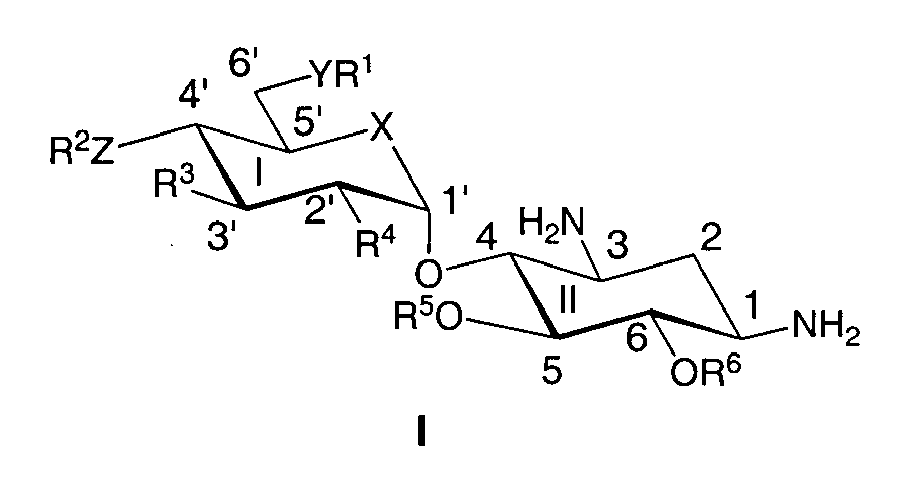
- X, Y and Z denote in each case, independently of one another, -O-, -NH-, -S-, substituted or unsubstituted -CH2- or a direct bond to R1 and/or R2;
- R1 and R2 denote in each case, independently of one another, hydrogen, linear or branched, substituted or non-substituted alkyl, alkenyl, alkynyl, alkylidene, carbocycle, or YR1 and ZR2 together form a substituted or non-substituted cycloalkyl or a corresponding heterocyclic ring;
- R3 and R4 denote in each case, independently of one another, hydrogen, amino or hydroxyl;
- R5 and R6 denote in each case, independently of one another, hydrogen or glycosyl residues;
- In the context of the present invention it is understood that antecedent terms such as linear or branched, substituted or non-substituted indicate that each one of the subsequent terms is to be interpreted as being modified by said antecedent term. For example, the scope of the term "linear or branched, substituted or non-substituted alkyl, alkenyl, alkynyl, alkylidene, carbocycle" encompasses linear or branched, substituted or non-substituted alkyl; linear or branched, substituted or non-substituted alkenyl; linear or branched, substituted or non-substituted alkynyl; linear or branched, substituted or non-substituted alkylidene; and linear or branched, substituted or non-substituted carbocycle. For example, the term "C2-C12 alkenyl, alkynyl, or alkylidene" indicates the group of compounds having 2 to 12 carbons and alkenyl, alkynyl, or alkylidene functionality.
- The compounds of the present invention are stable and resistant to bacterial degradation. However, it was demonstrated that some preferred embodiments of the compounds are more resistant against bacterial determinants than others.
- In a preferred embodiment of the present invention the compounds of formula I are those, wherein R1 and/or R2, preferably R1 and R2 are not hydrogen. Said compounds demonstrate either a partial (R1 and/or R2≠ H) or a complete (R1 and R2 ≠ H) resistance against resistance determinants selected from the group consisting of ANT4'-OH, APH2"-OH/AAC6'-NH, AAC3-NH, ANT2"-OH, AAC6'-NH (Magnet et al., Chem. Rev. 2005).
- In a more preferred embodiment the compounds of formula I are those, wherein YR1 and ZR2 together form a substituted or non-substituted cycloalkyl or a corresponding heterocyclic ring. Most preferred said cycloalkyl is an alkylidene, preferably an arylalkylidene (such as a benzylidene), most preferably an arylalkylidene substituted in the aryl ring.
- In another preferred embodiment of the present invention the compounds of formula I are those, wherein R3 and/or R4, preferably R3 and R4 are hydrogen, i.e. they are not amino or hydroxyl. Said compounds demonstrate a resistance against one or both resistance determinants APH3' (if R3 is H) and AAC2' (if R4 is H).
- In a most preferred embodiment, the compounds of formula I are those, wherein R1 and/or R2 are not hydrogen and R3 and/or R4 are hydrogen.
- In a preferred embodiment of the present invention R1 and R2 denote in each case, independently of one another, hydrogen, linear or branched, substituted or non-substituted C1-C12 alkyl, C2-C12 alkenyl, alkynyl or alkylidene, C3-C12 cycloalkyl, C3-C20 aryl, preferably arylalkyl, C3-C20 heteroaryl or C3-C20 heterocyclic residues. More preferably, R1 and R2 denote in each case, independently of one another, linear or branched, substituted or non-substituted C1-C8 alkyl, C2-C8 alkenyl, alkynyl or alkylidene, C5-C12 cycloalkyl, C5-C12 cycloaryl, C5-C12 heteroaryl or C5-C12 heterocyclic residues. Most preferably, R1 and R2 denote in each case, independently of one another, linear or branched, substituted or non-substituted C1-C4 alkyl, C2-C6 alkenyl, alkynyl or alkylidene, C5-C6 cycloalkyl, C5-C6 cycloaryl, C5-C6 heteroaryl or C5-C6 heterocyclic residues.
- In a preferred embodiment YR1 is not NH2. In another preferred embodiment ZR2 is not OH.
- It is also preferred that R1 and/or R2 do not comprise peptide nucleic acid moieties.
- It is noted that increased size and steric hindrance in R1 and/or R2 can reduce selectivity and/or increase toxicity. Generally speaking, smaller R1 and/or R2 substituents are preferred for that reason.
- Preferably, R1 comprises, preferably is, an alkylaryl group, substituted or non-substituted in the aryl moiety, preferably a substituted or non-substituted (C1-C5 alkyl)aryl group and R2 is H.
- In another preferred embodiment R2 is a linear or branched, substituted or non-substituted C1-C7 alkyl, C2-C7 alkenyl, alkynyl, or alkylidene, C3-C7 cycloalkyl, C3-C7 aryl, preferably aralkyl, C3-C7 heteroaryl or C3-C7 heterocyclic and R1 is hydrogen.
- In another preferred embodiment of the present invention R3 is hydroxyl.
- In another preferred embodiment of the present invention R4 is amino.
- In another preferred embodiment of the present invention R5 is hydrogen.
- In a preferred embodiment of the present invention R5 is selected from the group consisting of mono- and polysaccharides. Preferably R5 is a mono-, di- or trisaccharide, more preferably a mono- or disaccharide, most preferably a disaccharide, especially preferred a 2,6-diamino-2,6-dideoxy-β-L-idopyranosyl-(1→3)-β-D-ribofuranosyl moiety.
- Preferably, R6 is hydrogen.
- In another preferred embodiment R6 is selected from the group consisting of mono-and polysaccharides, preferably a mono-, di- or trisaccharide, more preferably a mono- or disaccharide, most preferably a monosaccharide, especially preferred a 3-amino-3-deoxy-α-D-glucopyranosyl moiety.
- In another preferred embodiment R6 is a 2,6-diamino-2,6-dideoxy-β-L-idopyranosyl-(1→3)-β-D-ribofuranosyl moiety.
- In another more preferred embodiment YR1 and ZR2 together form a substituted or non-substituted cycloalkyl or a corresponding heterocyclic ring. Preferably, the ring formed by YR1 and ZR2 and ring I of formula I is a five or six-membered ring, more preferably a six-membered ring.
- Most preferably, YR1 and ZR2 together form a 6-membered 4',6'-cycloalkyl or substituted 4',6'-cycloalkyl ring.
- In another preferred embodiment Y and Z, preferably X, Y and Z are oxygen.
- In a more preferred embodiment compounds of formula (I) above are compounds of formula (II) below:

- X, Y and Z denote in each case, independently of one another, -O-, -NH-, -S-, substituted or non-substituted -CH2-;
- R7 denotes hydrogen, linear or branched, substituted or non-substituted alkyl, alkenyl, alkynyl, alkylidene, or carbocycle;
- R8 denotes hydrogen, OH with the proviso that the compound is stable, NH2, NRaRb, SH, SRa, ORa or a linear or branched, substituted or non-substituted C1-C8 alkyl, preferably C1-C4 alkyl, wherein Ra and Rb are in each case, independently of one another, C1-C8 alkyl, preferably C1-C4 alkyl;
- R3 denotes hydrogen, amino or hydroxyl, preferably amino or hydroxyl;
- R4 denotes hydrogen, amino or hydroxyl, preferably amino or hydroxyl;
- R5 denotes hydrogen, a mono- or polysaccharide, preferably a mono-, di- or trisaccharide, more preferably a mono- or disaccharide, most preferably a disaccharide, especially preferred a 2,6-diamino-2,6-dideoxy-β-L-idopyranosyl-(1→3)-β-D-ribofuranosyl moiety;
- R6 denotes hydrogen, a mono- or polysaccharide, preferably a mono-, di- or trisaccharide, more preferably a mono- or disaccharide, most preferably a monosaccharide, especially preferred a 3-amino-3-deoxy-α-D-glucopyranosyl moiety.
- In formula II X, Y and Z are preferably all oxygen.
- In a preferred embodiment of formula II R7 denotes hydrogen, a linear or branched, substituted or non-substituted C1-C8 alkyl, C3-C8 cycloalkyl, C5- C20 aryl, C5-C20 heteroaryl, preferably C5-C12 heteroaryl.
- In a more preferred embodiment of formula II R7 denotes linear, substituted or non-substituted C1-C8 alkyl, preferably substituted linear C1-C3 alkyl, more preferably aryl-substituted C1-C3 alkyl; substituted or non-substituted C3-C8cycloalkyl, C5-C12 aryl, C5-C12 heteroaryl, preferably substituted C5-C12 heteroaryl.
- In another more preferred embodiment R7 denotes C5-C12 aryl or heteroaryl, preferably a (C1-C7 alkyl)aryl group.
- In a more preferred embodiment of formula II R7 is an aryl substituted ethyl group.
- In another preferred embodiment compounds of the present invention of formula I or II comprise one or more halogens, preferably one halogen, preferably a chlorine, bromine, fluorine or iodine, more preferably a fluorine. For compounds of formula II it is preferred that R7 comprises a halogen, preferably a chlorine, bromine, fluorine or iodine, more preferably a fluorine.
- For compounds of formula II it is preferred that R8 is selected from the group consisting of hydrogen, halogen or linear or branched, substituted or non-substituted C1-C8 alkyl, preferably C1-C4 alkyl, most preferably hydrogen.
- For compounds of formula II R5 or R6 is preferably hydrogen.
- For compounds of formula II R6 is preferably a 2,6-diamino-2,6-dideoxy-β-L-idopyranosyl-(1→3)-β-D-ribofuranosyl moiety.
- In a further preferred embodiment of the invention relating to compounds of formula I and/or II R1 and/or R2, preferably both, denote a linear or branched, substituted or non-substituted alkyl or cycloalkyl, wherein one or more of the carbon atoms are replaced, independently of one another, by oxygen, sulfur or nitrogen atoms.
- In a most preferred embodiment the paromamine-based compounds of the present invention are selected from the group consisting of
4',6'-O-benzylideneparomomycin,
4',6'-O-p-methoxybenzylideneparomomycin,
4',6'-O-m-methoxybenzylideneparomomycin tetraacetate,
4',6'-O-o-methoxybenzylideneparomomycin,
4',6'-O-2,5-dimethoxybenzylideneparomomycin,
4',6'-O-p-nitrobenzylideneparomomycin,
4',6'-O-m-nitrobenzylideneparomomycin triacetate,
4',6'-O-p-chlorobenzylideneparomomycin,
4',6'-O-3,5-dichlorobenzylideneparomomycin,
4',6'-O-p-cyanobenzylideneparomomycin,
4',6'-O-p-phenylbenzylideneparomomycin,
4',6'-O-p-fluorobenzylideneparomomycin,
4',6'-O-3,5-dimethoxybenzylideneparomomycin,
4',6'-O-3,4,5-trimethoxybenzylideneparomomycin,
4',6'-O-m-chlorobenzylideneparomomycin,
4',6'-O-o-nitrobenzylideneparomomycin,
4',6'-O-p-trifluoromethylbenzylideneparomomycin,
4',6'-O-p-dimethylaminobenzylideneparomomycin,
4',6'-O-1-naphthylideneparomomycin,
4',6'-O-2-naphthylideneparomomycin,
4',6'-O-2-furanylideneparomomycin,
4',6'-O-2-thiophenylideneparomomycin and
4',6'-O-ethylideneparomomycin,
4',6'-O-(2-phenyl)-ethylideneparomomycin,
4',6'-O-(3-phenyl)-propylideneparomomycin,
4',6'-O-(3-phenyl)-propenylideneparomomycin,
4',6'-O-cyclohexylmethylideneparomomycin,
4'-O-benzylparomomycin,
6'-O-benzylparomomycin,
4'-p-chlorobenzyl paromomycin,
4'-p-(trifluoromethyl)benzylparomomycin,
4'-benzyloxymethylparomomycin and
4'-p-methoxybenzylparomomycin. - In all compounds disclosed herein, in the event that the nomenclature conflicts with the structure, it shall be understood that the compound is defined by the structure.
- The invention includes all compounds described herein containing one or more asymmetric carbon atoms that may occur as racemates and racemic mixtures, single enantiomers, diastereoisomeric mixtures and individual diastereoisomers. All such isomeric forms of these compounds are expressly included in the present invention. Each stereogenic carbon may be in the R or S configuration or a combination of configurations. It is understood that the stereogenic structure of the paromamine core of the compounds of the invention is fixed as shown in formulas 1, I and II.
- Some of the compounds of the general formulas (I) and (II) disclosed herein can exist in more than one tautomeric form. The present invention includes all such tautomers.
- All terms as used herein shall be understood by their ordinary meaning as known in the art.
- The term "heteroatom" as used herein shall be understood to mean atoms other than carbon and hydrogen such as and preferably O, N, S and P.
- The terms alkyl, alkenyl, alkynyl, alkylidene, etc. shall be understood as encompassing linear as well as branched forms of carbon-containing chains where structurally possible. In these carbon chains one or more carbon atoms can be optionally replaced by heteroatoms, preferably by O, S or N. If N is not substituted it is NH. The heteroatoms may replace either terminal or internal carbon atoms within a linear or branched carbon chain. Such groups can be substituted as herein described by groups such as oxo to result in definitions such as but not limited to alkoxycarbonyl, acryl, amido and thioxo.
- The term "carbocycle" shall be understood to mean an aliphatic hydrocarbon radical containing from 3 to 20, preferably from 3 to 12 carbon atoms, more preferably 5 or 6 carbon atoms. Carbocylces include hydrocarbon rings containing from 3 to 10 carbon atoms. These carbocycles may be either aromatic or non-aromatic systems. The non-aromatic ring systems may be mono or polyunsaturated. Preferred carbocycles include but are not limited to cyclopropyl, cyclobutyl, cyclopentyl, cyclopentenyl, cyclohexyl, cyclohexenyl, cycloheptanyl, cycloheptenyl, phenyl, indanyl, indenyl, benzocyclobutanyl, dihydronaphthyl, tetrahydronaphthyl, naphthyl, decahydronaphthyl, benzocycloheptanyl, and benzocycloheptenyl. Certain terms for cycloalkyl such as cyclobutanyl and cyclobutyl shall be used interchangeably.
- The term "cycloalkyl" shall be understood to mean aliphatic hydrocarbon-containing rings having from 3 to 12 carbon atoms. These non-aromatic ring systems may be mono- or polyunsaturated, i.e. the term encompasses cycloalkenyl and cycloalkynyl. The cycloalkyl may comprise heteroatoms, preferably O, S or N, and be substituted or non-substituted. Preferred and non-limiting cycloalkyls include cyclopropyl, cyclobutyl, cyclopentyl, cyclopentenyl, cyclohexyl, cyclohexenyl, cycloheptanyl, cycloheptenyl, benzocyclobutanyl, benzocycloheptanyl und benzocycloheptenyl.
- The term "heterocyclic" refers to a stable non-aromatic, preferably 3 to 20 membered, more preferably 3 - 12 membered, most preferably 5 or 6 membered, monocyclic or multicyclic, preferably 8 - 12 membered bicyclic, heteroatom-containing cyclic radical, that may be either saturated or unsaturated. Each heterocycle consists of carbon atoms and one or more, preferably 1 to 4 heteroatoms chosen from nitrogen, oxygen and sulphur. The heterocyclic residue may be bound to the remaining structure of the complete molecule by any atom of the cycle, which results in a stable structure. Exemplary heterocycles include but are not limited to pyrrolidinyl, pyrrolinyl, morpholinyl, thiomorpholinyl, thiomorpholinyl sulfoxide, thiomorpholinyl sulfone, dioxalanyl, piperidinyl, piperazinyl, tetrahydrofuranyl, 1-oxo-λ4-thiomorpholinyl, 13-oxa-11-aza-tricyclo[7.3.1.0-2,7]tridecy-2,4,6-triene, tetrahydropyranyl, 2-oxo-2H-pyranyl, tetrahydrofuranyl, 1,3-dioxolanone, 1,3-dioxanone, 1,4-dioxanyl, 8-oxa-3-aza-bicyclo[3.2.1]octanyl, 2-oxa-5-aza-bicyclo[2.2.1]heptanyl, 2-thia-5-aza-bicyclo[2.2.1]heptanyl, piperidinonyl, tetrahydropyrimidonyl, pentamethylene sulphide, pentamethylene sulfoxide, pentamethylene sulfone, tetramethylene sulphide, tetramethylene sulfoxide and tetramethylene sulfone.
- The term "aryl" as used herein shall be understood to mean an aromatic carbocycle or heteroaryl as defined herein. Each aryl or heteroaryl unless otherwise specified includes its partially or fully hydrogenated derivative. For example, quinolinyl may include decahydroquinolinyl and tetrahydroquinolinyl; naphthyl may include its hydrogenated derivatives such as tetrahydronaphthyl. Other partially or fully hydrogenated derivatives of the aryl and heteroaryl compounds described herein will be apparent to one of ordinary skill in the art. Naturally, the term encompasses aralkyl and alkylaryl, both of which are preferred embodiments for practicing the compounds of the present invention. For example, the term aryl encompasses phenyl, indanyl, indenyl, dihydronaphthyl, tetrahydronaphthyl, naphthyl and decahydronaphthyl.
- The term "heteroaryl" shall be understood to mean an aromatic C3-C20, preferably 5-8 membered monoxyclic or preferably 8-12 membered bicyclic ring containing 1-4 heteroatoms such as N, O and S. Exemplary heteroaryls comprise aziridinyl, thienyl, furanyl, isoxazolyl, oxazolyl, thiazolyl, thiadiazolyl, tetrazolyl, pyrazolyl, pyrrolyl, imidazolyl, pyridinyl, pyrimidinyl, pyrazinyl, pyridazinyl, pyranyl, quinoxalinyl, indolyl, benzimidazolyl, benzoxazolyl, benzothiazolyl, benzothienyl, quinolinyl, quinazolinyl, naphthyridinyl, indazolyl, triazolyl, pyrazolo[3,4-b]pyrimidinyl, purinyl, pyrrolo[2,3-b]pyridinyl, pyrazole[3,4-b]pyridinyl, tubercidinyl, oxazo[4,5-b]pyridinyl and imidazo[4,5-b]pyridinyl.
- Terms which are analogues of the above cyclic moieties such as aryloxy or heteroaryl amine shall be understood to mean an aryl, heteroaryl, heterocycle as defined above attached to its respective group.
- As used herein, the terms "nitrogen" and "sulphur" include any oxidized form of nitrogen and sulphur and the quaternized form of any basic nitrogen as long as the resulting compound is chemically stable. For example, for an -S-C1-6 alkyl radical shall be understood to include -S(O)-C1-6 alkyl and -S(O)2-C1-6 alkyl.
- The compounds of the invention are only those which are contemplated to be 'chemically stable' as will be appreciated by those skilled in the art. For example, compounds having a 'dangling valency' or a 'carbanion' are not compounds contemplated by the inventive disclosed herein.
- The above described compounds have demonstrated a strong and antimicrobial, in particular antibacterial, 16 S RNA specific activity making them particularly useful for preparing medicaments lacking toxicity due to the essential lack of activity in eukaryotic cells, i.e. no interaction with eukaryotic cytosolic and/or mitochondrial RNA.
- Because of the above described highly selective activity another aspect of the present invention relates to the use of one or more compounds of the invention for preparing a medicament.
- In a preferred embodiment one or more compounds of the present invention are used for preparing a medicament for the treatment and/or prevention of a microbial, preferably a bacterial, infection.
- In a further preferred embodiment the invention relates to the use of one or more compounds according to the invention for preparing a medicament for the treatment and/or prevention of of leishmaniasis.
- In another preferred embodiment the invention relates to the use of one or more compounds according to the invention for preparing a medicament for the treatment and/or prevention of trypanosomiasis.
- A further aspect of the present invention concerns pharmaceutical compositions, comprising as active substance one or more compounds of the present invention or pharmaceuticclly acceptable derivatives or prodrugs thereof, optionally combined with conventional excipients and/or carriers.
- The invention includes pharmaceutically acceptable derivatives of compounds of formulae (I) and (II). A "pharmaceutically acceptable derivative" refers to any pharmaceutically acceptable salt or ester or any other compound which, upon administration to a patient, is capable of providing (directly or indirectly) a compound of the invention, or a pharmacologically active metabolite or pharmacologically active residue thereof. A pharmacologically active metabolite shall be understood to mean any compound of the invention capable of being metabolized enzymatically or chemically. This includes, for example, hydroxylated or oxidized derivative compounds of the formula (I) and (II). Preferred embodiments relate to pharmaceutically acceptable derivatives of compounds of formulas (I) and (II) that are hydrates.
- Pharmaceutically acceptable salts include those derived from pharmaceutically acceptable inorganic and organic acids and bases. Examples of suitable acids include hydrochloric, hydrobromic, sulphuric, nitric, perchloric, fumaric, maleic, phosphoric, glycolic, lactic, salicylic, succinic, toluene-p-sulfuric, tartaric, acetic, citric, methanesulfonic, formic, benzoic, malonic, naphthalene-2-sulfuric and benzenesulfonic acids. Other acids, such as oxalic acid, while not themselves pharmaceutically acceptable, may be employed in the preparation of salts useful as intermediates in obtaining the compounds and their pharmaceutically acceptable acid addition salts. Salts derived from appropriate bases include alkali metal (e.g., sodium), alkaline earth metal (e.g. magnesium), ammonium and N-(C1-C4alkyl)4 + salts.
- In addition, the scope of the invention also encompasses prodrugs of compounds of the formulas (I) and (II). Prodrugs include those compounds that, upon simple chemical transformation, are modified to produce compounds of the invention. Simple chemical transformations include hydrolysis, oxidation and reduction. Specifically, when a prodrug is administered to a patient, the prodrug may be transformed into a compound disclosed hereinabove, thereby imparting the desired pharmacological effect.
- The compounds of the invention have demonstrated a selective inhibition of the bacterial ribosome. These drugs do not affect the eukaryotic ribosome because they do not target eukaryotic mitochondrial or cytosolic 16S ribosomal RNA as demonstrated in tests with genetically engineered
ribosomes carrying eukaryotic 16 S RNA nucleotide positions. - Hence, in a further aspect the present invention is directed to the use of one or more compounds according to the invention for preparing a medicament. Preferably, the compounds of the invention are used for preparing a medicament for the treatment and/or prevention of a bacterial infection.
- In the above respect the present invention also relates to a pharmaceutical composition, comprising as active substance one or more compounds according to the invention or pharmaceuticclly acceptable derivatives or prodrugs thereof, optionally combined with conventional excipients and/or carriers.
- For therapeutic or prophylactic use the compounds of the invention may be administered in any conventional dosage form in any conventional manner. Routes of administration include, but are not limited to, intravenously, intramuscularly, subcutaneously, intrasynovially, by infusion, sublingually, transdermally, orally, topically, or by inhalation. The preferred modes of administration are oral and intravenous.
- The compounds may be administered alone or in combination with adjuvants that enhance stability of the inhibitors, facilitate administration of pharmaceutical compositions containing them in certain embodiments, provide increased dissolution or dispersion, increase inhibitory activity, provide adjunct therapy, and the like, including other active ingredients. Advantageously such combination therapies utilize lower dosages of the conventional therapeutics, thus avoiding possible toxicity and adverse side effects incurred when those agents are used as monotherapies. The above described compounds may be physically combined with the conventional therapeutics or other adjuvants into a single pharmaceutical composition. Reference is this regard may be made to
Cappola et al.: U.S. patent application no. 09/902,822 ,PCT/US 01/21860 undUS provisional application no. 60/313,527 - As mentioned above, dosage forms of the compounds described herein include pharmaceutically acceptable carriers and adjuvants known to those of ordinary skill in the art. These carriers and adjuvants include, for example, ion exchangers, alumina, aluminium stearate, lecithin, serum proteins, buffer substances, water, salts or electrolytes and cellulose-based substances. Preferred dosage forms include, tablet, capsule, caplet, liquid, solution, suspension, emulsion, lozenges, syrup, reconstitutable powder, granule, suppository and transdermal patch. Methods for preparing such dosage forms are known (see, for example, H. C. Ansel and N. G. Popovish, Pharmaceutical Dosage Forms and Drug Delivery Systems, 5th ed., Lea and Febiger (1990)). Dosage levels and requirements are well-recognized in the art and may be selected by those of ordinary skill in the art from available methods and techniques suitable for a particular patient. In some embodiments, dosage levels range from about 1-100 mg/dose for a 70 kg patient. Although one dose per day may be sufficient, up to 5 doses per day may be given. For oral doses, up to 2000 mg/day may be required. Reference in this regard may also be made to
US provisional application no. 60/339,249 - For example, the compounds of the present invention can be administered the same way as paromomycin and other paromamine compounds. They may be administered orally in the treatment of intestinal infections or parenterally for visceral and topically for cutaneous leishmaniasis.
- Preferably, the compounds of the invention are administered as sulfate salts. In the case of intestinal amoebiasis the oral dosage for both adults and children may be 5 to 70, preferably 15 to 50, more preferably 25 to 35 mg compound of the invention per kg body weight daily, administered in three doses with meals for five to ten days. In the case of hepathic coma, the oral daily dosage is 4 g in divided doses given at regular intervals for 5 to 6 days.
- Compounds of the invention may be formulated into capsules the same way paromomycin is formulated (e.g. Humatin®, Parke-Davis). Each capsule may contain 100 to 500, preferably 150 to 300, more preferably 200 to 250 mg of a compound of the invention. For example, nonmedicinal ingredients in capsules for the compounds of the present invention are - capsule shell: D&C yellow No. 10, FD&C blue No. 1, FD&C red No. 3, FD&C yellow No. 6, gelatin and titanium dioxide. Bottles of 100. (see also Martindale: the complete drug reference, 34th Edition, 2005, Pharmaceutical Press, p 612.)
- It is emphasized that compounds of the present invention may be administered in higher dosages than paromomycin or other unspecific antibiotics because the compounds of the invention are selective for microbial, in particular bacterial, ribosomes and spare eukaryotic ribosomes, thus lacking serious side effects.
- The compounds of the invention can be prepared by standard methods well known to those of skill in the art, in particular in the art of organic and glycoside chemistry. General schemes and specific examples for their preparation are provided for in the examples below which are by no means considered limiting but meant as illustrative only.
- In the following a preferred method for preparing compounds of the invention is provided which is also considered the best mode for practicing the invention.
- In a further aspect the invention relates to a method for preparing a compound according to the invention, comprising one or more of the following steps:
- a) providing a compound according to the formula III:

- V and W denote in each case, independently of one another, -O-, -NH- and -S-;
- R3 and R4 denote in each case, independently of one another, hydrogen, amino or hydroxyl;
- R5 and R6 denote in each case, independently of one another, hydrogen or glycosyl residues;
- b) protecting one or more, preferably all, of the amino groups;
- c) optionally protecting one or more, preferably all, of the hydroxy groups;
- d1) selectively transforming the optionally protected 4'- and/or 6'-hydroxy groups to YR1 and/or ZR2-groups of formula I or the ring system of formula II; or
- d2) selectively deprotecting the protected 4'- and/or 6'-hydroxy groups and selectively transforming the deprotected 4'- and/or 6'-hydroxy groups to YR1 and/or ZR2-groups of formula I or the ring system of formula II;
- e) deprotecting the one or more amino groups;
- f) deprotecting the one or more hydroxy groups;
- Regarding the option of step c) it is noted that for preparing some compounds of the invention, e.g. compounds of formula II, it may not be necessary to protect one or more of the hydroxyl groups. This is especially true when a dioxane, dioxane derivative or other arylalkylidene (such as benzylidene) moiety is introduced to generate a compound of formula II. In that case the moiety introduced in step d1) may already function as a protecting group.
- When V and/or W is a divalent sulfur atom, R1 and/or R2-groups of formula I are introduced by reaction with an appropriate electrophile, such as a halogen derivative, or a sulfonate. Alternatively, the same resulting YR1 and/or ZR2 may be introduced, directly or indirectly, from an optionally protected compound of formula III where VH and WH denote independently of one another a hydroxy group. The ring system of formula II may be introduced by acetal formation with R7 CHO or R7CH(ORa)(ORb), wherein Ra and Rb are alkyl residues, preferably methyl, in the presence of a suitable organic and/or inorganic acid and, if necessary, in a suitable solvent, or by reaction with

- It is noted that the protecting and deprotecting steps for amino and/or hydroxyl groups can be accomplished by any suitable reactions that are routinely available to the skilled person and that are not detrimental to the compounds of the invention.
- Preferably the amino groups are protected by converting them to azido, carbamoyl or N-acylamino groups. More preferably the amino groups are protected by converting them to azido groups by diazo transfer.
- Preferably the hydroxy groups are protected by converting them to ethers, preferably alkyl and/or silyl ethers, and/or esters, preferably sulfonates or acetals. More preferred the hydroxy groups are protected as acetoxy groups by converting them with an acyl transfer reagent, preferably acetic anhydride, preferably in the presence of bases and/or catalysts.
- For the acetoxy groups it is preferred that they are deprotected by base- or acid-catalyzed hydrolysis, or other solvolysis, or by reduction with a hydride donor, such as diisobutyl aluminum hydride, LiAIH4, or LiBH4.
- In another preferred embodiment 4',6'-acetals of formula III are prepared by reaction of a hydroxy compound of formula III with R7CHO or R7CH(ORa)(ORb), wherein Ra and Rb are alkyl residues, preferably methyl, in the presence of a suitable organic and/or inorganic acid and, if necessary, in a suitable solvent.
- In another preferred embodiment 4',6'-acetals of formula III are prepared by reaction of a hydroxy compound of formula III with

- Azido groups are preferably deprotected by a method selected from the group consisting of:
- reductive hydrogenation, preferably hydrogen in the presence of a suitable catalyst, such as, e.g. Pd, Pd(OH)2, Rh, or Pt;
- by hydrogen and nickel boride;
- reaction with a hydride reagent, preferably a borohydride or an aluminum hydride, electron transfer, preferably by reaction with hydrogen sulfide, a thiol, or a dithiol in the presence of base,
- a metallic reduction, such as by Zn or Na, or Na-amalgam in the presence of an alcohol, and
- treatment with a phosphine reagent, preferably with trimethylphosphine (Staudinger reaction) followed by hydrolysis (see Staudinger and Meyer, Helv. Chim. Acta 1919, 2, 635; Golobov et al., Tetrahedron, 1981, 37, 437; and Scriven et al., Chem. Rev., 1988, 88, 297; and as described in S. D. Burke and R. L. Danheiser, ed. "Oxidizing and Reducing Agents", J. Wiley, Chichester, 1999).
- In a preferred embodiment the present invention relates to a method, wherein 4'- and 6'-hydroxy groups are selectively deprotected.
- In another preferred embodiment the 4'- and 6'-hydroxy groups are protected as a benzylidene acetal. Said 4', 6'-benzylidene acetal is preferably deprotected by a method selected from the group consisting of catalytic hydrogenation, Birch reduction and acid-catalyzed hydrolysis.
- In a preferred embodiment the method of the invention comprises the regioselective reductive cleavage of the 4',6'-acetal to result in the more hindered ether derivative by reaction with a suitable hydride reagent, preferably the borane-dimethyl sulfide complex in the presence of a suitable Lewis acid.
- In another preferred embodiment the method of the invention comprises the regioselective reductive cleavage of the 4',6'-acetal to result in the less hindered ether derivative by reaction with a suitable hydride reagent, preferably sodium cyanoborohydride in the presence of a suitable acid.
- In another preferred embodiment hydroxy groups in the compounds of formula III are protected as benzyloxy groups, the benzyl part preferably being substituted or unsubstituted arylmethyl or heteroarylmethyl. Most preferred the benzyloxy group is a p-methoxybenzyloxy group, preferably being introduced by reaction of a compound of formula III with a suitable p-methoxybenzyl transfer reagent such as a p-methoxybenzyl halide in the presence of a suitable base or acid. In a preferred embodiment the p-methoxybenzyloxy groups are deprotected by oxidative cleavage with a suitable reagent, preferably with dichlorodicyanoquinone.
- In a more preferred embodiment the method of the invention requires that the primary 6'-hydroxy group of formula III is selectively protected as an ether, preferably an alkyl or silyl ether, or an ester, preferably a sulfonate or an acetal. It is most preferred that the primary 6'-hydroxy group is a monomethoxytrityloxy group, preferably introduced into compounds of formula III by reaction with a suitable monomethoxytrityl transfer reagent such as a monomethoxytrityl halide in the presence of a suitable base.
- Last but not least, it is preferred that the 4'-hydroxy group is protected as an ether, preferably by reaction with a suitable alkoxy transfer reagent, preferably an alkyl halide in the presence of a suitable base.
-
Fig. 1 : illustrates the strategy for deletion of rRNA operon rrnB according to example 3. Open arrows represent rRNA genes; P and T the promoter and termination sequences, respectively. Solid arrows indicate the open reading frames upstream and downstream of rrnB. Hatched rectangles represent antibiotic resistance cassettes, the stippled arrow the sacB gene. Broken lines indicate possible crossover sites between homologous sequences in the replacement vector (A) and the chromosomal target site (B). Following plasmid integration into the rrnB 5'-flanking region (C), a second crossover event between the homologous 3'-flanking sequences resolves the chromosomal tandem repeat to the deletion of rrnB (D). -
Fig. 2 illustrates the sequential strategy for the generation of M. smegmatis ΔrrnA ΔrrnB attB::prrnB according to example 3. Following deletion of chromosomal rrnB, a complementation vector carrying a functional rrnB operon is introduced to the chromosomal attB site. Subsequent deletion of rrnA results in strain M. smegmatis ΔrrnA ΔrrnB attB::prrnB, in which ribosomal RNA is exclusively transcribed from the plasmid. - In the following the subject-matter of the invention will be described in more detail referring to specific embodiments which are not intended to be construed as limiting to the scope of the invention.
- Brauchen wir diese Liste wirklich? Die meisten Abkürzungen sind dem Fachmann/Fachfrau geläufig. Ich habe schon mal ein paar gestrichen, die wir mit Sicherheit nicht brauchen.
- ax=axial, c=concentration, DDQ=dichlorodicyanoquinone, dec.=decomposition, eq=equatorial, equ.=equivalent, ESI=electrospray ionisation, FC=flash chromatography, HR=high resolution, HSQC=heteronuclear single quantum coherence, MMTr=monomethoxytrityl, -(X A) MS=molecular sieves, PMB=4-methoxybenzyl, Tf=trifluoromethanesulfonyl, Ts=4-toluenesulfonyl.
- Solvents were freshly distilled: THF from Na and benzophenone, CH2Cl2, MeOH, pyridine, Et3N from CaH2. Reactions were carried out under nitrogen, unless stated otherwise. Qual. TLC: precoated silica-gel glass plates (Merck silica gel 60 F254 ); detection by heating with 'mostain' (400 ml of 10% H2SO4 soln., 20 g of (NH4)6Mo7O24.6H2O, 0.4 g of Ce(SO4)2). Flash chromatography (FC): silica gel Merck 60 (0.063-0.20). M.p.'s uncorrected. Optical rotations: 1-dm cell at 25°, 589 nm. FT-IR spectra: ATR, absorption in cm-1. 1H- and 13C-NMR spectra: chemical shifts δ in ppm rel. to TMS as external standard, and coupling constants J in Hz. HR-ES-MS or HR-MALDI-MS: in gentisic acid (= 2,5-dihydroxybenzoic acid, DHB) matrix.
-


- Compounds 2, 3, 4.1 were synthesized as described in Helv Chim Acta 2005, 88, 2967.
- Typical procedure for the formation of the acetals 4.2-4.12 (Scheme 1). Under N2 a soln. of 2 in DMF was treated with a solution of the corresponding dimethylacetal of R7 CHO (5 equ.) in DMF and TsOH.H2O (0.5 equ.) and, stirred at 25° or at 65°. The mixture was diluted with AcOEt and washed with 0.1 M aq. NaOH. The aqueous layer was extracted twice with AcOEt. The combined org. layers were washed with brine, dried (MgSO4), filtered, and evaporated. FC (Hexane/AcOEt 8:2, CHCl3/AcOEt 1:1 → CHCl3/AcOEt/CH3OH 6:6:0.25) gave 4.2-4.12.
1,3,2',2"',6"'-Pentadeamino-1,3,2',2"',6"'-pentaazido-4',6-O-p-Methoxybenzylideneparomomycin (4.2). Reaction of 71 mg of 2 gave 57 mg of 4.2 (69%). White solid. R f (CHCl3/AcOEt/MeOH 3:3:0.5) 0.46.
1,3,2',2"',6"'-Pentadeamino-1,3,2',2"',6"'-pentaazido-4',6'-O-m-methoxybenzylideneparomomycin (4.3). Reaction of 101 mg of 2 gave 47 mg of 4.3 (40%). White solid. Rf (CHCl3/AcOEt/MeOH 3:3:0.5) 0.45.
1,3,2',2"',6'"-Pentadeamino-1,3,2',2'",6'"-pentaazido-4',6'-O-o-methoxybenzylideneparomomycin (4.4). Reaction of 99 mg of 2 gave 76 mg of 4.4 (66%). White solid. Rf (CHCl3/AcOEt/MeOH 3:3:0.5) 0.40.
1,3,2',2"',6"'-Pentadeamino-1,3,2',2"',6"'-pentaazido-4',6'-O-2,5-dimethoxybenzylideneparomomycin (4.5). Reaction of 119 mg of 2 gave 104 mg of 4.5 (73%). White solid. Rf (CHCl3/AcOEt/MeOH 3:3:0.5) 0.54.
1,3,2',2"',6"'-Pentadeamino-1,3,2',2"',6"'-pentaazido-4',6'-O-p-nitrobenzylideneparomomycin (4.6). Reaction of 49 mg of 2 gave 104 mg 4.6 (35%). White solid. Rf (CHCl3/AcOEt/CH3OH 3:3:0.5) 0.36. HR-Maldi-MS: 878.2619 (39, [M]+, C30H38N16O16 +; calc. 878.2652); 877.2570 (100, [M - H]+, C30H37N16O16 +; calc. 877.2573).
1,3,2',2"',6"'-Pentadeamino-1,3,2',2'",6"'-pentaazido-4',6'-O-m-nitrobenzylideneparomomycin (4.7). Reaction of 100 mg of 2 gave 29 mg of 4.7 (26%). White solid. Rf (CHCl3/AcOEt/MeOH 3:3:0.5) 0.36. HR-Maldi-MS: 878.2604 (44, [M]+, C30H38N16O16 +; calc. 878.2652); 877.2561 (100, [M - H]+, C30H37N16O16 +; calc. 877.2573).
1,3,2',2"',6"'-Pentadeamino-1,3,2' ,2"',6"'-pentaazido-4',6-O-p-chlorobenzylideneparomomycin (4.8). Reaction of 28 mg of 2 gave 10 mg 4.8 (31%). Rf (CHCl3/AcOEt/CH3OH 3:3:1) 0.48.
1,3,2',2'",6"'-Pentadeamino-1,3,2',2"',6"',pentaazido-4,6'-O-3,5-dichlorobenzylideneparomomycin (4.9). Reaction of 80 mg of 2 gave 22 mg of 4.7 (23%). White solid. Rf (CHCl3/AcOEt/CH3OH 3:3:0.5) 0.39.
1,3,2,2"',6"',Pentadeamino-1,3,2;2"',6"',pentaazido-4',6'-O-p-cyanobenzylideneparomomycin (4.10). Reaction of 115 mg of 2 gave 43 mg of 4.10 (33%). White solid. Rf (CHCl3/AcOEt/MeOH 3:3:0.5) 0.31. HR-Maldi-MS: 858.2722 (39, [M]+, C31H38N16O14 +; calc. 858.2753); 857.2675 (100, [M - H]+, C31H37N16O14 +; calc. 857.2681).
1,3,2',2'",6'"-Pentadeamino-1,3,2',2'",6'"-pentaazido-4',6'-O-p-phenylbenzylideneparomomycin (4.11). Reaction of 80 mg of 2 gave 66 mg of 4.11 (68%). White solid. Rf (CHCl3/AcOEt/MeOH 3:3:0.5) 0.42.
1,3,2,2'",6'"-Pentadeamino-1,3,2,2"'6'"-pentaazido-4',6-O-p-fluorobenzylideneparomomycin (4.12). Reaction of 175 mg of 2 gave 139 mg of 4.12 (69%). White solid. Rf (CHCl3/AcOEt/MeOH 3:3:0.5) 0.34. HR-Maldi-MS: 890.2335 (28, [M + K]+, C30H38FKN15O14 +; calc. 890.2344); 875.2620 (38, [M + Na + H]+, C30H39FN15NaO14 +; calc. 875.2683); 874.2582 (100, [M + Na]+, C30H38FN15NaO14 +; calc. 874.2599). Anal. calc. for C30H38FN15O14.CH3OH (883.7551): C 42.13, H 4.79, N 23.77; found: C 42.39, H 4.79, N 23.77. - Typical procedure for the deprotection of azido groups. Under N2, a soln. of 4.1-4.12 in THF was treated with 0.1 M aq. NaOH (2 equ.) and 1M PMe3 in THF (6 equ.), stirred at 60°. Evaporation and FC (THF, THF/MeOH, MeOH, MeOH/25% aq. NH3 49:1 → MeOH/25% aq. NH3 4:1) gave 5.1-5.12.
4',6'-O-benzylideneparomomycin (5.1). Reaction of 110 mg of 4.1 gave 73 mg of 5.1 (79%). White solid. Rf (MeOH/25% aq. NH3 4:1) 0.30.
4',6'-O-p-Methoxybenzylideneparomomycin (5.2). Reaction of 17 mg of 4.2 gave 11 mg of 5.2 (76%). White solid. - Rf (MeOH/25% aq. NH3 4:1) 0.36. IR (ATR): 3355w (br.), 2917w, 1614w, 1518w, 1461w, 1378w, 1302w, 1250w, 1101s, 1024s, 937m. HR-Maldi-MS: 735.3475 (36, [M + 2 H]+, C31H53N5O15 +; calc. 735.3538); 734.3442 (100, [M + H]+, C31H52N5O15 +; calc. 734.3454).
4',6'-O-m-Methoxybenzylideneparomomycin tetraacetate (5.3). Reaction of 26 mg of 4.3 gave 18 mg of 5.3 (81%). White solid. The product was converted into the tetraacetate salt by stirring in 20% aq. AcOH (23 mg). Rf (MeOH/25% aq. NH3 4:1) 0.34. IR (ATR): 3311w, 2884w, 1542m, 1402m, 1336w, 1285w, 1261w, 1096s, 1042s, 1014s. HR-Maldi-MS: 757.3323 (28, [M + Na + H]+, C31H52N5NaO15 +; calc. 757.3358); 756.3287 (83, [M + Na]+, C31H51N5NaO15 +; calc. 756.3279); 735.3468 (37, [M + 2 H]+, C31H53N5O15 +; calc. 735.3538); 734.3442 (100, [M + H]+, C31H52N5O15 +; calc. 734.3454); 574.2595 (31, [M- ring IV+ 2 H]+, C25H40N3O12 +; calc. 574.2612).
4',6'-O-o-Methoxybenzylideneparomomycin (5.4). Reaction of 18 mg of 4.4 gave 21 mg of 5.4. White solid. Rf (MeOH/25% aq. NH3 4:1) 0.31.
4',6'-O-2,5-Dimethoxybenzylideneparomomycin (5.5). Reaction of 25 mg of 4.5 gave 21 mg of 5.5 (98%). White solid. R f (MeOH/25% aq. NH3 4:1) 0.29. IR (ATR): 3287w, 2913w, 1593w, 1503m, 1464m, 1425w, 1386w, 1280w, 1221w, 1104s, 1019s. HR-Maldi-MS: 786.3382 (26, [M + Na]+, C32H53N5NaO16 +; calc. 786.3385); 765.3571 (37, [M + 2 H]+, C32H55N5O16 +; calc. 765.3644); 764.3545 (100, [M + H]+, C32H54N5O16 +; calc. 764.3560).
4',6'-O-p-Nitrobenzylideneparomomycin (5.6). Reaction of 14 mg of 4.6 gave 6 mg of 5.6 (50%). White solid. Rf (MeOH/25% aq. NH3 4:1) 0.24.
4',6'-O-m-Nitrobenzylideneparomomycin triacetate (5.7). Reaction of 16 mg of 4.7 gave after stiring in 10% aq. AcOH and evaporation 11 mg of 5.7 (61%). Yellowish solid. Rf (MeOH/25% aq. NH3 4:1) 0.31. IR (ATR): 3095m (br.), 1528m, 1406m, 1349m, 1100s, 1045s, 1014s, 937m. HR-Matdi-MS: 750.3211 (36, [M + 2 H]+, C30H50N6O16 +; calc. 750.3283); 749.3187 (100, [M + H]+, C30H49N6O16 +, calc. 749.3200).
4',6'-O-p-Chlorobenzylideneparomomycin (5.8). Reaction of 17 mg of 4.8 gave 12 mg of 5.8 (83%). White solid. Rf (MeOH/25% aq. NH3 4:1) 0.36. IR (ATR): 3037w (br.), 1738w, 1603w 1524w, 1493w, 1454w, 1406w, 1375w, 1081 s, 1049s, 1018s. HR-Maldi-MS: 738.2972 (95, [M + H]+, C30H49ClN5O14 +; calc. 750.3283).
4',6'-O-3,5-Dichlorobenzylideneparomomycin (5.9). Reaction of 25 mg of 4.9 gave 19 mg of 5.9 (89%). White solid. Rf (MeOH/25% aq. NH3 4:1) 0.29. IR (ATR): 3188w (br.), 2900w, 1597w, 1573w 1526w, 1429w, 1369w, 1101s, 1029s. HR-Maldi-MS: 772.2556 (100, [M + H]+, C30H48Cl2N5O14 + ; calc. 772.2575).
4',6'-O-p-Cyanobenzylideneparomomycin (5.10). Reaction of 10 mg of 4.10 gave 9 mg of 5.10. White solid. Rf (MeOH/25% aq. NH3 4:1) 0.27. IR (ATR): 3200w (br.), 1619w, 1526w, 1417w, 1094s, 996s. HR-Maldi-MS: 730.3322 (36, [M + 2 H]+, C31H50N6O14 +; calc. 730.3385); 729.3288 (100, [M + H]+, C31H49N6O14 +; calc. 729.3307).
4', 6'-O-p-Phenylbenzylideneparomomycin (5.11). Reaction of 20 mg of 4.11 gave 16 mg of 5.11 (93%). White solid. R f (MeOH/25% aq. NH3 4:1) 0.31.
4',6'-O-p-Fluorobenzylideneparomomycin (5.12). Reaction of 60 mg of 4.12 gave 51 mg of 5.11. White solid. R f (MeOH/25% aq. NH3 4:1) 0.33. IR (ATR): 3285w, 2875w, 1606w, 1514w, 1457w, 1376w, 1300w, 1224w, 1047s, 1014s, 935m. 1H-NMR (500 MHz, D2O, assignment based on DQF COSY and a HSQC spectrum): 7.54-7.50 (m, 2 arom. H); 7.19-7.13 (m, 2 arom. H); 5.71 (s, PhCH); 5.51 (d, J = 3.9, H-C(1')); 5.35 (d, J = 2.3, H-C(1 ")); 5.05 (d, J = 1.8, H-C(1"')); 4.46 (dd, J = 6.6, 4.9, H-C(3")); 4.32 (dd, J = 4.9, 2.3, H-C(2")); 4.27 (dd, J = 10.2, 4.8, Ha-C(6')); 4.18-4.11 (m, 2 H, H-C(4"), H-C(5"')); 4.07 (t, J = 3.2, H-C(3"')); 4.03-3.96 (m, H-C(5')); 3.88-3.82 (m, 3 H, Ha-C(5"), H-C(3'), Hb-C(6')); 3.73-3.63 (m, 4 H, Hb-C(5"), H-C(5), H-C(4"'), H-C(4')); 3.51 (t, J = 9.4, H-C(4)); 3.44 (t, J = 10.0, H-C(6); 3.32-3.21 (m, 2 H, Ha-C(6"'), Hb-C(6"')); 3.18 (t, J = 1.8, H-C(2"')); 3.01 (dd, J = 9.8, 3.9, H-C(2')); 3.00-2.93 (m, 2 H, H-C(3), H-C(1)); 2.08 (dt, J = 12.9, 4.1, Heq-C(2)); 1.37 (q, J = 12.5, Hax-C(2)). 13C-NMR (126 MHz, D2O, assignment based on a HSQC spectrum): 165.87 (d, 1 J(C,F) = 245.7); 135.04 (d, J = 2.9, Cpara); 131.09 (d, 3 J(C,F) = 8.7, 2 Cmeta); 118.18 (d, 2 J(C,F) = 21.9, 2 Cortho); 111.64 (d, C(1")); 103.83 (d, PhCH); 101.61 (d, C(1')); 100.55 (d, C(1''')); 86.95 (d, C(5)); 84.34 (d, C(4)); 83.91 (d, C(4")); 83.38 (d, C(4')); 78.06 (d, C(3")); 77.90 (d, C(6)); 76.02 (d, C(2")); 73.97 (d, C(5"')); 72.30 (d, C(3"')); 72.20 (d, C(3'), 70.90 (d, C(4"')); 70.67 (t, C(6')); 66.33 (d, C(5')); 63.37 (t, C(5")); 58.42 (d, C(2')); 54.61 (d, C(2"')); 53.12 (d, C(1)); 52.15 (d, C(3)); 43.35 (t, C(6"')); 35.95 (t, C(2)). HR-Maldi-MS: 744.3074 (32, [M + Na]+, C30H48FN5NaO14 +; calc. 744.3079); 723.3262 (34, [M + 2 H]+, C30H50FN5O14 +; calc. 723.3338); 722.3242 (100, [M + H]+, C30H49FN5O14 +; calc. 722.3255).

- Compound 6 was synthesized as described in Helv. Chim. Acta 2005, 88, 2967.
- 6,3',2",5',3"',4"'-Hexa-O-acetyl-1,3,2,2"',6"'-pentadeamino-1,3,2,2"-6"'-pentaazido-paromomycin (7). A soln. of 6 (23 mg, 0.021 mmol) in MeOH (1 ml) was treated with TsOH.H2O (2 mg, 0.011 mmol), stirred at 25° for 5 h. The mixture was diluted with AcOEt (10 ml) and washed with H2O (8 ml). The aq. Layer was extracted twice with AcOEt (2 x 10 ml). The combined org. layers were washed with brine (20 ml), dried (MgSO4), filtered and evaporated. FC (Cyclohexane/AcOEt 8:2 → cyclohexane/AcOEt 3:7 gave 7 (13 mg, 61%). White solid. Rf (CHCl3/AcOEt/MeOH 3:3:0.5) 0.57.
Typical procedure for the formation of the acetals 4.13-4.27.
Method A: Under N2, a soln. of 7 in the aldehyde was treated with FeCl3 and, stirred for 2-24 h at 23°. The mixture was diluted with AcOEt, filtered over Celite and washed with 0.1M aq. NaOH. The aqueous layer was extracted twice with AcOEt. The combined org. layers were washed with brine, dried (MgSO4), filtered, and evaporated. FC (Hexane or Cyclohexane/AcOEt 8:2 → 6:4) gave 8.15, 8.19, 8.21-8.27.
Method B: Under N2, a soln. of 7 in toluene was treated with 5 Å molecular sieves, TsOH.H2O (0.5 equ.), a solution of the aldehyde (5 equ.) in toluene and, stirred for 2-24 h at reflux. The mixture was diluted with AcOEt, flitered over Celite and washed with 0.1M aq. NaOH. The aqueous layer was extracted twice with AcOEt. The combined org. layers were washed with brine, dried (MgSO4), filtered, and evaporated. FC (Hexane or Cyclohexane/AcOEt 8:2 → 6:4) gave 8.13-8.14, 8.16-8.18, 8.20.
6,3,2",5",3" ,4"'-Hexa-O -acetyl-1,3,2,2",6"-pentadeamino-1,3,2,2"',6"'- pentaazido-4',6'-O-3,5-Dimethoxybenzylideneparomomycin (8.13). Method B: Reaction of 70 mg of 7 gave 58 mg of 8.13 (72%). White solid. Rf (Hexane/AcOEt 1:1) 0.34. HR-Maldi-MS (3-HPA): 1184.3294 (43, [M + K]+, C44H55KN15O22 +; calc. 1184.3283); 1169.3562 (54, [M + Na + H]+, C44H56N15NaO22 +; calc. 1169.3622); 1168.3568 (100, [M + Na]+, C44H55N15NaO22 +; calc. 1168.3544).
6,3',2",5",3",4"'-Hexa-O-acetyl-1,3,2,2"',6'"-pentadeamino-1,3,2,2"',6" '- pentaazido-4',6'-O-3,4,5-trimethoxybenzylideneparomomycin (8.14). Method B: Reaction of 61 mg of 7 gave 50 mg of 8.14 (70%). White solid. Rf (Hexane/AcOEt 1:1) 0.34. M.p. 95°(softens)-110°.
6,3',2",5",3"',4"'-Hexa-O-acetyl-1,3,2',2"',6"'-pentadeamino-1,3,2',2",6"'-pentaazido-4',6'-O-m-chlorobenzylideneparomomycin (8.15). Method A: Reaction of 153 mg of 7 gave 104 mg of 8.15 (61%). White solid. M.p. 76°(softens)-95°. Rf (Hexane/AcOEt 1:1) 0.60.
6,3',2",5",3"',4"'-Hexa-O -acetyl-1,3,2',2"',6"'-pentadeamino-1,3,2',2"'6"'- pentaazido-4',6'-O-o-nitrobenzylideneparomomycin (8.16). Method B: Reaction of 91 mg of 7 gave 30 mg of 8.16 (29%).
6,3',2'',5'',3'",4"'-Hexa-O-acetyl-1,3,2'2'",6'"-pentadeamino-1,3,2',2'",6'"-pentaazido-4',6'-O-p-trifluoromethylbenzyildeneparomomycin (8.17). Method B: Reaction of 89 mg of 7 gave 75 mg of 8.17 (73%). White solid. M.p. 71 °(softens)-115°. Rf (Hexane/AcOEt 1:1) 0.58. M.p. 71-105°.
6,3, 2',5',3",4"'-Hexa-O -acetyl-1,3,2',2",6"'-pentadeamino-1,3,2',2"',6" '- pentaazido-4',6'-O-p-dimethylaminobenzylideneparomomycin (8.18). Method B: Reaction of 38 mg of 7 gave 75 mg of 8.18 (42%). Yellowish solid. Rf (Cyclohexane/AcOEt 1:1) 0.48. HR-Maldi-MS (3-HPA): 1168.3509 (48, [M + K + H]+, C44H57KN16O20 + ; calc. 1168.3572); 1167.3484 (86, [M + K]+, C44H56KN16O20 +; calc. 1167.3494); 1152.3798 (47, [M + Na + H]+, C44H57N16NaO20 +; calc. 1152.3833); 1151.3769 (89, [M + Na]+, C44H56N16NaO20 +; calc. 1151.3754); 1143.4066 (100, [M - CH3 + Na + 7 H]+, C43H60N16NaO20 +; calc. 1143.4067); 1130.3905 (46, [M + 2 H]+, C44H58N16O20 +; calc. 1130.4013); 1129.3858 (95, [M + H]+, C44H57N16O20 +, calc. 1129.3935).
6,3',2",5",3"',4"'-Hexa-O-acetyl-1,3,2b2"b6"'-pentadeamino-1,3,2',2'",6"'-pentaazido-4',6'-O-1-naphthylideneparomomycin (8.19). Method A: Reaction of 195 mg of 7 gave 157 mg of 8.19 (71%). White solid. Rf (Hexane/AcOEt 1:1) 0.55. M.p. 77°(softens)-115°.
6,3',2",5',3"',4''''-Hexa-O-acetyl-1,3,2;2"',6"'-pentadeamino-1,3,2',2"',6"'-pentaazido-4',6'-O-2-naphthylideneparomomycin (8.20). Method B: Reaction of 80 mg of 7 gave 60 mg of 8.20 (66%). Rf (Hexane/AcOEt 1:1) 0.64.
6,3',2",5",3''',4"'-Hexa-O-acetyl-1,3,2,2''',6'''-pentadeamino-1,3,2;2''',6'''-pentaazido-4',6'-O-2-furanylideneparomomycin (8.21). Method A: Reaction of 146 mg of 7 gave 91 mg of 8.21 (58%). Pale orange solid. Rf (Hexane/AcOEt 1:1) 0.60. M.p. 98°(softens)-105°.
6,3',2'',5",3"',4"'-Hexa-O-acetyl-1,3,2',2"',6"'-pentadeamino-1,3,2',2"',6" '- pentaazido-4',6'-O-2-thiophenylideneparomomycin (8.22). Method A: Reaction of 80 mg of 7 gave 37 mg of 8.22 (42%). White solid. HR-Maldi-MS (3-HPA): 1130.2660 (52, [M + K]+, C40H49KN15O20S+; calc. 1130.2636); 1115.2904 (50, [M + Na + H]+, C40H50N15NaO20S+; calc. 1115.2975); 1114.2864 (100, [M + Na]+, C40H49N15NaO20S+; calc. 1114.2897). Anal. calc. for C40H49N15O20S (1091.98): C 44.00, H 4.52, N 19.24; found: C 43.86, H 4.61, N 19.23.
6,3',2',5',3",4"'-Hexa-O-acetyl-1,3,2,2",6"-pentadeamino-1,3,2,2",6"-pentaazido-4',6'-O-ethylideneparomomycin (8.23). Method A: Reaction of 21 mg of 7 gave 18 mg of 8.23 (84%). White solid. Rf (Hexane/AcOEt 1:1) 0.48. HR-Maldi-MS (3-HPA): 1047.3167 (46, [M + Na + H]+, C37H50N15NaO20 +; calc. 1047.3254); 1046.3153 (100, [M + Na]+, C37H49N15NaO20 +; calc. 1046.3176).
6,3,2",5",3"'n4"'-Hexa-O -acetyl-1,3,2',2 "',6"'-pentadeamino-1,3,2',2"',6"'-pentaazido-4',6'-O-(2-phenyl)-ethylideneparomomycin (8.24). Method A: Reaction of 116 mg of 7 gave 97 mg of 8.24 (76%). White solid. M.p. 90°(softens)-96°. Rf (Hexane/AcOEt 1:1) 0.46.
6,3',2'',5",3"',4"'-Hexa-O-acetyl-1,3,2',2'",6'"-pentadeamino-1,3,2',2'",6'"-pentaazido-4',6'-O-(3-phenyl)-propylideneparomomycin (8.25). Method A: Reaction of 177 mg of 7 gave 189 mg of 8.25 (96%). White solid. Rf (Hexane/AcOEt 1:1) 0.50. M.p. 66°(softens)-86°.
6,3',2'',5'',3"',4"'-Hexa-O-acetyl-1,3,2,2"',6'"-pentadeamino-1,3,2',2'",6"'-pentaazido-4',6'-O-(3-phenyl)-propenylideneparomomycin (8.26). Method A: Reaction of 75 mg of 7 gave 37 mg of 8.26 (44%).
6,3',2",5",3",4"'-Hexa-O-acetyl-1,3,2',2"',6"'-pentadeamino-1,3,2',2"',6" '- pentaazido-4',6'-O-cyclohexylmethylideneparomomycin (8.27). Method A: Reaction of 157 mg of 7 gave 83 mg of 8.27 (49%). White solid. - Typical procedure for the formation of 4.13-4.27. A soln. of 8.13-8.27 in CH2Cl2/MeOH 1/4 was treated with NaOMe (12equ.), stirred at 25°. The mixture was quenched with Amberlite IR-120(H+), filtered, and evaporated. FC (CHCl3/AcOEt 1:1 → CHCl3/AcOEt/MeOH) gave 4.13-4.27.
1,3,2,2'",6"-Pentadeamino-1,3,2',2'",6"'-pentaazido-4',6',O-3,5-dimethoxybenzylideneparomomycin (4.13). Reaction of 19 mg of 8.13 gave 26 mg of 4.13 (98%). White solid. Rf (CHCl3/AcOEt/MeOH 3:3:0.5) 0.21.
1,3,2',2'",6'"-Pentadeamino-1,3,2',2'",6'"-pentaazido-4',6'-O-3,4,5-trimethoxybenzylideneparomomycin (4,14). Reaction of 47 mg of 8,14 gave 30 mg of 4.13 (81%). White solid. Rf (CHCl3/AcOEt/MeOH 3:3:0.5) 0.22.
1,3,2',2'",6'"-Pentadeamino-1,3,2',2'",6'"-pentaazido-4',6-O-m-chlorobenzylideneparomomycin (4.15). Reaction of 70 mg of 8.15 gave 54 mg of 4.15 (quant.). White solid. Rf (CHCl3/AcOEt/MeOH 3:3:0.5) 0.45.
1,3,2',2'",6'"-Pentadeamino-1,3,2',2'",6'"-pentaazido-4',6'-O-o-nitrobenzylideneparomomycin (4.16). Reaction of 54 mg of 8.16 gave 26 mg 4.16 (62%). White solid. Rf (CHCl3/AcOEt/MeOH 3:3:0.5) 0.51.
1,3,2',2'",6'"-Pentadeamino-1,3,2',2'",6'"-pentaazido-4',6-O-p-trifluoromethylbenzylideneparomomycin (4.17). Reaction of 57 mg of 8.17 gave 42 mg of 4.17 (94%). White solid. Rf (CHCl3/AcOEt/MeOH 3:3:0.5) 0.44. HR-Maldi-MS (3-HPA): 924.2549 (100, [M + Na]+, C31H38F3N15NaO14 +; calc. 924.2567).
1,3,2',2"',6"'-Pentadeamino-1,3,2',2"',6"'-pentaazido-4',6'-O-p-dimethylaminobenzylideneparomomycin (4.18). Reaction of 39 mg of 8.18 gave 22 mg of 4.18 (73%). White solid. R f(CHCl3/AcOEt/CH3OH 3:3:0.5) 0.21.
1,3,2',2"',6"'-Pentadeamino-1,3,2',2"',6"'-pentaazido-4',6'-O-1-naphthylideneparomomycin (4.19). Reaction of 107 mg of 8.19 gave 75 mg of 4.19 (90%). White solid. Rf (CHCl3/AcOEt/CH3OH 3:3:0.5) 0.52.
1,3,2',2"',6"'-Pentadeamino-1,3,2',2"',6"'-pentaazido-4',6'-O-2-naphthylideneparomomycin (4.20). Reaction of 60 mg of 8.20 gave 30 mg of 4.20 (65%). White solid. Rf (CHCl3/AcOEt/CH3OH 3:3:0.5) 0.50. ESI-MS: 906.0 (100, [M + Na]+, C34H41N15NaO14 +; calc. 906.3). Anal. calc. for C34H41N15O14 (883.79): C 46.21, H 4.68, N 23.77; found: C 46.44, H 4.54, N 23.37.
1,3,2',2"',6"'-Pentadeamino-1,3,2',2"',6"-pentaazido-4',6-O-2-furanylideneparomomycin (4.21). Reaction of 73 mg of 8.21 gave 48 mg of 4.21 (86%). White solid. Rf (CHCl3/AcOEt/CH3OH 3:3:0.5) 0.38.
1,3,2',2",6'"-Pentadeamino-1,3,2,2'",6"'-pentaazido-4,6-O-2-thiophenylideneparomomycin (4.22). Reaction of 60 mg of 8.22 gave 37 mg of 4.22 (80%). White solid. Rf (CHCl3/AcOEt/CH3OH 3:3:0.5) 0.40.
1,3,2',2'",6'"-Pentadeamino-1,3,2',2'",6'"-pentaazido-4',6'-O-ethylideneparomomycin (4.23). Reaction of 29 mg of 8.23 gave 20 mg of 4.23 (92%). White solid. Rf (CHCl3/AcOEt/CH3OH 3:3:0.5) 0.24.
1,3,2',2"',6"'-Pentadeamino-1,3,2',2"',6"'-pentaazido-4',6'-O-(2-phenyl)-ethylideneparomomycin (4.24). Reaction of 79 mg of 8.24 gave 55 mg of 4.24 (90%). White solid. Rf (CHCl3/AcOEt/CH3OH 3:3:0.5) 0.46.
1,3,2',2"',6"'-Pentadeamino-1,3,2',2"',6"'-pentaazido-4',6'-O-(3-phenyl)-propylideneparomomycin (4.25). Reaction of 127 mg of 8.25 gave 75 mg of 4.25 (76%). White solid. Rf (CHCl3/AcOEt/CH3OH 3:3:0.5) 0.45.
1,3,2',2"',6"'-Pentadeamino-1,3,2',2"',6"'-pentaazido-4',6'-O-(3-phenyl)-propenylideneparomomycin (4.26). Reaction of 41 mg of 8.26 gave 24 mg of 4.26 (76%). White solid. Rf (CHCl3/AcOEt/CH3OH 3:3:0.5) 0.48.
1,3,2',2'",6'"-Pentadeamino-1,3,2',2'",6'"-pentaazido-4',6'-O-cyclohexylmethylideneparomomycin (4.27). Reaction of 46 mg of 8.27 gave 26 mg of 4.27 (74%). White solid. Rf (CHCl3/AcOEt/CH3OH 3:3:0.5) 0.37. - Typical procedure for the final deprotection. Under N2, a soln. of 4.13-4.27 in THF was treated with 0.1M aq. NaOH (2 equ.) and 1M PMe3 in THF (6 equ.), stirred at 60°. Evaporation and FC (THF, THF/MeOH, MeOH, MeOH/25% aq. NH3 49:1 → MeOH/25% aq. NH3 4:1) gave 5.13-5.27.
4',6'-O-3,5-Dimethoxybenzylideneparomomycin (5.13). Reaction of 24 mg of 4.13 gave 19 mg of 5.13 (92%). White solid. Rf (MeOH/25% aq. NH3 4:1) 0.34. IR (ATR): 3179w (br.), 2896w, 1597m, 1463w, 1431w, 1384w, 1338w, 1304w, 1200w, 1150s, 1087s, 1047s. HR-Maldi-MS: 765.3554 (36, [M + 2 H]+, C32H55N5O16 +; calc. 765.3644); 764.3546 (100, [M + H]+, C32H54N5O16 +; calc. 764.3560).
4',6'-O-3,4,5-Trimethoxybenzylideneparomomycin (5.14). Reaction of 30 mg of 4.14 gave 21 mg of 5.14 (82%). White solid. Rf (MeOH/25% aq. NH3 4:1) 0.19. IR (ATR): 3352w, 3289w, 3182w (br.), 2918w, 1593w, 1506w, 1462w, 1421w, 1380w, 1330w, 1236w, 1122s, 1026s, 994s.
HR-Maldi-MS: 795.3686 (40, [M + 2 H]+, C33H57N5O17 +; calc. 795.3749); 794.3651 (100, [M+ H]+, C33H56N5O17 +; calc. 794.3651).
4',6'-O-m-chlorobenzylideneparomomycin (5.15). Reaction of 52 mg of 4.15 gave 46 mg of 5.15. White solid. Rf (MeOH/25% aq. NH3 4:1) 0.33. HR-Maldi-MS: 740.2943 (43, [M + 3 H]+, C30H51CIN5O14 +; calc. 740.3121); 739.2982 (38, [M + 2 H]+, C30H50CIN5O14 +; calc. 739.3043); 738.2945 (100, [M + H]+, C30H49CIN5O14 +; calc. 738.2959).
4',6'-O-o-Nitrobenzylideneparomomycin (5.16). Reaction of 20 mg of 4.16 gave 17 mg of 5.16 (quant.). White solid. Rf (MeOH/25% aq. NH3 4:1) 0.22. IR (ATR): 3179w (br.), 2895w, 1610w, 1528m, 1452w, 1349s, 1099s, 1048s, 1028s. HR-Maldi-MS: 771.2961 (31, [M+ Na]+, C30H48N6NaO16 +; calc. 771.3024); 750.3213 (46, [M + 2 H]+, C30H50N6O16 +; calc. 750.3283); 749.3186 (100, [M + H]+, C30H49N6O16 +; calc. 749.3205).
4',6'-O-p-Trifluoromethylbenzylideneparomomycin (5.17). Reaction of 31 mg of 4.17 gave 26 mg of 5.17 (98%). White solid. Rf (MeOH/25% aq. NH3 4:1) 0.32. IR (ATR): 3354w (br.), 2921w, 1583w, 1444w, 1378w, 1325s, 1122s, 1083s, 1066s, 1017s, 927m. HR-Maldi-MS: 773.3235 (36, [M + 2 H]+, C31H50F3N5O14 +; calc. 773.3306); 772.3210 (100, [M + H]+, C31H49F3N5O14 +; calc. 772.3223). 19F NMR:-60.85
4',6'-O-p-Dimethylaminobenzylideneparomomycin (5.18). Reaction of 16 mg of 4.18 gave 13.5 mg of 5.18 (99%). White solid. Rf (MeOH/25% aq. NH3 4:1) 0.27. IR (ATR): 3172w (br.), 2899w, 1615w, 1528w, 1454w, 1378w, 1360w, 1100s, 1048s, 996s. HR-Maldi-MS: 748.3811 (38, [M+ 2 H]+, C32H56N6O14 +; calc. 748.3855); 747.3774 (100, [M + H]+, C32H55N6O14 +; calc. 747.3771).
4',6'-O-1-Naphthylideneparomomycin (5.19). Reaction of 49 mg of 4.19 gave 39 mg of 5.19 (93%). White solid. Rf (MeOH/25% aq. NH3 4:1) 0.32. IR (ATR): 3345w (br.), 2888w, 1599w, 1532w, 1509w, 1460w, 1392w, 1339w, 1272w, 1246w, 1104s, 1054s, 1028s, 996s, 972s, 920s. HR-Maldi-MS: 755.3519 (40, [M + 2 H]+, C34H53N5O14 +; calc. 755.3589); 754.3495 (100, [M + H]+, C34H52N5O14 +; calc. 754.3511).
4',6'-O-2-Naphthylideneparomomycin (5.20). Reaction of 19 mg of 4.20 gave 12 mg of 5.20 (74%). White solid. Rf (MeOH/25% aq. NH3 4:1) 0.36. IR (ATR): 3180w (br.), 2895w, 1600w, 1530w, 1467w, 1374w, 1346w, 1048s, 1026s HR-Maldi-MS: 776.3309 (56, [M + Na]+, C34H51N5NaO14 +, calc. 776.3330); 755.3538 (36, [M + 2 H]+, C34H53N5O14 +; calc. 755.3589); 754.3509 (100, [M + H]+, C34H52N5O14 +; calc. 754.3511); 594.2633 (41, [M - ring IV + 2 H]+, C28H40N3O11 +; calc. 594.2663); 462.2238 (63, [M- ring III - ring IV + 2 H]+, C23H32N3O7 +; calc. 462.2240).
4',6'-O-2-Furanylideneparomomycin (5.21). Reaction of 49 mg of 4.21 gave 39 mg of 5.21 (94%). White solid. Rf (MeOH/25% aq. NH3 4:1) 0.21. IR (ATR): 3356w (br.), 2877w, 1664w, 1589w, 1506w, 1460w, 1460w, 1397w, 1359w, 1341w, 1135s, 1106s, 1026s, 994s, 918s. HR-Maldi-MS: 716.2997 (31, [M + Na]+, C28H47N5NaO15 +; calc. 716.2966); 695.3146 (34, [M + 2 H]+, C28H49N5O15 +; calc. 695.3225); 694.3128 (100, [M + H]+, C28H48N5O15 +; calc. 694.3141).
4',6'-O-2-Thiophenylideneparomomycin (5.22). Reaction of 42 mg of 4.22 gave 29 mg of 5.22 (82%). White solid. Rf (MeOH/25% aq. NH3 4:1) 0.37. IR (ATR): 3353w, 3287w, 3174w (br.), 2909w, 1595w, 1543w, 1445w, 1377w, 1332w, 1243w, 1100s, 1053s, 1023s, 974s, 926s. HR-Maldi-MS: 733.2763 (33, [M + Na + H]+, C28H48N5NaO14S+; calc. 733.2816); 732.2730 (100, [M + Na]+, C28H47N5NaO14S+; calc. 732.2738).
4',6'-O-Ethylideneparomomycin (5.23). Reaction of 18 mg of 4.23 gave 15 mg of 5.23 (99%). White solid. R f (MeOH/25% aq. NH3 4:1) 0.27. IR (ATR): 3286w (br.), 2888w, 1664w, 1571w, 1472w, 1392w, 1341w, 1102s, 1017s, 995s, 937w, 907w. HR-Maldi-MS: 665.3048 (31, [M + Na + H]+, C25H48N5NaO14 +; calc. 665.3095); 664.3018 (100, [M + Na]+, C25H47N5NaO14 +; calc. 664.3012).
4',6'-O-(2-Phenyl)-ethylideneparomomycin (5.24). Reaction of 52 mg of 4.24 gave 39 mg of 5.24 (89%). White solid. R f (MeOH/25% aq. NH3 4:1) 0.33. HR-Maldi-MS: 741.3349 (37, [M + Na + H]+, C31H52N5NaO14 +; calc. 741.3408); 740.3312 (100, [M + Na]+, C31H51N5NaO14 + ; calc. 740.3330).
4',6'-O-(3-Phenyl)-propylideneparomomycin (5.25). Reaction of 52 mg of 4.25 gave 35 mg of 5.25 (79%). White solid. Rf (MeOH/25% aq. NH3 4:1) 0.27. IR (ATR): 3356w (br.), 2870w, 1740w, 1594w, 1495w, 1454w, 1386w, 1119s, 1016s, 931s.1H-NMR (500 MHz, D2O, assignment based on a HSQC spectrum): 7.40-7.37 (m, 2 arom. H); 7.33-7.27 (m, 3 arom. H); 5.47 (d, J = 3.8, H-C(1')); 5.37 (d, J = 2.5, H-C(1")); 5.00 (d, J = 1.8, H-C(1"')); 4.68 (t, J = 5.3, PhCH2CH2CH); 4.46 (dd, J = 6.6, 5.0, H-C(3")); 4.31 (dd, J = 4.9, 2.5, H-C(2")); 4.18-4.13 (m, 2 H, Ha-C(6'), H-C(4")); 4.07-4.04 (m, 2 H, H-C(5"'), H-C(3"')); 3.90-3.85 (m, 2 H, Ha-C(5"), H-C(5')); 3.78-3.65 (m, 4 H, H-C(3'), H-C(5), Hb-C(5"), H-C(4"')); 3.62 (t, J = 10.5, Hb-C(6')); 3.47 (t, J = 9.3, H-C(4)); 3.42 (t, J = 9.6, H-C(4')); 3.40 (t, J = 9.7, H-C(6); 3.17 (dd, J = 13.5, 8.5, Ha-C(6"')); 3.09-3.06 (m, 2 H, Hb-C(6"'), H-C(2"')); 2.93 (ddd, J = 12.2, 9.5, 4.1, H-C(3)); 2.86 (dd, J = 10.0, 3.8, H-C(2')); 2.82-2.75 (m, 2 H, H-C(1), PhCH 2CH2); 2.03-1.95 (m, 3 H, Heq-C(2), PhCH2CH 2); 1.25 (q, J = 12.4, Hax-C(2)). HR-Maldi-MS: 755.3505 (38, [M + Na + H]+, C32H54N5NaO14 +; calc. 755.3565); 754.3467 (100, [M + Na]+, C32H53N5NaO14 +; calc. 754.3481); 732.3642 (38, [M + H]+, C32H54N5O14 +; calc. 732.3667).
4',6'-O-(3-Phenyl)-propenylideneparomomycin (5.26). Reaction of 24 mg of 4.26 gave 19 mg of 5.26 (92%). White solid. Rf (MeOH/25% aq. NH3 4:1) 0.34. IR (ATR): 3353w, 3288w, 2915w, 1593w, 1493w, 1451w, 1377w, 1336w, 1135s, 1115s, 1054s, 1022s, 994s, 970s. HR-Maldi-MS: 731.3519 (37, [M + 2 H]+, C32H53N5O14 +; calc. 731.3589); 730.3492 (100, [M + H]+, C32H52N5O14 +; calc. 730.3511).
4',6'-O-Cyclohexylmethylideneparomomycin (5.27). Reaction of 26 mg of 4.27 gave 16 mg of 5.27 (73%). White solid. Rf (MeOH/25% aq. NH3 4:1) 0.25. IR (ATR): 3127m, 3029m, 2847w, 1753w, 1712w, 1613w, 1514w, 1441 w, 1399m, 1101 s, 996s. HR-Maldi-MS: 711.3859 (34, [M + 2 H]+, C30H57N5O14 +; calc. 711.3902); 710.3822 (100, [M + H]+, C30H56N5O14 +; calc. 710.3824). -


1,3,2,2"',6"'-Pentadeamino-1,3,2,2"',6"'-pentaazido-4'-O-benzylparomomycin (10). Under N2, a soln. of 9 (100 mg, 0.09 mmol) in 0.02N MeONa in MeOH (2 ml) was stirred at 26 °C for 12 h, and neutralized with Amberlite-IR 120 (H+ form). Filtration, evaporation and FC (CHCl3/AcOEt/MeOH 10:17.5:2) gave 10 (65 mg, 86%). White solid. R f (CHCl3/AcOEt/MeOH 4:9:1) 0.45. M.p. 98 °C.
4'-O-Benzylparomomycin (11). A soln. of 10 (30 mg, 0.04 mmol) in THF (3 ml) was treated with 0.1M aq. NaOH (1 ml) and 1 M PMe3 in THF (0.22 ml, 0.22 mmol) and stirred at 50 °C for 2 h. Evaporation and FC (MeOH/25% aq. NH3 4:3) gave 11 (20 mg, 79%). White solid. R f (CHCl3/MeOH/25%aq. NH3 1:3:4) 0.55.


1,3,2',2"',6'"-Pentadeamino-1,3,2',2"',6"'-pentaazido-6'-O-benzyl-6,3',2",5",3"',4"'-hexakis-O-(4-methoxybenzyl)paromomycin (13). Under N2, a soln. of 12 (677 mg, 0.44 mmol) in THF (15 ml) was treated with 4 Å molecular sieves, stirred for 1 h, cooled to 0 °C, treated with NaCNBH3 (443 mg, 7.05 mmol) at 0 °C, and then dropwise within 1 h with 0.7M HCl in Et2O (14 ml, 9.80 mmol) (methyl orange was added to indicate the pH of solution) and stirred for 4 h. After neutralization with sat. NaHCO3 soln. and evaporation, the aq. layer was extracted with AcOEt (3 x 25 ml). The combined org. layers were washed with brine, dried (MgSO4), filtered, and evaporated. FC (AcOEt/cyclohexane 3:7) gave 13 (219 mg, 33%). White solid. R f (AcOEt/cyclohexane 1:1) 0.42. M.p. 52-55 °C.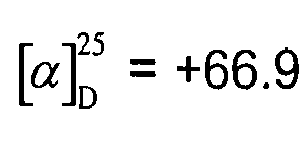
1,3,2',2''',6'''-Pentadeamino-1,3,2',2"',6"'-pentaazido-6'-O-benzylparomomycin (14). Under N2, a soln. of 13 (107 mg, 0.07 mmol) in CH2Cl2/H2O/i-PrOH 20:1:1 (7 ml) was treated with DDQ (103 mg, 0.45 mmol) at 0 °C and stirred for 2 h and at 26 °C for 24 h. The colour of the mixture changed from colourless to green and then to light orange. After neutralization with sat. NaHCO3 soln., the aq. layer was extracted with AcOEt (3 x 20 ml). The combined org. layers were washed with brine, dried (MgSO4) filtered, and evaporated. FC (CHCl3/AcOEt/MeOH 10:17.5:2)) gave 14 (34 mg, 59%). White solid. R f (CHCl3/AcOEt/MeOH 4:9:1) 0.68. M.p. 89.1-92.9 °C.
6'-O-Benzylparomomycin (15). A soln. of 14 (25 mg, 0.03 mmol) in THF (3 ml) was treated with 0.1M aq. NaOH (1 ml) and 1M PMe3 in THF (0.22 ml, 0.22 mmol) and heated to 50 °C for 2 h. Evaporation and FC (MeOH/25% aq. NH3 4:3) gave 15 (18 mg, 85%). White solid. R f (CHCl3/MeOH/25% aq. NH3 1:4:3) 0.56. M.p. 165°C (dec.).


- Typical procedure for the formation of ethers 16, 17a-d (Scheme 5). (GP 1): Under N2, a soln. of alcohol (1 equ.) in DMF (c=0.1) was treated with NaH (1.5 equ. per hydroxyl group, 50-60% suspension in oil), followed by alkyl chloride (or bromide) (1.5 equ. per hydroxyl group) and Bu4Nl (0.1 equ.), stirred at 25°C for 4-24 h, and diluted with H2O and Et2O. After separation of phases, the aq. layer was extracted with Et2O (3x). The combined org. layers were dried (MgSO4) and evaporated. FC.
1,3,2',2"',6"'-Pentadeamino-1,3,2',2"',6"'-pentaazido-6,3',2",5'' ,3'",4"'-hexa-Op-methoxybenzyl-4'-hydroxy-6'-O-monomethoxytritylparomomycin (16). Under N2, a soln. of 12 (400 mg, 0.256 mmol) in MeOH / CH2Cl2 (10:1, 5.5 ml) was treated with TsOH·H2O (49 mg, 0.3 mmol), stirred at 25°C for 3 h, and diluted with 1N NaOH. After separation of phases, the aq. layer was extracted with CH2Cl2 (3 x 5 ml). The combined org. layers were dried (MgSO4) and evaporated. FC gave as a white solid 1, 3, 2',2'",6"'-Pentadeamino-1, 3,2', 2"', 6"'-pentaazido-6 ; 4'-dihydroxy-6,3',2'',5'',3'",4"'-hexa-O-p-methoxybenzyl paromomycin (296 mg, 79%), R f (AcOEt/cyclohexane 1:1) 0.37, which was reacted according to GP 1. Reaction gave 16 (1.319 mg, 65%). R f (AcOEt/cyclohexane 3:7) 0.58. White solid, m.p. 60-65°C.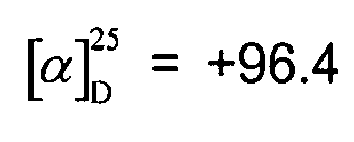
1,3,2',2"',6"'-Pentadeamino-1,3,2',2"',6"'-pentaazido-6,3',2",5",3"',4"'-hexa-Op-methoxybenzyl-4'-O-p-chlorobenzyl-6'-O-monomethoxytrityllparomomycin (17a). (GP 1) Reaction of 16 gave 17a (518 mg, 96%). R f (AcOEt/cyclohexane 3:7) 0.54. White solid, m.p. 66-71 °C. [α]25 D = +94.1 (c = 0.08, ChCl3). IR (atr): 2932w, 2099s, 1611m, 1585w, 1512s, 1462w, 1359w, 1301w, 1245s, 1173m, 1110m, 1068m, 1031s. HRMaldi-MS: 1900.6892 (57, [M + K]+, C98H104ClN15KO21 +; calc. 1900.6857); 1884.7151 (84, [M + Na]+, C98H104N15ClNaO21 +; calc. 1884.7117). Anal. calc. for C100H109N15O21·1.5 H2O (1890.44): C 62.26, H 5.71, N 11.11; found: C 62.39, H 5.83, N 10.73.
1,3,2',2"',6"'-Pentadeamino-1,3,2,2"',6"'-pentaazido-6,3,2',5",3"',4"'-hexa-O-p-methoxybenzyl-4'-O-p-(trifluoromethyl)benzyl-6'-O-monomethoxytritylparomomycin (17b). (GP 1) Reaction of 16 gave 17b (441 mg, 85%). R f (AcOEt/cyclohexane 3:7 x2) 0.54. White solid, m.p. 60-76°C.
1,3,2',2"',6"'-Pentadeamino-1,3,2,2'",6"'-pentaazido-6,3,2',5";3'",4"'-hexa-Op-methoxybenzyl-4'-O-propylphenyl-6'-O-monomethoxytritylparomomycin (17c). (GP 1) Reaction of 16 gave 17c (459 mg, 86%). R f (AcOEt/cyclohexane 3:7) 0.6. White solid, m.p. 63-78°C.
1,3,2',2"',6"'-Pentadeamino-1,3,2',2"',6"'-pentaazido-6,3 ,2",5",3"',4"'-hexa-Op-methoxybenzyl-4'-O-benzyloxymethyl-6'-O-monomethoxytrityllparomomycin (17d). (GP 1) Reaction of 16 gave 17d (442 mg, 83%). Rf (AcOEt/cyclohexane 3:7) 0.54. White solid, m.p. 52-55°C. IR (ATR): 2933w, 2001s, 1611m, 1585w, 1513s, 1463w, 1361w, 1301m, 1247s, 1174m, 1111m, 1068m, 1033s. HR-Maldi-MS: 1896.7326 (16, [M + Na]+, C99H107N15KO22 +; calc. 1896.7352); 1880.7566 (22, [M + Na]+, C99H107N15NaO22 +; calc. 1880.7613); 1866.7181 (65, [M - CH3O + K]+, C98H105N15KO21 +; calc. 1866.7247); 1850.7403 (89, [M - CH3O + Na]+, C98H105N15NaO21 +; calc. 1850.7507). - General procedure for deprotection of protected derivatives to give compounds 19a-d: (GP 2): Under N2, a soln. of protected derivative 17 (1 equiv.) in CH2Cl2/MeOH/H2O 20:1:0.4 (c=0.02) was treated with DDQ (1.1 equiv. per group), stirred at 25°C for 12-24 h, and neutralized with 1N NaOH, diluted with AcOEt. After separation of phases, the aq. layer was extracted with AcOEt (3 x). The combined org. layers were dried (MgSO4) and evaporated. FC. A soln. of azido compound (1 equiv.) in THF/0.1M NaOH 4:1 (c = 0.03) was treated with 1 M PMe3 in THF (1.2 equiv. per azido group) and stirred for 4-8h at 50 °C. After evaporation, FC.
4'-p-chlorobenzylparomomycin (19a). (GP 2) Reaction of 17a gave azido intermediate 18a (120 mg, 54%) as a white solid. Rf (MeOH/CHCl3/AcOEt 0.5:2:2) 0.29. Final compound 19a (47 mg, 86%). Rf (MeOH/NH3aq. 8:2) 0.27. White solid, m.p. 145°C (decomp.).
4'-p-(trifluoromethyl)benzylparomomycin (19b). (GP 2) Reaction of 17b gave azido intermediate 18b (130 mg, 80%) as a white solid. R f (MeOH/CHCl3/AcOEt 0.5:2:2) 0.26. Final compound 19b (84 mg, 87%). R f (MeOH/NH3aq. 8:2) 0.30. White solid, m.p. 148°C (dec.).
4'-p-(3-phenylpropyl)paromomycin (19c). (GP 2) Reaction of 17c gave azido intermediate 18c (105 mg, 74%) as a white solid. Rf (MeOH/CHCl3/AcOEt 0.5:2:2) 0.40. Final compound 19c (64 mg, 92%). R f (CHCl3/MeOH/NH3aq. 1:3:2) 0.47. White solid, m.p. 179°C (dec.).
4'-Benzyloxymethylparomomycin (19d). (GP 2) Reaction of 17d gave azido intermediate 18d (70 mg, 72%) as a white solid. R f (MeOH/CHCl3/AcOEt 0.5:2:2) 0.31. Final compound 19d (36 mg, 72%). R f (CHCl3/MeOH/NH3aq, 1:3:2) 0.36. White solid, m.p. 143°C (decomp.).


4'-p-Methoxybenzylparomomycin (19e). A soln. of 18e (60 mg, 0.058 mmol) in THF (2 ml) was treated with 0.1 M NaOH soln. (0.5 ml) and 1M PMe3 in THF (0.346 ml) and stirred for 4h at 50 °C. After evaporation, FC and coevaporation with 10% AcOH gave 19e as an acetic salt (44 mg, 74%) Rf (MeOH/CHCl3/NH3aq.1:3:2) 0.33. White solid, m.p. 190°C (dec.).
- In the following the biological assay used for determining the activity of the compounds of the invention as exemplified in example 1 above to selectively target bacterial 16S ribosomal RNA and not to target at all or target to a substantially less degree eukaryotic cytosolic and/or mitochiondrial ribosomes is described in detail.
- The strain used for introduction/selection of mutational alterations was a genetically modified derivative of Mycobacterium smegmatis carrying a single functional chromosomal rRNA operon (Sander et al. Mol. Microbiol. 1996, 22: 841-848). This strain, termed M. smegmatis rrn-, allowed for the selection of mutational rRNA gene alterations using a plasmid carrying the rRNA gene with the respective mutational alteration.
- The rRNA gene carried on the plasmid encodes either the complete rRNA operon (Prammananan et al. Antimicrob. Agents Chemother. 1999, 43: 447-453) or a non-functional rRNA gene fragment of approximately 1.0 kb (Pfister et al. Antimicrob. Agents Chemother. 2003, 47: 1496-1502). PCR-mutagenesis in vitro was used to generate the mutagenized rRNA gene fragment. In the case of a partial rRNA gene fragment the mutagenized rRNA gene fragment was cloned into vectors pMV261 or pMV361 (Sander et al. Mol. Microbiol. 2002, 46: 1295-1304; Pfister et al. Antimicrob. Agents Chemother. 2003, 47: 1496-1502) to result in vectors carrying a partial rRNA gene fragment of approximately 1.0 kb with the mutational alteration introduced. In the case of plasmids carrying the complete rRNA operon the mutagenized rRNA gene fragment obtained by PCR was cloned into vectors pMV361 rRNA or pMV261 rRNA using appropriate restriction sites (Prammananan et al. Antimicrob. Agents Chemother. 1999, 43: 447-453). Vectors pMV361 rRNA and pMV261 rRNA carried a complete copy of the rRNA operon from M. smegmatis (Sander et al. Mol. Microbiol. 1997, 26: 469-480). Introduction of mutations into the plasmid encoded rRNA was confirmed by sequencing.
- The single rRNA allelic derivative of M. smegmatis, i.e. M. smegmatis rrn-, was used for transformation of the plasmids. The strain was made electro-competent and transformed according to standard techniques and as described previously (Sander et al. Mol. Microbiol. 1997, 26: 469-484). Following primary selection, the plasmid-encoded mutational rRNA gene alteration was transferred into the single chromosomal rRNA operon by means of RecA-mediated homologous recombination (Prammananan et al. Antimicrob. Agents Chemother. 1999, 43: 447-453). Introduction of the mutational rRNA gene alteration into the single functional chromosomal rRNA operon by gene conversion was confirmed by sequence determination.
- In another aspect of the technique, the single functional chromosomal rRNA operon was inactivated and the synthesis of ribosomal RNA was driven exclusively by the mutated plasmid-encoded rRNA operon.
- The following demonstrates one way of producing a strain with all endogenous rrn genes deleted and with functional ribosomal RNA produced by a plasmid encoded rRNA operon.
A combination of positive, e.g. aph, and negative-selectable markers, e.g. sacB, was used for unmarked deletion mutagenesis. In brief, the sacB gene was cloned into the mycobacterial expression vector pMV361 (Stover et al. Nature 1991, 351:456-460) to result in pMS32a. In pMS32a, sacB is located downstream of the hsp60 promoter. A restriction fragment of pMS32a carrying the hsp60p-sacB construct was transferred into the cloning vector pGEM-7 (Promega) to result in plasmid pZ130 which was used as backbone in the construction of both rrnA and rrnB replacement vectors. Chromosomal DNA sequences flanking the 5' and 3' region of each rrn operon were obtained by PCR and cloned into pZ130. Following further modifications, the rrn replacement vectors were obtained. As example, the generation of the rrnB replacement vector is described here and the strategy for inactivation of rrnB illustrated inFig. 1 .
For complementation, a functional rrnB operon was cloned into an integration-proficient vector. Following the strategy outlined inFig. 2 a derivative of M. smegmatis, i.e. strain ΔrrnA ΔrrnB attB::prrnB, was obtained where both endogenous chromosomal rRNA operons are inactivated by gene deletion across the entire 16S, 23S, and 5S rRNA genes (rrs, rrl, and rrf; seeFig. 1 ). This strain is completely devoid of chromosomal rRNA genes and rRNA is exclusively transcribed from plasmid DNA. - Such strains are particularly useful because they avoid the interference of the bacterial cell's own naturally occurring ribosomal activity with that of the introduced at least partially heterologous, mitochondrial or cytosolic bacterial ribosomes in the assay methods of the present invention.
- Ribosomal drug susceptibility was studied by determining the minimal inhibitory concentrations, as described in detail in Pfister et al. 2003 and 2005 (see above).
- The recombinants carrying the respective mutational alterations in the functional rRNA operon were colony-purified and subjected to determinations of minimal inhibitory concentrations (MIC) to determine ribosomal drug susceptibility. Cultures from single colonies were grown in LB medium supplemented with 0.05% Tween 80 and used for MIC tests in a microtiter plate format. Starting cultures contained 200 µl of bacterial cells at an optical density of 0.025 at 600 nm, and the respective drug was added in twofold series of dilution. The MIC was defined as the drug concentration at which the growth of the cultures was completely inhibited after 72 h of incubation at 37°C, corresponding to 24 generations.
- Key nucleotides which distinguish the prokaryotic from the eukaryotic decoding site are 16S rRNA positions 1408 (bacterial ribosome: A, eukaryotic cytosolic ribosomes: G) and 1491 (bacterial ribosomes: G, eukaryotic cytosolic ribosomes: A, eukaryotic mitochondrial ribosome: C).
- As demonstrated by the results in table 1 below the compounds of the invention are highly selective for bacterial ribosomal RNA. Hence, they are highly effective in antibiotic therapy of bacterial infection in mammals, in particular humans and they can be dosed higher than current non-selective antibiotics that have to be dosed much lower in order to avoid damage to the mammal's mitochondrial and cytosolic RNA.
Table 1 Activity of selected compounds and comparators towards bacterial and mutant ribosomes carrying key nucleotides of the deconding site as determined by investigating minimal inhibitory concentrations (mg/ml) ΔrrnB µg/ml ΔrrnB 1408G µg/ml ΔrrnB 1491A µg/ml ΔrrnB 1491C µg/ml Paromomycin 1 64 64 ≥512 Neomycin B 0.5-1 >512 4 16-32 5.1 4 512 512 > 512 5.2 4 >512 >512 >512 5.3 4-8 256-512 512 > 512 5.4 8-16 > 512 > 512 >512 5.5 4-8 ≥512 > 512 > 512 5.6 4 512 >512 >512 5.7 2-4 256-512 256 > 512 5.8 4 >512 >512 >512 5.9 4 128-256 128-256 128 5.10 16-32 >512 >512 >512 5.11 64 128 64-128 64 5.12 2-4 > 512 > 512 > 512 5.13 32 >512 >512 >512 5.14 32-64 > 512 > 512 > 512 5.15 2-4 256-512 512 512 5.16 4-16 512 512 > 512 5.17 2-4 > 512 512 512 5.18 2-4 256-512 256 > 512 5.19 4-8 512 256-512 256 5.20 2-4 > 512 512 512 5.21 8-16 >512 > 512 > 512 5.22 8-16 >512 > 512 > 512 5.23 32 >512 >512 >512 5.24 64 256 256 128-256 5.25 1 512 ≥512 ≥512 5.26 2-4 ≥512 ≥512 ≥ 512 5.27 32-64 > 512 > 512 > 512 5.28 4 512 512 > 512 5.29 4-8 > 512 > 512 > 512 11 4 >512 ≥ 512 >512 15 32-64 > 512 > 512 > 512 19a 2 ≥ 512 ≥512 > 512 19b 8 >512 >512 ≥512 19c 8-16 ≥512 ≥512 512 19d 16 > 512 > 512 > 512 19e 8 > 512 > 512 > 512 - Selected compounds of the present invention were tested for antibiotic susceptibility using clinical isolates of Staphylococci, Enterococci and Escherichia coli as well as strains carrying defined resistance determinants and compared to well known antibiotics of the state of the art. Drug susceptibility was determined in standard MIC assays, i.e. by determination of the minimal drug concentration required to inhibit bacterial growth in vitro.
- The results indicate:
- 1. The selected compounds are active against clinical isolates with resistance to standard aminoglycosides
- 2. The selected compounds are not modified by defined aminoglycoside resistance determinants, e.g. ANT4', AAC6', APH2", AAC3, ANT2"
- The results are summarized in table 2 below, where the numbers correspond to MIC values in µg/ml.


Claims (56)
- Compounds of formula (I):
 X, Y and Z denote in each case, independently of one another, -O-, -NH-, -S-, substituted or unsubstituted -CH2- or a direct bond to R1 and/or R2;R1 and R2 denote in each case, independently of one another, hydrogen, linear or branched, substituted or non-substituted alkyl, alkenyl, alkynyl, alkylidene, carbocycle or YR1 and ZR2 together form a substituted or non-substituted cycloalkyl or a corresponding heterocyclic ring, with the proviso that R1 and R2 are not both H,R3 and R4 denote in each case, independently of one another, hydrogen, amino or hydroxyl;R5 and R6 denote in each case, independently of one another, hydrogen or glycosyl residues;and their diastereoisomers or enantiomers in the form of their bases or salts of physiologically compatible acids.
 - Compounds according to claim 1, wherein R1 and R2 denote, in each case independently of one another, hydrogen, linear or branched, substituted or non-substituted C1-C12 alkyl, C2-C12 alkenyl, alkynyl, or alkylidene, C3-C12 cycloalkyl, C3-C20 aryl, preferably aralkyl, C3-C20 heteroaryl or C3-C20 heterocyclic.
- Compounds according to claim 1 or 2, wherein YR1 is not NH2.
- Compounds according to any one of claims 1 to 3, wherein ZR2 is not OH.
- Compounds according to any one of claims 1 to 4, wherein R1 and/or R2 do not comprise peptide nucleic acid moieties.
- Compounds according to any one of claims 1 to 5, wherein R1 comprises, preferably is, a substituted or non-substituted (C1-C5 alkyl)aryl group and R2 is hydrogen.
- Compounds according to any one of claims 1 to 5, wherein R2 is a linear or branched, substituted or non-substituted C1-C7 alkyl, C2-C7 alkenyl, alkynyl, or alkylidene, C3-C7 cycloalkyl, C3-C7 aryl, preferably aralkyl, C3-C7 heteroaryl or C3-C7 heterocyclic and R1 is hydrogen.
- Compounds according to any one of claims 1 to 7, wherein R3 is hydroxyl.
- Compounds according to any one of claims 1 to 8, wherein R4 is amino.
- Compounds according to any one of claims 1 to 9, wherein R5 is hydrogen.
- Compounds according to any one of claims 1 to 9, wherein R5 is selected from the group consisting of mono- and polysaccharides, preferably a mono-, di- or trisaccharide, more preferably a mono- or disaccharide, most preferably a disaccharide, especially preferred a 2,6-diamino-2,6-dideoxy-β-L-idopyranosyl-(1→3)-β-D-ribofuranosyl moiety.
- Compounds according to any one of claims 1 to 11, wherein R6 is hydrogen.
- Compounds according to any one of claims 1 to 11, wherein R6 is selected from the group consisting of mono- and polysaccharides, preferably a mono-, di- or trisaccharide, more preferably a mono- or disaccharide, most preferably a monosaccharide, especially preferred a 3-amino-3-deoxy-α-D-glucopyranosyl moiety.
- Compounds according to any one of claims 1 to 13, wherein R6 is a 2,6-diamino-2,6-dideoxy-β-idopyranosyl-(1→3)-β-D-ribofuranosyl moiety.
- Compounds according to any one of claims 1 to 13, wherein R5 is a 3-amino-3-deoxy-α-D-glucopyranosyl moiety.
- Compounds according to any one of claims 1 to 15, wherein YR1 and ZR2 together form a substituted or non-substituted cycloalkyl or a corresponding heterocyclic ring.
- Compounds according to any one of claims 1 to 16, wherein YR1 and ZR2 together form a 6-membered 4',6'-cycloalkyl or substituted 4',6'-cycloalkyl ring.
- Compounds according to any one of claims 1 to 17, wherein Y and Z are oxygen, preferably X, Y nd Z are oxygen.
- Compounds according to any one of claims 1 to 18 of formula (II):
 X, Y and Z denote in each case, independently of one another, -O-, -NH-, -S-, substituted or non-substituted -CH2-;R7 denotes hydrogen, linear or branched, substituted or non-substituted alkyl, alkenyl, alkynyl, alkylidene, or carbocycle;R8 denotes hydrogen, OH with the proviso that the compound is stable, NH2, NRaRb, SH, SRa, ORa or a linear or branched, substituted or non-substituted C1-C8 alkyl, preferably C1-C4 alkyl, wherein Ra and Rb are in each case, independently of one another, C1-C8 alkyl, preferably C1-C4 alkyl;R3 denotes hydrogen, amino or hydroxyl, preferably amino or hydroxyl;R4 denotes hydrogen, amino or hydroxyl, preferably amino or hydroxyl;R5 denotes hydrogen, a mono- or polysaccharide, preferably a mono-, di- or trisaccharide, more preferably a mono- or disaccharide, most preferably a disaccharide, especially preferred 2,6-diamino-2,6-dideoxy-β-L-idopyranosyl-(1→3)-β-D-ribofuranosyl moiety;R6 denotes hydrogen, a mono- or polysaccharide, preferably a mono-, di- or trisaccharide, more preferably a mono- or disaccharide, most preferably a monosaccharide, especially preferred a 3-amino-3-deoxy-α-D-glucopyranosyl moiety.
 - Compounds according to claim 19, wherein X, Y and Z are all oxygen.
- Compounds according to claims 19 or 20, wherein R7 denotes hydrogen, a linear or branched, substituted or non-substituted C1-C8 alkyl, C3-C8 cycloalkyl, C5-C20aryl, C5-C20 heteroaryl, preferably C5-C12 heteroaryl.
- Compounds according to any one of claims 19 to 21, wherein R7 denotes linear, substituted or non-substituted C1-C8 alkyl, preferably substituted linear C1-C3 alkyl, more preferably aryl-substituted C1-C3 alkyl; substituted or non-substituted C3-C8 cycloalkyl, C5-C12 aryl, C5- C12 heteroaryl, preferably substituted C5-C12 heteroaryl.
- Compounds according to any one of claims 19 to 22, wherein R7 denotes C5-C12 aryl or heteroaryl, preferably a (C1-C7 alkyl)aryl group.
- Compounds according to any one of claims 19 to 23, wherein R7 is an aryl substituted ethyl group.
- Compounds according to any one of claims 19 to 24, wherein R7 comprises a halogen, preferably a chlorine, bromine, fluorine or iodine, more preferably a fluorine
- Compounds according to any one of claims 19 to 25, wherein R8 is selected from the group consisting of hydrogen, halogen or linear or branched, substituted or non-substituted C1-C8 alkyl, preferably C1-C4 alkyl, most preferably hydrogen.
- Compounds according to any one of claims 19 to 26, wherein R5 or R6 is hydrogen.
- Compounds according to any one of claims 19 to 27, wherein R6 is a 2,6-diamino-2,6-dideoxy-β-L-idopyranosyl-(1→3)-β-L-ribofuranosyl moiety.
- Compounds according to any one of claims 1 to 28, wherein R1 and R2 denote a linear or branched, substituted or non-substituted alkyl or cycloalkyl, wherein one or more of the carbon atoms are replaced, independently of one another, by oxygen, sulfur or nitrogen.
- Compounds according to any one of claims 19 to 29, wherein X, Y and Z are oxygen.
- Compounds according to any one of claims 1 to 30 selected from the group consisting of
4',6'-O-benzylideneparomomycin,
4',6'-O-p-methoxybenzylideneparomomycin,
4',6'-O-m-methoxybenzylideneparomomycin tetraacetate,
4',6'-O-o-methoxybenzylideneparomomycin,
4',6'-O-2,5-dimethoxybenzylideneparomomycin,
4',6'-O-p-nitrobenzylideneparomomycin,
4',6'-O-m-nitrobenzylideneparomomycin triacetate,
4',6'-O-p-chlorobenzylideneparomomycin,
4',6'-O-3,5-dichlorobenzylideneparomomycin,
4',6'-O-p-cyanobenzylideneparomomycin,
4',6'-O-p-phenylbenzylideneparomomycin,
4',6'-O-p-fluorobenzylideneparomomycin,
4',6'-O-3,5-dimethoxybenzylideneparomomycin,
4',6'-O-3,4,5-trimethoxybenzylideneparomomycin,
4',6'-O-m-chlorobenzylideneparomomycin,
4',6'-O-o-nitrobenzylideneparomomycin,
4',6'-O-p-trifluoromethylbenzylideneparomomycin,
4',6'-O-p-dimethylaminobenzylideneparomomycin,
4',6'-O-1-naphthylideneparomomycin,
4',6'-O-2-naphthylideneparomomycin,
4',6'-O-2-furanylideneparomomycin,
4',6'-O-2-thiophenylideneparomomycin and
4',6'-O-ethylideneparomomycin,
4',6'-O-(2-phenyl)-ethylideneparomomycin,
4',6'-O-(3-phenyl)-propylideneparomomycin,
4',6'-O-(3-phenyl)-propenylideneparomomycin,
4',6'-O-cyclohexylmethylideneparomomycin,
4'-O-benzylparomomycin,
6'-O-benzylparomomycin,
4'-p-chlorobenzyl paromomycin,
4'-p-(trifluoromethyl)benzylparomomycin,
4'-benzyloxymethylparomomycin and
4'-p-methoxybenzylparomomycin. - Use of one or more compounds according to any one of claims 1 to 31 for preparing a medicament.
- Use of one or more compounds according to any one of claims 1 to 31 for preparing a medicament for the treatment and/or prevention of a microbial, preferably a bacterial, infection.
- Use of one or more compounds according to any one of claims 1 to 31 for preparing a medicament for the treatment and/or prevention of trypanosomiasis.
- Use of one or more compounds according to any one of claims 1 to 31 for preparing a medicament for the treatment and/or prevention of leishmaniasis.
- Pharmaceutical composition, comprising as active substance one or more compounds according to any one of claims 1 to 31 or pharmaceuticclly acceptable derivatives or prodrugs thereof, optionally combined with conventional excipients and/or carriers.
- Method for preparing a compound according to any one of claims 1 to 31, comprising one or more of the following steps:a) providing a compound according to the formula III:
 V and W denote in each case, independently of one another, -O-, -NH- and -S-;R3 and R4 denote in each case, independently of one another, hydrogen, amino or hydroxyl;R5 and R6 denote in each case, independently of one another, hydrogen or glycosyl residues;b) protecting one or more, preferably all, of the amino groups;c) optionally protecting one or more, preferably all, of the hydroxy groups;d1) selectively transforming the optionally protected 4'- and/or 6'-hydroxy groups to YR1 and/or ZR2-groups of formula I or the ring system of formula II; ord2) selectively deprotecting the protected 4'- and/or 6'-hydroxy groups and selectively transforming the deprotected 4'- and/or 6'-hydroxy groups to YR1 and/or ZR2-groups of formula I or the ring system of formula II;e) deprotecting the one or more amino groups;f) deprotecting the one or more hydroxy groups;wherein the order of steps b) and c) as well as e) and f) may be reversed, the order of b) and c) as well as e) and f) being preferred.
 - Method according to claim 37, wherein the amino groups are protected by converting them to azido, carbamoyl or N-acylamino groups.
- Methods according to claim 37 or 38, wherein the amino groups are protected by converting them to azido groups by diazo transfer.
- Method according to any one of claims 37 to 39, wherein the hydroxy groups are protected by converting them to ethers, preferably alkyl and/or silyl ethers, and/or esters, preferably sulfonates or acetals.
- Method according to claim 40, wherein the hydroxy groups are protected as acetoxy groups by rconverting them with an acyl transfer reagent, preferably acetic anhydride, preferably in the presence of bases and/or catalysts.
- Method according to any one of claims 37 to 41, wherein the acetoxy groups are deprotected by base- or acid-catalyzed solvolysis or by reduction with a hydride donor, such as diisobutyl aluminum hydride, LiAIH4 or LiBH4.
- Method according to any one of claims 37 to 42, wherein 4',6'-acetals of formula III are prepared by reaction of a hydroxy compound of formula III with R7CHO or R7CH(ORa)(ORb), wherein Ra and Rb are akyl residues, preferably methyl, in the presence of a suitable organic and/or inorganic acid and, if necessary, in a suitable solvent.
- Method according to any one of claims 37 to 42, wherein 4',6'-acetals of formula III are prepared by reaction of a hydroxy compound of formula III with

- Method according to any one of claims 37 to 44, wherein azido groups, are deprotected by a method selected from the group consisting of:reductive hydrogenation,reaction with a hydride reagent, preferably lithium aluminium hydride,electron tranfer, preferably by reaction with a dithiol in the presence of base, and Staudinger reaction with a phosphine reagent, preferably with trimethylphosphine.
- Method according to any one of claims 27 to 35, wherein 4'- and 6'-hydroxy groups are selectively deprotected.
- Method according to claim 46, wherein the 4'- and 6'-hydroxy groups are protected as a benzylidene acetal.
- Method according to claim 47, wherein the 4', 6'- benzylidene acetal is deprotected by a method selected from the group consisting of catalytic hydrogenation, Birch reduction and acid-catalyzed hydrolysis.
- Method according to any one of claims 46 to 48, comprising the regioselective reductive cleavage of the 4',6'-acetal to result in the more hindered ether derivative by reaction with a suitable hydride reagent, preferably the borane-dimethyl sulfide complex in the presence of a suitable Lewis acid.
- Method according to any one of claims 46 to 48, comprising the regioselective reductive cleavage of the 4',6'-acetal to result in the less hindered ether derivative by reaction with a suitable hydride reagent, preferably sodium cyanoborohydride in the presence of a suitable acid.
- Method according to any one of claims 37 to 50, wherein the hydroxy groups are protected as benzyloxy groups, the benzyl part preferably being substituted or unsubstituted arylmethyl or heteroarylmethyl.
- Method according to claim 51, wherein the benzyloxy group is a p-methoxybenzyloxy group,
- Method according ot claim 52, wherein the p-methoxybenzyloxy groups are deprotected by oxidative cleavage with a suitable reagent, preferably with dichlorodicyanoquinone.
- Method according to any one of claims 37 to 52, wherein the primary 6'-hydroxy group is selectively protected as an ether, preferably an alkyl or silyl ether, or an ester, preferably a sulfonate or an acetal.
- Method according to claim 54, wherein the primary 6'-hydroxy group is a monomethoxytrityloxy group.
- Method according to any one of claims 37 to 55, wherein the 4'-hydroxy group is protected as an ether, preferably by reaction with a suitable alkoxy transfer reagent, preferably an alkyl halide in the presence of a suitable base.
Priority Applications (6)
| Application Number | Priority Date | Filing Date | Title |
|---|---|---|---|
| EP07002363A EP1953171A1 (en) | 2007-02-02 | 2007-02-02 | Aminoglycoside antibiotics targeting bacterial 16S ribosomal RNA |
| PCT/EP2008/000768 WO2008092690A1 (en) | 2007-02-02 | 2008-01-31 | Aminoglycoside antibiotics targeting bacterial 16s ribosomal rna |
| CN200880003553A CN101679471A (en) | 2007-02-02 | 2008-01-31 | Aminoglycoside antibiotics targeting bacterial 16S ribosomal RNA |
| US12/449,213 US8546343B2 (en) | 2007-02-02 | 2008-01-31 | Aminoglycoside antibiotics targeting bacterial 16S ribosomal RNA |
| JP2009547604A JP5317989B2 (en) | 2007-02-02 | 2008-01-31 | Aminoglycoside antibiotics targeting microbial 16S ribosomal RNA |
| EP08707455.5A EP2121714B1 (en) | 2007-02-02 | 2008-01-31 | Aminoglycoside antibiotics targeting bacterial 16s ribosomal rna |
Applications Claiming Priority (1)
| Application Number | Priority Date | Filing Date | Title |
|---|---|---|---|
| EP07002363A EP1953171A1 (en) | 2007-02-02 | 2007-02-02 | Aminoglycoside antibiotics targeting bacterial 16S ribosomal RNA |
Publications (1)
| Publication Number | Publication Date |
|---|---|
| EP1953171A1 true EP1953171A1 (en) | 2008-08-06 |
Family
ID=38171628
Family Applications (2)
| Application Number | Title | Priority Date | Filing Date |
|---|---|---|---|
| EP07002363A Withdrawn EP1953171A1 (en) | 2007-02-02 | 2007-02-02 | Aminoglycoside antibiotics targeting bacterial 16S ribosomal RNA |
| EP08707455.5A Active EP2121714B1 (en) | 2007-02-02 | 2008-01-31 | Aminoglycoside antibiotics targeting bacterial 16s ribosomal rna |
Family Applications After (1)
| Application Number | Title | Priority Date | Filing Date |
|---|---|---|---|
| EP08707455.5A Active EP2121714B1 (en) | 2007-02-02 | 2008-01-31 | Aminoglycoside antibiotics targeting bacterial 16s ribosomal rna |
Country Status (5)
| Country | Link |
|---|---|
| US (1) | US8546343B2 (en) |
| EP (2) | EP1953171A1 (en) |
| JP (1) | JP5317989B2 (en) |
| CN (1) | CN101679471A (en) |
| WO (1) | WO2008092690A1 (en) |
Families Citing this family (14)
| Publication number | Priority date | Publication date | Assignee | Title |
|---|---|---|---|---|
| AU2006320374B2 (en) | 2005-12-02 | 2012-08-30 | Isis Pharmaceuticals, Inc. | Antibacterial 4,5-substituted aminoglycoside analogs having multiple substituents |
| WO2010030690A1 (en) | 2008-09-10 | 2010-03-18 | Isis Pharmaceuticals, Inc. | Antibacterial 4,6-substituted 6', 6" and 1 modified aminoglycoside analogs |
| WO2010030704A2 (en) | 2008-09-10 | 2010-03-18 | Achaogen, Inc. | Antibacterial aminoglycoside analogs |
| WO2010042850A1 (en) | 2008-10-09 | 2010-04-15 | Achaogen, Inc. | Antibacterial aminoglycoside analogs |
| WO2010042851A1 (en) | 2008-10-09 | 2010-04-15 | Achaogen, Inc. | Antibacterial aminoglycoside analogs |
| CA2777107A1 (en) | 2009-10-09 | 2011-04-14 | Achaogen, Inc. | Antibacterial aminoglycoside analogs |
| CA2791253A1 (en) * | 2010-04-06 | 2011-10-13 | Frank Schweizer | Polyol modified aminoglycoside-lipid conjugates |
| CN111388489A (en) | 2010-09-13 | 2020-07-10 | 苏黎世大学 | Application of apramycin in preparation of bacterial infectious disease treatment |
| CN103282370A (en) | 2010-11-17 | 2013-09-04 | 尔察祯有限公司 | Antibacterial amiinoglycoside analogs |
| WO2013170985A1 (en) | 2012-05-18 | 2013-11-21 | Boettger Erik C | New aminoglycoside antibiotics targeting bacterial 16s ribosomal rna lacking ototoxicity |
| CN103272238B (en) * | 2013-06-08 | 2015-04-15 | 北京大学 | Biomaterial based on DNA and aminoglycoside molecule compound |
| WO2018187738A1 (en) * | 2017-04-07 | 2018-10-11 | Wayne State University | Neomycin and paromomycin derivatives |
| US11466044B2 (en) | 2017-04-07 | 2022-10-11 | Wayne State University | Neomycin and paromomycin derivatives |
| US20220143153A1 (en) * | 2019-03-08 | 2022-05-12 | The Regents Of The University Of California | Compositions and methods for treating acne |
Family Cites Families (3)
| Publication number | Priority date | Publication date | Assignee | Title |
|---|---|---|---|---|
| JPS553358B2 (en) * | 1973-03-13 | 1980-01-24 | ||
| US4066753A (en) * | 1976-05-27 | 1978-01-03 | Canadian Patents And Development Limited | Neomycin and paromomycin derivatives |
| AU2006320374B2 (en) * | 2005-12-02 | 2012-08-30 | Isis Pharmaceuticals, Inc. | Antibacterial 4,5-substituted aminoglycoside analogs having multiple substituents |
-
2007
- 2007-02-02 EP EP07002363A patent/EP1953171A1/en not_active Withdrawn
-
2008
- 2008-01-31 JP JP2009547604A patent/JP5317989B2/en not_active Expired - Fee Related
- 2008-01-31 WO PCT/EP2008/000768 patent/WO2008092690A1/en not_active Ceased
- 2008-01-31 US US12/449,213 patent/US8546343B2/en not_active Expired - Fee Related
- 2008-01-31 EP EP08707455.5A patent/EP2121714B1/en active Active
- 2008-01-31 CN CN200880003553A patent/CN101679471A/en active Pending
Non-Patent Citations (2)
| Title |
|---|
| KUDYBA, IWONA ET AL: "Synthesis of paromomycin derivatives modified at C(5'') to selectively target bacterial rRNA", CARBOHYDRATE RESEARCH , 342(3-4), 499-519 CODEN: CRBRAT; ISSN: 0008-6215, 2007, XP002441570 * |
| RIGUET E ET AL: "A route for preparing new neamine derivatives targeting HIV-1 TAR RNA", TETRAHEDRON, ELSEVIER SCIENCE PUBLISHERS, AMSTERDAM, NL, vol. 60, no. 37, 6 September 2004 (2004-09-06), pages 8053 - 8064, XP004527590, ISSN: 0040-4020 * |
Also Published As
| Publication number | Publication date |
|---|---|
| JP2010517951A (en) | 2010-05-27 |
| CN101679471A (en) | 2010-03-24 |
| US8546343B2 (en) | 2013-10-01 |
| EP2121714A1 (en) | 2009-11-25 |
| WO2008092690A8 (en) | 2009-08-20 |
| EP2121714B1 (en) | 2019-03-06 |
| US20100144662A1 (en) | 2010-06-10 |
| WO2008092690A1 (en) | 2008-08-07 |
| JP5317989B2 (en) | 2013-10-16 |
Similar Documents
| Publication | Publication Date | Title |
|---|---|---|
| EP2121714B1 (en) | Aminoglycoside antibiotics targeting bacterial 16s ribosomal rna | |
| AU2006320374B2 (en) | Antibacterial 4,5-substituted aminoglycoside analogs having multiple substituents | |
| US6541456B1 (en) | Antimicrobial 2-deoxystreptamine compounds | |
| DE3650020T2 (en) | Stimulus for the contraction movement of the digestive tract. | |
| CN101715455A (en) | Antibacterial 1,4,5-substituted aminoglycoside analogs | |
| US6531454B1 (en) | Glycosylated polyamines and methods of use therefor | |
| JPS6260395B2 (en) | ||
| US20150011740A1 (en) | Fluorine-containing water soluble platinum complexes for tumor treatment and process of preparing same | |
| US10829440B2 (en) | Antibacterial compounds and methods of making and using same | |
| KR860001282B1 (en) | Method for preparing C-20- and C-23-modified macrolide derivatives | |
| AU2005304713A1 (en) | Antimicrobial 2-deoxystreptamine compounds | |
| JP6170064B2 (en) | Antibacterial tyrosine derivative and method for producing the same | |
| CN102942603B (en) | New aminoglycoside antibiotics | |
| US4112217A (en) | Bis-hydrazones of daunomycin and adriamycin | |
| US20130012466A1 (en) | Colchicine neoglycosides and methods for their synthesis and use | |
| HU217630B (en) | 3'-Aziridino-anthracycline derivatives, a process for their preparation and pharmaceutical compositions containing these compounds | |
| US20040058880A1 (en) | Aminoglycoside antibiotics as novel anti-infective agents | |
| EP0285526A2 (en) | 1-N-(4-Amino-3-fluoro-2-hydroxybutyryl)-kanamycins | |
| JP3045527B2 (en) | 4-0- (Aminoglycosyl)-or 4,6-di0- (aminoglycosyl) -2,5-dideoxy-5,5-difluorostreptamine derivative and method for producing the same | |
| US6420344B1 (en) | Glycosylated polyamines | |
| FI56388C (en) | REFERENCE TO A FRAMEWORK FOR THERAPEUTIC USE OF THERAPEUTIC CHARACTERISTICS OF 1-N-NY-AMINO-ALPHA-HYDROXIBUTYRYL SUBSTITUTES FOR CANANYCIN (A ELLER B) -FOERENING | |
| FI70414B (en) | FOERFARANDE FOER FRAMSTAELLNING AV NYA 4'-IODODERIVATER AV ANTRACYKLINGLYKOSIDER | |
| IT8209478A1 (en) | KANAMICINE 2'-MODIFIED AND PRODUCTION OF THESE | |
| EP0516156A1 (en) | Chemical modification of 2"-amino group in elsamicin A | |
| IE921764A1 (en) | Preparation of 6-0-alkylelsamicin a derivatives |
Legal Events
| Date | Code | Title | Description |
|---|---|---|---|
| PUAI | Public reference made under article 153(3) epc to a published international application that has entered the european phase |
Free format text: ORIGINAL CODE: 0009012 |
|
| AK | Designated contracting states |
Kind code of ref document: A1 Designated state(s): AT BE BG CH CY CZ DE DK EE ES FI FR GB GR HU IE IS IT LI LT LU LV MC NL PL PT RO SE SI SK TR |
|
| AX | Request for extension of the european patent |
Extension state: AL BA HR MK RS |
|
| AKX | Designation fees paid | ||
| REG | Reference to a national code |
Ref country code: DE Ref legal event code: 8566 |
|
| STAA | Information on the status of an ep patent application or granted ep patent |
Free format text: STATUS: THE APPLICATION IS DEEMED TO BE WITHDRAWN |
|
| 18D | Application deemed to be withdrawn |
Effective date: 20090207 |