EP1950688B1 - Verfahren zur automatischen Überwachung der Bewegungen einer Hand in einer Bildsequenz - Google Patents
Verfahren zur automatischen Überwachung der Bewegungen einer Hand in einer Bildsequenz Download PDFInfo
- Publication number
- EP1950688B1 EP1950688B1 EP07024097A EP07024097A EP1950688B1 EP 1950688 B1 EP1950688 B1 EP 1950688B1 EP 07024097 A EP07024097 A EP 07024097A EP 07024097 A EP07024097 A EP 07024097A EP 1950688 B1 EP1950688 B1 EP 1950688B1
- Authority
- EP
- European Patent Office
- Prior art keywords
- hand
- image
- contour
- pixel
- finger
- Prior art date
- Legal status (The legal status is an assumption and is not a legal conclusion. Google has not performed a legal analysis and makes no representation as to the accuracy of the status listed.)
- Active
Links
Images


Classifications
-
- G—PHYSICS
- G06—COMPUTING OR CALCULATING; COUNTING
- G06V—IMAGE OR VIDEO RECOGNITION OR UNDERSTANDING
- G06V40/00—Recognition of biometric, human-related or animal-related patterns in image or video data
- G06V40/20—Movements or behaviour, e.g. gesture recognition
- G06V40/28—Recognition of hand or arm movements, e.g. recognition of deaf sign language
-
- G—PHYSICS
- G06—COMPUTING OR CALCULATING; COUNTING
- G06V—IMAGE OR VIDEO RECOGNITION OR UNDERSTANDING
- G06V40/00—Recognition of biometric, human-related or animal-related patterns in image or video data
- G06V40/10—Human or animal bodies, e.g. vehicle occupants or pedestrians; Body parts, e.g. hands
- G06V40/107—Static hand or arm
-
- G—PHYSICS
- G06—COMPUTING OR CALCULATING; COUNTING
- G06V—IMAGE OR VIDEO RECOGNITION OR UNDERSTANDING
- G06V40/00—Recognition of biometric, human-related or animal-related patterns in image or video data
- G06V40/10—Human or animal bodies, e.g. vehicle occupants or pedestrians; Body parts, e.g. hands
- G06V40/107—Static hand or arm
- G06V40/113—Recognition of static hand signs
-
- E—FIXED CONSTRUCTIONS
- E05—LOCKS; KEYS; WINDOW OR DOOR FITTINGS; SAFES
- E05F—DEVICES FOR MOVING WINGS INTO OPEN OR CLOSED POSITION; CHECKS FOR WINGS; WING FITTINGS NOT OTHERWISE PROVIDED FOR, CONCERNED WITH THE FUNCTIONING OF THE WING
- E05F15/00—Power-operated mechanisms for wings
-
- E—FIXED CONSTRUCTIONS
- E05—LOCKS; KEYS; WINDOW OR DOOR FITTINGS; SAFES
- E05Y—INDEXING SCHEME ASSOCIATED WITH SUBCLASSES E05D AND E05F, RELATING TO CONSTRUCTION ELEMENTS, ELECTRIC CONTROL, POWER SUPPLY, POWER SIGNAL OR TRANSMISSION, USER INTERFACES, MOUNTING OR COUPLING, DETAILS, ACCESSORIES, AUXILIARY OPERATIONS NOT OTHERWISE PROVIDED FOR, APPLICATION THEREOF
- E05Y2400/00—Electronic control; Electrical power; Power supply; Power or signal transmission; User interfaces
- E05Y2400/80—User interfaces
- E05Y2400/85—User input means
- E05Y2400/852—Sensors
-
- E—FIXED CONSTRUCTIONS
- E05—LOCKS; KEYS; WINDOW OR DOOR FITTINGS; SAFES
- E05Y—INDEXING SCHEME ASSOCIATED WITH SUBCLASSES E05D AND E05F, RELATING TO CONSTRUCTION ELEMENTS, ELECTRIC CONTROL, POWER SUPPLY, POWER SIGNAL OR TRANSMISSION, USER INTERFACES, MOUNTING OR COUPLING, DETAILS, ACCESSORIES, AUXILIARY OPERATIONS NOT OTHERWISE PROVIDED FOR, APPLICATION THEREOF
- E05Y2400/00—Electronic control; Electrical power; Power supply; Power or signal transmission; User interfaces
- E05Y2400/80—User interfaces
- E05Y2400/85—User input means
- E05Y2400/856—Actuation thereof
- E05Y2400/858—Actuation thereof by body parts, e.g. by feet
- E05Y2400/86—Actuation thereof by body parts, e.g. by feet by hand
Definitions
- the present invention relates to image processing and man / machine interfaces for controlling an apparatus such as a computer.
- the present invention relates more particularly to real-time monitoring of the movement of the hand in an image stream provided for example by a video camera.
- the gestures of the hand are for the man a means of natural and intuitive communication to interact with his environment. These gestures can be used to reinforce speech, to designate or manipulate objects, or even to constitute a language in its own right, such as sign language.
- the information conveyed by the gestures of the hand is much richer than that likely to be provided using a keyboard or a pointing device such as a mouse. It is therefore desirable to use the gestures of the hand to control a device such as a computer.
- the recognition of the gestures of the hand requires in a second time to determine the postural characteristics of the hand localized in each image, and finally to follow the movements of the hand from one image to another from the postural characteristics.
- the analysis of the postural characteristics of the hand can be done for example by positioning on the hand a skeletal model.
- this technique requires precisely determining the center of the hand.
- the center of the hand is determined by calculating the center of gravity of the region bounded by the outlines of the hand, from the geometric moments. If the hand also contains the forearm, the calculated center of gravity will be shifted to the center of the arm.
- the tracking of hand movements is usually done using a model that is difficult to initialize by making assumptions about the configuration of the hand.
- the present invention aims to remedy all or part of the disadvantages described above.
- the extraction of the postural characteristics of the hand in each image comprises a step of locating in the hand image area of a simplified skeletal model comprising only the center of the palm of the hand, the base and the each end of at least a portion of the fingers of the hand, and the position of the beginning of the forearm.
- the center of the palm of the hand is located by searching for a pixel of the image area of the hand furthest from the contour of the hand.
- the location of the center of the palm of the hand includes a step of applying to the image area of the hand a distance transform which associates with each pixel of the image area of the hand the distance from the pixel to the pixel of the contour of the nearest hand, the center of the palm of the hand being located on the pixel associated with the greater distance.
- the positions in the image of the tips and bases of the fingers of the hand are determined by associating with each pixel of the contour of the hand the distance between the contour pixel and the center pixel. from the palm of the hand, the fingertips being located on the hand-edge pixels associated with local maxima of variations in distance from the center of the palm of the hand along the contour of the hand, and the finger bases being located from the hollows between the fingers that are located on the contour pixels of the hand associated with local minima of variations of the distance with the center of the palm of the hand along the contour of the hand.
- the base of each finger is located in the middle of the segment delimited by the two hollows of the finger.
- the method comprises a step of searching the thumb among fingers identified by a base and a tip, comprising calculating an angle between a forearm vector connecting the center position. from the palm of the hand to a position of the forearm in the image of the hand, and a vector of each finger connecting the base to the fingertip, the thumb being the finger forming the widest angle with the vector of the forearm.
- the method comprises a step of searching the thumb among fingers identified by a base and a tip, including determining the length or width of the fingers, the thumb being the shortest finger or the widest.
- the position of the beginning of the forearm is determined in each image of the image stream by searching for the middle point of contiguous pixels of the contour of the hand most away from the center of the palm of the hand and the tips of the fingers.
- the image area of the hand in each image of the image stream is located on the basis of the color of the skin of the hand.
- a pixel of an image of the image flow belongs to the image area of the hand if its color components Cb, Cr in the color space YCbCr satisfy the following relations: 77 ⁇ Cb ⁇ 127 and 133 ⁇ Cr ⁇ 173.
- the contour of the hand in each image of the image stream is refined by calculating a probability that each pixel of the image belongs or not to the hand, and by applying a threshold to the probability to obtain a binary image consisting of pixels belonging or not to the hand.
- median filtering and related component labeling are successively applied to the binary image.
- the location in each image of the received image stream of an outline of the hand is limited to a search area reduced in the image, determined according to the position of the contour of the hand in a previous image of the stream of images.
- the movements of the hand in the flow of images comprise a global movement determined using the displacement of the position of the center of the palm of the hand, and a movement of each finger of the determined hand by matching each fingertip position between two successive images by minimizing the distance between each fingertip position in the successive images, each fingertip being able to be matched only once between two images successive.
- the extraction module is configured to locate in the area of the hand a simplified skeletal model comprising only the center of the palm of the hand, the base and the tip of each of at least a portion of the fingers of the hand, and the position of the beginning of the forearm.
- the center of the palm of the hand is located in the image area of the hand, in looking for a pixel in the image area of the hand farthest from the edge of the hand.
- the extraction module is configured to apply to the image area of the hand a distance transform which associates with each pixel of the image area of the hand the distance from the pixel to the pixel of the contour of the nearest hand, the center of the palm of the hand being located on the pixel associated with the greater distance.
- the extraction module is configured to determine the positions in the image of the ends and bases of the fingers of the hand by associating with each pixel of the contour of the hand the distance between the pixel contour and the center pixel of the palm of the hand, the fingertips being located on the hand-contour pixels associated with local maxima of variations in the distance with the center of the palm of the hand along the outline of the hand, and the bases of the fingers being located from the hollows between the fingers which are located on the hand-contour pixels associated with local minima of variations of the distance with the center of the palm of the hand the along the outline of the hand.
- the extraction module is configured to determine the position of the base of each finger in the image area of the hand by searching the middle of the segment delimited by the two hollows of the finger.
- the extraction module is configured to determine the position of the base of each finger by selecting the nearest hollow of the fingertip, looking for a point of the contour of the hand located on the closer to the selected trough, and at the same distance from the fingertip as the selected trough, and by calculating the position of the base of the finger in the middle of the segment delimited by the selected hollow and the point found.
- the extraction module is configured to search the thumb among fingers identified by a base and a tip, by calculating an angle between a forearm vector connecting the position of the center of the the palm of the hand at a position of the forearm in the image of the hand, and a vector of each finger connecting the base to the fingertip, the thumb being the finger forming the widest angle with the vector of the forearm.
- the extraction module is configured to search the thumb among fingers identified by a base and a tip, determining the length or thickness of the fingers, the thumb being the finger. shorter or wider.
- the extraction module is configured to determine the position of the beginning of the forearm by searching for the middle point of contiguous pixels of the contour of the hand furthest from the center of the palm of the hand. the hand and fingertips.
- the location module is configured to locate the image area of the hand in each image of the image stream based on the color of the skin of the hand.
- the location module is configured to refine the contour of the hand in each image of the image stream by calculating the probability that each pixel of the image belongs or not to the hand, and by applying a threshold to the probability to obtain a binary image consisting of pixels belonging or not to the hand.
- the location module is configured to successively apply to the binary image median filtering and labeling in related components.
- the location module is configured to locate the contour of the hand in a reduced search area, determined according to the position of the contour of the hand in a previous image of the image flow. .
- the hand motion tracking module is configured to determine an overall movement of the hand using the displacement of the center position of the palm of the hand, and determine a moving each finger of the hand by matching each position fingertip between two successive images by minimizing the distance between each fingertip position in the successive images, each fingertip can be matched only once between two successive images.
- the figure 1 represents an HFD hand tracking system according to the invention.
- the HFD system includes a module for extracting the contour of the HLOC hand receiving in real time a scanned image stream SV of an ACQ acquisition system such as a camera, a module for extracting postural characteristics of the camera.
- FEXT hand and a module for tracking FOLM hand movements.
- the FEXT module extracts the postural characteristics of the hand in each contour image provided by the HLOC module.
- the FOLM module determines the movements of the hand between each image from the postural characteristics extracted by the HLOC module and provides information of movement of the hand MI between two successive images.
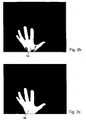
- the Figures 2a to 2c illustrate the processing performed by the HLOC module.
- the extraction of the contours of an object consists in making a difference of images between a current image in which the object is to be detected and a reference image, or background image or an image. previous picture. These methods assume that the camera are fixed, and are very sensitive to changes in brightness, shadows and background changes.
- the detection of an object is carried out using the color of the object with respect to the colors of the background of the image.
- Human skin is well localized in certain color spaces. Color-based contour detection is therefore commonly used to detect the hands or face.
- the Cb and Cr color components of the skin are located in the following ranges of values of the YCbCr color space: 77 ⁇ Cb ⁇ 127 and 133 ⁇ Cr ⁇ 173
- the skin color also varies depending on the ambient brightness.
- the outlines obtained by these methods will include the contours of all detected objects. Processes that only take chrominance into account are therefore inefficient.
- the detection of the contours of the hand in an image is improved by calculating the probability p (i) so that each pixel i of each image of the sequence, is a pixel of skin or of the bottom of the image.
- the histograms are advantageously updated periodically to take into account the variations in brightness.
- the black pixels pixels whose probability p (i) is below the threshold
- the white pixels pixels whose probability p (i) is greater than the threshold
- the binary mask of the figure 2b is thus obtained from the image 2a.
- a median filter can be applied to the bit mask to eliminate noise.
- the contours of the hand can further be refined by a related component labeling process to eliminate small areas of black pixels within white pixel areas and small areas of white pixels within black pixel areas. So, the image of the Figure 2c is obtained from the binary mask of the figure 2b .
- the duration of the treatment of location of the contour of the hand can be reduced by limiting the calculations described above to a window of the image in which the hand is supposed to be, taking into account the position of the hand in the previous image and / or the movement of the hand during previous images.
- the HLOC module performs a prediction of a window in which the hand is supposed to be.
- it implements the Kalman Standard model.
- the Kalman Standard model predicts the state of a system from previous measurements made on it to minimize the covariance matrix of the prediction error.
- FEXT hand characteristics extraction module performs a determination of the center of the hand in each image (such as Figure 2c ) provided by the HLOC module. Then, the FEXT module determines the configuration of the hand in each image by positioning a simplified skeletal model of the hand.
- the determination of the center of the hand is performed by searching the pixel of the image area of the hand HA furthest from the contour of the hand.
- This operation can be performed by applying a distance transform to the pixels of each image provided by the HLOC module.
- the distance transform associates with each pixel of the image ( Figure 2c ), the distance from the pixel to the nearest black pixel, a black pixel being associated with a zero distance value.
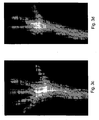
- This transform makes it possible to obtain an image of distances in gray levels such as those of Figures 3a to 3d . More pixels of the image of the Figure 2c are far from a black pixel, the more they are clear in the images of the Figures 3a to 3d .
- the center of the palm is at the location of the pixel of the image of distances having the maximum value.
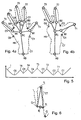
- the skeletal model of the hand used is represented on the Figures 4a and 4b .
- This model includes markers (marked by circles on the Figures 4a, 4b ) centered on the locations of the center of the palm of the hand PC, joints of the finger bases detected B1-B5 (B1, B2, B3 in the figure 4b ), finger tips detected T1-T5 (T1, T2, T3 in the figure 4b ), and the beginning of the AB forearm.
- the center mark of the palm of the PC hand is connected by vectors to the start mark of the forearm AB and the baseline markers of the detected fingers B1-B5.
- Each finger j (j varying from 1 to 5 in the case of the figure 4a , and from 1 to 3 in the case of the figure 4b ) comprises a vector connecting the reference of its base Bj to the mark of its end Tj.
- the positions of the hollows between each finger are also marked on the Figures 4a, 4b by crosses C1-C6 (C1-C4 in the figure 4b ) each centered on the position of a hollow.
- the position of the finger tip markers T1-T5 and the gaps between each C1-C6 finger is determined by calculating the distance between each pixel of the contour of the CT hand and the center of the palm PC. So, the figure 5 represents a curve 1 of variation of this distance along the contour of the hand CT represented on the figure 4a .
- This curve comprises local minima corresponding to the C1-C6 troughs between each finger, and local maxima corresponding to the ends of the T1-T5 fingers.
- the bases of the fingers B1-B5 are then localized in each image using the position of the marks of the hollow C1-C6.
- the two troughs Cj, Cj + 1 of a finger j are identified by searching for those which are closest to a fingertip Tj considered in the image.
- the bases of the fingers are then positioned in the middle of the segments [Cj, Cj + 1].
- this method of calculation is not very precise for some fingers, and in particular the thumb of which one of the hollows is badly located.
- FIG. 6 Another method of locating the base of a finger is illustrated by the figure 6 .
- This method consists in selecting from the two nearest recesses Cj, Cj + 1 of the end of a finger Tj which is closer to the end of the finger, namely Cj + 1 in the example of the figure 6 .
- This method then consists in finding the point Pj of the contour of the hand CT located closest to the selected hollow Cj + 1, and at the same distance from the fingertip Tj as the selected hollow.
- the base Bj of the finger is then positioned in the middle of the segment connecting the selected hollow Cj + 1 to the found point Pj.
- the FEXT module determines which finger corresponds to the thumb. For this purpose, the FEXT module applies a test based on the calculation of the angle between the vector of the forearm PC-AB and the vector of each finger Bj-Tj.
- the thumb is the finger that has the largest angle between these two vectors.
- Other thumb determination criteria may also be applied alternatively or in combination, such as comparing the lengths of the fingers, the thumb being the shortest finger, and / or the thicknesses (or widths) of the fingers, the thumb being the the thickest (or widest) finger.
- the length of each finger j can be determined by calculating the distance Bj-Tj between the marks of the base and the end of the finger.
- the width of each finger can for example be obtained by calculating the distance between the points of the contour of the hand CT closest to a midpoint of the segment Bj-Tj, or an average value of this distance along the segment Bj -TJ.
- the hollows Cj between the fingers will be very close to the fingertips Tj.
- the bases of the fingers Bj will therefore also be very close to the ends of the fingers. Only one finger vector will be positioned in the image if the hollows of the fingers are not localized.
- the position of the start-of-forearm start mark AB is determined by looking for the midpoint of contiguous pixels furthest away from the point PC and the ends of the fingers Tj, using where appropriate the position of the AB mark in the previous pictures in the case where the fist is closed.
- the AB mark is located in the middle of the edge pixels of the image belonging to the contour of the hand (case of Figures 2c , 4a, 4b ).
- the FOLM hand movement tracking module uses the skeletal model of the hand described above, positioned in each image by the FEXT module.
- the overall movement of the hand between two successive images is determined by moving the PC and AB marks from one image to another. This global movement also provides an estimate of the position of the fingers.
- the movement of the fingers is then estimated by matching each finger mark Bj, Tj from one image to another. This pairing is performed by minimizing the Euclidean distance between each fingermark in the successive images, each marker can be matched only once between two successive images.
- a new finger is created.
- the finger is deleted.
- the position of the deleted finger is kept in memory for a few frames of the SV image sequence in case the disappearance of the finger is temporary (occlusion, or detection error).
- the FOLM module provides motion information IM comprising a vector of displacement between two successive images for each PC mark, AB, B1-B5 and T1-T5 of the skeletal model.
- the method according to the invention makes it possible to follow in a simple and effective manner the movements of a hand observed by a video camera.
- the necessary calculation time is very low.
- the follow-up of the hand according to the invention can so be done in real time by a standard PC type computer connected to a cheap video camera such as a "webcam”.
- the location of the center of the PC hand in accordance with the method according to the invention is performed whether or not the user has the bare arm.
- the location of the characteristic points of the hand is performed without the need to make a guess on the input area of the hand and regardless of the position and orientation of the hand in the image.
- the invention can be applied to the dynamic recognition of gestures, and in particular to the precise location of the tip and the direction of the index to achieve a control interface of an apparatus.
- the present invention is susceptible to various embodiments and applications.
- the invention is not limited to a location of the contours of the hand based on color. This location can also be made by a difference with the background of the image, even if this process is less efficient.
- the determination of the postural characteristics of the hand can also be done in other ways than by locating characteristic points of the hand to reconstruct a skeletal model.
- the postural characteristics of the hand can consist in looking for a hand contour close to that extracted in an outline library.
- the postural characteristics of the hand may also be limited to the position of the center of the hand, and possibly the AB forearm mark.
- the method of determining the movements of the hand to be applied depends on how the postural characteristics of the hand are defined.
Landscapes
- Engineering & Computer Science (AREA)
- Human Computer Interaction (AREA)
- Physics & Mathematics (AREA)
- General Physics & Mathematics (AREA)
- Multimedia (AREA)
- Theoretical Computer Science (AREA)
- Health & Medical Sciences (AREA)
- Computer Vision & Pattern Recognition (AREA)
- General Health & Medical Sciences (AREA)
- Psychiatry (AREA)
- Social Psychology (AREA)
- Image Analysis (AREA)
Claims (32)
- Verfahren zur Verfolgung der Bewegungen der Hand in einem Bildfluss, das Schritte umfasst, die darin bestehen:- einen Bildfluss (SV) in Echtzeit zu empfangen,- in jedem Bild des empfangenen Bildflusses einen Handumriss (CT), der eine Bildzone der Hand (HA) abgrenzt, zu lokalisieren,- Haltungsmerkmale aus der Bildzone der Hand, die in jedem Bild lokalisiert ist, zu entnehmen und- anhand der aus jedem Bild entnommenen Haltungsmerkmale die Bewegungen der Hand im Bildfluss zu bestimmen,dadurch gekennzeichnet, dass die Entnahme der Haltungsmerkmale der Hand aus jedem Bild einen Schritt der Lokalisierung in der Bildzone der Hand (HA) eines vereinfachten Skelettmodells umfasst, das nur die Mitte des Handtellers (PC), die Wurzel (B1-B5) und die Spitze (T1-T5) von jedem von zumindest einem Teil der Finger der Hand umfasst, sowie die Position des Anfangs des Unterarms (AB).
- Verfahren nach Anspruch 1, in dem die Mitte des Handtellers (PC) lokalisiert wird, indem ein Pixel der Bildzone der Hand gesucht wird, der am weitesten vom Handumriss (CT) entfernt ist.
- Verfahren nach Anspruch 1 oder 2, in dem die Lokalisierung der Mitte des Handtellers (PC) einen Schritt der Anwendung an die Bildzone der Hand (HA) von einer Distanztransformierten umfasst, die jedes Pixel der Bildzone der Hand mit der Distanz des Pixels zum Pixel des Handumrisses (CT), der am nächsten ist, verknüpft, wobei die Mitte des Handtellers an dem Pixel lokalisiert ist, der mit der größten Distanz verknüpft ist.
- Verfahren nach einem der Ansprüche 1 bis 3, in dem die Positionen im Bild der Spitzen (T1-T5) und der Wurzeln (B1-B5) der Finger der Hand bestimmt werden, indem jeder Pixel des Handumrisses (CT) mit der Distanz zwischen dem Pixel des Umrisses und dem Pixel der Mitte des Handtellers (PC) verknüpft wird, wobei die Spitzen der Finger an den Pixels des Handumrisses lokalisiert werden, die mit lokalen Schwankungsmaxima der Distanz zur Mitte des Handtellers am Handumriss entlang verknüpft sind, und wobei die Wurzeln der Finger anhand der Vertiefungen (C1-C6) zwischen den Fingern lokalisiert werden, die an den Pixels des Handumrisses lokalisiert sind, die mit lokalen Schwankungsminima der Distanz zur Mitte des Handtellers am Handumriss entlang verknüpft sind.
- Verfahren nach Anspruch 4, in dem die Wurzel (Bj) von jedem Finger (j) in der Mitte des Segments ([Cj, Cj+1]) lokalisiert ist, der durch die zwei Vertiefungen des Fingers abgegrenzt ist.
- Verfahren nach Anspruch 4, in dem die Wurzel von jedem Finger (j) durch folgendes lokalisiert wird:- die Auswahl der Vertiefung (Cj+1), die der Fingerspitze (Tj) am nächsten ist,- die Suche nach einem Punkt (Pj) des Handumrisses (CT), der der ausgewählten Vertiefung (Cj+1) am nächsten ist, und in derselben Distanz zur Fingerspitze (Tj) wie die ausgewählte Vertiefung ist, und- das Berechnen der Position der Fingerwurzel (Bj) in der Mitte des durch die ausgewählte Vertiefung (Cj+1) und den gefundenen Punkt (Pj) abgegrenzten Segments.
- Verfahren nach einem der Ansprüche 1 bis 6, umfassend einen Schritt der Suche nach dem Daumen unter durch eine Wurzel (B1-B5) und eine Spitze (T1-T5) identifizierten Fingern, umfassend die Berechnung eines Winkels zwischen einem Unterarmvektor, der die Position der Mitte des Handtellers (PC) mit einer Position des Unterarms (AB) im Bild der Hand verbindet, und einem Vektor von jedem Finger, der die Wurzel mit der Fingerspitze verbindet, wobei der Daumen der Finger ist, der den größten Winkel mit dem Vektor des Unterarms bildet.
- Verfahren nach einem der Ansprüche 1 bis 6, umfassend einen Schritt der Suche nach dem Daumen unter durch eine Wurzel (B1-B5) und eine Spitze (T1-T5) identifizierten Fingern, umfassend die Bestimmung der Länge oder der Dicke der Finger, wobei der Daumen der kürzeste oder dickste Finger ist.
- Verfahren nach einem der Ansprüche 1 bis 8, in dem die Position des Anfangs des Unterarms (AB) in jedem Bild des Bildflusses (SV) bestimmt wird, indem nach dem Mittelpunkt benachbarter Pixels des Handumrisses (CT) gesucht wird, die am weitesten von der Mitte des Handtellers (PC) und den Spitzen der Finger (T1-T5) entfernt sind.
- Verfahren nach einem der Ansprüche 1 bis 9, in dem die Bildzone der Hand (HA) in jedem Bild des Bildflusses (SV) anhand der Hautfarbe der Hand lokalisiert wird.
- Verfahren nach Anspruch 10, in dem ein Pixel eines Bildes des Bildflusses (SV) zu der Bildzone der Hand (HA) gehört, wenn seine Farbkomponenten Cb, Cr im Farbraum YCbCr folgende Relationen aufweisen:

- Verfahren nach Anspruch 10 oder 11, in dem der Handumriss (CT) in jedem Bild des Bildflusses (SV) verfeinert wird, indem eine Wahrscheinlichkeit berechnet wird, dass jedes Pixel des Bildes zu der Hand gehört oder nicht, und indem eine Schwelle an die Wahrscheinlichkeit angewandt wird, um ein binares Bild zu erhalten, das sich aus Pixels zusammen setzt, die zu der Hand gehören oder nicht.
- Verfahren nach Anspruch 12, in dem die Wahrscheinlichkeit, dass ein Pixel i von einem Bild des Bildflusses (SV) der Hand gehört, mit Hilfe der folgenden Formel berechnet wird:
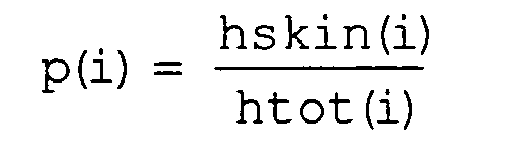
in der hskin(i) und htot(i) die Werte von zweidimensionalen Farbhistogrammen für die Farbkomponenten Cb, Cr des Pixels i darstellen, wobei das Histogramm hskin an der Zone des Bildes der Hand (HA) erstellt wird und htot am ganzen Bild erstellt wird. - Verfahren nach Anspruch 12 oder 13, in dem eine Medianfilterung und eine Markierung von Zusammenhangskomponenten sukzessiv an das binare Bild angewandt werden.
- Verfahren nach einem der Ansprüche 1 bis 14, in dem die Lokalisierung in jedem Bild des empfangenen Bildflusses von einem Handumriss (CT) auf eine reduzierte Suchzone im Bild begrenzt ist, die in Abhängigkeit von der Position des Handumrisses in einem vorhergehenden Bild des Bildflusses bestimmt wird.
- Verfahren nach einem der Ansprüche 1 bis 15, in dem die Bewegungen der Hand im Bildfluss eine Gesamtbewegung, die mit Hilfe der Verschiebung der Position der Mitte des Handtellers (PC) bestimmt wird, und eine Verschiebung von jedem Finger der Hand, die bestimmt wird, indem jede Fingerspitzenposition (Tj) zwischen zwei sukzessiven Bildern durch eine Minimierung der Distanz zwischen jeder Fingerspitzenposition in den sukzessiven Bildern gepaart wird, wobei jede Fingerspitze nur einmal zwischen zwei sukzessiven Bildern gepaart werden kann, umfassen.
- Vorrichtung zur Verfolgung der Bewegungen der Hand in einem Bildfluss, die folgendes umfasst:- Mittel (ACQ) zum Erfassen eines Bildflusses (SV) in Echtzeit,- ein Lokalisierungsmodul (HLOC) zum Lokalisieren in jedem Bild des Bildflusses eines Handumrisses (CT), der eine Bildzone der Hand (HA) abgrenzt,- ein Entnahmemodul (FEXT) zum Entnehmen von Haltungsmerkmale aus der Bildzone der Hand, die in jedem Bild lokalisiert ist, und- ein Verfolgungsmodul (FOLM) zum Bestimmen der Bewegungen der Hand im Bildfluss anhand der Haltungsmerkmale, die aus jedem Bild entnommen werden,dadurch gekennzeichnet, dass das Entnahmemodul (FEXT) konfiguriert ist, um in der Zone der Hand (HA) ein vereinfachtes Skelettmodell zu lokalisieren, das nur die Mitte des Handtellers (PC), die Wurzel (B1-B5) und die Spitze (T1-T5) von jedem von zumindest einem Teil der Finger der Hand umfasst, sowie die Position des Anfangs des Unterarms (AB).
- Vorrichtung nach Anspruch 17, in dem die Mitte des Handtellers (PC) in der Bildzone der Hand (HA) lokalisiert wird, indem ein Pixel der Bildzone der Hand gesucht wird, der am weitesten vom Handumriss (CT) entfernt ist.
- Vorrichtung nach Anspruch 17 oder 18, in dem das Entnahmemodul (FEXT) konfiguriert ist, um an die Bildzone der Hand (HA) eine Distanztransformierte anzuwenden, die jedes Pixel der Bildzone der Hand mit der Distanz des Pixels zum Pixel des Handumrisses (CT), der am nächsten ist, verknüpft, wobei die Mitte des Handtellers an dem Pixel lokalisiert ist, der mit der größten Distanz verknüpft ist.
- Vorrichtung nach einem der Ansprüche 17 bis 19, in dem das Entnahmemodul (FEXT) konfiguriert ist, um die Positionen im Bild der Spitzen (T1-T5) und der Wurzeln (B1-B5) der Finger der Hand zu bestimmen, indem jeder Pixel des Handumrisses (CT) mit der Distanz zwischen dem Pixel des Umrisses und dem Pixel der Mitte des Handtellers (PC) verknüpft wird, wobei die Spitzen der Finger an den Pixels des Handumrisses lokalisiert werden, die mit lokalen Schwankungsmaxima der Distanz zur Mitte des Handtellers am Handumriss entlang verknüpft sind, und wobei die Wurzeln der Finger anhand der Vertiefungen (C1-C6) zwischen den Fingern lokalisiert werden, die an den Pixels des Handumrisses lokalisiert sind, die mit lokalen Schwankungsminima der Distanz zur Mitte des Handtellers am Handumriss entlang verknüpft sind.
- Vorrichtung nach Anspruch 20, in dem das Entnahmemodul (FEXT) konfiguriert ist, um die Position der Wurzel (Bj) von jedem Finger (j) in der Bildzone der Hand (HA) zu bestimmen, indem die Mitte des Segments ([Cj, Cj+1]), das durch die zwei Vertiefungen des Fingers abgegrenzt ist, gesucht wird.
- Vorrichtung nach Anspruch 20, in dem das Entnahmemodul (FEXT) konfiguriert ist, um durch folgendes die Position der Wurzel von jedem Finger (j) zu bestimmen:- die Auswahl der Vertiefung (Cj+1), die der Fingerspitze (Tj) am nächsten ist,- die Suche nach einem Punkt (Pj) des Handumrisses (CT), der der ausgewählten Vertiefung (Cj+1) am nächsten ist, und in derselben Distanz zur Fingerspitze (Tj) wie die ausgewählte Vertiefung ist, und- das Berechnen der Position der Fingerwurzel (Bj) in der Mitte des durch die ausgewählte Vertiefung (Cj+1) und den gefundenen Punkt (Pj) abgegrenzten Segments.
- Vorrichtung nach einem der Ansprüche 17 bis 22, in dem das Entnahmemodul (FEXT) konfiguriert ist, um unter durch eine Wurzel (B1-B5) und eine Spitze (T1-T5) identifizierten Fingern nach dem Daumen zu suchen, indem ein Winkel zwischen einem Unterarmvektor, der die Position der Mitte des Handtellers (PC) mit einer Position des Unterarms (AB) im Bild der Hand verbindet, und einem Vektor von jedem Finger, der die Wurzel mit der Fingerspitze verbindet, berechnet wird, wobei der Daumen der Finger ist, der den größten Winkel mit dem Vektor des Unterarms bildet.
- Vorrichtung nach einem der Ansprüche 17 bis 22, in dem das Entnahmemodul (FEXT) konfiguriert ist, um unter durch eine Wurzel (B1-B5) und eine Spitze (T1-T5) identifizierten Fingern nach dem Daumen zu suchen, indem die Länge oder die Dicke der Finger bestimmt wird, wobei der Daumen der kürzeste oder dickste Finger ist.
- Vorrichtung nach einem der Ansprüche 17 bis 24, in dem das Entnahmemodul (FEXT) konfiguriert ist, um die Position des Anfangs des Unterarms (AB) zu bestimmen, indem nach dem Mittelpunkt benachbarter Pixels des Handumrisses (CT) gesucht wird, die am weitesten von der Mitte des Handtellers (PC) und den Spitzen der Finger (T1-T5) entfernt sind.
- Vorrichtung nach einem der Ansprüche 17 bis 25, in dem das Lokalisierungsmodul (HLOC) konfiguriert ist, um die Bildzone der Hand (HA) in jedem Bild des Bildflusses (SV) anhand der Hautfarbe der Hand zu lokalisieren.
- Vorrichtung nach Anspruch 26, in dem ein Pixel eines Bildes des Bildflusses (SV) zu der Bildzone der Hand (HA) gehört, wenn seine Farbkomponenten Cb, Cr im Farbraum YCbCr folgende Relationen aufweisen:

- Vorrichtung nach Anspruch 26 oder 27, in dem das Lokalisierungsmodul (HLOC) konfiguriert ist, um den Handumriss (CT) in jedem Bild des Bildflusses (SV) zu verfeinern, indem eine Wahrscheinlichkeit berechnet wird, dass jedes Pixel des Bildes zu der Hand gehört oder nicht, und indem eine Schwelle an die Wahrscheinlichkeit angewandt wird, um ein binares Bild zu erhalten, das sich aus Pixels zusammen setzt, die zu der Hand gehören oder nicht.
- Vorrichtung nach Anspruch 28, in dem die Wahrscheinlichkeit, dass ein Pixel i von einem Bild des Bildflusses (SV) der Hand gehört, mit Hilfe der folgenden Formel berechnet wird:

in der hskin(i) und htot(i) die Werte von zweidimensionalen Farbhistogrammen für die Farbkomponenten Cb, Cr des Pixels i darstellen, wobei das Histogramm hskin an der Zone des Bildes der Hand (HA) erstellt wird und htot am ganzen Bild erstellt wird. - Vorrichtung nach Anspruch 28 oder 29, in dem das Lokalisierungsmodul (HLOC) konfiguriert ist, um eine Medianfilterung und eine Markierung von Zusammenhangskomponenten sukzessiv an das binare Bild anzuwenden.
- Vorrichtung nach einem der Ansprüche 17 bis 30, in dem das Lokalisierungsmodul (HLOC) konfiguriert ist, um den Handumriss (CT) in einer reduzierten Suchzone zu lokalisieren, die in Abhängigkeit von der Position des Handumrisses in einem vorhergehenden Bild des Bildflusses bestimmt wird.
- Vorrichtung nach einem der Ansprüche 17 bis 31, in dem das Verfolgungsmodul der Bewegungen der Hand (FOLM) konfiguriert ist, um eine Gesamtbewegung der Hand mit Hilfe der Verschiebung der Position der Mitte des Handtellers (PC) zu bestimmen, und um eine Verschiebung von jedem Finger der Hand zu bestimmen, indem jede Fingerspitzenposition (Tj) zwischen zwei sukzessiven Bildern durch eine Minimierung der Distanz zwischen jeder Fingerspitzenposition in den sukzessiven Bildern gepaart wird, wobei jede Fingerspitze nur einmal zwischen zwei sukzessiven Bildern gepaart werden kann.
Applications Claiming Priority (1)
| Application Number | Priority Date | Filing Date | Title |
|---|---|---|---|
| FR0700564A FR2911983B1 (fr) | 2007-01-25 | 2007-01-25 | Procede de suivi automatique des mouvements de la mains dans une sequence d'images. |
Publications (2)
| Publication Number | Publication Date |
|---|---|
| EP1950688A1 EP1950688A1 (de) | 2008-07-30 |
| EP1950688B1 true EP1950688B1 (de) | 2010-08-11 |
Family
ID=38431270
Family Applications (1)
| Application Number | Title | Priority Date | Filing Date |
|---|---|---|---|
| EP07024097A Active EP1950688B1 (de) | 2007-01-25 | 2007-12-12 | Verfahren zur automatischen Überwachung der Bewegungen einer Hand in einer Bildsequenz |
Country Status (4)
| Country | Link |
|---|---|
| US (2) | US8254627B2 (de) |
| EP (1) | EP1950688B1 (de) |
| DE (1) | DE602007008352D1 (de) |
| FR (1) | FR2911983B1 (de) |
Families Citing this family (59)
| Publication number | Priority date | Publication date | Assignee | Title |
|---|---|---|---|---|
| US8467904B2 (en) * | 2005-12-22 | 2013-06-18 | Honda Motor Co., Ltd. | Reconstruction, retargetting, tracking, and estimation of pose of articulated systems |
| US8924021B2 (en) * | 2006-04-27 | 2014-12-30 | Honda Motor Co., Ltd. | Control of robots from human motion descriptors |
| JP5228439B2 (ja) * | 2007-10-22 | 2013-07-03 | 三菱電機株式会社 | 操作入力装置 |
| US8170287B2 (en) * | 2007-10-26 | 2012-05-01 | Honda Motor Co., Ltd. | Real-time self collision and obstacle avoidance |
| JP5261495B2 (ja) * | 2007-11-01 | 2013-08-14 | 本田技研工業株式会社 | 重み行列を用いたリアルタイム自己衝突および障害物回避 |
| WO2009086088A1 (en) * | 2007-12-21 | 2009-07-09 | Honda Motor Co., Ltd. | Controlled human pose estimation from depth image streams |
| FR2929734A1 (fr) * | 2008-04-03 | 2009-10-09 | St Microelectronics Rousset | Procede et systeme de videosurveillance. |
| US8050494B2 (en) * | 2008-05-23 | 2011-11-01 | Samsung Electronics Co., Ltd. | System and method for human hand motion detection by skin color prediction |
| US9002119B2 (en) * | 2008-06-04 | 2015-04-07 | University Of Tsukuba, National University Corporation | Device method and program for human hand posture estimation |
| WO2010065574A2 (en) * | 2008-12-03 | 2010-06-10 | Kelsey-Hayes Company | Control knob |
| NO329897B1 (no) * | 2008-12-19 | 2011-01-24 | Tandberg Telecom As | Fremgangsmate for raskere ansiktsdeteksjon |
| US8270670B2 (en) | 2008-12-25 | 2012-09-18 | Topseed Technology Corp. | Method for recognizing and tracing gesture |
| US8379987B2 (en) * | 2008-12-30 | 2013-02-19 | Nokia Corporation | Method, apparatus and computer program product for providing hand segmentation for gesture analysis |
| EP2204760A1 (de) * | 2008-12-30 | 2010-07-07 | Topseed Technology Corp. | Verfahren zum Erkennen und Aufzeichnung von Gesten |
| JP5253588B2 (ja) * | 2009-02-25 | 2013-07-31 | 本田技研工業株式会社 | 内部距離形状関連法を用いた手姿勢の取り込み及び認識 |
| US9417700B2 (en) | 2009-05-21 | 2016-08-16 | Edge3 Technologies | Gesture recognition systems and related methods |
| ES2393774B1 (es) * | 2010-11-25 | 2013-11-04 | Universidad Politécnica De Valencia | Dispositivo de múltiple tacto por proyección de imágenes y datos sobre superficies, mejorado. |
| WO2011101518A1 (es) * | 2010-02-16 | 2011-08-25 | Universidad Politécnica De Valencia (Upv) | Dispositivo de múltiple tacto por proyección de imágenes y datos sobre superficies, y procedimiento de operación de dicho dispositivo |
| KR101743948B1 (ko) | 2010-04-07 | 2017-06-21 | 삼성전자주식회사 | 인터렉티브 디스플레이에서 근접 센싱을 위한 방법 및 근접 센싱 이미지를 처리하는 방법 |
| US8373654B2 (en) * | 2010-04-29 | 2013-02-12 | Acer Incorporated | Image based motion gesture recognition method and system thereof |
| US20110268365A1 (en) * | 2010-04-30 | 2011-11-03 | Acer Incorporated | 3d hand posture recognition system and vision based hand posture recognition method thereof |
| US8396252B2 (en) | 2010-05-20 | 2013-03-12 | Edge 3 Technologies | Systems and related methods for three dimensional gesture recognition in vehicles |
| WO2012024022A2 (en) * | 2010-08-20 | 2012-02-23 | University Of Massachusetts | Hand and finger registration for control applications |
| US8666144B2 (en) | 2010-09-02 | 2014-03-04 | Edge 3 Technologies, Inc. | Method and apparatus for determining disparity of texture |
| US8582866B2 (en) | 2011-02-10 | 2013-11-12 | Edge 3 Technologies, Inc. | Method and apparatus for disparity computation in stereo images |
| US8467599B2 (en) | 2010-09-02 | 2013-06-18 | Edge 3 Technologies, Inc. | Method and apparatus for confusion learning |
| US8655093B2 (en) | 2010-09-02 | 2014-02-18 | Edge 3 Technologies, Inc. | Method and apparatus for performing segmentation of an image |
| US9213890B2 (en) | 2010-09-17 | 2015-12-15 | Sony Corporation | Gesture recognition system for TV control |
| US8620024B2 (en) | 2010-09-17 | 2013-12-31 | Sony Corporation | System and method for dynamic gesture recognition using geometric classification |
| US9195345B2 (en) * | 2010-10-28 | 2015-11-24 | Microsoft Technology Licensing, Llc | Position aware gestures with visual feedback as input method |
| CN102467657A (zh) * | 2010-11-16 | 2012-05-23 | 三星电子株式会社 | 手势识别系统和方法 |
| KR20120079245A (ko) * | 2011-01-04 | 2012-07-12 | 엘지전자 주식회사 | 공기 조화기의 제어 방법 |
| US8970589B2 (en) | 2011-02-10 | 2015-03-03 | Edge 3 Technologies, Inc. | Near-touch interaction with a stereo camera grid structured tessellations |
| KR101189633B1 (ko) * | 2011-08-22 | 2012-10-10 | 성균관대학교산학협력단 | 손가락 움직임에 따른 포인터 제어명령어 인식 방법 및 손가락 움직임에 따라 포인터를 제어하는 모바일 단말 |
| US9672609B1 (en) | 2011-11-11 | 2017-06-06 | Edge 3 Technologies, Inc. | Method and apparatus for improved depth-map estimation |
| ES2425663B1 (es) * | 2012-02-10 | 2014-08-08 | Universidad Rey Juan Carlos | Sistema de detección de la posición de las manos de un conductor |
| US9239624B2 (en) * | 2012-04-13 | 2016-01-19 | Nokia Technologies Oy | Free hand gesture control of automotive user interface |
| EP2872967B1 (de) | 2012-07-13 | 2018-11-21 | Sony Depthsensing Solutions SA/NV | Verfahren und system für die erkennung von handbezogenen parametern für eine gestenbasierte mensch-computer-interaktion |
| US9196219B1 (en) * | 2012-07-18 | 2015-11-24 | Amazon Technologies, Inc. | Custom color spectrum for skin detection |
| US9208580B2 (en) * | 2012-08-23 | 2015-12-08 | Qualcomm Incorporated | Hand detection, location, and/or tracking |
| GB2507571A (en) * | 2012-11-05 | 2014-05-07 | Element Six Abrasives Sa | A polycrystalline superhard body with polycrystalline diamond (PCD) |
| US10126820B1 (en) * | 2012-11-29 | 2018-11-13 | Amazon Technologies, Inc. | Open and closed hand detection |
| US9158381B2 (en) * | 2013-02-25 | 2015-10-13 | Honda Motor Co., Ltd. | Multi-resolution gesture recognition |
| US10721448B2 (en) | 2013-03-15 | 2020-07-21 | Edge 3 Technologies, Inc. | Method and apparatus for adaptive exposure bracketing, segmentation and scene organization |
| JP6155786B2 (ja) * | 2013-04-15 | 2017-07-05 | オムロン株式会社 | ジェスチャ認識装置、ジェスチャ認識方法、電子機器、制御プログラムおよび記録媒体 |
| CA2911756C (en) * | 2013-05-09 | 2023-06-27 | Sunnybrook Research Institute | Systems and methods for providing visual feedback of touch panel input during magnetic resonance imaging |
| KR101472455B1 (ko) * | 2013-07-18 | 2014-12-16 | 전자부품연구원 | 손동작 기반 사용자 인터페이스장치 및 그 방법 |
| US9299007B2 (en) * | 2014-01-28 | 2016-03-29 | Ncr Corporation | Methods and apparatus for item identification using brightness compensation |
| US10304248B2 (en) * | 2014-06-26 | 2019-05-28 | Korea Advanced Institute Of Science And Technology | Apparatus and method for providing augmented reality interaction service |
| CN104134061A (zh) * | 2014-08-15 | 2014-11-05 | 上海理工大学 | 一种基于特征融合的支持向量机的数字手势识别方法 |
| US9354711B2 (en) * | 2014-09-30 | 2016-05-31 | Xerox Corporation | Dynamic hand-gesture-based region of interest localization |
| FR3048108B1 (fr) * | 2016-02-24 | 2019-11-01 | Hins | Procede de reconnaissance de la disposition d'une main dans un flux d'images |
| US20170277944A1 (en) * | 2016-03-25 | 2017-09-28 | Le Holdings (Beijing) Co., Ltd. | Method and electronic device for positioning the center of palm |
| CN108230328B (zh) * | 2016-12-22 | 2021-10-22 | 新沂阿凡达智能科技有限公司 | 获取目标对象的方法、装置和机器人 |
| DE102017210317A1 (de) | 2017-06-20 | 2018-12-20 | Volkswagen Aktiengesellschaft | Verfahren und Vorrichtung zum Erfassen einer Nutzereingabe anhand einer Geste |
| EP3432204B1 (de) * | 2017-07-20 | 2024-01-17 | Tata Consultancy Services Limited | Telepräsenzrahmen für die markierung von regionen von interesse mit kopfmontagevorrichtungen |
| US10860897B2 (en) * | 2019-01-29 | 2020-12-08 | Victor Gorelik | Pattern recognition with AI maps |
| JP2023519899A (ja) * | 2020-03-27 | 2023-05-15 | エイチエス ヴィケー イデア ファクトリー,エルエルシー | 環境危険因子から守るための装置および方法 |
| EP4732263A1 (de) * | 2023-10-23 | 2026-04-29 | Samsung Electronics Co., Ltd. | Elektronische vorrichtungen und verfahren zur identifizierung von gesten im zusammenhang mit einem zielobjekt |
Family Cites Families (6)
| Publication number | Priority date | Publication date | Assignee | Title |
|---|---|---|---|---|
| US5959672A (en) * | 1995-09-29 | 1999-09-28 | Nippondenso Co., Ltd. | Picture signal encoding system, picture signal decoding system and picture recognition system |
| EP0991011B1 (de) * | 1998-09-28 | 2007-07-25 | Matsushita Electric Industrial Co., Ltd. | Verfahren und Vorrichtung zum Segmentieren von Handgebärden |
| US6804396B2 (en) * | 2001-03-28 | 2004-10-12 | Honda Giken Kogyo Kabushiki Kaisha | Gesture recognition system |
| US6810144B2 (en) * | 2001-07-20 | 2004-10-26 | Koninklijke Philips Electronics N.V. | Methods of and system for detecting a cartoon in a video data stream |
| US7496228B2 (en) * | 2003-06-13 | 2009-02-24 | Landwehr Val R | Method and system for detecting and classifying objects in images, such as insects and other arthropods |
| JP4420459B2 (ja) * | 2005-06-14 | 2010-02-24 | キヤノン株式会社 | 画像処理装置およびその方法 |
-
2007
- 2007-01-25 FR FR0700564A patent/FR2911983B1/fr not_active Expired - Fee Related
- 2007-12-12 DE DE602007008352T patent/DE602007008352D1/de active Active
- 2007-12-12 EP EP07024097A patent/EP1950688B1/de active Active
-
2008
- 2008-01-24 US US12/019,584 patent/US8254627B2/en active Active
-
2012
- 2012-07-27 US US13/560,258 patent/US8488843B2/en active Active
Also Published As
| Publication number | Publication date |
|---|---|
| FR2911983B1 (fr) | 2009-05-29 |
| US20080181459A1 (en) | 2008-07-31 |
| US8488843B2 (en) | 2013-07-16 |
| US8254627B2 (en) | 2012-08-28 |
| US20120294489A1 (en) | 2012-11-22 |
| FR2911983A1 (fr) | 2008-08-01 |
| DE602007008352D1 (de) | 2010-09-23 |
| EP1950688A1 (de) | 2008-07-30 |
Similar Documents
| Publication | Publication Date | Title |
|---|---|---|
| EP1950688A1 (de) | Verfahren zur automatischen Überwachung der Bewegungen einer Hand in einer Bildsequenz | |
| Priesnitz et al. | An overview of touchless 2D fingerprint recognition | |
| Fuhl et al. | Pupilnet v2. 0: Convolutional neural networks for cpu based real time robust pupil detection | |
| Sen et al. | The case for smartwatch-based diet monitoring | |
| EP1986126B1 (de) | Lokalisierungsverfahren und -vorrichtung einer menschlichen Iris in einem Bild | |
| EP2797030B1 (de) | Biometrische Erkennung | |
| CN119847330B (zh) | 一种ar设备的智能控制方法以及系统 | |
| CN105160323B (zh) | 一种手势识别方法 | |
| US20040119716A1 (en) | Apparatus and method for high-speed marker-free motion capture | |
| US6606412B1 (en) | Method for classifying an object in a moving picture | |
| CN110533648A (zh) | 一种黑头识别处理方法及系统 | |
| WO2012156333A1 (fr) | Procédé de recherche de contours paramétrés pour la comparaison d'iris | |
| Zhang et al. | A coarse-to-fine leaf detection approach based on leaf skeleton identification and joint segmentation | |
| Sorce et al. | Real-time hand pose recognition based on a neural network using microsoft kinect | |
| US6343150B1 (en) | Detection of image correspondence using radial cumulative similarity | |
| El Nahal et al. | Robust and High Accuracy Algorithm for Detection of Pupil Images. | |
| Chugh et al. | CSA-CNN: A Contrastive Self-Attention Neural Network for Pupil Segmentation in Eye Gaze Tracking | |
| JP2012230671A (ja) | シーンにおけるオブジェクトを分類する方法 | |
| FR2685842A1 (fr) | Procede de recalage d'images. | |
| WO2023285490A1 (fr) | Dispositif de détection d'un contact entre au moins une main d'un conducteur de véhicule et le volant dudit véhicule et application à un véhicule semi-autonome | |
| WO2006117374A2 (fr) | Procédé de reconstruction tridimensionnelle d'un membre ou d'un ensemble de membres articulés | |
| CN116503310B (zh) | 一种基于改进YoloV4网络和微积分算子的虹膜定位方法 | |
| WO2020201392A1 (fr) | Procédé, programme d'ordinateur et système pour l'identification d'une instance d'objet dans une scène tridimensionnelle | |
| US12406522B2 (en) | Filtered images for 3D body tracking | |
| Bong et al. | Application of Fixed-Radius Hough Transform In Eye Detection. |
Legal Events
| Date | Code | Title | Description |
|---|---|---|---|
| PUAI | Public reference made under article 153(3) epc to a published international application that has entered the european phase |
Free format text: ORIGINAL CODE: 0009012 |
|
| AK | Designated contracting states |
Kind code of ref document: A1 Designated state(s): AT BE BG CH CY CZ DE DK EE ES FI FR GB GR HU IE IS IT LI LT LU LV MC MT NL PL PT RO SE SI SK TR |
|
| AX | Request for extension of the european patent |
Extension state: AL BA HR MK RS |
|
| 17P | Request for examination filed |
Effective date: 20081212 |
|
| 17Q | First examination report despatched |
Effective date: 20090115 |
|
| AKX | Designation fees paid |
Designated state(s): DE FR GB |
|
| GRAP | Despatch of communication of intention to grant a patent |
Free format text: ORIGINAL CODE: EPIDOSNIGR1 |
|
| GRAS | Grant fee paid |
Free format text: ORIGINAL CODE: EPIDOSNIGR3 |
|
| GRAA | (expected) grant |
Free format text: ORIGINAL CODE: 0009210 |
|
| AK | Designated contracting states |
Kind code of ref document: B1 Designated state(s): DE FR GB |
|
| REG | Reference to a national code |
Ref country code: GB Ref legal event code: FG4D Free format text: NOT ENGLISH |
|
| REF | Corresponds to: |
Ref document number: 602007008352 Country of ref document: DE Date of ref document: 20100923 Kind code of ref document: P |
|
| RAP2 | Party data changed (patent owner data changed or rights of a patent transferred) |
Owner name: UNIVERSITE PAUL CEZANNE AIX MARSEILLE III Owner name: STMICROELECTRONICS SA |
|
| PLBE | No opposition filed within time limit |
Free format text: ORIGINAL CODE: 0009261 |
|
| STAA | Information on the status of an ep patent application or granted ep patent |
Free format text: STATUS: NO OPPOSITION FILED WITHIN TIME LIMIT |
|
| 26N | No opposition filed |
Effective date: 20110512 |
|
| REG | Reference to a national code |
Ref country code: DE Ref legal event code: R097 Ref document number: 602007008352 Country of ref document: DE Effective date: 20110512 |
|
| GBPC | Gb: european patent ceased through non-payment of renewal fee |
Effective date: 20121212 |
|
| PG25 | Lapsed in a contracting state [announced via postgrant information from national office to epo] |
Ref country code: GB Free format text: LAPSE BECAUSE OF NON-PAYMENT OF DUE FEES Effective date: 20121212 |
|
| REG | Reference to a national code |
Ref country code: FR Ref legal event code: PLFP Year of fee payment: 9 |
|
| REG | Reference to a national code |
Ref country code: FR Ref legal event code: PLFP Year of fee payment: 10 |
|
| REG | Reference to a national code |
Ref country code: FR Ref legal event code: PLFP Year of fee payment: 11 |
|
| REG | Reference to a national code |
Ref country code: DE Ref legal event code: R079 Ref document number: 602007008352 Country of ref document: DE Free format text: PREVIOUS MAIN CLASS: G06K0009000000 Ipc: G06V0010000000 |
|
| PGFP | Annual fee paid to national office [announced via postgrant information from national office to epo] |
Ref country code: DE Payment date: 20251126 Year of fee payment: 19 |
|
| PGFP | Annual fee paid to national office [announced via postgrant information from national office to epo] |
Ref country code: FR Payment date: 20251120 Year of fee payment: 19 |