EP1950671A1 - Managing queries in a distributed database system - Google Patents
Managing queries in a distributed database system Download PDFInfo
- Publication number
- EP1950671A1 EP1950671A1 EP07024021A EP07024021A EP1950671A1 EP 1950671 A1 EP1950671 A1 EP 1950671A1 EP 07024021 A EP07024021 A EP 07024021A EP 07024021 A EP07024021 A EP 07024021A EP 1950671 A1 EP1950671 A1 EP 1950671A1
- Authority
- EP
- European Patent Office
- Prior art keywords
- computer devices
- participating
- query
- determining
- data
- Prior art date
- Legal status (The legal status is an assumption and is not a legal conclusion. Google has not performed a legal analysis and makes no representation as to the accuracy of the status listed.)
- Granted
Links
Images


Classifications
-
- G—PHYSICS
- G06—COMPUTING OR CALCULATING; COUNTING
- G06F—ELECTRIC DIGITAL DATA PROCESSING
- G06F16/00—Information retrieval; Database structures therefor; File system structures therefor
- G06F16/20—Information retrieval; Database structures therefor; File system structures therefor of structured data, e.g. relational data
- G06F16/24—Querying
- G06F16/245—Query processing
- G06F16/2458—Special types of queries, e.g. statistical queries, fuzzy queries or distributed queries
- G06F16/2471—Distributed queries
-
- G—PHYSICS
- G06—COMPUTING OR CALCULATING; COUNTING
- G06F—ELECTRIC DIGITAL DATA PROCESSING
- G06F16/00—Information retrieval; Database structures therefor; File system structures therefor
- G06F16/20—Information retrieval; Database structures therefor; File system structures therefor of structured data, e.g. relational data
- G06F16/24—Querying
- G06F16/245—Query processing
- G06F16/2455—Query execution
- G06F16/24564—Applying rules; Deductive queries
- G06F16/24565—Triggers; Constraints
Definitions
- This disclosure relates to database systems.
- Performance of database systems may be enhanced by materializing views, building indexes, and creating horizontal partitions. Such optimizations, however, are not generally well-suited for distributed database systems.
- a method of managing queries in a distributed database system involves receiving a query at computers (that is, computer devices) participating in the database system. A determination is made as to which of the participating computers may have data relevant to the query.
- the query has been broadcast to all participating computers. Information about those computers which have relevant data is communicated to the participating computers. The information communicated is used at each of the respective participating computers to determine a respective benefit value. Each computer determines a benefit value for at least one of the participating computers. By comparing the benefit values thus determined, a determination is made of which of the participating computers will process the query.
- the determination of which of the participating computers will process the query is made at run-time.
- the benefit values of each of the participating computers are communicated among all the participating computers prior to determining which computer will process the query.
- a computer-implemented information system includes a database configured to receive one or more queries from one or more users.
- the information system also includes multiple, networked computer devices.
- An information distribution subsystem is comprised of suitable hardware, software, or both so that it is capable of determining which of the respective, participating computer devices has data relevant to the query, and is likewise able to communicate information to the participating computer devices about those computer devices which have the relevant data.
- the system also includes an optimization engine with routines for calculating or otherwise determining various parameters useful in assessing the suitability of one or more of the participating computer devices to process the query. Such routines may be executed at run time, and may use one or more parameters to determine a benefit value or other type of score corresponding to the suitability of the participating computer devices for processing the query.
- a database system may be used to manage an inventory of items.
- the items are tagged or otherwise computer-trackable.
- the database system includes multiple, networked computer devices participating in the database. Some or all of the computer devices may include readers capable of detecting the presence of items in inventory, and storing data related to such items.
- Another computer device, a store server is operably connected to the readers and capable of operations related to the inventory.
- a data center processes information from the readers, the store servers, or both.
- the database system includes suitable software, hardware, or a combination of the two for determining which of the networked computer devices will be used to process queries received by the database system.
- suitable software and/or hardware calculates in an initialization, network usage, and memory usage, for one or more of the computers. Based on some or all of the foregoing calculations, suitable software and/or hardware calculates a benefit value associated with the one or more computer devices. Based on a comparison of the benefit values for respective computer devices, a determination is made as to which of the participating computer devices shall process the query.
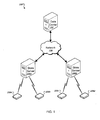
- FIG. 1 is a schematic diagram showing an example of a distributed database system 100 for managing queries.
- the system 100 includes multiple computer devices at which data may be distributed for storage and at which queries may be performed on the data.
- the computer devices in the system 100 determine at which computer device a query will be performed based on information regarding the computer devices in the system 100.
- the terms computer device and computer are used interchangeably herein to mean devices capable of processing instructions or otherwise equipped with one or more processors, such as computer workstations, laptops, desktops, servers, scanners, readers, and the like.
- the system 100 is a hierarchical network of data storage computer devices in a retail company inventory system.
- the data storage computer devices in the system 100 may be non-hierarchical, such as peer-to-peer devices.
- the system 100 includes a data center 102, a network 104, store servers 106a-b, and radio frequency identification (RFID) devices 108a-d. Data in the system 100 may be distributed over any or all of the data center 102, the store servers 106a-b, and the RFID devices 108a-d.
- RFID radio frequency identification
- the data center 102 is an enterprise resource planning system that integrates processes of the system 100 into a unified system.
- the data center 102 may include a back-end data warehouse system.
- the data center 102 is in communication with the store servers 106a-b through the network 104.
- the system 100 generally includes multiple stores and each store generally includes at least one store server.
- the network 104 may be a network, such as a local area network (LAN), a wide area network (WAN), or the Internet.
- the network 104 may be wire-line, wireless, or a combination thereof.
- the RFID devices 108a-d gather information regarding item inventories at a particular location in a store, such as a shelf or a display case, and can report the information to the store servers 106a-b and/or the data center 102.
- the RFID devices 108a-d may communicate with the store servers 106a-b using a wireless network, a direct connection (e.g., universal serial bus or RS232), or a wired network, such as the network 104.
- the RFID devices 108a-d may be smart shelves capable of tracking item inventory as consumers remove items from shelves.
- the RFID devices 108a-d may be smart gates at exits of stores that track item inventories as consumers purchase and remove items from a store.
- a user requests that a query be performed on the data in the system 100 and the query is broadcast to the computer devices in the system 100.
- a store may include a product having a high incidence of theft, such as razor blades.
- the razor blades at a particular store may be sold in two locations, such as a bathing accessories location and a location near a cash register. Inventory at the two locations may be tracked by the RFID devices 108a-b.
- a consumer may buy one or two razor blades in a typical purchase, while a person stealing razor blades typically steals five or more during each theft.
- the user may create a recurring query, such as a trigger or an active query, that is performed or processes when the data relevant to the query changes.
- the user may create a trigger that notifies employees at a store when five or more razor blades have a status of missing within any five second time interval. That is, if the RFID tags of five or more razor blade items are reported as being removed from a shelf by an RFID device (e.g., the devices 108a-b) within a five second time interval, then the employees of the store are notified of the possible theft in progress.
- an RFID device e.g., the devices 108a-b
- the computer devices participating in the query determine if they have data relevant to the query.
- each of the participating computer devices makes such a determination.
- the RFID devices 108a-b at the cash register and bathing accessories locations, respectively may determine that they have razor blade inventory data that is relevant to the CheckRazorBlades query.
- the computer devices perform a sub-query to determine if they have data relevant to the query.
- the store server 106a and the RFID devices 108a-b may identify the VendorID and ProductID columns in the where clause of the query as foreign keys.
- the store server 106a and the RFID devices 108a-b may perform a sub-query using the foreign key conditions from the where clause to determine if they contain data relevant to the query.
- the store serve 106a and the RFID devices 108a-b may perform the following sub-query:
- the computer devices having relevant data communicate information about themselves to the computer devices participating in the query.
- the RFID devices 108a-b may broadcast information about themselves to the system 100, such as an amount of data identified as a result of the sub-query and an amount of updates typically made to the identified data during a given time interval.
- the RFID devices 108a-b may broadcast other information, such as information about available central processing unit (CPU) cycles, available memory space (e.g., hard disk or random access memory), available upload network bandwidth, and available download network bandwidth.
- CPU central processing unit
- the computer devices participating in the query receive the broadcasted information.
- the store server 106a and the RFID devices 108a-b may receive the broadcasted information.
- the participating computer devices use the received information to determine benefit values.
- the benefit values are an evaluation of the benefits of performing the query at a particular participating computer device.
- each participating computer device may calculate an amount of time to download the relevant data from each of the computer devices having relevant data.
- each participating computer device may calculate an amount of bandwidth used when downloading updates made to the relevant data.
- each participating computer device may calculate an amount of memory used by the relevant data.
- each participating computer device calculates a composite benefit value using the initialization time, network usage, and memory usage calculation values.
- Each participating computer device communicates the calculated benefit value to the other participating computer devices.
- Each participating computer device compares its benefit values to the benefit values of the other participating computer devices to determine if it has the highest benefit value.
- the participating computer device with the highest benefit value performs the query. For example, the store server 106a may determine that it has the highest benefit value and accordingly it processes the CheckRazorBlades trigger query.
- the RFID devices 108a-b each determine that they do not have the highest benefit value and accordingly they do not process the CheckRazorBlades trigger query.
- each participating computer device may calculate benefit values for each of the participating computer devices using information received from the participating computer devices.
- Each participating computer compares its benefit value to the benefit values it calculated for the other participating computer devices. If a participating computer device determines that it has the highest benefit value, then it processes the query.
- the determination of which participating computer device will process the query is made at run-time.
- the system 100 may receive multiple query requests over time such that the information provided by the computer devices having relevant data and/or all of the participating computer devices may change over time. For example, as a result of processing the CheckRazorBlades trigger query, the available CPU cycles of the store server 106a may decrease. The decrease may result in the benefit value for another computer device in a subsequent query being higher than the benefit value of the store server 106a.
- the system 100 includes hardware, software, or a combination of both to accomplish the operations discussed therein.
- system 100 may be characterized as having modules, engines, or subsystems.
- the computer devices access an information distribution subsystem, for determining whether the computer devices are associated with relevant information, and an optimization engine, for determining which of the computer devices should process a query received, or to be performed, by system 100.
- the optimization engine may include routines for calculating or otherwise determining various parameters useful in assessing the suitability of one or more computer devices to process the query. Such routines may be executed at run time and may use one or more parameters to determine a benefit value or other type of score corresponding to the suitability for the query.
- System 100 as described above is exemplary only, and other structures, architectures and implementations of system 100 are possible.
- Distributed database systems may take on any number of forms, depending on the associated applications, which are not limited to inventory control or even business or enterprise systems.
- Computer devices and readers other than RFID readers are likewise contemplated, such as bar-code readers or other scanners.
- FIGs. 2 and 3 are flow charts showing examples of processes 200 and 208, respectively, associated with managing queries in a distributed database system.
- the processes 200 and 208 may be performed, for example, by a system such as the system 100.
- a system such as the system 100.
- the description that follows uses the system 100 as the basis of an example for describing the processes 200 and 208.
- another system, or combination of systems may be used to perform the processes 200 and 208.
- FIG. 2 is a flow chart showing an example of the process 200 for managing queries in a distributed database system.
- the process 200 begins with receiving (202) a query at participating computers.
- the store server 106a and the RFID devices 108a-b receive the CheckRazorBlades trigger query.
- the process 200 determines (204) which of the participating computers have data that is relevant to the query. For example, the RFID devices 108a-b determine that they have data relevant to the query using the sub-query that includes the foreign keys VendorID and ProductID.
- the process 200 communicates (206) information about the computers having relevant data to the participating computer devices.
- the RFID devices 108a-b communicated to each other and the store server 106a the amount of relevant data they each have as well as the typical amount of updates made to the relevant data and information about resources at the RFID devices 108a-b.
- the process 200 uses (208) the communicated information to determine benefit values. For example, each participating computer may calculate its benefit value using the communicated information. Alternatively, each participating computer may calculate the benefit values for each of the participating computers.
- the process 200 communicates (210) the benefit values to the participating computers.
- each of the participating computers may broadcast its benefit value to the other participating computers in the system 100.
- the process 200 determines (212) which of the participating computers will process the query by comparing the benefit values. For example, the store server 106a determines that it has the highest benefit value and accordingly it processes the query. The RFID devices 108a-b each determine that they do not have the highest benefit value and accordingly they do not process the query.
- FIG. 3 is a flow chart showing another example of a process 208 for determining a benefit value in a distributed database system.
- the process 208 begins with calculating (302) an initialization time.
- the initialization time for a computer is the amount of time that the computer uses to download the initial relevant data.
- the information regarding the store server 106a and the RFID devices 108a-b may include: Table showing information regarding participating computers Participating Computer Free CPU (cpu) Free Up/Down (up, down) Free RAM (mem) Amount of Relevant Data (init) Amount of Updates to Relevant Data (update)
- Store server 106a 1,000 MHz 12/16 Mb/s 121 MB 0 bits 0 bits
- RFID device 108a 200 MHz 6/2 Mb/s 19 MB 32,120 bits 64,224 bits
- the initialization time is the time needed to transmit all relevant data to a computer device if it is the query master. For each computer device, the calculation above divides the amount of relevant data for every other computer by the network throughput (e.g., the lowest of the available download bandwidth for the computer device receiving the relevant data or the available upload bandwidth of the computer device providing the relevant data) and sums each division.
- the network throughput e.g., the lowest of the available download bandwidth for the computer device receiving the relevant data or the available upload bandwidth of the computer device providing the relevant data
- the process 208 calculates (304) a network usage.
- the network usage is the percentage of network bandwidth a computer device will use while downloading updates to the relevant data if it is the query master.
- the process 208 calculates (306) a memory usage.
- the memory usage is the percentage of memory usage a computer device will use while receiving the initial relevant data if it is the query master.
- the process 208 calculates (308) a benefit value.
- the benefit value calculation scales the CPU usage down by a factor of 1000 and subtracts the natural logarithm of the memory usage and the network usage. This increases the benefit value as the memory usage and network usage approach zero.
- the store server 106a determines that it has the highest benefit value (10.20) and accordingly processes the query.
- the store server 106a holds the tables of data from the RFID devices 108a-b in memory and a materialized view of the join tables.
- the store server 106a requests that the RFID devices 108a-b periodically send updates made to the relevant data at the RFID devices 108a-b to the store server 106a.
- the store server 106a uses the updates to update its tables in memory and its materialized view of the joined tables. If the store server 106a receives an update to the materialized view indicating five or more razor blades have been removed in less than five seconds, then the store server 106a issues the theft notification to the employees.
- Initialization time, network usage, and memory usage are three examples of properties that may be used to calculate a benefit value. Other properties of the computer devices or the system 100 may be used. For example, initialization time may be omitted where it does not significantly effect the processing of the query, such as where the amount of relevant data is small or where the updates to the relevant data are significantly larger than the initial relevant data. In another example, if the amount of memory or network bandwidth used is significantly smaller than the amount of memory or network bandwidth available, then the memory or network usage may be omitted. In another example, the amount of time needed to save the data to a hard drive at the query master and/or the amount of time to read from a hard drive at the data source may be used when calculating the benefit value.
- the amount of available CPU at each data source computer device may be used in calculating the benefit value.
- the amount of energy used by the query master may be included in the benefit calculation, for example to reduce operating costs.
- the benefit value could be a cost function where lower values indicate a lower cost of operation. In this cost function example, the computer device having the lowest benefit value (e.g., cost) is determined to be the query master.
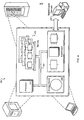
- FIG. 4 is a schematic diagram showing an example of a generic computer system 400.
- the system 400 can be used for the operations described in association with the method 300 according to one implementation.
- the system 400 may include or be included in either or all of the data center 102, the store servers 106a-b, and the RFID devices 108a-d.
- the system 400 includes a processor 410, a memory 420, a storage device 430, and an input/output device 440. Each of the components 410, 420, 430, and 440 are interconnected using a system bus 450.
- the processor 410 is capable of processing instructions for execution within the system 400. In one implementation, the processor 410 is a single-threaded processor. In another implementation, the processor 410 is a multi-threaded processor.
- the processor 410 is capable of processing instructions stored in the memory 420 or on the storage device 430 to display graphical information for a user interface on the input/output device 440.
- the memory 420 stores information within the system 400.
- the memory 420 is a computer-readable medium.
- the memory 420 is a volatile memory unit.
- the memory 420 is a non-volatile memory unit.
- the storage device 430 is capable of providing mass storage for the system 400.
- the storage device 430 is a computer-readable medium.
- the storage device 430 may be a floppy disk device, a hard disk device, an optical disk device, or a tape device.
- the input/output device 440 provides input/output operations for the system 400.
- the input/output device 440 includes a keyboard and/or pointing device.
- the input/output device 440 includes a display unit for displaying graphical user interfaces.
- the features described can be implemented in digital electronic circuitry, or in computer hardware, firmware, software, or in combinations of them.
- the apparatus can be implemented in a computer program product tangibly embodied in an information carrier, e.g., in a machine-readable storage device or in a propagated signal, for execution by a programmable processor; and method steps can be performed by a programmable processor executing a program of instructions to perform functions of the described implementations by operating on input data and generating output.
- the described features can be implemented advantageously in one or more computer programs that are executable on a programmable system including at least one programmable processor coupled to receive data and instructions from, and to transmit data and instructions to, a data storage system, at least one input device, and at least one output device.
- a computer program is a set of instructions that can be used, directly or indirectly, in a computer to perform a certain activity or bring about a certain result.
- a computer program can be written in any form of programming language, including compiled or interpreted languages, and it can be deployed in any form, including as a stand-alone program or as a module, component, subroutine, or other unit suitable for use in a computing environment.
- the computer programs of systems 100, 400 may reside in or be otherwise organized into programming modules, engines, routines, subroutines and the like, with or without associated hardware.
- Suitable processors for the execution of a program of instructions include, by way of example, both general and special purpose microprocessors, and the sole processor or one of multiple processors of any kind of computer.
- a processor will receive instructions and data from a read-only memory or a random access memory or both.
- the essential elements of a computer are a processor for executing instructions and one or more memories for storing instructions and data.
- a computer will also include, or be operatively coupled to communicate with, one or more mass storage devices for storing data files; such devices include magnetic disks, such as internal hard disks and removable disks; magneto-optical disks; and optical disks.
- Storage devices suitable for tangibly embodying computer program instructions and data include all forms of non-volatile memory, including by way of example semiconductor memory devices, such as EPROM, EEPROM, and flash memory devices; magnetic disks such as internal hard disks and removable disks; magneto-optical disks; and CD-ROM and DVD-ROM disks.
- semiconductor memory devices such as EPROM, EEPROM, and flash memory devices
- magnetic disks such as internal hard disks and removable disks
- magneto-optical disks and CD-ROM and DVD-ROM disks.
- the processor and the memory can be supplemented by, or incorporated in, ASICs (application-specific integrated circuits).
- ASICs application-specific integrated circuits
- the features can be implemented on a computer having a display device such as a CRT (cathode ray tube) or LCD (liquid crystal display) monitor for displaying information to the user and a keyboard and a pointing device such as a mouse or a trackball by which the user can provide input to the computer.
- a display device such as a CRT (cathode ray tube) or LCD (liquid crystal display) monitor for displaying information to the user and a keyboard and a pointing device such as a mouse or a trackball by which the user can provide input to the computer.
- the features can be implemented in a computer system that includes a back-end component, such as a data server, or that includes a middleware component, such as an application server or an Internet server, or that includes a front-end component, such as a client computer having a graphical user interface or an Internet browser, or any combination of them.
- the components of the system can be connected by any form or medium of digital data communication such as a communication network. Examples of communication networks include, e.g., a LAN, a WAN, and the computers and networks forming the Internet.
- the computer system can include clients and servers.
- a client and server are generally remote from each other and typically interact through a network, such as the described one.
- the relationship of client and server arises by virtue of computer programs running on the respective computers and having a client-server relationship to each other.
Landscapes
- Engineering & Computer Science (AREA)
- Theoretical Computer Science (AREA)
- Physics & Mathematics (AREA)
- General Engineering & Computer Science (AREA)
- Computational Linguistics (AREA)
- Data Mining & Analysis (AREA)
- Databases & Information Systems (AREA)
- General Physics & Mathematics (AREA)
- Probability & Statistics with Applications (AREA)
- Software Systems (AREA)
- Mathematical Physics (AREA)
- Fuzzy Systems (AREA)
- Information Retrieval, Db Structures And Fs Structures Therefor (AREA)
- Multi Processors (AREA)
- Computer And Data Communications (AREA)
Abstract
Description
- This disclosure relates to database systems.
- Performance of database systems may be enhanced by materializing views, building indexes, and creating horizontal partitions. Such optimizations, however, are not generally well-suited for distributed database systems.
- According to one implementation, a method of managing queries in a distributed database system involves receiving a query at computers (that is, computer devices) participating in the database system. A determination is made as to which of the participating computers may have data relevant to the query. In one possible implementation, the query has been broadcast to all participating computers. Information about those computers which have relevant data is communicated to the participating computers. The information communicated is used at each of the respective participating computers to determine a respective benefit value. Each computer determines a benefit value for at least one of the participating computers. By comparing the benefit values thus determined, a determination is made of which of the participating computers will process the query.
- According to one variation, the determination of which of the participating computers will process the query is made at run-time.
- According to another variation, the benefit values of each of the participating computers are communicated among all the participating computers prior to determining which computer will process the query.
- In one implementation, a computer-implemented information system includes a database configured to receive one or more queries from one or more users. The information system also includes multiple, networked computer devices. An information distribution subsystem is comprised of suitable hardware, software, or both so that it is capable of determining which of the respective, participating computer devices has data relevant to the query, and is likewise able to communicate information to the participating computer devices about those computer devices which have the relevant data. The system also includes an optimization engine with routines for calculating or otherwise determining various parameters useful in assessing the suitability of one or more of the participating computer devices to process the query. Such routines may be executed at run time, and may use one or more parameters to determine a benefit value or other type of score corresponding to the suitability of the participating computer devices for processing the query.
- A database system, according to one implementation, may be used to manage an inventory of items. The items are tagged or otherwise computer-trackable. The database system includes multiple, networked computer devices participating in the database. Some or all of the computer devices may include readers capable of detecting the presence of items in inventory, and storing data related to such items. Another computer device, a store server, is operably connected to the readers and capable of operations related to the inventory. A data center processes information from the readers, the store servers, or both.
- The database system includes suitable software, hardware, or a combination of the two for determining which of the networked computer devices will be used to process queries received by the database system. Thus, for example, suitable software and/or hardware calculates in an initialization, network usage, and memory usage, for one or more of the computers. Based on some or all of the foregoing calculations, suitable software and/or hardware calculates a benefit value associated with the one or more computer devices. Based on a comparison of the benefit values for respective computer devices, a determination is made as to which of the participating computer devices shall process the query.
- The details of one or more implementation are set forth in the accompanying drawings and the description below. Other features, objects, and advantages will be apparent from the description and drawings, and from the claims.
-
-
FIG. 1 is a schematic diagram showing an example of a distributed database system for managing queries. -
FIG. 2 is a flow chart showing an example of a process for managing queries in a distributed database system. -
FIG. 3 is a flow chart sowing an example of a process for determining a benefit value in a distributed database system. -
FIG. 4 is a schematic diagram showing an example of a generic computer system. - Like reference symbols in the various drawings indicate like elements.
-
FIG. 1 is a schematic diagram showing an example of adistributed database system 100 for managing queries. Thesystem 100 includes multiple computer devices at which data may be distributed for storage and at which queries may be performed on the data. In particular, the computer devices in thesystem 100 determine at which computer device a query will be performed based on information regarding the computer devices in thesystem 100. The terms computer device and computer are used interchangeably herein to mean devices capable of processing instructions or otherwise equipped with one or more processors, such as computer workstations, laptops, desktops, servers, scanners, readers, and the like. - The
system 100 is a hierarchical network of data storage computer devices in a retail company inventory system. Alternatively, the data storage computer devices in thesystem 100 may be non-hierarchical, such as peer-to-peer devices. Thesystem 100 includes adata center 102, anetwork 104,store servers 106a-b, and radio frequency identification (RFID)devices 108a-d. Data in thesystem 100 may be distributed over any or all of thedata center 102, thestore servers 106a-b, and theRFID devices 108a-d. - The
data center 102 is an enterprise resource planning system that integrates processes of thesystem 100 into a unified system. Thedata center 102 may include a back-end data warehouse system. Thedata center 102 is in communication with thestore servers 106a-b through thenetwork 104. Thesystem 100 generally includes multiple stores and each store generally includes at least one store server. Thenetwork 104 may be a network, such as a local area network (LAN), a wide area network (WAN), or the Internet. Thenetwork 104 may be wire-line, wireless, or a combination thereof. - The
RFID devices 108a-d gather information regarding item inventories at a particular location in a store, such as a shelf or a display case, and can report the information to thestore servers 106a-b and/or thedata center 102. TheRFID devices 108a-d may communicate with thestore servers 106a-b using a wireless network, a direct connection (e.g., universal serial bus or RS232), or a wired network, such as thenetwork 104. For example, theRFID devices 108a-d may be smart shelves capable of tracking item inventory as consumers remove items from shelves. Alternatively, theRFID devices 108a-d may be smart gates at exits of stores that track item inventories as consumers purchase and remove items from a store. - In general, a user requests that a query be performed on the data in the
system 100 and the query is broadcast to the computer devices in thesystem 100. For example, a store may include a product having a high incidence of theft, such as razor blades. The razor blades at a particular store may be sold in two locations, such as a bathing accessories location and a location near a cash register. Inventory at the two locations may be tracked by theRFID devices 108a-b. A consumer may buy one or two razor blades in a typical purchase, while a person stealing razor blades typically steals five or more during each theft. The user may create a recurring query, such as a trigger or an active query, that is performed or processes when the data relevant to the query changes. For example, the user may create a trigger that notifies employees at a store when five or more razor blades have a status of missing within any five second time interval. That is, if the RFID tags of five or more razor blade items are reported as being removed from a shelf by an RFID device (e.g., thedevices 108a-b) within a five second time interval, then the employees of the store are notified of the possible theft in progress. The following is an example of a razor blade theft notification trigger:
       DELIMITER //
       CREATE TRIGGER CheckRazorBlades AFTER UPDATE ON Items
        FOR EACH ROW BEGIN
         IF (SELECT COUNT(ItemID)
          FROM Items
             WHERE VendorID = 'Gillette'
             AND ProductID ='Razors'
             AND Status ='missing'
             AND StatusTime > NOW() - INTERVAL 5 SECONDS;) < 5
            THEN
             SELECT send_msg("Worker", "Gillettes are being stolen!");
            END IF;
           END; //
       SELECT COUNT(ItemID)
       FROM Items
       WHERE VendorID ='Gillette'
       AND ProductID ='Razors';
| Participating Computer | Free CPU (cpu) | Free Up/Down (up, down) | Free RAM (mem) | Amount of Relevant Data (init) | Amount of Updates to Relevant Data (update) |
| | 1,000 MHz | 12/16 Mb/s | 121 MB | 0 bits | 0 |
| RFID device | |||||
| 108a | 200 MHz | 6/2 Mb/s | 19 MB | 32,120 bits | 64,224 |
| RFID device | |||||
| 108b | 233 MHz | 4/4 Mb/s | 21 MB | 430,560 bits | 107,640 bits |





Claims (18)
- A computer-implemented method of managing queries in a distributed database system, the method comprising:receiving a query at computer devices participating in the database system;determining which of the respective, participating computer devices has data relevant to the query;communicating to the participating computer devices information about the computer devices which have the relevant data;using the information communicated to determine, at each of the respective participating computer devices, a respective benefit value for at least one of the participating computers; anddetermine which of the participating computer devices will process the query by comparing the benefit values.
- The method of claim 1, further including communicating the benefit values of each of the participating computer devices among all of the participating computer devices.
- The method of claim 1 or 2, wherein the determination of which of the participating computer devices will process the query is made at run-time.
- The method of any one claims 1 to 3, wherein the database system comprises an active database system, and wherein receiving the query comprises receiving multiple active queries over time, and wherein the determination of which of the participating computer devices will process the queries is made for each of the queries prior to execution.
- The method of any one of claims 1 to 4, wherein determining which of the participating computer devices has data relevant to the query includes running at least one sub-query based on the query.
- The method of any one of claims 1 to 5 wherein the database system comprises a hierarchy of participating computer devices, the participating computer devices including multiple RFID readers, multiple store servers, and at least one data center, and wherein determining which of the respective, participating computer devices has data relevant to the query includes the RFID readers accessing data structures at the RFID reader related to RFID-tagged items.
- The method of any one of claims 1 to 6 further comprising issuing the query to the database system and broadcasting it over a network to at least some of the participating computer devices.
- The method of any one of claims 1 to 7 wherein the query comprises a trigger, and further comprising generating an alert in response to conditions of the trigger being met.
- A computer-implemented information system, comprising:a database accessible to a user of the system and configured to process queries related to data in the database;multiple, networked computer devices participating in the database;an information distribution subsystem configured to determine which of the respective, participating computer devices has data relevant to a query received by the system and communicate to the participating computer devices information about the computer devices having the relevant data;an optimization engine configured to determine which of the participating computer devices should process the query received by the system, wherein the optimization engine includes routines for determining parameters useful in assessing suitability of the participating computer devices to process the query, such routines being executed at run time.
- The system of claim 9, wherein the optimization engine is configured to run at corresponding ones of the computer devices, and wherein each of the participating computer devices is capable of determining benefit values for all of the participating computer devices.
- The system of claim 9 or 10, wherein the parameters used by the routines of the optimization engine include at least one parameter selected from the group consisting of initialization time, network usage, memory usage, the amount of time needed to save the data to a hard-drive, and the amount of time needed to read from the hard-drive.
- The system of any one of claims 9 to 11, further comprising a query master configured to process the query received by the system in connection with the run time associated with the query, the query master selected from the participating computer devices based on benefit values calculated at each of the participating computers.
- The system of any one of claims 9 to 12, wherein the information system further comprises a distributed database system.
- The system of any one of claims 9 to 13, wherein the information system comprises an enterprise resource planning system.
- A database system for managing an inventory of items tagged to be computer-trackable, the system comprising:multiple, networked computer devices participating in the database, the computer devices including a reader capable of detecting presence of the items and storing data related to the items, a store server operably connected to the reader devices and capable of operations related to the inventory, and a data center;means for determining an initiation time for respective ones of the networked computer devices;means for determining network usage associated with the computer devices;means for determining memory usage associated with respective ones of the computer devices;means for determining benefit values for respective ones of the computer devices;wherein the means for determining benefit values uses as input at least one of the initialization time, the network usage, and the memory usage.
- The database system of claim 15, further comprising means for determining which of the multiple, networked computer devices shall process a query received by the database system based on comparisons of respective benefit values for the networked computer devices.
- A computer program product tangibly embodied in an information carrier, the computer program product including instructions that, when executed, causes a processor to perform operations comprising:determining which computer devices of a distributed database system have data relevant to a query received by the database system;communicating information about the computer devices having relevant data to the networked computer devices;determining benefit values for respective ones of the computer devices based on the information; anddetermining which of the computer devices is to process the query based on the benefit values of the respective ones of the computer devices.
- The computer program product of claim 17, wherein the operations further comprise at least one of determining for the computer devices respective initialization times; determining network usages associated with the computer devices; and determining for the computer devices memory usage.
Applications Claiming Priority (1)
| Application Number | Priority Date | Filing Date | Title |
|---|---|---|---|
| US11/627,536 US7680779B2 (en) | 2007-01-26 | 2007-01-26 | Managing queries in a distributed database system |
Publications (2)
| Publication Number | Publication Date |
|---|---|
| EP1950671A1 true EP1950671A1 (en) | 2008-07-30 |
| EP1950671B1 EP1950671B1 (en) | 2012-02-01 |
Family
ID=38982690
Family Applications (1)
| Application Number | Title | Priority Date | Filing Date |
|---|---|---|---|
| EP07024021A Active EP1950671B1 (en) | 2007-01-26 | 2007-12-11 | Managing queries in a distributed database system |
Country Status (4)
| Country | Link |
|---|---|
| US (1) | US7680779B2 (en) |
| EP (1) | EP1950671B1 (en) |
| CN (1) | CN101231650B (en) |
| AT (1) | ATE544119T1 (en) |
Cited By (1)
| Publication number | Priority date | Publication date | Assignee | Title |
|---|---|---|---|---|
| US7653826B1 (en) | 2009-01-20 | 2010-01-26 | International Business Machines Corporation | Method and apparatus for query optimization and management of sleepy drives |
Families Citing this family (12)
| Publication number | Priority date | Publication date | Assignee | Title |
|---|---|---|---|---|
| US9189047B2 (en) * | 2008-05-08 | 2015-11-17 | International Business Machines Corporation | Organizing databases for energy efficiency |
| US20100241893A1 (en) * | 2009-03-18 | 2010-09-23 | Eric Friedman | Interpretation and execution of a customizable database request using an extensible computer process and an available computing environment |
| US8108421B2 (en) * | 2009-03-30 | 2012-01-31 | Microsoft Corporation | Query throttling during query translation |
| US8365983B2 (en) * | 2009-11-20 | 2013-02-05 | Intel Corporation | Radio-frequency reconfigurations of microelectronic systems in commercial packages |
| US8499141B2 (en) | 2010-08-02 | 2013-07-30 | Intel Corporation | Multi-socket server management with RFID |
| US8868546B2 (en) * | 2011-09-15 | 2014-10-21 | Oracle International Corporation | Query explain plan in a distributed data management system |
| US8918773B2 (en) * | 2011-09-22 | 2014-12-23 | Verizon Patent And Licensing Inc. | Partially upgradable application and performing database operations with the application |
| GB2505881A (en) | 2012-09-12 | 2014-03-19 | Ibm | Determining common table definitions in distributed databases |
| CN105164674A (en) * | 2013-08-29 | 2015-12-16 | 惠普发展公司,有限责任合伙企业 | Queries involving multiple databases and execution engines |
| US10025795B2 (en) * | 2015-03-24 | 2018-07-17 | International Business Machines Corporation | Systems and methods for query evaluation over distributed linked data stores |
| US10419395B2 (en) | 2015-10-23 | 2019-09-17 | International Business Machines Corporation | Routing packets in a data center network |
| US10819508B2 (en) * | 2018-04-25 | 2020-10-27 | Micro Focus Llc | Encrypted communication channels for distributed database systems |
Citations (2)
| Publication number | Priority date | Publication date | Assignee | Title |
|---|---|---|---|---|
| US5446886A (en) | 1992-03-12 | 1995-08-29 | Ricoh Company, Ltd. | System from optimizing query processing of multi-attribute distributed relations using local relation tuple numbers to choose semijoins |
| US20030216969A1 (en) * | 2002-01-23 | 2003-11-20 | Bauer Donald G. | Inventory management system |
Family Cites Families (9)
| Publication number | Priority date | Publication date | Assignee | Title |
|---|---|---|---|---|
| US4769772A (en) * | 1985-02-28 | 1988-09-06 | Honeywell Bull, Inc. | Automated query optimization method using both global and parallel local optimizations for materialization access planning for distributed databases |
| US5694591A (en) * | 1995-05-02 | 1997-12-02 | Hewlett Packard Company | Reducing query response time using tree balancing |
| US6032144A (en) * | 1996-05-29 | 2000-02-29 | Lucent Technologies Inc. | Optimization of queries using relational algebraic theta-semijoin operator |
| US6092061A (en) * | 1997-08-15 | 2000-07-18 | International Business Machines Corporation | Data partitioning by co-locating referenced and referencing records |
| US6009428A (en) * | 1997-09-15 | 1999-12-28 | International Business Machines Corporation | System and method for providing a single application program interface for heterogeneous databases |
| US6505191B1 (en) * | 1998-07-24 | 2003-01-07 | Jarg Corporation | Distributed computer database system and method employing hypertext linkage analysis |
| US7031958B2 (en) * | 2003-02-06 | 2006-04-18 | International Business Machines Corporation | Patterned based query optimization |
| US20050149414A1 (en) * | 2003-12-30 | 2005-07-07 | Kimberly-Clark Worldwide, Inc. | RFID system and method for managing out-of-stock items |
| US7356538B2 (en) * | 2005-01-25 | 2008-04-08 | International Business Machines Corporation | Configurable business controls task notification |
-
2007
- 2007-01-26 US US11/627,536 patent/US7680779B2/en active Active
- 2007-12-11 EP EP07024021A patent/EP1950671B1/en active Active
- 2007-12-11 AT AT07024021T patent/ATE544119T1/en active
-
2008
- 2008-01-28 CN CN2008100032312A patent/CN101231650B/en active Active
Patent Citations (2)
| Publication number | Priority date | Publication date | Assignee | Title |
|---|---|---|---|---|
| US5446886A (en) | 1992-03-12 | 1995-08-29 | Ricoh Company, Ltd. | System from optimizing query processing of multi-attribute distributed relations using local relation tuple numbers to choose semijoins |
| US20030216969A1 (en) * | 2002-01-23 | 2003-11-20 | Bauer Donald G. | Inventory management system |
Non-Patent Citations (6)
| Title |
|---|
| BANERJEE, A. ET AL: "Radio Frequency Identification based Manufacturing and Distribution: An Exploratory Overview", 21ST NATIONAL CONVENTION OF PRODUCTION ENGINEERS; NATIONAL SEMINAR ON BEST PRACTICES IN MANUFACTURING, 9 December 2006 (2006-12-09) - 10 December 2006 (2006-12-10), pages 1 - 17, XP002467703, Retrieved from the Internet <URL:http://etdindividuals.dlib.vt.edu:9090/12/1/RFID_based_Mfg_&_Dstbn_An_Exploratory_Overview1.pdf> [retrieved on 20080205] * |
| DATE C J: "DISTRIBUTED DATABASES", July 1985, INTRODUCTION TO DATABASE SYSTEMS, READING, ADDISON WESLEY, US, PAGE(S) 291-340, XP002016220 * |
| HAMEURLAIN A ET AL: "How can mobile agents and cost model approaches help for distributed query optimization?", SEVENTEENTH INTERNATIONAL CONFERENCE ON DATABASE AND EXPERT SYSTEMS APPLICATIONS IEEE COMPUT. SOC LOS ALAMITOS, CA, USA, 2006, pages 1 - 5, XP002467806, ISBN: 0-7695-2641-1 * |
| INGO BRUNKHORST ET AL: "Distributed Queries and Query Optimization in Schema-Based P2P-Systems", DATABASES, INFORMATION SYSTEMS, AND PER-TO-PEER COMPUTING LECTURE NOTES IN COMPUTER SCIENCE;LNCS, SPRINGER-VERLAG, BE, vol. 2944, 2004, pages 184 - 199, XP019002293, ISBN: 3-540-20968-9 * |
| KOSSMANN D: "THE STATE OF THE ART IN DISTRIBUTED QUERY PROCESSING", ACM COMPUTING SURVEYS, ACM, NEW YORK, NY, US, US, vol. 32, no. 4, December 2000 (2000-12-01), pages 422 - 469, XP002952901, ISSN: 0360-0300 * |
| SLIMANI Y ET AL: "An adaptive cost model for distributed query optimization on the grid", ON THE MOVE TO MEANINGFUL INTERNET SYSTEMS 2004: OTM 2004 WORKSHOPS. OTM CONFEDERATED INTERNATIONAL WORKSHOPS AND POSTERS GADA, JTRES, MIOS, WORM, WOSE, PHDS, AND INTEROP 2004. PROCEEDINGS (LECTURE NOTES IN COMPUTER SCIENCE VOL.3292) SPRINGER-VERLAG, 2004, pages 79 - 87, XP002467805, ISBN: 3-540-23664-3 * |
Cited By (1)
| Publication number | Priority date | Publication date | Assignee | Title |
|---|---|---|---|---|
| US7653826B1 (en) | 2009-01-20 | 2010-01-26 | International Business Machines Corporation | Method and apparatus for query optimization and management of sleepy drives |
Also Published As
| Publication number | Publication date |
|---|---|
| US20080183671A1 (en) | 2008-07-31 |
| EP1950671B1 (en) | 2012-02-01 |
| CN101231650A (en) | 2008-07-30 |
| CN101231650B (en) | 2012-11-21 |
| ATE544119T1 (en) | 2012-02-15 |
| US7680779B2 (en) | 2010-03-16 |
Similar Documents
| Publication | Publication Date | Title |
|---|---|---|
| US7680779B2 (en) | Managing queries in a distributed database system | |
| US10769583B2 (en) | Inventory tracking | |
| US10438295B2 (en) | Method and system for E-commerce transaction data accounting | |
| US8417559B2 (en) | Assortment planning based on demand transfer between products | |
| US20140058794A1 (en) | Method And System For Orders Planning And Optimization With Applications To Food Consumer Products Industry | |
| US8682883B2 (en) | Systems and methods for identifying sets of similar products | |
| US20160140490A1 (en) | Inventory management system and method thereof | |
| CA2841614A1 (en) | Estimating product promotion sales lift | |
| US10936614B2 (en) | Management of extract transform load (ETL) jobs via a model that is based on a bayesian network | |
| US7769735B2 (en) | System, service, and method for characterizing a business intelligence workload for sizing a new database system hardware configuration | |
| CN106156972B (en) | Logistics service information providing method and device | |
| US20140200958A1 (en) | System and method for categorization of factors to predict demand | |
| CN109086354A (en) | A kind of big data analysis processing system based on extended node cluster | |
| US20140372178A1 (en) | Correlating product sales to store segmentation | |
| CN104834719B (en) | Applied to the Database Systems under real-time big data scene | |
| US20140108189A1 (en) | Real-Time Cross-Selling Proposal Calculation | |
| US9785660B2 (en) | Detection and quantifying of data redundancy in column-oriented in-memory databases | |
| CN115953182A (en) | Commodity promotion method, device, computer equipment and storage medium | |
| US9773223B2 (en) | Inventory cache | |
| US9430753B2 (en) | Inventory tracking | |
| US20150006337A1 (en) | Tracking inventory | |
| US10157209B1 (en) | Memory analytics | |
| Sinha et al. | Optimizing revenue over data-driven assortments | |
| WO2013106124A1 (en) | Automatic demand parameter escalation | |
| US20160104227A1 (en) | Generation and search of multidimensional linked lists and computing array |
Legal Events
| Date | Code | Title | Description |
|---|---|---|---|
| PUAI | Public reference made under article 153(3) epc to a published international application that has entered the european phase |
Free format text: ORIGINAL CODE: 0009012 |
|
| AK | Designated contracting states |
Kind code of ref document: A1 Designated state(s): AT BE BG CH CY CZ DE DK EE ES FI FR GB GR HU IE IS IT LI LT LU LV MC MT NL PL PT RO SE SI SK TR |
|
| AX | Request for extension of the european patent |
Extension state: AL BA HR MK RS |
|
| 17P | Request for examination filed |
Effective date: 20081106 |
|
| AKX | Designation fees paid |
Designated state(s): AT BE BG CH CY CZ DE DK EE ES FI FR GB GR HU IE IS IT LI LT LU LV MC MT NL PL PT RO SE SI SK TR |
|
| 17Q | First examination report despatched |
Effective date: 20090327 |
|
| GRAP | Despatch of communication of intention to grant a patent |
Free format text: ORIGINAL CODE: EPIDOSNIGR1 |
|
| GRAS | Grant fee paid |
Free format text: ORIGINAL CODE: EPIDOSNIGR3 |
|
| GRAA | (expected) grant |
Free format text: ORIGINAL CODE: 0009210 |
|
| AK | Designated contracting states |
Kind code of ref document: B1 Designated state(s): AT BE BG CH CY CZ DE DK EE ES FI FR GB GR HU IE IS IT LI LT LU LV MC MT NL PL PT RO SE SI SK TR |
|
| REG | Reference to a national code |
Ref country code: GB Ref legal event code: FG4D |
|
| REG | Reference to a national code |
Ref country code: AT Ref legal event code: REF Ref document number: 544119 Country of ref document: AT Kind code of ref document: T Effective date: 20120215 Ref country code: CH Ref legal event code: EP |
|
| REG | Reference to a national code |
Ref country code: DE Ref legal event code: R096 Ref document number: 602007020375 Country of ref document: DE Effective date: 20120329 |
|
| REG | Reference to a national code |
Ref country code: NL Ref legal event code: VDEP Effective date: 20120201 |
|
| LTIE | Lt: invalidation of european patent or patent extension |
Effective date: 20120201 |
|
| PG25 | Lapsed in a contracting state [announced via postgrant information from national office to epo] |
Ref country code: NL Free format text: LAPSE BECAUSE OF FAILURE TO SUBMIT A TRANSLATION OF THE DESCRIPTION OR TO PAY THE FEE WITHIN THE PRESCRIBED TIME-LIMIT Effective date: 20120201 Ref country code: IS Free format text: LAPSE BECAUSE OF FAILURE TO SUBMIT A TRANSLATION OF THE DESCRIPTION OR TO PAY THE FEE WITHIN THE PRESCRIBED TIME-LIMIT Effective date: 20120601 Ref country code: LT Free format text: LAPSE BECAUSE OF FAILURE TO SUBMIT A TRANSLATION OF THE DESCRIPTION OR TO PAY THE FEE WITHIN THE PRESCRIBED TIME-LIMIT Effective date: 20120201 |
|
| PG25 | Lapsed in a contracting state [announced via postgrant information from national office to epo] |
Ref country code: PT Free format text: LAPSE BECAUSE OF FAILURE TO SUBMIT A TRANSLATION OF THE DESCRIPTION OR TO PAY THE FEE WITHIN THE PRESCRIBED TIME-LIMIT Effective date: 20120601 Ref country code: BE Free format text: LAPSE BECAUSE OF FAILURE TO SUBMIT A TRANSLATION OF THE DESCRIPTION OR TO PAY THE FEE WITHIN THE PRESCRIBED TIME-LIMIT Effective date: 20120201 Ref country code: LV Free format text: LAPSE BECAUSE OF FAILURE TO SUBMIT A TRANSLATION OF THE DESCRIPTION OR TO PAY THE FEE WITHIN THE PRESCRIBED TIME-LIMIT Effective date: 20120201 Ref country code: PL Free format text: LAPSE BECAUSE OF FAILURE TO SUBMIT A TRANSLATION OF THE DESCRIPTION OR TO PAY THE FEE WITHIN THE PRESCRIBED TIME-LIMIT Effective date: 20120201 Ref country code: FI Free format text: LAPSE BECAUSE OF FAILURE TO SUBMIT A TRANSLATION OF THE DESCRIPTION OR TO PAY THE FEE WITHIN THE PRESCRIBED TIME-LIMIT Effective date: 20120201 Ref country code: GR Free format text: LAPSE BECAUSE OF FAILURE TO SUBMIT A TRANSLATION OF THE DESCRIPTION OR TO PAY THE FEE WITHIN THE PRESCRIBED TIME-LIMIT Effective date: 20120502 |
|
| REG | Reference to a national code |
Ref country code: AT Ref legal event code: MK05 Ref document number: 544119 Country of ref document: AT Kind code of ref document: T Effective date: 20120201 |
|
| PG25 | Lapsed in a contracting state [announced via postgrant information from national office to epo] |
Ref country code: CY Free format text: LAPSE BECAUSE OF FAILURE TO SUBMIT A TRANSLATION OF THE DESCRIPTION OR TO PAY THE FEE WITHIN THE PRESCRIBED TIME-LIMIT Effective date: 20120201 |
|
| PG25 | Lapsed in a contracting state [announced via postgrant information from national office to epo] |
Ref country code: CZ Free format text: LAPSE BECAUSE OF FAILURE TO SUBMIT A TRANSLATION OF THE DESCRIPTION OR TO PAY THE FEE WITHIN THE PRESCRIBED TIME-LIMIT Effective date: 20120201 Ref country code: SE Free format text: LAPSE BECAUSE OF FAILURE TO SUBMIT A TRANSLATION OF THE DESCRIPTION OR TO PAY THE FEE WITHIN THE PRESCRIBED TIME-LIMIT Effective date: 20120201 Ref country code: DK Free format text: LAPSE BECAUSE OF FAILURE TO SUBMIT A TRANSLATION OF THE DESCRIPTION OR TO PAY THE FEE WITHIN THE PRESCRIBED TIME-LIMIT Effective date: 20120201 Ref country code: SI Free format text: LAPSE BECAUSE OF FAILURE TO SUBMIT A TRANSLATION OF THE DESCRIPTION OR TO PAY THE FEE WITHIN THE PRESCRIBED TIME-LIMIT Effective date: 20120201 Ref country code: EE Free format text: LAPSE BECAUSE OF FAILURE TO SUBMIT A TRANSLATION OF THE DESCRIPTION OR TO PAY THE FEE WITHIN THE PRESCRIBED TIME-LIMIT Effective date: 20120201 Ref country code: RO Free format text: LAPSE BECAUSE OF FAILURE TO SUBMIT A TRANSLATION OF THE DESCRIPTION OR TO PAY THE FEE WITHIN THE PRESCRIBED TIME-LIMIT Effective date: 20120201 |
|
| PG25 | Lapsed in a contracting state [announced via postgrant information from national office to epo] |
Ref country code: SK Free format text: LAPSE BECAUSE OF FAILURE TO SUBMIT A TRANSLATION OF THE DESCRIPTION OR TO PAY THE FEE WITHIN THE PRESCRIBED TIME-LIMIT Effective date: 20120201 Ref country code: IT Free format text: LAPSE BECAUSE OF FAILURE TO SUBMIT A TRANSLATION OF THE DESCRIPTION OR TO PAY THE FEE WITHIN THE PRESCRIBED TIME-LIMIT Effective date: 20120201 |
|
| PLBE | No opposition filed within time limit |
Free format text: ORIGINAL CODE: 0009261 |
|
| STAA | Information on the status of an ep patent application or granted ep patent |
Free format text: STATUS: NO OPPOSITION FILED WITHIN TIME LIMIT |
|
| 26N | No opposition filed |
Effective date: 20121105 |
|
| PG25 | Lapsed in a contracting state [announced via postgrant information from national office to epo] |
Ref country code: AT Free format text: LAPSE BECAUSE OF FAILURE TO SUBMIT A TRANSLATION OF THE DESCRIPTION OR TO PAY THE FEE WITHIN THE PRESCRIBED TIME-LIMIT Effective date: 20120201 |
|
| REG | Reference to a national code |
Ref country code: DE Ref legal event code: R097 Ref document number: 602007020375 Country of ref document: DE Effective date: 20121105 |
|
| PG25 | Lapsed in a contracting state [announced via postgrant information from national office to epo] |
Ref country code: ES Free format text: LAPSE BECAUSE OF FAILURE TO SUBMIT A TRANSLATION OF THE DESCRIPTION OR TO PAY THE FEE WITHIN THE PRESCRIBED TIME-LIMIT Effective date: 20120512 |
|
| PG25 | Lapsed in a contracting state [announced via postgrant information from national office to epo] |
Ref country code: BG Free format text: LAPSE BECAUSE OF FAILURE TO SUBMIT A TRANSLATION OF THE DESCRIPTION OR TO PAY THE FEE WITHIN THE PRESCRIBED TIME-LIMIT Effective date: 20120501 Ref country code: MC Free format text: LAPSE BECAUSE OF NON-PAYMENT OF DUE FEES Effective date: 20121231 |
|
| REG | Reference to a national code |
Ref country code: CH Ref legal event code: PL |
|
| REG | Reference to a national code |
Ref country code: IE Ref legal event code: MM4A |
|
| PG25 | Lapsed in a contracting state [announced via postgrant information from national office to epo] |
Ref country code: IE Free format text: LAPSE BECAUSE OF NON-PAYMENT OF DUE FEES Effective date: 20121211 Ref country code: LI Free format text: LAPSE BECAUSE OF NON-PAYMENT OF DUE FEES Effective date: 20121231 Ref country code: CH Free format text: LAPSE BECAUSE OF NON-PAYMENT OF DUE FEES Effective date: 20121231 |
|
| PG25 | Lapsed in a contracting state [announced via postgrant information from national office to epo] |
Ref country code: MT Free format text: LAPSE BECAUSE OF FAILURE TO SUBMIT A TRANSLATION OF THE DESCRIPTION OR TO PAY THE FEE WITHIN THE PRESCRIBED TIME-LIMIT Effective date: 20120201 |
|
| PG25 | Lapsed in a contracting state [announced via postgrant information from national office to epo] |
Ref country code: TR Free format text: LAPSE BECAUSE OF FAILURE TO SUBMIT A TRANSLATION OF THE DESCRIPTION OR TO PAY THE FEE WITHIN THE PRESCRIBED TIME-LIMIT Effective date: 20120201 |
|
| PG25 | Lapsed in a contracting state [announced via postgrant information from national office to epo] |
Ref country code: LU Free format text: LAPSE BECAUSE OF NON-PAYMENT OF DUE FEES Effective date: 20121211 |
|
| PG25 | Lapsed in a contracting state [announced via postgrant information from national office to epo] |
Ref country code: HU Free format text: LAPSE BECAUSE OF FAILURE TO SUBMIT A TRANSLATION OF THE DESCRIPTION OR TO PAY THE FEE WITHIN THE PRESCRIBED TIME-LIMIT Effective date: 20071211 |
|
| REG | Reference to a national code |
Ref country code: DE Ref legal event code: R082 Ref document number: 602007020375 Country of ref document: DE Representative=s name: MUELLER-BORE & PARTNER PATENTANWAELTE PARTG MB, DE |
|
| REG | Reference to a national code |
Ref country code: DE Ref legal event code: R082 Ref document number: 602007020375 Country of ref document: DE Representative=s name: MUELLER-BORE & PARTNER PATENTANWAELTE PARTG MB, DE Effective date: 20141210 Ref country code: DE Ref legal event code: R081 Ref document number: 602007020375 Country of ref document: DE Owner name: SAP SE, DE Free format text: FORMER OWNER: SAP AG, 69190 WALLDORF, DE Effective date: 20141210 |
|
| REG | Reference to a national code |
Ref country code: FR Ref legal event code: PLFP Year of fee payment: 9 |
|
| REG | Reference to a national code |
Ref country code: FR Ref legal event code: PLFP Year of fee payment: 10 |
|
| REG | Reference to a national code |
Ref country code: FR Ref legal event code: PLFP Year of fee payment: 11 |
|
| REG | Reference to a national code |
Ref country code: DE Ref legal event code: R079 Ref document number: 602007020375 Country of ref document: DE Free format text: PREVIOUS MAIN CLASS: G06F0017300000 Ipc: G06F0016000000 |
|
| PGFP | Annual fee paid to national office [announced via postgrant information from national office to epo] |
Ref country code: DE Payment date: 20251211 Year of fee payment: 19 |
|
| PGFP | Annual fee paid to national office [announced via postgrant information from national office to epo] |
Ref country code: GB Payment date: 20251219 Year of fee payment: 19 |
|
| PGFP | Annual fee paid to national office [announced via postgrant information from national office to epo] |
Ref country code: FR Payment date: 20251222 Year of fee payment: 19 |