EP1949894A2 - Enhancement of vanadium-containing phosphatase inhibitors by polyols - Google Patents
Enhancement of vanadium-containing phosphatase inhibitors by polyols Download PDFInfo
- Publication number
- EP1949894A2 EP1949894A2 EP08001165A EP08001165A EP1949894A2 EP 1949894 A2 EP1949894 A2 EP 1949894A2 EP 08001165 A EP08001165 A EP 08001165A EP 08001165 A EP08001165 A EP 08001165A EP 1949894 A2 EP1949894 A2 EP 1949894A2
- Authority
- EP
- European Patent Office
- Prior art keywords
- orthovanadate
- vanadate
- composition
- phosphatase
- sugar alcohol
- Prior art date
- Legal status (The legal status is an assumption and is not a legal conclusion. Google has not performed a legal analysis and makes no representation as to the accuracy of the status listed.)
- Granted
Links
Images



Classifications
-
- A—HUMAN NECESSITIES
- A61—MEDICAL OR VETERINARY SCIENCE; HYGIENE
- A61K—PREPARATIONS FOR MEDICAL, DENTAL OR TOILETRY PURPOSES
- A61K31/00—Medicinal preparations containing organic active ingredients
- A61K31/045—Hydroxy compounds, e.g. alcohols; Salts thereof, e.g. alcoholates
- A61K31/047—Hydroxy compounds, e.g. alcohols; Salts thereof, e.g. alcoholates having two or more hydroxy groups, e.g. sorbitol
-
- A—HUMAN NECESSITIES
- A61—MEDICAL OR VETERINARY SCIENCE; HYGIENE
- A61K—PREPARATIONS FOR MEDICAL, DENTAL OR TOILETRY PURPOSES
- A61K33/00—Medicinal preparations containing inorganic active ingredients
- A61K33/24—Heavy metals; Compounds thereof
-
- A—HUMAN NECESSITIES
- A61—MEDICAL OR VETERINARY SCIENCE; HYGIENE
- A61K—PREPARATIONS FOR MEDICAL, DENTAL OR TOILETRY PURPOSES
- A61K45/00—Medicinal preparations containing active ingredients not provided for in groups A61K31/00 - A61K41/00
- A61K45/06—Mixtures of active ingredients without chemical characterisation, e.g. antiphlogistics and cardiaca
-
- C—CHEMISTRY; METALLURGY
- C12—BIOCHEMISTRY; BEER; SPIRITS; WINE; VINEGAR; MICROBIOLOGY; ENZYMOLOGY; MUTATION OR GENETIC ENGINEERING
- C12N—MICROORGANISMS OR ENZYMES; COMPOSITIONS THEREOF; PROPAGATING, PRESERVING, OR MAINTAINING MICROORGANISMS; MUTATION OR GENETIC ENGINEERING; CULTURE MEDIA
- C12N9/00—Enzymes; Proenzymes; Compositions thereof; Processes for preparing, activating, inhibiting, separating or purifying enzymes
- C12N9/14—Hydrolases (3)
- C12N9/16—Hydrolases (3) acting on ester bonds (3.1)
-
- C—CHEMISTRY; METALLURGY
- C12—BIOCHEMISTRY; BEER; SPIRITS; WINE; VINEGAR; MICROBIOLOGY; ENZYMOLOGY; MUTATION OR GENETIC ENGINEERING
- C12N—MICROORGANISMS OR ENZYMES; COMPOSITIONS THEREOF; PROPAGATING, PRESERVING, OR MAINTAINING MICROORGANISMS; MUTATION OR GENETIC ENGINEERING; CULTURE MEDIA
- C12N9/00—Enzymes; Proenzymes; Compositions thereof; Processes for preparing, activating, inhibiting, separating or purifying enzymes
- C12N9/99—Enzyme inactivation by chemical treatment
Definitions
- the present invention relates to the biochemistry of phosphatases.
- the invention deals with compounds which can be used as additives alongside vanadium-containing inhibitors of different phosphatase enzymes.
- the additive compounds according to the invention provide an enhancement of the inhibitory effect. As a consequence, lower concentrations of vanadium containing compounds can be used to achieve a sufficient inhibition of phosphatases.
- a phosphatase is an enzyme that hydrolyses phosphoric acid monoesters into a phosphate ion and a molecule with a free hydroxyl group. This action is directly opposite to that of phosphorylases and kinases, which attach phosphate groups to their substrates by using chemical energy conserving molecules like ATP.
- Phosphatases can be categorised into two main categories: metalloenzymes (which are dependent on the presence of two or more metal ions in their active sites for activity), and non-metalloenzymes. These categories can then be divided into further sub-categories.
- the metalloenzymes by far comprise the greatest bulk of phosphatases, and contain such enzymes as alkaline phosphatase (three metal ions, only two of which are catalytically active), the serine threonine phosphatases, and inositol monophosphatase. Best known of the non-metalloenzymes are the protein tyrosine phosphatases, which hydrolyse phospho-tyrosine residues.
- Tyrosine residues can be tagged with a phosphate group (phosphorylated) by protein kinases. In its phosphorylated state, the tyrosine residue is referred to as phosphotyrosine. Tyrosine phosphorylation is considered as one of the key steps in signal transduction and regulation of enzymatic activity. Phosphotyrosine can be detected through specific antibodies. Together, specialized kinases and phosphatases regulate the activity of enzymes, receptors and other components of signal transduction pathways, transcription factors, and other functional proteins.
- sampled cell material is lysed and the protein fraction is subjected to one-dimensional (e.g. SDS-PAGE) or two-dimensional (e.g. 1 st dimension: isoelectric focussing, 2 nd dimension: SDS PAGE) separation and phosphorylated proteins of individual bands or spots are detected by phosphoserine- or phosphotyrosine-specific antibodies.
- one-dimensional e.g. SDS-PAGE
- two-dimensional e.g. 1 st dimension: isoelectric focussing
- 2 nd dimension SDS PAGE
- Other more specific detection methods make use of antibodies which specifically bind to particular phosphorylated proteins.
- Such antibodies are frequently used for histocytochemical detection of phosphorylated target proteins in formalin fixed paraffin embedded tissue sections from biopsy material.
- the result of the analysis of phosphorylated proteins is desired to reflect the status of phosphorylation at the time point when the experiment is started, that is to say when the cells are lysed or the tissue is fixed and sectioned. More generally, it is desired to conserve the status of protein phosphorylation at a certain point in time. Conservation is achieved by preventing phosphate esters to be hydrolyzed from their target proteins. To this end, the state of the art provides a number of substances capable of inhibiting phosphatase activity. Inhibitors are applied routinely when performing assays for the detection of phosphorylated proteins but also when phosphorylated proteins are to be purified in larger amounts.
- Vanadate is a phosphate analogon which mimicks the transition state of phosphate hydrolysis and is therefore considered as a general phosphatase inhibitor.
- vanadate is recognized to be particularly suited to inhibit tyrosine phosphatases ( Huyer, G., et al., J. Biol. Chem. 272 (1997) 843-851 ) and alkaline phosphatases (e.g. Stankiewicz, P. J., et al., in Met. Ions Biol. Syst. 31 (1995) 287-324 ).
- tyrosine phosphatases Huyer, G., et al., J. Biol. Chem. 272 (1997) 843-851
- alkaline phosphatases e.g. Stankiewicz, P. J., et al., in Met. Ions Biol. Syst. 31 (1995) 287-324 .
- ATPases glucose-6 phosphatase, acid
- vanadate in order to provide an effective amount vanadate has to be in a concentration in the micromolar or even millimolar range.
- an "effective amount” is understood as being between 1x (one time) and 50x (fifty times) the concentration of the inhibitor in an aqueous solution which at a 1x concentration reduces the activity of a phosphatase by the factor of 20.
- other inhibitors of phosphatase activity are known which are effective at nanomolar concentrations.
- An example therefor is Cantharidin.
- the inventors have surprisingly found that in the presence of a polyol the inhibitory effect of vanadate on phosphatases and particularly on phosphotyrosine-specific phosphatases is potentiated. This effect was observed even with a very simple polyol like glycerol but also with sugar alcohols like mannitol. Even more surprising, the negative effects of EDTA and DTT on vanadate were found to be reduced significantly or even abolished completely.
- a first embodiment of the invention is the use of a composition
- a composition comprising (i) an ionic compound selected from the group consisting of vanadyl (II), vanadate (IV), vanadate (V), oligomeric vanadate (V), and mixtures thereof, and (ii) a polyol, for inhibiting an enzyme with phosphatase activity.
- a second embodiment of the invention is a composition
- a composition comprising (i) an ionic compound selected from the group consisting of vanadyl (II), vanadate (IV), vanadate (V), oligomeric vanadate (V), and mixtures thereof, and (ii) a polyol, characterized in that the molar ratio of the polyol and the vanadate-containing compound is equal to or higher than 1:1.
- a third embodiment of the invention is a method for inhibiting an enzyme with phosphatase activity, comprising the steps of (a) dissolving in an aqueous solvent a composition comprising (i) an ionic compound selected from the group consisting of vanadyl (II), vanadate (IV), vanadate (V), oligomeric vanadate (V), and mixtures thereof, and (ii) a polyol, and (b) contacting the enzyme with phosphatase activity with the solution of step (a).
- a fourth embodiment of the invention is a kit of parts comprising packaging material and a composition containing a composition with (i) an ionic compound selected from the group consisting of vanadyl (II), vanadate (IV), vanadate (V), oligomeric vanadate (V), and mixtures thereof, and (ii) a polyol.
- an ionic compound selected from the group consisting of vanadyl (II), vanadate (IV), vanadate (V), oligomeric vanadate (V), and mixtures thereof, and (ii) a polyol.
- phosphatase inhibitor is a substance which is effective to inhibit the hydrolysis of phosphoesters by phosphatase enzymatic activity, and thereby the release of phosphate ions from a target molecule.
- An "aqueous” solution is understood as a solution wherein the liquid solvent is an aqueous solvent which comprises at least 80% [v/v] water, more preferred 95% [v/v], even more preferred 99% [v/v], yet even more preferred 100% [v/v].
- the solution further comprises one or more further compounds such as a salt, a buffer, an inhibitor, an additive, and a biological molecule, whereby the one or more compounds are dissolved in the liquid solvent.
- the composition according to the invention comprises an ionic compound selected from the group consisting of vanadyl (II), vanadate (IV), vanadate (V), oligomeric vanadate (V), and mixtures thereof.
- the ionic vanadium-containing compound is orthovanadate (V) and oligomers thereof.
- a preferred oligomer is selected from the group consisting of a di-, tri-, and tetravananadate ion.
- Another very much preferred ionic compound in the composition according to the invention is a peroxovanadate ion. However, most preferred is orthovanadate (VO 4 3- ).
- the "polyol” in the composition according to the invention is a water-soluble organic compound in which two or more hydroxyl groups are covalently linked with carbon atoms. It is preferred that two of the hydroxyl groups of the polyol according to the invention are bonded to two adjacent carbon atoms. In other words, the preferred polyol comprises two vicinal hydroxyl groups. However, polyols with more than two vicinal hydroxyl groups are preferred. Very well known and very much preferred polyols with vicinal hydroxyl groups are sugar alcohols.
- a "sugar alcohol” is a hydrogenated form of carbohydrate, whose carbonyl group (aldehyde or ketone) has been reduced to a primary or secondary hydroxyl group. The unhydrogenated form of the carbohydrate is also referred to as a "reducing" sugar.
- composition according to the invention preferably comprises a sugar alcohol with 4-100 carbon atoms.
- non-reducing mono-, di-, tri- and tetrasaccharides are very much preferred.
- a very much preferred sugar alcohol is a non-reducing monosaccharide.
- a sugar alcohol can be a C4 sugar alcohol and preferably selected from the group consisting of threitol and eythritol.
- the sugar alcohol is a C5 sugar alcohol and preferably selected from the group consisting of ribitol, arabitol, xylitol, and lyxitol.
- the sugar alcohol is a C5 deoxy sugar alcohol and preferably selected from the group consisting of deoxyribitol and deoxyarabitol.
- the sugar alcohol is a C6 sugar alcohol and preferably selected from the group consisting of allitol, altritol, mannitol, glucitol, gulitol, iditol, galactitol, and talitol.
- a deoxy sugar alcohols is encompassed by the term sugar alcohol provided that the deoxy sugar provides four or more pairs of vicinal hydroxyl groups.
- a very much preferred sugar alcohol is a C6 deoxy sugar alcohol and preferably selected from the group consisting of deoxyglucitol, and deoxy-mannitol.
- the sugar alcohol is a sugar alcohol with other substituents in the C2-position of which a preferred example is N-acetyl glucitol amine 2. with other substituents on C2-position like N-acetyl glucitol amine-2.
- Disaccharides and monosaccharides can both form sugar alcohols; however, sugar alcohols derived from disaccharides (e.g. maltitol and lactitol) are not entirely hydrogenated because due to the glycosidic bond only one aldehyde group is available for reduction. The same applies to trisaccharides and higher saccharides. Thus, a non-reducible di- or trisaccharide, or a non-reducing higher oligosaccharide with up to 100 C atoms can be used with great advantage to practice the invention. Sucrose is a highly preferred sugar alcohol.
- sucrose unlike most polysaccharides, the glycosidic bond is formed between the reducing ends of both glucose and fructose, and not between the reducing end of one and the nonreducing end of the other. The effect of this inhibits further bonding to other saccharide units. Since it contains no free anomeric carbon atom, it is a nonreducing sugar.
- the preferred molar ratio between the polyol and the ionic vanadium-containing compound is higher than 1:1. Very much preferred, the molar ratio is between 100:1 and 1:1. Even more preferred, the molar ratio is between 70:1 and 5:1. Even more preferred, the molar ratio is between 50:1 and 10:1.
- phosphatase activity in a sample in the absence of a vanadium containing inhibitor as a reference is capable to substantially reduce said phosphatase activity.
- said activity is reduced to a value between 1.5% and 40%, more preferred to a value of between 1.5% and 30%, even more preferred to a value of between 1.5% and 20%, even more preferred to a value of between 1.5% and 10%.
- the polyol enhances the inhibitory effect of the ionic vanadium-containing compound on phosphatase activity.
- the polyol reduces the negative effect of complex-forming agents. That is to say inhibition of phosphatase activity is not adversely affected by the presence of a chelating agent for divalent or trivalent positively charged metal ions. Complex formation of divalent ions may therefore e.g. prevent undesired activity of a number of proteases without side effects.
- the composition of the invention additionally comprises a chelating agent for divalent or trivalent positively charged metal ions.
- a preferred chelating agent is selected from the group consisting of EDTA, citrate, EGTA, and 1,10-phenanthroline.
- the preferred concentration of the chelating agent in the composition according to the invention is between 0.1 mM and 50 mM, more preferred between 0.2 mM and 10 mM, and most preferred at about 1 mM.
- the polyol in the composition reduces the negative effect of reducing agents on the ionic vanadium-containing compound.
- DTT reduces the inhibition of phosphatase activity by orthovanadate.
- a preferred reducing agent is selected from the group consisting of DTT (dithiothreitol), beta-mercaptoethanol, glutathione, and thioredoxine.
- the preferred concentration of the reducing agent in the composition according to the invention is between 0.1 mM and 30 mM, more preferred between 0.2 mM and 10 mM, and most preferred at about 1 mM.
- the composition is provided for the end-user in a convenient form.
- An example therefor is a package containing a measured quantity of the composition.
- the packaging material is preferably selected to prevent contact with water of water vapour.
- one or more packages can be stored in the presence of drying material such as silica gel or other suitable substances.
- the composition can be in the form of a free-flowing granulate. Even more preferred, the composition is in the form of a tablet. In this case, the composition may in addition contain further materials which facilitate tablet formation.
- composition of the invention may contain one or more additional phosphatase inhibitor which is a compound other than a vanadium-containing compound.
- the one or more additional phosphatase inhibitor is preferably an ionic inhibitor like NaF.
- the inhibitor is a low molecular weight compound selected from the group consisting of canthridin, napthyl phosphate, and microcystin.
- the inhibitor is a peptidic compound selected from the group consisting of calcineurin autoinhibitory peptide, and protein phosphatase inhibitor 2.
- the composition according to the invention is suitable for the inhibition of an enzyme with phosphatase activity.
- the composition is particularly suited to inhibit a phosphatase selected from the group consisting of an acid phosphatase, an alkaline phosphatase, a phosphotyrosine phosphatase, an ATPase, a phosphoserin/threonin phosphatase, and a dual phosphatase.
- the composition is used to inhibit a protein tyrosine phosphatase, that is to say to hydrolyze the phosphate ester of a phosphotyrosine resudue, whereby the phosphotyrosine residue is part of a phosphorylated polypeptide.
- polypeptides which may contain a phosphorylated tyrosine residue and which are a substrate for a phosphotyrosine-specific protein phosphatase are the phosphorylated receptor of erythropoietin, pErk1, pErk2, and pJak2.
- Another embodiment of the invention is thus a method to inhibit an enzyme with phosphatase activity, comprising the steps of (a) dissolving in an aqueous solvent a composition comprising (i) an ionic compound selected from the group consisting of vanadyl (II), vanadate (IV), vanadate (V), oligomeric vanadate (V), and mixtures thereof, and (ii) a polyol, and (b) contacting the enzyme with phosphatase activity with the solution of step (a).
- a further embodiment of the invention is therefore a liquid composition comprising the composition according to the invention and an aqueous solvent.
- the pH of the liquid composition preferably corresponds to a pH value at which a phosphatase enzyme (one or more target phosphatases) is active.
- the pH is preferably in the range of pH 5.5 - pH 8.5, more preferred in the range of pH 6.7 - pH 8.0.
- a stock solution of a recombinantly produced phosphotyrosine-specific protein phosphatase (human T-cell; Calbiochem , No. Cat 539732) is diluted in the ratio of 1:200 in a buffer containing 0,1 mM CaCl 2 , 50 mM Tris pH 7.0.
- mixtures (a-e) are prepared: 36 ⁇ l of diluted enzyme solution and 4 ⁇ l of either of (a) water (as a reference for 100%) one solution of (b) 10 mM orthovanadate; (c) 20 mM orthovanadate; (d) 10 mM orthovanadate, 270 mM mannitol; (e) 10 mM orthovanadate, 540 mM glycerol. Each mixture is incubated at room temperature (RT) for 15 min. Subsequently, an aliquot of 10 ⁇ l is transferred from each mixture to a microwell plate.
- RT room temperature
- a test peptide containing a phosphotyrosine residue (the peptide having the sequence R-R-L-I-E-D-A-E-pY-A-A-R-G; 1 mM in water) and 10 ⁇ l of a buffer containing 0,1 mM CaCl 2 , 50 mM Tris pH 7.0 are added to each well and incubated for 30 min at 37°C.
- Free phosphate resulting from enzymatic hydrolysis of the phosphoester bond is subjected to a detection reaction following the addition of 100 ⁇ l of a 1M HCl solution additionally containing 0.034% [w/v] malachite green, 10 mM sodium molybdate, and 3.4% [v/v] ethanol.
- the detection reaction is performed for 10 min at RT while constantly agitating the microwell plate. Relative concentrations of phosphate are detected following the determination of the extinction (620 nm) of each reaction well.
- a stock solution of a recombinantly produced phosphotyrosine-specific protein phosphatase (human T-cell; Calbiochem , No. Cat 539732) is diluted in the ratio of 1:200 in a buffer containing 25 mM Hepes, 50 mM NaCl, 2.5 mM EDTA, 5 mM DTT, pH 7.2.
- mixtures (a-e) are prepared: 36 ⁇ l of diluted enzyme solution and 4 ⁇ l of either of (a) water (as a reference for 100%) one solution of (b) 10 mM orthovanadate; (c) 20 mM orthovanadate; (d) 10 mM orthovanadate, 270 mM mannitol; (e) 10 mM orthovanadate, 540 mM glycerol. Each mixture is incubated at room temperature (RT) for 15 min. Subsequently, an aliquot of 10 ⁇ l is transferred from each mixture to a microwell plate.
- RT room temperature
- a test peptide containing a phosphotyrosine residue (the peptide having the sequence R-R-L-I-E-D-A-E-pY-A-A-R-G; 1 mM in water) and 10 ⁇ l of a buffer containing 25 mM Hepes, 50 mM NaCl, 2.5 mM EDTA, 5 mM DTT, pH 7.2 are added to each well and incubated for 30 min at 37°C.
- Free phosphate resulting from enzymatic hydrolysis of the phosphoester bond is subjected to a detection reaction following the addition of 100 ⁇ l of a 1 M HCl solution additionally containing 0.034% [w/v] malachite green, 10 mM sodium molybdate, and 3.4% [v/v] ethanol.
- the detection reaction is performed for 10 min at RT while constantly agitating the microwell plate. Relative concentrations of phosphate are detected following the determination of the extinction (620 nm) of each reaction well.
- a stock solution of a recombinantly produced phosphotyrosine-specific protein phosphatase (human T-cell; Calbiochem , No. Cat 539732) is diluted in the ratio of 1:200, either in a buffer containing 25 mM Hepes, 50 mM NaCl, 2.5 mM EDTA, 5 mM DTT, pH 7.2 (enzyme solution (i)) or in a buffer with the same composition but without DTT (enzyme solution (ii)).
- mixtures (a-f) are prepared: 36 ⁇ l of either diluted enzyme solution (i) or (ii) and 4 ⁇ l of either one solution of (a, d) 10 mM orthovanadate; (b, e) 10 mM orthovanadate, 270 mM mannitol; (c, f) 10 mM orthovanadate, 540 mM glycerol.
- a, d 10 mM orthovanadate
- b, e 10 mM orthovanadate, 270 mM mannitol
- c, f 10 mM orthovanadate, 540 mM glycerol.
- RT room temperature
- Free phosphate resulting from enzymatic hydrolysis of the phosphoester bond is subjected to a detection reaction following the addition of 100 ⁇ l of a 1 M HCl solution additionally containing 0.034% [w/v] malachite green, 10 mM sodium molybdate, and 3.4% [v/v] ethanol.
- the detection reaction is performed for 10 min at RT while constantly agitating the microwell plate. Relative concentrations of phosphate are detected following the determination of the extinction (620 nm) of each reaction well.
- Buffer Activity Figure 1 1) Without Inhibitor 50 mM Tris; 0,1 mM CaCl 2 pH 7,0 100% 2) Na 3 VO 4 1 mM 50 mM Tris; 0,1 mM CaCl 2 pH 7,0 16,6% 3) Na 3 VO 4 2 mM 50 mM Tris; 0,1 mM CaCl 2 pH 7,0 15,7% 4) Na 3 VO 4 1 mM + mannitol 27 mM 50 mM Tris; 0,1 mM CaCl 2 pH 7,0 8,5% 5) Na 3 VO 4 1 mM + glycerol 54 mM 50 mM Tris; 0,1 mM CaCl 2 pH 7,0 9,7% Figure 2 : 1) Without Inhibitor 25 mM Hepes ; 50 mM Tris; 0,1 mM CaCl 2 pH 7,0 9,7% Figure 2 : 1) Without Inhibitor 25 mM Hepes ; 50 mM Tris; 0,1 mM CaCl 2 pH
- 270 mg insect cells were collected, washed 3 times with 50mM Hepes, 50mM NaCl pH 7.0 and lysed using 2.5 ml M-Per (Pierce) for 10 min. After centrifugation the lysate was collected as the supernatant.
- Test for phosphotyrosine activity to 45 ⁇ l of the lysate 5 ⁇ l of either water or orthovanadate (10 mM) or orthovanadate/mannitol (10 mM/270 mM) were added and incubated for 10 min at room temperature.
- Free phosphate resulting from the enzymatic hydrolysis was then detected via addition of 100 ⁇ l of a 1 M HCl solution additionally containing 0.034% [w/v] malachite green, 10 mM sodium molybdate and 3.4% [v/v] ethanol. The detection was performed for 10 min at RT while constantly agitating the microwell plate. Relative concentrations of free phosphate were detected following the determination of the extinction (620 nm) of each reaction well.
- COS7 cells were collected, washed 3 times with 50mM Hepes, 50mM NaCl pH 7.0 and lysed using 5 ml M-Per (Pierce) for 10 min. After centrifugation the lysate was collected as the supernatant.
- Test for phosphotyrosine activity to 45 ⁇ l of the diluted lysate (1+4 with M-Per (Pierce)) 5 ⁇ l of either water or orthovanadate (10 mM) or orthovanadate/Mannitol (10 mM/270 mM) were added and incubated for 10 min at room temperature.
- Free phosphate resulting from the enzymatic hydrolysis was then detected via addition of 100 ⁇ l of a 1M HCl solution additionally containing 0.034% [w/v] malachite green, 10 mM sodium molybdate and 3.4 [v/v] ethanol. The detection was performed for 10 min at RT while constantly agitating the microwell plate. Relative concentrations of free phosphate were detected following the determination of the extinction (620nm) of each reaction well.
Landscapes
- Health & Medical Sciences (AREA)
- Chemical & Material Sciences (AREA)
- Life Sciences & Earth Sciences (AREA)
- Medicinal Chemistry (AREA)
- General Health & Medical Sciences (AREA)
- Engineering & Computer Science (AREA)
- Genetics & Genomics (AREA)
- Animal Behavior & Ethology (AREA)
- Pharmacology & Pharmacy (AREA)
- Public Health (AREA)
- Veterinary Medicine (AREA)
- Epidemiology (AREA)
- Organic Chemistry (AREA)
- Bioinformatics & Cheminformatics (AREA)
- Zoology (AREA)
- Wood Science & Technology (AREA)
- Molecular Biology (AREA)
- Microbiology (AREA)
- Biotechnology (AREA)
- Biomedical Technology (AREA)
- Biochemistry (AREA)
- General Engineering & Computer Science (AREA)
- Inorganic Chemistry (AREA)
- General Chemical & Material Sciences (AREA)
- Enzymes And Modification Thereof (AREA)
- Pharmaceuticals Containing Other Organic And Inorganic Compounds (AREA)
- Materials For Medical Uses (AREA)
Abstract
Description
- The present invention relates to the biochemistry of phosphatases. Particularly, the invention deals with compounds which can be used as additives alongside vanadium-containing inhibitors of different phosphatase enzymes. The additive compounds according to the invention provide an enhancement of the inhibitory effect. As a consequence, lower concentrations of vanadium containing compounds can be used to achieve a sufficient inhibition of phosphatases.
- A phosphatase is an enzyme that hydrolyses phosphoric acid monoesters into a phosphate ion and a molecule with a free hydroxyl group. This action is directly opposite to that of phosphorylases and kinases, which attach phosphate groups to their substrates by using chemical energy conserving molecules like ATP.
- Phosphatases can be categorised into two main categories: metalloenzymes (which are dependent on the presence of two or more metal ions in their active sites for activity), and non-metalloenzymes. These categories can then be divided into further sub-categories. The metalloenzymes by far comprise the greatest bulk of phosphatases, and contain such enzymes as alkaline phosphatase (three metal ions, only two of which are catalytically active), the serine threonine phosphatases, and inositol monophosphatase. Best known of the non-metalloenzymes are the protein tyrosine phosphatases, which hydrolyse phospho-tyrosine residues.
- The presence or absence of a phosphate group on proteins is known to play a regulatory role in many biochemical and particularly signal transduction pathways. Tyrosine residues can be tagged with a phosphate group (phosphorylated) by protein kinases. In its phosphorylated state, the tyrosine residue is referred to as phosphotyrosine. Tyrosine phosphorylation is considered as one of the key steps in signal transduction and regulation of enzymatic activity. Phosphotyrosine can be detected through specific antibodies. Together, specialized kinases and phosphatases regulate the activity of enzymes, receptors and other components of signal transduction pathways, transcription factors, and other functional proteins.
- Thus, there are numerous biochemical methods aimed at detecting phosphorylated proteins in a biological sample. For instance, sampled cell material is lysed and the protein fraction is subjected to one-dimensional (e.g. SDS-PAGE) or two-dimensional (e.g. 1st dimension: isoelectric focussing, 2nd dimension: SDS PAGE) separation and phosphorylated proteins of individual bands or spots are detected by phosphoserine- or phosphotyrosine-specific antibodies. Other more specific detection methods make use of antibodies which specifically bind to particular phosphorylated proteins. Such antibodies are frequently used for histocytochemical detection of phosphorylated target proteins in formalin fixed paraffin embedded tissue sections from biopsy material.
- Regardless of the detection method used, the result of the analysis of phosphorylated proteins is desired to reflect the status of phosphorylation at the time point when the experiment is started, that is to say when the cells are lysed or the tissue is fixed and sectioned. More generally, it is desired to conserve the status of protein phosphorylation at a certain point in time. Conservation is achieved by preventing phosphate esters to be hydrolyzed from their target proteins. To this end, the state of the art provides a number of substances capable of inhibiting phosphatase activity. Inhibitors are applied routinely when performing assays for the detection of phosphorylated proteins but also when phosphorylated proteins are to be purified in larger amounts.
- Among vanadium-containing inhibitors of phosphatase activity pervanadate and vanadate are the best known and most widely employed substances. Vanadate is a phosphate analogon which mimicks the transition state of phosphate hydrolysis and is therefore considered as a general phosphatase inhibitor. However, vanadate is recognized to be particularly suited to inhibit tyrosine phosphatases (Huyer, G., et al., J. Biol. Chem. 272 (1997) 843-851) and alkaline phosphatases (e.g. Stankiewicz, P. J., et al., in Met. Ions Biol. Syst. 31 (1995) 287-324). But inhibition of other phosphatase like ATPases, glucose-6 phosphatase, acid phosphatase or fructose-2,6-bisphosphatase had also been reported.
- However, a disadvantage is that in order to provide an effective amount vanadate has to be in a concentration in the micromolar or even millimolar range. In this regard, an "effective amount" is understood as being between 1x (one time) and 50x (fifty times) the concentration of the inhibitor in an aqueous solution which at a 1x concentration reduces the activity of a phosphatase by the factor of 20. In contrast to vanadate, other inhibitors of phosphatase activity are known which are effective at nanomolar concentrations. An example therefor is Cantharidin.
- It has been reported, however, that the inhibitory effect can be enhanced by way of forming stable vanadate-containing complexes. E.g. potassium bisperoxo (bipyridine) oxovanadate (V) and potassium bisperoxo (1,10 phenanthroline) oxovanadate (V)) both are more potent than orthovanadate. However, complexation of vanadate it not necessarily a prerequisite for improvement of potency. For instance, hydroxylamine or dimethylhydroxylamine spontaneously form complexes with vanadate. The potency of those complexes remain the same or is reduced to a certain extent (Cuncic, C., et al., Biochem. Pharmacol. 58 (1999) 1859-1867). In cell-based assays it was found that these two compounds increase the uptake of vanadate into the cellular lumen (Nxumalo, F., et al., J. Biol. Inorg. Chem. 3 (1998) 534-542; Cuncic, C., et al., Biochem. Pharmacol. 58 (1999) 1859-1867).
- It is further known that in the presence of certain complex-forming reagents like EDTA the phosphatase inhibiting effect of vanadate is reduced by a factor of about 1,000 (Huyer, G., et al., J. Biol. Chem. 272 (1997) 843-851). This is particularly disadvantageous because EDTA is frequently used in biochemistry as a stabilizer and as an inhibitor of metalloenzymes such as phosphatases and proteases. Another import stabilizer for use in the preparation of cell lysates is dithiothreitol (DTT). The inventors have found that DTT also reduces to a significant extent the inhibitory effect of vanadate on phosphatases.
- In view of the disadvantages of the state of the art it is an object of the present invention to provide alternative compounds which enhance the inhibitory effect of vanadate-containing compounds on enzymes with phosphatase activity. It is another object of the invention to provide compounds which counteract the negative effects of EDTA and DTT on vanadate-containing compounds.
- The inventors have surprisingly found that in the presence of a polyol the inhibitory effect of vanadate on phosphatases and particularly on phosphotyrosine-specific phosphatases is potentiated. This effect was observed even with a very simple polyol like glycerol but also with sugar alcohols like mannitol. Even more surprising, the negative effects of EDTA and DTT on vanadate were found to be reduced significantly or even abolished completely.
- A first embodiment of the invention is the use of a composition comprising (i) an ionic compound selected from the group consisting of vanadyl (II), vanadate (IV), vanadate (V), oligomeric vanadate (V), and mixtures thereof, and (ii) a polyol, for inhibiting an enzyme with phosphatase activity. A second embodiment of the invention is a composition comprising (i) an ionic compound selected from the group consisting of vanadyl (II), vanadate (IV), vanadate (V), oligomeric vanadate (V), and mixtures thereof, and (ii) a polyol, characterized in that the molar ratio of the polyol and the vanadate-containing compound is equal to or higher than 1:1. A third embodiment of the invention is a method for inhibiting an enzyme with phosphatase activity, comprising the steps of (a) dissolving in an aqueous solvent a composition comprising (i) an ionic compound selected from the group consisting of vanadyl (II), vanadate (IV), vanadate (V), oligomeric vanadate (V), and mixtures thereof, and (ii) a polyol, and (b) contacting the enzyme with phosphatase activity with the solution of step (a). A fourth embodiment of the invention is a kit of parts comprising packaging material and a composition containing a composition with (i) an ionic compound selected from the group consisting of vanadyl (II), vanadate (IV), vanadate (V), oligomeric vanadate (V), and mixtures thereof, and (ii) a polyol.
- Certain terms are used with particular meaning, or are defined for the first time, in this description of the present invention. For the purposes of understanding the present invention, the terms used to describe the invention are defined by their art-accepted definitions, when such exist, except that when those definitions conflict or partially conflict with the definitions set forth below. In the event of a conflict in definition, the meaning of the terms are first defined by the definitions set forth below.
- The term "comprising" is used in the description of the invention and in the claims to mean "including, but not necessarily limited to". The indefinite article "a" in combination with a term denoting a chemical compound such as an inhibitor or an additive is used to denote "one or more". A "phosphatase inhibitor" is a substance which is effective to inhibit the hydrolysis of phosphoesters by phosphatase enzymatic activity, and thereby the release of phosphate ions from a target molecule. An "aqueous" solution is understood as a solution wherein the liquid solvent is an aqueous solvent which comprises at least 80% [v/v] water, more preferred 95% [v/v], even more preferred 99% [v/v], yet even more preferred 100% [v/v]. The skilled person appreciates that the solution further comprises one or more further compounds such as a salt, a buffer, an inhibitor, an additive, and a biological molecule, whereby the one or more compounds are dissolved in the liquid solvent.
- The composition according to the invention comprises an ionic compound selected from the group consisting of vanadyl (II), vanadate (IV), vanadate (V), oligomeric vanadate (V), and mixtures thereof. Very much preferred, the ionic vanadium-containing compound is orthovanadate (V) and oligomers thereof. A preferred oligomer is selected from the group consisting of a di-, tri-, and tetravananadate ion. Another very much preferred ionic compound in the composition according to the invention is a peroxovanadate ion. However, most preferred is orthovanadate (VO4 3-).
- The "polyol" in the composition according to the invention is a water-soluble organic compound in which two or more hydroxyl groups are covalently linked with carbon atoms. It is preferred that two of the hydroxyl groups of the polyol according to the invention are bonded to two adjacent carbon atoms. In other words, the preferred polyol comprises two vicinal hydroxyl groups. However, polyols with more than two vicinal hydroxyl groups are preferred. Very well known and very much preferred polyols with vicinal hydroxyl groups are sugar alcohols. A "sugar alcohol" is a hydrogenated form of carbohydrate, whose carbonyl group (aldehyde or ketone) has been reduced to a primary or secondary hydroxyl group. The unhydrogenated form of the carbohydrate is also referred to as a "reducing" sugar.
- The composition according to the invention preferably comprises a sugar alcohol with 4-100 carbon atoms. In this respect, non-reducing mono-, di-, tri- and tetrasaccharides are very much preferred.
- A very much preferred sugar alcohol is a non-reducing monosaccharide. Such a sugar alcohol can be a C4 sugar alcohol and preferably selected from the group consisting of threitol and eythritol. Also very much preferred, the sugar alcohol is a C5 sugar alcohol and preferably selected from the group consisting of ribitol, arabitol, xylitol, and lyxitol. Also very much preferred, the sugar alcohol is a C5 deoxy sugar alcohol and preferably selected from the group consisting of deoxyribitol and deoxyarabitol. Also very much preferred, the sugar alcohol is a C6 sugar alcohol and preferably selected from the group consisting of allitol, altritol, mannitol, glucitol, gulitol, iditol, galactitol, and talitol.
- According to the invention, a deoxy sugar alcohols is encompassed by the term sugar alcohol provided that the deoxy sugar provides four or more pairs of vicinal hydroxyl groups. A very much preferred sugar alcohol is a C6 deoxy sugar alcohol and preferably selected from the group consisting of deoxyglucitol, and deoxy-mannitol. Also very much preferred, the sugar alcohol is a sugar alcohol with other substituents in the C2-position of which a preferred example is N-
acetyl glucitol amine 2. with other substituents on C2-position like N-acetyl glucitol amine-2. - Disaccharides and monosaccharides can both form sugar alcohols; however, sugar alcohols derived from disaccharides (e.g. maltitol and lactitol) are not entirely hydrogenated because due to the glycosidic bond only one aldehyde group is available for reduction. The same applies to trisaccharides and higher saccharides. Thus, a non-reducible di- or trisaccharide, or a non-reducing higher oligosaccharide with up to 100 C atoms can be used with great advantage to practice the invention. Sucrose is a highly preferred sugar alcohol. What is noteworthy about sucrose is that unlike most polysaccharides, the glycosidic bond is formed between the reducing ends of both glucose and fructose, and not between the reducing end of one and the nonreducing end of the other. The effect of this inhibits further bonding to other saccharide units. Since it contains no free anomeric carbon atom, it is a nonreducing sugar.
- According to the invention, the preferred molar ratio between the polyol and the ionic vanadium-containing compound is higher than 1:1. Very much preferred, the molar ratio is between 100:1 and 1:1. Even more preferred, the molar ratio is between 70:1 and 5:1. Even more preferred, the molar ratio is between 50:1 and 10:1.
- Taking phosphatase activity in a sample in the absence of a vanadium containing inhibitor as a reference (100%) the combination of an ionic compound selected from the group consisting of vanadyl (II), vanadate (IV), vanadate (V), oligomeric vanadate (V) and a polyol according to the invention, when added to the sample, is capable to substantially reduce said phosphatase activity. Preferably, said activity is reduced to a value between 1.5% and 40%, more preferred to a value of between 1.5% and 30%, even more preferred to a value of between 1.5% and 20%, even more preferred to a value of between 1.5% and 10%.
- On the one hand, the polyol enhances the inhibitory effect of the ionic vanadium-containing compound on phosphatase activity. On the other hand, the polyol reduces the negative effect of complex-forming agents. That is to say inhibition of phosphatase activity is not adversely affected by the presence of a chelating agent for divalent or trivalent positively charged metal ions. Complex formation of divalent ions may therefore e.g. prevent undesired activity of a number of proteases without side effects. For this reason, the composition of the invention additionally comprises a chelating agent for divalent or trivalent positively charged metal ions. A preferred chelating agent is selected from the group consisting of EDTA, citrate, EGTA, and 1,10-phenanthroline. The preferred concentration of the chelating agent in the composition according to the invention is between 0.1 mM and 50 mM, more preferred between 0.2 mM and 10 mM, and most preferred at about 1 mM.
- Furthermore, the polyol in the composition reduces the negative effect of reducing agents on the ionic vanadium-containing compound. Particularly DTT reduces the inhibition of phosphatase activity by orthovanadate. However, in the presence of a polyol the reduction is reversed. A preferred reducing agent is selected from the group consisting of DTT (dithiothreitol), beta-mercaptoethanol, glutathione, and thioredoxine. The preferred concentration of the reducing agent in the composition according to the invention is between 0.1 mM and 30 mM, more preferred between 0.2 mM and 10 mM, and most preferred at about 1 mM.
- In another embodiment of the invention, the composition is provided for the end-user in a convenient form. An example therefor is a package containing a measured quantity of the composition. The packaging material is preferably selected to prevent contact with water of water vapour. In addition, one or more packages can be stored in the presence of drying material such as silica gel or other suitable substances. The composition can be in the form of a free-flowing granulate. Even more preferred, the composition is in the form of a tablet. In this case, the composition may in addition contain further materials which facilitate tablet formation.
- In addition, the composition of the invention may contain one or more additional phosphatase inhibitor which is a compound other than a vanadium-containing compound. The one or more additional phosphatase inhibitor is preferably an ionic inhibitor like NaF. Also preferred, the inhibitor is a low molecular weight compound selected from the group consisting of canthridin, napthyl phosphate, and microcystin. Also preferred, the inhibitor is a peptidic compound selected from the group consisting of calcineurin autoinhibitory peptide, and
protein phosphatase inhibitor 2. - Owing to the surprising effect of the presence of a polyol in addition to the vanadate-containing compound, the composition according to the invention is suitable for the inhibition of an enzyme with phosphatase activity. The composition is particularly suited to inhibit a phosphatase selected from the group consisting of an acid phosphatase, an alkaline phosphatase, a phosphotyrosine phosphatase, an ATPase, a phosphoserin/threonin phosphatase, and a dual phosphatase. Most preferred, the composition is used to inhibit a protein tyrosine phosphatase, that is to say to hydrolyze the phosphate ester of a phosphotyrosine resudue, whereby the phosphotyrosine residue is part of a phosphorylated polypeptide. Examples for polypeptides which may contain a phosphorylated tyrosine residue and which are a substrate for a phosphotyrosine-specific protein phosphatase are the phosphorylated receptor of erythropoietin, pErk1, pErk2, and pJak2.
- Another embodiment of the invention is thus a method to inhibit an enzyme with phosphatase activity, comprising the steps of (a) dissolving in an aqueous solvent a composition comprising (i) an ionic compound selected from the group consisting of vanadyl (II), vanadate (IV), vanadate (V), oligomeric vanadate (V), and mixtures thereof, and (ii) a polyol, and (b) contacting the enzyme with phosphatase activity with the solution of step (a).
- A further embodiment of the invention is therefore a liquid composition comprising the composition according to the invention and an aqueous solvent. The pH of the liquid composition preferably corresponds to a pH value at which a phosphatase enzyme (one or more target phosphatases) is active. The pH is preferably in the range of pH 5.5 - pH 8.5, more preferred in the range of pH 6.7 - pH 8.0.
- The following examples, figures and sequence listing are provided to aid the understanding of the present invention, the true scope of which is set forth in the appended claims. It is understood that modifications can be made in the procedures set forth without departing from the spirit of the invention.
-
- Figure 1
- Inhibition of a phosphotyrosine-specific protein phosphatase with orthovanadate in the presence or absence of a polyol. For the principle of the experiment reference is made to Example 1. The ordinate indicates residual phosphatase activity. The bars indicate the results obtained for the following compositions: (1) no inhibitor added (control, 100% residual activity); (2) 1 mM orthovanadate; (3) 2 mM orthovanadate; (4) 1 mM orthovanadate, 27 mM mannitol; (5) 1 mM orthovanadate, 54 mM glycerol.
- Figure 2
- Inhibition of a phosphotyrosine-specific protein phosphatase with orthovanadate in the presence or absence of a polyol and in the presence of EDTA and DTT. For the principle of the experiment reference is made to Example 2. The ordinate indicates residual phosphatase activity. The bars indicate the results obtained for the following compositions: (1) no inhibitor added (control, 100% residual activity); (2) 1 mM orthovanadate; (3) 2 mM orthovanadate; (4) 1 mM orthovanadate, 27 mM mannitol; (5) 1 mM orthovanadate, 54 mM glycerol.
- Figure 3
- Inhibition of a phosphotyrosine-specific protein phosphatase with orthovanadate in the presence or absence of a polyol and in the presence of EDTA, with or without DTT. For the principle of the experiment reference is made to Example 3. The ordinate indicates residual phosphatase activity. The bars indicate the results obtained for the following compositions: (1) 1 mM orthovanadate, Hepes buffer with EDTA; (2) 1 mM orthovanadate, Hepes buffer with EDTA and DTT; (3) 1 mM orthovanadate, Hepes buffer with EDTA, in the presence of 27 mM mannitol; (4) 1 mM orthovanadate, Hepes buffer with EDTA and DTT, in the presence of 27 mM mannitol; (5) 1 mM orthovanadate, Hepes buffer with EDTA, in the presence of 54 mM glycerol; (6) 1 mM orthovanadate, Hepes buffer with EDTA and DTT, in the presence of 54 mM glycerol.
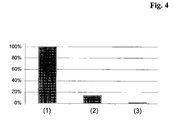
- Figure 4
- Inhibition of phosphatise activity in insect cell lysate with orthovanadate in the presence or absence of mannitol. For the principle of the experiment reference is made to Example 5. The ordinate indicates residual phosphatase activity. The bars indicate the results obtained for the following compositions: (1) no inhibitor added (control, 100% residual activity); (2) 1 mM orthovanadate; (3) 1 mM orthovanadate, 27 mM mannitol.
- Figure 5
- Inhibition of phosphatise activity in COS7 cell lysate with orthovanadate in the presence or absence of mannitol. For the principle of the experiment reference is made to Example 6. The ordinate indicates residual phosphatase activity. The bars indicate the results obtained for the following compositions: (1) no inhibitor added (control, 100% residual activity); (2) 1 mM orthovanadate; (3) 1 mM orthovanadate, 27 mM mannitol.
- A stock solution of a recombinantly produced phosphotyrosine-specific protein phosphatase (human T-cell; Calbiochem , No. Cat 539732) is diluted in the ratio of 1:200 in a buffer containing 0,1 mM CaCl2, 50 mM Tris pH 7.0. In separate reaction tubes the following mixtures (a-e) are prepared: 36 µl of diluted enzyme solution and 4 µl of either of (a) water (as a reference for 100%) one solution of (b) 10 mM orthovanadate; (c) 20 mM orthovanadate; (d) 10 mM orthovanadate, 270 mM mannitol; (e) 10 mM orthovanadate, 540 mM glycerol. Each mixture is incubated at room temperature (RT) for 15 min. Subsequently, an aliquot of 10 µl is transferred from each mixture to a microwell plate. 5 µl of a solution of a test peptide containing a phosphotyrosine residue (the peptide having the sequence R-R-L-I-E-D-A-E-pY-A-A-R-G; 1 mM in water) and 10 µl of a buffer containing 0,1 mM CaCl2, 50 mM Tris pH 7.0 are added to each well and incubated for 30 min at 37°C. Free phosphate resulting from enzymatic hydrolysis of the phosphoester bond is subjected to a detection reaction following the addition of 100 µl of a 1M HCl solution additionally containing 0.034% [w/v] malachite green, 10 mM sodium molybdate, and 3.4% [v/v] ethanol. The detection reaction is performed for 10 min at RT while constantly agitating the microwell plate. Relative concentrations of phosphate are detected following the determination of the extinction (620 nm) of each reaction well.
- A stock solution of a recombinantly produced phosphotyrosine-specific protein phosphatase (human T-cell; Calbiochem , No. Cat 539732) is diluted in the ratio of 1:200 in a buffer containing 25 mM Hepes, 50 mM NaCl, 2.5 mM EDTA, 5 mM DTT, pH 7.2. In separate reaction tubes the following mixtures (a-e) are prepared: 36 µl of diluted enzyme solution and 4 µl of either of (a) water (as a reference for 100%) one solution of (b) 10 mM orthovanadate; (c) 20 mM orthovanadate; (d) 10 mM orthovanadate, 270 mM mannitol; (e) 10 mM orthovanadate, 540 mM glycerol. Each mixture is incubated at room temperature (RT) for 15 min. Subsequently, an aliquot of 10 µl is transferred from each mixture to a microwell plate. 5 µl of a solution of a test peptide containing a phosphotyrosine residue (the peptide having the sequence R-R-L-I-E-D-A-E-pY-A-A-R-G; 1 mM in water) and 10 µl of a buffer containing 25 mM Hepes, 50 mM NaCl, 2.5 mM EDTA, 5 mM DTT, pH 7.2 are added to each well and incubated for 30 min at 37°C. Free phosphate resulting from enzymatic hydrolysis of the phosphoester bond is subjected to a detection reaction following the addition of 100 µl of a 1 M HCl solution additionally containing 0.034% [w/v] malachite green, 10 mM sodium molybdate, and 3.4% [v/v] ethanol. The detection reaction is performed for 10 min at RT while constantly agitating the microwell plate. Relative concentrations of phosphate are detected following the determination of the extinction (620 nm) of each reaction well.
- A stock solution of a recombinantly produced phosphotyrosine-specific protein phosphatase (human T-cell; Calbiochem , No. Cat 539732) is diluted in the ratio of 1:200, either in a buffer containing 25 mM Hepes, 50 mM NaCl, 2.5 mM EDTA, 5 mM DTT, pH 7.2 (enzyme solution (i)) or in a buffer with the same composition but without DTT (enzyme solution (ii)). In separate reaction tubes the following mixtures (a-f) are prepared: 36 µl of either diluted enzyme solution (i) or (ii) and 4 µl of either one solution of (a, d) 10 mM orthovanadate; (b, e) 10 mM orthovanadate, 270 mM mannitol; (c, f) 10 mM orthovanadate, 540 mM glycerol. Each mixture is incubated at room temperature (RT) for 15 min. Subsequently, an aliquot of 10 µl is transferred from each mixture to a microwell plate. 5 µl of a solution of a test peptide containing a phosphotyrosine residue (the peptide having the sequence R-R-L-I-E-D-A-E-pY-A-A-R-G; 1 mM in water) and either 10 µl of a buffer containing 25 mM Hepes, 50 mM NaCl, 2.5 mM EDTA, 5 mM DTT, pH 7.2 (reactions with enzyme solution (i)) or 10 µl of a buffer containing 25 mM Hepes, 50 mM NaCl, 2.5 mM EDTA, pH 7.2 (reactions with enzyme solution (ii)) are added to each well and incubated for 30 min at 37°C. Free phosphate resulting from enzymatic hydrolysis of the phosphoester bond is subjected to a detection reaction following the addition of 100 µl of a 1 M HCl solution additionally containing 0.034% [w/v] malachite green, 10 mM sodium molybdate, and 3.4% [v/v] ethanol. The detection reaction is performed for 10 min at RT while constantly agitating the microwell plate. Relative concentrations of phosphate are detected following the determination of the extinction (620 nm) of each reaction well.
- Residual phosphatase activity in the presence of compositions containing orthovanadate and other compounds in aqueous buffers as indicated. The tabulated data refer to the graphic representations given in
Figures 1-3 .Buffer Activity Figure 1 :1) Without Inhibitor 50 mM Tris; 0,1 mM CaCl2 pH 7,0 100% 2) Na3VO4 1 mM 50 mM Tris; 0,1 mM CaCl2 pH 7,0 16,6% 3) Na3VO4 2 mM 50 mM Tris; 0,1 mM CaCl2 pH 7,0 15,7% 4) Na3VO4 1 mM + mannitol 27 mM 50 mM Tris; 0,1 mM CaCl2 pH 7,0 8,5% 5) Na3VO4 1 mM + glycerol 54 mM 50 mM Tris; 0,1 mM CaCl2 pH 7,0 9,7% Figure 2 :1) Without Inhibitor 25 mM Hepes ; 50 mM NaCl; 2,5 mM EDTA ; 100% 5 mM DTT pH 7,2 2) Na3VO4 1 mM 25 mM Hepes ; 50 mM NaCl ; 2,5 mM EDTA ; 87,7% 5 mM DTT pH 7,2 3) Na3VO4 2 mM 25 mM Hepes ; 50 mM NaCl ; 2,5 mM EDTA ; 58,0% 5 mM DTT pH 7,2 4) Na3VO4 1 mM + mannitol 27 mM 25 mM Hepes ; 50 mM NaCl ; 2,5 mM EDTA ; 12,4% 5 mM DTT pH 7,2 5) Na3VO4 1 mM + glycerol 54 mM 25 mM Hepes ; 50 mM NaCl ; 2,5 mM EDTA ; 9,3% 5 mM DTT pH 7,2 Figure 3 :1) Na3VO4 1 mM 25 mM Hepes ; 50 mM NaCl; 2,5 mM EDTA ; 29,5% pH 7,2 2) Na3VO4 1 mM 25 mM Hepes ; 50 mM NaCl; 2,5 mM EDTA ; 46,3% 5 mM DTT pH 7,2 3) Na3VO4 1 mM + mannitol 27 mM 25 mM Hepes ; 50 mM NaCl ; 2,5 mM EDTA; 14,1% pH 7,2 4) Na3VO4 1 mM + mannitol 27 mM 25 mM Hepes ; 50 mM NaCl ; 2,5 mM EDTA ; 5,8% 5 mM DTT pH 7,2 5) Na3VO4 1 mM + glycerol 54 mM 25 mM Hepes ; 50 mM NaCl ; 2,5 mM EDTA ; 14,9% pH 7,2 6) Na3VO4 1 mM + glycerol 54 mM 25 mM Hepes ; 50 mM NaCl; 2,5 mM EDTA ; 7,3% 5 mM DTT pH 7,2 - 270 mg insect cells (SF9) were collected, washed 3 times with 50mM Hepes, 50mM NaCl pH 7.0 and lysed using 2.5 ml M-Per (Pierce) for 10 min. After centrifugation the lysate was collected as the supernatant.
- Test for phosphotyrosine activity: to 45µl of the lysate 5µl of either water or orthovanadate (10 mM) or orthovanadate/mannitol (10 mM/270 mM) were added and incubated for 10 min at room temperature.
- Subsequently, an aliquot of 10 µl was transferred from each mixture into a well of a microwell plate. 5µl of a solution of a test peptide (R-R-L-I-E-D-A-E-pY-A-A-R-G; 1mM in water) and 10 µl of a buffer containing 0.1 mM CaCl2, 50 mM Tris pH 7.0 were added to each well and incubated for 30 min at 37°C. Free phosphate resulting from the enzymatic hydrolysis was then detected via addition of 100 µl of a 1 M HCl solution additionally containing 0.034% [w/v] malachite green, 10 mM sodium molybdate and 3.4% [v/v] ethanol. The detection was performed for 10 min at RT while constantly agitating the microwell plate. Relative concentrations of free phosphate were detected following the determination of the extinction (620 nm) of each reaction well.
- Residual phosphatase activity in the presence of compositions containing orthovanadate and other compounds in aqueous buffers as indicated. The tabulated data refer to the graphic representations given in
Figure 4 .phosphatase activity no inhibitor (water control) 100% 1 mM orthovandate 14% 1 mM orthovanadate / 27 mM mannitol 2% - COS7 cells were collected, washed 3 times with 50mM Hepes, 50mM NaCl pH 7.0 and lysed using 5 ml M-Per (Pierce) for 10 min. After centrifugation the lysate was collected as the supernatant.
- Test for phosphotyrosine activity: to 45 µl of the diluted lysate (1+4 with M-Per (Pierce)) 5 µl of either water or orthovanadate (10 mM) or orthovanadate/Mannitol (10 mM/270 mM) were added and incubated for 10 min at room temperature.
- Subsequently, an aliquot of 10µl was transferred from each mixture to a microwell plate. 5 µl of a solution of a test peptide (R-R-L-I-E-D-A-E-pY-A-A-R-G; 1 mM in water) and 10 µl of a buffer containing 0.1 mM CaCl2, 50mM Tris pH 7.0 were added to each well and incubated for 30 min at 37°C. Free phosphate resulting from the enzymatic hydrolysis was then detected via addition of 100 µl of a 1M HCl solution additionally containing 0.034% [w/v] malachite green, 10 mM sodium molybdate and 3.4 [v/v] ethanol. The detection was performed for 10 min at RT while constantly agitating the microwell plate. Relative concentrations of free phosphate were detected following the determination of the extinction (620nm) of each reaction well.
- Residual phosphatase activity in the presence of compositions containing orthovanadate and other compounds in aqueous buffers as indicated. The tabulated data refer to the graphic representations given in
Figure 5 .phosphatase activity no inhibitor (water control) 100% 1 mM orthovandate 52% 1 mM orthovanadate / 27 mM mannitol 36% 
Claims (13)
- A liquid composition comprising an aqueous solvent, an enzyme with phosphatase activity, orthovanadate, mannitol and dithiothreitol, characterized in that the concentration of mannitol is between 1 mM and 100 mM, and the molar ratio of mannitol and orthovanadate is equal to or higher than 1:1.
- The composition according to claim 1, characterized in that the concentration of orthovanadate is between 0.1 mM and 10 mM.
- The composition according to claim 2, characterized in that the concentration of orthovanadate is between 0.5 mM and 5 mM.
- The composition according to any of the claims 1 to 3, characterized in that the composition additionally comprises a chelating agent for divalent or trivalent positively charged metal ions.
- In vitro use of a sugar alcohol for enhancing the inhibitory effect of an ionic compound selected from the group consisting of vanadate (V), oligomeric vanadate (V) and mixtures thereof on an enzyme with phosphatase activity capable of hydrolyzing the phosphoester bond of a phosphotyrosine residue in the peptide of SEQ ID NO:1 dissolved in a buffered aqueous solution with a neutral pH and containing Ca2+ ions at a concentration of between 0.7 mM and 1.2 mM.
- The use according to claim 5, characterized in that the activity of the phosphatase is reduced to a value of between 1.5% and 40%.
- A method in vitro to enhance the inhibitory effect of an ionic compound selected from the group consisting of vanadate (V), oligomeric vanadate (V) and mixtures thereof on an enzyme with phosphatase activity capable of hydrolyzing the phosphoester bond of a phosphotyrosine residue in the peptide of SEQ ID NO:1 dissolved in a buffered aqueous solution with a neutral pH and containing Ca2+ ions at a concentration of between 0.7 mM and 1.2 mM, comprising the steps of(a) dissolving in an aqueous solvent a composition comprising (i) the ionic compound, and (ii) a sugar alcohol, whereby the molar ratio of the sugar alcohol and the ionic compound is equal to or higher than 1:1, and(b) contacting the enzyme with phosphatase activity with the solution of step (a).
- The method according to claim 7, characterized in that characterized in that the concentration of the sugar alcohol in the solution is between 1 mM and 100 mM.
- The method according to any of claims 7 and 8, characterized in that the concentration of orthovanadate in the solution is between 0.1 mM and 10 mM.
- The method according to any of claims 7 to 9, characterized in that the ionic compound and the sugar alcohol are added as dry matter to an aqueous sample containing the enzyme with phosphatase activity.
- A kit of parts comprising packaging material and a composition comprising (i) an ionic compound selected from the group consisting of vanadate (V), oligomeric vanadate (V) and mixtures thereof, (ii) a sugar alcohol, whereby the molar ratio of the sugar alcohol and the ionic compound is equal to or higher than 1:1.
- The kit according to claim 11, characterized in that the composition additionally comprises a reducing agent and/or a chelating agent for divalent or trivalent positively charged metal ions.
- The Kit according to any of the claims 11 and 12, characterized in that the composition is provided as dry matter in the form of a tablet.
Priority Applications (1)
| Application Number | Priority Date | Filing Date | Title |
|---|---|---|---|
| EP08001165.3A EP1949894B1 (en) | 2007-01-25 | 2008-01-23 | Enhancement of vanadium-containing phosphatase inhibitors by polyols |
Applications Claiming Priority (2)
| Application Number | Priority Date | Filing Date | Title |
|---|---|---|---|
| EP07001593 | 2007-01-25 | ||
| EP08001165.3A EP1949894B1 (en) | 2007-01-25 | 2008-01-23 | Enhancement of vanadium-containing phosphatase inhibitors by polyols |
Publications (3)
| Publication Number | Publication Date |
|---|---|
| EP1949894A2 true EP1949894A2 (en) | 2008-07-30 |
| EP1949894A3 EP1949894A3 (en) | 2011-12-28 |
| EP1949894B1 EP1949894B1 (en) | 2016-06-29 |
Family
ID=39551751
Family Applications (1)
| Application Number | Title | Priority Date | Filing Date |
|---|---|---|---|
| EP08001165.3A Active EP1949894B1 (en) | 2007-01-25 | 2008-01-23 | Enhancement of vanadium-containing phosphatase inhibitors by polyols |
Country Status (1)
| Country | Link |
|---|---|
| EP (1) | EP1949894B1 (en) |
Family Cites Families (12)
| Publication number | Priority date | Publication date | Assignee | Title |
|---|---|---|---|---|
| EP0051964A3 (en) * | 1980-11-03 | 1983-02-16 | Graham John Naylor | Animal growth control |
| HU207799B (en) * | 1991-07-24 | 1993-06-28 | Beres Export Import Rt | Process for producing pharmaceutical composition for influencing the reticuloendothelial system, for treating chronic pain symptomes of degenerative locomotor disorders or tumors, and for treating mucoviscidosis |
| AU697785B2 (en) * | 1994-07-19 | 1998-10-15 | Johnson & Johnson Clinical Diagnostics, Inc. | Analytical element,composition and method using modified apo-horseradish peroxidase |
| AU4308699A (en) * | 1998-05-12 | 1999-11-29 | Greenville Hospital System | Use of anti-prolactin agents to treat proliferative conditions |
| EP1163521A2 (en) * | 1999-03-19 | 2001-12-19 | Kudos Pharmaceuticals Limited | Assays, methods and means |
| US6299865B1 (en) * | 2000-05-02 | 2001-10-09 | Peter Styczynski | Reduction of hair growth |
| US7217710B2 (en) * | 2001-10-02 | 2007-05-15 | Smithkline Beecham Corporation | Substituted pyrazolopyrimidines |
| IL162832A0 (en) * | 2002-01-04 | 2005-11-20 | Aventis Pharma Gmbh | Highly sensitive and continous protein-tyrosine-phosphatase (ptpase) test using 6,8 difluoro-4-methylumbe |
| GB2396106B (en) * | 2002-12-12 | 2006-11-15 | Johnson & Johnson Medical Ltd | Wound dressings comprising enzyme inhibitors |
| GB0328157D0 (en) * | 2003-12-04 | 2004-01-07 | Imp College Innovations Ltd | Compounds |
| US20060099567A1 (en) * | 2004-04-08 | 2006-05-11 | Biomatrica, Inc. | Integration of sample storage and sample management for life science |
| US20060252683A1 (en) * | 2005-05-04 | 2006-11-09 | Lim Tung Hin Y | Preparation of a peptide compound (SYRAPRO-2000) and its use for the activation of protein phosphatase-2A1 enzyme |
-
2008
- 2008-01-23 EP EP08001165.3A patent/EP1949894B1/en active Active
Non-Patent Citations (4)
| Title |
|---|
| CUNCIC, C. ET AL., BIOCHEM. PHARMACOL., vol. 58, 1999, pages 1859 - 1867 |
| HUYER, G. ET AL., J. BIOL. CHEM., vol. 272, 1997, pages 843 - 851 |
| NXUMALO, F. ET AL., J. BIOL. INORG. CHEM., vol. 3, 1998, pages 534 - 542 |
| STANKIEWICZ, P. J. ET AL., MET. IONS BIOL. SYST., vol. 31, 1995, pages 287 - 324 |
Also Published As
| Publication number | Publication date |
|---|---|
| EP1949894B1 (en) | 2016-06-29 |
| EP1949894A3 (en) | 2011-12-28 |
Similar Documents
| Publication | Publication Date | Title |
|---|---|---|
| Bryan et al. | Inhibition of tubulin assembly by RNA and other polyanions: evidence for a required protein. | |
| Ullrich et al. | Evidence for lysosomal enzyme recognition by human fibroblasts via a phosphorylated carbohydrate moiety | |
| Spolter et al. | Distinctive properties of native and carboxypeptidase-treated aldolases of rabbit muscle and liver | |
| Stambaugh et al. | Zona pellucida dissolution enzymes of the rabbit sperm head | |
| Jameson et al. | Inhibition of microtubule assembly by phosphorylation of microtubule-associated proteins | |
| CS212729B2 (en) | Method of determining glycerol ester and fatty acid contents in aqueous media,and an enzymatic agent for carrying out the method | |
| US8563263B2 (en) | Enhancement of vanadium-containing phosphatase inhibitors | |
| Laloux et al. | Phosphate dependency of phosphofructokinase 2 | |
| EP1949894B1 (en) | Enhancement of vanadium-containing phosphatase inhibitors by polyols | |
| Slein | [20] Synthesis of mannose-6-phosphate by hexokinase | |
| Geren et al. | Circular dichroism changes in galactosyltransferase upon substrate binding | |
| JP3696267B2 (en) | Method for stabilizing bioactive protein | |
| DuVal et al. | Some kinetic characteristics of immobilized protomers and native dimers of mitochondrial malate dehydrogenase: an examination of the enzyme mechanism | |
| Martin et al. | In vitro phosphorylation of serum albumin by two protein kinases: a potential pitfall in protein phosphorylation reactions | |
| JP3087891B2 (en) | Electrolyte measurement reagent composition | |
| HK1136844B (en) | Enhancement of vanadium-containing phosphatase inhibitors | |
| JP2542251B2 (en) | Stable one-part α-amylase assay reagent | |
| JPH07102154B2 (en) | Method for quantifying 1,5-anhydroglucitol | |
| HIRAIWA et al. | Multiplicity of bovine liver GM1 ganglioside β-galactosidase | |
| JPH10191972A (en) | Method for stabilizing ATP hydrolase | |
| WO1982001564A1 (en) | Reagent for assaying gamma-clutamyl transpeptidase activity | |
| Cibulková et al. | Preliminary characterization of multiple hyaluronidase forms in boar reproductive tract | |
| Leaback | Esterase activities of β-N-acetyl-D-glucosaminidase preparations | |
| EP0306167A2 (en) | Stabilization of enzymes by inhibiting proteolytic enzyme contaminants | |
| Mardanyan et al. | Interaction of adenosine deaminase with inhibitors. Chemical modification by diethyl pyrocarbonate |
Legal Events
| Date | Code | Title | Description |
|---|---|---|---|
| PUAI | Public reference made under article 153(3) epc to a published international application that has entered the european phase |
Free format text: ORIGINAL CODE: 0009012 |
|
| AK | Designated contracting states |
Kind code of ref document: A2 Designated state(s): AT BE BG CH CY CZ DE DK EE ES FI FR GB GR HR HU IE IS IT LI LT LU LV MC MT NL NO PL PT RO SE SI SK TR |
|
| AX | Request for extension of the european patent |
Extension state: AL BA MK RS |
|
| PUAL | Search report despatched |
Free format text: ORIGINAL CODE: 0009013 |
|
| AK | Designated contracting states |
Kind code of ref document: A3 Designated state(s): AT BE BG CH CY CZ DE DK EE ES FI FR GB GR HR HU IE IS IT LI LT LU LV MC MT NL NO PL PT RO SE SI SK TR |
|
| AX | Request for extension of the european patent |
Extension state: AL BA MK RS |
|
| RIC1 | Information provided on ipc code assigned before grant |
Ipc: C12Q 1/42 20060101ALI20111124BHEP Ipc: A61K 31/047 20060101AFI20111124BHEP Ipc: A61K 33/24 20060101ALI20111124BHEP Ipc: A61K 45/06 20060101ALI20111124BHEP |
|
| 17P | Request for examination filed |
Effective date: 20120628 |
|
| AKX | Designation fees paid |
Designated state(s): AT BE BG CH CY CZ DE DK EE ES FI FR GB GR HR HU IE IS IT LI LT LU LV MC MT NL NO PL PT RO SE SI SK TR |
|
| 17Q | First examination report despatched |
Effective date: 20120821 |
|
| GRAP | Despatch of communication of intention to grant a patent |
Free format text: ORIGINAL CODE: EPIDOSNIGR1 |
|
| INTG | Intention to grant announced |
Effective date: 20160111 |
|
| GRAS | Grant fee paid |
Free format text: ORIGINAL CODE: EPIDOSNIGR3 |
|
| GRAA | (expected) grant |
Free format text: ORIGINAL CODE: 0009210 |
|
| AK | Designated contracting states |
Kind code of ref document: B1 Designated state(s): AT BE BG CH CY CZ DE DK EE ES FI FR GB GR HR HU IE IS IT LI LT LU LV MC MT NL NO PL PT RO SE SI SK TR |
|
| REG | Reference to a national code |
Ref country code: GB Ref legal event code: FG4D |
|
| REG | Reference to a national code |
Ref country code: CH Ref legal event code: EP |
|
| REG | Reference to a national code |
Ref country code: AT Ref legal event code: REF Ref document number: 808529 Country of ref document: AT Kind code of ref document: T Effective date: 20160715 |
|
| REG | Reference to a national code |
Ref country code: IE Ref legal event code: FG4D |
|
| REG | Reference to a national code |
Ref country code: DE Ref legal event code: R096 Ref document number: 602008044848 Country of ref document: DE |
|
| REG | Reference to a national code |
Ref country code: LT Ref legal event code: MG4D |
|
| PG25 | Lapsed in a contracting state [announced via postgrant information from national office to epo] |
Ref country code: LT Free format text: LAPSE BECAUSE OF FAILURE TO SUBMIT A TRANSLATION OF THE DESCRIPTION OR TO PAY THE FEE WITHIN THE PRESCRIBED TIME-LIMIT Effective date: 20160629 Ref country code: NO Free format text: LAPSE BECAUSE OF FAILURE TO SUBMIT A TRANSLATION OF THE DESCRIPTION OR TO PAY THE FEE WITHIN THE PRESCRIBED TIME-LIMIT Effective date: 20160929 Ref country code: FI Free format text: LAPSE BECAUSE OF FAILURE TO SUBMIT A TRANSLATION OF THE DESCRIPTION OR TO PAY THE FEE WITHIN THE PRESCRIBED TIME-LIMIT Effective date: 20160629 |
|
| REG | Reference to a national code |
Ref country code: ES Ref legal event code: FG2A Ref document number: 2588601 Country of ref document: ES Kind code of ref document: T3 Effective date: 20161103 |
|
| REG | Reference to a national code |
Ref country code: NL Ref legal event code: MP Effective date: 20160629 |
|
| PG25 | Lapsed in a contracting state [announced via postgrant information from national office to epo] |
Ref country code: NL Free format text: LAPSE BECAUSE OF FAILURE TO SUBMIT A TRANSLATION OF THE DESCRIPTION OR TO PAY THE FEE WITHIN THE PRESCRIBED TIME-LIMIT Effective date: 20160629 Ref country code: SE Free format text: LAPSE BECAUSE OF FAILURE TO SUBMIT A TRANSLATION OF THE DESCRIPTION OR TO PAY THE FEE WITHIN THE PRESCRIBED TIME-LIMIT Effective date: 20160629 Ref country code: HR Free format text: LAPSE BECAUSE OF FAILURE TO SUBMIT A TRANSLATION OF THE DESCRIPTION OR TO PAY THE FEE WITHIN THE PRESCRIBED TIME-LIMIT Effective date: 20160629 Ref country code: LV Free format text: LAPSE BECAUSE OF FAILURE TO SUBMIT A TRANSLATION OF THE DESCRIPTION OR TO PAY THE FEE WITHIN THE PRESCRIBED TIME-LIMIT Effective date: 20160629 Ref country code: GR Free format text: LAPSE BECAUSE OF FAILURE TO SUBMIT A TRANSLATION OF THE DESCRIPTION OR TO PAY THE FEE WITHIN THE PRESCRIBED TIME-LIMIT Effective date: 20160930 |
|
| REG | Reference to a national code |
Ref country code: AT Ref legal event code: MK05 Ref document number: 808529 Country of ref document: AT Kind code of ref document: T Effective date: 20160629 |
|
| REG | Reference to a national code |
Ref country code: FR Ref legal event code: PLFP Year of fee payment: 10 |
|
| PG25 | Lapsed in a contracting state [announced via postgrant information from national office to epo] |
Ref country code: CZ Free format text: LAPSE BECAUSE OF FAILURE TO SUBMIT A TRANSLATION OF THE DESCRIPTION OR TO PAY THE FEE WITHIN THE PRESCRIBED TIME-LIMIT Effective date: 20160629 Ref country code: EE Free format text: LAPSE BECAUSE OF FAILURE TO SUBMIT A TRANSLATION OF THE DESCRIPTION OR TO PAY THE FEE WITHIN THE PRESCRIBED TIME-LIMIT Effective date: 20160629 Ref country code: SK Free format text: LAPSE BECAUSE OF FAILURE TO SUBMIT A TRANSLATION OF THE DESCRIPTION OR TO PAY THE FEE WITHIN THE PRESCRIBED TIME-LIMIT Effective date: 20160629 Ref country code: IS Free format text: LAPSE BECAUSE OF FAILURE TO SUBMIT A TRANSLATION OF THE DESCRIPTION OR TO PAY THE FEE WITHIN THE PRESCRIBED TIME-LIMIT Effective date: 20161029 Ref country code: RO Free format text: LAPSE BECAUSE OF FAILURE TO SUBMIT A TRANSLATION OF THE DESCRIPTION OR TO PAY THE FEE WITHIN THE PRESCRIBED TIME-LIMIT Effective date: 20160629 |
|
| PG25 | Lapsed in a contracting state [announced via postgrant information from national office to epo] |
Ref country code: BE Free format text: LAPSE BECAUSE OF FAILURE TO SUBMIT A TRANSLATION OF THE DESCRIPTION OR TO PAY THE FEE WITHIN THE PRESCRIBED TIME-LIMIT Effective date: 20160629 Ref country code: PL Free format text: LAPSE BECAUSE OF FAILURE TO SUBMIT A TRANSLATION OF THE DESCRIPTION OR TO PAY THE FEE WITHIN THE PRESCRIBED TIME-LIMIT Effective date: 20160629 Ref country code: AT Free format text: LAPSE BECAUSE OF FAILURE TO SUBMIT A TRANSLATION OF THE DESCRIPTION OR TO PAY THE FEE WITHIN THE PRESCRIBED TIME-LIMIT Effective date: 20160629 Ref country code: PT Free format text: LAPSE BECAUSE OF FAILURE TO SUBMIT A TRANSLATION OF THE DESCRIPTION OR TO PAY THE FEE WITHIN THE PRESCRIBED TIME-LIMIT Effective date: 20161031 |
|
| REG | Reference to a national code |
Ref country code: DE Ref legal event code: R097 Ref document number: 602008044848 Country of ref document: DE |
|
| PLBE | No opposition filed within time limit |
Free format text: ORIGINAL CODE: 0009261 |
|
| STAA | Information on the status of an ep patent application or granted ep patent |
Free format text: STATUS: NO OPPOSITION FILED WITHIN TIME LIMIT |
|
| PG25 | Lapsed in a contracting state [announced via postgrant information from national office to epo] |
Ref country code: DK Free format text: LAPSE BECAUSE OF FAILURE TO SUBMIT A TRANSLATION OF THE DESCRIPTION OR TO PAY THE FEE WITHIN THE PRESCRIBED TIME-LIMIT Effective date: 20160629 |
|
| 26N | No opposition filed |
Effective date: 20170330 |
|
| PG25 | Lapsed in a contracting state [announced via postgrant information from national office to epo] |
Ref country code: SI Free format text: LAPSE BECAUSE OF FAILURE TO SUBMIT A TRANSLATION OF THE DESCRIPTION OR TO PAY THE FEE WITHIN THE PRESCRIBED TIME-LIMIT Effective date: 20160629 Ref country code: BG Free format text: LAPSE BECAUSE OF FAILURE TO SUBMIT A TRANSLATION OF THE DESCRIPTION OR TO PAY THE FEE WITHIN THE PRESCRIBED TIME-LIMIT Effective date: 20160929 |
|
| PG25 | Lapsed in a contracting state [announced via postgrant information from national office to epo] |
Ref country code: MC Free format text: LAPSE BECAUSE OF FAILURE TO SUBMIT A TRANSLATION OF THE DESCRIPTION OR TO PAY THE FEE WITHIN THE PRESCRIBED TIME-LIMIT Effective date: 20160629 |
|
| REG | Reference to a national code |
Ref country code: IE Ref legal event code: MM4A |
|
| PG25 | Lapsed in a contracting state [announced via postgrant information from national office to epo] |
Ref country code: LU Free format text: LAPSE BECAUSE OF NON-PAYMENT OF DUE FEES Effective date: 20170123 |
|
| REG | Reference to a national code |
Ref country code: FR Ref legal event code: PLFP Year of fee payment: 11 |
|
| PG25 | Lapsed in a contracting state [announced via postgrant information from national office to epo] |
Ref country code: IE Free format text: LAPSE BECAUSE OF NON-PAYMENT OF DUE FEES Effective date: 20170123 |
|
| PG25 | Lapsed in a contracting state [announced via postgrant information from national office to epo] |
Ref country code: MT Free format text: LAPSE BECAUSE OF NON-PAYMENT OF DUE FEES Effective date: 20170123 |
|
| PG25 | Lapsed in a contracting state [announced via postgrant information from national office to epo] |
Ref country code: HU Free format text: LAPSE BECAUSE OF FAILURE TO SUBMIT A TRANSLATION OF THE DESCRIPTION OR TO PAY THE FEE WITHIN THE PRESCRIBED TIME-LIMIT; INVALID AB INITIO Effective date: 20080123 |
|
| PG25 | Lapsed in a contracting state [announced via postgrant information from national office to epo] |
Ref country code: CY Free format text: LAPSE BECAUSE OF NON-PAYMENT OF DUE FEES Effective date: 20160629 |
|
| PG25 | Lapsed in a contracting state [announced via postgrant information from national office to epo] |
Ref country code: TR Free format text: LAPSE BECAUSE OF FAILURE TO SUBMIT A TRANSLATION OF THE DESCRIPTION OR TO PAY THE FEE WITHIN THE PRESCRIBED TIME-LIMIT Effective date: 20160629 |
|
| PGFP | Annual fee paid to national office [announced via postgrant information from national office to epo] |
Ref country code: GB Payment date: 20251220 Year of fee payment: 19 |
|
| PGFP | Annual fee paid to national office [announced via postgrant information from national office to epo] |
Ref country code: FR Payment date: 20251217 Year of fee payment: 19 |
|
| REG | Reference to a national code |
Ref country code: CH Ref legal event code: U11 Free format text: ST27 STATUS EVENT CODE: U-0-0-U10-U11 (AS PROVIDED BY THE NATIONAL OFFICE) Effective date: 20260201 |
|
| PGFP | Annual fee paid to national office [announced via postgrant information from national office to epo] |
Ref country code: ES Payment date: 20260202 Year of fee payment: 19 |
|
| PGFP | Annual fee paid to national office [announced via postgrant information from national office to epo] |
Ref country code: DE Payment date: 20251217 Year of fee payment: 19 |
|
| PGFP | Annual fee paid to national office [announced via postgrant information from national office to epo] |
Ref country code: IT Payment date: 20260107 Year of fee payment: 19 |
|
| PGFP | Annual fee paid to national office [announced via postgrant information from national office to epo] |
Ref country code: CH Payment date: 20260201 Year of fee payment: 19 |