EP1949880A1 - Disposable diaper - Google Patents
Disposable diaper Download PDFInfo
- Publication number
- EP1949880A1 EP1949880A1 EP06798087A EP06798087A EP1949880A1 EP 1949880 A1 EP1949880 A1 EP 1949880A1 EP 06798087 A EP06798087 A EP 06798087A EP 06798087 A EP06798087 A EP 06798087A EP 1949880 A1 EP1949880 A1 EP 1949880A1
- Authority
- EP
- European Patent Office
- Prior art keywords
- diaper
- sheet
- elastic members
- opening
- wearer
- Prior art date
- Legal status (The legal status is an assumption and is not a legal conclusion. Google has not performed a legal analysis and makes no representation as to the accuracy of the status listed.)
- Withdrawn
Links
Images





Classifications
-
- A—HUMAN NECESSITIES
- A61—MEDICAL OR VETERINARY SCIENCE; HYGIENE
- A61F—FILTERS IMPLANTABLE INTO BLOOD VESSELS; PROSTHESES; DEVICES PROVIDING PATENCY TO, OR PREVENTING COLLAPSING OF, TUBULAR STRUCTURES OF THE BODY, e.g. STENTS; ORTHOPAEDIC, NURSING OR CONTRACEPTIVE DEVICES; FOMENTATION; TREATMENT OR PROTECTION OF EYES OR EARS; BANDAGES, DRESSINGS OR ABSORBENT PADS; FIRST-AID KITS
- A61F13/00—Bandages or dressings; Absorbent pads
- A61F13/15—Absorbent pads, e.g. sanitary towels, swabs or tampons for external or internal application to the body; Supporting or fastening means therefor; Tampon applicators
- A61F13/45—Absorbent pads, e.g. sanitary towels, swabs or tampons for external or internal application to the body; Supporting or fastening means therefor; Tampon applicators characterised by the shape
- A61F13/49—Absorbent pads, e.g. sanitary towels, swabs or tampons for external or internal application to the body; Supporting or fastening means therefor; Tampon applicators characterised by the shape specially adapted to be worn around the waist, e.g. diapers or nappies
- A61F13/495—Absorbent pads, e.g. sanitary towels, swabs or tampons for external or internal application to the body; Supporting or fastening means therefor; Tampon applicators characterised by the shape specially adapted to be worn around the waist, e.g. diapers or nappies with faecal cavity
Definitions
- the present invention relates generally to a disposable diaper and particularly to a disposable diaper improved so as to protect the wearer against soil with feces.
- a topsheet laid so as to come close to the wearer's skin and formed with an opening defined by a pair of opposite side edges extending in parallel to each other and these side edges are provided with elastic members which are gradually spaced from each other as these elastic members extend from an anterior portion toward a posterior portion of the opening.
- the elastic members extending in this manner function to space the opposite side edges from each other and thereby to assure that the diaper put on the wearer can maintain a predetermined width of the opening.
- FIG. 2 Another example of the disposable diaper is also disclosed in Japanese Unexamined Patent Application Publication No. 2002-11044 (PATENT DOCUMENT 2).
- This diaper is particularly provided above the topsheet with a skin-contact sheet serving to protect the wearer's hip from soil with feces.
- the skin-contact sheet has longitudinally opposite ends bonded to the topsheet or the backsheet and is formed in its crotch region with an opening surrounded by an elastic member bonded in its stretched state to the skin-contact sheet.
- This diaper is put on the wearer's body with the opening overlapping the wearer's anus.
- PATENT DOCUMENT 1 Published Japanese Translation of PCT International Publication for Patent Application No. 1997-506528
- PATENT DOCUMENT 2 Japanese Unexamined Patent Application Publication No. 2002-11044
- the topsheet has its front edge as well as its rear edge fixed to the diaper chassis and inevitably comes in direct contact with the buttocks and the external genital of the wearer.
- Such topsheet is necessarily hydrophilic and liquid-pervious since the topsheet must allow urine to permeate this topsheet.
- the topsheet wet with urine continuously in contact with the wearer's skin may cause diaper rash.
- such liquid-pervious topsheet is loaded with the wearer's body weight as the wearer sits down or lies down, it is likely that feces staying below the topsheet may flow backs and soil the wearer's external genital and the vicinity thereof.
- the opening is formed at a long distance from the regions in which the topsheet is fixed. Consequentially, it is required to keep the elastic members in tight contact with the wearer's skin and thereby to alleviate deformation of the opening in view of the fact that the opening is formed in the crotch region which is apt to be deformed as the legs of the wearer move.
- the elastic members continuously kept in contact with the wearer's skin too tightly may cause diaper eczema.
- the elastic members gradually spaced from each other as these elastic members extend from an anterior portion toward a posterior portion of the opening may preferably assume that the opening also presents the corresponding shape.
- An appropriate transverse dimension of the opening in the vicinity of the anus is usually in a range of 3 to 6 cm to receive feces.
- the transverse dimension of the opening shaped so as to be gradually enlarged as it gets nearer to the rear end of the diaper may exceeds such appropriate range and make it difficult to protect the wearer's skin from soil with feces.
- the elastic member is provided so as to surround the opening and thereby the skin-contactable sheet can be kept in close contact with the wearer's skin in front of the opening as well as behind the opening.
- the skin-contactable sheet is bonded to the topsheet or the backsheet at the longitudinally opposite ends of the diaper and consequentially the crotch region of the diaper is repetitively compressed and decompressed depending on movement of the wearer's legs.
- the opening is repetitively deformed until the opening is out of alignment with the anus and feces is not received by the opening but soils the wearer's skin.
- the skin-contactable sheet is bonded to elastic members of front and rear waist regions laid along the longitudinally opposite ends of the diaper, respectively, and the opening may be deformed as a stretch ratio changes depending on the individual wearer's waist dimension.
- An object of the present invention is to solve the above-mentioned problems of the conventional disposable diaper.
- a disposable diaper comprising a chassis and an absorbent.
- the chassis has a length direction, a width direction orthogonal to the length direction, front and rear sides, a front waist region defined on the front side, a rear waist region defined on the rear side and a crotch region interposed between these two waist regions.
- These regions respectively comprise an inner sheet adapted to come in contact with a wearer' s skin and an outer sheet lying on a side opposed to the inner sheet and adapted to come in contact with an undergarment of the wearer.
- the absorbent is bonded between the inner and outer sheets.
- the diaper is characterized in that: the chassis is provided above the inner sheet with a spacer sheet adapted to prevent feces discharged onto the inner sheet from coming in contact with the wearer's skin.
- the spacer sheet has a front end zone extending aside toward the front side, a rear end zone extending aside toward the rear side and an intermediate zone extending between the front and rear end zones as viewed in the length direction. Each of these zones have opposite side edges extending in the length direction in parallel to each other.
- the front and rear zones are at least partially fixed to the inner sheet while at least a middle spot of the intermediate zone as viewed in the width direction is left free from the inner sheet.
- the intermediate zone is formed with an opening describing a circular arc which is convex toward the front side and adapted to guide the feces discharged from anus of the wearer therethrough toward the inner sheet, provided that the intermediate zone is put in contact with a vicinity of the anus.
- Elastic members extending in the length direction are attached in a stretched state to the spacer sheet in a vicinity of side edges of the opening as viewed in the width direction, and the elastic members provided in the vicinity of the side edges extend toward the front side along a peripheral edge of the opening so as to get close to a center line bisecting a width of the diaper.
- the elastic members on the diaper held in a flatly developed state extend in the length direction substantially in parallel to each other in the vicinity of the side edges of the opening.
- the elastic members provided in the vicinity of the side edges extend toward the front side so as to get close to the center line and further extend to intersect with each other on the center line or so as to get close to the center line and further extend toward the front side so as to be spaced from each other.
- the elastic members in a slackened state, extend toward the front side along the side edges and then extend further forward substantially linearly toward the center line.
- the elastic members provided in the vicinity of the side edges extend toward the front side so as to intersect with each other on the center line and further extend forward to the front end zone of the spacer sheet fixed to the inner sheet.
- the rear waist region of the chassis is provided along both sides thereof opposed to each other in the width direction with elastically stretchable/contractible regions, respectively, between which the rear end zone of the spacer sheet is laid and fixed to a region of the inner sheet overlying the absorbent.
- the diaper is of a pants type in which the front and rear waist regions in the chassis are bonded together along opposite side edges thereof.
- the elastic members stretchably/contractibly extend in the width direction in the crotch region of the diaper.
- the inner sheet of the chassis is provided with the spacer sheet having the front and rear end zones fixed to the inner sheet and the intermediate zone formed with the opening adapted to receive feces.
- the elastic members extending forward in the length direction are attached in a stretched state to the spacer sheet. These elastic members extending forward gradually get close to the center line so as to cooperate with each other and thereby to describe the circular arc which is convex forward.
- the elastic members provided in the vicinity of the side edges of the opening extend in the length direction substantially in parallel to each other, it is ensured that the spacer sheet can be evenly held in close contact with the wearer's skin on both sides of the anus and feces can be smoothly guided through the opening.
- the elastic members intersect with each other on the center line or get closest to each other in the vicinity of the center line, the elastic members having described the circular arc heretofore are deformed into the V-shape as the width of the crotch region is reduced so that the spot corresponding to the apex of the V-shape can be kept in contact with the wearer's skin in front of the anus.
- the spacer sheet adequately covers the wearer's skin in front of the anus and thereby substantially protects the external genital and the skin in the vicinity thereof from soil with feces having been guided through the opening into the space.
- a volume of the space can be enlarged by spacing the spacer sheet, in the vicinity of its front end zone, from the inner surface of the chassis.
- the rear end zone of the spacer sheet is fixed to the inner sheet its region overlying the absorbent, stretching and contraction, if occur, of the elastic zones defined in the rear end zone of the spacer sheet will hardly affect the rear end zone of the spacer sheet and hardly reduce the width of the opening in the rear end zone of the spacer sheet.
- the diaper is of a pants-type in which the front and rear waist regions in the chassis are bonded together along opposite side edges thereof, relative positions of the front and rear waist regions do not depend on the manner in which the diaper is put on the wearer's body and therefore the opening of the spacer sheet can be easily aligned with the anus when the used diaper is exchanged with a fresh one.
- the elastic members contractibly extend in the width direction in the crotch region of the diaper
- contraction of the elastic members automatically reduce the width of the crotch region and therefore the elastic members initially attached to the spacer sheet so as to describe the circular arc are readily deformed so as to extend linearly.
- Fig. 1 is a partially cutaway plan view depicting an open-type disposable diaper 10 in its flatly developed state
- Fig. 2 is a partially cutaway perspective view depicting the diaper 10 in its state left free
- Fig. 3 is a sectional view taken along the line III-III in Fig. 2 .
- a diaper 10 has a length direction L and a width direction W orthogonal to each other and is symmetric with each other about a center line C extending in the length direction L so as to bisect a dimension of the diaper 10 in the width direction W.
- the diaper 10 comprises a chassis 11 having a front waist region 12 lying on a front side as viewed in the length direction L, a rear waist region 13 lying on a rear side as viewed in the length direction L and a crotch region 14 interposed between these two waist regions 12, 13.
- the chassis 11 contains therein an absorbent 16 which is semi-rigid and capable of absorb bodily discharges.
- the chassis 11 may be referred to also as a main body.
- the chassis 11 has an hourglass-like planar shape having a narrow region defined by the crotch region 14 curved inward as viewed in the width direction W and comprises a liquid-pervious inner sheet 11a defining an inner surface adapted to come in contact with the wearer and a liquid-impervious outer sheet 11b defining an outer surface opposed to the inner sheet 11a and adapted to come in contact with an undergarment of the wearer.
- the absorbent 16 is interposed between these two sheets 11a, 11b.
- the inner sheet 11a is bonded to the absorbent 16 with bonding means (not shown) such as a hot melt adhesive and a part of the inner sheet 11a extending outward beyond a peripheral edge of the absorbent 16 is bonded to the outer sheet 11b with a hot melt adhesive or sealing technique.
- a liquid-impervious or liquid-resistant spacer sheet 17 partially overlies the inner sheet 11a so as to cover the rear waist region 13 and a part of crotch region 14 contiguous to the rear waist region 13.
- the term "liquid-resistant sheet” used herein refers to a sheet being not liquid-impervious but capable of constraining any remarkable permeation of liquid that may cause undesirable leakage or exudation of body liquid.
- Such spacer sheet 17 has a front end zone 17a, a rear end zone 17b and an intermediate zone 17d between these opposite end zones 17a, 17b as viewed in the length direction L.
- These zones 17a, 17b, 17d commonly have a pair of side edges 17c extending in the length direction L generally in parallel to each other.
- the front end zone 17a and the rear end zone 17b are at least partially fixed to the inner sheet 11a with a hot melt adhesive or sealing technique but, in the vicinity of the side edges 17c of the respective zones 17a, 17b, 17d are fixed or not fixed to the inner sheet 11a as the case may be.
- a middle section as viewed in the width direction W i.e., a section extending inside the side edges 17c of the intermediate zone 17d is left free from the inner sheet 11a so that this middle section can be spaced upward as viewed in Fig. 3 from the inner sheet 11a.
- the front waist region 12 has a front end 12a and opposite side edges 15a while the rear waist region 13 has a rear end 14a and opposite side edges 15b.
- the crotch region 14 has opposite side edges 15c curved toward the center line C and these side edges 15c are contiguous to those side edges 15a and 15b, respectively, as shown.
- belt-like waist elastic members 20a, 20b are sandwiched between the inner sheet 11a and the outer sheet 11b and bonded in a stretched state to at least one of these two sheets 11a, 11b.
- leg elastic members 21 each comprising a plurality of rubber threads are sandwiched between the inner sheet 11a and the outer sheet 11b and bonded in a stretched state to at least one of these two sheets 11a, 11b.
- the opposite side edges 15c including these leg elastic members 21 respectively form gasket cuffs in the diaper 10.
- elongate barrier cuffs 22 extending in the length direction L are attached to the inner sheet 11a.
- Each of the barrier cuffs 22 is provided separately of the inner sheet 11a and formed from a liquid-resistant, more preferably liquid-impervious sheet.
- the barrier cuff 22 comprises a distal portion 22a adapted to rise up on the inner sheet 11a and a proximal portion 22b bonded to the inner sheet 11a with a hot melt adhesive 22d.
- the distal portion 22a has an uppermost edge 22c to which a cuff elastic member 23 formed from a rubber thread extending in the length direction L is attached in a stretched state.
- the opposite side edges 15b of the rear waist region 13 are provided with a pair of tape fasteners 24 to connect the front and rear waist regions 12, 13 in a circumferential direction.
- Each of these tape fasteners 24 comprises a proximal section (not shown) permanently bonded to the associated side edge 15b and a fastening section 24a adapted to be developed outward from the diaper 10 as viewed in Fig. 1 and to be fastened to the front waist region 12.
- the outer sheet 11b in the front waist region 12 is provided with a target tape strip 25 (See Fig. 3 ) as a counterpart for the tape fasteners 24.
- the respective fastening sections 24a of the tape fastener 24 are detachably anchored on the target tape strip 25.
- Means adopted by the fastening section 24a to anchor this fastening section 24a on the target tape strip 25 may be selected from the group consisting of a pressure-sensitive adhesive, a hook member constituting a so-called mechanical fastener and a loop member constituting the mechanical fastener.
- the spacer sheet 17 is formed in its intermediate 17d with an oval opening 26 and in the vicinity of side edges 26c of this opening 26 which are opposite to each other as viewed in the width direction W with spacer elastic members 27 each comprising a single or plural rubber threads. These elastic members 27 are bonded in a stretched state to the spacer sheet 17 and allow the spacer sheet 17 to be spaced upward from the inner sheet 11a. As will be obviously understood from Fig.
- these paired spacer elastic members 27 comprise lateral segments 27a linearly extending in the length direction L in the vicinity of the side edges 26c, curved segments 27b extending to the center line C on the front side of the opening 26 along arc-shaped front segment 26a constituting the peripheral edge of the opening 26 and front segments 27c extending from a cross point 29 of the curved segments 27b on the center line C close to the front end zone 17a of the spacer sheet 17.
- these spacer elastic members 27 describe an X-shape.
- Rear segments 27d extending rearward from the side edges 26c of the opening 26 linearly extend toward the rear end zone 17b of the spacer sheet 17 without intersecting each other.
- the spacer sheet 17 is preferably formed from a pair of sheets 17e, 17f placed upon each other as shown by Fig. 1 . Between these two sheets 17e, 17f, the spacer elastic members 27 are sandwiched and bonded in a stretched state to at least one of these two sheets 17e, 17f. While the front and rear end zones 17a, 17b are bonded to the inner sheet 11a preferably over the full dimensions thereof in the width direction W, it is alternatively possible to bond the front and rear end zones 17a, 17b to the inner sheet 11a only in the vicinity of the front and rear segments 27c, 27d of the spacer elastic members 27.
- the separator sheet 17 is bonded in the vicinity of the side edges 17c to the inner sheet 11a preferably over the full dimension of the separator sheet 17, it is alternatively possible to bond the spacer sheet 17 along the side edges 17c thereof to the inner sheet 11a only in the intermediate zone 17d.
- the front and rear end zones 17a, 17b are at least partially bonded to the inner sheet 11a and, in the vicinity of spots at which those zones 17a, 17b are bonded to the inner sheet 11a, the inner sheet 11a is bonded to the absorbent 16. Therefore, the spacer sheet 17 is not readily deformed unless the absorbent 16 is deformed. Consequentially, neither the position nor the shape of the opening 26 relative to the wearer is readily deformed unless the absorbent 16 is deformed.
- the diaper 10 flatly developed refers to a state in which the diaper 10 bowed as the elastic members are left contract as seen in Figs. 2 and 3 has been pulled in the length direction L as well as in the width direction W until the gathers due to contraction of the respective elastic members have disappeared and the inner and outer sheets 11a, 11b of the chassis 11 have restored primary planar shapes thereof.
- the waist elastic members 20, the leg elastic members 21 and cuff elastic members 23 contract as the diaper 10 is left free and the diaper 10 is gently bowed with the inner sheet 11a lying inside so that the front and rear ends 12a, 14a or these ends and the side edges 15a, 15b as well as their vicinities are risen upward.
- the nonwoven fabric and the film are formed with a plurality of gathers extending across the respective elastic members. It should be noted that these gathers are partially shown in Figs. 2 and 3 .
- the chassis 11 is bowed so as to be convex with the outer sheet 11b lying outside while the spacer sheet 17 is spaced from the inner sheet 11a as the spacer elastic members contract so as to form a space 31 between these two sheets 17, 11.
- the opening 26 defines an inlet for this space 31.
- An apparent dimension of the chassis 11 in the width direction W is reduced as the waist elastic members 20 contract and simultaneously the side edges 17c of the spacer sheet 17 move toward the center line C and correspondingly an apparent width dimension of the spacer sheet 17 also is reduced.
- the curved segments of the spacer elastic members 27 on both sides of the center line C linearly contract so as to describe together a V-shape and the arc-shaped front segment 26a also are deformed together into a V-shape formed with a plurality of gathers.
- the dimension of the opening 26 in the width direction W is not markedly changed in the vicinity of the rear end zone 17b of the spacer sheet 17 but significantly changed in the vicinity of the front segment 26a constituting the opening 26.
- a width of the crotch region 14 is further reduced and deformation of the front segment 26a into V-shape also becomes further remarkable as the diaper 10 is put on the wearer's body and the crotch region 14 is squeezed between thighs.
- the spacer sheet 17 is attached to the chassis 11 with the opening 26 opposed to the wearer's anus, the opposite side edges 26c of the opening 26 will be reliably received together with the spacer elastic members 27 by the posterior rugae within which the side edges 26c will come in close contact with the wearer's skin on both sides of the anus. Consequently, feces discharged from the wearer will be smoothly received by the opening 26 fixedly located within the posterior rugae.
- the spacer sheet 17 is attached to the inner sheet 11 in a manner also that a region of the spacer sheet 17 defined by the X-shaped cross point of the spacer elastic members 27 and the vicinity thereof may come in contact with the wearer's skin at a position anterior to the anus and posterior to the external genital.
- the opening 26 of the spacer sheet 17 in the state as has been described just above has its dimension Mb in the width direction W is gradually reduced under the contractile force of the spacer elastic members 27 toward the front segment 26a, in other words, toward the external genital.
- an anxiety that feces once having been received in the space 31 might flow back through the opening 26 can be substantially prevented while another anxiety that urine discharged from the external genital and flowing rearward might flow into the space 31 can be substantially prevented.
- the diaper 10 of Fig. 1 to facilitate feces to flow into the space 31, to prevent the wearer's external genital from soil with feces and to prevent urine and feces from being mixed together within the space 31.
- the spacer sheet 17 In the case of the embodiment according to which the spacer sheet 17 is fixed to the inner sheet 11a fully along the front and rear end zones 17a, 17b as well as the both side edges, the space 31 fluid-communicates with the exterior only through the opening 26. While the space 31 defined in this manner is effective to decrease the likelihood that feces having been received by the space 31 might flow back and soil the wearer's skin, the spacer sheet 17 fixed to the inner sheet 11a along full length of the side edges 17c may disadvantageously limit the desired contraction of the spacer elastic members 27 and obstruct the desired deformation of the curved segments 26c of the opening 26 from the circular arc to the V-shape.
- the spacer sheet 17 may be left free from the inner sheet 11a along portions of the respective side edges 17c, for example, along the side edges 17c of the intermediate zone 17d to facilitate the desired contraction of the spacer elastic members 27.
- feces moving in the width direction W are effectively held back by the barrier cuffs 22 and there is no anxiety that any amount of feces might leak out from the diaper 10.
- the barrier cuffs 22 functioning in this manner are preferably dimensioned so that the respective cuff sections 22 may overlap the spacer sheet 17 as these barrier cuffs 22 are collapsed toward the center line C (See Fig. 1 ).
- the region of the spacer sheet 27 including the curved segments 27b is deformed so as to extend rather linearly and simultaneously formed with the gathers 17g. In such region, the gathers 17g are unfolded or refolded depending on movement of the wearer's skin with which this region is kept in close contact and thereby this region can be reliably kept in close contact with the wearer's skin. In this way, the spacer sheet 17 reliably keeps feces received within the space 31 away from the wearer's skin and protects the wearer's skin from soil with feces.
- the opening 26 preferably has a dimension as measured in the length direction L from the front segment 26a to the rear segment 26b in a range of 50 to 200 mm and the maximum dimension Mb as measured in the width direction W in a range of 30 to 100 mm.
- an opening angle ⁇ defined by the front segment 26a is preferably in a range of 40 to 130°.
- the preferred spacer sheet 17 is attached to the inner sheet 11a in a manner that a region of the sheet 17 defined at a distance in a range of 30 to 90 mm rearward from the front segment 26a of the opening 26 may be substantially aligned with the diaper wearer's anus.
- a dimension Ma of the opening 26 aligned with the anus in this manner is preferably at least 20 mm larger than the distance as indicated just above. If the maximum dimension Mb is less than 30 mm and/or the opening angle ⁇ is less than 40°, the opening 26 may be closed and it may be impossible to guide feces into the space 31.
- the maximum dimension Mb exceeds 100 mm and/or the opening angle ⁇ exceeds 130°, fitness to the skin around the anus achieved by the both side edges 26c of the opening 26 within the posterior rugae will be deteriorated and consequentially it will become to guide feces through the opening 26.
- the distance from the front segment 26a to the anus is less than 30 mm, movement of the spacer sheet 17 relative to the wearer's buttocks will cause feces to run upon the spacer sheet 17 rather than to move toward the opening 26. As a result, the wearer's skin will be readily soiled with feces.
- the distance from the front segment 26a of the opening 26 to the anus exceeds 90 mm, the wearer's external genital will be partially exposed in the opening 26 and apt to be soiled with feces.
- the inner sheet 11a may be formed, for example, from a liquid-pervious nonwoven fabric made of thermoplastic synthetic fibers or a liquid-pervious perforated film made of a thermoplastic synthetic resin both preferably modified to become hydrophilic.
- the outer sheet 11b may be formed, for example, from a liquid-impervious or liquid-resistant nonwoven fabric made of hydrophobic thermoplastic synthetic fibers, a liquid-impervious or liquid-resistant film made of a thermoplastic synthetic resin or a composite sheet consisting of the above described film and the above-described nonwoven fabric laminated on the outer side of the former.
- liquid-resistant film comprises an air-permeable film made of a polyolefin-based synthetic resin commingled with fine particles, for example, of calcium carbonate or barium sulfate and subjected to mono- or biaxial orientation.
- the absorbent 16 comprises, for example, fluff pulp fibers having water absorption properties, a mixture of fluff pulp fibers and a thermoplastic synthetic resin having no water absorption properties, a mixture of fluff pulp fibers and super-absorbent polymer particles or a mixture of fluff pulp fibers, thermoplastic synthetic fibers and super-absorbent polymer particles, in any case, wrapped with a cover sheet made of a liquid-pervious and hydrophilic tissue paper or a crepe paper or nonwoven fabric, followed by a treatment of compression.
- the absorbent 16 exhibits a flexural rigidity higher than those of the inner sheet 11a and the outer sheet 11b but can be easily curved as illustrated in Figs. 2 and 3 under the effect of the respective elastic members.
- Such absorbent 16 may be referred to as a semi-rigid absorbent.
- a melt blown nonwoven fabric constituted by sufficiently fine fibers is suitable as the cover sheet.
- fiber interstices are preferably kept sufficiently small to prevent the super-absorbent polymer particles swollen with absorbed urine from falling off through the fiber interstices.
- the shape of the absorbent 16 is not specified and may be rectangular as illustrated in Fig. 1 or hourglass-like. While the absorbent 16 having a uniform thickness is shown in Fig.
- the absorbent 16 may have a depression in a region opposed to the opening 26 of the spacer sheet 17 or this region may be devoid of water absorptive materials (See Fig. 1 ). However, it is essential that the dimension of the absorbent 16 in the region opposed to the opening 26 as measured in the width direction W should be larger than the dimension of the opening 26 as measured in the width direction.
- the waist elastic members 20, the leg elastic members 21, the cuff elastic members 22 and the spacer elastic members 27 may be formed from rubber threads, a flat rubber or the like made of an elastomeric material such as a natural rubber, a synthetic rubber or an urethane foam.
- the barrier cuffs 22 may be formed from a liquid-impervious or liquid-resistant nonwoven fabric or a film made of a thermoplastic synthetic resin.
- Figs. 4 and 5 are views similar to Figs. 1 and 2 , respectively, depicting a diaper 210 according to one preferred embodiment of the present invention.
- the diaper 210 is similar to the diaper 10 of Fig. 1 except that the diaper 210 has a spacer sheet 217 configured in a manner differing from the diaper 10 of Fig. 1 . Referring to Fig.
- the front end zone 17a of the spacer sheet 217 is formed in the middle of the front end zone 17a as viewed in the width direction with a substantially semicircular notch 32 and the spacer elastic members 27 are contractibly attached to the spacer sheet 217 so as to extend along the notch 32 and to intersect with each other at the cross point 29 from which these spacer elastic members 27 extend to the leftover front end zones 17a of the spacer sheet 217.
- Segments 28a of the front end zone 17a linearly extending in the width direction W except the notch 32 are fixed to the inner sheet 11a with an adhesive or sealing technique.
- the rubber threads of the respective spacer elastic members 27 extending in parallel one to another are spaced one from another substantially by regular intervals.
- the segments 27b, 27c of the spacer elastic members 27 also contract so as to be deformed in substantially straight lines and to describe an X-shape in the vicinity of the notch 32.
- the spacer sheet 217 having the front end zone 17a which extends forward by a longer range than the front end zone 17a in the diaper 10 of Fig. 1 such spacer sheet 217 is preferably formed with the notch 32 and thereby the inner sheet 11a is partially exposed so that the exposed region may be effectively used for absorption of urine.
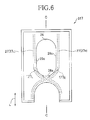
- Fig. 6 is a plan view depicting one preferred embodiment of the separator sheet used for the present invention.
- the spacer sheet 317 illustrated herein is similar to the spacer sheet 217 in Fig. 4 as long as the shape of the sheet itself is concerned but distinguished from the spacer sheet 217 with respect to a layout of the spacer elastic members 27.
- the spacer elastic members 27 comprising first and second elastic members 27L, 27R linearly extending in the length direction L on the left and right sides, respectively, of the opening 26 and then coming closest to each other in a region defined in a vicinity of the center line C without intersecting with each other.
- the elastic members 27L, 27R extend apart from each other to keep an explicit distance as is the case occurring behind the region defined in the vicinity of the center line C.
- this spacer sheet 317 it is ensured that the first and second elastic members 27L, 27R contract so as to extend linearly as indicated by imaginary lines 127L, 127R and simultaneously the front end segment 26a of the opening 26 is deformed to describe the V-shape as the width of the diaper's crotch region is reduced, for example, when the diaper is put on the wearer's body.
- the first and second elastic members 27L, 27R can cooperate with each other to describe the X-shape in the vicinity of the front segment 26a.
- Fig. 7 is a perspective view depicting a pants-type diaper 510 according to another preferred embodiment of the present invention
- Fig. 8 is a partially cutaway plan view depicting a diaper 510a having the front and rear waist regions 12, 13 and the crotch region 14 flatly developed similarly to Fig. 4
- Fig. 9 is a partially cutaway perspective view, depicting the diaper 510a in the state left free
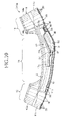
- Fig. 10 is a sectional view taken along the line X-X in Fig. 9 .
- the diaper 510a depicted in Figs. 8 and 9 has the chassis 11 comprising a pair of side edges 15a of the front waist region 12 opposed to each other in the width direction W, a pair of side edges 15b of the rear waist region 13 opposed to each other in the width direction W and a pair of side edges 15c of the crotch region 14 opposed to each other in the width direction W.
- the chassis 11 is folded back along a center line D bisecting a length E of the chassis 11 with the inner sheet 11a inside and the respective pairs of side edges 15a, 15b put flat together are bonded one to another at bonding spots 51 arranged intermittently in a vertical direction as viewed in Fig. 7 to obtain the pants-type diaper 510 of Fig. 7 .
- the diaper 510 is formed with a waist-hole 34 and a pair of leg-holes 35.
- the front and rear ends 12a, 14a are respectively provided with the waist elastic members 20 each comprising a plurality of rubber threads.
- Each of the waist elastic members 20 is sandwiched between the inner sheet 11a and the outer sheet 11b and bonded in a circumferentially stretched state to at least one of these sheets 11a, 11b.
- a peripheral edge defining each of the leg-holes 35 is provided with the leg elastic member 21 sandwiched between the inner sheet 11a and the outer sheet 11b and bonded in a stretched state to at least one of these sheets 11a, 11b.
- the front and rear waist regions 12, 13 of the chassis 11 are provided with auxiliary waist elastic members 36, each comprising a plurality of rubber threads, spaced one from another in the vertical direction and bonded in a circumferentially stretched state to the chassis 11.
- auxiliary waist elastic members 36 may be attached, if desired, also to the crotch region 14 in its zone defined below the respective pairs of side edges 15a, 15b.
- the outer sheet 11b constituting the chassis 11 is shaped to be longer than the outer sheet 11b in Fig.
- the outer sheet 11b is formed from a nonwoven fabric made of thermoplastic synthetic fibers and cooperates with a liquid-impervious or liquid-resistant leak-barrier film made of a thermoplastic synthetic resin which is larger than the absorbent 16 and placed on a portion of the outer sheet 11b overlying the absorbent 16 to function as a liquid-impervious sheet defining the outer surface of the chassis 11.
- the crotch region 14 or, in addition to the crotch region 14, zones of the front and rear waist regions in the vicinity of the crotch region 14 each being formed from the inner sheet 11a are liquid-pervious while zones formed from the surplus end portions 11c of the outer sheet 11b folded back onto the inner sheet 11a are liquid-impervious or liquid-resistant or liquid-pervious.
- the absorbent 16 in the diaper 510 is formed on its zone opposed to the opening 26 of the spacer sheet 17 with a depression 52 which is devoid of the absorptive material.
- An inner surface of this depression 52 is defined by a semi-rigid sheet 37.
- the semi-rigid sheet 37 not only defines a bottom of the depression 52 but also covers a peripheral wall 53 of the depression 52.
- the semi-rigid sheet 37 is placed upon and bonded to the inner sheet 11a.
- the semi-rigid sheet 37 may be formed, for example, from a nonwoven fabric, a tissue paper or a thermoplastic synthetic resin film and preferably has a rigidity corresponding to or higher than the flexural rigidity of the absorbent 16.
- the depression 52 cooperates with the spacer sheet 17 to form the space 31 adapted to receive feces.
- the inner surface of the depression 52 is formed from the semi-rigid sheet 37 and thereby it is unlikely that the crotch region 14 which becomes bulky outward as the diaper 510 is put on the wearer's body with the width of the crotch region 14 being reduced and folded in two in the width direction might be easily deformed during use of the diaper 510.
- the crotch region 14 is maintained bulky in this manner and consequently the spacer sheet 17 is largely spaced from the semi-rigid sheet 37 so as to form the correspondingly deeper space 31.
- Such space 31 not only improves its capacity to receive feces but also eliminates an anxiety that feces might flow back from the space 31.
- Use of the semi-rigid sheet 37 functioning in this manner allows the depression 52 to be replaced by water absorptive materials in the absorbent 16 locally compressed in the thickness direction.
- the compressed water absorptive materials contains few or none of the super-absorbent polymer particles because the water absorptive material containing a significant amount of the super-absorbent polymer particles would be swollen as a result of water absorption and shallow the space 31.
- the spacer sheet 17 of the diaper 510 is similar to the space sheet 17 in Fig. 4 except that the rear end zone 17b is spaced from the end 14b of the folded back end portion 11c of the outer sheet 11b so as to expose the inner sheet 11a between these rear end zone 17b and the folded back end portion 11c while the side edge zones 17c are spaced from the fixed sections 22b of the respective barrier cuffs 22 in the width direction W so as to expose the inner sheet 11a between these fixed sections 22b.
- the spacer sheet 17 arranged in this manner ensures that, even if loose passage flows on the spacer sheet 17 without being received by the opening 26, moisture content of this loose passage can be absorbed by the exposed zones of the inner sheet 11a around the spacer sheet 17.
- the presence of the auxiliary waist elastic members 36 improves fitness of the front and rear waist regions 12, 13 with respect to the wearer's skin.
- the middle zones of the front and rear waist regions 12, 13 as viewed in the width direction W occupied by the absorbent 16 hardly contract due to rigidity of the absorbent 16 and contractible zones of the front and rear waist regions 12, 13 are limited to the respective pairs of side edge zones in which the absorbent 16 is absent. Consequentially, the segment of the opening 26 lying in the rear waist region 13 and in the vicinity thereof is not significantly deformed under the effect of the auxiliary elastic members 36.
- these auxiliary elastic members 36 assures a good fit of the diaper 510 with respect to the wearer's waist so that the position of the opening 26 relative to the wearer's body scarcely depends on movement and/or posture of the wearer and feces smoothly flow through the opening 26.
- the auxiliary elastic members 36 may be cut in the middle zone of the chassis 11 as viewed in the width direction W or heat treated to eliminate the elasticity of the auxiliary elastic members 36 in these zones.
- the middle zone may be devoid of the auxiliary elastic members 36 and the side edge sections of the front waist region 12 or the rear waist region 13 may be provided with the auxiliary elastic members 36 to control the shape of the opening 26 primarily under the effect of the spacer elastic members 27.
- the diaper 510 implemented in the manner as has been described above ensures that the peripheral edge of the opening 26 is kept in close contact with the wearer's skin and thereby feces trapping capacity of the space 31 is improved while an apprehension of feces leak can be alleviated.
- Fig. 11 is a partially cutaway perspective view depicting a pants-type diaper 610 according to still another preferred embodiment of the present invention.
- the diaper 610 is similar to the diaper 510 of Fig. 7 except that the leg elastic members 21 in Fig. 7 are replaced by leg elastic members 621 exploited in a manner as will be described.
- the leg elastic members 621 respectively comprise segments 621a extending around the leg-holes 35 so as to make substantially full circles and segments 621b extending across the crotch region 14.
- the leg elastic members 621 are attached in a stretched state to the diaper 610 and the segments 621b extending across the crotch region 14 function to reduce the width of the crotch region 14.
- the spacer elastic members 27 easily contract under the effect of the segments 621b and describe an X-shape as shown in Fig. 9 . This X-shaped cross point comes in contact with the wearer's skin immediately in front of the anus.
- the spacer sheet 17, 217, 317 attached to the liquid-pervious inner sheet 11a defining the inner surface of the diaper is formed from a relatively small sheet strip prepared separately of the inner sheet 11a.
- the spacer sheet 17, 217, 317 is adapted to come in close contact with the wearer's skin exclusively around the anus and formed with the opening 26 adapted to come in alignment with the anus as the diaper is put on the wearer's body so that feces can be reliably guided through the opening 26.
- the spacer sheet 17, 217, 317 is provided with the spacer elastic members 27 which function to space the spacer sheet 17, 217, 317 from the inner sheet 11a and thereby to form the space 31 and simultaneously function to taper the front segment 26a of the opening 26 forward.
- the front segment 26a tapered forward in this manner is formed along the peripheral edge thereof with a plurality of gathers.
- Such spacer sheet 17, 217, 317 is not directly affected by stretch and/or contraction of the elastic members located far apart from the opening 26 and therefore the shape of the opening 26 is scarcely affected by the elastic members other than the spacer elastic members 27.
- the spacer elastic members 27 extend neither to the front waist region 12 beyond the crotch region 14 nor to the rear end 14a of the rear waist region 13.
- the position of the spacer sheet 17 relative to the wearer's body as well as the shape of the opening 26 scarcely depends on movement of the wearer's body and, in addition, it is ensured that the front segment 26a of the opening 26 and the zone in the vicinity thereof reliably come in contact with the wearer's skin immediately in front of the anus.
- the present invention makes it possible to produce the disposable diaper free from anxiety that the wearer' s skin might be soiled with feces.
Landscapes
- Health & Medical Sciences (AREA)
- Epidemiology (AREA)
- Engineering & Computer Science (AREA)
- Biomedical Technology (AREA)
- Heart & Thoracic Surgery (AREA)
- Vascular Medicine (AREA)
- Life Sciences & Earth Sciences (AREA)
- Animal Behavior & Ethology (AREA)
- General Health & Medical Sciences (AREA)
- Public Health (AREA)
- Veterinary Medicine (AREA)
- Absorbent Articles And Supports Therefor (AREA)
- Orthopedics, Nursing, And Contraception (AREA)
- Electrotherapy Devices (AREA)
Abstract
The present invention aims to provide a disposable diaper improved so that the wearer's skin can be reliably protected from being soiled with feces.
A chassis (11) constituting the diaper (1) includes a spacer sheet (17) attached to an inner sheet (11a) of the chassis (11). The spacer sheet (17) has a front end zone (17a) and a rear end zone (17b) fixed to the inner sheet (11a) and an intermediate zone (17d) left free from the inner sheet (11a). The intermediate zone (17d) is formed with an opening (26) shaped so as to describe a circular arc which is convex forward. Along the opposite side edges of the opening (26), the spacer sheet (17) is provided with elastic members (27) extending in the length direction (L) of the diaper (1) and attached thereto in a stretched state in the direction (L). These elastic members (27) extend forward with respect to the diaper (1) along the peripheral edge of the opening so as to get close to a center line (C) bisecting a width of the diaper (1).
Description
- The present invention relates generally to a disposable diaper and particularly to a disposable diaper improved so as to protect the wearer against soil with feces.
- One example of the disposable diaper is disclosed in Published Japanese Translation of PCT International Publication for Patent Application No.
1997-506528 - Another example of the disposable diaper is also disclosed in Japanese Unexamined Patent Application Publication No.
2002-11044
PATENT DOCUMENT 1: Published Japanese Translation of PCT International Publication for Patent Application No.1997-506528
PATENT DOCUMENT 2: Japanese Unexamined Patent Application Publication No.2002-11044 - In the diaper disclosed in
Reference 1, the topsheet has its front edge as well as its rear edge fixed to the diaper chassis and inevitably comes in direct contact with the buttocks and the external genital of the wearer. Such topsheet is necessarily hydrophilic and liquid-pervious since the topsheet must allow urine to permeate this topsheet. The topsheet wet with urine continuously in contact with the wearer's skin may cause diaper rash. In addition, if such liquid-pervious topsheet is loaded with the wearer's body weight as the wearer sits down or lies down, it is likely that feces staying below the topsheet may flow backs and soil the wearer's external genital and the vicinity thereof. Furthermore, in the diaper disclosed inReference 1, the opening is formed at a long distance from the regions in which the topsheet is fixed. Consequentially, it is required to keep the elastic members in tight contact with the wearer's skin and thereby to alleviate deformation of the opening in view of the fact that the opening is formed in the crotch region which is apt to be deformed as the legs of the wearer move. However, the elastic members continuously kept in contact with the wearer's skin too tightly may cause diaper eczema. The elastic members gradually spaced from each other as these elastic members extend from an anterior portion toward a posterior portion of the opening may preferably assume that the opening also presents the corresponding shape. An appropriate transverse dimension of the opening in the vicinity of the anus is usually in a range of 3 to 6 cm to receive feces. However, the transverse dimension of the opening shaped so as to be gradually enlarged as it gets nearer to the rear end of the diaper may exceeds such appropriate range and make it difficult to protect the wearer's skin from soil with feces. - In the diaper disclosed in
Reference 2, the elastic member is provided so as to surround the opening and thereby the skin-contactable sheet can be kept in close contact with the wearer's skin in front of the opening as well as behind the opening. However, similarly to the diaper disclosed inReference 1, the skin-contactable sheet is bonded to the topsheet or the backsheet at the longitudinally opposite ends of the diaper and consequentially the crotch region of the diaper is repetitively compressed and decompressed depending on movement of the wearer's legs. In response to such repeated compression and decompression, the opening is repetitively deformed until the opening is out of alignment with the anus and feces is not received by the opening but soils the wearer's skin. Furthermore, the skin-contactable sheet is bonded to elastic members of front and rear waist regions laid along the longitudinally opposite ends of the diaper, respectively, and the opening may be deformed as a stretch ratio changes depending on the individual wearer's waist dimension. - An object of the present invention is to solve the above-mentioned problems of the conventional disposable diaper.
- According to the present invention, there is provided a disposable diaper comprising a chassis and an absorbent. The chassis has a length direction, a width direction orthogonal to the length direction, front and rear sides, a front waist region defined on the front side, a rear waist region defined on the rear side and a crotch region interposed between these two waist regions. These regions respectively comprise an inner sheet adapted to come in contact with a wearer' s skin and an outer sheet lying on a side opposed to the inner sheet and adapted to come in contact with an undergarment of the wearer. The absorbent is bonded between the inner and outer sheets.
- The diaper is characterized in that: the chassis is provided above the inner sheet with a spacer sheet adapted to prevent feces discharged onto the inner sheet from coming in contact with the wearer's skin. The spacer sheet has a front end zone extending aside toward the front side, a rear end zone extending aside toward the rear side and an intermediate zone extending between the front and rear end zones as viewed in the length direction. Each of these zones have opposite side edges extending in the length direction in parallel to each other. The front and rear zones are at least partially fixed to the inner sheet while at least a middle spot of the intermediate zone as viewed in the width direction is left free from the inner sheet. The intermediate zone is formed with an opening describing a circular arc which is convex toward the front side and adapted to guide the feces discharged from anus of the wearer therethrough toward the inner sheet, provided that the intermediate zone is put in contact with a vicinity of the anus. Elastic members extending in the length direction are attached in a stretched state to the spacer sheet in a vicinity of side edges of the opening as viewed in the width direction, and the elastic members provided in the vicinity of the side edges extend toward the front side along a peripheral edge of the opening so as to get close to a center line bisecting a width of the diaper.
- According to one preferred embodiment of the present invention, the elastic members on the diaper held in a flatly developed state extend in the length direction substantially in parallel to each other in the vicinity of the side edges of the opening.
- According to another preferred embodiment of the present invention, the elastic members provided in the vicinity of the side edges extend toward the front side so as to get close to the center line and further extend to intersect with each other on the center line or so as to get close to the center line and further extend toward the front side so as to be spaced from each other.
- According to still another embodiment of the present invention, the elastic members, in a slackened state, extend toward the front side along the side edges and then extend further forward substantially linearly toward the center line.
- According to yet another preferred embodiment of the present invention, the elastic members provided in the vicinity of the side edges extend toward the front side so as to intersect with each other on the center line and further extend forward to the front end zone of the spacer sheet fixed to the inner sheet.
- According to further another preferred embodiment of the present invention, the rear waist region of the chassis is provided along both sides thereof opposed to each other in the width direction with elastically stretchable/contractible regions, respectively, between which the rear end zone of the spacer sheet is laid and fixed to a region of the inner sheet overlying the absorbent.
- According to an additional preferred embodiment of the present invention, the diaper is of a pants type in which the front and rear waist regions in the chassis are bonded together along opposite side edges thereof.
- According to further additional preferred embodiment of the present invention, the elastic members stretchably/contractibly extend in the width direction in the crotch region of the diaper.
- In the disposable diaper according to the present invention, the inner sheet of the chassis is provided with the spacer sheet having the front and rear end zones fixed to the inner sheet and the intermediate zone formed with the opening adapted to receive feces. In the vicinity of the opposite side edges of this opening, the elastic members extending forward in the length direction are attached in a stretched state to the spacer sheet. These elastic members extending forward gradually get close to the center line so as to cooperate with each other and thereby to describe the circular arc which is convex forward. When the diaper is put on the wearer's body so that the opening overlies the anus and consequently the width of the crotch region is reduced, the respective elastic members having described the circular arc heretofore are linearly deformed under contractile force thereof into a V-shape about the center line. Correspondingly, the front segment of the opening's peripheral edge also is deformed into a V-shape and smoothly received by the posterior rugae. Within such posterior rugae, the opening's peripheral edge is held in close contact with the wearer's skin on both sides of the anus. Consequentially, feces discharged from the anus can be reliably guided through the opening held within the posterior rugae into the space defined between the spacer sheet and the inner sheet of the chassis. The presence of the spacer sheet effectively eliminates the anxiety that feces having been guided into the space might come in contact with the wearer's skin around the anus.
- According to the present invention wherein the elastic members provided in the vicinity of the side edges of the opening extend in the length direction substantially in parallel to each other, it is ensured that the spacer sheet can be evenly held in close contact with the wearer's skin on both sides of the anus and feces can be smoothly guided through the opening.
- According to the present invention wherein the elastic members intersect with each other on the center line or get closest to each other in the vicinity of the center line, the elastic members having described the circular arc heretofore are deformed into the V-shape as the width of the crotch region is reduced so that the spot corresponding to the apex of the V-shape can be kept in contact with the wearer's skin in front of the anus.
- According to the present invention wherein the elastic members, in a slackened state, extend from the both sides of the opening forward substantially linearly toward the center line, the spacer sheet adequately covers the wearer's skin in front of the anus and thereby substantially protects the external genital and the skin in the vicinity thereof from soil with feces having been guided through the opening into the space.
- According to the present invention wherein the elastic members extending in the length direction intersect with each other on the center line and further extend forward to the front end zone of the spacer sheet, a volume of the space can be enlarged by spacing the spacer sheet, in the vicinity of its front end zone, from the inner surface of the chassis.
- According to the present invention wherein the rear end zone of the spacer sheet is fixed to the inner sheet its region overlying the absorbent, stretching and contraction, if occur, of the elastic zones defined in the rear end zone of the spacer sheet will hardly affect the rear end zone of the spacer sheet and hardly reduce the width of the opening in the rear end zone of the spacer sheet.
- According to the present invention wherein the diaper is of a pants-type in which the front and rear waist regions in the chassis are bonded together along opposite side edges thereof, relative positions of the front and rear waist regions do not depend on the manner in which the diaper is put on the wearer's body and therefore the opening of the spacer sheet can be easily aligned with the anus when the used diaper is exchanged with a fresh one.
- According to the present invention wherein the elastic members contractibly extend in the width direction in the crotch region of the diaper, contraction of the elastic members automatically reduce the width of the crotch region and therefore the elastic members initially attached to the spacer sheet so as to describe the circular arc are readily deformed so as to extend linearly.
-
- [
FIG. 1] Fig. 1 is a partially cutaway plan view depicting a diaper. - [
FIG. 2] Fig. 2 is a partially cutaway perspective view depicting the diaper in its state left free. - [
FIG. 3] Fig. 3 is a sectional view taken along the line III-III inFig. 2 . - [
FIG. 4] Fig. 4 is a partially cutaway plan view depicting the diaper according to one preferred embodiment of the present invention. - [
FIG. 5] Fig. 5 is a partially cutaway perspective view depicting the diaper ofFig. 4 in its state left free. - [
FIG. 6] Fig. 6 is a plan view depicting one preferred embodiment of the separator sheet. - [
FIG. 7] Fig. 7 is a perspective view depicting a pants-type diaper according to another preferred embodiment of the present invention. - [
FIG. 8] Fig. 8 is a view similar toFig. 4 , depicting the diaper ofFig. 7 in its flatly developed state. - [
FIG. 9] Fig. 9 is a view similar toFig. 5 , depicting the diaper ofFig. 8 . - [
FIG. 10] Fig. 10 is a sectional view taken along the line X-X inFig. 9 . - [
FIG. 11] Fig. 11 is a partially cutaway perspective view depicting the pants-type diaper according to still another preferred embodiment of the present invention. -
- 10
- diaper
- 11
- chassis
- 11a
- inner sheet
- 11b
- outer sheet
- 12
- front waist region
- 13
- rear waist region
- 14
- crotch region
- 16
- absorbent
- 17
- spacer sheet
- 17a
- front end zone
- 17b
- rear end zone
- 17c
- side edges
- 17d
- intermediate zone
- 20
- waist elastic members
- 26
- opening
- 27
- elastic members (spacer elastic members)
- 36
- waist elastic members (auxiliary elastic members)
- 210
- diaper
- 217
- spacer sheet
- 317
- spacer sheet
- 510
- diaper
- 610
- diaper
- C
- center line
- L
- length direction
- W
- width direction
- Details of a disposable diaper according to the present invention will be more fully understood from the description given hereunder with reference to accompanying drawings.
-
Fig. 1 is a partially cutaway plan view depicting an open-typedisposable diaper 10 in its flatly developed state,Fig. 2 is a partially cutaway perspective view depicting thediaper 10 in its state left free andFig. 3 is a sectional view taken along the line III-III inFig. 2 . - Referring to
Fig. 1 , adiaper 10 has a length direction L and a width direction W orthogonal to each other and is symmetric with each other about a center line C extending in the length direction L so as to bisect a dimension of thediaper 10 in the width direction W. Thediaper 10 comprises achassis 11 having afront waist region 12 lying on a front side as viewed in the length direction L, arear waist region 13 lying on a rear side as viewed in the length direction L and acrotch region 14 interposed between these twowaist regions chassis 11 contains therein an absorbent 16 which is semi-rigid and capable of absorb bodily discharges. Thechassis 11 may be referred to also as a main body. - The
chassis 11 has an hourglass-like planar shape having a narrow region defined by thecrotch region 14 curved inward as viewed in the width direction W and comprises a liquid-perviousinner sheet 11a defining an inner surface adapted to come in contact with the wearer and a liquid-imperviousouter sheet 11b defining an outer surface opposed to theinner sheet 11a and adapted to come in contact with an undergarment of the wearer. The absorbent 16 is interposed between these twosheets inner sheet 11a is bonded to the absorbent 16 with bonding means (not shown) such as a hot melt adhesive and a part of theinner sheet 11a extending outward beyond a peripheral edge of the absorbent 16 is bonded to theouter sheet 11b with a hot melt adhesive or sealing technique. A liquid-impervious or liquid-resistant spacer sheet 17 partially overlies theinner sheet 11a so as to cover therear waist region 13 and a part ofcrotch region 14 contiguous to therear waist region 13. The term "liquid-resistant sheet" used herein refers to a sheet being not liquid-impervious but capable of constraining any remarkable permeation of liquid that may cause undesirable leakage or exudation of body liquid.Such spacer sheet 17 has afront end zone 17a, arear end zone 17b and anintermediate zone 17d between theseopposite end zones zones side edges 17c extending in the length direction L generally in parallel to each other. Thefront end zone 17a and therear end zone 17b are at least partially fixed to theinner sheet 11a with a hot melt adhesive or sealing technique but, in the vicinity of the side edges 17c of therespective zones inner sheet 11a as the case may be. A middle section as viewed in the width direction W, i.e., a section extending inside the side edges 17c of theintermediate zone 17d is left free from theinner sheet 11a so that this middle section can be spaced upward as viewed inFig. 3 from theinner sheet 11a. - In the
chassis 11, thefront waist region 12 has afront end 12a andopposite side edges 15a while therear waist region 13 has arear end 14a andopposite side edges 15b. Thecrotch region 14 has opposite side edges 15c curved toward the center line C and theseside edges 15c are contiguous to thoseside edges rear waist regions elastic members 20a, 20b are sandwiched between theinner sheet 11a and theouter sheet 11b and bonded in a stretched state to at least one of these twosheets crotch region 14, legelastic members 21 each comprising a plurality of rubber threads are sandwiched between theinner sheet 11a and theouter sheet 11b and bonded in a stretched state to at least one of these twosheets elastic members 21 respectively form gasket cuffs in thediaper 10. In thechassis 11,elongate barrier cuffs 22 extending in the length direction L are attached to theinner sheet 11a. Each of the barrier cuffs 22 is provided separately of theinner sheet 11a and formed from a liquid-resistant, more preferably liquid-impervious sheet. Thebarrier cuff 22 comprises adistal portion 22a adapted to rise up on theinner sheet 11a and aproximal portion 22b bonded to theinner sheet 11a with a hot melt adhesive 22d. Thedistal portion 22a has anuppermost edge 22c to which a cuffelastic member 23 formed from a rubber thread extending in the length direction L is attached in a stretched state. When thediaper 10 bows with theinner surface 11a lying inside as shown inFigs. 2 and3 , the respectivedistal portions 22a rise up above theinner sheet 11a as the cuffelastic members 23 contract. In this way, thedistal portion 22a form leak-barriers serving to prevent body fluids from leak sideways. - In the
chassis 11, the opposite side edges 15b of therear waist region 13 are provided with a pair oftape fasteners 24 to connect the front andrear waist regions tape fasteners 24 comprises a proximal section (not shown) permanently bonded to the associatedside edge 15b and afastening section 24a adapted to be developed outward from thediaper 10 as viewed inFig. 1 and to be fastened to thefront waist region 12. Theouter sheet 11b in thefront waist region 12 is provided with a target tape strip 25 (SeeFig. 3 ) as a counterpart for thetape fasteners 24. Specifically, therespective fastening sections 24a of thetape fastener 24 are detachably anchored on thetarget tape strip 25. Means adopted by thefastening section 24a to anchor thisfastening section 24a on thetarget tape strip 25 may be selected from the group consisting of a pressure-sensitive adhesive, a hook member constituting a so-called mechanical fastener and a loop member constituting the mechanical fastener. - The
spacer sheet 17 is formed in its intermediate 17d with anoval opening 26 and in the vicinity ofside edges 26c of thisopening 26 which are opposite to each other as viewed in the width direction W with spacerelastic members 27 each comprising a single or plural rubber threads. Theseelastic members 27 are bonded in a stretched state to thespacer sheet 17 and allow thespacer sheet 17 to be spaced upward from theinner sheet 11a. As will be obviously understood fromFig. 1 , these paired spacerelastic members 27 compriselateral segments 27a linearly extending in the length direction L in the vicinity of the side edges 26c,curved segments 27b extending to the center line C on the front side of theopening 26 along arc-shapedfront segment 26a constituting the peripheral edge of theopening 26 andfront segments 27c extending from across point 29 of thecurved segments 27b on the center line C close to thefront end zone 17a of thespacer sheet 17. In the vicinity of thecross point 29, these spacerelastic members 27 describe an X-shape.Rear segments 27d extending rearward from the side edges 26c of theopening 26 linearly extend toward therear end zone 17b of thespacer sheet 17 without intersecting each other. - While it is possible to form
such spacer sheet 17 from a single sheet, thespacer sheet 17 is preferably formed from a pair ofsheets Fig. 1 . Between these twosheets elastic members 27 are sandwiched and bonded in a stretched state to at least one of these twosheets rear end zones inner sheet 11a preferably over the full dimensions thereof in the width direction W, it is alternatively possible to bond the front andrear end zones inner sheet 11a only in the vicinity of the front andrear segments elastic members 27. While theseparator sheet 17 is bonded in the vicinity of the side edges 17c to theinner sheet 11a preferably over the full dimension of theseparator sheet 17, it is alternatively possible to bond thespacer sheet 17 along the side edges 17c thereof to theinner sheet 11a only in theintermediate zone 17d. In any case, the front andrear end zones inner sheet 11a and, in the vicinity of spots at which thosezones inner sheet 11a, theinner sheet 11a is bonded to the absorbent 16. Therefore, thespacer sheet 17 is not readily deformed unless the absorbent 16 is deformed. Consequentially, neither the position nor the shape of theopening 26 relative to the wearer is readily deformed unless the absorbent 16 is deformed. - The term "the
diaper 10 flatly developed" refers to a state in which thediaper 10 bowed as the elastic members are left contract as seen inFigs. 2 and3 has been pulled in the length direction L as well as in the width direction W until the gathers due to contraction of the respective elastic members have disappeared and the inner andouter sheets chassis 11 have restored primary planar shapes thereof. - As will be seen in
Figs. 2 and3 , the waistelastic members 20, the legelastic members 21 and cuffelastic members 23 contract as thediaper 10 is left free and thediaper 10 is gently bowed with theinner sheet 11a lying inside so that the front andrear ends side edges Figs. 2 and3 . Between the front andrear end zones spacer sheet 17, thechassis 11 is bowed so as to be convex with theouter sheet 11b lying outside while thespacer sheet 17 is spaced from theinner sheet 11a as the spacer elastic members contract so as to form aspace 31 between these twosheets opening 26 defines an inlet for thisspace 31. An apparent dimension of thechassis 11 in the width direction W is reduced as the waistelastic members 20 contract and simultaneously the side edges 17c of thespacer sheet 17 move toward the center line C and correspondingly an apparent width dimension of thespacer sheet 17 also is reduced. Thereupon the curved segments of the spacerelastic members 27 on both sides of the center line C linearly contract so as to describe together a V-shape and the arc-shapedfront segment 26a also are deformed together into a V-shape formed with a plurality of gathers. During this process, the dimension of theopening 26 in the width direction W is not markedly changed in the vicinity of therear end zone 17b of thespacer sheet 17 but significantly changed in the vicinity of thefront segment 26a constituting theopening 26. A width of thecrotch region 14 is further reduced and deformation of thefront segment 26a into V-shape also becomes further remarkable as thediaper 10 is put on the wearer's body and thecrotch region 14 is squeezed between thighs. Provided that, insuch diaper 10, thespacer sheet 17 is attached to thechassis 11 with theopening 26 opposed to the wearer's anus, the opposite side edges 26c of theopening 26 will be reliably received together with the spacerelastic members 27 by the posterior rugae within which the side edges 26c will come in close contact with the wearer's skin on both sides of the anus. Consequently, feces discharged from the wearer will be smoothly received by theopening 26 fixedly located within the posterior rugae. Thespacer sheet 17 is attached to theinner sheet 11 in a manner also that a region of thespacer sheet 17 defined by the X-shaped cross point of the spacerelastic members 27 and the vicinity thereof may come in contact with the wearer's skin at a position anterior to the anus and posterior to the external genital. Compared to the state shown inFig. 1 in which thediaper 10 has been flatly developed, theopening 26 of thespacer sheet 17 in the state as has been described just above has its dimension Mb in the width direction W is gradually reduced under the contractile force of the spacerelastic members 27 toward thefront segment 26a, in other words, toward the external genital. As an advantageous result, an anxiety that feces once having been received in thespace 31 might flow back through theopening 26 can be substantially prevented while another anxiety that urine discharged from the external genital and flowing rearward might flow into thespace 31 can be substantially prevented. Thus it is possible for thediaper 10 ofFig. 1 to facilitate feces to flow into thespace 31, to prevent the wearer's external genital from soil with feces and to prevent urine and feces from being mixed together within thespace 31. - In the case of the embodiment according to which the
spacer sheet 17 is fixed to theinner sheet 11a fully along the front andrear end zones space 31 fluid-communicates with the exterior only through theopening 26. While thespace 31 defined in this manner is effective to decrease the likelihood that feces having been received by thespace 31 might flow back and soil the wearer's skin, thespacer sheet 17 fixed to theinner sheet 11a along full length of the side edges 17c may disadvantageously limit the desired contraction of the spacerelastic members 27 and obstruct the desired deformation of thecurved segments 26c of the opening 26 from the circular arc to the V-shape. To avoid this, thespacer sheet 17 may be left free from theinner sheet 11a along portions of therespective side edges 17c, for example, along the side edges 17c of theintermediate zone 17d to facilitate the desired contraction of the spacerelastic members 27. The higher a contraction percentage of the spacerelastic members 27 is, the larger a distance of thespacer sheet 17 spaced from theinner sheet 11a is, so the correspondinglydeeper space 31 is formed. After received by suchdeep space 31, feces moving in the width direction W are effectively held back by the barrier cuffs 22 and there is no anxiety that any amount of feces might leak out from thediaper 10. The barrier cuffs 22 functioning in this manner are preferably dimensioned so that therespective cuff sections 22 may overlap thespacer sheet 17 as these barrier cuffs 22 are collapsed toward the center line C (SeeFig. 1 ). The region of thespacer sheet 27 including thecurved segments 27b is deformed so as to extend rather linearly and simultaneously formed with the gathers 17g. In such region, the gathers 17g are unfolded or refolded depending on movement of the wearer's skin with which this region is kept in close contact and thereby this region can be reliably kept in close contact with the wearer's skin. In this way, thespacer sheet 17 reliably keeps feces received within thespace 31 away from the wearer's skin and protects the wearer's skin from soil with feces. - Assumed that the
diaper 10 is left free as shown inFigs. 2 and3 , theopening 26 preferably has a dimension as measured in the length direction L from thefront segment 26a to therear segment 26b in a range of 50 to 200 mm and the maximum dimension Mb as measured in the width direction W in a range of 30 to 100 mm. With respect to the opening deformed into the V-shape, an opening angle α defined by thefront segment 26a is preferably in a range of 40 to 130°. Thepreferred spacer sheet 17 is attached to theinner sheet 11a in a manner that a region of thesheet 17 defined at a distance in a range of 30 to 90 mm rearward from thefront segment 26a of theopening 26 may be substantially aligned with the diaper wearer's anus. A dimension Ma of theopening 26 aligned with the anus in this manner is preferably at least 20 mm larger than the distance as indicated just above. If the maximum dimension Mb is less than 30 mm and/or the opening angle α is less than 40°, theopening 26 may be closed and it may be impossible to guide feces into thespace 31. On the contrary, if the maximum dimension Mb exceeds 100 mm and/or the opening angle α exceeds 130°, fitness to the skin around the anus achieved by the bothside edges 26c of theopening 26 within the posterior rugae will be deteriorated and consequentially it will become to guide feces through theopening 26. If the distance from thefront segment 26a to the anus is less than 30 mm, movement of thespacer sheet 17 relative to the wearer's buttocks will cause feces to run upon thespacer sheet 17 rather than to move toward theopening 26. As a result, the wearer's skin will be readily soiled with feces. On the other hand, if the distance from thefront segment 26a of theopening 26 to the anus exceeds 90 mm, the wearer's external genital will be partially exposed in theopening 26 and apt to be soiled with feces. - Of the
diaper 10 constructed in the manner as has been described above, theinner sheet 11a may be formed, for example, from a liquid-pervious nonwoven fabric made of thermoplastic synthetic fibers or a liquid-pervious perforated film made of a thermoplastic synthetic resin both preferably modified to become hydrophilic. Theouter sheet 11b may be formed, for example, from a liquid-impervious or liquid-resistant nonwoven fabric made of hydrophobic thermoplastic synthetic fibers, a liquid-impervious or liquid-resistant film made of a thermoplastic synthetic resin or a composite sheet consisting of the above described film and the above-described nonwoven fabric laminated on the outer side of the former. An example of the liquid-resistant film comprises an air-permeable film made of a polyolefin-based synthetic resin commingled with fine particles, for example, of calcium carbonate or barium sulfate and subjected to mono- or biaxial orientation. - The absorbent 16 comprises, for example, fluff pulp fibers having water absorption properties, a mixture of fluff pulp fibers and a thermoplastic synthetic resin having no water absorption properties, a mixture of fluff pulp fibers and super-absorbent polymer particles or a mixture of fluff pulp fibers, thermoplastic synthetic fibers and super-absorbent polymer particles, in any case, wrapped with a cover sheet made of a liquid-pervious and hydrophilic tissue paper or a crepe paper or nonwoven fabric, followed by a treatment of compression. The absorbent 16 exhibits a flexural rigidity higher than those of the
inner sheet 11a and theouter sheet 11b but can be easily curved as illustrated inFigs. 2 and3 under the effect of the respective elastic members. Such absorbent 16 may be referred to as a semi-rigid absorbent. For the case in which the absorbent 16 contains the super-absorbent polymer particles, a melt blown nonwoven fabric constituted by sufficiently fine fibers is suitable as the cover sheet. Specifically, compared to the case in which a nonwoven fabric of the other type having the same basis weight as the melt blown nonwoven fabric but relatively large fineness is used, fiber interstices are preferably kept sufficiently small to prevent the super-absorbent polymer particles swollen with absorbed urine from falling off through the fiber interstices. The shape of the absorbent 16 is not specified and may be rectangular as illustrated inFig. 1 or hourglass-like. While the absorbent 16 having a uniform thickness is shown inFig. 3 , the absorbent 16 may have a depression in a region opposed to theopening 26 of thespacer sheet 17 or this region may be devoid of water absorptive materials (SeeFig. 1 ). However, it is essential that the dimension of the absorbent 16 in the region opposed to theopening 26 as measured in the width direction W should be larger than the dimension of theopening 26 as measured in the width direction. - The waist
elastic members 20, the legelastic members 21, the cuffelastic members 22 and the spacerelastic members 27 may be formed from rubber threads, a flat rubber or the like made of an elastomeric material such as a natural rubber, a synthetic rubber or an urethane foam. - The barrier cuffs 22 may be formed from a liquid-impervious or liquid-resistant nonwoven fabric or a film made of a thermoplastic synthetic resin.
-
Figs. 4 and5 are views similar toFigs. 1 and2 , respectively, depicting adiaper 210 according to one preferred embodiment of the present invention. Thediaper 210 is similar to thediaper 10 ofFig. 1 except that thediaper 210 has aspacer sheet 217 configured in a manner differing from thediaper 10 ofFig. 1 . Referring toFig. 4 , thefront end zone 17a of thespacer sheet 217 is formed in the middle of thefront end zone 17a as viewed in the width direction with a substantiallysemicircular notch 32 and the spacerelastic members 27 are contractibly attached to thespacer sheet 217 so as to extend along thenotch 32 and to intersect with each other at thecross point 29 from which these spacerelastic members 27 extend to the leftoverfront end zones 17a of thespacer sheet 217.Segments 28a of thefront end zone 17a linearly extending in the width direction W except thenotch 32 are fixed to theinner sheet 11a with an adhesive or sealing technique. The rubber threads of the respective spacerelastic members 27 extending in parallel one to another are spaced one from another substantially by regular intervals. When thediaper 210 is left free to bow under contraction of the respective elastic members, thesegments elastic members 27 also contract so as to be deformed in substantially straight lines and to describe an X-shape in the vicinity of thenotch 32. In the case of thespacer sheet 217 having thefront end zone 17a which extends forward by a longer range than thefront end zone 17a in thediaper 10 ofFig. 1 ,such spacer sheet 217 is preferably formed with thenotch 32 and thereby theinner sheet 11a is partially exposed so that the exposed region may be effectively used for absorption of urine. -
Fig. 6 is a plan view depicting one preferred embodiment of the separator sheet used for the present invention. Thespacer sheet 317 illustrated herein is similar to thespacer sheet 217 inFig. 4 as long as the shape of the sheet itself is concerned but distinguished from thespacer sheet 217 with respect to a layout of the spacerelastic members 27. Specifically, the spacerelastic members 27 comprising first and secondelastic members opening 26 and then coming closest to each other in a region defined in a vicinity of the center line C without intersecting with each other. In front of this region, theelastic members spacer sheet 317 also, it is ensured that the first and secondelastic members imaginary lines 127L, 127R and simultaneously thefront end segment 26a of theopening 26 is deformed to describe the V-shape as the width of the diaper's crotch region is reduced, for example, when the diaper is put on the wearer's body. In this way, the first and secondelastic members front segment 26a. -
Fig. 7 is a perspective view depicting a pants-type diaper 510 according to another preferred embodiment of the present invention,Fig. 8 is a partially cutaway plan view depicting adiaper 510a having the front andrear waist regions crotch region 14 flatly developed similarly toFig. 4 ,Fig. 9 is a partially cutaway perspective view, depicting thediaper 510a in the state left free andFig. 10 is a sectional view taken along the line X-X inFig. 9 . - The
diaper 510a depicted inFigs. 8 and9 has thechassis 11 comprising a pair ofside edges 15a of thefront waist region 12 opposed to each other in the width direction W, a pair of side edges 15b of therear waist region 13 opposed to each other in the width direction W and a pair ofside edges 15c of thecrotch region 14 opposed to each other in the width direction W. Thechassis 11 is folded back along a center line D bisecting a length E of thechassis 11 with theinner sheet 11a inside and the respective pairs ofside edges bonding spots 51 arranged intermittently in a vertical direction as viewed inFig. 7 to obtain the pants-type diaper 510 ofFig. 7 . - As shown in
Fig. 7 , thediaper 510 is formed with a waist-hole 34 and a pair of leg-holes 35. The front andrear ends elastic members 20 each comprising a plurality of rubber threads. Each of the waistelastic members 20 is sandwiched between theinner sheet 11a and theouter sheet 11b and bonded in a circumferentially stretched state to at least one of thesesheets holes 35 is provided with the legelastic member 21 sandwiched between theinner sheet 11a and theouter sheet 11b and bonded in a stretched state to at least one of thesesheets diaper 510, the front andrear waist regions chassis 11 are provided with auxiliary waistelastic members 36, each comprising a plurality of rubber threads, spaced one from another in the vertical direction and bonded in a circumferentially stretched state to thechassis 11. Such auxiliary waistelastic members 36 may be attached, if desired, also to thecrotch region 14 in its zone defined below the respective pairs ofside edges outer sheet 11b constituting thechassis 11 is shaped to be longer than theouter sheet 11b inFig. 1 in the length direction and thesurplus end portions 11c are folded back along the front andrear ends rear waist regions chassis 11 and bonded to theinner sheet 11a with an adhesive or sealing technique (SeeFigs. 8 and9 ). Theouter sheet 11b is formed from a nonwoven fabric made of thermoplastic synthetic fibers and cooperates with a liquid-impervious or liquid-resistant leak-barrier film made of a thermoplastic synthetic resin which is larger than the absorbent 16 and placed on a portion of theouter sheet 11b overlying the absorbent 16 to function as a liquid-impervious sheet defining the outer surface of thechassis 11. On the inner surface of thischassis 11, thecrotch region 14 or, in addition to thecrotch region 14, zones of the front and rear waist regions in the vicinity of thecrotch region 14 each being formed from theinner sheet 11a are liquid-pervious while zones formed from thesurplus end portions 11c of theouter sheet 11b folded back onto theinner sheet 11a are liquid-impervious or liquid-resistant or liquid-pervious. - Referring to
Figs. 9 and10 , the absorbent 16 in thediaper 510 is formed on its zone opposed to theopening 26 of thespacer sheet 17 with adepression 52 which is devoid of the absorptive material. An inner surface of thisdepression 52 is defined by asemi-rigid sheet 37. Thesemi-rigid sheet 37 not only defines a bottom of thedepression 52 but also covers aperipheral wall 53 of thedepression 52. Around thedepression 52, thesemi-rigid sheet 37 is placed upon and bonded to theinner sheet 11a. Thesemi-rigid sheet 37 may be formed, for example, from a nonwoven fabric, a tissue paper or a thermoplastic synthetic resin film and preferably has a rigidity corresponding to or higher than the flexural rigidity of the absorbent 16. Thedepression 52 cooperates with thespacer sheet 17 to form thespace 31 adapted to receive feces. In thechassis 11 containing the absorbent 16 formed with thedepression 52, the inner surface of thedepression 52 is formed from thesemi-rigid sheet 37 and thereby it is unlikely that thecrotch region 14 which becomes bulky outward as thediaper 510 is put on the wearer's body with the width of thecrotch region 14 being reduced and folded in two in the width direction might be easily deformed during use of thediaper 510. Thecrotch region 14 is maintained bulky in this manner and consequently thespacer sheet 17 is largely spaced from thesemi-rigid sheet 37 so as to form the correspondinglydeeper space 31.Such space 31 not only improves its capacity to receive feces but also eliminates an anxiety that feces might flow back from thespace 31. Use of thesemi-rigid sheet 37 functioning in this manner allows thedepression 52 to be replaced by water absorptive materials in the absorbent 16 locally compressed in the thickness direction. Preferably, the compressed water absorptive materials contains few or none of the super-absorbent polymer particles because the water absorptive material containing a significant amount of the super-absorbent polymer particles would be swollen as a result of water absorption and shallow thespace 31. - The
spacer sheet 17 of thediaper 510 is similar to thespace sheet 17 inFig. 4 except that therear end zone 17b is spaced from theend 14b of the foldedback end portion 11c of theouter sheet 11b so as to expose theinner sheet 11a between theserear end zone 17b and the foldedback end portion 11c while theside edge zones 17c are spaced from the fixedsections 22b of the respective barrier cuffs 22 in the width direction W so as to expose theinner sheet 11a between thesefixed sections 22b. Thespacer sheet 17 arranged in this manner ensures that, even if loose passage flows on thespacer sheet 17 without being received by theopening 26, moisture content of this loose passage can be absorbed by the exposed zones of theinner sheet 11a around thespacer sheet 17. - In the
diaper 510, the presence of the auxiliary waistelastic members 36 improves fitness of the front andrear waist regions rear waist regions rear waist regions opening 26 lying in therear waist region 13 and in the vicinity thereof is not significantly deformed under the effect of the auxiliaryelastic members 36. At the same time, these auxiliaryelastic members 36 assures a good fit of thediaper 510 with respect to the wearer's waist so that the position of theopening 26 relative to the wearer's body scarcely depends on movement and/or posture of the wearer and feces smoothly flow through theopening 26. In order to prevent theopening 26 from being deformed in the vicinity of therear waist region 13, it is also possible to make a zone of the absorbent 16 across which the auxiliaryelastic members 36 extend as well as the zone in the vicinity thereof relatively high. Alternatively, the auxiliaryelastic members 36 may be cut in the middle zone of thechassis 11 as viewed in the width direction W or heat treated to eliminate the elasticity of the auxiliaryelastic members 36 in these zones. In this way, deformation of theopening 26 otherwise possibly occurring in the vicinity of therear waist region 13 can be prevented while stretch and contraction of the auxiliaryelastic members 36 may be allowed for in the side edge sections of therear waist region 13 of thechassis 11. Alternatively, the middle zone may be devoid of the auxiliaryelastic members 36 and the side edge sections of thefront waist region 12 or therear waist region 13 may be provided with the auxiliaryelastic members 36 to control the shape of theopening 26 primarily under the effect of the spacerelastic members 27. Thediaper 510 implemented in the manner as has been described above ensures that the peripheral edge of theopening 26 is kept in close contact with the wearer's skin and thereby feces trapping capacity of thespace 31 is improved while an apprehension of feces leak can be alleviated. -
Fig. 11 is a partially cutaway perspective view depicting a pants-type diaper 610 according to still another preferred embodiment of the present invention. Thediaper 610 is similar to thediaper 510 ofFig. 7 except that the legelastic members 21 inFig. 7 are replaced by legelastic members 621 exploited in a manner as will be described. The legelastic members 621 respectively comprisesegments 621a extending around the leg-holes 35 so as to make substantially full circles andsegments 621b extending across thecrotch region 14. The legelastic members 621 are attached in a stretched state to thediaper 610 and thesegments 621b extending across thecrotch region 14 function to reduce the width of thecrotch region 14. The spacerelastic members 27 easily contract under the effect of thesegments 621b and describe an X-shape as shown inFig. 9 . This X-shaped cross point comes in contact with the wearer's skin immediately in front of the anus. - In the diaper according to the present invention, the
spacer sheet inner sheet 11a defining the inner surface of the diaper is formed from a relatively small sheet strip prepared separately of theinner sheet 11a. Thespacer sheet opening 26 adapted to come in alignment with the anus as the diaper is put on the wearer's body so that feces can be reliably guided through theopening 26. Thespacer sheet elastic members 27 which function to space thespacer sheet inner sheet 11a and thereby to form thespace 31 and simultaneously function to taper thefront segment 26a of theopening 26 forward. Thefront segment 26a tapered forward in this manner is formed along the peripheral edge thereof with a plurality of gathers.Such spacer sheet opening 26 and therefore the shape of theopening 26 is scarcely affected by the elastic members other than the spacerelastic members 27. The spacerelastic members 27 extend neither to thefront waist region 12 beyond thecrotch region 14 nor to therear end 14a of therear waist region 13. In contrast to the case in which the spacerelastic members 27 extend to regions far apart from theopening 26, the position of thespacer sheet 17 relative to the wearer's body as well as the shape of theopening 26 scarcely depends on movement of the wearer's body and, in addition, it is ensured that thefront segment 26a of theopening 26 and the zone in the vicinity thereof reliably come in contact with the wearer's skin immediately in front of the anus. - The present invention makes it possible to produce the disposable diaper free from anxiety that the wearer' s skin might be soiled with feces.
Claims (9)
- A disposable diaper comprising:a chassis; an absorbent; said chassis having a length direction, a width direction orthogonal to said length direction, front and rear sides, a front waist region defined on said front side, a rear waist region defined on said rear side and a crotch region interposed between said two waist regions, said regions respectively comprising an inner sheet adapted to come in contact with a wearer's skin and an outer sheet lying on the opposite side of said inner sheet and adapted to come in contact with an undergarment of the wearer;said absorbent being interposed between said inner and outer sheets and bonded to said inner sheet; said diaper beingcharacterized in that:said chassis is provided with a spacer sheet interposed between said inner sheet and said wearer's skin adapted to prevent feces discharged onto said inner sheet from coming in contact with said wearer's skin;said spacer sheet has a front end zone extending aside toward said front side, a rear end zone extending aside toward said rear side and an intermediate zone extending between said front and rear end zones, each of said zones has opposite side edges extending in said length direction in parallel to each other, said front and rear zones is at least partially fixed to said inner sheet while at least a middle spot of said intermediate zone being left free from said inner sheet;said intermediate zone is formed with an opening describing a circular arc which is convex toward said front side and adapted to guide said feces discharged from the anus of said wearer therethrough toward said inner sheet, provided that said intermediate zone is put in contact with a vicinity of said anus, and elastic members extending in said length direction is attached in a stretched state to said spacer sheet in a vicinity of side edges of said opening; andsaid elastic members provided in the vicinity of said side edges extend toward said front side along a peripheral edge of said opening so as to get close to a center line bisecting a width of said diaper.
- The diaper defined by Claim 1, wherein said elastic members on said diaper held in said flatly developed state extend in said length direction substantially in parallel to each other in the vicinity of said side edges of said opening.
- The diaper defined by Claim 1 or 2, wherein said elastic members provided in the vicinity of said side edges extend toward said front side so as to get close to said center line and further extend to intersect with each other on said center line.
- The diaper defined by Claim 1 or 2, wherein said elastic members provided in the vicinity of said side edges extend toward said front side so as to get close to said center line and further extend toward said front side so as to be spaced from each other.
- The diaper defined by any one of Claims 1 through 4, wherein said elastic members, in a slackened state, extend toward said front side along said side edges and then extend further forward substantially linearly toward said center line.
- The diaper defined by Claim 3, wherein said elastic members provided in the vicinity of said side edges extend toward said front side so as to intersect with each other on said center line and further extend forward to said front end zone of said spacer sheet fixed to said inner sheet.
- The diaper defined by any one of Claims 1 through 6, wherein said rear waist region of said chassis is provided along both sides thereof opposed to each other in said width direction with elastically stretchable/contractible zones, respectively, between which said rear end zone of said spacer sheet is laid on and fixed to said inner sheet in its region overlying said absorbent.
- The diaper defined by any one of Claims 1 through 7, wherein said diaper is of a pants-type in which said front and rear waist regions in said chassis are bonded together along opposite side edges thereof.
- The diaper defined by any one of Claims 1 through 8, wherein said elastic members contractibly extend in said width direction in said crotch region of said diaper.
Applications Claiming Priority (2)
| Application Number | Priority Date | Filing Date | Title |
|---|---|---|---|
| JP2005321609A JP4870971B2 (en) | 2005-11-04 | 2005-11-04 | Disposable diapers |
| PCT/JP2006/318476 WO2007052418A1 (en) | 2005-11-04 | 2006-09-19 | Disposable diaper |
Publications (2)
| Publication Number | Publication Date |
|---|---|
| EP1949880A1 true EP1949880A1 (en) | 2008-07-30 |
| EP1949880A4 EP1949880A4 (en) | 2011-07-06 |
Family
ID=38004780
Family Applications (1)
| Application Number | Title | Priority Date | Filing Date |
|---|---|---|---|
| EP06798087A Withdrawn EP1949880A4 (en) | 2005-11-04 | 2006-09-19 | Disposable diaper |
Country Status (13)
| Country | Link |
|---|---|
| US (1) | US7654990B2 (en) |
| EP (1) | EP1949880A4 (en) |
| JP (1) | JP4870971B2 (en) |
| KR (1) | KR20080057254A (en) |
| CN (1) | CN101299980A (en) |
| BR (1) | BRPI0619676A2 (en) |
| CA (1) | CA2629892A1 (en) |
| EG (1) | EG25359A (en) |
| MA (1) | MA29983B1 (en) |
| MY (1) | MY151467A (en) |
| TW (1) | TW200730148A (en) |
| UA (1) | UA97099C2 (en) |
| WO (1) | WO2007052418A1 (en) |
Families Citing this family (18)
| Publication number | Priority date | Publication date | Assignee | Title |
|---|---|---|---|---|
| JP4599096B2 (en) * | 2004-05-31 | 2010-12-15 | ユニ・チャーム株式会社 | Disposable wearing items |
| EP1897521A1 (en) * | 2006-09-05 | 2008-03-12 | The Procter and Gamble Company | Absorbent articles with elasticated topsheet with reduced leakage |
| JP2009017931A (en) * | 2007-07-10 | 2009-01-29 | Oji Nepia Kk | Disposable diapers |
| US9044359B2 (en) | 2008-04-29 | 2015-06-02 | The Procter & Gamble Company | Disposable absorbent article with absorbent particulate polymer material distributed for improved isolation of body exudates |
| JP2009291321A (en) * | 2008-06-03 | 2009-12-17 | Uni Charm Corp | Absorbent article |
| JP5414099B2 (en) * | 2009-03-31 | 2014-02-12 | ユニ・チャーム株式会社 | Absorbent articles |
| US8277426B2 (en) * | 2009-09-30 | 2012-10-02 | Wilcox Heather J | Male urinary incontinence device |
| GB2475563A (en) * | 2009-11-24 | 2011-05-25 | Concepts For Success | Pants style garment formed with a centre strip and associated side panels |
| EP2637617B1 (en) * | 2010-11-11 | 2015-07-29 | Sca Hygiene Products AB | Male absorbent article |
| US20120283686A1 (en) * | 2011-05-03 | 2012-11-08 | Shawn Ramage | Diaper With Fecal Matter Collector |
| DE102011081984A1 (en) * | 2011-09-01 | 2013-03-07 | Paul Hartmann Ag | Incontinence article in panty form |
| DE102011081985A1 (en) * | 2011-09-01 | 2013-03-07 | Paul Hartmann Ag | Incontinence article in panty form |
| JP6162525B2 (en) * | 2013-08-02 | 2017-07-12 | ドギーマンハヤシ株式会社 | Pet paper diapers |
| JP5859087B1 (en) * | 2014-09-30 | 2016-02-10 | ユニ・チャーム株式会社 | Disposable diapers |
| WO2018217591A1 (en) * | 2017-05-24 | 2018-11-29 | The Procter & Gamble Company | Absorbent article with raisable topsheet |
| JP6727169B2 (en) * | 2017-06-26 | 2020-07-22 | ユニ・チャーム株式会社 | Absorbent article |
| JP1650758S (en) * | 2019-04-25 | 2020-01-20 | ||
| USD1034969S1 (en) * | 2019-12-19 | 2024-07-09 | Products On The Go, LLC | Swim diaper |
Family Cites Families (9)
| Publication number | Priority date | Publication date | Assignee | Title |
|---|---|---|---|---|
| US5540671A (en) * | 1993-06-10 | 1996-07-30 | The Procter & Gamble Company | Absorbent article having a pocket cuff with an apex |
| SE508261C2 (en) * | 1993-12-13 | 1998-09-21 | Moelnlycke Ab | Diaper |
| SE502548C2 (en) * | 1994-03-18 | 1995-11-13 | Moelnlycke Ab | Absorbent article, such as a diaper, comprising side barriers in the form of longitudinal tabs connected to an inner liquid-permeable casing layer |
| US5520674A (en) * | 1994-05-31 | 1996-05-28 | The Procter & Gamble Company | Disposable absorbent article having a sealed expandable component |
| SE505392C2 (en) * | 1995-11-16 | 1997-08-18 | Moelnlycke Ab | Liquid absorbent article provided with curved elastic to create leakage barrier |
| US6017336A (en) * | 1996-12-10 | 2000-01-25 | Kimberly-Clark Worldwide, Inc. | Absorbent article having three dimensional longitudinal containment barriers |
| GB2340403B (en) * | 1997-08-13 | 2000-07-05 | Kimberly Clark Co | Absorbent article having a close to the body liner |
| JP3510149B2 (en) * | 1999-05-10 | 2004-03-22 | ユニ・チャーム株式会社 | Body fluid treatment articles |
| JP4008227B2 (en) * | 2001-11-05 | 2007-11-14 | ユニ・チャーム株式会社 | Disposable wearing items |
-
2005
- 2005-11-04 JP JP2005321609A patent/JP4870971B2/en not_active Expired - Fee Related
-
2006
- 2006-09-19 CN CNA200680041145XA patent/CN101299980A/en active Pending
- 2006-09-19 EP EP06798087A patent/EP1949880A4/en not_active Withdrawn
- 2006-09-19 MY MYPI20081415 patent/MY151467A/en unknown
- 2006-09-19 WO PCT/JP2006/318476 patent/WO2007052418A1/en not_active Ceased
- 2006-09-19 BR BRPI0619676-4A patent/BRPI0619676A2/en not_active IP Right Cessation
- 2006-09-19 KR KR1020087007917A patent/KR20080057254A/en not_active Ceased
- 2006-09-19 CA CA002629892A patent/CA2629892A1/en not_active Abandoned
- 2006-09-19 UA UAA200807513A patent/UA97099C2/en unknown
- 2006-09-20 US US11/533,516 patent/US7654990B2/en not_active Expired - Fee Related
- 2006-10-24 TW TW095139212A patent/TW200730148A/en not_active IP Right Cessation
-
2008
- 2008-04-29 EG EG2008040703A patent/EG25359A/en active
- 2008-05-30 MA MA30980A patent/MA29983B1/en unknown
Also Published As
| Publication number | Publication date |
|---|---|
| CA2629892A1 (en) | 2007-05-10 |
| BRPI0619676A2 (en) | 2011-10-11 |
| JP4870971B2 (en) | 2012-02-08 |
| UA97099C2 (en) | 2012-01-10 |
| WO2007052418A1 (en) | 2007-05-10 |
| JP2007125259A (en) | 2007-05-24 |
| EG25359A (en) | 2011-12-19 |
| EP1949880A4 (en) | 2011-07-06 |
| TW200730148A (en) | 2007-08-16 |
| MY151467A (en) | 2014-05-30 |
| US7654990B2 (en) | 2010-02-02 |
| TWI325773B (en) | 2010-06-11 |
| KR20080057254A (en) | 2008-06-24 |
| CN101299980A (en) | 2008-11-05 |
| US20070106240A1 (en) | 2007-05-10 |
| MA29983B1 (en) | 2008-11-03 |
Similar Documents
| Publication | Publication Date | Title |
|---|---|---|
| US7654990B2 (en) | Disposable diaper | |
| EP2410966B2 (en) | Absorbent article | |
| US6238380B1 (en) | Disposable diaper | |
| US7500969B2 (en) | Disposable diaper | |
| US9078791B2 (en) | Disposable worn article | |
| CN101932295B (en) | Incontinence pant | |
| CA2587964C (en) | Disposable wearing article | |
| US8979816B2 (en) | Disposable wearing article comprising a variable stiffness region | |
| EP1661536B1 (en) | Disposable diaper | |
| CN101868213B (en) | Panty-type incontinence article | |
| CN100353925C (en) | Pull-on disposable diaper | |
| US7918838B2 (en) | Disposable diaper | |
| US8956338B2 (en) | Wearing article with waist belt member | |
| US7942859B2 (en) | Disposable wearing article | |
| JPH11104173A (en) | Disposable absorbent articles | |
| CN101868214A (en) | Underpants Incontinence Products | |
| JPH07148200A (en) | Disposable absorbent article | |
| EP1716831A1 (en) | Disposable diaper | |
| CA2589799C (en) | Disposable wearing article | |
| EP3009115A1 (en) | Disposable pull-on diaper | |
| US20110098666A1 (en) | Absorbent article | |
| CN113679534A (en) | Absorbent article | |
| JPH03198851A (en) | Disposable diaper with pocket structure | |
| JP7757648B2 (en) | absorbent articles | |
| CN113679533A (en) | Absorbent article |
Legal Events
| Date | Code | Title | Description |
|---|---|---|---|
| PUAI | Public reference made under article 153(3) epc to a published international application that has entered the european phase |
Free format text: ORIGINAL CODE: 0009012 |
|
| 17P | Request for examination filed |
Effective date: 20080602 |
|
| AK | Designated contracting states |
Kind code of ref document: A1 Designated state(s): AT BE BG CH CY CZ DE DK EE ES FI FR GB GR HU IE IS IT LI LT LU LV MC NL PL PT RO SE SI SK TR |
|
| A4 | Supplementary search report drawn up and despatched |
Effective date: 20110607 |
|
| DAX | Request for extension of the european patent (deleted) | ||
| STAA | Information on the status of an ep patent application or granted ep patent |
Free format text: STATUS: THE APPLICATION IS DEEMED TO BE WITHDRAWN |
|
| 18D | Application deemed to be withdrawn |
Effective date: 20130403 |