EP1948262B1 - Method of making a decorative paint film laminate, process for providing a decorative finish for a part and composite part obtained thereby - Google Patents
Method of making a decorative paint film laminate, process for providing a decorative finish for a part and composite part obtained thereby Download PDFInfo
- Publication number
- EP1948262B1 EP1948262B1 EP06837778.7A EP06837778A EP1948262B1 EP 1948262 B1 EP1948262 B1 EP 1948262B1 EP 06837778 A EP06837778 A EP 06837778A EP 1948262 B1 EP1948262 B1 EP 1948262B1
- Authority
- EP
- European Patent Office
- Prior art keywords
- paint film
- layer
- gloss
- coat layer
- process according
- Prior art date
- Legal status (The legal status is an assumption and is not a legal conclusion. Google has not performed a legal analysis and makes no representation as to the accuracy of the status listed.)
- Active
Links
Images


Classifications
-
- B—PERFORMING OPERATIONS; TRANSPORTING
- B32—LAYERED PRODUCTS
- B32B—LAYERED PRODUCTS, i.e. PRODUCTS BUILT-UP OF STRATA OF FLAT OR NON-FLAT, e.g. CELLULAR OR HONEYCOMB, FORM
- B32B27/00—Layered products comprising a layer of synthetic resin
- B32B27/06—Layered products comprising a layer of synthetic resin as the main or only constituent of a layer, which is next to another layer of the same or of a different material
- B32B27/08—Layered products comprising a layer of synthetic resin as the main or only constituent of a layer, which is next to another layer of the same or of a different material of synthetic resin
-
- B—PERFORMING OPERATIONS; TRANSPORTING
- B05—SPRAYING OR ATOMISING IN GENERAL; APPLYING FLUENT MATERIALS TO SURFACES, IN GENERAL
- B05D—PROCESSES FOR APPLYING FLUENT MATERIALS TO SURFACES, IN GENERAL
- B05D1/00—Processes for applying liquids or other fluent materials
- B05D1/28—Processes for applying liquids or other fluent materials performed by transfer from the surfaces of elements carrying the liquid or other fluent material, e.g. brushes, pads, rollers
- B05D1/286—Processes for applying liquids or other fluent materials performed by transfer from the surfaces of elements carrying the liquid or other fluent material, e.g. brushes, pads, rollers using a temporary backing to which the coating has been applied
-
- B—PERFORMING OPERATIONS; TRANSPORTING
- B29—WORKING OF PLASTICS; WORKING OF SUBSTANCES IN A PLASTIC STATE IN GENERAL
- B29C—SHAPING OR JOINING OF PLASTICS; SHAPING OF MATERIAL IN A PLASTIC STATE, NOT OTHERWISE PROVIDED FOR; AFTER-TREATMENT OF THE SHAPED PRODUCTS, e.g. REPAIRING
- B29C37/00—Component parts, details, accessories or auxiliary operations, not covered by group B29C33/00 or B29C35/00
- B29C37/0025—Applying surface layers, e.g. coatings, decorative layers, printed layers, to articles during shaping, e.g. in-mould printing
- B29C37/0028—In-mould coating, e.g. by introducing the coating material into the mould after forming the article
- B29C37/0032—In-mould coating, e.g. by introducing the coating material into the mould after forming the article the coating being applied upon the mould surface before introducing the moulding compound, e.g. applying a gelcoat
-
- B—PERFORMING OPERATIONS; TRANSPORTING
- B32—LAYERED PRODUCTS
- B32B—LAYERED PRODUCTS, i.e. PRODUCTS BUILT-UP OF STRATA OF FLAT OR NON-FLAT, e.g. CELLULAR OR HONEYCOMB, FORM
- B32B27/00—Layered products comprising a layer of synthetic resin
- B32B27/06—Layered products comprising a layer of synthetic resin as the main or only constituent of a layer, which is next to another layer of the same or of a different material
-
- B—PERFORMING OPERATIONS; TRANSPORTING
- B44—DECORATIVE ARTS
- B44C—PRODUCING DECORATIVE EFFECTS; MOSAICS; TARSIA WORK; PAPERHANGING
- B44C1/00—Processes, not specifically provided for elsewhere, for producing decorative surface effects
- B44C1/10—Applying flat materials, e.g. leaflets, pieces of fabrics
- B44C1/105—Applying flat materials, e.g. leaflets, pieces of fabrics comprising an adhesive layer
-
- B—PERFORMING OPERATIONS; TRANSPORTING
- B05—SPRAYING OR ATOMISING IN GENERAL; APPLYING FLUENT MATERIALS TO SURFACES, IN GENERAL
- B05D—PROCESSES FOR APPLYING FLUENT MATERIALS TO SURFACES, IN GENERAL
- B05D7/00—Processes, other than flocking, specially adapted for applying liquids or other fluent materials to particular surfaces or for applying particular liquids or other fluent materials
- B05D7/50—Multilayers
- B05D7/56—Three layers or more
- B05D7/57—Three layers or more the last layer being a clear coat
- B05D7/576—Three layers or more the last layer being a clear coat each layer being cured, at least partially, separately
-
- B—PERFORMING OPERATIONS; TRANSPORTING
- B05—SPRAYING OR ATOMISING IN GENERAL; APPLYING FLUENT MATERIALS TO SURFACES, IN GENERAL
- B05D—PROCESSES FOR APPLYING FLUENT MATERIALS TO SURFACES, IN GENERAL
- B05D7/00—Processes, other than flocking, specially adapted for applying liquids or other fluent materials to particular surfaces or for applying particular liquids or other fluent materials
- B05D7/50—Multilayers
- B05D7/56—Three layers or more
- B05D7/57—Three layers or more the last layer being a clear coat
- B05D7/577—Three layers or more the last layer being a clear coat some layers being coated "wet-on-wet", the others not
-
- B—PERFORMING OPERATIONS; TRANSPORTING
- B29—WORKING OF PLASTICS; WORKING OF SUBSTANCES IN A PLASTIC STATE IN GENERAL
- B29C—SHAPING OR JOINING OF PLASTICS; SHAPING OF MATERIAL IN A PLASTIC STATE, NOT OTHERWISE PROVIDED FOR; AFTER-TREATMENT OF THE SHAPED PRODUCTS, e.g. REPAIRING
- B29C37/00—Component parts, details, accessories or auxiliary operations, not covered by group B29C33/00 or B29C35/00
- B29C37/0025—Applying surface layers, e.g. coatings, decorative layers, printed layers, to articles during shaping, e.g. in-mould printing
- B29C37/0028—In-mould coating, e.g. by introducing the coating material into the mould after forming the article
- B29C2037/0042—In-mould coating, e.g. by introducing the coating material into the mould after forming the article the coating being applied in solid sheet form, e.g. as meltable sheet
-
- B—PERFORMING OPERATIONS; TRANSPORTING
- B32—LAYERED PRODUCTS
- B32B—LAYERED PRODUCTS, i.e. PRODUCTS BUILT-UP OF STRATA OF FLAT OR NON-FLAT, e.g. CELLULAR OR HONEYCOMB, FORM
- B32B2255/00—Coating on the layer surface
- B32B2255/10—Coating on the layer surface on synthetic resin layer or on natural or synthetic rubber layer
-
- B—PERFORMING OPERATIONS; TRANSPORTING
- B32—LAYERED PRODUCTS
- B32B—LAYERED PRODUCTS, i.e. PRODUCTS BUILT-UP OF STRATA OF FLAT OR NON-FLAT, e.g. CELLULAR OR HONEYCOMB, FORM
- B32B2255/00—Coating on the layer surface
- B32B2255/26—Polymeric coating
-
- B—PERFORMING OPERATIONS; TRANSPORTING
- B32—LAYERED PRODUCTS
- B32B—LAYERED PRODUCTS, i.e. PRODUCTS BUILT-UP OF STRATA OF FLAT OR NON-FLAT, e.g. CELLULAR OR HONEYCOMB, FORM
- B32B2255/00—Coating on the layer surface
- B32B2255/28—Multiple coating on one surface
-
- B—PERFORMING OPERATIONS; TRANSPORTING
- B32—LAYERED PRODUCTS
- B32B—LAYERED PRODUCTS, i.e. PRODUCTS BUILT-UP OF STRATA OF FLAT OR NON-FLAT, e.g. CELLULAR OR HONEYCOMB, FORM
- B32B2307/00—Properties of the layers or laminate
- B32B2307/40—Properties of the layers or laminate having particular optical properties
-
- B—PERFORMING OPERATIONS; TRANSPORTING
- B32—LAYERED PRODUCTS
- B32B—LAYERED PRODUCTS, i.e. PRODUCTS BUILT-UP OF STRATA OF FLAT OR NON-FLAT, e.g. CELLULAR OR HONEYCOMB, FORM
- B32B2307/00—Properties of the layers or laminate
- B32B2307/40—Properties of the layers or laminate having particular optical properties
- B32B2307/402—Coloured
- B32B2307/4026—Coloured within the layer by addition of a colorant, e.g. pigments, dyes
-
- B—PERFORMING OPERATIONS; TRANSPORTING
- B32—LAYERED PRODUCTS
- B32B—LAYERED PRODUCTS, i.e. PRODUCTS BUILT-UP OF STRATA OF FLAT OR NON-FLAT, e.g. CELLULAR OR HONEYCOMB, FORM
- B32B2307/00—Properties of the layers or laminate
- B32B2307/40—Properties of the layers or laminate having particular optical properties
- B32B2307/406—Bright, glossy, shiny surface
-
- B—PERFORMING OPERATIONS; TRANSPORTING
- B32—LAYERED PRODUCTS
- B32B—LAYERED PRODUCTS, i.e. PRODUCTS BUILT-UP OF STRATA OF FLAT OR NON-FLAT, e.g. CELLULAR OR HONEYCOMB, FORM
- B32B2307/00—Properties of the layers or laminate
- B32B2307/50—Properties of the layers or laminate having particular mechanical properties
- B32B2307/54—Yield strength; Tensile strength
-
- B—PERFORMING OPERATIONS; TRANSPORTING
- B32—LAYERED PRODUCTS
- B32B—LAYERED PRODUCTS, i.e. PRODUCTS BUILT-UP OF STRATA OF FLAT OR NON-FLAT, e.g. CELLULAR OR HONEYCOMB, FORM
- B32B2307/00—Properties of the layers or laminate
- B32B2307/70—Other properties
- B32B2307/738—Thermoformability
-
- B—PERFORMING OPERATIONS; TRANSPORTING
- B32—LAYERED PRODUCTS
- B32B—LAYERED PRODUCTS, i.e. PRODUCTS BUILT-UP OF STRATA OF FLAT OR NON-FLAT, e.g. CELLULAR OR HONEYCOMB, FORM
- B32B2310/00—Treatment by energy or chemical effects
- B32B2310/14—Corona, ionisation, electrical discharge, plasma treatment
-
- B—PERFORMING OPERATIONS; TRANSPORTING
- B32—LAYERED PRODUCTS
- B32B—LAYERED PRODUCTS, i.e. PRODUCTS BUILT-UP OF STRATA OF FLAT OR NON-FLAT, e.g. CELLULAR OR HONEYCOMB, FORM
- B32B2451/00—Decorative or ornamental articles
-
- B—PERFORMING OPERATIONS; TRANSPORTING
- B32—LAYERED PRODUCTS
- B32B—LAYERED PRODUCTS, i.e. PRODUCTS BUILT-UP OF STRATA OF FLAT OR NON-FLAT, e.g. CELLULAR OR HONEYCOMB, FORM
- B32B2605/00—Vehicles
-
- B—PERFORMING OPERATIONS; TRANSPORTING
- B32—LAYERED PRODUCTS
- B32B—LAYERED PRODUCTS, i.e. PRODUCTS BUILT-UP OF STRATA OF FLAT OR NON-FLAT, e.g. CELLULAR OR HONEYCOMB, FORM
- B32B2605/00—Vehicles
- B32B2605/08—Cars
-
- Y—GENERAL TAGGING OF NEW TECHNOLOGICAL DEVELOPMENTS; GENERAL TAGGING OF CROSS-SECTIONAL TECHNOLOGIES SPANNING OVER SEVERAL SECTIONS OF THE IPC; TECHNICAL SUBJECTS COVERED BY FORMER USPC CROSS-REFERENCE ART COLLECTIONS [XRACs] AND DIGESTS
- Y10—TECHNICAL SUBJECTS COVERED BY FORMER USPC
- Y10T—TECHNICAL SUBJECTS COVERED BY FORMER US CLASSIFICATION
- Y10T428/00—Stock material or miscellaneous articles
- Y10T428/14—Layer or component removable to expose adhesive
-
- Y—GENERAL TAGGING OF NEW TECHNOLOGICAL DEVELOPMENTS; GENERAL TAGGING OF CROSS-SECTIONAL TECHNOLOGIES SPANNING OVER SEVERAL SECTIONS OF THE IPC; TECHNICAL SUBJECTS COVERED BY FORMER USPC CROSS-REFERENCE ART COLLECTIONS [XRACs] AND DIGESTS
- Y10—TECHNICAL SUBJECTS COVERED BY FORMER USPC
- Y10T—TECHNICAL SUBJECTS COVERED BY FORMER US CLASSIFICATION
- Y10T428/00—Stock material or miscellaneous articles
- Y10T428/14—Layer or component removable to expose adhesive
- Y10T428/1462—Polymer derived from material having at least one acrylic or alkacrylic group or the nitrile or amide derivative thereof [e.g., acrylamide, acrylate ester, etc.]
-
- Y—GENERAL TAGGING OF NEW TECHNOLOGICAL DEVELOPMENTS; GENERAL TAGGING OF CROSS-SECTIONAL TECHNOLOGIES SPANNING OVER SEVERAL SECTIONS OF THE IPC; TECHNICAL SUBJECTS COVERED BY FORMER USPC CROSS-REFERENCE ART COLLECTIONS [XRACs] AND DIGESTS
- Y10—TECHNICAL SUBJECTS COVERED BY FORMER USPC
- Y10T—TECHNICAL SUBJECTS COVERED BY FORMER US CLASSIFICATION
- Y10T428/00—Stock material or miscellaneous articles
- Y10T428/14—Layer or component removable to expose adhesive
- Y10T428/1467—Coloring agent
-
- Y—GENERAL TAGGING OF NEW TECHNOLOGICAL DEVELOPMENTS; GENERAL TAGGING OF CROSS-SECTIONAL TECHNOLOGIES SPANNING OVER SEVERAL SECTIONS OF THE IPC; TECHNICAL SUBJECTS COVERED BY FORMER USPC CROSS-REFERENCE ART COLLECTIONS [XRACs] AND DIGESTS
- Y10—TECHNICAL SUBJECTS COVERED BY FORMER USPC
- Y10T—TECHNICAL SUBJECTS COVERED BY FORMER US CLASSIFICATION
- Y10T428/00—Stock material or miscellaneous articles
- Y10T428/14—Layer or component removable to expose adhesive
- Y10T428/1471—Protective layer
-
- Y—GENERAL TAGGING OF NEW TECHNOLOGICAL DEVELOPMENTS; GENERAL TAGGING OF CROSS-SECTIONAL TECHNOLOGIES SPANNING OVER SEVERAL SECTIONS OF THE IPC; TECHNICAL SUBJECTS COVERED BY FORMER USPC CROSS-REFERENCE ART COLLECTIONS [XRACs] AND DIGESTS
- Y10—TECHNICAL SUBJECTS COVERED BY FORMER USPC
- Y10T—TECHNICAL SUBJECTS COVERED BY FORMER US CLASSIFICATION
- Y10T428/00—Stock material or miscellaneous articles
- Y10T428/24—Structurally defined web or sheet [e.g., overall dimension, etc.]
- Y10T428/24942—Structurally defined web or sheet [e.g., overall dimension, etc.] including components having same physical characteristic in differing degree
-
- Y—GENERAL TAGGING OF NEW TECHNOLOGICAL DEVELOPMENTS; GENERAL TAGGING OF CROSS-SECTIONAL TECHNOLOGIES SPANNING OVER SEVERAL SECTIONS OF THE IPC; TECHNICAL SUBJECTS COVERED BY FORMER USPC CROSS-REFERENCE ART COLLECTIONS [XRACs] AND DIGESTS
- Y10—TECHNICAL SUBJECTS COVERED BY FORMER USPC
- Y10T—TECHNICAL SUBJECTS COVERED BY FORMER US CLASSIFICATION
- Y10T428/00—Stock material or miscellaneous articles
- Y10T428/24—Structurally defined web or sheet [e.g., overall dimension, etc.]
- Y10T428/24942—Structurally defined web or sheet [e.g., overall dimension, etc.] including components having same physical characteristic in differing degree
- Y10T428/2495—Thickness [relative or absolute]
-
- Y—GENERAL TAGGING OF NEW TECHNOLOGICAL DEVELOPMENTS; GENERAL TAGGING OF CROSS-SECTIONAL TECHNOLOGIES SPANNING OVER SEVERAL SECTIONS OF THE IPC; TECHNICAL SUBJECTS COVERED BY FORMER USPC CROSS-REFERENCE ART COLLECTIONS [XRACs] AND DIGESTS
- Y10—TECHNICAL SUBJECTS COVERED BY FORMER USPC
- Y10T—TECHNICAL SUBJECTS COVERED BY FORMER US CLASSIFICATION
- Y10T428/00—Stock material or miscellaneous articles
- Y10T428/24—Structurally defined web or sheet [e.g., overall dimension, etc.]
- Y10T428/24942—Structurally defined web or sheet [e.g., overall dimension, etc.] including components having same physical characteristic in differing degree
- Y10T428/2495—Thickness [relative or absolute]
- Y10T428/24967—Absolute thicknesses specified
-
- Y—GENERAL TAGGING OF NEW TECHNOLOGICAL DEVELOPMENTS; GENERAL TAGGING OF CROSS-SECTIONAL TECHNOLOGIES SPANNING OVER SEVERAL SECTIONS OF THE IPC; TECHNICAL SUBJECTS COVERED BY FORMER USPC CROSS-REFERENCE ART COLLECTIONS [XRACs] AND DIGESTS
- Y10—TECHNICAL SUBJECTS COVERED BY FORMER USPC
- Y10T—TECHNICAL SUBJECTS COVERED BY FORMER US CLASSIFICATION
- Y10T428/00—Stock material or miscellaneous articles
- Y10T428/26—Web or sheet containing structurally defined element or component, the element or component having a specified physical dimension
- Y10T428/263—Coating layer not in excess of 5 mils thick or equivalent
-
- Y—GENERAL TAGGING OF NEW TECHNOLOGICAL DEVELOPMENTS; GENERAL TAGGING OF CROSS-SECTIONAL TECHNOLOGIES SPANNING OVER SEVERAL SECTIONS OF THE IPC; TECHNICAL SUBJECTS COVERED BY FORMER USPC CROSS-REFERENCE ART COLLECTIONS [XRACs] AND DIGESTS
- Y10—TECHNICAL SUBJECTS COVERED BY FORMER USPC
- Y10T—TECHNICAL SUBJECTS COVERED BY FORMER US CLASSIFICATION
- Y10T428/00—Stock material or miscellaneous articles
- Y10T428/26—Web or sheet containing structurally defined element or component, the element or component having a specified physical dimension
- Y10T428/263—Coating layer not in excess of 5 mils thick or equivalent
- Y10T428/264—Up to 3 mils
-
- Y—GENERAL TAGGING OF NEW TECHNOLOGICAL DEVELOPMENTS; GENERAL TAGGING OF CROSS-SECTIONAL TECHNOLOGIES SPANNING OVER SEVERAL SECTIONS OF THE IPC; TECHNICAL SUBJECTS COVERED BY FORMER USPC CROSS-REFERENCE ART COLLECTIONS [XRACs] AND DIGESTS
- Y10—TECHNICAL SUBJECTS COVERED BY FORMER USPC
- Y10T—TECHNICAL SUBJECTS COVERED BY FORMER US CLASSIFICATION
- Y10T428/00—Stock material or miscellaneous articles
- Y10T428/28—Web or sheet containing structurally defined element or component and having an adhesive outermost layer
-
- Y—GENERAL TAGGING OF NEW TECHNOLOGICAL DEVELOPMENTS; GENERAL TAGGING OF CROSS-SECTIONAL TECHNOLOGIES SPANNING OVER SEVERAL SECTIONS OF THE IPC; TECHNICAL SUBJECTS COVERED BY FORMER USPC CROSS-REFERENCE ART COLLECTIONS [XRACs] AND DIGESTS
- Y10—TECHNICAL SUBJECTS COVERED BY FORMER USPC
- Y10T—TECHNICAL SUBJECTS COVERED BY FORMER US CLASSIFICATION
- Y10T428/00—Stock material or miscellaneous articles
- Y10T428/28—Web or sheet containing structurally defined element or component and having an adhesive outermost layer
- Y10T428/2843—Web or sheet containing structurally defined element or component and having an adhesive outermost layer including a primer layer
-
- Y—GENERAL TAGGING OF NEW TECHNOLOGICAL DEVELOPMENTS; GENERAL TAGGING OF CROSS-SECTIONAL TECHNOLOGIES SPANNING OVER SEVERAL SECTIONS OF THE IPC; TECHNICAL SUBJECTS COVERED BY FORMER USPC CROSS-REFERENCE ART COLLECTIONS [XRACs] AND DIGESTS
- Y10—TECHNICAL SUBJECTS COVERED BY FORMER USPC
- Y10T—TECHNICAL SUBJECTS COVERED BY FORMER US CLASSIFICATION
- Y10T428/00—Stock material or miscellaneous articles
- Y10T428/28—Web or sheet containing structurally defined element or component and having an adhesive outermost layer
- Y10T428/2848—Three or more layers
-
- Y—GENERAL TAGGING OF NEW TECHNOLOGICAL DEVELOPMENTS; GENERAL TAGGING OF CROSS-SECTIONAL TECHNOLOGIES SPANNING OVER SEVERAL SECTIONS OF THE IPC; TECHNICAL SUBJECTS COVERED BY FORMER USPC CROSS-REFERENCE ART COLLECTIONS [XRACs] AND DIGESTS
- Y10—TECHNICAL SUBJECTS COVERED BY FORMER USPC
- Y10T—TECHNICAL SUBJECTS COVERED BY FORMER US CLASSIFICATION
- Y10T428/00—Stock material or miscellaneous articles
- Y10T428/31504—Composite [nonstructural laminate]
-
- Y—GENERAL TAGGING OF NEW TECHNOLOGICAL DEVELOPMENTS; GENERAL TAGGING OF CROSS-SECTIONAL TECHNOLOGIES SPANNING OVER SEVERAL SECTIONS OF THE IPC; TECHNICAL SUBJECTS COVERED BY FORMER USPC CROSS-REFERENCE ART COLLECTIONS [XRACs] AND DIGESTS
- Y10—TECHNICAL SUBJECTS COVERED BY FORMER USPC
- Y10T—TECHNICAL SUBJECTS COVERED BY FORMER US CLASSIFICATION
- Y10T428/00—Stock material or miscellaneous articles
- Y10T428/31504—Composite [nonstructural laminate]
- Y10T428/3154—Of fluorinated addition polymer from unsaturated monomers
-
- Y—GENERAL TAGGING OF NEW TECHNOLOGICAL DEVELOPMENTS; GENERAL TAGGING OF CROSS-SECTIONAL TECHNOLOGIES SPANNING OVER SEVERAL SECTIONS OF THE IPC; TECHNICAL SUBJECTS COVERED BY FORMER USPC CROSS-REFERENCE ART COLLECTIONS [XRACs] AND DIGESTS
- Y10—TECHNICAL SUBJECTS COVERED BY FORMER USPC
- Y10T—TECHNICAL SUBJECTS COVERED BY FORMER US CLASSIFICATION
- Y10T428/00—Stock material or miscellaneous articles
- Y10T428/31504—Composite [nonstructural laminate]
- Y10T428/3154—Of fluorinated addition polymer from unsaturated monomers
- Y10T428/31544—Addition polymer is perhalogenated
-
- Y—GENERAL TAGGING OF NEW TECHNOLOGICAL DEVELOPMENTS; GENERAL TAGGING OF CROSS-SECTIONAL TECHNOLOGIES SPANNING OVER SEVERAL SECTIONS OF THE IPC; TECHNICAL SUBJECTS COVERED BY FORMER USPC CROSS-REFERENCE ART COLLECTIONS [XRACs] AND DIGESTS
- Y10—TECHNICAL SUBJECTS COVERED BY FORMER USPC
- Y10T—TECHNICAL SUBJECTS COVERED BY FORMER US CLASSIFICATION
- Y10T428/00—Stock material or miscellaneous articles
- Y10T428/31504—Composite [nonstructural laminate]
- Y10T428/31551—Of polyamidoester [polyurethane, polyisocyanate, polycarbamate, etc.]
-
- Y—GENERAL TAGGING OF NEW TECHNOLOGICAL DEVELOPMENTS; GENERAL TAGGING OF CROSS-SECTIONAL TECHNOLOGIES SPANNING OVER SEVERAL SECTIONS OF THE IPC; TECHNICAL SUBJECTS COVERED BY FORMER USPC CROSS-REFERENCE ART COLLECTIONS [XRACs] AND DIGESTS
- Y10—TECHNICAL SUBJECTS COVERED BY FORMER USPC
- Y10T—TECHNICAL SUBJECTS COVERED BY FORMER US CLASSIFICATION
- Y10T428/00—Stock material or miscellaneous articles
- Y10T428/31504—Composite [nonstructural laminate]
- Y10T428/31725—Of polyamide
-
- Y—GENERAL TAGGING OF NEW TECHNOLOGICAL DEVELOPMENTS; GENERAL TAGGING OF CROSS-SECTIONAL TECHNOLOGIES SPANNING OVER SEVERAL SECTIONS OF THE IPC; TECHNICAL SUBJECTS COVERED BY FORMER USPC CROSS-REFERENCE ART COLLECTIONS [XRACs] AND DIGESTS
- Y10—TECHNICAL SUBJECTS COVERED BY FORMER USPC
- Y10T—TECHNICAL SUBJECTS COVERED BY FORMER US CLASSIFICATION
- Y10T428/00—Stock material or miscellaneous articles
- Y10T428/31504—Composite [nonstructural laminate]
- Y10T428/31725—Of polyamide
- Y10T428/31739—Nylon type
-
- Y—GENERAL TAGGING OF NEW TECHNOLOGICAL DEVELOPMENTS; GENERAL TAGGING OF CROSS-SECTIONAL TECHNOLOGIES SPANNING OVER SEVERAL SECTIONS OF THE IPC; TECHNICAL SUBJECTS COVERED BY FORMER USPC CROSS-REFERENCE ART COLLECTIONS [XRACs] AND DIGESTS
- Y10—TECHNICAL SUBJECTS COVERED BY FORMER USPC
- Y10T—TECHNICAL SUBJECTS COVERED BY FORMER US CLASSIFICATION
- Y10T428/00—Stock material or miscellaneous articles
- Y10T428/31504—Composite [nonstructural laminate]
- Y10T428/31855—Of addition polymer from unsaturated monomers
- Y10T428/31935—Ester, halide or nitrile of addition polymer
Definitions
- the present invention relates to a method to obtain a decorative paint film laminate that has high gloss and distinctness of image after processing without the use of a mask on the outer surface of the paint film, and a method for providing a decorative finish for a part, and a composite part obtainable thereby.
- thermoforming In general, most processes using paint film such as thermoforming involve forming the film into a three dimensional shape and involve the use of heat and pressure. Depending upon a variety of factors including, for example, the geometry of an automobile body part, the automobile body part may or may not require an injection molding process, as long as the part is sturdy enough to facilitate the manufacturing process and is suitable for the intended end use application.
- US5268215 describes a thermoformable decorative paint film laminate, for providing a decorative finish for e.g a vehicle part, the decorative paint film laminate comprising a polymeric backing sheet and a paint film, wherein the paint film comprises a transparent top coat layer, a clear layer, and a paint layer.
- Paint films have been used for many years in a variety of applications and uses. Current products tend to lose gloss and distinctness of image (DOI) when processed, such as thermoformed, especially in high stretch areas. In many of the current paint film applications, especially high stretch applications, this deficiency has been overcome with the use of a mask to achieve high gloss and DOI for the surface finishes during thermoforming.
- DOI gloss and distinctness of image
- the mask In order to maintain the gloss and DOI, the mask must have sufficient modulus at the thermoforming temperature to maintain the smooth surface finish.
- a thermoformable mask film is applied and removably adhered to the clear coat surface of the decorative sheet before the thermoforming process.
- the mask is removed and discarded during the part manufacturing process, for example, before the injection molding process.
- the materials and manufacturing process of the mask film add significant cost to the parts produced using paint film.
- the use of the mask in some cases, complicates the forming and molding processes. For example, the mask may need to be removed before an injection molding process to prevent the difficulty of removal after the parts are molded.
- the mask may be difficult to remove because it has been stretched substantially and becomes prone to tear and must be removed in pieces adding significant labor and possible contamination in subsequent processing. Furthermore, to date, known masked paint films have not been able to achieve a 20° gloss that is within the lower gloss range of traditional paints. Therefore, the present invention attempts to address and solve these problems.
- the present invention relates to a method to obtain a decorative paint film laminate having improved high gloss and distinctness of image (DOI) after processing without the use of a mask on the outer surface of the paint film.
- the decorative paint film laminate basically comprises a gloss and DOI retaining layer in addition to a clear coat layer and a color coat layer.
- the gloss and DOI retaining layer functions an "internal" mask and has, among other properties, excellent clarity, good adhesion to both clear and color layers, good weatherability, and thermoformability.
- the decorative paint film laminate comprises a paint film having an inner surface and an outer surface, and a backing sheet applied to the inner surface of the paint film.
- the paint film comprises a clear coat layer, a gloss and DOI retaining layer, and a color coat layer.
- the paint film may optionally comprise any of a color adjustment layer, a primer layer, and an adhesive layer. Also within the scope of the present invention is a method for providing a decorative finish for a part, and a composite part obtainable thereby.
- the decorative paint film laminate disclosed in this application eliminates the need for a mask on the outer surface of a paint film in order to make a part, such as an automobile part, having high gloss and distinctness of image (DOI) using paint film technology.
- the term "mask”, as defined herein, refers to any material that is adhered to, removably or otherwise, to the outer surface of a paint film: Elimination of the need for a mask on the outer surface of a paint film simplifies the manufacturing process during forming and molding processes and also reduces the cost of materials for making a part.
- the decorative paint film laminate is indicated in Fig. 1 by reference numeral 14 and basically comprises a clear coat layer, a gloss and DOI retaining layer, a color coat layer, an optional primer layer, an optional adhesive layer, and a backing sheet.
- FIG. 1 illustrates an automobile 10 having a composite shaped part 12.
- the composite shaped part 12 is a complex, contoured three-dimensional front fascia of the automobile 10.
- the composite shaped part 12 has a decorative paint film laminate 14 applied thereto.
- the decorative paint film laminate 14 is particularly advantageous for providing a decorative surface on a composite shaped part 12 of an automobile 10.
- the present invention could be used in a variety of applications requiring a decorative surface having high gloss and DOI.
- FIG. 2 is a front view of the composite shaped part 12 having the decorative paint film laminate 14 applied thereto.
- FIG. 3 is a cross-sectional side view of the composite shaped part 12 comprising a substrate 16 having a decorative paint film laminate 14 applied thereto.
- the decorative paint film laminate 14 undergoes different amounts of elongation at different points along the contoured surface of the composite shaped part 12.
- the decorative paint film laminate 14 of the present invention has a three-dimensional configuration in which certain areas of the paint film laminate have been subjected to elongation up to, and even in excess of, about 300%, and other areas of the paint film laminate are substantially non-elongated.
- the decorative paint film laminate 14 is capable of maintaining not only a uniform level of gloss but also a high level of gloss, regardless of the amount of elongation experienced by the decorative paint film laminate 14 during a forming or molding process.
- FIG. 4 shows a greatly expanded cross-sectional view of a composite shaped part 12 of the present invention comprising a decorative paint film laminate 14 adhered to a substrate 16.
- the decorative paint film laminate 14 includes a clear coat layer 22, a gloss and DOI retaining layer 23, a color coat layer 24, an optional primer layer 26, an optional adhesive layer 28, and a backing sheet 30.
- the decorative paint film laminate 14 not only retains both high gloss and DOI during forming and molding processes in the absence of a mask on the outer surface of the paint film but also improves the gloss and DOI of the paint film due to the presence of the gloss and DOI retaining layer.
- forming processes include, but are not limited to, thermoforming, cold stretching, and vacuum forming.
- molding processes include, but are not limited to, injection molding, compression molding, and blow molding.
- the mask layer is the outer layer of the decorative paint film laminate.
- the clear coat layer 22 in the present invention is the outer layer of the decorative paint film laminate 14 during construction of the final product, such as an automobile. Therefore, a benefit of the decorative paint film laminate disclosed in this application is enhanced gloss and DOI of the paint film despite the absence of a mask layer on the outer surface of the paint film.
- the present invention is advantageous not only because no mask is needed, but also because the gloss and DOI of the paint film are enhanced with the presence of the gloss and DOI retaining layer as compared to a paint film with a mask but no gloss and DOI retaining layer.
- the mask layer must be releasably bonded to the underlying decorative paint film and must be stripped away from the underlying layers in a single piece.
- the decorative paint film laminate disclosed in this application eliminates the need for a mask.
- the weatherable outer surface of a standard paint film has an initial 20 and 60 degree gloss of at least about "60" in dry film form. After thermoforming the dry film laminate, the 20 degree gloss and 60 degree gloss may decline by 50% or more in high stretch applications. Adhering a mask layer to the paint film may improve the 20 degree and 60 degree gloss retention but still shows gloss loss during the forming process, especially the 20 degree gloss. Industry standards typically require that the 20 degree gloss and 60 degree gloss be above 60 for many applications. However, the desired final gloss value of the paint film will vary depending on the application. In contrast, the decorative paint film laminate disclosed in this application has enhanced high gloss and DOI as compared to a standard paint film laminate with a mask.
- Fig. 4 and FIG. 5 are greatly expanded cross-sectional views of the decorative paint film laminate 14.
- the decorative paint film 18 may comprise a clear coat layer 22, a gloss and DOI retaining layer 23, an optional color adjustment layer 27 (shown in FIG. 5 ), and a color coat layer 24.
- the clear coat layer 22 is formed from a substantially transparent weatherable, UV protective polymer composition selected to provide a film which will not significantly fade, peel, crack, or chalk when exposed to the environment for the intended life of the part 12 or fulfill other characteristics desired such as toughness, scratch resistance, and marr resistance, for example. Additionally, the clear coat layer 22 must be formable from a two-dimensional surface to a three-dimensional surface without objectionable loss of appearance or performance properties.
- the clear coat layer 22 may include, but is not limited to: urethane polymers such as polyurethane; acrylic polymers; fluoropolymers such as polyvinyl fluoride (PVF) and polyvinylidene fluoride (PVDF); and alloys of a fluoropolymer and an acrylic polymer.
- urethane polymers such as polyurethane
- acrylic polymers such as polyvinyl fluoride (PVF) and polyvinylidene fluoride (PVDF); and alloys of a fluoropolymer and an acrylic polymer.
- fluoropolymers such as polyvinyl fluoride (PVF) and polyvinylidene fluoride (PVDF)
- alloys of a fluoropolymer and an acrylic polymer such as a PVDF/acrylic alloy.
- the clear coat layer 22 may include other additives including, but not limited to, UV screeners, antioxidants, heat stabilizers, and other conventional additives.
- the clear coat layer 22 is about 0.3 mils to about 3 mils in thickness, more preferably from about 0.5 mils to about 2.5 mils in thickness.
- the clear coat layer is applied in the form of a solution.
- the outermost layer of the paint film 18, such as the clear coat layer 22, comprises an alloy of a fluoropolymer and an acrylic polymer.
- the alloy of fluoropolymer and acrylic polymer may comprise about 30 to about 70 weight percent fluoropolymer, and about 30 to about 70 weight percent acrylic polymer on a dry solids basis.
- a commercially available fluoropolymer is KYNAR SL manufactured by Arkema, Inc. of Philadelphia, PA.
- Commercially available acrylic polymers are Elvacite 2041 manufactured by INEOS Acrylics of Cordova, TN and Acryloid A11 manufactured by Rohm & Haas of Philadelphia, PA.
- the gloss and DOI retaining layer 23 serves as an "internal mask" such that the decorative paint film laminate 14 has improved high gloss and DOI as compared to the use of a mask on the outer surface of a paint film.
- the composition of the gloss and DOI retaining layer 23 is selected such that the tensile strength of the gloss and DOI retaining layer is the same as or higher than the higher of the tensile strength of either the clear coat layer or the color coat layer at the thermoforming temperature. More preferably, the gloss and DOI retaining layer has a tensile strength that is higher than the higher of the tensile strength of either the clear coat layer or the color coat layer at the thermoforming temperature.
- the thermoforming temperature varies depending upon the composition of the materials selected for use in the layers.
- thermoforming temperature refers to the temperature at which a thermoplastic material is shaped or formed. Therefore, materials suitable for use in the gloss and DOI retaining layer may include, but are not limited to, urethanes, acrylics, fluoropolymers, nylons, alloys or combinations thereof.
- An example of a preferred urethane includes, but is not limited to, polyurethane.
- preferred fluoropolymers include, but are not limited to, polyvinylidene fluoride (PVDF), polyvinyl fluoride (PVF) and alloys or combinations thereof.
- PVDF polyvinylidene fluoride
- PVF polyvinyl fluoride
- TEDLAR ® is an example of a polyvinyl fluoride manufactured by DuPont of Wilmington, DE.
- the gloss and DOI retaining layer may be applied, for example, in the form of a dispersion or a solution.
- the gloss and DOI retaining layer is preferably cast or coated.
- the gloss and DOI retaining layer is preferably about 0.2 mils to about 2.0 mils in thickness.
- a cross-linking agent may be used in the gloss and DOI retaining layer.
- cross-linking agents include, but are not limited to, poly-aziridine, poly-isocyanate, blocked poly-isocyanate, and amino cross-linking agents.
- XAMA 7 is an example of a commercially available poly-aziridine cross-linking agent manufactured by Bayer Corp. of Pittsburgh, PA.
- API - 972 is an example of a commercially available blocked isocyanate manufactured by Advanced Polymer, Inc. of Carlstadt, NJ.
- the level of cross-linking agent may vary from 0.1 to 4.0 percent of the solids of the formulation.
- polyurethane polymers may include, cross-linkable polyurethane dispersions such as HYBRIDUR 580 and HYBRIDUR 870, both manufactured by Air Products of Allentown, PA; HD 4669 and HD 2113, both manufactured by C.L. Hauthaway and Sons Corporation of Lynn, MA.
- cross-linkable polyurethane dispersions such as HYBRIDUR 580 and HYBRIDUR 870, both manufactured by Air Products of Allentown, PA; HD 4669 and HD 2113, both manufactured by C.L. Hauthaway and Sons Corporation of Lynn, MA.
- acrylic polymers used for solvent casting may include, but are not limited to, ELVACITE 2041, ELVACITE 2014 and ELVACITE 2552, all of which are manufactured by INEOS Acrylics of Cordova, TN; and Br85, manufactured by Dianal America, Inc. of Pasadena, TX.
- acrylic dispersions suitable for use in this invention include, but are not limited to, AS 2505 and AS 2511, both manufactured by Alberdingk Boley, Inc. of Charlotte, NC.
- the color coat layer 24 is formed of a polymer composition comprising a uniformly dispersed pigment and/or metallic flakes or pearlescents to provide the appearance necessary for exterior automobile use.
- the color coat layer 24 may comprise a polymer selected from the group consisting of urethanes such as polyurethane, acrylics, fluoropolymers such as PVDF, and alloys and combinations thereof.
- FLUOREX ® films manufactured by Soliant, LLC of Lancaster, SC are examples of alloys of a fluoropolymer and an acrylic polymer.
- the color coat layer 24 may include pigments, dyes, and/or flakes to enhance visual appearance and improve weatherability.
- the color coat layer 24 is about 0.2 to about 3 mils in thickness, more preferably 0.2 mils to 2.5 mils in thickness.
- a color adjustment layer 27 may be added between the clear coat layer 22 and the color coat layer 24 to enhance visual appearance, preferably between the gloss and DOI retaining layer and the color coat layer.
- the color adjustment layer 27 can be applied in coating form and may include pigments, dyes and/or flakes or applied as a graphic design using printing methods such as gravure, rotary screen, flat bed step-and-repeat screen, ink jet, flexographic or other printing techniques. This layer is typically used for appearance purposes to match three layer paint systems.
- the primer layer 26 is an optional layer that improves adhesion between the color coat layer 24 and the adhesive layer 28.
- the primer layer 26 preferably comprises an acrylic polymer prepared in solution using any compatible solvent known in the art, such as toluene.
- the primer layer 26 is prepared from a solution comprising about 50 to about 85 weight percent acrylic composition and about 5 to about 20 weight percent solvent.
- An acrylic polymer suitable for use in the primer layer 26 is acrylic adhesive 68070 manufactured by DuPont.
- the primer layer 26 may be opaque, colored or clear. Opaque is defined as less than 1 percent transmission at a wavelength of less than 400.nm.
- the primer layer 26 is preferably about 0.2 to about 2 mils in thickness.
- the primer layer 26 may be colored or opaque to protect the underlying backing sheet 30 from damage caused by UV exposure.
- Pigments such as carbon black, titanium oxide, and mixtures thereof, may be added to impart color to the acrylic polymer composition used in the primer layer 26. Additionally, additives such as UV screeners, antioxidants, and heat stabilizers may be added to the primer layer 26.
- An optional adhesive layer 28 may be used to adhere the decorative paint film 18 to a backing sheet 30.
- the composition of the adhesive depends upon, among other factors, the chemistry of color layer and the type of backing sheet used. For certain substrates such as ABS and polystyrene substrates, the presence of the adhesive layer is often not preferred. However, for other backing sheets such as thermoplastic polyolefin (TPO), an adhesive layer may be preferred.
- TPO thermoplastic polyolefin
- An example of a suitable adhesive for TPO is an acrylic primer/CPO adhesive.
- the adhesive layer 28 may include, but is not limited to, one or more layers of urethane adhesives, acrylic adhesives, acrylic adhesives with cross linkers, chlorinated polyolefins and mixtures thereof. Preferably, a mixture of a chlorinated polypropylene and a higher molecular weight chlorinated polyolefin is used. In one embodiment, the adhesive layer 28 is prepared from a mixture of about 5 to about 20 weight percent chlorinated polypropylene and about 1 to about 10 weight percent of a higher molecular weight chlorinated polypropylene formed in solution. A compatible solvent known in the art, such as toluene, is present in an amount of about 60 to about 80 weight percent.
- a chlorinated polypropylene suitable for use with the present invention is HARDLEN 13 LP manufactured by Advanced Polymer.
- a higher molecular weight chlorinated polyolefin suitable for use with the present invention is SUPERCHLON 822S manufactured by CP/Phibrochem of Fort Lee, N.J.
- the adhesive layer 28 should preferably be capable of stretching about 20 to about 600 percent.
- the adhesive layer 28 maintains the necessary adhesive strength to prevent delamination of the decorative paint film 18 from the backing sheet 30 over a wide temperature range.
- An epoxy component such as EPON 828RS manufactured by Shell Chemical, may be added in small amounts (approximately about 0.1 to about 2.0 weight percent on a dry solids basis) as an acid scavenger.
- the adhesive layer 28 may be colored or opaque to protect the underlying thermoformable backing sheet 30 from damage caused by UV exposure. Pigments, such as carbon black, titanium oxide, and mixtures thereof, may be added to impart color to the polymer composition used in the adhesive layer 28. Additives including, but not limited to, UV screeners, antioxidants, and heat stabilizers may be added to the adhesive layer 28.
- the adhesive layer 28 is about 0.2 to about 2 mils in thickness.
- the backing sheet 30 bonds the decorative paint film 18 of the decorative paint film laminate 14 to the substrate 16.
- the backing sheet 30 provides bulk and/or rigidity for handling the decorative paint film laminate 14 as a thermoformed preform.
- the backing sheet 30 also provides thickness to prevent glass fibers, fillers or other sources of visual roughening or "orange peel” from the substrate 16 from affecting the visual appearance of the decorative paint film laminate 14.
- the backing sheet 30 must bond well with both the substrate 16 and the adhesive layer 28.
- the backing sheet 30 may be of a material including, but not limited to, thermoplastic polyolefin, acrylonitrile-butadiene-styrene (ABS) terpolymer, polypropylene, polyethylene, thermoplastic polyimide, polyethylene oxide, polycarbonate, polyvinyl chloride, polystyrene, styrene/polyphenylene oxide (NORYEL), polybutylene terephthalate, nylon, PETG copolyester, and mixtures, laminates, copolymers and other combinations thereof, depending on the material used as the substrate 16.
- ABS acrylonitrile-butadiene-styrene
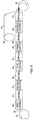
- FIG. 6 illustrates a process for constructing the decorative paint film laminate 14.
- a film carrier 33 is advanced from a supply roll 38 through a series of process steps.
- the film carrier 33 preferably comprises a polyester casting film having a high gloss surface.
- the film carrier 33 is important for high gloss applications because it imparts high gloss and DOI to the decorative paint film laminate 14.
- the film carrier 33 comprises polyethylene terephthalate (PET) in a grade without slip additives.
- PET polyethylene terephthalate
- the film carrier 33 is about 1 to about 3 mils in thickness, preferably about 2 mils in thickness.
- the film carrier 33 passes through a first coating station 40. If a decorative paint film 18 having multiple coatings is desired, the first coating station 40 may deposit the clear coat layer 22. The clear coat layer 22 then passes through a dryer 41. Next, the gloss and DOI retaining layer is deposited and dried by dryer 43. Thereafter, a color coat layer 24 is deposited on the gloss and DOI retaining layer 23 using coating station 44. The color coat layer 24 is then dried using dryer 46. Optionally, the dried color coat layer 24 can be subjected to a corona treatment (not shown).
- the coating stations 40, 42, and 44 may utilize any conventional coating or casting techniques, such as reverse roll coating or slot die coating techniques. Slot die coating methods are preferred.
- the dryers 41, 43, and 46 may utilize any conventional drying technique. Preferably, the dryers 41, 43, and 46 are ovens having multiple heating zones wherein each successive heating zone operates at a progressively higher temperature. For example, an oven having four to six heating zones ranging in temperature from about 200 °F to about 425 °F may be used. Alternatively, dryer 41 may be eliminated from the process such that the gloss and DOI retaining layer is applied to the clear coat 22 while the clear coat is still wet using a "wet on wet" coating technique.
- the film carrier advances to a primer coating station 48, where the primer layer 26 is deposited onto the exposed layer of the decorative paint film 18.
- the primer layer 26 is then dried using dryer 49.
- the film carrier advances to an adhesive coating station 50, where the adhesive layer 28 is deposited onto the primer layer 26.
- the adhesive layer 28 is dried using dryer 51.
- the primer coating station 48 and adhesive coating station 50 may utilize any conventional coating or casting technique, such as reverse roll coating or slot die coating techniques.
- the dryers 49 and 51 may utilize any conventional drying technique.
- dryer 49 may be eliminated from the process such that the adhesive layer 28 is applied to the primer layer 26 while the primer layer is still wet using a "wet on wet” coating technique known by one of ordinary skill in the art.
- the CPO/Primer can be coated directly on PET in a wet-on-wet process and then laminated using heat and pressure to the color layer of the paint film.
- a backing sheet 30 is advanced from a supply roll 52 and laminated to the adhesive-coated surface of the film carrier 33.
- the backing sheet 30 can be subjected to a corona treatment (not shown) prior to lamination.
- the resulting laminate is collected by product roll 54.
- the decorative paint film laminate 14 can be adhered to a supporting substrate 16 in accordance with known laminating or bonding techniques.
- a supporting substrate 16 include, but are not limited to, metal, wood, and molded polymer substrates.
- exterior automobile parts are particularly suitable as the substrate 16.
- Suitable polymers for use as the substrate 16 include, but are not limited to, thermoplastic olefin, acrylonitrile-butadiene-styrene terpolymer, polypropylene, thermoplastic polyimide, polyethylene oxide, polycarbonate, polyvinyl chloride, polystyrene, styrene/polyphenylene oxide (NORYEL), polybutylene terephthalate, nylon, PETG copolyester, Sheet Molding Compounds (SMC), RIM urethanes, mixtures, laminates, and copolymers thereof.
- the decorative paint film laminate 14 may be applied to the substrate 16 by a variety of methods. These methods include, but are not limited to, compression molding, such as thermoplastic or thermoset compression molding, injection molding and the like. In an injection molding process, the decorative paint film laminate 14 may be preformed as described below or placed in the mold as a substantially flat sheet. If the paint film laminate 14 is placed in the mold without preforming, the heat and/or pressure of the molding process conforms the paint film laminate to the desired shape.
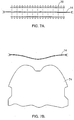
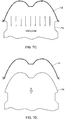
- FIGS. 7A-7D illustrate the steps in a thermoforming process.
- Thermoforming is often used to create a preform in a three-dimensional configuration that roughly approximates the three-dimensional configuration of the final product.
- Other forming processes known in the art may be used.
- the preform is then placed in a mold for in-mold surfacing of a desired substrate 16 to form the final product.
- FIG. 7A shows heating of the decorative paint film laminate 14 by heating elements 70. The heating step softens and increases the extensibility of the decorative paint film laminate 14 so that the paint film laminate will readily conform to the contoured outer surface of the mold 74. As shown in FIG.
- the mold 74 is brought into contact with the heated decorative paint film laminate 14 and a vacuum is drawn to encourage conformity of the paint film laminate 14 to the contours of the mold 74. Thereafter, the mold 74 is removed from the decorative paint film laminate 14 and the paint film laminate is allowed to cool and harden into the three-dimensional configuration.
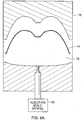
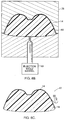
- FIGS. 8A-8C illustrate steps in an in-mold surfacing process.
- the thermoformed decorative paint film laminate 14 is placed in the mold cavity 78 of an injection mold 76.
- the decorative paint film laminate is placed in the mold cavity 78 with the clear coat layer 22 facing the inner surface of the injection mold 76.
- the decorative paint film laminate 14 may be placed in the mold cavity 78 as a flat, two-dimensional insert rather than as a preform.
- the injection mold 76 is shut and a moldable polymer 82 is introduced into the mold 76 through the injection mold barrel 80.
- the polymer 82 bonds to the backing sheet 30 and conforms to the contoured shape of the mold cavity 78.
- the moldable polymer 82 is allowed to cool and harden into a composite shaped part 12 comprising a substrate 16 bonded to a decorative paint film laminate 14, as shown in FIG. 8C .
- Clear coat compositions were prepared in accordance with the present invention and are identified as Clear Coat Compositions A and B, respectively. The component amounts are based upon the total weight of the composition being on a 1 gram basis.
- TINUVIN 292 and TINUVIN 928 were added in the MEK/Cyclohexanone solvent blend first. The additives were stirred until dissolved.
- ACRYLOID A11, ELVACITE 2042 and KYNAR SL were added into the mix and stirred with high shear until the resins were dissolved.
- Clear Coat Composition B KYNAR SL 0.09220 g TINUVIN 928 0.00946 g TINUVIN 292 0.00946 g ACRY 68080 0.43480 g Ethyl Acetate 0.45404 g
- TINUVIN 292 and TINUVIN 928 were added in Ethyl Acetate solvent first. The additives were stirred until dissolved. KYNAR SL was then added into the mix and stirred with high shear until the resins were dissolved. ACRY 68080 was then added into the mix slowly with high shear.
- Gloss and DOI Retaining Compositions were prepared in accordance with the present invention and are identified as Gloss and DOI Retaining Compositions A, B, C, and D, respectively. The component amounts are based upon the total weight of the composition being on a 1 gram basis.
- Gloss and DOI Retaining Composition A HD 4669 0.3902 g HD 2113 0.5854 g API-792 0.0244 g
- composition A the HD4669 and HD2113 were mixed, and then the cross-linker API-792 was added and mixed for another 15 minutes.
- Gloss and DOI Retaining Composition B DPNB 0.12675 g HYBRIDUR 580 0.77773 g Deionized Water 0.08385 g XAMA-7 0.01167 g
- Gloss and DOI Retaining Composition C DPNB 0.12675 g HYBRIDUR 580 0.69996 g AS 2505 0.07777 g Deionized Water 0.08385 g XAMA-7 0.01167 g
- Compositions B and C were prepared as set forth below in Composition D by preparing a Pre-Mix with Diproplene Glycol Butyl Ether (DPNB). Gloss and DOI Retaining Composition D Glycol Ether DPNB 0.11776 g SURFYNOL DF-58 0.00140 g BYK 346 0.00435 g INHB TINUVIN 0.00992 g BYK 333 0.00062 g HYBRIDUR 580 0.72329 g Deionized Water 0.13181 g CYMEL 385 0.01085 g
- DPNB Diproplene Glycol Butyl Ether
- Gloss and DOI Retaining Composition D was prepared by first preparing a Pre-Mix as follows. DPNB solvent commercially available from Lyondell Chemical Company of Houston, Texas was weighed into an appropriately-sized, grounded container. While stirring vigorously with high shear, TINUVIN 384 commercially available from Ciba Specilaty Chemicals of Tarrytown, NY was added to the container and measured accurately. Stirring was continued and BYK 346 commercially available from BYK Chemie of Germany was added. The container was rinsed with mix, and the rinse was added. Stirring was continued, and BYK 333 commercially available from BYK Chemie of Germany was added. The container was rinsed with mix, and the rinse was added.
- HYBRIDUR 580 commercially available from by Air Products of Allentown, PA was weighed out. Using a high shear mixer with an appropriately sized F-style Cowles blade (Vat-use 16" blade, Drum-use 8" blade), stirring was begun with a good vortex ( ⁇ 700 RPM). While stirring, the specified amount of the DPNB Pre-Mix was slowly poured. The DPNB caused the viscosity to rise, so the mixer speed was increased when adding the Pre-Mix, as necessary. One-third of the specified amount of deionized water was added. The vat was tightly covered with clear polyethylene film, and the mixture was stirred until the temperature reached 85° F. The time until temperature was reached was recorded.
- CYMEL 385 commercially available from Cytec Industries Inc. of West Paterson, NJ was added and stirring was continued. The remaining two-thirds of the deionized water was added and stirred for thirty additional minutes. The vat was kept covered with polyethylene film. The mix temperature was monitored closely and was not allowed to exceed 85° F. The completed mix required a minimum sit time of 72 hours prior to coating.
- Example 4 is illustrative of the preparation of a decorative paint film laminate and the thermoforming process.
- the paint film samples were made from a production machine of Soliant, LLC of Lancaster, SC. TPO adhesive was also coated onto the paint film on the production machine.
- the laminate samples were prepared by laminating the paint film with TPO adhesive to 30 mil TPO substrates using a lab laminator manufactured by Talboys Engineering Company of Emerson, NJ with the hop nip temperature of 360 °F. The lamination speed used was about 10 ft/min.
- the laminates were then thermoformed over a wood body side mold (Toyoto, 770 N body side mold) at 330 °F using a thermoformer manufactured by ZMD International, Inc, Model HD 333. Ninety percent (90%) of the maximum heat output was used for both top and bottom heat. The temperature was measured by an IR gun and from the substrate surface.
- Table 1 sets forth the recorded gloss and DOI measurements and provides a comparison of standard paint films with and without a mask, relative to the paint films of the present invention with and without a gloss and DOI retaining layer.
- the mask used for the experiments was Soliant Premask commercially available from. Soliant, LLC of Lancaster, SC.
- the clear coat for the standard FLUOREX ® paint film of Table 1 was made with the following formulation: ELVACITE 2042 0.11920 g KYNAR 500 0.30650 g DB ACETATE 0.18930 g DMP DIMETHYL PHTHALATE 0.18930 g XYLENE 0.18940 g TINUVIN 900 0.00630 g
- the color coat for the standard paint film used the above formulation as a clear base.
- the clear coat for paint film with and without gloss retaining layer used the formulation shown in Clear Coat Composition B.
- the gloss retaining layer used the formulation shown in Gloss and DOI Retaining Composition D.
- the clear base used for the color coat for the paint film with and without gloss retaining layer was the same as the one shown.
- the color formulations for each of the colors are commercially available from Soliant, LLC of Lancaster, SC.
- Table 1 demonstrates that the Paint Film with Gloss and DOI Retaining layer offers an improvement over the paint film with a mask. It is significant that the paint films with the Gloss and DOI retaining layer are able to get in the lower end of the 20 degree gloss range for traditional paint, which even paint films with a mask have been unable to achieve. Traditional paints typically have a 70+ number for 20 degree gloss.
Landscapes
- Life Sciences & Earth Sciences (AREA)
- Engineering & Computer Science (AREA)
- Wood Science & Technology (AREA)
- Laminated Bodies (AREA)
Description
- The present invention relates to a method to obtain a decorative paint film laminate that has high gloss and distinctness of image after processing without the use of a mask on the outer surface of the paint film, and a method for providing a decorative finish for a part, and a composite part obtainable thereby.
- Manufacturers have shown increasing interest in using paint film in lieu of spray painting for providing a decorative surface finish for parts such as automotive body parts. These parts can be manufactured using one or more of the following forming or molding processes: thermoforming, injection molding, or compression molding. In general, most processes using paint film such as thermoforming involve forming the film into a three dimensional shape and involve the use of heat and pressure. Depending upon a variety of factors including, for example, the geometry of an automobile body part, the automobile body part may or may not require an injection molding process, as long as the part is sturdy enough to facilitate the manufacturing process and is suitable for the intended end use application.
-
US5268215 describes a thermoformable decorative paint film laminate, for providing a decorative finish for e.g a vehicle part, the decorative paint film laminate comprising a polymeric backing sheet and a paint film, wherein the paint film comprises a transparent top coat layer, a clear layer, and a paint layer. Paint films have been used for many years in a variety of applications and uses. Current products tend to lose gloss and distinctness of image (DOI) when processed, such as thermoformed, especially in high stretch areas. In many of the current paint film applications, especially high stretch applications, this deficiency has been overcome with the use of a mask to achieve high gloss and DOI for the surface finishes during thermoforming. In order to maintain the gloss and DOI, the mask must have sufficient modulus at the thermoforming temperature to maintain the smooth surface finish. In these applications, a thermoformable mask film is applied and removably adhered to the clear coat surface of the decorative sheet before the thermoforming process. In many cases, the mask is removed and discarded during the part manufacturing process, for example, before the injection molding process. The materials and manufacturing process of the mask film add significant cost to the parts produced using paint film. In addition, the use of the mask, in some cases, complicates the forming and molding processes. For example, the mask may need to be removed before an injection molding process to prevent the difficulty of removal after the parts are molded. The mask may be difficult to remove because it has been stretched substantially and becomes prone to tear and must be removed in pieces adding significant labor and possible contamination in subsequent processing. Furthermore, to date, known masked paint films have not been able to achieve a 20° gloss that is within the lower gloss range of traditional paints. Therefore, the present invention attempts to address and solve these problems. - The present invention relates to a method to obtain a decorative paint film laminate having improved high gloss and distinctness of image (DOI) after processing without the use of a mask on the outer surface of the paint film. The decorative paint film laminate basically comprises a gloss and DOI retaining layer in addition to a clear coat layer and a color coat layer. The gloss and DOI retaining layer functions an "internal" mask and has, among other properties, excellent clarity, good adhesion to both clear and color layers, good weatherability, and thermoformability.
- The decorative paint film laminate comprises a paint film having an inner surface and an outer surface, and a backing sheet applied to the inner surface of the paint film. The paint film comprises a clear coat layer, a gloss and DOI retaining layer, and a color coat layer. The paint film may optionally comprise any of a color adjustment layer, a primer layer, and an adhesive layer. Also within the scope of the present invention is a method for providing a decorative finish for a part, and a composite part obtainable thereby.
- Further areas of applicability of the present invention will become apparent from the detailed description provided hereinafter. It should be understood that the detailed description and specific examples, while indicating the preferred embodiment of the invention, are intended for purposes of illustration only and are not intended to limit the scope of the invention.
- The present invention will become more fully understood from the detailed description and the accompanying drawings, wherein:
-
FIG. 1 is a perspective view of an automobile illustrating the front fascia of an automobile having a decorative paint film applied thereto; -
FIG. 2 is a front view of an automobile front fascia having a decorative paint film applied thereto; -
FIG. 3 is a cross-sectional view of the fascia shown inFIG. 2 taken alongline 3--3 ofFIG. 2 ; -
FIG. 4 is a cross-sectional view of the decorative paint film laminate adhered to a substrate; -
FIG. 5 is a cross-sectional view of the decorative paint film laminate including a clear coat layer, gloss and DOI retaining layer, a color adjustment layer, and a color coat layer; -
FIG. 6 is a schematic illustration of a process for construction of the decorative paint film laminate in accordance with the present invention; -
FIGS. 7A-7D are schematic illustrations of the steps in a thermoforming process used to construct a preform; and -
FIGS. 8A-8C are schematic illustrations of steps in an injection molding process for forming a composite shaped part. - The present invention will now be described more fully hereinafter with reference to the accompanying drawings. The following description of the preferred embodiment(s) is merely exemplary in nature and is in no way intended to limit the invention, its application, or uses.
- The decorative paint film laminate disclosed in this application eliminates the need for a mask on the outer surface of a paint film in order to make a part, such as an automobile part, having high gloss and distinctness of image (DOI) using paint film technology. The term "mask", as defined herein, refers to any material that is adhered to, removably or otherwise, to the outer surface of a paint film: Elimination of the need for a mask on the outer surface of a paint film simplifies the manufacturing process during forming and molding processes and also reduces the cost of materials for making a part.
- Referring now to the accompanying drawings and initially to
Fig.1 , the decorative paint film laminate is indicated inFig. 1 byreference numeral 14 and basically comprises a clear coat layer, a gloss and DOI retaining layer, a color coat layer, an optional primer layer, an optional adhesive layer, and a backing sheet. -
FIG. 1 illustrates anautomobile 10 having a composite shapedpart 12. As shown, the composite shapedpart 12 is a complex, contoured three-dimensional front fascia of theautomobile 10. The composite shapedpart 12 has a decorativepaint film laminate 14 applied thereto. Although not limited to such applications, the decorativepaint film laminate 14 is particularly advantageous for providing a decorative surface on a composite shapedpart 12 of anautomobile 10. However, those skilled in the art will appreciate that the present invention could be used in a variety of applications requiring a decorative surface having high gloss and DOI. -
FIG. 2 is a front view of the composite shapedpart 12 having the decorativepaint film laminate 14 applied thereto.FIG. 3 is a cross-sectional side view of the composite shapedpart 12 comprising asubstrate 16 having a decorativepaint film laminate 14 applied thereto. As illustrated inFIG. 3 , the decorativepaint film laminate 14 undergoes different amounts of elongation at different points along the contoured surface of the composite shapedpart 12. In one embodiment, the decorativepaint film laminate 14 of the present invention has a three-dimensional configuration in which certain areas of the paint film laminate have been subjected to elongation up to, and even in excess of, about 300%, and other areas of the paint film laminate are substantially non-elongated. The decorativepaint film laminate 14 is capable of maintaining not only a uniform level of gloss but also a high level of gloss, regardless of the amount of elongation experienced by the decorativepaint film laminate 14 during a forming or molding process. -
FIG. 4 shows a greatly expanded cross-sectional view of a composite shapedpart 12 of the present invention comprising a decorativepaint film laminate 14 adhered to asubstrate 16. The decorativepaint film laminate 14 includes aclear coat layer 22, a gloss andDOI retaining layer 23, acolor coat layer 24, anoptional primer layer 26, an optionaladhesive layer 28, and abacking sheet 30. - The decorative
paint film laminate 14 not only retains both high gloss and DOI during forming and molding processes in the absence of a mask on the outer surface of the paint film but also improves the gloss and DOI of the paint film due to the presence of the gloss and DOI retaining layer. Examples of forming processes include, but are not limited to, thermoforming, cold stretching, and vacuum forming. Examples of molding processes include, but are not limited to, injection molding, compression molding, and blow molding. - Current commercial paint film products utilize a removable, thermoformable mask to minimize the gloss and DOI reduction during the thermoforming or molding processes. In those situations, the mask layer is the outer layer of the decorative paint film laminate. The
clear coat layer 22 in the present invention is the outer layer of the decorativepaint film laminate 14 during construction of the final product, such as an automobile. Therefore, a benefit of the decorative paint film laminate disclosed in this application is enhanced gloss and DOI of the paint film despite the absence of a mask layer on the outer surface of the paint film. Thus, the present invention is advantageous not only because no mask is needed, but also because the gloss and DOI of the paint film are enhanced with the presence of the gloss and DOI retaining layer as compared to a paint film with a mask but no gloss and DOI retaining layer. Furthermore, there are no material, manufacturing, labor or other costs incurred due to the presence and ultimate removal of a mask from the clear coat layer. When a mask is used, the mask layer must be releasably bonded to the underlying decorative paint film and must be stripped away from the underlying layers in a single piece. The decorative paint film laminate disclosed in this application eliminates the need for a mask. - The weatherable outer surface of a standard paint film has an initial 20 and 60 degree gloss of at least about "60" in dry film form. After thermoforming the dry film laminate, the 20 degree gloss and 60 degree gloss may decline by 50% or more in high stretch applications. Adhering a mask layer to the paint film may improve the 20 degree and 60 degree gloss retention but still shows gloss loss during the forming process, especially the 20 degree gloss. Industry standards typically require that the 20 degree gloss and 60 degree gloss be above 60 for many applications. However, the desired final gloss value of the paint film will vary depending on the application. In contrast, the decorative paint film laminate disclosed in this application has enhanced high gloss and DOI as compared to a standard paint film laminate with a mask.
-
Fig. 4 andFIG. 5 are greatly expanded cross-sectional views of the decorativepaint film laminate 14. As shown inFIGS. 4 and5 , thedecorative paint film 18 may comprise aclear coat layer 22, a gloss andDOI retaining layer 23, an optional color adjustment layer 27 (shown inFIG. 5 ), and acolor coat layer 24. Theclear coat layer 22 is formed from a substantially transparent weatherable, UV protective polymer composition selected to provide a film which will not significantly fade, peel, crack, or chalk when exposed to the environment for the intended life of thepart 12 or fulfill other characteristics desired such as toughness, scratch resistance, and marr resistance, for example. Additionally, theclear coat layer 22 must be formable from a two-dimensional surface to a three-dimensional surface without objectionable loss of appearance or performance properties. Theclear coat layer 22 may include, but is not limited to: urethane polymers such as polyurethane; acrylic polymers; fluoropolymers such as polyvinyl fluoride (PVF) and polyvinylidene fluoride (PVDF); and alloys of a fluoropolymer and an acrylic polymer. TEDLAR® manufactured by DuPont of Wilmington, DE is an example of a polyvinyl fluoride. FLUOREX® films manufactured by Soliant, LLC of Lancaster, SC are examples of alloys of a fluoropolymer and an acrylic polymer such as a PVDF/acrylic alloy. Theclear coat layer 22 may include other additives including, but not limited to, UV screeners, antioxidants, heat stabilizers, and other conventional additives. Preferably, theclear coat layer 22 is about 0.3 mils to about 3 mils in thickness, more preferably from about 0.5 mils to about 2.5 mils in thickness. Preferably, the clear coat layer is applied in the form of a solution. - In one embodiment, the outermost layer of the
paint film 18, such as theclear coat layer 22, comprises an alloy of a fluoropolymer and an acrylic polymer. For example, the alloy of fluoropolymer and acrylic polymer may comprise about 30 to about 70 weight percent fluoropolymer, and about 30 to about 70 weight percent acrylic polymer on a dry solids basis. A commercially available fluoropolymer is KYNAR SL manufactured by Arkema, Inc. of Philadelphia, PA. Commercially available acrylic polymers are Elvacite 2041 manufactured by INEOS Acrylics of Cordova, TN and Acryloid A11 manufactured by Rohm & Haas of Philadelphia, PA. - The gloss and
DOI retaining layer 23 serves as an "internal mask" such that the decorativepaint film laminate 14 has improved high gloss and DOI as compared to the use of a mask on the outer surface of a paint film. The composition of the gloss andDOI retaining layer 23 is selected such that the tensile strength of the gloss and DOI retaining layer is the same as or higher than the higher of the tensile strength of either the clear coat layer or the color coat layer at the thermoforming temperature. More preferably, the gloss and DOI retaining layer has a tensile strength that is higher than the higher of the tensile strength of either the clear coat layer or the color coat layer at the thermoforming temperature. The thermoforming temperature varies depending upon the composition of the materials selected for use in the layers. However, the thermoforming temperature would be known to one of ordinary skill in the art for a given material. The term "thermoforming temperature", as used herein, refers to the temperature at which a thermoplastic material is shaped or formed. Therefore, materials suitable for use in the gloss and DOI retaining layer may include, but are not limited to, urethanes, acrylics, fluoropolymers, nylons, alloys or combinations thereof. An example of a preferred urethane includes, but is not limited to, polyurethane. Examples of preferred fluoropolymers include, but are not limited to, polyvinylidene fluoride (PVDF), polyvinyl fluoride (PVF) and alloys or combinations thereof. TEDLAR® is an example of a polyvinyl fluoride manufactured by DuPont of Wilmington, DE. - The gloss and DOI retaining layer may be applied, for example, in the form of a dispersion or a solution. The gloss and DOI retaining layer is preferably cast or coated. The gloss and DOI retaining layer is preferably about 0.2 mils to about 2.0 mils in thickness.
- A cross-linking agent may be used in the gloss and DOI retaining layer. Examples of cross-linking agents include, but are not limited to, poly-aziridine, poly-isocyanate, blocked poly-isocyanate, and amino cross-linking agents. XAMA 7 is an example of a commercially available poly-aziridine cross-linking agent manufactured by Bayer Corp. of Pittsburgh, PA. API - 972 is an example of a commercially available blocked isocyanate manufactured by Advanced Polymer, Inc. of Carlstadt, NJ. The level of cross-linking agent may vary from 0.1 to 4.0 percent of the solids of the formulation.
- Commercially available examples of polyurethane polymers may include, cross-linkable polyurethane dispersions such as HYBRIDUR 580 and HYBRIDUR 870, both manufactured by Air Products of Allentown, PA; HD 4669 and HD 2113, both manufactured by C.L. Hauthaway and Sons Corporation of Lynn, MA.
- Commercially available examples of acrylic polymers used for solvent casting may include, but are not limited to, ELVACITE 2041, ELVACITE 2014 and ELVACITE 2552, all of which are manufactured by INEOS Acrylics of Cordova, TN; and Br85, manufactured by Dianal America, Inc. of Pasadena, TX.
- Commercially available acrylic dispersions suitable for use in this invention include, but are not limited to, AS 2505 and AS 2511, both manufactured by Alberdingk Boley, Inc. of Charlotte, NC.
- The
color coat layer 24 is formed of a polymer composition comprising a uniformly dispersed pigment and/or metallic flakes or pearlescents to provide the appearance necessary for exterior automobile use. Preferably, thecolor coat layer 24 may comprise a polymer selected from the group consisting of urethanes such as polyurethane, acrylics, fluoropolymers such as PVDF, and alloys and combinations thereof. FLUOREX® films manufactured by Soliant, LLC of Lancaster, SC are examples of alloys of a fluoropolymer and an acrylic polymer. Thecolor coat layer 24 may include pigments, dyes, and/or flakes to enhance visual appearance and improve weatherability. Preferably, thecolor coat layer 24 is about 0.2 to about 3 mils in thickness, more preferably 0.2 mils to 2.5 mils in thickness. - If desired, a
color adjustment layer 27 may be added between theclear coat layer 22 and thecolor coat layer 24 to enhance visual appearance, preferably between the gloss and DOI retaining layer and the color coat layer. Thecolor adjustment layer 27 can be applied in coating form and may include pigments, dyes and/or flakes or applied as a graphic design using printing methods such as gravure, rotary screen, flat bed step-and-repeat screen, ink jet, flexographic or other printing techniques. This layer is typically used for appearance purposes to match three layer paint systems. - The
primer layer 26 is an optional layer that improves adhesion between thecolor coat layer 24 and theadhesive layer 28. Theprimer layer 26 preferably comprises an acrylic polymer prepared in solution using any compatible solvent known in the art, such as toluene. In one embodiment, theprimer layer 26 is prepared from a solution comprising about 50 to about 85 weight percent acrylic composition and about 5 to about 20 weight percent solvent. An acrylic polymer suitable for use in theprimer layer 26 is acrylic adhesive 68070 manufactured by DuPont. Theprimer layer 26 may be opaque, colored or clear. Opaque is defined as less than 1 percent transmission at a wavelength of less than 400.nm. Theprimer layer 26 is preferably about 0.2 to about 2 mils in thickness. Theprimer layer 26 may be colored or opaque to protect theunderlying backing sheet 30 from damage caused by UV exposure. Pigments, such as carbon black, titanium oxide, and mixtures thereof, may be added to impart color to the acrylic polymer composition used in theprimer layer 26. Additionally, additives such as UV screeners, antioxidants, and heat stabilizers may be added to theprimer layer 26. - An
optional adhesive layer 28 may be used to adhere thedecorative paint film 18 to abacking sheet 30. The composition of the adhesive depends upon, among other factors, the chemistry of color layer and the type of backing sheet used. For certain substrates such as ABS and polystyrene substrates, the presence of the adhesive layer is often not preferred. However, for other backing sheets such as thermoplastic polyolefin (TPO), an adhesive layer may be preferred. An example of a suitable adhesive for TPO is an acrylic primer/CPO adhesive. - The
adhesive layer 28 may include, but is not limited to, one or more layers of urethane adhesives, acrylic adhesives, acrylic adhesives with cross linkers, chlorinated polyolefins and mixtures thereof. Preferably, a mixture of a chlorinated polypropylene and a higher molecular weight chlorinated polyolefin is used. In one embodiment, theadhesive layer 28 is prepared from a mixture of about 5 to about 20 weight percent chlorinated polypropylene and about 1 to about 10 weight percent of a higher molecular weight chlorinated polypropylene formed in solution. A compatible solvent known in the art, such as toluene, is present in an amount of about 60 to about 80 weight percent. A chlorinated polypropylene suitable for use with the present invention is HARDLEN 13 LP manufactured by Advanced Polymer. A higher molecular weight chlorinated polyolefin suitable for use with the present invention is SUPERCHLON 822S manufactured by CP/Phibrochem of Fort Lee, N.J. Theadhesive layer 28 should preferably be capable of stretching about 20 to about 600 percent. - Due to the substantial elongation capability of the
adhesive layer 28, the adhesive layer maintains the necessary adhesive strength to prevent delamination of thedecorative paint film 18 from thebacking sheet 30 over a wide temperature range. - An epoxy component, such as EPON 828RS manufactured by Shell Chemical, may be added in small amounts (approximately about 0.1 to about 2.0 weight percent on a dry solids basis) as an acid scavenger. As with the
primer layer 26, theadhesive layer 28 may be colored or opaque to protect the underlyingthermoformable backing sheet 30 from damage caused by UV exposure. Pigments, such as carbon black, titanium oxide, and mixtures thereof, may be added to impart color to the polymer composition used in theadhesive layer 28. Additives including, but not limited to, UV screeners, antioxidants, and heat stabilizers may be added to theadhesive layer 28. Preferably, theadhesive layer 28 is about 0.2 to about 2 mils in thickness. - The
backing sheet 30 bonds thedecorative paint film 18 of the decorativepaint film laminate 14 to thesubstrate 16. In addition, thebacking sheet 30 provides bulk and/or rigidity for handling the decorativepaint film laminate 14 as a thermoformed preform. Thebacking sheet 30 also provides thickness to prevent glass fibers, fillers or other sources of visual roughening or "orange peel" from thesubstrate 16 from affecting the visual appearance of the decorativepaint film laminate 14. Thebacking sheet 30 must bond well with both thesubstrate 16 and theadhesive layer 28. Thebacking sheet 30 may be of a material including, but not limited to, thermoplastic polyolefin, acrylonitrile-butadiene-styrene (ABS) terpolymer, polypropylene, polyethylene, thermoplastic polyimide, polyethylene oxide, polycarbonate, polyvinyl chloride, polystyrene, styrene/polyphenylene oxide (NORYEL), polybutylene terephthalate, nylon, PETG copolyester, and mixtures, laminates, copolymers and other combinations thereof, depending on the material used as thesubstrate 16. -
FIG. 6 illustrates a process for constructing the decorativepaint film laminate 14. As shown, afilm carrier 33 is advanced from asupply roll 38 through a series of process steps. Thefilm carrier 33 preferably comprises a polyester casting film having a high gloss surface. Thefilm carrier 33 is important for high gloss applications because it imparts high gloss and DOI to the decorativepaint film laminate 14. Advantageously, thefilm carrier 33 comprises polyethylene terephthalate (PET) in a grade without slip additives. Thefilm carrier 33 is about 1 to about 3 mils in thickness, preferably about 2 mils in thickness. - The
film carrier 33 passes through afirst coating station 40. If adecorative paint film 18 having multiple coatings is desired, thefirst coating station 40 may deposit theclear coat layer 22. Theclear coat layer 22 then passes through adryer 41. Next, the gloss and DOI retaining layer is deposited and dried bydryer 43. Thereafter, acolor coat layer 24 is deposited on the gloss andDOI retaining layer 23 usingcoating station 44. Thecolor coat layer 24 is then dried usingdryer 46. Optionally, the driedcolor coat layer 24 can be subjected to a corona treatment (not shown). - The
coating stations dryers dryers dryer 41 may be eliminated from the process such that the gloss and DOI retaining layer is applied to theclear coat 22 while the clear coat is still wet using a "wet on wet" coating technique. - After the
decorative paint film 18 is applied to thefilm carrier 33, the film carrier advances to aprimer coating station 48, where theprimer layer 26 is deposited onto the exposed layer of thedecorative paint film 18. Theprimer layer 26 is then dried usingdryer 49. Thereafter, the film carrier advances to anadhesive coating station 50, where theadhesive layer 28 is deposited onto theprimer layer 26. Thereafter, theadhesive layer 28 is dried usingdryer 51. Theprimer coating station 48 andadhesive coating station 50 may utilize any conventional coating or casting technique, such as reverse roll coating or slot die coating techniques. Thedryers dryer 49 may be eliminated from the process such that theadhesive layer 28 is applied to theprimer layer 26 while the primer layer is still wet using a "wet on wet" coating technique known by one of ordinary skill in the art. Alternatively, the CPO/Primer can be coated directly on PET in a wet-on-wet process and then laminated using heat and pressure to the color layer of the paint film. - A
backing sheet 30 is advanced from asupply roll 52 and laminated to the adhesive-coated surface of thefilm carrier 33. Optionally, thebacking sheet 30 can be subjected to a corona treatment (not shown) prior to lamination. The resulting laminate is collected byproduct roll 54. - The decorative
paint film laminate 14 can be adhered to a supportingsubstrate 16 in accordance with known laminating or bonding techniques. Illustrative examples of supportingsubstrates 16 include, but are not limited to, metal, wood, and molded polymer substrates. As explained above, exterior automobile parts are particularly suitable as thesubstrate 16. Suitable polymers for use as thesubstrate 16 include, but are not limited to, thermoplastic olefin, acrylonitrile-butadiene-styrene terpolymer, polypropylene, thermoplastic polyimide, polyethylene oxide, polycarbonate, polyvinyl chloride, polystyrene, styrene/polyphenylene oxide (NORYEL), polybutylene terephthalate, nylon, PETG copolyester, Sheet Molding Compounds (SMC), RIM urethanes, mixtures, laminates, and copolymers thereof. - The decorative
paint film laminate 14 may be applied to thesubstrate 16 by a variety of methods. These methods include, but are not limited to, compression molding, such as thermoplastic or thermoset compression molding, injection molding and the like. In an injection molding process, the decorativepaint film laminate 14 may be preformed as described below or placed in the mold as a substantially flat sheet. If thepaint film laminate 14 is placed in the mold without preforming, the heat and/or pressure of the molding process conforms the paint film laminate to the desired shape. -
FIGS. 7A-7D illustrate the steps in a thermoforming process. Thermoforming is often used to create a preform in a three-dimensional configuration that roughly approximates the three-dimensional configuration of the final product. However, other forming processes known in the art may be used. The preform is then placed in a mold for in-mold surfacing of a desiredsubstrate 16 to form the final product.FIG. 7A shows heating of the decorativepaint film laminate 14 byheating elements 70. The heating step softens and increases the extensibility of the decorativepaint film laminate 14 so that the paint film laminate will readily conform to the contoured outer surface of themold 74. As shown inFIG. 7C , themold 74 is brought into contact with the heated decorativepaint film laminate 14 and a vacuum is drawn to encourage conformity of thepaint film laminate 14 to the contours of themold 74. Thereafter, themold 74 is removed from the decorativepaint film laminate 14 and the paint film laminate is allowed to cool and harden into the three-dimensional configuration. -
FIGS. 8A-8C illustrate steps in an in-mold surfacing process. As shown inFIG. 8A , the thermoformed decorativepaint film laminate 14 is placed in themold cavity 78 of aninjection mold 76. The decorative paint film laminate is placed in themold cavity 78 with theclear coat layer 22 facing the inner surface of theinjection mold 76. Alternatively, the decorativepaint film laminate 14 may be placed in themold cavity 78 as a flat, two-dimensional insert rather than as a preform. Theinjection mold 76 is shut and amoldable polymer 82 is introduced into themold 76 through theinjection mold barrel 80. Thepolymer 82 bonds to thebacking sheet 30 and conforms to the contoured shape of themold cavity 78. Thereafter, themoldable polymer 82 is allowed to cool and harden into a composite shapedpart 12 comprising asubstrate 16 bonded to a decorativepaint film laminate 14, as shown inFIG. 8C . - Clear coat compositions were prepared in accordance with the present invention and are identified as Clear Coat Compositions A and B, respectively. The component amounts are based upon the total weight of the composition being on a 1 gram basis.
Clear Coat Composition A TINUVIN 292 0.01184 g TINUVIN 928 0.01184 g ACRYLOID A11 0.15387 g ELVACITE 2041 0.03957 g KYNAR SL 0.08288 g MEK 99.4% 0.59500 g Cyclohexanone 0.10500 g - For the above formulation, TINUVIN 292 and TINUVIN 928 were added in the MEK/Cyclohexanone solvent blend first. The additives were stirred until dissolved. ACRYLOID A11, ELVACITE 2042 and KYNAR SL were added into the mix and stirred with high shear until the resins were dissolved.
Clear Coat Composition B KYNAR SL 0.09220 g TINUVIN 928 0.00946 g TINUVIN 292 0.00946 g ACRY 68080 0.43480 g Ethyl Acetate 0.45404 g - For the above formulation the TINUVIN 292 and TINUVIN 928 were added in Ethyl Acetate solvent first. The additives were stirred until dissolved. KYNAR SL was then added into the mix and stirred with high shear until the resins were dissolved. ACRY 68080 was then added into the mix slowly with high shear.
- Gloss and DOI Retaining Compositions were prepared in accordance with the present invention and are identified as Gloss and DOI Retaining Compositions A, B, C, and D, respectively. The component amounts are based upon the total weight of the composition being on a 1 gram basis.
Gloss and DOI Retaining Composition A HD 4669 0.3902 g HD 2113 0.5854 g API-792 0.0244 g - In Composition A, the HD4669 and HD2113 were mixed, and then the cross-linker API-792 was added and mixed for another 15 minutes.
Gloss and DOI Retaining Composition B DPNB 0.12675 g HYBRIDUR 580 0.77773 g Deionized Water 0.08385 g XAMA-7 0.01167 g Gloss and DOI Retaining Composition C DPNB 0.12675 g HYBRIDUR 580 0.69996 g AS 2505 0.07777 g Deionized Water 0.08385 g XAMA-7 0.01167 g - Compositions B and C were prepared as set forth below in Composition D by preparing a Pre-Mix with Diproplene Glycol Butyl Ether (DPNB).
Gloss and DOI Retaining Composition D Glycol Ether DPNB 0.11776 g SURFYNOL DF-58 0.00140 g BYK 346 0.00435 g INHB TINUVIN 0.00992 g BYK 333 0.00062 g HYBRIDUR 580 0.72329 g Deionized Water 0.13181 g CYMEL 385 0.01085 g - Gloss and DOI Retaining Composition D was prepared by first preparing a Pre-Mix as follows. DPNB solvent commercially available from Lyondell Chemical Company of Houston, Texas was weighed into an appropriately-sized, grounded container. While stirring vigorously with high shear, TINUVIN 384 commercially available from Ciba Specilaty Chemicals of Tarrytown, NY was added to the container and measured accurately. Stirring was continued and BYK 346 commercially available from BYK Chemie of Germany was added. The container was rinsed with mix, and the rinse was added. Stirring was continued, and BYK 333 commercially available from BYK Chemie of Germany was added. The container was rinsed with mix, and the rinse was added. Stirring was continued, and SURFYNOL DF-58 commercially available from Air Product and Chemicals of Allentown, PA was added. The container was rinsed with mix, and the rinse was added. The Pre-Mix was stirred for a minimum of 15 minutes or until all components were completely dissolved.
- After preparation of the Pre-Mix, HYBRIDUR 580 commercially available from by Air Products of Allentown, PA was weighed out. Using a high shear mixer with an appropriately sized F-style Cowles blade (Vat-
use 16" blade, Drum-use 8" blade), stirring was begun with a good vortex (∼700 RPM). While stirring, the specified amount of the DPNB Pre-Mix was slowly poured. The DPNB caused the viscosity to rise, so the mixer speed was increased when adding the Pre-Mix, as necessary. One-third of the specified amount of deionized water was added. The vat was tightly covered with clear polyethylene film, and the mixture was stirred until the temperature reached 85° F. The time until temperature was reached was recorded. CYMEL 385 commercially available from Cytec Industries Inc. of West Paterson, NJ was added and stirring was continued. The remaining two-thirds of the deionized water was added and stirred for thirty additional minutes. The vat was kept covered with polyethylene film. The mix temperature was monitored closely and was not allowed to exceed 85° F. The completed mix required a minimum sit time of 72 hours prior to coating. - The following color coat compositions were prepared by starting with a clear base. An example of the clear base for the color coat is set forth below.
Clear Base for the Base Coat ELVACITE 2042 0.24000 g MEK 99.4% 0.42000 g XYLENE 0.17165 g TINUVIN 123 0.00278 g TINUVIN 900 0.00557 g ELVACITE R4402 0.16000 g Black Color Formulation ACRY BLK B 14276-M139 0.10666 g ACRY WH W14276 M70 0.00444 g ACRYLIC CLEAR BASE 0.88890 g White Color Formulation ACRY WH W14276 M70 0.19977 g ACRY 29Y1038 TRANS YELL 0.00111 g ACRYLIC CLEAR BASE 0.79912 g D4D Acrylic Glossy Silver ACRYLIC CLEAR BASE 0.90400 g ALUM PASTE 3201 0.08000 g DISP ACRY WH W14276 M70 0.01200 g ACRY BLK B14276-M139 0.00400 g - Example 4 is illustrative of the preparation of a decorative paint film laminate and the thermoforming process.
- The paint film samples (clear coat/color coat or clear coat/gloss retaining layer/color coat) were made from a production machine of Soliant, LLC of Lancaster, SC. TPO adhesive was also coated onto the paint film on the production machine. The laminate samples were prepared by laminating the paint film with TPO adhesive to 30 mil TPO substrates using a lab laminator manufactured by Talboys Engineering Company of Emerson, NJ with the hop nip temperature of 360 °F. The lamination speed used was about 10 ft/min. The laminates were then thermoformed over a wood body side mold (Toyoto, 770 N body side mold) at 330 °F using a thermoformer manufactured by ZMD International, Inc, Model HD 333. Ninety percent (90%) of the maximum heat output was used for both top and bottom heat. The temperature was measured by an IR gun and from the substrate surface.
- Gloss and DOI were recorded before and after thermoforming. The gloss was measured by the Micro-Tri-Gloss meter manufactured by BYK Gardner located in Columbia, MD. The DOI reading was obtained by using the I2R Glow Box, Model GB11-8 GM, manufactured by Instrument for Research and Industry, located at Cheltenham, Pennsylvania.
- Table 1 sets forth the recorded gloss and DOI measurements and provides a comparison of standard paint films with and without a mask, relative to the paint films of the present invention with and without a gloss and DOI retaining layer. The mask used for the experiments was Soliant Premask commercially available from. Soliant, LLC of Lancaster, SC.
Table 1 Before thermoforming After thermoforming Royal Ruby Red 20° Gloss 60° Gloss DOI (%) 20° Gloss 60° Gloss DOI (%) Standard FLUOREX® Paint Film w/o mask 63 76 80 21 67 10 Standard FLUOREX® Paint Film with mask 63 76 80 52 76 60 Paint Film without Gloss and DOI Retaining Layer 80 86 80 31 78 10 Paint Film with Gloss and DOI Retaining Layer 74 83 90 68 83 90 Bright Silver 20° Gloss 60° Gloss DOI (%) 20° Gloss 60° Gloss DOI (%) Standard FLUOREX® Paint Film w/o mask 68 90 60 30 79 0 Standard FLUOREX® Paint Film with mask 68 90 60 50 87 20 Paint Film without Gloss and DOI Retaining Layer 84 100 70 34 94 0 Paint Film with Gloss and DOI Retaining Layer 81 100 80 79 100 50 Tarnish Silver 20° Gloss 60° Gloss DOI (%) 20° Gloss 60° Gloss DOI (%) Standard FLUOREX® Paint Film w/out mask 71 89 70 39 82 10 Standard FLUOREX® Paint Film with mask 71 89 70 47 83 20 Paint Film without Gloss and DOI Retaining Layer 78 89 70 19 66 0 Paint Film with Gloss and DOI Retaining Layer 77 95 70 72 95 40 - The clear coat for the standard FLUOREX® paint film of Table 1 was made with the following formulation:
ELVACITE 2042 0.11920 g KYNAR 500 0.30650 g DB ACETATE 0.18930 g DMP DIMETHYL PHTHALATE 0.18930 g XYLENE 0.18940 g TINUVIN 900 0.00630 g - The color coat for the standard paint film used the above formulation as a clear base. The clear coat for paint film with and without gloss retaining layer used the formulation shown in Clear Coat Composition B. The gloss retaining layer used the formulation shown in Gloss and DOI Retaining Composition D. The clear base used for the color coat for the paint film with and without gloss retaining layer was the same as the one shown. The color formulations for each of the colors (Ruby Red, Bright Silver and Tarnish Silver) are commercially available from Soliant, LLC of Lancaster, SC.
- Table 1 demonstrates that the Paint Film with Gloss and DOI Retaining layer offers an improvement over the paint film with a mask. It is significant that the paint films with the Gloss and DOI retaining layer are able to get in the lower end of the 20 degree gloss range for traditional paint, which even paint films with a mask have been unable to achieve. Traditional paints typically have a 70+ number for 20 degree gloss.
Claims (15)
- A process for providing a decorative finish for a part, comprising a step of thermoforming of a decorative paint film laminate (14) at a thermoforming temperature, the decorative paint film laminate comprising: a paint film having an inner surface and an outer surface with no mask adhered to the outer surface, and a backing sheet (30) applied to the inner surface of the paint film, wherein the paint film comprises a clear coat layer (22), a gloss and distinctness of image retaining layer (23), and a color coat layer (24), and wherein the gloss and distinctness of image retaining layer (23) has a tensile strength that is the same as or higher than the higher of the tensile strength of either the clear coat layer (22) or the color coat layer (24) at the thermoforming temperature.
- The process according to claim 1, wherein the gloss and distinctness of image retaining layer (23) has a tensile strength that is higher than the higher of the tensile strength of either the clear coat layer (22) or the color coat layer (24) at the thermoforming temperature.
- The process according to claim 1, wherein the gloss and distinctness of image retaining layer (23) comprises a polymer selected from the group consisting of urethane, acrylic, fluoropolymer, nylon, an alloy thereof, and a combination thereof.
- The process according to claim 3, wherein the fluoropolymer is polyvinylidene fluoride, polyvinyl fluoride, an alloy thereof, or a combination thereof.
- The process according to any one of the preceding claims, wherein the gloss and distinctness of image retaining layer (23) is present between the clear coat layer (22) and the color coat layer (24) of the paint film.
- The process according to any one of the preceding claims, wherein the paint film further comprises a color adjustment layer (27).
- The process according to claim 6, wherein the color adjustment layer (27) is present between the gloss and distinctness of image retaining layer (22) and the color coat layer (24).
- The process according to any one of the preceding claims, wherein the gloss and distinctness of image retaining layer (23) is 0.2 mils to 2.0 mils in thickness.
- The process according to any one of the preceding claims, wherein the gloss and distinctness of image retaining layer (23) further comprises a cross-linking agent.
- The process according to claim 9, wherein the cross-linking agent is selected from the group consisting of poly-aziridine, poly-isocyanate, blocked poly-isocyanate, and amino cross-linking agents.
- The process according to claim 9 or 10, wherein the cross-linking agent is present in an amount from 0.1 to 4.0 weight percent.
- The process according to any one of the preceding claims, further comprising a primer layer (26).
- The process according to any one of the preceding claims, further comprising an adhesive layer (28).
- A composite shaped part, comprising a substrate and a decorative paint film laminate (14), obtainable by a process according to any of claims 1 to 13.
- A method of making a decorative paint film laminate (14) having high gloss and distinctness of image after processing for providing a decorative finish for a part, the method comprising: obtaining a paint film thermoformable at a thermoforming temperature, the paint film having an inner surface and an outer surface, the paint film comprising a clear coat layer (22) as the outer surface, a color coat layer (24), and a gloss and distinctness of image retaining layer (23) between the clear coat layer (22) and the color coat layer (24), the gloss and distinctness of image retaining layer (23) having a tensile strength the same as or higher than the higher of the tensile strength of either the clear coat layer (22) or the color layer (24) at the thermoforming temperature; and applying a backing sheet (30) to the inner surface of the paint film.
Applications Claiming Priority (2)
| Application Number | Priority Date | Filing Date | Title |
|---|---|---|---|
| US11/283,242 US7854985B2 (en) | 2005-11-18 | 2005-11-18 | Decorative paint film laminate |
| PCT/US2006/044502 WO2007059282A1 (en) | 2005-11-18 | 2006-11-15 | Decorative paint film laminate |
Publications (2)
| Publication Number | Publication Date |
|---|---|
| EP1948262A2 EP1948262A2 (en) | 2008-07-30 |
| EP1948262B1 true EP1948262B1 (en) | 2017-07-19 |
Family
ID=37813617
Family Applications (1)
| Application Number | Title | Priority Date | Filing Date |
|---|---|---|---|
| EP06837778.7A Active EP1948262B1 (en) | 2005-11-18 | 2006-11-15 | Method of making a decorative paint film laminate, process for providing a decorative finish for a part and composite part obtained thereby |
Country Status (7)
| Country | Link |
|---|---|
| US (2) | US7854985B2 (en) |
| EP (1) | EP1948262B1 (en) |
| JP (1) | JP5127719B2 (en) |
| KR (1) | KR101353366B1 (en) |
| CA (1) | CA2628183C (en) |
| ES (1) | ES2642593T3 (en) |
| WO (1) | WO2007059282A1 (en) |
Families Citing this family (31)
| Publication number | Priority date | Publication date | Assignee | Title |
|---|---|---|---|---|
| WO2007048145A2 (en) | 2005-10-21 | 2007-04-26 | Entrotech, Inc. | Protective sheets, articles, and methods |
| US20090000063A1 (en) * | 2007-06-29 | 2009-01-01 | Leandres Self | Guard for vehicle door handles and keyholes |
| US10035932B2 (en) | 2007-09-25 | 2018-07-31 | Aero Advanced Paint Technology, Inc. | Paint replacement films, composites therefrom, and related methods |
| JP5389037B2 (en) * | 2007-10-29 | 2014-01-15 | ビーエーエスエフ コーティングス ゲゼルシャフト ミット ベシュレンクテル ハフツング | Composite article having excellent adhesive strength and method for forming the composite article |
| US10981371B2 (en) | 2008-01-19 | 2021-04-20 | Entrotech, Inc. | Protected graphics and related methods |
| KR101512214B1 (en) * | 2008-03-25 | 2015-04-14 | 쓰리엠 이노베이티브 프로퍼티즈 컴파니 | Multilayer articles and methods of making and using the same |
| JP5324642B2 (en) * | 2008-03-25 | 2013-10-23 | スリーエム イノベイティブ プロパティズ カンパニー | Paint film composite and method for producing the same |
| US8434283B1 (en) * | 2009-02-14 | 2013-05-07 | Michelee Bartolo-Howell | Extreme edge |
| KR101698638B1 (en) * | 2010-09-15 | 2017-01-20 | 도레이 카부시키가이샤 | Decorative molding film |
| BRPI1005235A2 (en) * | 2010-12-27 | 2013-04-16 | Mvc Componentes Plasticos Ltda | surface quality improvement of composites |
| US10086555B2 (en) | 2011-10-27 | 2018-10-02 | Whirlpool Corporation | Method for forming a laminated part |
| US20130126078A1 (en) * | 2011-11-23 | 2013-05-23 | GM Global Technology Operations LLC | Method of forming an article attachable to an exterior surface of a vehicle |
| WO2013086405A1 (en) * | 2011-12-09 | 2013-06-13 | Homma Michael Mitsuo | Long lasting fingernail lacquer and method for manufacture |
| WO2013103767A1 (en) * | 2012-01-05 | 2013-07-11 | Avery Dennison Corporation | Transparent or decorative laminate |
| ES2387371B1 (en) * | 2012-02-06 | 2013-08-01 | Zanini Auto Grup, S.A. | PROCEDURE FOR MODIFICATION OF THE APPEARANCE OF DIFFERENT ZONES IN PLASTIC MATERIAL PARTS |
| US9156298B2 (en) | 2013-03-15 | 2015-10-13 | Ford Global Technologies, Llc | Method of producing a graphic design on a vehicle body |
| EP2818488B1 (en) | 2013-06-24 | 2021-10-13 | 3M Innovative Properties Company | Paint Replacement Film with polymer layer containing polyurethane |
| US10315399B2 (en) | 2013-12-31 | 2019-06-11 | Entrotech, Inc. | Methods for application of polymeric film and related assemblies |
| KR20170101238A (en) * | 2014-12-30 | 2017-09-05 | 애버리 데니슨 코포레이션 | Wrapping films with increased opacity |
| KR101981937B1 (en) * | 2015-03-05 | 2019-05-28 | (주)엘지하우시스 | Adhesive material for vacuum thermoforming and decoration sheet applide the same |
| WO2016159119A1 (en) * | 2015-03-30 | 2016-10-06 | 大日本印刷株式会社 | Decorative sheet |
| FR3035614B1 (en) * | 2015-04-29 | 2020-02-07 | Dourdin | METHOD FOR MANUFACTURING A DECORATIVE PIECE, FILM AND DECORATIVE PIECE THEREOF |
| JP6782585B2 (en) * | 2016-08-30 | 2020-11-11 | 株式会社ジェイエスピー | Resin sheet |
| SI3448949T1 (en) * | 2016-09-20 | 2024-02-29 | Ppg Advanced Surface Technologies, Llc | Defect-reduced varnish applications, articles and processes |
| ES3034536T3 (en) | 2017-10-27 | 2025-08-19 | Ppg Advanced Surface Tech Llc | Method for applying a polymeric film to a substrate |
| ES2982433T3 (en) | 2017-10-27 | 2024-10-16 | Ppg Advanced Surface Tech Llc | Method for applying a polymeric film to a substrate and the resulting articles |
| JP7164945B2 (en) * | 2017-11-14 | 2022-11-02 | ニチハ株式会社 | Repair seal, repair seal manufacturing method and repair structure |
| WO2020023474A1 (en) * | 2018-07-25 | 2020-01-30 | Jindal Films Americas Llc | Coated, metallized, conformable films |
| CN113226758B (en) * | 2018-12-28 | 2023-06-27 | 株式会社可乐丽 | Base film for decorative film and decorative film comprising same |
| KR20230138950A (en) * | 2021-02-12 | 2023-10-05 | 피피지 어드밴스드 서피스 테크놀로지스, 엘엘씨 | Infrared heat-assisted drying of thin films |
| KR20260058886A (en) | 2023-09-21 | 2026-04-29 | 아크조노벨코팅스인터내셔널비.브이. | Solution-based chemical-resistant PVDF acrylic transparent coating film and manufacturing method |
Family Cites Families (60)
| Publication number | Priority date | Publication date | Assignee | Title |
|---|---|---|---|---|
| US36457A (en) * | 1862-09-16 | Field-ordnance | ||
| US35894A (en) * | 1862-07-15 | Improvement in machines for dressing millstones | ||
| US35970A (en) * | 1862-07-22 | Improvement in harvesters | ||
| BE584820A (en) * | 1957-09-25 | |||
| US3111450A (en) * | 1961-02-01 | 1963-11-19 | Armstrong Cork Co | Polyvinyl fluoride film capable of being adhesively secured and method |
| GB1065780A (en) * | 1965-02-15 | 1967-04-19 | American Cyanamid Co | Poly(vinylidene fluoride) compositions |
| US4275099A (en) * | 1979-11-05 | 1981-06-23 | Dunmore Corporation | Metalized polyester resin laminate |
| US4678690A (en) * | 1986-01-10 | 1987-07-07 | Rexham Corporation | Premasked decal |
| US4868030A (en) * | 1986-07-02 | 1989-09-19 | General Motors Corporation | Article covered with painted carrier films |
| USRE36457E (en) * | 1986-10-28 | 1999-12-21 | Rexam Industries, Corp. | Injection molded plastic article with integrated weatherable pigmented film surface |
| US5342666A (en) * | 1986-10-28 | 1994-08-30 | Rexham Industries Corp. | Injection molded plastic article with integral weatherable pigmented film surface |
| USRE35894E (en) * | 1986-10-28 | 1998-09-08 | Rexam Industries Corp. | Injection molded plastic article with integral weatherable pigmented film surface |
| YU46540B (en) * | 1987-03-27 | 1993-11-16 | Avery International Corp. | LAMINATE WHICH CAN BE HEAT-FORMED FOR THE FORMATION OF A THREE-DIMENSIONALLY FORMED OUTER LAYER ON THE OUTER SURFACE OF A CAR PANEL |
| US6835267B1 (en) * | 1987-03-27 | 2004-12-28 | Avery Dennison Corporation | Dry paint transfer process and product |
| US5707697A (en) * | 1987-03-27 | 1998-01-13 | Avery Dennison Corporation | Dry paint transfer product having high DOI automotive paint coat |
| US4936936A (en) * | 1988-08-30 | 1990-06-26 | E. I. Du Pont De Nemours And Company | Method of making thermoplastic acrylic polymer coated composite structure |
| US5001000A (en) * | 1988-09-26 | 1991-03-19 | E. I. Du Pont De Nemours And Company | Process for forming a composite structure of thermoplastic polymer and sheet molding compound |
| JP2739976B2 (en) * | 1988-12-05 | 1998-04-15 | 電気化学工業株式会社 | Fluorine resin film laminate |
| US5026448A (en) * | 1989-04-03 | 1991-06-25 | Reafler Gerald G | Method of forming a glossy basecoat-clearcoat surface on a substrate |
| US5108836A (en) * | 1989-05-22 | 1992-04-28 | Rexham Industries Corp. | Weatherable protective surfacing film |
| US5352532A (en) * | 1989-08-03 | 1994-10-04 | Glass Alternatives Corp. | Panel and method of making same |
| US5268215A (en) * | 1989-08-31 | 1993-12-07 | Eastman Kodak Company | Basecoat-clearcoat film |
| US5122560A (en) * | 1989-12-12 | 1992-06-16 | E. I. Du Pont De Nemours And Company | Coating composition of polyesterurethane and polyisocyanate crosslinking agent |
| US5215826A (en) * | 1990-09-25 | 1993-06-01 | Rexham Industries Corp. | Surfacing film with thermoformable carrier layer |
| US5976677A (en) * | 1992-04-06 | 1999-11-02 | Mazda Motor Corporation | Surface coating and method of applying the same |
| CA2084716C (en) * | 1992-11-05 | 1999-11-16 | John R. Johnson | Exterior automotive laminate with pressure-sensitive adhesive |
| CA2089978C (en) * | 1993-02-19 | 2005-04-12 | Tadeusz Borys | Automotive trim piece |
| US5985079A (en) * | 1996-03-28 | 1999-11-16 | Rexam Industries Corp. | Flexible composite surfacing film and method for producing same |
| WO1998028377A1 (en) * | 1996-12-20 | 1998-07-02 | The Boeing Company | Appliques providing corrosion protection |
| US5968657A (en) * | 1997-08-18 | 1999-10-19 | 3M Innovative Properties Company | Paint film assembly with masking film and method of making same |
| US6096396A (en) * | 1998-01-21 | 2000-08-01 | Rexam Industries Corp. | Decorative sheet material suitable for use as a flexible weatherable paint film or decal |
| CA2266873C (en) * | 1998-04-09 | 2002-05-28 | Rexam Industries Corp. | Film finishing system with design option |
| US6284183B1 (en) * | 1998-06-08 | 2001-09-04 | Avery Dennison Corporation | Thick sheet laminating process for making exterior automotive body panels |
| US6632518B1 (en) * | 1998-10-14 | 2003-10-14 | E. I. Du Pont De Nemours And Company | Fluoropolymer film structures and laminates produced therefrom |
| US6319438B1 (en) * | 1998-12-15 | 2001-11-20 | Guardian Automotive Trim, Inc. | Extruded automotive trim and method of making same |
| US6399193B1 (en) * | 1998-12-18 | 2002-06-04 | The University Of Massachusetts Lowell | Surfacing laminate with bonded with pigmented pressure sensitive adhesive |
| AU4001400A (en) | 1999-03-01 | 2000-09-21 | Rexam Industries Corp. | Decorative sheet material with chlorinated polyolefin adhesive layer |
| AU2881900A (en) * | 1999-03-01 | 2000-09-21 | Rexam Industries Corp. | Decorative sheet material including mask layer |
| US6287672B1 (en) * | 1999-03-12 | 2001-09-11 | Rexam, Inc. | Bright metallized film laminate |
| AU5498600A (en) | 1999-06-21 | 2001-01-09 | Avery Dennison Corporation | Fade printed decorative sheets and methods and apparatus for making the same |
| US6423778B1 (en) * | 1999-06-30 | 2002-07-23 | Basf Corporation | Process for coating olefinic substrates |
| US6440546B1 (en) * | 1999-10-13 | 2002-08-27 | Ream Industries Corp. | Gloss-adjusting mask layer with particulate filler |
| US6475616B1 (en) * | 1999-11-30 | 2002-11-05 | 3M Innovative Properties Company | Paint replacement appliques |
| US20020137872A1 (en) * | 2000-12-08 | 2002-09-26 | Schneider John R. | Coating compositions providing improved mar and scratch resistance and methods of using the same |
| US20020192440A1 (en) * | 2001-06-15 | 2002-12-19 | Fields Thomas R. | Bright tin-metallized formable film laminate |
| US20030026932A1 (en) * | 2001-07-30 | 2003-02-06 | Johnson John R. | Multilayer laminate |
| US20030041962A1 (en) * | 2001-09-05 | 2003-03-06 | John R. Johnson | Digitally printed products and process |
| WO2003037648A2 (en) * | 2001-10-31 | 2003-05-08 | 3M Innovative Properties Company | Cross-linked primer composition and use thereof in thermoformable films |
| US7318958B2 (en) * | 2001-11-30 | 2008-01-15 | General Electric Company | Weatherable multilayer articles and method for their preparation |
| US7709070B2 (en) * | 2001-12-20 | 2010-05-04 | The Procter & Gamble Company | Articles and methods for applying color on surfaces |
| US6824818B2 (en) * | 2001-12-27 | 2004-11-30 | Soliant Llc | Wet on wet process for producing films |
| CN1307439C (en) * | 2002-04-18 | 2007-03-28 | 3M创新有限公司 | Retroreflective article comprising water-borne acrylic topcoats |
| JP3794344B2 (en) * | 2002-04-19 | 2006-07-05 | 三菱化学エムケーブイ株式会社 | Polyolefin resin laminated film |
| US6805927B2 (en) * | 2002-08-16 | 2004-10-19 | Guardian Industries Corporation | Composite laminate structures especially useful for automotive trim components, and methods and tie layers employed to make the same |
| WO2004067249A2 (en) * | 2003-01-27 | 2004-08-12 | Robert Lafave | Decorative system composite and method |
| US20040161564A1 (en) * | 2003-02-14 | 2004-08-19 | Truog Keith L. | Dry paint transfer laminate |
| US7270882B2 (en) * | 2003-02-21 | 2007-09-18 | General Electric Company | Weatherable multilayer articles and method for their preparation |
| JP4482803B2 (en) * | 2003-07-30 | 2010-06-16 | Dic株式会社 | Molded laminated sheet |
| JP2005074939A (en) * | 2003-09-03 | 2005-03-24 | Dainippon Ink & Chem Inc | Laminated sheet for molding and manufacturing method |
| US7297397B2 (en) * | 2004-07-26 | 2007-11-20 | Npa Coatings, Inc. | Method for applying a decorative metal layer |
-
2005
- 2005-11-18 US US11/283,242 patent/US7854985B2/en active Active
-
2006
- 2006-11-15 ES ES06837778.7T patent/ES2642593T3/en active Active
- 2006-11-15 JP JP2008541342A patent/JP5127719B2/en active Active
- 2006-11-15 WO PCT/US2006/044502 patent/WO2007059282A1/en not_active Ceased
- 2006-11-15 KR KR1020087014530A patent/KR101353366B1/en active Active
- 2006-11-15 CA CA2628183A patent/CA2628183C/en active Active
- 2006-11-15 EP EP06837778.7A patent/EP1948262B1/en active Active
-
2010
- 2010-11-09 US US12/942,262 patent/US20110094664A1/en not_active Abandoned
Non-Patent Citations (1)
| Title |
|---|
| None * |
Also Published As
| Publication number | Publication date |
|---|---|
| WO2007059282A1 (en) | 2007-05-24 |
| KR20080074181A (en) | 2008-08-12 |
| JP5127719B2 (en) | 2013-01-23 |
| WO2007059282A8 (en) | 2008-06-05 |
| ES2642593T3 (en) | 2017-11-16 |
| ES2642593T8 (en) | 2017-12-07 |
| EP1948262A2 (en) | 2008-07-30 |
| US7854985B2 (en) | 2010-12-21 |
| CA2628183A1 (en) | 2007-05-24 |
| US20070116903A1 (en) | 2007-05-24 |
| KR101353366B1 (en) | 2014-01-22 |
| WO2007059282A9 (en) | 2007-09-20 |
| CA2628183C (en) | 2014-01-07 |
| JP2009515745A (en) | 2009-04-16 |
| US20110094664A1 (en) | 2011-04-28 |
Similar Documents
| Publication | Publication Date | Title |
|---|---|---|
| CA2628183C (en) | Decorative paint film laminate | |
| CN103702820B (en) | Structure integrated by vacuum pressure forming or vacuum forming, and manufacturing method thereof | |
| KR102303388B1 (en) | Decorative sheet and decorative resin molded article | |
| US6440546B1 (en) | Gloss-adjusting mask layer with particulate filler | |
| US4948654A (en) | Sheet material useful in forming protective and decorative coatings | |
| WO1999050065A1 (en) | Molded article and surface covering sheet therefor | |
| WO2000051799A1 (en) | Migratory additives for mask layer of decorative sheet material | |
| EP0958914B1 (en) | Polyvinylidene fluoride coated articles from resins formable at high temperatures | |
| CA2360504A1 (en) | Decorative sheet material with chlorinated polyolefin adhesive layer | |
| WO2000051798A1 (en) | Decorative sheet material including mask layer | |
| KR102136109B1 (en) | Low-gloss soft-touch thermoformable paint film laminate | |
| WO2002000448A2 (en) | Paint film with protective extensible mask and parts made therefrom | |
| JP2016147505A (en) | Structure integrated by vacuum / pressure forming or vacuum forming, and manufacturing method thereof |
Legal Events
| Date | Code | Title | Description |
|---|---|---|---|
| PUAI | Public reference made under article 153(3) epc to a published international application that has entered the european phase |
Free format text: ORIGINAL CODE: 0009012 |
|
| 17P | Request for examination filed |
Effective date: 20080519 |
|
| AK | Designated contracting states |
Kind code of ref document: A2 Designated state(s): AT BE BG CH CY CZ DE DK EE ES FI FR GB GR HU IE IS IT LI LT LU LV MC NL PL PT RO SE SI SK TR |
|
| AX | Request for extension of the european patent |
Extension state: AL BA HR MK RS |
|
| DAX | Request for extension of the european patent (deleted) | ||
| R17D | Deferred search report published (corrected) |
Effective date: 20080605 |
|
| 17Q | First examination report despatched |
Effective date: 20130410 |
|
| RAP1 | Party data changed (applicant data changed or rights of an application transferred) |
Owner name: AKZO NOBEL COATINGS INC. |
|
| REG | Reference to a national code |
Ref country code: DE Ref legal event code: R079 Ref document number: 602006053081 Country of ref document: DE Free format text: PREVIOUS MAIN CLASS: A61L0027380000 Ipc: B32B0027060000 |
|
| GRAP | Despatch of communication of intention to grant a patent |
Free format text: ORIGINAL CODE: EPIDOSNIGR1 |
|
| STAA | Information on the status of an ep patent application or granted ep patent |
Free format text: STATUS: GRANT OF PATENT IS INTENDED |
|
| RIC1 | Information provided on ipc code assigned before grant |
Ipc: B32B 27/06 20060101AFI20170119BHEP Ipc: B44C 1/10 20060101ALI20170119BHEP Ipc: B29C 37/00 20060101ALI20170119BHEP |
|
| INTG | Intention to grant announced |
Effective date: 20170214 |
|
| GRAS | Grant fee paid |
Free format text: ORIGINAL CODE: EPIDOSNIGR3 |
|
| GRAA | (expected) grant |
Free format text: ORIGINAL CODE: 0009210 |
|
| STAA | Information on the status of an ep patent application or granted ep patent |
Free format text: STATUS: THE PATENT HAS BEEN GRANTED |
|
| AK | Designated contracting states |
Kind code of ref document: B1 Designated state(s): AT BE BG CH CY CZ DE DK EE ES FI FR GB GR HU IE IS IT LI LT LU LV MC NL PL PT RO SE SI SK TR |
|
| REG | Reference to a national code |
Ref country code: GB Ref legal event code: FG4D |
|
| REG | Reference to a national code |
Ref country code: CH Ref legal event code: EP |
|
| REG | Reference to a national code |
Ref country code: IE Ref legal event code: FG4D |
|
| REG | Reference to a national code |
Ref country code: AT Ref legal event code: REF Ref document number: 909985 Country of ref document: AT Kind code of ref document: T Effective date: 20170815 |
|
| REG | Reference to a national code |
Ref country code: DE Ref legal event code: R096 Ref document number: 602006053081 Country of ref document: DE |
|
| REG | Reference to a national code |
Ref country code: SE Ref legal event code: TRGR |
|
| REG | Reference to a national code |
Ref country code: ES Ref legal event code: FG2A Ref document number: 2642593 Country of ref document: ES Kind code of ref document: T3 Effective date: 20171116 |
|
| REG | Reference to a national code |
Ref country code: NL Ref legal event code: MP Effective date: 20170719 |
|
| REG | Reference to a national code |
Ref country code: FR Ref legal event code: PLFP Year of fee payment: 12 |
|
| REG | Reference to a national code |
Ref country code: LT Ref legal event code: MG4D |
|
| REG | Reference to a national code |
Ref country code: AT Ref legal event code: MK05 Ref document number: 909985 Country of ref document: AT Kind code of ref document: T Effective date: 20170719 |
|
| PG25 | Lapsed in a contracting state [announced via postgrant information from national office to epo] |
Ref country code: AT Free format text: LAPSE BECAUSE OF FAILURE TO SUBMIT A TRANSLATION OF THE DESCRIPTION OR TO PAY THE FEE WITHIN THE PRESCRIBED TIME-LIMIT Effective date: 20170719 Ref country code: FI Free format text: LAPSE BECAUSE OF FAILURE TO SUBMIT A TRANSLATION OF THE DESCRIPTION OR TO PAY THE FEE WITHIN THE PRESCRIBED TIME-LIMIT Effective date: 20170719 Ref country code: LT Free format text: LAPSE BECAUSE OF FAILURE TO SUBMIT A TRANSLATION OF THE DESCRIPTION OR TO PAY THE FEE WITHIN THE PRESCRIBED TIME-LIMIT Effective date: 20170719 Ref country code: NL Free format text: LAPSE BECAUSE OF FAILURE TO SUBMIT A TRANSLATION OF THE DESCRIPTION OR TO PAY THE FEE WITHIN THE PRESCRIBED TIME-LIMIT Effective date: 20170719 |
|
| PG25 | Lapsed in a contracting state [announced via postgrant information from national office to epo] |
Ref country code: PL Free format text: LAPSE BECAUSE OF FAILURE TO SUBMIT A TRANSLATION OF THE DESCRIPTION OR TO PAY THE FEE WITHIN THE PRESCRIBED TIME-LIMIT Effective date: 20170719 Ref country code: BG Free format text: LAPSE BECAUSE OF FAILURE TO SUBMIT A TRANSLATION OF THE DESCRIPTION OR TO PAY THE FEE WITHIN THE PRESCRIBED TIME-LIMIT Effective date: 20171019 Ref country code: LV Free format text: LAPSE BECAUSE OF FAILURE TO SUBMIT A TRANSLATION OF THE DESCRIPTION OR TO PAY THE FEE WITHIN THE PRESCRIBED TIME-LIMIT Effective date: 20170719 Ref country code: IS Free format text: LAPSE BECAUSE OF FAILURE TO SUBMIT A TRANSLATION OF THE DESCRIPTION OR TO PAY THE FEE WITHIN THE PRESCRIBED TIME-LIMIT Effective date: 20171119 Ref country code: GR Free format text: LAPSE BECAUSE OF FAILURE TO SUBMIT A TRANSLATION OF THE DESCRIPTION OR TO PAY THE FEE WITHIN THE PRESCRIBED TIME-LIMIT Effective date: 20171020 |
|
| REG | Reference to a national code |
Ref country code: DE Ref legal event code: R097 Ref document number: 602006053081 Country of ref document: DE |
|
| PG25 | Lapsed in a contracting state [announced via postgrant information from national office to epo] |
Ref country code: RO Free format text: LAPSE BECAUSE OF FAILURE TO SUBMIT A TRANSLATION OF THE DESCRIPTION OR TO PAY THE FEE WITHIN THE PRESCRIBED TIME-LIMIT Effective date: 20170719 Ref country code: DK Free format text: LAPSE BECAUSE OF FAILURE TO SUBMIT A TRANSLATION OF THE DESCRIPTION OR TO PAY THE FEE WITHIN THE PRESCRIBED TIME-LIMIT Effective date: 20170719 |
|
| PLBE | No opposition filed within time limit |
Free format text: ORIGINAL CODE: 0009261 |
|
| STAA | Information on the status of an ep patent application or granted ep patent |
Free format text: STATUS: NO OPPOSITION FILED WITHIN TIME LIMIT |
|
| PG25 | Lapsed in a contracting state [announced via postgrant information from national office to epo] |
Ref country code: SK Free format text: LAPSE BECAUSE OF FAILURE TO SUBMIT A TRANSLATION OF THE DESCRIPTION OR TO PAY THE FEE WITHIN THE PRESCRIBED TIME-LIMIT Effective date: 20170719 Ref country code: EE Free format text: LAPSE BECAUSE OF FAILURE TO SUBMIT A TRANSLATION OF THE DESCRIPTION OR TO PAY THE FEE WITHIN THE PRESCRIBED TIME-LIMIT Effective date: 20170719 Ref country code: IT Free format text: LAPSE BECAUSE OF FAILURE TO SUBMIT A TRANSLATION OF THE DESCRIPTION OR TO PAY THE FEE WITHIN THE PRESCRIBED TIME-LIMIT Effective date: 20170719 |
|
| 26N | No opposition filed |
Effective date: 20180420 |
|
| PG25 | Lapsed in a contracting state [announced via postgrant information from national office to epo] |
Ref country code: MC Free format text: LAPSE BECAUSE OF FAILURE TO SUBMIT A TRANSLATION OF THE DESCRIPTION OR TO PAY THE FEE WITHIN THE PRESCRIBED TIME-LIMIT Effective date: 20170719 |
|
| PG25 | Lapsed in a contracting state [announced via postgrant information from national office to epo] |
Ref country code: LI Free format text: LAPSE BECAUSE OF NON-PAYMENT OF DUE FEES Effective date: 20171130 Ref country code: CH Free format text: LAPSE BECAUSE OF NON-PAYMENT OF DUE FEES Effective date: 20171130 |
|
| PG25 | Lapsed in a contracting state [announced via postgrant information from national office to epo] |
Ref country code: LU Free format text: LAPSE BECAUSE OF NON-PAYMENT OF DUE FEES Effective date: 20171115 Ref country code: SI Free format text: LAPSE BECAUSE OF FAILURE TO SUBMIT A TRANSLATION OF THE DESCRIPTION OR TO PAY THE FEE WITHIN THE PRESCRIBED TIME-LIMIT Effective date: 20170719 |
|
| REG | Reference to a national code |
Ref country code: BE Ref legal event code: MM Effective date: 20171130 |
|
| REG | Reference to a national code |
Ref country code: IE Ref legal event code: MM4A |
|
| PG25 | Lapsed in a contracting state [announced via postgrant information from national office to epo] |
Ref country code: IE Free format text: LAPSE BECAUSE OF NON-PAYMENT OF DUE FEES Effective date: 20171115 |
|
| PG25 | Lapsed in a contracting state [announced via postgrant information from national office to epo] |
Ref country code: BE Free format text: LAPSE BECAUSE OF NON-PAYMENT OF DUE FEES Effective date: 20171130 |
|
| PG25 | Lapsed in a contracting state [announced via postgrant information from national office to epo] |
Ref country code: HU Free format text: LAPSE BECAUSE OF FAILURE TO SUBMIT A TRANSLATION OF THE DESCRIPTION OR TO PAY THE FEE WITHIN THE PRESCRIBED TIME-LIMIT; INVALID AB INITIO Effective date: 20061115 |
|
| PG25 | Lapsed in a contracting state [announced via postgrant information from national office to epo] |
Ref country code: CY Free format text: LAPSE BECAUSE OF NON-PAYMENT OF DUE FEES Effective date: 20170719 |
|
| PG25 | Lapsed in a contracting state [announced via postgrant information from national office to epo] |
Ref country code: PT Free format text: LAPSE BECAUSE OF FAILURE TO SUBMIT A TRANSLATION OF THE DESCRIPTION OR TO PAY THE FEE WITHIN THE PRESCRIBED TIME-LIMIT Effective date: 20170719 |
|
| PGFP | Annual fee paid to national office [announced via postgrant information from national office to epo] |
Ref country code: DE Payment date: 20251126 Year of fee payment: 20 |
|
| PGFP | Annual fee paid to national office [announced via postgrant information from national office to epo] |
Ref country code: GB Payment date: 20251125 Year of fee payment: 20 |
|
| PGFP | Annual fee paid to national office [announced via postgrant information from national office to epo] |
Ref country code: FR Payment date: 20251124 Year of fee payment: 20 |
|
| PGFP | Annual fee paid to national office [announced via postgrant information from national office to epo] |
Ref country code: TR Payment date: 20251030 Year of fee payment: 20 |
|
| PGFP | Annual fee paid to national office [announced via postgrant information from national office to epo] |
Ref country code: SE Payment date: 20251124 Year of fee payment: 20 |
|
| PGFP | Annual fee paid to national office [announced via postgrant information from national office to epo] |
Ref country code: CZ Payment date: 20251104 Year of fee payment: 20 |
|
| PGFP | Annual fee paid to national office [announced via postgrant information from national office to epo] |
Ref country code: ES Payment date: 20251209 Year of fee payment: 20 |