EP1945621B1 - Process to prepare amino acid derivatives - Google Patents
Process to prepare amino acid derivatives Download PDFInfo
- Publication number
- EP1945621B1 EP1945621B1 EP06803891A EP06803891A EP1945621B1 EP 1945621 B1 EP1945621 B1 EP 1945621B1 EP 06803891 A EP06803891 A EP 06803891A EP 06803891 A EP06803891 A EP 06803891A EP 1945621 B1 EP1945621 B1 EP 1945621B1
- Authority
- EP
- European Patent Office
- Prior art keywords
- process according
- methyl
- enamide
- conversion
- amino acid
- Prior art date
- Legal status (The legal status is an assumption and is not a legal conclusion. Google has not performed a legal analysis and makes no representation as to the accuracy of the status listed.)
- Not-in-force
Links
- 150000003862 amino acid derivatives Chemical class 0.000 title claims abstract description 35
- 238000000034 method Methods 0.000 title claims abstract description 33
- ZFHUHPNDGVGXMS-UHFFFAOYSA-N 4-(hydroxymethyl)benzaldehyde Chemical compound OCC1=CC=C(C=O)C=C1 ZFHUHPNDGVGXMS-UHFFFAOYSA-N 0.000 claims abstract description 17
- SDGKUVSVPIIUCF-KNVOCYPGSA-N (2r,6s)-2,6-dimethylpiperidine Chemical compound C[C@H]1CCC[C@@H](C)N1 SDGKUVSVPIIUCF-KNVOCYPGSA-N 0.000 claims abstract description 13
- 238000009876 asymmetric hydrogenation reaction Methods 0.000 claims abstract description 10
- 230000002829 reductive effect Effects 0.000 claims abstract description 6
- 238000006243 chemical reaction Methods 0.000 claims description 35
- 125000005610 enamide group Chemical group 0.000 claims description 23
- 125000002496 methyl group Chemical group [H]C([H])([H])* 0.000 claims description 17
- IEJPPSMHUUQABK-UHFFFAOYSA-N 2,4-diphenyl-4h-1,3-oxazol-5-one Chemical compound O=C1OC(C=2C=CC=CC=2)=NC1C1=CC=CC=C1 IEJPPSMHUUQABK-UHFFFAOYSA-N 0.000 claims description 12
- XLYOFNOQVPJJNP-UHFFFAOYSA-N water Substances O XLYOFNOQVPJJNP-UHFFFAOYSA-N 0.000 claims description 12
- WMFOQBRAJBCJND-UHFFFAOYSA-M Lithium hydroxide Chemical group [Li+].[OH-] WMFOQBRAJBCJND-UHFFFAOYSA-M 0.000 claims description 11
- 239000000543 intermediate Substances 0.000 claims description 10
- 239000003446 ligand Substances 0.000 claims description 10
- 238000002360 preparation method Methods 0.000 claims description 10
- LFQSCWFLJHTTHZ-UHFFFAOYSA-N Ethanol Chemical compound CCO LFQSCWFLJHTTHZ-UHFFFAOYSA-N 0.000 claims description 9
- OAICVXFJPJFONN-UHFFFAOYSA-N Phosphorus Chemical compound [P] OAICVXFJPJFONN-UHFFFAOYSA-N 0.000 claims description 8
- 125000000217 alkyl group Chemical group 0.000 claims description 8
- 239000003153 chemical reaction reagent Substances 0.000 claims description 8
- 150000001875 compounds Chemical class 0.000 claims description 8
- 229910052698 phosphorus Inorganic materials 0.000 claims description 8
- 239000011574 phosphorus Substances 0.000 claims description 8
- IZDROVVXIHRYMH-UHFFFAOYSA-N methanesulfonic anhydride Chemical compound CS(=O)(=O)OS(C)(=O)=O IZDROVVXIHRYMH-UHFFFAOYSA-N 0.000 claims description 7
- 125000003047 N-acetyl group Chemical group 0.000 claims description 6
- OKJIRPAQVSHGFK-UHFFFAOYSA-N N-acetylglycine Chemical compound CC(=O)NCC(O)=O OKJIRPAQVSHGFK-UHFFFAOYSA-N 0.000 claims description 6
- 150000001299 aldehydes Chemical class 0.000 claims description 6
- 239000003054 catalyst Substances 0.000 claims description 6
- 150000002148 esters Chemical class 0.000 claims description 6
- XLYOFNOQVPJJNP-UHFFFAOYSA-M hydroxide Chemical compound [OH-] XLYOFNOQVPJJNP-UHFFFAOYSA-M 0.000 claims description 6
- 238000007126 N-alkylation reaction Methods 0.000 claims description 4
- 125000003118 aryl group Chemical group 0.000 claims description 4
- 238000009833 condensation Methods 0.000 claims description 4
- 230000005494 condensation Effects 0.000 claims description 4
- 230000000694 effects Effects 0.000 claims description 4
- 125000001495 ethyl group Chemical group [H]C([H])([H])C([H])([H])* 0.000 claims description 4
- 125000001188 haloalkyl group Chemical group 0.000 claims description 4
- 125000002887 hydroxy group Chemical group [H]O* 0.000 claims description 4
- 150000008064 anhydrides Chemical class 0.000 claims description 3
- 239000006184 cosolvent Substances 0.000 claims description 3
- GWLJTAJEHRYMCA-UHFFFAOYSA-N phospholane Chemical compound C1CCPC1 GWLJTAJEHRYMCA-UHFFFAOYSA-N 0.000 claims description 3
- GVVCHDNSTMEUCS-UAFMIMERSA-N (2r,5r)-1-[2-[(2r,5r)-2,5-diethylphospholan-1-yl]phenyl]-2,5-diethylphospholane Chemical compound CC[C@@H]1CC[C@@H](CC)P1C1=CC=CC=C1P1[C@H](CC)CC[C@H]1CC GVVCHDNSTMEUCS-UAFMIMERSA-N 0.000 claims description 2
- 150000003512 tertiary amines Chemical class 0.000 claims description 2
- NQRYJNQNLNOLGT-UHFFFAOYSA-N Piperidine Chemical compound C1CCNCC1 NQRYJNQNLNOLGT-UHFFFAOYSA-N 0.000 claims 2
- 229910000000 metal hydroxide Inorganic materials 0.000 claims 2
- 150000004692 metal hydroxides Chemical class 0.000 claims 2
- 229910052703 rhodium Inorganic materials 0.000 claims 1
- 239000010948 rhodium Substances 0.000 claims 1
- MHOVAHRLVXNVSD-UHFFFAOYSA-N rhodium atom Chemical compound [Rh] MHOVAHRLVXNVSD-UHFFFAOYSA-N 0.000 claims 1
- 238000007086 side reaction Methods 0.000 abstract description 3
- 238000005804 alkylation reaction Methods 0.000 abstract 1
- OKKJLVBELUTLKV-UHFFFAOYSA-N Methanol Chemical compound OC OKKJLVBELUTLKV-UHFFFAOYSA-N 0.000 description 36
- YMWUJEATGCHHMB-UHFFFAOYSA-N Dichloromethane Chemical compound ClCCl YMWUJEATGCHHMB-UHFFFAOYSA-N 0.000 description 24
- YXFVVABEGXRONW-UHFFFAOYSA-N Toluene Chemical compound CC1=CC=CC=C1 YXFVVABEGXRONW-UHFFFAOYSA-N 0.000 description 21
- XEKOWRVHYACXOJ-UHFFFAOYSA-N Ethyl acetate Chemical compound CCOC(C)=O XEKOWRVHYACXOJ-UHFFFAOYSA-N 0.000 description 18
- HEDRZPFGACZZDS-MICDWDOJSA-N Trichloro(2H)methane Chemical compound [2H]C(Cl)(Cl)Cl HEDRZPFGACZZDS-MICDWDOJSA-N 0.000 description 18
- WYURNTSHIVDZCO-UHFFFAOYSA-N Tetrahydrofuran Chemical compound C1CCOC1 WYURNTSHIVDZCO-UHFFFAOYSA-N 0.000 description 16
- 239000000203 mixture Substances 0.000 description 12
- VLKZOEOYAKHREP-UHFFFAOYSA-N n-Hexane Chemical compound CCCCCC VLKZOEOYAKHREP-UHFFFAOYSA-N 0.000 description 12
- 239000002904 solvent Substances 0.000 description 11
- DYHSDKLCOJIUFX-UHFFFAOYSA-N tert-butoxycarbonyl anhydride Chemical compound CC(C)(C)OC(=O)OC(=O)OC(C)(C)C DYHSDKLCOJIUFX-UHFFFAOYSA-N 0.000 description 10
- 238000005160 1H NMR spectroscopy Methods 0.000 description 9
- WFDIJRYMOXRFFG-UHFFFAOYSA-N Acetic anhydride Chemical compound CC(=O)OC(C)=O WFDIJRYMOXRFFG-UHFFFAOYSA-N 0.000 description 9
- BWHMMNNQKKPAPP-UHFFFAOYSA-L potassium carbonate Chemical compound [K+].[K+].[O-]C([O-])=O BWHMMNNQKKPAPP-UHFFFAOYSA-L 0.000 description 8
- 238000001644 13C nuclear magnetic resonance spectroscopy Methods 0.000 description 7
- 238000004128 high performance liquid chromatography Methods 0.000 description 7
- 239000000047 product Substances 0.000 description 7
- 239000007787 solid Substances 0.000 description 7
- JGFZNNIVVJXRND-UHFFFAOYSA-N N,N-Diisopropylethylamine (DIPEA) Chemical compound CCN(C(C)C)C(C)C JGFZNNIVVJXRND-UHFFFAOYSA-N 0.000 description 6
- HEMHJVSKTPXQMS-UHFFFAOYSA-M Sodium hydroxide Chemical compound [OH-].[Na+] HEMHJVSKTPXQMS-UHFFFAOYSA-M 0.000 description 6
- ZMANZCXQSJIPKH-UHFFFAOYSA-N Triethylamine Chemical compound CCN(CC)CC ZMANZCXQSJIPKH-UHFFFAOYSA-N 0.000 description 6
- 230000015572 biosynthetic process Effects 0.000 description 6
- KRKNYBCHXYNGOX-UHFFFAOYSA-N citric acid Chemical compound OC(=O)CC(O)(C(O)=O)CC(O)=O KRKNYBCHXYNGOX-UHFFFAOYSA-N 0.000 description 6
- HJFATYWTORQVRP-ZRGWGRIASA-N methyl (2r)-2-acetamido-3-[4-[[(2s,6r)-2,6-dimethylpiperidin-1-yl]methyl]phenyl]propanoate Chemical compound C1=CC(C[C@H](C(=O)OC)NC(C)=O)=CC=C1CN1[C@H](C)CCC[C@@H]1C HJFATYWTORQVRP-ZRGWGRIASA-N 0.000 description 6
- 238000003786 synthesis reaction Methods 0.000 description 6
- CDBYLPFSWZWCQE-UHFFFAOYSA-L sodium carbonate Substances [Na+].[Na+].[O-]C([O-])=O CDBYLPFSWZWCQE-UHFFFAOYSA-L 0.000 description 5
- 238000003828 vacuum filtration Methods 0.000 description 5
- VHYFNPMBLIVWCW-UHFFFAOYSA-N 4-Dimethylaminopyridine Chemical compound CN(C)C1=CC=NC=C1 VHYFNPMBLIVWCW-UHFFFAOYSA-N 0.000 description 4
- IJGRMHOSHXDMSA-UHFFFAOYSA-N Atomic nitrogen Chemical compound N#N IJGRMHOSHXDMSA-UHFFFAOYSA-N 0.000 description 4
- XTHFKEDIFFGKHM-UHFFFAOYSA-N Dimethoxyethane Chemical compound COCCOC XTHFKEDIFFGKHM-UHFFFAOYSA-N 0.000 description 4
- BZLVMXJERCGZMT-UHFFFAOYSA-N Methyl tert-butyl ether Chemical compound COC(C)(C)C BZLVMXJERCGZMT-UHFFFAOYSA-N 0.000 description 4
- CSCPPACGZOOCGX-WFGJKAKNSA-N acetone d6 Chemical compound [2H]C([2H])([2H])C(=O)C([2H])([2H])[2H] CSCPPACGZOOCGX-WFGJKAKNSA-N 0.000 description 4
- VURFVHCLMJOLKN-UHFFFAOYSA-N diphosphane Chemical compound PP VURFVHCLMJOLKN-UHFFFAOYSA-N 0.000 description 4
- -1 inorganic bases sodium carbonate Chemical class 0.000 description 4
- 229910000027 potassium carbonate Inorganic materials 0.000 description 4
- 238000010992 reflux Methods 0.000 description 4
- 239000002002 slurry Substances 0.000 description 4
- LWIHDJKSTIGBAC-UHFFFAOYSA-K tripotassium phosphate Chemical compound [K+].[K+].[K+].[O-]P([O-])([O-])=O LWIHDJKSTIGBAC-UHFFFAOYSA-K 0.000 description 4
- GQHTUMJGOHRCHB-UHFFFAOYSA-N 2,3,4,6,7,8,9,10-octahydropyrimido[1,2-a]azepine Chemical compound C1CCCCN2CCCN=C21 GQHTUMJGOHRCHB-UHFFFAOYSA-N 0.000 description 3
- WEVYAHXRMPXWCK-UHFFFAOYSA-N Acetonitrile Chemical compound CC#N WEVYAHXRMPXWCK-UHFFFAOYSA-N 0.000 description 3
- UFHFLCQGNIYNRP-UHFFFAOYSA-N Hydrogen Chemical compound [H][H] UFHFLCQGNIYNRP-UHFFFAOYSA-N 0.000 description 3
- KWYUFKZDYYNOTN-UHFFFAOYSA-M Potassium hydroxide Chemical compound [OH-].[K+] KWYUFKZDYYNOTN-UHFFFAOYSA-M 0.000 description 3
- HCZDUFMTHVOYNB-QPEQYQDCSA-N [4-[(z)-(2-methyl-5-oxo-1,3-oxazol-4-ylidene)methyl]phenyl]methyl acetate Chemical compound C1=CC(COC(=O)C)=CC=C1\C=C/1C(=O)OC(C)=N\1 HCZDUFMTHVOYNB-QPEQYQDCSA-N 0.000 description 3
- 239000000463 material Substances 0.000 description 3
- BPHBFMYLCMMVHH-GFCCVEGCSA-N methyl (2r)-2-acetamido-3-[4-(hydroxymethyl)phenyl]propanoate Chemical compound COC(=O)[C@H](NC(C)=O)CC1=CC=C(CO)C=C1 BPHBFMYLCMMVHH-GFCCVEGCSA-N 0.000 description 3
- 239000011541 reaction mixture Substances 0.000 description 3
- 238000006268 reductive amination reaction Methods 0.000 description 3
- 229910000029 sodium carbonate Inorganic materials 0.000 description 3
- YLQBMQCUIZJEEH-UHFFFAOYSA-N tetrahydrofuran Natural products C=1C=COC=1 YLQBMQCUIZJEEH-UHFFFAOYSA-N 0.000 description 3
- OGZLXNIXRCCZNI-JTDSTZFVSA-N (2r)-3-[4-[[(2s,6r)-2,6-dimethylpiperidin-1-yl]methyl]phenyl]-2-[(2-methylpropan-2-yl)oxycarbonylamino]propanoic acid Chemical compound C[C@H]1CCC[C@@H](C)N1CC1=CC=C(C[C@@H](NC(=O)OC(C)(C)C)C(O)=O)C=C1 OGZLXNIXRCCZNI-JTDSTZFVSA-N 0.000 description 2
- RYHBNJHYFVUHQT-UHFFFAOYSA-N 1,4-Dioxane Chemical compound C1COCCO1 RYHBNJHYFVUHQT-UHFFFAOYSA-N 0.000 description 2
- IAZDPXIOMUYVGZ-WFGJKAKNSA-N Dimethyl sulfoxide Chemical compound [2H]C([2H])([2H])S(=O)C([2H])([2H])[2H] IAZDPXIOMUYVGZ-WFGJKAKNSA-N 0.000 description 2
- VEXZGXHMUGYJMC-UHFFFAOYSA-N Hydrochloric acid Chemical compound Cl VEXZGXHMUGYJMC-UHFFFAOYSA-N 0.000 description 2
- JUJWROOIHBZHMG-UHFFFAOYSA-N Pyridine Chemical compound C1=CC=NC=C1 JUJWROOIHBZHMG-UHFFFAOYSA-N 0.000 description 2
- VMHLLURERBWHNL-UHFFFAOYSA-M Sodium acetate Chemical compound [Na+].CC([O-])=O VMHLLURERBWHNL-UHFFFAOYSA-M 0.000 description 2
- WQDUMFSSJAZKTM-UHFFFAOYSA-N Sodium methoxide Chemical compound [Na+].[O-]C WQDUMFSSJAZKTM-UHFFFAOYSA-N 0.000 description 2
- 239000008346 aqueous phase Substances 0.000 description 2
- 150000001576 beta-amino acids Chemical class 0.000 description 2
- 238000001816 cooling Methods 0.000 description 2
- 230000001419 dependent effect Effects 0.000 description 2
- 238000010511 deprotection reaction Methods 0.000 description 2
- 150000002009 diols Chemical class 0.000 description 2
- 238000006073 displacement reaction Methods 0.000 description 2
- 239000001257 hydrogen Substances 0.000 description 2
- 229910052739 hydrogen Inorganic materials 0.000 description 2
- 230000007062 hydrolysis Effects 0.000 description 2
- 238000006460 hydrolysis reaction Methods 0.000 description 2
- 239000010410 layer Substances 0.000 description 2
- 229940126601 medicinal product Drugs 0.000 description 2
- 229910052757 nitrogen Inorganic materials 0.000 description 2
- 230000000269 nucleophilic effect Effects 0.000 description 2
- 150000007530 organic bases Chemical class 0.000 description 2
- 239000003960 organic solvent Substances 0.000 description 2
- 229910000160 potassium phosphate Inorganic materials 0.000 description 2
- 235000011009 potassium phosphates Nutrition 0.000 description 2
- 239000001632 sodium acetate Substances 0.000 description 2
- 235000017281 sodium acetate Nutrition 0.000 description 2
- 239000001488 sodium phosphate Substances 0.000 description 2
- 229910000162 sodium phosphate Inorganic materials 0.000 description 2
- 239000007858 starting material Substances 0.000 description 2
- 238000003756 stirring Methods 0.000 description 2
- 239000000758 substrate Substances 0.000 description 2
- KUCOHFSKRZZVRO-UHFFFAOYSA-N terephthalaldehyde Chemical compound O=CC1=CC=C(C=O)C=C1 KUCOHFSKRZZVRO-UHFFFAOYSA-N 0.000 description 2
- FYSNRJHAOHDILO-UHFFFAOYSA-N thionyl chloride Chemical compound ClS(Cl)=O FYSNRJHAOHDILO-UHFFFAOYSA-N 0.000 description 2
- GETQZCLCWQTVFV-UHFFFAOYSA-N trimethylamine Chemical compound CN(C)C GETQZCLCWQTVFV-UHFFFAOYSA-N 0.000 description 2
- RYFMWSXOAZQYPI-UHFFFAOYSA-K trisodium phosphate Chemical compound [Na+].[Na+].[Na+].[O-]P([O-])([O-])=O RYFMWSXOAZQYPI-UHFFFAOYSA-K 0.000 description 2
- IRCDUOCGSIGEAI-AAVRWANBSA-N (2r,5r)-1-[2-[(2r,5r)-2,5-dimethylphospholan-1-yl]ethyl]-2,5-dimethylphospholane Chemical compound C[C@@H]1CC[C@@H](C)P1CCP1[C@H](C)CC[C@H]1C IRCDUOCGSIGEAI-AAVRWANBSA-N 0.000 description 1
- NWUYHJFMYQTDRP-UHFFFAOYSA-N 1,2-bis(ethenyl)benzene;1-ethenyl-2-ethylbenzene;styrene Chemical compound C=CC1=CC=CC=C1.CCC1=CC=CC=C1C=C.C=CC1=CC=CC=C1C=C NWUYHJFMYQTDRP-UHFFFAOYSA-N 0.000 description 1
- BHKKSKOHRFHHIN-MRVPVSSYSA-N 1-[[2-[(1R)-1-aminoethyl]-4-chlorophenyl]methyl]-2-sulfanylidene-5H-pyrrolo[3,2-d]pyrimidin-4-one Chemical compound N[C@H](C)C1=C(CN2C(NC(C3=C2C=CN3)=O)=S)C=CC(=C1)Cl BHKKSKOHRFHHIN-MRVPVSSYSA-N 0.000 description 1
- 229960000549 4-dimethylaminophenol Drugs 0.000 description 1
- 101800004538 Bradykinin Proteins 0.000 description 1
- ZNZYKNKBJPZETN-WELNAUFTSA-N Dialdehyde 11678 Chemical compound N1C2=CC=CC=C2C2=C1[C@H](C[C@H](/C(=C/O)C(=O)OC)[C@@H](C=C)C=O)NCC2 ZNZYKNKBJPZETN-WELNAUFTSA-N 0.000 description 1
- QOSSAOTZNIDXMA-UHFFFAOYSA-N Dicylcohexylcarbodiimide Chemical compound C1CCCCC1N=C=NC1CCCCC1 QOSSAOTZNIDXMA-UHFFFAOYSA-N 0.000 description 1
- 108090000371 Esterases Proteins 0.000 description 1
- QXZGBUJJYSLZLT-UHFFFAOYSA-N H-Arg-Pro-Pro-Gly-Phe-Ser-Pro-Phe-Arg-OH Natural products NC(N)=NCCCC(N)C(=O)N1CCCC1C(=O)N1C(C(=O)NCC(=O)NC(CC=2C=CC=CC=2)C(=O)NC(CO)C(=O)N2C(CCC2)C(=O)NC(CC=2C=CC=CC=2)C(=O)NC(CCCN=C(N)N)C(O)=O)CCC1 QXZGBUJJYSLZLT-UHFFFAOYSA-N 0.000 description 1
- 108090000604 Hydrolases Proteins 0.000 description 1
- 102000004157 Hydrolases Human genes 0.000 description 1
- 102100035792 Kininogen-1 Human genes 0.000 description 1
- AFVFQIVMOAPDHO-UHFFFAOYSA-N Methanesulfonic acid Chemical compound CS(O)(=O)=O AFVFQIVMOAPDHO-UHFFFAOYSA-N 0.000 description 1
- 239000012359 Methanesulfonyl chloride Substances 0.000 description 1
- XBDQKXXYIPTUBI-UHFFFAOYSA-N Propionic acid Substances CCC(O)=O XBDQKXXYIPTUBI-UHFFFAOYSA-N 0.000 description 1
- RHQDFWAXVIIEBN-UHFFFAOYSA-N Trifluoroethanol Chemical compound OCC(F)(F)F RHQDFWAXVIIEBN-UHFFFAOYSA-N 0.000 description 1
- 150000001298 alcohols Chemical class 0.000 description 1
- 150000001348 alkyl chlorides Chemical class 0.000 description 1
- 150000001412 amines Chemical class 0.000 description 1
- 150000001413 amino acids Chemical class 0.000 description 1
- 238000004458 analytical method Methods 0.000 description 1
- 125000001743 benzylic group Chemical group 0.000 description 1
- QXZGBUJJYSLZLT-FDISYFBBSA-N bradykinin Chemical compound NC(=N)NCCC[C@H](N)C(=O)N1CCC[C@H]1C(=O)N1[C@H](C(=O)NCC(=O)N[C@@H](CC=2C=CC=CC=2)C(=O)N[C@@H](CO)C(=O)N2[C@@H](CCC2)C(=O)N[C@@H](CC=2C=CC=CC=2)C(=O)N[C@@H](CCCNC(N)=N)C(O)=O)CCC1 QXZGBUJJYSLZLT-FDISYFBBSA-N 0.000 description 1
- 239000006227 byproduct Substances 0.000 description 1
- 230000003197 catalytic effect Effects 0.000 description 1
- 239000003638 chemical reducing agent Substances 0.000 description 1
- 239000003795 chemical substances by application Substances 0.000 description 1
- 238000003776 cleavage reaction Methods 0.000 description 1
- 229940125904 compound 1 Drugs 0.000 description 1
- 238000004821 distillation Methods 0.000 description 1
- 230000002349 favourable effect Effects 0.000 description 1
- 239000000706 filtrate Substances 0.000 description 1
- 238000001914 filtration Methods 0.000 description 1
- 239000006260 foam Substances 0.000 description 1
- 150000004820 halides Chemical class 0.000 description 1
- 238000010438 heat treatment Methods 0.000 description 1
- 238000005984 hydrogenation reaction Methods 0.000 description 1
- 239000012535 impurity Substances 0.000 description 1
- 229910003480 inorganic solid Inorganic materials 0.000 description 1
- 239000003456 ion exchange resin Substances 0.000 description 1
- 229920003303 ion-exchange polymer Polymers 0.000 description 1
- 239000007788 liquid Substances 0.000 description 1
- 229910052987 metal hydride Inorganic materials 0.000 description 1
- 150000004681 metal hydrides Chemical class 0.000 description 1
- QARBMVPHQWIHKH-UHFFFAOYSA-N methanesulfonyl chloride Chemical compound CS(Cl)(=O)=O QARBMVPHQWIHKH-UHFFFAOYSA-N 0.000 description 1
- 238000005580 one pot reaction Methods 0.000 description 1
- 239000012044 organic layer Substances 0.000 description 1
- AICOOMRHRUFYCM-ZRRPKQBOSA-N oxazine, 1 Chemical compound C([C@@H]1[C@H](C(C[C@]2(C)[C@@H]([C@H](C)N(C)C)[C@H](O)C[C@]21C)=O)CC1=CC2)C[C@H]1[C@@]1(C)[C@H]2N=C(C(C)C)OC1 AICOOMRHRUFYCM-ZRRPKQBOSA-N 0.000 description 1
- 230000007170 pathology Effects 0.000 description 1
- 125000001997 phenyl group Chemical group [H]C1=C([H])C([H])=C(*)C([H])=C1[H] 0.000 description 1
- UHZYTMXLRWXGPK-UHFFFAOYSA-N phosphorus pentachloride Chemical compound ClP(Cl)(Cl)(Cl)Cl UHZYTMXLRWXGPK-UHFFFAOYSA-N 0.000 description 1
- 125000003386 piperidinyl group Chemical group 0.000 description 1
- 239000003495 polar organic solvent Substances 0.000 description 1
- 229920001467 poly(styrenesulfonates) Polymers 0.000 description 1
- TYJJADVDDVDEDZ-UHFFFAOYSA-M potassium hydrogencarbonate Chemical compound [K+].OC([O-])=O TYJJADVDDVDEDZ-UHFFFAOYSA-M 0.000 description 1
- 238000010926 purge Methods 0.000 description 1
- UMJSCPRVCHMLSP-UHFFFAOYSA-N pyridine Natural products COC1=CC=CN=C1 UMJSCPRVCHMLSP-UHFFFAOYSA-N 0.000 description 1
- 230000009257 reactivity Effects 0.000 description 1
- 238000001953 recrystallisation Methods 0.000 description 1
- 239000011347 resin Substances 0.000 description 1
- 229920005989 resin Polymers 0.000 description 1
- 239000011369 resultant mixture Substances 0.000 description 1
- 230000007017 scission Effects 0.000 description 1
- 238000012216 screening Methods 0.000 description 1
- 239000012279 sodium borohydride Substances 0.000 description 1
- 229910000033 sodium borohydride Inorganic materials 0.000 description 1
- 239000012265 solid product Substances 0.000 description 1
- 230000003595 spectral effect Effects 0.000 description 1
- QQWYQAQQADNEIC-RVDMUPIBSA-N tert-butyl [(z)-[cyano(phenyl)methylidene]amino] carbonate Chemical compound CC(C)(C)OC(=O)O\N=C(/C#N)C1=CC=CC=C1 QQWYQAQQADNEIC-RVDMUPIBSA-N 0.000 description 1
- 125000005931 tert-butyloxycarbonyl group Chemical group [H]C([H])([H])C(OC(*)=O)(C([H])([H])[H])C([H])([H])[H] 0.000 description 1
- ZBZJXHCVGLJWFG-UHFFFAOYSA-N trichloromethyl(.) Chemical compound Cl[C](Cl)Cl ZBZJXHCVGLJWFG-UHFFFAOYSA-N 0.000 description 1
- 238000005292 vacuum distillation Methods 0.000 description 1
Classifications
-
- C—CHEMISTRY; METALLURGY
- C07—ORGANIC CHEMISTRY
- C07C—ACYCLIC OR CARBOCYCLIC COMPOUNDS
- C07C233/00—Carboxylic acid amides
- C07C233/01—Carboxylic acid amides having carbon atoms of carboxamide groups bound to hydrogen atoms or to acyclic carbon atoms
- C07C233/45—Carboxylic acid amides having carbon atoms of carboxamide groups bound to hydrogen atoms or to acyclic carbon atoms having the nitrogen atom of at least one of the carboxamide groups bound to a carbon atom of a hydrocarbon radical substituted by carboxyl groups
- C07C233/46—Carboxylic acid amides having carbon atoms of carboxamide groups bound to hydrogen atoms or to acyclic carbon atoms having the nitrogen atom of at least one of the carboxamide groups bound to a carbon atom of a hydrocarbon radical substituted by carboxyl groups with the substituted hydrocarbon radical bound to the nitrogen atom of the carboxamide group by an acyclic carbon atom
- C07C233/51—Carboxylic acid amides having carbon atoms of carboxamide groups bound to hydrogen atoms or to acyclic carbon atoms having the nitrogen atom of at least one of the carboxamide groups bound to a carbon atom of a hydrocarbon radical substituted by carboxyl groups with the substituted hydrocarbon radical bound to the nitrogen atom of the carboxamide group by an acyclic carbon atom having the carbon atom of the carboxamide group bound to an acyclic carbon atom of a carbon skeleton containing six-membered aromatic rings
-
- C—CHEMISTRY; METALLURGY
- C07—ORGANIC CHEMISTRY
- C07C—ACYCLIC OR CARBOCYCLIC COMPOUNDS
- C07C309/00—Sulfonic acids; Halides, esters, or anhydrides thereof
- C07C309/63—Esters of sulfonic acids
- C07C309/64—Esters of sulfonic acids having sulfur atoms of esterified sulfo groups bound to acyclic carbon atoms
- C07C309/65—Esters of sulfonic acids having sulfur atoms of esterified sulfo groups bound to acyclic carbon atoms of a saturated carbon skeleton
- C07C309/66—Methanesulfonates
-
- C—CHEMISTRY; METALLURGY
- C07—ORGANIC CHEMISTRY
- C07D—HETEROCYCLIC COMPOUNDS
- C07D295/00—Heterocyclic compounds containing polymethylene-imine rings with at least five ring members, 3-azabicyclo [3.2.2] nonane, piperazine, morpholine or thiomorpholine rings, having only hydrogen atoms directly attached to the ring carbon atoms
- C07D295/04—Heterocyclic compounds containing polymethylene-imine rings with at least five ring members, 3-azabicyclo [3.2.2] nonane, piperazine, morpholine or thiomorpholine rings, having only hydrogen atoms directly attached to the ring carbon atoms with substituted hydrocarbon radicals attached to ring nitrogen atoms
- C07D295/14—Heterocyclic compounds containing polymethylene-imine rings with at least five ring members, 3-azabicyclo [3.2.2] nonane, piperazine, morpholine or thiomorpholine rings, having only hydrogen atoms directly attached to the ring carbon atoms with substituted hydrocarbon radicals attached to ring nitrogen atoms substituted by carbon atoms having three bonds to hetero atoms with at the most one bond to halogen, e.g. ester or nitrile radicals
- C07D295/155—Heterocyclic compounds containing polymethylene-imine rings with at least five ring members, 3-azabicyclo [3.2.2] nonane, piperazine, morpholine or thiomorpholine rings, having only hydrogen atoms directly attached to the ring carbon atoms with substituted hydrocarbon radicals attached to ring nitrogen atoms substituted by carbon atoms having three bonds to hetero atoms with at the most one bond to halogen, e.g. ester or nitrile radicals with the ring nitrogen atoms and the carbon atoms with three bonds to hetero atoms separated by carbocyclic rings or by carbon chains interrupted by carbocyclic rings
Definitions
- the invention relates to an improved process for the preparation of a complex amino acid derivative useful as an intermediate in the synthesis of medicinal products.
- N -(Arylsulfonyl)beta-amino acid derivatives are useful as medicinal products particularly for the treatment of bradykinin-dependent pathologies. See e.g. US2004/0116353 .
- the amino acid derivative (compound 1 ), (R) -2- (tert- butoxycarbonylamino)-3-(4-( cis -2,6-dimethylpiperidin-1-yl)methylphenyl)propionic acid is a key intermediate in the synthesis of N -(arylsulfonyl)beta-amino acid derivatives. where BOC means tert-butoxycarbonyl.
- the existing synthetic route to (1) reported in the literature ( US2004/0116353A1 ; see also Tetrahedron Lett., 2000, 41, 6555 and J. Med. Chem., 1998, 41, 4240 ), is shown in Scheme 1.
- the present invention is an improved route to synthesis of compound 1.
- the present invention comprises a novel multi-step process to the amino acid derivative (1) from (4-hydroxymethyl)benzaldehyde (2) including the key steps of: (i) asymmetric hydrogenation, thereby avoiding yield losses associated with the resolution approach and (ii) introduction of the cis -2,6-dimethylpiperidine sub-unit by non-reductive N -alkylation, thereby avoiding a problematic reductive amination step that is prone to side reactions.
- the present invention comprises a synthetic route in which step (i) precedes step (ii).
- the invention is a process for the preparation of the amino acid derivative (2), comprising the steps of converting (4-hydroxymethyl)benzaldehyde (2) to an enamide intermediate, asymmetric hydrogenation of the enamide intermediate and, either before after the asymmetric hydrogenation step, introduction of the cis -2,6-dimethylpiperidine sub-unit by non-reductive N -alkylation.
- conversion of the aldehyde (2) to the amino acid derivative (1) proceeds by the following sequence of steps, as depicted in Scheme 2:
- conversion of the aldehyde (2) to the amino acid derivative (1) proceeds by the following sequence of steps, as depicted in Scheme 3:
- Variants of the present invention will be recognizable to those skilled in the art, specifically the ability to apply the same synthetic approach to other enantiomerically enriched arylalanine derivatives substituted with CH 2 -(heterocycle) groups, especially groups incorporating nitrogen-containing heterocycles.
- the aqueous layer was further extracted with toluene and then the combined organics were backwashed with water.
- the organic layer was distilled at ambient pressure until the internal temperature reached 105 °C; approximately 600 ml of distillates were collected.
- the mixture was cooled to below 30°C and then hexane (500 ml) was charged before cooling to 0-5 °C in order to precipitate the product from solution.
- the solid product was isolated by vacuum filtration and the solid cake was washed with a 50/50 mixture of toluene and hexane (200 ml total) and then dried at 40-45 °C under vacuum to give 69.02 g of (2). The solid melted in the vacuum oven.
- the batch was cooled to below 60 °C at which point it solidified and water (400ml) was added, the resultant solid was isolated by vacuum filtration, the slurry washed in water (300 ml), then washed in MTBE (300 ml) and then displacement washed with MTBE (100 ml).
- Potassium carbonate (89 mg, 0.64 mmol) was suspended in methanol (12 ml).
- the azlactone (3) (3.40 g, 13.1 mmol) was added in portions over 45 minutes, then the brown solution was stirred for another 1 h.
- the solution was neutralized from pH 12.3 to pH 6-7 with Dowex 50WX-8-200 ion exchange resin, then the resin was removed by filtration.
- N -acetyl substrate (7) (605 mg, 1.75 mmol) and di- tert -butyl dicarbonate (573 mg; 2.63 mmol) were dissolved in THF (3 ml). 4-dimethylaminopyridine (21 mg, 0.175 mmol) was added. The solution was stirred for 22 h. More di- tert -butyl-dicarbonate (115 mg, 0.53 mmol) was added and stirring was continued for 16 h. The solvent was evaporated and the residue, comprising the intermediate N -Boc N- acetyl methyl ester (8), was dissolved in MeOH (8 ml).
Landscapes
- Chemical & Material Sciences (AREA)
- Organic Chemistry (AREA)
- Organic Low-Molecular-Weight Compounds And Preparation Thereof (AREA)
- Hydrogenated Pyridines (AREA)
- Low-Molecular Organic Synthesis Reactions Using Catalysts (AREA)
- Heterocyclic Carbon Compounds Containing A Hetero Ring Having Nitrogen And Oxygen As The Only Ring Hetero Atoms (AREA)
Abstract
Description
- The invention relates to an improved process for the preparation of a complex amino acid derivative useful as an intermediate in the synthesis of medicinal products.
- N-(Arylsulfonyl)beta-amino acid derivatives are useful as medicinal products particularly for the treatment of bradykinin-dependent pathologies. See e.g.
US2004/0116353 . The amino acid derivative (compound 1),(R)-2-(tert-butoxycarbonylamino)-3-(4-(cis-2,6-dimethylpiperidin-1-yl)methylphenyl)propionic acid, is a key intermediate in the synthesis of N-(arylsulfonyl)beta-amino acid derivatives.
US2004/0116353A1 ; see also Tetrahedron Lett., 2000, 41, 6555 and J. Med. Chem., 1998, 41, 4240), is shown in Scheme 1.
- This route suffers from a number of disadvantages, particularly: the requirement for costly starting materials; to obtain enantiomerically enriched material, the use of an enzyme-catalysed resolution process mid-way through the synthesis, resulting in material loss of over 50%; and use of a reductive amination process to introduce the cis-2,6-dimethylpiperidine ring, requiring a metal hydride reducing agent. Such processes with hindered amines are prone to side-reactions, particularly when operated at commercial scale. Thus, there is a need for an improved synthetic route to compound (1) that provides favourable process economics for large scale commercial operation.
- The present invention is an improved route to synthesis of compound 1. The present invention comprises a novel multi-step process to the amino acid derivative (1) from (4-hydroxymethyl)benzaldehyde (2) including the key steps of: (i) asymmetric hydrogenation, thereby avoiding yield losses associated with the resolution approach and (ii) introduction of the cis-2,6-dimethylpiperidine sub-unit by non-reductive N-alkylation, thereby avoiding a problematic reductive amination step that is prone to side reactions. In one aspect, the present invention comprises a synthetic route in which step (i) precedes step (ii). In another aspect of the invention, step (ii) precedes step (i). Described another way, the invention is a process for the preparation of the amino acid derivative (2), comprising the steps of converting (4-hydroxymethyl)benzaldehyde (2) to an enamide intermediate, asymmetric hydrogenation of the enamide intermediate and, either before after the asymmetric hydrogenation step, introduction of the cis-2,6-dimethylpiperidine sub-unit by non-reductive N-alkylation..
- In one aspect of the present invention, conversion of the aldehyde (2) to the amino acid derivative (1) proceeds by the following sequence of steps, as depicted in Scheme 2:

- (a) Erlenmeyer condensation to form an azlactone of formula (3). Acetic anhydride is the standard reagent in this process but could be replaced with alternative dehydrating agents such as dicyclohexylcarbodiimide, phosphorus pentachloride or thionyl chloride. The process requires a moderately polar organic solvent, commonly ethyl acetate, but a number of alternative solvents are also suitable, for example tetrahydrofuran, 1,2-dimethoxyethane, 1,4-dioxane, acetonitrile and mixtures thereof. The process also requires a mild base, commonly sodium acetate, but a number of alternative bases are also suitable, for example the inorganic bases sodium carbonate, potassium carbonate, sodium phosphate or potassium phosphate and the organic bases triethylamine, ethyldiisopropylamine or pyridine. Heating the reaction mixture under reflux is normally required when using acetic anhydride, but with stronger dehydrating reagents the process may be effected at lower temperatures.
- (b) Conversion of azlactone (3) to an enamide of formula (4), wherein R1 is methyl or C2-4 linear or branched alkyl. A base is present in order to effect cleavage of the benzylic O-acetyl group. Conveniently, potassium carbonate is used, because of its good solubility in methanol. Alternative bases may be used in the process, including sodium carbonate, potassium carbonate, sodium phosphate, potassium phosphate, sodium methoxide and non-nucleophilic organic bases such as 1,8-diazabicyclo[5.4.0]undecene-7 (DBU) and 1,5-diazabicyclo[3.4.0]nonene-5 (DBN).
- (c) Asymmetric hydrogenation of enamide (4) in the presence of, as catalyst, a rhodium-complex of a chiral phosphorus-containing ligand, to form the amino acid derivative (5). Suitable ligands that enable efficient conversion of substrate with high enantioselectivity are identifiable by screening a sufficiently diverse collection of ligands. Choice of solvent is dependent on the particular catalyst but solvents are typically selected from the group including but not limited to lower alcohols (preferably methanol or ethanol), trifluoroethanol, tetrahydrofuran, dichloromethane, toluene or mixtures thereof.
- (d) Conversion of (5) to the O-sulphonyl derivative (6), wherein R2 is alkyl, haloalkyl or aryl, followed by reaction with cis-2,6-dimethylpiperidine, to form the amino acid derivative (7). Conveniently, this is accomplished in a one-pot process. For efficient conversion of (5) to (6), a sulfonic anhydride reagent is required in combination with a tertiary amine base such as ethyldiisopropylamine, triethylamine or trimethylamine. Unexpectedly, alternative reagents that generate nucleophilic counterions are unsuitable. For example, methanesulfonyl chloride generates an alkyl chloride as a reaction byproduct, which is unreactive to displacement by cis-2,6-dimethylpiperidine. Any moderately polar aprotic organic solvent is a suitable solvent for the process, for example dichloromethane, tert-butyl methyl ether, toluene, tetrahydrofuran, 1,2-dimethoxyethane, 1,4-dioxane, ethyl acetate or mixtures thereof. Temperature control is important due to the high reactivity of the sulfonic anhydride reagent. Typically this requires a reaction temperature of less than 40°C and conveniently in range of 0-25°C.
- (e) Conversion of (7) to N-diprotected derivative (8), followed by selective deprotection to remove the N-acetyl group and to hydrolyse the ester. Di-tert-butyl-dicarbonate, Boc2O, is the standard reagent for introduction of the N-Boc group, although alternative reagents such as Boc-ON=C(CN)Ph, Boc-ONH2 or Boc-OCH(Cl)CCl3 can also be used. Selective removal of the N-Ac group can be effected with a hydroxide base in the presence of water or an alcohol. The hydroxide base may be replaced by an esterase or other hydrolase enzyme in order to achieve mild hydrolysis of the ester.
- Preferred embodiments of this aspect of the present invention can be characterised as follows:
- In step (b), R1 is methyl or ethyl. More preferably R1 is methyl.
- In step (c), the chiral phosphorus-containing ligand is a diphosphine, more preferably a bis(2,5-dialkylphospholane) and most preferably is (R,R)-Ethyl-DuPhos. In contrast to a similar process reported by Chen et al. (Bioorg. Med. Chem. Lett., 2000,10, 729) involving asymmetric hydrogenation of the O-TBDMS, N-CBz analogue of (4), step (c) does not require protection of the hydroxyl group.
- In step (d), R2 is methyl.
- In step (e), for hydrolysis of the ester the hydroxide base is lithium hydroxide and reaction temperature is less than 25°C, more preferably in the range 0-20°C.
- In another aspect of the present invention, conversion of the aldehyde (2) to the amino acid derivative (1) proceeds by the following sequence of steps, as depicted in Scheme 3:

- (a) Erlenmeyer condensation to form an azlactone of formula (3), as per the sequence described previously.
- (b) Conversion of azlactone (3) to an enamide of formula (4), wherein R1 is methyl or C2-4 linear or branched alkyl, as per the sequence described previously.
- (c) Conversion of enamide (4) to the O-sulfonyl derivative (9), wherein R2 is alkyl, haloalkyl or aryl, followed by reaction with cis-2,6-dimethylpiperidine, to form the enamide (10). The conjugative effect of the para-substituent permits use of a broader range of leaving groups than for the conversion of (5) to (7) in the sequence described previously, such that if desired, the O-sulfonyl leaving group may be replaced by a halide;
- (d) Conversion of (10) to N-diprotected derivative (11), followed by selective deprotection to remove the N-acetyl group and to hydrolyse the ester. Selective removal of the N-Ac group can be effected with a hydroxide base in the presence of an alcohol or other organic solvent, optionally with water as cosolvent. For convenience, the hydroxide base is either sodium hydroxide or potassium hydroxide.
- (e) Asymmetric hydrogenation of N-Boc enamide (12) in the presence of, as catalyst, a rhodium- complex of a chiral phosphorus-containing ligand, to form the amino acid derivative (1).
- Preferred embodiments of this aspect of the present invention can be characterised as follows:
- In step (b), R1 is methyl or ethyl. More preferably R1 is methyl.
- In step (c), R2 is methyl and, as depicted, the OH group in (4) is derivatized by treatment with methanesulfonic anhydride.
- In step (e), the chiral phosphorus-containing ligand is a diphosphine, more preferably a bis(phospholane) and most preferably is (R,R)-Methyl-BPE.
- Both routes to the amino acid derivative (1) embodied by the present invention offer advantages over the prior art. In using a catalytic asymmetric step (instead of resolution of a racemic intermediate) and a higher-yielding reaction for introduction of the piperidine group (N-alkylation instead of reductive amination) this synthetic approach is more efficient than the existing route. The starting material for both routes, (4-hydroxymethyl)benzaldehyde (2), readily prepared from terephthalaldehyde in one step, is a much cheaper material than compounds used in the existing synthesis of (1) and in the synthesis of the O-TBDMS, N-CBz analogue of enamide (4).
- Both routes to the amino acid derivative (1) proceed by novel intermediates. In the first route described (Scheme 2), the enamide (4) and enantiomerically enriched intermediates (5), (6), (7) & (8) are novel compounds. In the second route described (Scheme 3), the enamides (9), (10), (11) & (12) are novel compounds.
- Variants of the present invention will be recognizable to those skilled in the art, specifically the ability to apply the same synthetic approach to other enantiomerically enriched arylalanine derivatives substituted with CH2-(heterocycle) groups, especially groups incorporating nitrogen-containing heterocycles.
- The invention is further illustrated by the following examples.
-

- To a 2L three neck flask, fitted with an overhead agitator, thermometer and condenser, terephthalaldehyde (85.8 g) and THF (500 ml) were charged to give a pale yellow solution. Sodium borohydride (8.75 g) was dissolved in water (35 ml) and the resultant solution was charged to the three neck flask over 20 minutes maintaining the internal temperature below 30°C. The reaction mixture was stirred for a further 2 hours; reaction was complete by GC (dialdehyde 0.5%, monoaldehyde 58.9%, diol 36.0%). Water (500 ml) and toluene (500 ml) were charged with stirring and then the layers were separated. The aqueous layer was further extracted with toluene and then the combined organics were backwashed with water. The organic layer was distilled at ambient pressure until the internal temperature reached 105 °C; approximately 600 ml of distillates were collected. The mixture was cooled to below 30°C and then hexane (500 ml) was charged before cooling to 0-5 °C in order to precipitate the product from solution. The solid product was isolated by vacuum filtration and the solid cake was washed with a 50/50 mixture of toluene and hexane (200 ml total) and then dried at 40-45 °C under vacuum to give 69.02 g of (2). The solid melted in the vacuum oven. The product purity by GC was 66.2% with 27.9% of the diol impurity present. 1H NMR (400 MHz, CDCl3) δ ppm 10.00 (1H, s), 7.88 (2H, d, J = 8.0 Hz), 7.53 (2H, d, J= 8.0 Hz), 4.80 (2H, s) and 2.1 (1H, br s); 13C NMR (100 MHz, CDCl3) δ ppm 192.7, 148.4, 135.9, 130.4, 127.0 and 64.8.
-

- To a 2 L three neck flask, fitted with an overhead agitator, thermometer and condenser sodium acetate (59.2 g), (4-hydroxymethyl)benzaldehyde (2) (69.0 g), ethyl acetate (100 ml) and acetic anhydride (120ml) were charged. The slurry was heated to reflux (104-106 °C) and maintained at reflux for 15 minutes before cooling to below 40 °C. N-acetylglycine (42.2 g) and ethyl acetate (100 ml) were charged, the resultant mixture was heated to reflux (93-95 °C) and maintained for 18 hours. The batch was cooled to below 60 °C at which point it solidified and water (400ml) was added, the resultant solid was isolated by vacuum filtration, the slurry washed in water (300 ml), then washed in MTBE (300 ml) and then displacement washed with MTBE (100 ml). The yellow solids were dried under vacuum at 45 °C to give 56.2 g of (3); purity by GC was 96.1%; 1H NMR (400 MHz, CDCl3) δ ppm 8.08 (2H, d, J= 7.8 Hz), 7.42 (2H, d, J= 7.8 Hz), 7.13 (1H, s), 5.14 (2H, s), 2.41 (3H, s) and 2.13 (3H, s); 13C NMR (100 MHz, CDCl3) δ ppm 171.2, 168.1, 166.7, 139.4, 133.4, 133.2, 132.7, 131.1, 128.7, 66.1, 21.4 and 16.1. 1.
-

- Potassium carbonate (89 mg, 0.64 mmol) was suspended in methanol (12 ml). The azlactone (3) (3.40 g, 13.1 mmol) was added in portions over 45 minutes, then the brown solution was stirred for another 1 h. The solution was neutralized from pH 12.3 to pH 6-7 with Dowex 50WX-8-200 ion exchange resin, then the resin was removed by filtration. The solvent was evaporated and the compound was purified by recrystallisation from ethyl acetate (about 20 ml) to give the enamide (4) as a yellow, granular solid (3.03 g, 91.8%); 1H NMR (400 MHz, acetone-d6) δ ppm 8.7 (1H, brs), 7.60 (2H, d, J = 8.0 Hz), 7.39 (2H, d, J = 8.0 Hz), 7.24 (1H, s), 4.65 (2H, s), 4.4 (1H, brs), 3.75 (3H, s) and 2.09 (3H, s); 13C NMR (100 MHz, acetone-d6) δ ppm 170.2, 170.1, 166.9, 145.1, 133.7, 132.6, 131.0, 127.8, 127.6, 127.4, 64;6, 52.8 and 23.2.
-

- To a 50ml Parr hydrogenation vessel (4) (1.25g) and methanol (20 ml) were charged and the vessel was sealed and purged. The catalyst [(R,R)-Ethyl-DuPhosRh(COD)]BF4 (0.05 g) was charged and after resealing and purging the vessel the mixture hydrogenated at 100PSI until uptake of hydrogen gas ceased. The clear yellow solution was concentrated under vacuum at 40°C to give pale yellow solids in methanol, toluene (50 ml) was charged and the remainder of the methanol was removed at 40°C. The solid was isolated by vacuum filtration washed with toluene (20 ml) and dried to 45°C to give 1.1 g of (5). The enantiomeric excess of the product was measured and found to be greater than 98%. 1H NMR (400 MHz, CDCl3) δ ppm 7.30 (2H, d, J= 8.0 Hz), 7.08 (2H, d, J= 8.0 Hz), 5.88 (1H, d, J = 6.8 Hz), 4.92-4. 86 (1H, m), 4.68 (2H, s), 3.75 (3H, s), 3.17 (1H, dd, J= 13.6, 5.6 Hz), 3.10 (1H, dd, J= 13.6, 5.4 Hz) and 2.00 (3H, s); 1H NMR (400 MHz, acetone-d6) δ ppm 7.40 (1H, d, J = 6.4 Hz), 7.28 (2H, d, J = 7.6 Hz), 7.19 (2H, d, J = 7.6 Hz), 4.71-4.65 (1H, m), 4.60 (2H, s), 3.10 (1H, dd, J=13.2, 5.2 Hz), 2.95 (1H, J= 13.2, 8.2 Hz), 2.9 (1H, brs) and 1.88 (3H, s); 13C NMR (100 MHz, acetone-d6) δ ppm 173.3, 170.5, 142.2, 136.9, 130.2, 127.8, 64.7, 54.9, 52.6, 38.4 and 23.0.
-

- To a 250 ml three neck flask, fitted with an overhead agitator, thermometer, and addition funnel, (6) (20.0 g), diisopropylethylamine (16.3 g) and dichloromethane (80 ml) were charged. Methanesulfonic anhydride (18.6 g) was dissolved in dichloromethane (70 ml) and charged to the addition funnel, then charged to the batch over 20 minutes maintaining the temperature below 25° C. The resultant orange solution, containing O-mesylate (6) was stirred for 3 hours then cis-2,6-dimethylpiperidine (18.6g) was charged, the mixture was stirred at ambient temperature for 5 hours then further methanesulfonic anhydride (4.5 g) and cis-2,6-dimethylpiperidine (9.0 g) were charged. The dark orange solution was stirred overnight at ambient temperature. The product was extracted into 20% w/w aqueous citric acid (120 g), washed with dichloromethane (70 ml) then basified with 50% aqueous potassium carbonate solution (100 g). The product oil was extracted into dichloromethane (2 x 100 ml) then distilled at 40°C to give 18.5 g of (7), a pale orange viscous oil. Purity by HPLC was 93%. 1H NMR (400 MHz, CDCl3) δ ppm 7.30 (2H, d, J= 7.8 Hz), 7.00 (2H, d, J. = 7.8 Hz), 5.97 (1H, d, J= 8.0 Hz), 4.89-4.84 (1H, m), 3.77 (2H, s), 3.71 (3H, s), 3.14-3.04 (2H, m), 2.46-2.44 (2H, m), 1.67-1.62 (1H, m), 1.57-1.55 (2H, m), 1.32-1.28 (3H, m) and 1.05 (6H, d, J= 5.6 Hz); 13C NMR (100 MHz, CDCl3) δ ppm 172.6, 170.0, 141.3, 133.8, 129.2, 128.7, 57.7, 53.7, 53.5, 52.7, 37.9, 35.0, 24.7, 23.6 and 22.6.
-
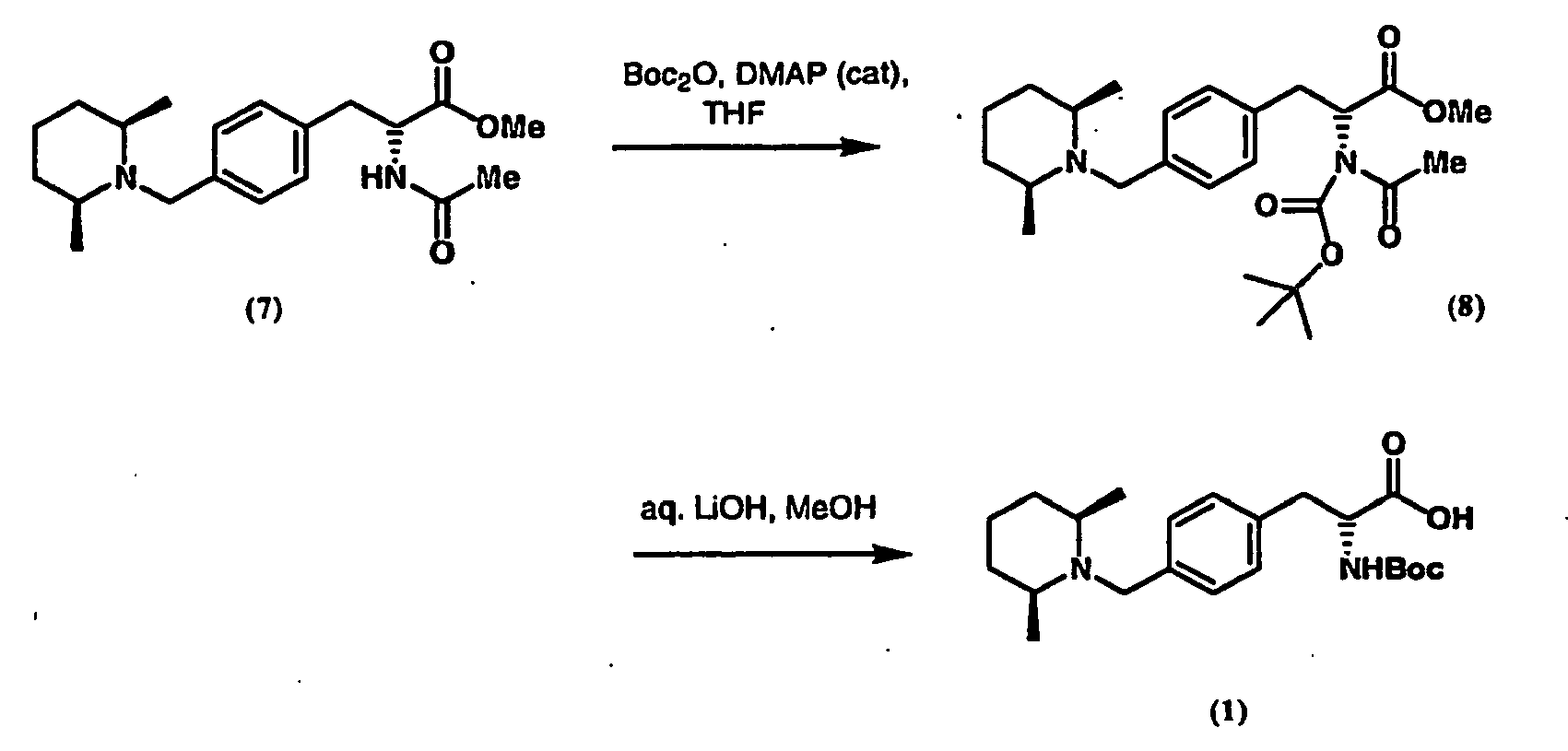
- The N-acetyl substrate (7) (605 mg, 1.75 mmol) and di-tert-butyl dicarbonate (573 mg; 2.63 mmol) were dissolved in THF (3 ml). 4-dimethylaminopyridine (21 mg, 0.175 mmol) was added. The solution was stirred for 22 h. More di-tert-butyl-dicarbonate (115 mg, 0.53 mmol) was added and stirring was continued for 16 h. The solvent was evaporated and the residue, comprising the intermediate N-Boc N-acetyl methyl ester (8), was dissolved in MeOH (8 ml). At this point the solution was divided in two and half was converted into compound (1) using the following procedure: The methanol solution was cooled in an ice bath and 1M aqueous lithium hydroxide solution (0.9 ml) was added. After 3 h more 1M LiOH (0.9 ml) was added and the mixture was stirred for 1h. MeOH was evaporated under reduced pressure. The aqueous residue was diluted with water (3 ml) and extracted with DCM (2 × 5 ml). The aqueous phase was acidified with 1 M citric acid (to pH 5.8) and then extracted with MTBE (5 ml). The aqueous phase was evaporated under reduced pressure and extracted with hot ethyl acetate (2 × 10 ml). The solvent was evaporated to give 242 mg (71%) of the (R)-N-Boc amino acid (1) as a pale yellow foam, ee >98%. 1H NMR (400 MHz, CDCl3) δ ppm 7.26 (2H, d, J = 7.8 Hz), 7.04 (2H, d, J= 7.8 Hz), 5.47 (dd, J= 10.2, 6.0 Hz), 3.76 (2H, s), 3.73 (3H, s), 3.40 (1H, dd, J = 14.0, 6.0 Hz), 3.14 (1H, dd, J = 14.0, 10.2 Hz), 2.45-2.42 (2H, m), 2.28 (3H, s), 1.64-1.62 (1H, m), 1.57-1.54 (2H, m), 1.43 (9H, s), 1.31-1.26 (3H, m) and 1.05 (6H, d, J = 5.6 Hz); 13C NMR (100 MHz, CDCl3) δ ppm 173.0, 171.3, 152.4, 140.6, 135.4, 129.4, 128.4, 84.2, 57.6, 57.5, 57.4, 53.7, 52.7, 35.7, 35.1, 35.1, 28.3, 26.7, 24.7 and 22.6.
-

- To a 250 ml three neck flask, fitted with an overhead agitator and thermometer, enamide (4) (5.0 g), DCM (40 ml) and diisopropylethylamine (4.2 g) were charged. A solution of methanesulfonic anhydride (4.5 g) in DCM (20ml) was added to the batch maintaining the temperature below 25 °C. The mixture was stirred for 3 hours at ambient temperature; conversion to the mesylate (8) was 80% by HPLC. cis-2,6-Dimethylpiperidine (6.8 g) was charged and the solution stirred for 21 hours. Further methanesulfonic anhydride (0.5 g) and cis-2,6-dimethylpiperidine (0.7 g) were required to give 84% conversion by HPLC after a further 3 hours. The organic solution was washed with sodium carbonate (4 g) in water (40 ml) then concentrated under vacuum to remove the bulk of the solvent. Hexane (60 ml) was charged and the mixture screened, then stirred at ambient temperature to precipitate. The product was isolated by vacuum filtration and washed with hexane (20 ml) then dried under vacuum at 45°C to give 4.27 g of (10). Purity by HPLC was 96.5%.
- To a 100ml two necked flask, fitted with a thermometer and magnetic stirrer, (10) (3.0 g), DMAP (30 mg) and THF (15 ml) were charged. A solution of di-tert-butyl dicarbonate (2.8 g) in THF (5 ml) was made and then charged to the batch at 20-25 °C. The solution was further stirred for 3 hours, conversion to N-Boc N-acetyl ester (11) was complete by HPLC. Sodium hydroxide (1.4 g) in methanol (15 ml) was charged and the mixture was stirred overnight; conversion was 70%. The methanol and THF solvent were removed by vacuum distillation and during the distillation the reaction also progressed to completion. The pH was adjusted to 5.8 with 36% hydrochloric acid and the resultant liquid was distilled to an oil. IPA (40 ml) was charged and the solvent was removed under vacuum to a concentrated slurry, IPA (40 ml) was charged and the solvent was removed under vacuum to a concentrated slurry. IPA (25 ml) was charged and the mixture was screened to remove inorganic solids, the filtrates were then stirred over the weekend to precipitate. The product was isolated by vacuum filtration and washed with IPA (10 ml) and then dried under vacuum at 45°C to give 1.9 g of (12). Purity by HPLC was greater than 98%. 1H NMR (400 MHz, DMSO-d6) δ ppm 7.62 (1H, br s), 7.21 (4H, s), 6.81 (1H, s), 3.67 (2H, s), 2.45- . 2.38 (2H, m), 1.61-1.52 (3H, m), 1.32-1.16 (12 H, m) and 0.97 (6H, d, J= 2.4 Hz).
-

- The enamide (15) (100 mg, 0.26 mmol) and [(R,R)-Me-BPE Rh COD]BF4 (1.4 mg, 0.0026 mmol) were charged to a glass-liner and secured in a Baskerville 10-well autoclave. The vessel was charged with nitrogen to 10 bar and then vented. This charge/vent cycle was repeated twice. Deoxygenated methanol (4 ml) (purged with nitrogen for one hour) was then added and the vessel was charged with hydrogen to a pressure of 10 bar and then vented. This charge/vent cycle was repeated two times. The vessel was then charged with hydrogen to 10 bar and heated via an autocontroller to 40°C. After 17 hours, the vessel was cooled to room temperature and vented. Analysis of the reaction mixture indicated >95% conversion (1H NMR) and 92% ee. The spectral properties (1H and 13C NMR, HPLC) were identical with (1) prepared as described in Example 6.
Claims (16)
- A process for the preparation of the amino acid derivative (1) from (4-hydroxymethyl)benzaldehyde (2), which includes the key steps of asymmetric hydrogenation of an enamide intermediate and introduction of the piperidine sub-unit by non-reductive N-alkylation.

- A process according to claim 1, which comprises the following steps:(a) Erlenmeyer condensation of aldehyde (2) with N-acetylglycine to form an azlactone of formula (3);(b) Conversion of azlactone (3) to an enamide of formula (4), wherein R1 is methyl or C2-C4 linear or branched alkyl, by reaction with an alcohol R1OH in the presence of base;(c) Asymmetric hydrogenation of enamide (4) in the presence of, as catalyst, a rhodium- complex of a chiral phosphorus-containing ligand, to form the amino acid derivative (5);(d) Conversion of (5) to the O-sulphonyl derivative (6), wherein R2 is alkyl, haloalkyl or aryl, by reaction with a sulfonic anhydride reagent in the presence of a tertiary amine, followed by reaction with cis-2,6-dimethylpiperidine, to form the amino acid derivative (7);(e) Conversion of (7) to N-diprotected derivative (8), followed by treatment with a metal hydroxide base in the presence of alcohol, optionally with water as cosolvent, to effect selective removal the N-acetyl group and to hydrolyse the ester.


- A process according to claim 2, wherein in step (b), R1 is methyl or ethyl.
- A process according to claim 3, wherein R1 is methyl.
- A process according to claim 2, wherein in step (c), the chiral phosphorus-containing ligand is a bis(2,5-dialkylphospholane).
- A process according to claim 5 wherein the bis(2,5-dialkylphospholane) is (R,R)-Ethyl-DuPhos.
- A process according to claim (2) wherein in step (d), R2 is methyl and the OH group in (5) is derivatized by treatment with methanesulfonic anhydride.
- A process according to claim (2) wherein in step (e), the hydroxide base is lithium hydroxide.
- A compound as utilized in the process according to claim 2 and selected from the group consisting of the enamide (4) and enantiomerically enriched intermediates (5), (6), (7) & (8).
- A process according to claim 1, which comprises the following steps:(a) Erlenmeyer condensation of aldehyde (2) with N-acetylglycine to form an azlactone of formula (3);(b) Conversion of azlactone (3) to an enamide of formula (4), wherein R1 is methyl or C2-C4 linear or branched alkyl, by reaction with an alcohol R1OH in the presence of base;(c) Conversion of enamide (4) to the O-sulfonyl derivative (9), wherein R2 is alkyl, haloalkyl or aryl, followed by reaction with cis-2,6-dimethylpiperidine, to form the enamide (10);(d) Conversion of (10) to N-diprotected derivative (11), followed by treatment with a metal hydroxide base in the presence of alcohol, optionally with water as cosolvent, to effect selective removal the N-acetyl group and to hydrolyse the ester.(e) Asymmetric hydrogenation of N-Boc enamide (12) in the presence of, as catalyst, a rhodium complex of a chiral phosphorus-containing ligand.


- A process according to claim 10 wherein in step (b), R1 is methyl or ethyl
- A process according to claim 11, wherein R1 is methyl.
- A process according to claim 10 wherein in step (c), R2 is methyl and the OH group in (4) is derivatized by treatment with methanesulfonic anhydride.
- A process according to claim 10 wherein in step (e), the chiral phosphorus-containing ligand is a bis(phospholane).
- A process according to claim 14, wherein the bis(phospholane) is (R,R)-Methyl-BPE.
- A compound as utilized in the process according to claim 10 and selected from the group consisting of the enamides (9), (10), (11) & (12).
Applications Claiming Priority (2)
| Application Number | Priority Date | Filing Date | Title |
|---|---|---|---|
| US71899505P | 2005-09-21 | 2005-09-21 | |
| PCT/US2006/036607 WO2007038116A1 (en) | 2005-09-21 | 2006-09-20 | Process to prepare amino acid derivatives |
Publications (2)
| Publication Number | Publication Date |
|---|---|
| EP1945621A1 EP1945621A1 (en) | 2008-07-23 |
| EP1945621B1 true EP1945621B1 (en) | 2009-04-15 |
Family
ID=37492339
Family Applications (1)
| Application Number | Title | Priority Date | Filing Date |
|---|---|---|---|
| EP06803891A Not-in-force EP1945621B1 (en) | 2005-09-21 | 2006-09-20 | Process to prepare amino acid derivatives |
Country Status (6)
| Country | Link |
|---|---|
| EP (1) | EP1945621B1 (en) |
| JP (1) | JP2009508961A (en) |
| CN (1) | CN101268061B (en) |
| AT (1) | ATE428702T1 (en) |
| DE (1) | DE602006006334D1 (en) |
| WO (1) | WO2007038116A1 (en) |
Families Citing this family (1)
| Publication number | Priority date | Publication date | Assignee | Title |
|---|---|---|---|---|
| CN111004145B (en) * | 2019-12-11 | 2021-06-08 | 中山大学 | A kind of chiral optical amide substituted α, β-diamino acid derivative and preparation method and application thereof |
Family Cites Families (1)
| Publication number | Priority date | Publication date | Assignee | Title |
|---|---|---|---|---|
| FR2822827B1 (en) * | 2001-03-28 | 2003-05-16 | Sanofi Synthelabo | NOVEL N- (ARYLSULFONYL) BETA-AMINOACIDS DERIVATIVES COMPRISING A SUBSTITUTED AMINOMETHYL GROUP, THEIR PREPARATION METHOD AND THE PHARMACEUTICAL COMPOSITIONS CONTAINING THE SAME |
-
2006
- 2006-09-20 WO PCT/US2006/036607 patent/WO2007038116A1/en not_active Ceased
- 2006-09-20 EP EP06803891A patent/EP1945621B1/en not_active Not-in-force
- 2006-09-20 JP JP2008532343A patent/JP2009508961A/en not_active Withdrawn
- 2006-09-20 DE DE602006006334T patent/DE602006006334D1/en active Active
- 2006-09-20 AT AT06803891T patent/ATE428702T1/en not_active IP Right Cessation
- 2006-09-20 CN CN2006800345763A patent/CN101268061B/en not_active Expired - Fee Related
Also Published As
| Publication number | Publication date |
|---|---|
| EP1945621A1 (en) | 2008-07-23 |
| JP2009508961A (en) | 2009-03-05 |
| WO2007038116A1 (en) | 2007-04-05 |
| DE602006006334D1 (en) | 2009-05-28 |
| CN101268061A (en) | 2008-09-17 |
| CN101268061B (en) | 2011-06-08 |
| ATE428702T1 (en) | 2009-05-15 |
Similar Documents
| Publication | Publication Date | Title |
|---|---|---|
| EP2611776B1 (en) | Production method of intermediate compound for synthesizing medicament | |
| US6809214B2 (en) | Shortened synthesis of 3,3-diarylpropylamine derivatives | |
| AU2014310569A1 (en) | Synthesis of biphenylalaninol via novel intermediates | |
| Rubio-Pérez et al. | One-pot stibine modified Co2 (CO) 8 catalyzed reductive N-alkylation of primary amides with carbonyl compounds | |
| JPWO2003097632A1 (en) | Propanolamine derivative, method for producing 3-N-methylamino-1- (2-thienyl) -1-propanol, and method for producing propanolamine derivative | |
| JP5548129B2 (en) | Asymmetric organic catalyst | |
| Li et al. | An efficient enantioselective synthesis of florfenicol via a vanadium-catalyzed asymmetric epoxidation | |
| CN114409585A (en) | 2-oxopyrrolidine derivatives, process for preparing the same and process for preparing intermediates | |
| WO2009044409A2 (en) | Novel resolution process for pregabalin | |
| CN101952242B (en) | Convergent synthesis of renin inhibitors and intermediates useful therein | |
| JP4688292B2 (en) | Method for producing N-methyl-N-[(1S) -1-phenyl-2-((3S) -3-hydroxypyrrolidin-1-yl) ethyl] -2,2-diphenylacetamide, which is a pure enantiomer | |
| CA2793129A1 (en) | Processes and intermediates for preparing a macrocyclic protease inhibitor of hcv | |
| Yamagishi et al. | Asymmetric synthesis of phosphonic acid analogues for acylcarnitine | |
| EP1945621A1 (en) | Process to prepare amino acid derivatives | |
| KR100743617B1 (en) | Process for the preparation of chiral 3-hydroxy pyrrolidine compound and derivatives thereof having high optical purity | |
| JP2010037206A (en) | Method for producing optically active o-methylserine or its salt | |
| JP3140698B2 (en) | Production method and purification method of 4-hydroxy-2-pyrrolidinone | |
| CA3136845A1 (en) | Process for the production of substituted 2-[2-(phenyl) ethylamino]alkaneamide derivatives | |
| WO2013038427A1 (en) | ARYLATED β-DICARBOIMYL COMPOUNDS AND PROCESS FOR THE PREPARATION THEREOF | |
| WO2007024113A1 (en) | Process for the preparation of chiral 3-hydroxy pyrrolidine compound and derivatives thereof having high optical purity | |
| KR100896087B1 (en) | Method for preparing optically pure 2-methylpyrrolidine and its salts | |
| JP4187822B2 (en) | Process for producing optically active 4-hydroxy-2-pyrrolidone | |
| KR101299720B1 (en) | A novel process for preparing 3-amino-5-fluoro-4-dialkoxypetanoic acid ester | |
| JP4039026B2 (en) | Method for producing 3-amino-2-thiophenecarboxylic acid ester | |
| SK2072004A3 (en) | Method of producing N,N-diisopropyl-3-(2-hydroxy-5-methylphenyl)- 3-phenylpropylamine in its racemic or optically active form |
Legal Events
| Date | Code | Title | Description |
|---|---|---|---|
| PUAI | Public reference made under article 153(3) epc to a published international application that has entered the european phase |
Free format text: ORIGINAL CODE: 0009012 |
|
| 17P | Request for examination filed |
Effective date: 20080421 |
|
| AK | Designated contracting states |
Kind code of ref document: A1 Designated state(s): AT BE BG CH CY CZ DE DK EE ES FI FR GB GR HU IE IS IT LI LT LU LV MC NL PL PT RO SE SI SK TR |
|
| GRAP | Despatch of communication of intention to grant a patent |
Free format text: ORIGINAL CODE: EPIDOSNIGR1 |
|
| DAX | Request for extension of the european patent (deleted) | ||
| GRAS | Grant fee paid |
Free format text: ORIGINAL CODE: EPIDOSNIGR3 |
|
| GRAA | (expected) grant |
Free format text: ORIGINAL CODE: 0009210 |
|
| RAP1 | Party data changed (applicant data changed or rights of an application transferred) |
Owner name: DR REDDY'S LABORATORIES (EU) LIMITED |
|
| AK | Designated contracting states |
Kind code of ref document: B1 Designated state(s): AT BE BG CH CY CZ DE DK EE ES FI FR GB GR HU IE IS IT LI LT LU LV MC NL PL PT RO SE SI SK TR |
|
| REG | Reference to a national code |
Ref country code: CH Ref legal event code: EP Ref country code: GB Ref legal event code: FG4D |
|
| REG | Reference to a national code |
Ref country code: IE Ref legal event code: FG4D |
|
| REF | Corresponds to: |
Ref document number: 602006006334 Country of ref document: DE Date of ref document: 20090528 Kind code of ref document: P |
|
| PG25 | Lapsed in a contracting state [announced via postgrant information from national office to epo] |
Ref country code: LT Free format text: LAPSE BECAUSE OF FAILURE TO SUBMIT A TRANSLATION OF THE DESCRIPTION OR TO PAY THE FEE WITHIN THE PRESCRIBED TIME-LIMIT Effective date: 20090415 Ref country code: FI Free format text: LAPSE BECAUSE OF FAILURE TO SUBMIT A TRANSLATION OF THE DESCRIPTION OR TO PAY THE FEE WITHIN THE PRESCRIBED TIME-LIMIT Effective date: 20090415 Ref country code: ES Free format text: LAPSE BECAUSE OF FAILURE TO SUBMIT A TRANSLATION OF THE DESCRIPTION OR TO PAY THE FEE WITHIN THE PRESCRIBED TIME-LIMIT Effective date: 20090726 Ref country code: PT Free format text: LAPSE BECAUSE OF FAILURE TO SUBMIT A TRANSLATION OF THE DESCRIPTION OR TO PAY THE FEE WITHIN THE PRESCRIBED TIME-LIMIT Effective date: 20090915 Ref country code: AT Free format text: LAPSE BECAUSE OF FAILURE TO SUBMIT A TRANSLATION OF THE DESCRIPTION OR TO PAY THE FEE WITHIN THE PRESCRIBED TIME-LIMIT Effective date: 20090415 |
|
| PG25 | Lapsed in a contracting state [announced via postgrant information from national office to epo] |
Ref country code: PL Free format text: LAPSE BECAUSE OF FAILURE TO SUBMIT A TRANSLATION OF THE DESCRIPTION OR TO PAY THE FEE WITHIN THE PRESCRIBED TIME-LIMIT Effective date: 20090415 Ref country code: SI Free format text: LAPSE BECAUSE OF FAILURE TO SUBMIT A TRANSLATION OF THE DESCRIPTION OR TO PAY THE FEE WITHIN THE PRESCRIBED TIME-LIMIT Effective date: 20090415 Ref country code: IS Free format text: LAPSE BECAUSE OF FAILURE TO SUBMIT A TRANSLATION OF THE DESCRIPTION OR TO PAY THE FEE WITHIN THE PRESCRIBED TIME-LIMIT Effective date: 20090815 Ref country code: SE Free format text: LAPSE BECAUSE OF FAILURE TO SUBMIT A TRANSLATION OF THE DESCRIPTION OR TO PAY THE FEE WITHIN THE PRESCRIBED TIME-LIMIT Effective date: 20090715 Ref country code: LV Free format text: LAPSE BECAUSE OF FAILURE TO SUBMIT A TRANSLATION OF THE DESCRIPTION OR TO PAY THE FEE WITHIN THE PRESCRIBED TIME-LIMIT Effective date: 20090415 |
|
| PG25 | Lapsed in a contracting state [announced via postgrant information from national office to epo] |
Ref country code: RO Free format text: LAPSE BECAUSE OF FAILURE TO SUBMIT A TRANSLATION OF THE DESCRIPTION OR TO PAY THE FEE WITHIN THE PRESCRIBED TIME-LIMIT Effective date: 20090415 Ref country code: EE Free format text: LAPSE BECAUSE OF FAILURE TO SUBMIT A TRANSLATION OF THE DESCRIPTION OR TO PAY THE FEE WITHIN THE PRESCRIBED TIME-LIMIT Effective date: 20090415 Ref country code: CZ Free format text: LAPSE BECAUSE OF FAILURE TO SUBMIT A TRANSLATION OF THE DESCRIPTION OR TO PAY THE FEE WITHIN THE PRESCRIBED TIME-LIMIT Effective date: 20090415 Ref country code: DK Free format text: LAPSE BECAUSE OF FAILURE TO SUBMIT A TRANSLATION OF THE DESCRIPTION OR TO PAY THE FEE WITHIN THE PRESCRIBED TIME-LIMIT Effective date: 20090415 |
|
| PLBE | No opposition filed within time limit |
Free format text: ORIGINAL CODE: 0009261 |
|
| STAA | Information on the status of an ep patent application or granted ep patent |
Free format text: STATUS: NO OPPOSITION FILED WITHIN TIME LIMIT |
|
| PG25 | Lapsed in a contracting state [announced via postgrant information from national office to epo] |
Ref country code: SK Free format text: LAPSE BECAUSE OF FAILURE TO SUBMIT A TRANSLATION OF THE DESCRIPTION OR TO PAY THE FEE WITHIN THE PRESCRIBED TIME-LIMIT Effective date: 20090415 Ref country code: BE Free format text: LAPSE BECAUSE OF FAILURE TO SUBMIT A TRANSLATION OF THE DESCRIPTION OR TO PAY THE FEE WITHIN THE PRESCRIBED TIME-LIMIT Effective date: 20090415 |
|
| 26N | No opposition filed |
Effective date: 20100118 |
|
| PG25 | Lapsed in a contracting state [announced via postgrant information from national office to epo] |
Ref country code: BG Free format text: LAPSE BECAUSE OF FAILURE TO SUBMIT A TRANSLATION OF THE DESCRIPTION OR TO PAY THE FEE WITHIN THE PRESCRIBED TIME-LIMIT Effective date: 20090715 |
|
| PG25 | Lapsed in a contracting state [announced via postgrant information from national office to epo] |
Ref country code: MC Free format text: LAPSE BECAUSE OF NON-PAYMENT OF DUE FEES Effective date: 20090930 |
|
| REG | Reference to a national code |
Ref country code: CH Ref legal event code: NV Representative=s name: BOHEST AG |
|
| REG | Reference to a national code |
Ref country code: IE Ref legal event code: MM4A |
|
| PG25 | Lapsed in a contracting state [announced via postgrant information from national office to epo] |
Ref country code: IE Free format text: LAPSE BECAUSE OF NON-PAYMENT OF DUE FEES Effective date: 20090920 |
|
| PG25 | Lapsed in a contracting state [announced via postgrant information from national office to epo] |
Ref country code: GR Free format text: LAPSE BECAUSE OF FAILURE TO SUBMIT A TRANSLATION OF THE DESCRIPTION OR TO PAY THE FEE WITHIN THE PRESCRIBED TIME-LIMIT Effective date: 20090716 |
|
| PGFP | Annual fee paid to national office [announced via postgrant information from national office to epo] |
Ref country code: DE Payment date: 20100915 Year of fee payment: 5 |
|
| PGFP | Annual fee paid to national office [announced via postgrant information from national office to epo] |
Ref country code: IT Payment date: 20100927 Year of fee payment: 5 |
|
| PG25 | Lapsed in a contracting state [announced via postgrant information from national office to epo] |
Ref country code: LU Free format text: LAPSE BECAUSE OF NON-PAYMENT OF DUE FEES Effective date: 20090920 |
|
| PG25 | Lapsed in a contracting state [announced via postgrant information from national office to epo] |
Ref country code: HU Free format text: LAPSE BECAUSE OF FAILURE TO SUBMIT A TRANSLATION OF THE DESCRIPTION OR TO PAY THE FEE WITHIN THE PRESCRIBED TIME-LIMIT Effective date: 20091016 |
|
| PG25 | Lapsed in a contracting state [announced via postgrant information from national office to epo] |
Ref country code: TR Free format text: LAPSE BECAUSE OF FAILURE TO SUBMIT A TRANSLATION OF THE DESCRIPTION OR TO PAY THE FEE WITHIN THE PRESCRIBED TIME-LIMIT Effective date: 20090415 |
|
| PG25 | Lapsed in a contracting state [announced via postgrant information from national office to epo] |
Ref country code: CY Free format text: LAPSE BECAUSE OF FAILURE TO SUBMIT A TRANSLATION OF THE DESCRIPTION OR TO PAY THE FEE WITHIN THE PRESCRIBED TIME-LIMIT Effective date: 20090415 |
|
| PGFP | Annual fee paid to national office [announced via postgrant information from national office to epo] |
Ref country code: CH Payment date: 20110916 Year of fee payment: 6 |
|
| PGFP | Annual fee paid to national office [announced via postgrant information from national office to epo] |
Ref country code: FR Payment date: 20111005 Year of fee payment: 6 |
|
| PGFP | Annual fee paid to national office [announced via postgrant information from national office to epo] |
Ref country code: NL Payment date: 20110922 Year of fee payment: 6 |
|
| REG | Reference to a national code |
Ref country code: NL Ref legal event code: V1 Effective date: 20130401 |
|
| REG | Reference to a national code |
Ref country code: CH Ref legal event code: PL |
|
| REG | Reference to a national code |
Ref country code: FR Ref legal event code: ST Effective date: 20130531 |
|
| PG25 | Lapsed in a contracting state [announced via postgrant information from national office to epo] |
Ref country code: LI Free format text: LAPSE BECAUSE OF NON-PAYMENT OF DUE FEES Effective date: 20120930 Ref country code: CH Free format text: LAPSE BECAUSE OF NON-PAYMENT OF DUE FEES Effective date: 20120930 Ref country code: DE Free format text: LAPSE BECAUSE OF NON-PAYMENT OF DUE FEES Effective date: 20130403 |
|
| PG25 | Lapsed in a contracting state [announced via postgrant information from national office to epo] |
Ref country code: IT Free format text: LAPSE BECAUSE OF NON-PAYMENT OF DUE FEES Effective date: 20120920 Ref country code: FR Free format text: LAPSE BECAUSE OF NON-PAYMENT OF DUE FEES Effective date: 20121001 Ref country code: NL Free format text: LAPSE BECAUSE OF NON-PAYMENT OF DUE FEES Effective date: 20130401 |
|
| REG | Reference to a national code |
Ref country code: DE Ref legal event code: R119 Ref document number: 602006006334 Country of ref document: DE Effective date: 20130403 |
|
| PGFP | Annual fee paid to national office [announced via postgrant information from national office to epo] |
Ref country code: GB Payment date: 20140908 Year of fee payment: 9 |
|
| GBPC | Gb: european patent ceased through non-payment of renewal fee |
Effective date: 20150920 |
|
| PG25 | Lapsed in a contracting state [announced via postgrant information from national office to epo] |
Ref country code: GB Free format text: LAPSE BECAUSE OF NON-PAYMENT OF DUE FEES Effective date: 20150920 |