EP1944396A1 - Elastomeric core-sheath conjugate fiber - Google Patents
Elastomeric core-sheath conjugate fiber Download PDFInfo
- Publication number
- EP1944396A1 EP1944396A1 EP06810145A EP06810145A EP1944396A1 EP 1944396 A1 EP1944396 A1 EP 1944396A1 EP 06810145 A EP06810145 A EP 06810145A EP 06810145 A EP06810145 A EP 06810145A EP 1944396 A1 EP1944396 A1 EP 1944396A1
- Authority
- EP
- European Patent Office
- Prior art keywords
- conjugate fiber
- elastomeric resin
- resin
- fiber
- conjugate
- Prior art date
- Legal status (The legal status is an assumption and is not a legal conclusion. Google has not performed a legal analysis and makes no representation as to the accuracy of the status listed.)
- Granted
Links
- 239000000835 fiber Substances 0.000 title claims abstract description 95
- 229920005989 resin Polymers 0.000 claims abstract description 84
- 239000011347 resin Substances 0.000 claims abstract description 84
- 229920001971 elastomer Polymers 0.000 claims description 23
- 239000000806 elastomer Substances 0.000 claims description 22
- 229920000728 polyester Polymers 0.000 claims description 21
- 239000010419 fine particle Substances 0.000 claims description 10
- 238000000034 method Methods 0.000 claims description 9
- 229920002647 polyamide Polymers 0.000 claims description 8
- 229920003225 polyurethane elastomer Polymers 0.000 claims description 7
- 238000009987 spinning Methods 0.000 claims description 7
- 238000002844 melting Methods 0.000 claims description 3
- 230000008018 melting Effects 0.000 claims description 3
- 229920005992 thermoplastic resin Polymers 0.000 claims description 2
- 239000004744 fabric Substances 0.000 description 15
- 230000000052 comparative effect Effects 0.000 description 14
- 229920005862 polyol Polymers 0.000 description 11
- 150000003077 polyols Chemical class 0.000 description 11
- 238000011156 evaluation Methods 0.000 description 10
- 239000004721 Polyphenylene oxide Substances 0.000 description 8
- VYPSYNLAJGMNEJ-UHFFFAOYSA-N Silicium dioxide Chemical compound O=[Si]=O VYPSYNLAJGMNEJ-UHFFFAOYSA-N 0.000 description 8
- 238000004519 manufacturing process Methods 0.000 description 8
- 229920000570 polyether Polymers 0.000 description 8
- 239000002245 particle Substances 0.000 description 7
- 229920002635 polyurethane Polymers 0.000 description 7
- 239000004814 polyurethane Substances 0.000 description 7
- VTYYLEPIZMXCLO-UHFFFAOYSA-L Calcium carbonate Chemical compound [Ca+2].[O-]C([O-])=O VTYYLEPIZMXCLO-UHFFFAOYSA-L 0.000 description 6
- 229920001400 block copolymer Polymers 0.000 description 6
- 125000003118 aryl group Chemical group 0.000 description 5
- 239000004433 Thermoplastic polyurethane Substances 0.000 description 4
- GWEVSGVZZGPLCZ-UHFFFAOYSA-N Titan oxide Chemical compound O=[Ti]=O GWEVSGVZZGPLCZ-UHFFFAOYSA-N 0.000 description 4
- XLOMVQKBTHCTTD-UHFFFAOYSA-N Zinc monoxide Chemical compound [Zn]=O XLOMVQKBTHCTTD-UHFFFAOYSA-N 0.000 description 4
- TZCXTZWJZNENPQ-UHFFFAOYSA-L barium sulfate Chemical compound [Ba+2].[O-]S([O-])(=O)=O TZCXTZWJZNENPQ-UHFFFAOYSA-L 0.000 description 4
- 238000009940 knitting Methods 0.000 description 4
- 239000000463 material Substances 0.000 description 4
- 229920001778 nylon Polymers 0.000 description 4
- 230000003287 optical effect Effects 0.000 description 4
- -1 polybutylene terephthalate Polymers 0.000 description 4
- 239000002994 raw material Substances 0.000 description 4
- 238000011084 recovery Methods 0.000 description 4
- 229920002803 thermoplastic polyurethane Polymers 0.000 description 4
- UPMLOUAZCHDJJD-UHFFFAOYSA-N 4,4'-Diphenylmethane Diisocyanate Chemical compound C1=CC(N=C=O)=CC=C1CC1=CC=C(N=C=O)C=C1 UPMLOUAZCHDJJD-UHFFFAOYSA-N 0.000 description 3
- 235000010216 calcium carbonate Nutrition 0.000 description 3
- 230000003247 decreasing effect Effects 0.000 description 3
- 238000004043 dyeing Methods 0.000 description 3
- 238000005259 measurement Methods 0.000 description 3
- 229920001610 polycaprolactone Polymers 0.000 description 3
- 239000004632 polycaprolactone Substances 0.000 description 3
- KAKZBPTYRLMSJV-UHFFFAOYSA-N Butadiene Chemical compound C=CC=C KAKZBPTYRLMSJV-UHFFFAOYSA-N 0.000 description 2
- JOYRKODLDBILNP-UHFFFAOYSA-N Ethyl urethane Chemical compound CCOC(N)=O JOYRKODLDBILNP-UHFFFAOYSA-N 0.000 description 2
- LYCAIKOWRPUZTN-UHFFFAOYSA-N Ethylene glycol Chemical compound OCCO LYCAIKOWRPUZTN-UHFFFAOYSA-N 0.000 description 2
- 239000005909 Kieselgur Substances 0.000 description 2
- 239000004677 Nylon Substances 0.000 description 2
- 239000004952 Polyamide Substances 0.000 description 2
- 239000004793 Polystyrene Substances 0.000 description 2
- 239000002174 Styrene-butadiene Substances 0.000 description 2
- PNEYBMLMFCGWSK-UHFFFAOYSA-N aluminium oxide Inorganic materials [O-2].[O-2].[O-2].[Al+3].[Al+3] PNEYBMLMFCGWSK-UHFFFAOYSA-N 0.000 description 2
- AYJRCSIUFZENHW-UHFFFAOYSA-L barium carbonate Chemical compound [Ba+2].[O-]C([O-])=O AYJRCSIUFZENHW-UHFFFAOYSA-L 0.000 description 2
- MTAZNLWOLGHBHU-UHFFFAOYSA-N butadiene-styrene rubber Chemical compound C=CC=C.C=CC1=CC=CC=C1 MTAZNLWOLGHBHU-UHFFFAOYSA-N 0.000 description 2
- 229910000019 calcium carbonate Inorganic materials 0.000 description 2
- OSGAYBCDTDRGGQ-UHFFFAOYSA-L calcium sulfate Chemical compound [Ca+2].[O-]S([O-])(=O)=O OSGAYBCDTDRGGQ-UHFFFAOYSA-L 0.000 description 2
- 150000001875 compounds Chemical class 0.000 description 2
- HNPSIPDUKPIQMN-UHFFFAOYSA-N dioxosilane;oxo(oxoalumanyloxy)alumane Chemical compound O=[Si]=O.O=[Al]O[Al]=O HNPSIPDUKPIQMN-UHFFFAOYSA-N 0.000 description 2
- 230000000694 effects Effects 0.000 description 2
- 150000002148 esters Chemical class 0.000 description 2
- 230000001771 impaired effect Effects 0.000 description 2
- 238000004898 kneading Methods 0.000 description 2
- 210000003127 knee Anatomy 0.000 description 2
- 210000002414 leg Anatomy 0.000 description 2
- ZLNQQNXFFQJAID-UHFFFAOYSA-L magnesium carbonate Chemical compound [Mg+2].[O-]C([O-])=O ZLNQQNXFFQJAID-UHFFFAOYSA-L 0.000 description 2
- 239000001095 magnesium carbonate Substances 0.000 description 2
- 239000000203 mixture Substances 0.000 description 2
- 229920001707 polybutylene terephthalate Polymers 0.000 description 2
- 229920000515 polycarbonate Polymers 0.000 description 2
- 239000004417 polycarbonate Substances 0.000 description 2
- 229920002223 polystyrene Polymers 0.000 description 2
- 229920006306 polyurethane fiber Polymers 0.000 description 2
- 238000011160 research Methods 0.000 description 2
- 239000000377 silicon dioxide Substances 0.000 description 2
- 239000011115 styrene butadiene Substances 0.000 description 2
- 229920003048 styrene butadiene rubber Polymers 0.000 description 2
- 229920001169 thermoplastic Polymers 0.000 description 2
- 229920002725 thermoplastic elastomer Polymers 0.000 description 2
- 239000004416 thermosoftening plastic Substances 0.000 description 2
- OGIDPMRJRNCKJF-UHFFFAOYSA-N titanium oxide Inorganic materials [Ti]=O OGIDPMRJRNCKJF-UHFFFAOYSA-N 0.000 description 2
- 239000011787 zinc oxide Substances 0.000 description 2
- ALQLPWJFHRMHIU-UHFFFAOYSA-N 1,4-diisocyanatobenzene Chemical compound O=C=NC1=CC=C(N=C=O)C=C1 ALQLPWJFHRMHIU-UHFFFAOYSA-N 0.000 description 1
- SBJCUZQNHOLYMD-UHFFFAOYSA-N 1,5-Naphthalene diisocyanate Chemical compound C1=CC=C2C(N=C=O)=CC=CC2=C1N=C=O SBJCUZQNHOLYMD-UHFFFAOYSA-N 0.000 description 1
- RQBUVIFBALZGPC-UHFFFAOYSA-N 1-isocyanato-4-(4-isocyanatophenyl)benzene Chemical group C1=CC(N=C=O)=CC=C1C1=CC=C(N=C=O)C=C1 RQBUVIFBALZGPC-UHFFFAOYSA-N 0.000 description 1
- 239000005995 Aluminium silicate Substances 0.000 description 1
- 229920002292 Nylon 6 Polymers 0.000 description 1
- 229920002614 Polyether block amide Polymers 0.000 description 1
- XUIMIQQOPSSXEZ-UHFFFAOYSA-N Silicon Chemical compound [Si] XUIMIQQOPSSXEZ-UHFFFAOYSA-N 0.000 description 1
- 229920002978 Vinylon Polymers 0.000 description 1
- 229910021536 Zeolite Inorganic materials 0.000 description 1
- FMRLDPWIRHBCCC-UHFFFAOYSA-L Zinc carbonate Chemical compound [Zn+2].[O-]C([O-])=O FMRLDPWIRHBCCC-UHFFFAOYSA-L 0.000 description 1
- 239000005083 Zinc sulfide Substances 0.000 description 1
- YKTSYUJCYHOUJP-UHFFFAOYSA-N [O--].[Al+3].[Al+3].[O-][Si]([O-])([O-])[O-] Chemical compound [O--].[Al+3].[Al+3].[O-][Si]([O-])([O-])[O-] YKTSYUJCYHOUJP-UHFFFAOYSA-N 0.000 description 1
- 125000001931 aliphatic group Chemical group 0.000 description 1
- 239000000956 alloy Substances 0.000 description 1
- 229910045601 alloy Inorganic materials 0.000 description 1
- WNROFYMDJYEPJX-UHFFFAOYSA-K aluminium hydroxide Chemical compound [OH-].[OH-].[OH-].[Al+3] WNROFYMDJYEPJX-UHFFFAOYSA-K 0.000 description 1
- 229910021502 aluminium hydroxide Inorganic materials 0.000 description 1
- 235000012211 aluminium silicate Nutrition 0.000 description 1
- 229910000323 aluminium silicate Inorganic materials 0.000 description 1
- VXAUWWUXCIMFIM-UHFFFAOYSA-M aluminum;oxygen(2-);hydroxide Chemical compound [OH-].[O-2].[Al+3] VXAUWWUXCIMFIM-UHFFFAOYSA-M 0.000 description 1
- 239000000440 bentonite Substances 0.000 description 1
- 229910000278 bentonite Inorganic materials 0.000 description 1
- SVPXDRXYRYOSEX-UHFFFAOYSA-N bentoquatam Chemical compound O.O=[Si]=O.O=[Al]O[Al]=O SVPXDRXYRYOSEX-UHFFFAOYSA-N 0.000 description 1
- 239000000378 calcium silicate Substances 0.000 description 1
- 229910052918 calcium silicate Inorganic materials 0.000 description 1
- OYACROKNLOSFPA-UHFFFAOYSA-N calcium;dioxido(oxo)silane Chemical compound [Ca+2].[O-][Si]([O-])=O OYACROKNLOSFPA-UHFFFAOYSA-N 0.000 description 1
- VPKDCDLSJZCGKE-UHFFFAOYSA-N carbodiimide group Chemical group N=C=N VPKDCDLSJZCGKE-UHFFFAOYSA-N 0.000 description 1
- 125000004432 carbon atom Chemical group C* 0.000 description 1
- 239000004927 clay Substances 0.000 description 1
- 239000008119 colloidal silica Substances 0.000 description 1
- 230000008602 contraction Effects 0.000 description 1
- 238000002788 crimping Methods 0.000 description 1
- 230000007812 deficiency Effects 0.000 description 1
- 230000001747 exhibiting effect Effects 0.000 description 1
- WGCNASOHLSPBMP-UHFFFAOYSA-N hydroxyacetaldehyde Natural products OCC=O WGCNASOHLSPBMP-UHFFFAOYSA-N 0.000 description 1
- 229910052500 inorganic mineral Inorganic materials 0.000 description 1
- 230000001788 irregular Effects 0.000 description 1
- NLYAJNPCOHFWQQ-UHFFFAOYSA-N kaolin Chemical compound O.O.O=[Al]O[Si](=O)O[Si](=O)O[Al]=O NLYAJNPCOHFWQQ-UHFFFAOYSA-N 0.000 description 1
- 229910000021 magnesium carbonate Inorganic materials 0.000 description 1
- 235000011160 magnesium carbonates Nutrition 0.000 description 1
- VTHJTEIRLNZDEV-UHFFFAOYSA-L magnesium dihydroxide Chemical compound [OH-].[OH-].[Mg+2] VTHJTEIRLNZDEV-UHFFFAOYSA-L 0.000 description 1
- 239000000347 magnesium hydroxide Substances 0.000 description 1
- 229910001862 magnesium hydroxide Inorganic materials 0.000 description 1
- HCWCAKKEBCNQJP-UHFFFAOYSA-N magnesium orthosilicate Chemical compound [Mg+2].[Mg+2].[O-][Si]([O-])([O-])[O-] HCWCAKKEBCNQJP-UHFFFAOYSA-N 0.000 description 1
- 239000000395 magnesium oxide Substances 0.000 description 1
- CPLXHLVBOLITMK-UHFFFAOYSA-N magnesium oxide Inorganic materials [Mg]=O CPLXHLVBOLITMK-UHFFFAOYSA-N 0.000 description 1
- 239000000391 magnesium silicate Substances 0.000 description 1
- 229910052919 magnesium silicate Inorganic materials 0.000 description 1
- 235000019792 magnesium silicate Nutrition 0.000 description 1
- AXZKOIWUVFPNLO-UHFFFAOYSA-N magnesium;oxygen(2-) Chemical compound [O-2].[Mg+2] AXZKOIWUVFPNLO-UHFFFAOYSA-N 0.000 description 1
- 238000001000 micrograph Methods 0.000 description 1
- 239000011707 mineral Substances 0.000 description 1
- 235000010755 mineral Nutrition 0.000 description 1
- 239000003921 oil Substances 0.000 description 1
- 239000000049 pigment Substances 0.000 description 1
- 229920001225 polyester resin Polymers 0.000 description 1
- 229920001228 polyisocyanate Polymers 0.000 description 1
- 239000005056 polyisocyanate Substances 0.000 description 1
- 229920000098 polyolefin Polymers 0.000 description 1
- 239000000843 powder Substances 0.000 description 1
- 238000002407 reforming Methods 0.000 description 1
- 239000005060 rubber Substances 0.000 description 1
- 230000001953 sensory effect Effects 0.000 description 1
- 229910052710 silicon Inorganic materials 0.000 description 1
- 239000010703 silicon Substances 0.000 description 1
- 229920006132 styrene block copolymer Polymers 0.000 description 1
- 238000004441 surface measurement Methods 0.000 description 1
- 230000003746 surface roughness Effects 0.000 description 1
- 239000000454 talc Substances 0.000 description 1
- 229910052623 talc Inorganic materials 0.000 description 1
- 238000012360 testing method Methods 0.000 description 1
- 239000004408 titanium dioxide Substances 0.000 description 1
- RUELTTOHQODFPA-UHFFFAOYSA-N toluene 2,6-diisocyanate Chemical compound CC1=C(N=C=O)C=CC=C1N=C=O RUELTTOHQODFPA-UHFFFAOYSA-N 0.000 description 1
- XSQUKJJJFZCRTK-UHFFFAOYSA-N urea group Chemical group NC(=O)N XSQUKJJJFZCRTK-UHFFFAOYSA-N 0.000 description 1
- 239000010457 zeolite Substances 0.000 description 1
- 239000011667 zinc carbonate Substances 0.000 description 1
- 235000004416 zinc carbonate Nutrition 0.000 description 1
- 229910000010 zinc carbonate Inorganic materials 0.000 description 1
- 229910052984 zinc sulfide Inorganic materials 0.000 description 1
- DRDVZXDWVBGGMH-UHFFFAOYSA-N zinc;sulfide Chemical compound [S-2].[Zn+2] DRDVZXDWVBGGMH-UHFFFAOYSA-N 0.000 description 1
- 229910000859 α-Fe Inorganic materials 0.000 description 1
Images

Classifications
-
- D—TEXTILES; PAPER
- D01—NATURAL OR MAN-MADE THREADS OR FIBRES; SPINNING
- D01F—CHEMICAL FEATURES IN THE MANUFACTURE OF ARTIFICIAL FILAMENTS, THREADS, FIBRES, BRISTLES OR RIBBONS; APPARATUS SPECIALLY ADAPTED FOR THE MANUFACTURE OF CARBON FILAMENTS
- D01F8/00—Conjugated, i.e. bi- or multicomponent, artificial filaments or the like; Manufacture thereof
- D01F8/04—Conjugated, i.e. bi- or multicomponent, artificial filaments or the like; Manufacture thereof from synthetic polymers
-
- D—TEXTILES; PAPER
- D01—NATURAL OR MAN-MADE THREADS OR FIBRES; SPINNING
- D01F—CHEMICAL FEATURES IN THE MANUFACTURE OF ARTIFICIAL FILAMENTS, THREADS, FIBRES, BRISTLES OR RIBBONS; APPARATUS SPECIALLY ADAPTED FOR THE MANUFACTURE OF CARBON FILAMENTS
- D01F8/00—Conjugated, i.e. bi- or multicomponent, artificial filaments or the like; Manufacture thereof
- D01F8/04—Conjugated, i.e. bi- or multicomponent, artificial filaments or the like; Manufacture thereof from synthetic polymers
- D01F8/16—Conjugated, i.e. bi- or multicomponent, artificial filaments or the like; Manufacture thereof from synthetic polymers with at least one other macromolecular compound obtained otherwise than by reactions only involving carbon-to-carbon unsaturated bonds as constituent
-
- A—HUMAN NECESSITIES
- A41—WEARING APPAREL
- A41B—SHIRTS; UNDERWEAR; BABY LINEN; HANDKERCHIEFS
- A41B17/00—Selection of special materials for underwear
-
- D—TEXTILES; PAPER
- D01—NATURAL OR MAN-MADE THREADS OR FIBRES; SPINNING
- D01D—MECHANICAL METHODS OR APPARATUS IN THE MANUFACTURE OF ARTIFICIAL FILAMENTS, THREADS, FIBRES, BRISTLES OR RIBBONS
- D01D5/00—Formation of filaments, threads, or the like
- D01D5/28—Formation of filaments, threads, or the like while mixing different spinning solutions or melts during the spinning operation; Spinnerette packs therefor
-
- D—TEXTILES; PAPER
- D01—NATURAL OR MAN-MADE THREADS OR FIBRES; SPINNING
- D01F—CHEMICAL FEATURES IN THE MANUFACTURE OF ARTIFICIAL FILAMENTS, THREADS, FIBRES, BRISTLES OR RIBBONS; APPARATUS SPECIALLY ADAPTED FOR THE MANUFACTURE OF CARBON FILAMENTS
- D01F8/00—Conjugated, i.e. bi- or multicomponent, artificial filaments or the like; Manufacture thereof
- D01F8/04—Conjugated, i.e. bi- or multicomponent, artificial filaments or the like; Manufacture thereof from synthetic polymers
- D01F8/12—Conjugated, i.e. bi- or multicomponent, artificial filaments or the like; Manufacture thereof from synthetic polymers with at least one polyamide as constituent
-
- D—TEXTILES; PAPER
- D01—NATURAL OR MAN-MADE THREADS OR FIBRES; SPINNING
- D01F—CHEMICAL FEATURES IN THE MANUFACTURE OF ARTIFICIAL FILAMENTS, THREADS, FIBRES, BRISTLES OR RIBBONS; APPARATUS SPECIALLY ADAPTED FOR THE MANUFACTURE OF CARBON FILAMENTS
- D01F8/00—Conjugated, i.e. bi- or multicomponent, artificial filaments or the like; Manufacture thereof
- D01F8/04—Conjugated, i.e. bi- or multicomponent, artificial filaments or the like; Manufacture thereof from synthetic polymers
- D01F8/14—Conjugated, i.e. bi- or multicomponent, artificial filaments or the like; Manufacture thereof from synthetic polymers with at least one polyester as constituent
-
- Y—GENERAL TAGGING OF NEW TECHNOLOGICAL DEVELOPMENTS; GENERAL TAGGING OF CROSS-SECTIONAL TECHNOLOGIES SPANNING OVER SEVERAL SECTIONS OF THE IPC; TECHNICAL SUBJECTS COVERED BY FORMER USPC CROSS-REFERENCE ART COLLECTIONS [XRACs] AND DIGESTS
- Y10—TECHNICAL SUBJECTS COVERED BY FORMER USPC
- Y10T—TECHNICAL SUBJECTS COVERED BY FORMER US CLASSIFICATION
- Y10T428/00—Stock material or miscellaneous articles
- Y10T428/29—Coated or structually defined flake, particle, cell, strand, strand portion, rod, filament, macroscopic fiber or mass thereof
- Y10T428/2913—Rod, strand, filament or fiber
- Y10T428/2933—Coated or with bond, impregnation or core
-
- Y—GENERAL TAGGING OF NEW TECHNOLOGICAL DEVELOPMENTS; GENERAL TAGGING OF CROSS-SECTIONAL TECHNOLOGIES SPANNING OVER SEVERAL SECTIONS OF THE IPC; TECHNICAL SUBJECTS COVERED BY FORMER USPC CROSS-REFERENCE ART COLLECTIONS [XRACs] AND DIGESTS
- Y10—TECHNICAL SUBJECTS COVERED BY FORMER USPC
- Y10T—TECHNICAL SUBJECTS COVERED BY FORMER US CLASSIFICATION
- Y10T428/00—Stock material or miscellaneous articles
- Y10T428/29—Coated or structually defined flake, particle, cell, strand, strand portion, rod, filament, macroscopic fiber or mass thereof
- Y10T428/2913—Rod, strand, filament or fiber
- Y10T428/2933—Coated or with bond, impregnation or core
- Y10T428/2964—Artificial fiber or filament
- Y10T428/2967—Synthetic resin or polymer
-
- Y—GENERAL TAGGING OF NEW TECHNOLOGICAL DEVELOPMENTS; GENERAL TAGGING OF CROSS-SECTIONAL TECHNOLOGIES SPANNING OVER SEVERAL SECTIONS OF THE IPC; TECHNICAL SUBJECTS COVERED BY FORMER USPC CROSS-REFERENCE ART COLLECTIONS [XRACs] AND DIGESTS
- Y10—TECHNICAL SUBJECTS COVERED BY FORMER USPC
- Y10T—TECHNICAL SUBJECTS COVERED BY FORMER US CLASSIFICATION
- Y10T428/00—Stock material or miscellaneous articles
- Y10T428/29—Coated or structually defined flake, particle, cell, strand, strand portion, rod, filament, macroscopic fiber or mass thereof
- Y10T428/2913—Rod, strand, filament or fiber
- Y10T428/2933—Coated or with bond, impregnation or core
- Y10T428/2964—Artificial fiber or filament
- Y10T428/2967—Synthetic resin or polymer
- Y10T428/2969—Polyamide, polyimide or polyester
Definitions
- the present invention relates to a material for producing stretchable clothing, such as stockings and panty stockings (PS).
- a material for producing stretchable clothing such as stockings and panty stockings (PS).
- Stretch fibers have been widely used for pantyhose fibers.
- stretch fibers commonly used include single covered yarn (SCY), in which at least one nylon fiber is wound around a polyurethane fiber, and double covered yarn (DCY), in which nylon fibers are double-twisted around a polyurethane fiber in different directions (see, for example, Patent Documents 1 and 2).
- Crimped conjugate fibers prepared by bonding stretch fibers (polyurethane, etc.) and thermoplastic fibers (polyamide, etc.) successively in the length direction of the fiber are also used (see, for example, Patent Documents 3 to 7). Many improvements associated with these fibers in the elastic properties, strength, etc., of the desired clothing have been reported.
- SCY and DCY generally have high supportability due to excellent elasticity; however, deficiencies include an increase in fabric thickness, low transparency, and increased production costs.
- Patent Document 1 Japanese Unexamined Patent Publication No. S47-19146
- Patent Document 2 Japanese Unexamined Patent Publication No. S62-263339
- Patent Document 3 Japanese Unexamined Patent Publication No. S61-34220
- Patent Document 4 Japanese Unexamined Patent Publication No. S61-256719
- Patent Document 5 Japanese Unexamined Patent Publication No. H03-206122
- Patent Document 6 Japanese Unexamined Patent Publication No. H03-206124
- Patent Document 7 Japanese Unexamined Patent Publication No. 2003-171831
- An object of the present invention is to provide a conjugate fiber having excellent elastic extensibility and transparency.
- the present inventors conducted extensive research to accomplish the aforementioned object and found that a sheath-core conjugate fiber comprising two different kinds of stretch fibers has excellent crimpability and elasticity, while maintaining its transparency.
- the present invention was accomplished as a result of further research based on these findings.
- the present invention provides a conjugate fiber and a production process thereof, which is described below.
- a highly elastic conjugate fiber comprising an elastomeric resin (A) having elastic extensibility; and an elastomeric resin (B) having elastic extensibility, permanent elongation of 25 to 70% and a tensile elongation of 100 to 800%; a core comprising the elastomeric resin (A), and a sheath comprising the elastomeric resin (B).
- Item 2 A conjugate fiber according to Item 1, wherein the core and the sheath of the conjugate fiber form an eccentric circle or a concentric circle.
- Item 3 A conjugate fiber according to Item 1 or 2, wherein the elastomeric resin (A) is a polyurethane elastomer.
- Item 4 A conjugate fiber according to any one of Items 1 to 3, wherein the elastomeric resin (B) is a polyester-based elastomer and/or polyamide-based elastomer.
- Item 5 A conjugate fiber according to any one of Items 1 to 4, wherein the sheath further comprises a thermoplastic resin.
- Item 6 A conjugate fiber according to any one of Items 1 to 5, wherein the sheath further comprises inorganic fine particles.
- Item 7 Clothes made from the conjugate fiber according to any one of Items 1 to 6.
- a process for producing a conjugate fiber comprising: melting each of an elastomeric resin (A) having elastic extensibility, and an elastomeric resin (B) having elastic extensibility, a permanent elongation of 25 to 70%, and a tensile elongation of 100 to 800%; conjugate spinning the resins with a spinneret having two conjugate nozzles such that the elastomeric resin (A) forms the core and the elastomeric resin (B) forms the sheath.
- the conjugate fiber of the invention is an elastomeric sheath-core conjugate fiber comprising an elastomeric resin (A) having elastic extensibility, and an elastomeric resin (B) having elastic extensibility, a permanent elongation of 25 to 70% and a tensile elongation of 100 to 800%, wherein the core comprises the elastomeric resin (A), and the sheath comprises the elastomeric resin (B).
- the conjugate fiber of the present invention comprises the specific elastomeric resin (B) not only in the core but also in the sheath to increase the elastic extensibility of the fiber.
- the fiber when the cross section of the conjugate fiber is an eccentric circle type, the fiber exhibits elasticity due to its crimping strength at the beginning of stretching, and then exhibits the elastic extensibility of the elastomer to improve its supportability.
- any elastomeric resin (A) forming the core of the conjugate fiber of the invention with elastic extensibility can be used as long as the elastomeric resin (A) is a thermoplastic elastomer able to restore itself to near-original length even after stretching (no yield point in the stretchable range), i.e., exhibiting rubber elasticity (recovering to not more than 10% on a hysteresis curve).
- elastomeric resins (A) include polyurethane, polystyrene butadiene-based block copolymers, etc.; of these, polyurethane is particularly preferred.
- the elastomeric resin (A) has a high tensile strength (JIS K7311) of about 30 to about 60 MPa, and preferably about 45 to about 60 MPa.
- the tensile elongation (JIS K7311) thereof is about 400 to about 900%, and preferably 400 to 600%.
- elastomeric resin (A) examples include Kuramilon U (a product of Kuraray Co., Ltd.) 3195, 8175, etc. and Miractoran (a product of Nippon Polyurethane Industry Co., Ltd.) P485, P495, etc.
- the polyurethane elastomer resin can be made, for example, from aromatic polyisocyantate and polyol, using known methods such as the one-shot method, the prepolymer method, etc.
- aromatic polyisocyantates used as a raw material include aromatic diisocyanates having 6 to 20 carbon atoms (except carbons in an NCO group, same as above), modified products of such aromatic diisocyanates (modified diisocyanates having a carbodiimide group, a urethodione group, a urethoimine group, a urea group, etc.) and a mixture of two or more thereof.
- aromatic polyisocyantates include 1,3- and/or 1,4-phenylenediisocyanate; 2,4- and/or 2,6-tolylene diisocyanate; 2,4'- and/or 4,4'-diphenylmethanediisocyanate (hereinafter abbreviated as MDI); 4,4'-diisocyanatobiphenyl; 3,3'-dimethyl-4,4'-diisocyanatodiphenylmethane; 1,5-naphthylene diisocyanate, etc. Of these, MDI is particularly preferred.
- polyols used as a raw material examples include polyether-based polyols, polyester-based polyols, polycarbonate-based polyols, aliphatic-based polyols, etc. Polyether-based polyols or polyester-based polyols are particularly preferred.
- the number average molecular weight of the polyol is preferably 300 or more, more preferably 1,000 or more, and most preferably 2,000 or more in terms of the softness of the fiber made from the material of the invention.
- the number average molecular weight of the polyol in terms of elasticity of the fiber is preferably 4,000 or less, more preferably 3,500 or less, and most preferably 3,000 or less.
- the elastomeric resin (B) that constitutes the sheath of the conjugate fiber of the invention is a thermoplastic elastomer resin having elastic extensibility as well as a permanent elongation of 25 to 70%.
- a permanent elongation is defined in accordance with JIS K 6301. To clarify, when the resin (B) is stretched 100% or more, though it still has elastic extensibility, it is not restored to an original state but is instead restored to a stabilized state after stretching.
- the conjugate fiber of the present invention takes full advantage of the elastomeric resin (B) described above to exhibit high supportability.
- the permanent elongation (JIS K 6301) of the elastomeric resin (B) is about 25 to about 70%, preferably about 30 to about 70%, and more preferably about 40 to about 60% at 100% stretching.
- a dumbbell-shaped specimen is stretched under tensile load until the specified elongation reaches 100% (double-length), and then left to stand in that state for 10 minutes. Subsequently, the load is promptly released and the specimen is left to stand for ten minutes.
- the ratio of the elongation after being left alone for 10 minutes to the initial length is measured and defined as the permanent elongation (%). High supportability of the conjugate fiber cannot be obtained when the permanent elongation is less than 25%. When the permanent elongation exceeds 70%, the fiber becomes smaller due to the properties of the elastic body, and is plastic-deformed.
- the resin can further produce an elongation of about 100% (double-length) to about 300% (quadruple-length) from the permanent elongation.
- the tensile strength (JIS K7311) of the elastomeric resin (B) is preferably about 10 to about 40 MPa, and more preferably a higher strength of about 25 to about 40 MPa.
- the tensile elongation (JIS K7311) is preferably about 100 to about 800%, and more preferably 400 to 600%.
- the resin having a tensile elongation of less than 100% is insufficiently stretchable and cannot be used for applications that require stretchability, while the resin having a tensile elongation of over 800% has low strength, resulting in low supportability.
- elastomeric resin (B) having the above-mentioned properties include urethane-based elastomers (TPU), polyester-based elastomers, polyamide-based elastomers, styrene-butadiene-based elastomers, etc. These elastomeric resins can be prepared using a known method, and a commercially available resin can be used as well.
- TPU urethane-based elastomers
- polyester-based elastomers polyester-based elastomers
- polyamide-based elastomers polyamide-based elastomers
- styrene-butadiene-based elastomers etc.
- urethane-based elastomers include a block copolymer comprising a soft segment containing a polyol component and a hard segment containing an organic polyisocyanate component.
- Specific examples thereof include polyester-based polyurethane elastomers, polycaprolactone-based polyurethane elastomers, polycarbonate-based polyurethane elastomers, polyether-based urethane-type elastomers, etc.
- Kuramilon manufactured by Kuraray Co., Ltd. can be exemplified.
- polyester-based elastomers include a polyether (or polyester) ester block copolymer comprising a hard segment containing an aromatic polyester component, and a soft segment containing a polyether component or a polyester component.
- aromatic polyester components that are hard segments include polybutylene terephthalate (PBT), etc.
- polyether components or polyester components that are soft segments include polytetramethylene glycol (PTMG), polycaprolactone (PCL), etc. Any of these examples can be used in the present invention, though a polyether ester block copolymer is preferably used.
- polyester-based elastomers disclosed in Japanese Unexamined Patent Publication No. H11-302519 and Japanese Unexamined Patent Publication No. 2000- 143954 can be used.
- polyamide-based elastomers include a block copolymer comprising a hard segment containing a polyamide component, and a soft segment containing either or both a polyether component and a polyester component.
- examples thereof include Pebax manufactured by Arkema Co., Ltd., the PAE series manufactured by Ube Industries, Ltd., etc.
- styrene butadiene-based elastomer examples include a block copolymer comprising a hard segment containing a polystyrene component, and a soft segment containing a polyolefin component. Examples thereof include styrene-ethylene-butylene-styrene block copolymer (SEBS), etc.
- SEBS styrene-ethylene-butylene-styrene block copolymer
- eccentric circle-type and concentric circle-type sheath-core conjugate fibers can also be used for excellent crimpability by heat contraction, etc.
- the eccentric circle-type is preferred in terms of softness to the touch.
- the share of the elastomeric resin (A) to a fiber cross section is about 30 to about 90%, preferably about 50 to about 70%. Within the range above, the conjugate fiber having high supportability can be obtained. At less than 30%, high supportability cannot be obtained since the elastomeric resin (B) occupies a high share of the fiber cross section, whereas at over 90%, the fiber cannot easily return to a stable state after stretching.
- the diameter of the conjugate fiber of the invention is not particularly limited and is generally about 20 to about 100 ⁇ m, and preferably about 30 to 80 ⁇ m. In particular, when the fiber is used for panty stockings (PS), the diameter of about 40 to about 70 ⁇ m is preferred.
- the elastomeric resin (A) that forms the core and has elastic extensibility has no yield point in the stretchable range (i.e., no elongation point over the elastic range); however, the elastomeric resin (B) has elastic extensibility and a yield point in its stretchable range.
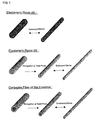
- the conjugate fiber of the present invention inherits the property of the elastomeric resins. That is, when the conjugate fiber of the present invention is stretched beyond the yield point of the elastomeric resin (B), the elastomeric resin (B) is restored to the length of the yield point and stabilizes. In contrast, the elastomeric resin (A) remains in its elongated state, maintaining elastic extensibility. Thus, as a conjugate fiber, supportability is remarkably improved. This point is easily understood after referring to, for example, Figure 1 .
- the conjugate fiber of the present invention has low thickness and high transparency when knitted to a clothing fabric.
- the conjugate fiber of the invention can be suitably utilized for stockings, pantyhose, and other clothing that requires the particular features described above.
- the use of the fiber is not limited thereto, and the fiber can be used for other clothing applications.
- the conjugate fiber of the present invention can be prepared by melting each of the elastomeric resin (A) and the elastomeric resin (B), and conjugate spinning these resins with a spinneret having two conjugate nozzles such that the elastomeric resin (A) forms a core and elastomeric resin (B) forms a sheath. This process can be easily performed using a known spinning apparatus. Depending on its purpose, the fiber obtained can be elongated to adjust its strength and elongation.
- the conjugate fiber of the present invention has excellent transparency and supportability, and is more easily manufactured than other known covered yarns. Therefore, production costs can be reduced, and high productivity is attained.
- the dyeable resin for example, nylon, polyester, etc.
- the elastomeric resin (B) of the sheath thereby reforming the properties of the resin.
- dyeable resins that can be selected include polyamide-based, polyester-based, acryl-based, and vinylon-based resins, etc. Of these, polyamide-based and polyester-based resins are preferred.
- the mixing ratio thereof is determined in accordance with the dyeing property of the elastomer resin (B).
- the lower limit of the resin content is preferably 1 wt%; the upper limit of the resin content is preferably 30 wt%, and more preferably 10 wt%. At less than 1 wt%, the fiber exhibits low color enhancement after dyeing, whereas at over 30 wt%, the strength and elongation of the fiber may be lowered. Further, spinning property is impaired.
- Examples of the production process thereof include mixing the resin described above with the elastomeric resin (B), and supplying the result to an extruder. It is desirable that the resins be dispersed uniformly in order to obtain a stabilized property; therefore, it is preferable that the compound raw material be prepared using a biaxial kneading machine, and the resultant supplied into the extruder.
- pantyhose that are very soft to the touch and can be dyed in various ways can be prepared.
- the softness to the touch can be improved by dispersing inorganic fine particles and the like on the surface of the elastomeric resin (B) of the sheath.
- Inorganic fine particles are not particularly limited. Examples thereof include light calcium carbonate, ground calcium carbonate and like calcium carbonates; barium carbonate; basic magnesium carbonate and like magnesium carbonates; kaolin, talc, calcium sulfate, barium sulfate, titanium dioxide, titanium oxide, zinc oxide, magnesium oxide, ferrite powder, zinc sulfide, zinc carbonate, satin white, calcinated diatomaceous earth, and like diatomaceous earth; calcium silicate, aluminum silicate, magnesium silicate, amorphous silica, non-crystalline synthetic silica, colloidal silica and like silica; colloidal alumina, pseudo-boehmite, aluminium hydroxide, magnesium hydroxide, alumina, lithopone, zeolite, aluminosilicate, activated clay, bentonite, sericite, and like mineral pigments. These may be used singly or in combination. Of these, titanium oxide, zinc oxide, barium sulfate, and silica are preferred.
- the shape of the inorganic fine particles includes regular shape particles such as ball-like, needle-like, and plate-like particles, or irregular shape particles.
- the above-mentioned inorganic fine particles preferably have an average particle diameter of 0.2 ⁇ m minimum and 3 ⁇ m maximum. Particles with an average particle diameter of less than 0.2 ⁇ m are insufficient for decreasing the discomfort of stickiness, etc. in humid weather. When inorganic fine particles with an average particle diameter greater than 3 ⁇ m are used for producing clothing, the texture and softness may be impaired, and the strength of the fiber may be reduced.
- the lower limit of the inorganic fine particles content is preferably 2 wt%.
- the upper limit of the inorganic fine particles content is preferably 30 wt%, and more preferably 7 wt%. At less than 2 wt%, the effect of decreasing the discomfort of stickiness, etc., in humid weather may not be fully attained, whereas at over 30 wt%, the strength and elongation of the fiber may be lowered. Further, spinning property is also lowered.
- Examples of the production process thereof include mixing the inorganic fine particles with the elastomeric resin (B), and supplying the resulting mixture into an extruder.
- the resins be dispersed uniformly in order to obtain a stabilized property; therefore, it is preferable that the compound raw material be prepared using a biaxial kneading machine, and the resultant thereafter supplied into the extruder.
- the conjugate fiber of the present invention has characteristics such as decreased fabric thickness, high transparency, and high supportability due to high stretchability, which could not be attained by the known SCY, DCY and conjugate fibers comprising stretch fibers and thermoplastic fibers.
- the conjugate fiber of the present invention has excellent elastic extensibility and transparency, and is thus suitable to be used as material in stylish, stretchable clothing of high supportability, especially in stockings and pantyhose.
- Thermoplastic polyurethane and polyester-based elastomer were separately melted at 200°C and 195 to 210°C, respectively, and were conjugate spun with a spinneret having two conjugate nozzles, which was heated at 195°C, to obtain a non-crimp developing type (concentric type) bicomponent fiber in which the thermoplastic polyurethane formed the core and the polyester-based elastomer formed the sheath.
- the area ratio of the thermoplastic polyurethane to the polyester-based elastomer in the cross section of the bicomponent fiber was changed depending on the ratio of each component discharged by a gear pump.
- the amount of discharge was adjusted so that the fiber becomes a single yarn having 24d after being stretched.
- the yarn was wound up in an unstretched state at a spinning rate of 500 m/minute, with the addition of a silicon-based oil solution. Then, the yarn was stretched in another step and aged at 80°C for 24 hours under an air atmosphere with a dew-point temperature of 10°C.
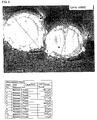
- the cross-sectional photograph of the obtained conjugate fiber is shown in FIG. 2 .
- the diameter of the fiber was 61 ⁇ m and the core accounted for 58% of the sectional area of the fiber.
- a conjugate fiber was produced in a similar manner as in Example 1 except for using a polyamide (nylon-6) in place of the polyester-based elastomer in Example 1.
- the diameter of the fiber was 60 ⁇ m and the core accounted for 56% of the sectional area of the fiber.
- a single covered yarn containing a polyurethane elastic yarn measuring 22dT as a core yarn and a nylon yarn measuring 11dT/5filaments as a covering yarn twisted around the polyurethane elastic yarn in the S direction was produced.
- a cylindrical knitting fabric was knitted in a single knitting pattern (plain knitting pattern) on a single cylinder knitting machine, and the toe ends and the panty part thereof were stitched in accordance with a standard process. Then, the fabric was dyed (beige; carlo) and heat-set on a foot mold, thereby producing pantyhose.
- pantyhose were produced in the same manner as in Example 2.
- pantyhose were produced in the same manner as in Example 2.
- Example 1 and Comparative Examples 1 and 2 were evaluated in the following manner.
- Elastic extensibility of the pantyhose fabric was evaluated by measuring the recovery stress after being stretched to a constant length (lateral stretch). A stretching jig was attached to a 10 cm portion of an inseam (knee region), and the recovery stress was measured at 50 cm extension, a maximum of 60 cm extension, and 50 cm recovery (unit: CN).
- Transparency of the pantyhose fabric was evaluated by sensory evaluation. Specifically, as shown in FIG. 3 , a subject wears each of the pantyhose and puts one leg on a footstool. Evaluators sit on the floor 1.5 meters away from the subject to evaluate the pantyhose. Evaluation items are "transparency”, "no sheen (glareless)", and "a natural, bare-legged appearance". One wearer was evaluated by nine evaluators.
- the evaluation scale includes 5 levels in total: a normal level (0) as the middle level and 2 anteroposterior levels from the normal level (-2, -1, where the negative numeral indicates an inferior evaluation; and +1, +2, where the positive numeral indicates a superior evaluation). The average values (to one decimal place) of each evaluated item were calculated.
- the color difference fomulas (L*, a*, b*) and the optical density of 16 stacked pieces of pantyhose fabric were measured using a WHITE EYE3000 Macbeth spectrophotometer (manufactured by Kollmongen Instruments Corporation).
- the optical density is the opacity index, which shows that transparency is higher at a lower numerical value.
- Example 1 0.240, 0.0111, 3.056 383.9, 813.9, 123.3 Comparative Example 1 0.209, 0.0129, 5.063 306.2, 514.5, 115.8 Comparative Example 2 0.225, 0.0407, 2.875 567.9, 872.0, 288.9 [Table 2] Measurement item Transparent Properties (Transparency, No Sheen, Natural, Bare-Legged Appearance) Color Value (L*, a*, b*, Optical Density) Example 2 1.0, 0.8, 1.2 52.71, 10.90, 19.01, 28.6 Comparative Example 3 0.9, 0.4, 1.0 48.96, 8.45, 15.83, 35.1 Comparative Example 4 -0.4, 0.6, -0.7 48.05, 8.00, 18.02, 38.5
- pantyhose fabric of Example 1 has both a narrow fluctuation range of the dynamic friction coefficient and a small asperity as a result of MMD and SMD, which means that the fabric is less scratchy. Further, the fabric is superior in elastic extensibility to Comparative Example 1. Moreover, the evaluation of the transparency indicated that the fabric had high transparency and less sheen, and gave the legs a natural, bare-legged appearance. This result was also supported by the low optical density of the color value.
- the conjugate fiber of the present invention has overall excellent elastic extensibility and transparency, and is suitably used as material for stretchable garments such as pantyhose.
Landscapes
- Engineering & Computer Science (AREA)
- Textile Engineering (AREA)
- Chemical & Material Sciences (AREA)
- Chemical Kinetics & Catalysis (AREA)
- General Chemical & Material Sciences (AREA)
- Materials Engineering (AREA)
- Mechanical Engineering (AREA)
- Multicomponent Fibers (AREA)
Abstract
Description
- The present invention relates to a material for producing stretchable clothing, such as stockings and panty stockings (PS).
- Stretch fibers have been widely used for pantyhose fibers. Examples of stretch fibers commonly used include single covered yarn (SCY), in which at least one nylon fiber is wound around a polyurethane fiber, and double covered yarn (DCY), in which nylon fibers are double-twisted around a polyurethane fiber in different directions (see, for example,
Patent Documents 1 and 2). Crimped conjugate fibers prepared by bonding stretch fibers (polyurethane, etc.) and thermoplastic fibers (polyamide, etc.) successively in the length direction of the fiber are also used (see, for example,Patent Documents 3 to 7). Many improvements associated with these fibers in the elastic properties, strength, etc., of the desired clothing have been reported. - SCY and DCY generally have high supportability due to excellent elasticity; however, deficiencies include an increase in fabric thickness, low transparency, and increased production costs.
- The crimped conjugate fibers described above have advantages such as low fabric thickness and high transparency compared with SCY and DCY; however, they generally have low supportability compared with SCY and DCY due to their crimpability, i.e., coiled stretching extensibility. Therefore, it was difficult to satisfy the demands (i.e., high supportability) of the current market with the crimped conjugate fibers.
Patent Document 1:Japanese Unexamined Patent Publication No. S47-19146
Patent Document 2:Japanese Unexamined Patent Publication No. S62-263339
Patent Document 3:Japanese Unexamined Patent Publication No. S61-34220
Patent Document 4:Japanese Unexamined Patent Publication No. S61-256719
Patent Document 5:Japanese Unexamined Patent Publication No. H03-206122
Patent Document 6:Japanese Unexamined Patent Publication No. H03-206124
Patent Document 7:Japanese Unexamined Patent Publication No. 2003-171831 - An object of the present invention is to provide a conjugate fiber having excellent elastic extensibility and transparency.
- The present inventors conducted extensive research to accomplish the aforementioned object and found that a sheath-core conjugate fiber comprising two different kinds of stretch fibers has excellent crimpability and elasticity, while maintaining its transparency. The present invention was accomplished as a result of further research based on these findings.
- To clarify, the present invention provides a conjugate fiber and a production process thereof, which is described below.
-
Item 1. A highly elastic conjugate fiber comprising an elastomeric resin (A) having elastic extensibility; and an elastomeric resin (B) having elastic extensibility, permanent elongation of 25 to 70% and a tensile elongation of 100 to 800%; a core comprising the elastomeric resin (A), and a sheath comprising the elastomeric resin (B). -
Item 2. A conjugate fiber according toItem 1, wherein the core and the sheath of the conjugate fiber form an eccentric circle or a concentric circle. -
Item 3. A conjugate fiber according toItem - Item 4. A conjugate fiber according to any one of
Items 1 to 3, wherein the elastomeric resin (B) is a polyester-based elastomer and/or polyamide-based elastomer. - Item 5. A conjugate fiber according to any one of
Items 1 to 4, wherein the sheath further comprises a thermoplastic resin. - Item 6. A conjugate fiber according to any one of
Items 1 to 5, wherein the sheath further comprises inorganic fine particles. -
Item 7. Clothes made from the conjugate fiber according to any one ofItems 1 to 6. -
Item 8. A process for producing a conjugate fiber, comprising: melting each of an elastomeric resin (A) having elastic extensibility, and an elastomeric resin (B) having elastic extensibility, a permanent elongation of 25 to 70%, and a tensile elongation of 100 to 800%; conjugate spinning the resins with a spinneret having two conjugate nozzles such that the elastomeric resin (A) forms the core and the elastomeric resin (B) forms the sheath. - The present invention will be described in detail below.
- The conjugate fiber of the invention is an elastomeric sheath-core conjugate fiber comprising an elastomeric resin (A) having elastic extensibility, and an elastomeric resin (B) having elastic extensibility, a permanent elongation of 25 to 70% and a tensile elongation of 100 to 800%, wherein the core comprises the elastomeric resin (A), and the sheath comprises the elastomeric resin (B). The conjugate fiber of the present invention comprises the specific elastomeric resin (B) not only in the core but also in the sheath to increase the elastic extensibility of the fiber.
- For example, when the cross section of the conjugate fiber is an eccentric circle type, the fiber exhibits elasticity due to its crimping strength at the beginning of stretching, and then exhibits the elastic extensibility of the elastomer to improve its supportability.
- Any elastomeric resin (A) forming the core of the conjugate fiber of the invention with elastic extensibility can be used as long as the elastomeric resin (A) is a thermoplastic elastomer able to restore itself to near-original length even after stretching (no yield point in the stretchable range), i.e., exhibiting rubber elasticity (recovering to not more than 10% on a hysteresis curve). Examples of elastomeric resins (A) include polyurethane, polystyrene butadiene-based block copolymers, etc.; of these, polyurethane is particularly preferred.
- The elastomeric resin (A) has a high tensile strength (JIS K7311) of about 30 to about 60 MPa, and preferably about 45 to about 60 MPa. The tensile elongation (JIS K7311) thereof is about 400 to about 900%, and preferably 400 to 600%.
- Examples of elastomeric resin (A) include Kuramilon U (a product of Kuraray Co., Ltd.) 3195, 8175, etc. and Miractoran (a product of Nippon Polyurethane Industry Co., Ltd.) P485, P495, etc.
- As an example of the production process of the elastomer resin (A), a polyurethane elastomer resin production process is described below. The polyurethane elastomer resin can be made, for example, from aromatic polyisocyantate and polyol, using known methods such as the one-shot method, the prepolymer method, etc.
- Examples of aromatic polyisocyantates used as a raw material include aromatic diisocyanates having 6 to 20 carbon atoms (except carbons in an NCO group, same as above), modified products of such aromatic diisocyanates (modified diisocyanates having a carbodiimide group, a urethodione group, a urethoimine group, a urea group, etc.) and a mixture of two or more thereof.
- Specific examples of aromatic polyisocyantates include 1,3- and/or 1,4-phenylenediisocyanate; 2,4- and/or 2,6-tolylene diisocyanate; 2,4'- and/or 4,4'-diphenylmethanediisocyanate (hereinafter abbreviated as MDI); 4,4'-diisocyanatobiphenyl; 3,3'-dimethyl-4,4'-diisocyanatodiphenylmethane; 1,5-naphthylene diisocyanate, etc. Of these, MDI is particularly preferred.
- Examples of polyols used as a raw material include polyether-based polyols, polyester-based polyols, polycarbonate-based polyols, aliphatic-based polyols, etc. Polyether-based polyols or polyester-based polyols are particularly preferred.
- The number average molecular weight of the polyol is preferably 300 or more, more preferably 1,000 or more, and most preferably 2,000 or more in terms of the softness of the fiber made from the material of the invention. The number average molecular weight of the polyol in terms of elasticity of the fiber is preferably 4,000 or less, more preferably 3,500 or less, and most preferably 3,000 or less.
- The elastomeric resin (B) that constitutes the sheath of the conjugate fiber of the invention is a thermoplastic elastomer resin having elastic extensibility as well as a permanent elongation of 25 to 70%. A permanent elongation is defined in accordance with JIS K 6301. To clarify, when the resin (B) is stretched 100% or more, though it still has elastic extensibility, it is not restored to an original state but is instead restored to a stabilized state after stretching.
- This is because in the original state of the elastomeric resin (B), the hard segment and the soft segment that constitute the elastomeric resin (B) are randomly distributed; however, when stretched 100% or more, the hard segment is oriented and cannot be restored to the original state, but the soft segment retains elastic extensibility. The conjugate fiber of the present invention takes full advantage of the elastomeric resin (B) described above to exhibit high supportability.
- The permanent elongation (JIS K 6301) of the elastomeric resin (B) is about 25 to about 70%, preferably about 30 to about 70%, and more preferably about 40 to about 60% at 100% stretching. To get the permanent elongation, a dumbbell-shaped specimen is stretched under tensile load until the specified elongation reaches 100% (double-length), and then left to stand in that state for 10 minutes. Subsequently, the load is promptly released and the specimen is left to stand for ten minutes. The ratio of the elongation after being left alone for 10 minutes to the initial length is measured and defined as the permanent elongation (%). High supportability of the conjugate fiber cannot be obtained when the permanent elongation is less than 25%. When the permanent elongation exceeds 70%, the fiber becomes smaller due to the properties of the elastic body, and is plastic-deformed.
- In general, the resin can further produce an elongation of about 100% (double-length) to about 300% (quadruple-length) from the permanent elongation.
- The tensile strength (JIS K7311) of the elastomeric resin (B) is preferably about 10 to about 40 MPa, and more preferably a higher strength of about 25 to about 40 MPa. The tensile elongation (JIS K7311) is preferably about 100 to about 800%, and more preferably 400 to 600%. The resin having a tensile elongation of less than 100% is insufficiently stretchable and cannot be used for applications that require stretchability, while the resin having a tensile elongation of over 800% has low strength, resulting in low supportability.
- Specific examples of the elastomeric resin (B) having the above-mentioned properties include urethane-based elastomers (TPU), polyester-based elastomers, polyamide-based elastomers, styrene-butadiene-based elastomers, etc. These elastomeric resins can be prepared using a known method, and a commercially available resin can be used as well.
- Examples of urethane-based elastomers include a block copolymer comprising a soft segment containing a polyol component and a hard segment containing an organic polyisocyanate component. Specific examples thereof include polyester-based polyurethane elastomers, polycaprolactone-based polyurethane elastomers, polycarbonate-based polyurethane elastomers, polyether-based urethane-type elastomers, etc. For example, Kuramilon, manufactured by Kuraray Co., Ltd. can be exemplified.
- Examples of polyester-based elastomers include a polyether (or polyester) ester block copolymer comprising a hard segment containing an aromatic polyester component, and a soft segment containing a polyether component or a polyester component. Examples of aromatic polyester components that are hard segments include polybutylene terephthalate (PBT), etc. Examples of polyether components or polyester components that are soft segments include polytetramethylene glycol (PTMG), polycaprolactone (PCL), etc. Any of these examples can be used in the present invention, though a polyether ester block copolymer is preferably used.
- Specific examples thereof include Pelprene (P-type, S-type, etc.) manufactured by Toyobo Co., Ltd., and Hytrel manufactured by Du Pont Toray Co., Ltd. Further, polyester-based elastomers disclosed in
Japanese Unexamined Patent Publication No. H11-302519 Japanese Unexamined Patent Publication No. 2000- 143954 - Examples of polyamide-based elastomers include a block copolymer comprising a hard segment containing a polyamide component, and a soft segment containing either or both a polyether component and a polyester component. Examples thereof include Pebax manufactured by Arkema Co., Ltd., the PAE series manufactured by Ube Industries, Ltd., etc.
- Examples of styrene butadiene-based elastomer include a block copolymer comprising a hard segment containing a polystyrene component, and a soft segment containing a polyolefin component. Examples thereof include styrene-ethylene-butylene-styrene block copolymer (SEBS), etc.
- In addition to eccentric circle-type and concentric circle-type sheath-core conjugate fibers, side by side-type sheath-core conjugate fibers can also be used for excellent crimpability by heat contraction, etc. Of these, the eccentric circle-type is preferred in terms of softness to the touch.
- The share of the elastomeric resin (A) to a fiber cross section is about 30 to about 90%, preferably about 50 to about 70%. Within the range above, the conjugate fiber having high supportability can be obtained. At less than 30%, high supportability cannot be obtained since the elastomeric resin (B) occupies a high share of the fiber cross section, whereas at over 90%, the fiber cannot easily return to a stable state after stretching.
- The diameter of the conjugate fiber of the invention is not particularly limited and is generally about 20 to about 100 µm, and preferably about 30 to 80 µm. In particular, when the fiber is used for panty stockings (PS), the diameter of about 40 to about 70 µm is preferred.
- As described above, the elastomeric resin (A) that forms the core and has elastic extensibility has no yield point in the stretchable range (i.e., no elongation point over the elastic range); however, the elastomeric resin (B) has elastic extensibility and a yield point in its stretchable range. The conjugate fiber of the present invention inherits the property of the elastomeric resins. That is, when the conjugate fiber of the present invention is stretched beyond the yield point of the elastomeric resin (B), the elastomeric resin (B) is restored to the length of the yield point and stabilizes. In contrast, the elastomeric resin (A) remains in its elongated state, maintaining elastic extensibility. Thus, as a conjugate fiber, supportability is remarkably improved. This point is easily understood after referring to, for example,
Figure 1 . - The conjugate fiber of the present invention has low thickness and high transparency when knitted to a clothing fabric.
- Therefore, the conjugate fiber of the invention can be suitably utilized for stockings, pantyhose, and other clothing that requires the particular features described above. The use of the fiber is not limited thereto, and the fiber can be used for other clothing applications.
- The conjugate fiber of the present invention can be prepared by melting each of the elastomeric resin (A) and the elastomeric resin (B), and conjugate spinning these resins with a spinneret having two conjugate nozzles such that the elastomeric resin (A) forms a core and elastomeric resin (B) forms a sheath. This process can be easily performed using a known spinning apparatus. Depending on its purpose, the fiber obtained can be elongated to adjust its strength and elongation.
- The conjugate fiber of the present invention has excellent transparency and supportability, and is more easily manufactured than other known covered yarns. Therefore, production costs can be reduced, and high productivity is attained.
- In order to also provide dyeing properties to a fiber, it is possible to alloy the dyeable resin (for example, nylon, polyester, etc.) with the elastomeric resin (B) of the sheath, thereby reforming the properties of the resin. Examples of dyeable resins that can be selected include polyamide-based, polyester-based, acryl-based, and vinylon-based resins, etc. Of these, polyamide-based and polyester-based resins are preferred. The mixing ratio thereof is determined in accordance with the dyeing property of the elastomer resin (B). The lower limit of the resin content is preferably 1 wt%; the upper limit of the resin content is preferably 30 wt%, and more preferably 10 wt%. At less than 1 wt%, the fiber exhibits low color enhancement after dyeing, whereas at over 30 wt%, the strength and elongation of the fiber may be lowered. Further, spinning property is impaired.
- Examples of the production process thereof include mixing the resin described above with the elastomeric resin (B), and supplying the result to an extruder. It is desirable that the resins be dispersed uniformly in order to obtain a stabilized property; therefore, it is preferable that the compound raw material be prepared using a biaxial kneading machine, and the resultant supplied into the extruder.
- By the above methods, high-fashion pantyhose that are very soft to the touch and can be dyed in various ways can be prepared.
- In the conjugate fiber of the present invention, the softness to the touch can be improved by dispersing inorganic fine particles and the like on the surface of the elastomeric resin (B) of the sheath.
- Inorganic fine particles are not particularly limited. Examples thereof include light calcium carbonate, ground calcium carbonate and like calcium carbonates; barium carbonate; basic magnesium carbonate and like magnesium carbonates; kaolin, talc, calcium sulfate, barium sulfate, titanium dioxide, titanium oxide, zinc oxide, magnesium oxide, ferrite powder, zinc sulfide, zinc carbonate, satin white, calcinated diatomaceous earth, and like diatomaceous earth; calcium silicate, aluminum silicate, magnesium silicate, amorphous silica, non-crystalline synthetic silica, colloidal silica and like silica; colloidal alumina, pseudo-boehmite, aluminium hydroxide, magnesium hydroxide, alumina, lithopone, zeolite, aluminosilicate, activated clay, bentonite, sericite, and like mineral pigments. These may be used singly or in combination. Of these, titanium oxide, zinc oxide, barium sulfate, and silica are preferred.
- There is no specific limitation on the shape of the inorganic fine particles, and examples thereof include regular shape particles such as ball-like, needle-like, and plate-like particles, or irregular shape particles.
- The above-mentioned inorganic fine particles preferably have an average particle diameter of 0.2 µm minimum and 3 µm maximum. Particles with an average particle diameter of less than 0.2 µm are insufficient for decreasing the discomfort of stickiness, etc. in humid weather. When inorganic fine particles with an average particle diameter greater than 3 µm are used for producing clothing, the texture and softness may be impaired, and the strength of the fiber may be reduced.
- The lower limit of the inorganic fine particles content is preferably 2 wt%. The upper limit of the inorganic fine particles content is preferably 30 wt%, and more preferably 7 wt%. At less than 2 wt%, the effect of decreasing the discomfort of stickiness, etc., in humid weather may not be fully attained, whereas at over 30 wt%, the strength and elongation of the fiber may be lowered. Further, spinning property is also lowered.
- Examples of the production process thereof include mixing the inorganic fine particles with the elastomeric resin (B), and supplying the resulting mixture into an extruder. However, it is desirable that the resins be dispersed uniformly in order to obtain a stabilized property; therefore, it is preferable that the compound raw material be prepared using a biaxial kneading machine, and the resultant thereafter supplied into the extruder.
- The conjugate fiber of the present invention has characteristics such as decreased fabric thickness, high transparency, and high supportability due to high stretchability, which could not be attained by the known SCY, DCY and conjugate fibers comprising stretch fibers and thermoplastic fibers.
- The conjugate fiber of the present invention has excellent elastic extensibility and transparency, and is thus suitable to be used as material in stylish, stretchable clothing of high supportability, especially in stockings and pantyhose.
-
-
FIG. 1 is a schematic view showing the elastic behavior of the conjugate fiber of the invention. Elastomeric resin (A) returns to approximately its original length after being stretched. In other words, it is elastic within its elongation at yield point (e.g., polyurethane). Elastomeric resin (B) is stretched beyond its elongation at yield point and returns to the elongation at yield point after being stretched (e.g., polyester elastomer). The conjugate fiber of the invention is stretched beyond the elongation at yield point of the elastomeric resin (B) in the sheath and returns to the elongation at yield point after being stretched. Also, in the elongation at yield point, the elastomeric resin (A) in the core holds elastic extensibility. -
FIG. 2 is a micrograph of the cross-section of the conjugate fiber of the invention. -
FIG. 3 is a schematic view of an evaluation method of transparency. - The invention will be described in more detail below by way of Examples and Comparative Examples, which are not intended to limit the invention.
- Thermoplastic polyurethane and polyester-based elastomer were separately melted at 200°C and 195 to 210°C, respectively, and were conjugate spun with a spinneret having two conjugate nozzles, which was heated at 195°C, to obtain a non-crimp developing type (concentric type) bicomponent fiber in which the thermoplastic polyurethane formed the core and the polyester-based elastomer formed the sheath. The area ratio of the thermoplastic polyurethane to the polyester-based elastomer in the cross section of the bicomponent fiber was changed depending on the ratio of each component discharged by a gear pump.
- The amount of discharge was adjusted so that the fiber becomes a single yarn having 24d after being stretched.
- The yarn was wound up in an unstretched state at a spinning rate of 500 m/minute, with the addition of a silicon-based oil solution. Then, the yarn was stretched in another step and aged at 80°C for 24 hours under an air atmosphere with a dew-point temperature of 10°C.
- The cross-sectional photograph of the obtained conjugate fiber is shown in
FIG. 2 . The diameter of the fiber was 61 µm and the core accounted for 58% of the sectional area of the fiber. - A conjugate fiber was produced in a similar manner as in Example 1 except for using a polyamide (nylon-6) in place of the polyester-based elastomer in Example 1.
- The diameter of the fiber was 60 µm and the core accounted for 56% of the sectional area of the fiber.
- A single covered yarn containing a polyurethane elastic yarn measuring 22dT as a core yarn and a nylon yarn measuring 11dT/5filaments as a covering yarn twisted around the polyurethane elastic yarn in the S direction was produced.
- Using the conjugate fiber of Example 1, a cylindrical knitting fabric was knitted in a single knitting pattern (plain knitting pattern) on a single cylinder knitting machine, and the toe ends and the panty part thereof were stitched in accordance with a standard process. Then, the fabric was dyed (beige; carlo) and heat-set on a foot mold, thereby producing pantyhose.
- Using the conjugate fiber of Comparative Example 1, pantyhose were produced in the same manner as in Example 2.
- Using the single covered yarn of Comparative Example 2, pantyhose were produced in the same manner as in Example 2.
- The fibers obtained in Example 1 and Comparative Examples 1 and 2, and the fabrics obtained in Example 2 and Comparative Examples 3 and 4 were evaluated in the following manner.
- Surface properties of the pantyhose fabric (MIU: coefficient of dynamic friction, MMD: fluctuation range of coefficient of dynamic friction, unit: dimensionless; and SMD: surface roughness, unit: µm) were measured using a KES system (manufactured by Kato Tech Co., Ltd.).
- Elastic extensibility of the pantyhose fabric was evaluated by measuring the recovery stress after being stretched to a constant length (lateral stretch). A stretching jig was attached to a 10 cm portion of an inseam (knee region), and the recovery stress was measured at 50 cm extension, a maximum of 60 cm extension, and 50 cm recovery (unit: CN).
- Transparency of the pantyhose fabric was evaluated by sensory evaluation. Specifically, as shown in
FIG. 3 , a subject wears each of the pantyhose and puts one leg on a footstool. Evaluators sit on the floor 1.5 meters away from the subject to evaluate the pantyhose. Evaluation items are "transparency", "no sheen (glareless)", and "a natural, bare-legged appearance". One wearer was evaluated by nine evaluators. The evaluation scale includes 5 levels in total: a normal level (0) as the middle level and 2 anteroposterior levels from the normal level (-2, -1, where the negative numeral indicates an inferior evaluation; and +1, +2, where the positive numeral indicates a superior evaluation). The average values (to one decimal place) of each evaluated item were calculated. - The color difference fomulas (L*, a*, b*) and the optical density of 16 stacked pieces of pantyhose fabric were measured using a WHITE EYE3000 Macbeth spectrophotometer (manufactured by Kollmongen Instruments Corporation). The optical density is the opacity index, which shows that transparency is higher at a lower numerical value.
- Results of the above measurements are shown in Tables 1 and 2.
[Table 1] Measurement Item Values of the Surface Measurement (MIU, MMD, SMD) Elastic Extensibility: Knee Area (at 50 cm. extension, maximum 60 cm. extension, 50 cm. recovery) Example 1 0.240, 0.0111, 3.056 383.9, 813.9, 123.3 Comparative Example 1 0.209, 0.0129, 5.063 306.2, 514.5, 115.8 Comparative Example 2 0.225, 0.0407, 2.875 567.9, 872.0, 288.9 [Table 2] Measurement item Transparent Properties (Transparency, No Sheen, Natural, Bare-Legged Appearance) Color Value (L*, a*, b*, Optical Density) Example 2 1.0, 0.8, 1.2 52.71, 10.90, 19.01, 28.6 Comparative Example 3 0.9, 0.4, 1.0 48.96, 8.45, 15.83, 35.1 Comparative Example 4 -0.4, 0.6, -0.7 48.05, 8.00, 18.02, 38.5 - The above results show that the pantyhose fabric of Example 1 has both a narrow fluctuation range of the dynamic friction coefficient and a small asperity as a result of MMD and SMD, which means that the fabric is less scratchy. Further, the fabric is superior in elastic extensibility to Comparative Example 1. Moreover, the evaluation of the transparency indicated that the fabric had high transparency and less sheen, and gave the legs a natural, bare-legged appearance. This result was also supported by the low optical density of the color value.
- Therefore, the conjugate fiber of the present invention has overall excellent elastic extensibility and transparency, and is suitably used as material for stretchable garments such as pantyhose.
Claims (8)
- A highly elastic conjugate fiber comprising an elastomeric resin (A) having elastic extensibility; and an elastomeric resin (B) having elastic extensibility, permanent elongation of 25 to 70% and a tensile elongation of 100 to 800%; a core comprising the elastomeric resin (A), and a sheath comprising the elastomeric resin (B).
- A conjugate fiber according to Claim 1, wherein the core and the sheath of the conjugate fiber form an eccentric circle or a concentric circle.
- A conjugate fiber according to Claim 1 or 2, wherein the elastomeric resin (A) is a polyurethane elastomer.
- A conjugate fiber according to any one of Claims 1 to 3, wherein the elastomeric resin (B) is a polyester-based elastomer and/or polyamide-based elastomer.
- A conjugate fiber according to any one of Claims 1 to 4, wherein the sheath further comprises a thermoplastic resin.
- A conjugate fiber according to any one of Claims 1 to 5, wherein the sheath further comprises inorganic fine particles.
- Clothes made from the conjugate fiber according to any one of Claims 1 to 6.
- A process for producing a conjugate fiber, comprising: melting each of an elastomeric resin (A) having elastic extensibility, and an elastomeric resin (B) having elastic extensibility, a permanent elongation of 25 to 70%, and a tensile elongation of 100 to 800%; conjugate spinning the resins with a spinneret having two conjugate nozzles such that the elastomeric resin (A) forms the core and the elastomeric resin (B) forms the sheath.
Applications Claiming Priority (2)
| Application Number | Priority Date | Filing Date | Title |
|---|---|---|---|
| JP2005270916A JP5246997B2 (en) | 2005-09-16 | 2005-09-16 | Elastomeric core-sheath conjugate fiber |
| PCT/JP2006/318301 WO2007032449A1 (en) | 2005-09-16 | 2006-09-14 | Elastomeric core-sheath conjugate fiber |
Publications (3)
| Publication Number | Publication Date |
|---|---|
| EP1944396A1 true EP1944396A1 (en) | 2008-07-16 |
| EP1944396A4 EP1944396A4 (en) | 2009-01-21 |
| EP1944396B1 EP1944396B1 (en) | 2010-06-02 |
Family
ID=37865033
Family Applications (1)
| Application Number | Title | Priority Date | Filing Date |
|---|---|---|---|
| EP06810145A Not-in-force EP1944396B1 (en) | 2005-09-16 | 2006-09-14 | Elastomeric core-sheath conjugate fiber |
Country Status (7)
| Country | Link |
|---|---|
| US (1) | US20090305037A1 (en) |
| EP (1) | EP1944396B1 (en) |
| JP (1) | JP5246997B2 (en) |
| KR (1) | KR101333624B1 (en) |
| CN (1) | CN101263249B (en) |
| DE (1) | DE602006014711D1 (en) |
| WO (1) | WO2007032449A1 (en) |
Cited By (6)
| Publication number | Priority date | Publication date | Assignee | Title |
|---|---|---|---|---|
| RU2463395C1 (en) * | 2009-10-28 | 2012-10-10 | Ниссинбо Текстайл Инк. | Conjugate reinforced thread of rod braiding-type, knitted fabrics, items of clothing and methods of making conjugate reinforced thread of rod braiding-type |
| CN103290513A (en) * | 2013-05-24 | 2013-09-11 | 宁波三邦超细纤维有限公司 | High-elasticity ultrafine polypropylene-polyamide composite fiber and production method thereof |
| CN103290517A (en) * | 2013-05-24 | 2013-09-11 | 宁波三邦超细纤维有限公司 | High-shrinkage polypropylene/nylon complex ultrafine fiber and production method |
| CN103290524A (en) * | 2013-05-24 | 2013-09-11 | 宁波三邦日用品有限公司 | Far infrared polyester and nylon composite superfine fiber and production method thereof |
| EP2347043B1 (en) * | 2008-10-17 | 2018-11-21 | Invista Technologies S.à.r.l. | Bicomponent spandex |
| WO2019215104A1 (en) | 2018-05-11 | 2019-11-14 | Covestro Deutschland Ag | Thermoplastic polyurethane composition and use thereof |
Families Citing this family (19)
| Publication number | Priority date | Publication date | Assignee | Title |
|---|---|---|---|---|
| US20050042412A1 (en) * | 1996-12-31 | 2005-02-24 | Bruner Jeffrey W. | Composite elastomeric yarns and fabric |
| EP2011906A4 (en) * | 2006-04-21 | 2009-12-02 | Aichi Prefecture | PROCESS FOR PRODUCING CUR / SHEATH CONJUGATED ELASTOMER FIBER |
| JP5105921B2 (en) * | 2007-03-20 | 2012-12-26 | グンゼ株式会社 | Knitted fabric and manufacturing method thereof |
| JP4974942B2 (en) * | 2008-03-19 | 2012-07-11 | グンゼ株式会社 | Conjugate fiber |
| JP5221990B2 (en) * | 2008-03-21 | 2013-06-26 | グンゼ株式会社 | Knitted fabric and manufacturing method thereof |
| ES2551746T3 (en) * | 2008-10-17 | 2015-11-23 | Invista Technologies S.À.R.L. | Bicomponent Lycra Fuse |
| JP5202407B2 (en) * | 2009-03-23 | 2013-06-05 | グンゼ株式会社 | Core-sheath conjugate fiber and knitted fabric using the same |
| JP5737833B2 (en) * | 2009-07-27 | 2015-06-17 | グンゼ株式会社 | Elastomeric core-sheath conjugate fiber |
| CN102378833B (en) * | 2009-03-31 | 2014-07-02 | 郡是株式会社 | core sheath composite fiber |
| JP5641704B2 (en) * | 2009-03-31 | 2014-12-17 | グンゼ株式会社 | Core-sheath conjugate fiber and method for producing the same |
| TWI649468B (en) * | 2010-05-26 | 2019-02-01 | 伊唯斯科技公司 | Bicomponent spandex with reduced friction |
| CN104797749B (en) * | 2012-11-16 | 2017-06-13 | 巴斯夫欧洲公司 | Bicomponent fibre, Preparation Method And The Use and the fabric containing the bicomponent fibre |
| EP3031960B1 (en) * | 2013-08-09 | 2020-06-10 | Toray Industries, Inc. | Elastic monofilament |
| CN107059158B (en) * | 2017-05-19 | 2019-10-18 | 中国纺织科学研究院有限公司 | Poly (glycolide-lactide) and polycaprolactone composite fibre, preparation method, purposes and operation suture thread |
| KR102488564B1 (en) * | 2018-04-11 | 2023-01-13 | 삼성전자 주식회사 | Woven pattern housing and electronic device using the same |
| CN110528117B (en) * | 2018-05-24 | 2022-03-08 | 绍兴逸客丝新材料科技有限公司 | Elastic coated wire |
| KR102495240B1 (en) | 2018-07-30 | 2023-02-03 | 삼성전자주식회사 | Led backlighting case |
| JP2022179188A (en) * | 2021-05-21 | 2022-12-02 | ピップ株式会社 | Clothing for lower extremity |
| TWI773573B (en) * | 2021-11-02 | 2022-08-01 | 南亞塑膠工業股份有限公司 | Thermoplastic polyester elastomer conjugate fiber and manufacturing method thereof and fabric |
Citations (4)
| Publication number | Priority date | Publication date | Assignee | Title |
|---|---|---|---|---|
| EP0446377A1 (en) | 1989-10-03 | 1991-09-18 | Kanebo, Ltd. | Composite elastic yarn and process for preparing the same |
| JP2906645B2 (en) | 1990-11-13 | 1999-06-21 | 宇部興産株式会社 | Polyamide elastomer resin composition |
| JPH11302519A (en) | 1998-04-24 | 1999-11-02 | Toyobo Co Ltd | Thermoplastic polyester elastomer |
| JP2000143954A (en) | 1998-11-17 | 2000-05-26 | Toyobo Co Ltd | Thermoplastic polyester elastomer composition |
Family Cites Families (14)
| Publication number | Priority date | Publication date | Assignee | Title |
|---|---|---|---|---|
| US3616184A (en) * | 1968-03-12 | 1971-10-26 | Yasushi Katagiri | Titanium dioxide-containing synthetic filament having improved properties textile products made therefrom and method of imparting said improved properties |
| JPS58163727A (en) * | 1982-03-16 | 1983-09-28 | Kanebo Ltd | Production of polyurethane conjugate elastic yarn |
| JPH0791693B2 (en) * | 1985-12-25 | 1995-10-04 | 鐘紡株式会社 | Polycapramide-polyurethane elastic composite filament and method for producing the same |
| KR940005924B1 (en) * | 1989-01-12 | 1994-06-24 | 가네보가부시끼가이샤 | Composite filament yarn and process and spinneret manufacturing the same |
| JP2836978B2 (en) * | 1990-01-18 | 1998-12-14 | 鐘紡 株式会社 | Composite elastic yarn |
| JP3140082B2 (en) * | 1991-04-11 | 2001-03-05 | カネボウ株式会社 | New elastic fabric |
| WO1992020844A1 (en) * | 1991-05-14 | 1992-11-26 | Kanebo, Ltd. | Potentially elastic conjugate fiber, production thereof, and production of fibrous structure with elasticity in expansion and contraction |
| US5385775A (en) * | 1991-12-09 | 1995-01-31 | Kimberly-Clark Corporation | Composite elastic material including an anisotropic elastic fibrous web and process to make the same |
| US5875797A (en) * | 1995-06-06 | 1999-03-02 | Gillette Canada Inc. | Dental floss |
| WO1998039503A1 (en) * | 1997-03-04 | 1998-09-11 | E.I. Du Pont De Nemours And Company | Uv resistant elastomeric monofilament |
| KR100665980B1 (en) * | 1999-11-30 | 2007-01-10 | 가부시키가이샤 에루부 | Complex molded article and manufacturing method |
| ES2275891T3 (en) * | 2001-07-17 | 2007-06-16 | Dow Global Technologies Inc. | BICOMPONENT AND BICONSTITUENT FIBERS ELASTICS RESISTANT TO HEAT AND HUMIDITY. |
| DE60215015T2 (en) * | 2001-07-17 | 2007-02-22 | Dow Global Technologies, Inc., Midland | ELASTIC BIKOMPONENTEN AND BIKONSTITUENTENFASERN AND METHOD FOR THE PRODUCTION OF CELLULOSE STRUCTURES USING THE SAME |
| US20050031865A1 (en) * | 2002-07-23 | 2005-02-10 | Sauer Bryan B. | Fibers, tapes and films prepared from olefinic and segmented elastomers |
-
2005
- 2005-09-16 JP JP2005270916A patent/JP5246997B2/en not_active Expired - Fee Related
-
2006
- 2006-09-14 WO PCT/JP2006/318301 patent/WO2007032449A1/en not_active Ceased
- 2006-09-14 KR KR1020087006735A patent/KR101333624B1/en not_active Expired - Fee Related
- 2006-09-14 EP EP06810145A patent/EP1944396B1/en not_active Not-in-force
- 2006-09-14 DE DE602006014711T patent/DE602006014711D1/en active Active
- 2006-09-14 CN CN200680033403XA patent/CN101263249B/en active Active
- 2006-09-14 US US12/067,095 patent/US20090305037A1/en not_active Abandoned
Patent Citations (4)
| Publication number | Priority date | Publication date | Assignee | Title |
|---|---|---|---|---|
| EP0446377A1 (en) | 1989-10-03 | 1991-09-18 | Kanebo, Ltd. | Composite elastic yarn and process for preparing the same |
| JP2906645B2 (en) | 1990-11-13 | 1999-06-21 | 宇部興産株式会社 | Polyamide elastomer resin composition |
| JPH11302519A (en) | 1998-04-24 | 1999-11-02 | Toyobo Co Ltd | Thermoplastic polyester elastomer |
| JP2000143954A (en) | 1998-11-17 | 2000-05-26 | Toyobo Co Ltd | Thermoplastic polyester elastomer composition |
Non-Patent Citations (1)
| Title |
|---|
| See also references of WO2007032449A1 |
Cited By (9)
| Publication number | Priority date | Publication date | Assignee | Title |
|---|---|---|---|---|
| EP2347043B1 (en) * | 2008-10-17 | 2018-11-21 | Invista Technologies S.à.r.l. | Bicomponent spandex |
| RU2463395C1 (en) * | 2009-10-28 | 2012-10-10 | Ниссинбо Текстайл Инк. | Conjugate reinforced thread of rod braiding-type, knitted fabrics, items of clothing and methods of making conjugate reinforced thread of rod braiding-type |
| CN103290513A (en) * | 2013-05-24 | 2013-09-11 | 宁波三邦超细纤维有限公司 | High-elasticity ultrafine polypropylene-polyamide composite fiber and production method thereof |
| CN103290517A (en) * | 2013-05-24 | 2013-09-11 | 宁波三邦超细纤维有限公司 | High-shrinkage polypropylene/nylon complex ultrafine fiber and production method |
| CN103290524A (en) * | 2013-05-24 | 2013-09-11 | 宁波三邦日用品有限公司 | Far infrared polyester and nylon composite superfine fiber and production method thereof |
| CN103290513B (en) * | 2013-05-24 | 2015-07-15 | 宁波三邦超细纤维有限公司 | High-elasticity ultrafine polypropylene-polyamide composite fiber and production method thereof |
| CN103290517B (en) * | 2013-05-24 | 2015-07-15 | 宁波三邦超细纤维有限公司 | High-shrinkage polypropylene/nylon complex ultrafine fiber and production method |
| WO2019215104A1 (en) | 2018-05-11 | 2019-11-14 | Covestro Deutschland Ag | Thermoplastic polyurethane composition and use thereof |
| WO2019213932A1 (en) * | 2018-05-11 | 2019-11-14 | Covestro Deutschland Ag | Thermoplastic polyurethane composition and use thereof |
Also Published As
| Publication number | Publication date |
|---|---|
| DE602006014711D1 (en) | 2010-07-15 |
| KR101333624B1 (en) | 2013-11-27 |
| US20090305037A1 (en) | 2009-12-10 |
| CN101263249A (en) | 2008-09-10 |
| EP1944396B1 (en) | 2010-06-02 |
| KR20080044887A (en) | 2008-05-21 |
| WO2007032449A1 (en) | 2007-03-22 |
| CN101263249B (en) | 2011-07-20 |
| EP1944396A4 (en) | 2009-01-21 |
| JP2007077556A (en) | 2007-03-29 |
| JP5246997B2 (en) | 2013-07-24 |
Similar Documents
| Publication | Publication Date | Title |
|---|---|---|
| EP1944396B1 (en) | Elastomeric core-sheath conjugate fiber | |
| EP2011906A1 (en) | Process for producing core/sheath conjugate elastomer fiber | |
| KR101151058B1 (en) | Core-sheath conjugate thread, fabric, clothing article, and method for producing core-sheath conjugate thread | |
| WO2010113862A1 (en) | Core-sheath conjugate fiber and process for producing same | |
| JP5147269B2 (en) | Elastomeric core-sheath conjugate fiber and method for producing the same | |
| CA2801568C (en) | Melt spun elastic fibers having flat modulus | |
| JP5105921B2 (en) | Knitted fabric and manufacturing method thereof | |
| JP5221990B2 (en) | Knitted fabric and manufacturing method thereof | |
| JP5197090B2 (en) | Conjugate fiber | |
| JP5557440B2 (en) | Conjugate fiber | |
| JP2006063461A (en) | Spun-dyed stocking | |
| JP4974942B2 (en) | Conjugate fiber | |
| JP5641704B2 (en) | Core-sheath conjugate fiber and method for producing the same | |
| JP5328956B2 (en) | Conjugate fiber | |
| JP5748442B2 (en) | Knitted fabrics and garments containing core-sheath conjugate fibers | |
| JP3552292B2 (en) | Stocking and manufacturing method thereof | |
| JP5737833B2 (en) | Elastomeric core-sheath conjugate fiber | |
| JP3804262B2 (en) | stockings | |
| JP5041836B2 (en) | Method for producing conjugate fiber | |
| JPH0874102A (en) | Stocking and manufacturing method thereof | |
| JP2000303288A (en) | Method for manufacturing coated elastic yarn, coated elastic yarn, fiber product thereof, and method for manufacturing fiber product | |
| JP2000234205A (en) | stockings | |
| JP2021070877A (en) | Woven knit |
Legal Events
| Date | Code | Title | Description |
|---|---|---|---|
| PUAI | Public reference made under article 153(3) epc to a published international application that has entered the european phase |
Free format text: ORIGINAL CODE: 0009012 |
|
| 17P | Request for examination filed |
Effective date: 20080228 |
|
| AK | Designated contracting states |
Kind code of ref document: A1 Designated state(s): AT BE BG CH CY CZ DE DK EE ES FI FR GB GR HU IE IS IT LI LT LU LV MC NL PL PT RO SE SI SK TR |
|
| A4 | Supplementary search report drawn up and despatched |
Effective date: 20081223 |
|
| 17Q | First examination report despatched |
Effective date: 20090327 |
|
| TPAC | Observations filed by third parties |
Free format text: ORIGINAL CODE: EPIDOSNTIPA |
|
| R17C | First examination report despatched (corrected) |
Effective date: 20090327 |
|
| GRAP | Despatch of communication of intention to grant a patent |
Free format text: ORIGINAL CODE: EPIDOSNIGR1 |
|
| DAX | Request for extension of the european patent (deleted) | ||
| GRAS | Grant fee paid |
Free format text: ORIGINAL CODE: EPIDOSNIGR3 |
|
| GRAA | (expected) grant |
Free format text: ORIGINAL CODE: 0009210 |
|
| AK | Designated contracting states |
Kind code of ref document: B1 Designated state(s): AT BE BG CH CY CZ DE DK EE ES FI FR GB GR HU IE IS IT LI LT LU LV MC NL PL PT RO SE SI SK TR |
|
| REG | Reference to a national code |
Ref country code: GB Ref legal event code: FG4D |
|
| REG | Reference to a national code |
Ref country code: CH Ref legal event code: EP |
|
| REG | Reference to a national code |
Ref country code: IE Ref legal event code: FG4D |
|
| REF | Corresponds to: |
Ref document number: 602006014711 Country of ref document: DE Date of ref document: 20100715 Kind code of ref document: P |
|
| REG | Reference to a national code |
Ref country code: NL Ref legal event code: VDEP Effective date: 20100602 |
|
| PG25 | Lapsed in a contracting state [announced via postgrant information from national office to epo] |
Ref country code: SE Free format text: LAPSE BECAUSE OF FAILURE TO SUBMIT A TRANSLATION OF THE DESCRIPTION OR TO PAY THE FEE WITHIN THE PRESCRIBED TIME-LIMIT Effective date: 20100602 Ref country code: LT Free format text: LAPSE BECAUSE OF FAILURE TO SUBMIT A TRANSLATION OF THE DESCRIPTION OR TO PAY THE FEE WITHIN THE PRESCRIBED TIME-LIMIT Effective date: 20100602 |
|
| LTIE | Lt: invalidation of european patent or patent extension |
Effective date: 20100602 |
|
| PG25 | Lapsed in a contracting state [announced via postgrant information from national office to epo] |
Ref country code: LV Free format text: LAPSE BECAUSE OF FAILURE TO SUBMIT A TRANSLATION OF THE DESCRIPTION OR TO PAY THE FEE WITHIN THE PRESCRIBED TIME-LIMIT Effective date: 20100602 Ref country code: SI Free format text: LAPSE BECAUSE OF FAILURE TO SUBMIT A TRANSLATION OF THE DESCRIPTION OR TO PAY THE FEE WITHIN THE PRESCRIBED TIME-LIMIT Effective date: 20100602 Ref country code: AT Free format text: LAPSE BECAUSE OF FAILURE TO SUBMIT A TRANSLATION OF THE DESCRIPTION OR TO PAY THE FEE WITHIN THE PRESCRIBED TIME-LIMIT Effective date: 20100602 Ref country code: FI Free format text: LAPSE BECAUSE OF FAILURE TO SUBMIT A TRANSLATION OF THE DESCRIPTION OR TO PAY THE FEE WITHIN THE PRESCRIBED TIME-LIMIT Effective date: 20100602 |
|
| PG25 | Lapsed in a contracting state [announced via postgrant information from national office to epo] |
Ref country code: PL Free format text: LAPSE BECAUSE OF FAILURE TO SUBMIT A TRANSLATION OF THE DESCRIPTION OR TO PAY THE FEE WITHIN THE PRESCRIBED TIME-LIMIT Effective date: 20100602 Ref country code: GR Free format text: LAPSE BECAUSE OF FAILURE TO SUBMIT A TRANSLATION OF THE DESCRIPTION OR TO PAY THE FEE WITHIN THE PRESCRIBED TIME-LIMIT Effective date: 20100903 Ref country code: CY Free format text: LAPSE BECAUSE OF FAILURE TO SUBMIT A TRANSLATION OF THE DESCRIPTION OR TO PAY THE FEE WITHIN THE PRESCRIBED TIME-LIMIT Effective date: 20100602 |
|
| PG25 | Lapsed in a contracting state [announced via postgrant information from national office to epo] |
Ref country code: NL Free format text: LAPSE BECAUSE OF FAILURE TO SUBMIT A TRANSLATION OF THE DESCRIPTION OR TO PAY THE FEE WITHIN THE PRESCRIBED TIME-LIMIT Effective date: 20100602 Ref country code: EE Free format text: LAPSE BECAUSE OF FAILURE TO SUBMIT A TRANSLATION OF THE DESCRIPTION OR TO PAY THE FEE WITHIN THE PRESCRIBED TIME-LIMIT Effective date: 20100602 |
|
| PG25 | Lapsed in a contracting state [announced via postgrant information from national office to epo] |
Ref country code: BE Free format text: LAPSE BECAUSE OF FAILURE TO SUBMIT A TRANSLATION OF THE DESCRIPTION OR TO PAY THE FEE WITHIN THE PRESCRIBED TIME-LIMIT Effective date: 20100602 Ref country code: CZ Free format text: LAPSE BECAUSE OF FAILURE TO SUBMIT A TRANSLATION OF THE DESCRIPTION OR TO PAY THE FEE WITHIN THE PRESCRIBED TIME-LIMIT Effective date: 20100602 Ref country code: IS Free format text: LAPSE BECAUSE OF FAILURE TO SUBMIT A TRANSLATION OF THE DESCRIPTION OR TO PAY THE FEE WITHIN THE PRESCRIBED TIME-LIMIT Effective date: 20101002 Ref country code: PT Free format text: LAPSE BECAUSE OF FAILURE TO SUBMIT A TRANSLATION OF THE DESCRIPTION OR TO PAY THE FEE WITHIN THE PRESCRIBED TIME-LIMIT Effective date: 20101004 Ref country code: RO Free format text: LAPSE BECAUSE OF FAILURE TO SUBMIT A TRANSLATION OF THE DESCRIPTION OR TO PAY THE FEE WITHIN THE PRESCRIBED TIME-LIMIT Effective date: 20100602 Ref country code: SK Free format text: LAPSE BECAUSE OF FAILURE TO SUBMIT A TRANSLATION OF THE DESCRIPTION OR TO PAY THE FEE WITHIN THE PRESCRIBED TIME-LIMIT Effective date: 20100602 |
|
| PLBE | No opposition filed within time limit |
Free format text: ORIGINAL CODE: 0009261 |
|
| STAA | Information on the status of an ep patent application or granted ep patent |
Free format text: STATUS: NO OPPOSITION FILED WITHIN TIME LIMIT |
|
| PG25 | Lapsed in a contracting state [announced via postgrant information from national office to epo] |
Ref country code: DK Free format text: LAPSE BECAUSE OF FAILURE TO SUBMIT A TRANSLATION OF THE DESCRIPTION OR TO PAY THE FEE WITHIN THE PRESCRIBED TIME-LIMIT Effective date: 20100602 Ref country code: MC Free format text: LAPSE BECAUSE OF NON-PAYMENT OF DUE FEES Effective date: 20100930 |
|
| REG | Reference to a national code |
Ref country code: CH Ref legal event code: PL |
|
| 26N | No opposition filed |
Effective date: 20110303 |
|
| REG | Reference to a national code |
Ref country code: DE Ref legal event code: R097 Ref document number: 602006014711 Country of ref document: DE Effective date: 20110302 |
|
| PG25 | Lapsed in a contracting state [announced via postgrant information from national office to epo] |
Ref country code: CH Free format text: LAPSE BECAUSE OF NON-PAYMENT OF DUE FEES Effective date: 20100930 Ref country code: LI Free format text: LAPSE BECAUSE OF NON-PAYMENT OF DUE FEES Effective date: 20100930 Ref country code: IE Free format text: LAPSE BECAUSE OF NON-PAYMENT OF DUE FEES Effective date: 20100914 |
|
| PG25 | Lapsed in a contracting state [announced via postgrant information from national office to epo] |
Ref country code: LU Free format text: LAPSE BECAUSE OF NON-PAYMENT OF DUE FEES Effective date: 20100914 Ref country code: HU Free format text: LAPSE BECAUSE OF FAILURE TO SUBMIT A TRANSLATION OF THE DESCRIPTION OR TO PAY THE FEE WITHIN THE PRESCRIBED TIME-LIMIT Effective date: 20101203 Ref country code: BG Free format text: LAPSE BECAUSE OF FAILURE TO SUBMIT A TRANSLATION OF THE DESCRIPTION OR TO PAY THE FEE WITHIN THE PRESCRIBED TIME-LIMIT Effective date: 20100602 |
|
| PG25 | Lapsed in a contracting state [announced via postgrant information from national office to epo] |
Ref country code: TR Free format text: LAPSE BECAUSE OF FAILURE TO SUBMIT A TRANSLATION OF THE DESCRIPTION OR TO PAY THE FEE WITHIN THE PRESCRIBED TIME-LIMIT Effective date: 20100602 |
|
| PGFP | Annual fee paid to national office [announced via postgrant information from national office to epo] |
Ref country code: GB Payment date: 20120912 Year of fee payment: 7 |
|
| PGFP | Annual fee paid to national office [announced via postgrant information from national office to epo] |
Ref country code: FR Payment date: 20120913 Year of fee payment: 7 Ref country code: IT Payment date: 20120917 Year of fee payment: 7 |
|
| PG25 | Lapsed in a contracting state [announced via postgrant information from national office to epo] |
Ref country code: BG Free format text: LAPSE BECAUSE OF FAILURE TO SUBMIT A TRANSLATION OF THE DESCRIPTION OR TO PAY THE FEE WITHIN THE PRESCRIBED TIME-LIMIT Effective date: 20100902 |
|
| PG25 | Lapsed in a contracting state [announced via postgrant information from national office to epo] |
Ref country code: ES Free format text: LAPSE BECAUSE OF FAILURE TO SUBMIT A TRANSLATION OF THE DESCRIPTION OR TO PAY THE FEE WITHIN THE PRESCRIBED TIME-LIMIT Effective date: 20100913 |
|
| GBPC | Gb: european patent ceased through non-payment of renewal fee |
Effective date: 20130914 |
|
| REG | Reference to a national code |
Ref country code: FR Ref legal event code: ST Effective date: 20140530 |
|
| PG25 | Lapsed in a contracting state [announced via postgrant information from national office to epo] |
Ref country code: GB Free format text: LAPSE BECAUSE OF NON-PAYMENT OF DUE FEES Effective date: 20130914 |
|
| PG25 | Lapsed in a contracting state [announced via postgrant information from national office to epo] |
Ref country code: IT Free format text: LAPSE BECAUSE OF NON-PAYMENT OF DUE FEES Effective date: 20130914 Ref country code: FR Free format text: LAPSE BECAUSE OF NON-PAYMENT OF DUE FEES Effective date: 20130930 |
|
| PGFP | Annual fee paid to national office [announced via postgrant information from national office to epo] |
Ref country code: DE Payment date: 20140911 Year of fee payment: 9 |
|
| REG | Reference to a national code |
Ref country code: DE Ref legal event code: R119 Ref document number: 602006014711 Country of ref document: DE |
|
| PG25 | Lapsed in a contracting state [announced via postgrant information from national office to epo] |
Ref country code: DE Free format text: LAPSE BECAUSE OF NON-PAYMENT OF DUE FEES Effective date: 20160401 |