EP1942313A2 - Apparatus and method of measuring distance using structured light - Google Patents
Apparatus and method of measuring distance using structured light Download PDFInfo
- Publication number
- EP1942313A2 EP1942313A2 EP07123330A EP07123330A EP1942313A2 EP 1942313 A2 EP1942313 A2 EP 1942313A2 EP 07123330 A EP07123330 A EP 07123330A EP 07123330 A EP07123330 A EP 07123330A EP 1942313 A2 EP1942313 A2 EP 1942313A2
- Authority
- EP
- European Patent Office
- Prior art keywords
- image
- light source
- pixel
- light
- length ratio
- Prior art date
- Legal status (The legal status is an assumption and is not a legal conclusion. Google has not performed a legal analysis and makes no representation as to the accuracy of the status listed.)
- Granted
Links
Images








Classifications
-
- G—PHYSICS
- G01—MEASURING; TESTING
- G01B—MEASURING LENGTH, THICKNESS OR SIMILAR LINEAR DIMENSIONS; MEASURING ANGLES; MEASURING AREAS; MEASURING IRREGULARITIES OF SURFACES OR CONTOURS
- G01B11/00—Measuring arrangements characterised by the use of optical techniques
- G01B11/24—Measuring arrangements characterised by the use of optical techniques for measuring contours or curvatures
- G01B11/25—Measuring arrangements characterised by the use of optical techniques for measuring contours or curvatures by projecting a pattern, e.g. one or more lines, moiré fringes on the object
-
- G—PHYSICS
- G01—MEASURING; TESTING
- G01C—MEASURING DISTANCES, LEVELS OR BEARINGS; SURVEYING; NAVIGATION; GYROSCOPIC INSTRUMENTS; PHOTOGRAMMETRY OR VIDEOGRAMMETRY
- G01C3/00—Measuring distances in line of sight; Optical rangefinders
- G01C3/02—Details
-
- G—PHYSICS
- G01—MEASURING; TESTING
- G01B—MEASURING LENGTH, THICKNESS OR SIMILAR LINEAR DIMENSIONS; MEASURING ANGLES; MEASURING AREAS; MEASURING IRREGULARITIES OF SURFACES OR CONTOURS
- G01B11/00—Measuring arrangements characterised by the use of optical techniques
- G01B11/02—Measuring arrangements characterised by the use of optical techniques for measuring length, width or thickness
- G01B11/026—Measuring arrangements characterised by the use of optical techniques for measuring length, width or thickness by measuring distance between sensor and object
-
- G—PHYSICS
- G01—MEASURING; TESTING
- G01S—RADIO DIRECTION-FINDING; RADIO NAVIGATION; DETERMINING DISTANCE OR VELOCITY BY USE OF RADIO WAVES; LOCATING OR PRESENCE-DETECTING BY USE OF THE REFLECTION OR RERADIATION OF RADIO WAVES; ANALOGOUS ARRANGEMENTS USING OTHER WAVES
- G01S17/00—Systems using the reflection or reradiation of electromagnetic waves other than radio waves, e.g. lidar systems
- G01S17/02—Systems using the reflection of electromagnetic waves other than radio waves
- G01S17/06—Systems determining position data of a target
- G01S17/46—Indirect determination of position data
- G01S17/48—Active triangulation systems, i.e. using the transmission and reflection of electromagnetic waves other than radio waves
-
- G—PHYSICS
- G01—MEASURING; TESTING
- G01S—RADIO DIRECTION-FINDING; RADIO NAVIGATION; DETERMINING DISTANCE OR VELOCITY BY USE OF RADIO WAVES; LOCATING OR PRESENCE-DETECTING BY USE OF THE REFLECTION OR RERADIATION OF RADIO WAVES; ANALOGOUS ARRANGEMENTS USING OTHER WAVES
- G01S17/00—Systems using the reflection or reradiation of electromagnetic waves other than radio waves, e.g. lidar systems
- G01S17/88—Lidar systems specially adapted for specific applications
- G01S17/89—Lidar systems specially adapted for specific applications for mapping or imaging
-
- G—PHYSICS
- G01—MEASURING; TESTING
- G01S—RADIO DIRECTION-FINDING; RADIO NAVIGATION; DETERMINING DISTANCE OR VELOCITY BY USE OF RADIO WAVES; LOCATING OR PRESENCE-DETECTING BY USE OF THE REFLECTION OR RERADIATION OF RADIO WAVES; ANALOGOUS ARRANGEMENTS USING OTHER WAVES
- G01S7/00—Details of systems according to groups G01S13/00, G01S15/00, G01S17/00
- G01S7/48—Details of systems according to groups G01S13/00, G01S15/00, G01S17/00 of systems according to group G01S17/00
- G01S7/4802—Details of systems according to groups G01S13/00, G01S15/00, G01S17/00 of systems according to group G01S17/00 using analysis of echo signal for target characterisation; Target signature; Target cross-section
-
- G—PHYSICS
- G01—MEASURING; TESTING
- G01S—RADIO DIRECTION-FINDING; RADIO NAVIGATION; DETERMINING DISTANCE OR VELOCITY BY USE OF RADIO WAVES; LOCATING OR PRESENCE-DETECTING BY USE OF THE REFLECTION OR RERADIATION OF RADIO WAVES; ANALOGOUS ARRANGEMENTS USING OTHER WAVES
- G01S7/00—Details of systems according to groups G01S13/00, G01S15/00, G01S17/00
- G01S7/48—Details of systems according to groups G01S13/00, G01S15/00, G01S17/00 of systems according to group G01S17/00
- G01S7/491—Details of non-pulse systems
-
- G—PHYSICS
- G06—COMPUTING OR CALCULATING; COUNTING
- G06T—IMAGE DATA PROCESSING OR GENERATION, IN GENERAL
- G06T7/00—Image analysis
- G06T7/50—Depth or shape recovery
- G06T7/521—Depth or shape recovery from laser ranging, e.g. using interferometry; from the projection of structured light
-
- G—PHYSICS
- G01—MEASURING; TESTING
- G01S—RADIO DIRECTION-FINDING; RADIO NAVIGATION; DETERMINING DISTANCE OR VELOCITY BY USE OF RADIO WAVES; LOCATING OR PRESENCE-DETECTING BY USE OF THE REFLECTION OR RERADIATION OF RADIO WAVES; ANALOGOUS ARRANGEMENTS USING OTHER WAVES
- G01S17/00—Systems using the reflection or reradiation of electromagnetic waves other than radio waves, e.g. lidar systems
- G01S17/88—Lidar systems specially adapted for specific applications
- G01S17/93—Lidar systems specially adapted for specific applications for anti-collision purposes
- G01S17/931—Lidar systems specially adapted for specific applications for anti-collision purposes of land vehicles
Definitions
- the present invention relates to an apparatus and method of measuring a distance using structured light, and more particularly, to an apparatus and method of measuring a distance using structured light, in which an input image is binarized, and then an image having connected pixels in the binarized image is identified, and noise is removed using the length ratio of the major axis to the minor axis of the image having connected pixels in the binarized image and the mean of pixel values, thereby improving the accuracy of distance measurement.
- a mobile robot In order to travel around or perform a job in a place on which preliminary information is insufficient, a mobile robot, such as a cleaning robot or a guide robot, needs to have an ability to autonomously plan a path, detect an obstacle, and avoid collision. To achieve this, an ability to measure a distance to an obstacle, which can be used in order to estimate a position, is essential. Also, an ability to measure a distance to an obstacle is necessary in an intrusion sensing system using an image comparison method.
- a variety of methods using a visual sensor, an ultrasound sensor, or a contact sensor have been used.
- a method using structured light and a camera is very effective, because the method requires less computation and can be used in a place where a change in brightness is small.
- the distance d between the light source 10 and the camera sensor 20 is referred to as a baseline.
- the resolution becomes worse.
- the baseline distance is short in many cases. In such cases, the range resolution at a distant position becomes worse.
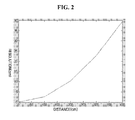
- FIG. 2 is a diagram illustrating a range resolution with respect to a distance when the length of a baseline according to a conventional technology is short (for example, 8 cm).
- FIG. 2 shows a resolution with respect to a length when the baseline is 8 cm, the vertical pixel of a camera is 480, and the vertical lens angle is 60°, and it can be seen that with increasing distance, the resolution becomes worse.
- a peak detection method can be used.
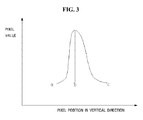
- FIG. 3 is a diagram illustrating the distribution of pixel values of pixels arranged along a predetermined vertical line of a camera image.
- the position of the peak point can be identified using a parabolic interpolation method.
- the distance to an obstacle can be identified by applying the triangular method described above to the position of the peak point.
- an apparatus measuring a distance using structured light, in which a light source emitting light from a predetermined light source and a camera module capturing an image formed when the light from the predetermined light source is reflected by an obstacle, are disposed and the distance is measured using the captured image, the apparatus including a binarization unit binarizing the image, an image identification unit identifying an image having connected pixels in the binarized image, a length ratio calculation unit obtaining a length ratio of a major axis of the image having the connected pixels to a minor axis perpendicular to the major axis, a pixel mean calculation unit obtaining the mean of pixel values of the image having the connected pixels, and an image extraction unit extracting an image formed by the light emitted from the light source, from the image having connected pixels using the length ratio and the mean of the pixel values.
- a method of measuring a distance using structured light in which light is emitted from a predetermined light source and then reflected by an obstacle and the distance is measured using a captured image formed by the light reflected by the obstacle, the method including binarizing the image, identifying an image having connected pixels in the binarized image, obtaining a length ratio of a major axis of the image having the connected pixels to a minor axis perpendicular to the major axis, and a mean of pixel values of the image having the connected pixels, and extracting an image formed by the light emitted from the light source, from the image having connected pixels using the length ratio and the mean of the pixel values.
- FIG. 1(a) is a diagram illustrating from a side, an apparatus for measuring a distance using structured light according to an embodiment of the present invention
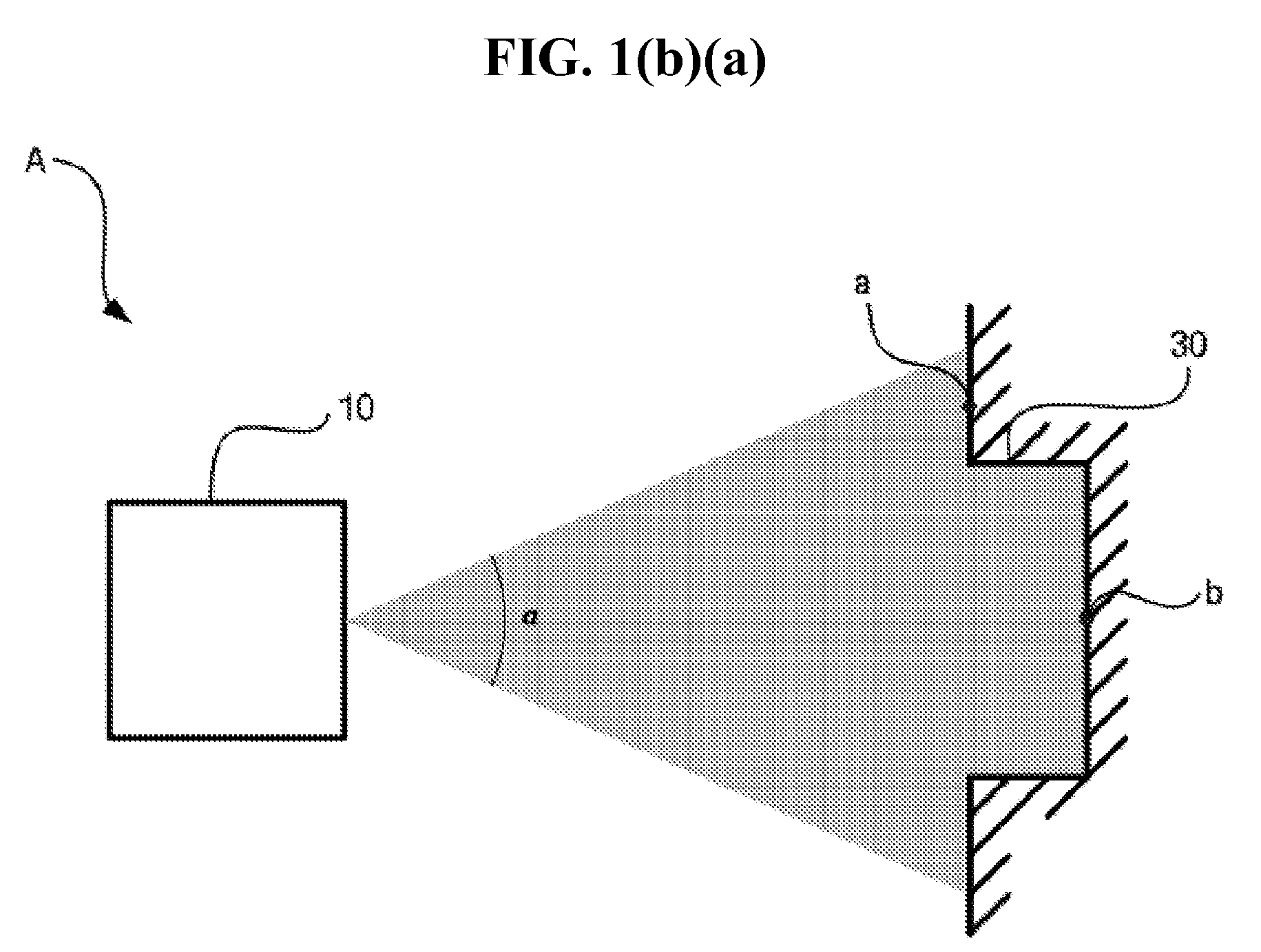
- FIGS. 1(b)(a) and 1(b)(b) are diagrams illustrating emission of light to an obstacle in order to obtain a structured light image, and a camera image obtained by a camera sensor according to an embodiment of the present invention.
- an active light source 10 such as a laser
- light is irradiated to an obstacle 30, and using a sensor 20 such as a camera, information on an image reflected by the obstacle 30 is obtained.
- a sensor 20 such as a camera
- the camera sensor 20 is positioned above the light source 10, and obtains the image information.
- the light source 10 may use a near infrared ray line laser beam. If the near infrared ray line laser beam is used, image information can be obtained even in a state where no illumination exists.
- FIGS. 1(b)(a) and 1(b)(b) a laser light is irradiated from the light source 10 to the obstacle 30 such that the laser light has a predetermined field of view ( ⁇ ) and has a planar shape.
- FIG. 1 (b)(b) shows a camera image 40 in the form of a line profile obtained by the camera 20.
- FIG. 1(b)(a) shows lights reflected at position a and position b of the obstacle 30 appear as a and b, respectively, of the camera image 40.
- a value in the Y-axis direction is in proportion to the distance between the sensor 20 and the obstacle 30.
- the distance data between the light source 10 and the obstacle 30 can be obtained according to a triangular method.
- the triangular method is a known technology, detailed explanation of the method will be omitted here.
- FIG. 4 is a block diagram of an apparatus measuring a distance using a structured light according to an embodiment of the present invention.
- the apparatus measuring a distance using structured light may include a light source module 100, a camera module 110, a binarization unit 130, an image identification unit 140, a length ratio calculation unit 150, a pixel mean calculation unit 160, and an image extraction unit 170. Also, the apparatus may further include an image calibration unit 120, a peak point calculation unit 180, and a distance information calculation unit 190.
- a module means, but is not limited to, a software or hardware component, such as a Field Programmable Gate Array (FPGA) or Application Specific Integrated Circuit (ASIC), which performs certain tasks.
- a module may advantageously be configured to reside on the addressable storage medium and configured to execute on one or more processors.
- a module may include, by way of example, components, such as software components, object-oriented software components, class components and task components, processes, functions, attributes, procedures, subroutines, segments of program code, drivers, firmware, microcode, circuitry, data, databases, data structures, tables, arrays, and variables.
- the functionality provided for in the components and modules may be combined into fewer components and modules or further separated into additional components and modules.
- the light source module 100 projects a line laser to an obstacle.
- the line laser is spread in the horizontal direction and irradiated as illustrated in FIG. 1(b)(a) and 1(b)(b) .
- the camera module 110 captures an image formed by the line laser irradiated from the light source module 100 and reflected by the obstacle.
- a band pass filter may be disposed in the camera module 110 such that only the light of a predetermined frequency band from the light source can be input. Accordingly, the camera module 110 can receive an input of light having a frequency close to that of the laser light source.
- this band pass filter is disposed, other light sources (that is, noise) in the vicinity of the frequency can still exist. In particular, natural light has a wide frequency band, and it is highly probable that noise is included in an image input to the camera module 110.
- the camera module 110 exists at a predetermined position above the light source module 100. As described above, the distance between the camera module 110 and the light source module 100 is referred to as a baseline.
- the image calibration unit 120 calibrates the image captured by the camera module 110.
- Tsai's calibration method can be used. This is described in detail in R. Y. Tsai, "An efficient and accurate camera calibration technique for 3D machine vision", in Proc. IEEE Conf. on Computer Vision and Pattern Recognition, pp. 364-374 (1986 ), and the explanation will be omitted here.
- the binarization unit 130 binarizes the image captured by the camera module 110.
- An image calibrated by the image calibration unit 120 may also be binarized. Through the binarization of all pixels in the entire image, all pixels that are determined to be generated not by the light reflected by the obstacle are changed to 0.
- a binarization method using a simple line pattern formed in a predetermined position, a kernel shape and an optimum threshold are determined in each vertical interval of the image, and using the determined kernel shape and the optimum threshold, the actual captured image is convoluted. Then, pixel columns included in the convoluted image are scanned in the vertical direction. If a plurality of pixel groups in which pixel values are not 0 exists, the pixel values of pixel groups except one selected pixel group are changed to 0. This method is described in detail in a laid-open patent application 10-2006-0091137. Other known binarization methods can also be used in addition to the method described above.
- the image identification unit 140 identifies an image having connected pixels in the binarized image.
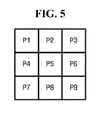
- FIG. 5 is a diagram illustrating a process of identifying an image having connected pixels according to an embodiment of the present invention.
- each square indicates one pixel. If P5 is binarized and then, P5 has a value other than 0, and if any one pixel among P1 through P9 surrounding P5 is binarized as a value other than 0, it is determined that the pixel is connected to P5. Through this process, each image having connected pixels is identified. Pixels that are not connected and are positioned apart can be removed.
- the length ratio calculation unit 150 calculates the length ratio of the major axis of each image having connected pixels identified by the image identification unit 140, to the minor axis.
- PCA principle component analysis
- transform of the image having connected pixels, an eigenvector and an eigenvalue may be obtained.
- an eigenvalue having a bigger value indicates the degree of spread of the major axis
- an eigenvalue having a smaller value indicates the degree of spread of data in the direction perpendicular to the major axis.
- the ratio of the long axis to the short axis of each image having connected pixels can be expressed by a ratio of respective eigenvalues.
- the pixel mean calculation unit 160 calculates the mean of pixel values of each image having connected pixels. In this case, by dividing the mean value by 255, a normalized value may be obtained.
- the image extraction unit 170 removes noise in the image having connected pixels, using the length ratio of the major axis to the minor axis and the mean of the pixel values, and extracts a captured image formed by the light irradiated from the light source module 100.
- the probability that the image is generated by the light irradiated from the light source module 100 increases. This is because the shape of the irradiated structured light is linear, and if the pattern length of a binarized image is long, it is highly probable that the image is generated by the structured light irradiated from the light source module 100.
- the mean of pixel values is high, it is highly probable that the image is generated by the light irradiated from the light source 100. This is because if an irradiated structured light is reflected by a set of furniture or the floor and then, input, the light usually has a pixel value lower than that of a directly reflected structured light. Accordingly, the reflected light can be effectively removed using the mean of the pixel values.
- a weight to the length ratio of the major axis to the minor axis may be increased. If it is highly probable that a reflected light exists, a weight to the mean of pixel values may be increased.
- the above expression is an example of extracting an image using the length ratio of the major axis to the minor axis and the mean of pixel values. Other methods may also be used in order to extract an image.
- the image extraction unit 170 may search the entire pixel area in each vertical line, thereby extracting an image formed by the light irradiated from a light source. This will be explained later with reference to FIGS. 10(a) through 10(c) .
- the peak point calculation unit 180 searches the entire pixel area of an image in each vertical line, thereby obtaining the position of a peak point of pixel values in each vertical line. If noise is removed, the image reflected by an obstacle includes a plurality of pixels and a thickness. In this case, it is highly probable that the position of a peak point having a highest pixel value is the position of reflection at the obstacle.
- the positions and pixel values of points a, b, and c are known as illustrated in FIG. 3 and the brightness distribution of an image formed by the pixels arranged along the vertical line forms a parabola
- the position of a peak point can be identified by applying a parabolic interpolation method.
- the b value is the pixel position of a peak value in each vertical line of the entire pixel area.
- FIG. 6 is a diagram illustrating a process of finding pixel positions when a plurality of pixels having peak values exist, according to an embodiment of the present invention.
- each pixel value of a vertical line is shown on the left and the distribution of pixel values is shown next to the pixel values.
- a plurality of pixel positions each having a peak value 255 exist.
- Two top 255 pixel values are connected and four 255 pixel values are connected below. Accordingly, the below area having a longer length is selected, and then, the weight center of positions is calculated.
- the center coordinate of the below four 255 pixel values is 113.5. This value can be selected as the position of the peak pixel value.
- the points a and b that are the start point and the end point, respectively, can be determined by finding two boundary positions within a threshold range relative to the position of the peak pixel value.
- the position of a peak point can be obtained according to a parabolic interpolation method.
- An example of a pseudo code implementing a parabolic interpolation method is shown below:
- the distance information calculation unit 190 applies a triangular method to the position of a finally remaining peak point, thereby calculating the distance between the light source module 100 and the obstacle.
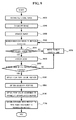
- FIG. 7 is a flowchart illustrating a method of measuring a distance using structured light according to an embodiment of the present invention
- FIG. 8 is a flowchart illustrating a method of finding the position of a peak point according to an embodiment of the present invention.
- the image calibration unit 120 calibrates an image, which is generated by a line laser irradiated from the light source module 100 and reflected by an obstacle, and is captured by a camera, according to a method, such as Tsai's calibration method, in operation S500.
- the binarization unit 130 binarizes the calibrated image in operation S510.
- the image identification unit 140 identifies images having connected pixels in the binarized image in operation S520.
- the length ratio calculation unit 150 and the pixel mean calculation unit 160 obtain the length ratio of the major axis to the minor axis of each image having connected pixels and the mean of pixel values, respectively, in operation S530.
- the image having connected pixels is PCA transformed and using the transformed image, the length ratio of the major axis to the minor axis can be calculated.
- the image extraction unit 170 removes noise that is not the image captured from the light irradiated from the light source module 100 in operation S540.
- the length ratio of the major axis to the minor axis is big, it can be determined that it is highly probable that the image is generated by the light irradiated from the light source.
- the mean of pixel values is high, it can be determined that it is highly probable that the image is generated by the light irradiated from the light source. Then, by searching the entire pixel area in each vertical line, the image formed by the light irradiated from the light source can be extracted.
- the peak point calculation unit 180 obtains the peak point of each vertical line of the image, which is extracted in operation S540, in operation S550.
- the pixel position of a peak value in each vertical line of the image formed by the light irradiated from the light source is obtained in operation S552.
- two boundary positions within a predetermined threshold range relative to the position of the peak pixel value are obtained in operation S554.
- the position of a peak point is obtained according to a parabolic interpolation method in operation S556.
- the distance information calculation unit 190 applies a triangular method to the peak point, thereby calculating the distance between the light source module 100 and the obstacle in operation S560.
- FIG. 9 is an entire flowchart illustrating a method of measuring a distance using a structured light according to an embodiment of the present invention.
- the camera module 110 obtains and stores an image formed by a line laser irradiated from the light source module 100 and reflected by an obstacle in operation S600. Then, the image calibration unit 120 calibrates distortion in the obtained image in operation S610. Then, the binarization unit 130 binarizes the calibrated image in operation S620. Then, each vertical line of the input image is searched in the vertical line direction in operation S630. While searching in the vertical direction, it is confirmed whether or not a divided area of the binarized image exists in operation S640. If it is confirmed that no divided area exists, the next vertical line is visited and searched in operation S630. If two or more divided areas exist, noise is removed by performing operations S520, 530, and 540, described above, in operation S650. If noise is removed, again a next vertical line is visited in operation S670, and it is confirmed whether or not a divided region exists in operation S640. If searching of all vertical lines is completed in operation S660, removal of noise is finished.
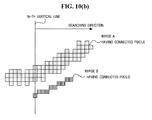
- FIGS. 10(a) through 10(c) are diagrams illustrating a process of extracting an image having connected pixels by removing noise according to an embodiment of the present invention.
- FIG. 10(a) shows that three images A, B, and C each having connected pixels are identified.
- the images are searched in the horizontal direction (from left to right in FIG. 10(a) ) in order to determine whether or not a divided region exists. Since only the area A is found in the I-th vertical line, a next vertical line is searched. In the m-th vertical line, two divided areas A and B are found. Noise is removed using the length ratio of the major axis to the minor axis and the mean of pixel values in each of the areas A and C. Since the area A has a greater length ratio of the major axis to the minor axis and a higher mean of pixel values than those of the area C in FIG. 10(a) , the area C is determined to be a noise area and is removed.
- FIG. 10(b) illustrates the state after the area C is removed. Then, each vertical line is searched until a divided area appears in FIG. 10(b) . In the n-th vertical line, two divided areas A and B are found. Using the length ratio of the major axis to the minor axis and the mean of pixel values in each of the areas A and B, it is determined that the area B is noise, and thus the area B is removed. Finally, FIG. 10(c) illustrates an image obtained from the light source by removing noise.
- the pixel position of a peak value in each vertical line of the extracted image is searched for in operation S680. Then, two boundary positions relative to a predetermined threshold are searched for in operation S690. Using the pixel position of a peak value and the positions of the two boundaries, the position of a peak point is obtained according to a parabolic interpolation method in operation S700. After the position of the peak point is obtained, the distance between the light source module 100 and the obstacle is obtained according to a triangular method with reference to the peak point in operation S710.
- FIGS. 11(a)-11(f) are diagrams illustrating an image in each operation and a measured distance according to an embodiment of the present invention.
- FIG. 11 (a) illustrates an image obtained from a camera sensor.
- FIG. 11 (b) illustrates a result of calibrating by the image calibration unit 120 of a distorted image.
- FIG. 11 (c) illustrates a result of binarizing the calibrated image. In this case, two images forming a V shape exist at the center, and therefore it can be known that one of the two images is noise.
- FIG. 11 (d) illustrates a distance calculated by a triangular method without applying a parabolic interpolation method.
- FIG. 11 (f) illustrates a distance calculated according to a triangular method after the pixel position of a peak value and two boundary positions are obtained and a peak point is obtained by applying a parabolic interpolation method according to the present invention, as compared to Fig. 11 (e) , in which the parabolic interpolation method is not applied. It can be seen that the distance is measured more accurately when the parabolic interpolation method is applied than when the parabolic interpolation method is not applied.
- the apparatus and method for measuring a distance using structured light have one or more of the following advantages.
- an image input or reflected from another light source can be effectively removed, thereby improving the accuracy of distance measurement.
- the pixel position of a peak value and the positions of two boundary values for applying a parabolic interpolation method can be easily identified in a state where noise is removed. Accordingly, since the peak point is easily found, the accuracy of distance measurement can be improved.
Landscapes
- Physics & Mathematics (AREA)
- Engineering & Computer Science (AREA)
- General Physics & Mathematics (AREA)
- Electromagnetism (AREA)
- Radar, Positioning & Navigation (AREA)
- Remote Sensing (AREA)
- Computer Networks & Wireless Communication (AREA)
- Computer Vision & Pattern Recognition (AREA)
- Optics & Photonics (AREA)
- Theoretical Computer Science (AREA)
- Measurement Of Optical Distance (AREA)
- Optical Radar Systems And Details Thereof (AREA)
- Length Measuring Devices By Optical Means (AREA)
Abstract

Description
- This application claims priority from
Korean Patent Application No. 10-2006-0133908 filed on December 26, 2006 - The present invention relates to an apparatus and method of measuring a distance using structured light, and more particularly, to an apparatus and method of measuring a distance using structured light, in which an input image is binarized, and then an image having connected pixels in the binarized image is identified, and noise is removed using the length ratio of the major axis to the minor axis of the image having connected pixels in the binarized image and the mean of pixel values, thereby improving the accuracy of distance measurement.
- In order to travel around or perform a job in a place on which preliminary information is insufficient, a mobile robot, such as a cleaning robot or a guide robot, needs to have an ability to autonomously plan a path, detect an obstacle, and avoid collision. To achieve this, an ability to measure a distance to an obstacle, which can be used in order to estimate a position, is essential. Also, an ability to measure a distance to an obstacle is necessary in an intrusion sensing system using an image comparison method.
- To measure such distances, a variety of methods using a visual sensor, an ultrasound sensor, or a contact sensor have been used. Among these methods, a method using structured light and a camera is very effective, because the method requires less computation and can be used in a place where a change in brightness is small.
- According to this method, as illustrated in
FIG. 1A , light is irradiated to anobstacle 30 using anactive light source 10, such as a laser, and the image of the reflected light is obtained using asensor 20, such as a camera. Then, using the image coordinates of thecamera 20, the scanning angle of the image at that time, and the distance between thecamera 20 and the laser beam emission position, the distance between the position of laser emission and theobstacle 30 where the laser light is reflected can be calculated from the obtained image according to a triangular method using angle θ. - Referring to
FIG. 1A , the distance d between thelight source 10 and thecamera sensor 20 is referred to as a baseline. As this distance increases, the resolution becomes worse. When the height of a robot is limited as is that of a cleaning robot, the baseline distance is short in many cases. In such cases, the range resolution at a distant position becomes worse. -
FIG. 2 is a diagram illustrating a range resolution with respect to a distance when the length of a baseline according to a conventional technology is short (for example, 8 cm). -
FIG. 2 shows a resolution with respect to a length when the baseline is 8 cm, the vertical pixel of a camera is 480, and the vertical lens angle is 60°, and it can be seen that with increasing distance, the resolution becomes worse. In this case, a peak detection method can be used. -
FIG. 3 is a diagram illustrating the distribution of pixel values of pixels arranged along a predetermined vertical line of a camera image. As illustrated inFIG. 3 , assuming that the positions and pixel values of points a, b, and c are known and the brightness distribution of an image formed by the pixels arranged along the vertical line forms a parabola, the position of the peak point can be identified using a parabolic interpolation method. The distance to an obstacle can be identified by applying the triangular method described above to the position of the peak point. - However, in actual practice, it is quite difficult to accurately identify the positions of points a, b, and c due to a serious noise caused by reflection of sunrays or other illuminations and laser light.
- Accordingly, it is an aspect of the present invention to provide an apparatus and method of measuring a distance using structured light, in which an input image is binarized, and then an image having connected pixels in the binarized image is identified, and noise is removed using the length ratio of the major axis to the minor axis of the image having connected pixels in the binarized image and the mean of pixel values, thereby improving the accuracy of distance measurement.
- Additional aspects and/or advantages will be set forth in part in the description which follows and, in part, will be apparent from the description, or may be learned by practice of the invention.
- According to an aspect of the present invention, there is provided an apparatus measuring a distance using structured light, in which a light source emitting light from a predetermined light source and a camera module capturing an image formed when the light from the predetermined light source is reflected by an obstacle, are disposed and the distance is measured using the captured image, the apparatus including a binarization unit binarizing the image, an image identification unit identifying an image having connected pixels in the binarized image, a length ratio calculation unit obtaining a length ratio of a major axis of the image having the connected pixels to a minor axis perpendicular to the major axis, a pixel mean calculation unit obtaining the mean of pixel values of the image having the connected pixels, and an image extraction unit extracting an image formed by the light emitted from the light source, from the image having connected pixels using the length ratio and the mean of the pixel values.
- According to another aspect of the present invention, there is provided a method of measuring a distance using structured light, in which light is emitted from a predetermined light source and then reflected by an obstacle and the distance is measured using a captured image formed by the light reflected by the obstacle, the method including binarizing the image, identifying an image having connected pixels in the binarized image, obtaining a length ratio of a major axis of the image having the connected pixels to a minor axis perpendicular to the major axis, and a mean of pixel values of the image having the connected pixels, and extracting an image formed by the light emitted from the light source, from the image having connected pixels using the length ratio and the mean of the pixel values.
- These and/or other aspects and advantages will become apparent and more readily appreciated from the following description of the embodiments, taken in conjunction with the accompanying drawings of which:
-
FIG. 1 (a) is a side view of an apparatus for measuring a distance using structured light according to the related art; -
FIGS. 1(b)(a) and 1(b)(b) are a diagrams illustrating emission of light to an obstacle in order to obtain a structured light image, and a camera image obtained by a camera sensor according to an embodiment of the present invention; -
FIG. 2 is a diagram illustrating a range resolution with respect to a distance when the length of a baseline according to a conventional technology is short (8 cm); -
FIG. 3 is a diagram illustrating the distribution of pixel values of pixels arranged along a predetermined vertical line of a camera image according to the related art; -
FIG. 4 is a block diagram of an apparatus measuring a distance using a structured light according to an embodiment of the present invention; -
FIG. 5 is a diagram illustrating a process of identifying an image having connected pixels according to an embodiment of the present invention; -
FIG. 6 is a diagram illustrating a process of finding pixel positions when a plurality of pixels having peak values exist, according to an embodiment of the present invention; -
FIG. 7 is a flowchart illustrating a method of measuring a distance using structured light according to an embodiment of the present invention; -
FIG. 8 is a flowchart illustrating a method of finding the position of a peak point according to an embodiment of the present invention; -
FIG. 9 is an entire flowchart illustrating a method of measuring a distance using a structured light according to an embodiment of the present invention; -
FIGS. 10(a) through 10(c) are diagrams illustrating a process of extracting an image having connected pixels by removing noise according to an embodiment of the present invention; and -
FIGS. 11 (a) to 11 (f) are diagrams illustrating an image in each operation and a measured distance according to an embodiment of the present invention. - Reference will now be made in detail to the embodiments, examples of which are illustrated in the accompanying drawings, wherein like reference numerals refer to the like elements throughout. The embodiments are described below to explain the present invention by referring to the figures.
- Advantages and features of the present invention and methods of accomplishing the same may be understood more readily by reference to the following detailed description of preferred embodiments and the accompanying drawings. The present invention may, however, be embodied in many different forms and should not be construed as being limited to the embodiments set forth herein. Rather, these embodiments are provided so that this disclosure will be thorough and complete and will fully convey the concept of the invention to those skilled in the art, and the present invention will be defined by the appended claims.
- First, a principle of measuring a distance using structured light according to the present invention will now be explained.
-
FIG. 1(a) is a diagram illustrating from a side, an apparatus for measuring a distance using structured light according to an embodiment of the present invention, andFIGS. 1(b)(a) and 1(b)(b) are diagrams illustrating emission of light to an obstacle in order to obtain a structured light image, and a camera image obtained by a camera sensor according to an embodiment of the present invention. - Using an
active light source 10, such as a laser, light is irradiated to anobstacle 30, and using asensor 20 such as a camera, information on an image reflected by theobstacle 30 is obtained. In this case, while maintaining a predetermined distance d from thecamera sensor 20 to thelight source 10, thecamera sensor 20 is positioned above thelight source 10, and obtains the image information. Thelight source 10 may use a near infrared ray line laser beam. If the near infrared ray line laser beam is used, image information can be obtained even in a state where no illumination exists. - Referring to
FIGS. 1(b)(a) and 1(b)(b) , a laser light is irradiated from thelight source 10 to theobstacle 30 such that the laser light has a predetermined field of view (α) and has a planar shape.FIG. 1 (b)(b) shows acamera image 40 in the form of a line profile obtained by thecamera 20.FIG. 1(b)(a) shows lights reflected at position a and position b of theobstacle 30 appear as a and b, respectively, of thecamera image 40. A value in the Y-axis direction is in proportion to the distance between thesensor 20 and theobstacle 30. - Using the distance between the
camera module 20 and theobstacle 30 obtained from the coordinates of thecamera image 40, the angle (θ) (FIG. 1(a) ) of thecamera sensor 20 directed to theobstacle 30, and the distance (d) between thecamera module 20 and thelight source 10, the distance data between thelight source 10 and theobstacle 30 can be obtained according to a triangular method. Here, since the triangular method is a known technology, detailed explanation of the method will be omitted here. -
FIG. 4 is a block diagram of an apparatus measuring a distance using a structured light according to an embodiment of the present invention. - The apparatus measuring a distance using structured light according to the current embodiment may include a
light source module 100, acamera module 110, abinarization unit 130, animage identification unit 140, a lengthratio calculation unit 150, a pixelmean calculation unit 160, and animage extraction unit 170. Also, the apparatus may further include animage calibration unit 120, a peakpoint calculation unit 180, and a distanceinformation calculation unit 190. - Meanwhile, the term 'module', as used herein, means, but is not limited to, a software or hardware component, such as a Field Programmable Gate Array (FPGA) or Application Specific Integrated Circuit (ASIC), which performs certain tasks. A module may advantageously be configured to reside on the addressable storage medium and configured to execute on one or more processors. Thus, a module may include, by way of example, components, such as software components, object-oriented software components, class components and task components, processes, functions, attributes, procedures, subroutines, segments of program code, drivers, firmware, microcode, circuitry, data, databases, data structures, tables, arrays, and variables. The functionality provided for in the components and modules may be combined into fewer components and modules or further separated into additional components and modules.
- The
light source module 100 projects a line laser to an obstacle. The line laser is spread in the horizontal direction and irradiated as illustrated inFIG. 1(b)(a) and 1(b)(b) . - The
camera module 110 captures an image formed by the line laser irradiated from thelight source module 100 and reflected by the obstacle. In this case, a band pass filter may be disposed in thecamera module 110 such that only the light of a predetermined frequency band from the light source can be input. Accordingly, thecamera module 110 can receive an input of light having a frequency close to that of the laser light source. However, even if this band pass filter is disposed, other light sources (that is, noise) in the vicinity of the frequency can still exist. In particular, natural light has a wide frequency band, and it is highly probable that noise is included in an image input to thecamera module 110. Thecamera module 110 exists at a predetermined position above thelight source module 100. As described above, the distance between thecamera module 110 and thelight source module 100 is referred to as a baseline. - The
image calibration unit 120 calibrates the image captured by thecamera module 110. - Since the light irradiated from the
light source module 100 is captured by thecamera module 110 at a predetermined angle, the image has a little irregularity, and this is corrected. As the method of calibration, Tsai's calibration method can be used. This is described in detail in R. Y. Tsai, "An efficient and accurate camera calibration technique for 3D machine vision", in Proc. IEEE Conf. on Computer Vision and Pattern Recognition, pp. 364-374 (1986), and the explanation will be omitted here. - The
binarization unit 130 binarizes the image captured by thecamera module 110. An image calibrated by theimage calibration unit 120 may also be binarized. Through the binarization of all pixels in the entire image, all pixels that are determined to be generated not by the light reflected by the obstacle are changed to 0. According to a binarization method, using a simple line pattern formed in a predetermined position, a kernel shape and an optimum threshold are determined in each vertical interval of the image, and using the determined kernel shape and the optimum threshold, the actual captured image is convoluted. Then, pixel columns included in the convoluted image are scanned in the vertical direction. If a plurality of pixel groups in which pixel values are not 0 exists, the pixel values of pixel groups except one selected pixel group are changed to 0. This method is described in detail in a laid-open patent application 10-2006-0091137. Other known binarization methods can also be used in addition to the method described above. - The
image identification unit 140 identifies an image having connected pixels in the binarized image.FIG. 5 is a diagram illustrating a process of identifying an image having connected pixels according to an embodiment of the present invention. InFIG. 5 , each square indicates one pixel. If P5 is binarized and then, P5 has a value other than 0, and if any one pixel among P1 through P9 surrounding P5 is binarized as a value other than 0, it is determined that the pixel is connected to P5. Through this process, each image having connected pixels is identified. Pixels that are not connected and are positioned apart can be removed. - The length
ratio calculation unit 150 calculates the length ratio of the major axis of each image having connected pixels identified by theimage identification unit 140, to the minor axis. Through principle component analysis (PCA), transform of the image having connected pixels, an eigenvector and an eigenvalue may be obtained. In this case, an eigenvalue having a bigger value indicates the degree of spread of the major axis, and an eigenvalue having a smaller value indicates the degree of spread of data in the direction perpendicular to the major axis. The ratio of the long axis to the short axis of each image having connected pixels can be expressed by a ratio of respective eigenvalues. - The pixel
mean calculation unit 160 calculates the mean of pixel values of each image having connected pixels. In this case, by dividing the mean value by 255, a normalized value may be obtained. - The
image extraction unit 170 removes noise in the image having connected pixels, using the length ratio of the major axis to the minor axis and the mean of the pixel values, and extracts a captured image formed by the light irradiated from thelight source module 100. In this case, with the increasing ratio of the major axis to the minor axis, the probability that the image is generated by the light irradiated from thelight source module 100 increases. This is because the shape of the irradiated structured light is linear, and if the pattern length of a binarized image is long, it is highly probable that the image is generated by the structured light irradiated from thelight source module 100. When sunlight is emitted, much of the sunlight is usually removed during the binarization process, but part of sunlight emitted linearly may be binarized. In this case, using the length ratio of the major axis to the minor axis, the sunlight can be effectively removed. - Also, if the mean of pixel values is high, it is highly probable that the image is generated by the light irradiated from the
light source 100. This is because if an irradiated structured light is reflected by a set of furniture or the floor and then, input, the light usually has a pixel value lower than that of a directly reflected structured light. Accordingly, the reflected light can be effectively removed using the mean of the pixel values. - As an example of extracting an image using the length ratio of the major axis to the minor axis and the mean of pixel values, assuming that the length ratio of the major axis to the minor axis of each image having connected pixels is L1, L2, ..., and the mean of pixel values is G1, G2, ..., Ci=a*Gi+(1-a)Li (0≤a≤1, i=1, 2, ..., N) is calculated, and images each having connected pixels except an image having a largest Ci value are removed. Here, a and (1-a) are the length ratio of the major axis to the minor axis and the mean of pixel values. If it is highly probable that other light sources exist, a weight to the length ratio of the major axis to the minor axis may be increased. If it is highly probable that a reflected light exists, a weight to the mean of pixel values may be increased. The above expression is an example of extracting an image using the length ratio of the major axis to the minor axis and the mean of pixel values. Other methods may also be used in order to extract an image.
- In this case, the
image extraction unit 170 may search the entire pixel area in each vertical line, thereby extracting an image formed by the light irradiated from a light source. This will be explained later with reference toFIGS. 10(a) through 10(c) . - The peak
point calculation unit 180 searches the entire pixel area of an image in each vertical line, thereby obtaining the position of a peak point of pixel values in each vertical line. If noise is removed, the image reflected by an obstacle includes a plurality of pixels and a thickness. In this case, it is highly probable that the position of a peak point having a highest pixel value is the position of reflection at the obstacle. Here, if it is assumed that the positions and pixel values of points a, b, and c are known as illustrated inFIG. 3 and the brightness distribution of an image formed by the pixels arranged along the vertical line forms a parabola, the position of a peak point can be identified by applying a parabolic interpolation method. In this case, the b value is the pixel position of a peak value in each vertical line of the entire pixel area. When a plurality of pixel positions of peak values exist, an area having a long connected length is selected, and the weight center of the connected area can be determined as the pixel position of a peak value. -
FIG. 6 is a diagram illustrating a process of finding pixel positions when a plurality of pixels having peak values exist, according to an embodiment of the present invention. Referring toFIG. 6 , each pixel value of a vertical line is shown on the left and the distribution of pixel values is shown next to the pixel values. In this case, a plurality of pixel positions each having apeak value 255 exist. Two top 255 pixel values are connected and four 255 pixel values are connected below. Accordingly, the below area having a longer length is selected, and then, the weight center of positions is calculated. The center coordinate of the below four 255 pixel values is 113.5. This value can be selected as the position of the peak pixel value. Then, the points a and b that are the start point and the end point, respectively, can be determined by finding two boundary positions within a threshold range relative to the position of the peak pixel value. After obtaining the values of a, b, and c, the position of a peak point can be obtained according to a parabolic interpolation method. An example of a pseudo code implementing a parabolic interpolation method is shown below: - Start Parabolic Interpolation(float up, float middle, float down)

if a = 0, then return 0
if c < -0.5 or c > 0.5, then return 0;
else return c - The distance
information calculation unit 190 applies a triangular method to the position of a finally remaining peak point, thereby calculating the distance between thelight source module 100 and the obstacle. -
FIG. 7 is a flowchart illustrating a method of measuring a distance using structured light according to an embodiment of the present invention, andFIG. 8 is a flowchart illustrating a method of finding the position of a peak point according to an embodiment of the present invention. - First, the
image calibration unit 120 calibrates an image, which is generated by a line laser irradiated from thelight source module 100 and reflected by an obstacle, and is captured by a camera, according to a method, such as Tsai's calibration method, in operation S500. - Then, the
binarization unit 130 binarizes the calibrated image in operation S510. - The
image identification unit 140 identifies images having connected pixels in the binarized image in operation S520. - Then, the length
ratio calculation unit 150 and the pixelmean calculation unit 160 obtain the length ratio of the major axis to the minor axis of each image having connected pixels and the mean of pixel values, respectively, in operation S530. In this case, the image having connected pixels is PCA transformed and using the transformed image, the length ratio of the major axis to the minor axis can be calculated. - Next, using the length ratio of the major axis to the minor axis of each image having connected pixels and the mean of pixel values, the
image extraction unit 170 removes noise that is not the image captured from the light irradiated from thelight source module 100 in operation S540. In this case, if the length ratio of the major axis to the minor axis is big, it can be determined that it is highly probable that the image is generated by the light irradiated from the light source. Also, if the mean of pixel values is high, it can be determined that it is highly probable that the image is generated by the light irradiated from the light source. Then, by searching the entire pixel area in each vertical line, the image formed by the light irradiated from the light source can be extracted. - Next, the peak
point calculation unit 180 obtains the peak point of each vertical line of the image, which is extracted in operation S540, in operation S550. In the obtaining of the peak point, first, the pixel position of a peak value in each vertical line of the image formed by the light irradiated from the light source is obtained in operation S552. Then, two boundary positions within a predetermined threshold range relative to the position of the peak pixel value are obtained in operation S554. Finally, using the position of the peak pixel value, the peak pixel value, two boundary positions, and pixel values, the position of a peak point is obtained according to a parabolic interpolation method in operation S556. - Next, the distance
information calculation unit 190 applies a triangular method to the peak point, thereby calculating the distance between thelight source module 100 and the obstacle in operation S560. -
FIG. 9 is an entire flowchart illustrating a method of measuring a distance using a structured light according to an embodiment of the present invention. - First, the
camera module 110 obtains and stores an image formed by a line laser irradiated from thelight source module 100 and reflected by an obstacle in operation S600. Then, theimage calibration unit 120 calibrates distortion in the obtained image in operation S610. Then, thebinarization unit 130 binarizes the calibrated image in operation S620. Then, each vertical line of the input image is searched in the vertical line direction in operation S630. While searching in the vertical direction, it is confirmed whether or not a divided area of the binarized image exists in operation S640. If it is confirmed that no divided area exists, the next vertical line is visited and searched in operation S630. If two or more divided areas exist, noise is removed by performing operations S520, 530, and 540, described above, in operation S650. If noise is removed, again a next vertical line is visited in operation S670, and it is confirmed whether or not a divided region exists in operation S640. If searching of all vertical lines is completed in operation S660, removal of noise is finished. -
FIGS. 10(a) through 10(c) are diagrams illustrating a process of extracting an image having connected pixels by removing noise according to an embodiment of the present invention. -
FIG. 10(a) shows that three images A, B, and C each having connected pixels are identified. In this case, the images are searched in the horizontal direction (from left to right inFIG. 10(a) ) in order to determine whether or not a divided region exists. Since only the area A is found in the I-th vertical line, a next vertical line is searched. In the m-th vertical line, two divided areas A and B are found. Noise is removed using the length ratio of the major axis to the minor axis and the mean of pixel values in each of the areas A and C. Since the area A has a greater length ratio of the major axis to the minor axis and a higher mean of pixel values than those of the area C inFIG. 10(a) , the area C is determined to be a noise area and is removed. -
FIG. 10(b) illustrates the state after the area C is removed. Then, each vertical line is searched until a divided area appears inFIG. 10(b) . In the n-th vertical line, two divided areas A and B are found. Using the length ratio of the major axis to the minor axis and the mean of pixel values in each of the areas A and B, it is determined that the area B is noise, and thus the area B is removed. Finally,FIG. 10(c) illustrates an image obtained from the light source by removing noise. - The pixel position of a peak value in each vertical line of the extracted image is searched for in operation S680. Then, two boundary positions relative to a predetermined threshold are searched for in operation S690. Using the pixel position of a peak value and the positions of the two boundaries, the position of a peak point is obtained according to a parabolic interpolation method in operation S700. After the position of the peak point is obtained, the distance between the
light source module 100 and the obstacle is obtained according to a triangular method with reference to the peak point in operation S710. -
FIGS. 11(a)-11(f) are diagrams illustrating an image in each operation and a measured distance according to an embodiment of the present invention. -
FIG. 11 (a) illustrates an image obtained from a camera sensor.FIG. 11 (b) illustrates a result of calibrating by theimage calibration unit 120 of a distorted image.FIG. 11 (c) illustrates a result of binarizing the calibrated image. In this case, two images forming a V shape exist at the center, and therefore it can be known that one of the two images is noise.FIG. 11 (d) illustrates a distance calculated by a triangular method without applying a parabolic interpolation method.FIG. 11 (f) illustrates a distance calculated according to a triangular method after the pixel position of a peak value and two boundary positions are obtained and a peak point is obtained by applying a parabolic interpolation method according to the present invention, as compared toFig. 11 (e) , in which the parabolic interpolation method is not applied. It can be seen that the distance is measured more accurately when the parabolic interpolation method is applied than when the parabolic interpolation method is not applied. - As described above, the apparatus and method for measuring a distance using structured light according to the embodiments of the present invention have one or more of the following advantages.
- First, an image input or reflected from another light source can be effectively removed, thereby improving the accuracy of distance measurement.
- Second, the pixel position of a peak value and the positions of two boundary values for applying a parabolic interpolation method can be easily identified in a state where noise is removed. Accordingly, since the peak point is easily found, the accuracy of distance measurement can be improved.
- Although a few embodiments have been shown and described, it would be appreciated by those skilled in the art that changes may be made in these embodiments without departing from the principles and spirit of the invention, the scope of which is defined in the claims and their equivalents.
Claims (21)
- An apparatus measuring a distance using structured light, in which a light source emitting light from a predetermined light source and a camera module capturing an image formed when the light from the predetermined light source is reflected by an obstacle, are disposed and the distance is measured using the captured image, the apparatus comprising:a binarization unit binarizing the image;an image identification unit identifying an image having connected pixels in the binarized image;a length ratio calculation unit obtaining a length ratio of a major axis of the image having the connected pixels to a minor axis perpendicular to the major axis;a pixel mean calculation unit obtaining the mean of pixel values of the image having the connected pixels; andan image extraction unit extracting an image formed by the light emitted from the light source, from the image having the connected pixels using the length ratio and the mean of the pixel values.
- The apparatus of claim 1, wherein the light source is a line laser.
- The apparatus of claim 1, further comprising an image calibration unit calibrating the captured image.
- The apparatus of claim 1, wherein the length ratio calculation unit performs a principle component analysis (PCA) transform of the image having the connected pixels, and using the transformed image, obtains the length ratio of the major axis to the minor axis.
- The apparatus of claim 1, wherein the image extraction unit determines that the higher the length ratio, the higher a probability that the image is generated by the light emitted from the light source.
- The apparatus of claim 1, wherein the image extraction unit determines that the higher the mean of the pixel values, the higher the probability that the image is generated by the light emitted from the light source.
- The apparatus of claim 1, wherein the image extraction unit extracts the image formed by the light emitted from the light source, by searching an entire pixel area of the binarized image by searching each vertical line of the binarized image.
- The apparatus of claim 1, further comprising a peak point calculation unit searching each vertical line of an entire pixel area of the image formed by the light emitted from the light source, and obtaining a position of a peak point of pixel values in the vertical line.
- The apparatus of claim 8, wherein the peak point calculation unit finds a pixel position of a peak value in each of the vertical lines of the extracted image formed by the light emitted from the light source, and two boundary positions within a predetermined threshold range relative to the pixel position of the peak value, and according to a parabolic interpolation method using the two boundary positions and the peak pixel value, the peak point calculation unit obtains the position of the peak point.
- The apparatus of claim 9, wherein if a plurality of positions having the peak value exist, an area having a longer connected length is selected, and a weight center of the area having the longer connected length is determined as the position of the peak value.
- The apparatus of claim 8, further comprising a distance information calculation unit applying a triangular method to the position of the peak point, thereby calculating the distance.
- A method of measuring a distance using structured light, in which light is emitted from a predetermined light source and then reflected by an obstacle and the distance is measured using a captured image formed by the light reflected by the obstacle, the method comprising:binarizing the image;identifying an image having connected pixels in the binarized image;obtaining a length ratio of a major axis of the image having the connected pixels to a minor axis perpendicular to the major axis, and a mean of pixel values of the image having the connected pixels; andextracting an image formed by the light emitted from the light source, from the images having the connected pixels using the length ratio and the mean of the pixel values.
- The method of claim 12, wherein the light source is a line laser.
- The method of claim 12, further comprising performing principle component analysis (PCA) transformation of the image having the connected pixels, and using the transformed image, obtaining the length ratio of the major axis to the minor axis.
- The method of claim 12, wherein the extracting of the image comprises determining that the higher the length ratio, the higher a probability that the image is generated by the light emitted from the light source.
- The method of claim 12, wherein the extracting of the image comprises determining that the higher the mean of the pixel values, the higher a probability that the image is generated by the light emitted from the light source.
- The method of claim 12, wherein the extracting of the image comprises extracting the image formed by the light emitted from the light source, by searching each vertical line of an entire pixel area of the binarized image.
- The method of claim 12, further comprising searching each vertical line of an entire pixel area of the extracted image formed by the light emitted from the light source, and obtaining a peak point of pixel values in the vertical line.
- The method of claim 18, wherein the searching of each vertical line and obtaining the peak point of the pixel values in the vertical line comprises:obtaining a pixel position of a peak value in each vertical line of the extracted image formed by the light emitted from the light source;identifying two boundary positions in a predetermined threshold range relative to the pixel position of the peak value; andobtaining a position of a peak point according to a parabolic interpolation method using the pixel position of the peak value, the peak pixel value, the two boundary positions, and the pixel values of the two boundary positions.
- The method of claim 19, wherein if a plurality of positions having the peak pixel value exist, an area having a longer connected length is selected, and the weight center of the connected area is determined as the position of the peak pixel value.
- The method of claim 18, further comprising applying a triangular method to the position of the peak point, thereby calculating the distance to the obstacle.
Applications Claiming Priority (1)
| Application Number | Priority Date | Filing Date | Title |
|---|---|---|---|
| KR1020060133908A KR100791389B1 (en) | 2006-12-26 | 2006-12-26 | Distance measuring device and method using structured light |
Publications (3)
| Publication Number | Publication Date |
|---|---|
| EP1942313A2 true EP1942313A2 (en) | 2008-07-09 |
| EP1942313A3 EP1942313A3 (en) | 2009-03-25 |
| EP1942313B1 EP1942313B1 (en) | 2012-03-07 |
Family
ID=39216605
Family Applications (1)
| Application Number | Title | Priority Date | Filing Date |
|---|---|---|---|
| EP07123330A Active EP1942313B1 (en) | 2006-12-26 | 2007-12-17 | Apparatus and method of measuring distance using structured light |
Country Status (4)
| Country | Link |
|---|---|
| US (1) | US8175337B2 (en) |
| EP (1) | EP1942313B1 (en) |
| KR (1) | KR100791389B1 (en) |
| CN (1) | CN101210800B (en) |
Cited By (10)
| Publication number | Priority date | Publication date | Assignee | Title |
|---|---|---|---|---|
| EP2341369A1 (en) * | 2009-12-04 | 2011-07-06 | Delphi Technologies, Inc. | Image based vehicle object detection sensor with range finder |
| US10860029B2 (en) | 2016-02-15 | 2020-12-08 | RobArt GmbH | Method for controlling an autonomous mobile robot |
| US11175670B2 (en) | 2015-11-17 | 2021-11-16 | RobArt GmbH | Robot-assisted processing of a surface using a robot |
| US11188086B2 (en) | 2015-09-04 | 2021-11-30 | RobArtGmbH | Identification and localization of a base station of an autonomous mobile robot |
| US11550054B2 (en) | 2015-06-18 | 2023-01-10 | RobArtGmbH | Optical triangulation sensor for distance measurement |
| US11709489B2 (en) | 2017-03-02 | 2023-07-25 | RobArt GmbH | Method for controlling an autonomous, mobile robot |
| US11768494B2 (en) | 2015-11-11 | 2023-09-26 | RobArt GmbH | Subdivision of maps for robot navigation |
| US11789447B2 (en) | 2015-12-11 | 2023-10-17 | RobArt GmbH | Remote control of an autonomous mobile robot |
| US12140965B2 (en) | 2016-08-05 | 2024-11-12 | Rotrade Asset Management Gmbh | Method for controlling an autonomous mobile robot |
| US12169405B2 (en) | 2017-04-28 | 2024-12-17 | Rotrade Asset Management Gmbh | Method for navigation of a robot |
Families Citing this family (37)
| Publication number | Priority date | Publication date | Assignee | Title |
|---|---|---|---|---|
| GB2410794A (en) * | 2004-02-05 | 2005-08-10 | Univ Sheffield Hallam | Apparatus and methods for three dimensional scanning |
| CN101963491B (en) * | 2010-09-10 | 2012-10-31 | 珠海华伦造纸科技有限公司 | Papermaking fiber image measuring method |
| KR101046677B1 (en) * | 2011-03-15 | 2011-07-06 | 동국대학교 산학협력단 | Eye position tracking method and medical headlamp using the same |
| US9297641B2 (en) * | 2011-12-12 | 2016-03-29 | Mobileye Vision Technologies Ltd. | Detection of obstacles at night by analysis of shadows |
| CN102930618B (en) * | 2012-10-15 | 2015-07-15 | 北京理工大学 | Real-time people counting method and system based on ranging principle |
| JP2014203212A (en) * | 2013-04-03 | 2014-10-27 | 船井電機株式会社 | Input device and input method |
| US20140307100A1 (en) * | 2013-04-12 | 2014-10-16 | Kari MYLLYKOSKI | Orthographic image capture system |
| US9025863B2 (en) | 2013-06-27 | 2015-05-05 | Intel Corporation | Depth camera system with machine learning for recognition of patches within a structured light pattern |
| US10089739B2 (en) * | 2013-06-28 | 2018-10-02 | Texas Instruments Incorporated | Structured light depth imaging under various lighting conditions |
| WO2015134795A2 (en) | 2014-03-05 | 2015-09-11 | Smart Picture Technologies, Inc. | Method and system for 3d capture based on structure from motion with pose detection tool |
| US9413998B2 (en) * | 2014-07-07 | 2016-08-09 | Lite-On Electronics (Guangzhou) Limited | Image capturing module for increasing assembly flatness and shortening focusing time and method of assembling the same |
| TWI542891B (en) | 2014-12-29 | 2016-07-21 | 原相科技股份有限公司 | Optical ranging method and optical ranging system |
| US11340352B2 (en) | 2014-12-29 | 2022-05-24 | Pixart Imaging Inc. | Image noise compensating system, and auto clean machine |
| CN105717511B (en) * | 2015-05-07 | 2018-02-09 | 北京雷动云合智能技术有限公司 | Multiple point distance measurement method based on line beam laser device and common camera chip |
| US10083522B2 (en) | 2015-06-19 | 2018-09-25 | Smart Picture Technologies, Inc. | Image based measurement system |
| US9858672B2 (en) * | 2016-01-15 | 2018-01-02 | Oculus Vr, Llc | Depth mapping using structured light and time of flight |
| CN105974427B (en) * | 2016-06-24 | 2021-05-04 | 上海图漾信息科技有限公司 | Structured light ranging device and method |
| US20180270413A1 (en) * | 2017-03-15 | 2018-09-20 | Kabushiki Kaisha Toshiba | Processing apparatus and processing system |
| US10542245B2 (en) * | 2017-05-24 | 2020-01-21 | Lg Electronics Inc. | Mobile terminal and method for controlling the same |
| CN109143167B (en) * | 2017-06-28 | 2021-07-23 | 杭州海康机器人技术有限公司 | Device and method for obtaining obstacle information |
| JP6854719B2 (en) * | 2017-07-11 | 2021-04-07 | パナソニック株式会社 | Equipment, robots, methods and programs |
| US10304254B2 (en) | 2017-08-08 | 2019-05-28 | Smart Picture Technologies, Inc. | Method for measuring and modeling spaces using markerless augmented reality |
| US11262183B2 (en) * | 2017-09-18 | 2022-03-01 | Apollo Medical Optics, Ltd. | Optical interference imaging device and its application |
| CN108088386B (en) * | 2017-12-15 | 2019-11-29 | 深圳大学 | A kind of the binary area-structure light detection method and system of micro-nano magnitude |
| CN107945268B (en) * | 2017-12-15 | 2019-11-29 | 深圳大学 | A kind of high-precision three-dimensional method for reconstructing and system based on binary area-structure light |
| CN108564560B (en) * | 2017-12-29 | 2021-05-11 | 深圳市华星光电半导体显示技术有限公司 | Color resistance color-based alignment method and system |
| US11009882B2 (en) | 2018-01-12 | 2021-05-18 | Pixart Imaging Inc. | Method, system for obstacle detection and a sensor subsystem |
| US20190310373A1 (en) * | 2018-04-10 | 2019-10-10 | Rosemount Aerospace Inc. | Object ranging by coordination of light projection with active pixel rows of multiple cameras |
| KR102693894B1 (en) | 2019-03-29 | 2024-08-12 | 삼성전자주식회사 | Wide-angle high resolution distance measuring device |
| EP3966789A4 (en) | 2019-05-10 | 2022-06-29 | Smart Picture Technologies, Inc. | Methods and systems for measuring and modeling spaces using markerless photo-based augmented reality process |
| CN110443275B (en) * | 2019-06-28 | 2022-11-25 | 炬星科技(深圳)有限公司 | Method, apparatus and storage medium for removing noise |
| CN111562567B (en) | 2020-05-11 | 2021-04-30 | 北京驭光科技发展有限公司 | Obstacle detection system of mobile device, mobile device and sweeping robot |
| CN111638537B (en) * | 2020-08-03 | 2020-11-06 | 成都瑞达科讯科技有限公司 | An indoor and outdoor multi-technology fusion positioning method |
| CN114141230A (en) * | 2020-08-14 | 2022-03-04 | 华为终端有限公司 | Electronic device, and voice recognition method and medium thereof |
| KR20220114716A (en) * | 2021-02-09 | 2022-08-17 | 삼성에스디에스 주식회사 | Method and apparatus for clustering images |
| US11568614B1 (en) | 2021-08-02 | 2023-01-31 | Bank Of America Corporation | Adaptive augmented reality system for dynamic processing of spatial component parameters based on detecting accommodation factors in real time |
| CN114681204B (en) * | 2022-03-23 | 2023-10-27 | 上海理工大学 | Tympanic membrane puncture method and tympanic membrane puncture system |
Family Cites Families (42)
| Publication number | Priority date | Publication date | Assignee | Title |
|---|---|---|---|---|
| US3728025A (en) * | 1971-03-08 | 1973-04-17 | Cubic Corp | Optical distance measuring equipment |
| JPS6145919A (en) | 1984-08-09 | 1986-03-06 | Niles Parts Co Ltd | Distance measuring device for vehicle |
| US4821334A (en) * | 1984-12-28 | 1989-04-11 | Canon Kabushiki Kaisha | Image processing apparatus |
| US4871252A (en) * | 1986-10-30 | 1989-10-03 | The Regents Of The University Of California | Method and apparatus for object positioning |
| JPS63128207A (en) | 1986-11-19 | 1988-05-31 | Fujitsu Ltd | Inspecting device for packaging parts |
| JP2570315B2 (en) * | 1987-09-01 | 1997-01-08 | アイシン精機株式会社 | On-vehicle distance detection device |
| US5016173A (en) * | 1989-04-13 | 1991-05-14 | Vanguard Imaging Ltd. | Apparatus and method for monitoring visually accessible surfaces of the body |
| US5201013A (en) * | 1989-04-24 | 1993-04-06 | Ezel, Inc. | Dither processing method |
| US5121447A (en) * | 1989-04-27 | 1992-06-09 | Canon Kabushiki Kaisha | Apparatus for performing gradation processing on image data |
| CA2044820C (en) * | 1990-06-19 | 1998-05-26 | Tsugito Maruyama | Three-dimensional measuring apparatus |
| DE69122668T2 (en) * | 1990-06-20 | 1997-03-13 | Canon Kk | Image processing method and apparatus |
| US5100229A (en) * | 1990-08-17 | 1992-03-31 | Spatial Positioning Systems, Inc. | Spatial positioning system |
| JP2522859B2 (en) * | 1990-12-14 | 1996-08-07 | 日産自動車株式会社 | Eye position detection device |
| US5396331A (en) * | 1993-08-10 | 1995-03-07 | Sanyo Machine Works, Ltd. | Method for executing three-dimensional measurement utilizing correctively computing the absolute positions of CCD cameras when image data vary |
| JP3269222B2 (en) | 1993-11-08 | 2002-03-25 | 株式会社豊田中央研究所 | Distance measuring device |
| JPH07298057A (en) * | 1994-04-20 | 1995-11-10 | Fuji Xerox Co Ltd | Image processing unit |
| US5615003A (en) * | 1994-11-29 | 1997-03-25 | Hermary; Alexander T. | Electromagnetic profile scanner |
| US5682229A (en) * | 1995-04-14 | 1997-10-28 | Schwartz Electro-Optics, Inc. | Laser range camera |
| JP3426060B2 (en) * | 1995-07-28 | 2003-07-14 | 三菱電機株式会社 | Face image processing device |
| US5930383A (en) * | 1996-09-24 | 1999-07-27 | Netzer; Yishay | Depth sensing camera systems and methods |
| US6144366A (en) * | 1996-10-18 | 2000-11-07 | Kabushiki Kaisha Toshiba | Method and apparatus for generating information input using reflected light image of target object |
| US6061476A (en) * | 1997-11-24 | 2000-05-09 | Cognex Corporation | Method and apparatus using image subtraction and dynamic thresholding |
| US6208419B1 (en) * | 1998-11-18 | 2001-03-27 | Fuji Photo Film Co., Ltd. | Method of and apparatus for bonding light-emitting element |
| KR19990046244A (en) | 1999-01-07 | 1999-07-05 | 이대흥 | Novel electrical circuits for background light noise rjection in an optical range finder |
| EP1037069A3 (en) * | 1999-03-17 | 2004-01-14 | Matsushita Electric Industrial Co., Ltd. | Rangefinder |
| JP4426669B2 (en) * | 1999-06-03 | 2010-03-03 | オリンパス株式会社 | Multi AF device |
| JP4531897B2 (en) * | 1999-12-27 | 2010-08-25 | パナソニック株式会社 | Person tracking device, person tracking method, and recording medium recording the program |
| JP4040825B2 (en) * | 2000-06-12 | 2008-01-30 | 富士フイルム株式会社 | Image capturing apparatus and distance measuring method |
| US6618123B2 (en) * | 2000-10-20 | 2003-09-09 | Matsushita Electric Industrial Co., Ltd. | Range-finder, three-dimensional measuring method and light source apparatus |
| JP4356050B2 (en) * | 2000-12-28 | 2009-11-04 | 株式会社トプコン | Surveyor and electronic storage medium |
| US6950547B2 (en) * | 2001-02-12 | 2005-09-27 | 3M Innovative Properties Company | Web inspection method and device |
| AU2002315499B2 (en) * | 2001-06-29 | 2006-08-03 | Quantronix, Inc. | Overhead dimensioning system and method |
| US6714283B2 (en) * | 2002-04-02 | 2004-03-30 | Institut National D'optique | Sensor and method for range measurements using a TDI device |
| JP4047090B2 (en) * | 2002-07-31 | 2008-02-13 | キヤノン株式会社 | Image processing method and image processing apparatus |
| JP2005067281A (en) * | 2003-08-20 | 2005-03-17 | Toshiba Corp | Distance detection device, airbag control device, and distance detection method |
| KR100520125B1 (en) * | 2003-09-30 | 2005-10-11 | 학교법인 정석학원 | Metheod for classifying mutants of Caenorhabditis Elegans |
| JP2005242694A (en) * | 2004-02-26 | 2005-09-08 | Mitsubishi Fuso Truck & Bus Corp | Hand pattern switch device |
| US7379562B2 (en) * | 2004-03-31 | 2008-05-27 | Microsoft Corporation | Determining connectedness and offset of 3D objects relative to an interactive surface |
| US7570786B2 (en) * | 2004-08-30 | 2009-08-04 | Antoun Ateya | Automatic digital object counting and verification system and associated method |
| KR100643305B1 (en) * | 2005-02-14 | 2006-11-10 | 삼성전자주식회사 | Method and apparatus for processing line pattern using convolution kernel |
| JP4230525B2 (en) * | 2005-05-12 | 2009-02-25 | 有限会社テクノドリーム二十一 | Three-dimensional shape measuring method and apparatus |
| EP2040030A1 (en) * | 2007-09-24 | 2009-03-25 | Leica Geosystems AG | Positioning method |
-
2006
- 2006-12-26 KR KR1020060133908A patent/KR100791389B1/en active Active
-
2007
- 2007-11-27 US US11/987,116 patent/US8175337B2/en active Active
- 2007-12-17 EP EP07123330A patent/EP1942313B1/en active Active
- 2007-12-25 CN CN2007101605567A patent/CN101210800B/en active Active
Cited By (12)
| Publication number | Priority date | Publication date | Assignee | Title |
|---|---|---|---|---|
| EP2341369A1 (en) * | 2009-12-04 | 2011-07-06 | Delphi Technologies, Inc. | Image based vehicle object detection sensor with range finder |
| US11550054B2 (en) | 2015-06-18 | 2023-01-10 | RobArtGmbH | Optical triangulation sensor for distance measurement |
| US11188086B2 (en) | 2015-09-04 | 2021-11-30 | RobArtGmbH | Identification and localization of a base station of an autonomous mobile robot |
| US11768494B2 (en) | 2015-11-11 | 2023-09-26 | RobArt GmbH | Subdivision of maps for robot navigation |
| US11175670B2 (en) | 2015-11-17 | 2021-11-16 | RobArt GmbH | Robot-assisted processing of a surface using a robot |
| US12093050B2 (en) | 2015-11-17 | 2024-09-17 | Rotrade Asset Management Gmbh | Robot-assisted processing of a surface using a robot |
| US11789447B2 (en) | 2015-12-11 | 2023-10-17 | RobArt GmbH | Remote control of an autonomous mobile robot |
| US10860029B2 (en) | 2016-02-15 | 2020-12-08 | RobArt GmbH | Method for controlling an autonomous mobile robot |
| US11709497B2 (en) | 2016-02-15 | 2023-07-25 | RobArt GmbH | Method for controlling an autonomous mobile robot |
| US12140965B2 (en) | 2016-08-05 | 2024-11-12 | Rotrade Asset Management Gmbh | Method for controlling an autonomous mobile robot |
| US11709489B2 (en) | 2017-03-02 | 2023-07-25 | RobArt GmbH | Method for controlling an autonomous, mobile robot |
| US12169405B2 (en) | 2017-04-28 | 2024-12-17 | Rotrade Asset Management Gmbh | Method for navigation of a robot |
Also Published As
| Publication number | Publication date |
|---|---|
| EP1942313B1 (en) | 2012-03-07 |
| KR100791389B1 (en) | 2008-01-07 |
| EP1942313A3 (en) | 2009-03-25 |
| CN101210800A (en) | 2008-07-02 |
| US20080159595A1 (en) | 2008-07-03 |
| CN101210800B (en) | 2011-12-28 |
| US8175337B2 (en) | 2012-05-08 |
Similar Documents
| Publication | Publication Date | Title |
|---|---|---|
| EP1942313B1 (en) | Apparatus and method of measuring distance using structured light | |
| US10346995B1 (en) | Remote distance estimation system and method | |
| JP6825569B2 (en) | Signal processor, signal processing method, and program | |
| US8867790B2 (en) | Object detection device, object detection method, and program | |
| US10145951B2 (en) | Object detection using radar and vision defined image detection zone | |
| US6859555B1 (en) | Fast dominant circle detection through horizontal and vertical scanning | |
| JP2006151125A (en) | In-vehicle image processing device | |
| JP2004530144A (en) | How to provide image information | |
| US20050232466A1 (en) | Method of recognizing and/or tracking objects | |
| US20060115113A1 (en) | Method for the recognition and tracking of objects | |
| KR102114558B1 (en) | Ground and non ground detection apparatus and method utilizing lidar | |
| JP2002352225A (en) | Obstacle detection apparatus and method | |
| JP2009186260A (en) | Object detection apparatus and distance measuring method | |
| US12309521B2 (en) | Image registration apparatus, image generation system, image registration method, and image registration program product | |
| US20150198735A1 (en) | Method of Processing 3D Sensor Data to Provide Terrain Segmentation | |
| JP2001052171A (en) | Ambient environment recognition device | |
| US8982101B2 (en) | Optical touch system and optical touch-position detection method | |
| JP7226565B2 (en) | Object recognition method and object recognition device | |
| US12554277B2 (en) | Control method for light sources of vision machine, and vision machine | |
| US7002699B2 (en) | Identification and labeling of beam images of a structured beam matrix | |
| US7027637B2 (en) | Adaptive threshold determination for ball grid array component modeling | |
| WO2024207431A1 (en) | Method for camera and lidar joint extrinsic calibration based on a single calibration board | |
| JP3419968B2 (en) | Image recognition device and method | |
| JPH10283478A (en) | Feature extraction method and object recognition device using the method | |
| JPS6298204A (en) | Recognizing method for object |
Legal Events
| Date | Code | Title | Description |
|---|---|---|---|
| PUAI | Public reference made under article 153(3) epc to a published international application that has entered the european phase |
Free format text: ORIGINAL CODE: 0009012 |
|
| AK | Designated contracting states |
Kind code of ref document: A2 Designated state(s): AT BE BG CH CY CZ DE DK EE ES FI FR GB GR HU IE IS IT LI LT LU LV MC MT NL PL PT RO SE SI SK TR |
|
| AX | Request for extension of the european patent |
Extension state: AL BA HR MK RS |
|
| PUAL | Search report despatched |
Free format text: ORIGINAL CODE: 0009013 |
|
| AK | Designated contracting states |
Kind code of ref document: A3 Designated state(s): AT BE BG CH CY CZ DE DK EE ES FI FR GB GR HU IE IS IT LI LT LU LV MC MT NL PL PT RO SE SI SK TR |
|
| AX | Request for extension of the european patent |
Extension state: AL BA HR MK RS |
|
| 17P | Request for examination filed |
Effective date: 20090714 |
|
| 17Q | First examination report despatched |
Effective date: 20090807 |
|
| AKX | Designation fees paid |
Designated state(s): DE FR GB |
|
| GRAP | Despatch of communication of intention to grant a patent |
Free format text: ORIGINAL CODE: EPIDOSNIGR1 |
|
| GRAS | Grant fee paid |
Free format text: ORIGINAL CODE: EPIDOSNIGR3 |
|
| GRAA | (expected) grant |
Free format text: ORIGINAL CODE: 0009210 |
|
| AK | Designated contracting states |
Kind code of ref document: B1 Designated state(s): DE FR GB |
|
| REG | Reference to a national code |
Ref country code: GB Ref legal event code: FG4D |
|
| REG | Reference to a national code |
Ref country code: DE Ref legal event code: R096 Ref document number: 602007021119 Country of ref document: DE Effective date: 20120510 |
|
| RAP2 | Party data changed (patent owner data changed or rights of a patent transferred) |
Owner name: SAMSUNG ELECTRONICS CO., LTD. |
|
| PLBE | No opposition filed within time limit |
Free format text: ORIGINAL CODE: 0009261 |
|
| STAA | Information on the status of an ep patent application or granted ep patent |
Free format text: STATUS: NO OPPOSITION FILED WITHIN TIME LIMIT |
|
| 26N | No opposition filed |
Effective date: 20121210 |
|
| REG | Reference to a national code |
Ref country code: DE Ref legal event code: R097 Ref document number: 602007021119 Country of ref document: DE Effective date: 20121210 |
|
| REG | Reference to a national code |
Ref country code: FR Ref legal event code: PLFP Year of fee payment: 9 |
|
| REG | Reference to a national code |
Ref country code: FR Ref legal event code: PLFP Year of fee payment: 10 |
|
| REG | Reference to a national code |
Ref country code: FR Ref legal event code: PLFP Year of fee payment: 11 |
|
| P01 | Opt-out of the competence of the unified patent court (upc) registered |
Effective date: 20230530 |
|
| PGFP | Annual fee paid to national office [announced via postgrant information from national office to epo] |
Ref country code: DE Payment date: 20251111 Year of fee payment: 19 |
|
| PGFP | Annual fee paid to national office [announced via postgrant information from national office to epo] |
Ref country code: GB Payment date: 20251113 Year of fee payment: 19 |
|
| PGFP | Annual fee paid to national office [announced via postgrant information from national office to epo] |
Ref country code: FR Payment date: 20251124 Year of fee payment: 19 |