EP1939633A2 - Verfahren zur Erfassung der Bewegungsrichtung eines Fahrzeugs - Google Patents
Verfahren zur Erfassung der Bewegungsrichtung eines Fahrzeugs Download PDFInfo
- Publication number
- EP1939633A2 EP1939633A2 EP07023500A EP07023500A EP1939633A2 EP 1939633 A2 EP1939633 A2 EP 1939633A2 EP 07023500 A EP07023500 A EP 07023500A EP 07023500 A EP07023500 A EP 07023500A EP 1939633 A2 EP1939633 A2 EP 1939633A2
- Authority
- EP
- European Patent Office
- Prior art keywords
- vehicle
- movement
- speed
- mathematical
- clutch
- Prior art date
- Legal status (The legal status is an assumption and is not a legal conclusion. Google has not performed a legal analysis and makes no representation as to the accuracy of the status listed.)
- Granted
Links
- 230000033001 locomotion Effects 0.000 title claims abstract description 60
- 238000000034 method Methods 0.000 title claims abstract description 19
- 230000001133 acceleration Effects 0.000 claims description 15
- 238000013178 mathematical model Methods 0.000 description 5
- 238000005096 rolling process Methods 0.000 description 5
- 230000005540 biological transmission Effects 0.000 description 3
- 238000006563 Carroll rearrangement reaction Methods 0.000 description 1
- 210000003423 ankle Anatomy 0.000 description 1
- 238000011217 control strategy Methods 0.000 description 1
- 230000009193 crawling Effects 0.000 description 1
- 230000001419 dependent effect Effects 0.000 description 1
- 230000002401 inhibitory effect Effects 0.000 description 1
Images
Classifications
-
- G—PHYSICS
- G01—MEASURING; TESTING
- G01P—MEASURING LINEAR OR ANGULAR SPEED, ACCELERATION, DECELERATION, OR SHOCK; INDICATING PRESENCE, ABSENCE, OR DIRECTION, OF MOVEMENT
- G01P13/00—Indicating or recording presence, absence, or direction, of movement
-
- G—PHYSICS
- G01—MEASURING; TESTING
- G01P—MEASURING LINEAR OR ANGULAR SPEED, ACCELERATION, DECELERATION, OR SHOCK; INDICATING PRESENCE, ABSENCE, OR DIRECTION, OF MOVEMENT
- G01P13/00—Indicating or recording presence, absence, or direction, of movement
- G01P13/02—Indicating direction only, e.g. by weather vane
- G01P13/04—Indicating positive or negative direction of a linear movement or clockwise or anti-clockwise direction of a rotational movement
-
- B—PERFORMING OPERATIONS; TRANSPORTING
- B60—VEHICLES IN GENERAL
- B60W—CONJOINT CONTROL OF VEHICLE SUB-UNITS OF DIFFERENT TYPE OR DIFFERENT FUNCTION; CONTROL SYSTEMS SPECIALLY ADAPTED FOR HYBRID VEHICLES; ROAD VEHICLE DRIVE CONTROL SYSTEMS FOR PURPOSES NOT RELATED TO THE CONTROL OF A PARTICULAR SUB-UNIT
- B60W50/00—Details of control systems for road vehicle drive control not related to the control of a particular sub-unit, e.g. process diagnostic or vehicle driver interfaces
- B60W2050/0001—Details of the control system
- B60W2050/0019—Control system elements or transfer functions
- B60W2050/0028—Mathematical models, e.g. for simulation
- B60W2050/0031—Mathematical model of the vehicle
-
- B—PERFORMING OPERATIONS; TRANSPORTING
- B60—VEHICLES IN GENERAL
- B60W—CONJOINT CONTROL OF VEHICLE SUB-UNITS OF DIFFERENT TYPE OR DIFFERENT FUNCTION; CONTROL SYSTEMS SPECIALLY ADAPTED FOR HYBRID VEHICLES; ROAD VEHICLE DRIVE CONTROL SYSTEMS FOR PURPOSES NOT RELATED TO THE CONTROL OF A PARTICULAR SUB-UNIT
- B60W2520/00—Input parameters relating to overall vehicle dynamics
- B60W2520/06—Direction of travel
Definitions
- the invention relates to a method for detecting the direction of movement of a vehicle, wherein the vehicle speed is detected and the direction of movement is predicted by means of a mathematical movement model according to the preamble of the independent claim 1.
- Motor vehicles usually have wheel speed sensors in the prior art in order to supply, for example, anti-lock braking systems (ABS) with information about the state of motion of the wheel or of several wheels. Although these speed sensors usually determine the amount of wheel speed, but not the direction of rotation. Thus, by means of the wheel speed sensors, no statement can be made as to whether the corresponding vehicle is moving forwards or backwards. However, knowledge of the direction of motion is particularly important in vehicles having automated transmissions in the powertrain, such as an automated manual transmission or a parallel shift transmission, to determine whether the vehicle is driving in the preferred vehicle gear direction by the gear selection.
- ABS anti-lock braking systems
- the object of the invention is to provide a reliable and / or simple and / or less expensive method for detecting direction.
- the object is achieved by a method according to the features of independent claim 1, in particular by a method for detecting the direction of movement of a vehicle, wherein detects the vehicle speed, estimated by means of a mathematical movement model, the direction of movement and taking into account both the vehicle speed and that of the clutch transmitted torque is adjusted the estimate of the moving direction value.
- the motion model is preferably set up as a force equation from which the acceleration of the vehicle can be estimated, and thus the direction of movement of the vehicle, if the initial speed is known.
- the vehicle acceleration and / or direction of motion predicted from the force equation is now related to the speed step selection. If the preferred vehicle movement direction selected by the drive level selection corresponds to the estimated movement direction, then it can be assumed that the vehicle movement direction is maintained even with higher clutch torques and the estimated movement direction can be equated with the preferred one.
- the method assumes that the vehicle movement direction will reverse at higher clutch torques.
- a reversal of the direction of movement can preferably be detected by the determination of the vehicle speed.
- the method will mark the movement direction now present as being in accordance with the preferred vehicle movement direction which is already predetermined by the gear selection.
- the vehicle speed is determined at least partially by means of speed sensors.
- speed sensors are used for a variety of applications in the vehicle and are often already present in the vehicle. With them, simply the speed of the vehicle can be measured, if the circumference of the wheels is known.
- the method can detect whether a reversal of motion has just taken place or whether the vehicle has come to a standstill is.
- the speed sensors detect a wheel speed substantially equal to zero, this is a reversal of the direction of movement ,
- the mathematical motion model takes into account at least partially vehicle-specific factors.
- factors can be the mass of the vehicle, the air resistance of the vehicle, the efficiency, etc.
- other factors such as the downhill force, which results when the vehicle is on an inclined plane, or the slope of the ground, in the mathematical model of motion flow.
- the sign of the determined direction of movement is changed at a zero crossing of the vehicle speed, or the speed.
- a zero crossing means that the corresponding value before and after having a non-zero value, one or more values of substantially zero assumes.
- a zero crossing may also be narrowed by, after having followed values other than zero, followed by a substantially negative gradient of one or more values substantially zero, followed by values other than substantially zero, which are positive Have gradients.
- the direction of movement of the vehicle can be predicted when starting by means of the mathematical movement model while the vehicle is stationary. Especially when starting or crawling the vehicle, there is often a short-term reversal of direction of movement. So it is possible that when the vehicle has come to a standstill on the slope, the applied clutch torque is not sufficient that the impact force acting on the vehicle is overcome immediately when starting. In such situations, it may happen that the vehicle possibly only briefly in the less preferred direction of travel rolls. If a higher torque is transmitted from the clutch as a result of the rolling back or in the course of the normal control strategy, the drive in the less preferred direction is slowed down and a driving direction reversal occurs.
- variable parameters such as the downhill force are already known at the beginning of the Ankriechphase and can be correctly recognized by the system, whether an acceleration in the less preferred direction can occur.
- This is preferably this estimated Acceleration already calculated during the standstill phase.
- the required parameters can either already exist, such as the c w value or they can be determined during the standstill phase, such as the weight of the vehicle.
- parameters, in particular those which are estimated by a vehicle observer can also be determined during the movement phase before the vehicle is stopped and stored in memory means provided for this purpose, so that they are present when calculating the acceleration or the direction of movement.
- the slope of the ground is taken into account. Often a reversal of motion occurs when the vehicle is on a sloping ground.
- the downhill power acts either accelerating on the vehicle or inhibiting, depending on the desired direction of movement and slope.
- the slope is determined by at least one vehicle observer.
- An observer can use different parameters to determine an unmeasured or unmeasurable parameter.
- the downhill force acting on the vehicle can be obtained.
- Such observers are particularly advantageous because they can use existing sensors to obtain another parameter.
- a vehicle observer determines a predicted acceleration from vehicle-specific and environment-specific values.
- the selected gear R that is the preferred vehicle traveling direction is negative, so there is a high probability that at a higher, transmitted by the clutch torque than the originally viewed M Kupp the vehicle movement is negative. If the originally predicted vehicle acceleration a Fzg is positive, then it is assumed that the next zero pass of the rotational speed values, ie if the rotational speed values drop from a non-zero value to substantially zero and then increase again, the rotational speed values following the zero pass are negative, ie in the direction of the preferred vehicle movement direction.
Landscapes
- Physics & Mathematics (AREA)
- General Physics & Mathematics (AREA)
- Control Of Transmission Device (AREA)
- Hydraulic Clutches, Magnetic Clutches, Fluid Clutches, And Fluid Joints (AREA)
- Indicating Or Recording The Presence, Absence, Or Direction Of Movement (AREA)
Abstract
Description
- Die Erfindung befasst sich mit einem Verfahren zur Erfassung der Bewegungsrichtung eines Fahrzeugs, wobei die Fahrzeuggeschwindigkeit erfasst und mittels eines mathematischen Bewegungsmodells die Bewegungsrichtung prognostiziert wird nach dem Oberbegriff des unabhängigen Anspruchs 1.
- Kraftfahrzeuge weisen im Stand der Technik üblicherweise Raddrehzahlsensoren auf, um zum Beispiel Antiblockiersysteme (ABS) mit Aussagen über den Bewegungszustand des Rades oder mehrerer Räder zu versorgen. Diese Drehzahlsensoren ermitteln zwar üblicherweise den Betrag der Raddrehzahl, jedoch nicht die Drehrichtung. Damit kann mittels der der Raddrehzahlsensoren keine Aussage darüber getroffen werden, ob sich das entsprechende Fahrzeug vorwärts oder rückwärts bewegt. Die Kenntnis der Bewegungsrichtung ist jedoch insbesondere bei Fahrzeugen mit automatisierten Getrieben im Antriebsstrang, wie beispielsweise einem automatisierten Schaltgetriebe oder einem Parallelschaltgetriebe von wesentlicher Bedeutung, um überhaupt festzustellen, ob das Fahrzeug in die durch die Gangwahl bevorzugte Fahrzeugrichtung fährt.
- Um die Rollrichtung des Kraftfahrzeugs zu ermitteln, könnten zwar prinzipiell bekannte Drehzahlsensoren eingesetzt werden, die eine Information über die Drehrichtung und nicht nur über den Absolutbetrag der Drehzahl liefern, diese werden jedoch üblicherweise aus Kostengründen in Fahrzeugen nicht eingesetzt.
- Die Aufgabe der Erfindung ist es zuverlässiges und/oder einfaches und/oder preisgünstigeres Verfahren zur Richtungserkennung bereitzustellen.
- Die Aufgabe wird gelöst durch ein Verfahren nach den Merkmalen des unabhängigen Anspruchs 1, insbesondere durch ein Verfahren zur Erkennung der Bewegungsrichtung eines Fahrzeugs, wobei die Fahrzeuggeschwindigkeit erfasst, mittels eines mathematischen Bewegungsmodells die Bewegungsrichtung geschätzt und unter Berücksichtigung sowohl der Fahrzeuggeschwindigkeit als auch des von der Kupplung übertragenen Drehmoments die Schätzung des Bewegungsrichtungswert angepasst wird.
- Es wird also in einem ersten Schritt durch ein schon vorher feststehendes mathematisches Bewegungsmodell errechnet, ob das Fahrzeug nach vorne oder nach hinten fahren wird oder fährt. Die für die Schätzung erforderlichen Parameter können zum Teil oder ganz während der Fahrt ermittelt werden oder während des Fahrzeugstillstands erfasst werden. Das Bewegungsmodell wird bevorzugt als eine Kraftgleichung aufgestellt werden, aus der sich die Beschleunigung des Fahrzeugs schätzen lässt und somit auch die Bewegungsrichtung des Fahrzeugs, wenn die Anfangsgeschwindigkeit bekannt ist.
- In einem zweiten Schritt wird die aus der Kraftgleichung prognostizierte Fahrzeugbeschleunigung und/oder Bewegungsrichtung nun mit der Fahrstufenwahl in Relation gesetzt. Entspricht die durch die Fahrstufenwahl ausgewählte bevorzugte Fahrzeugbewegungsrichtung der geschätzten Bewegungsrichtung, so kann davon ausgegangen werden, dass auch mit höheren Kupplungsmomenten die Fahrzeugbewegungsrichtung beibehalten wird und die geschätzte Bewegungsrichtung kann mit der bevorzugten gleichgesetzt werden.
- Entspricht die prognostizierte Fahrzeugbewegungsrichtung nicht der durch die Fahrstufenwahl bevorzugte Fahrzeugbewegungsrichtung, so geht das Verfahren davon aus, dass bei höheren Kupplungsmomenten sich die Fahrzeugbewegungsrichtung umkehren wird. So kann bevorzugt durch die Ermittlung der Fahrzeuggeschwindigkeit eine solche Bewegungsrichtungsumkehr detektiert werden. Nach der Bewegungsrichtungsumkehr, die bevorzugt durch den, wenn auch nur kurzzeitigen Stillstand des Fahrzeugs, ausgezeichnet ist, wird das Verfahren die nun vorliegende Bewegungsrichtung als entsprechend der bevorzugten Fahrzeugbewegungsrichtung, die schon durch die Gangwahl vorgegeben ist, kennzeichnen.
- Bevorzugt wird die Fahrzeuggeschwindigkeit zumindest teilweise mittels Drehzahlsensoren ermittelt wird. Diese Drehzahlsensoren werden für eine Vielzahl von Anwendungsmöglichkeiten im Fahrzeug verwendet und sind oftmals schon im Fahrzeug vorhanden. Mit ihnen kann einfach die Geschwindigkeit des Fahrzeugs gemessen werden, wenn der Umfang der Räder bekannt ist. Durch die Verwendung der Drehzahlsensoren kann das Verfahren erkennen, ob gerade eine Bewegungsumkehr stattgefunden hat bzw. ob das Fahrzeug zum Stillstand gekommen ist. So kann gerade wenn die durch das mathematische Modell vorhergesagte Bewegungsrichtung nicht mit der durch die Gangwahl vorgegebenen Bewegungsrichtung übereinstimmt, bei einem von der Kupplung übertragenen Drehmoment davon ausgegangen werden, dass wenn die Drehzahlsensoren eine Raddrehzahl im Wesentlichen von Null feststellen es sich hierbei um eine Bewegungsrichtungsumkehr handelt.
- Insbesondere berücksichtigt das mathematische Bewegungsmodell zumindest teilweise fahrzeugspezifische Faktoren. Solche Faktoren können die Masse des Fahrzeugs, der Luftwiderstand des Fahrzeugs, der Wirkungsgrad etc. sein. Daneben können auch weitere Faktoren, wie die Hangabtriebskraft, die sich ergibt, wenn das Fahrzeug auf einer schiefen Ebene steht, bzw. die Steigung des Untergrunds, in das mathematische Bewegungsmodell einflie-ßen.
- In einer besonderen Ausführungsform wird das Vorzeichen der ermittelten Bewegungsrichtung bei einem Nulldurchgang der Fahrzeuggeschwindigkeit, bzw. der Drehzahl geändert. Ein Nulldurchgang heißt dabei, dass der entsprechende Wert bevor und nachdem er einen von Null verschiedenen Wert aufweist, einen oder mehrere Werte von im wesentlichen Null annimmt. Bevorzugt kann ein Nulldurchgang auch enger gefasst werden, indem nachdem von Null verschiedene Werte mit einem im wesentlichen negativen Gradient von einem oder mehreren Werten, die im wesentlichen Null sind gefolgt werden, an die sich wiederum von im wesentlichen Null verschiedene Werte anschließend, die einen positiven Gradienten aufweisen.
- Insbesondere kann die Bewegungsrichtung des Fahrzeugs beim Anfahren mittels dem mathematischen Bewegungsmodells prognostiziert werden, während das Fahrzeug still steht. Gerade beim Anfahren oder Kriechens des Fahrzeugs kommt es häufig zu einer kurzzeitigen Bewegungsrichtungsumkehr. So ist es möglich, dass wenn das Fahrzeug am Hang zum Stehen gekommen ist, das applizierte Kupplungsmoment nicht ausreicht, dass beim Anfahren sofort die auf das Fahrzeug wirkende Hangabtriebskraft überwunden wird. In solchen Situationen kann es dazu kommen, dass das Fahrzeug evtl. nur kurzzeitig in die weniger bevorzugte Fahrrichtung rollt. Wird als Folge des Zurückrollens oder im verlauf der normalen Steuerstrategie ein höheres Drehmoment von der Kupplung übertragen, so wird die Fahrt in die weniger bevorzugte Richtung verlangsamt und es tritt eine Fahrrichtungsumkehr ein. Da gerade dieses Zurückrollen des Fahrzeugs vom Fahrer als unangenehm empfunden wird, ist es bevorzugt, wenn auch variable Parameter, wie die Hangabtriebskraft schon bei Beginn der Ankriechphase bekannt sind und so von dem System korrekt erkannt werden kann, ob eine Beschleunigung in die weniger bevorzugte Richtung auftreten kann. Dazu wird bevorzugt diese geschätzte Beschleunigung schon während der Stillstandsphase berechnet. Die dafür nötigen Parameter können entweder schon vorliegen, wie z.B. der cw Wert oder sie können während der Stillstandsphase ermittelt werden, wie z.B. das Gewicht des Fahrzeugs. Auch lassen sich Parameter, insbesondere solche, die durch einen Fahrzeugbeobachter geschätzt werden, auch während der Bewegungsphase vor dem Fahrzeugstillstand ermitteln und in dafür vorgesehenen Speichermitteln speichern, so dass sie bei der Berechnung der Beschleunigung bzw. der Bewegungsrichtung vorliegen.
- Bevorzugt wird bei der Prognose der Bewegungsrichtung mittels des mathematischen Bewegungsmodells die Steigung des Untergrundes berücksichtigt. Oftmals tritt eine Bewegungsumkehr auf, wenn das Fahrzeug an einem schiefen Untergrund steht. Dabei wirkt die Hangabtriebskraft entweder beschleunigend auf das Fahrzeug oder hemmend, je nach gewünschter Bewegungsrichtung und Hangneigung. Durch die Berücksichtigung der Hangantriebskraft bzw. der Hangsteigung kann nun eine bessere Schätzung der Anfangsbeschleunigung durch das mathematische Modell und somit auch eine bessere Vorhersage der anfänglichen Bewegungsrichtung erreicht werden.
- Bevorzugt wird die Steigung durch mindestens einen Fahrzeugbeobachter ermittelt. Ein Beobachter kann aus verschiedenen Parametern einen nicht gemessenen oder nicht messbaren Parameter ermitteln. So kann aus der Beschleunigung des Fahrzeugs die Hangabtriebskraft die auf das Fahrzeug wirkt erhalten werden. Solche Beobachter sind insbesondere vorteilhaft, da sie schon vorhandene Sensoren nutzen können, um einen weiteren Parameter zu erhalten.
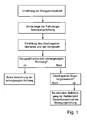
- Die Erfindung wird nun anhand der Zeichnungen näher erläutert. Dabei zeigt
- Fig.1
- eine schematische Darstellung des Verfahrens
- Zunächst ermittelt ein Fahrzeugbeobachter aus fahrzeugspezifischen und umgebungsspezifischen Werten eine prognostizierte Beschleunigung. Die prognostizierte Beschleunigung ergibt sich aus der Gleichung


- Die fahrzeugspezifischen Parameter
- cw:
- Luftwiderstand
- A:
- Querschnittsfläche
- e:
- Massenfaktor
- f:
- Rollwiderstand
- iges:
- Übersetzung
- r
- Reifenradius
- ηges:
- Gesamtwirkungsgrad
- Daraus ergibt sich

- Dabei sind alle Werte auf der rechten Seite bekannt bzw. können durch den Fahrzeugbeobachter abgeschätzt werden. Dabei werden einige Werte, wie zum Beispiel das Gefälle des Untergrundes, auf dem das Fahrzeug steht, schon zuvor, als das Fahrzeug sich bewegte abgeschätzt und dann von dem Fahrzeugbeobachter gespeichert.
- Ergibt sich beim Ankriechen aus der Gleichung die Gefahr des Zurückrollens, ist also aFzg kleiner Null beziehungsweise liegt unter einem negativen Schwellwert, so wird angenommen, dass die ersten Drehmomentzahlen, die von den Drehmomentsensoren erfasst werden, negativ sind. Die Raddrehzahlen, die dann im Verlauf des Ankriechens oder Anfahrens von den Drehzahlsensoren ermittelt und weitergeleitet werden, werden also zuerst als eine Rückwärtsfahrt interpretiert und somit entsprechend, wie z.B. mit einem positiven oder negativen Vorzeichen, gekennzeichnet.
- Ergibt sich beim Ankriechen aus der Gleichung die Gefahr, das der Wagen nach vorne rollt, zum Beispiel, da er auf einem nach vorne abschüssigen Untergrund steht, ist also aFzg größer Null oder größer als ein positiver Schwellwert, so wird angenommen, dass die ersten Drehzahlen, der angetriebenen Räder positiv sind und die Drehzahlen, die von den Drehzahlsensoren ermittelt werden, werden entsprechend gekennzeichnet, zum Beispiel indem sie mit einem positiven Vorzeichen versehen werden.
- Ergibt sich aus dem mathematischen Bewegungsmodell, dass das Fahrzeug in keine Richtung beschleunigt wird, da das anfängliche Kupplungsmoment MKupp zu klein ist und keine nennenswerte Steigung des Untergrunds ermittelt wurde, so wird das Vorzeichen der entsprechenden Drehzahlen bei Bewegung des Fahrzeugs entsprechend der Gangwahl gewählt.
- Ergibt sich nun zum Beispiel durch eine Fahrzeugsteuerung an der Kupplung ein weiterer Momentenaufbau, so wird nun unterschieden, welche Fahrstufe gewählt worden ist und welche Ausgangswerte für die Fahrzeugsbeschleunigung aFzg vorliegen. Wurde die Fahrstufe D, zum Beispiel durch den Fahrer, gewählt, so besteht die hohe Wahrscheinlichkeit, dass die Bewegungsgleichung bei höheren Kupplungsmomenten positive Fahrzeugbeschleunigungswerte aFzg liefert. Waren die ersten Fahrzeugsbeschleunigungswerte negativ und liegen durch die höheren Kupplungsmomente nun diese positiven Fahrzeugsbeschleunigungswerte aFzg vor, so wird, sobald die Drehzahlen Null erreichen bzw. einen Nulldurchgang vollziehen, ein Vorzeichenwechsel der Drehzahlen von negativ auf positiv vorgenommen.
- Wurde die Fahrstufe R gewählt, ist also die bevorzugte Fahrzeugbewegungsrichtung negativ, so besteht eine hohe Wahrscheinlichkeit, dass bei einem höherem, von der Kupplung übertragenen Drehmoment als das ursprünglich betrachtete MKupp die Fahrzeugbewegung negativ ist. Ist die ursprünglich prognostizierte Fahrzeugbeschleunigung aFzg positiv, so wird davon ausgegangen, dass der nächste Nulldurchlauf der Drehzahlwerte, also wenn die Drehzahlwerte von einem von Null verschiedenen Wert auf im Wesentlichen Null abfallen und dann wieder ansteigen, die an den Nulldurchlauf anschließenden Drehzahlwerte negativ, also in Richtung der bevorzugten Fahrzeugbewegungsrichtung sind.

Claims (9)
- Verfahren zur Erfassung der Bewegungsrichtung eines Fahrzeugs, wobei die Fahrzeuggeschwindigkeit erfasst wird und mittels eines mathematischen Bewegungsmodells die Bewegungsrichtung prognostiziert wird, dadurch gekennzeichnet, dass das von einer Fahrzeugkupplung übertragene Drehmoment erfasst wird und unter Berücksichtigung sowohl der Fahrzeuggeschwindigkeit als auch dem von der Kupplung übertragenen Drehmoments die Prognose der Bewegungsrichtung angepasst wird.
- Verfahren nach dem vorangegangenen Anspruch, dadurch gekennzeichnet, dass die Fahrzeuggeschwindigkeit zumindest teilweise mittels Drehzahlsensoren ermittelt wird.
- Verfahren nach den vorangegangenen Ansprüchen, dadurch gekennzeichnet, dass das mathematische Bewegungsmodell fahrzeugspezifische Faktoren berücksichtigt.
- Verfahren nach einem der vorangegangenen Ansprüche, dadurch gekennzeichnet, dass bei einem Nulldurchgang der Fahrzeuggeschwindigkeit die prognostizierte Bewegungsrichtung in ihrem Vorzeichen geändert wird.
- Verfahren nach dem vorangegangenen Anspruch, dadurch gekennzeichnet, dass der Nulldurchgang der Fahrzeuggeschwindigkeit unter Berücksichtigung des übertragenen Kupplungsmoments zur Änderung des Richtungsvorzeichens herangezogen wird.
- Verfahren nach einem der vorangegangenen Ansprüche, dadurch gekennzeichnet, dass die Bewegungsrichtung des Fahrzeugs vor und/oder während des Anfahrens mittels dem mathematischen Bewegungsmodells prognostiziert wird.
- Verfahren nach einem der vorangegangenen Ansprüche, dadurch gekennzeichnet, dass bei der Prognose der Bewegungsrichtung mittels des mathematischen Bewegungsmodells die Steigung des Untergrundes berücksichtigt wird.
- Verfahren nach dem vorangegangenen Anspruch, dadurch gekennzeichnet, dass die Steigung durch mindestens einen Fahrzeugbeobachter ermittelt wird.
- Verfahren nach einem der vorangegangenen Ansprüche, dadurch gekennzeichnet, dass die Steigung mittels mindestens einem Beschleunigungssensor ermittelt wird.
Applications Claiming Priority (1)
| Application Number | Priority Date | Filing Date | Title |
|---|---|---|---|
| DE102006061549 | 2006-12-27 |
Publications (3)
| Publication Number | Publication Date |
|---|---|
| EP1939633A2 true EP1939633A2 (de) | 2008-07-02 |
| EP1939633A3 EP1939633A3 (de) | 2010-07-14 |
| EP1939633B1 EP1939633B1 (de) | 2014-05-21 |
Family
ID=39309968
Family Applications (1)
| Application Number | Title | Priority Date | Filing Date |
|---|---|---|---|
| EP20070023500 Not-in-force EP1939633B1 (de) | 2006-12-27 | 2007-12-05 | Verfahren zur Erfassung der Bewegungsrichtung eines Fahrzeugs |
Country Status (1)
| Country | Link |
|---|---|
| EP (1) | EP1939633B1 (de) |
Family Cites Families (4)
| Publication number | Priority date | Publication date | Assignee | Title |
|---|---|---|---|---|
| JP2002104149A (ja) * | 2000-09-29 | 2002-04-10 | Toyota Motor Corp | 車輪の回転状態検出装置 |
| EP1351844A1 (de) * | 2001-01-11 | 2003-10-15 | Continental Teves AG & Co. oHG | Verfahren und vorrichtung zur fahrtrichtungserkennung |
| FR2857925B1 (fr) * | 2003-07-22 | 2005-09-30 | Delphi Tech Inc | Procede d'estimation de la pente d'une surface sur laquelle se trouve un vehicule automobile |
| DE102004052783B4 (de) * | 2004-10-30 | 2014-04-24 | Audi Ag | Verfahren und Vorrichtung zum Stabilisieren des Fahrzustandes eines allradgetriebenen Fahrzeuges |
-
2007
- 2007-12-05 EP EP20070023500 patent/EP1939633B1/de not_active Not-in-force
Non-Patent Citations (1)
| Title |
|---|
| None |
Also Published As
| Publication number | Publication date |
|---|---|
| EP1939633B1 (de) | 2014-05-21 |
| EP1939633A3 (de) | 2010-07-14 |
Similar Documents
| Publication | Publication Date | Title |
|---|---|---|
| DE102011013022B3 (de) | Verfahren zur Bestimmung des Fahrwiderstands eines Fahrzeugs | |
| DE102013114267B4 (de) | Vorrichtung und Verfahren zur Bestimmung einer Kurzzeitfahrtendenz eines Fahrers | |
| DE69510587T2 (de) | Verfahren und Vorrichtung zur Ermittlung der Fahrbahnsteigung | |
| DE102008029317B4 (de) | Straßenoberflächenzustandschätzvorrichtung | |
| DE102014110136B4 (de) | Verfahren zum Steuern eines Allradantriebs eines Fahrzeugs | |
| DE112009004444B4 (de) | Fahrzeugzustand-Bestimmungsvorrichtung und Fahrzeugzustand-Bestimmungsverfahren | |
| DE10154341A1 (de) | Verfahren und Vorrichtung zur Bestimmung einer geometrischen Fahrzeugneigung eines Kraftfahrzeuges | |
| DE102008036048B4 (de) | Verfahren zur Ansteuerung von Fahrzeugkomponenten zum automatischen Freischaukeln eines Kraftfahrzeugs | |
| DE112008001320T5 (de) | System und Verfahren für eine Schaltsteuerung für ein Fahrzeuggetriebe | |
| DE102008005328A1 (de) | Verfahren zum energieeffizienten Betrieb eines Kraftfahrzeuges | |
| DE112012005806T5 (de) | Verzögerungsfaktorschätzvorrichtung und Fahrunterstützungsvorrichtung. | |
| DE102014207628A1 (de) | Verfahren zur Ermittlung eines Offsets eines Inertialsensors | |
| DE102008030358A1 (de) | Fahrzeuggeschwindigkeitsregelungssystem | |
| DE102005049710A1 (de) | Verfahren zur Beeinflussung eines automatisierten Schaltgetriebes unter Berücksichtigung des Fahrwiderstandes | |
| DE112018004528T5 (de) | Fahrkontrollvorrichtung, fahrzeug und fahrkontrollverfahren | |
| DE102011121398A1 (de) | Gangauswahlvorrichtung für einKraftfahrzeug | |
| EP3227173B1 (de) | Erkennung eines schaltvorgangs | |
| DE102014117414B4 (de) | System und Verfahren des Steuerns einer Schaltung für ein Fahrzeug | |
| DE10393181T5 (de) | Vorrichtung zum Abschätzen einer Strassenoberflächen-Zustandsänderung, entsprechendes Verfahren sowie Kraftfahrzeug mit dieser Vorrichtung | |
| WO2010015440A1 (de) | Verfahren zur einstellung motorischer antriebseinheiten in kraftfahrzeugen mit hybridantrieb | |
| DE102007058416A1 (de) | Verfahren zur Erfassung der Bewegungsrichtung eines Fahrzeugs | |
| DE102018210715B4 (de) | Verfahren zur Adaption eines Wertes zumindest eines Fahrwiderstandsparameters | |
| DE112018002450B4 (de) | Fahrzeugsteuerungsvorrichtung | |
| DE102016214209A1 (de) | Verfahren zur Berechnung einer Fahrzeugmasse eines Motorfahrzeuges | |
| DE102019209586A1 (de) | Verfahren zum Schätzen eines aktuellen Reibwerts |
Legal Events
| Date | Code | Title | Description |
|---|---|---|---|
| PUAI | Public reference made under article 153(3) epc to a published international application that has entered the european phase |
Free format text: ORIGINAL CODE: 0009012 |
|
| AK | Designated contracting states |
Kind code of ref document: A2 Designated state(s): AT BE BG CH CY CZ DE DK EE ES FI FR GB GR HU IE IS IT LI LT LU LV MC MT NL PL PT RO SE SI SK TR |
|
| AX | Request for extension of the european patent |
Extension state: AL BA HR MK RS |
|
| PUAL | Search report despatched |
Free format text: ORIGINAL CODE: 0009013 |
|
| AK | Designated contracting states |
Kind code of ref document: A3 Designated state(s): AT BE BG CH CY CZ DE DK EE ES FI FR GB GR HU IE IS IT LI LT LU LV MC MT NL PL PT RO SE SI SK TR |
|
| AX | Request for extension of the european patent |
Extension state: AL BA HR MK RS |
|
| 17P | Request for examination filed |
Effective date: 20110114 |
|
| RAP1 | Party data changed (applicant data changed or rights of an application transferred) |
Owner name: SCHAEFFLER TECHNOLOGIES GMBH & CO. KG |
|
| AKX | Designation fees paid |
Designated state(s): AT BE BG CH CY CZ DE DK EE ES FI FR GB GR HU IE IS IT LI LT LU LV MC MT NL PL PT RO SE SI SK TR |
|
| 17Q | First examination report despatched |
Effective date: 20111215 |
|
| RAP1 | Party data changed (applicant data changed or rights of an application transferred) |
Owner name: SCHAEFFLER TECHNOLOGIES AG & CO. KG |
|
| RIC1 | Information provided on ipc code assigned before grant |
Ipc: G01P 13/04 20060101AFI20131122BHEP Ipc: G01P 13/00 20060101ALI20131122BHEP Ipc: B60W 50/00 20060101ALI20131122BHEP |
|
| GRAP | Despatch of communication of intention to grant a patent |
Free format text: ORIGINAL CODE: EPIDOSNIGR1 |
|
| INTG | Intention to grant announced |
Effective date: 20140110 |
|
| RAP1 | Party data changed (applicant data changed or rights of an application transferred) |
Owner name: SCHAEFFLER TECHNOLOGIES GMBH & CO. KG |
|
| GRAS | Grant fee paid |
Free format text: ORIGINAL CODE: EPIDOSNIGR3 |
|
| GRAA | (expected) grant |
Free format text: ORIGINAL CODE: 0009210 |
|
| AK | Designated contracting states |
Kind code of ref document: B1 Designated state(s): AT BE BG CH CY CZ DE DK EE ES FI FR GB GR HU IE IS IT LI LT LU LV MC MT NL PL PT RO SE SI SK TR |
|
| REG | Reference to a national code |
Ref country code: GB Ref legal event code: FG4D Free format text: NOT ENGLISH |
|
| REG | Reference to a national code |
Ref country code: CH Ref legal event code: EP |
|
| REG | Reference to a national code |
Ref country code: AT Ref legal event code: REF Ref document number: 669841 Country of ref document: AT Kind code of ref document: T Effective date: 20140615 |
|
| REG | Reference to a national code |
Ref country code: IE Ref legal event code: FG4D Free format text: LANGUAGE OF EP DOCUMENT: GERMAN |
|
| REG | Reference to a national code |
Ref country code: DE Ref legal event code: R096 Ref document number: 502007013139 Country of ref document: DE Effective date: 20140710 |
|
| REG | Reference to a national code |
Ref country code: NL Ref legal event code: VDEP Effective date: 20140521 |
|
| REG | Reference to a national code |
Ref country code: LT Ref legal event code: MG4D |
|
| PG25 | Lapsed in a contracting state [announced via postgrant information from national office to epo] |
Ref country code: IS Free format text: LAPSE BECAUSE OF FAILURE TO SUBMIT A TRANSLATION OF THE DESCRIPTION OR TO PAY THE FEE WITHIN THE PRESCRIBED TIME-LIMIT Effective date: 20140921 Ref country code: LT Free format text: LAPSE BECAUSE OF FAILURE TO SUBMIT A TRANSLATION OF THE DESCRIPTION OR TO PAY THE FEE WITHIN THE PRESCRIBED TIME-LIMIT Effective date: 20140521 Ref country code: GR Free format text: LAPSE BECAUSE OF FAILURE TO SUBMIT A TRANSLATION OF THE DESCRIPTION OR TO PAY THE FEE WITHIN THE PRESCRIBED TIME-LIMIT Effective date: 20140822 Ref country code: FI Free format text: LAPSE BECAUSE OF FAILURE TO SUBMIT A TRANSLATION OF THE DESCRIPTION OR TO PAY THE FEE WITHIN THE PRESCRIBED TIME-LIMIT Effective date: 20140521 |
|
| PG25 | Lapsed in a contracting state [announced via postgrant information from national office to epo] |
Ref country code: PL Free format text: LAPSE BECAUSE OF FAILURE TO SUBMIT A TRANSLATION OF THE DESCRIPTION OR TO PAY THE FEE WITHIN THE PRESCRIBED TIME-LIMIT Effective date: 20140521 Ref country code: ES Free format text: LAPSE BECAUSE OF FAILURE TO SUBMIT A TRANSLATION OF THE DESCRIPTION OR TO PAY THE FEE WITHIN THE PRESCRIBED TIME-LIMIT Effective date: 20140521 Ref country code: LV Free format text: LAPSE BECAUSE OF FAILURE TO SUBMIT A TRANSLATION OF THE DESCRIPTION OR TO PAY THE FEE WITHIN THE PRESCRIBED TIME-LIMIT Effective date: 20140521 Ref country code: SE Free format text: LAPSE BECAUSE OF FAILURE TO SUBMIT A TRANSLATION OF THE DESCRIPTION OR TO PAY THE FEE WITHIN THE PRESCRIBED TIME-LIMIT Effective date: 20140521 |
|
| PG25 | Lapsed in a contracting state [announced via postgrant information from national office to epo] |
Ref country code: PT Free format text: LAPSE BECAUSE OF FAILURE TO SUBMIT A TRANSLATION OF THE DESCRIPTION OR TO PAY THE FEE WITHIN THE PRESCRIBED TIME-LIMIT Effective date: 20140922 |
|
| PG25 | Lapsed in a contracting state [announced via postgrant information from national office to epo] |
Ref country code: RO Free format text: LAPSE BECAUSE OF FAILURE TO SUBMIT A TRANSLATION OF THE DESCRIPTION OR TO PAY THE FEE WITHIN THE PRESCRIBED TIME-LIMIT Effective date: 20140521 Ref country code: SK Free format text: LAPSE BECAUSE OF FAILURE TO SUBMIT A TRANSLATION OF THE DESCRIPTION OR TO PAY THE FEE WITHIN THE PRESCRIBED TIME-LIMIT Effective date: 20140521 Ref country code: EE Free format text: LAPSE BECAUSE OF FAILURE TO SUBMIT A TRANSLATION OF THE DESCRIPTION OR TO PAY THE FEE WITHIN THE PRESCRIBED TIME-LIMIT Effective date: 20140521 Ref country code: CZ Free format text: LAPSE BECAUSE OF FAILURE TO SUBMIT A TRANSLATION OF THE DESCRIPTION OR TO PAY THE FEE WITHIN THE PRESCRIBED TIME-LIMIT Effective date: 20140521 Ref country code: DK Free format text: LAPSE BECAUSE OF FAILURE TO SUBMIT A TRANSLATION OF THE DESCRIPTION OR TO PAY THE FEE WITHIN THE PRESCRIBED TIME-LIMIT Effective date: 20140521 |
|
| REG | Reference to a national code |
Ref country code: DE Ref legal event code: R097 Ref document number: 502007013139 Country of ref document: DE |
|
| PG25 | Lapsed in a contracting state [announced via postgrant information from national office to epo] |
Ref country code: NL Free format text: LAPSE BECAUSE OF FAILURE TO SUBMIT A TRANSLATION OF THE DESCRIPTION OR TO PAY THE FEE WITHIN THE PRESCRIBED TIME-LIMIT Effective date: 20140521 |
|
| RAP2 | Party data changed (patent owner data changed or rights of a patent transferred) |
Owner name: SCHAEFFLER TECHNOLOGIES AG & CO. KG |
|
| PLBE | No opposition filed within time limit |
Free format text: ORIGINAL CODE: 0009261 |
|
| STAA | Information on the status of an ep patent application or granted ep patent |
Free format text: STATUS: NO OPPOSITION FILED WITHIN TIME LIMIT |
|
| REG | Reference to a national code |
Ref country code: DE Ref legal event code: R081 Ref document number: 502007013139 Country of ref document: DE Owner name: SCHAEFFLER TECHNOLOGIES AG & CO. KG, DE Free format text: FORMER OWNER: SCHAEFFLER TECHNOLOGIES GMBH & CO. KG, 91074 HERZOGENAURACH, DE Effective date: 20150223 |
|
| 26N | No opposition filed |
Effective date: 20150224 |
|
| PG25 | Lapsed in a contracting state [announced via postgrant information from national office to epo] |
Ref country code: IT Free format text: LAPSE BECAUSE OF FAILURE TO SUBMIT A TRANSLATION OF THE DESCRIPTION OR TO PAY THE FEE WITHIN THE PRESCRIBED TIME-LIMIT Effective date: 20140521 |
|
| REG | Reference to a national code |
Ref country code: DE Ref legal event code: R097 Ref document number: 502007013139 Country of ref document: DE Effective date: 20150224 |
|
| PG25 | Lapsed in a contracting state [announced via postgrant information from national office to epo] |
Ref country code: BE Free format text: LAPSE BECAUSE OF NON-PAYMENT OF DUE FEES Effective date: 20141231 |
|
| PG25 | Lapsed in a contracting state [announced via postgrant information from national office to epo] |
Ref country code: LU Free format text: LAPSE BECAUSE OF FAILURE TO SUBMIT A TRANSLATION OF THE DESCRIPTION OR TO PAY THE FEE WITHIN THE PRESCRIBED TIME-LIMIT Effective date: 20141205 Ref country code: SI Free format text: LAPSE BECAUSE OF FAILURE TO SUBMIT A TRANSLATION OF THE DESCRIPTION OR TO PAY THE FEE WITHIN THE PRESCRIBED TIME-LIMIT Effective date: 20140521 |
|
| REG | Reference to a national code |
Ref country code: CH Ref legal event code: PL |
|
| GBPC | Gb: european patent ceased through non-payment of renewal fee |
Effective date: 20141205 |
|
| REG | Reference to a national code |
Ref country code: IE Ref legal event code: MM4A |
|
| PG25 | Lapsed in a contracting state [announced via postgrant information from national office to epo] |
Ref country code: CH Free format text: LAPSE BECAUSE OF NON-PAYMENT OF DUE FEES Effective date: 20141231 Ref country code: IE Free format text: LAPSE BECAUSE OF NON-PAYMENT OF DUE FEES Effective date: 20141205 Ref country code: LI Free format text: LAPSE BECAUSE OF NON-PAYMENT OF DUE FEES Effective date: 20141231 Ref country code: GB Free format text: LAPSE BECAUSE OF NON-PAYMENT OF DUE FEES Effective date: 20141205 |
|
| REG | Reference to a national code |
Ref country code: FR Ref legal event code: PLFP Year of fee payment: 9 |
|
| REG | Reference to a national code |
Ref country code: AT Ref legal event code: MM01 Ref document number: 669841 Country of ref document: AT Kind code of ref document: T Effective date: 20141205 |
|
| PG25 | Lapsed in a contracting state [announced via postgrant information from national office to epo] |
Ref country code: MC Free format text: LAPSE BECAUSE OF FAILURE TO SUBMIT A TRANSLATION OF THE DESCRIPTION OR TO PAY THE FEE WITHIN THE PRESCRIBED TIME-LIMIT Effective date: 20140521 Ref country code: BG Free format text: LAPSE BECAUSE OF FAILURE TO SUBMIT A TRANSLATION OF THE DESCRIPTION OR TO PAY THE FEE WITHIN THE PRESCRIBED TIME-LIMIT Effective date: 20140521 Ref country code: AT Free format text: LAPSE BECAUSE OF NON-PAYMENT OF DUE FEES Effective date: 20141205 |
|
| PG25 | Lapsed in a contracting state [announced via postgrant information from national office to epo] |
Ref country code: CY Free format text: LAPSE BECAUSE OF FAILURE TO SUBMIT A TRANSLATION OF THE DESCRIPTION OR TO PAY THE FEE WITHIN THE PRESCRIBED TIME-LIMIT Effective date: 20140521 |
|
| PG25 | Lapsed in a contracting state [announced via postgrant information from national office to epo] |
Ref country code: MT Free format text: LAPSE BECAUSE OF FAILURE TO SUBMIT A TRANSLATION OF THE DESCRIPTION OR TO PAY THE FEE WITHIN THE PRESCRIBED TIME-LIMIT Effective date: 20140521 Ref country code: TR Free format text: LAPSE BECAUSE OF FAILURE TO SUBMIT A TRANSLATION OF THE DESCRIPTION OR TO PAY THE FEE WITHIN THE PRESCRIBED TIME-LIMIT Effective date: 20140521 Ref country code: HU Free format text: LAPSE BECAUSE OF FAILURE TO SUBMIT A TRANSLATION OF THE DESCRIPTION OR TO PAY THE FEE WITHIN THE PRESCRIBED TIME-LIMIT; INVALID AB INITIO Effective date: 20071205 |
|
| REG | Reference to a national code |
Ref country code: FR Ref legal event code: PLFP Year of fee payment: 10 |
|
| REG | Reference to a national code |
Ref country code: FR Ref legal event code: PLFP Year of fee payment: 11 |
|
| PGFP | Annual fee paid to national office [announced via postgrant information from national office to epo] |
Ref country code: FR Payment date: 20171226 Year of fee payment: 11 |
|
| PGFP | Annual fee paid to national office [announced via postgrant information from national office to epo] |
Ref country code: DE Payment date: 20180228 Year of fee payment: 11 |
|
| REG | Reference to a national code |
Ref country code: DE Ref legal event code: R119 Ref document number: 502007013139 Country of ref document: DE |
|
| PG25 | Lapsed in a contracting state [announced via postgrant information from national office to epo] |
Ref country code: FR Free format text: LAPSE BECAUSE OF NON-PAYMENT OF DUE FEES Effective date: 20181231 Ref country code: DE Free format text: LAPSE BECAUSE OF NON-PAYMENT OF DUE FEES Effective date: 20190702 |
|
| P01 | Opt-out of the competence of the unified patent court (upc) registered |
Effective date: 20230524 |