EP1938726B1 - Spender für gewobene Bogen und Vliesbogen - Google Patents
Spender für gewobene Bogen und Vliesbogen Download PDFInfo
- Publication number
- EP1938726B1 EP1938726B1 EP06425870A EP06425870A EP1938726B1 EP 1938726 B1 EP1938726 B1 EP 1938726B1 EP 06425870 A EP06425870 A EP 06425870A EP 06425870 A EP06425870 A EP 06425870A EP 1938726 B1 EP1938726 B1 EP 1938726B1
- Authority
- EP
- European Patent Office
- Prior art keywords
- dispenser
- container
- substance
- web
- treating
- Prior art date
- Legal status (The legal status is an assumption and is not a legal conclusion. Google has not performed a legal analysis and makes no representation as to the accuracy of the status listed.)
- Active
Links
- 239000000126 substance Substances 0.000 claims abstract description 89
- 239000000463 material Substances 0.000 claims abstract description 46
- 239000007787 solid Substances 0.000 claims abstract description 39
- 238000004140 cleaning Methods 0.000 claims abstract description 15
- 239000007788 liquid Substances 0.000 claims description 31
- 239000003599 detergent Substances 0.000 claims description 11
- 238000004873 anchoring Methods 0.000 claims description 8
- 230000002093 peripheral effect Effects 0.000 claims description 8
- 230000000295 complement effect Effects 0.000 claims description 5
- 238000004891 communication Methods 0.000 claims description 3
- 238000003825 pressing Methods 0.000 claims description 3
- 238000012423 maintenance Methods 0.000 claims description 2
- 230000008878 coupling Effects 0.000 description 9
- 238000010168 coupling process Methods 0.000 description 9
- 238000005859 coupling reaction Methods 0.000 description 9
- 238000011282 treatment Methods 0.000 description 8
- 238000005470 impregnation Methods 0.000 description 6
- 210000002105 tongue Anatomy 0.000 description 6
- 230000008901 benefit Effects 0.000 description 5
- 230000002745 absorbent Effects 0.000 description 4
- 239000002250 absorbent Substances 0.000 description 4
- 239000000835 fiber Substances 0.000 description 4
- 239000004743 Polypropylene Substances 0.000 description 3
- 239000000428 dust Substances 0.000 description 3
- 239000004744 fabric Substances 0.000 description 3
- 230000007246 mechanism Effects 0.000 description 3
- 229920001155 polypropylene Polymers 0.000 description 3
- 230000002441 reversible effect Effects 0.000 description 3
- 239000001993 wax Substances 0.000 description 3
- 229920000742 Cotton Polymers 0.000 description 2
- 239000004372 Polyvinyl alcohol Substances 0.000 description 2
- 229920002678 cellulose Polymers 0.000 description 2
- 239000001913 cellulose Substances 0.000 description 2
- 238000001704 evaporation Methods 0.000 description 2
- 239000000499 gel Substances 0.000 description 2
- 229920000728 polyester Polymers 0.000 description 2
- -1 polypropylene Polymers 0.000 description 2
- 235000019422 polyvinyl alcohol Nutrition 0.000 description 2
- 229920002451 polyvinyl alcohol Polymers 0.000 description 2
- 239000000344 soap Substances 0.000 description 2
- CWYNVVGOOAEACU-UHFFFAOYSA-N Fe2+ Chemical compound [Fe+2] CWYNVVGOOAEACU-UHFFFAOYSA-N 0.000 description 1
- 206010020751 Hypersensitivity Diseases 0.000 description 1
- 229920000433 Lyocell Polymers 0.000 description 1
- 229920000297 Rayon Polymers 0.000 description 1
- 238000004026 adhesive bonding Methods 0.000 description 1
- 208000026935 allergic disease Diseases 0.000 description 1
- 230000007815 allergy Effects 0.000 description 1
- 230000000844 anti-bacterial effect Effects 0.000 description 1
- 229940088710 antibiotic agent Drugs 0.000 description 1
- 230000015572 biosynthetic process Effects 0.000 description 1
- 238000006243 chemical reaction Methods 0.000 description 1
- 238000010276 construction Methods 0.000 description 1
- 238000011109 contamination Methods 0.000 description 1
- 239000002781 deodorant agent Substances 0.000 description 1
- 239000000645 desinfectant Substances 0.000 description 1
- 238000004090 dissolution Methods 0.000 description 1
- 239000003974 emollient agent Substances 0.000 description 1
- 230000008020 evaporation Effects 0.000 description 1
- 238000003780 insertion Methods 0.000 description 1
- 230000037431 insertion Effects 0.000 description 1
- 239000002085 irritant Substances 0.000 description 1
- 231100000021 irritant Toxicity 0.000 description 1
- 230000007794 irritation Effects 0.000 description 1
- 238000005304 joining Methods 0.000 description 1
- 239000006193 liquid solution Substances 0.000 description 1
- 239000006210 lotion Substances 0.000 description 1
- 238000000034 method Methods 0.000 description 1
- 230000005012 migration Effects 0.000 description 1
- 238000013508 migration Methods 0.000 description 1
- ORQBXQOJMQIAOY-UHFFFAOYSA-N nobelium Chemical compound [No] ORQBXQOJMQIAOY-UHFFFAOYSA-N 0.000 description 1
- 239000003960 organic solvent Substances 0.000 description 1
- 239000004033 plastic Substances 0.000 description 1
- 229920003023 plastic Polymers 0.000 description 1
- 229920000058 polyacrylate Polymers 0.000 description 1
- 238000002203 pretreatment Methods 0.000 description 1
- 230000001681 protective effect Effects 0.000 description 1
- 230000001012 protector Effects 0.000 description 1
- 239000004627 regenerated cellulose Substances 0.000 description 1
- 238000007789 sealing Methods 0.000 description 1
- 230000035939 shock Effects 0.000 description 1
- 238000009987 spinning Methods 0.000 description 1
- XLYOFNOQVPJJNP-UHFFFAOYSA-N water Substances O XLYOFNOQVPJJNP-UHFFFAOYSA-N 0.000 description 1
- 238000009736 wetting Methods 0.000 description 1
- 238000004804 winding Methods 0.000 description 1
Images






Classifications
-
- A—HUMAN NECESSITIES
- A47—FURNITURE; DOMESTIC ARTICLES OR APPLIANCES; COFFEE MILLS; SPICE MILLS; SUCTION CLEANERS IN GENERAL
- A47K—SANITARY EQUIPMENT NOT OTHERWISE PROVIDED FOR; TOILET ACCESSORIES
- A47K10/00—Body-drying implements; Toilet paper; Holders therefor
- A47K10/24—Towel dispensers, e.g. for piled-up or folded textile towels; Toilet paper dispensers; Dispensers for piled-up or folded textile towels provided or not with devices for taking-up soiled towels as far as not mechanically driven
- A47K10/32—Dispensers for paper towels or toilet paper
- A47K10/34—Dispensers for paper towels or toilet paper dispensing from a web, e.g. with mechanical dispensing means
- A47K10/38—Dispensers for paper towels or toilet paper dispensing from a web, e.g. with mechanical dispensing means the web being rolled up with or without tearing edge
-
- A—HUMAN NECESSITIES
- A47—FURNITURE; DOMESTIC ARTICLES OR APPLIANCES; COFFEE MILLS; SPICE MILLS; SUCTION CLEANERS IN GENERAL
- A47K—SANITARY EQUIPMENT NOT OTHERWISE PROVIDED FOR; TOILET ACCESSORIES
- A47K10/00—Body-drying implements; Toilet paper; Holders therefor
- A47K10/24—Towel dispensers, e.g. for piled-up or folded textile towels; Toilet paper dispensers; Dispensers for piled-up or folded textile towels provided or not with devices for taking-up soiled towels as far as not mechanically driven
- A47K10/32—Dispensers for paper towels or toilet paper
- A47K2010/3266—Wet wipes
- A47K2010/3273—Wet wipes moistened just before use
Definitions
- the present invention relates to a dispenser or device for delivering sheets of woven or nonwoven material for housecleaning or personal care purposes. Particularly, the invention relates to a dispenser of non-woven sheets and a kit for housecleaning and/or personal care purposes, which is particularly versatile and easy to use.
- Distributors or dispensers that can supply sheets of (either dry or wet) material for the above-mentioned functions typically consist of a variously shaped and sized container in which a roll of absorbent or dampened material is housed, such as cellulose material, or non-woven with two or three layers of cellulose pulp or all-fiber PES, VIS, PP, LUX (spunlace or spunbonded), which can be taken off the container and torn in sheets. This material can have a number of functions according to the particular use for which it is intended.
- Suitable liquids such as detergents for personal care, dermatologic liquids, emollients, skin protectors, antibacterials, disinfectants or liquids for cleaning various surfaces, including furniture waxes.
- Said devices are provided with, particularly, mechanisms allowing dry or wet sheets from a same source, i.e. a roll, to be alternatively released as desired.
- these mechanisms comprise impregnation means that are coupled with liquid-containing reservoirs.
- the impregnation means can be controlled such as to be either selectively positioned in contact with the sheets to provide the impregnation with the liquid or be prevented from any contact therewith, in order to release dry sheets.
- the impregnation means can comprise a roll which draws from said reservoir and an abutment surface against which the roll can slide.
- the sheet of material is interposed between said roll and said abutment surface.
- a dry sheet of material will be delivered.
- the roll is rotated such that the liquid drawn from the reservoir will be distributed on the sheet, such as to be impregnated with a desired liquid before being delivered.
- a similar dispenser is, for example, described in US patent US 6,319,318 .
- the operator is forced to manipulate the dispenser with care in order to avoid that sudden impacts, shocks or upturns may cause the liquid within the reservoir to be inadvertently spilt. In fact, this spillage may easily cause all the material to be wetted and made unusable in the dry version, or however, a liquid loss.
- the sheet of material can be easily wetted with the liquid not only on the surface thereof in contact with the means but also on the opposite surface thereof, as a consequence of the migration of the liquid through the material.
- an irritant detergent liquid or a greasy product or however unpleasant to touch
- the operator would be forced to wear protective gloves against any irritation, allergy or simply in order to avoid having his hands washed after using a sheet impregnated with the liquid involved.
- DE-U-29501934 discloses a dispenser comprising a container suitable to house a material for cleaning and means for treating the web with a liquid substance, which comprises a positioning element moving between engagement and disengagement positions with the web.
- DE-U-29501934 discloses a dispenser according to the preamble of claim 1.
- the technical problem addressed by the present invention is thus to conceive a dispenser delivering sheets of woven or non-woven material for housecleaning and/or personal care, which is capable of solving said drawbacks.
- This problem is solved by means of a dispenser allowing one to select the material sheets to be delivered either dry or treated with desired substances regardless of the position of use of the dispenser and such as to prevent the user's skin from directly contacting a irritating or greasy substance.
- a first object of the present invention is thus a dispenser delivering sheets of woven or non-woven material for housecleaning and/or personal care according to claim 1.
- a second object of the invention is a kit according to claim 24 for cleaning objects or surfaces in general, as well as for personal care comprising said dispenser.
- the concept at the heart of the present invention is to find an alternative to the traditional impregnation means in order to avoid the above-cited drawbacks. Particularly, a system has been conceived to avoid using liquid substances.
- substances for personal care or household cleaning have been suggested to be used in the form of a gel, or generally, a solid spreadable substance similar to those commonly used for shaving soap sticks, deodorants and lipsticks or a conventional soap bar.
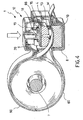
- the dispenser 1 in accordance with the invention thus comprises a container 2 suitable to house a woven or non-woven web W for cleaning rooms or objects or for personal care, and means 3 for treating the web with a desired substance 10 comprising a positioning element 4 movable to a first position of disengagement from the web such as to allow the latter to be delivered from the dispenser in an untreated condition, and a second position of engagement with said web such as to allow the latter to be delivered treated with said substance, wherein said positioning element 4, in the second engagement position, is suitable to hold said web in direct contact with said substance provided in a solid spreadable form, such that a thin layer of said substance is deposited, upon delivery, on the web contact surface by means of friction.
- the container 2 of the dispenser 1 can be preferably embodied by two shells 5 and 6 extending along a longitudinal axis X-X.
- the shells 5 and 6 each comprise a compartment 50, 60 having a generally substantially semi-cylindrical shape.
- the compartments 50 and 60 are mirror-like and can be reversibly coupled along said axis X-X such as to house a roll of a non-woven web W.
- each shell is provided with a pair of half-seats 51, 61 that are arranged along the axis X-X and that can be coupled to receive, when the container is closed, a pin 7 suitable to hold the roll of web W suspended within said container and allow the same to be unwound.
- the shell 6 further comprises an additional compartment 62 for housing the treating means 3 of the solid spreadable substance.
- the compartment 62 can be, for example as shown in Fig. 2 , a rectangular tray with one of the long sides being arranged parallel to the axis X-X.
- said tray has a projecting peripheral band 63 defining the opening 64 thereof.
- said long side and band 63 are joined to the compartment 60 via a joining portion 65, such as to be as one piece with the respective cavities of said compartment 60 and the compartment 62 communicating with each other.
- the compartment 62 can be separated and reversibly coupled to the half-shell of the compartment 60, for example by means of conventional coupling means, such as a groove to be engaged with a matching rib.
- conventional coupling means such as a groove to be engaged with a matching rib.
- the juxtaposed walls of the compartments 69 and 62 will be provided with corresponding openings to communicate with each other, thus allowing the web W to pass therethrough.
- the band 63 can preferably have first fitting means 69 suitable to co-operate with second fitting means of the shell 5, as will be detailed below.
- the fitting means can be for example a pair of slots intended to be engaged by corresponding snap hooks.
- each of the short sides of the tray further comprises first coupling means 68 (only those on the one side are illustrated in Fig. 2 ) that are suitable to co-operate with corresponding means formed on the treating means 3 for coupling said treating means to said container 2, as will be described below.
- the coupling means 68 are a pair of parallel grooves.
- the compartment 62 is provided with a slit 66 formed along the free long side wall, i.e. the wall opposite the one facing the compartment 60.
- said slit can be advantageously provided with a serrated edge 67 acting as a tear notch to get a piece of the non-woven web W.
- the shell 5, as said above, comprises a mirror-like compartment 50 relative to the compartment 60. Furthermore, this compartment is provided with a rectangular projection 52 extending along the axis X-X of the container 2. Particularly, said projection forms a peripheral edge defining a window 53 and is such as to be coupled to the band 63 of the compartment 62, when the container 2 is closed.
- said projection 52 can be provided with second fitting means 54 that are suitable to be reversibly fitted within said first fitting means 69 of the compartment 62.
- the second fitting means 54 can be two elastic tongues having toothed ends for reversible snap-fitting within said slots 69.
- Fig. 3 is an exploded view of the treating means 3 of a solid spreadable substance 10 in the general form of a cartridge.
- These means comprise a container 8, a block of substance to be spread 10, a positioning element 4, a plate 11 for anchoring the positioning element to a thrust means 12 and resilient means 13.
- the container 8 consists of a base 80, two long side walls 81, which are counter-posed and parallel to each other, and two short side walls 82, which are counter-posed and parallel to each other, to substantially form a rectangular-based parallelepiped.
- One of the two long side walls 81 is provided with a lip 83 starting from the free edge of the wall and projects outward of the container.
- the outer face of the short walls 82 is provided with second coupling means 84 for coupling with said first coupling means 68 of the compartment 62 of the shell 6.
- said coupling means 84 are a pair of ribs suitable to be snugly fitted within said matching grooves 68 formed in the inner face of the compartment 62.
- the inner face of said short walls 82 is provided with a pair of seats 85 for the resilient means 13.
- the resilient means are a pair of springs for each wall 82, and consequently, said seats are shaped as half-cylinders.
- Pins 86 start from the inner face of each of said short walls 82 and flush with the seats 85 for the resilient means 13, in order to lock or stop the plate 11 to avoid that the assembly of positioning element 4, anchoring plate 11 and thrust element 12 may be released from the treating means 3 assembly.
- the short side walls 82 have a greater height than the long side walls 81 such that when the treating means 3 are assembled with the positioning element 4 positioned to cover said container 8, two facing windows 87 are created for the non-woven sheet to pass therethrough, as illustrated below and detailed in Fig. 2 .
- the base 80 of the container 8 accommodates the solid spreadable substance 10, which generally has a substantially parallelepiped shape with a plane face suitable to rest on said base and a slightly concave free face, opposite to said plane face.
- the form of the solid spreadable substance is not binding and can be in any form adapted to the container.
- the positioning element 4 faces said free surface of the solid spreadable substance 10, which element is held at a given distance therefrom by means of said resilient means, as will be described below.
- the positioning element 4 comprises a free surface 41, smooth and convex, such as to result complementary to the concave surface of the block of solid substance to be spread.
- the positioning element 4 is anchored to an anchoring plate 11 by means of any known anchorage system, such as for example by gluing.
- the anchoring plate 11 has a substantially rectangular and plane general shape with a face provided with first means 14 for fixing to the thrust means 12.
- Said first fixing means can be two inversed L-shaped tracks 15 that are suitable to define a longitudinal guide 16.
- the short sides of the rectangular plate are each provided with a pair of protuberances 17, the resilient means 13 being held pressed thereto.
- the anchoring plate is, in turn, fixed to the thrust element 12.
- the thrust element 12 comprises a free surface 19 on which a thrust can be applied by a user and a surface 20 opposite said thrust surface with second fixing means 18 starting therefrom.
- the second fixing means 18 co-operate with the first fixing means 14 of the plate 11 to fix the plate with the positioning element 9 to the thrust element 12.
- the second fixing means 18 are a rib having a T-shaped section capable of being slidingly fittingly coupled in the guide 16 of the plate 11.
- the assembly of the dispenser in accordance with the present invention comprises a first moment in which a non-woven roll W is placed on the support pin 7. Thereafter, the pin is rested within the corresponding half-seats 61 of the compartment 60 of the shell 6. A portion of the roll is unwound to be arranged for the delivery of a piece of the non-woven web W, either dry or treated with the desired substance.
- the shell 5 is applied and secured to the shell 6 by means of fitting between the free edges of the respective compartments 50 and 60 and, simultaneously, by means of snap-engagement between the elastic tongues 54 and the slots 69.
- said non-woven portion is first passed through the windows 87 of said treating means 3 and then through the window 66 of the compartment 62 of the shell 6. Subsequently, the deposit means 3 are inserted within the compartment 62 of the shell 6 on the side of the container 8 such that the ribs 84 engage the corresponding grooves 68.
- the dispenser 1 is ready for use.
- the dispenser 1 can be used for dispensing an untreated sheet of non-woven web simply by pulling the non-woven sheet W by a desired length and tearing the latter by applying a traction against said serration 67.
- the positioning element 4 presses the web W against the block of spreadable substance 10.
- the traction applied on the piece of web W projecting from the dispenser causes the friction between the contact surface of the web and said substance such that a thin layer is deposited thereon.
- both woven webs and non-woven webs can be used.
- the dispenser can be implemented by providing a re-winding device for the woven after use, of the type used for example in toilette dispensers.
- the use will not allow for tearing into pieces, and will be more suitable to sanitary use or as a towel.
- the type of non-woven can be made of fibres of polyester (PE), polypropylene (PP), PLA (polylactates), PVA (polyvinylalcohol), polyethylenesulphone (PES), acrylic polymers, lyocell ® (i.e. fibres of regenerated cellulose, obtained by the procedure of dissolution and spinning in organic solvent, without the formation of derivatives), tencell ® (three layered products with fibres on the two outer sides and fluff pulp in the middle or two layered fibre/fluff pulp products), cotton, viscose.
- These fibers are generally short fibers that are interconnected by means of hydro-entanglement of one or more layers.
- All the elements of the dispenser can be generally made of rigid or semi-rigid plastics and ferrous materials for the springs 13, according to fully conventional standards.
- the shape and size of said elements can be changed as desired or according to particular requirements such as the positioning onto a wall or horizontal plane.
- the axis X-X of the container 2 of the roll can be positioned either horizontally or vertically.
- the solid spreadable substance can be of different nature in order to meet the most common requirements.
- it can be a detergent for cleaning body parts, such as hands and face, or a delicate detergent for intimate hygiene in those conditions in which water is not available, such as when travelling.
- Other substances can be conventional detergents for objects or housecleaning, products in the form of solid spreadable gels or waxes for treating valuable furniture.
- the dispenser according to the present invention appears to have a number of advantages.
- the treating means have been designed such as to deposit a solid spreadable substance on the non-woven, not a liquid substance. It derives that said drawback connected to the difficulty of a construction required to ensure the sealing against inadvertent leakage of liquid is completely avoided.
- the non-woven web is treated only on the surface thereof, while the surface opposite thereto and the inside of the web are left dry, mainly when the latter is made of more layers comprising an absorbent core.
- the untreated surface can be advantageously used for removing the detergent released by the treated surface on the objects or on people's skin after the cleaning function has been completed.
- the untreated surface can be first used to dust the surface to be cleaned or remove coarse material, whereas the treated surface can be used to operate the cleaning or deposit of a wax for furniture, for example.
- the dispenser as designed advantageously allows delivering an untreated non-woven piece for use as a simple dust cloth or, in the case of multi-layer absorbent product, as towel cloth or absorbent cloth to dry leakages of liquids on surfaces.
- a further advantage is that the substance for treatment can be easily replaced simply by changing the treating means or by changing the block of substance being housed within said means.
- the dispenser 100 has a general shape substantially identical to the shape of the dispenser 1 described above, the pieces, elements, and means in common are designated with the same reference number and will not be further described herein below.
- compartment 60 of the shell 6 has a profile slightly different from that of the dispenser 1, because it has a plane portion 60' continuous with the department 62 for the treating means 300.
- the compartment 62 will be substantially in the form of a tray, as above, with side walls not provided with said projecting edge defining the opening.
- the base furthermore, has an inner surface 60" that is preferably shaped such as to result complementary with the block of solid spreadable substance 10 against which said block can be pressed with the web W being interposed therebetween, as will be explained below.
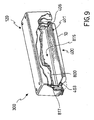
- the treating means 300 are in the general form of a cartridge.
- This means comprise a container 800, a block of substance 10 to be coated, a positioning element 400, a thrust element 120 and resilient means 130.
- the container 800 has a general shape of a substantially hollow rectangular parallelepiped with a first face 801, a second face 802 opposite said first face, two long side faces 803 and two short side faces 804 that are mutually counter-posed and parallel to each other.
- the first face 801 comprises a rectangular middle portion 805, and two side portions 806.
- the middle portion lies on a plane other than the plane defined by the side portions such as to form two steps.
- Each of the two side portions 806 is divided into two identical parts that are, in turn, drilled to form four seats 807 for the resilient means 130, as stated in Fig. 7 .
- the second face 802 shows a rectangular middle opening 808 and two side portions 809.
- the middle opening 808 substantially corresponds in the extension thereof to the middle opening 805 of the first face 801, whereas the side portions correspond to the side portions 806.
- the middle portion is such as to allow the positioning element 400 to be moved within the container 800, as will be discussed below.
- the side portions 809 are on a plane slightly projecting relative to the plane formed by the middle opening such that when the container 800 is placed on a horizontal plane, said opening is slightly raised, or in other words, it is not closed by the same plane.
- the long side faces 803 are closed and substantially plane.
- Each of the short side faces 804 is run by a longitudinal opening 810 arranged perpendicular to the first 801 and second 802 faces.
- the opening 810 has a larger middle portion 811 and two narrower side portions 312.
- the opening 810 has the function of allowing the engagement with the positioning element 400, as described below.
- said opening runs throughout the thickness of the side portions 806 thus separating said seats 807 from each other and allowing the communication between the short side faces 804 and the inside of the container 800.
- both the long and short side faces are provided with ribs 813 having the same function of the ribs 84 of the container 800 of the treating means 3 of the dispenser 1.
- Grooves (not shown) correspond to said ribs, which are formed in the compartment 62 for reversibly snugly engaging the treating means 300 with the container 2.
- the cavity defined by the container 800 results to be divided in two portions: a first portion 814 and a second portion 815.
- the first portion 814 is the bottom of the container 800 and is the seat in which the solid spreadable substance 10 is housed when the treating means 300 are not operated, or in other words, are in the first position in which the positioning element 400 is disengaged from the non-woven web W.
- the first portion 814 snugly accommodates a box-like element 818 being provided with a peripheral edge 819 projecting to the second portion 815 to create an abutment with the moving means 400 such as to define a closed space, as will be explained below.
- the second portion 815 allows the positioning element 400 and substance 10 applied thereto to move freely to be positioned in the second position of contact with the non-woven web and provide the treatment as desired.
- said second portion 815 comprises a housing 816 to accommodate the first moving means 817 of the positioning element 400 of the web W formed at each short side face 804 of the container 800.
- the first moving means 817 can comprise a rack suitable to be engaged by matching second moving means arranged on said positioning element 400.
- the positioning element 400 comprises a plate 401 of a substantially rectangular shape, provided with a pin 402 starting from each of the short sides of the plate and perpendicular thereto. In the vicinity of said short sides, second moving means 403 of the positioning element are mounted to the pin, which are suitable to co-operate with said first moving means 817 mounted to the container 800.
- said second means is a gear wheel.
- the pin As the pin moves in the distal direction, it first shows an element 404 for locking the rotation of said pin, and finally, of a distal end portion 406 for engagement with the pressing element 120.
- a block of a solid spreadable substance 10 On one of the two faces of the plate 401 is anchored a block of a solid spreadable substance 10. Said block has a substantially parallelepiped shape and extends throughout the face of the plate by leaving free a peripheral edge 406 thereof. Preferably, the free surface of said block is slightly concave and complementary to the inner surface of the base of the compartment 62.
- the thrust element 120 is also a sort of hollow parallelepiped suitable to be fitted on the container 800 on the side of the first face 801.
- This element comprises two long side walls 121, two short side walls 122 and a bottom wall 123. All these walls define a cavity 124 suitable to accommodate the container 800.
- the short side walls 122 comprise each an elastically yielding tongue 125 extending from the free side, i.e. the side opposite the side continuous with the bottom surface 123.
- the inner surface of said tongues is provided with a seat 126 suitable to be reversibly engaged with the distal end portion 405 of the pin 402 of the positioning element 400 in order to ensure a coupling between the thrust means 120 and the positioning means 400.
- the assembly of the dispenser 100 comprises a first moment in which all the pieces described above of the treating means 300 are mounted.
- the mounting first provides the moving means 400 to be inserted within the cavity 815 of said container 800 with the block of solid spreadable substance 10 facing the bottom wall 801 of the container until the peripheral edge 406 of the plate 401 provides an abutment against the peripheral edge 819 of the box-like element 818 of the container 800.
- the racks 817 are positioned within the respective seats 816 formed within the cavity 815 of the container 800.
- the springs 130 are inserted within the respective seats 807 of the container 800 such as to project therefrom and the thrust means 120 are fitted on the container 800 such that the seats 126 of the tongues 125, by means of the elastic compliance of the latter, are engaged by the respective distal ends 405 of the pin 402 of the plate 401 carrying the block 10 of solid spreadable substance.
- the substance 10 is closed within the box-like element 818 of the first portion 814 of the container 800. This ensures a certain seal to prevent the substance from evaporating or being contaminated when exposed to the external environment.
- the second portion 815 of the container 800 results to be closed by the same plate 401 of the positioning means 400 of the substance 10, and on the other side, results to be in communication with the outside through the opening 808.
- the treating means 300 can be now assembled with the container 2 in a similar manner to what has been discussed above with reference to the dispenser 1. Particularly, the pin 7 is fitted on the non-woven roll W and then rested on the shell 6 of the container 2. Prior to closing the container 2, a portion of the non-woven web W is unwound from the roll and pass through the opening 66 of the compartment 62 of the shell 6. Subsequently, the shell 5 is mounted to the shell 6 in the same manner as explained above with reference to the dispenser 1. Now, the container 2 is ready to receive the treating means 300, which are mounted within the compartment 62 of the container 2 on the side of the ribs 813 that thus come to be reversibly fitted within the matching grooves formed on the inner faces of said compartment 62.
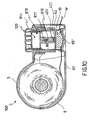
- the thus-arranged dispenser 100 is ready to be used such as to deliver a piece of non-woven web W, either dry or treated with a desired solid spreadable substance. It should be noted that the non-woven web W is, on the one side, rested on the base of the compartment 62 of the container 2, and on the other side, is at the opening 808 of the second portion 815 of the container 800.
- the positioning element slides within the container 800 thus releasing the substance 10 from the box-like element 819.
- the pin 402 of the positioning means 400 reaches the widened portion 811 of the opening 810 of the short side wall 804 of the container 800 and simultaneously the gear wheel 403 is engaged with the rack 817.
- the engagement between rack and gear wheel rotates the plate 401 which can freely rotate as the rotation-locking means 404 are also free to rotate when they are in said widened portion 811.
- the substance block is in contact with the non-woven web W ( Fig. 10 ), thereby, when it is removed from the dispenser, it is caused to rub against the block 10 of solid spreadable substance, thus resulting in a thin layer being applied on the contact surface between the web and substance. After a desired piece of web has been treated, it can be torn, as stated above.
- the plate 401 carries out the same movements as described above in reverse, and is re-positioned into abutment against the peripheral edge 819 of the box-like element 818 of the container 800. It should be noted that, in this position, the rotation-locking means 404 of plate 401 are restrained by the narrowed portion 812 of the opening 810 with the consequence that the rotation of the plate is prevented, such as to prevent the plate from being inadvertedly unlocked.
- the dispenser 100 results structurally easier to use.
- the dispenser 100 by means of the combination of first 817 and second 403 means for moving the positioning element 400 does not require treating means with a closed base for housing the block 10 of solid spreadable substance.
- the dispenser 100 can provide the first 817 and second 403 moving means to be replaced with moving means comprising two feet 403' provided with a rounded profile, which replace the corresponding gear wheels 403 and a guide 817' with a cam profile, which replaces the rack 817.
- moving means comprising two feet 403' provided with a rounded profile, which replace the corresponding gear wheels 403 and a guide 817' with a cam profile, which replaces the rack 817.
- the feet when they meet the guide, are forced to follow the profile of the latter such as to rotate 180° about the axis of the pin 402 integrally with the pin 402 of the positioning means 400 ( Fig. 11B and 11C ).
- a dispenser in accordance with a further variant embodiment of the invention. It should be noted that the parts in common with the dispenser 100 are designated with the same reference number.
- the compartment 62 houses the treating means 310 comprising two containers 820 and 830, a positioning element 420, a thrust element 120' and resilient means (not shown).
- the containers 820 and 830 are arranged parallel to each other and parallel to the longitudinal axis of the roll of material W.
- the container 820 that is positioned closest to the roll contains a pre-treating liquid for the material (W) and/or detergent substances for personal care or cleaning or maintenance of rooms, in order to allow impregnating or however wetting at least the contact surface of material W. Thereby, the subsequent treatment with a solid spreadable substance 10 like that described above can be facilitated. Otherwise, the detergent substances can be used as such.
- the positioning element 420 comprises three longitudinally extending rolls 421, 422, 423, parallel to the longitudinal axis of the roll of material W.
- the rolls 422, 423 are at the containers 820 and 830, respectively, and are independently integrally connected to the roll 421 positioned on a different plane with respect to said rolls 422 and 423, by means of corresponding arms 424 and 425.
- each roll is, however, free to rotate about the axis thereof.
- the arms 424 and 425 can be differently joined to the roll 421 such as to be adapted to the substance of the corresponding container.
- the arm 425 intended to place the sheet of material W in contact with the solid spreadable substance 10 can be provided with a spring biasing the roll 423 against the piece of said substance 10 such as to balance the consumption of the latter, and always ensuring that it draws from within the container 830 even when the substance is almost completely consumed.
- the thrust element 120' is a box-like element that is opened on the side facing the roll 421, such as to be capable of housing the latter, and closed on the opposite side by a thrust surface 123'.
- the thrust element 102' is further integral with each of said arms 424 and 425, such as to control the positioning of the rolls 422 and 423 relative to the corresponding containers 820 and 830.
- the resilient means can be springs identical to those described above.
- the operation of the dispenser 110 provides a first condition ( Fig. 12A ) in which the positioning element 420 is away from the containers 820 and 830. In this position, the material W of the roll is free to pass through the rolls 421, 422 and 423 of said positioning element without being treated.
- the material unwound from the roll first passes on the surface portion of the roll 422 facing the corresponding container 820 without being immersed in the liquid within said container, thereafter it passes on the surface portion of the roll 421 facing the thrust surface 123' of the thrust element 120', and finally, it passes on the surface portion of the roll 423 that faces the container 830 without contacting the solid spreadable substance 10.
- the rolls 422 and 423 are pushed in the corresponding containers 820 and 830 such that the sheet of material W is contacted to the substances contained therein.
- the sheet of material W is first immersed in the liquid solution contained within the container 820, then it passes on the roll 421 where it is subjected to a sort of twisting due to the traction of the sheet, and finally it passes on the solid spreadable substance 10 of the container 830, a thin layer being deposited thereon by means of friction.
- the sheet of material W is first dampened with a suitable liquid, which allows a better adherence by the solid spreadable substance to the sheet. Furthermore, the sheet can be pre-treated to allow a better functionality of the solid spreadable substance.
- a dispenser similar to the dispenser 100 described with reference to the figures 5 to 10 is generally illustrated with reference 210 in Fig. 13 . Consequently, similar pieces are designated with the same numerals and will not be further described herein.
- the dispenser 210 comprises a container 62 suitable to house pre-treating means 930 and treating means 300.
- the treating means 300 result to be identical to the treating means 300 described above with reference to the dispenser 100.
- the pre-treating means 930 which comprise a container 931 provided with opening means 932 flush with the opening 933 thereof to allow the liquid contained within said container to exit therefrom.
- the opening means 932 are a ball or cylinder closing the opening of the container when the latter is not used.
- a dispenser is described to comprise refills embodied by containers like those described above.
- the container 931 can be housed within a respective seat 934 of the container 62 of the dispenser 100 such as to have the opening 933 facing the bottom 62' of the container 62. In other words, the container 931 is positioned upturned within the container 62 of the dispenser.
- the bottom 62' of the container 62 is provided with an abutment surface 62" complementary to the ball 932 or cylinder.
- the seat 934 is provided with reversible, projecting, holding means 935 suitable to hold the container 931 in a liquid-releasing position, as will be described below.
- said holding means are a pair of retracting teeth provided with an inclined ramp 935' for prompt to insertion and an abutment 935" against which the bottom of the container 931 is stopped.
- the dispenser 210 can also comprise twisting means 500 that are positioned between the pre-treating means 930 and the treating means 300 in order to eliminate any excess liquid impregnated by the sheet of material W.
- these twisting means are a pair of rolls.
- the dispenser 210 described above can thus operate such as to release a sheet of material W, either dry or treated.
- the sheet of material W can be delivered dry.
- the sheet of material W can be delivered dampened by a desired liquid and/or a thin layer of solid spreadable substance 10.
- the container 931 is pushed into the seat 934 by causing the holding means 935 to retract.
- said means return in the projecting position such that the abutment acts as a stop to prevent the container 931 from escaping from the seat thereof.
- the sheet of material W can be delivered dampened with a detergent substance, a lotion or liquid which facilitates the pre-treatment prior to the application of the solid spreadable substance 10.
- the treating means 300 can be also operated in the same manner as described above to deposit a thin layer of solid spreadable substance 10 selected according to the required use of the sheet of material W.
- the dispenser 210 can be used also by acting only on the treating means 300 as discussed above. Consequently, the dispenser 210 results to be even more versatile relative to the dispensers described above due to the possibility of combining one, two or no treatment of the sheet of material W.
- the treating means 300 can be replaced by the treating means 3 described with reference to the dispenser 1 of Fig. 1 to 4 .
- the holding means 935 can be a door that holds the seat 934 closed, and the container 931 simultaneously pressed against the surface 62" of the compartment 62.
- a further object of the present invention is a kit for cleaning objects, housecleaning, or personal care comprising a dispenser 1, 100, 110, 210 as that described above and a series of blocks of solid spreadable substance 10 packed in suitable sealed bags to avoid the evaporation or contamination of the substances.
- a series of positioning elements can be provided with the substance block 10 being applied thereto, which are easy to assemble and disassemble, as discussed above, or even a series of sealed treating means can be provided with suitable bags that can be opened when required.
- non-woven rolls may be provided of different types, in order to be adapted to the various usage modes of the dispenser.
- the rolls can be provided with a cylindrical core (not shown), on which the sheet of woven or non-woven sheet of material W is usually wound, which core is provided with a seat for the engagement with a corresponding bush (not shown) that is rotatably mounted on the shells of the dispenser.
- the kit also comprises containers 820, 931 for the sealed liquids and that can be opened upon use.
- the kit of the invention can also comprise an instruction sheet reporting the instructions for use.
- the kit results to be particularly versatile and easy to use, such as to be used in any situation in which an object, a surface or parts of a person's body require to be cleaned or dried in a rapid and effective manner.
- the dispenser and kit of the invention are capable of solving the problems discussed in the introductory part of the present description as well as providing a number of advantages relative to the dispensers of the prior art.
Landscapes
- Health & Medical Sciences (AREA)
- Public Health (AREA)
- Cleaning Implements For Floors, Carpets, Furniture, Walls, And The Like (AREA)
Claims (25)
- Spender (1; 100; 110; 210) umfassend einen Behälter (2) zur Aufnahme von Gewebe- oder Vlies-Bahnmaterial (W) zum Reinigen von Räumen oder Gegenständen oder zur Körperpflege und eine Einrichtung (3; 300; 310) zum Behandeln des Bahnmaterials mit einer gewünschten Substanz (10) mit einem Positionierelement (4; 400; 420), das in eine erste Lage, in der es die Bahn nicht berührt, um ein Ausgeben der letzteren aus dem Spender in einem unbehandelten Zustand zu ermöglichen, und in eine zweite Lage bringbar ist, in der es an der Bahn anliegt und diese mit der Substanz behandelt ausgebbar ist, wobei das Positionierelement (4; 400; 420) in der die Bahn berührenden zweiten Lage diese direkt in Kontakt mit der Substanz halten kann, die in einer festen und auftragbaren Form wie bspw. als Stab angeordnet ist derart, dass beim Ausgeben der Bahn auf deren berührter Fläche durch Reibung eine dünne Schicht der Substanz aufgetragen wird, dadurch gekennzeichnet, dass die Einrichtung (3; 300; 310) zum Behandeln der Bahn einen Block einer festen auftrag- bzw. ausbreitbaren Substanz (10) oder ein Gel aufweist.
- Spender (1; 100; 110; 210) nach Anspruch 1, bei dem der Behälter (2) weiterhin zwei Schalen (5, 6) aufweist, die miteinander verbind- und voneinander lösbar sind, und die jeweils ein Abteil (50, 60) zur Aufnahme der Bahn (W) enthalten.
- Spender (1; 100; 110; 210) nach Anspruch 2, bei dem eine der Schalen (5; 6) ein weiteres Abteil (62) zur Aufnahme der Behandlungseinrichtung (3; 300; 310) enthält, die in Verbindung mit dem Abteil (60) in einer der Schalen (5; 6) steht.
- Spender (1; 100; 110; 210) nach Anspruch 3, bei dem das weitere Abteil (62) einen Schlitz (66) ggf. mit einer gezackten Kante (67) aufweisen kann, um ein Stück des Vlies-Bahnmaterials (W) auszugeben.
- Spender (1; 100; 110; 210) nach Anspruch 1 bis 4, bei dem die Behandlungseinrichtung (3; 300; 310) einen Behälter (8; 800; 830), einen Block fester auftragbarer Substanz (10) oder eines Gels, ein Positionierelement (4; 400; 420), ein Schubelement (12; 120; 120') sowie federnde Einrichtungen (13; 130) aufweist.
- Spender (1) nach Anspruch 5, bei dem der Behälter (8) einen Fuß (80) zur Aufnahme des Blocks (10) fester auftragbarer Substanz oder des Gels, zwei lange Seitenwände (81) und zwei kurze Seitenwände (82) aufweist, die innen mit Sitzen (85) für die federnden Einrichtungen (12) versehen sind.
- Spender (1) nach Anspruch 5 oder 6 weiterhin mit einer Platte (11) zum Verankern des Positionierelements (4) am Schubelement (12).
- Spender (1) nach Anspruch 5 oder 6, bei dem die Behandlungseinrichtung (4) zwei einander gegenüber angeordnete Fenster (87) für den Durchgang der Materialbahn (W) aufweist derart, dass sie zwischen dem Block der Substanz (10) und der Positioniereinrichtung (4) durchläuft.
- Spender (100; 210) nach Anspruch 1 bis 5, bei dem eine der beiden Schalen (5, 6) ein Abteil (62) einer zu dem Block fester auftragbarer Substanz (10) komplementären Gestalt hat.
- Spender (100; 210) nach Anspruch 5, 6 oder 9, bei dem die Behandlungseinrichtung (300) einen im Wesentlichen als Parallepiped gestalteten hohlen Behälter (800) aufweist, der einen Innenraum umschließt, der in einen ersten unteren Teil (814), der geeignet ist zurAufnahme der Positioniereinrichtung (400), an der die feste auftragbare Substanz (10) oder das Gel verankert ist, und einen zweiten Teil (815) unterteilt ist, der der Positioniereinrichtung erlaubt, sich aus der ersten in die zweite Lage zu bewegen.
- Spender (100; 210) nach Anspruch 10, bei dem der Behälter (800) eine erste Fläche mit einem Mittelteil (705) und zwei Seitenteilen (806) hat, wobei die zwei Seitenteile (806) in zwei identische Teile unterteilt und diese so gebohrt sind, dass vier Sitze (807) für die federnden Einrichtungen (13) entstehen und sich zwei kurze Seitenflächen (804) neben einer längsverlaufenden Öffnung (810) erstrecken, die einen Eingriff des Positionierelements (400) erlaubt.
- Spender (100; 210) nach Anspruch 10 oder 11, bei dem der erste Unterteil (814) des Behälters (800) dicht passend ein kastenartiges Element (818) aufweist, von dem eine Außenkante (819) zu dem zweiten Teil (815) des Behälters (800) hin bis an die Positioniereinrichtung (400) vorsteht, so dass ein geschlossener Raum entsteht, in dem in der ersten Lage der Behandlungseinrichtung der Block der Substanz (10) eingeschlossen ist.
- Spender (100; 210) nach Anspruch 10, 11 oder 12, in dem der zweite Teil (815) ein Gehäuse (816) zur Aufnahme der ersten Bewegungseinrichtung (817) des Positionierelements (400) aufweist.
- Spender (100; 210) nach Anspruch 13, bei dem das Positionierelement (400) eine Platte (401) im Wesentlichen rechteckiger Gestalt aufweist, die mit jeweils einem von jeder kurzen Seite der Platte ausgehenden und zu ihr rechtwinkligen Stift (402) und mit einer zweiten Bewegungseinrichtung (403) für das Positionierelement versehen ist, die geeignet ist, mit der am Behälter (800) angebrachten ersten Bewegungseinrichtung (817) zusammenarbeitend ein Drehen der Bewegungseinrichtung auf dem Stift (402) zu verursachen.
- Spender (100; 210) nach Anspruch 14, bei dem die erste und die zweite Bewegungseinrichtung (817 bzw. 403) zum Bewegen des Positionierelements (400) eine Zahnstange bzw. ein Zahnrad sind.
- Spender (100; 210) nach Anspruch 14 oder 15, bei dem der Stift (402) ein eine Drehung sperrendes Element (404) und einen distalen Endteil (406) aufweist, der mit dem Druck ausübenden Element (120) im Eingriff steht.
- Spender (100; 210) nach Anspruch 14, bei dem die erste und die zweite Einrichtung (817 bzw. 403) zum Bewegen des Positionierelements (400) Füße (403') bzw. ein Führungselement (817') sind.
- Spender (1; 100; 210) nach Anspruch 1 bis 17, bei dem die federnden Einrichtungen (13; 130) Federn sind.
- Spender (110) nach Anspruch 1 bis 5, bei dem die Behandlungseinrichtung (310) zwei Behälter (820, 830) aufweist, von denen der eine (820), näher an der Rolle Bahnmaterial (W) liegende eine Flüssigkeit und der andere (830), weiter von der Rolle entfernte die feste auftragbare Substanz (10) enthält.
- Spender (110) nach Anspruch 19, bei dem das Positionierelement (420) drei Rollen (421, 422, 423) aufweist, die sich längs parallel zur Längsachse der Materialrolle (W) erstrecken und miteinander durch Arme (424, 425) verbunden sind, wobei die Rollen (422, 423) an den Behältern (820 bzw. 830) angeordnet sind und die Rolle (421) in einer anderen Ebene als die Rollen (422, 423) liegt.
- Spender (210) nach Anspruch 1 bis 5 und 9 bis 18 weiterhin mit einer zwischen der Materialrolle (W) und der Behandlungseinrichtung (300) angeordneten Vorbehandlungseinrichtung (930), mit der das Material (W) mit einer flüssigen Substanz vorbehandelbar ist.
- Spender (210) nach Anspruch 21, bei dem die Vorbehandlungseinrichtung einen Behälter (931) mit einer Öffnungsanordnung (932) aufweist, durch die im Behälter enthaltene Flüssigkeit aus ihm ausfließen kann.
- Spender (210) nach Anspruch 21 oder 22 weiterhin mit einer Verdreheinrichtung (500), die zwischen der Vorbehandlungs- und der Behandlungseinrichtung (930 bzw. 300) angeordnet ist.
- Materialsatz zum Reinigen von Gegenständen für den Hausputz oder für die Körperpflege, der einen Spender (1; 100; 110; 210) nach Anspruch 1 bis 18, eine Serie von Blöcken einer festen auftragbaren Substanz (10) oder eines Gels, die in geeignete verschließ- und öffenbare Beutel verpackt und optional gegen eine Serie von Positionierelementen (400) mit auf sie aufgebrachtem Substanzblock austauschbar sind, Rollen aus Vliesmaterial (W) optional unterschiedlicher Art sowie eine Beilage mit einer Gebrauchsanweisung enthält.
- Materialsatz nach Anspruch 24 weiterhin mit einer Serie von Behältern (931) für Substanzen zum Vorbehandeln des Materials (W) und/oder Detergentien für die Körperpflege oder die Reinigung bzw. Wartung von Räumlichkeiten.
Priority Applications (3)
| Application Number | Priority Date | Filing Date | Title |
|---|---|---|---|
| AT06425870T ATE479374T1 (de) | 2006-12-29 | 2006-12-29 | Spender für gewobene bogen und vliesbogen |
| EP06425870A EP1938726B1 (de) | 2006-12-29 | 2006-12-29 | Spender für gewobene Bogen und Vliesbogen |
| DE602006016631T DE602006016631D1 (de) | 2006-12-29 | 2006-12-29 | Spender für gewobene Bogen und Vliesbogen |
Applications Claiming Priority (1)
| Application Number | Priority Date | Filing Date | Title |
|---|---|---|---|
| EP06425870A EP1938726B1 (de) | 2006-12-29 | 2006-12-29 | Spender für gewobene Bogen und Vliesbogen |
Publications (2)
| Publication Number | Publication Date |
|---|---|
| EP1938726A1 EP1938726A1 (de) | 2008-07-02 |
| EP1938726B1 true EP1938726B1 (de) | 2010-09-01 |
Family
ID=38036411
Family Applications (1)
| Application Number | Title | Priority Date | Filing Date |
|---|---|---|---|
| EP06425870A Active EP1938726B1 (de) | 2006-12-29 | 2006-12-29 | Spender für gewobene Bogen und Vliesbogen |
Country Status (3)
| Country | Link |
|---|---|
| EP (1) | EP1938726B1 (de) |
| AT (1) | ATE479374T1 (de) |
| DE (1) | DE602006016631D1 (de) |
Cited By (3)
| Publication number | Priority date | Publication date | Assignee | Title |
|---|---|---|---|---|
| US11672383B2 (en) | 2021-03-05 | 2023-06-13 | Dual Strategies, LLC | Wet or dry paper towel dispenser |
| US11744413B2 (en) | 2021-10-07 | 2023-09-05 | Deb Ip Limited | Dispenser assembly |
| US12396600B2 (en) | 2021-03-05 | 2025-08-26 | Dual Strategies, LLC | Fluid dosing substrate dispenser |
Family Cites Families (3)
| Publication number | Priority date | Publication date | Assignee | Title |
|---|---|---|---|---|
| US3199490A (en) * | 1961-12-13 | 1965-08-10 | Karlik Laddie | Device for dispensing, coating and cutting paper webs |
| DE29501934U1 (de) * | 1995-02-07 | 1995-06-08 | Loos, Harry, 71287 Weissach | Wandspender für Intensiv-Feucht-Reinigungstücher |
| US6319318B1 (en) * | 1999-09-30 | 2001-11-20 | Scott D. Pekarek | Apparatus for dispensing towels |
-
2006
- 2006-12-29 EP EP06425870A patent/EP1938726B1/de active Active
- 2006-12-29 AT AT06425870T patent/ATE479374T1/de not_active IP Right Cessation
- 2006-12-29 DE DE602006016631T patent/DE602006016631D1/de active Active
Cited By (4)
| Publication number | Priority date | Publication date | Assignee | Title |
|---|---|---|---|---|
| US11672383B2 (en) | 2021-03-05 | 2023-06-13 | Dual Strategies, LLC | Wet or dry paper towel dispenser |
| US12042100B2 (en) | 2021-03-05 | 2024-07-23 | Dual Strategies, LLC | Wet or dry paper towel dispenser |
| US12396600B2 (en) | 2021-03-05 | 2025-08-26 | Dual Strategies, LLC | Fluid dosing substrate dispenser |
| US11744413B2 (en) | 2021-10-07 | 2023-09-05 | Deb Ip Limited | Dispenser assembly |
Also Published As
| Publication number | Publication date |
|---|---|
| EP1938726A1 (de) | 2008-07-02 |
| ATE479374T1 (de) | 2010-09-15 |
| DE602006016631D1 (de) | 2010-10-14 |
Similar Documents
| Publication | Publication Date | Title |
|---|---|---|
| AU2008296840B2 (en) | Wipes dispenser | |
| EP1201562B1 (de) | Unterteiltes Lagerungssystem | |
| US3775801A (en) | Dispenser for a moist flexible sheet material | |
| US5439521A (en) | Dispenser for storing and dispensing moistened toilet tissue | |
| US7066674B2 (en) | Application device, system, and method | |
| US4493124A (en) | Toilet cleaning tool | |
| CN101222871A (zh) | 用于家用清洁和/或个人卫生的材料片材的分配器 | |
| AU2001290819B2 (en) | System for dispensing plurality of wet wipes | |
| AU755791B2 (en) | Pump-free dosing device for flowable media | |
| JP2007537933A (ja) | 拭取り布小出し装置 | |
| US20120097697A1 (en) | Wipes product | |
| US4112536A (en) | Applicator | |
| AU2009303618A1 (en) | Container having a lid that is openable upon application of a downward force | |
| EP1938726B1 (de) | Spender für gewobene Bogen und Vliesbogen | |
| WO2001076439A1 (en) | Dispensing system for wipes | |
| JPWO2020243737A5 (de) | ||
| US20120261506A1 (en) | Dispensers for a paper product and another item | |
| JP2016016876A (ja) | シート収納器具 | |
| US7188799B1 (en) | Dispensing system for wipes | |
| MXPA04011095A (es) | Un surtidor de soporte de rollo para material en hoja. | |
| GB2107973A (en) | Toilet cleaning tool | |
| CA2616170C (en) | Device for the care of footwear | |
| US20100077557A1 (en) | Application compound containing and administering device | |
| EP2592985B1 (de) | Wischtuchprodukte | |
| GB2370223A (en) | Applicator for tanning and other preparations |
Legal Events
| Date | Code | Title | Description |
|---|---|---|---|
| PUAI | Public reference made under article 153(3) epc to a published international application that has entered the european phase |
Free format text: ORIGINAL CODE: 0009012 |
|
| AK | Designated contracting states |
Kind code of ref document: A1 Designated state(s): AT BE BG CH CY CZ DE DK EE ES FI FR GB GR HU IE IS IT LI LT LU LV MC NL PL PT RO SE SI SK TR |
|
| AX | Request for extension of the european patent |
Extension state: AL BA HR MK RS |
|
| 17P | Request for examination filed |
Effective date: 20081224 |
|
| 17Q | First examination report despatched |
Effective date: 20090211 |
|
| AKX | Designation fees paid |
Designated state(s): AT BE BG CH CY CZ DE DK EE ES FI FR GB GR HU IE IS IT LI LT LU LV MC NL PL PT RO SE SI SK TR |
|
| AXX | Extension fees paid |
Extension state: BA Payment date: 20081224 Extension state: MK Payment date: 20081224 Extension state: AL Payment date: 20081224 Extension state: RS Payment date: 20081224 Extension state: HR Payment date: 20081224 |
|
| GRAP | Despatch of communication of intention to grant a patent |
Free format text: ORIGINAL CODE: EPIDOSNIGR1 |
|
| GRAS | Grant fee paid |
Free format text: ORIGINAL CODE: EPIDOSNIGR3 |
|
| GRAA | (expected) grant |
Free format text: ORIGINAL CODE: 0009210 |
|
| AK | Designated contracting states |
Kind code of ref document: B1 Designated state(s): AT BE BG CH CY CZ DE DK EE ES FI FR GB GR HU IE IS IT LI LT LU LV MC NL PL PT RO SE SI SK TR |
|
| AX | Request for extension of the european patent |
Extension state: AL BA HR MK RS |
|
| REG | Reference to a national code |
Ref country code: GB Ref legal event code: FG4D |
|
| REG | Reference to a national code |
Ref country code: CH Ref legal event code: EP |
|
| REG | Reference to a national code |
Ref country code: IE Ref legal event code: FG4D |
|
| REF | Corresponds to: |
Ref document number: 602006016631 Country of ref document: DE Date of ref document: 20101014 Kind code of ref document: P |
|
| REG | Reference to a national code |
Ref country code: NL Ref legal event code: VDEP Effective date: 20100901 |
|
| PG25 | Lapsed in a contracting state [announced via postgrant information from national office to epo] |
Ref country code: LT Free format text: LAPSE BECAUSE OF FAILURE TO SUBMIT A TRANSLATION OF THE DESCRIPTION OR TO PAY THE FEE WITHIN THE PRESCRIBED TIME-LIMIT Effective date: 20100901 Ref country code: FI Free format text: LAPSE BECAUSE OF FAILURE TO SUBMIT A TRANSLATION OF THE DESCRIPTION OR TO PAY THE FEE WITHIN THE PRESCRIBED TIME-LIMIT Effective date: 20100901 Ref country code: AT Free format text: LAPSE BECAUSE OF FAILURE TO SUBMIT A TRANSLATION OF THE DESCRIPTION OR TO PAY THE FEE WITHIN THE PRESCRIBED TIME-LIMIT Effective date: 20100901 |
|
| LTIE | Lt: invalidation of european patent or patent extension |
Effective date: 20100901 |
|
| PG25 | Lapsed in a contracting state [announced via postgrant information from national office to epo] |
Ref country code: PL Free format text: LAPSE BECAUSE OF FAILURE TO SUBMIT A TRANSLATION OF THE DESCRIPTION OR TO PAY THE FEE WITHIN THE PRESCRIBED TIME-LIMIT Effective date: 20100901 Ref country code: SI Free format text: LAPSE BECAUSE OF FAILURE TO SUBMIT A TRANSLATION OF THE DESCRIPTION OR TO PAY THE FEE WITHIN THE PRESCRIBED TIME-LIMIT Effective date: 20100901 Ref country code: CY Free format text: LAPSE BECAUSE OF FAILURE TO SUBMIT A TRANSLATION OF THE DESCRIPTION OR TO PAY THE FEE WITHIN THE PRESCRIBED TIME-LIMIT Effective date: 20100901 |
|
| PG25 | Lapsed in a contracting state [announced via postgrant information from national office to epo] |
Ref country code: SE Free format text: LAPSE BECAUSE OF FAILURE TO SUBMIT A TRANSLATION OF THE DESCRIPTION OR TO PAY THE FEE WITHIN THE PRESCRIBED TIME-LIMIT Effective date: 20100901 Ref country code: GR Free format text: LAPSE BECAUSE OF FAILURE TO SUBMIT A TRANSLATION OF THE DESCRIPTION OR TO PAY THE FEE WITHIN THE PRESCRIBED TIME-LIMIT Effective date: 20101202 Ref country code: LV Free format text: LAPSE BECAUSE OF FAILURE TO SUBMIT A TRANSLATION OF THE DESCRIPTION OR TO PAY THE FEE WITHIN THE PRESCRIBED TIME-LIMIT Effective date: 20100901 Ref country code: NL Free format text: LAPSE BECAUSE OF FAILURE TO SUBMIT A TRANSLATION OF THE DESCRIPTION OR TO PAY THE FEE WITHIN THE PRESCRIBED TIME-LIMIT Effective date: 20100901 |
|
| PGFP | Annual fee paid to national office [announced via postgrant information from national office to epo] |
Ref country code: IT Payment date: 20101222 Year of fee payment: 5 Ref country code: GB Payment date: 20101221 Year of fee payment: 5 |
|
| PG25 | Lapsed in a contracting state [announced via postgrant information from national office to epo] |
Ref country code: CZ Free format text: LAPSE BECAUSE OF FAILURE TO SUBMIT A TRANSLATION OF THE DESCRIPTION OR TO PAY THE FEE WITHIN THE PRESCRIBED TIME-LIMIT Effective date: 20100901 Ref country code: RO Free format text: LAPSE BECAUSE OF FAILURE TO SUBMIT A TRANSLATION OF THE DESCRIPTION OR TO PAY THE FEE WITHIN THE PRESCRIBED TIME-LIMIT Effective date: 20100901 Ref country code: SK Free format text: LAPSE BECAUSE OF FAILURE TO SUBMIT A TRANSLATION OF THE DESCRIPTION OR TO PAY THE FEE WITHIN THE PRESCRIBED TIME-LIMIT Effective date: 20100901 Ref country code: IS Free format text: LAPSE BECAUSE OF FAILURE TO SUBMIT A TRANSLATION OF THE DESCRIPTION OR TO PAY THE FEE WITHIN THE PRESCRIBED TIME-LIMIT Effective date: 20110101 Ref country code: PT Free format text: LAPSE BECAUSE OF FAILURE TO SUBMIT A TRANSLATION OF THE DESCRIPTION OR TO PAY THE FEE WITHIN THE PRESCRIBED TIME-LIMIT Effective date: 20110103 Ref country code: EE Free format text: LAPSE BECAUSE OF FAILURE TO SUBMIT A TRANSLATION OF THE DESCRIPTION OR TO PAY THE FEE WITHIN THE PRESCRIBED TIME-LIMIT Effective date: 20100901 |
|
| PGFP | Annual fee paid to national office [announced via postgrant information from national office to epo] |
Ref country code: DE Payment date: 20101222 Year of fee payment: 5 Ref country code: FR Payment date: 20110119 Year of fee payment: 5 |
|
| PG25 | Lapsed in a contracting state [announced via postgrant information from national office to epo] |
Ref country code: ES Free format text: LAPSE BECAUSE OF FAILURE TO SUBMIT A TRANSLATION OF THE DESCRIPTION OR TO PAY THE FEE WITHIN THE PRESCRIBED TIME-LIMIT Effective date: 20101212 Ref country code: BE Free format text: LAPSE BECAUSE OF FAILURE TO SUBMIT A TRANSLATION OF THE DESCRIPTION OR TO PAY THE FEE WITHIN THE PRESCRIBED TIME-LIMIT Effective date: 20100901 |
|
| PLBE | No opposition filed within time limit |
Free format text: ORIGINAL CODE: 0009261 |
|
| STAA | Information on the status of an ep patent application or granted ep patent |
Free format text: STATUS: NO OPPOSITION FILED WITHIN TIME LIMIT |
|
| PG25 | Lapsed in a contracting state [announced via postgrant information from national office to epo] |
Ref country code: MC Free format text: LAPSE BECAUSE OF NON-PAYMENT OF DUE FEES Effective date: 20101231 |
|
| REG | Reference to a national code |
Ref country code: CH Ref legal event code: PL |
|
| 26N | No opposition filed |
Effective date: 20110606 |
|
| PG25 | Lapsed in a contracting state [announced via postgrant information from national office to epo] |
Ref country code: DK Free format text: LAPSE BECAUSE OF FAILURE TO SUBMIT A TRANSLATION OF THE DESCRIPTION OR TO PAY THE FEE WITHIN THE PRESCRIBED TIME-LIMIT Effective date: 20100901 |
|
| REG | Reference to a national code |
Ref country code: DE Ref legal event code: R097 Ref document number: 602006016631 Country of ref document: DE Effective date: 20110606 |
|
| PG25 | Lapsed in a contracting state [announced via postgrant information from national office to epo] |
Ref country code: CH Free format text: LAPSE BECAUSE OF NON-PAYMENT OF DUE FEES Effective date: 20101231 Ref country code: IE Free format text: LAPSE BECAUSE OF NON-PAYMENT OF DUE FEES Effective date: 20101229 Ref country code: LI Free format text: LAPSE BECAUSE OF NON-PAYMENT OF DUE FEES Effective date: 20101231 |
|
| GBPC | Gb: european patent ceased through non-payment of renewal fee |
Effective date: 20111229 |
|
| REG | Reference to a national code |
Ref country code: FR Ref legal event code: ST Effective date: 20120831 |
|
| PG25 | Lapsed in a contracting state [announced via postgrant information from national office to epo] |
Ref country code: BG Free format text: LAPSE BECAUSE OF FAILURE TO SUBMIT A TRANSLATION OF THE DESCRIPTION OR TO PAY THE FEE WITHIN THE PRESCRIBED TIME-LIMIT Effective date: 20100901 Ref country code: HU Free format text: LAPSE BECAUSE OF FAILURE TO SUBMIT A TRANSLATION OF THE DESCRIPTION OR TO PAY THE FEE WITHIN THE PRESCRIBED TIME-LIMIT Effective date: 20110302 Ref country code: LU Free format text: LAPSE BECAUSE OF NON-PAYMENT OF DUE FEES Effective date: 20101229 |
|
| PG25 | Lapsed in a contracting state [announced via postgrant information from national office to epo] |
Ref country code: TR Free format text: LAPSE BECAUSE OF FAILURE TO SUBMIT A TRANSLATION OF THE DESCRIPTION OR TO PAY THE FEE WITHIN THE PRESCRIBED TIME-LIMIT Effective date: 20100901 Ref country code: GB Free format text: LAPSE BECAUSE OF NON-PAYMENT OF DUE FEES Effective date: 20111229 Ref country code: DE Free format text: LAPSE BECAUSE OF NON-PAYMENT OF DUE FEES Effective date: 20120703 |
|
| REG | Reference to a national code |
Ref country code: DE Ref legal event code: R119 Ref document number: 602006016631 Country of ref document: DE Effective date: 20120703 |
|
| PG25 | Lapsed in a contracting state [announced via postgrant information from national office to epo] |
Ref country code: IT Free format text: LAPSE BECAUSE OF NON-PAYMENT OF DUE FEES Effective date: 20111229 |
|
| PG25 | Lapsed in a contracting state [announced via postgrant information from national office to epo] |
Ref country code: FR Free format text: LAPSE BECAUSE OF NON-PAYMENT OF DUE FEES Effective date: 20120102 |
|
| PG25 | Lapsed in a contracting state [announced via postgrant information from national office to epo] |
Ref country code: BG Free format text: LAPSE BECAUSE OF FAILURE TO SUBMIT A TRANSLATION OF THE DESCRIPTION OR TO PAY THE FEE WITHIN THE PRESCRIBED TIME-LIMIT Effective date: 20101201 |