EP1937626B1 - Process and intermediates for the preparation of Salmeterol - Google Patents
Process and intermediates for the preparation of Salmeterol Download PDFInfo
- Publication number
- EP1937626B1 EP1937626B1 EP06794800.0A EP06794800A EP1937626B1 EP 1937626 B1 EP1937626 B1 EP 1937626B1 EP 06794800 A EP06794800 A EP 06794800A EP 1937626 B1 EP1937626 B1 EP 1937626B1
- Authority
- EP
- European Patent Office
- Prior art keywords
- salt
- aldehyde
- salmeterol
- amine
- carried out
- Prior art date
- Legal status (The legal status is an assumption and is not a legal conclusion. Google has not performed a legal analysis and makes no representation as to the accuracy of the status listed.)
- Not-in-force
Links
- GIIZNNXWQWCKIB-UHFFFAOYSA-N Serevent Chemical compound C1=C(O)C(CO)=CC(C(O)CNCCCCCCOCCCCC=2C=CC=CC=2)=C1 GIIZNNXWQWCKIB-UHFFFAOYSA-N 0.000 title claims description 120
- 238000000034 method Methods 0.000 title claims description 103
- 229960004017 salmeterol Drugs 0.000 title claims description 56
- 239000000543 intermediate Substances 0.000 title description 72
- 238000002360 preparation method Methods 0.000 title description 25
- 150000003839 salts Chemical class 0.000 claims description 101
- IMNFDUFMRHMDMM-UHFFFAOYSA-N N-Heptane Chemical compound CCCCCCC IMNFDUFMRHMDMM-UHFFFAOYSA-N 0.000 claims description 89
- OKKJLVBELUTLKV-UHFFFAOYSA-N Methanol Chemical compound OC OKKJLVBELUTLKV-UHFFFAOYSA-N 0.000 claims description 75
- 150000001412 amines Chemical class 0.000 claims description 70
- LFQSCWFLJHTTHZ-UHFFFAOYSA-N Ethanol Chemical compound CCO LFQSCWFLJHTTHZ-UHFFFAOYSA-N 0.000 claims description 59
- 150000001299 aldehydes Chemical class 0.000 claims description 51
- RTZKZFJDLAIYFH-UHFFFAOYSA-N Diethyl ether Chemical compound CCOCC RTZKZFJDLAIYFH-UHFFFAOYSA-N 0.000 claims description 42
- 238000006243 chemical reaction Methods 0.000 claims description 41
- YMWUJEATGCHHMB-UHFFFAOYSA-N Dichloromethane Chemical compound ClCCl YMWUJEATGCHHMB-UHFFFAOYSA-N 0.000 claims description 39
- VLKZOEOYAKHREP-UHFFFAOYSA-N n-Hexane Chemical compound CCCCCC VLKZOEOYAKHREP-UHFFFAOYSA-N 0.000 claims description 39
- KFZMGEQAYNKOFK-UHFFFAOYSA-N Isopropanol Chemical compound CC(C)O KFZMGEQAYNKOFK-UHFFFAOYSA-N 0.000 claims description 34
- 239000002904 solvent Substances 0.000 claims description 34
- YXFVVABEGXRONW-UHFFFAOYSA-N Toluene Chemical compound CC1=CC=CC=C1 YXFVVABEGXRONW-UHFFFAOYSA-N 0.000 claims description 32
- WEVYAHXRMPXWCK-UHFFFAOYSA-N Acetonitrile Chemical compound CC#N WEVYAHXRMPXWCK-UHFFFAOYSA-N 0.000 claims description 30
- FVAUCKIRQBBSSJ-UHFFFAOYSA-M sodium iodide Substances [Na+].[I-] FVAUCKIRQBBSSJ-UHFFFAOYSA-M 0.000 claims description 29
- ZMXDDKWLCZADIW-UHFFFAOYSA-N N,N-Dimethylformamide Chemical compound CN(C)C=O ZMXDDKWLCZADIW-UHFFFAOYSA-N 0.000 claims description 27
- ZWEHNKRNPOVVGH-UHFFFAOYSA-N 2-Butanone Chemical compound CCC(C)=O ZWEHNKRNPOVVGH-UHFFFAOYSA-N 0.000 claims description 26
- OFBQJSOFQDEBGM-UHFFFAOYSA-N Pentane Chemical compound CCCCC OFBQJSOFQDEBGM-UHFFFAOYSA-N 0.000 claims description 26
- 239000000203 mixture Substances 0.000 claims description 25
- ZMANZCXQSJIPKH-UHFFFAOYSA-N Triethylamine Chemical compound CCN(CC)CC ZMANZCXQSJIPKH-UHFFFAOYSA-N 0.000 claims description 24
- 238000004128 high performance liquid chromatography Methods 0.000 claims description 23
- WYURNTSHIVDZCO-UHFFFAOYSA-N Tetrahydrofuran Chemical compound C1CCOC1 WYURNTSHIVDZCO-UHFFFAOYSA-N 0.000 claims description 20
- 239000012279 sodium borohydride Substances 0.000 claims description 19
- 229910000033 sodium borohydride Inorganic materials 0.000 claims description 19
- WGQKYBSKWIADBV-UHFFFAOYSA-N benzylamine Chemical compound NCC1=CC=CC=C1 WGQKYBSKWIADBV-UHFFFAOYSA-N 0.000 claims description 18
- JGFZNNIVVJXRND-UHFFFAOYSA-N N,N-Diisopropylethylamine (DIPEA) Chemical compound CCN(C(C)C)C(C)C JGFZNNIVVJXRND-UHFFFAOYSA-N 0.000 claims description 16
- 125000006239 protecting group Chemical group 0.000 claims description 15
- 239000012453 solvate Substances 0.000 claims description 15
- KDLHZDBZIXYQEI-UHFFFAOYSA-N Palladium Chemical compound [Pd] KDLHZDBZIXYQEI-UHFFFAOYSA-N 0.000 claims description 14
- CDBYLPFSWZWCQE-UHFFFAOYSA-L Sodium Carbonate Chemical compound [Na+].[Na+].[O-]C([O-])=O CDBYLPFSWZWCQE-UHFFFAOYSA-L 0.000 claims description 14
- 238000000746 purification Methods 0.000 claims description 14
- CSCPPACGZOOCGX-UHFFFAOYSA-N Acetone Chemical compound CC(C)=O CSCPPACGZOOCGX-UHFFFAOYSA-N 0.000 claims description 13
- ZAFNJMIOTHYJRJ-UHFFFAOYSA-N Diisopropyl ether Chemical compound CC(C)OC(C)C ZAFNJMIOTHYJRJ-UHFFFAOYSA-N 0.000 claims description 13
- 239000003960 organic solvent Substances 0.000 claims description 13
- XLYOFNOQVPJJNP-UHFFFAOYSA-N water Substances O XLYOFNOQVPJJNP-UHFFFAOYSA-N 0.000 claims description 13
- IAZDPXIOMUYVGZ-UHFFFAOYSA-N Dimethylsulphoxide Chemical compound CS(C)=O IAZDPXIOMUYVGZ-UHFFFAOYSA-N 0.000 claims description 12
- RWRDLPDLKQPQOW-UHFFFAOYSA-N Pyrrolidine Chemical compound C1CCNC1 RWRDLPDLKQPQOW-UHFFFAOYSA-N 0.000 claims description 12
- 230000002051 biphasic effect Effects 0.000 claims description 12
- HJCMMOODWZOXML-UHFFFAOYSA-N bromo hypobromite Chemical compound BrOBr HJCMMOODWZOXML-UHFFFAOYSA-N 0.000 claims description 12
- UAOMVDZJSHZZME-UHFFFAOYSA-N diisopropylamine Chemical compound CC(C)NC(C)C UAOMVDZJSHZZME-UHFFFAOYSA-N 0.000 claims description 12
- SMQUZDBALVYZAC-UHFFFAOYSA-N salicylaldehyde Chemical compound OC1=CC=CC=C1C=O SMQUZDBALVYZAC-UHFFFAOYSA-N 0.000 claims description 12
- 230000003197 catalytic effect Effects 0.000 claims description 11
- LDZLXQFDGRCELX-UHFFFAOYSA-N 4-phenylbutan-1-ol Chemical compound OCCCCC1=CC=CC=C1 LDZLXQFDGRCELX-UHFFFAOYSA-N 0.000 claims description 10
- 239000003054 catalyst Substances 0.000 claims description 10
- YLQBMQCUIZJEEH-UHFFFAOYSA-N tetrahydrofuran Natural products C=1C=COC=1 YLQBMQCUIZJEEH-UHFFFAOYSA-N 0.000 claims description 10
- XDTMQSROBMDMFD-UHFFFAOYSA-N Cyclohexane Chemical compound C1CCCCC1 XDTMQSROBMDMFD-UHFFFAOYSA-N 0.000 claims description 9
- 238000005292 vacuum distillation Methods 0.000 claims description 9
- 229930188012 Bromoether Natural products 0.000 claims description 8
- BZLVMXJERCGZMT-UHFFFAOYSA-N Methyl tert-butyl ether Chemical compound COC(C)(C)C BZLVMXJERCGZMT-UHFFFAOYSA-N 0.000 claims description 8
- NQRYJNQNLNOLGT-UHFFFAOYSA-N Piperidine Chemical compound C1CCNCC1 NQRYJNQNLNOLGT-UHFFFAOYSA-N 0.000 claims description 8
- JUJWROOIHBZHMG-UHFFFAOYSA-N Pyridine Chemical compound C1=CC=NC=C1 JUJWROOIHBZHMG-UHFFFAOYSA-N 0.000 claims description 8
- 238000007327 hydrogenolysis reaction Methods 0.000 claims description 8
- 239000012454 non-polar solvent Substances 0.000 claims description 8
- BWHMMNNQKKPAPP-UHFFFAOYSA-L potassium carbonate Chemical compound [K+].[K+].[O-]C([O-])=O BWHMMNNQKKPAPP-UHFFFAOYSA-L 0.000 claims description 8
- VEXZGXHMUGYJMC-UHFFFAOYSA-N Hydrochloric acid Chemical compound Cl VEXZGXHMUGYJMC-UHFFFAOYSA-N 0.000 claims description 7
- 229910000029 sodium carbonate Inorganic materials 0.000 claims description 7
- 238000012546 transfer Methods 0.000 claims description 7
- 229950000339 xinafoate Drugs 0.000 claims description 7
- VSCWAEJMTAWNJL-UHFFFAOYSA-K aluminium trichloride Chemical compound Cl[Al](Cl)Cl VSCWAEJMTAWNJL-UHFFFAOYSA-K 0.000 claims description 6
- 239000003795 chemical substances by application Substances 0.000 claims description 6
- 229930195733 hydrocarbon Natural products 0.000 claims description 6
- 150000002430 hydrocarbons Chemical class 0.000 claims description 6
- 238000005984 hydrogenation reaction Methods 0.000 claims description 6
- BDERNNFJNOPAEC-UHFFFAOYSA-N propan-1-ol Chemical compound CCCO BDERNNFJNOPAEC-UHFFFAOYSA-N 0.000 claims description 6
- JRMUNVKIHCOMHV-UHFFFAOYSA-M tetrabutylammonium bromide Chemical group [Br-].CCCC[N+](CCCC)(CCCC)CCCC JRMUNVKIHCOMHV-UHFFFAOYSA-M 0.000 claims description 6
- CTQNGGLPUBDAKN-UHFFFAOYSA-N O-Xylene Chemical compound CC1=CC=CC=C1C CTQNGGLPUBDAKN-UHFFFAOYSA-N 0.000 claims description 5
- 238000004587 chromatography analysis Methods 0.000 claims description 5
- 238000005406 washing Methods 0.000 claims description 5
- 239000008096 xylene Substances 0.000 claims description 5
- QCQCHGYLTSGIGX-GHXANHINSA-N 4-[[(3ar,5ar,5br,7ar,9s,11ar,11br,13as)-5a,5b,8,8,11a-pentamethyl-3a-[(5-methylpyridine-3-carbonyl)amino]-2-oxo-1-propan-2-yl-4,5,6,7,7a,9,10,11,11b,12,13,13a-dodecahydro-3h-cyclopenta[a]chrysen-9-yl]oxy]-2,2-dimethyl-4-oxobutanoic acid Chemical compound N([C@@]12CC[C@@]3(C)[C@]4(C)CC[C@H]5C(C)(C)[C@@H](OC(=O)CC(C)(C)C(O)=O)CC[C@]5(C)[C@H]4CC[C@@H]3C1=C(C(C2)=O)C(C)C)C(=O)C1=CN=CC(C)=C1 QCQCHGYLTSGIGX-GHXANHINSA-N 0.000 claims description 4
- 239000004215 Carbon black (E152) Substances 0.000 claims description 4
- HEDRZPFGACZZDS-UHFFFAOYSA-N Chloroform Chemical compound ClC(Cl)Cl HEDRZPFGACZZDS-UHFFFAOYSA-N 0.000 claims description 4
- 239000000010 aprotic solvent Substances 0.000 claims description 4
- 229940043279 diisopropylamine Drugs 0.000 claims description 4
- XMBWDFGMSWQBCA-UHFFFAOYSA-N hydrogen iodide Chemical compound I XMBWDFGMSWQBCA-UHFFFAOYSA-N 0.000 claims description 4
- 239000003880 polar aprotic solvent Substances 0.000 claims description 4
- 229910000027 potassium carbonate Inorganic materials 0.000 claims description 4
- 239000003586 protic polar solvent Substances 0.000 claims description 4
- UMJSCPRVCHMLSP-UHFFFAOYSA-N pyridine Natural products COC1=CC=CN=C1 UMJSCPRVCHMLSP-UHFFFAOYSA-N 0.000 claims description 4
- VZCYOOQTPOCHFL-UHFFFAOYSA-N trans-butenedioic acid Natural products OC(=O)C=CC(O)=O VZCYOOQTPOCHFL-UHFFFAOYSA-N 0.000 claims description 4
- QTBSBXVTEAMEQO-UHFFFAOYSA-M Acetate Chemical compound CC([O-])=O QTBSBXVTEAMEQO-UHFFFAOYSA-M 0.000 claims description 3
- CPELXLSAUQHCOX-UHFFFAOYSA-N Hydrogen bromide Chemical compound Br CPELXLSAUQHCOX-UHFFFAOYSA-N 0.000 claims description 3
- FXHOOIRPVKKKFG-UHFFFAOYSA-N N,N-Dimethylacetamide Chemical compound CN(C)C(C)=O FXHOOIRPVKKKFG-UHFFFAOYSA-N 0.000 claims description 3
- 150000001450 anions Chemical group 0.000 claims description 3
- WPYMKLBDIGXBTP-UHFFFAOYSA-N benzoic acid Chemical compound OC(=O)C1=CC=CC=C1 WPYMKLBDIGXBTP-UHFFFAOYSA-N 0.000 claims description 3
- 238000010511 deprotection reaction Methods 0.000 claims description 3
- SCYULBFZEHDVBN-UHFFFAOYSA-N 1,1-Dichloroethane Chemical compound CC(Cl)Cl SCYULBFZEHDVBN-UHFFFAOYSA-N 0.000 claims description 2
- FEWJPZIEWOKRBE-JCYAYHJZSA-N Dextrotartaric acid Chemical compound OC(=O)[C@H](O)[C@@H](O)C(O)=O FEWJPZIEWOKRBE-JCYAYHJZSA-N 0.000 claims description 2
- KRHYYFGTRYWZRS-UHFFFAOYSA-N Fluorane Chemical compound F KRHYYFGTRYWZRS-UHFFFAOYSA-N 0.000 claims description 2
- BDAGIHXWWSANSR-UHFFFAOYSA-M Formate Chemical compound [O-]C=O BDAGIHXWWSANSR-UHFFFAOYSA-M 0.000 claims description 2
- VZCYOOQTPOCHFL-OWOJBTEDSA-N Fumaric acid Chemical compound OC(=O)\C=C\C(O)=O VZCYOOQTPOCHFL-OWOJBTEDSA-N 0.000 claims description 2
- AFVFQIVMOAPDHO-UHFFFAOYSA-M Methanesulfonate Chemical compound CS([O-])(=O)=O AFVFQIVMOAPDHO-UHFFFAOYSA-M 0.000 claims description 2
- 229910002651 NO3 Inorganic materials 0.000 claims description 2
- NHNBFGGVMKEFGY-UHFFFAOYSA-N Nitrate Chemical compound [O-][N+]([O-])=O NHNBFGGVMKEFGY-UHFFFAOYSA-N 0.000 claims description 2
- 150000001860 citric acid derivatives Chemical class 0.000 claims description 2
- QAOWNCQODCNURD-UHFFFAOYSA-M hydrogensulfate Chemical compound OS([O-])(=O)=O QAOWNCQODCNURD-UHFFFAOYSA-M 0.000 claims description 2
- VZCYOOQTPOCHFL-UPHRSURJSA-N maleic acid Chemical compound OC(=O)\C=C/C(O)=O VZCYOOQTPOCHFL-UPHRSURJSA-N 0.000 claims description 2
- NIXKBAZVOQAHGC-UHFFFAOYSA-N phenylmethanesulfonic acid Chemical compound OS(=O)(=O)CC1=CC=CC=C1 NIXKBAZVOQAHGC-UHFFFAOYSA-N 0.000 claims description 2
- 229940095064 tartrate Drugs 0.000 claims description 2
- XEKOWRVHYACXOJ-UHFFFAOYSA-N Ethyl acetate Chemical compound CCOC(C)=O XEKOWRVHYACXOJ-UHFFFAOYSA-N 0.000 description 33
- 239000012535 impurity Substances 0.000 description 21
- GPRNQWSIYMUKNG-UHFFFAOYSA-N 2-hydroxy-5-[2-[[1-phenyl-7-(4-phenylbutoxy)heptyl]amino]acetyl]benzaldehyde Chemical compound C1=C(C=O)C(O)=CC=C1C(=O)CNC(C=1C=CC=CC=1)CCCCCCOCCCCC1=CC=CC=C1 GPRNQWSIYMUKNG-UHFFFAOYSA-N 0.000 description 16
- JWLIKZBRVQRFNF-UHFFFAOYSA-N n-benzyl-6-(4-phenylbutoxy)hexan-1-amine Chemical compound C=1C=CC=CC=1CNCCCCCCOCCCCC1=CC=CC=C1 JWLIKZBRVQRFNF-UHFFFAOYSA-N 0.000 description 16
- 239000000243 solution Substances 0.000 description 16
- 239000002585 base Substances 0.000 description 14
- 239000002253 acid Substances 0.000 description 12
- LPSGRBXPXIPMPF-UHFFFAOYSA-N 5-(2-bromoacetyl)-2-hydroxybenzaldehyde Chemical compound OC1=CC=C(C(=O)CBr)C=C1C=O LPSGRBXPXIPMPF-UHFFFAOYSA-N 0.000 description 11
- 239000000047 product Substances 0.000 description 11
- 229960005018 salmeterol xinafoate Drugs 0.000 description 11
- 230000015572 biosynthetic process Effects 0.000 description 9
- UIVMHLBJOQNSSR-UHFFFAOYSA-N n-benzyl-6-(4-phenylbutoxy)hexan-1-amine;hydrochloride Chemical compound Cl.C=1C=CC=CC=1CNCCCCCCOCCCCC1=CC=CC=C1 UIVMHLBJOQNSSR-UHFFFAOYSA-N 0.000 description 9
- 235000009518 sodium iodide Nutrition 0.000 description 9
- 125000004051 hexyl group Chemical group [H]C([H])([H])C([H])([H])C([H])([H])C([H])([H])C([H])([H])C([H])([H])* 0.000 description 8
- 125000002924 primary amino group Chemical group [H]N([H])* 0.000 description 8
- SJJCQDRGABAVBB-UHFFFAOYSA-N 1-hydroxy-2-naphthoic acid Chemical compound C1=CC=CC2=C(O)C(C(=O)O)=CC=C21 SJJCQDRGABAVBB-UHFFFAOYSA-N 0.000 description 7
- 0 OC*c(cc(cc1)C(CBr)=O)c1O Chemical compound OC*c(cc(cc1)C(CBr)=O)c1O 0.000 description 7
- 238000005755 formation reaction Methods 0.000 description 7
- 125000002496 methyl group Chemical group [H]C([H])([H])* 0.000 description 7
- 238000003756 stirring Methods 0.000 description 7
- -1 6-substituted (4-phenylbutoxy)hexane Chemical class 0.000 description 6
- 229910000104 sodium hydride Inorganic materials 0.000 description 6
- 239000012458 free base Substances 0.000 description 5
- SHFJWMWCIHQNCP-UHFFFAOYSA-M hydron;tetrabutylazanium;sulfate Chemical compound OS([O-])(=O)=O.CCCC[N+](CCCC)(CCCC)CCCC SHFJWMWCIHQNCP-UHFFFAOYSA-M 0.000 description 5
- 239000011541 reaction mixture Substances 0.000 description 5
- 239000002002 slurry Substances 0.000 description 5
- UFHFLCQGNIYNRP-UHFFFAOYSA-N Hydrogen Chemical compound [H][H] UFHFLCQGNIYNRP-UHFFFAOYSA-N 0.000 description 4
- UIIMBOGNXHQVGW-UHFFFAOYSA-M Sodium bicarbonate Chemical compound [Na+].OC([O-])=O UIIMBOGNXHQVGW-UHFFFAOYSA-M 0.000 description 4
- 239000008186 active pharmaceutical agent Substances 0.000 description 4
- 238000000354 decomposition reaction Methods 0.000 description 4
- KWYUFKZDYYNOTN-UHFFFAOYSA-M potassium hydroxide Substances [OH-].[K+] KWYUFKZDYYNOTN-UHFFFAOYSA-M 0.000 description 4
- 239000012260 resinous material Substances 0.000 description 4
- 239000000126 substance Substances 0.000 description 4
- GQHTUMJGOHRCHB-UHFFFAOYSA-N 2,3,4,6,7,8,9,10-octahydropyrimido[1,2-a]azepine Chemical compound C1CCCCN2CCCN=C21 GQHTUMJGOHRCHB-UHFFFAOYSA-N 0.000 description 3
- AAEQXEDPVFIFDK-UHFFFAOYSA-N 3-(4-fluorobenzoyl)-2-(2-methylpropanoyl)-n,3-diphenyloxirane-2-carboxamide Chemical compound C=1C=CC=CC=1NC(=O)C1(C(=O)C(C)C)OC1(C=1C=CC=CC=1)C(=O)C1=CC=C(F)C=C1 AAEQXEDPVFIFDK-UHFFFAOYSA-N 0.000 description 3
- HEMHJVSKTPXQMS-UHFFFAOYSA-M Sodium hydroxide Chemical compound [OH-].[Na+] HEMHJVSKTPXQMS-UHFFFAOYSA-M 0.000 description 3
- 150000007513 acids Chemical class 0.000 description 3
- 238000011097 chromatography purification Methods 0.000 description 3
- 238000004440 column chromatography Methods 0.000 description 3
- 230000008034 disappearance Effects 0.000 description 3
- 238000004821 distillation Methods 0.000 description 3
- 238000000605 extraction Methods 0.000 description 3
- 238000004508 fractional distillation Methods 0.000 description 3
- 238000002955 isolation Methods 0.000 description 3
- 238000004519 manufacturing process Methods 0.000 description 3
- 238000003786 synthesis reaction Methods 0.000 description 3
- SGRHVVLXEBNBDV-UHFFFAOYSA-N 1,6-dibromohexane Chemical compound BrCCCCCCBr SGRHVVLXEBNBDV-UHFFFAOYSA-N 0.000 description 2
- LSTRKXWIZZZYAS-UHFFFAOYSA-N 2-bromoacetyl bromide Chemical compound BrCC(Br)=O LSTRKXWIZZZYAS-UHFFFAOYSA-N 0.000 description 2
- GNSOSZKMHANCMP-UHFFFAOYSA-N 6-(4-phenylbutoxy)hexan-1-amine Chemical compound NCCCCCCOCCCCC1=CC=CC=C1 GNSOSZKMHANCMP-UHFFFAOYSA-N 0.000 description 2
- OKTJSMMVPCPJKN-UHFFFAOYSA-N Carbon Chemical compound [C] OKTJSMMVPCPJKN-UHFFFAOYSA-N 0.000 description 2
- AFVFQIVMOAPDHO-UHFFFAOYSA-N Methanesulfonic acid Chemical compound CS(O)(=O)=O AFVFQIVMOAPDHO-UHFFFAOYSA-N 0.000 description 2
- YNAVUWVOSKDBBP-UHFFFAOYSA-N Morpholine Chemical compound C1COCCN1 YNAVUWVOSKDBBP-UHFFFAOYSA-N 0.000 description 2
- NBIIXXVUZAFLBC-UHFFFAOYSA-N Phosphoric acid Chemical compound OP(O)(O)=O NBIIXXVUZAFLBC-UHFFFAOYSA-N 0.000 description 2
- VYPSYNLAJGMNEJ-UHFFFAOYSA-N Silicium dioxide Chemical compound O=[Si]=O VYPSYNLAJGMNEJ-UHFFFAOYSA-N 0.000 description 2
- KEAYESYHFKHZAL-UHFFFAOYSA-N Sodium Chemical compound [Na] KEAYESYHFKHZAL-UHFFFAOYSA-N 0.000 description 2
- WQDUMFSSJAZKTM-UHFFFAOYSA-N Sodium methoxide Chemical compound [Na+].[O-]C WQDUMFSSJAZKTM-UHFFFAOYSA-N 0.000 description 2
- QAOWNCQODCNURD-UHFFFAOYSA-N Sulfuric acid Chemical compound OS(O)(=O)=O QAOWNCQODCNURD-UHFFFAOYSA-N 0.000 description 2
- DTQVDTLACAAQTR-UHFFFAOYSA-N Trifluoroacetic acid Chemical compound OC(=O)C(F)(F)F DTQVDTLACAAQTR-UHFFFAOYSA-N 0.000 description 2
- 229940124630 bronchodilator Drugs 0.000 description 2
- FJDQFPXHSGXQBY-UHFFFAOYSA-L caesium carbonate Chemical compound [Cs+].[Cs+].[O-]C([O-])=O FJDQFPXHSGXQBY-UHFFFAOYSA-L 0.000 description 2
- 125000002915 carbonyl group Chemical group [*:2]C([*:1])=O 0.000 description 2
- 150000001768 cations Chemical class 0.000 description 2
- 239000003814 drug Substances 0.000 description 2
- 239000000463 material Substances 0.000 description 2
- 150000007522 mineralic acids Chemical class 0.000 description 2
- 238000012544 monitoring process Methods 0.000 description 2
- VLTRZXGMWDSKGL-UHFFFAOYSA-N perchloric acid Chemical compound OCl(=O)(=O)=O VLTRZXGMWDSKGL-UHFFFAOYSA-N 0.000 description 2
- 238000010791 quenching Methods 0.000 description 2
- 230000000171 quenching effect Effects 0.000 description 2
- 229910000030 sodium bicarbonate Inorganic materials 0.000 description 2
- 239000012312 sodium hydride Substances 0.000 description 2
- 239000007787 solid Substances 0.000 description 2
- 239000000725 suspension Substances 0.000 description 2
- JOXIMZWYDAKGHI-UHFFFAOYSA-N toluene-4-sulfonic acid Chemical compound CC1=CC=C(S(O)(=O)=O)C=C1 JOXIMZWYDAKGHI-UHFFFAOYSA-N 0.000 description 2
- 238000011282 treatment Methods 0.000 description 2
- IMNIMPAHZVJRPE-UHFFFAOYSA-N triethylenediamine Chemical compound C1CN2CCN1CC2 IMNIMPAHZVJRPE-UHFFFAOYSA-N 0.000 description 2
- AQRLNPVMDITEJU-UHFFFAOYSA-N triethylsilane Chemical compound CC[SiH](CC)CC AQRLNPVMDITEJU-UHFFFAOYSA-N 0.000 description 2
- GHOKWGTUZJEAQD-ZETCQYMHSA-N (D)-(+)-Pantothenic acid Chemical compound OCC(C)(C)[C@@H](O)C(=O)NCCC(O)=O GHOKWGTUZJEAQD-ZETCQYMHSA-N 0.000 description 1
- BOOXKGZZTBKJFE-UHFFFAOYSA-M 1-butyl-1-methylpyrrolidin-1-ium;chloride Chemical compound [Cl-].CCCC[N+]1(C)CCCC1 BOOXKGZZTBKJFE-UHFFFAOYSA-M 0.000 description 1
- POKOASTYJWUQJG-UHFFFAOYSA-M 1-butylpyridin-1-ium;chloride Chemical compound [Cl-].CCCC[N+]1=CC=CC=C1 POKOASTYJWUQJG-UHFFFAOYSA-M 0.000 description 1
- QAQSNXHKHKONNS-UHFFFAOYSA-N 1-ethyl-2-hydroxy-4-methyl-6-oxopyridine-3-carboxamide Chemical compound CCN1C(O)=C(C(N)=O)C(C)=CC1=O QAQSNXHKHKONNS-UHFFFAOYSA-N 0.000 description 1
- DPZHKLJPVMYFCU-UHFFFAOYSA-N 2-(5-bromopyridin-2-yl)acetonitrile Chemical compound BrC1=CC=C(CC#N)N=C1 DPZHKLJPVMYFCU-UHFFFAOYSA-N 0.000 description 1
- OZDAOHVKBFBBMZ-UHFFFAOYSA-N 2-aminopentanedioic acid;hydrate Chemical compound O.OC(=O)C(N)CCC(O)=O OZDAOHVKBFBBMZ-UHFFFAOYSA-N 0.000 description 1
- BMYNFMYTOJXKLE-UHFFFAOYSA-N 3-azaniumyl-2-hydroxypropanoate Chemical compound NCC(O)C(O)=O BMYNFMYTOJXKLE-UHFFFAOYSA-N 0.000 description 1
- 125000005274 4-hydroxybenzoic acid group Chemical group 0.000 description 1
- ZZOKVYOCRSMTSS-UHFFFAOYSA-N 9h-fluoren-9-ylmethyl carbamate Chemical compound C1=CC=C2C(COC(=O)N)C3=CC=CC=C3C2=C1 ZZOKVYOCRSMTSS-UHFFFAOYSA-N 0.000 description 1
- QGZKDVFQNNGYKY-UHFFFAOYSA-O Ammonium Chemical compound [NH4+] QGZKDVFQNNGYKY-UHFFFAOYSA-O 0.000 description 1
- IJGRMHOSHXDMSA-UHFFFAOYSA-N Atomic nitrogen Chemical compound N#N IJGRMHOSHXDMSA-UHFFFAOYSA-N 0.000 description 1
- 229940121786 Beta 2 adrenoreceptor agonist Drugs 0.000 description 1
- ZOXJGFHDIHLPTG-UHFFFAOYSA-N Boron Chemical compound [B] ZOXJGFHDIHLPTG-UHFFFAOYSA-N 0.000 description 1
- OYPRJOBELJOOCE-UHFFFAOYSA-N Calcium Chemical compound [Ca] OYPRJOBELJOOCE-UHFFFAOYSA-N 0.000 description 1
- WHUUTDBJXJRKMK-UHFFFAOYSA-N Glutamic acid Natural products OC(=O)C(N)CCC(O)=O WHUUTDBJXJRKMK-UHFFFAOYSA-N 0.000 description 1
- DGAQECJNVWCQMB-PUAWFVPOSA-M Ilexoside XXIX Chemical compound C[C@@H]1CC[C@@]2(CC[C@@]3(C(=CC[C@H]4[C@]3(CC[C@@H]5[C@@]4(CC[C@@H](C5(C)C)OS(=O)(=O)[O-])C)C)[C@@H]2[C@]1(C)O)C)C(=O)O[C@H]6[C@@H]([C@H]([C@@H]([C@H](O6)CO)O)O)O.[Na+] DGAQECJNVWCQMB-PUAWFVPOSA-M 0.000 description 1
- CKLJMWTZIZZHCS-REOHCLBHSA-N L-aspartic acid Chemical compound OC(=O)[C@@H](N)CC(O)=O CKLJMWTZIZZHCS-REOHCLBHSA-N 0.000 description 1
- 229910010084 LiAlH4 Inorganic materials 0.000 description 1
- WHXSMMKQMYFTQS-UHFFFAOYSA-N Lithium Chemical compound [Li] WHXSMMKQMYFTQS-UHFFFAOYSA-N 0.000 description 1
- 239000012448 Lithium borohydride Substances 0.000 description 1
- FYYHWMGAXLPEAU-UHFFFAOYSA-N Magnesium Chemical compound [Mg] FYYHWMGAXLPEAU-UHFFFAOYSA-N 0.000 description 1
- MZRVEZGGRBJDDB-UHFFFAOYSA-N N-Butyllithium Chemical compound [Li]CCCC MZRVEZGGRBJDDB-UHFFFAOYSA-N 0.000 description 1
- 229910018954 NaNH2 Inorganic materials 0.000 description 1
- GRYLNZFGIOXLOG-UHFFFAOYSA-N Nitric acid Chemical compound O[N+]([O-])=O GRYLNZFGIOXLOG-UHFFFAOYSA-N 0.000 description 1
- ZHRQOSRFSAZSAM-UHFFFAOYSA-N OCc(cc(C(COc1ccc(C(CNCCCCCCOCCCCc2ccccc2)O)cc1CO)O)cc1)c1O Chemical compound OCc(cc(C(COc1ccc(C(CNCCCCCCOCCCCc2ccccc2)O)cc1CO)O)cc1)c1O ZHRQOSRFSAZSAM-UHFFFAOYSA-N 0.000 description 1
- ZLMJMSJWJFRBEC-UHFFFAOYSA-N Potassium Chemical compound [K] ZLMJMSJWJFRBEC-UHFFFAOYSA-N 0.000 description 1
- QAOWNCQODCNURD-UHFFFAOYSA-L Sulfate Chemical compound [O-]S([O-])(=O)=O QAOWNCQODCNURD-UHFFFAOYSA-L 0.000 description 1
- 150000001298 alcohols Chemical class 0.000 description 1
- 125000003545 alkoxy group Chemical group 0.000 description 1
- 125000000217 alkyl group Chemical group 0.000 description 1
- 229910000147 aluminium phosphate Inorganic materials 0.000 description 1
- 235000001014 amino acid Nutrition 0.000 description 1
- 150000001413 amino acids Chemical class 0.000 description 1
- 239000007864 aqueous solution Substances 0.000 description 1
- 235000003704 aspartic acid Nutrition 0.000 description 1
- 208000006673 asthma Diseases 0.000 description 1
- SRSXLGNVWSONIS-UHFFFAOYSA-N benzenesulfonic acid Chemical compound OS(=O)(=O)C1=CC=CC=C1 SRSXLGNVWSONIS-UHFFFAOYSA-N 0.000 description 1
- PUJDIJCNWFYVJX-UHFFFAOYSA-N benzyl carbamate Chemical compound NC(=O)OCC1=CC=CC=C1 PUJDIJCNWFYVJX-UHFFFAOYSA-N 0.000 description 1
- OQFSQFPPLPISGP-UHFFFAOYSA-N beta-carboxyaspartic acid Natural products OC(=O)C(N)C(C(O)=O)C(O)=O OQFSQFPPLPISGP-UHFFFAOYSA-N 0.000 description 1
- 239000012455 biphasic mixture Substances 0.000 description 1
- 229910052796 boron Inorganic materials 0.000 description 1
- 229910000024 caesium carbonate Inorganic materials 0.000 description 1
- 239000011575 calcium Substances 0.000 description 1
- 229910052791 calcium Inorganic materials 0.000 description 1
- MIOPJNTWMNEORI-UHFFFAOYSA-N camphorsulfonic acid Chemical compound C1CC2(CS(O)(=O)=O)C(=O)CC1C2(C)C MIOPJNTWMNEORI-UHFFFAOYSA-N 0.000 description 1
- 150000001735 carboxylic acids Chemical class 0.000 description 1
- 229960001927 cetylpyridinium chloride Drugs 0.000 description 1
- YMKDRGPMQRFJGP-UHFFFAOYSA-M cetylpyridinium chloride Chemical compound [Cl-].CCCCCCCCCCCCCCCC[N+]1=CC=CC=C1 YMKDRGPMQRFJGP-UHFFFAOYSA-M 0.000 description 1
- 238000012512 characterization method Methods 0.000 description 1
- 239000003638 chemical reducing agent Substances 0.000 description 1
- 239000013626 chemical specie Substances 0.000 description 1
- 238000012777 commercial manufacturing Methods 0.000 description 1
- 238000010954 commercial manufacturing process Methods 0.000 description 1
- 150000001875 compounds Chemical class 0.000 description 1
- 239000012043 crude product Substances 0.000 description 1
- 238000002425 crystallisation Methods 0.000 description 1
- 230000008025 crystallization Effects 0.000 description 1
- WZHCOOQXZCIUNC-UHFFFAOYSA-N cyclandelate Chemical compound C1C(C)(C)CC(C)CC1OC(=O)C(O)C1=CC=CC=C1 WZHCOOQXZCIUNC-UHFFFAOYSA-N 0.000 description 1
- 238000006264 debenzylation reaction Methods 0.000 description 1
- 239000012973 diazabicyclooctane Substances 0.000 description 1
- 229910001873 dinitrogen Inorganic materials 0.000 description 1
- 229940079593 drug Drugs 0.000 description 1
- 229940088679 drug related substance Drugs 0.000 description 1
- 229940112141 dry powder inhaler Drugs 0.000 description 1
- CCIVGXIOQKPBKL-UHFFFAOYSA-N ethanesulfonic acid Chemical compound CCS(O)(=O)=O CCIVGXIOQKPBKL-UHFFFAOYSA-N 0.000 description 1
- 125000001495 ethyl group Chemical group [H]C([H])([H])C([H])([H])* 0.000 description 1
- DSLZVSRJTYRBFB-DUHBMQHGSA-N galactaric acid Chemical compound OC(=O)[C@H](O)[C@@H](O)[C@@H](O)[C@H](O)C(O)=O DSLZVSRJTYRBFB-DUHBMQHGSA-N 0.000 description 1
- 235000013922 glutamic acid Nutrition 0.000 description 1
- 125000005843 halogen group Chemical group 0.000 description 1
- 239000001257 hydrogen Substances 0.000 description 1
- 229910052739 hydrogen Inorganic materials 0.000 description 1
- 229940071870 hydroiodic acid Drugs 0.000 description 1
- 125000004356 hydroxy functional group Chemical group O* 0.000 description 1
- UWYVPFMHMJIBHE-OWOJBTEDSA-N hydroxymaleic acid group Chemical group O/C(/C(=O)O)=C/C(=O)O UWYVPFMHMJIBHE-OWOJBTEDSA-N 0.000 description 1
- 150000007529 inorganic bases Chemical class 0.000 description 1
- SUMDYPCJJOFFON-UHFFFAOYSA-N isethionic acid Chemical compound OCCS(O)(=O)=O SUMDYPCJJOFFON-UHFFFAOYSA-N 0.000 description 1
- 238000009533 lab test Methods 0.000 description 1
- 239000007788 liquid Substances 0.000 description 1
- 229910052744 lithium Inorganic materials 0.000 description 1
- 239000012280 lithium aluminium hydride Substances 0.000 description 1
- 229910052808 lithium carbonate Inorganic materials 0.000 description 1
- XGZVUEUWXADBQD-UHFFFAOYSA-L lithium carbonate Chemical compound [Li+].[Li+].[O-]C([O-])=O XGZVUEUWXADBQD-UHFFFAOYSA-L 0.000 description 1
- 229940125389 long-acting beta agonist Drugs 0.000 description 1
- 239000011777 magnesium Substances 0.000 description 1
- 229910052749 magnesium Inorganic materials 0.000 description 1
- 238000011418 maintenance treatment Methods 0.000 description 1
- 238000002844 melting Methods 0.000 description 1
- 230000008018 melting Effects 0.000 description 1
- 125000000956 methoxy group Chemical group [H]C([H])([H])O* 0.000 description 1
- 239000012452 mother liquor Substances 0.000 description 1
- QPJSUIGXIBEQAC-UHFFFAOYSA-N n-(2,4-dichloro-5-propan-2-yloxyphenyl)acetamide Chemical compound CC(C)OC1=CC(NC(C)=O)=C(Cl)C=C1Cl QPJSUIGXIBEQAC-UHFFFAOYSA-N 0.000 description 1
- KVBGVZZKJNLNJU-UHFFFAOYSA-N naphthalene-2-sulfonic acid Chemical compound C1=CC=CC2=CC(S(=O)(=O)O)=CC=C21 KVBGVZZKJNLNJU-UHFFFAOYSA-N 0.000 description 1
- 208000024696 nocturnal asthma Diseases 0.000 description 1
- 231100000252 nontoxic Toxicity 0.000 description 1
- 230000003000 nontoxic effect Effects 0.000 description 1
- ZQPPMHVWECSIRJ-KTKRTIGZSA-N oleic acid group Chemical group C(CCCCCCC\C=C/CCCCCCCC)(=O)O ZQPPMHVWECSIRJ-KTKRTIGZSA-N 0.000 description 1
- 150000007524 organic acids Chemical class 0.000 description 1
- 235000005985 organic acids Nutrition 0.000 description 1
- 150000007530 organic bases Chemical class 0.000 description 1
- WLJNZVDCPSBLRP-UHFFFAOYSA-N pamoic acid Chemical compound C1=CC=C2C(CC=3C4=CC=CC=C4C=C(C=3O)C(=O)O)=C(O)C(C(O)=O)=CC2=C1 WLJNZVDCPSBLRP-UHFFFAOYSA-N 0.000 description 1
- 238000010951 particle size reduction Methods 0.000 description 1
- 239000008194 pharmaceutical composition Substances 0.000 description 1
- 230000000144 pharmacologic effect Effects 0.000 description 1
- ULSIYEODSMZIPX-UHFFFAOYSA-N phenylethanolamine Chemical class NCC(O)C1=CC=CC=C1 ULSIYEODSMZIPX-UHFFFAOYSA-N 0.000 description 1
- 150000004714 phosphonium salts Chemical class 0.000 description 1
- BASFCYQUMIYNBI-UHFFFAOYSA-N platinum Chemical compound [Pt] BASFCYQUMIYNBI-UHFFFAOYSA-N 0.000 description 1
- 239000011591 potassium Substances 0.000 description 1
- 229910052700 potassium Inorganic materials 0.000 description 1
- LPNYRYFBWFDTMA-UHFFFAOYSA-N potassium tert-butoxide Chemical compound [K+].CC(C)(C)[O-] LPNYRYFBWFDTMA-UHFFFAOYSA-N 0.000 description 1
- 238000001556 precipitation Methods 0.000 description 1
- 230000002035 prolonged effect Effects 0.000 description 1
- 150000003242 quaternary ammonium salts Chemical class 0.000 description 1
- 229910052702 rhenium Inorganic materials 0.000 description 1
- MHOVAHRLVXNVSD-UHFFFAOYSA-N rhodium atom Chemical compound [Rh] MHOVAHRLVXNVSD-UHFFFAOYSA-N 0.000 description 1
- 238000010963 scalable process Methods 0.000 description 1
- 238000007086 side reaction Methods 0.000 description 1
- 239000011734 sodium Substances 0.000 description 1
- 229910052708 sodium Inorganic materials 0.000 description 1
- ODZPKZBBUMBTMG-UHFFFAOYSA-N sodium amide Chemical compound [NH2-].[Na+] ODZPKZBBUMBTMG-UHFFFAOYSA-N 0.000 description 1
- 235000017557 sodium bicarbonate Nutrition 0.000 description 1
- 239000012265 solid product Substances 0.000 description 1
- 239000007858 starting material Substances 0.000 description 1
- 239000001117 sulphuric acid Substances 0.000 description 1
- 235000011149 sulphuric acid Nutrition 0.000 description 1
- LFKDJXLFVYVEFG-UHFFFAOYSA-N tert-butyl carbamate Chemical compound CC(C)(C)OC(N)=O LFKDJXLFVYVEFG-UHFFFAOYSA-N 0.000 description 1
- 125000003944 tolyl group Chemical group 0.000 description 1
- IMFACGCPASFAPR-UHFFFAOYSA-N tributylamine Chemical compound CCCCN(CCCC)CCCC IMFACGCPASFAPR-UHFFFAOYSA-N 0.000 description 1
- ITMCEJHCFYSIIV-UHFFFAOYSA-M triflate Chemical compound [O-]S(=O)(=O)C(F)(F)F ITMCEJHCFYSIIV-UHFFFAOYSA-M 0.000 description 1
- ITMCEJHCFYSIIV-UHFFFAOYSA-N triflic acid Chemical compound OS(=O)(=O)C(F)(F)F ITMCEJHCFYSIIV-UHFFFAOYSA-N 0.000 description 1
- 238000010626 work up procedure Methods 0.000 description 1
- 239000011701 zinc Substances 0.000 description 1
Images

Classifications
-
- C—CHEMISTRY; METALLURGY
- C07—ORGANIC CHEMISTRY
- C07C—ACYCLIC OR CARBOCYCLIC COMPOUNDS
- C07C217/00—Compounds containing amino and etherified hydroxy groups bound to the same carbon skeleton
- C07C217/02—Compounds containing amino and etherified hydroxy groups bound to the same carbon skeleton having etherified hydroxy groups and amino groups bound to acyclic carbon atoms of the same carbon skeleton
- C07C217/04—Compounds containing amino and etherified hydroxy groups bound to the same carbon skeleton having etherified hydroxy groups and amino groups bound to acyclic carbon atoms of the same carbon skeleton the carbon skeleton being acyclic and saturated
- C07C217/06—Compounds containing amino and etherified hydroxy groups bound to the same carbon skeleton having etherified hydroxy groups and amino groups bound to acyclic carbon atoms of the same carbon skeleton the carbon skeleton being acyclic and saturated having only one etherified hydroxy group and one amino group bound to the carbon skeleton, which is not further substituted
- C07C217/08—Compounds containing amino and etherified hydroxy groups bound to the same carbon skeleton having etherified hydroxy groups and amino groups bound to acyclic carbon atoms of the same carbon skeleton the carbon skeleton being acyclic and saturated having only one etherified hydroxy group and one amino group bound to the carbon skeleton, which is not further substituted the oxygen atom of the etherified hydroxy group being further bound to an acyclic carbon atom
- C07C217/10—Compounds containing amino and etherified hydroxy groups bound to the same carbon skeleton having etherified hydroxy groups and amino groups bound to acyclic carbon atoms of the same carbon skeleton the carbon skeleton being acyclic and saturated having only one etherified hydroxy group and one amino group bound to the carbon skeleton, which is not further substituted the oxygen atom of the etherified hydroxy group being further bound to an acyclic carbon atom to an acyclic carbon atom of a hydrocarbon radical containing six-membered aromatic rings
-
- A—HUMAN NECESSITIES
- A61—MEDICAL OR VETERINARY SCIENCE; HYGIENE
- A61P—SPECIFIC THERAPEUTIC ACTIVITY OF CHEMICAL COMPOUNDS OR MEDICINAL PREPARATIONS
- A61P11/00—Drugs for disorders of the respiratory system
- A61P11/08—Bronchodilators
-
- A—HUMAN NECESSITIES
- A61—MEDICAL OR VETERINARY SCIENCE; HYGIENE
- A61P—SPECIFIC THERAPEUTIC ACTIVITY OF CHEMICAL COMPOUNDS OR MEDICINAL PREPARATIONS
- A61P43/00—Drugs for specific purposes, not provided for in groups A61P1/00-A61P41/00
-
- C—CHEMISTRY; METALLURGY
- C07—ORGANIC CHEMISTRY
- C07C—ACYCLIC OR CARBOCYCLIC COMPOUNDS
- C07C213/00—Preparation of compounds containing amino and hydroxy, amino and etherified hydroxy or amino and esterified hydroxy groups bound to the same carbon skeleton
- C07C213/08—Preparation of compounds containing amino and hydroxy, amino and etherified hydroxy or amino and esterified hydroxy groups bound to the same carbon skeleton by reactions not involving the formation of amino groups, hydroxy groups or etherified or esterified hydroxy groups
-
- C—CHEMISTRY; METALLURGY
- C07—ORGANIC CHEMISTRY
- C07C—ACYCLIC OR CARBOCYCLIC COMPOUNDS
- C07C41/00—Preparation of ethers; Preparation of compounds having groups, groups or groups
- C07C41/01—Preparation of ethers
- C07C41/16—Preparation of ethers by reaction of esters of mineral or organic acids with hydroxy or O-metal groups
-
- C—CHEMISTRY; METALLURGY
- C07—ORGANIC CHEMISTRY
- C07C—ACYCLIC OR CARBOCYCLIC COMPOUNDS
- C07C43/00—Ethers; Compounds having groups, groups or groups
- C07C43/02—Ethers
- C07C43/03—Ethers having all ether-oxygen atoms bound to acyclic carbon atoms
- C07C43/14—Unsaturated ethers
- C07C43/17—Unsaturated ethers containing halogen
- C07C43/174—Unsaturated ethers containing halogen containing six-membered aromatic rings
-
- Y—GENERAL TAGGING OF NEW TECHNOLOGICAL DEVELOPMENTS; GENERAL TAGGING OF CROSS-SECTIONAL TECHNOLOGIES SPANNING OVER SEVERAL SECTIONS OF THE IPC; TECHNICAL SUBJECTS COVERED BY FORMER USPC CROSS-REFERENCE ART COLLECTIONS [XRACs] AND DIGESTS
- Y02—TECHNOLOGIES OR APPLICATIONS FOR MITIGATION OR ADAPTATION AGAINST CLIMATE CHANGE
- Y02P—CLIMATE CHANGE MITIGATION TECHNOLOGIES IN THE PRODUCTION OR PROCESSING OF GOODS
- Y02P20/00—Technologies relating to chemical industry
- Y02P20/50—Improvements relating to the production of bulk chemicals
- Y02P20/55—Design of synthesis routes, e.g. reducing the use of auxiliary or protecting groups
Definitions
- the present invention relates to processes for the preparation of 4-hydroxy- ⁇ '-[[[6-(4-phenylbutoxy)hexyl]amino]methyl]-1,3-benzenedimethanol 1-hydroxy-2-naphthoate (salmeterol xinafoate) (12a), the preparation of 4-hydroxy- ⁇ '-[[[6-(4-phenylbutoxy)hexyl]amino]methyl]-1,3-benzenedimethanol (salmeterol) (11), the preparation of protected N-[6-(4-phenylbutoxy)hexyl]amine intermediates (7), and the preparation of 6-substituted (4-phenylbutoxy)hexane intermediates (5), shown below, wherein X is a leaving group and Pg is a protecting group.
- Salmeterol and its pharmaceutically acceptable salts are long-acting beta-agonists.
- Salmeterol xinafoate represented above, is a selective ⁇ 2-adrenoreceptor agonist. It is clinically used as long-acting inhaled bronchodilator for maintenance treatment of asthma and to control nocturnal asthma.
- salmeterol is more lipophilic and has many unusual pharmacological properties.
- the dosage strength is very small (0.021 mg as a metered dose and 0.046 mg as a dry powder inhaler). Due to its very small dosage strength, it is of utmost importance to have the highest possible purity of the API. Also many times the method of particle size reduction is very sensitive to the impurities present and therefore demands highest purity of the API in order to have consistent and desirable results.
- N-[6-(4-phenylbutoxy)hexyl] benzenemethanamine (7a) serves as the key intermediate in the synthesis of salmeterol ( GB Patent 2,176,476 ; US Patent 4,992,474 ; Tetrahedron Letters, vol. 35(50), pages 9375-9378, 1994 ; Synthetic Communications, vol. 29(12a), pages 2155-2162, 1999 ; and Indian Journal of Chemistry, vol. 34B, pages 629-631, 1995 ).
- Salmeterol its salts and solvates are disclosed in GB Patent 2,176,476 , which relates to phenethanolamine derivatives, to processes for their preparation, to pharmaceutical compositions comprising them, and to uses of these compounds as medicine.
- the present invention discloses a chemical method for purification of intermediate (7a) via formation of an acid salt (8). This method affords intermediate (7a) of very high purity (more than 99.5%).
- a preferred embodiment of the present invention uses NaH (sodium hydride) as a base, and Bu 4 NBr (tetrabutyl ammonium bromide) as a catalyst.
- the present invention uses NaI (sodium iodide), which helps to minimize side reactions and to get a cleaner product.
- the product need not be distilled, but can be taken up as such for the preparation of the key intermediate (7a) for salmeterol.
- the present inventors have further established that having the intermediate (7a) of highest purity may not be enough to get the desired quality of salmeterol because of the thermal instability of the subsequent intermediates.
- the present inventors have circumvented the difficulties associated with the earlier processes to obtain salmeterol (11) consistently in very high purity.
- the process of the present invention is robust and reproducible and can be conveniently employed for commercial production.
- the present invention provides a process for the preparation of highly pure salmeterol xinafoate, comprising the steps of:
- a first aspect of the present invention provides a process of preparing an ether (5), comprising the step of:
- the reaction of step (a) takes place in the presence of a base.
- the base may be NaH, KH, NaOH, KOH, NaNH 2 , NaOMe, KO t Bu, n BuLi, 1,4-diazabicyclo[2,2,2]octane (DABCO), or 1,8-diazabicyclo[5,4,0]undec-7-ene (DBU).
- DBU 1,4-diazabicyclo[2,2,2]octane
- DBU 1,8-diazabicyclo[5,4,0]undec-7-ene
- the base is preferably NaH.
- the phase transfer agent may be a quaternary ammonium or phosphonium salt, such as Bu 4 NBr, Bu 4 NHSO 4 , C 16 H 33 N(CH 3 ) 3 Cl, C 16 H 33 N(CH 3 ) 3 Br, C 16 H 33 N(CH 3 ) 3 HSO 4 , n -butyl-pyridinium chloride, cetylpyridinium chloride, cetylpyridinium bromide, 1-butyl-1-methyl-pyrrolidinium chloride, C 16 H 33 PBu 3 Cl, and C 16 H 33 PBu 3 Br.
- the phase transfer agent is Bu 4 NBr.
- the phase transfer agent is present in a catalytic amount.
- the NaI is present in a catalytic amount.
- the reaction of step (a) is carried out in an aprotic solvent.
- aprotic solvents are toluene, dimethylformamide, dimethyl sulfoxide, tetrahydrofuran, xylene, methyl t -butyl ether, diisopropyl ether, and mixtures thereof.
- a preferred aprotic solvent is toluene.
- a second aspect of the present invention provides a process of preparing an amine (7) or a salt thereof, comprising the steps of:
- Suitable protecting groups Pg are known in the art, for example from chapter 7 of " Protective Groups in Organic Synthesis” by T.W. Greene and P.G.M. Wuts (Wiley-Interscience, 2nd edition, 1991 ), which is enclosed herein by reference.
- protected amine PgNH 2 (6) used in step (b) may be benzylamine; benzylamine para-or ortho-substituted with an alkyl, alkoxy or halo group such as -Me, -Et, -OMe, -OEt, -Cl and -Br; or alkoxycarbonyl-amine such as benzyloxycarbonyl-amine, t -butoxycarbonyl-amine, 2-(4-biphenylyl)-isopropoxycarbonyl-amine or 9-fluorenylmethoxycarbonyl-amine.
- protected amine PgNH 2 (6) used in step (b) is benzylamine.
- the base used in step (b) comprises triethylamine, potassium carbonate, sodium carbonate, pyridine, pyrrolidine, piperidine, diisopropylamine or diisopropylethylamine.
- a preferred base is triethylamine.
- the reaction of step (b) is carried out in the presence NaI.
- the NaI is preferably present in a catalytic amount.
- the reaction of step (b) is carried out in an organic solvent.
- organic solvents are acetonitrile, tetrahydrofuran, dimethylformamide, dimethylacetamide, methanol, ethanol, n -propanol, isopropanol, toluene, xylene, and mixtures thereof.
- a preferred organic solvent is acetonitrile.
- the process further comprises the steps of:
- the salt (8) is a hydrofluoride, hydrochloride, hydrobromide, hydroiodide, tartrate, formate, acetate, sulfate, hydrogen sulfate, nitrate, benzoate, maleate, fumarate, methanesulphonate, benzylsulfonate or citrate salt. More preferably, the salt (8) is a hydrochloride salt (8a).
- the conversion step (c) is carried out in a non-polar halogenated solvent in the presence of water.
- Typical non-polar halogenated solvents are dichloromethane, dichloroethane, chloroform, and mixtures thereof.
- a preferred non-polar halogenated solvent is dichloromethane.
- the purification step (d) comprises washing the salt (8) with a non-polar solvent.
- Typical washing solvents are pentane, hexane, heptane, cyclohexane, diethyl ether, diisopropyl ether, t -butyl methyl ether, and mixtures thereof.
- a preferred washing solvent is n -heptane.
- the purification step (d) comprises recrystallising the salt (8), preferably using a polar protic solvent and a non-polar aprotic solvent.
- Typical polar protic solvents are methanol, ethanol, isopropanol, and mixtures thereof.
- a preferred polar protic solvent is isopropanol.
- Typical non-polar aprotic solvents are pentane, hexane, heptane, toluene, and mixtures thereof.
- a preferred non-polar aprotic solvent is n -heptane.
- the purification step (d) comprises recrystallising the salt (8) using isopropanol and n -heptane.
- the purified salt (8) is converted into amine (7) using a base, preferably an inorganic base such as Na 2 CO 3 , NaHCO 3 , K 2 CO 3 , Li 2 CO 3 or Cs 2 CO 3 .
- a base preferably an inorganic base such as Na 2 CO 3 , NaHCO 3 , K 2 CO 3 , Li 2 CO 3 or Cs 2 CO 3 .
- the base used in step (e) is Na 2 CO 3 .
- the amine (7) or salt thereof is obtained from any of the processes of the second aspect of the present invention more than 90%, more than 95%, more than 98%, more than 99%, more than 99.5%, or more than 99.7% pure as measured by HPLC.
- the amine (7) or salt thereof is obtained in an overall yield of more than 50%, more than 60%, more than 70%, or more than 80% by weight from 4-phenyl-1-butanol (3).
- amine (7) or a salt thereof is obtained in batches of 100g or more, 200g or more, 500g or more, 1kg or more, 5kg or more, or 10kg or more.
- the processes of the first and second aspects of the present invention are carried out without purifying bromoether (5), amine (7) or salt (8) by chromatography or high vacuum fractional distillation, preferably not by any high vacuum distillation, preferably not by any distillation.
- a third aspect of the present invention provides a process of preparing an alcohol (10), comprising the step of:
- a fourth aspect of the present invention provides a process of preparing salmeterol (11) or a salt or solvate thereof, comprising the steps of:
- Salmeterol (11) can be used as API both, in its free base form and its acid addition salt form.
- a "salt" of salmeterol. (11) is usually an acid addition salt.
- Acid addition salts are preferably pharmaceutically acceptable, non-toxic addition salts with suitable acids, including but not limited to inorganic acids such as hydrohalogenic acids (for example, hydrofluoric, hydrochloric, hydrobromic or hydroiodic acid) or other inorganic acids (for example, nitric, perchloric, sulphuric or phosphoric acid); or organic acids such as organic carboxylic acids (for example, xinafoic, propionic, butyric, glycolic, lactic, mandelic, citric, acetic, benzoic, 2- or 4-methoxy-benzoic, 2- or 4-hydroxy-benzoic, 2- or 4-chloro-benzoic, salicylic, succinic, malic or hydroxysuccinic, tartaric, fumaric, maleic,
- acid addition salts are included in the present invention, since they have potential to serve as intermediates in the purification or preparation of other, for example, pharmaceutically acceptable, acid addition salts, or are useful for identification, characterisation or purification of the free base.
- a "salt" of salmeterol (11) can also be formed between a hydroxy functionality of salmeterol (11) and a suitable cation. Suitable cations include, but are not limited to, lithium, sodium, potassium, magnesium, calcium and ammonium.
- the salt may be a mono-, di- or tri-salt.
- the salt is a mono- or di-sodium salt.
- the salt is a pharmaceutically acceptable salt.
- step (i) is carried out in the presence of a base.
- the base is an organic base such as triethylamine, tributylamine, diisopropylamine, diisopropylethylamine, pyridine, pyrrolidine, piperidine or morpholine.
- the base is diisopropylethylamine.
- the reaction in step (i) is carried out in an organic solvent.
- organic solvents are acetonitrile, methanol, ethanol, isopropanol, tetrahydrofuran, dimethylformamide, dimethyl sulfoxide, diethyl ether, diisopropyl ether, acetone, methyl ethyl ketone, and mixtures thereof.
- a preferred organic solvent is methyl ethyl ketone.
- step (i) a solution of aldehyde (2) is added into a solution of amine (7).
- step (i) is carried out at a temperature of 0-15°C, more preferably 0-10°C.
- the product aldehyde (9) is not isolated, but extracted into a non-polar solvent.
- Typical extraction solvents are pentane, hexane, heptane, cyclohexane, diethyl ether, diisopropyl ether, t -butyl methyl ether, and mixtures thereof.
- a preferred extraction solvent is n -heptane.
- the extracted solution comprising aldehyde (9) is used directly, i.e. without removal of the solvent, in step (ii).
- the reduction of step (ii) may be carried out using a reducing agent such as NaBH 4 , NaCNBH 4 , LiAlH 4 , LiBH 4 or Zn(BH 4 ) 2 .
- a reducing agent such as NaBH 4 , NaCNBH 4 , LiAlH 4 , LiBH 4 or Zn(BH 4 ) 2 .
- the reduction of step (ii) is carried out using NaBH 4 .
- an excess of NaBH 4 is used.
- the aldehyde (9) and NaBH 4 are used in a ratio of 1 : 4-10, preferably in a ratio of 1 : 5-8, preferably in a ratio of about 1 : 7 of aldehyde (9) : NaBH 4 .
- the reduction of step (ii) is carried out in a biphasic solvent system.
- the biphasic solvent system comprises a C 1-3 alcohol and a C 5-7 hydrocarbon.
- Typical C 1-3 alcohols are methanol, ethanol, isopropanol, and mixtures thereof.
- a preferred C 1-3 alcohol is methanol.
- Typical C 5-7 hydrocarbons are pentane, hexane, heptane, cyclohexane, and mixtures thereof.
- a preferred C 5-7 hydrocarbon is n -heptane.
- alcohol (10) may be deprotected by catalytic hydrogenolysis (using hydrogen over a catalyst) or chemical hydrogenolysis (using, for example, triethyl silane or trifluoroacetic acid).
- alcohol (10) is deprotected by catalytic hydrogenolysis.
- Pd/C, Pt/C, Rh/C or Re/C may be used as the hydrogenation catalyst.
- Pd/C is used as the hydrogenation catalyst, such as 10% Pd/C or 20% Pd/C.
- the hydrogen gas is used at a pressure of 2-3 kg/cm 2 .
- step (ii) and the deprotection of step (iii) may be carried out in the same reaction.
- amine (7) used in step (i) is prepared using a process of the second aspect of the present invention.
- the salmeterol (11) is preferably further converted into a salt thereof, such as the salts described above, for example, the xinafoate salt (12a).
- the salmeterol (11) or salt or solvate thereof is obtained more than 90%, more than 95%, more than 97%, more than 98%, more than 99%, or more than 99.5% pure as measured by HPLC.
- the salmeterol (11) or salt or solvate thereof is obtained in an overall yield of more than 12%, more than 15%, or more than 20% by weight from amine (7).
- salmeterol (11) or a salt or solvate thereof is obtained in batches of 150g or more, 250g or more, 500g or more, 1kg or more, 5kg or more, or 10kg or more.
- the processes of the fourth aspect of the present invention are carried out without purifying aldehyde (9), alcohol (10), salmeterol (11) or salmeterol salt (12) by chromatography or high vacuum fractional distillation, preferably not by any high vacuum distillation, preferably not by any distillation.
- the processes of the present invention may provide an amine (7) or a salt thereof, prepared according to a process of the second aspect of the present invention, wherein Pg is a protecting group.
- the processes of the present invention may provide salmeterol (11) or a salt or solvate thereof, such as the xinafoate salt (12a), prepared according to a process of the fourth aspect of the present invention.
- the processes of the present invention may provide an amine (7) or a salt thereof, wherein Pg is a protecting group, and wherein the amine (7) or the salt thereof is more than 90% pure, preferably more than 95% pure, preferably more than 98% pure, preferably more than 99% pure, preferably more than 99.5% pure, and even more preferably more than 99.7% pure as measured by HPLC.
- the processes of the present invention may provide a salt (8), wherein Pg is a protecting group and X is an anion, and wherein the salt (8) is more than 90% pure, preferably more than 95% pure, preferably more than 98% pure, preferably more than 99% pure, preferably more than 99.5% pure, and even more preferably more than 99.7% pure as measured by HPLC.
- the processes of the present invention may provide salmeterol (11) or a salt or solvate thereof, wherein the salmeterol (11) or the salt or solvate thereof is more than 95% pure, preferably more than 97% pure, preferably more than 98% pure, preferably more than 99% pure, and even more preferably more than 99.5% pure as measured by HPLC.
- the processes of the present invention may provide salmeterol xinafoate salt (12a), wherein the salmeterol xinafoate salt (12a) is more than 95% pure, preferably more than 97% pure, preferably more than 98% pure, preferably more than 99% pure, and even more preferably more than 99.5% pure as measured by HPLC.
- the processes of the present invention may provide salmeterol (11) or a salt or solvate thereof, comprising less than 0.1% of impurity G.
- the processes of the present invention may provide salmeterol (11) or a salt or solvate thereof, comprising less than 0.2% of impurity D.
- the processes of the present invention may provide salmeterol xinafoate salt (12a), comprising less than 0.1% of impurity G.
- the processes of the present invention may provide salmeterol xinafoate salt (12a), comprising less than 0.2% of impurity D.
- the amounts of impurities G and D contained in salmeterol (11) or salmeterol xinafoate salt (12a) can be measured as set out in the European Pharmacopoeia 5.2.
- the present inventors have addressed the need for a process, which yields salmeterol xinafoate (12a) with very high HPLC purity (more than 99.5%) consistently.
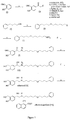
- the process of the present invention makes use of a chemical purification to achieve a very high purity of the key intermediate (7), a selective addition sequence for the preparation of intermediate (9), a novel biphasic organic solvent system for the selective reduction and isolation of intermediate (10), and a controlled reduction of intermediate (10) to obtain salmeterol (11) (see Scheme 1).
Landscapes
- Chemical & Material Sciences (AREA)
- Organic Chemistry (AREA)
- Chemical Kinetics & Catalysis (AREA)
- Health & Medical Sciences (AREA)
- Animal Behavior & Ethology (AREA)
- Veterinary Medicine (AREA)
- Medicinal Chemistry (AREA)
- Nuclear Medicine, Radiotherapy & Molecular Imaging (AREA)
- Bioinformatics & Cheminformatics (AREA)
- Pharmacology & Pharmacy (AREA)
- General Chemical & Material Sciences (AREA)
- General Health & Medical Sciences (AREA)
- Life Sciences & Earth Sciences (AREA)
- Public Health (AREA)
- Engineering & Computer Science (AREA)
- Pulmonology (AREA)
- Organic Low-Molecular-Weight Compounds And Preparation Thereof (AREA)
- Low-Molecular Organic Synthesis Reactions Using Catalysts (AREA)
- Acyclic And Carbocyclic Compounds In Medicinal Compositions (AREA)
Description
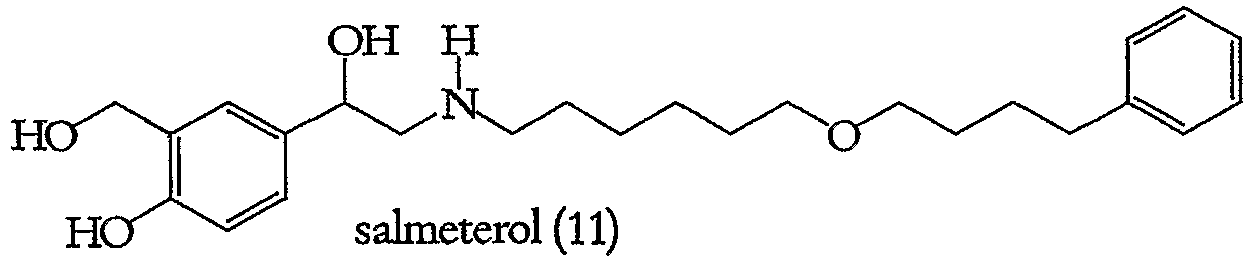
- The present invention relates to processes for the preparation of 4-hydroxy-α'-[[[6-(4-phenylbutoxy)hexyl]amino]methyl]-1,3-benzenedimethanol 1-hydroxy-2-naphthoate (salmeterol xinafoate) (12a), the preparation of 4-hydroxy-α'-[[[6-(4-phenylbutoxy)hexyl]amino]methyl]-1,3-benzenedimethanol (salmeterol) (11), the preparation of protected N-[6-(4-phenylbutoxy)hexyl]amine intermediates (7), and the preparation of 6-substituted (4-phenylbutoxy)hexane intermediates (5), shown below, wherein X is a leaving group and Pg is a protecting group.


- The chemical species, 4-hydroxy-α'-[[[6-(4-phenylbutoxy)hexyl]amino]methyl]-1,3-benzenedimethanol is generically known as salmeterol.
- Salmeterol and its pharmaceutically acceptable salts are long-acting beta-agonists. Salmeterol xinafoate, represented above, is a selective β2-adrenoreceptor agonist. It is clinically used as long-acting inhaled bronchodilator for maintenance treatment of asthma and to control nocturnal asthma. Unlike other bronchodilator drugs, salmeterol is more lipophilic and has many unusual pharmacological properties. The dosage strength is very small (0.021 mg as a metered dose and 0.046 mg as a dry powder inhaler). Due to its very small dosage strength, it is of utmost importance to have the highest possible purity of the API. Also many times the method of particle size reduction is very sensitive to the impurities present and therefore demands highest purity of the API in order to have consistent and desirable results.
- There are several processes disclosed in the literature for the synthesis of salmeterol xinafoate, but all of them suffer severe disadvantages with respect to quality, especially on higher scale or on commercial manufacturing scale.
- In all the reported synthetic schemes, N-[6-(4-phenylbutoxy)hexyl] benzenemethanamine (7a) serves as the key intermediate in the synthesis of salmeterol (
GB Patent 2,176,476 US Patent 4,992,474 ; Tetrahedron Letters, vol. 35(50), pages 9375-9378, 1994; Synthetic Communications, vol. 29(12a), pages 2155-2162, 1999; and Indian Journal of Chemistry, vol. 34B, pages 629-631, 1995).
- It is well known in the art that, when salmeterol is synthesised via intermediate (7a), the purity of the drug substance salmeterol is controlled by the purity of intermediate (7a) and to get the desired purity (more than 99.5%) of salmeterol, it is necessary to have the intermediate (7a) of purity of more than 99.5%.
- The literature processes do not furnish intermediate (7a) in the required purity, unless methods like high vacuum distillation or purification by column chromatography are resorted to, which are not suitable for commercial manufacturing processes for obvious reasons.
- Salmeterol, its salts and solvates are disclosed in
GB Patent 2,176,476 - Processes for the preparation of salmeterol intermediates and related derivatives are disclosed in
GB Patent 2,176,476 US Patent 4,992,474 and Tetrahedron Letters, vol. 35(50), pages 9375-9378, 1994. - The present invention discloses a chemical method for purification of intermediate (7a) via formation of an acid salt (8). This method affords intermediate (7a) of very high purity (more than 99.5%).

-
US 2005/0113608 uses KOH as a base and phase transfer (tetrabutyl ammonium hydrogen sulfate) as a catalyst in toluene as a solvent. The product is isolated after high vacuum distillation. - A preferred embodiment of the present invention uses NaH (sodium hydride) as a base, and Bu4NBr (tetrabutyl ammonium bromide) as a catalyst. In addition to this catalyst the present invention uses NaI (sodium iodide), which helps to minimize side reactions and to get a cleaner product. The product need not be distilled, but can be taken up as such for the preparation of the key intermediate (7a) for salmeterol.
- The key intermediate (7a) for salmeterol is disclosed the present application, which teaches a process with novel features viz. purification without vacuum distillation or chromatographic purification, and formation of acid salt (8) in an aqueous organic system.
- The process disclosed in
GB patent 2,176,476 - The present inventors have further established that having the intermediate (7a) of highest purity may not be enough to get the desired quality of salmeterol because of the thermal instability of the subsequent intermediates.
- Intermediate (9a) is isolated after stripping off the solvent (typically ethyl methyl ketone, acetone, ethyl acetate etc). It was observed that the intermediate (9a) decomposes even when the solvent is stripped off at 30°C. The impurities formed complicate subsequent reactions and inferior quality material is obtained. It is possible to control the decomposition in small-scale laboratory experiments, from which only milligram or a few gram quantities of salmeterol can be obtained. But on a commercial scale the decomposition is unavoidable. In fact, decomposition was observed even at 30°C over a period of time. Similarly, the next sodium borohydride reduction step gave varied amounts of unknown impurities, which were difficult to separate to the required levels (less than 0.10%).

- Thus the processes reported in the prior art suffer the following drawbacks:
- (1) Use of either high vacuum distillation or column chromatography purification for N-[6-(4-phenylbutoxy)hexyl]benzenemethanamine (7a).

- (2) In the preparation of 2-hydroxy-5-[[[6-(4-phenylbutoxy)hexylbenzyl]amino] acetyl]benzaldehyde (9a), addition of the intermediate (7a) to intermediate (2a) generates impurities which are difficult to remove. In addition to that, after the reaction is over, the reaction mass is extracted in ethyl acetate. This extraction brings many impurities and resinous material with the product, which creates problems for the purification and isolation of the further intermediates. As per the prior art, this intermediate (9a) is isolated by distillation of the solvent, which again generates the impurities/resinous material. These impurities cannot be easily removed by chemical treatment or by conventional ways except column chromatography. Further, intermediate (9a) is thermally less stable and needs to be processed immediately for further steps.

- (3) The quantity of sodium borohydride used in the prior art processes is not sufficient for complete reduction. As sodium borohydride also reacts with methanol, this leaves some partially reduced products and also unreacted intermediate (9a) during the reaction. In order to push these partially reduced intermediates to the intermediate (10a) in the subsequent catalytic hydrogenolysis (N-debenzylation), the reaction needs to be prolonged.


- (4) In the preparation of 4-hydroxy-α'-[[[6-(4-phenylbutoxy)hexyl]amino]methyl]-1,3-benzenedimethanol (11) (i.e. salmeterol), because of the various impurities and resinous material formed in the earlier steps, the isolation of salmeterol (11) is difficult and tricky. Also, the quality varies from batch to batch, as there is very little control over the content of these impurities in the earlier steps.

- Because of these limitations the prior art processes are not suitable for scaling up and do not afford quality product.
- The present inventors have circumvented the difficulties associated with the earlier processes to obtain salmeterol (11) consistently in very high purity. The process of the present invention is robust and reproducible and can be conveniently employed for commercial production.
- It is an object of the present invention to provide a process for the preparation of highly pure salmeterol xinafoate, i.e. 4-hydroxy-α'-[[[6-(4-phenylbutoxy)hexyl] amino]methyl]-1,3-benzenedimethanol 1-hydroxy-2-naphthoate (12a).
- It is another object of the present invention to provide a process for the preparation of highly pure salmeterol, i.e. 4-hydroxy-α'-[[[6-(4-phenylbutoxy)hexyl]amino] ethyl]-1,3-benzenedimethanol (11).
- It is a further object of the present invention to eliminate cumbersome purification techniques like high vacuum fractional distillation or chromatographic purification.
- It is yet another object of the present invention to develop a scalable process, which addresses the issue of thermal instability.
- Thus the present invention provides a process for the preparation of highly pure salmeterol xinafoate, comprising the steps of:
- (i) reacting intermediate (2a) and intermediate (7a) in an organic solvent by adding a solution of intermediate (2a) into a solution of intermediate (7a) at 0-5°C to give intermediate (9a);
- (ii) isolating intermediate (9a) selectively in an organic non-polar solvent;
- (iii) reducing intermediate (9a) in an organic biphasic solvent system in the presence of a large excess of sodium borohydride to give intermediate (10a);
- (iv) debenzylating intermediate (10a) at ambient pressure to give salmeterol (11); and
- (v) adding xinafoic acid to crystallize the xinafoate salt of salmeterol (12a).
- It is yet another object of the present invention to provide:
- (i) pure salmeterol salts (12), in particular pure salmeterol xinafoate (12a);


- (ii) pure salmeterol (11);
- (iii) pure protected N-[6-(4-phenylbutoxy)hexyl]amine intermediates (7), in particular pure benzenemethanamine (7a); and

- (iv) pure 6-substituted (4-phenylbutoxy)hexane intermediates (5), in particular pure bromoether intermediate (5a).

- A first aspect of the present invention provides a process of preparing an ether (5), comprising the step of:
- (a) reacting 4-phenyl-1-butanol (3) and X-(CH2)6-X (4) in the presence of a phase transfer agent and NaI to obtain ether (5), wherein X are independently leaving groups.

- Preferably, the reaction of step (a) takes place in the presence of a base. If present, the base may be NaH, KH, NaOH, KOH, NaNH2, NaOMe, KOtBu, nBuLi, 1,4-diazabicyclo[2,2,2]octane (DABCO), or 1,8-diazabicyclo[5,4,0]undec-7-ene (DBU). If present, the base is preferably NaH.
- The phase transfer agent may be a quaternary ammonium or phosphonium salt, such as Bu4NBr, Bu4NHSO4, C16H33N(CH3)3Cl, C16H33N(CH3)3Br, C16H33N(CH3)3HSO4, n-butyl-pyridinium chloride, cetylpyridinium chloride, cetylpyridinium bromide, 1-butyl-1-methyl-pyrrolidinium chloride, C16H33PBu3Cl, and C16H33PBu3Br. Preferably, the phase transfer agent is Bu4NBr. Preferably, the phase transfer agent is present in a catalytic amount.
- Preferably, the NaI is present in a catalytic amount.
- Preferably, the reaction of step (a) is carried out in an aprotic solvent. Typical aprotic solvents are toluene, dimethylformamide, dimethyl sulfoxide, tetrahydrofuran, xylene, methyl t-butyl ether, diisopropyl ether, and mixtures thereof. A preferred aprotic solvent is toluene.
- A second aspect of the present invention provides a process of preparing an amine (7) or a salt thereof, comprising the steps of:
- (a) carrying out step (a) of the first aspect of the present invention, and
- (b) reacting ether (5) and protected amine PgNH2 (6) in the presence of a base to obtain amine (7) or a salt thereof, wherein Pg is a protecting group.

- Suitable protecting groups Pg are known in the art, for example from
chapter 7 of "Protective Groups in Organic Synthesis" by T.W. Greene and P.G.M. Wuts (Wiley-Interscience, 2nd edition, 1991), which is enclosed herein by reference. For example, protected amine PgNH2 (6) used in step (b) may be benzylamine; benzylamine para-or ortho-substituted with an alkyl, alkoxy or halo group such as -Me, -Et, -OMe, -OEt, -Cl and -Br; or alkoxycarbonyl-amine such as benzyloxycarbonyl-amine, t-butoxycarbonyl-amine, 2-(4-biphenylyl)-isopropoxycarbonyl-amine or 9-fluorenylmethoxycarbonyl-amine. Preferably, protected amine PgNH2 (6) used in step (b) is benzylamine. - Preferably, the base used in step (b) comprises triethylamine, potassium carbonate, sodium carbonate, pyridine, pyrrolidine, piperidine, diisopropylamine or diisopropylethylamine. A preferred base is triethylamine.
- Preferably, the reaction of step (b) is carried out in the presence NaI. If present, the NaI is preferably present in a catalytic amount.
- Preferably, the reaction of step (b) is carried out in an organic solvent. Typical organic solvents are acetonitrile, tetrahydrofuran, dimethylformamide, dimethylacetamide, methanol, ethanol, n-propanol, isopropanol, toluene, xylene, and mixtures thereof. A preferred organic solvent is acetonitrile.
- Preferably the process further comprises the steps of:
- (c) converting amine (7) into a salt (8) thereof, wherein X is an anion,

- (d) purifying the salt (8), and
- (e) converting the purified salt (8) back into amine (7).

- Preferably, the salt (8) is a hydrofluoride, hydrochloride, hydrobromide, hydroiodide, tartrate, formate, acetate, sulfate, hydrogen sulfate, nitrate, benzoate, maleate, fumarate, methanesulphonate, benzylsulfonate or citrate salt. More preferably, the salt (8) is a hydrochloride salt (8a).

- Preferably, the conversion step (c) is carried out in a non-polar halogenated solvent in the presence of water. Typical non-polar halogenated solvents are dichloromethane, dichloroethane, chloroform, and mixtures thereof. A preferred non-polar halogenated solvent is dichloromethane.
- Preferably, the purification step (d) comprises washing the salt (8) with a non-polar solvent. Typical washing solvents are pentane, hexane, heptane, cyclohexane, diethyl ether, diisopropyl ether, t-butyl methyl ether, and mixtures thereof. A preferred washing solvent is n-heptane.
- Alternatively or additionally, the purification step (d) comprises recrystallising the salt (8), preferably using a polar protic solvent and a non-polar aprotic solvent. Typical polar protic solvents are methanol, ethanol, isopropanol, and mixtures thereof. A preferred polar protic solvent is isopropanol. Typical non-polar aprotic solvents are pentane, hexane, heptane, toluene, and mixtures thereof. A preferred non-polar aprotic solvent is n-heptane. In a preferred embodiment, the purification step (d) comprises recrystallising the salt (8) using isopropanol and n-heptane.
- Preferably, in step (e), the purified salt (8) is converted into amine (7) using a base, preferably an inorganic base such as Na2CO3, NaHCO3, K2CO3, Li2CO3 or Cs2CO3. Preferably, the base used in step (e) is Na2CO3.
- Preferably, the amine (7) or salt thereof is obtained from any of the processes of the second aspect of the present invention more than 90%, more than 95%, more than 98%, more than 99%, more than 99.5%, or more than 99.7% pure as measured by HPLC.
- Preferably, the amine (7) or salt thereof is obtained in an overall yield of more than 50%, more than 60%, more than 70%, or more than 80% by weight from 4-phenyl-1-butanol (3).
- The process of the present application is suitable for industrial scale manufacture of amine (7) or a salt thereof. Preferably, amine (7) or a salt thereof is obtained in batches of 100g or more, 200g or more, 500g or more, 1kg or more, 5kg or more, or 10kg or more.
- Preferably, the processes of the first and second aspects of the present invention are carried out without purifying bromoether (5), amine (7) or salt (8) by chromatography or high vacuum fractional distillation, preferably not by any high vacuum distillation, preferably not by any distillation.
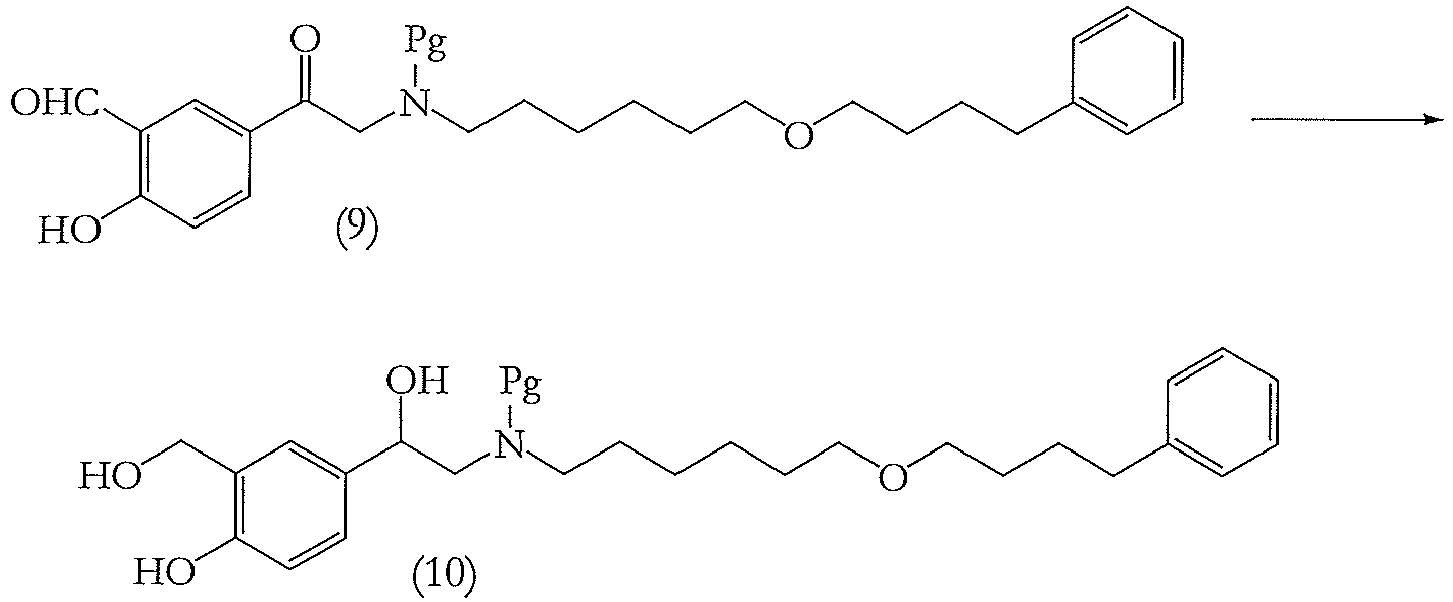
- A third aspect of the present invention provides a process of preparing an alcohol (10), comprising the step of:
- (ii) reducing aldehyde (9) to obtain alcohol (10) in a biphasic solvent system, wherein Pg is a protecting group:

- A fourth aspect of the present invention provides a process of preparing salmeterol (11) or a salt or solvate thereof, comprising the steps of:
- (i) reacting an amine (7) and an aldehyde (2) to obtain aldehyde (9), wherein X is a leaving group and Pg is a protecting group,

- (ii) reducing aldehyde (9) to obtain alcohol (10), and
- (iii) deprotecting alcohol (10) to obtain salmeterol (11)

- Salmeterol (11) can be used as API both, in its free base form and its acid addition salt form. For the purposes of this invention, a "salt" of salmeterol. (11) is usually an acid addition salt. Acid addition salts are preferably pharmaceutically acceptable, non-toxic addition salts with suitable acids, including but not limited to inorganic acids such as hydrohalogenic acids (for example, hydrofluoric, hydrochloric, hydrobromic or hydroiodic acid) or other inorganic acids (for example, nitric, perchloric, sulphuric or phosphoric acid); or organic acids such as organic carboxylic acids (for example, xinafoic, propionic, butyric, glycolic, lactic, mandelic, citric, acetic, benzoic, 2- or 4-methoxy-benzoic, 2- or 4-hydroxy-benzoic, 2- or 4-chloro-benzoic, salicylic, succinic, malic or hydroxysuccinic, tartaric, fumaric, maleic, hydroxymaleic, oleic, glutaric, mucic or galactaric, gluconic, pantothenic or pamoic acid), organic sulphonic acids (for example, methanesulphonic, trifluoromethanesulphonic, ethanesulphonic, 2-hydroxyethanesulphonic, benzenesulphonic, toluene-p-sulphonic, naphthalene-2-sulphonic or camphorsulphonic acid) or amino acids (for example, ornithinic, glutamic or aspartic acid). A preferred salt is the xinafoic acid addition salt.
- In addition to pharmaceutically acceptable acid addition salts, other acid addition salts are included in the present invention, since they have potential to serve as intermediates in the purification or preparation of other, for example, pharmaceutically acceptable, acid addition salts, or are useful for identification, characterisation or purification of the free base.
- Additionally, for the purposes of this invention, a "salt" of salmeterol (11) can also be formed between a hydroxy functionality of salmeterol (11) and a suitable cation. Suitable cations include, but are not limited to, lithium, sodium, potassium, magnesium, calcium and ammonium. The salt may be a mono-, di- or tri-salt. Preferably the salt is a mono- or di-sodium salt. Preferably the salt is a pharmaceutically acceptable salt.
- Preferably, step (i) is carried out in the presence of a base. Preferably, the base is an organic base such as triethylamine, tributylamine, diisopropylamine, diisopropylethylamine, pyridine, pyrrolidine, piperidine or morpholine. Preferably, the base is diisopropylethylamine.
- Preferably, the reaction in step (i) is carried out in an organic solvent. Typical organic solvents are acetonitrile, methanol, ethanol, isopropanol, tetrahydrofuran, dimethylformamide, dimethyl sulfoxide, diethyl ether, diisopropyl ether, acetone, methyl ethyl ketone, and mixtures thereof. A preferred organic solvent is methyl ethyl ketone.
- Preferably, in step (i), a solution of aldehyde (2) is added into a solution of amine (7).
- Preferably, the reaction of step (i) is carried out at a temperature of 0-15°C, more preferably 0-10°C.
- Preferably, in step (i), the product aldehyde (9) is not isolated, but extracted into a non-polar solvent. Typical extraction solvents are pentane, hexane, heptane, cyclohexane, diethyl ether, diisopropyl ether, t-butyl methyl ether, and mixtures thereof. A preferred extraction solvent is n-heptane. Preferably, the extracted solution comprising aldehyde (9) is used directly, i.e. without removal of the solvent, in step (ii).
- The reduction of step (ii) may be carried out using a reducing agent such as NaBH4, NaCNBH4, LiAlH4, LiBH4 or Zn(BH4)2. Preferably, the reduction of step (ii) is carried out using NaBH4. Preferably, an excess of NaBH4 is used. Preferably, the aldehyde (9) and NaBH4 are used in a ratio of 1 : 4-10, preferably in a ratio of 1 : 5-8, preferably in a ratio of about 1 : 7 of aldehyde (9) : NaBH4.
- Preferably, the reduction of step (ii) is carried out in a biphasic solvent system. Preferably, the biphasic solvent system comprises a C1-3 alcohol and a C5-7 hydrocarbon. Typical C1-3 alcohols are methanol, ethanol, isopropanol, and mixtures thereof. A preferred C1-3 alcohol is methanol. Typical C5-7 hydrocarbons are pentane, hexane, heptane, cyclohexane, and mixtures thereof. A preferred C5-7 hydrocarbon is n-heptane.
- In step (iii), depending on the protecting group Pg used, alcohol (10) may be deprotected by catalytic hydrogenolysis (using hydrogen over a catalyst) or chemical hydrogenolysis (using, for example, triethyl silane or trifluoroacetic acid). Preferably, alcohol (10) is deprotected by catalytic hydrogenolysis. Pd/C, Pt/C, Rh/C or Re/C may be used as the hydrogenation catalyst. Preferably, Pd/C is used as the hydrogenation catalyst, such as 10% Pd/C or 20% Pd/C. Preferably, the hydrogen gas is used at a pressure of 2-3 kg/cm2.
- Depending on the protecting group Pg used, the reduction of step (ii) and the deprotection of step (iii) may be carried out in the same reaction.
- Preferably, amine (7) used in step (i) is prepared using a process of the second aspect of the present invention.
- Following step (iii), the salmeterol (11) is preferably further converted into a salt thereof, such as the salts described above, for example, the xinafoate salt (12a).
- Preferably, the salmeterol (11) or salt or solvate thereof is obtained more than 90%, more than 95%, more than 97%, more than 98%, more than 99%, or more than 99.5% pure as measured by HPLC.
- Preferably, the salmeterol (11) or salt or solvate thereof is obtained in an overall yield of more than 12%, more than 15%, or more than 20% by weight from amine (7).
- The process of the present application is suitable for industrial scale manufacture of salmeterol (11) or a salt or solvate thereof. Preferably, salmeterol (11) or a salt or solvate thereof is obtained in batches of 150g or more, 250g or more, 500g or more, 1kg or more, 5kg or more, or 10kg or more.
- Preferably, the processes of the fourth aspect of the present invention are carried out without purifying aldehyde (9), alcohol (10), salmeterol (11) or salmeterol salt (12) by chromatography or high vacuum fractional distillation, preferably not by any high vacuum distillation, preferably not by any distillation.
- The processes of the present invention may provide an amine (7) or a salt thereof, prepared according to a process of the second aspect of the present invention, wherein Pg is a protecting group.

- The processes of the present invention may provide salmeterol (11) or a salt or solvate thereof, such as the xinafoate salt (12a), prepared according to a process of the fourth aspect of the present invention.

- The processes of the present invention may provide an amine (7) or a salt thereof, wherein Pg is a protecting group, and wherein the amine (7) or the salt thereof is more than 90% pure, preferably more than 95% pure, preferably more than 98% pure, preferably more than 99% pure, preferably more than 99.5% pure, and even more preferably more than 99.7% pure as measured by HPLC.

- The processes of the present invention may provide a salt (8), wherein Pg is a protecting group and X is an anion, and wherein the salt (8) is more than 90% pure, preferably more than 95% pure, preferably more than 98% pure, preferably more than 99% pure, preferably more than 99.5% pure, and even more preferably more than 99.7% pure as measured by HPLC.

- The processes of the present invention may provide salmeterol (11) or a salt or solvate thereof, wherein the salmeterol (11) or the salt or solvate thereof is more than 95% pure, preferably more than 97% pure, preferably more than 98% pure, preferably more than 99% pure, and even more preferably more than 99.5% pure as measured by HPLC.

- The processes of the present invention may provide salmeterol xinafoate salt (12a), wherein the salmeterol xinafoate salt (12a) is more than 95% pure, preferably more than 97% pure, preferably more than 98% pure, preferably more than 99% pure, and even more preferably more than 99.5% pure as measured by HPLC.

- The processes of the present invention may provide salmeterol (11) or a salt or solvate thereof, comprising less than 0.1% of impurity G.

- The processes of the present invention may provide salmeterol (11) or a salt or solvate thereof, comprising less than 0.2% of impurity D.

- The processes of the present invention may provide salmeterol xinafoate salt (12a), comprising less than 0.1% of impurity G.

- The processes of the present invention may provide salmeterol xinafoate salt (12a), comprising less than 0.2% of impurity D.

- The amounts of impurities G and D contained in salmeterol (11) or salmeterol xinafoate salt (12a) can be measured as set out in the European Pharmacopoeia 5.2.
- The present invention will now be described by way of example with reference to the accompanying drawings in which:
-
Figure 1 shows a general reaction scheme in accordance with the present invention. -
Figure 2 shows a preferred reaction scheme in accordance with the present invention. - The present inventors have addressed the need for a process, which yields salmeterol xinafoate (12a) with very high HPLC purity (more than 99.5%) consistently.
- In preferred embodiments the process of the present invention makes use of a chemical purification to achieve a very high purity of the key intermediate (7), a selective addition sequence for the preparation of intermediate (9), a novel biphasic organic solvent system for the selective reduction and isolation of intermediate (10), and a controlled reduction of intermediate (10) to obtain salmeterol (11) (see Scheme 1).
- (a) Following the procedure described in the literature (Synthetic Communications, vol. 29(12a), pages 2155-2162, 1999;
US patent 5,011,993 ; andUS patent 4,952,729 ), intermediate (2a) was synthesized using 2-hydroxy-benzaldehyde (1) and bromoacetyl bromide. Intermediate (2a) thus obtained was purified by washing with n-heptane to yield the intermediate with more than 98% HPLC purity. - (b) Crude intermediate N-[6-(4-phenylbutoxy)hexyl]benzenemethanamine (7a) was obtained by reacting bromoether intermediate (5a) with benzylamine (6a) in organic solvents like acetonitrile, tetrahydrofuran, dimethylformamide, dimethylacetamide, methanol, ethanol, n-propanol, isopropanol, toluene or xylene (preferably acetonitrile), in the presence of a base like triethylamine, potassium carbonate, sodium carbonate, pyridine, pyrrolidine, piperidine, diisopropylamine or diisopropylethylamine (preferably triethylamine).
- (c) Intermediate (7a) was converted into the corresponding acid salt (8) such as hydrochloride, hydrobromide, hydroiodide, acetate, sulfate or hydrogen sulfate salt (preferably hydrochloride salt), which was isolated by adding non-polar solvents like heptane, hexane or pentane, or ethereal solvents like diethyl ether or diisopropyl ether (preferably heptane).
- (d) N-[6-(4-Phenylbutoxy)hexyl]benzenemethanamine hydrochloride (8b) was purified by crystallizing from isopropanol and n-heptane to obtain HPLC purity of more than 99.5%.
- (e) The free base was liberated from the corresponding N-[6-(4-phenylbutoxy)hexyl]benzenemethanamine hydrochloride (8b) with HPLC purity of more than 99.5%, suitable for the preparation of salmeterol xinafoate (12a) with very high HPLC purity.
- (f) Intermediate (2a) was reacted with intermediate (7a) in solvents like acetonitrile, lower aliphatic alcohols, tetrahydrofuran, dimethylformamide, dimethyl sulfoxide, diethyl ether or diisopropyl ether, and ketonic solvents like acetone or methyl ethyl ketone (preferably methyl ethyl ketone). The reaction was performed by adding a solution of intermediate (2a) into a solution of intermediate (7a) at 0-5°C. The prior art sequence of addition, where a solution of intermediate (7a) was added into a solution of intermediate (2a) gave inferior quality intermediate (9a) containing a lot of unknown impurities.
- (g) Intermediate (9a) was isolated selectively in organic solvents like n-heptane, hexane, pentane, cyclohexane, diisopropyl ether or t-butyl methyl ether (preferably n-heptane), after quenching the reaction with water to avoid the decomposition and resinous material formation. The solvent was not stripped off as in the prior art work up, but intermediate (9a) was simply extracted in n-heptane at 20-30°C.
- (h) The carbonyl groups in intermediate (9a) were reduced in an organic biphasic solvent system involving typically lower aliphatic alcohols viz. methanol, ethanol or isopropanol, and C5-7 hydrocarbons viz. pentane, hexane or heptane (preferably methanol and n-heptane), in the presence of a large excess of sodium borohydride at ambient temperature. The immiscible non-polar solvent, e.g. n-heptane, helps in removing the unreacted intermediate (9a), the partially reduced product and non-polar impurities selectively which can be easily separated after the reaction is over. When stoichiometric quantities or slightly excess quantities of sodium borohydride were used, the reduction of the benzylic carbonyl was not complete and this resulted in formation of unknown impurities in the subsequent hydrogenation step. Therefore, it was necessary to have a clean and complete reduction of both carbonyl groups to the corresponding alcohol.
- (i) Intermediate (10a) was isolated from the methanol layer by quenching with aqueous HCl solution to break the boron complex and then extracting with ethyl acetate after adjusting the pH to 8-9.
- (j) Intermediate (10a) was subjected to hydrogenolysis (debenzylated) in a controlled way in methanol at ambient temperature using 20% palladium on charcoal with strict control on the formation of impurity G (European Pharmacopoeia 5.2) with online HPLC monitoring. It was observed that the duration of the hydrogenation reaction influenced the formation of impurities D and G (European Pharmacopoeia 5.2). The best control was obtained when the hydrogen gas was purged between 2-3 kg/cm2. It was observed that higher pressure resulted in formation of impurity G in higher proportion, whereas pressure lower than 2-3 kg/cm2 led to higher proportion of impurity D.
- (k) The xinafoate salt (12a) of salmeterol was formed by treating purified salmeterol (11) with xinafoic acid (i.e. 1-hydroxy-2-naphthoic acid) followed by purification from methanol.
- Details of the invention, its objects and advantages are explained hereunder in greater detail in relation to non-limiting exemplary illustrations.
- To a suspension of aluminium chloride (4 m/m) in dichloromethane (10 volumes), was added slowly bromoacetyl bromide (1.2 m/m) at 10°C and then the temperature was brought to 30°C. The reaction mass was stirred at this temperature for an hour and to this was added a solution of 2-hydroxybenzaldehyde (1) in dichloromethane at 30°C. The reaction mixture was stirred at 35-40°C for 12-15 hours and then quenched in water at 0-5°C. The dichloromethane layer was separated and distilled off. To the slurry obtained, n-heptane was added and stirred for 15 minutes. This slurry was then filtered and the wet cake was washed with n-heptane (2 volumes). The wet cake was dried at 50°C to constant weight to obtain intermediate (2a).
Yield: 55% w/w
HPLC purity: 97-99% - To a suspension of sodium hydride (0.9 m/m) in toluene, 4-phenyl-1-butanol (3) (1.0 m/m) was added at 25-30°C followed by addition of 1,6-dibromohexane (4a) (1.2 m/m), sodium iodide and tetrabutyl ammonium bromide in catalytic amounts. The reaction mixture was stirred at 45-50°C under a nitrogen gas atmosphere for 15-20 hours. The reaction mixture was quenched with water. The toluene layer was washed by water and the solvent was distilled off under reduced pressure to obtain a light yellow coloured liquid. The crude product bromoether (5a) thus obtained was used as such for the preparation of N-[6-(4-phenylbutoxy)hexyl] benzenemethanamine as described below.
- A mixture of benzylamine (6a) (3 m/m), triethylamine (2 m/m), and sodium iodide in catalytic amount in acetonitrile was heated to 45-50°C under stirring. To this, bromoether (5a) was added slowly at the said temperature and the reaction was continued until TLC monitoring showed disappearance of bromoether intermediate (5a). Then solvent, excess benzylamine (6a) and triethylamine were distilled off under reduced pressure. To the crude mass obtained was added water and extracted with dichloromethane. The dichloromethane layer was washed with water liberally. This isolated dichloromethane layer was treated with 5M HCl. The dichloromethane layer was again washed with water and the solvent was distilled off until a syrupy mass was obtained. This syrupy mass was added to n-heptane (8 volumes) under stirring. The solid product thus obtained was filtered off. This was dissolved in isopropanol (3 volumes) at 55°C and then slowly cooled to 40°C. To this solution was added n-heptane (8 volumes) and the resulting mass was cooled under stirring to 10-15°C. The product obtained was filtered to get N-[6-(4-phenylbutoxy)hexyl]benzenemethanamine hydrochloride (8b). This was dried at 50-55°C.
Yield: 70% w/w
HPLC purity: 99.78%
Melting point: 135-140°C
Appearance: light yellow solids - Intermediate (8b) was dissolved in dichloromethane (5 volumes) and stirred with an aqueous solution of sodium carbonate by maintaining pH∼8 at 25-30°C for 30 minutes. The dichloromethane layer was separated and washed with water and the dichloromethane was distilled off to get an oily mass, the free base (7a) of intermediate (8b). The purified free base (7a) of intermediate (8b) (1.2 m/m) was dissolved in methyl ethyl ketone (5 volumes) in the presence of diisopropylethylamine (1.2 m/m) at 0-5°C. To this, intermediate (2a) dissolved in methyl ethyl ketone was added over 90 minutes at 0-5°C. The reaction mixture was stirred at 5-10°C for 10 hours. Then the reaction mixture was quenched with water (20 volumes) and intermediate (9a) thus formed was extracted with n-heptane (3 x 10 volumes) at 20-30°C. The n-heptane layer was separated and passed through a Celite® bed to separate the polymeric mass. The n-heptane layer as such was used for further conversion.
Yield: Quantitative
HPLC purity: 98.50% - To the n-heptane layer containing intermediate (9a) obtained from example 4 was added methanol (10 volumes) and the biphasic mixture was cooled under stirring to -10°C. To this, sodium borohydride (7 m /m) was added in lots maintaining the temperature between 0-10°C. After complete addition, the reaction was maintained until disappearance of intermediate (9a) at 25-30°C. The reaction was carried out until a single peak of the completely reduced product (10a) was obtained. If required, a further 2-3 m/m sodium borohydride was added. After the reaction was over, the methanol layer was separated and the solvent was distilled off under reduced pressure. To the syrupy mass obtained was added water (20 volumes), ethyl acetate and dilute HCl (3M) under stirring. The reaction mass was stirred at 25-30°C for an hour maintaining the pH between 2-3. Then to the reaction mass was added ethyl acetate (10 volumes) and the reaction mass was made basic (pH∼9) using sodium bicarbonate solution and extracted in ethyl acetate. The ethyl acetate layer was washed with water and the solvent was distilled off to obtain intermediate (10a) as a gummy mass.
Yield: 83% w/w
HPLC purity: 96.00% - Intermediate (10a) obtained from the previous step (example 5) was taken in methanol (10 volumes). This solution was subjected to catalytic hydrogenolysis (20% Pd/C (20% w/w)) at ambient temperature and at atmospheric pressure. Hydrogen gas was purged at the rate of 2-3kg/cm2 at a temperature of 25-30°C. The reaction was monitored on HPLC until the disappearance of starting material (10a). After the reaction was over, the reaction mass was filtered through a Celite® bed to isolate the catalyst. The mother liquor obtained was distilled off. The residue obtained was swapped with ethyl acetate (3 x 8 volumes) and the resulting mass was stirred at 5-10°C in ethyl acetate (8 volumes) for precipitation of salmeterol (11). The slurry was filtered to obtain a crude mass. This crude mass was again dissolved in methanol and subjected to activated carbon treatment at 25-30°C. Methanol was distilled off completely, followed by swapping with ethyl acetate (2 x 8 volumes). To the gummy mass obtained after swapping, ethyl acetate (8 volumes) was added and the mass was cooled at 5-10°C under stirring. After 2 hours of stirring, the slurry was filtered off and solids (11) obtained were dried under reduced pressure at 40°C to constant weight.
Yield: 20% w/w
HPLC purity: 98.00% - To a solution of salmeterol (11) in methanol (5 volumes) was added an equimolar methanolic solution of 1-hydroxy-2-naphthoic acid at 25-30°C. The xinafoate salt (12a) immediately precipitated out. The slurry obtained was stirred further at 10-20°C for 3 hours and the crude salmeterol xinafoate (12a) was isolated.
Yield: 116% w/w
HPLC purity: 99.50% - In order to prepare salmeterol xinafoate having an HPLC purity more than 99.8%, the above material was further purified by crystallization from methanol.
Yield: 75% w/w
Claims (46)
- A process of preparing an ether (5), comprising the step of:(a) reacting 4-phenyl-1-butanol (3) and X-(CH2)6-X (4) in the presence of a phase transfer agent and NaI to obtain ether (5), wherein X are independently leaving groups:

- A process as claimed in claim 1, wherein:(a) X are independently -Cl, -Br, -I, -OTs, -OMs or -OTf; and/or(b) X-(CH2)6-X (4) is Br-(CH2)6-Br (4a).
- A process as claimed in claim 1 or 2, wherein(a) the reaction of step (a) takes place in the presence of a base such as NaH; and/or;(b) the phase transfer agent is Bu4NBr.
- A process as claimed in any one of claims 1 to 3, wherein the reaction is carried out in an aprotic solvent such as one comprising toluene, dimethylformamide, dimethyl sulfoxide, tetrahydrofuran, xylene, methyl t-butyl ether, diisopropyl ether, or a mixture thereof.
- A process of preparing an amine (7) or a salt thereof, comprising the steps of:(a) carrying out step (a) as claimed in any one of claims 1 to 4, and(b) reacting ether (5) and protected amine PgNH2 (6) in the presence of a base to obtain amine (7) or a salt thereof, wherein Pg is a protecting group:

- A process as claimed in claim 5, wherein(a) the protected amine (6) used in step (b) is benzylamine; and/or(b) the base used in step (b) comprises triethylamine, potassium carbonate, sodium carbonate, pyridine, pyrrolidine, piperidine, diisopropylamine or diisopropylethylamine; and/or(c) the reaction of step (b) is carried out in the presence of NaI; and/or(d) the reaction of step (b) is carried out in an organic solvent such as one comprising acetonitrile, tetrahydrofuran, dimethylformamide, dimethylacetamide, methanol, ethanol, n-propanol, isopropanol, toluene, xylene, or a mixture thereof.
- A process as claimed in claim 5 or 6, further comprising the steps of:(c) converting amine (7) into a salt (8) thereof, wherein X is an anion:
 (d) purifying the salt (8), and(e) converting the purified salt (8) back into amine (7):
- A process as claimed in claim 7, wherein the salt (8) is a hydrofluoride, hydrochloride, hydrobromide, hydroiodide, tartrate, formate, acetate, sulfate, hydrogen sulfate, nitrate, benzoate, maleate, fumarate, methanesulphonate, benzylsulfonate or citrate salt.
- A process as claimed in claim 8, wherein the salt (8) is a hydrochloride salt (8a):

- A process as claimed in any one of claims 7 to 9, wherein the conversion step (c) is carried out in a non-polar halogenated solvent, such as one comprising dichloromethane, dichloroethane, chloroform, or a mixture thereof, in the presence of water.
- A process as claimed in any one of claims 7 to 10, wherein the purification step (d) comprises:(a) washing the salt (8) with a non-polar solvent such as one comprising pentane, hexane, heptane, cyclohexane, diethyl ether, diisopropyl ether, t-butyl methyl ether, or a mixture thereof; and/or(b) recrystallising the salt (8) using a polar protic solvent such as one comprising methanol, ethanol, isopropanol, or a mixture thereof, and a non-polar aprotic solvent such as one comprising pentane, hexane, heptane, toluene, or a mixture thereof; and/or(c) recrystallising the salt (8) using isopropanol and n-heptane.
- A process as claimed in any one of claims 7 to 11, wherein in step (e) the purified salt (8) is converted into amine (7) using a base such as Na2CO3.
- A process as claimed in any one of claims 5 to 12, wherein the amine (7) or salt thereof is obtained:(a) more than 90% pure as measured by HPLC; and/or(b) in an overall yield of more than 50% by weight from 4-phenyl-1-butanol (3); and/or(c) on an industrial scale; and/or(d) in batches of 100g or more.
- A process as claimed in any one of claims 5 to 13, wherein the process is carried out without purifying bromoether (5), amine (7) or salt (8) by chromatography or high vacuum distillation.
- A process of preparing an aldehyde (9), comprising the steps of:(i) preparing an amine (7) or a salt thereof according to the process as claimed in any one of claims 5 to 14; and(ii) reacting the amine (7) and an aldehyde (2) to obtain aldehyde (9), wherein X is a leaving group and Pg is a protecting group:

- A process as claimed in claim 15, wherein(a) step (ii) is carried out in the presence of a base such as diisopropylethylamine; and/or(b) the reaction in step (ii) is carried out in an organic solvent such as one comprising acetonitrile, methanol, ethanol, isopropanol, tetrahydrofuran, dimethylformamide, dimethyl sulfoxide, diethyl ether, diisopropyl ether, acetone, methyl ethyl ketone, or a mixture thereof; and/or(c) in step (ii) a solution of aldehyde (2) is added into a solution of amine (7); and/or(d) the reaction of step (ii) is carried out at a temperature of 0-15°C.
- A process as claimed in claim 15 or 16, wherein in step (ii) the product aldehyde (9) is not isolated, but extracted into a non-polar solvent such as one comprising pentane, hexane, heptane, cyclohexane, diethyl ether, diisopropyl ether, t-butyl methyl ether, or a mixture thereof.
- A process as claimed in any one of claims 15 to 17, wherein the aldehyde (2) is prepared by reacting 2-hydroxybenzaldehyde (1) with XCH2COX in the presence of AlCl3:

- A process of preparing an alcohol (10), comprising the steps of:(iii) preparing an aldehyde (9) according to the process of any one of claims 15 to 18; and(iv) reducing aldehyde (9) to obtain alcohol (10):

- A process as claimed in claim 19, wherein the aldehyde (9) is prepared according to the process of claim 17 and the extracted solution comprising aldehyde (9) is used directly in step (iv).
- A process as claimed in claim 19 or 20, wherein the reduction of step (iv) is carried out using NaBH4, preferably wherein an excess of NaBH4 is used.
- A process as claimed in claim 21, wherein the aldehyde (9) and NaBH4 are used in a ratio of 1 : 4-10.
- A process as claimed in any one of claims 19 to 22, wherein the reduction of step (iv) is carried out in a biphasic solvent system such as an organic biphasic solvent system.
- A process as claimed in claim 23, wherein the biphasic solvent system comprises a C1-3alcohol such as one comprising methanol, ethanol, isopropanol, or a mixture thereof, and a C5-7 hydrocarbon such as one comprising pentane, hexane, heptane, cyclohexane, or a mixture thereof.
- A process of preparing salmeterol (11) or a salt or solvate thereof, comprising the steps of:(v) preparing an alcohol (10) according to the process of any one of claims 19 to 24; and(vi) deprotecting alcohol (10) to obtain salmeterol (11):

- A process as claimed in claim 25, wherein in step (vi) alcohol (10) is deprotected by catalytic hydrogenolysis, preferably wherein Pd/C is used as the hydrogenation catalyst.
- A process as claimed in claim 25 or 26, wherein the reduction of step (iv) and the deprotection of step (vi) are carried out in the same reaction.
- A process as claimed in any one of claims 25 to 27, wherein the salmeterol (11) is further converted into a salt thereof, such as the xinafoate salt (12a):

- A process as claimed in any one of claims 25 to 28, wherein the salmeterol (11) or salt or solvate thereof is obtained:(a) more than 90% pure as measured by HPLC; and/or(b) in an overall yield of more than 12% by weight from amine (7); and/or(c) on an industrial scale; and/or(d) in batches of 150g or more.
- A process as claimed in any one of claims 25 to 29, wherein the process is carried out without purifying aldehyde (9), alcohol (10), salmeterol (11) or salmeterol salt (12) by chromatography or high vacuum distillation.
- A process of preparing an alcohol (10), comprising the step of:(ii) reducing aldehyde (9) to obtain alcohol (10) in a biphasic solvent system, wherein Pg is a protecting group:

- A process as claimed in claim 31, wherein the reduction of step (ii) is carried out using NaBH4, preferably wherein an excess of NaBH4 is used.
- A process as claimed in claim 32, wherein the aldehyde (9) and NaBH4 are used in a ratio of 1 : 4-10.
- A process as claimed in any one of claims 31 to 33, wherein the reduction of step (ii) is carried out in an organic biphasic solvent system.
- A process as claimed in any one of claims 31 to 34, wherein the biphasic solvent system comprises a C1-3 alcohol such as one comprising methanol, ethanol, isopropanol, or a mixture thereof, and a C5-7 hydrocarbon such as one comprising pentane, hexane, heptane, cyclohexane, or a mixture thereof.
- A process as claimed in any one of claims 31 to 35, wherein the aldehyde (9) is prepared by the step:(i) reacting an amine (7) and an aldehyde (2) to obtain the aldehyde (9), wherein X is a leaving group and Pg is a protecting group:

- A process as claimed in claim 36, wherein(a) step (i) is carried out in the presence of a base such as diisopropylethylamine; and/or(b) the reaction in step (i) is carried out in an organic solvent such as one comprising acetonitrile, methanol, ethanol, isopropanol, tetrahydrofuran, dimethylformamide, dimethyl sulfoxide, diethyl ether, diisopropyl ether, acetone, methyl ethyl ketone, or a mixture thereof; and/or(c) in step (i) a solution of aldehyde (2) is added into a solution of amine (7); and/or(d) the reaction of step (i) is carried out at a temperature of 0-15°C.
- A process as claimed in claim 36 or 37, wherein in step (i) the product aldehyde (9) is not isolated, but extracted into a non-polar solvent such as one comprising pentane, hexane, heptane, cyclohexane, diethyl ether, diisopropyl ether, t-butyl methyl ether, or a mixture thereof.
- A process as claimed in claim 38, wherein the extracted solution comprising aldehyde (9) is used directly in step (ii).
- A process as claimed in any one of claims 36 to 39, wherein(a) the amine (7) used in step (i) is prepared using a process as claimed in any one of claims 5 to 14; and/or(b) the aldehyde (2) is prepared by reacting 2-hydroxybenzaldehyde (1) with XCH2COX in the presence of AlCl3:

- A process of preparing salmeterol (11) or a salt or solvate thereof, comprising the steps of:(iii) preparing an alcohol (10) according to the process of any one of claims 31 to 40; and(iv) deprotecting alcohol (10) to obtain salmeterol (11):

- A process as claimed in claim 41, wherein in step (iv) alcohol (10) is deprotected by catalytic hydrogenolysis, preferably wherein Pd/C is used as the hydrogenation catalyst.
- A process as claimed in claim 41 or 42, wherein the reduction of step (ii) and the deprotection of step (iv) are carried out in the same reaction.
- A process as claimed in any one of claims 41 to 43, wherein the salmeterol (11) is further converted into a salt thereof, such as the xinafoate salt (12a):

- A process as claimed in any one of claims 41 to 44, wherein the salmeterol (11) or salt or solvate thereof is obtained:(a) more than 90% pure as measured by HPLC; and/or(b) in an overall yield of more than 12% by weight from amine (7); and/or(c) on an industrial scale; and/or(d) in batches of 150g or more.
- A process as claimed in any one of claims 41 to 45, wherein the process is carried out without purifying aldehyde (9), alcohol (10), salmeterol (11) or salmeterol salt (12) by chromatography or high vacuum distillation.
Priority Applications (2)
| Application Number | Priority Date | Filing Date | Title |
|---|---|---|---|
| PL06794800T PL1937626T3 (en) | 2005-10-17 | 2006-10-17 | Process and intermediates for the preparation of Salmeterol |
| EP13154981.8A EP2641893A1 (en) | 2005-10-17 | 2006-10-17 | Process for the preparation of salmeterol and its salts |
Applications Claiming Priority (3)
| Application Number | Priority Date | Filing Date | Title |
|---|---|---|---|
| IN1298MU2005 | 2005-10-17 | ||
| IN827MU2006 | 2006-05-31 | ||
| PCT/GB2006/003857 WO2007045857A1 (en) | 2005-10-17 | 2006-10-17 | Novel process |
Related Child Applications (1)
| Application Number | Title | Priority Date | Filing Date |
|---|---|---|---|
| EP13154981.8A Division-Into EP2641893A1 (en) | 2005-10-17 | 2006-10-17 | Process for the preparation of salmeterol and its salts |
Publications (2)
| Publication Number | Publication Date |
|---|---|
| EP1937626A1 EP1937626A1 (en) | 2008-07-02 |
| EP1937626B1 true EP1937626B1 (en) | 2016-02-17 |
Family
ID=37716215
Family Applications (2)
| Application Number | Title | Priority Date | Filing Date |
|---|---|---|---|
| EP06794800.0A Not-in-force EP1937626B1 (en) | 2005-10-17 | 2006-10-17 | Process and intermediates for the preparation of Salmeterol |
| EP13154981.8A Withdrawn EP2641893A1 (en) | 2005-10-17 | 2006-10-17 | Process for the preparation of salmeterol and its salts |
Family Applications After (1)
| Application Number | Title | Priority Date | Filing Date |
|---|---|---|---|
| EP13154981.8A Withdrawn EP2641893A1 (en) | 2005-10-17 | 2006-10-17 | Process for the preparation of salmeterol and its salts |
Country Status (8)
| Country | Link |
|---|---|
| US (1) | US8648214B2 (en) |
| EP (2) | EP1937626B1 (en) |
| JP (1) | JP5599974B2 (en) |
| AU (1) | AU2006303124B2 (en) |
| CA (2) | CA2625337C (en) |
| ES (1) | ES2570597T3 (en) |
| PL (1) | PL1937626T3 (en) |
| WO (1) | WO2007045857A1 (en) |
Families Citing this family (9)
| Publication number | Priority date | Publication date | Assignee | Title |
|---|---|---|---|---|
| US20080319086A1 (en) * | 2007-06-20 | 2008-12-25 | Protia, Llc | Deuterium-enriched salmeterol |
| CN101712622B (en) * | 2009-11-10 | 2012-10-03 | 浙江万里学院 | Method for preparing anti-asthmatic medicament of salmeterol |
| WO2012032546A2 (en) | 2010-09-08 | 2012-03-15 | Cadila Healthcare Limited | Process for the preparation of salmeterol and its intermediates |
| CN102993031B (en) * | 2011-09-19 | 2014-03-26 | 北京桑普生物化学技术有限公司 | Preparation process of aromatic polyoxyalkyl quaternary ammonium compound |
| CN105377826A (en) * | 2013-07-25 | 2016-03-02 | 日产化学工业株式会社 | Method for producing heterocyclic compound |
| CN103641727A (en) * | 2013-12-02 | 2014-03-19 | 山东永泰化工有限公司 | Method for preparing salmeterol xinafoate |
| US9447067B2 (en) | 2014-10-03 | 2016-09-20 | Amphastar Pahmaceuticals, Inc. | Method of preparing intermediate of salmeterol |
| WO2016142582A1 (en) | 2015-03-11 | 2016-09-15 | Fermion Oy | Process for the preparation of crystalline salmeterol and its xinafoate salt |
| WO2017168431A1 (en) * | 2016-03-30 | 2017-10-05 | Davuluri Ramamohan Rao | Process for the preparation of salmeterol xinafoate |
Family Cites Families (13)
| Publication number | Priority date | Publication date | Assignee | Title |
|---|---|---|---|---|
| US3468881A (en) * | 1966-08-15 | 1969-09-23 | Upjohn Co | Allylic amines |
| ZW6584A1 (en) | 1983-04-18 | 1985-04-17 | Glaxo Group Ltd | Phenethanolamine derivatives |
| US5011993A (en) | 1986-09-05 | 1991-04-30 | Schering Corporation | Method for the preparation of α1 [[(1,1-dimethylethyl)amino]methyl]-4-hydroxy-1,3-benzenedimethanol |
| US4952729A (en) | 1986-09-05 | 1990-08-28 | Schering-Plough Corp. | Intermediates in the preparation of alpha1(((1,1-dimethylethyl) amino) methyl)-4-hydroxy-1,3-benzenedimethanol |
| JPH03133946A (en) * | 1989-10-10 | 1991-06-07 | Glaxo Group Ltd | Phene ethanolamine compound |
| JPH1112219A (en) * | 1997-06-24 | 1999-01-19 | Chemprokasei Kaisha Ltd | Partial alkylation of polyhydroxybenzophenone |
| KR100610127B1 (en) * | 1998-01-30 | 2006-08-09 | 다이소 가부시키가이샤 | Process for preparing butanetriol derivative |
| ES2142771B1 (en) * | 1998-09-28 | 2001-01-01 | Vita Invest Sa | NEW DERIVATIVES OF 6- (4-PHENYL-BUTOXI) HEXYLAMINE AND PROCEDURE FOR OBTAINING SALMETEROL. |
| JP2001247517A (en) * | 2000-03-07 | 2001-09-11 | Sumitomo Chem Co Ltd | Method for reducing α-haloester compound in solution |
| FR2807039A1 (en) * | 2000-03-31 | 2001-10-05 | Adir | NOVEL PROCESS FOR THE PREPARATION OF 11-AMINO-3-CHLORO-6,11-DIHYDRO-5,5-DIOXO-6-METHYL-DIBENZO [c, f] [1,2] -THIAZEPINE AND APPLICATION TO THE SYNTHESIS OF TIANEPTINE |
| GB0014546D0 (en) * | 2000-06-14 | 2000-08-09 | Glaxo Group Ltd | A novel process |
| US6835857B2 (en) | 2002-03-05 | 2004-12-28 | Boehringer Ingelheim Pharma Gmbh & Co. Kg | Process for the manufacture of 4-(6-bromohexyloxy)-butylbenzene |
| US20040152720A1 (en) * | 2002-12-20 | 2004-08-05 | Boehringer Ingelheim Pharma Gmbh & Co. Kg | Powdered medicaments containing a tiotropium salt and salmeterol xinafoate |
-
2006
- 2006-10-17 PL PL06794800T patent/PL1937626T3/en unknown
- 2006-10-17 JP JP2008536115A patent/JP5599974B2/en not_active Expired - Fee Related
- 2006-10-17 CA CA2625337A patent/CA2625337C/en not_active Expired - Fee Related
- 2006-10-17 ES ES06794800T patent/ES2570597T3/en active Active
- 2006-10-17 EP EP06794800.0A patent/EP1937626B1/en not_active Not-in-force
- 2006-10-17 EP EP13154981.8A patent/EP2641893A1/en not_active Withdrawn
- 2006-10-17 AU AU2006303124A patent/AU2006303124B2/en not_active Ceased
- 2006-10-17 CA CA2838520A patent/CA2838520C/en not_active Expired - Fee Related
- 2006-10-17 WO PCT/GB2006/003857 patent/WO2007045857A1/en not_active Ceased
-
2008
- 2008-04-16 US US12/103,999 patent/US8648214B2/en not_active Expired - Fee Related
Also Published As
| Publication number | Publication date |
|---|---|
| AU2006303124B2 (en) | 2013-03-28 |
| CA2625337C (en) | 2014-03-18 |
| CA2838520C (en) | 2017-02-21 |
| WO2007045857A1 (en) | 2007-04-26 |
| AU2006303124A1 (en) | 2007-04-26 |
| JP2009513578A (en) | 2009-04-02 |
| CA2625337A1 (en) | 2007-04-26 |
| US20080262267A1 (en) | 2008-10-23 |
| CA2838520A1 (en) | 2007-04-26 |
| EP1937626A1 (en) | 2008-07-02 |
| EP2641893A1 (en) | 2013-09-25 |
| US8648214B2 (en) | 2014-02-11 |
| ES2570597T3 (en) | 2016-05-19 |
| PL1937626T3 (en) | 2016-08-31 |
| JP5599974B2 (en) | 2014-10-01 |
Similar Documents
| Publication | Publication Date | Title |
|---|---|---|
| US8648214B2 (en) | Processes suitable for the preparation of salmeterol | |
| DK172103B1 (en) | Previously unknown 3,3-diphenylpropylamines, pharmaceutical preparations which comprise them, their use for producing an anticholinergic medicament, and a process for preparing them | |
| US8518900B2 (en) | Macrolide synthesis process and solid-state forms | |
| US5166437A (en) | Process for the preparation of fluoxetine | |
| RU1779244C (en) | Process for producing n-methyl-3-(@@@-trifluormethylphenoxy)-3-phenylpropylamine or its pharmaceutically-acceptable acid-addition salt | |
| CZ284256B6 (en) | Novel process for preparing formoterol and related compounds | |
| CN108341828B (en) | Process for the preparation of eribulin and intermediates thereof | |
| CA2190511A1 (en) | Asymmetric synthesis of chiral secondary alcohols | |
| EP1856036B1 (en) | An efficient method for preparation of (s)-3-[(1-dimethyl amino)ethyl]-phenyl-n-ethyl-n-methyl-carbamate | |
| NZ585368A (en) | Process for preparing o-desmethylvenlafaxine | |
| US20110190393A1 (en) | Novel and efficient method for the synthesis of an amino acid | |
| WO2012032546A2 (en) | Process for the preparation of salmeterol and its intermediates | |
| WO2007009590A1 (en) | Process for the preparation of phenolic compounds | |
| JP2009513578A5 (en) | ||
| US20110028702A1 (en) | Compositions and processes for preparing 13-deoxy-anthracyclines | |
| US6867307B2 (en) | Intermediates for use in the preparation of vitamin E | |
| EP2318354A1 (en) | Process for the preparation of o-desmethylvenlafaxine | |
| JPH06199747A (en) | Production of l-alaninol | |
| CA2338649C (en) | New phenylethylamine derivatives, processes for preparing them and their use as pharmaceutical compositions | |
| TW436474B (en) | Process for the preparation of isopropyl-methyl-[2-(3-n-propoxyphenoxy)ethyl]amine | |
| WO1984004091A1 (en) | Pharmaceutically active 2-phenylethylamine derivatives | |
| KR100717361B1 (en) | Method for preparing tolterodine racemates and intermediates thereof |
Legal Events
| Date | Code | Title | Description |
|---|---|---|---|
| PUAI | Public reference made under article 153(3) epc to a published international application that has entered the european phase |
Free format text: ORIGINAL CODE: 0009012 |
|
| 17P | Request for examination filed |
Effective date: 20080325 |
|
| AK | Designated contracting states |
Kind code of ref document: A1 Designated state(s): AT BE BG CH CY CZ DE DK EE ES FI FR GB GR HU IE IS IT LI LT LU LV MC NL PL PT RO SE SI SK TR |
|
| 17Q | First examination report despatched |
Effective date: 20110207 |
|
| DAX | Request for extension of the european patent (deleted) | ||
| RAP1 | Party data changed (applicant data changed or rights of an application transferred) |
Owner name: GENERICS (UK) LIMITED |
|
| RIN1 | Information on inventor provided before grant (corrected) |
Inventor name: SHUKLA, V., K. Inventor name: GORE, VINAYAK, G. Inventor name: GADAKAR, M. Inventor name: GAIKWAD, AVINASH, C. |
|
| REG | Reference to a national code |
Ref country code: DE Ref legal event code: R079 Ref document number: 602006047971 Country of ref document: DE Free format text: PREVIOUS MAIN CLASS: C07C0213080000 Ipc: C07C0041160000 |
|
| GRAP | Despatch of communication of intention to grant a patent |
Free format text: ORIGINAL CODE: EPIDOSNIGR1 |
|
| RIC1 | Information provided on ipc code assigned before grant |
Ipc: C07C 213/08 20060101ALI20150617BHEP Ipc: C07C 41/16 20060101AFI20150617BHEP Ipc: C07C 217/10 20060101ALI20150617BHEP Ipc: C07C 43/174 20060101ALI20150617BHEP |
|
| INTG | Intention to grant announced |
Effective date: 20150703 |
|
| GRAS | Grant fee paid |
Free format text: ORIGINAL CODE: EPIDOSNIGR3 |
|
| RAP1 | Party data changed (applicant data changed or rights of an application transferred) |
Owner name: GENERICS (UK) LIMITED |
|
| GRAA | (expected) grant |
Free format text: ORIGINAL CODE: 0009210 |
|
| INTG | Intention to grant announced |
Effective date: 20151216 |
|
| AK | Designated contracting states |
Kind code of ref document: B1 Designated state(s): AT BE BG CH CY CZ DE DK EE ES FI FR GB GR HU IE IS IT LI LT LU LV MC NL PL PT RO SE SI SK TR |
|
| REG | Reference to a national code |
Ref country code: GB Ref legal event code: FG4D |
|
| REG | Reference to a national code |
Ref country code: CH Ref legal event code: EP |
|
| REG | Reference to a national code |
Ref country code: IE Ref legal event code: FG4D |
|
| REG | Reference to a national code |
Ref country code: AT Ref legal event code: REF Ref document number: 775564 Country of ref document: AT Kind code of ref document: T Effective date: 20160315 |
|
| REG | Reference to a national code |
Ref country code: DE Ref legal event code: R096 Ref document number: 602006047971 Country of ref document: DE |
|
| REG | Reference to a national code |
Ref country code: CH Ref legal event code: NV Representative=s name: RENTSCH PARTNER AG, CH |
|
| REG | Reference to a national code |
Ref country code: RO Ref legal event code: EPE |
|
| REG | Reference to a national code |
Ref country code: PT Ref legal event code: SC4A Free format text: AVAILABILITY OF NATIONAL TRANSLATION Effective date: 20160510 |
|
| REG | Reference to a national code |
Ref country code: ES Ref legal event code: FG2A Ref document number: 2570597 Country of ref document: ES Kind code of ref document: T3 Effective date: 20160519 |
|
| REG | Reference to a national code |
Ref country code: NL Ref legal event code: FP |
|
| REG | Reference to a national code |
Ref country code: SE Ref legal event code: TRGR |
|
| REG | Reference to a national code |
Ref country code: LT Ref legal event code: MG4D |
|
| REG | Reference to a national code |
Ref country code: AT Ref legal event code: MK05 Ref document number: 775564 Country of ref document: AT Kind code of ref document: T Effective date: 20160217 |
|
| PG25 | Lapsed in a contracting state [announced via postgrant information from national office to epo] |
Ref country code: FI Free format text: LAPSE BECAUSE OF FAILURE TO SUBMIT A TRANSLATION OF THE DESCRIPTION OR TO PAY THE FEE WITHIN THE PRESCRIBED TIME-LIMIT Effective date: 20160217 Ref country code: GR Free format text: LAPSE BECAUSE OF FAILURE TO SUBMIT A TRANSLATION OF THE DESCRIPTION OR TO PAY THE FEE WITHIN THE PRESCRIBED TIME-LIMIT Effective date: 20160518 |
|
| PG25 | Lapsed in a contracting state [announced via postgrant information from national office to epo] |
Ref country code: LV Free format text: LAPSE BECAUSE OF FAILURE TO SUBMIT A TRANSLATION OF THE DESCRIPTION OR TO PAY THE FEE WITHIN THE PRESCRIBED TIME-LIMIT Effective date: 20160217 Ref country code: LT Free format text: LAPSE BECAUSE OF FAILURE TO SUBMIT A TRANSLATION OF THE DESCRIPTION OR TO PAY THE FEE WITHIN THE PRESCRIBED TIME-LIMIT Effective date: 20160217 Ref country code: AT Free format text: LAPSE BECAUSE OF FAILURE TO SUBMIT A TRANSLATION OF THE DESCRIPTION OR TO PAY THE FEE WITHIN THE PRESCRIBED TIME-LIMIT Effective date: 20160217 |
|
| REG | Reference to a national code |
Ref country code: SK Ref legal event code: T3 Ref document number: E 20955 Country of ref document: SK |
|
| REG | Reference to a national code |
Ref country code: FR Ref legal event code: PLFP Year of fee payment: 11 |
|
| PG25 | Lapsed in a contracting state [announced via postgrant information from national office to epo] |
Ref country code: DK Free format text: LAPSE BECAUSE OF FAILURE TO SUBMIT A TRANSLATION OF THE DESCRIPTION OR TO PAY THE FEE WITHIN THE PRESCRIBED TIME-LIMIT Effective date: 20160217 Ref country code: EE Free format text: LAPSE BECAUSE OF FAILURE TO SUBMIT A TRANSLATION OF THE DESCRIPTION OR TO PAY THE FEE WITHIN THE PRESCRIBED TIME-LIMIT Effective date: 20160217 |
|
| REG | Reference to a national code |
Ref country code: DE Ref legal event code: R097 Ref document number: 602006047971 Country of ref document: DE |
|
| PLBE | No opposition filed within time limit |
Free format text: ORIGINAL CODE: 0009261 |
|
| STAA | Information on the status of an ep patent application or granted ep patent |
Free format text: STATUS: NO OPPOSITION FILED WITHIN TIME LIMIT |
|
| PG25 | Lapsed in a contracting state [announced via postgrant information from national office to epo] |
Ref country code: BE Free format text: LAPSE BECAUSE OF FAILURE TO SUBMIT A TRANSLATION OF THE DESCRIPTION OR TO PAY THE FEE WITHIN THE PRESCRIBED TIME-LIMIT Effective date: 20160217 |
|
| 26N | No opposition filed |
Effective date: 20161118 |
|
| PG25 | Lapsed in a contracting state [announced via postgrant information from national office to epo] |
Ref country code: SI Free format text: LAPSE BECAUSE OF FAILURE TO SUBMIT A TRANSLATION OF THE DESCRIPTION OR TO PAY THE FEE WITHIN THE PRESCRIBED TIME-LIMIT Effective date: 20160217 |
|
| PG25 | Lapsed in a contracting state [announced via postgrant information from national office to epo] |
Ref country code: LU Free format text: LAPSE BECAUSE OF NON-PAYMENT OF DUE FEES Effective date: 20161017 |
|
| REG | Reference to a national code |
Ref country code: FR Ref legal event code: PLFP Year of fee payment: 12 |
|
| REG | Reference to a national code |
Ref country code: CH Ref legal event code: PCAR Free format text: NEW ADDRESS: BELLERIVESTRASSE 203 POSTFACH, 8034 ZUERICH (CH) |
|
| PG25 | Lapsed in a contracting state [announced via postgrant information from national office to epo] |
Ref country code: HU Free format text: LAPSE BECAUSE OF FAILURE TO SUBMIT A TRANSLATION OF THE DESCRIPTION OR TO PAY THE FEE WITHIN THE PRESCRIBED TIME-LIMIT; INVALID AB INITIO Effective date: 20061017 Ref country code: CY Free format text: LAPSE BECAUSE OF FAILURE TO SUBMIT A TRANSLATION OF THE DESCRIPTION OR TO PAY THE FEE WITHIN THE PRESCRIBED TIME-LIMIT Effective date: 20160217 |
|
| PG25 | Lapsed in a contracting state [announced via postgrant information from national office to epo] |
Ref country code: MC Free format text: LAPSE BECAUSE OF FAILURE TO SUBMIT A TRANSLATION OF THE DESCRIPTION OR TO PAY THE FEE WITHIN THE PRESCRIBED TIME-LIMIT Effective date: 20160217 Ref country code: TR Free format text: LAPSE BECAUSE OF FAILURE TO SUBMIT A TRANSLATION OF THE DESCRIPTION OR TO PAY THE FEE WITHIN THE PRESCRIBED TIME-LIMIT Effective date: 20160217 Ref country code: IS Free format text: LAPSE BECAUSE OF FAILURE TO SUBMIT A TRANSLATION OF THE DESCRIPTION OR TO PAY THE FEE WITHIN THE PRESCRIBED TIME-LIMIT Effective date: 20160217 |
|
| REG | Reference to a national code |
Ref country code: FR Ref legal event code: PLFP Year of fee payment: 13 |
|
| REG | Reference to a national code |
Ref country code: DE Ref legal event code: R082 Ref document number: 602006047971 Country of ref document: DE Representative=s name: VENNER SHIPLEY LLP, DE |
|
| PGFP | Annual fee paid to national office [announced via postgrant information from national office to epo] |
Ref country code: PT Payment date: 20200925 Year of fee payment: 15 Ref country code: SK Payment date: 20200928 Year of fee payment: 15 |
|
| PGFP | Annual fee paid to national office [announced via postgrant information from national office to epo] |
Ref country code: PL Payment date: 20200916 Year of fee payment: 15 |
|
| PGFP | Annual fee paid to national office [announced via postgrant information from national office to epo] |
Ref country code: NL Payment date: 20201016 Year of fee payment: 15 |
|
| PGFP | Annual fee paid to national office [announced via postgrant information from national office to epo] |
Ref country code: CH Payment date: 20201014 Year of fee payment: 15 Ref country code: DE Payment date: 20201009 Year of fee payment: 15 Ref country code: RO Payment date: 20201005 Year of fee payment: 15 Ref country code: IT Payment date: 20201005 Year of fee payment: 15 Ref country code: IE Payment date: 20201008 Year of fee payment: 15 Ref country code: FR Payment date: 20201009 Year of fee payment: 15 Ref country code: CZ Payment date: 20201019 Year of fee payment: 15 Ref country code: ES Payment date: 20201112 Year of fee payment: 15 Ref country code: BG Payment date: 20201021 Year of fee payment: 15 Ref country code: SE Payment date: 20201015 Year of fee payment: 15 Ref country code: GB Payment date: 20201012 Year of fee payment: 15 |
|
| REG | Reference to a national code |
Ref country code: DE Ref legal event code: R119 Ref document number: 602006047971 Country of ref document: DE |
|
| REG | Reference to a national code |
Ref country code: CH Ref legal event code: PL Ref country code: SE Ref legal event code: EUG |
|
| REG | Reference to a national code |
Ref country code: NL Ref legal event code: MM Effective date: 20211101 |
|
| REG | Reference to a national code |
Ref country code: SK Ref legal event code: MM4A Ref document number: E 20955 Country of ref document: SK Effective date: 20211017 |
|
| GBPC | Gb: european patent ceased through non-payment of renewal fee |
Effective date: 20211017 |
|
| PG25 | Lapsed in a contracting state [announced via postgrant information from national office to epo] |
Ref country code: SK Free format text: LAPSE BECAUSE OF NON-PAYMENT OF DUE FEES Effective date: 20211017 Ref country code: SE Free format text: LAPSE BECAUSE OF NON-PAYMENT OF DUE FEES Effective date: 20211018 Ref country code: RO Free format text: LAPSE BECAUSE OF NON-PAYMENT OF DUE FEES Effective date: 20211017 Ref country code: PT Free format text: LAPSE BECAUSE OF NON-PAYMENT OF DUE FEES Effective date: 20220418 Ref country code: NL Free format text: LAPSE BECAUSE OF NON-PAYMENT OF DUE FEES Effective date: 20211101 Ref country code: GB Free format text: LAPSE BECAUSE OF NON-PAYMENT OF DUE FEES Effective date: 20211017 Ref country code: DE Free format text: LAPSE BECAUSE OF NON-PAYMENT OF DUE FEES Effective date: 20220503 Ref country code: CZ Free format text: LAPSE BECAUSE OF NON-PAYMENT OF DUE FEES Effective date: 20211017 Ref country code: BG Free format text: LAPSE BECAUSE OF NON-PAYMENT OF DUE FEES Effective date: 20220430 |
|
| PG25 | Lapsed in a contracting state [announced via postgrant information from national office to epo] |
Ref country code: LI Free format text: LAPSE BECAUSE OF NON-PAYMENT OF DUE FEES Effective date: 20211031 Ref country code: CH Free format text: LAPSE BECAUSE OF NON-PAYMENT OF DUE FEES Effective date: 20211031 |
|
| PG25 | Lapsed in a contracting state [announced via postgrant information from national office to epo] |
Ref country code: FR Free format text: LAPSE BECAUSE OF NON-PAYMENT OF DUE FEES Effective date: 20211031 |
|
| PG25 | Lapsed in a contracting state [announced via postgrant information from national office to epo] |
Ref country code: IT Free format text: LAPSE BECAUSE OF NON-PAYMENT OF DUE FEES Effective date: 20211017 Ref country code: IE Free format text: LAPSE BECAUSE OF NON-PAYMENT OF DUE FEES Effective date: 20211017 |
|
| PG25 | Lapsed in a contracting state [announced via postgrant information from national office to epo] |
Ref country code: PL Free format text: LAPSE BECAUSE OF NON-PAYMENT OF DUE FEES Effective date: 20211017 |
|
| PG25 | Lapsed in a contracting state [announced via postgrant information from national office to epo] |
Ref country code: ES Free format text: LAPSE BECAUSE OF NON-PAYMENT OF DUE FEES Effective date: 20211018 |