EP1935897A1 - New organo-Ruthenium compound, the process for its preparation and its use as a ruthenium precursor to manufacture ruthenium based film coated metal electrodes - Google Patents
New organo-Ruthenium compound, the process for its preparation and its use as a ruthenium precursor to manufacture ruthenium based film coated metal electrodes Download PDFInfo
- Publication number
- EP1935897A1 EP1935897A1 EP06301291A EP06301291A EP1935897A1 EP 1935897 A1 EP1935897 A1 EP 1935897A1 EP 06301291 A EP06301291 A EP 06301291A EP 06301291 A EP06301291 A EP 06301291A EP 1935897 A1 EP1935897 A1 EP 1935897A1
- Authority
- EP
- European Patent Office
- Prior art keywords
- cycloheptadienyl
- carbon atoms
- cyclohexadienyl
- linear
- ruthenium
- Prior art date
- Legal status (The legal status is an assumption and is not a legal conclusion. Google has not performed a legal analysis and makes no representation as to the accuracy of the status listed.)
- Granted
Links
Images

Classifications
-
- C—CHEMISTRY; METALLURGY
- C07—ORGANIC CHEMISTRY
- C07F—ACYCLIC, CARBOCYCLIC OR HETEROCYCLIC COMPOUNDS CONTAINING ELEMENTS OTHER THAN CARBON, HYDROGEN, HALOGEN, OXYGEN, NITROGEN, SULFUR, SELENIUM OR TELLURIUM
- C07F15/00—Compounds containing elements of Groups 8, 9, 10 or 18 of the Periodic Table
- C07F15/0006—Compounds containing elements of Groups 8, 9, 10 or 18 of the Periodic Table compounds of the platinum group
- C07F15/0046—Ruthenium compounds
-
- C—CHEMISTRY; METALLURGY
- C23—COATING METALLIC MATERIAL; COATING MATERIAL WITH METALLIC MATERIAL; CHEMICAL SURFACE TREATMENT; DIFFUSION TREATMENT OF METALLIC MATERIAL; COATING BY VACUUM EVAPORATION, BY SPUTTERING, BY ION IMPLANTATION OR BY CHEMICAL VAPOUR DEPOSITION, IN GENERAL; INHIBITING CORROSION OF METALLIC MATERIAL OR INCRUSTATION IN GENERAL
- C23C—COATING METALLIC MATERIAL; COATING MATERIAL WITH METALLIC MATERIAL; SURFACE TREATMENT OF METALLIC MATERIAL BY DIFFUSION INTO THE SURFACE, BY CHEMICAL CONVERSION OR SUBSTITUTION; COATING BY VACUUM EVAPORATION, BY SPUTTERING, BY ION IMPLANTATION OR BY CHEMICAL VAPOUR DEPOSITION, IN GENERAL
- C23C16/00—Chemical coating by decomposition of gaseous compounds, without leaving reaction products of surface material in the coating, i.e. chemical vapour deposition [CVD] processes
- C23C16/06—Chemical coating by decomposition of gaseous compounds, without leaving reaction products of surface material in the coating, i.e. chemical vapour deposition [CVD] processes characterised by the deposition of metallic material
- C23C16/08—Chemical coating by decomposition of gaseous compounds, without leaving reaction products of surface material in the coating, i.e. chemical vapour deposition [CVD] processes characterised by the deposition of metallic material from metal halides
-
- C—CHEMISTRY; METALLURGY
- C07—ORGANIC CHEMISTRY
- C07F—ACYCLIC, CARBOCYCLIC OR HETEROCYCLIC COMPOUNDS CONTAINING ELEMENTS OTHER THAN CARBON, HYDROGEN, HALOGEN, OXYGEN, NITROGEN, SULFUR, SELENIUM OR TELLURIUM
- C07F15/00—Compounds containing elements of Groups 8, 9, 10 or 18 of the Periodic Table
-
- C—CHEMISTRY; METALLURGY
- C23—COATING METALLIC MATERIAL; COATING MATERIAL WITH METALLIC MATERIAL; CHEMICAL SURFACE TREATMENT; DIFFUSION TREATMENT OF METALLIC MATERIAL; COATING BY VACUUM EVAPORATION, BY SPUTTERING, BY ION IMPLANTATION OR BY CHEMICAL VAPOUR DEPOSITION, IN GENERAL; INHIBITING CORROSION OF METALLIC MATERIAL OR INCRUSTATION IN GENERAL
- C23C—COATING METALLIC MATERIAL; COATING MATERIAL WITH METALLIC MATERIAL; SURFACE TREATMENT OF METALLIC MATERIAL BY DIFFUSION INTO THE SURFACE, BY CHEMICAL CONVERSION OR SUBSTITUTION; COATING BY VACUUM EVAPORATION, BY SPUTTERING, BY ION IMPLANTATION OR BY CHEMICAL VAPOUR DEPOSITION, IN GENERAL
- C23C16/00—Chemical coating by decomposition of gaseous compounds, without leaving reaction products of surface material in the coating, i.e. chemical vapour deposition [CVD] processes
- C23C16/06—Chemical coating by decomposition of gaseous compounds, without leaving reaction products of surface material in the coating, i.e. chemical vapour deposition [CVD] processes characterised by the deposition of metallic material
- C23C16/18—Chemical coating by decomposition of gaseous compounds, without leaving reaction products of surface material in the coating, i.e. chemical vapour deposition [CVD] processes characterised by the deposition of metallic material from metallo-organic compounds
Definitions
- the present invention concerns organometallic compounds based on Ruthenium, the process of their deposition on a substrate and their use in the semi-conductor industry and the like.
- Ruthenium (Ru) is expected to be used in the industrial semiconductor manufacturing process for many applications in the coming years. This move towards the use of new materials for chip manufacturing is necessary to solve issues generated by the continuous scaling trend imposed to the industry.
- Ru is considered as the best candidate for the electrode capacitor for FeRAM and DRAM applications.
- Ru has the required properties, such as a high melting point, a low resistivity, a high oxidation resistance and adequate work functions, making it as a potential gate electrode material for CMOS transistor.
- the resistivity of Ru is lower than the resistivities of Iridium (Ir) and of platinum (Pt), and it can be easier used in dry etching.
- Ruthenium oxide (RuO 2 ) and Strontium Ruthenium Oxide (SRO, SrRuO 3 ), that have a high conductivity and can be formed by diffusion of oxygen that could come from ferroelectric films such as Lead-Zirconate-Titanate (PZT), Strontium Bismuth Tantalate (SBT) or Bismuth Lanthanum Titanate (BLT), will have less impact on electrical properties than other metal oxides known to be more insulating.
- PZT Lead-Zirconate-Titanate
- SBT Strontium Bismuth Tantalate
- BLT Bismuth Lanthanum Titanate
- Ru is also a promising Back End Of Line (BEOL) process candidate as a liner material for copper.
- BEOL Back End Of Line
- a single Ru film would replace the Ta, Ta(Si)N, and the copper seed layer.
- a Ru process would replace the two steps Ta/Ta(Si)N process with a single step.
- Ru CVD chemical vapor deposition
- the currently available precursors have a low vapor pressure (i.e. 0.1 Torr at 73°C for Ru(EtCp) 2 ).
- the Ru films obtained with these known precursors contain significant amounts of carbon and oxygen impurities.
- the carbon impurities are suspected to come from the precursor material.
- the oxygen impurities come from the co-reactant gas (O 2 ). It is known from T. Shibutami et al.
- the incubation time is defined as the time required for the deposition to effectively start, i.e. by the difference time between the moment when the gas is flown in the reaction furnace and the moment when the film grows).
- Ru(CO) 3 (1,3-cyclohexadiene) is also disclosed also in the article of Y.W. Song et al. (ECS transactions, 2(4), 1-11, 2006 ), including its solid nature at ambient temperature, with a melting point of 35°C.
- the use of a solvent is usually viewed as having a bad influence on the deposition process due to the intrusion of the solvent molecules in the reactor and the incorporation of undesired impurities in the deposited films.
- the solvents used are usually toxic and/or flammable and their usage brings many constraints (safety aspects, environmental issues).
- the use of precursors with melting points higher than 20°C (and even for those having a melting point above 0°C) implies many additional constraints during the process deposition (heating of the delivery lines to avoid condensation of the precursor at undesired locations) and during the transportation.
- ALD atomic layer deposition
- a Ruthenium deposition in ALD mode can consist for instance of a period of purge, which is followed by the introduction of vapors of the ruthenium precursor.
- the vapors of the precursor will uniformly adsorb on the substrate and a layer of approximately one atom is formed. Once this layer is formed, no ruthenium atoms can react with the new surface of the substrate. This is called the self-limiting property of ALD.
- an inert gas is flowed into the reaction furnace in order to get rid of the un-reacted precursor molecules and all the generated by-products.
- a co-reactant is introduced in order to react with the previously deposited layer and the resulting material is a ruthenium film.
- This 4 step-process is called a cycle and this cycle can be repeated as needed, until the desired thickness of ruthenium is obtained, knowing that in an ideal ALD regime, 1 cycle enables to deposit a layer of 1 atom of Ruthenium.
- the objective of the invention was thus to develop new organo-Ruthenium compounds, which have an improved thermal stability, which can be more easily handled and used, which allow depositing films by CVD, ALD or any other deposition techniques, which enables to deposit films with a shorter incubation, which limit the formation of an oxide layer at the interface with the sub-layer, said oxide layer generating undesired properties.
- Another objective of the invention was to provide organo ruthenium compounds which are liquid at room temperature, which can be provided as pure liquids, without the addition of a solvent, which enables the deposition of pure ruthenium films or ruthenium containing films depending on the co-reactant used with the precursor, whose resulting films are deposited without detectable incubation time, and for which an ALD regime can be obtained for pure ruthenium deposition as well as for deposition of other ruthenium containing films (SrRuO 3 , RuO 2 for example).
- the invention relates to an organo-metallic compound of the formula (I): L - Ru - X (I) wherein:
- At least one organic ligand is made of a carbon ring with at least six cyclic carbon atoms, whereas the corresponding ⁇ electrons, hereafter called “electronic cloud” form a partially open circle.
- electroactive cloud An example of such a ligand is represented by the following formula:
- the invention is related to the organometallic compound of the formula (I) as defined hereinbefore, wherein (L) is selected from cyclohexadienyl (hereafter chxd, C 6 H 7 ) and cycloheptadienyl (hereafter chpd C 7 H 9 ) ligands, said ligands being unsubstituted or substituted by one or more substitution groups selected from linear or branched alkyl groups having from one to six carbon atoms unsubstituted or substituted by one or more radicals selected from fluoro, hydroxy or amino, linear or branched alkylamides group having from one to six carbon atoms, linear or branched alkoxy groups having from one to six carbon atoms, linear or branched alkyl amidinates having from one to six carbon atoms, or a cyclic or acyclic conjugated alkadienyl hydrocarbon ligand having from five to ten carbons
- the invention is related to the organometallic compound of the formula (I) as defined hereinbefore, wherein X is selected from cyclohexadienyl (hereafter chxd, C 6 H 7 ), cycloheptadienyl (hereafter chpd C 7 H 9 ), cyclopentadienyl, pentadienyl, hexadienyl and heptadienyl ligands, said ligands being unsubstituted or substituted by one or more substituting groups selected from linear or branched alkyl groups having from one to six carbon atoms unsubstituted or substituted by one or more radicals selected from fluoro, hydroxy or amino, linear or branched alkylamide groups having from one to six carbon atoms, linear or branched alkoxy groups having from one to six carbon atoms, linear or branched alkyl amidinates having from one to six carbon atoms.
- X is selected from
- the invention is related to the organometallic compound of the formula (I) as defined hereinbefore, wherein the substitution groups of the ligands L and X are oxygen-free and more particularly to the organometallic compound of the formula (I) as defined hereinbefore, wherein X and L are unsubstituted or substituted by one or more substitution groups selected from linear or branched alkyl groups having from one to six carbon atoms unsubstituted or substituted by one or more radicals selected from fluoro or amino.
- the invention is related to the organometallic compound of the formula (I) as defined hereinbefore, wherein X and L are unsubstituted or substituted by one or more substitution groups selected from methyl, ethyl, propyl and butyl, such as the.
- the invention is related to the organometallic compound of the formula (I) as defined hereinbefore, wherein X and L are identical, and still more particularly the following organometallic compounds:
- organometallic of the formula (I) as defined hereinbefore are:
- the invention relates to a process for the preparation of the compound as hereinbefore defined comprising the reaction of Ru +++ salt with the appropriate organic ligand in the presence of Zinc.
- the invention relates to a process for the preparation of the compound as hereinbefore defined, comprising the reaction of di- ⁇ -chlorodichloro bis[(1-3 ⁇ :6-8 ⁇ )-2,7-dimethyl-octadienyl] diruthenium in LiCO 3 with a solution of ethanol containing the appropriate ligand and acetonitrile.
- the invention relates to a process for the deposition of a ruthenium containing film on a substrate, comprising the steps of:
- the hydrogen-containing and/or oxygen-containing fluid may be continuously introduced in the reactor and the organometallic compound or the mixture of organometallic compounds may be applied on the substrate by pulse such as according to the technique of pulsed chemical vapor deposition (PCVD).
- PCVD pulsed chemical vapor deposition
- the process defined as hereinbefore allow the formation of, either ruthenium metallic film, ruthenium oxide or ruthenium-containing film.
- Figure 1 is a schematic representation of a Complementary Metal Oxide Semi-conductor CMOS structure, where Ru is used and
- Figure 2 is a schematic representation of a stacking structure for barrier layers between copper wires and the isolating layers (called low-k and usually made of porous silicon oxycarbide).
- the invention relates to the use of an organo-metallic compound as hereinbefore defined or of a mixture thereof, as a ruthenium precursor to manufacture ruthenium based film coated metal electrodes.
- an organo-metallic compound as hereinbefore defined or of a mixture thereof as a ruthenium precursor to manufacture ruthenium based film coated metal electrodes.
- Such devices are mainly used in the electronic industry.
- Example 1 bis(2,6,6-trimethyl-cyclohexadienyl) ruthenium
- Anhydrous trichloride ruthenium (RuCl 3 ⁇ nH20) in ethanol is mixed with zinc (Zn) dust and 2,6,6-trimethyl-cyclohexadiene.
- Anhydrous trichloride ruthenium (RuCl 3 ⁇ nH20) in ethanol is mixed with zinc (Zn) dust and 2-methyl-1,3-cycloheptadiene.
- a slurry of di- ⁇ -chlorodichlorobis[(1-3 ⁇ :6-8 ⁇ )-2,7-dimethyloctadienyl] diruthenium in lithium carbonate (LiCO 3 ) is mixed with a solution of ethanol containing 2,6,6-trimethyl-cyclohexadiene and acetonitrile, (CH 3 CN). The mixture is refluxed and the solvent is evaporated under vacuum and the residues stirred. The resulting solution is chromatographed on alumina. The final elution step with hexane, results in the product in fairly good yield.
- a slurry of di- ⁇ -chlorodichlorobis[(1-3 ⁇ :6-8 ⁇ )-2,7-dimethyloctadienyl] diruthenium in lithium carbonate (LiCO 3 ) is mixed with a solution of ethanol containing 2-methyl-1,3-cycloheptadiene and acetonitrile, (CH 3 CN). The mixture is refluxed and the solvent is evaporated under vacuum and the residues stirred. The resulting solution is chromatographed on alumina. The final elution step with hexane, results in the product in fairly good yield.
- Ru(2,6,6-trimethyl-cyclohexadienyl) 2 is a light yellow precursor, which is liquid at 20°C.
- ruthenium films were deposited from temperatures above 250°C using bis(2,6,6-trimethyl-cyclohexadienyl) ruthenium.
- the liquid precursor was stored in a bubbler heated up at 80° C and whose vapors were delivered to the hot-wall reactor by a bubbling method.
- films were deposited from 250°C, at 0.5 Torr, and the deposition rate reached a plateau at 350°C. Depositions were done on silicon oxide. The concentration of various elements into the ruthenium films, were analyzed by an Auger spectrometer. Pure ruthenium films were deposited onto a thermal silicon dioxide layer. The concentration of oxygen in the ruthenium film was below the detection limit of AES.
- This precursor bis(2,6,6-trimethyl-cyclohexadienyl) ruthenium is suitable for the atomic layer deposition (ALD) of ruthenium films at low temperatures (150-350°C) using the appropriate co-reactant. It has been found that metallic ruthenium depositions in ALD technique are possible when the co-reactant is molecular and atomic hydrogen, as well as with ammonia and related radicals NH 2 , NH, and oxidants.
- Ruthenium oxide films were deposited by making bis(2,6,6-trimethyl cyclohexadienyl) ruthenium and an oxygen containing fluid react in a deposition furnace.
- the oxygen containing fluid was oxygen. It has been found that ruthenium oxide depositions in ALD technique are possible when the co-reactant is molecular and atomic oxygen, as well as moisture vapors or any other oxygen containing mixture.
Landscapes
- Chemical & Material Sciences (AREA)
- Organic Chemistry (AREA)
- General Chemical & Material Sciences (AREA)
- Chemical Kinetics & Catalysis (AREA)
- Engineering & Computer Science (AREA)
- Materials Engineering (AREA)
- Mechanical Engineering (AREA)
- Metallurgy (AREA)
- Chemical Vapour Deposition (AREA)
- Electrodes Of Semiconductors (AREA)
Abstract
L - Ru - X (I)
wherein:
L is a non-aromatic cyclic unsaturated hydrocarbon ligand (L), having at least six cyclic carbon atoms, said cycle being unsubstituted or substituted, and
X is either a non aromatic cyclic unsaturated hydrocarbon ligand identical or different from (L), having at least six cyclic carbon atoms said cycle being unsubstituted or substituted or a cyclic or acyclic conjugated alkadienyl hydrocarbon ligand having from five to ten carbons atoms, said hydrocarbon ligand being unsubstituted or substituted Use as a ruthenium precursor to manufacture ruthenium based film coated metal electrodes.
Description
- The present invention concerns organometallic compounds based on Ruthenium, the process of their deposition on a substrate and their use in the semi-conductor industry and the like.
- Ruthenium (Ru) is expected to be used in the industrial semiconductor manufacturing process for many applications in the coming years. This move towards the use of new materials for chip manufacturing is necessary to solve issues generated by the continuous scaling trend imposed to the industry. For the next generation nodes, Ru is considered as the best candidate for the electrode capacitor for FeRAM and DRAM applications. Ru has the required properties, such as a high melting point, a low resistivity, a high oxidation resistance and adequate work functions, making it as a potential gate electrode material for CMOS transistor. In fact, the resistivity of Ru is lower than the resistivities of Iridium (Ir) and of platinum (Pt), and it can be easier used in dry etching. Additionally, Ruthenium oxide (RuO2) and Strontium Ruthenium Oxide (SRO, SrRuO3), that have a high conductivity and can be formed by diffusion of oxygen that could come from ferroelectric films such as Lead-Zirconate-Titanate (PZT), Strontium Bismuth Tantalate (SBT) or Bismuth Lanthanum Titanate (BLT), will have less impact on electrical properties than other metal oxides known to be more insulating.
- Ru is also a promising Back End Of Line (BEOL) process candidate as a liner material for copper. A single Ru film would replace the Ta, Ta(Si)N, and the copper seed layer. A Ru process would replace the two steps Ta/Ta(Si)N process with a single step.
- A large variety of Ru CVD (chemical vapor deposition) precursors, are available and many have been studied. However, the currently available precursors have a low vapor pressure (i.e. 0.1 Torr at 73°C for Ru(EtCp)2). The Ru films obtained with these known precursors contain significant amounts of carbon and oxygen impurities. The carbon impurities are suspected to come from the precursor material. The oxygen impurities come from the co-reactant gas (O2). It is known from T. Shibutami et al. (Tosoh R&D Review, 47, 2003), that Ru films have a poor adherence, are not uniform and also have a characteristically long incubation time (The incubation time is defined as the time required for the deposition to effectively start, i.e. by the difference time between the moment when the gas is flown in the reaction furnace and the moment when the film grows).
- It is known from
U.S. Patent 6,897,160 , to use Ru precursors, such as tricarbonyl (1,3-cyclohexadiene) Ru precursor, to deposit rough ruthenium oxide layers, wherein said particular precursor (see example 4 of said patent) is held in a bubbler reservoir at room temperature (about 25°C) and helium is bubbled through it. - However, it is also known from
U.S. Patent 6,517,616 and fromUS 5,962,716 that Ru(CO)3 (1,3-cyclohexadiene) product is not liquid at room temperature and that it is necessary to dissolve it to obtain a liquid solution of precursor and solvent through which the inert gas such as helium is bubbled - Ru(CO)3(1,3-cyclohexadiene) is also disclosed also in the article of Y.W. Song et al. (ECS transactions, 2(4), 1-11, 2006), including its solid nature at ambient temperature, with a melting point of 35°C.
- All the known CO containing Ru precursors have essentially the same drawback, which is their high melting point. A solvent is therefore necessary to obtain a liquid product that allows to flow more easily vapors of the precursor to the reaction furnace by regular liquid delivery methods such as bubbling or vaporization methods.
- However, the use of a solvent is usually viewed as having a bad influence on the deposition process due to the intrusion of the solvent molecules in the reactor and the incorporation of undesired impurities in the deposited films. Moreover, the solvents used are usually toxic and/or flammable and their usage brings many constraints (safety aspects, environmental issues). Besides, the use of precursors with melting points higher than 20°C (and even for those having a melting point above 0°C) implies many additional constraints during the process deposition (heating of the delivery lines to avoid condensation of the precursor at undesired locations) and during the transportation.
- The reactivity of the known CO containing precursors does not enable today to reach an atomic layer deposition (ALD) regime. Ruthenium films are only deposited by CVD and some articles even outline that ALD mode is not possible with the Ru(CO)3(1,3-cyclohexadiene) precursor. ALD is a deposition technique that is widely used nowadays for its capability of depositing uniform and conformal thin films thanks to the chemisorption of one reactant on a surface that was saturated with another co-reactant, and vice versa. It implies a sequential introduction of the reactants in the reaction furnace, each reactant introduction step being separated by a purge of the reaction furnace by an inert gas mixture. A Ruthenium deposition in ALD mode can consist for instance of a period of purge, which is followed by the introduction of vapors of the ruthenium precursor. The vapors of the precursor will uniformly adsorb on the substrate and a layer of approximately one atom is formed. Once this layer is formed, no ruthenium atoms can react with the new surface of the substrate. This is called the self-limiting property of ALD. Then, an inert gas is flowed into the reaction furnace in order to get rid of the un-reacted precursor molecules and all the generated by-products. A co-reactant is introduced in order to react with the previously deposited layer and the resulting material is a ruthenium film. This 4 step-process is called a cycle and this cycle can be repeated as needed, until the desired thickness of ruthenium is obtained, knowing that in an ideal ALD regime, 1 cycle enables to deposit a layer of 1 atom of Ruthenium.
- The objective of the invention was thus to develop new organo-Ruthenium compounds, which have an improved thermal stability, which can be more easily handled and used, which allow depositing films by CVD, ALD or any other deposition techniques, which enables to deposit films with a shorter incubation, which limit the formation of an oxide layer at the interface with the sub-layer, said oxide layer generating undesired properties.
- Low deposition temperature of the ruthenium films
- Another objective of the invention was to provide organo ruthenium compounds which are liquid at room temperature, which can be provided as pure liquids, without the addition of a solvent, which enables the deposition of pure ruthenium films or ruthenium containing films depending on the co-reactant used with the precursor, whose resulting films are deposited without detectable incubation time, and for which an ALD regime can be obtained for pure ruthenium deposition as well as for deposition of other ruthenium containing films (SrRuO3, RuO2 for example).
- That is why, according to a first embodiment, the invention relates to an organo-metallic compound of the formula (I):
L - Ru - X (I)
wherein: - L is a non-aromatic cyclic unsaturated hydrocarbon ligand (L), having at least six cyclic carbon atoms, said cycle being unsubstituted or substituted by one or more substitution groups selected from linear or branched alkyl groups having from one to six carbon atoms, unsubstituted or substituted by one or more radicals selected from fluoro, hydroxy or amino, linear or branched alkylamide groups having from one to six carbon atoms, linear or branched alkoxy groups having from one to six carbon atoms, linear or branched alkyl amidinates having from one to six carbon atoms, and
- X is either a non aromatic cyclic unsaturated hydrocarbon ligand identical or different from (L), having at least six cyclic carbon atoms said cycle being unsubstituted or substituted by one or more substitution groups selected from linear or branched alkyl groups having from one to six carbon atoms unsubstituted or substituted by one or more radicals selected from fluoro, hydroxy or amino, linear or branched alkylamide groups having from one to six carbon atoms, linear or branched alkoxy groups having from one to six carbon atoms, linear or branched alkyl amidinates having from one to six carbon atoms, or a cyclic or acyclic conjugated alkadienyl hydrocarbon ligand having from five to ten carbons atoms, said hydrocarbon ligand being unsubstituted or substituted by one or more substitution groups selected from linear or branched alkyl groups having from one to six carbon atoms unsubstituted or substituted by one or more radicals selected from fluoro, hydroxy or amino, linear or branched alkylamides group having from one to six carbon atoms, linear or branched alkoxy groups having from one to six carbon atoms, linear or branched alkyl amidinates having from one to six carbon atoms.
- In the organometallic compound as defined hereinbefore, at least one organic ligand is made of a carbon ring with at least six cyclic carbon atoms, whereas the corresponding π electrons, hereafter called "electronic cloud" form a partially open circle. An example of such a ligand is represented by the following formula:

- According to a first particular embodiment, the invention is related to the organometallic compound of the formula (I) as defined hereinbefore, wherein (L) is selected from cyclohexadienyl (hereafter chxd, C6H7) and cycloheptadienyl (hereafter chpd C7H9) ligands, said ligands being unsubstituted or substituted by one or more substitution groups selected from linear or branched alkyl groups having from one to six carbon atoms unsubstituted or substituted by one or more radicals selected from fluoro, hydroxy or amino, linear or branched alkylamides group having from one to six carbon atoms, linear or branched alkoxy groups having from one to six carbon atoms, linear or branched alkyl amidinates having from one to six carbon atoms, or a cyclic or acyclic conjugated alkadienyl hydrocarbon ligand having from five to ten carbons atoms, said hydrocarbon ligand being unsubstituted or substituted by one or more substituting groups selected from linear or branched alkyl groups having from one to six carbon atoms unsubstituted or substituted by one or more radicals selected from fluoro, hydroxy or amino, linear or branched alkylamide groups having from one to six carbon atoms, linear or branched alkoxy groups having from one to six carbon atoms, linear or branched alkyl amidinates having from one to six carbon atoms.
- According to a second particular embodiment, the invention is related to the organometallic compound of the formula (I) as defined hereinbefore, wherein X is selected from cyclohexadienyl (hereafter chxd, C6H7), cycloheptadienyl (hereafter chpd C7H9), cyclopentadienyl, pentadienyl, hexadienyl and heptadienyl ligands, said ligands being unsubstituted or substituted by one or more substituting groups selected from linear or branched alkyl groups having from one to six carbon atoms unsubstituted or substituted by one or more radicals selected from fluoro, hydroxy or amino, linear or branched alkylamide groups having from one to six carbon atoms, linear or branched alkoxy groups having from one to six carbon atoms, linear or branched alkyl amidinates having from one to six carbon atoms. When X is an acyclic ligand, it is for example a (1-3η:6-8η)-2,7-dimethyl octadienyl ligand.
- According to a third particular embodiment, the invention is related to the organometallic compound of the formula (I) as defined hereinbefore, wherein the substitution groups of the ligands L and X are oxygen-free and more particularly to the organometallic compound of the formula (I) as defined hereinbefore, wherein X and L are unsubstituted or substituted by one or more substitution groups selected from linear or branched alkyl groups having from one to six carbon atoms unsubstituted or substituted by one or more radicals selected from fluoro or amino.
- According to a fourth particular embodiment, the invention is related to the organometallic compound of the formula (I) as defined hereinbefore, wherein X and L are unsubstituted or substituted by one or more substitution groups selected from methyl, ethyl, propyl and butyl, such as the. organo-metallic compound of the formula (I) as defined hereinbefore, wherein L is selected from 1-Methyl-cyclohexadienyl, 2-Methyl-cyclohexadienyl, 3-Methyl-cyclohexadienyl, 6-Methyl-cyclohexadienyl, 1-Ethyl-cyclohexadienyl, 2-Ethyl-cyclohexadienyl, 3-Ethyl-cyclohexadienyl, 6-Ethyl-cyclohexadienyl, 1,6-dimethyl-cyclohexadienyl, 2,6-dimethyl-cyclohexadienyl, 3,6-dimethyl-cyclohexadienyl, 1,6-diethyl-cyclohexadienyl, 2,6-diethyl-cyclohexadienyl, 3,6-diethyl-cyclohexadienyl, 1,6,6-trimethyl-cyclohexadienyl, 2,6,6-trimethyl-cyclohexadienyl, 3,6,6-trimethyl-cyclohexadienyl, 1,6,6-triethyl-cyclohexadienyl, 2,6,6-triethyl-cyclohexadienyl, 3,6,6-triethyl-cyclohexadienyl, 1-Methyl-cycloheptadienyl, 2-Methyl-cycloheptadienyl, 3-Methyl-cycloheptadienyl, 7-Methyl-cycloheptadienyl, 1-Ethyl-cycloheptadienyl, 2-Ethyl-cycloheptadienyl, 3-Ethyl-cycloheptadienyl, 7-Ethyl-cycloheptadienyl, 1,6-dimethyl-cycloheptadienyl, 2,6-dimethyl-cycloheptadienyl, 3,6-dimethyl-cycloheptadienyl, 4,6-dimethyl-cycloheptadienyl, 5,6-dimethyl-cycloheptadienyl, 6,6-dimethyl-cycloheptadienyl, 1,7-dimethyl-cycloheptadienyl, 2,7-dimethyl-cycloheptadienyl, 3,7-dimethyl-cycloheptadienyl, 1,5-dimethyl-cycloheptadienyl, 7,7-dimethyl-cycloheptadienyl, 1,6-diethyl-cycloheptadienyl, 2,6-diethyl-cycloheptadienyl, 3,6-diethyl-cycloheptadienyl, 4,6-diethyl-cycloheptadienyl, 5,6-diethyl-cycloheptadienyl, 6,6-diethyl-cycloheptadienyl, 1,7-diethyl-cycloheptadienyl, 2,7-diethyl-cycloheptadienyl, 3,7-diethyl-cycloheptadienyl, 1,5-diethyl-cycloheptadienyl and 7,7-diethyl-cycloheptadienyl.
- According to a fifth particular embodiment, the invention is related to the organometallic compound of the formula (I) as defined hereinbefore, wherein X and L are identical, and still more particularly the following organometallic compounds:
- Bis(2,6,6-trimethylcyclohexadienyl) ruthenium (Ru(2,6,6-Me3-chxd)2 of the formula:
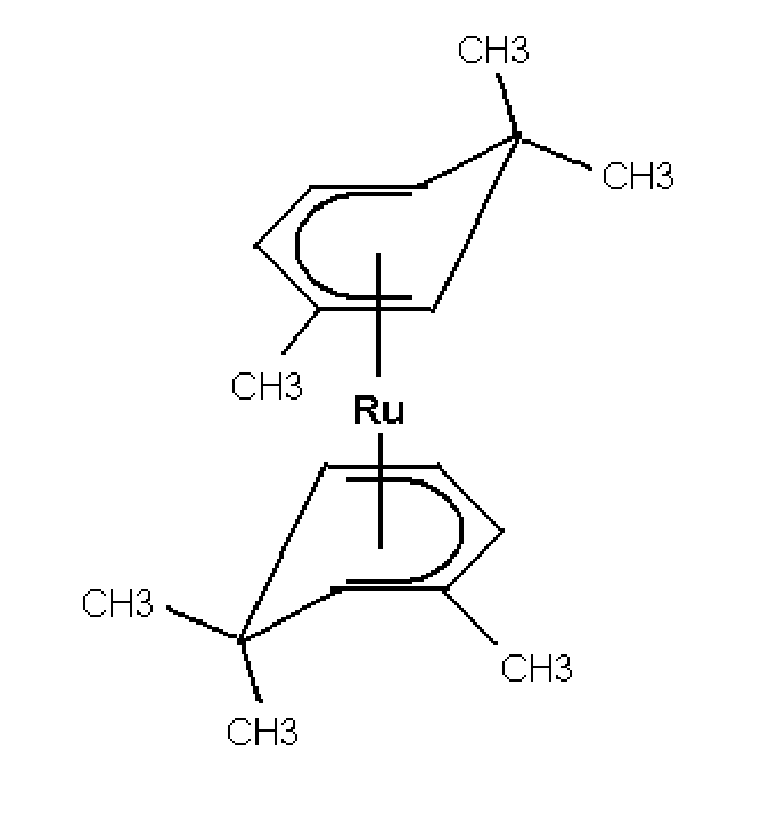
- and Bis(methyl-cycloheptadienyl)ruthenium Ru(Me-chpd)2 of the formula:

- Other examples of organometallic of the formula (I) as defined hereinbefore are:
- Ru(1-methyl-cyclohexadienyl)2, Ru(2-methyl-cyclohexadienyl)2,
- Ru(3-methyl-cyclohexadienyl)2, Ru(6-methyl-cyclohexadienyl)2,
- Ru(1-ethyl-cyclohexadienyl)2, Ru(2-ethyl-cydohexadienyl)2,
- Ru(3-ethyl-cyclohexadienyl)2, Ru(6-ethyl-cyclohexadienyl)2,
- Ru(1,6-dimethyl-cyclohexadienyl)2,
- Ru(2,6-dimethyl-cyclohexadienyl)2, Ru(3,6-dimethyl-cyclohexadienyl)2,
- Ru(1,6-diethyl-cyclohexadienyl)2, Ru(2,6-diethyl-cyclohexadienyl)2,
- Ru(3,6-diethyl-cyclohexadienyl)2, Ru(1,6,6-trimethyl-cyclohexadienyl)2,
- Ru(2,6,6-trimethyl-cyclohexadienyl)2, Ru(3,6,6-trimethyl-cyclohexadienyl)2,
- Ru(1,6,6-triethyl-cyclohexadienyl)2, Ru(2,6,6-triethyl-cyclohexadienyl)2,
- Ru(3,6,6-triethyl-cyclohexadienyl)2, Ru(1-methyl-cycloheptadienyl)2,
- Ru(2-methyl-cycloheptadienyl)2, Ru(3-methyl-cycloheptadienyl)2,
- Ru(7-methyl-cycloheptadienyl)2, Ru(1-ethyl-cycloheptadienyl)2,
- Ru(2-ethyl-cycloheptadienyl)2, Ru(3-ethyl-cycloheptadienyl)2,
- Ru(7-ethyl-cycloheptadienyl)2, Ru(1,6-dimethyl-cycloheptadienyl)2,
- Ru(2,6-dimethyl-cycloheptadienyl)2, Ru(3,6-dimethyl-cycloheptadienyl)2,
- Ru(4,6-dimethyl-cycloheptadienyl)2, Ru(5,6-dimethyl-cycloheptadienyl)2,
- Ru(6,6-dimethyl-cycloheptadienyl)2, Ru(1,7-dimethyl-cycloheptadienyl)2,
- Ru(2,7-dimethyl-cycloheptadienyl)2, Ru(3,7-dimethyl-cycloheptadienyl)2,
- Ru(1,5-dimethyl-cycloheptadienyl)2, Ru(7,7-dimethyl-cycloheptadienyl)2,
- Ru(1,6-diethyl-cycloheptadienyl)2, Ru(2,6-diethyl-cycloheptadienyl)2,
- Ru(3,6-diethyl-cycloheptadienyl)2, Ru(4,6-diethyl-cycloheptadienyl)2,
- Ru(5,6-diethyl-cycloheptadienyl)2, Ru(6,6-diethyl-cycloheptadienyl)2,
- Ru(1,7-diethyl-cycloheptadienyl)2, Ru(2,7-diethyl-cycloheptadienyl)2,
- Ru(3,7-diethyl-cycloheptadienyl)2, Ru(1,5-diethyl-cycloheptadienyl)2, and
- Ru(7,7-diethyl-cycloheptadienyl)2.
- It can be emphasize that in these compounds, and more generally in the organo-metallic compound of the formula (I), as defined hereinbefore, the distribution of the ligand, together with the configuration of the cyclic carbon molecules and their respective open electronic cloud, optimize the steric hindrance and the reduction of the electronic interaction, which is believed to help to decrease their melting point.
- According to a second embodiment, the invention relates to a process for the preparation of the compound as hereinbefore defined comprising the reaction of Ru+++ salt with the appropriate organic ligand in the presence of Zinc.
- According to a third embodiment, the invention relates to a process for the preparation of the compound as hereinbefore defined, comprising the reaction of di-µ-chlorodichloro bis[(1-3η:6-8η)-2,7-dimethyl-octadienyl] diruthenium in LiCO3 with a solution of ethanol containing the appropriate ligand and acetonitrile.
- According to a fourth embodiment, the invention relates to a process for the deposition of a ruthenium containing film on a substrate, comprising the steps of:
- a) - Providing at least one substrate into a reactor;
- b) - Introducing into the said reactor at least one organo-metallic compound of the formula (I), as defined hereinbefore,
- c) - Decomposing or adsorbing on the substrate(s) said at least one organo-metallic compound into the said reactor set at a temperature equal or higher than 100°C.;
- d) - Depositing said ruthenium containing film onto said at least one substrate.
In the process as defined hereinbefore, the various reactants can be introduced into the reactor either simultaneously such as in CVD, sequentially such as in ALD or in different combinations thereof.
Accordingly, the ruthenium containing precursors defined in step b) here hereinbefore shall be usually liquids, in other words having a melting point below 20°C, and more preferably shall have a melting point below 0°C.
In the process as defined hereinbefore, the substrate is generally chosen from the usual oxides which are used to manufacture metal electrodes such as MIM, DRAM, gate dielectrics or capacitors, as silicon oxide, Germanium oxides and the like.
In the process as defined hereinbefore, the temperature conditions are selected into a range from 100°C to 500°C, more preferably from 150°C to 350°C and the pressure into the reactor shall be preferably maintained between 1 Pa and 105 Pa, more preferably between 25 Pa and 103 Pa.
According to a first particular embodiment of the process as defined hereinbefore it further comprises a step of: - e) - Providing at least one reducing fluid into the reactor.
As examples of reducing fluids used in step e) of the process as defined hereinbefore, are more particularly H2, NH3, SiH4, Si2H6, Si3H8, hydrogen containing fluids or mixtures thereof.
According to a second particular embodiment of the process as defined hereinbefore, it further comprises a step of: - f) - Providing at least one oxygen containing fluid into the reactor.
As examples of oxygen containing fluids used in step f) of the process as defined hereinbefore, are more particularly O2, O3, H2O, H2O2, oxygen containing radicals such as 0° or OH° or mixtures thereof. - In the process as defined hereinbefore and further comprising a step e) and/or a step f), the hydrogen-containing and/or oxygen-containing fluid may be continuously introduced in the reactor and the organometallic compound or the mixture of organometallic compounds may be applied on the substrate by pulse such as according to the technique of pulsed chemical vapor deposition (PCVD).
- Depending on the reactants and the experimental conditions, the process defined as hereinbefore, allow the formation of, either ruthenium metallic film, ruthenium oxide or ruthenium-containing film.
- As illustrations of some various examples,
Figure 1 is a schematic representation of a Complementary Metal Oxide Semi-conductor CMOS structure, where Ru is used andFigure 2 is a schematic representation of a stacking structure for barrier layers between copper wires and the isolating layers (called low-k and usually made of porous silicon oxycarbide). - According to a last embodiment, the invention relates to the use of an organo-metallic compound as hereinbefore defined or of a mixture thereof, as a ruthenium precursor to manufacture ruthenium based film coated metal electrodes. Such devices are mainly used in the electronic industry.
- Anhydrous trichloride ruthenium (RuCl3· nH20) in ethanol is mixed with zinc (Zn) dust and 2,6,6-trimethyl-cyclohexadiene.
- The mixture is heated under reflux and then filtered. The resulting solution is evaporated in vacuo to dryness, extracted with n-pentane, and filtered through alumina. The resulting solution is then cooled to -78C to give the final product.
- Anhydrous trichloride ruthenium (RuCl3 · nH20) in ethanol is mixed with zinc (Zn) dust and 2-methyl-1,3-cycloheptadiene.
- The mixture is heated under reflux and then filtered. The resulting solution is evaporated in vacuo to dryness, extracted with n-pentane, and filtered through alumina. The resulting solution is then cooled to -78C to give the final product.
- A slurry of di-µ-chlorodichlorobis[(1-3η:6-8η)-2,7-dimethyloctadienyl] diruthenium in lithium carbonate (LiCO3) is mixed with a solution of ethanol containing 2,6,6-trimethyl-cyclohexadiene and acetonitrile, (CH3CN). The mixture is refluxed and the solvent is evaporated under vacuum and the residues stirred. The resulting solution is chromatographed on alumina. The final elution step with hexane, results in the product in fairly good yield.
- A slurry of di-µ-chlorodichlorobis[(1-3η:6-8η)-2,7-dimethyloctadienyl] diruthenium in lithium carbonate (LiCO3) is mixed with a solution of ethanol containing 2-methyl-1,3-cycloheptadiene and acetonitrile, (CH3CN). The mixture is refluxed and the solvent is evaporated under vacuum and the residues stirred. The resulting solution is chromatographed on alumina. The final elution step with hexane, results in the product in fairly good yield.
- Ru(2,6,6-trimethyl-cyclohexadienyl)2 is a light yellow precursor, which is liquid at 20°C.
- Pure ruthenium films were deposited from temperatures above 250°C using bis(2,6,6-trimethyl-cyclohexadienyl) ruthenium. The liquid precursor was stored in a bubbler heated up at 80° C and whose vapors were delivered to the hot-wall reactor by a bubbling method. An inert gas, helium in this case, was used as a carrier gas, as well as for dilution purpose. Tests were done with and without hydrogen as co-reactant.
- With the conditions of our set-up, films were deposited from 250°C, at 0.5 Torr, and the deposition rate reached a plateau at 350°C. Depositions were done on silicon oxide. The concentration of various elements into the ruthenium films, were analyzed by an Auger spectrometer. Pure ruthenium films were deposited onto a thermal silicon dioxide layer. The concentration of oxygen in the ruthenium film was below the detection limit of AES.
- This precursor bis(2,6,6-trimethyl-cyclohexadienyl) ruthenium is suitable for the atomic layer deposition (ALD) of ruthenium films at low temperatures (150-350°C) using the appropriate co-reactant. It has been found that metallic ruthenium depositions in ALD technique are possible when the co-reactant is molecular and atomic hydrogen, as well as with ammonia and related radicals NH2, NH, and oxidants.
- Ruthenium oxide films were deposited by making bis(2,6,6-trimethyl cyclohexadienyl) ruthenium and an oxygen containing fluid react in a deposition furnace. In this particular case, the oxygen containing fluid was oxygen. It has been found that ruthenium oxide depositions in ALD technique are possible when the co-reactant is molecular and atomic oxygen, as well as moisture vapors or any other oxygen containing mixture.
Claims (14)
- Organometallic compound of the formula (I):
L - Ru - X (I)
wherein:L is a non-aromatic cyclic unsaturated hydrocarbon ligand (L), having at least six cyclic carbon atoms, said cycle being unsubstituted or substituted by one or more substitution groups selected from linear or branched alkyl groups having from one to six carbon atoms unsubstituted or substituted by one or more radicals selected from fluoro, hydroxy or amino, linear or branched alkylamide groups having from one to six carbon atoms, linear or branched alkoxy groups having from one to six carbon atoms, linear or branched alkyl amidinates having from one to six carbon atoms, andX is either a non aromatic cyclic unsaturated hydrocarbon ligand identical or different from (L), having at least six cyclic carbon atoms said cycle being unsubstituted or substituted by one or more substitution groups selected from linear or branched alkyl groups having from one to six carbon atoms unsubstituted or substituted by one or more radicals selected from fluoro, hydroxy or amino, linear or branched alkylamide groups having from one to six carbon atoms, linear or branched alkoxy groups having from one to six carbon atoms, linear or branched alkyl amidinates having from one to six carbon atoms, or a cyclic or acyclic conjugated alkadienyl hydrocarbon ligand having from five to ten carbons atoms, said hydrocarbon ligand being unsubstituted or substituted by one or more substitution groups selected from linear or branched alkyl groups having from one to six carbon atoms unsubstituted or substituted by one or more radicals selected from fluoro, hydroxy or amino, linear or branched alkylamides group having from one to six carbon atoms, linear or branched alkoxy groups having from one to six carbon atoms, linear or branched alkyl amidinates having from one to six carbon atoms. - Organo-metallic compound of the formula (I) as defined in Claim 1, wherein (L) is selected from cyclohexadienyl (hereafter chxd, C6H7) and cycloheptadienyl (hereafter chpd C7H9) ligands, said ligands being unsubstituted or substituted by one or more substitution groups selected from linear or branched alkyl groups having from one to six carbon atoms unsubstituted or substituted by one or more radicals selected from fluoro, hydroxy or amino, linear or branched alkylamides group having from one to six carbon atoms, linear or branched alkoxy groups having from one to six carbon atoms, linear or branched alkyl amidinates having from one to six carbon atoms, or a cyclic or acyclic conjugated alkadienyl hydrocarbon ligand having from five to ten carbons atoms, said hydrocarbon ligand being unsubstituted or substituted by one or more substitution groups selected from linear or branched alkyl groups having from one to six carbon atoms unsubstituted or substituted by one or more radicals selected from fluoro, hydroxy or amino, linear or branched alkylamide groups having from one to six carbon atoms, linear or branched alkoxy groups having from one to six carbon atoms, linear or branched alkyl amidinates having from one to six carbon atoms.
- Organo-metallic compound of the formula (I) as defined in Claim 1 or Claim 2, wherein X is selected from cyclohexadienyl (hereafter chxd, C6H7), cycloheptadienyl (hereafter chpd C7H9), cyclopentadienyl, pentadienyl, hexadienyl and heptadienyl ligands, said ligands being unsubstituted or substituted by one or more substitution groups selected from linear or branched alkyl groups having from one to six carbon atoms unsubstituted or substituted by one or more radicals selected from fluoro, hydroxy or amino, linear or branched alkylamide groups having from one to six carbon atoms, linear or branched alkoxy groups having from one to six carbon atoms, linear or branched alkyl amidinates having from one to six carbon atoms.
- Organo-metallic compound of the formula (I) as defined in one of Claim 1 to Claim 3, wherein X and L are unsubstituted or substituted by one or more substitution groups selected from linear or branched alkyl groups having from one to six carbon atoms unsubstituted or substituted by one or more radicals selected from fluoro or amino.
- Organo-metallic compound of the formula (I) as defined in one of Claim 1 to Claim 4, wherein X and L are unsubstituted or substituted by one or more substituting groups selected from methyl, ethyl, propyl and butyl.
- Organo-metallic compound of the formula (I) as defined in one of Claim 1 to Claim 5, wherein L is selected from 1-Methyl-cyclohexadienyl, 2-Methyl-cyclohexadienyl, 3-Methyl-cyclohexadienyl, 6-Methyl-cyclohexadienyl, 1-Ethyl-cyclohexadienyl, 2-Ethyl-cyclohexadienyl, 3-Ethyl-cyclohexadienyl, 6-Ethyl-cyclohexadienyl, 1,6-dimethyl-cyclohexadienyl, 2,6-dimethyl-cyclohexadienyl, 3,6-dimethyl-cyclohexadienyl, 1,6-diethyl-cyclohexadienyl, 2,6-diethyl-cyclohexadienyl, 3,6-diethyl-cyclohexadienyl, 1,6,6-trimethyl-cyclohexadienyl, 2,6,6-trimethyl-cyclohexadienyl, 3,6,6-trimethyl-cyclohexadienyl, 1,6,6-triethyl-cyclohexadienyl, 2,6,6-triethyl-cyclohexadienyl, 3,6,6-triethyl-cyclohexadienyl, 1-Methyl-cycloheptadienyl, 2-Methyl-cycloheptadienyl, 3-Methyl-cycloheptadienyl, 7-Methyl-cycloheptadienyl, 1-Ethyl-cycloheptadienyl, 2-Ethyl-cycloheptadienyl, 3-Ethyl-cycloheptadienyl, 7-Ethyl-cycloheptadienyl, 1,6-dimethyl-cycloheptadienyl, 2,6-dimethyl-cycloheptadienyl, 3,6-dimethyl-cycloheptadienyl, 4,6-dimethyl-cycloheptadienyl, 5,6-dimethyl-cycloheptadienyl, 6,6-dimethyl-cycloheptadienyl, 1,7-dimethyl-cycloheptadienyl, 2,7-dimethyl-cycloheptadienyl, 3,7-dimethyl-cycloheptadienyl, 1,5-dimethyl-cycloheptadienyl, 7,7-dimethyl-cycloheptadienyl, 1,6-diethyl-cycloheptadienyl, 2,6-diethyl-cycloheptadienyl, 3,6-diethyl-cycloheptadienyl, 4,6-diethyl-cycloheptadienyl, 5,6-diethyl-cycloheptadienyl, 6,6-diethyl-cycloheptadienyl, 1,7-diethyl-cycloheptadienyl, 2,7-diethyl-cycloheptadienyl, 3,7-diethyl-cycloheptadienyl, 1,5-diethyl-cycloheptadienyl and 7,7-diethyl-cycloheptadienyl.
- Organo-metallic compound of the formula (I) as defined in one of Claim 1 to Claim 6, wherein X and L are identical.
- The following Organo-metallic compound of the formula (I) as defined in one of Claim 1 to Claim 7:Bis(2,6,6-trimethylcyclohexadienyl) ruthenium,Bis(methyl-cycloheptadienyl) ruthenium,(2,6,6-trimethyl-cyclohexadienyl) (1-3η):6-8η)-2,7-dimethyloctadienyl) ruthenium, and(1-methyl-cycloheptadienyl) (1-3η:6-8η)-2,7-dimethyloctadienyl) ruthenium.
- Process for the preparation of the compound as defined in one of Claim 1 to Claim 8, comprising the reaction of Ru+++ salt with the appropriate organic ligand in the presence of Zinc.
- Process for the preparation of the compound as defined in one of Claim 1 to Claim 8, comprising the reaction of di-µ-chlorodichloro bis[(1-3η:6-8η)-2,7-dimethyloctadienyl] diruthenium in LiCO3 with a solution of ethanol containing the appropriate ligand and acetonitrile.
- Process for the deposition of a ruthenium containing film on a substrate, comprising the steps of:a) - Providing at least one substrate into a reactor;b) - Introducing into the said reactor at least one organo-metallic compound as defined in one of Claim 1 to Claim 8,c) - Decomposing or adsorbing on the substrate(s) said at least one organo-metallic compound into the said reactor set at a temperature equal or higher than 100°C.;d) - Depositing said ruthenium containing film onto said at least one substrate.
- Process according to Claim 11, further comprising a step e) of providing at least one reducing fluid into the reactor, together with the at least one ruthenium precursor or separately.
- Process according to Claim 11 or to Claim 12, further comprising a step f) of providing at least one oxygen containing fluid into the reactor, together with the at least one ruthenium precursor or separately.
- Use of an organo-metallic compound as defined in one of Claim 1 to Claim 8 or of a mixture thereof, as a ruthenium precursor to manufacture ruthenium based film coated metal electrodes.
Priority Applications (8)
| Application Number | Priority Date | Filing Date | Title |
|---|---|---|---|
| AT06301291T ATE500261T1 (en) | 2006-12-22 | 2006-12-22 | NEW ORGANIC RUTHENIUM COMPOUND, PRODUCTION PROCESS THEREOF AND USE AS A RUTHENIUM PRECURSOR FOR THE PRODUCTION OF RUTHENIUM-BASED FILM-COATED METAL ELECTRODES |
| DE602006020470T DE602006020470D1 (en) | 2006-12-22 | 2006-12-22 | A novel organic ruthenium compound, process for its preparation and use as a ruthenium precursor for the production of ruthenium-based film-coated metal electrodes |
| EP06301291A EP1935897B1 (en) | 2006-12-22 | 2006-12-22 | New organo-Ruthenium compound, the process for its preparation and its use as a ruthenium precursor to manufacture ruthenium based film coated metal electrodes |
| TW096148584A TWI426150B (en) | 2006-12-22 | 2007-12-19 | Method for the deposition of a ruthenium containing film |
| KR1020097012741A KR101468238B1 (en) | 2006-12-22 | 2007-12-20 | Method for depositing ruthenium-containing film |
| PCT/IB2007/055258 WO2008078295A1 (en) | 2006-12-22 | 2007-12-20 | Method for the deposition of a ruthenium containing film |
| US12/520,116 US8557339B2 (en) | 2006-12-22 | 2007-12-20 | Method for the deposition of a Ruthenium containing film |
| JP2009542378A JP5265570B2 (en) | 2006-12-22 | 2007-12-20 | Method for depositing ruthenium-containing films |
Applications Claiming Priority (1)
| Application Number | Priority Date | Filing Date | Title |
|---|---|---|---|
| EP06301291A EP1935897B1 (en) | 2006-12-22 | 2006-12-22 | New organo-Ruthenium compound, the process for its preparation and its use as a ruthenium precursor to manufacture ruthenium based film coated metal electrodes |
Publications (2)
| Publication Number | Publication Date |
|---|---|
| EP1935897A1 true EP1935897A1 (en) | 2008-06-25 |
| EP1935897B1 EP1935897B1 (en) | 2011-03-02 |
Family
ID=37966462
Family Applications (1)
| Application Number | Title | Priority Date | Filing Date |
|---|---|---|---|
| EP06301291A Not-in-force EP1935897B1 (en) | 2006-12-22 | 2006-12-22 | New organo-Ruthenium compound, the process for its preparation and its use as a ruthenium precursor to manufacture ruthenium based film coated metal electrodes |
Country Status (8)
| Country | Link |
|---|---|
| US (1) | US8557339B2 (en) |
| EP (1) | EP1935897B1 (en) |
| JP (1) | JP5265570B2 (en) |
| KR (1) | KR101468238B1 (en) |
| AT (1) | ATE500261T1 (en) |
| DE (1) | DE602006020470D1 (en) |
| TW (1) | TWI426150B (en) |
| WO (1) | WO2008078295A1 (en) |
Cited By (3)
| Publication number | Priority date | Publication date | Assignee | Title |
|---|---|---|---|---|
| EP2464652A4 (en) * | 2009-08-14 | 2013-01-09 | Air Liquide | Hafnium- and zirconium-containing precursors and methods of using the same |
| WO2021141876A1 (en) * | 2020-01-10 | 2021-07-15 | Applied Materials, Inc. | Catalyst enhanced seamless ruthenium gap fill |
| US20220372056A1 (en) * | 2019-06-21 | 2022-11-24 | Adeka Corporation | Ruthenium compound, thin-film forming raw material, and method of producing thin film |
Families Citing this family (14)
| Publication number | Priority date | Publication date | Assignee | Title |
|---|---|---|---|---|
| KR101526633B1 (en) * | 2008-03-17 | 2015-06-05 | 제이에스알 가부시끼가이샤 | Diruthenium complex and material and method for chemical vapor deposition |
| DE102008026284A1 (en) * | 2008-06-02 | 2009-12-03 | Umicore Ag & Co. Kg | Process for the preparation of ruthenium-dienyl complexes |
| KR20100060482A (en) * | 2008-11-27 | 2010-06-07 | 주식회사 유피케미칼 | Organometallic precursors for deposition of ruthenium metal and/or ruthenium oxide thin films, and deposition process of the thin films |
| US7893290B1 (en) * | 2010-04-13 | 2011-02-22 | W.C. Heraeus Gmbh | Process for the preparation of bis(pentadienyl)-complexes of iron group metals |
| JP5579019B2 (en) * | 2010-10-25 | 2014-08-27 | Jsr株式会社 | Method for producing ruthenium compound |
| JP6178638B2 (en) * | 2013-06-26 | 2017-08-09 | 東ソー株式会社 | Ruthenium complex and production method thereof, ruthenium-containing thin film and production method thereof |
| TWI610932B (en) | 2012-12-07 | 2018-01-11 | 東曹股份有限公司 | Hydrazine complex, method for producing the same, cationic trinitrile complex, method for producing the same, and method for producing ruthenium-containing film |
| KR20140131219A (en) * | 2013-05-03 | 2014-11-12 | 한국화학연구원 | Ruthenium precursors, preparation method thereof and process for the formation of thin films using the same |
| JP5892668B1 (en) | 2014-10-03 | 2016-03-23 | 田中貴金属工業株式会社 | Chemical vapor deposition material comprising organic ruthenium compound and chemical vapor deposition method using the chemical vapor deposition material |
| KR102359908B1 (en) * | 2019-10-08 | 2022-02-09 | 주식회사 유진테크 | Apparatus for depositing thin film and method for depositing thin film |
| KR102618533B1 (en) * | 2021-03-10 | 2023-12-28 | 한국화학연구원 | composition for depositing a ruthenium-containing thin film and method for manufacturing of ruthenium-containing thin film using the same |
| KR102644483B1 (en) * | 2021-08-06 | 2024-03-07 | 한국화학연구원 | Novel Organoruthenium Compound, Preparation method thereof, and Method for deposition of thin film using the same |
| WO2023150066A1 (en) * | 2022-02-03 | 2023-08-10 | Entegris, Inc. | Process for selectively depositing highly-conductive metal films |
| CN115873043A (en) * | 2022-12-27 | 2023-03-31 | 合肥安德科铭半导体科技有限公司 | Preparation method of bis (2,4-dimethyl-1,3-pentadiene) ruthenium compound |
Family Cites Families (20)
| Publication number | Priority date | Publication date | Assignee | Title |
|---|---|---|---|---|
| JP3384228B2 (en) * | 1996-03-01 | 2003-03-10 | 三菱マテリアル株式会社 | Metal complex and metal thin film forming method |
| US5962716A (en) * | 1998-08-27 | 1999-10-05 | Micron Technology, Inc. | Methods for preparing ruthenium and osmium compounds |
| US6517616B2 (en) * | 1998-08-27 | 2003-02-11 | Micron Technology, Inc. | Solvated ruthenium precursors for direct liquid injection of ruthenium and ruthenium oxide |
| JP4162366B2 (en) * | 2000-03-31 | 2008-10-08 | 田中貴金属工業株式会社 | CVD thin film forming process and CVD thin film manufacturing apparatus |
| EP1282911B1 (en) * | 2000-05-15 | 2018-09-05 | Asm International N.V. | Process for producing integrated circuits |
| EP1156055A1 (en) | 2000-05-16 | 2001-11-21 | Firmenich Sa | Process for the preparation of ruthenium compounds |
| WO2001087991A1 (en) | 2000-05-17 | 2001-11-22 | Basell Technology Company B.V. | Component of catalyst for the diene polymerization, catalyst obtained therefrom and process for the preparation of polydienes based on it |
| US6429127B1 (en) * | 2000-06-08 | 2002-08-06 | Micron Technology, Inc. | Methods for forming rough ruthenium-containing layers and structures/methods using same |
| US6777565B2 (en) * | 2000-06-29 | 2004-08-17 | Board Of Trustees, The University Of Illinois | Organometallic compounds and their use as precursors for forming films and powders of metal or metal derivatives |
| JP4759126B2 (en) * | 2000-10-11 | 2011-08-31 | 田中貴金属工業株式会社 | Organometallic compound for chemical vapor deposition, method for producing organometallic compound for chemical vapor deposition, noble metal thin film, and chemical vapor deposition method for noble metal compound thin film |
| JP4517565B2 (en) | 2001-09-12 | 2010-08-04 | 東ソー株式会社 | Ruthenium complex, method for producing the same, and method for producing the thin film |
| JP2005060814A (en) | 2002-12-03 | 2005-03-10 | Jsr Corp | Method for producing ruthenium compounds and metal ruthenium films |
| JP2004292332A (en) | 2003-03-26 | 2004-10-21 | Mitsubishi Materials Corp | Method for producing ruthenium compound and ruthenium-containing thin film obtained by the compound |
| JP2007526250A (en) * | 2004-02-04 | 2007-09-13 | プラクスエア・テクノロジー・インコーポレイテッド | Organometallic compounds with high nucleation density |
| US20060024190A1 (en) * | 2004-07-27 | 2006-02-02 | General Electric Company | Preparation of filler-metal weld rod by injection molding of powder |
| KR100636023B1 (en) * | 2005-08-02 | 2006-10-18 | 삼성전자주식회사 | Organometallic precursor and thin film manufacturing method using the same |
| US7667065B2 (en) * | 2006-08-02 | 2010-02-23 | Praxair Technology, Inc. | High nucleation density organometallic compounds |
| US20080171436A1 (en) * | 2007-01-11 | 2008-07-17 | Asm Genitech Korea Ltd. | Methods of depositing a ruthenium film |
| US20090205538A1 (en) * | 2008-01-24 | 2009-08-20 | Thompson David M | Organometallic compounds, processes for the preparation thereof and methods of use thereof |
| JP5549848B2 (en) * | 2008-12-25 | 2014-07-16 | 東ソー株式会社 | Ruthenium compound, production method thereof and film formation method using the same |
-
2006
- 2006-12-22 DE DE602006020470T patent/DE602006020470D1/en active Active
- 2006-12-22 EP EP06301291A patent/EP1935897B1/en not_active Not-in-force
- 2006-12-22 AT AT06301291T patent/ATE500261T1/en not_active IP Right Cessation
-
2007
- 2007-12-19 TW TW096148584A patent/TWI426150B/en active
- 2007-12-20 JP JP2009542378A patent/JP5265570B2/en active Active
- 2007-12-20 WO PCT/IB2007/055258 patent/WO2008078295A1/en not_active Ceased
- 2007-12-20 US US12/520,116 patent/US8557339B2/en active Active
- 2007-12-20 KR KR1020097012741A patent/KR101468238B1/en active Active
Non-Patent Citations (2)
| Title |
|---|
| CAMAIONI NETO, CATHERINE ET AL: "Double nucleophilic addition of carbon donors to [(benzene)(arene)ruthenium]2+ cations", JOURNAL OF THE CHEMICAL SOCIETY, CHEMICAL COMMUNICATIONS , (23), 1703-4 CODEN: JCCCAT; ISSN: 0022-4936, 1990, XP002432222 * |
| KIRSS, REIN U.: "Synthesis, characterization and spectroscopy of alkyl substituted edge-bridged open ruthenocenes", INORGANICA CHIMICA ACTA , 357(11), 3181-3186 CODEN: ICHAA3; ISSN: 0020-1693, 2004, XP002432223 * |
Cited By (7)
| Publication number | Priority date | Publication date | Assignee | Title |
|---|---|---|---|---|
| EP2464652A4 (en) * | 2009-08-14 | 2013-01-09 | Air Liquide | Hafnium- and zirconium-containing precursors and methods of using the same |
| US20220372056A1 (en) * | 2019-06-21 | 2022-11-24 | Adeka Corporation | Ruthenium compound, thin-film forming raw material, and method of producing thin film |
| US12264168B2 (en) * | 2019-06-21 | 2025-04-01 | Adeka Corporation | Ruthenium compound, thin-film forming raw material, and method of producing thin film |
| WO2021141876A1 (en) * | 2020-01-10 | 2021-07-15 | Applied Materials, Inc. | Catalyst enhanced seamless ruthenium gap fill |
| KR20220104795A (en) * | 2020-01-10 | 2022-07-26 | 어플라이드 머티어리얼스, 인코포레이티드 | Catalytic Reinforced Seamless Ruthenium Gap Fill |
| US11401602B2 (en) | 2020-01-10 | 2022-08-02 | Applied Materials, Inc. | Catalyst enhanced seamless ruthenium gap fill |
| US11680312B2 (en) | 2020-01-10 | 2023-06-20 | Applied Materials, Inc. | Catalyst enhanced seamless ruthenium gap fill |
Also Published As
| Publication number | Publication date |
|---|---|
| DE602006020470D1 (en) | 2011-04-14 |
| KR101468238B1 (en) | 2014-12-03 |
| TWI426150B (en) | 2014-02-11 |
| US8557339B2 (en) | 2013-10-15 |
| KR20090092286A (en) | 2009-08-31 |
| US20100034971A1 (en) | 2010-02-11 |
| JP2010513467A (en) | 2010-04-30 |
| ATE500261T1 (en) | 2011-03-15 |
| JP5265570B2 (en) | 2013-08-14 |
| EP1935897B1 (en) | 2011-03-02 |
| TW200844252A (en) | 2008-11-16 |
| WO2008078295A1 (en) | 2008-07-03 |
Similar Documents
| Publication | Publication Date | Title |
|---|---|---|
| US8557339B2 (en) | Method for the deposition of a Ruthenium containing film | |
| US8753718B2 (en) | Method for the deposition of a ruthenium-containing film | |
| JP5003978B2 (en) | Atomic layer deposition using alkaline earth metal .BETA.-diketiminate precursors. | |
| US20120145953A1 (en) | LITHIUM PRECURSORS FOR LixMyOz MATERIALS FOR BATTERIES | |
| TWI410514B (en) | Asymmetric ligand source, symmetry-reduced metal-containing compound, and system and method including the same | |
| US20090209777A1 (en) | Organometallic compounds, processes for the preparation thereof and methods of use thereof | |
| US20080152793A1 (en) | Method for the deposition of a ruthenium containing film with aryl and diene containing complexes | |
| US20090242852A1 (en) | Deposition of ternary oxide films containing ruthenium and alkali earth metals | |
| JP2009503247A (en) | Beta-diketiminate ligand source and its metal-containing compounds, and systems and methods containing them | |
| US20090203928A1 (en) | Organometallic compounds, processes for the preparation thereof and methods of use thereof | |
| EP1887102B1 (en) | Precursors having open ligands for ruthenium containing films deposition | |
| US20090028745A1 (en) | Ruthenium precursor with two differing ligands for use in semiconductor applications | |
| US7927658B2 (en) | Deposition processes using group 8 (VIII) metallocene precursors | |
| US7723535B2 (en) | Organometallic precursor compounds | |
| WO2004041753A9 (en) | Deposition processes using group 8 (viii) metallocene precursors | |
| KR101344988B1 (en) | Method for the deposition of a ruthenium containing film | |
| KR20230022016A (en) | Novel Organoruthenium Compound, Preparation method thereof, and Method for deposition of thin film using the same |
Legal Events
| Date | Code | Title | Description |
|---|---|---|---|
| PUAI | Public reference made under article 153(3) epc to a published international application that has entered the european phase |
Free format text: ORIGINAL CODE: 0009012 |
|
| AK | Designated contracting states |
Kind code of ref document: A1 Designated state(s): AT BE BG CH CY CZ DE DK EE ES FI FR GB GR HU IE IS IT LI LT LU LV MC NL PL PT RO SE SI SK TR |
|
| AX | Request for extension of the european patent |
Extension state: AL BA HR MK RS |
|
| 17P | Request for examination filed |
Effective date: 20081229 |
|
| AKX | Designation fees paid |
Designated state(s): AT BE BG CH CY CZ DE DK EE ES FI FR GB GR HU IE IS IT LI LT LU LV MC NL PL PT RO SE SI SK TR |
|
| 17Q | First examination report despatched |
Effective date: 20090422 |
|
| GRAP | Despatch of communication of intention to grant a patent |
Free format text: ORIGINAL CODE: EPIDOSNIGR1 |
|
| GRAS | Grant fee paid |
Free format text: ORIGINAL CODE: EPIDOSNIGR3 |
|
| GRAA | (expected) grant |
Free format text: ORIGINAL CODE: 0009210 |
|
| AK | Designated contracting states |
Kind code of ref document: B1 Designated state(s): AT BE BG CH CY CZ DE DK EE ES FI FR GB GR HU IE IS IT LI LT LU LV MC NL PL PT RO SE SI SK TR |
|
| REG | Reference to a national code |
Ref country code: GB Ref legal event code: FG4D |
|
| REG | Reference to a national code |
Ref country code: CH Ref legal event code: EP |
|
| REG | Reference to a national code |
Ref country code: IE Ref legal event code: FG4D |
|
| REF | Corresponds to: |
Ref document number: 602006020470 Country of ref document: DE Date of ref document: 20110414 Kind code of ref document: P |
|
| REG | Reference to a national code |
Ref country code: DE Ref legal event code: R096 Ref document number: 602006020470 Country of ref document: DE Effective date: 20110414 |
|
| REG | Reference to a national code |
Ref country code: NL Ref legal event code: VDEP Effective date: 20110302 |
|
| PG25 | Lapsed in a contracting state [announced via postgrant information from national office to epo] |
Ref country code: ES Free format text: LAPSE BECAUSE OF FAILURE TO SUBMIT A TRANSLATION OF THE DESCRIPTION OR TO PAY THE FEE WITHIN THE PRESCRIBED TIME-LIMIT Effective date: 20110613 Ref country code: LT Free format text: LAPSE BECAUSE OF FAILURE TO SUBMIT A TRANSLATION OF THE DESCRIPTION OR TO PAY THE FEE WITHIN THE PRESCRIBED TIME-LIMIT Effective date: 20110302 Ref country code: GR Free format text: LAPSE BECAUSE OF FAILURE TO SUBMIT A TRANSLATION OF THE DESCRIPTION OR TO PAY THE FEE WITHIN THE PRESCRIBED TIME-LIMIT Effective date: 20110603 Ref country code: SE Free format text: LAPSE BECAUSE OF FAILURE TO SUBMIT A TRANSLATION OF THE DESCRIPTION OR TO PAY THE FEE WITHIN THE PRESCRIBED TIME-LIMIT Effective date: 20110302 Ref country code: LV Free format text: LAPSE BECAUSE OF FAILURE TO SUBMIT A TRANSLATION OF THE DESCRIPTION OR TO PAY THE FEE WITHIN THE PRESCRIBED TIME-LIMIT Effective date: 20110302 |
|
| LTIE | Lt: invalidation of european patent or patent extension |
Effective date: 20110302 |
|
| PG25 | Lapsed in a contracting state [announced via postgrant information from national office to epo] |
Ref country code: SI Free format text: LAPSE BECAUSE OF FAILURE TO SUBMIT A TRANSLATION OF THE DESCRIPTION OR TO PAY THE FEE WITHIN THE PRESCRIBED TIME-LIMIT Effective date: 20110302 Ref country code: CY Free format text: LAPSE BECAUSE OF FAILURE TO SUBMIT A TRANSLATION OF THE DESCRIPTION OR TO PAY THE FEE WITHIN THE PRESCRIBED TIME-LIMIT Effective date: 20110302 Ref country code: NL Free format text: LAPSE BECAUSE OF FAILURE TO SUBMIT A TRANSLATION OF THE DESCRIPTION OR TO PAY THE FEE WITHIN THE PRESCRIBED TIME-LIMIT Effective date: 20110302 Ref country code: FI Free format text: LAPSE BECAUSE OF FAILURE TO SUBMIT A TRANSLATION OF THE DESCRIPTION OR TO PAY THE FEE WITHIN THE PRESCRIBED TIME-LIMIT Effective date: 20110302 Ref country code: AT Free format text: LAPSE BECAUSE OF FAILURE TO SUBMIT A TRANSLATION OF THE DESCRIPTION OR TO PAY THE FEE WITHIN THE PRESCRIBED TIME-LIMIT Effective date: 20110302 Ref country code: BG Free format text: LAPSE BECAUSE OF FAILURE TO SUBMIT A TRANSLATION OF THE DESCRIPTION OR TO PAY THE FEE WITHIN THE PRESCRIBED TIME-LIMIT Effective date: 20110602 |
|
| PG25 | Lapsed in a contracting state [announced via postgrant information from national office to epo] |
Ref country code: BE Free format text: LAPSE BECAUSE OF FAILURE TO SUBMIT A TRANSLATION OF THE DESCRIPTION OR TO PAY THE FEE WITHIN THE PRESCRIBED TIME-LIMIT Effective date: 20110302 |
|
| PG25 | Lapsed in a contracting state [announced via postgrant information from national office to epo] |
Ref country code: PT Free format text: LAPSE BECAUSE OF FAILURE TO SUBMIT A TRANSLATION OF THE DESCRIPTION OR TO PAY THE FEE WITHIN THE PRESCRIBED TIME-LIMIT Effective date: 20110704 Ref country code: EE Free format text: LAPSE BECAUSE OF FAILURE TO SUBMIT A TRANSLATION OF THE DESCRIPTION OR TO PAY THE FEE WITHIN THE PRESCRIBED TIME-LIMIT Effective date: 20110302 |
|
| PG25 | Lapsed in a contracting state [announced via postgrant information from national office to epo] |
Ref country code: SK Free format text: LAPSE BECAUSE OF FAILURE TO SUBMIT A TRANSLATION OF THE DESCRIPTION OR TO PAY THE FEE WITHIN THE PRESCRIBED TIME-LIMIT Effective date: 20110302 Ref country code: RO Free format text: LAPSE BECAUSE OF FAILURE TO SUBMIT A TRANSLATION OF THE DESCRIPTION OR TO PAY THE FEE WITHIN THE PRESCRIBED TIME-LIMIT Effective date: 20110302 Ref country code: CZ Free format text: LAPSE BECAUSE OF FAILURE TO SUBMIT A TRANSLATION OF THE DESCRIPTION OR TO PAY THE FEE WITHIN THE PRESCRIBED TIME-LIMIT Effective date: 20110302 Ref country code: IS Free format text: LAPSE BECAUSE OF FAILURE TO SUBMIT A TRANSLATION OF THE DESCRIPTION OR TO PAY THE FEE WITHIN THE PRESCRIBED TIME-LIMIT Effective date: 20110702 |
|
| PLBE | No opposition filed within time limit |
Free format text: ORIGINAL CODE: 0009261 |
|
| STAA | Information on the status of an ep patent application or granted ep patent |
Free format text: STATUS: NO OPPOSITION FILED WITHIN TIME LIMIT |
|
| 26N | No opposition filed |
Effective date: 20111205 |
|
| PG25 | Lapsed in a contracting state [announced via postgrant information from national office to epo] |
Ref country code: DK Free format text: LAPSE BECAUSE OF FAILURE TO SUBMIT A TRANSLATION OF THE DESCRIPTION OR TO PAY THE FEE WITHIN THE PRESCRIBED TIME-LIMIT Effective date: 20110302 Ref country code: PL Free format text: LAPSE BECAUSE OF FAILURE TO SUBMIT A TRANSLATION OF THE DESCRIPTION OR TO PAY THE FEE WITHIN THE PRESCRIBED TIME-LIMIT Effective date: 20110302 |
|
| REG | Reference to a national code |
Ref country code: DE Ref legal event code: R097 Ref document number: 602006020470 Country of ref document: DE Effective date: 20111205 |
|
| PG25 | Lapsed in a contracting state [announced via postgrant information from national office to epo] |
Ref country code: IT Free format text: LAPSE BECAUSE OF FAILURE TO SUBMIT A TRANSLATION OF THE DESCRIPTION OR TO PAY THE FEE WITHIN THE PRESCRIBED TIME-LIMIT Effective date: 20110302 |
|
| PG25 | Lapsed in a contracting state [announced via postgrant information from national office to epo] |
Ref country code: MC Free format text: LAPSE BECAUSE OF NON-PAYMENT OF DUE FEES Effective date: 20111231 |
|
| REG | Reference to a national code |
Ref country code: CH Ref legal event code: PL |
|
| REG | Reference to a national code |
Ref country code: IE Ref legal event code: MM4A |
|
| PG25 | Lapsed in a contracting state [announced via postgrant information from national office to epo] |
Ref country code: IE Free format text: LAPSE BECAUSE OF NON-PAYMENT OF DUE FEES Effective date: 20111222 Ref country code: LI Free format text: LAPSE BECAUSE OF NON-PAYMENT OF DUE FEES Effective date: 20111231 Ref country code: CH Free format text: LAPSE BECAUSE OF NON-PAYMENT OF DUE FEES Effective date: 20111231 |
|
| PG25 | Lapsed in a contracting state [announced via postgrant information from national office to epo] |
Ref country code: LU Free format text: LAPSE BECAUSE OF NON-PAYMENT OF DUE FEES Effective date: 20111222 |
|
| PG25 | Lapsed in a contracting state [announced via postgrant information from national office to epo] |
Ref country code: TR Free format text: LAPSE BECAUSE OF FAILURE TO SUBMIT A TRANSLATION OF THE DESCRIPTION OR TO PAY THE FEE WITHIN THE PRESCRIBED TIME-LIMIT Effective date: 20110302 |
|
| PG25 | Lapsed in a contracting state [announced via postgrant information from national office to epo] |
Ref country code: HU Free format text: LAPSE BECAUSE OF FAILURE TO SUBMIT A TRANSLATION OF THE DESCRIPTION OR TO PAY THE FEE WITHIN THE PRESCRIBED TIME-LIMIT Effective date: 20110302 |
|
| PGFP | Annual fee paid to national office [announced via postgrant information from national office to epo] |
Ref country code: DE Payment date: 20131220 Year of fee payment: 8 Ref country code: GB Payment date: 20131219 Year of fee payment: 8 |
|
| PGFP | Annual fee paid to national office [announced via postgrant information from national office to epo] |
Ref country code: FR Payment date: 20131220 Year of fee payment: 8 |
|
| REG | Reference to a national code |
Ref country code: DE Ref legal event code: R119 Ref document number: 602006020470 Country of ref document: DE |
|
| GBPC | Gb: european patent ceased through non-payment of renewal fee |
Effective date: 20141222 |
|
| REG | Reference to a national code |
Ref country code: FR Ref legal event code: ST Effective date: 20150831 |
|
| PG25 | Lapsed in a contracting state [announced via postgrant information from national office to epo] |
Ref country code: GB Free format text: LAPSE BECAUSE OF NON-PAYMENT OF DUE FEES Effective date: 20141222 Ref country code: DE Free format text: LAPSE BECAUSE OF NON-PAYMENT OF DUE FEES Effective date: 20150701 |
|
| PG25 | Lapsed in a contracting state [announced via postgrant information from national office to epo] |
Ref country code: FR Free format text: LAPSE BECAUSE OF NON-PAYMENT OF DUE FEES Effective date: 20141231 |