EP1935602A1 - A flexible molding device for manufacturing a sunken groove in a tire tread - Google Patents
A flexible molding device for manufacturing a sunken groove in a tire tread Download PDFInfo
- Publication number
- EP1935602A1 EP1935602A1 EP07123548A EP07123548A EP1935602A1 EP 1935602 A1 EP1935602 A1 EP 1935602A1 EP 07123548 A EP07123548 A EP 07123548A EP 07123548 A EP07123548 A EP 07123548A EP 1935602 A1 EP1935602 A1 EP 1935602A1
- Authority
- EP
- European Patent Office
- Prior art keywords
- molding device
- molding
- tread
- tire
- mold
- Prior art date
- Legal status (The legal status is an assumption and is not a legal conclusion. Google has not performed a legal analysis and makes no representation as to the accuracy of the status listed.)
- Withdrawn
Links
- 238000000465 moulding Methods 0.000 title claims abstract description 60
- 238000004519 manufacturing process Methods 0.000 title description 2
- 239000000463 material Substances 0.000 claims description 5
- 229910045601 alloy Inorganic materials 0.000 claims description 3
- 239000000956 alloy Substances 0.000 claims description 3
- 229920001971 elastomer Polymers 0.000 claims description 3
- 229910001285 shape-memory alloy Inorganic materials 0.000 claims description 2
- 150000001875 compounds Chemical class 0.000 claims 2
- 239000000806 elastomer Substances 0.000 claims 2
- 230000007423 decrease Effects 0.000 description 2
- 238000000605 extraction Methods 0.000 description 2
- 239000011800 void material Substances 0.000 description 2
- 229910000831 Steel Inorganic materials 0.000 description 1
- HZEWFHLRYVTOIW-UHFFFAOYSA-N [Ti].[Ni] Chemical compound [Ti].[Ni] HZEWFHLRYVTOIW-UHFFFAOYSA-N 0.000 description 1
- 238000005452 bending Methods 0.000 description 1
- 230000000593 degrading effect Effects 0.000 description 1
- 230000001419 dependent effect Effects 0.000 description 1
- 229910052751 metal Inorganic materials 0.000 description 1
- 239000002184 metal Substances 0.000 description 1
- 238000000034 method Methods 0.000 description 1
- 229910001000 nickel titanium Inorganic materials 0.000 description 1
- 239000010959 steel Substances 0.000 description 1
- 238000004073 vulcanization Methods 0.000 description 1
- XLYOFNOQVPJJNP-UHFFFAOYSA-N water Substances O XLYOFNOQVPJJNP-UHFFFAOYSA-N 0.000 description 1
Images

Classifications
-
- B—PERFORMING OPERATIONS; TRANSPORTING
- B29—WORKING OF PLASTICS; WORKING OF SUBSTANCES IN A PLASTIC STATE IN GENERAL
- B29D—PRODUCING PARTICULAR ARTICLES FROM PLASTICS OR FROM SUBSTANCES IN A PLASTIC STATE
- B29D30/00—Producing pneumatic or solid tyres or parts thereof
- B29D30/06—Pneumatic tyres or parts thereof (e.g. produced by casting, moulding, compression moulding, injection moulding, centrifugal casting)
- B29D30/0601—Vulcanising tyres; Vulcanising presses for tyres
- B29D30/0606—Vulcanising moulds not integral with vulcanising presses
-
- B—PERFORMING OPERATIONS; TRANSPORTING
- B29—WORKING OF PLASTICS; WORKING OF SUBSTANCES IN A PLASTIC STATE IN GENERAL
- B29C—SHAPING OR JOINING OF PLASTICS; SHAPING OF MATERIAL IN A PLASTIC STATE, NOT OTHERWISE PROVIDED FOR; AFTER-TREATMENT OF THE SHAPED PRODUCTS, e.g. REPAIRING
- B29C33/00—Moulds or cores; Details thereof or accessories therefor
- B29C33/44—Moulds or cores; Details thereof or accessories therefor with means for, or specially constructed to facilitate, the removal of articles, e.g. of undercut articles
-
- B—PERFORMING OPERATIONS; TRANSPORTING
- B60—VEHICLES IN GENERAL
- B60C—VEHICLE TYRES; TYRE INFLATION; TYRE CHANGING; CONNECTING VALVES TO INFLATABLE ELASTIC BODIES IN GENERAL; DEVICES OR ARRANGEMENTS RELATED TO TYRES
- B60C11/00—Tyre tread bands; Tread patterns; Anti-skid inserts
- B60C11/03—Tread patterns
- B60C11/032—Patterns comprising isolated recesses
- B60C11/0323—Patterns comprising isolated recesses tread comprising channels under the tread surface, e.g. for draining water
-
- B—PERFORMING OPERATIONS; TRANSPORTING
- B29—WORKING OF PLASTICS; WORKING OF SUBSTANCES IN A PLASTIC STATE IN GENERAL
- B29D—PRODUCING PARTICULAR ARTICLES FROM PLASTICS OR FROM SUBSTANCES IN A PLASTIC STATE
- B29D30/00—Producing pneumatic or solid tyres or parts thereof
- B29D30/06—Pneumatic tyres or parts thereof (e.g. produced by casting, moulding, compression moulding, injection moulding, centrifugal casting)
- B29D30/0601—Vulcanising tyres; Vulcanising presses for tyres
- B29D30/0606—Vulcanising moulds not integral with vulcanising presses
- B29D2030/0607—Constructional features of the moulds
- B29D2030/0613—Means, e.g. sipes or blade-like elements, for forming narrow recesses in the tyres, e.g. cuts or incisions for winter tyres
Definitions
- the present invention relates to the molding of tires, and in particular, the molding of treads for a tire.
- the surface of the tread decreases due to frictional contact with the road surface.
- the volume of the tire grooves decrease and the net to gross ratio increases. Eventually the tire will require replacement.
- the tread elements in relief on a tire tread such as the sipes, tread blocks and grooves, play a fundamental role in tire traction or adhesion to the road both in the transverse direction and in the circumferential direction. Traction is especially critical when traveling on wet or snowy roads.
- the grooves act as evacuation channels for allowing water to pass through the tread.
- sunken grooves due to a limitation in manufacturing, are generally oriented perpendicular to the shoulder region. Molding elements are typically used to form the sunken grooves, and they are often difficult to remove from the tire once the tire has been cured. To make a sunken groove, the mold elements need to be rigid enough to penetrate the uncured or green rubber tread, but flexible enough to be extracted from the cured tire without damaging the tire. Another requirement is that the sunken groove needs to be large and thick enough to be efficient, which leads to a molding element so stiff that its extraction would damage the tire tread or the element itself would fail by a fatigue fracture. Thus it is desired to have a method and apparatus of forming sunk grooves that does not have the disadvantages described above.
- a molding element for forming a sunken groove in a tire tread according to claim 1 is provided. Furthermore, a mold according to claim 10 is provided.
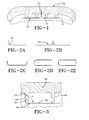
- Figure 1 illustrates a first embodiment of a molding device 10, suitable for molding sunken grooves in a tire tread.
- a sunken groove is a void area disposed underneath the new tread surface of a tire that is not exposed when the tire is new, and that as the tire tread is worn during service, the sunken groove is exposed.
- “Groove” means an elongated void area in a tread that may extend circumferentially or laterally about the tread in a straight, curved, or zigzag manner. Circumferentially and laterally extending grooves may be sub classified as a “sipe", “narrow”, or “main”.
- a “sipe” is a groove having a width in the range from 0.2% to 0.8% of the tread width, whereas a “narrow groove” has a width in the range from 0.8% to 3% of the tread width and a “main groove” has a width typically greater than 3% thereof.
- the "groove width” is equal to tread surface area occupied by a groove or groove portion, the width of which is in question, divided by the length of such groove or groove portion; thus, the groove width is its average width over its length.
- the molding device 10 may comprise a flexible wire 13 having a distal end 11, a mid-section 14 and a second end 15.
- the wire is a thin wire having a wire thickness range from 0.3 mm to 5 mm, preferably from 0.5 to 4 mm, such as from 1 mm to 3 mm.
- Two or more molding devices 10 may be utilized, as shown in Fig. 2 , wherein the distal ends 11 are intertwined.
- the distal end 11 may be mounted to an interior portion of a tire mold 20, as described in more detail, below.
- the positioning of the molding device 10 can be radial or oriented in any other direction as the flexibility of the device enables the demolding in any direction.
- the mid-section 14 of the flexible wire may comprise a radiused bend as shown in Fig 2A .
- the second end may also comprise a radiused bend as shown in Figs. 2C and 2D resulting in a U shaped molding device.
- the U-shaped molding device may also be partially closed as shown in Fig. 2E .
- the length flexible wire 13 in total is preferably from 10 mm to 70 mm, alternately from 15 to 50 mm.
- Fig. 3 is a second embodiment of the molding device 10 installed in a mold 20 having relief elements 22, 24.
- the distal end of the molding device 10 is installed adjacent a relief element 22.
- a first portion 16 of the molding device 10 abuts with the relief element 22 for structural support.
- the molding device 10 abuts with the relief element 22 at least largely along the radial extend of the relief element and/or abuts with the relief element 22 at least largely along the axial extend of the radial inner radial element surface.
- a second portion 18 of the molding device preferably extends axially outward in engagement with a lower end of a second adjacent relief element 24 so that the relief elements' inner surfaces support the molding device axially at two spaced locations, the space preferably being 10-50 mm, alternately 15-35 mm.
- the angle A defined by lower portion 18 with respect to the upper portion 16 may vary and is preferably between 70 ° and 110 ° degree such as 85°, 90°, 95°, or between 85°-95° degree.
- Fig. 4 is a third embodiment of the molding device 10 having a concave upwards U shaped geometry.
- the distal end 11 of the molding device 10 is mounted in the sidewall of the tire mold such that second end is oriented to extend upwardly. This enables a different bending stiffness behavior from one side of the molding device to the other allowing the element to have high rigidity during molding and low rigidity during extraction.
- cross-sections of the molding device 10 are shown in Figure 5 , wherein the cross-sectional shape can be sized as desired and configured to have the desired shape such as round, square, rectangular, triangular, and elliptical.
- the dimensions of the device 10 can be defined according to the application requirement.
- the cross-sectional shape may vary.
- the shape may be a helix as shown in Fig 9 .
- the molding device preferably has a curvature in the surface parallel to the tire tread outside surface or in a plane perpendicular to the tire tread outside surface.
- the bottom of the molding element or assembly disposed up to a maximum of 140% of the non-skid dimension but preferably between 60% to 120% of this value, alternately 80% to 110%, during the vulcanization phase.
- the molding device 10 may further optionally comprise a molding element 12 such as a conventional blade made of steel.
- the molding element 12 is preferably made from a rigid material.
- the molding element 12 may be any desired size, but for example, may be about 3-15 mm long, 1-4 mm tall and 5-8 mm deep.
- the molding element 12 may have a trapezoidal cross-sectional shape as shown in Figure 6A , or as shown in Fig. 6b or any other desired cross-sectional shape.
- Figure 8 illustrates yet another example of a molding element 12 having three molding devices 10 connected thereto.
- the flexible wire 13 may be made of a flexible metal. It is preferred that the material be highly elastic, hyperelastic or superelastic, examples of which include, shape memory alloys, Nickel-Titanium alloys, CuZnAl, CuAlNi and CuAlBe. It is preferred that the wire material have an elastic limit greater than or equal to 5% elongation, and more preferably greater than or equal to 10%. As previously described, the wire 13 may have any desired cross-sectional shape.
- Figure 4 illustrates one example of the molding device shown in use with an upper portion of a tire mold 20.
- the molding device 10 is embedded in the green tire tread prior to cure.
- the molding device 10 may be mounted to in any desired orientation to the tire mold, so that for example, the sunken groove may be oriented circumferentially, axially or any other desired configuration.
- the molding device may be mounted in the segments of the mold corresponding to the crown portion of the tread or located in the portions of the mold corresponding to the sidewalls.
- the tire mold 20 has an inner surface having relief elements 24 for forming a respective groove in a tire tread.
Landscapes
- Engineering & Computer Science (AREA)
- Mechanical Engineering (AREA)
- Moulds For Moulding Plastics Or The Like (AREA)
- Tires In General (AREA)
Abstract
A mold (20) and molding device (10) for forming a sunken groove in a tire tread is provided. The molding device (10) includes a thin flexible wire (13) having a desired cross-sectional shape.
Description
- The present invention relates to the molding of tires, and in particular, the molding of treads for a tire.
- As a tire wears, the surface of the tread decreases due to frictional contact with the road surface. As the tire wears, the volume of the tire grooves decrease and the net to gross ratio increases. Eventually the tire will require replacement.
- The tread elements in relief on a tire tread, such as the sipes, tread blocks and grooves, play a fundamental role in tire traction or adhesion to the road both in the transverse direction and in the circumferential direction. Traction is especially critical when traveling on wet or snowy roads. For wet conditions, the grooves act as evacuation channels for allowing water to pass through the tread.
- It is known in the prior art to attempt to solve the degrading tread condition through the use of sunken grooves. The sunken grooves, due to a limitation in manufacturing, are generally oriented perpendicular to the shoulder region. Molding elements are typically used to form the sunken grooves, and they are often difficult to remove from the tire once the tire has been cured. To make a sunken groove, the mold elements need to be rigid enough to penetrate the uncured or green rubber tread, but flexible enough to be extracted from the cured tire without damaging the tire. Another requirement is that the sunken groove needs to be large and thick enough to be efficient, which leads to a molding element so stiff that its extraction would damage the tire tread or the element itself would fail by a fatigue fracture. Thus it is desired to have a method and apparatus of forming sunk grooves that does not have the disadvantages described above.
- A molding element for forming a sunken groove in a tire tread according to claim 1 is provided. Furthermore, a mold according to
claim 10 is provided. - Dependent claims refer to preferred embodiments of the invention.
- The invention will be described by way of example and with reference to the accompanying drawings in which:
-
FIG. 1 is a cross-sectional view of a molding device installed in a tire mold; -
FIGS. 2A-2E illustrate exemplary cross-sectional views of the molding device ofFig. 1 ; -
FIG. 3 is a cross-sectional view of a second embodiment of the molding device installed in a tire mold; -
FIG. 4 is a cross-sectional view of a third embodiment of the molding device installed in a tire mold; -
FIG. 5 illustrates exemplary cross-sections of the molding device; -
FIGS. 6A-6D illustrate additional embodiments of the molding device; and -
FIGS. 7-9 illustrate additional embodiments of the molding device. -
Figure 1 illustrates a first embodiment of amolding device 10, suitable for molding sunken grooves in a tire tread. A sunken groove is a void area disposed underneath the new tread surface of a tire that is not exposed when the tire is new, and that as the tire tread is worn during service, the sunken groove is exposed. - "Groove" means an elongated void area in a tread that may extend circumferentially or laterally about the tread in a straight, curved, or zigzag manner. Circumferentially and laterally extending grooves may be sub classified as a "sipe", "narrow", or "main". A "sipe" is a groove having a width in the range from 0.2% to 0.8% of the tread width, whereas a "narrow groove" has a width in the range from 0.8% to 3% of the tread width and a "main groove" has a width typically greater than 3% thereof. The "groove width" is equal to tread surface area occupied by a groove or groove portion, the width of which is in question, divided by the length of such groove or groove portion; thus, the groove width is its average width over its length.
- The
molding device 10 may comprise aflexible wire 13 having adistal end 11, a mid-section 14 and asecond end 15. In a further aspect of the invention, the wire is a thin wire having a wire thickness range from 0.3 mm to 5 mm, preferably from 0.5 to 4 mm, such as from 1 mm to 3 mm. - Two or
more molding devices 10 may be utilized, as shown inFig. 2 , wherein thedistal ends 11 are intertwined. Thedistal end 11 may be mounted to an interior portion of atire mold 20, as described in more detail, below. The positioning of themolding device 10 can be radial or oriented in any other direction as the flexibility of the device enables the demolding in any direction. - The mid-section 14 of the flexible wire may comprise a radiused bend as shown in
Fig 2A . The second end may also comprise a radiused bend as shown inFigs. 2C and 2D resulting in a U shaped molding device. The U-shaped molding device may also be partially closed as shown inFig. 2E . - The length
flexible wire 13 in total is preferably from 10 mm to 70 mm, alternately from 15 to 50 mm. -
Fig. 3 is a second embodiment of themolding device 10 installed in amold 20 havingrelief elements 22, 24. The distal end of themolding device 10 is installed adjacent a relief element 22. Afirst portion 16 of themolding device 10 abuts with the relief element 22 for structural support. In a preferred embodiment, themolding device 10 abuts with the relief element 22 at least largely along the radial extend of the relief element and/or abuts with the relief element 22 at least largely along the axial extend of the radial inner radial element surface. - A
second portion 18 of the molding device preferably extends axially outward in engagement with a lower end of a secondadjacent relief element 24 so that the relief elements' inner surfaces support the molding device axially at two spaced locations, the space preferably being 10-50 mm, alternately 15-35 mm. The angle A defined bylower portion 18 with respect to theupper portion 16 may vary and is preferably between 70 ° and 110 ° degree such as 85°, 90°, 95°, or between 85°-95° degree. -
Fig. 4 is a third embodiment of themolding device 10 having a concave upwards U shaped geometry. Thedistal end 11 of themolding device 10 is mounted in the sidewall of the tire mold such that second end is oriented to extend upwardly. This enables a different bending stiffness behavior from one side of the molding device to the other allowing the element to have high rigidity during molding and low rigidity during extraction. - Examples of cross-sections of the
molding device 10 are shown inFigure 5 , wherein the cross-sectional shape can be sized as desired and configured to have the desired shape such as round, square, rectangular, triangular, and elliptical. The dimensions of thedevice 10 can be defined according to the application requirement. The cross-sectional shape may vary. For example, the shape may be a helix as shown inFig 9 . - The molding device preferably has a curvature in the surface parallel to the tire tread outside surface or in a plane perpendicular to the tire tread outside surface. The bottom of the molding element or assembly disposed up to a maximum of 140% of the non-skid dimension but preferably between 60% to 120% of this value, alternately 80% to 110%, during the vulcanization phase.
- As shown in
Figures 6A-6C , themolding device 10 may further optionally comprise amolding element 12 such as a conventional blade made of steel. Themolding element 12 is preferably made from a rigid material. Themolding element 12 may be any desired size, but for example, may be about 3-15 mm long, 1-4 mm tall and 5-8 mm deep. Themolding element 12 may have a trapezoidal cross-sectional shape as shown inFigure 6A , or as shown inFig. 6b or any other desired cross-sectional shape.Figure 8 illustrates yet another example of amolding element 12 having threemolding devices 10 connected thereto. - The
flexible wire 13 may be made of a flexible metal. It is preferred that the material be highly elastic, hyperelastic or superelastic, examples of which include, shape memory alloys, Nickel-Titanium alloys, CuZnAl, CuAlNi and CuAlBe. It is preferred that the wire material have an elastic limit greater than or equal to 5% elongation, and more preferably greater than or equal to 10%. As previously described, thewire 13 may have any desired cross-sectional shape. -
Figure 4 illustrates one example of the molding device shown in use with an upper portion of atire mold 20. Themolding device 10 is embedded in the green tire tread prior to cure. Themolding device 10 may be mounted to in any desired orientation to the tire mold, so that for example, the sunken groove may be oriented circumferentially, axially or any other desired configuration. The molding device may be mounted in the segments of the mold corresponding to the crown portion of the tread or located in the portions of the mold corresponding to the sidewalls. Thetire mold 20 has an inner surface havingrelief elements 24 for forming a respective groove in a tire tread.
Claims (10)
- A molding device 10 for forming a sunken groove in a tire tread, the molding device comprising a flexible wire (13).
- The molding device of claim 1 wherein the wire (13) is formed from a superelastic alloy.
- The molding device of claim 1 or 2 wherein the wire (13) is formed from a material having an elastic limit greater than or equal to 5% elongation.
- The molding device of claim 3 wherein the wire (13) is formed from a material having an elastic limit greater than or equal to 10% elongation.
- The molding device of at least one of the previous claims wherein the wire (13) is a shape memory alloy.
- The molding device of at least one of the previous claims wherein the wire (13) is a hyperelastic alloy.
- The molding device of at least one of the previous claims with a curvature in the surface parallel to a tire tread outside surface.
- The molding device of at least one of the previous claims with several curvatures in a plane perpendicular to a tire tread outside surface.
- A mold for molding a tread of a tire, the tread being made of an elastomer compound, the mold (20) comprising a mold surface for molding the tread and a molding device (10) according to one of the previous claims projecting from the mold surface so as to become embedded in the elastomer compound to be molded.
- The mold of claim 9 wherein the molding element (10) is at least partially abutted to a groove molding element (22).
Applications Claiming Priority (1)
| Application Number | Priority Date | Filing Date | Title |
|---|---|---|---|
| US87632606P | 2006-12-21 | 2006-12-21 |
Publications (1)
| Publication Number | Publication Date |
|---|---|
| EP1935602A1 true EP1935602A1 (en) | 2008-06-25 |
Family
ID=39125096
Family Applications (1)
| Application Number | Title | Priority Date | Filing Date |
|---|---|---|---|
| EP07123548A Withdrawn EP1935602A1 (en) | 2006-12-21 | 2007-12-19 | A flexible molding device for manufacturing a sunken groove in a tire tread |
Country Status (5)
| Country | Link |
|---|---|
| US (1) | US7575424B2 (en) |
| EP (1) | EP1935602A1 (en) |
| JP (1) | JP2008155638A (en) |
| CN (1) | CN101337407B (en) |
| BR (1) | BRPI0704627A (en) |
Families Citing this family (11)
| Publication number | Priority date | Publication date | Assignee | Title |
|---|---|---|---|---|
| US7507078B2 (en) * | 2006-12-21 | 2009-03-24 | The Goodyear Tire & Rubber Company | Flexible molding device for molding a sunk groove, a sunk blade, and a large keyhole sipe in tire tread |
| US7566213B2 (en) * | 2006-12-21 | 2009-07-28 | The Goodyear Tire & Rubber Company | Flexible enrobed molding device for manufacturing a sunken groove in a tire tread |
| US7544053B2 (en) * | 2006-12-21 | 2009-06-09 | The Goodyear Tire And Rubber Company | Flexible molding device for manufacturing a sunken groove or surface tie bar in a tire tread |
| BR112014032402A2 (en) | 2012-06-28 | 2017-06-27 | Henkel Ag & Co Kgaa | method of producing a composite insert |
| US20140265033A1 (en) * | 2013-03-15 | 2014-09-18 | Michelin Recherche Et Technique S.A. | Method for improved tire mold manufacturing |
| CN108136622B (en) | 2015-09-30 | 2020-04-07 | 米其林企业总公司 | Moulding element for manufacturing a noise-reducing tread |
| EP3356104B1 (en) | 2015-09-30 | 2021-12-01 | Compagnie Générale des Etablissements Michelin | Molding element for manufacturing a noise reducing tread |
| US10500767B2 (en) | 2015-09-30 | 2019-12-10 | Compagnie Generale Des Etablissements Michelin | Molding element for manufacturing a noise reducing tread |
| EP3356103B1 (en) | 2015-09-30 | 2021-12-29 | Compagnie Générale des Etablissements Michelin | Molding element for manufacturing a noise reducing tread |
| EP3356160B1 (en) | 2015-09-30 | 2021-12-01 | Compagnie Générale des Etablissements Michelin | Method for manufacturing a noise reducing tread |
| CN112124007B (en) * | 2019-06-25 | 2022-03-11 | 北汽福田汽车股份有限公司 | Tire for vehicle and vehicle |
Citations (10)
| Publication number | Priority date | Publication date | Assignee | Title |
|---|---|---|---|---|
| DE183380C (en) * | ||||
| FR1476254A (en) * | 1966-04-15 | 1967-04-07 | Self-cleaning, non-slip suction cup device for pneumatic tires | |
| DE1274799B (en) * | 1964-11-28 | 1968-08-08 | Ernst Schuhknecht | Insert strips for gripper claws to be vulcanized into the raw tread of a pneumatic vehicle tire in a vulcanizing mold |
| US3687583A (en) * | 1971-06-03 | 1972-08-29 | Penetred Corp | Art of forming tire treads with elongated traction-augmenting elements |
| US4154564A (en) * | 1968-06-09 | 1979-05-15 | Dunlop Holdings Limited | Tire molding matrix |
| US6408910B1 (en) * | 1997-05-30 | 2002-06-25 | Compagnie Generale Des Establishments Michelin-Michelin Cie | Tread including recessed channel and recessed incision and mold for tread |
| EP1260386A2 (en) * | 2001-05-18 | 2002-11-27 | The Goodyear Tire & Rubber Company | Two piece tire with a convective cooling system |
| EP1275527A2 (en) * | 2001-07-10 | 2003-01-15 | Continental Aktiengesellschaft | Tread profile for a tyre, pin for the manufacture of such a tread profile and a mold with such a pin |
| EP1586438A1 (en) * | 2004-04-13 | 2005-10-19 | Société de Technologie Michelin | Tire mould and tread made by this mould |
| EP1676695A2 (en) * | 2004-12-30 | 2006-07-05 | The Goodyear Tire & Rubber Company | Device for molding a keyhole sipe in a tire tread |
Family Cites Families (12)
| Publication number | Priority date | Publication date | Assignee | Title |
|---|---|---|---|---|
| US5075067A (en) * | 1988-02-08 | 1991-12-24 | The Uniroyal Goodrich Tire Company | Tire and method of producing same |
| US5095963A (en) | 1990-02-22 | 1992-03-17 | The Goodyear Tire & Rubber Company | Tire treads |
| FR2729329A1 (en) * | 1995-01-18 | 1996-07-19 | Michelin & Cie | PROCESS AND DEVICE FOR PRODUCING AT LEAST ONE TIRE MOLD COMPRISING AT LEAST ONE MOLDING ELEMENT WITH A NON-DEMOLDABLE PATTERN |
| FR2762539A1 (en) * | 1997-04-24 | 1998-10-30 | Michelin & Cie | ELEMENT MOLDING A PATTERN IN A TREAD |
| FR2772663A1 (en) * | 1997-12-24 | 1999-06-25 | Michelin & Cie | METHOD AND MOLDING ELEMENT FOR MOLDING A CUT IN A TIRE TRUCK |
| WO2002038399A2 (en) * | 2000-11-13 | 2002-05-16 | Societe De Technologie Michelin | Tyre running tread and moulding element of a mould for such a tread |
| DE60214915T2 (en) * | 2001-02-20 | 2007-04-19 | Société de Technologie Michelin | Mold and method for molding a tire tread |
| US20020134202A1 (en) * | 2001-03-23 | 2002-09-26 | Andre Domange | Composite blade |
| US7188650B2 (en) * | 2004-12-28 | 2007-03-13 | The Goodyear Tire & Rubber Company | Siped tire tread with high transverse stiffness |
| US7276198B2 (en) * | 2004-12-28 | 2007-10-02 | The Goodyear Tire & Rubber Company | Method and mold for making tire with tie bar |
| US7290578B2 (en) * | 2004-12-30 | 2007-11-06 | The Goodyear Tire & Rubber Company | Tire tread having a tread block with an undercut design |
| FR2891489B1 (en) * | 2005-10-04 | 2007-12-07 | Michelin Soc Tech | MOLD FOR TIRE TREAD. |
-
2007
- 2007-08-14 US US11/891,874 patent/US7575424B2/en not_active Expired - Fee Related
- 2007-12-12 BR BRPI0704627-8A patent/BRPI0704627A/en not_active IP Right Cessation
- 2007-12-19 EP EP07123548A patent/EP1935602A1/en not_active Withdrawn
- 2007-12-21 JP JP2007329527A patent/JP2008155638A/en active Pending
- 2007-12-21 CN CN2007101621818A patent/CN101337407B/en not_active Expired - Fee Related
Patent Citations (10)
| Publication number | Priority date | Publication date | Assignee | Title |
|---|---|---|---|---|
| DE183380C (en) * | ||||
| DE1274799B (en) * | 1964-11-28 | 1968-08-08 | Ernst Schuhknecht | Insert strips for gripper claws to be vulcanized into the raw tread of a pneumatic vehicle tire in a vulcanizing mold |
| FR1476254A (en) * | 1966-04-15 | 1967-04-07 | Self-cleaning, non-slip suction cup device for pneumatic tires | |
| US4154564A (en) * | 1968-06-09 | 1979-05-15 | Dunlop Holdings Limited | Tire molding matrix |
| US3687583A (en) * | 1971-06-03 | 1972-08-29 | Penetred Corp | Art of forming tire treads with elongated traction-augmenting elements |
| US6408910B1 (en) * | 1997-05-30 | 2002-06-25 | Compagnie Generale Des Establishments Michelin-Michelin Cie | Tread including recessed channel and recessed incision and mold for tread |
| EP1260386A2 (en) * | 2001-05-18 | 2002-11-27 | The Goodyear Tire & Rubber Company | Two piece tire with a convective cooling system |
| EP1275527A2 (en) * | 2001-07-10 | 2003-01-15 | Continental Aktiengesellschaft | Tread profile for a tyre, pin for the manufacture of such a tread profile and a mold with such a pin |
| EP1586438A1 (en) * | 2004-04-13 | 2005-10-19 | Société de Technologie Michelin | Tire mould and tread made by this mould |
| EP1676695A2 (en) * | 2004-12-30 | 2006-07-05 | The Goodyear Tire & Rubber Company | Device for molding a keyhole sipe in a tire tread |
Also Published As
| Publication number | Publication date |
|---|---|
| CN101337407A (en) | 2009-01-07 |
| BRPI0704627A (en) | 2008-08-12 |
| CN101337407B (en) | 2012-03-28 |
| US20080152744A1 (en) | 2008-06-26 |
| US7575424B2 (en) | 2009-08-18 |
| JP2008155638A (en) | 2008-07-10 |
Similar Documents
| Publication | Publication Date | Title |
|---|---|---|
| EP1935602A1 (en) | A flexible molding device for manufacturing a sunken groove in a tire tread | |
| US7507078B2 (en) | Flexible molding device for molding a sunk groove, a sunk blade, and a large keyhole sipe in tire tread | |
| EP1938939B1 (en) | Flexible enrobed molding device for manufacturing a sunken groove in a tire tread | |
| EP2072286B1 (en) | Pneumatic tire tread and mold blade | |
| US8459321B2 (en) | Tread for tire including gum blocks with notches | |
| EP2342069B1 (en) | Molded tire tread with an undulated sipe | |
| JPH04215506A (en) | Tire tread | |
| EP1676695B1 (en) | Mold with a device for molding a keyhole sipe in a tire tread | |
| CN110944853A (en) | Tyre having a tread comprising an evolving tread pattern with sipes | |
| EP3202593A1 (en) | Pneumatic tire | |
| US7544053B2 (en) | Flexible molding device for manufacturing a sunken groove or surface tie bar in a tire tread | |
| US7544054B2 (en) | Flexible molding device for manufacturing a sunken groove in a tire tread | |
| US10427371B2 (en) | Molding element for manufacturing a noise reducing tread | |
| JP2008265448A (en) | Pneumatic tire | |
| JP4390138B2 (en) | Tire vulcanization mold | |
| JP4682686B2 (en) | Tire mold | |
| EP3356102B1 (en) | Molding element for manufacturing a noise reducing tread | |
| EP1872976A1 (en) | Tire with sipes of defined curvature | |
| JP2001058322A (en) | Tire vulcanization mold |
Legal Events
| Date | Code | Title | Description |
|---|---|---|---|
| PUAI | Public reference made under article 153(3) epc to a published international application that has entered the european phase |
Free format text: ORIGINAL CODE: 0009012 |
|
| AK | Designated contracting states |
Kind code of ref document: A1 Designated state(s): AT BE BG CH CY CZ DE DK EE ES FI FR GB GR HU IE IS IT LI LT LU LV MC MT NL PL PT RO SE SI SK TR |
|
| AX | Request for extension of the european patent |
Extension state: AL BA HR MK RS |
|
| AKX | Designation fees paid | ||
| REG | Reference to a national code |
Ref country code: DE Ref legal event code: 8566 |
|
| STAA | Information on the status of an ep patent application or granted ep patent |
Free format text: STATUS: THE APPLICATION IS DEEMED TO BE WITHDRAWN |
|
| 18D | Application deemed to be withdrawn |
Effective date: 20081230 |