EP1933337A1 - Fe-based amorphous magnetic alloy and magnetic sheet - Google Patents
Fe-based amorphous magnetic alloy and magnetic sheet Download PDFInfo
- Publication number
- EP1933337A1 EP1933337A1 EP07024110A EP07024110A EP1933337A1 EP 1933337 A1 EP1933337 A1 EP 1933337A1 EP 07024110 A EP07024110 A EP 07024110A EP 07024110 A EP07024110 A EP 07024110A EP 1933337 A1 EP1933337 A1 EP 1933337A1
- Authority
- EP
- European Patent Office
- Prior art keywords
- magnetic
- based amorphous
- temperature
- amorphous
- magnetic alloy
- Prior art date
- Legal status (The legal status is an assumption and is not a legal conclusion. Google has not performed a legal analysis and makes no representation as to the accuracy of the status listed.)
- Granted
Links
Images



Classifications
-
- H—ELECTRICITY
- H01—ELECTRIC ELEMENTS
- H01F—MAGNETS; INDUCTANCES; TRANSFORMERS; SELECTION OF MATERIALS FOR THEIR MAGNETIC PROPERTIES
- H01F1/00—Magnets or magnetic bodies characterised by the magnetic materials therefor; Selection of materials for their magnetic properties
- H01F1/01—Magnets or magnetic bodies characterised by the magnetic materials therefor; Selection of materials for their magnetic properties of inorganic materials
- H01F1/03—Magnets or magnetic bodies characterised by the magnetic materials therefor; Selection of materials for their magnetic properties of inorganic materials characterised by their coercivity
- H01F1/12—Magnets or magnetic bodies characterised by the magnetic materials therefor; Selection of materials for their magnetic properties of inorganic materials characterised by their coercivity of soft-magnetic materials
- H01F1/14—Magnets or magnetic bodies characterised by the magnetic materials therefor; Selection of materials for their magnetic properties of inorganic materials characterised by their coercivity of soft-magnetic materials metals or alloys
- H01F1/147—Alloys characterised by their composition
- H01F1/153—Amorphous metallic alloys, e.g. glassy metals
- H01F1/15308—Amorphous metallic alloys, e.g. glassy metals based on Fe/Ni
-
- B—PERFORMING OPERATIONS; TRANSPORTING
- B22—CASTING; POWDER METALLURGY
- B22F—WORKING METALLIC POWDER; MANUFACTURE OF ARTICLES FROM METALLIC POWDER; MAKING METALLIC POWDER; APPARATUS OR DEVICES SPECIALLY ADAPTED FOR METALLIC POWDER
- B22F5/00—Manufacture of workpieces or articles from metallic powder characterised by the special shape of the product
- B22F5/006—Manufacture of workpieces or articles from metallic powder characterised by the special shape of the product of flat products, e.g. sheets
-
- C—CHEMISTRY; METALLURGY
- C22—METALLURGY; FERROUS OR NON-FERROUS ALLOYS; TREATMENT OF ALLOYS OR NON-FERROUS METALS
- C22C—ALLOYS
- C22C33/00—Making ferrous alloys
- C22C33/003—Making ferrous alloys making amorphous alloys
-
- C—CHEMISTRY; METALLURGY
- C22—METALLURGY; FERROUS OR NON-FERROUS ALLOYS; TREATMENT OF ALLOYS OR NON-FERROUS METALS
- C22C—ALLOYS
- C22C33/00—Making ferrous alloys
- C22C33/02—Making ferrous alloys by powder metallurgy
- C22C33/0257—Making ferrous alloys by powder metallurgy characterised by the range of the alloying elements
- C22C33/0278—Making ferrous alloys by powder metallurgy characterised by the range of the alloying elements with at least one alloying element having a minimum content above 5%
- C22C33/0285—Making ferrous alloys by powder metallurgy characterised by the range of the alloying elements with at least one alloying element having a minimum content above 5% with Cr, Co, or Ni having a minimum content higher than 5%
-
- C—CHEMISTRY; METALLURGY
- C22—METALLURGY; FERROUS OR NON-FERROUS ALLOYS; TREATMENT OF ALLOYS OR NON-FERROUS METALS
- C22C—ALLOYS
- C22C45/00—Amorphous alloys
- C22C45/02—Amorphous alloys with iron as the major constituent
-
- H—ELECTRICITY
- H01—ELECTRIC ELEMENTS
- H01F—MAGNETS; INDUCTANCES; TRANSFORMERS; SELECTION OF MATERIALS FOR THEIR MAGNETIC PROPERTIES
- H01F1/00—Magnets or magnetic bodies characterised by the magnetic materials therefor; Selection of materials for their magnetic properties
- H01F1/01—Magnets or magnetic bodies characterised by the magnetic materials therefor; Selection of materials for their magnetic properties of inorganic materials
- H01F1/03—Magnets or magnetic bodies characterised by the magnetic materials therefor; Selection of materials for their magnetic properties of inorganic materials characterised by their coercivity
- H01F1/12—Magnets or magnetic bodies characterised by the magnetic materials therefor; Selection of materials for their magnetic properties of inorganic materials characterised by their coercivity of soft-magnetic materials
- H01F1/14—Magnets or magnetic bodies characterised by the magnetic materials therefor; Selection of materials for their magnetic properties of inorganic materials characterised by their coercivity of soft-magnetic materials metals or alloys
- H01F1/20—Magnets or magnetic bodies characterised by the magnetic materials therefor; Selection of materials for their magnetic properties of inorganic materials characterised by their coercivity of soft-magnetic materials metals or alloys in the form of particles, e.g. powder
- H01F1/22—Magnets or magnetic bodies characterised by the magnetic materials therefor; Selection of materials for their magnetic properties of inorganic materials characterised by their coercivity of soft-magnetic materials metals or alloys in the form of particles, e.g. powder pressed, sintered, or bound together
- H01F1/24—Magnets or magnetic bodies characterised by the magnetic materials therefor; Selection of materials for their magnetic properties of inorganic materials characterised by their coercivity of soft-magnetic materials metals or alloys in the form of particles, e.g. powder pressed, sintered, or bound together the particles being insulated
- H01F1/26—Magnets or magnetic bodies characterised by the magnetic materials therefor; Selection of materials for their magnetic properties of inorganic materials characterised by their coercivity of soft-magnetic materials metals or alloys in the form of particles, e.g. powder pressed, sintered, or bound together the particles being insulated by macromolecular organic substances
-
- C—CHEMISTRY; METALLURGY
- C22—METALLURGY; FERROUS OR NON-FERROUS ALLOYS; TREATMENT OF ALLOYS OR NON-FERROUS METALS
- C22C—ALLOYS
- C22C2200/00—Crystalline structure
- C22C2200/02—Amorphous
-
- C—CHEMISTRY; METALLURGY
- C22—METALLURGY; FERROUS OR NON-FERROUS ALLOYS; TREATMENT OF ALLOYS OR NON-FERROUS METALS
- C22C—ALLOYS
- C22C2202/00—Physical properties
- C22C2202/02—Magnetic
Definitions
- the present invention relates to Fe-based amorphous magnetic alloys and magnetic sheets.
- it relates to an Fe-based amorphous magnetic alloy having a large imaginary part ⁇ " of complex permeability for use in a highly flexible magnetic sheet and a magnetic sheet incorporating the Fe-based amorphous magnetic alloy.
- TM represents a transition metal element such as Fe, Co, or Ni
- Techniques for fabricating magnetic materials with excellent magnetic properties are now being developed by optimizing the composition of the amorphous soft magnetic alloys.
- the present inventors have developed an Fe-based amorphous magnetic alloy that can be used as a magnetic material with excellent magnetic properties, in particular, a magnetic material having a large imaginary part ⁇ " of complex permeability (refer to Japanese Unexamined Patent Application Publication No. 2002-226956 ).
- a magnetic sheet is prepared by forming particles of several to several tens of micrometers in size from the above-described Fe-based amorphous magnetic alloy by a water atomization process or the like, flattening the particles, kneading the resulting particles with a matrix material (insulating resin) such as polyethylene chloride serving as a binder, and forming the resulting mixture into sheets of several tens to several hundred micrometers in thickness by a doctor blade technique.
- This magnetic sheet preferably has a complex permeability with a large imaginary part ⁇ " in the operation frequency band.
- the imaginary part ⁇ " of complex permeability of the Fe-based amorphous magnetic alloy can be increased by annealing.
- the problem associated with this is that when the glass transition temperature (Tg), the crystallization temperature (Tx), and the melting temperature (Tm) of the Fe-based amorphous magnetic alloy are high, the annealing temperature must be also high. Accordingly, when the Fe-based amorphous magnetic alloy is used in the magnetic sheet, the matrix material may become thermally decomposed and deteriorated, resulting in embrittlement of the magnetic sheet.
- the present invention provides an Fe-based amorphous magnetic alloy having relatively low glass transition temperature, crystallization temperature, and melting temperature such that the annealing temperature can be low, and a magnetic sheet having excellent flexibility even after annealing.
- An Fe-based amorphous magnetic alloy of the present invention contains 4 at.% or less of a low temperature annealing-enabling element M and 10 at.% or less of Ni.
- the total amount of the low temperature annealing-enabling element M and Ni is 2 at.% or more and 10 at.% or less.
- the Fe-based amorphous magnetic alloy exhibits relatively low glass transition temperature (Tg), crystallization temperature (Tx), and melting temperature (Tm) and excellent flexibility suitable for use in a magnetic sheet.
- the Fe-based amorphous magnetic alloy of the present invention preferably contains at least one selected from the group consisting of Sn, In, Zn, Ga, and Al as the low temperature annealing-enabling element M.
- the Fe-based amorphous magnetic alloy contains 1 at.% or more and 4 at.% or less of the low temperature annealing-enabling element M and 1 at.% or more and 10 at. % or less Ni. According to this composition, an Fe-based amorphous magnetic alloy having amorphous structures can be more stably produced.
- the Fe-based amorphous magnetic alloy preferably has a composition represented by a compositional formula, Fe 100-a-b-x -y-z-w-t M a Ni b Cr x P y C z B w Si t (0 ⁇ a ⁇ 4 at.%, 0 ⁇ b ⁇ 10 at.%, 0 ⁇ x ⁇ 4 at.%, 6 at. % ⁇ y ⁇ 13 at.%, 2 at.% ⁇ z ⁇ 12 at.%, 0 ⁇ w ⁇ 5 at.%, and 0 ⁇ t ⁇ 4 at.%).
- compositional formula 1 ⁇ a ⁇ 4 at.%, 1 ⁇ b ⁇ 10 at.%, 2 ⁇ a + b ⁇ 10 at.%, 1 ⁇ x ⁇ 8 at.%, 6 ⁇ y ⁇ 11 at.%, 6 ⁇ z ⁇ 11 at.%, 0 ⁇ w ⁇ 2 at.%, and 0 ⁇ t ⁇ 2 at.%.
- a magnetic sheet of the present invention includes a matrix material and the Fe-based amorphous magnetic alloy described above, the Fe-based amorphous magnetic alloy being contained in the matrix material.
- the magnetic sheet can have a large imaginary part ⁇ " of complex permeability in the operation frequency band and excellent flexibility.
- the magnetic sheet has been annealed at a temperature of 400°C or less.
- the Fe-based amorphous magnetic alloy of the present invention contains 4 at.% or less of an element M that enables low-temperature annealing (also referred to as "low temperature annealing-enabling element M” hereinafter) and 10 at.% or less of Ni, where the total content of M and Ni is 2 at.% or more and 10 at.% or less.
- the low temperature annealing-enabling element M is an element that can decrease the glass transition temperature (Tg), the crystallization temperature (Tx), and the melting temperature (Tm) of the Fe-based amorphous magnetic alloy once it is used in combination with Ni.
- the low temperature annealing-enabling element M has a melting temperature lower than that of Fe. It is considered that incorporation of the low temperature annealing-enabling element M and Ni in the Fe-based alloy shifts the overall thermal profile toward the lower temperature side, and the Tg, Tx, and Tm become lower than those of existing Fe-based alloys.
- Examples of the low temperature annealing-enabling element M include Sn, In, Zn, Ga, and Al.
- the Fe-based amorphous magnetic alloy of the present invention is preferably represented by formula Fe 100-a-b-x-y-z-w -t M a Ni b Cr x P y C z B w Si t (where 0 ⁇ a ⁇ 4 at.%, 0 ⁇ b ⁇ 10 at.%, 0 ⁇ x ⁇ 4 at.%, 6 at.% ⁇ y ⁇ 13 at.%, 2 at.% ⁇ z ⁇ 12 at.%, 0 ⁇ w ⁇ 5 at.%, and 0 ⁇ t ⁇ 4 at.%).
- the low temperature annealing-enabling element M used in combination with Ni decreases the crystallization temperature (Tx) and the melting temperature (Tm); hence, the annealing temperature can be decreased.
- the amount a of the low temperature annealing-enabling element M is preferably 0 ⁇ a ⁇ 4 at.% in the above formula from the point of view of yielding an amorphous state.
- the total content of the M and Ni is 2 at.% or more and 10 at.% or less, and more preferably 3 at.% or more and 9.5 at.% or less.
- the Ni content b is 0 ⁇ b ⁇ 10 at.% and preferably 2 at.% ⁇ b ⁇ 7 at.% in the above-described formula.
- the Cr content x is preferably 0 ⁇ x ⁇ 8 at.% and more preferably 2 at.% ⁇ x ⁇ 4 at.% in the above formula from the standpoints of achieving preferable corrosion resistance, thermal stability, and saturation magnetization of the alloy.
- the corrosion resistance in salt water immersion is improved by adding 4 at.% of Cr. Since the amorphous phase can be stably produced and the magnetization intensity ( ⁇ s) can be decreased by increasing the melting temperature (Tm), the Cr content is most preferably 4 at.%.
- the P content y is preferably 6 at.% ⁇ y ⁇ 13 at.% and more preferably 6 at.% ⁇ y ⁇ 11 at.% in the above formula from the viewpoint that the P content is preferably near the Fe-P-C (Fe 79.4 P 10.8 C 9.8 ) eutectic composition.
- the C content z is preferably 2 at.% ⁇ z ⁇ 12 at.% and more preferably 6 at.% ⁇ z ⁇ 11 at.% in the above formula from the viewpoint that the C content is preferably near the Fe-P-C (Fe 79.4 P 10.8 C 9.8 ) eutectic composition.
- the B content w is preferably 0 ⁇ w ⁇ 5 at.% and more preferably 0 ⁇ w ⁇ 2 at.% in the above formula since B increases the glass transition temperature (Tg), the crystallization temperature (Tx) and the melting temperature (Tm). In order to enhance the amorphous phase formation ability, the B content is most preferably 1 ⁇ w ⁇ 2 at.%.
- the Si content t is preferably 0 ⁇ t ⁇ 4 at.% and more preferably 0 ⁇ t ⁇ 2 at.% in the above formula since Si increases the glass transition temperature (Tg), the crystallization temperature (Tx) and the melting temperature (Tm).
- the Si content is most preferably 1 ⁇ t ⁇ 2 at.% to enhance amorphous phase formation ability.
- the Fe-based amorphous magnetic alloy can be used in a magnetic sheet.
- the magnetic sheet contains a matrix material and the Fe-based amorphous magnetic alloy in the matrix material.
- the matrix material examples include silicone resin, polyvinyl chloride, silicone rubber, phenolic resin, melamine resin, polyvinyl alcohol, polyethylene chloride, and various types of elastomers.
- a resin capable of making an emulsion of the Fe-based amorphous magnetic alloy is preferable as the matrix material.
- An example of such a resin is silicone resin. Note that addition of a lubricant containing a stearate or the like to the matrix material facilitates formation of flat magnetic materials, and an Fe-based amorphous magnetic alloy having a high aspect ratio can be obtained in this manner.
- the particles of the Fe-based amorphous magnetic alloy in the magnetic sheet stack in the sheet thickness direction and easily become oriented.
- the density is also increased. Accordingly, the imaginary part ⁇ " of the complex permeability increases, and the noise suppression characteristics can be improved.
- the Fe-based amorphous magnetic alloy used in the magnetic sheet is preferably in the form of flat particles or powder.
- Powder or particles having an average aspect ratio (major axis/thickness) of 2.5 or more and preferably 12 or more are preferred as such flat particles or powder from the standpoint of achieving desirable degree of orientation and noise suppression characteristics.
- the flat powder or particles have a higher degree of orientation, the density of the magnetic sheet and the imaginary part ⁇ " of the complex permeability can be increased, and thus the noise suppression characteristics can be improved.
- a high aspect ratio suppresses generation of eddy current, resulting in an increased inductance, and increases the imaginary part ⁇ " of the complex permeability in the GHz band.
- the average aspect ratio is 80 or less and preferably 60 or less since sheet formation becomes difficult at an excessively large aspect ratio.
- the magnetic sheet is produced as follows. First, a melt of the Fe-based amorphous magnetic alloy is sprayed into water and quenched to produce alloy particles (water atomization technique). Note that the technique for making the Fe-based amorphous magnetic alloy particles is not limited to this water atomization technique, and various other techniques such as a gas atomization technique, a liquid quenching technique in which ribbons of quenched alloy melt are pulverized to form alloy powder, and the like may be employed. Processing conditions for the water atomization technique, the gas atomization technique, and the liquid quenching technique may be typical conditions selected according to the types of raw materials.
- the alloy particles are flattened with an attritor or the like as needed.
- the attritor includes a drum containing many balls used for disintegration and can process the Fe-based amorphous magnetic alloy particles to have a target flatness by mixing and agitating the Fe-based amorphous magnetic alloy powder with the balls.
- the flat particles of Fe-based amorphous magnetic alloy can also be obtained by the liquid quenching technique described above.
- the resulting Fe-based amorphous magnetic alloy particles may be heated to reduce the internal stress, if necessary.
- a magnetic sheet containing the Fe-based amorphous magnetic alloy is made.
- Spherical particles 1 ⁇ m to 100 ⁇ m in size were prepared by the water atomization technique by using FePC as the base material and by adding M, Ni, Cr, B, Si, and/or other suitable elements to the base material.
- the particles were classified so that the average particle size (D50) was 22 to 25 ⁇ m, and the resulting particles were flattened with a disintegrator such as an attritor to form flat Fe-based amorphous magnetic alloy particles.
- the glass transition temperature (Tg), the crystallization temperature (Tx), and the melting temperature (Tm) of the particles were measured with a differential scanning calorimeter (DSC).
- DSC differential scanning calorimeter
- the saturation magnetization ( ⁇ s) was determined with a vibrating sample magnetometer (VSM).
- the resulting Fe-based amorphous magnetic alloy particles were mixed with a silicone resin to prepare a mixture having an Fe-based amorphous magnetic alloy content of 44 vol.%.
- the mixture was formed into noise suppression sheets (magnetic sheets) having a thickness of about 0.1 mm.
- the magnetic sheets were placed in an annealing furnace and annealed in an nitrogen atmosphere at an annealing temperature (Ta) of 300°C to 420°C (a temperature that can sufficiently increase the imaginary part ( ⁇ ") of the complex permeability or the fracture strain ( ⁇ f)).
- Ta annealing temperature
- the temperature profile was as follows: rate of temperature elevation: 10°C /min, retention time: 30 minutes.
- the magnetic sheets were then furnace-cooled.
- the imaginary part ( ⁇ ") of the complex permeability at 1 GHz of the resulting magnetic sheets was measured with an E4991A produced by Agilent.
- the fracture strain ⁇ f was measured by the process described below.
- the imaginary part ⁇ " of the complex permeability of the Fe-based amorphous magnetic alloy of the present invention can be increased by annealing. At an excessively high annealing temperature, the magnetic sheet prepared from the Fe-based amorphous magnetic alloy undergoes embrittlement. Embrittlement of the magnetic sheet can be evaluated in terms of flexibility based on fracture strain ⁇ f.
- Fig. 4 shows a fixture for measuring the fracture strain ⁇ f.
- a magnetic sheet 12 is bent and held between a pair of parallel blocks 11, and the distance D between the parallel blocks 11 is decreased in the direction of arrows.
- the bending diameter at which a crack occurs in a bent region 12a of the magnetic sheet 12 is assumed to be the fracture limitation diameter Df.
- the magnetic sheet in a completely bent state (the state in which the magnetic sheet is folded in two without cracks) has Df of 2t and the maximum value of ⁇ f is 1.
- the flexibility of the magnetic sheet is rated on the basis of ⁇ f. The closer ⁇ f to 1, the higher the flexibility of the magnetic sheet.
- ⁇ f must be at least 0.1 to facilitate handling, and ⁇ f is preferably 0.2 or more.
- the temperature of annealing the magnetic sheet is preferably 400°C or less.
- the imaginary part ⁇ " of the complex permeability increases in the operation frequency band, and superior noise suppression effects can be achieved.
- the imaginary part ⁇ " of the complex permeability is preferably 15 or more at 1 GHz.
- Sample Nos. 18 to 30 are comparative examples in which the crystallization temperature (Tx) exceeds 720 K, the imaginary part ( ⁇ ") of the complex permeability is less than 15, or the fracture strain ⁇ f is less than 0.2.
- Sample Nos. 1 to 17 all satisfy the required characteristics described above.
- the annealing temperature can be decreased to 400°C (673 K) or lower if the crystallization temperature (Tx) is 720 K or less.
- Sample Nos. 2, 3, 5, 6, 8, and 15 exhibited ⁇ " exceeding 20, and their magnetic properties are also satisfactory.
- Sample No. 12 has ⁇ f reaching 0.5, and an imaginary part ( ⁇ ") of the complex permeability exceeding 20. Sample No. 12 has superior characteristics.
- the samples having the glass transition temperature (Tg) column unfilled are samples that do not have any glass transition temperature.
- a material having a glass transition temperature (Tg) forms an alloy that can easily form amorphous phases
- the glass transition temperature (Tg) and the crystallization temperature (Tx) tend to be high, and this requires higher annealing temperature. This tendency is obvious from the results of Table 1.
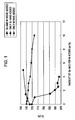
- Fig. 1 is a graph showing the relationship between the crystallization temperature (Tx) and the amount of the low temperature annealing-enabling element M and/or Ni added to the Fe-based amorphous magnetic alloy.
- Tx crystallization temperature
- the plot indicated by rhombic symbols is based on samples containing 6 at.% of Ni and Sn in an amount ranging from 1 to 4 at.%. That is, Sample Nos. 30, 1, 2, 3, 4, 7, and 8 in Table 1 are plotted in ascending order of the Sn content.
- the plot indicated by triangular symbols is based on samples containing no Sn but 0 to 10 at.% of Ni. That is, Samples Nos. 31 to 38 having compositions shown in Table 2 are plotted in the ascending order.
- Fig. 1 shows that the crystallization temperature (Tx) of Fe-based amorphous magnetic alloys containing only one of Sn and Ni do not decrease or do not significantly decrease. In contrast, the crystallization temperature (Tx) of Fe-based amorphous magnetic alloys containing both Sn and Ni decreases significantly. Thus, an Fe-based amorphous magnetic alloy containing the low temperature annealing-enabling element and Ni has a lower crystallization temperature (Tx), and the annealing temperature can be decreased.
- the amount of Sn added is preferably 1 at.% or more as understood from Fig. 1 and Table 1.
- the amount of Sn is preferably 1.5 at.% or more to further enhance the effect of decreasing the crystallization temperature (Tx). Since addition of more than 4 at.% of Sn promotes crystallization, the Sn content is preferably 4 at.% or less and more preferably 3.5 at.% or less to stably obtain amorphous alloys.
- Fig. 2 is a graph showing the relationship between the crystallization temperature (Tx) and the amounts of the low temperature annealing-enabling element M and Ni added to the Fe-based amorphous magnetic alloy.
- Tx crystallization temperature
- Samples containing 1.5 at.% of Sn and 2 to 6 at.% of Ni, samples containing 2.5 at.% of Sn and 2 to 6 at.% of Ni, and samples containing 3.5 at.% of Sn and 2 to 6 at.% of Ni in Table 3 were plotted.
- Sample No. 48 in Table 3 containing 5 at.% of Sn and no Ni was also plotted in Fig. 2.
- FIG. 3 is a graph showing the relationship between the melting temperature (Tm) and the amounts of the low temperature annealing-enabling element M and Ni in the Fe-based amorphous magnetic alloy.
- Tm melting temperature
- Tm melting temperature
- Tx crystallization temperature
- Tm melting temperature
- Fig. 2 shows that the Fe-based amorphous magnetic alloys of the present invention show a low crystallization temperature (Tx) when the amount of Sn, which is the low temperature annealing-enabling element, is 3.5 at.% and the amount of Ni is 4 at.% or more.
- Fig. 3 shows that the Fe-based amorphous magnetic alloys of the present invention show a low melting temperature (Tm) when 3.5 at.% of Sn, which is the low temperature annealing-enabling element, is contained. Since an amorphous state can be yielded within this content range, the amount of the low temperature annealing-enabling element is most preferably 3.5 at.% and the amount of Ni is most preferably 4 at.%.
- Spherical particles 1 ⁇ m to 100 ⁇ m in size were prepared by a water atomization technique from an alloy melt of Sample No. 16 in Table 1.
- the particles were classified so that the average particle size (D50) was 22 to 25 ⁇ m, and the resulting particles were flattened with a disintegrator such as an attritor to form flat Fe-based amorphous magnetic alloy particles.
- the glass transition temperature (Tg) and the crystallization temperature (Tx) of the Fe-based amorphous magnetic alloy were measured with DSC.
- the glass transition temperature (Tg) was not detected.
- the crystallization temperature (Tx) was 395°C (668 K).
- the resulting Fe-based amorphous magnetic alloy particles were mixed into a silicone resin such that the Fe-based amorphous magnetic alloy content in the mixture was 44 vol.%.
- the mixture was formed into noise suppression sheets (magnetic sheets) having a thickness of about 0.1 mm.
- the magnetic sheets were placed in an annealing furnace and annealed in a nitrogen atmosphere at an annealing temperature (Ta) of 300°C to 420°C (573 to 693 K).
- Ta annealing temperature
- the temperature profile was as follows: rate of temperature elevation: 10°C /min, retention time: 30 minutes.
- the magnetic sheets were then furnace-cooled. Thus, magnetic sheets of Examples were obtained.
- the magnetic sheets annealed at the above-described temperature were analyzed to determine the imaginary part ⁇ " of the complex permeability at 1 GHz and the fracture strain ⁇ f. The results are shown in Figs. 5 and 6 .
- the fracture strain ⁇ f was determined from the fracture limitation diameter Df determined using the fixture shown in Fig. 4 and Equation (1) above.
- the imaginary part ⁇ " of the complex permeability at 1 GHz was measured with an E4991A produced by Agilent.
- the imaginary part ⁇ " of the complex permeability of the magnetic sheets of Examples annealed at a temperature in the range of 300°C to 420°C (573 to 693 K) was 15 or more at 1 GHz, which was sufficient for practical application.
- ⁇ f was sufficient for practical application, i.e., 0.1 or more, at an annealing temperature of 400°C or less, and ⁇ f was at a desirable level, i.e., 0.2 or more, at an annealing temperature of 375°C (648 K) or less.
- Fig. 7A Flat alloy particles having a composition of No. 10 in Table 1 were mixed with a silicone resin to prepare material mixtures respectively containing 40 vol.%, 50 vol.%, 55 vol.%, and 60 vol.% of the particles. Each material mixture was formed into noise suppression sheets (magnetic sheets) having a thickness of about 0.1 mm. The resulting magnetic sheets were annealed at various temperatures as described above, and the imaginary part ⁇ " of the complex permeability at 1 GHz and the fracture strain ⁇ f of the magnetic sheets were determined as described above.
- the region A in Fig. 7A is a region where preferable magnetic property and flexibility are exhibited. As shown in Fig. 7A , the majority of the region B1 where the magnetic sheets having a composition of No. 10 lay overlapped the region A. In other words, the magnetic sheets of this Example exhibited excellent magnetic property (imaginary part ⁇ " of complex permeability) and excellent flexibility at an annealing temperature of 400°C (673 K) or lower.
- the Fe-based amorphous magnetic alloy particles were mixed with a silicone resin to prepare a mixture having a Fe-based amorphous magnetic alloy content of 44 vol.%, and the mixture was formed into sheets as in Example.
- These magnetic sheets (Comparative Example 1) annealed at temperatures described above were analyzed as in Example to determine the imaginary part ⁇ " of the complex permeability at 1 GHz and the fracture strain ⁇ f. The results are shown in Figs. 5 and 6 .
- the magnetic sheets of Comparative Example 1 annealed at 360°C (633 K) or less exhibited an imaginary part ⁇ " of complex permeability at 1 GHz of less than 15, which did not satisfy the practical level.
- the fracture strain ⁇ f was comparable to that of Examples, as shown in Fig. 6 .
- the Fe-based amorphous magnetic alloy particles were mixed into a silicone resin to prepare material mixtures containing 35 vol.%, 40 vol.%, 50 vol.%, 55 vol.%, and 60 vol.% of the alloy, respectively, and each material mixture was formed into sheets to prepare noise suppression sheets (magnetic sheets) having a thickness of about 0.1 mm.
- the magnetic sheets were annealed at various temperatures as described above, and the imaginary part ⁇ " of complex permeability at 1 GHz and the fracture strain ⁇ f of each magnetic sheet were determined as described above.
- the region B2 where the magnetic sheets of Sample No. 26 lay had no portion overlapping the region A where the magnetic property and the flexibility were desirable.
- the magnetic sheets of Sample No. 26 did not simultaneously achieve the desired magnetic property (imaginary part ⁇ " of complex permeability) and the flexibility at an annealing temperature of 400°C (673 K) or less.
- a magnetic alloy having a composition of No. 27 of Table 1 outside the range of the present invention was used to form flat Fe-based amorphous magnetic alloy particles.
- the Fe-based amorphous magnetic alloy particles were analyzed as in Example to determine the glass transition temperature (Tg) and the crystallization temperature (Tx).
- the glass transition temperature (Tg) was 511°C (784 K) and the crystallization temperature (Tx) was 561°C (834 K).
- the Fe-based amorphous magnetic alloy particles were mixed with a silicone resin to prepare a mixture having a Fe-based amorphous magnetic alloy content of 44 vol.%, and the mixture was formed into sheets.
- Each magnetic sheet of Comparative Example 2 annealed at the above-described temperature was analyzed as in Example to determine the imaginary part ⁇ " of complex permeability at 1 GHz and the fracture strain ⁇ f. The results are shown in Figs. 5 and 6 .
- the magnetic sheets of Comparative Example 2 annealed at a temperature of 380°C or less exhibited an imaginary part ⁇ " of complex permeability at 1 GHz of less than 15, which did not satisfy the practical level.
- the fracture strain ⁇ f was comparable to that of Example.
- the Fe-based amorphous magnetic alloy particles were mixed into a silicone resin to prepare material mixtures containing 35 vol.%, 40 vol.%, 50 vol.%, 55 vol.%, and 60 vol.% of the alloy, respectively, and each material mixture was formed into sheets to prepare noise suppression sheets (magnetic sheets) having a thickness of about 0.1 mm.
- the magnetic sheets were annealed at various temperatures as described above, and the imaginary part ⁇ " of complex permeability at 1 GHz and the fracture strain ⁇ f of each magnetic sheet were determined as described above.
- the region B3 where the magnetic sheet having a composition of No. 27 lay had no portion overlapping the region A where the magnetic property and the flexibility were desirable.
- the magnetic sheet having the composition of No. 27 did not simultaneously achieve the desirable magnetic property (imaginary part ⁇ " of complex permeability) and the desirable flexibility at an annealing temperature of 400°C or less.
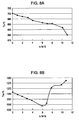
- the crystallization temperature (Tx) and the melting temperature (Tm) were measured while varying the Ni content x in the composition Fe 74.4-x Ni x Sn 1.5 Cr 4 P 10.8 C 6.3 B 2 Si 1 from 0 to 12 at.%. The results are shown in Table 4 and Figs. 8A and 8B . Note that the Fe-based amorphous magnetic alloy particles were prepared as in the experimental example above.
- the crystallization temperature (Tx) decreased with an increase in Ni content. It can be assumed that the annealing temperature can be decreased by increasing the Ni content. However, as shown in Fig. 8B , although the melting temperature (Tm) decreased by increasing the Ni content, it rapidly increased after the Ni content exceeded 7 at.%. This renders formation of amorphous phases difficult. Table 4 shows that the value of Tx/Tm becomes less than 0.55 at a Ni content of 8 at.% or more and is 0.53 at a Ni content of 11 at.% and that formation of amorphous phases become increasingly difficult with an increase in Ni content.
- the Ni content is preferably 1 at.% or more and 10 at.% or less to stably obtain an amorphous alloy, and more preferably 2 at.% or more and 7 at.% or less if lowering of the melting temperature is desired in addition.
- the crystallization temperature (Tx) and the melting temperature (Tm) were measured while varying the Cr content x in the composition Fe 74.4-x Cr x Sn 1.5 Ni 6 P 10.8 C 6.3 B 2 Si 1 from 0 to 12 at.%.
- the results are shown in Table 5 and Figs. 9A, 9B, and 9C . Note that the Fe-based amorphous magnetic alloy particles were prepared as in the experimental examples above.
- the melting temperature (Tm), the glass transition temperature (Tg), and the crystallization temperature (Tx) increased with the Cr content, thereby allowing the annealing temperature to also increase.
- the saturation magnetization ( ⁇ s) is lower.
- chromium is an additive essential for corrosion resistance in forming the Fe-based amorphous magnetic alloy particles by water atomization or the like. Chromium is also essential for preventing deterioration and changes over time of the sheet characteristics by corrosion of the alloy powder and the like.
- the Cr content is preferably 0 at.% or more and 8 at.% or less to increase the crystallization temperature (Tx).
- Tx crystallization temperature
- the Cr content must be 2 at.% or more. Since this decreases saturation magnetization ( ⁇ s), it is more preferable to limit the Cr content to 4 at% or less.
- the present invention is not limited by the embodiments and examples described above. Various modifications, alterations, and changes are possible without departing the range of the present invention. For example, the types and amounts of constituent components, the process of blending the materials, the process conditions, and the like may be varied within the range of the present invention.
Landscapes
- Chemical & Material Sciences (AREA)
- Engineering & Computer Science (AREA)
- Mechanical Engineering (AREA)
- Organic Chemistry (AREA)
- Metallurgy (AREA)
- Materials Engineering (AREA)
- Dispersion Chemistry (AREA)
- Power Engineering (AREA)
- Physics & Mathematics (AREA)
- Manufacturing & Machinery (AREA)
- Electromagnetism (AREA)
- Spectroscopy & Molecular Physics (AREA)
- Soft Magnetic Materials (AREA)
Abstract
Description
- This application claims benefit of
Japanese Patent Application No. 2006-338094 filed on December 15, 2006 Japanese Patent Application No. 2007-210306 filed on October 10, 2007 - The present invention relates to Fe-based amorphous magnetic alloys and magnetic sheets. In particular, it relates to an Fe-based amorphous magnetic alloy having a large imaginary part µ" of complex permeability for use in a highly flexible magnetic sheet and a magnetic sheet incorporating the Fe-based amorphous magnetic alloy.
- It is known that alloys based on TM-Al-Ga-P-C-B-Si (TM represents a transition metal element such as Fe, Co, or Ni) and the like form amorphous phases and become amorphous soft magnetic alloys by being quenched in a molten state. Techniques for fabricating magnetic materials with excellent magnetic properties are now being developed by optimizing the composition of the amorphous soft magnetic alloys. The present inventors have developed an Fe-based amorphous magnetic alloy that can be used as a magnetic material with excellent magnetic properties, in particular, a magnetic material having a large imaginary part µ" of complex permeability (refer to
Japanese Unexamined Patent Application Publication No. 2002-226956 - Portable electronic devices such as cellular phones and laptop computers are increasingly used. These portable electronic devices face problems of electromagnetic wave interference, and there is increasing need for measures for preventing generation of unwanted high-frequency electromagnetic waves. In order to suppress unwanted electromagnetic waves, attaching a magnetic sheet to an electronic device that generates unwanted electromagnetic waves is effective. This magnetic sheet is prepared by forming particles of several to several tens of micrometers in size from the above-described Fe-based amorphous magnetic alloy by a water atomization process or the like, flattening the particles, kneading the resulting particles with a matrix material (insulating resin) such as polyethylene chloride serving as a binder, and forming the resulting mixture into sheets of several tens to several hundred micrometers in thickness by a doctor blade technique. This magnetic sheet preferably has a complex permeability with a large imaginary part µ" in the operation frequency band.
- The imaginary part µ" of complex permeability of the Fe-based amorphous magnetic alloy can be increased by annealing. The problem associated with this is that when the glass transition temperature (Tg), the crystallization temperature (Tx), and the melting temperature (Tm) of the Fe-based amorphous magnetic alloy are high, the annealing temperature must be also high. Accordingly, when the Fe-based amorphous magnetic alloy is used in the magnetic sheet, the matrix material may become thermally decomposed and deteriorated, resulting in embrittlement of the magnetic sheet.
- The present invention provides an Fe-based amorphous magnetic alloy having relatively low glass transition temperature, crystallization temperature, and melting temperature such that the annealing temperature can be low, and a magnetic sheet having excellent flexibility even after annealing.
- An Fe-based amorphous magnetic alloy of the present invention contains 4 at.% or less of a low temperature annealing-enabling element M and 10 at.% or less of Ni. The total amount of the low temperature annealing-enabling element M and Ni is 2 at.% or more and 10 at.% or less.
- According to this composition, the Fe-based amorphous magnetic alloy exhibits relatively low glass transition temperature (Tg), crystallization temperature (Tx), and melting temperature (Tm) and excellent flexibility suitable for use in a magnetic sheet.
- The Fe-based amorphous magnetic alloy of the present invention preferably contains at least one selected from the group consisting of Sn, In, Zn, Ga, and Al as the low temperature annealing-enabling element M.
- More preferably, the Fe-based amorphous magnetic alloy contains 1 at.% or more and 4 at.% or less of the low temperature annealing-enabling element M and 1 at.% or more and 10 at. % or less Ni. According to this composition, an Fe-based amorphous magnetic alloy having amorphous structures can be more stably produced.
- The Fe-based amorphous magnetic alloy preferably has a composition represented by a compositional formula, Fe100-a-b-x -y-z-w-tMaNibCrxPyCzBwSit (0 < a ≤ 4 at.%, 0 < b ≤ 10 at.%, 0 ≤ x ≤ 4 at.%, 6 at. % ≤ y ≤ 13 at.%, 2 at.% ≤ z ≤ 12 at.%, 0 ≤ w ≤ 5 at.%, and 0 ≤ t ≤ 4 at.%).
- More preferably, in the compositional formula, 1 ≤ a ≤ 4 at.%, 1 ≤ b ≤ 10 at.%, 2 ≤ a + b ≤ 10 at.%, 1 ≤ x ≤ 8 at.%, 6 ≤ y ≤ 11 at.%, 6 ≤ z ≤ 11 at.%, 0 ≤ w ≤ 2 at.%, and 0 ≤ t ≤ 2 at.%. Yet more preferably, 1.5 ≤ a ≤ 3.5 at.%, 2 ≤ b ≤ 7 at.%, 3 ≤ a + b ≤ 9.5, and 2 ≤ x ≤ 4 at.%.
- A magnetic sheet of the present invention includes a matrix material and the Fe-based amorphous magnetic alloy described above, the Fe-based amorphous magnetic alloy being contained in the matrix material.
- In this manner, the magnetic sheet can have a large imaginary part µ" of complex permeability in the operation frequency band and excellent flexibility.
- Preferably, the magnetic sheet has been annealed at a temperature of 400°C or less.
-
-
Fig. 1 is a graph showing the relationship between the crystallization temperature (Tx) and the amount of the low temperature annealing-enabling element M and/or Ni added to the Fe-based amorphous magnetic alloy; -
Fig. 2 is a graph showing the relationship between the crystallization temperature (Tx) and the amounts of the low temperature annealing-enabling element M and Ni added to the Fe-based amorphous magnetic alloy; -
Fig. 3 is a graph showing the relationship between the melting temperature (Tm) and the amounts of the low temperature annealing-enabling element M and Ni added to the Fe-based amorphous magnetic alloy; -
Fig. 4 is a diagram showing a fixture used to measure the fracture strain of magnetic sheets; -
Fig. 5 is a characteristic diagram showing the relationship between the annealing temperature and the magnetic property; -
Fig. 6 is a characteristic diagram showing the relationship between the annealing temperature and the flexibility; -
Fig. 7A is a graph showing the relationship between the region where the magnetic property and the flexibility are at desired levels and the region covering the magnetic property and the flexibility of the magnetic sheets of Examples;Fig. 7B is a graph showing the relationship between the region where the magnetic property and the flexibility are at desired levels and the region covering the magnetic property and the flexibility of the magnetic sheets of Comparative Example 1; andFig. 7C is a graph showing the relationship between the region where the magnetic property and the flexibility are at desired levels and the region covering the magnetic property and the flexibility of the magnetic sheets of Comparative Example 2; -
Fig. 8A is a graph showing the dependency of the crystallization temperature (Tx) on the Ni content andFig. 8B is a graph showing the dependency of the melting temperature (Tm) on the Ni content; and -
Fig. 9A is a graph showing the dependency of the melting temperature (Tm) on the Cr content;Fig. 9B is a graph showing the dependency of the glass transition temperature (Tg) on the Cr content; andFig. 9C is a graph showing the dependency of the crystallization temperature (Tx) on the Cr content. - Embodiments of the present invention will now be described in detail with reference to attached drawings.
- The Fe-based amorphous magnetic alloy of the present invention contains 4 at.% or less of an element M that enables low-temperature annealing (also referred to as "low temperature annealing-enabling element M" hereinafter) and 10 at.% or less of Ni, where the total content of M and Ni is 2 at.% or more and 10 at.% or less. The low temperature annealing-enabling element M is an element that can decrease the glass transition temperature (Tg), the crystallization temperature (Tx), and the melting temperature (Tm) of the Fe-based amorphous magnetic alloy once it is used in combination with Ni.
- The low temperature annealing-enabling element M has a melting temperature lower than that of Fe. It is considered that incorporation of the low temperature annealing-enabling element M and Ni in the Fe-based alloy shifts the overall thermal profile toward the lower temperature side, and the Tg, Tx, and Tm become lower than those of existing Fe-based alloys. Examples of the low temperature annealing-enabling element M include Sn, In, Zn, Ga, and Al.
- The Fe-based amorphous magnetic alloy of the present invention is preferably represented by formula Fe100-a-b-x-y-z-w -tMaNibCrxPyCzBwSit (where 0 < a ≤ 4 at.%, 0 < b ≤ 10 at.%, 0 ≤ x ≤ 4 at.%, 6 at.%≤ y ≤ 13 at.%, 2 at.% ≤ z ≤ 12 at.%, 0 ≤ w ≤ 5 at.%, and 0 ≤ t ≤ 4 at.%).
- As described above, the low temperature annealing-enabling element M used in combination with Ni decreases the crystallization temperature (Tx) and the melting temperature (Tm); hence, the annealing temperature can be decreased. The amount a of the low temperature annealing-enabling element M is preferably 0 < a ≤ 4 at.% in the above formula from the point of view of yielding an amorphous state. The total content of the M and Ni is 2 at.% or more and 10 at.% or less, and more preferably 3 at.% or more and 9.5 at.% or less.
- Substitution of Fe by Ni decreases the glass transition temperature (Tg), the crystallization temperature (Tx), and the melting temperature (Tm). From the standpoint of achieving preferable saturation magnetization and melting temperature (Tm), the Ni content b is 0 < b ≤ 10 at.% and preferably 2 at.% ≤ b ≤ 7 at.% in the above-described formula.
- The Cr content x is preferably 0 ≤ x ≤ 8 at.% and more preferably 2 at.% ≤ x ≤ 4 at.% in the above formula from the standpoints of achieving preferable corrosion resistance, thermal stability, and saturation magnetization of the alloy. The corrosion resistance in salt water immersion is improved by adding 4 at.% of Cr. Since the amorphous phase can be stably produced and the magnetization intensity (σs) can be decreased by increasing the melting temperature (Tm), the Cr content is most preferably 4 at.%.
- The P content y is preferably 6 at.% ≤ y ≤ 13 at.% and more preferably 6 at.% ≤ y ≤ 11 at.% in the above formula from the viewpoint that the P content is preferably near the Fe-P-C (Fe79.4P10.8C9.8) eutectic composition.
- The C content z is preferably 2 at.% ≤ z ≤ 12 at.% and more preferably 6 at.% ≤ z ≤ 11 at.% in the above formula from the viewpoint that the C content is preferably near the Fe-P-C (Fe79.4P10.8C9.8) eutectic composition.
- The B content w is preferably 0 ≤ w ≤ 5 at.% and more preferably 0 ≤ w ≤ 2 at.% in the above formula since B increases the glass transition temperature (Tg), the crystallization temperature (Tx) and the melting temperature (Tm). In order to enhance the amorphous phase formation ability, the B content is most preferably 1 ≤ w ≤ 2 at.%.
- The Si content t is preferably 0 ≤ t ≤ 4 at.% and more preferably 0 ≤ t ≤ 2 at.% in the above formula since Si increases the glass transition temperature (Tg), the crystallization temperature (Tx) and the melting temperature (Tm). As with B, the Si content is most preferably 1 ≤ t ≤ 2 at.% to enhance amorphous phase formation ability.
- The Fe-based amorphous magnetic alloy can be used in a magnetic sheet. The magnetic sheet contains a matrix material and the Fe-based amorphous magnetic alloy in the matrix material.
- Examples of the matrix material include silicone resin, polyvinyl chloride, silicone rubber, phenolic resin, melamine resin, polyvinyl alcohol, polyethylene chloride, and various types of elastomers. In particular, since the Fe-based amorphous magnetic alloy is blended into the resin solution to prepare sheets, a resin capable of making an emulsion of the Fe-based amorphous magnetic alloy is preferable as the matrix material. An example of such a resin is silicone resin. Note that addition of a lubricant containing a stearate or the like to the matrix material facilitates formation of flat magnetic materials, and an Fe-based amorphous magnetic alloy having a high aspect ratio can be obtained in this manner. As a result, the particles of the Fe-based amorphous magnetic alloy in the magnetic sheet stack in the sheet thickness direction and easily become oriented. The density is also increased. Accordingly, the imaginary part µ" of the complex permeability increases, and the noise suppression characteristics can be improved.
- The Fe-based amorphous magnetic alloy used in the magnetic sheet is preferably in the form of flat particles or powder. Powder or particles having an average aspect ratio (major axis/thickness) of 2.5 or more and preferably 12 or more are preferred as such flat particles or powder from the standpoint of achieving desirable degree of orientation and noise suppression characteristics. When the flat powder or particles have a higher degree of orientation, the density of the magnetic sheet and the imaginary part µ" of the complex permeability can be increased, and thus the noise suppression characteristics can be improved. A high aspect ratio suppresses generation of eddy current, resulting in an increased inductance, and increases the imaginary part µ" of the complex permeability in the GHz band. From the standpoint of sheet production, the average aspect ratio is 80 or less and preferably 60 or less since sheet formation becomes difficult at an excessively large aspect ratio.
- The magnetic sheet is produced as follows. First, a melt of the Fe-based amorphous magnetic alloy is sprayed into water and quenched to produce alloy particles (water atomization technique). Note that the technique for making the Fe-based amorphous magnetic alloy particles is not limited to this water atomization technique, and various other techniques such as a gas atomization technique, a liquid quenching technique in which ribbons of quenched alloy melt are pulverized to form alloy powder, and the like may be employed. Processing conditions for the water atomization technique, the gas atomization technique, and the liquid quenching technique may be typical conditions selected according to the types of raw materials.
- After the resulting Fe-based amorphous magnetic alloy particles are classified to make the particle size uniform, the alloy particles are flattened with an attritor or the like as needed. The attritor includes a drum containing many balls used for disintegration and can process the Fe-based amorphous magnetic alloy particles to have a target flatness by mixing and agitating the Fe-based amorphous magnetic alloy powder with the balls. The flat particles of Fe-based amorphous magnetic alloy can also be obtained by the liquid quenching technique described above. The resulting Fe-based amorphous magnetic alloy particles may be heated to reduce the internal stress, if necessary.
- Next, a magnetic sheet containing the Fe-based amorphous magnetic alloy is made. In making the magnetic sheet, it is preferable to first prepare a liquid mixture containing a liquid matrix material of the magnetic sheet and the Fe-based amorphous magnetic alloy and then form the liquid mixture into sheets. The resulting magnetic sheet is then annealed.
- The experiments conducted to confirm the effects of the present invention will now be described.
- Spherical particles 1 µm to 100 µm in size were prepared by the water atomization technique by using FePC as the base material and by adding M, Ni, Cr, B, Si, and/or other suitable elements to the base material. The particles were classified so that the average particle size (D50) was 22 to 25 µm, and the resulting particles were flattened with a disintegrator such as an attritor to form flat Fe-based amorphous magnetic alloy particles. The glass transition temperature (Tg), the crystallization temperature (Tx), and the melting temperature (Tm) of the particles were measured with a differential scanning calorimeter (DSC). The saturation magnetization (σs) was determined with a vibrating sample magnetometer (VSM).
- The resulting Fe-based amorphous magnetic alloy particles were mixed with a silicone resin to prepare a mixture having an Fe-based amorphous magnetic alloy content of 44 vol.%. The mixture was formed into noise suppression sheets (magnetic sheets) having a thickness of about 0.1 mm. The magnetic sheets were placed in an annealing furnace and annealed in an nitrogen atmosphere at an annealing temperature (Ta) of 300°C to 420°C (a temperature that can sufficiently increase the imaginary part (µ") of the complex permeability or the fracture strain (λf)). The temperature profile was as follows: rate of temperature elevation: 10°C /min, retention time: 30 minutes. The magnetic sheets were then furnace-cooled. The imaginary part (µ") of the complex permeability at 1 GHz of the resulting magnetic sheets was measured with an E4991A produced by Agilent. The fracture strain λf was measured by the process described below.
- As previously mentioned, the imaginary part µ" of the complex permeability of the Fe-based amorphous magnetic alloy of the present invention can be increased by annealing. At an excessively high annealing temperature, the magnetic sheet prepared from the Fe-based amorphous magnetic alloy undergoes embrittlement. Embrittlement of the magnetic sheet can be evaluated in terms of flexibility based on fracture strain λf.
-
Fig. 4 shows a fixture for measuring the fracture strain λf. In measuring the fracture strain λf, amagnetic sheet 12 is bent and held between a pair ofparallel blocks 11, and the distance D between theparallel blocks 11 is decreased in the direction of arrows. The bending diameter at which a crack occurs in abent region 12a of themagnetic sheet 12 is assumed to be the fracture limitation diameter Df. The fracture strain λf is then determined from Equation (1) below:
where Df is the fracture limit diameter and t is the thickness of themagnetic sheet 12. - The magnetic sheet in a completely bent state (the state in which the magnetic sheet is folded in two without cracks) has Df of 2t and the maximum value of λf is 1. The flexibility of the magnetic sheet is rated on the basis of λf. The closer λf to 1, the higher the flexibility of the magnetic sheet. For practical application, λf must be at least 0.1 to facilitate handling, and λf is preferably 0.2 or more. For example, in order for a magnetic sheet having a thickness of 0.1 mm to satisfy λf > 0.1, the temperature of annealing the magnetic sheet is preferably 400°C or less.
- Annealing the magnetic sheet causes structural relaxation in the Fe-based amorphous magnetic alloy and releases the strain generated during sheet formation. In this manner, the imaginary part µ" of the complex permeability increases in the operation frequency band, and superior noise suppression effects can be achieved. For practical application, the imaginary part µ" of the complex permeability is preferably 15 or more at 1 GHz.
- The results are shown in Table 1. In the table, samples noted as "Ex." are within the range of the embodiments of the present invention and samples noted as "Co." are outside the range of the embodiments of the present invention. In the present invention, the melting temperature (Tm) is preferably as low as possible to reduce the annealing temperature. In the table, the compositions that meet this requirement are given.
Table 1 No. Composition Structure Tg/K Tx/K ΔTx/K Tm/K Tg/Tm Tx/Tm σs (×10-6 Wbm/kg µ" (1 GHz) λf 1 Fe68.9Sn1Ni6Cr4P9.8C7.3B2Si1 Amorphous - 716 - 1286 - 0.56 164 18.5 0.23 Ex. 2 Fe68.4Sn1.5Ni6Cr4P9.8C7.3B2Si1 Amorphous - 689 - 1281 - 0.54 160 21.5 0.24 Ex. 3 Fe67.9Sn2Ni6Cr4P9.8C7.3B2Si1 Amorphous - 681 - 1289 - 0.53 152 22.3 0.25 Ex. 4 Fe67.4Sn2.5Ni6Cr4P9.8C7.3B2Si1 Amorphous - 675 - 1282 - 0.53 150 19.5 0.25 Ex. 5 Fe67.4In2.5Ni6Cr4P9.8C7.3B2Si1 Amorphous - 670 - 1275 - 0.53 148 22.7 0.30 Ex. 6 Fe67.4Zn2.5Ni6Cr4P9.8C7.3B2Si1 Amorphous - 680 - 1288 - 0.53 150 23.0 0.29 Ex. 7 Fe66.9Sn3Ni6Cr4P9.8C7.3B2Si1 Amorphous - 676 - 1261 - 0.54 143 19.2 0.29 Ex. 8 Fe65.9Sn4Ni6Cr4P9.8C7.3B2Si1 Amorphous - 672 - 1259 - 0.53 138 24.0 0.35 Ex. 9 Fe74.9Sn1.5Ni3P10.8C8.8B1 Amorphous 685 713 28 1223 0.56 0.58 190 18.5 0.21 Ex. 10 Fe70.4Sn1.5Ni3Cr4P10.8C8.8B1 Amorphous 659 704 45 1263 0.52 0.56 153 19.0 0.25 Ex. 11 Fe66.9Sn3Ni6Cr4P9.8C7.3B2Si1 Amorphous - 676 - 1261 - 0.54 143 21.5 0.27 Ex. 12 Fe71.4Sn2Ni3Cr3P10.8C8.8B1 Amorphous 655 694 39 1276 0.51 0.54 160 22.0 0.50 Ex. 13 Fe67.9Sn3.5Ni4Cr4P10.8C9.8 Amorphous - 662 - 1256 - 0.53 141 22.5 0.32 Ex. 14 Fe65.9Sn3.5Ni6Cr4P10.8C9.8 Amorphous - 662 - 1255 - 0.53 137 24.0 0.35 Ex. 15 Fe67.9Sn3.5Ni4Cr4P8.8C9.8Si2 Amorphous - 675 - 1225 - 0.55 143 23.0 0.30 Ex. 16 Fe67.9Sn3.5Ni4Cr4P8.8C10.8B1 Amorphous - 668 - 1231 - 0.54 137 18.1 0.22 Ex. 17 Fe72.4Sn2Ni5P10.8C2.2B4.2Si3.4 Amorphous - 706 - 1278 - 0.55 186 18.5 0.24 Ex. 18 Fe79.4P10.8C9.8 Amorphous 681 711 30 1241 0.55 0.57 199 14.5 0.20 Co. 19 Fe64.9Sn5Ni6Cr4P9.8C7.3B2Si1 Partly crystalline - - - - - - 130 10.5 0.20 Co. 20 Fe70.9Sn5Cr4P9.8C7.3B2Si1 Amorphous 716 748 32 1265 0.57 0.59 152 14.8 0.20 Co. 21 Fe75.9Cr4P9.3C6.8B2Si1 Amorphous 672 724 52 1266 0.53 0.57 178 16.0 0.18 Co. 22 Fe75.4Sn1.5Cr4P9.3C6.8B2Si1 Amorphous 706 731 25 1271 0.56 0.58 163 14.5 0.18 Co. 23 Fe71.9Sn5Cr4P9.3C6.8B2Si1 Amorphous 707 735 26 1273 0.56 0.58 157 15.2 0.20 Co. 24 Fe75.4Sn2Cr2P10.8C6.4Si3.4 Amorphous 724 755 31 1273 0.58 0.61 177 16.0 0.21 Co. 25 Fe73.4Ni5P10.8C2.2B5.2Si3.4 Amorphous 729 767 40 1292 0.56 0.59 200 14.9 0.21 Co. 26 Fe76.4Cr2P10.8C2.2B4.2Si4.4 Amorphous 745 776 31 1308 0.57 0.59 182 14.9 0.20 Co. 27 Fe74.43Cr1.96P9.04C2.16B7.54Si4.87 Amorphous 784 834 50 1294 0.61 0.64 180 14.0 0.20 Co. 28 Fe66.9Sn5Ni4Cr4P9.8C7.3B2Si1 Partly crystalline - - - - - - 9 8.5 0.18 Co. 29 Fe68.9Sn5Ni2Cr4P9.8C7.3B2Si1 Partly crystalline - - - - - - 11 11.3 0.20 Co. 30 Fe69.9Ni6Cr4P9.8C7.3B2Si1 Amorphous 697 721 24 1292 0.54 0.56 163 18.8 0.18 Co. - In Table 1, Sample Nos. 18 to 30 are comparative examples in which the crystallization temperature (Tx) exceeds 720 K, the imaginary part (µ") of the complex permeability is less than 15, or the fracture strain λf is less than 0.2. In contrast, Sample Nos. 1 to 17 all satisfy the required characteristics described above. In particular, the annealing temperature can be decreased to 400°C (673 K) or lower if the crystallization temperature (Tx) is 720 K or less. Sample Nos. 2, 3, 5, 6, 8, and 15 exhibited µ" exceeding 20, and their magnetic properties are also satisfactory. Sample No. 12 has λf reaching 0.5, and an imaginary part (µ") of the complex permeability exceeding 20. Sample No. 12 has superior characteristics.
- In the table, the samples having the glass transition temperature (Tg) column unfilled are samples that do not have any glass transition temperature. Although a material having a glass transition temperature (Tg) forms an alloy that can easily form amorphous phases, the glass transition temperature (Tg) and the crystallization temperature (Tx) tend to be high, and this requires higher annealing temperature. This tendency is obvious from the results of Table 1.
-
Fig. 1 is a graph showing the relationship between the crystallization temperature (Tx) and the amount of the low temperature annealing-enabling element M and/or Ni added to the Fe-based amorphous magnetic alloy. In the graph, the plot indicated by rhombic symbols is based on samples containing 6 at.% of Ni and Sn in an amount ranging from 1 to 4 at.%. That is, Sample Nos. 30, 1, 2, 3, 4, 7, and 8 in Table 1 are plotted in ascending order of the Sn content. The plot indicated by triangular symbols is based on samples containing no Sn but 0 to 10 at.% of Ni. That is, Samples Nos. 31 to 38 having compositions shown in Table 2 are plotted in the ascending order. - In the graph, the profile indicated by square symbols is based on samples not containing Ni but 0 to 5 at.% of Sn. That is, Sample Nos. 21, 22, and 23 in Table 1 are plotted in the ascending order of the Sn content.
Table 2 No. Composition Tg/K Tx/K ΔTx/K Tm/K Tg/Tm Tx/Tm Structure 31 Fe75.9Cr4P10.8C6.3B2Si1 713.00 731 18 1266 0.563191153 0.58 Amorphous 32 Fe74.9Ni1Cr4P10.8C6.3B2Si1 713.00 729 16 1264 0.564082278 0.58 Amorphous 33 Fe73.9Ni2Cr4Pi10.8C6.3B2Si1 709.00 728 19 1262 0.561806656 0.58 Amorphous 34 Fe72.9Ni3Cr4P10.8C6.3B2Si1 706.00 727 21 1260 0.56031746 0.58 Amorphous 35 Fe71.9Ni4Cr4P10.8C6.3B2Si1 700.00 724 24 1258 0.556438792 0.58 Amorphous 36 Fe69.9Ni6Cr4P10.8C6.3B2Si1 697.00 722 25 1253 0.556264964 0.58 Amorphous 37 Fe67.9Ni8Cr4P10.8C6.3B2Si1 694.00 721 27 1270 0.546456693 0.57 Amorphous 38 Fe65.9Ni10Cr4P10.8C6.3B2Si1 689.00 717 28 1273 0.541241163 0.56 Amorphous -
Fig. 1 shows that the crystallization temperature (Tx) of Fe-based amorphous magnetic alloys containing only one of Sn and Ni do not decrease or do not significantly decrease. In contrast, the crystallization temperature (Tx) of Fe-based amorphous magnetic alloys containing both Sn and Ni decreases significantly. Thus, an Fe-based amorphous magnetic alloy containing the low temperature annealing-enabling element and Ni has a lower crystallization temperature (Tx), and the annealing temperature can be decreased. The amount of Sn added is preferably 1 at.% or more as understood fromFig. 1 and Table 1. The amount of Sn is preferably 1.5 at.% or more to further enhance the effect of decreasing the crystallization temperature (Tx). Since addition of more than 4 at.% of Sn promotes crystallization, the Sn content is preferably 4 at.% or less and more preferably 3.5 at.% or less to stably obtain amorphous alloys. - The optimum amounts of the low temperature annealing-enabling element and Ni in the Fe-based amorphous magnetic alloy will now be described.
Fig. 2 is a graph showing the relationship between the crystallization temperature (Tx) and the amounts of the low temperature annealing-enabling element M and Ni added to the Fe-based amorphous magnetic alloy. Samples containing 1.5 at.% of Sn and 2 to 6 at.% of Ni, samples containing 2.5 at.% of Sn and 2 to 6 at.% of Ni, and samples containing 3.5 at.% of Sn and 2 to 6 at.% of Ni in Table 3 were plotted. Sample No. 48 in Table 3 containing 5 at.% of Sn and no Ni was also plotted inFig. 2. Fig. 3 is a graph showing the relationship between the melting temperature (Tm) and the amounts of the low temperature annealing-enabling element M and Ni in the Fe-based amorphous magnetic alloy. The graph inFig. 3 was plotted using the same samples as in the graph inFig. 2 but with respect to melting temperature (Tm). The crystallization temperature (Tx) and the melting temperature (Tm) were determined as described above.Table 3 No. Composition Sn content Ni content Structure Tg/K Tx/K ΔTx/K Tm Tg/Tm Tx/Tm 39 Fe71.9Sn1.5Ni2Cr4P10.8C9.8 1.5 2 Amorphous 683 720 37 1271 0.54 0.556 40 Fe69.9Sn1.5Ni4Cr4P10.8C9.8 1.5 4 Amorphous - 695 - 1277 - 0.541 41 Fe67.9Sn1.5Ni6Cr4P10.8C9.8 1.5 6 Amorphous - 685 - 1276 - 0.549 42 Fe70.9Sn2.5Ni2Cr4P10.8C9.8 2.5 2 Amorphous - 691 - 1265 - 0.546 43 Fe68.9Sn2.5Ni4Cr4P10.8C9.8 2.5 4 Amorphous - 676 - 1268 - 0.533 44 Fe66.9Sn2.5Ni6Cr4P10.8C9.8 2.5 6 Amorphous - 670 - 1270 - 0.528 45 Fe69.9Sn3.5Ni2Cr4P10.8C9.8 3.5 2 Amorphous - 680 - 1257 - 0.541 46 Fe67.9Sn3.5Ni4Cr4P10.8C9.8 3.5 4 Amorphous - 662 - 1256 - 0.527 47 Fe65.9Sn3.5Ni6Cr4P10.8C9.8 3.5 6 Amorphous - 662 - 1255 - 0.527 48 Fe70.9Sn5Cr4P9.8C7.3B2Si1 5 0 Amorphous 716 748 32 1265 0.57 0.591 -
Fig. 2 shows that the Fe-based amorphous magnetic alloys of the present invention show a low crystallization temperature (Tx) when the amount of Sn, which is the low temperature annealing-enabling element, is 3.5 at.% and the amount of Ni is 4 at.% or more.Fig. 3 shows that the Fe-based amorphous magnetic alloys of the present invention show a low melting temperature (Tm) when 3.5 at.% of Sn, which is the low temperature annealing-enabling element, is contained. Since an amorphous state can be yielded within this content range, the amount of the low temperature annealing-enabling element is most preferably 3.5 at.% and the amount of Ni is most preferably 4 at.%. - Spherical particles 1 µm to 100 µm in size were prepared by a water atomization technique from an alloy melt of Sample No. 16 in Table 1. The particles were classified so that the average particle size (D50) was 22 to 25 µm, and the resulting particles were flattened with a disintegrator such as an attritor to form flat Fe-based amorphous magnetic alloy particles. The glass transition temperature (Tg) and the crystallization temperature (Tx) of the Fe-based amorphous magnetic alloy were measured with DSC. The glass transition temperature (Tg) was not detected. The crystallization temperature (Tx) was 395°C (668 K).
- The resulting Fe-based amorphous magnetic alloy particles were mixed into a silicone resin such that the Fe-based amorphous magnetic alloy content in the mixture was 44 vol.%. The mixture was formed into noise suppression sheets (magnetic sheets) having a thickness of about 0.1 mm. The magnetic sheets were placed in an annealing furnace and annealed in a nitrogen atmosphere at an annealing temperature (Ta) of 300°C to 420°C (573 to 693 K). The temperature profile was as follows: rate of temperature elevation: 10°C /min, retention time: 30 minutes. The magnetic sheets were then furnace-cooled. Thus, magnetic sheets of Examples were obtained.
- The magnetic sheets annealed at the above-described temperature were analyzed to determine the imaginary part µ" of the complex permeability at 1 GHz and the fracture strain λf. The results are shown in
Figs. 5 and6 . The fracture strain λf was determined from the fracture limitation diameter Df determined using the fixture shown inFig. 4 and Equation (1) above. The imaginary part µ" of the complex permeability at 1 GHz was measured with an E4991A produced by Agilent. - As shown in
Fig. 5 , the imaginary part µ" of the complex permeability of the magnetic sheets of Examples annealed at a temperature in the range of 300°C to 420°C (573 to 693 K) was 15 or more at 1 GHz, which was sufficient for practical application. As shown inFig. 6 , λf was sufficient for practical application, i.e., 0.1 or more, at an annealing temperature of 400°C or less, and λf was at a desirable level, i.e., 0.2 or more, at an annealing temperature of 375°C (648 K) or less. - The relationship between the magnetic property and the flexibility was examined to demonstrate whether both magnetic property and the flexibility were at preferable levels at an annealing temperature of 300°C to 400°C (573 to 673 K). The results are shown in
Fig. 7A . Flat alloy particles having a composition of No. 10 in Table 1 were mixed with a silicone resin to prepare material mixtures respectively containing 40 vol.%, 50 vol.%, 55 vol.%, and 60 vol.% of the particles. Each material mixture was formed into noise suppression sheets (magnetic sheets) having a thickness of about 0.1 mm. The resulting magnetic sheets were annealed at various temperatures as described above, and the imaginary part µ" of the complex permeability at 1 GHz and the fracture strain λf of the magnetic sheets were determined as described above. - The region A in
Fig. 7A is a region where preferable magnetic property and flexibility are exhibited. As shown inFig. 7A , the majority of the region B1 where the magnetic sheets having a composition of No. 10 lay overlapped the region A. In other words, the magnetic sheets of this Example exhibited excellent magnetic property (imaginary part µ" of complex permeability) and excellent flexibility at an annealing temperature of 400°C (673 K) or lower. - Flat alloy particles were prepared as in Example but from a magnetic alloy having a composition of No. 26 of Table 1 outside the range of the present invention. The glass transition temperature (Tg) and the crystallization temperature (Tx) of the resulting Fe-based amorphous magnetic alloy particles were examined as in Example. The glass transition temperature was 472°C (745 K), and the crystallization temperature (Tx) was 503°C (776 K).
- The Fe-based amorphous magnetic alloy particles were mixed with a silicone resin to prepare a mixture having a Fe-based amorphous magnetic alloy content of 44 vol.%, and the mixture was formed into sheets as in Example. The sheets were annealed at Ta = 300°C to 420°C (573 to 693 K) to obtain magnetic sheets of Sample No. 26. These magnetic sheets (Comparative Example 1) annealed at temperatures described above were analyzed as in Example to determine the imaginary part µ" of the complex permeability at 1 GHz and the fracture strain λf. The results are shown in
Figs. 5 and6 . - As shown in
Fig. 5 , the magnetic sheets of Comparative Example 1 annealed at 360°C (633 K) or less exhibited an imaginary part µ" of complex permeability at 1 GHz of less than 15, which did not satisfy the practical level. The fracture strain λf was comparable to that of Examples, as shown inFig. 6 . - To investigate whether both the magnetic property and the flexibility were excellent, the relationship between the magnetic property and the flexibility of magnetic sheets annealed at 300°C to 400°C (573 to 673 K) was determined. The results are shown in
Fig. 7B . The Fe-based amorphous magnetic alloy particles were mixed into a silicone resin to prepare material mixtures containing 35 vol.%, 40 vol.%, 50 vol.%, 55 vol.%, and 60 vol.% of the alloy, respectively, and each material mixture was formed into sheets to prepare noise suppression sheets (magnetic sheets) having a thickness of about 0.1 mm. The magnetic sheets were annealed at various temperatures as described above, and the imaginary part µ" of complex permeability at 1 GHz and the fracture strain λf of each magnetic sheet were determined as described above. - As shown in
Fig. 7B , the region B2 where the magnetic sheets of Sample No. 26 lay had no portion overlapping the region A where the magnetic property and the flexibility were desirable. In other words, the magnetic sheets of Sample No. 26 did not simultaneously achieve the desired magnetic property (imaginary part µ" of complex permeability) and the flexibility at an annealing temperature of 400°C (673 K) or less. - A magnetic alloy having a composition of No. 27 of Table 1 outside the range of the present invention was used to form flat Fe-based amorphous magnetic alloy particles. The Fe-based amorphous magnetic alloy particles were analyzed as in Example to determine the glass transition temperature (Tg) and the crystallization temperature (Tx). The glass transition temperature (Tg) was 511°C (784 K) and the crystallization temperature (Tx) was 561°C (834 K).
- The Fe-based amorphous magnetic alloy particles were mixed with a silicone resin to prepare a mixture having a Fe-based amorphous magnetic alloy content of 44 vol.%, and the mixture was formed into sheets. The sheets were annealed at Ta = 300°C to 420°C (573 to 693 K) to prepare magnetic sheets of Comparative Example 2. Each magnetic sheet of Comparative Example 2 annealed at the above-described temperature was analyzed as in Example to determine the imaginary part µ" of complex permeability at 1 GHz and the fracture strain λf. The results are shown in
Figs. 5 and6 . - As shown in
Fig. 5 , the magnetic sheets of Comparative Example 2 annealed at a temperature of 380°C or less exhibited an imaginary part µ" of complex permeability at 1 GHz of less than 15, which did not satisfy the practical level. As shown inFig. 6 , the fracture strain λf was comparable to that of Example. - To investigate whether both the magnetic property and the flexibility were excellent, the relationship between the magnetic property and the flexibility of magnetic sheets annealed at 300°C to 400°C (573 to 673 K) was determined. The results are shown in
Fig. 7C . The Fe-based amorphous magnetic alloy particles were mixed into a silicone resin to prepare material mixtures containing 35 vol.%, 40 vol.%, 50 vol.%, 55 vol.%, and 60 vol.% of the alloy, respectively, and each material mixture was formed into sheets to prepare noise suppression sheets (magnetic sheets) having a thickness of about 0.1 mm. The magnetic sheets were annealed at various temperatures as described above, and the imaginary part µ" of complex permeability at 1 GHz and the fracture strain λf of each magnetic sheet were determined as described above. - As shown in
Fig. 7C , the region B3 where the magnetic sheet having a composition of No. 27 lay had no portion overlapping the region A where the magnetic property and the flexibility were desirable. In other words, the magnetic sheet having the composition of No. 27 did not simultaneously achieve the desirable magnetic property (imaginary part µ" of complex permeability) and the desirable flexibility at an annealing temperature of 400°C or less. - The crystallization temperature (Tx) and the melting temperature (Tm) were measured while varying the Ni content x in the composition Fe74.4-xNixSn1.5Cr4P10.8C6.3B2Si1 from 0 to 12 at.%. The results are shown in Table 4 and
Figs. 8A and 8B . Note that the Fe-based amorphous magnetic alloy particles were prepared as in the experimental example above. - As shown in
Fig. 8A , the crystallization temperature (Tx) decreased with an increase in Ni content. It can be assumed that the annealing temperature can be decreased by increasing the Ni content. However, as shown inFig. 8B , although the melting temperature (Tm) decreased by increasing the Ni content, it rapidly increased after the Ni content exceeded 7 at.%. This renders formation of amorphous phases difficult. Table 4 shows that the value of Tx/Tm becomes less than 0.55 at a Ni content of 8 at.% or more and is 0.53 at a Ni content of 11 at.% and that formation of amorphous phases become increasingly difficult with an increase in Ni content.Table 4 Fe74.4-xNixSn1.5Cr4P10.8C6.3B2Si1 x Tc/K Tx/K Tm/K Tx/Tm σ s(wbm/kg) × 10-6 0 498 701 1266 0.55 169 1 502 699 1264 0.55 166 2 506 698 1262 0.55 168 3 511 697 1260 0.55 168 4 514 694 1258 0.55 166 6 520 692 1253 0.55 166 7 520 691 1255 0.55 163 8 521 691 1270 0.54 158 10 525 687 1273 0.54 157 11 530 680 1277 0.53 156 - The above results demonstrate that the Ni content is preferably 1 at.% or more and 10 at.% or less to stably obtain an amorphous alloy, and more preferably 2 at.% or more and 7 at.% or less if lowering of the melting temperature is desired in addition.
- The crystallization temperature (Tx) and the melting temperature (Tm) were measured while varying the Cr content x in the composition Fe74.4-xCrxSn1.5Ni6P10.8C6.3B2Si1 from 0 to 12 at.%. The results are shown in Table 5 and
Figs. 9A, 9B, and 9C . Note that the Fe-based amorphous magnetic alloy particles were prepared as in the experimental examples above.Table 5 Fe74.4-xCrxSn1.5NioP10.8C6.3B2Si1 x Tc/°C Tg/°C Tx/°C Δ Tx/°C Tm/°C Tg/Tm Tx/Tm σ s/10-6 0 607 422 438 16 967 0.56 0.57 200 1 314 422 441 19 966 0.56 0.58 188 2 292 422 443 21 970 0.56 0.58 177 3 268 424 446 22 976 0.56 0.58 169 4 247 424 449 25 980 0.56 0.58 166 6 213 424 452 28 988 0.55 0.57 144 8 202 428 456 28 998 0.55 0.57 124 10 158 433 467 34 1006 0.55 0.58 97 12 133 435 469 34 1017 0.55 0.58 80 - As shown in
Figs. 9A, 9B, and 9C , the melting temperature (Tm), the glass transition temperature (Tg), and the crystallization temperature (Tx) increased with the Cr content, thereby allowing the annealing temperature to also increase. As shown in Table 4, the saturation magnetization (σs) is lower. On the other hand, chromium is an additive essential for corrosion resistance in forming the Fe-based amorphous magnetic alloy particles by water atomization or the like. Chromium is also essential for preventing deterioration and changes over time of the sheet characteristics by corrosion of the alloy powder and the like. - Thus, the Cr content is preferably 0 at.% or more and 8 at.% or less to increase the crystallization temperature (Tx). When corrosion resistance is necessary, such as when water atomization is employed, the Cr content must be 2 at.% or more. Since this decreases saturation magnetization (σs), it is more preferable to limit the Cr content to 4 at% or less.
- The present invention is not limited by the embodiments and examples described above. Various modifications, alterations, and changes are possible without departing the range of the present invention. For example, the types and amounts of constituent components, the process of blending the materials, the process conditions, and the like may be varied within the range of the present invention.
Claims (8)
- An Fe-based amorphous magnetic alloy comprising:4 at.% or less of a low temperature annealing-enabling element M; and10 at.% or less of Ni,wherein the total amount of the low temperature annealing-enabling element M and Ni is 2 at.% or more and 10 at.% or less.
- The Fe-based amorphous magnetic alloy according to claim 1, wherein the low temperature annealing-enabling element M is at least one selected from the group consisting of Sn, In, Zn, Ga, and Al.
- The Fe-based amorphous magnetic alloy according to claim 1 or 2, wherein the low temperature annealing-enabling element M is contained in an amount of 1 at.% or more and 4 at.% or less and Ni is contained in an amount of 1 at.% or more and 10 at.% or less.
- The Fe-based amorphous magnetic alloy according to any of claims 1 to 3, wherein the Fe-based amorphous magnetic alloy has a composition represented by a compositional formula, Fe100-a-b-x -y-z-w-tMaNibCrxPyCzBwSit (0 < a ≤ 4 at.%, 0 < b ≤ 10 at.%, 0 ≤ x ≤ 8 at.%, 6 at. % ≤ y ≤ 13 at.%, 2 at.% ≤ z ≤ 12 at.%, 0 ≤ w ≤ 5 at.%, and 0 ≤ t ≤ 4 at.%).
- The Fe-based amorphous magnetic alloy according to claim 4, wherein, in the compositional formula, 1 ≤ a ≤ 4 at.%, 1 ≤ b ≤ 10 at.%, 2 ≤ a + b ≤ 10 at.%, 1 ≤ x ≤ 8 at.%, 6 ≤ y ≤ 11 at.%, 6 ≤ z ≤ 11 at.%, 0 ≤ w ≤ 2 at.%, and 0 ≤ t ≤ 2 at.%
- The Fe-based amorphous magnetic alloy according to damn 4 or 5, wherein, in the compositional formula, 1.5 ≤ a ≤ 3.5 at.%, 2 ≤ b ≤ 7 at.%, 3 ≤ a + b ≤ 9.5, and 2 ≤ x ≤ 4 at.%.
- A magnetic sheet comprising:a matrix material; andthe Fe-based amorphous magnetic alloy according to any of claims 1 to 6, the Fe-based amorphous magnetic alloy being contained in the matrix material.
- The magnetic sheet according to claim 7, wherein the magnetic sheet has been annealed at a temperature of 400°C or less.
Applications Claiming Priority (2)
| Application Number | Priority Date | Filing Date | Title |
|---|---|---|---|
| JP2006338094 | 2006-12-15 | ||
| JP2007210306A JP5188760B2 (en) | 2006-12-15 | 2007-08-10 | Fe-based amorphous magnetic alloy and magnetic sheet |
Publications (3)
| Publication Number | Publication Date |
|---|---|
| EP1933337A1 true EP1933337A1 (en) | 2008-06-18 |
| EP1933337B1 EP1933337B1 (en) | 2010-07-28 |
| EP1933337B8 EP1933337B8 (en) | 2010-09-01 |
Family
ID=39301476
Family Applications (1)
| Application Number | Title | Priority Date | Filing Date |
|---|---|---|---|
| EP07024110A Active EP1933337B8 (en) | 2006-12-15 | 2007-12-12 | Fe-based amorphous magnetic alloy and magnetic sheet |
Country Status (2)
| Country | Link |
|---|---|
| US (1) | US8147622B2 (en) |
| EP (1) | EP1933337B8 (en) |
Cited By (2)
| Publication number | Priority date | Publication date | Assignee | Title |
|---|---|---|---|---|
| US20140097922A1 (en) * | 2009-08-07 | 2014-04-10 | Alps Green Devices Co., Ltd. | Fe-BASED AMORPHOUS ALLOY, POWDER CORE USING THE SAME, AND COIL ENCAPSULATED POWDER CORE |
| CN115786653A (en) * | 2022-11-28 | 2023-03-14 | 中国科学院宁波材料技术与工程研究所 | Stress annealing method for improving soft magnetic performance of amorphous alloy |
Families Citing this family (3)
| Publication number | Priority date | Publication date | Assignee | Title |
|---|---|---|---|---|
| JP5333794B2 (en) | 2009-01-23 | 2013-11-06 | アルプス・グリーンデバイス株式会社 | Fe-based soft magnetic alloy and dust core using the Fe-based soft magnetic alloy |
| JP6427862B2 (en) * | 2013-10-25 | 2018-11-28 | 日立金属株式会社 | Dust core, manufacturing method thereof, inductance element using the dust core, and rotating electric machine |
| TWI705146B (en) | 2019-04-23 | 2020-09-21 | 奇力新電子股份有限公司 | Alloy powder composition, moldings and the manufacturing method thereof, and inductors |
Citations (4)
| Publication number | Priority date | Publication date | Assignee | Title |
|---|---|---|---|---|
| US4126287A (en) * | 1976-03-02 | 1978-11-21 | Allied Chemical Corporation | Flexible electromagnetic shield comprising interlaced glassy alloy filaments |
| EP0301561A2 (en) * | 1987-07-31 | 1989-02-01 | TDK Corporation | Magnetic shield-forming magnetically soft powder, composition thereof, and process of making |
| EP0747498A1 (en) * | 1995-06-02 | 1996-12-11 | Research Development Corporation Of Japan | Ferrous glassy alloy with a large supercooled temperature interval |
| EP1593749A1 (en) * | 2002-12-25 | 2005-11-09 | Japan Science and Technology Corporation | SPHERICAL PARTICLES OF Fe BASE METALLIC GLASS ALLOY, Fe BASE SINTERED ALLOY SOFT MAGNETIC MATERIAL IN BULK FORM PRODUCED BY SINTERING THE SAME, AND METHOD FOR THEIR PRODUCTION |
Family Cites Families (8)
| Publication number | Priority date | Publication date | Assignee | Title |
|---|---|---|---|---|
| JPH1171647A (en) | 1997-08-29 | 1999-03-16 | Alps Electric Co Ltd | Iron base soft magnetic metallic glass alloy |
| JP3442375B2 (en) | 2000-11-29 | 2003-09-02 | アルプス電気株式会社 | Amorphous soft magnetic alloy |
| US6656292B1 (en) * | 2002-06-13 | 2003-12-02 | Metzlas, Inc. | Iron-chromium base brazing filler metals |
| US7052561B2 (en) * | 2003-08-12 | 2006-05-30 | Ut-Battelle, Llc | Bulk amorphous steels based on Fe alloys |
| JP4392649B2 (en) * | 2003-08-20 | 2010-01-06 | 日立金属株式会社 | Amorphous alloy member, method for producing the same, and component using the same |
| EP1610348B1 (en) * | 2003-08-22 | 2011-08-10 | Nec Tokin Corporation | High-frequency magnetic core and inductive component using the same |
| CN100442402C (en) * | 2005-11-16 | 2008-12-10 | 安泰科技股份有限公司 | Iron-based amorphous alloy powder with excellent high-frequency performance, magnetic powder core and preparation method thereof |
| JP4849545B2 (en) * | 2006-02-02 | 2012-01-11 | Necトーキン株式会社 | Amorphous soft magnetic alloy, amorphous soft magnetic alloy member, amorphous soft magnetic alloy ribbon, amorphous soft magnetic alloy powder, and magnetic core and inductance component using the same |
-
2007
- 2007-12-12 EP EP07024110A patent/EP1933337B8/en active Active
- 2007-12-14 US US11/956,706 patent/US8147622B2/en active Active
Patent Citations (4)
| Publication number | Priority date | Publication date | Assignee | Title |
|---|---|---|---|---|
| US4126287A (en) * | 1976-03-02 | 1978-11-21 | Allied Chemical Corporation | Flexible electromagnetic shield comprising interlaced glassy alloy filaments |
| EP0301561A2 (en) * | 1987-07-31 | 1989-02-01 | TDK Corporation | Magnetic shield-forming magnetically soft powder, composition thereof, and process of making |
| EP0747498A1 (en) * | 1995-06-02 | 1996-12-11 | Research Development Corporation Of Japan | Ferrous glassy alloy with a large supercooled temperature interval |
| EP1593749A1 (en) * | 2002-12-25 | 2005-11-09 | Japan Science and Technology Corporation | SPHERICAL PARTICLES OF Fe BASE METALLIC GLASS ALLOY, Fe BASE SINTERED ALLOY SOFT MAGNETIC MATERIAL IN BULK FORM PRODUCED BY SINTERING THE SAME, AND METHOD FOR THEIR PRODUCTION |
Cited By (5)
| Publication number | Priority date | Publication date | Assignee | Title |
|---|---|---|---|---|
| US20140097922A1 (en) * | 2009-08-07 | 2014-04-10 | Alps Green Devices Co., Ltd. | Fe-BASED AMORPHOUS ALLOY, POWDER CORE USING THE SAME, AND COIL ENCAPSULATED POWDER CORE |
| US9422614B2 (en) * | 2009-08-07 | 2016-08-23 | Alps Green Devices Co., Ltd. | Fe-based amorphous alloy, powder core using the same, and coil encapsulated powder core |
| EP2463396A4 (en) * | 2009-08-07 | 2017-06-28 | Alps Electric Co., Ltd. | Fe-based amorphous alloy, dust core formed using the fe-based amorphous alloy, and dust core with embedded coil |
| CN115786653A (en) * | 2022-11-28 | 2023-03-14 | 中国科学院宁波材料技术与工程研究所 | Stress annealing method for improving soft magnetic performance of amorphous alloy |
| CN115786653B (en) * | 2022-11-28 | 2024-06-28 | 中国科学院宁波材料技术与工程研究所 | A stress annealing method for improving the soft magnetic properties of amorphous alloys |
Also Published As
| Publication number | Publication date |
|---|---|
| EP1933337B1 (en) | 2010-07-28 |
| US20080142121A1 (en) | 2008-06-19 |
| EP1933337B8 (en) | 2010-09-01 |
| US8147622B2 (en) | 2012-04-03 |
Similar Documents
| Publication | Publication Date | Title |
|---|---|---|
| EP2015628A1 (en) | Electromagnetic wave suppressing sheet | |
| Yang et al. | Multifunctional interstitial-carbon-doped FeCoNiCu high entropy alloys with excellent electromagnetic-wave absorption performance | |
| JP5188760B2 (en) | Fe-based amorphous magnetic alloy and magnetic sheet | |
| US20090249920A1 (en) | Fe-based amorphous magnetic powder, magnetic powder core with excellent high frequency properties and method of making them | |
| US20110265915A1 (en) | Fe-BASED SOFT MAGNETIC ALLOY AND DUST CORE USING Fe-BASED SOFT MAGNETIC ALLOY | |
| US7744702B2 (en) | Soft magnetic alloy powder, compact, and inductance element | |
| EP1933337B1 (en) | Fe-based amorphous magnetic alloy and magnetic sheet | |
| JP2004140322A (en) | Electric wave absorber and manufacturing method of the same | |
| WO2018139563A1 (en) | SOFT MAGNETIC POWDER, Fe-BASED NANOCRYSTALLINE ALLOY POWDER, MAGNETIC COMPONENT AND DUST CORE | |
| JPWO2019065500A1 (en) | Manufacturing method of dust core, dust core and inductor | |
| CN103298966A (en) | Fe-based amorphous alloy powder, dust core using the Fe-based amorphous alloy powder, and coil-embedded dust core | |
| WO2011016275A1 (en) | Fe-based amorphous alloy, dust core formed using the fe-based amorphous alloy, and dust core with embedded coil | |
| EP1873266A1 (en) | Copper alloy | |
| EP3441160A1 (en) | Iron-based metallic glass alloy powder | |
| EP4303336A1 (en) | Fe-based amorphous nanocrystalline alloy and preparation method therefor | |
| EP1873792A1 (en) | Magnetic sheet and method of producing the same | |
| US7575645B2 (en) | Fe-Ni-Mo soft magnetic flaky powder and magnetic composite material containing soft magnetic powder | |
| JP6955685B2 (en) | Soft magnetic metal powder and its manufacturing method | |
| US20090025830A1 (en) | Flat soft magnetic metal powder and composite magnetic material including the soft magnetic metal powder | |
| JP5112179B2 (en) | Fe-based amorphous alloy and magnetic sheet using the same | |
| JP2005281783A (en) | Soft magnetic powder for noise suppression, production method therefor and noise suppression sheet using the same | |
| JP2003045708A (en) | Wave absorber and manufacturing method therefor | |
| JP6735209B2 (en) | Flat powder and magnetic sheet used at high frequency | |
| JP2000223884A (en) | Electromagnetic wave absorber | |
| JP5277095B2 (en) | Magnetic member for RFID |
Legal Events
| Date | Code | Title | Description |
|---|---|---|---|
| PUAI | Public reference made under article 153(3) epc to a published international application that has entered the european phase |
Free format text: ORIGINAL CODE: 0009012 |
|
| AK | Designated contracting states |
Kind code of ref document: A1 Designated state(s): AT BE BG CH CY CZ DE DK EE ES FI FR GB GR HU IE IS IT LI LT LU LV MC MT NL PL PT RO SE SI SK TR |
|
| AX | Request for extension of the european patent |
Extension state: AL BA HR MK RS |
|
| 17P | Request for examination filed |
Effective date: 20081103 |
|
| AKX | Designation fees paid |
Designated state(s): DE FR GB |
|
| 17Q | First examination report despatched |
Effective date: 20091008 |
|
| GRAP | Despatch of communication of intention to grant a patent |
Free format text: ORIGINAL CODE: EPIDOSNIGR1 |
|
| GRAS | Grant fee paid |
Free format text: ORIGINAL CODE: EPIDOSNIGR3 |
|
| GRAA | (expected) grant |
Free format text: ORIGINAL CODE: 0009210 |
|
| AK | Designated contracting states |
Kind code of ref document: B1 Designated state(s): DE FR GB |
|
| REG | Reference to a national code |
Ref country code: GB Ref legal event code: FG4D |
|
| RAP2 | Party data changed (patent owner data changed or rights of a patent transferred) |
Owner name: ALPS GREEN DEVICES CO., LTD |
|
| REF | Corresponds to: |
Ref document number: 602007008039 Country of ref document: DE Date of ref document: 20100909 Kind code of ref document: P |
|
| PLBE | No opposition filed within time limit |
Free format text: ORIGINAL CODE: 0009261 |
|
| STAA | Information on the status of an ep patent application or granted ep patent |
Free format text: STATUS: NO OPPOSITION FILED WITHIN TIME LIMIT |
|
| 26N | No opposition filed |
Effective date: 20110429 |
|
| REG | Reference to a national code |
Ref country code: DE Ref legal event code: R097 Ref document number: 602007008039 Country of ref document: DE Effective date: 20110429 |
|
| REG | Reference to a national code |
Ref country code: FR Ref legal event code: PLFP Year of fee payment: 9 |
|
| REG | Reference to a national code |
Ref country code: DE Ref legal event code: R081 Ref document number: 602007008039 Country of ref document: DE Owner name: ALPS ALPINE CO., LTD., JP Free format text: FORMER OWNER: ALPS GREEN DEVICES CO., LTD, TOKYO 145-8501, JP Ref country code: DE Ref legal event code: R082 Ref document number: 602007008039 Country of ref document: DE Representative=s name: SCHMITT-NILSON SCHRAUD WAIBEL WOHLFROM PATENTA, DE Ref country code: DE Ref legal event code: R081 Ref document number: 602007008039 Country of ref document: DE Owner name: ALPS ELECTRIC CO., LTD, JP Free format text: FORMER OWNER: ALPS GREEN DEVICES CO., LTD, TOKYO 145-8501, JP Ref country code: DE Ref legal event code: R082 Ref document number: 602007008039 Country of ref document: DE Representative=s name: KLUNKER, SCHMITT-NILSON, HIRSCH, DE |
|
| REG | Reference to a national code |
Ref country code: FR Ref legal event code: PLFP Year of fee payment: 10 |
|
| REG | Reference to a national code |
Ref country code: GB Ref legal event code: 732E Free format text: REGISTERED BETWEEN 20170105 AND 20170111 |
|
| REG | Reference to a national code |
Ref country code: FR Ref legal event code: TP Owner name: ALPS ELECTRIC CO., LTD., JP Effective date: 20170323 |
|
| REG | Reference to a national code |
Ref country code: DE Ref legal event code: R082 Ref document number: 602007008039 Country of ref document: DE Representative=s name: SCHMITT-NILSON SCHRAUD WAIBEL WOHLFROM PATENTA, DE |
|
| REG | Reference to a national code |
Ref country code: FR Ref legal event code: PLFP Year of fee payment: 11 |
|
| REG | Reference to a national code |
Ref country code: DE Ref legal event code: R082 Ref document number: 602007008039 Country of ref document: DE Representative=s name: SCHMITT-NILSON SCHRAUD WAIBEL WOHLFROM PATENTA, DE Ref country code: DE Ref legal event code: R081 Ref document number: 602007008039 Country of ref document: DE Owner name: ALPS ALPINE CO., LTD., JP Free format text: FORMER OWNER: ALPS ELECTRIC CO., LTD, TOKYO, JP |
|
| PGFP | Annual fee paid to national office [announced via postgrant information from national office to epo] |
Ref country code: FR Payment date: 20191220 Year of fee payment: 13 |
|
| PGFP | Annual fee paid to national office [announced via postgrant information from national office to epo] |
Ref country code: GB Payment date: 20191220 Year of fee payment: 13 |
|
| GBPC | Gb: european patent ceased through non-payment of renewal fee |
Effective date: 20201212 |
|
| PG25 | Lapsed in a contracting state [announced via postgrant information from national office to epo] |
Ref country code: FR Free format text: LAPSE BECAUSE OF NON-PAYMENT OF DUE FEES Effective date: 20201231 |
|
| PG25 | Lapsed in a contracting state [announced via postgrant information from national office to epo] |
Ref country code: GB Free format text: LAPSE BECAUSE OF NON-PAYMENT OF DUE FEES Effective date: 20201212 |
|
| REG | Reference to a national code |
Ref country code: DE Ref legal event code: R082 Ref document number: 602007008039 Country of ref document: DE Ref country code: DE Ref legal event code: R081 Ref document number: 602007008039 Country of ref document: DE Owner name: DELTA ELECTRONICS (JAPAN), INC., JP Free format text: FORMER OWNER: ALPS ALPINE CO., LTD., TOKYO, JP |
|
| PGFP | Annual fee paid to national office [announced via postgrant information from national office to epo] |
Ref country code: DE Payment date: 20251229 Year of fee payment: 19 |