EP1932896A1 - Stilbene derivatives, liquid-crystal mixtures and electro-optical displays - Google Patents
Stilbene derivatives, liquid-crystal mixtures and electro-optical displays Download PDFInfo
- Publication number
- EP1932896A1 EP1932896A1 EP07023304A EP07023304A EP1932896A1 EP 1932896 A1 EP1932896 A1 EP 1932896A1 EP 07023304 A EP07023304 A EP 07023304A EP 07023304 A EP07023304 A EP 07023304A EP 1932896 A1 EP1932896 A1 EP 1932896A1
- Authority
- EP
- European Patent Office
- Prior art keywords
- liquid
- another
- independently
- formula
- compound
- Prior art date
- Legal status (The legal status is an assumption and is not a legal conclusion. Google has not performed a legal analysis and makes no representation as to the accuracy of the status listed.)
- Granted
Links
- 239000004973 liquid crystal related substance Substances 0.000 title claims abstract description 76
- 239000000203 mixture Substances 0.000 title description 44
- PJANXHGTPQOBST-UHFFFAOYSA-N stilbene Chemical class C=1C=CC=CC=1C=CC1=CC=CC=C1 PJANXHGTPQOBST-UHFFFAOYSA-N 0.000 title description 5
- 150000001875 compounds Chemical class 0.000 claims abstract description 113
- 238000000034 method Methods 0.000 claims abstract description 5
- -1 trans-1,4-cyclohexylene radical Chemical class 0.000 claims description 107
- 125000000217 alkyl group Chemical group 0.000 claims description 24
- 125000004432 carbon atom Chemical group C* 0.000 claims description 23
- 150000003254 radicals Chemical class 0.000 claims description 12
- 229910052736 halogen Inorganic materials 0.000 claims description 7
- 150000002367 halogens Chemical class 0.000 claims description 4
- 125000000876 trifluoromethoxy group Chemical group FC(F)(F)O* 0.000 claims description 4
- 125000004786 difluoromethoxy group Chemical group [H]C(F)(F)O* 0.000 claims description 3
- 125000005843 halogen group Chemical group 0.000 claims description 3
- 125000004430 oxygen atom Chemical group O* 0.000 claims description 3
- JNCMHMUGTWEVOZ-UHFFFAOYSA-N F[CH]F Chemical compound F[CH]F JNCMHMUGTWEVOZ-UHFFFAOYSA-N 0.000 claims description 2
- VUWZPRWSIVNGKG-UHFFFAOYSA-N fluoromethane Chemical compound F[CH2] VUWZPRWSIVNGKG-UHFFFAOYSA-N 0.000 claims description 2
- 125000000956 methoxy group Chemical group [H]C([H])([H])O* 0.000 claims description 2
- 125000004817 pentamethylene group Chemical group [H]C([H])([*:2])C([H])([H])C([H])([H])C([H])([H])C([H])([H])[*:1] 0.000 claims description 2
- 125000004434 sulfur atom Chemical group 0.000 claims description 2
- KDLHZDBZIXYQEI-UHFFFAOYSA-N Palladium Chemical compound [Pd] KDLHZDBZIXYQEI-UHFFFAOYSA-N 0.000 claims 2
- RWNXMDQOFMGTEH-UHFFFAOYSA-N 2-(1,6-difluorocyclohexa-2,4-dien-1-yl)ethenylboronic acid Chemical compound OB(O)C=CC1(F)C=CC=CC1F RWNXMDQOFMGTEH-UHFFFAOYSA-N 0.000 claims 1
- 238000006555 catalytic reaction Methods 0.000 claims 1
- 238000004519 manufacturing process Methods 0.000 claims 1
- 229910052763 palladium Inorganic materials 0.000 claims 1
- 239000000758 substrate Substances 0.000 claims 1
- FMGVTMQBJISCFC-UHFFFAOYSA-N 1-fluoro-2-(2-phenylethenyl)benzene Chemical class FC1=CC=CC=C1C=CC1=CC=CC=C1 FMGVTMQBJISCFC-UHFFFAOYSA-N 0.000 abstract 1
- 125000002496 methyl group Chemical group [H]C([H])([H])* 0.000 description 82
- WPWHSFAFEBZWBB-UHFFFAOYSA-N 1-butyl radical Chemical compound [CH2]CCC WPWHSFAFEBZWBB-UHFFFAOYSA-N 0.000 description 80
- OCBFFGCSTGGPSQ-UHFFFAOYSA-N [CH2]CC Chemical compound [CH2]CC OCBFFGCSTGGPSQ-UHFFFAOYSA-N 0.000 description 80
- 125000000740 n-pentyl group Chemical group [H]C([H])([H])C([H])([H])C([H])([H])C([H])([H])C([H])([H])* 0.000 description 76
- QOOQLKSEGVNYLA-UHFFFAOYSA-N 1-$l^{1}-oxidanylbutane Chemical compound CCCC[O] QOOQLKSEGVNYLA-UHFFFAOYSA-N 0.000 description 20
- JAVBBFXUGDCHLZ-UHFFFAOYSA-N 1-$l^{1}-oxidanylpropane Chemical compound CCC[O] JAVBBFXUGDCHLZ-UHFFFAOYSA-N 0.000 description 20
- 125000004066 1-hydroxyethyl group Chemical group [H]OC([H])([*])C([H])([H])[H] 0.000 description 20
- GRVDJDISBSALJP-UHFFFAOYSA-N methyloxidanyl Chemical compound [O]C GRVDJDISBSALJP-UHFFFAOYSA-N 0.000 description 20
- 125000003136 n-heptyl group Chemical group [H]C([H])([H])C([H])([H])C([H])([H])C([H])([H])C([H])([H])C([H])([H])C([H])([H])* 0.000 description 20
- 125000001280 n-hexyl group Chemical group C(CCCCC)* 0.000 description 16
- 125000003342 alkenyl group Chemical group 0.000 description 15
- 230000000704 physical effect Effects 0.000 description 15
- 125000003545 alkoxy group Chemical group 0.000 description 14
- 229910052740 iodine Inorganic materials 0.000 description 9
- 0 CC(C)(*)c1ccc(*C(C)(C)c(ccc(C(F)=C(c(cc2)ccc2*(*c2ccc(C(C)(C)*)cc2)=C)F)c2F)c2F)cc1 Chemical compound CC(C)(*)c1ccc(*C(C)(C)c(ccc(C(F)=C(c(cc2)ccc2*(*c2ccc(C(C)(C)*)cc2)=C)F)c2F)c2F)cc1 0.000 description 8
- 230000000694 effects Effects 0.000 description 8
- 238000005516 engineering process Methods 0.000 description 8
- RTZKZFJDLAIYFH-UHFFFAOYSA-N Diethyl ether Chemical compound CCOCC RTZKZFJDLAIYFH-UHFFFAOYSA-N 0.000 description 6
- 125000003302 alkenyloxy group Chemical group 0.000 description 6
- 125000000391 vinyl group Chemical group [H]C([*])=C([H])[H] 0.000 description 6
- VIWUJKBBJRFTMC-UHFFFAOYSA-N (1,2-difluoro-2-phenylethenyl)benzene Chemical class C=1C=CC=CC=1C(F)=C(F)C1=CC=CC=C1 VIWUJKBBJRFTMC-UHFFFAOYSA-N 0.000 description 5
- 229910052731 fluorine Inorganic materials 0.000 description 5
- 230000003287 optical effect Effects 0.000 description 5
- 239000000126 substance Substances 0.000 description 5
- OFBQJSOFQDEBGM-UHFFFAOYSA-N Pentane Chemical compound CCCCC OFBQJSOFQDEBGM-UHFFFAOYSA-N 0.000 description 4
- 239000004990 Smectic liquid crystal Substances 0.000 description 4
- 239000000654 additive Substances 0.000 description 4
- 125000004183 alkoxy alkyl group Chemical group 0.000 description 4
- 125000004429 atom Chemical group 0.000 description 4
- 125000000484 butyl group Chemical group [H]C([*])([H])C([H])([H])C([H])([H])C([H])([H])[H] 0.000 description 4
- 239000000460 chlorine Substances 0.000 description 4
- 230000005693 optoelectronics Effects 0.000 description 4
- 125000001147 pentyl group Chemical group C(CCCC)* 0.000 description 4
- 238000000819 phase cycle Methods 0.000 description 4
- WYURNTSHIVDZCO-UHFFFAOYSA-N tetrahydrofuran Substances C1CCOC1 WYURNTSHIVDZCO-UHFFFAOYSA-N 0.000 description 4
- 229920002554 vinyl polymer Polymers 0.000 description 4
- PXBRQCKWGAHEHS-UHFFFAOYSA-N dichlorodifluoromethane Chemical compound FC(F)(Cl)Cl PXBRQCKWGAHEHS-UHFFFAOYSA-N 0.000 description 3
- 239000002019 doping agent Substances 0.000 description 3
- 125000001495 ethyl group Chemical group [H]C([H])([H])C([H])([H])* 0.000 description 3
- 239000011737 fluorine Substances 0.000 description 3
- 239000000463 material Substances 0.000 description 3
- 230000007935 neutral effect Effects 0.000 description 3
- 125000001436 propyl group Chemical group [H]C([*])([H])C([H])([H])C([H])([H])[H] 0.000 description 3
- 238000012360 testing method Methods 0.000 description 3
- 238000010626 work up procedure Methods 0.000 description 3
- CPELXLSAUQHCOX-UHFFFAOYSA-M Bromide Chemical compound [Br-] CPELXLSAUQHCOX-UHFFFAOYSA-M 0.000 description 2
- DYSJQUQJVBYIOT-UHFFFAOYSA-N Cc1ccc(C)c(F)c1F Chemical compound Cc1ccc(C)c(F)c1F DYSJQUQJVBYIOT-UHFFFAOYSA-N 0.000 description 2
- KFZMGEQAYNKOFK-UHFFFAOYSA-N Isopropanol Chemical compound CC(C)O KFZMGEQAYNKOFK-UHFFFAOYSA-N 0.000 description 2
- IMNFDUFMRHMDMM-UHFFFAOYSA-N N-Heptane Chemical compound CCCCCCC IMNFDUFMRHMDMM-UHFFFAOYSA-N 0.000 description 2
- CDBYLPFSWZWCQE-UHFFFAOYSA-L Sodium Carbonate Chemical compound [Na+].[Na+].[O-]C([O-])=O CDBYLPFSWZWCQE-UHFFFAOYSA-L 0.000 description 2
- ZADPBFCGQRWHPN-UHFFFAOYSA-N boronic acid Chemical compound OBO ZADPBFCGQRWHPN-UHFFFAOYSA-N 0.000 description 2
- 125000001309 chloro group Chemical group Cl* 0.000 description 2
- 239000000470 constituent Substances 0.000 description 2
- 125000004956 cyclohexylene group Chemical group 0.000 description 2
- 125000001153 fluoro group Chemical group F* 0.000 description 2
- 125000004216 fluoromethyl group Chemical group [H]C([H])(F)* 0.000 description 2
- 125000003187 heptyl group Chemical group [H]C([*])([H])C([H])([H])C([H])([H])C([H])([H])C([H])([H])C([H])([H])C([H])([H])[H] 0.000 description 2
- 125000004051 hexyl group Chemical group [H]C([H])([H])C([H])([H])C([H])([H])C([H])([H])C([H])([H])C([H])([H])* 0.000 description 2
- 125000000959 isobutyl group Chemical group [H]C([H])([H])C([H])(C([H])([H])[H])C([H])([H])* 0.000 description 2
- 125000001972 isopentyl group Chemical group [H]C([H])([H])C([H])(C([H])([H])[H])C([H])([H])C([H])([H])* 0.000 description 2
- 239000011159 matrix material Substances 0.000 description 2
- 238000002844 melting Methods 0.000 description 2
- 230000008018 melting Effects 0.000 description 2
- VLKZOEOYAKHREP-UHFFFAOYSA-N n-Hexane Chemical compound CCCCCC VLKZOEOYAKHREP-UHFFFAOYSA-N 0.000 description 2
- 125000000843 phenylene group Chemical group C1(=C(C=CC=C1)*)* 0.000 description 2
- 238000010992 reflux Methods 0.000 description 2
- 125000002914 sec-butyl group Chemical group [H]C([H])([H])C([H])([H])C([H])(*)C([H])([H])[H] 0.000 description 2
- 229910052710 silicon Inorganic materials 0.000 description 2
- 239000010703 silicon Substances 0.000 description 2
- RIOQSEWOXXDEQQ-UHFFFAOYSA-N triphenylphosphine Chemical compound C1=CC=CC=C1P(C=1C=CC=CC=1)C1=CC=CC=C1 RIOQSEWOXXDEQQ-UHFFFAOYSA-N 0.000 description 2
- HNEGJTWNOOWEMH-UHFFFAOYSA-N 1-fluoropropane Chemical group [CH2]CCF HNEGJTWNOOWEMH-UHFFFAOYSA-N 0.000 description 1
- KWKAKUADMBZCLK-UHFFFAOYSA-N 1-octene Chemical group CCCCCCC=C KWKAKUADMBZCLK-UHFFFAOYSA-N 0.000 description 1
- KGFKYWUYESESLF-UHFFFAOYSA-N 2,2-difluoro-3,4-dihydrophenanthro[9,10-b]pyran Chemical class C12=CC=CC=C2C2=CC=CC=C2C2=C1OC(F)(F)CC2 KGFKYWUYESESLF-UHFFFAOYSA-N 0.000 description 1
- HQLFPMBDTLOZOU-UHFFFAOYSA-N 2-fluoro-4-(2-fluoroethoxy)-1-iodobenzene Chemical compound FCCOC1=CC=C(I)C(F)=C1 HQLFPMBDTLOZOU-UHFFFAOYSA-N 0.000 description 1
- 125000004777 2-fluoroethyl group Chemical group [H]C([H])(F)C([H])([H])* 0.000 description 1
- 125000004200 2-methoxyethyl group Chemical group [H]C([H])([H])OC([H])([H])C([H])([H])* 0.000 description 1
- 125000004493 2-methylbut-1-yl group Chemical group CC(C*)CC 0.000 description 1
- 125000005916 2-methylpentyl group Chemical group 0.000 description 1
- 125000004975 3-butenyl group Chemical group C(CC=C)* 0.000 description 1
- 125000005917 3-methylpentyl group Chemical group 0.000 description 1
- 125000006043 5-hexenyl group Chemical group 0.000 description 1
- QTBSBXVTEAMEQO-UHFFFAOYSA-M Acetate Chemical compound CC([O-])=O QTBSBXVTEAMEQO-UHFFFAOYSA-M 0.000 description 1
- JVKVFFZECVRHJL-UHFFFAOYSA-N CC(CC1)CCC1C(CC1)CCC1OC(C)=O Chemical compound CC(CC1)CCC1C(CC1)CCC1OC(C)=O JVKVFFZECVRHJL-UHFFFAOYSA-N 0.000 description 1
- 125000006414 CCl Chemical group ClC* 0.000 description 1
- WNQQYDVWIURCMA-UHFFFAOYSA-N Cc(ccc(c1c2F)cc(C)c2F)c1F Chemical compound Cc(ccc(c1c2F)cc(C)c2F)c1F WNQQYDVWIURCMA-UHFFFAOYSA-N 0.000 description 1
- SNRUBQQJIBEYMU-UHFFFAOYSA-N Dodecane Natural products CCCCCCCCCCCC SNRUBQQJIBEYMU-UHFFFAOYSA-N 0.000 description 1
- PXGOKWXKJXAPGV-UHFFFAOYSA-N Fluorine Chemical compound FF PXGOKWXKJXAPGV-UHFFFAOYSA-N 0.000 description 1
- FYYHWMGAXLPEAU-UHFFFAOYSA-N Magnesium Chemical compound [Mg] FYYHWMGAXLPEAU-UHFFFAOYSA-N 0.000 description 1
- MZRVEZGGRBJDDB-UHFFFAOYSA-N N-Butyllithium Chemical compound [Li]CCCC MZRVEZGGRBJDDB-UHFFFAOYSA-N 0.000 description 1
- 239000004988 Nematic liquid crystal Substances 0.000 description 1
- 239000004642 Polyimide Substances 0.000 description 1
- 150000001336 alkenes Chemical class 0.000 description 1
- 125000005672 alkyl ethenyl alkyl group Chemical group 0.000 description 1
- 125000005742 alkyl ethenyl group Chemical group 0.000 description 1
- 229910021417 amorphous silicon Inorganic materials 0.000 description 1
- 230000015572 biosynthetic process Effects 0.000 description 1
- 125000004744 butyloxycarbonyl group Chemical group 0.000 description 1
- UHYPYGJEEGLRJD-UHFFFAOYSA-N cadmium(2+);selenium(2-) Chemical compound [Se-2].[Cd+2] UHYPYGJEEGLRJD-UHFFFAOYSA-N 0.000 description 1
- 229910002091 carbon monoxide Inorganic materials 0.000 description 1
- 238000006243 chemical reaction Methods 0.000 description 1
- 229910052801 chlorine Inorganic materials 0.000 description 1
- UUAGAQFQZIEFAH-UHFFFAOYSA-N chlorotrifluoroethylene Chemical group FC(F)=C(F)Cl UUAGAQFQZIEFAH-UHFFFAOYSA-N 0.000 description 1
- 238000007796 conventional method Methods 0.000 description 1
- 229920001577 copolymer Chemical group 0.000 description 1
- 239000012043 crude product Substances 0.000 description 1
- 239000013078 crystal Substances 0.000 description 1
- 239000002178 crystalline material Substances 0.000 description 1
- 238000002425 crystallisation Methods 0.000 description 1
- 125000002704 decyl group Chemical group [H]C([H])([H])C([H])([H])C([H])([H])C([H])([H])C([H])([H])C([H])([H])C([H])([H])C([H])([H])C([H])([H])C([H])([H])* 0.000 description 1
- 238000011161 development Methods 0.000 description 1
- 239000003989 dielectric material Substances 0.000 description 1
- 125000001028 difluoromethyl group Chemical group [H]C(F)(F)* 0.000 description 1
- 238000004090 dissolution Methods 0.000 description 1
- 125000003438 dodecyl group Chemical group [H]C([H])([H])C([H])([H])C([H])([H])C([H])([H])C([H])([H])C([H])([H])C([H])([H])C([H])([H])C([H])([H])C([H])([H])C([H])([H])C([H])([H])* 0.000 description 1
- 239000000975 dye Substances 0.000 description 1
- 230000005684 electric field Effects 0.000 description 1
- 125000005670 ethenylalkyl group Chemical group 0.000 description 1
- 125000003754 ethoxycarbonyl group Chemical group C(=O)(OCC)* 0.000 description 1
- 125000005745 ethoxymethyl group Chemical group [H]C([H])([H])C([H])([H])OC([H])([H])* 0.000 description 1
- 125000002534 ethynyl group Chemical group [H]C#C* 0.000 description 1
- 238000013213 extrapolation Methods 0.000 description 1
- 125000003709 fluoroalkyl group Chemical group 0.000 description 1
- 125000004785 fluoromethoxy group Chemical group [H]C([H])(F)O* 0.000 description 1
- 238000010438 heat treatment Methods 0.000 description 1
- 125000005446 heptyloxy group Chemical group [H]C([H])([H])C([H])([H])C([H])([H])C([H])([H])C([H])([H])C([H])([H])C([H])([H])O* 0.000 description 1
- 125000004435 hydrogen atom Chemical group [H]* 0.000 description 1
- 238000011835 investigation Methods 0.000 description 1
- 125000001449 isopropyl group Chemical group [H]C([H])([H])C([H])(*)C([H])([H])[H] 0.000 description 1
- 229910052749 magnesium Inorganic materials 0.000 description 1
- 239000011777 magnesium Substances 0.000 description 1
- 238000005259 measurement Methods 0.000 description 1
- 229910052751 metal Inorganic materials 0.000 description 1
- 239000002184 metal Substances 0.000 description 1
- 229910044991 metal oxide Inorganic materials 0.000 description 1
- 150000004706 metal oxides Chemical class 0.000 description 1
- 125000001160 methoxycarbonyl group Chemical group [H]C([H])([H])OC(*)=O 0.000 description 1
- 125000004184 methoxymethyl group Chemical group [H]C([H])([H])OC([H])([H])* 0.000 description 1
- 125000001421 myristyl group Chemical group [H]C([*])([H])C([H])([H])C([H])([H])C([H])([H])C([H])([H])C([H])([H])C([H])([H])C([H])([H])C([H])([H])C([H])([H])C([H])([H])C([H])([H])C([H])([H])C([H])([H])[H] 0.000 description 1
- 125000001624 naphthyl group Chemical group 0.000 description 1
- 125000001400 nonyl group Chemical group [H]C([*])([H])C([H])([H])C([H])([H])C([H])([H])C([H])([H])C([H])([H])C([H])([H])C([H])([H])C([H])([H])[H] 0.000 description 1
- 125000002347 octyl group Chemical group [H]C([*])([H])C([H])([H])C([H])([H])C([H])([H])C([H])([H])C([H])([H])C([H])([H])C([H])([H])[H] 0.000 description 1
- JRZJOMJEPLMPRA-UHFFFAOYSA-N olefin Natural products CCCCCCCC=C JRZJOMJEPLMPRA-UHFFFAOYSA-N 0.000 description 1
- 125000005740 oxycarbonyl group Chemical group [*:1]OC([*:2])=O 0.000 description 1
- YJVFFLUZDVXJQI-UHFFFAOYSA-L palladium(ii) acetate Chemical compound [Pd+2].CC([O-])=O.CC([O-])=O YJVFFLUZDVXJQI-UHFFFAOYSA-L 0.000 description 1
- 125000002958 pentadecyl group Chemical group [H]C([*])([H])C([H])([H])C([H])([H])C([H])([H])C([H])([H])C([H])([H])C([H])([H])C([H])([H])C([H])([H])C([H])([H])C([H])([H])C([H])([H])C([H])([H])C([H])([H])C([H])([H])[H] 0.000 description 1
- 125000001148 pentyloxycarbonyl group Chemical group 0.000 description 1
- 125000001997 phenyl group Chemical group [H]C1=C([H])C([H])=C(*)C([H])=C1[H] 0.000 description 1
- 229910021420 polycrystalline silicon Inorganic materials 0.000 description 1
- 229920001721 polyimide Polymers 0.000 description 1
- 239000002861 polymer material Substances 0.000 description 1
- 239000000047 product Substances 0.000 description 1
- 125000004742 propyloxycarbonyl group Chemical group 0.000 description 1
- 229920006395 saturated elastomer Polymers 0.000 description 1
- 239000004065 semiconductor Substances 0.000 description 1
- 229910000029 sodium carbonate Inorganic materials 0.000 description 1
- 239000003381 stabilizer Substances 0.000 description 1
- 238000003756 stirring Methods 0.000 description 1
- 238000006467 substitution reaction Methods 0.000 description 1
- 239000000725 suspension Substances 0.000 description 1
- 238000003786 synthesis reaction Methods 0.000 description 1
- WHRNULOCNSKMGB-UHFFFAOYSA-N tetrahydrofuran thf Chemical compound C1CCOC1.C1CCOC1 WHRNULOCNSKMGB-UHFFFAOYSA-N 0.000 description 1
- 125000001712 tetrahydronaphthyl group Chemical group C1(CCCC2=CC=CC=C12)* 0.000 description 1
- 239000010409 thin film Substances 0.000 description 1
- 230000009466 transformation Effects 0.000 description 1
- 230000007704 transition Effects 0.000 description 1
- 125000002889 tridecyl group Chemical group [H]C([*])([H])C([H])([H])C([H])([H])C([H])([H])C([H])([H])C([H])([H])C([H])([H])C([H])([H])C([H])([H])C([H])([H])C([H])([H])C([H])([H])C([H])([H])[H] 0.000 description 1
- WRECIMRULFAWHA-UHFFFAOYSA-N trimethyl borate Chemical compound COB(OC)OC WRECIMRULFAWHA-UHFFFAOYSA-N 0.000 description 1
- 125000002948 undecyl group Chemical group [H]C([*])([H])C([H])([H])C([H])([H])C([H])([H])C([H])([H])C([H])([H])C([H])([H])C([H])([H])C([H])([H])C([H])([H])C([H])([H])[H] 0.000 description 1
- XLYOFNOQVPJJNP-UHFFFAOYSA-N water Substances O XLYOFNOQVPJJNP-UHFFFAOYSA-N 0.000 description 1
Classifications
-
- C—CHEMISTRY; METALLURGY
- C09—DYES; PAINTS; POLISHES; NATURAL RESINS; ADHESIVES; COMPOSITIONS NOT OTHERWISE PROVIDED FOR; APPLICATIONS OF MATERIALS NOT OTHERWISE PROVIDED FOR
- C09K—MATERIALS FOR MISCELLANEOUS APPLICATIONS, NOT PROVIDED FOR ELSEWHERE
- C09K19/00—Liquid crystal materials
- C09K19/04—Liquid crystal materials characterised by the chemical structure of the liquid crystal components, e.g. by a specific unit
- C09K19/06—Non-steroidal liquid crystal compounds
- C09K19/08—Non-steroidal liquid crystal compounds containing at least two non-condensed rings
- C09K19/10—Non-steroidal liquid crystal compounds containing at least two non-condensed rings containing at least two benzene rings
- C09K19/14—Non-steroidal liquid crystal compounds containing at least two non-condensed rings containing at least two benzene rings linked by a carbon chain
- C09K19/16—Non-steroidal liquid crystal compounds containing at least two non-condensed rings containing at least two benzene rings linked by a carbon chain the chain containing carbon-to-carbon double bonds, e.g. stilbenes
-
- C—CHEMISTRY; METALLURGY
- C09—DYES; PAINTS; POLISHES; NATURAL RESINS; ADHESIVES; COMPOSITIONS NOT OTHERWISE PROVIDED FOR; APPLICATIONS OF MATERIALS NOT OTHERWISE PROVIDED FOR
- C09K—MATERIALS FOR MISCELLANEOUS APPLICATIONS, NOT PROVIDED FOR ELSEWHERE
- C09K19/00—Liquid crystal materials
- C09K19/04—Liquid crystal materials characterised by the chemical structure of the liquid crystal components, e.g. by a specific unit
- C09K19/06—Non-steroidal liquid crystal compounds
- C09K19/08—Non-steroidal liquid crystal compounds containing at least two non-condensed rings
- C09K19/30—Non-steroidal liquid crystal compounds containing at least two non-condensed rings containing saturated or unsaturated non-aromatic rings, e.g. cyclohexane rings
- C09K19/3001—Cyclohexane rings
- C09K19/3048—Cyclohexane rings in which at least two rings are linked by a carbon chain containing carbon to carbon double bonds
-
- C—CHEMISTRY; METALLURGY
- C09—DYES; PAINTS; POLISHES; NATURAL RESINS; ADHESIVES; COMPOSITIONS NOT OTHERWISE PROVIDED FOR; APPLICATIONS OF MATERIALS NOT OTHERWISE PROVIDED FOR
- C09K—MATERIALS FOR MISCELLANEOUS APPLICATIONS, NOT PROVIDED FOR ELSEWHERE
- C09K19/00—Liquid crystal materials
- C09K19/04—Liquid crystal materials characterised by the chemical structure of the liquid crystal components, e.g. by a specific unit
- C09K19/42—Mixtures of liquid crystal compounds covered by two or more of the preceding groups C09K19/06 - C09K19/40
-
- C—CHEMISTRY; METALLURGY
- C09—DYES; PAINTS; POLISHES; NATURAL RESINS; ADHESIVES; COMPOSITIONS NOT OTHERWISE PROVIDED FOR; APPLICATIONS OF MATERIALS NOT OTHERWISE PROVIDED FOR
- C09K—MATERIALS FOR MISCELLANEOUS APPLICATIONS, NOT PROVIDED FOR ELSEWHERE
- C09K19/00—Liquid crystal materials
- C09K19/04—Liquid crystal materials characterised by the chemical structure of the liquid crystal components, e.g. by a specific unit
- C09K19/0403—Liquid crystal materials characterised by the chemical structure of the liquid crystal components, e.g. by a specific unit the structure containing one or more specific, optionally substituted ring or ring systems
- C09K2019/0407—Liquid crystal materials characterised by the chemical structure of the liquid crystal components, e.g. by a specific unit the structure containing one or more specific, optionally substituted ring or ring systems containing a carbocyclic ring, e.g. dicyano-benzene, chlorofluoro-benzene or cyclohexanone
-
- C—CHEMISTRY; METALLURGY
- C09—DYES; PAINTS; POLISHES; NATURAL RESINS; ADHESIVES; COMPOSITIONS NOT OTHERWISE PROVIDED FOR; APPLICATIONS OF MATERIALS NOT OTHERWISE PROVIDED FOR
- C09K—MATERIALS FOR MISCELLANEOUS APPLICATIONS, NOT PROVIDED FOR ELSEWHERE
- C09K19/00—Liquid crystal materials
- C09K19/04—Liquid crystal materials characterised by the chemical structure of the liquid crystal components, e.g. by a specific unit
- C09K2019/0444—Liquid crystal materials characterised by the chemical structure of the liquid crystal components, e.g. by a specific unit characterized by a linking chain between rings or ring systems, a bridging chain between extensive mesogenic moieties or an end chain group
- C09K2019/0459—Liquid crystal materials characterised by the chemical structure of the liquid crystal components, e.g. by a specific unit characterized by a linking chain between rings or ring systems, a bridging chain between extensive mesogenic moieties or an end chain group the linking chain being a -CF=CF- chain, e.g. 1,2-difluoroethen-1,2-diyl
-
- C—CHEMISTRY; METALLURGY
- C09—DYES; PAINTS; POLISHES; NATURAL RESINS; ADHESIVES; COMPOSITIONS NOT OTHERWISE PROVIDED FOR; APPLICATIONS OF MATERIALS NOT OTHERWISE PROVIDED FOR
- C09K—MATERIALS FOR MISCELLANEOUS APPLICATIONS, NOT PROVIDED FOR ELSEWHERE
- C09K2323/00—Functional layers of liquid crystal optical display excluding electroactive liquid crystal layer characterised by chemical composition
Definitions
- the present invention relates to stilbene derivatives, preferably mesogenic stilbene derivatives, in particular liquid-crystalline stilbene derivatives, and to liquid-crystalline media comprising these stilbene derivatives.
- the present invention furthermore relates to liquid-crystal displays, in particular active matrix addressed liquid-crystal displays (AMDs or AM LCDs), and very particularly so-called VA ("vertically aligned") liquid-crystal displays, an embodiment of ECB (“electrically controlled birefringence”) liquid-crystal displays, in which nematic liquid crystals of negative dielectric anisotropy ( ⁇ ) are used.
- liquid-crystal displays of this type the liquid crystals are used as dielectrics, whose optical properties change reversibly on application of an electric voltage.
- Electro-optical displays which use liquid crystals as media are known to the person skilled in the art. These liquid-crystal displays use various electro-optical effects. The commonest of these are the TN ("twisted nematic") effect, with a homogeneous, virtually planar initial alignment of the liquid-crystal director and a nematic structure which is twisted by about 90°, the STN (“super-twisted nematic”) effect and the SBE (“supertwisted birefringence effect”), with a nematic structure which is twisted by 180° or more. In these and similar electro-optical effects, liquid-crystalline media of positive dielectric anisotropy ( ⁇ ) are used.
- electro-opticai effects which require liquid-crystal media of positive dielectric anisotropy
- electro-optical effects which use liquid-crystal media of negative dielectric anisotropy
- ECB effect and its subforms DAP deformation of aligned phases
- VAN and CSH colour super homeotropics
- An electro-optical effect having excellent, low viewing-angle dependence of the contrast uses axially symmetrical micropixels (ASMs).
- ASMs axially symmetrical micropixels
- the liquid crystal of each pixel is surrounded in a cylindrical manner by a polymer material.
- This mode is particularly suitable for combination with addressing through plasma channels.
- large-area PA plasma addressed LCDs having good viewing-angle dependence of the contrast can be achieved.
- IPS in plane switching
- dielectrically positive and also dielectrically negative liquid-crystal media in a similar manner to "guest/host” displays, which can employ dyes either in dielectrically positive or dielectrically negative media, depending on the display mode used.
- liquid-crystal media having a large absolute value of the dielectric anisotropy which generally predominantly and in most cases even essentially consist of liquid-crystal compounds having a dielectric anisotropy having the corresponding sign, i.e. of compounds of positive dielectric anisotropy in the case of dielectrically positive media and of compounds of negative dielectric anisotropy in the case of dielectrically negative media.
- dielectrically positive or dielectrically negative at most significant amounts of dielectrically neutral liquid-crystal compounds are typically employed.
- Liquid-crystal compounds having the opposite sign of the dielectric anisotropy to that of the dielectric anisotropy of the medium are generally employed extremely sparingly or not at all.
- the pixels of liquid-crystal displays can be addressed directly, time-sequentially, i.e. in time multiplex mode, or by means of a matrix of active elements having nonlinear electrical characteristic lines.
- the commonest AMDs to date use discrete active electronic switching elements, such as, for example, three-pole switching elements, such as MOS ("metal oxide silicon”) transistors or thin film transistors (TFTs) or varistors, or 2-pole switching elements, such as, for example, MIM ("metal-insulator-metal") diodes, ring diodes or "back-to-back” diodes.
- switching elements such as MOS ("metal oxide silicon") transistors or thin film transistors (TFTs) or varistors
- 2-pole switching elements such as, for example, MIM (“metal-insulator-metal") diodes, ring diodes or "back-to-back” diodes.
- MIM metal-insulator-metal diodes
- ring diodes or "back-to-back” diodes.
- Various semiconductor materials predominantly silicon, but also cadmium selenide, are used in the TFTs. In particular, amorphous silicon or polycrystalline silicon is used.
- liquid-crystal displays having an electric field perpendicular to the liquid-crystal layer and containing liquid-crystal media of negative dielectric anisotropy ( ⁇ ⁇ 0).
- the edge alignment of the liquid crystals is homeotropic.
- the liquid-crystal director is aligned parallel to the layer plane.
- JP 03-041 03 (A ) Dielectrically positive, fluorinated difluorostilbenes of the following formula are described in JP 03-041 03 (A ), and dielectrically positive, fluorinated difluorostilbenes, such as, for example, are described in JP 03-041 03 (A ).
- Fluorinated difluorostilbenes of the following formula are described in Goodby, J.W. et al., Molecular Crystals and Liquid Crystals, Volume 364 (2001) page 889 .
- the compounds of the formula I according to the invention are preferably mesogenic compounds and particularly preferably liquid-crystalline compounds, the compounds particularly preferably having a nematic phase.
- the compounds of the formula according to the invention are particularly preferably selected from the sub-formulae 1-1 to 1-3, particularly preferably 1-3: in which the parameters have the meaning given above under formula I, and preferably Z 11 and Z 12 denote a single bond and in formulae 1-1 and I-3 R 11 denotes alkyl or alkenyl and R 12 denotes alkoxy or alkenyloxy, preferably alkoxy, in formula 1-2 R 11 denotes alkoxy or alkenyloxy, preferably alkoxy, and R 12 denotes alkyl or alkenyl.
- Compounds of the formula I containing branched wing groups R 11 and/or R 12 may occasionally be of importance owing to better solubility in the usual liquid-crystalline base materials, but in particular as chiral dopants if they are optically active.
- Smectic compounds of this type are suitable as components of ferroelectric materials.
- Compounds of the formula I having S A phases are suitable, for example, for thermally addressed displays.
- R 11 and/or R 12 denote an alkyl radical and/or an alkoxy radical, this may be straight-chain or branched. It is preferably straight-chain, has 2, 3, 4, 5, 6 or 7C atoms and accordingly preferably denotes ethyl, propyl, butyl, pentyl, hexyl, heptyl, ethoxy, propoxy, butoxy, pentoxy, hexyloxy or heptyl-oxy, furthermore methyl, octyl, nonyl, decyl, undecyl, dodecyl, tridecyl, tetradecyl, pentadecyl, methoxy, octyloxy, nonyloxy, decyloxy, undecyloxy, dodecyloxy, tridecyloxy or tetradecyloxy.
- R 11 and/or R 12 denote an alkyl radical in which one CH 2 group has been replaced by -O- and one has been replaced by -CO-, these are preferably adjacent. These thus contain an acyloxy group -CO-O- or an oxycarbonyl group -O-CO-. These are preferably straight-chain and have 2 to 6 C atoms.
- acryloyloxymethyl 2-acryloyloxyethyl, 3-acryloyloxypropyl
- 4-acryloyloxybutyl 5-acryloyloxypentyl, 6-acryloyloxyhexyl, 7-acryloyloxyheptyl, 8-acryloyloxyoctyl, 9-acryloyloxynonyl, 10-acryloyloxydecyl, methacryloyloxymethyl, 2-methacryloyloxyethyl, 3-methacryloyloxypropyl, 4-methacryloyloxybutyl, 5-methacryloyloxypentyl, 6-methacryloyloxyhexyl, 7-methacryloyloxyheptyl, 8-methacryloyloxyoctyl or 9-methacryloyloxynonyl.
- R 11 and/or R 12 denote an alkyl or alkenyl radical which is monosubstituted by CN or CF 3 , this radical is preferably straight-chain. The substitution by CN or CF 3 is in any desired position.
- R 11 and/or R 12 denote an alkyl or alkenyl radical which is at least monosubstituted by halogen, this radical is preferably straight-chain, and halogen is preferably F or Cl. In the case of polysubstitution, halogen is preferably F.
- the resultant radicals also include perfluorinated radicals. In the case of monosubstitution, the fluorine or chlorine substituent may be in any desired position, but is preferably in the ⁇ -position.
- Branched groups generally contain not more than one chain branch.
- R 11 and/or R 12 represent an alkyl radical in which two or more CH 2 groups have been replaced by -O- and/or -CO-O-, this may be straight-chain or branched. It is preferably branched and has 3 to 12 C atoms.
- the alkyl-substituted compounds are particularly preferably employed.
- the present invention also relates to liquid-crystal media which comprise one or more compound(s) of the formula I.
- liquid-crystal media in accordance with the present invention comprise
- the liquid-crystal medium preferably comprises one or more compounds of one or more of the formulae selected from the group of the following formulae II-1 to II-3: in which R 21 ,R 22 ,Z 12 ,Z 22 , and I each have the meaning given above under formula II.
- R 21 is alkyl, preferably having 1-5 C atoms
- R 21 is alkyl or alkoxy, preferably each having 1 to 5 C atoms
- Z 22 and Z 21 if present, are a single bond.
- the liquid-crystal medium particularly preferably comprises one or more compounds selected from the group of the compounds of the following sub-formulae II-1a to II-1e, II-2a to 11-2c and 11-3a and II-3b, preferably one or more of the formulae selected from the group of the formulae II-1a, II-1c and II-2b and/or II-1d, II-1e and II-2c: in which the parameters have the meaning given above, and preferably R 21 denotes alkyl or alkenyl, particularly preferably alkyl, and R 22 denotes alkyl or alkoxy.
- the liquid-crystal medium comprises one or more compounds of one or more of the formulae selected from the group of the following formulae II-4 and II-5: in which the parameters each, independently of one another, have one of the meanings indicated above, but R 22 is not H.
- the liquid-crystal medium comprises one or more compounds which contain a tetrahydronaphthyl or naphthyl unit, such as, for example, the compounds of one or more of the formulae selected from the group of the following formulae 11-6 to II-10: in which the parameters each, independently of one another, have one of the meanings indicated above.
- Preferred mixtures comprise one or more difluorodibenzochroman compounds of the formula BC and/or chromans of the formula CR in which
- R B1 , R B2 , R CR1 and R CR2 each, independently of one another, have the meaning of R 11 , preferably in amounts of 3 to 20% by weight, in particular in amounts of 3 to 15% by weight.
- Particularly preferred compounds of the formulae BC and CR are compounds BC-1 to BC-7 and CR-1 to CR-5: in which alkyl and alkyl* each, independently of one another, denote a straight-chain alkyl radical having 1-6 C atoms, and alkenyl and alkenyl* each, independently of one another, denote a straight-chain alkenyl radical having 2-6 C atoms.
- mixtures comprising one, two or three compounds of the formula BC-2.
- the liquid-crystal medium comprises one or more compounds which contain a chlorofluoro-1,4-phenylene ring, preferably one or more compounds of one or more of the formulae selected from the group of the following formulae II-11 to II-15: in which the parameters each, independently of one another, have one of the meanings indicated above.
- the liquid-crystal medium comprises one or more compounds of one or more of the formulae selected from the group of the following formulae II-11a to II-15b: in which the parameters have the meaning given above.
- the liquid-crystal medium particularly preferably comprises one or more compounds of one or more of the formulae selected from the group of the formulae III-1 to III-3: in which R 31 , R 32 , Z 31 , Z 32 , each have the meaning indicated above under formula III.
- the liquid-crystal medium especially preferably comprises one or more compounds of one or more of the formulae selected from the group of the formulae III-1a to III-1d and/or III-1e and III-1f and/or III-2a to III-2h, III-3a to III-3d: in which n and m each, independently of one another, denote 1 to 5, and o and p each, independently both thereof and also of one another, denote 0 to 3, in which R 31 and R 33 each have the meaning indicated above under formula III, preferably the meaning indicated under formula III-1, and the phenylene rings, in particular in compounds III-2g, III-2h and III-3c, may optionally be fluorinated, but not in such a way that the compounds are identical with those of the formula II and the sub-formulae thereof.
- R 31 is n-alkyl having 1 to 5 C atoms, particularly preferably having 1 to 3 C atoms, and R 32 is n-alkyl or n-alkoxy having 1 to 5 C atoms or alkenyl having 2 to 5 C atoms.
- R 31 is n-alkyl having 1 to 5 C atoms, particularly preferably having 1 to 3 C atoms
- R 32 is n-alkyl or n-alkoxy having 1 to 5 C atoms or alkenyl having 2 to 5 C atoms.
- Preferred fluorinated compounds of the formulae III-2g, III-2h and III-3c are the compounds of the formulae III-2g', III-2h' and III-3c': in which R 31 and R 33 each have the meaning indicated above under formula III, preferably the meaning indicated under formula III-2g, III-2h or III-3c, and R 32 in formula III-2h' preferably denotes F.
- the media according to the invention preferably have a birefringence of 0.11 or more.
- the media according to the invention preferably have a dielectric anisotropy of -2 or less.
- the media according to the invention preferably comprise compounds of the formula I in concentrations of 5% to 25%, preferably of 5% to 15%, per homologous compound, and of the formula II-1a and/or II-2a in concentrations of 2% to 30%, preferably of 5% to 15%, per homologous compound, and of 5% up to 60% in total, and/or of the formula II-1c in which R 21 denotes alkyl and R 22 denotes alkoxy and/or II-2b in concentrations of 2% to 20%, preferably of 5% to 12%, per homologous compound, and of 5% to 60% in total, and/or of the formula II-1c in which R 21 and R 22 denote alkyl in concentrations of 2% to 20%, preferably of 5% to 15%, per homologous compound, and/or II-3a in concentrations of 2% to 15%, preferably of 5% to 10%, per homologous compound, and/or II-3b in concentrations of 2% to 20%, preferably of 5% to 15%, per homologous compound, and of
- the liquid-crystal media according to the invention preferably have nematic phases of in each case from at least -20°C to 80°C, preferably from -30°C to 90°C and very particularly preferably from -40°C to 100°C.
- the term "have a nematic phase” here is taken to mean firstly that no smectic phase and no crystallisation are observed at low temperatures at the corresponding temperature and secondly also that no clearing occurs on heating from the nematic phase.
- the investigation at low temperatures is carried out in a flow viscometer at the corresponding temperature and checked by storage in test cells having a layer thickness corresponding to the electro-optical application for at least 1000 hours.
- the clearing point is measured in capillaries by conventional methods.
- liquid-crystal media according to the invention are characterised by low optical anisotropy values.
- alkyl preferably encompasses straight-chain and branched alkyl groups having 1 to 7 carbon atoms, in particular the straight-chain groups methyl, ethyl, propyl, butyl, pentyl, hexyl and heptyl. Groups having 2 to 5 carbon atoms are generally preferred.
- alkenyl preferably encompasses straight-chain and branched alkenyl groups having 2 to 7 carbon atoms, in particular the straight-chain groups.
- Particularly preferred alkenyl groups are C 2 - to C 7 -1 E-alkenyl, C 4 -to C 7 -3E-alkenyl, C 5 - to C 7 -4-alkenyl, C 6 - to C 7 -5-alkenyl and C 7 -6-alkenyl, in particular C 2 - to C 7 -1 E-alkenyl, C 4 - to C 7 -3E-alkenyl and C 5 - to C 7 -4-alkenyl.
- alkenyl groups are vinyl, 1 E-propenyl, 1E-butenyl, 1E-pentenyl, 1E-hexenyl, 1E-heptenyl, 3-butenyl, 3E-pentenyl, 3E-hexenyl, 3E-heptenyl, 4-pentenyl, 4Z-hexenyl, 4E-hexenyl, 4Z-heptenyl, 5-hexenyl, 6-heptenyl and the like. Groups having up to 5 carbon atoms are generally preferred.
- fluoroalkyl preferably encompasses straight-chain groups having a terminal fluorine, i.e. fluoromethyl, 2-fluoroethyl, 3-fluoropropyl, 4-fluorobutyl, 5-fluoropentyl, 6-fluorohexyl and 7-fluoroheptyl.
- fluorine i.e. fluoromethyl, 2-fluoroethyl, 3-fluoropropyl, 4-fluorobutyl, 5-fluoropentyl, 6-fluorohexyl and 7-fluoroheptyl.
- other positions of the fluorine are not excluded.
- oxaalkyl or “alkoxyalkyl” preferably encompasses straight-chain radicals of the formula C n H 2n+1 -O-(CH 2 ) m , in which n and m each, independently of one another, denote 1 to 6.
- n is 1 and m is 1 to 6.
- dielectrically positive compounds denotes compounds having a ⁇ of > 1.5
- dielectrically neutral compounds denotes those in which -1.5 ⁇ ⁇ ⁇ 1.5
- dielectrically negative compounds denotes those having a ⁇ of ⁇ -1.5.
- the dielectric anisotropy of the compounds is determined here by dissolving 10% of the compounds in a liquid-crystalline host and determining the capacitance of this mixture at 1 kHz and a temperature of 20°C in at least one test cell with a layer thickness of about 20 ⁇ m having a homeotropic surface alignment and at least one test cell with a layer thickness of about 20 ⁇ m having a homogeneous surface alignment.
- the measurement voltage is typically 0.5 V to 1.0 V, but is always less than the capacitive threshold of the respective liquid-crystal mixture.
- the host mixture used for determining the applicationally relevant physical parameters is ZLI-4792 from Merck KGaA, Germany.
- the determination of the dielectric anisotropy of dielectrically negative compounds is carried out using ZLI-2857, likewise from Merck KGaA, Germany.
- the values for the respective compound to be investigated are obtained from the change in the properties, for example the dielectric constants, of the host mixture after addition of the compound to be investigated and extrapolation to 100% of the compound employed.
- the concentration of the compound to be investigated that is employed in the host mixture is generally 10%. If the solubility of the compound to be investigated is inadequate for this purpose, the concentration employed is, by way of exception, halved, i.e. reduced to 5%, 2.5%, etc., until the concentration is below the solubility limit.
- threshold voltage usually relates to the optical threshold for 10% relative contrast (V 10 ).
- threshold voltage is used in the present application for the capacitive threshold voltage (V 0 ), also known as the Freedericksz threshold, unless explicitly stated otherwise.
- V 0 the capacitive threshold voltage
- the threshold voltage was determined as the capacitive threshold V 0 in cells with a liquid-crystal layer homeotropically aligned by means of the polyimide SE-1211 from Nissan Chemicals, Japan.
- the liquid-crystal media according to the invention may, if necessary, also comprise further additives and optionally also chiral dopants in the conventional amounts.
- the amount of these additives employed is in total 0% to 10%, based on the amount of the mixture as a whole, preferably 0.1 % to 6%.
- the concentrations of the individual compounds employed are in each case preferably 0.1 to 3%. The concentration of these and similar additives is not taken into account when indicating the concentrations and the concentration ranges of the liquid-crystal compounds in the liquid-crystal media.
- compositions consist of a plurality of compounds, preferably 3 to 30, particularly preferably 6 to 20 and very particularly preferably 10 to 16 compounds, which are mixed in a conventional manner.
- the desired amount of the components used in lesser amount is dissolved in the components making up the principal constituent, advantageously at elevated temperature. If the selected temperature is above the clearing point of the principal constituent, the completion of the dissolution process is particularly easy to observe.
- liquid-crystal phases according to the invention can be modified in such a way that they can be employed in any type of display and in particular of ECB display and IPS display that has been disclosed hitherto.
- the melting point T(C,N), the transition from the smectic (S) phase to the nematic (N) phase T(S,N) and the clearing point T(N,I) of a liquid-crystal substance are indicated in degrees Celsius.
- the various smectic phases are characterised by corresponding suffixes.
- Table A only the abbreviation parts for the ring elements of the parent structure of the compounds are indicated.
- Table B shows the bridging groups.
- Table C lists the meanings of the abbreviations of the left-hand and right-hand end groups of the compounds. The abbreviation of the compounds is obtained as follows. Firstly, the parent structure is written by means of the corresponding letters. The abbreviation of the left-hand end group is added to the abbreviation of the parent structure between two hyphens, followed by the abbreviation of the right-hand end group after the second hyphen. Finally, Table D shows illustrative abbreviations of common compounds, which are also preferably employed in accordance with the present invention, together with their structural forms.
- the media according to the invention preferably comprise two or more, preferably four or more, compounds selected from the compounds from Table D.
- Table E shows examples of compounds which can be used as stabilisers in the media according to the invention.
- the mesogenic media comprise one or more compounds selected from the compounds from Table E.
- Table F shows examples of compounds which can be used as chiral dopants in the media according to the invention.
- the mesogenic media comprise one or more compounds selected from the compounds from Table F.
- the olefin (31 g) is dissolved in 120 ml of THF, 70 ml of pentane and 70 ml of diethyl ether and cooled to -100°C. 59 ml of 1.6 M BuLi in n-hexane are added dropwise, and the mixture is stirred for one hour. 11 ml of trimethyl borate dissolved in 60 ml of THF, 30 ml of pentane and 30 ml of diethyl ether are added dropwise. After a post-stirring time of one hour, the mixture is warmed and subjected to conventional work-up, giving 14 g of boronic acid.
- Liquid-crystalline mixtures are prepared and investigated for their applicational properties.
- a liquid-crystal mixture having the composition indicated in the following table was prepared and investigated. It has the properties likewise shown in the table.
- Composition Physical properties Compound No. Abbreviation Conc./ % by wt.
- the liquid-crystal medium has very good applicational properties and can be employed for various VA technologies, such as MVA, PVA, ASV and also for IPS.
- a liquid-crystal mixture having the composition indicated in the following table was prepared and investigated. It has the properties likewise shown in the table.
- Composition Physical properties Compound No. Abbreviation Conc./ % by wt.
- the liquid-crystal medium has very good applicational properties and can be employed for various VA technologies, such as MVA, PVA, ASV and also or IPS.
- a liquid-crystal mixture having the composition indicated in the following table was prepared and investigated. It has the properties likewise shown in the table.
- a liquid-crystal mixture having the composition indicated in the following table was prepared and investigated. It has the properties likewise shown in the table.
- Composition Physical properties Compound No. Abbreviation Conc./ % by wt.
- a liquid-crystal mixture having the composition indicated in the following table was prepared and investigated. It has the properties likewise shown in the table.
- Composition Physical properties Compound No. Abbreviation Conc./ % by wt.
- a liquid-crystal mixture having the composition indicated in the following table was prepared and investigated. It has the properties likewise shown in the table.
- a liquid-crystal mixture having the composition indicated in the following table was prepared and investigated. It has the properties likewise shown in the table.
- the liquid-crystal medium has very good applicational properties and can be employed for various VA technologies, such as MVA, PVA,
- a liquid-crystal mixture having the composition indicated in the following table was prepared and investigated. It has the properties likewise shown in the table.
- the liquid-crystal medium has very good applicational properties and can be employed for various VA technologies, such as MVA, PVA, ASV and also for IPS.
Landscapes
- Chemical & Material Sciences (AREA)
- Crystallography & Structural Chemistry (AREA)
- Engineering & Computer Science (AREA)
- Materials Engineering (AREA)
- Organic Chemistry (AREA)
- Liquid Crystal Substances (AREA)
- Organic Low-Molecular-Weight Compounds And Preparation Thereof (AREA)
Abstract
Description
- The present invention relates to stilbene derivatives, preferably mesogenic stilbene derivatives, in particular liquid-crystalline stilbene derivatives, and to liquid-crystalline media comprising these stilbene derivatives. The present invention furthermore relates to liquid-crystal displays, in particular active matrix addressed liquid-crystal displays (AMDs or AM LCDs), and very particularly so-called VA ("vertically aligned") liquid-crystal displays, an embodiment of ECB ("electrically controlled birefringence") liquid-crystal displays, in which nematic liquid crystals of negative dielectric anisotropy (Δε) are used.
- In liquid-crystal displays of this type, the liquid crystals are used as dielectrics, whose optical properties change reversibly on application of an electric voltage. Electro-optical displays which use liquid crystals as media are known to the person skilled in the art. These liquid-crystal displays use various electro-optical effects. The commonest of these are the TN ("twisted nematic") effect, with a homogeneous, virtually planar initial alignment of the liquid-crystal director and a nematic structure which is twisted by about 90°, the STN ("super-twisted nematic") effect and the SBE ("supertwisted birefringence effect"), with a nematic structure which is twisted by 180° or more. In these and similar electro-optical effects, liquid-crystalline media of positive dielectric anisotropy (Δε) are used.
- Besides the electro-opticai effects mentioned, which require liquid-crystal media of positive dielectric anisotropy, there are other electro-optical effects which use liquid-crystal media of negative dielectric anisotropy, such as, for example, the ECB effect and its subforms DAP ("deformation of aligned phases"), VAN and CSH ("colour super homeotropics").
- An electro-optical effect having excellent, low viewing-angle dependence of the contrast uses axially symmetrical micropixels (ASMs). In this effect, the liquid crystal of each pixel is surrounded in a cylindrical manner by a polymer material. This mode is particularly suitable for combination with addressing through plasma channels. Thus, in particular, large-area PA ("plasma addressed") LCDs having good viewing-angle dependence of the contrast can be achieved.
- The IPS ("in plane switching") effect employed to an increased extent recently can use both dielectrically positive and also dielectrically negative liquid-crystal media, in a similar manner to "guest/host" displays, which can employ dyes either in dielectrically positive or dielectrically negative media, depending on the display mode used.
- Since the operating voltage in liquid-crystal displays in general, i.e. also in displays utilising these effects, should be as low as possible, use is made of liquid-crystal media having a large absolute value of the dielectric anisotropy which generally predominantly and in most cases even essentially consist of liquid-crystal compounds having a dielectric anisotropy having the corresponding sign, i.e. of compounds of positive dielectric anisotropy in the case of dielectrically positive media and of compounds of negative dielectric anisotropy in the case of dielectrically negative media. In the respective types of media (dielectrically positive or dielectrically negative), at most significant amounts of dielectrically neutral liquid-crystal compounds are typically employed. Liquid-crystal compounds having the opposite sign of the dielectric anisotropy to that of the dielectric anisotropy of the medium are generally employed extremely sparingly or not at all.
- The pixels of liquid-crystal displays can be addressed directly, time-sequentially, i.e. in time multiplex mode, or by means of a matrix of active elements having nonlinear electrical characteristic lines.
- The commonest AMDs to date use discrete active electronic switching elements, such as, for example, three-pole switching elements, such as MOS ("metal oxide silicon") transistors or thin film transistors (TFTs) or varistors, or 2-pole switching elements, such as, for example, MIM ("metal-insulator-metal") diodes, ring diodes or "back-to-back" diodes. Various semiconductor materials, predominantly silicon, but also cadmium selenide, are used in the TFTs. In particular, amorphous silicon or polycrystalline silicon is used.
- In accordance with the present application, preference is given to liquid-crystal displays having an electric field perpendicular to the liquid-crystal layer and containing liquid-crystal media of negative dielectric anisotropy (Δε < 0). In these displays, the edge alignment of the liquid crystals is homeotropic. In the fully switched-on state, i.e. on application of an electric voltage of appropriate magnitude, the liquid-crystal director is aligned parallel to the layer plane.
- Dielectrically positive, fluorinated difluorostilbenes of the following formula

JP 03-041 03 (A 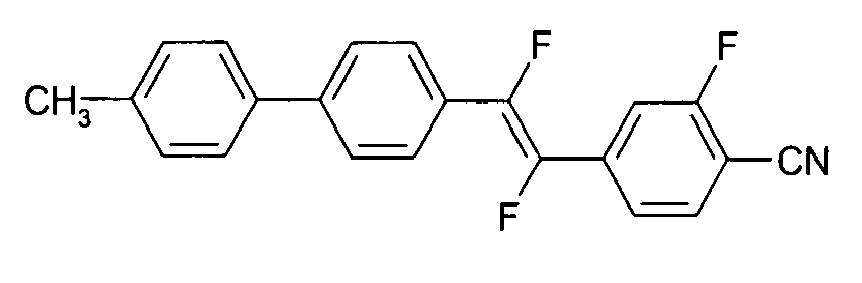
JP 03-041 03 (A - Fluorinated difluorostilbenes of the following formula

JP 07-133 241 (A - Fluorinated difluorostilbenes of the following formula

- However, these fluorinated difluorostilbenes have a positive or at best weakly negative dielectric anisotropy.
Development in the area of liquid-crystalline materials is still far from complete. In order to improve the properties of liquid-crystalline display elements, attempts are constantly being made to develop novel compounds which enable optimisation of displays of this type. - It is therefore an object of the present invention to provide compounds having advantageous properties for use in liquid-crystalline media. They should preferably have negative dielectric anisotropy (Δε < 0), which makes them particularly suitable for use in liquid-crystalline media for VA displays.
- In order to ensure satisfactory properties, in particular low characteristic voltages, for example in VA-TFT displays, substances having a large absolute value of the dielectric anisotropy (Δε), a value of the optical anisotropy (Δn) which corresponds to the particular application, are required.
- This is achieved through the use of the compounds of the formula I according to the invention

R11 and R12 each, independently of one another, denote H, halogen, an alkyl group having 1 to 15C atoms which is monosubstituted by CN or CF3 or at least monosubstituted by halogen, where, in addition, one or more CH2 groups, in each case independently of one another, may be replaced by -O-, -S-, -CH=CH-, -CF=CF-, -CF=CH-, -CH=CF-,

R11 denotes alkyl or alkenyl, and
R12 denotes alkoxy or alkenyloxy, preferably alkoxy,

- (a) a trans-1,4-cyclohexylene radical, in which, in addition, one or two non-adjacent CH2 groups may be replaced by -O- and/or -S-,
- (b) a 1,4-cyclohexenylene radical,
- (c) a 1,4-phenylene radical, in which, in addition, one or two non-adjacent CH groups may be replaced by N, or
- (d) a radical selected from the group naphthalene-2,6-diyl, decahydronaphthalene-2,6-diyl and 1,2,3,4-tetrahydronaphthalene-2,6-diyl, or
- (e) a radical selected from the group 1,4-bicyclo[2.2.2]octylene, 1,3-bicyclo[1.1.1]pentylene and spiro[3.3]heptane-2,6-diyl, where in
- (a) and (b), one or more -CH2- groups, independently of one another, may each be replaced by a -CHF- or -CF2- group, and in
- (c) and (d), one or more -CH= groups, independently of one another, may each be replaced by a group selected from the group -C(F)=, -C(Cl)=, -C(Br)=, -C(CN)=, -C(CH3)=, -C(CH2F)=, -C(CHF2)=, -C(OCH3)=, -C(OCHF2)= and -C(OCF3)=, preferably a -CF= group, and preferably denote




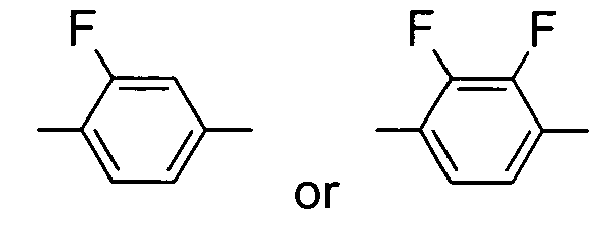


- The compounds of the formula I according to the invention are preferably mesogenic compounds and particularly preferably liquid-crystalline compounds, the compounds particularly preferably having a nematic phase.
- The compounds of the formula according to the invention are particularly preferably selected from the sub-formulae 1-1 to 1-3, particularly preferably 1-3:


Z11 and Z12 denote a single bond and
in formulae 1-1 and I-3
R11 denotes alkyl or alkenyl and
R12 denotes alkoxy or alkenyloxy, preferably alkoxy,
in formula 1-2
R11 denotes alkoxy or alkenyloxy, preferably alkoxy, and
R12 denotes alkyl or alkenyl. - Particular preference is given to compounds of the formula I-3 having one or more of the formulae selected from the group of formulae I-3a and I-3b:


R11 denotes alkyl or alkenyl, and
R12 denotes alkoxy or alkenyloxy, preferably alkoxy. - Compounds of the formula I containing branched wing groups R11 and/or R12 may occasionally be of importance owing to better solubility in the usual liquid-crystalline base materials, but in particular as chiral dopants if they are optically active. Smectic compounds of this type are suitable as components of ferroelectric materials. Compounds of the formula I having SA phases are suitable, for example, for thermally addressed displays.
- If R11 and/or R12 denote an alkyl radical and/or an alkoxy radical, this may be straight-chain or branched. It is preferably straight-chain, has 2, 3, 4, 5, 6 or 7C atoms and accordingly preferably denotes ethyl, propyl, butyl, pentyl, hexyl, heptyl, ethoxy, propoxy, butoxy, pentoxy, hexyloxy or heptyl-oxy, furthermore methyl, octyl, nonyl, decyl, undecyl, dodecyl, tridecyl, tetradecyl, pentadecyl, methoxy, octyloxy, nonyloxy, decyloxy, undecyloxy, dodecyloxy, tridecyloxy or tetradecyloxy.
- Oxaalkyl or alkoxyalkyl preferably denotes straight-chain 2-oxapropyl (= methoxymethyl), 2- (= ethoxymethyl) or 3-oxabutyl (= 2-methoxyethyl), 2-, 3- or 4-oxapentyl, 2-, 3-, 4- or 5-oxahexyl, 2-, 3-, 4-, 5- or 6-oxaheptyl, 2-, 3-, 4-, 5-, 6- or 7-oxaoctyl, 2-, 3-, 4-, 5-, 6-, 7- or 8-oxanonyl, or 2-, 3-, 4-, 5-, 6-, 7-, 8- or 9-oxadecyl.
- If R11 and/or R12 denote an alkyl radical in which one CH2 group has been replaced by -CH=CH-, this may be straight-chain or branched. It is preferably straight-chain and has 2 to 10 C atoms. Accordingly, it denotes, in particular, vinyl, prop-1- or -2-enyl, but-1-, -2- or -3-enyl, pent-1-, -2-, -3- or -4-enyl, hex-1-, -2-, -3-, -4- or -5-enyl, hept-1-, -2-, -3-, -4-, -5- or -6-enyl, oct-1-, -2-, -3-, -4-, -5-, -6- or -7-enyl, non-1-, -2-, -3-, -4-, -5-, -6-, -7- or -8-enyl, or dec-1-, -2-, -3-, -4-, -5-, -6-, -7-, -8- or -9-enyl.
- If R11 and/or R12 denote an alkyl radical in which one CH2 group has been replaced by -O- and one has been replaced by -CO-, these are preferably adjacent. These thus contain an acyloxy group -CO-O- or an oxycarbonyl group -O-CO-. These are preferably straight-chain and have 2 to 6 C atoms. Accordingly, they denote, in particular, acetoxy, propionyloxy, butyryloxy, pentanoyloxy, hexanoyloxy, acetoxymethyl, propionyloxymethyl, butyryloxymethyl, pentanoyloxymethyl, 2-acetoxyethyl, 2-propionyloxyethyl, 2-butyryloxyethyl, 3-acetoxypropyl, 3-propionyloxypropyl, 4-acetoxybutyl, methoxycarbonyl, ethoxycarbonyl, propoxycarbonyl, butoxycarbonyl, pentoxycarbonyl, methoxycarbonylmethyl, ethoxycarbonylmethyl, propoxycarbonylmethyl, butoxycarbonylmethyl, 2-(methoxycarbonyl)ethyl, 2-(ethoxycarbonyl)ethyl, 2-(propoxycarbonyl)ethyl, 3-(methoxycarbonyl)propyl, 3-(ethoxycarbonyl)propyl or 4-(methoxycarbonyl)butyl.
- If R11 and/or R12 denote an alkyl radical in which one CH2 group has been replaced by unsubstituted or substituted -CH=CH- and an adjacent CH2 group has been replaced by CO or CO-O or O-CO, this may be straight-chain or branched. It is preferably straight-chain and has 4 to 13 C atoms. Accordingly, it denotes, in particular, acryloyloxymethyl, 2-acryloyloxyethyl, 3-acryloyloxypropyl, 4-acryloyloxybutyl, 5-acryloyloxypentyl, 6-acryloyloxyhexyl, 7-acryloyloxyheptyl, 8-acryloyloxyoctyl, 9-acryloyloxynonyl, 10-acryloyloxydecyl, methacryloyloxymethyl, 2-methacryloyloxyethyl, 3-methacryloyloxypropyl, 4-methacryloyloxybutyl, 5-methacryloyloxypentyl, 6-methacryloyloxyhexyl, 7-methacryloyloxyheptyl, 8-methacryloyloxyoctyl or 9-methacryloyloxynonyl.
- If R11 and/or R12 denote an alkyl or alkenyl radical which is monosubstituted by CN or CF3, this radical is preferably straight-chain. The substitution by CN or CF3 is in any desired position.
- If R11 and/or R12 denote an alkyl or alkenyl radical which is at least monosubstituted by halogen, this radical is preferably straight-chain, and halogen is preferably F or Cl. In the case of polysubstitution, halogen is preferably F. The resultant radicals also include perfluorinated radicals. In the case of monosubstitution, the fluorine or chlorine substituent may be in any desired position, but is preferably in the ω-position.
- Branched groups generally contain not more than one chain branch. Preferred branched radicals R are isopropyl, 2-butyl (= 1-methylpropyl), isobutyl (= 2-methylpropyl), 2-methylbutyl, isopentyl (= 3-methylbutyl), 2-methylpentyl, 3-methylpentyl, 2-ethylhexyl, 2-propylpentyl, isopropoxy, 2-methylpropoxy, 2-methylbutoxy, 3-methylbutoxy, 2-methylpentoxy, 3-methylpentoxy, 2-ethylhexyloxy, 1-methylhexyloxy and 1-methylheptyloxy.
- If R11 and/or R12 represent an alkyl radical in which two or more CH2 groups have been replaced by -O- and/or -CO-O-, this may be straight-chain or branched. It is preferably branched and has 3 to 12 C atoms. Accordingly, it denotes, in particular, biscarboxymethyl, 2,2-biscarboxyethyl, 3,3-biscarboxypropyl, 4,4-biscarboxybutyl, 5,5-biscarboxypentyl, 6,6-biscarboxyhexyl, 7,7-biscarboxyheptyl, 8,8-biscarboxyoctyl, 9,9-bis-carboxynonyl, 10,10-biscarboxydecyl, bis(methoxycarbonyl)methyl, 2,2-bis-(methoxycarbonyl)ethyl, 3,3-bis(methoxycarbonyl)propyl, 4,4-bis(methoxycarbonyl)butyl, 5,5-bis(methoxycarbonyl)pentyl, 6,6-bis(methoxycarbonyl)-hexyl, 7,7-bis(methoxycarbonyl)heptyl, 8,8-bis(methoxycarbonyl)octyl, bis-(ethoxycarbonyl)methyl, 2,2-bis(ethoxycarbonyl)ethyl, 3,3-bis(ethoxycarbonyl)propyl, 4,4-bis(ethoxycarbonyl)butyl, 5,5-bis(ethoxycarbony-I)pentyl and 6,6-bis(ethoxycarbonyl)hexyl.
- Particular preference is given to compounds of the formula I in which n = 0 or 1 and m = 0 or 1 and R11 denotes methyl, ethyl, propyl, butyl, pentyl, vinyl, 1 E-propenyl, 1 E-butenyl or 1 E-pentenyl, and to media comprising these compounds. Of these compounds, the alkyl-substituted compounds are particularly preferably employed.
- The compounds of the formula I are synthesised in accordance with the following scheme (scheme I).

- Examples of structures of preferred compounds of the formula I are given below:


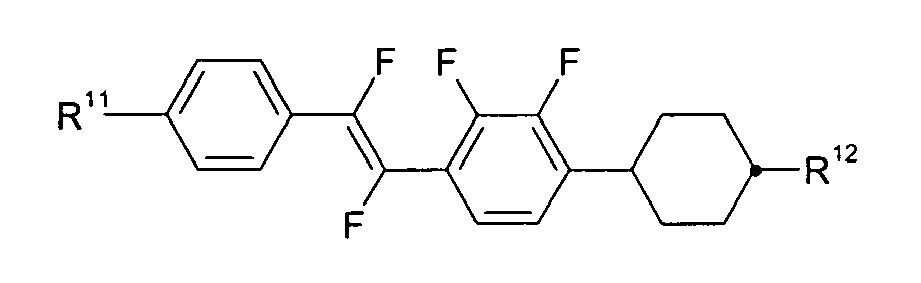


Owing to their molecular structure, compounds of the formula I according to the invention may be chiral and can accordingly occur in various enantiomeric forms. They can therefore be in racemic or optically active form. - The present invention also relates to liquid-crystal media which comprise one or more compound(s) of the formula I.
- In a preferred embodiment, the liquid-crystal media in accordance with the present invention comprise
- a) one or more dielectrically negative compound(s) of the formula I

- b) optionally one or more dielectrically negative compound(s) of the formula II

R21 and R22 each, independently of one another, have the meaning given above for R11 under formula I,
Z21 and Z22 each, independently of one another, have the meaning given above for Z11 under formula I,
at least one of the rings


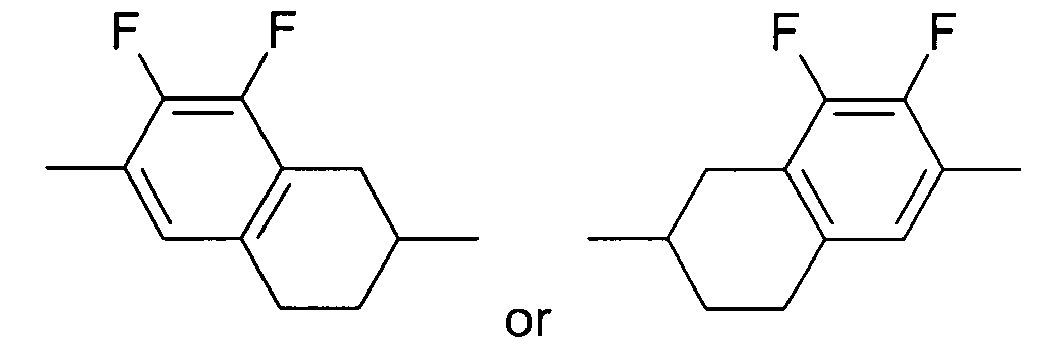


I denotes 0, 1 or 2, preferably 0 or 1, and - c) optionally one or more dielectrically neutral compound(s) of the formula III

- The liquid-crystal medium preferably comprises one or more compounds of one or more of the formulae selected from the group of the following formulae II-1 to II-3:


R21,R22,Z12,Z22 ,
- The liquid-crystal medium particularly preferably comprises one or more compounds selected from the group of the compounds of the following sub-formulae II-1a to II-1e, II-2a to 11-2c and 11-3a and II-3b, preferably one or more of the formulae selected from the group of the formulae II-1a, II-1c and II-2b and/or II-1d, II-1e and II-2c:


R21 denotes alkyl or alkenyl, particularly preferably alkyl, and
R22 denotes alkyl or alkoxy. - in a further preferred embodiment, the liquid-crystal medium comprises one or more compounds of one or more of the formulae selected from the group of the following formulae II-4 and II-5:


- In a further preferred embodiment, the liquid-crystal medium comprises one or more compounds which contain a tetrahydronaphthyl or naphthyl unit, such as, for example, the compounds of one or more of the formulae selected from the group of the following formulae 11-6 to II-10:


- Preferred mixtures comprise one or more difluorodibenzochroman compounds of the formula BC and/or chromans of the formula CR


- RB1, RB2, RCR1 and RCR2 each, independently of one another, have the meaning of R11, preferably in amounts of 3 to 20% by weight, in particular in amounts of 3 to 15% by weight.
- Particularly preferred compounds of the formulae BC and CR are compounds BC-1 to BC-7 and CR-1 to CR-5:


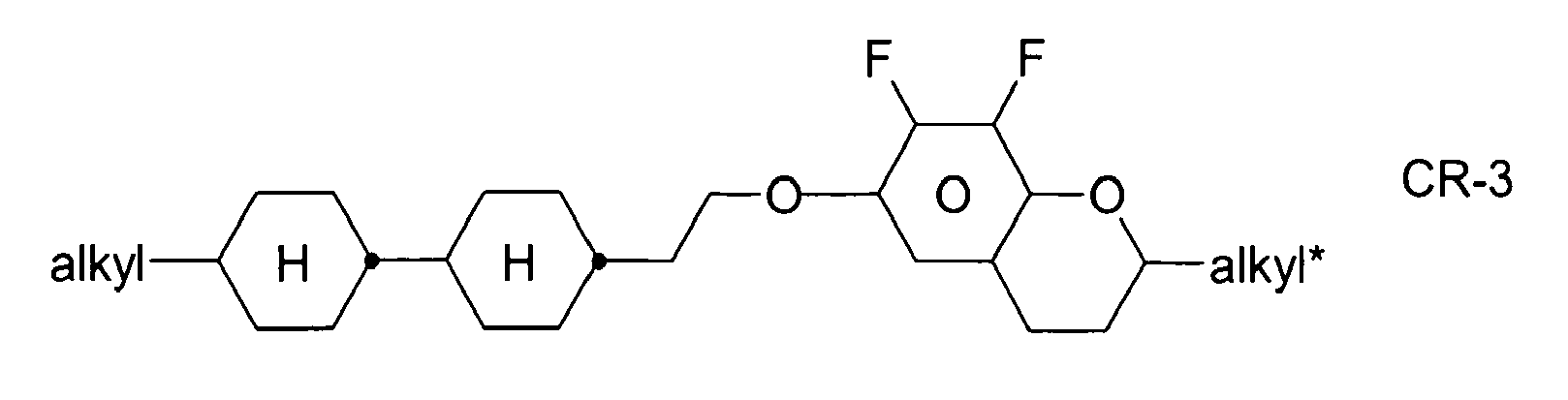


alkyl and alkyl* each, independently of one another, denote a straight-chain alkyl radical having 1-6 C atoms, and
alkenyl and alkenyl* each, independently of one another, denote a straight-chain alkenyl radical having 2-6 C atoms. - Very particular preference is given to mixtures comprising one, two or three compounds of the formula BC-2.
- In a further preferred embodiment, the liquid-crystal medium comprises one or more compounds which contain a chlorofluoro-1,4-phenylene ring, preferably one or more compounds of one or more of the formulae selected from the group of the following formulae II-11 to II-15:



- In a particularly preferred embodiment, the liquid-crystal medium comprises one or more compounds of one or more of the formulae selected from the group of the following formulae II-11a to II-15b:





- The liquid-crystal medium particularly preferably comprises one or more compounds of one or more of the formulae selected from the group of the formulae III-1 to III-3:


- The liquid-crystal medium especially preferably comprises one or more compounds of one or more of the formulae selected from the group of the formulae III-1a to III-1d and/or III-1e and III-1f and/or III-2a to III-2h, III-3a to III-3d:










- Preferred fluorinated compounds of the formulae III-2g, III-2h and III-3c are the compounds of the formulae III-2g', III-2h' and III-3c':


- The media according to the invention preferably have a birefringence of 0.11 or more.
- The media according to the invention preferably have a dielectric anisotropy of -2 or less.
- The media according to the invention preferably comprise compounds
of the formula I in concentrations of 5% to 25%, preferably of 5% to 15%, per homologous compound, and
of the formula II-1a and/or II-2a in concentrations of 2% to 30%, preferably of 5% to 15%, per homologous compound, and of 5% up to 60% in total, and/or
of the formula II-1c in which R21 denotes alkyl and R22 denotes alkoxy and/or II-2b in concentrations of 2% to 20%, preferably of 5% to 12%, per homologous compound, and of 5% to 60% in total, and/or
of the formula II-1c in which R21 and R22 denote alkyl in concentrations of 2% to 20%, preferably of 5% to 15%, per homologous compound, and/or II-3a in concentrations of 2% to 15%, preferably of 5% to 10%, per homologous compound, and/or II-3b in concentrations of 2% to 20%, preferably of 5% to 15%, per homologous compound, and of 5% to 40% in total, and/or
of the formula III in concentrations of 5% to 80%, preferably of 10% to 60%. - In the present application, the term compounds is taken to mean both one compound and a plurality of compounds, unless expressly stated otherwise.
- The liquid-crystal media according to the invention preferably have nematic phases of in each case from at least -20°C to 80°C, preferably from -30°C to 90°C and very particularly preferably from -40°C to 100°C. The term "have a nematic phase" here is taken to mean firstly that no smectic phase and no crystallisation are observed at low temperatures at the corresponding temperature and secondly also that no clearing occurs on heating from the nematic phase. The investigation at low temperatures is carried out in a flow viscometer at the corresponding temperature and checked by storage in test cells having a layer thickness corresponding to the electro-optical application for at least 1000 hours. At high temperatures, the clearing point is measured in capillaries by conventional methods.
- Furthermore, the liquid-crystal media according to the invention are characterised by low optical anisotropy values.
- The term "alkyl" preferably encompasses straight-chain and branched alkyl groups having 1 to 7 carbon atoms, in particular the straight-chain groups methyl, ethyl, propyl, butyl, pentyl, hexyl and heptyl. Groups having 2 to 5 carbon atoms are generally preferred.
- The term "alkenyl" preferably encompasses straight-chain and branched alkenyl groups having 2 to 7 carbon atoms, in particular the straight-chain groups. Particularly preferred alkenyl groups are C2- to C7-1 E-alkenyl, C4-to C7-3E-alkenyl, C5- to C7-4-alkenyl, C6- to C7-5-alkenyl and C7-6-alkenyl, in particular C2- to C7-1 E-alkenyl, C4- to C7-3E-alkenyl and C5- to C7-4-alkenyl. Examples of further preferred alkenyl groups are vinyl, 1 E-propenyl, 1E-butenyl, 1E-pentenyl, 1E-hexenyl, 1E-heptenyl, 3-butenyl, 3E-pentenyl, 3E-hexenyl, 3E-heptenyl, 4-pentenyl, 4Z-hexenyl, 4E-hexenyl, 4Z-heptenyl, 5-hexenyl, 6-heptenyl and the like. Groups having up to 5 carbon atoms are generally preferred.
- The term "fluoroalkyl" preferably encompasses straight-chain groups having a terminal fluorine, i.e. fluoromethyl, 2-fluoroethyl, 3-fluoropropyl, 4-fluorobutyl, 5-fluoropentyl, 6-fluorohexyl and 7-fluoroheptyl. However, other positions of the fluorine are not excluded.
- The term "oxaalkyl" or "alkoxyalkyl" preferably encompasses straight-chain radicals of the formula CnH2n+1-O-(CH2)m, in which n and m each, independently of one another, denote 1 to 6. Preferably, n is 1 and m is 1 to 6.
- Compounds containing a vinyl end group and compounds containing a methyl end group have low rotational viscosity.
- In the present application, the term dielectrically positive compounds denotes compounds having a Δε of > 1.5, the term dielectrically neutral compounds denotes those in which -1.5 ≤ Δε ≤ 1.5, and the term dielectrically negative compounds denotes those having a Δε of < -1.5. The dielectric anisotropy of the compounds is determined here by dissolving 10% of the compounds in a liquid-crystalline host and determining the capacitance of this mixture at 1 kHz and a temperature of 20°C in at least one test cell with a layer thickness of about 20 µm having a homeotropic surface alignment and at least one test cell with a layer thickness of about 20 µm having a homogeneous surface alignment. The measurement voltage is typically 0.5 V to 1.0 V, but is always less than the capacitive threshold of the respective liquid-crystal mixture.
- The host mixture used for determining the applicationally relevant physical parameters is ZLI-4792 from Merck KGaA, Germany. As an exception, the determination of the dielectric anisotropy of dielectrically negative compounds is carried out using ZLI-2857, likewise from Merck KGaA, Germany. The values for the respective compound to be investigated are obtained from the change in the properties, for example the dielectric constants, of the host mixture after addition of the compound to be investigated and extrapolation to 100% of the compound employed.
- The concentration of the compound to be investigated that is employed in the host mixture is generally 10%. If the solubility of the compound to be investigated is inadequate for this purpose, the concentration employed is, by way of exception, halved, i.e. reduced to 5%, 2.5%, etc., until the concentration is below the solubility limit.
- The term threshold voltage usually relates to the optical threshold for 10% relative contrast (V10). In relation to the liquid-crystal mixtures of negative dielectric anisotropy, however, the term threshold voltage is used in the present application for the capacitive threshold voltage (V0), also known as the Freedericksz threshold, unless explicitly stated otherwise. In the case of the liquid-crystal media of negative dielectric anisotropy, the threshold voltage was determined as the capacitive threshold V0 in cells with a liquid-crystal layer homeotropically aligned by means of the polyimide SE-1211 from Nissan Chemicals, Japan.
- All concentrations in this application, unless explicitly stated otherwise, are indicated in per cent by weight and relate to the corresponding mixture as a whole. All physical properties are and have been determined in accordance with "Merck Liquid Crystals, Physical Properties of Liquid Crystals", status Nov. 1997, Merck KGaA, Germany, and apply to a temperature of 20°C, unless explicitly stated otherwise. Δn is determined at 589 nm and Δε at 1 kHz.
- The liquid-crystal media according to the invention may, if necessary, also comprise further additives and optionally also chiral dopants in the conventional amounts. The amount of these additives employed is in total 0% to 10%, based on the amount of the mixture as a whole, preferably 0.1 % to 6%. The concentrations of the individual compounds employed are in each case preferably 0.1 to 3%. The concentration of these and similar additives is not taken into account when indicating the concentrations and the concentration ranges of the liquid-crystal compounds in the liquid-crystal media.
- The compositions consist of a plurality of compounds, preferably 3 to 30, particularly preferably 6 to 20 and very particularly preferably 10 to 16 compounds, which are mixed in a conventional manner. In general, the desired amount of the components used in lesser amount is dissolved in the components making up the principal constituent, advantageously at elevated temperature. If the selected temperature is above the clearing point of the principal constituent, the completion of the dissolution process is particularly easy to observe. However, it is also possible to prepare the liquid-crystal mixtures in other conventional ways, for example using premixes or from a so-called "multibottle" system.
- By means of suitable additives, the liquid-crystal phases according to the invention can be modified in such a way that they can be employed in any type of display and in particular of ECB display and IPS display that has been disclosed hitherto.
- The examples below serve to illustrate the invention without representing a restriction. In the examples, the melting point T(C,N), the transition from the smectic (S) phase to the nematic (N) phase T(S,N) and the clearing point T(N,I) of a liquid-crystal substance are indicated in degrees Celsius. The various smectic phases are characterised by corresponding suffixes.
- The percentages above and below are, unless explicitly stated otherwise, per cent by weight, and the physical properties are the values at 20°C, unless explicitly stated otherwise.
- All the temperature values indicated in this application are °C, and all temperature differences are correspondingly differential degrees, unless explicitly stated otherwise.
- In the synthesis examples and schemes, the abbreviations have the following meanings, unless explicitly stated otherwise:
- Ac
- acetate,
- THF
- tetrahydrofuran,
- Bu
- butyl,
- Me
- methyl,
- m.p.
- melting point,
- soln.
- solution,
- sat.
- saturated,
- H3O+
- acidify and
- RT
- room temperature (about 22°C).
- In the present application and in particular in the following examples, the structures of the liquid-crystal compounds are indicated by means of abbreviations, also acronyms, where the transformation into chemical formulae takes place using the following Tables A to C. All radicals CnH2n+1, CmH2m+1 and ClH2l+1 are straight-chain alkyl radicals having n, m and IC atoms respectively. All radicals CnH2n-1, CmH2m-1 and ClH2l-1 are straight-chain alkenyl radicals, preferably 1E-alkenyl radicals, having n, m and IC atoms respectively. In Table A, only the abbreviation parts for the ring elements of the parent structure of the compounds are indicated. Table B shows the bridging groups. Table C lists the meanings of the abbreviations of the left-hand and right-hand end groups of the compounds. The abbreviation of the compounds is obtained as follows. Firstly, the parent structure is written by means of the corresponding letters. The abbreviation of the left-hand end group is added to the abbreviation of the parent structure between two hyphens, followed by the abbreviation of the right-hand end group after the second hyphen. Finally, Table D shows illustrative abbreviations of common compounds, which are also preferably employed in accordance with the present invention, together with their structural forms.
Table A: Ring elements C 
L 
LI 
D 
Di 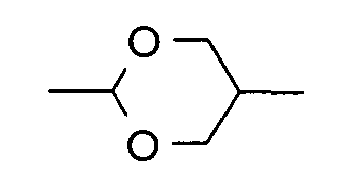
A 
Al 
P 
G 
Gl 
U 
UI 
Y 
K 
Np 
Nf21 
Nf2 
Nf3 
Nf3I 
tH 
tHI 
tHf2 
tHf2l 
dH 
Table B: Bridging groups E -CH2CH2- Z -CO-O- V -CH=CH- ZI -O-CO- X -CF=CH- O -CH2-O- XI -CH=CF- OI -O-CH2- W -CF=CF- Q -CF2-O- T -C≡C- QI -O-CF2- Table C: End groups Left-hand group Right-hand group Abbreviations used individually -n- CnH2n+1- -n -CnH2n+1 -nO- CnH2n+1O- -nO -O CnH2n+1 -V- CH2=CH- -V -CH=CH2 -nV- CnH2n+1-CH=CH- -nV -CnH2n-CH=CH2 -Vn- CH2=CH-CnH2n- -Vn -CH=CH-CnH2n+1 -nVm- CnH2n+1-CH=CH- CmH2m- -nVm -CnH2n-CH=CH-CmH2m+1 -N- N ≡C- -N -C≡N -S- S=C=N- -S -N=C=S -F- F- -F -F -CL- Cl- -CL -Cl -M- CFH2- -M -CFH2 -D- CF2H- -D -CF2H -T- CF3- -T -CF3 -MO- CFH2O- -OM -OCFH2 -DO- CF2HO- -OD -OCF2H -TO- CF3O- -OT -OCF3 -A- H-C≡C- -A -C≡C-H -nA- CnH2n+1-C ≡C- -An -C≡C-CnH2n+1 -NA- N ≡C-C ≡C- -AN -C≡C-C ≡N In combination with other abbreviations used -...A...- -C≡C- -...A... -C≡C- -...V...- CH=CH- -...V... -CH=CH- -...Z...- -CO-O- -...Z... -CO-O- -...ZI...- -O-CO- -...ZI... -O-CO- -... K...- -CO- -...K... -CO- -...W...- -CF=CF- - The following table shows illustrative structures together with their abbreviations. These show the meaning of the abbreviations. In addition, they preferably show compounds to be used.


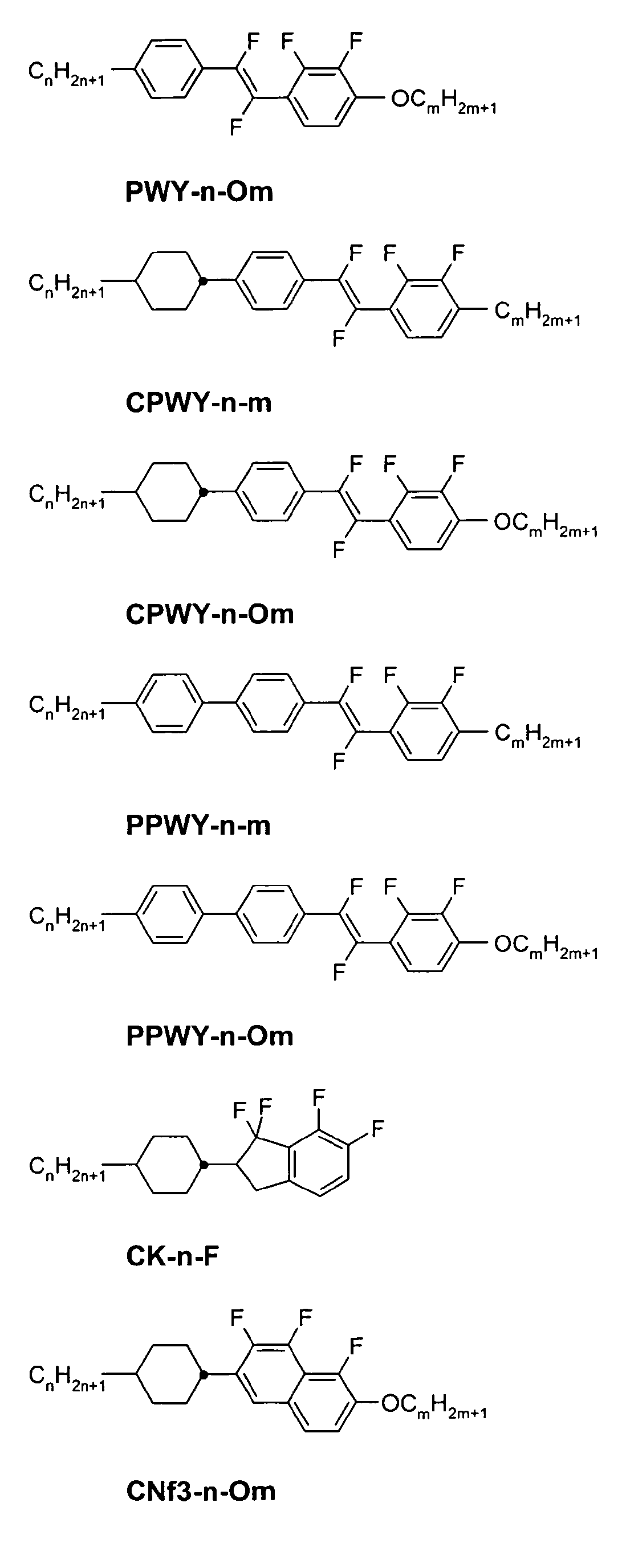
- The media according to the invention preferably comprise two or more, preferably four or more, compounds selected from the compounds from Table D.
- The following table, Table E, shows examples of compounds which can be used as stabilisers in the media according to the invention.


- In a preferred embodiment of the present invention, the mesogenic media comprise one or more compounds selected from the compounds from Table E.
- The following table, Table F, shows examples of compounds which can be used as chiral dopants in the media according to the invention.


- In a preferred embodiment of the present invention, the mesogenic media comprise one or more compounds selected from the compounds from Table F.
- The following examples are intended to explain the invention without limiting it. Above and below, percentage data denote per cent by weight. All temperatures are indicated in degrees Celsius. Δn denotes optical anisotropy (589 nm, 20°C), Δε denotes the dielectric anisotropy (1 kHz, 20°C), H.R. denotes the "voltage holding ratio" (at 100°C, after 5 minutes in the oven, 1 V), and V0 denotes the capacitive threshold voltage (at 20°C and 1 kHz).
-

-

-

- The olefin (31 g) is dissolved in 120 ml of THF, 70 ml of pentane and 70 ml of diethyl ether and cooled to -100°C. 59 ml of 1.6 M BuLi in n-hexane are added dropwise, and the mixture is stirred for one hour. 11 ml of trimethyl borate dissolved in 60 ml of THF, 30 ml of pentane and 30 ml of diethyl ether are added dropwise. After a post-stirring time of one hour, the mixture is warmed and subjected to conventional work-up, giving 14 g of boronic acid.
-
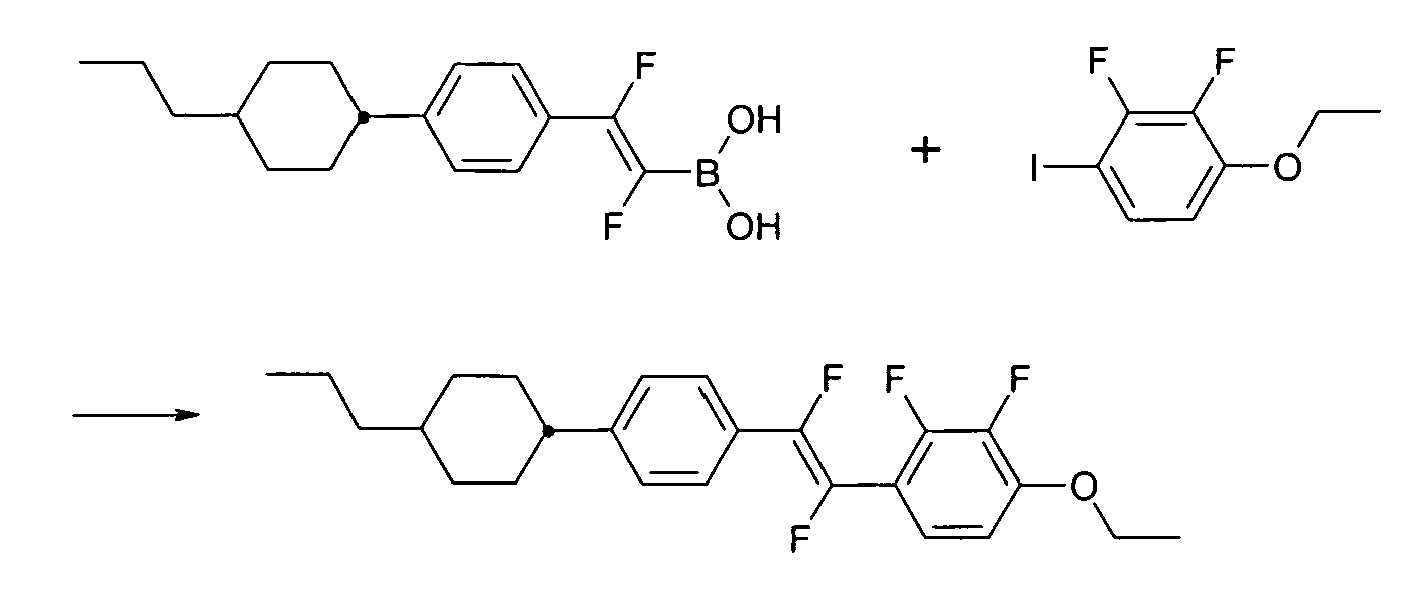
- The following are prepared analogously to Example 1:

No. R11 R12 Phase sequence T/°C; physical properties 1 n-C3H7 C2H5O C 103 N 224.6 I;
Δε = -5.8; Δn = 0.2342 CH3 CH3 3 CH3 C2H5 4 CH3 n-C3H7 5 CH3 n-C4H9 6 CH3 n-C5H11 7 CH3 n-C7H15 8 CH3 CH3O 9 CH3 C2H5O 10 CH3 n-C3H7O 11 CH3 n-C4H9O 12 CH3 CH2=CH 13 CH3 E-CH3-CH=CH 15 CH3 CH2=CH-O 16 CH3 CH2=CH-CH2O 17 C2H5 CH3 18 C2H5 C2H5 19 C2H5 n-C3H7 20 C2H5 n-C4H9 21 C2H5 n-C5H11 22 C2H5 n-C6H13 23 C2H5 n-C7H15 24 C2H5 CH3O 25 C2H5 C2H5O 26 C2H5 n-C3H7O 27 C2H5 n-C4H9O 28 C2H5 CH2=CH 29 C2H5 E-CH3-CH=CH 30 C2H5 CH2=CH-O 31 C2H5 CH2=CH-CH2O 32 n-C3H7 CH3 C 113 N 192.0 I;
Δε = -2.5; Δn = 0.23133 n-C3H7 C2H5 34 n-C3H7 n-C3H7 35 n-C3H7 n-C4H9 36 n-C3H7 n-C5H11 37 n-C3H7 n-C6H13 38 n-C3H7 n-C7H15 39 n-C3H7 CH3O 40 n-C3H7 n-C3H7O 41 n-C3H7 n-C4H9O 42 n-C3H7 CH2=CH 43 n-C3H7 E-CH3-CH=CH 44 n-C3H7 CH2=CH-O 45 n-C3H7 CH2=CH-CH2O 46 n-C4H9 CH3 47 n-C4H9 C2H5 48 n-C4H9 n-C3H7 49 n-C4H9 n-C4H9 50 n-C4H9 n-C5H11 51 n-C4H9 n-C6H13 52 n-C4H9 n-C7H15 53 n-C4H9 CH3O 54 n-C4H9 C2H5O 55 n-C4H9 n-C3H7O 56 n-C4H9 n-C4H9O 57 n-C4H9 CH2=CH 58 n-C4H9 E-CH3-CH=CH 59 n-C4H9 CH2=CH-O 60 n-C4H9 CH2=CH-CH2O 61 n-C5H9 CH3 C 78 N 185.2 I;
Δε = -2.2; Δn = 0.22262 n-C5H11 C2H5 63 n-C5H11 n-C3H7 64 n-C5H11 n-C4H9 65 n-C5H11 n-C5H11 66 n-C5H11 n-C6H13 67 n-C5H11 n-C7H15 68 n-C5H11 CH3O 69 n-C5H11 C2H5O C 70 N 213.5 I;
Δε = -5.3; Δn = 0.22870 n-C5H11 n-C3H7O 71 n-C5H11 n-C4H9O 72 n-C5H11 CH2=CH 73 n-C5H11 E-CH3-CH=CH 74 n-C5H11 CH2=CH-O 75 n-C5H11 CH2=CH-CH2O - The compounds of the following formula:

Note: * values extrapolated from 10% solution in ZLI-4792 or ZLI-2857 (Δε).No. R11 R12 Phase sequence T/°C; physical properties 76 CH3 CH3 77 CH3 C2H5 78 CH3 n-C3H7 79 CH3 n-C4H9 80 CH3 n-C5H11 81 CH3 n-C7H15 82 CH3 CH3O 83 CH3 C2H5O 84 CH3 n-C3H7O 85 CH3 n-C4H9O 86 CH3 CH2=CH 87 CH3 E-CH3-CH=CH 88 CH3 CH2=CH-O 89 CH3 CH2=CH-CH2O 90 C2H5 CH3 91 C2H5 C2H5 92 C2H5 n-C3H7 93 C2H5 n-C4H9 94 C2H5 n-C5H11 95 C2H5 n-C6H13 96 C2H5 n-C7H15 97 C2H5 CH3O 98 C2H5 C2H5O 99 C2H5 n-C3H7O 100 C2H5 n-C4H9O 101 C2H5 CH2=CH 102 C2H5 E-CH3-CH=CH 103 C2H5 CH2=CH-O 104 C2H5 CH2=CH-CH2O 105 n-C3H7 CH3 106 n-C3H7 C2H5 107 n-C3H7 n-C3H7 108 n-C3H7 n-C4H9 109 n-C3H7 n-C5H11 110 n-C3H7 n-C6H13 111 n-C3H7 n-C7H15 112 n-C3H7 CH3O 113 n-C3H7 C2H5O 114 n-C3H7 n-C3H7O 115 n-C3H7 n-C4H9O 116 n-C3H7 CH2=CH 117 n-C3H7 E-CH3-CH=CH 118 n-C3H7 CH2=CH-O 119 n-C3H7 CH2=CH-CH2O 120 n-C4H9 CH3 121 n-C4H9 C2H5 122 n-C4H9 n-C3H7 123 n-C4H9 n-C4H9 124 n-C4H9 n-C5H11 125 n-C4H9 n-C6H13 126 n-C4H9 n-C7H15 127 n-C4H9 CH3O 128 n-C4H9 C2H5O 129 n-C4H9 n-C3H7O 130 n-C4H9 n-C4H9O 131 n-C4H9 CH2=CH 132 n-C4H9 E-CH3-CH=CH 133 n-C4H9 CH2=CH-O 134 n-C4H9 CH2=CH-CH2O 135 n-C5H9 CH3 136 n-C5H11 C2H5 137 n-C5H11 n-C3H7 138 n-C5H11 n-C4H9 139 n-C5H11 n-C5H11 140 n-C5H11 n-C6H13 141 n-C5H11 n-C7H15 142 n-C5H11 CH3O 143 n-C5H11 C2H5O C 67 SC 94 N 229.0 I;
Δε = -5.2; Δn = 0.325144 n-C5H11 n-C3H7O C81 SC 109 N 215.0 I;
Δε = -4.8; Δn = 0.309145 n-C5H11 n-C4H9O C 70 SC 102 N 202.3 I;
Δε = -4.9; Δn = 0.307146 n-C5H11 CH2=CH 147 n-C5H11 E-CH3-CH=CH 148 n-C5H11 CH2=CH-O 149 n-C5H11 CH2=CH-CH2O - The following are prepared analogously to Example 1:

No. R11 R12 Phase sequence T/°C; physical properties 150 CH3 CH3 151 CH3 C2H5 152 CH3 n-C3H7 153 CH3 n-C4H9 154 CH3 n-C5H11 155 CH3 n-C7H15 156 CH3 CH3O 157 CH3 C2H5O 158 CH3 n-C3H7O 159 CH3 n-C4H9O 160 CH3 CH2=CH 161 CH3 E-CH3-CH=CH 162 CH3 CH2=CH-O 163 CH3 CH2=CH-CH2O 164 C2H5 CH3 165 C2H5 C2H5 166 C2H5 n-C3H7 167 C2H5 n-C4H9 168 C2H5 n-C5H11 169 C2H5 n-C6H13 170 C2H5 n-C7H15 171 C2H5 CH3O 172 C2H5 C2H5O 173 C2H5 n-C3H7O 174 C2H5 n-C4H9O 175 C2H5 CH2=CH 176 C2H5 E-CH3-CH=CH 177 C2H5 CH2=CH-O 178 C2H5 CH2=CH-CH2O 179 n-C3H7 CH3 180 n-C3H7 C2H5 181 n-C3H7 n-C3H7 182 n-C3H7 n-C4H9 183 n-C3H7 n-C5H11 184 n-C3H7 n-C6H13 185 n-C3H7 n-C7H15 186 n-C3H7 CH3O 187 n-C3H7 C2H5O C 75 N (66,2) I;
Δε = -7.0; Δn = 0.226188 n-C3H7 n-C3H7O 189 n-C3H7 n-C4H9O 190 n-C3H7 CH2=CH 191 n-C3H7 E-CH3-CH=CH 192 n-C3H7 CH2=CH-O 193 n-C3H7 CH2=CH-CH2O 194 n-C4H9 CH3 195 n-C4H9 C2H5 196 n-C4H9 n-C3H7 197 n-C4H9 n-C4H9 198 n-C4H9 n-C5H11 199 n-C4H9 n-C6H13 201 n-C4H9 n-C7H15 202 n-C4H9 CH3O 203 n-C4H9 C2H5O 204 n-C4H9 n-C3H7O 205 n-C4H9 n-C4H9O 206 n-C4H9 CH2=CH 207 n-C4H9 E-CH3-CH=CH 208 n-C4H9 CH2=CH-O 209 n-C4H9 CH2=CH-CH2O 210 n-C5H9 CH3 211 n-C5H11 C2H5 212 n-C5H11 n-C3H7 213 n-C5H11 n-C4H9 214 n-C5H11 n-C5H11 215 n-C5H11 n-C6H13 216 n-C5H11 n-C7H15 217 n-C5H11 CH3O 218 n-C5H11 C2H5O 219 n-C5H11 n-C3H7O 220 n-C5H11 n-C4H9O 221 n-C5H11 CH2=CH 222 n-C5H11 E-CH3-CH=CH 223 n-C5H11 CH2=CH-O 224 n-C5H11 CH2=CH2CH2O 225 C2H5O C2H5O C 91 N 115,6 1;
Δε =-7.1; Δn = 0.266 - The following are prepared analogously to Example 1:

No. R11 R12 Phase sequence T/°C; physical properties 226 CH3 CH3 227 CH3 C2H5 228 CH3 n-C3H7 229 CH3 n-C4H9 230 CH3 n-C5H11 231 CH3 n-C7H15 232 CH3 CH3O 233 CH3 C2H5O 234 CH3 n-C3H7O 235 CH3 n-C4H9O 236 CH3 CH2=CH 237 CH3 E-CH3-CH=CH 238 CH3 CH2=CH-O 239 CH3 CH2=CH-CH2O 240 C2H5 CH3 241 C2H5 C2H5 242 C2H5 n-C3H7 243 C2H5 n-C4H9 244 C2H5 n-C5H11 245 C2H5 n-C6H13 246 C2H5 n-C7H15 247 C2H5 CH3O 248 C2H5 C2H5O 249 C2H5 n-C3H7O 250 C2H5 n-C4H9O 251 C2H5 CH2=CH 252 C2H5 E-CH3-CH=CH 253 C2H5 CH2=CH-O 254 C2H5 CH2=CH-CH2O 255 n-C3H7 CH3 256 n-C3H7 C2H5 257 n-C3H7 n-C3H7 258 n-C3H7 n-C4H9 259 n-C3H7 n-C5H11 260 n-C3H7 n-C6H13 261 n-C3H7 n-C7H15 262 n-C3H7 CH3O 263 n-C3H7 C2H5O 264 n-C3H7 n-C3H7O 265 n-C3H7 n-C4H9O 266 n-C3H7 CH2=CH 267 n-C3H7 E-CH3-CH=CH 268 n-C3H7 CH2=CH-O 269 n-C3H7 CH2=CH-CH2O 270 n-C4H9 CH3 271 n-C4H9 C2H5 272 n-C4H9 n-C3H7 273 n-C4H9 n-C4H9 274 n-C4H9 n-C5H11 275 n-C4H9 n-C6H13 276 n-C4H9 n-C7H15 277 n-C4H9 CH3O 278 n-C4H9 C2H5O 279 n-C4H9 n-C3H7O 280 n-C4H9 n-C4H9O 281 n-C4H9 CH2=CH 282 n-C4H9 E-CH3-CH=CH 283 n-C4H9 CH2=CH-O 284 n-C4H9 CH2=CH-CH2O 285 n-C5H9 CH3 286 n-C5H11 C2H5 287 n-C5H11 n-C3H7 288 n-C5H11 n-C4H9 289 n-C5H11 n-C5H11 290 n-C5H11 n-C6H13 291 n-C5H11 n-C7H15 292 n-C5H11 CH3O 293 n-C5H11 C2H5O C 124 N 339,7 l;
Δε = -1.6; Δn = 0.335294 n-C5H11 n-C3H7O 295 n-C5H11 n-C4H9O 296 n-C5H11 CH2=CH 297 n-C5H11 E-CH3-CH=CH 298 n-C5H11 CH2=CH-O 299 n-C5H11 CH2=CH-CH2O - Liquid-crystalline mixtures are prepared and investigated for their applicational properties.
- A liquid-crystal mixture having the composition indicated in the following table was prepared and investigated. It has the properties likewise shown in the table.
Composition Physical properties Compound No. Abbreviation Conc./ % by wt. T(N,I) = = 82.0 °C 1 CY-3-04 10.0 ne (20°C, 589 nm) = 1.652 2 CY-5-04 15.0 Δn (20°C, 589 nm) = 0.161 3 CPY-2-02 10.0 = 4 PYP-2-4 13.0 ε⊥ (20°C, 1 kHz) = 3.8 5 CC-3-V1 12.0 Δε (20°C, 1 kHz) = -3.8 6 CC-5-V 5.0 = 7 CPP-3-2 10.0 k1(20°C) = 14.6 pN 8 PWY-3-02 15.0 k1/k3 (20°C) = 1.05 9 PPWY-5-03 5.0 10 PPWY-5-04 5.0 γ1 (20°C) = 189 mPa·s ∑ 100.0 V0(20°C) = 2.13 V - The liquid-crystal medium has very good applicational properties and can be employed for various VA technologies, such as MVA, PVA, ASV and also for IPS.
- A liquid-crystal mixture having the composition indicated in the following table was prepared and investigated. It has the properties likewise shown in the table.
Composition Physical properties Compound No. Abbreviation Conc./ % by wt. T(N,I) = 86.5 °C 1 CY-3-04 10.0 2 CY-5-04 5.0 Δn(20°C,589nm) = 0.161 3 CPY-2-02 10.0 4 PYP-2-4 13.0 5 CC-3-V1 12.0 Δε (20°C, 1 kHz) = -4.0 6 CC-5-V 5.0 7 CPP-3-2 10.0 8 CK-3-F 5.0 9 CK-4-F 5.0 10 PWY-3-02 15.0 γ1 (20°C) = 188 mPa·s 11 PPWY-5-03 5.0 12 PPWY-5-04 5.0 V0 (20°C) = 2.08 V Σ 100.0 - The liquid-crystal medium has very good applicational properties and can be employed for various VA technologies, such as MVA, PVA, ASV and also or IPS.
- A liquid-crystal mixture having the composition indicated in the following table was prepared and investigated. It has the properties likewise shown in the table.
Composition Physical properties Compound No. Abbreviation Conc./ % by wt. T(N,I) = 76.0 °C 1 CY-3-04 20.0 ne (20°C, 589 nm) = 1.606 2 CY-5-02 8.0 Δn(20°C, 589nm) = 0.121 3 CPY-2-02 12.0 4 CPY-3-02 12.0 ε⊥ (20°C, 1 kHz) = 3.7 5 CC-3-V1 8.0 Δε (20°C, 1 kHz) = -3.7 6 CC-5-V 20.0 7 CPP-3-2 10.0 k1(20°C) = 14.1 pN 8 PWY-20-02 10.0 k1/k3 (20°C) = 1.07 Σ 100.0 γ1 (20°C) = 134 mPa·s V0 (20°C) = 2.13 V - A liquid-crystal mixture having the composition indicated in the following table was prepared and investigated. It has the properties likewise shown in the table.
Composition Physical properties Compound No. Abbreviation Conc./ % by wt. T(N,I) = 77.5 °C 1 CY-3-04 20.0 ne (20°C, 589 nm) = 1.607 2 CY-5-O2 8.0 Δn (20°C, 589 nm) = 0.121 3 CPY-2-02 12.0 4 CPY-3-02 12.0 ε⊥(20°C, 1 kHz) = 3.6 5 CC-3-V1 8.0 Δε (20°C, 1 kHz) = -3.5 6 CC-5-V 10.0 7 CP-5-3 10.0 k1(20°C) = 13.9 pN 9 CPP-3-2 10.0 k1/k3 (20°C) = 1.12 8 CPWY-3-02 10.0 Σ 100.0 γ1 (20°C) = 151 mPa·s V0 (20°C) = 2.22 V - A liquid-crystal mixture having the composition indicated in the following table was prepared and investigated. It has the properties likewise shown in the table.
Composition Physical properties Compound No. Abbreviation Conc./ % by wt. T(N,I) = 90.0 °C 1 CY-3-04 15.0 ne (20°C, 589 nm) = 1.626 2 CY-5-O2 3.0 Δn(20°C, 589nm) = 0.146 3 CCY-3-02 6.0 4 CCY-4-O2 6.0 ε⊥ (20°C, 1kHz) = 4.1 5 CCY-5-02 4.0 Δε (20°C, 1 kHz) = -5.9 6 CCY-3-03 6.0 7 CPY-2-02 11.0 k1(20°C) = 15.3 pN 8 CPY-3-02 11.0 k1/k3 (20°C) = 1.15 9 PYP-2-4 4.0 10 CC-5-V 14.0 γ1 (20°C) = 250 mPa·s 11 PWY-3-02 20.0 Σ 100.0 V0 (20°C) = 1.83 V - A liquid-crystal mixture having the composition indicated in the following table was prepared and investigated. It has the properties likewise shown in the table.
Composition Physical properties Compound No. Abbreviation Conc./ % by wt. T(N,I) = 92.0 °C 1 CY-3-04 15.0 ne (20°C, 589 nm) = 1.622 2 CY-5-02 12.0 Δn(20°C,589nm) = 0.139 3 CY-5-04 12.0 3 CCY-3-02 8.0 ε┴(20°C, 1 kHz) = 4.2 4 CCY-3-03 7.0 Δε (20°C, 1 kHz) = -6.0 5 CPY-2-02 10.0 6 CPY-3-02 8.0 k1(20°C) = 15.5 pN 7 CC-5-V 10.0 k1/k3 (20°C) = 1.03 8 PPWY-5-03 9.0 9 PPWY-5-04 9.0 γ1 (20°C) = 289 mPa·s Σ 100.0 V0(20°C) = 1.72 V - A liquid-crystal mixture having the composition indicated in the following table was prepared and investigated. It has the properties likewise shown in the table.
Composition Physical properties Compound No. Abbreviation Conc./ % by wt. T(N,I) = 99.0 °C 1 CY-3-04 10.0 2 CY-5-02 12.0 Δn(20°C,589nm) = 0.140 3 CY-5-04 7.0 4 CCY-3-02 8.0 5 CCY-3-03 7.0 Δε (20°C, 1 kHz) = -6.3 6 CPY-2-02 10.0 7 CPY-3-02 8.0 8 CC-5-V 10.0 9 CNf3-3-02 5.0 10 CNf3-3-04 5.0 γ1 (20°C) = 312 mPa·s 11 PPWY-5-03 9.0 12 PPWY-5-04 9.0 Σ 100.0 - A liquid-crystal mixture having the composition indicated in the following table was prepared and investigated. It has the properties likewise shown in the table.
Composition Physical properties Compound No. Abbreviation Conc./ % by wt. T(N,I) 95.0 °C 1 CPY-2-1 10.0 ne (20°C, 589 nm) = 1.675 2 PYP-2-3 20.0 Δn(20°C, 589 nm) = 0.174 3 PYP-2-4 20.0 4 CC-3-V 15.0 ε⊥ (20°C, 1 kHz) = 3.6 5 CC-3-4 12.0 Δε(20°C, 1 kHz) = -2.4 6 PWY-3-02 23.0 ∑ 100.0 k1(20°C) = 12.8 pN k1/k3 (20°C) = 1.05
preferably -(CH2)4-, -CH2-CH2-, -CF2-CF2-, -CH=CH-, -CF=CF-, -C ≡C-, -CH2O-, -CF2O- or a single bond, particularly preferably -CH2O-, -CH2-CH2-, -CF2-CF2-, -CF=CF-, -CF2O- or a single bond, and
m and n each, independently of one another, denote 0, 1 or 2, preferably 0 or 1, where
(m + n) denotes 0, 1 or 2, preferably 0 or 1, particularly preferably 1.
R31 and R32 each, independently of one another, have the meaning given above for R1 under formula I. and
Z31, Z32 and Z33 each, independently of one another, denote -CH2CH2-, -CH=CH-, -COO- or a single bond,

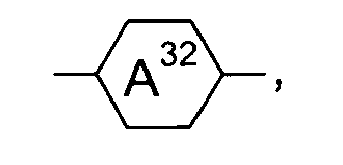


o and p, independently of one another, denote 0 or 1,
but preferably
R31 and R32
each, independently of one another, denote alkyl or alkoxy having 1-5 C atoms or alkenyl having 2-5 C atoms,


Claims (15)
- Compound of the formula I

R11 and R12 each, independently of one another, denote H, halogen, -CN, -SCN, -SF5, -CF3, -CHF2, -CH2F, -OCF3, -OCHF2, an alkyl group having 1 to 15 C atoms which is monosubstituted by CN or CF3 or at least monosubstituted by halogen, where, in addition, one or more CH2 groups, in each case independently of one another, may be replaced by -O-, -S-, -CH=CH-, -CF=CF-, -CF=CH-, -CH=CF-,


 (a) a trans-1,4-cyclohexylene radical, in which, in addition, one or two non-adjacent CH2 groups may be replaced by -O- and/or -S-,(b) a 1,4-cyclohexenylene radical,(c) a 1,4-phenylene radical, in which, in addition, one or two non-adjacent CH groups may be replaced by N, or(d) a radical selected from the group naphthalene-2,6-diyl, decahydronaphthalene-2,6-diyl and 1,2,3,4-tetrahydronaphthalene-2,6-diyl, or(e) a radical selected from the group 1,4-bicyclo[2.2.2]-octylene, 1,3-bicyclo[1.1.1]pentylene and spiro[3.3]-heptane-2,6-diyl, where inZ11 and Z12 each, independently of one another and, if present more than once, also these independently of one another, denote a single bond, -CH2-CH2-, -CF2-CH2-, -CH2-CF2-, -CF2-CF2-, -CH=CH-, -CF=CF-, -CF=CH-, -CH=CF-, -C≡C-, -COO-, -OCO-, -CH2O-, -OCH2-, -CF2O-, -OCF2-, or a combination of two of these groups, where no two O atoms are bonded to one another, and(a) and (b), one or more -CH2- groups, independently of one another, may each be replaced by a -CHF- or -CF2- group, and in(c) and (d), one or more -CH= groups, independently of one another, may each be replaced by a group selected from the group -C(F)=, -C(Cl)=, -C(Br)=, -C(CN)=, -C(CH3)=, -C(CH2F)=, -C(CHF2)=, -C(OCH3)=, -C(OCHF2)= and -C(OCF3)=,
m and n each denote 0, 1 or 2,
(m + n) denotes 0, 1 or 2. - Compound of the formula I according to Claim 1, of one or more of the formulae selected from the group of the formulae I-1 to I-3:


- Compound according to at least one of Claims 1 and 2, characterised in that Z11 and Z12 both denote a single bond.
- Compound according to one or more of Claims 1 to 3, characterised in that (m + n) denotes 0 or 1.
- Compound according to one or more of Claims 1 to 4, characterised in that m denotes 1.
- Liquid-crystal medium, characterised in that it comprises one or more compounds of the formula I as defined in one or more of Claims 1 to 5.
- Liquid-crystal medium according to Claim 6, characterised in that it has a nematic phase.
- Liquid-crystal medium according to at least one of Claims 6 and 7, characterised in that it comprises
one or more dielectrically negative compound(s) of the formula II
R21 and R22 each, independently of one another, have the meaning given for R11 under formula I in Claim 1,
Z21 and Z22 each, independently of one another, have the meaning given for Z11 under formula I in Claim 1,
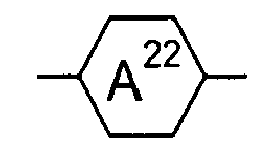


I denotes 0 or 1. - Liquid-crystal medium according to one or more of Claims 6 to 8, characterised in that it comprises one or more compound(s) of the formula II-1


- Use of a liquid-crystal medium according to one or more of Claims 6 to 9 in an electro-optical display.
- Electro-optical display containing a liquid-crystal medium according to one or more of Claims 6 to 9.
- Display according to Claim 11, characterised in that it is a VAN LCD.
- Process for the preparation of a compound of the formula I as defined in one or more of Claims 1 to 5, characterised in that a 1,2-difluorostyreneboronic acid is coupled to a haloaromatic compound with palladium catalysis.
- Process for the preparation of a liquid-crystal medium as defined in one or more of Claims 6 to 9, characterised in that a compound of the formula I as defined in one or more of Claims 1 to 5 is mixed with one or more further compounds.
- Process for the production of an electro-optical display, characterised in that a liquid-crystal medium as defined in one or more of Claims 6 to 9 is introduced between two substrates.
Applications Claiming Priority (1)
| Application Number | Priority Date | Filing Date | Title |
|---|---|---|---|
| DE102006058608 | 2006-12-11 |
Publications (2)
| Publication Number | Publication Date |
|---|---|
| EP1932896A1 true EP1932896A1 (en) | 2008-06-18 |
| EP1932896B1 EP1932896B1 (en) | 2010-10-27 |
Family
ID=39110827
Family Applications (1)
| Application Number | Title | Priority Date | Filing Date |
|---|---|---|---|
| EP07023304A Not-in-force EP1932896B1 (en) | 2006-12-11 | 2007-11-30 | Stilbene derivatives, liquid-crystal mixtures and electro-optical displays |
Country Status (8)
| Country | Link |
|---|---|
| US (1) | US7732022B2 (en) |
| EP (1) | EP1932896B1 (en) |
| JP (1) | JP5657194B2 (en) |
| KR (1) | KR101546970B1 (en) |
| CN (1) | CN101302145B (en) |
| AT (1) | ATE486112T1 (en) |
| DE (1) | DE602007010074D1 (en) |
| TW (1) | TWI433911B (en) |
Cited By (3)
| Publication number | Priority date | Publication date | Assignee | Title |
|---|---|---|---|---|
| DE102011008687A1 (en) | 2010-02-11 | 2011-08-11 | Merck Patent GmbH, 64293 | Liquid crystal display and liquid-crystalline medium |
| WO2013170500A1 (en) * | 2012-05-18 | 2013-11-21 | 深圳市华星光电技术有限公司 | Liquid crystal molecules with flexible structure and mixtures thereof |
| WO2018015324A1 (en) * | 2016-07-20 | 2018-01-25 | Merck Patent Gmbh | Difluoro stilbene-derivatives |
Families Citing this family (20)
| Publication number | Priority date | Publication date | Assignee | Title |
|---|---|---|---|---|
| US7936430B2 (en) * | 2007-02-20 | 2011-05-03 | Samsung Electronics Co., Ltd. | Liquid crystals and liquid crystal display apparatus employing the same |
| WO2010057575A1 (en) * | 2008-11-19 | 2010-05-27 | Merck Patent Gmbh | Liquid crystalline medium |
| EP2522649B1 (en) * | 2010-01-06 | 2016-04-20 | JNC Corporation | Liquid crystal compound, liquid crystal composition and liquid crystal display element |
| DE102011117048A1 (en) * | 2010-11-23 | 2012-05-24 | Merck Patent Gmbh | Compounds for a liquid crystalline medium and their use for high frequency components |
| JP5636954B2 (en) * | 2010-12-27 | 2014-12-10 | Jnc株式会社 | Liquid crystal composition and liquid crystal display element |
| EP2514800B2 (en) * | 2011-04-21 | 2018-03-07 | Merck Patent GmbH | Compounds and liquid crystalline medium |
| DE102012024126A1 (en) * | 2011-12-20 | 2013-06-20 | Merck Patent Gmbh | Liquid crystalline medium |
| EP2933308B1 (en) | 2012-12-12 | 2018-05-30 | DIC Corporation | Nematic liquid crystal composition and liquid crystal display device using same |
| TWI621699B (en) * | 2013-01-21 | 2018-04-21 | Dainippon Ink & Chemicals | Nematic liquid crystal composition and liquid crystal display element using same |
| JP6202309B2 (en) * | 2013-08-23 | 2017-09-27 | Dic株式会社 | Liquid crystal composition and liquid crystal display device using the same |
| EP3029126B1 (en) | 2013-09-06 | 2019-02-27 | DIC Corporation | Nematic liquid crystal composition and liquid crystal display element using same |
| CN103710030B (en) * | 2013-11-27 | 2016-01-20 | 合肥工业大学 | A kind of cyano group substituted diphenylamine ethylene type liquid crystal material and preparation technology thereof and application |
| JP6304529B2 (en) * | 2013-12-06 | 2018-04-04 | Dic株式会社 | Polymerizable compound and optical anisotropic body |
| CN105874380B (en) * | 2014-02-14 | 2017-09-12 | Dic株式会社 | light modulation element |
| US10351772B2 (en) | 2014-05-13 | 2019-07-16 | Dic Corporation | Nematic liquid crystal composition and liquid crystal display element using same |
| WO2016104165A1 (en) | 2014-12-25 | 2016-06-30 | Dic株式会社 | Nematic liquid crystal composition and liquid crystal display element using same |
| CN106146251A (en) * | 2015-03-27 | 2016-11-23 | 北京欣奕华科技有限公司 | Compound and preparation method thereof |
| KR102651756B1 (en) * | 2016-08-11 | 2024-03-29 | 삼성디스플레이 주식회사 | Liquid crystal display and liquid crystal composition comprised thereof |
| JP7097878B2 (en) * | 2016-10-24 | 2022-07-08 | メルク・パテント・ゲゼルシヤフト・ミツト・ベシユレンクテル・ハフツング | Liquid crystal medium |
| PL233977B1 (en) * | 2018-01-10 | 2019-12-31 | Politechnika Warszawska | Method for obtaining 7-methoxy-1,2,3-tris(4-methoxyphenyl)-1,2,3,4-tetrahydronaphthalene |
Citations (6)
| Publication number | Priority date | Publication date | Assignee | Title |
|---|---|---|---|---|
| JPH034103A (en) | 1989-06-01 | 1991-01-10 | Oki Electric Ind Co Ltd | Position detecting device for stage for semiconductor manufacture |
| JPH07133241A (en) | 1993-11-09 | 1995-05-23 | Asahi Glass Co Ltd | Difluorostilbene derivative compound and liquid crystal composition containing the same |
| DE19814550A1 (en) * | 1998-04-01 | 1999-10-07 | Merck Patent Gmbh | Vinylene and ethyl compounds |
| US20010004108A1 (en) * | 1999-12-17 | 2001-06-21 | Minolta Co., Ltd. | Liquid crystal composition and liquid crystal light modulating device using the liquid crystal composition |
| DE10155073A1 (en) * | 2000-12-04 | 2002-08-14 | Merck Patent Gmbh | Liquid-crystalline medium for liquid crystal display matrix comprises 1,2-difluoro-1,2-diphenyl-ethylene derivative and liquid-crystalline compound |
| DE102006023898A1 (en) * | 2005-06-13 | 2006-12-14 | Merck Patent Gmbh | Liquid crystalline medium with positive dielectric anisotropy, useful for electro optical purposes such as electro optical liquid crystal display, comprises 1,2-difluoroethene compound |
Family Cites Families (6)
| Publication number | Priority date | Publication date | Assignee | Title |
|---|---|---|---|---|
| JP2627629B2 (en) * | 1987-12-07 | 1997-07-09 | チッソ株式会社 | Liquid crystal composition |
| DE68926635T2 (en) * | 1988-04-25 | 1997-01-02 | Dainippon Ink & Chemicals | 2,5-disubstituted pyrazine derivatives, pyrimidine derivatives and liquid crystals containing them |
| JP2598830B2 (en) * | 1989-04-18 | 1997-04-09 | セイミケミカル株式会社 | Liquid crystal composition containing trans-dihalogenostilbene derivative compound |
| JPH10109953A (en) * | 1996-10-04 | 1998-04-28 | Seimi Chem Co Ltd | Optically active trans-difluoroethylene compound and liquid crystal composition containing the same |
| JP4022951B2 (en) * | 1997-08-06 | 2007-12-19 | 大日本インキ化学工業株式会社 | Method for producing difluorostilbene derivative |
| GB0504828D0 (en) * | 2005-03-09 | 2005-04-13 | Merck Sharp & Dohme | Therapeutic agents |
-
2007
- 2007-11-30 EP EP07023304A patent/EP1932896B1/en not_active Not-in-force
- 2007-11-30 DE DE602007010074T patent/DE602007010074D1/en active Active
- 2007-11-30 AT AT07023304T patent/ATE486112T1/en not_active IP Right Cessation
- 2007-12-10 KR KR1020070127475A patent/KR101546970B1/en not_active Expired - Fee Related
- 2007-12-10 US US11/953,497 patent/US7732022B2/en not_active Expired - Fee Related
- 2007-12-10 TW TW096147093A patent/TWI433911B/en not_active IP Right Cessation
- 2007-12-11 JP JP2007319821A patent/JP5657194B2/en not_active Expired - Fee Related
- 2007-12-11 CN CN200710307625.2A patent/CN101302145B/en active Active
Patent Citations (6)
| Publication number | Priority date | Publication date | Assignee | Title |
|---|---|---|---|---|
| JPH034103A (en) | 1989-06-01 | 1991-01-10 | Oki Electric Ind Co Ltd | Position detecting device for stage for semiconductor manufacture |
| JPH07133241A (en) | 1993-11-09 | 1995-05-23 | Asahi Glass Co Ltd | Difluorostilbene derivative compound and liquid crystal composition containing the same |
| DE19814550A1 (en) * | 1998-04-01 | 1999-10-07 | Merck Patent Gmbh | Vinylene and ethyl compounds |
| US20010004108A1 (en) * | 1999-12-17 | 2001-06-21 | Minolta Co., Ltd. | Liquid crystal composition and liquid crystal light modulating device using the liquid crystal composition |
| DE10155073A1 (en) * | 2000-12-04 | 2002-08-14 | Merck Patent Gmbh | Liquid-crystalline medium for liquid crystal display matrix comprises 1,2-difluoro-1,2-diphenyl-ethylene derivative and liquid-crystalline compound |
| DE102006023898A1 (en) * | 2005-06-13 | 2006-12-14 | Merck Patent Gmbh | Liquid crystalline medium with positive dielectric anisotropy, useful for electro optical purposes such as electro optical liquid crystal display, comprises 1,2-difluoroethene compound |
Non-Patent Citations (3)
| Title |
|---|
| GOODBY J W ET AL: "Trans-1,2-Difluorosilbenes: Promising Materials for High Dielectric Biaxiality Ferroelectric Mixtures", MOLECULAR CRYSTALS AND LIQUID CRYSTALS, GORDON AND BREACH, LONDON, GB, vol. 364, 2001, pages 889 - 898, XP008089178, ISSN: 0026-8941 * |
| J.W. ET AL., MOLECULAR CRYSTALS AND LIQUID CRYSTALS, vol. 364, 2001, pages 889 |
| MERCK LIQUID CRYSTALS, PHYSICAL PROPERTIES OF LIQUID CRYSTALS, November 1997 (1997-11-01) |
Cited By (5)
| Publication number | Priority date | Publication date | Assignee | Title |
|---|---|---|---|---|
| DE102011008687A1 (en) | 2010-02-11 | 2011-08-11 | Merck Patent GmbH, 64293 | Liquid crystal display and liquid-crystalline medium |
| WO2011098202A1 (en) | 2010-02-11 | 2011-08-18 | Merck Patent Gmbh | Liquid crystal display and liquid crystalline medium |
| US8945420B2 (en) | 2010-02-11 | 2015-02-03 | Merck Patent Gmbh | Liquid crystal display and liquid crystalline medium |
| WO2013170500A1 (en) * | 2012-05-18 | 2013-11-21 | 深圳市华星光电技术有限公司 | Liquid crystal molecules with flexible structure and mixtures thereof |
| WO2018015324A1 (en) * | 2016-07-20 | 2018-01-25 | Merck Patent Gmbh | Difluoro stilbene-derivatives |
Also Published As
| Publication number | Publication date |
|---|---|
| TWI433911B (en) | 2014-04-11 |
| JP2008143902A (en) | 2008-06-26 |
| DE602007010074D1 (en) | 2010-12-09 |
| CN101302145A (en) | 2008-11-12 |
| CN101302145B (en) | 2015-07-22 |
| US20080149891A1 (en) | 2008-06-26 |
| KR101546970B1 (en) | 2015-08-24 |
| ATE486112T1 (en) | 2010-11-15 |
| KR20080053895A (en) | 2008-06-16 |
| US7732022B2 (en) | 2010-06-08 |
| JP5657194B2 (en) | 2015-01-21 |
| TW200837172A (en) | 2008-09-16 |
| EP1932896B1 (en) | 2010-10-27 |
Similar Documents
| Publication | Publication Date | Title |
|---|---|---|
| EP1932896B1 (en) | Stilbene derivatives, liquid-crystal mixtures and electro-optical displays | |
| KR101121336B1 (en) | Photostable liquid crystalline medium | |
| CN102076821B (en) | Liquid-crystalline medium | |
| US7651742B2 (en) | Liquid-crystalline medium and liquid-crystal display comprising 1,2-difluoroethene compounds | |
| JP4738597B2 (en) | Liquid crystal media | |
| JP4596719B2 (en) | Liquid crystal medium | |
| KR100765554B1 (en) | Liquid crystal compound | |
| JP2004315819A (en) | Liquid crystal medium | |
| US8673178B2 (en) | Liquid crystal medium | |
| JP4989815B2 (en) | Liquid crystal medium and liquid crystal display containing the same | |
| TWI381040B (en) | Liquid-crystalline medium | |
| KR100843876B1 (en) | Liquid crystal medium | |
| KR20050088092A (en) | Cyclobutane derivatives | |
| JP4738718B2 (en) | Liquid crystal media | |
| JPH09125066A (en) | Benzene derivative and liquid crystal medium | |
| US6677003B2 (en) | Liquid-crystalline medium | |
| US6641871B2 (en) | Liquid-crystal compound, liquid-crystal medium comprising same, and electro-optical liquid-crystal display | |
| EP3299439A1 (en) | Liquid crystal compound, liquid crystal composition and liquid crystal display device | |
| EP1447435B1 (en) | 1,4-Di-(trans-4-Cyclohexyl)benzene derivatives and their use in liquid crystal media and liquid crystal devices | |
| JP4593098B2 (en) | Liquid crystal medium | |
| JP2004339479A (en) | 1,4-di-(trans-4-cyclohexyl) benzene derivative, and liquid crystal medium and its use in liquid crystal device | |
| DE102007057679A1 (en) | New fluoro-substituted benzene compounds useful in an electrooptical display, preferably vertically aligned nematic liquid crystal display |
Legal Events
| Date | Code | Title | Description |
|---|---|---|---|
| PUAI | Public reference made under article 153(3) epc to a published international application that has entered the european phase |
Free format text: ORIGINAL CODE: 0009012 |
|
| 17P | Request for examination filed |
Effective date: 20071130 |
|
| AK | Designated contracting states |
Kind code of ref document: A1 Designated state(s): AT BE BG CH CY CZ DE DK EE ES FI FR GB GR HU IE IS IT LI LT LU LV MC MT NL PL PT RO SE SI SK TR |
|
| AX | Request for extension of the european patent |
Extension state: AL BA HR MK RS |
|
| 17Q | First examination report despatched |
Effective date: 20080828 |
|
| AKX | Designation fees paid |
Designated state(s): AT BE BG CH CY CZ DE DK EE ES FI FR GB GR HU IE IS IT LI LT LU LV MC MT NL PL PT RO SE SI SK TR |
|
| GRAP | Despatch of communication of intention to grant a patent |
Free format text: ORIGINAL CODE: EPIDOSNIGR1 |
|
| GRAS | Grant fee paid |
Free format text: ORIGINAL CODE: EPIDOSNIGR3 |
|
| GRAA | (expected) grant |
Free format text: ORIGINAL CODE: 0009210 |
|
| AK | Designated contracting states |
Kind code of ref document: B1 Designated state(s): AT BE BG CH CY CZ DE DK EE ES FI FR GB GR HU IE IS IT LI LT LU LV MC MT NL PL PT RO SE SI SK TR |
|
| REG | Reference to a national code |
Ref country code: GB Ref legal event code: FG4D |
|
| REG | Reference to a national code |
Ref country code: CH Ref legal event code: EP |
|
| REG | Reference to a national code |
Ref country code: IE Ref legal event code: FG4D |
|
| REF | Corresponds to: |
Ref document number: 602007010074 Country of ref document: DE Date of ref document: 20101209 Kind code of ref document: P |
|
| REG | Reference to a national code |
Ref country code: NL Ref legal event code: VDEP Effective date: 20101027 |
|
| LTIE | Lt: invalidation of european patent or patent extension |
Effective date: 20101027 |
|
| PG25 | Lapsed in a contracting state [announced via postgrant information from national office to epo] |
Ref country code: LT Free format text: LAPSE BECAUSE OF FAILURE TO SUBMIT A TRANSLATION OF THE DESCRIPTION OR TO PAY THE FEE WITHIN THE PRESCRIBED TIME-LIMIT Effective date: 20101027 |
|
| PG25 | Lapsed in a contracting state [announced via postgrant information from national office to epo] |
Ref country code: SI Free format text: LAPSE BECAUSE OF FAILURE TO SUBMIT A TRANSLATION OF THE DESCRIPTION OR TO PAY THE FEE WITHIN THE PRESCRIBED TIME-LIMIT Effective date: 20101027 Ref country code: IS Free format text: LAPSE BECAUSE OF FAILURE TO SUBMIT A TRANSLATION OF THE DESCRIPTION OR TO PAY THE FEE WITHIN THE PRESCRIBED TIME-LIMIT Effective date: 20110227 Ref country code: BG Free format text: LAPSE BECAUSE OF FAILURE TO SUBMIT A TRANSLATION OF THE DESCRIPTION OR TO PAY THE FEE WITHIN THE PRESCRIBED TIME-LIMIT Effective date: 20110127 Ref country code: SE Free format text: LAPSE BECAUSE OF FAILURE TO SUBMIT A TRANSLATION OF THE DESCRIPTION OR TO PAY THE FEE WITHIN THE PRESCRIBED TIME-LIMIT Effective date: 20101027 Ref country code: AT Free format text: LAPSE BECAUSE OF FAILURE TO SUBMIT A TRANSLATION OF THE DESCRIPTION OR TO PAY THE FEE WITHIN THE PRESCRIBED TIME-LIMIT Effective date: 20101027 Ref country code: NL Free format text: LAPSE BECAUSE OF FAILURE TO SUBMIT A TRANSLATION OF THE DESCRIPTION OR TO PAY THE FEE WITHIN THE PRESCRIBED TIME-LIMIT Effective date: 20101027 Ref country code: PT Free format text: LAPSE BECAUSE OF FAILURE TO SUBMIT A TRANSLATION OF THE DESCRIPTION OR TO PAY THE FEE WITHIN THE PRESCRIBED TIME-LIMIT Effective date: 20110228 Ref country code: FI Free format text: LAPSE BECAUSE OF FAILURE TO SUBMIT A TRANSLATION OF THE DESCRIPTION OR TO PAY THE FEE WITHIN THE PRESCRIBED TIME-LIMIT Effective date: 20101027 Ref country code: LV Free format text: LAPSE BECAUSE OF FAILURE TO SUBMIT A TRANSLATION OF THE DESCRIPTION OR TO PAY THE FEE WITHIN THE PRESCRIBED TIME-LIMIT Effective date: 20101027 |
|
| PG25 | Lapsed in a contracting state [announced via postgrant information from national office to epo] |
Ref country code: MC Free format text: LAPSE BECAUSE OF NON-PAYMENT OF DUE FEES Effective date: 20101130 Ref country code: GR Free format text: LAPSE BECAUSE OF FAILURE TO SUBMIT A TRANSLATION OF THE DESCRIPTION OR TO PAY THE FEE WITHIN THE PRESCRIBED TIME-LIMIT Effective date: 20110128 Ref country code: BE Free format text: LAPSE BECAUSE OF FAILURE TO SUBMIT A TRANSLATION OF THE DESCRIPTION OR TO PAY THE FEE WITHIN THE PRESCRIBED TIME-LIMIT Effective date: 20101027 |
|
| PG25 | Lapsed in a contracting state [announced via postgrant information from national office to epo] |
Ref country code: CZ Free format text: LAPSE BECAUSE OF FAILURE TO SUBMIT A TRANSLATION OF THE DESCRIPTION OR TO PAY THE FEE WITHIN THE PRESCRIBED TIME-LIMIT Effective date: 20101027 Ref country code: ES Free format text: LAPSE BECAUSE OF FAILURE TO SUBMIT A TRANSLATION OF THE DESCRIPTION OR TO PAY THE FEE WITHIN THE PRESCRIBED TIME-LIMIT Effective date: 20110207 Ref country code: EE Free format text: LAPSE BECAUSE OF FAILURE TO SUBMIT A TRANSLATION OF THE DESCRIPTION OR TO PAY THE FEE WITHIN THE PRESCRIBED TIME-LIMIT Effective date: 20101027 |
|
| PG25 | Lapsed in a contracting state [announced via postgrant information from national office to epo] |
Ref country code: SK Free format text: LAPSE BECAUSE OF FAILURE TO SUBMIT A TRANSLATION OF THE DESCRIPTION OR TO PAY THE FEE WITHIN THE PRESCRIBED TIME-LIMIT Effective date: 20101027 Ref country code: RO Free format text: LAPSE BECAUSE OF FAILURE TO SUBMIT A TRANSLATION OF THE DESCRIPTION OR TO PAY THE FEE WITHIN THE PRESCRIBED TIME-LIMIT Effective date: 20101027 Ref country code: DK Free format text: LAPSE BECAUSE OF FAILURE TO SUBMIT A TRANSLATION OF THE DESCRIPTION OR TO PAY THE FEE WITHIN THE PRESCRIBED TIME-LIMIT Effective date: 20101027 Ref country code: PL Free format text: LAPSE BECAUSE OF FAILURE TO SUBMIT A TRANSLATION OF THE DESCRIPTION OR TO PAY THE FEE WITHIN THE PRESCRIBED TIME-LIMIT Effective date: 20101027 |
|
| PLBE | No opposition filed within time limit |
Free format text: ORIGINAL CODE: 0009261 |
|
| STAA | Information on the status of an ep patent application or granted ep patent |
Free format text: STATUS: NO OPPOSITION FILED WITHIN TIME LIMIT |
|
| 26N | No opposition filed |
Effective date: 20110728 |
|
| PG25 | Lapsed in a contracting state [announced via postgrant information from national office to epo] |
Ref country code: IE Free format text: LAPSE BECAUSE OF NON-PAYMENT OF DUE FEES Effective date: 20101130 |
|
| REG | Reference to a national code |
Ref country code: DE Ref legal event code: R097 Ref document number: 602007010074 Country of ref document: DE Effective date: 20110728 |
|
| PG25 | Lapsed in a contracting state [announced via postgrant information from national office to epo] |
Ref country code: MT Free format text: LAPSE BECAUSE OF FAILURE TO SUBMIT A TRANSLATION OF THE DESCRIPTION OR TO PAY THE FEE WITHIN THE PRESCRIBED TIME-LIMIT Effective date: 20101027 Ref country code: IT Free format text: LAPSE BECAUSE OF FAILURE TO SUBMIT A TRANSLATION OF THE DESCRIPTION OR TO PAY THE FEE WITHIN THE PRESCRIBED TIME-LIMIT Effective date: 20101027 |
|
| REG | Reference to a national code |
Ref country code: FR Ref legal event code: ST Effective date: 20111125 |
|
| PG25 | Lapsed in a contracting state [announced via postgrant information from national office to epo] |
Ref country code: FR Free format text: LAPSE BECAUSE OF NON-PAYMENT OF DUE FEES Effective date: 20101227 |
|
| REG | Reference to a national code |
Ref country code: CH Ref legal event code: PL |
|
| PG25 | Lapsed in a contracting state [announced via postgrant information from national office to epo] |
Ref country code: LI Free format text: LAPSE BECAUSE OF NON-PAYMENT OF DUE FEES Effective date: 20111130 Ref country code: CH Free format text: LAPSE BECAUSE OF NON-PAYMENT OF DUE FEES Effective date: 20111130 |
|
| PG25 | Lapsed in a contracting state [announced via postgrant information from national office to epo] |
Ref country code: CY Free format text: LAPSE BECAUSE OF FAILURE TO SUBMIT A TRANSLATION OF THE DESCRIPTION OR TO PAY THE FEE WITHIN THE PRESCRIBED TIME-LIMIT Effective date: 20101027 |
|
| PG25 | Lapsed in a contracting state [announced via postgrant information from national office to epo] |
Ref country code: HU Free format text: LAPSE BECAUSE OF FAILURE TO SUBMIT A TRANSLATION OF THE DESCRIPTION OR TO PAY THE FEE WITHIN THE PRESCRIBED TIME-LIMIT Effective date: 20110428 Ref country code: LU Free format text: LAPSE BECAUSE OF NON-PAYMENT OF DUE FEES Effective date: 20101130 |
|
| PG25 | Lapsed in a contracting state [announced via postgrant information from national office to epo] |
Ref country code: TR Free format text: LAPSE BECAUSE OF FAILURE TO SUBMIT A TRANSLATION OF THE DESCRIPTION OR TO PAY THE FEE WITHIN THE PRESCRIBED TIME-LIMIT Effective date: 20101027 |
|
| PGFP | Annual fee paid to national office [announced via postgrant information from national office to epo] |
Ref country code: GB Payment date: 20181128 Year of fee payment: 12 |
|
| GBPC | Gb: european patent ceased through non-payment of renewal fee |
Effective date: 20191130 |
|
| PG25 | Lapsed in a contracting state [announced via postgrant information from national office to epo] |
Ref country code: GB Free format text: LAPSE BECAUSE OF NON-PAYMENT OF DUE FEES Effective date: 20191130 |
|
| PGFP | Annual fee paid to national office [announced via postgrant information from national office to epo] |
Ref country code: DE Payment date: 20221004 Year of fee payment: 16 |
|
| P01 | Opt-out of the competence of the unified patent court (upc) registered |
Effective date: 20230518 |
|
| REG | Reference to a national code |
Ref country code: DE Ref legal event code: R119 Ref document number: 602007010074 Country of ref document: DE |
|
| PG25 | Lapsed in a contracting state [announced via postgrant information from national office to epo] |
Ref country code: DE Free format text: LAPSE BECAUSE OF NON-PAYMENT OF DUE FEES Effective date: 20240601 |
|
| PG25 | Lapsed in a contracting state [announced via postgrant information from national office to epo] |
Ref country code: DE Free format text: LAPSE BECAUSE OF NON-PAYMENT OF DUE FEES Effective date: 20240601 |