EP1930300A2 - Method and device for recycling of cleaning fluid - Google Patents
Method and device for recycling of cleaning fluid Download PDFInfo
- Publication number
- EP1930300A2 EP1930300A2 EP07446009A EP07446009A EP1930300A2 EP 1930300 A2 EP1930300 A2 EP 1930300A2 EP 07446009 A EP07446009 A EP 07446009A EP 07446009 A EP07446009 A EP 07446009A EP 1930300 A2 EP1930300 A2 EP 1930300A2
- Authority
- EP
- European Patent Office
- Prior art keywords
- recycling
- cleaning fluid
- solvent
- water
- separating device
- Prior art date
- Legal status (The legal status is an assumption and is not a legal conclusion. Google has not performed a legal analysis and makes no representation as to the accuracy of the status listed.)
- Withdrawn
Links
- 238000004140 cleaning Methods 0.000 title claims abstract description 80
- 239000012530 fluid Substances 0.000 title claims abstract description 75
- 238000004064 recycling Methods 0.000 title claims abstract description 56
- 238000000034 method Methods 0.000 title claims abstract description 23
- 239000002904 solvent Substances 0.000 claims abstract description 69
- XLYOFNOQVPJJNP-UHFFFAOYSA-N water Substances O XLYOFNOQVPJJNP-UHFFFAOYSA-N 0.000 claims abstract description 69
- 239000003973 paint Substances 0.000 claims abstract description 44
- 239000000872 buffer Substances 0.000 claims description 23
- 230000008020 evaporation Effects 0.000 claims description 5
- 238000001704 evaporation Methods 0.000 claims description 5
- LFQSCWFLJHTTHZ-UHFFFAOYSA-N Ethanol Chemical compound CCO LFQSCWFLJHTTHZ-UHFFFAOYSA-N 0.000 claims description 4
- 239000012153 distilled water Substances 0.000 claims description 2
- BDERNNFJNOPAEC-UHFFFAOYSA-N propan-1-ol Chemical compound CCCO BDERNNFJNOPAEC-UHFFFAOYSA-N 0.000 claims description 2
- 238000010422 painting Methods 0.000 description 4
- 239000002699 waste material Substances 0.000 description 4
- 230000003247 decreasing effect Effects 0.000 description 2
- 239000007788 liquid Substances 0.000 description 2
- 230000015271 coagulation Effects 0.000 description 1
- 238000005345 coagulation Methods 0.000 description 1
- 230000006378 damage Effects 0.000 description 1
- 239000002920 hazardous waste Substances 0.000 description 1
- 239000002245 particle Substances 0.000 description 1
- 239000000843 powder Substances 0.000 description 1
- 239000010802 sludge Substances 0.000 description 1
- 238000005507 spraying Methods 0.000 description 1
Images


Classifications
-
- B—PERFORMING OPERATIONS; TRANSPORTING
- B01—PHYSICAL OR CHEMICAL PROCESSES OR APPARATUS IN GENERAL
- B01D—SEPARATION
- B01D1/00—Evaporating
-
- B—PERFORMING OPERATIONS; TRANSPORTING
- B05—SPRAYING OR ATOMISING IN GENERAL; APPLYING FLUENT MATERIALS TO SURFACES, IN GENERAL
- B05D—PROCESSES FOR APPLYING FLUENT MATERIALS TO SURFACES, IN GENERAL
- B05D7/00—Processes, other than flocking, specially adapted for applying liquids or other fluent materials to particular surfaces or for applying particular liquids or other fluent materials
- B05D7/14—Processes, other than flocking, specially adapted for applying liquids or other fluent materials to particular surfaces or for applying particular liquids or other fluent materials to metal, e.g. car bodies
- B05D7/142—Auto-deposited coatings, i.e. autophoretic coatings
- B05D7/144—After-treatment of auto-deposited coatings
-
- C—CHEMISTRY; METALLURGY
- C02—TREATMENT OF WATER, WASTE WATER, SEWAGE, OR SLUDGE
- C02F—TREATMENT OF WATER, WASTE WATER, SEWAGE, OR SLUDGE
- C02F1/00—Treatment of water, waste water, or sewage
- C02F1/02—Treatment of water, waste water, or sewage by heating
- C02F1/04—Treatment of water, waste water, or sewage by heating by distillation or evaporation
-
- C—CHEMISTRY; METALLURGY
- C02—TREATMENT OF WATER, WASTE WATER, SEWAGE, OR SLUDGE
- C02F—TREATMENT OF WATER, WASTE WATER, SEWAGE, OR SLUDGE
- C02F1/00—Treatment of water, waste water, or sewage
- C02F1/02—Treatment of water, waste water, or sewage by heating
- C02F1/04—Treatment of water, waste water, or sewage by heating by distillation or evaporation
- C02F1/048—Purification of waste water by evaporation
-
- B—PERFORMING OPERATIONS; TRANSPORTING
- B01—PHYSICAL OR CHEMICAL PROCESSES OR APPARATUS IN GENERAL
- B01D—SEPARATION
- B01D3/00—Distillation or related exchange processes in which liquids are contacted with gaseous media, e.g. stripping
-
- C—CHEMISTRY; METALLURGY
- C02—TREATMENT OF WATER, WASTE WATER, SEWAGE, OR SLUDGE
- C02F—TREATMENT OF WATER, WASTE WATER, SEWAGE, OR SLUDGE
- C02F2103/00—Nature of the water, waste water, sewage or sludge to be treated
- C02F2103/14—Paint wastes
Definitions
- the present invention relates to a method and a device for recycling of cleaning fluid.
- a problem with the above cleaning method is that a large quantity of waste containing water, solvent and paint residue arises.
- DE 35 42 957 A1 One example of a device for separating of paint particles is shown in DE 35 42 957 A1 , where the paint is firstly separated from an air flow that has passed through a paint spraying box by that the air flow passes a waterseal, whereafter the paint is separated from the water by that the paint constituents are precipitated in a coagulation plant, which water thereafter is brought back to the water seal by means of a pump.
- a device according to claim 1 and a method according to claim 10 comprises the characteristics that a separating device is arranged to separate, from with paint contaminated cleaning fluid comprising water, solvent, and paint residue, at least parts of the water and the solvent in the state of a distillate, where means are arranged for conveying forward the separated purified distillate to a collecting receptacle where means are arranged to supply new water and/or new solvent in such a quantity that the contents of the collecting receptacle reach the mixing proportion between water and solvent that is required in clean cleaning fluid, the advantage of decrasing the quantity of waste containing water, solvent and paint residue when cleaning painting equipment is attained.
- distillate refers to both distillate from a distiller and condensate of evaporated steam from an evaporation apparatus.
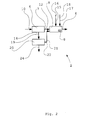
- Figure 1 shows schematically a device 2 for recycling of cleaning fluid 4 according to a first embodiment of the invention, where the recycling device 2 comprises at least a separating device 6 and a collecting receptacle 8.
- the separating device 6 is arranged to separate, from with paint contaminated cleaning fluid 10 comprising water, solvent, and paint residue, at least parts of the water and the solvent in the state of a distillate, where means are arranged for conveying forward the separated purified distillate in the form of water and solvent forming a from paint purified fluid 12 to the collecting receptacle 8, where the means preferably is a tube line 7.
- the paint residue and the water and the solvent which has not been separated forms a residual product 14 which is conveyed out from the separating device 6 to be deposited or destructed.
- the proportion of water and the proportion of solvent is checked, preferably with a measuring equipment 9 arranged in the collecting receptacle 8, whereafter means are arranged to supply new water 16 and/or new solvent 18, where the means preferably are tube lines 15 and 17, respectively, in such a quantity that the contents of the collecting receptacle 8 reach the mixing proportion between water and solvent that is required in clean cleaning fluid.
- a measuring equipment 9 arranged in the collecting receptacle 8
- the means preferably are tube lines 15 and 17, respectively, in such a quantity that the contents of the collecting receptacle 8 reach the mixing proportion between water and solvent that is required in clean cleaning fluid.
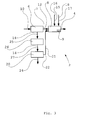
- Figure 2 shows schematically a device 2 for recycling of cleaning fluid 4 according to a second embodiment of the invention, where the recycling device 2 comprises at least two separating devices 6, 20 and a collecting receptacle 8.
- the first separating device 6 is arranged to separate, from with paint contaminated cleaning fluid 10 comprising water, solvent, and paint residue, at least parts of the water and the solvent in the state of a distillate, where means are arranged for conveying forward the separated purified distillate in the form of water and solvent forming a from paint purified fluid 12 to the collecting receptacle 8, where the means preferably is a tube line 7.
- the paint residue and the water and the solvent which has not been separated forms a residual product 14 which is conveyed out from the first separating device 6 and further to the second separating device 20, preferably via means in the form of a tube line 19.
- the second separating device 20 is arranged to separate, from the residual product 14 comprising water, solvent and paint residue, at least parts of the water and the solvent in the state of a distillate, where the separated purified distillate in the form of water and solvent forming from paint purified liquid 22 is conveyed further to the collecting receptacle 8, preferably via means in the form of a tube line 21.
- the paint residue and the solvent that has not been separated forms a further residual product 24 which is conveyed out from the second separating device 22 to be deposited or destructed.
- the proportion of water and the proportion of solvent is checked, preferably with a measuring equipment 9 arranged in the collecting receptacle 8, whereafter new water 16 and/or new solvent 18 is supplied, preferably via means in the form of tube lines 15 and 17, respectively, in such a quantity that the contents of the collecting receptacle 8 reach the mixing proportion between water and solvent that is required in clean cleaning fluid.
- a measuring equipment 9 arranged in the collecting receptacle 8
- new water 16 and/or new solvent 18 is supplied, preferably via means in the form of tube lines 15 and 17, respectively, in such a quantity that the contents of the collecting receptacle 8 reach the mixing proportion between water and solvent that is required in clean cleaning fluid.
- the required mixing proportion has been reached, the contents that now comprise purified cleaning fluid 4 is conveyed out from the collecting receptacle 8.
- Figure 3 shows schematically a device 2 for recycling of cleaning fluid 4 according to a third embodiment of the invention, which third embodiment differs from the above mentioned second embodiment in that the residual product 14 comprising the paint residue and the water and the solvent that has not been separated in the first separating device 6 is conveyed out from the first separating device 6 and further, preferably via means in the form of a tube line 25, to an intermediate buffer 26 from where the residual product 14 is conveyed further, preferably via means in the form of a tube line 27, to the second separating device 20.
- the intermediate buffer 26 which preferably is a receptacle such as a tank is used to buffer the residual product 14 in case the first separating device 6 gives off such a large quantity of residual product 14 that the second separating device 20 cannot receive and process this quantity immediately.
- Figure 4 shows schematically a device 2 for recycling of cleaning fluid 4 according to a fourth embodiment of the invention, which fourth embodiment differs from the above mentioned first, second and third embodiments by that it comprises a collecting buffer 28 and/or a cleaning fluid buffer 30 which buffers 28,30 preferably are receptacles such as tanks.
- the with paint contaminated cleaning fluid 10 is first conveyed into the collecting buffer 28 and from there further on, preferably via means in the form of a tube line 5, to the first separating device 6.
- the collecting buffer 28 is used to buffer the with paint contaminated cleaning fluid 10 in case the first separating device 6 can not receive and process this quantity immediately.
- Cleaning fluid 4 from the collecting receptacle 8 is conveyed, preferably via means in the form of a tube line 29, to the cleaning fluid buffer 30.
- the cleaning fluid buffer 30 is used to buffer cleaning fluid 4 in case the cleaning fluid which is conveyed out from the collecting receptacle 8 is not immediately needed for cleaning.
- the invention thus relates to a device for recycling of cleaning fluid 4, where the recycling device 2 comprises at least a separating device 6 and a collecting receptacle 8, and where the separating device 6 is arranged to separate, from with paint contaminated cleaning fluid 10 comprising water, solvent, and paint residue, at least parts of the water and the solvent in the state of a distillate, where the recycling device 2 further comprises means 7 for conveying forward the separated purified distillate 12 to the collecting receptacle 8 where means 15, 17 are arranged to supply new water 16 and/or new solvent 18 in such a quantity that the contents of the collecting receptacle 8 reach the mixing proportion between water and solvent that is required in clean cleaning fluid 4.
- the invention further relates to a method for recycling of cleaning fluid 4 with a recycling device 2 comprising at least a separating device 6 and a collecting receptacle 8, where the recycling method comprises the steps of:
- the first separating device 6 is preferably an evaporation apparatus, but can also be a distiller.
- the second separating device 20 is preferably a distiller, but can also be an evaporation apparatus.
- the flow from the first separating device 6 and the second separating device 20, respectively, to the collecting receptacle 8 can be controlled by use of e.g. valves preferably arranged in the tube lines 7 and 21, respectively. Also in other tube lines, valves can be arranged to control the flow.
- the quantity of hazardous waste can be reduced by up to the size order of 85% and the quantity of solvent that is needed be reduced with up to the size order of 50% by that water and solvent in the cleaning fluid is recycled in the process.
- the residual product 24 is a dry paint sludge in powder form which preferably is handed over for destruction.
- the water that is used is preferably distilled water.
- the solvent that is used can e.g. comprise 2-Butoxi ethanol and 2-Metoximetyletoxi propanol.
- the solvent is preferably waterborne.
- the cleaning fluid contains preferably water around 80 per cent by volume and solvent around 20 percent by volume.
Landscapes
- Chemical & Material Sciences (AREA)
- Chemical Kinetics & Catalysis (AREA)
- Life Sciences & Earth Sciences (AREA)
- Engineering & Computer Science (AREA)
- Hydrology & Water Resources (AREA)
- Environmental & Geological Engineering (AREA)
- Water Supply & Treatment (AREA)
- Organic Chemistry (AREA)
- Wood Science & Technology (AREA)
- Cleaning By Liquid Or Steam (AREA)
- Vaporization, Distillation, Condensation, Sublimation, And Cold Traps (AREA)
- Detergent Compositions (AREA)
Abstract
Description
- The present invention relates to a method and a device for recycling of cleaning fluid.
- Usually vehicles are coloured by that their body is painted. When changing colour in the painting equipment, the tubing and other colour distribution systems are cleaned free from the previously used colour shade by that the said tubing is rinsed through with cleaning fluid. The cleaning fluid usually contains water and solvent. When the cleaning fluid is flushed through the tubing, it disengages paint residue that is carried away with the cleaning fluid out from the tubing. After cleaning of the tubing, the cleaning fluid containing solvent is thus contaminated with paint residue.
- A problem with the above cleaning method is that a large quantity of waste containing water, solvent and paint residue arises.
- One example of a device for separating of paint particles is shown in
DE 35 42 957 A1 , where the paint is firstly separated from an air flow that has passed through a paint spraying box by that the air flow passes a waterseal, whereafter the paint is separated from the water by that the paint constituents are precipitated in a coagulation plant, which water thereafter is brought back to the water seal by means of a pump. - The problem with that a large quantity of waste containing water, solvent and paint residue arises when cleaning painting equipment is solved according to the invention by a device for recycling of cleaning fluid according to claim 1 and a method for recycling of cleaning fluid according to
claim 10. - By that a device according to claim 1 and a method according to
claim 10 comprises the characteristics that a separating device is arranged to separate, from with paint contaminated cleaning fluid comprising water, solvent, and paint residue, at least parts of the water and the solvent in the state of a distillate, where means are arranged for conveying forward the separated purified distillate to a collecting receptacle where means are arranged to supply new water and/or new solvent in such a quantity that the contents of the collecting receptacle reach the mixing proportion between water and solvent that is required in clean cleaning fluid, the advantage of decrasing the quantity of waste containing water, solvent and paint residue when cleaning painting equipment is attained. Further, the advantage of that a large quantity of water and solvent can be recycled whereby the consumption of water and solvent when cleaning painting equipment can be decreased is attained. By separating water and solvent from the cleaning liquid in several steps, the quantity of waste containing water, solvent and paint residue can be decreased further. - The invention will be described below in greater detail with reference to the attached drawings, in which:
-
Figure 1 shows schematically a device for recycling of cleaning fluid according to a first embodiment of the invention, -
Figure 2 shows schematically a device for recycling of cleaning fluid according to a second embodiment of the invention, -
Figure 3 shows schematically a device for recycling of cleaning fluid according to a third embodiment of the invention, and -
Figure 4 shows schematically a device for recycling of cleaning fluid according to a fourth embodiment of the invention. - Similar parts in the different drawings are designated with the same reference numerals.
- In this description, distillate refers to both distillate from a distiller and condensate of evaporated steam from an evaporation apparatus.
-
Figure 1 shows schematically adevice 2 for recycling ofcleaning fluid 4 according to a first embodiment of the invention, where therecycling device 2 comprises at least aseparating device 6 and a collectingreceptacle 8. The separatingdevice 6 is arranged to separate, from with paint contaminatedcleaning fluid 10 comprising water, solvent, and paint residue, at least parts of the water and the solvent in the state of a distillate, where means are arranged for conveying forward the separated purified distillate in the form of water and solvent forming a from paint purifiedfluid 12 to the collectingreceptacle 8, where the means preferably is atube line 7. The paint residue and the water and the solvent which has not been separated forms aresidual product 14 which is conveyed out from the separatingdevice 6 to be deposited or destructed. In thecollecting receptacle 8, the proportion of water and the proportion of solvent is checked, preferably with a measuring equipment 9 arranged in thecollecting receptacle 8, whereafter means are arranged to supplynew water 16 and/ornew solvent 18, where the means preferably aretube lines receptacle 8 reach the mixing proportion between water and solvent that is required in clean cleaning fluid. When the required mixing proportion has been reached, the contents that now comprise purifiedcleaning fluid 4 is conveyed out from thecollecting receptacle 8. -
Figure 2 shows schematically adevice 2 for recycling ofcleaning fluid 4 according to a second embodiment of the invention, where therecycling device 2 comprises at least twoseparating devices collecting receptacle 8. The first separatingdevice 6 is arranged to separate, from with paint contaminatedcleaning fluid 10 comprising water, solvent, and paint residue, at least parts of the water and the solvent in the state of a distillate, where means are arranged for conveying forward the separated purified distillate in the form of water and solvent forming a from paint purifiedfluid 12 to thecollecting receptacle 8, where the means preferably is atube line 7. The paint residue and the water and the solvent which has not been separated forms aresidual product 14 which is conveyed out from thefirst separating device 6 and further to thesecond separating device 20, preferably via means in the form of a tube line 19. Thesecond separating device 20 is arranged to separate, from theresidual product 14 comprising water, solvent and paint residue, at least parts of the water and the solvent in the state of a distillate, where the separated purified distillate in the form of water and solvent forming from paint purifiedliquid 22 is conveyed further to the collectingreceptacle 8, preferably via means in the form of atube line 21. The paint residue and the solvent that has not been separated, forms a furtherresidual product 24 which is conveyed out from the second separatingdevice 22 to be deposited or destructed. In thecollecting receptacle 8, the proportion of water and the proportion of solvent is checked, preferably with a measuring equipment 9 arranged in thecollecting receptacle 8, whereafternew water 16 and/ornew solvent 18 is supplied, preferably via means in the form oftube lines receptacle 8 reach the mixing proportion between water and solvent that is required in clean cleaning fluid. When the required mixing proportion has been reached, the contents that now comprise purifiedcleaning fluid 4 is conveyed out from thecollecting receptacle 8. -
Figure 3 shows schematically adevice 2 for recycling ofcleaning fluid 4 according to a third embodiment of the invention, which third embodiment differs from the above mentioned second embodiment in that theresidual product 14 comprising the paint residue and the water and the solvent that has not been separated in the first separatingdevice 6 is conveyed out from thefirst separating device 6 and further, preferably via means in the form of atube line 25, to anintermediate buffer 26 from where theresidual product 14 is conveyed further, preferably via means in the form of atube line 27, to thesecond separating device 20. Theintermediate buffer 26 which preferably is a receptacle such as a tank is used to buffer theresidual product 14 in case thefirst separating device 6 gives off such a large quantity ofresidual product 14 that thesecond separating device 20 cannot receive and process this quantity immediately. -
Figure 4 shows schematically adevice 2 for recycling ofcleaning fluid 4 according to a fourth embodiment of the invention, which fourth embodiment differs from the above mentioned first, second and third embodiments by that it comprises a collectingbuffer 28 and/or acleaning fluid buffer 30 whichbuffers cleaning fluid 10 is first conveyed into thecollecting buffer 28 and from there further on, preferably via means in the form of atube line 5, to the first separatingdevice 6. The collectingbuffer 28 is used to buffer the with paint contaminatedcleaning fluid 10 in case thefirst separating device 6 can not receive and process this quantity immediately.Cleaning fluid 4 from thecollecting receptacle 8 is conveyed, preferably via means in the form of atube line 29, to thecleaning fluid buffer 30. Thecleaning fluid buffer 30 is used to buffercleaning fluid 4 in case the cleaning fluid which is conveyed out from the collectingreceptacle 8 is not immediately needed for cleaning. - The invention thus relates to a device for recycling of
cleaning fluid 4, where therecycling device 2 comprises at least aseparating device 6 and a collectingreceptacle 8, and where theseparating device 6 is arranged to separate, from with paint contaminatedcleaning fluid 10 comprising water, solvent, and paint residue, at least parts of the water and the solvent in the state of a distillate, where therecycling device 2 further comprises means 7 for conveying forward the separated purifieddistillate 12 to the collectingreceptacle 8 where means 15, 17 are arranged to supplynew water 16 and/ornew solvent 18 in such a quantity that the contents of the collectingreceptacle 8 reach the mixing proportion between water and solvent that is required inclean cleaning fluid 4. - The invention further relates to a method for recycling of
cleaning fluid 4 with arecycling device 2 comprising at least aseparating device 6 and a collectingreceptacle 8, where the recycling method comprises the steps of: - to separate in the
separating device 6, from with paint contaminatedcleaning fluid 10 comprising water, solvent and paint residue, at least parts of the water and the solvent in the state of adistillate 12, - to convey further the separated purified distillate (12) to the
collecting receptacle 8, - to check the proportion of water and the proportion of solvent in the collecting
receptacle 8, and - to supply
new water 16 and/ornew solvent 18 to the collectingreceptacle 8 in such a quantity that the contents of the collectingreceptacle 8 reach the mixing proportion between water and solvent that is required inclean cleaning fluid 4. - The first separating
device 6 is preferably an evaporation apparatus, but can also be a distiller. - The second separating
device 20 is preferably a distiller, but can also be an evaporation apparatus. - The flow from the
first separating device 6 and thesecond separating device 20, respectively, to the collectingreceptacle 8 can be controlled by use of e.g. valves preferably arranged in thetube lines - With a device for recycling of cleaning fluid according to the third embodiment of the invention, the quantity of hazardous waste can be reduced by up to the size order of 85% and the quantity of solvent that is needed be reduced with up to the size order of 50% by that water and solvent in the cleaning fluid is recycled in the process. The
residual product 24 is a dry paint sludge in powder form which preferably is handed over for destruction. - The water that is used is preferably distilled water.
The solvent that is used can e.g. comprise 2-Butoxi ethanol and 2-Metoximetyletoxi propanol. The solvent is preferably waterborne. - The cleaning fluid contains preferably water around 80 per cent by volume and solvent around 20 percent by volume.
Claims (15)
- Device for recycling of cleaning fluid (4), where the recycling device (2) comprises at least a separating device (6) and a collecting receptacle (8), characterized in, that the separating device (6) is arranged to separate, from with paint contaminated cleaning fluid (10) comprising water, solvent, and paint residue, at least parts of the water and the solvent in the state of a distillate (12), where the recycling device (2) further comprises means (7) for conveying forward the separated purified distillate (12) to the collecting receptacle (8) where means (15, 17) are arranged to supply new water (16) and/or new solvent (18), in such a quantity that the contents of the collecting receptacle (8) reach the mixing proportion between water and solvent that is required in clean cleaning fluid (4).
- Device for recycling of cleaning fluid as claimed in claim 1, characterized in, that the recycling device comprises a measuring equipment (9) arranged to check the proportion of water and the proportion of solvent in the collecting receptacle (8).
- Device for recycling of cleaning fluid as claimed in claim 1 or claim 2, characterized in, that the recycling device (2) comprises a further separating device (20) which is arranged to separate, from a from a first separating device (6) conveyed residual product (14) comprising water, solvent and paint residue, at least parts of the water and the solvent in the state of a distillate, where the recycling device (2) comprises means (21) for conveying the separated purified distillate (22) further to the collecting receptacle (8).
- Device for recycling of cleaning fluid as claimed in claim 3, characterized in, that the recycling device (2) comprises an intermediate buffer (26) and means (25) for conveying the residual product (14) comprising the paint residue and the water and the solvent that has not been separated in the first separating device (6) out from the first separating device (6) and further to said intermediate buffer (26) and means (27) for conveying out the residual product (14) from said intermediate buffer (26) further to the second separating device (20).
- Device for recycling of cleaning fluid as claimed in any one of the above claims, characterized in, the recycling device comprises a cleaning fluid buffer (30) and means (29) for conveying the purified cleaning fluid (4) from the collecting receptacle (8) to the cleaning fluid buffer (30) when the required mixing proportion between water and solvent in the collecting receptacle (8) has been reached.
- Device for recycling of cleaning fluid as claimed in any one of the above claims, characterized in, that the recycling device comprises a collecting buffer (28) and means (5) for conveying the with paint contaminated cleaning fluid (10) from the collecting buffer (28) to the first separating device (6).
- Device for recycling of cleaning fluid as claimed in any one of the above claims, characterized in, that at least one separating device (6, 20) is an evaporation apparatus.
- Device for recycling of cleaning fluid as claimed in any one of the above claims, characterized in, that at least one separating device (6, 20) is a distiller.
- Device for recycling of cleaning fluid as claimed in any one of the above claims, characterized in, that the device is arranged to recycle cleaning fluid (4) comprising distilled water (16) and a solvent (18) comprising 2-Butoxi ethanol and 2-Metoximetyletoxi propanol.
- Method for recycling of cleaning fluid (4) with a recycling device (2) comprising at least a separating device (6) and a collecting receptacle (8), characterized in, that the recycling method comprises the steps of:- to separate in the separating device (6), from with paint contaminated cleaning fluid (10) comprising water, solvent and paint residue, at least parts of the water and the solvent in the state of a distillate (12),- to convey further the separated purified distillate (12) to the collecting receptacle (8),- to check the proportion of water and the proportion of solvent in the collecting receptacle (8), and- to supply new water (16) and/or new solvent (18) to the collecting receptacle (8) in such a quantity that the contents of the collecting receptacle (8) reach the mixing proportion between water and solvent that is required in clean cleaning fluid (4).
- Method for recycling of cleaning fluid as claimed in claim 10, characterized in, that the recycling method further comprises the steps of- to separate in a further separating device (20) of the recycling device (2), from a first separating device (6) conveyed residual product (14) comprising water, solvent and paint residue, at least parts of the water and the solvent in the state of a distillate (22), and- to convey the separated purified distillate (22) further to the collecting receptacle (8).
- Method for recycling of cleaning fluid as claimed in claim 11, characterized in, that the recycling method further comprises the steps of:- to convey the residual product (14) comprising the paint residue and the water and the solvent that has not been separated in the first separating device (6) out from the first separating device (6) and further to an intermediate buffer (26), and- to convey the residual product (14) from said intermediate buffer (26) further to the second separating device (20).
- Method for recycling of cleaning fluid as claimed in one of the claims 10-12, characterized in, that the recycling method further comprises the steps of:- to convey the purified cleaning fluid (4) from the collecting receptacle (8) to a cleaning fluid buffer (30) when the required mixing proportion between water and solvent has been reached in the collecting receptacle (8).
- Method for recycling of cleaning fluid as claimed in one of the claims 10-13, characterized in, that the recycling method further comprises the step of:- to convey the with paint contaminated cleaning fluid (10) from a collecting buffer (28) to the first separating device (6).
- Method for recycling of cleaning fluid as claimed in one of the claims 10-14, characterized in, that that the recycling method further comprises the step of:- to arrange at least one separating device (6, 20) in the form of an evaporation apparatus or a distiller.
Applications Claiming Priority (1)
| Application Number | Priority Date | Filing Date | Title |
|---|---|---|---|
| SE0602627A SE530626C2 (en) | 2006-12-06 | 2006-12-06 | Method and apparatus for recovering washing liquid |
Publications (2)
| Publication Number | Publication Date |
|---|---|
| EP1930300A2 true EP1930300A2 (en) | 2008-06-11 |
| EP1930300A3 EP1930300A3 (en) | 2017-05-24 |
Family
ID=38988438
Family Applications (1)
| Application Number | Title | Priority Date | Filing Date |
|---|---|---|---|
| EP07446009.8A Withdrawn EP1930300A3 (en) | 2006-12-06 | 2007-12-04 | Method and device for recycling of cleaning fluid |
Country Status (2)
| Country | Link |
|---|---|
| EP (1) | EP1930300A3 (en) |
| SE (1) | SE530626C2 (en) |
Citations (3)
| Publication number | Priority date | Publication date | Assignee | Title |
|---|---|---|---|---|
| DE3542957A1 (en) | 1985-01-17 | 1986-07-17 | Süddeutsche Kühlerfabrik Julius Fr. Behr GmbH & Co KG, 7000 Stuttgart | Spray booth, especially for the automatic painting of objects |
| DE3928275A1 (en) * | 1989-08-26 | 1990-08-30 | Harald Lehmann | An arrangement for automatic operation of evaporating plants - having tanks, pumps, density sensor and evaporators plus lines |
| DE202004016890U1 (en) * | 2004-09-28 | 2005-01-05 | Baumann, Didda Maria Janina | Apparatus for producing aqueous rinsing liquids by reprocessing |
Family Cites Families (4)
| Publication number | Priority date | Publication date | Assignee | Title |
|---|---|---|---|---|
| EP0606291B1 (en) * | 1991-10-01 | 1996-04-24 | Tex-A-Tec Ag | Process and device for recovering components from dyestuff dispersions |
| DE10102467A1 (en) * | 2001-01-12 | 2002-07-25 | Umwelttechnik Dr Bartetzko Gmb | Method for treating effluent containing water-soluble lacquer components comprises acidifying it to precipitate out material which is impossible to biodegrade, product then being neutralized and treated in bioreactor |
| ITMC20010041A1 (en) * | 2001-04-12 | 2002-10-12 | Massimo Pierini | PLANT FOR THE ABATEMENT OF EMISSIONS IN THE ATMOSPHERE OF ORGANIC SOLVENTS FOR THE DILUTION OF PAINTS. |
| CA2413438A1 (en) * | 2002-12-03 | 2004-06-03 | Chemchamp (Barbados) Inc. | Constant recycler |
-
2006
- 2006-12-06 SE SE0602627A patent/SE530626C2/en not_active IP Right Cessation
-
2007
- 2007-12-04 EP EP07446009.8A patent/EP1930300A3/en not_active Withdrawn
Patent Citations (3)
| Publication number | Priority date | Publication date | Assignee | Title |
|---|---|---|---|---|
| DE3542957A1 (en) | 1985-01-17 | 1986-07-17 | Süddeutsche Kühlerfabrik Julius Fr. Behr GmbH & Co KG, 7000 Stuttgart | Spray booth, especially for the automatic painting of objects |
| DE3928275A1 (en) * | 1989-08-26 | 1990-08-30 | Harald Lehmann | An arrangement for automatic operation of evaporating plants - having tanks, pumps, density sensor and evaporators plus lines |
| DE202004016890U1 (en) * | 2004-09-28 | 2005-01-05 | Baumann, Didda Maria Janina | Apparatus for producing aqueous rinsing liquids by reprocessing |
Also Published As
| Publication number | Publication date |
|---|---|
| EP1930300A3 (en) | 2017-05-24 |
| SE530626C2 (en) | 2008-07-22 |
| SE0602627L (en) | 2008-06-07 |
Similar Documents
| Publication | Publication Date | Title |
|---|---|---|
| DE102015006330B4 (en) | Cleaning and / or care of a surface with a liquid mixture with water and a cleaning and / or care product | |
| EP3063096B1 (en) | Method for the treatment and recovery of purge solvent | |
| US8679335B1 (en) | Vehicle-mounted vacuum system and method of separating liquid and solids fractions of a sludge-like mixture inside a container | |
| US20090134241A1 (en) | Painting machine | |
| US20180162760A1 (en) | Methods and systems for separating solid particulates from waste water | |
| EP1952892A1 (en) | Powder spray coating facility and powder spray coating method | |
| CN205550683U (en) | Filterable water based paint retrieves and recycles spraying device | |
| CN206613645U (en) | A kind of defeated paint mixing system of painting dressing automobiles | |
| EP2186577A1 (en) | Tank cleaning method | |
| EP2648855A1 (en) | System for painting objects | |
| CN109475908A (en) | fuel cleaning system | |
| DE2427841B2 (en) | Wet-working electrostatic precipitator for removing contaminants from hot exhaust gases | |
| WO1995015804A1 (en) | Method and apparatus for separating terpenes from oil compositions | |
| EP2576081A1 (en) | Apparatus, method and system for receiving and/or discharging medium for disposal | |
| RU2668928C1 (en) | Method of filtration of aviation oils and device for its implementation | |
| SE508510C2 (en) | Installation and procedure for automatic spray painting | |
| AU2007100613A4 (en) | Injection unit | |
| WO2008032182A1 (en) | Equipment and process for the regeneration of filtering material | |
| DE4315550A1 (en) | Process and apparatus for decontaminating soil masses polluted with hydrocarbons | |
| CN107626498A (en) | A kind of water paint recycling paint finishing | |
| US6332474B1 (en) | Method for collecting a viscous and sticky material | |
| Ostrikov et al. | Waste-Free Technology for Processing Used Lubricating Oil. | |
| EP1930300A3 (en) | Method and device for recycling of cleaning fluid | |
| DE102012007664A1 (en) | Apparatus for complete emptying container e.g. spray bottle, has adapter that is attached at lower end of suction tube and provided with absorbent medium for absorbing fluid through porous structure under capillary action | |
| DE19807635A1 (en) | Procedure for removing bituminous and other adhering layers of impurities from wall surfaces |
Legal Events
| Date | Code | Title | Description |
|---|---|---|---|
| PUAI | Public reference made under article 153(3) epc to a published international application that has entered the european phase |
Free format text: ORIGINAL CODE: 0009012 |
|
| AK | Designated contracting states |
Kind code of ref document: A2 Designated state(s): AT BE BG CH CY CZ DE DK EE ES FI FR GB GR HU IE IS IT LI LT LU LV MC MT NL PL PT RO SE SI SK TR |
|
| AX | Request for extension of the european patent |
Extension state: AL BA HR MK RS |
|
| PUAL | Search report despatched |
Free format text: ORIGINAL CODE: 0009013 |
|
| AK | Designated contracting states |
Kind code of ref document: A3 Designated state(s): AT BE BG CH CY CZ DE DK EE ES FI FR GB GR HU IE IS IT LI LT LU LV MC MT NL PL PT RO SE SI SK TR |
|
| AX | Request for extension of the european patent |
Extension state: AL BA HR MK RS |
|
| RIC1 | Information provided on ipc code assigned before grant |
Ipc: C02F 11/00 20060101AFI20170418BHEP |
|
| 17P | Request for examination filed |
Effective date: 20171124 |
|
| RBV | Designated contracting states (corrected) |
Designated state(s): AT BE BG CH CY CZ DE DK EE ES FI FR GB GR HU IE IS IT LI LT LU LV MC MT NL PL PT RO SE SI SK TR |
|
| 17Q | First examination report despatched |
Effective date: 20180103 |
|
| AKX | Designation fees paid |
Designated state(s): AT BE BG CH CY CZ DE DK EE ES FI FR GB GR HU IE IS IT LI LT LU LV MC MT NL PL PT RO SE SI SK TR |
|
| AXX | Extension fees paid |
Extension state: AL Extension state: HR Extension state: BA Extension state: MK Extension state: RS |
|
| STAA | Information on the status of an ep patent application or granted ep patent |
Free format text: STATUS: THE APPLICATION IS DEEMED TO BE WITHDRAWN |
|
| 18D | Application deemed to be withdrawn |
Effective date: 20180515 |