EP1930103B1 - Noble metal microparticle and method for production thereof - Google Patents
Noble metal microparticle and method for production thereof Download PDFInfo
- Publication number
- EP1930103B1 EP1930103B1 EP06797251A EP06797251A EP1930103B1 EP 1930103 B1 EP1930103 B1 EP 1930103B1 EP 06797251 A EP06797251 A EP 06797251A EP 06797251 A EP06797251 A EP 06797251A EP 1930103 B1 EP1930103 B1 EP 1930103B1
- Authority
- EP
- European Patent Office
- Prior art keywords
- platinum
- ruthenium
- noble metal
- solution
- metal particle
- Prior art date
- Legal status (The legal status is an assumption and is not a legal conclusion. Google has not performed a legal analysis and makes no representation as to the accuracy of the status listed.)
- Not-in-force
Links
Images




Classifications
-
- B—PERFORMING OPERATIONS; TRANSPORTING
- B01—PHYSICAL OR CHEMICAL PROCESSES OR APPARATUS IN GENERAL
- B01J—CHEMICAL OR PHYSICAL PROCESSES, e.g. CATALYSIS OR COLLOID CHEMISTRY; THEIR RELEVANT APPARATUS
- B01J23/00—Catalysts comprising metals or metal oxides or hydroxides, not provided for in group B01J21/00
- B01J23/38—Catalysts comprising metals or metal oxides or hydroxides, not provided for in group B01J21/00 of noble metals
- B01J23/40—Catalysts comprising metals or metal oxides or hydroxides, not provided for in group B01J21/00 of noble metals of the platinum group metals
- B01J23/46—Ruthenium, rhodium, osmium or iridium
-
- B—PERFORMING OPERATIONS; TRANSPORTING
- B01—PHYSICAL OR CHEMICAL PROCESSES OR APPARATUS IN GENERAL
- B01J—CHEMICAL OR PHYSICAL PROCESSES, e.g. CATALYSIS OR COLLOID CHEMISTRY; THEIR RELEVANT APPARATUS
- B01J23/00—Catalysts comprising metals or metal oxides or hydroxides, not provided for in group B01J21/00
- B01J23/38—Catalysts comprising metals or metal oxides or hydroxides, not provided for in group B01J21/00 of noble metals
- B01J23/40—Catalysts comprising metals or metal oxides or hydroxides, not provided for in group B01J21/00 of noble metals of the platinum group metals
- B01J23/46—Ruthenium, rhodium, osmium or iridium
- B01J23/462—Ruthenium
-
- B—PERFORMING OPERATIONS; TRANSPORTING
- B01—PHYSICAL OR CHEMICAL PROCESSES OR APPARATUS IN GENERAL
- B01J—CHEMICAL OR PHYSICAL PROCESSES, e.g. CATALYSIS OR COLLOID CHEMISTRY; THEIR RELEVANT APPARATUS
- B01J37/00—Processes, in general, for preparing catalysts; Processes, in general, for activation of catalysts
- B01J37/16—Reducing
-
- B—PERFORMING OPERATIONS; TRANSPORTING
- B22—CASTING; POWDER METALLURGY
- B22F—WORKING METALLIC POWDER; MANUFACTURE OF ARTICLES FROM METALLIC POWDER; MAKING METALLIC POWDER; APPARATUS OR DEVICES SPECIALLY ADAPTED FOR METALLIC POWDER
- B22F1/00—Metallic powder; Treatment of metallic powder, e.g. to facilitate working or to improve properties
- B22F1/18—Non-metallic particles coated with metal
-
- B—PERFORMING OPERATIONS; TRANSPORTING
- B22—CASTING; POWDER METALLURGY
- B22F—WORKING METALLIC POWDER; MANUFACTURE OF ARTICLES FROM METALLIC POWDER; MAKING METALLIC POWDER; APPARATUS OR DEVICES SPECIALLY ADAPTED FOR METALLIC POWDER
- B22F9/00—Making metallic powder or suspensions thereof
- B22F9/16—Making metallic powder or suspensions thereof using chemical processes
- B22F9/18—Making metallic powder or suspensions thereof using chemical processes with reduction of metal compounds
- B22F9/24—Making metallic powder or suspensions thereof using chemical processes with reduction of metal compounds starting from liquid metal compounds, e.g. solutions
-
- B—PERFORMING OPERATIONS; TRANSPORTING
- B82—NANOTECHNOLOGY
- B82Y—SPECIFIC USES OR APPLICATIONS OF NANOSTRUCTURES; MEASUREMENT OR ANALYSIS OF NANOSTRUCTURES; MANUFACTURE OR TREATMENT OF NANOSTRUCTURES
- B82Y30/00—Nanotechnology for materials or surface science, e.g. nanocomposites
-
- H—ELECTRICITY
- H01—ELECTRIC ELEMENTS
- H01M—PROCESSES OR MEANS, e.g. BATTERIES, FOR THE DIRECT CONVERSION OF CHEMICAL ENERGY INTO ELECTRICAL ENERGY
- H01M4/00—Electrodes
- H01M4/86—Inert electrodes with catalytic activity, e.g. for fuel cells
- H01M4/90—Selection of catalytic material
- H01M4/92—Metals of platinum group
-
- H—ELECTRICITY
- H01—ELECTRIC ELEMENTS
- H01M—PROCESSES OR MEANS, e.g. BATTERIES, FOR THE DIRECT CONVERSION OF CHEMICAL ENERGY INTO ELECTRICAL ENERGY
- H01M8/00—Fuel cells; Manufacture thereof
- H01M8/10—Fuel cells with solid electrolytes
- H01M8/1009—Fuel cells with solid electrolytes with one of the reactants being liquid, solid or liquid-charged
- H01M8/1011—Direct alcohol fuel cells [DAFC], e.g. direct methanol fuel cells [DMFC]
-
- B—PERFORMING OPERATIONS; TRANSPORTING
- B22—CASTING; POWDER METALLURGY
- B22F—WORKING METALLIC POWDER; MANUFACTURE OF ARTICLES FROM METALLIC POWDER; MAKING METALLIC POWDER; APPARATUS OR DEVICES SPECIALLY ADAPTED FOR METALLIC POWDER
- B22F2998/00—Supplementary information concerning processes or compositions relating to powder metallurgy
- B22F2998/10—Processes characterised by the sequence of their steps
-
- H—ELECTRICITY
- H01—ELECTRIC ELEMENTS
- H01M—PROCESSES OR MEANS, e.g. BATTERIES, FOR THE DIRECT CONVERSION OF CHEMICAL ENERGY INTO ELECTRICAL ENERGY
- H01M4/00—Electrodes
- H01M4/86—Inert electrodes with catalytic activity, e.g. for fuel cells
- H01M4/90—Selection of catalytic material
- H01M4/92—Metals of platinum group
- H01M4/921—Alloys or mixtures with metallic elements
-
- Y—GENERAL TAGGING OF NEW TECHNOLOGICAL DEVELOPMENTS; GENERAL TAGGING OF CROSS-SECTIONAL TECHNOLOGIES SPANNING OVER SEVERAL SECTIONS OF THE IPC; TECHNICAL SUBJECTS COVERED BY FORMER USPC CROSS-REFERENCE ART COLLECTIONS [XRACs] AND DIGESTS
- Y02—TECHNOLOGIES OR APPLICATIONS FOR MITIGATION OR ADAPTATION AGAINST CLIMATE CHANGE
- Y02E—REDUCTION OF GREENHOUSE GAS [GHG] EMISSIONS, RELATED TO ENERGY GENERATION, TRANSMISSION OR DISTRIBUTION
- Y02E60/00—Enabling technologies; Technologies with a potential or indirect contribution to GHG emissions mitigation
- Y02E60/30—Hydrogen technology
- Y02E60/50—Fuel cells
-
- Y—GENERAL TAGGING OF NEW TECHNOLOGICAL DEVELOPMENTS; GENERAL TAGGING OF CROSS-SECTIONAL TECHNOLOGIES SPANNING OVER SEVERAL SECTIONS OF THE IPC; TECHNICAL SUBJECTS COVERED BY FORMER USPC CROSS-REFERENCE ART COLLECTIONS [XRACs] AND DIGESTS
- Y02—TECHNOLOGIES OR APPLICATIONS FOR MITIGATION OR ADAPTATION AGAINST CLIMATE CHANGE
- Y02P—CLIMATE CHANGE MITIGATION TECHNOLOGIES IN THE PRODUCTION OR PROCESSING OF GOODS
- Y02P70/00—Climate change mitigation technologies in the production process for final industrial or consumer products
- Y02P70/50—Manufacturing or production processes characterised by the final manufactured product
Definitions
- the present invention relates to a process of producing a noble metal particle containing platinum and ruthenium.
- Fuel cells are roughly classified by the kind of electrolyte they employ: a fuel cell that operates at a lower temperature, such as a polymer electrolyte fuel cell, an alkaline fuel cell and a phosphoric acid fuel cell; and a fuel cell that operates at a higher temperature, such as a solid oxide fuel cell and a molten carbonate fuel cell.
- a polymer electrolyte fuel cell which operates at a lower temperature and has high energy conversion efficiency, is one of the most promising power sources for a high-efficiency power generation system and a next-generation automobile.
- a direct methanol fuel cell (DMFC), a kind of PEFC, is compact due to its direct use of methanol as a fuel source and being free from a hydrogen storage tank and a reformer.
- this type of fuel cells starts up quickly. Therefore, it is expected as a power source for mobile devices.
- a polymer electrolyte fuel cell typified by a DMFC has a structure in which an electrolyte member is sandwiched between an anode and a cathode.
- a noble metal particle as a catalyst is fixed on the anode and cathode. Platinum mainly is used as such a noble metal.
- Hydrogen gas fueled into the anode is decomposed into protons and electrons by a platinum catalyst.
- Hydrogen supplied to the anode is obtained by reforming hydrocarbon-based fuel such as methane or hydrocarbon-oxide-based fuel such as methanol.
- This reformed gas contains a tiny amount of carbon monoxide. Strong bonding of carbon monoxide to adsorption sites or active sites on the surface of a platinum catalyst may decrease the catalytic effect or stop the catalytic activity, causing the deterioration of the cell performance. This is called catalyst poisoning.
- a platinum-ruthenium alloy catalyst has attracted attention. Ruthenium is a hydrophilic substance on which hydroxyl groups are likely to be adsorbed. It is believed that ruthenium bonded with hydroxyl groups oxidizes to remove carbon monoxide adsorbed on the surface of platinum, enabling a platinum-ruthenium alloy catalyst to prevent the reduction in performance of a platinum catalyst. It has been supposed, however, that platinum and ruthenium can provide excellent catalytic properties only when they are used as an alloy.
- a platinum-ruthenium alloy catalyst has been produced by precipitating platinum and ruthenium one by one or all at once and then burning them at a high temperature (for example, at 180°C or higher) in an inert gas or a hydrogen gas (see, for example, JP 09 (1997)-153366 A and JP 2002-102699 A ).
- WO 2005/030416 A1 a platinum-ruthenium-based noble metal particle that is produced while preventing the catalyst particle size from becoming larger without the need for high-temperature burning for production.
- this noble metal particle ruthenium-platinum alloy particles are deposited on the surface of a platinum particle.
- the reduction in the catalyst properties can be inhibited by preventing the particle size from becoming larger.
- Chem., 229 (1987), 395-406 describe a method for preparation of a binary Pt + Ru catalyst by co-deposition of fine oxides of Pt and Ru in a mixed salt solution of these metals followed by reduction with hydrogen bubbling.
- WO 2004/073090 describe a reductive co-precipitation by hydrogen bubbling of a mixture of a Pt salt, at a valency of less than (IV), and a Ru salt, also at a valency of less than (IV), in the presence of a particulate carbon support.
- the present invention provides, as a process suitable for producing the above-mentioned noble metal particle, a process of producing a noble metal particle, including the steps of: precipitating the platinum metal particle out of a solution by reducing a platinum salt contained in the solution; and precipitating the ruthenium metal particles out of the solution containing the platinum metal particle, by adding a ruthenium salt into the solution and reducing the ruthenium salt after the reduction of the platinum salt in the solution is completed, wherein the ruthenium salt is added and reduced so that a ratio of ruthenium of the precipitated ruthenium particles to platinum of the platinum particle is in a range between 0.15 and 0.8 in terms of molar ratio.
- the noble metal particle produced according to the present invention contains ruthenium particles deposited on only part of the surface of a platinum particle, it is possible to alleviate the effect of carbon monoxide poisoning on a platinum particle due to the carbon monoxide removing property of ruthenium, while securing the catalytic activity of the platinum particle.
- ruthenium particles can be placed directly on the surface of a platinum particle, practically without the platinum-ruthenium alloy layer in-between.
- the above ratio be in the range between 0.15 and 0.8, preferably between 0.2 and 0.6, more preferably between 0.25 and 0.5, and most preferably between 0.3 and 0.45, as shown in Examples to be described below.
- the noble metal particle is produced by adding a ruthenium salt and reducing the ruthenium salt so that the ratio of precipitated ruthenium of ruthenium particles to platinum of a platinum particle falls within a range between 0.15 and 0.8 in terms of molar ratio.
- the production of the noble metal particle further includes a step of reducing the amount of oxygen dissolved in a solution or the solvent of the solution.
- This step can be carried out by, for example, boiling the solution or the solvent thereof for a long time or boiling and refluxing it so that the amount of oxygen dissolved in the solution or the solvent of the solution is reduced until the solution or the solvent thereof essentially does not contain oxygen.
- This step may be carried out at any time before the reduction of a platinum salt. That the solution or the solvent thereof essentially does not contain oxygen means that a very small amount of oxygen is permitted to be left in the solution or the solvent thereof to the extent that it does not affect the reduction of a platinum salt and a ruthenium salt.
- Adding a ruthenium salt after the reduction of a platinum salt in the solution essentially is completed means that a platinum salt in a solution is reduced until no or little platinum is present therein when a ruthenium salt is reduced to precipitate ruthenium particles. In other words, a very small amount of platinum is permitted to be precipitated together with ruthenium to the extent that it does not affect the carbon monoxide removing effect of ruthenium.
- a noble metal particle is produced in the above manner, it is possible to provide a noble metal particle that is not covered with a protective colloid, namely, which does not have a protective colloid, without burning the noble metal particle at a high temperature. Furthermore, if a noble metal particle is produced in the above manner, ruthenium preferentially is precipitated through reduction at the active sites on the surface of a platinum particle, which makes it easier to precipitate ruthenium particles so that they are deposited on only part of the surface of the platinum particle.
- a support obtained by placing the noble metal particles produced according to the present invention on the surface of a carbon substrate is suitable for a fuel cell electrode, for example.
- the support can be produced using a conventional method such as a dipping method and a spraying method, in which a colloidal solution containing the noble metal particles of the present invention is applied to the surface of the carbon substrate and then dried.
- the noble metal particles that are not covered with protective colloids can exist in this colloidal solution.
- the first redox solution was prepared by adding 20 mL of pure water obtained by ion exchange and ultrafiltration to 1.1 g of sodium citrate
- the second redox solution was prepared by adding 20 mL of pure water obtained by ion exchange and ultrafiltration to 1.4 g of sodium citrate.
- Dissolved oxygen was removed by boiling and refluxing 950 mL of pure water. 20 minutes after the start of boiling, the first redox solution was added to the pure water from which the dissolved oxygen has been removed, and then the resultant solution was boiled and refluxed for more 20 minutes. Subsequently, an aqueous solution of hexachloroplatinate was added, and boiling and refluxing were continued so that the reduction reaction of platinum proceeded. Thereby, all the added platinum essentially was reduced.
- the second redox solution further was added 1.5 hour after the addition of an aqueous solution of hexachloroplatinate. 5 minutes later, an aqueous solution of ruthenium chloride was added, and boiling and reduction reaction were continued for 25 hours, and then the resultant solution was quenched to room temperature so as to obtain a reaction solution.
- the reaction solution was passed through a column filled with ion exchange resin MB-1 (made by Organo Corporation) so as to remove the metal ions and the reducing agent remaining in the reaction solution, and thereby a colloidal solution containing noble metal particles (platinum-ruthenium particles) was obtained.
- ion exchange resin MB-1 made by Organo Corporation
- the noble metal particles were obtained by dehydrating this colloidal solution.
- a noble metal particle was obtained in the same manner as in Example 1, except that the amount of hydrogen hexachloroplatinate hexahydrate to be used for preparing an aqueous solution of hexachloroplatinate was changed from 0.7 g to 0.62 g, and that a redox solution prepared by adding 40 mL of pure water obtained by ion exchange and ultrafiltration to 2.9 g of sodium citrate was used in place of the first redox solution and the second redox solution.
- a noble metal particle was obtained in Examples 3 to 7, 10 and 11 in the same manner as in Example 1, and in Examples 8 and 9 in the same manner as in Example 2, except that the amount of hydrogen hexachloroplatinate hexahydrate to be added was adjusted so that the ratio of ruthenium to platinum in a noble metal particle attains the ratio as shown in Table 1.
- Comparative Example 1 is an example in which the experiment as described in Example 1 of WO 2005/030416A1 was repeated.
- Dissolved oxygen was removed by boiling and refluxing 850 mL of pure water. 20 minutes after the start of boiling, the redox solution was added to the pure water from which the dissolved oxygen has been removed, and then the resultant solution was boiled and refluxed for more 20 minutes. Subsequently, an aqueous solution of hexachloroplatinate was added, and 2 minutes later, an aqueous solution of ruthenium chloride further was added, and boiling and refluxing were continued for 1 hour. Then, the resultant solution was quenched to room temperature so as to obtain a reaction solution.
- the noble metal particles were obtained from the reaction solution in the same manner as in Example 1.
- Comparative Example 2 is an example in which a noble metal particle made of platinum only was provided.
- Dissolved oxygen was removed by boiling and refluxing 900 mL of pure water. 20 minutes after the start of boiling, the redox solution was added to the pure water from which the dissolved oxygen has been removed, and then the resultant solution was boiled and refluxed for more 20 minutes. Subsequently, an aqueous solution of hexachloroplatinate was added, and boiling and refluxing were continued for 1 hour. Then, the resultant solution was quenched to room temperature so as to obtain a reaction solution.
- the noble metal particles were obtained from the reaction solution in the same manner as in Example 1.
- an electrochemical measurement device 1 in which a working electrode 20 provided as described later, a reference electrode (Ag/AgCl electrode) 30 and a counter electrode 40 are connected to an electrochemical analyzer 10 (made by BAS Co. Ltd.), potential sweep was carried out with these electrodes being dipped in an electrolyte solution 60 consisting of 1 M of CH 3 OH and 0.5 M of H 2 SO 4 contained in a beaker 50, so as to evaluate the methanol-oxidation property of a noble metal particle (to be described later in detail).
- FIG. 2 is a sectional view of the vicinity of the tip of the working electrode.
- the working electrode 20 noble metal particles 22 are placed on the surface in the vicinity of the tip of a glassy carbon electrode 21, an electrolyte membrane 23 is disposed so as to cover the noble metal particles 22, and a resin layer 24 is disposed so as to cover the side of the electrode 21.
- the working electrode was provided in the following manner. First, a colloid solution containing the noble metal particles obtained in Examples 1 to 11 and Comparative Examples 1 and 2 were applied to respective glassy carbon electrodes and dried, and thereby the noble metal particles were fixed on the electrode. Then, a solution-state Nafion® (made by DuPont Corporation) was applied to cover the noble metal particles and dried, so as to form the electrolyte membrane.
- the methanol-oxidation properties were compared based on the peak current value (A/g) of an oxidation current per gram of platinum. It should be noted that the measurement was carried out at room temperature and the sweep speed was 1 mV/sec. In a noble metal particle, platinum is mainly responsible for catalytic activity, whereas ruthenium is present to give the resistance to poisoning. Therefore, the catalytic effect of a noble metal particle can be evaluated based on the peak current value per gram of platinum. Table 1 shows the evaluation results.
- Example 1 Sample Peak value of oxidation current (A/g) Molar ratio of Ru to Pt Process to be followed Example 1 155 0.28 Example 2 194 0.4 Example 3 140 0.27 Example 1 Example 4 177 0.34 Example 1 Example 5 192 0.37 Example 1 Example 6 157 0.43 Example 1 Example 7 110 0.47 Example 1 Example 8 130 0.56 Example 2 Example 9 97 0.53 Example 2 Example 10 78 0.62 Example 1 Example 11 54 0.64 Example 1 Comparative Example 1 26 1.0 Comparative Example 2 10 0 Comparative Example 3 - 0.66 Comparative Example 1
- FIG. 3 is a graph showing the relationship between: the peak values of oxidation current which were measured by the working electrode using the noble metal particles as shown in Examples 1 to 11 and Comparative Examples 1 and 2 and then converted to per gram of platinum; and the ratios of ruthenium to platinum contained in these noble metal particles.
- the above-mentioned peak value of oxidation current is 40 amperes or greater when the ratio of ruthenium to platinum is in a range between 0.15 and 0.8 in terms of molar ratio. It was further found that the above-mentioned peak values of oxidation current are 75 amperes or greater, 110 amperes or greater, and 150 amperes or greater, respectively, when these ratios are in a range between 0.2 and 0.6, a range between 0.25 and 0.5, and a range between 0.3 and 0.45 in terms of molar ratio. It was found that 0.4 of this ratio, in particular, achieves the best balance between the catalytic activity of platinum and the carbon monoxide removing activity of ruthenium, thereby maximizing the above-mentioned peak value of oxidation current.
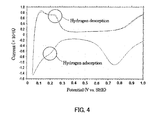
- FIGs. 4 through 7 are graphs showing the CV (Cyclic Voltammogram) curves of a platinum particle, a ruthenium particle, a noble metal particle in Comparative Example 3, and a noble metal particle in Example 7, respectively.
- the CV curves were obtained by carrying out potential sweep in the same manner as for the graph shown in FIG. 3 , except that a working electrode provided using the respective particles and an electrolyte solution consisting of 0.5 M of H 2 SO 4 were used. It should be noted that the measurement was carried out at room temperature, the voltages to be swept were 0.05 to 1.0 V (vs. SHE), and the sweep speed was 1 mV/sec.
- the CV curve having a shoulder peak was obtained at around 0.2 V. It is considered that hydrogen adsorption-desorption on platinum creates this shoulder peak. The above shoulder peak was not observed, as shown in FIGs. 5 and 6 , in the CV curves for the ruthenium particle and noble metal particle in Comparative Example 3.
- the noble metal particle in Comparative Example 3 had a weakened intrinsic property of platinum. Although it is not clearly known at this time why this occurred, the present inventors attribute this to eutectoid of ruthenium and platinum provided on the surface of the platinum particle.
- the noble metal particle of the present invention As for the noble metal particle of the present invention, a shoulder peak was observed at around 0.2 V, as shown in FIG. 7 , and the intrinsic property of platinum was maintained. This means that in the noble metal particle produced according to the present invention, no eutectoid of ruthenium and platinum is provided on the surface of the platinum particle and ruthenium particles are deposited on only part of the surface of the platinum particle.
- the present invention provides a process for producing a noble metal particle with an improved methanol-oxidation property.
- This noble metal particle can be suitably used, for example, as an electrode catalyst for a fuel cell.
Landscapes
- Chemical & Material Sciences (AREA)
- Engineering & Computer Science (AREA)
- Chemical Kinetics & Catalysis (AREA)
- Materials Engineering (AREA)
- General Chemical & Material Sciences (AREA)
- Organic Chemistry (AREA)
- Electrochemistry (AREA)
- Nanotechnology (AREA)
- Life Sciences & Earth Sciences (AREA)
- Sustainable Energy (AREA)
- Manufacturing & Machinery (AREA)
- Physics & Mathematics (AREA)
- Composite Materials (AREA)
- Condensed Matter Physics & Semiconductors (AREA)
- General Physics & Mathematics (AREA)
- Crystallography & Structural Chemistry (AREA)
- Sustainable Development (AREA)
- Inert Electrodes (AREA)
- Catalysts (AREA)
- Manufacture Of Metal Powder And Suspensions Thereof (AREA)
- Powder Metallurgy (AREA)
Abstract
Description
- The present invention relates to a process of producing a noble metal particle containing platinum and ruthenium.
- Currently, a noble metal particle is used widely as a catalyst. One of its applications is a catalyst for a fuel cell electrode. Fuel cells are roughly classified by the kind of electrolyte they employ: a fuel cell that operates at a lower temperature, such as a polymer electrolyte fuel cell, an alkaline fuel cell and a phosphoric acid fuel cell; and a fuel cell that operates at a higher temperature, such as a solid oxide fuel cell and a molten carbonate fuel cell. Among them, a polymer electrolyte fuel cell (PEFC), which operates at a lower temperature and has high energy conversion efficiency, is one of the most promising power sources for a high-efficiency power generation system and a next-generation automobile. In particular, a direct methanol fuel cell (DMFC), a kind of PEFC, is compact due to its direct use of methanol as a fuel source and being free from a hydrogen storage tank and a reformer. In addition, this type of fuel cells starts up quickly. Therefore, it is expected as a power source for mobile devices.
- A polymer electrolyte fuel cell typified by a DMFC has a structure in which an electrolyte member is sandwiched between an anode and a cathode. A noble metal particle as a catalyst is fixed on the anode and cathode. Platinum mainly is used as such a noble metal.
- Hydrogen gas fueled into the anode is decomposed into protons and electrons by a platinum catalyst. Hydrogen supplied to the anode is obtained by reforming hydrocarbon-based fuel such as methane or hydrocarbon-oxide-based fuel such as methanol.
- This reformed gas, however, contains a tiny amount of carbon monoxide. Strong bonding of carbon monoxide to adsorption sites or active sites on the surface of a platinum catalyst may decrease the catalytic effect or stop the catalytic activity, causing the deterioration of the cell performance. This is called catalyst poisoning. In order to prevent catalyst poisoning, a platinum-ruthenium alloy catalyst has attracted attention. Ruthenium is a hydrophilic substance on which hydroxyl groups are likely to be adsorbed. It is believed that ruthenium bonded with hydroxyl groups oxidizes to remove carbon monoxide adsorbed on the surface of platinum, enabling a platinum-ruthenium alloy catalyst to prevent the reduction in performance of a platinum catalyst. It has been supposed, however, that platinum and ruthenium can provide excellent catalytic properties only when they are used as an alloy.
- A platinum-ruthenium alloy catalyst has been produced by precipitating platinum and ruthenium one by one or all at once and then burning them at a high temperature (for example, at 180°C or higher) in an inert gas or a hydrogen gas (see, for example,
JP 09 (1997)-153366 A JP 2002-102699 A - However, there is a problem that burning at a high temperature for alloying makes catalyst particle size larger and reduces the surface area per unit mass of the catalyst, which causes the reduction in catalytic properties. In addition, a conventional noble metal particle is produced so that the particle is covered with a protective colloid. Therefore, this protective colloid has to be removed by high-temperature burning in order to use the particle as a catalyst, which causes another problem that this high-temperature burning makes the catalyst particle size still larger.
- In consideration of the above-mentioned situation, the present inventors have suggested recently, in
WO 2005/030416 A1 , a platinum-ruthenium-based noble metal particle that is produced while preventing the catalyst particle size from becoming larger without the need for high-temperature burning for production. In this noble metal particle, ruthenium-platinum alloy particles are deposited on the surface of a platinum particle. - According to the conventional noble metal particle disclosed in
WO 2005/030416 A1 , the reduction in the catalyst properties can be inhibited by preventing the particle size from becoming larger. However, there is still room for improvement in its methanol-oxidation property. - Colle et al., J. Braz. Chem. Soc., Vol. 14, No.4 (2003), 601-609, describe ruthenium (Ru) nanoparticles deposited on single crystal platinum (Pt) electrodes. Arico et al., J. Electroanal. Chem., 576 (2005), 161-169, describe a Pt-decorated Ru catalyst. Brankovic et al., Electrochem. Solid-State Lett., 4(12). A217-A220 (2001), describe a method for spontaneous deposition of Pt monolayers on Ru nanoparticles. Watanabe et al., J. Electroanal. Chem., 229 (1987), 395-406, describe a method for preparation of a binary Pt + Ru catalyst by co-deposition of fine oxides of Pt and Ru in a mixed salt solution of these metals followed by reduction with hydrogen bubbling.
WO 2004/073090 describe a reductive co-precipitation by hydrogen bubbling of a mixture of a Pt salt, at a valency of less than (IV), and a Ru salt, also at a valency of less than (IV), in the presence of a particulate carbon support. - It is an object of the present invention to provide a process suitable for production of a noble metal particle with an improved methanol-oxidation property, and suitable for producing a noble metal particle having a platinum metal particle and ruthenium metal particles that are deposited on only part of the surface of the platinum particle.
- The present invention provides, as a process suitable for producing the above-mentioned noble metal particle, a process of producing a noble metal particle, including the steps of: precipitating the platinum metal particle out of a solution by reducing a platinum salt contained in the solution; and precipitating the ruthenium metal particles out of the solution containing the platinum metal particle, by adding a ruthenium salt into the solution and reducing the ruthenium salt after the reduction of the platinum salt in the solution is completed, wherein the ruthenium salt is added and reduced so that a ratio of ruthenium of the precipitated ruthenium particles to platinum of the platinum particle is in a range between 0.15 and 0.8 in terms of molar ratio.
- According to the present invention, it is possible to provide a noble metal particle with an improved methanol-oxidation property, compared with a conventional noble metal particle.
-
-
FIG. 1 is a schematic view of an electrochemical measurement device for evaluating the methanol-oxidation property of a noble metal particle. -
FIG. 2 is a sectional view of the vicinity of the tip of a working electrode in the measurement device inFIG. 1 . -
FIG. 3 is a graph showing a relationship between a ratio of ruthenium to platinum in a noble metal particle and a peak value of an oxidation current of methanol measured by the measurement device inFIG. 1 . -
FIG. 4 is a graph showing a CV curve of a platinum particle. -
FIG. 5 is a graph showing a CV curve of a ruthenium particle. -
FIG. 6 is a graph showing a CV curve of a noble metal particle in Comparative Example 3. -
FIG. 7 is a graph showing a CV curve of the noble metal particle of the present invention. - Since the noble metal particle produced according to the present invention contains ruthenium particles deposited on only part of the surface of a platinum particle, it is possible to alleviate the effect of carbon monoxide poisoning on a platinum particle due to the carbon monoxide removing property of ruthenium, while securing the catalytic activity of the platinum particle.
- In the noble metal particle, ruthenium particles can be placed directly on the surface of a platinum particle, practically without the platinum-ruthenium alloy layer in-between.
- As shown in Examples to be described below, as the ratio of ruthenium of ruthenium particles to platinum of a platinum particle contained in a noble metal particle increases from 0.15 toward 0.4, the methanol oxidation property of the noble metal particle increases due to the increase in the carbon monoxide removing property of ruthenium in accordance with the increase in the percentage of ruthenium contained. On the contrary, as the above-mentioned ratio increases from 0.4 toward 0.8, the exposed surface area of the noble metal particle decreases, and thereby the methanol oxidation property of the noble metal particle becomes lower than the best level.
- As described above, it is desirable, from the viewpoint of the methanol oxidation property, that the above ratio be in the range between 0.15 and 0.8, preferably between 0.2 and 0.6, more preferably between 0.25 and 0.5, and most preferably between 0.3 and 0.45, as shown in Examples to be described below.
- Therefore, the noble metal particle is produced by adding a ruthenium salt and reducing the ruthenium salt so that the ratio of precipitated ruthenium of ruthenium particles to platinum of a platinum particle falls within a range between 0.15 and 0.8 in terms of molar ratio.
- Preferably, the production of the noble metal particle further includes a step of reducing the amount of oxygen dissolved in a solution or the solvent of the solution. This step can be carried out by, for example, boiling the solution or the solvent thereof for a long time or boiling and refluxing it so that the amount of oxygen dissolved in the solution or the solvent of the solution is reduced until the solution or the solvent thereof essentially does not contain oxygen. This step may be carried out at any time before the reduction of a platinum salt. That the solution or the solvent thereof essentially does not contain oxygen means that a very small amount of oxygen is permitted to be left in the solution or the solvent thereof to the extent that it does not affect the reduction of a platinum salt and a ruthenium salt.
- Adding a ruthenium salt after the reduction of a platinum salt in the solution essentially is completed means that a platinum salt in a solution is reduced until no or little platinum is present therein when a ruthenium salt is reduced to precipitate ruthenium particles. In other words, a very small amount of platinum is permitted to be precipitated together with ruthenium to the extent that it does not affect the carbon monoxide removing effect of ruthenium.
- If a noble metal particle is produced in the above manner, it is possible to provide a noble metal particle that is not covered with a protective colloid, namely, which does not have a protective colloid, without burning the noble metal particle at a high temperature. Furthermore, if a noble metal particle is produced in the above manner, ruthenium preferentially is precipitated through reduction at the active sites on the surface of a platinum particle, which makes it easier to precipitate ruthenium particles so that they are deposited on only part of the surface of the platinum particle.
- A support obtained by placing the noble metal particles produced according to the present invention on the surface of a carbon substrate is suitable for a fuel cell electrode, for example. The support can be produced using a conventional method such as a dipping method and a spraying method, in which a colloidal solution containing the noble metal particles of the present invention is applied to the surface of the carbon substrate and then dried. The noble metal particles that are not covered with protective colloids can exist in this colloidal solution.
- The following examples are given to further illustrate the present invention.
- 5 mL of pure water obtained by ion exchange and ultrafiltration was added to 0.7 g of hydrogen hexachloroplatinate hexahydrate that is a platinum chloride to prepare an aqueous solution of hexachloroplatinate. 5 mL of this pure water was added to 0.21 g of ruthenium chloride hydrate (RuCl3 • 3H2O) that is a ruthenium chloride to prepare an aqueous solution of ruthenium chloride. Also, this pure water was added to sodium citrate, which serves as a reducing agent, to prepare two types of redox solutions. More specifically, the first redox solution was prepared by adding 20 mL of pure water obtained by ion exchange and ultrafiltration to 1.1 g of sodium citrate, whereas the second redox solution was prepared by adding 20 mL of pure water obtained by ion exchange and ultrafiltration to 1.4 g of sodium citrate.
- Dissolved oxygen was removed by boiling and refluxing 950 mL of pure water. 20 minutes after the start of boiling, the first redox solution was added to the pure water from which the dissolved oxygen has been removed, and then the resultant solution was boiled and refluxed for more 20 minutes. Subsequently, an aqueous solution of hexachloroplatinate was added, and boiling and refluxing were continued so that the reduction reaction of platinum proceeded. Thereby, all the added platinum essentially was reduced.
- The second redox solution further was added 1.5 hour after the addition of an aqueous solution of hexachloroplatinate. 5 minutes later, an aqueous solution of ruthenium chloride was added, and boiling and reduction reaction were continued for 25 hours, and then the resultant solution was quenched to room temperature so as to obtain a reaction solution.
- The reaction solution was passed through a column filled with ion exchange resin MB-1 (made by Organo Corporation) so as to remove the metal ions and the reducing agent remaining in the reaction solution, and thereby a colloidal solution containing noble metal particles (platinum-ruthenium particles) was obtained.
- The noble metal particles were obtained by dehydrating this colloidal solution. The ratio between platinum and ruthenium in the noble metal particle was expressed as Pt:Ru=1:0.28 in terms of molar ratio.
- A noble metal particle was obtained in the same manner as in Example 1, except that the amount of hydrogen hexachloroplatinate hexahydrate to be used for preparing an aqueous solution of hexachloroplatinate was changed from 0.7 g to 0.62 g, and that a redox solution prepared by adding 40 mL of pure water obtained by ion exchange and ultrafiltration to 2.9 g of sodium citrate was used in place of the first redox solution and the second redox solution.
- The ratio between platinum and ruthenium in the noble metal particle was expressed as Pt:Ru=1:0.4 in terms of molar ratio.
- A noble metal particle was obtained in Examples 3 to 7, 10 and 11 in the same manner as in Example 1, and in Examples 8 and 9 in the same manner as in Example 2, except that the amount of hydrogen hexachloroplatinate hexahydrate to be added was adjusted so that the ratio of ruthenium to platinum in a noble metal particle attains the ratio as shown in Table 1.
- Comparative Example 1 is an example in which the experiment as described in Example 1 of
WO 2005/030416A1 was repeated. - 50 mL of pure water obtained by ion exchange and ultrafiltration was added to 0.195 g of hydrogen hexachloroplatinate hexahydrate to prepare an aqueous solution of hexachloroplatinate. 50 mL of this pure water was added to 0.1 g of ruthenium chloride hydrate (RuCl3 ● 3H2O) to prepare an aqueous solution of ruthenium chloride. Also, 50 mL of this pure water was added to 3 g of sodium citrate to prepare a redox solution.
- Dissolved oxygen was removed by boiling and refluxing 850 mL of pure water. 20 minutes after the start of boiling, the redox solution was added to the pure water from which the dissolved oxygen has been removed, and then the resultant solution was boiled and refluxed for more 20 minutes. Subsequently, an aqueous solution of hexachloroplatinate was added, and 2 minutes later, an aqueous solution of ruthenium chloride further was added, and boiling and refluxing were continued for 1 hour. Then, the resultant solution was quenched to room temperature so as to obtain a reaction solution.
- The noble metal particles were obtained from the reaction solution in the same manner as in Example 1. The ratio between platinum and ruthenium in the noble metal particle was expressed as Pt:Ru=1:1 in terms of molar ratio.
- Comparative Example 2 is an example in which a noble metal particle made of platinum only was provided.
- 50 mL of pure water obtained by ion exchange and ultrafiltration was added to 0.4 g of hydrogen hexachloroplatinate hexahydrate to prepare an aqueous solution of hexachloroplatinate. 50 mL of pure water was added to 1 g of sodium citrate to prepare a redox solution.
- Dissolved oxygen was removed by boiling and refluxing 900 mL of pure water. 20 minutes after the start of boiling, the redox solution was added to the pure water from which the dissolved oxygen has been removed, and then the resultant solution was boiled and refluxed for more 20 minutes. Subsequently, an aqueous solution of hexachloroplatinate was added, and boiling and refluxing were continued for 1 hour. Then, the resultant solution was quenched to room temperature so as to obtain a reaction solution.
- The noble metal particles were obtained from the reaction solution in the same manner as in Example 1.
- A noble metal particle was obtained in the same manner as in Example 1, except that the amount of hydrogen hexachloroplatinate hexahydrate to be added was adjusted so that the ratio of ruthenium to platinum in a noble metal particle is expressed as Pt:Ru=1:0.66 in terms of molar ratio.
- Using an
electrochemical measurement device 1 in which a workingelectrode 20 provided as described later, a reference electrode (Ag/AgCl electrode) 30 and acounter electrode 40 are connected to an electrochemical analyzer 10 (made by BAS Co. Ltd.), potential sweep was carried out with these electrodes being dipped in anelectrolyte solution 60 consisting of 1 M of CH3OH and 0.5 M of H2SO4 contained in abeaker 50, so as to evaluate the methanol-oxidation property of a noble metal particle (to be described later in detail). -
FIG. 2 is a sectional view of the vicinity of the tip of the working electrode. As shown inFIG. 2 , in the workingelectrode 20,noble metal particles 22 are placed on the surface in the vicinity of the tip of aglassy carbon electrode 21, anelectrolyte membrane 23 is disposed so as to cover thenoble metal particles 22, and aresin layer 24 is disposed so as to cover the side of theelectrode 21. - The working electrode was provided in the following manner. First, a colloid solution containing the noble metal particles obtained in Examples 1 to 11 and Comparative Examples 1 and 2 were applied to respective glassy carbon electrodes and dried, and thereby the noble metal particles were fixed on the electrode. Then, a solution-state Nafion® (made by DuPont Corporation) was applied to cover the noble metal particles and dried, so as to form the electrolyte membrane.
- The methanol-oxidation properties were compared based on the peak current value (A/g) of an oxidation current per gram of platinum. It should be noted that the measurement was carried out at room temperature and the sweep speed was 1 mV/sec. In a noble metal particle, platinum is mainly responsible for catalytic activity, whereas ruthenium is present to give the resistance to poisoning. Therefore, the catalytic effect of a noble metal particle can be evaluated based on the peak current value per gram of platinum. Table 1 shows the evaluation results.
Table 1 Sample Peak value of oxidation current (A/g) Molar ratio of Ru to Pt Process to be followed Example 1 155 0.28 Example 2 194 0.4 Example 3 140 0.27 Example 1 Example 4 177 0.34 Example 1 Example 5 192 0.37 Example 1 Example 6 157 0.43 Example 1 Example 7 110 0.47 Example 1 Example 8 130 0.56 Example 2 Example 9 97 0.53 Example 2 Example 10 78 0.62 Example 1 Example 11 54 0.64 Example 1 Comparative Example 1 26 1.0 Comparative Example 2 10 0 Comparative Example 3 - 0.66 Comparative Example 1 -
FIG. 3 is a graph showing the relationship between: the peak values of oxidation current which were measured by the working electrode using the noble metal particles as shown in Examples 1 to 11 and Comparative Examples 1 and 2 and then converted to per gram of platinum; and the ratios of ruthenium to platinum contained in these noble metal particles. - As shown in
FIG. 3 , it was found that the above-mentioned peak value of oxidation current is 40 amperes or greater when the ratio of ruthenium to platinum is in a range between 0.15 and 0.8 in terms of molar ratio. It was further found that the above-mentioned peak values of oxidation current are 75 amperes or greater, 110 amperes or greater, and 150 amperes or greater, respectively, when these ratios are in a range between 0.2 and 0.6, a range between 0.25 and 0.5, and a range between 0.3 and 0.45 in terms of molar ratio. It was found that 0.4 of this ratio, in particular, achieves the best balance between the catalytic activity of platinum and the carbon monoxide removing activity of ruthenium, thereby maximizing the above-mentioned peak value of oxidation current. -
FIGs. 4 through 7 are graphs showing the CV (Cyclic Voltammogram) curves of a platinum particle, a ruthenium particle, a noble metal particle in Comparative Example 3, and a noble metal particle in Example 7, respectively. The CV curves were obtained by carrying out potential sweep in the same manner as for the graph shown inFIG. 3 , except that a working electrode provided using the respective particles and an electrolyte solution consisting of 0.5 M of H2SO4 were used. It should be noted that the measurement was carried out at room temperature, the voltages to be swept were 0.05 to 1.0 V (vs. SHE), and the sweep speed was 1 mV/sec. - As for the platinum particle, as shown in
FIG. 4 , the CV curve having a shoulder peak was obtained at around 0.2 V. It is considered that hydrogen adsorption-desorption on platinum creates this shoulder peak. The above shoulder peak was not observed, as shown inFIGs. 5 and6 , in the CV curves for the ruthenium particle and noble metal particle in Comparative Example 3. - As described above, the noble metal particle in Comparative Example 3 had a weakened intrinsic property of platinum. Although it is not clearly known at this time why this occurred, the present inventors attribute this to eutectoid of ruthenium and platinum provided on the surface of the platinum particle.
- Meanwhile, as for the noble metal particle of the present invention, a shoulder peak was observed at around 0.2 V, as shown in
FIG. 7 , and the intrinsic property of platinum was maintained. This means that in the noble metal particle produced according to the present invention, no eutectoid of ruthenium and platinum is provided on the surface of the platinum particle and ruthenium particles are deposited on only part of the surface of the platinum particle. - It should be noted that it is known that a CV curve of platinum shows, at around 0.2 V, a peak created by hydrogen adsorption-desorption on platinum. See, for example, J. Electrochem. Soc., Vol. 143, No.5, p1685-1690 (1996), ibid Vol. 145, No.7, p2354-2358 (1998).
- The present invention provides a process for producing a noble metal particle with an improved methanol-oxidation property. This noble metal particle can be suitably used, for example, as an electrode catalyst for a fuel cell.
Claims (5)
- A process of producing a noble metal particle having a platinum metal particle and ruthenium metal particles, the process being suitable for producing a noble metal particle having a platinum metal particle and ruthenium metal particles that are deposited on only part of the surface of the platinum particle, the process comprising the steps of:precipitating the platinum metal particle out of a solution by reducing a platinum salt contained in the solution; andprecipitating the ruthenium metal particles out of the solution containing the platinum metal particle, by adding a ruthenium salt into the solution and reducing the ruthenium salt after the reduction of the platinum salt in the solution is completed,wherein the ruthenium salt is added and reduced so that a ratio of ruthenium of the precipitated ruthenium particles to platinum of the platinum particle is in a range between 0.15 and 0.8 in terms of molar ratio.
- The process of producing the noble metal particle according to Claim 1, further comprising the step of reducing the amount of oxygen dissolved in the solution or a solvent of the solution.
- The process of producing the noble metal particle according to Claim 1 or 2, wherein the ratio is in a range between 0.2 and 0.6 in terms of molar ratio.
- The process of producing the noble metal particle according to Claim 3, wherein the ratio is in a range between 0.25 and 0.5 in terms of molar ratio.
- The process of producing the noble metal particle according to Claim 4, wherein the ratio is in a range between 0.3 and 0.45 in terms of molar ratio.
Applications Claiming Priority (2)
| Application Number | Priority Date | Filing Date | Title |
|---|---|---|---|
| JP2005260015 | 2005-09-08 | ||
| PCT/JP2006/317309 WO2007029607A1 (en) | 2005-09-08 | 2006-09-01 | Noble metal microparticle and method for production thereof |
Publications (3)
| Publication Number | Publication Date |
|---|---|
| EP1930103A1 EP1930103A1 (en) | 2008-06-11 |
| EP1930103A4 EP1930103A4 (en) | 2009-05-06 |
| EP1930103B1 true EP1930103B1 (en) | 2011-06-29 |
Family
ID=37835726
Family Applications (1)
| Application Number | Title | Priority Date | Filing Date |
|---|---|---|---|
| EP06797251A Not-in-force EP1930103B1 (en) | 2005-09-08 | 2006-09-01 | Noble metal microparticle and method for production thereof |
Country Status (5)
| Country | Link |
|---|---|
| US (1) | US7754644B2 (en) |
| EP (1) | EP1930103B1 (en) |
| JP (1) | JP5058805B2 (en) |
| KR (1) | KR20080044324A (en) |
| WO (1) | WO2007029607A1 (en) |
Families Citing this family (4)
| Publication number | Priority date | Publication date | Assignee | Title |
|---|---|---|---|---|
| US8309489B2 (en) * | 2009-06-18 | 2012-11-13 | University Of Central Florida Research Foundation, Inc. | Thermally stable nanoparticles on supports |
| US9722257B2 (en) * | 2009-12-14 | 2017-08-01 | GM Global Technology Operations LLC | Method of enhancing electrodes |
| US9287569B2 (en) * | 2009-12-14 | 2016-03-15 | GM Global Technology Operations LLC | Method of enhancing electrodes |
| US8951931B2 (en) * | 2010-03-02 | 2015-02-10 | Nippon Sheet Glass Company, Limited | Noble metal fine particle supported catalyst and method for producing the catalyst, and purifying catalyst |
Family Cites Families (8)
| Publication number | Priority date | Publication date | Assignee | Title |
|---|---|---|---|---|
| JPH09153366A (en) | 1995-11-29 | 1997-06-10 | Aisin Seiki Co Ltd | Method for producing composite catalyst molded body |
| JP3839961B2 (en) * | 1998-06-16 | 2006-11-01 | 田中貴金属工業株式会社 | Method for producing catalyst for solid polymer electrolyte fuel cell |
| WO1999066576A1 (en) | 1998-06-16 | 1999-12-23 | Tanaka Kikinzoku Kogyo K.K. | Catalyst for polymer solid electrolyte type fuel-cell and method for producing catalyst for polymer solid electrolyte type fuel-cell |
| JP2002102699A (en) | 2000-09-29 | 2002-04-09 | Toshiba Corp | Alcohol reforming catalyst and fuel cell using the same |
| JP2002231257A (en) * | 2001-01-30 | 2002-08-16 | Matsushita Electric Ind Co Ltd | Electrode catalyst for fuel cell and method for producing the same |
| WO2004073090A2 (en) | 2003-02-13 | 2004-08-26 | E.I. Du Pont De Nemours And Company | Electrocatalysts and processes for producing |
| WO2005030416A1 (en) | 2003-09-29 | 2005-04-07 | Nippon Sheet Glass Co., Ltd. | Alloy colloidal particle, alloy colloidal solution and method for producing same, and supporting body to which alloy colloidal particle is fixed |
| JP4180531B2 (en) * | 2004-02-19 | 2008-11-12 | 日本板硝子株式会社 | Colloidal metal particles and method for producing the same |
-
2006
- 2006-09-01 EP EP06797251A patent/EP1930103B1/en not_active Not-in-force
- 2006-09-01 US US11/991,390 patent/US7754644B2/en not_active Expired - Fee Related
- 2006-09-01 JP JP2007534369A patent/JP5058805B2/en not_active Expired - Fee Related
- 2006-09-01 WO PCT/JP2006/317309 patent/WO2007029607A1/en not_active Ceased
- 2006-09-01 KR KR1020087008033A patent/KR20080044324A/en not_active Ceased
Also Published As
| Publication number | Publication date |
|---|---|
| KR20080044324A (en) | 2008-05-20 |
| US7754644B2 (en) | 2010-07-13 |
| JPWO2007029607A1 (en) | 2009-03-19 |
| JP5058805B2 (en) | 2012-10-24 |
| EP1930103A4 (en) | 2009-05-06 |
| US20090156390A1 (en) | 2009-06-18 |
| WO2007029607A1 (en) | 2007-03-15 |
| EP1930103A1 (en) | 2008-06-11 |
Similar Documents
| Publication | Publication Date | Title |
|---|---|---|
| US6797667B2 (en) | Process for preparing an anode catalyst for fuel cells and the anode catalyst prepared therewith | |
| US6498121B1 (en) | Platinum-ruthenium-palladium alloys for use as a fuel cell catalyst | |
| KR100506091B1 (en) | Catalyst for cathode of fuel cell | |
| Meli et al. | Direct electrooxidation of methanol on highly dispersed platinum-based catalyst electrodes: temperature effect | |
| EP2045859A1 (en) | Method for manufacturing electrode catalyst for fuel cell, electrode catalyst for fuel cell, and solid polymer electrolyte fuel cell comprising the same | |
| EP3525272B1 (en) | Catalyst for solid polymer fuel cell and method for producing the same | |
| CN102468507A (en) | Fuel cell durability through oxide supported precious metals in membrane | |
| EP1022795A1 (en) | Catalyst for polymer solid electrolyte type fuel-cell and method for producing catalyst for polymer solid electrolyte type fuel-cell | |
| Li et al. | Vacancy-engineered CeO 2/Co heterostructure anchored on the nitrogen-doped porous carbon nanosheet arrays vertically grown on carbon cloth as an integrated cathode for the oxygen reduction reaction of rechargeable Zn–air battery | |
| CN111330569A (en) | A kind of atomically dispersed electrochemical catalyst of noble metal that can be scaled up in batches and preparation method thereof | |
| CN110911700A (en) | Catalyst, preparation method and application thereof | |
| JP2000003712A (en) | Catalyst for polymer electrolyte fuel cell | |
| EP2413407B1 (en) | Electrode catalyst and method of preparing electrode catalyst for fuel cell, and membrane electrode assembly and fuel cell including same | |
| CN103191757B (en) | PdNiW/C ternary alloy nano catalyst and preparation method thereof | |
| EP2156492B1 (en) | Alkaline fuel cell electrode catalyst, alkaline fuel cell, manufacture method for alkaline fuel cell electrode catalyst, and manufacture method for alkaline fuel cell | |
| KR100561169B1 (en) | Catalyst for fuel cell containing oxygen adsorption promoter, electrode for fuel cell manufactured using same, and fuel cell comprising the electrode | |
| EP1930103B1 (en) | Noble metal microparticle and method for production thereof | |
| JP2012248365A (en) | Catalyst for solid polymer fuel cell | |
| EP1260269B1 (en) | A process for preparing an anode catalyst for fuel cells | |
| JP2005251455A (en) | Catalyst for fuel cell and production method thereof, electrode, and direct methanol fuel cell | |
| CN104037427A (en) | Preparation method and application of high-activity core-shell structured catalyst | |
| CN102814177A (en) | Preparation method of catalyst for direct methanol fuel cell and direct methanol fuel cell | |
| CN1323450C (en) | A kind of preparation method of direct methanol fuel cell anode catalyst | |
| JPWO2006112368A1 (en) | Fuel cell electrode catalyst and method for producing the same | |
| JP2005353376A (en) | Method for producing electrode for polymer electrolyte fuel cell |
Legal Events
| Date | Code | Title | Description |
|---|---|---|---|
| PUAI | Public reference made under article 153(3) epc to a published international application that has entered the european phase |
Free format text: ORIGINAL CODE: 0009012 |
|
| 17P | Request for examination filed |
Effective date: 20080306 |
|
| AK | Designated contracting states |
Kind code of ref document: A1 Designated state(s): DE FR GB IT |
|
| RBV | Designated contracting states (corrected) |
Designated state(s): DE FR GB IT |
|
| A4 | Supplementary search report drawn up and despatched |
Effective date: 20090406 |
|
| 17Q | First examination report despatched |
Effective date: 20090730 |
|
| GRAP | Despatch of communication of intention to grant a patent |
Free format text: ORIGINAL CODE: EPIDOSNIGR1 |
|
| DAX | Request for extension of the european patent (deleted) | ||
| GRAS | Grant fee paid |
Free format text: ORIGINAL CODE: EPIDOSNIGR3 |
|
| GRAA | (expected) grant |
Free format text: ORIGINAL CODE: 0009210 |
|
| AK | Designated contracting states |
Kind code of ref document: B1 Designated state(s): DE FR GB IT |
|
| REG | Reference to a national code |
Ref country code: GB Ref legal event code: FG4D |
|
| REG | Reference to a national code |
Ref country code: DE Ref legal event code: R096 Ref document number: 602006022813 Country of ref document: DE Effective date: 20110825 |
|
| PLBE | No opposition filed within time limit |
Free format text: ORIGINAL CODE: 0009261 |
|
| STAA | Information on the status of an ep patent application or granted ep patent |
Free format text: STATUS: NO OPPOSITION FILED WITHIN TIME LIMIT |
|
| GBPC | Gb: european patent ceased through non-payment of renewal fee |
Effective date: 20110929 |
|
| PG25 | Lapsed in a contracting state [announced via postgrant information from national office to epo] |
Ref country code: IT Free format text: LAPSE BECAUSE OF FAILURE TO SUBMIT A TRANSLATION OF THE DESCRIPTION OR TO PAY THE FEE WITHIN THE PRESCRIBED TIME-LIMIT Effective date: 20110629 |
|
| 26N | No opposition filed |
Effective date: 20120330 |
|
| REG | Reference to a national code |
Ref country code: FR Ref legal event code: ST Effective date: 20120531 |
|
| REG | Reference to a national code |
Ref country code: DE Ref legal event code: R097 Ref document number: 602006022813 Country of ref document: DE Effective date: 20120330 |
|
| PG25 | Lapsed in a contracting state [announced via postgrant information from national office to epo] |
Ref country code: FR Free format text: LAPSE BECAUSE OF NON-PAYMENT OF DUE FEES Effective date: 20110930 Ref country code: GB Free format text: LAPSE BECAUSE OF NON-PAYMENT OF DUE FEES Effective date: 20110929 |
|
| PGFP | Annual fee paid to national office [announced via postgrant information from national office to epo] |
Ref country code: DE Payment date: 20160823 Year of fee payment: 11 |
|
| REG | Reference to a national code |
Ref country code: DE Ref legal event code: R119 Ref document number: 602006022813 Country of ref document: DE |
|
| PG25 | Lapsed in a contracting state [announced via postgrant information from national office to epo] |
Ref country code: DE Free format text: LAPSE BECAUSE OF NON-PAYMENT OF DUE FEES Effective date: 20180404 |