EP1926218A2 - Mobile communication apparatus, mobile communication system, and power consumption reducing method for use therewith - Google Patents
Mobile communication apparatus, mobile communication system, and power consumption reducing method for use therewith Download PDFInfo
- Publication number
- EP1926218A2 EP1926218A2 EP07121370A EP07121370A EP1926218A2 EP 1926218 A2 EP1926218 A2 EP 1926218A2 EP 07121370 A EP07121370 A EP 07121370A EP 07121370 A EP07121370 A EP 07121370A EP 1926218 A2 EP1926218 A2 EP 1926218A2
- Authority
- EP
- European Patent Office
- Prior art keywords
- mobile communication
- communication apparatus
- transmission
- signals
- subcarrier
- Prior art date
- Legal status (The legal status is an assumption and is not a legal conclusion. Google has not performed a legal analysis and makes no representation as to the accuracy of the status listed.)
- Withdrawn
Links
Images


Classifications
-
- H—ELECTRICITY
- H04—ELECTRIC COMMUNICATION TECHNIQUE
- H04W—WIRELESS COMMUNICATION NETWORKS
- H04W52/00—Power management, e.g. Transmission Power Control [TPC] or power classes
- H04W52/02—Power saving arrangements
-
- H—ELECTRICITY
- H04—ELECTRIC COMMUNICATION TECHNIQUE
- H04B—TRANSMISSION
- H04B1/00—Details of transmission systems, not covered by a single one of groups H04B3/00 - H04B13/00; Details of transmission systems not characterised by the medium used for transmission
- H04B1/02—Transmitters
- H04B1/04—Circuits
-
- H—ELECTRICITY
- H04—ELECTRIC COMMUNICATION TECHNIQUE
- H04W—WIRELESS COMMUNICATION NETWORKS
- H04W52/00—Power management, e.g. Transmission Power Control [TPC] or power classes
- H04W52/02—Power saving arrangements
- H04W52/0209—Power saving arrangements in terminal devices
- H04W52/0251—Power saving arrangements in terminal devices using monitoring of local events, e.g. events related to user activity
-
- H—ELECTRICITY
- H04—ELECTRIC COMMUNICATION TECHNIQUE
- H04W—WIRELESS COMMUNICATION NETWORKS
- H04W52/00—Power management, e.g. Transmission Power Control [TPC] or power classes
- H04W52/02—Power saving arrangements
- H04W52/0209—Power saving arrangements in terminal devices
- H04W52/0261—Power saving arrangements in terminal devices managing power supply demand, e.g. depending on battery level
- H04W52/0274—Power saving arrangements in terminal devices managing power supply demand, e.g. depending on battery level by switching on or off the equipment or parts thereof
- H04W52/028—Power saving arrangements in terminal devices managing power supply demand, e.g. depending on battery level by switching on or off the equipment or parts thereof switching on or off only a part of the equipment circuit blocks
-
- H—ELECTRICITY
- H04—ELECTRIC COMMUNICATION TECHNIQUE
- H04W—WIRELESS COMMUNICATION NETWORKS
- H04W72/00—Local resource management
- H04W72/02—Selection of wireless resources by user or terminal
-
- H—ELECTRICITY
- H04—ELECTRIC COMMUNICATION TECHNIQUE
- H04W—WIRELESS COMMUNICATION NETWORKS
- H04W88/00—Devices specially adapted for wireless communication networks, e.g. terminals, base stations or access point devices
- H04W88/02—Terminal devices
-
- Y—GENERAL TAGGING OF NEW TECHNOLOGICAL DEVELOPMENTS; GENERAL TAGGING OF CROSS-SECTIONAL TECHNOLOGIES SPANNING OVER SEVERAL SECTIONS OF THE IPC; TECHNICAL SUBJECTS COVERED BY FORMER USPC CROSS-REFERENCE ART COLLECTIONS [XRACs] AND DIGESTS
- Y02—TECHNOLOGIES OR APPLICATIONS FOR MITIGATION OR ADAPTATION AGAINST CLIMATE CHANGE
- Y02D—CLIMATE CHANGE MITIGATION TECHNOLOGIES IN INFORMATION AND COMMUNICATION TECHNOLOGIES [ICT], I.E. INFORMATION AND COMMUNICATION TECHNOLOGIES AIMING AT THE REDUCTION OF THEIR OWN ENERGY USE
- Y02D30/00—Reducing energy consumption in communication networks
- Y02D30/70—Reducing energy consumption in communication networks in wireless communication networks
Definitions
- the present invention relates to a mobile communication apparatus, a mobile communication system, and a power consumption reducing method for use with the apparatus and the system, and more specifically to a mobile communication system using an SC-FDMA (single carrier-frequency division multiple access) system in a 3GPP (3rd generation partnership project).
- SC-FDMA single carrier-frequency division multiple access
- a mobile communication system using the SC-FDMA system is investigated as a communication system after the third generation mobile communication system (for example, refer to the Non-Patent Document 1 " Physical layer aspects for evolved Universal Terrestrial Radio Access (UTRA) 9 UL Concepts" [3GPP TR25.814 V7. 1. 0 (2006-09), pp 71-93 ]) .
- UTRA Universal Terrestrial Radio Access
- next generation communication system one of the objects is that a large volume of data can be communicated on a terminal transmission side at a high speed by scheduling from a base station, and it is anticipated that the circuit might be complicated and required high-speed. As the high-speed data communication becomes available, applications to be loaded onto an upper layer should be graded up and complicated, and therefore increase of power consumption is anticipated.
- a high-speed complicated circuit and a high-level complicated application are anticipated with increasing power consumption. Therefore, reduction on the power consumption is further demanded especially for a terminal driven by a battery.
- a power-saving terminal is an essential item in light of the recent global environmental problems.
- An exemplary object of the invention is to solve the above-mentioned problem, and provide a mobile communication apparatus, a mobile communication system and a power consumption reducing method for use with the apparatus and the system which are capable of controlling the operation rate of a subcarrier mapping portion and reducing the power consumption of a terminal.
- An exemplary aspect of the invention is a mobile communication apparatus including a transmission portion which transmits data after varying the amount of data to be transmitted under control of scheduling from at least a base station, and includes a schedule portion that stops the operation of an unnecessary circuit by controlling the operation rate of the transmission portion.
- An exemplary aspect of the invention is a mobile communication system that includes the above-mentioned mobile communication apparatus.
- An exemplary aspect of the invention is a power consumption reducing method for use with a mobile communication apparatus including a transmission portion which transmits data after varying the amount of data to be transmitted under control of scheduling from at least a base station, and includes scheduling of stopping an operation of an unnecessary circuit by controlling the operation rate of the transmission portion of the mobile communication apparatus.
- the transmission portion may comprise a DFT circuit that performs a DFT (discrete Fourier transform) process on an input signal, thereby converting the signal into a signal of a frequency area.
- the transmission portion may comprise a subcarrier mapping circuit that performs subcarrier mapping on the signal converted into a signal of a frequency area by the DFT circuit.
- the transmission portion may comprise an IFFT circuit that performs IFFT (inverse fast Fourier transform) on the signal subcarrier mapped by the subcarrier mapping circuit
- the schedule portion preferably stops the operation of the unnecessary circuit by controlling the operation rate of the subcarrier mapping circuit.
- the subcarrier mapping circuit preferably receives from the schedule portion an instruction to perform the IFFT by the IFFT circuit in which subcarrier a signal is to be arranged, the subcarrier mapping circuit fixes output of "0" without performing a serial-parallel converting operation about a position into which "0" is inserted when the signal output from the DFT circuit is arranged in a position of a specified subcarrier.
- SC-FDMA single carrier-frequency division multiple access
- the subcarrier mapping circuit may perform the subcarrier mapping by one of localized mapping for arranging the subcarriers with concentration in all subcarriers and distributed mapping for distributing and arranging the subcarriers at predetermined intervals.
- Another preferable aspect comprises a recording medium storing a program for a power consumption reducing method for use with a mobile communication apparatus including a transmission portion which transmits data after varying an amount of data to be transmitted under control of scheduling from at least a base station, the program being used to cause a computer to execute scheduling of stopping an operation of an unnecessary circuit by controlling an operation rate of the transmission portion of the mobile communication apparatus.
- the transmission and reception conditions, the requested amount of transmission data, etc. of the mobile communication system using the SC-FDMA (single carrier-frequency division multiple access) system in the 3GPP (3rd generation partnership project) are scheduled on the base station side.
- the power consumption of the apparatus can be reduced by controlling the operation of the transmission portion in the mobile communication system in which the frequency band width used by the apparatus is variable.
- a mobile communication system can transmit data after varying the amount of data to be transmitted under the control by scheduling etc. from a base station.
- the subcarrier mapping portion arranges the signal output from the DFT (discrete Fourier transform) portion in a position of the specified subcarrier.
- the subcarrier mapping portion When the position into which "0" is to be inserted by an instruction from the schedule portion is determined, the subcarrier mapping portion does not perform the S-P converting operation on the portion at which "0" is output in the S-P (serial-parallel) conversion circuit, but fixes the output of "0". Thus, the data "0" is input for the portion where no signal is received from the subcarrier mapping portion at the input terminal of the IFFT portion.
- the mobile communication apparatus controls the operation rate of the subcarrier mapping portion on the terminal transmission side based on the information about the scheduling etc., and stops the operation of an unnecessary circuit (disconnection of the power to a component, disconnection of the supply of the clock etc.), thereby reducing the power consumption of the circuit.
- the mobile communication apparatus lowers the operation rate of the circuit on the terminal transmission side in the next generation communication system using an SC-FDMA system considered as a next generation mobile communication system, thereby successfully reducing the power consumption.
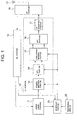
- FIG. 1 is a block diagram of the configuration of the mobile communication apparatus according to the first exemplary embodiment of the invention.
- the mobile communication apparatus according to the first exemplary embodiment of the invention includes an upper layer portion 11, a TX portion (transmission portion) 12, an RF portion (radio portion) 18, an RX portion (reception portion) 19, a schedule portion 20, an antenna 21, and a recording medium 22.
- the TX portion 12 includes a symbol mapping portion 13, a DFT (discrete Fourier transform) portion 14, a subcarrier mapping portion 15, an IFFT (inverse fast Fourier transform) portion 16, and a CP (cyclic prefix) inserting portion 17.
- the symbol mapping portion 13 codes and modulates a signal from the upper layer portion 11 or a control signal.
- the DFT portion 14 performs a DFT process on the signal coded and modulated by the symbol mapping portion 13 to convert it into a signal of a frequency area.
- the subcarrier mapping portion 15 performs a subcarrier mapping process on the signal converted into the signal of the frequency area by the DFT portion 14.
- the IFFT portion 16 performs the IFFT, and the CP inserting portion 17 inserts a CP.
- the signal into which the CP is inserted by the CP inserting portion 17 is high-frequency amplified by the RF portion 18, and transmitted as radio waves from the antenna 21.
- the radio waves received by the antenna 21 are detected and demodulated by the RX portion 19 through the RF portion 18.
- the RX portion 19 delivers the detected and demodulated data and the control signal to the upper layer portion 11, and notifies the schedule portion 20 of the reception quality, the control signal, etc.
- the schedule portion 20 acquires the signal type information including the priority level based on the information of the amount of data of the transmission signal from the upper layer portion 11 or the uplink control information received from the RX portion 19, determines a transmission pattern, and notifies the symbol mapping portion 13, the DFT portion 14, and the subcarrier mapping portion 15 of the determination result.
- the recording medium 22 stores a program for the power consumption reducing method described later and shown by the flowchart in FIG. 3.
- the schedule portion 20 reads the program from the recording medium 22, and controls the symbol mapping portion 13, the DFT portion 14, and the subcarrier mapping portion 15 on the basis of the program.
- FIGS. 2A and 2B show examples of arranging a subcarrier according to the first exemplary embodiment of the invention.
- FIG. 3 is a flowchart showing an example of an operation of the power consumption reducing method according to the first exemplary embodiment of the invention.
- the mobile communication apparatus according to the first exemplary embodiment of the invention is described below with reference to FIGS. 1, 2A, 2B, and 3.
- the subcarrier mapping portion 15 When the subcarrier mapping portion 15 receives an instruction from the schedule portion 20 as to in which subcarrier a signal is to be arranged to perform the IFFT by the IFFT portion 16 (step S1 in FIG. 3), the subcarrier mapping portion 15 arranges the signal output from the DFT portion 14 in the position of the specified subcarrier.
- mapping 31 shown in FIG. 2A and distributed mapping 32 shown in FIG. 2B are proposed.
- the localized mapping 31 is a method of arranging subcarriers with concentration in all subcarriers.
- the distributed mapping 32 is a method of arranging the subcarriers distributed at predetermined intervals. It is assumed that "0" is inserted into the position of a subcarrier where no arrangement is made.
- the subcarrier mapping portion 15 performs no S-P converting operation on the portion at which "0" is output and fixes the output of "0" in the S-P (serial-parallel) conversion circuit not shown in the attached drawings (step S2 shown in FIG. 3).
- "0" data is to be input at the input terminal of the IFFT portion 16 for the portion where no signal is received from the subcarrier mapping portion 15.
- the operation rate of the subcarrier mapping portion can be controlled by assigning a transmission pattern, thereby reducing the power consumption of the mobile communication apparatus.
- FIG. 4 shows the configuration of the mobile communication apparatus according to the second exemplary embodiment of the invention.
- FIG. 5A shows an example of transmitting a subcarrier signal when the localized mapping operation is performed
- FIG. 5B shows an example of transmitting a subcarrier signal when the distributed mapping operation is performed.
- a subcarrier mapping portion 41 performs the subcarrier mapping on the signal after the DFT process, the signal is input to an IFFT portion 42, and a schedule portion 43 inputs information as to in which subcarrier the signal is to be arranged, then the subcarrier mapping portion 41 has the time period in which "0" is inserted while it serially transmits a subcarrier signal.
- the subcarrier mapping portion 41 can reduce the operation rate of the circuit by stopping the operation of an unnecessary circuit at that time.
- a mobile communication apparatus including a transmission portion which transmits data after varying an amount of data to be transmitted under control of scheduling from at least a base station, including a schedule portion that stops an operation of an unnecessary circuit by controlling an operation rate of the transmission portion.
Landscapes
- Engineering & Computer Science (AREA)
- Computer Networks & Wireless Communication (AREA)
- Signal Processing (AREA)
- Mobile Radio Communication Systems (AREA)
- Telephone Function (AREA)
- Transmitters (AREA)
Abstract
Description
- This application is based upon and claims the benefit of priority from
Japanese patent applications No. 2006-314943, filed on November 22, 2006 - The present invention relates to a mobile communication apparatus, a mobile communication system, and a power consumption reducing method for use with the apparatus and the system, and more specifically to a mobile communication system using an SC-FDMA (single carrier-frequency division multiple access) system in a 3GPP (3rd generation partnership project).
- At present, a mobile communication system using the SC-FDMA system is investigated as a communication system after the third generation mobile communication system (for example, refer to the Non-Patent Document 1 "Physical layer aspects for evolved Universal Terrestrial Radio Access (UTRA) 9 UL Concepts" [3GPP TR25.814 V7. 1. 0 (2006-09), pp 71-93]) .
- In the next generation communication system, one of the objects is that a large volume of data can be communicated on a terminal transmission side at a high speed by scheduling from a base station, and it is anticipated that the circuit might be complicated and required high-speed. As the high-speed data communication becomes available, applications to be loaded onto an upper layer should be graded up and complicated, and therefore increase of power consumption is anticipated.
- With the above-mentioned related mobile communication system, a high-speed complicated circuit and a high-level complicated application are anticipated with increasing power consumption. Therefore, reduction on the power consumption is further demanded especially for a terminal driven by a battery. In addition, a power-saving terminal is an essential item in light of the recent global environmental problems.
- An exemplary object of the invention is to solve the above-mentioned problem, and provide a mobile communication apparatus, a mobile communication system and a power consumption reducing method for use with the apparatus and the system which are capable of controlling the operation rate of a subcarrier mapping portion and reducing the power consumption of a terminal.
- An exemplary aspect of the invention is a mobile communication apparatus including a transmission portion which transmits data after varying the amount of data to be transmitted under control of scheduling from at least a base station, and includes a schedule portion that stops the operation of an unnecessary circuit by controlling the operation rate of the transmission portion.
- An exemplary aspect of the invention is a mobile communication system that includes the above-mentioned mobile communication apparatus.
- An exemplary aspect of the invention is a power consumption reducing method for use with a mobile communication apparatus including a transmission portion which transmits data after varying the amount of data to be transmitted under control of scheduling from at least a base station, and includes scheduling of stopping an operation of an unnecessary circuit by controlling the operation rate of the transmission portion of the mobile communication apparatus.
- In any aspect the transmission portion may comprise a DFT circuit that performs a DFT (discrete Fourier transform) process on an input signal, thereby converting the signal into a signal of a frequency area. The transmission portion may comprise a subcarrier mapping circuit that performs subcarrier mapping on the signal converted into a signal of a frequency area by the DFT circuit. The transmission portion may comprise an IFFT circuit that performs IFFT (inverse fast Fourier transform) on the signal subcarrier mapped by the subcarrier mapping circuit The schedule portion preferably stops the operation of the unnecessary circuit by controlling the operation rate of the subcarrier mapping circuit.
- In any aspect the subcarrier mapping circuit preferably receives from the schedule portion an instruction to perform the IFFT by the IFFT circuit in which subcarrier a signal is to be arranged, the subcarrier mapping circuit fixes output of "0" without performing a serial-parallel converting operation about a position into which "0" is inserted when the signal output from the DFT circuit is arranged in a position of a specified subcarrier.
- In any aspect a SC-FDMA (single carrier-frequency division multiple access) system is preferably used.
- In any aspect the subcarrier mapping circuit may perform the subcarrier mapping by one of localized mapping for arranging the subcarriers with concentration in all subcarriers and distributed mapping for distributing and arranging the subcarriers at predetermined intervals.
- Another preferable aspect comprises a recording medium storing a program for a power consumption reducing method for use with a mobile communication apparatus including a transmission portion which transmits data after varying an amount of data to be transmitted under control of scheduling from at least a base station, the program being used to cause a computer to execute
scheduling of stopping an operation of an unnecessary circuit by controlling an operation rate of the transmission portion of the mobile communication apparatus. -
- FIG. 1 is a block diagram showing the configuration of the mobile communication apparatus according to the first exemplary embodiment of the invention;
- FIGS. 2A and 2B show an example of arranging a subcarrier according to the first exemplary embodiment of the invention;
- FIG. 3 is a flowchart showing an example of an operation of the power consumption reducing method according to the first exemplary embodiment of the invention;
- FIG. 4 shows an example of transmitting a subcarrier signal according to the second exemplary embodiment of the invention;
- FIG. 5A shows an example of transmitting a subcarrier signal when performing localized mapping; and
- FIG. 5B shows an example of transmitting a subcarrier signal when performing distributed mapping.
- In the mobile communication apparatus according to the present invention, the transmission and reception conditions, the requested amount of transmission data, etc. of the mobile communication system using the SC-FDMA (single carrier-frequency division multiple access) system in the 3GPP (3rd generation partnership project) are scheduled on the base station side. Thus, the power consumption of the apparatus can be reduced by controlling the operation of the transmission portion in the mobile communication system in which the frequency band width used by the apparatus is variable.
- In the next generation communication system proposed by the 3GPP, a mobile communication system can transmit data after varying the amount of data to be transmitted under the control by scheduling etc. from a base station.
- To be more specific, in the mobile communication apparatus according to the present invention, when an instruction is received from the schedule portion as to in which subcarrier a signal is arranged to perform the IFFT by the IFFT (inverse fast Fourier transform) portion, the subcarrier mapping portion arranges the signal output from the DFT (discrete Fourier transform) portion in a position of the specified subcarrier.
- When the position into which "0" is to be inserted by an instruction from the schedule portion is determined, the subcarrier mapping portion does not perform the S-P converting operation on the portion at which "0" is output in the S-P (serial-parallel) conversion circuit, but fixes the output of "0". Thus, the data "0" is input for the portion where no signal is received from the subcarrier mapping portion at the input terminal of the IFFT portion.
- Therefore, the mobile communication apparatus according to the present invention controls the operation rate of the subcarrier mapping portion on the terminal transmission side based on the information about the scheduling etc., and stops the operation of an unnecessary circuit (disconnection of the power to a component, disconnection of the supply of the clock etc.), thereby reducing the power consumption of the circuit.
- That is, the mobile communication apparatus according to the present invention lowers the operation rate of the circuit on the terminal transmission side in the next generation communication system using an SC-FDMA system considered as a next generation mobile communication system, thereby successfully reducing the power consumption.
- Next, an exemplary embodiment of the invention will be described with reference to the drawings. FIG. 1 is a block diagram of the configuration of the mobile communication apparatus according to the first exemplary embodiment of the invention. In FIG. 1, the mobile communication apparatus according to the first exemplary embodiment of the invention includes an
upper layer portion 11, a TX portion (transmission portion) 12, an RF portion (radio portion) 18, an RX portion (reception portion) 19, aschedule portion 20, anantenna 21, and arecording medium 22. - The TX
portion 12 includes asymbol mapping portion 13, a DFT (discrete Fourier transform)portion 14, asubcarrier mapping portion 15, an IFFT (inverse fast Fourier transform)portion 16, and a CP (cyclic prefix) insertingportion 17. - The
symbol mapping portion 13 codes and modulates a signal from theupper layer portion 11 or a control signal. TheDFT portion 14 performs a DFT process on the signal coded and modulated by thesymbol mapping portion 13 to convert it into a signal of a frequency area. - The
subcarrier mapping portion 15 performs a subcarrier mapping process on the signal converted into the signal of the frequency area by theDFT portion 14. The IFFTportion 16 performs the IFFT, and theCP inserting portion 17 inserts a CP. The signal into which the CP is inserted by theCP inserting portion 17 is high-frequency amplified by theRF portion 18, and transmitted as radio waves from theantenna 21. - On the other hand, the radio waves received by the
antenna 21 are detected and demodulated by theRX portion 19 through theRF portion 18. TheRX portion 19 delivers the detected and demodulated data and the control signal to theupper layer portion 11, and notifies theschedule portion 20 of the reception quality, the control signal, etc. Theschedule portion 20 acquires the signal type information including the priority level based on the information of the amount of data of the transmission signal from theupper layer portion 11 or the uplink control information received from theRX portion 19, determines a transmission pattern, and notifies thesymbol mapping portion 13, theDFT portion 14, and thesubcarrier mapping portion 15 of the determination result. - The
recording medium 22 stores a program for the power consumption reducing method described later and shown by the flowchart in FIG. 3. Theschedule portion 20 reads the program from therecording medium 22, and controls thesymbol mapping portion 13, theDFT portion 14, and thesubcarrier mapping portion 15 on the basis of the program. - FIGS. 2A and 2B show examples of arranging a subcarrier according to the first exemplary embodiment of the invention. FIG. 3 is a flowchart showing an example of an operation of the power consumption reducing method according to the first exemplary embodiment of the invention. The mobile communication apparatus according to the first exemplary embodiment of the invention is described below with reference to FIGS. 1, 2A, 2B, and 3.
- When the
subcarrier mapping portion 15 receives an instruction from theschedule portion 20 as to in which subcarrier a signal is to be arranged to perform the IFFT by the IFFT portion 16 (step S1 in FIG. 3), thesubcarrier mapping portion 15 arranges the signal output from theDFT portion 14 in the position of the specified subcarrier. - For example, in the 3GPP, localized
mapping 31 shown in FIG. 2A anddistributed mapping 32 shown in FIG. 2B are proposed. - The
localized mapping 31 is a method of arranging subcarriers with concentration in all subcarriers. The distributedmapping 32 is a method of arranging the subcarriers distributed at predetermined intervals. It is assumed that "0" is inserted into the position of a subcarrier where no arrangement is made. - Thus, when the position into which "0" is to be inserted is determined by the instruction from the
schedule portion 20, thesubcarrier mapping portion 15 performs no S-P converting operation on the portion at which "0" is output and fixes the output of "0" in the S-P (serial-parallel) conversion circuit not shown in the attached drawings (step S2 shown in FIG. 3). Thus, "0" data is to be input at the input terminal of theIFFT portion 16 for the portion where no signal is received from thesubcarrier mapping portion 15. - According to the first exemplary advantage according to the invention, the operation rate of the subcarrier mapping portion can be controlled by assigning a transmission pattern, thereby reducing the power consumption of the mobile communication apparatus.
- FIG. 4 shows the configuration of the mobile communication apparatus according to the second exemplary embodiment of the invention. FIG. 5A shows an example of transmitting a subcarrier signal when the localized mapping operation is performed, and FIG. 5B shows an example of transmitting a subcarrier signal when the distributed mapping operation is performed.
- In the mobile communication apparatus according to the second exemplary embodiment of the invention, if signal processing is serially performed, a
subcarrier mapping portion 41 performs the subcarrier mapping on the signal after the DFT process, the signal is input to anIFFT portion 42, and aschedule portion 43 inputs information as to in which subcarrier the signal is to be arranged, then thesubcarrier mapping portion 41 has the time period in which "0" is inserted while it serially transmits a subcarrier signal. - According to the second exemplary advantage according to the invention, the
subcarrier mapping portion 41 can reduce the operation rate of the circuit by stopping the operation of an unnecessary circuit at that time. - While the invention has been particularly shown and described with reference to exemplary embodiments thereof, the invention is not limited to these embodiments. It will be understood by those of ordinary skill in the art that various changes in form and details may be made therein without departing from the scope of the present invention as defined by the claims.
- Each feature disclosed in this specification (which term includes the claims) and/or shown in the drawings may be incorporated in the invention independently of (or in combination with) any other disclosed and/or illustrated features. In particular but without limitation the features (or sub-features) of any of the claims dependent from a particular independent claim may be introduced into that independent claim individually or in any combination.
- Statements in this specification of the "objects of the invention" relate to preferred embodiments of the invention, but not necessarily to all embodiments of the invention falling within the claims.
- The description of the invention with reference to the drawings is by way of example only.
- The text of the abstract filed herewith is repeated here as part of the specification.
- In a preferable aspect of the invention there is provided a mobile communication apparatus including a transmission portion which transmits data after varying an amount of data to be transmitted under control of scheduling from at least a base station, including a schedule portion that stops an operation of an unnecessary circuit by controlling an operation rate of the transmission portion.
Claims (16)
- A mobile communication apparatus comprising: a transmission portion for processing and transmitting data bearing signals; and a schedule portion configured to control operation of said transmission portion to restrict processing of said signals, thereby limiting power consumed by said mobile communication apparatus.
- The mobile communication apparatus according to claim 1, wherein
the transmission portion comprises:a DFT portion for performing a DFT (discrete Fourier transform) on an input signal to convert it into a frequency domain signal;a subcarrier mapping portion for performing subcarrier mapping on the frequency domain signal to produce a mapped signal; andan IFFT portion for performing IFFT (inverse fast Fourier transform) on the mapped signal; and whereinthe schedule portion is configured to control said operation of said transmission portion by controlling operation of said subcarrier mapping portion to restrict said processing of said signals, thereby limiting power consumed by said mobile communication apparatus. - The mobile communication apparatus according to claim 2, wherein the subcarrier mapping portion is configured for:receiving an instruction from the schedule portion;for identifying, from said instruction, at least one subcarrier, from a plurality of possible subcarriers, for transmission of said data;for performing a serial-parallel conversion operation for at least one subcarrier identified for said transmission;and for outputting a fixed value for each of said plurality of subcarriers not identified for said transmission.
- The mobile communication apparatus according to any one of claims 1 to 3, wherein an SC-FDMA (single carrier-frequency division multiple access) system is used.
- The mobile communication apparatus according to claim 4, wherein the subcarrier mapping portion is configured to perform said subcarrier mapping using at least one of localized mapping and distributed mapping.
- A mobile communication system, comprising
the mobile communication apparatus according to any one of claims 1 to 5. - A method of reducing power consumption for use with a mobile communication apparatus comprising a transmission portion for processing and transmitting data bearing signals, and a schedule portion; said method comprising controlling by means of said schedule portion the operation of said transmission portion to restrict processing of said signals by said transmission portion, thereby limiting power consumed by said mobile communication apparatus.
- A method as claimed in claim 7, wherein the transmission portion comprises:a DFT portion for performing a DFT (discrete Fourier transform) on an input signal to convert it into a frequency domain signal;a subcarrier mapping portion for performing subcarrier mapping on the frequency domain signal to produce a mapped signal; andan IFFT portion for performing IFFT (inverse fast Fourier transform) on the mapped signal; and wherein the method comprises:controlling by means of said schedule portion the operation of said transmission portion by controlling operation of said subcarrier mapping portion to restrict processing of said signals by said subcarrier mapping portion, thereby limiting power consumed by said mobile communication apparatus.
- A method as claimed in claim 8, further comprising:receiving, by means of said subcarrier mapping portion, an instruction from the schedule portion;identifying, from said instruction, at least one subcarrier, from a plurality of possible subcarriers, for transmission of said data;performing a serial-parallel conversion operation for at least one subcarrier identified for said transmission;and outputting a fixed value for each of said plurality of subcarriers not identified for said transmission.
- A method as claimed in any one of claims 7 to 9, wherein an SC-FDMA (single carrier-frequency division multiple access) system is used in the mobile communication apparatus.
- A method as claimed in claim 10, wherein
the subcarrier mapping circuit performs the subcarrier mapping by at least one of localized mapping and distributed mapping. - A recording medium storing a program for a method of reducing power consumption for use with a mobile communication apparatus comprising a transmission portion for processing and transmitting data bearing signals, and a schedule portion; said stored program embodying a method comprising
controlling by means of said schedule portion the operation of said transmission portion to restrict processing of said signals by said transmission portion, thereby limiting power consumed by said mobile communication apparatus. - The mobile communication apparatus according to any of claims 1 to 5 or the system according to claim 6 wherein said schedule portion is configured to restrict said processing of said signals by restricting the time spent by said transmission portion processing said signals.
- The mobile communication apparatus according to any of claims 1 to 5 or 13 or the system according to claim 6 or 13 wherein said schedule portion is configured to restrict said processing of said signals by stopping operation of at least part of said transmission portion.
- A method according to any of claims 7 to 11 wherein said process restriction step comprises restricting said processing of said signals by restricting the time spent by said transmission portion processing said signals.
- A method according to any of claims 7 to 11 or 15 wherein said process restriction step comprises restricting said processing of said signals by stopping operation of at least part of said transmission portion.
Applications Claiming Priority (1)
| Application Number | Priority Date | Filing Date | Title |
|---|---|---|---|
| JP2006314943A JP4930006B2 (en) | 2006-11-22 | 2006-11-22 | Mobile communication apparatus, mobile communication system, and power consumption reduction method used therefor |
Publications (2)
| Publication Number | Publication Date |
|---|---|
| EP1926218A2 true EP1926218A2 (en) | 2008-05-28 |
| EP1926218A3 EP1926218A3 (en) | 2014-09-03 |
Family
ID=39092961
Family Applications (1)
| Application Number | Title | Priority Date | Filing Date |
|---|---|---|---|
| EP20070121370 Withdrawn EP1926218A3 (en) | 2006-11-22 | 2007-11-22 | Mobile communication apparatus, mobile communication system, and power consumption reducing method for use therewith |
Country Status (5)
| Country | Link |
|---|---|
| US (1) | US7856006B2 (en) |
| EP (1) | EP1926218A3 (en) |
| JP (1) | JP4930006B2 (en) |
| KR (1) | KR100983940B1 (en) |
| CN (1) | CN101188838B (en) |
Cited By (2)
| Publication number | Priority date | Publication date | Assignee | Title |
|---|---|---|---|---|
| WO2010002192A3 (en) * | 2008-07-02 | 2011-03-24 | Electronics And Telecommunications Research Institute | Apparatus for transmission and reception with transmit diversity using cyclic subcarrier shift |
| EP3389323A4 (en) * | 2015-12-25 | 2018-11-21 | Huawei Technologies Co., Ltd. | Method, apparatus and system for scheduling uplink traffic resource |
Families Citing this family (2)
| Publication number | Priority date | Publication date | Assignee | Title |
|---|---|---|---|---|
| WO2021216760A1 (en) * | 2020-04-23 | 2021-10-28 | Spectral DSP Corp | Systems and methods for shaped single carrier orthogonal frequency division multiplexing with low peak to average power ratio |
| US20230049687A1 (en) * | 2020-04-23 | 2023-02-16 | Spectral DSP Corp | Systems and Methods for Shaped Single Carrier Orthogonal Frequency Division Multiplexing with Low Peak to Average Power Ratio |
Family Cites Families (20)
| Publication number | Priority date | Publication date | Assignee | Title |
|---|---|---|---|---|
| JP2700000B2 (en) * | 1995-05-10 | 1998-01-19 | 日本電気株式会社 | Wireless transceiver for wireless LAN system |
| JP2920131B1 (en) * | 1998-01-28 | 1999-07-19 | 株式会社次世代デジタルテレビジョン放送システム研究所 | OFDM signal transmission device |
| JP3365382B2 (en) * | 2000-01-13 | 2003-01-08 | 日本電気株式会社 | Duplex system for transmission spread processing circuit in CDMA communication device |
| JP3607643B2 (en) * | 2001-07-13 | 2005-01-05 | 松下電器産業株式会社 | Multicarrier transmission apparatus, multicarrier reception apparatus, and multicarrier radio communication method |
| US7058408B2 (en) * | 2001-10-25 | 2006-06-06 | Motorola, Inc. | Method and apparatus for enabling discontinuous transmission feature on a mobile station |
| JP3875086B2 (en) * | 2001-11-30 | 2007-01-31 | ソフトバンクテレコム株式会社 | Orthogonal frequency division multiplexing system and transmitter / receiver |
| KR100547881B1 (en) | 2001-12-20 | 2006-02-01 | 삼성전자주식회사 | State Transition Method of Mobile Terminal for Wireless Data Service |
| JP4024102B2 (en) * | 2002-07-30 | 2007-12-19 | 沖電気工業株式会社 | OFDM transmitter |
| DE60333117D1 (en) * | 2002-11-20 | 2010-08-05 | Ntt Docomo Inc | Communication system, communication method, transmission device, receiving device and control program |
| KR100520164B1 (en) * | 2002-11-22 | 2005-10-10 | 삼성전자주식회사 | Apparatus and method for controlling reverse data transmission rate in mobile communication system |
| KR20040064864A (en) * | 2003-01-10 | 2004-07-21 | 삼성전자주식회사 | Apparatus and method for controlling reverse dtae rate in mobile communication system |
| US7130668B2 (en) * | 2003-09-01 | 2006-10-31 | Samsung Electronics Co., Ltd. | Method and system for controlling sleep mode in broadband wireless access communication system |
| KR20050120189A (en) * | 2004-06-18 | 2005-12-22 | 엘지전자 주식회사 | Method of controlling uplink packet transmission in mobile communications system |
| KR100739511B1 (en) * | 2004-06-25 | 2007-07-13 | 삼성전자주식회사 | Apparatus and method for transmitting/receiving pilot signal in a communication system using orthogonal frequency division multiplexing scheme |
| JP2006203877A (en) * | 2004-12-24 | 2006-08-03 | Matsushita Electric Ind Co Ltd | Transmitting apparatus and signal suppression method |
| CN100455098C (en) * | 2005-01-10 | 2009-01-21 | 中兴通讯股份有限公司 | Wireless integrated access network structure and method thereof |
| KR100724949B1 (en) * | 2005-05-03 | 2007-06-04 | 삼성전자주식회사 | Method and apparatus for multiplexing data and control information in frequency division multiple access based wireless communication system |
| US7853205B2 (en) * | 2005-11-02 | 2010-12-14 | Texas Instruments Incorporated | Methods for improving transmission efficiency of control channels in communication systems |
| JP4751730B2 (en) * | 2006-02-06 | 2011-08-17 | シャープ株式会社 | Communications system |
| JP4575318B2 (en) * | 2006-03-09 | 2010-11-04 | 株式会社東芝 | Base station, radio terminal and radio communication method |
-
2006
- 2006-11-22 JP JP2006314943A patent/JP4930006B2/en not_active Expired - Fee Related
-
2007
- 2007-10-11 US US11/871,050 patent/US7856006B2/en not_active Expired - Fee Related
- 2007-11-22 KR KR20070119643A patent/KR100983940B1/en not_active Expired - Fee Related
- 2007-11-22 CN CN2007101948228A patent/CN101188838B/en not_active Expired - Fee Related
- 2007-11-22 EP EP20070121370 patent/EP1926218A3/en not_active Withdrawn
Cited By (2)
| Publication number | Priority date | Publication date | Assignee | Title |
|---|---|---|---|---|
| WO2010002192A3 (en) * | 2008-07-02 | 2011-03-24 | Electronics And Telecommunications Research Institute | Apparatus for transmission and reception with transmit diversity using cyclic subcarrier shift |
| EP3389323A4 (en) * | 2015-12-25 | 2018-11-21 | Huawei Technologies Co., Ltd. | Method, apparatus and system for scheduling uplink traffic resource |
Also Published As
| Publication number | Publication date |
|---|---|
| KR20080046606A (en) | 2008-05-27 |
| US20080117868A1 (en) | 2008-05-22 |
| US7856006B2 (en) | 2010-12-21 |
| JP4930006B2 (en) | 2012-05-09 |
| CN101188838A (en) | 2008-05-28 |
| EP1926218A3 (en) | 2014-09-03 |
| JP2008131410A (en) | 2008-06-05 |
| KR100983940B1 (en) | 2010-09-27 |
| CN101188838B (en) | 2012-10-03 |
Similar Documents
| Publication | Publication Date | Title |
|---|---|---|
| EP4322673A1 (en) | Transmission resource determining method and device | |
| CN114765863B (en) | Transmission processing methods and related equipment | |
| CN117812710A (en) | Resource configuration method and device, terminal and network side equipment | |
| EP2555573A1 (en) | Method and device for transmitting aperiodic sounding reference signal (srs) | |
| CN114765798B (en) | Channel information sending method, channel information receiving method and related equipment | |
| US20120184316A1 (en) | Radio communication system, base station apparatus, terminal apparatus, and radio communication method in radio communication system | |
| CN114071747B (en) | Information determination method, information sending method and terminal | |
| TWI395499B (en) | Communication apparatuses and methods for handling a transmitting process | |
| CN116471675B (en) | Transmission determination method, device, equipment and medium | |
| EP1926218A2 (en) | Mobile communication apparatus, mobile communication system, and power consumption reducing method for use therewith | |
| CN107295648B (en) | Uplink transmission method, UE, base station and system | |
| CN116963285A (en) | Information receiving method, information sending method, device and equipment | |
| CN114258127B (en) | Information determination method, information transmission method, device and equipment | |
| CN116095838A (en) | Method for determining uplink transmission information, uplink transmission and uplink transmission configuration | |
| US20210258747A1 (en) | Method And System for Transmitting Uplink Signal Between Plurality of Carriers, User Equipment, and Base Station | |
| EP2918127B1 (en) | Systems and methods for channel measurements and reporting | |
| CN115941131B (en) | Feedback method, related device and readable storage medium | |
| CN115133954A (en) | Frequency hopping processing method, device and terminal | |
| CN115701155B (en) | PSSCH transmission methods and equipment | |
| CN121510314A (en) | Parameter configuration methods, devices, terminals, and network-side equipment | |
| CN120835386A (en) | Uplink transmission method, device and communication equipment | |
| CN119450734A (en) | Frequency domain resource determination method, terminal and network side equipment | |
| CN120238403A (en) | Signal transmission method and communication device | |
| CN120614703A (en) | Uplink transmission method and terminal | |
| CN120302443A (en) | PDCCH monitoring information determination method, device, terminal and medium |
Legal Events
| Date | Code | Title | Description |
|---|---|---|---|
| PUAI | Public reference made under article 153(3) epc to a published international application that has entered the european phase |
Free format text: ORIGINAL CODE: 0009012 |
|
| AK | Designated contracting states |
Kind code of ref document: A2 Designated state(s): AT BE BG CH CY CZ DE DK EE ES FI FR GB GR HU IE IS IT LI LT LU LV MC MT NL PL PT RO SE SI SK TR |
|
| AX | Request for extension of the european patent |
Extension state: AL BA HR MK RS |
|
| PUAL | Search report despatched |
Free format text: ORIGINAL CODE: 0009013 |
|
| AK | Designated contracting states |
Kind code of ref document: A3 Designated state(s): AT BE BG CH CY CZ DE DK EE ES FI FR GB GR HU IE IS IT LI LT LU LV MC MT NL PL PT RO SE SI SK TR |
|
| AX | Request for extension of the european patent |
Extension state: AL BA HR MK RS |
|
| STAA | Information on the status of an ep patent application or granted ep patent |
Free format text: STATUS: THE APPLICATION HAS BEEN WITHDRAWN |
|
| RIC1 | Information provided on ipc code assigned before grant |
Ipc: H04B 1/38 20060101AFI20140909BHEP |
|
| 18W | Application withdrawn |
Effective date: 20140915 |