EP1925558B1 - Package for storage of food products and method for sealing such a package. - Google Patents
Package for storage of food products and method for sealing such a package. Download PDFInfo
- Publication number
- EP1925558B1 EP1925558B1 EP07121060A EP07121060A EP1925558B1 EP 1925558 B1 EP1925558 B1 EP 1925558B1 EP 07121060 A EP07121060 A EP 07121060A EP 07121060 A EP07121060 A EP 07121060A EP 1925558 B1 EP1925558 B1 EP 1925558B1
- Authority
- EP
- European Patent Office
- Prior art keywords
- package
- frame
- folded
- base
- sealed
- Prior art date
- Legal status (The legal status is an assumption and is not a legal conclusion. Google has not performed a legal analysis and makes no representation as to the accuracy of the status listed.)
- Not-in-force
Links
Images


Classifications
-
- B—PERFORMING OPERATIONS; TRANSPORTING
- B65—CONVEYING; PACKING; STORING; HANDLING THIN OR FILAMENTARY MATERIAL
- B65D—CONTAINERS FOR STORAGE OR TRANSPORT OF ARTICLES OR MATERIALS, e.g. BAGS, BARRELS, BOTTLES, BOXES, CANS, CARTONS, CRATES, DRUMS, JARS, TANKS, HOPPERS, FORWARDING CONTAINERS; ACCESSORIES, CLOSURES, OR FITTINGS THEREFOR; PACKAGING ELEMENTS; PACKAGES
- B65D5/00—Rigid or semi-rigid containers of polygonal cross-section, e.g. boxes, cartons or trays, formed by folding or erecting one or more blanks made of paper
- B65D5/42—Details of containers or of foldable or erectable container blanks
- B65D5/56—Linings or internal coatings, e.g. pre-formed trays provided with a blow- or thermoformed layer
- B65D5/60—Loose, or loosely attached, linings
-
- B—PERFORMING OPERATIONS; TRANSPORTING
- B65—CONVEYING; PACKING; STORING; HANDLING THIN OR FILAMENTARY MATERIAL
- B65D—CONTAINERS FOR STORAGE OR TRANSPORT OF ARTICLES OR MATERIALS, e.g. BAGS, BARRELS, BOTTLES, BOXES, CANS, CARTONS, CRATES, DRUMS, JARS, TANKS, HOPPERS, FORWARDING CONTAINERS; ACCESSORIES, CLOSURES, OR FITTINGS THEREFOR; PACKAGING ELEMENTS; PACKAGES
- B65D25/00—Details of other kinds or types of rigid or semi-rigid containers
- B65D25/14—Linings or internal coatings
- B65D25/16—Loose, or loosely-attached, linings
-
- B—PERFORMING OPERATIONS; TRANSPORTING
- B65—CONVEYING; PACKING; STORING; HANDLING THIN OR FILAMENTARY MATERIAL
- B65D—CONTAINERS FOR STORAGE OR TRANSPORT OF ARTICLES OR MATERIALS, e.g. BAGS, BARRELS, BOTTLES, BOXES, CANS, CARTONS, CRATES, DRUMS, JARS, TANKS, HOPPERS, FORWARDING CONTAINERS; ACCESSORIES, CLOSURES, OR FITTINGS THEREFOR; PACKAGING ELEMENTS; PACKAGES
- B65D77/00—Packages formed by enclosing articles or materials in preformed containers, e.g. boxes, cartons, sacks or bags
- B65D77/04—Articles or materials enclosed in two or more containers disposed one within another
- B65D77/06—Liquids or semi-liquids or other materials or articles enclosed in flexible containers disposed within rigid containers
- B65D77/062—Flexible containers disposed within polygonal containers formed by folding a carton blank
Definitions
- the present invention relates to a package for storing and transporting food products and primary produce for food products, such as processed meats and fish, comprising a stable outer element, which comprises a frame and a base.
- the package further comprises a flexible inner element, which has an upper, open end and a lower, closed end, the inner element being arranged in the outer element such that the inner element covers the interior of the outer element.
- the invention further relates to a method for sealing a package intended for storing and transporting food products and primary produce for food products, such as processed meats and fish.
- plastic containers are used to transport large quantities of processed meats, several hundred kilos, for instance between slaughter plants and processing plants.
- a disadvantage of such containers is that they require a considerable amount of supplementary work, at a high cost, to return the empty containers for refilling with new products and to clean the containers to meet hygiene requirements, the cleaning process having, as such, a detrimental impact on the environment.
- a package is obtained which satisfies the stipulated hygiene requirements, since the upper portion of the inner element is arranged over the opening of the outer element, thereby protecting the products from dust and the like.
- the inner element also protects the products contained in the package from entering into direct contact with the outer element, which means that less exacting food hygiene requirements are placed on the outer element, thus allowing use of a cheaper and less clean material for manufacturing the outer element.
- a seal is obtained that satisfies the hygiene requirements for storing and transporting processed meats and that is not so tight that there is a risk of the products being damaged.
- Processed meats give off a gas that needs to be gradually let out during transport to allow the best possible preservation of the products.
- the base being provided with a rim extending along the circumference thereof and adapted to surround a lower portion of the frame, a stable structure suitable for heavy loads is obtained.
- the base being provided with at least one guiding flap, which is arranged on the circumferentially extending rim, it is easier to fit the frame in the base, which facilitates mounting and, thus, saves time.
- the outer element being designed to have an angular cross-sectional shape, where each corner has an angle greater than 90 degrees, a package with a very stable structure is obtained.
- the package has an octagonal (eight-sided) cross-sectional shape.
- the outer element being made of a wood fibre-based material, such as corrugated cardboard, paperboard or the like, a hard-wearing, environmentally friendly and recyclable package is obtained.
- outer element being made of strong corrugated cardboard, with high flexural rigidity, such as double-wall corrugated cardboard, a hard-wearing and stable package suitable for storing and transporting large quantities of products, about 500 kg, is obtained.
- the flexible inner element being made of a plastic material, a hygienic package is obtained that is not harmful to the environment since the outer element and the inner element can be easily separated and recycled independently of one another.
- the above method ensures that the package can be sealed in a convenient and hygienic manner.
- a safe and hygienic seal is obtained by providing a method that further comprises the step of
- Fig. 1 is an exploded view schematically illustrating the parts of a package according to the invention.
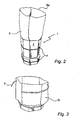
- Fig. 2 is an exploded view schematically illustrating how the parts of a package according to the invention are assembled.
- Fig. 3 is a perspective view schematically illustrating how the parts of a package according to the invention are fastened together by means of a fastening element.
- Fig. 4 is a perspective view schematically illustrating how a package according to the invention is sealed.
- Fig. 5 is a perspective view schematically illustrating how a package according to the invention is sealed.
- the package 1 comprises an outer element.
- the outer element is made up of a frame 2 and a base 3.
- the frame 2 is made in one piece and has the shape of a tube with two open ends.
- the base 3 consists of an essentially plane surface, which is provided with a rim 3a extending along the circumference thereof.
- the base 3 can be provided with one or more guiding flaps 3b. Extensions of the rim 3a form the guiding flaps 3b.
- the guiding flaps 3b facilitate the insertion of the frame in the base 3 when assembling the outer element. No fastening elements are needed to hold the frame 2 and the base 3 together, since the fitting qualities are such as to ensure connection between the elements 2 and 3.
- the frame 2 and the base 3 are made in one piece.
- circumferential stabilising bands 4 are arranged along the outside circumference of the frame 2 and the base 3, respectively, see for instance Figs 1 and 5 .
- the stabilising bands 4 can, for example, be some kind of tightening straps made of a plastic, textile or glass fibre material or any other suitable material.
- the frame 2 and the base 3 each has a substantially octagonal (eight-sided) cross-sectional shape, but may also have other cross-sectional shapes.
- the corners of the frame 2 and the base 3 should not have an angle of less than 90 degrees.
- the frame 2 and the base 3 can also have a cylindrical cross-sectional shape, which also affords a stable structure.
- the frame 2 and the base 3 are made of corrugated cardboard.
- Corrugated cardboard is made up of both corrugated layers and flat layers.
- strong corrugated cardboard with high flexural rigidity, is preferably used, for example double-wall corrugated cardboard or a stronger alternative.
- a double-wall corrugated cardboard consists of five layers, two corrugated layers and three flat layers. Using a starting material with a thickness of about 0.2 mm, a double-wall corrugated cardboard having a grammage of about 0.7-2.0 kg per square metre and a thickness of about 6.5-9 mm is obtained.
- the material must have a flexural rigidity of about 20 Nm (newton metre), advantageously about 30 Nm, or more.
- a triple-wall corrugated cardboard can be used, which comprises three corrugated layers and four flat layers, or an even stronger material.
- the outer element 2 and 3 can also be made of other wood fibre materials, such as a strong solid fibreboard/carton material (consisting of flat layers only and no corrugated layers) or the like.
- the frame 2 and the base 3 can be made of different types of plastic materials.
- the outer element 2 and 3 may advantageously be used for the standard pallet size 1200 mm x 800 mm.
- the inner element 5 of the package 1 consist of a flexible part having an open end 5a and a closed end 5b.
- the inner element 5 is a bag.
- the bag 5 may advantageously be made of any form of plastic material, such as polyethylene.
- a conventional plastic bag 5 that is sufficiently hard-wearing and that satisfies the hygiene requirements for storing and transporting processed meats, such as meat, may advantageously be used.
- the choice of material can be adapted to the type of products to be distributed.
- bags made of other types of flexible materials can be used, for example fibre fabric, aluminium foil, plastic fibre materials, plastic-coated textiles or the like.
- the bag 5 has an upper portion 5c adjacent the open end 5a, which extends a certain distance downwards along the bag.
- the bag 5 When assembling the package 1, the bag 5 is inserted into the outer element 2, 3 with the closed end 5b first. The upper portion 5a is then folded over the upper edge of the frame 2. A circumferential fastening element 6 is fastened over and along the frame 2 and the folded-down portion 5c of the bag 5.
- the fastening element 6 may advantageously be a tightening strap of the conventional kind.
- the folded-down portion 5c of the bag 5 is pulled back upwards in such a manner that the fastening element 6 is surrounded on both sides by the upper portion 5c of the bag 5, see Fig. 4 .
- “flaps" of the upper portion 5c can be overlappingly arranged on top of the package to seal the package, see. Fig. 4 .
- the package can be sealed by pulling tight the part of the upper portion that has been pulled back upwards and closing this upper part with the aid of a rope or some kind of conventional adhesive tape.
- the package 1 is then sealed with the aid of a sealing means 7, for example in the form of an adhesive tape of conventional kind, or a glass fibre tape.
- the package 1 can also be sealed by welding, for example, or by means of closing straps of some kind or any similar method suited to the needs.
- the package When emptying the package, different methods can be used. For example, the package can be lifted up by means of a crane arrangement of some kind and then tipped on its side to discharge its contents. Because the bag 5 is fastened to the frame 2 by means of the fastening elements 6, the package can be emptied in a handy manner without holding the bag 5.
- the bag 5 When the package has been emptied, the bag 5 can be easily separated from the frame 2 by cutting off the fastening elements, and the parts can then be recycled independently of one another.
- the food products and primary produce for food products stored and transported in the package according to the present invention may advantageously be cooled, but not frozen.
Landscapes
- Engineering & Computer Science (AREA)
- Mechanical Engineering (AREA)
- Packages (AREA)
- Packging For Living Organisms, Food Or Medicinal Products That Are Sensitive To Environmental Conditiond (AREA)
- Auxiliary Devices For And Details Of Packaging Control (AREA)
- Basic Packing Technique (AREA)
Abstract
Description
- The present invention relates to a package for storing and transporting food products and primary produce for food products, such as processed meats and fish, comprising a stable outer element, which comprises a frame and a base. The package further comprises a flexible inner element, which has an upper, open end and a lower, closed end, the inner element being arranged in the outer element such that the inner element covers the interior of the outer element.
- The invention further relates to a method for sealing a package intended for storing and transporting food products and primary produce for food products, such as processed meats and fish.
- When storing and transporting food products and primary produce for food products, such as processed meats, strict food hygiene requirements stipulated by the Swedish National Food Administration, among others, have to be met.
- In the industry today, standard boxes made, for example, of corrugated cardboard or paperboard are used, in which plastic bags containing processed provisions, such as meat, are placed (see CH 331 093). The boxes are then sealed by means of a lid, also the ones made of corrugated cardboard or paperboard. The boxes are folded from one piece of material and flaps are overlappingly arranged to form the bottom of the box. These boxes are not adapted to transporting more than 30 kg at the most and their primary use is therefore in distributing products to shops where the products are packaged by the piece and sold. The design of boxes of this kind is such that they are not suitable for high loads, which means that they would brake if they were made physically larger in order to hold greater quantities of processed provisions.
- Instead, plastic containers are used to transport large quantities of processed meats, several hundred kilos, for instance between slaughter plants and processing plants. A disadvantage of such containers is that they require a considerable amount of supplementary work, at a high cost, to return the empty containers for refilling with new products and to clean the containers to meet hygiene requirements, the cleaning process having, as such, a detrimental impact on the environment.
- Considering the alternatives available today, there is a need for a package in which large quantities, several hundred kilos, of processed meats can be stored and transported, which package should meet the stipulated hygiene requirements while being at the same time cost-efficient and requiring very little supplementary work.
- For the purpose of solving the above problems, a package of the kind specified in
claim 1 is provided. - According to the invention as defined in said claim, a package is obtained which satisfies the stipulated hygiene requirements, since the upper portion of the inner element is arranged over the opening of the outer element, thereby protecting the products from dust and the like. The inner element also protects the products contained in the package from entering into direct contact with the outer element, which means that less exacting food hygiene requirements are placed on the outer element, thus allowing use of a cheaper and less clean material for manufacturing the outer element. In addition, there is no need for a separate lid, which saves material and is cost-effective. It is sufficient to seal the package by arranging the upper portion over the package opening and this also ensures that the package is not sealed too tightly, which could damage the products.
- By the package being sealed with the aid of a sealing means, such as adhesive tape, tightening straps or the like, a seal is obtained that satisfies the hygiene requirements for storing and transporting processed meats and that is not so tight that there is a risk of the products being damaged. Processed meats give off a gas that needs to be gradually let out during transport to allow the best possible preservation of the products.
- By the base being provided with a rim extending along the circumference thereof and adapted to surround a lower portion of the frame, a stable structure suitable for heavy loads is obtained.
- By each of the frame and the base being provided with a circumferentially extending stabilising belt, an even more stable structure is obtained.
- By the base being provided with at least one guiding flap, which is arranged on the circumferentially extending rim, it is easier to fit the frame in the base, which facilitates mounting and, thus, saves time.
- By the outer element being designed to have an angular cross-sectional shape, where each corner has an angle greater than 90 degrees, a package with a very stable structure is obtained.
- Advantageously, the package has an octagonal (eight-sided) cross-sectional shape.
- By the outer element being made of a wood fibre-based material, such as corrugated cardboard, paperboard or the like, a hard-wearing, environmentally friendly and recyclable package is obtained.
- By the outer element being made of strong corrugated cardboard, with high flexural rigidity, such as double-wall corrugated cardboard, a hard-wearing and stable package suitable for storing and transporting large quantities of products, about 500 kg, is obtained.
- By the flexible inner element being made of a plastic material, a hygienic package is obtained that is not harmful to the environment since the outer element and the inner element can be easily separated and recycled independently of one another.
- For the purpose of solving the above problems, a method of the kind set out in claim 10 is also provided.
- The above method ensures that the package can be sealed in a convenient and hygienic manner.
- A safe and hygienic seal is obtained by providing a method that further comprises the step of
- arranging the folded-down portion overlappingly in such a manner that the package is sealed.
- The invention will be described in greater detail below, reference being made to the accompanying drawings.
-
Fig. 1 is an exploded view schematically illustrating the parts of a package according to the invention. -
Fig. 2 is an exploded view schematically illustrating how the parts of a package according to the invention are assembled. -
Fig. 3 is a perspective view schematically illustrating how the parts of a package according to the invention are fastened together by means of a fastening element. -
Fig. 4 is a perspective view schematically illustrating how a package according to the invention is sealed. -
Fig. 5 is a perspective view schematically illustrating how a package according to the invention is sealed. - With reference to the drawings, a
package 1 according to the present invention is described. Thepackage 1 comprises an outer element. The outer element is made up of aframe 2 and abase 3. Theframe 2 is made in one piece and has the shape of a tube with two open ends. Thebase 3 consists of an essentially plane surface, which is provided with arim 3a extending along the circumference thereof. Advantageously, thebase 3 can be provided with one or more guidingflaps 3b. Extensions of therim 3a form the guidingflaps 3b. The guidingflaps 3b facilitate the insertion of the frame in thebase 3 when assembling the outer element. No fastening elements are needed to hold theframe 2 and thebase 3 together, since the fitting qualities are such as to ensure connection between theelements - In one embodiment of the invention, the
frame 2 and thebase 3 are made in one piece. - To further stabilise the
frame 2 and thebottom 3,circumferential stabilising bands 4 are arranged along the outside circumference of theframe 2 and thebase 3, respectively, see for instanceFigs 1 and5 . The stabilisingbands 4 can, for example, be some kind of tightening straps made of a plastic, textile or glass fibre material or any other suitable material. - Advantageously, the
frame 2 and thebase 3 each has a substantially octagonal (eight-sided) cross-sectional shape, but may also have other cross-sectional shapes. However, to obtain a stable structure, the corners of theframe 2 and thebase 3 should not have an angle of less than 90 degrees. Theframe 2 and thebase 3 can also have a cylindrical cross-sectional shape, which also affords a stable structure. - Preferably, the
frame 2 and thebase 3 are made of corrugated cardboard. Corrugated cardboard is made up of both corrugated layers and flat layers. To obtain a stable package, strong corrugated cardboard, with high flexural rigidity, is preferably used, for example double-wall corrugated cardboard or a stronger alternative. A double-wall corrugated cardboard consists of five layers, two corrugated layers and three flat layers. Using a starting material with a thickness of about 0.2 mm, a double-wall corrugated cardboard having a grammage of about 0.7-2.0 kg per square metre and a thickness of about 6.5-9 mm is obtained. For the package to be able to carry several hundred kilos, advantageously about 500 kg, the material must have a flexural rigidity of about 20 Nm (newton metre), advantageously about 30 Nm, or more. - Alternatively, a triple-wall corrugated cardboard can be used, which comprises three corrugated layers and four flat layers, or an even stronger material.
- The
outer element frame 2 and thebase 3 can be made of different types of plastic materials. - The
outer element - The
inner element 5 of thepackage 1 consist of a flexible part having anopen end 5a and aclosed end 5b. - Advantageously, the
inner element 5 is a bag. Thebag 5 may advantageously be made of any form of plastic material, such as polyethylene. A conventionalplastic bag 5 that is sufficiently hard-wearing and that satisfies the hygiene requirements for storing and transporting processed meats, such as meat, may advantageously be used. The choice of material can be adapted to the type of products to be distributed. Also bags made of other types of flexible materials can be used, for example fibre fabric, aluminium foil, plastic fibre materials, plastic-coated textiles or the like. - The
bag 5 has anupper portion 5c adjacent theopen end 5a, which extends a certain distance downwards along the bag. - When assembling the
package 1, thebag 5 is inserted into theouter element closed end 5b first. Theupper portion 5a is then folded over the upper edge of theframe 2. Acircumferential fastening element 6 is fastened over and along theframe 2 and the folded-downportion 5c of thebag 5. Thefastening element 6 may advantageously be a tightening strap of the conventional kind. - When sealing the package, the folded-down
portion 5c of thebag 5 is pulled back upwards in such a manner that thefastening element 6 is surrounded on both sides by theupper portion 5c of thebag 5, seeFig. 4 . In this way, "flaps" of theupper portion 5c can be overlappingly arranged on top of the package to seal the package, see.Fig. 4 . Alternatively, the package can be sealed by pulling tight the part of the upper portion that has been pulled back upwards and closing this upper part with the aid of a rope or some kind of conventional adhesive tape. Thepackage 1 is then sealed with the aid of a sealing means 7, for example in the form of an adhesive tape of conventional kind, or a glass fibre tape. Thepackage 1 can also be sealed by welding, for example, or by means of closing straps of some kind or any similar method suited to the needs. - When emptying the package, different methods can be used. For example, the package can be lifted up by means of a crane arrangement of some kind and then tipped on its side to discharge its contents. Because the
bag 5 is fastened to theframe 2 by means of thefastening elements 6, the package can be emptied in a handy manner without holding thebag 5. - When the package has been emptied, the
bag 5 can be easily separated from theframe 2 by cutting off the fastening elements, and the parts can then be recycled independently of one another. - The food products and primary produce for food products stored and transported in the package according to the present invention may advantageously be cooled, but not frozen.
- The package can be modified in many different ways within the scope of the appended claims.
Claims (11)
- A package for storing food products and primary produce for food products, such as processed meats and fish, the package comprising:a stable outer element (2,3), which outer element (2, 3) comprises a frame (2) and a base (3), anda flexible inner element (5), which has an upper, open end (5a) and a lower, closed end (5b),the inner element (5) being arranged in the outer element (2, 3) such that the inner element (5) covers the interior of the outer element (2, 3), an upper portion (5c) of the inner element (5), adjacent the open end (5a) thereof, is adapted to be folded about the upper edge of the frame (2) such that the folded-down portion (5c) covers part of the upper portion of the frame exterior, and that the outer element (2, 3) and the inner element (5) are adapted to be fastened together by means of at least one fastening element (6) adapted to be fastened along the frame (2) over the folded-down portion (5c),characterised in that the package (1) is adapted to be sealed by means of the upper portion (5c) of the inner element (5) in such a manner that part of the upper portion (5c) of the inner element (5) surrounds the fastening element (6) with the package (1) sealed, and that part of the folded-down portion (5c) is adapted to be folded back, upwards such that the fastening element (6) is surrounded by the folded-down portion (5c) and the package is sealed.
- A package according to claim 1, wherein the package is adapted to be sealed by means of a sealing device (7), such as adhesive tape, tightening straps or the like.
- A package according to any one of claims 1-2, wherein the frame (2) and the base (3) are each provided with a circumferentially extending stabilising band (4).
- A package according to any one of claims 1-3, wherein the base (3) is provided with a rim (3a) extending along the circumference thereof, the rim (3a) being adapted to surround a lower portion of the frame (2).
- A package according to claim 4, wherein the base (3) is provided with at least one guiding flap (3b) arranged on the rim (3a) to facilitate the insertion of the frame (2) in the base (3).
- A package according to any one of claims 1-5, wherein the frame (2) and the base (3) have an angular cross-sectional shape, each corner having an angle greater than 90 degrees.
- A package according to claim 6, wherein the frame (2) and the base (3) have an octagonal cross-sectional shape.
- A package according to any one of claims 1-7, wherein the outer element (2, 3) is made of a wood-fibre-based material.
- A package according to claim 8, wherein the outer element (2, 3) is made of strong corrugated cardboard, with high flexural rigidity, such as double-wall corrugated cardboard.
- A method for sealing a package according to claim 1,
characterised in that the method comprises the steps of- folding an upper portion (5c) of the inner element (5) about the upper edge of the frame (2) such that the folded-down portion (5c) covers part of the upper portion of the frame (2) exterior,- fastening a fastening element (6) along the frame (2) over the folded-down portion (5c),- folding back the folded-down portion (5c) upwards such that the fastening element (6) is surrounded by the folded-down portion (5c) and the package is sealed. - A method according to claim 10, wherein the method further comprises the step of- arranging the folded-down portion (5c) overlappingly in such a manner that the package (1) is sealed.
Priority Applications (1)
| Application Number | Priority Date | Filing Date | Title |
|---|---|---|---|
| PL07121060T PL1925558T3 (en) | 2006-11-27 | 2007-11-20 | Package for storage of food products and method for sealing such a package. |
Applications Claiming Priority (1)
| Application Number | Priority Date | Filing Date | Title |
|---|---|---|---|
| SE0602528A SE530613C2 (en) | 2006-11-27 | 2006-11-27 | Packaging and method of closing said package |
Publications (2)
| Publication Number | Publication Date |
|---|---|
| EP1925558A1 EP1925558A1 (en) | 2008-05-28 |
| EP1925558B1 true EP1925558B1 (en) | 2010-01-20 |
Family
ID=39153972
Family Applications (1)
| Application Number | Title | Priority Date | Filing Date |
|---|---|---|---|
| EP07121060A Not-in-force EP1925558B1 (en) | 2006-11-27 | 2007-11-20 | Package for storage of food products and method for sealing such a package. |
Country Status (6)
| Country | Link |
|---|---|
| EP (1) | EP1925558B1 (en) |
| AT (1) | ATE455706T1 (en) |
| DE (1) | DE602007004413D1 (en) |
| DK (1) | DK1925558T3 (en) |
| PL (1) | PL1925558T3 (en) |
| SE (1) | SE530613C2 (en) |
Family Cites Families (7)
| Publication number | Priority date | Publication date | Assignee | Title |
|---|---|---|---|---|
| CH331093A (en) * | 1955-05-17 | 1958-06-30 | Langenbach Ag J | Can, especially for storing food |
| US2961140A (en) * | 1958-06-20 | 1960-11-22 | Bloomer Bros Co | Food container |
| US3827352A (en) * | 1971-02-03 | 1974-08-06 | Tappan Co | Refuse compactor container assembly |
| US4765579A (en) * | 1987-03-30 | 1988-08-23 | Edward S. Robbins, III | Device for positionally retaining flexible trash bag liner relative to a trash receptacle |
| US5028022A (en) * | 1990-01-25 | 1991-07-02 | Metcalf James C | Trash bag securement method and device |
| DE19826331A1 (en) * | 1998-06-12 | 1999-12-16 | Wacker Chemie Gmbh | Procedure for attaching container adjustment bags |
| US6431435B1 (en) * | 1999-07-13 | 2002-08-13 | Rmc Jones Llc | Collapsible bulk material container |
-
2006
- 2006-11-27 SE SE0602528A patent/SE530613C2/en not_active IP Right Cessation
-
2007
- 2007-11-20 DE DE602007004413T patent/DE602007004413D1/en active Active
- 2007-11-20 DK DK07121060.3T patent/DK1925558T3/en active
- 2007-11-20 PL PL07121060T patent/PL1925558T3/en unknown
- 2007-11-20 AT AT07121060T patent/ATE455706T1/en not_active IP Right Cessation
- 2007-11-20 EP EP07121060A patent/EP1925558B1/en not_active Not-in-force
Also Published As
| Publication number | Publication date |
|---|---|
| PL1925558T3 (en) | 2010-07-30 |
| SE0602528L (en) | 2008-05-28 |
| DE602007004413D1 (en) | 2010-03-11 |
| EP1925558A1 (en) | 2008-05-28 |
| ATE455706T1 (en) | 2010-02-15 |
| SE530613C2 (en) | 2008-07-15 |
| DK1925558T3 (en) | 2010-05-17 |
Similar Documents
| Publication | Publication Date | Title |
|---|---|---|
| US7331457B2 (en) | Cardboard box for containing and dispensing large quantities of wire | |
| US12371225B2 (en) | Stackable product package and method of manufacturing the same as well as product package blank | |
| US12103743B2 (en) | Product package and method of manufacturing the same as well as package blank | |
| JP5350375B2 (en) | Carton package with film inner container, prefabricated carton unit for its production, and method for producing this type of carton package | |
| KR101126451B1 (en) | Package with sliding lid | |
| US5042684A (en) | Bag-less box for flowable materials | |
| JP5937602B2 (en) | Outer packaging to protect at least one package in transit | |
| US5897051A (en) | Carrier box | |
| US20110297561A1 (en) | Easy-opening carton for shipping and storing cut paper | |
| KR102196521B1 (en) | Inner case pop up type package box | |
| KR101866056B1 (en) | Pallet cargo packing device | |
| EP1925558A1 (en) | Package for storage of food products and method for sealing such a package. | |
| US5718369A (en) | Carrier Box | |
| KR200457917Y1 (en) | Packing box | |
| EP2429923B1 (en) | Pizza packaging | |
| KR200338557Y1 (en) | Box | |
| JP2013249091A (en) | Housing bag | |
| KR101558300B1 (en) | Packing box | |
| US7210615B2 (en) | Corner wrap tray | |
| CN217101273U (en) | Packing box (cigarette) | |
| KR200381612Y1 (en) | Box having a grip for a partition | |
| KR20030030641A (en) | Packing box structure using vinyl | |
| KR200168412Y1 (en) | A paper box of packing articles | |
| JP3037713U (en) | Granular food container | |
| CA2193148C (en) | Carrier box |
Legal Events
| Date | Code | Title | Description |
|---|---|---|---|
| PUAI | Public reference made under article 153(3) epc to a published international application that has entered the european phase |
Free format text: ORIGINAL CODE: 0009012 |
|
| AK | Designated contracting states |
Kind code of ref document: A1 Designated state(s): AT BE BG CH CY CZ DE DK EE ES FI FR GB GR HU IE IS IT LI LT LU LV MC MT NL PL PT RO SE SI SK TR |
|
| AX | Request for extension of the european patent |
Extension state: AL BA HR MK RS |
|
| 17P | Request for examination filed |
Effective date: 20080612 |
|
| 17Q | First examination report despatched |
Effective date: 20080721 |
|
| AKX | Designation fees paid |
Designated state(s): AT BE BG CH CY CZ DE DK EE ES FI FR GB GR HU IE IS IT LI LT LU LV MC MT NL PL PT RO SE SI SK TR |
|
| GRAP | Despatch of communication of intention to grant a patent |
Free format text: ORIGINAL CODE: EPIDOSNIGR1 |
|
| GRAS | Grant fee paid |
Free format text: ORIGINAL CODE: EPIDOSNIGR3 |
|
| GRAA | (expected) grant |
Free format text: ORIGINAL CODE: 0009210 |
|
| RIN1 | Information on inventor provided before grant (corrected) |
Inventor name: HANSEN, BRUNO |
|
| AK | Designated contracting states |
Kind code of ref document: B1 Designated state(s): AT BE BG CH CY CZ DE DK EE ES FI FR GB GR HU IE IS IT LI LT LU LV MC MT NL PL PT RO SE SI SK TR |
|
| REG | Reference to a national code |
Ref country code: GB Ref legal event code: FG4D |
|
| REG | Reference to a national code |
Ref country code: CH Ref legal event code: EP |
|
| REG | Reference to a national code |
Ref country code: IE Ref legal event code: FG4D |
|
| REF | Corresponds to: |
Ref document number: 602007004413 Country of ref document: DE Date of ref document: 20100311 Kind code of ref document: P |
|
| REG | Reference to a national code |
Ref country code: DK Ref legal event code: T3 |
|
| REG | Reference to a national code |
Ref country code: NL Ref legal event code: VDEP Effective date: 20100120 |
|
| LTIE | Lt: invalidation of european patent or patent extension |
Effective date: 20100120 |
|
| PG25 | Lapsed in a contracting state [announced via postgrant information from national office to epo] |
Ref country code: AT Free format text: LAPSE BECAUSE OF FAILURE TO SUBMIT A TRANSLATION OF THE DESCRIPTION OR TO PAY THE FEE WITHIN THE PRESCRIBED TIME-LIMIT Effective date: 20100120 |
|
| PG25 | Lapsed in a contracting state [announced via postgrant information from national office to epo] |
Ref country code: PT Free format text: LAPSE BECAUSE OF FAILURE TO SUBMIT A TRANSLATION OF THE DESCRIPTION OR TO PAY THE FEE WITHIN THE PRESCRIBED TIME-LIMIT Effective date: 20100520 Ref country code: NL Free format text: LAPSE BECAUSE OF FAILURE TO SUBMIT A TRANSLATION OF THE DESCRIPTION OR TO PAY THE FEE WITHIN THE PRESCRIBED TIME-LIMIT Effective date: 20100120 Ref country code: IS Free format text: LAPSE BECAUSE OF FAILURE TO SUBMIT A TRANSLATION OF THE DESCRIPTION OR TO PAY THE FEE WITHIN THE PRESCRIBED TIME-LIMIT Effective date: 20100520 Ref country code: LT Free format text: LAPSE BECAUSE OF FAILURE TO SUBMIT A TRANSLATION OF THE DESCRIPTION OR TO PAY THE FEE WITHIN THE PRESCRIBED TIME-LIMIT Effective date: 20100120 Ref country code: ES Free format text: LAPSE BECAUSE OF FAILURE TO SUBMIT A TRANSLATION OF THE DESCRIPTION OR TO PAY THE FEE WITHIN THE PRESCRIBED TIME-LIMIT Effective date: 20100501 |
|
| REG | Reference to a national code |
Ref country code: PL Ref legal event code: T3 |
|
| PG25 | Lapsed in a contracting state [announced via postgrant information from national office to epo] |
Ref country code: SI Free format text: LAPSE BECAUSE OF FAILURE TO SUBMIT A TRANSLATION OF THE DESCRIPTION OR TO PAY THE FEE WITHIN THE PRESCRIBED TIME-LIMIT Effective date: 20100120 Ref country code: LV Free format text: LAPSE BECAUSE OF FAILURE TO SUBMIT A TRANSLATION OF THE DESCRIPTION OR TO PAY THE FEE WITHIN THE PRESCRIBED TIME-LIMIT Effective date: 20100120 Ref country code: FI Free format text: LAPSE BECAUSE OF FAILURE TO SUBMIT A TRANSLATION OF THE DESCRIPTION OR TO PAY THE FEE WITHIN THE PRESCRIBED TIME-LIMIT Effective date: 20100120 |
|
| PG25 | Lapsed in a contracting state [announced via postgrant information from national office to epo] |
Ref country code: GR Free format text: LAPSE BECAUSE OF FAILURE TO SUBMIT A TRANSLATION OF THE DESCRIPTION OR TO PAY THE FEE WITHIN THE PRESCRIBED TIME-LIMIT Effective date: 20100421 Ref country code: CY Free format text: LAPSE BECAUSE OF FAILURE TO SUBMIT A TRANSLATION OF THE DESCRIPTION OR TO PAY THE FEE WITHIN THE PRESCRIBED TIME-LIMIT Effective date: 20100120 Ref country code: EE Free format text: LAPSE BECAUSE OF FAILURE TO SUBMIT A TRANSLATION OF THE DESCRIPTION OR TO PAY THE FEE WITHIN THE PRESCRIBED TIME-LIMIT Effective date: 20100120 Ref country code: BE Free format text: LAPSE BECAUSE OF FAILURE TO SUBMIT A TRANSLATION OF THE DESCRIPTION OR TO PAY THE FEE WITHIN THE PRESCRIBED TIME-LIMIT Effective date: 20100120 Ref country code: RO Free format text: LAPSE BECAUSE OF FAILURE TO SUBMIT A TRANSLATION OF THE DESCRIPTION OR TO PAY THE FEE WITHIN THE PRESCRIBED TIME-LIMIT Effective date: 20100120 |
|
| PLBE | No opposition filed within time limit |
Free format text: ORIGINAL CODE: 0009261 |
|
| STAA | Information on the status of an ep patent application or granted ep patent |
Free format text: STATUS: NO OPPOSITION FILED WITHIN TIME LIMIT |
|
| PG25 | Lapsed in a contracting state [announced via postgrant information from national office to epo] |
Ref country code: SK Free format text: LAPSE BECAUSE OF FAILURE TO SUBMIT A TRANSLATION OF THE DESCRIPTION OR TO PAY THE FEE WITHIN THE PRESCRIBED TIME-LIMIT Effective date: 20100120 Ref country code: BG Free format text: LAPSE BECAUSE OF FAILURE TO SUBMIT A TRANSLATION OF THE DESCRIPTION OR TO PAY THE FEE WITHIN THE PRESCRIBED TIME-LIMIT Effective date: 20100420 Ref country code: CZ Free format text: LAPSE BECAUSE OF FAILURE TO SUBMIT A TRANSLATION OF THE DESCRIPTION OR TO PAY THE FEE WITHIN THE PRESCRIBED TIME-LIMIT Effective date: 20100120 |
|
| 26N | No opposition filed |
Effective date: 20101021 |
|
| PG25 | Lapsed in a contracting state [announced via postgrant information from national office to epo] |
Ref country code: IT Free format text: LAPSE BECAUSE OF FAILURE TO SUBMIT A TRANSLATION OF THE DESCRIPTION OR TO PAY THE FEE WITHIN THE PRESCRIBED TIME-LIMIT Effective date: 20100120 |
|
| PG25 | Lapsed in a contracting state [announced via postgrant information from national office to epo] |
Ref country code: MC Free format text: LAPSE BECAUSE OF NON-PAYMENT OF DUE FEES Effective date: 20101130 |
|
| REG | Reference to a national code |
Ref country code: FR Ref legal event code: ST Effective date: 20110801 |
|
| PG25 | Lapsed in a contracting state [announced via postgrant information from national office to epo] |
Ref country code: IE Free format text: LAPSE BECAUSE OF NON-PAYMENT OF DUE FEES Effective date: 20101120 Ref country code: FR Free format text: LAPSE BECAUSE OF NON-PAYMENT OF DUE FEES Effective date: 20101130 |
|
| PG25 | Lapsed in a contracting state [announced via postgrant information from national office to epo] |
Ref country code: MT Free format text: LAPSE BECAUSE OF FAILURE TO SUBMIT A TRANSLATION OF THE DESCRIPTION OR TO PAY THE FEE WITHIN THE PRESCRIBED TIME-LIMIT Effective date: 20100120 |
|
| REG | Reference to a national code |
Ref country code: CH Ref legal event code: PL |
|
| GBPC | Gb: european patent ceased through non-payment of renewal fee |
Effective date: 20111120 |
|
| PG25 | Lapsed in a contracting state [announced via postgrant information from national office to epo] |
Ref country code: LI Free format text: LAPSE BECAUSE OF NON-PAYMENT OF DUE FEES Effective date: 20111130 Ref country code: CH Free format text: LAPSE BECAUSE OF NON-PAYMENT OF DUE FEES Effective date: 20111130 |
|
| PG25 | Lapsed in a contracting state [announced via postgrant information from national office to epo] |
Ref country code: LU Free format text: LAPSE BECAUSE OF NON-PAYMENT OF DUE FEES Effective date: 20101120 Ref country code: HU Free format text: LAPSE BECAUSE OF FAILURE TO SUBMIT A TRANSLATION OF THE DESCRIPTION OR TO PAY THE FEE WITHIN THE PRESCRIBED TIME-LIMIT Effective date: 20100721 |
|
| PG25 | Lapsed in a contracting state [announced via postgrant information from national office to epo] |
Ref country code: GB Free format text: LAPSE BECAUSE OF NON-PAYMENT OF DUE FEES Effective date: 20111120 Ref country code: TR Free format text: LAPSE BECAUSE OF FAILURE TO SUBMIT A TRANSLATION OF THE DESCRIPTION OR TO PAY THE FEE WITHIN THE PRESCRIBED TIME-LIMIT Effective date: 20100120 |
|
| PGFP | Annual fee paid to national office [announced via postgrant information from national office to epo] |
Ref country code: DK Payment date: 20131125 Year of fee payment: 7 |
|
| PGFP | Annual fee paid to national office [announced via postgrant information from national office to epo] |
Ref country code: DE Payment date: 20131122 Year of fee payment: 7 Ref country code: SE Payment date: 20131122 Year of fee payment: 7 |
|
| PGFP | Annual fee paid to national office [announced via postgrant information from national office to epo] |
Ref country code: PL Payment date: 20131022 Year of fee payment: 7 |
|
| REG | Reference to a national code |
Ref country code: DE Ref legal event code: R119 Ref document number: 602007004413 Country of ref document: DE |
|
| REG | Reference to a national code |
Ref country code: DK Ref legal event code: EBP Effective date: 20141130 |
|
| REG | Reference to a national code |
Ref country code: SE Ref legal event code: EUG |
|
| PG25 | Lapsed in a contracting state [announced via postgrant information from national office to epo] |
Ref country code: SE Free format text: LAPSE BECAUSE OF NON-PAYMENT OF DUE FEES Effective date: 20141121 |
|
| PG25 | Lapsed in a contracting state [announced via postgrant information from national office to epo] |
Ref country code: DE Free format text: LAPSE BECAUSE OF NON-PAYMENT OF DUE FEES Effective date: 20150602 Ref country code: DK Free format text: LAPSE BECAUSE OF NON-PAYMENT OF DUE FEES Effective date: 20141130 |
|
| PG25 | Lapsed in a contracting state [announced via postgrant information from national office to epo] |
Ref country code: PL Free format text: LAPSE BECAUSE OF NON-PAYMENT OF DUE FEES Effective date: 20141120 |