EP1925409A1 - Trägerplatte für eine rotierende Stanzmatrize und Verfahren zu dessen Herstellung - Google Patents
Trägerplatte für eine rotierende Stanzmatrize und Verfahren zu dessen Herstellung Download PDFInfo
- Publication number
- EP1925409A1 EP1925409A1 EP07254355A EP07254355A EP1925409A1 EP 1925409 A1 EP1925409 A1 EP 1925409A1 EP 07254355 A EP07254355 A EP 07254355A EP 07254355 A EP07254355 A EP 07254355A EP 1925409 A1 EP1925409 A1 EP 1925409A1
- Authority
- EP
- European Patent Office
- Prior art keywords
- moisture
- plies
- die
- die board
- ply
- Prior art date
- Legal status (The legal status is an assumption and is not a legal conclusion. Google has not performed a legal analysis and makes no representation as to the accuracy of the status listed.)
- Granted
Links
- 238000000034 method Methods 0.000 title claims abstract description 26
- 239000011087 paperboard Substances 0.000 claims abstract description 58
- 239000000123 paper Substances 0.000 claims description 72
- 238000005520 cutting process Methods 0.000 claims description 15
- 230000008569 process Effects 0.000 abstract description 13
- 239000000853 adhesive Substances 0.000 description 43
- 230000001070 adhesive effect Effects 0.000 description 43
- 230000004888 barrier function Effects 0.000 description 31
- 239000004375 Dextrin Substances 0.000 description 19
- 229920001353 Dextrin Polymers 0.000 description 19
- 235000019425 dextrin Nutrition 0.000 description 19
- 238000004804 winding Methods 0.000 description 19
- 230000008859 change Effects 0.000 description 18
- 239000000463 material Substances 0.000 description 18
- 239000011120 plywood Substances 0.000 description 17
- 239000011888 foil Substances 0.000 description 12
- 239000002655 kraft paper Substances 0.000 description 11
- 230000007613 environmental effect Effects 0.000 description 9
- 229920000642 polymer Polymers 0.000 description 9
- 229920002689 polyvinyl acetate Polymers 0.000 description 8
- 239000011118 polyvinyl acetate Substances 0.000 description 8
- 239000004743 Polypropylene Substances 0.000 description 7
- 239000011111 cardboard Substances 0.000 description 6
- 235000018185 Betula X alpestris Nutrition 0.000 description 5
- 235000018212 Betula X uliginosa Nutrition 0.000 description 5
- 229910000831 Steel Inorganic materials 0.000 description 5
- 229920005989 resin Polymers 0.000 description 5
- 239000011347 resin Substances 0.000 description 5
- 239000010959 steel Substances 0.000 description 5
- 238000012360 testing method Methods 0.000 description 5
- VYPSYNLAJGMNEJ-UHFFFAOYSA-N Silicium dioxide Chemical compound O=[Si]=O VYPSYNLAJGMNEJ-UHFFFAOYSA-N 0.000 description 4
- 239000011248 coating agent Substances 0.000 description 4
- 238000000576 coating method Methods 0.000 description 4
- BPQQTUXANYXVAA-UHFFFAOYSA-N Orthosilicate Chemical compound [O-][Si]([O-])([O-])[O-] BPQQTUXANYXVAA-UHFFFAOYSA-N 0.000 description 3
- 239000012080 ambient air Substances 0.000 description 3
- 230000008901 benefit Effects 0.000 description 3
- 238000013461 design Methods 0.000 description 3
- 230000000694 effects Effects 0.000 description 3
- 238000004049 embossing Methods 0.000 description 3
- 238000004519 manufacturing process Methods 0.000 description 3
- 239000002184 metal Substances 0.000 description 3
- 239000000203 mixture Substances 0.000 description 3
- 229920006254 polymer film Polymers 0.000 description 3
- 229920002635 polyurethane Polymers 0.000 description 3
- 239000004814 polyurethane Substances 0.000 description 3
- 239000000758 substrate Substances 0.000 description 3
- XLYOFNOQVPJJNP-UHFFFAOYSA-N water Substances O XLYOFNOQVPJJNP-UHFFFAOYSA-N 0.000 description 3
- 239000004372 Polyvinyl alcohol Substances 0.000 description 2
- -1 alkyl ketene dimer Chemical compound 0.000 description 2
- DQXBYHZEEUGOBF-UHFFFAOYSA-N but-3-enoic acid;ethene Chemical compound C=C.OC(=O)CC=C DQXBYHZEEUGOBF-UHFFFAOYSA-N 0.000 description 2
- 229920001971 elastomer Polymers 0.000 description 2
- 239000005038 ethylene vinyl acetate Substances 0.000 description 2
- 238000003698 laser cutting Methods 0.000 description 2
- 238000012986 modification Methods 0.000 description 2
- 230000004048 modification Effects 0.000 description 2
- 239000011101 paper laminate Substances 0.000 description 2
- ISWSIDIOOBJBQZ-UHFFFAOYSA-N phenol group Chemical group C1(=CC=CC=C1)O ISWSIDIOOBJBQZ-UHFFFAOYSA-N 0.000 description 2
- 229920001200 poly(ethylene-vinyl acetate) Polymers 0.000 description 2
- 229920002451 polyvinyl alcohol Polymers 0.000 description 2
- 235000019422 polyvinyl alcohol Nutrition 0.000 description 2
- 239000005060 rubber Substances 0.000 description 2
- 229920006395 saturated elastomer Polymers 0.000 description 2
- 238000004513 sizing Methods 0.000 description 2
- KXGFMDJXCMQABM-UHFFFAOYSA-N 2-methoxy-6-methylphenol Chemical compound [CH]OC1=CC=CC([CH])=C1O KXGFMDJXCMQABM-UHFFFAOYSA-N 0.000 description 1
- RSWGJHLUYNHPMX-UHFFFAOYSA-N Abietic-Saeure Natural products C12CCC(C(C)C)=CC2=CCC2C1(C)CCCC2(C)C(O)=O RSWGJHLUYNHPMX-UHFFFAOYSA-N 0.000 description 1
- 241001251094 Formica Species 0.000 description 1
- KHPCPRHQVVSZAH-HUOMCSJISA-N Rosin Natural products O(C/C=C/c1ccccc1)[C@H]1[C@H](O)[C@@H](O)[C@@H](O)[C@@H](CO)O1 KHPCPRHQVVSZAH-HUOMCSJISA-N 0.000 description 1
- 229920003182 Surlyn® Polymers 0.000 description 1
- 239000005035 Surlyn® Substances 0.000 description 1
- 230000009471 action Effects 0.000 description 1
- 239000003570 air Substances 0.000 description 1
- 229940037003 alum Drugs 0.000 description 1
- 230000015572 biosynthetic process Effects 0.000 description 1
- 239000002131 composite material Substances 0.000 description 1
- 230000003750 conditioning effect Effects 0.000 description 1
- 238000010276 construction Methods 0.000 description 1
- 238000002474 experimental method Methods 0.000 description 1
- 239000000835 fiber Substances 0.000 description 1
- 239000003292 glue Substances 0.000 description 1
- 239000011121 hardwood Substances 0.000 description 1
- 239000012943 hotmelt Substances 0.000 description 1
- 229920000554 ionomer Polymers 0.000 description 1
- 210000001503 joint Anatomy 0.000 description 1
- 229920000126 latex Polymers 0.000 description 1
- 239000007788 liquid Substances 0.000 description 1
- 238000003754 machining Methods 0.000 description 1
- 229920001568 phenolic resin Polymers 0.000 description 1
- 239000005011 phenolic resin Substances 0.000 description 1
- 229920000728 polyester Polymers 0.000 description 1
- 239000002952 polymeric resin Substances 0.000 description 1
- 229920001155 polypropylene Polymers 0.000 description 1
- 238000009738 saturating Methods 0.000 description 1
- 229940014800 succinic anhydride Drugs 0.000 description 1
- 229920003002 synthetic resin Polymers 0.000 description 1
- KHPCPRHQVVSZAH-UHFFFAOYSA-N trans-cinnamyl beta-D-glucopyranoside Natural products OC1C(O)C(O)C(CO)OC1OCC=CC1=CC=CC=C1 KHPCPRHQVVSZAH-UHFFFAOYSA-N 0.000 description 1
- 239000002023 wood Substances 0.000 description 1
Images


Classifications
-
- B—PERFORMING OPERATIONS; TRANSPORTING
- B26—HAND CUTTING TOOLS; CUTTING; SEVERING
- B26F—PERFORATING; PUNCHING; CUTTING-OUT; STAMPING-OUT; SEVERING BY MEANS OTHER THAN CUTTING
- B26F1/00—Perforating; Punching; Cutting-out; Stamping-out; Apparatus therefor
- B26F1/38—Cutting-out; Stamping-out
- B26F1/44—Cutters therefor; Dies therefor
-
- B—PERFORMING OPERATIONS; TRANSPORTING
- B26—HAND CUTTING TOOLS; CUTTING; SEVERING
- B26F—PERFORATING; PUNCHING; CUTTING-OUT; STAMPING-OUT; SEVERING BY MEANS OTHER THAN CUTTING
- B26F1/00—Perforating; Punching; Cutting-out; Stamping-out; Apparatus therefor
- B26F1/38—Cutting-out; Stamping-out
- B26F1/44—Cutters therefor; Dies therefor
- B26F2001/4463—Methods and devices for rule setting, fixation, preparing cutting dies
Definitions
- the present disclosure relates generally to rotary die boards.
- rotary dies have been constructed by inserting the die tools (e.g., steel rules for scoring, perforating, and/or cutting, embossing tools, ejection rubbers, etc.) into slots formed in a substrate.
- the substrate is an arcuate structure, referred to as a die board.
- the present disclosure relates to an arcuate die board formed as a multi-layered paperboard structure.
- the die board is initially produced as a full cylindrical paperboard tube, which is subsequently cut lengthwise to form two or more part-cylindrical portions each of which can be used to fabricate a die board.
- the die board is then cut to form the slots for the die tools.
- the multi-layered paperboard tube can be spirally wound, convolutely wound, or formed by a linear draw process.
- the die board comprises an arcuate part-cylindrical die board formed by a part-cylindrical wall having an outer part-cylindrical surface and an inner part-cylindrical surface, and a plurality of slots formed in the outer part-cylindrical surface of the wall for receiving die tools, wherein the part-cylindrical wall is formed at least predominantly of paperboard plies adhesively laminated together.
- predominantly is meant that more than 50% of the radial thickness of the die board is made up of paperboard plies.
- the die board is free of any wood layer(s) and is free of any phenolic-treated paperboard plies.
- the die board is made up substantially entirely of a plurality of paperboard plies adhesively laminated together.
- substantially entirely is meant that at least 80% of the radial thickness of the die board is made up of paperboard plies.
- the part-cylindrical wall is formed entirely of a plurality of paperboard plies adhesively laminated together.
- the inner part-cylindrical surface has a diameter of approximately 482 to 489 mm.
- the wall can have a thickness of approximately 12.6 to 13.3 mm.
- the wall can be constructed from plies of various types.
- the plurality of paperboard plies include paperboard plies of at least two different types.
- differentiate type is meant that one or more of the caliper, grade, material composition, and strength properties of the plies are different.
- dimensional stability of the die board is improved by including one or more moisture-barrier plies.
- a moisture-barrier ply useful in the manufacture of the die board can be a laminate of at least one paper layer (e.g., kraft) and at least one substantially moisture-impervious layer such as polymer film or metal foil. Laminates such as paper/polymer/paper and paper/polymer/foil/polymer/paper are useful, these being merely exemplary and not limiting.
- the outermost ply is substantially thinner than at least some of the intermediate plies.
- the plurality of plies are helically wound one upon another and include an outermost ply forming the part-cylindrical outer surface.
- a gap between adjacent edges of the outermost ply does not exceed about 1 mm, and more preferably does not exceed about 0.8 mm.
- the die board is formed with about 15 to 25 paperboard plies ranging in thickness from about 0.25 mm (0.01 inch) to about 0.75 mm (0.03 inch), and has a wall thickness of about 10 to 15 mm (0.4 to 0.6 inch).
- This die board can also include one or more moisture-barrier plies.
- a method for making die boards for a rotary die comprise the steps of: wrapping a plurality of plies, including a plurality of paperboard plies, one atop another about a cylindrical mandrel and adhering the plies to one another to form a hollow tube on the mandrel; removing the tube from the mandrel; cutting the tube lengthwise to form at least two part-cylindrical portions each formed by a part-cylindrical wall having a part-cylindrical inner surface and a part-cylindrical outer surface; and forming a pattern of slots in the part-cylindrical outer surface of each of the part-cylindrical portions, the slots being configured to hold die tools.
- the plies can be wrapped in various ways, including helically, convolutely, or linearly (i.e., by the linear draw process).
- the wrapping step includes wrapping a plurality of paperboard plies having an equilibrium moisture content not greater than about 4%.
- Such "extra-dry" paperboard a "normal” paperboard ply typically having a moisture content of about 6% or more during the wrapping step
- reducing the total amount of moisture in the tube as formed tends to improve dimensional stability under changing ambient conditions.
- the wrapping step further comprises wrapping at least one moisture-barrier ply in the form of a laminate having at least one paper layer and at least one substantially moisture-impervious layer such as polymer film or metal foil.
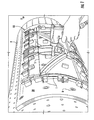
- the rotary die in accordance with one embodiment of the invention is shown in FIG. 1.
- the rotary die comprises a substrate or die board DB formed as an arcuate (e.g., a hollow semi-cylindrical) structure, such as half of a hollow cylinder.
- the outer surface of the die board has a plurality of slots S formed therein, in a predetermined pattern, for holding a number of die tools T.
- Various types of die tools can be included, depending on the process the rotary die is designed to perform.
- die tools include steel rules or knives for die-cutting sheet material, serrated knives for perforating the sheet material, embossing tools for embossing the sheet material, creasing tools for creasing the sheet material, ejection rubbers for pushing out cut-out portions of the sheet material when forming windows or openings therein, and the like.
- the same rotary die can include two or more different types of tools, or can include only one type, depending on the requirements in each case.
- the rotary die RD is mounted on a roller R using bolts B.
- the roller having the rotary die thereon is arranged with another roller (generally referred to as the "anvil") to form a nip through which the sheet material being processed is passed.
- the slots S can be formed by mechanical machining, but advantageously the slots are formed by burning with a laser.
- Laser-formed slots have the advantage of being controllable in width much more precisely than mechanically formed slots. Because the die tools are held in the die board by frictional engagement between the tools and the walls of the slots, it is advantageous to control the slot width as accurately as possible to ensure adequate frictional engagement with the tools.
- the die board DB is a laminated paperboard structure rather than the conventional plywood type of construction built up from resin-coated hardwood veneers. More particularly, the die board DB can be formed predominantly, substantially entirely, or entirely of paperboard plies layered one upon another and adhered together via an adhesive disposed between facing surfaces of adjacent plies.
- the die board is formed by initially forming a cylindrical paperboard tube, and then cutting the tube lengthwise to form two or more arcuate part-cylindrical portions each of which is used for making one die board. As one example, in one embodiment described below, the tube can be cut in half lengthwise to form two semi-cylindrical portions each for forming one die board. Alternatively, however, a die board need not be semi-cylindrical, but can subtend an arc of less than 180° if desired.
- FIG. 2 schematically illustrates a spiral tube-forming process and apparatus for making the cylindrical paperboard tube in accordance with one embodiment of the invention.
- a continuous, spirally wound tube 10 is formed on a stationary cylindrical mandrel 12.
- the ply will ideally form a perfect butt joint, wherein the adjacent edges of successive helical turns of the ply about the mandrel will butt against each other with no gap therebetween.
- the ideal ply width W and winding angle ⁇ change by a small amount from ply to ply because the winding diameter D of each ply becomes successively greater as the wall thickness of the tube 10 is built up by each successive ply.
- the pitch of each ply must be the same since each ply layer must move the same axial distance along the mandrel for each revolution of the tube 10 on the mandrel. Accordingly, the ply width W and the winding angle ⁇ for all of the ply layers are calculated to maintain pitch as constant as practically possible (recognizing that paperboard plies are not obtainable in an infinite number of different widths, but only in certain width increments).
- the ply 20 preferably is formed of paperboard.
- the ply 20 is referred to herein as the innermost ply because it forms the innermost surface of the tube that is constructed on the mandrel 12.
- a plurality of intermediate plies, 22, 24, 26, 28, 30, and 32 preferably formed of paperboard are coated with an adhesive at a conventional adhesive coating station 40 and are superimposed in radially layered relationship onto the innermost ply 20.
- No adhesive is applied to the exterior face of the paperboard ply 32. It is preferred to apply adhesive to both the interior and exterior face of the paperboard ply 22 that contacts the innermost paperboard ply 20.
- the adhesive can comprise an aqueous adhesive, and any of various aqueous adhesives can be used.
- the adhesive can comprise a low-moisture or high- solids-content adhesive referred to herein as a "dry bond" adhesive.
- dry bond adhesives can be used, including but not limited to hot melt, silicate, dextrin, white glues such as PVA (polyvinyl acetate), EVA (ethylene vinyl acetate), and PVOH (polyvinyl alcohol), or a polymer resin adhesive (e.g., ionomer resin such as SURLYN®, or the like).
- the radially layered plies are spirally wound onto and advanced axially along the mandrel by the action of a continuous winding belt 44 that is driven at a predetermined winding angle ⁇ by winding drums 46 and 48 as is well known in the art.
- a paperboard ply 50 is coated on both faces with adhesive via an adhesive station 52 and is thereafter spirally wound onto the partially formed tube 10 exiting the drive belt 44.
- a final, outermost paperboard ply 54 is applied to the adhesive coated surface of paperboard ply 50 to thereby form the outermost surface of the tube 10.
- leading and trailing edges 64 and 66, respectively, of the outermost ply 54 are laid adjacent, and preferably in edge-abutting relation to each other, to form a spiral seam 68 that can be visible or nearly invisible upon the surface of the final tube 10, depending on the gap at seam 68, which gap preferably is precisely controlled to be as small as possible while avoiding any overlap of the edges of the outermost ply 54.
- the tube can include one or more non-paperboard plies.
- one or more moisture-barrier plies can be included, such as metal foil (hereinafter referred to as "foil"), polymer film, parchment, or a paper/non-paper laminate.
- An example of a paper/non-paper laminate useful as a barrier layer is a laminate of two paper layers laminated together by a layer of a latex rubber-based adhesive.
- moisture-barrier plies can comprise laminates such as paper/polymer/paper, paper/polymer/foil/polymer/paper, etc.
- Such a moisture-barrier ply can be the outermost ply of the tube, or the innermost ply of the tube, or both the outermost and innermost plies can comprise moisture-barrier plies. It is also possible to include a moisture-barrier ply as an intermediate ply.
- the tube additionally or alternatively can include one or more non-paperboard, strength-enhancing plies, such as Formica or the like.
- the continuous tube 10 is moved by the winding belt axially along and past the end of the mandrel where it is cut by one or more cutting stations 70, typically in the form of radial saws or in the form of any of various tube cutting apparatus that will be known to those skilled in the art.
- the cutting station 70 can cut the continuous tube into discrete lengths equal to the desired lengths of the rotary die boards to be produced; alternatively, the cutting station can cut the tube into lengths longer than that of the die boards to be produced, and subsequent further cutting of the longer lengths can be performed to produce the desired lengths.
- FIG. 3 A tube 100, formed as described above and cut to the desired length, is cut in half lengthwise along a plane that passes through the central axis of the tube so as to divide the tube into two semi-cylindrical portions 102. Each semi-cylindrical portion 102 will form one die board.
- the die board be generally semi-cylindrical (subtending an arc of about 180°), and hence alternatively the cutting step can comprise cutting the tube lengthwise in such a way as to produce two (or more) part-cylindrical portions each subtending an angle of less than 180°.
- part-cylindrical is used herein to refer to any structure that can be formed by cutting a hollow cylindrical tube lengthwise along two circumferentially spaced planes that are axially extending (or generally axially extending); the angle subtended by the two planes can be constant along the axial direction, although such is not an absolute requirement.
- slots 104 are formed in the outer surface 106 of the die board.
- the slots can extend entirely through the thickness of the die board wall to the inner surface 108 of the die board.
- the slots can be formed in various ways. While mechanical techniques for forming the slots can be used, in preferred embodiments of the invention the slots are formed by burning the paperboard material with a laser such as a CO 2 laser. Laser formation offers the advantage of substantially greater accuracy and less variability in the slot dimensions, particularly the slot diameter or width, which is an important parameter in terms of the ability of the slot to frictionally grip the die tools inserted into the slots.
- the pattern of slots formed in the die board depends upon the configuration of die tools to be inserted, and thus can vary in each case. It is advantageous to form a series of spaced slots or holes 104 for a given die tool such that there is paperboard material between adjacent holes 104, which the die tool must break through when inserted into the series of holes. In this manner, the die tool is frictionally gripped more tenaciously and firmly.
- the final step in the fabrication of a rotary die is to insert the various die tools into the slots 104.
- a rotary die board in accordance with one embodiment can be constructed from a tube constructed from a plurality of paperboard plies as follows: # Plies Caliper (inch / mm) Grade Width (inch / mm) Max. Ply Gap (inch / mm) 1 (outside) 0.013 / 0.33 Outer Ply 7.25/184.2 0.03/0.8 1 0.025 / 0.64 Grade A 7.22/183.4 0.06/1.5 19 0.025 / 0.64 Grade B 7.19/182.6 0.092/2.3 1 (inside) 0.025 / 0.64 Grade A 7.22/183.4 0.06/1.5 Sum of Plies 0.538 / 13.67
- the die board has an inside diameter ("ID") of 19.0 to 19.25 inches (482.6 to 489.0 mm), a thickness of 0.495 to 0.525 inch (12.6 to 13.3 mm), and a wrap length ("W", the length circumferentially along the outer surface from one edge to the opposite edge) of 31.69 to 31.75 inches (804.9 to 806.5 mm).
- ID inside diameter
- W wrap length
- the maximum twist of the die board should be 0.25 inch (6.4 mm). Twist is measured by placing three corners of the die board against a very flat surface and measuring how high the fourth corner is above the surface. Ideally, all four corners should touch the surface.
- the paperboard tube used in forming the die board can be constructed from plies of two or more types.
- the tube is constructed from three different ply types: one ply of "outer ply” type, two plies of "Grade A” type, and 19 plies of "Grade B” type.
- the "outer ply” type is selected for its particular suitability for use as the outermost ply that will form the outer surface of the die board. Accordingly, the outermost ply generally should have a smooth surface, which may be smoother than that of the "Grade A" and/or "Grade B" plies.
- the outermost ply in the above example also is substantially thinner than the other plies of the tube, although such is not a necessity.
- a suitable outermost ply can be, as a non-limiting example, a parchment ply or the like.
- the intermediate plies between the outermost and innermost plies can be a different grade (e.g., a lower or less-costly grade) of paperboard than either or both of the outermost and innermost plies, as in the above example wherein the intermediate plies are "Grade B" paperboard.
- the tube from plies of only one type.
- an impregnated ply as the outermost ply 54 and/or the innermost ply 20 of the die board (FIG. 2).
- the impregnated ply can comprise, for example, a paperboard ply impregnated with a resin or polymer composition such as phenolic resin or polyester.
- the impregnated ply can serve as a moisture barrier and/or can impart a desired surface finish to the die board, and/or can be a strength-enhancing feature.
- the impregnated ply alternatively can be located other than at the outermost or innermost position, i.e., as an intermediate ply of the die board.
- Various embodiments are possible.
- the die board includes only one impregnated ply comprising either the outermost ply, an intermediate ply, or the innermost ply.
- the die board includes a plurality of impregnated plies, which can be contiguous or can have one or more non-impregnated plies (i.e., free of any resin or polymer impregnant) disposed therebetween.
- a paperboard ply can be sized with a sizing composition such as rosin and alum, alkyl ketene dimer (AKD), or alkenyl succinic anhydride (ASA), to render the paperboard substantially resistant to absorbing liquids such as water.
- a sizing composition such as rosin and alum, alkyl ketene dimer (AKD), or alkenyl succinic anhydride (ASA)
- Rotary die boards need to be dimensionally stable in order to produce die cut parts that are within tolerance no matter what the ambient conditions, which means that the dimensions should remain fairly constant when changes in ambient relative humidity occur.
- Composite Can and Tube Institute (CCTI) Technical Committee Report TCR-2 teaches a rule of thumb that spirally wound paper tubes can change 0.12% in length, 0.09% in outside diameter, 0.6% in wall thickness, and 0.03% in inside diameter for each percentage unit change in tube moisture content, on an air dry basis (ADB). For example, a 100-inch long tube initially exposed to a 20% Relative Humidity (RH) environment and then moved into a 90% RH environment (a 12% change in equilibrium moisture content) can theoretically grow in length by 1.44 inches, to a length of 101.44 inches.
- RH Relative Humidity
- Paper tubes having dimensions of 72" long x 1 ⁇ 2" wall thickness were made using the spiral winding process with a 19.25" diameter mandrel.
- the tube wall thickness and build-up consisted of approximately 20 plies of 0.013", 0.025" and 0.030" high-strength papers made from recycled cardboard, with the tube outer diameter controlled at 20.250".
- the outermost ply consisted of a 0.00256" thick (35 lb/3000 ft 2 ) green-colored parchment material manufactured by Ahlstrom Corporation.
- Table 1 shows that the RDB length and the ID changed by greater percentages for the paper tube in comparison with the current standard plywood design, which indicates that plywood is more dimensionally stable than the paper RDB.
- the change in wrap was essentially the same for both boards.
- the angle of wind of the paper tube was in the range of 80 to 90 degrees, and hence the CD direction of the paperboard plies was nearly in alignment with the length of the RDB.
- the test results in Table 1 are believed to reflect the fact that the paperboard making up the paper RDB has greater dimensional stability in the paper machine direction (MD) of the board than in the cross machine direction (CD).
- Paper tubes having dimensions of 72" long x 1 ⁇ 2" wall thickness were made using the spiral winding process with a 19.25" diameter mandrel.
- the tube wall thickness and build-up consisted of approximately 20 plies of 0.013", 0.025" and 0.030" high-strength papers (unless otherwise noted) made from recycled cardboard, with the tube outer diameter controlled at 20.250".
- Test RDB numbers 9 and 10 used medium-strength "square" papers (i.e., papers with fibers aligned in both CD and MD directions giving nearly equal paper strength in both directions).
- the outermost ply for all test RDBs except for RDB numbers 2 through 4 consisted of a 0.00256" thick (35 1b/3000 ft 2 ) green-colored parchment material manufactured by Ahlstrom Corporation. RDB numbers 2-4 did not use the parchment material.
- Many of the RDBs listed in the tables were treated with various materials as noted: SBR adhesive coating, polyurethane (water based) coating, and wax saturation.
- RDBs 7 and 8 used moisture barrier laminates having the structure kraft/poly/foil/poly/kraft manufactured by Jen-Coat, and another moisture barrier laminate having the structure kraft/poly/kraft (specifically, Sellowrap 40 from Converdis) located at the 2 nd ply from the inside and the 3 rd ply from the outside.
- the tubes were allowed to dry and stabilize for 48 hours before splitting the tubes in half lengthwise using a band saw.
- the RDBs were then measured for length, ID, and wrap on the top, middle, and bottom of the tube, and were weighed.
- Half of the samples of each RDB build-up were placed in an environmental chamber controlled at 100° F and 20% RH (referred to as a "desert” environment) for 4 days, and the other half were placed in another environmental chamber set at 100° F and 95% RH (referred to as a "jungle” environment) for 2 days.
- the RDBs were measured again as noted above. The averages of the absolute values of the differences in length, ID, wrap, and weight between normal ambient conditions and the desert and jungle environments were calculated.
- RDBs that appeared to be best in terms of tube length and ID dimensional stability, and the most practical to manufacture, were RDB #7 (foil moisture barrier) and #8 (Sellowrap moisture barrier). Saturating these large tubes in hot wax or coating using other materials are deemed not cost-effective. The next step was to investigate the effect of multiple layers of moisture barriers, including extra-dry papers.
- 72" long x 1 ⁇ 2" thick wall paper tubes were made using the spiral winding process with a 19.25" diameter mandrel.
- the tube wall thickness and build-up consisted of 18 to 20 plies of 0.013", 0.025" and 0.030" high-strength papers made from recycled cardboard with the outer diameter controlled at 20.250".
- the outermost ply consisted of a 0.00256" thick (35 1b/3000 ft 2 ) green-colored parchment material manufactured by Ahlstrom Corporation.
- Sellowrap 40 made by Converdis a moisture barrier paper, was placed in various configurations within the tube build-up (see Table 3). Also, RDBs 20 through 24 were made using regular high-strength papers (moisture content approximately 6%) and RDBs 25 through 28 were made using extra-dry high-strength paper (moisture content approximately 4%).
- the tubes were allowed to dry and stabilize for 48 hours before splitting the tubes in half lengthwise using a band saw, and then the tube were immediately measured for length, ID, and wrap on the top, middle, and bottom of the tube, and were weighed.
- the resulting paper RDBs, along with standard birch plywood RDB (the control), were then placed in an environmental chamber controlled at 100° F and 20% RH for 5 days and measured again. The averages of the absolute changes in the length, ID, wrap, and weight were calculated. Table 3 shows the results ("MB" moisture barrier).
- Table 3 shows that RDBs made with the extra-dry high-strength papers generally had better dimensional stability, especially in length and ID, compared to those made using the regular papers.
- the RDBs made using the Sellowrap and foil moisture barriers had better dimensional stability than those without, and had smaller ID changes than the Plywood control.
- distributing multiple plies of moisture barrier papers throughout the RDB wall does not seem to improve the dimensional stability as compared to placing one or two moisture-barrier plies on the inside and outside.
- 82" long x 1 ⁇ 2" thick wall paper tubes were made using the spiral winding process with a 19.125" diameter mandrel.
- the tube wall thickness and build-up consisted of 18 to 20 plies of 0.015", 0.025" and 0.030" extra-dry (moisture content approximately 4%) high-strength papers made from recycled cardboard, with the outer diameter controlled at 20.145".
- the outermost ply consisted of a 0.00256" thick (35 lb/3000 ft 2 ) green-colored parchment material manufactured by Ahlstrom Corporation.
- a silicate adhesive was used for the body plies in RDB numbers 40 and 41.
- Sellowrap 40 made by Converdis, and a kraft/polypropylene/ kraft laminate (designated "PP") made by Jen-Coat were the moisture barrier papers compared in this experiment.
- the moisture barrier papers were located as the 2 nd ply from the inside ply and as the 5 th ply from the outside within the tube build-up, and in other configurations as shown in Table 4A.
- the tubes were allowed to dry and stabilize for 48 hours (at room temperature, 55% RH) before splitting them in half lengthwise using a band saw, and then the tubes were immediately measured for length ID, and wrap on the top, middle, and bottom of the tube, and were weighed.
- the resulting RDBs, along with standard birch plywood RDB (the control), were then placed in an environmental chamber controlled at 100° F and 20% RH for 7 days and measured again. Tube samples were also weighed and oven dried in order to calculate the % moisture. The average of the absolute change for the length, ID, wrap, and weight were calculated. Tables 4A and 4B shows the results.
- 72" long x 1 ⁇ 2" thick wall paper tubes were made using the spiral winding process with a 19.25" diameter mandrel.
- the tube wall thickness and build-up consisted of approximately 20 plies of 0.013", 0.025" and 0.030" high-strength papers made from recycled cardboard, with the outer diameter controlled at 20.250".
- the outermost ply consisted of a 0.00256" thick (35 1b/3000 ft 2 ) green-colored parchment material manufactured by Ahlstrom Corporation.
- RDB number 15 included no moisture barriers.
- RDB numbers 17 and 18 used moisture barrier laminates having the structure kraft/poly/foil/poly/kraft (FOIL) manufactured by Jen-Coat, and another moisture barrier laminate having the structure kraft/poly/kraft (Sellowrap 40 by Converdis), 1 ply each, located on the 2 nd ply from the inside and the 3 rd ply from the outside of the tube.
- the tubes were allowed to dry and stabilize for 48 hours before splitting in half lengthwise using a band saw.
- the resulting RDBs, along with standard birch plywood RDB (the control), were then sent to a die maker where they were laser cut and ruled using a normal rotary die design.
- the RDBs were then measured for weight, bolt hole spacing ("H"), length, ID, and wrap.
- the RDBs were then placed in an environmental chamber set at 100° F and 95% RH for 2 days and were again measured the same as above. The average of the absolute difference in the hole spacing, length, ID, wrap, and weight were calculated. Table 5A shows the results.
- Table 5A shows that the RDBs using the foil or Sellowrap moisture barriers improved the dimensional stability, to a point approaching that of the plywood, by adding resistance and thereby preventing moisture transport into the paper.
- Table 5B shows that the foil and Sellowrap moisture barriers improved the length dimensional stability over the control with no moisture barrier. It was found that the steel rules in the board would become loose when the RDBs were dried. This problem was later resolved by laser cutting smaller slots in the RDB. Steel rules for the 66" rotary die board were 0.0575" wide. For optimum rule fit and performance, “smooth" wall laser cut slots should measure using a taper gage 0.030" to 0.048" wide from the underneath side and 0.040" to 0.048" from the top side of the board. “Pulse” laser jagged wall cut slots should measure using a taper gage 0.030" to 0.040" wide from both underneath and top sides of the board.
- 72" long x 1 ⁇ 2" thick wall paper tubes were made using the spiral winding process with a 19.25" diameter mandrel.
- the tube wall thickness and build-up consisted of 18 to 20 plies of 0.013", 0.025" and 0.030" high-strength papers made from recycled cardboard, with the outer diameter controlled at 20.250".
- the outermost ply consisted of a 0.00256" thick (35 1b/3000 ft 2 ) green-colored parchment material manufactured by Ahlstrom Corporation.
- Sellowrap 40 made by Converdis a moisture barrier laminate, was placed in various configurations within the tube build-up (see Table 6).
- RDB number 24 was made using regular high-strength papers (moisture content approximately 6%) and RDB numbers 25 and 27 were made using extra-dry high-strength paper (moisture content approximately 4%).
- the tubes were allowed to dry and stabilize for 48 hours before splitting the tubes in half lengthwise using a band saw.
- the resulting RDBs, along with standard birch plywood RDB (the control), were then sent to a die maker where they were laser cut and ruled using a normal rotary die design.
- the RDBs were then measured for weight, bolt hole spacing ("H"), length, wrap, and ID.
- the RDBs were then placed in an environmental chamber set at 100° F and 95% RH for 3 days and again measured the same as above. The average of the absolute difference in the hole spacing, length, ID, wrap, and weight were calculated. Table 6 shows the results.
- Table 6 shows that the RDB number 27 using the Sellowrap moisture barriers and extra-dry papers improved the dimensional stability over that of the plywood, by adding resistance and thereby preventing moisture transport into the paper.
- RDB number 27 also prevented shrinkage of the rule slot, thereby preventing the rules from becoming loose in the board. Also, it was found that loosening of the rules can be prevented by laser cutting smaller slots in the RDB.
- Steel rules for the 66" rotary die board are 0.0575" wide.
- “smooth” wall laser cut slots should measure using a taper gage 0.030" to 0.048" wide from the underneath side and 0.040" to 0.048" from the top side of the board.
- "Pulse” laser jagged wall cut slots should measure using a taper gage 0.030" to 0.040" wide from both underneath and top sides of the board.
Landscapes
- Life Sciences & Earth Sciences (AREA)
- Forests & Forestry (AREA)
- Engineering & Computer Science (AREA)
- Mechanical Engineering (AREA)
- Laminated Bodies (AREA)
- Making Paper Articles (AREA)
- Perforating, Stamping-Out Or Severing By Means Other Than Cutting (AREA)
- Storing, Repeated Paying-Out, And Re-Storing Of Elongated Articles (AREA)
Applications Claiming Priority (2)
| Application Number | Priority Date | Filing Date | Title |
|---|---|---|---|
| US86402106P | 2006-11-02 | 2006-11-02 | |
| US11/933,486 US20080105396A1 (en) | 2006-11-02 | 2007-11-01 | Rotary Die Board |
Publications (2)
| Publication Number | Publication Date |
|---|---|
| EP1925409A1 true EP1925409A1 (de) | 2008-05-28 |
| EP1925409B1 EP1925409B1 (de) | 2010-03-31 |
Family
ID=38969872
Family Applications (1)
| Application Number | Title | Priority Date | Filing Date |
|---|---|---|---|
| EP07254355A Not-in-force EP1925409B1 (de) | 2006-11-02 | 2007-11-02 | Trägerplatte für eine rotierende Stanzmatrize und Verfahren zu dessen Herstellung |
Country Status (5)
| Country | Link |
|---|---|
| US (1) | US20080105396A1 (de) |
| EP (1) | EP1925409B1 (de) |
| AT (1) | ATE462542T1 (de) |
| CA (1) | CA2609426C (de) |
| DE (1) | DE602007005582D1 (de) |
Families Citing this family (2)
| Publication number | Priority date | Publication date | Assignee | Title |
|---|---|---|---|---|
| US20110245056A1 (en) * | 2010-03-31 | 2011-10-06 | Tamarack Products, Inc. | Rigid window applicator and method |
| US11370628B1 (en) * | 2021-10-15 | 2022-06-28 | Abzac Canada Inc. | Convolute cardboard tube, apparatus and method for manufacturing the same |
Citations (4)
| Publication number | Priority date | Publication date | Assignee | Title |
|---|---|---|---|---|
| GB1221539A (en) | 1967-05-24 | 1971-02-03 | Roder And Spengler Offene Hand | Rotary dies |
| US5143768A (en) | 1991-08-30 | 1992-09-01 | Weyerhaeuser Company | Laminated dieboard structure |
| US20010035071A1 (en) | 2000-04-10 | 2001-11-01 | Martin John J. | Dieboard and method of construction |
| US20040065388A1 (en) * | 2002-10-05 | 2004-04-08 | Toshinaga Urabe | Rotary cutting die, device for manufacturing the same, and method for manufacturing the same |
Family Cites Families (7)
| Publication number | Priority date | Publication date | Assignee | Title |
|---|---|---|---|---|
| US3696480A (en) * | 1969-07-09 | 1972-10-10 | Centenary Central | Method of and apparatus for accurately working rotary die boards to receive cutting rule |
| US4052886A (en) * | 1976-06-18 | 1977-10-11 | Best Line Warehouse, Inc. | Encavitated steel rule die |
| US4112827A (en) * | 1977-06-03 | 1978-09-12 | Chempar Corporation | Method of making cutting, scoring and embossing die set |
| US4981061A (en) * | 1989-05-05 | 1991-01-01 | Hillock Ronald A | Steel rule die and method of manufacture |
| DE9214654U1 (de) * | 1992-10-28 | 1994-03-03 | PCE Paper Converting Equipment GmbH, 93073 Neutraubling | Matrizenbogen für ein Stanzwerkzeug zum Herstellen von Kartonagenzuschnitten |
| DE69703783T2 (de) * | 1996-10-28 | 2001-04-19 | Hans E. Ruprecht Holding Ag, Krauchthal | Vorrichtung an einer Druckmaschine zum Perforieren, Stanzen, Schneiden, Rillen und partiellen Lackieren oder zum Drucken von Umschlägen |
| US5943935A (en) * | 1997-03-03 | 1999-08-31 | Atlas Die, Inc. | Lightweight dimensionally stable steel rule die |
-
2007
- 2007-11-01 US US11/933,486 patent/US20080105396A1/en not_active Abandoned
- 2007-11-02 DE DE602007005582T patent/DE602007005582D1/de active Active
- 2007-11-02 EP EP07254355A patent/EP1925409B1/de not_active Not-in-force
- 2007-11-02 CA CA2609426A patent/CA2609426C/en not_active Expired - Fee Related
- 2007-11-02 AT AT07254355T patent/ATE462542T1/de not_active IP Right Cessation
Patent Citations (4)
| Publication number | Priority date | Publication date | Assignee | Title |
|---|---|---|---|---|
| GB1221539A (en) | 1967-05-24 | 1971-02-03 | Roder And Spengler Offene Hand | Rotary dies |
| US5143768A (en) | 1991-08-30 | 1992-09-01 | Weyerhaeuser Company | Laminated dieboard structure |
| US20010035071A1 (en) | 2000-04-10 | 2001-11-01 | Martin John J. | Dieboard and method of construction |
| US20040065388A1 (en) * | 2002-10-05 | 2004-04-08 | Toshinaga Urabe | Rotary cutting die, device for manufacturing the same, and method for manufacturing the same |
Also Published As
| Publication number | Publication date |
|---|---|
| DE602007005582D1 (de) | 2010-05-12 |
| ATE462542T1 (de) | 2010-04-15 |
| US20080105396A1 (en) | 2008-05-08 |
| EP1925409B1 (de) | 2010-03-31 |
| CA2609426C (en) | 2010-08-10 |
| CA2609426A1 (en) | 2008-05-02 |
Similar Documents
| Publication | Publication Date | Title |
|---|---|---|
| EP1285132B1 (de) | Papier- oder pappelaminat und verfahren zu seiner herstellung | |
| EP0956946B1 (de) | Gipspapierplatte für das Reduzieren der Delaminierungsrate beim Laminieren von mehrschichtigen Strukturen und Verfahren zu deren Herstellung | |
| CN1636831A (zh) | 多层线性拉制支柱 | |
| WO2005019091B1 (en) | I-beam wall corner post | |
| EP1925409B1 (de) | Trägerplatte für eine rotierende Stanzmatrize und Verfahren zu dessen Herstellung | |
| US20110135874A1 (en) | Edge protector | |
| US8821685B2 (en) | Method and apparatus for creasing facing material used in the manufacture of wallboard | |
| EP2184161A1 (de) | Kern mit verbesserter ID-Steifheit und Herstellungsverfahren dafür | |
| EP4303161B1 (de) | Konvolut-kartonrohr | |
| EP1940607B1 (de) | Spiralförmig gewickelte röhre mit leerräumen und herstellungsverfahren dafür | |
| JPH0790619B2 (ja) | 紙管等の紙製長尺体の製造方法及び製造装置 | |
| US20250075435A1 (en) | Moisture management of paperboard structures | |
| FI97531B (fi) | Levymateriaali | |
| JP6799857B2 (ja) | 証票用原紙及びその製造方法 | |
| US20010035071A1 (en) | Dieboard and method of construction | |
| KR20070075959A (ko) | 골판지 스트립이 권취되어 형성된 중간지지부재를 갖는종이판의 제조방법, 상기 중간지지부재의 제조장치, 상기중간지지부재를 구비한 종이판 및 그 종이판을 사용한종이파렛트 | |
| AU2021249695A1 (en) | Corrugated fiberboard material | |
| JPH06345144A (ja) | バラ状緩衝材とその製造方法 | |
| NZ569462A (en) | An edge protector is formed and adhesive used to secure the two sidesof a groove which are held in shape while curing | |
| SE512776C2 (sv) | Pappers- eller kartonglaminat samt sätt att framställa ett sådant laminat |
Legal Events
| Date | Code | Title | Description |
|---|---|---|---|
| PUAI | Public reference made under article 153(3) epc to a published international application that has entered the european phase |
Free format text: ORIGINAL CODE: 0009012 |
|
| AK | Designated contracting states |
Kind code of ref document: A1 Designated state(s): AT BE BG CH CY CZ DE DK EE ES FI FR GB GR HU IE IS IT LI LT LU LV MC MT NL PL PT RO SE SI SK TR |
|
| AX | Request for extension of the european patent |
Extension state: AL BA HR MK RS |
|
| 17P | Request for examination filed |
Effective date: 20080602 |
|
| 17Q | First examination report despatched |
Effective date: 20080703 |
|
| AKX | Designation fees paid |
Designated state(s): AT BE BG CH CY CZ DE DK EE ES FI FR GB GR HU IE IS IT LI LT LU LV MC MT NL PL PT RO SE SI SK TR |
|
| GRAP | Despatch of communication of intention to grant a patent |
Free format text: ORIGINAL CODE: EPIDOSNIGR1 |
|
| GRAS | Grant fee paid |
Free format text: ORIGINAL CODE: EPIDOSNIGR3 |
|
| GRAA | (expected) grant |
Free format text: ORIGINAL CODE: 0009210 |
|
| AK | Designated contracting states |
Kind code of ref document: B1 Designated state(s): AT BE BG CH CY CZ DE DK EE ES FI FR GB GR HU IE IS IT LI LT LU LV MC MT NL PL PT RO SE SI SK TR |
|
| REG | Reference to a national code |
Ref country code: CH Ref legal event code: EP Ref country code: GB Ref legal event code: FG4D |
|
| REG | Reference to a national code |
Ref country code: IE Ref legal event code: FG4D |
|
| REF | Corresponds to: |
Ref document number: 602007005582 Country of ref document: DE Date of ref document: 20100512 Kind code of ref document: P |
|
| REG | Reference to a national code |
Ref country code: NL Ref legal event code: VDEP Effective date: 20100331 |
|
| PG25 | Lapsed in a contracting state [announced via postgrant information from national office to epo] |
Ref country code: LT Free format text: LAPSE BECAUSE OF FAILURE TO SUBMIT A TRANSLATION OF THE DESCRIPTION OR TO PAY THE FEE WITHIN THE PRESCRIBED TIME-LIMIT Effective date: 20100331 |
|
| LTIE | Lt: invalidation of european patent or patent extension |
Effective date: 20100331 |
|
| PG25 | Lapsed in a contracting state [announced via postgrant information from national office to epo] |
Ref country code: SI Free format text: LAPSE BECAUSE OF FAILURE TO SUBMIT A TRANSLATION OF THE DESCRIPTION OR TO PAY THE FEE WITHIN THE PRESCRIBED TIME-LIMIT Effective date: 20100331 Ref country code: FI Free format text: LAPSE BECAUSE OF FAILURE TO SUBMIT A TRANSLATION OF THE DESCRIPTION OR TO PAY THE FEE WITHIN THE PRESCRIBED TIME-LIMIT Effective date: 20100331 Ref country code: AT Free format text: LAPSE BECAUSE OF FAILURE TO SUBMIT A TRANSLATION OF THE DESCRIPTION OR TO PAY THE FEE WITHIN THE PRESCRIBED TIME-LIMIT Effective date: 20100331 Ref country code: PL Free format text: LAPSE BECAUSE OF FAILURE TO SUBMIT A TRANSLATION OF THE DESCRIPTION OR TO PAY THE FEE WITHIN THE PRESCRIBED TIME-LIMIT Effective date: 20100331 Ref country code: LV Free format text: LAPSE BECAUSE OF FAILURE TO SUBMIT A TRANSLATION OF THE DESCRIPTION OR TO PAY THE FEE WITHIN THE PRESCRIBED TIME-LIMIT Effective date: 20100331 |
|
| PG25 | Lapsed in a contracting state [announced via postgrant information from national office to epo] |
Ref country code: SE Free format text: LAPSE BECAUSE OF FAILURE TO SUBMIT A TRANSLATION OF THE DESCRIPTION OR TO PAY THE FEE WITHIN THE PRESCRIBED TIME-LIMIT Effective date: 20100331 Ref country code: BE Free format text: LAPSE BECAUSE OF FAILURE TO SUBMIT A TRANSLATION OF THE DESCRIPTION OR TO PAY THE FEE WITHIN THE PRESCRIBED TIME-LIMIT Effective date: 20100331 Ref country code: CY Free format text: LAPSE BECAUSE OF FAILURE TO SUBMIT A TRANSLATION OF THE DESCRIPTION OR TO PAY THE FEE WITHIN THE PRESCRIBED TIME-LIMIT Effective date: 20100331 Ref country code: EE Free format text: LAPSE BECAUSE OF FAILURE TO SUBMIT A TRANSLATION OF THE DESCRIPTION OR TO PAY THE FEE WITHIN THE PRESCRIBED TIME-LIMIT Effective date: 20100331 Ref country code: ES Free format text: LAPSE BECAUSE OF FAILURE TO SUBMIT A TRANSLATION OF THE DESCRIPTION OR TO PAY THE FEE WITHIN THE PRESCRIBED TIME-LIMIT Effective date: 20100712 Ref country code: NL Free format text: LAPSE BECAUSE OF FAILURE TO SUBMIT A TRANSLATION OF THE DESCRIPTION OR TO PAY THE FEE WITHIN THE PRESCRIBED TIME-LIMIT Effective date: 20100331 Ref country code: RO Free format text: LAPSE BECAUSE OF FAILURE TO SUBMIT A TRANSLATION OF THE DESCRIPTION OR TO PAY THE FEE WITHIN THE PRESCRIBED TIME-LIMIT Effective date: 20100331 |
|
| PG25 | Lapsed in a contracting state [announced via postgrant information from national office to epo] |
Ref country code: SK Free format text: LAPSE BECAUSE OF FAILURE TO SUBMIT A TRANSLATION OF THE DESCRIPTION OR TO PAY THE FEE WITHIN THE PRESCRIBED TIME-LIMIT Effective date: 20100331 Ref country code: IS Free format text: LAPSE BECAUSE OF FAILURE TO SUBMIT A TRANSLATION OF THE DESCRIPTION OR TO PAY THE FEE WITHIN THE PRESCRIBED TIME-LIMIT Effective date: 20100731 Ref country code: CZ Free format text: LAPSE BECAUSE OF FAILURE TO SUBMIT A TRANSLATION OF THE DESCRIPTION OR TO PAY THE FEE WITHIN THE PRESCRIBED TIME-LIMIT Effective date: 20100331 |
|
| PG25 | Lapsed in a contracting state [announced via postgrant information from national office to epo] |
Ref country code: PT Free format text: LAPSE BECAUSE OF FAILURE TO SUBMIT A TRANSLATION OF THE DESCRIPTION OR TO PAY THE FEE WITHIN THE PRESCRIBED TIME-LIMIT Effective date: 20100802 Ref country code: DK Free format text: LAPSE BECAUSE OF FAILURE TO SUBMIT A TRANSLATION OF THE DESCRIPTION OR TO PAY THE FEE WITHIN THE PRESCRIBED TIME-LIMIT Effective date: 20100331 |
|
| PLBE | No opposition filed within time limit |
Free format text: ORIGINAL CODE: 0009261 |
|
| STAA | Information on the status of an ep patent application or granted ep patent |
Free format text: STATUS: NO OPPOSITION FILED WITHIN TIME LIMIT |
|
| 26N | No opposition filed |
Effective date: 20110104 |
|
| PG25 | Lapsed in a contracting state [announced via postgrant information from national office to epo] |
Ref country code: IT Free format text: LAPSE BECAUSE OF FAILURE TO SUBMIT A TRANSLATION OF THE DESCRIPTION OR TO PAY THE FEE WITHIN THE PRESCRIBED TIME-LIMIT Effective date: 20100331 |
|
| PG25 | Lapsed in a contracting state [announced via postgrant information from national office to epo] |
Ref country code: MC Free format text: LAPSE BECAUSE OF NON-PAYMENT OF DUE FEES Effective date: 20101130 |
|
| PG25 | Lapsed in a contracting state [announced via postgrant information from national office to epo] |
Ref country code: IE Free format text: LAPSE BECAUSE OF NON-PAYMENT OF DUE FEES Effective date: 20101102 |
|
| PG25 | Lapsed in a contracting state [announced via postgrant information from national office to epo] |
Ref country code: MT Free format text: LAPSE BECAUSE OF FAILURE TO SUBMIT A TRANSLATION OF THE DESCRIPTION OR TO PAY THE FEE WITHIN THE PRESCRIBED TIME-LIMIT Effective date: 20100331 |
|
| REG | Reference to a national code |
Ref country code: CH Ref legal event code: PL |
|
| PG25 | Lapsed in a contracting state [announced via postgrant information from national office to epo] |
Ref country code: LI Free format text: LAPSE BECAUSE OF NON-PAYMENT OF DUE FEES Effective date: 20111130 Ref country code: CH Free format text: LAPSE BECAUSE OF NON-PAYMENT OF DUE FEES Effective date: 20111130 |
|
| PG25 | Lapsed in a contracting state [announced via postgrant information from national office to epo] |
Ref country code: BG Free format text: LAPSE BECAUSE OF FAILURE TO SUBMIT A TRANSLATION OF THE DESCRIPTION OR TO PAY THE FEE WITHIN THE PRESCRIBED TIME-LIMIT Effective date: 20100331 Ref country code: LU Free format text: LAPSE BECAUSE OF NON-PAYMENT OF DUE FEES Effective date: 20101102 Ref country code: HU Free format text: LAPSE BECAUSE OF FAILURE TO SUBMIT A TRANSLATION OF THE DESCRIPTION OR TO PAY THE FEE WITHIN THE PRESCRIBED TIME-LIMIT Effective date: 20101001 |
|
| PG25 | Lapsed in a contracting state [announced via postgrant information from national office to epo] |
Ref country code: TR Free format text: LAPSE BECAUSE OF FAILURE TO SUBMIT A TRANSLATION OF THE DESCRIPTION OR TO PAY THE FEE WITHIN THE PRESCRIBED TIME-LIMIT Effective date: 20100331 |
|
| PG25 | Lapsed in a contracting state [announced via postgrant information from national office to epo] |
Ref country code: BG Free format text: LAPSE BECAUSE OF FAILURE TO SUBMIT A TRANSLATION OF THE DESCRIPTION OR TO PAY THE FEE WITHIN THE PRESCRIBED TIME-LIMIT Effective date: 20100630 |
|
| PG25 | Lapsed in a contracting state [announced via postgrant information from national office to epo] |
Ref country code: GR Free format text: LAPSE BECAUSE OF FAILURE TO SUBMIT A TRANSLATION OF THE DESCRIPTION OR TO PAY THE FEE WITHIN THE PRESCRIBED TIME-LIMIT Effective date: 20100331 |
|
| PGFP | Annual fee paid to national office [announced via postgrant information from national office to epo] |
Ref country code: GB Payment date: 20141029 Year of fee payment: 8 Ref country code: DE Payment date: 20141029 Year of fee payment: 8 Ref country code: FR Payment date: 20141110 Year of fee payment: 8 |
|
| REG | Reference to a national code |
Ref country code: DE Ref legal event code: R119 Ref document number: 602007005582 Country of ref document: DE |
|
| GBPC | Gb: european patent ceased through non-payment of renewal fee |
Effective date: 20151102 |
|
| REG | Reference to a national code |
Ref country code: FR Ref legal event code: ST Effective date: 20160729 |
|
| PG25 | Lapsed in a contracting state [announced via postgrant information from national office to epo] |
Ref country code: GB Free format text: LAPSE BECAUSE OF NON-PAYMENT OF DUE FEES Effective date: 20151102 Ref country code: DE Free format text: LAPSE BECAUSE OF NON-PAYMENT OF DUE FEES Effective date: 20160601 |
|
| PG25 | Lapsed in a contracting state [announced via postgrant information from national office to epo] |
Ref country code: FR Free format text: LAPSE BECAUSE OF NON-PAYMENT OF DUE FEES Effective date: 20151130 |