EP1921804B1 - Verfahren und System zur Übertragung von Konnektivitätsfehlermeldungen in das Ethernet und Knotenvorrichtung - Google Patents
Verfahren und System zur Übertragung von Konnektivitätsfehlermeldungen in das Ethernet und Knotenvorrichtung Download PDFInfo
- Publication number
- EP1921804B1 EP1921804B1 EP20070021789 EP07021789A EP1921804B1 EP 1921804 B1 EP1921804 B1 EP 1921804B1 EP 20070021789 EP20070021789 EP 20070021789 EP 07021789 A EP07021789 A EP 07021789A EP 1921804 B1 EP1921804 B1 EP 1921804B1
- Authority
- EP
- European Patent Office
- Prior art keywords
- message
- loopback
- mac address
- path
- address
- Prior art date
- Legal status (The legal status is an assumption and is not a legal conclusion. Google has not performed a legal analysis and makes no representation as to the accuracy of the status listed.)
- Not-in-force
Links
- 238000000034 method Methods 0.000 title claims description 107
- 238000012423 maintenance Methods 0.000 claims description 117
- 230000004044 response Effects 0.000 claims description 17
- 230000008569 process Effects 0.000 description 81
- 230000007246 mechanism Effects 0.000 description 22
- 238000007726 management method Methods 0.000 description 21
- 230000006870 function Effects 0.000 description 11
- 238000010586 diagram Methods 0.000 description 10
- 230000000977 initiatory effect Effects 0.000 description 10
- 239000003999 initiator Substances 0.000 description 7
- 238000004148 unit process Methods 0.000 description 5
- 238000005516 engineering process Methods 0.000 description 4
- 238000012544 monitoring process Methods 0.000 description 4
- 238000003672 processing method Methods 0.000 description 4
- 230000009471 action Effects 0.000 description 2
- 230000002457 bidirectional effect Effects 0.000 description 2
- 230000008859 change Effects 0.000 description 2
- 239000000543 intermediate Substances 0.000 description 2
- 230000008531 maintenance mechanism Effects 0.000 description 2
- RZVAJINKPMORJF-UHFFFAOYSA-N Acetaminophen Chemical compound CC(=O)NC1=CC=C(O)C=C1 RZVAJINKPMORJF-UHFFFAOYSA-N 0.000 description 1
- 230000006978 adaptation Effects 0.000 description 1
- 230000005540 biological transmission Effects 0.000 description 1
- 238000001914 filtration Methods 0.000 description 1
- 238000002955 isolation Methods 0.000 description 1
- 230000003287 optical effect Effects 0.000 description 1
- 230000008520 organization Effects 0.000 description 1
- 230000003068 static effect Effects 0.000 description 1
Images





Classifications
-
- H—ELECTRICITY
- H04—ELECTRIC COMMUNICATION TECHNIQUE
- H04L—TRANSMISSION OF DIGITAL INFORMATION, e.g. TELEGRAPHIC COMMUNICATION
- H04L12/00—Data switching networks
- H04L12/28—Data switching networks characterised by path configuration, e.g. LAN [Local Area Networks] or WAN [Wide Area Networks]
- H04L12/46—Interconnection of networks
- H04L12/4641—Virtual LANs, VLANs, e.g. virtual private networks [VPN]
-
- H—ELECTRICITY
- H04—ELECTRIC COMMUNICATION TECHNIQUE
- H04L—TRANSMISSION OF DIGITAL INFORMATION, e.g. TELEGRAPHIC COMMUNICATION
- H04L43/00—Arrangements for monitoring or testing data switching networks
- H04L43/08—Monitoring or testing based on specific metrics, e.g. QoS, energy consumption or environmental parameters
- H04L43/0805—Monitoring or testing based on specific metrics, e.g. QoS, energy consumption or environmental parameters by checking availability
- H04L43/0811—Monitoring or testing based on specific metrics, e.g. QoS, energy consumption or environmental parameters by checking availability by checking connectivity
-
- H—ELECTRICITY
- H04—ELECTRIC COMMUNICATION TECHNIQUE
- H04L—TRANSMISSION OF DIGITAL INFORMATION, e.g. TELEGRAPHIC COMMUNICATION
- H04L12/00—Data switching networks
- H04L12/28—Data switching networks characterised by path configuration, e.g. LAN [Local Area Networks] or WAN [Wide Area Networks]
- H04L12/2854—Wide area networks, e.g. public data networks
- H04L12/2856—Access arrangements, e.g. Internet access
Definitions
- the invention relates to the field of telecommunication technologies, and in particular, to a method and system for connectivity fault management in a network, and a node device.
- the Provider Backbone Bridge Traffic Engineering is an Ethernet based solution for provider network.
- this solution removes the mechanisms of self-learning, spanning tree and flooding, and establishes Ethernet forwarding paths by network management systems (NMS) or control protocols which can operate on Ethernet forwarding table.
- NMS network management systems
- the PBB-TE is a connection-oriented technology, i.e. in PBB-TE a connection is established prior to the service transmission.
- PBB-IE is a formal denomination in the Standards organization for the technique which is previously called "Provider Backbone Transport (PBT)". In this application document, the wording "PBB-TE" will be used hereinafter.
- PBB-TE a Medium Access Control (MAC) destination address and a Virtual Local Area Network (VLAN) Identifier (ID) are used together to identify a unidirectional forwarding path.
- a PBB-TE packet is forwarded according to the destination MAC address and the VLAN ID which are encapsulated in the packet header. If PBB-TE switch receives a PBB-TE packet with DA/VID pair which not present in the forwarding table, the PBB-TE packet will be discarded instead of being broadcast.
- the forwarding entries are installed by management plane or the control plane, not by utilization of spanning tree protocol and an address learning mechanism.
- a provider network always requires maintenance mechanisms to provide the capability of monitoring, diagnostic and protection, etc.
- the maintenance mechanism is referred to as Operation, Administration and Maintenance (OAM) mechanism in ITU-T, and as Connectivity Fault Management (CFM) mechanism in IEEE.
- OAM Operation, Administration and Maintenance
- CFM Connectivity Fault Management
- the traditional Ethernet is a kind of connectionless technology. So, the CFM mechanism of the traditional Ethernet is also connectionless, which includes:
- Continuity Check (CC) mechanism The procedure for the CC mechanism is as follows.
- the Maintenance association End Points (MEPs) periodically send CC messages (CCM) to other MEPs in the same Maintenance Association (MA). If no CC messages have been received from any MEP within 3.5 times of the CC interval, alerts will be generated to notify that there may be some failure on the connection.
- Information such as an MEP list and MD level, are preconfigured on the MEP. Faults, such as link failure, misconnection, can be detected by CC mechanism.
- the multicast CCM is applicable to all types of connection monitoring.
- the destination address of multicast CC message is a special CFM multicast address.
- a multicast CC message is broadcast to all other MEPs in the same MA.
- Unicast CC is applicable to point-to-point connection monitoring.
- the destination address of unicast CC message is the address of the remote MEP.
- a unicast CC message is forwarded along a unicast forwarding path.
- Loopback (LB) mechanism LB is typically used for fault location
- a loopback initiator transmits an LB message (LBM) to a destination Maintenance Point (MP).
- LBM LB message
- MP Maintenance Point
- LBR LB reply
- Multicast LB is applicable to loopback check between a MEP and all other MEPs in the same MA.
- the destination address of a multicast LB message is a special CFM multicast address.
- Unicast LB is applicable to point-to-point loopback check.
- the destination address of a unicast LB message is the address of an MIP/MEP.
- a unicast LB message is forwarded along a unicast path.
- LTM linktrace message
- MP maintenance point
- LTR unicast linktrace reply
- the linktrace initiator can learn all the nodes on the forwarding path. If no expected LTR is returned, a fault can be located by the LTRs previously returned.
- LTM messages are encapsulated with a special CFM multicast address. However, the LTM is forwarded along the unicast path because the outport is determined by the target MAC address carried in the LTM PDU.
- connectionless Ethernet can not be used to monitor PBB-TE connection.
- a CFM message is forwarded according to destination address (DA) and VLAN ID.
- DA destination address
- VLAN ID VLAN ID
- the DA/VID pair is used to identify a PBB-TE path, but not the destination address of a message, so the CFM functions which need process CFM messages by intermediates node of a PBB-TE path can not be implemented by previous art, especially for monitoring sub network connection (SNC).
- SNC sub network connection
- the message may be returned directly in an Ethernet, because paths in the Ethernet are bidirectional.
- a bidirectional path has different identifiers, particularly different VLAN IDs.
- a message unknown to a node will be discarded instead of being broadcast. In this way, with the CFM mechanisms of Ethernet, the reply message may not be transmitted and received correctly in a PBB-TE network.
- US 2005/265356 A1 relates to a method and apparatus for keeping track of VLAN topology in a network of nodes.
- a node that belongs to a VLAN sends a request packet to each of its adjacent nodes that belong to the VLAN; each of the adjacent nodes, after receiving the request packet, sends the request message to each of its adjacent nodes that belong to the VLAN and sends back a reply packet to the sending node.
- US 2005/099948 A1 relates to an automated path tracing from an original mesh switch through a switching mesh to a specified destination.
- the mesh traceroute packet is transmitted via an exit port associated with the specified destination and the returned packet is received.
- US 2005/099949 A1 relates to an Ethernet OAM (Operation Administration and Maintenance) Domains and Ethernet OAM frame format. It actually is similar to the conventional Ethernet OAM mechanism as mentioned in the background portion of the present application.
- the destination address is contained in the header of the OAM frame, and no connectivity maintenance target address is contained in the body of the OAM frame.
- DON FEDYK ET AL "GMPLS control of Ethernet; draft-fedyk-gmpls-ethernet-pbt-01.txt" October 2006 (2006-10), IETF STANDARD-WORKING-DRAFT, INTERNET ENGINEERING TASK FORCE, IETF, CH, XP015047596 ISSN: 0000-0004 , discloses the specification of a control plane for provider backbone transport (PBT) that uses techniques for Ethernet.
- PBT is an Ethernet connection technology that can be controlled y configuration of static filtering entico.
- PBT path are created switch by switch by simple configuration of Ethernet logical parts and assignment of PBT labels.
- a CFM message is forwarded according to the information of a MAC address and a VLAN ID.
- the pair of a MAC address and a VLAN ID is the path identifier of a path which includes a monitored connection, and therefore the CFM message can be correctly forwarded in a PBB-TE network.
- the information of a MAC address and a VLAN ID of a return path is carried in a message, and thus the reply message may be correctly returned in the PBB-TE network.
- Figure 1 is a flow chart illustrating a method for transmitting and processing a connectivity fault management message in Ethernet network according to an embodiment of the invention
- Figure 2 is a flow chart illustrating a method for transmitting and processing a connectivity fault management message in Ethernet network according to an embodiment of the invention
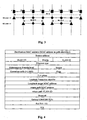
- Figure 3 is a configuration diagram illustrating connectivity fault management in a PBB-TE network
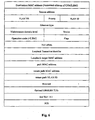
- Figure 4 is a diagram illustrating the format of an LBM according to an embodiment of the invention.
- Figure 5 is a diagram illustrating the format of an LBR according to an embodiment of the invention.
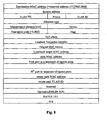
- Figure 6 is a diagram illustrating the format of an LBM according to an embodiment of the invention.
- Figure 7 is a diagram illustrating the format of an LBR according to an embodiment of the invention.
- Figure 8 is a diagram illustrating the format of an LBM according to an embodiment of the invention.
- Figure 9 is a diagram illustrating the format of an LTM according to an embodiment of the invention.
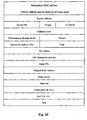
- Figure 10 is a diagram illustrating the format of an LTR according to an embodiment of the invention.
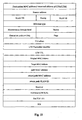
- Figure 11 is a diagram illustrating the format of an LTM according to an embodiment of the invention.
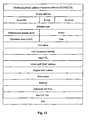
- Figure 12 is a diagram illustrating the format of an LTR according to an embodiment of the invention.
- Figure 13 shows a system for transmitting a connectivity fault management message of Ethernet according to an embodiment of the invention
- Figure 14 is a flow chart illustrating the process that a node processes the structure of a PBB-TE data frame in the prior art
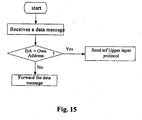
- Figure 15 is a flow chart illustrating the process that a node processes the structure of a modified PBB-TE data frame according to an embodiment of the invention.
- FIG. 1 shows a flow of a method for transmitting and processing a connectivity fault management (CFM) message of Ethernet according to an embodiment of the invention.
- the method includes the follows.
- a source node transmits a CFM message including a path identifier of a path including a monitored connection, and a connection maintenance target address.
- the path identifier of the path includes a Medium Access Control (MAC) address and a Virtual Local Area Network Identifier (VLAN ID).
- MAC Medium Access Control
- VLAN ID Virtual Local Area Network Identifier
- Block A2 a receiving node judges whether the message is a CFM message based on Ethernet type. If the message is a CFM message, the process proceeds to block A3; otherwise the message is processed with methods corresponding to other types.
- Block A3 the CFM message is delivered to a CFM processing unit, and the process proceeds to block A4.
- Block A4 it is judged whether the connection maintenance target address of the CFM message matches an address of the receiving node itself. If the connection maintenance target address of the CFM message matches the address of the receiving node itself, the process proceeds to block A6; otherwise to block A5.
- Block A5 the CFM message is forwarded to a next hop based on the path identifier of the path, and the process is ended.
- Block A6 the CFM message is terminated and processed.
- FIG. 2 shows a flow of a method for transmitting and processing a connectivity fault management (CFM) message of Ethernet according to an embodiment of the invention.
- the method is as follows.
- Block B1 a first node transmits a connectivity fault management (CFM) message.
- a protocol data unit (PDU) of the CFM message carries information of a return path.
- the information of the return path includes a MAC address and/or a virtual local area network identifier (VLAN ID) of the path identifier of the return path.
- VLAN ID virtual local area network identifier
- Block B2 a second node receives the CFM message transmitted from the first node, and transmits a CFM reply message.
- the header of the CFM reply message is encapsulated according to the information of the return path.
- Block B3 a third node receives the CFM reply message, and forwards the CFM reply message to next hop based on the information of the return path.
- Block B4 the first node receives the CFM reply message, and processes the CFM reply message.
- FIG 3 shows configuration of maintenance points in a PBB-TE network.
- the PBB-TE network includes eight nodes A to H, configured with two Maintenance Domain Levels (MD levels).
- MD levels Maintenance Domain Levels
- a maintenance association with an MD Level of 4 includes an MA-4.
- MEP ports of MA-4 are configured on the nodes A and H, and MIP ports of MA-4 are configured on the six nodes B-G.
- VLAN ID of a path from A to H is VID (3)
- path MAC address in path identifier of the path is MAC (H).
- MA-3-1 and MA-3-2 have an MD Level of 3. Nodes on the two MAs belong to different operators. MEP ports of MA-3-1 are configured on nodes B and D, and MIP port MA-3-1 is configured on node C. MEP ports of MA-3-2 are configured on nodes E and G, and MIP port of MA-3-2 is configured on node F.
- a method for transmitting and processing a connectivity fault management (CFM) message is as follows.
- s101, an MEP list, and a time interval t, at which Continuity Check Messages (CCMs) are transmitted, are configured at the destination node D.
- the source node B initiates a CC check, and generates and transmits a CCM to the destination node D at a time interval of t.
- the CCM is composed of an Ethernet header and a CCM PDU.
- the Ethernet header includes:
- a destination MAC address i.e. a path MAC address in path identifier of a path including a monitored connection.
- path B-to-D is a part of path A-to-H. Therefore, in the CCM, the destination MAC address is the MAC address of H, i.e. MAC (H), instead of the MAC address of D;
- VLAN ID i.e. a virtual local area network identifier of the path identifier.
- path B-to-D is a part of path A-to-H. Therefore in the CCM, the VLAN ID is VID (3) of path A-to-H;
- Ethernet type indicating Ethernet type of the CCM.
- Ethernet type for CFM in this embodiment
- the CCM PDU includes:
- a maintenance domain level indicating a maintenance domain (MD) level at which a maintenance association (MA) is located;
- an operation code indicating type of CFM operation.
- the value is the opcode assigned for CCM.
- the node receiving the CCM processes the CCM.
- the CCM is forwarded according to the MAC address and the VLAN ID.
- the node receiving the CCM is a maintenance association end point (MEP)
- MEP maintenance association end point
- s1031 it is judged whether the received message is a CFM message based on the Ethernet type of the message. If the received message is not a CFM message, it is processed with corresponding mechanism for the Ethernet type, which will not be described here. For example, if the CCM is a service data message, the CCM is forwarded according to the destination MAC address and the VLAN ID. Here, because the CCM is actually a CFM message, the process proceeds to s1032.
- a maintenance domain level configured at receiving node is compared with that of the CFM message, i.e. the CCM. If the maintenance domain level configured at the receiving node is higher than that of the CCM, the CCM is discarded. If the maintenance domain level configured at the receiving node is lower than that of the CCM, the CCM is forwarded according to the destination MAC address and the VLAN ID in CCM Ethernet header. If the maintenance domain level configured at the receiving node equals to that of the CCM, the process proceeds to s 1033.
- the CFM message i.e. the CCM
- the CCM PDU is transmitted to a CC processing unit; otherwise, other process corresponding to the operation code is performed.
- a method for transmitting and processing a connectivity fault management message is as follows.
- s201, an MEP list, and a time interval t, at which CCMs are transmitted, are configured at the destination node D.
- the source node B initiates a CC check, and, generates and transmits a CCM to the destination node D at a time interval of t.
- the CCM is composed of an Ethernet header and a CCM PDU.
- the Ethernet header includes:
- a destination MAC address i.e. a MAC address dedicated for a CFM/CCM function. All the nodes shall support the processing for this address;
- VLAN ID i.e. a virtual local area network identifier which is a part of path identifier of a path including a monitored connection.
- path B-to-D There is no dedicated path identifier for path B-to-D, but the path B-to-D is a part of path A-to-H. Therefore in the CCM, the VLAN ID is VID (3) of the path A-to-H;
- Ethernet type indicating an Ethernet type of the CCM.
- Ethernet type for CFM in this embodiment
- the CCM PDU includes:
- a maintenance domain level indicating a maintenance domain level of maintenance domain of the CCM
- an operation code indicating type of CFM operation;
- the value is the opcode assigned for CCM.
- path MAC address which is a part of path identifier of the path including the monitored connection.
- path B-to-D There is no dedicated path identifier for path B-to-D, but the path B-to-D is a part of path A-to-H. Therefore in the CCM, the path MAC address is the MAC address of H, i.e. MAC (H), instead of the MAC address of D.
- H MAC
- the node receiving the CCM transmits the message to a CFM processing unit based on the destination MAC address and Ethernet type of the CCM.
- the CFM processing unit processes the CCM.
- the node receiving the CCM is not a maintenance point (MP)
- the received message i.e. the CCM
- the CCM is forwarded according to the path MAC address in PDU and the VLAN ID in the header; otherwise the received message is discarded or processed by other ways.
- the node receiving the CCM is a maintenance domain intermediate point (MIP)
- MIP maintenance domain intermediate point
- the CCM is discarded.
- the maintenance domain level configured at receiving node is compared with that of the CFM message, i.e. the CCM. If the maintenance domain level configured at the receiving node is higher than that of the CCM, the CCM is discarded. If the maintenance domain level configured at the receiving node is lower than or equals to that level of the CCM, the CCM is forwarded according to the path MAC address in the CCM PDU and the VLAN ID in the CCM Ethernet header.
- the following process is performed.
- the process proceeds to s2042.
- a maintenance domain level configured at local MEP is compared with that of the CFM message, i.e. the CCM. If the maintenance domain level configured at the local MEP is higher than that of the CCM, the CCM is discarded. If the maintenance domain level configured at the local MEP is lower than that of the CCM , the CCM is forwarded according to the path MAC address in the CCM PDU and the VLAN ID in the CCM Ethernet Header. If the maintenance domain level configured at the local MEP equals to that of the CCM, the process proceeds to s2043.
- the CFM message is terminated. If the operation code indicates a message type of CCM, a CCM PDU is transmitted to a CC processing unit; otherwise other operation corresponding to the operation code is performed.
- a method for transmitting and processing a connectivity fault management message is as follows.
- the source node A initiates an LB check, and generates and transmits a loopback message (LBM) to the destination node D.
- LBM is composed of an LBM Ethernet header and a LBM PDU as described by Figure 4 .
- the LBM Ethernet header includes:
- a destination MAC address i.e. a path MAC address in path identifier of a path including a monitored connection.
- the path A-to-D is a part of path A-to-H. Therefore in the LBM, the destination MAC address is the MAC address of H, i.e. MAC (H), instead of the MAC address of D;
- VLAN ID i.e. a virtual local area network identifier of path identifier of the path including the monitored connection.
- path A-to-D There is no dedicated path identifier for path A-to-D, but the path A-to-D is a part of path A-to-H. Therefore in the LBM, the VLAN ID is VID (3) of path A-to-H;
- the LBM PDU includes:
- a maintenance domain level indicating a preconfigured maintenance domain level
- a loopback target MAC address indicating a destination address of the loopback
- a return path MAC address i.e. a MAC address part of a path identifier of a return path for a Loopback Response (LBR) message.
- LBR Loopback Response
- the return path MAC address is the MAC address of A, i.e. MAC (A);
- a return path VLAN ID i.e. a virtual local area network identifier part of a path identifier of a return path for the LBR.
- the path D-to-A is a part of path H-to-A. Therefore in the LBR, the return path VLAN ID is the VLAN ID of path H-to-A.
- the node receiving the LBM processes the LBM.
- the LBM is forwarded according to the destination MAC address and the VLAN ID.
- the following process is performed.
- the received message is a CFM message based on the Ethernet type of the received message. If the received message is not a CFM message, the LBM is processed by using a processing method for an Ethernet type, which will not be described here. For example, if the received message is a service data message, the message is forwarded according to the destination MAC address and the VLAN ID. Here because the received message, i.e. the LBM, is a CFM message, the process proceeds to s3022.
- a maintenance domain level configured at receiving node is compared with that of the CFM message, i.e. the LBM. If the maintenance domain level configured at the receiving node is higher than that of the LBM, the LBM is discarded. If the maintenance domain level configured at the receiving node is lower than that of the LBM, the LBM is forwarded according to the destination MAC address and the VLAN ID. If the maintenance domain level configured at the receiving node equals to that of the LBM, the process proceeds to s3023.
- a message type indicated by the operation code is determined. If the operation code indicates a message type of LBM, the process proceeds to s3025; otherwise, other operation corresponding to the operation code is performed.
- s3024 it is judged whether the loopback target MAC address points to the receiving node. If it does, the process proceeds to s303; if it does not, in the case that the receiving node is an MIP, the LBM is forwarded according to the destination MAC address and the VLAN ID, and in the case that the receiving node is an MEP, the LBM is terminated.
- LBR loopback response
- a destination MAC address i.e. the return path MAC address in the LBM
- VLAN ID i.e. the return path VLAN ID in the LBM
- the LBR PDU includes:
- a maintenance domain level indicating a maintenance domain level of maintenance domain of the LBR
- the node receiving the LBR processes the LBR as follows.
- the LBR is forwarded according to the destination MAC address and the VLAN ID.
- the following process is performed.
- the LBR is processed by using a processing methods corresponding to Ethernet type, which will not be described here. For example, if the received message is a service data message, the LBR is forwarded according to the destination MAC address and the VLAN ID.
- the received message i.e. the LBR
- the process proceeds to s3043.
- a maintenance domain level configured at the receiving node is compared with that of the CFM message, i.e. the LBR. If the maintenance domain level configured at the receiving node is higher than that of the LBR, the LBR is discarded. If the maintenance domain level configured at the receiving node is lower than that of the LBR, the LBR is forwarded according to the destination MAC address and the VLAN ID. If the maintenance domain level configured at the receiving node equals to that of the LBR, the process proceeds to s3043.
- a message type indicated by the operation code is determined. If the operation code indicates a message type of LBR, the process proceeds to s3044; otherwise other check corresponding to the operation code is performed.
- the LBR is terminated, and a PDU is transmitted to an LB processing module. If the original MAC address of the loopback is not the address of the receiving node and the receiving node is an MIP, the LBR is forwarded according to the destination MAC address and the VLAN ID, and if the original MAC address of the loopback is not the address of the receiving node and the receiving node is an MEP, the LBR is terminated.
- a method for transmitting and processing a connectivity fault management message is as follows.
- the source node A initiates an LB, and generates and transmits an LBM to the destination node D.
- the LBM is composed of an LBM Ethernet header and a LBM PDU as described by Figure 6 .
- the LBM Ethernet header includes:
- a destination MAC address i.e. a MAC address dedicated for a CFM/LBM function. All the nodes shall support processing of the MAC address;
- VLAN ID i.e. a virtual local area network identifier of path identifier of a path including a monitored connection.
- path A-to-D There is no dedicated path identifier for path A-to-D, but the path A-to-D is a part of path A-to-H. Therefore in the LBM, the VLAN ID is VID (3)of the path A-to-H;
- the LBM PDU includes:
- a maintenance domain level indicating a maintenance domain level of maintenance domain of the LBM
- the destination MAC address is the MAC address of H, i.e. MAC (H), instead of the MAC address of D;
- a loopback target MAC address indicating a destination address of the loopback
- a return path MAC address i.e. a MAC address of a return path for LBR.
- the path D-to-A is a part of path H-to-A. Therefore in the LBR, the return path MAC address is the MAC address of A, i.e. MAC (A);
- a return path VLAN ID i.e. a virtual local area network identifier of the return path for LBR.
- the path D-to-A is a part of the path H-to-A. Therefore in the LBR, the return path VLAN ID is the VLAN ID of the path H-to-A.
- the LBM is transmitted to the CFM processing unit based on the destination MAC address of the LBM.
- the CFM processing unit processes the LBM.
- the node receiving the LBM is a non-MP, it is judged whether the received message is a CFM message based on the Ethernet type of the received message. If the received message is not a CFM message, the LBM is discarded. Here because the received message, i.e. the LBM, is a CFM message, it is forwarded by looking up the forwarding table according to the path MAC address in the PDU and the VLAN ID in the header.
- the following process is performed.
- the process proceeds to s4032. If the received message is not a CFM message, the LBM is discarded.
- a maintenance domain level configured at the receiving node is compared with that of the CFM message, i.e. the LBM. If the maintenance domain level configured at the receiving node is higher than that of the LBM, the CFM message is discarded. If the maintenance domain level configured at the receiving node is lower than that of the LBM, the LBM is forwarded according to the path MAC address in the PDU and the VLAN ID in the header. If the maintenance domain level configured at the receiving node equals to that of the LBM, the process proceeds to s4033.
- a message type indicated by the operation code is determined. If the operation code indicating a message type of LBM, the process proceeds to s4034; otherwise, other process corresponding to the operation code is performed.
- the process proceeds to step 404. If the loopback target MAC address is not an address of the receiving node and the receiving node is an MIP, the LBM is forwarded according to the path MAC address in the PDU and the VLAN ID in the header, and if the loopback target MAC address is not an address of the receiving node and the receiving node is an MEP, the LBM is terminated.
- LBR loopback response
- a destination MAC address i.e. a MAC address dedicated for a CFM/LBR function
- VLAN ID i.e. the return path VLAN ID in the LBM
- an Ethernet type indicates an Ethernet type of the LBR, which is a CFM message in this embodiment
- the LBR PDU includes:
- a maintenance domain level indicating a maintenance domain level of maintenance domain of the LBR
- the node receiving the LBR transmits the LBR to the CFM processing unit of the node based on the destination MAC address of the LBR.
- the CFM processing unit processes the received LBR as follows.
- the node receiving the LBR is a non-MP, it is judged whether the received message is a CFM message based on the Ethernet type of the received message. If the received message is not a CFM message, the message is discarded. Here because the received message, i.e. the LBR, is a CFM message, the LBR is forwarded according to the path MAC address in the PDU and the VLAN ID in the header.
- the following process is performed.
- the process proceeds to s4062.
- a maintenance domain level configured at the receiving node is compared with that of the CFM message, the LBR. If the maintenance domain level configured at the receiving node is higher than that of the LBR, the LBR is discarded. If the maintenance domain level configured at the receiving node is lower than that of the LBR, the LBR is forwarded based the path MAC address in the PDU and the VLAN ID in the header. If the maintenance domain level configured at the receiving node equals to that of the LBR, the process proceeds to s4063.
- a message type indicated by the operation code is determined. If the operation code indicates a message type of LBR, the process proceeds to s4064; otherwise, other process corresponding to the operation code is performed.
- the LBR is terminated, and an LBR PDU is transmitted to an LB processing module. If the original MAC address of loopback is not the address of the receiving node, when the receiving node is an MIP, the LBR is forwarded according to the path MAC address in the PDU and the VLAN ID in the header, and when the receiving node is an MEP, the LBR is terminated.
- a method for transmitting and processing a connectivity fault management message is as follows.
- the LBM is composed of an LBM Ethernet header and a LBM PDU as described by Figure 8 .
- the LBM Ethernet header includes:
- a destination MAC address i.e. a MAC address dedicated for a CFM/LBM function. All the nodes shall support processing of the MAC address;
- VLAN ID i.e. a virtual local area network identifier of path identifier of a path including a monitored connection.
- path A-to-D There is no identifier for path A-to-D, but the path A-to-D is a part of path A-to-H. Therefore in the LBM, the VLAN ID is VID (3) of the path A-to-H;
- the LBM PDU includes:
- a maintenance domain level indicating a maintenance domain level of maintenance domain of the LBM
- a path MAC address i.e. a MAC address in path identifier of the path including the monitored connection.
- the path A-to-D is a part of the path A-to-H. Therefore in the LBM, the destination MAC address is the MAC address of H, i.e. MAC (H), instead of the MAC address of D;
- a loopback target MAC address indicating a destination address of the loopback
- an explicit route which is, in this embodiment, a sequence of egress ports of respective networks bridges that are specified to pass through;
- a return path MAC address i.e. a MAC address of return path for an LBR.
- the path D-to-A is a part of path H-to-A. Therefore in the LBR, the return path MAC address is the MAC address of A, i.e. MAC (A);
- a return path VLAN ID i.e. a virtual local area network identifier of return path for the LBR.
- the path D-to-A is a part of the path H-to-A. Therefore in the LBR, the return path VLAN ID is the VLAN ID of the path H-to-A.
- the LBM is transmitted to the CFM processing unit based on the destination MAC address of the LBM.
- the CFM processing unit processes the LBM.
- the following process is performed.
- s5031A it is judged whether the received message is a CFM message based on the Ethernet type of the message. If the received message is not a CFM message, the received message is discarded. Here because the received message, i.e. the LBM, is a CFM message, the process proceeds to s5032A.
- a set of egress ports in a forwarding table is looked up according to the path MAC address in the PDU and the VLAN ID in the header. If a first port in the sequence of egress ports of the LBM is one in the set of egress ports in the forwarding table, the LBM is forwarded according to the first port, and the first port is removed from the sequence of egress ports of the LBM before the LBM is forwarded. If the first port in the sequence of egress ports of the message is not in the set of egress ports in the forwarding table, the LBM is discarded.
- the following process is performed.
- s5031B it is judged whether the received message is a CFM message based on the Ethernet type of the received message. If the received message is not a CFM message, the received message is discarded. Here because the received message, i.e. the LBM, is a CFM message, the process proceeds to s5032B.
- a maintenance domain level configured at the receiving node is compared with that of the CFM message, i.e. the LBM. If the maintenance domain level configured at the receiving node is higher than that of the LBM, the LBM is discarded. If the maintenance domain level configured at the receiving node is lower than that of the LBM, the LBM is forwarded according to the path MAC address in the PDU and the VLAN ID in the header. If the maintenance domain level configured at the receiving node equals to that of the LBM, the process proceeds to s5033B.
- a message type indicated by the operation code is determined. If the operation code indicates a message type of LBM, the process proceeds to s5034B; otherwise other process corresponding to the operation code is performed.
- s5034B it is judged whether the loopback target MAC address is an address of the receiving node. If the loopback target MAC address is an address of the receiving node, the process proceeds to s504; otherwise, the process proceeds to step 5035B.
- Step 5035B the set of egress ports in the forwarding table is looked up upon based on the MAC address and the VLAN ID of the path. If the first port in the sequence of egress ports of the message is one in the set of egress ports in the forwarding table, the LBM is forwarded from the first port, and the first port is removed from the sequence of egress ports of the message prior to forwarding. If the first port in the sequence of egress ports of the message is not in the set of egress ports in the forwarding table, the LBM is discarded.
- the following process is performed.
- s5031C it is judged whether the received message is a CFM message based on the Ethernet type of the received message. If the received message is not a CFM message, the received message is discarded. Here because the received message, i.e. the LBM, is a CFM message, the process proceeds to s5032C.
- the maintenance domain level configured at the receiving node is compared with that of the CFM message, i.e. the LBM. If the maintenance domain level configured at the receiving node is higher than that of the LBM, the LBM is discarded. If the maintenance domain level configured at the receiving node is lower than that of the LBM, the LBM is forwarded according to the path MAC address in the PDU and the VLAN ID in the header. If the maintenance domain level configured at the receiving node equals to that of the LBM, the process proceeds to s5033C.
- a message type indicated by the operation code is determined. If the operation code indicates a message type of LBM, the process proceeds to s5034C; otherwise other process corresponding to the operation code is performed.
- the process proceeds to s504. If the loopback target MAC address carried in the LBM is not the address of the receiving node, the LBM is terminated.
- LBR loopback response
- the LBR is generated and processed as in the method according to the fourth embodiment.
- the processing in the s5032A and the s5035B may be as follows:
- the LBM is forwarded according to the first MAC address, and removes the current first MAC address from the sequence of MAC addresses. If the MAC address of the receiving node and the first MAC address in the sequence of MAC addresses are different, the LBM is discarded.
- a method for transmitting and processing a connectivity fault management message is as follows.
- LTM Linktrace message
- the LTM is composed of an LTM Ethernet header and a LTM PDU as described by Figure 9 .
- the LTM Ethernet header includes:
- a destination MAC address i.e. a path MAC address in path identifier of a path including a monitored connection.
- the path A-to-D is a part of path A-to-H. Therefore in the LTM, the destination MAC address is the MAC address of H, i.e. MAC (H), instead of the MAC address of D;
- VLAN ID i.e. a virtual local area network identifier of path identifier of the path including the monitored connection.
- VID (3) of the path A-to-H the VLAN ID is VID (3) of the path A-to-H;
- Ethernet type indicating Ethernet type of the LTM which is a CFM message in this embodiment
- the LTM PDU includes:
- a maintenance domain level indicating a maintenance domain level of maintenance domain of the LTM
- a return path MAC address i.e. a MAC address in path identifier of return path, used for returning a Linktrace check Response (LTR) along the return path by subsequent node(s).
- LTR Linktrace check Response
- the return path MAC address is the MAC address of A, i.e. MAC (A);
- a return path VLAN ID i.e. a virtual local area network identifier in path identifier of the return path, used for returning a Linktrace check Response (LTR) along the return path by subsequent nodes.
- LTR Linktrace check Response
- the return path VLAN ID is the VLAN ID of the path H-to-A;
- LTM TTL which is an integer value.
- the node receiving the LTM processes the LTM.
- the LTM is forwarded according to the destination MAC address and the VLAN ID.
- the following process is performed.
- the process proceeds to s6022.
- a maintenance domain level configured at the receiving node is compared with that of the CFM message, i.e. the LTM. If the maintenance domain level configured at the receiving node is higher than that of the LTM, the LTM message is discarded. If the maintenance domain level configured at the receiving node is lower than that of the LTM, the LTM is forwarded according to the destination MAC address and the VLAN ID. If the maintenance domain level configured at the receiving node equals to that of the LTM, the process proceeds to s6023.
- a message type indicated by the operation code is determined. If the operation code indicates a message type of LTM, the process proceeds to s6024; otherwise, other operation corresponding to the operation code is performed.
- the LTM is terminated, and the process proceeds to s603. If the node is an MIP, the LTM is forwarded according to the destination MAC address and the VLAN ID, and the LTM TTL is decremented by one upon forwarding. Duo to the change of the LTM, the source address of the LTM is modified into an address of local MIP, and a Frame Check Sequence (FCS) is recalculated. It shall be noted that the LTM will not be forwarded if the LTM TTL becomes zero.
- FCS Frame Check Sequence
- an LTR is transmitted to the source node initiating the LT check.
- the LTR is composed of an LTR Ethernet header and a LTR PDU as described by Figure 10 .
- the LTR Ethernet header includes:
- a destination MAC address i.e. the return path MAC address in the LTM
- VLAN ID i.e. the return path VLAN ID in the LTM
- the LTR PDU includes:
- a maintenance domain level indicating a maintenance domain level of maintenance domain of the LTR
- an original MAC address i.e. an original MAC address of linktrace check, i.e. an address of source node initiating the LT check
- a Reply TTL i.e. a value of the received LTM TTL, use for restoring an order in which the nodes receive the LTM.
- the node receiving the LTR processes the LTR.
- the LTR is forwarded according to the destination MAC address and the VLAN ID.
- the node receiving the LTR is an MIP or an MEP, then the following process is performed.
- step s6041 it is checked whether the destination MAC address and the VLAN ID of the LTR correspond to an entry in the forwarding table. If the destination MAC address and the VLAN ID of the LTR do not correspond to an entry in the forwarding table, the LTR is discarded. If the destination MAC address and the VLAN ID of the LTR correspond to an entry in the forwarding table, the process proceeds to step s6042.
- the process proceeds to s6043.
- a maintenance domain level configured at the receiving node is compared with that of the CFM message, i.e. the LTR. If the maintenance domain level configured at the receiving node is higher than that of the LTR, the LTR is discarded. If the maintenance domain level configured at the receiving node is lower than that of the LTR, the LTR is forwarded according to the destination MAC address and the VLAN ID. If the maintenance domain level configured at the receiving node equals to that of the LTR, the process proceeds to s6044.
- a message type indicated by the operation code is determined. If the operation code indicates a message type of LTR, the process proceeds to s6045; otherwise, other check corresponding to the operation code is performed.
- the LTR is terminated, and it is judged whether there is no link fault between the source node and the destination node. If the original MAC address of linktrace check is not the address of the receiving node, if the receiving node is an MIP, the LTR is forwarded according to the destination MAC address and the VLAN ID in the header, and if the receiving node is an MEP, the LTR is terminated.
- a method for transmitting and processing a connectivity fault management message is as follows.
- the source node A initiates an LT check, and generates and transmits an LTM to the destination node D.
- the LTM is composed of an LTM Ethernet header and a LTM PDU as described by Figure 11 .
- the LTM Ethernet header includes:
- a destination MAC address i.e. a MAC address dedicated for a CFM/LTM function. All the nodes shall support an operation on this specific address;
- VLAN ID i.e. a virtual local area network identifier of path identifier of a path including a monitored connection.
- path A-to-D There is no dedicated path identifier for path A-to-D, but the path A-to-D is a part of an A-to-H path. Therefore in the LTM, the VLAN ID is VID (3) of the path A-to-H;
- LTM PDU includes:
- a maintenance domain level indicating a maintenance domain level of maintenance domain of the LTM
- a path MAC address i.e. a path MAC address in path identifier of the path including the monitored connection.
- the path A-to-D is a part of the path A-to-H. Therefore in the LTM, the destination MAC address is the MAC address of H, i.e. MAC (H), instead of the MAC address of D;
- a return path MAC address i.e. a MAC address of a return path for LTR.
- the path D-to-A is a part of path H-to-A. Therefore in the LTR, the return path MAC address is the MAC address of A, i.e. MAC (A);
- a return path VLAN ID i.e. a virtual local area network identifier of the return path for LTR.
- the path D-to-A is a part of path H-to-A. Therefore in the LTR, the return path VLAN ID is the VLAN ID of the path H-to-A;
- the node receiving the LTM transmits the LTM to a CFM processing unit based on the destination MAC address of the LTM.
- the CFM processing unit of the node receiving the LTM processes the LTM.
- the node receiving the LTM is a non-MP, it is judged whether the received message is a CFM message based on the Ethernet type of the message. If the received message is not a CFM message, the received message is discarded. Here, because the received message, i.e. the LTM, is a CFM message, the LTM is forwarded according to the path MAC address in the PDU and the VLAN ID in the header.
- the node receiving the LTM is an MIP or an MEP, then the following process is performed.
- the process proceeds to s7032.
- a maintenance domain level configured at the receiving node is compared with that of the CFM message, i.e. the LTM. If the maintenance domain level configured at the receiving node is higher than that of the LTM, the LTM is discarded. If the maintenance domain level configured at the receiving node is lower than that of the LTM, the LTM is forwarded according to the path MAC address in the PDU and the VLAN ID in the header. If the maintenance domain level configured at the receiving node equals to that of the LTM, the process proceeds to s7033.
- a message type indicated by the operation code is determined. If the operation code indicates a message type of LTM, the process proceeds to s7034; otherwise, other check corresponding to the operation code is performed.
- the LTM if the node receiving the LTM is an MEP, the LTM is terminated, and the process proceeds to s704; and if the node receiving the LTM is an MIP, the LTM, i.e. the CFM message, is forwarded according to the path MAC address in the PDU and the VLAN ID in the header, and the LTM TTL is decremented by one upon the forwarding. Duo to the change of the LTM, the source address of the LTM is modified into an address of the local MIP, and a Frame Check Sequence (FCS) is recalculated. It shall be noted that the LTM will not be forwarded if the LTM TTL becomes zero.
- FCS Frame Check Sequence
- an LTR is transmitted to the source node.
- the LTR is composed of an LTR Ethernet header and a LTR PDU as described by Figure 12 .
- the LTR Ethernet header includes:
- a destination MAC address i.e. a MAC address dedicated for a CFM/LTR function. All the nodes shall be capable of processing the MAC address;
- VLAN ID i.e. the return path VLAN ID in the LTM
- the LTR PDU includes:
- a maintenance domain level indicating a maintenance domain level of maintenance domain of the LTR
- LT linktrace
- MAC address of a previous hop MIP i.e. a source address receiving the LTM, used for a multicast linktrace check.
- the node receiving the LTR transmits the LTR to a CFM processing unit based on the destination MAC address of the LTR.
- the CFM processing unit processes the LTR.
- the node receiving the LTR is a non-MP, it is judged whether the received message is a CFM message based on the Ethernet type of the received message. If the received message is not a CFM message, the received message is discarded. Here because the received message, i.e. the LTR, is a CFM message, the LTR is forwarded according to the path MAC address in the PDU and the VLAN ID in the header.
- the following process is performed.
- s7061 it is judged whether the received message is a CFM message based on the Ethernet type of the message, If the received message is not a CFM message, the received message is discarded. Here because the received message, i.e: the LTR, is a CFM message, the process proceeds to s7062.
- a maintenance domain level configured at the receiving node is compared with that of the CFM message, i.e. the LTR. If the maintenance domain level configured at the receiving node is higher than that of the LTR, the LTR is discarded. If the maintenance domain level configured at the receiving node is lower than that of the LTR, the LTR is forwarded according to the path MAC address in the PDU and the VLAN ID in the header. If the maintenance domain level configured at the receiving node equals to that of the LTR, the process proceeds to s7063.
- s7063 a message type indicated by the operation code is determined. If the operation code indicates a message type of LTR, the process proceeds to s7064; otherwise, other check corresponding to the operation code is performed.
- the original MAC address of linktrace check is an address of the receiving node. If the original MAC address of linktrace check is the address of the receiving node, the LTR is terminated, and an LTR PDU is transmitted to an LT processing module. If the original MAC address of linktrace check is not the address of the receiving node, when the receiving node is an MIP, the CFM message, i.e. the LTR, is forwarded according to the path MAC address in the PDU and the VLAN ID in the header, and when the receiving node is an MEP, the LTR is terminated.
- the CFM message i.e. the LTR
- Figure 13 shows a system for transmitting and processing a connectivity fault management message of an Ethernet according to an embodiment of the invention.
- the system includes a source node 61 and a receiving node 62.
- the source node 61 includes a CFM message generating unit 611 adapted to generate a CFM message containing a connection maintenance target address; and a message transmitting and receiving unit 612 connected with the CFM message generating unit, adapted to transmit the CFM message and to receive a CFM reply message transmitted from the receiving node 62.
- the receiving node 62 includes an address determining unit 621 adapted to determine whether the connection maintenance target address of the CFM message matches an address of the receiving node; a reply message generating unit 622 adapted to generate a CFM reply message containing information of a return path; a message transmitting and receiving unit adapted to receive the CFM message transmitted from the source node and to transmit a CFM reply message; and a CFM processing unit 624 adapted to terminate the CFM message transmitted from the source node 61 or to forward the CFM message to a next hop.
- PBB-TE Provider Backbone Bridge Traffic Engineering
- Figure 14 illustrates a flow chart showing the process of processing the structure of a PBB-TE data frame by a node in the previous embodiments.
- the node receiving the message After receiving a message, the node receiving the message checks information of a source address SA in the message, to determine whether the message is a message transmitted from receiving node. If the message is a message transmitted from receiving node, it means that a message loopback occurs, and the message is discarded (which is optional). If the message is not a message transmitted from receiving node, the node receiving the message checks an Ethernet type of the message to determine a subsequent action. If the Ethernet type indicates that the message is a CFM message, the message is transmitted to a CFM processing unit.
- Ethernet type indicates that the message is a client traffic message
- an outport is determined by looking up forwarding table according to a destination address (DA) and a VLAN ID, and the message is forwarded, the actions corresponding to the types other than the CFM type will not be described here.
- Figure 15 depicts a flow chart showing the process of processing a modified PBB-TE data frame by a node according to an embodiment of the invention.
- the field of source address SA in the existing framework of a PBB-TE data frame is replaced by a field of a target MAC address.
- the structure of an existing PBB-TE data frame DA_MAC SA MAC VLAN TAG ... ETH TYPE Payload FCS
- the Target MAC has the same semantic as that of destination address (DA) in a connectionless Ethernet.
- DA destination address
- the process of processing by the node is as follows.
- a node After receiving a message, a node checks a target address of the message, to determine whether the target address is an address of receiving node or a registered multicast address of the receiving node or not. If the target address is an address of receiving node or a registered multicast address of the receiving node, the node receives the message, and transmits the message to an upper-layer protocol for processing based on the field of Ethernet type, i.e. ETH TYPE.
- an outport is determined by looking up the forwarding table according to the DA MAC and VLAN ID, and the message is forwarded from the outport: For a CFM message, such as CCM, based upon a special CFM address, the target MAC is set the value of the special CFM address. The maintenance point checks the target MAC address of a received message, and determines whether to transmit the CFM message to a CFM processing unit based on the target MAC address.
- the existing Ethernet CFM mechanism can be used.
- the field of the Target MAC is required to be filled with a CC multicast address as defined in the existing Ethernet CFM standards.
- the field of the Target MAC is required to be filled with a CC unicast destination address.
- the DA MAC and the VLAN ID of the message identify a PBB-TE connection where the message is located, as in the existing PBB-TE mechanism.
- Other information such as the Ethernet type and the CCM PDU, may be in compliance with the existing Ethernet CFM standards.
- a node After receiving the message, a node terminates the message based on the CC multicast address or the CC unicast address in the field of target address of the message by using a method as defined in the existing standards, and transmits the message to a CFM processing unit.
- the Target MAC field of an LBM is filled with a MAC address of an MIP to be checked or a special multicast address pointing to all MEPs as defined in present standards.
- the DA MAC and the VLAN ID of the message identify a PBB-TE connection which is tested, as in the existing PBB-TE mechanism.
- Other information such as the Ethernet type, may be in compliance with the existing Ethernet CFM standards.
- address information of source node transmitting the LBM, as well as a DA MAC and a VLAN ID identifying a reverse path shall be added in LBM PDU.
- a node After receiving the message, a node terminates the message based on the target unicast address or the multicast address filled in the field of target address in the message, and transmits the message to a CFM processing unit based on the Ethernet type or the special multicast address. After processing, an LBR is returned.
- a DA MAC and a VLAN ID encapsulated in the LBR is the DA MAC and the VLAN ID identifying a reverse path carried in the LBM PDU.
- a Target MAC address encapsulated in the LBR is the address information of the source node transmitting the LBM.
- a node processes the LBR in a similar way.
- the node terminates the LBR based on the target address of the LBR, and transmits the LBR to a CFM processing unit based on the Ethernet type.
- the processing of the LBR PDU is in compliance with the existing standards.
- the processing method for linktrace is similar to those for CC and LB.
- a node initiating a linktrace check fills a special multicast address of an LTM into the Target MAC field in the LTM, and carries path identifier of a return path and a MAC address of the node initiating the linktrace check in the LTM PDU.
- a node After receiving the LTM, a node determines that it is the LTM based on the LTM multicast address of Target MAC field in the LTM, and transmits the LTM to a linktrace processing unit of the node.
- the MAC address of the node initiating the linktrace check is filled into the Target MAC field in the LTR, and the MAC address and the VLAN ID carrying path identifier of the return path, contained in the LTM, are respectively filled into the field of DA MAC and VLAN ID.
- the node initiating the linktrace check terminates the LTR based on the Target MAC field in the LTR, and transmits the LTR to a CFM processing unit based on the Ethernet type.
- the processing of LTR PDU is in compliance with the existing standards.
Landscapes
- Engineering & Computer Science (AREA)
- Computer Networks & Wireless Communication (AREA)
- Signal Processing (AREA)
- Computer Security & Cryptography (AREA)
- Environmental & Geological Engineering (AREA)
- Small-Scale Networks (AREA)
Claims (4)
- Verfahren zum Verarbeiten einer Konnektivitätsfehler-Verwaltungsnachricht, umfassend:Empfangen einer von einem Quellenknoten gesendeten Prüfschleifennachricht durch einen empfangenden Knoten, wobei die Prüfschleifennachricht eine Pfadkennung und eine Prüfschleifen-Ziel-MAC-Adresse führt und wobei die Prüfschleifen-Ziel-MAC-Adresse in einer Protokolldateneinheit der Prüfschleifennachricht enthalten ist und wobei die Prüfschleifennachricht aus einem Ethernet-Header und einer Protokolldateneinheit besteht und der Ethernet-Header Folgendes umfasst: eine Ziel-MAC-Adresse, die Teil einer ersten Pfadkennung ist, die einen Pfad identifiziert,eine Kennung des virtuellen lokalen Netzwerks, die Teil der ersten Pfadkennung ist, und einen Ethernet-Typ, der angibt, dass die Prüfschleifennachricht eine Konnektivitätsfehler-Verwaltungsnachricht ist; und die Protokolldateneinheit Folgendes umfasst: eine Wartungsdomänenebene, einen Operationscode, der einen Operationstyp der Prüfschleifennachricht angibt, und die Prüfschleifen-Ziel-MAC-Adresse, die eine Zieladresse der Prüfschleife angibt, eine erste Rückpfad-MAC-Adresse, die ein MAC-Adressenteil einer zweiten Pfadkennung ist, die einen Rückpfad für eine Prüfschleifenantwortnachricht identifiziert, und eine erste Rückpfad-Kennung des virtuellen lokalen Netzwerks, die ein Kennungsteil des virtuellen lokalen Netzwerks der zweiten Pfadkennung ist; undBestimmen durch den empfangenden Knoten, ob die Prüfschleifen-Ziel-MAC-Adresse mit einer Adresse des empfangenden Knotens übereinstimmt;wenn bestimmt wird, dass die Prüfschleifen-Ziel-MAC-Adresse mit der Adresse des empfangenden Knotens übereinstimmt, Senden einer Prüfschleifen-Antwortnachricht, wobei die Prüfschleifen-Antwortnachricht aus einem zweiten Ethernet-Header und einer zweiten Protokolldateneinheit besteht, der zweite Ethernet-Header eine Ziel-MAC-Adresse gleich der ersten Rückpfad-MAC-Adresse und eine Kennung des virtuellen lokalen Netzwerks gleich der ersten Rückpfadkennung des virtuellen lokalen Netzwerks umfasst; und die zweite Protokolldateneinheit Folgendes umfasst: eine zweite Wartungsdomänenebene, einen Operationscode, der einen Operationstyp der Prüfschleifen-Antwortnachricht angibt, und eine Original-MAC-Adresse, die eine Adresse einer Einrichtung angibt, die die Prüfschleifennachricht angegeben hat; und wenn bestimmt wird, dass die Prüfschleifen-Ziel-MAC-Adresse nicht mit der Adresse des empfangenden Knotens übereinstimmt, Weiterleiten der Prüfschleifennachricht zu einem Next Hop auf der Basis der Pfadkennung.
- Empfangende Knoteneinrichtung, umfassend:eine Nachrichtensende- und -empfangseinheit, die dafür ausgelegt ist, eine von einem Quellenknoten gesendete Prüfschleifennachricht zu empfangen, wobei die Prüfschleifennachricht aus einem Ethernet-Header und einer Protokolldateneinheit besteht und der Ethernet-Header Folgendes umfasst: eine Ziel-MAC-Adresse, die Teil einer ersten Pfadkennung ist, die einen Pfad identifiziert, wobei eine Kennung des virtuellen lokalen Netzwerks Teil der ersten Pfadkennung ist, und einen Ethernet-Typ, der angibt, dass die Prüfschleifennachricht eine Konnektivitätsfehler-Verwaltungsnachricht ist; und die Protokolldateneinheit Folgendes umfasst: eine Wartungsdomänenebene, einen Operationscode, der einen Operationstyp der Prüfschleifennachricht angibt, und die Prüfschleifen-Ziel-MAC-Adresse, die eine Zieladresse der Prüfschleife angibt, eine erste Rückpfad-MAC-Adresse, die ein MAC-Adressenteil einer zweiten Pfadkennung ist, die einen Rückpfad für eine Prüfschleifen-Antwortnachricht identifiziert, und eine erste Rückpfad-Kennung des virtuellen lokalen Netzwerks, die ein Kennungsteil des virtuellen lokalen Netzwerks der zweiten Pfadkennung ist;eine Adressenbestimmungseinheit, die dafür ausgelegt ist, zu bestimmen, ob eine Prüfschleifen-Ziel-MAC-Adresse in der Prüfschleifennachricht mit einer Adresse der empfangenden Knoteneinrichtung übereinstimmt; undeine Konnektivitätsfehler-Verwaltungsverarbeitungseinheit, die dafür ausgelegt ist, eine Prüfschleifen-Antwortnachricht zu senden, wenn bestimmt wird, dass die Prüfschleifen-Ziel-MAC-Adresse in der Prüfschleifennachricht mit einer Adresse der empfangenden Knoteneinrichtung übereinstimmt, und die durch die Nachrichtensende- und -empfangseinheit gesendete Prüfschleifennachricht zu einem Next Hop weiterzuleiten, wenn bestimmt wird, dass die Prüfschleifen-Ziel-MAC-Adresse in der Prüfschleifennachricht nicht mit einer Adresse der empfangenden Knoteneinrichtung übereinstimmt, wobei die Prüfschleifen-Antwortnachricht aus einem zweiten Ethernet-Header und einer zweiten Protokolldateneinheit besteht,wobei der zweite Ethernet-Header eine Ziel-MAC-Adresse gleich der ersten Rückpfad-MAC-Adresse und eine Kennung des virtuellen lokalen Netzwerks gleich der ersten Rückpfadkennung des virtuellen lokalen Netzwerks umfasst.
- Quellenknoteneinrichtung, umfassend:eine Prüfschleifennachricht-Erzeugungseinheit, die dafür ausgelegt ist, eine Prüfschleifennachricht zu erzeugen, die eine Prüfschleifen-Ziel-MAC-Adresse umfasst, wobei die Prüfschleifen-Ziel-MAC-Adresse in einer Protokolldateneinheit der Prüfschleifennachricht enthalten ist und wobei die Prüfschleifennachricht aus einem Ethernet-Header und einer Protokolldateneinheit besteht und der Ethernet-Header Folgendes umfasst: eine Ziel-MAC-Adresse, die Teil einer ersten Pfadkennung ist, die einen Pfad identifiziert, eine Kennung des virtuellen lokalen Netzwerks, die Teil der ersten Pfadkennung ist, und einen Ethernet-Typ, der angibt, dass die Prüfschleifennachricht eine Konnektivitätsfehler-Verwaltungsnachricht ist; und die Protokolldateneinheit Folgendes umfasst: eine Wartungsdomänenebene, einen Operationscode, der einen Operationstyp der Prüfschleifennachricht angibt, und die Prüfschleifen-Ziel-MAC-Adresse, die eine Zieladresse der Prüfschleife angibt, eine erste Rückpfad-MAC-Adresse, die ein MAC-Adressenteil einer zweiten Pfadkennung ist, die einen Rückpfad für eine Prüfschleifen-Antwortnachricht identifiziert, und eine erste Rückpfad-Kennung des virtuellen lokalen Netzwerks, die ein Kennungsteil des virtuellen lokalen Netzwerks der zweiten Pfadkennung ist; undeine Nachrichtensende- und -empfangseinheit, die dafür ausgelegt ist, die durch die Prüfschleifennachricht-Erzeugungseinheit erzeugte Prüfschleifennachricht zu senden und eine Prüfschleifen-Antwortnachricht zu empfangen, wobei die Prüfschleifen-Antwortnachricht aus einem zweiten Ethernet-Header und einer zweiten Protokolldateneinheit besteht, wobei der zweite Ethernet-Header eine Ziel-MAC-Adresse gleich der ersten Rückpfad-MAC-Adresse und eine Kennung des virtuellen lokalen Netzwerks gleich der ersten Rückpfadkennung des virtuellen lokalen Netzwerks umfasst; und die zweite Protokolldateneinheit Folgendes umfasst: eine zweite Wartungsdomänenebene, einen Operationscode, der einen Operationstyp der Prüfschleifenantwortnachricht angibt, und eine Original-MAC-Adresse, die eine Adresse einer Einrichtung angibt, die die Prüfschleifennachricht angegeben hat.
- System zum Implementieren von Konnektivitätsfehlerverwaltung, das die empfangende Knoteneinrichtung nach Anspruch 2 und die Quellenknoteneinrichtung nach Anspruch 3 umfasst.
Applications Claiming Priority (2)
| Application Number | Priority Date | Filing Date | Title |
|---|---|---|---|
| CNA2006101378982A CN101179479A (zh) | 2006-11-09 | 2006-11-09 | 一种以太网的操作管理和维护报文的传输方法、系统和节点 |
| PCT/CN2007/070294 WO2008055426A1 (en) | 2006-11-09 | 2007-07-13 | Method, system and node apparatus for transmitting ethernet connectibvity fault management message |
Publications (2)
| Publication Number | Publication Date |
|---|---|
| EP1921804A1 EP1921804A1 (de) | 2008-05-14 |
| EP1921804B1 true EP1921804B1 (de) | 2013-01-16 |
Family
ID=39223088
Family Applications (1)
| Application Number | Title | Priority Date | Filing Date |
|---|---|---|---|
| EP20070021789 Not-in-force EP1921804B1 (de) | 2006-11-09 | 2007-11-09 | Verfahren und System zur Übertragung von Konnektivitätsfehlermeldungen in das Ethernet und Knotenvorrichtung |
Country Status (1)
| Country | Link |
|---|---|
| EP (1) | EP1921804B1 (de) |
Families Citing this family (2)
| Publication number | Priority date | Publication date | Assignee | Title |
|---|---|---|---|---|
| US20130054565A1 (en) * | 2010-05-04 | 2013-02-28 | Mingoa Limited | Identification and verification in communication systems |
| US12587437B2 (en) * | 2023-08-04 | 2026-03-24 | Ciena Corporation | Enhanced fault isolation in connectivity fault management (CFM) |
Family Cites Families (3)
| Publication number | Priority date | Publication date | Assignee | Title |
|---|---|---|---|---|
| US20050099949A1 (en) | 2003-11-10 | 2005-05-12 | Nortel Networks Limited | Ethernet OAM domains and ethernet OAM frame format |
| US7447222B2 (en) | 2003-11-12 | 2008-11-04 | Hewlett-Packard Development Company, L.P. | Automated path tracing through switching mesh |
| JP4373271B2 (ja) | 2004-05-14 | 2009-11-25 | 富士通株式会社 | ノード網における仮想lanの網構成を把握する方法およびプログラム |
-
2007
- 2007-11-09 EP EP20070021789 patent/EP1921804B1/de not_active Not-in-force
Also Published As
| Publication number | Publication date |
|---|---|
| EP1921804A1 (de) | 2008-05-14 |
Similar Documents
| Publication | Publication Date | Title |
|---|---|---|
| US8406143B2 (en) | Method and system for transmitting connectivity fault management messages in ethernet, and a node device | |
| US6538997B1 (en) | Layer-2 trace method and node | |
| EP2171918B1 (de) | Betrieb, verwaltung und wartung (oam) für dienstleistungsketten | |
| US7515542B2 (en) | Broadband access note with a virtual maintenance end point | |
| US8085670B2 (en) | Method and system for originating connectivity fault management (CFM) frames on non-CFM aware switches | |
| US8284677B2 (en) | Scalable connectivity fault management in a bridged/virtual private LAN service environment | |
| US7889754B2 (en) | Address resolution mechanism for ethernet maintenance endpoints | |
| US7486622B2 (en) | OAM echo messaging to verify a service-based network distribution path | |
| US8098649B2 (en) | Using network transport tunnels to provide service-based data transport | |
| CN101369929B (zh) | 注入地址以启用oam功能 | |
| WO2021185208A1 (zh) | 报文处理方法、装置、设备及存储介质 | |
| US20040151180A1 (en) | Enhanced H-VPLS service architecture using control word | |
| EP2099180B1 (de) | Schaltungsvorrichtung und Methode für das Weiterleiten, auf Schicht 2, von OAM-Datenframes mit Multicastadressen auf Schicht 3 | |
| US20040184407A1 (en) | Operations, administration, and maintenance data packet and related testing methods | |
| EP2553870B1 (de) | Betriebs-, administrations- und management-proxy sowie verfahren zur handhabung von betriebs-, administrations- und managementnachrichten | |
| US8098575B2 (en) | Packet relay method and device | |
| US20080298258A1 (en) | Information transfer capability discovery apparatus and techniques | |
| KR20230017324A (ko) | Bier 멀티캐스트 트래픽 통계 수집 방법, 디바이스 및 시스템 | |
| CN102281165A (zh) | 一种基于服务质量的故障检测方法、系统和装置 | |
| US20070160050A1 (en) | Diagnostic mechanism for Layer 2 and Layer 3 networks | |
| EP1921804B1 (de) | Verfahren und System zur Übertragung von Konnektivitätsfehlermeldungen in das Ethernet und Knotenvorrichtung | |
| US20120170467A1 (en) | Method and apparatus for providing virtual circuit protection and traffic validation | |
| EP1625683A2 (de) | Oam-echonachrichtenübermittlung zur verifizierung eines dienstgestützten netzwerkverteilungsweges | |
| CN107995008B (zh) | 一种业务告警处理方法、装置及系统 | |
| EP1943787B1 (de) | Verfahren und system für eine rückschleife und zum fortfahren in einem paketbasierten netz |
Legal Events
| Date | Code | Title | Description |
|---|---|---|---|
| PUAI | Public reference made under article 153(3) epc to a published international application that has entered the european phase |
Free format text: ORIGINAL CODE: 0009012 |
|
| AK | Designated contracting states |
Kind code of ref document: A1 Designated state(s): AT BE BG CH CY CZ DE DK EE ES FI FR GB GR HU IE IS IT LI LT LU LV MC MT NL PL PT RO SE SI SK TR |
|
| AX | Request for extension of the european patent |
Extension state: AL BA HR MK RS |
|
| 17P | Request for examination filed |
Effective date: 20080826 |
|
| AKX | Designation fees paid |
Designated state(s): AT BE BG CH CY CZ DE DK EE ES FI FR GB GR HU IE IS IT LI LT LU LV MC MT NL PL PT RO SE SI SK TR |
|
| 17Q | First examination report despatched |
Effective date: 20090602 |
|
| GRAP | Despatch of communication of intention to grant a patent |
Free format text: ORIGINAL CODE: EPIDOSNIGR1 |
|
| GRAS | Grant fee paid |
Free format text: ORIGINAL CODE: EPIDOSNIGR3 |
|
| GRAP | Despatch of communication of intention to grant a patent |
Free format text: ORIGINAL CODE: EPIDOSNIGR1 |
|
| GRAA | (expected) grant |
Free format text: ORIGINAL CODE: 0009210 |
|
| AK | Designated contracting states |
Kind code of ref document: B1 Designated state(s): AT BE BG CH CY CZ DE DK EE ES FI FR GB GR HU IE IS IT LI LT LU LV MC MT NL PL PT RO SE SI SK TR |
|
| REG | Reference to a national code |
Ref country code: GB Ref legal event code: FG4D |
|
| REG | Reference to a national code |
Ref country code: CH Ref legal event code: EP |
|
| REG | Reference to a national code |
Ref country code: IE Ref legal event code: FG4D |
|
| REG | Reference to a national code |
Ref country code: AT Ref legal event code: REF Ref document number: 594384 Country of ref document: AT Kind code of ref document: T Effective date: 20130215 Ref country code: CH Ref legal event code: EP |
|
| REG | Reference to a national code |
Ref country code: DE Ref legal event code: R096 Ref document number: 602007028039 Country of ref document: DE Effective date: 20130314 |
|
| REG | Reference to a national code |
Ref country code: AT Ref legal event code: MK05 Ref document number: 594384 Country of ref document: AT Kind code of ref document: T Effective date: 20130116 |
|
| REG | Reference to a national code |
Ref country code: NL Ref legal event code: VDEP Effective date: 20130116 |
|
| REG | Reference to a national code |
Ref country code: LT Ref legal event code: MG4D |
|
| PG25 | Lapsed in a contracting state [announced via postgrant information from national office to epo] |
Ref country code: ES Free format text: LAPSE BECAUSE OF FAILURE TO SUBMIT A TRANSLATION OF THE DESCRIPTION OR TO PAY THE FEE WITHIN THE PRESCRIBED TIME-LIMIT Effective date: 20130427 Ref country code: CY Free format text: LAPSE BECAUSE OF FAILURE TO SUBMIT A TRANSLATION OF THE DESCRIPTION OR TO PAY THE FEE WITHIN THE PRESCRIBED TIME-LIMIT Effective date: 20130116 Ref country code: BG Free format text: LAPSE BECAUSE OF FAILURE TO SUBMIT A TRANSLATION OF THE DESCRIPTION OR TO PAY THE FEE WITHIN THE PRESCRIBED TIME-LIMIT Effective date: 20130416 Ref country code: BE Free format text: LAPSE BECAUSE OF FAILURE TO SUBMIT A TRANSLATION OF THE DESCRIPTION OR TO PAY THE FEE WITHIN THE PRESCRIBED TIME-LIMIT Effective date: 20130116 Ref country code: IS Free format text: LAPSE BECAUSE OF FAILURE TO SUBMIT A TRANSLATION OF THE DESCRIPTION OR TO PAY THE FEE WITHIN THE PRESCRIBED TIME-LIMIT Effective date: 20130516 Ref country code: LT Free format text: LAPSE BECAUSE OF FAILURE TO SUBMIT A TRANSLATION OF THE DESCRIPTION OR TO PAY THE FEE WITHIN THE PRESCRIBED TIME-LIMIT Effective date: 20130116 Ref country code: AT Free format text: LAPSE BECAUSE OF FAILURE TO SUBMIT A TRANSLATION OF THE DESCRIPTION OR TO PAY THE FEE WITHIN THE PRESCRIBED TIME-LIMIT Effective date: 20130116 Ref country code: SE Free format text: LAPSE BECAUSE OF FAILURE TO SUBMIT A TRANSLATION OF THE DESCRIPTION OR TO PAY THE FEE WITHIN THE PRESCRIBED TIME-LIMIT Effective date: 20130116 |
|
| PG25 | Lapsed in a contracting state [announced via postgrant information from national office to epo] |
Ref country code: NL Free format text: LAPSE BECAUSE OF FAILURE TO SUBMIT A TRANSLATION OF THE DESCRIPTION OR TO PAY THE FEE WITHIN THE PRESCRIBED TIME-LIMIT Effective date: 20130116 Ref country code: LV Free format text: LAPSE BECAUSE OF FAILURE TO SUBMIT A TRANSLATION OF THE DESCRIPTION OR TO PAY THE FEE WITHIN THE PRESCRIBED TIME-LIMIT Effective date: 20130116 Ref country code: FI Free format text: LAPSE BECAUSE OF FAILURE TO SUBMIT A TRANSLATION OF THE DESCRIPTION OR TO PAY THE FEE WITHIN THE PRESCRIBED TIME-LIMIT Effective date: 20130116 Ref country code: PL Free format text: LAPSE BECAUSE OF FAILURE TO SUBMIT A TRANSLATION OF THE DESCRIPTION OR TO PAY THE FEE WITHIN THE PRESCRIBED TIME-LIMIT Effective date: 20130116 Ref country code: SI Free format text: LAPSE BECAUSE OF FAILURE TO SUBMIT A TRANSLATION OF THE DESCRIPTION OR TO PAY THE FEE WITHIN THE PRESCRIBED TIME-LIMIT Effective date: 20130116 Ref country code: PT Free format text: LAPSE BECAUSE OF FAILURE TO SUBMIT A TRANSLATION OF THE DESCRIPTION OR TO PAY THE FEE WITHIN THE PRESCRIBED TIME-LIMIT Effective date: 20130516 Ref country code: GR Free format text: LAPSE BECAUSE OF FAILURE TO SUBMIT A TRANSLATION OF THE DESCRIPTION OR TO PAY THE FEE WITHIN THE PRESCRIBED TIME-LIMIT Effective date: 20130417 |
|
| PG25 | Lapsed in a contracting state [announced via postgrant information from national office to epo] |
Ref country code: RO Free format text: LAPSE BECAUSE OF FAILURE TO SUBMIT A TRANSLATION OF THE DESCRIPTION OR TO PAY THE FEE WITHIN THE PRESCRIBED TIME-LIMIT Effective date: 20130116 Ref country code: CZ Free format text: LAPSE BECAUSE OF FAILURE TO SUBMIT A TRANSLATION OF THE DESCRIPTION OR TO PAY THE FEE WITHIN THE PRESCRIBED TIME-LIMIT Effective date: 20130116 Ref country code: EE Free format text: LAPSE BECAUSE OF FAILURE TO SUBMIT A TRANSLATION OF THE DESCRIPTION OR TO PAY THE FEE WITHIN THE PRESCRIBED TIME-LIMIT Effective date: 20130116 Ref country code: SK Free format text: LAPSE BECAUSE OF FAILURE TO SUBMIT A TRANSLATION OF THE DESCRIPTION OR TO PAY THE FEE WITHIN THE PRESCRIBED TIME-LIMIT Effective date: 20130116 Ref country code: DK Free format text: LAPSE BECAUSE OF FAILURE TO SUBMIT A TRANSLATION OF THE DESCRIPTION OR TO PAY THE FEE WITHIN THE PRESCRIBED TIME-LIMIT Effective date: 20130116 |
|
| PLBE | No opposition filed within time limit |
Free format text: ORIGINAL CODE: 0009261 |
|
| STAA | Information on the status of an ep patent application or granted ep patent |
Free format text: STATUS: NO OPPOSITION FILED WITHIN TIME LIMIT |
|
| 26N | No opposition filed |
Effective date: 20131017 |
|
| PG25 | Lapsed in a contracting state [announced via postgrant information from national office to epo] |
Ref country code: IT Free format text: LAPSE BECAUSE OF FAILURE TO SUBMIT A TRANSLATION OF THE DESCRIPTION OR TO PAY THE FEE WITHIN THE PRESCRIBED TIME-LIMIT Effective date: 20130116 |
|
| REG | Reference to a national code |
Ref country code: DE Ref legal event code: R097 Ref document number: 602007028039 Country of ref document: DE Effective date: 20131017 |
|
| REG | Reference to a national code |
Ref country code: CH Ref legal event code: PL |
|
| PG25 | Lapsed in a contracting state [announced via postgrant information from national office to epo] |
Ref country code: LI Free format text: LAPSE BECAUSE OF NON-PAYMENT OF DUE FEES Effective date: 20131130 Ref country code: MC Free format text: LAPSE BECAUSE OF FAILURE TO SUBMIT A TRANSLATION OF THE DESCRIPTION OR TO PAY THE FEE WITHIN THE PRESCRIBED TIME-LIMIT Effective date: 20130116 Ref country code: CH Free format text: LAPSE BECAUSE OF NON-PAYMENT OF DUE FEES Effective date: 20131130 |
|
| REG | Reference to a national code |
Ref country code: IE Ref legal event code: MM4A |
|
| PG25 | Lapsed in a contracting state [announced via postgrant information from national office to epo] |
Ref country code: IE Free format text: LAPSE BECAUSE OF NON-PAYMENT OF DUE FEES Effective date: 20131109 |
|
| PG25 | Lapsed in a contracting state [announced via postgrant information from national office to epo] |
Ref country code: TR Free format text: LAPSE BECAUSE OF FAILURE TO SUBMIT A TRANSLATION OF THE DESCRIPTION OR TO PAY THE FEE WITHIN THE PRESCRIBED TIME-LIMIT Effective date: 20130116 |
|
| PG25 | Lapsed in a contracting state [announced via postgrant information from national office to epo] |
Ref country code: HU Free format text: LAPSE BECAUSE OF FAILURE TO SUBMIT A TRANSLATION OF THE DESCRIPTION OR TO PAY THE FEE WITHIN THE PRESCRIBED TIME-LIMIT; INVALID AB INITIO Effective date: 20071109 Ref country code: LU Free format text: LAPSE BECAUSE OF NON-PAYMENT OF DUE FEES Effective date: 20131109 |
|
| PG25 | Lapsed in a contracting state [announced via postgrant information from national office to epo] |
Ref country code: MT Free format text: LAPSE BECAUSE OF FAILURE TO SUBMIT A TRANSLATION OF THE DESCRIPTION OR TO PAY THE FEE WITHIN THE PRESCRIBED TIME-LIMIT Effective date: 20130116 |
|
| REG | Reference to a national code |
Ref country code: FR Ref legal event code: PLFP Year of fee payment: 9 |
|
| REG | Reference to a national code |
Ref country code: FR Ref legal event code: PLFP Year of fee payment: 10 |
|
| REG | Reference to a national code |
Ref country code: FR Ref legal event code: PLFP Year of fee payment: 11 |
|
| REG | Reference to a national code |
Ref country code: FR Ref legal event code: PLFP Year of fee payment: 12 |
|
| PGFP | Annual fee paid to national office [announced via postgrant information from national office to epo] |
Ref country code: GB Payment date: 20210930 Year of fee payment: 15 |
|
| PGFP | Annual fee paid to national office [announced via postgrant information from national office to epo] |
Ref country code: FR Payment date: 20211018 Year of fee payment: 15 |
|
| PGFP | Annual fee paid to national office [announced via postgrant information from national office to epo] |
Ref country code: DE Payment date: 20220621 Year of fee payment: 16 |
|
| GBPC | Gb: european patent ceased through non-payment of renewal fee |
Effective date: 20221109 |
|
| PG25 | Lapsed in a contracting state [announced via postgrant information from national office to epo] |
Ref country code: GB Free format text: LAPSE BECAUSE OF NON-PAYMENT OF DUE FEES Effective date: 20221109 |
|
| PG25 | Lapsed in a contracting state [announced via postgrant information from national office to epo] |
Ref country code: FR Free format text: LAPSE BECAUSE OF NON-PAYMENT OF DUE FEES Effective date: 20221130 |
|
| REG | Reference to a national code |
Ref country code: DE Ref legal event code: R119 Ref document number: 602007028039 Country of ref document: DE |
|
| PG25 | Lapsed in a contracting state [announced via postgrant information from national office to epo] |
Ref country code: DE Free format text: LAPSE BECAUSE OF NON-PAYMENT OF DUE FEES Effective date: 20240601 |
|
| PG25 | Lapsed in a contracting state [announced via postgrant information from national office to epo] |
Ref country code: DE Free format text: LAPSE BECAUSE OF NON-PAYMENT OF DUE FEES Effective date: 20240601 |