EP1920835A2 - Catalyst-carried particulate filter - Google Patents
Catalyst-carried particulate filter Download PDFInfo
- Publication number
- EP1920835A2 EP1920835A2 EP07118010A EP07118010A EP1920835A2 EP 1920835 A2 EP1920835 A2 EP 1920835A2 EP 07118010 A EP07118010 A EP 07118010A EP 07118010 A EP07118010 A EP 07118010A EP 1920835 A2 EP1920835 A2 EP 1920835A2
- Authority
- EP
- European Patent Office
- Prior art keywords
- oxide
- catalyst
- mixed oxide
- particulates
- alumina
- Prior art date
- Legal status (The legal status is an assumption and is not a legal conclusion. Google has not performed a legal analysis and makes no representation as to the accuracy of the status listed.)
- Withdrawn
Links
Images




Classifications
-
- B—PERFORMING OPERATIONS; TRANSPORTING
- B01—PHYSICAL OR CHEMICAL PROCESSES OR APPARATUS IN GENERAL
- B01J—CHEMICAL OR PHYSICAL PROCESSES, e.g. CATALYSIS OR COLLOID CHEMISTRY; THEIR RELEVANT APPARATUS
- B01J23/00—Catalysts comprising metals or metal oxides or hydroxides, not provided for in group B01J21/00
- B01J23/38—Catalysts comprising metals or metal oxides or hydroxides, not provided for in group B01J21/00 of noble metals
- B01J23/54—Catalysts comprising metals or metal oxides or hydroxides, not provided for in group B01J21/00 of noble metals combined with metals, oxides or hydroxides provided for in groups B01J23/02 - B01J23/36
- B01J23/56—Platinum group metals
- B01J23/63—Platinum group metals with rare earths or actinides
-
- B—PERFORMING OPERATIONS; TRANSPORTING
- B01—PHYSICAL OR CHEMICAL PROCESSES OR APPARATUS IN GENERAL
- B01D—SEPARATION
- B01D53/00—Separation of gases or vapours; Recovering vapours of volatile solvents from gases; Chemical or biological purification of waste gases, e.g. engine exhaust gases, smoke, fumes, flue gases, aerosols
- B01D53/34—Chemical or biological purification of waste gases
- B01D53/92—Chemical or biological purification of waste gases of engine exhaust gases
- B01D53/94—Chemical or biological purification of waste gases of engine exhaust gases by catalytic processes
- B01D53/944—Simultaneously removing carbon monoxide, hydrocarbons or carbon making use of oxidation catalysts
-
- B—PERFORMING OPERATIONS; TRANSPORTING
- B01—PHYSICAL OR CHEMICAL PROCESSES OR APPARATUS IN GENERAL
- B01J—CHEMICAL OR PHYSICAL PROCESSES, e.g. CATALYSIS OR COLLOID CHEMISTRY; THEIR RELEVANT APPARATUS
- B01J35/00—Catalysts, in general, characterised by their form or physical properties
- B01J35/19—Catalysts containing parts with different compositions
-
- B—PERFORMING OPERATIONS; TRANSPORTING
- B01—PHYSICAL OR CHEMICAL PROCESSES OR APPARATUS IN GENERAL
- B01J—CHEMICAL OR PHYSICAL PROCESSES, e.g. CATALYSIS OR COLLOID CHEMISTRY; THEIR RELEVANT APPARATUS
- B01J35/00—Catalysts, in general, characterised by their form or physical properties
- B01J35/50—Catalysts, in general, characterised by their form or physical properties characterised by their shape or configuration
- B01J35/56—Foraminous structures having flow-through passages or channels, e.g. grids or three-dimensional [3D] monoliths
-
- B—PERFORMING OPERATIONS; TRANSPORTING
- B01—PHYSICAL OR CHEMICAL PROCESSES OR APPARATUS IN GENERAL
- B01J—CHEMICAL OR PHYSICAL PROCESSES, e.g. CATALYSIS OR COLLOID CHEMISTRY; THEIR RELEVANT APPARATUS
- B01J37/00—Processes, in general, for preparing catalysts; Processes, in general, for activation of catalysts
- B01J37/02—Impregnation, coating or precipitation
- B01J37/024—Multiple impregnation or coating
- B01J37/0248—Coatings comprising impregnated particles
-
- F—MECHANICAL ENGINEERING; LIGHTING; HEATING; WEAPONS; BLASTING
- F01—MACHINES OR ENGINES IN GENERAL; ENGINE PLANTS IN GENERAL; STEAM ENGINES
- F01N—GAS-FLOW SILENCERS OR EXHAUST APPARATUS FOR MACHINES OR ENGINES IN GENERAL; GAS-FLOW SILENCERS OR EXHAUST APPARATUS FOR INTERNAL-COMBUSTION ENGINES
- F01N3/00—Exhaust or silencing apparatus having means for purifying, rendering innocuous, or otherwise treating exhaust
- F01N3/02—Exhaust or silencing apparatus having means for purifying, rendering innocuous, or otherwise treating exhaust for cooling, or for removing solid constituents of, exhaust
- F01N3/021—Exhaust or silencing apparatus having means for purifying, rendering innocuous, or otherwise treating exhaust for cooling, or for removing solid constituents of, exhaust by means of filters
- F01N3/033—Exhaust or silencing apparatus having means for purifying, rendering innocuous, or otherwise treating exhaust for cooling, or for removing solid constituents of, exhaust by means of filters in combination with other devices
- F01N3/035—Exhaust or silencing apparatus having means for purifying, rendering innocuous, or otherwise treating exhaust for cooling, or for removing solid constituents of, exhaust by means of filters in combination with other devices with catalytic reactors
-
- B—PERFORMING OPERATIONS; TRANSPORTING
- B01—PHYSICAL OR CHEMICAL PROCESSES OR APPARATUS IN GENERAL
- B01D—SEPARATION
- B01D2255/00—Catalysts
- B01D2255/10—Noble metals or compounds thereof
- B01D2255/102—Platinum group metals
- B01D2255/1021—Platinum
-
- B—PERFORMING OPERATIONS; TRANSPORTING
- B01—PHYSICAL OR CHEMICAL PROCESSES OR APPARATUS IN GENERAL
- B01D—SEPARATION
- B01D2255/00—Catalysts
- B01D2255/40—Mixed oxides
- B01D2255/407—Zr-Ce mixed oxides
-
- B—PERFORMING OPERATIONS; TRANSPORTING
- B01—PHYSICAL OR CHEMICAL PROCESSES OR APPARATUS IN GENERAL
- B01D—SEPARATION
- B01D2255/00—Catalysts
- B01D2255/70—Non-metallic catalysts, additives or dopants
- B01D2255/702—Carbon
-
- B—PERFORMING OPERATIONS; TRANSPORTING
- B01—PHYSICAL OR CHEMICAL PROCESSES OR APPARATUS IN GENERAL
- B01J—CHEMICAL OR PHYSICAL PROCESSES, e.g. CATALYSIS OR COLLOID CHEMISTRY; THEIR RELEVANT APPARATUS
- B01J23/00—Catalysts comprising metals or metal oxides or hydroxides, not provided for in group B01J21/00
- B01J23/10—Catalysts comprising metals or metal oxides or hydroxides, not provided for in group B01J21/00 of rare earths
-
- B—PERFORMING OPERATIONS; TRANSPORTING
- B01—PHYSICAL OR CHEMICAL PROCESSES OR APPARATUS IN GENERAL
- B01J—CHEMICAL OR PHYSICAL PROCESSES, e.g. CATALYSIS OR COLLOID CHEMISTRY; THEIR RELEVANT APPARATUS
- B01J23/00—Catalysts comprising metals or metal oxides or hydroxides, not provided for in group B01J21/00
- B01J23/38—Catalysts comprising metals or metal oxides or hydroxides, not provided for in group B01J21/00 of noble metals
- B01J23/40—Catalysts comprising metals or metal oxides or hydroxides, not provided for in group B01J21/00 of noble metals of the platinum group metals
- B01J23/42—Platinum
Definitions
- This invention relates to catalyst-carried particulate filters.
- Exhaust gases from diesel engines using fuels containing diesel oil as a main component and exhaust gases from gasoline engines using fuels containing gasoline as a main component to burn them under fuel-lean conditions are known to contain particulates (particulate matters (PM)) which are suspended particulate matters containing carbon particles.
- particulates particle matters (PM)
- a filter for trapping particulates in exhaust gas is disposed in an exhaust gas passage of such an engine.
- An example of known methods for regenerating the filter is to dispose an oxidation catalyst in the exhaust gas passage upstream of the filter and increase the amount of fuel injected into the engine combustion chamber to supply unburned fuel to the oxidation catalyst. According to this method, heat due to oxidative reaction of the unburned fuel to the catalyst increases the temperature of exhaust gas flowing into the filter, whereby particulates on the filter ignite and burn.
- Particulates trapped on filters normally do not ignite and burn until their temperature exceed 600°C. If no special measure is taken, a large amount of fuel will be needed to raise the temperature of exhaust gas on the oxidation catalyst.
- An existing measure to cope with this problem is to carry on the filter body a catalyst for promoting the burning of particulates.
- a catalyst layer by carrying, on the walls of exhaust gas channels in the filter body, Pt/alumina in which platinum (Pt) is carried as a catalytic metal on alumina.
- Pt platinum
- alumina is used as a support material for carrying Pt thereon with high dispersivity and Pt acts to reduce the burning temperature of the particulates.
- An object of the present invention is to surely regenerate the filter and, more specifically, to produce in a catalyst layer ignition sites providing the burning of particulates at relatively low temperatures and utilize the burning at the ignition sites to allow the burning temperature of particulates to gradually rise to higher temperatures and then to the spontaneous ignition temperature.
- the present invention provides a combination of a plurality of catalyst components having different temperature ranges within which the burning of particulates is promoted.
- the invention is directed to a catalyst-carried particulate filter in which a catalyst is carried on the walls of exhaust gas channels in the body of a filter for trapping particulates in exhaust gas, wherein the catalyst contains Pt/alumina obtained by carrying Pt on alumina and first and second oxides for releasing active oxygen by heating, and wherein when a mixture of the Pt/alumina and carbon powder, a mixture of the first oxide and carbon powder and a mixture of the second oxide and carbon powder are measured in terms of TG-DTA, the DTA profile of the mixture containing the first oxide exhibits an exothermic peak higher than the quantity of exothermic heat of the mixture containing the Pt/alumina at a lower temperature than the temperature at the exothermic peak thereof and the DTA profile of the mixture containing the second oxide exhibits an exothermic peak higher than the quantity of exothermic heat of the mixture containing the first oxide at a lower temperature than the temperature at the exothermic peak thereof
- each of the first and second oxides releases active oxygen by heating, they act to promote the burning of particulates.
- the catalyst of the catalyst-carried particulate filter according to the invention contains not only the second oxide developing an exothermic peak in a low temperature range and Pt/alumina developing an exothermic peak in a high temperature range but also the first oxide developing an exothermic peak in an intermediate temperature range. Therefore, once ignition sites are produced by the action of the second oxide to start the burning of particulate, the first oxide in turn acts to promote the burning of particulates in the intermediate temperature range even if the temperature increase due to the burning is not so large. In other words, the burning of particulates due to the second oxide in the low temperature range is continuously followed by the burning of particulates due to the first oxide in the intermediate temperature range.
- Pt/alumina acts to allow the burning of particulates in the intermediate temperature range to be continuously followed by the burning of particulates in the high temperature range. Thereafter, the burning of particulates due to Pt/alumina raises the filter temperature to the spontaneous ignition temperature of particulates.
- the catalyst since the catalyst employs a combination of three kinds of catalyst components (Pt/alumina, the first oxide and the second oxide) having different exothermic peaks of TG-DTA, the burning of particulates can be easily continued from the start of burning in a low temperature range to the spontaneous ignition of particulates. This is advantageous in surely regenerating the filter with efficiency and without incurring deterioration of fuel economy and producing unburned residue of particulates.
- the first oxide is preferably a mixed oxide having oxygen storage/release capacity, such as a Ce-Zr-based mixed oxide or a Ce-Zr-Nd-based mixed oxide. Furthermore, a catalytic metal, such as Pt, may be carried on the mixed oxide.
- the second oxide is preferably a mixed oxide having oxygen ion conductivity and, for example, may be a mixed oxide containing Zr and a rare earth element other than Ce, such as a Zr-Nd-based mixed oxide. Furthermore, a catalytic metal, such as Pt, may be carried on the mixed oxide.
- reference numeral 1 denotes a particulate filter (hereinafter, referred to simply as a "filter") disposed in an exhaust passage 11 of a diesel engine 10.
- An upstream catalyst 12 is disposed in the exhaust passage 11 upstream of the filter 1 in the flow direction of exhaust gas.
- An oxidation catalyst or a NOx trap catalyst or both can be disposed as the upstream catalyst 12.
- the oxidation catalyst is obtained by carrying a catalytic metal, such as Pt or Pd, on a support material such as active alumina and acts to oxidize HC and CO in the exhaust gas.
- a catalytic metal such as Pt or Pd
- a support material such as active alumina
- HC and CO in the exhaust gas are oxidized by the oxidation catalyst and heat of the oxidation combustion increases the temperature of exhaust gas flowing into the filter 1.
- NO in the exhaust gas is oxidized into NO 2 by the oxidation catalyst and produced NO 2 is then supplied as an oxidizing agent for burning particulates to the filter 1.
- the NOx trap catalyst is obtained by carrying, on a support material such as active alumina, a NOx storage component (such as an alkali earth metal, typically barium (Ba), or an alkali metal) for absorbing NOx in the exhaust gas at high oxygen concentrations in the exhaust gas (at lean air-fuel ratios) and a catalytic metal, such as Pt, for reducing NOx released from the NOx storage component when the oxygen concentration in the exhaust gas drops (at stoichiometric or rich air-fuel ratios).
- a NOx storage component such as an alkali earth metal, typically barium (Ba), or an alkali metal
- Pt catalytic metal
- the filter 1 has a honeycomb structure in which a large number of exhaust gas channels 2 and 3 run in parallel with each other.
- the filter 1 has a structure in which a plurality of exhaust gas inflow channels 2 and a plurality of exhaust gas outflow channels 3 are alternately arranged vertically and horizontally.
- Each exhaust gas inflow channel 2 is closed at the downstream end by a plug 4, while each exhaust gas outflow channel 3 is closed at the upstream end by a plug 4.
- the adjacent exhaust gas inflow and outflow channels 2 and 3 are separated from each other by a thin partition wall 5.
- the hatched parts denote the plugs 4 at the upstream ends of the exhaust gas outflow channel 3.
- the body of the filter 1 is formed of cordierite or an inorganic porous material, such as SiC, Si 3 N 4 or sialon.
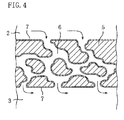
- the exhaust gas flowing into each exhaust gas inflow channel 2 flows out through the surrounding partition walls 5 into the adjacent exhaust gas outflow channels 3, as shown in arrows in Figure 3. More specifically, as shown in Figure 4, each partition wall 5 is formed with micro pores (exhaust gas channels) 6 communicating the exhaust gas inflow channel 2 with the adjacent exhaust gas outflow channel 3 so that the exhaust gas flows through the micro pores 6 . Particulates are trapped and deposited mainly on the wall surfaces of the exhaust gas inflow channels 2 and the micro pores 6.
- a catalyst layer 7 is coated on the walls of all the exhaust gas channels (i.e., exhaust gas inflow channels 2, exhaust gas outflow channels 3 and micro pores 6) in the body of the filter 1. However, it is not necessarily required to form the catalyst layer on the walls of the exhaust gas outflow channels 3.
- the filter 1 according to the invention is characterized in that the catalyst layer 7 contains Pt/alumina obtained by carrying Pt on alumina and first and second oxides for releasing active oxygen by heating and these catalyst components have different temperature regions within which they effectively act to burn particulates.
- the first oxide include mixed oxides having oxygen storage/release capacity, such as Ce-Zr-based mixed oxides
- the second oxide include mixed oxides having oxygen ion conductivity, such as mixed oxides containing Zr and a rare earth element other than Ce.
- Ce-Zr-Nd mixed oxide was prepared as a first oxide and a Zr-Nd mixed oxide was prepared as a second oxide.
- the composition of the Ce-Zr-Nd mixed oxide was a CeO 2 /ZrO 2 /Nd 2 O 3 mass ratio af 57.5:22.5:10.
- the composition of the Zr-Nd mixed oxide was a ZrO 2 /Nd 2 O 3 mass ratio of 73.5:26.5.
- the Ce-Zr-Nd mixed oxide contains 50% or more by mass of CeO 2 and the Zr-Nd mixed oxide contains 50% or more by mass of ZrO 2 .
- catalyst powders prepared in advance were powder of Pt/alumina, powder of Ce-Zr-Nd mixed oxide, powder of Zr-Nd mixed oxide and powder of a mixture of the three catalyst components.
- the mixture of the three catalyst components was obtained by mixing Pt/alumina, the Ce-Zr-Nd mixed oxide and the Zr-Nd mixed oxide at a mass ratio of 1:1:1.
- Each kind of catalyst powder was aged in advance by keeping it at 800°C in the atmospheric environment for 24 hours. Also prepared was a sample for evaluation containing carbon black only (no catalyst).
- Each sample weighed in 2.5 mg was put into a sample container made of alumina and the sample container was set in a balance for TG-DTA through which carrier gas flowed. After the base line was stabilized, the sample was increased in temperature from 100°C to 800°C at a rate of 10°C/min and measured in terms of TG-DTA during the time.
- the carrier gas used was a gas in which 250 ppm NO 2 was added to a gas mixture of O 2 (10% by volume), N 2 (40% by volume) and Ar (50% by volume). The gas flow rate was 200 mL/min.
- an exothermic peak appears in the vicinity of 670°C which is within a high temperature range close to the spontaneous ignition temperature of carbon black.
- Ce-Zr-Nd mixed oxide as a first oxide
- an exothermic peak higher than the quantity of exothermic heat of Pt-alumina appears in the vicinity of 630°C lower than the exothermic peak of Pt/alumina.
- Zr-Nd mixed oxide as a second oxide
- an exothermic peak higher than the quantity of exothermic heat of the Ce-Zr-Nd mixed oxide appears in the vicinity of 550°C lower than the exothermic peak of the Ce-Zr-Nd mixed oxide.
- another exothermic peak appears in the vicinity of 650°C.
- an exothermic peak appears around just over 650°C, which is an influence of Pt/alumina.
- Figure 5 shows that the quantity of exothermic heat of the inventive example is large even at the exothermic peak temperature due to spontaneous ignition of carbon black (in the vicinity of 675°C).
- the inventive example has a larger quantity of exothermic heat in a low temperature range (from 450°C inclusive to 580°C exclusive) than Pt/alumina and the Ce-Zr-Nd mixed oxide, which is due to the Zr-Nd mixed oxide.
- the inventive example has a larger quantity of exothermic heat in an intermediate temperature range (from 580°C inclusive to 630°C exclusive) than Pt/alumina and the Zr-Nd mixed oxide, which is due to the Ce-Zr-Nd mixed oxide.
- the inventive example which is a mixture of the three catalyst components, has a DTA profile smoothly rising from the low temperature range to a high temperature range (630°C and higher).
- ignition sites are produced within the low temperature range by the action of the Zr-Nd mixed oxide to start the burning of particulates, the burning of particulates in the low temperature range is followed, with increasing catalyst temperature due to the burning, by the burning of particulates in the intermediate temperature range by the action of the Ce-Zr-Nd mixed oxide, the burning of particulates in the intermediate temperature range is then followed by the burning of particulates by the action of Pt-alumina and, in this manner, the particulate temperature rises to the spontaneous ignition temperature.
- mixtures of two catalyst components were measured as comparative examples in terms of TG-DTA in the same manner as in the inventive example.
- Prepared as the mixtures of two catalyst components were three kinds of mixtures: a mixture of the Zr-Nd mixed oxide and the Ce-Zr-Nd mixed oxide; a mixture of the Zr-Nd mixed oxide and Pt/alumina; and a mixture of the Ce-Zr-Nd mixed oxide and Pt/alumina.
- the mixture ratios of these mixtures were all 1:1 in mass ratio.
- the mixture ratio of each catalyst powder to carbon black was 4:1 in mass ratio.
- each catalyst powder was aged in advance in the same manner as in the inventive example.
- the measurement results of the comparative examples are shown in Figure 6, together with the measurement results of the inventive example.
- an exothermic peak appears in the vicinity of 540°C by the influence of the Zr-Nd mixed oxide but a valley appears in the vicinity of 575°C, which does not provide a smoothly rising DTA profile.
- its exothermic peak in a high temperature range is low.
- a relatively high exothermic peak appears in the vicinity of 650°C but its quantity of exothermic heat is small in an intermediate temperature range, which does not provide a smoothly rising DTA profile.
- a high exothermic peak appears in the vicinity of 640°C but its quantity of exothermic heat is small in a low temperature range.
- the inventive example using the mixture of the three kinds of catalyst components is effective in starting the burning of particulates at a low temperature and continuing the burning to the spontaneous ignition temperature of the particulates.
- a catalytic precious metal may be carried on such a Zr-Nd mixed oxide and such a Ce-Zr-Nd mixed oxide in order to enhance the exhaust gas purification performance.
- the carriage of Pt thereon lowered the exothermic peak in the low temperature range and raised the exothermic peak in the high temperature range.
- the Zr-Nd mixed oxide has a greater quantity of exothermic heat in the low temperature range than the Ce-Zr-Nd mixed oxide, which provides the function of taking over the burning in the low temperature range and making the transition to the burning in the intermediate temperature range.
- the carriage of Pt thereon did not significantly lower the exothermic peak in the low temperature range and raised the exothermic peak in the high temperature range.
- the carriage of Pt on the Ce-Zr-Nd mixed oxide in the inventive example is effective in promoting the burning of particulates.
- the total amount of catalyst carried on the filter body is preferably 5 to 100 g/L both inclusive (where g/L denotes the amount of catalyst carried per L of the filter body). The reason for this is as follows: if the amount of catalyst carried is too small, this cannot promote the burning of particulates; if the amount of catalyst carried is too large, the filter will be likely to be clogged.
- the amount of Pt/alumina carried on the filter body is preferably 1.0 to 80 g/L both inclusive, and the amount of each of the first and second oxides carried on the filter body is preferably 0.2 to 70 g/L both inclusive.
- the amount of Pt carried on alumina in Pt/alumina is preferably 0.1% to 50% by mass, both inclusive, and the amount of Pt carried on each of the first and second oxides is also preferably 0.1% to 50% by mass, both inclusive.
- the particulate filter according to the invention is applicable not only to diesel engines but also to any engines exhausting exhaust gas containing particulates, including lean-burn gasoline engines.
Landscapes
- Chemical & Material Sciences (AREA)
- Engineering & Computer Science (AREA)
- Chemical Kinetics & Catalysis (AREA)
- Materials Engineering (AREA)
- Organic Chemistry (AREA)
- Combustion & Propulsion (AREA)
- General Chemical & Material Sciences (AREA)
- General Engineering & Computer Science (AREA)
- Environmental & Geological Engineering (AREA)
- Analytical Chemistry (AREA)
- Health & Medical Sciences (AREA)
- Oil, Petroleum & Natural Gas (AREA)
- Mechanical Engineering (AREA)
- Biomedical Technology (AREA)
- Exhaust Gas Treatment By Means Of Catalyst (AREA)
- Catalysts (AREA)
- Processes For Solid Components From Exhaust (AREA)
- Filtering Of Dispersed Particles In Gases (AREA)
- Exhaust Gas After Treatment (AREA)
- Filtering Materials (AREA)
Abstract
A catalyst-carried particulate filter contains a catalyst obtained by mixing Pt/alumina acting to promote the burning of particulates in a high temperature range, a second oxide acting to promote the burning of particulates in a low temperature range and a first oxide acting to promote the burning of particulates in an intermediate temperature range.
Description
- This invention relates to catalyst-carried particulate filters.
- Exhaust gases from diesel engines using fuels containing diesel oil as a main component and exhaust gases from gasoline engines using fuels containing gasoline as a main component to burn them under fuel-lean conditions are known to contain particulates (particulate matters (PM)) which are suspended particulate matters containing carbon particles. To restrain particulates from being exhausted to the atmosphere, a filter for trapping particulates in exhaust gas is disposed in an exhaust gas passage of such an engine. When the amount of particulates deposited on the filter becomes large, it is necessary to burn the particulates to remove them from the filter and thereby regenerate the filter.
- An example of known methods for regenerating the filter is to dispose an oxidation catalyst in the exhaust gas passage upstream of the filter and increase the amount of fuel injected into the engine combustion chamber to supply unburned fuel to the oxidation catalyst. According to this method, heat due to oxidative reaction of the unburned fuel to the catalyst increases the temperature of exhaust gas flowing into the filter, whereby particulates on the filter ignite and burn.
- Particulates trapped on filters normally do not ignite and burn until their temperature exceed 600°C. If no special measure is taken, a large amount of fuel will be needed to raise the temperature of exhaust gas on the oxidation catalyst. An existing measure to cope with this problem is to carry on the filter body a catalyst for promoting the burning of particulates. For example, Published
Japanese Patent Application No. H09-173866 - Published
Japanese Patent Application No. 2005-262184 - Published
Japanese Patent Application No. 2003-334443 - As seen from the above, research and developments so far in catalysts for burning particulates focus on how the temperature required to burn particulates should be lowered. However, particulates are not uniformly deposited over the whole of the filter. Therefore, even if the burning of particulates starts at a relatively low temperature by the action of the catalyst, the particulates are easily left as unburned residue.
- For example, in filter cells whose downstream ends in the flow direction of exhaust gas are closed, a larger amount of particulates is deposited at a position closer to the downstream ends and at a position closer to their radial center where a larger amount of exhaust gas flows. However, even if particulates in contact with the catalyst layer of the filter body burn at relatively low temperatures by the action of the catalyst, the quantity of heat produced by the burning is not so large. Therefore, the whole layer of particulates deposited is not necessarily heated up to the spontaneous ignition temperature of particulates (600°C or higher). As a result, in the vicinity of the surface of the layer of particulate deposit which is hardly influenced by the catalyst, particulates do not burn and are left as unburned residue. Hence, when the temperature of exhaust gas flowing into the filter is lower than the spontaneous ignition temperature, the burning of particulates may be stopped even if it is initiated by the action of the catalyst.
- An object of the present invention is to surely regenerate the filter and, more specifically, to produce in a catalyst layer ignition sites providing the burning of particulates at relatively low temperatures and utilize the burning at the ignition sites to allow the burning temperature of particulates to gradually rise to higher temperatures and then to the spontaneous ignition temperature.
- To attain the above object, the present invention provides a combination of a plurality of catalyst components having different temperature ranges within which the burning of particulates is promoted.
- Specifically, the invention is directed to a catalyst-carried particulate filter in which a catalyst is carried on the walls of exhaust gas channels in the body of a filter for trapping particulates in exhaust gas, wherein the catalyst contains Pt/alumina obtained by carrying Pt on alumina and first and second oxides for releasing active oxygen by heating, and wherein when a mixture of the Pt/alumina and carbon powder, a mixture of the first oxide and carbon powder and a mixture of the second oxide and carbon powder are measured in terms of TG-DTA, the DTA profile of the mixture containing the first oxide exhibits an exothermic peak higher than the quantity of exothermic heat of the mixture containing the Pt/alumina at a lower temperature than the temperature at the exothermic peak thereof and the DTA profile of the mixture containing the second oxide exhibits an exothermic peak higher than the quantity of exothermic heat of the mixture containing the first oxide at a lower temperature than the temperature at the exothermic peak thereof
- Since each of the first and second oxides releases active oxygen by heating, they act to promote the burning of particulates.
- When the mixture of the second oxide and carbon black is measured in terms of TG-DTA (Thermogravimetry-Differential Thermal Analysis) af burning of carbon powder, an exothermic peak appears at a lower temperature than when the other mixtures are measured. This means that when the temperature of the filter having trapped particulates is increased, ignition sites where particulates ignite and burn are produced by the second oxide to start the burning.
- Thus, the catalyst of the catalyst-carried particulate filter according to the invention contains not only the second oxide developing an exothermic peak in a low temperature range and Pt/alumina developing an exothermic peak in a high temperature range but also the first oxide developing an exothermic peak in an intermediate temperature range. Therefore, once ignition sites are produced by the action of the second oxide to start the burning of particulate, the first oxide in turn acts to promote the burning of particulates in the intermediate temperature range even if the temperature increase due to the burning is not so large. In other words, the burning of particulates due to the second oxide in the low temperature range is continuously followed by the burning of particulates due to the first oxide in the intermediate temperature range.
- Then, with increasing temperature resulting from the burning of particulates due to the first oxide, Pt/alumina in turn acts to allow the burning of particulates in the intermediate temperature range to be continuously followed by the burning of particulates in the high temperature range. Thereafter, the burning of particulates due to Pt/alumina raises the filter temperature to the spontaneous ignition temperature of particulates.
- According to the invention, since the catalyst employs a combination of three kinds of catalyst components (Pt/alumina, the first oxide and the second oxide) having different exothermic peaks of TG-DTA, the burning of particulates can be easily continued from the start of burning in a low temperature range to the spontaneous ignition of particulates. This is advantageous in surely regenerating the filter with efficiency and without incurring deterioration of fuel economy and producing unburned residue of particulates.
- The first oxide is preferably a mixed oxide having oxygen storage/release capacity, such as a Ce-Zr-based mixed oxide or a Ce-Zr-Nd-based mixed oxide. Furthermore, a catalytic metal, such as Pt, may be carried on the mixed oxide.
- The second oxide is preferably a mixed oxide having oxygen ion conductivity and, for example, may be a mixed oxide containing Zr and a rare earth element other than Ce, such as a Zr-Nd-based mixed oxide. Furthermore, a catalytic metal, such as Pt, may be carried on the mixed oxide.
-
- Figure 1 is an exhaust gas purification system for a diesel engine.
- Figure 2 is a front view schematically showing a particulate filter.
- Figure 3 is a vertically cross-sectional view schematically showing the particulate filter.
- Figure 4 is an enlarged cross-sectional view schematically showing a wall that separates an exhaust gas inflow channel from an exhaust gas outflow channel in the particulate filter.
- Figure 5 is a graph showing DTA profiles of carbon burning of an inventive example (a mixture of three catalyst components) and comparative examples (individual catalyst components) determined by TG-DTA.
- Figure 6 is a graph showing DTA profiles of carbon burning of examples (mixtures of two catalyst components) determined by TG-DTA.
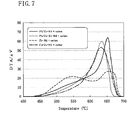
- Figure 7 is a graph showing influences of carriage of Pt on a Zr-Nd mixed oxide and a Ce-Zr-Nd mixed oxide on their DTA profiles of carbon burning.
- Hereinafter, a preferred embodiment of the invention will be described with reference to the drawings. Note that the following description of the preferred embodiment is merely illustrative in nature and is not intended to limit the scope, applications and use of the invention.
- In Figure 1,
reference numeral 1 denotes a particulate filter (hereinafter, referred to simply as a "filter") disposed in anexhaust passage 11 of adiesel engine 10. Anupstream catalyst 12 is disposed in theexhaust passage 11 upstream of thefilter 1 in the flow direction of exhaust gas. An oxidation catalyst or a NOx trap catalyst or both can be disposed as theupstream catalyst 12. - The oxidation catalyst is obtained by carrying a catalytic metal, such as Pt or Pd, on a support material such as active alumina and acts to oxidize HC and CO in the exhaust gas. When the oxidation catalyst is disposed upstream of the
filter 1, HC and CO in the exhaust gas are oxidized by the oxidation catalyst and heat of the oxidation combustion increases the temperature of exhaust gas flowing into thefilter 1. Furthermore, NO in the exhaust gas is oxidized into NO2 by the oxidation catalyst and produced NO2 is then supplied as an oxidizing agent for burning particulates to thefilter 1. - The NOx trap catalyst is obtained by carrying, on a support material such as active alumina, a NOx storage component (such as an alkali earth metal, typically barium (Ba), or an alkali metal) for absorbing NOx in the exhaust gas at high oxygen concentrations in the exhaust gas (at lean air-fuel ratios) and a catalytic metal, such as Pt, for reducing NOx released from the NOx storage component when the oxygen concentration in the exhaust gas drops (at stoichiometric or rich air-fuel ratios).
- As schematically shown in Figures 2 and 3, the
filter 1 has a honeycomb structure in which a large number ofexhaust gas channels filter 1 has a structure in which a plurality of exhaustgas inflow channels 2 and a plurality of exhaustgas outflow channels 3 are alternately arranged vertically and horizontally. Each exhaustgas inflow channel 2 is closed at the downstream end by aplug 4, while each exhaustgas outflow channel 3 is closed at the upstream end by aplug 4. The adjacent exhaust gas inflow andoutflow channels thin partition wall 5. In Figure 2, the hatched parts denote theplugs 4 at the upstream ends of the exhaustgas outflow channel 3. - The body of the
filter 1 is formed of cordierite or an inorganic porous material, such as SiC, Si3N4 or sialon. The exhaust gas flowing into each exhaustgas inflow channel 2 flows out through the surroundingpartition walls 5 into the adjacent exhaustgas outflow channels 3, as shown in arrows in Figure 3. More specifically, as shown in Figure 4, eachpartition wall 5 is formed with micro pores (exhaust gas channels) 6 communicating the exhaustgas inflow channel 2 with the adjacent exhaustgas outflow channel 3 so that the exhaust gas flows through the micro pores 6. Particulates are trapped and deposited mainly on the wall surfaces of the exhaustgas inflow channels 2 and the micro pores 6. - A
catalyst layer 7 is coated on the walls of all the exhaust gas channels (i.e., exhaustgas inflow channels 2, exhaustgas outflow channels 3 and micro pores 6) in the body of thefilter 1. However, it is not necessarily required to form the catalyst layer on the walls of the exhaustgas outflow channels 3. - The
filter 1 according to the invention is characterized in that thecatalyst layer 7 contains Pt/alumina obtained by carrying Pt on alumina and first and second oxides for releasing active oxygen by heating and these catalyst components have different temperature regions within which they effectively act to burn particulates. Examples of the first oxide, include mixed oxides having oxygen storage/release capacity, such as Ce-Zr-based mixed oxides, and examples of the second oxide include mixed oxides having oxygen ion conductivity, such as mixed oxides containing Zr and a rare earth element other than Ce. - A description is given below of a combination of the above three catalyst components in terms of particulate burning characteristics determined by TG-DTA.
- Prepared as Pt/alumina was one in which 1.9% by mass of Pt is carried on active alumina containing 5% by mass of lanthanum (La). Furthermore, a cerium-zirconium-neodymium (Ce-Zr-Nd) mixed oxide was prepared as a first oxide and a Zr-Nd mixed oxide was prepared as a second oxide. The composition of the Ce-Zr-Nd mixed oxide was a CeO2/ZrO2/Nd2O3 mass ratio af 57.5:22.5:10. The composition of the Zr-Nd mixed oxide was a ZrO2/Nd2O3 mass ratio of 73.5:26.5. In other words, the Ce-Zr-Nd mixed oxide contains 50% or more by mass of CeO2 and the Zr-Nd mixed oxide contains 50% or more by mass of ZrO2.
- Prepared were four samples for evaluation in each of which catalyst powder and carbon black (a substitute for particulates) were well mixed together at a mass ratio of 4:1. Four kinds of catalyst powders prepared in advance were powder of Pt/alumina, powder of Ce-Zr-Nd mixed oxide, powder of Zr-Nd mixed oxide and powder of a mixture of the three catalyst components. The mixture of the three catalyst components (corresponding to an inventive example of the invention) was obtained by mixing Pt/alumina, the Ce-Zr-Nd mixed oxide and the Zr-Nd mixed oxide at a mass ratio of 1:1:1. Each kind of catalyst powder was aged in advance by keeping it at 800°C in the atmospheric environment for 24 hours. Also prepared was a sample for evaluation containing carbon black only (no catalyst).
- Each sample weighed in 2.5 mg was put into a sample container made of alumina and the sample container was set in a balance for TG-DTA through which carrier gas flowed. After the base line was stabilized, the sample was increased in temperature from 100°C to 800°C at a rate of 10°C/min and measured in terms of TG-DTA during the time. The carrier gas used was a gas in which 250 ppm NO2 was added to a gas mixture of O2 (10% by volume), N2 (40% by volume) and Ar (50% by volume). The gas flow rate was 200 mL/min.
- The measurement results from TG-DTA are shown in Figure 5. In this figure, "Ce-Zr-Nd" denotes the Ce-Zr-Nd mixed oxide and "Zr-Nd" denotes the Zr-Nd mixed oxide. This applies also to Figures 6 and 7.
- Referring to Figure 5, for Pt/alumina, an exothermic peak appears in the vicinity of 670°C which is within a high temperature range close to the spontaneous ignition temperature of carbon black. For the Ce-Zr-Nd mixed oxide as a first oxide, an exothermic peak higher than the quantity of exothermic heat of Pt-alumina appears in the vicinity of 630°C lower than the exothermic peak of Pt/alumina. For the Zr-Nd mixed oxide as a second oxide, an exothermic peak higher than the quantity of exothermic heat of the Ce-Zr-Nd mixed oxide appears in the vicinity of 550°C lower than the exothermic peak of the Ce-Zr-Nd mixed oxide. For the Zr-Nd mixed oxide, another exothermic peak appears in the vicinity of 650°C.
- For the inventive example that is a mixture of the three catalyst components, an exothermic peak appears around just over 650°C, which is an influence of Pt/alumina. Figure 5 shows that the quantity of exothermic heat of the inventive example is large even at the exothermic peak temperature due to spontaneous ignition of carbon black (in the vicinity of 675°C). Furthermore, the inventive example has a larger quantity of exothermic heat in a low temperature range (from 450°C inclusive to 580°C exclusive) than Pt/alumina and the Ce-Zr-Nd mixed oxide, which is due to the Zr-Nd mixed oxide. Furthermore, the inventive example has a larger quantity of exothermic heat in an intermediate temperature range (from 580°C inclusive to 630°C exclusive) than Pt/alumina and the Zr-Nd mixed oxide, which is due to the Ce-Zr-Nd mixed oxide. Thus, as is obvious from Figure 5, the inventive example, which is a mixture of the three catalyst components, has a DTA profile smoothly rising from the low temperature range to a high temperature range (630°C and higher).
- Therefore, it can be seen that according to the inventive example, ignition sites are produced within the low temperature range by the action of the Zr-Nd mixed oxide to start the burning of particulates, the burning of particulates in the low temperature range is followed, with increasing catalyst temperature due to the burning, by the burning of particulates in the intermediate temperature range by the action of the Ce-Zr-Nd mixed oxide, the burning of particulates in the intermediate temperature range is then followed by the burning of particulates by the action of Pt-alumina and, in this manner, the particulate temperature rises to the spontaneous ignition temperature.
- To verify the effectiveness of the inventive example which is a mixture of the three catalyst components, mixtures of two catalyst components were measured as comparative examples in terms of TG-DTA in the same manner as in the inventive example. Prepared as the mixtures of two catalyst components were three kinds of mixtures: a mixture of the Zr-Nd mixed oxide and the Ce-Zr-Nd mixed oxide; a mixture of the Zr-Nd mixed oxide and Pt/alumina; and a mixture of the Ce-Zr-Nd mixed oxide and Pt/alumina. The mixture ratios of these mixtures were all 1:1 in mass ratio. The mixture ratio of each catalyst powder to carbon black was 4:1 in mass ratio. Furthermore, each catalyst powder was aged in advance in the same manner as in the inventive example. The measurement results of the comparative examples are shown in Figure 6, together with the measurement results of the inventive example.
- For the mixture of the Zr-Nd mixed oxide and the Ce-Zr-Nd mixed oxide, an exothermic peak appears in the vicinity of 540°C by the influence of the Zr-Nd mixed oxide but a valley appears in the vicinity of 575°C, which does not provide a smoothly rising DTA profile. In addition, its exothermic peak in a high temperature range is low. For the mixture of the Zr-Nd mixed oxide and Pt/alumina, a relatively high exothermic peak appears in the vicinity of 650°C but its quantity of exothermic heat is small in an intermediate temperature range, which does not provide a smoothly rising DTA profile. For the mixture of the Ce-Zr-Nd mixed oxide and Pt/alumina, a high exothermic peak appears in the vicinity of 640°C but its quantity of exothermic heat is small in a low temperature range.
- In view of the above, it can be seen that the inventive example using the mixture of the three kinds of catalyst components (in which the burning of carbon is smoothly continued from low temperature to high temperature range) is effective in starting the burning of particulates at a low temperature and continuing the burning to the spontaneous ignition temperature of the particulates.
- A catalytic precious metal may be carried on such a Zr-Nd mixed oxide and such a Ce-Zr-Nd mixed oxide in order to enhance the exhaust gas purification performance. In view of this, a determination was made of changes in the TG-DTA curves of the above mixed oxides when Pt was carried on the mixed oxides. Specifically, 1.9% by mass of Pt was carried on each of the Zr-Nd mixed oxide and the Ce-Zr-Nd mixed oxide, catalyst powder of the Pt-carried Zr-Nd mixed oxide and catalyst powder of the Pt-carried Ce-Zr-Nd mixed oxide were aged in the same manner as described above, a mixture sample of the Pt-carried Zr-Nd mixed oxide and carbon black and a mixture sample of the Pt-carried Ce-Zr-Nd mixed oxide and carbon black were prepared, and the mixture samples were measured in terms of TG-DTA during the burning of carbon black. The measurement results of these samples are shown in Figure 7, together with the measurement results of a mixture sample of the Pt-uncarried Zr-Nd mixed oxide and carbon black and a mixture sample of the Pt-uncarried Ce-Zr-Nd mixed oxide and carbon black.
- For the Zr-Nd mixed oxide, the carriage of Pt thereon lowered the exothermic peak in the low temperature range and raised the exothermic peak in the high temperature range. However, also in the case of carriage of Pt, the Zr-Nd mixed oxide has a greater quantity of exothermic heat in the low temperature range than the Ce-Zr-Nd mixed oxide, which provides the function of taking over the burning in the low temperature range and making the transition to the burning in the intermediate temperature range. On the other hand, for the Ce-Zr Nd mixed oxide, the carriage of Pt thereon did not significantly lower the exothermic peak in the low temperature range and raised the exothermic peak in the high temperature range.
- Therefore, it can be said that the carriage of Pt on the Ce-Zr-Nd mixed oxide in the inventive example is effective in promoting the burning of particulates.
- The total amount of catalyst carried on the filter body is preferably 5 to 100 g/L both inclusive (where g/L denotes the amount of catalyst carried per L of the filter body). The reason for this is as follows: if the amount of catalyst carried is too small, this cannot promote the burning of particulates; if the amount of catalyst carried is too large, the filter will be likely to be clogged.
- The amount of Pt/alumina carried on the filter body is preferably 1.0 to 80 g/L both inclusive, and the amount of each of the first and second oxides carried on the filter body is preferably 0.2 to 70 g/L both inclusive. The amount of Pt carried on alumina in Pt/alumina is preferably 0.1% to 50% by mass, both inclusive, and the amount of Pt carried on each of the first and second oxides is also preferably 0.1% to 50% by mass, both inclusive.
- The particulate filter according to the invention is applicable not only to diesel engines but also to any engines exhausting exhaust gas containing particulates, including lean-burn gasoline engines.
Claims (7)
- A catalyst-carried particulate filter in which a catalyst is carried on the walls of exhaust gas channels (2, 3, 6) in the body of a filter for trapping particulates in exhaust gas, wherein
the catalyst contains Pt/alumina obtained by carrying Pt on alumina and first and second oxides for releasing active oxygen by heating, and
when a mixture of the Pt/alumina and carbon powder, a mixture of the first oxide and carbon powder and a mixture of the second oxide and carbon powder are measured in terms of TG-DTA, the DTA profile of the mixture containing the first oxide exhibits an exothermic peak higher than the quantity of exothermic heat of the mixture containing the Pt/alumina at a lower temperature than the temperature at the exothermic peak thereof and the DTA profile of the mixture containing the second oxide exhibits an exothermic peak higher than the quantity of exothermic heat of the mixture containing the first oxide at a lower temperature than the temperature at the exothermic peak thereof. - The catalyst-carried particulate filter of claim 1, wherein the first oxide is a mixed oxide having oxygen storage/release capacity and the second oxide is a mixed oxide having oxygen ion conductivity.
- The catalyst-carried particulate filter of claim 2, wherein the first oxide is a Ce-Zr-based mixed oxide.
- The catalyst-carried particulate filter of claim 2, wherein the first oxide is a. Ce-Zr-Nd-based mixed oxide.
- The catalyst-carried particulate filter of any one of claims 2 to 4, wherein the second oxide is a mixed oxide containing Zr and a rare earth element other than Ce.
- The catalyst-carried particulate filter of any one of claims 2 to 5, wherein the second oxide is a Zr-Nd-based mixed oxide.
- The catalyst-carried particulate filter of claim 1, wherein the first oxide is a Ce-Zr-Nd-based mixed oxide, the second oxide is a Zr-Nd-based mixed oxide and a catalytic metal is carried on at least one of the first and second mixed oxides.
Applications Claiming Priority (1)
| Application Number | Priority Date | Filing Date | Title |
|---|---|---|---|
| JP2006303136A JP2008121438A (en) | 2006-11-08 | 2006-11-08 | Catalyst supported particulate filter |
Publications (1)
| Publication Number | Publication Date |
|---|---|
| EP1920835A2 true EP1920835A2 (en) | 2008-05-14 |
Family
ID=39110582
Family Applications (1)
| Application Number | Title | Priority Date | Filing Date |
|---|---|---|---|
| EP07118010A Withdrawn EP1920835A2 (en) | 2006-11-08 | 2007-10-08 | Catalyst-carried particulate filter |
Country Status (3)
| Country | Link |
|---|---|
| US (1) | US20080254973A1 (en) |
| EP (1) | EP1920835A2 (en) |
| JP (1) | JP2008121438A (en) |
Cited By (5)
| Publication number | Priority date | Publication date | Assignee | Title |
|---|---|---|---|---|
| EP2022554A1 (en) * | 2007-08-08 | 2009-02-11 | Mazda Motor Corporation | Catalyst-supported particulate filter |
| EP2055365A1 (en) * | 2007-10-10 | 2009-05-06 | Mazda Motor Corporation | Catalyst-supported particulate filter |
| EP2047907A3 (en) * | 2007-08-08 | 2009-07-15 | Mazda Motor Corporation | Catalyst supported on particulate filter |
| US7871452B2 (en) | 2007-10-01 | 2011-01-18 | Mazda Motor Corporation | Particulate filter |
| US8187548B2 (en) | 2007-10-30 | 2012-05-29 | Mazda Motor Corporation | Catalyst-supported particulate filter |
Families Citing this family (4)
| Publication number | Priority date | Publication date | Assignee | Title |
|---|---|---|---|---|
| CN102265009B (en) * | 2009-02-26 | 2013-09-11 | 丰田自动车株式会社 | Exhaust purification device for internal combustion engines |
| US10030556B2 (en) | 2015-07-15 | 2018-07-24 | University Of Notre Dame Du Lac | Glass catalyst compositions for improved hydrothermal durability |
| US9855547B2 (en) * | 2015-10-05 | 2018-01-02 | GM Global Technology Operations LLC | Low-temperature oxidation catalysts |
| JP6627813B2 (en) * | 2017-03-24 | 2020-01-08 | マツダ株式会社 | Method for producing particulate filter with catalyst |
Family Cites Families (5)
| Publication number | Priority date | Publication date | Assignee | Title |
|---|---|---|---|---|
| JP3528839B2 (en) * | 2002-05-15 | 2004-05-24 | トヨタ自動車株式会社 | Particulate oxidizer and oxidation catalyst |
| US20040001781A1 (en) * | 2002-06-27 | 2004-01-01 | Engelhard Corporation | Multi-zone catalytic converter |
| US7374729B2 (en) * | 2004-03-30 | 2008-05-20 | Basf Catalysts Llc | Exhaust gas treatment catalyst |
| JP2007209913A (en) * | 2006-02-10 | 2007-08-23 | Mazda Motor Corp | Catalyst material, production method thereof, and diesel particulate filter |
| JP4835193B2 (en) * | 2006-02-20 | 2011-12-14 | マツダ株式会社 | Diesel particulate filter |
-
2006
- 2006-11-08 JP JP2006303136A patent/JP2008121438A/en active Pending
-
2007
- 2007-10-08 EP EP07118010A patent/EP1920835A2/en not_active Withdrawn
- 2007-11-01 US US11/979,371 patent/US20080254973A1/en not_active Abandoned
Cited By (7)
| Publication number | Priority date | Publication date | Assignee | Title |
|---|---|---|---|---|
| EP2022554A1 (en) * | 2007-08-08 | 2009-02-11 | Mazda Motor Corporation | Catalyst-supported particulate filter |
| EP2047907A3 (en) * | 2007-08-08 | 2009-07-15 | Mazda Motor Corporation | Catalyst supported on particulate filter |
| US8052936B2 (en) | 2007-08-08 | 2011-11-08 | Mazda Motor Corporation | Catalyst-supported particulate filter |
| US8202483B2 (en) | 2007-08-08 | 2012-06-19 | Mazda Motor Corporation | Catalyst-supported particulate filter |
| US7871452B2 (en) | 2007-10-01 | 2011-01-18 | Mazda Motor Corporation | Particulate filter |
| EP2055365A1 (en) * | 2007-10-10 | 2009-05-06 | Mazda Motor Corporation | Catalyst-supported particulate filter |
| US8187548B2 (en) | 2007-10-30 | 2012-05-29 | Mazda Motor Corporation | Catalyst-supported particulate filter |
Also Published As
| Publication number | Publication date |
|---|---|
| US20080254973A1 (en) | 2008-10-16 |
| JP2008121438A (en) | 2008-05-29 |
Similar Documents
| Publication | Publication Date | Title |
|---|---|---|
| EP1967263B1 (en) | Catalytic Material And Catalyst For Purifying Exhaust Gas Component | |
| KR102052324B1 (en) | Particulate filter with hydrogen sulphide block function | |
| US7871452B2 (en) | Particulate filter | |
| US20080254973A1 (en) | Catalyst-carried particulate filter | |
| CN104254387B (en) | Filter substrates containing three-way catalysts | |
| EP1820561B1 (en) | Diesel particulate filter comprising a catalytic layer | |
| KR101838558B1 (en) | NOx TRAP | |
| US7465690B2 (en) | Methods for making a catalytic element, the catalytic element made therefrom, and catalyzed particulate filters | |
| JP4849034B2 (en) | Particulate filter with catalyst | |
| US11420189B2 (en) | Exhaust gas purification catalyst | |
| CN101725395B (en) | Exhaust gas purifying method | |
| WO2002026379A1 (en) | Catalytic soot filter and use thereof in treatment of lean exhaust gases | |
| EP2022563A1 (en) | Exhaust gas purification catalyst | |
| JP4807129B2 (en) | Diesel particulate filter | |
| JP4985423B2 (en) | Exhaust gas component purification catalyst material and exhaust gas component purification catalyst | |
| US8202483B2 (en) | Catalyst-supported particulate filter | |
| JP4978581B2 (en) | Particulate filter | |
| KR101382686B1 (en) | Non-PGM catalyst for combustion soot, filtration filter and exhaust gas after-treatment apparatus having the same | |
| JP2007054713A (en) | Diesel particulate filter | |
| JP2006159020A (en) | Exhaust gas purification filter and exhaust gas purification catalyst | |
| JP2011208526A (en) | Particulate filter with catalyst | |
| JP2004243189A (en) | Exhaust gas purification device for internal combustion engine | |
| US9550171B2 (en) | Exhaust gas purification catalyst and method for manufacturing same | |
| JP2022110644A (en) | Exhaust emission control device for engine | |
| JP2021143664A (en) | Exhaust emission control device |
Legal Events
| Date | Code | Title | Description |
|---|---|---|---|
| PUAI | Public reference made under article 153(3) epc to a published international application that has entered the european phase |
Free format text: ORIGINAL CODE: 0009012 |
|
| AK | Designated contracting states |
Kind code of ref document: A2 Designated state(s): AT BE BG CH CY CZ DE DK EE ES FI FR GB GR HU IE IS IT LI LT LU LV MC MT NL PL PT RO SE SI SK TR |
|
| AX | Request for extension of the european patent |
Extension state: AL BA HR MK RS |
|
| STAA | Information on the status of an ep patent application or granted ep patent |
Free format text: STATUS: THE APPLICATION IS DEEMED TO BE WITHDRAWN |
|
| 18D | Application deemed to be withdrawn |
Effective date: 20100504 |