EP1920761A1 - Dark coloured azo dyes - Google Patents
Dark coloured azo dyes Download PDFInfo
- Publication number
- EP1920761A1 EP1920761A1 EP07118975A EP07118975A EP1920761A1 EP 1920761 A1 EP1920761 A1 EP 1920761A1 EP 07118975 A EP07118975 A EP 07118975A EP 07118975 A EP07118975 A EP 07118975A EP 1920761 A1 EP1920761 A1 EP 1920761A1
- Authority
- EP
- European Patent Office
- Prior art keywords
- group
- methyl
- ethyl
- phenyl
- rest
- Prior art date
- Legal status (The legal status is an assumption and is not a legal conclusion. Google has not performed a legal analysis and makes no representation as to the accuracy of the status listed.)
- Granted
Links
- 0 *N(*)c(cc1)ccc1N=N[C@@](N1)SC(C=O)=C1Cl Chemical compound *N(*)c(cc1)ccc1N=N[C@@](N1)SC(C=O)=C1Cl 0.000 description 4
- JALDQUWTZTXBIN-ISLYRVAYSA-N CCN(CCOS(O)(=O)=O)c(cc1)ccc1/N=N/c1nc(Cl)c(C=O)[s]1 Chemical compound CCN(CCOS(O)(=O)=O)c(cc1)ccc1/N=N/c1nc(Cl)c(C=O)[s]1 JALDQUWTZTXBIN-ISLYRVAYSA-N 0.000 description 1
- VWVSWLJNKQZIQV-QVIHXGFCSA-N CCN(CCOS(O)(=O)=O)c(cc1)ccc1/N=N/c1nc(N2CCCC2)c(C=C(C(c2ccccc22)=O)C2=O)[s]1 Chemical compound CCN(CCOS(O)(=O)=O)c(cc1)ccc1/N=N/c1nc(N2CCCC2)c(C=C(C(c2ccccc22)=O)C2=O)[s]1 VWVSWLJNKQZIQV-QVIHXGFCSA-N 0.000 description 1
- HBGIEXZRUIARAH-CYYJNZCTSA-N CCN(CCOS(O)(O)=O)c(cc1)ccc1/N=N/c1nc(Cl)c(C=C(C(c2ccccc22)=O)C2=O)[s]1 Chemical compound CCN(CCOS(O)(O)=O)c(cc1)ccc1/N=N/c1nc(Cl)c(C=C(C(c2ccccc22)=O)C2=O)[s]1 HBGIEXZRUIARAH-CYYJNZCTSA-N 0.000 description 1
- UHKAJLSKXBADFT-UHFFFAOYSA-N O=C(C1)c2ccccc2C1=O Chemical compound O=C(C1)c2ccccc2C1=O UHKAJLSKXBADFT-UHFFFAOYSA-N 0.000 description 1
Classifications
-
- A—HUMAN NECESSITIES
- A61—MEDICAL OR VETERINARY SCIENCE; HYGIENE
- A61K—PREPARATIONS FOR MEDICAL, DENTAL OR TOILETRY PURPOSES
- A61K8/00—Cosmetics or similar toiletry preparations
- A61K8/18—Cosmetics or similar toiletry preparations characterised by the composition
- A61K8/30—Cosmetics or similar toiletry preparations characterised by the composition containing organic compounds
- A61K8/49—Cosmetics or similar toiletry preparations characterised by the composition containing organic compounds containing heterocyclic compounds
-
- A—HUMAN NECESSITIES
- A61—MEDICAL OR VETERINARY SCIENCE; HYGIENE
- A61Q—SPECIFIC USE OF COSMETICS OR SIMILAR TOILETRY PREPARATIONS
- A61Q5/00—Preparations for care of the hair
- A61Q5/06—Preparations for styling the hair, e.g. by temporary shaping or colouring
- A61Q5/065—Preparations for temporary colouring the hair, e.g. direct dyes
-
- A—HUMAN NECESSITIES
- A61—MEDICAL OR VETERINARY SCIENCE; HYGIENE
- A61Q—SPECIFIC USE OF COSMETICS OR SIMILAR TOILETRY PREPARATIONS
- A61Q5/00—Preparations for care of the hair
- A61Q5/10—Preparations for permanently dyeing the hair
-
- C—CHEMISTRY; METALLURGY
- C09—DYES; PAINTS; POLISHES; NATURAL RESINS; ADHESIVES; COMPOSITIONS NOT OTHERWISE PROVIDED FOR; APPLICATIONS OF MATERIALS NOT OTHERWISE PROVIDED FOR
- C09B—ORGANIC DYES OR CLOSELY-RELATED COMPOUNDS FOR PRODUCING DYES, e.g. PIGMENTS; MORDANTS; LAKES
- C09B29/00—Monoazo dyes prepared by diazotising and coupling
- C09B29/0025—Monoazo dyes prepared by diazotising and coupling from diazotized amino heterocyclic compounds
- C09B29/0074—Monoazo dyes prepared by diazotising and coupling from diazotized amino heterocyclic compounds the heterocyclic ring containing nitrogen and sulfur as heteroatoms
- C09B29/0077—Monoazo dyes prepared by diazotising and coupling from diazotized amino heterocyclic compounds the heterocyclic ring containing nitrogen and sulfur as heteroatoms containing a five-membered heterocyclic ring with one nitrogen and one sulfur as heteroatoms
- C09B29/0085—Thiazoles or condensed thiazoles
-
- C—CHEMISTRY; METALLURGY
- C09—DYES; PAINTS; POLISHES; NATURAL RESINS; ADHESIVES; COMPOSITIONS NOT OTHERWISE PROVIDED FOR; APPLICATIONS OF MATERIALS NOT OTHERWISE PROVIDED FOR
- C09B—ORGANIC DYES OR CLOSELY-RELATED COMPOUNDS FOR PRODUCING DYES, e.g. PIGMENTS; MORDANTS; LAKES
- C09B29/00—Monoazo dyes prepared by diazotising and coupling
- C09B29/06—Monoazo dyes prepared by diazotising and coupling from coupling components containing amino as the only directing group
- C09B29/08—Amino benzenes
- C09B29/0801—Amino benzenes containing acid groups, e.g. COOH, SO3H, PO3H2, OSO3H, OPO3H2; SO2NHSO2R or salts thereof, R being hydrocarbonyls
- C09B29/0803—Amino benzenes containing acid groups, e.g. COOH, SO3H, PO3H2, OSO3H, OPO3H2; SO2NHSO2R or salts thereof, R being hydrocarbonyls containing SO3H, OSO3H
-
- C—CHEMISTRY; METALLURGY
- C09—DYES; PAINTS; POLISHES; NATURAL RESINS; ADHESIVES; COMPOSITIONS NOT OTHERWISE PROVIDED FOR; APPLICATIONS OF MATERIALS NOT OTHERWISE PROVIDED FOR
- C09B—ORGANIC DYES OR CLOSELY-RELATED COMPOUNDS FOR PRODUCING DYES, e.g. PIGMENTS; MORDANTS; LAKES
- C09B44/00—Azo dyes containing onium groups
- C09B44/02—Azo dyes containing onium groups containing ammonium groups not directly attached to an azo group
- C09B44/04—Azo dyes containing onium groups containing ammonium groups not directly attached to an azo group from coupling components containing amino as the only directing group
-
- C—CHEMISTRY; METALLURGY
- C09—DYES; PAINTS; POLISHES; NATURAL RESINS; ADHESIVES; COMPOSITIONS NOT OTHERWISE PROVIDED FOR; APPLICATIONS OF MATERIALS NOT OTHERWISE PROVIDED FOR
- C09B—ORGANIC DYES OR CLOSELY-RELATED COMPOUNDS FOR PRODUCING DYES, e.g. PIGMENTS; MORDANTS; LAKES
- C09B56/00—Azo dyes containing other chromophoric systems
- C09B56/16—Methine- or polymethine-azo dyes
-
- A—HUMAN NECESSITIES
- A61—MEDICAL OR VETERINARY SCIENCE; HYGIENE
- A61K—PREPARATIONS FOR MEDICAL, DENTAL OR TOILETRY PURPOSES
- A61K2800/00—Properties of cosmetic compositions or active ingredients thereof or formulation aids used therein and process related aspects
- A61K2800/40—Chemical, physico-chemical or functional or structural properties of particular ingredients
- A61K2800/42—Colour properties
- A61K2800/43—Pigments; Dyes
- A61K2800/432—Direct dyes
- A61K2800/4324—Direct dyes in preparations for permanently dyeing the hair
Definitions
- the present invention relates to dark coloured azo dyes, preparation methods for these azo dyes and formulations for dyeing and/or lightening keratin fibres, such as, for example, human hair, wool or furs, comprising these compounds.
- a first method relates to the well known oxidation dyes which are formed by oxidative coupling of one or more developer components (primary intermediates) with one or more coupler components.
- oxidation hair colour precursors used may have a sensitization potential.
- oxidation-stable direct dyes can also be added to the oxidative system in order to achieve particular colour effects.
- Another possibility consists in the exclusive use of direct dyes. These direct dyes are used in a suitable carrier masses.
- tinting This method, generally known as tinting, is easy to use, exceptionally mild and is characterized by low damage to the keratin fibres since no ammonia or peroxide is added.
- These dyes should meet at least some basic requirements such as durability, washing and light fastness, good toxicological and dermatological profiles and, if desired, stability towards oxidizing agents (e.g. hydrogen peroxide).
- a colouration system based on direct dyes often requires combinations of several dyes to obtain the desired variety of different shades. This fact is of particular interest in the case for dark colours like black shades. Normally, black shades can only be achieved by a mixture of several different direct dyes with different dyeing properties (e.g. diffusion etc.). It therefore would be desirable to have only one single black direct dye instead of a mixture of diverse direct dyes.
- WO 2005/117816 A1 discloses cationic quinoxaline thiazole azo dyes and their use in colorants for keratin fibers.
- DE 102004056403 A1 discloses cationic pyridinylthiazo dyes and their use in colorants for keratin fibers.
- DE 102004051072 A1 discloses cationic heteroarylpyrazolonazo dyes and their use in colorants for keratin fibers.
- An objective of the present invention is therefore to provide new dark coloured, respectively black direct dyes which are compatible to water based formulations and comply in addition to the abovementioned requirements.
- the present invention relates to
- the dyes according to the general formula (I) or (II) are preferable chosen from 4-(2 ⁇ ( E )-[4-(dimethylamino)phenyl]diazenyl ⁇ -5-[(1,3-dioxo-1,3-dihydro-2 H -inden-2-ylidene)methyl]-1,3-thiazol-4-yl)-1,1-dimethylpiperazin-1-ium methyl sulfate (1) 4- ⁇ 2- ⁇ ( E )-[4-(diethylamino)phenyl]diazenyl ⁇ -5-[(1,3-dioxo-1,3-dihydro-2 H -inden-2-ylidene)methyl]-1,3-thiazol-4-yl ⁇ -1,1-dimethylpiperazin-1-ium methyl sulfate (2) 4-(5-(2,2-dicyanovinyl)-2- ⁇ ( E )-[4-(dimethylamino)phen
- the dyes according to the invention of the general formula (I) and (II) can be prepared via a multi-step synthesis starting with diazotation of 2-amino-4-chloro-1,3-thiazole-5-carbaldehyde ( EP 0450438 A1 and Kasali A. Bello, Dyes and Pigments, Vol. 27, 1995, No.1, 45-54 ) and subsequent coupling with various substituted anilines to obtain first intermediate dye derivatives, represented by structure A, in which R 1 and R 2 have the abovementioned meaning (scheme 1).
- an appropriate CH-acide acceptor-group e.g. 1 H -indene-1,3(2 H )-dione
- structure B (scheme 2). This operation was performed in accordance with literature procedures ( Masaki Matsui et al., Dyes and Pigments, Vol. 37, 1998, No. 4, 283-289 ).
- the third step involves a nucleophilic substitution of the chloro atom of B by secondary amines such as piperidine ( John Griffith et al., Chem. Commun., 1998, 1349-1350 ) or 1-methylpiperazine in solvents like THF (tetrahydrofurane) to obtain dark coloured dyes according to structure C (scheme 3).
- secondary amines such as piperidine ( John Griffith et al., Chem. Commun., 1998, 1349-1350 ) or 1-methylpiperazine in solvents like THF (tetrahydrofurane) to obtain dark coloured dyes according to structure C (scheme 3).
- Anionic derivatives are accesible by reacting chloro sulfonic acid with an appropriate hydroxyl anchor to yield the corresponding sulfate (sulfonic acid ester) followed by conversion into an alkalimetal (e.g. sodium) salt according to the invention, if desired. However, in most cases the uncharged sulfate showed sufficient solubility.
- An example (designated with E , respectively E* ) is illustrated in scheme 5.
- Formulations, containing dyes according to the invention of the general formula (I) or (II) provide an even colouration on keratin fibres, in particular human hair, with favorable dyeing properties such as good fastness to light, washing, rubbing and perspiration. Natural colourations with low selectivity can be obtained already under gentle conditions.
- the dyes of the general formula (I) or (II) according to the invention are preferably present in the colourants according to the invention in a total amount of from 0.01 to 10 percent by weight, in particular 0.1 to 8 percent by weight.
- the agents according to the invention can also comprise naturally occurring dyes, such as, for example, henna red, henna neutral, henna black, camomile, sandalwood, black tea, buckthorn bark, sage, logwood, madder root, catechu, sedre and alkanna root.
- the abovementioned additional direct dyes and naturally occuring dyes may be present in a total amount of from about 0.01 to 5 percent by weight, the total content of dyes in the colourant according to the invention being preferably from about 0.01 to 10 percent by weight, in particular 0.1 to 5 percent by weight.
- the oxidative colouring system according to the invention which is mixed with an oxidizing agent (e.g. hydrogen peroxide) prior to application, contains beside direct dyes according to formulas (I) and (II), at least one or more oxidative dye precursors (primary intermediates, coupler substances and self-coupling substances).
- an oxidizing agent e.g. hydrogen peroxide
- the abovementioned oxidative precursers may be present in a total amount of from about 0.01 to 12 percent of weight, in particular 0.2 to 6 percent by weight.
- lightening compositions and oxidative colouring agents according to the present invention may comprise at least one source of an oxidizing agent.
- Preferred oxidizing agents for use herein are water-soluble peroxygen oxidizing agents.
- Water-soluble as defined herein means that in standard condition at least 0.1 g, preferably at least 1 g, more preferably 10 g of said oxidizing agent can be dissolved in 1 liter of deionized water.
- the oxidizing agents are valuable for the initial solubilisation and decolourisation of the melanin (bleaching) and accelerate the oxidation of the oxidative dye precursors (oxidative dyeing) in the hair shaft. Any oxidizing agent known in the art may be utilized in the present invention.
- Preferred water-soluble oxidizing agents are inorganic peroxygen materials capable of yielding hydrogen peroxide in an aqueous solution.
- Water-soluble peroxygen oxidizing agents are well known in the art and include hydrogen peroxide, inorganic alkali metal peroxides such as sodium periodate and sodium peroxide and organic peroxides such as urea peroxide, melamine peroxide, and inorganic perhydrate salt bleaching compounds, such as the alkali metal salts of perborates, percarbonates, perphosphates, persilicates, persulphates and the like. These inorganic perhydrate salts may be incorporated as monohydrates, tetrahydrates etc.
- Alkyl and aryl peroxides, and or peroxidases may also be used. Mixtures of two or more such oxidizing agents can also be used if desired.
- the oxidizing agents may be provided in aqueous solution or as a powder which is dissolved prior to use.
- Preferred for use in the compositions according to the present invention are hydrogen peroxide, percarbonate, persulphates and combinations thereof. According to the present invention these compositions comprise from about 0.1% to about 15% by weight, preferably from about 1% to about 10% by weight, and most preferably from about 2% to about 7% by weight of an oxidizing agent.
- Another preferred oxidizing agent for use herein is a source of peroxymonocarbonate ions. Preferably such a source is formed in situ from a source of hydrogen peroxide and a hydrogen carbonate ion source.
- compositions may further comprise a source of radical scavenger.
- radical scavenger refers to a species that can react with a reactive radical, preferably carbonate radicals, to convert the reactive radical by a series of fast reactions to a less reactive species.
- the colourants according to the invention produce natural looking colourations even at physiologically compatible temperatures of less than 45°C. They are therefore particularly suitable for colouring human hair.
- the colourants are usually incorporated into a hydrous cosmetic carrier.
- Suitable cosmetic carriers are, for example, creams, emulsions, gels or else surfactant-containing foaming solutions, such as, for example, shampoos or other preparations which are suitable for application to keratin-containing fibres. If necessary, it is also possible to incorporate the colourants into anhydrous carriers, powders, pellets or granules.
- the colourant according to the invention can further comprise all additives which are customary and known for such preparations, for example perfume oils, complexing agents, waxes, preservatives, polymers, thickeners, antioxidants, alginates, guar gum, haircare substances, such as, for example, cationic polymers or lanolin derivatives, or anionic, nonionic, zwitterionic, amphoteric or cationic surface-active substances (surfactants).
- the abovementioned additives are used in the amounts customary for such purposes, for example the surface-active substances in a concentration of from 0.1 to 30 percent by weight, the care substances in an amount of from 0.1 to 5 percent by weight, and the polymers in a quantity of from 0.01 to 20 percent by weight.
- the colourant according to the invention can be in the form of a powder or of granules, which is/are dissolved prior to application in an aqueous or aqueous-alcoholic preparation, or in the form of an aqueous or aqueous-alcoholic solution, a cream, a gel, an emulsion or an aerosol foam.
- the hair colourant according to the invention can be either in the form of a single-component preparation or in the form of a multicomponent preparation, for example in the form of a two-component preparation, where the direct dyes of the general formula (I) or (II) and other dyes (e.g. oxidative dye precursors) are packaged separately from the other ingredients (e.g. hydrogen peroxide) and the ready-to-use hair colourant is prepared immediately prior to application by mixing the two components.
- the colourant according to the invention generally has a pH of from about 2 to 11, preferably about 3 to 10, in particular a neutral to basic pH from about 7 to 10 in case of direct dyes according to the general formula (I) and an acid pH from about 3 to 4 in case of direct dyes according to the general formula (II).
- Both, organic and also inorganic acids are suitable for adjusting the pH according to the invention.
- suitable acids are the following acids: ⁇ -hydroxycarboxylic acids, such as, for example, glycolic acid, lactic acid, tartaric acid, citric acid or malic acid, ascorbic acid, gluconolactone, acetic acid, hydrochloric acid or phosphoric acid, and mixtures of these acids.
- Suitable alkalising media are in particular sodium carbonate, sodium bicarbonate, alkanoleamines such as monoethanoleamine or triethanoleamine, ammonia, aminopropylpropanole and sodium hydroxide and mixtures of these bases.
- the colourant according to the invention may be applied in the presence or absence of oxidizing agents such as hydrogen peroxide.
- the colourant according to the invention is generally used by applying to the hair an appropriate amount of the hair colourant, normally about 30 to 120 grams depending on the length of hair, leaving the hair colourant to act at about 15 to 45 °C for about 1 to 60 minutes, preferably 5 to 30 minutes, then thoroughly rinsing the hair with water, optionally washing with a shampoo and/or after-treating with a hair-conditioning composition and finally drying.
- the colourant described above can also comprise natural or synthetic polymers or modified polymers of natural origin customary for cosmetic compositions, through which setting of the hair is achieved at the same time as the colouring.
- Such compositions are generally referred to as tinting setting compositions or colour setting compositions.
- the abovementioned polymers may be present in these tinting setting compositions or colour setting compositions in the amounts customary for such compositions, in particular in an amount of from about 1 to 5 percent by weight.
- the pH of the colour styling foam/mousse according to the inverntion is particularly of from about 6 to 9.
- the hair colourant with additional setting is used in a known and customary manner by wetting the hair with the setting composition, fixing (arranging) the hair in the hairstyle and then drying.
- the colourant according to the invention permits an even, intense and long-lasting colouration of keratin fibres (for example human hair, wool or furs) without noteworthy discolouration of the skin and/or scalp.
- keratin fibres for example human hair, wool or furs
- Example 1 Synthesis of 4- ⁇ 2- ⁇ ( E )-[4-(diethylamino)phenyl]diazenyl)-5-[(1,3-dioxo-1,3-dihydro-2 H -inden-2-ylidene)methyl]-1,3-thiazol-4-yl ⁇ -1,1-dimethylpiperazin-1-ium methylsulfate
- Step 1 Synthesis of 2- ⁇ [2- ⁇ ( E )-[4-(diethylamino)phenyl]diazenyl ⁇ -4-(4-methyl-1-piperazinyl)-1,3-thiazol-5-yl]methylene ⁇ -1 H -indene-1,3(2 H )-dione
- Step 2 Synthesis of 4- ⁇ 2- ⁇ ( E )-[4-(diethylamino)phenyl]diazenyl ⁇ -5-[(1,3-dioxo-1,3-dihydro-2 H -inden-2-ylidene)methyl]-1,3-thiazol-4-yl ⁇ -1,1-dimethylpiperazin-1-ium methylsulfate
- Step 1 Synthesis of 4-chloro-2-(( E )- ⁇ 4-[ethyl(2-hydroxyethyl)amino]phenyl ⁇ -diazenyl)-1,3-thiazole-5-carbaldehyde
- Step 2 Synthesis of 2-[ ⁇ 4-[(4-chloro-5-formyl-1,3-thiazol-2-yl)diazenyl]phenyl ⁇ (ethyl)amino]ethyl hydrogen sulfate
- Example 3 Synthesis of 2-[ ⁇ 4-[( E )- ⁇ 4-chloro-5-[(1,3-dioxo-1,3-dihydro-2 H -inden-2-ylidene)methyl]-1,3-thiazol-2-yl ⁇ diazenyl]phenyl ⁇ (ethyl)amino]ethyl hydrogen sulfate
- Step 1 Synthesis of 2- ⁇ [4-chloro-2-(( E )- ⁇ 4-[ethyl(2-hydroxethyl)amino]-phenyl ⁇ diazenyl)-1,3-thiazol-5-]ylmethylidene-1 H -indene-1,3(2 H -dione
- Step 2 Synthesis of 2-[ ⁇ 4-[( E )- ⁇ 4-chloro-5-[(1,3-dioxo-1,3-dihydro-2 H -inden-2-ylidene)methyl]-1,3-thiazol-2-yl ⁇ diazenyl]phenyl ⁇ (ethyl)amino]ethyl hydrogen sulfate
- Example 4 Synthesis of 2-[ ⁇ 4-[( E )- ⁇ 5-[(1,3-dioxo-1,3-dihydro-2 H -inden-2-ylidene)methyl]-4-(1-piperidinyl)-1,3-thiazol-2-yl ⁇ diazenyl]phenyl ⁇ (ethyl)amino]ethyl hydrogen sulfate
- Step 1 Synthesis of 2- ⁇ [2-(( E )- ⁇ 4-[ethyl(2-hydroxyethyl)amino]phenyl ⁇ -diazenyl)-4-(1-piperidinyl)-1,3-thiazol-5-yl]methylene ⁇ -1 H -indene-1,3(2 H )-dione
- Step 2 Synthesis of 2-[ ⁇ 4-[( E )- ⁇ 5-[(1,3-dioxo-1,3-dihydro-2 H -inden-2-ylidene)methyl]-4-(1-piperidinyl)-1,3-thiazol-2-yl ⁇ diazenyl]phenyl ⁇ (ethyl)amino]ethyl hydrogen sulfate
- Example 5 Hair Colourant 2.5 mmol dye according to formula (I) 5.0 g ethanol 4.0 g decylpolyglucose 0.2 g ethylenediaminotetraacetic acid disodium salt hydrate ad 100.0 g water, demineralized
- Examples 6 to 8 2.5 mmol dye according to formula (II) 0.2 g 1-hydroxyethane-1,1-diphosphone acid tetrasodium salt 1.3 g citric acid 25.0 g ethanol 10.0 g 1,2-propanediol 9.0 g benzylalcohol 0.5 g vinylpyrrolidone/vinylacetate copolymer 0.4 g acrylic acid polymer crosslinked with a polyfunctional agent ad 100.0 g water, demineralized
- the hair colouring for examples 5 to 8 is carried out by applying an amount of the colourant sufficient for the hair colouring to the hair and distributing it evenly using a brush. After a contact time of 30 minutes at 40 °C, the hair is rinsed with lukewarm water, washed with a shampoo, rinsed with lukewarm water and then dried.
- the dye of example 5 was also treated in the presence of hydrogen peroxide as an oxidizing agent at a basic and a neutral pH.
- 5 g of the above colour carrier mass according to example 5 were mixed with 5 g of a 6% strength hydrogen peroxide solution.
- the pH was adjusted to a basic pH of 9 by using 25% strength ammonia.
- Table 1 The colouring results are summarized in table 1 below.
Landscapes
- Health & Medical Sciences (AREA)
- Life Sciences & Earth Sciences (AREA)
- Chemical & Material Sciences (AREA)
- Organic Chemistry (AREA)
- Animal Behavior & Ethology (AREA)
- General Health & Medical Sciences (AREA)
- Public Health (AREA)
- Veterinary Medicine (AREA)
- Birds (AREA)
- Epidemiology (AREA)
- Cosmetics (AREA)
Abstract
a) a non-oxidative colouring agent for keratin fibres, in particular human hair, comprising at least one dye according to formula (I) or (II),
b) an oxidative colouring agent for keratin fibres, in particular human hair, which comprises at least one oxidizing agent (e.g. hydrogen peroxide), at least one oxidative dye precursor and at least one dye according to formula (I) or (II), and
c) a lightening agent for keratin fibres, in particular human hair, which comprises at least one oxidizing agent (e.g. hydrogen peroxide) and at least one dye according to formula (I) or (II), with R4 being a cationic group.
Description
- The present invention relates to dark coloured azo dyes, preparation methods for these azo dyes and formulations for dyeing and/or lightening keratin fibres, such as, for example, human hair, wool or furs, comprising these compounds.
- In general, two processes are used for colouring keratin-containing fibres. A first method relates to the well known oxidation dyes which are formed by oxidative coupling of one or more developer components (primary intermediates) with one or more coupler components. When using oxidizing agents, however, damage to the hair structure is observed. Furthermore, some of the oxidation hair colour precursors used may have a sensitization potential. If required, oxidation-stable direct dyes can also be added to the oxidative system in order to achieve particular colour effects. Another possibility consists in the exclusive use of direct dyes. These direct dyes are used in a suitable carrier masses. This method, generally known as tinting, is easy to use, exceptionally mild and is characterized by low damage to the keratin fibres since no ammonia or peroxide is added. These dyes should meet at least some basic requirements such as durability, washing and light fastness, good toxicological and dermatological profiles and, if desired, stability towards oxidizing agents (e.g. hydrogen peroxide). A colouration system based on direct dyes often requires combinations of several dyes to obtain the desired variety of different shades. This fact is of particular interest in the case for dark colours like black shades. Normally, black shades can only be achieved by a mixture of several different direct dyes with different dyeing properties (e.g. diffusion etc.). It therefore would be desirable to have only one single black direct dye instead of a mixture of diverse direct dyes.
Griffith and Riepl (Criffith/Riepl, Chem. Commun. 1998, pp 1349-1350) published a route towards black-bluish monoazo disperse dyes and their use in liquid crystal displays and optical filters. The publication in Dyes and Pigments, Vol. 27, No.1, pp 45-54 (1995) and Dyes and Pigments, Vol. 37, No.4, pp 283-289 (1998) disclose special 4-amino-2-arylazothiazoles which shall have a good stability and shall be superior in some cases both thermally and photochemically, relativ to standard azo dyes; hair dyes are not disclosed.WO 2005/117816 A1 discloses cationic quinoxaline thiazole azo dyes and their use in colorants for keratin fibers.
DE 102004056403 A1 discloses cationic pyridinylthiazo dyes and their use in colorants for keratin fibers.DE 102004051072 A1 discloses cationic heteroarylpyrazolonazo dyes and their use in colorants for keratin fibers. - An objective of the present invention is therefore to provide new dark coloured, respectively black direct dyes which are compatible to water based formulations and comply in addition to the abovementioned requirements.
- Surprisingly, it has now been found that special cationic as well as anionic or neutral (uncharged) azo arrangements provide dark colours, can be applied gently to the fibres and produce naturally coloured shades. Since these dyes are also stable towards oxidizing agents (e.g. hydrogen peroxide), they can be used as well in lightening formulations or as supplement dyes in the oxidative system.
- Hence, the present invention relates to
- a) an agent for the non-oxidative colouring of keratin fibres, in particular human hair, containing at least one dye according to formula (I) or (II),
- b) an agent for the oxidative colouring of keratin fibres, in particular human hair, which comprises at least one oxidizing agent (e.g. hydrogen peroxide), at least one oxidative dye precursor and at least one dye according to formula (I) or (II), and
- c) an agent for the lightening of keratin fibres, in particular human hair, which comprises at least one oxidizing agent (e.g. hydrogen peroxide) and at least one dye according to formula (I) or (II),

- a) a cationic, aromatic heterocyclic ammonium compound, preferably a cationic derivative of N-methyl-imidazole, N-allyl-imidazole, 2-ethyl-imidazole or 1,2-dimethyl-imidazole or a cationic derivative of pyridine, 4-dimethylamino-pyridine, pyrimidine, pyrazole, N-methylpyrazole or chinoline; or
- b) a non-aromatic heterocyclic ammonium compound, in particular a cationic derivative of N-methyl-morpholine, N-ethyl-morpholine or 1-methyl-piperidine; or
- c) a cationic alkylammonium compound or an arylammonium compound according to the formula NRaRbRc, in which Ra, Rb and Rc, independently of each other, are a benzyl rest, a phenyl rest or a C1-C6-alkyl rest, preferably a methyl group, an ethyl group, a propyl group, an isopropyl group or a butyl group, whereas the prementioned alkyl groups may be unsubstituted or substituted with one or more hydroxy groups or amino groups; or
- d) a cationic phosphonium group, e.g. a tributyl phosphonium group, preferably a trimethyl phosphonium group or a triethyl phosphonium group; and
- The dyes according to the general formula (I) or (II) are preferable chosen from


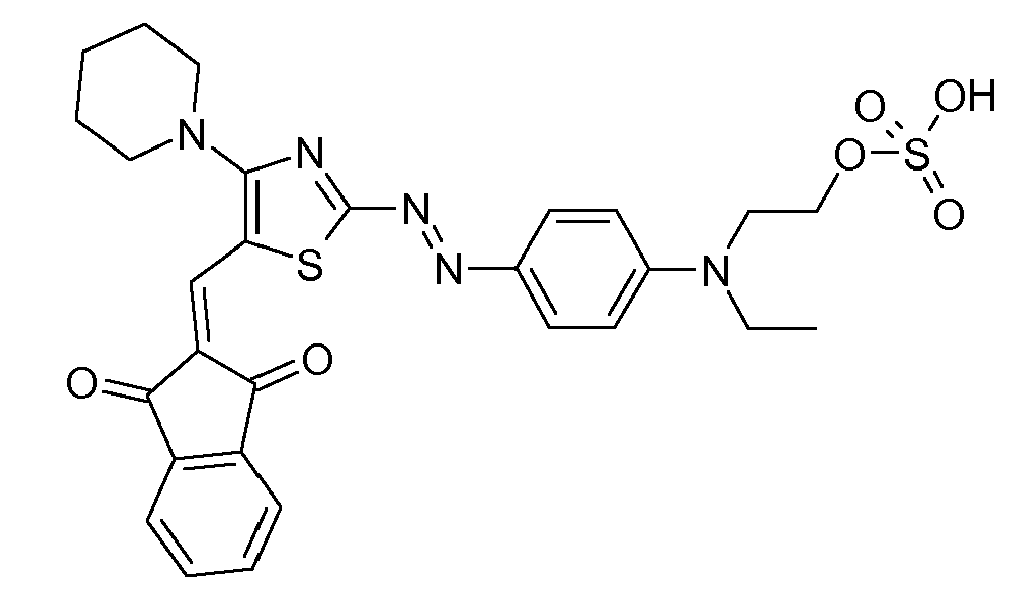

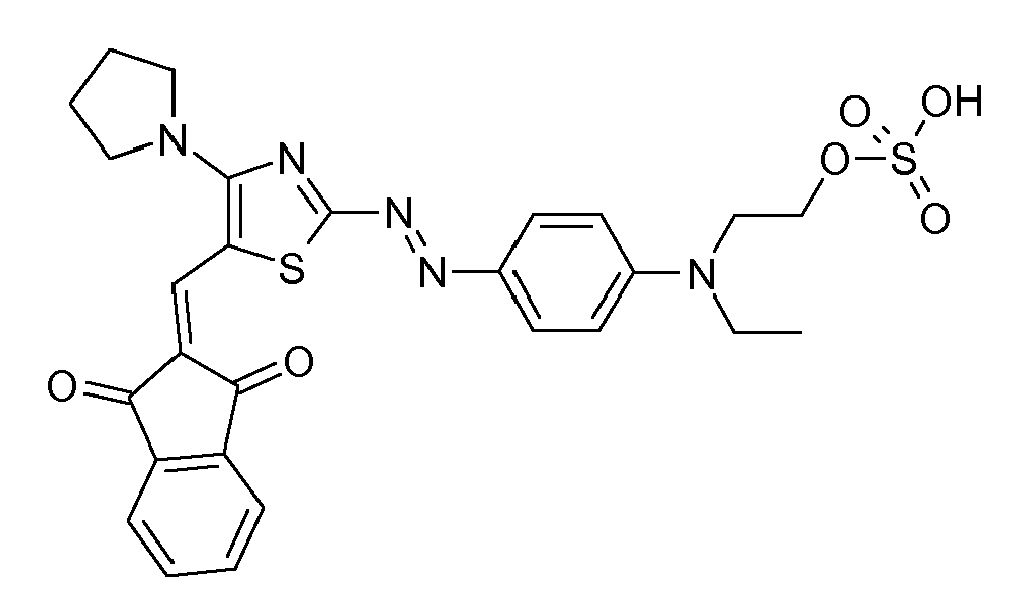


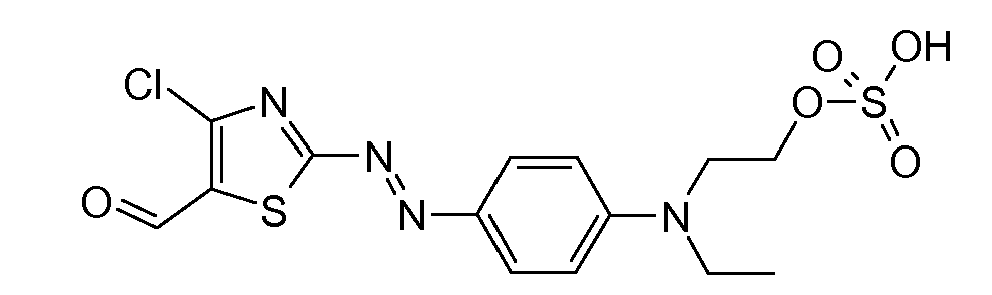
- Particularly preferred are: 4-{2-[(E)-[4-(dimethylamino)phenyl]diazenyl}-5-[(1,3-dioxo-1,3-dihydro-2H-inden-2-ylidene)methyl]-1,3-thiazol-4-yl}-1,1-dimethylpiperazin-1-ium methylsulfate, 4-{2-{(E)-[4-(diethylamino)phenyl]diazenyl}-5-[(1,3-dioxo-1,3-dihydro-2H-inden-2-ylidene)methyl]-1,3-thiazol-4-yl}-1,1-dimethylpiperazin-1-ium methylsulfate, 2-[{4-[(E)-{5-[(1,3-dioxo-1,3-dihydro-2H-inden-2-ylidene)methyl]-4-(1-piperidinyl)-1,3-thiazol-2-yl}diazenyl]phenyl}(ethyl)amino]ethyl hydrogen sulfate, 2-[{4-[(E)-{5-[(1,3-dioxo-1,3-dihydro-2H-inden-2-ylidene)methyl]-4-(1-pyrrolidinyl)-1,3-thiazol-2-yl}diazenyl]phenyl}(ethyl)amino]ethyl hydrogen sulfate, 2-[{4-[(E)-{4-chloro-5-[(1,3-dioxo-1,3-dihydro-2H-inden-2-ylidene)methyl]-1,3-thiazol-2-yl}diazenyl]phenyl}(ethyl)amino]ethyl hydrogen sulfate sulfate and 2-[{4-[(E)-(4-chloro-5-formyl-1,3-thiazol-2-yl)diazenyl]phenyl}(ethyl)amino]ethyl hydrogen sulfate.
- The dyes according to the invention of the general formula (I) and (II) can be prepared via a multi-step synthesis starting with diazotation of 2-amino-4-chloro-1,3-thiazole-5-carbaldehyde (
EP 0450438 A1 and Kasali A. Bello, Dyes and Pigments, Vol. 27, 1995, No.1, 45-54) and subsequent coupling with various substituted anilines to obtain first intermediate dye derivatives, represented by structure A, in which R1 and R2 have the abovementioned meaning (scheme 1).
- In a second step, an appropriate CH-acide acceptor-group (e.g. 1H-indene-1,3(2H)-dione) was condensed with the thiazole ring in an alcoholic medium to yield compounds according to structure B (scheme 2). This operation was performed in accordance with literature procedures (Masaki Matsui et al., Dyes and Pigments, Vol. 37, 1998, No. 4, 283-289).

- The third step involves a nucleophilic substitution of the chloro atom of B by secondary amines such as piperidine (John Griffith et al., Chem. Commun., 1998, 1349-1350) or 1-methylpiperazine in solvents like THF (tetrahydrofurane) to obtain dark coloured dyes according to structure C (scheme 3).
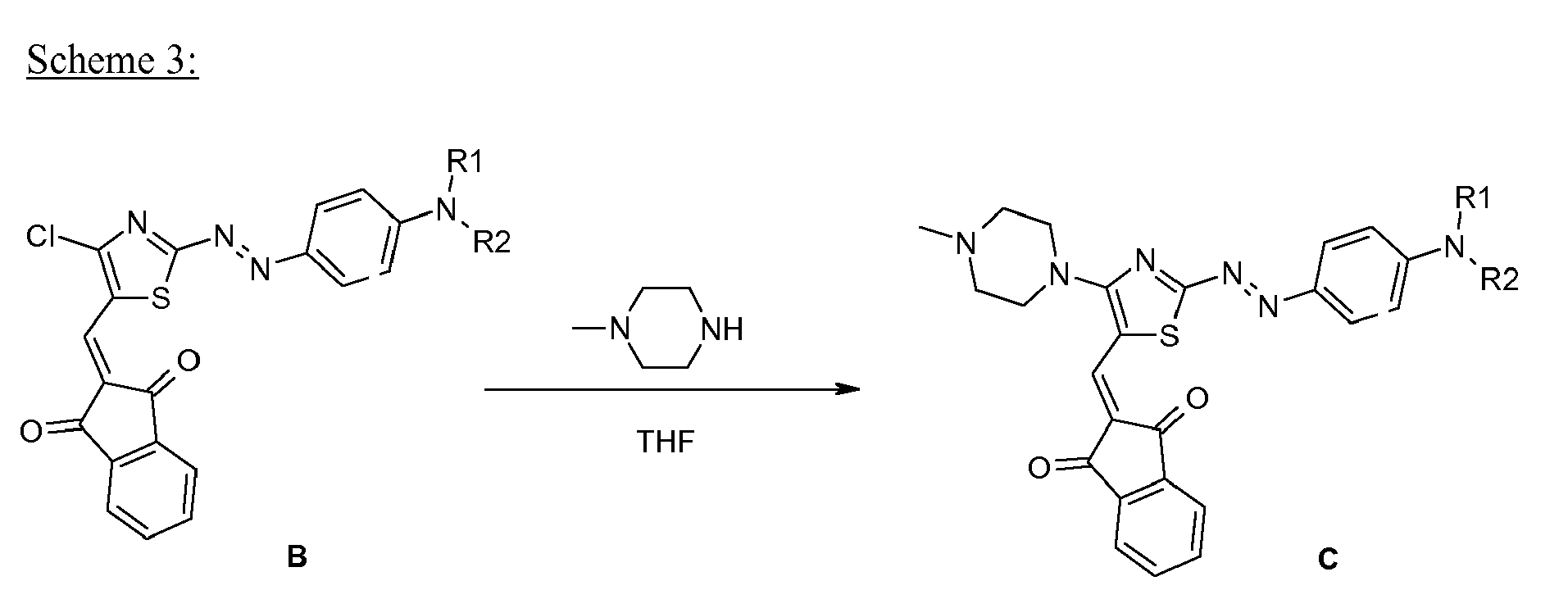
- The final step, treatment of C with alkylating agents like dimethylsulfate in acetonitrile, results in the formation of desired cationic dyes (shown as D) according to the invention (scheme 4).

- Anionic derivatives are accesible by reacting chloro sulfonic acid with an appropriate hydroxyl anchor to yield the corresponding sulfate (sulfonic acid ester) followed by conversion into an alkalimetal (e.g. sodium) salt according to the invention, if desired. However, in most cases the uncharged sulfate showed sufficient solubility. An example (designated with E, respectively E*) is illustrated in scheme 5.

- Formulations, containing dyes according to the invention of the general formula (I) or (II) provide an even colouration on keratin fibres, in particular human hair, with favorable dyeing properties such as good fastness to light, washing, rubbing and perspiration. Natural colourations with low selectivity can be obtained already under gentle conditions.
- The dyes of the general formula (I) or (II) according to the invention are preferably present in the colourants according to the invention in a total amount of from 0.01 to 10 percent by weight, in particular 0.1 to 8 percent by weight.
- To produce special colour shades, besides the dyes of the general formula (I) or (II) according to the invention, it is possible to add to the agents according to the invention one or more additional customary direct dye from the group consisting of acidic dyes, basic dyes, nitro dyes, azo dyes, anthraquinone dyes and triphenylmethane dyes. In addition, the colourants according to the invention can also comprise naturally occurring dyes, such as, for example, henna red, henna neutral, henna black, camomile, sandalwood, black tea, buckthorn bark, sage, logwood, madder root, catechu, sedre and alkanna root.
- The abovementioned additional direct dyes and naturally occuring dyes may be present in a total amount of from about 0.01 to 5 percent by weight, the total content of dyes in the colourant according to the invention being preferably from about 0.01 to 10 percent by weight, in particular 0.1 to 5 percent by weight.
- The oxidative colouring system according to the invention, which is mixed with an oxidizing agent (e.g. hydrogen peroxide) prior to application, contains beside direct dyes according to formulas (I) and (II), at least one or more oxidative dye precursors (primary intermediates, coupler substances and self-coupling substances).
The abovementioned oxidative precursers may be present in a total amount of from about 0.01 to 12 percent of weight, in particular 0.2 to 6 percent by weight. - In general, lightening compositions and oxidative colouring agents according to the present invention may comprise at least one source of an oxidizing agent. Preferred oxidizing agents for use herein are water-soluble peroxygen oxidizing agents. "Water-soluble" as defined herein means that in standard condition at least 0.1 g, preferably at least 1 g, more preferably 10 g of said oxidizing agent can be dissolved in 1 liter of deionized water. The oxidizing agents are valuable for the initial solubilisation and decolourisation of the melanin (bleaching) and accelerate the oxidation of the oxidative dye precursors (oxidative dyeing) in the hair shaft.
Any oxidizing agent known in the art may be utilized in the present invention. Preferred water-soluble oxidizing agents are inorganic peroxygen materials capable of yielding hydrogen peroxide in an aqueous solution. Water-soluble peroxygen oxidizing agents are well known in the art and include hydrogen peroxide, inorganic alkali metal peroxides such as sodium periodate and sodium peroxide and organic peroxides such as urea peroxide, melamine peroxide, and inorganic perhydrate salt bleaching compounds, such as the alkali metal salts of perborates, percarbonates, perphosphates, persilicates, persulphates and the like. These inorganic perhydrate salts may be incorporated as monohydrates, tetrahydrates etc. Alkyl and aryl peroxides, and or peroxidases may also be used. Mixtures of two or more such oxidizing agents can also be used if desired. The oxidizing agents may be provided in aqueous solution or as a powder which is dissolved prior to use. Preferred for use in the compositions according to the present invention are hydrogen peroxide, percarbonate, persulphates and combinations thereof.
According to the present invention these compositions comprise from about 0.1% to about 15% by weight, preferably from about 1% to about 10% by weight, and most preferably from about 2% to about 7% by weight of an oxidizing agent.
Another preferred oxidizing agent for use herein is a source of peroxymonocarbonate ions. Preferably such a source is formed in situ from a source of hydrogen peroxide and a hydrogen carbonate ion source. - According to the present invention the compositions may further comprise a source of radical scavenger. As used herein the term radical scavenger refers to a species that can react with a reactive radical, preferably carbonate radicals, to convert the reactive radical by a series of fast reactions to a less reactive species.
- The colourants according to the invention produce natural looking colourations even at physiologically compatible temperatures of less than 45°C. They are therefore particularly suitable for colouring human hair. For use on human hair, the colourants are usually incorporated into a hydrous cosmetic carrier. Suitable cosmetic carriers are, for example, creams, emulsions, gels or else surfactant-containing foaming solutions, such as, for example, shampoos or other preparations which are suitable for application to keratin-containing fibres. If necessary, it is also possible to incorporate the colourants into anhydrous carriers, powders, pellets or granules.
- The colourant according to the invention can further comprise all additives which are customary and known for such preparations, for example perfume oils, complexing agents, waxes, preservatives, polymers, thickeners, antioxidants, alginates, guar gum, haircare substances, such as, for example, cationic polymers or lanolin derivatives, or anionic, nonionic, zwitterionic, amphoteric or cationic surface-active substances (surfactants).
The abovementioned additives are used in the amounts customary for such purposes, for example the surface-active substances in a concentration of from 0.1 to 30 percent by weight, the care substances in an amount of from 0.1 to 5 percent by weight, and the polymers in a quantity of from 0.01 to 20 percent by weight. - The colourant according to the invention, particularly if it is a hair colourant, can be in the form of a powder or of granules, which is/are dissolved prior to application in an aqueous or aqueous-alcoholic preparation, or in the form of an aqueous or aqueous-alcoholic solution, a cream, a gel, an emulsion or an aerosol foam. The hair colourant according to the invention can be either in the form of a single-component preparation or in the form of a multicomponent preparation, for example in the form of a two-component preparation, where the direct dyes of the general formula (I) or (II) and other dyes (e.g. oxidative dye precursors) are packaged separately from the other ingredients (e.g. hydrogen peroxide) and the ready-to-use hair colourant is prepared immediately prior to application by mixing the two components.
- The colourant according to the invention generally has a pH of from about 2 to 11, preferably about 3 to 10, in particular a neutral to basic pH from about 7 to 10 in case of direct dyes according to the general formula (I) and an acid pH from about 3 to 4 in case of direct dyes according to the general formula (II).
- Both, organic and also inorganic acids are suitable for adjusting the pH according to the invention. Examples of suitable acids are the following acids: α-hydroxycarboxylic acids, such as, for example, glycolic acid, lactic acid, tartaric acid, citric acid or malic acid, ascorbic acid, gluconolactone, acetic acid, hydrochloric acid or phosphoric acid, and mixtures of these acids. Suitable alkalising media are in particular sodium carbonate, sodium bicarbonate, alkanoleamines such as monoethanoleamine or triethanoleamine, ammonia, aminopropylpropanole and sodium hydroxide and mixtures of these bases.
- The colourant according to the invention, depending on its purpose, may be applied in the presence or absence of oxidizing agents such as hydrogen peroxide.
- The colourant according to the invention is generally used by applying to the hair an appropriate amount of the hair colourant, normally about 30 to 120 grams depending on the length of hair, leaving the hair colourant to act at about 15 to 45 °C for about 1 to 60 minutes, preferably 5 to 30 minutes, then thoroughly rinsing the hair with water, optionally washing with a shampoo and/or after-treating with a hair-conditioning composition and finally drying.
- In addition, if no oxidizing agents are added to the colouring mass, the colourant described above can also comprise natural or synthetic polymers or modified polymers of natural origin customary for cosmetic compositions, through which setting of the hair is achieved at the same time as the colouring. Such compositions are generally referred to as tinting setting compositions or colour setting compositions. The abovementioned polymers may be present in these tinting setting compositions or colour setting compositions in the amounts customary for such compositions, in particular in an amount of from about 1 to 5 percent by weight. The pH of the colour styling foam/mousse according to the inverntion, is particularly of from about 6 to 9. The hair colourant with additional setting is used in a known and customary manner by wetting the hair with the setting composition, fixing (arranging) the hair in the hairstyle and then drying.
- The colourant according to the invention permits an even, intense and long-lasting colouration of keratin fibres (for example human hair, wool or furs) without noteworthy discolouration of the skin and/or scalp.
- The examples below are intended to illustrate the subject-matter of the invention in more detail without limiting it thereto.
- 1.00 g (2.20 mmol) 2-[(4-chloro-2-{(E)-[4-(diethylamino)phenyl]diazenyl}-1,3-thiazol-5-yl)methylene]-1H-indene-1,3(2H)-dione and 0.30 g (2.70 mmol) 1-methylpiperazine were dissolved in 40 ml tetrahydrofurane (THF) and heated under stirring for 5 hours when thin layer chromatography (TLC) analysis indicated complete consumption of the starting material. After cooling to room temperature the formed precipitate was filtered off, washed with THF and dried in vacuum at 40 °C to obtain a dark green powder.
Yield: 0.95 g (84%)
1H NMR (d 6 -DMSO/300 MHz): δ =1.20 (t, J= 6.9 Hz, 6H, 2xCH3), 2.34 (s, 3H, CH3), 3.01-3.04 (m, 4H, 2xCH2), 3.57-3.62 (m, 4H, 2xCH2), 3.84-3.86 (m, 4H, 2xCH2), 6.96 (d, J= 9.3 Hz, 2H, phenyl), 7.75 (s, 1H), 7.77 (s, 4H), 7.85 (d, J= 9.0 Hz, 2H, phenyl). - 0.93 g (1.80 mmol) 2-{[2-{(E)-[4-(diethylamino)phenyl]diazenyl}-4-(4-methyl-1-piperazinyl)-1,3-thiazol-5-yl]methylene}-1H-indene-1,3(2H)-dione was dissolved in 20 ml acetonitrile. After addition of 0.5 g (3.70 mmol) dimethylsulfate, the mixture was heated under reflux for 24 hours. After cooling to room temperature the formed precipitate was filtered off and dried in vacuum at 40 °C to obtain a dark green solid.
Yield: 0.85 g (74%)
1H NMR (d 6 -DMSO/300 MHz): δ = 1.22 (t, J= 6.6 Hz, 6H, 2xCH3), 2.91 (s, 3H, CH3, methylsulfate), 3.29 (s, 3H, CH3), 3.35 (s, 8H, 4xCH2), 3.38 (s, 3H, CH3), 3.62-3.64 (m, 4H, 2xCH2), 7.00 (d, J= 9.3 Hz, 2H, phenyl), 7.75 (s, 1H), 7.84 (s, 4H), 7.88 (d, J= 9.0 Hz, 2H, phenyl). - 1.3 g (18.56 mmol) sodium nitrite was added in small portions to 13.2 g conc. sulphuric acid and cooled to 0 °C and diluted with 4.8 ml propionic acid and 19.2 ml acetic acid. 3.0 g (18.45 mmol) 2-amino-4-chloro-1,3-thiazole-5-carbaldehyde were then added in small portions. The viscous reaction mixture was stirred for 2 hours at 0 °C. This mixture was then added slowly to a solution of 3.2 g (18.56 mmol) 2-[ethyl(phenyl)amino]ethanol in 180 ml water, containing 6 ml sulphuric acid. After stirring for another 2 hours at room temperature, the obtained precipitate was filtered off, washed with water and dried at
40 °C in vacuum.
Yield: 3.58 g (57%)
1H NMR (d 6 -DMSO/300 MHz): δ = 1.20 (t, J= 6.9 Hz, 3H, CH3), 3.47-3.55 (m, 6H, 3xCH2), 3.96 (s, br., 1H, OH), 7.03 (d, J= 9.0Hz, 2H, phenyl), 7.84 (d, J= 9.0 Hz, 2H, phenyl), 9.92 (s, 1H, formyl). - 0.8 g (2.36 mmol) 4-chloro-2-((E)-{4-[ethyl(2-hydroxyethyl)amino]phenyl}-diazenyl)-1,3-thiazole-5-carbaldehyde were dissolved in 35 ml THF and cooled to 0 °C. Then 0.28 g (2.36 mmol) chlorosulfonic acid were added slowly drop by drop with stirring. After the addition was completed, the reaction mixture was heated under reflux for 4 hours, allowed to cool to room temperature and stirred overnight. After further cooling in an ice bath the formed precipitate was filtered off, washed with a little cold THF and dried at 40 °C in vacuum.
Yield: 1.05 g (100%, containing traces of crystal water)
1H NMR (d 6 -DMSO/300 MHz): δ = 1.20 (t, J= 6.9 Hz, 3H, CH3), 3.66-3.68 (m, 2H, CH2), 3.80-3.82 (m, 2H, CH2), 3.95-3.97 (m, 2H, CH2), 4.77 (s, br., OH, +crystal water), 7.06 (d, J= 9.0 Hz, 2H, phenyl), 7.85 (d, J= 9.3 Hz, 2H, phenyl), 9.93 (s, 1H, formyl). - 3.5 g (10.33 mmol) 4-chloro-2-((E)-{4-[ethyl(2-hydroxyethyl)amino]phenyl}-diazenyl)-1,3-thiazole-5-carbaldehyde and 2.33 g (15.50 mmol) 1H-indene-1,3(2H)-dione were dissolved in 90 ml ethanole and stirred under reflux. After 6 hours the mixture was allowed to cool to room temperature. The formed precipitate was filtered, washed with ethanol and dried in vacuum at 40 °C to obtain a dark powder.
Yield: 3.93 g (82%)
1H NMR (d 6 -DMSO/300 MHz): δ = 1.22 (t, J= 7.2 Hz, 3H, CH3), 3.65-3.67 (m, 6H, 3xCH2), 7.02 (d, J= 9.0 Hz, 2H, phenyl), 7.78 (s, 1H), 7.84 (d, J= 9.3 Hz, 2H, phenyl), 7.93 (s, 4H). - 0.5 g (1.07 mmol) 2-{[4-chloro-2-((E)-{4-[ethyl(2-hydroxyethyl)amino]-phenyl}-diazenyl)-1,3-thiazol-5-yl]methylidene}-1H-indene-1,3(2H)-dione were dissolved in 50 ml THF and cooled to 0 °C. Then 0.19 g (1.60 mmol) chlorosulfonic acid were added slowly drop by drop with stirring. After the addition was completed, the reaction mixture was heated under reflux for 4 hours, allowed to cool to room temperature and stirred overnight. After further cooling in an ice bath the formed precipitate was filtered off, washed with a little cold THF and dried at 40 °C in vacuum.
Yield: 0.53 g (90%)
1H NMR (d 6 -DMSO/300 MHz): δ = 1.23 (t, J= 6.6 Hz, 3H, CH3), 3.43-3.98 (m, 6H, 3xCH2), 5.65 (s, br., OH, +crystal water), 7.00 (d, J= 8.7 Hz, 2H, phenyl), 7.75 (s, 1H), 7.82 (d, J= 9.0 Hz, 2H, phenyl), 7.98 (s, 4H). - 0.5 g (1.07 mmol) 2-{[4-chloro-2-((E)-{4-[ethyl(2-hydroxyethyl)amino]phenyl}-diazenyl)-1,3-thiazol-5-yl]methylene}-1H-indene-1,3(2H)-dione were dissolved in 20 ml THF. Then 0.2 g (2.14 mmol) piperidine were added dropwise and the mixture was stirred under reflux for 6 hours. After cooling to room temperature, stirring was continued overnight. The formed piperidine hydrochloric salt was separated by filtration and the solvent removed with a rotary evaporator. The resulting precipitate containing the crude product was recrystallized with toluene to obtain a dark powder.
Yield: 0.36 g (66%)
1H NMR (d 6 -DMSO/300 MHz): δ = 1.21 (t, J= 6.6 Hz, 3H, CH3), 1.65-1.74 (m, 6H, 3xCH2), 3.64-3.66 (m, 6H, 3xCH2), 3.83-3.85 (m, 4H, 2xCH2), 4.96 (s, 1H, OH), 7.02 (d, J= 9.3 Hz, 2H, phenyl), 7.75 (s, 1H), 7.76 (s, 4H), 7.87 (d, J= 9.0 Hz, 2H, phenyl). - 0.32 g (0.62 mmol) 2-{[2-((E)-{4-[ethyl(2-hydroxyethyl)amino]phenyl}-diazenyl)-4-(1-piperidinyl)-1,3-thiazol-5-yl]methylene}-1H-indene-1,3(2H)-dione were dissolved in 33 ml THF and cooled to 0 °C. Then 0.11 g (0.93 mmol) chlorosulfonic acid were added slowly drop by drop with stirring. After the addition was completed, the reaction mixture was heated under reflux for 4 hours, allowed to cool to room temperature and stirred overnight. After further cooling in an ice bath the formed precipitate was filtered off, washed with a little cold THF and dried at 40 °C in vacuum.
Yield: 0.10 g (27%)
1H NMR (d 6 -DMSO/300 MHz): δ = 1.22 (t, J= 6.6 Hz, 3H, CH3), 1.70-1.75 (m, 6H, 3xCH2), 3.67-3.69 (m, 2H, CH2), 3.82-3.86 (m, 6H, 3xCH2), 3.95-3.97 (m, 2H, CH2), 5.57 (s, br., OH, +crystal water), 7.05 (d, J= 9.0 Hz, 2H, phenyl), 7.77 (s, 1H), 7.78 (s, 4H), 7.87 (d, J= 9.0 Hz, 2H, phenyl).Example 5: Hair Colourant 2.5 mmol dye according to formula (I) 5.0 g ethanol 4.0 g decylpolyglucose 0.2 g ethylenediaminotetraacetic acid disodium salt hydrate ad 100.0 g water, demineralized Examples 6 to 8: 2.5 mmol dye according to formula (II) 0.2 g 1-hydroxyethane-1,1-diphosphone acid tetrasodium salt 1.3 g citric acid 25.0 g ethanol 10.0 g 1,2-propanediol 9.0 g benzylalcohol 0.5 g vinylpyrrolidone/vinylacetate copolymer 0.4 g acrylic acid polymer crosslinked with a polyfunctional agent ad 100.0 g water, demineralized - The hair colouring for examples 5 to 8 is carried out by applying an amount of the colourant sufficient for the hair colouring to the hair and distributing it evenly using a brush. After a contact time of 30 minutes at 40 °C, the hair is rinsed with lukewarm water, washed with a shampoo, rinsed with lukewarm water and then dried.
In addition the dye of example 5 was also treated in the presence of hydrogen peroxide as an oxidizing agent at a basic and a neutral pH. For the second treatment 5 g of the above colour carrier mass according to example 5 were mixed with 5 g of a 6% strength hydrogen peroxide solution. For the third treatment, the pH was adjusted to a basic pH of 9 by using 25% strength ammonia. The colouring results are summarized in table 1 below.Table 1: Example No. Compound of the formulas (I)/(II) as in example 5-8 Colour shade after colouring Colour measurement values after colouring 5 4-{2-{(E)-[4-(diethylamino)-phenyl]diazenyl}-5-[(1,3-dioxo-1,3-dihydro-2H-inden-2-ylidene)methyl]-1,3-thiazol-4-yl}-1,1-dimethylpiperazin-1-ium methylsulfate - iron grey (without hydrogen peroxide) L: 34.37 a:-0.10 b: - 9.04 iron grey (with hydrogen peroxide, pH=7) L: 38.23 a: + 0.43 b: - 9.99 pale grey (with L: 50.89 hydrogen peroxide, a: + 4.83 pH= 9) b: + 2.49 6 2-[{4-[(E)-(4-chloro-5-formyl-1,3-thiazol-2-yl)diazenyl]phenyl}(ethyl)-amino]ethyl hydrogen sulfate intense dark blue L: 16.71 a: + 7.41 b: - 10.10 7 2-[{4-[(E)-{4-chloro-5-[(1,3-dioxo-1,3-dihydro-2H-inden-2-ylidene)methyl]-1,3-thiazol-2-yl}diazenyl]phenyl}(ethyl)-amino]ethyl hydrogen sulfate steel blue L: 30.07 a: + 4.41 b: - 23.16 8 2-[{4-[(E)-{5-[(1,3-dioxo-1,3- black L: 18.50 dihydro-2H-inden-2-ylidene)methyl]-4-(1-piperidinyl)-1,3-thiazol-2-yl}diazenyl]phenyl}(ethyl)-amino]ethyl hydrogen sulfate a: -0.03 b: -0.78 - Unless otherwise indicated, all percentages in the present patent application are by weight.
- The dimensions and values disclosed herein are not to be understood as being strictly limited to the exact numerical values recited. Instead, unless otherwise specified, each such dimension is intended to mean both the recited value and a functionally equivalent range surrounding that value. For example, a dimension disclosed as "40 mm" is intended to mean "about 40 mm".
R3 is a group according to the general formulas (III), (IV), (V), (VI) or (VII),

R4 is a cationic group according to the general formula (VIII) or (IX),

R6 is a C1-C6-alkylsulfonic acid group, a C1-C6-alkylsulfate group (a C1-C6-alkylsulfonic acid ester) or their corresponding sodium or potassium salts, respectively; and
R7 is a chloro atom, a pyrrolidine rest, a piperidine rest, or a N-methyl-piperazine rest or an aliphatic secondary amine rest bearing two C1-C4-alkyl chains which may be identical or different; and
X- is a anionic counterion, preferably a sulphate anion, a methylsulphate anion, a phosphate anion, a hydrogenphosphate anion, an oxalate anion, a formate anion, an acetate anion, a citrate anion, a tartrate anion, a malonate anion, a pyruvate anion or a halogen anion, particular preference being given to the methylsulphate anion.
Claims (11)
- An agent for the non-oxidative colouring of keratin fibres, characterized in that it comprises at least one dye according to formula (I) or (II),

R3 is a group according to the general formulas (III), (IV), (V), (VI) or (VII),
R4 is a cationic group according to the general formula (VIII) or (IX), a) a cationic, aromatic heterocyclic ammonium compound, preferably a cationic derivative of N-methyl-imidazole, N-allyl-imidazole, 2-ethyl-imidazole or 1,2-dimethyl-imidazole or a cationic derivative of pyridine, 4-dimethylamino-pyridine, pyrimidine, pyrazole, N- methylpyrazole or chinoline; orb) a non-aromatic heterocyclic ammonium compound, in particular a cationic derivative of N-methyl-morpholine, N-ethyl-morpholine or 1-methyl-piperidine; orc) a cationic alkylammonium compound or an arylammonium compound according to the formula NRaRbRc, in which Ra, Rb and Rc, independently of each other, are a benzyl rest, a phenyl rest or a C1-C6-alkyl rest, preferably a methyl group, an ethyl group, a propyl group, an isopropyl group or a butyl group, whereas the prementioned alkyl groups may be unsubstituted or substituted with one or more hydroxy groups or amino groups; ord) a cationic phosphonium group, e.g. a tributyl phosphonium group, preferably a trimethyl phosphonium group or a triethyl phosphonium group; andR5 is hydrogen, a halogen atom, a C1-C6-alkyl group, a hydroxy group, a C1-C6-alkyloxy group, an amino group or an amino-acetyl group; and
R6 is a C1-C6-alkylsulfonic acid group, a C1-C6-alkylsulfate group (a C1-C6-alkylsulfonic acid ester) or their corresponding sodium or potassium salts, respectively; and
R7 is a chloro atom, a pyrrolidine rest, a piperidine rest, or a N-methyl-piperazine rest or an aliphatic secondary amine rest bearing two C1-C4-alkyl chains which may be identical or different; and
X- is a anionic counterion. - An agent for the oxidative colouring of keratin fibres, characterized in that it comprises at least one oxidizing agent, at least one oxidative dye precursor and at least one dye according to formula (I) or (II), and comprises at least one dye according to formula (I) or (II),

R3 is a group according to the general formulas (III), (IV), (V), (VI) or (VII),
R4 is a cationic group according to the general formula (VIII) or (IX), a) a cationic, aromatic heterocyclic ammonium compound, preferably a cationic derivative of N-methyl-imidazole, N-allyl-imidazole, 2-ethyl-imidazole or 1,2-dimethyl-imidazole or a cationic derivative of pyridine, 4-dimethylamino-pyridine, pyrimidine, pyrazole, N- methylpyrazole or chinoline; orb) a non-aromatic heterocyclic ammonium compound, in particular a cationic derivative of N-methyl-morpholine, N-ethyl-morpholine or 1-methyl-piperidine; orc) a cationic alkylammonium compound or an arylammonium compound according to the formula NRaRbRc, in which Ra, Rb and Rc, independently of each other, are a benzyl rest, a phenyl rest or a C1-C6-alkyl rest, preferably a methyl group, an ethyl group, a propyl group, an isopropyl group or a butyl group, whereas the prementioned alkyl groups may be unsubstituted or substituted with one or more hydroxy groups or amino groups; ord) a cationic phosphonium group, e.g. a tributyl phosphonium group, preferably a trimethyl phosphonium group or a triethyl phosphonium group; andR5 is hydrogen, a halogen atom, a C1-C6-alkyl group, a hydroxy group, a C1-C6-alkyloxy group, an amino group or an amino-acetyl group; and
R6 is a C1-C6-alkylsulfonic acid group, a C1-C6-alkylsulfate group (a C1-C6-alkylsulfonic acid ester) or their corresponding sodium or potassium salts, respectively; and
R7 is a chloro atom, a pyrrolidine rest, a piperidine rest, or a N-methyl-piperazine rest or an aliphatic secondary amine rest bearing two C1-C4-alkyl chains which may be identical or different; and
X - is a anionic counterion. - An agent for the lightening of keratin fibres, characterized in that it comprises at least one oxidizing agent and at least one dye according to formula (I) or (II),

R3 is a group according to the general formulas (III), (IV), (V), (VI) or (VII),
R4 is a cationic group according to the general formula (VIII) or (IX), a) a cationic, aromatic heterocyclic ammonium compound, preferably a cationic derivative of N-methyl-imidazole, N-allyl-imidazole, 2-ethyl-imidazole or 1,2-dimethyl-imidazole or a cationic derivative of pyridine, 4-dimethylamino-pyridine, pyrimidine, pyrazole, N- methylpyrazole or chinoline; orb) a non-aromatic heterocyclic ammonium compound, in particular a cationic derivative of N-methyl-morpholine, N-ethyl-morpholine or 1-methyl-piperidine; orc) a cationic alkylammonium compound or an arylammonium compound according to the formula NRaRbRc, in which Ra, Rb and Rc, independently of each other, are a benzyl rest, a phenyl rest or a C1-C6-alkyl rest, preferably a methyl group, an ethyl group, a propyl group, an isopropyl group or a butyl group, whereas the prementioned alkyl groups may be unsubstituted or substituted with one or more hydroxy groups or amino groups; ord) a cationic phosphonium group, e.g. a tributyl phosphonium group, preferably a trimethyl phosphonium group or a triethyl phosphonium group; andR5 is hydrogen, a halogen atom, a C1-C6-alkyl group, a hydroxy group, a C1-C6-alkyloxy group, an amino group or an amino-acetyl group; and
R6 is a C1-C6-alkylsulfonic acid group, a C1-C6-alkylsulfate group (a C1-C6-alkylsulfonic acid ester) or their corresponding sodium or potassium salts, respectively; and
R7 is a chloro atom, a pyrrolidine rest, a piperidine rest, or a N-methyl-piperazine rest or an aliphatic secondary amine rest bearing two C1-C4-alkyl chains which may be identical or different; and
X- is a anionic counterion. - The agent as claimed in claim 1, characterized in that it comprises at least one polymer customary for cosmetic agents, selected from the group consisting of natural polymers, synthetic polymers and modified polymers of natural origin, and is in the form of a tinting setting composition or colour setting composition.
- The agent as claimed in claim 2, characterized in that the oxidizing agent is selected from the group consisting of hydrogen peroxide and its addition compounds onto urea, melamine, sodium borate and sodium carbonate.
- The agent as claimed in claim 3, characterized in that the oxidizing agent is selected from the group consisting of hydrogen peroxide and its addition compounds onto urea, melamine, sodium borate and sodium carbonate, and persulfates.
- The agent as claimed in one of claims 1 to 6, characterized in that the counterion X- is selected from the group consisting of sulphate anions, methylsulphate anions, phosphate anions, hydrogenphosphate anions, oxalate anions, formate anions, acetate anions, citrate anions, tartrate anions, malonate anions, pyruvate anions and halogen anions.
- The agent as claimed in one of claims 1 to 7, characterized in that the dye according to formula (I) and (II) is selected from the group consisting of 4-{2-{(E)-[4-(dimethylamino)phenyl]diazenyl)-5-[(1,3-dioxo-1,3-dihydro-2H-inden-2-ylidene)methyl]-1,3-thiazol-4-yl)-1,1-dimethylpip erazin-1-ium methylsulfate, 4-{2-{(E)-[4-(diethylamino)-phenyl]diazenyl}-5-[(1,3-dioxo-1,3-dihydro-2H-inden-2-ylidene)methyl]-1,3-thiazol-4-yl}-1,1-dimethylpiperazin-1-ium methylsulfate, 4-(5-(2,2-dicyanovinyl)-2-{(E)-[4-(dimethylamino)phenyl]diazenyl} -1,3-thiazol-4-yl)-1,1-dimethylpiperazin-1-ium methylsulfate, 4-(5-(2,2-dicyanovinyl)-2-{(E)-[4-(diethylamino)phenyl]diazenyl}-1,3-thiazol-4-yl)-1,1-dimethylpiperazin-1-ium methylsulfate, 4-(5-{(Z)-[1-(dicyanomethylene)-3-oxo-1,3-dihydro-2H-inden-2-ylidene]methyl}-2-{(E)-[4-(dimethylamino)phenyl]diazenyl}-1,3-thiazol-4-yl)-1,1-dimethylpiperazin-1-ium methylsulfate, 4-(5-{(Z)-[1-(dicyanomethylene)-3-oxo-1,3-dihydro-2H-inden-2-ylidene]methyl}-2-{(E)-[4-(diethylamino)phenyl]diazenyl}-1,3-thiazol-4-yl)-1,1-dimethylpiperazin-1-ium methylsulfate, 2-[{4-[(E)-{5-[(1,3-dioxo-1,3-dihydro-2H-inden-2-ylidene)methyl]-4-(1-piperidinyl)-1,3-thiazol-2-yl}diazenyl]phenyl}(ethyl)amino]ethyl hydrogen sulfate, sodium 2-[{4-[(E)-{5-[(1,3-dioxo-1,3-dihydro-2H-inden-2-ylidene)methyl]-4-(1-piperidinyl)-1,3-thiazol-2-yl}diazenyl]phenyl}(ethyl)amino] ethyl sulfate, 2-[{4-[(E)-{5-[(1,3-dioxo-1,3-dihydro-2H-inden-2-ylidene)methyl]-4-(1-pyrrolidinyl)-1,3-thiazol-2-yl}diazenyl]phenyl}(ethyl)amino]ethyl hydrogen sulfate, sodium 2-[{4-[(E)-{5-[(1,3-dioxo-1,3-dihydro-2H-inden-2-ylidene)methyl]-4-(1-pyrrolidinyl)-1,3-thiazol-2-yl}diazenyl]phenyl} (ethyl)amino]ethyl sulfate, 2-[{4-[(E)-{4-chloro-5-[(1,3-dioxo-1,3-dihydro-2H-inden-2-ylidene)methyl]-1,3-thiazol-2-yl}diazenyl]phenyl}(ethyl)amino]ethyl hydrogen sulfate, sodium 2-[{4-[(E)-{4-chloro-5-[(1,3-dioxo-1,3-dihydro-2H-inden-2-ylidene)methyl]-1,3-thiazol-2-yl}diazenyl]phenyl}(ethyl)amino]ethyl sulfate and 2-[{4-[(E)-(4-chloro-5-formyl-1,3-thiazol-2-yl)diazenyl]phenyl}(ethyl)amino]ethyl hydrogen sulfate.
- The agent as claimed in one of claims 1 to 8, characterized in that the dye of formula (I) and (II) is contained in a total amount of from 0.01 to 10 percent by weight.
- The agent as claimed in one of claims 1 to 9, characterized in that it additionally comprises at least one further direct dye which is selected from the group consisting of nitro dyes, azo dyes, anthraquinone dyes, triphenylmethane dyes, basic dyes, acidic dyes and naturally occuring dyes.
- The agent as claimed in claim 10, characterized in that the additional direct dye is present in a total amount of from 0.01 to 5 percent by weight.
Priority Applications (1)
| Application Number | Priority Date | Filing Date | Title |
|---|---|---|---|
| EP20070118975 EP1920761B1 (en) | 2006-10-23 | 2007-10-22 | Dark coloured azo dyes |
Applications Claiming Priority (2)
| Application Number | Priority Date | Filing Date | Title |
|---|---|---|---|
| EP06122740A EP1915984A1 (en) | 2006-10-23 | 2006-10-23 | Dark coloured azo dyes |
| EP20070118975 EP1920761B1 (en) | 2006-10-23 | 2007-10-22 | Dark coloured azo dyes |
Publications (2)
| Publication Number | Publication Date |
|---|---|
| EP1920761A1 true EP1920761A1 (en) | 2008-05-14 |
| EP1920761B1 EP1920761B1 (en) | 2009-09-16 |
Family
ID=39276839
Family Applications (1)
| Application Number | Title | Priority Date | Filing Date |
|---|---|---|---|
| EP20070118975 Not-in-force EP1920761B1 (en) | 2006-10-23 | 2007-10-22 | Dark coloured azo dyes |
Country Status (1)
| Country | Link |
|---|---|
| EP (1) | EP1920761B1 (en) |
Citations (3)
| Publication number | Priority date | Publication date | Assignee | Title |
|---|---|---|---|---|
| DE10118271A1 (en) * | 2001-04-12 | 2002-03-14 | Henkel Kgaa | Hair-dyeing compositions contain new and known diazo-thiazole derivatives as direct dyes, optionally in combination with oxidation dyes |
| DE102004008604A1 (en) * | 2004-02-21 | 2005-09-01 | Wella Ag | Hair dye for the simultaneous dyeing and whitening of keratin fibers |
| EP1618865A1 (en) * | 2004-06-23 | 2006-01-25 | L'oreal | Use of polycationic compounds for dyeing keratin fibres |
-
2007
- 2007-10-22 EP EP20070118975 patent/EP1920761B1/en not_active Not-in-force
Patent Citations (3)
| Publication number | Priority date | Publication date | Assignee | Title |
|---|---|---|---|---|
| DE10118271A1 (en) * | 2001-04-12 | 2002-03-14 | Henkel Kgaa | Hair-dyeing compositions contain new and known diazo-thiazole derivatives as direct dyes, optionally in combination with oxidation dyes |
| DE102004008604A1 (en) * | 2004-02-21 | 2005-09-01 | Wella Ag | Hair dye for the simultaneous dyeing and whitening of keratin fibers |
| EP1618865A1 (en) * | 2004-06-23 | 2006-01-25 | L'oreal | Use of polycationic compounds for dyeing keratin fibres |
Also Published As
| Publication number | Publication date |
|---|---|
| EP1920761B1 (en) | 2009-09-16 |
Similar Documents
| Publication | Publication Date | Title |
|---|---|---|
| JP4979693B2 (en) | Styryl sulfide dye | |
| JP5275033B2 (en) | Xanthene dye | |
| KR101364872B1 (en) | Hair dyeing composition | |
| JP5431735B2 (en) | Use of drugs to simultaneously lighten and dye keratin fibers | |
| JP2003525949A (en) | How to color hair using cationic dyes | |
| JP5558715B2 (en) | Thiol dye | |
| EP1324741A1 (en) | Method of dyeing keratin-containing fibres | |
| EP1622686B1 (en) | Cationic dimeric dyes | |
| JP2013177727A (en) | Dyes containing thiol group | |
| EP1599550B1 (en) | Cationic dyes, their production and use | |
| JP5362585B2 (en) | Cationic dye | |
| EP1448156B1 (en) | Method of dyeing keratin-containing fibres | |
| US8152861B2 (en) | Dark coloured azo dyes | |
| MX2009001598A (en) | Thiol derivative dyes. | |
| JP4960961B2 (en) | Sulfide dye | |
| WO2003006554A1 (en) | A method of coloring hair using cationic dyes | |
| CN101325986A (en) | Oxazine disulfide dyes | |
| EP1920761B1 (en) | Dark coloured azo dyes | |
| EP1594922A1 (en) | Cationic substituted hydrazone dyes | |
| JP2007523100A (en) | Hair dye for simultaneous bleaching and coloring of keratin fibers | |
| BRPI0614033A2 (en) | pyrido-thiazinium dyes | |
| US5922086A (en) | Hair colorants based on perimidine derivatives | |
| EP2399569B1 (en) | Cationic azo dyes with a special grouping of the 4-Aza-1-azoniabicyclo[2.2.2]octane and means of colouring keratinic fibres | |
| AU2005269028A1 (en) | Cationic pyrazolone dyes method for production thereof and colouring agents for keratin fibres containing said compounds |
Legal Events
| Date | Code | Title | Description |
|---|---|---|---|
| PUAI | Public reference made under article 153(3) epc to a published international application that has entered the european phase |
Free format text: ORIGINAL CODE: 0009012 |
|
| AK | Designated contracting states |
Kind code of ref document: A1 Designated state(s): AT BE BG CH CY CZ DE DK EE ES FI FR GB GR HU IE IS IT LI LT LU LV MC MT NL PL PT RO SE SI SK TR |
|
| AX | Request for extension of the european patent |
Extension state: AL BA HR MK RS |
|
| 17P | Request for examination filed |
Effective date: 20080527 |
|
| 17Q | First examination report despatched |
Effective date: 20080627 |
|
| AKX | Designation fees paid |
Designated state(s): AT BE BG CH CY CZ DE DK EE ES FI FR GB GR HU IE IS IT LI LT LU LV MC MT NL PL PT RO SE SI SK TR |
|
| GRAP | Despatch of communication of intention to grant a patent |
Free format text: ORIGINAL CODE: EPIDOSNIGR1 |
|
| GRAS | Grant fee paid |
Free format text: ORIGINAL CODE: EPIDOSNIGR3 |
|
| RAP1 | Party data changed (applicant data changed or rights of an application transferred) |
Owner name: THE PROCTER AND GAMBLE COMPANY |
|
| GRAA | (expected) grant |
Free format text: ORIGINAL CODE: 0009210 |
|
| AK | Designated contracting states |
Kind code of ref document: B1 Designated state(s): AT BE BG CH CY CZ DE DK EE ES FI FR GB GR HU IE IS IT LI LT LU LV MC MT NL PL PT RO SE SI SK TR |
|
| REG | Reference to a national code |
Ref country code: GB Ref legal event code: FG4D |
|
| REG | Reference to a national code |
Ref country code: CH Ref legal event code: EP |
|
| REG | Reference to a national code |
Ref country code: IE Ref legal event code: FG4D |
|
| REF | Corresponds to: |
Ref document number: 602007002457 Country of ref document: DE Date of ref document: 20091029 Kind code of ref document: P |
|
| PG25 | Lapsed in a contracting state [announced via postgrant information from national office to epo] |
Ref country code: FI Free format text: LAPSE BECAUSE OF FAILURE TO SUBMIT A TRANSLATION OF THE DESCRIPTION OR TO PAY THE FEE WITHIN THE PRESCRIBED TIME-LIMIT Effective date: 20090916 Ref country code: LT Free format text: LAPSE BECAUSE OF FAILURE TO SUBMIT A TRANSLATION OF THE DESCRIPTION OR TO PAY THE FEE WITHIN THE PRESCRIBED TIME-LIMIT Effective date: 20090916 Ref country code: SE Free format text: LAPSE BECAUSE OF FAILURE TO SUBMIT A TRANSLATION OF THE DESCRIPTION OR TO PAY THE FEE WITHIN THE PRESCRIBED TIME-LIMIT Effective date: 20090916 |
|
| LTIE | Lt: invalidation of european patent or patent extension |
Effective date: 20090916 |
|
| PG25 | Lapsed in a contracting state [announced via postgrant information from national office to epo] |
Ref country code: PL Free format text: LAPSE BECAUSE OF FAILURE TO SUBMIT A TRANSLATION OF THE DESCRIPTION OR TO PAY THE FEE WITHIN THE PRESCRIBED TIME-LIMIT Effective date: 20090916 Ref country code: SI Free format text: LAPSE BECAUSE OF FAILURE TO SUBMIT A TRANSLATION OF THE DESCRIPTION OR TO PAY THE FEE WITHIN THE PRESCRIBED TIME-LIMIT Effective date: 20090916 Ref country code: LV Free format text: LAPSE BECAUSE OF FAILURE TO SUBMIT A TRANSLATION OF THE DESCRIPTION OR TO PAY THE FEE WITHIN THE PRESCRIBED TIME-LIMIT Effective date: 20090916 Ref country code: NL Free format text: LAPSE BECAUSE OF FAILURE TO SUBMIT A TRANSLATION OF THE DESCRIPTION OR TO PAY THE FEE WITHIN THE PRESCRIBED TIME-LIMIT Effective date: 20090916 |
|
| NLV1 | Nl: lapsed or annulled due to failure to fulfill the requirements of art. 29p and 29m of the patents act | ||
| PG25 | Lapsed in a contracting state [announced via postgrant information from national office to epo] |
Ref country code: CY Free format text: LAPSE BECAUSE OF FAILURE TO SUBMIT A TRANSLATION OF THE DESCRIPTION OR TO PAY THE FEE WITHIN THE PRESCRIBED TIME-LIMIT Effective date: 20090916 |
|
| PG25 | Lapsed in a contracting state [announced via postgrant information from national office to epo] |
Ref country code: PT Free format text: LAPSE BECAUSE OF FAILURE TO SUBMIT A TRANSLATION OF THE DESCRIPTION OR TO PAY THE FEE WITHIN THE PRESCRIBED TIME-LIMIT Effective date: 20100118 Ref country code: IS Free format text: LAPSE BECAUSE OF FAILURE TO SUBMIT A TRANSLATION OF THE DESCRIPTION OR TO PAY THE FEE WITHIN THE PRESCRIBED TIME-LIMIT Effective date: 20100116 Ref country code: RO Free format text: LAPSE BECAUSE OF FAILURE TO SUBMIT A TRANSLATION OF THE DESCRIPTION OR TO PAY THE FEE WITHIN THE PRESCRIBED TIME-LIMIT Effective date: 20090916 Ref country code: ES Free format text: LAPSE BECAUSE OF FAILURE TO SUBMIT A TRANSLATION OF THE DESCRIPTION OR TO PAY THE FEE WITHIN THE PRESCRIBED TIME-LIMIT Effective date: 20091227 Ref country code: CZ Free format text: LAPSE BECAUSE OF FAILURE TO SUBMIT A TRANSLATION OF THE DESCRIPTION OR TO PAY THE FEE WITHIN THE PRESCRIBED TIME-LIMIT Effective date: 20090916 Ref country code: EE Free format text: LAPSE BECAUSE OF FAILURE TO SUBMIT A TRANSLATION OF THE DESCRIPTION OR TO PAY THE FEE WITHIN THE PRESCRIBED TIME-LIMIT Effective date: 20090916 |
|
| PG25 | Lapsed in a contracting state [announced via postgrant information from national office to epo] |
Ref country code: MC Free format text: LAPSE BECAUSE OF NON-PAYMENT OF DUE FEES Effective date: 20091031 Ref country code: SK Free format text: LAPSE BECAUSE OF FAILURE TO SUBMIT A TRANSLATION OF THE DESCRIPTION OR TO PAY THE FEE WITHIN THE PRESCRIBED TIME-LIMIT Effective date: 20090916 |
|
| PG25 | Lapsed in a contracting state [announced via postgrant information from national office to epo] |
Ref country code: BE Free format text: LAPSE BECAUSE OF FAILURE TO SUBMIT A TRANSLATION OF THE DESCRIPTION OR TO PAY THE FEE WITHIN THE PRESCRIBED TIME-LIMIT Effective date: 20090916 Ref country code: AT Free format text: LAPSE BECAUSE OF FAILURE TO SUBMIT A TRANSLATION OF THE DESCRIPTION OR TO PAY THE FEE WITHIN THE PRESCRIBED TIME-LIMIT Effective date: 20090916 |
|
| PLBE | No opposition filed within time limit |
Free format text: ORIGINAL CODE: 0009261 |
|
| STAA | Information on the status of an ep patent application or granted ep patent |
Free format text: STATUS: NO OPPOSITION FILED WITHIN TIME LIMIT |
|
| PG25 | Lapsed in a contracting state [announced via postgrant information from national office to epo] |
Ref country code: DK Free format text: LAPSE BECAUSE OF FAILURE TO SUBMIT A TRANSLATION OF THE DESCRIPTION OR TO PAY THE FEE WITHIN THE PRESCRIBED TIME-LIMIT Effective date: 20090916 |
|
| 26N | No opposition filed |
Effective date: 20100617 |
|
| PG25 | Lapsed in a contracting state [announced via postgrant information from national office to epo] |
Ref country code: IE Free format text: LAPSE BECAUSE OF NON-PAYMENT OF DUE FEES Effective date: 20091022 Ref country code: GR Free format text: LAPSE BECAUSE OF FAILURE TO SUBMIT A TRANSLATION OF THE DESCRIPTION OR TO PAY THE FEE WITHIN THE PRESCRIBED TIME-LIMIT Effective date: 20091217 |
|
| PG25 | Lapsed in a contracting state [announced via postgrant information from national office to epo] |
Ref country code: BG Free format text: LAPSE BECAUSE OF FAILURE TO SUBMIT A TRANSLATION OF THE DESCRIPTION OR TO PAY THE FEE WITHIN THE PRESCRIBED TIME-LIMIT Effective date: 20091031 Ref country code: IT Free format text: LAPSE BECAUSE OF FAILURE TO SUBMIT A TRANSLATION OF THE DESCRIPTION OR TO PAY THE FEE WITHIN THE PRESCRIBED TIME-LIMIT Effective date: 20090916 |
|
| PG25 | Lapsed in a contracting state [announced via postgrant information from national office to epo] |
Ref country code: MT Free format text: LAPSE BECAUSE OF FAILURE TO SUBMIT A TRANSLATION OF THE DESCRIPTION OR TO PAY THE FEE WITHIN THE PRESCRIBED TIME-LIMIT Effective date: 20090916 Ref country code: LU Free format text: LAPSE BECAUSE OF NON-PAYMENT OF DUE FEES Effective date: 20091022 |
|
| PG25 | Lapsed in a contracting state [announced via postgrant information from national office to epo] |
Ref country code: HU Free format text: LAPSE BECAUSE OF FAILURE TO SUBMIT A TRANSLATION OF THE DESCRIPTION OR TO PAY THE FEE WITHIN THE PRESCRIBED TIME-LIMIT Effective date: 20100317 |
|
| PG25 | Lapsed in a contracting state [announced via postgrant information from national office to epo] |
Ref country code: TR Free format text: LAPSE BECAUSE OF FAILURE TO SUBMIT A TRANSLATION OF THE DESCRIPTION OR TO PAY THE FEE WITHIN THE PRESCRIBED TIME-LIMIT Effective date: 20090916 |
|
| REG | Reference to a national code |
Ref country code: CH Ref legal event code: PL |
|
| PG25 | Lapsed in a contracting state [announced via postgrant information from national office to epo] |
Ref country code: CH Free format text: LAPSE BECAUSE OF NON-PAYMENT OF DUE FEES Effective date: 20111031 Ref country code: LI Free format text: LAPSE BECAUSE OF NON-PAYMENT OF DUE FEES Effective date: 20111031 |
|
| REG | Reference to a national code |
Ref country code: FR Ref legal event code: PLFP Year of fee payment: 10 |
|
| REG | Reference to a national code |
Ref country code: FR Ref legal event code: PLFP Year of fee payment: 11 |
|
| REG | Reference to a national code |
Ref country code: GB Ref legal event code: 732E Free format text: REGISTERED BETWEEN 20210610 AND 20210616 |
|
| REG | Reference to a national code |
Ref country code: GB Ref legal event code: 732E Free format text: REGISTERED BETWEEN 20210617 AND 20210623 |
|
| REG | Reference to a national code |
Ref country code: DE Ref legal event code: R081 Ref document number: 602007002457 Country of ref document: DE Owner name: WELLA OPERATIONS US, LLC, CALABASAS, US Free format text: FORMER OWNER: THE PROCTER & GAMBLE COMPANY, CINCINNATI, OH, US Ref country code: DE Ref legal event code: R081 Ref document number: 602007002457 Country of ref document: DE Owner name: WELLA OPERATIONS US, LLC, CALABASAS, US Free format text: FORMER OWNER: THE PROCTER & GAMBLE COMPANY, CINCINNATI, OHIO, US |
|
| PGFP | Annual fee paid to national office [announced via postgrant information from national office to epo] |
Ref country code: DE Payment date: 20241021 Year of fee payment: 18 |
|
| PGFP | Annual fee paid to national office [announced via postgrant information from national office to epo] |
Ref country code: GB Payment date: 20241022 Year of fee payment: 18 |
|
| PGFP | Annual fee paid to national office [announced via postgrant information from national office to epo] |
Ref country code: FR Payment date: 20241021 Year of fee payment: 18 |
|
| REG | Reference to a national code |
Ref country code: DE Ref legal event code: R119 Ref document number: 602007002457 Country of ref document: DE |
|
| GBPC | Gb: european patent ceased through non-payment of renewal fee |
Effective date: 20251022 |
|
| PG25 | Lapsed in a contracting state [announced via postgrant information from national office to epo] |
Ref country code: GB Free format text: LAPSE BECAUSE OF NON-PAYMENT OF DUE FEES Effective date: 20251022 |
|
| PG25 | Lapsed in a contracting state [announced via postgrant information from national office to epo] |
Ref country code: DE Free format text: LAPSE BECAUSE OF NON-PAYMENT OF DUE FEES Effective date: 20260501 |
|
| PG25 | Lapsed in a contracting state [announced via postgrant information from national office to epo] |
Ref country code: FR Free format text: LAPSE BECAUSE OF NON-PAYMENT OF DUE FEES Effective date: 20251031 |