EP1919854B1 - Pharmaceutical compositions as inhibitors of dipeptidyl peptidase-iv (dpp-iv) - Google Patents
Pharmaceutical compositions as inhibitors of dipeptidyl peptidase-iv (dpp-iv) Download PDFInfo
- Publication number
- EP1919854B1 EP1919854B1 EP06790057.1A EP06790057A EP1919854B1 EP 1919854 B1 EP1919854 B1 EP 1919854B1 EP 06790057 A EP06790057 A EP 06790057A EP 1919854 B1 EP1919854 B1 EP 1919854B1
- Authority
- EP
- European Patent Office
- Prior art keywords
- alkylenyl
- cyclohex
- amino
- trifluorophenyl
- trans
- Prior art date
- Legal status (The legal status is an assumption and is not a legal conclusion. Google has not performed a legal analysis and makes no representation as to the accuracy of the status listed.)
- Active
Links
- 239000008194 pharmaceutical composition Substances 0.000 title claims description 5
- 101000930822 Giardia intestinalis Dipeptidyl-peptidase 4 Proteins 0.000 title description 72
- 239000003112 inhibitor Substances 0.000 title description 20
- 102000016622 Dipeptidyl Peptidase 4 Human genes 0.000 title 1
- 150000001875 compounds Chemical class 0.000 claims description 411
- -1 - CN Chemical group 0.000 claims description 198
- 125000000217 alkyl group Chemical group 0.000 claims description 158
- 239000001257 hydrogen Substances 0.000 claims description 131
- 229910052739 hydrogen Inorganic materials 0.000 claims description 131
- 150000002431 hydrogen Chemical group 0.000 claims description 104
- 229910003827 NRaRb Inorganic materials 0.000 claims description 76
- 125000001072 heteroaryl group Chemical group 0.000 claims description 74
- 125000000623 heterocyclic group Chemical group 0.000 claims description 71
- 125000003118 aryl group Chemical group 0.000 claims description 67
- 125000001188 haloalkyl group Chemical group 0.000 claims description 64
- 125000001997 phenyl group Chemical group [H]C1=C([H])C([H])=C(*)C([H])=C1[H] 0.000 claims description 53
- 125000000392 cycloalkenyl group Chemical group 0.000 claims description 34
- 206010012601 diabetes mellitus Diseases 0.000 claims description 34
- 125000000753 cycloalkyl group Chemical group 0.000 claims description 33
- 208000001072 type 2 diabetes mellitus Diseases 0.000 claims description 32
- 229910004749 OS(O)2 Inorganic materials 0.000 claims description 31
- 125000003342 alkenyl group Chemical group 0.000 claims description 31
- 150000003839 salts Chemical class 0.000 claims description 30
- 208000037265 diseases, disorders, signs and symptoms Diseases 0.000 claims description 29
- 125000001424 substituent group Chemical group 0.000 claims description 29
- 125000000449 nitro group Chemical group [O-][N+](*)=O 0.000 claims description 20
- 125000004966 cyanoalkyl group Chemical group 0.000 claims description 18
- 208000008589 Obesity Diseases 0.000 claims description 17
- 125000004093 cyano group Chemical group *C#N 0.000 claims description 17
- 208000035475 disorder Diseases 0.000 claims description 17
- 125000002496 methyl group Chemical group [H]C([H])([H])* 0.000 claims description 17
- 235000020824 obesity Nutrition 0.000 claims description 17
- UFHFLCQGNIYNRP-UHFFFAOYSA-N Hydrogen Chemical compound [H][H] UFHFLCQGNIYNRP-UHFFFAOYSA-N 0.000 claims description 16
- 125000004971 nitroalkyl group Chemical group 0.000 claims description 16
- 125000004076 pyridyl group Chemical group 0.000 claims description 16
- 125000004043 oxo group Chemical group O=* 0.000 claims description 15
- 125000002915 carbonyl group Chemical group [*:2]C([*:1])=O 0.000 claims description 12
- 201000010099 disease Diseases 0.000 claims description 12
- 206010060378 Hyperinsulinaemia Diseases 0.000 claims description 11
- UUSODXRMARGLBX-UHFFFAOYSA-N cyclohex-3-en-1-amine Chemical compound NC1CCC=CC1 UUSODXRMARGLBX-UHFFFAOYSA-N 0.000 claims description 11
- 230000003451 hyperinsulinaemic effect Effects 0.000 claims description 11
- 201000008980 hyperinsulinism Diseases 0.000 claims description 11
- 125000004183 alkoxy alkyl group Chemical group 0.000 claims description 10
- 125000002768 hydroxyalkyl group Chemical group 0.000 claims description 10
- 201000001421 hyperglycemia Diseases 0.000 claims description 10
- 208000001145 Metabolic Syndrome Diseases 0.000 claims description 9
- 125000004994 halo alkoxy alkyl group Chemical group 0.000 claims description 9
- 208000018522 Gastrointestinal disease Diseases 0.000 claims description 8
- 201000000690 abdominal obesity-metabolic syndrome Diseases 0.000 claims description 8
- 230000002519 immonomodulatory effect Effects 0.000 claims description 8
- 125000000719 pyrrolidinyl group Chemical group 0.000 claims description 8
- 125000004193 piperazinyl group Chemical group 0.000 claims description 7
- 125000003386 piperidinyl group Chemical group 0.000 claims description 7
- 125000000714 pyrimidinyl group Chemical group 0.000 claims description 7
- 208000024172 Cardiovascular disease Diseases 0.000 claims description 6
- 150000001412 amines Chemical class 0.000 claims description 6
- 125000002757 morpholinyl group Chemical group 0.000 claims description 6
- 125000004159 quinolin-2-yl group Chemical group [H]C1=C([H])C([H])=C2C([H])=C([H])C(*)=NC2=C1[H] 0.000 claims description 6
- 208000023504 respiratory system disease Diseases 0.000 claims description 6
- 125000004227 1,3-benzoxazol-2-yl group Chemical group [H]C1=C([H])C([H])=C2N=C(*)OC2=C1[H] 0.000 claims description 5
- 201000001320 Atherosclerosis Diseases 0.000 claims description 5
- 208000020925 Bipolar disease Diseases 0.000 claims description 5
- 208000001132 Osteoporosis Diseases 0.000 claims description 5
- HYVDMTSFCUTAGX-HRAATJIYSA-N 4-[[(4s,5r)-5-amino-4-(2,4,5-trifluorophenyl)cyclohexen-1-yl]methylamino]-n,n-dimethylbenzamide Chemical compound C1=CC(C(=O)N(C)C)=CC=C1NCC1=CC[C@@H](C=2C(=CC(F)=C(F)C=2)F)[C@H](N)C1 HYVDMTSFCUTAGX-HRAATJIYSA-N 0.000 claims description 4
- 208000019901 Anxiety disease Diseases 0.000 claims description 4
- KXDAEFPNCMNJSK-UHFFFAOYSA-N Benzamide Chemical compound NC(=O)C1=CC=CC=C1 KXDAEFPNCMNJSK-UHFFFAOYSA-N 0.000 claims description 4
- JDHISJSFGIKPGC-MEDUHNTESA-N [(4s,5r)-5-amino-4-(2,4,5-trifluorophenyl)cyclohexen-1-yl]-[2-(trifluoromethyl)-6,8-dihydro-5h-imidazo[1,2-a]pyrazin-7-yl]methanone Chemical compound C1([C@@H]2CC=C(C[C@H]2N)C(=O)N2CC3=NC(=CN3CC2)C(F)(F)F)=CC(F)=C(F)C=C1F JDHISJSFGIKPGC-MEDUHNTESA-N 0.000 claims description 4
- 230000036506 anxiety Effects 0.000 claims description 4
- ITTBNMMLYMICRN-DZGCQCFKSA-N n-[[(4s,5r)-5-amino-4-(2,4-dichlorophenyl)cyclohexen-1-yl]methyl]-3-chloro-4-methylsulfonylthiophene-2-carboxamide Chemical compound CS(=O)(=O)C1=CSC(C(=O)NCC=2C[C@@H](N)[C@@H](CC=2)C=2C(=CC(Cl)=CC=2)Cl)=C1Cl ITTBNMMLYMICRN-DZGCQCFKSA-N 0.000 claims description 4
- UVHZRVOTXWKELN-FUHWJXTLSA-N n-[[(4s,5r)-5-amino-4-(2,4-dichlorophenyl)cyclohexen-1-yl]methyl]-5-bromopyridine-3-carboxamide Chemical compound C([C@H]([C@@H](CC=1)C=2C(=CC(Cl)=CC=2)Cl)N)C=1CNC(=O)C1=CN=CC(Br)=C1 UVHZRVOTXWKELN-FUHWJXTLSA-N 0.000 claims description 4
- 201000000980 schizophrenia Diseases 0.000 claims description 4
- JXBVLXHSAPKXCN-MGPUTAFESA-N (1r,6s)-3-[(benzylamino)methyl]-6-(2,4,5-trifluorophenyl)cyclohex-3-en-1-amine Chemical compound C([C@H]([C@@H](CC=1)C=2C(=CC(F)=C(F)C=2)F)N)C=1CNCC1=CC=CC=C1 JXBVLXHSAPKXCN-MGPUTAFESA-N 0.000 claims description 3
- ZTMSEBIKKOCRFH-IFXJQAMLSA-N (4s,5r)-5-amino-n-benzyl-4-(2,4,5-trifluorophenyl)cyclohexene-1-carboxamide Chemical compound C1([C@@H]2CC=C(C[C@H]2N)C(=O)NCC=2C=CC=CC=2)=CC(F)=C(F)C=C1F ZTMSEBIKKOCRFH-IFXJQAMLSA-N 0.000 claims description 3
- FKDFMIWSUFBSEQ-SCLBCKFNSA-N (4s,5r)-5-amino-n-phenyl-4-(2,4,5-trifluorophenyl)cyclohexene-1-carboxamide Chemical compound C1([C@@H]2CC=C(C[C@H]2N)C(=O)NC=2C=CC=CC=2)=CC(F)=C(F)C=C1F FKDFMIWSUFBSEQ-SCLBCKFNSA-N 0.000 claims description 3
- AROKGZGOVDVOIL-MGPUTAFESA-N (4s,5r)-n-(3-acetamidophenyl)-5-amino-4-(2,4,5-trifluorophenyl)cyclohexene-1-carboxamide Chemical compound CC(=O)NC1=CC=CC(NC(=O)C=2C[C@@H](N)[C@@H](CC=2)C=2C(=CC(F)=C(F)C=2)F)=C1 AROKGZGOVDVOIL-MGPUTAFESA-N 0.000 claims description 3
- CWPSZKKTOSQREP-HRAATJIYSA-N 1-[3-[[(4s,5r)-5-amino-4-(2,4,5-trifluorophenyl)cyclohexen-1-yl]methylamino]phenyl]ethanone Chemical compound CC(=O)C1=CC=CC(NCC=2C[C@@H](N)[C@@H](CC=2)C=2C(=CC(F)=C(F)C=2)F)=C1 CWPSZKKTOSQREP-HRAATJIYSA-N 0.000 claims description 3
- YRJNKOWAGRFNSQ-HTAPYJJXSA-N 1-[6-[[(4s,5r)-5-amino-4-(2,4,5-trifluorophenyl)cyclohexen-1-yl]methylamino]-2,3-dihydroindol-1-yl]ethanone Chemical compound C1([C@@H]2CC=C(C[C@H]2N)CNC2=CC=C3CCN(C3=C2)C(=O)C)=CC(F)=C(F)C=C1F YRJNKOWAGRFNSQ-HTAPYJJXSA-N 0.000 claims description 3
- JNEJELJHOJUFCY-OTYXRUKQSA-N 2-[(4r,5s)-5-amino-4-(2,4,5-trifluorophenyl)cyclohexen-1-yl]-4h-[1,3]thiazolo[5,4-b]pyridin-5-one Chemical compound C1([C@H]2CC=C(C[C@@H]2N)C=2SC3=NC(O)=CC=C3N=2)=CC(F)=C(F)C=C1F JNEJELJHOJUFCY-OTYXRUKQSA-N 0.000 claims description 3
- MLXRCFCEQCRBGY-OTYXRUKQSA-N 2-[(4r,5s)-5-amino-4-(2,4,5-trifluorophenyl)cyclohexen-1-yl]-n-methyl-[1,3]thiazolo[5,4-d]pyrimidin-7-amine Chemical compound C1([C@H]2CC=C(C[C@@H]2N)C=2SC=3N=CN=C(C=3N=2)NC)=CC(F)=C(F)C=C1F MLXRCFCEQCRBGY-OTYXRUKQSA-N 0.000 claims description 3
- OTYJRFCGUCGINR-HRAATJIYSA-N 2-[(4s,5r)-5-amino-4-(2,4,5-trifluorophenyl)cyclohexene-1-carbonyl]-3,4-dihydro-1h-isoquinoline-7-carboxamide Chemical compound C1([C@@H]2CC=C(C[C@H]2N)C(=O)N2CC3=CC(=CC=C3CC2)C(N)=O)=CC(F)=C(F)C=C1F OTYJRFCGUCGINR-HRAATJIYSA-N 0.000 claims description 3
- GEIJMCPUQOLMMV-MGPUTAFESA-N 2-[3-[[(4s,5r)-5-amino-4-(2,4,5-trifluorophenyl)cyclohexen-1-yl]methylamino]phenyl]acetic acid Chemical compound C([C@H]([C@@H](CC=1)C=2C(=CC(F)=C(F)C=2)F)N)C=1CNC1=CC=CC(CC(O)=O)=C1 GEIJMCPUQOLMMV-MGPUTAFESA-N 0.000 claims description 3
- KJKNXXOOTRRIOC-KPZWWZAWSA-N 2-[[(4s,5r)-5-amino-4-(2,4,5-trifluorophenyl)cyclohexen-1-yl]methylamino]benzamide Chemical compound C([C@H]([C@@H](CC=1)C=2C(=CC(F)=C(F)C=2)F)N)C=1CNC1=CC=CC=C1C(N)=O KJKNXXOOTRRIOC-KPZWWZAWSA-N 0.000 claims description 3
- RXWAYTPXGCJOAG-MGPUTAFESA-N 3-[[(4s,5r)-5-amino-4-(2,4,5-trifluorophenyl)cyclohexen-1-yl]methylamino]-n-methylbenzamide Chemical compound CNC(=O)C1=CC=CC(NCC=2C[C@@H](N)[C@@H](CC=2)C=2C(=CC(F)=C(F)C=2)F)=C1 RXWAYTPXGCJOAG-MGPUTAFESA-N 0.000 claims description 3
- XMMYKBSLEPHDAE-HTAPYJJXSA-N 3-[[(4s,5r)-5-amino-4-(2,4,5-trifluorophenyl)cyclohexen-1-yl]methylamino]-n-propan-2-ylbenzamide Chemical compound CC(C)NC(=O)C1=CC=CC(NCC=2C[C@@H](N)[C@@H](CC=2)C=2C(=CC(F)=C(F)C=2)F)=C1 XMMYKBSLEPHDAE-HTAPYJJXSA-N 0.000 claims description 3
- VDIQELAZMIFVDS-IFXJQAMLSA-N 3-[[(4s,5r)-5-amino-4-(2,4,5-trifluorophenyl)cyclohexen-1-yl]methylamino]benzamide Chemical compound C([C@H]([C@@H](CC=1)C=2C(=CC(F)=C(F)C=2)F)N)C=1CNC1=CC=CC(C(N)=O)=C1 VDIQELAZMIFVDS-IFXJQAMLSA-N 0.000 claims description 3
- XSASEJHGEKTETP-IFXJQAMLSA-N 3-[[(4s,5r)-5-amino-4-(2,4,5-trifluorophenyl)cyclohexen-1-yl]methylamino]benzoic acid Chemical compound C([C@H]([C@@H](CC=1)C=2C(=CC(F)=C(F)C=2)F)N)C=1CNC1=CC=CC(C(O)=O)=C1 XSASEJHGEKTETP-IFXJQAMLSA-N 0.000 claims description 3
- HCGAXYSVPJEZRV-MGPUTAFESA-N 3-[[(4s,5r)-5-amino-4-(2,4,5-trifluorophenyl)cyclohexen-1-yl]methylamino]benzonitrile Chemical compound C([C@H]([C@@H](CC=1)C=2C(=CC(F)=C(F)C=2)F)N)C=1CNC1=CC=CC(C#N)=C1 HCGAXYSVPJEZRV-MGPUTAFESA-N 0.000 claims description 3
- KDQGIMKEKVFYAH-IFXJQAMLSA-N 3-[[(4s,5r)-5-amino-4-(2,4,5-trifluorophenyl)cyclohexene-1-carbonyl]amino]-n-methylbenzamide Chemical compound CNC(=O)C1=CC=CC(NC(=O)C=2C[C@@H](N)[C@@H](CC=2)C=2C(=CC(F)=C(F)C=2)F)=C1 KDQGIMKEKVFYAH-IFXJQAMLSA-N 0.000 claims description 3
- LBGZONHVJBEWNF-IFXJQAMLSA-N 4-[[(4s,5r)-5-amino-4-(2,4,5-trifluorophenyl)cyclohexen-1-yl]methylamino]benzoic acid Chemical compound C([C@H]([C@@H](CC=1)C=2C(=CC(F)=C(F)C=2)F)N)C=1CNC1=CC=C(C(O)=O)C=C1 LBGZONHVJBEWNF-IFXJQAMLSA-N 0.000 claims description 3
- CBDHWGAONDYKBY-SCLBCKFNSA-N 4-[[(4s,5r)-5-amino-4-(2,4,5-trifluorophenyl)cyclohexene-1-carbonyl]amino]benzamide Chemical compound C1([C@@H]2CC=C(C[C@H]2N)C(=O)NC=2C=CC(=CC=2)C(N)=O)=CC(F)=C(F)C=C1F CBDHWGAONDYKBY-SCLBCKFNSA-N 0.000 claims description 3
- GAXKYVBNRYAHHO-YVEFUNNKSA-N 6-[[(4s,5r)-5-amino-4-(2,4,5-trifluorophenyl)cyclohexen-1-yl]methylamino]pyridine-3-carboxamide Chemical compound C([C@H]([C@@H](CC=1)C=2C(=CC(F)=C(F)C=2)F)N)C=1CNC1=CC=C(C(N)=O)C=N1 GAXKYVBNRYAHHO-YVEFUNNKSA-N 0.000 claims description 3
- 206010061218 Inflammation Diseases 0.000 claims description 3
- 206010027304 Menopausal symptoms Diseases 0.000 claims description 3
- 208000023178 Musculoskeletal disease Diseases 0.000 claims description 3
- 206010028980 Neoplasm Diseases 0.000 claims description 3
- 208000013738 Sleep Initiation and Maintenance disease Diseases 0.000 claims description 3
- CGFKICGGUACDBR-BMIGLBTASA-N [(4r,5s)-5-amino-4-(2,4,5-trifluorophenyl)cyclohexen-1-yl]-(1,3-thiazolidin-3-yl)methanone Chemical compound C1([C@H]2CC=C(C[C@@H]2N)C(=O)N2CSCC2)=CC(F)=C(F)C=C1F CGFKICGGUACDBR-BMIGLBTASA-N 0.000 claims description 3
- VNTPGLDVBQDHBJ-IERDGZPVSA-N [(4r,5s)-5-amino-4-(2,4,5-trifluorophenyl)cyclohexen-1-yl]-(3,4-dihydro-1h-isoquinolin-2-yl)methanone Chemical compound C1([C@H]2CC=C(C[C@@H]2N)C(=O)N2CC3=CC=CC=C3CC2)=CC(F)=C(F)C=C1F VNTPGLDVBQDHBJ-IERDGZPVSA-N 0.000 claims description 3
- MHEUPMPUZMVUNL-HTAPYJJXSA-N [(4s,5r)-5-amino-4-(2,4,5-trifluorophenyl)cyclohexen-1-yl]-[4-(1,3-benzodioxol-5-ylmethyl)piperazin-1-yl]methanone Chemical compound C1([C@@H]2CC=C(C[C@H]2N)C(=O)N2CCN(CC=3C=C4OCOC4=CC=3)CC2)=CC(F)=C(F)C=C1F MHEUPMPUZMVUNL-HTAPYJJXSA-N 0.000 claims description 3
- IBMJZDRXFPILND-MEDUHNTESA-N [(4s,5r)-5-amino-4-(2,4,5-trifluorophenyl)cyclohexen-1-yl]-morpholin-4-ylmethanone Chemical compound C1([C@@H]2CC=C(C[C@H]2N)C(=O)N2CCOCC2)=CC(F)=C(F)C=C1F IBMJZDRXFPILND-MEDUHNTESA-N 0.000 claims description 3
- YUKNVCKZVONGTE-MEDUHNTESA-N [(4s,5r)-5-amino-4-(2,4,5-trifluorophenyl)cyclohexen-1-yl]-piperazin-1-ylmethanone Chemical compound C1([C@@H]2CC=C(C[C@H]2N)C(=O)N2CCNCC2)=CC(F)=C(F)C=C1F YUKNVCKZVONGTE-MEDUHNTESA-N 0.000 claims description 3
- QLFMIQRUIUJOPR-YVEFUNNKSA-N [(4s,5r)-5-amino-4-(2,4,5-trifluorophenyl)cyclohexen-1-yl]-piperidin-1-ylmethanone Chemical compound C1([C@@H]2CC=C(C[C@H]2N)C(=O)N2CCCCC2)=CC(F)=C(F)C=C1F QLFMIQRUIUJOPR-YVEFUNNKSA-N 0.000 claims description 3
- WPYMKLBDIGXBTP-UHFFFAOYSA-N benzoic acid Chemical compound OC(=O)C1=CC=CC=C1 WPYMKLBDIGXBTP-UHFFFAOYSA-N 0.000 claims description 3
- 201000011510 cancer Diseases 0.000 claims description 3
- 210000003169 central nervous system Anatomy 0.000 claims description 3
- 208000010877 cognitive disease Diseases 0.000 claims description 3
- 208000037765 diseases and disorders Diseases 0.000 claims description 3
- 208000007565 gingivitis Diseases 0.000 claims description 3
- 208000027866 inflammatory disease Diseases 0.000 claims description 3
- 230000004054 inflammatory process Effects 0.000 claims description 3
- 206010022437 insomnia Diseases 0.000 claims description 3
- POMQKQCNFRUCMJ-HRAATJIYSA-N n-[3-[[(4s,5r)-5-amino-4-(2,4,5-trifluorophenyl)cyclohexen-1-yl]methylamino]phenyl]acetamide Chemical compound CC(=O)NC1=CC=CC(NCC=2C[C@@H](N)[C@@H](CC=2)C=2C(=CC(F)=C(F)C=2)F)=C1 POMQKQCNFRUCMJ-HRAATJIYSA-N 0.000 claims description 3
- XPFVXFURHJXVPL-SCLBCKFNSA-N n-[[(4s,5r)-5-amino-4-(2,4,5-trifluorophenyl)cyclohexen-1-yl]methyl]-1,3-benzodioxol-5-amine Chemical compound C1([C@@H]2CC=C(CNC=3C=C4OCOC4=CC=3)C[C@H]2N)=CC(F)=C(F)C=C1F XPFVXFURHJXVPL-SCLBCKFNSA-N 0.000 claims description 3
- RMRSTOBGOSZYMU-IFXJQAMLSA-N n-[[(4s,5r)-5-amino-4-(2,4,5-trifluorophenyl)cyclohexen-1-yl]methyl]-2,3-dihydro-1,4-benzodioxin-6-amine Chemical compound C1([C@@H]2CC=C(CNC=3C=C4OCCOC4=CC=3)C[C@H]2N)=CC(F)=C(F)C=C1F RMRSTOBGOSZYMU-IFXJQAMLSA-N 0.000 claims description 3
- WTRONLWQITVGHC-SCLBCKFNSA-N n-[[(4s,5r)-5-amino-4-(2,4,5-trifluorophenyl)cyclohexen-1-yl]methyl]-2-methylsulfonylaniline Chemical compound CS(=O)(=O)C1=CC=CC=C1NCC1=CC[C@@H](C=2C(=CC(F)=C(F)C=2)F)[C@H](N)C1 WTRONLWQITVGHC-SCLBCKFNSA-N 0.000 claims description 3
- TUCYFSUUTZSBEL-IFXJQAMLSA-N n-[[(4s,5r)-5-amino-4-(2,4,5-trifluorophenyl)cyclohexen-1-yl]methyl]-3-chloroaniline Chemical compound C([C@H]([C@@H](CC=1)C=2C(=CC(F)=C(F)C=2)F)N)C=1CNC1=CC=CC(Cl)=C1 TUCYFSUUTZSBEL-IFXJQAMLSA-N 0.000 claims description 3
- JRJWLZYCYQJGQA-IFXJQAMLSA-N n-[[(4s,5r)-5-amino-4-(2,4,5-trifluorophenyl)cyclohexen-1-yl]methyl]-3-fluoroaniline Chemical compound C([C@H]([C@@H](CC=1)C=2C(=CC(F)=C(F)C=2)F)N)C=1CNC1=CC=CC(F)=C1 JRJWLZYCYQJGQA-IFXJQAMLSA-N 0.000 claims description 3
- RIPZWLMNVKIWFR-MGPUTAFESA-N n-[[(4s,5r)-5-amino-4-(2,4,5-trifluorophenyl)cyclohexen-1-yl]methyl]-3-methylaniline Chemical compound CC1=CC=CC(NCC=2C[C@@H](N)[C@@H](CC=2)C=2C(=CC(F)=C(F)C=2)F)=C1 RIPZWLMNVKIWFR-MGPUTAFESA-N 0.000 claims description 3
- NTNDNRZKZCTEQS-MGPUTAFESA-N n-[[(4s,5r)-5-amino-4-(2,4,5-trifluorophenyl)cyclohexen-1-yl]methyl]-4-methylsulfonylaniline Chemical compound C1=CC(S(=O)(=O)C)=CC=C1NCC1=CC[C@@H](C=2C(=CC(F)=C(F)C=2)F)[C@H](N)C1 NTNDNRZKZCTEQS-MGPUTAFESA-N 0.000 claims description 3
- FWPIHVQONXTWMH-IFXJQAMLSA-N n-[[(4s,5r)-5-amino-4-(2,4,5-trifluorophenyl)cyclohexen-1-yl]methyl]-6-thiophen-3-ylpyrimidin-4-amine Chemical compound C([C@H]([C@@H](CC=1)C=2C(=CC(F)=C(F)C=2)F)N)C=1CNC(N=CN=1)=CC=1C=1C=CSC=1 FWPIHVQONXTWMH-IFXJQAMLSA-N 0.000 claims description 3
- MNJFMEWEAJMCTG-YVEFUNNKSA-N n-[[(4s,5r)-5-amino-4-(2,4,5-trifluorophenyl)cyclohexen-1-yl]methyl]pyridin-2-amine Chemical compound C([C@H]([C@@H](CC=1)C=2C(=CC(F)=C(F)C=2)F)N)C=1CNC1=CC=CC=N1 MNJFMEWEAJMCTG-YVEFUNNKSA-N 0.000 claims description 3
- 208000028169 periodontal disease Diseases 0.000 claims description 3
- UAOWIJHRJKWVFD-ACJLOTCBSA-N (1s,6r)-3-(5-ethylsulfonyl-1,3-benzoxazol-2-yl)-6-(2,4,5-trifluorophenyl)cyclohex-3-en-1-amine Chemical compound C1([C@H]2CC=C(C[C@@H]2N)C=2OC3=CC=C(C=C3N=2)S(=O)(=O)CC)=CC(F)=C(F)C=C1F UAOWIJHRJKWVFD-ACJLOTCBSA-N 0.000 claims description 2
- HQZAIRHTWBHPKX-BMIGLBTASA-N (1s,6r)-3-(5-methoxy-[1,3]thiazolo[5,4-b]pyridin-2-yl)-6-(2,4,5-trifluorophenyl)cyclohex-3-en-1-amine Chemical compound C1([C@H]2CC=C(C[C@@H]2N)C2=NC3=CC=C(N=C3S2)OC)=CC(F)=C(F)C=C1F HQZAIRHTWBHPKX-BMIGLBTASA-N 0.000 claims description 2
- BPCSQMQDFQIRRF-QRWLVFNGSA-N (1s,6r)-3-benzo[e][1,3]benzoxazol-2-yl-6-(2,4,5-trifluorophenyl)cyclohex-3-en-1-amine Chemical compound C1([C@H]2CC=C(C[C@@H]2N)C=2OC3=C(C4=CC=CC=C4C=C3)N=2)=CC(F)=C(F)C=C1F BPCSQMQDFQIRRF-QRWLVFNGSA-N 0.000 claims description 2
- BCPKMEXWEOXYOB-QRWLVFNGSA-N (1s,6r)-3-benzo[f][1,3]benzoxazol-2-yl-6-(2,4,5-trifluorophenyl)cyclohex-3-en-1-amine Chemical compound C1([C@H]2CC=C(C[C@@H]2N)C=2OC3=CC4=CC=CC=C4C=C3N=2)=CC(F)=C(F)C=C1F BCPKMEXWEOXYOB-QRWLVFNGSA-N 0.000 claims description 2
- NVVSPGQEXMJZIR-BMIGLBTASA-N (1s,6r)-3-{[3-(trifluoromethyl)-5,6-dihydro[1,2,4]triazolo[4,3-a]pyrazin-7(8h)-yl]carbonyl}-6-(2,4,5-trifluorophenyl)cyclohex-3-en-1-amine Chemical compound C1([C@H]2CC=C(C[C@@H]2N)C(=O)N2CC=3N(C(=NN=3)C(F)(F)F)CC2)=CC(F)=C(F)C=C1F NVVSPGQEXMJZIR-BMIGLBTASA-N 0.000 claims description 2
- LIDOUXWKYRCKDU-MGPUTAFESA-N 3-[[(4s,5r)-5-amino-4-(2,4,5-trifluorophenyl)cyclohexene-1-carbonyl]amino]-n,n-dimethylbenzamide Chemical compound CN(C)C(=O)C1=CC=CC(NC(=O)C=2C[C@@H](N)[C@@H](CC=2)C=2C(=CC(F)=C(F)C=2)F)=C1 LIDOUXWKYRCKDU-MGPUTAFESA-N 0.000 claims description 2
- NNDAUXOORVDHBB-IFXJQAMLSA-N 4-[[(4s,5r)-5-amino-4-(2,4,5-trifluorophenyl)cyclohexen-1-yl]methylamino]benzamide Chemical compound C([C@H]([C@@H](CC=1)C=2C(=CC(F)=C(F)C=2)F)N)C=1CNC1=CC=C(C(N)=O)C=C1 NNDAUXOORVDHBB-IFXJQAMLSA-N 0.000 claims description 2
- FAYKUXOQJYKJPF-MEDUHNTESA-N 6-[[(4s,5r)-5-amino-4-(2,4,5-trifluorophenyl)cyclohexene-1-carbonyl]amino]pyridine-3-carboxamide Chemical compound C1([C@@H]2CC=C(C[C@H]2N)C(=O)NC=2N=CC(=CC=2)C(N)=O)=CC(F)=C(F)C=C1F FAYKUXOQJYKJPF-MEDUHNTESA-N 0.000 claims description 2
- ODINAEYWSXNIGK-KGLDEUSLSA-N [(3s,4r)-3-amino-4-(2,4,5-trifluorophenyl)cyclohexyl]-[2-(trifluoromethyl)-6,8-dihydro-5h-imidazo[1,2-a]pyrazin-7-yl]methanone Chemical compound C1([C@H]2CCC(C[C@@H]2N)C(=O)N2CC3=NC(=CN3CC2)C(F)(F)F)=CC(F)=C(F)C=C1F ODINAEYWSXNIGK-KGLDEUSLSA-N 0.000 claims description 2
- 208000026106 cerebrovascular disease Diseases 0.000 claims description 2
- 125000001475 halogen functional group Chemical group 0.000 claims 4
- WJAYAHJXIAKIEJ-ACJLOTCBSA-N (1s,6r)-3-(7-chloro-[1,3]thiazolo[5,4-b]quinolin-2-yl)-6-(2,4,5-trifluorophenyl)cyclohex-3-en-1-amine Chemical compound C1([C@H]2CC=C(C[C@@H]2N)C=2SC3=NC4=CC=C(Cl)C=C4C=C3N=2)=CC(F)=C(F)C=C1F WJAYAHJXIAKIEJ-ACJLOTCBSA-N 0.000 claims 1
- ZIHHXPJYCWXHMD-BZNIZROVSA-N 2-[(4r,5s)-5-amino-4-(2,4,5-trifluorophenyl)cyclohexen-1-yl]-6h-furo[3,4-g][1,3]benzothiazol-8-one Chemical compound C1([C@H]2CC=C(C[C@@H]2N)C=2SC3=C4C(=O)OCC4=CC=C3N=2)=CC(F)=C(F)C=C1F ZIHHXPJYCWXHMD-BZNIZROVSA-N 0.000 claims 1
- 239000005711 Benzoic acid Substances 0.000 claims 1
- 235000010233 benzoic acid Nutrition 0.000 claims 1
- XEKOWRVHYACXOJ-UHFFFAOYSA-N Ethyl acetate Chemical compound CCOC(C)=O XEKOWRVHYACXOJ-UHFFFAOYSA-N 0.000 description 195
- 238000005160 1H NMR spectroscopy Methods 0.000 description 141
- 239000000203 mixture Substances 0.000 description 119
- 102100025012 Dipeptidyl peptidase 4 Human genes 0.000 description 111
- VLKZOEOYAKHREP-UHFFFAOYSA-N n-Hexane Chemical class CCCCCC VLKZOEOYAKHREP-UHFFFAOYSA-N 0.000 description 110
- WEVYAHXRMPXWCK-UHFFFAOYSA-N Acetonitrile Chemical compound CC#N WEVYAHXRMPXWCK-UHFFFAOYSA-N 0.000 description 108
- 238000000034 method Methods 0.000 description 104
- OKKJLVBELUTLKV-UHFFFAOYSA-N Methanol Chemical compound OC OKKJLVBELUTLKV-UHFFFAOYSA-N 0.000 description 102
- YMWUJEATGCHHMB-UHFFFAOYSA-N Dichloromethane Chemical compound ClCCl YMWUJEATGCHHMB-UHFFFAOYSA-N 0.000 description 96
- OKKJLVBELUTLKV-MZCSYVLQSA-N Deuterated methanol Chemical compound [2H]OC([2H])([2H])[2H] OKKJLVBELUTLKV-MZCSYVLQSA-N 0.000 description 92
- DTQVDTLACAAQTR-UHFFFAOYSA-N Trifluoroacetic acid Chemical compound OC(=O)C(F)(F)F DTQVDTLACAAQTR-UHFFFAOYSA-N 0.000 description 90
- 239000000243 solution Substances 0.000 description 86
- HEDRZPFGACZZDS-MICDWDOJSA-N Trichloro(2H)methane Chemical compound [2H]C(Cl)(Cl)Cl HEDRZPFGACZZDS-MICDWDOJSA-N 0.000 description 79
- XLYOFNOQVPJJNP-UHFFFAOYSA-N water Substances O XLYOFNOQVPJJNP-UHFFFAOYSA-N 0.000 description 70
- 235000019439 ethyl acetate Nutrition 0.000 description 67
- QTBSBXVTEAMEQO-UHFFFAOYSA-N Acetic acid Chemical compound CC(O)=O QTBSBXVTEAMEQO-UHFFFAOYSA-N 0.000 description 63
- ZMANZCXQSJIPKH-UHFFFAOYSA-N Triethylamine Chemical compound CCN(CC)CC ZMANZCXQSJIPKH-UHFFFAOYSA-N 0.000 description 61
- LFQSCWFLJHTTHZ-UHFFFAOYSA-N Ethanol Chemical compound CCO LFQSCWFLJHTTHZ-UHFFFAOYSA-N 0.000 description 55
- YXFVVABEGXRONW-UHFFFAOYSA-N Toluene Chemical compound CC1=CC=CC=C1 YXFVVABEGXRONW-UHFFFAOYSA-N 0.000 description 54
- 239000011541 reaction mixture Substances 0.000 description 50
- DTHNMHAUYICORS-KTKZVXAJSA-N Glucagon-like peptide 1 Chemical compound C([C@@H](C(=O)N[C@@H]([C@@H](C)CC)C(=O)N[C@@H](C)C(=O)N[C@@H](CC=1C2=CC=CC=C2NC=1)C(=O)N[C@@H](CC(C)C)C(=O)N[C@@H](C(C)C)C(=O)N[C@@H](CCCCN)C(=O)NCC(=O)N[C@@H](CCCNC(N)=N)C(N)=O)NC(=O)[C@H](CCC(O)=O)NC(=O)[C@H](CCCCN)NC(=O)[C@H](C)NC(=O)[C@H](C)NC(=O)[C@H](CCC(N)=O)NC(=O)CNC(=O)[C@H](CCC(O)=O)NC(=O)[C@H](CC(C)C)NC(=O)[C@H](CC=1C=CC(O)=CC=1)NC(=O)[C@H](CO)NC(=O)[C@H](CO)NC(=O)[C@@H](NC(=O)[C@H](CC(O)=O)NC(=O)[C@H](CO)NC(=O)[C@@H](NC(=O)[C@H](CC=1C=CC=CC=1)NC(=O)[C@@H](NC(=O)CNC(=O)[C@H](CCC(O)=O)NC(=O)[C@H](C)NC(=O)[C@@H](N)CC=1N=CNC=1)[C@@H](C)O)[C@@H](C)O)C(C)C)C1=CC=CC=C1 DTHNMHAUYICORS-KTKZVXAJSA-N 0.000 description 48
- 230000002829 reductive effect Effects 0.000 description 48
- 230000000052 comparative effect Effects 0.000 description 46
- PAYRUJLWNCNPSJ-UHFFFAOYSA-N N-phenyl amine Natural products NC1=CC=CC=C1 PAYRUJLWNCNPSJ-UHFFFAOYSA-N 0.000 description 45
- 238000011282 treatment Methods 0.000 description 43
- 238000006243 chemical reaction Methods 0.000 description 39
- ZMXDDKWLCZADIW-UHFFFAOYSA-N N,N-Dimethylformamide Chemical compound CN(C)C=O ZMXDDKWLCZADIW-UHFFFAOYSA-N 0.000 description 38
- WYURNTSHIVDZCO-UHFFFAOYSA-N Tetrahydrofuran Chemical compound C1CCOC1 WYURNTSHIVDZCO-UHFFFAOYSA-N 0.000 description 36
- RTZKZFJDLAIYFH-UHFFFAOYSA-N Diethyl ether Chemical compound CCOCC RTZKZFJDLAIYFH-UHFFFAOYSA-N 0.000 description 34
- 101000684208 Homo sapiens Prolyl endopeptidase FAP Proteins 0.000 description 34
- PMZURENOXWZQFD-UHFFFAOYSA-L Sodium Sulfate Chemical compound [Na+].[Na+].[O-]S([O-])(=O)=O PMZURENOXWZQFD-UHFFFAOYSA-L 0.000 description 29
- 229910052938 sodium sulfate Inorganic materials 0.000 description 29
- UIIMBOGNXHQVGW-UHFFFAOYSA-M Sodium bicarbonate Chemical class [Na+].OC([O-])=O UIIMBOGNXHQVGW-UHFFFAOYSA-M 0.000 description 27
- 101800000224 Glucagon-like peptide 1 Proteins 0.000 description 26
- 102100040918 Pro-glucagon Human genes 0.000 description 25
- 108010063245 glucagon-like peptide 1 (7-36)amide Proteins 0.000 description 24
- 230000005764 inhibitory process Effects 0.000 description 24
- 239000007788 liquid Substances 0.000 description 23
- ISWSIDIOOBJBQZ-UHFFFAOYSA-N Phenol Chemical compound OC1=CC=CC=C1 ISWSIDIOOBJBQZ-UHFFFAOYSA-N 0.000 description 22
- 230000000694 effects Effects 0.000 description 22
- VEXZGXHMUGYJMC-UHFFFAOYSA-N Hydrochloric acid Chemical compound Cl VEXZGXHMUGYJMC-UHFFFAOYSA-N 0.000 description 21
- HEMHJVSKTPXQMS-UHFFFAOYSA-M Sodium hydroxide Chemical compound [OH-].[Na+] HEMHJVSKTPXQMS-UHFFFAOYSA-M 0.000 description 21
- 239000012267 brine Substances 0.000 description 21
- HPALAKNZSZLMCH-UHFFFAOYSA-M sodium;chloride;hydrate Chemical compound O.[Na+].[Cl-] HPALAKNZSZLMCH-UHFFFAOYSA-M 0.000 description 21
- 102000006573 Chemokine CXCL12 Human genes 0.000 description 20
- 108010008951 Chemokine CXCL12 Proteins 0.000 description 20
- 125000004435 hydrogen atom Chemical group [H]* 0.000 description 20
- VYPSYNLAJGMNEJ-UHFFFAOYSA-N Silicium dioxide Chemical compound O=[Si]=O VYPSYNLAJGMNEJ-UHFFFAOYSA-N 0.000 description 19
- 239000007787 solid Substances 0.000 description 19
- 229940086542 triethylamine Drugs 0.000 description 19
- KDLHZDBZIXYQEI-UHFFFAOYSA-N Palladium Chemical compound [Pd] KDLHZDBZIXYQEI-UHFFFAOYSA-N 0.000 description 18
- 238000003756 stirring Methods 0.000 description 18
- RIOQSEWOXXDEQQ-UHFFFAOYSA-N triphenylphosphine Chemical compound C1=CC=CC=C1P(C=1C=CC=CC=1)C1=CC=CC=C1 RIOQSEWOXXDEQQ-UHFFFAOYSA-N 0.000 description 18
- 239000011701 zinc Substances 0.000 description 17
- IAZDPXIOMUYVGZ-WFGJKAKNSA-N Dimethyl sulfoxide Chemical compound [2H]C([2H])([2H])S(=O)C([2H])([2H])[2H] IAZDPXIOMUYVGZ-WFGJKAKNSA-N 0.000 description 16
- IAZDPXIOMUYVGZ-UHFFFAOYSA-N Dimethylsulphoxide Chemical compound CS(C)=O IAZDPXIOMUYVGZ-UHFFFAOYSA-N 0.000 description 16
- NOESYZHRGYRDHS-UHFFFAOYSA-N insulin Chemical compound N1C(=O)C(NC(=O)C(CCC(N)=O)NC(=O)C(CCC(O)=O)NC(=O)C(C(C)C)NC(=O)C(NC(=O)CN)C(C)CC)CSSCC(C(NC(CO)C(=O)NC(CC(C)C)C(=O)NC(CC=2C=CC(O)=CC=2)C(=O)NC(CCC(N)=O)C(=O)NC(CC(C)C)C(=O)NC(CCC(O)=O)C(=O)NC(CC(N)=O)C(=O)NC(CC=2C=CC(O)=CC=2)C(=O)NC(CSSCC(NC(=O)C(C(C)C)NC(=O)C(CC(C)C)NC(=O)C(CC=2C=CC(O)=CC=2)NC(=O)C(CC(C)C)NC(=O)C(C)NC(=O)C(CCC(O)=O)NC(=O)C(C(C)C)NC(=O)C(CC(C)C)NC(=O)C(CC=2NC=NC=2)NC(=O)C(CO)NC(=O)CNC2=O)C(=O)NCC(=O)NC(CCC(O)=O)C(=O)NC(CCCNC(N)=N)C(=O)NCC(=O)NC(CC=3C=CC=CC=3)C(=O)NC(CC=3C=CC=CC=3)C(=O)NC(CC=3C=CC(O)=CC=3)C(=O)NC(C(C)O)C(=O)N3C(CCC3)C(=O)NC(CCCCN)C(=O)NC(C)C(O)=O)C(=O)NC(CC(N)=O)C(O)=O)=O)NC(=O)C(C(C)CC)NC(=O)C(CO)NC(=O)C(C(C)O)NC(=O)C1CSSCC2NC(=O)C(CC(C)C)NC(=O)C(NC(=O)C(CCC(N)=O)NC(=O)C(CC(N)=O)NC(=O)C(NC(=O)C(N)CC=1C=CC=CC=1)C(C)C)CC1=CN=CN1 NOESYZHRGYRDHS-UHFFFAOYSA-N 0.000 description 16
- 229910052757 nitrogen Inorganic materials 0.000 description 16
- 239000000047 product Substances 0.000 description 16
- 235000011152 sodium sulphate Nutrition 0.000 description 16
- 238000004440 column chromatography Methods 0.000 description 15
- 239000000284 extract Substances 0.000 description 15
- 238000004128 high performance liquid chromatography Methods 0.000 description 15
- 239000012071 phase Substances 0.000 description 15
- 239000000843 powder Substances 0.000 description 15
- 208000004611 Abdominal Obesity Diseases 0.000 description 14
- YNHIGQDRGKUECZ-UHFFFAOYSA-L bis(triphenylphosphine)palladium(ii) dichloride Chemical compound [Cl-].[Cl-].[Pd+2].C1=CC=CC=C1P(C=1C=CC=CC=1)C1=CC=CC=C1.C1=CC=CC=C1P(C=1C=CC=CC=1)C1=CC=CC=C1 YNHIGQDRGKUECZ-UHFFFAOYSA-L 0.000 description 14
- 239000000706 filtrate Substances 0.000 description 14
- 125000003107 substituted aryl group Chemical group 0.000 description 14
- 239000007832 Na2SO4 Substances 0.000 description 13
- 210000001744 T-lymphocyte Anatomy 0.000 description 13
- 239000002253 acid Substances 0.000 description 13
- 238000003818 flash chromatography Methods 0.000 description 13
- 239000002904 solvent Substances 0.000 description 13
- 125000002618 bicyclic heterocycle group Chemical group 0.000 description 12
- 210000004027 cell Anatomy 0.000 description 12
- 239000003795 chemical substances by application Substances 0.000 description 12
- 125000005843 halogen group Chemical group 0.000 description 12
- 125000002911 monocyclic heterocycle group Chemical group 0.000 description 12
- 239000000651 prodrug Substances 0.000 description 12
- 229940002612 prodrug Drugs 0.000 description 12
- 208000011580 syndromic disease Diseases 0.000 description 12
- YLQBMQCUIZJEEH-UHFFFAOYSA-N tetrahydrofuran Natural products C=1C=COC=1 YLQBMQCUIZJEEH-UHFFFAOYSA-N 0.000 description 12
- IJGRMHOSHXDMSA-UHFFFAOYSA-N Atomic nitrogen Chemical compound N#N IJGRMHOSHXDMSA-UHFFFAOYSA-N 0.000 description 11
- WQZGKKKJIJFFOK-GASJEMHNSA-N Glucose Natural products OC[C@H]1OC(O)[C@H](O)[C@@H](O)[C@@H]1O WQZGKKKJIJFFOK-GASJEMHNSA-N 0.000 description 11
- 239000008103 glucose Substances 0.000 description 11
- HBAQYPYDRFILMT-UHFFFAOYSA-N 8-[3-(1-cyclopropylpyrazol-4-yl)-1H-pyrazolo[4,3-d]pyrimidin-5-yl]-3-methyl-3,8-diazabicyclo[3.2.1]octan-2-one Chemical class C1(CC1)N1N=CC(=C1)C1=NNC2=C1N=C(N=C2)N1C2C(N(CC1CC2)C)=O HBAQYPYDRFILMT-UHFFFAOYSA-N 0.000 description 10
- 102000004190 Enzymes Human genes 0.000 description 10
- 108090000790 Enzymes Proteins 0.000 description 10
- KFZMGEQAYNKOFK-UHFFFAOYSA-N Isopropanol Chemical compound CC(C)O KFZMGEQAYNKOFK-UHFFFAOYSA-N 0.000 description 10
- JGFZNNIVVJXRND-UHFFFAOYSA-N N,N-Diisopropylethylamine (DIPEA) Chemical compound CCN(C(C)C)C(C)C JGFZNNIVVJXRND-UHFFFAOYSA-N 0.000 description 10
- FAPWRFPIFSIZLT-UHFFFAOYSA-M Sodium chloride Chemical compound [Na+].[Cl-] FAPWRFPIFSIZLT-UHFFFAOYSA-M 0.000 description 10
- 229910052799 carbon Inorganic materials 0.000 description 10
- 230000002401 inhibitory effect Effects 0.000 description 10
- 125000002950 monocyclic group Chemical group 0.000 description 10
- DYHSDKLCOJIUFX-UHFFFAOYSA-N tert-butoxycarbonyl anhydride Chemical compound CC(C)(C)OC(=O)OC(=O)OC(C)(C)C DYHSDKLCOJIUFX-UHFFFAOYSA-N 0.000 description 10
- HCHKCACWOHOZIP-UHFFFAOYSA-N Zinc Chemical compound [Zn] HCHKCACWOHOZIP-UHFFFAOYSA-N 0.000 description 9
- 125000001797 benzyl group Chemical group [H]C1=C([H])C([H])=C(C([H])=C1[H])C([H])([H])* 0.000 description 9
- 239000003814 drug Substances 0.000 description 9
- 239000003921 oil Substances 0.000 description 9
- 229910052760 oxygen Inorganic materials 0.000 description 9
- 229910052717 sulfur Inorganic materials 0.000 description 9
- 206010065941 Central obesity Diseases 0.000 description 8
- 102000018997 Growth Hormone Human genes 0.000 description 8
- 108010051696 Growth Hormone Proteins 0.000 description 8
- 239000000095 Growth Hormone-Releasing Hormone Substances 0.000 description 8
- 101000908391 Homo sapiens Dipeptidyl peptidase 4 Proteins 0.000 description 8
- WMFOQBRAJBCJND-UHFFFAOYSA-M Lithium hydroxide Chemical compound [Li+].[OH-] WMFOQBRAJBCJND-UHFFFAOYSA-M 0.000 description 8
- 101710142969 Somatoliberin Proteins 0.000 description 8
- 102100022831 Somatoliberin Human genes 0.000 description 8
- 125000002619 bicyclic group Chemical group 0.000 description 8
- HVYWMOMLDIMFJA-DPAQBDIFSA-N cholesterol Chemical compound C1C=C2C[C@@H](O)CC[C@]2(C)[C@@H]2[C@@H]1[C@@H]1CC[C@H]([C@H](C)CCCC(C)C)[C@@]1(C)CC2 HVYWMOMLDIMFJA-DPAQBDIFSA-N 0.000 description 8
- 239000000122 growth hormone Substances 0.000 description 8
- 125000005842 heteroatom Chemical group 0.000 description 8
- 239000010410 layer Substances 0.000 description 8
- BDAGIHXWWSANSR-UHFFFAOYSA-N methanoic acid Natural products OC=O BDAGIHXWWSANSR-UHFFFAOYSA-N 0.000 description 8
- 239000012044 organic layer Substances 0.000 description 8
- 239000000758 substrate Substances 0.000 description 8
- 230000001225 therapeutic effect Effects 0.000 description 8
- ONDSBJMLAHVLMI-UHFFFAOYSA-N trimethylsilyldiazomethane Chemical compound C[Si](C)(C)[CH-][N+]#N ONDSBJMLAHVLMI-UHFFFAOYSA-N 0.000 description 8
- 101800000221 Glucagon-like peptide 2 Proteins 0.000 description 7
- 102000004877 Insulin Human genes 0.000 description 7
- 108090001061 Insulin Proteins 0.000 description 7
- 239000012359 Methanesulfonyl chloride Substances 0.000 description 7
- 238000001914 filtration Methods 0.000 description 7
- TWSALRJGPBVBQU-PKQQPRCHSA-N glucagon-like peptide 2 Chemical compound C([C@@H](C(=O)N[C@H](C(=O)N[C@@H](CC(N)=O)C(=O)N[C@@H](CC=1C2=CC=CC=C2NC=1)C(=O)N[C@@H](CC(C)C)C(=O)N[C@@H]([C@@H](C)CC)C(=O)N[C@@H](CCC(N)=O)C(=O)N[C@@H]([C@@H](C)O)C(=O)N[C@@H](CCCCN)C(=O)N[C@@H]([C@@H](C)CC)C(=O)N[C@@H]([C@@H](C)O)C(=O)N[C@@H](CC(O)=O)C(O)=O)[C@@H](C)CC)NC(=O)[C@H](CC(O)=O)NC(=O)[C@H](CCCNC(N)=N)NC(=O)[C@H](C)NC(=O)[C@H](C)NC(=O)[C@H](CC(C)C)NC(=O)[C@H](CC(N)=O)NC(=O)[C@H](CC(O)=O)NC(=O)[C@H](CC(C)C)NC(=O)[C@@H](NC(=O)[C@@H](NC(=O)[C@H](CC(N)=O)NC(=O)[C@H](CCSC)NC(=O)[C@H](CCC(O)=O)NC(=O)[C@H](CC(O)=O)NC(=O)[C@H](CO)NC(=O)[C@H](CC=1C=CC=CC=1)NC(=O)[C@H](CO)NC(=O)CNC(=O)[C@H](CC(O)=O)NC(=O)[C@H](C)NC(=O)[C@@H](N)CC=1NC=NC=1)[C@@H](C)O)[C@@H](C)CC)C1=CC=CC=C1 TWSALRJGPBVBQU-PKQQPRCHSA-N 0.000 description 7
- 238000000338 in vitro Methods 0.000 description 7
- 238000001727 in vivo Methods 0.000 description 7
- 229940125396 insulin Drugs 0.000 description 7
- QARBMVPHQWIHKH-UHFFFAOYSA-N methanesulfonyl chloride Chemical compound CS(Cl)(=O)=O QARBMVPHQWIHKH-UHFFFAOYSA-N 0.000 description 7
- 125000004433 nitrogen atom Chemical group N* 0.000 description 7
- 239000000546 pharmaceutical excipient Substances 0.000 description 7
- 230000009467 reduction Effects 0.000 description 7
- 230000001105 regulatory effect Effects 0.000 description 7
- 230000036186 satiety Effects 0.000 description 7
- 235000019627 satiety Nutrition 0.000 description 7
- 210000002966 serum Anatomy 0.000 description 7
- 229910000030 sodium bicarbonate Inorganic materials 0.000 description 7
- QKNYBSVHEMOAJP-UHFFFAOYSA-N 2-amino-2-(hydroxymethyl)propane-1,3-diol;hydron;chloride Chemical compound Cl.OCC(N)(CO)CO QKNYBSVHEMOAJP-UHFFFAOYSA-N 0.000 description 6
- KAKZBPTYRLMSJV-UHFFFAOYSA-N Butadiene Chemical compound C=CC=C KAKZBPTYRLMSJV-UHFFFAOYSA-N 0.000 description 6
- 102100031650 C-X-C chemokine receptor type 4 Human genes 0.000 description 6
- 0 CC(*)(CC1=I)C(*)CC1N Chemical compound CC(*)(CC1=I)C(*)CC1N 0.000 description 6
- 108010004460 Gastric Inhibitory Polypeptide Proteins 0.000 description 6
- 102100039994 Gastric inhibitory polypeptide Human genes 0.000 description 6
- 102400000326 Glucagon-like peptide 2 Human genes 0.000 description 6
- 101000922348 Homo sapiens C-X-C chemokine receptor type 4 Proteins 0.000 description 6
- 241000713772 Human immunodeficiency virus 1 Species 0.000 description 6
- 241000700159 Rattus Species 0.000 description 6
- CDBYLPFSWZWCQE-UHFFFAOYSA-L Sodium Carbonate Chemical compound [Na+].[Na+].[O-]C([O-])=O CDBYLPFSWZWCQE-UHFFFAOYSA-L 0.000 description 6
- 230000003187 abdominal effect Effects 0.000 description 6
- BFNBIHQBYMNNAN-UHFFFAOYSA-N ammonium sulfate Chemical compound N.N.OS(O)(=O)=O BFNBIHQBYMNNAN-UHFFFAOYSA-N 0.000 description 6
- 229910052921 ammonium sulfate Inorganic materials 0.000 description 6
- 230000008901 benefit Effects 0.000 description 6
- 230000015572 biosynthetic process Effects 0.000 description 6
- 150000001721 carbon Chemical group 0.000 description 6
- 125000004432 carbon atom Chemical group C* 0.000 description 6
- 239000003054 catalyst Substances 0.000 description 6
- 239000003153 chemical reaction reagent Substances 0.000 description 6
- 238000003776 cleavage reaction Methods 0.000 description 6
- 239000012043 crude product Substances 0.000 description 6
- 230000037406 food intake Effects 0.000 description 6
- 230000014509 gene expression Effects 0.000 description 6
- 125000001624 naphthyl group Chemical group 0.000 description 6
- 230000008569 process Effects 0.000 description 6
- 108090000765 processed proteins & peptides Proteins 0.000 description 6
- 230000002441 reversible effect Effects 0.000 description 6
- 230000007017 scission Effects 0.000 description 6
- 239000000741 silica gel Substances 0.000 description 6
- 229910002027 silica gel Inorganic materials 0.000 description 6
- QKSQWQOAUQFORH-UHFFFAOYSA-N tert-butyl n-[(2-methylpropan-2-yl)oxycarbonylimino]carbamate Chemical compound CC(C)(C)OC(=O)N=NC(=O)OC(C)(C)C QKSQWQOAUQFORH-UHFFFAOYSA-N 0.000 description 6
- 210000001519 tissue Anatomy 0.000 description 6
- 125000000169 tricyclic heterocycle group Chemical group 0.000 description 6
- 229910052725 zinc Inorganic materials 0.000 description 6
- 125000004169 (C1-C6) alkyl group Chemical group 0.000 description 5
- FMTDZGCPYKWMPT-UHFFFAOYSA-N 3-(trifluoromethyl)-5,6,7,8-tetrahydro-[1,2,4]triazolo[4,3-a]pyrazine Chemical compound C1NCCN2C(C(F)(F)F)=NN=C21 FMTDZGCPYKWMPT-UHFFFAOYSA-N 0.000 description 5
- 102000019034 Chemokines Human genes 0.000 description 5
- 108010012236 Chemokines Proteins 0.000 description 5
- 108010016626 Dipeptides Proteins 0.000 description 5
- 208000002705 Glucose Intolerance Diseases 0.000 description 5
- 206010022489 Insulin Resistance Diseases 0.000 description 5
- NQRYJNQNLNOLGT-UHFFFAOYSA-N Piperidine Chemical compound C1CCNCC1 NQRYJNQNLNOLGT-UHFFFAOYSA-N 0.000 description 5
- 102000012479 Serine Proteases Human genes 0.000 description 5
- 108010022999 Serine Proteases Proteins 0.000 description 5
- 150000001298 alcohols Chemical class 0.000 description 5
- 125000004429 atom Chemical group 0.000 description 5
- 239000000872 buffer Substances 0.000 description 5
- 239000003638 chemical reducing agent Substances 0.000 description 5
- 229940079593 drug Drugs 0.000 description 5
- 230000002255 enzymatic effect Effects 0.000 description 5
- 125000001495 ethyl group Chemical group [H]C([H])([H])C([H])([H])* 0.000 description 5
- 235000019253 formic acid Nutrition 0.000 description 5
- 125000002541 furyl group Chemical group 0.000 description 5
- 125000002883 imidazolyl group Chemical group 0.000 description 5
- 239000000543 intermediate Substances 0.000 description 5
- 125000000842 isoxazolyl group Chemical group 0.000 description 5
- 210000003734 kidney Anatomy 0.000 description 5
- 239000003446 ligand Substances 0.000 description 5
- 239000000463 material Substances 0.000 description 5
- 230000001404 mediated effect Effects 0.000 description 5
- 125000002971 oxazolyl group Chemical group 0.000 description 5
- 239000002244 precipitate Substances 0.000 description 5
- 201000009104 prediabetes syndrome Diseases 0.000 description 5
- 238000002360 preparation method Methods 0.000 description 5
- 125000002924 primary amino group Chemical group [H]N([H])* 0.000 description 5
- 102000004196 processed proteins & peptides Human genes 0.000 description 5
- 125000003373 pyrazinyl group Chemical group 0.000 description 5
- 125000000168 pyrrolyl group Chemical group 0.000 description 5
- 239000011780 sodium chloride Substances 0.000 description 5
- 230000000638 stimulation Effects 0.000 description 5
- 125000000335 thiazolyl group Chemical group 0.000 description 5
- 125000001544 thienyl group Chemical group 0.000 description 5
- UWYZHKAOTLEWKK-UHFFFAOYSA-N 1,2,3,4-tetrahydroisoquinoline Chemical group C1=CC=C2CNCCC2=C1 UWYZHKAOTLEWKK-UHFFFAOYSA-N 0.000 description 4
- RYHBNJHYFVUHQT-UHFFFAOYSA-N 1,4-Dioxane Chemical compound C1COCCO1 RYHBNJHYFVUHQT-UHFFFAOYSA-N 0.000 description 4
- QHKJTRDWAZGBLR-AATRIKPKSA-N 1-chloro-2-[(e)-2-nitroethenyl]benzene Chemical compound [O-][N+](=O)\C=C\C1=CC=CC=C1Cl QHKJTRDWAZGBLR-AATRIKPKSA-N 0.000 description 4
- 125000004201 2,4-dichlorophenyl group Chemical group [H]C1=C([H])C(*)=C(Cl)C([H])=C1Cl 0.000 description 4
- RHYZIHOBSWRZDL-UHFFFAOYSA-N 2-(trifluoromethyl)-5,6,7,8-tetrahydroimidazo[1,2-a]pyrazine Chemical group C1CNCC2=NC(C(F)(F)F)=CN21 RHYZIHOBSWRZDL-UHFFFAOYSA-N 0.000 description 4
- 125000004182 2-chlorophenyl group Chemical group [H]C1=C([H])C(Cl)=C(*)C([H])=C1[H] 0.000 description 4
- 206010070901 Diabetic dyslipidaemia Diseases 0.000 description 4
- XTHFKEDIFFGKHM-UHFFFAOYSA-N Dimethoxyethane Chemical compound COCCOC XTHFKEDIFFGKHM-UHFFFAOYSA-N 0.000 description 4
- 102100036968 Dipeptidyl peptidase 8 Human genes 0.000 description 4
- 102100036969 Dipeptidyl peptidase 9 Human genes 0.000 description 4
- 208000032928 Dyslipidaemia Diseases 0.000 description 4
- 108010088406 Glucagon-Like Peptides Proteins 0.000 description 4
- 101000804947 Homo sapiens Dipeptidyl peptidase 8 Proteins 0.000 description 4
- 101000804945 Homo sapiens Dipeptidyl peptidase 9 Proteins 0.000 description 4
- XEEYBQQBJWHFJM-UHFFFAOYSA-N Iron Chemical compound [Fe] XEEYBQQBJWHFJM-UHFFFAOYSA-N 0.000 description 4
- 208000017170 Lipid metabolism disease Diseases 0.000 description 4
- GLUUGHFHXGJENI-UHFFFAOYSA-N Piperazine Chemical compound C1CNCCN1 GLUUGHFHXGJENI-UHFFFAOYSA-N 0.000 description 4
- YASAKCUCGLMORW-UHFFFAOYSA-N Rosiglitazone Chemical compound C=1C=CC=NC=1N(C)CCOC(C=C1)=CC=C1CC1SC(=O)NC1=O YASAKCUCGLMORW-UHFFFAOYSA-N 0.000 description 4
- PXIPVTKHYLBLMZ-UHFFFAOYSA-N Sodium azide Chemical compound [Na+].[N-]=[N+]=[N-] PXIPVTKHYLBLMZ-UHFFFAOYSA-N 0.000 description 4
- 238000010521 absorption reaction Methods 0.000 description 4
- 230000009471 action Effects 0.000 description 4
- 230000004913 activation Effects 0.000 description 4
- 150000001299 aldehydes Chemical class 0.000 description 4
- 150000001336 alkenes Chemical class 0.000 description 4
- 125000003545 alkoxy group Chemical group 0.000 description 4
- 239000000883 anti-obesity agent Substances 0.000 description 4
- 229940125708 antidiabetic agent Drugs 0.000 description 4
- 239000003472 antidiabetic agent Substances 0.000 description 4
- 239000000427 antigen Substances 0.000 description 4
- 108091007433 antigens Proteins 0.000 description 4
- 102000036639 antigens Human genes 0.000 description 4
- 229940125710 antiobesity agent Drugs 0.000 description 4
- WGQKYBSKWIADBV-UHFFFAOYSA-N benzylamine Chemical group NCC1=CC=CC=C1 WGQKYBSKWIADBV-UHFFFAOYSA-N 0.000 description 4
- 210000004369 blood Anatomy 0.000 description 4
- 239000008280 blood Substances 0.000 description 4
- 239000002775 capsule Substances 0.000 description 4
- 230000003399 chemotactic effect Effects 0.000 description 4
- 238000004587 chromatography analysis Methods 0.000 description 4
- HGCIXCUEYOPUTN-UHFFFAOYSA-N cyclohexene Chemical compound C1CCC=CC1 HGCIXCUEYOPUTN-UHFFFAOYSA-N 0.000 description 4
- NKLCNNUWBJBICK-UHFFFAOYSA-N dess–martin periodinane Chemical compound C1=CC=C2I(OC(=O)C)(OC(C)=O)(OC(C)=O)OC(=O)C2=C1 NKLCNNUWBJBICK-UHFFFAOYSA-N 0.000 description 4
- 235000012631 food intake Nutrition 0.000 description 4
- 230000030136 gastric emptying Effects 0.000 description 4
- WPNGPBPCQMDAAD-WRFZDFFOSA-N glp-1 (9-36) amide Chemical compound C([C@@H](C(=O)N[C@@H]([C@@H](C)CC)C(=O)N[C@@H](C)C(=O)N[C@@H](CC=1C2=CC=CC=C2NC=1)C(=O)N[C@@H](CC(C)C)C(=O)N[C@@H](C(C)C)C(=O)N[C@@H](CCCCN)C(=O)NCC(=O)N[C@@H](CCCNC(N)=N)C(N)=O)NC(=O)[C@H](CCC(O)=O)NC(=O)[C@H](CCCCN)NC(=O)[C@H](C)NC(=O)[C@H](C)NC(=O)[C@H](CCC(N)=O)NC(=O)CNC(=O)[C@H](CCC(O)=O)NC(=O)[C@H](CC(C)C)NC(=O)[C@H](CC=1C=CC(O)=CC=1)NC(=O)[C@H](CO)NC(=O)[C@H](CO)NC(=O)[C@@H](NC(=O)[C@H](CC(O)=O)NC(=O)[C@H](CO)NC(=O)[C@@H](NC(=O)[C@H](CC=1C=CC=CC=1)NC(=O)[C@@H](NC(=O)CNC(=O)[C@@H](N)CCC(O)=O)[C@@H](C)O)[C@@H](C)O)C(C)C)C1=CC=CC=C1 WPNGPBPCQMDAAD-WRFZDFFOSA-N 0.000 description 4
- 108700005418 glucagon-like peptide-1 (9-36)-amide Proteins 0.000 description 4
- 230000028993 immune response Effects 0.000 description 4
- 230000002779 inactivation Effects 0.000 description 4
- 229910052740 iodine Inorganic materials 0.000 description 4
- 238000002955 isolation Methods 0.000 description 4
- 125000001449 isopropyl group Chemical group [H]C([H])([H])C([H])(*)C([H])([H])[H] 0.000 description 4
- 230000004060 metabolic process Effects 0.000 description 4
- 239000002207 metabolite Substances 0.000 description 4
- 210000001616 monocyte Anatomy 0.000 description 4
- DHHVAGZRUROJKS-UHFFFAOYSA-N phentermine Chemical compound CC(C)(N)CC1=CC=CC=C1 DHHVAGZRUROJKS-UHFFFAOYSA-N 0.000 description 4
- HYAFETHFCAUJAY-UHFFFAOYSA-N pioglitazone Chemical compound N1=CC(CC)=CC=C1CCOC(C=C1)=CC=C1CC1C(=O)NC(=O)S1 HYAFETHFCAUJAY-UHFFFAOYSA-N 0.000 description 4
- 230000002265 prevention Effects 0.000 description 4
- JUJWROOIHBZHMG-RALIUCGRSA-N pyridine-d5 Chemical compound [2H]C1=NC([2H])=C([2H])C([2H])=C1[2H] JUJWROOIHBZHMG-RALIUCGRSA-N 0.000 description 4
- 230000000284 resting effect Effects 0.000 description 4
- 229920006395 saturated elastomer Polymers 0.000 description 4
- 210000000813 small intestine Anatomy 0.000 description 4
- 239000000126 substance Substances 0.000 description 4
- 238000003786 synthesis reaction Methods 0.000 description 4
- 238000002560 therapeutic procedure Methods 0.000 description 4
- 230000001988 toxicity Effects 0.000 description 4
- 231100000419 toxicity Toxicity 0.000 description 4
- IMFACGCPASFAPR-UHFFFAOYSA-N tributylamine Chemical compound CCCCN(CCCC)CCCC IMFACGCPASFAPR-UHFFFAOYSA-N 0.000 description 4
- MXJUMTMNYKDOGJ-MEDUHNTESA-N (1r,6s)-3-[[3-(trifluoromethyl)-6,8-dihydro-5h-[1,2,4]triazolo[4,3-a]pyrazin-7-yl]methyl]-6-(2,4,5-trifluorophenyl)cyclohex-3-en-1-amine Chemical compound C1([C@@H]2CC=C(CN3CC=4N(C(=NN=4)C(F)(F)F)CC3)C[C@H]2N)=CC(F)=C(F)C=C1F MXJUMTMNYKDOGJ-MEDUHNTESA-N 0.000 description 3
- AXPAYTCQAPGDMJ-JTHBVZDNSA-N (1r,6s)-6-(2,4-dichlorophenyl)-4-pyridin-3-yl-3-(pyridin-4-yloxymethyl)cyclohex-3-en-1-amine Chemical compound C([C@H]([C@@H](CC=1C=2C=NC=CC=2)C=2C(=CC(Cl)=CC=2)Cl)N)C=1COC1=CC=NC=C1 AXPAYTCQAPGDMJ-JTHBVZDNSA-N 0.000 description 3
- NAZKSFMDSQVREE-PKOBYXMFSA-N (1r,6s)-6-(2-chlorophenyl)-3-(4-methoxyphenyl)cyclohex-3-en-1-amine Chemical compound C1=CC(OC)=CC=C1C1=CC[C@@H](C=2C(=CC=CC=2)Cl)[C@H](N)C1 NAZKSFMDSQVREE-PKOBYXMFSA-N 0.000 description 3
- NFALJFZKAGIUTL-FUHWJXTLSA-N (1r,6s)-6-(2-chlorophenyl)-4-phenylcyclohex-3-en-1-amine Chemical compound C1([C@@H]2CC(=CC[C@H]2N)C=2C=CC=CC=2)=CC=CC=C1Cl NFALJFZKAGIUTL-FUHWJXTLSA-N 0.000 description 3
- KPZYCJYDAVLKQS-RPVQJOFSSA-N (3r)-1-[[(4s,5r)-5-amino-4-(2,4-dichlorophenyl)cyclohexen-1-yl]methyl]piperidine-3-carboxylic acid Chemical compound C([C@H]([C@@H](CC=1)C=2C(=CC(Cl)=CC=2)Cl)N)C=1CN1CCC[C@@H](C(O)=O)C1 KPZYCJYDAVLKQS-RPVQJOFSSA-N 0.000 description 3
- KPZYCJYDAVLKQS-QANKJYHBSA-N (3s)-1-[[(4s,5r)-5-amino-4-(2,4-dichlorophenyl)cyclohexen-1-yl]methyl]piperidine-3-carboxylic acid Chemical compound C([C@H]([C@@H](CC=1)C=2C(=CC(Cl)=CC=2)Cl)N)C=1CN1CCC[C@H](C(O)=O)C1 KPZYCJYDAVLKQS-QANKJYHBSA-N 0.000 description 3
- 125000004607 1,2,3,4-tetrahydroquinolinyl group Chemical group N1(CCCC2=CC=CC=C12)* 0.000 description 3
- UTDVHCQTKWTQEA-UHFFFAOYSA-N 1-(2-aminoacetyl)-n-(4-methyl-2-oxochromen-7-yl)pyrrolidine-2-carboxamide Chemical compound C1=CC=2C(C)=CC(=O)OC=2C=C1NC(=O)C1CCCN1C(=O)CN UTDVHCQTKWTQEA-UHFFFAOYSA-N 0.000 description 3
- APMZUTYYOFRXOR-IFXJQAMLSA-N 1-[4-[[(4s,5r)-5-amino-4-(2,4,5-trifluorophenyl)cyclohexen-1-yl]methyl]piperazin-1-yl]ethanone Chemical compound C1CN(C(=O)C)CCN1CC1=CC[C@@H](C=2C(=CC(F)=C(F)C=2)F)[C@H](N)C1 APMZUTYYOFRXOR-IFXJQAMLSA-N 0.000 description 3
- NILMPRHZRUTATR-FUHWJXTLSA-N 1-[[(4s,5r)-5-amino-4-(2,4-dichlorophenyl)cyclohexen-1-yl]methyl]piperidin-4-ol Chemical compound C([C@H]([C@@H](CC=1)C=2C(=CC(Cl)=CC=2)Cl)N)C=1CN1CCC(O)CC1 NILMPRHZRUTATR-FUHWJXTLSA-N 0.000 description 3
- NLSWFZHBWNRSRW-FUHWJXTLSA-N 1-[[(4s,5r)-5-amino-4-(2,4-dichlorophenyl)cyclohexen-1-yl]methyl]piperidine-4-carboxylic acid Chemical compound C([C@H]([C@@H](CC=1)C=2C(=CC(Cl)=CC=2)Cl)N)C=1CN1CCC(C(O)=O)CC1 NLSWFZHBWNRSRW-FUHWJXTLSA-N 0.000 description 3
- UPJVUFCLBYQKFH-UHFFFAOYSA-N 2-amino-4-ethylsulfonylphenol Chemical compound CCS(=O)(=O)C1=CC=C(O)C(N)=C1 UPJVUFCLBYQKFH-UHFFFAOYSA-N 0.000 description 3
- FPQQSJJWHUJYPU-UHFFFAOYSA-N 3-(dimethylamino)propyliminomethylidene-ethylazanium;chloride Chemical compound Cl.CCN=C=NCCCN(C)C FPQQSJJWHUJYPU-UHFFFAOYSA-N 0.000 description 3
- FBXPSYLPUCXZNM-KPZWWZAWSA-N 3-[[(4s,5r)-5-amino-4-(2,4,5-trifluorophenyl)cyclohexen-1-yl]methoxy]-4-fluorobenzoic acid Chemical compound C([C@H]([C@@H](CC=1)C=2C(=CC(F)=C(F)C=2)F)N)C=1COC1=CC(C(O)=O)=CC=C1F FBXPSYLPUCXZNM-KPZWWZAWSA-N 0.000 description 3
- OSWFIVFLDKOXQC-UHFFFAOYSA-N 4-(3-methoxyphenyl)aniline Chemical compound COC1=CC=CC(C=2C=CC(N)=CC=2)=C1 OSWFIVFLDKOXQC-UHFFFAOYSA-N 0.000 description 3
- PSEUUELVNBGBLB-AZGAKELHSA-N 4-[[(4s,5r)-5-amino-4-(2,4-dichlorophenyl)-2-phenylcyclohexen-1-yl]methoxy]benzonitrile Chemical compound C([C@H]([C@@H](CC=1C=2C=CC=CC=2)C=2C(=CC(Cl)=CC=2)Cl)N)C=1COC1=CC=C(C#N)C=C1 PSEUUELVNBGBLB-AZGAKELHSA-N 0.000 description 3
- VAMPTCMSDFYGRZ-UKILVPOCSA-N 4-[[(4s,5r)-5-amino-4-(2,4-dichlorophenyl)-2-pyridin-3-ylcyclohexen-1-yl]methoxy]benzonitrile Chemical compound C([C@H]([C@@H](CC=1C=2C=NC=CC=2)C=2C(=CC(Cl)=CC=2)Cl)N)C=1COC1=CC=C(C#N)C=C1 VAMPTCMSDFYGRZ-UKILVPOCSA-N 0.000 description 3
- NEELFCAILOWXAS-PKOBYXMFSA-N 4-[[(4s,5r)-5-amino-4-(2,4-dichlorophenyl)cyclohexen-1-yl]methylcarbamoyl]benzoic acid Chemical compound C([C@H]([C@@H](CC=1)C=2C(=CC(Cl)=CC=2)Cl)N)C=1CNC(=O)C1=CC=C(C(O)=O)C=C1 NEELFCAILOWXAS-PKOBYXMFSA-N 0.000 description 3
- NLXLAEXVIDQMFP-UHFFFAOYSA-N Ammonia chloride Chemical class [NH4+].[Cl-] NLXLAEXVIDQMFP-UHFFFAOYSA-N 0.000 description 3
- VHUUQVKOLVNVRT-UHFFFAOYSA-N Ammonium hydroxide Chemical compound [NH4+].[OH-] VHUUQVKOLVNVRT-UHFFFAOYSA-N 0.000 description 3
- 210000002237 B-cell of pancreatic islet Anatomy 0.000 description 3
- 102100036845 C-C motif chemokine 22 Human genes 0.000 description 3
- 108010083701 Chemokine CCL22 Proteins 0.000 description 3
- 108010067722 Dipeptidyl Peptidase 4 Proteins 0.000 description 3
- 101710139422 Eotaxin Proteins 0.000 description 3
- 102100023688 Eotaxin Human genes 0.000 description 3
- ULGZDMOVFRHVEP-RWJQBGPGSA-N Erythromycin Chemical compound O([C@@H]1[C@@H](C)C(=O)O[C@@H]([C@@]([C@H](O)[C@@H](C)C(=O)[C@H](C)C[C@@](C)(O)[C@H](O[C@H]2[C@@H]([C@H](C[C@@H](C)O2)N(C)C)O)[C@H]1C)(C)O)CC)[C@H]1C[C@@](C)(OC)[C@@H](O)[C@H](C)O1 ULGZDMOVFRHVEP-RWJQBGPGSA-N 0.000 description 3
- 208000035150 Hypercholesterolemia Diseases 0.000 description 3
- 102000018697 Membrane Proteins Human genes 0.000 description 3
- 108010052285 Membrane Proteins Proteins 0.000 description 3
- SJRJJKPEHAURKC-UHFFFAOYSA-N N-Methylmorpholine Chemical compound CN1CCOCC1 SJRJJKPEHAURKC-UHFFFAOYSA-N 0.000 description 3
- JDHISJSFGIKPGC-BZNIZROVSA-N [(4r,5s)-5-amino-4-(2,4,5-trifluorophenyl)cyclohexen-1-yl]-[2-(trifluoromethyl)-6,8-dihydro-5h-imidazo[1,2-a]pyrazin-7-yl]methanone Chemical compound C1([C@H]2CC=C(C[C@@H]2N)C(=O)N2CC3=NC(=CN3CC2)C(F)(F)F)=CC(F)=C(F)C=C1F JDHISJSFGIKPGC-BZNIZROVSA-N 0.000 description 3
- 150000007513 acids Chemical class 0.000 description 3
- 239000000908 ammonium hydroxide Substances 0.000 description 3
- 230000037396 body weight Effects 0.000 description 3
- 229910052794 bromium Inorganic materials 0.000 description 3
- 230000015556 catabolic process Effects 0.000 description 3
- 230000004087 circulation Effects 0.000 description 3
- 125000004122 cyclic group Chemical group 0.000 description 3
- 150000001924 cycloalkanes Chemical class 0.000 description 3
- 238000006731 degradation reaction Methods 0.000 description 3
- 238000011161 development Methods 0.000 description 3
- 230000018109 developmental process Effects 0.000 description 3
- 239000003085 diluting agent Substances 0.000 description 3
- 239000000428 dust Substances 0.000 description 3
- 239000000839 emulsion Substances 0.000 description 3
- 150000002148 esters Chemical class 0.000 description 3
- 238000009472 formulation Methods 0.000 description 3
- 230000006870 function Effects 0.000 description 3
- 239000007789 gas Substances 0.000 description 3
- 210000001035 gastrointestinal tract Anatomy 0.000 description 3
- 125000004438 haloalkoxy group Chemical group 0.000 description 3
- 229910052736 halogen Inorganic materials 0.000 description 3
- 150000002367 halogens Chemical class 0.000 description 3
- 102000045598 human DPP4 Human genes 0.000 description 3
- 150000002430 hydrocarbons Chemical class 0.000 description 3
- 125000002887 hydroxy group Chemical group [H]O* 0.000 description 3
- 208000006575 hypertriglyceridemia Diseases 0.000 description 3
- 230000001965 increasing effect Effects 0.000 description 3
- 239000000859 incretin Substances 0.000 description 3
- 230000003914 insulin secretion Effects 0.000 description 3
- 210000000936 intestine Anatomy 0.000 description 3
- 210000004185 liver Anatomy 0.000 description 3
- 229910052751 metal Inorganic materials 0.000 description 3
- 239000002184 metal Substances 0.000 description 3
- AOVTYUYMLWMSGN-BZNIZROVSA-N methyl (4r,5s)-5-[(2-methylpropan-2-yl)oxycarbonylamino]-4-(2,4,5-trifluorophenyl)cyclohexene-1-carboxylate Chemical compound CC(C)(C)OC(=O)N[C@H]1CC(C(=O)OC)=CC[C@@H]1C1=CC(F)=C(F)C=C1F AOVTYUYMLWMSGN-BZNIZROVSA-N 0.000 description 3
- QTPNQZVDJBLYHD-UKILVPOCSA-N methyl 3-[[(4s,5r)-5-amino-4-(2,4-dichlorophenyl)-2-pyridin-3-ylcyclohexen-1-yl]methoxy]benzoate Chemical compound COC(=O)C1=CC=CC(OCC=2C[C@@H](N)[C@@H](CC=2C=2C=NC=CC=2)C=2C(=CC(Cl)=CC=2)Cl)=C1 QTPNQZVDJBLYHD-UKILVPOCSA-N 0.000 description 3
- 125000004108 n-butyl group Chemical group [H]C([H])([H])C([H])([H])C([H])([H])C([H])([H])* 0.000 description 3
- 125000004123 n-propyl group Chemical group [H]C([H])([H])C([H])([H])C([H])([H])* 0.000 description 3
- 235000015097 nutrients Nutrition 0.000 description 3
- 125000004430 oxygen atom Chemical group O* 0.000 description 3
- 229910052763 palladium Inorganic materials 0.000 description 3
- LXNAVEXFUKBNMK-UHFFFAOYSA-N palladium(II) acetate Substances [Pd].CC(O)=O.CC(O)=O LXNAVEXFUKBNMK-UHFFFAOYSA-N 0.000 description 3
- YJVFFLUZDVXJQI-UHFFFAOYSA-L palladium(ii) acetate Chemical compound [Pd+2].CC([O-])=O.CC([O-])=O YJVFFLUZDVXJQI-UHFFFAOYSA-L 0.000 description 3
- IPNPIHIZVLFAFP-UHFFFAOYSA-N phosphorus tribromide Chemical compound BrP(Br)Br IPNPIHIZVLFAFP-UHFFFAOYSA-N 0.000 description 3
- 239000006187 pill Substances 0.000 description 3
- 229920000642 polymer Polymers 0.000 description 3
- 125000000246 pyrimidin-2-yl group Chemical group [H]C1=NC(*)=NC([H])=C1[H] 0.000 description 3
- 102000005962 receptors Human genes 0.000 description 3
- 108020003175 receptors Proteins 0.000 description 3
- 238000010992 reflux Methods 0.000 description 3
- 238000000926 separation method Methods 0.000 description 3
- 229910000029 sodium carbonate Inorganic materials 0.000 description 3
- 239000007858 starting material Substances 0.000 description 3
- 239000006228 supernatant Substances 0.000 description 3
- 239000003826 tablet Substances 0.000 description 3
- 229940124597 therapeutic agent Drugs 0.000 description 3
- JOXIMZWYDAKGHI-UHFFFAOYSA-N toluene-4-sulfonic acid Chemical class CC1=CC=C(S(O)(=O)=O)C=C1 JOXIMZWYDAKGHI-UHFFFAOYSA-N 0.000 description 3
- VZCYOOQTPOCHFL-UHFFFAOYSA-N trans-butenedioic acid Natural products OC(=O)C=CC(O)=O VZCYOOQTPOCHFL-UHFFFAOYSA-N 0.000 description 3
- 125000002023 trifluoromethyl group Chemical group FC(F)(F)* 0.000 description 3
- 239000000080 wetting agent Substances 0.000 description 3
- DBGIVFWFUFKIQN-VIFPVBQESA-N (+)-Fenfluramine Chemical compound CCN[C@@H](C)CC1=CC=CC(C(F)(F)F)=C1 DBGIVFWFUFKIQN-VIFPVBQESA-N 0.000 description 2
- CXWYXDNZQSLYHI-SCLBCKFNSA-N (1r,6s)-3-(1,3-benzodioxol-5-yloxymethyl)-6-(2,4,5-trifluorophenyl)cyclohex-3-en-1-amine Chemical compound C1([C@@H]2CC=C(COC=3C=C4OCOC4=CC=3)C[C@H]2N)=CC(F)=C(F)C=C1F CXWYXDNZQSLYHI-SCLBCKFNSA-N 0.000 description 2
- PPEROMZIWASUGT-HTAPYJJXSA-N (1r,6s)-3-(3,4-dihydro-1h-isoquinolin-2-ylmethyl)-6-(2,4,5-trifluorophenyl)cyclohex-3-en-1-amine Chemical compound C1([C@@H]2CC=C(CN3CC4=CC=CC=C4CC3)C[C@H]2N)=CC(F)=C(F)C=C1F PPEROMZIWASUGT-HTAPYJJXSA-N 0.000 description 2
- HVEJKNOBLWIUEM-HTAPYJJXSA-N (1r,6s)-3-(naphthalen-1-yloxymethyl)-6-(2,4,5-trifluorophenyl)cyclohex-3-en-1-amine Chemical compound C1([C@@H]2CC=C(COC=3C4=CC=CC=C4C=CC=3)C[C@H]2N)=CC(F)=C(F)C=C1F HVEJKNOBLWIUEM-HTAPYJJXSA-N 0.000 description 2
- BKSGPNOGBJKEAP-IFXJQAMLSA-N (1r,6s)-3-(phenoxymethyl)-6-(2,4,5-trifluorophenyl)cyclohex-3-en-1-amine Chemical compound C([C@H]([C@@H](CC=1)C=2C(=CC(F)=C(F)C=2)F)N)C=1COC1=CC=CC=C1 BKSGPNOGBJKEAP-IFXJQAMLSA-N 0.000 description 2
- RLNHOHHCOPMIIM-SCLBCKFNSA-N (1r,6s)-3-[(2-methylsulfonylphenoxy)methyl]-6-(2,4,5-trifluorophenyl)cyclohex-3-en-1-amine Chemical compound CS(=O)(=O)C1=CC=CC=C1OCC1=CC[C@@H](C=2C(=CC(F)=C(F)C=2)F)[C@H](N)C1 RLNHOHHCOPMIIM-SCLBCKFNSA-N 0.000 description 2
- WKCSVAKWVYOJRD-MGPUTAFESA-N (1r,6s)-3-[(4-methylsulfonylphenoxy)methyl]-6-(2,4,5-trifluorophenyl)cyclohex-3-en-1-amine Chemical compound C1=CC(S(=O)(=O)C)=CC=C1OCC1=CC[C@@H](C=2C(=CC(F)=C(F)C=2)F)[C@H](N)C1 WKCSVAKWVYOJRD-MGPUTAFESA-N 0.000 description 2
- BYOMUGLJNHQRQT-FDDCHVKYSA-N (1r,6s)-3-[(4-phenylpiperazin-1-yl)methyl]-6-(2,4,5-trifluorophenyl)cyclohex-3-en-1-amine Chemical compound C([C@H]([C@@H](CC=1)C=2C(=CC(F)=C(F)C=2)F)N)C=1CN(CC1)CCN1C1=CC=CC=C1 BYOMUGLJNHQRQT-FDDCHVKYSA-N 0.000 description 2
- GUYSZCADRNUOAV-YVEFUNNKSA-N (1r,6s)-3-[[2-(trifluoromethyl)-6,8-dihydro-5h-imidazo[1,2-a]pyrazin-7-yl]methyl]-6-(2,4,5-trifluorophenyl)cyclohex-3-en-1-amine Chemical compound C1([C@@H]2CC=C(CN3CC4=NC(=CN4CC3)C(F)(F)F)C[C@H]2N)=CC(F)=C(F)C=C1F GUYSZCADRNUOAV-YVEFUNNKSA-N 0.000 description 2
- BBEBFIXJJWPBRO-KPZWWZAWSA-N (1r,6s)-3-[[2-chloro-5-(trifluoromethyl)phenoxy]methyl]-6-(2,4,5-trifluorophenyl)cyclohex-3-en-1-amine Chemical compound C([C@H]([C@@H](CC=1)C=2C(=CC(F)=C(F)C=2)F)N)C=1COC1=CC(C(F)(F)F)=CC=C1Cl BBEBFIXJJWPBRO-KPZWWZAWSA-N 0.000 description 2
- UNFOLAHAVVLEKD-FUHWJXTLSA-N (1r,6s)-6-(2,4-dichlorophenyl)-3-phenylcyclohex-3-en-1-amine Chemical compound C1([C@@H]2CC=C(C[C@H]2N)C=2C=CC=CC=2)=CC=C(Cl)C=C1Cl UNFOLAHAVVLEKD-FUHWJXTLSA-N 0.000 description 2
- YAAKSRZNMFFBAJ-CMPLNLGQSA-N (1r,6s)-6-(2,4-dichlorophenyl)cyclohex-3-en-1-amine Chemical compound N[C@@H]1CC=CC[C@H]1C1=CC=C(Cl)C=C1Cl YAAKSRZNMFFBAJ-CMPLNLGQSA-N 0.000 description 2
- HBQNYYIWPDHXRN-CMPLNLGQSA-N (1r,6s)-6-(2-chloro-4-fluorophenyl)cyclohex-3-en-1-amine Chemical compound N[C@@H]1CC=CC[C@H]1C1=CC=C(F)C=C1Cl HBQNYYIWPDHXRN-CMPLNLGQSA-N 0.000 description 2
- UKCUURJUPQNJKH-PKOBYXMFSA-N (1r,6s)-6-(2-chlorophenyl)-4-(4-methoxyphenyl)cyclohex-3-en-1-amine Chemical compound C1=CC(OC)=CC=C1C1=CC[C@@H](N)[C@H](C=2C(=CC=CC=2)Cl)C1 UKCUURJUPQNJKH-PKOBYXMFSA-N 0.000 description 2
- UAUINBMLUPAKPF-CMPLNLGQSA-N (1r,6s)-6-(2-chlorophenyl)cyclohex-3-en-1-amine Chemical compound N[C@@H]1CC=CC[C@H]1C1=CC=CC=C1Cl UAUINBMLUPAKPF-CMPLNLGQSA-N 0.000 description 2
- XUFXOAAUWZOOIT-SXARVLRPSA-N (2R,3R,4R,5S,6R)-5-[[(2R,3R,4R,5S,6R)-5-[[(2R,3R,4S,5S,6R)-3,4-dihydroxy-6-methyl-5-[[(1S,4R,5S,6S)-4,5,6-trihydroxy-3-(hydroxymethyl)-1-cyclohex-2-enyl]amino]-2-oxanyl]oxy]-3,4-dihydroxy-6-(hydroxymethyl)-2-oxanyl]oxy]-6-(hydroxymethyl)oxane-2,3,4-triol Chemical compound O([C@H]1O[C@H](CO)[C@H]([C@@H]([C@H]1O)O)O[C@H]1O[C@@H]([C@H]([C@H](O)[C@H]1O)N[C@@H]1[C@@H]([C@@H](O)[C@H](O)C(CO)=C1)O)C)[C@@H]1[C@@H](CO)O[C@@H](O)[C@H](O)[C@H]1O XUFXOAAUWZOOIT-SXARVLRPSA-N 0.000 description 2
- MYDINWRSSCPQDT-BMIGLBTASA-N (4r,5s)-5-[(2-methylpropan-2-yl)oxycarbonylamino]-4-(2,4,5-trifluorophenyl)cyclohexene-1-carboxylic acid Chemical compound CC(C)(C)OC(=O)N[C@H]1CC(C(O)=O)=CC[C@@H]1C1=CC(F)=C(F)C=C1F MYDINWRSSCPQDT-BMIGLBTASA-N 0.000 description 2
- MYDINWRSSCPQDT-ZUZCIYMTSA-N (4s,5r)-5-[(2-methylpropan-2-yl)oxycarbonylamino]-4-(2,4,5-trifluorophenyl)cyclohexene-1-carboxylic acid Chemical compound CC(C)(C)OC(=O)N[C@@H]1CC(C(O)=O)=CC[C@H]1C1=CC(F)=C(F)C=C1F MYDINWRSSCPQDT-ZUZCIYMTSA-N 0.000 description 2
- MPCKHEZKBBIXAA-YVEFUNNKSA-N (4s,5r)-5-amino-n-(1,3-benzodioxol-5-yl)-4-(2,4,5-trifluorophenyl)cyclohexene-1-carboxamide Chemical compound C1([C@@H]2CC=C(C[C@H]2N)C(=O)NC=2C=C3OCOC3=CC=2)=CC(F)=C(F)C=C1F MPCKHEZKBBIXAA-YVEFUNNKSA-N 0.000 description 2
- AFJRZSJXJVRGEX-UHFFFAOYSA-N 1,2,4-trifluoro-5-(1-nitropent-4-en-2-yl)benzene Chemical compound [O-][N+](=O)CC(CC=C)C1=CC(F)=C(F)C=C1F AFJRZSJXJVRGEX-UHFFFAOYSA-N 0.000 description 2
- XGNXYCFREOZBOL-UHFFFAOYSA-N 1,3-benzodioxol-5-amine Chemical group NC1=CC=C2OCOC2=C1 XGNXYCFREOZBOL-UHFFFAOYSA-N 0.000 description 2
- LMDZBCPBFSXMTL-UHFFFAOYSA-N 1-Ethyl-3-(3-dimethylaminopropyl)carbodiimide Substances CCN=C=NCCCN(C)C LMDZBCPBFSXMTL-UHFFFAOYSA-N 0.000 description 2
- WVEKOZFLBYAIPG-YVEFUNNKSA-N 1-[(4s,5r)-5-amino-4-(2,4,5-trifluorophenyl)cyclohexene-1-carbonyl]piperidine-4-carboxamide Chemical compound C1([C@@H]2CC=C(C[C@H]2N)C(=O)N2CCC(CC2)C(N)=O)=CC(F)=C(F)C=C1F WVEKOZFLBYAIPG-YVEFUNNKSA-N 0.000 description 2
- HMRPXZFRXFQZMU-SCLBCKFNSA-N 1-[[(4s,5r)-5-amino-4-(2,4,5-trifluorophenyl)cyclohexen-1-yl]methyl]piperidine-4-carboxamide Chemical compound C([C@H]([C@@H](CC=1)C=2C(=CC(F)=C(F)C=2)F)N)C=1CN1CCC(C(N)=O)CC1 HMRPXZFRXFQZMU-SCLBCKFNSA-N 0.000 description 2
- PAMIQIKDUOTOBW-UHFFFAOYSA-N 1-methylpiperidine Chemical compound CN1CCCCC1 PAMIQIKDUOTOBW-UHFFFAOYSA-N 0.000 description 2
- KJCVRFUGPWSIIH-UHFFFAOYSA-N 1-naphthol Chemical group C1=CC=C2C(O)=CC=CC2=C1 KJCVRFUGPWSIIH-UHFFFAOYSA-N 0.000 description 2
- LIWIJBBAMBDXME-ONEGZZNKSA-N 2,4-dichloro-1-[(e)-2-nitroethenyl]benzene Chemical compound [O-][N+](=O)\C=C\C1=CC=C(Cl)C=C1Cl LIWIJBBAMBDXME-ONEGZZNKSA-N 0.000 description 2
- PXBFMLJZNCDSMP-UHFFFAOYSA-N 2-Aminobenzamide Chemical group NC(=O)C1=CC=CC=C1N PXBFMLJZNCDSMP-UHFFFAOYSA-N 0.000 description 2
- HZAXFHJVJLSVMW-UHFFFAOYSA-N 2-Aminoethan-1-ol Chemical compound NCCO HZAXFHJVJLSVMW-UHFFFAOYSA-N 0.000 description 2
- XWYIIBGNCPXDPW-FDDCHVKYSA-N 2-[[(4s,5r)-5-amino-4-(2,4,5-trifluorophenyl)cyclohexen-1-yl]methyl]-3,4-dihydro-1h-isoquinoline-7-carbonitrile Chemical compound C1([C@@H]2CC=C(CN3CC4=CC(=CC=C4CC3)C#N)C[C@H]2N)=CC(F)=C(F)C=C1F XWYIIBGNCPXDPW-FDDCHVKYSA-N 0.000 description 2
- FODKPWXCKVKFFD-HTAPYJJXSA-N 2-[[(4s,5r)-5-amino-4-(2,4,5-trifluorophenyl)cyclohexen-1-yl]methyl]-3,4-dihydro-1h-isoquinoline-7-carboxamide Chemical compound C1([C@@H]2CC=C(CN3CC4=CC(=CC=C4CC3)C(N)=O)C[C@H]2N)=CC(F)=C(F)C=C1F FODKPWXCKVKFFD-HTAPYJJXSA-N 0.000 description 2
- DSCWVEMDMFXQEZ-HXPMCKFVSA-N 2-[[(4s,5r)-5-amino-4-(2,4,5-trifluorophenyl)cyclohexen-1-yl]methyl]isoindole-1,3-dione Chemical compound C1([C@@H]2CC=C(CN3C(C4=CC=CC=C4C3=O)=O)C[C@H]2N)=CC(F)=C(F)C=C1F DSCWVEMDMFXQEZ-HXPMCKFVSA-N 0.000 description 2
- ICSNLGPSRYBMBD-UHFFFAOYSA-N 2-aminopyridine Chemical group NC1=CC=CC=N1 ICSNLGPSRYBMBD-UHFFFAOYSA-N 0.000 description 2
- ROJNYKZWTOHRNU-UHFFFAOYSA-N 2-chloro-4,5-difluoro-n-[[2-methoxy-5-(methylcarbamoylamino)phenyl]carbamoyl]benzamide Chemical compound CNC(=O)NC1=CC=C(OC)C(NC(=O)NC(=O)C=2C(=CC(F)=C(F)C=2)Cl)=C1 ROJNYKZWTOHRNU-UHFFFAOYSA-N 0.000 description 2
- PIAOLBVUVDXHHL-UHFFFAOYSA-N 2-nitroethenylbenzene Chemical compound [O-][N+](=O)C=CC1=CC=CC=C1 PIAOLBVUVDXHHL-UHFFFAOYSA-N 0.000 description 2
- BCSVCWVQNOXFGL-UHFFFAOYSA-N 3,4-dihydro-4-oxo-3-((5-trifluoromethyl-2-benzothiazolyl)methyl)-1-phthalazine acetic acid Chemical compound O=C1C2=CC=CC=C2C(CC(=O)O)=NN1CC1=NC2=CC(C(F)(F)F)=CC=C2S1 BCSVCWVQNOXFGL-UHFFFAOYSA-N 0.000 description 2
- ILEFSXJALWYMPN-HRAATJIYSA-N 3-[[(4s,5r)-5-amino-4-(2,4,5-trifluorophenyl)cyclohexen-1-yl]methoxy]-n,n-dimethylaniline Chemical compound CN(C)C1=CC=CC(OCC=2C[C@@H](N)[C@@H](CC=2)C=2C(=CC(F)=C(F)C=2)F)=C1 ILEFSXJALWYMPN-HRAATJIYSA-N 0.000 description 2
- XXQAXMIQRFUFDQ-SCLBCKFNSA-N 3-[[(4s,5r)-5-amino-4-(2,4,5-trifluorophenyl)cyclohexene-1-carbonyl]amino]benzamide Chemical compound C1([C@@H]2CC=C(C[C@H]2N)C(=O)NC=2C=C(C=CC=2)C(N)=O)=CC(F)=C(F)C=C1F XXQAXMIQRFUFDQ-SCLBCKFNSA-N 0.000 description 2
- KJWSCIJFCYUNKY-LADGPHEKSA-N 3-[[(4s,5r)-5-amino-4-(2,4-dichlorophenyl)-2-pyridin-3-ylcyclohexen-1-yl]methoxy]benzoic acid Chemical compound C([C@H]([C@@H](CC=1C=2C=NC=CC=2)C=2C(=CC(Cl)=CC=2)Cl)N)C=1COC1=CC=CC(C(O)=O)=C1 KJWSCIJFCYUNKY-LADGPHEKSA-N 0.000 description 2
- YGIIOBCSNOETLZ-UHFFFAOYSA-N 3-amino-6-methoxy-1h-pyridine-2-thione Chemical group COC1=CC=C(N)C(S)=N1 YGIIOBCSNOETLZ-UHFFFAOYSA-N 0.000 description 2
- PYDQTASEULDNRL-UHFFFAOYSA-N 3-amino-n-methylbenzamide Chemical group CNC(=O)C1=CC=CC(N)=C1 PYDQTASEULDNRL-UHFFFAOYSA-N 0.000 description 2
- GSCPDZHWVNUUFI-UHFFFAOYSA-N 3-aminobenzamide Chemical group NC(=O)C1=CC=CC(N)=C1 GSCPDZHWVNUUFI-UHFFFAOYSA-N 0.000 description 2
- JJYPMNFTHPTTDI-UHFFFAOYSA-N 3-methylaniline Chemical group CC1=CC=CC(N)=C1 JJYPMNFTHPTTDI-UHFFFAOYSA-N 0.000 description 2
- QIKYZXDTTPVVAC-UHFFFAOYSA-N 4-Aminobenzamide Chemical group NC(=O)C1=CC=C(N)C=C1 QIKYZXDTTPVVAC-UHFFFAOYSA-N 0.000 description 2
- DPBWFNDFMCCGGJ-UHFFFAOYSA-N 4-Piperidine carboxamide Chemical group NC(=O)C1CCNCC1 DPBWFNDFMCCGGJ-UHFFFAOYSA-N 0.000 description 2
- COWPAMDRKJGKAG-IFXJQAMLSA-N 4-[[(4s,5r)-5-amino-4-(2,4,5-trifluorophenyl)cyclohexen-1-yl]methoxy]benzamide Chemical compound C([C@H]([C@@H](CC=1)C=2C(=CC(F)=C(F)C=2)F)N)C=1COC1=CC=C(C(N)=O)C=C1 COWPAMDRKJGKAG-IFXJQAMLSA-N 0.000 description 2
- CVNOWLNNPYYEOH-UHFFFAOYSA-N 4-cyanophenol Chemical compound OC1=CC=C(C#N)C=C1 CVNOWLNNPYYEOH-UHFFFAOYSA-N 0.000 description 2
- QXSAKPUBHTZHKW-UHFFFAOYSA-N 4-hydroxybenzamide Chemical group NC(=O)C1=CC=C(O)C=C1 QXSAKPUBHTZHKW-UHFFFAOYSA-N 0.000 description 2
- OCKGFTQIICXDQW-ZEQRLZLVSA-N 5-[(1r)-1-hydroxy-2-[4-[(2r)-2-hydroxy-2-(4-methyl-1-oxo-3h-2-benzofuran-5-yl)ethyl]piperazin-1-yl]ethyl]-4-methyl-3h-2-benzofuran-1-one Chemical compound C1=C2C(=O)OCC2=C(C)C([C@@H](O)CN2CCN(CC2)C[C@H](O)C2=CC=C3C(=O)OCC3=C2C)=C1 OCKGFTQIICXDQW-ZEQRLZLVSA-N 0.000 description 2
- ZLWYEPMDOUQDBW-UHFFFAOYSA-N 6-aminonicotinamide Chemical group NC(=O)C1=CC=C(N)N=C1 ZLWYEPMDOUQDBW-UHFFFAOYSA-N 0.000 description 2
- 208000030507 AIDS Diseases 0.000 description 2
- 229940118148 Aldose reductase inhibitor Drugs 0.000 description 2
- 229940077274 Alpha glucosidase inhibitor Drugs 0.000 description 2
- XKRFYHLGVUSROY-UHFFFAOYSA-N Argon Chemical compound [Ar] XKRFYHLGVUSROY-UHFFFAOYSA-N 0.000 description 2
- 229940123208 Biguanide Drugs 0.000 description 2
- XNCOSPRUTUOJCJ-UHFFFAOYSA-N Biguanide Chemical compound NC(N)=NC(N)=N XNCOSPRUTUOJCJ-UHFFFAOYSA-N 0.000 description 2
- 102100035875 C-C chemokine receptor type 5 Human genes 0.000 description 2
- 101710149870 C-C chemokine receptor type 5 Proteins 0.000 description 2
- 125000001433 C-terminal amino-acid group Chemical group 0.000 description 2
- 108050006947 CXC Chemokine Proteins 0.000 description 2
- 102000019388 CXC chemokine Human genes 0.000 description 2
- 239000004215 Carbon black (E152) Substances 0.000 description 2
- 102000009410 Chemokine receptor Human genes 0.000 description 2
- 108050000299 Chemokine receptor Proteins 0.000 description 2
- RKWGIWYCVPQPMF-UHFFFAOYSA-N Chloropropamide Chemical compound CCCNC(=O)NS(=O)(=O)C1=CC=C(Cl)C=C1 RKWGIWYCVPQPMF-UHFFFAOYSA-N 0.000 description 2
- LCGLNKUTAGEVQW-UHFFFAOYSA-N Dimethyl ether Chemical compound COC LCGLNKUTAGEVQW-UHFFFAOYSA-N 0.000 description 2
- ROSDSFDQCJNGOL-UHFFFAOYSA-N Dimethylamine Chemical compound CNC ROSDSFDQCJNGOL-UHFFFAOYSA-N 0.000 description 2
- MYMOFIZGZYHOMD-UHFFFAOYSA-N Dioxygen Chemical compound O=O MYMOFIZGZYHOMD-UHFFFAOYSA-N 0.000 description 2
- QUSNBJAOOMFDIB-UHFFFAOYSA-N Ethylamine Chemical compound CCN QUSNBJAOOMFDIB-UHFFFAOYSA-N 0.000 description 2
- 108010011459 Exenatide Proteins 0.000 description 2
- 208000036119 Frailty Diseases 0.000 description 2
- 102000007446 Glucagon-Like Peptide-1 Receptor Human genes 0.000 description 2
- 108010086246 Glucagon-Like Peptide-1 Receptor Proteins 0.000 description 2
- FAEKWTJYAYMJKF-QHCPKHFHSA-N GlucoNorm Chemical compound C1=C(C(O)=O)C(OCC)=CC(CC(=O)N[C@@H](CC(C)C)C=2C(=CC=CC=2)N2CCCCC2)=C1 FAEKWTJYAYMJKF-QHCPKHFHSA-N 0.000 description 2
- 206010056438 Growth hormone deficiency Diseases 0.000 description 2
- 102000015779 HDL Lipoproteins Human genes 0.000 description 2
- 208000031886 HIV Infections Diseases 0.000 description 2
- 208000037357 HIV infectious disease Diseases 0.000 description 2
- 101001095266 Homo sapiens Prolyl endopeptidase Proteins 0.000 description 2
- 241000725303 Human immunodeficiency virus Species 0.000 description 2
- 208000022559 Inflammatory bowel disease Diseases 0.000 description 2
- 229940122199 Insulin secretagogue Drugs 0.000 description 2
- 108090001030 Lipoproteins Proteins 0.000 description 2
- 102000004895 Lipoproteins Human genes 0.000 description 2
- ZPXSCAKFGYXMGA-UHFFFAOYSA-N Mazindol Chemical compound N12CCN=C2C2=CC=CC=C2C1(O)C1=CC=C(Cl)C=C1 ZPXSCAKFGYXMGA-UHFFFAOYSA-N 0.000 description 2
- 101710151321 Melanostatin Proteins 0.000 description 2
- BZLVMXJERCGZMT-UHFFFAOYSA-N Methyl tert-butyl ether Chemical compound COC(C)(C)C BZLVMXJERCGZMT-UHFFFAOYSA-N 0.000 description 2
- BAVYZALUXZFZLV-UHFFFAOYSA-N Methylamine Chemical compound NC BAVYZALUXZFZLV-UHFFFAOYSA-N 0.000 description 2
- IBAQFPQHRJAVAV-ULAWRXDQSA-N Miglitol Chemical compound OCCN1C[C@H](O)[C@@H](O)[C@H](O)[C@H]1CO IBAQFPQHRJAVAV-ULAWRXDQSA-N 0.000 description 2
- 102000008109 Mixed Function Oxygenases Human genes 0.000 description 2
- 108010074633 Mixed Function Oxygenases Proteins 0.000 description 2
- YNAVUWVOSKDBBP-UHFFFAOYSA-N Morpholine Chemical group C1COCCN1 YNAVUWVOSKDBBP-UHFFFAOYSA-N 0.000 description 2
- JLTDJTHDQAWBAV-UHFFFAOYSA-N N,N-dimethylaniline Chemical compound CN(C)C1=CC=CC=C1 JLTDJTHDQAWBAV-UHFFFAOYSA-N 0.000 description 2
- 102400000064 Neuropeptide Y Human genes 0.000 description 2
- DFPAKSUCGFBDDF-UHFFFAOYSA-N Nicotinamide Chemical compound NC(=O)C1=CC=CN=C1 DFPAKSUCGFBDDF-UHFFFAOYSA-N 0.000 description 2
- MUBZPKHOEPUJKR-UHFFFAOYSA-N Oxalic acid Chemical compound OC(=O)C(O)=O MUBZPKHOEPUJKR-UHFFFAOYSA-N 0.000 description 2
- 229910020667 PBr3 Inorganic materials 0.000 description 2
- 229940080774 Peroxisome proliferator-activated receptor gamma agonist Drugs 0.000 description 2
- MFOCDFTXLCYLKU-CMPLNLGQSA-N Phendimetrazine Chemical compound O1CCN(C)[C@@H](C)[C@@H]1C1=CC=CC=C1 MFOCDFTXLCYLKU-CMPLNLGQSA-N 0.000 description 2
- 241000605862 Porphyromonas gingivalis Species 0.000 description 2
- 102000056251 Prolyl Oligopeptidases Human genes 0.000 description 2
- 108010029485 Protein Isoforms Proteins 0.000 description 2
- 102000001708 Protein Isoforms Human genes 0.000 description 2
- JUJWROOIHBZHMG-UHFFFAOYSA-N Pyridine Chemical compound C1=CC=NC=C1 JUJWROOIHBZHMG-UHFFFAOYSA-N 0.000 description 2
- 206010049416 Short-bowel syndrome Diseases 0.000 description 2
- 229940100389 Sulfonylurea Drugs 0.000 description 2
- 239000000150 Sympathomimetic Substances 0.000 description 2
- 230000006044 T cell activation Effects 0.000 description 2
- 206010067584 Type 1 diabetes mellitus Diseases 0.000 description 2
- FZNCGRZWXLXZSZ-CIQUZCHMSA-N Voglibose Chemical compound OCC(CO)N[C@H]1C[C@](O)(CO)[C@@H](O)[C@H](O)[C@H]1O FZNCGRZWXLXZSZ-CIQUZCHMSA-N 0.000 description 2
- VHPRYHGBNIULGG-KUHUBIRLSA-O [(1S,6R)-3-[(3-carbamoylphenoxy)methyl]-6-(2,4,5-trifluorophenyl)cyclohex-3-en-1-yl]azanium Chemical compound NC(=O)c1cccc(OCC2=CC[C@@H]([C@@H]([NH3+])C2)c2cc(F)c(F)cc2F)c1 VHPRYHGBNIULGG-KUHUBIRLSA-O 0.000 description 2
- 229960002632 acarbose Drugs 0.000 description 2
- XUFXOAAUWZOOIT-UHFFFAOYSA-N acarviostatin I01 Natural products OC1C(O)C(NC2C(C(O)C(O)C(CO)=C2)O)C(C)OC1OC(C(C1O)O)C(CO)OC1OC1C(CO)OC(O)C(O)C1O XUFXOAAUWZOOIT-UHFFFAOYSA-N 0.000 description 2
- 230000032683 aging Effects 0.000 description 2
- 239000003288 aldose reductase inhibitor Substances 0.000 description 2
- 125000005466 alkylenyl group Chemical group 0.000 description 2
- 208000026935 allergic disease Diseases 0.000 description 2
- 239000003888 alpha glucosidase inhibitor Substances 0.000 description 2
- 230000004075 alteration Effects 0.000 description 2
- 125000003277 amino group Chemical group 0.000 description 2
- 235000011130 ammonium sulphate Nutrition 0.000 description 2
- 229940125709 anorectic agent Drugs 0.000 description 2
- 239000005557 antagonist Substances 0.000 description 2
- 230000002098 anti-diabetogenic effect Effects 0.000 description 2
- 230000000840 anti-viral effect Effects 0.000 description 2
- 210000000612 antigen-presenting cell Anatomy 0.000 description 2
- 239000002830 appetite depressant Substances 0.000 description 2
- 238000003556 assay Methods 0.000 description 2
- 206010003549 asthenia Diseases 0.000 description 2
- HUMNYLRZRPPJDN-UHFFFAOYSA-N benzaldehyde Chemical compound O=CC1=CC=CC=C1 HUMNYLRZRPPJDN-UHFFFAOYSA-N 0.000 description 2
- 230000004071 biological effect Effects 0.000 description 2
- OZVBMTJYIDMWIL-AYFBDAFISA-N bromocriptine Chemical compound C1=CC(C=2[C@H](N(C)C[C@@H](C=2)C(=O)N[C@]2(C(=O)N3[C@H](C(N4CCC[C@H]4[C@]3(O)O2)=O)CC(C)C)C(C)C)C2)=C3C2=C(Br)NC3=C1 OZVBMTJYIDMWIL-AYFBDAFISA-N 0.000 description 2
- 229960002802 bromocriptine Drugs 0.000 description 2
- JOAPBVRQZQYKMS-UHFFFAOYSA-N buta-1,3-dien-2-yloxy(trimethyl)silane Chemical compound C[Si](C)(C)OC(=C)C=C JOAPBVRQZQYKMS-UHFFFAOYSA-N 0.000 description 2
- 239000011203 carbon fibre reinforced carbon Substances 0.000 description 2
- 230000003197 catalytic effect Effects 0.000 description 2
- 238000005119 centrifugation Methods 0.000 description 2
- JUFFVKRROAPVBI-PVOYSMBESA-N chembl1210015 Chemical compound C([C@@H](C(=O)N[C@@H]([C@@H](C)CC)C(=O)N[C@@H](CCC(O)=O)C(=O)N[C@@H](CC=1C2=CC=CC=C2NC=1)C(=O)N[C@@H](CC(C)C)C(=O)N[C@@H](CCCCN)C(=O)N[C@@H](CC(=O)N[C@H]1[C@@H]([C@@H](O)[C@H](O[C@H]2[C@@H]([C@@H](O)[C@@H](O)[C@@H](CO[C@]3(O[C@@H](C[C@H](O)[C@H](O)CO)[C@H](NC(C)=O)[C@@H](O)C3)C(O)=O)O2)O)[C@@H](CO)O1)NC(C)=O)C(=O)NCC(=O)NCC(=O)N1[C@@H](CCC1)C(=O)N[C@@H](CO)C(=O)N[C@@H](CO)C(=O)NCC(=O)N[C@@H](C)C(=O)N1[C@@H](CCC1)C(=O)N1[C@@H](CCC1)C(=O)N1[C@@H](CCC1)C(=O)N[C@@H](CO)C(N)=O)NC(=O)[C@H](CC(C)C)NC(=O)[C@H](CCCNC(N)=N)NC(=O)[C@@H](NC(=O)[C@H](C)NC(=O)[C@H](CCC(O)=O)NC(=O)[C@H](CCC(O)=O)NC(=O)[C@H](CCC(O)=O)NC(=O)[C@H](CCSC)NC(=O)[C@H](CCC(N)=O)NC(=O)[C@H](CCCCN)NC(=O)[C@H](CO)NC(=O)[C@H](CC(C)C)NC(=O)[C@H](CC(O)=O)NC(=O)[C@H](CO)NC(=O)[C@@H](NC(=O)[C@H](CC=1C=CC=CC=1)NC(=O)[C@@H](NC(=O)CNC(=O)[C@H](CCC(O)=O)NC(=O)CNC(=O)[C@@H](N)CC=1NC=NC=1)[C@@H](C)O)[C@@H](C)O)C(C)C)C1=CC=CC=C1 JUFFVKRROAPVBI-PVOYSMBESA-N 0.000 description 2
- 229910052801 chlorine Inorganic materials 0.000 description 2
- 229960001761 chlorpropamide Drugs 0.000 description 2
- 235000012000 cholesterol Nutrition 0.000 description 2
- 230000001684 chronic effect Effects 0.000 description 2
- 238000000576 coating method Methods 0.000 description 2
- 210000001072 colon Anatomy 0.000 description 2
- 230000000139 costimulatory effect Effects 0.000 description 2
- 230000007547 defect Effects 0.000 description 2
- 230000007812 deficiency Effects 0.000 description 2
- 239000012024 dehydrating agents Substances 0.000 description 2
- 230000003111 delayed effect Effects 0.000 description 2
- 229960004597 dexfenfluramine Drugs 0.000 description 2
- 230000035487 diastolic blood pressure Effects 0.000 description 2
- 150000001993 dienes Chemical class 0.000 description 2
- 235000014113 dietary fatty acids Nutrition 0.000 description 2
- 239000003995 emulsifying agent Substances 0.000 description 2
- 230000002708 enhancing effect Effects 0.000 description 2
- UVNWJYVZWLISEI-IFXJQAMLSA-N ethyl 4-[[(4s,5r)-5-amino-4-(2,4,5-trifluorophenyl)cyclohexen-1-yl]methyl]piperazine-1-carboxylate Chemical compound C1CN(C(=O)OCC)CCN1CC1=CC[C@@H](C=2C(=CC(F)=C(F)C=2)F)[C@H](N)C1 UVNWJYVZWLISEI-IFXJQAMLSA-N 0.000 description 2
- 229960001519 exenatide Drugs 0.000 description 2
- 229930195729 fatty acid Natural products 0.000 description 2
- 239000000194 fatty acid Substances 0.000 description 2
- 150000004665 fatty acids Chemical class 0.000 description 2
- 239000000945 filler Substances 0.000 description 2
- 239000000796 flavoring agent Substances 0.000 description 2
- 230000002496 gastric effect Effects 0.000 description 2
- 239000000499 gel Substances 0.000 description 2
- 229960004580 glibenclamide Drugs 0.000 description 2
- ZJJXGWJIGJFDTL-UHFFFAOYSA-N glipizide Chemical compound C1=NC(C)=CN=C1C(=O)NCCC1=CC=C(S(=O)(=O)NC(=O)NC2CCCCC2)C=C1 ZJJXGWJIGJFDTL-UHFFFAOYSA-N 0.000 description 2
- 229960001381 glipizide Drugs 0.000 description 2
- 230000014101 glucose homeostasis Effects 0.000 description 2
- ZNNLBTZKUZBEKO-UHFFFAOYSA-N glyburide Chemical compound COC1=CC=C(Cl)C=C1C(=O)NCCC1=CC=C(S(=O)(=O)NC(=O)NC2CCCCC2)C=C1 ZNNLBTZKUZBEKO-UHFFFAOYSA-N 0.000 description 2
- MNQZXJOMYWMBOU-UHFFFAOYSA-N glyceraldehyde Chemical compound OCC(O)C=O MNQZXJOMYWMBOU-UHFFFAOYSA-N 0.000 description 2
- 239000008187 granular material Substances 0.000 description 2
- 238000010438 heat treatment Methods 0.000 description 2
- 208000033519 human immunodeficiency virus infectious disease Diseases 0.000 description 2
- 229930195733 hydrocarbon Natural products 0.000 description 2
- 238000005984 hydrogenation reaction Methods 0.000 description 2
- 230000007062 hydrolysis Effects 0.000 description 2
- 238000006460 hydrolysis reaction Methods 0.000 description 2
- XLYOFNOQVPJJNP-UHFFFAOYSA-M hydroxide Chemical compound [OH-] XLYOFNOQVPJJNP-UHFFFAOYSA-M 0.000 description 2
- RCBVKBFIWMOMHF-UHFFFAOYSA-L hydroxy-(hydroxy(dioxo)chromio)oxy-dioxochromium;pyridine Chemical compound C1=CC=NC=C1.C1=CC=NC=C1.O[Cr](=O)(=O)O[Cr](O)(=O)=O RCBVKBFIWMOMHF-UHFFFAOYSA-L 0.000 description 2
- 230000008105 immune reaction Effects 0.000 description 2
- 210000000987 immune system Anatomy 0.000 description 2
- MGXWVYUBJRZYPE-YUGYIWNOSA-N incretin Chemical class C([C@@H](C(=O)N[C@@H](CO)C(=O)N[C@@H]([C@@H](C)CC)C(=O)N[C@@H](C)C(=O)N[C@@H](CCSC)C(=O)N[C@@H](CC(O)=O)C(=O)N[C@@H](CCCCN)C(=O)N[C@@H]([C@@H](C)CC)C(=O)N[C@@H](CC=1NC=NC=1)C(=O)N[C@@H](CCC(N)=O)C(=O)N[C@@H](CCC(N)=O)C(=O)N[C@@H](CC(O)=O)C(=O)N[C@@H](CC=1C=CC=CC=1)C(=O)N[C@@H](C(C)C)C(=O)N[C@@H](CC(N)=O)C(=O)N[C@@H](CC=1C2=CC=CC=C2NC=1)C(=O)N[C@@H](CC(C)C)C(=O)N[C@@H](CC(C)C)C(=O)N[C@@H](C)C(=O)N[C@@H](CCC(N)=O)C(=O)N[C@@H](CCCCN)C(=O)NCC(=O)N[C@@H](CCCCN)C(=O)N[C@@H](CCCCN)C(=O)N[C@@H](CC(N)=O)C(=O)N[C@@H](CC(O)=O)C(=O)N[C@@H](CC=1C2=CC=CC=C2NC=1)C(=O)N[C@@H](CCCCN)C(=O)N[C@@H](CC=1NC=NC=1)C(=O)N[C@@H](CC(N)=O)C(=O)N[C@@H]([C@@H](C)CC)C(=O)N[C@@H]([C@@H](C)O)C(=O)N[C@@H](CCC(N)=O)C(O)=O)NC(=O)[C@H](CC(O)=O)NC(=O)[C@H](CO)NC(=O)[C@@H](NC(=O)[C@H](CC=1C=CC=CC=1)NC(=O)[C@@H](NC(=O)CNC(=O)[C@H](CCC(O)=O)NC(=O)[C@H](C)NC(=O)[C@@H](N)CC=1C=CC(O)=CC=1)[C@@H](C)O)[C@@H](C)CC)C1=CC=C(O)C=C1 MGXWVYUBJRZYPE-YUGYIWNOSA-N 0.000 description 2
- 239000003701 inert diluent Substances 0.000 description 2
- 239000007924 injection Substances 0.000 description 2
- 238000002347 injection Methods 0.000 description 2
- 239000004026 insulin derivative Substances 0.000 description 2
- 230000002473 insulinotropic effect Effects 0.000 description 2
- 230000000968 intestinal effect Effects 0.000 description 2
- 230000007794 irritation Effects 0.000 description 2
- 238000012417 linear regression Methods 0.000 description 2
- 230000008604 lipoprotein metabolism Effects 0.000 description 2
- 239000008297 liquid dosage form Substances 0.000 description 2
- 239000000314 lubricant Substances 0.000 description 2
- CYSFUFRXDOAOMP-UHFFFAOYSA-M magnesium;prop-1-ene;chloride Chemical compound [Mg+2].[Cl-].[CH2-]C=C CYSFUFRXDOAOMP-UHFFFAOYSA-M 0.000 description 2
- VZCYOOQTPOCHFL-UPHRSURJSA-N maleic acid Chemical compound OC(=O)\C=C/C(O)=O VZCYOOQTPOCHFL-UPHRSURJSA-N 0.000 description 2
- 229960000299 mazindol Drugs 0.000 description 2
- 229960001311 mecasermin Drugs 0.000 description 2
- 108010000594 mecasermin Proteins 0.000 description 2
- 210000004379 membrane Anatomy 0.000 description 2
- 239000012528 membrane Substances 0.000 description 2
- IBIKHMZPHNKTHM-RDTXWAMCSA-N merck compound 25 Chemical compound C1C[C@@H](C(O)=O)[C@H](O)CN1C(C1=C(F)C=CC=C11)=NN1C(=O)C1=C(Cl)C=CC=C1C1CC1 IBIKHMZPHNKTHM-RDTXWAMCSA-N 0.000 description 2
- RHCSKNNOAZULRK-UHFFFAOYSA-N mescaline Chemical compound COC1=CC(CCN)=CC(OC)=C1OC RHCSKNNOAZULRK-UHFFFAOYSA-N 0.000 description 2
- 208000030159 metabolic disease Diseases 0.000 description 2
- XZWYZXLIPXDOLR-UHFFFAOYSA-N metformin Chemical compound CN(C)C(=N)NC(N)=N XZWYZXLIPXDOLR-UHFFFAOYSA-N 0.000 description 2
- 229960003105 metformin Drugs 0.000 description 2
- DLARAAJQDQIJQV-ISVAXAHUSA-N methyl (4s,5r)-5-amino-4-(2,4,5-trifluorophenyl)cyclohexene-1-carboxylate Chemical compound N[C@@H]1CC(C(=O)OC)=CC[C@H]1C1=CC(F)=C(F)C=C1F DLARAAJQDQIJQV-ISVAXAHUSA-N 0.000 description 2
- SIXJGSKTOMBEHB-UHFFFAOYSA-N methyl 2-methylidene-4-nitro-5-(2,4,5-trifluorophenyl)oct-7-enoate Chemical compound COC(=O)C(=C)CC([N+]([O-])=O)C(CC=C)C1=CC(F)=C(F)C=C1F SIXJGSKTOMBEHB-UHFFFAOYSA-N 0.000 description 2
- YKUCHDXIBAQWSF-UHFFFAOYSA-N methyl 3-hydroxybenzoate Chemical compound COC(=O)C1=CC=CC(O)=C1 YKUCHDXIBAQWSF-UHFFFAOYSA-N 0.000 description 2
- 239000004530 micro-emulsion Substances 0.000 description 2
- 229960001110 miglitol Drugs 0.000 description 2
- 230000004048 modification Effects 0.000 description 2
- 238000012986 modification Methods 0.000 description 2
- 230000000407 monoamine reuptake Effects 0.000 description 2
- 201000006417 multiple sclerosis Diseases 0.000 description 2
- BHWSBLSZSSZWDF-HRAATJIYSA-N n-[3-[[(4s,5r)-5-amino-4-(2,4,5-trifluorophenyl)cyclohexen-1-yl]methoxy]phenyl]acetamide Chemical compound CC(=O)NC1=CC=CC(OCC=2C[C@@H](N)[C@@H](CC=2)C=2C(=CC(F)=C(F)C=2)F)=C1 BHWSBLSZSSZWDF-HRAATJIYSA-N 0.000 description 2
- GLRPQLBXHAPIKJ-MGPUTAFESA-N n-[[(4s,5r)-5-amino-4-(2,4,5-trifluorophenyl)cyclohexen-1-yl]methyl]-3-methoxy-5-(trifluoromethyl)aniline Chemical compound FC(F)(F)C1=CC(OC)=CC(NCC=2C[C@@H](N)[C@@H](CC=2)C=2C(=CC(F)=C(F)C=2)F)=C1 GLRPQLBXHAPIKJ-MGPUTAFESA-N 0.000 description 2
- FTCHPMHRHPJTPY-IFXJQAMLSA-N n-[[(4s,5r)-5-amino-4-(2,4,5-trifluorophenyl)cyclohexen-1-yl]methyl]aniline Chemical compound C([C@H]([C@@H](CC=1)C=2C(=CC(F)=C(F)C=2)F)N)C=1CNC1=CC=CC=C1 FTCHPMHRHPJTPY-IFXJQAMLSA-N 0.000 description 2
- 229960000698 nateglinide Drugs 0.000 description 2
- OELFLUMRDSZNSF-BRWVUGGUSA-N nateglinide Chemical compound C1C[C@@H](C(C)C)CC[C@@H]1C(=O)N[C@@H](C(O)=O)CC1=CC=CC=C1 OELFLUMRDSZNSF-BRWVUGGUSA-N 0.000 description 2
- 230000023187 negative regulation of glucagon secretion Effects 0.000 description 2
- 238000010606 normalization Methods 0.000 description 2
- URPYMXQQVHTUDU-OFGSCBOVSA-N nucleopeptide y Chemical compound C([C@@H](C(=O)N[C@@H]([C@@H](C)CC)C(=O)N[C@@H](CC(N)=O)C(=O)N[C@@H](CC(C)C)C(=O)N[C@@H]([C@@H](C)CC)C(=O)N[C@@H]([C@@H](C)O)C(=O)N[C@@H](CCCNC(N)=N)C(=O)N[C@@H](CCC(N)=O)C(=O)N[C@@H](CCCNC(N)=N)C(=O)N[C@@H](CC=1C=CC(O)=CC=1)C(N)=O)NC(=O)[C@H](CC=1NC=NC=1)NC(=O)[C@H](CCCNC(N)=N)NC(=O)[C@H](CC(C)C)NC(=O)[C@H](C)NC(=O)[C@H](CO)NC(=O)[C@H](CC=1C=CC(O)=CC=1)NC(=O)[C@H](CC=1C=CC(O)=CC=1)NC(=O)[C@H](CCCNC(N)=N)NC(=O)[C@H](C)NC(=O)[C@H](CC(C)C)NC(=O)[C@H](CC(O)=O)NC(=O)[C@H](CCC(O)=O)NC(=O)[C@H](C)NC(=O)[C@H]1N(CCC1)C(=O)[C@H](C)NC(=O)[C@H](CC(O)=O)NC(=O)[C@H](CCC(O)=O)NC(=O)CNC(=O)[C@H]1N(CCC1)C(=O)[C@H](CC(N)=O)NC(=O)[C@H](CC(O)=O)NC(=O)[C@H]1N(CCC1)C(=O)[C@H](CCCCN)NC(=O)[C@H](CO)NC(=O)[C@H]1N(CCC1)C(=O)[C@@H](N)CC=1C=CC(O)=CC=1)C1=CC=C(O)C=C1 URPYMXQQVHTUDU-OFGSCBOVSA-N 0.000 description 2
- 230000003287 optical effect Effects 0.000 description 2
- 239000012074 organic phase Substances 0.000 description 2
- AHLBNYSZXLDEJQ-FWEHEUNISA-N orlistat Chemical compound CCCCCCCCCCC[C@H](OC(=O)[C@H](CC(C)C)NC=O)C[C@@H]1OC(=O)[C@H]1CCCCCC AHLBNYSZXLDEJQ-FWEHEUNISA-N 0.000 description 2
- 229960001243 orlistat Drugs 0.000 description 2
- 239000007800 oxidant agent Substances 0.000 description 2
- 239000001301 oxygen Substances 0.000 description 2
- NFHFRUOZVGFOOS-UHFFFAOYSA-N palladium;triphenylphosphane Chemical compound [Pd].C1=CC=CC=C1P(C=1C=CC=CC=1)C1=CC=CC=C1.C1=CC=CC=C1P(C=1C=CC=CC=1)C1=CC=CC=C1.C1=CC=CC=C1P(C=1C=CC=CC=1)C1=CC=CC=C1.C1=CC=CC=C1P(C=1C=CC=CC=1)C1=CC=CC=C1 NFHFRUOZVGFOOS-UHFFFAOYSA-N 0.000 description 2
- 239000002245 particle Substances 0.000 description 2
- 239000002304 perfume Substances 0.000 description 2
- 210000005105 peripheral blood lymphocyte Anatomy 0.000 description 2
- 229960000436 phendimetrazine Drugs 0.000 description 2
- 229960003562 phentermine Drugs 0.000 description 2
- HXITXNWTGFUOAU-UHFFFAOYSA-N phenylboronic acid Chemical compound OB(O)C1=CC=CC=C1 HXITXNWTGFUOAU-UHFFFAOYSA-N 0.000 description 2
- 229960005095 pioglitazone Drugs 0.000 description 2
- 229920000137 polyphosphoric acid Polymers 0.000 description 2
- 230000000291 postprandial effect Effects 0.000 description 2
- 230000003389 potentiating effect Effects 0.000 description 2
- 230000009696 proliferative response Effects 0.000 description 2
- 125000001436 propyl group Chemical group [H]C([*])([H])C([H])([H])C([H])([H])[H] 0.000 description 2
- 230000017854 proteolysis Effects 0.000 description 2
- 238000000746 purification Methods 0.000 description 2
- 229960002354 repaglinide Drugs 0.000 description 2
- 230000010076 replication Effects 0.000 description 2
- 230000004044 response Effects 0.000 description 2
- 206010039073 rheumatoid arthritis Diseases 0.000 description 2
- 229960004586 rosiglitazone Drugs 0.000 description 2
- 230000028327 secretion Effects 0.000 description 2
- 230000001235 sensitizing effect Effects 0.000 description 2
- UNAANXDKBXWMLN-UHFFFAOYSA-N sibutramine Chemical compound C=1C=C(Cl)C=CC=1C1(C(N(C)C)CC(C)C)CCC1 UNAANXDKBXWMLN-UHFFFAOYSA-N 0.000 description 2
- 229960004425 sibutramine Drugs 0.000 description 2
- 239000001632 sodium acetate Substances 0.000 description 2
- 235000017281 sodium acetate Nutrition 0.000 description 2
- 235000017557 sodium bicarbonate Nutrition 0.000 description 2
- 239000012279 sodium borohydride Substances 0.000 description 2
- 229910000033 sodium borohydride Inorganic materials 0.000 description 2
- UKLNMMHNWFDKNT-UHFFFAOYSA-M sodium chlorite Chemical compound [Na+].[O-]Cl=O UKLNMMHNWFDKNT-UHFFFAOYSA-M 0.000 description 2
- 239000007909 solid dosage form Substances 0.000 description 2
- 210000002536 stromal cell Anatomy 0.000 description 2
- 235000000346 sugar Nutrition 0.000 description 2
- YROXIXLRRCOBKF-UHFFFAOYSA-N sulfonylurea Chemical class OC(=N)N=S(=O)=O YROXIXLRRCOBKF-UHFFFAOYSA-N 0.000 description 2
- 125000004434 sulfur atom Chemical group 0.000 description 2
- 239000000725 suspension Substances 0.000 description 2
- 239000003765 sweetening agent Substances 0.000 description 2
- 230000001975 sympathomimetic effect Effects 0.000 description 2
- 229940064707 sympathomimetics Drugs 0.000 description 2
- 239000012622 synthetic inhibitor Substances 0.000 description 2
- 125000000999 tert-butyl group Chemical group [H]C([H])([H])C(*)(C([H])([H])[H])C([H])([H])[H] 0.000 description 2
- LGHKDRCDADPPDF-KUHUBIRLSA-N tert-butyl n-[(1s,6r)-3-[2-(trifluoromethyl)-6,8-dihydro-5h-imidazo[1,2-a]pyrazine-7-carbonyl]-6-(2,4,5-trifluorophenyl)cyclohex-3-en-1-yl]carbamate Chemical compound C1([C@H]2CC=C(C[C@@H]2NC(=O)OC(C)(C)C)C(=O)N2CC3=NC(=CN3CC2)C(F)(F)F)=CC(F)=C(F)C=C1F LGHKDRCDADPPDF-KUHUBIRLSA-N 0.000 description 2
- 229960000814 tetanus toxoid Drugs 0.000 description 2
- 125000001984 thiazolidinyl group Chemical group 0.000 description 2
- 239000003749 thyromimetic agent Substances 0.000 description 2
- 238000002054 transplantation Methods 0.000 description 2
- 150000003626 triacylglycerols Chemical class 0.000 description 2
- ITMCEJHCFYSIIV-UHFFFAOYSA-M triflate Chemical compound [O-]S(=O)(=O)C(F)(F)F ITMCEJHCFYSIIV-UHFFFAOYSA-M 0.000 description 2
- GETQZCLCWQTVFV-UHFFFAOYSA-N trimethylamine Chemical compound CN(C)C GETQZCLCWQTVFV-UHFFFAOYSA-N 0.000 description 2
- DLQYXUGCCKQSRJ-UHFFFAOYSA-N tris(furan-2-yl)phosphane Chemical compound C1=COC(P(C=2OC=CC=2)C=2OC=CC=2)=C1 DLQYXUGCCKQSRJ-UHFFFAOYSA-N 0.000 description 2
- GXPHKUHSUJUWKP-UHFFFAOYSA-N troglitazone Chemical compound C1CC=2C(C)=C(O)C(C)=C(C)C=2OC1(C)COC(C=C1)=CC=C1CC1SC(=O)NC1=O GXPHKUHSUJUWKP-UHFFFAOYSA-N 0.000 description 2
- 229960001641 troglitazone Drugs 0.000 description 2
- GXPHKUHSUJUWKP-NTKDMRAZSA-N troglitazone Natural products C([C@@]1(OC=2C(C)=C(C(=C(C)C=2CC1)O)C)C)OC(C=C1)=CC=C1C[C@H]1SC(=O)NC1=O GXPHKUHSUJUWKP-NTKDMRAZSA-N 0.000 description 2
- 230000001228 trophic effect Effects 0.000 description 2
- 208000035408 type 1 diabetes mellitus 1 Diseases 0.000 description 2
- 229960001729 voglibose Drugs 0.000 description 2
- 238000009736 wetting Methods 0.000 description 2
- 229950005346 zopolrestat Drugs 0.000 description 2
- LSPHULWDVZXLIL-UHFFFAOYSA-N (+/-)-Camphoric acid Chemical compound CC1(C)C(C(O)=O)CCC1(C)C(O)=O LSPHULWDVZXLIL-UHFFFAOYSA-N 0.000 description 1
- JMEYSOUQSUKVPD-CMPLNLGQSA-N (1r,2s)-2-(2,4-dichlorophenyl)cyclohexan-1-amine Chemical compound N[C@@H]1CCCC[C@H]1C1=CC=C(Cl)C=C1Cl JMEYSOUQSUKVPD-CMPLNLGQSA-N 0.000 description 1
- LAQGSTGOTUFHFG-HRAATJIYSA-N (1r,6s)-3-(7,8-dihydro-5h-[1,3]dioxolo[4,5-g]isoquinolin-6-ylmethyl)-6-(2,4,5-trifluorophenyl)cyclohex-3-en-1-amine Chemical compound C1([C@@H]2CC=C(CN3CC4=CC=5OCOC=5C=C4CC3)C[C@H]2N)=CC(F)=C(F)C=C1F LAQGSTGOTUFHFG-HRAATJIYSA-N 0.000 description 1
- MWKASAQDSNKNFQ-FUHWJXTLSA-N (1r,6s)-6-(2,4-dichlorophenyl)-4-phenylcyclohex-3-en-1-amine Chemical compound C1([C@@H]2CC(=CC[C@H]2N)C=2C=CC=CC=2)=CC=C(Cl)C=C1Cl MWKASAQDSNKNFQ-FUHWJXTLSA-N 0.000 description 1
- KSBQRCFAHXDTTR-ACJLOTCBSA-N (1s,6r)-3-(7-chloro-[1,3]thiazolo[5,4-h]quinolin-2-yl)-6-(2,4,5-trifluorophenyl)cyclohex-3-en-1-amine Chemical compound C1([C@H]2CC=C(C[C@@H]2N)C=2SC3=C(C4=NC=C(Cl)C=C4C=C3)N=2)=CC(F)=C(F)C=C1F KSBQRCFAHXDTTR-ACJLOTCBSA-N 0.000 description 1
- KTUAAVSDMCSXIR-BMIGLBTASA-N (1s,6r)-3-([1,3]oxazolo[4,5-b]pyridin-2-yl)-6-(2,4,5-trifluorophenyl)cyclohex-3-en-1-amine Chemical compound C1([C@H]2CC=C(C[C@@H]2N)C=2OC3=CC=CN=C3N=2)=CC(F)=C(F)C=C1F KTUAAVSDMCSXIR-BMIGLBTASA-N 0.000 description 1
- YONLFQNRGZXBBF-ZIAGYGMSSA-N (2r,3r)-2,3-dibenzoyloxybutanedioic acid Chemical compound O([C@@H](C(=O)O)[C@@H](OC(=O)C=1C=CC=CC=1)C(O)=O)C(=O)C1=CC=CC=C1 YONLFQNRGZXBBF-ZIAGYGMSSA-N 0.000 description 1
- NWZSZGALRFJKBT-KNIFDHDWSA-N (2s)-2,6-diaminohexanoic acid;(2s)-2-hydroxybutanedioic acid Chemical compound OC(=O)[C@@H](O)CC(O)=O.NCCCC[C@H](N)C(O)=O NWZSZGALRFJKBT-KNIFDHDWSA-N 0.000 description 1
- NAWXUBYGYWOOIX-SFHVURJKSA-N (2s)-2-[[4-[2-(2,4-diaminoquinazolin-6-yl)ethyl]benzoyl]amino]-4-methylidenepentanedioic acid Chemical compound C1=CC2=NC(N)=NC(N)=C2C=C1CCC1=CC=C(C(=O)N[C@@H](CC(=C)C(O)=O)C(O)=O)C=C1 NAWXUBYGYWOOIX-SFHVURJKSA-N 0.000 description 1
- DDYAPMZTJAYBOF-ZMYDTDHYSA-N (3S)-4-[[(2S)-1-[[(2S)-1-[[(2S)-5-amino-1-[[(2S)-1-[[(2S)-1-[[(2S)-1-[[(2S)-4-amino-1-[[(2S,3R)-1-[[(2S)-6-amino-1-[[(2S)-1-[[(2S)-4-amino-1-[[(2S)-1-[[(2S)-4-amino-1-[[(2S)-4-amino-1-[[(2S,3S)-1-[[(1S)-1-carboxyethyl]amino]-3-methyl-1-oxopentan-2-yl]amino]-1,4-dioxobutan-2-yl]amino]-1,4-dioxobutan-2-yl]amino]-5-carbamimidamido-1-oxopentan-2-yl]amino]-1,4-dioxobutan-2-yl]amino]-5-carbamimidamido-1-oxopentan-2-yl]amino]-1-oxohexan-2-yl]amino]-3-hydroxy-1-oxobutan-2-yl]amino]-1,4-dioxobutan-2-yl]amino]-4-methylsulfanyl-1-oxobutan-2-yl]amino]-4-methyl-1-oxopentan-2-yl]amino]-3-(1H-indol-3-yl)-1-oxopropan-2-yl]amino]-1,5-dioxopentan-2-yl]amino]-3-methyl-1-oxobutan-2-yl]amino]-1-oxo-3-phenylpropan-2-yl]amino]-3-[[(2S)-5-amino-2-[[(2S)-2-[[(2S)-2-[[(2S)-2-[[(2S)-2-[[(2S)-2-[[(2S)-2-[[(2S)-2-[[(2S)-6-amino-2-[[(2S)-2-[[(2S)-2-[[(2S)-2-[[(2S)-2-[[(2S,3R)-2-[[(2S)-2-[[(2S,3R)-2-[[2-[[(2S)-5-amino-2-[[(2S)-2-[[(2S)-2-amino-3-(1H-imidazol-4-yl)propanoyl]amino]-3-hydroxypropanoyl]amino]-5-oxopentanoyl]amino]acetyl]amino]-3-hydroxybutanoyl]amino]-3-phenylpropanoyl]amino]-3-hydroxybutanoyl]amino]-3-hydroxypropanoyl]amino]-3-carboxypropanoyl]amino]-3-(4-hydroxyphenyl)propanoyl]amino]-3-hydroxypropanoyl]amino]hexanoyl]amino]-3-(4-hydroxyphenyl)propanoyl]amino]-4-methylpentanoyl]amino]-3-carboxypropanoyl]amino]-3-hydroxypropanoyl]amino]-5-carbamimidamidopentanoyl]amino]-5-carbamimidamidopentanoyl]amino]propanoyl]amino]-5-oxopentanoyl]amino]-4-oxobutanoic acid Chemical class [H]N[C@@H](CC1=CNC=N1)C(=O)N[C@@H](CO)C(=O)N[C@@H](CCC(N)=O)C(=O)NCC(=O)N[C@@H]([C@@H](C)O)C(=O)N[C@@H](CC1=CC=CC=C1)C(=O)N[C@@H]([C@@H](C)O)C(=O)N[C@@H](CO)C(=O)N[C@@H](CC(O)=O)C(=O)N[C@@H](CC1=CC=C(O)C=C1)C(=O)N[C@@H](CO)C(=O)N[C@@H](CCCCN)C(=O)N[C@@H](CC1=CC=C(O)C=C1)C(=O)N[C@@H](CC(C)C)C(=O)N[C@@H](CC(O)=O)C(=O)N[C@@H](CO)C(=O)N[C@@H](CCCNC(N)=N)C(=O)N[C@@H](CCCNC(N)=N)C(=O)N[C@@H](C)C(=O)N[C@@H](CCC(N)=O)C(=O)N[C@@H](CC(O)=O)C(=O)N[C@@H](CC1=CC=CC=C1)C(=O)N[C@@H](C(C)C)C(=O)N[C@@H](CCC(N)=O)C(=O)N[C@@H](CC1=CNC2=C1C=CC=C2)C(=O)N[C@@H](CC(C)C)C(=O)N[C@@H](CCSC)C(=O)N[C@@H](CC(N)=O)C(=O)N[C@@H]([C@@H](C)O)C(=O)N[C@@H](CCCCN)C(=O)N[C@@H](CCCNC(N)=N)C(=O)N[C@@H](CC(N)=O)C(=O)N[C@@H](CCCNC(N)=N)C(=O)N[C@@H](CC(N)=O)C(=O)N[C@@H](CC(N)=O)C(=O)N[C@@H]([C@@H](C)CC)C(=O)N[C@@H](C)C(O)=O DDYAPMZTJAYBOF-ZMYDTDHYSA-N 0.000 description 1
- KMXIRTVZQSMAAU-CMPLNLGQSA-N (3s,4r)-3-(2,4-dichlorophenyl)-4-nitrocyclohexan-1-one Chemical compound [O-][N+](=O)[C@@H]1CCC(=O)C[C@H]1C1=CC=C(Cl)C=C1Cl KMXIRTVZQSMAAU-CMPLNLGQSA-N 0.000 description 1
- KVFMEGXLIBTONI-QPUJVOFHSA-N (3s,4r)-4-nitro-3-(2,4,5-trifluorophenyl)cyclohexan-1-one Chemical compound [O-][N+](=O)[C@@H]1CCC(=O)C[C@H]1C1=CC(F)=C(F)C=C1F KVFMEGXLIBTONI-QPUJVOFHSA-N 0.000 description 1
- OKYMDNYISYFWMT-GXFFZTMASA-N (4s,5r)-2-bromo-4-(2,4-dichlorophenyl)-5-nitrocyclohexene-1-carbaldehyde Chemical compound [O-][N+](=O)[C@@H]1CC(C=O)=C(Br)C[C@H]1C1=CC=C(Cl)C=C1Cl OKYMDNYISYFWMT-GXFFZTMASA-N 0.000 description 1
- SOYZULZWOGUTCV-ISVAXAHUSA-N (4s,5r)-2-bromo-5-nitro-4-(2,4,5-trifluorophenyl)cyclohexene-1-carbaldehyde Chemical compound [O-][N+](=O)[C@@H]1CC(C=O)=C(Br)C[C@H]1C1=CC(F)=C(F)C=C1F SOYZULZWOGUTCV-ISVAXAHUSA-N 0.000 description 1
- JJHKUDFWOYCTFB-CWGOSFNCSA-N (4s,5r)-5-amino-n-phenyl-4-(2,4,5-trifluorophenyl)cyclohexene-1-carboxamide;(1r,6s)-3-(1,3-dihydroisoindol-2-ylmethyl)-6-(2,4,5-trifluorophenyl)cyclohex-3-en-1-amine Chemical compound C1([C@@H]2CC=C(C[C@H]2N)C(=O)NC=2C=CC=CC=2)=CC(F)=C(F)C=C1F.C1([C@@H]2CC=C(CN3CC4=CC=CC=C4C3)C[C@H]2N)=CC(F)=C(F)C=C1F JJHKUDFWOYCTFB-CWGOSFNCSA-N 0.000 description 1
- KWTSXDURSIMDCE-QMMMGPOBSA-N (S)-amphetamine Chemical compound C[C@H](N)CC1=CC=CC=C1 KWTSXDURSIMDCE-QMMMGPOBSA-N 0.000 description 1
- DYLIWHYUXAJDOJ-OWOJBTEDSA-N (e)-4-(6-aminopurin-9-yl)but-2-en-1-ol Chemical compound NC1=NC=NC2=C1N=CN2C\C=C\CO DYLIWHYUXAJDOJ-OWOJBTEDSA-N 0.000 description 1
- YKIKDQYYTAOTPL-IHWYPQMZSA-N (z)-2-bromobut-2-enoic acid Chemical compound C\C=C(/Br)C(O)=O YKIKDQYYTAOTPL-IHWYPQMZSA-N 0.000 description 1
- FIARMZDBEGVMLV-UHFFFAOYSA-N 1,1,2,2,2-pentafluoroethanolate Chemical group [O-]C(F)(F)C(F)(F)F FIARMZDBEGVMLV-UHFFFAOYSA-N 0.000 description 1
- PPWHNJFQZBDPFB-UHFFFAOYSA-N 1,2,3,4-tetrahydroisoquinoline-6-carboxamide Chemical group C1NCCC2=CC(C(=O)N)=CC=C21 PPWHNJFQZBDPFB-UHFFFAOYSA-N 0.000 description 1
- LJFNUFCUPDECPC-UHFFFAOYSA-N 1,2,3,4-tetrahydroisoquinoline-7-carbonitrile Chemical group C1CNCC2=CC(C#N)=CC=C21 LJFNUFCUPDECPC-UHFFFAOYSA-N 0.000 description 1
- DPCGMMLZFLMVGJ-UHFFFAOYSA-N 1,2,3,4-tetrahydroisoquinoline-7-carboxamide Chemical group C1CNCC2=CC(C(=O)N)=CC=C21 DPCGMMLZFLMVGJ-UHFFFAOYSA-N 0.000 description 1
- BAGFUYYUDBXDQE-UHFFFAOYSA-N 1,2,4-trifluoro-5-(2-nitroethenyl)benzene Chemical compound [O-][N+](=O)C=CC1=CC(F)=C(F)C=C1F BAGFUYYUDBXDQE-UHFFFAOYSA-N 0.000 description 1
- BAGFUYYUDBXDQE-OWOJBTEDSA-N 1,2,4-trifluoro-5-[(e)-2-nitroethenyl]benzene Chemical compound [O-][N+](=O)\C=C\C1=CC(F)=C(F)C=C1F BAGFUYYUDBXDQE-OWOJBTEDSA-N 0.000 description 1
- 125000005871 1,3-benzodioxolyl group Chemical group 0.000 description 1
- 125000000355 1,3-benzoxazolyl group Chemical group O1C(=NC2=C1C=CC=C2)* 0.000 description 1
- IGERFAHWSHDDHX-UHFFFAOYSA-N 1,3-dioxanyl Chemical group [CH]1OCCCO1 IGERFAHWSHDDHX-UHFFFAOYSA-N 0.000 description 1
- JPRPJUMQRZTTED-UHFFFAOYSA-N 1,3-dioxolanyl Chemical group [CH]1OCCO1 JPRPJUMQRZTTED-UHFFFAOYSA-N 0.000 description 1
- ILWJAOPQHOZXAN-UHFFFAOYSA-N 1,3-dithianyl Chemical group [CH]1SCCCS1 ILWJAOPQHOZXAN-UHFFFAOYSA-N 0.000 description 1
- FLOJNXXFMHCMMR-UHFFFAOYSA-N 1,3-dithiolanyl Chemical group [CH]1SCCS1 FLOJNXXFMHCMMR-UHFFFAOYSA-N 0.000 description 1
- OGYGFUAIIOPWQD-UHFFFAOYSA-N 1,3-thiazolidine Chemical class C1CSCN1 OGYGFUAIIOPWQD-UHFFFAOYSA-N 0.000 description 1
- YJEVAUSLDPCMNO-UHFFFAOYSA-N 1,6-dihydropentalene Chemical compound C1C=CC2=C1CC=C2 YJEVAUSLDPCMNO-UHFFFAOYSA-N 0.000 description 1
- NBOOZXVYXHATOW-UHFFFAOYSA-N 1-(1,3-benzodioxol-5-ylmethyl)piperazine Chemical group C=1C=C2OCOC2=CC=1CN1CCNCC1 NBOOZXVYXHATOW-UHFFFAOYSA-N 0.000 description 1
- LOZKZWIQDVEDCQ-UHFFFAOYSA-N 1-(6-amino-2,3-dihydroindol-1-yl)ethanone Chemical group C1=C(N)C=C2N(C(=O)C)CCC2=C1 LOZKZWIQDVEDCQ-UHFFFAOYSA-N 0.000 description 1
- XNFHLOFCXLSKJJ-WCQYABFASA-N 1-[(1S,6R)-4-(azidomethyl)-6-nitrocyclohex-3-en-1-yl]-2,4-dichlorobenzene Chemical compound [O-][N+](=O)[C@@H]1CC(CN=[N+]=[N-])=CC[C@H]1C1=CC=C(Cl)C=C1Cl XNFHLOFCXLSKJJ-WCQYABFASA-N 0.000 description 1
- TXSARZKCZHZOSK-FUHWJXTLSA-N 1-[[(4s,5r)-4-(2,4-dichlorophenyl)-5-nitrocyclohexen-1-yl]methyl]piperidin-4-ol Chemical compound C1CC(O)CCN1CC1=CC[C@@H](C=2C(=CC(Cl)=CC=2)Cl)[C@H]([N+]([O-])=O)C1 TXSARZKCZHZOSK-FUHWJXTLSA-N 0.000 description 1
- QHKQEIUEZMNVPL-PKOBYXMFSA-N 1-chloro-2-[(1s,6r)-4-(4-methoxyphenyl)-6-nitrocyclohex-3-en-1-yl]benzene Chemical compound C1=CC(OC)=CC=C1C1=CC[C@@H](C=2C(=CC=CC=2)Cl)[C@H]([N+]([O-])=O)C1 QHKQEIUEZMNVPL-PKOBYXMFSA-N 0.000 description 1
- GEHAIGQQCZHFHV-FUHWJXTLSA-N 1-chloro-2-[(1s,6r)-6-nitro-3-phenylcyclohex-3-en-1-yl]benzene Chemical compound C1([C@@H]2CC(=CC[C@H]2[N+](=O)[O-])C=2C=CC=CC=2)=CC=CC=C1Cl GEHAIGQQCZHFHV-FUHWJXTLSA-N 0.000 description 1
- PUVDDEGPZJEFLM-CMPLNLGQSA-N 1-chloro-2-[(1s,6r)-6-nitrocyclohex-3-en-1-yl]benzene Chemical compound [O-][N+](=O)[C@@H]1CC=CC[C@H]1C1=CC=CC=C1Cl PUVDDEGPZJEFLM-CMPLNLGQSA-N 0.000 description 1
- GLJATYFHELDGEA-AATRIKPKSA-N 1-chloro-4-[(e)-2-nitroethenyl]benzene Chemical compound [O-][N+](=O)\C=C\C1=CC=C(Cl)C=C1 GLJATYFHELDGEA-AATRIKPKSA-N 0.000 description 1
- GXWTZXJGDGXMLZ-UHFFFAOYSA-N 1-dicyclohexylphosphoryl-2-phenylbenzene Chemical group C1CCCCC1P(C=1C(=CC=CC=1)C=1C=CC=CC=1)(=O)C1CCCCC1 GXWTZXJGDGXMLZ-UHFFFAOYSA-N 0.000 description 1
- NAZFUTRFFWKERK-UHFFFAOYSA-N 1-phenyl-1-trimethylsilylbut-3-en-2-ol Chemical compound C=CC(O)C([Si](C)(C)C)C1=CC=CC=C1 NAZFUTRFFWKERK-UHFFFAOYSA-N 0.000 description 1
- RQYRMSUPLWLFFN-UHFFFAOYSA-N 1-phenyl-2-trimethylsilylethanol Chemical compound C[Si](C)(C)CC(O)C1=CC=CC=C1 RQYRMSUPLWLFFN-UHFFFAOYSA-N 0.000 description 1
- GWVVTQDMPPQSOC-UHFFFAOYSA-N 1-phenyl-2-trimethylsilylethanone Chemical compound C[Si](C)(C)CC(=O)C1=CC=CC=C1 GWVVTQDMPPQSOC-UHFFFAOYSA-N 0.000 description 1
- YBYIRNPNPLQARY-UHFFFAOYSA-N 1H-indene Natural products C1=CC=C2CC=CC2=C1 YBYIRNPNPLQARY-UHFFFAOYSA-N 0.000 description 1
- 125000003562 2,2-dimethylpentyl group Chemical group [H]C([H])([H])C([H])([H])C([H])([H])C(C([H])([H])[H])(C([H])([H])[H])C([H])([H])* 0.000 description 1
- BZKOZYWGZKRTIB-UHFFFAOYSA-N 2,3-dihydro-1,4-benzodioxin-6-amine Chemical group O1CCOC2=CC(N)=CC=C21 BZKOZYWGZKRTIB-UHFFFAOYSA-N 0.000 description 1
- 125000003660 2,3-dimethylpentyl group Chemical group [H]C([H])([H])C([H])([H])C([H])(C([H])([H])[H])C([H])(C([H])([H])[H])C([H])([H])* 0.000 description 1
- XXTQSEMVEMILDJ-CMPLNLGQSA-N 2,4-dichloro-1-[(1s,6r)-6-nitrocyclohex-3-en-1-yl]benzene Chemical compound [O-][N+](=O)[C@@H]1CC=CC[C@H]1C1=CC=C(Cl)C=C1Cl XXTQSEMVEMILDJ-CMPLNLGQSA-N 0.000 description 1
- XUSKZLBLGHBCLD-UHFFFAOYSA-N 2-(3-aminophenyl)acetic acid Chemical group NC1=CC=CC(CC(O)=O)=C1 XUSKZLBLGHBCLD-UHFFFAOYSA-N 0.000 description 1
- BHNQPLPANNDEGL-UHFFFAOYSA-N 2-(4-octylphenoxy)ethanol Chemical compound CCCCCCCCC1=CC=C(OCCO)C=C1 BHNQPLPANNDEGL-UHFFFAOYSA-N 0.000 description 1
- WQJNJYFZTOYWPU-UHFFFAOYSA-N 2-(trifluoromethyl)-5,6,7,8-tetrahydroimidazo[1,2-a]pyrazine;hydrochloride Chemical compound Cl.C1CNCC2=NC(C(F)(F)F)=CN21 WQJNJYFZTOYWPU-UHFFFAOYSA-N 0.000 description 1
- JKMHFZQWWAIEOD-UHFFFAOYSA-N 2-[4-(2-hydroxyethyl)piperazin-1-yl]ethanesulfonic acid Chemical compound OCC[NH+]1CCN(CCS([O-])(=O)=O)CC1 JKMHFZQWWAIEOD-UHFFFAOYSA-N 0.000 description 1
- QTZYADJQZKBXIX-UHFFFAOYSA-N 2-amino-6-(methylamino)-1h-pyrimidine-4-thione Chemical compound CNC1=CC(=S)N=C(N)N1 QTZYADJQZKBXIX-UHFFFAOYSA-N 0.000 description 1
- MVODTGURFNTEKX-UHFFFAOYSA-N 2-bromo-n-(2-bromoethyl)-n-(thiophen-2-ylmethyl)ethanamine;hydrobromide Chemical compound Br.BrCCN(CCBr)CC1=CC=CS1 MVODTGURFNTEKX-UHFFFAOYSA-N 0.000 description 1
- ZLDKUSIPRPFKOO-UHFFFAOYSA-N 2-chloro-4-fluoro-1-(2-nitroethenyl)benzene Chemical compound [O-][N+](=O)C=CC1=CC=C(F)C=C1Cl ZLDKUSIPRPFKOO-UHFFFAOYSA-N 0.000 description 1
- LJQDJCTYVSFTJJ-CMPLNLGQSA-N 2-chloro-4-fluoro-1-[(1s,6r)-6-nitrocyclohex-3-en-1-yl]benzene Chemical compound [O-][N+](=O)[C@@H]1CC=CC[C@H]1C1=CC=C(F)C=C1Cl LJQDJCTYVSFTJJ-CMPLNLGQSA-N 0.000 description 1
- SUIZARUATMVYRT-UHFFFAOYSA-N 2-chloro-5-(trifluoromethyl)phenol Chemical group OC1=CC(C(F)(F)F)=CC=C1Cl SUIZARUATMVYRT-UHFFFAOYSA-N 0.000 description 1
- 125000001731 2-cyanoethyl group Chemical group [H]C([H])(*)C([H])([H])C#N 0.000 description 1
- 125000004777 2-fluoroethyl group Chemical group [H]C([H])(F)C([H])([H])* 0.000 description 1
- YEDUAINPPJYDJZ-UHFFFAOYSA-N 2-hydroxybenzothiazole Chemical compound C1=CC=C2SC(O)=NC2=C1 YEDUAINPPJYDJZ-UHFFFAOYSA-N 0.000 description 1
- 125000000954 2-hydroxyethyl group Chemical group [H]C([*])([H])C([H])([H])O[H] 0.000 description 1
- YOETUEMZNOLGDB-UHFFFAOYSA-N 2-methylpropyl carbonochloridate Chemical compound CC(C)COC(Cl)=O YOETUEMZNOLGDB-UHFFFAOYSA-N 0.000 description 1
- AUSRSVRJOXYXMI-UHFFFAOYSA-N 2-methylsulfonylaniline Chemical group CS(=O)(=O)C1=CC=CC=C1N AUSRSVRJOXYXMI-UHFFFAOYSA-N 0.000 description 1
- ZWTZHHHSRDUVRT-UHFFFAOYSA-N 2-methylsulfonylphenol Chemical group CS(=O)(=O)C1=CC=CC=C1O ZWTZHHHSRDUVRT-UHFFFAOYSA-N 0.000 description 1
- CKQHAYFOPRIUOM-UHFFFAOYSA-N 3'-Aminoacetophenone Chemical group CC(=O)C1=CC=CC(N)=C1 CKQHAYFOPRIUOM-UHFFFAOYSA-N 0.000 description 1
- ZTBUIDNRSWNEOL-UHFFFAOYSA-N 3-(4-methoxyphenyl)-2,3-dihydrothiophene 1,1-dioxide Chemical compound C1=CC(OC)=CC=C1C1C=CS(=O)(=O)C1 ZTBUIDNRSWNEOL-UHFFFAOYSA-N 0.000 description 1
- ORPJXAXPWFFZFQ-JTHBVZDNSA-N 3-[(4r,5s)-5-(2,4-dichlorophenyl)-4-nitro-2-(pyridin-4-yloxymethyl)cyclohexen-1-yl]pyridine Chemical compound C([C@H]([C@@H](CC=1C=2C=NC=CC=2)C=2C(=CC(Cl)=CC=2)Cl)[N+](=O)[O-])C=1COC1=CC=NC=C1 ORPJXAXPWFFZFQ-JTHBVZDNSA-N 0.000 description 1
- LZPLRAXAVPPVSX-UHFFFAOYSA-N 3-amino-n,n-dimethylbenzamide Chemical compound CN(C)C(=O)C1=CC=CC(N)=C1 LZPLRAXAVPPVSX-UHFFFAOYSA-N 0.000 description 1
- XXPNDZHWWJGGSX-UHFFFAOYSA-N 3-chloro-4-methylsulfonylthiophene-2-carbonyl chloride Chemical compound CS(=O)(=O)C1=CSC(C(Cl)=O)=C1Cl XXPNDZHWWJGGSX-UHFFFAOYSA-N 0.000 description 1
- NAUZFBKXCOJJNV-DZGCQCFKSA-N 3-chloro-n-[[(4s,5r)-4-(2,4-dichlorophenyl)-5-nitrocyclohexen-1-yl]methyl]-4-methylsulfonylthiophene-2-carboxamide Chemical compound CS(=O)(=O)C1=CSC(C(=O)NCC=2C[C@H]([C@@H](CC=2)C=2C(=CC(Cl)=CC=2)Cl)[N+]([O-])=O)=C1Cl NAUZFBKXCOJJNV-DZGCQCFKSA-N 0.000 description 1
- PNPCRKVUWYDDST-UHFFFAOYSA-N 3-chloroaniline Chemical group NC1=CC=CC(Cl)=C1 PNPCRKVUWYDDST-UHFFFAOYSA-N 0.000 description 1
- QZVQQUVWFIZUBQ-UHFFFAOYSA-N 3-fluoroaniline Chemical group NC1=CC=CC(F)=C1 QZVQQUVWFIZUBQ-UHFFFAOYSA-N 0.000 description 1
- NGMMGKYJUWYIIG-UHFFFAOYSA-N 3-hydroxybenzamide Chemical group NC(=O)C1=CC=CC(O)=C1 NGMMGKYJUWYIIG-UHFFFAOYSA-N 0.000 description 1
- QOXOZONBQWIKDA-UHFFFAOYSA-N 3-hydroxypropyl Chemical group [CH2]CCO QOXOZONBQWIKDA-UHFFFAOYSA-N 0.000 description 1
- VTFGJEYZCUWSAM-UHFFFAOYSA-N 3-methoxy-5-(trifluoromethyl)aniline Chemical group COC1=CC(N)=CC(C(F)(F)F)=C1 VTFGJEYZCUWSAM-UHFFFAOYSA-N 0.000 description 1
- 125000003469 3-methylhexyl group Chemical group [H]C([H])([H])C([H])([H])C([H])([H])C([H])(C([H])([H])[H])C([H])([H])C([H])([H])* 0.000 description 1
- XMIIGOLPHOKFCH-UHFFFAOYSA-M 3-phenylpropionate Chemical compound [O-]C(=O)CCC1=CC=CC=C1 XMIIGOLPHOKFCH-UHFFFAOYSA-M 0.000 description 1
- JRBAQAMOIBHJRP-UHFFFAOYSA-N 4,5,6,7-tetrahydro-3ah-indene Chemical group C1CCCC2=CC=CC21 JRBAQAMOIBHJRP-UHFFFAOYSA-N 0.000 description 1
- XJPZKYIHCLDXST-UHFFFAOYSA-N 4,6-dichloropyrimidine Chemical compound ClC1=CC(Cl)=NC=N1 XJPZKYIHCLDXST-UHFFFAOYSA-N 0.000 description 1
- UJSZLYVFRXZQFZ-AZGAKELHSA-N 4-[[(4s,5r)-4-(2,4-dichlorophenyl)-5-nitro-2-phenylcyclohexen-1-yl]methoxy]benzonitrile Chemical compound C([C@H]([C@@H](CC=1C=2C=CC=CC=2)C=2C(=CC(Cl)=CC=2)Cl)[N+](=O)[O-])C=1COC1=CC=C(C#N)C=C1 UJSZLYVFRXZQFZ-AZGAKELHSA-N 0.000 description 1
- MIDWIMMBYZGHJL-UKILVPOCSA-N 4-[[(4s,5r)-4-(2,4-dichlorophenyl)-5-nitro-2-pyridin-3-ylcyclohexen-1-yl]methoxy]benzonitrile Chemical compound C([C@H]([C@@H](CC=1C=2C=NC=CC=2)C=2C(=CC(Cl)=CC=2)Cl)[N+](=O)[O-])C=1COC1=CC=C(C#N)C=C1 MIDWIMMBYZGHJL-UKILVPOCSA-N 0.000 description 1
- MTCRMEXPYUBMTJ-UHFFFAOYSA-N 4-amino-n-propan-2-ylbenzamide Chemical group CC(C)NC(=O)C1=CC=C(N)C=C1 MTCRMEXPYUBMTJ-UHFFFAOYSA-N 0.000 description 1
- ZSXJNGUMKWLZNB-UHFFFAOYSA-N 4-chloro-6-thiophen-3-ylpyrimidine Chemical compound C1=NC(Cl)=CC(C2=CSC=C2)=N1 ZSXJNGUMKWLZNB-UHFFFAOYSA-N 0.000 description 1
- QATKOZUHTGAWMG-UHFFFAOYSA-N 4-fluoro-3-hydroxybenzoic acid Chemical compound OC(=O)C1=CC=C(F)C(O)=C1 QATKOZUHTGAWMG-UHFFFAOYSA-N 0.000 description 1
- GCNTZFIIOFTKIY-UHFFFAOYSA-N 4-hydroxypyridine Chemical compound OC1=CC=NC=C1 GCNTZFIIOFTKIY-UHFFFAOYSA-N 0.000 description 1
- OMNYRZASKZGAKB-UHFFFAOYSA-N 4-methoxybenzenediazonium borate Chemical compound [O-]B([O-])[O-].COC1=CC=C([N+]#N)C=C1.COC1=CC=C([N+]#N)C=C1.COC1=CC=C([N+]#N)C=C1 OMNYRZASKZGAKB-UHFFFAOYSA-N 0.000 description 1
- XJEVFFNOMKXBLU-UHFFFAOYSA-N 4-methylsulfonylaniline Chemical group CS(=O)(=O)C1=CC=C(N)C=C1 XJEVFFNOMKXBLU-UHFFFAOYSA-N 0.000 description 1
- KECCFSZFXLAGJS-UHFFFAOYSA-N 4-methylsulfonylphenol Chemical group CS(=O)(=O)C1=CC=C(O)C=C1 KECCFSZFXLAGJS-UHFFFAOYSA-N 0.000 description 1
- OKDACTJAWXGMFS-FUHWJXTLSA-N 5-bromo-n-[[(4s,5r)-4-(2,4-dichlorophenyl)-5-nitrocyclohexen-1-yl]methyl]pyridine-3-carboxamide Chemical compound C([C@H]([C@@H](CC=1)C=2C(=CC(Cl)=CC=2)Cl)[N+](=O)[O-])C=1CNC(=O)C1=CN=CC(Br)=C1 OKDACTJAWXGMFS-FUHWJXTLSA-N 0.000 description 1
- FHVDTGUDJYJELY-UHFFFAOYSA-N 6-{[2-carboxy-4,5-dihydroxy-6-(phosphanyloxy)oxan-3-yl]oxy}-4,5-dihydroxy-3-phosphanyloxane-2-carboxylic acid Chemical compound O1C(C(O)=O)C(P)C(O)C(O)C1OC1C(C(O)=O)OC(OP)C(O)C1O FHVDTGUDJYJELY-UHFFFAOYSA-N 0.000 description 1
- QTBSBXVTEAMEQO-UHFFFAOYSA-M Acetate Chemical compound CC([O-])=O QTBSBXVTEAMEQO-UHFFFAOYSA-M 0.000 description 1
- USFZMSVCRYTOJT-UHFFFAOYSA-N Ammonium acetate Chemical compound N.CC(O)=O USFZMSVCRYTOJT-UHFFFAOYSA-N 0.000 description 1
- 239000005695 Ammonium acetate Substances 0.000 description 1
- 108010039627 Aprotinin Proteins 0.000 description 1
- 208000035404 Autolysis Diseases 0.000 description 1
- BVKZGUZCCUSVTD-UHFFFAOYSA-M Bicarbonate Chemical compound OC([O-])=O BVKZGUZCCUSVTD-UHFFFAOYSA-M 0.000 description 1
- BTBUEUYNUDRHOZ-UHFFFAOYSA-N Borate Chemical compound [O-]B([O-])[O-] BTBUEUYNUDRHOZ-UHFFFAOYSA-N 0.000 description 1
- 108091003079 Bovine Serum Albumin Proteins 0.000 description 1
- FERIUCNNQQJTOY-UHFFFAOYSA-M Butyrate Chemical compound CCCC([O-])=O FERIUCNNQQJTOY-UHFFFAOYSA-M 0.000 description 1
- FERIUCNNQQJTOY-UHFFFAOYSA-N Butyric acid Natural products CCCC(O)=O FERIUCNNQQJTOY-UHFFFAOYSA-N 0.000 description 1
- JGLMVXWAHNTPRF-CMDGGOBGSA-N CCN1N=C(C)C=C1C(=O)NC1=NC2=CC(=CC(OC)=C2N1C\C=C\CN1C(NC(=O)C2=CC(C)=NN2CC)=NC2=CC(=CC(OCCCN3CCOCC3)=C12)C(N)=O)C(N)=O Chemical compound CCN1N=C(C)C=C1C(=O)NC1=NC2=CC(=CC(OC)=C2N1C\C=C\CN1C(NC(=O)C2=CC(C)=NN2CC)=NC2=CC(=CC(OCCCN3CCOCC3)=C12)C(N)=O)C(N)=O JGLMVXWAHNTPRF-CMDGGOBGSA-N 0.000 description 1
- 101150041968 CDC13 gene Proteins 0.000 description 1
- OYPRJOBELJOOCE-UHFFFAOYSA-N Calcium Chemical compound [Ca] OYPRJOBELJOOCE-UHFFFAOYSA-N 0.000 description 1
- BVKZGUZCCUSVTD-UHFFFAOYSA-L Carbonate Chemical compound [O-]C([O-])=O BVKZGUZCCUSVTD-UHFFFAOYSA-L 0.000 description 1
- 206010057248 Cell death Diseases 0.000 description 1
- VEXZGXHMUGYJMC-UHFFFAOYSA-M Chloride anion Chemical compound [Cl-] VEXZGXHMUGYJMC-UHFFFAOYSA-M 0.000 description 1
- KRKNYBCHXYNGOX-UHFFFAOYSA-K Citrate Chemical compound [O-]C(=O)CC(O)(CC([O-])=O)C([O-])=O KRKNYBCHXYNGOX-UHFFFAOYSA-K 0.000 description 1
- BWLUMTFWVZZZND-UHFFFAOYSA-N Dibenzylamine Chemical compound C=1C=CC=CC=1CNCC1=CC=CC=C1 BWLUMTFWVZZZND-UHFFFAOYSA-N 0.000 description 1
- XBPCUCUWBYBCDP-UHFFFAOYSA-N Dicyclohexylamine Chemical compound C1CCCCC1NC1CCCCC1 XBPCUCUWBYBCDP-UHFFFAOYSA-N 0.000 description 1
- 238000005698 Diels-Alder reaction Methods 0.000 description 1
- 102000003779 Dipeptidyl-peptidases and tripeptidyl-peptidases Human genes 0.000 description 1
- 108090000194 Dipeptidyl-peptidases and tripeptidyl-peptidases Proteins 0.000 description 1
- 239000006144 Dulbecco’s modified Eagle's medium Substances 0.000 description 1
- PIICEJLVQHRZGT-UHFFFAOYSA-N Ethylenediamine Chemical compound NCCN PIICEJLVQHRZGT-UHFFFAOYSA-N 0.000 description 1
- 239000004606 Fillers/Extenders Substances 0.000 description 1
- UIOFUWFRIANQPC-JKIFEVAISA-N Floxacillin Chemical group N([C@@H]1C(N2[C@H](C(C)(C)S[C@@H]21)C(O)=O)=O)C(=O)C1=C(C)ON=C1C1=C(F)C=CC=C1Cl UIOFUWFRIANQPC-JKIFEVAISA-N 0.000 description 1
- BDAGIHXWWSANSR-UHFFFAOYSA-M Formate Chemical compound [O-]C=O BDAGIHXWWSANSR-UHFFFAOYSA-M 0.000 description 1
- VZCYOOQTPOCHFL-OWOJBTEDSA-N Fumaric acid Chemical compound OC(=O)\C=C\C(O)=O VZCYOOQTPOCHFL-OWOJBTEDSA-N 0.000 description 1
- 102000051325 Glucagon Human genes 0.000 description 1
- 108060003199 Glucagon Proteins 0.000 description 1
- 239000007995 HEPES buffer Substances 0.000 description 1
- QIGBRXMKCJKVMJ-UHFFFAOYSA-N Hydroquinone Chemical compound OC1=CC=C(O)C=C1 QIGBRXMKCJKVMJ-UHFFFAOYSA-N 0.000 description 1
- DGAQECJNVWCQMB-PUAWFVPOSA-M Ilexoside XXIX Chemical compound C[C@@H]1CC[C@@]2(CC[C@@]3(C(=CC[C@H]4[C@]3(CC[C@@H]5[C@@]4(CC[C@@H](C5(C)C)OS(=O)(=O)[O-])C)C)[C@@H]2[C@]1(C)O)C)C(=O)O[C@H]6[C@@H]([C@H]([C@@H]([C@H](O6)CO)O)O)O.[Na+] DGAQECJNVWCQMB-PUAWFVPOSA-M 0.000 description 1
- CKLJMWTZIZZHCS-REOHCLBHSA-N L-aspartic acid Chemical compound OC(=O)[C@@H](N)CC(O)=O CKLJMWTZIZZHCS-REOHCLBHSA-N 0.000 description 1
- WHUUTDBJXJRKMK-VKHMYHEASA-N L-glutamic acid Chemical compound OC(=O)[C@@H](N)CCC(O)=O WHUUTDBJXJRKMK-VKHMYHEASA-N 0.000 description 1
- VLJNHYLEOZPXFW-BYPYZUCNSA-N L-prolinamide Chemical group NC(=O)[C@@H]1CCCN1 VLJNHYLEOZPXFW-BYPYZUCNSA-N 0.000 description 1
- JVTAAEKCZFNVCJ-UHFFFAOYSA-M Lactate Chemical compound CC(O)C([O-])=O JVTAAEKCZFNVCJ-UHFFFAOYSA-M 0.000 description 1
- WHXSMMKQMYFTQS-UHFFFAOYSA-N Lithium Chemical compound [Li] WHXSMMKQMYFTQS-UHFFFAOYSA-N 0.000 description 1
- FYYHWMGAXLPEAU-UHFFFAOYSA-N Magnesium Chemical compound [Mg] FYYHWMGAXLPEAU-UHFFFAOYSA-N 0.000 description 1
- 241000124008 Mammalia Species 0.000 description 1
- 238000003820 Medium-pressure liquid chromatography Methods 0.000 description 1
- 241001465754 Metazoa Species 0.000 description 1
- AFVFQIVMOAPDHO-UHFFFAOYSA-N Methanesulfonic acid Chemical compound CS(O)(=O)=O AFVFQIVMOAPDHO-UHFFFAOYSA-N 0.000 description 1
- 238000006845 Michael addition reaction Methods 0.000 description 1
- ZOKXTWBITQBERF-UHFFFAOYSA-N Molybdenum Chemical compound [Mo] ZOKXTWBITQBERF-UHFFFAOYSA-N 0.000 description 1
- 238000005481 NMR spectroscopy Methods 0.000 description 1
- 108090000189 Neuropeptides Proteins 0.000 description 1
- PVNIIMVLHYAWGP-UHFFFAOYSA-N Niacin Chemical compound OC(=O)C1=CC=CN=C1 PVNIIMVLHYAWGP-UHFFFAOYSA-N 0.000 description 1
- 102000035195 Peptidases Human genes 0.000 description 1
- 108091005804 Peptidases Proteins 0.000 description 1
- 239000004698 Polyethylene Substances 0.000 description 1
- 239000004743 Polypropylene Substances 0.000 description 1
- ZLMJMSJWJFRBEC-UHFFFAOYSA-N Potassium Chemical compound [K] ZLMJMSJWJFRBEC-UHFFFAOYSA-N 0.000 description 1
- XBDQKXXYIPTUBI-UHFFFAOYSA-M Propionate Chemical compound CCC([O-])=O XBDQKXXYIPTUBI-UHFFFAOYSA-M 0.000 description 1
- 208000028017 Psychotic disease Diseases 0.000 description 1
- CZPWVGJYEJSRLH-UHFFFAOYSA-N Pyrimidine Chemical compound C1=CN=CN=C1 CZPWVGJYEJSRLH-UHFFFAOYSA-N 0.000 description 1
- KJTLSVCANCCWHF-UHFFFAOYSA-N Ruthenium Chemical compound [Ru] KJTLSVCANCCWHF-UHFFFAOYSA-N 0.000 description 1
- 229920005654 Sephadex Polymers 0.000 description 1
- 239000012507 Sephadex™ Substances 0.000 description 1
- 229920002684 Sepharose Polymers 0.000 description 1
- SFZKGGOGCNQPJY-CIUDSAMLSA-N Ser-Asp-His Chemical compound C1=C(NC=N1)C[C@@H](C(=O)O)NC(=O)[C@H](CC(=O)O)NC(=O)[C@H](CO)N SFZKGGOGCNQPJY-CIUDSAMLSA-N 0.000 description 1
- LUSZGTFNYDARNI-UHFFFAOYSA-N Sesamol Natural products OC1=CC=C2OCOC2=C1 LUSZGTFNYDARNI-UHFFFAOYSA-N 0.000 description 1
- VMHLLURERBWHNL-UHFFFAOYSA-M Sodium acetate Chemical compound [Na+].CC([O-])=O VMHLLURERBWHNL-UHFFFAOYSA-M 0.000 description 1
- 239000012317 TBTU Substances 0.000 description 1
- 239000007983 Tris buffer Substances 0.000 description 1
- RYIYGHCXYDDAHW-GXFFZTMASA-N [(4s,5r)-2-bromo-4-(2,4-dichlorophenyl)-5-nitrocyclohexen-1-yl]methanol Chemical compound [O-][N+](=O)[C@@H]1CC(CO)=C(Br)C[C@H]1C1=CC=C(Cl)C=C1Cl RYIYGHCXYDDAHW-GXFFZTMASA-N 0.000 description 1
- USFXGEQQOBJDIO-ISVAXAHUSA-N [(4s,5r)-2-bromo-5-nitro-4-(2,4,5-trifluorophenyl)cyclohexen-1-yl]methanol Chemical compound [O-][N+](=O)[C@@H]1CC(CO)=C(Br)C[C@H]1C1=CC(F)=C(F)C=C1F USFXGEQQOBJDIO-ISVAXAHUSA-N 0.000 description 1
- RHFRANCXBYJZEI-PKOBYXMFSA-N [(4s,5r)-4-(2,4-dichlorophenyl)-5-nitro-2-phenylcyclohexen-1-yl]methanol Chemical compound C1([C@@H]2CC(=C(C[C@H]2[N+]([O-])=O)CO)C=2C=CC=CC=2)=CC=C(Cl)C=C1Cl RHFRANCXBYJZEI-PKOBYXMFSA-N 0.000 description 1
- LDTXWGSZUILLNT-FUHWJXTLSA-N [(4s,5r)-4-(2,4-dichlorophenyl)-5-nitro-2-pyridin-3-ylcyclohexen-1-yl]methanol Chemical compound C1([C@@H]2CC(=C(C[C@H]2[N+]([O-])=O)CO)C=2C=NC=CC=2)=CC=C(Cl)C=C1Cl LDTXWGSZUILLNT-FUHWJXTLSA-N 0.000 description 1
- USOHEBUBIJSYDS-WCQYABFASA-N [(4s,5r)-4-(2,4-dichlorophenyl)-5-nitrocyclohexen-1-yl]methanamine Chemical compound [O-][N+](=O)[C@@H]1CC(CN)=CC[C@H]1C1=CC=C(Cl)C=C1Cl USOHEBUBIJSYDS-WCQYABFASA-N 0.000 description 1
- ZTCCIAHZWVKRRH-WCQYABFASA-N [(4s,5r)-4-(2,4-dichlorophenyl)-5-nitrocyclohexen-1-yl]methanol Chemical compound [O-][N+](=O)[C@@H]1CC(CO)=CC[C@H]1C1=CC=C(Cl)C=C1Cl ZTCCIAHZWVKRRH-WCQYABFASA-N 0.000 description 1
- YHYISMHHXFSWGY-GXTWGEPZSA-N [(4s,5r)-4-(2,4-dichlorophenyl)-5-nitrocyclohexen-1-yl]methyl methanesulfonate Chemical compound [O-][N+](=O)[C@@H]1CC(COS(=O)(=O)C)=CC[C@H]1C1=CC=C(Cl)C=C1Cl YHYISMHHXFSWGY-GXTWGEPZSA-N 0.000 description 1
- NVVSPGQEXMJZIR-ZUZCIYMTSA-N [(4s,5r)-5-amino-4-(2,4,5-trifluorophenyl)cyclohexen-1-yl]-[3-(trifluoromethyl)-6,8-dihydro-5h-[1,2,4]triazolo[4,3-a]pyrazin-7-yl]methanone Chemical compound C1([C@@H]2CC=C(C[C@H]2N)C(=O)N2CC=3N(C(=NN=3)C(F)(F)F)CC2)=CC(F)=C(F)C=C1F NVVSPGQEXMJZIR-ZUZCIYMTSA-N 0.000 description 1
- JHVZSJFXQXQKEO-LKFCYVNXSA-N [(4s,5r)-5-nitro-4-(2,4,5-trifluorophenyl)cyclohexen-1-yl]methyl methanesulfonate Chemical compound [O-][N+](=O)[C@@H]1CC(COS(=O)(=O)C)=CC[C@H]1C1=CC(F)=C(F)C=C1F JHVZSJFXQXQKEO-LKFCYVNXSA-N 0.000 description 1
- DRGIZFGSEKSFIC-UHFFFAOYSA-N [4-[4-(thiiran-2-ylmethylsulfonyl)phenoxy]phenyl]methanamine hydrochloride Chemical compound Cl.NCc1ccc(Oc2ccc(cc2)S(=O)(=O)CC2CS2)cc1 DRGIZFGSEKSFIC-UHFFFAOYSA-N 0.000 description 1
- CKUAXEQHGKSLHN-UHFFFAOYSA-N [C].[N] Chemical compound [C].[N] CKUAXEQHGKSLHN-UHFFFAOYSA-N 0.000 description 1
- CLZISMQKJZCZDN-UHFFFAOYSA-N [benzotriazol-1-yloxy(dimethylamino)methylidene]-dimethylazanium Chemical compound C1=CC=C2N(OC(N(C)C)=[N+](C)C)N=NC2=C1 CLZISMQKJZCZDN-UHFFFAOYSA-N 0.000 description 1
- 201000010390 abdominal obesity-metabolic syndrome 1 Diseases 0.000 description 1
- 239000002250 absorbent Substances 0.000 description 1
- 230000002745 absorbent Effects 0.000 description 1
- WNLRTRBMVRJNCN-UHFFFAOYSA-L adipate(2-) Chemical compound [O-]C(=O)CCCCC([O-])=O WNLRTRBMVRJNCN-UHFFFAOYSA-L 0.000 description 1
- 229940072056 alginate Drugs 0.000 description 1
- 235000010443 alginic acid Nutrition 0.000 description 1
- 229920000615 alginic acid Polymers 0.000 description 1
- 238000005865 alkene metathesis reaction Methods 0.000 description 1
- 150000001348 alkyl chlorides Chemical class 0.000 description 1
- 230000029936 alkylation Effects 0.000 description 1
- 238000005804 alkylation reaction Methods 0.000 description 1
- 125000000746 allylic group Chemical group 0.000 description 1
- AWUCVROLDVIAJX-UHFFFAOYSA-N alpha-glycerophosphate Natural products OCC(O)COP(O)(O)=O AWUCVROLDVIAJX-UHFFFAOYSA-N 0.000 description 1
- 229910052782 aluminium Inorganic materials 0.000 description 1
- XAGFODPZIPBFFR-UHFFFAOYSA-N aluminium Chemical compound [Al] XAGFODPZIPBFFR-UHFFFAOYSA-N 0.000 description 1
- 150000001408 amides Chemical class 0.000 description 1
- 229940024606 amino acid Drugs 0.000 description 1
- 150000001413 amino acids Chemical class 0.000 description 1
- 229940043376 ammonium acetate Drugs 0.000 description 1
- 235000019257 ammonium acetate Nutrition 0.000 description 1
- 229940025084 amphetamine Drugs 0.000 description 1
- 238000004458 analytical method Methods 0.000 description 1
- 125000002490 anilino group Chemical group [H]N(*)C1=C([H])C([H])=C([H])C([H])=C1[H] 0.000 description 1
- 230000001857 anti-mycotic effect Effects 0.000 description 1
- 239000002543 antimycotic Substances 0.000 description 1
- 239000002249 anxiolytic agent Substances 0.000 description 1
- 230000000949 anxiolytic effect Effects 0.000 description 1
- 230000006907 apoptotic process Effects 0.000 description 1
- 229960004405 aprotinin Drugs 0.000 description 1
- 229910052786 argon Inorganic materials 0.000 description 1
- 229940009098 aspartate Drugs 0.000 description 1
- 239000012298 atmosphere Substances 0.000 description 1
- 125000003725 azepanyl group Chemical group 0.000 description 1
- 125000002393 azetidinyl group Chemical group 0.000 description 1
- 125000004069 aziridinyl group Chemical group 0.000 description 1
- 230000009286 beneficial effect Effects 0.000 description 1
- 229940077388 benzenesulfonate Drugs 0.000 description 1
- SRSXLGNVWSONIS-UHFFFAOYSA-M benzenesulfonate Chemical compound [O-]S(=O)(=O)C1=CC=CC=C1 SRSXLGNVWSONIS-UHFFFAOYSA-M 0.000 description 1
- WURBFLDFSFBTLW-UHFFFAOYSA-N benzil Chemical group C=1C=CC=CC=1C(=O)C(=O)C1=CC=CC=C1 WURBFLDFSFBTLW-UHFFFAOYSA-N 0.000 description 1
- 125000003785 benzimidazolyl group Chemical group N1=C(NC2=C1C=CC=C2)* 0.000 description 1
- 229940050390 benzoate Drugs 0.000 description 1
- 125000000499 benzofuranyl group Chemical group O1C(=CC2=C1C=CC=C2)* 0.000 description 1
- 125000004619 benzopyranyl group Chemical group O1C(C=CC2=C1C=CC=C2)* 0.000 description 1
- 125000004196 benzothienyl group Chemical group S1C(=CC2=C1C=CC=C2)* 0.000 description 1
- 125000004600 benzothiopyranyl group Chemical group S1C(C=CC2=C1C=CC=C2)* 0.000 description 1
- HSDAJNMJOMSNEV-UHFFFAOYSA-N benzyl chloroformate Chemical compound ClC(=O)OCC1=CC=CC=C1 HSDAJNMJOMSNEV-UHFFFAOYSA-N 0.000 description 1
- FCDPQMAOJARMTG-UHFFFAOYSA-M benzylidene-[1,3-bis(2,4,6-trimethylphenyl)imidazolidin-2-ylidene]-dichlororuthenium;tricyclohexylphosphanium Chemical compound C1CCCCC1[PH+](C1CCCCC1)C1CCCCC1.CC1=CC(C)=CC(C)=C1N(CCN1C=2C(=CC(C)=CC=2C)C)C1=[Ru](Cl)(Cl)=CC1=CC=CC=C1 FCDPQMAOJARMTG-UHFFFAOYSA-M 0.000 description 1
- XMIIGOLPHOKFCH-UHFFFAOYSA-N beta-phenylpropanoic acid Natural products OC(=O)CCC1=CC=CC=C1 XMIIGOLPHOKFCH-UHFFFAOYSA-N 0.000 description 1
- 230000003115 biocidal effect Effects 0.000 description 1
- 229920002988 biodegradable polymer Polymers 0.000 description 1
- 239000004621 biodegradable polymer Substances 0.000 description 1
- 230000002051 biphasic effect Effects 0.000 description 1
- 239000012455 biphasic mixture Substances 0.000 description 1
- 208000028683 bipolar I disease Diseases 0.000 description 1
- 208000025307 bipolar depression Diseases 0.000 description 1
- 230000017531 blood circulation Effects 0.000 description 1
- 238000009835 boiling Methods 0.000 description 1
- 210000004556 brain Anatomy 0.000 description 1
- 150000001649 bromium compounds Chemical class 0.000 description 1
- 239000006172 buffering agent Substances 0.000 description 1
- 230000003139 buffering effect Effects 0.000 description 1
- IMJGQTCMUZMLRZ-UHFFFAOYSA-N buta-1,3-dien-2-ylbenzene Chemical compound C=CC(=C)C1=CC=CC=C1 IMJGQTCMUZMLRZ-UHFFFAOYSA-N 0.000 description 1
- 125000000484 butyl group Chemical group [H]C([*])([H])C([H])([H])C([H])([H])C([H])([H])[H] 0.000 description 1
- 210000004899 c-terminal region Anatomy 0.000 description 1
- 239000011575 calcium Substances 0.000 description 1
- 229910052791 calcium Inorganic materials 0.000 description 1
- CREMABGTGYGIQB-UHFFFAOYSA-N carbon carbon Chemical group C.C CREMABGTGYGIQB-UHFFFAOYSA-N 0.000 description 1
- 125000003178 carboxy group Chemical group [H]OC(*)=O 0.000 description 1
- 238000009903 catalytic hydrogenation reaction Methods 0.000 description 1
- 150000001768 cations Chemical class 0.000 description 1
- 230000004663 cell proliferation Effects 0.000 description 1
- 239000001913 cellulose Substances 0.000 description 1
- 229920002678 cellulose Polymers 0.000 description 1
- 125000004218 chloromethyl group Chemical group [H]C([H])(Cl)* 0.000 description 1
- 229940001468 citrate Drugs 0.000 description 1
- 239000011248 coating agent Substances 0.000 description 1
- 229910052681 coesite Inorganic materials 0.000 description 1
- 238000004040 coloring Methods 0.000 description 1
- 230000002860 competitive effect Effects 0.000 description 1
- 239000012141 concentrate Substances 0.000 description 1
- 235000008504 concentrate Nutrition 0.000 description 1
- 238000009833 condensation Methods 0.000 description 1
- 230000005494 condensation Effects 0.000 description 1
- 210000002808 connective tissue Anatomy 0.000 description 1
- 230000001276 controlling effect Effects 0.000 description 1
- 238000001816 cooling Methods 0.000 description 1
- 210000004246 corpus luteum Anatomy 0.000 description 1
- 239000007819 coupling partner Substances 0.000 description 1
- 229910052906 cristobalite Inorganic materials 0.000 description 1
- 239000013058 crude material Substances 0.000 description 1
- 210000001100 crypt cell Anatomy 0.000 description 1
- 239000013078 crystal Substances 0.000 description 1
- 238000002425 crystallisation Methods 0.000 description 1
- 230000008025 crystallization Effects 0.000 description 1
- 150000001925 cycloalkenes Chemical class 0.000 description 1
- 125000001047 cyclobutenyl group Chemical group C1(=CCC1)* 0.000 description 1
- 125000001995 cyclobutyl group Chemical group [H]C1([H])C([H])([H])C([H])(*)C1([H])[H] 0.000 description 1
- 125000001162 cycloheptenyl group Chemical group C1(=CCCCCC1)* 0.000 description 1
- 125000000582 cycloheptyl group Chemical group [H]C1([H])C([H])([H])C([H])([H])C([H])([H])C([H])(*)C([H])([H])C1([H])[H] 0.000 description 1
- NMEZJSDUZQOPFE-UHFFFAOYSA-M cyclohexene-1-carboxylate Chemical compound [O-]C(=O)C1=CCCCC1 NMEZJSDUZQOPFE-UHFFFAOYSA-M 0.000 description 1
- 125000000596 cyclohexenyl group Chemical group C1(=CCCCC1)* 0.000 description 1
- 125000000113 cyclohexyl group Chemical group [H]C1([H])C([H])([H])C([H])([H])C([H])(*)C([H])([H])C1([H])[H] 0.000 description 1
- 125000000522 cyclooctenyl group Chemical group C1(=CCCCCCC1)* 0.000 description 1
- 125000000640 cyclooctyl group Chemical group [H]C1([H])C([H])([H])C([H])([H])C([H])([H])C([H])(*)C([H])([H])C([H])([H])C1([H])[H] 0.000 description 1
- 125000002433 cyclopentenyl group Chemical group C1(=CCCC1)* 0.000 description 1
- 125000001511 cyclopentyl group Chemical group [H]C1([H])C([H])([H])C([H])([H])C([H])(*)C1([H])[H] 0.000 description 1
- 125000001559 cyclopropyl group Chemical group [H]C1([H])C([H])([H])C1([H])* 0.000 description 1
- 238000007256 debromination reaction Methods 0.000 description 1
- 230000002950 deficient Effects 0.000 description 1
- 230000003413 degradative effect Effects 0.000 description 1
- 230000001419 dependent effect Effects 0.000 description 1
- 238000010511 deprotection reaction Methods 0.000 description 1
- 125000005959 diazepanyl group Chemical group 0.000 description 1
- 239000012954 diazonium Substances 0.000 description 1
- IJGRMHOSHXDMSA-UHFFFAOYSA-O diazynium Chemical compound [NH+]#N IJGRMHOSHXDMSA-UHFFFAOYSA-O 0.000 description 1
- FXORZKOZOQWVMQ-UHFFFAOYSA-L dichloropalladium;triphenylphosphane Chemical compound Cl[Pd]Cl.C1=CC=CC=C1P(C=1C=CC=CC=1)C1=CC=CC=C1 FXORZKOZOQWVMQ-UHFFFAOYSA-L 0.000 description 1
- 235000005911 diet Nutrition 0.000 description 1
- 230000037213 diet Effects 0.000 description 1
- ZBCBWPMODOFKDW-UHFFFAOYSA-N diethanolamine Chemical compound OCCNCCO ZBCBWPMODOFKDW-UHFFFAOYSA-N 0.000 description 1
- HPNMFZURTQLUMO-UHFFFAOYSA-N diethylamine Chemical compound CCNCC HPNMFZURTQLUMO-UHFFFAOYSA-N 0.000 description 1
- 125000004639 dihydroindenyl group Chemical group C1(CCC2=CC=CC=C12)* 0.000 description 1
- 238000010790 dilution Methods 0.000 description 1
- 239000012895 dilution Substances 0.000 description 1
- 229910001873 dinitrogen Inorganic materials 0.000 description 1
- BNIILDVGGAEEIG-UHFFFAOYSA-L disodium hydrogen phosphate Chemical compound [Na+].[Na+].OP([O-])([O-])=O BNIILDVGGAEEIG-UHFFFAOYSA-L 0.000 description 1
- 229910000397 disodium phosphate Inorganic materials 0.000 description 1
- 239000002270 dispersing agent Substances 0.000 description 1
- 238000004090 dissolution Methods 0.000 description 1
- 125000003438 dodecyl group Chemical group [H]C([H])([H])C([H])([H])C([H])([H])C([H])([H])C([H])([H])C([H])([H])C([H])([H])C([H])([H])C([H])([H])C([H])([H])C([H])([H])C([H])([H])* 0.000 description 1
- 239000002552 dosage form Substances 0.000 description 1
- 239000008298 dragée Substances 0.000 description 1
- 239000012039 electrophile Substances 0.000 description 1
- 239000003480 eluent Substances 0.000 description 1
- 230000001804 emulsifying effect Effects 0.000 description 1
- 230000002124 endocrine Effects 0.000 description 1
- 238000005516 engineering process Methods 0.000 description 1
- 239000003623 enhancer Substances 0.000 description 1
- 210000001842 enterocyte Anatomy 0.000 description 1
- 210000002919 epithelial cell Anatomy 0.000 description 1
- 210000000981 epithelium Anatomy 0.000 description 1
- 230000032050 esterification Effects 0.000 description 1
- 238000005886 esterification reaction Methods 0.000 description 1
- 125000005745 ethoxymethyl group Chemical group [H]C([H])([H])C([H])([H])OC([H])([H])* 0.000 description 1
- MQBRBEYSZNTSDX-MOXGXCLJSA-N ethyl (3R)-1-[[(4S,5R)-4-(2,4-dichlorophenyl)-5-nitrocyclohexen-1-yl]methyl]piperidine-3-carboxylate Chemical compound C1[C@H](C(=O)OCC)CCCN1CC1=CC[C@@H](C=2C(=CC(Cl)=CC=2)Cl)[C@H]([N+]([O-])=O)C1 MQBRBEYSZNTSDX-MOXGXCLJSA-N 0.000 description 1
- UFDDLRHABUCWTR-MOXGXCLJSA-N ethyl (3R)-1-[[(4S,5R)-5-amino-4-(2,4-dichlorophenyl)cyclohexen-1-yl]methyl]piperidine-3-carboxylate Chemical compound C1[C@H](C(=O)OCC)CCCN1CC1=CC[C@@H](C=2C(=CC(Cl)=CC=2)Cl)[C@H](N)C1 UFDDLRHABUCWTR-MOXGXCLJSA-N 0.000 description 1
- MQBRBEYSZNTSDX-ZAAXVRCTSA-N ethyl (3S)-1-[[(4S,5R)-4-(2,4-dichlorophenyl)-5-nitrocyclohexen-1-yl]methyl]piperidine-3-carboxylate Chemical compound C1[C@@H](C(=O)OCC)CCCN1CC1=CC[C@@H](C=2C(=CC(Cl)=CC=2)Cl)[C@H]([N+]([O-])=O)C1 MQBRBEYSZNTSDX-ZAAXVRCTSA-N 0.000 description 1
- UFDDLRHABUCWTR-ZAAXVRCTSA-N ethyl (3S)-1-[[(4S,5R)-5-amino-4-(2,4-dichlorophenyl)cyclohexen-1-yl]methyl]piperidine-3-carboxylate Chemical compound C1[C@@H](C(=O)OCC)CCCN1CC1=CC[C@@H](C=2C(=CC(Cl)=CC=2)Cl)[C@H](N)C1 UFDDLRHABUCWTR-ZAAXVRCTSA-N 0.000 description 1
- XIWBSOUNZWSFKU-SSDOTTSWSA-N ethyl (3r)-piperidine-3-carboxylate Chemical compound CCOC(=O)[C@@H]1CCCNC1 XIWBSOUNZWSFKU-SSDOTTSWSA-N 0.000 description 1
- XIWBSOUNZWSFKU-ZETCQYMHSA-N ethyl (3s)-piperidine-3-carboxylate Chemical compound CCOC(=O)[C@H]1CCCNC1 XIWBSOUNZWSFKU-ZETCQYMHSA-N 0.000 description 1
- VJWMDLYKEHUUGZ-LKFCYVNXSA-N ethyl (4S,5R)-5-nitro-4-(2,4,5-trifluorophenyl)cyclohexene-1-carboxylate Chemical compound [N+](=O)([O-])[C@H]1[C@@H](CC=C(C1)C(=O)OCC)C1=C(C=C(C(=C1)F)F)F VJWMDLYKEHUUGZ-LKFCYVNXSA-N 0.000 description 1
- VBZMBVAREOXTGX-AZUAARDMSA-N ethyl 1-[[(4s,5r)-4-(2,4-dichlorophenyl)-5-nitrocyclohexen-1-yl]methyl]piperidine-4-carboxylate Chemical compound C1CC(C(=O)OCC)CCN1CC1=CC[C@@H](C=2C(=CC(Cl)=CC=2)Cl)[C@H]([N+]([O-])=O)C1 VBZMBVAREOXTGX-AZUAARDMSA-N 0.000 description 1
- GKAOMYXGAYFKDQ-AZUAARDMSA-N ethyl 1-[[(4s,5r)-5-amino-4-(2,4-dichlorophenyl)cyclohexen-1-yl]methyl]piperidine-4-carboxylate Chemical compound C1CC(C(=O)OCC)CCN1CC1=CC[C@@H](C=2C(=CC(Cl)=CC=2)Cl)[C@H](N)C1 GKAOMYXGAYFKDQ-AZUAARDMSA-N 0.000 description 1
- LNOQURRKNJKKBU-UHFFFAOYSA-N ethyl piperazine-1-carboxylate Chemical group CCOC(=O)N1CCNCC1 LNOQURRKNJKKBU-UHFFFAOYSA-N 0.000 description 1
- RUJPPJYDHHAEEK-UHFFFAOYSA-N ethyl piperidine-4-carboxylate Chemical compound CCOC(=O)C1CCNCC1 RUJPPJYDHHAEEK-UHFFFAOYSA-N 0.000 description 1
- 230000005284 excitation Effects 0.000 description 1
- 230000029142 excretion Effects 0.000 description 1
- 239000012091 fetal bovine serum Substances 0.000 description 1
- 239000011985 first-generation catalyst Substances 0.000 description 1
- 239000012530 fluid Substances 0.000 description 1
- 229910052731 fluorine Inorganic materials 0.000 description 1
- 230000004907 flux Effects 0.000 description 1
- 239000006260 foam Substances 0.000 description 1
- MASNOZXLGMXCHN-ZLPAWPGGSA-N glucagon Chemical compound C([C@@H](C(=O)N[C@H](C(=O)N[C@@H](CCC(N)=O)C(=O)N[C@@H](CC=1C2=CC=CC=C2NC=1)C(=O)N[C@@H](CC(C)C)C(=O)N[C@@H](CCSC)C(=O)N[C@@H](CC(N)=O)C(=O)N[C@@H]([C@@H](C)O)C(O)=O)C(C)C)NC(=O)[C@H](CC(O)=O)NC(=O)[C@H](CCC(N)=O)NC(=O)[C@H](C)NC(=O)[C@H](CCCNC(N)=N)NC(=O)[C@H](CCCNC(N)=N)NC(=O)[C@H](CO)NC(=O)[C@H](CC(O)=O)NC(=O)[C@H](CC(C)C)NC(=O)[C@H](CC=1C=CC(O)=CC=1)NC(=O)[C@H](CCCCN)NC(=O)[C@H](CO)NC(=O)[C@H](CC=1C=CC(O)=CC=1)NC(=O)[C@H](CC(O)=O)NC(=O)[C@H](CO)NC(=O)[C@@H](NC(=O)[C@H](CC=1C=CC=CC=1)NC(=O)[C@@H](NC(=O)CNC(=O)[C@H](CCC(N)=O)NC(=O)[C@H](CO)NC(=O)[C@@H](N)CC=1NC=NC=1)[C@@H](C)O)[C@@H](C)O)C1=CC=CC=C1 MASNOZXLGMXCHN-ZLPAWPGGSA-N 0.000 description 1
- 229960004666 glucagon Drugs 0.000 description 1
- 229930195712 glutamate Natural products 0.000 description 1
- 150000002334 glycols Chemical class 0.000 description 1
- 150000004820 halides Chemical class 0.000 description 1
- 125000004970 halomethyl group Chemical group 0.000 description 1
- 238000003306 harvesting Methods 0.000 description 1
- 230000036541 health Effects 0.000 description 1
- MNWFXJYAOYHMED-UHFFFAOYSA-N heptanoic acid Chemical compound CCCCCCC(O)=O MNWFXJYAOYHMED-UHFFFAOYSA-N 0.000 description 1
- 125000000592 heterocycloalkyl group Chemical group 0.000 description 1
- FUZZWVXGSFPDMH-UHFFFAOYSA-N hexanoic acid Chemical compound CCCCCC(O)=O FUZZWVXGSFPDMH-UHFFFAOYSA-N 0.000 description 1
- 125000003707 hexyloxy group Chemical group [H]C([H])([H])C([H])([H])C([H])([H])C([H])([H])C([H])([H])C([H])([H])O* 0.000 description 1
- 229940088597 hormone Drugs 0.000 description 1
- 239000005556 hormone Substances 0.000 description 1
- IKDUDTNKRLTJSI-UHFFFAOYSA-N hydrazine monohydrate Substances O.NN IKDUDTNKRLTJSI-UHFFFAOYSA-N 0.000 description 1
- 150000003840 hydrochlorides Chemical class 0.000 description 1
- QAOWNCQODCNURD-UHFFFAOYSA-M hydrogensulfate Chemical compound OS([O-])(=O)=O QAOWNCQODCNURD-UHFFFAOYSA-M 0.000 description 1
- 230000002209 hydrophobic effect Effects 0.000 description 1
- NPZTUJOABDZTLV-UHFFFAOYSA-N hydroxybenzotriazole Substances O=C1C=CC=C2NNN=C12 NPZTUJOABDZTLV-UHFFFAOYSA-N 0.000 description 1
- 125000004029 hydroxymethyl group Chemical group [H]OC([H])([H])* 0.000 description 1
- 208000013403 hyperactivity Diseases 0.000 description 1
- 125000002632 imidazolidinyl group Chemical group 0.000 description 1
- 125000002636 imidazolinyl group Chemical group 0.000 description 1
- 230000036039 immunity Effects 0.000 description 1
- 125000003453 indazolyl group Chemical group N1N=C(C2=C1C=CC=C2)* 0.000 description 1
- 125000003454 indenyl group Chemical group C1(C=CC2=CC=CC=C12)* 0.000 description 1
- 125000001041 indolyl group Chemical group 0.000 description 1
- 208000015181 infectious disease Diseases 0.000 description 1
- 239000004615 ingredient Substances 0.000 description 1
- ZPNFWUPYTFPOJU-LPYSRVMUSA-N iniprol Chemical compound C([C@H]1C(=O)NCC(=O)NCC(=O)N[C@H]2CSSC[C@H]3C(=O)N[C@@H](CCCCN)C(=O)N[C@@H](C)C(=O)N[C@@H](CCCNC(N)=N)C(=O)N[C@H](C(N[C@H](C(=O)N[C@@H](CCCNC(N)=N)C(=O)N[C@@H](CC=4C=CC(O)=CC=4)C(=O)N[C@@H](CC=4C=CC=CC=4)C(=O)N[C@@H](CC=4C=CC(O)=CC=4)C(=O)N[C@@H](CC(N)=O)C(=O)N[C@@H](C)C(=O)N[C@@H](CCCCN)C(=O)N[C@@H](C)C(=O)NCC(=O)N[C@@H](CC(C)C)C(=O)N[C@@H](CSSC[C@H](NC(=O)[C@H](CC(O)=O)NC(=O)[C@H](CCC(O)=O)NC(=O)[C@H](C)NC(=O)[C@H](CO)NC(=O)[C@H](CCCCN)NC(=O)[C@H](CC=4C=CC=CC=4)NC(=O)[C@H](CC(N)=O)NC(=O)[C@H](CC(N)=O)NC(=O)[C@H](CCCNC(N)=N)NC(=O)[C@H](CCCCN)NC(=O)[C@H](C)NC(=O)[C@H](CCCNC(N)=N)NC2=O)C(=O)N[C@@H](CCSC)C(=O)N[C@@H](CCCNC(N)=N)C(=O)N[C@@H]([C@@H](C)O)C(=O)N[C@@H](CSSC[C@H](NC(=O)[C@H](CC=2C=CC=CC=2)NC(=O)[C@H](CC(O)=O)NC(=O)[C@H]2N(CCC2)C(=O)[C@@H](N)CCCNC(N)=N)C(=O)N[C@@H](CC(C)C)C(=O)N[C@@H](CCC(O)=O)C(=O)N2[C@@H](CCC2)C(=O)N2[C@@H](CCC2)C(=O)N[C@@H](CC=2C=CC(O)=CC=2)C(=O)N[C@@H]([C@@H](C)O)C(=O)NCC(=O)N2[C@@H](CCC2)C(=O)N3)C(=O)NCC(=O)NCC(=O)N[C@@H](C)C(O)=O)C(=O)N[C@@H](CCC(N)=O)C(=O)N[C@H](C(=O)N[C@@H](CC=2C=CC=CC=2)C(=O)N[C@H](C(=O)N1)C(C)C)[C@@H](C)O)[C@@H](C)CC)=O)[C@@H](C)CC)C1=CC=C(O)C=C1 ZPNFWUPYTFPOJU-LPYSRVMUSA-N 0.000 description 1
- 239000007972 injectable composition Substances 0.000 description 1
- 230000003871 intestinal function Effects 0.000 description 1
- 150000004694 iodide salts Chemical class 0.000 description 1
- SUMDYPCJJOFFON-UHFFFAOYSA-N isethionic acid Chemical compound OCCS(O)(=O)=O SUMDYPCJJOFFON-UHFFFAOYSA-N 0.000 description 1
- 125000000959 isobutyl group Chemical group [H]C([H])([H])C([H])(C([H])([H])[H])C([H])([H])* 0.000 description 1
- 125000000904 isoindolyl group Chemical group C=1(NC=C2C=CC=CC12)* 0.000 description 1
- 125000001972 isopentyl group Chemical group [H]C([H])([H])C([H])(C([H])([H])[H])C([H])([H])C([H])([H])* 0.000 description 1
- 125000002183 isoquinolinyl group Chemical group C1(=NC=CC2=CC=CC=C12)* 0.000 description 1
- 125000004628 isothiazolidinyl group Chemical group S1N(CCC1)* 0.000 description 1
- 125000005969 isothiazolinyl group Chemical group 0.000 description 1
- 125000001786 isothiazolyl group Chemical group 0.000 description 1
- 125000003965 isoxazolidinyl group Chemical group 0.000 description 1
- 125000003971 isoxazolinyl group Chemical group 0.000 description 1
- 210000002429 large intestine Anatomy 0.000 description 1
- 210000000265 leukocyte Anatomy 0.000 description 1
- 239000002502 liposome Substances 0.000 description 1
- 239000006194 liquid suspension Substances 0.000 description 1
- 229910052744 lithium Inorganic materials 0.000 description 1
- 239000012280 lithium aluminium hydride Substances 0.000 description 1
- 210000004698 lymphocyte Anatomy 0.000 description 1
- 210000002540 macrophage Anatomy 0.000 description 1
- 239000011777 magnesium Substances 0.000 description 1
- 229910052749 magnesium Inorganic materials 0.000 description 1
- RMGJCSHZTFKPNO-UHFFFAOYSA-M magnesium;ethene;bromide Chemical compound [Mg+2].[Br-].[CH-]=C RMGJCSHZTFKPNO-UHFFFAOYSA-M 0.000 description 1
- BXBLTKZWYAHPKM-UHFFFAOYSA-M magnesium;methanidyl(trimethyl)silane;chloride Chemical compound [Mg+2].[Cl-].C[Si](C)(C)[CH2-] BXBLTKZWYAHPKM-UHFFFAOYSA-M 0.000 description 1
- 239000011159 matrix material Substances 0.000 description 1
- 238000005259 measurement Methods 0.000 description 1
- 239000002609 medium Substances 0.000 description 1
- 208000011661 metabolic syndrome X Diseases 0.000 description 1
- QLNWXBAGRTUKKI-UHFFFAOYSA-N metacetamol Chemical group CC(=O)NC1=CC=CC(O)=C1 QLNWXBAGRTUKKI-UHFFFAOYSA-N 0.000 description 1
- 125000000956 methoxy group Chemical group [H]C([H])([H])O* 0.000 description 1
- 125000004184 methoxymethyl group Chemical group [H]C([H])([H])OC([H])([H])* 0.000 description 1
- CWWARWOPSKGELM-SARDKLJWSA-N methyl (2s)-2-[[(2s)-2-[[2-[[(2s)-2-[[(2s)-2-[[(2s)-5-amino-2-[[(2s)-5-amino-2-[[(2s)-1-[(2s)-6-amino-2-[[(2s)-1-[(2s)-2-amino-5-(diaminomethylideneamino)pentanoyl]pyrrolidine-2-carbonyl]amino]hexanoyl]pyrrolidine-2-carbonyl]amino]-5-oxopentanoyl]amino]-5 Chemical compound C([C@@H](C(=O)NCC(=O)N[C@@H](CC(C)C)C(=O)N[C@@H](CCSC)C(=O)OC)NC(=O)[C@H](CC=1C=CC=CC=1)NC(=O)[C@H](CCC(N)=O)NC(=O)[C@H](CCC(N)=O)NC(=O)[C@H]1N(CCC1)C(=O)[C@H](CCCCN)NC(=O)[C@H]1N(CCC1)C(=O)[C@@H](N)CCCN=C(N)N)C1=CC=CC=C1 CWWARWOPSKGELM-SARDKLJWSA-N 0.000 description 1
- UBTTWLRZLUKMFL-ISVAXAHUSA-N methyl (4s,5r)-5-nitro-4-(2,4,5-trifluorophenyl)cyclohexene-1-carboxylate Chemical compound [O-][N+](=O)[C@@H]1CC(C(=O)OC)=CC[C@H]1C1=CC(F)=C(F)C=C1F UBTTWLRZLUKMFL-ISVAXAHUSA-N 0.000 description 1
- CFTUQSLVERGMHL-UHFFFAOYSA-N methyl 2-(bromomethyl)prop-2-enoate Chemical compound COC(=O)C(=C)CBr CFTUQSLVERGMHL-UHFFFAOYSA-N 0.000 description 1
- ZOKJHYBVBBNHCV-AZUAARDMSA-N methyl 4-[[(4s,5r)-4-(2,4-dichlorophenyl)-5-nitrocyclohexen-1-yl]methylcarbamoyl]benzoate Chemical compound C1=CC(C(=O)OC)=CC=C1C(=O)NCC1=CC[C@@H](C=2C(=CC(Cl)=CC=2)Cl)[C@H]([N+]([O-])=O)C1 ZOKJHYBVBBNHCV-AZUAARDMSA-N 0.000 description 1
- CVXXHXPNTZBZEL-UHFFFAOYSA-N methyl 4-carbonochloridoylbenzoate Chemical compound COC(=O)C1=CC=C(C(Cl)=O)C=C1 CVXXHXPNTZBZEL-UHFFFAOYSA-N 0.000 description 1
- 210000000110 microvilli Anatomy 0.000 description 1
- 239000012046 mixed solvent Substances 0.000 description 1
- 238000002156 mixing Methods 0.000 description 1
- 229910052750 molybdenum Inorganic materials 0.000 description 1
- 239000011733 molybdenum Substances 0.000 description 1
- 125000001421 myristyl group Chemical group [H]C([*])([H])C([H])([H])C([H])([H])C([H])([H])C([H])([H])C([H])([H])C([H])([H])C([H])([H])C([H])([H])C([H])([H])C([H])([H])C([H])([H])C([H])([H])C([H])([H])[H] 0.000 description 1
- UQEIFYRRSNJVDO-UHFFFAOYSA-N n,n-dibenzyl-2-phenylethanamine Chemical compound C=1C=CC=CC=1CN(CC=1C=CC=CC=1)CCC1=CC=CC=C1 UQEIFYRRSNJVDO-UHFFFAOYSA-N 0.000 description 1
- DBNQIOANXZVWIP-UHFFFAOYSA-N n,n-dimethyl-1,1-bis[(2-methylpropan-2-yl)oxy]methanamine Chemical compound CC(C)(C)OC(N(C)C)OC(C)(C)C DBNQIOANXZVWIP-UHFFFAOYSA-N 0.000 description 1
- PEMGGJDINLGTON-UHFFFAOYSA-N n-(3-aminophenyl)acetamide Chemical group CC(=O)NC1=CC=CC(N)=C1 PEMGGJDINLGTON-UHFFFAOYSA-N 0.000 description 1
- CHMBIJAOCISYEW-UHFFFAOYSA-N n-(4-aminophenyl)acetamide Chemical group CC(=O)NC1=CC=C(N)C=C1 CHMBIJAOCISYEW-UHFFFAOYSA-N 0.000 description 1
- 125000003136 n-heptyl group Chemical group [H]C([H])([H])C([H])([H])C([H])([H])C([H])([H])C([H])([H])C([H])([H])C([H])([H])* 0.000 description 1
- 125000001280 n-hexyl group Chemical group C(CCCCC)* 0.000 description 1
- 125000000740 n-pentyl group Chemical group [H]C([H])([H])C([H])([H])C([H])([H])C([H])([H])C([H])([H])* 0.000 description 1
- 125000004593 naphthyridinyl group Chemical group N1=C(C=CC2=CC=CN=C12)* 0.000 description 1
- 125000001971 neopentyl group Chemical group [H]C([*])([H])C(C([H])([H])[H])(C([H])([H])[H])C([H])([H])[H] 0.000 description 1
- 235000005152 nicotinamide Nutrition 0.000 description 1
- 239000011570 nicotinamide Substances 0.000 description 1
- 229960003966 nicotinamide Drugs 0.000 description 1
- 235000001968 nicotinic acid Nutrition 0.000 description 1
- 239000011664 nicotinic acid Substances 0.000 description 1
- LYGJENNIWJXYER-UHFFFAOYSA-N nitromethane Chemical compound C[N+]([O-])=O LYGJENNIWJXYER-UHFFFAOYSA-N 0.000 description 1
- 231100000344 non-irritating Toxicity 0.000 description 1
- 231100000252 nontoxic Toxicity 0.000 description 1
- 230000003000 nontoxic effect Effects 0.000 description 1
- 235000015816 nutrient absorption Nutrition 0.000 description 1
- 235000006286 nutrient intake Nutrition 0.000 description 1
- 235000021231 nutrient uptake Nutrition 0.000 description 1
- JRZJOMJEPLMPRA-UHFFFAOYSA-N olefin Natural products CCCCCCCC=C JRZJOMJEPLMPRA-UHFFFAOYSA-N 0.000 description 1
- 239000011368 organic material Substances 0.000 description 1
- 125000005963 oxadiazolidinyl group Chemical group 0.000 description 1
- 125000005882 oxadiazolinyl group Chemical group 0.000 description 1
- 125000001715 oxadiazolyl group Chemical group 0.000 description 1
- 125000000160 oxazolidinyl group Chemical group 0.000 description 1
- 125000005968 oxazolinyl group Chemical group 0.000 description 1
- 230000003647 oxidation Effects 0.000 description 1
- 238000007254 oxidation reaction Methods 0.000 description 1
- 230000001590 oxidative effect Effects 0.000 description 1
- QNGNSVIICDLXHT-UHFFFAOYSA-N para-ethylbenzaldehyde Natural products CCC1=CC=C(C=O)C=C1 QNGNSVIICDLXHT-UHFFFAOYSA-N 0.000 description 1
- 238000011302 passive avoidance test Methods 0.000 description 1
- 244000052769 pathogen Species 0.000 description 1
- 230000001717 pathogenic effect Effects 0.000 description 1
- 230000001575 pathological effect Effects 0.000 description 1
- 125000006340 pentafluoro ethyl group Chemical group FC(F)(F)C(F)(F)* 0.000 description 1
- 239000000813 peptide hormone Substances 0.000 description 1
- 201000001245 periodontitis Diseases 0.000 description 1
- JRKICGRDRMAZLK-UHFFFAOYSA-L peroxydisulfate Chemical compound [O-]S(=O)(=O)OOS([O-])(=O)=O JRKICGRDRMAZLK-UHFFFAOYSA-L 0.000 description 1
- 230000000144 pharmacologic effect Effects 0.000 description 1
- YZTJYBJCZXZGCT-UHFFFAOYSA-N phenylpiperazine Chemical group C1CNCCN1C1=CC=CC=C1 YZTJYBJCZXZGCT-UHFFFAOYSA-N 0.000 description 1
- NAYYNDKKHOIIOD-UHFFFAOYSA-N phthalamide Chemical compound NC(=O)C1=CC=CC=C1C(N)=O NAYYNDKKHOIIOD-UHFFFAOYSA-N 0.000 description 1
- 230000035479 physiological effects, processes and functions Effects 0.000 description 1
- 229940075930 picrate Drugs 0.000 description 1
- OXNIZHLAWKMVMX-UHFFFAOYSA-M picrate anion Chemical compound [O-]C1=C([N+]([O-])=O)C=C([N+]([O-])=O)C=C1[N+]([O-])=O OXNIZHLAWKMVMX-UHFFFAOYSA-M 0.000 description 1
- 150000004885 piperazines Chemical class 0.000 description 1
- HDOWRFHMPULYOA-UHFFFAOYSA-N piperidin-4-ol Chemical compound OC1CCNCC1 HDOWRFHMPULYOA-UHFFFAOYSA-N 0.000 description 1
- 229950010765 pivalate Drugs 0.000 description 1
- IUGYQRQAERSCNH-UHFFFAOYSA-N pivalic acid Chemical compound CC(C)(C)C(O)=O IUGYQRQAERSCNH-UHFFFAOYSA-N 0.000 description 1
- 229920000573 polyethylene Polymers 0.000 description 1
- 229920001184 polypeptide Polymers 0.000 description 1
- 229920001155 polypropylene Polymers 0.000 description 1
- 229910052700 potassium Inorganic materials 0.000 description 1
- 239000011591 potassium Substances 0.000 description 1
- 238000001556 precipitation Methods 0.000 description 1
- 231100001271 preclinical toxicology Toxicity 0.000 description 1
- 150000003141 primary amines Chemical class 0.000 description 1
- MFDFERRIHVXMIY-UHFFFAOYSA-N procaine Chemical compound CCN(CC)CCOC(=O)C1=CC=C(N)C=C1 MFDFERRIHVXMIY-UHFFFAOYSA-N 0.000 description 1
- 229960004919 procaine Drugs 0.000 description 1
- 210000002307 prostate Anatomy 0.000 description 1
- 235000019833 protease Nutrition 0.000 description 1
- 102000004169 proteins and genes Human genes 0.000 description 1
- 108090000623 proteins and genes Proteins 0.000 description 1
- 210000000512 proximal kidney tubule Anatomy 0.000 description 1
- 125000004309 pyranyl group Chemical group O1C(C=CC=C1)* 0.000 description 1
- 125000003072 pyrazolidinyl group Chemical group 0.000 description 1
- 125000002755 pyrazolinyl group Chemical group 0.000 description 1
- 125000003226 pyrazolyl group Chemical group 0.000 description 1
- 125000002098 pyridazinyl group Chemical group 0.000 description 1
- ABMYEXAYWZJVOV-UHFFFAOYSA-N pyridin-3-ylboronic acid Chemical compound OB(O)C1=CC=CN=C1 ABMYEXAYWZJVOV-UHFFFAOYSA-N 0.000 description 1
- UMJSCPRVCHMLSP-UHFFFAOYSA-N pyridine Natural products COC1=CC=CN=C1 UMJSCPRVCHMLSP-UHFFFAOYSA-N 0.000 description 1
- 125000001422 pyrrolinyl group Chemical group 0.000 description 1
- 125000002943 quinolinyl group Chemical group N1=C(C=CC2=CC=CC=C12)* 0.000 description 1
- 239000002464 receptor antagonist Substances 0.000 description 1
- 229940044551 receptor antagonist Drugs 0.000 description 1
- 238000001953 recrystallisation Methods 0.000 description 1
- 210000000664 rectum Anatomy 0.000 description 1
- 238000011160 research Methods 0.000 description 1
- 230000029054 response to nutrient Effects 0.000 description 1
- 239000011369 resultant mixture Substances 0.000 description 1
- 239000003340 retarding agent Substances 0.000 description 1
- 238000004007 reversed phase HPLC Methods 0.000 description 1
- 229910052707 ruthenium Inorganic materials 0.000 description 1
- 238000007127 saponification reaction Methods 0.000 description 1
- 238000006748 scratching Methods 0.000 description 1
- 230000002393 scratching effect Effects 0.000 description 1
- 238000007789 sealing Methods 0.000 description 1
- 125000002914 sec-butyl group Chemical group [H]C([H])([H])C([H])([H])C([H])(*)C([H])([H])[H] 0.000 description 1
- 239000011986 second-generation catalyst Substances 0.000 description 1
- 150000003335 secondary amines Chemical class 0.000 description 1
- 230000028043 self proteolysis Effects 0.000 description 1
- 239000000377 silicon dioxide Substances 0.000 description 1
- 239000002002 slurry Substances 0.000 description 1
- AWUCVROLDVIAJX-GSVOUGTGSA-N sn-glycerol 3-phosphate Chemical compound OC[C@@H](O)COP(O)(O)=O AWUCVROLDVIAJX-GSVOUGTGSA-N 0.000 description 1
- 230000003997 social interaction Effects 0.000 description 1
- 239000011734 sodium Substances 0.000 description 1
- 229910052708 sodium Inorganic materials 0.000 description 1
- 229960002218 sodium chlorite Drugs 0.000 description 1
- 239000012321 sodium triacetoxyborohydride Substances 0.000 description 1
- PVGBHEUCHKGFQP-UHFFFAOYSA-N sodium;n-[5-amino-2-(4-aminophenyl)sulfonylphenyl]sulfonylacetamide Chemical compound [Na+].CC(=O)NS(=O)(=O)C1=CC(N)=CC=C1S(=O)(=O)C1=CC=C(N)C=C1 PVGBHEUCHKGFQP-UHFFFAOYSA-N 0.000 description 1
- 239000011343 solid material Substances 0.000 description 1
- 230000003381 solubilizing effect Effects 0.000 description 1
- 125000004079 stearyl group Chemical group [H]C([*])([H])C([H])([H])C([H])([H])C([H])([H])C([H])([H])C([H])([H])C([H])([H])C([H])([H])C([H])([H])C([H])([H])C([H])([H])C([H])([H])C([H])([H])C([H])([H])C([H])([H])C([H])([H])C([H])([H])C([H])([H])[H] 0.000 description 1
- 239000003206 sterilizing agent Substances 0.000 description 1
- 229910052682 stishovite Inorganic materials 0.000 description 1
- KDYFGRWQOYBRFD-UHFFFAOYSA-L succinate(2-) Chemical compound [O-]C(=O)CCC([O-])=O KDYFGRWQOYBRFD-UHFFFAOYSA-L 0.000 description 1
- 150000008163 sugars Chemical class 0.000 description 1
- MBDNRNMVTZADMQ-UHFFFAOYSA-N sulfolene Chemical compound O=S1(=O)CC=CC1 MBDNRNMVTZADMQ-UHFFFAOYSA-N 0.000 description 1
- 229940124530 sulfonamide Drugs 0.000 description 1
- 150000003456 sulfonamides Chemical class 0.000 description 1
- 239000000829 suppository Substances 0.000 description 1
- 239000000375 suspending agent Substances 0.000 description 1
- 238000010189 synthetic method Methods 0.000 description 1
- 239000006188 syrup Substances 0.000 description 1
- 235000020357 syrup Nutrition 0.000 description 1
- 229960001367 tartaric acid Drugs 0.000 description 1
- 239000011975 tartaric acid Substances 0.000 description 1
- 238000003419 tautomerization reaction Methods 0.000 description 1
- JHLDJOBIUVJSTG-UHFFFAOYSA-N tdiq Chemical group C1CNCC2=C1C=C1OCOC1=C2 JHLDJOBIUVJSTG-UHFFFAOYSA-N 0.000 description 1
- YGIRNXMYJLWFLH-UHFFFAOYSA-N tert-butyl 3-aminobenzoate Chemical group CC(C)(C)OC(=O)C1=CC=CC(N)=C1 YGIRNXMYJLWFLH-UHFFFAOYSA-N 0.000 description 1
- KYORUZMJUKHKFS-UHFFFAOYSA-N tert-butyl 4-aminobenzoate Chemical group CC(C)(C)OC(=O)C1=CC=C(N)C=C1 KYORUZMJUKHKFS-UHFFFAOYSA-N 0.000 description 1
- DGFGYLGKUGNYMJ-UHFFFAOYSA-N tert-butyl 4-fluoro-3-hydroxybenzoate Chemical compound CC(C)(C)OC(=O)C1=CC=C(F)C(O)=C1 DGFGYLGKUGNYMJ-UHFFFAOYSA-N 0.000 description 1
- OOGSCCIWCITKJI-MEDUHNTESA-N tert-butyl n-[(1r,6s)-3-(aminomethyl)-6-(2,4,5-trifluorophenyl)cyclohex-3-en-1-yl]carbamate Chemical compound CC(C)(C)OC(=O)N[C@@H]1CC(CN)=CC[C@H]1C1=CC(F)=C(F)C=C1F OOGSCCIWCITKJI-MEDUHNTESA-N 0.000 description 1
- YKRVYZVIPJNDMR-MEDUHNTESA-N tert-butyl n-[(1r,6s)-3-(hydroxymethyl)-6-(2,4,5-trifluorophenyl)cyclohex-3-en-1-yl]carbamate Chemical compound CC(C)(C)OC(=O)N[C@@H]1CC(CO)=CC[C@H]1C1=CC(F)=C(F)C=C1F YKRVYZVIPJNDMR-MEDUHNTESA-N 0.000 description 1
- CBOWIASBYUBFIO-OYHNWAKOSA-N tert-butyl n-[(1r,6s)-3-[(1,3-dioxoisoindol-2-yl)methyl]-6-(2,4,5-trifluorophenyl)cyclohex-3-en-1-yl]carbamate Chemical compound C1([C@@H]2CC=C(CN3C(C4=CC=CC=C4C3=O)=O)C[C@H]2NC(=O)OC(C)(C)C)=CC(F)=C(F)C=C1F CBOWIASBYUBFIO-OYHNWAKOSA-N 0.000 description 1
- ZYKARYXHEDGJOW-MEDUHNTESA-N tert-butyl n-[(1r,6s)-3-formyl-6-(2,4,5-trifluorophenyl)cyclohex-3-en-1-yl]carbamate Chemical compound CC(C)(C)OC(=O)N[C@@H]1CC(C=O)=CC[C@H]1C1=CC(F)=C(F)C=C1F ZYKARYXHEDGJOW-MEDUHNTESA-N 0.000 description 1
- MUIACGLLWDXHHX-MEDUHNTESA-N tert-butyl n-[(1r,6s)-4-bromo-3-(hydroxymethyl)-6-(2,4,5-trifluorophenyl)cyclohex-3-en-1-yl]carbamate Chemical compound CC(C)(C)OC(=O)N[C@@H]1CC(CO)=C(Br)C[C@H]1C1=CC(F)=C(F)C=C1F MUIACGLLWDXHHX-MEDUHNTESA-N 0.000 description 1
- PEORJZJHYIZAQN-UHFFFAOYSA-N tert-butyl n-[3-(dimethylcarbamoyl)phenyl]carbamate Chemical compound CN(C)C(=O)C1=CC=CC(NC(=O)OC(C)(C)C)=C1 PEORJZJHYIZAQN-UHFFFAOYSA-N 0.000 description 1
- 125000005931 tert-butyloxycarbonyl group Chemical group [H]C([H])([H])C(OC(*)=O)(C([H])([H])[H])C([H])([H])[H] 0.000 description 1
- 150000003512 tertiary amines Chemical class 0.000 description 1
- 125000003718 tetrahydrofuranyl group Chemical group 0.000 description 1
- 125000005958 tetrahydrothienyl group Chemical group 0.000 description 1
- OSBSFAARYOCBHB-UHFFFAOYSA-N tetrapropylammonium Chemical compound CCC[N+](CCC)(CCC)CCC OSBSFAARYOCBHB-UHFFFAOYSA-N 0.000 description 1
- 125000003831 tetrazolyl group Chemical group 0.000 description 1
- 238000011285 therapeutic regimen Methods 0.000 description 1
- 125000005304 thiadiazolidinyl group Chemical group 0.000 description 1
- 125000005305 thiadiazolinyl group Chemical group 0.000 description 1
- 125000001113 thiadiazolyl group Chemical group 0.000 description 1
- 125000002769 thiazolinyl group Chemical group 0.000 description 1
- 125000004568 thiomorpholinyl group Chemical group 0.000 description 1
- QNMBSXGYAQZCTN-UHFFFAOYSA-N thiophen-3-ylboronic acid Chemical compound OB(O)C=1C=CSC=1 QNMBSXGYAQZCTN-UHFFFAOYSA-N 0.000 description 1
- JOXIMZWYDAKGHI-UHFFFAOYSA-M toluene-4-sulfonate Chemical compound CC1=CC=C(S([O-])(=O)=O)C=C1 JOXIMZWYDAKGHI-UHFFFAOYSA-M 0.000 description 1
- 238000013417 toxicology model Methods 0.000 description 1
- 230000009466 transformation Effects 0.000 description 1
- 238000011269 treatment regimen Methods 0.000 description 1
- 125000004306 triazinyl group Chemical group 0.000 description 1
- 125000001425 triazolyl group Chemical group 0.000 description 1
- 229910052905 tridymite Inorganic materials 0.000 description 1
- BPLUKJNHPBNVQL-UHFFFAOYSA-N triphenylarsine Chemical compound C1=CC=CC=C1[As](C=1C=CC=CC=1)C1=CC=CC=C1 BPLUKJNHPBNVQL-UHFFFAOYSA-N 0.000 description 1
- LWIHDJKSTIGBAC-UHFFFAOYSA-K tripotassium phosphate Chemical compound [K+].[K+].[K+].[O-]P([O-])([O-])=O LWIHDJKSTIGBAC-UHFFFAOYSA-K 0.000 description 1
- 229910000404 tripotassium phosphate Inorganic materials 0.000 description 1
- LENZDBCJOHFCAS-UHFFFAOYSA-N tris Chemical compound OCC(N)(CO)CO LENZDBCJOHFCAS-UHFFFAOYSA-N 0.000 description 1
- 125000005455 trithianyl group Chemical group 0.000 description 1
- WFKWXMTUELFFGS-UHFFFAOYSA-N tungsten Chemical compound [W] WFKWXMTUELFFGS-UHFFFAOYSA-N 0.000 description 1
- 229910052721 tungsten Inorganic materials 0.000 description 1
- 239000010937 tungsten Substances 0.000 description 1
- 230000036967 uncompetitive effect Effects 0.000 description 1
- ZDPHROOEEOARMN-UHFFFAOYSA-N undecanoic acid Chemical compound CCCCCCCCCCC(O)=O ZDPHROOEEOARMN-UHFFFAOYSA-N 0.000 description 1
- 230000002227 vasoactive effect Effects 0.000 description 1
- 230000007923 virulence factor Effects 0.000 description 1
- 239000000304 virulence factor Substances 0.000 description 1
- 230000029663 wound healing Effects 0.000 description 1
Classifications
-
- C—CHEMISTRY; METALLURGY
- C07—ORGANIC CHEMISTRY
- C07C—ACYCLIC OR CARBOCYCLIC COMPOUNDS
- C07C211/00—Compounds containing amino groups bound to a carbon skeleton
- C07C211/43—Compounds containing amino groups bound to a carbon skeleton having amino groups bound to carbon atoms of six-membered aromatic rings of the carbon skeleton
- C07C211/44—Compounds containing amino groups bound to a carbon skeleton having amino groups bound to carbon atoms of six-membered aromatic rings of the carbon skeleton having amino groups bound to only one six-membered aromatic ring
- C07C211/45—Monoamines
- C07C211/48—N-alkylated amines
-
- A—HUMAN NECESSITIES
- A61—MEDICAL OR VETERINARY SCIENCE; HYGIENE
- A61P—SPECIFIC THERAPEUTIC ACTIVITY OF CHEMICAL COMPOUNDS OR MEDICINAL PREPARATIONS
- A61P1/00—Drugs for disorders of the alimentary tract or the digestive system
- A61P1/02—Stomatological preparations, e.g. drugs for caries, aphtae, periodontitis
-
- A—HUMAN NECESSITIES
- A61—MEDICAL OR VETERINARY SCIENCE; HYGIENE
- A61P—SPECIFIC THERAPEUTIC ACTIVITY OF CHEMICAL COMPOUNDS OR MEDICINAL PREPARATIONS
- A61P1/00—Drugs for disorders of the alimentary tract or the digestive system
- A61P1/04—Drugs for disorders of the alimentary tract or the digestive system for ulcers, gastritis or reflux esophagitis, e.g. antacids, inhibitors of acid secretion, mucosal protectants
-
- A—HUMAN NECESSITIES
- A61—MEDICAL OR VETERINARY SCIENCE; HYGIENE
- A61P—SPECIFIC THERAPEUTIC ACTIVITY OF CHEMICAL COMPOUNDS OR MEDICINAL PREPARATIONS
- A61P11/00—Drugs for disorders of the respiratory system
-
- A—HUMAN NECESSITIES
- A61—MEDICAL OR VETERINARY SCIENCE; HYGIENE
- A61P—SPECIFIC THERAPEUTIC ACTIVITY OF CHEMICAL COMPOUNDS OR MEDICINAL PREPARATIONS
- A61P15/00—Drugs for genital or sexual disorders; Contraceptives
- A61P15/12—Drugs for genital or sexual disorders; Contraceptives for climacteric disorders
-
- A—HUMAN NECESSITIES
- A61—MEDICAL OR VETERINARY SCIENCE; HYGIENE
- A61P—SPECIFIC THERAPEUTIC ACTIVITY OF CHEMICAL COMPOUNDS OR MEDICINAL PREPARATIONS
- A61P19/00—Drugs for skeletal disorders
-
- A—HUMAN NECESSITIES
- A61—MEDICAL OR VETERINARY SCIENCE; HYGIENE
- A61P—SPECIFIC THERAPEUTIC ACTIVITY OF CHEMICAL COMPOUNDS OR MEDICINAL PREPARATIONS
- A61P19/00—Drugs for skeletal disorders
- A61P19/08—Drugs for skeletal disorders for bone diseases, e.g. rachitism, Paget's disease
- A61P19/10—Drugs for skeletal disorders for bone diseases, e.g. rachitism, Paget's disease for osteoporosis
-
- A—HUMAN NECESSITIES
- A61—MEDICAL OR VETERINARY SCIENCE; HYGIENE
- A61P—SPECIFIC THERAPEUTIC ACTIVITY OF CHEMICAL COMPOUNDS OR MEDICINAL PREPARATIONS
- A61P21/00—Drugs for disorders of the muscular or neuromuscular system
-
- A—HUMAN NECESSITIES
- A61—MEDICAL OR VETERINARY SCIENCE; HYGIENE
- A61P—SPECIFIC THERAPEUTIC ACTIVITY OF CHEMICAL COMPOUNDS OR MEDICINAL PREPARATIONS
- A61P25/00—Drugs for disorders of the nervous system
-
- A—HUMAN NECESSITIES
- A61—MEDICAL OR VETERINARY SCIENCE; HYGIENE
- A61P—SPECIFIC THERAPEUTIC ACTIVITY OF CHEMICAL COMPOUNDS OR MEDICINAL PREPARATIONS
- A61P25/00—Drugs for disorders of the nervous system
- A61P25/18—Antipsychotics, i.e. neuroleptics; Drugs for mania or schizophrenia
-
- A—HUMAN NECESSITIES
- A61—MEDICAL OR VETERINARY SCIENCE; HYGIENE
- A61P—SPECIFIC THERAPEUTIC ACTIVITY OF CHEMICAL COMPOUNDS OR MEDICINAL PREPARATIONS
- A61P25/00—Drugs for disorders of the nervous system
- A61P25/20—Hypnotics; Sedatives
-
- A—HUMAN NECESSITIES
- A61—MEDICAL OR VETERINARY SCIENCE; HYGIENE
- A61P—SPECIFIC THERAPEUTIC ACTIVITY OF CHEMICAL COMPOUNDS OR MEDICINAL PREPARATIONS
- A61P25/00—Drugs for disorders of the nervous system
- A61P25/22—Anxiolytics
-
- A—HUMAN NECESSITIES
- A61—MEDICAL OR VETERINARY SCIENCE; HYGIENE
- A61P—SPECIFIC THERAPEUTIC ACTIVITY OF CHEMICAL COMPOUNDS OR MEDICINAL PREPARATIONS
- A61P25/00—Drugs for disorders of the nervous system
- A61P25/24—Antidepressants
-
- A—HUMAN NECESSITIES
- A61—MEDICAL OR VETERINARY SCIENCE; HYGIENE
- A61P—SPECIFIC THERAPEUTIC ACTIVITY OF CHEMICAL COMPOUNDS OR MEDICINAL PREPARATIONS
- A61P25/00—Drugs for disorders of the nervous system
- A61P25/28—Drugs for disorders of the nervous system for treating neurodegenerative disorders of the central nervous system, e.g. nootropic agents, cognition enhancers, drugs for treating Alzheimer's disease or other forms of dementia
-
- A—HUMAN NECESSITIES
- A61—MEDICAL OR VETERINARY SCIENCE; HYGIENE
- A61P—SPECIFIC THERAPEUTIC ACTIVITY OF CHEMICAL COMPOUNDS OR MEDICINAL PREPARATIONS
- A61P29/00—Non-central analgesic, antipyretic or antiinflammatory agents, e.g. antirheumatic agents; Non-steroidal antiinflammatory drugs [NSAID]
-
- A—HUMAN NECESSITIES
- A61—MEDICAL OR VETERINARY SCIENCE; HYGIENE
- A61P—SPECIFIC THERAPEUTIC ACTIVITY OF CHEMICAL COMPOUNDS OR MEDICINAL PREPARATIONS
- A61P3/00—Drugs for disorders of the metabolism
-
- A—HUMAN NECESSITIES
- A61—MEDICAL OR VETERINARY SCIENCE; HYGIENE
- A61P—SPECIFIC THERAPEUTIC ACTIVITY OF CHEMICAL COMPOUNDS OR MEDICINAL PREPARATIONS
- A61P3/00—Drugs for disorders of the metabolism
- A61P3/04—Anorexiants; Antiobesity agents
-
- A—HUMAN NECESSITIES
- A61—MEDICAL OR VETERINARY SCIENCE; HYGIENE
- A61P—SPECIFIC THERAPEUTIC ACTIVITY OF CHEMICAL COMPOUNDS OR MEDICINAL PREPARATIONS
- A61P3/00—Drugs for disorders of the metabolism
- A61P3/08—Drugs for disorders of the metabolism for glucose homeostasis
- A61P3/10—Drugs for disorders of the metabolism for glucose homeostasis for hyperglycaemia, e.g. antidiabetics
-
- A—HUMAN NECESSITIES
- A61—MEDICAL OR VETERINARY SCIENCE; HYGIENE
- A61P—SPECIFIC THERAPEUTIC ACTIVITY OF CHEMICAL COMPOUNDS OR MEDICINAL PREPARATIONS
- A61P35/00—Antineoplastic agents
-
- A—HUMAN NECESSITIES
- A61—MEDICAL OR VETERINARY SCIENCE; HYGIENE
- A61P—SPECIFIC THERAPEUTIC ACTIVITY OF CHEMICAL COMPOUNDS OR MEDICINAL PREPARATIONS
- A61P37/00—Drugs for immunological or allergic disorders
- A61P37/02—Immunomodulators
-
- A—HUMAN NECESSITIES
- A61—MEDICAL OR VETERINARY SCIENCE; HYGIENE
- A61P—SPECIFIC THERAPEUTIC ACTIVITY OF CHEMICAL COMPOUNDS OR MEDICINAL PREPARATIONS
- A61P43/00—Drugs for specific purposes, not provided for in groups A61P1/00-A61P41/00
-
- A—HUMAN NECESSITIES
- A61—MEDICAL OR VETERINARY SCIENCE; HYGIENE
- A61P—SPECIFIC THERAPEUTIC ACTIVITY OF CHEMICAL COMPOUNDS OR MEDICINAL PREPARATIONS
- A61P9/00—Drugs for disorders of the cardiovascular system
-
- A—HUMAN NECESSITIES
- A61—MEDICAL OR VETERINARY SCIENCE; HYGIENE
- A61P—SPECIFIC THERAPEUTIC ACTIVITY OF CHEMICAL COMPOUNDS OR MEDICINAL PREPARATIONS
- A61P9/00—Drugs for disorders of the cardiovascular system
- A61P9/10—Drugs for disorders of the cardiovascular system for treating ischaemic or atherosclerotic diseases, e.g. antianginal drugs, coronary vasodilators, drugs for myocardial infarction, retinopathy, cerebrovascula insufficiency, renal arteriosclerosis
-
- C—CHEMISTRY; METALLURGY
- C07—ORGANIC CHEMISTRY
- C07C—ACYCLIC OR CARBOCYCLIC COMPOUNDS
- C07C211/00—Compounds containing amino groups bound to a carbon skeleton
- C07C211/33—Compounds containing amino groups bound to a carbon skeleton having amino groups bound to carbon atoms of rings other than six-membered aromatic rings
- C07C211/39—Compounds containing amino groups bound to a carbon skeleton having amino groups bound to carbon atoms of rings other than six-membered aromatic rings of an unsaturated carbon skeleton
- C07C211/40—Compounds containing amino groups bound to a carbon skeleton having amino groups bound to carbon atoms of rings other than six-membered aromatic rings of an unsaturated carbon skeleton containing only non-condensed rings
-
- C—CHEMISTRY; METALLURGY
- C07—ORGANIC CHEMISTRY
- C07C—ACYCLIC OR CARBOCYCLIC COMPOUNDS
- C07C217/00—Compounds containing amino and etherified hydroxy groups bound to the same carbon skeleton
- C07C217/52—Compounds containing amino and etherified hydroxy groups bound to the same carbon skeleton having etherified hydroxy groups or amino groups bound to carbon atoms of rings other than six-membered aromatic rings of the same carbon skeleton
-
- C—CHEMISTRY; METALLURGY
- C07—ORGANIC CHEMISTRY
- C07C—ACYCLIC OR CARBOCYCLIC COMPOUNDS
- C07C217/00—Compounds containing amino and etherified hydroxy groups bound to the same carbon skeleton
- C07C217/54—Compounds containing amino and etherified hydroxy groups bound to the same carbon skeleton having etherified hydroxy groups bound to carbon atoms of at least one six-membered aromatic ring and amino groups bound to acyclic carbon atoms or to carbon atoms of rings other than six-membered aromatic rings of the same carbon skeleton
-
- C—CHEMISTRY; METALLURGY
- C07—ORGANIC CHEMISTRY
- C07C—ACYCLIC OR CARBOCYCLIC COMPOUNDS
- C07C217/00—Compounds containing amino and etherified hydroxy groups bound to the same carbon skeleton
- C07C217/54—Compounds containing amino and etherified hydroxy groups bound to the same carbon skeleton having etherified hydroxy groups bound to carbon atoms of at least one six-membered aromatic ring and amino groups bound to acyclic carbon atoms or to carbon atoms of rings other than six-membered aromatic rings of the same carbon skeleton
- C07C217/74—Compounds containing amino and etherified hydroxy groups bound to the same carbon skeleton having etherified hydroxy groups bound to carbon atoms of at least one six-membered aromatic ring and amino groups bound to acyclic carbon atoms or to carbon atoms of rings other than six-membered aromatic rings of the same carbon skeleton with rings other than six-membered aromatic rings being part of the carbon skeleton
-
- C—CHEMISTRY; METALLURGY
- C07—ORGANIC CHEMISTRY
- C07C—ACYCLIC OR CARBOCYCLIC COMPOUNDS
- C07C217/00—Compounds containing amino and etherified hydroxy groups bound to the same carbon skeleton
- C07C217/78—Compounds containing amino and etherified hydroxy groups bound to the same carbon skeleton having amino groups and etherified hydroxy groups bound to carbon atoms of six-membered aromatic rings of the same carbon skeleton
- C07C217/80—Compounds containing amino and etherified hydroxy groups bound to the same carbon skeleton having amino groups and etherified hydroxy groups bound to carbon atoms of six-membered aromatic rings of the same carbon skeleton having amino groups and etherified hydroxy groups bound to carbon atoms of non-condensed six-membered aromatic rings
- C07C217/82—Compounds containing amino and etherified hydroxy groups bound to the same carbon skeleton having amino groups and etherified hydroxy groups bound to carbon atoms of six-membered aromatic rings of the same carbon skeleton having amino groups and etherified hydroxy groups bound to carbon atoms of non-condensed six-membered aromatic rings of the same non-condensed six-membered aromatic ring
- C07C217/84—Compounds containing amino and etherified hydroxy groups bound to the same carbon skeleton having amino groups and etherified hydroxy groups bound to carbon atoms of six-membered aromatic rings of the same carbon skeleton having amino groups and etherified hydroxy groups bound to carbon atoms of non-condensed six-membered aromatic rings of the same non-condensed six-membered aromatic ring the oxygen atom of at least one of the etherified hydroxy groups being further bound to an acyclic carbon atom
-
- C—CHEMISTRY; METALLURGY
- C07—ORGANIC CHEMISTRY
- C07C—ACYCLIC OR CARBOCYCLIC COMPOUNDS
- C07C217/00—Compounds containing amino and etherified hydroxy groups bound to the same carbon skeleton
- C07C217/78—Compounds containing amino and etherified hydroxy groups bound to the same carbon skeleton having amino groups and etherified hydroxy groups bound to carbon atoms of six-membered aromatic rings of the same carbon skeleton
- C07C217/80—Compounds containing amino and etherified hydroxy groups bound to the same carbon skeleton having amino groups and etherified hydroxy groups bound to carbon atoms of six-membered aromatic rings of the same carbon skeleton having amino groups and etherified hydroxy groups bound to carbon atoms of non-condensed six-membered aromatic rings
- C07C217/82—Compounds containing amino and etherified hydroxy groups bound to the same carbon skeleton having amino groups and etherified hydroxy groups bound to carbon atoms of six-membered aromatic rings of the same carbon skeleton having amino groups and etherified hydroxy groups bound to carbon atoms of non-condensed six-membered aromatic rings of the same non-condensed six-membered aromatic ring
- C07C217/84—Compounds containing amino and etherified hydroxy groups bound to the same carbon skeleton having amino groups and etherified hydroxy groups bound to carbon atoms of six-membered aromatic rings of the same carbon skeleton having amino groups and etherified hydroxy groups bound to carbon atoms of non-condensed six-membered aromatic rings of the same non-condensed six-membered aromatic ring the oxygen atom of at least one of the etherified hydroxy groups being further bound to an acyclic carbon atom
- C07C217/86—Compounds containing amino and etherified hydroxy groups bound to the same carbon skeleton having amino groups and etherified hydroxy groups bound to carbon atoms of six-membered aromatic rings of the same carbon skeleton having amino groups and etherified hydroxy groups bound to carbon atoms of non-condensed six-membered aromatic rings of the same non-condensed six-membered aromatic ring the oxygen atom of at least one of the etherified hydroxy groups being further bound to an acyclic carbon atom to an acyclic carbon atom of a hydrocarbon radical containing six-membered aromatic rings
-
- C—CHEMISTRY; METALLURGY
- C07—ORGANIC CHEMISTRY
- C07C—ACYCLIC OR CARBOCYCLIC COMPOUNDS
- C07C225/00—Compounds containing amino groups and doubly—bound oxygen atoms bound to the same carbon skeleton, at least one of the doubly—bound oxygen atoms not being part of a —CHO group, e.g. amino ketones
- C07C225/22—Compounds containing amino groups and doubly—bound oxygen atoms bound to the same carbon skeleton, at least one of the doubly—bound oxygen atoms not being part of a —CHO group, e.g. amino ketones having amino groups bound to carbon atoms of six-membered aromatic rings of the carbon skeleton
-
- C—CHEMISTRY; METALLURGY
- C07—ORGANIC CHEMISTRY
- C07C—ACYCLIC OR CARBOCYCLIC COMPOUNDS
- C07C229/00—Compounds containing amino and carboxyl groups bound to the same carbon skeleton
- C07C229/40—Compounds containing amino and carboxyl groups bound to the same carbon skeleton having amino groups bound to carbon atoms of at least one six-membered aromatic ring and carboxyl groups bound to acyclic carbon atoms of the same carbon skeleton
- C07C229/42—Compounds containing amino and carboxyl groups bound to the same carbon skeleton having amino groups bound to carbon atoms of at least one six-membered aromatic ring and carboxyl groups bound to acyclic carbon atoms of the same carbon skeleton with carboxyl groups linked to the six-membered aromatic ring, or to the condensed ring system containing that ring, by saturated carbon chains
-
- C—CHEMISTRY; METALLURGY
- C07—ORGANIC CHEMISTRY
- C07C—ACYCLIC OR CARBOCYCLIC COMPOUNDS
- C07C229/00—Compounds containing amino and carboxyl groups bound to the same carbon skeleton
- C07C229/46—Compounds containing amino and carboxyl groups bound to the same carbon skeleton having amino or carboxyl groups bound to carbon atoms of rings other than six-membered aromatic rings of the same carbon skeleton
- C07C229/48—Compounds containing amino and carboxyl groups bound to the same carbon skeleton having amino or carboxyl groups bound to carbon atoms of rings other than six-membered aromatic rings of the same carbon skeleton with amino groups and carboxyl groups bound to carbon atoms of the same non-condensed ring
-
- C—CHEMISTRY; METALLURGY
- C07—ORGANIC CHEMISTRY
- C07C—ACYCLIC OR CARBOCYCLIC COMPOUNDS
- C07C229/00—Compounds containing amino and carboxyl groups bound to the same carbon skeleton
- C07C229/52—Compounds containing amino and carboxyl groups bound to the same carbon skeleton having amino and carboxyl groups bound to carbon atoms of six-membered aromatic rings of the same carbon skeleton
- C07C229/54—Compounds containing amino and carboxyl groups bound to the same carbon skeleton having amino and carboxyl groups bound to carbon atoms of six-membered aromatic rings of the same carbon skeleton with amino and carboxyl groups bound to carbon atoms of the same non-condensed six-membered aromatic ring
- C07C229/60—Compounds containing amino and carboxyl groups bound to the same carbon skeleton having amino and carboxyl groups bound to carbon atoms of six-membered aromatic rings of the same carbon skeleton with amino and carboxyl groups bound to carbon atoms of the same non-condensed six-membered aromatic ring with amino and carboxyl groups bound in meta- or para- positions
-
- C—CHEMISTRY; METALLURGY
- C07—ORGANIC CHEMISTRY
- C07C—ACYCLIC OR CARBOCYCLIC COMPOUNDS
- C07C233/00—Carboxylic acid amides
- C07C233/01—Carboxylic acid amides having carbon atoms of carboxamide groups bound to hydrogen atoms or to acyclic carbon atoms
- C07C233/34—Carboxylic acid amides having carbon atoms of carboxamide groups bound to hydrogen atoms or to acyclic carbon atoms having the nitrogen atom of at least one of the carboxamide groups bound to a carbon atom of a hydrocarbon radical substituted by amino groups
- C07C233/42—Carboxylic acid amides having carbon atoms of carboxamide groups bound to hydrogen atoms or to acyclic carbon atoms having the nitrogen atom of at least one of the carboxamide groups bound to a carbon atom of a hydrocarbon radical substituted by amino groups with the substituted hydrocarbon radical bound to the nitrogen atom of the carboxamide group by a carbon atom of a six-membered aromatic ring
- C07C233/43—Carboxylic acid amides having carbon atoms of carboxamide groups bound to hydrogen atoms or to acyclic carbon atoms having the nitrogen atom of at least one of the carboxamide groups bound to a carbon atom of a hydrocarbon radical substituted by amino groups with the substituted hydrocarbon radical bound to the nitrogen atom of the carboxamide group by a carbon atom of a six-membered aromatic ring having the carbon atom of the carboxamide group bound to a hydrogen atom or to a carbon atom of a saturated carbon skeleton
-
- C—CHEMISTRY; METALLURGY
- C07—ORGANIC CHEMISTRY
- C07C—ACYCLIC OR CARBOCYCLIC COMPOUNDS
- C07C233/00—Carboxylic acid amides
- C07C233/64—Carboxylic acid amides having carbon atoms of carboxamide groups bound to carbon atoms of six-membered aromatic rings
- C07C233/77—Carboxylic acid amides having carbon atoms of carboxamide groups bound to carbon atoms of six-membered aromatic rings having the nitrogen atom of at least one of the carboxamide groups bound to a carbon atom of a hydrocarbon radical substituted by amino groups
- C07C233/78—Carboxylic acid amides having carbon atoms of carboxamide groups bound to carbon atoms of six-membered aromatic rings having the nitrogen atom of at least one of the carboxamide groups bound to a carbon atom of a hydrocarbon radical substituted by amino groups with the substituted hydrocarbon radical bound to the nitrogen atom of the carboxamide group by an acyclic carbon atom
-
- C—CHEMISTRY; METALLURGY
- C07—ORGANIC CHEMISTRY
- C07C—ACYCLIC OR CARBOCYCLIC COMPOUNDS
- C07C235/00—Carboxylic acid amides, the carbon skeleton of the acid part being further substituted by oxygen atoms
- C07C235/42—Carboxylic acid amides, the carbon skeleton of the acid part being further substituted by oxygen atoms having carbon atoms of carboxamide groups bound to carbon atoms of six-membered aromatic rings and singly-bound oxygen atoms bound to the same carbon skeleton
- C07C235/44—Carboxylic acid amides, the carbon skeleton of the acid part being further substituted by oxygen atoms having carbon atoms of carboxamide groups bound to carbon atoms of six-membered aromatic rings and singly-bound oxygen atoms bound to the same carbon skeleton with carbon atoms of carboxamide groups and singly-bound oxygen atoms bound to carbon atoms of the same non-condensed six-membered aromatic ring
- C07C235/46—Carboxylic acid amides, the carbon skeleton of the acid part being further substituted by oxygen atoms having carbon atoms of carboxamide groups bound to carbon atoms of six-membered aromatic rings and singly-bound oxygen atoms bound to the same carbon skeleton with carbon atoms of carboxamide groups and singly-bound oxygen atoms bound to carbon atoms of the same non-condensed six-membered aromatic ring having the nitrogen atoms of the carboxamide groups bound to hydrogen atoms or to acyclic carbon atoms
-
- C—CHEMISTRY; METALLURGY
- C07—ORGANIC CHEMISTRY
- C07C—ACYCLIC OR CARBOCYCLIC COMPOUNDS
- C07C237/00—Carboxylic acid amides, the carbon skeleton of the acid part being further substituted by amino groups
- C07C237/24—Carboxylic acid amides, the carbon skeleton of the acid part being further substituted by amino groups having the carbon atom of at least one of the carboxamide groups bound to a carbon atom of a ring other than a six-membered aromatic ring of the carbon skeleton
-
- C—CHEMISTRY; METALLURGY
- C07—ORGANIC CHEMISTRY
- C07C—ACYCLIC OR CARBOCYCLIC COMPOUNDS
- C07C237/00—Carboxylic acid amides, the carbon skeleton of the acid part being further substituted by amino groups
- C07C237/28—Carboxylic acid amides, the carbon skeleton of the acid part being further substituted by amino groups having the carbon atom of at least one of the carboxamide groups bound to a carbon atom of a non-condensed six-membered aromatic ring of the carbon skeleton
- C07C237/30—Carboxylic acid amides, the carbon skeleton of the acid part being further substituted by amino groups having the carbon atom of at least one of the carboxamide groups bound to a carbon atom of a non-condensed six-membered aromatic ring of the carbon skeleton having the nitrogen atom of the carboxamide group bound to hydrogen atoms or to acyclic carbon atoms
-
- C—CHEMISTRY; METALLURGY
- C07—ORGANIC CHEMISTRY
- C07C—ACYCLIC OR CARBOCYCLIC COMPOUNDS
- C07C237/00—Carboxylic acid amides, the carbon skeleton of the acid part being further substituted by amino groups
- C07C237/28—Carboxylic acid amides, the carbon skeleton of the acid part being further substituted by amino groups having the carbon atom of at least one of the carboxamide groups bound to a carbon atom of a non-condensed six-membered aromatic ring of the carbon skeleton
- C07C237/42—Carboxylic acid amides, the carbon skeleton of the acid part being further substituted by amino groups having the carbon atom of at least one of the carboxamide groups bound to a carbon atom of a non-condensed six-membered aromatic ring of the carbon skeleton having nitrogen atoms of amino groups bound to the carbon skeleton of the acid part, further acylated
-
- C—CHEMISTRY; METALLURGY
- C07—ORGANIC CHEMISTRY
- C07C—ACYCLIC OR CARBOCYCLIC COMPOUNDS
- C07C255/00—Carboxylic acid nitriles
- C07C255/49—Carboxylic acid nitriles having cyano groups bound to carbon atoms of six-membered aromatic rings of a carbon skeleton
- C07C255/54—Carboxylic acid nitriles having cyano groups bound to carbon atoms of six-membered aromatic rings of a carbon skeleton containing cyano groups and etherified hydroxy groups bound to the carbon skeleton
-
- C—CHEMISTRY; METALLURGY
- C07—ORGANIC CHEMISTRY
- C07C—ACYCLIC OR CARBOCYCLIC COMPOUNDS
- C07C255/00—Carboxylic acid nitriles
- C07C255/49—Carboxylic acid nitriles having cyano groups bound to carbon atoms of six-membered aromatic rings of a carbon skeleton
- C07C255/58—Carboxylic acid nitriles having cyano groups bound to carbon atoms of six-membered aromatic rings of a carbon skeleton containing cyano groups and singly-bound nitrogen atoms, not being further bound to other hetero atoms, bound to the carbon skeleton
-
- C—CHEMISTRY; METALLURGY
- C07—ORGANIC CHEMISTRY
- C07C—ACYCLIC OR CARBOCYCLIC COMPOUNDS
- C07C311/00—Amides of sulfonic acids, i.e. compounds having singly-bound oxygen atoms of sulfo groups replaced by nitrogen atoms, not being part of nitro or nitroso groups
- C07C311/22—Sulfonamides, the carbon skeleton of the acid part being further substituted by singly-bound oxygen atoms
-
- C—CHEMISTRY; METALLURGY
- C07—ORGANIC CHEMISTRY
- C07C—ACYCLIC OR CARBOCYCLIC COMPOUNDS
- C07C311/00—Amides of sulfonic acids, i.e. compounds having singly-bound oxygen atoms of sulfo groups replaced by nitrogen atoms, not being part of nitro or nitroso groups
- C07C311/30—Sulfonamides, the carbon skeleton of the acid part being further substituted by singly-bound nitrogen atoms, not being part of nitro or nitroso groups
- C07C311/36—Sulfonamides, the carbon skeleton of the acid part being further substituted by singly-bound nitrogen atoms, not being part of nitro or nitroso groups having the sulfur atom of at least one of the sulfonamide groups bound to a carbon atom of a ring other than a six-membered aromatic ring
-
- C—CHEMISTRY; METALLURGY
- C07—ORGANIC CHEMISTRY
- C07C—ACYCLIC OR CARBOCYCLIC COMPOUNDS
- C07C317/00—Sulfones; Sulfoxides
- C07C317/16—Sulfones; Sulfoxides having sulfone or sulfoxide groups and singly-bound oxygen atoms bound to the same carbon skeleton
- C07C317/22—Sulfones; Sulfoxides having sulfone or sulfoxide groups and singly-bound oxygen atoms bound to the same carbon skeleton with sulfone or sulfoxide groups bound to carbon atoms of six-membered aromatic rings of the carbon skeleton
-
- C—CHEMISTRY; METALLURGY
- C07—ORGANIC CHEMISTRY
- C07C—ACYCLIC OR CARBOCYCLIC COMPOUNDS
- C07C317/00—Sulfones; Sulfoxides
- C07C317/26—Sulfones; Sulfoxides having sulfone or sulfoxide groups and nitrogen atoms, not being part of nitro or nitroso groups, bound to the same carbon skeleton
- C07C317/32—Sulfones; Sulfoxides having sulfone or sulfoxide groups and nitrogen atoms, not being part of nitro or nitroso groups, bound to the same carbon skeleton with sulfone or sulfoxide groups bound to carbon atoms of six-membered aromatic rings of the carbon skeleton
- C07C317/34—Sulfones; Sulfoxides having sulfone or sulfoxide groups and nitrogen atoms, not being part of nitro or nitroso groups, bound to the same carbon skeleton with sulfone or sulfoxide groups bound to carbon atoms of six-membered aromatic rings of the carbon skeleton having sulfone or sulfoxide groups and amino groups bound to carbon atoms of six-membered aromatic rings being part of the same non-condensed ring or of a condensed ring system containing that ring
- C07C317/36—Sulfones; Sulfoxides having sulfone or sulfoxide groups and nitrogen atoms, not being part of nitro or nitroso groups, bound to the same carbon skeleton with sulfone or sulfoxide groups bound to carbon atoms of six-membered aromatic rings of the carbon skeleton having sulfone or sulfoxide groups and amino groups bound to carbon atoms of six-membered aromatic rings being part of the same non-condensed ring or of a condensed ring system containing that ring with the nitrogen atoms of the amino groups bound to hydrogen atoms or to carbon atoms
-
- C—CHEMISTRY; METALLURGY
- C07—ORGANIC CHEMISTRY
- C07D—HETEROCYCLIC COMPOUNDS
- C07D207/00—Heterocyclic compounds containing five-membered rings not condensed with other rings, with one nitrogen atom as the only ring hetero atom
- C07D207/02—Heterocyclic compounds containing five-membered rings not condensed with other rings, with one nitrogen atom as the only ring hetero atom with only hydrogen or carbon atoms directly attached to the ring nitrogen atom
- C07D207/04—Heterocyclic compounds containing five-membered rings not condensed with other rings, with one nitrogen atom as the only ring hetero atom with only hydrogen or carbon atoms directly attached to the ring nitrogen atom having no double bonds between ring members or between ring members and non-ring members
- C07D207/10—Heterocyclic compounds containing five-membered rings not condensed with other rings, with one nitrogen atom as the only ring hetero atom with only hydrogen or carbon atoms directly attached to the ring nitrogen atom having no double bonds between ring members or between ring members and non-ring members with hetero atoms or with carbon atoms having three bonds to hetero atoms with at the most one bond to halogen, e.g. ester or nitrile radicals, directly attached to ring carbon atoms
- C07D207/16—Carbon atoms having three bonds to hetero atoms with at the most one bond to halogen, e.g. ester or nitrile radicals
-
- C—CHEMISTRY; METALLURGY
- C07—ORGANIC CHEMISTRY
- C07D—HETEROCYCLIC COMPOUNDS
- C07D209/00—Heterocyclic compounds containing five-membered rings, condensed with other rings, with one nitrogen atom as the only ring hetero atom
- C07D209/02—Heterocyclic compounds containing five-membered rings, condensed with other rings, with one nitrogen atom as the only ring hetero atom condensed with one carbocyclic ring
- C07D209/04—Indoles; Hydrogenated indoles
- C07D209/08—Indoles; Hydrogenated indoles with only hydrogen atoms or radicals containing only hydrogen and carbon atoms, directly attached to carbon atoms of the hetero ring
-
- C—CHEMISTRY; METALLURGY
- C07—ORGANIC CHEMISTRY
- C07D—HETEROCYCLIC COMPOUNDS
- C07D209/00—Heterocyclic compounds containing five-membered rings, condensed with other rings, with one nitrogen atom as the only ring hetero atom
- C07D209/02—Heterocyclic compounds containing five-membered rings, condensed with other rings, with one nitrogen atom as the only ring hetero atom condensed with one carbocyclic ring
- C07D209/44—Iso-indoles; Hydrogenated iso-indoles
- C07D209/48—Iso-indoles; Hydrogenated iso-indoles with oxygen atoms in positions 1 and 3, e.g. phthalimide
-
- C—CHEMISTRY; METALLURGY
- C07—ORGANIC CHEMISTRY
- C07D—HETEROCYCLIC COMPOUNDS
- C07D211/00—Heterocyclic compounds containing hydrogenated pyridine rings, not condensed with other rings
- C07D211/04—Heterocyclic compounds containing hydrogenated pyridine rings, not condensed with other rings with only hydrogen or carbon atoms directly attached to the ring nitrogen atom
- C07D211/06—Heterocyclic compounds containing hydrogenated pyridine rings, not condensed with other rings with only hydrogen or carbon atoms directly attached to the ring nitrogen atom having no double bonds between ring members or between ring members and non-ring members
- C07D211/36—Heterocyclic compounds containing hydrogenated pyridine rings, not condensed with other rings with only hydrogen or carbon atoms directly attached to the ring nitrogen atom having no double bonds between ring members or between ring members and non-ring members with hetero atoms or with carbon atoms having three bonds to hetero atoms with at the most one bond to halogen, e.g. ester or nitrile radicals, directly attached to ring carbon atoms
- C07D211/40—Oxygen atoms
- C07D211/44—Oxygen atoms attached in position 4
- C07D211/46—Oxygen atoms attached in position 4 having a hydrogen atom as the second substituent in position 4
-
- C—CHEMISTRY; METALLURGY
- C07—ORGANIC CHEMISTRY
- C07D—HETEROCYCLIC COMPOUNDS
- C07D211/00—Heterocyclic compounds containing hydrogenated pyridine rings, not condensed with other rings
- C07D211/04—Heterocyclic compounds containing hydrogenated pyridine rings, not condensed with other rings with only hydrogen or carbon atoms directly attached to the ring nitrogen atom
- C07D211/06—Heterocyclic compounds containing hydrogenated pyridine rings, not condensed with other rings with only hydrogen or carbon atoms directly attached to the ring nitrogen atom having no double bonds between ring members or between ring members and non-ring members
- C07D211/36—Heterocyclic compounds containing hydrogenated pyridine rings, not condensed with other rings with only hydrogen or carbon atoms directly attached to the ring nitrogen atom having no double bonds between ring members or between ring members and non-ring members with hetero atoms or with carbon atoms having three bonds to hetero atoms with at the most one bond to halogen, e.g. ester or nitrile radicals, directly attached to ring carbon atoms
- C07D211/60—Carbon atoms having three bonds to hetero atoms with at the most one bond to halogen, e.g. ester or nitrile radicals
-
- C—CHEMISTRY; METALLURGY
- C07—ORGANIC CHEMISTRY
- C07D—HETEROCYCLIC COMPOUNDS
- C07D211/00—Heterocyclic compounds containing hydrogenated pyridine rings, not condensed with other rings
- C07D211/04—Heterocyclic compounds containing hydrogenated pyridine rings, not condensed with other rings with only hydrogen or carbon atoms directly attached to the ring nitrogen atom
- C07D211/06—Heterocyclic compounds containing hydrogenated pyridine rings, not condensed with other rings with only hydrogen or carbon atoms directly attached to the ring nitrogen atom having no double bonds between ring members or between ring members and non-ring members
- C07D211/36—Heterocyclic compounds containing hydrogenated pyridine rings, not condensed with other rings with only hydrogen or carbon atoms directly attached to the ring nitrogen atom having no double bonds between ring members or between ring members and non-ring members with hetero atoms or with carbon atoms having three bonds to hetero atoms with at the most one bond to halogen, e.g. ester or nitrile radicals, directly attached to ring carbon atoms
- C07D211/60—Carbon atoms having three bonds to hetero atoms with at the most one bond to halogen, e.g. ester or nitrile radicals
- C07D211/62—Carbon atoms having three bonds to hetero atoms with at the most one bond to halogen, e.g. ester or nitrile radicals attached in position 4
-
- C—CHEMISTRY; METALLURGY
- C07—ORGANIC CHEMISTRY
- C07D—HETEROCYCLIC COMPOUNDS
- C07D213/00—Heterocyclic compounds containing six-membered rings, not condensed with other rings, with one nitrogen atom as the only ring hetero atom and three or more double bonds between ring members or between ring members and non-ring members
- C07D213/02—Heterocyclic compounds containing six-membered rings, not condensed with other rings, with one nitrogen atom as the only ring hetero atom and three or more double bonds between ring members or between ring members and non-ring members having three double bonds between ring members or between ring members and non-ring members
- C07D213/04—Heterocyclic compounds containing six-membered rings, not condensed with other rings, with one nitrogen atom as the only ring hetero atom and three or more double bonds between ring members or between ring members and non-ring members having three double bonds between ring members or between ring members and non-ring members having no bond between the ring nitrogen atom and a non-ring member or having only hydrogen or carbon atoms directly attached to the ring nitrogen atom
- C07D213/24—Heterocyclic compounds containing six-membered rings, not condensed with other rings, with one nitrogen atom as the only ring hetero atom and three or more double bonds between ring members or between ring members and non-ring members having three double bonds between ring members or between ring members and non-ring members having no bond between the ring nitrogen atom and a non-ring member or having only hydrogen or carbon atoms directly attached to the ring nitrogen atom with substituted hydrocarbon radicals attached to ring carbon atoms
- C07D213/28—Radicals substituted by singly-bound oxygen or sulphur atoms
- C07D213/30—Oxygen atoms
-
- C—CHEMISTRY; METALLURGY
- C07—ORGANIC CHEMISTRY
- C07D—HETEROCYCLIC COMPOUNDS
- C07D213/00—Heterocyclic compounds containing six-membered rings, not condensed with other rings, with one nitrogen atom as the only ring hetero atom and three or more double bonds between ring members or between ring members and non-ring members
- C07D213/02—Heterocyclic compounds containing six-membered rings, not condensed with other rings, with one nitrogen atom as the only ring hetero atom and three or more double bonds between ring members or between ring members and non-ring members having three double bonds between ring members or between ring members and non-ring members
- C07D213/04—Heterocyclic compounds containing six-membered rings, not condensed with other rings, with one nitrogen atom as the only ring hetero atom and three or more double bonds between ring members or between ring members and non-ring members having three double bonds between ring members or between ring members and non-ring members having no bond between the ring nitrogen atom and a non-ring member or having only hydrogen or carbon atoms directly attached to the ring nitrogen atom
- C07D213/24—Heterocyclic compounds containing six-membered rings, not condensed with other rings, with one nitrogen atom as the only ring hetero atom and three or more double bonds between ring members or between ring members and non-ring members having three double bonds between ring members or between ring members and non-ring members having no bond between the ring nitrogen atom and a non-ring member or having only hydrogen or carbon atoms directly attached to the ring nitrogen atom with substituted hydrocarbon radicals attached to ring carbon atoms
- C07D213/36—Radicals substituted by singly-bound nitrogen atoms
- C07D213/38—Radicals substituted by singly-bound nitrogen atoms having only hydrogen or hydrocarbon radicals attached to the substituent nitrogen atom
-
- C—CHEMISTRY; METALLURGY
- C07—ORGANIC CHEMISTRY
- C07D—HETEROCYCLIC COMPOUNDS
- C07D213/00—Heterocyclic compounds containing six-membered rings, not condensed with other rings, with one nitrogen atom as the only ring hetero atom and three or more double bonds between ring members or between ring members and non-ring members
- C07D213/02—Heterocyclic compounds containing six-membered rings, not condensed with other rings, with one nitrogen atom as the only ring hetero atom and three or more double bonds between ring members or between ring members and non-ring members having three double bonds between ring members or between ring members and non-ring members
- C07D213/04—Heterocyclic compounds containing six-membered rings, not condensed with other rings, with one nitrogen atom as the only ring hetero atom and three or more double bonds between ring members or between ring members and non-ring members having three double bonds between ring members or between ring members and non-ring members having no bond between the ring nitrogen atom and a non-ring member or having only hydrogen or carbon atoms directly attached to the ring nitrogen atom
- C07D213/60—Heterocyclic compounds containing six-membered rings, not condensed with other rings, with one nitrogen atom as the only ring hetero atom and three or more double bonds between ring members or between ring members and non-ring members having three double bonds between ring members or between ring members and non-ring members having no bond between the ring nitrogen atom and a non-ring member or having only hydrogen or carbon atoms directly attached to the ring nitrogen atom with hetero atoms or with carbon atoms having three bonds to hetero atoms with at the most one bond to halogen, e.g. ester or nitrile radicals, directly attached to ring carbon atoms
- C07D213/62—Oxygen or sulfur atoms
- C07D213/63—One oxygen atom
- C07D213/64—One oxygen atom attached in position 2 or 6
-
- C—CHEMISTRY; METALLURGY
- C07—ORGANIC CHEMISTRY
- C07D—HETEROCYCLIC COMPOUNDS
- C07D213/00—Heterocyclic compounds containing six-membered rings, not condensed with other rings, with one nitrogen atom as the only ring hetero atom and three or more double bonds between ring members or between ring members and non-ring members
- C07D213/02—Heterocyclic compounds containing six-membered rings, not condensed with other rings, with one nitrogen atom as the only ring hetero atom and three or more double bonds between ring members or between ring members and non-ring members having three double bonds between ring members or between ring members and non-ring members
- C07D213/04—Heterocyclic compounds containing six-membered rings, not condensed with other rings, with one nitrogen atom as the only ring hetero atom and three or more double bonds between ring members or between ring members and non-ring members having three double bonds between ring members or between ring members and non-ring members having no bond between the ring nitrogen atom and a non-ring member or having only hydrogen or carbon atoms directly attached to the ring nitrogen atom
- C07D213/60—Heterocyclic compounds containing six-membered rings, not condensed with other rings, with one nitrogen atom as the only ring hetero atom and three or more double bonds between ring members or between ring members and non-ring members having three double bonds between ring members or between ring members and non-ring members having no bond between the ring nitrogen atom and a non-ring member or having only hydrogen or carbon atoms directly attached to the ring nitrogen atom with hetero atoms or with carbon atoms having three bonds to hetero atoms with at the most one bond to halogen, e.g. ester or nitrile radicals, directly attached to ring carbon atoms
- C07D213/62—Oxygen or sulfur atoms
- C07D213/63—One oxygen atom
- C07D213/68—One oxygen atom attached in position 4
-
- C—CHEMISTRY; METALLURGY
- C07—ORGANIC CHEMISTRY
- C07D—HETEROCYCLIC COMPOUNDS
- C07D213/00—Heterocyclic compounds containing six-membered rings, not condensed with other rings, with one nitrogen atom as the only ring hetero atom and three or more double bonds between ring members or between ring members and non-ring members
- C07D213/02—Heterocyclic compounds containing six-membered rings, not condensed with other rings, with one nitrogen atom as the only ring hetero atom and three or more double bonds between ring members or between ring members and non-ring members having three double bonds between ring members or between ring members and non-ring members
- C07D213/04—Heterocyclic compounds containing six-membered rings, not condensed with other rings, with one nitrogen atom as the only ring hetero atom and three or more double bonds between ring members or between ring members and non-ring members having three double bonds between ring members or between ring members and non-ring members having no bond between the ring nitrogen atom and a non-ring member or having only hydrogen or carbon atoms directly attached to the ring nitrogen atom
- C07D213/60—Heterocyclic compounds containing six-membered rings, not condensed with other rings, with one nitrogen atom as the only ring hetero atom and three or more double bonds between ring members or between ring members and non-ring members having three double bonds between ring members or between ring members and non-ring members having no bond between the ring nitrogen atom and a non-ring member or having only hydrogen or carbon atoms directly attached to the ring nitrogen atom with hetero atoms or with carbon atoms having three bonds to hetero atoms with at the most one bond to halogen, e.g. ester or nitrile radicals, directly attached to ring carbon atoms
- C07D213/72—Nitrogen atoms
- C07D213/74—Amino or imino radicals substituted by hydrocarbon or substituted hydrocarbon radicals
-
- C—CHEMISTRY; METALLURGY
- C07—ORGANIC CHEMISTRY
- C07D—HETEROCYCLIC COMPOUNDS
- C07D213/00—Heterocyclic compounds containing six-membered rings, not condensed with other rings, with one nitrogen atom as the only ring hetero atom and three or more double bonds between ring members or between ring members and non-ring members
- C07D213/02—Heterocyclic compounds containing six-membered rings, not condensed with other rings, with one nitrogen atom as the only ring hetero atom and three or more double bonds between ring members or between ring members and non-ring members having three double bonds between ring members or between ring members and non-ring members
- C07D213/04—Heterocyclic compounds containing six-membered rings, not condensed with other rings, with one nitrogen atom as the only ring hetero atom and three or more double bonds between ring members or between ring members and non-ring members having three double bonds between ring members or between ring members and non-ring members having no bond between the ring nitrogen atom and a non-ring member or having only hydrogen or carbon atoms directly attached to the ring nitrogen atom
- C07D213/60—Heterocyclic compounds containing six-membered rings, not condensed with other rings, with one nitrogen atom as the only ring hetero atom and three or more double bonds between ring members or between ring members and non-ring members having three double bonds between ring members or between ring members and non-ring members having no bond between the ring nitrogen atom and a non-ring member or having only hydrogen or carbon atoms directly attached to the ring nitrogen atom with hetero atoms or with carbon atoms having three bonds to hetero atoms with at the most one bond to halogen, e.g. ester or nitrile radicals, directly attached to ring carbon atoms
- C07D213/78—Carbon atoms having three bonds to hetero atoms, with at the most one bond to halogen, e.g. ester or nitrile radicals
- C07D213/81—Amides; Imides
- C07D213/82—Amides; Imides in position 3
-
- C—CHEMISTRY; METALLURGY
- C07—ORGANIC CHEMISTRY
- C07D—HETEROCYCLIC COMPOUNDS
- C07D217/00—Heterocyclic compounds containing isoquinoline or hydrogenated isoquinoline ring systems
- C07D217/02—Heterocyclic compounds containing isoquinoline or hydrogenated isoquinoline ring systems with only hydrogen atoms or radicals containing only carbon and hydrogen atoms, directly attached to carbon atoms of the nitrogen-containing ring; Alkylene-bis-isoquinolines
- C07D217/04—Heterocyclic compounds containing isoquinoline or hydrogenated isoquinoline ring systems with only hydrogen atoms or radicals containing only carbon and hydrogen atoms, directly attached to carbon atoms of the nitrogen-containing ring; Alkylene-bis-isoquinolines with hydrocarbon or substituted hydrocarbon radicals attached to the ring nitrogen atom
-
- C—CHEMISTRY; METALLURGY
- C07—ORGANIC CHEMISTRY
- C07D—HETEROCYCLIC COMPOUNDS
- C07D263/00—Heterocyclic compounds containing 1,3-oxazole or hydrogenated 1,3-oxazole rings
- C07D263/52—Heterocyclic compounds containing 1,3-oxazole or hydrogenated 1,3-oxazole rings condensed with carbocyclic rings or ring systems
- C07D263/54—Benzoxazoles; Hydrogenated benzoxazoles
- C07D263/56—Benzoxazoles; Hydrogenated benzoxazoles with only hydrogen atoms, hydrocarbon or substituted hydrocarbon radicals, directly attached in position 2
-
- C—CHEMISTRY; METALLURGY
- C07—ORGANIC CHEMISTRY
- C07D—HETEROCYCLIC COMPOUNDS
- C07D263/00—Heterocyclic compounds containing 1,3-oxazole or hydrogenated 1,3-oxazole rings
- C07D263/52—Heterocyclic compounds containing 1,3-oxazole or hydrogenated 1,3-oxazole rings condensed with carbocyclic rings or ring systems
- C07D263/60—Naphthoxazoles; Hydrogenated naphthoxazoles
-
- C—CHEMISTRY; METALLURGY
- C07—ORGANIC CHEMISTRY
- C07D—HETEROCYCLIC COMPOUNDS
- C07D277/00—Heterocyclic compounds containing 1,3-thiazole or hydrogenated 1,3-thiazole rings
- C07D277/02—Heterocyclic compounds containing 1,3-thiazole or hydrogenated 1,3-thiazole rings not condensed with other rings
- C07D277/04—Heterocyclic compounds containing 1,3-thiazole or hydrogenated 1,3-thiazole rings not condensed with other rings having no double bonds between ring members or between ring members and non-ring members
-
- C—CHEMISTRY; METALLURGY
- C07—ORGANIC CHEMISTRY
- C07D—HETEROCYCLIC COMPOUNDS
- C07D277/00—Heterocyclic compounds containing 1,3-thiazole or hydrogenated 1,3-thiazole rings
- C07D277/60—Heterocyclic compounds containing 1,3-thiazole or hydrogenated 1,3-thiazole rings condensed with carbocyclic rings or ring systems
- C07D277/62—Benzothiazoles
- C07D277/64—Benzothiazoles with only hydrocarbon or substituted hydrocarbon radicals attached in position 2
-
- C—CHEMISTRY; METALLURGY
- C07—ORGANIC CHEMISTRY
- C07D—HETEROCYCLIC COMPOUNDS
- C07D295/00—Heterocyclic compounds containing polymethylene-imine rings with at least five ring members, 3-azabicyclo [3.2.2] nonane, piperazine, morpholine or thiomorpholine rings, having only hydrogen atoms directly attached to the ring carbon atoms
- C07D295/04—Heterocyclic compounds containing polymethylene-imine rings with at least five ring members, 3-azabicyclo [3.2.2] nonane, piperazine, morpholine or thiomorpholine rings, having only hydrogen atoms directly attached to the ring carbon atoms with substituted hydrocarbon radicals attached to ring nitrogen atoms
- C07D295/12—Heterocyclic compounds containing polymethylene-imine rings with at least five ring members, 3-azabicyclo [3.2.2] nonane, piperazine, morpholine or thiomorpholine rings, having only hydrogen atoms directly attached to the ring carbon atoms with substituted hydrocarbon radicals attached to ring nitrogen atoms substituted by singly or doubly bound nitrogen atoms
- C07D295/135—Heterocyclic compounds containing polymethylene-imine rings with at least five ring members, 3-azabicyclo [3.2.2] nonane, piperazine, morpholine or thiomorpholine rings, having only hydrogen atoms directly attached to the ring carbon atoms with substituted hydrocarbon radicals attached to ring nitrogen atoms substituted by singly or doubly bound nitrogen atoms with the ring nitrogen atoms and the substituent nitrogen atoms separated by carbocyclic rings or by carbon chains interrupted by carbocyclic rings
-
- C—CHEMISTRY; METALLURGY
- C07—ORGANIC CHEMISTRY
- C07D—HETEROCYCLIC COMPOUNDS
- C07D295/00—Heterocyclic compounds containing polymethylene-imine rings with at least five ring members, 3-azabicyclo [3.2.2] nonane, piperazine, morpholine or thiomorpholine rings, having only hydrogen atoms directly attached to the ring carbon atoms
- C07D295/16—Heterocyclic compounds containing polymethylene-imine rings with at least five ring members, 3-azabicyclo [3.2.2] nonane, piperazine, morpholine or thiomorpholine rings, having only hydrogen atoms directly attached to the ring carbon atoms acylated on ring nitrogen atoms
- C07D295/18—Heterocyclic compounds containing polymethylene-imine rings with at least five ring members, 3-azabicyclo [3.2.2] nonane, piperazine, morpholine or thiomorpholine rings, having only hydrogen atoms directly attached to the ring carbon atoms acylated on ring nitrogen atoms by radicals derived from carboxylic acids, or sulfur or nitrogen analogues thereof
- C07D295/182—Radicals derived from carboxylic acids
- C07D295/185—Radicals derived from carboxylic acids from aliphatic carboxylic acids
-
- C—CHEMISTRY; METALLURGY
- C07—ORGANIC CHEMISTRY
- C07D—HETEROCYCLIC COMPOUNDS
- C07D295/00—Heterocyclic compounds containing polymethylene-imine rings with at least five ring members, 3-azabicyclo [3.2.2] nonane, piperazine, morpholine or thiomorpholine rings, having only hydrogen atoms directly attached to the ring carbon atoms
- C07D295/16—Heterocyclic compounds containing polymethylene-imine rings with at least five ring members, 3-azabicyclo [3.2.2] nonane, piperazine, morpholine or thiomorpholine rings, having only hydrogen atoms directly attached to the ring carbon atoms acylated on ring nitrogen atoms
- C07D295/20—Heterocyclic compounds containing polymethylene-imine rings with at least five ring members, 3-azabicyclo [3.2.2] nonane, piperazine, morpholine or thiomorpholine rings, having only hydrogen atoms directly attached to the ring carbon atoms acylated on ring nitrogen atoms by radicals derived from carbonic acid, or sulfur or nitrogen analogues thereof
- C07D295/205—Radicals derived from carbonic acid
-
- C—CHEMISTRY; METALLURGY
- C07—ORGANIC CHEMISTRY
- C07D—HETEROCYCLIC COMPOUNDS
- C07D317/00—Heterocyclic compounds containing five-membered rings having two oxygen atoms as the only ring hetero atoms
- C07D317/08—Heterocyclic compounds containing five-membered rings having two oxygen atoms as the only ring hetero atoms having the hetero atoms in positions 1 and 3
- C07D317/44—Heterocyclic compounds containing five-membered rings having two oxygen atoms as the only ring hetero atoms having the hetero atoms in positions 1 and 3 ortho- or peri-condensed with carbocyclic rings or ring systems
- C07D317/46—Heterocyclic compounds containing five-membered rings having two oxygen atoms as the only ring hetero atoms having the hetero atoms in positions 1 and 3 ortho- or peri-condensed with carbocyclic rings or ring systems condensed with one six-membered ring
- C07D317/48—Methylenedioxybenzenes or hydrogenated methylenedioxybenzenes, unsubstituted on the hetero ring
- C07D317/62—Methylenedioxybenzenes or hydrogenated methylenedioxybenzenes, unsubstituted on the hetero ring with hetero atoms or with carbon atoms having three bonds to hetero atoms with at the most one bond to halogen, e.g. ester or nitrile radicals, directly attached to atoms of the carbocyclic ring
- C07D317/66—Nitrogen atoms not forming part of a nitro radical
-
- C—CHEMISTRY; METALLURGY
- C07—ORGANIC CHEMISTRY
- C07D—HETEROCYCLIC COMPOUNDS
- C07D319/00—Heterocyclic compounds containing six-membered rings having two oxygen atoms as the only ring hetero atoms
- C07D319/10—1,4-Dioxanes; Hydrogenated 1,4-dioxanes
- C07D319/14—1,4-Dioxanes; Hydrogenated 1,4-dioxanes condensed with carbocyclic rings or ring systems
- C07D319/16—1,4-Dioxanes; Hydrogenated 1,4-dioxanes condensed with carbocyclic rings or ring systems condensed with one six-membered ring
- C07D319/18—Ethylenedioxybenzenes, not substituted on the hetero ring
-
- C—CHEMISTRY; METALLURGY
- C07—ORGANIC CHEMISTRY
- C07D—HETEROCYCLIC COMPOUNDS
- C07D333/00—Heterocyclic compounds containing five-membered rings having one sulfur atom as the only ring hetero atom
- C07D333/02—Heterocyclic compounds containing five-membered rings having one sulfur atom as the only ring hetero atom not condensed with other rings
- C07D333/04—Heterocyclic compounds containing five-membered rings having one sulfur atom as the only ring hetero atom not condensed with other rings not substituted on the ring sulphur atom
- C07D333/26—Heterocyclic compounds containing five-membered rings having one sulfur atom as the only ring hetero atom not condensed with other rings not substituted on the ring sulphur atom with hetero atoms or with carbon atoms having three bonds to hetero atoms with at the most one bond to halogen, e.g. ester or nitrile radicals, directly attached to ring carbon atoms
- C07D333/30—Hetero atoms other than halogen
- C07D333/34—Sulfur atoms
-
- C—CHEMISTRY; METALLURGY
- C07—ORGANIC CHEMISTRY
- C07D—HETEROCYCLIC COMPOUNDS
- C07D333/00—Heterocyclic compounds containing five-membered rings having one sulfur atom as the only ring hetero atom
- C07D333/02—Heterocyclic compounds containing five-membered rings having one sulfur atom as the only ring hetero atom not condensed with other rings
- C07D333/04—Heterocyclic compounds containing five-membered rings having one sulfur atom as the only ring hetero atom not condensed with other rings not substituted on the ring sulphur atom
- C07D333/26—Heterocyclic compounds containing five-membered rings having one sulfur atom as the only ring hetero atom not condensed with other rings not substituted on the ring sulphur atom with hetero atoms or with carbon atoms having three bonds to hetero atoms with at the most one bond to halogen, e.g. ester or nitrile radicals, directly attached to ring carbon atoms
- C07D333/38—Carbon atoms having three bonds to hetero atoms with at the most one bond to halogen, e.g. ester or nitrile radicals
-
- C—CHEMISTRY; METALLURGY
- C07—ORGANIC CHEMISTRY
- C07D—HETEROCYCLIC COMPOUNDS
- C07D409/00—Heterocyclic compounds containing two or more hetero rings, at least one ring having sulfur atoms as the only ring hetero atoms
- C07D409/02—Heterocyclic compounds containing two or more hetero rings, at least one ring having sulfur atoms as the only ring hetero atoms containing two hetero rings
- C07D409/04—Heterocyclic compounds containing two or more hetero rings, at least one ring having sulfur atoms as the only ring hetero atoms containing two hetero rings directly linked by a ring-member-to-ring-member bond
-
- C—CHEMISTRY; METALLURGY
- C07—ORGANIC CHEMISTRY
- C07D—HETEROCYCLIC COMPOUNDS
- C07D487/00—Heterocyclic compounds containing nitrogen atoms as the only ring hetero atoms in the condensed system, not provided for by groups C07D451/00 - C07D477/00
- C07D487/02—Heterocyclic compounds containing nitrogen atoms as the only ring hetero atoms in the condensed system, not provided for by groups C07D451/00 - C07D477/00 in which the condensed system contains two hetero rings
- C07D487/04—Ortho-condensed systems
-
- C—CHEMISTRY; METALLURGY
- C07—ORGANIC CHEMISTRY
- C07D—HETEROCYCLIC COMPOUNDS
- C07D491/00—Heterocyclic compounds containing in the condensed ring system both one or more rings having oxygen atoms as the only ring hetero atoms and one or more rings having nitrogen atoms as the only ring hetero atoms, not provided for by groups C07D451/00 - C07D459/00, C07D463/00, C07D477/00 or C07D489/00
- C07D491/02—Heterocyclic compounds containing in the condensed ring system both one or more rings having oxygen atoms as the only ring hetero atoms and one or more rings having nitrogen atoms as the only ring hetero atoms, not provided for by groups C07D451/00 - C07D459/00, C07D463/00, C07D477/00 or C07D489/00 in which the condensed system contains two hetero rings
- C07D491/04—Ortho-condensed systems
- C07D491/044—Ortho-condensed systems with only one oxygen atom as ring hetero atom in the oxygen-containing ring
- C07D491/048—Ortho-condensed systems with only one oxygen atom as ring hetero atom in the oxygen-containing ring the oxygen-containing ring being five-membered
-
- C—CHEMISTRY; METALLURGY
- C07—ORGANIC CHEMISTRY
- C07D—HETEROCYCLIC COMPOUNDS
- C07D495/00—Heterocyclic compounds containing in the condensed system at least one hetero ring having sulfur atoms as the only ring hetero atoms
- C07D495/02—Heterocyclic compounds containing in the condensed system at least one hetero ring having sulfur atoms as the only ring hetero atoms in which the condensed system contains two hetero rings
- C07D495/04—Ortho-condensed systems
-
- C—CHEMISTRY; METALLURGY
- C07—ORGANIC CHEMISTRY
- C07D—HETEROCYCLIC COMPOUNDS
- C07D498/00—Heterocyclic compounds containing in the condensed system at least one hetero ring having nitrogen and oxygen atoms as the only ring hetero atoms
- C07D498/02—Heterocyclic compounds containing in the condensed system at least one hetero ring having nitrogen and oxygen atoms as the only ring hetero atoms in which the condensed system contains two hetero rings
- C07D498/04—Ortho-condensed systems
-
- C—CHEMISTRY; METALLURGY
- C07—ORGANIC CHEMISTRY
- C07D—HETEROCYCLIC COMPOUNDS
- C07D513/00—Heterocyclic compounds containing in the condensed system at least one hetero ring having nitrogen and sulfur atoms as the only ring hetero atoms, not provided for in groups C07D463/00, C07D477/00 or C07D499/00 - C07D507/00
- C07D513/02—Heterocyclic compounds containing in the condensed system at least one hetero ring having nitrogen and sulfur atoms as the only ring hetero atoms, not provided for in groups C07D463/00, C07D477/00 or C07D499/00 - C07D507/00 in which the condensed system contains two hetero rings
- C07D513/04—Ortho-condensed systems
-
- C—CHEMISTRY; METALLURGY
- C07—ORGANIC CHEMISTRY
- C07C—ACYCLIC OR CARBOCYCLIC COMPOUNDS
- C07C2601/00—Systems containing only non-condensed rings
- C07C2601/12—Systems containing only non-condensed rings with a six-membered ring
- C07C2601/14—The ring being saturated
-
- C—CHEMISTRY; METALLURGY
- C07—ORGANIC CHEMISTRY
- C07C—ACYCLIC OR CARBOCYCLIC COMPOUNDS
- C07C2601/00—Systems containing only non-condensed rings
- C07C2601/12—Systems containing only non-condensed rings with a six-membered ring
- C07C2601/16—Systems containing only non-condensed rings with a six-membered ring the ring being unsaturated
Definitions
- the present invention relates to compounds which inhibit dipeptidyl peptidase IV (DPP-IV) and are useful for the prevention or treatment of diabetes, especially type II diabetes, as well as hyperglycemia, metabolic syndrome, hyperinsulinemia, obesity, cardiovascular diseases and disorders including atherosclerosis, carebrovascular diseases, diseases and disorders of the central nervous system including schizophrenia, anxiety, bipolar disease, depression, insomnia, cognitive disorders, gastrointestinal diseases and disorders, cancer, inflammation and inflammatory diseases, respiratory diseases and disorders, musculoskeletal disorders, osteoporosis, menopausal symptoms, disorders, periodontal diseases including gingivitis, and various immunomodulatory diseases,.
- DPP-IV dipeptidyl peptidase IV
- Dipeptidyl peptidase IV (DPP-IV, CD26, EC 3.4.14.5) is a serine protease with specificity for cleaving Xaa-Pro and, to a lesser extent, Xaa-Ala dipeptides from the N-termini of polypeptides and proteins.
- DPP-IV is a non-classical serine protease in that the catalytic triad of Ser-Asp-His, found in the C-terminal region of the enzyme, is in reverse order to that found in classical serine proteases.
- DPP-IV is widely expressed in mammalian tissue as a type II integral membrane protein.
- DPP-IV is expressed on the surface of differentiated epithelial cells of the intestine, liver, kidney proximal tubules, prostate, corpus luteum, and on leukocyte subsets such as lymphocytes and macrophages.
- a soluble form of the enzyme is found in serum that has structure and function identical to the membrane-bound form of the enzyme but lacks the hydrophobic transmembrane domain.
- DPP-IV has many physiologically relevant substrates such as chemokines, RANTES ( r egulated on activation n ormal T cell e xpressed and s ecreted), eotaxin, and macrophage-derived chemokine, neuropeptides such as NPY (neuropeptide Y) and substance P, vasoactive peptides, and incretins such as GLP-1 (glucagon- l ike p eptide-1) and GIP (gastric i nhibitory p eptide/ glucose-dependent insulinotropic polypeptide).
- GLP-1 is a 30 amino acid peptide hormone produced in the L cells of the distal small intestine in response to ingested nutrients.
- GLP-1 binding to its receptor on various tissues stimulates insulin gene expression, biosynthesis and glucose-dependent insulin secretion, inhibits glucagon secretion, promotes satiety, slows gastric emptying and promotes growth of pancreatic beta cells. Based on this profile, GLP-1-based therapies are expected to be beneficial in the treatment of type II diabetes and obesity. Studies in which type II diabetic patients have been infused with GLP-1 have demonstrated efficacy in normalizing both fasted and prandial glycemia. However, active GLP-1 (7-36) amide is rapidly converted by DPP-IV to GLP-1 (9-36), which is inactive or is a receptor antagonist.
- Das P.C. et al. disclose certain sulfonamide derivatives having blood sugar lowering activity in "Studies on cycloalkylamine derivatives" in the Indian Journal of Chemistry, Jodhpur, IN, vol. 12, no. 11, November 1974 (1974-11), pages 1139-1140 .
- DPP-IV The inhibition of DPP-IV provides for an attractive therapeutic treatment for type II diabetes and obesity.
- DPP-IV inhibitors have demonstrated improved glucose tolerance in type II diabetes, many suffer from having short half-life and toxicity. Therefore, there is a need for DPP-IV inhibitors having an improved pharmacological profile as an alternative for the treatment of type II diabetes.
- the present invention is directed to compound of formula (1) or a pharmaceutically acceptable salt, or a combination thereof, wherein is a double bond; m is 4; Ar 1 is aryl, R 1 is hydrogen, and P 2 is -C(O)G wherein G is -NR 5 R 4 or -N(R 5 )(-alkylenyl-R 4 ) wherein R 4 is selected from the group consisting of aryl and heteroaryl, R 5 at each occurrence is selected from the group consisting of hydrogen, alkyl and haloalkyl; the aryl and heteroaryl, represented by R 4 , are each independently unsubstituted or substituted with 1, 2, 3, 4 or 5 substituents independently selected from the group consisting of R 7 , alkyl, alkenyl, -CN, -NO 2 , halo, ethylenedioxy, methylenedioxy, oxo, -OR 7A , -OC(O)R 7A , -
- the instant invention is directed to a compound of formula (I) or a pharmaceutically acceptable salt, or a combination thereof, wherein is a double bond; m is 4; Ar 1 is aryl, R 1 is hydrogen, and R 2 is -C(O)G wherein G is R 4 , R 5 at each occurrence is selected from the group consisting of hydrogen, alkyl and haloalkyl; R 4 at each occurrence is independently selected from the group consisting of aryl, heteroaryl, cycloalkyl, cycloalkenyl, and heterocycle; wherein the aryl, heteroaryl, heterocycle, cycloalkyl, cycloalkenyl, and the heterocycle moiety of heterocyclealkyl, represented by R 2 and R 4 , are each independently unsubstituted or substituted with 1, 2, 3, 4 or 5 substituents independently selected from the group consisting of R 7 alkyl, alkenyl, -CN, -NO 2 , halo,
- the instant invention is directed to a compound of formula (I) or a pharmaceutically acceptable salt, or a combination thereof, wherein is a double bond; m is 4; Ar 1 is aryl, R 1 is hydrogen, R2 is -alkylenyl-NR 5 R 6 ; wherein R 5 is selected from the group consisting of hydrogen, alkyl and haloalkyl, and R 6 is selected from the group consisting of R 4 , -alkylenyl-R 4 , and-C(O)R 4 ; wherein R 4 is selected from the group consisting of aryl, a heteroaryl and heterocycle, and each R 3 is independently selected from hydrogen, alkyl and haloalkyl.
- the instant invention is directed to a compound of formula (I) or a pharmaceutically acceptable salt, or a combination thereof, wherein is a double bond, m is 4, Ar 1 is aryl, R 1 is hydrogen, and R 2 is heteroaryl or heterocycle and each R 3 is independently selected from hydrogen, alkyl and haloalkyl.
- the present invention is also directed to pharmaceutical compositions including compounds of the invention.
- Such compounds and compositions are intended for therapeutic use, typically as part of a therapeutic regimen for treatment or prevention of conditions and disorders related to DPP-IV
- Another aspect of the disclosure relates to a method of inhibiting DPP-IV activity.
- the compounds and compositions of the invention are useful for treating, or preventing conditions and disorders related to DPP-IV in mammals. More particularly, the compounds and compositions of the invention are useful for treating or preventing conditions and disoerders related to diabetes, especially type II diabetes, as well as hyperglycemia, syndrome X, hyperinsulinemia, obesity, artheriosclerosis, and various immunomodulatory diseases. Accordingly, the compounds and compositions of the invention are useful as a medicament for treating or preventing disease modulated by DPP-IV
- compositions comprising the compounds, methods for making the compounds, and methods for treating or preventing conditions and disorders by administering the compounds are further described herein,
- alkoxy as used herein, means an alkyl group, as defined herein, appended to the parent molecular moiety through an oxygen atom.
- Representative examples of alkoxy include, but are not limited to, methoxy, ethoxy, propoxy, 2-propoxy, butoxy, tert-butoxy, pentyloxy, and hexyloxy
- alkoxyalkyl as used herein, means an alkyl group, as defined herein, in which one or two hydrogen atoms are replaced by alkoxy groups, as defined herein.
- Representative examples of alkoxyalkyl include, but are not limited to, methoxymethyl and ethoxymethyl.
- alkyl as used herein, means a straight or branched chain hydrocarbon containing from 1 to 10 carbon atoms.
- Representative examples of alkyl include, but are not limited to, methyl, ethyl, n-propyl, iso-propyl, n-butyl, sec-butyl, iso-butyl, tert-butyl, n-pentyl, isopentyl, neopentyl, n-hexyl, 3-methylhexyl, 2,2-dimethylpentyl, 2,3-dimethylpentyl, n-heptyl, n-octyl, n-nonyl, and n-decyl.
- alkylenyl as used herein, means a divalent group derived from a straight or branched chain hydrocarbon of from 1 to 6 carbon atoms.
- Representative examples of alkylenyl include, but are not limited to, -CH 2 -, -CH(CH 3 )-, -C(CH 3 ) 2 -, -CH 2 CH 2 -, - CH 2 CH 2 CH 2 -, -CH 2 CH 2 CH 2 CH 2 -, -CH 2 CH 2 CH 2 CH 2 -, -CH 2 CH 2 CH 2 CH 2 CH 2 - and -CH 2 CH(CH 3 )CH 2 -.
- aryl as used herein, means phenyl or a bicyclic aryl.
- the bicyclic aryl is naphthyl; or a phenyl fused to a monocyclic cycloalkyl, or a phenyl fused to a monocyclic cycloalkenyl.
- the bicyclic aryl is attached to the parent molecular moiety through any carbon atom contained within the bicyclic aryl.
- Representative examples of the aryl groups include, but are not limited to, dihydroindenyl, indenyl, naphthyl, dihydronaphthalenyl, and 5,6,7,8-tetrahydronaphthalenyl.
- phenyl and the bicyclic aryl groups of the present invention are unsubstituted or substituted.
- substituted phenyl include, but are not limited to, 2-chlorophenyl, 2,4-dichlorophenyl, 2-chloro-4-fluorophenyl, 2,4,5-trifluorophenyl, 1,3-benzodioxolyl and 2,3-dihydro-1,4-benzodioxin-6-yl.
- cyano as used herein, means -CN.
- cyanoalkyl as used herein, means an alkyl group as defined herein, in which one or two hydrogen atoms are replaced by cyano.
- Representative examples of cyanoalkyl include, but are not limited to, 1-methyl-1-cyanoethyl and cyanoethyl.
- cycloalkyl or "cycloalkane” as used herein, means a monocyclic or bicyclic cycloalkyl.
- the monocyclic cycloalkyl has three to eight carbon atoms, zero heteroatoms and zero double bonds.
- the monocyclic cycloalkyl can be attached to the parent molecular moiety through any substitutable atom contained within the monocyclic cycloalkyl. Examples of monocyclic ring systems include cyclopropyl, cyclobutyl, cyclopentyl, cyclohexyl, cycloheptyl, and cyclooctyl.
- the bicyclic cycloalkyl is a monocyclic cycloalkyl fused to a monocyclic cycloalkyl.
- the bicyclic cycloalkyl can be attached to the parent molecular moiety through any substitutable atom contained within the bicyclic cycloalkyl.
- the monocyclic and bicyclic cycloalkyl groups of the present invention can be unsubstituted or substituted.
- cycloalkenyl or "cycloalkene” as used herein, means a monocyclic or a bicyclic hydrocarbon ring system containing at least one double bond.
- the monocyclic cycloalkenyl has four-, five-, six-, seven- or eight carbon atoms and zero heteroatoms.
- the four-membered ring systems have one double bond, the five-or six-membered ring systems have one or two double bonds, and the seven- or eight-membered ring systems have one, two or three double bonds.
- the monocyclic cycloalkenyl can be attached to the parent molecular moiety through any substitutable atom contained within the monocyclic cycloalkenyl,.
- monocyclic cycloalkenyl groups include, but are not limited to, cyclobutenyl, cyclopentenyl, cyclohexenyl, cycloheptenyl and cyclooctenyl.
- the bicyclic cycloalkenyl is a monocyclic cycloalkenyl fused to a monocyclic cycloalkyl group, or a monocyclic cycloalkenyl fused to a monocyclic cycloalkenyl group.
- the bicyclic cycloalkenyl can be attached to the parent molecular moiety through any substitutable atom contained within the bicyclic cycloalkenyl.
- bicyclic cycloalkenyl groups include, but are not limited to, 4,5,6,7-tetrahydro-3aH-indene, octahydronaphthalenyl and 1,6-dihydro-pentalene.
- the monocyclic and bicyclic cycloalkenyl groups of the present invention can be unsubstituted or substituted.
- ethylenedioxy as used herein, means a -O-(CH 2 ) 2 -O- group wherein the oxygen atoms of the ethylenedioxy group are attached to two adjacent carbon atoms of the parent molecular moiety, forming a six membered ring with the parent molecular moiety.
- halo or halogen as used herein, means -Cl, -Br, -I or -F.
- haloalkoxy means an alkoxy group, as defined herein, in which one, two, three or four hydrogen atoms are replaced by halogen.
- Representative examples of haloalkoxy include, but are not limited to, chloromethoxy, 2-fluoroethoxy, trifluoromethoxy, 2-chloro-3-fluoropentyloxy, and pentafluoroethoxy.
- haloalkoxyalkyl as used herein, means a haloalkoxy group, as defined herein, appended to the parent moiety through an alkyl group, as defined herein.
- haloalkyl as used herein, means an alkyl group, as defined herein, in which one, two, three, four, five or six hydrogen atoms are replaced by halogen.
- Representative examples of haloalkyl include, but are not limited to, chloromethyl, 2-fluoroethyl, trifluoromethyl, pentafluoroethyl, and 2-chloro-3-fluoropentyl.
- heterocycle or “heterocyclic” as used herein, means a monocyclic heterocycle, or a bicyclic heterocycle, or a tricyclic heterocycle.
- the monocyclic heterocycle is a three-, four-, five-, six- or seven-membered ring containing at least one heteroatom independently selected from the group consisting of O, N, and S.
- the three- or four-membered ring contains zero or one double bond, and one heteroatom selected from the group consisting of O, N and S.
- the five-membered ring contains zero or one double bond and one, two or three heteroatoms selected from the group consisting of O, N and S.
- the six-membered ring contains zero, one or two double bonds and one, two or three heteroatoms selected from the group consisting of O, N and S.
- the seven-membered ring contains zero, one, two, or three double bonds and one, two or three heteroatoms selected from the group consisting of O, N and S.
- the monocyclic heterocycle is connected to the parent molecular moiety through any carbon atom or any nitrogen atom contained within the monocyclic heterocycle.
- monocyclic heterocycle include, but are not limited to, azetidinyl, azepanyl, aziridinyl, diazepanyl, 1,3-dioxanyl, 1,3-dioxolanyl, 1,3-dithiolanyl, 1,3-dithianyl, imidazolinyl, imidazolidinyl, isothiazolinyl, isothiazolidinyl, isoxazolinyl, isoxazolidinyl, morpholinyl, oxadiazolinyl, oxadiazolidinyl, oxazolinyl, oxazolidinyl, piperazinyl, piperidinyl, pyranyl, pyrazolinyl, pyrazolidinyl, pyrrolinyl, pyrrolidinyl, tetrahydrofuranyl, tetrahydrothienyl, thiadiazol
- the bicyclic heterocycle is a monocyclic heterocycle fused to a phenyl group, or a monocyclic heterocycle fused to a monocyclic cycloalkyl, or a monocyclic heterocycle fused to a monocyclic cycloalkenyl, a monocyclic heterocycle fused to a monocyclic heterocycle, or a monocyclic heterocycle fused to a monocyclic heteroaryl.
- the bicyclic heterocycle is connected to the parent molecular moiety through any carbon atom or any nitrogen atom contained within the bicyclic heterocycle.
- bicyclic heterocycle include, but are not limited to, 1,3-benzodithiolyl, benzopyranyl, benzothiopyranyl, 2,3-dihydrobenzofuranyl, 2,3-dihydrobenzothienyl, 2,3-dihydro-1H-indolyl, 2,3-dihydroisoindol-2-yl, 2,3-dihydroisoindol-3-yl, 1,3-dioxo-1H-isoindolyl, 5,6-dihydroimidazo-[1,2-a]pyrazin-7(8H)-yl, 1-acetyl-2,3-dihydro-1H-indol-6-yl, 5,6-dihydro[1,2,4]triazolo[4,3-a]pyrazin-7(8H)-yl, 1,2,3,4-tetrahydroisoquinolin-2-yl, and 1,2,3,4-te
- the tricyclic heterocycle is a bicyclic heterocycle fused to a phenyl, or a bicyclic heterocycle fused to a monocyclic cycloalkyl, or a bicyclic heterocycle fused to a monocyclic cycloalkenyl, or a bicyclic heterocycle fused to a monocyclic heterocycle, or a bicyclic heterocycle fused to a monocyclic heteroaryl.
- the tricyclic heterocycle is connected to the parent molecular moiety through any carbon atom or any nitrogen atom contained within the tricyclic heterocycle.
- tricyclic heterocycle include, but are not limited to, 6,8-dihydrofuro[3,4-g][1,3]benzothiazol-2-yl, 6,8-dihydrofuro[3,4-g][1,3]benzoxazol-2-yl, 8-oxo-6,8-dihydrofuro[3,4-g][1,3]benzothiazol-2-yl, and 8-oxo-6,8-dihydrofuro[3,4-g][1,3]benzoxazol-2-yl.
- the monocyclic, bicyclic, and tricyclic heterocycle of the present invention can be unsubstituted or substituted.
- substituted heterocycle examples include, but are not limited to, 3-(trifluoromethyl)-5,6-dihydro[1,2,4]triazolo[4,3-a]pyrazin-7(8H-yl and 2-(trifluoromethyl)-5,6-dihydroimidazo-[1,2-a]pyrazin-7(8H)-yl.
- heterocyclealkyl as used herein, means a monocyclic or bicyclic heterocycle, as defined herein, appended to the parent molecular moiety through an alkyl group, as defined herein.
- Representative examples of heterocyclealkyl include, but are not limited to, piperidin-1-ylmethyl, 7,8-dihydro[1,3]dioxolo[4,5-g]isoquinolin-6(5H)-ylmethyl, 1,2,3,4-tetrahydroisoquinolinylmethyl, (piperazin-1-yl)methyl, (pyridin-3-yl)methyl, pyrrolinylmethyl, [5,6-dihydroimidazol[1,2,a]pyrazin-7(8H)-yl]methyl, and 2-(pyrimidin-2-yl)propyl.
- the heterocyclealkyl can be substituted or unsubstituted.
- heteroaryl as used herein, means a monocyclic heteroaryl, or a bicyclic heteroaryl, or a tricyclic heteroaryl.
- the monocyclic heteroaryl is a five- or six-membered ring.
- the five-membered ring consists of two double bonds, and one, two, three or four nitrogen atoms and optionally one oxygen or sulfur atom.
- the six-membered ring consists of three double bonds and one, two, three or four nitrogen atoms.
- the monocyclic heteroaryl is connected to the parent molecular moiety through any substitutable atom contained within the monocyclic heteroaryl.
- monocyclic heteroaryl include, but are not limited to, furanyl, imidazolyl, isoxazolyl, isothiazolyl, oxadiazolyl, oxazolyl, pyridinyl, pyridazinyl, pyrimidinyl, pyrazinyl, pyrazolyl, pyrrolyl, tetrazolyl, thiadiazolyl, thiazolyl, thienyl, triazolyl, and triazinyl.
- the bicyclic heteroaryl consists of a monocyclic heteroaryl fused to a phenyl, or a monocyclic heteroaryl fused to a monocyclic cycloalkyl, or a monocyclic heteroaryl fused to a monocyclic cycloalkenyl, or a monocyclic heteroaryl fused to a monocyclic heteroaryl.
- the bicyclic heteroaryl is connected to the parent molecular moiety through any carbon atom or any nitrogen atom contained within the bicyclic heteroaryl.
- bicyclic heteroaryl groups include, but not limited to, benzofuranyl, benzothienyl, 1,3-benzoxazolyl, benzimidazolyl, benzoxadiazolyl, 6,7-dihydro-1,3-benzothiazolyl, imidazo[1,2-a]pyridinyl, indazolyl, indolyl, isoindolyl, isoquinolinyl, naphthyridinyl, pyridoimidazolyl, quinolinyl, [1,3]thiazolo[5,4-b]pyridin-2-yl, [1,3]oxazolo[5,4-b]pyridin-2-yl, [1,3]thiazolo[4,5-b]pyridin-2-yl, [1,3]oxazolo[4,5-b]pyridin-2-yl, [1,3]thiazolo[5,4-d]pyrimidin-2-yl, [1,3]oo
- the tricyclic heteroaryl is a bicyclic heteroaryl fused to a phenyl, or a bicyclic heteroaryl fused to a monocyclic cycloalkyl, or a bicyclic heteroaryl fused to a monocyclic cycloalkenyl, or a bicyclic heteroaryl fused to a monocyclic heteroaryl.
- the tricyclic heteroaryl is connected to the parent molecular moiety through any carbon atom or any nitrogen atom contained within the tricyclic heteroaryl.
- tricyclic heteroaryl include, but are not limited to, [1,3]thiazolo[5,4,h]quinolin-2-yl, [1,3]oxazolo[5,4,h]quinolin-2-yl, naphtho[1,2-d][1,3]oxazol-2-yl, naphtho[1,2-d][1,3]thiazol-2-yl naphtho[2,3-d][1,3]oxazol-2-yl, and naphtho[2,3-d][1,3]thiazol-2-yl.
- the monocyclic, bicyclic and tricyclic heteroaryl groups of the present invention can be substituted or unsubstituted.
- heteroatom refers to nitrogen, oxygen or sulfur atom.
- hydroxy or "hydroxyl” as used herein, means an -OH group.
- hydroxyalkyl as used herein, means an alkyl group, as defined herein, in which one or two hydrogen atoms are replaced by a hydroxyl group, as defined herein.
- Representative examples of hydroxyalkyl include, but are not limited to, hydroxymethyl, 2-hydroxyethyl, 3-hydroxypropyl, 2,3-dihydroxypentyl, and 2-ethyl-4-hydroxyheptyl.
- methylenedioxy as used herein, means a -O-(CH 2 )-O- group wherein the oxygen atoms of the methylenedioxy group are attached to two adjacent carbon atoms of the parent molecular moiety, forming a five membered ring with the parent molecular moiety.
- nitro refers to an NO 2 group.
- nitroalkyl as used herein, means a nitro group, as defined herein, appended to the parent moiety through an alkyl group, as defined herein.
- substituted means being substituted with a substituent selected from, but not limited to, alkyl, alkenyl, -CN, -NO 2 , halo, ethylenedioxy, methylenedioxy, oxo, -OR a , -OC(O)alkyl, -OC(O)Oalkyl, -OS(O) 2 alkyl, -S(alkyl), -S(O)alkyl, -S(O) 2 alkyl, -S(O) 2 OR a , -S(O) 2 NR a R b , -C(O)R a , -C(O)OR a , -C(O)NR a R b , -NR a R b , -NOR a , -N(R b )C(O)R a , -N(R b )C(O)OR a ,
- R a at each occurrence can be independently selected from the group including, but not limited to, hydrogen, alkyl, alkenyl and haloalkyl
- R b at each occurrence can be independently selected from the group including, but not limited to, hydrogen and alkyl.
- the substituent can be, but is not limited to, R 7 , alkyl, alkenyl, -CN, -NO 2 , halo, ethylenedioxy, methylenedioxy, oxo,.-OR 7A , -OC(O)R 7A , -OC(O)OR 7A , -OS(O) 2 R 7A , -S(alkyl), -S(O)alkyl, -S(O) 2 R 7A , -S(O) 2 OR 7A , -S(O) 2 NR 7A R b , -C(O)R 7A , -C(O)OR 7A , -C(O)NR 7A -R b , -NR 7A R b , NOR 7A , -N(R b )C(O)R 7A , -N(R b )C(O)OR 7A , -N(R b )
- R 7A at each occurrence is independently selected from, but not limited to, hydrogen, alkyl, alkenyl, haloalkyl, -R 7 and -alkylenyl-R 7 . Additionally, R 7 at each occurrence is independently selected from, but not limited to, aryl, heteroaryl, cycloalkyl, cycloalkenyl and heterocycle.
- Compounds of the invention can have the formula (I) as described above.
- the present invention is directed to compounds of formula (1) or a pharmaceutically acceptable salt, or a combination thereof, wherein is a double bond; m is 4; Ar 1 is aryl, R 1 is hydrogen, and R 2 is -C(O)G wherein G is -NR 5 R 4 or -N(R 5 )(-alkylenyl-R 4 ) wherein R 4 is selected from the group consisting of aryl and heteroaryl, R 5 at each occurrence is selected from the group consisting of hydrogen, alkyl and haloalkyl; the aryl and heteroaryl, represented by R 4 , are each independently unsubstituted or substituted with 1, 2, 3, 4 or 5 substituents independently selected from the group consisting of R 7 , alkyl, alkenyl, -CN, -NO 2 , halo, ethylenedioxy, methylenedioxy, oxo, -OR 7A , -OC(O)R 7A
- the instant invention is directed to a compound of formula (I) or a pharmaceutically acceptable salt, or a combination thereof, wherein is a double bond; m is 4; Ar 1 is aryl, R 1 is hydrogen, and R 2 is -C(O)G wherein G is R 4 , R 5 at each occurrence is selected from the group consisting of hydrogen, alkyl and haloalkyl; R 4 at each occurrence is independently selected from the group consisting of aryl, heteroaryl, cycloalkyl, cycloalkenyl, and heterocycle; wherein the aryl, heteroaryl, heterocycle, cycloalkyl, cycloalkenyl, and the heterocycle moiety of heterocyclealkyl, represented by R 2 and R 4 , are each independently unsubstituted or substituted with 1, 2, 3, 4 or 5 substituents independently selected from the group consisting of R 7 , alkyl, alkenyl, -CN, -NO 2 , halo
- the instant invention is directed to a compound of formula (I) or a pharmaceutically acceptable salt, or a combination thereof, wherein is a double bond; m is 4; Ar 1 is aryl, R 1 is hydrogen, R2 is -alkylenyl-NR 5 R 6 ; wherein R 5 is selected from the group consisting of hydrogen, alkyl and haloalkyl, and R 6 is selected from the group consisting of R 4 , -alkylenyl-R 4 , and - C(O)R 4 ; wherein R 4 is selected from the group consisting of aryl, a heteroaryl and heterocycle, and each R 3 is independently selected from hydrogen, alkyl and haloalkyl.
- the instant invention is directed to a compound of formula (I) or a pharmaceutically acceptable salt, or a combination thereof, wherein is a double bond, m is 4, Ar 1 is aryl, R 1 is hydrogen, and R 2 is heteroaryl or heterocycle and each R 3 is independently selected from hydrogen, alkyl and haloalkyl.
- a r is selected from the group consisting of aryl and heteroaryl, each of which is unsubstituted or substituted as described in formula (I).
- Ar 1 is unsubstituted or substituted aryl. More particularly, Ar 1 is unsubstituted or substituted phenyl. Even more particularly, Ar 1 is phenyl, unsubstituted or substituted with 1, 2, or 3 substituents selected from the group consisting of I, Cl, Br, and F.
- Ar 1 is 2-chlorophenyl, 2,4-dichlorophenyl, 2-chloro-4-fluorophenyl, or 2,4,5-trifluorophenyl.
- R 1 is hydrogen and R 2 is selected from the group consisting of heterocycle, heteroaryl, -alkylenyl-NR 5 R 6 , and -C(O)G.
- R1 is hydrogen
- R 2 is selected from the group consisting of -alkylenyl-NR 5 R 6 , unsubstituted or substitued heteroaryl, -C(O)G, and unsubstituted or substituted heterocycle.
- R 1 and R 2 are each selected from the group of hydrogen.
- R 1 is hydrogen and R 2 is unsubstituted or substituted aryl.
- R 1 is unsubstituted or substituted aryl and R 2 is hydrogen.
- R 1 is hydrogen and R 2 is unsubstituted or substituted heteroaryl.
- R 1 is hydrogen and R 2 is-alkylenyl-NR 5 R 6 wherein R 5 is selected from the group consisting of hydrogen, alkyl and haloalkyl, and R 6 is selected from the group consisting of R 4 , -alkylenyl-R 4 , and -C(O)R 4 .
- R 1 is hydrogen and R 2 is -CH 2 -NR 5 R 6 , wherein R 5 is hydrogen, and R 6 is selected from the group consisting of R 4 , -CH 2 -R 4 , and -C(O)R 4 , wherein R 4 is selected from the group consisting of aryl, heterocycle and heteroaryl, each of which is independently unsubstituted or substituted.
- R 1 is hydrogen and R 2 is -C(O)G wherein G is as described herein.
- G is selected from the group consisting of R 4 , -NR 5 R 4 , and N(R 5 )(-alkylenyl-R 4 ) wherein R 4 and R 5 are as described herein.
- G is R 4 , -NR 5 R 4 , and N(R 5 )(-CH 2 R 4 ).
- R 5 is selected from the group consisting of hydrogen, alkyl and haloalkyl
- R 4 is selected from the group consisting of aryl, heterocycle and heteroaryl, each of which is independently unsubstituted or substituted.
- R 5 is selected from the group consisting of hydrogen, C 1 -C 6 alkyl, and haloalkyl. More preferably, R 5 is selected from the group consisting of hydrogen, methyl, ethyl, n-propyl, I-propyl, n-butyl, and trifluoromethyl. Most preferably, R 5 is hydrogen.
- R 3 is selected from the group consisting of hydrogen, alkyl and haloalkyl. Preferably, R 3 is hydrogen.
- one aspect of the invention is related to compounds of formula (I) wherein Ar 1 is unsubstituted or substituted aryl with substituents as described herein; R 1 is hydrogen; and R 2 is selected from the group consisting of heterocycle, heteroaryl, heterocyclealkyl, -alkylenyl-OR 4 , -alkylenyl-NR 5 R 6 and -C(O)G, wherein each of the heteroaryl and heterocycle is independently unsubstituted or substituted with substituents as described in formula (I), and wherein R 5 , R 6 and G are as described in formula (I).
- Another aspect of the invention is related to compounds of formula (I) wherein Ar 1 is unsubstituted or substituted phenyl; R 1 is hydrogen, and R 2 is selected from the group consisting of heteroaryl, heterocycle, -alkylenyl-NR 5 R 6 and -C(O)G, wherein each of the heteroaryl and heterocycle is independently unsubstituted or substituted with substituents as described in formula (I), and wherein R 4 , R 5 , R 6 and G are as described in formula (I).
- One embodiment of the compounds of the invention is that of formula (II) or a pharmaceutically acceptable salt, metabolite, prodrug, salt of a prodrug, or a combination thereof, wherein Ar 1 , R 1 , R 2 and R 3 are as previously described. It is understood that embodiments of Ar 1 , R 1 , R 2 and R 3 and combinations of embodiments, including preferred, more preferred and most preferred embodiments as described in formula (I) are also contemplated for compounds of formula (II).
- one aspect of the invention relates to compounds of formula (II) wherein Ar 1 is unsubstituted or substituted aryl, R 1 is hydrogen and R 2 is selected from the group consisting of heteroaryl, heterocycle, -alkylenyl-NR 5 R 6 and -C(O)G; wherein R 4 , R 5 , R 6 and G are as described in formula (I) and each of the aryl, heteroaryl, heterocycle and heterocycle is independently unsubstituted or substituted.
- Another aspect of the invention relates to compounds of formula (II) wherein Ar 1 is unsubstituted or substituted phenyl; R 1 is hydrogen, and R 2 is selected from the group consisting of heteroaryl, heterocycle, -CH 2 -NR 5 R 6 and -C(O)G; wherein R 4 , R 5 , R 6 and G are as described in formula (I) and each of the aryl, heteroaryl, heterocycle is independently unsubstituted or substituted.
- Another aspect of the invention relates to compounds of formula (II) wherein Ar 1 is phenyl, unsubstituted or substituted with 1, 2 or 3 substituents selected from the group consisting of -I, -Br, -Cl, and -F; R 1 is hydrogen and R 2 is selected from the group consisting of : heteroaryl, heterocycle, -CH 2 -NR 5 R 6 and -C(O)G; wherein R 4 , R 5 , R 6 and G are as described in formula (I) and each of the aryl, heteroaryl, heterocycle. is independently unsubstituted or substituted.
- Ar 1 is 2-chlorophenyl, 2,4-dichlorophenyl, 2-chloro-4-fluorophenyl or 2, 4, 5-trifluorophenyl
- R 1 is hydrogen and R 2 is selected from the group consisting of : heteroaryl, heterocycle, -CH 2 -NR 5 R 6 and -C(O)G
- R 4 , R 5 , R 6 and G are as described in formula (I) and each of the aryl, heteroaryl, heterocycle is independently unsubstituted or substituted.
- R 2 is selected from the group consisting of hydrogen, unsubstituted and substituted phenyl.
- Another aspect of the invention relates to compounds of formula (II) wherein Ar 1 is aryl, R 1 is selected from the group consisting of hydrogen, aryl and heteroaryl, and R 2 is -alkylenyl-OR 4 .
- R 1 is selected from the group consisting of hydrogen and an unsubstituted or substituted ring selected from the group consisting of phenyl, naphthyl, pyridinyl, pyrimidinyl, pyrazinyl, pyrrolyl, thienyl, furanyl, isoxazolyl, thiazolyl, oxazolyl, and imidazolyl; and R 2 is -CH 2 -OR 4 wherein R 4 is an unsubstituted or substituted ring selected from the group consisting of phenyl, naphthyl, pyridinyl, pyrimidinyl, pyrazinyl, pyrrolyl, thienyl, furanyl, isoxazolyl, thiazolyl, oxazolyl, and imidazolyl; wherein each of
- Another aspect of the invention relates to compounds of formula (II) wherein Ar 1 is unsubstituted or substituted phenyl, R 1 is selected from the group consisting of hydrogen, phenyl and pyridinyl, and R 2 is -CH 2 -OR 4 wherein R 4 is selected from the group consisting of phenyl and pyridinyl; wherein each of the phenyl and pyridinyl as represented by R 1 and R 4 is independently unsubstituted or substituted.
- Another aspect of the invention relates to compounds of formula (II) wherein Ar 1 is phenyl, unsubstituted or substituted with 1, 2, or 3 substituents selected from the group consisting of -I, -Br, l, and I; R 1 is selected from the group consisting of hydrogen, phenyl and pyridinyl, and R 2 is -CH 2 -OR 4 wherein R 4 is selected from the group consisting of phenyl and pyridinyl; wherein each of the phenyl and pyridinyl as represented by R 1 and R 4 is independently unsubstituted or substituted.
- Another aspect of the invention relates to compounds of formula (II) wherein Ar 1 is unsubstituted or substituted aryl, R 1 is hydrogen, and R 2 is heterocyclealkyl wherein the heterocycle moiety of the heterocycle is unsubstituted or substituted.
- Another aspect of the invention relates to compounds of formula (II) wherein Ar 1 is unsubstituted or substituted aryl, R 1 is hydrogen, and R 2 is -CH 2 -heterocycle wherein the heterocycle moiety of the -CH 2 -heterocycle is unsubstituted or substituted.
- Another aspect of the invention relates to compounds of formula (II) wherein Ar 1 is unsubstituted or substituted phenyl, R 1 is hydrogen, and R 2 is -CH 2 -heterocycle wherein the
- Another aspect of the invention relates to compounds of formula (II) wherein Ar 1 is unsubstituted or substituted aryl, R 1 is hydrogen, and R 2 is -C(O)G wherein G is -NR 5 R 4 or -N(R 5 )(-alkylenyl-R 4 ) wherein R 4 is selected from the group consisting of aryl and heteroaryl.
- Another aspect of the invention relates to compounds of formula (II) wherein Ar 1 is unsubstituted or substituted aryl, R 1 is hydrogen, and R 2 is -C(O)G wherein G is -NR 5 R 4 or -N(R 5 )(-CH 2 -R 4 ) wherein -R 5 is selected from the group consisting of hydrogen, C 1 -C 6 alkyl and haloalkyl; and R 4 is selected from the group consisting of aryl and heteroaryl, each of which is independently unsubstituted or substituted.
- Another aspect of the invention relates to compounds of formula (II) wherein Ar 1 is unsubstituted or substituted phenyl, R 1 is hydrogen, and R 2 is -C(O)G wherein G is -NR 5 R 4 or N(R 5 )(-CH 2 -R 4 ); wherein -R 5 is selected from the group consisting of hydrogen, C 1 -C 6 alkyl and haloalkyl; R 4 is an unsubstituted or substituted ring selected from the group consisting of phenyl, naphthyl, pyridinyl, pyrimidinyl, pyrazinyl, pyrrolyl, thienyl, furanyl, isoxazolyl, thiazolyl, oxazolyl, and imidazolyl.
- Another aspect of the invention relates to compounds of formula (II) wherein Ar 1 is unsubstituted or substituted phenyl, R 1 is hydrogen, and R 2 is -C(O)G wherein G is -NR 5 R 4 or -N(R 5 )(-CH 2 -R 4 ); wherein -R 5 is selected from the group consisting of hydrogen, C 1 -C 6 alkyl, and haloalkyl; R 4 is an unsubstituted or substituted ring selected from the group consisting of phenyl and pyridinyl.
- Ar 1 is phenyl, unsubstituted or substituted with 1, 2, or 3 substituents selected from the group consisting of -I, -Br, -Cl, and -F;
- R 1 is hydrogen
- R 2 is -C(O)G wherein G is -NR 5 R 4 or -N(R 5 )(-CH 2 -R 4 ); wherein -R 5 is hydrogen, methyl, ethyl, isopropyl or n-propyl;
- R 4 is an unsubstituted or substituted ring selected from the group consisting of phenyl and pyridinyl.
- Another aspect of the invention relates to compounds of formula (II) wherein Ar 1 is unsubstituted or substituted aryl, R 1 is hydrogen, and R 2 is -C(O)G wherein G is R 4 .
- Another aspect of the invention relates to compounds of formula (II) wherein Ar 1 is unsubstituted or substituted aryl, R 1 is hydrogen, and R 2 is -C(O)G wherein G is heterocycle.
- Another aspect of the invention relates to compounds of formula (II) wherein Ar 1 is unsubstituted or substituted phenyl, R 1 is hydrogen, and R 2 is -C(O)G wherein G is an unsubstituted or substituted heterocycle ring selected from the group consisting of piperidinyl, pyrrolidinyl, 5,6-dihydro[1,2,4]triazolo[4,3-a]pyrazin-7(8H)-yl, piperazinyl, 1,2,3,4-tetrahydroisoquinolin-2-yl, 1,2,3,4-tetrahydroquinolinyl, morpholinyl, 1,3-thiazolidinyl, 5,6-dihydroimidazo[1,2-a]pyrazin-7(8H)-yl, pyrrolidinyl, 2,3-dihydro-1H-indolyl, and 1,3-dihydroisoindol-2-yl.
- G
- Another aspect of the invention relates to compounds of formula (II) wherein Ar 1 is unsubstituted or substituted phenyl, R 1 is hydrogen, and R 2 is -C(O)G wherein G is an unsubstituted or substituted heterocycle ring selected from the group consisting of piperidinyl, pyrrolidinyl, 1,2,3,4-tetrahydroisoquinolin-2-yl, 5,6-dihydroimidazo[1,2-a]pyrazin-7(8H)-yl, 5,6-dihydro[1,2,4]triazolo[4,3-a]pyrazin-7(8H)-yl, piperazinyl, morpholinyl, and 1,3-thiazolidin-3-yl.
- Another aspect of the invention relates to compounds of formula (II) wherein Ar 1 is phenyl, unsubstituted or substituted with 1, 2, or 3 substituents selected from the group consisting of -I, -Br, -Cl, and -F; R 1 is hydrogen, and R 2 is -C(O)G wherein G is an unsubstituted or substituted heterocycle ring selected from the group consisting of piperidinyl, pyrrolidinyl, 1,2,3,4-tetrahydroisoquinolin-2-yl, 5,6-dihydroimidazo[1,2-a]pyrazin-7(8H)-yl, 5,6-hydro[1,2,4]triazolo[4,3-a]pyrazin-7(8H)-yl, piperazinyl, morpholinyl, and 1,3-thiazolidin-3-yl.
- Another aspect of the invention relates to compounds of formula (II) wherein Ar 1 is unsubstituted or substituted aryl, R 1 is hydrogen, and R 2 is -alkylenyl-NR 5 R 6 ; wherein R 5 is selected from the group consisting of hydrogen, alkyl and haloalkyl, and R 6 is selected from the group consisting of R 4 , -alkylenyl-R 4 , and -C(O)R 4 ; wherein R 4 is selected from an unsubstituted or substituted ring consisting of aryl, heteroaryl and heterocycle.
- Another aspect of the invention relates to compounds of formula (II) wherein Ar 1 is unsubstituted or substituted aryl, R 1 is hydrogen, and R 2 is -CH 2 -NR 5 R 6 ; wherein R 5 is selected from the group consisting of hydrogen, C 1 -C 6 alkyl and halomethyl, and R 6 is selected from the group consisting of R 4 , -CH 2 -R 4 , and -C(O)R 4 ; wherein R 4 is selected from an unsubstituted or substituted ring consisting of aryl, heteroaryl and heterocycle.
- Another aspect of the invention relates to compounds of formula (II) wherein Ar 1 is unsubstituted or substituted phenyl, R 1 is hydrogen, and R 2 is -CH 2 -NR 5 R 6 ; wherein R 5 is selected from the group consisting of hydrogen, methyl, ethyl, propyl, isopropyl, n-butyl and trifluoromethyl; and R 6 is R 4 , -CH 2 -R 4 , or -C(O)R 4 ; wherein R 4 is an unsubstituted or substituted.
- ring selected from the group consisting of phenyl, naphthyl, pyridinyl, pyrimidinyl, pyrazinyl, pyrrolyl, thienyl, furanyl, isoxazolyl, thiazolyl, oxazolyl, imidazolyl, piperidinyl, pyrrolidinyl, 5,6-dihydro[1,2,4]triazolo[4,3-a]pyrazin-7(8H)-yl, piperazinyl, 1,2,3,4-tetrahydroisoquinolin-2-yl, 1,2,3,4-tetrahydroquinolinyl, morpholinyl, 1,3-thiazolidinyl, 5,6-dihydroimidazo[1,2-a]pyrazin-7(8H)-yl, pyrrolidinyl, 2,3-dihydro-1H-indolyl, and 1,3-dihydroisoindol
- Another aspect of the invention relates to compounds of formula (II) wherein Ar 1 is unsubstituted or substituted phenyl, R 1 is hydrogen, and R 2 is -CH 2 -NR 5 R 6 ; wherein R 5 is hydrogen, and R 6 is R 4 , -CH 2 -R 4 , or -C(O)R 4 ; wherein R 4 is an unsubstituted or substituted ring selected from the group consisting of phenyl, pyridinyl, 2,3-dihydro-(1H)-indol-6-yl, and pyrimidinyl.
- Exemplary compounds of the present invention having formula (II) include, but are not limited to, trans-6-(2-chlorophenyl)-3-phenylcyclohex-3-en-1-amine compound; trans-6-(2-chlorophenyl)-4-phenylcyclohex-3-en-1-amine; trans-6-(2,4-dichlorophenyl)-3-phenylcyclohex-3-en-1-amine; trans-6-(2,4-dichlorophenyl)-4-phenylcyclohex-3-en-1-amine ; trans-6-(2-chlorophenyl)-3-(4-methoxyphenyl)cyclohex-3-en-1-amine; trans-6-(2-chlorophenyl)-4-(4-methoxyphenyl)cyclohex-3-en-1-amine ; 4- ⁇ [trans-5-amino-4-(2,4-dichlorophenyl)-2-phenylcyclohex-1-en-1-yl]me
- Another aspect of the invention relates to compounds of formula (II) wherein Ar 1 is unsubstituted or substituted aryl, R 1 is hydrogen, and R 2 is an unsubstituted or substituted ring selected from the group consisting of heteroaryl and heterocycle.
- Another aspect of the invention relates to compounds of formula (II) wherein Ar 1 is unsubstituted or substituted phenyl, R 1 is hydrogen, and R 2 is unsubstituted or substituted ring selected from the group consisting of 1,3-benzoxazol-2-yl, 1,3-benzothiazol-yl, [1,3]thiazolo[5,4-b]pyridin-2-yl, [1,3]oxazolo[5,4-b]pyridin-2-yl, [1,3]thiazolo[4,5-b]pyridin-2-yl, [1,3]oxazolo[4,5-b]pyridin-2-yl, [1,3]thiazolo[5,4-d]pyrimidin-2-yl, [1,3]oxazalo[5,4-d]pyrimidin,2-yl, 6,8-dihydrofuro[3,4-g][1,3]benzothiazol-2-yl, 6,8-dihydr
- Another aspect of the invention relates to compounds of formula (II) wherein Ar 1 is unsubstituted or substituted phenyl, R 1 is hydrogen, and R 2 is unsubstituted or substituted ring selected from the group consisting of 1,3-benzoxazol-2-yl, 1,3-benzothiazolyl, [1,3]thiazolo[5,4-b]pyridin-2-yl, 1, [1,3]thiazolo[5,4-b]pyrimidin-2-yl, 6,8-dihydrofuro[3,4-g][1,3]benzothiazol-2-yl, [1,3]thiazolo[5,4-h]quinolin-2-yl, [1,3]oxazolo[4,5-b]pyridin-2-yl, naphtho[1,2-d][1,3]oxazol-2-yl, and naphtho[2,3-d][1,3]oxazol-2-yl.
- Another aspect of the invention relates to compounds of formula (II) wherein Ar 1 is phenyl, unsubstituted or substituted with 1, 2 or 3 substituents selected from the group consisting of -I, Br, -Cl, and -F; R 1 is hydrogen, and R 2 is an unsubstituted or substituted ring selected from the group consisting of 1,3-benzoxazol-2-yl, 1,3-benzothiazolyl, [1,3]thiazolo[5,4-b]pyridin-2-yl, 1, [1,3]thiazolo[5,4-b]pyrimidin-2-yl, 6,8-dihydrofuro[3,4-g][1,3]benzothiazol-2-yl, [1,3]thiazolo[5,4-h]quinolin-2-yl, [1,3]oxazolo[4,5-b]pyridin-2-yl, naphtho[1,2-d][1,3]oxazol-2-y
- Ar 1 is 2-chlorophenyl, 2,4-dichlorophenyl, 2-chloro-4-fluorophenyl or 2,4,5-trifluorophenyl
- R 1 is hydrogen
- R 2 is an unsubstituted or substituted ring selected from the group consisting of 1,3-benzoxazol-2-yl, 1,3-benzothiazolyl, [1,3]thiazolo[5,4-b]pyridin-2-yl, 1, [1,3]thiazolo[5,4-b]pyrimidin-2-yl, 6,8-dihydrofuro[3,4-g][1,3]benzothiazol-2-yl, [1,3]thiazolo[5,4-h]quinolin-2-yl, [1,3]oxazolo[4,5-b]pyridin-2,yl, naphtho[1,2-d][1,3]oxazol-2-yl, and
- Exemplary compounds having formula (II) include, but are not limited to, (1 S ,6 R )-3-[5-(ethylsulfonyl)-1,3-benzoxazol-2,yl]-6-(2,4,5-trifluorophenyl)cyclohex-3-en-1-amine; 2-[(4 R ,5 S )-5-amino-4-(2,4,5-trifluorophenyl)cyclohex-1-en-1-yl][1,3]thiazolo[5,4- b ]pyridin-5-ol; (1 S ,6 R )-3-(5-methoxy[1,3]thiazolo[5,4- b ]pyridin-2-yl)-6-(2,4,5-tifluorophenyl)cyclohex-3-en-1-amine; 2-[(4 R ,5 S )-5-amino-4-(2,4,5-trifluorophenyl)cyclohex-1-en-1-yl
- a compound of formula (I) for use in a method to improve glucose tolerance in type II diabetes comprising administering a therapeutically effective amount of a compound of formula (I).
- a compound of formula (I) for use in a method for treating type 2 diabetes, insulin resistance, hyperinsulinemia, impaired glucose tolerance, obesity, hypercholesterolemia and hypertriglyceridemia comprising administering a therapeutically effective amount of a compound of formula (I).
- the present invention is directed to a pharmaceutical composition comprising a therapeutically effective amount of a compound of formula (I) in combination with a pharmaceutically suitable carrier.
- a compound of formula (I) for use in a method in treating disorders comprising administering a therapeutically effective amount of a compound of formula (I).
- a compound of formula (I) for use in a method of treating disorders by inhibiting DPP-IV comprising administering a therapeutically effective amount of a compound of formula (I).
- a compound of formula (I) for use in a method of treating diabetes, comprising administering a therapeutically effective amount of a compound of formula (I).
- a compound of formula (I) for use in a method of treating type II diabetes, comprising administering a therapeutically effective amount of a compound of formula (I).
- a compound of formula (I) for use in a method of treating hyperglycemia, comprisng administering a therapeutically effective amount of a compound of formula (I).
- a compound of formula (I) for use in a method of treating metabolic syndrome or Syndrome X, comprising administering a therapeutically effective amount of a compound of formula (I).
- a compound of formula (I) for use in a method of treating hyperinsulinemia, comprising administering a therapeutically effective amount of a compound of formula (I).
- a compound of formula (I) for use in a method of treating obesity, comprising administering a therapeutically effective amount of a compound of formula (I).
- a pharmaceutical composition comprising a therapeutically effective amount of a compound of formula (I) in combination with a pharmaceutically suitable carrier.
- the present invention is also directed to a compound of formula (I) for use in a method of treating disorders mediated by DDP-IV through inhibition of enzymatic activity.
- Disorders known to be regulated through enzymatic activity are diabetes, especially type II diabetes, as well as hyperglycemia, Syndrome X, hyperinsulinemia, obesity, atherosclerosis, and various immunomodulatory diseases. Therefore, according to an embodiment of the present invention there are provided compounds of formula (I), which are useful for the treatment of diabetes, especially type II diabetes, as well as hyperglycemia, Syndrome X, hyperinsulinemia, obesity, atherosclerosis, and various immunomodulatory diseases.
- the present invention is further directed to a compound of formula (I) for use in a method for treating diseases such as, but not limited to, cardiovascular disease, atherosclerosis, cerebrovascular diseases, diseases and disorders of the central nervous system, schizophrenia, anxiety, bipolar disease, depression, insomnia, cognitive disorders, gastrointestinal diseases and disorders, cancer, inflammation and inflammatory diseases, respiratory diseases and disorders, musculo-skeletal disorders, osteoporosis, menopausal symptoms, periodontal diseases, gingivitis, and various immunomodulatory diseases comprising administering a therapeutically effective amount of a compound of formula (I).
- diseases such as, but not limited to, cardiovascular disease, atherosclerosis, cerebrovascular diseases, diseases and disorders of the central nervous system, schizophrenia, anxiety, bipolar disease, depression, insomnia, cognitive disorders, gastrointestinal diseases and disorders, cancer, inflammation and inflammatory diseases, respiratory diseases and disorders, musculo-skeletal disorders, osteoporosis, menopausal symptoms, periodontal diseases, gingivitis, and various immunomodulatory diseases comprising administering a
- the present compounds can exist as therapeutically suitable salts.
- therapeutically suitable salt refers to salts or zwitterions of the compounds which are water or oil-soluble or dispersible, suitable for treatment of disorders without undue toxicity, irritation, and allergic response, commensurate with a reasonable benefit/risk ratio, and effective for their intended use.
- the salts can be prepared during the final isolation and purification of the compounds or separately by reacting an amino group of the compounds with a suitable acid.
- Representative salts include acetate, adipate, alginate, citrate, aspartate, benzoate, benzenesulfonate, bisulfate, butyrate, camphorate, camphosulfonate, digluconate, glycerophosphate, hemisulfate, heptanoate, hexanoate, formate, isethionate, fumarate, lactate, maleate, methanesulfonate, naphthylenesulfonate, nicotinate, oxalate, pamoate, pectinate, persulfate, 3-phenylpropionate, picrate, oxalate, maleate, pivalate, propionate, succinate, artrate, trichloroacetic, trifluoroacetic, glutamate, para-toluenesulfonate, undecanoate, hydrochloric, hydrobromic, sulfuric, phosphoric, and the like.
- the amino groups of the compounds can also be quaternized with alkyl chlorides, bromides, and iodides such as methyl, ethyl, propyl, isopropyl, butyl, lauryl, myristyl, stearyl, and the like.
- alkyl chlorides, bromides, and iodides such as methyl, ethyl, propyl, isopropyl, butyl, lauryl, myristyl, stearyl, and the like.
- the present invention contemplates pharmaceutically suitable salts formed at the nitrogen of formula (I).
- Basic addition salts can be prepared during the final isolation and purification of the present compounds by reaction of a carboxyl group with a suitable base such as the hydroxide, carbonate, or bicarbonate of a metal cation such as lithium, sodium, potassium, calcium, magnesium, or aluminum, or an organic primary, secondary, or tertiary amine.
- a suitable base such as the hydroxide, carbonate, or bicarbonate of a metal cation such as lithium, sodium, potassium, calcium, magnesium, or aluminum, or an organic primary, secondary, or tertiary amine.
- the present compounds can also exist as therapeutically suitable prodrugs.
- therapeutically suitable prodrug refers to those prodrugs or zwitterions which are suitable for use in contact with the tissues of patients without undue toxicity, irritation, and allergic response, are commensurate with a reasonable benefit/risk ratio, and are effective for their intended use.
- prodrug refers to compounds that are rapidly transformed in vivo to the parent compounds of formula (I) for example, by hydrolysis in blood.
- the present compounds can exhibit the phenomena of tautomerism or structural isomerism.
- drawings within this specification can only represent one possible tautomeric or structural isomeric form, it should be understood that the invention encompasses any tautomeric or structural isomeric form, or mixtures thereof, which possess the ability to inhibit DPP-IV, and is not limited to any one tautomeric or structural isomeric form utilized within the drawings.
- Ar 1 , R 1 , R 2 and R 3 are as described in formula (I). It is understood that embodiments of Ar 1 , R 1 , R 2 and R 3 and combinations of embodiments, including preferred, more preferred and most preferred embodiments as described in formula (I) are also contemplated for compounds of formula (IV), (V), (VI) or (VII).
- Individual stereoisomers of the compounds are prepared by synthesis from chiral starting materials or by preparation of racemic mixtures and separation by conversion to a mixture of diastereomers followed by separation or recrystallization, chromatographic techniques, or direct separation of the enantiomers on chiral chromatographic columns.
- Starting materials of particular stereochemistry are either commercially available or are made by the methods described herein and resolved by techniques well-known in the art.
- Compounds of this invention contain at least one chiral center and can exist as single stereoisomers (e.g. single enantiomer), mixtures of stereoisomers (e.g. any mixture of enantiomers or diastereomers) or racemic mixtures thereof.
- all stereoisomers of the compounds of the invention are meant to be included in the invention, including racemic mixtures, mixtures of diastereomers, mixtures of enantiomers, as well as individual optical isomers, including, enantiomers and single diastereomers of the compounds of the invention substantially free from their enantiomers or other diastereomers.
- substantially free is meant greater than about 80% free of other enantiomers or diastereomers of the compound, more preferably greater than about 90% free of other enantiomers or diastereomers of the compound, even more preferably greater than about 95% free of other enantiomers or diastereomers of the compound, even more highly preferably greater than about 98% free of other enantiomers or diastereomers of the compound and most preferably greater than about 99% free of other enantiomers or diastereomers of the compound.
- the stereochemistry of the chiral centers present in the chemical structures illustrated herein is not specified, the chemical structure is intended to encompass compounds containing either stereoisomer of each chiral center present in the compound.
- compositions of the present compounds comprise an effective amount of the same formulated with one or more therapeutically suitable excipients.
- therapeutically suitable excipient represents a non-toxic, solid, semi-solid or liquid filler, diluent, encapsulating material, or formulation auxiliary of any type.
- therapeutically suitable excipients include sugars; cellulose and derivatives thereof; oils; glycols; solutions; buffering, coloring, releasing, coating, sweetening, flavoring, and perfuming agents; and the like.
- These therapeutic compositions can be administered parenterally, intracisternally, orally, rectally, or intraperitoneally.
- Liquid dosage forms for oral administration of the present compounds comprise formulations of the same as emulsions, microemulsions, solutions, suspensions, syrups, and elixirs.
- the liquid dosage forms can contain diluents and/or solubilizing or emulsifying agents.
- the oral compositions can include wetting, emulsifying, sweetening, flavoring, and perfuming agents.
- injectable preparations of the present compounds comprise sterile, injectable, aqueous and oleaginous solutions, suspensions or emulsions, any of which can be optionally formulated with parenterally suitable diluents, dispersing, wetting, or suspending agents. These injectable preparations can be sterilized by filtration through a bacterial-retaining filter or formulated with sterilizing agents that dissolve or disperse in the injectable media.
- Inhibition of DPP-IV by the compounds of the present invention can be delayed by using a liquid suspension of crystalline or amorphous material with poor water solubility.
- the rate of absorption of the compounds depends upon their rate of dissolution, which, in turn, depends on their crystallinity. Delayed absorption of a parenterally administered compound can be accomplished by dissolving or suspending the compound in oil.
- Injectable depot forms of the compounds can also be prepared by microencapsulating the same in biodegradable polymers. Depending upon the ratio of compound to polymer and the nature of the polymer employed, the rate of release can be controlled. Depot injectable formulations are also prepared by entrapping the compounds in liposomes or microemulsions that are compatible with body tissues.
- Solid dosage forms for oral administration of the present compounds include capsules, tablets, pills, powders, and granules.
- the compound is mixed with at least one inert, therapeutically suitable excipient such as a carrier, filler, extender, disintegrating agent, solution retarding agent, wetting agent, absorbent, or lubricant.
- the excipient can also contain buffering agents.
- Suppositories for rectal administration can be prepared by mixing the compounds with a suitable non-irritating excipient that is solid at ordinary temperature but fluid in the rectum.
- the present compounds can be micro-encapsulated with one or more of the excipients discussed previously.
- the solid dosage forms of tablets, dragees, capsules, pills, and granules can be prepared with coatings and shells such as enteric and release-controlling.
- the compounds can be mixed with at least one inert diluent and can optionally comprise tableting lubricants and aids.
- Capsules can also optionally contain opacifying agents that delay release of the compounds in a desired part of the intestinal tract.
- Transdermal patches have the added advantage of providing controlled delivery of the present compounds to the body.
- dosage forms are prepared by dissolving or dispensing the compounds in the proper medium.
- Absorption enhancers can also be used to increase the flux of the compounds across the skin, and the rate of absorption can be controlled by providing a rate controlling membrane or by dispersing the compounds in a polymer matrix or gel.
- a therapeutically effective amount refers to a sufficient amount of a compound of formula (I) to effectively ameliorate disorders by inhibiting DPP-IV at a reasonable benefit/risk ratio applicable to any medical treatment.
- the specific therapeutically effective dose level for any particular patient will depend upon a variety of factors including the disorder being treated and the severity of the disorder; the activity of the compound employed; the specific composition employed; the age, body weight, general health, sex, and diet of the patient; the time of administration, route of administration, rate of excretion; the duration of the treatment; and drugs used in combination or coincidental therapy.
- the total daily dose of the compounds of the present invention necessary to inhibit the action of DPP-IV in single or divided doses can be in amounts, for example, from about 0.01 to 50 mg/kg body weight. In a more preferred range, compounds of the present invention inhibit the action of DPP-IV in a single or divided doses from about 0.05 to 25 mg/kg body weight.
- Single dose compositions can contain such amounts or submultiple doses thereof of the compounds of the present invention to make up the daily dose.
- treatment regimens comprise administration to a patient in need of such treatment from about 1 mg to about 1000 mg of the compounds per day in single or multiple doses.
- DPP-IV was purified to homogeneity (electrophoretic) from rat kidney as described in Arch. Biochem. Biophy. 1995, 323, 148-154 .
- Rat kidney 120 g was homogenized in 4 volumes of water and the homogenate centrifuged for 15 minutes at 1000g. The pH of the supernatant was adjusted to 3.9 with 1 M HCl and the enzyme solubilized by autolysis for 18 hours at 37 °C. The pH of the supernatant collected after centrifugation was adjusted to 7.2 with 1 M Trizma base and the enzyme was precipitated with (NH 4 ) 2 SO 4 at 90% saturation (662 g solid ammonium sulfate per liter of solution).
- the solubilized precipitate was chromatographed on Sephadex G-200 (1 m x 5 cm) equilibrated with a 10 mM Tris-HCl buffer pH 7.5 containing NaCl at a final concentration of 0.1 M and developed from the bottom. Fractions containing enzymatic activity were pooled, chromatographed on DE-52 (16 x 2.5 cm) equilibrated with 10 mM Tris-HCl, pH 7.5, and eluted with a 250-mL linear 0-0.4 M NaCl gradient prepared in 10 mM Tris-HCl.
- DPP-IV was then resolved from other brush border peptidases by chromatography on a phenyl Sepharose column (12 x 2 cm) equilibrated with 25% (NH 4 ) 2 SO 4 at saturation (144 g ammonium sulfate per liter of 0.05 M Tris-HCl, pH 7.5).
- the enzyme was eluted in a homogeneous form with a 200-mL linear gradient of 25-0% (NH 4 ) 2 SO 4 , prepared in 0.05 M Tris HCl buffer.
- Caco-2 cells were obtained from American Type Culture Collection (P.O. Box 3605, Manassas, VA), cultured and maintained at 37 °C with 5% CO 2 in low glucose DMEM media supplemented with 10% Fetal Bovine Serum and antibiotic/antimycotic.
- cells were seeded at a density to achieve confluence within 7 days. The cells were cultured for an additional 14 days to allow for maximal DPPIV expression.
- cells were washed once with Dulbecco's PBS and solubilized in a 10 mM NaCl containing 50 mM Tris HCl, 0.5% Nonidet P40 and 0.3 ug/mL aprotinin at pH 8.0.
- the extract was clarified by centrifugation at 35,000 g for 30 minutes at 4 °C.
- Human DPP-IV was purified from this extract supernatant, using precipitation with (NH 4 ) 2 SO 4 at 90% saturation, as described for the rat DPP-IV.
- Human DPP-IV was purified from this solubilized precipitate by the same procedure as described for the solubilized precipitate of rat DPP-IV.
- the purified enzyme was stored frozen at -70 °C as drops collected in liquid nitrogen.
- DPP-IV activity was determined by measuring the rate of hydrolysis of a surrogate substrate Gly-Pro-7-amido-methylcoumarin (Gly-Pro-AMC, Catalogue #G-2761, Sigma, St. Louis, MO).
- the assay is carried out at room temperature in black 96 well polypropylene or polyethylene plates in a total volume of 100 ⁇ L per well. Appropriate dilutions of the compounds are made in DMSO and then diluted ten fold into water.
- the fluorescence at 460 nm is converted to nanomoles of AMC using a standard curve and the initial rate of AMC formation is calculated.
- the initial rates are used to fit the rectangular hyperbola of Michaelis-Menten by non-linear regression analysis (GraphPad Software Prism 3.0).
- the ratio of the apparent Km/Vmax vs. inhibitor concentration is plotted and the competitive Ki is calculated by linear regression to be the negative x-intercept.
- the uncompetitive Ki is similarly calculated from the x-intercept of the plot of the reciprocal of the apparent Vmax versus the inhibitor concentration ( Cornish-Bowden, A. 1995. Fundamentals of Enzyme Kinetics. Revised edition. Portland Press, Ltd., London, U.K .).
- the compounds of the present invention were found to inhibit DPP-IV induced fluorescence with inhibitory constants in a range of about 0.0001 ⁇ M to about 7 ⁇ M. In a preferred range, the compounds of the present invention inhibited DPP-IV induced fluorescence with inhibitory constants in a range of about of about 0.0001 ⁇ M to about 1 ⁇ M; and in a more preferred range, the compounds of the present invention inhibited DPP-IV induced fluorescence with inhibitory constants in a range of about of about 0.0001 ⁇ M to about 0.1 ⁇ M.
- Table 1 DPP-IV Inhibition of compounds of the present invention (K IC nM).
- the compounds of the present invention are useful in treating disorders that are mediated by DPP-IV.
- Disorders that are mediated by DPP-IV include diabetes, type II diabetes, hyperglycemia, Syndrome X, hyperinsulinemia and obesity. Therefore the compounds of the present invention are useful in treating the disorder of diabetes, type II diabetes, hyperglycemia, Syndrome X, hyperinsulinemia and obesity.
- Dipeptidyl-peptidase IV (DPP-IV, EC 3.4.14.5; CD26) is a post-proline cleaving serine protease with significant homology to other alpha-beta hydroxylases (e.g. prolyl oligopeptidase).
- DPP-IV is found throughout the body, both circulating in plasma and as a type II membrane protein produced by a variety of tissues, including kidney, liver and intestine. DPP-IV plays a role in the cleavage of specific substrates with accessible aminoterminal Xaa-Pro- or Xaa-Ala- dipeptide sequences, resulting in their inactivation or alteration in their biological activities.
- DPP-IV substrates include growth hormone releasing hormone, glucagon-like peptides GLP-1 and 2, gastric inhibitory polypeptide (GIP) and certain chemokines like RANTES (regulated on activation, normal T cell expressed and secreted), stromal cell-derived factor, eotaxin, and macrophage-derived chemokine ( Mentlein, R. Regulatory Peptides, 1999, 85, 9-24 ).
- GIP gastric inhibitory polypeptide
- chemokines like RANTES (regulated on activation, normal T cell expressed and secreted)
- stromal cell-derived factor eotaxin
- macrophage-derived chemokine Mentlein, R. Regulatory Peptides, 1999, 85, 9-24 .
- the DPP-IV substrate, glucagon-like peptide GLP-1 is released from L cells in the distal small intestine and colon after oral ingestion of nutrients.
- the active GLP-1 (7-36) amide is an incretin that increases glucose stimulated insulin secretion ( Drucker, D. J. Diabetes, 1998, 47, 159-169 ).
- Other activities attributed to GLP-1 (7-36) amide include stimulation of insulin gene expression, trophic effects on pancreatic beta cells, inhibition of glucagon secretion, promotion of satiety, inhibition of food intake, and slowing of gastric emptying ( Drucker, D. J. Diabetes, 1998, 47, 159-169 ).
- GLP-1 (7-36) amide contributes to glucose homeostasis and the normalization of blood glucose levels in conditions of impaired glucose tolerance.
- GLP-1 (7-36) amide has been demonstrated to reduce postprandial and fasting glycemia in patients with insulin-dependent and non-insulin-dependent diabetes mellitus ( Nauck, et al., Hormone Metab. Res. 2002, 29, 411-416 ; Gutniak et al., J. Internal Medicine, 2001, 250, 81-87 ; Rauchman, et al., Diabetologia. 1997, 40, 205-11 ; Ahren, B., BioEssays 1998, 20, 642-51 ).
- GLP-1 based therapy has therapeutic potential for the treatment of type 2 diabetes.
- active GLP-1 (7-36) amide is rapidly converted to GLP-1 (9-36) amide by DPP-IV cleavage of the amino-terminal His-Ala- dipeptide of GLP-1 (7-36) amide ( Mentlein, et al., Eur. J. Biochem. 1993, 214, 829-835 ).
- the resulting GLP-1 (9-36) amide is inactive and is an antagonist of the GLP-1 receptor ( Knudson, et al., Eur. J. Pharmacol. 1996, 318, 429-35 ).
- GLP-1 (7-36) amide in the circulation (1-1.5 minutes) makes it impractical as a therapeutic agent and has led to the development of alternative strategies to enhance the anti-diabetogenic activity of GLP-1.
- One strategy is to increase the circulating half-life of GLP-1, by inhibiting DPP-IV activity ( Deacon, et al., Diabetes 1995, 44 1126-31 ). Inhibition of DPP-IV in vivo increases the level of circulating GLP-1 (7-36) amide with a concomitant increase in its insulinotropic effect ( Deacon, et al., Diabetes. 1998, 47, 764-9 ).
- a DPP-IV inhibitor has been demonstrated to improve glucose tolerance in non-insulin-dependent diabetes mellitus ( Ahren B, et al., Diabetes Care 2002, 25, 869-875 ). Therefore, the compounds of the present invention, including but not limited to those specified in the examples can be used in the treatment of conditions caused by or associated with impaired glucose tolerance including the prevention or treatment of diabetes, especially non-insulin-dependent diabetes mellitus, hyperglycemia, hyperinsulinemia and metabolic syndrome ( Johannsson, et al., J. Endocrinol. Invest. 1999, 22(5 Suppl), 41-6 ).
- agents of the present invention can be used alone, or in combination with any existing anti-diabetic agent.
- Agents which can be used in combination with the compounds of the present invention include, but are not limited to insulin, an insulin analog such as mecasermin and the like, an insulin secretagogue such as nateglinide and the like, a biguanide such as metformin and the like, a sulfonylurea such as chlorpropamide, glipizide, glyburide, and the like, an insulin sensitizing agent such as a PPAR ⁇ agonist such as troglitazone, pioglitazone, rosiglitazone, and the like, an ⁇ -glucosidase inhibitor such as acarbose, voglibose, miglitol and the like, an aldose reductase inhibitor such as zopolrestat and the like, a metiglinide such as repaglinide and the like
- the ability of the compounds of the present invention to treat diabetes, alone or in combination with another agent, can be demonstrated according to the methods described by Zander, M.; Mustafa, T.; Toft-Nielsen, M.-B.; Madsbad, S.; Holst, J. J. in Diabetes Care 2001, 24, 720-725 ; or, according to the methods described herein.
- DPP-IV-mediated proteolysis has been established as a major route of growth hormone releasing hormone (GHRH) degradation and inactivation ( Kubiak, et al., Drug Metab. Dispos. 1989, 17, 393-7 ).
- GHRH-derivatives that are resistant to DPP-IV cleavage are more potent in increasing serum growth hormone levels when administered i.v. due to longer stability in vivo.
- DPP-IV inhibition would be predicted to increase GHRH levels and thus serum growth hormone levels. Therefore, the compounds of the present invention, including but not limited to those specified in the examples can be used in the treatment of conditions associated with deficiency in growth hormone including metabolic disorders (central obesity, dyslipidemia), osteoporosis and frailty of aging.
- Diabetic dyslipidemia is characterized by multiple lipoprotein defects including moderately high serum levels of cholesterol and triglycerides, small LDL particles and low levels of HDL cholesterol.
- the dyslipidemia associated with non-insulin-dependent diabetes mellitus is improved in conjunction with improved diabetic condition following treatment with GLP-1 ( Junti-Berggren, et al., Diabetes Care 1996, 19, 1200-6 ).
- DPP-IV inhibition is predicted to increase the level of circulating GLP-1 (7-36) amide and thereby would be effective in the treatment of diabetic dyslipidemia and associated complications. Therefore, the compounds of the present invention, including but not limited to those specified in the examples can be used in the treatment of hypercholesterolemia, hypertriglyceridemia and associated cardiovascular disease.
- GLP-1 (7-36) amide Parenteral injection of GLP-1 (7-36) amide in healthy men, obese men or patients with non-insulin-dependent diabetes mellitus has been reported to promote satiety and to suppress food intake ( Flint, et al., J. Clin. Invest. 1998, 101, 515-520 ; Naslund, et al., Am. J. Clin. Nutr. 1998, 68, 525-530 ; Gutzwiller, et al., Am. J. Physiol. 1999, 276, R1541-R1544 .) DPP-IV inhibition is predicted to increase the level of circulating GLP-1 (7-36) amide and thereby increases satiety in obesity and non-insulin-dependent diabetes mellitus. Therefore, the compounds of the present invention, including but not limited to those specified in the examples can be used in the treatment of obesity.
- compounds of the present invention can be used alone, or in combination with any existing anti-obesity agent as described by Flint, A.; Raben, A.; Astrup, A.; Holst, J. J. in J. Clin. Invest. 1998, 101, 515-520 or by Toft-Nielsen, M.-B.; Madsbad, S.; Holst, J. J. in Diabetes Care 1999, 22, 1137-1143 .
- Agents which can be used in combination with the compounds of the present invention include, but are not limited to fatty acid uptake inhibitors such as orlistat and the like, monoamine reuptake inhibitors such as sibutramine and the like, anorectic agents such as dexfenfluramine, bromocryptine, and the like, sympathomimetics such as phentermine, phendimetrazine, mazindol, and the like, thyromimetic agents, or other such anti-obesity agents that are known to one skilled in the art.
- fatty acid uptake inhibitors such as orlistat and the like
- monoamine reuptake inhibitors such as sibutramine and the like
- anorectic agents such as dexfenfluramine, bromocryptine, and the like
- sympathomimetics such as phentermine, phendimetrazine, mazindol, and the like
- thyromimetic agents or other such anti-obesity agents that are known
- DPP- IV is expressed on a fraction of resting T cells at low density but is strongly upregulated following T-cell activation. DPP-IV can have important functions on T cells and in the immune system. Synthetic inhibitors of the enzymatic activity of CD26 have been shown to suppress certain immune reactions in vitro and in vivo. In vitro recombinant soluble DPP-IV enhances proliferative responses of peripheral blood lymphocytes to stimulation with soluble tetanus toxoid antigen. In addition, the enhancing effect requires DPP-IV enzyme activity ( Tanaka, et al., Proc. Natl. Acad. Sci. 1994, 91, 3082-86 ; Tanaka, et al., Proc. Natl. Acad. Sci.
- Soluble DPP-IV up-regulates the expression of the costimulatory molecule CD86 on monocytes through its dipeptidyl peptidase IV activity suggesting that soluble DPP-IV enhances T cell immune response to recall antigen via its direct effect on antigen presenting cells ( Ohnuma, et al., J. Immunol. 2001, 167(12), 6745-55 ). Consequently, DPP-IV inhibition would be predicted to suppress certain immune responses and thus have therapeutic benefit in the treatment of immunomodulatory diseases.
- the compounds of the present invention including but not limited to those specified in the examples can be used in the treatment of rheumatoid arthritis, multiple sclerosis, scleraderma, chronic inflammatory bowel disease or syndrome and allograft rejection in transplantation.
- Chemokine receptors act as cofactors for HIV-1 entry into CD4+ cells and their corresponding ligands can suppress HIV entry and thus replication.
- the CXC chemokine, stromal cell derived factor-1 (SDF-1) is a chemokine for resting T-lymphocytes and monocytes.
- SDF-1 exists as two splice variants, SDF-1 alpha and SDF-1beta that differ by four additional C-terminal residues in SDF-1beta.
- Dipeptidyl-peptidase IV (DPPIV, EC 3.4.14.5; CD26) is a post-proline cleaving serine protease with significant homology to other alpha-beta hydroxylases (e.g. prolyl oligopeptidase).
- DPPIV is found throughout the body, both circulating in plasma and as a type II membrane protein produced by a variety of tissues, including kidney, liver and intestine. DPPIV plays a role in the cleavage of specific substrates with accessible amino-terminal Xaa-Pro- or Xaa-Ala- dipeptide sequences, resulting in their inactivation or alteration in their biological activities.
- DPPIV substrates include growth hormone releasing hormone, glucagon-like peptides (GLP)-1 and 2, gastric inhibitory polypeptide (GIP) and certain chemokines like RANTES (regulated on activation, normal T cell expressed and secreted), stromal cell-derived factor, eotaxin, and macrophage-derived chemokine ( Mentlein, R Regulatory Peptides, 1999, 85, 9-24 ).
- GLP gastric inhibitory polypeptide
- chemokines like RANTES (regulated on activation, normal T cell expressed and secreted)
- stromal cell-derived factor stromal cell-derived factor
- eotaxin eotaxin
- macrophage-derived chemokine Mentlein, R Regulatory Peptides, 1999, 85, 9-24 .
- the DPPIV substrate, glucagon-like peptide (GLP)-1 is released from L cells in the distal small intestine and colon after oral ingestion of nutrients.
- GLP-1 (7-36) amide Other activities attributed to GLP-1 (7-36) amide include stimulation of insulin gene expression, trophic effects on pancreatic beta cells, inhibition of glucagon secretion, promotion of satiety, inhibition of food intake, and slowing of gastric emptying ( Drucker, D. J. Diabetes, 1998, 47, 159-169 ). These effects of GLP-1 (7-36) amide contribute to glucose homeostasis and the normalization of blood glucose levels in conditions of impaired glucose tolerance.
- GLP-1 (7-36) amide has been demonstrated to reduce postprandial and fasting glycemia in patients with insulin-dependent and non-insulin-dependent diabetes mellitus ( Nauck, et al., Honnone Metab. Res. 2002, 29, 411-416 ; Gutniak et al., J. Internal Medicine, 2001, 250, 81-87 ; Rauchman, et al., Diabetologia. 1997, 40, 205-11 ; Ahren, B., BioEssays 1998, 20, 642-51 ). GLP-1 based therapy has therapeutic potential for the treatment of type 2 diabetes.
- GLP-1 (7-36) amide is rapidly converted to GLP-1 (9-36) amide by DPPIV cleavage of the amino-terminal His-Ala- dipeptide of GLP-1 (7-36) amide ( Mentlein, et al., Eur. J. Biochem. 1993, 214, 829-835 ).
- the resulting GLP-1 (9-36) amide is inactive and is an antagonist of the GLP-1 receptor ( Knudson, et al., Eur. J. Pharmacol. 1996,318,429-35 ).
- GLP-1 (7-36) amide in the circulation (1-1.5 minutes) makes it impractical as a therapeutic agent and has led to the development of alternative strategies to enhance the anti-diabetogenic activity of GLP-1.
- One strategy is to increase the circulating half-life of GLP-1, by inhibiting DPPIV activity ( Deacon, et al., Diabetes 1995, 44 1126-31 ). Inhibition of DPPN in vivo increases the level of circulating GLP-1 (7-36) amide with a concomitant increase in its insulinotropic effect ( Deacon, et al., Diabetes. 1998, 47, 764-9 ).
- a DPPIV inhibitor has been demonstrated to improve glucose tolerance in non-insulin-dependent diabetes mellitus ( Ahren B, et al., Diabetes Care 2002, 25, 869-875 ). Therefore, the compounds of the present invention, including but not limited to those specified in the examples, can be used in the treatment of conditions caused by or associated with impaired glucose tolerance including the prevention or treatment of diabetes, especially non-insulin-dependent diabetes mellitus, hyperglycemia, hyperinsulinemia and metabolic syndrome ( Johannsson, et al., J. Endocrinol. Invest. 1999, 22(5 Suppl), 41-6 ).
- the compounds of the present invention can be used in the treatment of conditions associated with deficiency in growth hormone including metabolic disorders (central obesity, dyslipidemia), osteoporosis and frailty of aging.
- agents of the present invention can be used alone, or in combination with any existing anti-diabetic agent.
- Agents which can be used in combination with the compounds of the present invention include, but are not limited to, insulin, an insulin analog such as mecasermin and the like, an insulin secretagogue such as nateglinide and the like, a biguanide such as metformin and the like, a sulfonylurea such as chlorpropamide, glipizide, glyburide, and the like, an insulin sensitizing agent such as a PPAR ⁇ agonist such as troglitazone, pioglitazone, rosiglitazone, and the like, an ⁇ -glucosidase inhibitor such as acarbose, voglibose, miglitol and the like, an aldose reductase inhibitor such as zopolrestat and the like, a metiglinide such as repaglinide and the like
- the ability of the compounds of the present invention to treat diabetes, alone or in combination with another agent, can be demonstrated according to the methods described by Zander, M.; Mustafa, T.; Toft-Nielsen, M.-B.; Madsbad, S.; Holst, J. J. in Diabetes Care 2001, 24, 720-725 ; or, according to the methods described herein.
- Diabetic dyslipidemia is characterized by multiple lipoprotein defects including moderately high serum levels of cholesterol and triglycerides, small LDL particles and low levels of HDL cholesterol.
- the dyslipidemia associated with non-insulin-dependent diabetes mellitus is improved in conjunction with improved diabetic condition following treatment with GLP-1 ( Junti-Berggren, et al., Diabetes Care 1996, 19, 1200-6 ).
- DPPIV inhibition is predicted to increase the level of circulating GLP-1 (7-36) amide and thereby would be effective in the treatment of diabetic dyslipidemia and associated complications. Therefore, the compounds of the present invention, including but not limited to those specified in the examples, can be used in the treatment hypercholesterolemia, hypertriglyceridemia and associated cardiovascular disease.
- GLP-1 (7-36) amide Parenteral injection of GLP-1 (7-36) amide in healthy men, obese men or patients with non-insulin-dependent diabetes mellitus has been reported to promote satiety and to suppress food intake ( Flint, et al., J. Clin. Invest. 1998,101, 515-520 ; Naslund, et al., Am. J. Clin. Nutr. 1998, 68, 525-530 ; Gutzwiller, et al., Am. J. Physiol. 1999, 276, R1541-R1544 .) DPPIV inhibition is predicted to increase the level of circulating GLP-1 (7-36) amide and thereby increases satiety in obesity and non-insulin-dependent diabetes mellitus. Therefore, the compounds of the present invention, including but not limited to those specified in the examples, can be used in the treatment of obesity.
- compounds of the present invention can be used alone, or in combination with any existing anti-obesity agent as described by Flint, A.; Raben, A.; Astrup, A.; Holst, J. J. in J. Clin. Invest. 1998, 101, 515-520 or by Toft-Nielsen, M.-B.; Madsbad, S.; Holst, J. J. in Diabetes Care 1999, 22, 1137-1143 .
- Agents which can be used in combination with the compounds of the present invention include, but are not limited to, fatty acid uptake inhibitors such as orlistat and the like, monoamine reuptake inhibitors such as sibutramine and the like, anorectic agents such as dexfenfluramine, bromocryptine, and the like, sympathomimetics such as phentermine, phendimetrazine, mazindol, and the like, thyromimetic agents, or other such anti-obesity agents that are known to one skilled in the art.
- DPPIV is expressed on a fraction of resting T cells at low density, but is strongly upregulated following T-cell activation. DPPIV can have important functions on T cells and in the immune system. Synthetic inhibitors of the enzymatic activity of CD26 have been shown to suppress certain immune reactions in vitro and in vivo. In vitro recombinant soluble DPPIV enhances proliferative responses of peripheral blood lymphocytes to stimulation with soluble tetanus toxoid antigen. In addition, the enhancing effect requires DPPIV enzyme activity ( Tanaka, et al., Proc. Natl. Acad. Sci. 1994, 91, 3082-86 ; Tanaka, et al., Proc. Natl. Acad. Sci.
- Soluble DPPIV up-regulates the expression of the costimulatory molecule CD86 on monocytes through its dipeptidyl peptidase IV activity suggesting that soluble DPPIV enhances T cell immune response to recall antigen via its direct effect on antigen presenting cells ( Ohnuma, et al., J. Immunol. 2001, 167(12), 6745-55 ). Consequently, DPPIV inhibition would be predicted to suppress certain immune responses and thus have therapeutic benefit in the treatment of immunomodulatory diseases.
- the compounds of the present invention can be used in the treatment of rheumatoid arthritis, multiple sclerosis, scleraderma, chronic inflammatory bowel disease or syndrome and allograft rejection in transplantation.
- Chemokine receptors act as cofactors for HIV-1 entry into CD4+ cells and their corresponding ligands can suppress HIV entry and thus replication.
- the CXC chemokine, stromal cell derived factor-1 (SDF-1) is a chemokine for resting T-lymphocytes and monocytes.
- SDF-1 exists as two splice variants, SDF-1alpha and SDF-1beta that differ by four additional C-terminal residues in SDF-1beta.
- DPPIV-deficient F344 rats The loss of DPPIV activity in DPPIV-deficient F344 rats is associated with reduced stress-like responses in tasks such as the open field, social interaction and passive avoidance tests compared to wild-type animals ( Karl, et al., Physiology and Behavior 2003, 80, 123-134 ). Consequently, inhibition of DPPIV activity is predicted to be anxiolytic.
- DPPIV inhibitors are efficacious in established models of psychosis including mescaline-induced scratching and amphetamine-induced hyperactivity models ( Lautar, et al., Brain Research 2005, 1048, 177-184 ). Therefore, the compounds of the present invention, including but not limited to those specified in the examples, can be used in the treatment of anxiety, schizophrenia, bipolar disorder, and depression.
- Porphyromonas gingivalis is a pathogen associated with adult peridontitis.
- P. gingivalis produces dipeptidyl peptidase IV, which acts as a virulence factor by contributing to the degradation of connective tissue and thus having a pathological role in the progression of periodontitis ( Kumagai, et al., Infection and Immunity 2005, 73, 2655-2664 ).
- the catalytic pocket is identical between human DPPIV and P. gingvalis DPPIV.
- DPPIV inhibitors designed against human DPPIV are highly likely to inhibit P. gingvalis DPPIV. Therefore, the compounds of the present invention, including but not limited to those specified in the examples, can be used in the treatment of adult peridontitis.
- GLP-2 is also secreted from endocrine L cells in response to nutrient intake. GLP-2 acts to slow gastric emptying, reduce gastric secretions, increase intestinal blood flow and stimulate the growth of the small and large intestine ( Jeppesen, PB, et al., Gut 2005, 54, 1224-1231 ). GLP-2 promotes nutrient absorption by expansion of the mucosal epithelium in the small and large bowel by stimulation of crypt cell proliferation and inhibition of enterocyte apoptosis ( Drucker, DJ, et al., Proc Natl Acad Sci, 1996, 93, 7911-7916 ).
- GLP-2 improves intestinal wound healing ( Bulut, K, et al., Regulatory Peptides, 2004, 121, 137-143 ) and improves intestinal function in short bowel syndrome patients ( Jeppesen, PB, et al., Gut 2005, 54, 1224-1231 ).
- GLP-2 is degraded by the action of DPPIV. Consequently, agents that inhibit DPPIV activity would be predicted to elevate levels of active GLP-2. Therefore, the compounds of the present invention, including but not limited to those specified in the examples, can be used in the treatment of gastrointestinal diseases and disorders including short bowel syndrome and to improve nutrient uptake in the frail and elderly.
- DPP-IV is a member of a family of dipeptidyl peptidases that share significant sequence homology. It has been suggested ( Lankas, et al., Diabetes 2005, 54, 2988-2994 ) that selectivity can play a significant role in determining the safety profile of DPP-IV inhibitors. In particular, these workers have demonstrated that inhibitors of DPP8 and DPP9 demonstrate substantial toxicity in several preclinical toxicology models. Compounds of the present invention are highly selective for DPP-IV over DPP8 and DPP9, as demonstrated below:
- This invention is intended to encompass compounds having formula (I) when prepared by synthetic processes or by metabolic processes. Preparation of the compounds of the invention by metabolic processes includes those occurring in vitro.
- Alkenes of formula (1) purchased or prepared using methodologies known to one skilled in the art, can be reacted with dienes of formula (2) to afford cycloalkanes of formula (3).
- the reaction is generally conducted in a solvent such as, but not limited to, toluene, at a temperature from about 100°C to about 150°C in a sealed tube.
- Aldehydes of formula (4) can be obtained by reaction of cycloalkanes of formula (3) with a dehydrating agent such as, but not limited to phosphorous tribromide, and a formylating agent such as, but not limited to, N,N-dimethylformamide, in the presence of a solvent such as, but not limited to, dichloromethane.
- Esterification of acids of formula (5) provides esters of formula (6) wherein R A is alkyl. This can be achieved by reaction of (5) with (trimethylsilyl)diazomethane.
- Reduction of compounds of formula (6) using a reducing agent such as, but not limited to, zinc dust in the presence of an acid such as, but not limited to, acetic acid, at room temperature provided amines of formula (7) wherein X is NH 2 .
- Protection of the amines to provide compounds of formula (7) wherein X is -NHC(O)OR B wherein R B is alkyl, benzyl or substituted benzyl can be achieved by, for example, reaction with di-tert-butyl dicarbonate or R B OC(O)Cl wherein R B is alkyl, benzyl or substituted benzyl.
- Debromination of compounds of formula (7) wherein X is -N(H)C(O)OR B can be realized by reaction with formic acid in the presence a palladium reagent such as, but not limited to, bis(triphenylphosphine) palladium(II) chloride, to provide compounds of formula (8).
- a palladium reagent such as, but not limited to, bis(triphenylphosphine) palladium(II) chloride
- Compounds of formula (8) wherein X is - N(H)C(O)OR B wherein R B is benzyl or substituted benzyl can be deprotected to provide compounds of formula (8) wherein X is NH 2 by hydrogenation.
- One example of such hydrogenation employs hydrogen source such as, hydrogen gas, in the presence of catalyst such as palladium on carbon.
- Alkenes of formula (1) can be prepared as outlined in Scheme 2.
- Acids of formula (10) can be reduced to alcohols of formula (11) by reacting with a reducing agent such as, but not limited to, lithium aluminum hydride in a solvent such as, but not limited to, tetrahydrofuran, at a temperature from about -78°C to about room temperature.
- a reducing agent such as, but not limited to, lithium aluminum hydride in a solvent such as, but not limited to, tetrahydrofuran
- Alcohols of formula (11) when subjected to oxidizing conditions such as, but not limited to, tetrapropylammonium perruthenate, provide aldehydes of formula (12), which in turn can be treated with ammonium acetate and nitromethane in a solvent such as, but not limited to, toluene, under heated conditions afford alkenes of formula (1).
- Compounds of formula (4) can be transformed to alcohols of formula (13) by subjecting to a reducing agent such as, but not limited to, sodium borohydride in a solvent such as, but not limited to alcohol (for example, ethanol, 2-propanol, methanol and the like, or mixture thereof).
- a reducing agent such as, but not limited to, sodium borohydride in a solvent such as, but not limited to alcohol (for example, ethanol, 2-propanol, methanol and the like, or mixture thereof).
- a solvent such as, but not limited to alcohol (for example, ethanol, 2-propanol, methanol and the like, or mixture thereof).
- alcohol for example, ethanol, 2-propanol, methanol and the like, or mixture thereof.
- R 1 is aryl, heterocycle, heteroaryl, cycloalkyl or cycloalkenyl, when reacted with compounds of formula R 1 X 1 wherein X 1 is -B(OH) 2 or -Sn(alkyl) 3 in the presence of a palladium reagent such as, but not limited to, (triphenylphosphine)palladium (II) chloride, tetrakis(triphenylphosphine)palladium(0), tris(dibenzylidineacetone)dipalladium or palladium diacetate, optionally in the presence of a Pd ligand added such as (dicyclohexylphosphinyl)biphenyl, tri(2-furyl)phosphine or triphenyl arsine or trifurylphosphine, and optionally in a base such as, but not limited to, aqueous 0.2
- a palladium reagent such as, but not limited to
- Compounds of formula (14) wherein R 1 is hydrogen can be obtained by reacting compounds of formula (13) with formic acid in the presence a palladium reagent such as, but not limited to, bis(triphenylphosphine) palladium(II) chloride.
- a palladium reagent such as, but not limited to, bis(triphenylphosphine) palladium(II) chloride.
- Alcohols of formula (14) can be converted to compounds of formula (15) by treatment with alcohols of formula R 4 OH, in the presence of triphenylphosphine and di-t-butyl azidocarboxylate, in a solvent such as, but not limited to, toluene.
- a reducing agent such as, but not limited to, zinc dust in the presence of an acid such as, but not limited to, acetic acid, at room temperature, provided amines of formula (16).
- Compounds of formula (17) wherein R 1 is hydrogen, aryl, heterocycle, heteroaryl, cycloalkyl or cycloalkenyl, and R 2 is-CH 2 -heterocycle and Ar 1 , R 5 and R 6 are as defined in formula (I), can be prepared by reacting compounds of formula (17) wherein R 2 is -CH 2 NH 2 with a halide or triflate having formula heterocycle-X wherein X is Cl, Br, I or triflate, in the presence of a base such as, but not limited to, triethylamine, at a temperature from about room temperature to about 150 °C.
- a base such as, but not limited to, triethylamine
- Compounds of formula (17) can be converted to compounds of formula (18) by reacting with a reducing agent such as, but not limited to, zinc dust in the presence of an acid such as, but not limited to, acetic acid, at room temperature.
- a reducing agent such as, but not limited to, zinc dust in the presence of an acid such as, but not limited to, acetic acid, at room temperature.
- Compounds of formula (14) can be converted to compounds of formula (19) using the reaction conditions employed for the transformation of compounds of formula (6) to compounds of formula (7) as shown in Scheme 1.
- Compounds of formula (19) when (a) reacted with an oxidizing agent such as, but not limited to, Dess-Martin periodinane in a solvent such as, but not limited to, methylene chloride at about room temperature; and (b) treating the aldehydes obtained from step (a) with an acid such as, but not limited to, trifluoroacetic acid if R B is alkyl, or with a hydrogen source such as, but not limited to, hydrogen gas, in the presence of a catalyst such as, but not limited to, palladium on carbon if R B is unsubstituted or substituted benzyl, provides compounds of formula (18).
- an oxidizing agent such as, but not limited to, Dess-Martin periodinane in a solvent such as, but not limited to, methylene chloride at about room temperature
- Compounds of formula (21) can be converted to compounds of formula (22) by (a) activation of the acid moiety, for example with isobutyl chloroformate, 1-(3-dimethylaminopropyl)-3-ethylcarbodiimide hydrochloride (EDCI), O-benzotriazol-1-yl-N,N,N',N'-tetramethyluronium tetrafluoroborate )TBTU), or the like, optionally in the presence of a base such as triethylamine, with concurrent or subsequent addition of the coupling partner G-H; and (b) treating the product of step (a) with an acid such as trifluoroacetic acid if R B is alkyl, or a hydrogen source such as, but not limited to, hydrogen gas, in the presence of a catalyst such as, but not limited to, palladium on carbon if R B is unsubstituted or substituted benzyl.
- EDCI 1-(3-dimethylamin
- Compounds of formula (21) can be converted to compounds of formula (24) through a sequence of (a) condensation with an compound of formula (23) wherein X 1 is NH, and X 2 is NH, O or S, or X 1 is NH, O or S and X 2 is NH, in the presence of a dehydrating agent such as polyphosphoric acid at a temperature from about room temperature to about 200 °C, and (b) an optional treatment of the product of step (a) with an acid such as trifluoroacetic acid if R B is alkyl, or a hydrogen source such as, but not limited to, hydrogen gas, in the presence of a catalyst such as, but not limited to, palladium on carbon if R B is unsubstituted or substituted benzyl.
- a dehydrating agent such as polyphosphoric acid at a temperature from about room temperature to about 200 °C
- Example 1A To a solution of Example 1A (100 mg, 0.042 mmol) in a 2 mL solution of 1:1 aqueous concentrated HCl in methanol at 0° C, Zn dust (32 mg, 0.5 mmol) was added in several portions. The solution was allowed to warm to room temperature over three hours. Afterwards, the solution was carefully basified with saturated NaHCO 3 . The mixture was extracted with ethyl acetate, concentrated, taken up in dichloromethane, and filtered through Celite. Concentration of the filtrate gave the title compound.
- Example 2A To a solution of Example 2A (100 mg, 0.037 mmol) in a 2 mL solution of 1:1 aqueous concentrated HCl in methanol at 0 °C, Zn dust (32 mg, 0.5 mmol) was added in several portions. The solution was allowed to warm to room temperature over three hours, after which the solution was carefully basified with saturated NaHCO 3 . The mixture was extracted with ethyl acetate, concentrated, taken up in dichloromethane, and filtered through Celite. Concentration of the filtrate gave the title compound.
- Example 3A To a solution of Example 3A (100 mg, 0.039 mmol) in 2 mL of 1:1 aqueous concentrated HCl in methanol at 0 °C, Zn dust (32 mg, 0.5 mmol) was added in several portions. The solution was allowed to warm to room temperature over three hours, after which the solution was carefully basified with saturated NaHCO 3 . The mixture was extracted with ethyl acetate, concentrated, taken up in dichloromethane, and filtered through Celite. Concentration of the filtrate gave the title compound.
- Example 4A (4.12 g) in 60 mL of CH 2 Cl 2 was treated with pyridinium dichromate (11.5 g, 1.5 eq.). After one hour of stirring at room temperature, another 3.2 g of pyridinium dichromate was added. After the reaction was done, the mixture was filtered through Celite. The filtrate was concentrated and filtered through a silica gel plug. The filtrate was concentrated again, and the resulting oil was purified by column chromatography (eluting with 5-10% ethyl acetate/hexane) to give the title compound.
- Example 4B (422 mg, ⁇ 2.3 mmol) in 4.5 mL of ether was cooled to 0 °C. Then, vinyl magnesium bromide solution (1M in tetrahydrofuran, 4.4 mL) was added to the solution. After the reaction was done, a saturated NH 4 Cl solution was added and the mixture was extracted with ether (3x). The combined organic extracts were dried (Na 2 SO 4 ), filtered, and concentrated. The resulting oil was purified by column chromatography (eluting with 5-10% ethyl acetate/hexane) to give the title compound (328 mg, 65% two steps).
- Example 4C (409 mg, 1.85 mmol) was mixed in 4 mL of acetic acid saturated with sodium acetate and then heated to 60 °C. After stirring for 45 minutes at 60 °C, the mixture was cooled to room temperature and then added into a mixture of saturated NaHCO 3 and ether. The mixture was extracted with ether (3x). The combined organic extract was dried (Na 2 SO 4 ) filtered, and concentrated to give the title product (167 mg).
- Example 4D (104 mg, 0.8 mmol), 2-chloro- ⁇ -nitrostyrene (124 mg, 0.67 mmol) and 1.2 mL of toluene were mixed in a pressure reaction tube. The tube was heated to 125 °C and stirred for two days. The mixture was cooled to room temperature, concentrated, and then purified by column chromatography (eluting with 10% ethyl acetate/hexanes) to afford the title compounds as a mixture (126 mg, 60%).
- Example 4E To Example 4E (110 mg, 0.35 mmol), zinc dust (106 mg, 7 eq.) in 2 mL of methanol, 1 mL of 1,4-dioxane, 2 mL of 6N HCl were added. The mixture was then heated to 75 °C. After the reaction was done, the mixture was cooled to room temperature and purified by reverse-phase high pressure liquid chromatography, eluting with 0-70% acetonitrile/water with 0.1% trifluoroacetic acid to give the title products.
- Example 6A (617 mg) was mixed with 10 mL of CH 2 Cl 2 and 3.75 mL of triethyl amine and then heated to reflux and stirred for six and a half hours. The mixture was cooled to room temperature and concentrated to give the title compound.
- Example 6B (258 mg, 1.04 mmol), dihydroquinone (5 mg), and 2-chloro- ⁇ -nitrostyrene (136 mg, 0.74 mmol) were mixed in 2 mL of toluene in a pressure reaction tube. The tube was heated at 125 °C overnight. The mixture was cooled to room temperature, concentrated, and then purified by column chromatography (eluting with 10% ethyl acetate/hexane) to give the title compound (178 mg).
- Example 6C (163 mg, 0.47 mmol) and zinc dust (310 mg, 10 eq.) were mixed in 2 mL of 1,4-dioxane. Then 1.5 mL of 6N HCl was added. The mixture was heated to 70 °C and stirred for one hour. The mixture was then cooled to room temperature, poured into a mixture of saturated NaHCO 3 and ethyl acetate. The organic layer was separated and the water layer was extracted with ethyl acetate (2x). The combined organic layers were dried (Na 2 SO 4 ), filtered, and concentrated to give the title compounds.
- Example 7B To a cold (0 °C) ethanol / 2-propanol (3 mL/3 m) solution of Example 7B (758 mg, 2 mmol) under N 2 flow, NaBH 4 (80 mg, 2.1 mmol) was added. The reaction mixture was stirred and the temperature was allowed to increase from 0 °C to room temperature over two hours. The solution was treated with saturated NH 4 Cl, and diluted with ethyl acetate. The organic layer was washed with water and brine, dried over sodium sulfate, and then filtered. The filtrate was concentrated under reduced pressure and then purified by flash chromatography with 30% ethyl acetate/hexane to provide the title compound (642 mg, 84%).
- Example 7C In a high pressure tube, Example 7C (114 mg, 0.3 mmol), phenylboronic acid (44 mg, 0.45 mmol), bis(triphenylphosphine)palladium(II) dichloride (11 mg, 0.015 mmol) and 2N Na 2 CO 3 (0.3 mL, 0.6 mmol) were dissolved in a mixture of 1,2-dimethoxyethane/ethanol/H 2 O (1.4 mL/0.4 mL/0.6 mL). The tube was sealed, heated to 85 °C and stirred for four hours. The reaction mixture was cooled to room temperature, filtered through Celite, and washed with ethyl acetate.
- Example 7D 4- ⁇ [trans-4-(2,4-dichlorophenyl)-5-nitro-2-phenylcyclohex-1-en-1-yl]methoxy ⁇ benzonitrile
- Example 7D In a high pressure tube, Example 7D (52 mg, 0.137 mmol), 4-cyanophenol (21 mg, 0.172 mmol), triphenylphosphine (58 mg, 0.22 mmol) and di- t -butyl azodicarboxylate (51 mg, 0.22 mmol) were dissolved in toluene (1 mL). The stirred tube was sealed and heated to 85 °C overnight.
- Example 7B To a solution of Example 7B (42 mg, 0.088 mmol) in a mixture of methanol/acetic acid (0.75 mL/0.75 mL), Zn powder (57 mg, 0.88 mmol) was added at room temperature. The reaction mixture was stirred for thirty minutes, filtered, concentrated under reduced pressure and purified by high-pressure liquid chromatography (eluting with 0-70% acetonitrile/water and 0.1% trifluoroacetic acid to provide the title compound (30 mg, 76%)).
- Example 7C In a high pressure tube, Example 7C (485 mg, 1.27 mmol), 3-pyridine boronic acid (233 mg, 1.91 mmol), bis(triphenylphosphine)palladium(II) dichloride (45 mg, 0.064 mmol), and 2N Na 2 CO 3 (1.27 mL, 2.54 mmol) were dissolved in mixture of 1,2-dimethoxyethane/ethanol/H 2 O (5.6 mL/1.6 mL/2.4 mL). The tube was sealed, heated to 85 °C, and stirred overnight The reaction mixture was cooled to room temperature, filtered through Celite, and washed with ethyl acetate.
- Example 8A In a high pressure tube, Example 8A (52 mg, 0.137 mmol), 4-cyanophenol (21 mg, 0.172 mmol), triphenylphosphine (58 mg, 0.22 mmol) and di- t -butyl azodicarboxylate (51 mg, 0.22 mmol) were dissolved in toluene (1 mL). The stirred tube was sealed and heated to 85 °C overnight. The reaction mixture was cooled to room temperature, concentrated under reduced pressure and purified by flash chromatography (eluting with 30% ethyl acetate/hexane) to provide the title compound (43 mg, 68%).
- Example 8B To a solution of Example 8B (40 mg, 0.083 mmol) in a mixture of methanol/acetic acid (0.5 mL/0.5 mL), Zn powder (54 mg, 0.83 mmol) was added at room temperature. The reaction mixture was stirred for thirty minutes, filtered, concentrated under reduced pressure and purified by high pressure liquid chromotography (eluting with 0-70% acetonitrile/water and 0.1% trifluoroacetic acid) to provide the title compound (20 mg, 53%).
- Example 8A In a high pressure tube, Example 8A (52 mg, 0.137 mmol), 3-hydroxy-benzoic acid methyl ester (27 mg, 0.172 mmol), triphenylphosphine (58 mg, 0.22 mmol) and di- t -butyl azodicarboxylate (51 mg, 0.22 mmol) were dissolved in toluene (1 mL). The stirred tube was sealed and heated to 85° C overnight. The reaction mixture was cooled to room temperature, concentrated under reduced pressure and purified by flash chromatography (eluting with 30% ethyl acetate/hexane) to provide the title compound (39 mg, 56%).
- Example 9A 35 mg, 0.068 mmol
- mixture of methanol/acetic acid (0.5 mL/0.5 mL) Zn powder 45 mg, 0.68 mmol
- Zn powder 45 mg, 0.68 mmol
- the reaction mixture was stirred for thirty minutes, filtered, concentrated under reduced pressure and purified by high-pressure liquid chromotography (eluting with 0-70% acetonitrile/water and 0.1% trifluoroacetic acid) to provide the title compound (25 mg, 76%).
- Example 8A To a high pressure tube, Example 8A (52 mg, 0.137 mmol), 4-hydroxy-pyridine (17 mg, 0.172 mmol), triphenylphosphine (58 mg, 0.22 mmol) and di- t -butyl azodicarboxylate (51 mg, 0.22 mmol) were dissolved in toluene (1 mL). The stirred tube was sealed and heated to 85° C overnight. The reaction mixture was cooled to room temperature, concentrated under reduced pressure and purified by flash chromatography(eluting with 30% ethyl acetate/hexane) to provide the title compound (30 mg, 48%).
- Example 10A To a solution of Example 10A (25 mg, 0.055 mmol) in mixture of methanol/acetic acid (0.5 mL/0.5 mL), Zn powder (36 mg, 0.55 mmol) was added at room temperature. The reaction mixture was stirred for thirty minutes, filtered, concentrated under reduced pressure, and purified by high pressure liquid chromotography(eluting with 0-70% acetonitrile/water and 0.1% trifluoroacetic acid) to provide the title compound 9 (15 mg, 64%).
- Example 7C In a well stirred high pressure tube, Example 7C (380 mg, 1.06 mmol), formic acid (0.08 mL, 2.12 mmol), bis(triphenylphosphine)palladium(II) dichloride (38 mg, 0.053 mmol) and tributylamine (0.76 mL, 3.18 mmol) were dissolved in N,N-dimethylformamide (2 mL). The stirred tube was sealed and heated to 80° C overnight. The reaction mixture was cooled to room temperature, filtered through Celite and then extracted with ethyl acetate.
- Example 11A To a cold (0°C) CH 2 Cl 2 (1 mL) solution of Example 11A (61 mg, 0.2 mmol), methanesulfonyl chloride (0.017 mL, 0.22 mmol) and triethylamine (0.035 mL, 0.25 mmol) were added. After it was stirred at 0° C for five minutes, more triethylamine (0.035 mL, 0.25 mmol) and ethyl isonipecotate (0.037 mL, 0.24 mmol) were added to the reaction mixture.
- reaction was stirred from 0° C to room temperature overnight, was diluted with CH 2 Cl 2 , washed with water and brine, dried over sodium sulfate, filtered, concentrated under reduced pressure and purified by high pressure liquid chromotography(eluting with 0-70% acetonitrile/water and 0.1% trifluoroacetic acid) to provide the title compound (65 mg, 73%).
- Example 11B To a solution of Example 11B (60 mg, 0.136 mmol) in mixture of methanol/acetic acid (0.5 mL/0.5 mL), Zn powder (89 mg, 1.36 mmol) was added at room temperature. The reaction mixture was stirred for thirty minutes, filtered, concentrated under reduced pressure and purified by high pressure liquid chromotography(eluting with 0-70% acetonitrile/water and 0.1% trifluoroacetic acid) to provide the title compound (50 mg, 89%).
- Example 11A To a cold (0 °C) CH 2 Cl 2 (20 mL) solution of Example 11A (1.56 g, 5.17 mmol), methanesulfonyl chloride (0.49 mL, 6.2 mmol) and triethylamine (1.8 mL, 12.91 mmol) were added. The reaction mixture was stirred from 0° C to room temperature overnight. It was diluted with CH 2 Cl 2 , washed with water and brine, dried over sodium sulfate, filtered, and concentrated under reduced pressure to provide the crude title compound. MS (DSI) m / z 397 (M+NH 4 ) + .
- Example 12A To a solution of crude Example 12A (5.17 mmol) in N,N-dimethylformamide (20 mL) NaN 3 (3.36 g, 51.7 mmol) was added. The reaction mixture was stirred at room temperature overnight. It was diluted with ethyl acetate, washed with water and brine, dried over sodium sulfate, filtered, concentrated under reduced pressure, and purified by flash chromatography (eluting with 30% ethyl acetate/hexane) to provide the title compound (1.04 g, 62% for two steps).
- Example 12B To a solution of Example 12B (700 mg, 2.14 mmol) in mixture of tetrahydrofuran/H 2 O (15 mL/1.5 mL), triphenylphosphine (1.12 mg, 4.28 mmol) was added at room temperature. The reaction mixture was heated to 65 °C for five hours. It was cooled to room temperature, concentrated under reduced pressure, azeotroped with toluene, and purified by flash chromatography (eluting with 10% methanol/ CH 2 Cl 2 ) to provide the title compound.
- Example 12C To a solution of Example 12C (33 mg, 0.11 mmol) in CH 2 Cl 2 (1 mL), 3-chloro-4-methanesulfonyl-thiophene-2-carbonyl chloride (43 mg, 0.16 mmol) and diisopropylethyl amine (0.05 mL, 0.33 mmol) were added. The reaction mixture was stirred at room temperature overnight. It was concentrated under reduced pressure and purified by high pressure liquid chromotography(eluting with 0-70% acetonitrile/water and 0.1% trifluoroacetic acid) to provide the title compound (48 mg, 84%).
- Example 12D To a solution of Example 12D (40 mg, 0.077 mmol) in mixture of methanol/acetic acid (0.5 mL/0.5 mL), Zn powder (50 mg, 0.77 mmol) was added at room temperature. The reaction mixture was stirred for thirty minutes, filtered, concentrated under reduced pressure, and purified by high pressure liquid chromotography(eluting with 0-70% acetonitrile/water and 0.1% trifluoroacetic acid) to provide the title compound (25 mg, 66%).
- Example 12C To a solution of Example 12C (33 mg, 0.11 mmol) in CH 2 Cl 2 (1 mL), 5-bromo-nictinoyl chloride (37 mg, 0.16 mmol) and diisopropylethyl amine (0.05 mL, 0.33 mmol) were added. The reaction mixture was stirred at room temperature overnight. It was concentrated under reduced pressure and purified by high pressure liquid chromatography (eluting with 0-70% acetonitrile/water and 0.1% trifluoroacetic acid) to provide the title compound (38 mg, 71%).
- Example 12D To a solution of Example 12D (35 mg, 0.072 mmol) in mixture of methanol/acetic acid (0.5 mL/0.5 mL), Zn powder (47 mg, 0.72 mmol) was added at room temperature. The reaction mixture was stirred for thirty minutes, filtered, concentrated under reduced pressure, and purified by high pressure liquid chromotography (eluting with 0-70% acetonitrile/water and 0.1% trifluoroacetic acid) to provide the title compound (30 mg, 91%).
- Example 12C To a solution of Example 12C (33 mg, 0.11 mmol) in CH 2 Cl 2 (1 mL), 4-chlorocarbonyl-benzoic acid methyl ester (33 mg, 0.16 mmol) and diisopropylethyl amine (0.05 mL, 0.33 mmol) were added. The reaction mixture was stirred at room temperature overnight. It was concentrated under reduced pressure and purified by high pressure liquid chromotography(eluting with 0-70% acetonitrile/water and 0.1% trifluoroacetic acid) to provide the title compound (41 mg, 81%).
- Example 15A 35 mg, 0.076 mmol
- Zn powder 49 mg, 0.76 mmol
- the reaction mixture was stirred for 30 minutes, filtered, concentrated under reduced pressure and purified by high pressure liquid chromotography (eluting with 0-70% acetonitrile/water and 0.1% trifluoroacetic acid) to provide the title compound (10 mg, 32%).
- Example 11A To a cold (0 °C) CH 2 Cl 2 (1 mL) solution of Example 11A (61 mg, 0.2 mmol), methanesulfonyl chloride (0.017 mL, 0.22 mmol) and triethylamine (0.035 mL, 0.25 mmol) were added. After it was stirred at 0° C for five minutes, more triethylamine (0.035 mL, 0.25 mmol) and piperidin-4-ol (25 mg, 0.24 mmol) were added to the reaction mixture. The reaction was allowed to warm from 0° C to room temperature overnight.
- Example 16A To a solution of Example 16A (50 mg, 0.13 mmol) in mixture of methanol/acetic acid (0.5 mL/0.5 mL), Zn powder (85 mg, 1.3 mmol) was added at room temperature. The reaction mixture was stirred for thirty minutes, filtered, concentrated under reduced pressure and purified by high pressure liquid chromotography (eluting with 0-70% acetonitrile/water and 0.1% trifluoroacetic acid) to provide the title compound (35 mg, 76%).
- Example 11A To a cold (0 °C) CH 2 Cl 2 (1 mL) solution of Example 11A (141 mg, 0.47 mmol), methanesulfonyl chloride (0.041 mL, 0.57 mmol) and triethylamine (0.173 mL, 1:23 mmol) were added. After it was stirred at 0° C for five minutes, more triethylamine (0.080 mL, 0.571 mmol) and (S)-(+)-ethyl nipecotate (94 mg, 1.2 mmol) were added to the reaction mixture. It was stirred from 0 °C to room temperature overnight.
- Example 17A To a solution of Example 17A (75 mg, 0.16 mmol) in a mixture of methanol/acetic acid (1.0 mL/1.0 mL), Zn powder (170 mg, 2.60 mmol) was added at room temperature. The reaction mixture was stirred for thirty minutes, filtered, concentrated under reduced pressure and purified by high pressure liquid chromotography (eluting with 0-70% acetonitrile/water and 0.1% trifluoroacetic acid) to provide the title compound (60 mg, 86%). MS (DCI) m / z 411 (M+H) + .
- Example 11A To a cold (0 °C) CH 2 Cl 2 (3 mL) solution of Example 11A (150 mg, 0.50 mmol), methanesulfonyl chloride (0.043 mL, 0.58 mmol) and triethylamine (0.173 mL, 1.23 mmol) were added. After it was stirred at 0° C for five minutes, more triethylamine (0.080 mL, 0.571 mmol) and (R)-(+)-ethyl nipecotate (94 mg, 1.2 mmol) were added to the reaction mixture. It was stirred and allowed to warm from 0° C to room temperature overnight.
- Example 18A To a solution of Example 18A (100 mg, 0.24 mmol) in a mixture of methanol/acetic acid (1.0 mL/1.0 mL), Zn powder (170 mg, 2.6 mmol) was added at room temperature. The reaction mixture was stirred for 30 minutes, filtered, concentrated under reduced pressure and purified by high pressure liquid chromatography (eluting with 0-70% acetonitrile/water and 0.1% trifluoroacetic acid) to provide the title compound (78 mg, 78%).
- PBr 3 (4.56 mL, 48 mmol) was added to a cold solution (0 °C) of N,N-dimethylformamide (4.5 ml, 58.2 mmol) in CH 2 Cl 2 (45 ml). The mixture was stirred at 0°C for one hour and then Example 19A (5.3 g, 19.4 mmol) was added. The reaction was stirred at room temperature overnight. The mixture was cooled to 0 °C and saturated NaHCO 3 was added. It was then extracted by CH 2 Cl 2 (3X) and washed with brine.
- Example 19B To Example 19B (2 g, 5.5 mmol) in CH 2 Cl 2 (12 mL), sodium triacetoxyborohydride (3.5 g, 16.5 mmol) was added. After stirring overnight, the reaction mixture was diluted with ethyl acetate (50 mL) and saturated NaHCO 3 was added. The mixture was extracted with ethyl acetate (3X). The combined organic extracts were dried over Na 2 SO 4 , concentrated and purified by flash chromatography (eluting with 25 % ethyl acetate in hexane) to yield the title compound (1.56 g, 78 %).
- Example 19C (2.3 g, 6.4 mmol) was dissolved in N,N-dimethylformamide (5 mL). Tributyl amine (4.6 mL, 19.3 mmol) was added followed by HCOOH (0.6 mL, 12.8mmol). Bis(triphenylphosphine)palladium(II) dichloride (23 mg, 0.03 mmol) was added and the reaction was heated to 80° C for overnight. The mixture was cooled to room temperature, filtered, concentrated, and subjected to column chromatography (eluting with 50 % ethyl acetate/hexane) to obtain the title compound (1 g, 60 %).
- Example 19D (270 mg, 0.94 mmol) and triethyl amine (0.33 mL, 2.35 mmol) were mixed in CH 2 Cl 2 (2 mL). The mixture was cooled to 0°C and methanesulfonyl chloride (0.087 mL, 1.18 mmol) was added. It was allowed to warm to room temperature and stirred for one hour. The mixture was concentrated and subjected to column chromatography (eluting with 40 % ethyl acetate/hexane) to obtain the title compound (280 mg, 82 %).
- Example 19E (66mg, 0.18 mmol), 3-trifluoromethyl-5,6,7,8-tetrahydro-[1,2,4]triazolo[4,3-a]pyrazine (prepared as described in D. Kim et al, J. Med. Chem. 2005, 48, 141-151 ). 41.6 mg, 0.216 mmol), and triethyl amine (62.6 mL, 0.45 ⁇ mol) were mixed in 1 mL of methylene chloride and stirred for two days. The mixture was then purified by flash chromatography (eluting with 60-70% ethyl acetate/hexane) to give the desired nitro amine.
- step A zinc dust (60 mg) was mixed in 0.8 mL each of acetic acid and methanol and then heated to 75°C for two hours. The mixture was cooled to room temperature, and filtered through Celite. The filtrate was concentrated and then purified by reverse-phase high pressure liquid chromatography (eluting with 0-70% acetonitrile/water and 0.1% trifluoroacetic acid) to give the title compound.
- Example 19C (2.5 g, 6.87 mmol) was dissolved in methanol (5 mL). Acetic acid (5 mL) and zinc (3.57 g, 8 eq.) were added. The reaction mixture was heated to 80°C for two hours, cooled to room temperature, and filtered. The filtrate was washed with ammonium hydroxide. The mixture was extracted with ethyl acetate (3x). The combined organic extracts were dried over Na 2 SO 4 , and concentrated. The concentrate was dissolved in tetrahydrofuran (10 mL), and di-tert-butyl dicarbonate (1.43 g, 1.1 eq.) was added.
- Example 20A (2.8 g, 6.4 mmol) was dissolved in N,N-dimethylformamide (5 mL). Tributyl amine (4.6 mL, 19.3 mmol) was added followed by HCOOH (0.6 mL, 12.8mmol). Bis(triphenylphosphine)palladium(II) dichloride (23 mg, 0.03 mmol) was added and the reaction was heated to 80° C for overnight. The mixture was cooled to room temperature, filtered, concentrated and subjected to column chromatography (eluting with 25 % ethyl acetate/hexane) to give the title compound (1.6 g, 70 %).
- Example 20B (2 g, 5.6 mmol) and Dess-Martin periodinane (3.3 g, 8.4 mmol) were mixed in CH 2 Cl 2 (10 mL). It was stirred for two hours. The mixture was filtered, concentrated, and subjected to column chromatography (eluting with 20 % ethyl acetate/hexane) to obtain the title compound (1.6 g, 81%).
- step A The intermediate from step A (50 mg) was treated with trifluoroacetic acid/CH 2 Cl 2 (1mL:1mL) and stirred for one hour.
- the product was purified by reverse phase high pressure liquid chromatography (eluting with 0% to 70% acetonitrile/ 0.1% aqueous trifluoroacetic acid).
- Example 27A (50 mg) was treated with trifluoroacetic acid/CH 2 Cl 2 (1mL:1mL) and stirred for one hour. The mixture was concentrated to dryness under reduced pressure to give the title compound.
- MS (DCI) m / z 265 [M+H] + .
- Example 39A 50 mg, 0.13mmol, aniline (0.16 mmol), O-benzotriazol-1-yl-N,N,N',N'-tetramethyluronium tetrafluoroborate (57 mg, 0.17 mmol) and triethylamine (26 uL, 0.26 mmol) were mixed in N,N-dimethylformamide (0.5 mL). The mixture was stirred for two hours at room temperature. It was purified by reverse phase high pressure liquid chromotography (eluting with 0% to 70% acetonitrile/ water with 0.1% trifluoroacetic acid).
- step A The intermediate from step A (50 mg) was treated with trifluoroacetic acid/CH 2 Cl 2 (1mL:1mL) and stirred for one hour.
- the product was purified by reverse phase high pressure liquid chromatography (eluting with 0% to 70% acetonitrile/ 0.1% aqueous trifluoroacetic acid).
- Example 20B (404 mg, 1.13 mmol), triphenylphosphine (455 mg, 1.6 eq.) and phthalamide (222 mg, 1.4 eq.) were mixed in 3.5 mL of toluene. Then, di -tert- butylazodicarboxylate (DBAD, 398 mg, 1.6 eq.) was added. The reaction flask was flushed with argon and then heated to 90° C. After stirring overnight at 90° C, the mixture was cooled to room temperature, concentrated and the resulting oil was purified by column chromatography (eluting with 20% to 40% ethyl acetate in hexane) to give the title compound (684 mg).
- DBAD di -tert- butylazodicarboxylate
- Example 58A (35.5 mg) in 0.75 mL of CH 2 Cl 2 was treated with 0.75 mL of trifluoroacetic acid. After stirring for two hours, the mixture was purified by reverse-phase high pressure liquid chromatography (eluting with 0-70% acetonitrile/water and 0.1% trifluoroacetic acid) to give the title compound.
- Example 20B 50 mg, 0.14 mmol, triphenylphosphine (58 mg, 0.220 mmol) and phenol (0.17 mmol) were mixed in 1 mL of dry toluene. Then, di- tert- butylazodicarboxylate (21 mg, 0.22 mmol) was added. The reaction mixture was heated at 90° C for two hours, cooled to room temperature, and purified by reverse-phase high pressure liquid chromotography (eluting with 0% to 70% acetonitrile/water with 0.1% trifluoroacetic acid).
- step A The intermediate from step A (50 mg) was treated with trifluoroacetic acid/CH 2 Cl 2 (1mL:1mL) and stirred for one hour.
- the product was purified by reverse phase high pressure liquid chromotography (eluting with 0% to 70% acetonitrile/ water with 0.1% trifluoroacetic acid).
- Example 58A A solution of Example 58A (650 mg, 1.07 mmol) in 3 mL each of CH 2 Cl 2 and methanol was treated with hydrazine hydrate (336 ⁇ L). Ethyl acetate and 1N NaOH were added. The organic phase was dried (Na 2 SO 4 ) and concentrated in vacuo to give the title compound.
- the organic material was washed with brine and dried over sodium sulfate. After concentrating to half-volume in vacuo, the resultant slurry was allowed to stand overnight, and then filtered to collect a white solid, which was washed with a small volume of ethyl acetate.
- the combined organic filtrates were chromatographed on silica gel (eluting with a gradient of 0%->5%->20% ethyl acetate in hexanes) to produce a second crop of solid material. The combined yield for the two batches was 1.83 g (46% yield).
- Example 64A (67 mg, ⁇ 0.188 mmol), Example 64B (50 mg, 0.253 mmol), and diisopropylethyl amine (94 ⁇ L, 0.54 mmol) were mixed in 1.5 mL of isopropanol.
- the reaction tube was heated to 100° C and stirred for ten minutes in a microwave reactor.
- the mixture was cooled to room temperature, and then purified by reverse-phase high pressure liquid chromatography (eluting with 0-70% acetonitrile/water and 0.1% trifluoroacetic acid) to give the title compound (37 mg).
- Example 64C (35 mg) in 0.75 mL of CH 2 Cl 2 was treated with 0.75 mL of trifluoroacetic acid. After stirring for two hours, the mixture was purified by reverse-phase high pressure liquid chromatography (eluting with 0-70% acetonitrile/water and 0.1% trifluoroacetic acid) to give the title compound.
- Example 39A Alternative resolution procedure: A solution of Example 39A (510mg) was dissolved in methanol (1 mL) and CH 2 Cl 2 (1 mL), and then (trimethylsilyl)diazomethane solution (0.4 mL, 2M in ether) was added. After ten minutes, acetic acid (0.2 mL) was added. The resultant solution was concentrated in vacuo and partitioned between ethyl acetate and bicarb. The organic extract was washed with brine and dried over sodium sulfate. The crude material was deprotected using the procedure of Step B in Example 20D; and the product was partitioned between sodium bicarbonate and ethyl acetate.
- Example 83A-1 (872 mg, 2.26 mmol) in methanol (4 mL) and tetrahydrofuran (4 mL) was treated with 2N NaOH solution (5.6 mL) and stirred at room temperature for five hours. The volume of the mixture was reduced in vacuo and the resulting mixture was acidified with 2N HCl. The mixture was extracted with ethyl acetate (3x). The combined organic extract was dried (Na 2 SO 4 ) and concentrated to give the title compound.
- Example 83A-2 (872 mg, 2.26 mmol) in methanol (4 mL) and tetrahydrofuran (4 mL) was treated with 2N NaOH solution (5.6 mL) and stirred at room temperature for five hours. The volume of the mixture was reduced in vacuo and the resulting mixture was acidified with 2N HCl. The mixture was extracted with ethyl acetate (3x). The combined organic extract was dried (Na 2 SO 4 ) and concentrated to give the title compound.
- Example 39B The title compound was synthesized as using the procedure as described in Example 39B by substituting Example 83B-1 for Example 39A, and substituting 2-trifluoromethyl-5,6,7,8-tetrahydro-imidazo[1,2-a]pyrazine (prepared as described in D. Kim et al, J. Med. Chem. 2005, 48, 141-151 ) for aniline.
- Example 39B The title compound was synthesized using procedure as described in Example 39B by substituting Example 83B-2 for Example 39A, and substituting 2-trifluoromethyl-5,6,7,8-tetrahydro-imidazo[1,2-a]pyrazine (prepared as described in D. Kim et al, J. Med. Chem. 2005, 48, 141-151 .) for aniline.
- Example 39B The title compound was prepared using the procedure as described in Example 39B by substituting Example 83B-2 for Example 39A, and substituting 3-trifluoromethyl-5,6,7,8-tetrahydro-[1,2,4]triazolo[4,3-a]pyrazine ( D. Kim et al, J. Med. Chem. 2005, 48,141-151 ) for aniline.
- Example 39B The title compound was made using the procedure as described in Example 39B by substituting thiazolidine for aniline, and substituting Example 83B-2 for Example 39A.
- MS (ESI) m / z 343 (M+H) + .
- Example 39B The title compound was made using the procedure as described in Example 39B by substituting 1,2,3,4-tetrahydroisoquinoline for aniline, and substituting Example 83B-2 for Example 39A.
- MS (ESI) m / z 387 (M+H) + .
- Example 2B To a solution of Example 2B (100 mg, 0.041 mmol) in 1:1 in methanol (2 mL), two drops of concentrated HCl and 10% palladium on carbon (10 mg) were added. The solution was purged with nitrogen and subjected to an atmosphere of H 2 over a twelve hour period. The solution was filtered through Celite and concentrated to give the title compound.
- Example 84 (20 mg), 10% Pd/C (30 mg) were mixed in 2 mL of ethanol and hydrogenated at 55 °C under 50 psi of H 2 overnight. The mixture was cooled to room temperature and filtered. The filtrate was concentrated and purified by reverse-phase high pressure liquid chromatography (eluting with 0-70% acetonitrile/water and 0.1% trifluoroacetic acid) to give the title compound.
- Example 83B-2 (20 mg, 0.054 mmol) was combined with (25 mg, 0.12 mmol) of 2-amino-4-ethylsulfonyl-phenol and ground together in a reaction tube. Polyphosphoric acid (-0.2 ml) was added and the ingredients were mixed thoroughly. The mixture was heated at 140° C for fifty minutes, wherein gas evolved, and the mixture turned black. After cooling to ambient temperature, 1 ml of water was added, and the resultant solution was purified by reversed-phase HPLC (eluting with 0-70% acetonitrile/water with 0.1% trifluoroacetic acid) to provide the title compound as a trifluoroacetic acid salt.
- reversed-phase HPLC eluting with 0-70% acetonitrile/water with 0.1% trifluoroacetic acid
- the trifluoroacetic acid salt of the title compound was prepared using the procedure as described in Example 92 by substituting 3-amino-6-methoxypyridine-2-thiol for 2-amino-4-ethylsulfonyl-phenol. MS (ESI+) m / z 378 (m+H) + .
- the trifluoroacetic acid salt of the title compound was prepared using the procedure as described in Example 92 by substituting 3-amino-6-methoxypyridine-2-thiol for 2-amiino-4-ethylsulfonyl-phenol. MS (ESI + ) m / z 392 (m+H) + .
- the trifluoroacetic acid salt of the title compound was prepared using the procedure as described in Example 92 by substituting 5 amino-6-methylamino-pyrimidine-4-thiol (Brown, J. Appl. Chem.1957,110) for 2-amino-4-ethylsulfonyl-phenol. MS (ESI + ) m/z 392 (m+H) + .
- a stream of dinitrogen gas was bubbled through a mechanically-stirred solution of methyl 2-methylene-4-nitro-5-(2,4,5-trifluorophenyl)oct-7-enoate (98g, 285.7 mmol, 1:1 mixture of erythro and threo isomers) in DCE (1.43 L) at 70 °C.
- a solution of Grubbs' 2 nd generation catalyst (9.7 g, 11.4 mmol) in DCE (61 mL) was added via syringe pump over about twelve hours. The reaction was then cooled to 55° C, and triethylamine (3.98 mL, 28.6 mmol) was added.
- Methyl trans -5-amino-4-(2,4,5-trifluorophenyl)cyclohex-1-enecarboxylate (108 g, 0.378 mol) dissolved in 1.67 L of EtOH was added into dibenzoyl-D-tartaric acid (DBTA, 108g, 0.8 equivalent) in 4.16 L of EtOH with stirring at room temperature. The stirring was continued for two hours.
- DBTA dibenzoyl-D-tartaric acid
- optical purity was ⁇ 95% as determined by chiral analytical HPLC using a (R, R) Whelk-01 column (Regis Technology, Inc., 25 cm x 4.6 mm)(eluting with 5% to 8% isopropanol/hexanes at 0.8 to 1 mL/minute).
- the desired (4R, 5 S )-isomer is slower eluting and the undesired (4 S , 5 R )-isomer is faster eluting.
- Example 103 (Comparative) .
Landscapes
- Chemical & Material Sciences (AREA)
- Organic Chemistry (AREA)
- Health & Medical Sciences (AREA)
- Engineering & Computer Science (AREA)
- Bioinformatics & Cheminformatics (AREA)
- Medicinal Chemistry (AREA)
- Chemical Kinetics & Catalysis (AREA)
- General Chemical & Material Sciences (AREA)
- Veterinary Medicine (AREA)
- Nuclear Medicine, Radiotherapy & Molecular Imaging (AREA)
- Pharmacology & Pharmacy (AREA)
- Life Sciences & Earth Sciences (AREA)
- Animal Behavior & Ethology (AREA)
- General Health & Medical Sciences (AREA)
- Public Health (AREA)
- Neurology (AREA)
- Biomedical Technology (AREA)
- Neurosurgery (AREA)
- Physical Education & Sports Medicine (AREA)
- Diabetes (AREA)
- Orthopedic Medicine & Surgery (AREA)
- Rheumatology (AREA)
- Psychiatry (AREA)
- Hematology (AREA)
- Obesity (AREA)
- Cardiology (AREA)
- Immunology (AREA)
- Heart & Thoracic Surgery (AREA)
- Endocrinology (AREA)
- Pain & Pain Management (AREA)
- Emergency Medicine (AREA)
- Hospice & Palliative Care (AREA)
- Child & Adolescent Psychology (AREA)
- Anesthesiology (AREA)
- Pulmonology (AREA)
- Vascular Medicine (AREA)
- Urology & Nephrology (AREA)
- Reproductive Health (AREA)
- Pharmaceuticals Containing Other Organic And Inorganic Compounds (AREA)
- Thiazole And Isothizaole Compounds (AREA)
Description
- The present invention relates to compounds which inhibit dipeptidyl peptidase IV (DPP-IV) and are useful for the prevention or treatment of diabetes, especially type II diabetes, as well as hyperglycemia, metabolic syndrome, hyperinsulinemia, obesity, cardiovascular diseases and disorders including atherosclerosis, carebrovascular diseases, diseases and disorders of the central nervous system including schizophrenia, anxiety, bipolar disease, depression, insomnia, cognitive disorders, gastrointestinal diseases and disorders, cancer, inflammation and inflammatory diseases, respiratory diseases and disorders, musculoskeletal disorders, osteoporosis, menopausal symptoms, disorders, periodontal diseases including gingivitis, and various immunomodulatory diseases,.
- Dipeptidyl peptidase IV (DPP-IV, CD26, EC 3.4.14.5) is a serine protease with specificity for cleaving Xaa-Pro and, to a lesser extent, Xaa-Ala dipeptides from the N-termini of polypeptides and proteins. DPP-IV is a non-classical serine protease in that the catalytic triad of Ser-Asp-His, found in the C-terminal region of the enzyme, is in reverse order to that found in classical serine proteases. DPP-IV is widely expressed in mammalian tissue as a type II integral membrane protein. DPP-IV is expressed on the surface of differentiated epithelial cells of the intestine, liver, kidney proximal tubules, prostate, corpus luteum, and on leukocyte subsets such as lymphocytes and macrophages. A soluble form of the enzyme is found in serum that has structure and function identical to the membrane-bound form of the enzyme but lacks the hydrophobic transmembrane domain.
- DPP-IV has many physiologically relevant substrates such as chemokines, RANTES (regulated on activation normal T cell expressed and secreted), eotaxin, and macrophage-derived chemokine, neuropeptides such as NPY (neuropeptide Y) and substance P, vasoactive peptides, and incretins such as GLP-1 (glucagon-like peptide-1) and GIP (gastric inhibitory peptide/ glucose-dependent insulinotropic polypeptide). GLP-1 is a 30 amino acid peptide hormone produced in the L cells of the distal small intestine in response to ingested nutrients. GLP-1 binding to its receptor on various tissues stimulates insulin gene expression, biosynthesis and glucose-dependent insulin secretion, inhibits glucagon secretion, promotes satiety, slows gastric emptying and promotes growth of pancreatic beta cells. Based on this profile, GLP-1-based therapies are expected to be beneficial in the treatment of type II diabetes and obesity. Studies in which type II diabetic patients have been infused with GLP-1 have demonstrated efficacy in normalizing both fasted and prandial glycemia. However, active GLP-1 (7-36) amide is rapidly converted by DPP-IV to GLP-1 (9-36), which is inactive or is a receptor antagonist. The short half-life of GLP-1 in the circulation (L-1.5 minutes) is a major obstacle to its use as a therapeutic agent To circumvent the drawback of the short half-life of GLP-1, inhibitors of DPP-IV, the primary degradative enzyme of GLP-1, increase the level of active circulating GLP-1 (7-36) amide. DPP-IV inhibitors have been demonstrated to improve glucose tolerance in type II diabetes.
- For example, Das P.C. et al. disclose certain sulfonamide derivatives having blood sugar lowering activity in "Studies on cycloalkylamine derivatives" in the Indian Journal of Chemistry, Jodhpur, IN, vol. 12, no. 11, November 1974 (1974-11), pages 1139-1140.
- The inhibition of DPP-IV provides for an attractive therapeutic treatment for type II diabetes and obesity. Although DPP-IV inhibitors have demonstrated improved glucose tolerance in type II diabetes, many suffer from having short half-life and toxicity. Therefore, there is a need for DPP-IV inhibitors having an improved pharmacological profile as an alternative for the treatment of type II diabetes.
- According to a first embodiment, the present invention is directed to compound of formula (1)

is a double bond; m is 4; Ar1 is aryl, R1 is hydrogen, and P2 is -C(O)G wherein G is -NR5R4 or -N(R5)(-alkylenyl-R4) wherein R4 is selected from the group consisting of aryl and heteroaryl, R5 at each occurrence is selected from the group consisting of hydrogen, alkyl and haloalkyl; the aryl and heteroaryl, represented by R4, are each independently unsubstituted or substituted with 1, 2, 3, 4 or 5 substituents independently selected from the group consisting of R7, alkyl, alkenyl, -CN, -NO2, halo, ethylenedioxy, methylenedioxy, oxo, -OR7A, -OC(O)R7A, -OC(O)OR7A, -OS(O)2R7A, -S(alkyl), -S(O)alkyl, -S(O)2R7A, -S(O)2OR7A, -S(O)2NR7ARb, -C(O)R7A, -C(O)OR7A, -C(O)NR7ARb, -NR7ARb, -NOR7A, -N(Rb)C(O)R7A, -N(Rb)C(O)OR7A, N(Rb)S(O)2R7A, -N(Rb)C(O)NR7ARb, -N(Rb)S(O)2NR7ARb, haloalkyl, cyanoalkyl, nitroalkyl,-alkylenyl-OR7A, -alkylenyl-OC(O)R7A, -alkylenyl-OS(O)2R7A, -alkylenyl-S(alkyl), -alkylenyl-S(O)alkyl, -alkylenyl-S(O)2R7A, -alkylenyl-S(O)2OR7A, -alkylenyl-S(O)2NR7ARb, -aklenyl-C(O)R7A -alkylenyl-C(O)OR7A, -alkylenyl-C(O)NR7ARb, -alkylenyl-NR7ARb, -alkylenyl-NOR7A, -alkylenyl-N(Rb)C(O)R7A, -alkylenyl-N(Rb)C(O)OR7A, -alkylenyl-N(Rb)S(O)2R7A, -alkylenyl-N(Rb)C(O)NR7ARb, -alkylenyl-N(Rb)S(O)2NR7ARb and -alkylenyl-R7;
R7A at each occurrence is independently selected from the group consisting of hydrogen, alkyl, alkenyl, haloalkyl, -R7 and -alkylenyl-R7; and R7 at each occurrence is independently selected from the group consisting of aryl, heteroaryl, cycloalkyl, cycloalkenyl and heterocycle;
each R3 is independently selected from the group consisting of hydrogen, alkyl, and haloalkyl;
the aryl, heteroaryl, cycloalkyl, cycloalkenyl, and heterocycle represented by Ar1 and R7, are independently unsubstituted or substituted with 1, 2, 3, 4 and 5 substituents independently selected from the group consisting of alkyl, alkenyl, -CN, -NO2, halo, ethylenedioxy, methylenedioxy, oxo, -ORa, -OC(O)alkyl, -OC(O)Oalkyl, -OS(O)2alkyl, -S(alkyl), -S(O)alkyl, -S(O)2alkyl, -S(O)2ORa, -S(O)2NRaRb, -C(O)Ra, -C(O)ORa, -C(O)NRaRb, -NRaRb, -NORa, -N(Rb)C(O)Ra, -N(Rb)C(O)ORa, -N(Rb)S(O)2Ra, -N(Rb)C(O)NRaRb, -N(Rb)S(O)2NRaRb, haloalkyl, cyanoalkyl, nitroakyl, hydroxyalkyl, alkoxyalkyl, haloalkoxyalkyl, -alkylenyl-OC(O)alkyl, -alkylenyl-OC(O)Oalkyl, -alkylenyl-OS(O)2alkyl, -alkylenyl-S(alkyl), -alkylenyl-S(O)alkyl, -alkylenyl-S(O)2alkyl, -alkylenyl-S(O)2ORa, -alkylenyl-S(O)2NRaRb, alkylenyl-C(O)Ra, -alkylenyl-C(O)ORa -alkylenyl-C(O)NRaRb, -alkylenyl-N(Rb)C(O)Ra, -alkylenyl-N(Rb)C(O)ORa, -alkylenyl-N(Rb)S(O)2Ra, -alkylenyl-N(Rb)C(O)NRaRb, and -alkylenyl-N(Rb)S(O)2NRaRb;
Ra at each occurrence is independently selected from the group consisting of hydrogen, alkyl, alkenyl and haloalkyl, and
Rb at each occurrence is independently selected from the group consisting of hydrogen and alkyl. - According to a second embodiment, the instant invention is directed to a compound of formula (I)

is a double bond; m is 4; Ar1 is aryl, R1 is hydrogen, and R2 is -C(O)G wherein G is R4,
R5 at each occurrence is selected from the group consisting of hydrogen, alkyl and haloalkyl;
R4 at each occurrence is independently selected from the group consisting of aryl, heteroaryl, cycloalkyl, cycloalkenyl, and heterocycle; wherein the aryl, heteroaryl, heterocycle, cycloalkyl, cycloalkenyl, and the heterocycle moiety of heterocyclealkyl, represented by R2 and R4, are each independently unsubstituted or substituted with 1, 2, 3, 4 or 5 substituents independently selected from the group consisting of R7 alkyl, alkenyl, -CN, -NO2, halo, ethylenedioxy, methylenedioxy, oxo, -OR7A, -OC(O)R7A, -OC(O)OR7A, -OS(O)2R7A, -S(alkyl), -S(O)alkyl, -S(O)2R7A, -S(O)2OR7A, S(O)2NR7ARb, -C(O)R7A, C(O)OR7A, -C(O)NR7ARb, -NR7ARb, -NOR7A, N(Rb)C(O)R7A, -N(Rb)C(O)OR7A, -N(Rb)S(O)2R7A, -N(Rb)C(O)NR7ARb, -N(Rb)S(O)2NR7ARb, haloalkyl, cyanoalkyl, nitroalkyl, -alkylenyl-OR7A, -alkylenyl-OC(O)R7A, -alkylenyl-OC(O)OR7A, -alkylenyl-OS(O)2R7A, -alkylenyl-S(alkyl), -alkylenyl-S(O)alkyl, -alkylenyl-S(O)2R7A, -alkylenyl-S(O)2OR7A, -alkylenyl-S(O)2NR7ARb, -alkylenyl-C(O)R7A, -alkylenyl-C(O)OR7A, -alkylenyl-C(O)NR7ARb, -alkylenyl-NR7ARb, -alkylenyl-NOR7A, -alkylenyl-N(Rb)C(O)R7A, -alkylenyl-N(Rb)C(O)OR7A, -alkylenyl-N(Rb)S(O)2R7A, -alkylenyl-N(Rb)C(O)NR7A.Rb, -alkylenyl-N(Rb)S(O)2NR7ARb and-alkylenyl-R7;
R7A at each occurrence is independently selected from the group consisting of hydrogen, alkyl, alkenyl, haloalkyl, -R7 and -alkylenyl-R7; and
R7 at each occurrence is independently selected from the group consisting of aryl, heteroaryl, cycloalkyl, cycloalkenyl and heterocycle;
each R3 independently selected from the group consisting of hydrogen, alkyl, and haloalkyl;
the aryl, heteroaryl, cycloalkyl, cycloalkenyl, and heterocycle represented by Ar1and R7, are independently unsubstituted or substituted with 1, 2, 3, 4 and 5 substituents independently selected from the group consisting of alkyl, alkenyl, -CN, -NO2, halo, ethylenedioxy, methylenedioxy, oxo, -ORa, -OC(O)alkyl, -OC(O)Oalkyl, -OS(O)2alkyl, -S(alkyl), -S(O)alkyl, -S(O)2alkyl, -S(O)2ORa, -S(O)2NRaRb, -C(O)Ra, -C(O)ORa, -C(O)NRaRb, -NRaRb, NORa, -N(Rb)C(O)Ra, -N(Rb)C(O)ORa, -N(Rb)S(O)2Ra, -N(Rb)C(O)NRaRb, -N(Rb)S(O)2NRaRb,haloalkyl, cyanoalkyl, nitroalkyl, hydroxyalkyl, alkoxyalkyl, haloalkoxyalkyl, -alkylenyl-OC(O)alkyl, -alkylenyl-OC(O)Oalkyl, -alkylenyl-OS(O)2alkyl, -alkylenyl-S(alkyl), -alkylenyl-S(O)alkyl, -alkylenyl-S(O)2alkyl, -alkylenyl-S(O)2ORa, -alkylenyl-S(O)2NRaRb, - alkylenyl-C(O)Ra; -alkylenyl-C(O)ORa, -alkylenyl-C(O)NRaRb, -alkylenyl-NRaRb, -alkylenyl-NORa, -alkylenyl-N(Rb)C(O)Ra, -alkylenyl-N(Rb)C(O)ORa, -alkylenyl-N(Rb)S(O)Ra, -alkylenyl-N(Rb)C(O)NRaRb, and -alkylenyl-N(Rb)S(O)2NRaRb;
Ra at each occurrence is independently selected from the group consisting of hydrogen, alkyl, alkenyl and haloalkyl, and
Rb at each occurrence is independently selected from the group consisting of hydrogen and alkyl. - According to a third embodiment, the instant invention is directed to a compound of formula (I)

is a double bond; m is 4; Ar1 is aryl, R1 is hydrogen, R2 is -alkylenyl-NR5R6; wherein R5 is selected from the group consisting of hydrogen, alkyl and haloalkyl, and R6 is selected from the group consisting of R4, -alkylenyl-R4, and-C(O)R4; wherein R4 is selected from the group consisting of aryl, a heteroaryl and heterocycle, and each R3 is independently selected from hydrogen, alkyl and haloalkyl. According to a fourth embodiment, the instant invention is directed to a compound of formula (I)

is a double bond, m is 4, Ar1 is aryl, R1 is hydrogen, and R2 is heteroaryl or heterocycle and each R3 is independently selected from hydrogen, alkyl and haloalkyl. -N(Rb)C(O)OR7A, -N(Rb)S(O)2R7A, -N(Rb)C(O)NR7ARb, -N(Rb)S(O)2NR7ARb, haloalkyl, cyanoalkyl, nitroalkyl, -alkylenyl-OR7A, -alkylenyl-OC(O)R7A, -alkylenyl-OC(O)OR7A, -alkylenyl-OS(O)2R7A, -alkylenyl-S(alkyl), -alkylenyl-S(O)alkyl, -alkylenyl-S(O)2R7A, -alkylenyl-S(O)2OR7A, -alkylenyl-S(O)2NR7ARb, -alkylenyl-C(O)R7A, -alkylenyl-C(O)OR7A, -alkylenyl-C(O)NR7ARb, -alkylenyl-NR7ARb, -alkylenyl-NOR7A, -alkylenyl-N(Rb)C(O)R7A, -alkylenyl-N(Rb)C(O)OR7A, -alkylenyl-N(Rb)S(O)2R7A, -alkylenyl-N(Rb)C(O)NR7ARb, -alkylenyl-N(Rb)S(O)2NR7ARb and -alkylenyl-R7;
R7A at each occurrence is independently selected from the group consisting of hydrogen, alkyl, alkenyl, haloalkyl, -R7 and -alkylenyl-R7; and
R7 at each occurrence is independently selected from the group consisting of aryl, heteroaryl, cycloalkyl, cycloalkenyl and heterocycle;
each R3 is independently selected from the group consisting of hydrogen, alkyl, and haloalkyl;
is a single or a double bond;
m is 6 whenis a single bond; or m is 4 when is a double bond;
Ar1 is selected from the group consisting of aryl and heteroaryl;
the aryl, heteroaryl, cycloalkyl, cycloalkenyl, and heterocycle represented by Ar1 and R7, are independently unsubstituted or substituted with 1, 2, 3, 4 and 5 substituents independently selected from the group consisting of alkyl, alkenyl, -CN, -NO2, halo, ethylenedioxy, methylenedioxy, oxo, -ORa, -OC(O)alkyl, -OC(O)Oalkyl, -OS(O)2alkyl, -S(alkyl), -S(O)alkyl, -S(O)2alkyl, -S(O)2ORa, -S(O)2NRaRb, -C(O)Ra, -C(O)ORa, -C(O)NRaRb, -NRaRb, -NORa, -N(Rb)C(O)Ra, -N(Rb)C(O)ORa, -N(Rb)S(O)2Ra, -N(Rb)C(O)NRaRb, N(Rb)S(O)2NRaRb, haloalkyl, cyanoalkyl, nitroalkyl, hydroxyalkyl, alkoxyalkyl, haloalkoxyalkyl, -alkylenyl-OC(O)alkyl, -alkylenyl-OC(O)Oalkyl, -alkylenyl-OS(O)2alkyl, -alkylenyl-S(alkyl), -alkylenyl-S(O)alkyl, -alkylenyl-S(O)2alkyl, -alkylenyl-S(O)2ORa, -alkylenyl-S(O)2NRaRb, - alkylenyl-C(O)Ra, -alkylenyl-C(O)ORa, -alkylenyl-C(O)NRaRb, -alkylenyl-NRaRb, -alkylenyl-NORa, -alkylenyl-N(Rb)C(O)Ra, -alkylenyl-N(Rb)C(O)ORa, -alkylenyl-N(Rb)S(O)2Ra, -alkylenyl-N(Rb)C(O)NRaRb, and -alkylenyl-N(Rb)S(O)2NRaRb;
Ra at each occurrence is independently selected from the group consisting of hydrogen, alkyl, alkenyl and haloalkyl, and - The present invention is also directed to pharmaceutical compositions including compounds of the invention. Such compounds and compositions are intended for therapeutic use, typically as part of a therapeutic regimen for treatment or prevention of conditions and disorders related to DPP-IV Another aspect of the disclosure relates to a method of inhibiting DPP-IV activity. As outlined, the compounds and compositions of the invention are useful for treating, or preventing conditions and disorders related to DPP-IV in mammals. More particularly, the compounds and compositions of the invention are useful for treating or preventing conditions and disoerders related to diabetes, especially type II diabetes, as well as hyperglycemia, syndrome X, hyperinsulinemia, obesity, artheriosclerosis, and various immunomodulatory diseases. Accordingly, the compounds and compositions of the invention are useful as a medicament for treating or preventing disease modulated by DPP-IV
- Processes for making compounds of the invention also are contemplated.
- The compounds, compositions comprising the compounds, methods for making the compounds, and methods for treating or preventing conditions and disorders by administering the compounds are further described herein,
- For a variable that occurs more than one time in any substituent or in the compound of the invention or any other formulae herein, its definition on each occurrence is independent of its definition at every other occurrence. Combinations of substituents are permissible only if such combinations result in stable compounds. Stable compounds are compounds, which can be isolated in a useful degree of purity from a reaction mixture.
- Certain terms as used in the specification are intended to refer to the following definitions, as detailed below.
- The term "alkoxy" as used herein, means an alkyl group, as defined herein, appended to the parent molecular moiety through an oxygen atom. Representative examples of alkoxy include, but are not limited to, methoxy, ethoxy, propoxy, 2-propoxy, butoxy, tert-butoxy, pentyloxy, and hexyloxy
- The term "alkoxyalkyl" as used herein, means an alkyl group, as defined herein, in which one or two hydrogen atoms are replaced by alkoxy groups, as defined herein. Representative examples of alkoxyalkyl include, but are not limited to, methoxymethyl and ethoxymethyl.
- The term "alkyl" as used herein, means a straight or branched chain hydrocarbon containing from 1 to 10 carbon atoms. Representative examples of alkyl include, but are not limited to, methyl, ethyl, n-propyl, iso-propyl, n-butyl, sec-butyl, iso-butyl, tert-butyl, n-pentyl, isopentyl, neopentyl, n-hexyl, 3-methylhexyl, 2,2-dimethylpentyl, 2,3-dimethylpentyl, n-heptyl, n-octyl, n-nonyl, and n-decyl.
- The term "alkylenyl" as used herein, means a divalent group derived from a straight or branched chain hydrocarbon of from 1 to 6 carbon atoms. Representative examples of alkylenyl include, but are not limited to, -CH2-, -CH(CH3)-, -C(CH3)2-, -CH2CH2-, - CH2CH2CH2-, -CH2CH2CH2CH2-, -CH2CH2CH2CH2CH2- and -CH2CH(CH3)CH2-.
- The term "aryl" as used herein, means phenyl or a bicyclic aryl. The bicyclic aryl is naphthyl; or a phenyl fused to a monocyclic cycloalkyl, or a phenyl fused to a monocyclic cycloalkenyl. The bicyclic aryl is attached to the parent molecular moiety through any carbon atom contained within the bicyclic aryl. Representative examples of the aryl groups include, but are not limited to, dihydroindenyl, indenyl, naphthyl, dihydronaphthalenyl, and 5,6,7,8-tetrahydronaphthalenyl. The phenyl and the bicyclic aryl groups of the present invention are unsubstituted or substituted. Examples of substituted phenyl include, but are not limited to, 2-chlorophenyl, 2,4-dichlorophenyl, 2-chloro-4-fluorophenyl, 2,4,5-trifluorophenyl, 1,3-benzodioxolyl and 2,3-dihydro-1,4-benzodioxin-6-yl.
- The term "cyano" as used herein, means -CN.
- The term "cyanoalkyl" as used herein, means an alkyl group as defined herein, in which one or two hydrogen atoms are replaced by cyano. Representative examples of cyanoalkyl include, but are not limited to, 1-methyl-1-cyanoethyl and cyanoethyl.
- The term "cycloalkyl" or "cycloalkane" as used herein, means a monocyclic or bicyclic cycloalkyl. The monocyclic cycloalkyl has three to eight carbon atoms, zero heteroatoms and zero double bonds. The monocyclic cycloalkyl can be attached to the parent molecular moiety through any substitutable atom contained within the monocyclic cycloalkyl. Examples of monocyclic ring systems include cyclopropyl, cyclobutyl, cyclopentyl, cyclohexyl, cycloheptyl, and cyclooctyl. The bicyclic cycloalkyl is a monocyclic cycloalkyl fused to a monocyclic cycloalkyl. The bicyclic cycloalkyl can be attached to the parent molecular moiety through any substitutable atom contained within the bicyclic cycloalkyl. The monocyclic and bicyclic cycloalkyl groups of the present invention can be unsubstituted or substituted.
- The term "cycloalkenyl" or "cycloalkene" as used herein, means a monocyclic or a bicyclic hydrocarbon ring system containing at least one double bond. The monocyclic cycloalkenyl has four-, five-, six-, seven- or eight carbon atoms and zero heteroatoms. The four-membered ring systems have one double bond, the five-or six-membered ring systems have one or two double bonds, and the seven- or eight-membered ring systems have one, two or three double bonds. The monocyclic cycloalkenyl can be attached to the parent molecular moiety through any substitutable atom contained within the monocyclic cycloalkenyl,. Representative examples of monocyclic cycloalkenyl groups include, but are not limited to, cyclobutenyl, cyclopentenyl, cyclohexenyl, cycloheptenyl and cyclooctenyl. The bicyclic cycloalkenyl is a monocyclic cycloalkenyl fused to a monocyclic cycloalkyl group, or a monocyclic cycloalkenyl fused to a monocyclic cycloalkenyl group. The bicyclic cycloalkenyl can be attached to the parent molecular moiety through any substitutable atom contained within the bicyclic cycloalkenyl. Representative examples of the bicyclic cycloalkenyl groups include, but are not limited to, 4,5,6,7-tetrahydro-3aH-indene, octahydronaphthalenyl and 1,6-dihydro-pentalene. The monocyclic and bicyclic cycloalkenyl groups of the present invention can be unsubstituted or substituted.
- The term "ethylenedioxy" as used herein, means a -O-(CH2)2-O- group wherein the oxygen atoms of the ethylenedioxy group are attached to two adjacent carbon atoms of the parent molecular moiety, forming a six membered ring with the parent molecular moiety.
- The term "halo" or "halogen" as used herein, means -Cl, -Br, -I or -F.
- The term "haloalkoxy" as used herein, means an alkoxy group, as defined herein, in which one, two, three or four hydrogen atoms are replaced by halogen. Representative examples of haloalkoxy include, but are not limited to, chloromethoxy, 2-fluoroethoxy, trifluoromethoxy, 2-chloro-3-fluoropentyloxy, and pentafluoroethoxy.
- The term "haloalkoxyalkyl" as used herein, means a haloalkoxy group, as defined herein, appended to the parent moiety through an alkyl group, as defined herein.
- The term "haloalkyl" as used herein, means an alkyl group, as defined herein, in which one, two, three, four, five or six hydrogen atoms are replaced by halogen. Representative examples of haloalkyl include, but are not limited to, chloromethyl, 2-fluoroethyl, trifluoromethyl, pentafluoroethyl, and 2-chloro-3-fluoropentyl.
- The term "heterocycle" or "heterocyclic" as used herein, means a monocyclic heterocycle, or a bicyclic heterocycle, or a tricyclic heterocycle. The monocyclic heterocycle is a three-, four-, five-, six- or seven-membered ring containing at least one heteroatom independently selected from the group consisting of O, N, and S. The three- or four-membered ring contains zero or one double bond, and one heteroatom selected from the group consisting of O, N and S. The five-membered ring contains zero or one double bond and one, two or three heteroatoms selected from the group consisting of O, N and S. The six-membered ring contains zero, one or two double bonds and one, two or three heteroatoms selected from the group consisting of O, N and S. The seven-membered ring contains zero, one, two, or three double bonds and one, two or three heteroatoms selected from the group consisting of O, N and S. The monocyclic heterocycle is connected to the parent molecular moiety through any carbon atom or any nitrogen atom contained within the monocyclic heterocycle. Representative examples of monocyclic heterocycle include, but are not limited to, azetidinyl, azepanyl, aziridinyl, diazepanyl, 1,3-dioxanyl, 1,3-dioxolanyl, 1,3-dithiolanyl, 1,3-dithianyl, imidazolinyl, imidazolidinyl, isothiazolinyl, isothiazolidinyl, isoxazolinyl, isoxazolidinyl, morpholinyl, oxadiazolinyl, oxadiazolidinyl, oxazolinyl, oxazolidinyl, piperazinyl, piperidinyl, pyranyl, pyrazolinyl, pyrazolidinyl, pyrrolinyl, pyrrolidinyl, tetrahydrofuranyl, tetrahydrothienyl, thiadiazolinyl, thiadiazolidinyl, thiazolinyl, thiazolidinyl, 1,3-thiazolidinyl, thiomorpholinyl, 1,1-dioxidothiomorpholinyl (thiomorpholine sulfone), thiopyranyl, and trithianyl. The bicyclic heterocycle is a monocyclic heterocycle fused to a phenyl group, or a monocyclic heterocycle fused to a monocyclic cycloalkyl, or a monocyclic heterocycle fused to a monocyclic cycloalkenyl, a monocyclic heterocycle fused to a monocyclic heterocycle, or a monocyclic heterocycle fused to a monocyclic heteroaryl. The bicyclic heterocycle is connected to the parent molecular moiety through any carbon atom or any nitrogen atom contained within the bicyclic heterocycle. Representative examples of bicyclic heterocycle include, but are not limited to, 1,3-benzodithiolyl, benzopyranyl, benzothiopyranyl, 2,3-dihydrobenzofuranyl, 2,3-dihydrobenzothienyl, 2,3-dihydro-1H-indolyl, 2,3-dihydroisoindol-2-yl, 2,3-dihydroisoindol-3-yl, 1,3-dioxo-1H-isoindolyl, 5,6-dihydroimidazo-[1,2-a]pyrazin-7(8H)-yl, 1-acetyl-2,3-dihydro-1H-indol-6-yl, 5,6-dihydro[1,2,4]triazolo[4,3-a]pyrazin-7(8H)-yl, 1,2,3,4-tetrahydroisoquinolin-2-yl, and 1,2,3,4-tetrahydroquinolinyl. The tricyclic heterocycle is a bicyclic heterocycle fused to a phenyl, or a bicyclic heterocycle fused to a monocyclic cycloalkyl, or a bicyclic heterocycle fused to a monocyclic cycloalkenyl, or a bicyclic heterocycle fused to a monocyclic heterocycle, or a bicyclic heterocycle fused to a monocyclic heteroaryl. The tricyclic heterocycle is connected to the parent molecular moiety through any carbon atom or any nitrogen atom contained within the tricyclic heterocycle. Representative examples of tricyclic heterocycle include, but are not limited to, 6,8-dihydrofuro[3,4-g][1,3]benzothiazol-2-yl, 6,8-dihydrofuro[3,4-g][1,3]benzoxazol-2-yl, 8-oxo-6,8-dihydrofuro[3,4-g][1,3]benzothiazol-2-yl, and 8-oxo-6,8-dihydrofuro[3,4-g][1,3]benzoxazol-2-yl. The monocyclic, bicyclic, and tricyclic heterocycle of the present invention can be unsubstituted or substituted. Examples of substituted heterocycle include, but are not limited to, 3-(trifluoromethyl)-5,6-dihydro[1,2,4]triazolo[4,3-a]pyrazin-7(8H-yl and 2-(trifluoromethyl)-5,6-dihydroimidazo-[1,2-a]pyrazin-7(8H)-yl.
- The term "heterocyclealkyl" as used herein, means a monocyclic or bicyclic heterocycle, as defined herein, appended to the parent molecular moiety through an alkyl group, as defined herein. Representative examples of heterocyclealkyl include, but are not limited to, piperidin-1-ylmethyl, 7,8-dihydro[1,3]dioxolo[4,5-g]isoquinolin-6(5H)-ylmethyl, 1,2,3,4-tetrahydroisoquinolinylmethyl, (piperazin-1-yl)methyl, (pyridin-3-yl)methyl, pyrrolinylmethyl, [5,6-dihydroimidazol[1,2,a]pyrazin-7(8H)-yl]methyl, and 2-(pyrimidin-2-yl)propyl. The heterocyclealkyl can be substituted or unsubstituted.
- The term "heteroaryl" as used herein, means a monocyclic heteroaryl, or a bicyclic heteroaryl, or a tricyclic heteroaryl. The monocyclic heteroaryl is a five- or six-membered ring. The five-membered ring consists of two double bonds, and one, two, three or four nitrogen atoms and optionally one oxygen or sulfur atom. The six-membered ring consists of three double bonds and one, two, three or four nitrogen atoms. The monocyclic heteroaryl is connected to the parent molecular moiety through any substitutable atom contained within the monocyclic heteroaryl. Representative examples of monocyclic heteroaryl include, but are not limited to, furanyl, imidazolyl, isoxazolyl, isothiazolyl, oxadiazolyl, oxazolyl, pyridinyl, pyridazinyl, pyrimidinyl, pyrazinyl, pyrazolyl, pyrrolyl, tetrazolyl, thiadiazolyl, thiazolyl, thienyl, triazolyl, and triazinyl. The bicyclic heteroaryl consists of a monocyclic heteroaryl fused to a phenyl, or a monocyclic heteroaryl fused to a monocyclic cycloalkyl, or a monocyclic heteroaryl fused to a monocyclic cycloalkenyl, or a monocyclic heteroaryl fused to a monocyclic heteroaryl. The bicyclic heteroaryl is connected to the parent molecular moiety through any carbon atom or any nitrogen atom contained within the bicyclic heteroaryl. Representative examples of bicyclic heteroaryl groups include, but not limited to, benzofuranyl, benzothienyl, 1,3-benzoxazolyl, benzimidazolyl, benzoxadiazolyl, 6,7-dihydro-1,3-benzothiazolyl, imidazo[1,2-a]pyridinyl, indazolyl, indolyl, isoindolyl, isoquinolinyl, naphthyridinyl, pyridoimidazolyl, quinolinyl, [1,3]thiazolo[5,4-b]pyridin-2-yl, [1,3]oxazolo[5,4-b]pyridin-2-yl, [1,3]thiazolo[4,5-b]pyridin-2-yl, [1,3]oxazolo[4,5-b]pyridin-2-yl, [1,3]thiazolo[5,4-d]pyrimidin-2-yl, [1,3]oxazolo[5,4-d]pyrimidin-2-yl and 5,6,7,8-tetrahydroquinolin-5-yl. The tricyclic heteroaryl is a bicyclic heteroaryl fused to a phenyl, or a bicyclic heteroaryl fused to a monocyclic cycloalkyl, or a bicyclic heteroaryl fused to a monocyclic cycloalkenyl, or a bicyclic heteroaryl fused to a monocyclic heteroaryl. The tricyclic heteroaryl is connected to the parent molecular moiety through any carbon atom or any nitrogen atom contained within the tricyclic heteroaryl. Representative examples of tricyclic heteroaryl include, but are not limited to, [1,3]thiazolo[5,4,h]quinolin-2-yl, [1,3]oxazolo[5,4,h]quinolin-2-yl, naphtho[1,2-d][1,3]oxazol-2-yl, naphtho[1,2-d][1,3]thiazol-2-yl naphtho[2,3-d][1,3]oxazol-2-yl, and naphtho[2,3-d][1,3]thiazol-2-yl. The monocyclic, bicyclic and tricyclic heteroaryl groups of the present invention can be substituted or unsubstituted.
- The term "heteroatom" as used herein, refers to nitrogen, oxygen or sulfur atom.
- The term "hydroxy" or "hydroxyl" as used herein, means an -OH group.
- The term "hydroxyalkyl" as used herein, means an alkyl group, as defined herein, in which one or two hydrogen atoms are replaced by a hydroxyl group, as defined herein. Representative examples of hydroxyalkyl include, but are not limited to, hydroxymethyl, 2-hydroxyethyl, 3-hydroxypropyl, 2,3-dihydroxypentyl, and 2-ethyl-4-hydroxyheptyl.
- The term "methylenedioxy" as used herein, means a -O-(CH2)-O- group wherein the oxygen atoms of the methylenedioxy group are attached to two adjacent carbon atoms of the parent molecular moiety, forming a five membered ring with the parent molecular moiety.
- The term "nitro" as used herein, refers to an NO2 group.
- The term "nitroalkyl" as used herein, means a nitro group, as defined herein, appended to the parent moiety through an alkyl group, as defined herein.
- The term "oxo" as used herein, means =O.
- The term "substituted" as used herein means being substituted with a substituent selected from, but not limited to, alkyl, alkenyl, -CN, -NO2, halo, ethylenedioxy, methylenedioxy, oxo, -ORa, -OC(O)alkyl, -OC(O)Oalkyl, -OS(O)2alkyl, -S(alkyl), -S(O)alkyl, -S(O)2alkyl, -S(O)2ORa, -S(O)2NRaRb, -C(O)Ra, -C(O)ORa, -C(O)NRaRb, -NRaRb, -NORa, -N(Rb)C(O)Ra, -N(Rb)C(O)ORa, -N(Rb)S(O)2Ra, -N(Rb)C(O)NRaRb, -N(Rb)S(O)2NRaRb, haloalkyl, cyanoalkyl, nitroalkyl, hydroxyalkyl, alkoxyalkyl, haloalkoxyalkyl, -alkylenyl-OC(O)alkyl, -alkylenyl-OC(O)Oalkyl, -alkylenyl-OS(O)2alkyl, -alkylenyl-S(alkyl), -alkylenyl-S(O)alkyl, -alkylenyl-S(O)2alkl, -alkylenyl-S(O)2ORa, -alkylenyl-S(O)2NRaRb, - alkylenyl-C(O)Ra -alkylenyl-C(O)ORa, -alkylenyl-C(O)NRaRb, -alkylenyl-NRaRb, -alkylenyl-NORa, -alkylenyl-N(Rb)C(O)Ra, -alkylenyl-N(Rb)C(O)ORa, -alkylenyl-N(Rb)S(O)2Ra, -alkylenyl-N(Rb)C(O)NRaRb, and -alkylenyl-N(Rb)S(O)2NRaRb. Further, Ra at each occurrence can be independently selected from the group including, but not limited to, hydrogen, alkyl, alkenyl and haloalkyl, Rb at each occurrence can be independently selected from the group including, but not limited to, hydrogen and alkyl. Alternatively, the substituent can be, but is not limited to, R7, alkyl, alkenyl, -CN, -NO2, halo, ethylenedioxy, methylenedioxy, oxo,.-OR7A, -OC(O)R7A, -OC(O)OR7A, -OS(O)2R7A, -S(alkyl), -S(O)alkyl, -S(O)2R7A, -S(O)2OR7A, -S(O)2NR7ARb, -C(O)R7A, -C(O)OR7A, -C(O)NR7A-Rb, -NR7ARb, NOR7A, -N(Rb)C(O)R7A, -N(Rb)C(O)OR7A, -N(Rb)S(O)2R7A, -N(Rb)C(O)NR7ARb, -N(Rb)S(O)2NR7ARb, haloalkyl, cyanoalkyl, nitroalkyl, -alkylenyl-OR7A, -alkylenyl-OC(O)R7A, -alkylenyl-OC(O)OR7A, -alkylenyl-OS(O)2R7A, -alkylenyl-S(alkyl), -alkylenyl-S(O)alkyl, -alkylenyl-S(O)2R7A, -alkylenyl-S(O)2OR7A, -alkylenyl-S(O)2NR7ARb, -alkylenyl-C(O)R7A, -alkylenyl-C(O)OR7A, -alkylenyl-C(O)NR7ARb, -alkylenyl-NR7ARb, -alkylenyl-NOR7A, -alkylenyl-N(Rb)C(O)R7A, -alkylenyl-N(Rb)C(O)OR7A, -alkylenyl-N(Rb)S(O)2R7A, -alkylenyl-N(Rb)C(O)NR7ARb, -alkylenyl-N(Rb)S(O)2NR7ARb and -alkylenyl-R7. Moreover, R7A at each occurrence is independently selected from, but not limited to, hydrogen, alkyl, alkenyl, haloalkyl, -R7 and -alkylenyl-R7. Additionally, R7 at each occurrence is independently selected from, but not limited to, aryl, heteroaryl, cycloalkyl, cycloalkenyl and heterocycle.
- Compounds of the invention can have the formula (I) as described above.
- More in particular, according to a first embodiment, the present invention is directed to compounds of formula (1)

is a double bond; m is 4; Ar1 is aryl, R1 is hydrogen, and R2 is -C(O)G wherein G is -NR5R4 or -N(R5)(-alkylenyl-R4) wherein R4 is selected from the group consisting of aryl and heteroaryl, R5 at each occurrence is selected from the group consisting of hydrogen, alkyl and haloalkyl; the aryl and heteroaryl, represented by R4, are each independently unsubstituted or substituted with 1, 2, 3, 4 or 5 substituents independently selected from the group consisting of R7, alkyl, alkenyl, -CN, -NO2, halo, ethylenedioxy, methylenedioxy, oxo, -OR7A, -OC(O)R7A, -OC(O)OR7A, -OS(O)2R7A, -S(alkyl), -S(O)alkyl, -S(O)2R7A, -S(O)2OR7A, S(O)2NR7ARb, -C(O)R7A, -C(O)OR7A, -C(O)NR7ARb, -NR7ARb, NOR7A, -N(Rb)C(O)R7A, -N(Rb)C(O)OR7A, -N(Rb)S(O)2R7A, -N(Rb)C(O)NR7ARb, -N(Rb)S(O)2NR7ARb, haloalkyl, cyanoalkyl, nitroalkyl,-alkylenyl-OR7A, -alkylenyl-OC(O)R7A, -alkylenyl-OS(O)2R7A, -alkylenyl-S(alkyl), -alkylenyl-S(O)alkyl, -alkylenyl-S(O)2R7A, -alkylenyl-S(O)2OR7A, -alkylenyl-S(O)2NR7ARb, -alkylenyl-C(O)R7A -alkylenyl-C(O)OR7A, -alkylenyl-C(O)NR7ARb, -alkylenyl-NR7ARb, -alkylenyl-NOR7A, -alkylenyl-N(Rb)C(O)R7A, -alkylenyl-N(Rb)C(O)OR7A, -alkylenyl-N(Rb)S(O)2R7A, -alkylenyl-N(Rb)C(O)NR7ARb, -alkylenyl-N(Rb)S(O)2NR7ARb and -alkylenyl-R7;
R7A at each occurrence is independently selected from the group consisting of hydrogen, alkyl, alkenyl, haloalkyl, -R7 and -alkylenyl-R7; and
R7 at each occurrence is independently selected from the group consisting of aryl, heteroaryl, cycloalkyl, cycloalkenyl and heterocycle;
each R3 is independently selected from the group consisting of hydrogen, alkyl, and haloalkyl;
the aryl, heteroaryl, cycloalkyl, cycloalkenyl, and heterocycle represented by Ar1 and R7, are independently unsubstituted or substituted with 1, 2, 3, 4 and 5 substituents independently selected from the group consisting of alkyl, alkenyl, -CN, -NO2, halo, ethylenedioxy, methylenedioxy, oxo, -ORa, -OC(O)alkyl, -OC(O)Oalkyl, -OS(O)2alkyl, -S(alkyl), -S(O)alkyl, -S(O)2alkyl, -S(O)2ORa, -S(O)2NRaRb, -C(O)Ra, -C(O)ORa, -C(O)NRaRb, -NRaRb, -NORa, -N(Rb)C(O)Ra, -N(Rb)C(O)ORa, -N(Rb)S(O)2Ra, -N(Rb)C(O)NRaRb, -N(Rb)(O)2NRaRb, haloalkyl, cyanoalkyl, nitroalkyl, hydroxyalkyl, alkoxyalkyl, haloalkoxyalkyl, -alkylenyl-OC(O)alkyl, -alkylenyl-OC(O)Oalkyl, -alkylenyl-OS(O)2alkyl, -alkylenyl-S(alkyl), -alkylenyl-S(O)alkyl, -alkylenyl-S(O)2alkyl, -alkylenyl-S(O)2ORa, -alkylenyl-S(O)2NRaRb, alkylenyl-C(O)Ra, -alkylenyl-C(O)ORa -alkylenyl-C(O)NRaRb, -alkylenyl-N(Rb)C(O)Ra, -alkylenyl-N(Rb)C(O)ORa, -alkylenyl-N(Rb)S(O)2Ra, -alkylenyl-N(Rb)C(O)NRaRb, and -alkylenyl-N(Rb)S(O)2NRaRb;
Ra at each occurrence is independently selected from the group consisting of hydrogen, alkyl, alkenyl and haloalkyl, and
Rb at each occurrence is independently selected from the group consisting of hydrogen and alkyl. - According to a second embodiment, the instant invention is directed to a compound of formula (I)

is a double bond; m is 4; Ar1 is aryl, R1 is hydrogen, and R2 is -C(O)G wherein G is R4, R5 at each occurrence is selected from the group consisting of hydrogen, alkyl and haloalkyl; R4 at each occurrence is independently selected from the group consisting of aryl, heteroaryl, cycloalkyl, cycloalkenyl, and heterocycle; wherein the aryl, heteroaryl, heterocycle, cycloalkyl, cycloalkenyl, and the heterocycle moiety of heterocyclealkyl, represented by R2 and R4, are each independently unsubstituted or substituted with 1, 2, 3, 4 or 5 substituents independently selected from the group consisting of R7, alkyl, alkenyl, -CN, -NO2, halo, ethylenedioxy, methylenedioxy, oxo, -OR7A, -OC(O)R7A, -OC(O)OR7A, -OS(O)2R7A, -S(alkyl), -S(O)alkyl, -S(O)2R7A, -S(O)2OR7A, S(O)2NR7ARb, -C(O)R7A, -C(O)OR7A, C(O)NR7ARb, -NR7ARb, -NOR7A, N(Rb)C(O)R7A, -N(Rb)C(O)OR7A, -N(Rb)S(O)2R7A, -N(Rb)C(O)NR7ARb, -N(Rb)S(O)2NR7ARb, haloalkyl, cyanoalkyl, nitroalkyl, -alkylenyl-OR7A, -alkylenyl-OC(O)R7A, -alkylenyl-OC(O)OR7A, -alkylenyl-OS(O)2R7A, -alkylenyl-S(alkyl), -alkylenyl-S(O)alkyl, -alkylenyl-S(O)2R7A, -alkylenyl-S(O)2OR7A, -alkylenyl-S(O)2NR7ARb, -alkylenyl-C(O)R7A, -alkylenyl-C(O)OR7A, -alkylenyl-C(O)NR7ARb, -alkylenyl-NR7ARb, -alkylenyl-NOR7A, -alkylenyl-N(Rb)C(O)R7A, -alkylenyl-N(Rb)C(O)OR7A, -alkylenyl-N(Rb)S(O)2R7A, -alkylenyl-N(Rb)C(O)NR7A.Rb, -alkylenyl-N(Rb)S(O)2NR7ARb and -alkylenyl-R7;
R7A at each occurrence is independently selected from the group consisting of hydrogen, alkyl, alkenyl, haloalkyl, -R7 and -alkylenyl-R7; and
R7 at each occurrence is independently selected from the group consisting of aryl, heteroaryl, cycloalkyl, cycloalkenyl and heterocycle;
each R3 independently selected from the group consisting of hydrogen, alkyl, and haloalkyl;
the aryl, heteroaryl, cycloalkyl, cycloalkenyl, and heterocycle represented by Ar1 and R7, are independently unsubstituted or substituted with 1, 2, 3, 4 and 5 substituents independently selected from the group consisting of alkyl, alkenyl, -CN, -NO2, halo, ethylenedioxy, methylenedioxy, oxo, -ORa, -OC(O)alkyl, -OC(O)Oalkyl, -OS(O)2alkyl, -S(alkyl), -S(O)alkyl, -S(O)2alkyl, -S(O)2ORa, -S(O)2NRaRb, -C(O)Ra, -C(O)ORa, -C(O)NRaRb, -NRaRb, NORa, -N(Rb)C(O)Ra, -N(RbC(O)ORa, -N(Rb)S(O)2Ra, -N(Rb)C(O)NRaRb, -N(Rb)S(O)2NRaRb, haloalkyl, cyanoalkyl, nitroalkyl, hydroxyalkyl, alkoxyalkyl, haloalkoxyalkyl, -alkylenyl-OC(O)alkyl, -alkylenyl-OC(O)Oalkyl, -alkylenyl-OS(O)2alkyl, -alkylenyl-S(alkyl), -alkylenyl-S(O)alkyl, -alkylenyl-S(O)2alkyl, -alkylenyl-S(O)2ORa, -alkylenyl-S(O)2NRaRb, - alkylenyl-C(O)Ra; -alkylenyl-C(O)ORa, -alkylenyl-C(O)NRaRb, -alkylenyl-NRaRb, -alkylenyl-NORa, -alkylenyl-N(Rb)C(O)Ra, -alkylenyl-N(Rb)C(O)ORa, -alkylenyl-N(Rb)S(O)2Ra, -alkylenyl-N(Rb)C(O)NRaRb, and -alkylenyl-N(Rb)S(O)2NRaRb;
Ra at each occurrence is independently selected from the group consisting of hydrogen, alkyl, alkenyl and haloalkyl, and
Rb at each occurrence is independently selected from the group consisting of hydrogen and alkyl. - According to a third embodiment, the instant invention is directed to a compound of formula (I)

is a double bond; m is 4; Ar1 is aryl, R1 is hydrogen, R2 is -alkylenyl-NR5R6; wherein R5 is selected from the group consisting of hydrogen, alkyl and haloalkyl, and R6 is selected from the group consisting of R4, -alkylenyl-R4, and - C(O)R4; wherein R4 is selected from the group consisting of aryl, a heteroaryl and heterocycle, and each R3 is independently selected from hydrogen, alkyl and haloalkyl. According to a fourth embodiment, the instant invention is directed to a compound of formula (I)

is a double bond, m is 4, Ar1 is aryl, R1 is hydrogen, and R2 is heteroaryl or heterocycle and each R3 is independently selected from hydrogen, alkyl and haloalkyl.
- In compounds of formula (I), Ar is selected from the group consisting of aryl and heteroaryl, each of which is unsubstituted or substituted as described in formula (I). Particularly, Ar1 is unsubstituted or substituted aryl. More particularly, Ar1 is unsubstituted or substituted phenyl. Even more particularly, Ar1 is phenyl, unsubstituted or substituted with 1, 2, or 3 substituents selected from the group consisting of I, Cl, Br, and F. Preferably, Ar1 is 2-chlorophenyl, 2,4-dichlorophenyl, 2-chloro-4-fluorophenyl, or 2,4,5-trifluorophenyl.
R1 is hydrogen and R2 is selected from the group consisting of heterocycle, heteroaryl, -alkylenyl-NR5R6, and -C(O)G. ing - Preferably, R1 is hydrogen, and R2 is selected from the group consisting of -alkylenyl-NR5R6, unsubstituted or substitued heteroaryl, -C(O)G, and unsubstituted or substituted heterocycle.
- In one embodiment, R1 and R2 are each selected from the group of hydrogen.
- In another embodiment, R1 is hydrogen and R2 is unsubstituted or substituted aryl.
- In another embodiment, R1 is unsubstituted or substituted aryl and R2 is hydrogen.
- In one embodiment, R1 is hydrogen and R2 is unsubstituted or substituted heteroaryl.
- In another embodiment, R1 is hydrogen and R2 is-alkylenyl-NR5R6 wherein R5 is selected from the group consisting of hydrogen, alkyl and haloalkyl, and R6 is selected from the group consisting of R4, -alkylenyl-R4, and -C(O)R4. Suitably, R1 is hydrogen and R2 is -CH2-NR5R6, wherein R5 is hydrogen, and R6 is selected from the group consisting of R4, -CH2-R4, and -C(O)R4, wherein R4 is selected from the group consisting of aryl, heterocycle and heteroaryl, each of which is independently unsubstituted or substituted.
- In another embodiment, R1 is hydrogen and R2 is -C(O)G wherein G is as described herein. Suitably, G is selected from the group consisting of R4, -NR5R4, and N(R5)(-alkylenyl-R4) wherein R4 and R5 are as described herein. Preferably, G is R4, -NR5R4, and N(R5)(-CH2R4). R5 is selected from the group consisting of hydrogen, alkyl and haloalkyl, and R4 is selected from the group consisting of aryl, heterocycle and heteroaryl, each of which is independently unsubstituted or substituted. Preferably, R5 is selected from the group consisting of hydrogen, C1-C6 alkyl, and haloalkyl. More preferably, R5 is selected from the group consisting of hydrogen, methyl, ethyl, n-propyl, I-propyl, n-butyl, and trifluoromethyl. Most preferably, R5 is hydrogen.
- R3 is selected from the group consisting of hydrogen, alkyl and haloalkyl. Preferably, R3 is hydrogen.
- It is appreciated that the present invention contemplates compounds of formula (I) with combinations of the above embodiments, including preferred, more preferred and most preferred embodiments.
- Accordingly, one aspect of the invention is related to compounds of formula (I) wherein Ar1 is unsubstituted or substituted aryl with substituents as described herein; R1 is hydrogen; and R2 is selected from the group consisting of heterocycle, heteroaryl, heterocyclealkyl, -alkylenyl-OR4, -alkylenyl-NR5R6 and -C(O)G, wherein each of the heteroaryl and heterocycle is independently unsubstituted or substituted with substituents as described in formula (I), and wherein R5, R6 and G are as described in formula (I).
- Another aspect of the invention is related to compounds of formula (I) wherein Ar1 is unsubstituted or substituted phenyl; R1 is hydrogen, and R2 is selected from the group consisting of heteroaryl, heterocycle, -alkylenyl-NR5R6 and -C(O)G, wherein each of the heteroaryl and heterocycle is independently unsubstituted or substituted with substituents as described in formula (I), and wherein R4, R5, R6 and G are as described in formula (I).
- One embodiment of the compounds of the invention is that of formula (II)

- Accordingly, one aspect of the invention relates to compounds of formula (II) wherein Ar1 is unsubstituted or substituted aryl, R1 is hydrogen and R2 is selected from the group consisting of heteroaryl, heterocycle, -alkylenyl-NR5R6 and -C(O)G; wherein R4, R5, R6 and G are as described in formula (I) and each of the aryl, heteroaryl, heterocycle and heterocycle is independently unsubstituted or substituted.
- Another aspect of the invention relates to compounds of formula (II) wherein Ar1 is unsubstituted or substituted phenyl; R1 is hydrogen, and R2 is selected from the group consisting of heteroaryl, heterocycle, -CH2-NR5R6 and -C(O)G; wherein R4, R5, R6 and G are as described in formula (I) and each of the aryl, heteroaryl, heterocycle is independently unsubstituted or substituted.
- Another aspect of the invention relates to compounds of formula (II) wherein Ar1 is phenyl, unsubstituted or substituted with 1, 2 or 3 substituents selected from the group consisting of -I, -Br, -Cl, and -F; R1 is hydrogen and R2 is selected from the group consisting of : heteroaryl, heterocycle, -CH2-NR5R6 and -C(O)G; wherein R4, R5, R6 and G are as described in formula (I) and each of the aryl, heteroaryl, heterocycle. is independently unsubstituted or substituted.
- Another aspect of the invention relates to compounds of formula (II) wherein Ar1 is 2-chlorophenyl, 2,4-dichlorophenyl, 2-chloro-4-fluorophenyl or 2, 4, 5-trifluorophenyl; R1 is hydrogen and R2 is selected from the group consisting of : heteroaryl, heterocycle, -CH2-NR5R6 and -C(O)G; wherein R4, R5, R6 and G are as described in formula (I) and each of the aryl, heteroaryl, heterocycle is independently unsubstituted or substituted.
selected from the group consisting of hydrogen, unsubstituted and substituted phenyl, and R2 is selected from the group consisting of hydrogen, unsubstituted and substituted phenyl. - Another aspect of the invention relates to compounds of formula (II) wherein Ar1 is aryl, R1 is selected from the group consisting of hydrogen, aryl and heteroaryl, and R2 is -alkylenyl-OR4.
- Another aspect of the invention relates to compounds of formula (II) wherein Ar1 is unsubstituted or substituted phenyl, R1 is selected from the group consisting of hydrogen and an unsubstituted or substituted ring selected from the group consisting of phenyl, naphthyl, pyridinyl, pyrimidinyl, pyrazinyl, pyrrolyl, thienyl, furanyl, isoxazolyl, thiazolyl, oxazolyl, and imidazolyl; and R2 is -CH2-OR4 wherein R4 is an unsubstituted or substituted ring selected from the group consisting of phenyl, naphthyl, pyridinyl, pyrimidinyl, pyrazinyl, pyrrolyl, thienyl, furanyl, isoxazolyl, thiazolyl, oxazolyl, and imidazolyl; wherein each of the rings as represented by R1 and R4 is independently unsubstituted or substituted.
- Another aspect of the invention relates to compounds of formula (II) wherein Ar1 is unsubstituted or substituted phenyl, R1 is selected from the group consisting of hydrogen, phenyl and pyridinyl, and R2 is -CH2-OR4 wherein R4 is selected from the group consisting of phenyl and pyridinyl; wherein each of the phenyl and pyridinyl as represented by R1 and R4 is independently unsubstituted or substituted.
- Another aspect of the invention relates to compounds of formula (II) wherein Ar1 is phenyl, unsubstituted or substituted with 1, 2, or 3 substituents selected from the group consisting of -I, -Br, l, and I; R1 is selected from the group consisting of hydrogen, phenyl and pyridinyl, and R2 is -CH2-OR4 wherein R4 is selected from the group consisting of phenyl and pyridinyl; wherein each of the phenyl and pyridinyl as represented by R1 and R4 is independently unsubstituted or substituted.
- Another aspect of the invention relates to compounds of formula (II) wherein Ar1 is unsubstituted or substituted aryl, R1 is hydrogen, and R2 is heterocyclealkyl wherein the heterocycle moiety of the heterocycle is unsubstituted or substituted.
- Another aspect of the invention relates to compounds of formula (II) wherein Ar1 is unsubstituted or substituted aryl, R1 is hydrogen, and R2 is -CH2-heterocycle wherein the heterocycle moiety of the -CH2-heterocycle is unsubstituted or substituted.
- Another aspect of the invention relates to compounds of formula (II) wherein Ar1 is unsubstituted or substituted phenyl, R1 is hydrogen, and R2 is -CH2-heterocycle wherein the
- Another aspect of the invention relates to compounds of formula (II) wherein Ar1 is unsubstituted or substituted aryl, R1 is hydrogen, and R2 is -C(O)G wherein G is -NR5R4 or -N(R5)(-alkylenyl-R4) wherein R4 is selected from the group consisting of aryl and heteroaryl.
- Another aspect of the invention relates to compounds of formula (II) wherein Ar1 is unsubstituted or substituted aryl, R1 is hydrogen, and R2 is -C(O)G wherein G is -NR5R4 or -N(R5)(-CH2-R4) wherein -R5 is selected from the group consisting of hydrogen, C1-C6 alkyl and haloalkyl; and R4 is selected from the group consisting of aryl and heteroaryl, each of which is independently unsubstituted or substituted.
- Another aspect of the invention relates to compounds of formula (II) wherein Ar1 is unsubstituted or substituted phenyl, R1 is hydrogen, and R2 is -C(O)G wherein G is -NR5R4 or N(R5)(-CH2-R4); wherein -R5 is selected from the group consisting of hydrogen, C1-C6 alkyl and haloalkyl; R4 is an unsubstituted or substituted ring selected from the group consisting of phenyl, naphthyl, pyridinyl, pyrimidinyl, pyrazinyl, pyrrolyl, thienyl, furanyl, isoxazolyl, thiazolyl, oxazolyl, and imidazolyl.
- Another aspect of the invention relates to compounds of formula (II) wherein Ar1 is unsubstituted or substituted phenyl, R1 is hydrogen, and R2 is -C(O)G wherein G is -NR5R4 or -N(R5)(-CH2-R4); wherein -R5 is selected from the group consisting of hydrogen, C1-C6 alkyl, and haloalkyl; R4 is an unsubstituted or substituted ring selected from the group consisting of phenyl and pyridinyl.
- Another aspect of the invention relates to compounds of formula (II) wherein Ar1 is phenyl, unsubstituted or substituted with 1, 2, or 3 substituents selected from the group consisting of -I, -Br, -Cl, and -F; R1 is hydrogen, and R2 is -C(O)G wherein G is -NR5R4 or -N(R5)(-CH2-R4); wherein -R5 is hydrogen, methyl, ethyl, isopropyl or n-propyl; R4 is an unsubstituted or substituted ring selected from the group consisting of phenyl and pyridinyl.
- Another aspect of the invention relates to compounds of formula (II) wherein Ar1 is unsubstituted or substituted aryl, R1 is hydrogen, and R2 is -C(O)G wherein G is R4.
- Another aspect of the invention relates to compounds of formula (II) wherein Ar1 is unsubstituted or substituted aryl, R1 is hydrogen, and R2 is -C(O)G wherein G is heterocycle.
- Another aspect of the invention relates to compounds of formula (II) wherein Ar1 is unsubstituted or substituted phenyl, R1 is hydrogen, and R2 is -C(O)G wherein G is an unsubstituted or substituted heterocycle ring selected from the group consisting of piperidinyl, pyrrolidinyl, 5,6-dihydro[1,2,4]triazolo[4,3-a]pyrazin-7(8H)-yl, piperazinyl, 1,2,3,4-tetrahydroisoquinolin-2-yl, 1,2,3,4-tetrahydroquinolinyl, morpholinyl, 1,3-thiazolidinyl, 5,6-dihydroimidazo[1,2-a]pyrazin-7(8H)-yl, pyrrolidinyl, 2,3-dihydro-1H-indolyl, and 1,3-dihydroisoindol-2-yl.
- Another aspect of the invention relates to compounds of formula (II) wherein Ar1 is unsubstituted or substituted phenyl, R1 is hydrogen, and R2 is -C(O)G wherein G is an unsubstituted or substituted heterocycle ring selected from the group consisting of piperidinyl, pyrrolidinyl, 1,2,3,4-tetrahydroisoquinolin-2-yl, 5,6-dihydroimidazo[1,2-a]pyrazin-7(8H)-yl, 5,6-dihydro[1,2,4]triazolo[4,3-a]pyrazin-7(8H)-yl, piperazinyl, morpholinyl, and 1,3-thiazolidin-3-yl.
- Another aspect of the invention relates to compounds of formula (II) wherein Ar1 is phenyl, unsubstituted or substituted with 1, 2, or 3 substituents selected from the group consisting of -I, -Br, -Cl, and -F; R1 is hydrogen, and R2 is -C(O)G wherein G is an unsubstituted or substituted heterocycle ring selected from the group consisting of piperidinyl, pyrrolidinyl, 1,2,3,4-tetrahydroisoquinolin-2-yl, 5,6-dihydroimidazo[1,2-a]pyrazin-7(8H)-yl, 5,6-hydro[1,2,4]triazolo[4,3-a]pyrazin-7(8H)-yl, piperazinyl, morpholinyl, and 1,3-thiazolidin-3-yl.
- Another aspect of the invention relates to compounds of formula (II) wherein Ar1 is unsubstituted or substituted aryl, R1 is hydrogen, and R2 is -alkylenyl-NR5R6; wherein R5 is selected from the group consisting of hydrogen, alkyl and haloalkyl, and R6 is selected from the group consisting of R4, -alkylenyl-R4, and -C(O)R4; wherein R4 is selected from an unsubstituted or substituted ring consisting of aryl, heteroaryl and heterocycle.
- Another aspect of the invention relates to compounds of formula (II) wherein Ar1 is unsubstituted or substituted aryl, R1 is hydrogen, and R2 is -CH2-NR5R6; wherein R5 is selected from the group consisting of hydrogen, C1-C6 alkyl and halomethyl, and R6 is selected from the group consisting of R4, -CH2-R4, and -C(O)R4; wherein R4 is selected from an unsubstituted or substituted ring consisting of aryl, heteroaryl and heterocycle.
- Another aspect of the invention relates to compounds of formula (II) wherein Ar1 is unsubstituted or substituted phenyl, R1 is hydrogen, and R2 is -CH2-NR5R6; wherein R5 is selected from the group consisting of hydrogen, methyl, ethyl, propyl, isopropyl, n-butyl and trifluoromethyl; and R6 is R4, -CH2-R4, or -C(O)R4; wherein R4 is an unsubstituted or substituted. ring selected from the group consisting of phenyl, naphthyl, pyridinyl, pyrimidinyl, pyrazinyl, pyrrolyl, thienyl, furanyl, isoxazolyl, thiazolyl, oxazolyl, imidazolyl, piperidinyl, pyrrolidinyl, 5,6-dihydro[1,2,4]triazolo[4,3-a]pyrazin-7(8H)-yl, piperazinyl, 1,2,3,4-tetrahydroisoquinolin-2-yl, 1,2,3,4-tetrahydroquinolinyl, morpholinyl, 1,3-thiazolidinyl, 5,6-dihydroimidazo[1,2-a]pyrazin-7(8H)-yl, pyrrolidinyl, 2,3-dihydro-1H-indolyl, and 1,3-dihydroisoindol-2-yl.
- Another aspect of the invention relates to compounds of formula (II) wherein Ar1 is unsubstituted or substituted phenyl, R1 is hydrogen, and R2 is -CH2-NR5R6; wherein R5 is hydrogen, and R6 is R4, -CH2-R4, or -C(O)R4; wherein R4 is an unsubstituted or substituted ring selected from the group consisting of phenyl, pyridinyl, 2,3-dihydro-(1H)-indol-6-yl, and pyrimidinyl.
- Exemplary compounds of the present invention having formula (II) include, but are not limited to,
trans-6-(2-chlorophenyl)-3-phenylcyclohex-3-en-1-amine compound;
trans-6-(2-chlorophenyl)-4-phenylcyclohex-3-en-1-amine;
trans-6-(2,4-dichlorophenyl)-3-phenylcyclohex-3-en-1-amine;
trans-6-(2,4-dichlorophenyl)-4-phenylcyclohex-3-en-1-amine ;
trans-6-(2-chlorophenyl)-3-(4-methoxyphenyl)cyclohex-3-en-1-amine;
trans-6-(2-chlorophenyl)-4-(4-methoxyphenyl)cyclohex-3-en-1-amine ;
4- {[trans-5-amino-4-(2,4-dichlorophenyl)-2-phenylcyclohex-1-en-1-yl]methoxy}benzonitrile;
4-{[trans-5-amino-4-(2,4-dichlorophenyl)-2-pyridin-3-ylcyclohex-1-en-1-yl]methoxy}benzonitrile;
trans-methyl 3-{[5-amino-4-(2,4-dichlorophenyl)-2-pyridin-3-ylcyclohex-1-en-1-yl]methoxy}benzoate;
trans-6-(2,4-dichlorophenyl)-4-pyridin-3-yl-3-[(pyridin-4-yloxy)methyl]cyclohex-3-en-1-amine;
3-{[trans-5-amino-4-(2,4-dichlorophenyl)-2-pyridin-3-ylcyclohex-1-en-1-yl]methoxy}benzoic acid;
trans-3-(phenoxymethyl)-6-(2,4,5-trifluorophenyl)cyclohex-3-en-1-amine;
trans-3-{[4-(methylsulfonyl)phenoxy]methyl}-6-(2,4,5-trifluorophenyl)cyclohex-3-en-1-amine;
3-{[trans-5-amino-4-(2,4,5-trifluorophenyl)cyclohex-1-en-1-yl]methoxy}benzamide;
4-{[trans-5-amino-4-(2,4,5-trifluorophenyl)cyclohex-1-en-1-yl]methoxy}benzamide;
N-(3-{[trans-5-amino-4-(2,4,5-trifluorophenyl)cyclohex-1-en-1-yl]methoxy}phenyl)-N,N-dimethylamine;
trans-3-[(1,3-benzodioxol-5-yloxy)methyl]-6-(2,4,5-trifluorophenyl)cyclohex-3-en-1-amine;
trans-3-{[2-(methylsulfonyl)phenoxy]methyl}-6-(2,4,5-trifluorophenyl)cyclohex-3-en-1-amine;
N-(3-{[trans-5-amino-4-(2,4,5-trifluorophenyl)cyclohex-1-en-1-yl]methoxy}phenyl)acetamide;
3-{[trans-5-amino-4-(2,4,5-trifluorophenyl)cyclohex-1-en-1-yl]methoxy}-4-fluorobenzoic acid;
trans-3-{[2-chloro-5-(trifluoromethyl)phenoxy]methyl}-6-(2,4,5-trifluorophenyl)cyclohex-3-en-1-amine;
trans-3-[(1-naphthyloxy)methyl]-6-(2,4,5-trifluorophenyl)cyclohex-3-en-1-amine;
1-{[trans-5-amino-4-(2,4-dichlorophenyl)cyclohex-1-en-1-yl]methyl}piperidine-4-carboxylic acid;
1-{[trans-5-amino-4-(2,4-dichlorophenyl)cyclohex-1-en-1-yl]methyl}piperidin-4-ol;
(3S)-1-{[trans-5-amino-4-(2,4-dichlorophenyl)cyclohex-1-en-1-yl]methyl}piperidine-3-carboxylic acid;
(3R)-1-{[trans-5-amino-4-(2,4-dichlorophenyl)cyclohex-1-en-1-yl]methyl}piperidine-3-carboxylic acid;
trans-3- {[3-(trifluoromethyl)-5,6-dihydro[1,2,4]triazolo[4,3-a]pyrazin-7(8H)-yl]methyl}-6-(2,4,5-trifluorophenyl)cyclohex-3-en-1-amine;
trans-3-[(4-acetylpiperazin-1-yl)methyl]-6-(2,4,5-trifluorophenyl)cyclohex-3-en-1-amine;
trans-3-(3,4-dihydroisoquinolin-2(1H)-ylmethyl)-6-(2,4,5-trifluorophenyl)cyclohex-3-en-1-amine;
ethyl 4-{[trans-5-amino-4-(2,4,5-trifluorophenyl)cyclohex-1-en-1-yl]methyl}piperazine-1-carboxylate;
trans-3-{[2-(trifluoromethyl)-5,6-dihydroimidazo[1,2-a]pyrazin-7(8H)-yl]methyl}-6-(2,4,5-trifluorophenyl)cyclohex-3-en-1-amine;
trans-3-[(4-phenylpiperazin-1-yl)methyl]-6-(2,4,5-trifluorophenyl)cyclohex-3-en-1-amine;
1-{[trans-5-amino-4-(2,4,5-trifluorophenyl)cyclohex-1-en-1-yl]methyl}piperidine-4-carboxamide;
trans-1-{[5-amino-4-(2,4,5-trifluorophenyl)cyclohex-1-en-1-yl]methyl}-L-prolinamide;
trans-3-(7,8-dihydro[1,3]dioxolo[4,5-g]isoquinolin-6(5H)-ylmethyl)-6-(2,4,5-trifluorophenyl)cyclohex-3-en-1-amine;
2-{[trans-5-amino-4-(2,4,5-trifluorophenyl)cyclohex-1-en-1-yl]methyl}-1,2,3,4-tetrahydroisoquinoline-7-carboxamide;
2-{[trans-5-amino-4-(2,4,5-trifluorophenyl)cyclohex-1-en-1-yl]methyl}-1,2,3,4-tetrahydroisoquinoline-7-carbonitrile;
2-{[trans-5-amino-4-(2,4,5-trifluorophenyl)cyclohex-1-en-1-yl]methyl}-1H-isoindole-trans-5-amino-N-phenyl-4-(2,4,5-trifluorophenyl)cyclohex-1-ene-1-carboxamide;
trans-5-amino-N-benzyl-4-(2,4,5-trifluorophenyl)cyclohex-1-ene-1-carboxamide;
4-({[trans-5-amino-4-(2,4,5-trifluorophenyl)cyclohex-1-en-1-yl]carbonyl}amino)benzamide;
3-({[trans-5-amino-4-(2,4,5-trifluorophenyl)cyclohex-1-en-1-yl]carbonyl}amino)benzamide;
trans-N-[3-(acetylamino)phenyl]-5-amino-4-(2,4,5-trifluorophenyl)cyclohex-1-ene-1-carboxamide;
trans-5-amino-N-1,3-benzodioxol-5-yl-4-(2,4,5-trifluorophenyl)cyclohex-1-ene-1-carboxamide;
6-({[trans-5-amino-4-(2,4,5-trifluorophenyl)cyclohex-1-en-1-yl]carbonyl}amino)nicotinamide;
3-({[trans-5-amino-4-(2,4,5-trifluorophenyl)cyclohex-1-en-1-yl]carbonyl}amino)-N-methylbenzamide;
3-({[trans-5-amino-4-(2,4,5-trifluorophenyl)cyclohex-1-en-1-yl]carbonyl}amino)-N,N-dimethylbenzamide;
2-{[trans-5-amino-4-(2,4,5-trifluorophenyl)cyclohex-1-en-1-yl]carbonyl}-1,2,3,4-tetrahydroisoquinoline-7-carboxamide;
1-{[trans-5-amino-4-(2,4,5-trifluorophenyl)cyclohex-1-en-1-yl]carbonyl}piperidine-4-carboxamide;
trans-3-{[2-(trifluoromethyl)-5,6-dihydroimidazo[1,2-a]pyrazin-7(8H)-yl]carbonyl}-6-(2,4,5-trifluorophenyl)cyclohex-3-en-1-amine;
trans-3-{[3-(trifluoromethyl)-5,6-dihydro[1,2,4]triazolo[4,3-a]pyrazin-7(8H)-yl]carbonyl}-6-(2,4,5-trifluorophenyl)cyclohex-3-en-1-amine;
trans-3-(piperidin-1-ylcarbonyl)-6-(2,4,5-trifluorophenyl)cyclohex-3-en-1-amine;
trans-3-(morpholin-4-ylcarbonyl)-6-(2,4,5-trifluorophenyl)cyclohex-3-en-1-amine;
(1R, 6S)-3-{[2-(trifluoromethyl)-5,6-dihydroimidazo[1,2-a]pyrazin-7(8H)-yl]carbonyl}-6-(2,4,5-trifluorophenyl)cyclohex-3-en-1-amine;
(1S, 6R)-3-{[2-(trifluoromethyl)-5,6-dihydroimidazo[1,2-a]pyrazin-7(8H)-yl]carbonyl}-6-(2,4,5-trifluorophenyl)cyclohex-3-en-1-amine;
trans-3-{[4-(1,3-benzodioxol-5-ylmethyl)piperazin-1-yl]carbonyl}-6-(2,4,5-trifluorophenyl)cyclohex-3-en-1-amine;
trans-3-(piperazin-1-ylcarbonyl)-6-(2,4,5-trifluorophenyl)cyclohex-3-en-1-amine;
(1S,6R)-3-{[3-(trifluoromethyl)-5,6-dihydro[1,2,4]triazolo[4,3-a]pyrazin-7(8H)-yl]carbonyl}-6-(2,4,5-trifluorophenyl)cyclohex-3-en-1-amine;
(1S,6R)-3-(1,3-thiazolidin-3-ylcarbonyl)-6-(2,4,5-trifluorophenyl)cyclohex-3-en-1-amine;
(1S,6R)-3-(3,4-dihydroisoquinolin-2(1H)-ylcarbonyl)-6-(2,4,5-trifluorophenyl)cyclohex-3-en-1-amine;
N-{[trans-5-amino-4-(2,4-dichlorophenyl)cyclohex-1-en-1-yl]methyl}-3-chloro-4-(methylsulfonyl)thiophene-2-carboxamide;
N-{[trans-5-amino-4-(2,4-dichlorophenyl)cyclohex-1-en-1-yl]methyl}-5-bromonicotinamide;
4-[({[trans-5-amino-4-(2,4-dichlorophenyl)cyclohex-1-en-1-yl]methyl}amino)carbonyl]benzoic acid;
N-{[trans-5-amino-4-(2,4,5-trifluorophenyl)cyclohex-1-en-1-yl]methyl}-N-phenylamine;
4-({[trans-5-amino-4-(2,4,5,-trifluorophenyl)cyclohex-1-en-1-yl]methyl}amino)benzamide;
N-{[trans-5-amino-4-(2,4,5-trifluorophenyl)cyclohex-1-en-1-yl]methyl}-N-benzylamine;
N-{[trans-5-amino-4-(2,4,5-trifluorophenyl)cyclohex-1-en-1-yl]methyl}pyridin-2-amine;
N-{[trans-5-amino-4-(2,4,5-trifluorophenyl)cyclohex-1-en-1-yl]methyl}-N-[4-(methylsulfonyl)phenyl]amine;
4-({[trans-5-amino-4-(2,4,5-trifluorophenyl)cyclohex-1-en-1-yl]methyl}amino)-N,N-dimethylbenzamide;
N-{[trans-5-amino-4-(2,4,5-trifluorophenyl)cyclohex-1-en-1-yl]methyl}-N-[2-(methylsulfonyl)phenyl]amine;
4-({[trans-5-amino-4-(2,4,5-trifluorophenyl)cyclohex-1-en-1-yl]methyl}amino)benzoic acid;
6-({[trans-5-amino-4-(2,4,5-trifluorophenyl)cyclohex-1-en-1-yl]methyl}amino)nicotinamide;
3-({[trans-5-amino-4-(2,4,5-trifluorophenyl)cyclohex-1-en-1-yl]methyl}amino)benzamide;
N-{[trans-5-amino-4-(2,4,5-trifluorophenyl)cyclohex-1-en-1-yl]methyl}-N-1,3-benzodioxol-5-ylamine;
N-{[trans-5-amino-4-(2,4,5-trifluorophenyl)cyclohex-1-en-1-yl]methyl}-N-2,3-dihydro-1,4-benzodioxin-6-ylamine;
2-({[trans-5-amino-4-(2,4,5-trifluorophenyl)cyclohex-1-en-1-yl]methyl}amino)benzamide;
3-({[trans-5-amino-4-(2,4,5-trifluorophenyl)cyclohex-1-en-1-yl]methyl}amino)-N-isopropylbenzamide;
3-({[trans-5-amino-4-(2,4,5-trifluorophenyl)cyclohex-1-en-1-yl]methyl}amino)benzoic acid;
N-[3-({[trans-5-amino-4-(2,4,5-trifluorophenyl)cyclohex-1-en-1-yl]methyl}amino)phenyl]acetamide;
1-acetyl-N-{[trans-5-amino-4-(2,4,5-trifluorophenyl)cyclohex-1-en-1-yl]methyl}indolin-6-amine;
1-[3-({[trans-5-amino-4-(2,4,5-trifluorophenyl)cyclohex-1-en-1-yl]methyl}amino)phenyl]ethanone;
3-({[trans-5-amino-4-(2,4,5-trifluorophenyl)cyclohex-1-en-1-yl]methyl}amino)-N-methylbenzamide;
[3-({[trans-5-amino-4-(2,4,5-trifluorophenyl)cyclohex-1-en-1-yl]methyl}amino)phenyl]acetic acid;
N-{[trans-5-amino-4-(2,4,5-trifluorophenyl)cyclohex-1-en-1-yl]methyl}-N-[3-methoxy-5-(trifluoromethyl)phenyl]amine;
3-({[trans-5-amino-4-(2,4,5-trifluorophenyl)cyclohex-1-en-1-yl]methyl}amino)benzonitrile;
N-{[trans-5-amino-4-(2,4,5-trifluorophenyl)cyclohex-1-en-1-yl]methyl}-N-(3-methylphenyl)amine;
N-{[trans-5-amino-4-(2,4,5-trifluorophenyl)cyclohex-1-en-1-yl]methyl}-N-(3-chlorophenyl)amine;
N-{[trans-5-amino-4-(2,4,5-trifluorophenyl)cyclohex-1-en-1-yl]methyl}-N-(3-fluorophenyl)amine;
N-{[trans-5-amino-4-(2,4,5-trifluorophenyl)cyclohex-1-en-1-yl]methyl}-6-thien-3-ylpyrimidin-4-amine
or a pharmaceutically acceptable salt, metabolite, prodrug, salt of a prodrug, or a combination thereof. - Another aspect of the invention relates to compounds of formula (II) wherein Ar1 is unsubstituted or substituted aryl, R1 is hydrogen, and R2 is an unsubstituted or substituted ring selected from the group consisting of heteroaryl and heterocycle.
- Another aspect of the invention relates to compounds of formula (II) wherein Ar1 is unsubstituted or substituted phenyl, R1 is hydrogen, and R2 is unsubstituted or substituted ring selected from the group consisting of 1,3-benzoxazol-2-yl, 1,3-benzothiazol-yl, [1,3]thiazolo[5,4-b]pyridin-2-yl, [1,3]oxazolo[5,4-b]pyridin-2-yl, [1,3]thiazolo[4,5-b]pyridin-2-yl, [1,3]oxazolo[4,5-b]pyridin-2-yl, [1,3]thiazolo[5,4-d]pyrimidin-2-yl, [1,3]oxazalo[5,4-d]pyrimidin,2-yl, 6,8-dihydrofuro[3,4-g][1,3]benzothiazol-2-yl, 6,8-dihydrofuro[3,4-g][1,3]benzoxazol-2-yl, [1,3]thiazolo[5,4,h]quinolin-2-yl, [1,3]oxazolo[5,4,h]quinolin-2-yl, naphtho[1,2-d][1,3]oxazol-2-yl, naphtho[1,2-d][1,3]thiazol-2-yl naphtho[2,3-d][1,3]oxazol-2-yl, and naphtho[2,3-d][1,3]thiazol-2-yl.
- Another aspect of the invention relates to compounds of formula (II) wherein Ar1 is unsubstituted or substituted phenyl, R1 is hydrogen, and R2 is unsubstituted or substituted ring selected from the group consisting of 1,3-benzoxazol-2-yl, 1,3-benzothiazolyl, [1,3]thiazolo[5,4-b]pyridin-2-yl, 1, [1,3]thiazolo[5,4-b]pyrimidin-2-yl, 6,8-dihydrofuro[3,4-g][1,3]benzothiazol-2-yl, [1,3]thiazolo[5,4-h]quinolin-2-yl, [1,3]oxazolo[4,5-b]pyridin-2-yl, naphtho[1,2-d][1,3]oxazol-2-yl, and naphtho[2,3-d][1,3]oxazol-2-yl.
- Another aspect of the invention relates to compounds of formula (II) wherein Ar1 is phenyl, unsubstituted or substituted with 1, 2 or 3 substituents selected from the group consisting of -I, Br, -Cl, and -F; R1 is hydrogen, and R2 is an unsubstituted or substituted ring selected from the group consisting of 1,3-benzoxazol-2-yl, 1,3-benzothiazolyl, [1,3]thiazolo[5,4-b]pyridin-2-yl, 1, [1,3]thiazolo[5,4-b]pyrimidin-2-yl, 6,8-dihydrofuro[3,4-g][1,3]benzothiazol-2-yl, [1,3]thiazolo[5,4-h]quinolin-2-yl, [1,3]oxazolo[4,5-b]pyridin-2-yl, naphtho[1,2-d][1,3]oxazol-2-yl, and naphtho[2,3-d][1,3]oxazol-2-yl.
- Another aspect of the invention relates to compounds of formula (II) wherein Ar1 is 2-chlorophenyl, 2,4-dichlorophenyl, 2-chloro-4-fluorophenyl or 2,4,5-trifluorophenyl; R1 is hydrogen, and R2 is an unsubstituted or substituted ring selected from the group consisting of 1,3-benzoxazol-2-yl, 1,3-benzothiazolyl, [1,3]thiazolo[5,4-b]pyridin-2-yl, 1, [1,3]thiazolo[5,4-b]pyrimidin-2-yl, 6,8-dihydrofuro[3,4-g][1,3]benzothiazol-2-yl, [1,3]thiazolo[5,4-h]quinolin-2-yl, [1,3]oxazolo[4,5-b]pyridin-2,yl, naphtho[1,2-d][1,3]oxazol-2-yl, and naphtho[2,3-d][1,3]oxazol-2-yl.
- Exemplary compounds having formula (II) include, but are not limited to,
(1S,6R)-3-[5-(ethylsulfonyl)-1,3-benzoxazol-2,yl]-6-(2,4,5-trifluorophenyl)cyclohex-3-en-1-amine;
2-[(4R,5S)-5-amino-4-(2,4,5-trifluorophenyl)cyclohex-1-en-1-yl][1,3]thiazolo[5,4-b]pyridin-5-ol;
(1S,6R)-3-(5-methoxy[1,3]thiazolo[5,4-b]pyridin-2-yl)-6-(2,4,5-tifluorophenyl)cyclohex-3-en-1-amine;
2-[(4R,5S)-5-amino-4-(2,4,5-trifluorophenyl)cyclohex-1-en-1-yl]-N-methyl[1,3]thiazolo[5,4-d]pyrimidin-7-amine;
2-[(4R,5S)-5-amino-4-(2,4,5-trifluorophenyl)cyclohex-1-en-1-yl]furo[3,4-.. g][1,3]benzothiazol-8(6H)-one;
(1S,6R)-3-(7-chloro[1,3]thiazolo[5,4-h]quinolin-2-yl)-6-(2,4,5-trifluorophenyl)cyclohex-3-en-1-amine;
(1S,6R)3-[1,3]oxazolo[4,5-b]pyridin-2-yl-6-(2,4,5-trifluorophenyl)cyclohex-3-en-1-amine;
(1S,6R)-3-naphtho[1,2-d][1,3]oxazol-2-yl-6-(2,4,5-trifluorophenyl)cyclohex-3-en-1-amine; and
(1S,6R)-3-naphtho[2,3-d][1,3]oxazol-2-yl-6-(2,4,5-trifluorophenyl)cyclohex-3-en-1-amine;
or a pharmaceutically acceptable salt, metabolite, prodrug, salt of a prodrug or a combination thereof. - According to one embodiment of the present invention, there is provided a compound of formula (I) for use in a method to improve glucose tolerance in type II diabetes comprising administering a therapeutically effective amount of a compound of formula (I). According to another embodiment of the present invention, there is provided a compound of formula (I) for use in a method for treating type 2 diabetes, insulin resistance, hyperinsulinemia, impaired glucose tolerance, obesity, hypercholesterolemia and hypertriglyceridemia comprising administering a therapeutically effective amount of a compound of formula (I). According to still another embodiment, the present invention is directed to a pharmaceutical composition comprising a therapeutically effective amount of a compound of formula (I) in combination with a pharmaceutically suitable carrier.
- According to another embodiment of the present invention there is provided a compound of formula (I) for use in a method in treating disorders comprising administering a therapeutically effective amount of a compound of formula (I).
- According to another embodiment of the present invention there is provided a compound of formula (I) for use in a method of treating disorders by inhibiting DPP-IV comprising administering a therapeutically effective amount of a compound of formula (I).
- According to another embodiment of the present invention there is provided a compound of formula (I) for use in a method of treating diabetes, comprising administering a therapeutically effective amount of a compound of formula (I).
- According to another embodiment of the present invention there is provided a compound of formula (I) for use in a method of treating type II diabetes, comprising administering a therapeutically effective amount of a compound of formula (I).
- According to another embodiment of the present invention there is provided a compound of formula (I) for use in a method of treating hyperglycemia, comprisng administering a therapeutically effective amount of a compound of formula (I).
- According to another embodiment of the present invention there is provided a compound of formula (I) for use in a method of treating metabolic syndrome or Syndrome X, comprising administering a therapeutically effective amount of a compound of formula (I).
- According to another embodiment of the present invention there is provided a compound of formula (I) for use in a method of treating hyperinsulinemia, comprising administering a therapeutically effective amount of a compound of formula (I).
- According to another embodiment of the present invention there is provided a compound of formula (I) for use in a method of treating obesity, comprising administering a therapeutically effective amount of a compound of formula (I).
- According to another embodiment of the present invention there is provided a pharmaceutical composition comprising a therapeutically effective amount of a compound of formula (I) in combination with a pharmaceutically suitable carrier.
- The present invention is also directed to a compound of formula (I) for use in a method of treating disorders mediated by DDP-IV through inhibition of enzymatic activity. Disorders known to be regulated through enzymatic activity are diabetes, especially type II diabetes, as well as hyperglycemia, Syndrome X, hyperinsulinemia, obesity, atherosclerosis, and various immunomodulatory diseases. Therefore, according to an embodiment of the present invention there are provided compounds of formula (I), which are useful for the treatment of diabetes, especially type II diabetes, as well as hyperglycemia, Syndrome X, hyperinsulinemia, obesity, atherosclerosis, and various immunomodulatory diseases.
- The present invention is further directed to a compound of formula (I) for use in a method for treating diseases such as, but not limited to, cardiovascular disease, atherosclerosis, cerebrovascular diseases, diseases and disorders of the central nervous system, schizophrenia, anxiety, bipolar disease, depression, insomnia, cognitive disorders, gastrointestinal diseases and disorders, cancer, inflammation and inflammatory diseases, respiratory diseases and disorders, musculo-skeletal disorders, osteoporosis, menopausal symptoms, periodontal diseases, gingivitis, and various immunomodulatory diseases comprising administering a therapeutically effective amount of a compound of formula (I).
- The present compounds can exist as therapeutically suitable salts. The term "therapeutically suitable salt," refers to salts or zwitterions of the compounds which are water or oil-soluble or dispersible, suitable for treatment of disorders without undue toxicity, irritation, and allergic response, commensurate with a reasonable benefit/risk ratio, and effective for their intended use. The salts can be prepared during the final isolation and purification of the compounds or separately by reacting an amino group of the compounds with a suitable acid. Representative salts include acetate, adipate, alginate, citrate, aspartate, benzoate, benzenesulfonate, bisulfate, butyrate, camphorate, camphosulfonate, digluconate, glycerophosphate, hemisulfate, heptanoate, hexanoate, formate, isethionate, fumarate, lactate, maleate, methanesulfonate, naphthylenesulfonate, nicotinate, oxalate, pamoate, pectinate, persulfate, 3-phenylpropionate, picrate, oxalate, maleate, pivalate, propionate, succinate, artrate, trichloroacetic, trifluoroacetic, glutamate, para-toluenesulfonate, undecanoate, hydrochloric, hydrobromic, sulfuric, phosphoric, and the like. The amino groups of the compounds can also be quaternized with alkyl chlorides, bromides, and iodides such as methyl, ethyl, propyl, isopropyl, butyl, lauryl, myristyl, stearyl, and the like. The present invention contemplates pharmaceutically suitable salts formed at the nitrogen of formula (I).
- Basic addition salts can be prepared during the final isolation and purification of the present compounds by reaction of a carboxyl group with a suitable base such as the hydroxide, carbonate, or bicarbonate of a metal cation such as lithium, sodium, potassium, calcium, magnesium, or aluminum, or an organic primary, secondary, or tertiary amine. Quaternary amine salts derived from methylamine, dimethylamine, trimethylamine, triethylamine, diethylamine, ethylamine, tributylamine, pyridine, N,N-dimethylaniline, N-methylpiperidine, N-methylmorpholine, dicyclohexylamine, procaine, dibenzylamine, N,N-dibenzylphenethylamine, 1-ephenamine, and NN-dibenzylethylenediamine, ethylenediamine, ethanolamine, diethanolamine, piperidine, piperazine, and the like, are contemplated as being within the scope of the present invention.
- The present compounds can also exist as therapeutically suitable prodrugs. The term "therapeutically suitable prodrug," refers to those prodrugs or zwitterions which are suitable for use in contact with the tissues of patients without undue toxicity, irritation, and allergic response, are commensurate with a reasonable benefit/risk ratio, and are effective for their intended use. The term "prodrug," refers to compounds that are rapidly transformed in vivo to the parent compounds of formula (I) for example, by hydrolysis in blood.
- The present compounds can exhibit the phenomena of tautomerism or structural isomerism. As the drawings within this specification can only represent one possible tautomeric or structural isomeric form, it should be understood that the invention encompasses any tautomeric or structural isomeric form, or mixtures thereof, which possess the ability to inhibit DPP-IV, and is not limited to any one tautomeric or structural isomeric form utilized within the drawings.
- Compounds comprising geometric isomers of carbon-carbon double bonds and carbon-nitrogen double are meant to be included in this invention. Substituents around a carbon-carbon or a carbon-nitrogen double bond are designated as being of Z or E configuration and substituents around a cycloalkyl or heterocycloalkyl are designated as being of cis or trans configuration.
- It will be appreciated by those skilled in the art that the compounds of this invention, exemplified by formula (I) or (II), can exist as geometric isomers. All geometric isomeric forms and mixtures thereof of the compounds described herein are intended to be encompassed within the scope of the present invention. Examples of some of the possible geometric isomeric forms of the compounds of this invention include, but are not limited to: cis isomer comprising mixture of compounds of formulae (VI) and (VII), trans isomer comprising of compounds of formulae (IV) and (V), and mixture of geometric isomer (any mixture comprising of compounds of formulae (IV)-(VII)).

- Asymmetric centers exist in the present compounds. Individual stereoisomers of the compounds are prepared by synthesis from chiral starting materials or by preparation of racemic mixtures and separation by conversion to a mixture of diastereomers followed by separation or recrystallization, chromatographic techniques, or direct separation of the enantiomers on chiral chromatographic columns. Starting materials of particular stereochemistry are either commercially available or are made by the methods described herein and resolved by techniques well-known in the art.
- Compounds of this invention contain at least one chiral center and can exist as single stereoisomers (e.g. single enantiomer), mixtures of stereoisomers (e.g. any mixture of enantiomers or diastereomers) or racemic mixtures thereof. As a result, all stereoisomers of the compounds of the invention are meant to be included in the invention, including racemic mixtures, mixtures of diastereomers, mixtures of enantiomers, as well as individual optical isomers, including, enantiomers and single diastereomers of the compounds of the invention substantially free from their enantiomers or other diastereomers. By "substantially free" is meant greater than about 80% free of other enantiomers or diastereomers of the compound, more preferably greater than about 90% free of other enantiomers or diastereomers of the compound, even more preferably greater than about 95% free of other enantiomers or diastereomers of the compound, even more highly preferably greater than about 98% free of other enantiomers or diastereomers of the compound and most preferably greater than about 99% free of other enantiomers or diastereomers of the compound. Where the stereochemistry of the chiral centers present in the chemical structures illustrated herein is not specified, the chemical structure is intended to encompass compounds containing either stereoisomer of each chiral center present in the compound.
- Therapeutic compositions of the present compounds comprise an effective amount of the same formulated with one or more therapeutically suitable excipients. The term "therapeutically suitable excipient," as used herein, represents a non-toxic, solid, semi-solid or liquid filler, diluent, encapsulating material, or formulation auxiliary of any type. Examples of therapeutically suitable excipients include sugars; cellulose and derivatives thereof; oils; glycols; solutions; buffering, coloring, releasing, coating, sweetening, flavoring, and perfuming agents; and the like. These therapeutic compositions can be administered parenterally, intracisternally, orally, rectally, or intraperitoneally.
- Liquid dosage forms for oral administration of the present compounds comprise formulations of the same as emulsions, microemulsions, solutions, suspensions, syrups, and elixirs. In addition to the compounds, the liquid dosage forms can contain diluents and/or solubilizing or emulsifying agents. Besides inert diluents, the oral compositions can include wetting, emulsifying, sweetening, flavoring, and perfuming agents.
- Injectable preparations of the present compounds comprise sterile, injectable, aqueous and oleaginous solutions, suspensions or emulsions, any of which can be optionally formulated with parenterally suitable diluents, dispersing, wetting, or suspending agents. These injectable preparations can be sterilized by filtration through a bacterial-retaining filter or formulated with sterilizing agents that dissolve or disperse in the injectable media.
- Inhibition of DPP-IV by the compounds of the present invention can be delayed by using a liquid suspension of crystalline or amorphous material with poor water solubility. The rate of absorption of the compounds depends upon their rate of dissolution, which, in turn, depends on their crystallinity. Delayed absorption of a parenterally administered compound can be accomplished by dissolving or suspending the compound in oil. Injectable depot forms of the compounds can also be prepared by microencapsulating the same in biodegradable polymers. Depending upon the ratio of compound to polymer and the nature of the polymer employed, the rate of release can be controlled. Depot injectable formulations are also prepared by entrapping the compounds in liposomes or microemulsions that are compatible with body tissues.
- Solid dosage forms for oral administration of the present compounds include capsules, tablets, pills, powders, and granules. In such forms, the compound is mixed with at least one inert, therapeutically suitable excipient such as a carrier, filler, extender, disintegrating agent, solution retarding agent, wetting agent, absorbent, or lubricant. With capsules, tablets, and pills, the excipient can also contain buffering agents. Suppositories for rectal administration can be prepared by mixing the compounds with a suitable non-irritating excipient that is solid at ordinary temperature but fluid in the rectum.
- The present compounds can be micro-encapsulated with one or more of the excipients discussed previously. The solid dosage forms of tablets, dragees, capsules, pills, and granules can be prepared with coatings and shells such as enteric and release-controlling. In these forms, the compounds can be mixed with at least one inert diluent and can optionally comprise tableting lubricants and aids. Capsules can also optionally contain opacifying agents that delay release of the compounds in a desired part of the intestinal tract.
- Transdermal patches have the added advantage of providing controlled delivery of the present compounds to the body. Such dosage forms are prepared by dissolving or dispensing the compounds in the proper medium. Absorption enhancers can also be used to increase the flux of the compounds across the skin, and the rate of absorption can be controlled by providing a rate controlling membrane or by dispersing the compounds in a polymer matrix or gel.
- Disorders that can be treated or prevented in a patient by administering to the patient, a therapeutically effective amount of compound of the present invention in such an amount and for such time as is necessary to achieve the desired result. The term "therapeutically effective amount," refers to a sufficient amount of a compound of formula (I) to effectively ameliorate disorders by inhibiting DPP-IV at a reasonable benefit/risk ratio applicable to any medical treatment. The specific therapeutically effective dose level for any particular patient will depend upon a variety of factors including the disorder being treated and the severity of the disorder; the activity of the compound employed; the specific composition employed; the age, body weight, general health, sex, and diet of the patient; the time of administration, route of administration, rate of excretion; the duration of the treatment; and drugs used in combination or coincidental therapy.
- The total daily dose of the compounds of the present invention necessary to inhibit the action of DPP-IV in single or divided doses can be in amounts, for example, from about 0.01 to 50 mg/kg body weight. In a more preferred range, compounds of the present invention inhibit the action of DPP-IV in a single or divided doses from about 0.05 to 25 mg/kg body weight. Single dose compositions can contain such amounts or submultiple doses thereof of the compounds of the present invention to make up the daily dose. In general, treatment regimens comprise administration to a patient in need of such treatment from about 1 mg to about 1000 mg of the compounds per day in single or multiple doses.
- DPP-IV was purified to homogeneity (electrophoretic) from rat kidney as described in Arch. Biochem. Biophy. 1995, 323, 148-154. Rat kidney (120 g) was homogenized in 4 volumes of water and the homogenate centrifuged for 15 minutes at 1000g. The pH of the supernatant was adjusted to 3.9 with 1 M HCl and the enzyme solubilized by autolysis for 18 hours at 37 °C. The pH of the supernatant collected after centrifugation was adjusted to 7.2 with 1 M Trizma base and the enzyme was precipitated with (NH4)2SO4 at 90% saturation (662 g solid ammonium sulfate per liter of solution). The solubilized precipitate was chromatographed on Sephadex G-200 (1 m x 5 cm) equilibrated with a 10 mM Tris-HCl buffer pH 7.5 containing NaCl at a final concentration of 0.1 M and developed from the bottom. Fractions containing enzymatic activity were pooled, chromatographed on DE-52 (16 x 2.5 cm) equilibrated with 10 mM Tris-HCl, pH 7.5, and eluted with a 250-mL linear 0-0.4 M NaCl gradient prepared in 10 mM Tris-HCl. DPP-IV was then resolved from other brush border peptidases by chromatography on a phenyl Sepharose column (12 x 2 cm) equilibrated with 25% (NH4)2SO4 at saturation (144 g ammonium sulfate per liter of 0.05 M Tris-HCl, pH 7.5). The enzyme was eluted in a homogeneous form with a 200-mL linear gradient of 25-0% (NH4)2SO4, prepared in 0.05 M Tris HCl buffer.
- Caco-2 cells were obtained from American Type Culture Collection (P.O. Box 3605, Manassas, VA), cultured and maintained at 37 °C with 5% CO2 in low glucose DMEM media supplemented with 10% Fetal Bovine Serum and antibiotic/antimycotic. In preparation for making an extract, cells were seeded at a density to achieve confluence within 7 days. The cells were cultured for an additional 14 days to allow for maximal DPPIV expression. On the day of harvest, cells were washed once with Dulbecco's PBS and solubilized in a 10 mM NaCl containing 50 mM Tris HCl, 0.5% Nonidet P40 and 0.3 ug/mL aprotinin at pH 8.0. The extract was clarified by centrifugation at 35,000 g for 30 minutes at 4 °C. Human DPP-IV was purified from this extract supernatant, using precipitation with (NH4)2SO4 at 90% saturation, as described for the rat DPP-IV. Human DPP-IV was purified from this solubilized precipitate by the same procedure as described for the solubilized precipitate of rat DPP-IV. The purified enzyme was stored frozen at -70 °C as drops collected in liquid nitrogen.
- DPP-IV activity was determined by measuring the rate of hydrolysis of a surrogate substrate Gly-Pro-7-amido-methylcoumarin (Gly-Pro-AMC, Catalogue #G-2761, Sigma, St. Louis, MO). The assay is carried out at room temperature in black 96 well polypropylene or polyethylene plates in a total volume of 100 µL per well. Appropriate dilutions of the compounds are made in DMSO and then diluted ten fold into water. 10 µL of 5 concentrations of the compound of formula (I) (inhibitor) or 10% DMSO in water are added to individual wells containing 80 µL of DPP-IV diluted in assay buffler containing 25 mM HEPES (pH 7.5), 150 mM NaCl and 0.12 mg/mL BSA. After 10 minutes at room temperature, the reaction is initiated by adding 10 µL of either 280, 700, 1750, or 3500 µM Gly-Pro-AMC in water. The DPP-IV activity results in the formation of the fluorescent product amido-methylcoumarin (AMC) which is continuously monitored by excitation at 350 nm and measurement of fluorescent emission at 460 nm every 112 seconds for 37 minutes using an appropriate plate reader. The fluorescence at 460 nm is converted to nanomoles of AMC using a standard curve and the initial rate of AMC formation is calculated. For each concentration of each of the compounds of formula (I) (inhibitor) or DMSO control, the initial rates are used to fit the rectangular hyperbola of Michaelis-Menten by non-linear regression analysis (GraphPad Software Prism 3.0). The ratio of the apparent Km/Vmax vs. inhibitor concentration is plotted and the competitive Ki is calculated by linear regression to be the negative x-intercept. The uncompetitive Ki is similarly calculated from the x-intercept of the plot of the reciprocal of the apparent Vmax versus the inhibitor concentration (Cornish-Bowden, A. 1995. Fundamentals of Enzyme Kinetics. Revised edition. Portland Press, Ltd., London, U.K.).
- The compounds of the present invention were found to inhibit DPP-IV induced fluorescence with inhibitory constants in a range of about 0.0001 µM to about 7 µM. In a preferred range, the compounds of the present invention inhibited DPP-IV induced fluorescence with inhibitory constants in a range of about of about 0.0001 µM to about 1 µM; and in a more preferred range, the compounds of the present invention inhibited DPP-IV induced fluorescence with inhibitory constants in a range of about of about 0.0001 µM to about 0.1 µM.
Table 1: DPP-IV Inhibition of compounds of the present invention (KIC nM). 255 144 416 190 322 254 135 258 140 146 46 157 136 40 62 30 5 71 73 91 164 23 28 11 11 41 27 21 36 12 29 11 27 29 6 4 34 8 19 24 34 14 48 12 58 2 82 58 2 23 17 14 9 3 3 4 5 144 45 14 18 226 123 5 29 13 4 11 61 26 27 34 17 12 50 65 70 101 172 97 13 28 14 22 16 17 15 <1 9 1 <1 25 16 271 45 - As inhibitors of DPP-IV action, the compounds of the present invention are useful in treating disorders that are mediated by DPP-IV. Disorders that are mediated by DPP-IV include diabetes, type II diabetes, hyperglycemia, Syndrome X, hyperinsulinemia and obesity. Therefore the compounds of the present invention are useful in treating the disorder of diabetes, type II diabetes, hyperglycemia, Syndrome X, hyperinsulinemia and obesity.
- Dipeptidyl-peptidase IV (DPP-IV, EC 3.4.14.5; CD26) is a post-proline cleaving serine protease with significant homology to other alpha-beta hydroxylases (e.g. prolyl oligopeptidase). DPP-IV is found throughout the body, both circulating in plasma and as a type II membrane protein produced by a variety of tissues, including kidney, liver and intestine. DPP-IV plays a role in the cleavage of specific substrates with accessible aminoterminal Xaa-Pro- or Xaa-Ala- dipeptide sequences, resulting in their inactivation or alteration in their biological activities. Important DPP-IV substrates include growth hormone releasing hormone, glucagon-like peptides GLP-1 and 2, gastric inhibitory polypeptide (GIP) and certain chemokines like RANTES (regulated on activation, normal T cell expressed and secreted), stromal cell-derived factor, eotaxin, and macrophage-derived chemokine (Mentlein, R. Regulatory Peptides, 1999, 85, 9-24).
- The DPP-IV substrate, glucagon-like peptide GLP-1, is released from L cells in the distal small intestine and colon after oral ingestion of nutrients. The active GLP-1 (7-36) amide is an incretin that increases glucose stimulated insulin secretion (Drucker, D. J. Diabetes, 1998, 47, 159-169). Other activities attributed to GLP-1 (7-36) amide include stimulation of insulin gene expression, trophic effects on pancreatic beta cells, inhibition of glucagon secretion, promotion of satiety, inhibition of food intake, and slowing of gastric emptying (Drucker, D. J. Diabetes, 1998, 47, 159-169). These effects of GLP-1 (7-36) amide contribute to glucose homeostasis and the normalization of blood glucose levels in conditions of impaired glucose tolerance. In this regard, GLP-1 (7-36) amide has been demonstrated to reduce postprandial and fasting glycemia in patients with insulin-dependent and non-insulin-dependent diabetes mellitus (Nauck, et al., Hormone Metab. Res. 2002, 29, 411-416; Gutniak et al., J. Internal Medicine, 2001, 250, 81-87; Rauchman, et al., Diabetologia. 1997, 40, 205-11; Ahren, B., BioEssays 1998, 20, 642-51). GLP-1 based therapy has therapeutic potential for the treatment of type 2 diabetes. However, active GLP-1 (7-36) amide is rapidly converted to GLP-1 (9-36) amide by DPP-IV cleavage of the amino-terminal His-Ala- dipeptide of GLP-1 (7-36) amide (Mentlein, et al., Eur. J. Biochem. 1993, 214, 829-835). The resulting GLP-1 (9-36) amide is inactive and is an antagonist of the GLP-1 receptor (Knudson, et al., Eur. J. Pharmacol. 1996, 318, 429-35). The short halflife of GLP-1 (7-36) amide in the circulation (1-1.5 minutes) makes it impractical as a therapeutic agent and has led to the development of alternative strategies to enhance the anti-diabetogenic activity of GLP-1. One strategy is to increase the circulating half-life of GLP-1, by inhibiting DPP-IV activity (Deacon, et al., Diabetes 1995, 44 1126-31). Inhibition of DPP-IV in vivo increases the level of circulating GLP-1 (7-36) amide with a concomitant increase in its insulinotropic effect (Deacon, et al., Diabetes. 1998, 47, 764-9). A DPP-IV inhibitor has been demonstrated to improve glucose tolerance in non-insulin-dependent diabetes mellitus (Ahren B, et al., Diabetes Care 2002, 25, 869-875). Therefore, the compounds of the present invention, including but not limited to those specified in the examples can be used in the treatment of conditions caused by or associated with impaired glucose tolerance including the prevention or treatment of diabetes, especially non-insulin-dependent diabetes mellitus, hyperglycemia, hyperinsulinemia and metabolic syndrome (Johannsson, et al., J. Endocrinol. Invest. 1999, 22(5 Suppl), 41-6).
- Striking similarities exist between the metabolic syndrome (syndrome X) and untreated growth hormone deficiency. Abdominal/visceral obesity and insulin resistance characterize both syndromes (Reaven, GM, Physiol. Rev. 1995, 75, 473-86; Johansson, et al., Metabolism 1995, 44, 1126-29). Growth hormone favorably effects some of the perturbations associated with abdominal/visceral obesity, including reduction in abdominal/visceral obesity, improved insulin sensitivity and lipoprotein metabolism and reduction in diastolic blood pressure (Barreto-Filho, et al., J. Clin. Endocrinol. Metab. 2002, 87(5), 2018-23; Colao et al., J. Clin. Endocrinol. Metab. 2002, 87(3), 1088-93; Gotherstrom, et al., J. Clin. Endocrinol. Metab. 2001, 86(10), 4657-65; Johannsson, et al., J. Endocrinol. Invest. 1999, 22(5 Suppl), 41-6; Johannsson, et al., J. Clin. Endocrinol. Metab. 1997, 82(3), 727-34).
- For the treatment of diabetes or Syndrome X, compounds of the present invention can be used alone, or in combination with any existing anti-diabetic agent. Agents which can be used in combination with the compounds of the present invention include, but are not limited to insulin, an insulin analog such as mecasermin and the like, an insulin secretagogue such as nateglinide and the like, a biguanide such as metformin and the like, a sulfonylurea such as chlorpropamide, glipizide, glyburide, and the like, an insulin sensitizing agent such as a PPARγ agonist such as troglitazone, pioglitazone, rosiglitazone, and the like, an α-glucosidase inhibitor such as acarbose, voglibose, miglitol and the like, an aldose reductase inhibitor such as zopolrestat and the like, a metiglinide such as repaglinide and the like, a glycogen phosphorylase inhibitor, GLP-1 or a mimetic of GLP-1 such as exendin-4, or other such anti-diabetic agents that are known to one skilled in the art. The ability of the compounds of the present invention to treat diabetes, alone or in combination with another agent, can be demonstrated according to the methods described by Zander, M.; Mustafa, T.; Toft-Nielsen, M.-B.; Madsbad, S.; Holst, J. J. in Diabetes Care 2001, 24, 720-725; or, according to the methods described herein.
- DPP-IV-mediated proteolysis has been established as a major route of growth hormone releasing hormone (GHRH) degradation and inactivation (Kubiak, et al., Drug Metab. Dispos. 1989, 17, 393-7). GHRH-derivatives that are resistant to DPP-IV cleavage are more potent in increasing serum growth hormone levels when administered i.v. due to longer stability in vivo. DPP-IV inhibition would be predicted to increase GHRH levels and thus serum growth hormone levels. Therefore, the compounds of the present invention, including but not limited to those specified in the examples can be used in the treatment of conditions associated with deficiency in growth hormone including metabolic disorders (central obesity, dyslipidemia), osteoporosis and frailty of aging.
- Diabetic dyslipidemia is characterized by multiple lipoprotein defects including moderately high serum levels of cholesterol and triglycerides, small LDL particles and low levels of HDL cholesterol. The dyslipidemia associated with non-insulin-dependent diabetes mellitus is improved in conjunction with improved diabetic condition following treatment with GLP-1 (Junti-Berggren, et al., Diabetes Care 1996, 19, 1200-6). DPP-IV inhibition is predicted to increase the level of circulating GLP-1 (7-36) amide and thereby would be effective in the treatment of diabetic dyslipidemia and associated complications. Therefore, the compounds of the present invention, including but not limited to those specified in the examples can be used in the treatment of hypercholesterolemia, hypertriglyceridemia and associated cardiovascular disease.
- Parenteral injection of GLP-1 (7-36) amide in healthy men, obese men or patients with non-insulin-dependent diabetes mellitus has been reported to promote satiety and to suppress food intake (Flint, et al., J. Clin. Invest. 1998, 101, 515-520; Naslund, et al., Am. J. Clin. Nutr. 1998, 68, 525-530; Gutzwiller, et al., Am. J. Physiol. 1999, 276, R1541-R1544.) DPP-IV inhibition is predicted to increase the level of circulating GLP-1 (7-36) amide and thereby increases satiety in obesity and non-insulin-dependent diabetes mellitus. Therefore, the compounds of the present invention, including but not limited to those specified in the examples can be used in the treatment of obesity.
- For the treatment of obesity, compounds of the present invention can be used alone, or in combination with any existing anti-obesity agent as described by Flint, A.; Raben, A.; Astrup, A.; Holst, J. J. in J. Clin. Invest. 1998, 101, 515-520 or by Toft-Nielsen, M.-B.; Madsbad, S.; Holst, J. J. in Diabetes Care 1999, 22, 1137-1143. Agents which can be used in combination with the compounds of the present invention include, but are not limited to fatty acid uptake inhibitors such as orlistat and the like, monoamine reuptake inhibitors such as sibutramine and the like, anorectic agents such as dexfenfluramine, bromocryptine, and the like, sympathomimetics such as phentermine, phendimetrazine, mazindol, and the like, thyromimetic agents, or other such anti-obesity agents that are known to one skilled in the art.
- DPP- IV is expressed on a fraction of resting T cells at low density but is strongly upregulated following T-cell activation. DPP-IV can have important functions on T cells and in the immune system. Synthetic inhibitors of the enzymatic activity of CD26 have been shown to suppress certain immune reactions in vitro and in vivo. In vitro recombinant soluble DPP-IV enhances proliferative responses of peripheral blood lymphocytes to stimulation with soluble tetanus toxoid antigen. In addition, the enhancing effect requires DPP-IV enzyme activity (Tanaka, et al., Proc. Natl. Acad. Sci. 1994, 91, 3082-86; Tanaka, et al., Proc. Natl. Acad. Sci. 1993, 90, 4583). Soluble DPP-IV up-regulates the expression of the costimulatory molecule CD86 on monocytes through its dipeptidyl peptidase IV activity suggesting that soluble DPP-IV enhances T cell immune response to recall antigen via its direct effect on antigen presenting cells (Ohnuma, et al., J. Immunol. 2001, 167(12), 6745-55). Consequently, DPP-IV inhibition would be predicted to suppress certain immune responses and thus have therapeutic benefit in the treatment of immunomodulatory diseases. Therefore, the compounds of the present invention, including but not limited to those specified in the examples can be used in the treatment of rheumatoid arthritis, multiple sclerosis, scleraderma, chronic inflammatory bowel disease or syndrome and allograft rejection in transplantation.
- Chemokine receptors, especially CCR5 and CXCR4, act as cofactors for HIV-1 entry into CD4+ cells and their corresponding ligands can suppress HIV entry and thus replication. The CXC chemokine, stromal cell derived factor-1 (SDF-1) is a chemokine for resting T-lymphocytes and monocytes. SDF-1 exists as two splice variants, SDF-1 alpha and SDF-1beta that differ by four additional C-terminal residues in SDF-1beta. Truncation of the N-terminal Lys-Pro- residues from both SDF-1 alpha and SDF-1 beta results in the loss of their chemotactic and antiviral activities in vitro (Ohtsuki, et al, FEBS Lett. 1998, 431, 236-40; Shioda, et al., Proc. Natl. Acad. Sci. 1998, 95(11), 6331-6; Proost, et al., FEBS Lett. 1998, 432, 73-6). DPP-IV inactivates SDF-1 alpha as a ligand for CXCR4 that is a T cell chemotactic receptor as well as the major co-receptor for T-tropic HIV-1 strains. DPP-IV inhibition would be predicted to increase full-length SDF-1 levels and thereby suppress HIV-1 entry into CXCR4+ cells. Therefore, the compounds of the present invention, including but not limited to those specified in the examples can be used in the treatment of HIV infection (AIDS).
- Dipeptidyl-peptidase IV (DPPIV, EC 3.4.14.5; CD26) is a post-proline cleaving serine protease with significant homology to other alpha-beta hydroxylases (e.g. prolyl oligopeptidase). DPPIV is found throughout the body, both circulating in plasma and as a type II membrane protein produced by a variety of tissues, including kidney, liver and intestine. DPPIV plays a role in the cleavage of specific substrates with accessible amino-terminal Xaa-Pro- or Xaa-Ala- dipeptide sequences, resulting in their inactivation or alteration in their biological activities. Important DPPIV substrates include growth hormone releasing hormone, glucagon-like peptides (GLP)-1 and 2, gastric inhibitory polypeptide (GIP) and certain chemokines like RANTES (regulated on activation, normal T cell expressed and secreted), stromal cell-derived factor, eotaxin, and macrophage-derived chemokine (Mentlein, R Regulatory Peptides, 1999, 85, 9-24). The DPPIV substrate, glucagon-like peptide (GLP)-1, is released from L cells in the distal small intestine and colon after oral ingestion of nutrients. The active GLP-1 (7-36) amide is an incretin that increases glucose stimulated insulin secretion (Drucker, D. J. Diabetes, 1998, 47, 159-169). Other activities attributed to GLP-1 (7-36) amide include stimulation of insulin gene expression, trophic effects on pancreatic beta cells, inhibition of glucagon secretion, promotion of satiety, inhibition of food intake, and slowing of gastric emptying (Drucker, D. J. Diabetes, 1998, 47, 159-169). These effects of GLP-1 (7-36) amide contribute to glucose homeostasis and the normalization of blood glucose levels in conditions of impaired glucose tolerance. In this regard, GLP-1 (7-36) amide has been demonstrated to reduce postprandial and fasting glycemia in patients with insulin-dependent and non-insulin-dependent diabetes mellitus (Nauck, et al., Honnone Metab. Res. 2002, 29, 411-416; Gutniak et al., J. Internal Medicine, 2001, 250, 81-87; Rauchman, et al., Diabetologia. 1997, 40, 205-11; Ahren, B., BioEssays 1998, 20, 642-51). GLP-1 based therapy has therapeutic potential for the treatment of type 2 diabetes. However, active GLP-1 (7-36) amide is rapidly converted to GLP-1 (9-36) amide by DPPIV cleavage of the amino-terminal His-Ala- dipeptide of GLP-1 (7-36) amide (Mentlein, et al., Eur. J. Biochem. 1993, 214, 829-835). The resulting GLP-1 (9-36) amide is inactive and is an antagonist of the GLP-1 receptor (Knudson, et al., Eur. J. Pharmacol. 1996,318,429-35).
- The short half-life of GLP-1 (7-36) amide in the circulation (1-1.5 minutes) makes it impractical as a therapeutic agent and has led to the development of alternative strategies to enhance the anti-diabetogenic activity of GLP-1. One strategy is to increase the circulating half-life of GLP-1, by inhibiting DPPIV activity (Deacon, et al., Diabetes 1995, 44 1126-31). Inhibition of DPPN in vivo increases the level of circulating GLP-1 (7-36) amide with a concomitant increase in its insulinotropic effect (Deacon, et al., Diabetes. 1998, 47, 764-9). A DPPIV inhibitor has been demonstrated to improve glucose tolerance in non-insulin-dependent diabetes mellitus (Ahren B, et al., Diabetes Care 2002, 25, 869-875). Therefore, the compounds of the present invention, including but not limited to those specified in the examples, can be used in the treatment of conditions caused by or associated with impaired glucose tolerance including the prevention or treatment of diabetes, especially non-insulin-dependent diabetes mellitus, hyperglycemia, hyperinsulinemia and metabolic syndrome (Johannsson, et al., J. Endocrinol. Invest. 1999, 22(5 Suppl), 41-6).
- Striking similarities exist between the metabolic syndrome (syndrome X) and untreated growth hormone deficiency. Abdominal/visceral obesity and insulin resistance characterize both syndromes (Reaven, GM, Physiol. Rev. 1995, 75, 473-86; Johansson, et al., Metabolism 1995, 44, 1126-29). Growth hormone favorably effects some of the perturbations associated with abdominal/visceral obesity, including reduction in abdominal/visceral obesity, improved insulin sensitivity and lipoprotein metabolism and reduction in diastolic blood pressure (Barreto-Filho, et al., J. Clin. Endocrinol. Metab. 2002, 87(5), 2018-23; Colao et al., J. Clin. Endocrinol. Metab. 2002, 87(3), 1088-93; Gotherstrom, et al., J. Clin. Endocrinol. Metab. 2001, 86(10), 4657-65; Johannsson, et al., J. Endocrinol. Invest. 1999, 22(5 Suppl), 41-6; Johannsson, et al., J. Clin. Endocrinol. Metab. 1997, 82(3), 727-34). DPPIV-mediated proteolysis has been established as a major route of growth hormone releasing hormone (GHRH) degradation and inactivation (Kubiak, et al., Drug Metab. Dispos. 1989, 17, 393-7). GHRH-derivatives that are resistant to DPPIV cleavage are more potent in increasing serum growth hormone levels when administered i.v. due to longer stability in vivo. DPPIV inhibition would be predicted to increase GHRH levels and thus serum growth hormone levels. Therefore, the compounds of the present invention, including but not limited to those specified in the examples, can be used in the treatment of conditions associated with deficiency in growth hormone including metabolic disorders (central obesity, dyslipidemia), osteoporosis and frailty of aging.
- For the treatment of diabetes or metabolic syndrome, compounds of the present invention can be used alone, or in combination with any existing anti-diabetic agent. Agents which can be used in combination with the compounds of the present invention include, but are not limited to, insulin, an insulin analog such as mecasermin and the like, an insulin secretagogue such as nateglinide and the like, a biguanide such as metformin and the like, a sulfonylurea such as chlorpropamide, glipizide, glyburide, and the like, an insulin sensitizing agent such as a PPARγ agonist such as troglitazone, pioglitazone, rosiglitazone, and the like, an α-glucosidase inhibitor such as acarbose, voglibose, miglitol and the like, an aldose reductase inhibitor such as zopolrestat and the like, a metiglinide such as repaglinide and the like, a glycogen phosphorylase inhibitor, GLP-1 or a mimetic of GLP-1 such as exendin-4, or other such anti-diabetic agents that are known to one skilled in the art. The ability of the compounds of the present invention to treat diabetes, alone or in combination with another agent, can be demonstrated according to the methods described by Zander, M.; Mustafa, T.; Toft-Nielsen, M.-B.; Madsbad, S.; Holst, J. J. in Diabetes Care 2001, 24, 720-725; or, according to the methods described herein.
- Diabetic dyslipidemia is characterized by multiple lipoprotein defects including moderately high serum levels of cholesterol and triglycerides, small LDL particles and low levels of HDL cholesterol. The dyslipidemia associated with non-insulin-dependent diabetes mellitus is improved in conjunction with improved diabetic condition following treatment with GLP-1 (Junti-Berggren, et al., Diabetes Care 1996, 19, 1200-6). DPPIV inhibition is predicted to increase the level of circulating GLP-1 (7-36) amide and thereby would be effective in the treatment of diabetic dyslipidemia and associated complications. Therefore, the compounds of the present invention, including but not limited to those specified in the examples, can be used in the treatment hypercholesterolemia, hypertriglyceridemia and associated cardiovascular disease. Parenteral injection of GLP-1 (7-36) amide in healthy men, obese men or patients with non-insulin-dependent diabetes mellitus has been reported to promote satiety and to suppress food intake (Flint, et al., J. Clin. Invest. 1998,101, 515-520 ; Naslund, et al., Am. J. Clin. Nutr. 1998, 68, 525-530; Gutzwiller, et al., Am. J. Physiol. 1999, 276, R1541-R1544.) DPPIV inhibition is predicted to increase the level of circulating GLP-1 (7-36) amide and thereby increases satiety in obesity and non-insulin-dependent diabetes mellitus. Therefore, the compounds of the present invention, including but not limited to those specified in the examples, can be used in the treatment of obesity.
- For the treatment of obesity, compounds of the present invention can be used alone, or in combination with any existing anti-obesity agent as described by Flint, A.; Raben, A.; Astrup, A.; Holst, J. J. in J. Clin. Invest. 1998, 101, 515-520 or by Toft-Nielsen, M.-B.; Madsbad, S.; Holst, J. J. in Diabetes Care 1999, 22, 1137-1143. Agents which can be used in combination with the compounds of the present invention include, but are not limited to, fatty acid uptake inhibitors such as orlistat and the like, monoamine reuptake inhibitors such as sibutramine and the like, anorectic agents such as dexfenfluramine, bromocryptine, and the like, sympathomimetics such as phentermine, phendimetrazine, mazindol, and the like, thyromimetic agents, or other such anti-obesity agents that are known to one skilled in the art.
- DPPIV is expressed on a fraction of resting T cells at low density, but is strongly upregulated following T-cell activation. DPPIV can have important functions on T cells and in the immune system. Synthetic inhibitors of the enzymatic activity of CD26 have been shown to suppress certain immune reactions in vitro and in vivo. In vitro recombinant soluble DPPIV enhances proliferative responses of peripheral blood lymphocytes to stimulation with soluble tetanus toxoid antigen. In addition, the enhancing effect requires DPPIV enzyme activity (Tanaka, et al., Proc. Natl. Acad. Sci. 1994, 91, 3082-86; Tanaka, et al., Proc. Natl. Acad. Sci. 1993, 90, 4583). Soluble DPPIV up-regulates the expression of the costimulatory molecule CD86 on monocytes through its dipeptidyl peptidase IV activity suggesting that soluble DPPIV enhances T cell immune response to recall antigen via its direct effect on antigen presenting cells (Ohnuma, et al., J. Immunol. 2001, 167(12), 6745-55). Consequently, DPPIV inhibition would be predicted to suppress certain immune responses and thus have therapeutic benefit in the treatment of immunomodulatory diseases. Therefore, the compounds of the present invention, including but not limited to those specified in the examples, can be used in the treatment of rheumatoid arthritis, multiple sclerosis, scleraderma, chronic inflammatory bowel disease or syndrome and allograft rejection in transplantation.
- Chemokine receptors, especially CCR5 and CXCR4, act as cofactors for HIV-1 entry into CD4+ cells and their corresponding ligands can suppress HIV entry and thus replication. The CXC chemokine, stromal cell derived factor-1 (SDF-1) is a chemokine for resting T-lymphocytes and monocytes. SDF-1 exists as two splice variants, SDF-1alpha and SDF-1beta that differ by four additional C-terminal residues in SDF-1beta. Truncation of the N-terminal Lys-Pro- residues from both SDF-1 alpha and SDF-1 beta results in the loss of their chemotactic and antiviral activities in vitro (Ohtsuki, et al, FEBS Lett. 1998, 431, 236-40; Shioda, et al., Proc. Natl. Acad. Sci. 1998, 95(11), 6331-6; Proost, et al., FEBS Lett. 1998, 432, 73-6). DPPIV inactivates SDF-1 alpha as a ligand for CXCR4 that is a T cell chemotactic receptor as well as the major co-receptor for T-tropic HIV-1 strains. DPPIV inhibition would be predicted to increase full-length SDF-1 levels and thereby suppress HIV-1 entry into CXCR4+ cells. Therefore, the compounds of the present invention, including but not limited to those specified in the examples, can be used in the treatment of HIV infection (AIDS).
- The loss of DPPIV activity in DPPIV-deficient F344 rats is associated with reduced stress-like responses in tasks such as the open field, social interaction and passive avoidance tests compared to wild-type animals (Karl, et al., Physiology and Behavior 2003, 80, 123-134). Consequently, inhibition of DPPIV activity is predicted to be anxiolytic. DPPIV inhibitors are efficacious in established models of psychosis including mescaline-induced scratching and amphetamine-induced hyperactivity models (Lautar, et al., Brain Research 2005, 1048, 177-184). Therefore, the compounds of the present invention, including but not limited to those specified in the examples, can be used in the treatment of anxiety, schizophrenia, bipolar disorder, and depression.
- Porphyromonas gingivalis is a pathogen associated with adult peridontitis. P. gingivalis produces dipeptidyl peptidase IV, which acts as a virulence factor by contributing to the degradation of connective tissue and thus having a pathological role in the progression of periodontitis (Kumagai, et al., Infection and Immunity 2005, 73, 2655-2664). The catalytic pocket is identical between human DPPIV and P. gingvalis DPPIV. Thus, DPPIV inhibitors designed against human DPPIV are highly likely to inhibit P. gingvalis DPPIV. Therefore, the compounds of the present invention, including but not limited to those specified in the examples, can be used in the treatment of adult peridontitis.
- In addition to GLP-1, GLP-2 is also secreted from endocrine L cells in response to nutrient intake. GLP-2 acts to slow gastric emptying, reduce gastric secretions, increase intestinal blood flow and stimulate the growth of the small and large intestine (Jeppesen, PB, et al., Gut 2005, 54, 1224-1231). GLP-2 promotes nutrient absorption by expansion of the mucosal epithelium in the small and large bowel by stimulation of crypt cell proliferation and inhibition of enterocyte apoptosis (Drucker, DJ, et al., Proc Natl Acad Sci, 1996, 93, 7911-7916). GLP-2 improves intestinal wound healing (Bulut, K, et al., Regulatory Peptides, 2004, 121, 137-143) and improves intestinal function in short bowel syndrome patients (Jeppesen, PB, et al., Gut 2005, 54, 1224-1231). Like GLP-1, GLP-2 is degraded by the action of DPPIV. Consequently, agents that inhibit DPPIV activity would be predicted to elevate levels of active GLP-2. Therefore, the compounds of the present invention, including but not limited to those specified in the examples, can be used in the treatment of gastrointestinal diseases and disorders including short bowel syndrome and to improve nutrient uptake in the frail and elderly.
- DPP-IV is a member of a family of dipeptidyl peptidases that share significant sequence homology. It has been suggested (Lankas, et al., Diabetes 2005, 54, 2988-2994) that selectivity can play a significant role in determining the safety profile of DPP-IV inhibitors. In particular, these workers have demonstrated that inhibitors of DPP8 and DPP9 demonstrate substantial toxicity in several preclinical toxicology models. Compounds of the present invention are highly selective for DPP-IV over DPP8 and DPP9, as demonstrated below:
- Compounds of the present invention can be assayed for inhibitory activity against DPP8 or DPP9 using a procedure and reagents identical with that described above for DPP-IV, only substituting the appropriate enzyme. Representative data are shown in Tables 2 and 3 below.
Table 2: DPP-8 Inhibition of compounds of the present invention (KIC nM). ND ND ND ND ND ND ND ND ND ND ND ND ND ND ND ND 2,430 ND ND ND ND ND ND ND 478 ND ND ND ND 336 ND ND ND ND 10,100 232 ND ND ND ND ND ND ND ND ND 20,000 ND ND 13,500 >30,000 ND ND ND 13,100 23,300 29,500 ND ND ND ND ND ND ND 8,750 ND 516 559 ND ND ND ND ND ND ND ND ND ND ND ND ND ND ND ND ND ND ND ND 5,130 ND 19,400 ND ND ND ND ND Table 3: DPP-9 Inhibition of compounds of the present invention (KIC nM). ND ND ND ND ND ND ND ND ND ND ND ND ND ND ND ND 721 ND ND ND ND ND ND ND 1,070 ND ND ND ND 73 ND ND ND ND 9,270 549 ND ND ND ND ND ND ND ND ND 4,350 ND ND 2,960 23,900 ND ND ND >30,000 4,570 6,250 ND ND ND ND ND ND ND 13,800 ND 608 432 ND ND ND ND ND ND ND ND ND ND ND ND ND ND ND ND ND ND ND ND 2,870 ND 3,100 ND ND ND ND ND - The compounds and processes of the present invention are better understood in connection with the following synthetic schemes, which together illustrate the methods by which the compounds of the instant dosclosure can be prepared. The syntheses of compounds of formula (I) wherein the groups R1, R2, Ar1, and G are as defined above unless otherwise noted, are exemplified in Schemes 1- 5.
- The compounds and processes of the present invention are better understood in connection with the following synthetic schemes, which together illustrate the methods by which the compounds of the instant dosclosure can be prepared. Starting materials can be obtained from commercial sources or prepared by well-established literature methods known to those of ordinary skill in the art.
- This invention is intended to encompass compounds having formula (I) when prepared by synthetic processes or by metabolic processes. Preparation of the compounds of the invention by metabolic processes includes those occurring in vitro.

- Compounds of formula (9) wherein Ar1 is as defined in formula (I), can be prepared as shown in Scheme 1.
- Alkenes of formula (1), purchased or prepared using methodologies known to one skilled in the art, can be reacted with dienes of formula (2) to afford cycloalkanes of formula (3). The reaction is generally conducted in a solvent such as, but not limited to, toluene, at a temperature from about 100°C to about 150°C in a sealed tube. Aldehydes of formula (4) can be obtained by reaction of cycloalkanes of formula (3) with a dehydrating agent such as, but not limited to phosphorous tribromide, and a formylating agent such as, but not limited to, N,N-dimethylformamide, in the presence of a solvent such as, but not limited to, dichloromethane. The reaction is generally conducted at a temperature of about 0°C to about room temperature. Aldehydes of formula (3) can be oxidized to acids of formula (4) by reaction with an oxidizing agent such as, but not limited to, sodium chlorite in the presence of a buffer of about pH=7 and a solvent such as, but not limited to, dimethylsulfoxide. Esterification of acids of formula (5) provides esters of formula (6) wherein RA is alkyl. This can be achieved by reaction of (5) with (trimethylsilyl)diazomethane. Reduction of compounds of formula (6) using a reducing agent such as, but not limited to, zinc dust in the presence of an acid such as, but not limited to, acetic acid, at room temperature provided amines of formula (7) wherein X is NH2. Protection of the amines to provide compounds of formula (7) wherein X is -NHC(O)ORB wherein RB is alkyl, benzyl or substituted benzyl can be achieved by, for example, reaction with di-tert-butyl dicarbonate or RBOC(O)Cl wherein RB is alkyl, benzyl or substituted benzyl. Debromination of compounds of formula (7) wherein X is -N(H)C(O)ORB can be realized by reaction with formic acid in the presence a palladium reagent such as, but not limited to, bis(triphenylphosphine) palladium(II) chloride, to provide compounds of formula (8). Compounds of formula (8) wherein X is - N(H)C(O)ORB wherein RB is benzyl or substituted benzyl can be deprotected to provide compounds of formula (8) wherein X is NH2 by hydrogenation. One example of such hydrogenation employs hydrogen source such as, hydrogen gas, in the presence of catalyst such as palladium on carbon. Compounds of formula (8) wherein X is -N(H)C(O)ORB wherein RB is alkyl can be converted to compounds of formula (8) wherein X is NH2 by stirring with an acid such as, but not limited to, trifluoroacetic acid. Saponification of compounds of formula (8) wherein X is -NH2, using conditions that are known to one skilled in the art (for example, reaction of (8) with an hydroxide base such as sodium hydroxide) provides compounds of formula (9).

- Alkenes of formula (1) can be prepared as outlined in Scheme 2.
- Acids of formula (10) can be reduced to alcohols of formula (11) by reacting with a reducing agent such as, but not limited to, lithium aluminum hydride in a solvent such as, but not limited to, tetrahydrofuran, at a temperature from about -78°C to about room temperature. Alcohols of formula (11) when subjected to oxidizing conditions such as, but not limited to, tetrapropylammonium perruthenate, provide aldehydes of formula (12), which in turn can be treated with ammonium acetate and nitromethane in a solvent such as, but not limited to, toluene, under heated conditions afford alkenes of formula (1).

- Compounds of formula (16) wherein Ar1 and R4 are as defined in formula (I) and R1 is hydrogen, aryl, heterocycle, heteroaryl, cycloalkyl or cycloalkenyl can be synthesized as depicted in Scheme 3.
- Compounds of formula (4) can be transformed to alcohols of formula (13) by subjecting to a reducing agent such as, but not limited to, sodium borohydride in a solvent such as, but not limited to alcohol (for example, ethanol, 2-propanol, methanol and the like, or mixture thereof). The reaction is generally conducted from about 0 °C to about room temperature. Compounds of formula (13) can be converted to compounds of formula (14) wherein R1 is aryl, heterocycle, heteroaryl, cycloalkyl or cycloalkenyl, when reacted with compounds of formula R1X1 wherein X1 is -B(OH)2 or -Sn(alkyl)3 in the presence of a palladium reagent such as, but not limited to, (triphenylphosphine)palladium (II) chloride, tetrakis(triphenylphosphine)palladium(0), tris(dibenzylidineacetone)dipalladium or palladium diacetate, optionally in the presence of a Pd ligand added such as (dicyclohexylphosphinyl)biphenyl, tri(2-furyl)phosphine or triphenyl arsine or trifurylphosphine, and optionally in a base such as, but not limited to, aqueous 0.2 M K3PO4. The reaction is generally conducted at a temperature from about room temperature to about 150 °C, in a solvent such as, but not limited to, N,N-dimethylformamide.
- Compounds of formula (14) wherein R1 is hydrogen can be obtained by reacting compounds of formula (13) with formic acid in the presence a palladium reagent such as, but not limited to, bis(triphenylphosphine) palladium(II) chloride.
- Alcohols of formula (14) can be converted to compounds of formula (15) by treatment with alcohols of formula R4OH, in the presence of triphenylphosphine and di-t-butyl azidocarboxylate, in a solvent such as, but not limited to, toluene.
- Reduction of compounds of formula (14) by treatment with a reducing agent such as, but not limited to, zinc dust in the presence of an acid such as, but not limited to, acetic acid, at room temperature, provided amines of formula (16).
- Compounds of formula (17) wherein Ar1 is as defined in formula (I), R1 is hydrogen, aryl, heterocycle, heteroaryl, cycloalkyl or cycloalkenyl, and R2 is -CH2-NR5R6 wherein R5 and R6 are hydrogen, and Ar1 is as defined in formula (I), can be prepared from compounds of formula (14) via (a) treatment with methanesulfonyl chloride and a base such as, but not limited to, triethyl amine, in a solvent such as, but not limited to, dichloromethane, and at a temperature from about 0° C to about room temperature; (b) treating the product from step (a) with sodium azide in a solvent such as, but not limited to, N,N-dimethylformamide, at room temperature; and (c) reacting the product of step (b) with triphenylphosphine at a temperature from about room temperature to about 80 °C.
- Compounds of formula (17) wherein R1 is hydrogen, aryl, heterocycle, heteroaryl, cycloalkyl or cycloalkenyl, and R2 is-CH2-heterocycle or -CH2-NR5R6, and Ar1, R5 and R6 are as defined in formula (I), can be prepared by reacting the product of step (a) as describe above, with an amine of formula N(H)R5R6 or a heterocycle containing at least one NH group in the ring (for example unsubstituted or substituted piperazine, piperidine, 1,3-thiazolidine, and the like).
- Alternatively, Compounds of formula (17) wherein R1 is hydrogen, aryl, heterocycle, heteroaryl, cycloalkyl or cycloalkenyl, and R2 is-CH2-heterocycle and Ar1, R5 and R6 are as defined in formula (I), can be prepared by reacting compounds of formula (17) wherein R2 is -CH2NH2 with a halide or triflate having formula heterocycle-X wherein X is Cl, Br, I or triflate, in the presence of a base such as, but not limited to, triethylamine, at a temperature from about room temperature to about 150 °C.
- Compounds of formula (17) can be converted to compounds of formula (18) by reacting with a reducing agent such as, but not limited to, zinc dust in the presence of an acid such as, but not limited to, acetic acid, at room temperature.

- Compounds of formula (18) wherein R1 is hydrogen, aryl, heterocycle, heteroaryl, cycloalkyl or cycloalkenyl, and R2 is-CH2-heterocycle or -CH2-NR5R6 and Ar1, R5 and R6 are as defined in formula (I), can be prepared from compounds of formula (14) as outlined in Scheme 4.
- Compounds of formula (14) can be converted to compounds of formula (19) using the reaction conditions employed for the transformation of compounds of formula (6) to compounds of formula (7) as shown in Scheme 1. Compounds of formula (19) when (a) reacted with an oxidizing agent such as, but not limited to, Dess-Martin periodinane in a solvent such as, but not limited to, methylene chloride at about room temperature; and (b) treating the aldehydes obtained from step (a) with an acid such as, but not limited to, trifluoroacetic acid if RB is alkyl, or with a hydrogen source such as, but not limited to, hydrogen gas, in the presence of a catalyst such as, but not limited to, palladium on carbon if RB is unsubstituted or substituted benzyl, provides compounds of formula (18).

- Compounds of formula (22) wherein Ar1, and G are as defined in formula (I), and R1 is hydrogen, aryl, heterocycle, heteroaryl, cycloalkyl or cycloalkenyl, can be prepared from compounds of formula (20) as outlined in Scheme 5.
- Compounds of formula (20) when subjected to oxidation conditions such as the one utilized in the conversion of compounds of formula (4) to compounds of formula (5) shown in Scheme 1, provides compounds of formula (21).
- Compounds of formula (21) can be converted to compounds of formula (22) by (a) activation of the acid moiety, for example with isobutyl chloroformate, 1-(3-dimethylaminopropyl)-3-ethylcarbodiimide hydrochloride (EDCI), O-benzotriazol-1-yl-N,N,N',N'-tetramethyluronium tetrafluoroborate )TBTU), or the like, optionally in the presence of a base such as triethylamine, with concurrent or subsequent addition of the coupling partner G-H; and (b) treating the product of step (a) with an acid such as trifluoroacetic acid if RB is alkyl, or a hydrogen source such as, but not limited to, hydrogen gas, in the presence of a catalyst such as, but not limited to, palladium on carbon if RB is unsubstituted or substituted benzyl.

- Compounds of formula (24) wherein Ar1 is as defined in formula (I), R1 is hydrogen, aryl, heterocycle, heteroaryl, cycloalkyl or cycloalkenyl, and A is an unsubstituted or substituted ring selected from the group consisting of phenyl, monocyclic heteroaryl, bicyclic aryl, bicyclic heteroaryl and bicyclic heterocycle, can be prepared from compounds of formula (21) as outlined in Scheme 6.
- Compounds of formula (21) can be converted to compounds of formula (24) through a sequence of (a) condensation with an compound of formula (23) wherein X1 is NH, and X2 is NH, O or S, or X1 is NH, O or S and X2 is NH, in the presence of a dehydrating agent such as polyphosphoric acid at a temperature from about room temperature to about 200 °C, and (b) an optional treatment of the product of step (a) with an acid such as trifluoroacetic acid if RB is alkyl, or a hydrogen source such as, but not limited to, hydrogen gas, in the presence of a catalyst such as, but not limited to, palladium on carbon if RB is unsubstituted or substituted benzyl.


- Compounds of formula (21) can alternatively be prepared as described in Scheme 7. Michael addition of an allylic organometallic reagent, for example allyl magnesium chloride or the like, to nitrosytrene (1) provides olefin (25). Alkylation of (25) with an allylic electrophile, for example, methyl 2-bromomethyl acrylate or the like, using a base such as sodium hydroxide or the like, leads to the formation of diene (26). Olefin metathesis of (26) using a ruthenium, molybdenum, or tungsten catalyst such as Grubbs' first- or second-generation catalyst or catMETium or the like, produces cyclohexene (27). Reduction of the nitro group, for example using catalytic hydrogenation or zinc metal or iron metal or the like, provides the amine (28), which is subsequently protected by reaction with di-tert-butyldicarbonate or benzylchloroformate or the like to give (21). Compound (21) can be further processed as described in Scheme 5 or Scheme 6.
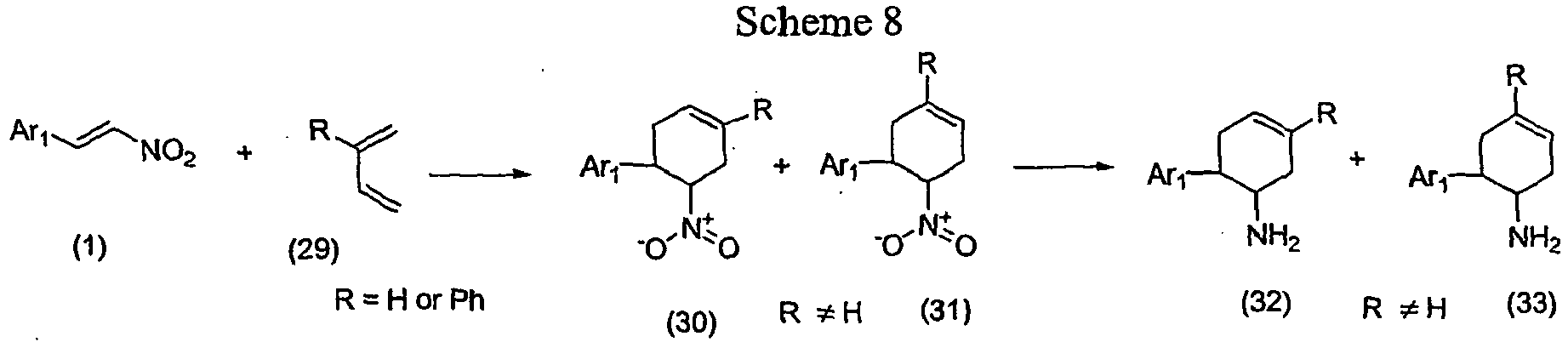
- Compounds of formula (32) and (33) can be synthesized according to Scheme 8. Nitrostyrene (1) and 1,3-butadiene (either substituted or unsubstituted) of formula (29) underwent thermal Diels-Alder reaction to afford regioisomers of cyclohexene (30) and (31) when R # H. The nitro group was then reduced with an appropriate metal, e.g., Zinc, to give the desired products (32) and (33).
- The present invention will now be described in connection with certain preferred embodiments, which are not intended to limit its scope. On the contrary, the present invention covers all alternatives, modifications, and equivalents as can be included within the scope of the claims. Routine experimentation, including appropriate manipulation of the reaction conditions, reagents used and sequence of the synthetic route, protection of any chemical functionality that can not be compatible with the reaction conditions, and deprotection are included in the scope of the invention. Synthesis of the compounds of formula. (I) can be accomplished by methods analogous to those described above and in the following examples. Thus, the following examples, which include preferred embodiments, will illustrate the preferred practice of the present invention, it being understood that the examples are for the purpose of illustration of certain preferred embodiments and are presented to provide what is believed to be the most useful and readily understood description of its procedures and conceptual aspects.
- Compounds of the invention were named by ACD/ChemSketch version 5.06 (developed by Advanced Chemistry Development, Inc., Toronto, ON, Canada) or were given names consistent with ACD nomenclature.
- The compounds and processes of the present invention are better understood by reference to the following examples, which are intended as an illustration of and not a limitation upon the scope of the invention. Further, all citations herein are incorporated by reference.
- A 10 mL solution of 1:11,3-butadiene and toluene stored at -20 °C and 2-chloro-β-nitrostyrene (2.0 g, 11 mmol) were added to a pressure tube and sealed. The solution was heated to 110° C and stirred for three days. The reaction mixture was cooled to room temperature, concentrated, and the residue was crystallized from hexanes to give the title compound. 1H NMR (300 MHz, CDCl3) δ ppm 7.35-7.38 (m, 1H), 7.15-7.29 (m, 3H), 5.71-5.84 (m, 2H), 5.09-5.16 (m, 1H), 4.04-4.13 (m, 1H), 2.76-2.84 (m, 2H), 2.54-2.60 (m, 1H), 2.19-2.28 (m, 1H).
- To a solution of Example 1A (100 mg, 0.042 mmol) in a 2 mL solution of 1:1 aqueous concentrated HCl in methanol at 0° C, Zn dust (32 mg, 0.5 mmol) was added in several portions. The solution was allowed to warm to room temperature over three hours. Afterwards, the solution was carefully basified with saturated NaHCO3. The mixture was extracted with ethyl acetate, concentrated, taken up in dichloromethane, and filtered through Celite. Concentration of the filtrate gave the title compound. 1H NMR (300 MHz, C5D5N) δ ppm 7.41-7.43 (m, 2H), 7.24-7.28 (m, 1H), 7.12-7.14 (m, 1H), 5.70-5.73 (m, 2H), 3.49-3.54 (m, 2H), 2.55-2.58 (m, 1H), 2.37-2.41 (m, 1H), 2.14-2.24 (m, 2H). MS (ESI+) m/z 208 (M+H)+
- A 10 mL solution of 1:1 1,3-butadiene in toluene stored at -20 °C and 2,4-chloro-β-nitrostyrene (2.0 g, 9.6 mmol) were added to a pressure tube and sealed. The solution was heated to 110 °C and stirred for three days. The reaction mixture was cooled to room temperature, concentrated and the residue was crystallized from hexanes to give the title compound. 1H NMR (300 MHz, CDCl3) δ ppm 7.38-7.39 (m, 1H), 7.19-7.23 (m, 2H), 5.71-5.83 (m, 2H), 5.04-5.13 (m, 1H), 3.99-4.08 (m, 1H), 2.72-2.83 (m, 2H), 2.52-2.61 (m, 1H), 2.16-2.25 (m, 1H).
- To a solution of Example 2A (100 mg, 0.037 mmol) in a 2 mL solution of 1:1 aqueous concentrated HCl in methanol at 0 °C, Zn dust (32 mg, 0.5 mmol) was added in several portions. The solution was allowed to warm to room temperature over three hours, after which the solution was carefully basified with saturated NaHCO3. The mixture was extracted with ethyl acetate, concentrated, taken up in dichloromethane, and filtered through Celite. Concentration of the filtrate gave the title compound. 1H NMR (300 MHz, C5D5N) δ ppm 7.48 (s, 1H), 7.31-7.33 (m, 2H), 5.68-5.73 (m, 2H), 3.28-3.37 (m, 2H), 2.45-2.49 (m, 1H), 2.29-2.36 (m, 1H), 2.06-2.13 (m, 2H. MS (ESI+) m/z 243 (M+H)+.
- A 10 mL solution of 1:1 1,3-butadiene in toluene stored at -20 °C and 2-chloro-4-fluoro-β-nitrostyrene (2.0g, 10 mmol) were added to a pressure tube and sealed. The solution was heated to 110 °C and stirred for three days. The reaction mixture was cooled to room temperature, concentrated and the residue was crystallized from hexanes to give the title compound. 1H NMR (300 MHz, CDCl3) δ ppm 7.23-7.28 (m, 1H), 7.11-7.25 (m, 31), 6.94-7.01 (m, 1H), 5.73-5.83 (m, 2H), 5.04-5.13 (m, 1H), 3.99-4.08 (m, 1H), 2.71-2.82 (m, 2H), 2.51-2.61 (m, 1H), 2.15-2.26 (m, 1H).
- To a solution of Example 3A (100 mg, 0.039 mmol) in 2 mL of 1:1 aqueous concentrated HCl in methanol at 0 °C, Zn dust (32 mg, 0.5 mmol) was added in several portions. The solution was allowed to warm to room temperature over three hours, after which the solution was carefully basified with saturated NaHCO3. The mixture was extracted with ethyl acetate, concentrated, taken up in dichloromethane, and filtered through Celite. Concentration of the filtrate gave the title compound. 1H NMR (300 MHz, C5D5N) δ ppm 7.33-7.35 (m, 1H), 7.22-7.28 (m, 1H), 7.06-7.10 (m, 1H), 5.68-5.77 (m, 2H), 3.22-3.37 (m, 2H), 2.43-2.48 (m, 1H), 2.29-2.36 (m, 1H), 2.06-2.14 (m, 2H). MS (ESI+) m/z 227 (M+H)+.
- To benzaldehyde (2.17 g, 20.4 mmol) in 20 mL of ether, 1 M (trimethylsilyl)methyl magnesium chloride solution in ether (28.6 mL) was added at 0 °C. After two hours of stirring at 0 °C, a saturated NH4Cl solution was added and the mixture was extracted with ether (3x). The combined organic extract was dried (Na2SO4), filtered, and concentrated to give the title product (4.12 g).
- Example 4A (4.12 g) in 60 mL of CH2Cl2 was treated with pyridinium dichromate (11.5 g, 1.5 eq.). After one hour of stirring at room temperature, another 3.2 g of pyridinium dichromate was added. After the reaction was done, the mixture was filtered through Celite. The filtrate was concentrated and filtered through a silica gel plug. The filtrate was concentrated again, and the resulting oil was purified by column chromatography (eluting with 5-10% ethyl acetate/hexane) to give the title compound. 1H NMR (500 MHz, CDCl3) δ ppm -0.01 (s, 9 H), 2.67 (s, 2 H), 7.33 - 7.41 (m, 2 H), 7.42 - 7.49 (m, 1 H), 7.79 - 7.85 (m, 2 H).
- Example 4B (422 mg, < 2.3 mmol) in 4.5 mL of ether was cooled to 0 °C. Then, vinyl magnesium bromide solution (1M in tetrahydrofuran, 4.4 mL) was added to the solution. After the reaction was done, a saturated NH4Cl solution was added and the mixture was extracted with ether (3x). The combined organic extracts were dried (Na2SO4), filtered, and concentrated. The resulting oil was purified by column chromatography (eluting with 5-10% ethyl acetate/hexane) to give the title compound (328 mg, 65% two steps). 1H NMR (500 MHz, CDCl3) δ ppm 0.01 (s, 9 H), 1.51 (d, J=14.7 Hz, 1 H), 1.58 (d, J=15 Hz, 1 H), 5.17 (dd, J=10.61, 1.25 Hz, 1 H), 5.35 (dd, J=17.16, 0.94 Hz, 1 H), 6.34 (dd, J=17.16, 10.61 Hz, 1 H), 7.30 - 7.37 (m, 1 H), 7.39 - 7.46 (m, 2 H), 7.53 - 7.59 (m, 2 H).
- Example 4C (409 mg, 1.85 mmol) was mixed in 4 mL of acetic acid saturated with sodium acetate and then heated to 60 °C. After stirring for 45 minutes at 60 °C, the mixture was cooled to room temperature and then added into a mixture of saturated NaHCO3 and ether. The mixture was extracted with ether (3x). The combined organic extract was dried (Na2SO4) filtered, and concentrated to give the title product (167 mg). 1H NMR (300 MHz, CDCl3) δ ppm 5.14 - 5.34 (m, 4 H), 6.62 (dd, J=17.29, 11.19 Hz, 1 H), 7.29 - 7.37 (m, 5 H).
- Example 4D (104 mg, 0.8 mmol), 2-chloro-β-nitrostyrene (124 mg, 0.67 mmol) and 1.2 mL of toluene were mixed in a pressure reaction tube. The tube was heated to 125 °C and stirred for two days. The mixture was cooled to room temperature, concentrated, and then purified by column chromatography (eluting with 10% ethyl acetate/hexanes) to afford the title compounds as a mixture (126 mg, 60%). 1H NMR (400 MHz, CDCl3) δ ppm 2.5 and 2.7 (m, 1 H), 2.75 - 3.07 (m, 2 H), 3.2 - 3.3 and 3.1-3.15 (m, 1 H), 4.07 - 4.35 (m, 1 H), 5.16 - 5.35 (m, 1 H), 6.1 and 6.18 (m, 1 H), 7.16 - 7.29 (m, 3 H), 7.29 - 7.42 (m, 6 H).
- To Example 4E (110 mg, 0.35 mmol), zinc dust (106 mg, 7 eq.) in 2 mL of methanol, 1 mL of 1,4-dioxane, 2 mL of 6N HCl were added. The mixture was then heated to 75 °C. After the reaction was done, the mixture was cooled to room temperature and purified by reverse-phase high pressure liquid chromatography, eluting with 0-70% acetonitrile/water with 0.1% trifluoroacetic acid to give the title products. 1H NMR (300 MHz, methanol-d4) δ ppm 2.40 - 2.61 (m, 1 H), 2.62 - 3.01 (m, 3 H), 3.62 - 3.84 (m, 1 H), 3.91 - 4.11 (m, 1 H), 6.29 and 6.14 (dd, m, 37: 63, 1 H), 7.20 - 7.39 (m, 4 H), 7.39 - 7.47 (m, 3 H), 7.48 - 7.57 (m, 2 H). MS (DCI) m/z 284/286 (M+H)+.
- The title compound was synthesized by substituting 2-chloro-β-nitrostyrene in Example 4E with 2,4-dichloro-β-nitrostyrene as a mixture. 1H NMR (500 MHz, DMSO-d6) δ ppm 2.09 - 2.30 (m, 1 H), 2.32 - 2.49 (m, 1 H), 2.53 - 2.81 (m, 2 H), 3.13 - 3.4 (m, 2 H), 6.17 (d, J=2.18 Hz, 1 H), 7.20 - 7.37 (m, 3.35 H), 7.38 - 7.47 (m, 3 H), 7.47 - 7.55 (m, 1 H), 7.59 (dd, J=3.74, 2.18 Hz, 0.65 H). MS (DCI) m/z 318 (M+H)+.
- 4-Methoxyphenyldiazonium borate (688 mg, 3.1 mmol), 2,5-dihydrothiophene-1,1-dioxide (465 mg, 3.94 mmol), and palladium(II) acetate (20.8 mg, 3 mol%) were mixed in 6 mL of methanol and then heated to reflux. Two additional portions of the diazonium borate (300 mg and 400 mg) along with 20 mg of palladium(II) acetate were added after one hour and five hours, respectively. After stirring overnight at reflux, the reaction mixture was cooled to room temperature, concentrated, and purified by column chromatography (eluting with 40-45% ethyl acetate/hexane) to give the title compound (644 mg). 1H NMR (300 MHz, CDCl3) δ ppm 3.14 (dd, J=13.90, 4.75 Hz, 1 H), 3.69 (dd, J=13.73, 8.65 Hz, 1 H), 3.80 (s, 3 H), 4.25 - 4.35 (m, 1 H), 6.65 - 6.78 (m, 2 H), 6.89 (d, J=8.48 Hz, 2 H), 7.15 (d, J=8.48 Hz, 2 H). MS (DCI) m/z 242 (M+NH4)+.
- Example 6A (617 mg) was mixed with 10 mL of CH2Cl2 and 3.75 mL of triethyl amine and then heated to reflux and stirred for six and a half hours. The mixture was cooled to room temperature and concentrated to give the title compound. 1H NMR (300 MHz, CDCl3) δ ppm 3.83 (s, 3 H), 3.97 - 4.04 (m, 2 H), 4.11 (q, J=1.58 Hz, 2 H), 6.18 - 6.25 (m, J=1.86, 1.86 Hz, I H), 6.91 (d, J=8.82 Hz, 2 H), 7.30 (d, J=8.82 Hz, 2 H).
- Example 6B (258 mg, 1.04 mmol), dihydroquinone (5 mg), and 2-chloro-β-nitrostyrene (136 mg, 0.74 mmol) were mixed in 2 mL of toluene in a pressure reaction tube. The tube was heated at 125 °C overnight. The mixture was cooled to room temperature, concentrated, and then purified by column chromatography (eluting with 10% ethyl acetate/hexane) to give the title compound (178 mg). 1H NMR (300 MHz, CDCl3) δ ppm 2.31 - 2.72 (m, 1 H), 2.71 - 2.87 (m, 0.34 H), 2.87 - 3.03 (m, 2 H), 3.04 - 3.28 (m, 1.66 H), 3.81 and 3.83 (s, 3 H), 4.09 - 4.34 (m, 1 H), 5.13 - 5.36 (m, 1 H), 6.02 and 6.09 (m, 1 H), 6.82 - 6.94 (m, 2 H), 7.16 - 7.44 (m, 6 H). MS (DCI) m/z 361 (M+NH4)+.
- Example 6C (163 mg, 0.47 mmol) and zinc dust (310 mg, 10 eq.) were mixed in 2 mL of 1,4-dioxane. Then 1.5 mL of 6N HCl was added. The mixture was heated to 70 °C and stirred for one hour. The mixture was then cooled to room temperature, poured into a mixture of saturated NaHCO3 and ethyl acetate. The organic layer was separated and the water layer was extracted with ethyl acetate (2x). The combined organic layers were dried (Na2SO4), filtered, and concentrated to give the title compounds. 1H NMR (300 MHz, methanol-d4) δ ppm 2.13 - 2.28 (m, 0.62 H), 2.33 - 2.93 (m, 3.4 H), 3.33 - 3.52 (m, 2 H), 3.79 and 3.77 (s, 3 H), 5.99 - 6.12 (m, 1 H), 6.81- 6.93 (m, 2 H), 7.18 - 7.41 (m, 4 H), 7.40 - 7.50 (m, 2 H). MS (DCI) m/z 314 (M+H)+.
- In a high pressure tube, 2,4-dichloro-β-nitrostyrene (3.14 g, 14.4 mmol) and 2-trimetylsiloxy-1,3-butadiene (5 ml, 28.8 mmol) were dissolved in toluene (10 mL). The tube was sealed and heated to 120 °C for two days. The crude product was obtained after the solvent was removed under reduced pressure.
- To a CH2Cl2 (5 mL) solution of the crude product at room temperature, trifluoroacetic acid (5 mL) was added slowly. The reaction mixture was stirred for ten minutes and then concentrated under reduced pressure to give the crude product as dark brown oil. The residue was chromatographed on a Biotage flash 40 M column eluting with 70% hexane/30% ethyl acetate to afford the title compound (2.54g, 61%). 1H NMR (300 MHz, CDCl3) δ ppm 7.14-7.35 (m, 3H), 5.13 - 5.34 (m, 1H), 4.19 - 4.36 (m, 1H), 2.43 - 2.87 (m, 6H). MS (DCI) m/z 305 (M+NH4)+.
- To a cold solution (0 °C) of CH2Cl2 (30 mL) and N,N-dimethylformamide (2.33 mL, 30 mmol), PBr3 (2.36 mL, 25 mmol) was added slowly. The reaction mixture was stirred at 0 °C for one hour and then Example 7A (2.88 g, 10 mmol) in CH2Cl2 (10 mL) was added dropwise. The reaction was allowed to warm up to room temperature and stirred overnight. It was quenched with ice carefully, basified with solid NaHCO3 until the pH reached 7, and extracted with ethyl acetate (3 x 50 mL). The combined ethyl acetate layers were washed with water and brine, dried over sodium sulfate, filtered, concentrated under reduced pressure, and purified by flash chromatography with 30% ethyl acetate/hexane to provide the title compound (1.3 g, 34%). 1H NMR (300 MHz, CDCl3) δ ppm 10.03 (s, 1H), 7.38 - 7.50 (m, 1H), 7.25 - 7.32 (m, 1H), 7.10 - 7.20 (m, 1H), 5.02 - 5.16 (m, 1H), 4.17 - 4.32 (m, 1H), 2.80 - 3.35 (m, 4H). MS (DCI) m/z 397 (M+H)+.
- To a cold (0 °C) ethanol / 2-propanol (3 mL/3 m) solution of Example 7B (758 mg, 2 mmol) under N2 flow, NaBH4 (80 mg, 2.1 mmol) was added. The reaction mixture was stirred and the temperature was allowed to increase from 0 °C to room temperature over two hours. The solution was treated with saturated NH4Cl, and diluted with ethyl acetate. The organic layer was washed with water and brine, dried over sodium sulfate, and then filtered. The filtrate was concentrated under reduced pressure and then purified by flash chromatography with 30% ethyl acetate/hexane to provide the title compound (642 mg, 84%). 1H NMR (300 MHz, CDCl3) δ ppm 7.39 - 7.51 (m, 1H), 7.26 - 7.32 (m, 1H), 7.11 - 7.22 (m, 1H), 5.04 - 5.20 (m, 1H), 4.31 - 4.45 (m, 2H), 4.14 - 4.27 (m, 1H), 2.59 - 3.32 (m, 4H). MS (DCI) m/z 399 (M+H)+.
- In a high pressure tube, Example 7C (114 mg, 0.3 mmol), phenylboronic acid (44 mg, 0.45 mmol), bis(triphenylphosphine)palladium(II) dichloride (11 mg, 0.015 mmol) and 2N Na2CO3 (0.3 mL, 0.6 mmol) were dissolved in a mixture of 1,2-dimethoxyethane/ethanol/H2O (1.4 mL/0.4 mL/0.6 mL). The tube was sealed, heated to 85 °C and stirred for four hours. The reaction mixture was cooled to room temperature, filtered through Celite, and washed with ethyl acetate. The filtrate was concentrated under reduced pressure and purified by flash chromatography, eluting with 30% ethyl acetate/hexane to provide the title compound (82 mg, 73%). 1H NMR (400 MHz, CDC13) δ ppm 7.09 - 7.51 (m, 8H), 5.15 - 5.31 (m, 1H), 4.12 - 4.28 (m, 1 H), 4.00 - 4.14 (m, 2H), 2.95 - 3.17 (m, 2H), 2.77 - 2.90 (m, 1H), 2.40 - 2.60 (m, 1H). MS (DCI) m/z 395 (M+NH4)+.
- 4-{[trans-4-(2,4-dichlorophenyl)-5-nitro-2-phenylcyclohex-1-en-1-yl]methoxy}benzonitrile In a high pressure tube, Example 7D (52 mg, 0.137 mmol), 4-cyanophenol (21 mg, 0.172 mmol), triphenylphosphine (58 mg, 0.22 mmol) and di-t-butyl azodicarboxylate (51 mg, 0.22 mmol) were dissolved in toluene (1 mL). The stirred tube was sealed and heated to 85 °C overnight. The reaction mixture was cooled to room temperature, concentrated under reduced pressure and purified by flash chromatography (eluting with 30% ethyl acetate/hexane to provide the title compound (45 mg, 68%)). 1H NMR (300 MHz, CDCl3) δ ppm 7.48 - 7.59 (m, 2H), 7.29 - 7.45 (m, 4H), 7.21 - 7.28 (m, 4H), 6.74 - 6.89 (m, 2H), 5.18-5.31 (m, 1H), 4.38 - 4.55 (m, 2H), 4.16 - 4.30 (m, 1H), 3.01 - 3.15 (m, 2H), 2.82 - 2.99 (m, 1H), 2.47 - 2.65 (m, 1H). MS (ESI) m/z 478 (M+H)+:
- To a solution of Example 7B (42 mg, 0.088 mmol) in a mixture of methanol/acetic acid (0.75 mL/0.75 mL), Zn powder (57 mg, 0.88 mmol) was added at room temperature. The reaction mixture was stirred for thirty minutes, filtered, concentrated under reduced pressure and purified by high-pressure liquid chromatography (eluting with 0-70% acetonitrile/water and 0.1% trifluoroacetic acid to provide the title compound (30 mg, 76%)). 1H NMR (400 MHz, CDCl3) δ ppm 7.44 - 7.53 (m, 2H), 7.24 - 7.39 (m, 4H), 7.12 - 7.23 (m, 4H), 6.68 - 6.82 (m, 2H), 4.40 - 4.51 (m, 1H), 4.27 - 4.40 (m, 1H), 2.68 - 2.88 (m, 2H), 2.45 - 2.64 (m, 2H). MS (ESI) m/z 449 (M+H)+.
- In a high pressure tube, Example 7C (485 mg, 1.27 mmol), 3-pyridine boronic acid (233 mg, 1.91 mmol), bis(triphenylphosphine)palladium(II) dichloride (45 mg, 0.064 mmol), and 2N Na2CO3 (1.27 mL, 2.54 mmol) were dissolved in mixture of 1,2-dimethoxyethane/ethanol/H2O (5.6 mL/1.6 mL/2.4 mL). The tube was sealed, heated to 85 °C, and stirred overnight The reaction mixture was cooled to room temperature, filtered through Celite, and washed with ethyl acetate. The filtrate was concentrated under reduced pressure and purified by flash chromatography (eluting with 30% ethyl acetate/hexane) to provide the title compound (310 mg, 64%). 1H NMR (300 MHz, CDCl3) δ ppm 7.28 - 7.74 (m, 7H), 5.16 - 5.30 (m, 1H), 4.11 - 4.31 (m, 1H), 4.01 - 4.10 (m, 2H), 2.98 - 3.21 (m, 2H), 2.73 - 2.88 (m, 1H), 238 - 2.60 (m, 1H). MS (DCI) m/z 379 (M+H)+.
- In a high pressure tube, Example 8A (52 mg, 0.137 mmol), 4-cyanophenol (21 mg, 0.172 mmol), triphenylphosphine (58 mg, 0.22 mmol) and di-t-butyl azodicarboxylate (51 mg, 0.22 mmol) were dissolved in toluene (1 mL). The stirred tube was sealed and heated to 85 °C overnight. The reaction mixture was cooled to room temperature, concentrated under reduced pressure and purified by flash chromatography (eluting with 30% ethyl acetate/hexane) to provide the title compound (43 mg, 68%). 1H NMR (300 MHz, CDCl3) δ ppm 7.61 - 7.76 (m, 2H), 7.35 - 7.61 (m, 7H), 6.78 - 7.00 (m, 2H), 5.22 - 5.35 (m, 1H), 4.35-4.48 (m, 2H), 4.19 - 4.31 (m, 1H), 3.07 - 3.20 (m, 2H), 2.82 - 2.96 (m, 1H), 2.50 - 2.67 (m, 1H). MS (ESI) m/z 480 (M+H)+.
- To a solution of Example 8B (40 mg, 0.083 mmol) in a mixture of methanol/acetic acid (0.5 mL/0.5 mL), Zn powder (54 mg, 0.83 mmol) was added at room temperature. The reaction mixture was stirred for thirty minutes, filtered, concentrated under reduced pressure and purified by high pressure liquid chromotography (eluting with 0-70% acetonitrile/water and 0.1% trifluoroacetic acid) to provide the title compound (20 mg, 53%). 1H NMR (400 MHz, DMSO-d6) δ ppm 7.34 - 7.54 (m, 2H), 6.25 - 6.98 (m, 9H), 5.82 - 5.96 (m, 2H), 5.73-5.83 (m, 1H), 3.30 - 3.47 (m, 1H), 1.28 - 1.80 (m, 4H). MS (ESI) m/z 450 (M+H)+.
- In a high pressure tube, Example 8A (52 mg, 0.137 mmol), 3-hydroxy-benzoic acid methyl ester (27 mg, 0.172 mmol), triphenylphosphine (58 mg, 0.22 mmol) and di-t-butyl azodicarboxylate (51 mg, 0.22 mmol) were dissolved in toluene (1 mL). The stirred tube was sealed and heated to 85° C overnight. The reaction mixture was cooled to room temperature, concentrated under reduced pressure and purified by flash chromatography (eluting with 30% ethyl acetate/hexane) to provide the title compound (39 mg, 56%). 1H NMR (400 MHz, CDCl3) δ ppm 8.41 - 8.73 (m, 2H), 7.14 - 7.75 (m, 8H), 6.95 - 7.10 (m, 1H), 5.18 - 5.35 (m, 1H), 4.36 - 4.51 (m, 2H), 4.19 - 4.33 (m, 1H), 3.87 - 3.92 (m, 3H), 3.04 - 3.18 (m, 2H), 2.79-2.96 (m, 1H), 2.49 - 2.65 (m, 1H). MS (ESI) m/z 513 (M+H)+.
- To a solution of Example 9A (35 mg, 0.068 mmol) in mixture of methanol/acetic acid (0.5 mL/0.5 mL) Zn powder (45 mg, 0.68 mmol) was added at room temperature. The reaction mixture was stirred for thirty minutes, filtered, concentrated under reduced pressure and purified by high-pressure liquid chromotography (eluting with 0-70% acetonitrile/water and 0.1% trifluoroacetic acid) to provide the title compound (25 mg, 76%). 1H NMR (400 MHz, DMSO-d6) δ ppm 8.54 - 8.72 (m, 1H), 7.89 - 8.11 (m, 2H), 6.96 - 7.72 (m, 8H), 4.46-4.58 (m, 2H), 3.80 - 3.87 (m, 4H), 3.59 - 3.72 (m, 1H), 2.53 - 2.88 (m, 4H). MS (ESI) m/z 483 (M+H)+.
- To a high pressure tube, Example 8A (52 mg, 0.137 mmol), 4-hydroxy-pyridine (17 mg, 0.172 mmol), triphenylphosphine (58 mg, 0.22 mmol) and di-t-butyl azodicarboxylate (51 mg, 0.22 mmol) were dissolved in toluene (1 mL). The stirred tube was sealed and heated to 85° C overnight. The reaction mixture was cooled to room temperature, concentrated under reduced pressure and purified by flash chromatography(eluting with 30% ethyl acetate/hexane) to provide the title compound (30 mg, 48%). 1H NMR (400 MHz, CDCl3) δ ppm 8.49 - 8.81 (m, 4H), 7.68 - 7.84 (m, 1H), 7.40 - 7.61 (m, 2H), 7.11 - 7.35 (m, 4H), 5.21 - 5.41 (m, 1H), 4.60 - 4.76 (m, 2H), 4.21 - 4.37 (m, 1H), 2.84 - 3.29 (m, 4H). MS (ESI) m/z 456 (M+H)+.
- To a solution of Example 10A (25 mg, 0.055 mmol) in mixture of methanol/acetic acid (0.5 mL/0.5 mL), Zn powder (36 mg, 0.55 mmol) was added at room temperature. The reaction mixture was stirred for thirty minutes, filtered, concentrated under reduced pressure, and purified by high pressure liquid chromotography(eluting with 0-70% acetonitrile/water and 0.1% trifluoroacetic acid) to provide the title compound 9 (15 mg, 64%). 1H NMR (400 MHz, DMSO-d6) δ ppm 8.46 - 8.81 (m, 3H), 7.35 - 8.25 (m, 8H), 4.64 - 4.83 (m, 2H), 3.57-3.75 (m, 2H), 2.50 - 2.9.7 (m, 4H). MS (ESI) mlz 426 (M+H)+.
- In a well stirred high pressure tube, Example 7C (380 mg, 1.06 mmol), formic acid (0.08 mL, 2.12 mmol), bis(triphenylphosphine)palladium(II) dichloride (38 mg, 0.053 mmol) and tributylamine (0.76 mL, 3.18 mmol) were dissolved in N,N-dimethylformamide (2 mL). The stirred tube was sealed and heated to 80° C overnight. The reaction mixture was cooled to room temperature, filtered through Celite and then extracted with ethyl acetate. The combined ethyl acetate solution was washed with water and brine, dried over sodium sulfate, filtered, concentrated under reduced pressure and purified by flash chromatography (eluting with 30% ethyl acetate/hexane) to provide the title compound (210 mg, 80%). 1H NMR (300 MHz, CDCl3) δ ppm 7.35 - 7.46 (m, 1H), 7.13 - 7.30 (m, 2H), 5.75 - 5.88 (m, 1H), 5.03-5.18 (m, 1H), 4.08 - 4.20 (m, 2H), 3.98 - 4.09 (m, 1H), 2.51 - 3.04 (m, 4H). MS (DCI) m/z 319 (M+NH3)+.
- To a cold (0°C) CH2Cl2 (1 mL) solution of Example 11A (61 mg, 0.2 mmol), methanesulfonyl chloride (0.017 mL, 0.22 mmol) and triethylamine (0.035 mL, 0.25 mmol) were added. After it was stirred at 0° C for five minutes, more triethylamine (0.035 mL, 0.25 mmol) and ethyl isonipecotate (0.037 mL, 0.24 mmol) were added to the reaction mixture. The reaction was stirred from 0° C to room temperature overnight, was diluted with CH2Cl2, washed with water and brine, dried over sodium sulfate, filtered, concentrated under reduced pressure and purified by high pressure liquid chromotography(eluting with 0-70% acetonitrile/water and 0.1% trifluoroacetic acid) to provide the title compound (65 mg, 73%). 1H NMR (300 MHz, CDCl3) δ ppm 7.35 - 7.42 (m, 1H), 7.16 - 7.25 (m, 2H), 5.64 - 5.80 (m, 1H), 4.99 - 5.15 (m, 1H), 4.08 - 4.21 (m, 2H), 3 .93 - 4.07 (m, 1H), 2.11 - 3.05 (m, 11H), 1.74 - 2.01 (m, 4H), 1.19 - 1.32 (m, 3H). MS (ESI) m/z 441 (M+H)+.
- To a solution of Example 11B (60 mg, 0.136 mmol) in mixture of methanol/acetic acid (0.5 mL/0.5 mL), Zn powder (89 mg, 1.36 mmol) was added at room temperature. The reaction mixture was stirred for thirty minutes, filtered, concentrated under reduced pressure and purified by high pressure liquid chromotography(eluting with 0-70% acetonitrile/water and 0.1% trifluoroacetic acid) to provide the title compound (50 mg, 89%). 1H NMR (400 MHz, DMSO-d6) δ ppm 7.85 - 8.03 (m, 3H), 7.66 (s, 1H), 7.46 - 7.61 (m, 2H), 5.97 - 6.16 (m, 1H), 4.02 - 4.22 (m, 2H), 3.65 - 3.95 (m, 3H), 2.82 - 3.04 (m, 2H), 1.68 - 2.69 (m, 13H), 1.12 - 1.29 (m, 3H). MS (ESI) m/z 411 (M+H)+.
- To a solution of Example 11C (36 mg, 0.088 mmol) in mixture of tetrahydrofuran/H2O (0.3 mL/0.15 mL), LiOH (23 mg, 0.53 mmol) was added at room temperature. The reaction mixture was stirred overnight. It was acidified with 2N HCl in ether until pH=3 and purified by high pressure liquid chromotography(eluting with 0-70% acetonitrile/water and 0.1% trifluoroacetic acid) to provide the title compound (25 mg, 75%). 1H NMR (500 MHz, DMSO-d6) δ ppm 7.90 - 8.07 (m, 3H), 7.67 (s, 1H), 7.47 - 7.58 (m, 2H), 6.01 - 6.14 (m, 1H), 3.66 - 3.96 (m, 2H), 2.57 - 3.04 (m, 4H), 1.65 - 2.46 (m, 9H). MS (ESI) m/z 383 (M+H)+.
- To a cold (0 °C) CH2Cl2 (20 mL) solution of Example 11A (1.56 g, 5.17 mmol), methanesulfonyl chloride (0.49 mL, 6.2 mmol) and triethylamine (1.8 mL, 12.91 mmol) were added. The reaction mixture was stirred from 0° C to room temperature overnight. It was diluted with CH2Cl2, washed with water and brine, dried over sodium sulfate, filtered, and concentrated under reduced pressure to provide the crude title compound. MS (DSI) m/z 397 (M+NH4)+.
- To a solution of crude Example 12A (5.17 mmol) in N,N-dimethylformamide (20 mL) NaN3 (3.36 g, 51.7 mmol) was added. The reaction mixture was stirred at room temperature overnight. It was diluted with ethyl acetate, washed with water and brine, dried over sodium sulfate, filtered, concentrated under reduced pressure, and purified by flash chromatography (eluting with 30% ethyl acetate/hexane) to provide the title compound (1.04 g, 62% for two steps). 1H NMR (500 MHz, CDCl3) δ ppm 7.40 (s, 1H), 7.16 - 7.29 (m, 2H), 5.86 (m, 1H), 5.05 - 5.17 (m, 1H), 3.99 - 4.11 (m, 1H), 3.71 - 3.89 (m, 2H), 2.57 - 2.90 (m, 4H). MS (DCI) m/z 344 (M+NH4)+.
- To a solution of Example 12B (700 mg, 2.14 mmol) in mixture of tetrahydrofuran/H2O (15 mL/1.5 mL), triphenylphosphine (1.12 mg, 4.28 mmol) was added at room temperature. The reaction mixture was heated to 65 °C for five hours. It was cooled to room temperature, concentrated under reduced pressure, azeotroped with toluene, and purified by flash chromatography (eluting with 10% methanol/ CH2Cl2) to provide the title compound. 1H NMR (500 MHz, methanol-d4) δ ppm 7.41 - 7.48 (m, 2H), 7.28 - 7.35 (m, 1H), 5.72 (m, 1H), 5.26 - 5.38 (m, 1H), 3.93 - 4.04 (m, 1H), 3.17 - 3.42 (m, 4H), 2.72 - 2.84 (m, 2H). MS (DCI) m/z 301 (M+H)+.
- To a solution of Example 12C (33 mg, 0.11 mmol) in CH2Cl2 (1 mL), 3-chloro-4-methanesulfonyl-thiophene-2-carbonyl chloride (43 mg, 0.16 mmol) and diisopropylethyl amine (0.05 mL, 0.33 mmol) were added. The reaction mixture was stirred at room temperature overnight. It was concentrated under reduced pressure and purified by high pressure liquid chromotography(eluting with 0-70% acetonitrile/water and 0.1% trifluoroacetic acid) to provide the title compound (48 mg, 84%). 1H NMR (300 MHz, CDCl3) δ ppm 8.39 (s, 1H), 8.19 (s, 1H), 7.40 (s, 1H), 7.17 - 7.25 (m, 2H), 5.82 (m, 1H), 5.04 - 5.17 (m, 1H), 3.98 - 4.19 (m, 3H), 3.18 - 3.21 (m, 3H), 2.51 - 2.95 (m, 3H), 2.16 - 2.35 (m, 1H). MS (ESI) m/z 523 (M+H)+.
- To a solution of Example 12D (40 mg, 0.077 mmol) in mixture of methanol/acetic acid (0.5 mL/0.5 mL), Zn powder (50 mg, 0.77 mmol) was added at room temperature. The reaction mixture was stirred for thirty minutes, filtered, concentrated under reduced pressure, and purified by high pressure liquid chromotography(eluting with 0-70% acetonitrile/water and 0.1% trifluoroacetic acid) to provide the title compound (25 mg, 66%). 1H NMR (400 MHz, methanol-d4) δ ppm 8.45 (s, 1H), 8.03 (s, 1H), 7.54 (s, 1H), 7.35 - 7.47 (m, 2H), 5.82 (m, 1H), 3.82 - 4.06 (m, 3H), 3.49 - 3.61 (m, 1H), 3.18 (s, 3H), 2.43 - 2.62 (m, 2H), 2.24 - 2.42 (m, 2H). MS (ESI) m/z 493 (M+H)+.
- To a solution of Example 12C (33 mg, 0.11 mmol) in CH2Cl2 (1 mL), 5-bromo-nictinoyl chloride (37 mg, 0.16 mmol) and diisopropylethyl amine (0.05 mL, 0.33 mmol) were added. The reaction mixture was stirred at room temperature overnight. It was concentrated under reduced pressure and purified by high pressure liquid chromatography (eluting with 0-70% acetonitrile/water and 0.1% trifluoroacetic acid) to provide the title compound (38 mg, 71%). 1H NMR (300 MHz, CDCl3) δ ppm 9.13 (s, 1H), 8.85 (s, 1H), 8.54 (s, 1H), 8.45 (s, 1H), 7.40 (s, 1H), 7.16 - 7.25 (m, 2H), 5.82 (m, 1H), 5.03 - 5.18 (m, 1H), 4.00 - 4.21 (m, 3H), 2.51 - 2.98 (m, 4H). MS (ESI) m/z 486 (M+H)+.
- To a solution of Example 12D (35 mg, 0.072 mmol) in mixture of methanol/acetic acid (0.5 mL/0.5 mL), Zn powder (47 mg, 0.72 mmol) was added at room temperature. The reaction mixture was stirred for thirty minutes, filtered, concentrated under reduced pressure, and purified by high pressure liquid chromotography (eluting with 0-70% acetonitrile/water and 0.1% trifluoroacetic acid) to provide the title compound (30 mg, 91%). 1H NMR (400 MHz, MEOH-D4) δ ppm 8.96 (s, 1H), 8.83 (s, 1H), 8.42 (s, 1H), 754 (s, 1H), 7.36 - 7.50 (m, 2H), 5.83 (m, 1H), 3.97 - 4.01 (m, 2H), 3.82 - 3.95 (m, 1H), 3.48 - 3.64 (m, 1H), 2.45 - 2.62 (m, 2H), 2.25 - 2.41 (m, 2H). MS (ESI) m/z 456 (M+H)+.
- To a solution of Example 9B (18 mg, 0.037 mmol) in mixture of tetrahydrofuran/H2O (0.5 mL/0.25 mL), LiOH (9.4 mg, 0.22 mmol) was added at room temperature. The reaction mixture was stirred overnight. It was acidified with 2N HCl in ether until the pH=3 and purified by reverse-phase high pressure liquid chromotography (eluting with 0-70% acetonitrile/water and 0.1% trifluoroacetic acid) to provide the title compound (14 mg, 80%). 1H NMR (500 MHz, methanol-d4) δ ppm 8.65 - 8.76 (m, 2H), 8.25 - 8.33 (m, 1H), 7.81 - 7.91 (m, 1H), 7.48 - 7.65 (m, 3H), 7.30 - 7.44 (m, 3H), 7.01 - 7.10 (m, 1H), 4.48 - 4.59 (m, 2H), 4.00 - 4.12 (m, 1H), 3.74 3.87 (m, 1H), 2.60 - 3.02 (m, 4H). MS (ESI) m/z 469 (M+H)+.
- To a solution of Example 12C (33 mg, 0.11 mmol) in CH2Cl2 (1 mL), 4-chlorocarbonyl-benzoic acid methyl ester (33 mg, 0.16 mmol) and diisopropylethyl amine (0.05 mL, 0.33 mmol) were added. The reaction mixture was stirred at room temperature overnight. It was concentrated under reduced pressure and purified by high pressure liquid chromotography(eluting with 0-70% acetonitrile/water and 0.1% trifluoroacetic acid) to provide the title compound (41 mg, 81%). 1H NMR (500 MHz, CDCL3) δ ppm 8.06 - 8.10 (m, 2H), 7.86 - 7.92 (m, 2H), 7.37 - 7.41 (m, 1H), 7.15 - 7.26 (m, 2H), 5.73 - 5.82 (m, 1H), 5.02 - 5.13 (m, 1H), 4.01 - 4.13 (m, 3H), 2.50 - 2.95 (m, 3H). MS (ESI) m/z 463 (M+H)+.
- To a solution of Example 15A (35 mg, 0.076 mmol) in mixture of methanol/acetic acid (0.5 mL/0.5 mL), Zn powder (49 mg, 0.76 mmol) was added at room temperature. The reaction mixture was stirred for 30 minutes, filtered, concentrated under reduced pressure and purified by high pressure liquid chromotography (eluting with 0-70% acetonitrile/water and 0.1% trifluoroacetic acid) to provide the title compound (10 mg, 32%). 1H NMR (300 MHz, methanol-d4) δ ppm 8.06 - 8.16 (m, 2H), 7.88 - 7.97 (m, 2H), 7.52 - 7.59 (m, 1H), 7.37 - 7.49 (m, 2H), 7.10 - 7.24 (m, 1H), 5.78 - 5.87 (m, 1H), 3.97 - 4.06 (m, 2H), 3.83 - 3.95 (m, 1H), 3.49 - 3.62 (m, 1H), 2.25 - 2.61 (m, 4H). MS (BSI) m/z 419 (M+H)+.
- To a cold (0 °C) CH2Cl2 (1 mL) solution of Example 11A (61 mg, 0.2 mmol), methanesulfonyl chloride (0.017 mL, 0.22 mmol) and triethylamine (0.035 mL, 0.25 mmol) were added. After it was stirred at 0° C for five minutes, more triethylamine (0.035 mL, 0.25 mmol) and piperidin-4-ol (25 mg, 0.24 mmol) were added to the reaction mixture. The reaction was allowed to warm from 0° C to room temperature overnight. It was diluted with CH2Cl2, washed with water and brine, dried over sodium sulfate, filtered, concentrated under reduced pressure and purified by high pressure liquid chromatography (eluting with 0-70% acetonitrile/water and 0.1% trifluoroacetic acid) to provide the title compound (54 mg, 69%). MS (DCI) m/z 386 (M+H)+.
- To a solution of Example 16A (50 mg, 0.13 mmol) in mixture of methanol/acetic acid (0.5 mL/0.5 mL), Zn powder (85 mg, 1.3 mmol) was added at room temperature. The reaction mixture was stirred for thirty minutes, filtered, concentrated under reduced pressure and purified by high pressure liquid chromotography (eluting with 0-70% acetonitrile/water and 0.1% trifluoroacetic acid) to provide the title compound (35 mg, 76%). 1H NMR (300 MHz, methanol-d4) δ ppm 7.54 - 7.61 (m, 1H), 7.39 - 7.49 (m, 2H), 6.14 - 6.34 (m, 1H), 3.89 - 4.02 (m, 1H), 3.73 - 3.84 (m, 1H), 3.51 - 3.69 (m, 1H), 2.36 - 3.13 (m, 3H), 1.91 - 2.19 (m, 1H). MS (ESI) m/z 356 (M+H)+.
- To a cold (0 °C) CH2Cl2 (1 mL) solution of Example 11A (141 mg, 0.47 mmol), methanesulfonyl chloride (0.041 mL, 0.57 mmol) and triethylamine (0.173 mL, 1:23 mmol) were added. After it was stirred at 0° C for five minutes, more triethylamine (0.080 mL, 0.571 mmol) and (S)-(+)-ethyl nipecotate (94 mg, 1.2 mmol) were added to the reaction mixture. It was stirred from 0 °C to room temperature overnight. It was diluted with CH2Cl2, washed with water and brine, dried over sodium sulfate, filtered, concentrated under reduced pressure, and purified by high pressure liquid chromotography (eluting with 0-70% acetonitrile/water and 0.1% trifluoroacetic acid) to provide the title compound (115 mg, 55%). 1H NMR (400 MHz, CDCl3) δ ppm 7.40 (d, 1H), 7.23-7.20 (m, 2H), 5.75-5.65 (m, 1H), 5.15-5.00 (m, 1H), 4.20-4.10 (m, 2H), 4.08-3.95 (m, 1H), 3.01-2.83 (m, 2H), 2.77-2.63 (m, 2H), 2.63-2.50 (m, 4H), 2.30-2.10 (m, 3H), 2.10-1.95 (m, 1H), 1.95-1.85 (m, 1H), 1.80-1.70 (m, 1H), 1.23 (t, 3H). MS (DCI) m/z 441 (M+H)+.
- To a solution of Example 17A (75 mg, 0.16 mmol) in a mixture of methanol/acetic acid (1.0 mL/1.0 mL), Zn powder (170 mg, 2.60 mmol) was added at room temperature. The reaction mixture was stirred for thirty minutes, filtered, concentrated under reduced pressure and purified by high pressure liquid chromotography (eluting with 0-70% acetonitrile/water and 0.1% trifluoroacetic acid) to provide the title compound (60 mg, 86%). MS (DCI) m/z 411 (M+H)+.
- To a solution of Example 17B (55 mg, 0.13 mmol) in a mixture of tetrahydrofuran/H2O (1.0 mL/0.5 mL), LiOH (19 mg, 0.80 mmol) was added at room temperature. The reaction mixture was stirred overnight. It was acidified with 2N·HCl in ether until pH=3 and purified by high pressure liquid chromotography (eluting with 0-70% acetonitrile/water and 0.1% trifluoroacetic acid) to provide the title compound (32 mg, 63%). 1H NMR (400 MHz, methanol-d4) δ ppm 7.78 (s, 1H), 7.55-7.52 (m, 1H), 7.42-7.38 (m, 1H), 6.21 (s, 1H), 4.0-3.90 (m, 1H) 3.85-3.70 (m, 2H), 3.65-3.50 (m, 1H), 3.20-2.8 (m, 3H), 2.75-2.55 (m, 3H), 2.50-2.40 (m, 3H), 2.35-2.20 (m, 2H), 2.05-1.85 (m, 2H). MS (APCI) m/z 383 (M+H)+.
- To a cold (0 °C) CH2Cl2 (3 mL) solution of Example 11A (150 mg, 0.50 mmol), methanesulfonyl chloride (0.043 mL, 0.58 mmol) and triethylamine (0.173 mL, 1.23 mmol) were added. After it was stirred at 0° C for five minutes, more triethylamine (0.080 mL, 0.571 mmol) and (R)-(+)-ethyl nipecotate (94 mg, 1.2 mmol) were added to the reaction mixture. It was stirred and allowed to warm from 0° C to room temperature overnight. It was diluted with CH2Cl2, washed with water and brine, dried over sodium sulfate, filtered, concentrated under reduced pressure and purified by high pressure liquid chromatography (eluting with 0-70% acetonitrile/water and 0.1% trifluoroacetic acid) to provide the title compound (125 mg, 57%). 1H NMR (400 MHz, CDCl3) δ ppm 7.39 (d, 1H), 7.23-7.21 (m, 2H), 5.70-5.60 (m, 1H), 5.15-5.00 (m, 1H), 4.20-4.11 (m, 2H), 4.05-3.95 (m, 1H), 3.00-2.80 (m, 2H), 2.75-2.65 (m, 2H), 2.65-2.50 (m, 4H), 2.30-2.15 (m, 3H), 2.10-1.95 (m, 1H), 1.95-1.85 (m, 1H), 1.80-1.70 (m, 1H), 1.27 (t, 3H). MS (DCI) m/z 441 (M+H)+.
- To a solution of Example 18A (100 mg, 0.24 mmol) in a mixture of methanol/acetic acid (1.0 mL/1.0 mL), Zn powder (170 mg, 2.6 mmol) was added at room temperature. The reaction mixture was stirred for 30 minutes, filtered, concentrated under reduced pressure and purified by high pressure liquid chromatography (eluting with 0-70% acetonitrile/water and 0.1% trifluoroacetic acid) to provide the title compound (78 mg, 78%). 1H NMR (400 MHz, methanol-d4) δ ppm 7.62 (br s, 1H), 7.51 (br s, 1H), 7.39 (br s, 1H), 6.30-6.20 (m, 1H), 4.21 (q, 2H); 3.95-3.85 (m, 1H), 3.8-3.5 (m, 4H), 3.15-2.80 (m, 4H), 2.75 -2.40 (m, 3H), 2.35-2.20 (m, 2H), 2.10-1.90 (m, 2H), 1.65-1.50 (m, 1H), 1.30 (t, 3H). MS (DCI) m/z 411 (M+H)+.
- To a solution of Example 18B (71 mg, 0.13 mmol) in mixture of tetrahydrofuran/H2O (1.0 mL/0.5 mL), LiOH (25 mg, 1.03 mmol) was added at room temperature. The reaction mixture was stirred overnight. It was acidified with 2N HCl in ether until pH=3 and purified by high pressure liquid chromotography (eluting with 0-70% acetonitrile/water and 0.1% trifluoroacetic acid) to provide the title compound (35 mg, 53%). 1H NMR (400 MHz, methanol-d4) δ ppm 7.78 (s, 1H), 7.55-7.52 (m, 1H), 7.42-7.38 (m, 1H), 6.20 (s, 1H), 4.05-3.85 (m, 1H) 3.82-3.70 (m, 2H), 3.63-3.48 (m, 1H), 3.20-2.8 (m, 3H), 2.75-2.55 (m, 3H), 2.50-2.40 (m, 3H), 2.35-2.20 (m, 2H), 2.07-1.89 (m, 2H). MS (APCI) m/z 383 (M+H)+.
- 2,4,5-Trifluoro-β-nitrostyrene (7.8 g, 38.4 mmol) and 2-trimethylsiloxy-1,3-butadiene (8.18g, 57.6 mmol) were mixed in toluene (10 ml). The reaction was heated to 120° C overnight. The reaction mixture was cooled to room temperature, concentrated and treated with trifluoroacetic acid (10 mL) and CH2Cl2 (10 mL) at 0 °C. It was stirred for 30 minutes, then saturated NaHCO3 was added to adjust pH (∼7). The mixture was extracted with ethyl acetate (3x) and the combined organic extracts were washed with water and brine, and then concentrated. A minimum amount of methylene chloride was added to the residue to induce crystallization. The crystals were collected by filtration and the mother liquid was subjected to column chromatography (eluting with 25 % ethyl acetate/hexane). The recrystallized and chromatographed material was combined to yield the title compound (7.0, 70%). 1H NMR (300 MHz, CDCl3) δ ppm 2.29 - 2.82 (m, 6 H), 3.73 - 3.89 (m, 1 H), 5.06 - 5.29 (m, 1 H), 6.86 - 7.12 (m, 2 H). MS (ESI) m/z 274 (M+H)+.
- PBr3 (4.56 mL, 48 mmol) was added to a cold solution (0 °C) of N,N-dimethylformamide (4.5 ml, 58.2 mmol) in CH2Cl2 (45 ml). The mixture was stirred at 0°C for one hour and then Example 19A (5.3 g, 19.4 mmol) was added. The reaction was stirred at room temperature overnight. The mixture was cooled to 0 °C and saturated NaHCO3 was added. It was then extracted by CH2Cl2 (3X) and washed with brine. The organic layer was combined, concentrated and subjected to column chromatography (eluting with 20 % ethyl acetate/hexane) to yield the title compound: 2.9 g (41%). 1H NMR (300 MHz, CDCl3) δ ppm 2.93 - 3.35 (m, 4 H), 3.68 - 4.00 (m, J=6.10 Hz, 1 H), 4.85 - 5.23 (m, 1 H), 6.83 - 7.14 (m, 2 H), 10.02 (s, 1 H). MS (ESI) m/z 364, 366 (M+H)+.
- To Example 19B (2 g, 5.5 mmol) in CH2Cl2 (12 mL), sodium triacetoxyborohydride (3.5 g, 16.5 mmol) was added. After stirring overnight, the reaction mixture was diluted with ethyl acetate (50 mL) and saturated NaHCO3 was added. The mixture was extracted with ethyl acetate (3X). The combined organic extracts were dried over Na2SO4, concentrated and purified by flash chromatography (eluting with 25 % ethyl acetate in hexane) to yield the title compound (1.56 g, 78 %). 1H NMR (300 MHz, CDCl3) δ ppm 2.68 - 3.14 (m, 4 H), 3.62-3.91 (m, 1 H), 4.36 (s, 2 H), 4.97 - 5.21 (m, 1 H), 6.84 - 7.10 (m, 2 H). MS (ESI) m/z 366, 368 (M+H)+.
- Example 19C (2.3 g, 6.4 mmol) was dissolved in N,N-dimethylformamide (5 mL). Tributyl amine (4.6 mL, 19.3 mmol) was added followed by HCOOH (0.6 mL, 12.8mmol). Bis(triphenylphosphine)palladium(II) dichloride (23 mg, 0.03 mmol) was added and the reaction was heated to 80° C for overnight. The mixture was cooled to room temperature, filtered, concentrated, and subjected to column chromatography (eluting with 50 % ethyl acetate/hexane) to obtain the title compound (1 g, 60 %). 1H NMR (300 MHz, CDCl3) δ ppm 2.24 - 2.62 (m, 2 H), 2.71 - 2.84 (m, 3 H), 3.41 - 3.73 (m, 1 H), 4.96 - 5.21 (m, 1 H), 5.80 (d, J=2.37 Hz, 1 H), 5.81 (s, 1 H), 6.82 - 7.12 (m, 2 H). MS (ESI) m/z 288 (M+H)+.
- Example 19D (270 mg, 0.94 mmol) and triethyl amine (0.33 mL, 2.35 mmol) were mixed in CH2Cl2 (2 mL). The mixture was cooled to 0°C and methanesulfonyl chloride (0.087 mL, 1.18 mmol) was added. It was allowed to warm to room temperature and stirred for one hour. The mixture was concentrated and subjected to column chromatography (eluting with 40 % ethyl acetate/hexane) to obtain the title compound (280 mg, 82 %). 1H NMR (300 MHz, CDCl3) δ ppm 2.41 - 2.65 (m, 2 H), 2.75 - 2.92 (m, 2 H), 3.06 (s, 3 H), 3.50 - 3.71 (m, 1 H), 4.68 (s, 2 H), 4.95 - 5.13 (m, 1 H), 6.01 (s, 1 H), 6.83 - 7.12 (m, 2 H). MS (ESI) m/z 366 (M+H)+.
- Example 19E (66mg, 0.18 mmol), 3-trifluoromethyl-5,6,7,8-tetrahydro-[1,2,4]triazolo[4,3-a]pyrazine (prepared as described in D. Kim et al, J. Med. Chem. 2005, 48, 141-151). 41.6 mg, 0.216 mmol), and triethyl amine (62.6 mL, 0.45 µmol) were mixed in 1 mL of methylene chloride and stirred for two days. The mixture was then purified by flash chromatography (eluting with 60-70% ethyl acetate/hexane) to give the desired nitro amine.
- The intermediate from step A (18.4 mg), zinc dust (60 mg) was mixed in 0.8 mL each of acetic acid and methanol and then heated to 75°C for two hours. The mixture was cooled to room temperature, and filtered through Celite. The filtrate was concentrated and then purified by reverse-phase high pressure liquid chromatography (eluting with 0-70% acetonitrile/water and 0.1% trifluoroacetic acid) to give the title compound. 1H NMR (400 MHz, methanol-d4) δ ppm 2.23 - 2.36 (m, 1 H), 2.46 - 2.55 (m, J=4.60 Hz, 2 H), 2.68 (dd, J=17.34, 4.76 Hz, 1 H), 3.03 (t, J=5.52 Hz, 2 H), 3.24 - 3.29 (m, 3 H), 3.76 - 3.86 (m, 1 H), 3.89 (s, 2 H), 4.24 (t, J=5.37 Hz, 2 H), 5.90 (s, 1 H), 7.19 - 7.29 (m, 1 H), 7.35 - 7.46 (m, 1 H).). MS (ESI) m/z 432 (M+H)+.
- Example 19C (2.5 g, 6.87 mmol) was dissolved in methanol (5 mL). Acetic acid (5 mL) and zinc (3.57 g, 8 eq.) were added. The reaction mixture was heated to 80°C for two hours, cooled to room temperature, and filtered. The filtrate was washed with ammonium hydroxide. The mixture was extracted with ethyl acetate (3x). The combined organic extracts were dried over Na2SO4, and concentrated. The concentrate was dissolved in tetrahydrofuran (10 mL), and di-tert-butyl dicarbonate (1.43 g, 1.1 eq.) was added. After thirty minutes, the reaction mixture was concentrated and subjected to column chromatography (eluting with 20 % ethyl acetate/hexane) to give the title compound (2.54 g, 85% for 2 steps). 1H NMR (500 MHz, CDCl3) δ ppm 1.23 - 1.46 (s, 9 H), 2.15 - 2.32 (m, 1 H), 2.61 - 2.91 (m, 3 H), 3.30 (d, J=5.80 Hz, 1 H), 4.07 (s, 1 H), 4.20 - 4.44 (m, 3 H), 6.81 - 6.97 (m, 1 H), 7.11 (s, 1 H). MS (ESI) m/z 436, 438 (M+H)+.
- Example 20A (2.8 g, 6.4 mmol) was dissolved in N,N-dimethylformamide (5 mL). Tributyl amine (4.6 mL, 19.3 mmol) was added followed by HCOOH (0.6 mL, 12.8mmol). Bis(triphenylphosphine)palladium(II) dichloride (23 mg, 0.03 mmol) was added and the reaction was heated to 80° C for overnight. The mixture was cooled to room temperature, filtered, concentrated and subjected to column chromatography (eluting with 25 % ethyl acetate/hexane) to give the title compound (1.6 g, 70 %). 1H NMR (300 MHz, CDCl3) δ ppm 1.21 - 1.43 (s, 9 H), 1.91 - 2.21 (m, 2 H), 2.24 - 2.56 (m, 3 H), 2.94 - 3.19 (m, 1 H), 3.97 - 4.04 (m, 2 H), 5.74 (s, 1 H), 6.76 - 6.99 (m, 1 H), 7.04 - 7.22 (m, J=1.00 Hz, 1 H). MS (ESI) m/z 358 (M+H)+.
- Example 20B (2 g, 5.6 mmol) and Dess-Martin periodinane (3.3 g, 8.4 mmol) were mixed in CH2Cl2 (10 mL). It was stirred for two hours. The mixture was filtered, concentrated, and subjected to column chromatography (eluting with 20 % ethyl acetate/hexane) to obtain the title compound (1.6 g, 81%). 1H NMR (500 MHz, DMSO-d6) δ ppm 1.14 - 1.28 (m, 9 H), 2.05 - 2.15 (m, 1 H), 2.57 - 2.73 (m, 2 H), 3.02 - 3.12 (m, J=7.02 Hz, 1 H), 3.22 (d, J=7.02 Hz, 1 H), 3.76 - 3.93 (m, J=5.49 Hz, 1 H), 6.84 (d, J=9.46 Hz, 1 H), 6.98 (s, 1 H), 7.27 - 7.64 (m, 2 H), 9.48 (s, 1 H). MS (ESI) m/z 356 (M+H)+.
- Example 20C (50 mg, 0.14 mmol) and N-acylpiperizine (0.17mmol) were mixed in 1 mL each of methanol and methanol buffer (pH = 4, sodium acetate: acetic acid, 1:1). The mixture was stirred for 0.5 hours and NaCNBH3 (25 mg, 0.19 mmol) was added. The mixture was stirred for two hours, filtered, and purified by reverse phase high pressure liquid chromatography (eluting with 0% to 70% acetonitrile/ 0.1% aqueous trifluoroacetic acid).
- The intermediate from step A (50 mg) was treated with trifluoroacetic acid/CH2Cl2 (1mL:1mL) and stirred for one hour. The product was purified by reverse phase high pressure liquid chromatography (eluting with 0% to 70% acetonitrile/ 0.1% aqueous trifluoroacetic acid). 1H NMR (500 MHz, methanol-d4) δ ppm 2.16 (s, 3 H), 2.34 - 2.52 (m, 1 H), 2.51 - 2.64 (m, 2 H), 2.72 (dd, J=16.78, 5.19 Hz, 1 H), 3.28 - 3.43 (m, 6 H), 3.72 - 3.94 (m, 5 H), 6.17 (s, 1 H), 7.20 - 7.31 (m, 1 H), 7.34 - 7.46 (m, 1 H). MS (ESI) m/z 368 (M+H)+.
- The title compound was synthesized using the procedure as described in Example 19F by substituting 1,2,3,4-tetrahydroisoquinoline for 3-trifluoromethyl-5,6,7,8-tetrahydro-[1,2,4]triazolo[4,3-a]pyrazine. 1H NMR (400MHz, methanol-d4) δ ppm 2.44 - 2.55 (m, 1 H), 2.61 (br s, 2 H), 2.75 (dd, J=16.88, 4.91 Hz, 1 H), 3.24 (br s, 2 H), 3.32 - 3.40 (m, 1 H), 3.6 (very br s, 2H), 3.86 - 3.92 (m, 1 H), 3.95 (s, 2 H), 4.44 (br s, 2 H), 6.22 (s, 1 H), 7.20 - 7.36 (m, 5 H), 7.38 - 7.46 (m, 1 H). MS (ESI) m/z 373 (M+H)+.
- The title compound was synthesized using the procedure as described in Example 20D by substituting aniline for N-acylpiperizine. 1H NMR (400 MHz, methanol-d4) δ ppm 2.21 - 2.35 (m, 1 H), 2.39 - 2.50 (m, 2 H), 2.54 - 2.63 (m, 1 H), 3.18 - 3.28 (m, 1 H), 3.68 - 3.83 (m, 3 H), 5.87 (s, 1 H), 6.70 - 6.82 (m, J=8.13, 8.13 Hz, 3 H), 7.11 - 7.27 (m, 3 H), 7.30 - 7.43 (m, 1 H). MS (ESI) m/z 333 (M+H)+.
- The title compound was synthesized using the procedure as described in Example 20D by substituting 4-aminobenzamide for N-acylpiperizine. 1H NMR (400 MHz, methanol-d4) δ ppm 2.28 (s, 1 H), 2.46 (s, 2 H), 2.52 - 2.62 (m, 1 H), 3.17 - 3.28 (m, 1 H), 3.72 - 3.86 (m, 3 H), 4.81 (none, 12 H), 5.84 (s, 1 H), 6.63 (d, J=8.59 Hz, 2 H), 7.16 - 7.27 (m, 1 H), 7.32 - 7.44 (m, 1 H), 7.68 (d, J=8.59 Hz, 1 H). MS (ESI) m/z 375 (M+H)+.
- The title compound was synthesized using the procedure as described in Example 20D, by substituting benzylamine for N-acylpiperizine. 1H NMR (300 MHz, methanol-d4) δ ppm 2.30 - 2.72 (m, 4 H), 3.19 - 3.26 (m, 1 H), 3.70 (s, 2 H), 3.75 - 3.89 (m, 1 H), 4.24 (s, 2 H), 6.06 (d, J=1.70 Hz, 1 H), 7.17 - 7.32 (m, 1 H), 7.33 - 7.45 (m, 1 H), 7.45 - 7.57 (m, 5 H). MS (ESI) m/z 347 (M+H)+.
- The title compound was synthesized using the procedure as described in Example 20D by substituting 2-aminopyridine for N-acylpiperizine. 1H NMR (300 MHz, methanol-d4) δ ppm 2.26 - 2.41 (m, 1 H), 2.39 - 2.52 (m, 2 H), 2.52 - 2.63 (m, 1 H), 3.75 - 3.90 (m, 1 H), 4.02 (s, 2 H), 5.86 (s, 1 H), 6.90 - 6.99 (m, 1 H), 7.10 (d, J=9.15 Hz, 1 H), 7.19 - 7.31 (m, 1 H), 7.33 - 7.44 (m, 1 H), 7.85 - 7.91 (m, J=5.76 Hz, 1 H), 7.92 - 8.02 (m, 1 H), 7.93 - 8.02 (m, 1 H). MS (ESI) m/z 334 (M+H)+.
- The title compound was synthesized using the procedure as described in Example 20D by substituting 4-methylsulfonylaniline for N-acylpiperizine. 1H NMR (300 MHz, methanol-d4) δ ppm 2.12 - 2.31 (m, 1 H), 2.46 (s, 3 H), 3.02 (s, 3 H), 3.17 - 3.28 (m, 1 H), 3.70 - 3.88 (m, 3 H), 5.85 (s, 1 H), 6.72 (d, J=9.15 Hz, 2 H), 7.13 - 7.29 (m, 1 H), 7.31 - 7.43 (m, 1 H), 7.63 (d, J=8.82 Hz, 2 H). MS (ESI) m/z 411 (M+H)+.
- 3-N-BOC-aminobenzoic acid (200 mg, 0.84mmol), N'N-dimethylamine (2M in tetrahydrofuran, 1.2 mL, 2.52 mmol), O-benzotriazol-1-yl-N,N,N',N'-tetramethyluronium tetrafluoroborate (352 mg, 1.1 mmol), and triethylamine (0.24 mL, 1.68 mmol) were mixed in N,N-dimethylformamide (1 mL). The mixture was stirred for two hours at room temperature. Water (10 mL) was added, and the mixture was extracted with ethyl acetate (3 x 10 mL). The combined organic layers were dried (Na2SO4), filtered, and concentrated under reduced pressure. The crude product was purified on silica gel (eluting with 30% ethyl acetate in hexane) to yield the title compound (178 mg, 80 %). 1H NMR (300 MHz, methanol-d4) δ ppm 1.52 (s, 9 H), 3.00 (s, 3 H), 3.09 (s, 3 H), 7.02 (d, J=7.46 Hz, 1 H), 7.33 (t, J=8.14 Hz, 1 H), 7.42 - 7.49 (m, 1 H), 7.51 (t, J=1.70 Hz, 1 H). MS (DCI) m/z 365 [M+H]+.
- Example 27A (50 mg) was treated with trifluoroacetic acid/CH2Cl2 (1mL:1mL) and stirred for one hour. The mixture was concentrated to dryness under reduced pressure to give the title compound. 1H NMR (300 MHz, methanol-d4) δ ppm 3.66 (d, 6 H), 7.43 (d, J=1.70 Hz, 1 H), 7.49 (dd, J=7.80, 2.37 Hz, 1 H), 7.52 - 7.58 (m, 1 H), 7.63 (d, J=7.80 Hz, 1 H). MS (DCI) m/z 265 [M+H]+.
- The title compound was synthesized using the procedure as described in Example 20D by substituting Example 27B for N-acylpiperizine. 1H NMR (400 MHz, methanol-d4) δ ppm 2.13 - 2.34 (m, J=2.15 Hz, 1 H), 2.39 - 2.50 (m, 2 H), 2.50 - 2.62 (m, 1 H), 2.99 (s, 6 H), 3.19 - 3.29 (m, 1 H), 3.70 - 3.85 (m, 3 H), 5.84 (s, 1 H), 6.64 (d, J=8.90 Hz, 2 H), 7.13 - 7.28 (m, 3 H), 7.31 - 7.60 (m, 1 H). MS (ESI) m/z 404 (M+H)+.
- The title compound was synthesized using the procedure as described in Example 20D by substituting 2-methylsulfonylaniline for N-acylpiperizine. 1H NMR (400 MHz, methanol-d4) δ ppm 2.43 - 2.50 (m, 2 H), 2,51 - 2.62 (m, I H), 3.08 (s, 3 H), 3.20 - 3.28 (m, 2 H), 3.74 - 3.84 (m, 1 H), 3.93 (s, 2 H), 5.89 (s, 1 H), 6.81 (t, J=7.52 Hz, 1 H), 6.87 (d, J=8.29 Hz, 1 H), 7.17 - 7.27 (m, 1 H), 7.32 - 7.41 (m, 1 H), 7.44 - 7.50 (m, 1 H), 7.71 (dd, J=7.98, 1.53 Hz, 1 H). MS (ESI) m/z 411 (M+H)+.
- The title compound was synthesized using the procedure as described in Example 20D by substituting tert-butyl 4-aminobenzoate for N-acylpiperizine. 1H NMR (400 MHz, methanol-d4) δ ppm 2.14 - 2.31 (m, 1 H), 2.41 - 2.50 (m, 2 H), 2.49 - 2.62 (m, 1 H), 3.18 - 3.28 (m, 1 H), 3.70 - 3.87 (m, 3 H), 5.84 (s, 1 H), 6.62 (d, J=8.90 Hz, 2 H), 7.16 - 7.26 (m, 1 H), 7.31 - 7.42 (m, 1 H), 7,78 (d, J=8.90 Hz, 2 H). MS (ESI) m/z 376 (M+H)+.
- The title compound was synthesized using the procedure as described in Example 20D by substituting 6-aminonicotinamide for N-acylpiperizine. 1H NMR (400 MHz, methanol-d4) δ ppm 2.29 - 2.40 (m, 1 H), 2.41 - 2.51 (m, 2 H), 2.52 - 2.63 (m, 1 H), 3.21-3.30 (m, 1 H), 3.80 - 3.87 (m, 1 H), 4.07 (s, 2 H), 5.86 (s, 1 H), 7.07 (d, J=9.51 Hz, 1 H), 7.19 - 7.28 (m, 1 H), 7.31 - 7.45 (m, 1 H), 8.28 (dd, J=9.36, 1.99 Hz, 1 H), 8.45 (d, J=1.84 Hz, 1 H). MS (EST) m/z 377 (M+H)+.
- The title compound was synthesized using the procedure as described in Example 20D by substituting 3-aminobenzamide for N-acylpiperizine. 1H NMR (400 MHz, methanol-d4) δ ppm 2.21 - 2.34 (m, J=9.51 Hz, 1 H), 2.45 (s, 2 H), 2.57 (dd, J=17.18, 4.91 Hz, 1 H), 3.20 - 3.29 (m, 1 H), 3.71 - 3.85 (m, 3 H), 5.86 (s, 1 H), 6.84 (dd, J=8.13, 1.69 Hz, 1 H), 7.08 - 7.17 (m, 2 H), 7.17 - 7.26 (m, 2 H), 7.30 - 7.41 (m, 1 H). MS (ESI) m/z 375 (M+H)+.
- The title compound was synthesized using the procedure as described in Example 20D by substituting 1-ethoxycarbonylpiperazine for N-acylpiperizine. 1H NMR (500 MHz, methanol-d4) δ ppm 1.28 (t, J=7.02 Hz, 3 H), 2.38 - 2.48 (m, 1 H), 2.52 - 2.60 (m, 2 H), 2.71 (dd, J=16.78, 5.19 Hz, 1 H), 3.20 - 3.29 (m, 8 H), 3.77 (s, 2 H), 3.81 - 3.90 (m, 1 H), 4.18 (q, J=7.22 Hz, 2 H), 6.16 (s, 1 H), 7.20 - 7.31 (m, 1 H), 7.34 - 7.50 (m, 1 H). MS (ESI) m/z 398 (M+H)+.
- The title compound was synthesized using the procedure as described in Example 19F by substituting 2-trifluoromethyl-5,6,7,8-tetrahydro-imidazo[1,2-a]pyrazine (prepared as described in D. Kim et al, J. Med. Chem. 2005, 48, 141-151.) for 3-trifluoromethyl-5,6,7,8-tetrahydro-[1,2,4]triazolo[4,3-a]pyrazine. 1H NMR (500 MHz, methanol-d4) δ ppm 2.31 - 2.39 (m, 1 H), 2.49 - 2.57 (m, 2 H), 2.71 (dd, J=17.09, 4.88 Hz, 1 H), 3.22 (t, J=5.49 Hz, 2 H), 3.27 (dd, J=7.48, 2.29 Hz, 1 H), 3.46 (s, 2 H), 3.79 - 3.87 (m, 1 H), 3.92 (s, 2 H), 4.19 - 4.24 (m, 2 H), 5.99 (s, 1 H), 7.21 - 7.28 (m, 1 H), 738 - 7.45 (m, 1 H), 7.60 (s, 1 H). MS (ESI) m/z 431 (M+H)+.
- The title compound was synthesized using the procedure as described in Example 20D by substituting 3,4-(methylenedioxy)aniline for N-acylpiperizine. 1H NMR (400 MHz, methanol-d4) δ ppm 2.23 - 2.39 (m, 1 H), 2.44 - 2.52 (m, 2 H), 2.58 (dd, J=17.95, 5.98 Hz, 1 H), 3.17 - 3.27 (m, 1 H), 3.68 - 3.81 (m, 1 H), 3.86 (s, 2 H), 5.95 (s, 2 H), 5.93 (s, 1 H), 6.57 (dd, J=8.44, 2.30 Hz, 1 H), 6.70 (d, J=2.15 Hz, 1 H), 6.81 (d, J=8.29 Hz, 1 H), 7.18 - 7.28 (m, 1 H), 7.30 - 7.40 (m, 1 H). MS (ESI) m/z 376 (M+H)+.
- The title compound was synthesized using the procedure as described in Example 20D by substituting 3,4-ethylenedioxy aniline for N-acylpiperizine. 1H NMR (400 MHz, methanol-d4) δ ppm 2.26 - 2.38 (m, 1 H), 2.43 - 2.52 (m, 2 H), 2.59 (dd, J=16.72, 5.68 Hz, 1 H), 3.16 - 3.27 (m, 1 H), 3.71 - 3.83 (m, 1 H), 3.89 (s, 2 H), 4.20 - 4.29 (m, 4 H), 5.97 (s, 1 H), 6.67 - 6.73 (m, 1 H), 6.76 (d, J=2.45 Hz, 1 H), 6.88 (d, J=8.59 Hz, 1 H), 7.18 - 7.29 (m, 1 H), 7.31 - 7.41 (m, 1 H). MS (ESI) m/z 391 (M+H)+.
- The title compound was synthesized using the procedure as described in Example 20D by substituting 1-phenylpiperazine for N-acylpiperizine. 1H NMR (400 MHz, methanol-d4) δ ppm 2.42 - 2.54 (m, 1 H), 2.53 - 2.62 (m, 2 H), 2.75 (dd, J=16.88, 4.30 Hz, 1 H), 3.41 - 3.58 (m, 9 H), 3.84 - 3.90 (m, 3 H), 6.22 (s, 1 H), 6.94 (t, J=7.36 Hz, 1 H), 7.03 (d, J=7.98 Hz, 2 H), 7.22 - 7.33 (m, 3 H), 7.36 - 7.46 (m, 1 H). MS (ESI) m/z 402 (M+H)+.
- The title compound was synthesized using the procedure as described in Example 20D, by substituting isonipecotamide for N-acylpiperizine. 1H NMR (400 MHz, methanol-d4) δ ppm 1.89 - 2.16 (m, 4 H), 2.36 - 2.48 (m, 1 H), 2.57 (s, 2 H), 2.69 (dd, J=16.72, 4.76 Hz, 1 H), 2.98 (s, 1 H), 3.25 - 3.35 (m, 4 H), 3.62 (s, 1 H), 3.77 (s, 2 H), 3.81- 3.91 (m, 1 H), 6.17 (s, 1 H), 7.18 - 7.35 (m, 1 H), 7.34 - 7.48 (m, 1 H). MS (ESI) m/z 368 (M+H)+.
- The title compound was synthesized using the procedure as described in Example 20D by substituting L-prolinamide for N-acylpiperizine. 1H NMR (500 MHz, methanol-d4) δ ppm 2.00 - 2.16 (m, 2 H), 2.23 (d, J=7.32 Hz, 1 H), 2.38 (s, 1 H), 2.48 - 2.69 (m, 3 H), 3.19-3.29 (m, 4 H), 3.55 - 3.97 (m, 3 H), 4.09 - 4.21 (m, H), 6.17 (s, 1 H), 7.22 - 7.31 (m, 1 H), 7.33 - 7.51 (m, 1 H). MS (ESI) m/z 354 (M+H)+.
- To Example 20C (1 g, 2.8 mmol) in dimethyl sulfoxide (4 mL) Na2HPO4 buffer (pH = 7, 4 mL) was added followed by NaClO2 (633 mg, 7 mmol). The reaction was stirred for two hours and then 1N HCl was added to the mixture until pH ∼ 2. It was extracted with ethyl acetate (3x), washed with water and brine, and concentrated to give the title compound (1 g, 100%). 1H NMR (400 MHz, DMSO-d6) δ ppm 1.20 (s, 9 H), 2.09 - 2.30 (m, 1 H), 2.48 - 2.58 (m, 2 H), 2.91 - 3.08 (m, 1 H), 3.72 - 3.93 (m, 1 H), 6.73 - 6.86 (m, 2 H), 7.21 - 7.55 (m, J=10.74 Hz, 2 H), 12.26 (s, 1 H). MS (ESI) m/z 372 (M+H)+.
- Example 39A (50 mg, 0.13mmol), aniline (0.16 mmol), O-benzotriazol-1-yl-N,N,N',N'-tetramethyluronium tetrafluoroborate (57 mg, 0.17 mmol) and triethylamine (26 uL, 0.26 mmol) were mixed in N,N-dimethylformamide (0.5 mL). The mixture was stirred for two hours at room temperature. It was purified by reverse phase high pressure liquid chromotography (eluting with 0% to 70% acetonitrile/ water with 0.1% trifluoroacetic acid).
- The intermediate from step A (50 mg) was treated with trifluoroacetic acid/CH2Cl2 (1mL:1mL) and stirred for one hour. The product was purified by reverse phase high pressure liquid chromatography (eluting with 0% to 70% acetonitrile/ 0.1% aqueous trifluoroacetic acid). 1H NMR (500 MHz, methanol-d4) δ ppm 2.46 - 2.57 (m, 1 H), 2.57-2.78 (m, 2 H), 3.03 (dd, J=17.09, 4.58 Hz, 1 H), 3.30 - 3.37 (m, 1 H), 3.79 - 3.87 (m, 1 H), 6.76 (s, 1 H), 7.12 (t, J=7.48 Hz, 1 H), 7.23 - 7.30 (m, 1 H), 7.33 (t, J=7.93 Hz, 2 H), 7.40 - 7.49 (m, 1 H), 7.58 (d, J=8.54 Hz, 1 H). MS (ESI) m/z 347 (M+H)+.
- The title compound was synthesized using the procedure as described in Example 39B by substituting benzylamine for aniline. 1H NMR (400 MHz, methanol-d4) δ ppm 2.37 - 2.50 (m, 1 H), 2.55 - 2.66 (m, 2 H), 2.89 - 3.00 (dd, J=17.09, 4.58 Hz, 1 H), 3.23 - 3.30 (m, 1 H), 3.74 - 3.84 (m, 1 H), 4.45 (s, 2 H), 6.64 (s, 1 H), 7.19 - 7.32 (m, 6 H), 7.35 - 7.48 (m, 1 H). MS (ESI) m/z 361 (M+H)+.
- The title compound was synthesized using the procedure as described in Example 39B by substituting 4-aminobenzamide for aniline. 1H NMR (400 MHz, methanol-d4) δ ppm 2.45 - 2.56 (m, 1 H), 2.64 - 2.77 (m, 2 H), 3.05 (dd, J=16.42, 4.76 Hz, 1 H), 3.31 - 3.38 (m, 1 H), 3.77 - 3.89 (m, 1 H), 6.80 (s, 1 H), 7.19 - 7.33 (m, 1 H), 7.40 - 7.50 (m, 1 H), 7.73 (d, J=8.90 Hz, 2 H), 7.87 (d, J=8.90 Hz, 2 H). MS (ESI) m/z 390 (M+H)+.
- The title compound was synthesized using the procedure as described in Example 20D by substituting 2-aminobenzamide for N-acylpiperizine. 1H NMR (400 MHz, methanol-d4) δ ppm 2.21 - 2.33 (m, 1 H), 2.46 (s, 2 H), 2.58 (dd, J=16.42, 5.37 Hz, 1 H), 3.19 - 3.29 (m, 1 H), 3.72 - 3.82 (m, J=5.52 Hz, 1 H), 3.85 (s, 2 H), 5.87 (s, 1 H), 6.64 (t, J=7.67 Hz, 1 H), 6.76 (d, J=7.98 Hz, 1 H), 7.13 - 7.26 (m, 1 H), 7.27 - 7.41 (m, 2 H), 7.58 (dd, J=7.98, 1.53 Hz, 1 H). MS (ESI) m/z 375 (M+H)+.
- The title compound was synthesized using the procedure as described in Example 20D by substituting 5,6,7,8-tetrahydro-[1,3]dioxolo[4,5-g]isoquinoline for N-acylpiperizine. 1H NMR (400 MHz, methanol-d4) δ ppm 2.42 - 2.53 (m, 1 H), 2.60 (s, 2 H), 2.73 (dd, J=16.57, 5.22 Hz, 1 H), 3.12 (s, 2 H), 3.30 - 3.41 (m, 4 H), 3.84 - 3.94 (m, 3 H), 4.31 (s, 1 H), 5.96 (s, 2 H), 6.21 (s, 1 H), 6.70 (s, 1 H), 6.74 (s, 1 H), 7.14 - 7.31 (m, I H), 7.35 - 7.47 (m, 1 H). MS (ESI) m/z 416 (M+H)+.
- The title compound was synthesized using the procedure as described in Example 20Dby substituting 1,2,3,4-tetrahydro-isoquinoline-6-carboxylic acid amide for N-acylpiperizine. 1H NMR (400 MHz, methanol-d4) δ ppm 2.42 - 2.56 (m, 1 H), 2.56 - 2.66 (m, 2 H), 2.69 - 2.81 (m, J=17.80,4.60 Hz, 1 H), 3.33 - 3.41 (m, 4 H), 3.55 - 3.72 (m, 1 H), 3.86 - 3.94 (m, 1 H), 3.97 (s, 2 H), 4.51 (s, 2 H), 6.23 (s, 1 H), 7.19 - 7.33 (m, 1 H), 7.36 - 7.47 (m, 2 H), 7.73 - 7.99 (m, 2 H). MS (ESI) m/z 416 (M+H)+.
- The title compound was synthesized using the procedure as described in Example 20D by substituting 4-amino-N-isopropyl-benzamide for N-acylpiperizine. 1H NMR (500 MHz, methanol-d4) δ ppm 1.24 (d, J=6.71 Hz, 6 H), 2.20 - 2.31 (m, 1 H), 2.45 (s, 2 H), 2.56 (dd, J=16.78, 5.49 Hz, 1 H), 3.20 - 3.29 (m, 1 H), 3.72 - 3.82 (m, 3 H), 4.13 - 4.24 (m, 1 H), 5.86 (s, 1 H), 6.79 (dd, J=7.78, 1.98 Hz, 1 H), 6.99 - 7.08 (m, 2 H), 7.13 - 7.27 (m, 2 H), 7.32 - 7.41 (m, 1 H). MS (ESI) mlz 418 (M+H)+.
- The title compound was synthesized using the procedure as described in Example 20Dby substituting tert-butyl 3-aminobenzoate for N-acylpiperizine. 1H NMR (400 MHz, methanol-d4) δ ppm 2.20 - 2.33 (m, 1 H), 2.46 (s, 2 H), 2.58 (dd, J=16.26, 5.22 Hz, 1 H), 3.20 - 3.27 (m, J=6.44 Hz, 1 H), 3.70 - 3.83 (m, 3 H), 4.81 (s, 2 H), 5.87 (s, 1 H), 6.82 - 6.90 (m, J=7.36,1.84 Hz, 1 H), 7.14 - 7.25 (m, 2 H), 7.31 - 7.41 (m, 1 H). MS (ESI) mlz 377 (M+H)+.
- The title compound was synthesized using the procedure as described in Example 20Dby substituting 4-aminoacetanilide for N-acylpiperizine. 1H NMR (500 MHz, methanol-d4) δ ppm 2.11 (s, 3 H), 2.21 - 2.32 (m, 1 H), 2.43 - 2.50 (m, J=5.19 Hz, 2 H), 2.50 - 2.59 (m, 1 H), 3.21 - 3.29 (m, 1 H), 3.73 - 3.81 (m, 3 H), 5.87 (s, 1 H), 6.47 - 6.53 (m, 1 H), 6.61 - 6.67 (m, 1 H), 7.08 (t, J=8.09 Hz, 1 H), 7.16 - 7.26 (m, 1 H), 7.29 (s, 1 H), 7.33 - 7.42 (m, 1 H). MS (ESI) m/z 389 (M+H)+.
- The title compound was synthesized using the procedure as described in Example 20Dby substituting 1-acetyl-6-amino-2, 3-dihydro-(1H)-indole for N-acylpiperizine. 1H NMR (500 MHz, methanol-d4) δ ppm 2.22 (s, 3 H), 2.25 - 2.36 (m, 1 H), 2.40 - 2.52 (m, 2 H), 2.58 (dd, J=17.24, 5.03 Hz, 1 H), 3.14 - 3.27 (m, 3 H), 3.73 - 3.90 (m, 3 H), 4.13 (t, J=8.39 Hz, 2 H), 5.92 (s, 1 H), 6.82 (dd, J=8.54, 1.53 Hz, 1 H), 6.92 (s, 1 H), 7.18 - 7.28 (m, 1 H), 7.29 - 7.40 (m, 1 H), 8.03 (d, J=8.54 Hz, 1 H). MS (ESI) mlz 416 (M+H)+.
- The title compound was synthesized using the procedure as described in Example 20Dby substituting 3'-aminoacetophenone for N-acylpiperizine. 1H NMR (400 MHz, methanol-d4) δ ppm 2.14 - 2.34 (m, J=9.21 Hz, 1 H), 2.40 - 2.50 (m, 2 H), 2.52 - 2.62 (m, 4 H), 3.20 - 3.27 (m, 1 H), 3.72 - 3.84 (m, 3 H), 5.87 (s, 1 H), 6.80 - 6.93 (m, 1 H), 7.16 - 7.29 (m, 4 H), 7.30 - 7.40 (m, 1 H). MS (ESI) m/z 374 (M+H)+.
- The title compound was synthesized using the procedure as described in Example 20Dby substituting 3-aminobenzoylmethylamide for N-acylpiperizine. 1H NMR (500 MHz, methanol-d4) δ ppm 2.28 (s, 1 H), 2.38 - 2.49 (m, 2 H), 2.56 (dd, J=16.78, 5.49 Hz, 1 H), 2.90 (s, 3 H), 3.21- 3.28 (m, 1 H), 3.71 - 3.81 (m, 3 H), 5.86 (s, 1 H), 6.79 (dd, J=8.09, 2.29 Hz, 1 H), 7.00 (d, J=7.63 Hz, 1 H), 7.07 (d, J=1.83 Hz, 1 H), 7.13 - 7.26 (m, 2 H), 7.29 - 7.45 (m, 1 H). MS (ESI) mlz 390 (M+H)+.
- The title compound was synthesized using the procedure as described in Example 20Dby substituting 7-cyano-1,2,3,4-tetrahydroisoquinoline for N-acylpiperizine. 1H NMR (500 MHz, mathanol-d4) δ ppm 2.42 - 2.68 (m, 3 H), 2.75 (dd, J=16.94, 5.03 Hz, 1 H), 3.34-3.40 (m, 6 H), 3.62 (dd, J=14.49, 7.48 Hz, 2 H), 3.84 - 3.94 (m, 1 H), 3.96 (s, 2 H), 4.40-4.58 (m, 1 H), 6.23 (s, 1 H), 7.22 - 7.32 (m, 1 H), 7.38 - 7.45 (m, 1 H), 7.48 (d, J=7.93 Hz, 1 H), 7.61- 7.74 (m, 2 H). MS (ESI) m/z 398 (M+H)+.
- The title compound was synthesized using the procedure as described in Example 20Dby substituting (3-aminophenyl)acetic acid for N-acylpiperizine. 1H NMR (500 MHz, methanol-d4) δ ppm 2.14 - 2.32 (m, 1 H), 236 - 2.50 (m, 2 H), 2.56 (dd, J=16.48, 5.49 Hz, 1 H), 3.20 - 3.27 (m, 1 H), 3.50 (s, 2 H), 3.71 - 3.80 (m, 3 H), 5.86 (s, 1 H), 6.54 - 6.68 (m, 3 H), 7.09 (t, J=7.78 Hz, 1 H), 7.17 - 7.26 (m, 1 H), 7.32 - 7.42 (m, 1 H). MS (ESI) m/z 391 (M+H)+.
- The title compound was synthesized using the procedure as described in Example 20Dby substituting 3-methoxy-5-(trifluoromethyl)aniline for N-acylpiperizine. 1H NMR (500 MHz; methanol-d4) δ ppm 2.26 (d, J=10.07 Hz, 1 H), 235 - 2.52 (m, 2 H), 2.58 (dd, J=17.24, 5.34 Hz, 1 H), 3.17 - 3.26 (m, 1 H), 3.72 - 3.82 (m, 6 H), 5.86 (s, 1 H), 6.35 (s, 1 H), 6.39 (s, 1 H), 6.47 (s, 1 H), 7.16 - 7.27 (m, 1 H), 7.33 - 7.42 (m, 1 H). MS (ESI) m/z 431 (M+H)+.
- The title compound was synthesized using the procedure as described in Example 20Dby substituting 3-aminobezonitrile for N-acylpiperizine. 1H NMR (500 MHz, methanol-d4) δ ppm 2.11- 2.31 (m, J=16.78, 9.46 Hz, 1 H), 2.46 (s, 2 H), 2.56 (dd, J=16.78, 4.88 Hz, 1 H), 3.18 - 3.28 (m, 1 H), 3.68 - 3.84 (m, 3 H), 5.84 (s, 1 H), 6.82 - 6.94 (m, 3 H), 7.17 - 7.27 (m, 2 H), 7.32 - 7.42 (m, 1 H). MS (ESI) m/z 358 (M+H)+.
- The title compound was synthesized using the procedure as described in Example 20Dby substituting m-toluidine for N-acylpiperizine. 1H NMR (300 MHz, methanol-d4) δ ppm 2.25 (s, 3 H), 2.40 - 2.49 (m, 3 H), 2.51 - 2.65 (m, 1 H), 3.15 - 3.26 (m, 1 H), 3.68 - 3.82 (m, 3 H), 5.86 (s, 1 H), 6.50 - 6.62 (m, J=6.10 Hz, 3 H), 7.05 (t, J=8.14 Hz, 1 H), 7.15 - 7.29 (m, 1 H), 7.30 - 7.44 (m; 1 H). MS (ESI) m/z 347 (M+H)+.
- The title compound was synthesized using the procedure as described in Example 20Dby substituting 3-chloroaniline for N-acylpiperizine. 1H NMR (400 MHz, methanol-d4) δ ppm 2.27 (s, 1 H), 2.39 - 2.48 (m, 2 H), 2.56 (dd, J=17.18, 6.14 Hz, 1 H), 3.16 - 3.28 (m, 1 H), 3.70 - 3.82 (m, 3 H), 5.84 (s, 1 H), 6.47 - 6.64 (m, 3 H), 7.04 (t, J=7.98 Hz, 1 H), 7.17 - 7.26 (m, 1 H), 7.29 - 7.44 (m, 1 H). MS (ESI) mlz 367, 369 (M+H)+.
- The title compound was synthesized using the procedure as described in Example 20Dby substituting 3-fluoro-aniline for N-acylpiperizine. 1H NMR (400 MHz, methanol-d4) δ ppm 2.17 - 2.32 (m, 1 H), 2.40 - 2.51 (m, 2 H), 2.52 - 2.62 (m, J=7.98 Hz, 1 H), 3.17 - 3.27 (m, 1 H), 3.71- 3.81 (m, 3 H), 5.84 (s, 1 H), 6.20 - 6.35 (m, 2 H), 6.37 - 6.45 (m, 1 H), 696 - 7.12 (m, 1 H), 7.17 - 7.27 (m, 1 H), 7.29 - 7.55 (m, 1 H). MS (ESI) mlz 351 (M+H)+.
- Example 20B (404 mg, 1.13 mmol), triphenylphosphine (455 mg, 1.6 eq.) and phthalamide (222 mg, 1.4 eq.) were mixed in 3.5 mL of toluene. Then, di-tert-butylazodicarboxylate (DBAD, 398 mg, 1.6 eq.) was added. The reaction flask was flushed with argon and then heated to 90° C. After stirring overnight at 90° C, the mixture was cooled to room temperature, concentrated and the resulting oil was purified by column chromatography (eluting with 20% to 40% ethyl acetate in hexane) to give the title compound (684 mg).
- Example 58A (35.5 mg) in 0.75 mL of CH2Cl2 was treated with 0.75 mL of trifluoroacetic acid. After stirring for two hours, the mixture was purified by reverse-phase high pressure liquid chromatography (eluting with 0-70% acetonitrile/water and 0.1% trifluoroacetic acid) to give the title compound. 1H NMR (500 MHz, methanol-d4) δ ppm 2.22 - 2.32 (m, 1 H), 2.40 - 2.49 (m, 2 H), 2.56 (dd, J=17.24, 5.03 Hz, 1 H), 3.19 - 3.27 (m, 1 H), 3.72 - 3.82 (m, 1 H), 4.28 (s, 2 H), 5.83 (s, 1 H), 7.17 - 7.25 (m, 1 H), 7.31 - 7.40 (m, 1 H), 7.81- 7.86 (m, 2 H), 7.86 - 7.92 (m, 2 H). MS (ESI) m/z 387 (M+H)+.
- Example 20B (50 mg, 0.14 mmol), triphenylphosphine (58 mg, 0.220 mmol) and phenol (0.17 mmol) were mixed in 1 mL of dry toluene. Then, di-tert-butylazodicarboxylate (21 mg, 0.22 mmol) was added. The reaction mixture was heated at 90° C for two hours, cooled to room temperature, and purified by reverse-phase high pressure liquid chromotography (eluting with 0% to 70% acetonitrile/water with 0.1% trifluoroacetic acid).
- The intermediate from step A (50 mg) was treated with trifluoroacetic acid/CH2Cl2 (1mL:1mL) and stirred for one hour. The product was purified by reverse phase high pressure liquid chromotography (eluting with 0% to 70% acetonitrile/ water with 0.1% trifluoroacetic acid). 1H NMR (400 MHz, methanol-d4) δ ppm 2.25 - 2.41 (m, 1 H), 2.47-2.53 (m, 2 H), 2.69 (dd, J=17.95, 5.68 Hz, 1 H), 3.22 - 3.30 (m, 1 H), 3.70 - 3.86 (m, 1 H), 4.53 (s, 2 H), 5.99 (s, 1 H), 6.89 - 6.98 (m, 3 H), 7.15 - 7.31 (m, 3 H), 7.35 - 7.45 (m, 1 H). MS (ESI) mlz 334 (M+H)+.
- The title compound was synthesized using the procedure as described in Example 59 by substituting 4-methylsulfonylphenol for phenol. 1H NMR (400 MHz, methanol-d4) δ ppm 2.29 - 2.44 (m, 1 H), 2.46 - 2.56 (m, 2 H), 2.61- 2.75 (m, 1 H), 3.08 (s, 3 H), 3.22 - 3.30 (m, 1 H), 3.75 - 3.88 (m, 1 H), 4.66 (s, 2 H), 6.05 (s, 1 H), 7.11 - 7.19 (m, 2 H), 7.20 - 7.30 (m, 1 H), 7.33 - 7.45 (m, 1 H), 7.77 - 7.96 (m, 2 H). MS (ESI) mlz 411 (M+H)+.
- The title compound was synthesized using the procedure as described in Example 59 by substituting 3-hydroxybenzamide for phenol. 1H NMR (400 MHz, methanol-d4) δ ppm 2.27 - 2.43 (m, 1 H), 2.51 (s, 2 H), 2.66 - 2.75 (m, J=7.06 Hz, 1 H), 3.73 - 3.91 (m, 1 H), 4.60 (s, 2 H), 6.02 (s, 1 H), 7.08 - 7.17 (m, 1 H), 7.19 - 7.29 (m, 1 H), 7.34 - 7.42 (m, 2 H), 7.42-7.48 (m, 2 H). MS (ESI) m/z 377 (M+H)+.
- The title compound was synthesized as described in Example 39B by substituting 1,2,3,4-tetrahydro-isoquinoline-7-carboxylic acid amide for aniline. 1H NMR (500 MHz, methanol-d4) δ ppm 2.49 (s, 1 H), 2.64 (s, 2 H), 2.73 - 2.85 (m, 1 H), 2.99 (t, J=5.65 Hz, 2 H), 3.31 - 3.40 (m, 3 H), 3.89 (t, J=5.95 Hz, 3 H), 6.11 (s, 1 H), 7.21 - 7.34 (m, 2 H), 7.40-7.50 (m, 1 H), 7.65 - 7.76 (m, 2 H). MS (ESI) m/z 430 (M+H)+.
- The title compound was synthesized as described in Example 39B by substituting isonipecotamide for aniline. 1H NMR (500 MHz, methanol-d4) δ ppm 1.53 - 1.72 (m, 2 H), 1.83 - 1.92 (m, 2 H), 2.39 - 2.64 (m, 3 H), 2.75 (dd, J=17.09, 4.88 Hz, 1 H), 3.27 - 3.37 (m, 6 H), 3.80 - 3.89 (m, 1 H), 5.99 (s, 1 H), 7.14 - 7.31 (m, 1 H), 7.35 - 7.52 (m, 1 H). MS (ESI) mlz 382 (M+H)+.
- A solution of Example 58A (650 mg, 1.07 mmol) in 3 mL each of CH2Cl2 and methanol was treated with hydrazine hydrate (336 µL). Ethyl acetate and 1N NaOH were added. The organic phase was dried (Na2SO4) and concentrated in vacuo to give the title compound.
- Thiophene-3-boronic acid (2.6g, 20 mmol) was combined with 4,6-dichloropyrimidine (3.6g, 24 mmol, 1.2 eq), bis(triphenylphosphine)palladium(II)dichloride (200 mg), and 3.0g sodium carbonate in a resealable pressure flask. Sixty mL of a mixed solvent (N,N-dimethyl formamide/dimethyl ether/methanol/water 1:1:0.3:0.4 mL) was added, and the solution was purged with nitrogen prior to sealing. The reaction mixture was heated at 130° C for three hours. The crude reaction mixture was cooled, partitioned between water and ethyl acetate. The organic material was washed with brine and dried over sodium sulfate. After concentrating to half-volume in vacuo, the resultant slurry was allowed to stand overnight, and then filtered to collect a white solid, which was washed with a small volume of ethyl acetate. The combined organic filtrates were chromatographed on silica gel (eluting with a gradient of 0%->5%->20% ethyl acetate in hexanes) to produce a second crop of solid material. The combined yield for the two batches was 1.83 g (46% yield).
- Example 64A (67 mg, <0.188 mmol), Example 64B (50 mg, 0.253 mmol), and diisopropylethyl amine (94 µL, 0.54 mmol) were mixed in 1.5 mL of isopropanol. The reaction tube was heated to 100° C and stirred for ten minutes in a microwave reactor. The mixture was cooled to room temperature, and then purified by reverse-phase high pressure liquid chromatography (eluting with 0-70% acetonitrile/water and 0.1% trifluoroacetic acid) to give the title compound (37 mg).
- Example 64C (35 mg) in 0.75 mL of CH2Cl2 was treated with 0.75 mL of trifluoroacetic acid. After stirring for two hours, the mixture was purified by reverse-phase high pressure liquid chromatography (eluting with 0-70% acetonitrile/water and 0.1% trifluoroacetic acid) to give the title compound. 1H NMR (500 MHz, methanol-d4) δ ppm 2.29 - 239 (m, 1 H), 2.41 - 2.53 (m, 2 H), 2.58 (dd, J=16.78, 4.88 Hz, 1 H), 3.23 - 3.31 (m, I H), 3.74 - 3.88 (m, 1 H), 4.26 (s, 2 H), 5.86 (s, 1 H), 7.05 (s, 1 H), 7.17 - 7.28 (m, 1 H), 7.32 - 7.43 (m, 1 H), 7.62 (d, J=5.19 Hz, 1 H), 7.75 (dd, J=5.03, 2.90 Hz, I H), 8.29 (s, I H), 8.67 (s, 1H). MS (ESI) m/z 417 (M+H)+.
- The title compound was synthesized using the procedure as described in Example 59 by substituting 4-hydroxybenzamide for phenol. 1H NMR (500 MHz, methanol-d4) δ ppm 2.28 - 2.40 (m, J=16.78 Hz, 1 H), 2.42 - 2.59 (m, 2 H), 2.64 - 2.74 (m, 1 H), 3.23 - 3.31 (m, 2 H), 3.71- 3.89 (m, 1 H), 4.61 (s, 2 H), 6.03 (s, 1 H), 7.01 (d, J=8.85 Hz, 1 H), 7.17 - 7.30 (m, 1 H), 7.32 - 7.45 (m, 1 H), 7.85 (d, J=8.85 Hz, 2 H). MS (ESI) m/z 377 (M+H)+.
- The title compound was synthesized using the procedure as described in Example 59 by substituting 4-N,N'-dimethylaminophenol for phenol. 1H NMR (500 MHz, methanol-d4) δ ppm 2.29 - 2.43 (m, 1 H), 2.45 - 2.56 (m, 2 H), 2.70 (dd, J=16.94, 5.03 Hz, 1 H), 3.22 (s, 6 H), 3.26 - 3.31 (m, 1 H), 3.74 - 3.88 (m, 1 H), 4.59 (s, 2 H), 6.03 (s, 1 H), 6.93 - 7.01 (m, 1 H), 7.03 - 7.07 (m, 2 H), 7.21 - 7.26 (m, 1 H), 7.35 - 7.48 (m, 2 H). MS (ESI) m/z 376 (M+H)+.
- The title compound was synthesized using the procedure as described in Example 59 by substituting sesamol for phenoL 1H NMR (400 MHz, methanol-d4) δ ppm 2.23 - 2.40 (m, 1 H), 2.44 - 2.52 (m, 2 H), 2.68 (dd, J=17.18, 5.52 Hz, 1 H), 3.20 - 3.29 (m, 1 H), 3.73 - 3.86 (m, 1 H), 4.45 (s, 2 H), 5.88 (s, 1 H), 5.94 - 5.99 (s, 2 H), 6.39 (dd, J=8.29, 2.45 Hz, 1 H), 6.53 (d, J=2.46 Hz, 1 H), 6.70 (d, J=8.29 Hz, 1 H), 7.08 - 7.30 (m, 1 H), 7.32 - 7.45 (m, 1 H). MS (ESI) m/z 377 (M+H)+.
- The title compound was synthesized using the procedure as described in Example 59 by substituting 2-methylsulfonylphenol for phenol. 1H NMR (400 MHz, methanol-d4) δ ppm 2.34 - 2.47 (m, 1 H), 2.48 - 2.60 (m, 2 H), 2.78 (dd, J=17.03, 5.06 Hz, 1 H), 3.25 (s, 3 H), 3.26 - 3.30 (m, 1 H), 3.74 - 3.89 (m, 1 H), 4.77 (s, 2 H), 6.11 (s, 1 H), 7.11 - 7.33 (m, 3 H), 7.33 - 7.45 (m, 1 H), 7.63 - 7.72 (m, 1 H), 7.92 (dd, J=7.83, 1.69 Hz, 1 H). MS (ESI) mlz 412 (M+H)+.
- The title compound was synthesized using the procedure as described in Example 59 by substituting 3-acetamidophenol for phenol. 1H NMR (400 MHz, methanol-d4) δ ppm 2.12 (s, 3 H), 2.24 - 2.41 (m, J=9.82 Hz, 1 H), 2.47 - 2.55 (m, 2 H), 2.67 (dd, J=16.72, 5.06 Hz, 1 H), 3.26 - 3.29 (m, 1 H), 3.73 - 3.87 (m, 1 H), 4.53 (s, 2 H), 6.00 (s, 1 H), 6.69 (dd, J=8.13, 1.99 Hz, 1 H), 6.84 - 6.95 (m, 1 H), 7.11 - 7.27 (m, 2 H), 7.34 - 7.45 (m, 1 H), 7.48 (t, J=2.15 Hz, 1 H). MS (ESI) m/z 391 (M+H)+.
- 4-Fluoro-3-hydroxybenzoic acid (500 mg, 3.2 mmol) was stirred in toluene (4 mL) and heated to 80° C. N,N-dimethylformamide di-t-butyl acetal (1.9 ml, 7.97 mmol) was added in portions. The mixture was stirred for 2 hours at , and then concentrated. It was purified by column chromatography (eluting with 0-70% acetonitrile/water and 0.1% trifluoroacetic acid) to give the title compound (300 mg, 44 %). MS (DCI) m/z 213 (M+H)+.
- The title compound was synthesized using the procedure as described in Example 59 by substituting Example 70A for phenol. 1H NMR (500 MHz, methanol-d4) 8 ppm 2.36 - 2.46 (m, J=17.09 Hz, 1 H), 2.44 - 2.56 (m, 2 H), 2.74 (dd, J=16.63, 5.03 Hz, 1 H), 3.25 - 3.28 (m, 1 H), 3.73 - 3.90 (m, 1 H), 4.66 (s, 2 H), 6.05 (s, 1 H), 7.12 - 7.29 (m, 2 H), 7.34 - 7.44 (m, 1H), 7.61 - 7.71 (m, 1 H), 7.76 (dd, J=8.24, 1.83 Hz, 1 H). MS (ESI) m/z 420 (M+H)+.
- The title compound was synthesized using the procedure as described in Example 59 by substituting 2-chloro-5-(trifluoromethyl)phenol for phenol. 1H NMR (500 MHz, methanol-d4) δ ppm 2.32 - 2.48 (m, 1 H), 2.48 - 2.60 (m, 2 H), 2.78 (dd, J=17.09, 5.19 Hz, 1 H), 3.26 - 3.29 (m, 1 H), 3.75 - 3.90 (m, 1 H), 4.69 (s, 2 H), 6.09 (s, 1 H), 7.19 - 7.31 (m, 2 H), 7.34 - 7.45 (m, 2 H), 7.59 (d, J=8.24 Hz, 1 H). MS (ESI) m/z 436, 438 (M+H)+.
- The title compound was synthesized using the procedure as described in Example 59 by substituting 1-naphthol for phenol. 1H NMR (400 MHz, methanol-d4) δ ppm 2.40 - 2.50 (m,1 H), 2.51 - 2.58 (m, 2 H), 2.73 (dd, J=17.09, 5.19 Hz, 1 H), 3.30 - 3.38 (m,1 H), 3.65 - 3.99 (m,1 H), 4.75 (s, 2 H), 6.11 (s, 1 H), 6.95 (d, J=7.67 Hz, 1 H), 7.14 - 7.31 (m, 1 H), 7.32 - 7.53 (m, 5 H), 7.81 (d, J=7.36 Hz, 1 H), 8.24 (d, J=7.98 Hz, 1 H). MS (ESI) m/z 384 (M+H)+.
- The title compound was synthesized using the procedure as described, in Example 39B by substituting 3-aminobenzamide for aniline. 1H NMR (500 MHz, methanol-d4) δ ppm 2.47 - 2.60 (m, 1 H), 2.60 - 2.78 (m, 2 H), 3.05 (dd, J=16.94, 5.34 Hz, 1 H), 3.31 - 3.39 (m, 1 H), 3.78 - 3.88 (m, 1 H), 6.80 (s, 1 H), 7.20 - 7.32 (m, 1 H), 7.39 - 7.49 (m, 2 H), 7.61 (d, J=7.93 Hz, 1 H), 7.79 (dd, J=8.09, 1.37 Hz, 1 H), 8.08 (s, 1 H). MS (ESI) m/z 390 (M+H)+.
- The title compound was synthesized using the procedure as described in Example 39B by substituting N-(3-aminophenyl)acetamide for aniline. 1H NMR (500 MHz, methanol-d4) δ ppm 2.11 (s, 3 H), 2.38 - 2.54 (m, 1 H), 2.60 - 2.79 (m, 2 H), 3.03 (dd, J=18.46, 6.26 Hz, 1 H), 3.31 - 3.39 (m, 1 H), 3.78 - 3.88 (m, 1 H), 6.75 (s, 1 H), 7.28 (s, 1 H), 7.41 - 7.48 (m, 1 H), 7.49 - 7.56 (m, J=2.14 Hz, 5 H). MS (ESI) m/z 403 (M+H)+.
- The title compound was synthesized using the procedure as described in Example 39B by substituting 3,4-(methylenedioxy)aniline for aniline. 1H NMR (500 MHz, methanol-d4) δ ppm 2.41 - 2.52 (m, 1 H), 2.58 - 2.74 (m, 2 H), 3.01 (dd, J=17.55, 5.34 Hz, 1 H), 3.31 - 3.36 (m, 1 H), 3.78 - 3.86 (m, 1 H), 5.94 (s, 2 H), 6.68 - 6.74 (m, 1 H), 6.78 (d, J=8.54 Hz, 1 H), 6.95 (dd, J=8.39, 1.98 Hz, 1 H), 7.20 (d, J=2.14 Hz, 1 H), 7.22 - 7.33 (m, 1 H), 7.40 - 7.48 (m, 1 H). MS (ESI) m/z 391 (M+H)+.
- The title compound was synthesized using the procedure as described in Example 39B by substituting 6- aminonicotinamide for aniline. 1H NMR (400 MHz, methanol-d4) δ ppm 2.46 - 2.60 (m, J=3.07 Hz, 1 H), 2.60 - 2.81 (m, 2 H), 3.07 (dd, J=17.18, 4.91 Hz, 1 H), 3.30 - 3.44 (m, 1 H), 3.78 - 3.90 (m, 1 H), 6.90 (s, 1 H), 7.20 - 7.35 (m, 1 H), 7.38 - 7.52 (m, 1 H), 8.14 - 8.31 (m, 2 H), 8.83 (s, 1 H). MS (ESI) m/z 391 (M+H)+.
- The title compound was synthesized using the procedure as described in Example 39B by substituting 3-aminobenzoylmethylamide for aniline. 1H NMR (500 MHz, methanol-d4) δ ppm 2.41 - 2.55 (m, 1 H), 2.58 - 2.79 (m, 2 H), 2.92 (s, 3 H), 3.05 (dd, J=17.09, 4.88 Hz, 1 H), 3.32 - 3.39 (m, 1 H), 3.77 - 3.89 (m, 1 H), 6.80 (s, 1 H), 7.18 - 7.33 (m, 1 H), 7.39 - 7.49 (m, 2 H), 7.53 (d, J=7.93 Hz, 1 H), 7.77 (dd, J=7.48, 1.68 Hz, 1 H), 8.04 (s, 1 H). MS (ESI) m/z 404 (M+H)+.
- The title compound was synthesized using the procedure as described in Example 39B by substituting 2-trifluoromethyl-5,6,7,8-tetrahydroimidazo[1,2-a]pyrazine (prepared as described in D. Kim et al, J. Med. Chem. 2005, 48, 141-151) for aniline. 1H NMR (300 MHz, methanol-d4) δ ppm 2.37 - 2.56 (m, 1 H), 2.59 - 2.68 (m, 2 H), 2.84 (dd, J=16.95, 4.75 Hz, 1 H), 3.33 - 3.41 (m, 1 H), 3.74 - 3.94 (m, 1 H), 4.03 - 4.28 (m, 4 H), 4.87 (s, 2 H), 6.19 (s, 1 H), 7.18 - 7.36 (m, 1 H), 7.37 - 7.51 (m, 1 H), 7.61 (s, 1 H). MS (ESI) m/z 445 (M+H)+.
- The title compound was synthesized using the procedure as described in Example 39B by substituting 3-trifluoromethyl-5,6,7,8-tetrahydro-[1,2,4]triazolo[4,3-a]pyrazine (prepared as described in D. Kim et al, J. Med. Chem. 2005, 48, 141-151) for aniline. 1H NMR (400 MHz, methanol-d4) δ ppm 2.43 - 2.58 (m, 1 H), 2.59 - 2.70 (m, 2 H), 2.87 (dd, J=17.49, 4.91 Hz, 1 H), 3.32 - 3.40 (m, 1 H), 3.81 - 3.94 (m, 1 H), 4.07 - 4.18 (m, 2 H), 4.31 (t, J=5.37 Hz, 2 H), 5.07 (s, 2 H), 6.24 (s, 1 H), 7.19 - 7.32 (m, 1 H), 7.36 - 7.49 (m, 1 H). MS (ESI) m/z 446 (M+H)+.
- The title compound was synthesized using the procedure as described in Example 39B by substituting Example 27B for aniline. 1H NMR (500 MHz, methanol-d4) δ ppm 2.44 - 2.54 (m, 1 H), 2.60 - 2.74 (m, 2 H), 3.02 (s, 3 H), 3.11 (s, 3 H), 3.33 - 3.35 (m, 1 H), 3.76-3.88 (m, 1 H), 3.96 - 3.99 (m, 1 H), 6.79 (s, 1 H), 7.17 (d, J=7.63 Hz, 1 H), 7.23 - 7.33 (m, 1 H), 7.39 - 7.50 (m, 2 H), 7.65 - 7.70 (m, J=7.02 Hz, 1 H), 7.72 - 7.75 (m, 1 H). MS (ESI) m/z 418 (M+H)+.
- The title compound was synthesized using the procedure as described in Example 39B by substituting piperidine for aniline. 1H NMR (500 MHz, methanol-d4) δ ppm 1.54 - 1.64 (m, 4 H), 1.68 - 1.76 (m, 2 H), 2.36 - 2.50 (m, 1 H), 2.50 - 2.62 (m, 2 H), 2.73 (dd, J=17.09, 4.58 Hz, 1 H), 3.27 - 3.34 (m, 1 H), 3.53 - 3.62 (m, 4 H), 3.73 - 3.93 (m, 1 H), 5.96 (s, 1 H), 7.21 - 7.31 (m, 1 H), 7.37 - 7.52 (m, 1 H). MS (ESI) m/z 338 (M+H)+.
- The title compound was synthesized using the procedure as described in Example 39B by substituting morpholine for aniline. 1H NMR (400 MHz, methanol-d4) δ ppm 2.33 - 2.67 (m, 3 H), 2.77 (dd, J=16.72, 4.76 Hz, 1 H), 3.18 - 3.40 (m, 1 H), 3.60 - 3.72 (m, 8 H), 3.78 - 3.92 (m, 1 H), 6.02 (s, 1 H), 7.18 - 7.30 (m, 1 H), 7.34 - 7.50 (m, 1 H). MS (ESI) m/z 341 (M+H)+.
- A solution of Example 39A (510mg) was dissolved in methanol (1 mL) and CH2Cl2 (1 mL). Then, (trimethylsilyl)diazomethane solution (0.4 mL, 2M in ether) was added. After ten minutes, acetic acid (0.2 mL) was added. The mixture was concentrated, filtered through a silica gel plug, and purified by chromatography (Column: Chiralcel AD, Mobile Phase: hexane/ethanol/methanol = 95/2.5/2.5) to give the title compound. 1H NMR (500 MHz, CDCl3) δ ppm 1.31 (s, 9 H), 2.18 - 2.28 (m, 1 H), 2.41 - 2.50 (m, 1 H), 2.57 - 2.67 (m, 1 H), 2.86 (d, J=16.48 Hz, 1 H), 3.10 - 3.18 (m, 1 H), 3.76 (s, 3 H), 4.02 (s, 1 H), 4.37 (d, J=7.63 Hz, 1 H), 6.86 - 6.94 (m, 1 H), 6.99 (s, 1 H), 7.11 (s, 1 H). MS (DCI) m/z 403 (M+NH4)+.
- A solution of Example 39A (510mg) was dissolved in methanol (1 mL) and CH2Cl2 (1 mL), and then (trimethylsilyl)diazomethane solution (0.4 mL, 2M in ether) was added. After ten minutes, acetic acid (0.2 mL) was added. The mixture was concentrated, filtered through a silica gel plug, and purified by chromatography (Column: Chiralcel AD, Mobile Phase: hexane/ethanol/methanol = 95/2.5/2.5) to give the title compound. 1H NMR (500 MHz, CDCl3) δ ppm 1.31 (s, 9 H), 2.18 - 2.28 (m, 1 H), 2.41 - 2.50 (m, 1 H), 2.57 - 2.67 (m, 1 H), 2.86 (d, J=16.48 Hz, 1 H), 3.10 - 3.18 (m, 1 H), 3.76 (s, 3 H), 4.02 (s, 1 H), 4.37 (d, J=7.63 Hz, 1 H), 6.86 - 6.94 (m, 1 H), 6.99 (s, 1 H), 7.11 (s, 1 H). MS (DCI) m/z 403 (M+NH4)+.
- Alternative resolution procedure: A solution of Example 39A (510mg) was dissolved in methanol (1 mL) and CH2Cl2 (1 mL), and then (trimethylsilyl)diazomethane solution (0.4 mL, 2M in ether) was added. After ten minutes, acetic acid (0.2 mL) was added. The resultant solution was concentrated in vacuo and partitioned between ethyl acetate and bicarb. The organic extract was washed with brine and dried over sodium sulfate. The crude material was deprotected using the procedure of Step B in Example 20D; and the product was partitioned between sodium bicarbonate and ethyl acetate. The organic phase was washed with brine and dried over sodium sulfate. The crude product (410 mg) was dissolved in 30 ml of ethanol. 420 mg (0.8 eq) of dibenzoyl (D)-tartaric acid was added, and the mixture was stirred until homogeneous. The resultant solution was allowed to stand overnight and the crystalline product was collected by filtration (yield 39%, ee >98%). The crystalline solid was dissolved in tetrahydrofuran (10 mL). Then, di-tert-butyl dicarbonate (1.1 eq.) and saturated sodium bicarbonate solution (5 mL) were added. After thirty minutes, the reaction mixture was concentrated and subjected to column chromatography (eluting with 20 % ethyl acetate/hexane) to give the title compound.
- Example 83A-1 (872 mg, 2.26 mmol) in methanol (4 mL) and tetrahydrofuran (4 mL) was treated with 2N NaOH solution (5.6 mL) and stirred at room temperature for five hours. The volume of the mixture was reduced in vacuo and the resulting mixture was acidified with 2N HCl. The mixture was extracted with ethyl acetate (3x). The combined organic extract was dried (Na2SO4) and concentrated to give the title compound.
- Example 83A-2 (872 mg, 2.26 mmol) in methanol (4 mL) and tetrahydrofuran (4 mL) was treated with 2N NaOH solution (5.6 mL) and stirred at room temperature for five hours. The volume of the mixture was reduced in vacuo and the resulting mixture was acidified with 2N HCl. The mixture was extracted with ethyl acetate (3x). The combined organic extract was dried (Na2SO4) and concentrated to give the title compound.
- The title compound was synthesized as using the procedure as described in Example 39B by substituting Example 83B-1 for Example 39A, and substituting 2-trifluoromethyl-5,6,7,8-tetrahydro-imidazo[1,2-a]pyrazine (prepared as described in D. Kim et al, J. Med. Chem. 2005, 48, 141-151) for aniline. 1H NMR (300 MHz, methanol-d4) δ ppm 2.37 - 2.56 (m, 1 H), 2.59 - 2.68 (m, 2 H), 2.84 (dd, J=16.95, 4.75 Hz, 1 H), 3.33 - 3.41 (m, 1 H), 3.74 - 3.94 (m, 1 H), 4.03 - 4.28 (m, 4 H), 4.87 (s, 2 H), 6.19 (s, 1 H), 7.18 - 7.36 (m, 1 H), 7.37 - 7.51 (m, 1 H), 7.61 (s, 1 H). MS (ESI) m/z 445 (M+H)+.
- The title compound was synthesized using procedure as described in Example 39B by substituting Example 83B-2 for Example 39A, and substituting 2-trifluoromethyl-5,6,7,8-tetrahydro-imidazo[1,2-a]pyrazine (prepared as described in D. Kim et al, J. Med. Chem. 2005, 48, 141-151.) for aniline. 1H NMR (300 MHz, methanol-d4) δ ppm 2.37 - 2.56 (m, 1 H), 2.59 - 2.68 (m, 2 H), 2.84 (dd, J=16.95, 4.75 Hz, 1 H), 3.33 - 3.41 (m, 1 H), 3.74 - 3.94 (m, 1 H), 4.03 - 4.28 (m, 4 H), 4.87 (s, 2 H), 6.19 (s, 1 H), 7.18 - 7.36 (m, 1 H), 7.37 - 7.51 (m, 1 H), 7.61 (s, 1 H). MS (ESI) m/z 445 (M+H)+.
- The title compound was synthesized using the procedure as described in Example 39B by substituting 1-piperonylpiperazine for aniline. 1H NMR (400 MHz, methanol-d4) δ ppm 2.40 - 2.69 (m, 3 H), 2.83 (dd, J=17.64, 5.37 Hz, 1 H), 3.31 - 3.40 (m, J=4.30 Hz, 8 H), 3.79-3.90 (m, 1 H), 4.30 (s, 2 H), 6.03 (s, 2 H), 6.12 (s, 1 H), 6.86 - 6.95 (m, 1 H), 6.96 - 7.03 (m, 2 H), 7.19 - 7.31 (m, 1 H), 7.34 - 7.46 (m, 1 H). MS (ESI) m/z 474 (M+H)+.
- The title compound was synthesized using the procedure as described in Example 39B by substituting piperazine for aniline. 1H NMR (500 MHz, methanol-d4) δ ppm 2.42 - 2.69 (m, 3 H), 2.82 (dd, J=17.24, 4.73 Hz, 1 H), 3.25 - 3.38 (m, 5 H), 3.77 - 3.99 (m, 5 H), 6.12 (s, 1 H), 7.17 - 7.32 (m, 1 H), 7.32 - 7.49 (m, 1 H). MS (ESI) m/z 340 (M+H)+.
- The title compound was prepared using the procedure as described in Example 39B by substituting Example 83B-2 for Example 39A, and substituting 3-trifluoromethyl-5,6,7,8-tetrahydro-[1,2,4]triazolo[4,3-a]pyrazine (D. Kim et al, J. Med. Chem. 2005, 48,141-151) for aniline. 1H NMR (400 MHz, methanol-d4) δ ppm 2.43 - 2.58 (m, 1 H), 2.59 - 2.70 (m, 2 H), 2.87 (dd, J=17.49, 4.91 Hz, 1 H), 3.32 - 3.40 (m, 1 H), 3.81 - 3.94 (m, 1 H), 4.07 - 4.18 (m, 2 H), 4.31 (t, J=5.37 Hz, 2 H), 5.07 (s, 2 H), 6.24 (s, 1 H), 7.19 - 7.32 (m, 1 H), 7.36 - 7.49 (m, 1 H).
- The title compound was made using the procedure as described in Example 39B by substituting thiazolidine for aniline, and substituting Example 83B-2 for Example 39A. 1H NMR (500 MHz, methanol-d4) δ ppm 2.44 - 2.53 (m, 1 H), 2.53 - 2.70 (m, 2 H), 2.84 (dd, J=16.94, 5.03 Hz, 1 H), 3.09 (t, J=6.41 Hz, 2 H), 3.31 - 3.37 (m, 1 H), 3.78 - 3.94 (m, 3 H), 4.66 (s, 2 H), 6.23 (s, 1 H), 7.20 - 7.32 (m, 1 H), 7.38 - 7.49 (m, 1 H). MS (ESI) m/z 343 (M+H)+.
- The title compound was made using the procedure as described in Example 39B by substituting 1,2,3,4-tetrahydroisoquinoline for aniline, and substituting Example 83B-2 for Example 39A. 1H NMR (500 MHz, methanol-d4) δ ppm 2.43 - 2.54 (m, 1 H), 2.54 - 2.69 (m, 2 H), 2.78 (d, J=14.34 Hz, 1 H), 2.93 (t, J=5.49 Hz, 2 H), 3.32 - 3.40 (m, 1 H), 3.82 - 3.95 (m, 3 H), 4.77 (s, 2 H), 6.09 (s, 1 H), 7.11- 7.23 (m, 4 H), 7.23 - 7.32 (m, 1 H), 7.40 - 7.51 (m, 1 H). MS (ESI) m/z 387 (M+H)+.
- To a solution of Example 2B (100 mg, 0.041 mmol) in 1:1 in methanol (2 mL), two drops of concentrated HCl and 10% palladium on carbon (10 mg) were added. The solution was purged with nitrogen and subjected to an atmosphere of H2 over a twelve hour period. The solution was filtered through Celite and concentrated to give the title compound. 1H NMR (300 MHz, C5D5N) δ ppm 7.26 (s, 1H), 7.17-7.19 (m, 2H), 3.96-3.99 (m,1H), 3.65-3.69 (m, 1H), 2.94-2.96 (m, 1H), 2.06-2.08 (m, 1H), 1.80-1.83 (m, 1H), 1.58-1.67 (m, 2H), 1.25-1.39 (m, 3H). MS (ESI+) m/z 245 (M+H)+.
- Example 84 (20 mg), 10% Pd/C (30 mg) were mixed in 2 mL of ethanol and hydrogenated at 55 °C under 50 psi of H2 overnight. The mixture was cooled to room temperature and filtered. The filtrate was concentrated and purified by reverse-phase high pressure liquid chromatography (eluting with 0-70% acetonitrile/water and 0.1% trifluoroacetic acid) to give the title compound. 1H NMR (500 MHz, methanol-d4) δ ppm 1.59-1.71 (m, 1H), 1.79-1.99 (m, 4H), 2.19 and 2.37 (m, 1H), 2.97 (m, 1H), 3.12 (m, 0.6H), 3.47 and 3.62 (m, 1H), 4.0-4.3 (m, 4.4H), 4.7-4.9 (overlapped with water peak in methanol-d4), 7.18-7.26 (m, 1H), 7.41 and 7.33 (m, 1H), 7.61 and 7.60 (s, 1H). MS (ESI) m/z 447 (M+H)+.
- Example 83B-2 (20 mg, 0.054 mmol) was combined with (25 mg, 0.12 mmol) of 2-amino-4-ethylsulfonyl-phenol and ground together in a reaction tube. Polyphosphoric acid (-0.2 ml) was added and the ingredients were mixed thoroughly. The mixture was heated at 140° C for fifty minutes, wherein gas evolved, and the mixture turned black. After cooling to ambient temperature, 1 ml of water was added, and the resultant solution was purified by reversed-phase HPLC (eluting with 0-70% acetonitrile/water with 0.1% trifluoroacetic acid) to provide the title compound as a trifluoroacetic acid salt. MS (ESI+) m/z 437 (m+H)+. 1H NMR (CD3OD) δ 1.24 (t,3H,J=8Hz), 2.7-2.85 (m, 3H), 3.28 (q,2H,J=8Hz), 3.45 (m,2M, 3.98 (dt, 1H,J=6,12Hz), 7.30 (m, 2H), 7.45 (dt,1H,J=6,7Hz), 7.86 (d,1H,J=10Hz), 7.98 (dd,1H,J=2,10Hz), 8.23 (d,1H,J=2Hz).
- The trifluoroacetic acid salt of the title compound was prepared using the procedure as described in Example 92 by substituting 3-amino-6-methoxypyridine-2-thiol for 2-amino-4-ethylsulfonyl-phenol. MS (ESI+) m/z 378 (m+H)+. 1H NMR (CD3OD) δ 2.7-2.8 (m, 3H), 3.45 (m,2H), 3.95 (dt, 1H,J=6,12Hz), 6.72 (d,1H,J=10Hz), 6.78 (br s, 1H), 7.27 (dt,1H,J=6,8Hz), 7.47 (dt,1H,J=6,7Hz), 8.05 (d,1H,J=10Hz).
- The trifluoroacetic acid salt of the title compound was prepared using the procedure as described in Example 92 by substituting 3-amino-6-methoxypyridine-2-thiol for 2-amiino-4-ethylsulfonyl-phenol. MS (ESI+) m/z 392 (m+H)+. 1H NMR (CD3OD) δ 2.7-2.8 (m, 3H), 3.44 (m,2H), 3.97 (dt, 1H,J=6,12Hz), 3.99 (s,3H), 6.84 (brs, 1H), 6.91 (d,1H,J=10Hz), 7.29 (dt,1H,J=6,8Hz), 7.47 (dt;1H,J=6,7Hz), 8.10 (d,1H,J=10Hz).
- The trifluoroacetic acid salt of the title compound was prepared using the procedure as described in Example 92 by substituting 5 amino-6-methylamino-pyrimidine-4-thiol (Brown, J. Appl. Chem.1957,110) for 2-amino-4-ethylsulfonyl-phenol. MS (ESI+) m/z 392 (m+H)+. 1H NMR (CD3OD) δ 2.7-2.8 (m, 3H), 3.15 (s,3H), 3.44 (m,2H), 3.96 (dt, 1H,J=6,12Hz), 6.93 (br s, 1H), 7.29 (dt,1H,J=6,8Hz), 7.46 (dt,1H,J=6,7Hz), 8.41 (s,1H).
- To a cooled (-40 °C) solution of (E)-1,2,4-trifluoro-5-(2-nitrovinyl)benzene (250 g, 1.23 mol) in THF (490 mL), allylmagnesium chloride (800 mL, 1.6 mol, 2 M in THF) was added at such a rate as to maintain the internal temperature below -20 °C. The solution was stirred at -20° C for thirty minutes and then carefully quenched by the addition of 2M HCl (1 L), while maintaining the temperature below -5° C. Methyl t-butyl ether (500 mL) was added, and the biphasic solution was allowed to warm to >10° C. The layers were separated, and the organic was washed with H2O (1 X 500 mL), saturated aqueous NaHCO3 (1 X 500mL), and brine (1 X 500 mL). The organic layer was concentrated to dryness, and the crude product was filtered through a 450 g plug of silica gel (eluting with 5% ethyl acetate in hexane at a flow rate of 90mL/min). The first 100 mL of eluent was discarded, and the subsequent 2 L were collected and concentrated to dryness to give the title compound as an oil (268 g, 89%). 1H NMR (300 MHz, CDCl3) δ ppm 7.05-6.90 (m, 2 H), 5.65 (dddd, J= 7.5, 7.5, 9.5, and 16.6, Hz, 1 H), 5.12-5.06 (m, 2 H), 4.63 (d, J=7.5 Hz, 2 H), 3.75 (p, J = 7.5 Hz, 1 H), and 2.48 (t, J= 7.5 Hz, 2 H).
- To a cooled (5° C) and mechanically-stirred solution of 1,2,4-trifluoro-5-(1-nitropent-4-en-2-yl)benzene (266.3 g, 1.09mol) and bromocrotonate (151 mL, 1.13 mol) in THF (270 mL), NaOH (322 mL, 1.61mol, 5 M) was added. The resulting biphasic mixture was stirred vigorously for thirty minutes. The mixture was allowed to warm to room temperature, and was then diluted with methyl t-butyl ether (950 mL). The layers were separated, and the organic was washed with H2O (2 x 500 mL) and brine (1 x 500 mL). The organic layer was dried with anhydrous Na2SO4 and concentrated under reduced pressure to give the title compound as a 1:1 mixture of erythro and threo isomers (365 g, 98%). Threo isomer: 1H NMR (300 MHz, CDCl3) δ ppm 7.00-6.86 (m, 2 H), 6.25 (s, 1 H), 5.66 (br s, 1 H), 5.57 (dddd, J= 6.8, 6.8,10.5, and 17.3 Hz, 1 H), 5.12-497 (m, 2 H), 3.80 (s, 3 H), 3.50 (ddd, J= 5.4, 9.5 and 9.5 Hz, 1 H), 3.12 (ddd, J= 1.0, 2.7, and 14.0 Hz, 1 H), 2.72 (dd, J= 11.2 and 14.0 Hz, 1 H), 2.63-2.59 (m, 1 H), and 2.52-2.38 (m, 1 H). Erythro isomer.1H NMR (300 MHz, CDCl3) δ ppm 7.09-6.91 (m, 2 H), 6.20 (br s, 1 H), 5.60 (br s, 1 H), 5.56-5.42 (m, 1 H), 5.09-4.91 (m, 2 H), 3.75 (s, 3 H), 3.55 (ddd, J= 6.1,10.5, and 10.5 Hz, 1 H), 2.62-2.59 (m, 2 H), and 2.44-2.38 (m, 2 H).
- A stream of dinitrogen gas was bubbled through a mechanically-stirred solution of methyl 2-methylene-4-nitro-5-(2,4,5-trifluorophenyl)oct-7-enoate (98g, 285.7 mmol, 1:1 mixture of erythro and threo isomers) in DCE (1.43 L) at 70 °C. A solution of Grubbs' 2nd generation catalyst (9.7 g, 11.4 mmol) in DCE (61 mL) was added via syringe pump over about twelve hours. The reaction was then cooled to 55° C, and triethylamine (3.98 mL, 28.6 mmol) was added. After eight hours, the heating bath was removed, and DMSO (64 mL, 912 mmol) was added to the reaction. After stirring for twelve hours, the reaction was concentrated under reduced pressure, and the crude residue was purified by MPLC on SiO2 gel (15% EtOAc in Hx) to give the title compound as a dark waxy solid (63g, 72%). In NMR (300 MHz, CDCl3) δ ppm 7.06-6.90 (m, 3 H), 5.03 (ddd, J= 5.8, 10.5 and 10.5 Hz, 1 H), 3.79 (s, 3 H), 3.64 (ddd, J= 6.1, 10.5, and 10.5 Hz, 1 H), 3.20-3.12 (m, 1 H), 3.01-2.89 (m, 1 H), 2:80-2.70 (m, 1 H); 2.63-2.51 (m, 1 H).
- A mixture of trans-ethyl 5-nitro-4-(2,4,5-tritluorophenyl)cyclohex-1-enecarboxylate (500g, 1.59 mol) and Fe powder (90 g, 1.6 mol) in ethanol (3.2 L) and 2 M HCl (3.2 L) was heated to 45° C, whereupon the internal temperature of the reaction increased to 65° C over the course of 0.5 hours. After the internal temperature had fallen to 45° C, a second portion of Fe powder (135 g, 2.4 mol) was added, resulting in an increase in internal temperature to 73° C. After thirty minutes, a third aliquot of Fe powder (90g, 1.6mol) was added, and the reaction was allowed to stir for one hour, after which the heating bath was removed. Ammonium hydroxide (∼100 mL) was then added to the ambient mixture until the pH was 8. The mixture was filtered though celite, eluting with boiling EtOH. The ethanol was removed under reduced pressure, and the aqueous was acidified with concentrated HCl to pH ∼3. The aqueous layer was then washed with diethyl ether (3 x 1 L), and the combined dark organic layers were discarded. The aqueous layer was basified with ammonium hydroxide, and the resulting emulsion was filtered through celite (eluting with hot EtOH). The filtrate was concentrated under reduced pressure, and the residue was partitioned between ethyl acetate and saturated aqueous NaHCO3. The layers were separated, and the organic was washed with saturated aqueous NaHCO3, dried over Na2SO4, filtered, and concentrated under reduced pressure to give the title compound as an oil (344 g, 75%).
- Methyl trans-5-amino-4-(2,4,5-trifluorophenyl)cyclohex-1-enecarboxylate (108 g, 0.378 mol) dissolved in 1.67 L of EtOH was added into dibenzoyl-D-tartaric acid (DBTA, 108g, 0.8 equivalent) in 4.16 L of EtOH with stirring at room temperature. The stirring was continued for two hours. The precipitate was collected by filtration, washed with 0.4 L of 30% EtOH(Hexanes, and then dried in vacuum to give crude methyl (4R, 5S)-5-amino-4-(2,4,5-trifluorophenyl)cyclohex-1-ene-1-carboxylate DBTA salt (106.07 g, 45%). The salt was mixed with 2.4 L of EtOH, and the mixture was heated to 80° C with stirring by a mechanical stirrer. After stirring for fifty minutes, the mixture was cooled to room temperature. The solid was filtered, washed with 0.4 L of 40% BtOH/Hexanes and then dried in vacuum to give 87.12 g of methyl (4R, 5S)-5-amino-4-(2,4,5-trifluorophenyl)cyclohex-1-ene-1-carboxylate DBTA salt (82%).
- A small aliquot (25 mg, 0.04 mmol) of the above salt was combined with Boc2O (26 mg, 3 equiv.) in 2 mL of 1:1 THF: CH2Cl2, then Et3N (34.4 ml, 6 equivalent) was added. After three hours, the reaction mixture was partitioned between EtOAc and aqueous NaHCO3. The EtOAc layer was dried over sodium sulfate, filtered, and concentrated under reduced pressure to give methyl (4R, 5S)-5-[(tert-butoxycarbonyl)amino]-4-(2,4,5-trifluorophenyl)-cyclohex -1-ene-1-carboxylate. The optical purity was ≥ 95% as determined by chiral analytical HPLC using a (R, R) Whelk-01 column (Regis Technology, Inc., 25 cm x 4.6 mm)(eluting with 5% to 8% isopropanol/hexanes at 0.8 to 1 mL/minute). The desired (4R, 5S)-isomer is slower eluting and the undesired (4S, 5R)-isomer is faster eluting.
- Amine DBTA salt (167.8 g, 0.27 mol) was dissolved in THF (960 mL). The mixture was cooled to 0° C and Et3N (70 mL, 0.5 mol) was added followed by (Boc)2O (70.3 g, 0.32 mol). After two hours, the reaction mixture was concentrated and saturated NaHCO3 solution (800 mL) was added The mixture was extracted with ethyl acetate and the combined organic extract was washed with water, brine, dried over sodium sulfate, filtered, and concentrated under reduced pressure to give the ester as a solid (118 g).
- The above ester (118 g) was dissolved in EtOH (520 mL) and the mixture was cooled to 0° C. Then, NaOH (2N, 668 mL) was added. The mixture was stirred for one hour and then concentrated. 6 N HCl (230 mL) was added to bring pH ∼2. The mixture was extracted with ethyl acetate, and the combined organic extract was washed with water, brine, dried over sodium sulfate, filtered, and concentrated under reduced pressure to give the acid as a solid (101.6 g).
- (4R,5S)-5-tert-Butoxycarbonylamino-4-(2,4,5-triluoro-phenyl)-cyclohex-1-enecarboxylic acid (98.4 g) and EDCI (60.8 g 0.32 mol), HOBT (43 g, 0.32 mol) were mixed in THF/DMF (120mL/120 mL). The mixture was cooled to 0° C and diisopropylethyl amine (151.5 mL, 0.86 mol) was added slowly. The mixture was stirred for approximate twenty minutes, and then 2-trifluoromethyl-5,6,7,8-tetrahydro-imidazo[1,2-a]pyrazine HCl salt (83.9 g, 0.32 mol) was added. The mixture was stirred overnight, and concentrated in vacuo. Ethyl acetate (1000 mL) was added followed by 1N HCl (750 mL). The mixture was extracted with ethyl acetate, and the combined organic extract was washed with saturated NaHCO3 (750 mL), water, and brine, dried over sodium sulfate, filtered, and concentrated under reduced pressure to give an oil (153.6 g). The crude amide (228 g) was dissolved in 470 mL of EtOH, and 1350 mL of hexanes was added with stirring. After stirring overnight, the solid was collected by filtration, washed with 450 mL of 50% Et2O/hexanes and then dried in vacuum at 45°C to give 165.8 g (73%) of product as a white solid.
- 233.95 g of (1S,6R)-[3-(2-Trifluoromethyl-5,6-dihydro-8H-imidazo[1,2-a]pyrazine-7-carbonyl)-6-(2,4,5-trifluoro-phenyl)-cyclohex-3-enyl]-carbamic acid tert-butyl ester (0.429 mol) was dissolved in 185 mL of MeOH, cooled to 0° C, and then 554 mL of 4N HCl in dioxane was added. An additional 100 mL of 4N HCl in dioxane was added after thirty minutes. After 1.5 hours, the mixture was concentrated in vacuo. The resulting solid was dissolved in a minimum amount of MeOH (approximately 4 L), and this solution was slowly poured into Et2O (20L) with stirring. The precipitate was collected by filtration, washed with 0.7 L of EtOAc, 0.5 L of Et2O and then dried in vacuo at 45° C to give 220 g of the HCl salt. This material was dissolved in 2.2L of water, and stirred efficiently as 100g of NaHCO3 was added cautiously (gas evolves). The mixture was extracted with 1L of EtOAc; 50g of NaCl was added, and the solution was extracted twice with 200 mL of EtOAc. The combined organics were washed with brine, dried over Na2SO4, and concentrated in vacuo to give a slightly-yellow foam. This material was dissolved in 500 mL of EtOH. This solution was stirred while a solution of 86 g of p-toluenesulfonic acid in 200 mL of EtOH was added. The resultant mixture was seeded and stirred at room temperature for four hours. The resultant solid was collected by filtration and washed with EtOH. The combined filtrates were concentrated to one-half volume, stirred for two hours, and filtered to collect a second crop of solid, which was washed with EtOH. The process was repeated to give a third crop of solid. The solids were combined and dried overnight in a vacuum oven at a temperature of 40° C. The overall yield of solid is 250.7 g (82%).
- It is understood that the foregoing detailed description and accompanying examples are merely illustrative and are not to be taken as limitations upon the scope of the invention. Various changes and modifications including, but not limited to, those relating to the chemical structures, substituents, derivatives, intermediates, syntheses, formulations and/or methods of use of the invention, can be made without departing from the spirit of the present invention and scope thereof.
Claims (18)
- A compound of formula (1)

is a double bond; m is 4; Ar1 is aryl, R1 is hydrogen, and R2 is -C(O)G wherein G is -NR5R4 or -N(R5)(-alkylenyl-R4) wherein R, is selected from the group consisting of aryl and heteroaryl,
R5 at each occurrence is selected from the group consisting of hydrogen, alkyl and haloalkyl; the aryl and heteroaryl, represented by R4, are each independently unsubstituted or substituted with 1, 2, 3, 4 or 5 substituents independently selected from the group consisting of R7, alkyl, alkenyl, - CN, -NO2, halo, ethylenedioxy, methylenedioxy, oxo, -OR7A, -OC(O)R7A, -OC(O)OR7A, -OS(O)2R7A, -S(alkyl), -S(O)alkyl, -S(O)2R7A, -S(O)2OR7A, -S(O)2NR7ARb, -C(O)R7A, -C(O)OR7A, -C(O)NR7ARb, - NR7ARb, -NOR7A, -N(Rb)C(O)R7A, -N(Rb)C(O)OR7A, -N(Rb)S(O)2R7A, -N(Rb)C(O)NR7ARb,-N(Rb)S(O)2NR7ARb, haloalkyl, cyanoalkyl, nitroalkyl,-alkylenyl-OR7A, -alkylenyl-OC(O)R7A, -alkylenyl-OS(O)2R7A, -alkylenyl-S(alkyl), -alkylenyl-S(O)alkyl, -alkylenyl-S(O)2R7A, -alkylenyl-S(O)2OR7A,-alkylenyl-S(O)2NR7ARb, -alkylenyl-C(O)R7A -alkylenyl-C(O)OR7A, -alkylenyl-C(O)NR7ARb, -alkylenyl-NR7ARb, -alkylenyl-NOR7A, -alkylenyl-N(Rb)C(O)R7A, -alkylenyl-N(Rb)C(O)OR7A, -alkylenyl-N(Rb)S(O)2R7A, -alkylenyl-N(Rb)C(O)NR7ARb, -alkylenyl-N(Rb)S(O)2NR7ARb and -alkylenyl-R7;
R7A at each occurrence is independently selected from the group consisting of hydrogen, alkyl, alkenyl, haloalkyl, -R7 and -aklenyl-R7; and
R7 at each occurrence is independently selected from the group consisting of aryl, heteroaryl, cycloalkyl, cycloalkenyl and heterocycle;
each R3 is independently selected from the group consisting of hydrogen, alkyl, and haloalkyl;
the aryl, heteroaryl, cycloalkyl, cycloalkenyl, and heterocycle represented by Ar1 and R7, are independently unsubstituted or substituted with 1, 2, 3, 4 and 5 substituents independently selected from the group consisting of alkyl, alkenyl, -CN, -NO2, halo, ethylenedioxy, methylenedioxy, oxo,-ORa, -OC(O)alkyl, -OC(O)Oalkyl, -OS(O)2alkyl, -S(alkyl), -S(O)alkyl, -S(O)2alkyl, -S(O)2ORa,-S(O)2NRaRb, -C(O)Ra, -C(O)ORa, -C(O)NRaRb, -NRaRb, -NORa, -N(Rb)C(O)Ra, -N(Rb)C(O)ORa,-N(Rb)S(O)2Ra, -N(Rb)C(O)NRaRb , -N(Rb)S(O)2NRaRb, haloalkyl, cyanoalkyl, nitroalkyl, hydroxyalkyl, alkoxyalkyl, haloalkoxyalkyl, -alkylenyl-OC(O)alkyl, -alkylenyl-OC(O)Oalkyl, -alkylenyl-OS(O)2alkyl, -alkylenyl-S(alkyl), -alkylenyl-S(O)akyl, -alkylenyl-S(O)2alkyl, -alkylenyl-S(O)2ORa, -alkylenyl-S(O)2NRaRb, alkylenyl-C(O)Ra, -alkylenyl-C(O)ORa -alkylenyl-C(O)NRaRb, -alkylenyl-N(Rb)C(O)Ra,-alkylenyl-N(Rb)C(O)ORa, -alkylenyl-N(Rb)S(O)2Ra, -alkylenyl-N(Rb)C(O)NRaRb, and -alkylenyl-N(Rb)S(O)2NRaRb;
Ra at each occurrence is independently selected from the group consisting of hydrogen, alkyl, alkenyl and haloalkyl, and
Rb at each occurrence is independently selected from the group consisting of hydrogen and alkyl. - The compound of claim 1 wherein Ar1 is unsubstituted or substituted phenyl, R1 is hydrogen, and R2 is -C(O)G wherein G is -NR5R4 or -N(R5)(-CH2-R4); wherein R4 is an unsubstituted or substituted ring selected from the group consisting of phenyl and pyridinyl.
- The compound of claim 2 selected from the group consisting of
trans-5-amino-N-phenyl-4-(2,4,5-trifluorophenyl)cyclohex-1-ene-1-carboxamide;
trans-5-amino-N-benzyl-4-(2,4,5-trifluorophenyl)cyclohex-1-ene-1-carboxamide;
4-({[trans-5-amino-4-(2,4,5-trifluorophenyl)cyclohex-1-en-1-yl]carbonyl}amino)benzamide;
3-({[trans-5-amino-4-(2,4,5-trifuorophenyl)cyclohex-1-en-1-yl]carbonyl}amino)benzamide;
trans-N-[3-(acetylamino)phenyl]-5-amino-4-(2,4,5-trifluorophenyl)cyclohex-1-ene-1-carboxamide;
trans-5-amino-N-1,3-benzodioxol-5-y1-4-(2,4,5-trifluorophenyl)cyclohex-1-ene-1-carboxamide;
6-({[trans-5-amino-4-(2,4,5-trifluorophenyl)cyclohex-1-en-1-yl]carbonyl}amino)nicotinamide;
3-({[trans-5-amino-4-(2,4,5-trifluorophenyl)cyclohex-1-en-1-yl]carbonyl}amino)-N-methylbenzamide; and
3-({[trans-5-amino-4-(2,4,5-trifluorophenyl)cyclohex-1-en-1-yl]carbonyl} amino)- N,N-dimethylbenzamide. - A compound of formula (I)

is a double bond; m is 4; Ar1 is aryl, R1 is hydrogen, and R2 is -C(O)G wherein G is R4,
R5 at each occurrence is selected from the group consisting of hydrogen, alkyl and haloalkyl;
R4 at each occurrence is independently selected from the group consisting of aryl, heteroaryl, cycloalkyl, cycloalkenyl, and heterocycle; wherein
the aryl, heteroaryl, heterocycle, cycloalkyl, cycloalkenyl, and the heterocycle moiety of heterocyclealkyl, represented by R2 and R4, are each independently unsubstituted or substituted with 1, 2, 3, 4 or 5 substituents independently selected from the group consisting of R7, alkyl, alkenyl,-CN, -NO2, halo, ethylenedioxy, methylenedioxy, oxo, -OR7A, -OC(O)R7A, -OC(O)OR7A, -OS(O)2R7A, -S(alkyl), -S(O)alkyl, -S(O)2R7A, -S(O)2OR7A, -S(O)2NR7ARb, -C(O)R7A, -C(O)OR7A, -C(O)NR7ARb,-NR7ARb, -NOR7A, N(Rb)C(O)R7A, -N(Rb)C(O)OR7A, -N(Rb)S(O)2R7A, -N(Rb)C(O)NR7ARb,-N(Rb)S(O)2NR7ARb, haloalkyl, cyanoalkyl, nitroalkyl, -alkylenyl-OR7A, -alkylenyl-OC(O)R7A,-alkylenyl-OC(O)OR7A, -alkylenyl-OS(O)2R7A, -alkylenyl-S(alkyl), -alkylenyl-S(O)alkyl, -alkylenyl-S(O)2R7A, -alkylenyl-S(O)2OR7A, - alkylenyl-S(O)2NR7ARb, -alkylenyl-C(O)R7A, -alkylenyl-C(O)OR7A, -alkylenyl-C(O)NR7ARb, -alkylenyl-NR7ARb, -alkylenyl-NOR7A, -alkylenyl-N(Rb)C(O)R7A, -alkylenyl-N(Rb)C(O)OR7A, -alkylenyl-N(Rb)S(O)2R7A, -alkylenyl-N(Rb)C(O)NR7A.Rb, -alkylenyl-N(Rb)S(O)2NR7ARb and -alkylenyl-R7;
R7A at each occurrence is independently selected from the group consisting of hydrogen, alkyl, alkenyl, haloalkyl, -R7 and -alkylenyl-R7; and
R7 at each occurrence is independently selected from the group consisting of aryl, heteroaryl, cycloalkyl, cycloalkenyl and heterocycle;
each R3 independently selected from the group consisting of hydrogen, alkyl, and haloalkyl;
the aryl, heteroaryl, cycloalkyl, cycloalkenyl, and heterocycle represented by Ar1 and R7, are independently unsubstituted or substituted with 1, 2, 3, 4 and 5 substituents independently selected from the group consisting of alkyl, alkenyl, -CN, -NO2, halo, ethylenedioxy, methylenedioxy, oxo,-ORa, -OC(O)alkyl, -OC(O)Oalkyl, -OS(O)2alkyl, -S(alkyl), -S(O)alkyl, -S(O)2alkyl, -S(O)2ORa,-S(O)2NRaRb, -C(O)Ra, -C(O)ORa, -C(O)NRaRb, -NRaRb, NORa, -N(Rb)C(O)Ra, -N(Rb)C(O)ORa,-N(Rb)S(O)2Ra, -N(Rb)C(O)NRaRb, -N(Rb)S(O)2NRaRb, haloalkyl, cyanoalkyl, nitroalkyl, hydroxyalkyl, alkoxyalkyl, haloalkoxyalkyl, -alkylenyl-OC(O)alkyl, -alkylenyl-OC(O)Oalkyl, -alkylenyl-OS(O)2alkyl, -alkylenyl-S(alkyl), -alkylenyl-S(O)alkyl, -alkylenyl-S(O)2alkyl, -alkylenyl-S(O)2ORa, -alkylenyl-S(O)2NRaRb, - alkylenyl-C(O)Ra; -alkylenyl-C(O)ORa, -alkylenyl-C(O)NRaRb, -alkylenyl-NRaRb,-alkylenyl-NORa, -alkylenyl-N(Rb)C(O)Ra, -alkylenyl-N(Rb)C(O)ORa, -alkylenyl-N(Rb)S(O)2Ra, -alkylenyl-N(Rb)C(O)NR2Rb, and -alkylenyl-N(Rb)S(O)2NRaRb;
Ra at each occurrence is independently selected from the group consisting of hydrogen, alkyl, alkenyl and haloalkyl, and
Rb at each occurrence is independently selected from the group consisting of hydrogen and alkyl. - The compound of claim 4 wherein R2 is -C(O)G wherein G is heterocycle.
- The compound of claim 5 wherein Ar1 is unsubstituted or substituted phenyl and R2 is-C(O)G wherein G is an unsubstituted or substituted heterocycle ring selected from the group consisting of piperidinyl, pyrrolidinyl, 1,2,3,4-tetrahydroisoquinolin-2-yl, 5,6-dihydroimidazo[1,2-a]pyrazin-7(8H)-yl, 5,6-dihydro [1,2,4]triazolo[4,3-a]pyrazin-7(8H)-yl, piperazinyl, morpholinyl, and 1,3-thiazolidin-3-yl.
- The compound of claim 6 selected from the group consisting of
2-{[trans-5-amino-4-(2,4,5-trifluorophenyl)cyclohex-1-en-1-yl]carbonyl}-1,2,3,4-tetrahydroisoquinoline-7-carboxamide;
1-{[trans-5-amino-4-(2,4,5-trifluorophenyl)cyclohex-1-en-1-yl]carbonyl} piperidine-4-carboxamide;
trans-3-{[2-(trifluoromethyl)-5,6-dihydroimidazo[1,2-a] pyrazin-7(8H)-yl]carbonyl}-6-(2,4,5-trifluorophenyl)cyclohex-3-en-1-amine;
trans-3-{[3-(trifluoromethyl)-5,6-dihydro[1,2,4]triazolo(4,3-a]pyrazin-7(8H)-yl]carbonyl}-6-(2,4,5-trifluorophenyl)cyclohex-3-en-1-amine;
trans-3-(piperidin-1-ylcarbonyl)-6-(2,4,5-trifluorophenyl)cyclohex-3-en-1-amine; trans-3-(morpholin-4-ylcarbonyl)-6-(2,4,5- trifluorophenyl)cyclohex-3-en-1-amine;
(1R, 6S)-3-{[2-(trifluoromethyl)-5,6-dihydroimidazo[1,2-a]pyrazin-7(8H)-yl]carbonyl}-6-(2,4,5-trifluorophenyl)cyclohex-3-en-1-amine;
(1S, 6R)-3-{[2-(trifluoromethyl)-5,6-dihydroimidazo[1,2-a]pyrazim-7(8H)-yl]carbonyl}-6-(2,4,5-trifluorophenyl)cyclohex-3-en-1-amine;
trans-3-{[4-(1,3-benzodioxol-5-ylmethyl)piperazin-1-yl]carbonyl}-6-(2,4,5-trifluorophenyl)cyclohex-3-en-1-amine;
trans-3-(piperazin-1-ylcarbonyl)-6-(2,4,5-trifluorophenyl)cyclohex-3-en-1-amine;
(1S,6R)-3-{[3-(trifluoromethyl)-5,6-dihydro [1,2,4]triazolo[4,3-a]pyrazin-7(8H)-yl]carbonyl}-6-(2,4,5-trifluorophenyl)cyclohex-3-en-1-amine;
(1S,6R)-3-(1,3-thiazolidin-3-ylcarbonyl)-6-(2,4,5-trifluorophenyl)cyclohex-3-en-1-amine; and (1S,6R)-3-(3,4-dihydroisoquinolin-2(1H)-ylcarbonyl)-6-(2,4,5-trifluorophenyl)cyclohex-3-en-1-amine. - A compound of formula (I)

is a double bond; m is 4; Ar1 is aryl, R1 is hydrogen, R2 is -alkylenyl-NR5R6; wherein R5 is selected from the group consisting of hydrogen, alkyl and haloalkyl, and R6 is selected from the group consisting of R4, -alkylenyl-R4, and -C(O)R4; wherein R4 is selected from the group consisting of aryl, a heteroaryl and heterocycle, and each R3 is independently selected from hydrogen, alkyl and haloalkyl.
- The compound of claim 8, wherein Ar1 is unsubstituted or substituted phenyl, and R2 is-CH2-NR5R6; wherein R5 is hydrogen, and R6 is R4, -CH2- R4 or -C(O)R4; wherein R4 is selected from the group consisting of phenyl, pyridinyl, 2,3-dihydro-(1H)-indol-6-yl, and pyrimidinyl; each of which is independently unsubstituted or substituted.
- The compound of claim 9 selected from the group consisting of
N-{[trans-5-amino-4-(2,4-dichlorophenyl)cyclohex-1-en-1-yl]methyl}-3-chloro-4-(methylsulfonyl)thiophene-2-carboxamide;
N-{[trans-5-amino-4-(2,4-dichlorophenyl)cyclohex-1-en-1-yl]methyl}-5-bromonicotinamide;
4-[({{[trans-5-amino-4-(2,4-dichlorophenyl)cyclohex-1-en-1-yl]methyl}amino)carbonyl]benzoic acid;
N-{[trans-5-amino-4-(2,4,5-trifluorophenyl))cyclohex-1-en-1-yl]methyl}-N-phenylamine;
4-({[trans-5-amino-4-(2,4,5-trifluorophenyl)cyclohex-1-en-1-yl]methyl}amino)benzamide;
N-{[trans-5-amino-4-(2,4,5-trifluorophenyl)cyclohex-1-en-1-yl]methyl}-N-benzylamine;
N-{[trans-5-amino-4-(2,4,5-trifluorophenyl)cyclohex-1-en-1-yl]methyl}pyridin-2-amine;
N-{[trans-5-amino-4-(2,4,5-trifluorophenyl)cyclohex-1-en-1-yl]methyl}-N-[4-(methylsulfonyl)phenyl]amine;
4-({[trans-5-amino-4-(2,4,5-trifluorophenyl)cyclohex-1-en-1-yl]methyl)amino)-N,N-dimethylbenzamide;
N-{[trans-5-amino-4-(2,4,5-trifluorophenyl)cyclohex-1-en-1-yl]methyl}-N-[2-(methylsulfonyl)phenyl]amine;
4-({[trans-5-amino-4-(2,4,5-trifluorophenyl)cyclohex-1-en-1-yl]methyl}amino)benzoic acid;
6-({[trans-5-amino-4-(2,4,5-trifluorophenyl)cyclohex-1-en-1-yl]methyl}amino)nicotinamide;
3-({[trans-5-amino-4-(2,4,5-trifluorophenyl)cyclohex-1-en-1-yl]methyl}amino)benzamide;
N-{[trans-5-amino-4-(2,4,5-trifluorophenyl)cyclohex-1-en-1-yl]methyl}-N-1,3-benzodioxol-5-ylamine;
N-{[trans-5-amino-4-(2,4,5-trifluorophenyl)cyclohex-1-en-1-yl]methyl}-N-2,3-dihydro-1,4-benzodioxin-6-ylamine;
2-({[trans-5-amino-4-(2,4,5-trifluorophenyl)cyclohex-1-en-1-yl]methyl}amino)benzamide;
3-({[trans-5-amino-4-(2,4,5-trifluorophenyl)cyclohex-1-en-1-yl]methyl}amino)-N-isopropylbenzamide;
3-({[trans-5-amino-4-(2,4,5-trifluorophenyl)cyclohex-1-en-1-yl]methyl}amino)benzoic acid;
N-[3-({[trans-5-amino-4-(2,4,5-trifluorophenyl)cyclohex-1-en-1-yl]methyl}amino) phenyl]acetamide;
1-acetyl-N-{[trans-5-amino-4-(2,4,5-trifluorophenyl)cyclohex-1-en-1-yl]methyl}indolin-6-amine;
1-[3-({[trans-5-amino-4-(2,4,5-trifluorophenyl)cyclohex-1-en-1-yl]methyl}amino)phenyl]ethanone;
3-({[trans-5-amino-4-(2,4,5-trifluorophenyl)cyclohex-1-en-1-yl]methyl}amino)-N-methylbenzamide;
[3-({[trans-5-amino-4-(2,4,5-trifluorophenyl)cyclohex-1-en-1-yl]methyl}amino)phenyl] acetic acid;
N- {[trans-5-amino-4-(2,4,5-trifluorophenyl)cyclohex-1-en-1-yl]methyl}-N-[3-methoxy-5-(trifluoromethyl)phenyl] amine;
3-({[trans-5-amino-4-(2,4,5-trifluorophenyl)cyclohex-1-en-1-yl]methyl}amino)benzonitrile;
N-{[trans-5-amino-4-(2,4,5-trifluorophenyl)cyclohex-1-en-1-yl]methyl} -N-[3-methylphenyl]amine;
N-{[trans-5-amino-4-(2,4,5-trifluorophenyl)cyclohex-1-en-1-yl]methyl}-N-(3-chlorophenyl)amine;
N-{[trans-5-amino-4-(2,4,5-trifluorophenyl)cyclohex-1-en-1-yl]methyl}-N-(3-fluorophenyl)amine;
N-{[trans-5-amino-4-(2,4,5-trifluorophenyl)cyclohex-1-en-1-yl]methyl}-6-thien-3-ylpyrimidin-4-amine. - A compound of formula (I)

is a double bond, m is 4, Ar1 is aryl, R1 is hydrogen, and R2 is heteroaryl or heterocycle and each R3 is independently selected from hydrogen, alkyl and haloalkyl.
- The compound of claim 11, wherein Ar1 is unsubstituted or substituted phenyl, and R2 is an unsubstituted or substituted ring selected from the group consisting of 1,3-benzoxazol-2-yl, 1,3-benzothiazolyl, [1,3]thiazolo[5,4-b]pyridin-2-yl, [1,3]oxazolo[5,4-b]pyridin-2-yl, [1,3] thiazolo [4,5-b]pyridin-2-yl, [1,3]oxazolo[4,5-b]pyridin-2-yl, [1,3]thiazolo[5,4-d]pyrimidin-2-yl, [1,3]oxazolo[5,4-d]pyrimidin-2-yl, 6,8-dihydrofuro[3,4-g][1,3]benzothiazol-2-yl, 6,8-dihydrofuro[3,4-g][1,3]benzoxazol-2-yl, [1,3]thiazolo[5,4,h]quinolin-2-yl, [1,3]oxazolo[5,4,h]quinolin-2-yl, naphtho[1,2-d][1,3]oxazol-2-yl, naphtho[1,2-d][1,3]thiazol-2-yl naphtho[2,3-d][1,3]oxazol-2-yl, and naphtho[2,3-d] [1,3]thiazol-2-yl.
- The compound of claim 12 selected from the group consisting of
(1S,6R)-3-[5-(ethylsulfonyl)-1,3-benzoxazol-2-yl]-6-(2,4,5-trifluorophenyl)cyclohex-3-en-1-amine;
2-[(4R,5S)-5-amino-4-(2,4,5-trifluorophenyl)cyclohex-1-en-1-yl][1,3]thiazolo[5,4-b]pyridin-5-ol;
(1S,6R)-3-(5-methoxy[1,3]thiazolo[5,4-b]pyridin-2-yl)-6-(2,4,5-trifluorophenyl)cyclohex-3-en-1-amine;
2-[(4R,5S)-5-amino-4-(2,4,5-trifluorophenyl)cyclohex-1-en-1-yl]-N-methyl[1,3]thiazolo[5,4-d]pyrimidin-7-amine;
2-[(4R,5S)-5-amino-4-(2,4,5-trifluorophenyl)cyclohex-1-en-1-yl]furo[3,4-g][1,3]benzothiazol-8(6H)-one;
(1S,6R)-3-(7-chloro[1,3]thiazolo[5,4-b]quinolin-2-yl)-6-(2,4,5-trifluorophenyl)cyclohex-3-en-1-amine;
(1S,6R)-3-[1,3]oxazolo[4,5-b]pyridin-2-yl)-6-(2,4,5-trifluorophenyl)cyclohex-3-en-1-amine;
(1S,6R)-3-naphtho[1,2-d][1,3]oxazol-2-yl-6-(2,4,5-trifluorophenyl)cyclohex-3-en-1-amine; and
(1S,6R)-3-naphtho[2,3-d][1,3]oxazol-2-yl-6-(2,4,5-trifluorophenyl)cyclohex-3-en-1-amine. - (1S,2R)-5-{[2-(trifluoromethyl)-5,6-dihydroimidazo[1,2-a]pyrazin-7(8H)-yl]carbonyl}-2-(2,4,5-trifluorphenyl)cyclohexanamine;
or a pharmaceutically acceptable salt, or a combination thereof. - A compound of anyone of claims 1 to 14 for use in treating disorders.
- A compound of anyone of claims 1 to 14 for use for treating diabetes, type II diabetes, hyperglycemia, metabolic syndrome, hyperinsulinemia, or obesity by administration of a therapeutically effective amount of said compound.
- A pharmaceutical composition comprising a therapeutically effective amount of a compound of anyone of claims 1 to 14 for use in combination with a pharmaceutically suitable carrier.
- A compound of anyone of claims 1 to 14 for use in treating diseases selected from the group consisting of cardiovascular disease, atherosclerosis, cerebrovascular diseases, diseases and disorders of the central nervous system, schizophrenia, anxiety, bipolar disease, depression, insomnia, cognitive disorders, gastrointestinal diseases and disorders, cancer, inflammation, and inflammatory diseases, respiratory diseases and disorders, musculo-skeletal disorders, osteoporosis, menopausal symptoms, periodontal diseases, gingivitis, and various immunomodulatory diseases by administration of a therapeutically effective amount of said compound.
Applications Claiming Priority (2)
| Application Number | Priority Date | Filing Date | Title |
|---|---|---|---|
| US71264605P | 2005-08-30 | 2005-08-30 | |
| PCT/US2006/033620 WO2007027651A2 (en) | 2005-08-30 | 2006-08-25 | Pharmaceutical compositions as inhibitors of dipeptidyl peptidase-iv (dpp-iv) |
Publications (2)
| Publication Number | Publication Date |
|---|---|
| EP1919854A2 EP1919854A2 (en) | 2008-05-14 |
| EP1919854B1 true EP1919854B1 (en) | 2013-09-18 |
Family
ID=37500006
Family Applications (1)
| Application Number | Title | Priority Date | Filing Date |
|---|---|---|---|
| EP06790057.1A Active EP1919854B1 (en) | 2005-08-30 | 2006-08-25 | Pharmaceutical compositions as inhibitors of dipeptidyl peptidase-iv (dpp-iv) |
Country Status (13)
| Country | Link |
|---|---|
| US (1) | US7834012B2 (en) |
| EP (1) | EP1919854B1 (en) |
| JP (1) | JP2009508815A (en) |
| KR (1) | KR101331041B1 (en) |
| CN (1) | CN101263107A (en) |
| AU (1) | AU2006285005B2 (en) |
| BR (1) | BRPI0615102A2 (en) |
| CA (1) | CA2617495A1 (en) |
| IL (1) | IL189544A (en) |
| NZ (2) | NZ591609A (en) |
| TW (1) | TWI395586B (en) |
| WO (1) | WO2007027651A2 (en) |
| ZA (1) | ZA200801007B (en) |
Families Citing this family (19)
| Publication number | Priority date | Publication date | Assignee | Title |
|---|---|---|---|---|
| WO2007087231A2 (en) * | 2006-01-25 | 2007-08-02 | Merck & Co., Inc. | Aminocyclohexanes as dipeptidyl peptidase-iv inhibitors for the treatment or prevention of diabetes |
| US7855206B2 (en) * | 2006-11-14 | 2010-12-21 | Merck Sharp & Dohme Corp. | Tricyclic heteroaromatic compounds as dipeptidyl peptidase-IV inhibitors for the treatment or prevention of diabetes |
| US8084616B2 (en) * | 2007-10-24 | 2011-12-27 | Abbott Laboratories | TRPV1 antagonists |
| BRPI1005940A2 (en) * | 2009-03-09 | 2019-09-24 | Basf Se | process for preparing 2-nitrobiphenyl compounds of formula i, 2-aminobiphenyl compounds of formula vi, n-acyl-2-aminobiphenyls of general formula (vii), compound of formula i, compound of formula ii, compound of formula iii and compound of formula x.1 or x.2 |
| JP5698128B2 (en) * | 2009-06-09 | 2015-04-08 | 国立大学法人 岡山大学 | Dihydroxyhexenoic acid ester and method for producing the same |
| AR077642A1 (en) | 2009-07-09 | 2011-09-14 | Arena Pharm Inc | METABOLISM MODULATORS AND THE TREATMENT OF DISORDERS RELATED TO THE SAME |
| FR2947729B1 (en) * | 2009-07-10 | 2012-01-20 | Philippe Perovitch | PHARMACEUTICAL COMPOSITION FOR THE TREATMENT OF TYPE II DIABETES BY ORAL TRANS-MUCOSAL METHOD |
| US8481547B2 (en) * | 2009-12-18 | 2013-07-09 | Janssen Pharmaceutica Nv | Substituted benzothiazole and benzoxazole derivatives useful as inhibitors of DPP-1 |
| MX2012011631A (en) | 2010-04-06 | 2013-01-18 | Arena Pharm Inc | Modulators of the gpr119 receptor and the treatment of disorders related thereto. |
| MX2013003184A (en) | 2010-09-22 | 2013-06-07 | Arena Pharm Inc | Modulators of the gpr119 receptor and the treatment of disorders related thereto. |
| WO2012135570A1 (en) | 2011-04-01 | 2012-10-04 | Arena Pharmaceuticals, Inc. | Modulators of the gpr119 receptor and the treatment of disorders related thereto |
| WO2012145361A1 (en) | 2011-04-19 | 2012-10-26 | Arena Pharmaceuticals, Inc. | Modulators of the gpr119 receptor and the treatment of disorders related thereto |
| US20140038889A1 (en) | 2011-04-22 | 2014-02-06 | Arena Pharmaceuticals, Inc. | Modulators Of The GPR119 Receptor And The Treatment Of Disorders Related Thereto |
| US20140051714A1 (en) | 2011-04-22 | 2014-02-20 | Arena Pharmaceuticals, Inc. | Modulators Of The GPR119 Receptor And The Treatment Of Disorders Related Thereto |
| WO2012170702A1 (en) | 2011-06-08 | 2012-12-13 | Arena Pharmaceuticals, Inc. | Modulators of the gpr119 receptor and the treatment of disorders related thereto |
| WO2013055910A1 (en) | 2011-10-12 | 2013-04-18 | Arena Pharmaceuticals, Inc. | Modulators of the gpr119 receptor and the treatment of disorders related thereto |
| WO2014074668A1 (en) | 2012-11-08 | 2014-05-15 | Arena Pharmaceuticals, Inc. | Modulators of gpr119 and the treatment of disorders related thereto |
| HK1249847A1 (en) | 2015-03-09 | 2018-11-16 | Intekrin Therapeutics, Inc. | Methods for the treatment of nonalcoholic fatty liver disease and/or lipodystrophy |
| KR20200036808A (en) | 2017-04-03 | 2020-04-07 | 코히러스 바이오사이언시스, 인크. | PPARγ agonist for the treatment of advanced nuclear paralysis |
Family Cites Families (13)
| Publication number | Priority date | Publication date | Assignee | Title |
|---|---|---|---|---|
| US3068288A (en) * | 1960-04-04 | 1962-12-11 | Parke Davis & Co | Process for producing salts of 1-phenylcyclohexyl amine |
| ZA722407B (en) * | 1971-05-13 | 1973-01-31 | Richardson Merrell Inc | Substituted cycloalkyl lactamimides |
| JPS63501217A (en) * | 1985-10-18 | 1988-05-12 | ジ・アップジョン・カンパニ− | Cyclic hydrocarbons with aminoalkyl side chains |
| EP0513174B1 (en) * | 1990-02-02 | 1995-08-16 | Schering Corporation | 4,5-cycloalkano-3-benzazepin-7-ol-derivatives and their use |
| US5561134A (en) * | 1990-09-25 | 1996-10-01 | Rhone-Poulenc Rorer Pharmaceuticals Inc. | Compounds having antihypertensive, cardioprotective, anti-ischemic and antilipolytic properties |
| US5451596A (en) * | 1992-12-29 | 1995-09-19 | Rhone Poulenc Rorer Pharmaceuticals Inc. | Cycloalkyl amine bis-aryl squalene synthase inhibitors |
| EP0889886B1 (en) * | 1996-03-26 | 2002-09-18 | ALTANA Pharma AG | Novel phenanthridines substituted in the 6 position |
| US6127378A (en) * | 1996-03-26 | 2000-10-03 | Byk Gulden Lomberg Chemische Fabrik Gmbh | Phenanthridines substituted in the 6 position |
| US7423046B2 (en) * | 2002-08-29 | 2008-09-09 | Nycomed Gmbh | 3-hydroxy-6-phenylphenanthridines as pde-4 inhibitors |
| MXPA05013975A (en) * | 2003-06-23 | 2006-03-09 | Neurochem Int Ltd | Treatment of amyloid- and epileptogenesis-associated diseases. |
| WO2006009886A1 (en) * | 2004-06-21 | 2006-01-26 | Merck & Co., Inc. | Aminocyclohexanes as dipeptidyl peptidase-iv inhibitors for the treatment or prevention of diabetes |
| US7411093B2 (en) * | 2004-12-20 | 2008-08-12 | Hoffman-La Roche Inc. | Aminocycloalkanes as DPP-IV inhibitors |
| US7906649B2 (en) * | 2005-05-25 | 2011-03-15 | Merck Sharp & Dohme Corp. | Aminocyclohexanes as dipeptidyl peptidase-IV inhibitors for the treatment of diabetes |
-
2006
- 2006-08-25 NZ NZ591609A patent/NZ591609A/en not_active IP Right Cessation
- 2006-08-25 CN CNA2006800315842A patent/CN101263107A/en active Pending
- 2006-08-25 KR KR1020087007738A patent/KR101331041B1/en not_active Expired - Fee Related
- 2006-08-25 JP JP2008529179A patent/JP2009508815A/en not_active Ceased
- 2006-08-25 US US11/510,451 patent/US7834012B2/en not_active Expired - Fee Related
- 2006-08-25 BR BRPI0615102-7A patent/BRPI0615102A2/en not_active IP Right Cessation
- 2006-08-25 NZ NZ565461A patent/NZ565461A/en not_active IP Right Cessation
- 2006-08-25 WO PCT/US2006/033620 patent/WO2007027651A2/en not_active Ceased
- 2006-08-25 AU AU2006285005A patent/AU2006285005B2/en not_active Ceased
- 2006-08-25 EP EP06790057.1A patent/EP1919854B1/en active Active
- 2006-08-25 CA CA002617495A patent/CA2617495A1/en not_active Abandoned
- 2006-08-29 TW TW095131833A patent/TWI395586B/en not_active IP Right Cessation
-
2008
- 2008-01-30 ZA ZA200801007A patent/ZA200801007B/en unknown
- 2008-02-14 IL IL189544A patent/IL189544A/en not_active IP Right Cessation
Also Published As
| Publication number | Publication date |
|---|---|
| IL189544A0 (en) | 2008-08-07 |
| CN101263107A (en) | 2008-09-10 |
| ZA200801007B (en) | 2009-08-26 |
| US20070049596A1 (en) | 2007-03-01 |
| BRPI0615102A2 (en) | 2011-05-03 |
| KR101331041B1 (en) | 2013-11-20 |
| TW200800205A (en) | 2008-01-01 |
| NZ591609A (en) | 2012-10-26 |
| WO2007027651A3 (en) | 2007-05-31 |
| IL189544A (en) | 2013-07-31 |
| TWI395586B (en) | 2013-05-11 |
| AU2006285005A1 (en) | 2007-03-08 |
| CA2617495A1 (en) | 2007-03-08 |
| NZ565461A (en) | 2011-08-26 |
| KR20080041290A (en) | 2008-05-09 |
| JP2009508815A (en) | 2009-03-05 |
| WO2007027651A2 (en) | 2007-03-08 |
| AU2006285005B2 (en) | 2012-03-29 |
| EP1919854A2 (en) | 2008-05-14 |
| US7834012B2 (en) | 2010-11-16 |
Similar Documents
| Publication | Publication Date | Title |
|---|---|---|
| US7834012B2 (en) | Pharmaceutical compositions as inhibitors of dipeptidyl peptidase-IV (DPP-IV) | |
| EP3692028B1 (en) | Inhibiting ubiquitin specific peptidase 30 | |
| US9605007B2 (en) | 2-amino-6-methyl-4,4a,5,6-tetrahydropyrano[3,4-d][1,3]thiazin-8a(8H)-yl-1,3-thiazol-4-yl amides | |
| US9045498B2 (en) | Hexahydropyrano[3,4-d][1,3]thiazin-2-amine compounds | |
| CA2897678A1 (en) | Heteroaryl-substituted hexahydropyrano[3,4-d][1,3]thiazin-2-amine compounds | |
| US10112958B2 (en) | N-[2-(2-amino-6,6-disubstituted-4,4a,5,6-tetrahydropyrano[3,4-d][1,3]thiazin-8a(8H)-YL)-1,3-thiazol-4-YL] amides | |
| JP2018531924A (en) | Tetrahydropyrano [3,4-D] [1,3] oxazine derivatives and their use as BACE inhibitors | |
| OA18099A (en) | 2-Amino-6-Methyl-4,4a,5,6-Tetrahydropyrano[3,4-d][1,3]Thiazin-8a(8H)-YL-1,3Thiazol4-YL Amides |
Legal Events
| Date | Code | Title | Description |
|---|---|---|---|
| PUAI | Public reference made under article 153(3) epc to a published international application that has entered the european phase |
Free format text: ORIGINAL CODE: 0009012 |
|
| 17P | Request for examination filed |
Effective date: 20080228 |
|
| AK | Designated contracting states |
Kind code of ref document: A2 Designated state(s): AT BE BG CH CY CZ DE DK EE ES FI FR GB GR HU IE IS IT LI LT LU LV MC NL PL PT RO SE SI SK TR |
|
| AX | Request for extension of the european patent |
Extension state: AL BA HR MK RS |
|
| RIN1 | Information on inventor provided before grant (corrected) |
Inventor name: VON GELDERN, THOMAS Inventor name: LONGENECKER, KENTON, L. Inventor name: LI, XIAOFENG Inventor name: STEWART, KENT, D. Inventor name: BASHA, FATIMA Inventor name: MULHERN, MATHEW, M. Inventor name: YONG, HONG Inventor name: PEI, ZHONGHUA Inventor name: MADAR, DAVID, J. Inventor name: BACKES, BRADLEY, J. Inventor name: JUDD, ANDREW, S. |
|
| 17Q | First examination report despatched |
Effective date: 20080709 |
|
| RIN1 | Information on inventor provided before grant (corrected) |
Inventor name: BACKES, BRADLEY, J. Inventor name: STEWART, KENT, D. Inventor name: VON GELDERN, THOMAS Inventor name: BASHA, FATIMA Inventor name: YONG, HONG Inventor name: LONGENECKER, KENTON, L. Inventor name: MULHERN, MATHEW, M. Inventor name: LI, XIAOFENG Inventor name: MADAR, DAVID, J. Inventor name: JUDD, ANDREW, S. Inventor name: PEI, ZHONGHUA |
|
| REG | Reference to a national code |
Ref country code: HK Ref legal event code: DE Ref document number: 1122010 Country of ref document: HK |
|
| GRAP | Despatch of communication of intention to grant a patent |
Free format text: ORIGINAL CODE: EPIDOSNIGR1 |
|
| RAP1 | Party data changed (applicant data changed or rights of an application transferred) |
Owner name: ABBVIE INC. |
|
| GRAS | Grant fee paid |
Free format text: ORIGINAL CODE: EPIDOSNIGR3 |
|
| GRAA | (expected) grant |
Free format text: ORIGINAL CODE: 0009210 |
|
| AK | Designated contracting states |
Kind code of ref document: B1 Designated state(s): AT BE BG CH CY CZ DE DK EE ES FI FR GB GR HU IE IS IT LI LT LU LV MC NL PL PT RO SE SI SK TR |
|
| AX | Request for extension of the european patent |
Extension state: AL BA HR MK RS |
|
| REG | Reference to a national code |
Ref country code: GB Ref legal event code: FG4D |
|
| REG | Reference to a national code |
Ref country code: CH Ref legal event code: EP |
|
| REG | Reference to a national code |
Ref country code: IE Ref legal event code: FG4D |
|
| REG | Reference to a national code |
Ref country code: AT Ref legal event code: REF Ref document number: 632685 Country of ref document: AT Kind code of ref document: T Effective date: 20131015 |
|
| REG | Reference to a national code |
Ref country code: DE Ref legal event code: R096 Ref document number: 602006038489 Country of ref document: DE Effective date: 20131114 |
|
| PG25 | Lapsed in a contracting state [announced via postgrant information from national office to epo] |
Ref country code: CY Free format text: LAPSE BECAUSE OF FAILURE TO SUBMIT A TRANSLATION OF THE DESCRIPTION OR TO PAY THE FEE WITHIN THE PRESCRIBED TIME-LIMIT Effective date: 20130710 Ref country code: SE Free format text: LAPSE BECAUSE OF FAILURE TO SUBMIT A TRANSLATION OF THE DESCRIPTION OR TO PAY THE FEE WITHIN THE PRESCRIBED TIME-LIMIT Effective date: 20130918 Ref country code: LT Free format text: LAPSE BECAUSE OF FAILURE TO SUBMIT A TRANSLATION OF THE DESCRIPTION OR TO PAY THE FEE WITHIN THE PRESCRIBED TIME-LIMIT Effective date: 20130918 |
|
| REG | Reference to a national code |
Ref country code: NL Ref legal event code: VDEP Effective date: 20130918 |
|
| REG | Reference to a national code |
Ref country code: AT Ref legal event code: MK05 Ref document number: 632685 Country of ref document: AT Kind code of ref document: T Effective date: 20130918 |
|
| REG | Reference to a national code |
Ref country code: LT Ref legal event code: MG4D |
|
| PG25 | Lapsed in a contracting state [announced via postgrant information from national office to epo] |
Ref country code: SI Free format text: LAPSE BECAUSE OF FAILURE TO SUBMIT A TRANSLATION OF THE DESCRIPTION OR TO PAY THE FEE WITHIN THE PRESCRIBED TIME-LIMIT Effective date: 20130918 Ref country code: LV Free format text: LAPSE BECAUSE OF FAILURE TO SUBMIT A TRANSLATION OF THE DESCRIPTION OR TO PAY THE FEE WITHIN THE PRESCRIBED TIME-LIMIT Effective date: 20130918 Ref country code: GR Free format text: LAPSE BECAUSE OF FAILURE TO SUBMIT A TRANSLATION OF THE DESCRIPTION OR TO PAY THE FEE WITHIN THE PRESCRIBED TIME-LIMIT Effective date: 20131219 Ref country code: ES Free format text: LAPSE BECAUSE OF FAILURE TO SUBMIT A TRANSLATION OF THE DESCRIPTION OR TO PAY THE FEE WITHIN THE PRESCRIBED TIME-LIMIT Effective date: 20130918 Ref country code: FI Free format text: LAPSE BECAUSE OF FAILURE TO SUBMIT A TRANSLATION OF THE DESCRIPTION OR TO PAY THE FEE WITHIN THE PRESCRIBED TIME-LIMIT Effective date: 20130918 |
|
| PG25 | Lapsed in a contracting state [announced via postgrant information from national office to epo] |
Ref country code: BE Free format text: LAPSE BECAUSE OF FAILURE TO SUBMIT A TRANSLATION OF THE DESCRIPTION OR TO PAY THE FEE WITHIN THE PRESCRIBED TIME-LIMIT Effective date: 20130918 Ref country code: CY Free format text: LAPSE BECAUSE OF FAILURE TO SUBMIT A TRANSLATION OF THE DESCRIPTION OR TO PAY THE FEE WITHIN THE PRESCRIBED TIME-LIMIT Effective date: 20130918 |
|
| PG25 | Lapsed in a contracting state [announced via postgrant information from national office to epo] |
Ref country code: EE Free format text: LAPSE BECAUSE OF FAILURE TO SUBMIT A TRANSLATION OF THE DESCRIPTION OR TO PAY THE FEE WITHIN THE PRESCRIBED TIME-LIMIT Effective date: 20130918 Ref country code: CZ Free format text: LAPSE BECAUSE OF FAILURE TO SUBMIT A TRANSLATION OF THE DESCRIPTION OR TO PAY THE FEE WITHIN THE PRESCRIBED TIME-LIMIT Effective date: 20130918 Ref country code: IS Free format text: LAPSE BECAUSE OF FAILURE TO SUBMIT A TRANSLATION OF THE DESCRIPTION OR TO PAY THE FEE WITHIN THE PRESCRIBED TIME-LIMIT Effective date: 20140118 Ref country code: SK Free format text: LAPSE BECAUSE OF FAILURE TO SUBMIT A TRANSLATION OF THE DESCRIPTION OR TO PAY THE FEE WITHIN THE PRESCRIBED TIME-LIMIT Effective date: 20130918 Ref country code: RO Free format text: LAPSE BECAUSE OF FAILURE TO SUBMIT A TRANSLATION OF THE DESCRIPTION OR TO PAY THE FEE WITHIN THE PRESCRIBED TIME-LIMIT Effective date: 20130918 Ref country code: NL Free format text: LAPSE BECAUSE OF FAILURE TO SUBMIT A TRANSLATION OF THE DESCRIPTION OR TO PAY THE FEE WITHIN THE PRESCRIBED TIME-LIMIT Effective date: 20130918 |
|
| PG25 | Lapsed in a contracting state [announced via postgrant information from national office to epo] |
Ref country code: AT Free format text: LAPSE BECAUSE OF FAILURE TO SUBMIT A TRANSLATION OF THE DESCRIPTION OR TO PAY THE FEE WITHIN THE PRESCRIBED TIME-LIMIT Effective date: 20130918 Ref country code: PL Free format text: LAPSE BECAUSE OF FAILURE TO SUBMIT A TRANSLATION OF THE DESCRIPTION OR TO PAY THE FEE WITHIN THE PRESCRIBED TIME-LIMIT Effective date: 20130918 |
|
| REG | Reference to a national code |
Ref country code: DE Ref legal event code: R097 Ref document number: 602006038489 Country of ref document: DE |
|
| PG25 | Lapsed in a contracting state [announced via postgrant information from national office to epo] |
Ref country code: PT Free format text: LAPSE BECAUSE OF FAILURE TO SUBMIT A TRANSLATION OF THE DESCRIPTION OR TO PAY THE FEE WITHIN THE PRESCRIBED TIME-LIMIT Effective date: 20140120 |
|
| PLBE | No opposition filed within time limit |
Free format text: ORIGINAL CODE: 0009261 |
|
| STAA | Information on the status of an ep patent application or granted ep patent |
Free format text: STATUS: NO OPPOSITION FILED WITHIN TIME LIMIT |
|
| 26N | No opposition filed |
Effective date: 20140619 |
|
| PG25 | Lapsed in a contracting state [announced via postgrant information from national office to epo] |
Ref country code: IT Free format text: LAPSE BECAUSE OF FAILURE TO SUBMIT A TRANSLATION OF THE DESCRIPTION OR TO PAY THE FEE WITHIN THE PRESCRIBED TIME-LIMIT Effective date: 20130918 |
|
| PG25 | Lapsed in a contracting state [announced via postgrant information from national office to epo] |
Ref country code: DK Free format text: LAPSE BECAUSE OF FAILURE TO SUBMIT A TRANSLATION OF THE DESCRIPTION OR TO PAY THE FEE WITHIN THE PRESCRIBED TIME-LIMIT Effective date: 20130918 |
|
| REG | Reference to a national code |
Ref country code: DE Ref legal event code: R097 Ref document number: 602006038489 Country of ref document: DE Effective date: 20140619 |
|
| REG | Reference to a national code |
Ref country code: DE Ref legal event code: R119 Ref document number: 602006038489 Country of ref document: DE |
|
| REG | Reference to a national code |
Ref country code: HK Ref legal event code: WD Ref document number: 1122010 Country of ref document: HK |
|
| PG25 | Lapsed in a contracting state [announced via postgrant information from national office to epo] |
Ref country code: LU Free format text: LAPSE BECAUSE OF FAILURE TO SUBMIT A TRANSLATION OF THE DESCRIPTION OR TO PAY THE FEE WITHIN THE PRESCRIBED TIME-LIMIT Effective date: 20140825 Ref country code: MC Free format text: LAPSE BECAUSE OF FAILURE TO SUBMIT A TRANSLATION OF THE DESCRIPTION OR TO PAY THE FEE WITHIN THE PRESCRIBED TIME-LIMIT Effective date: 20130918 |
|
| REG | Reference to a national code |
Ref country code: CH Ref legal event code: PL |
|
| GBPC | Gb: european patent ceased through non-payment of renewal fee |
Effective date: 20140825 |
|
| PG25 | Lapsed in a contracting state [announced via postgrant information from national office to epo] |
Ref country code: CH Free format text: LAPSE BECAUSE OF NON-PAYMENT OF DUE FEES Effective date: 20140831 Ref country code: LI Free format text: LAPSE BECAUSE OF NON-PAYMENT OF DUE FEES Effective date: 20140831 |
|
| REG | Reference to a national code |
Ref country code: IE Ref legal event code: MM4A |
|
| REG | Reference to a national code |
Ref country code: FR Ref legal event code: ST Effective date: 20150430 |
|
| REG | Reference to a national code |
Ref country code: DE Ref legal event code: R119 Ref document number: 602006038489 Country of ref document: DE Effective date: 20150303 |
|
| PG25 | Lapsed in a contracting state [announced via postgrant information from national office to epo] |
Ref country code: GB Free format text: LAPSE BECAUSE OF NON-PAYMENT OF DUE FEES Effective date: 20140825 Ref country code: DE Free format text: LAPSE BECAUSE OF NON-PAYMENT OF DUE FEES Effective date: 20150303 |
|
| PG25 | Lapsed in a contracting state [announced via postgrant information from national office to epo] |
Ref country code: FR Free format text: LAPSE BECAUSE OF NON-PAYMENT OF DUE FEES Effective date: 20140901 Ref country code: IE Free format text: LAPSE BECAUSE OF NON-PAYMENT OF DUE FEES Effective date: 20140825 |
|
| PG25 | Lapsed in a contracting state [announced via postgrant information from national office to epo] |
Ref country code: BG Free format text: LAPSE BECAUSE OF FAILURE TO SUBMIT A TRANSLATION OF THE DESCRIPTION OR TO PAY THE FEE WITHIN THE PRESCRIBED TIME-LIMIT Effective date: 20130918 |
|
| PG25 | Lapsed in a contracting state [announced via postgrant information from national office to epo] |
Ref country code: TR Free format text: LAPSE BECAUSE OF FAILURE TO SUBMIT A TRANSLATION OF THE DESCRIPTION OR TO PAY THE FEE WITHIN THE PRESCRIBED TIME-LIMIT Effective date: 20130918 Ref country code: HU Free format text: LAPSE BECAUSE OF FAILURE TO SUBMIT A TRANSLATION OF THE DESCRIPTION OR TO PAY THE FEE WITHIN THE PRESCRIBED TIME-LIMIT; INVALID AB INITIO Effective date: 20060825 |