EP1918284A1 - Hydrazinopyrimidines as cysteine protease inhibitors - Google Patents
Hydrazinopyrimidines as cysteine protease inhibitors Download PDFInfo
- Publication number
- EP1918284A1 EP1918284A1 EP06381045A EP06381045A EP1918284A1 EP 1918284 A1 EP1918284 A1 EP 1918284A1 EP 06381045 A EP06381045 A EP 06381045A EP 06381045 A EP06381045 A EP 06381045A EP 1918284 A1 EP1918284 A1 EP 1918284A1
- Authority
- EP
- European Patent Office
- Prior art keywords
- methyl
- cyano
- pyrimidinyl
- bromo
- piperidinyl
- Prior art date
- Legal status (The legal status is an assumption and is not a legal conclusion. Google has not performed a legal analysis and makes no representation as to the accuracy of the status listed.)
- Ceased
Links
- 239000002852 cysteine proteinase inhibitor Substances 0.000 title abstract description 6
- QDGHXQFTWKRQTG-UHFFFAOYSA-N pyrimidin-2-ylhydrazine Chemical class NNC1=NC=CC=N1 QDGHXQFTWKRQTG-UHFFFAOYSA-N 0.000 title 1
- 150000001875 compounds Chemical class 0.000 claims abstract description 273
- -1 heteroaryl nitrile Chemical class 0.000 claims abstract description 37
- 238000000034 method Methods 0.000 claims abstract description 30
- 239000008194 pharmaceutical composition Substances 0.000 claims abstract description 25
- 238000002360 preparation method Methods 0.000 claims abstract description 7
- 230000008569 process Effects 0.000 claims abstract description 5
- 238000006243 chemical reaction Methods 0.000 claims description 33
- 125000002496 methyl group Chemical group [H]C([H])([H])* 0.000 claims description 31
- 150000005829 chemical entities Chemical class 0.000 claims description 30
- 239000000546 pharmaceutical excipient Substances 0.000 claims description 27
- GLUUGHFHXGJENI-UHFFFAOYSA-N Piperazine Chemical group C1CNCCN1 GLUUGHFHXGJENI-UHFFFAOYSA-N 0.000 claims description 24
- 238000011282 treatment Methods 0.000 claims description 24
- 201000004792 malaria Diseases 0.000 claims description 19
- WARCRYXKINZHGQ-UHFFFAOYSA-N benzohydrazide Chemical compound NNC(=O)C1=CC=CC=C1 WARCRYXKINZHGQ-UHFFFAOYSA-N 0.000 claims description 13
- 239000003814 drug Substances 0.000 claims description 12
- GDTBXPJZTBHREO-UHFFFAOYSA-N bromine Chemical group BrBr GDTBXPJZTBHREO-UHFFFAOYSA-N 0.000 claims description 11
- 229910052794 bromium Inorganic materials 0.000 claims description 11
- WKBOTKDWSSQWDR-UHFFFAOYSA-N Bromine atom Chemical group [Br] WKBOTKDWSSQWDR-UHFFFAOYSA-N 0.000 claims description 10
- DTQVDTLACAAQTR-UHFFFAOYSA-M Trifluoroacetate Chemical compound [O-]C(=O)C(F)(F)F DTQVDTLACAAQTR-UHFFFAOYSA-M 0.000 claims description 10
- 239000000460 chlorine Substances 0.000 claims description 10
- 229910052801 chlorine Inorganic materials 0.000 claims description 10
- NQRYJNQNLNOLGT-UHFFFAOYSA-N tetrahydropyridine hydrochloride Natural products C1CCNCC1 NQRYJNQNLNOLGT-UHFFFAOYSA-N 0.000 claims description 9
- 241001465754 Metazoa Species 0.000 claims description 8
- YNAVUWVOSKDBBP-UHFFFAOYSA-N Morpholine Chemical group C1COCCN1 YNAVUWVOSKDBBP-UHFFFAOYSA-N 0.000 claims description 8
- 125000006273 (C1-C3) alkyl group Chemical group 0.000 claims description 7
- ZAMOUSCENKQFHK-UHFFFAOYSA-N Chlorine atom Chemical compound [Cl] ZAMOUSCENKQFHK-UHFFFAOYSA-N 0.000 claims description 7
- 229910052736 halogen Inorganic materials 0.000 claims description 7
- 150000002367 halogens Chemical group 0.000 claims description 7
- 125000001997 phenyl group Chemical group [H]C1=C([H])C([H])=C(*)C([H])=C1[H] 0.000 claims description 7
- 125000001309 chloro group Chemical group Cl* 0.000 claims description 6
- 239000003937 drug carrier Substances 0.000 claims description 6
- 238000004519 manufacturing process Methods 0.000 claims description 6
- 125000001147 pentyl group Chemical group C(CCCC)* 0.000 claims description 6
- 125000004178 (C1-C4) alkyl group Chemical group 0.000 claims description 4
- QHDNLKNBZHNCLH-UHFFFAOYSA-N n'-(1-acetylpiperidin-4-yl)-n'-(5-bromo-2-cyanopyrimidin-4-yl)-4-[[4-(4-methylpiperazin-1-yl)piperidin-1-yl]methyl]benzohydrazide Chemical compound C1CN(C)CCN1C1CCN(CC=2C=CC(=CC=2)C(=O)NN(C2CCN(CC2)C(C)=O)C=2C(=CN=C(N=2)C#N)Br)CC1 QHDNLKNBZHNCLH-UHFFFAOYSA-N 0.000 claims description 4
- ZCYVEMRRCGMTRW-UHFFFAOYSA-N 7553-56-2 Chemical group [I] ZCYVEMRRCGMTRW-UHFFFAOYSA-N 0.000 claims description 3
- 101000749287 Clitocybe nebularis Clitocypin Proteins 0.000 claims description 3
- 101000767029 Clitocybe nebularis Clitocypin-1 Proteins 0.000 claims description 3
- 229940094664 Cysteine protease inhibitor Drugs 0.000 claims description 3
- 229910052740 iodine Chemical group 0.000 claims description 3
- 239000011630 iodine Chemical group 0.000 claims description 3
- UCCDBDCSLVCNNJ-UHFFFAOYSA-N n'-(5-bromo-2-cyanopyrimidin-4-yl)-n'-cyclohexyl-4-[[4-(4-methylpiperazine-1-carbonyl)piperidin-1-yl]methyl]benzohydrazide Chemical compound C1CN(C)CCN1C(=O)C1CCN(CC=2C=CC(=CC=2)C(=O)NN(C2CCCCC2)C=2C(=CN=C(N=2)C#N)Br)CC1 UCCDBDCSLVCNNJ-UHFFFAOYSA-N 0.000 claims description 3
- ICWRKIOAGMKRTC-UHFFFAOYSA-N n'-(5-bromo-2-cyanopyrimidin-4-yl)-n'-cyclopentyl-4-[[4-(4-methylpiperazine-1-carbonyl)piperidin-1-yl]methyl]benzohydrazide Chemical compound C1CN(C)CCN1C(=O)C1CCN(CC=2C=CC(=CC=2)C(=O)NN(C2CCCC2)C=2C(=CN=C(N=2)C#N)Br)CC1 ICWRKIOAGMKRTC-UHFFFAOYSA-N 0.000 claims description 3
- LIGIYUSQMFFVLU-UHFFFAOYSA-N n'-(5-bromo-2-cyanopyrimidin-4-yl)-n'-cyclopentyl-4-[[4-[(1-methylpiperidin-3-yl)methyl]piperazin-1-yl]methyl]benzohydrazide Chemical compound C1N(C)CCCC1CN1CCN(CC=2C=CC(=CC=2)C(=O)NN(C2CCCC2)C=2C(=CN=C(N=2)C#N)Br)CC1 LIGIYUSQMFFVLU-UHFFFAOYSA-N 0.000 claims description 3
- YAYWYFPXGGQFKZ-UHFFFAOYSA-N n'-(5-bromo-2-cyanopyrimidin-4-yl)-n'-cyclopentyl-4-[[4-[(1-methylpiperidin-4-yl)methyl]piperazin-1-yl]methyl]benzohydrazide Chemical compound C1CN(C)CCC1CN1CCN(CC=2C=CC(=CC=2)C(=O)NN(C2CCCC2)C=2C(=CN=C(N=2)C#N)Br)CC1 YAYWYFPXGGQFKZ-UHFFFAOYSA-N 0.000 claims description 3
- 125000003386 piperidinyl group Chemical group 0.000 claims description 3
- 229930195734 saturated hydrocarbon Natural products 0.000 claims description 3
- 229910052799 carbon Inorganic materials 0.000 claims description 2
- 238000013160 medical therapy Methods 0.000 claims description 2
- 125000002950 monocyclic group Chemical group 0.000 claims description 2
- HXPFBNJGLAEJIO-UHFFFAOYSA-N n'-(1-acetylpiperidin-4-yl)-n'-(5-bromo-2-cyanopyrimidin-4-yl)-4-[(4-methylpiperazin-1-yl)methyl]benzohydrazide Chemical compound C1CN(C)CCN1CC1=CC=C(C(=O)NN(C2CCN(CC2)C(C)=O)C=2C(=CN=C(N=2)C#N)Br)C=C1 HXPFBNJGLAEJIO-UHFFFAOYSA-N 0.000 claims description 2
- OMSVRLLXBAMHLS-UHFFFAOYSA-N n'-(1-acetylpiperidin-4-yl)-n'-(5-bromo-2-cyanopyrimidin-4-yl)-4-[(4-methylpiperazin-1-yl)methyl]benzohydrazide;2,2,2-trifluoroacetic acid Chemical compound OC(=O)C(F)(F)F.C1CN(C)CCN1CC1=CC=C(C(=O)NN(C2CCN(CC2)C(C)=O)C=2C(=CN=C(N=2)C#N)Br)C=C1 OMSVRLLXBAMHLS-UHFFFAOYSA-N 0.000 claims description 2
- MWGNIMRFMHGMPJ-UHFFFAOYSA-N n'-(1-acetylpiperidin-4-yl)-n'-(5-bromo-2-cyanopyrimidin-4-yl)-4-[[4-(4-methylpiperazin-1-yl)piperidin-1-yl]methyl]benzohydrazide;2,2,2-trifluoroacetic acid Chemical compound OC(=O)C(F)(F)F.C1CN(C)CCN1C1CCN(CC=2C=CC(=CC=2)C(=O)NN(C2CCN(CC2)C(C)=O)C=2C(=CN=C(N=2)C#N)Br)CC1 MWGNIMRFMHGMPJ-UHFFFAOYSA-N 0.000 claims description 2
- QCLWUASEHXUPEC-UHFFFAOYSA-N n'-(5-bromo-2-cyanopyrimidin-4-yl)-4-[[4-(4-methylpiperazin-1-yl)piperidin-1-yl]methyl]-n'-(oxan-4-yl)benzohydrazide Chemical compound C1CN(C)CCN1C1CCN(CC=2C=CC(=CC=2)C(=O)NN(C2CCOCC2)C=2C(=CN=C(N=2)C#N)Br)CC1 QCLWUASEHXUPEC-UHFFFAOYSA-N 0.000 claims description 2
- ZWKVXQHPBYVWOW-UHFFFAOYSA-N n'-(5-bromo-2-cyanopyrimidin-4-yl)-4-[[4-(4-methylpiperazin-1-yl)piperidin-1-yl]methyl]-n'-(oxan-4-yl)benzohydrazide;2,2,2-trifluoroacetic acid Chemical compound OC(=O)C(F)(F)F.C1CN(C)CCN1C1CCN(CC=2C=CC(=CC=2)C(=O)NN(C2CCOCC2)C=2C(=CN=C(N=2)C#N)Br)CC1 ZWKVXQHPBYVWOW-UHFFFAOYSA-N 0.000 claims description 2
- UHVYKVBPEXXLLD-UHFFFAOYSA-N n'-(5-bromo-2-cyanopyrimidin-4-yl)-4-[[4-(4-methylpiperazine-1-carbonyl)piperidin-1-yl]methyl]-n'-(oxan-4-yl)benzohydrazide Chemical compound C1CN(C)CCN1C(=O)C1CCN(CC=2C=CC(=CC=2)C(=O)NN(C2CCOCC2)C=2C(=CN=C(N=2)C#N)Br)CC1 UHVYKVBPEXXLLD-UHFFFAOYSA-N 0.000 claims description 2
- WXWGFWREZDQFOG-UHFFFAOYSA-N n'-(5-bromo-2-cyanopyrimidin-4-yl)-4-[[4-(4-methylpiperazine-1-carbonyl)piperidin-1-yl]methyl]-n'-(oxan-4-yl)benzohydrazide;2,2,2-trifluoroacetic acid Chemical compound OC(=O)C(F)(F)F.C1CN(C)CCN1C(=O)C1CCN(CC=2C=CC(=CC=2)C(=O)NN(C2CCOCC2)C=2C(=CN=C(N=2)C#N)Br)CC1 WXWGFWREZDQFOG-UHFFFAOYSA-N 0.000 claims description 2
- URZWPISZHKUQIY-UHFFFAOYSA-N n'-(5-bromo-2-cyanopyrimidin-4-yl)-4-[[4-[(1-methylpiperidin-3-yl)methyl]piperazin-1-yl]methyl]-n'-(oxan-4-yl)benzohydrazide Chemical compound C1N(C)CCCC1CN1CCN(CC=2C=CC(=CC=2)C(=O)NN(C2CCOCC2)C=2C(=CN=C(N=2)C#N)Br)CC1 URZWPISZHKUQIY-UHFFFAOYSA-N 0.000 claims description 2
- BJWLMCAIZRKABR-UHFFFAOYSA-N n'-(5-bromo-2-cyanopyrimidin-4-yl)-4-[[4-[(1-methylpiperidin-3-yl)methyl]piperazin-1-yl]methyl]-n'-(oxan-4-yl)benzohydrazide;2,2,2-trifluoroacetic acid Chemical compound OC(=O)C(F)(F)F.C1N(C)CCCC1CN1CCN(CC=2C=CC(=CC=2)C(=O)NN(C2CCOCC2)C=2C(=CN=C(N=2)C#N)Br)CC1 BJWLMCAIZRKABR-UHFFFAOYSA-N 0.000 claims description 2
- VERWIQUHKXXTKN-UHFFFAOYSA-N n'-(5-bromo-2-cyanopyrimidin-4-yl)-4-[[4-[(1-methylpiperidin-4-yl)methyl]piperazin-1-yl]methyl]-n'-(oxan-4-yl)benzohydrazide Chemical compound C1CN(C)CCC1CN1CCN(CC=2C=CC(=CC=2)C(=O)NN(C2CCOCC2)C=2C(=CN=C(N=2)C#N)Br)CC1 VERWIQUHKXXTKN-UHFFFAOYSA-N 0.000 claims description 2
- CWVRQLKYACPWOT-UHFFFAOYSA-N n'-(5-bromo-2-cyanopyrimidin-4-yl)-4-[[4-[(1-methylpiperidin-4-yl)methyl]piperazin-1-yl]methyl]-n'-(oxan-4-yl)benzohydrazide;2,2,2-trifluoroacetic acid Chemical compound OC(=O)C(F)(F)F.C1CN(C)CCC1CN1CCN(CC=2C=CC(=CC=2)C(=O)NN(C2CCOCC2)C=2C(=CN=C(N=2)C#N)Br)CC1 CWVRQLKYACPWOT-UHFFFAOYSA-N 0.000 claims description 2
- KZAJCBNZHULSFI-UHFFFAOYSA-N n'-(5-bromo-2-cyanopyrimidin-4-yl)-n'-(3-methylcyclopentyl)-4-[(4-methylpiperazin-1-yl)methyl]benzohydrazide Chemical compound C1C(C)CCC1N(C=1C(=CN=C(N=1)C#N)Br)NC(=O)C(C=C1)=CC=C1CN1CCN(C)CC1 KZAJCBNZHULSFI-UHFFFAOYSA-N 0.000 claims description 2
- PICWFXKRNIXDFH-UHFFFAOYSA-N n'-(5-bromo-2-cyanopyrimidin-4-yl)-n'-(3-methylcyclopentyl)-4-[(4-methylpiperazin-1-yl)methyl]benzohydrazide;2,2,2-trifluoroacetic acid Chemical compound OC(=O)C(F)(F)F.C1C(C)CCC1N(C=1C(=CN=C(N=1)C#N)Br)NC(=O)C(C=C1)=CC=C1CN1CCN(C)CC1 PICWFXKRNIXDFH-UHFFFAOYSA-N 0.000 claims description 2
- NHNKVVDCDZAIIF-UHFFFAOYSA-N n'-(5-bromo-2-cyanopyrimidin-4-yl)-n'-(3-methylcyclopentyl)-4-[[4-(4-methylpiperazin-1-yl)piperidin-1-yl]methyl]benzohydrazide;2,2,2-trifluoroacetic acid Chemical compound OC(=O)C(F)(F)F.C1C(C)CCC1N(C=1C(=CN=C(N=1)C#N)Br)NC(=O)C(C=C1)=CC=C1CN1CCC(N2CCN(C)CC2)CC1 NHNKVVDCDZAIIF-UHFFFAOYSA-N 0.000 claims description 2
- QYPXPACDJYDXMO-UHFFFAOYSA-N n'-(5-bromo-2-cyanopyrimidin-4-yl)-n'-(3-methylcyclopentyl)-4-[[4-[(1-methylpiperidin-4-yl)methyl]piperazin-1-yl]methyl]benzohydrazide Chemical compound C1C(C)CCC1N(C=1C(=CN=C(N=1)C#N)Br)NC(=O)C(C=C1)=CC=C1CN1CCN(CC2CCN(C)CC2)CC1 QYPXPACDJYDXMO-UHFFFAOYSA-N 0.000 claims description 2
- GXFBUVIIKWDJDS-UHFFFAOYSA-N n'-(5-bromo-2-cyanopyrimidin-4-yl)-n'-(3-methylcyclopentyl)-4-[[4-[(1-methylpiperidin-4-yl)methyl]piperazin-1-yl]methyl]benzohydrazide;2,2,2-trifluoroacetic acid Chemical compound OC(=O)C(F)(F)F.C1C(C)CCC1N(C=1C(=CN=C(N=1)C#N)Br)NC(=O)C(C=C1)=CC=C1CN1CCN(CC2CCN(C)CC2)CC1 GXFBUVIIKWDJDS-UHFFFAOYSA-N 0.000 claims description 2
- PVTNCKSIPYWBTI-UHFFFAOYSA-N n'-(5-bromo-2-cyanopyrimidin-4-yl)-n'-(oxan-4-yl)-4-[(3-pyrrolidin-1-ylazetidin-1-yl)methyl]benzohydrazide Chemical compound BrC1=CN=C(C#N)N=C1N(C1CCOCC1)NC(=O)C(C=C1)=CC=C1CN1CC(N2CCCC2)C1 PVTNCKSIPYWBTI-UHFFFAOYSA-N 0.000 claims description 2
- NGSGQBBVXUDAAU-UHFFFAOYSA-N n'-(5-bromo-2-cyanopyrimidin-4-yl)-n'-cyclohexyl-3-[(4-morpholin-4-ylpiperidin-1-yl)methyl]benzohydrazide Chemical compound BrC1=CN=C(C#N)N=C1N(C1CCCCC1)NC(=O)C1=CC=CC(CN2CCC(CC2)N2CCOCC2)=C1 NGSGQBBVXUDAAU-UHFFFAOYSA-N 0.000 claims description 2
- ULEGLFZKWBZNCH-UHFFFAOYSA-N n'-(5-bromo-2-cyanopyrimidin-4-yl)-n'-cyclohexyl-3-[(4-morpholin-4-ylpiperidin-1-yl)methyl]benzohydrazide;2,2,2-trifluoroacetic acid Chemical compound OC(=O)C(F)(F)F.BrC1=CN=C(C#N)N=C1N(C1CCCCC1)NC(=O)C1=CC=CC(CN2CCC(CC2)N2CCOCC2)=C1 ULEGLFZKWBZNCH-UHFFFAOYSA-N 0.000 claims description 2
- HWUWSFWRFHQAGT-UHFFFAOYSA-N n'-(5-bromo-2-cyanopyrimidin-4-yl)-n'-cyclohexyl-3-[[4-(4-methylpiperazin-1-yl)piperidin-1-yl]methyl]benzohydrazide Chemical compound C1CN(C)CCN1C1CCN(CC=2C=C(C=CC=2)C(=O)NN(C2CCCCC2)C=2C(=CN=C(N=2)C#N)Br)CC1 HWUWSFWRFHQAGT-UHFFFAOYSA-N 0.000 claims description 2
- HOSWQOCHOIEGAX-UHFFFAOYSA-N n'-(5-bromo-2-cyanopyrimidin-4-yl)-n'-cyclohexyl-3-[[4-(4-methylpiperazin-1-yl)piperidin-1-yl]methyl]benzohydrazide;2,2,2-trifluoroacetic acid Chemical compound OC(=O)C(F)(F)F.C1CN(C)CCN1C1CCN(CC=2C=C(C=CC=2)C(=O)NN(C2CCCCC2)C=2C(=CN=C(N=2)C#N)Br)CC1 HOSWQOCHOIEGAX-UHFFFAOYSA-N 0.000 claims description 2
- CQZPBMBLQUGHOM-UHFFFAOYSA-N n'-(5-bromo-2-cyanopyrimidin-4-yl)-n'-cyclohexyl-3-[[4-(4-methylpiperazine-1-carbonyl)piperidin-1-yl]methyl]benzohydrazide Chemical compound C1CN(C)CCN1C(=O)C1CCN(CC=2C=C(C=CC=2)C(=O)NN(C2CCCCC2)C=2C(=CN=C(N=2)C#N)Br)CC1 CQZPBMBLQUGHOM-UHFFFAOYSA-N 0.000 claims description 2
- RCNXCCZRNFMCRT-UHFFFAOYSA-N n'-(5-bromo-2-cyanopyrimidin-4-yl)-n'-cyclohexyl-3-[[4-(4-methylpiperazine-1-carbonyl)piperidin-1-yl]methyl]benzohydrazide;2,2,2-trifluoroacetic acid Chemical compound OC(=O)C(F)(F)F.C1CN(C)CCN1C(=O)C1CCN(CC=2C=C(C=CC=2)C(=O)NN(C2CCCCC2)C=2C(=CN=C(N=2)C#N)Br)CC1 RCNXCCZRNFMCRT-UHFFFAOYSA-N 0.000 claims description 2
- YPTQGBDBIJNUPF-UHFFFAOYSA-N n'-(5-bromo-2-cyanopyrimidin-4-yl)-n'-cyclohexyl-3-[[4-[(1-methylpiperidin-3-yl)methyl]piperazin-1-yl]methyl]benzohydrazide;2,2,2-trifluoroacetic acid Chemical compound OC(=O)C(F)(F)F.C1N(C)CCCC1CN1CCN(CC=2C=C(C=CC=2)C(=O)NN(C2CCCCC2)C=2C(=CN=C(N=2)C#N)Br)CC1 YPTQGBDBIJNUPF-UHFFFAOYSA-N 0.000 claims description 2
- JDZWVHFSOFYJQD-UHFFFAOYSA-N n'-(5-bromo-2-cyanopyrimidin-4-yl)-n'-cyclohexyl-3-[[4-[(1-methylpiperidin-4-yl)methyl]piperazin-1-yl]methyl]benzohydrazide;2,2,2-trifluoroacetic acid Chemical compound OC(=O)C(F)(F)F.C1CN(C)CCC1CN1CCN(CC=2C=C(C=CC=2)C(=O)NN(C2CCCCC2)C=2C(=CN=C(N=2)C#N)Br)CC1 JDZWVHFSOFYJQD-UHFFFAOYSA-N 0.000 claims description 2
- LXBNVPFWSVVLDJ-UHFFFAOYSA-N n'-(5-bromo-2-cyanopyrimidin-4-yl)-n'-cyclohexyl-4-[(4-hydroxypiperidin-1-yl)methyl]benzohydrazide Chemical compound C1CC(O)CCN1CC1=CC=C(C(=O)NN(C2CCCCC2)C=2C(=CN=C(N=2)C#N)Br)C=C1 LXBNVPFWSVVLDJ-UHFFFAOYSA-N 0.000 claims description 2
- YYROINHWKNZDDD-UHFFFAOYSA-N n'-(5-bromo-2-cyanopyrimidin-4-yl)-n'-cyclohexyl-4-[(4-methylpiperazin-1-yl)methyl]benzohydrazide Chemical compound C1CN(C)CCN1CC1=CC=C(C(=O)NN(C2CCCCC2)C=2C(=CN=C(N=2)C#N)Br)C=C1 YYROINHWKNZDDD-UHFFFAOYSA-N 0.000 claims description 2
- JLGYESDTQJGDKP-UHFFFAOYSA-N n'-(5-bromo-2-cyanopyrimidin-4-yl)-n'-cyclohexyl-4-[(4-methylpiperazin-1-yl)methyl]benzohydrazide;2,2,2-trifluoroacetic acid Chemical compound OC(=O)C(F)(F)F.C1CN(C)CCN1CC1=CC=C(C(=O)NN(C2CCCCC2)C=2C(=CN=C(N=2)C#N)Br)C=C1 JLGYESDTQJGDKP-UHFFFAOYSA-N 0.000 claims description 2
- DZUUVCRWGIXENJ-UHFFFAOYSA-N n'-(5-bromo-2-cyanopyrimidin-4-yl)-n'-cyclohexyl-4-[(4-morpholin-4-ylpiperidin-1-yl)methyl]benzohydrazide Chemical compound BrC1=CN=C(C#N)N=C1N(C1CCCCC1)NC(=O)C(C=C1)=CC=C1CN1CCC(N2CCOCC2)CC1 DZUUVCRWGIXENJ-UHFFFAOYSA-N 0.000 claims description 2
- OUTHPNKGRTYRNV-UHFFFAOYSA-N n'-(5-bromo-2-cyanopyrimidin-4-yl)-n'-cyclohexyl-4-[[4-(4-methylpiperazin-1-yl)piperidin-1-yl]methyl]benzohydrazide Chemical compound C1CN(C)CCN1C1CCN(CC=2C=CC(=CC=2)C(=O)NN(C2CCCCC2)C=2C(=CN=C(N=2)C#N)Br)CC1 OUTHPNKGRTYRNV-UHFFFAOYSA-N 0.000 claims description 2
- IUVRXGHBGFPPQT-UHFFFAOYSA-N n'-(5-bromo-2-cyanopyrimidin-4-yl)-n'-cyclohexyl-4-[[4-(4-methylpiperazin-1-yl)piperidin-1-yl]methyl]benzohydrazide;2,2,2-trifluoroacetic acid Chemical compound OC(=O)C(F)(F)F.C1CN(C)CCN1C1CCN(CC=2C=CC(=CC=2)C(=O)NN(C2CCCCC2)C=2C(=CN=C(N=2)C#N)Br)CC1 IUVRXGHBGFPPQT-UHFFFAOYSA-N 0.000 claims description 2
- GWPHHAOMZAUYKX-UHFFFAOYSA-N n'-(5-bromo-2-cyanopyrimidin-4-yl)-n'-cyclohexyl-4-[[4-(4-methylpiperazine-1-carbonyl)piperidin-1-yl]methyl]benzohydrazide;2,2,2-trifluoroacetic acid Chemical compound OC(=O)C(F)(F)F.C1CN(C)CCN1C(=O)C1CCN(CC=2C=CC(=CC=2)C(=O)NN(C2CCCCC2)C=2C(=CN=C(N=2)C#N)Br)CC1 GWPHHAOMZAUYKX-UHFFFAOYSA-N 0.000 claims description 2
- GNFQGQRECVVRIL-UHFFFAOYSA-N n'-(5-bromo-2-cyanopyrimidin-4-yl)-n'-cyclohexyl-4-[[4-[(1-methylpiperidin-3-yl)methyl]piperazin-1-yl]methyl]benzohydrazide Chemical compound C1N(C)CCCC1CN1CCN(CC=2C=CC(=CC=2)C(=O)NN(C2CCCCC2)C=2C(=CN=C(N=2)C#N)Br)CC1 GNFQGQRECVVRIL-UHFFFAOYSA-N 0.000 claims description 2
- SCIRJPDNCNYFQM-UHFFFAOYSA-N n'-(5-bromo-2-cyanopyrimidin-4-yl)-n'-cyclohexyl-4-[[4-[(1-methylpiperidin-3-yl)methyl]piperazin-1-yl]methyl]benzohydrazide;2,2,2-trifluoroacetic acid Chemical compound OC(=O)C(F)(F)F.C1N(C)CCCC1CN1CCN(CC=2C=CC(=CC=2)C(=O)NN(C2CCCCC2)C=2C(=CN=C(N=2)C#N)Br)CC1 SCIRJPDNCNYFQM-UHFFFAOYSA-N 0.000 claims description 2
- BILQRSQODGLJAG-UHFFFAOYSA-N n'-(5-bromo-2-cyanopyrimidin-4-yl)-n'-cyclohexyl-4-[[4-[(1-methylpiperidin-4-yl)methyl]piperazin-1-yl]methyl]benzohydrazide Chemical compound C1CN(C)CCC1CN1CCN(CC=2C=CC(=CC=2)C(=O)NN(C2CCCCC2)C=2C(=CN=C(N=2)C#N)Br)CC1 BILQRSQODGLJAG-UHFFFAOYSA-N 0.000 claims description 2
- QZGVBPVWJXKBEL-UHFFFAOYSA-N n'-(5-bromo-2-cyanopyrimidin-4-yl)-n'-cyclohexyl-4-[[4-[(1-methylpiperidin-4-yl)methyl]piperazin-1-yl]methyl]benzohydrazide;2,2,2-trifluoroacetic acid Chemical compound OC(=O)C(F)(F)F.C1CN(C)CCC1CN1CCN(CC=2C=CC(=CC=2)C(=O)NN(C2CCCCC2)C=2C(=CN=C(N=2)C#N)Br)CC1 QZGVBPVWJXKBEL-UHFFFAOYSA-N 0.000 claims description 2
- NXJKRYLKWNYHSV-UHFFFAOYSA-N n'-(5-bromo-2-cyanopyrimidin-4-yl)-n'-cyclopentyl-3-[(4-morpholin-4-ylpiperidin-1-yl)methyl]benzohydrazide Chemical compound BrC1=CN=C(C#N)N=C1N(C1CCCC1)NC(=O)C1=CC=CC(CN2CCC(CC2)N2CCOCC2)=C1 NXJKRYLKWNYHSV-UHFFFAOYSA-N 0.000 claims description 2
- MALMRODFYSSESK-UHFFFAOYSA-N n'-(5-bromo-2-cyanopyrimidin-4-yl)-n'-cyclopentyl-3-[(4-morpholin-4-ylpiperidin-1-yl)methyl]benzohydrazide;2,2,2-trifluoroacetic acid Chemical compound OC(=O)C(F)(F)F.BrC1=CN=C(C#N)N=C1N(C1CCCC1)NC(=O)C1=CC=CC(CN2CCC(CC2)N2CCOCC2)=C1 MALMRODFYSSESK-UHFFFAOYSA-N 0.000 claims description 2
- HXSBJWNSPSRHEC-UHFFFAOYSA-N n'-(5-bromo-2-cyanopyrimidin-4-yl)-n'-cyclopentyl-3-[[4-(4-methylpiperazin-1-yl)piperidin-1-yl]methyl]benzohydrazide Chemical compound C1CN(C)CCN1C1CCN(CC=2C=C(C=CC=2)C(=O)NN(C2CCCC2)C=2C(=CN=C(N=2)C#N)Br)CC1 HXSBJWNSPSRHEC-UHFFFAOYSA-N 0.000 claims description 2
- MKUYIHKJDGKKSC-UHFFFAOYSA-N n'-(5-bromo-2-cyanopyrimidin-4-yl)-n'-cyclopentyl-3-[[4-(4-methylpiperazin-1-yl)piperidin-1-yl]methyl]benzohydrazide;2,2,2-trifluoroacetic acid Chemical compound OC(=O)C(F)(F)F.C1CN(C)CCN1C1CCN(CC=2C=C(C=CC=2)C(=O)NN(C2CCCC2)C=2C(=CN=C(N=2)C#N)Br)CC1 MKUYIHKJDGKKSC-UHFFFAOYSA-N 0.000 claims description 2
- ARYIBRGGFQTCMD-UHFFFAOYSA-N n'-(5-bromo-2-cyanopyrimidin-4-yl)-n'-cyclopentyl-3-[[4-(4-methylpiperazine-1-carbonyl)piperidin-1-yl]methyl]benzohydrazide Chemical compound C1CN(C)CCN1C(=O)C1CCN(CC=2C=C(C=CC=2)C(=O)NN(C2CCCC2)C=2C(=CN=C(N=2)C#N)Br)CC1 ARYIBRGGFQTCMD-UHFFFAOYSA-N 0.000 claims description 2
- UGHLKSOHRFFUDU-UHFFFAOYSA-N n'-(5-bromo-2-cyanopyrimidin-4-yl)-n'-cyclopentyl-3-[[4-(4-methylpiperazine-1-carbonyl)piperidin-1-yl]methyl]benzohydrazide;2,2,2-trifluoroacetic acid Chemical compound OC(=O)C(F)(F)F.C1CN(C)CCN1C(=O)C1CCN(CC=2C=C(C=CC=2)C(=O)NN(C2CCCC2)C=2C(=CN=C(N=2)C#N)Br)CC1 UGHLKSOHRFFUDU-UHFFFAOYSA-N 0.000 claims description 2
- KSQKVTUVAVXSJH-UHFFFAOYSA-N n'-(5-bromo-2-cyanopyrimidin-4-yl)-n'-cyclopentyl-3-[[4-[(1-methylpiperidin-3-yl)methyl]piperazin-1-yl]methyl]benzohydrazide Chemical compound C1N(C)CCCC1CN1CCN(CC=2C=C(C=CC=2)C(=O)NN(C2CCCC2)C=2C(=CN=C(N=2)C#N)Br)CC1 KSQKVTUVAVXSJH-UHFFFAOYSA-N 0.000 claims description 2
- XZVNBQWHTBBYSD-UHFFFAOYSA-N n'-(5-bromo-2-cyanopyrimidin-4-yl)-n'-cyclopentyl-3-[[4-[(1-methylpiperidin-4-yl)methyl]piperazin-1-yl]methyl]benzohydrazide Chemical compound C1CN(C)CCC1CN1CCN(CC=2C=C(C=CC=2)C(=O)NN(C2CCCC2)C=2C(=CN=C(N=2)C#N)Br)CC1 XZVNBQWHTBBYSD-UHFFFAOYSA-N 0.000 claims description 2
- CMUZGLFGOJPWSA-UHFFFAOYSA-N n'-(5-bromo-2-cyanopyrimidin-4-yl)-n'-cyclopentyl-3-[[4-[(1-methylpiperidin-4-yl)methyl]piperazin-1-yl]methyl]benzohydrazide;2,2,2-trifluoroacetic acid Chemical compound OC(=O)C(F)(F)F.C1CN(C)CCC1CN1CCN(CC=2C=C(C=CC=2)C(=O)NN(C2CCCC2)C=2C(=CN=C(N=2)C#N)Br)CC1 CMUZGLFGOJPWSA-UHFFFAOYSA-N 0.000 claims description 2
- ATBYTVHOVRKZEQ-UHFFFAOYSA-N n'-(5-bromo-2-cyanopyrimidin-4-yl)-n'-cyclopentyl-4-[(4-morpholin-4-ylpiperidin-1-yl)methyl]benzohydrazide Chemical compound BrC1=CN=C(C#N)N=C1N(C1CCCC1)NC(=O)C(C=C1)=CC=C1CN1CCC(N2CCOCC2)CC1 ATBYTVHOVRKZEQ-UHFFFAOYSA-N 0.000 claims description 2
- XWOJPNFGWHSLGT-UHFFFAOYSA-N n'-(5-bromo-2-cyanopyrimidin-4-yl)-n'-cyclopentyl-4-[[4-(4-methylpiperazin-1-yl)piperidin-1-yl]methyl]benzohydrazide Chemical compound C1CN(C)CCN1C1CCN(CC=2C=CC(=CC=2)C(=O)NN(C2CCCC2)C=2C(=CN=C(N=2)C#N)Br)CC1 XWOJPNFGWHSLGT-UHFFFAOYSA-N 0.000 claims description 2
- DSWQHXFGIFFTLK-UHFFFAOYSA-N n'-(5-bromo-2-cyanopyrimidin-4-yl)-n'-cyclopentyl-4-[[4-(4-methylpiperazin-1-yl)piperidin-1-yl]methyl]benzohydrazide;2,2,2-trifluoroacetic acid Chemical compound OC(=O)C(F)(F)F.C1CN(C)CCN1C1CCN(CC=2C=CC(=CC=2)C(=O)NN(C2CCCC2)C=2C(=CN=C(N=2)C#N)Br)CC1 DSWQHXFGIFFTLK-UHFFFAOYSA-N 0.000 claims description 2
- WGCUGLRKODGZDM-UHFFFAOYSA-N n'-(5-bromo-2-cyanopyrimidin-4-yl)-n'-cyclopentyl-4-[[4-(4-methylpiperazine-1-carbonyl)piperidin-1-yl]methyl]benzohydrazide;2,2,2-trifluoroacetic acid Chemical compound OC(=O)C(F)(F)F.C1CN(C)CCN1C(=O)C1CCN(CC=2C=CC(=CC=2)C(=O)NN(C2CCCC2)C=2C(=CN=C(N=2)C#N)Br)CC1 WGCUGLRKODGZDM-UHFFFAOYSA-N 0.000 claims description 2
- VRLGMBDQIVCZDX-UHFFFAOYSA-N n'-(5-bromo-2-cyanopyrimidin-4-yl)-n'-cyclopentyl-4-[[4-[(1-methylpiperidin-3-yl)methyl]piperazin-1-yl]methyl]benzohydrazide;2,2,2-trifluoroacetic acid Chemical compound OC(=O)C(F)(F)F.C1N(C)CCCC1CN1CCN(CC=2C=CC(=CC=2)C(=O)NN(C2CCCC2)C=2C(=CN=C(N=2)C#N)Br)CC1 VRLGMBDQIVCZDX-UHFFFAOYSA-N 0.000 claims description 2
- RNNMRZDZNSIQQJ-UHFFFAOYSA-N n'-(5-bromo-2-cyanopyrimidin-4-yl)-n'-cyclopentyl-4-[[4-[(1-methylpiperidin-4-yl)methyl]piperazin-1-yl]methyl]benzohydrazide;2,2,2-trifluoroacetic acid Chemical compound OC(=O)C(F)(F)F.C1CN(C)CCC1CN1CCN(CC=2C=CC(=CC=2)C(=O)NN(C2CCCC2)C=2C(=CN=C(N=2)C#N)Br)CC1 RNNMRZDZNSIQQJ-UHFFFAOYSA-N 0.000 claims description 2
- RIVUNTCNHAMNDN-UHFFFAOYSA-N n'-(5-chloro-2-cyanopyrimidin-4-yl)-4-[[4-(4-methylpiperazin-1-yl)piperidin-1-yl]methyl]-n'-(oxan-4-yl)benzohydrazide Chemical compound C1CN(C)CCN1C1CCN(CC=2C=CC(=CC=2)C(=O)NN(C2CCOCC2)C=2C(=CN=C(N=2)C#N)Cl)CC1 RIVUNTCNHAMNDN-UHFFFAOYSA-N 0.000 claims description 2
- NOMWVYANXOTDGA-UHFFFAOYSA-N n'-(5-chloro-2-cyanopyrimidin-4-yl)-4-[[4-(4-methylpiperazin-1-yl)piperidin-1-yl]methyl]-n'-(oxan-4-yl)benzohydrazide;2,2,2-trifluoroacetic acid Chemical compound OC(=O)C(F)(F)F.C1CN(C)CCN1C1CCN(CC=2C=CC(=CC=2)C(=O)NN(C2CCOCC2)C=2C(=CN=C(N=2)C#N)Cl)CC1 NOMWVYANXOTDGA-UHFFFAOYSA-N 0.000 claims description 2
- CCCLWMIFPOCYBG-UHFFFAOYSA-N n'-(5-chloro-2-cyanopyrimidin-4-yl)-4-[[4-(4-methylpiperazine-1-carbonyl)piperidin-1-yl]methyl]-n'-(oxan-4-yl)benzohydrazide Chemical compound C1CN(C)CCN1C(=O)C1CCN(CC=2C=CC(=CC=2)C(=O)NN(C2CCOCC2)C=2C(=CN=C(N=2)C#N)Cl)CC1 CCCLWMIFPOCYBG-UHFFFAOYSA-N 0.000 claims description 2
- HGZBTDDYXYLOGT-UHFFFAOYSA-N n'-(5-chloro-2-cyanopyrimidin-4-yl)-4-[[4-(4-methylpiperazine-1-carbonyl)piperidin-1-yl]methyl]-n'-(oxan-4-yl)benzohydrazide;2,2,2-trifluoroacetic acid Chemical compound OC(=O)C(F)(F)F.C1CN(C)CCN1C(=O)C1CCN(CC=2C=CC(=CC=2)C(=O)NN(C2CCOCC2)C=2C(=CN=C(N=2)C#N)Cl)CC1 HGZBTDDYXYLOGT-UHFFFAOYSA-N 0.000 claims description 2
- GEPHTSQSKAIGHL-UHFFFAOYSA-N n'-(5-chloro-2-cyanopyrimidin-4-yl)-4-[[4-[(1-methylpiperidin-4-yl)methyl]piperazin-1-yl]methyl]-n'-(oxan-4-yl)benzohydrazide Chemical compound C1CN(C)CCC1CN1CCN(CC=2C=CC(=CC=2)C(=O)NN(C2CCOCC2)C=2C(=CN=C(N=2)C#N)Cl)CC1 GEPHTSQSKAIGHL-UHFFFAOYSA-N 0.000 claims description 2
- PBNDMMCSJGGQOZ-UHFFFAOYSA-N n'-(5-chloro-2-cyanopyrimidin-4-yl)-4-[[4-[(1-methylpiperidin-4-yl)methyl]piperazin-1-yl]methyl]-n'-(oxan-4-yl)benzohydrazide;2,2,2-trifluoroacetic acid Chemical compound OC(=O)C(F)(F)F.C1CN(C)CCC1CN1CCN(CC=2C=CC(=CC=2)C(=O)NN(C2CCOCC2)C=2C(=CN=C(N=2)C#N)Cl)CC1 PBNDMMCSJGGQOZ-UHFFFAOYSA-N 0.000 claims description 2
- 125000004433 nitrogen atom Chemical group N* 0.000 claims description 2
- 125000004430 oxygen atom Chemical group O* 0.000 claims description 2
- 150000001721 carbon Chemical group 0.000 claims 1
- 125000001183 hydrocarbyl group Chemical group 0.000 claims 1
- KLCOUZJUWNMHML-UHFFFAOYSA-N n'-(5-bromo-2-cyanopyrimidin-4-yl)-n'-(3-methylcyclopentyl)-4-[[4-(4-methylpiperazin-1-yl)piperidin-1-yl]methyl]benzohydrazide Chemical compound C1C(C)CCC1N(C=1C(=CN=C(N=1)C#N)Br)NC(=O)C(C=C1)=CC=C1CN1CCC(N2CCN(C)CC2)CC1 KLCOUZJUWNMHML-UHFFFAOYSA-N 0.000 claims 1
- QMAHHPTUFLJQCU-UHFFFAOYSA-N n'-(5-bromo-2-cyanopyrimidin-4-yl)-n'-cyclohexyl-3-[[4-[(1-methylpiperidin-3-yl)methyl]piperazin-1-yl]methyl]benzohydrazide Chemical compound C1N(C)CCCC1CN1CCN(CC=2C=C(C=CC=2)C(=O)NN(C2CCCCC2)C=2C(=CN=C(N=2)C#N)Br)CC1 QMAHHPTUFLJQCU-UHFFFAOYSA-N 0.000 claims 1
- VWMLAGOBJIPGJP-UHFFFAOYSA-N n'-(5-bromo-2-cyanopyrimidin-4-yl)-n'-cyclohexyl-4-[(4-hydroxypiperidin-1-yl)methyl]benzohydrazide;2,2,2-trifluoroacetic acid Chemical compound OC(=O)C(F)(F)F.C1CC(O)CCN1CC1=CC=C(C(=O)NN(C2CCCCC2)C=2C(=CN=C(N=2)C#N)Br)C=C1 VWMLAGOBJIPGJP-UHFFFAOYSA-N 0.000 claims 1
- VJBYMVJADPYITO-UHFFFAOYSA-N n'-(5-bromo-2-cyanopyrimidin-4-yl)-n'-cyclohexyl-4-[(4-morpholin-4-ylpiperidin-1-yl)methyl]benzohydrazide;2,2,2-trifluoroacetic acid Chemical compound OC(=O)C(F)(F)F.BrC1=CN=C(C#N)N=C1N(C1CCCCC1)NC(=O)C(C=C1)=CC=C1CN1CCC(N2CCOCC2)CC1 VJBYMVJADPYITO-UHFFFAOYSA-N 0.000 claims 1
- ZWPWILJBIYNXQR-UHFFFAOYSA-N n'-(5-bromo-2-cyanopyrimidin-4-yl)-n'-cyclopentyl-4-[(4-morpholin-4-ylpiperidin-1-yl)methyl]benzohydrazide;2,2,2-trifluoroacetic acid Chemical compound OC(=O)C(F)(F)F.BrC1=CN=C(C#N)N=C1N(C1CCCC1)NC(=O)C(C=C1)=CC=C1CN1CCC(N2CCOCC2)CC1 ZWPWILJBIYNXQR-UHFFFAOYSA-N 0.000 claims 1
- JGFZNNIVVJXRND-UHFFFAOYSA-N N,N-Diisopropylethylamine (DIPEA) Chemical compound CCN(C(C)C)C(C)C JGFZNNIVVJXRND-UHFFFAOYSA-N 0.000 description 142
- 239000000543 intermediate Substances 0.000 description 131
- 239000011541 reaction mixture Substances 0.000 description 117
- YMWUJEATGCHHMB-UHFFFAOYSA-N Dichloromethane Chemical compound ClCCl YMWUJEATGCHHMB-UHFFFAOYSA-N 0.000 description 101
- 239000000203 mixture Substances 0.000 description 94
- FVAUCKIRQBBSSJ-UHFFFAOYSA-M sodium iodide Chemical compound [Na+].[I-] FVAUCKIRQBBSSJ-UHFFFAOYSA-M 0.000 description 87
- 238000005160 1H NMR spectroscopy Methods 0.000 description 86
- XLYOFNOQVPJJNP-UHFFFAOYSA-N water Substances O XLYOFNOQVPJJNP-UHFFFAOYSA-N 0.000 description 86
- 239000000243 solution Substances 0.000 description 83
- IAZDPXIOMUYVGZ-WFGJKAKNSA-N Dimethyl sulfoxide Chemical compound [2H]C([2H])([2H])S(=O)C([2H])([2H])[2H] IAZDPXIOMUYVGZ-WFGJKAKNSA-N 0.000 description 81
- 239000002904 solvent Substances 0.000 description 65
- 238000000524 positive electrospray ionisation mass spectrometry Methods 0.000 description 62
- IAZDPXIOMUYVGZ-UHFFFAOYSA-N Dimethylsulphoxide Chemical compound CS(C)=O IAZDPXIOMUYVGZ-UHFFFAOYSA-N 0.000 description 60
- DTQVDTLACAAQTR-UHFFFAOYSA-N Trifluoroacetic acid Chemical class OC(=O)C(F)(F)F DTQVDTLACAAQTR-UHFFFAOYSA-N 0.000 description 49
- 108010005843 Cysteine Proteases Proteins 0.000 description 47
- 102000005927 Cysteine Proteases Human genes 0.000 description 46
- HEDRZPFGACZZDS-MICDWDOJSA-N Trichloro(2H)methane Chemical compound [2H]C(Cl)(Cl)Cl HEDRZPFGACZZDS-MICDWDOJSA-N 0.000 description 46
- XEKOWRVHYACXOJ-UHFFFAOYSA-N Ethyl acetate Chemical compound CCOC(C)=O XEKOWRVHYACXOJ-UHFFFAOYSA-N 0.000 description 45
- OKKJLVBELUTLKV-UHFFFAOYSA-N Methanol Chemical compound OC OKKJLVBELUTLKV-UHFFFAOYSA-N 0.000 description 42
- 230000002829 reductive effect Effects 0.000 description 42
- 238000002953 preparative HPLC Methods 0.000 description 39
- CSNNHWWHGAXBCP-UHFFFAOYSA-L Magnesium sulfate Chemical compound [Mg+2].[O-][S+2]([O-])([O-])[O-] CSNNHWWHGAXBCP-UHFFFAOYSA-L 0.000 description 38
- 239000012044 organic layer Substances 0.000 description 36
- 239000012267 brine Substances 0.000 description 35
- 108010017232 falcipain 2 Proteins 0.000 description 35
- HPALAKNZSZLMCH-UHFFFAOYSA-M sodium;chloride;hydrate Chemical compound O.[Na+].[Cl-] HPALAKNZSZLMCH-UHFFFAOYSA-M 0.000 description 35
- 102100024940 Cathepsin K Human genes 0.000 description 34
- 108090000625 Cathepsin K Proteins 0.000 description 33
- 150000003839 salts Chemical class 0.000 description 32
- WEVYAHXRMPXWCK-UHFFFAOYSA-N Acetonitrile Chemical compound CC#N WEVYAHXRMPXWCK-UHFFFAOYSA-N 0.000 description 30
- 239000012043 crude product Substances 0.000 description 30
- 238000003818 flash chromatography Methods 0.000 description 30
- 210000000988 bone and bone Anatomy 0.000 description 29
- 235000009518 sodium iodide Nutrition 0.000 description 29
- HEMHJVSKTPXQMS-UHFFFAOYSA-M Sodium hydroxide Chemical compound [OH-].[Na+] HEMHJVSKTPXQMS-UHFFFAOYSA-M 0.000 description 27
- 239000003112 inhibitor Substances 0.000 description 27
- 102000005600 Cathepsins Human genes 0.000 description 23
- 108010084457 Cathepsins Proteins 0.000 description 23
- 230000005764 inhibitory process Effects 0.000 description 23
- NLXLAEXVIDQMFP-UHFFFAOYSA-N Ammonia chloride Chemical compound [NH4+].[Cl-] NLXLAEXVIDQMFP-UHFFFAOYSA-N 0.000 description 22
- LFQSCWFLJHTTHZ-UHFFFAOYSA-N Ethanol Chemical compound CCO LFQSCWFLJHTTHZ-UHFFFAOYSA-N 0.000 description 22
- UIIMBOGNXHQVGW-UHFFFAOYSA-M Sodium bicarbonate Chemical compound [Na+].OC([O-])=O UIIMBOGNXHQVGW-UHFFFAOYSA-M 0.000 description 22
- 108010017249 falcipain 3 Proteins 0.000 description 21
- QTBSBXVTEAMEQO-UHFFFAOYSA-N Acetic acid Chemical compound CC(O)=O QTBSBXVTEAMEQO-UHFFFAOYSA-N 0.000 description 19
- 229910052943 magnesium sulfate Inorganic materials 0.000 description 19
- 102000004190 Enzymes Human genes 0.000 description 18
- 108090000790 Enzymes Proteins 0.000 description 18
- 239000007832 Na2SO4 Substances 0.000 description 18
- 239000004365 Protease Substances 0.000 description 18
- PMZURENOXWZQFD-UHFFFAOYSA-L Sodium Sulfate Chemical compound [Na+].[Na+].[O-]S([O-])(=O)=O PMZURENOXWZQFD-UHFFFAOYSA-L 0.000 description 18
- 230000003197 catalytic effect Effects 0.000 description 18
- 229940088598 enzyme Drugs 0.000 description 18
- VLKZOEOYAKHREP-UHFFFAOYSA-N n-Hexane Chemical compound CCCCCC VLKZOEOYAKHREP-UHFFFAOYSA-N 0.000 description 18
- 229910052938 sodium sulfate Inorganic materials 0.000 description 18
- 239000007787 solid Substances 0.000 description 18
- 239000003480 eluent Substances 0.000 description 17
- 244000045947 parasite Species 0.000 description 17
- WYURNTSHIVDZCO-UHFFFAOYSA-N tetrahydrofuran Substances C1CCOC1 WYURNTSHIVDZCO-UHFFFAOYSA-N 0.000 description 17
- 206010028980 Neoplasm Diseases 0.000 description 16
- 201000010099 disease Diseases 0.000 description 16
- 208000037265 diseases, disorders, signs and symptoms Diseases 0.000 description 16
- 206010027476 Metastases Diseases 0.000 description 15
- 208000001132 Osteoporosis Diseases 0.000 description 15
- 239000002585 base Substances 0.000 description 15
- 235000019439 ethyl acetate Nutrition 0.000 description 15
- 230000009401 metastasis Effects 0.000 description 15
- 239000000758 substrate Substances 0.000 description 15
- 208000006386 Bone Resorption Diseases 0.000 description 14
- KFZMGEQAYNKOFK-UHFFFAOYSA-N Isopropanol Chemical compound CC(C)O KFZMGEQAYNKOFK-UHFFFAOYSA-N 0.000 description 14
- 238000003556 assay Methods 0.000 description 14
- 230000024279 bone resorption Effects 0.000 description 14
- 125000000325 methylidene group Chemical group [H]C([H])=* 0.000 description 14
- 239000000047 product Substances 0.000 description 14
- 108090000613 Cathepsin S Proteins 0.000 description 13
- 102100035654 Cathepsin S Human genes 0.000 description 13
- 201000008482 osteoarthritis Diseases 0.000 description 13
- JOXIMZWYDAKGHI-UHFFFAOYSA-N toluene-4-sulfonic acid Chemical compound CC1=CC=C(S(O)(=O)=O)C=C1 JOXIMZWYDAKGHI-UHFFFAOYSA-N 0.000 description 13
- IMNIMPAHZVJRPE-UHFFFAOYSA-N triethylenediamine Chemical compound C1CN2CCN1CC2 IMNIMPAHZVJRPE-UHFFFAOYSA-N 0.000 description 13
- 108090000624 Cathepsin L Proteins 0.000 description 12
- 102000004172 Cathepsin L Human genes 0.000 description 12
- 108090000526 Papain Proteins 0.000 description 12
- 241000223960 Plasmodium falciparum Species 0.000 description 12
- 210000004027 cell Anatomy 0.000 description 12
- 239000012973 diazabicyclooctane Substances 0.000 description 12
- 229940055729 papain Drugs 0.000 description 12
- 235000019834 papain Nutrition 0.000 description 12
- 108090000712 Cathepsin B Proteins 0.000 description 11
- 102000004225 Cathepsin B Human genes 0.000 description 11
- ZMANZCXQSJIPKH-UHFFFAOYSA-N Triethylamine Chemical compound CCN(CC)CC ZMANZCXQSJIPKH-UHFFFAOYSA-N 0.000 description 11
- 235000019270 ammonium chloride Nutrition 0.000 description 11
- 230000000694 effects Effects 0.000 description 11
- 229910000030 sodium bicarbonate Inorganic materials 0.000 description 11
- MRYYJGQKVGZGSB-UHFFFAOYSA-N 1-methyl-4-piperidin-4-ylpiperazine Chemical compound C1CN(C)CCN1C1CCNCC1 MRYYJGQKVGZGSB-UHFFFAOYSA-N 0.000 description 10
- 230000001404 mediated effect Effects 0.000 description 10
- 206010039073 rheumatoid arthritis Diseases 0.000 description 10
- 235000017557 sodium bicarbonate Nutrition 0.000 description 10
- 229910052717 sulfur Inorganic materials 0.000 description 10
- 239000000725 suspension Substances 0.000 description 10
- 206010065687 Bone loss Diseases 0.000 description 9
- 239000002253 acid Substances 0.000 description 9
- 201000011510 cancer Diseases 0.000 description 9
- 210000000845 cartilage Anatomy 0.000 description 9
- 108010007459 falcipain Proteins 0.000 description 9
- NNFCIKHAZHQZJG-UHFFFAOYSA-N potassium cyanide Chemical compound [K+].N#[C-] NNFCIKHAZHQZJG-UHFFFAOYSA-N 0.000 description 9
- 108090000623 proteins and genes Proteins 0.000 description 9
- 239000012453 solvate Substances 0.000 description 9
- 125000000999 tert-butyl group Chemical group [H]C([H])([H])C(*)(C([H])([H])[H])C([H])([H])[H] 0.000 description 9
- DKACXUFSLUYRFU-UHFFFAOYSA-N tert-butyl n-aminocarbamate Chemical compound CC(C)(C)OC(=O)NN DKACXUFSLUYRFU-UHFFFAOYSA-N 0.000 description 9
- SIKXIUWKPGWBBF-UHFFFAOYSA-N 5-bromo-2,4-dichloropyrimidine Chemical compound ClC1=NC=C(Br)C(Cl)=N1 SIKXIUWKPGWBBF-UHFFFAOYSA-N 0.000 description 8
- VEXZGXHMUGYJMC-UHFFFAOYSA-N Hydrochloric acid Chemical compound Cl VEXZGXHMUGYJMC-UHFFFAOYSA-N 0.000 description 8
- 206010061902 Pancreatic neoplasm Diseases 0.000 description 8
- 102000035195 Peptidases Human genes 0.000 description 8
- 108091005804 Peptidases Proteins 0.000 description 8
- WPYMKLBDIGXBTP-UHFFFAOYSA-N benzoic acid group Chemical group C(C1=CC=CC=C1)(=O)O WPYMKLBDIGXBTP-UHFFFAOYSA-N 0.000 description 8
- 230000000052 comparative effect Effects 0.000 description 8
- 239000002552 dosage form Substances 0.000 description 8
- 238000009472 formulation Methods 0.000 description 8
- 208000015486 malignant pancreatic neoplasm Diseases 0.000 description 8
- 239000011159 matrix material Substances 0.000 description 8
- 201000002528 pancreatic cancer Diseases 0.000 description 8
- 208000008443 pancreatic carcinoma Diseases 0.000 description 8
- BWHMMNNQKKPAPP-UHFFFAOYSA-L potassium carbonate Chemical compound [K+].[K+].[O-]C([O-])=O BWHMMNNQKKPAPP-UHFFFAOYSA-L 0.000 description 8
- 238000000746 purification Methods 0.000 description 8
- PVOAHINGSUIXLS-UHFFFAOYSA-N 1-Methylpiperazine Chemical compound CN1CCNCC1 PVOAHINGSUIXLS-UHFFFAOYSA-N 0.000 description 7
- RCOVTJVRTZGSBP-UHFFFAOYSA-N 4-(chloromethyl)benzoyl chloride Chemical compound ClCC1=CC=C(C(Cl)=O)C=C1 RCOVTJVRTZGSBP-UHFFFAOYSA-N 0.000 description 7
- 241000223810 Plasmodium vivax Species 0.000 description 7
- 229960000583 acetic acid Drugs 0.000 description 7
- 230000015556 catabolic process Effects 0.000 description 7
- 238000006731 degradation reaction Methods 0.000 description 7
- 238000007824 enzymatic assay Methods 0.000 description 7
- OWIUPIRUAQMTTK-UHFFFAOYSA-M n-aminocarbamate Chemical compound NNC([O-])=O OWIUPIRUAQMTTK-UHFFFAOYSA-M 0.000 description 7
- 125000006239 protecting group Chemical group 0.000 description 7
- HZAXFHJVJLSVMW-UHFFFAOYSA-N 2-Aminoethan-1-ol Chemical compound NCCO HZAXFHJVJLSVMW-UHFFFAOYSA-N 0.000 description 6
- 208000012659 Joint disease Diseases 0.000 description 6
- 239000003430 antimalarial agent Substances 0.000 description 6
- 239000012458 free base Substances 0.000 description 6
- 239000012362 glacial acetic acid Substances 0.000 description 6
- 239000003960 organic solvent Substances 0.000 description 6
- 235000018102 proteins Nutrition 0.000 description 6
- 102000004169 proteins and genes Human genes 0.000 description 6
- 239000012047 saturated solution Substances 0.000 description 6
- 238000000935 solvent evaporation Methods 0.000 description 6
- 238000003756 stirring Methods 0.000 description 6
- FYSNRJHAOHDILO-UHFFFAOYSA-N thionyl chloride Chemical compound ClS(Cl)=O FYSNRJHAOHDILO-UHFFFAOYSA-N 0.000 description 6
- JNRZWBOVQVAUTC-UHFFFAOYSA-N 1-[(1-methylpiperidin-3-yl)methyl]piperazine Chemical compound C1N(C)CCCC1CN1CCNCC1 JNRZWBOVQVAUTC-UHFFFAOYSA-N 0.000 description 5
- UMCMPZBLKLEWAF-BCTGSCMUSA-N 3-[(3-cholamidopropyl)dimethylammonio]propane-1-sulfonate Chemical compound C([C@H]1C[C@H]2O)[C@H](O)CC[C@]1(C)[C@@H]1[C@@H]2[C@@H]2CC[C@H]([C@@H](CCC(=O)NCCC[N+](C)(C)CCCS([O-])(=O)=O)C)[C@@]2(C)[C@@H](O)C1 UMCMPZBLKLEWAF-BCTGSCMUSA-N 0.000 description 5
- ZMXDDKWLCZADIW-UHFFFAOYSA-N N,N-Dimethylformamide Chemical compound CN(C)C=O ZMXDDKWLCZADIW-UHFFFAOYSA-N 0.000 description 5
- 238000011161 development Methods 0.000 description 5
- 229940042399 direct acting antivirals protease inhibitors Drugs 0.000 description 5
- 238000007911 parenteral administration Methods 0.000 description 5
- 239000000137 peptide hydrolase inhibitor Substances 0.000 description 5
- 229910052700 potassium Inorganic materials 0.000 description 5
- 230000004044 response Effects 0.000 description 5
- BEOOHQFXGBMRKU-UHFFFAOYSA-N sodium cyanoborohydride Chemical compound [Na+].[B-]C#N BEOOHQFXGBMRKU-UHFFFAOYSA-N 0.000 description 5
- 230000001225 therapeutic effect Effects 0.000 description 5
- NGNBDVOYPDDBFK-UHFFFAOYSA-N 2-[2,4-di(pentan-2-yl)phenoxy]acetyl chloride Chemical compound CCCC(C)C1=CC=C(OCC(Cl)=O)C(C(C)CCC)=C1 NGNBDVOYPDDBFK-UHFFFAOYSA-N 0.000 description 4
- ZIXLDMFVRPABBX-UHFFFAOYSA-N 2-methylcyclopentan-1-one Chemical compound CC1CCCC1=O ZIXLDMFVRPABBX-UHFFFAOYSA-N 0.000 description 4
- YYBXNWIRMJXEQJ-UHFFFAOYSA-N 4-piperidin-4-ylmorpholine Chemical compound C1CNCCC1N1CCOCC1 YYBXNWIRMJXEQJ-UHFFFAOYSA-N 0.000 description 4
- HBAQYPYDRFILMT-UHFFFAOYSA-N 8-[3-(1-cyclopropylpyrazol-4-yl)-1H-pyrazolo[4,3-d]pyrimidin-5-yl]-3-methyl-3,8-diazabicyclo[3.2.1]octan-2-one Chemical class C1(CC1)N1N=CC(=C1)C1=NNC2=C1N=C(N=C2)N1C2C(N(CC1CC2)C)=O HBAQYPYDRFILMT-UHFFFAOYSA-N 0.000 description 4
- 201000001320 Atherosclerosis Diseases 0.000 description 4
- OKKJLVBELUTLKV-MZCSYVLQSA-N Deuterated methanol Chemical compound [2H]OC([2H])([2H])[2H] OKKJLVBELUTLKV-MZCSYVLQSA-N 0.000 description 4
- 108010010803 Gelatin Proteins 0.000 description 4
- 206010060862 Prostate cancer Diseases 0.000 description 4
- 208000000236 Prostatic Neoplasms Diseases 0.000 description 4
- 239000013543 active substance Substances 0.000 description 4
- 230000000078 anti-malarial effect Effects 0.000 description 4
- 238000003776 cleavage reaction Methods 0.000 description 4
- 150000002148 esters Chemical class 0.000 description 4
- 235000013305 food Nutrition 0.000 description 4
- 230000006870 function Effects 0.000 description 4
- 239000008273 gelatin Substances 0.000 description 4
- 229920000159 gelatin Polymers 0.000 description 4
- 235000019322 gelatine Nutrition 0.000 description 4
- 235000011852 gelatine desserts Nutrition 0.000 description 4
- 239000007788 liquid Substances 0.000 description 4
- HQKMJHAJHXVSDF-UHFFFAOYSA-L magnesium stearate Chemical compound [Mg+2].CCCCCCCCCCCCCCCCCC([O-])=O.CCCCCCCCCCCCCCCCCC([O-])=O HQKMJHAJHXVSDF-UHFFFAOYSA-L 0.000 description 4
- 210000002997 osteoclast Anatomy 0.000 description 4
- 229910000027 potassium carbonate Inorganic materials 0.000 description 4
- 108090000765 processed proteins & peptides Proteins 0.000 description 4
- 230000007017 scission Effects 0.000 description 4
- 125000001424 substituent group Chemical group 0.000 description 4
- 229940124597 therapeutic agent Drugs 0.000 description 4
- 210000003934 vacuole Anatomy 0.000 description 4
- GDHWXQQENDWPIY-UHFFFAOYSA-N (4-methylpiperazin-1-yl)-piperidin-4-ylmethanone Chemical compound C1CN(C)CCN1C(=O)C1CCNCC1 GDHWXQQENDWPIY-UHFFFAOYSA-N 0.000 description 3
- JYYMLZLAIOASOM-UHFFFAOYSA-N (4-methylpiperazin-1-yl)-piperidin-4-ylmethanone;dihydrochloride Chemical compound Cl.Cl.C1CN(C)CCN1C(=O)C1CCNCC1 JYYMLZLAIOASOM-UHFFFAOYSA-N 0.000 description 3
- VUYGJYAPDGKPBF-UHFFFAOYSA-N 4-(bromomethyl)benzoyl bromide Chemical compound BrCC1=CC=C(C(Br)=O)C=C1 VUYGJYAPDGKPBF-UHFFFAOYSA-N 0.000 description 3
- 208000023275 Autoimmune disease Diseases 0.000 description 3
- 208000020084 Bone disease Diseases 0.000 description 3
- RTZKZFJDLAIYFH-UHFFFAOYSA-N Diethyl ether Chemical compound CCOCC RTZKZFJDLAIYFH-UHFFFAOYSA-N 0.000 description 3
- KCXVZYZYPLLWCC-UHFFFAOYSA-N EDTA Chemical compound OC(=O)CN(CC(O)=O)CCN(CC(O)=O)CC(O)=O KCXVZYZYPLLWCC-UHFFFAOYSA-N 0.000 description 3
- 206010061218 Inflammation Diseases 0.000 description 3
- WMFOQBRAJBCJND-UHFFFAOYSA-M Lithium hydroxide Chemical compound [Li+].[OH-] WMFOQBRAJBCJND-UHFFFAOYSA-M 0.000 description 3
- 208000030289 Lymphoproliferative disease Diseases 0.000 description 3
- 206010027452 Metastases to bone Diseases 0.000 description 3
- 241000699670 Mus sp. Species 0.000 description 3
- 208000010191 Osteitis Deformans Diseases 0.000 description 3
- 208000027868 Paget disease Diseases 0.000 description 3
- ZLMJMSJWJFRBEC-UHFFFAOYSA-N Potassium Chemical compound [K] ZLMJMSJWJFRBEC-UHFFFAOYSA-N 0.000 description 3
- RWRDLPDLKQPQOW-UHFFFAOYSA-N Pyrrolidine Chemical compound C1CCNC1 RWRDLPDLKQPQOW-UHFFFAOYSA-N 0.000 description 3
- 229920002472 Starch Polymers 0.000 description 3
- 125000000217 alkyl group Chemical group 0.000 description 3
- 125000002947 alkylene group Chemical group 0.000 description 3
- 206010003246 arthritis Diseases 0.000 description 3
- 239000011230 binding agent Substances 0.000 description 3
- 230000015572 biosynthetic process Effects 0.000 description 3
- OSGAYBCDTDRGGQ-UHFFFAOYSA-L calcium sulfate Chemical compound [Ca+2].[O-]S([O-])(=O)=O OSGAYBCDTDRGGQ-UHFFFAOYSA-L 0.000 description 3
- 239000002775 capsule Substances 0.000 description 3
- 125000004432 carbon atom Chemical group C* 0.000 description 3
- 239000003153 chemical reaction reagent Substances 0.000 description 3
- 239000003795 chemical substances by application Substances 0.000 description 3
- 238000002512 chemotherapy Methods 0.000 description 3
- 230000002860 competitive effect Effects 0.000 description 3
- 230000000875 corresponding effect Effects 0.000 description 3
- 238000002425 crystallisation Methods 0.000 description 3
- QMNFFXRFOJIOKZ-UHFFFAOYSA-N cycloguanil Chemical compound CC1(C)N=C(N)N=C(N)N1C1=CC=C(Cl)C=C1 QMNFFXRFOJIOKZ-UHFFFAOYSA-N 0.000 description 3
- 230000007423 decrease Effects 0.000 description 3
- UAOMVDZJSHZZME-UHFFFAOYSA-N diisopropylamine Chemical compound CC(C)NC(C)C UAOMVDZJSHZZME-UHFFFAOYSA-N 0.000 description 3
- 239000007884 disintegrant Substances 0.000 description 3
- 229940079593 drug Drugs 0.000 description 3
- 238000007876 drug discovery Methods 0.000 description 3
- 230000005284 excitation Effects 0.000 description 3
- 238000002474 experimental method Methods 0.000 description 3
- 238000001914 filtration Methods 0.000 description 3
- 208000024693 gingival disease Diseases 0.000 description 3
- 208000007565 gingivitis Diseases 0.000 description 3
- 238000004128 high performance liquid chromatography Methods 0.000 description 3
- 230000007062 hydrolysis Effects 0.000 description 3
- 238000006460 hydrolysis reaction Methods 0.000 description 3
- 208000026278 immune system disease Diseases 0.000 description 3
- 230000004054 inflammatory process Effects 0.000 description 3
- 239000000314 lubricant Substances 0.000 description 3
- 208000027202 mammary Paget disease Diseases 0.000 description 3
- 230000010534 mechanism of action Effects 0.000 description 3
- 230000001394 metastastic effect Effects 0.000 description 3
- 206010061289 metastatic neoplasm Diseases 0.000 description 3
- 239000008184 oral solid dosage form Substances 0.000 description 3
- 150000007530 organic bases Chemical class 0.000 description 3
- 230000003349 osteoarthritic effect Effects 0.000 description 3
- 239000011591 potassium Substances 0.000 description 3
- 239000000843 powder Substances 0.000 description 3
- 239000002244 precipitate Substances 0.000 description 3
- 230000002265 prevention Effects 0.000 description 3
- 102000004196 processed proteins & peptides Human genes 0.000 description 3
- 238000011160 research Methods 0.000 description 3
- 229940032147 starch Drugs 0.000 description 3
- 239000008107 starch Substances 0.000 description 3
- 235000019698 starch Nutrition 0.000 description 3
- 239000006188 syrup Substances 0.000 description 3
- 235000020357 syrup Nutrition 0.000 description 3
- 239000003826 tablet Substances 0.000 description 3
- 238000011200 topical administration Methods 0.000 description 3
- GVMPKWBOEMVYOE-UHFFFAOYSA-N 1-(1-benzhydrylazetidin-3-yl)pyrrolidine Chemical compound C1C(N2CCCC2)CN1C(C=1C=CC=CC=1)C1=CC=CC=C1 GVMPKWBOEMVYOE-UHFFFAOYSA-N 0.000 description 2
- LMDZBCPBFSXMTL-UHFFFAOYSA-N 1-Ethyl-3-(3-dimethylaminopropyl)carbodiimide Substances CCN=C=NCCCN(C)C LMDZBCPBFSXMTL-UHFFFAOYSA-N 0.000 description 2
- FJJYHTVHBVXEEQ-UHFFFAOYSA-N 2,2-dimethylpropanal Chemical compound CC(C)(C)C=O FJJYHTVHBVXEEQ-UHFFFAOYSA-N 0.000 description 2
- YCAIYRWHKSJKEB-UHFFFAOYSA-N 3-(chloromethyl)benzoyl chloride Chemical compound ClCC1=CC=CC(C(Cl)=O)=C1 YCAIYRWHKSJKEB-UHFFFAOYSA-N 0.000 description 2
- QTBSBXVTEAMEQO-UHFFFAOYSA-M Acetate Chemical compound CC([O-])=O QTBSBXVTEAMEQO-UHFFFAOYSA-M 0.000 description 2
- 102000016284 Aggrecans Human genes 0.000 description 2
- 108010067219 Aggrecans Proteins 0.000 description 2
- GUBGYTABKSRVRQ-XLOQQCSPSA-N Alpha-Lactose Chemical compound O[C@@H]1[C@@H](O)[C@@H](O)[C@@H](CO)O[C@H]1O[C@@H]1[C@@H](CO)O[C@H](O)[C@H](O)[C@H]1O GUBGYTABKSRVRQ-XLOQQCSPSA-N 0.000 description 2
- QGZKDVFQNNGYKY-UHFFFAOYSA-N Ammonia Chemical compound N QGZKDVFQNNGYKY-UHFFFAOYSA-N 0.000 description 2
- 102000035101 Aspartic proteases Human genes 0.000 description 2
- 108091005502 Aspartic proteases Proteins 0.000 description 2
- 239000005711 Benzoic acid Substances 0.000 description 2
- 229920002261 Corn starch Polymers 0.000 description 2
- 241000222716 Crithidia Species 0.000 description 2
- JOYRKODLDBILNP-UHFFFAOYSA-N Ethyl urethane Chemical compound CCOC(N)=O JOYRKODLDBILNP-UHFFFAOYSA-N 0.000 description 2
- QUSNBJAOOMFDIB-UHFFFAOYSA-N Ethylamine Chemical compound CCN QUSNBJAOOMFDIB-UHFFFAOYSA-N 0.000 description 2
- WQZGKKKJIJFFOK-GASJEMHNSA-N Glucose Natural products OC[C@H]1OC(O)[C@H](O)[C@@H](O)[C@@H]1O WQZGKKKJIJFFOK-GASJEMHNSA-N 0.000 description 2
- PEDCQBHIVMGVHV-UHFFFAOYSA-N Glycerine Chemical compound OCC(O)CO PEDCQBHIVMGVHV-UHFFFAOYSA-N 0.000 description 2
- 241000282412 Homo Species 0.000 description 2
- 206010020584 Hypercalcaemia of malignancy Diseases 0.000 description 2
- 208000022559 Inflammatory bowel disease Diseases 0.000 description 2
- XUJNEKJLAYXESH-REOHCLBHSA-N L-Cysteine Chemical compound SC[C@H](N)C(O)=O XUJNEKJLAYXESH-REOHCLBHSA-N 0.000 description 2
- GUBGYTABKSRVRQ-QKKXKWKRSA-N Lactose Natural products OC[C@H]1O[C@@H](O[C@H]2[C@H](O)[C@@H](O)C(O)O[C@@H]2CO)[C@H](O)[C@@H](O)[C@H]1O GUBGYTABKSRVRQ-QKKXKWKRSA-N 0.000 description 2
- 240000007472 Leucaena leucocephala Species 0.000 description 2
- 235000010643 Leucaena leucocephala Nutrition 0.000 description 2
- GDBQQVLCIARPGH-UHFFFAOYSA-N Leupeptin Natural products CC(C)CC(NC(C)=O)C(=O)NC(CC(C)C)C(=O)NC(C=O)CCCN=C(N)N GDBQQVLCIARPGH-UHFFFAOYSA-N 0.000 description 2
- WHXSMMKQMYFTQS-UHFFFAOYSA-N Lithium Chemical compound [Li] WHXSMMKQMYFTQS-UHFFFAOYSA-N 0.000 description 2
- 208000019693 Lung disease Diseases 0.000 description 2
- 208000030136 Marchiafava-Bignami Disease Diseases 0.000 description 2
- 102000055008 Matrilin Proteins Human genes 0.000 description 2
- 108010072582 Matrilin Proteins Proteins 0.000 description 2
- 208000029725 Metabolic bone disease Diseases 0.000 description 2
- 201000011442 Metachromatic leukodystrophy Diseases 0.000 description 2
- 102000005741 Metalloproteases Human genes 0.000 description 2
- 108010006035 Metalloproteases Proteins 0.000 description 2
- BAVYZALUXZFZLV-UHFFFAOYSA-N Methylamine Chemical compound NC BAVYZALUXZFZLV-UHFFFAOYSA-N 0.000 description 2
- 229920000168 Microcrystalline cellulose Polymers 0.000 description 2
- 229920000881 Modified starch Polymers 0.000 description 2
- LRHPLDYGYMQRHN-UHFFFAOYSA-N N-Butanol Chemical compound CCCCO LRHPLDYGYMQRHN-UHFFFAOYSA-N 0.000 description 2
- WHNWPMSKXPGLAX-UHFFFAOYSA-N N-Vinyl-2-pyrrolidone Chemical compound C=CN1CCCC1=O WHNWPMSKXPGLAX-UHFFFAOYSA-N 0.000 description 2
- 238000005481 NMR spectroscopy Methods 0.000 description 2
- 229910020889 NaBH3 Inorganic materials 0.000 description 2
- VGJWVEYTYIBXIA-UHFFFAOYSA-N OC(C(F)(F)F)O Chemical compound OC(C(F)(F)F)O VGJWVEYTYIBXIA-UHFFFAOYSA-N 0.000 description 2
- KDLHZDBZIXYQEI-UHFFFAOYSA-N Palladium Chemical compound [Pd] KDLHZDBZIXYQEI-UHFFFAOYSA-N 0.000 description 2
- 241000233872 Pneumocystis carinii Species 0.000 description 2
- 102100036829 Probable peptidyl-tRNA hydrolase Human genes 0.000 description 2
- 102100028965 Proteoglycan 4 Human genes 0.000 description 2
- JUJWROOIHBZHMG-UHFFFAOYSA-N Pyridine Chemical compound C1=CC=NC=C1 JUJWROOIHBZHMG-UHFFFAOYSA-N 0.000 description 2
- LOUPRKONTZGTKE-WZBLMQSHSA-N Quinine Chemical compound C([C@H]([C@H](C1)C=C)C2)C[N@@]1[C@@H]2[C@H](O)C1=CC=NC2=CC=C(OC)C=C21 LOUPRKONTZGTKE-WZBLMQSHSA-N 0.000 description 2
- 241000700159 Rattus Species 0.000 description 2
- 102000012479 Serine Proteases Human genes 0.000 description 2
- 108010022999 Serine Proteases Proteins 0.000 description 2
- VMHLLURERBWHNL-UHFFFAOYSA-M Sodium acetate Chemical compound [Na+].CC([O-])=O VMHLLURERBWHNL-UHFFFAOYSA-M 0.000 description 2
- UIIMBOGNXHQVGW-DEQYMQKBSA-M Sodium bicarbonate-14C Chemical compound [Na+].O[14C]([O-])=O UIIMBOGNXHQVGW-DEQYMQKBSA-M 0.000 description 2
- 240000006394 Sorghum bicolor Species 0.000 description 2
- 235000021355 Stearic acid Nutrition 0.000 description 2
- 229930006000 Sucrose Natural products 0.000 description 2
- CZMRCDWAGMRECN-UGDNZRGBSA-N Sucrose Chemical compound O[C@H]1[C@H](O)[C@@H](CO)O[C@@]1(CO)O[C@@H]1[C@H](O)[C@@H](O)[C@H](O)[C@@H](CO)O1 CZMRCDWAGMRECN-UGDNZRGBSA-N 0.000 description 2
- 206010064390 Tumour invasion Diseases 0.000 description 2
- 230000002378 acidificating effect Effects 0.000 description 2
- 235000010443 alginic acid Nutrition 0.000 description 2
- 239000000783 alginic acid Substances 0.000 description 2
- 229920000615 alginic acid Polymers 0.000 description 2
- 229960001126 alginic acid Drugs 0.000 description 2
- 150000004781 alginic acids Chemical class 0.000 description 2
- 150000001412 amines Chemical class 0.000 description 2
- 235000010233 benzoic acid Nutrition 0.000 description 2
- WQZGKKKJIJFFOK-VFUOTHLCSA-N beta-D-glucose Chemical compound OC[C@H]1O[C@@H](O)[C@H](O)[C@@H](O)[C@@H]1O WQZGKKKJIJFFOK-VFUOTHLCSA-N 0.000 description 2
- 230000008275 binding mechanism Effects 0.000 description 2
- 238000004166 bioassay Methods 0.000 description 2
- 125000001246 bromo group Chemical group Br* 0.000 description 2
- 239000000969 carrier Substances 0.000 description 2
- 239000001913 cellulose Substances 0.000 description 2
- 235000010980 cellulose Nutrition 0.000 description 2
- 229920002678 cellulose Polymers 0.000 description 2
- 238000012512 characterization method Methods 0.000 description 2
- KXZJHVJKXJLBKO-UHFFFAOYSA-N chembl1408157 Chemical compound N=1C2=CC=CC=C2C(C(=O)O)=CC=1C1=CC=C(O)C=C1 KXZJHVJKXJLBKO-UHFFFAOYSA-N 0.000 description 2
- MYSWGUAQZAJSOK-UHFFFAOYSA-N ciprofloxacin Chemical compound C12=CC(N3CCNCC3)=C(F)C=C2C(=O)C(C(=O)O)=CN1C1CC1 MYSWGUAQZAJSOK-UHFFFAOYSA-N 0.000 description 2
- 239000008120 corn starch Substances 0.000 description 2
- 238000007333 cyanation reaction Methods 0.000 description 2
- JHIVVAPYMSGYDF-UHFFFAOYSA-N cyclohexanone Chemical compound O=C1CCCCC1 JHIVVAPYMSGYDF-UHFFFAOYSA-N 0.000 description 2
- PAFZNILMFXTMIY-UHFFFAOYSA-N cyclohexylamine Chemical compound NC1CCCCC1 PAFZNILMFXTMIY-UHFFFAOYSA-N 0.000 description 2
- BGTOWKSIORTVQH-UHFFFAOYSA-N cyclopentanone Chemical compound O=C1CCCC1 BGTOWKSIORTVQH-UHFFFAOYSA-N 0.000 description 2
- XUJNEKJLAYXESH-UHFFFAOYSA-N cysteine Natural products SCC(N)C(O)=O XUJNEKJLAYXESH-UHFFFAOYSA-N 0.000 description 2
- 235000018417 cysteine Nutrition 0.000 description 2
- 230000006378 damage Effects 0.000 description 2
- GHVNFZFCNZKVNT-UHFFFAOYSA-N decanoic acid Chemical compound CCCCCCCCCC(O)=O GHVNFZFCNZKVNT-UHFFFAOYSA-N 0.000 description 2
- 239000003085 diluting agent Substances 0.000 description 2
- 238000006073 displacement reaction Methods 0.000 description 2
- 229960003722 doxycycline Drugs 0.000 description 2
- XQTWDDCIUJNLTR-CVHRZJFOSA-N doxycycline monohydrate Chemical compound O.O=C1C2=C(O)C=CC=C2[C@H](C)[C@@H]2C1=C(O)[C@]1(O)C(=O)C(C(N)=O)=C(O)[C@@H](N(C)C)[C@@H]1[C@H]2O XQTWDDCIUJNLTR-CVHRZJFOSA-N 0.000 description 2
- 238000002330 electrospray ionisation mass spectrometry Methods 0.000 description 2
- 238000003366 endpoint assay Methods 0.000 description 2
- VFRSADQPWYCXDG-LEUCUCNGSA-N ethyl (2s,5s)-5-methylpyrrolidine-2-carboxylate;2,2,2-trifluoroacetic acid Chemical compound OC(=O)C(F)(F)F.CCOC(=O)[C@@H]1CC[C@H](C)N1 VFRSADQPWYCXDG-LEUCUCNGSA-N 0.000 description 2
- 239000000945 filler Substances 0.000 description 2
- 239000000796 flavoring agent Substances 0.000 description 2
- 125000000524 functional group Chemical group 0.000 description 2
- 238000010438 heat treatment Methods 0.000 description 2
- MNWFXJYAOYHMED-UHFFFAOYSA-N hexane carboxylic acid Natural products CCCCCCC(O)=O MNWFXJYAOYHMED-UHFFFAOYSA-N 0.000 description 2
- 208000008750 humoral hypercalcemia of malignancy Diseases 0.000 description 2
- 125000000717 hydrazino group Chemical group [H]N([*])N([H])[H] 0.000 description 2
- 150000002466 imines Chemical class 0.000 description 2
- 238000010874 in vitro model Methods 0.000 description 2
- 208000015181 infectious disease Diseases 0.000 description 2
- 238000001802 infusion Methods 0.000 description 2
- 239000004615 ingredient Substances 0.000 description 2
- 150000007529 inorganic bases Chemical class 0.000 description 2
- UEXQBEVWFZKHNB-UHFFFAOYSA-N intermediate 29 Natural products C1=CC(N)=CC=C1NC1=NC=CC=N1 UEXQBEVWFZKHNB-UHFFFAOYSA-N 0.000 description 2
- 108010028930 invariant chain Proteins 0.000 description 2
- 238000002955 isolation Methods 0.000 description 2
- 239000008101 lactose Substances 0.000 description 2
- 239000010410 layer Substances 0.000 description 2
- GDBQQVLCIARPGH-ULQDDVLXSA-N leupeptin Chemical compound CC(C)C[C@H](NC(C)=O)C(=O)N[C@@H](CC(C)C)C(=O)N[C@H](C=O)CCCN=C(N)N GDBQQVLCIARPGH-ULQDDVLXSA-N 0.000 description 2
- 108010052968 leupeptin Proteins 0.000 description 2
- 239000007937 lozenge Substances 0.000 description 2
- 108010009030 lubricin Proteins 0.000 description 2
- 235000019359 magnesium stearate Nutrition 0.000 description 2
- 238000005259 measurement Methods 0.000 description 2
- 229910052751 metal Inorganic materials 0.000 description 2
- 239000002184 metal Substances 0.000 description 2
- 150000004702 methyl esters Chemical class 0.000 description 2
- 229940016286 microcrystalline cellulose Drugs 0.000 description 2
- 239000008108 microcrystalline cellulose Substances 0.000 description 2
- 235000019813 microcrystalline cellulose Nutrition 0.000 description 2
- 238000012986 modification Methods 0.000 description 2
- 230000004048 modification Effects 0.000 description 2
- 201000006938 muscular dystrophy Diseases 0.000 description 2
- VLNLSZABLNSBFQ-UHFFFAOYSA-N n'-(5-bromo-2-cyanopyrimidin-4-yl)-n'-(2,2-dimethylpropyl)-4-[(4-methylpiperazin-1-yl)methyl]benzohydrazide;2,2,2-trifluoroacetic acid Chemical compound OC(=O)C(F)(F)F.C1CN(C)CCN1CC1=CC=C(C(=O)NN(CC(C)(C)C)C=2C(=CN=C(N=2)C#N)Br)C=C1 VLNLSZABLNSBFQ-UHFFFAOYSA-N 0.000 description 2
- BWMLNSQFLSCDFW-UHFFFAOYSA-N n'-(5-bromo-2-cyanopyrimidin-4-yl)-n'-cyclopentyl-4-[(4-methylpiperazin-1-yl)methyl]benzohydrazide Chemical compound C1CN(C)CCN1CC1=CC=C(C(=O)NN(C2CCCC2)C=2C(=CN=C(N=2)C#N)Br)C=C1 BWMLNSQFLSCDFW-UHFFFAOYSA-N 0.000 description 2
- FUZZWVXGSFPDMH-UHFFFAOYSA-N n-hexanoic acid Natural products CCCCCC(O)=O FUZZWVXGSFPDMH-UHFFFAOYSA-N 0.000 description 2
- 210000005170 neoplastic cell Anatomy 0.000 description 2
- 230000000414 obstructive effect Effects 0.000 description 2
- QIQXTHQIDYTFRH-UHFFFAOYSA-N octadecanoic acid Chemical compound CCCCCCCCCCCCCCCCCC(O)=O QIQXTHQIDYTFRH-UHFFFAOYSA-N 0.000 description 2
- OQCDKBAXFALNLD-UHFFFAOYSA-N octadecanoic acid Natural products CCCCCCCC(C)CCCCCCCCC(O)=O OQCDKBAXFALNLD-UHFFFAOYSA-N 0.000 description 2
- 239000006186 oral dosage form Substances 0.000 description 2
- 210000000056 organ Anatomy 0.000 description 2
- 239000012074 organic phase Substances 0.000 description 2
- 230000011164 ossification Effects 0.000 description 2
- 230000001575 pathological effect Effects 0.000 description 2
- 230000007170 pathology Effects 0.000 description 2
- 201000001245 periodontitis Diseases 0.000 description 2
- 239000012071 phase Substances 0.000 description 2
- XNGIFLGASWRNHJ-UHFFFAOYSA-N phthalic acid Chemical compound OC(=O)C1=CC=CC=C1C(O)=O XNGIFLGASWRNHJ-UHFFFAOYSA-N 0.000 description 2
- BASFCYQUMIYNBI-UHFFFAOYSA-N platinum Chemical compound [Pt] BASFCYQUMIYNBI-UHFFFAOYSA-N 0.000 description 2
- 229920001184 polypeptide Polymers 0.000 description 2
- 229920001592 potato starch Polymers 0.000 description 2
- 230000001376 precipitating effect Effects 0.000 description 2
- 238000012545 processing Methods 0.000 description 2
- 235000019419 proteases Nutrition 0.000 description 2
- 229940024999 proteolytic enzymes for treatment of wounds and ulcers Drugs 0.000 description 2
- WKSAUQYGYAYLPV-UHFFFAOYSA-N pyrimethamine Chemical compound CCC1=NC(N)=NC(N)=C1C1=CC=C(Cl)C=C1 WKSAUQYGYAYLPV-UHFFFAOYSA-N 0.000 description 2
- 229960000611 pyrimethamine Drugs 0.000 description 2
- 238000006268 reductive amination reaction Methods 0.000 description 2
- 238000010992 reflux Methods 0.000 description 2
- 238000007634 remodeling Methods 0.000 description 2
- 229920006395 saturated elastomer Polymers 0.000 description 2
- 201000004409 schistosomiasis Diseases 0.000 description 2
- 239000003001 serine protease inhibitor Substances 0.000 description 2
- 239000001632 sodium acetate Substances 0.000 description 2
- 235000017281 sodium acetate Nutrition 0.000 description 2
- 239000008117 stearic acid Substances 0.000 description 2
- 239000000126 substance Substances 0.000 description 2
- 239000005720 sucrose Substances 0.000 description 2
- 210000001179 synovial fluid Anatomy 0.000 description 2
- 238000007910 systemic administration Methods 0.000 description 2
- 239000000454 talc Substances 0.000 description 2
- 229910052623 talc Inorganic materials 0.000 description 2
- 235000012222 talc Nutrition 0.000 description 2
- 238000012360 testing method Methods 0.000 description 2
- 238000002560 therapeutic procedure Methods 0.000 description 2
- 230000036962 time dependent Effects 0.000 description 2
- VZCYOOQTPOCHFL-UHFFFAOYSA-N trans-butenedioic acid Natural products OC(=O)C=CC(O)=O VZCYOOQTPOCHFL-UHFFFAOYSA-N 0.000 description 2
- GETQZCLCWQTVFV-UHFFFAOYSA-N trimethylamine Chemical compound CN(C)C GETQZCLCWQTVFV-UHFFFAOYSA-N 0.000 description 2
- 210000003812 trophozoite Anatomy 0.000 description 2
- XEEQGYMUWCZPDN-DOMZBBRYSA-N (-)-(11S,2'R)-erythro-mefloquine Chemical compound C([C@@H]1[C@@H](O)C=2C3=CC=CC(=C3N=C(C=2)C(F)(F)F)C(F)(F)F)CCCN1 XEEQGYMUWCZPDN-DOMZBBRYSA-N 0.000 description 1
- CTOWDODPISMMHP-UHFFFAOYSA-M (1-benzhydrylazetidin-3-yl)methanesulfonate Chemical compound C1C(CS(=O)(=O)[O-])CN1C(C=1C=CC=CC=1)C1=CC=CC=C1 CTOWDODPISMMHP-UHFFFAOYSA-M 0.000 description 1
- LTLYEAJONXGNFG-HBNTYKKESA-N (2r,3r)-3-[[(2s)-1-[4-(diaminomethylideneamino)butylamino]-4-methyl-1-oxopentan-2-yl]carbamoyl]oxirane-2-carboxylic acid Chemical compound NC(N)=NCCCCNC(=O)[C@H](CC(C)C)NC(=O)[C@@H]1O[C@H]1C(O)=O LTLYEAJONXGNFG-HBNTYKKESA-N 0.000 description 1
- FMCAFXHLMUOIGG-IWFBPKFRSA-N (2s)-2-[[(2s)-2-[[(2s)-2-[[(2r)-2-formamido-3-sulfanylpropanoyl]amino]-3-methylbutanoyl]amino]-3-(4-hydroxy-2,5-dimethylphenyl)propanoyl]amino]-4-methylsulfanylbutanoic acid Chemical compound O=CN[C@@H](CS)C(=O)N[C@@H](C(C)C)C(=O)N[C@H](C(=O)N[C@@H](CCSC)C(O)=O)CC1=CC(C)=C(O)C=C1C FMCAFXHLMUOIGG-IWFBPKFRSA-N 0.000 description 1
- WHTVZRBIWZFKQO-AWEZNQCLSA-N (S)-chloroquine Chemical compound ClC1=CC=C2C(N[C@@H](C)CCCN(CC)CC)=CC=NC2=C1 WHTVZRBIWZFKQO-AWEZNQCLSA-N 0.000 description 1
- 125000003088 (fluoren-9-ylmethoxy)carbonyl group Chemical group 0.000 description 1
- WSLDOOZREJYCGB-UHFFFAOYSA-N 1,2-Dichloroethane Chemical compound ClCCCl WSLDOOZREJYCGB-UHFFFAOYSA-N 0.000 description 1
- CEKVJXURIPHORX-UHFFFAOYSA-N 1-(azetidin-3-yl)pyrrolidine;dihydrochloride Chemical compound Cl.Cl.C1NCC1N1CCCC1 CEKVJXURIPHORX-UHFFFAOYSA-N 0.000 description 1
- NNFOVLFUGLWWCL-UHFFFAOYSA-N 1-acetylpiperidin-4-one Chemical compound CC(=O)N1CCC(=O)CC1 NNFOVLFUGLWWCL-UHFFFAOYSA-N 0.000 description 1
- MMAJXKGUZYDTHV-UHFFFAOYSA-N 1-benzhydrylazetidin-3-ol Chemical compound C1C(O)CN1C(C=1C=CC=CC=1)C1=CC=CC=C1 MMAJXKGUZYDTHV-UHFFFAOYSA-N 0.000 description 1
- IXPNQXFRVYWDDI-UHFFFAOYSA-N 1-methyl-2,4-dioxo-1,3-diazinane-5-carboximidamide Chemical compound CN1CC(C(N)=N)C(=O)NC1=O IXPNQXFRVYWDDI-UHFFFAOYSA-N 0.000 description 1
- GIKMWFAAEIACRF-UHFFFAOYSA-N 2,4,5-trichloropyrimidine Chemical compound ClC1=NC=C(Cl)C(Cl)=N1 GIKMWFAAEIACRF-UHFFFAOYSA-N 0.000 description 1
- SXGZJKUKBWWHRA-UHFFFAOYSA-N 2-(N-morpholiniumyl)ethanesulfonate Chemical compound [O-]S(=O)(=O)CC[NH+]1CCOCC1 SXGZJKUKBWWHRA-UHFFFAOYSA-N 0.000 description 1
- PWKSKIMOESPYIA-UHFFFAOYSA-N 2-acetamido-3-sulfanylpropanoic acid Chemical compound CC(=O)NC(CS)C(O)=O PWKSKIMOESPYIA-UHFFFAOYSA-N 0.000 description 1
- YVOOPGWEIRIUOX-UHFFFAOYSA-N 2-azanyl-3-sulfanyl-propanoic acid Chemical compound SCC(N)C(O)=O.SCC(N)C(O)=O YVOOPGWEIRIUOX-UHFFFAOYSA-N 0.000 description 1
- 229940080296 2-naphthalenesulfonate Drugs 0.000 description 1
- FPQQSJJWHUJYPU-UHFFFAOYSA-N 3-(dimethylamino)propyliminomethylidene-ethylazanium;chloride Chemical compound Cl.CCN=C=NCCCN(C)C FPQQSJJWHUJYPU-UHFFFAOYSA-N 0.000 description 1
- AOKRXIIIYJGNNU-UHFFFAOYSA-N 3-methylcyclopentan-1-one Chemical compound CC1CCC(=O)C1 AOKRXIIIYJGNNU-UHFFFAOYSA-N 0.000 description 1
- STRKXMCBQITMNQ-UHFFFAOYSA-N 4-(bromomethyl)-n'-(5-chloro-2-cyanopyrimidin-4-yl)-n'-(oxan-4-yl)benzohydrazide Chemical compound ClC1=CN=C(C#N)N=C1N(C1CCOCC1)NC(=O)C1=CC=C(CBr)C=C1 STRKXMCBQITMNQ-UHFFFAOYSA-N 0.000 description 1
- JLOUTXFUMOMOEF-UHFFFAOYSA-N 4-[(1-acetylpiperidin-4-yl)-aminoamino]-5-bromopyrimidine-2-carbonitrile Chemical compound C1CN(C(=O)C)CCC1N(N)C1=NC(C#N)=NC=C1Br JLOUTXFUMOMOEF-UHFFFAOYSA-N 0.000 description 1
- ZJUXJQSYXBYFFO-UHFFFAOYSA-N 4-[(4-methylpiperazin-4-ium-1-yl)methyl]benzoate Chemical compound C1CN(C)CCN1CC1=CC=C(C(O)=O)C=C1 ZJUXJQSYXBYFFO-UHFFFAOYSA-N 0.000 description 1
- QCQCHGYLTSGIGX-GHXANHINSA-N 4-[[(3ar,5ar,5br,7ar,9s,11ar,11br,13as)-5a,5b,8,8,11a-pentamethyl-3a-[(5-methylpyridine-3-carbonyl)amino]-2-oxo-1-propan-2-yl-4,5,6,7,7a,9,10,11,11b,12,13,13a-dodecahydro-3h-cyclopenta[a]chrysen-9-yl]oxy]-2,2-dimethyl-4-oxobutanoic acid Chemical compound N([C@@]12CC[C@@]3(C)[C@]4(C)CC[C@H]5C(C)(C)[C@@H](OC(=O)CC(C)(C)C(O)=O)CC[C@]5(C)[C@H]4CC[C@@H]3C1=C(C(C2)=O)C(C)C)C(=O)C1=CN=CC(C)=C1 QCQCHGYLTSGIGX-GHXANHINSA-N 0.000 description 1
- GZOIBLQBKWQOTE-UHFFFAOYSA-N 4-[amino(2,2-dimethylpropyl)amino]-5-bromopyrimidine-2-carbonitrile Chemical compound CC(C)(C)CN(N)C1=NC(C#N)=NC=C1Br GZOIBLQBKWQOTE-UHFFFAOYSA-N 0.000 description 1
- UIDHLUAFIWSEQK-UHFFFAOYSA-N 4-[amino(cyclohexyl)amino]-5-bromopyrimidine-2-carbonitrile Chemical compound N=1C(C#N)=NC=C(Br)C=1N(N)C1CCCCC1 UIDHLUAFIWSEQK-UHFFFAOYSA-N 0.000 description 1
- DQZDVSWIJNZAQC-UHFFFAOYSA-N 4-[amino(cyclopentyl)amino]-5-bromopyrimidine-2-carbonitrile Chemical compound N=1C(C#N)=NC=C(Br)C=1N(N)C1CCCC1 DQZDVSWIJNZAQC-UHFFFAOYSA-N 0.000 description 1
- OCICPSLIDCCNRH-UHFFFAOYSA-N 4-[amino(oxan-4-yl)amino]-5-bromopyrimidine-2-carbonitrile Chemical compound N=1C(C#N)=NC=C(Br)C=1N(N)C1CCOCC1 OCICPSLIDCCNRH-UHFFFAOYSA-N 0.000 description 1
- YOIVPOQGOXIDOJ-UHFFFAOYSA-N 4-[amino(oxan-4-yl)amino]-5-chloropyrimidine-2-carbonitrile Chemical compound N=1C(C#N)=NC=C(Cl)C=1N(N)C1CCOCC1 YOIVPOQGOXIDOJ-UHFFFAOYSA-N 0.000 description 1
- VXSZKNVEHQEDGH-UHFFFAOYSA-N 4-[amino-(3-methylcyclopentyl)amino]-5-bromopyrimidine-2-carbonitrile Chemical compound C1C(C)CCC1N(N)C1=NC(C#N)=NC=C1Br VXSZKNVEHQEDGH-UHFFFAOYSA-N 0.000 description 1
- BDDLHHRCDSJVKV-UHFFFAOYSA-N 7028-40-2 Chemical compound CC(O)=O.CC(O)=O.CC(O)=O.CC(O)=O BDDLHHRCDSJVKV-UHFFFAOYSA-N 0.000 description 1
- 102000004400 Aminopeptidases Human genes 0.000 description 1
- 108090000915 Aminopeptidases Proteins 0.000 description 1
- 239000004475 Arginine Substances 0.000 description 1
- 241000416162 Astragalus gummifer Species 0.000 description 1
- BVKZGUZCCUSVTD-UHFFFAOYSA-M Bicarbonate Chemical class OC([O-])=O BVKZGUZCCUSVTD-UHFFFAOYSA-M 0.000 description 1
- 229940122361 Bisphosphonate Drugs 0.000 description 1
- 208000010392 Bone Fractures Diseases 0.000 description 1
- 206010006187 Breast cancer Diseases 0.000 description 1
- 208000026310 Breast neoplasm Diseases 0.000 description 1
- COVZYZSDYWQREU-UHFFFAOYSA-N Busulfan Chemical compound CS(=O)(=O)OCCCCOS(C)(=O)=O COVZYZSDYWQREU-UHFFFAOYSA-N 0.000 description 1
- 0 CC(C)(C)OC(*=O)NN Chemical compound CC(C)(C)OC(*=O)NN 0.000 description 1
- MSZXWMKBDWRXNR-UHFFFAOYSA-N CC(CC=C(CN(CC1)CCC1N1CCOCC1)C1)C1(C)C(NN(C1CCCC1)c(nc(C#N)nc1)c1Br)=O Chemical compound CC(CC=C(CN(CC1)CCC1N1CCOCC1)C1)C1(C)C(NN(C1CCCC1)c(nc(C#N)nc1)c1Br)=O MSZXWMKBDWRXNR-UHFFFAOYSA-N 0.000 description 1
- BVZXXWHDJLEOOM-OEAKJJBVSA-N CC(CCC1)C1/C(/NC(c1ccc(CN2CCN(C)CC2)cc1)=O)=C\c(nc(C#N)nc1)c1Br Chemical compound CC(CCC1)C1/C(/NC(c1ccc(CN2CCN(C)CC2)cc1)=O)=C\c(nc(C#N)nc1)c1Br BVZXXWHDJLEOOM-OEAKJJBVSA-N 0.000 description 1
- IRAGHTUFSYPROF-UHFFFAOYSA-N CCCCCCN(c1nc(C#N)ncc1Br)N Chemical compound CCCCCCN(c1nc(C#N)ncc1Br)N IRAGHTUFSYPROF-UHFFFAOYSA-N 0.000 description 1
- CRKWKLADRRKYHN-OQHSHRKDSA-N C[C@H](CCC1)C1[N-2](c1nc(C#N)ncc1Br)NC(c1ccc(CN2CCN(C)CC2)cc1)=O Chemical compound C[C@H](CCC1)C1[N-2](c1nc(C#N)ncc1Br)NC(c1ccc(CN2CCN(C)CC2)cc1)=O CRKWKLADRRKYHN-OQHSHRKDSA-N 0.000 description 1
- 102000055006 Calcitonin Human genes 0.000 description 1
- 108060001064 Calcitonin Proteins 0.000 description 1
- OYPRJOBELJOOCE-UHFFFAOYSA-N Calcium Chemical compound [Ca] OYPRJOBELJOOCE-UHFFFAOYSA-N 0.000 description 1
- 239000005632 Capric acid (CAS 334-48-5) Substances 0.000 description 1
- WWZKQHOCKIZLMA-UHFFFAOYSA-N Caprylic acid Natural products CCCCCCCC(O)=O WWZKQHOCKIZLMA-UHFFFAOYSA-N 0.000 description 1
- KXDHJXZQYSOELW-UHFFFAOYSA-M Carbamate Chemical compound NC([O-])=O KXDHJXZQYSOELW-UHFFFAOYSA-M 0.000 description 1
- 102000053642 Catalytic RNA Human genes 0.000 description 1
- 108090000994 Catalytic RNA Proteins 0.000 description 1
- 229940122156 Cathepsin K inhibitor Drugs 0.000 description 1
- 101710177066 Cathepsin O Proteins 0.000 description 1
- FPULLBVUFHTKQQ-UHFFFAOYSA-N Chlorcycloguanil Natural products CC1(C)N=C(N)N=C(N)N1C1=CC=C(Cl)C(Cl)=C1 FPULLBVUFHTKQQ-UHFFFAOYSA-N 0.000 description 1
- 235000001258 Cinchona calisaya Nutrition 0.000 description 1
- KRKNYBCHXYNGOX-UHFFFAOYSA-K Citrate Chemical compound [O-]C(=O)CC(O)(CC([O-])=O)C([O-])=O KRKNYBCHXYNGOX-UHFFFAOYSA-K 0.000 description 1
- 102000008186 Collagen Human genes 0.000 description 1
- 108010035532 Collagen Proteins 0.000 description 1
- 102000012422 Collagen Type I Human genes 0.000 description 1
- 108010022452 Collagen Type I Proteins 0.000 description 1
- 102000000503 Collagen Type II Human genes 0.000 description 1
- 108010041390 Collagen Type II Proteins 0.000 description 1
- 102000015833 Cystatin Human genes 0.000 description 1
- FBPFZTCFMRRESA-FSIIMWSLSA-N D-Glucitol Natural products OC[C@H](O)[C@H](O)[C@@H](O)[C@H](O)CO FBPFZTCFMRRESA-FSIIMWSLSA-N 0.000 description 1
- FBPFZTCFMRRESA-KVTDHHQDSA-N D-Mannitol Chemical compound OC[C@@H](O)[C@@H](O)[C@H](O)[C@H](O)CO FBPFZTCFMRRESA-KVTDHHQDSA-N 0.000 description 1
- DSLZVSRJTYRBFB-LLEIAEIESA-N D-glucaric acid Chemical compound OC(=O)[C@@H](O)[C@@H](O)[C@H](O)[C@@H](O)C(O)=O DSLZVSRJTYRBFB-LLEIAEIESA-N 0.000 description 1
- FBPFZTCFMRRESA-JGWLITMVSA-N D-glucitol Chemical compound OC[C@H](O)[C@@H](O)[C@H](O)[C@H](O)CO FBPFZTCFMRRESA-JGWLITMVSA-N 0.000 description 1
- MQJKPEGWNLWLTK-UHFFFAOYSA-N Dapsone Chemical compound C1=CC(N)=CC=C1S(=O)(=O)C1=CC=C(N)C=C1 MQJKPEGWNLWLTK-UHFFFAOYSA-N 0.000 description 1
- FEWJPZIEWOKRBE-JCYAYHJZSA-N Dextrotartaric acid Chemical compound OC(=O)[C@H](O)[C@@H](O)C(O)=O FEWJPZIEWOKRBE-JCYAYHJZSA-N 0.000 description 1
- XBPCUCUWBYBCDP-UHFFFAOYSA-N Dicyclohexylamine Chemical compound C1CCCCC1NC1CCCCC1 XBPCUCUWBYBCDP-UHFFFAOYSA-N 0.000 description 1
- 239000001692 EU approved anti-caking agent Substances 0.000 description 1
- DNXHEGUUPJUMQT-CBZIJGRNSA-N Estrone Chemical compound OC1=CC=C2[C@H]3CC[C@](C)(C(CC4)=O)[C@@H]4[C@@H]3CCC2=C1 DNXHEGUUPJUMQT-CBZIJGRNSA-N 0.000 description 1
- PIICEJLVQHRZGT-UHFFFAOYSA-N Ethylenediamine Chemical compound NCCN PIICEJLVQHRZGT-UHFFFAOYSA-N 0.000 description 1
- DBVJJBKOTRCVKF-UHFFFAOYSA-N Etidronic acid Chemical compound OP(=O)(O)C(O)(C)P(O)(O)=O DBVJJBKOTRCVKF-UHFFFAOYSA-N 0.000 description 1
- 208000009386 Experimental Arthritis Diseases 0.000 description 1
- 241000282326 Felis catus Species 0.000 description 1
- 102000016359 Fibronectins Human genes 0.000 description 1
- 108010067306 Fibronectins Proteins 0.000 description 1
- PXGOKWXKJXAPGV-UHFFFAOYSA-N Fluorine Chemical compound FF PXGOKWXKJXAPGV-UHFFFAOYSA-N 0.000 description 1
- BDAGIHXWWSANSR-UHFFFAOYSA-M Formate Chemical compound [O-]C=O BDAGIHXWWSANSR-UHFFFAOYSA-M 0.000 description 1
- 206010017076 Fracture Diseases 0.000 description 1
- VZCYOOQTPOCHFL-OWOJBTEDSA-N Fumaric acid Chemical compound OC(=O)\C=C\C(O)=O VZCYOOQTPOCHFL-OWOJBTEDSA-N 0.000 description 1
- 108091020100 Gingipain Cysteine Endopeptidases Proteins 0.000 description 1
- 229920002907 Guar gum Polymers 0.000 description 1
- FOHHNHSLJDZUGQ-VWLOTQADSA-N Halofantrine Chemical compound FC(F)(F)C1=CC=C2C([C@@H](O)CCN(CCCC)CCCC)=CC3=C(Cl)C=C(Cl)C=C3C2=C1 FOHHNHSLJDZUGQ-VWLOTQADSA-N 0.000 description 1
- CPELXLSAUQHCOX-UHFFFAOYSA-N Hydrogen bromide Chemical compound Br CPELXLSAUQHCOX-UHFFFAOYSA-N 0.000 description 1
- MPBVHIBUJCELCL-UHFFFAOYSA-N Ibandronate Chemical compound CCCCCN(C)CCC(O)(P(O)(O)=O)P(O)(O)=O MPBVHIBUJCELCL-UHFFFAOYSA-N 0.000 description 1
- DGAQECJNVWCQMB-PUAWFVPOSA-M Ilexoside XXIX Chemical compound C[C@@H]1CC[C@@]2(CC[C@@]3(C(=CC[C@H]4[C@]3(CC[C@@H]5[C@@]4(CC[C@@H](C5(C)C)OS(=O)(=O)[O-])C)C)[C@@H]2[C@]1(C)O)C)C(=O)O[C@H]6[C@@H]([C@H]([C@@H]([C@H](O6)CO)O)O)O.[Na+] DGAQECJNVWCQMB-PUAWFVPOSA-M 0.000 description 1
- 102000016921 Integrin-Binding Sialoprotein Human genes 0.000 description 1
- 108010028750 Integrin-Binding Sialoprotein Proteins 0.000 description 1
- ODKSFYDXXFIFQN-BYPYZUCNSA-P L-argininium(2+) Chemical compound NC(=[NH2+])NCCC[C@H]([NH3+])C(O)=O ODKSFYDXXFIFQN-BYPYZUCNSA-P 0.000 description 1
- CKLJMWTZIZZHCS-REOHCLBHSA-N L-aspartic acid Chemical compound OC(=O)[C@@H](N)CC(O)=O CKLJMWTZIZZHCS-REOHCLBHSA-N 0.000 description 1
- WHUUTDBJXJRKMK-VKHMYHEASA-N L-glutamic acid Chemical compound OC(=O)[C@@H](N)CCC(O)=O WHUUTDBJXJRKMK-VKHMYHEASA-N 0.000 description 1
- HNDVDQJCIGZPNO-YFKPBYRVSA-N L-histidine Chemical compound OC(=O)[C@@H](N)CC1=CN=CN1 HNDVDQJCIGZPNO-YFKPBYRVSA-N 0.000 description 1
- KDXKERNSBIXSRK-YFKPBYRVSA-N L-lysine Chemical compound NCCCC[C@H](N)C(O)=O KDXKERNSBIXSRK-YFKPBYRVSA-N 0.000 description 1
- JVTAAEKCZFNVCJ-UHFFFAOYSA-M Lactate Chemical compound CC(O)C([O-])=O JVTAAEKCZFNVCJ-UHFFFAOYSA-M 0.000 description 1
- KDXKERNSBIXSRK-UHFFFAOYSA-N Lysine Natural products NCCCCC(N)C(O)=O KDXKERNSBIXSRK-UHFFFAOYSA-N 0.000 description 1
- 239000004472 Lysine Substances 0.000 description 1
- FYYHWMGAXLPEAU-UHFFFAOYSA-N Magnesium Chemical compound [Mg] FYYHWMGAXLPEAU-UHFFFAOYSA-N 0.000 description 1
- 229930195725 Mannitol Natural products 0.000 description 1
- AFVFQIVMOAPDHO-UHFFFAOYSA-N Methanesulfonic acid Chemical compound CS(O)(=O)=O AFVFQIVMOAPDHO-UHFFFAOYSA-N 0.000 description 1
- 239000012359 Methanesulfonyl chloride Substances 0.000 description 1
- 241000699666 Mus <mouse, genus> Species 0.000 description 1
- LBHLFPGPEGDCJG-UHFFFAOYSA-N N(4)-{2,6-dimethoxy-4-methyl-5-[3-(trifluoromethyl)phenoxy]quinolin-8-yl}pentane-1,4-diamine Chemical compound COC=1C=C(NC(C)CCCN)C2=NC(OC)=CC(C)=C2C=1OC1=CC=CC(C(F)(F)F)=C1 LBHLFPGPEGDCJG-UHFFFAOYSA-N 0.000 description 1
- MBBZMMPHUWSWHV-BDVNFPICSA-N N-methylglucamine Chemical compound CNC[C@H](O)[C@@H](O)[C@H](O)[C@H](O)CO MBBZMMPHUWSWHV-BDVNFPICSA-N 0.000 description 1
- 229910002651 NO3 Inorganic materials 0.000 description 1
- 206010029113 Neovascularisation Diseases 0.000 description 1
- NHNBFGGVMKEFGY-UHFFFAOYSA-N Nitrate Chemical compound [O-][N+]([O-])=O NHNBFGGVMKEFGY-UHFFFAOYSA-N 0.000 description 1
- HEUURGOXHWPOJN-UHFFFAOYSA-N OC(C1(F)[IH]CC[F]1)=O Chemical compound OC(C1(F)[IH]CC[F]1)=O HEUURGOXHWPOJN-UHFFFAOYSA-N 0.000 description 1
- 102000004067 Osteocalcin Human genes 0.000 description 1
- 108090000573 Osteocalcin Proteins 0.000 description 1
- 108010077077 Osteonectin Proteins 0.000 description 1
- 102000009890 Osteonectin Human genes 0.000 description 1
- 102000004264 Osteopontin Human genes 0.000 description 1
- 108010081689 Osteopontin Proteins 0.000 description 1
- 229910019142 PO4 Inorganic materials 0.000 description 1
- NBIIXXVUZAFLBC-UHFFFAOYSA-L Phosphate ion(2-) Chemical compound OP([O-])([O-])=O NBIIXXVUZAFLBC-UHFFFAOYSA-L 0.000 description 1
- 201000009976 Plasmodium vivax malaria Diseases 0.000 description 1
- 241000288906 Primates Species 0.000 description 1
- XBDQKXXYIPTUBI-UHFFFAOYSA-M Propionate Chemical compound CCC([O-])=O XBDQKXXYIPTUBI-UHFFFAOYSA-M 0.000 description 1
- 108010067787 Proteoglycans Proteins 0.000 description 1
- 102000016611 Proteoglycans Human genes 0.000 description 1
- 101000933967 Pseudomonas phage KPP25 Major capsid protein Proteins 0.000 description 1
- 229910019020 PtO2 Inorganic materials 0.000 description 1
- IIDJRNMFWXDHID-UHFFFAOYSA-N Risedronic acid Chemical compound OP(=O)(O)C(P(O)(O)=O)(O)CC1=CC=CN=C1 IIDJRNMFWXDHID-UHFFFAOYSA-N 0.000 description 1
- VYPSYNLAJGMNEJ-UHFFFAOYSA-N Silicium dioxide Chemical compound O=[Si]=O VYPSYNLAJGMNEJ-UHFFFAOYSA-N 0.000 description 1
- QAOWNCQODCNURD-UHFFFAOYSA-L Sulfate Chemical compound [O-]S([O-])(=O)=O QAOWNCQODCNURD-UHFFFAOYSA-L 0.000 description 1
- PJSFRIWCGOHTNF-UHFFFAOYSA-N Sulphormetoxin Chemical compound COC1=NC=NC(NS(=O)(=O)C=2C=CC(N)=CC=2)=C1OC PJSFRIWCGOHTNF-UHFFFAOYSA-N 0.000 description 1
- 102000002938 Thrombospondin Human genes 0.000 description 1
- 108060008245 Thrombospondin Proteins 0.000 description 1
- 229920001615 Tragacanth Polymers 0.000 description 1
- 206010052779 Transplant rejections Diseases 0.000 description 1
- GSEJCLTVZPLZKY-UHFFFAOYSA-N Triethanolamine Chemical compound OCCN(CCO)CCO GSEJCLTVZPLZKY-UHFFFAOYSA-N 0.000 description 1
- 208000005469 Vivax Malaria Diseases 0.000 description 1
- HCHKCACWOHOZIP-UHFFFAOYSA-N Zinc Chemical compound [Zn] HCHKCACWOHOZIP-UHFFFAOYSA-N 0.000 description 1
- 238000010521 absorption reaction Methods 0.000 description 1
- DPXJVFZANSGRMM-UHFFFAOYSA-N acetic acid;2,3,4,5,6-pentahydroxyhexanal;sodium Chemical compound [Na].CC(O)=O.OCC(O)C(O)C(O)C(O)C=O DPXJVFZANSGRMM-UHFFFAOYSA-N 0.000 description 1
- 125000002777 acetyl group Chemical group [H]C([H])([H])C(*)=O 0.000 description 1
- YBCVMFKXIKNREZ-UHFFFAOYSA-N acoh acetic acid Chemical compound CC(O)=O.CC(O)=O YBCVMFKXIKNREZ-UHFFFAOYSA-N 0.000 description 1
- NIXOWILDQLNWCW-UHFFFAOYSA-N acrylic acid group Chemical group C(C=C)(=O)O NIXOWILDQLNWCW-UHFFFAOYSA-N 0.000 description 1
- 230000009471 action Effects 0.000 description 1
- 125000002252 acyl group Chemical group 0.000 description 1
- YKIOKAURTKXMSB-UHFFFAOYSA-N adams's catalyst Chemical compound O=[Pt]=O YKIOKAURTKXMSB-UHFFFAOYSA-N 0.000 description 1
- 239000000443 aerosol Substances 0.000 description 1
- 125000001931 aliphatic group Chemical group 0.000 description 1
- 229910052783 alkali metal Inorganic materials 0.000 description 1
- 150000001340 alkali metals Chemical class 0.000 description 1
- 229910052784 alkaline earth metal Inorganic materials 0.000 description 1
- 150000005215 alkyl ethers Chemical class 0.000 description 1
- IYABWNGZIDDRAK-UHFFFAOYSA-N allene Chemical group C=C=C IYABWNGZIDDRAK-UHFFFAOYSA-N 0.000 description 1
- 239000004411 aluminium Substances 0.000 description 1
- 229910052782 aluminium Inorganic materials 0.000 description 1
- XAGFODPZIPBFFR-UHFFFAOYSA-N aluminium Chemical compound [Al] XAGFODPZIPBFFR-UHFFFAOYSA-N 0.000 description 1
- 229940024606 amino acid Drugs 0.000 description 1
- 235000001014 amino acid Nutrition 0.000 description 1
- 150000001413 amino acids Chemical class 0.000 description 1
- 229910021529 ammonia Inorganic materials 0.000 description 1
- 150000003863 ammonium salts Chemical class 0.000 description 1
- 239000003263 anabolic agent Substances 0.000 description 1
- 229940124325 anabolic agent Drugs 0.000 description 1
- 238000010171 animal model Methods 0.000 description 1
- 230000001093 anti-cancer Effects 0.000 description 1
- 229940046836 anti-estrogen Drugs 0.000 description 1
- 230000001833 anti-estrogenic effect Effects 0.000 description 1
- 230000003432 anti-folate effect Effects 0.000 description 1
- 229940124350 antibacterial drug Drugs 0.000 description 1
- 229940127074 antifolate Drugs 0.000 description 1
- 230000030741 antigen processing and presentation Effects 0.000 description 1
- 239000004599 antimicrobial Substances 0.000 description 1
- 239000002246 antineoplastic agent Substances 0.000 description 1
- 239000003963 antioxidant agent Substances 0.000 description 1
- 239000007864 aqueous solution Substances 0.000 description 1
- 239000003125 aqueous solvent Substances 0.000 description 1
- ODKSFYDXXFIFQN-UHFFFAOYSA-N arginine Natural products OC(=O)C(N)CCCNC(N)=N ODKSFYDXXFIFQN-UHFFFAOYSA-N 0.000 description 1
- 150000004982 aromatic amines Chemical class 0.000 description 1
- BLUAFEHZUWYNDE-NNWCWBAJSA-N artemisinin Chemical compound C([C@](OO1)(C)O2)C[C@H]3[C@H](C)CC[C@@H]4[C@@]31[C@@H]2OC(=O)[C@@H]4C BLUAFEHZUWYNDE-NNWCWBAJSA-N 0.000 description 1
- 229960004191 artemisinin Drugs 0.000 description 1
- 229930101531 artemisinin Natural products 0.000 description 1
- 230000002917 arthritic effect Effects 0.000 description 1
- 125000003710 aryl alkyl group Chemical group 0.000 description 1
- 125000003118 aryl group Chemical group 0.000 description 1
- 229940009098 aspartate Drugs 0.000 description 1
- QVGXLLKOCUKJST-UHFFFAOYSA-N atomic oxygen Chemical group [O] QVGXLLKOCUKJST-UHFFFAOYSA-N 0.000 description 1
- KUCQYCKVKVOKAY-CTYIDZIISA-N atovaquone Chemical compound C1([C@H]2CC[C@@H](CC2)C2=C(C(C3=CC=CC=C3C2=O)=O)O)=CC=C(Cl)C=C1 KUCQYCKVKVOKAY-CTYIDZIISA-N 0.000 description 1
- 229960003159 atovaquone Drugs 0.000 description 1
- MQTOSJVFKKJCRP-BICOPXKESA-N azithromycin Chemical compound O([C@@H]1[C@@H](C)C(=O)O[C@@H]([C@@]([C@H](O)[C@@H](C)N(C)C[C@H](C)C[C@@](C)(O)[C@H](O[C@H]2[C@@H]([C@H](C[C@@H](C)O2)N(C)C)O)[C@H]1C)(C)O)CC)[C@H]1C[C@@](C)(OC)[C@@H](O)[C@H](C)O1 MQTOSJVFKKJCRP-BICOPXKESA-N 0.000 description 1
- 229960004099 azithromycin Drugs 0.000 description 1
- 230000001580 bacterial effect Effects 0.000 description 1
- 230000008901 benefit Effects 0.000 description 1
- 229940077388 benzenesulfonate Drugs 0.000 description 1
- SRSXLGNVWSONIS-UHFFFAOYSA-M benzenesulfonate Chemical compound [O-]S(=O)(=O)C1=CC=CC=C1 SRSXLGNVWSONIS-UHFFFAOYSA-M 0.000 description 1
- 125000001797 benzyl group Chemical group [H]C1=C([H])C([H])=C(C([H])=C1[H])C([H])([H])* 0.000 description 1
- GONOPSZTUGRENK-UHFFFAOYSA-N benzyl(trichloro)silane Chemical compound Cl[Si](Cl)(Cl)CC1=CC=CC=C1 GONOPSZTUGRENK-UHFFFAOYSA-N 0.000 description 1
- 230000004071 biological effect Effects 0.000 description 1
- 230000008236 biological pathway Effects 0.000 description 1
- 150000004663 bisphosphonates Chemical class 0.000 description 1
- 210000004369 blood Anatomy 0.000 description 1
- 239000008280 blood Substances 0.000 description 1
- 239000000872 buffer Substances 0.000 description 1
- 239000006172 buffering agent Substances 0.000 description 1
- BBBFJLBPOGFECG-VJVYQDLKSA-N calcitonin Chemical compound N([C@H](C(=O)N[C@@H](CC(C)C)C(=O)NCC(=O)N[C@@H](CCCCN)C(=O)N[C@@H](CC(C)C)C(=O)N[C@@H](CO)C(=O)N[C@@H](CCC(N)=O)C(=O)N[C@@H](CCC(O)=O)C(=O)N[C@@H](CC(C)C)C(=O)N[C@@H](CC=1NC=NC=1)C(=O)N[C@@H](CCCCN)C(=O)N[C@@H](CC(C)C)C(=O)N[C@@H](CCC(N)=O)C(=O)N[C@@H]([C@@H](C)O)C(=O)N[C@@H](CC=1C=CC(O)=CC=1)C(=O)N1[C@@H](CCC1)C(=O)N[C@@H](CCCNC(N)=N)C(=O)N[C@@H]([C@@H](C)O)C(=O)N[C@@H](CC(N)=O)C(=O)N[C@@H]([C@@H](C)O)C(=O)NCC(=O)N[C@@H](CO)C(=O)NCC(=O)N[C@@H]([C@@H](C)O)C(=O)N1[C@@H](CCC1)C(N)=O)C(C)C)C(=O)[C@@H]1CSSC[C@H](N)C(=O)N[C@@H](CO)C(=O)N[C@@H](CC(N)=O)C(=O)N[C@@H](CC(C)C)C(=O)N[C@@H](CO)C(=O)N[C@@H]([C@@H](C)O)C(=O)N1 BBBFJLBPOGFECG-VJVYQDLKSA-N 0.000 description 1
- 229960004015 calcitonin Drugs 0.000 description 1
- 229910052791 calcium Inorganic materials 0.000 description 1
- 239000011575 calcium Substances 0.000 description 1
- XAAHAAMILDNBPS-UHFFFAOYSA-L calcium hydrogenphosphate dihydrate Chemical compound O.O.[Ca+2].OP([O-])([O-])=O XAAHAAMILDNBPS-UHFFFAOYSA-L 0.000 description 1
- CJZGTCYPCWQAJB-UHFFFAOYSA-L calcium stearate Chemical compound [Ca+2].CCCCCCCCCCCCCCCCCC([O-])=O.CCCCCCCCCCCCCCCCCC([O-])=O CJZGTCYPCWQAJB-UHFFFAOYSA-L 0.000 description 1
- 239000008116 calcium stearate Substances 0.000 description 1
- 235000013539 calcium stearate Nutrition 0.000 description 1
- 239000007894 caplet Substances 0.000 description 1
- 150000004657 carbamic acid derivatives Chemical class 0.000 description 1
- 150000004649 carbonic acid derivatives Chemical class 0.000 description 1
- 239000001768 carboxy methyl cellulose Substances 0.000 description 1
- 150000001732 carboxylic acid derivatives Chemical group 0.000 description 1
- 230000008355 cartilage degradation Effects 0.000 description 1
- 239000003054 catalyst Substances 0.000 description 1
- 230000008859 change Effects 0.000 description 1
- 239000002738 chelating agent Substances 0.000 description 1
- 229910052729 chemical element Inorganic materials 0.000 description 1
- 239000003638 chemical reducing agent Substances 0.000 description 1
- 229960003677 chloroquine Drugs 0.000 description 1
- WHTVZRBIWZFKQO-UHFFFAOYSA-N chloroquine Natural products ClC1=CC=C2C(NC(C)CCCN(CC)CC)=CC=NC2=C1 WHTVZRBIWZFKQO-UHFFFAOYSA-N 0.000 description 1
- OEYIOHPDSNJKLS-UHFFFAOYSA-N choline Chemical compound C[N+](C)(C)CCO OEYIOHPDSNJKLS-UHFFFAOYSA-N 0.000 description 1
- 229960001231 choline Drugs 0.000 description 1
- 210000003541 chondroclast Anatomy 0.000 description 1
- 238000004587 chromatography analysis Methods 0.000 description 1
- 230000001684 chronic effect Effects 0.000 description 1
- LOUPRKONTZGTKE-UHFFFAOYSA-N cinchonine Natural products C1C(C(C2)C=C)CCN2C1C(O)C1=CC=NC2=CC=C(OC)C=C21 LOUPRKONTZGTKE-UHFFFAOYSA-N 0.000 description 1
- 229960003405 ciprofloxacin Drugs 0.000 description 1
- KDLRVYVGXIQJDK-AWPVFWJPSA-N clindamycin Chemical compound CN1C[C@H](CCC)C[C@H]1C(=O)N[C@H]([C@H](C)Cl)[C@@H]1[C@H](O)[C@H](O)[C@@H](O)[C@@H](SC)O1 KDLRVYVGXIQJDK-AWPVFWJPSA-N 0.000 description 1
- 229960002227 clindamycin Drugs 0.000 description 1
- 239000011248 coating agent Substances 0.000 description 1
- 229920001436 collagen Polymers 0.000 description 1
- 239000003086 colorant Substances 0.000 description 1
- 238000004040 coloring Methods 0.000 description 1
- 239000002299 complementary DNA Substances 0.000 description 1
- 210000002808 connective tissue Anatomy 0.000 description 1
- 238000013270 controlled release Methods 0.000 description 1
- 208000029078 coronary artery disease Diseases 0.000 description 1
- 230000002596 correlated effect Effects 0.000 description 1
- 239000006071 cream Substances 0.000 description 1
- 229960000913 crospovidone Drugs 0.000 description 1
- 239000013078 crystal Substances 0.000 description 1
- WZHCOOQXZCIUNC-UHFFFAOYSA-N cyclandelate Chemical compound C1C(C)(C)CC(C)CC1OC(=O)C(O)C1=CC=CC=C1 WZHCOOQXZCIUNC-UHFFFAOYSA-N 0.000 description 1
- 229950004734 cycloguanil Drugs 0.000 description 1
- 108050004038 cystatin Proteins 0.000 description 1
- 230000001086 cytosolic effect Effects 0.000 description 1
- 229960000860 dapsone Drugs 0.000 description 1
- DEZRYPDIMOWBDS-UHFFFAOYSA-N dcm dichloromethane Chemical compound ClCCl.ClCCl DEZRYPDIMOWBDS-UHFFFAOYSA-N 0.000 description 1
- 230000034994 death Effects 0.000 description 1
- 231100000517 death Toxicity 0.000 description 1
- 230000002950 deficient Effects 0.000 description 1
- 230000002939 deleterious effect Effects 0.000 description 1
- 238000010511 deprotection reaction Methods 0.000 description 1
- 239000008121 dextrose Substances 0.000 description 1
- 235000019700 dicalcium phosphate Nutrition 0.000 description 1
- 229940095079 dicalcium phosphate anhydrous Drugs 0.000 description 1
- ZBCBWPMODOFKDW-UHFFFAOYSA-N diethanolamine Chemical compound OCCNCCO ZBCBWPMODOFKDW-UHFFFAOYSA-N 0.000 description 1
- HPNMFZURTQLUMO-UHFFFAOYSA-N diethylamine Chemical compound CCNCC HPNMFZURTQLUMO-UHFFFAOYSA-N 0.000 description 1
- 229940043279 diisopropylamine Drugs 0.000 description 1
- UXGNZZKBCMGWAZ-UHFFFAOYSA-N dimethylformamide dmf Chemical compound CN(C)C=O.CN(C)C=O UXGNZZKBCMGWAZ-UHFFFAOYSA-N 0.000 description 1
- 230000003292 diminished effect Effects 0.000 description 1
- 231100000676 disease causative agent Toxicity 0.000 description 1
- 239000006185 dispersion Substances 0.000 description 1
- 238000009826 distribution Methods 0.000 description 1
- VHJLVAABSRFDPM-QWWZWVQMSA-N dithiothreitol Chemical compound SC[C@@H](O)[C@H](O)CS VHJLVAABSRFDPM-QWWZWVQMSA-N 0.000 description 1
- CETRZFQIITUQQL-UHFFFAOYSA-N dmso dimethylsulfoxide Chemical compound CS(C)=O.CS(C)=O CETRZFQIITUQQL-UHFFFAOYSA-N 0.000 description 1
- 231100000673 dose–response relationship Toxicity 0.000 description 1
- 238000009510 drug design Methods 0.000 description 1
- 239000003995 emulsifying agent Substances 0.000 description 1
- 239000000839 emulsion Substances 0.000 description 1
- 238000005538 encapsulation Methods 0.000 description 1
- 230000003511 endothelial effect Effects 0.000 description 1
- 210000003743 erythrocyte Anatomy 0.000 description 1
- 239000000328 estrogen antagonist Substances 0.000 description 1
- CCIVGXIOQKPBKL-UHFFFAOYSA-M ethanesulfonate Chemical compound CCS([O-])(=O)=O CCIVGXIOQKPBKL-UHFFFAOYSA-M 0.000 description 1
- 235000019441 ethanol Nutrition 0.000 description 1
- OCLXJTCGWSSVOE-UHFFFAOYSA-N ethanol etoh Chemical compound CCO.CCO OCLXJTCGWSSVOE-UHFFFAOYSA-N 0.000 description 1
- 125000001495 ethyl group Chemical group [H]C([H])([H])C([H])([H])* 0.000 description 1
- 229940009626 etidronate Drugs 0.000 description 1
- 238000011156 evaluation Methods 0.000 description 1
- 238000001704 evaporation Methods 0.000 description 1
- 230000008020 evaporation Effects 0.000 description 1
- 238000013265 extended release Methods 0.000 description 1
- 235000019634 flavors Nutrition 0.000 description 1
- 229910052731 fluorine Inorganic materials 0.000 description 1
- 239000011737 fluorine Substances 0.000 description 1
- 125000001153 fluoro group Chemical group F* 0.000 description 1
- 239000006260 foam Substances 0.000 description 1
- 235000019152 folic acid Nutrition 0.000 description 1
- 239000004052 folic acid antagonist Substances 0.000 description 1
- 150000002224 folic acids Chemical class 0.000 description 1
- 235000013355 food flavoring agent Nutrition 0.000 description 1
- 235000003599 food sweetener Nutrition 0.000 description 1
- 125000002485 formyl group Chemical group [H]C(*)=O 0.000 description 1
- 229940083124 ganglion-blocking antiadrenergic secondary and tertiary amines Drugs 0.000 description 1
- 239000000499 gel Substances 0.000 description 1
- 239000008103 glucose Substances 0.000 description 1
- 235000001727 glucose Nutrition 0.000 description 1
- 229930195712 glutamate Natural products 0.000 description 1
- 235000011187 glycerol Nutrition 0.000 description 1
- 239000003979 granulating agent Substances 0.000 description 1
- 230000012010 growth Effects 0.000 description 1
- 239000000665 guar gum Substances 0.000 description 1
- 235000010417 guar gum Nutrition 0.000 description 1
- 229960002154 guar gum Drugs 0.000 description 1
- 230000003394 haemopoietic effect Effects 0.000 description 1
- 150000004820 halides Chemical class 0.000 description 1
- 229960003242 halofantrine Drugs 0.000 description 1
- 125000005843 halogen group Chemical group 0.000 description 1
- 235000015220 hamburgers Nutrition 0.000 description 1
- 239000007902 hard capsule Substances 0.000 description 1
- HNDVDQJCIGZPNO-UHFFFAOYSA-N histidine Natural products OC(=O)C(N)CC1=CN=CN1 HNDVDQJCIGZPNO-UHFFFAOYSA-N 0.000 description 1
- 238000002657 hormone replacement therapy Methods 0.000 description 1
- 239000003906 humectant Substances 0.000 description 1
- 150000004677 hydrates Chemical class 0.000 description 1
- 150000007857 hydrazones Chemical class 0.000 description 1
- 150000002430 hydrocarbons Chemical group 0.000 description 1
- 239000001257 hydrogen Substances 0.000 description 1
- 229910052739 hydrogen Inorganic materials 0.000 description 1
- 125000004435 hydrogen atom Chemical class [H]* 0.000 description 1
- XMBWDFGMSWQBCA-UHFFFAOYSA-N hydrogen iodide Chemical compound I XMBWDFGMSWQBCA-UHFFFAOYSA-N 0.000 description 1
- QAOWNCQODCNURD-UHFFFAOYSA-M hydrogensulfate Chemical compound OS([O-])(=O)=O QAOWNCQODCNURD-UHFFFAOYSA-M 0.000 description 1
- 230000003301 hydrolyzing effect Effects 0.000 description 1
- 150000004679 hydroxides Chemical class 0.000 description 1
- 229910052588 hydroxylapatite Inorganic materials 0.000 description 1
- UWYVPFMHMJIBHE-OWOJBTEDSA-N hydroxymaleic acid group Chemical group O/C(/C(=O)O)=C/C(=O)O UWYVPFMHMJIBHE-OWOJBTEDSA-N 0.000 description 1
- 229940015872 ibandronate Drugs 0.000 description 1
- 239000005457 ice water Substances 0.000 description 1
- 230000036039 immunity Effects 0.000 description 1
- 238000000338 in vitro Methods 0.000 description 1
- 238000001727 in vivo Methods 0.000 description 1
- 238000011065 in-situ storage Methods 0.000 description 1
- 230000002401 inhibitory effect Effects 0.000 description 1
- 238000002347 injection Methods 0.000 description 1
- 239000007924 injection Substances 0.000 description 1
- 208000014674 injury Diseases 0.000 description 1
- 238000010255 intramuscular injection Methods 0.000 description 1
- 239000007927 intramuscular injection Substances 0.000 description 1
- 238000010253 intravenous injection Methods 0.000 description 1
- 230000009545 invasion Effects 0.000 description 1
- 125000002346 iodo group Chemical group I* 0.000 description 1
- SUMDYPCJJOFFON-UHFFFAOYSA-N isethionic acid Chemical compound OCCS(O)(=O)=O SUMDYPCJJOFFON-UHFFFAOYSA-N 0.000 description 1
- 125000000959 isobutyl group Chemical group [H]C([H])([H])C([H])(C([H])([H])[H])C([H])([H])* 0.000 description 1
- 125000001449 isopropyl group Chemical group [H]C([H])([H])C([H])(*)C([H])([H])[H] 0.000 description 1
- JJWLVOIRVHMVIS-UHFFFAOYSA-N isopropylamine Chemical compound CC(C)N JJWLVOIRVHMVIS-UHFFFAOYSA-N 0.000 description 1
- 125000005928 isopropyloxycarbonyl group Chemical group [H]C([H])([H])C([H])(OC(*)=O)C([H])([H])[H] 0.000 description 1
- 150000002576 ketones Chemical class 0.000 description 1
- 238000003367 kinetic assay Methods 0.000 description 1
- 125000005647 linker group Chemical group 0.000 description 1
- 239000008297 liquid dosage form Substances 0.000 description 1
- 229910052744 lithium Inorganic materials 0.000 description 1
- 229910000103 lithium hydride Inorganic materials 0.000 description 1
- 238000011068 loading method Methods 0.000 description 1
- 239000006210 lotion Substances 0.000 description 1
- 230000001050 lubricating effect Effects 0.000 description 1
- 210000004072 lung Anatomy 0.000 description 1
- 230000002132 lysosomal effect Effects 0.000 description 1
- 229910052749 magnesium Inorganic materials 0.000 description 1
- 239000011777 magnesium Substances 0.000 description 1
- 229940049920 malate Drugs 0.000 description 1
- VZCYOOQTPOCHFL-UPHRSURJSA-N maleic acid Chemical compound OC(=O)\C=C/C(O)=O VZCYOOQTPOCHFL-UPHRSURJSA-N 0.000 description 1
- BJEPYKJPYRNKOW-UHFFFAOYSA-N malic acid Chemical compound OC(=O)C(O)CC(O)=O BJEPYKJPYRNKOW-UHFFFAOYSA-N 0.000 description 1
- 239000000594 mannitol Substances 0.000 description 1
- 235000010355 mannitol Nutrition 0.000 description 1
- 239000003550 marker Substances 0.000 description 1
- 230000000873 masking effect Effects 0.000 description 1
- 239000000463 material Substances 0.000 description 1
- 230000007246 mechanism Effects 0.000 description 1
- 229960001962 mefloquine Drugs 0.000 description 1
- COTNUBDHGSIOTA-UHFFFAOYSA-N meoh methanol Chemical compound OC.OC COTNUBDHGSIOTA-UHFFFAOYSA-N 0.000 description 1
- 210000003936 merozoite Anatomy 0.000 description 1
- 239000002207 metabolite Substances 0.000 description 1
- QARBMVPHQWIHKH-UHFFFAOYSA-N methanesulfonyl chloride Chemical compound CS(Cl)(=O)=O QARBMVPHQWIHKH-UHFFFAOYSA-N 0.000 description 1
- NLWBJPPMPLPZIE-UHFFFAOYSA-N methyl 4-(bromomethyl)benzoate Chemical compound COC(=O)C1=CC=C(CBr)C=C1 NLWBJPPMPLPZIE-UHFFFAOYSA-N 0.000 description 1
- MEYCYFIWDAQKQK-UHFFFAOYSA-N methyl 4-[(4-methylpiperazin-1-yl)methyl]benzoate Chemical compound C1=CC(C(=O)OC)=CC=C1CN1CCN(C)CC1 MEYCYFIWDAQKQK-UHFFFAOYSA-N 0.000 description 1
- 150000007522 mineralic acids Chemical class 0.000 description 1
- 238000002156 mixing Methods 0.000 description 1
- 230000000921 morphogenic effect Effects 0.000 description 1
- 230000008722 morphological abnormality Effects 0.000 description 1
- BKNPVZFMXOUATH-UHFFFAOYSA-N n'-(1-acetylpiperidin-4-yl)-n'-(5-bromo-2-cyanopyrimidin-4-yl)-4-(bromomethyl)benzohydrazide Chemical compound C1CN(C(=O)C)CCC1N(C=1C(=CN=C(N=1)C#N)Br)NC(=O)C1=CC=C(CBr)C=C1 BKNPVZFMXOUATH-UHFFFAOYSA-N 0.000 description 1
- NSGPRYKAZOBKRI-UHFFFAOYSA-N n'-(5-bromo-2-cyanopyrimidin-4-yl)-3-(chloromethyl)-n'-cyclohexylbenzohydrazide Chemical compound ClCC1=CC=CC(C(=O)NN(C2CCCCC2)C=2C(=CN=C(N=2)C#N)Br)=C1 NSGPRYKAZOBKRI-UHFFFAOYSA-N 0.000 description 1
- HBQFRQKSQUQPOD-UHFFFAOYSA-N n'-(5-bromo-2-cyanopyrimidin-4-yl)-3-(chloromethyl)-n'-cyclopentylbenzohydrazide Chemical compound ClCC1=CC=CC(C(=O)NN(C2CCCC2)C=2C(=CN=C(N=2)C#N)Br)=C1 HBQFRQKSQUQPOD-UHFFFAOYSA-N 0.000 description 1
- IFOXNVZKGBUIAC-UHFFFAOYSA-N n'-(5-bromo-2-cyanopyrimidin-4-yl)-4-(bromomethyl)-n'-(oxan-4-yl)benzohydrazide Chemical compound C1=CC(CBr)=CC=C1C(=O)NN(C=1C(=CN=C(N=1)C#N)Br)C1CCOCC1 IFOXNVZKGBUIAC-UHFFFAOYSA-N 0.000 description 1
- QMYYWJLNPUSFQS-UHFFFAOYSA-N n'-(5-bromo-2-cyanopyrimidin-4-yl)-4-(chloromethyl)-n'-(3-methylcyclopentyl)benzohydrazide Chemical compound C1C(C)CCC1N(C=1C(=CN=C(N=1)C#N)Br)NC(=O)C1=CC=C(CCl)C=C1 QMYYWJLNPUSFQS-UHFFFAOYSA-N 0.000 description 1
- RSXJUVRCDYMUIN-UHFFFAOYSA-N n'-(5-bromo-2-cyanopyrimidin-4-yl)-4-(chloromethyl)-n'-cyclohexylbenzohydrazide Chemical compound C1=CC(CCl)=CC=C1C(=O)NN(C=1C(=CN=C(N=1)C#N)Br)C1CCCCC1 RSXJUVRCDYMUIN-UHFFFAOYSA-N 0.000 description 1
- DURRTFRAQWRKOV-UHFFFAOYSA-N n'-(5-bromo-2-cyanopyrimidin-4-yl)-4-(chloromethyl)-n'-cyclopentylbenzohydrazide Chemical compound C1=CC(CCl)=CC=C1C(=O)NN(C=1C(=CN=C(N=1)C#N)Br)C1CCCC1 DURRTFRAQWRKOV-UHFFFAOYSA-N 0.000 description 1
- VUZLQKZAKXAJCY-UHFFFAOYSA-N n'-(5-bromo-2-cyanopyrimidin-4-yl)-n'-(oxan-4-yl)-4-[(3-pyrrolidin-1-ylazetidin-1-yl)methyl]benzohydrazide;2,2,2-trifluoroacetic acid Chemical compound OC(=O)C(F)(F)F.BrC1=CN=C(C#N)N=C1N(C1CCOCC1)NC(=O)C(C=C1)=CC=C1CN1CC(N2CCCC2)C1 VUZLQKZAKXAJCY-UHFFFAOYSA-N 0.000 description 1
- SYLVSWSBVAOCKH-UHFFFAOYSA-N n'-(5-bromo-2-cyanopyrimidin-4-yl)-n'-cyclohexyl-3-[[4-[(1-methylpiperidin-4-yl)methyl]piperazin-1-yl]methyl]benzohydrazide Chemical compound C1CN(C)CCC1CN1CCN(CC=2C=C(C=CC=2)C(=O)NN(C2CCCCC2)C=2C(=CN=C(N=2)C#N)Br)CC1 SYLVSWSBVAOCKH-UHFFFAOYSA-N 0.000 description 1
- ZJVJZYJEJKPPBR-UHFFFAOYSA-N n'-(5-bromo-2-cyanopyrimidin-4-yl)-n'-cyclopentyl-3-[[4-[(1-methylpiperidin-3-yl)methyl]piperazin-1-yl]methyl]benzohydrazide;2,2,2-trifluoroacetic acid Chemical compound OC(=O)C(F)(F)F.C1N(C)CCCC1CN1CCN(CC=2C=C(C=CC=2)C(=O)NN(C2CCCC2)C=2C(=CN=C(N=2)C#N)Br)CC1 ZJVJZYJEJKPPBR-UHFFFAOYSA-N 0.000 description 1
- 125000004108 n-butyl group Chemical group [H]C([H])([H])C([H])([H])C([H])([H])C([H])([H])* 0.000 description 1
- 125000004123 n-propyl group Chemical group [H]C([H])([H])C([H])([H])C([H])([H])* 0.000 description 1
- PSZYNBSKGUBXEH-UHFFFAOYSA-M naphthalene-1-sulfonate Chemical compound C1=CC=C2C(S(=O)(=O)[O-])=CC=CC2=C1 PSZYNBSKGUBXEH-UHFFFAOYSA-M 0.000 description 1
- KVBGVZZKJNLNJU-UHFFFAOYSA-M naphthalene-2-sulfonate Chemical compound C1=CC=CC2=CC(S(=O)(=O)[O-])=CC=C21 KVBGVZZKJNLNJU-UHFFFAOYSA-M 0.000 description 1
- 239000006225 natural substrate Substances 0.000 description 1
- 230000009826 neoplastic cell growth Effects 0.000 description 1
- 230000001613 neoplastic effect Effects 0.000 description 1
- 239000002547 new drug Substances 0.000 description 1
- 239000012299 nitrogen atmosphere Substances 0.000 description 1
- 239000012038 nucleophile Substances 0.000 description 1
- 238000010534 nucleophilic substitution reaction Methods 0.000 description 1
- 239000003921 oil Substances 0.000 description 1
- 235000019198 oils Nutrition 0.000 description 1
- 239000002674 ointment Substances 0.000 description 1
- ZQPPMHVWECSIRJ-KTKRTIGZSA-N oleic acid group Chemical group C(CCCCCCC\C=C/CCCCCCCC)(=O)O ZQPPMHVWECSIRJ-KTKRTIGZSA-N 0.000 description 1
- 239000004006 olive oil Substances 0.000 description 1
- 235000008390 olive oil Nutrition 0.000 description 1
- 238000005580 one pot reaction Methods 0.000 description 1
- 238000009806 oophorectomy Methods 0.000 description 1
- 150000007524 organic acids Chemical class 0.000 description 1
- 230000000399 orthopedic effect Effects 0.000 description 1
- 150000003891 oxalate salts Chemical class 0.000 description 1
- JMJRYTGVHCAYCT-UHFFFAOYSA-N oxan-4-one Chemical compound O=C1CCOCC1 JMJRYTGVHCAYCT-UHFFFAOYSA-N 0.000 description 1
- MUMZUERVLWJKNR-UHFFFAOYSA-N oxoplatinum Chemical compound [Pt]=O MUMZUERVLWJKNR-UHFFFAOYSA-N 0.000 description 1
- 229910003445 palladium oxide Inorganic materials 0.000 description 1
- NXJCBFBQEVOTOW-UHFFFAOYSA-L palladium(2+);dihydroxide Chemical compound O[Pd]O NXJCBFBQEVOTOW-UHFFFAOYSA-L 0.000 description 1
- IPCSVZSSVZVIGE-UHFFFAOYSA-N palmitic acid group Chemical group C(CCCCCCCCCCCCCCC)(=O)O IPCSVZSSVZVIGE-UHFFFAOYSA-N 0.000 description 1
- 230000003071 parasitic effect Effects 0.000 description 1
- 239000006201 parenteral dosage form Substances 0.000 description 1
- 239000006072 paste Substances 0.000 description 1
- 230000008506 pathogenesis Effects 0.000 description 1
- XYJRXVWERLGGKC-UHFFFAOYSA-D pentacalcium;hydroxide;triphosphate Chemical compound [OH-].[Ca+2].[Ca+2].[Ca+2].[Ca+2].[Ca+2].[O-]P([O-])([O-])=O.[O-]P([O-])([O-])=O.[O-]P([O-])([O-])=O XYJRXVWERLGGKC-UHFFFAOYSA-D 0.000 description 1
- 230000000737 periodic effect Effects 0.000 description 1
- 229940124531 pharmaceutical excipient Drugs 0.000 description 1
- 230000000144 pharmacologic effect Effects 0.000 description 1
- WLJVXDMOQOGPHL-UHFFFAOYSA-N phenylacetic acid Chemical compound OC(=O)CC1=CC=CC=C1 WLJVXDMOQOGPHL-UHFFFAOYSA-N 0.000 description 1
- NBIIXXVUZAFLBC-UHFFFAOYSA-K phosphate Chemical compound [O-]P([O-])([O-])=O NBIIXXVUZAFLBC-UHFFFAOYSA-K 0.000 description 1
- 239000010452 phosphate Substances 0.000 description 1
- 230000035790 physiological processes and functions Effects 0.000 description 1
- 239000006187 pill Substances 0.000 description 1
- HDOWRFHMPULYOA-UHFFFAOYSA-N piperidin-4-ol Chemical compound OC1CCNCC1 HDOWRFHMPULYOA-UHFFFAOYSA-N 0.000 description 1
- 239000004014 plasticizer Substances 0.000 description 1
- 229910052697 platinum Inorganic materials 0.000 description 1
- 229910003446 platinum oxide Inorganic materials 0.000 description 1
- 235000013809 polyvinylpolypyrrolidone Nutrition 0.000 description 1
- 229920000523 polyvinylpolypyrrolidone Polymers 0.000 description 1
- 235000013855 polyvinylpyrrolidone Nutrition 0.000 description 1
- 229920000036 polyvinylpyrrolidone Polymers 0.000 description 1
- 229940069328 povidone Drugs 0.000 description 1
- 239000002243 precursor Substances 0.000 description 1
- 239000003755 preservative agent Substances 0.000 description 1
- INDBQLZJXZLFIT-UHFFFAOYSA-N primaquine Chemical compound N1=CC=CC2=CC(OC)=CC(NC(C)CCCN)=C21 INDBQLZJXZLFIT-UHFFFAOYSA-N 0.000 description 1
- 229960005179 primaquine Drugs 0.000 description 1
- 150000003141 primary amines Chemical class 0.000 description 1
- 125000002924 primary amino group Chemical group [H]N([H])* 0.000 description 1
- 239000000651 prodrug Substances 0.000 description 1
- 229940002612 prodrug Drugs 0.000 description 1
- SSOLNOMRVKKSON-UHFFFAOYSA-N proguanil Chemical compound CC(C)\N=C(/N)N=C(N)NC1=CC=C(Cl)C=C1 SSOLNOMRVKKSON-UHFFFAOYSA-N 0.000 description 1
- 229960005385 proguanil Drugs 0.000 description 1
- 230000000069 prophylactic effect Effects 0.000 description 1
- 210000002307 prostate Anatomy 0.000 description 1
- 235000004252 protein component Nutrition 0.000 description 1
- 238000001243 protein synthesis Methods 0.000 description 1
- 230000017854 proteolysis Effects 0.000 description 1
- 230000002797 proteolythic effect Effects 0.000 description 1
- UMJSCPRVCHMLSP-UHFFFAOYSA-N pyridine Natural products COC1=CC=CN=C1 UMJSCPRVCHMLSP-UHFFFAOYSA-N 0.000 description 1
- 229960000948 quinine Drugs 0.000 description 1
- 208000023504 respiratory system disease Diseases 0.000 description 1
- 238000012552 review Methods 0.000 description 1
- 108091092562 ribozyme Proteins 0.000 description 1
- 229940089617 risedronate Drugs 0.000 description 1
- YGSDEFSMJLZEOE-UHFFFAOYSA-M salicylate Chemical compound OC1=CC=CC=C1C([O-])=O YGSDEFSMJLZEOE-UHFFFAOYSA-M 0.000 description 1
- 229960001860 salicylate Drugs 0.000 description 1
- 125000002914 sec-butyl group Chemical group [H]C([H])([H])C([H])([H])C([H])(*)C([H])([H])[H] 0.000 description 1
- 230000035945 sensitivity Effects 0.000 description 1
- 238000007086 side reaction Methods 0.000 description 1
- 239000000741 silica gel Substances 0.000 description 1
- 229910002027 silica gel Inorganic materials 0.000 description 1
- 125000003808 silyl group Chemical group [H][Si]([H])([H])[*] 0.000 description 1
- 229910052708 sodium Inorganic materials 0.000 description 1
- 239000011734 sodium Substances 0.000 description 1
- 235000010413 sodium alginate Nutrition 0.000 description 1
- 239000000661 sodium alginate Substances 0.000 description 1
- 229940005550 sodium alginate Drugs 0.000 description 1
- 235000019812 sodium carboxymethyl cellulose Nutrition 0.000 description 1
- 229920001027 sodium carboxymethylcellulose Polymers 0.000 description 1
- 229920003109 sodium starch glycolate Polymers 0.000 description 1
- 239000008109 sodium starch glycolate Substances 0.000 description 1
- 229940079832 sodium starch glycolate Drugs 0.000 description 1
- 239000012321 sodium triacetoxyborohydride Substances 0.000 description 1
- 239000007901 soft capsule Substances 0.000 description 1
- 239000007886 soft shell capsule Substances 0.000 description 1
- 239000000600 sorbitol Substances 0.000 description 1
- 235000010356 sorbitol Nutrition 0.000 description 1
- 241000894007 species Species 0.000 description 1
- 239000007921 spray Substances 0.000 description 1
- 239000003381 stabilizer Substances 0.000 description 1
- 238000010186 staining Methods 0.000 description 1
- 238000012289 standard assay Methods 0.000 description 1
- 210000000130 stem cell Anatomy 0.000 description 1
- 239000008174 sterile solution Substances 0.000 description 1
- 239000012258 stirred mixture Substances 0.000 description 1
- 238000010254 subcutaneous injection Methods 0.000 description 1
- 239000007929 subcutaneous injection Substances 0.000 description 1
- KDYFGRWQOYBRFD-UHFFFAOYSA-L succinate(2-) Chemical compound [O-]C(=O)CCC([O-])=O KDYFGRWQOYBRFD-UHFFFAOYSA-L 0.000 description 1
- 229960004673 sulfadoxine Drugs 0.000 description 1
- 239000000829 suppository Substances 0.000 description 1
- 239000004094 surface-active agent Substances 0.000 description 1
- 239000000375 suspending agent Substances 0.000 description 1
- 239000003765 sweetening agent Substances 0.000 description 1
- 208000024891 symptom Diseases 0.000 description 1
- 230000001360 synchronised effect Effects 0.000 description 1
- 210000001258 synovial membrane Anatomy 0.000 description 1
- 238000003786 synthesis reaction Methods 0.000 description 1
- 229950000856 tafenoquine Drugs 0.000 description 1
- 230000008685 targeting Effects 0.000 description 1
- 229940095064 tartrate Drugs 0.000 description 1
- LZVTVBCMOKHBEU-UHFFFAOYSA-N tert-butyl n-(2,2-dimethylpropylamino)carbamate Chemical compound CC(C)(C)CNNC(=O)OC(C)(C)C LZVTVBCMOKHBEU-UHFFFAOYSA-N 0.000 description 1
- BBLLXQPOZWLFME-UHFFFAOYSA-N tert-butyl n-(2-methylpropylamino)carbamate Chemical compound CC(C)CNNC(=O)OC(C)(C)C BBLLXQPOZWLFME-UHFFFAOYSA-N 0.000 description 1
- SMESSKMLHMZMQX-UHFFFAOYSA-N tert-butyl n-(cyclohexylamino)carbamate Chemical compound CC(C)(C)OC(=O)NNC1CCCCC1 SMESSKMLHMZMQX-UHFFFAOYSA-N 0.000 description 1
- JQQJGTQKMJCMGT-UHFFFAOYSA-N tert-butyl n-(cyclopentylamino)carbamate Chemical compound CC(C)(C)OC(=O)NNC1CCCC1 JQQJGTQKMJCMGT-UHFFFAOYSA-N 0.000 description 1
- KBMQRTAUUQMJGF-UHFFFAOYSA-N tert-butyl n-(oxan-4-ylamino)carbamate Chemical compound CC(C)(C)OC(=O)NNC1CCOCC1 KBMQRTAUUQMJGF-UHFFFAOYSA-N 0.000 description 1
- QZXBRMVQLIGIGW-UHFFFAOYSA-N tert-butyl n-[(1-acetylpiperidin-4-yl)-(5-bromo-2-chloropyrimidin-4-yl)amino]carbamate Chemical compound C1CN(C(=O)C)CCC1N(NC(=O)OC(C)(C)C)C1=NC(Cl)=NC=C1Br QZXBRMVQLIGIGW-UHFFFAOYSA-N 0.000 description 1
- FXDFEARFBPLXRP-UHFFFAOYSA-N tert-butyl n-[(1-acetylpiperidin-4-yl)-(5-bromo-2-cyanopyrimidin-4-yl)amino]carbamate Chemical compound C1CN(C(=O)C)CCC1N(NC(=O)OC(C)(C)C)C1=NC(C#N)=NC=C1Br FXDFEARFBPLXRP-UHFFFAOYSA-N 0.000 description 1
- QMLLDCJQUPNCTR-UHFFFAOYSA-N tert-butyl n-[(1-acetylpiperidin-4-yl)amino]carbamate Chemical compound CC(=O)N1CCC(NNC(=O)OC(C)(C)C)CC1 QMLLDCJQUPNCTR-UHFFFAOYSA-N 0.000 description 1
- RVJTYVIYDMOFNJ-UHFFFAOYSA-N tert-butyl n-[(2,5-dichloropyrimidin-4-yl)-(oxan-4-yl)amino]carbamate Chemical compound N=1C(Cl)=NC=C(Cl)C=1N(NC(=O)OC(C)(C)C)C1CCOCC1 RVJTYVIYDMOFNJ-UHFFFAOYSA-N 0.000 description 1
- DKBIXWUSANYOFD-UHFFFAOYSA-N tert-butyl n-[(3-methylcyclopentyl)amino]carbamate Chemical compound CC1CCC(NNC(=O)OC(C)(C)C)C1 DKBIXWUSANYOFD-UHFFFAOYSA-N 0.000 description 1
- JTTHGLPDBGGWDM-UHFFFAOYSA-N tert-butyl n-[(5-bromo-2-chloropyrimidin-4-yl)-(2,2-dimethylpropyl)amino]carbamate Chemical compound CC(C)(C)OC(=O)NN(CC(C)(C)C)C1=NC(Cl)=NC=C1Br JTTHGLPDBGGWDM-UHFFFAOYSA-N 0.000 description 1
- DZGFWNHCVJXMSW-UHFFFAOYSA-N tert-butyl n-[(5-bromo-2-chloropyrimidin-4-yl)-(3-methylcyclopentyl)amino]carbamate Chemical compound C1C(C)CCC1N(NC(=O)OC(C)(C)C)C1=NC(Cl)=NC=C1Br DZGFWNHCVJXMSW-UHFFFAOYSA-N 0.000 description 1
- CEOKJWABPRAGCY-UHFFFAOYSA-N tert-butyl n-[(5-bromo-2-chloropyrimidin-4-yl)-(oxan-4-yl)amino]carbamate Chemical compound N=1C(Cl)=NC=C(Br)C=1N(NC(=O)OC(C)(C)C)C1CCOCC1 CEOKJWABPRAGCY-UHFFFAOYSA-N 0.000 description 1
- KJGPJEZGVHKHBF-UHFFFAOYSA-N tert-butyl n-[(5-bromo-2-chloropyrimidin-4-yl)-cyclohexylamino]carbamate Chemical compound N=1C(Cl)=NC=C(Br)C=1N(NC(=O)OC(C)(C)C)C1CCCCC1 KJGPJEZGVHKHBF-UHFFFAOYSA-N 0.000 description 1
- CAYZNXWPYHVKDV-UHFFFAOYSA-N tert-butyl n-[(5-bromo-2-chloropyrimidin-4-yl)-cyclopentylamino]carbamate Chemical compound N=1C(Cl)=NC=C(Br)C=1N(NC(=O)OC(C)(C)C)C1CCCC1 CAYZNXWPYHVKDV-UHFFFAOYSA-N 0.000 description 1
- MNSIDRNNSLGBMP-UHFFFAOYSA-N tert-butyl n-[(5-bromo-2-cyanopyrimidin-4-yl)-(3-methylcyclopentyl)amino]carbamate Chemical compound C1C(C)CCC1N(NC(=O)OC(C)(C)C)C1=NC(C#N)=NC=C1Br MNSIDRNNSLGBMP-UHFFFAOYSA-N 0.000 description 1
- GZQDASMVGUVWPE-UHFFFAOYSA-N tert-butyl n-[(5-bromo-2-cyanopyrimidin-4-yl)-(oxan-4-yl)amino]carbamate Chemical compound N=1C(C#N)=NC=C(Br)C=1N(NC(=O)OC(C)(C)C)C1CCOCC1 GZQDASMVGUVWPE-UHFFFAOYSA-N 0.000 description 1
- ICAMRCNVPILGQU-UHFFFAOYSA-N tert-butyl n-[(5-bromo-2-cyanopyrimidin-4-yl)-cyclohexylamino]carbamate Chemical compound N=1C(C#N)=NC=C(Br)C=1N(NC(=O)OC(C)(C)C)C1CCCCC1 ICAMRCNVPILGQU-UHFFFAOYSA-N 0.000 description 1
- DFQMNVYSKFQQJB-UHFFFAOYSA-N tert-butyl n-[(5-bromo-2-cyanopyrimidin-4-yl)-cyclopentylamino]carbamate Chemical compound N=1C(C#N)=NC=C(Br)C=1N(NC(=O)OC(C)(C)C)C1CCCC1 DFQMNVYSKFQQJB-UHFFFAOYSA-N 0.000 description 1
- CXUNLTDNUUXDIA-UHFFFAOYSA-N tert-butyl n-[(5-chloro-2-cyanopyrimidin-4-yl)-(oxan-4-yl)amino]carbamate Chemical compound N=1C(C#N)=NC=C(Cl)C=1N(NC(=O)OC(C)(C)C)C1CCOCC1 CXUNLTDNUUXDIA-UHFFFAOYSA-N 0.000 description 1
- 125000001981 tert-butyldimethylsilyl group Chemical group [H]C([H])([H])[Si]([H])(C([H])([H])[H])[*]C(C([H])([H])[H])(C([H])([H])[H])C([H])([H])[H] 0.000 description 1
- WHRNULOCNSKMGB-UHFFFAOYSA-N tetrahydrofuran thf Chemical compound C1CCOC1.C1CCOC1 WHRNULOCNSKMGB-UHFFFAOYSA-N 0.000 description 1
- 125000001412 tetrahydropyranyl group Chemical group 0.000 description 1
- WROMPOXWARCANT-UHFFFAOYSA-N tfa trifluoroacetic acid Chemical compound OC(=O)C(F)(F)F.OC(=O)C(F)(F)F WROMPOXWARCANT-UHFFFAOYSA-N 0.000 description 1
- 238000004448 titration Methods 0.000 description 1
- 230000002110 toxicologic effect Effects 0.000 description 1
- 231100000759 toxicological effect Toxicity 0.000 description 1
- 235000010487 tragacanth Nutrition 0.000 description 1
- 239000000196 tragacanth Substances 0.000 description 1
- 229940116362 tragacanth Drugs 0.000 description 1
- 230000014616 translation Effects 0.000 description 1
- 230000008733 trauma Effects 0.000 description 1
- 125000004044 trifluoroacetyl group Chemical group FC(C(=O)*)(F)F 0.000 description 1
- 125000000026 trimethylsilyl group Chemical group [H]C([H])([H])[Si]([*])(C([H])([H])[H])C([H])([H])[H] 0.000 description 1
- 125000002221 trityl group Chemical group [H]C1=C([H])C([H])=C([H])C([H])=C1C([*])(C1=C(C(=C(C(=C1[H])[H])[H])[H])[H])C1=C([H])C([H])=C([H])C([H])=C1[H] 0.000 description 1
- 230000007306 turnover Effects 0.000 description 1
- 230000003313 weakening effect Effects 0.000 description 1
- 239000000080 wetting agent Substances 0.000 description 1
- 229910052725 zinc Inorganic materials 0.000 description 1
- 239000011701 zinc Substances 0.000 description 1
Classifications
-
- C—CHEMISTRY; METALLURGY
- C07—ORGANIC CHEMISTRY
- C07D—HETEROCYCLIC COMPOUNDS
- C07D239/00—Heterocyclic compounds containing 1,3-diazine or hydrogenated 1,3-diazine rings
- C07D239/02—Heterocyclic compounds containing 1,3-diazine or hydrogenated 1,3-diazine rings not condensed with other rings
- C07D239/24—Heterocyclic compounds containing 1,3-diazine or hydrogenated 1,3-diazine rings not condensed with other rings having three or more double bonds between ring members or between ring members and non-ring members
- C07D239/28—Heterocyclic compounds containing 1,3-diazine or hydrogenated 1,3-diazine rings not condensed with other rings having three or more double bonds between ring members or between ring members and non-ring members with hetero atoms or with carbon atoms having three bonds to hetero atoms with at the most one bond to halogen, directly attached to ring carbon atoms
- C07D239/32—One oxygen, sulfur or nitrogen atom
- C07D239/42—One nitrogen atom
-
- A—HUMAN NECESSITIES
- A61—MEDICAL OR VETERINARY SCIENCE; HYGIENE
- A61P—SPECIFIC THERAPEUTIC ACTIVITY OF CHEMICAL COMPOUNDS OR MEDICINAL PREPARATIONS
- A61P33/00—Antiparasitic agents
- A61P33/02—Antiprotozoals, e.g. for leishmaniasis, trichomoniasis, toxoplasmosis
- A61P33/06—Antimalarials
-
- C—CHEMISTRY; METALLURGY
- C07—ORGANIC CHEMISTRY
- C07D—HETEROCYCLIC COMPOUNDS
- C07D401/00—Heterocyclic compounds containing two or more hetero rings, having nitrogen atoms as the only ring hetero atoms, at least one ring being a six-membered ring with only one nitrogen atom
- C07D401/02—Heterocyclic compounds containing two or more hetero rings, having nitrogen atoms as the only ring hetero atoms, at least one ring being a six-membered ring with only one nitrogen atom containing two hetero rings
- C07D401/12—Heterocyclic compounds containing two or more hetero rings, having nitrogen atoms as the only ring hetero atoms, at least one ring being a six-membered ring with only one nitrogen atom containing two hetero rings linked by a chain containing hetero atoms as chain links
-
- C—CHEMISTRY; METALLURGY
- C07—ORGANIC CHEMISTRY
- C07D—HETEROCYCLIC COMPOUNDS
- C07D403/00—Heterocyclic compounds containing two or more hetero rings, having nitrogen atoms as the only ring hetero atoms, not provided for by group C07D401/00
- C07D403/02—Heterocyclic compounds containing two or more hetero rings, having nitrogen atoms as the only ring hetero atoms, not provided for by group C07D401/00 containing two hetero rings
- C07D403/12—Heterocyclic compounds containing two or more hetero rings, having nitrogen atoms as the only ring hetero atoms, not provided for by group C07D401/00 containing two hetero rings linked by a chain containing hetero atoms as chain links
-
- C—CHEMISTRY; METALLURGY
- C07—ORGANIC CHEMISTRY
- C07D—HETEROCYCLIC COMPOUNDS
- C07D405/00—Heterocyclic compounds containing both one or more hetero rings having oxygen atoms as the only ring hetero atoms, and one or more rings having nitrogen as the only ring hetero atom
- C07D405/02—Heterocyclic compounds containing both one or more hetero rings having oxygen atoms as the only ring hetero atoms, and one or more rings having nitrogen as the only ring hetero atom containing two hetero rings
- C07D405/12—Heterocyclic compounds containing both one or more hetero rings having oxygen atoms as the only ring hetero atoms, and one or more rings having nitrogen as the only ring hetero atom containing two hetero rings linked by a chain containing hetero atoms as chain links
Definitions
- the invention is directed to certain substituted heteroaryl nitrile derivatives, which are protease inhibitors. More specifically, the compounds are inhibitors of cysteine proteases. In particular, the compounds inhibit cysteine proteases of the papain superfamily, more specifically those of the falcipain family, which are cysteine proteases found in the malaria parasite Plasmodium falciparum, and also cysteine proteases of the cathepsin family such as cathepsins K, L, S and B.
- Malaria is one of the major disease problems of the developing world.
- the most virulent malaria-causing parasite in humans is Plasmodium falciparum , which is the cause of hundreds of millions of cases of malaria per annum, and is thought to cause over 1 million deaths each year, Breman, J. G., et al., (2001) Am. Trop. Med. Hyg. 64, 1-11 .
- One problem encountered in the treatment of malaria is the build-up of resistance by the parasite to available drugs. Thus there is a need to develop new antimalarial drugs.
- Antimalarial Chemotherapy Mechanisms of Action, Resistance, and New Directions in Drug Discovery, Totowa, N.J.: Humana Press, (2001) 325-345 . Plasmodial haemoglobinases are therefore potential therapeutic targets.
- Cysteine protease inhibitors were shown some years ago to block haemoglobin degradation by erythrocytic parasites, causing a characteristic morphological abnormality in which the food vacuole fills with undegraded haemoglobin and parasite development is blocked, Rosenthal P. J., et al., (1998) J. Clin. Invest. 82, 1560-6 ; Gamboa de Dominguez N.D. and Rosenthal P.J., (1996) Blood 87, 4448-54 . Efforts to identify enzymes responsible for haemoglobin degradation led to the characterization of "falcipain" as a trophozoite food vacuole cysteine protease, Rosenthal P.J.
- Falcipain-2 is the principal cysteine protease of Plasmodium falciparum trophozoites, Shenai B.R. et.
- falcipain-2 is a key target enzyme, but it is likely that the other two falcipains are also appropriate targets and that, in many cases, they are inhibited by the same compounds that are active against falcipain-2.
- falcipain-3 readily hydrolyzes native haemoglobin under mildly reducing conditions that are similar to those found in physiological systems, Shenai B.R. et al., (2000) J. Biol. Chem.
- Falcipain-2 and falcipain-3 are similar in structure but falcipain-1 is a more distant relative; it is thought that this enzyme plays a key role in the invasion of erythrocytes by Plasmodium falciparum merozoites but that it is not essential for normal development during the erythrocytic stage, Sijwali, P.
- falcipain-2' a fourth papain-family cysteine protease has been found, now known as falcipain-2'.
- Falcipain-2' is nearly identical in sequence to falcipain-2, differing by only 3 amino acids, none of which are located at the active site.
- the structure of falcipain-2' is not known, but is likely to be very similar to that of falcipain-2.
- the biological role of falcipain-2' is also expected to be very similar, although probably not identical, to that of falcipain-2.
- cysteine protease inhibition in particular the inhibition of falcipain-2, blocks parasite development. Falcipain-2 and related plasmodial cysteine proteases are thus logical targets for antimalarial chemotherapy and therefore there is a need for compounds which are inhibitors of these targets.
- P. vivax is the second most important human malaria parasite, after P. falciparum. Although less virulent than P. falciparum, P. vivax is the most widely distributed human malaria parasite, and it causes extensive morbidity ( Mendis, K., Sina, B. J., Marchesini, P. and Carter, R. (2001) "The neglected burden of Plasmodium vivax malaria" Am. J. Trop. Med. Hyg. 64, 97-106 ). These two parasites are responsible for more than 90% of episodes of human malaria, totalling several hundred million cases annually. However, comprehensive studies of P . vivax have been limited due to technical shortcomings. Notably, unlike the case with P .
- cysteine proteases are apparent orthologues of falcipain-2 and falcipain-3, but key differences in the biochemical properties of the plasmodial proteases warrant attention to the inhibition of each enzyme in the evaluation of antimalarial protease inhibitors.
- Cathepsins are a family of enzymes which are part of the papain superfamily of cysteine proteases. Certain cathepsins, for example cathepsins K, B, L, and S have been described in the literature. Cathepsin K polypeptide and the cDNA encoding such polypeptide were disclosed in U.S. Patent No. 5,501,969 . Cathepsin K has also been variously denoted as cathepsin O or cathepsin 02 in the literature. The designation cathepsin K is considered to be the most appropriate and is used herein. Cathepsin K has been expressed, purified, and characterised, Bossard, M. J., et al., (1996) J. Biol.
- Cathepsins function in the normal physiological process of protein degradation in animals, including humans, e.g. in the degradation of connective tissue. However, elevated levels of these enzymes in the body can result in pathological conditions leading to disease. Thus, cathepsins have been implicated as causative agents in various disease states, including but not limited to, infections by Pneumocystis Carinii, Trypsanoma cruzi, Trypsanoma brucei, and Crithidia fusiculata; as well as in schistosomiasis, malaria, cancer, for example pancreatic cancer (see Joyce J. A.
- tumour invasion and tumour metastasis tumour invasion and tumour metastasis, metachromatic leukodystrophy, muscular dystrophy, amytrophy, inflammation, rheumatoid arthritis, osteoarthritis, osteoporosis, coronary disease, atherosclerosis, autoimmune diseases, respiratory diseases such as obstructive pulmonary disorder (COPD), immunologically mediated diseases (for example, transplant rejection), and other related diseases, see: International Publication Number WO 94/04172, published on March 3, 1994 , and references cited therein; see also: European Patent Application EP 0 603 873 A1 , and references cited therein.
- COPD obstructive pulmonary disorder
- gingipains Two bacterial cysteine proteases from P. gingivallis, called gingipains, have been implicated in the pathogenesis of gingivitis, Potempa, J., et al., (1994) Perspectives in Drug Discovery and Design 2, 445-458 .
- Bone is composed of a protein matrix in which spindle- or plate-shaped crystals of hydroxyapatite are incorporated.
- Type I collagen represents the major structural protein of bone comprising approximately 90% of the protein matrix. The remaining 10% of matrix is composed of a number of non-collagenous proteins, including osteocalcin, proteoglycans, osteopontin, osteonectin, thrombospondin, fibronectin, and bone sialoprotein.
- Skeletal bone undergoes remodeling at discrete foci throughout life. These foci, or remodeling units, undergo a cycle consisting of a bone resorption phase followed by a phase of bone replacement.
- Bone resorption is carried out by osteoclasts, which are multinuclear cells of haematopoietic lineage.
- osteoclasts which are multinuclear cells of haematopoietic lineage.
- the normal balance between bone resorption and formation is disrupted, and there is a net loss of bone at each cycle of resorption and formation.
- this leads to weakening of the bone and may result in increased fracture risk with minimal trauma.
- inhibitors of cysteine proteases are effective at inhibiting osteoclast-mediated bone resorption, thus indicating an essential role for cysteine proteases in bone resorption. For example, Delaisse, et al., (1980) Biochem.
- cystatin an endogenous cysteine protease inhibitor
- cystatin an endogenous cysteine protease inhibitor
- Other studies report a correlation between inhibition of cysteine protease activity and bone resorption.
- cathepsin K The abundant selective expression of cathepsin K in osteoclasts strongly suggests that this enzyme is essential for bone resorption.
- inhibition of cathepsin K may provide an effective treatment for diseases of excessive bone loss, including, but not limited to, osteoporosis, gingival diseases such as gingivitis and periodontitis, Paget's disease, hypercalcemia of malignancy, and metabolic bone disease.
- Cathepsin K levels have also been demonstrated to be elevated in chondroclasts of osteoarthritic synovium.
- Cathepsin K is also expressed in synovial giant cells taken from osteoarthritic patients ( Dodds, et al., (1999) Arthritis & Rheumatism, 42, 1588 , and Hou, et al., (2002), American Journal of Pathology 159, 2167 ). Cathepsin K staining is observed in osteoarthritic as well as rheumatoid arthritic samples ( Hou, et al., (2002), American Journal of Pathology 159, 2167 ).
- cathepsin K has also been localized to cartilage tissue and a decrease in pH in cartilage correlated with severity of damage ( Konttinen, et al., (2002), Arthritis & Rheumatism, 46, 953 ). This observation, combined with the fact that cathepsin K is an acidic lysosomal protease, strongly suggests a physiological role of cathepsin K in cartilage turnover in addition to bone resorption. These researchers also demonstrated that cathepsin K can degrade aggrecan and type II collagen, the two major protein components of the cartilage matrix.
- cathepsin K may also be useful for treating diseases of excessive cartilage or matrix degradation, including, but not limited to, osteoarthritis and rheumatoid arthritis.
- Cathepsin K has been shown to be abnormally or overexpressed in numerous tumors and in prostate cancer ( Littlewood-Evans, et al., (1997), Cancer Res., 57, 5386 and Brubaker, et al., (2003), J. Bone Miner. Res., 18, 222 ).
- increased levels of bone resorption marker have been detected in bone metastases of prostate cancer suggesting that cathepsin K inhibitor may have utility in preventing metastasis of tumors to bone ( Ishikawa, et al., (2001), Mol.
- Metastatic neoplastic cells also typically express high levels of other proteolytic enzymes such as cathepsin B, S and L that degrade the surrounding matrix. Thus, inhibition of cathepsin K may also be useful for treating certain tumors and neoplastic diseases.
- Cathepsin L has been implicated in several diseases including osteoporosis, osteoarthritis, rheumatoid arthritis, lymphoproliferative diseases, cancer, for example pancreatic cancer, metastasis, atherosclerosis ( Lecaille, et al., (2002) Chem. Rev. 102, 4459 and Liu, et al., (2004), Arterioscler Throm Vasc Biol. 24, 1359 ). Cathepsin L-deficient mice have also been shown to have increased resistance to osteoporosis following ovariectomy suggesting its potential for osteoporosis ( Potts, et al., (2004) Int. J. Exp. Path. 85, 85 ).
- Cathepsin L is required for endothelial progenitor cell-induced neovascularization ( Urbich, et al., (2005) Nat. Med. 11, 206 ). Similarly, targeting cathepsin L by specific ribozymes decreases cathepsin L protein synthesis and cartilage destruction in rheumatoid arthritis ( Schedel, et al., (2004) Gene Ther. 11, 1040 ) suggesting its potential role in rheumatoid arthritis.
- Cathepsin S has been implicated in several diseases including immune and auto-immune disorders, rheumatoid arthritis, inflammation, inflammatory bowel disease, myesthania gravis, atherosclerosis, lymphoproliferative diseases, cancer, for example pancreatic cancer, metastasis ( Lecaille, et al., (2002) Chem. Rev. 102, 4459 and Liu, et al., (2004), Arterioscler Throm Vasc Biol. 24, 1359 ).
- Cathepsin S is thought to play a role in invariant chain degradation and antigen presentation and cathepsin S null mice have been shown to have a diminished collagen-induced arthritis ( Nakagawa, et al., (1999) Immunity, 10, 207 ) suggesting its potential role in rheumatoid arthritis.
- Cathepsin B has been implicated in immune and auto-immune disorders, rheumatoid arthritis, inflammation, inflammatory bowel disease, myesthania gravis, osteoarthritis, lymphoproliferative diseases, cancer, for example pancreatic cancer, metastasis ( Lecaille, et al., (2002) Chem. Rev. 102, 4459 and Lang, et al., (2000), J. Rheumatol. 27, 1970 ). Cathepsin B has been implicated in the processing of invariant chain ( Zhang, et al., (2000) Immunology, 100, 13 ) suggesting its role in immune disorders such as those listed above.
- Cathepsin B is one of the most highly expressed cysteine protease in cartilage and inhibitors of cathepsin B has been shown to inhibit cartilage degradation. Cathepsin B may contribute to matrix degradation through cleavage of aggrecan and collagen, two components of cartilage matrix ( Mort et al., (1998), Biochem. J., 335, 491 ). Additionally, cathepsin B could contribute to the mechanical loading component of osteoarthritis by cleaving lubricin, an abundant lubricating protein in synovial fluid. Cleavage of lubricin by cathepsin B has been shown to increase the coefficient of friction in synovial fluid and intact joints ( Elsaid, K.A. et al. (2005), Transactions of the Orthopedic Research Society, 51st Annual Meeting, Abstract 924 ). These data suggest potential for cathepsin B inhibitors in osteoarthritis.
- cathepsins K, L, S and B In view of the number of pathological responses and conditions that are mediated by cathepsins K, L, S and B, there is a need for inhibitors of these cathepsins which can be used in the treatment of a variety of conditions.
- WO 2005/085210 A1 discloses certain fused bicyclic pyrimidine compounds as inhibitors of cathepsin K, useful in the treatment of bone diseases such as osteoporosis and the like.
- WO 2005/103012 A1 discloses certain hydrazine-heterocyclic nitrile compounds as inhibitors of cathepsin K, useful in the treatment of bone diseases such as osteoporosis and the like.
- the invention is directed to novel heteroaryl nitrile derivatives and their use as protease inhibitors, more specifically inhibitors of cysteine protease, even more specifically inhibitors of cysteine proteases of the papain superfamily.
- the cysteine proteases are those of the falcipain family, for example falcipain-2 and falcipain-3, which are examples of cysteine proteases indicated in malaria.
- cysteine proteases are those of the cathepsin family for example cathepsins K, L, S and B, which is a cysteine protease indicated for example in conditions characterised by excessive bone loss such as osteoporosis and bone metastasis, and other bone and joint diseases such as osteoarthritis.
- the compounds of the invention may also have utility as serine protease inhibitors.
- the invention involves the compounds represented hereinbelow, pharmaceutical compositions comprising such compounds and use of the compounds as protease inhibitors.
- the present invention provides at least one chemical entity selected from compounds of Formula I:
- R X represents an optional methyl substituent on any carbon atom of the ring to which it is attached, otherwise R X is absent;
- R 2 represents -phenyl-C 1-3 alkylene-X or -phenyl-C 1 - 3 alkylene-X-R J otherwise R 2 represents -phenyl-C 1-3 alkylene-X-R J ; wherein any phenyl group in R 2 is optionally substituted with at least one group independently selected from halogen or CF 3 ;
- A represents CH 2 . In another embodiment of the invention when A represents CH 2 , n represents 0. In a further embodiment, when A represents CH 2 , n represents 1. In a further embodiment, A represents -O- or N(C(O)C 1-3 alkyl).
- R X when A represents CH 2 , R X is absent. In another embodiment, when A represents CH 2 , n represents 0 and R X represents methyl. In a further embodiment, when A represents CH 2 , n represents 0 and R X represents methyl, the methyl group is in the 2- or 3-position relative to the point of attachment of the ring to the rest of the molecule. In another embodiment, when A represents CH 2 , n represents 0 and R X represents methyl, the methyl group is in the 2-position relative to the point of attachment of the ring to the rest of the molecule.
- R X when A represents CH 2 , n represents 0, R X represents methyl and the methyl group is in the 2-position relative to the point of attachment of the ring to the rest of the molecule, R X is in trans orientation relative to the point of attachment of the ring to the rest of the molecule.
- a represents CH 2 , n represents 0 and R X represents methyl when A represents CH 2 , n represents 0 and R X represents methyl, the methyl group is in the 3-position relative to the point of attachment of the ring to the rest of the molecule.
- R 4 represents chlorine, bromine or iodine. In another embodiment, R 4 represents chlorine or bromine. In a further embodiment, R 4 represents bromine.
- R 2 when A represents CH 2 or N(C(O)C 1-3 alkyl), R 2 represents -phenyl-C 1-3 alkylene-X-R J , wherein phenyl is optionally substituted with one group selected from halogen or CF 3 .
- the alkylene group or groups in R 2 is methylene.
- the phenyl group in R 2 is unsubstituted.
- the groups directly bonded to the phenyl group in R 2 are in para orientation relative to one another.
- the groups directly bonded to the phenyl group in R 2 are in meta orientation relative to one another.
- R J represents Z. In another aspect, R J represents -C 1-3 alkylene-Z. In a further aspect, R J represents -C(O)Z.
- X represents piperidine, piperazine or morpholine, each of which is optionally substituted. In another embodiment, X represents piperidine or piperazine, each of which is optionally substituted. In one embodiment, X is unsubstituted.
- Z represents piperidine, piperazine or morpholine, each of which is optionally substituted. In another embodiment, Z represents piperidine or piperazine, each of which is optionally substituted. In one embodiment, Z is unsubstituted.
- X is optionally substituted with C 1-4 alkyl (for example methyl) or OH.
- Z is optionally substituted with C 1-4 alkyl.
- Z is optionally substituted with methyl.
- alkyl as a group or a part of a group refers to a linear or branched alkyl group containing the indicated number of carbon atoms. Examples of such groups include methyl, ethyl, n-propyl, isopropyl, n-butyl, isobutyl, sec-butyl, tert- butyl, and the like.
- alkylene as a group or a part of a group refers to a linear or branched saturated hydrocarbon linker group containing the indicated number of carbon atoms. Examples of such groups include methylene, ethylene and the like.
- halogen refers to a fluorine (fluoro), chlorine (chloro), bromine (bromo) or iodine (iodo) atom.
- proteases are enzymes that catalyze the cleavage of amide bonds of peptides and proteins by nucleophilic substitution at the amide bond, ultimately resulting in hydrolysis.
- Proteases include: cysteine proteases, serine proteases, aspartic proteases, and metalloproteases.
- Protease “inhibitors” bind more strongly to the enzyme than the substrate and in general are not subject to cleavage after enzyme catalyzed attack by the nucleophile. They therefore competitively prevent proteases from recognizing and hydrolysing natural substrates and thereby act as inhibitors.
- pharmaceutically acceptable derivative means any pharmaceutically acceptable salt, solvate, or prodrug e.g. ester or carbamate of a compound of Formula I, which upon administration to the recipient is capable of providing (directly or indirectly) a compound of Formula I, or an active metabolite or residue thereof.
- pharmaceutically acceptable derivatives are salts, solvates, esters and carbamates.
- pharmaceutically acceptable derivatives are salts, solvates and esters.
- pharmaceutically acceptable derivatives are salts and solvates.
- the compounds of the present invention may be in the form of and/or may be administered as a pharmaceutically acceptable salt.
- pharmaceutically acceptable salts of the compounds according to Formula I may be preferred over the respective free base or free acid because such salts impart greater stability or solubility to the molecule thereby facilitating formulation into a dosage form. Accordingly, the invention is further directed to pharmaceutically acceptable salts of the compounds according to Formula I.
- the term "pharmaceutically acceptable salts” refers to salts that retain the desired biological activity of the subject compound and exhibit minimal undesired toxicological effects.
- pharmaceutically acceptable salts includes both pharmaceutically acceptable acid addition salts and pharmaceutically acceptable base addition salts. These pharmaceutically acceptable salts may be prepared in situ during the final isolation and purification of the compound, or by separately reacting the purified compound in its free acid or free base form with a suitable base or acid, respectively. The salt may precipitate from solution and be collected by filtration or may be recovered by evaporation of the solvent.
- a pharmaceutically acceptable acid addition salt can be formed by reaction of a compound of Formula I, with a suitable inorganic or organic acid (such as hydrobromic, hydrochloric, sulfuric, sulfamic, nitric, phosphoric, succinic, maleic, hydroxymaleic, acrylic, formic, acetic, hydroxyacetic, phenylacetic, butyric, isobutyric, propionic, fumaric, citric, tartaric, lactic, mandelic, benzoic, o-acetoxybenzoic, chlorobenzoic, methylbenzoic, dinitrobenzoic, hydroxybenzoic, methoxybenzoic salicylic, glutamaic, stearic, ascorbic, palmitic, oleic, pyruvic, pamoic, malonic, lauric, glutaric aspartic, p-toluenesulfonic, benzenesulfonic, methanesulfonic, ethanes
- 2-naphthalenesulfonic 2-naphthalenesulfonic
- p-aminobenzenesulfonic i.e. sulfanilic
- hexanoic heptanoic
- phthalic acid optionally in a suitable solvent such as an organic solvent, to give the salt which is usually isolated for example by crystallisation and filtration.
- a pharmaceutically acceptable acid addition salt of a compound of Formula I can comprise or be for example a hydrobromide, hydrochloride, hydroiodide, sulfate, bisulfate, nitrate, phosphate, hydrogen phosphate, succinate, maleate, malate, formate, acetate, trifluoroacetate, saccharate, propionate, fumarate, citrate, tartrate, lactate, benzoate, salicylate, glutamate, aspartate, p-toluenesulfonate, benzenesulfonate, methanesulfonate, ethanesulfonate, naphthalenesulfonate (e.g.
- a pharmaceutically acceptable base addition salt can be formed by reaction of a compound of Formula with a suitable inorganic or organic base (e.g. ammonia, triethylamine, ethanolamine, triethanolamine, choline, arginine, lysine or histidine), optionally in a suitable solvent such as an organic solvent, to give the base addition salt which is usually isolated for example by crystallisation and filtration.
- a suitable inorganic or organic base e.g. ammonia, triethylamine, ethanolamine, triethanolamine, choline, arginine, lysine or histidine
- Pharmaceutically acceptable base salts include ammonium salts and salts with organic bases, including salts of primary, secondary and tertiary amines, including aliphatic amines, aromatic amines, aliphatic diamines, and hydroxy alkylamines, such as methylamine, ethylamine, isopropylamine, diethylamine, ethylenediamine, ethanolamine, trimethylamine, dicyclohexyl amine, diethanolamine, cyclohexylamine and N-methyl-D-glucamine.
- organic bases including salts of primary, secondary and tertiary amines, including aliphatic amines, aromatic amines, aliphatic diamines, and hydroxy alkylamines, such as methylamine, ethylamine, isopropylamine, diethylamine, ethylenediamine, ethanolamine, trimethylamine, dicyclohexyl amine, diethanolamine, cyclohexylamine
- suitable pharmaceutically acceptable base salts include pharmaceutically acceptable metal salts, for example pharmaceutically acceptable alkali-metal or alkaline-earth-metal salts such as hydroxides, carbonates and bicarbonates of sodium, potassium, lithium, calcium, magnesium, aluminium, and zinc; in particular pharmaceutically acceptable metal salts of one or more carboxylic acid moieties that may be present in the compound of Formula I.
- pharmaceutically acceptable metal salts for example pharmaceutically acceptable alkali-metal or alkaline-earth-metal salts such as hydroxides, carbonates and bicarbonates of sodium, potassium, lithium, calcium, magnesium, aluminium, and zinc; in particular pharmaceutically acceptable metal salts of one or more carboxylic acid moieties that may be present in the compound of Formula I.
- non-pharmaceutically acceptable salts for example oxalates may be used, for example in the isolation of compounds of the invention.
- the invention includes within its scope all possible stoichiometric and non-stoichiometric forms of the salts of the compounds of Formula I.
- the term "compounds of the invention” means the compounds according to Formula I, and the pharmaceutically acceptable derivatives thereof.
- the term “a compound of the invention” means any one of the compounds of the invention as defined above.
- At least one chemical entity means at least one chemical substance chosen from the group of compounds consisting of compounds of Formula 1, and pharmaceutically acceptable derivatives thereof.
- the compounds of the invention may exist as solids or liquids, both of which are included in the invention. In the solid state, the compounds of the invention may exist as either amorphous material or in crystalline form, or as a mixture thereof. It will be appreciated that solvates of the compounds of the invention may be formed wherein solvent molecules are incorporated into the crystalline lattice during crystallisation. Solvates may involve non-aqueous solvents such as ethanol, isopropanol, DMSO, acetic acid, ethanolamine, and ethyl acetate, or they may involve water as the solvent that is incorporated into the crystalline lattice. Solvates wherein water is the solvent that is incorporated into the crystalline lattice are typically referred to as "hydrates.” The invention includes all such solvates.
- At least one chemical entity selected from a compound of Formula I, or a pharmaceutically acceptable derivative thereof for use in human or veterinary medical therapy.
- the compounds of the invention are cysteine protease inhibitors, such as inhibitors of cysteine proteases of the papain superfamily, for example of the falcipain family, including falcipain-2 or falcipain-3.
- the compounds of the invention are also inhibitors of cysteine proteases of the papain superfamily, for example those of the cathepsin family such as cathepsins K, L, S and B.
- the compounds of the invention may be useful for treating conditions in which cysteine proteases are implicated, including infections by Plasmodium falciparum which is the most virulent malaria-causing parasite, and by Plasmodium vivax, Pneumocystis carinii, Trypsanoma cruzi, Trypsanoma brucei, and Crithidia fusiculata; as well as in treating conditions such as schistosomiasis, malaria, cancer, tumour invasion and tumor metastasis, metachromatic leukodystrophy, muscular dystrophy, amytrophy, chronic obstructive pulmonary disorder (COPD), atherosclerosis; and especially conditions in which cathepsin K is implicated, including diseases of excessive bone or cartilage loss and other bone and joint diseases such as osteoporosis, bone metastasis, gingival disease (including gingivitis and periodontitis), arthritis (including osteoarthritis and rheumatoid arthritis), Paget's disease; hyper
- metastatic neoplastic cells also typically express high levels of proteolytic enzymes that degrade the surrounding matrix, and certain tumors and metastatic neoplasias may be effectively treated with the compounds of the invention. Accordingly, the invention is directed to methods of treating such conditions.
- At least one chemical entity selected from a compound of Formula I, or a pharmaceutically acceptable derivative thereof, for use in the treatment of a condition mediated by inhibition of a cysteine protease, particularly inhibition of a cysteine protease of the papain superfamily such as those of the falcipain family, including falcipain-2 or falcipain-3, for example malaria.
- a cysteine protease particularly inhibition of a cysteine protease of the papain superfamily, such as those of the cathepsin family for example cathepsins K, L, S and B
- cathepsin K for example conditions characterised by excessive bone loss such as osteoporosis and bone metastasis, and other bone
- a cysteine protease particularly inhibition of a cysteine protease of the papain superfamily, such as those of the cathepsin family, for example cathepsins K, L, S and B, i) in one embodiment cathepsin K, for example conditions characterised by excessive bone loss such as osteoporosis and bone metastasis, and other bone and joint diseases such as osteoarthritis, or ii) in another embodiment cathepsin L or S, for example pancreatic cancer.
- a cysteine protease particularly inhibition of a cysteine protease of the papain superfamily, such as those of the cathepsin family, for example cathepsins K, L, S and B, i) in one embodiment cathepsin K, for example conditions characterised by excessive bone loss such as osteoporosis and bone metastasis, and other bone and joint diseases such as osteoarthritis, or ii) in another embodiment cathepsin L or S, for
- a method for the treatment of a human or animal subject suffering from a condition mediated by inhibition of a cysteine protease, particularly inhibition of a cysteine protease of the papain superfamily such as those of the falcipain family, including falcipain-2 or falcipain-3, for example malaria which method comprises administering an effective amount of at least one chemical entity selected from a compound of Formula I, or a pharmaceutically acceptable derivative thereof or a pharmaceutical composition comprising at least one chemical entity selected from a compound of Formula I, or a pharmaceutically acceptable derivative thereof.
- a cysteine protease particularly inhibition of a cysteine protease of the papain superfamily, such as those of the cathepsin family
- the compounds of the invention are cysteine protease inhibitors and can be useful in the treatment of a condition mediated by inhibition of a cysteine protease, particularly inhibition of a cysteine protease of the papain superfamily such as those of the falcipain family, including falcipain-2 or falcipain-3, for example in the treatment of malaria, or those of the cathepsin family for example cathepsins K, L, S and B, i) in one embodiment cathepsin K, for example conditions characterised by excessive bone loss such as osteoporosis and bone metastasis, and other bone and joint diseases such as osteoarthritis, or ii) in another embodiment cathepsin L or S, for example pancreatic cancer. Accordingly, the invention is further directed to pharmaceutical compositions comprising at least one chemical entity selected from a compound of Formula I, or a pharmaceutically acceptable derivative thereof.
- excessive bone loss is a disease state in which the normal balance between bone resorption and formation is disrupted, and there is a net loss of bone at each cycle.
- Diseases which are characterised by excessive bone loss include, but are not limited to, osteoporosis and gingival diseases, excessive cartilage or matrix degradation including osteoarthritis and rheumatoid arthritis.
- the methods of treatment of the invention comprise administering a safe and effective amount of at least one chemical entity selected from a compound of Formula I, or a pharmaceutically acceptable derivative thereof, or a pharmaceutical composition containing at least one chemical entity selected from a compound of Formula I, or a pharmaceutically acceptable derivative thereof, to a patient in need thereof.
- treatment means: (1) the amelioration or prevention of the condition being treated or one or more of the biological manifestations of the condition being treated, (2) the interference with (a) one or more points in the biological cascade that leads to or is responsible for the condition being treated or (b) one or more of the biological manifestations of the condition being treated, or (3) the alleviation of one or more of the symptoms or effects associated with the condition being treated.
- prevention is not an absolute term. In medicine, “prevention” is understood to refer to the prophylactic administration of a drug to substantially diminish the likelihood or severity of a condition or biological manifestation thereof, or to delay the onset of such condition or biological manifestation thereof.
- safe and effective amount means an amount of the compound sufficient to significantly induce a positive modification in the condition to be treated but low enough to avoid serious side effects (at a reasonable benefit/risk ratio) within the scope of sound medical judgment.
- a safe and effective amount of a compound of the invention will vary with the particular compound chosen (e.g. depending on the potency, efficacy, and half-life of the compound); the route of administration chosen; the condition being treated; the severity of the condition being treated; the age, size, weight, and physical condition of the patient being treated; the medical history of the patient to be treated; the duration of the treatment; the nature of concurrent therapy; the desired therapeutic effect; and like factors, but can nevertheless be routinely determined by the skilled artisan.
- patient refers to a human or other animal.
- the compounds of the invention may be administered by any suitable route of administration, including both systemic administration and topical administration.
- Systemic administration includes oral administration, parenteral administration, transdermal administration, rectal administration, and administration by inhalation.
- Parenteral administration refers to routes of administration other than enteral, transdermal, or by inhalation, and is typically by injection or infusion.
- Parenteral administration includes intravenous, intramuscular, and subcutaneous injection or infusion.
- Inhalation refers to administration into the patient's lungs whether inhaled through the mouth or through the nasal passages.
- Topical administration includes application to the skin as well as intraocular, optic, intravaginal, and intranasal administration.
- the compounds of the invention may be administered once or according to a dosing regimen wherein a number of doses are administered at varying intervals of time for a given period of time. For example, doses may be administered one, two, three, or four times per day. Doses may be administered until the desired therapeutic effect is achieved or indefinitely to maintain the desired therapeutic effect. Suitable dosing regimens for a compound of the invention depend on the pharmacokinetic properties of that compound, such as absorption, distribution, and half-life, which can be determined by the skilled artisan.
- suitable dosing regimens including the duration such regimens are administered, for a compound of the invention depend on the condition being treated, the severity of the condition being treated, the age and physical condition of the patient being treated, the medical history of the patient to be treated, the nature of concurrent therapy, the desired therapeutic effect, and like factors within the knowledge and expertise of the skilled artisan. It will be further understood by such skilled artisans that suitable dosing regimens may require adjustment given an individual patient's response to the dosing regimen or over time as individual patient needs change.
- Typical daily dosages may vary depending upon the particular route of administration chosen. Typical daily dosages for oral administration range from about 0.01 to about 25 mg/kg, in one embodiment from about 0.1 to about 14 mglkg. Typical daily dosages for parenteral administration range from about 0.001 to about 10 mg/kg; in one embodiment from about 0.01 to about 6 mg/kg.
- the compounds of Formula I may also be used in combination with other therapeutic agents.
- the invention thus provides, in a further aspect, a combination comprising a compound of Formula I, or a pharmaceutically acceptable derivative thereof together with a further therapeutic agent. When a compound of Formula I, or a pharmaceutically acceptable derivative thereof is used in combination with a second therapeutic agent active against the same disease state the dose of each compound may differ from that when the compound is used alone.
- the compounds of the present invention may be used alone or in combination with one or more additional active agents, such as other inhibitors of cysteine and serine proteases, antimalarial drugs or drugs to treat excessive bone loss.
- additional active agents such as other inhibitors of cysteine and serine proteases, antimalarial drugs or drugs to treat excessive bone loss.
- Such other active agents include inhibitors of bone resorption or other bone diseases, for example bisphosphonates (i.e., allendronate, risedronate, etidronate, and ibandronate), hormone replacement therapy, anti-estrogens, calcitonin, and anabolic agents such as bone morphogenic protein, iproflavone, and PTH.
- bisphosphonates i.e., allendronate, risedronate, etidronate, and ibandronate
- hormone replacement therapy i.e., anti-estrogens, calcitonin, and anabolic agents such as bone morphogenic protein, iproflavone, and PTH.
- antimalarial drugs such as folates (e.g.
- such other active agents include anti-cancer agents.
- compositions comprising a combination as defined above together with a pharmaceutically acceptable carrier or excipient comprise a further aspect of the invention.
- the individual components of such combinations may be administered either sequentially or simultaneously in separate or combined pharmaceutical formulations by any convenient route.
- either the compound of the present invention or the second therapeutic agent may be administered first.
- the combination may be administered either in the same or different pharmaceutical composition.
- the two compounds When combined in the same formulation it will be appreciated that the two compounds must be stable and compatible with each other and the other components of the formulation. When formulated separately they may be provided in any convenient formulation, conveniently in such manner as are known for such compounds in the art.
- the compounds of the invention will normally, but not necessarily, be formulated into pharmaceutical compositions prior to administration to a patient.
- the invention is directed to pharmaceutical compositions comprising a compound of the invention.
- the invention is directed to pharmaceutical compositions comprising a compound of the invention and a pharmaceutically acceptable carrier and/or excipient.
- the carrier and/or excipient must be "acceptable" in the sense of being compatible with the other ingredients of the formulation and not deleterious to the receipient thereof.
- compositions of the invention may be prepared and packaged in bulk form wherein a safe and effective amount of a compound of the invention can be extracted and then given to the patient such as with powders or syrups.
- the pharmaceutical compositions of the invention may be prepared and packaged in unit dosage form wherein each physically discrete unit contains a safe and effective amount of a compound of the invention.
- the pharmaceutical compositions of the invention typically contain from about 0.5 mg to about 1750 mg, e.g. from about 5 mg to about 1000 mg for oral dosage forms and from about 0.05 mg to about 700 mg, e.g. from about 0.5 mg to about 500 mg for parenteral dosage forms.
- the pharmaceutical compositions of the invention typically contain one compound of the invention. However, in certain embodiments, the pharmaceutical compositions of the invention contain more than one compound of the invention. For example, in certain embodiments the pharmaceutical compositions of the invention contain two compounds of the invention. In addition, the pharmaceutical compositions of the invention may optionally further comprise one or more additional pharmaceutically active compounds. Conversely, the pharmaceutical compositions of the invention typically contain more than one pharmaceutically acceptable excipient. However, in certain embodiments, the pharmaceutical compositions of the invention contain one pharmaceutically acceptable excipient.
- pharmaceutically acceptable means suitable for pharmaceutical use.
- dosage forms include those adapted for (1) oral administration such as tablets, capsules, caplets, pills, troches, powders, syrups, elixers, suspensions, solutions, emulsions, sachets, and cachets; (2) parenteral administration such as sterile solutions, suspensions, and powders for reconstitution; (3) transdermal administration such as transdermal patches; (4) rectal administration such as suppositories; (5) inhalation such as aerosols and solutions; and (6) topical administration such as creams, ointments, lotions, solutions, pastes, sprays, foams, and gels.
- Suitable pharmaceutically acceptable excipients will vary depending upon the particular dosage form chosen.
- suitable pharmaceutically acceptable excipients may be chosen for a particular function that they may serve in the composition.
- certain pharmaceutically acceptable excipients may be chosen for their ability to facilitate the production of uniform dosage forms.
- Certain pharmaceutically acceptable excipients may be chosen for their ability to facilitate the production of stable dosage forms.
- Certain pharmaceutically acceptable excipients may be chosen for their ability to facilitate the carrying or transporting the compound or compounds of the invention once administered to the patient from one organ, or portion of the body, to another organ, or portion of the body.
- Certain pharmaceutically acceptable excipients may be chosen for their ability to enhance patient compliance.
- Suitable pharmaceutically acceptable excipients include the following types of excipients: binders, disintegrants, lubricants, glidants, granulating agents, coating agents, wetting agents, solvents, co-solvents, suspending agents, emulsifiers, sweeteners, flavoring agents, flavor masking agents, coloring agents, anticaking agents, humectants, chelating agents, plasticizers, viscosity increasing agents, antioxidants, preservatives, stabilizers, surfactants, and buffering agents.
- excipients may serve more than one function and may serve alternative functions depending on how much of the excipient is present in the formulation and what other ingredients are present in the formulation.
- Skilled artisans possess the knowledge and skill in the art to enable them to select suitable pharmaceutically acceptable excipients in appropriate amounts for use in the invention.
- resources that are available to the skilled artisan which describe pharmaceutically acceptable excipients and may be useful in selecting suitable pharmaceutically acceptable excipients. Examples include Remington's Pharmaceutical Sciences (Mack Publishing Company ), The Handbook of Pharmaceutical Additives (Gower Publishing Limited ), and The Handbook of Pharmaceutical Excipients (the American Pharmaceutical Association and the Pharmaceutical Press ).
- compositions of the invention are prepared using techniques and methods known to those skilled in the art. Some of the methods commonly used in the art are described in Remington's Pharmaceutical Sciences (Mack Publishing Company).
- the invention is directed to a solid or liquid oral dosage form such as a liquid, tablet, lozenge or a capsule, comprising a safe and effective amount of a compound of the invention and a carrier.
- the carrier may be in the form of a diluent or filler.
- Suitable diluents and fillers in general include lactose, sucrose, dextrose, mannitol, sorbitol, starch (e.g. corn starch, potato starch, and pre-gelatinized starch), cellulose and its derivatives (e.g. microcrystalline cellulose), calcium sulfate, and dibasic calcium phosphate.
- a liquid dosage form will generally consist of a suspension or solution of the compound or salt in a liquid carrier for example, ethanol, olive oil, glycerine, glucose (syrup) or water (e.g. with an added flavouring, suspending, or colouring agent).
- a liquid carrier for example, ethanol, olive oil, glycerine, glucose (syrup) or water (e.g. with an added flavouring, suspending, or colouring agent).
- a liquid carrier for example, ethanol, olive oil, glycerine, glucose (syrup) or water (e.g. with an added flavouring, suspending, or colouring agent).
- a liquid carrier for example, ethanol, olive oil, glycerine, glucose (syrup) or water (e.g. with an added flavouring, suspending, or colouring agent).
- any pharmaceutical carrier routinely used for preparing solid formulations may be used.
- any pharmaceutical carrier routinely used for preparing dispersions or suspensions may be considered, for example aqueous gums or oils, and may be incorporated in a soft capsule shell.
- An oral solid dosage form may further comprise an excipient in the form of a binder.
- Suitable binders include starch (e.g. corn starch, potato starch, and pre-gelatinized starch), gelatin, acacia, sodium alginate, alginic acid, tragacanth, guar gum, povidone, and cellulose and its derivatives (e.g. microcrystalline cellulose).
- the oral solid dosage form may further comprise an excipient in the form of a disintegrant. Suitable disintegrants include crospovidone, sodium starch glycolate, croscarmelose, alginic acid, and sodium carboxymethyl cellulose.
- the oral solid dosage form may further comprise an excipient in the form of a lubricant. Suitable lubricants include stearic acid, magnesium stearate, calcium stearate, and talc.
- a process of preparing a pharmaceutical composition which process comprises mixing at least one compound of Formula I, or a pharmaceutically acceptable derivative thereof, together with a pharmaceutically acceptable carrier and/or excipient.
- Preparations for oral administration may be suitably formulated to give controlled/extended release of the active compound.
- Compounds of Formula I may be prepared from a reaction between compounds of Formula II, wherein A, n, R 4 and R X are as defined for Formula I, compounds of Formula III, wherein Hal is chlorine or bromine, and compounds of Formula IV, wherein X and R J are as defined for Formula I, according to Scheme 1.
- Compounds II are reacted with compounds III in the presence of a suitable base, such as DIPEA, in a suitable solvent such as THF, followed by the addition of compounds IV, to give compounds I.
- compounds of Formula I may be prepared from a reaction between compounds of Formula V, wherein A, n, R 4 and R X are as defined for Formula I and Hal is chlorine or bromine, and compounds of Formula IV, according to Scheme 2.
- Compounds V are reacted with IV in the presence of a suitable base, such as DIPEA, in a suitable solvent, such as THF or ACN.
- compounds of Formula I may be prepared from a reaction between compounds of Formula II and compounds of Formula VI, wherein X and R J are as defined for Formula I and Hal is chlorine or bromine, according to Scheme 3.
- a base for example an inorganic base such as potassium carbonate, or an organic base such as an amine, e.g. DIPEA.
- Compounds of Formula III are either commercially available, or they may be synthesised from the corresponding benzoic acid by reaction with a suitable reagent such as thionyl chloride (to make the acid chloride).
- Compounds VI may be synthesised starting from a reaction between the corresponding methyl ester of the benzoic acid precursor of compounds of Formula III and compounds IV in the presence of a suitable base such as potassium carbonate in a suitable solvent such as DMF, followed by conversion of the methyl ester moiety to a benzoic acid moiety using a suitable reagent such as lithium hydride in a suitable solvent such as MeOH, followed by conversion to the acid halide using a suitable reagent such as thionyl chloride (to make the acid chloride), resulting in compounds VI.
- a suitable base such as potassium carbonate
- a suitable solvent such as DMF
- a suitable reagent such as lithium hydride in a suitable solvent such as MeOH
- a suitable reagent such as thionyl chloride (to make the acid chloride)
- Compounds of Formula V may be prepared from a reaction between compounds of Formula II and compounds of Formula III, according to Scheme 4. Compounds II are reacted with compounds III in the presence of a suitable base such as DIPEA, in a suitable solvent such as THF or DCM.
- a suitable base such as DIPEA
- a suitable solvent such as THF or DCM.
- Compounds of Formula II may be prepared from compounds of Formula VII, wherein A, n, R 4 and R X are as defined for Formula I, according to Scheme 4 by deprotection in the presence of a suitable acid such as trifluoroacetic acid or TsOH, in a suitable solvent such as ACN.
- a suitable acid such as trifluoroacetic acid or TsOH
- Compounds of Formula VII may be prepared from compounds of Formula VIII, wherein A, n, R 4 and R X are as defined above for Formula I, according to Scheme 6, by cyanation, by displacement of the chloro substituent of compounds of Formula VIII using a variety of conditions, for example by treatment with potassium or sodium cyanide in the presence of a suitable base such as DABCO in a suitable solvent such as DMSO.
- Compounds of Formula VIII may be prepared from a reaction between compounds of Formula IX, wherein A, n and R X are as defined above for Formula I, and compounds of Formula X, wherein R 4 is as defined above for Formula I, according to Scheme 7.
- Compounds IX are reacted with compounds X (commercially available from FLUKA or SIGMA), in a suitable solvent such as EtOH, for example at room temperature for 3-4 days, for example according to the literature procedure given in Luo G. et al., (2002) Tetrahedron Letters, 43 (33), 5739-5742 .
- compounds IX are reacted with compounds X in the presence of a suitable base such as DIPEA, in the presence of a suitable solvent, such as i-PrOH.
- Compounds of Formula IX may be prepared from the compound of Formula XI by a reductive amination reaction with a ketone XII, according to Scheme 8.
- the compound of Formula XI, tert -butyl carbazate, is commercially available (ALDRICH).
- Compounds of Formula XII are also commercially available.
- Reductive amination of the compound XII with the compound XI is carried out in the presence of a suitable reducing agent such as hydrogen, and a suitable catalyst such as platinum or palladium or platinum oxide, or alternatively using NaBH 3 CN in the presence of an acid such as AcOH, in a suitable solvent such as i-PrOH, EtOH or a mixture thereof, for example according to the literature procedures given in Hilpert, H. (2001) Tetrahedron, 57, 7675-7683 or Dyker. H. et al, (2001) J. Org. Chem. 66, 3760-3766 ).
- Compounds of Formula I may be prepared from compounds of Formula XIII, wherein A, n, R 2 , R 4 and R X are as defined for Formula I, according to Scheme 9 by cyanation, by displacement of the chloro substituent of compounds of Formula XIII using a variety of conditions, for example by treatment with potassium or sodium cyanide in the presence of a suitable base such as DABCO in a suitable solvent such as DMSO.
- Compounds of Formula XIII may be prepared from a reaction between compounds of Formula XIV, wherein A, n, R 4 and R X are as defined for Formula I and Hal is chlorine or bromine, and compounds of Formula IV, according to Scheme 10.
- Compounds XIV are reacted with IV in the presence of a suitable base, such as DIPEA, in a suitable solvent, such as THF orACN.
- Suitable protecting groups for use according to the present invention are well known to those skilled in the art and may be used in a conventional manner. See, for example, " Protective groups in organic synthesis” by T.W. Greene and P.G.M. Wuts (John Wiley & sons 1991 ) or " Protecting Groups” by P.J. Kocienski (Georg Thieme Verlag 1994 ).
- suitable amino protecting groups include acyl type protecting groups (e.g.
- aromatic urethane type protecting groups e.g. benzyloxycarbonyl (Cbz) and substituted Cbz
- aliphatic urethane protecting groups e.g. 9-fluorenylmethoxycarbonyl (Fmoc), t-butyloxycarbonyl (Boc), isopropyloxycarbonyl, cyclohexyloxycarbonyl) and alkyl or aralkyl type protecting groups (e.g. benzyl, trityl, chlorotrityl).
- oxygen protecting groups may include for example alky silyl groups, such as trimethylsilyl or tert -butyldimethylsilyl; alkyl ethers such as tetrahydropyranyl or tert- butyl; or esters such as acetate.
- alky silyl groups such as trimethylsilyl or tert -butyldimethylsilyl
- alkyl ethers such as tetrahydropyranyl or tert- butyl
- esters such as acetate.
- a solution of cyclopentanone (ALDRICH, 1.54 mL, 17.4 mmol) in MeOH (50 ml) was treated with tert-butyl carbazate (FLUKA, 2.3 g, 17.4 mmol), NaBH 3 CN (Aldrich, 1.64 g, 26.1 mmol) and glacial AcOH (5 mL).
- FLUKA tert-butyl carbazate
- NaBH 3 CN Aldrich, 1.64 g, 26.1 mmol
- glacial AcOH 5 mL
- a solution of 1,1-dimethylethyl hydrazinecarboxylate (ALDRICH, 9.2 g, 70 mmol) in i-PrOH (50 ml) was treated at 0°C with i -butylaldehyde (ALDRICH; 6.4 ml, 70 mmol) over 15 min and stirring at 0°C for 2 h, then the mixture was stirred 5 h at room temperature.
- To this solution containing the intermediate hydrazone was added PtO 2 and the suspension was hydrogenated at room temperature and 2.6 bar for 48 h. The suspension was filtered and the solvent was removed under reduced pressure to give the title compound.
- a solution of N-methylpiperazine (ALDRICH, 1.46 ml, 13.1 mmol) in dimethylformamide (5 ml) was cooled to 0° C and, then, potassium carbonate (1.81 g, 13.1 mmol) was added. This mixture was stirred at 0° C for 30 min. Then, methyl 4-(bromomethyl) benzoate (ALDRICH, 3 g, 13.1 mmol) was added. The reaction mixture was allowed to warm up to room temperature and stirred for 17 h. The mixture was concentrated under reduce pressure. The residue was dissolved in DCM and washed with water, the aqueous layer was extracted with DCM.
- Example 1 N '-(5-bromo-2-cyano-4-pyrimidinyl)-N'-cyclopentyl-4-[(4-methyl-1-piperazinyl)methyl]benzohydrazide.
- Example 2 N'-(5-bromo-2-cyano-4-pyrimidinyl)-N'-[(1R,2S+1S,2R)-2-methylcyclo pentyl]-4-[(4-methyl-1-piperazinyl)methyl]benzohydrazide trifluoroacetate.
- Example 3 N '-(5-bromo-2-cyano-4-pyrimidinyl)- N '-[(1 R ,2 R +1 S ,2 S )-2-methylcyclo pentyl]-4-[(4-methyl-1-piperazinyl)methyl]benzohydrazide trifluoroacetate.
- Example 4 N '-(5-bromo-2-cyano-4-pyrimidinyl)-N'-(3-methylcyclopentyl)-4- ⁇ [4-(4-methyl-1-piperazinyl)-1-piperidinyl]methyl ⁇ benzohydrazide trifluoroacetate.
- Example 5 N'-(5-bromo-2-cyano-4-pyrimidinyl)-N'-(3-methylcyclopentyl)-4-( ⁇ 4-[(1-methyl-4-piperidinyl)methyl]-1-piperazinyl ⁇ methyl)benzohydrazide trifluoroacetate.
- Example 6 N '-(5-bromo-2-cyano-4-pyrimidinyl)-AF-cyclopentyl-4- ⁇ [4-(4-morpholinyl)-1-piperidinyl]methyl ⁇ benzohydrazide trifluoroacetate.
- Example 7 N '-(5-bromo-2-cyano-4-pyrimidinyl)- N '-cyclopentyl-4-( ⁇ 4-[(1-methyl-4-piperidinyl)methyl]-1-piperazinyl ⁇ methyl)benzohydrazide trifluoroacetate.
- Example 8 N '-(5-bromo-2-cyano-4-pyrimidinyl)- N '-cyclopentyl-4-( ⁇ 4-[(1-methyl-3-piperidinyl)methyl]-1-piperazinyl ⁇ methyl)benzohydrazide trifluoroacetate.
- Example 9 N '-(5-bromo-2-cyano-4-pyrimidinyl)- N '-cyclopentyl-4-( ⁇ 4-[(4-methyl-1-piperazinyl)carbonyl]-1-piperidinyl ⁇ methyl)benzohydrazide trifluoroacetate.
- Example 10 N '-(5-bromo-2-cyano-4-pyrimidinyl)- N '-cyclopentyl-4- ⁇ [4-(4-methyl-1-piperazinyl)-1-piperidinyl]methyl ⁇ benzohydrazide trifluoroacetate .
- Example 11 N '-(5-bromo-2-cyano-4-pyrimidinyl)- N '-cyclopentyl-3- ⁇ [4-(4-methyl-1-piperazinyl)-1-piperidinyl]methyl ⁇ benzohydrazide trifluoroacetate.
- Example 12 N '-(5-bromo-2-cyano-4-pyrimidinyl)- N '-cyclopentyl-3-( ⁇ 4-[(4-methyl-1-piperazinyl)carbonyl]-1-piperidinyl ⁇ methyl)benzohydrazide trifluoroacetate.
- Example 13 N '-(5-bromo-2-cyano-4-pyrimidinyl)- N '-cyclopentyl-3- ⁇ [4-(4-morpholinyl)-1-piperidinyl]methyl ⁇ benzohydrazide trifluoroacetate.
- Example 14 N' -(5-bromo-2-cyano-4-pyrimidinyl)- N' -cyclopentyl-3-( ⁇ 4-[(1-methyl-3-piperidinyl)methyl]-1-piperazinyl ⁇ methyl)benzohydrazide trifluoroacetate.
- Example 15 N '-(5-bromo-2-cyano-pyrimidinyl)- N '-cyclopentyl-3-( ⁇ 4-[(1-methyl-4-piperidinyl)methyl]-1-piperazinyl ⁇ methyl)benzohydrazide trifluoroacetate.
- Example 16 N '-(5-bromo-2-cyano-4-pyrimidinyl)- N '-cyclohexyl-4-[(4-methyl-1-piperazinyl)methyl]benzohydrazide trifluoroacetate.
- Example 17 N' -(5-bromo-2-cyano-4-pyrimidinyl)-N'-cyclohexyl-4- ⁇ [4-(4-methyl-1-piperazinyl)-1-piperidinyl]methyl ⁇ benzohydrazide trifluoroacetate.
- Example 18 N' -(5-bromo-2-cyano-4-pyrimidinyl)-N'-cyclohexyl-4- ⁇ [4-(4-morpholinyl)-1-piperldinyl]methyl ⁇ benzohydrazide trifluoroacetate.
- Example 19 N'- (5-bromo-2-cyano-4-pyrimidinyl)-N'-cyclohexyl-4-( ⁇ 4-[(1-methyl-4-piperidinyl)methyl]-1-piperazinyl ⁇ methyl)benzohydrazide trifluoroacetate.
- Example 20 N '-(5-bromo-2-cyano-4-pyrimidinyl)-N'-cyclohexyl-3- ⁇ [4-(4-methyl-1-piperazinyl)-1-piperidinyl]methyl ⁇ benzohydrazide trifluoroacetate.
- Example 21 N '-(5-bromo-2-cyano-4-pyrimidinyl)- N '-cyclohexyl-4-[(4-hydroxy-1-piperidinyl)methyl]benzohydrazido trifluoroacetate.
- Example 22 N' -(5-bromo-2-cyano-4-pyrimidinyl)- N '-cyclohexyl-4-( ⁇ 4-[(4-methyl-1-piperazinyl)carbonyl]-1-piperidinyl ⁇ methyl)benzohydrazide trifluoroacetate.
- Example 23 N '-(5-bromo-2-cyano-4-pyrimidinyl)- N '-cyclohexyl-3-( ⁇ 4-[(4-methyl-1-piperazinyl)carbonyl]-1-piperidinyl ⁇ methyl)benzohydrazide trifluoroacetate.
- Example 24 N '-(5-bromo-2-cyano-4-pyrimidinyl)- N '-cyclohexyl-3- ⁇ [4-(4-morpholinyl)-1-piperidinyl]methyl ⁇ benzohydrazide trifluoroacetate.
- Example 25 N'- (5-bromo-2-cyano-4-pyrimidinyl)- N '-cyclohexyl-4-( ⁇ 4-[(1-methyl-3-piperidinyl)methyl]-1-piperazinyl ⁇ methyl)benzohydrazide trifluoroacetate.
- Example 26 N '-(5-bromo-2-cyano-4-pyrimidinyl)- N '-(3-methylcyclopentyl)-4-[(4-methyl-1-piperazinyl)methyl]benzohydrazide trifluoroacetate.
- Example 27 N'- (5-bromo-2-cyano-4-pyrimidinyl)- N '-cyclohexyl-3-( ⁇ 4-[(1-methyl-3-piperidinyl)methyl]-1-piperazinyl ⁇ methyl)benzohydrazide trifluoroacetate.
- Example 28 N '-(5-bromo-2-cyano-4-pyrimidinyl)- N '-cyclohexyl-3-( ⁇ 4-[(1-methyl-4-piperidinyl)methyl]-1-piperazinyl ⁇ methyl)benzohydrazide trifluoroacetate.
- Example 29 N '-(5-Bromo-2-cyano-4-pyrimidinyl)-4- ⁇ [4-(4-methyl-1-piperazinyl)-1-piperidinyl]methyl ⁇ - N '-(tetrahydro-2H-pyran-4-yl)benzohydrazide trifluoroacetate.
- Example 30 N'- (5-Bromo-2-cyano-4-pyrimidinyl)-4-( ⁇ 4-[(1-methyl-4-piperidinyl)methyl]-1-piperazinyl ⁇ methyl)- N '-(tetrahydro-2H-pyran-4-yl)benzohydrazide trifluoroacetate.
- Example 31 N '-(5-Bromo-2-cyano-4-pyrimidinyl)-4-( ⁇ 4-[(1-methyl-3-piperidinyl)methyl]-1-piperazinyl ⁇ methyl)- N '-(tetrahydro-2H-pyran-4-yl)benzohydrazide trifluoroacetate.
- Example 32 N '-(5-Bromo-2-cyano-4-pyrimidinyl)-4-( ⁇ 4-[(4-methyl-1-piperazinyl)carbonyl]-1-piperidinyl ⁇ methyl)- N '-(tetrahydro-2H-pyran-4-yl)benzohydrazide trifluoroacetate.
- Example 33 N '-(5-bromo-2-cyano-4-pyrimidinyl)-4- ⁇ [3-(1-pyrrolidinyl)-1-azetidinyl]methyl ⁇ - N '-(tetrahydro-2H-pyran-4-yl)benzohydrazide trifluoroacetate.
- Example 34 N '-(5-Chloro-2-cyano-4-pyrimidinyl)-4- ⁇ [4-(4-methyl-1-piperazinyl)-1-piperidinyl]methyl ⁇ -N'-(tetrahydro-2H-pyran-4-yl)benzohydrazide trifluoroacetate.
- Example 35 N '-(5-Chloro-2-cyano-4-pyrimidinyl)-4-( ⁇ 4-[(1-methyl-4-piperidinyl)methyl]-1-piperazinyl ⁇ methyl)- N '-(tetrahydro-2H-pyran-4-yl)benzohydrazide trifluoroacetate.
- Example 36 N '-(5-Chloro-2-cyano-4-pyrimidinyl)-4-( ⁇ 4-[(4-methyl-1-piperazinyl)carbonyl]-1-piperidinyl ⁇ methyl)- N '-(tetrahydro-2H-pyran-4-yl)benzohydrazide trifluoroacetate.
- Example 37 N' -(1-acetyl-4-piperidinyl)- N' -(5-bromo-2-cyano-4-pyrimidinyl)-4-[(4-methyl-1-piperazinyl)methyl]benzohydrazide trifluoroacetate.
- Example 38 N '-(1-acetyl-4-piperidinyl)- N '-(5-bromo-2-cyano-4-pyrimidinyl)-4- ⁇ [4-(4-methyl-1-piperazinyl)-1-piperidinyl]methyl ⁇ benzohydrazide trifluoroacetate.
- the compounds of this invention may be tested in one of several biological assays to determine the concentration of compound which is required to have a given pharmacological effect.
- Assays for Falcipain-2, Falcipain-3, and Vivapain-2 are carried out with parasitic recombinant enzymes. Cathepsins K, S, L, and B are carried out with human recombinant enzymes. Standard assay conditions for the determination of kinetic constants used a fluorogenic peptide substrate, typically H-D-VLR-AFC (Falcipain-2, Falcipain-3, Vivapain-2), Z-FR-AFC (Cathepsin K, L, B), or KQKLR-AMC (Cathepsin S) and are determined in 100 mM sodium acetate, pH 5.5, containing 10 mM DTT and 0.5 mM CHAPS (Falcipain-2, Falcipain-3, Vivapain-2), and 100 mM sodium acetate, pH 5.5, containing 5 mM L-cysteine, 1mM CHAPS and 5mM EDTA (Cathepsin K, L, B),
- Stock substrate solutions are prepared at 20 mM in DMSO.
- the activity assays contained 30 uM substrate (Falcipain-2, Falcipain-3, Vivapain-2), 20 uM substrate (Cathepsin K), 25uM substrate (Cathepsin B), 5uM substrate (Cathepsin L), and 30uM substrate (Cathepsin S). All assays contained 1% DMSO. Independent experiments found that this level of DMSO had no effect on enzyme activity or kinetic constants. All assays are conducted at ambient temperature as end point assays being quenched after 60 minutes with the exception of Cathepsin S at 90 minutes, with 16.6 uM E-64 in 1% DMSO.
- AFC or AMC Product formation is determined from fluorescence (excitation at 405nM; emission at 530nM, AFC, or excitation at 360 nM; emission at 460 nM, AMC) monitored with a LJL Aquest (Molecular Devices) fluorescent plate reader.
- LJL Aquest Molecular Devices
- the reaction is not quenched but is read in the plate reader every 3 minutes for approximately 90 minutes.
- the mechanism of action studies for Falcipain-2 utilize Z-LR-AMC as the substrate.
- Product formation is determined from the fluorescence of AMC, measured with a LJL Acquest (Molecular Devices) fluorescent plate reader (excitation at 360nM; emission at 460nM).
- k obs k off ⁇ 1 + I / appK l
- Equation 7 describes the apparent K I for competitive compounds and was substituted into equations 5 and 6 to generate the relevant binding constants from the fitting routine.
- the initial and final velocities were fit to equation 3 to further define the binding mechanism and potency.
- Comparative Example 39 which is a trifluoroacetate salt, was prepared as described hereinabove. The free base of this compound is disclosed in WO 2005/103012 A1 (page 124, Example 15(2)).
- the assay result obtained for the free base of a given compound is expected to be the same as that obtained when a salt of that compound is tested. This is because the buffer used in the assay determines the pH under which the compound is tested; the pH determines the relative amounts of free base to salt of the compound being tested. This has been confirmed by testing in the enzymatic assays the free base, the hydrochloride salt and the trifluoroacetate salt of certain compounds of the type exemplified herein.
- Examples 1-12, 14-25, 27, and 29-36 were tested in the enzymatic assay for cathepsin K according to the procedure described hereinabove.
- Examples 1, 3-12, 14-25, 27, and 29-30 were found to have an IC 50 value of less than 1.5 nM in the enzymatic assay for cathepsin K. All Examples tested were found to have IC 50 value of less than 13 nM in the enzymatic assay for cathepsin K.
- the exemplified compounds of the invention exhibit an improved activity in each of the falcipain-2, falcipain-3 and whole cell assays, as compared with comparative Example 39 of the prior art.
Landscapes
- Chemical & Material Sciences (AREA)
- Organic Chemistry (AREA)
- Health & Medical Sciences (AREA)
- Tropical Medicine & Parasitology (AREA)
- Veterinary Medicine (AREA)
- Chemical Kinetics & Catalysis (AREA)
- General Chemical & Material Sciences (AREA)
- Medicinal Chemistry (AREA)
- Nuclear Medicine, Radiotherapy & Molecular Imaging (AREA)
- Pharmacology & Pharmacy (AREA)
- Life Sciences & Earth Sciences (AREA)
- Animal Behavior & Ethology (AREA)
- General Health & Medical Sciences (AREA)
- Public Health (AREA)
- Pharmaceuticals Containing Other Organic And Inorganic Compounds (AREA)
Abstract
Substituted heteroaryl nitrile derivatives of Formula I,
processes for their preparation, pharmaceutical compositions comprising such compounds and use of the compounds as cysteine protease inhibitors are provided.
Description
- The invention is directed to certain substituted heteroaryl nitrile derivatives, which are protease inhibitors. More specifically, the compounds are inhibitors of cysteine proteases. In particular, the compounds inhibit cysteine proteases of the papain superfamily, more specifically those of the falcipain family, which are cysteine proteases found in the malaria parasite Plasmodium falciparum, and also cysteine proteases of the cathepsin family such as cathepsins K, L, S and B.
- Malaria is one of the major disease problems of the developing world. The most virulent malaria-causing parasite in humans is Plasmodium falciparum, which is the cause of hundreds of millions of cases of malaria per annum, and is thought to cause over 1 million deaths each year, Breman, J. G., et al., (2001) Am. Trop. Med. Hyg. 64, 1-11. One problem encountered in the treatment of malaria is the build-up of resistance by the parasite to available drugs. Thus there is a need to develop new antimalarial drugs.
- One way of identifying a potential new drug with antimalarial activity is to study biological targets found in the Plasmodium falciparum parasite, in turn by investigating biological pathways in which particular targets might be identified. In Plasmodium falciparum, haemoglobin is transported to an acidic food vacuole, where it is degraded. It appears that multiple enzymes, including food vacuole cysteine, aspartic, and metalloproteases, and a cytosolic aminopeptidase, contribute to haemoglobin hydrolysis, Francis S.E. et al., (1997) Annu. Rev. Microbiol. 51, 97-123; Rosenthal P.J. Protease inhibitors. In: Rosenthal P.J., ed. Antimalarial Chemotherapy: Mechanisms of Action, Resistance, and New Directions in Drug Discovery, Totowa, N.J.: Humana Press, (2001) 325-345. Plasmodial haemoglobinases are therefore potential therapeutic targets.
- Cysteine protease inhibitors were shown some years ago to block haemoglobin degradation by erythrocytic parasites, causing a characteristic morphological abnormality in which the food vacuole fills with undegraded haemoglobin and parasite development is blocked, Rosenthal P. J., et al., (1998) J. Clin. Invest. 82, 1560-6; Gamboa de Dominguez N.D. and Rosenthal P.J., (1996) Blood 87, 4448-54. Efforts to identify enzymes responsible for haemoglobin degradation led to the characterization of "falcipain" as a trophozoite food vacuole cysteine protease, Rosenthal P.J. and Nelson R.G., (1992) Mol Biochem Parasitol 51, 143-52; Salas F. et al., (1995) Infect. lmmun. 63 2120-5. It has more recently been found that "falcipain" actually constitutes three related papain-family cysteine proteases which share a number of unusual features, known as falcipain-1, falcipain-2 and falcipain-3, Rosenthal, P. J., et al., (2002) Curr. Pharm. Des. 8, 1669-1672. Falcipain-2 is the principal cysteine protease of Plasmodium falciparum trophozoites, Shenai B.R. et. al., (2000) J Biol Chem 275, 29000-10. lmportantly, cysteine protease inhibitors that inhibit falcipain-2 consistently block haemoglobin hydrolysis and parasite development. These data suggest that falcipain-2 is a key target enzyme, but it is likely that the other two falcipains are also appropriate targets and that, in many cases, they are inhibited by the same compounds that are active against falcipain-2. Like falcipain-2, falcipain-3 readily hydrolyzes native haemoglobin under mildly reducing conditions that are similar to those found in physiological systems, Shenai B.R. et al., (2000) J. Biol. Chem. 275, 29000-10; Sijwali P.S. et al., (2001) Biochem. J. 360, 481-9; Shenai B.R. and Rosenthal P.J., (2002) Mol. Biochem. Parasitol. 122, 99-104. Falcipain-2 and falcipain-3 are similar in structure but falcipain-1 is a more distant relative; it is thought that this enzyme plays a key role in the invasion of erythrocytes by Plasmodium falciparum merozoites but that it is not essential for normal development during the erythrocytic stage, Sijwali, P. S., et al., Proceedings of the National Academy of Sciences of the United States of America 101, 8721-8726. Whether falcipain-1 also plays a role in haemoglobin processing is unknown. Very recently, a fourth papain-family cysteine protease has been found, now known as falcipain-2'. Falcipain-2' is nearly identical in sequence to falcipain-2, differing by only 3 amino acids, none of which are located at the active site. The structure of falcipain-2' is not known, but is likely to be very similar to that of falcipain-2. The biological role of falcipain-2' is also expected to be very similar, although probably not identical, to that of falcipain-2. In any event, cysteine protease inhibition, in particular the inhibition of falcipain-2, blocks parasite development. Falcipain-2 and related plasmodial cysteine proteases are thus logical targets for antimalarial chemotherapy and therefore there is a need for compounds which are inhibitors of these targets.
- P. vivax is the second most important human malaria parasite, after P. falciparum. Although less virulent than P. falciparum, P. vivax is the most widely distributed human malaria parasite, and it causes extensive morbidity (Mendis, K., Sina, B. J., Marchesini, P. and Carter, R. (2001) "The neglected burden of Plasmodium vivax malaria" Am. J. Trop. Med. Hyg. 64, 97-106). These two parasites are responsible for more than 90% of episodes of human malaria, totalling several hundred million cases annually. However, comprehensive studies of P. vivax have been limited due to technical shortcomings. Notably, unlike the case with P. falciparum, routine in vitro culture of P. vivax is not available, and animal models are limited to primates. Very recently (Na, B.K., Shenai, B. R., Sijwali, P. S., Choe, Y., Pandey, K. C., Singh, A., Craik, C. S., Rosenthal, P. J. (2004) identification and biochemical characterization of vivapains, cysteine proteases of the malaria parasite Plasmodium vivax. Biochem. J. 378, 529-538), two cysteine protease genes (vivapain-2 and vivapain-3) from P. vivax have been identified and cloned and the heterologously expressed gene products have been characterized biochemically. It was found that these cysteine proteases are apparent orthologues of falcipain-2 and falcipain-3, but key differences in the biochemical properties of the plasmodial proteases warrant attention to the inhibition of each enzyme in the evaluation of antimalarial protease inhibitors.
- Cathepsins are a family of enzymes which are part of the papain superfamily of cysteine proteases. Certain cathepsins, for example cathepsins K, B, L, and S have been described in the literature. Cathepsin K polypeptide and the cDNA encoding such polypeptide were disclosed in
U.S. Patent No. 5,501,969 . Cathepsin K has also been variously denoted as cathepsin O or cathepsin 02 in the literature. The designation cathepsin K is considered to be the most appropriate and is used herein. Cathepsin K has been expressed, purified, and characterised, Bossard, M. J., et al., (1996) J. Biol. Chem. 271, 12517-12524; Drake, F.H., et al., (1996) J. Biol. Chem. 271, 12511-12516; Bromme, D., et al., (1996) J. Biol. Chem. 271, 2126-2132. - Cathepsins function in the normal physiological process of protein degradation in animals, including humans, e.g. in the degradation of connective tissue. However, elevated levels of these enzymes in the body can result in pathological conditions leading to disease. Thus, cathepsins have been implicated as causative agents in various disease states, including but not limited to, infections by Pneumocystis Carinii, Trypsanoma cruzi, Trypsanoma brucei, and Crithidia fusiculata; as well as in schistosomiasis, malaria, cancer, for example pancreatic cancer (see Joyce J. A. et al., Cancer Cell (2004) 5, 443-453 and Gocheva V., Genes & Development (2006) 20, 543-556), tumour invasion and tumour metastasis, metachromatic leukodystrophy, muscular dystrophy, amytrophy, inflammation, rheumatoid arthritis, osteoarthritis, osteoporosis, coronary disease, atherosclerosis, autoimmune diseases, respiratory diseases such as obstructive pulmonary disorder (COPD), immunologically mediated diseases (for example, transplant rejection), and other related diseases, see:
International Publication Number WO 94/04172, published on March 3, 1994 European Patent Application EP 0 603 873 A1 , and references cited therein. Two bacterial cysteine proteases from P. gingivallis, called gingipains, have been implicated in the pathogenesis of gingivitis, Potempa, J., et al., (1994) Perspectives in Drug Discovery and Design 2, 445-458. - Cathepsin K is believed to play a causative role in diseases of excessive bone or cartilage loss. Bone is composed of a protein matrix in which spindle- or plate-shaped crystals of hydroxyapatite are incorporated. Type I collagen represents the major structural protein of bone comprising approximately 90% of the protein matrix. The remaining 10% of matrix is composed of a number of non-collagenous proteins, including osteocalcin, proteoglycans, osteopontin, osteonectin, thrombospondin, fibronectin, and bone sialoprotein. Skeletal bone undergoes remodeling at discrete foci throughout life. These foci, or remodeling units, undergo a cycle consisting of a bone resorption phase followed by a phase of bone replacement.
- Bone resorption is carried out by osteoclasts, which are multinuclear cells of haematopoietic lineage. In several disease states, such as osteoporosis and Paget's disease, the normal balance between bone resorption and formation is disrupted, and there is a net loss of bone at each cycle of resorption and formation. Ultimately, this leads to weakening of the bone and may result in increased fracture risk with minimal trauma. Several published studies have demonstrated that inhibitors of cysteine proteases are effective at inhibiting osteoclast-mediated bone resorption, thus indicating an essential role for cysteine proteases in bone resorption. For example, Delaisse, et al., (1980) Biochem. J., 192, 365, suggests that inhibitors of cysteine proteases (e.g., leupeptin, Z-Phe-Ala-CHN2) prevent bone resorption, while serine protease inhibitors were ineffective. Delaisse et. al., (1984) Biochem. Biophys. Res. Commun. 125, 441, discloses that E-64 (L-trans-epoxysuccinyl-leucinamido-(4-guanidino)butane) and leupeptin are also effective at preventing bone resorption in vivo in rats. Lerner, et al., (1992) J. Bone Min. Res. 7, 433, discloses that cystatin, an endogenous cysteine protease inhibitor, inhibits PTH stimulated bone resorption in mouse calvariae. Other studies report a correlation between inhibition of cysteine protease activity and bone resorption. Tezuka, et al., (1994) J. Biol. Chem. 269, 1106; Inaoka, et al., (1995) Biochem. Biophys. Res. Commun., 206, 89 and Shi, et al., (1995) FEBS Lett. 357, 129 disclose that under normal conditions cathepsin K is abundantly expressed in osteoclasts and may be the major cysteine protease present in these cells.
- The abundant selective expression of cathepsin K in osteoclasts strongly suggests that this enzyme is essential for bone resorption. Thus, inhibition of cathepsin K may provide an effective treatment for diseases of excessive bone loss, including, but not limited to, osteoporosis, gingival diseases such as gingivitis and periodontitis, Paget's disease, hypercalcemia of malignancy, and metabolic bone disease. Cathepsin K levels have also been demonstrated to be elevated in chondroclasts of osteoarthritic synovium. Cathepsin K is also expressed in synovial giant cells taken from osteoarthritic patients (Dodds, et al., (1999) Arthritis & Rheumatism, 42, 1588, and Hou, et al., (2002), American Journal of Pathology 159, 2167). Cathepsin K staining is observed in osteoarthritic as well as rheumatoid arthritic samples (Hou, et al., (2002), American Journal of Pathology 159, 2167). The expression of cathepsin K has also been localized to cartilage tissue and a decrease in pH in cartilage correlated with severity of damage (Konttinen, et al., (2002), Arthritis & Rheumatism, 46, 953). This observation, combined with the fact that cathepsin K is an acidic lysosomal protease, strongly suggests a physiological role of cathepsin K in cartilage turnover in addition to bone resorption. These researchers also demonstrated that cathepsin K can degrade aggrecan and type II collagen, the two major protein components of the cartilage matrix. Thus, inhibition of cathepsin K may also be useful for treating diseases of excessive cartilage or matrix degradation, including, but not limited to, osteoarthritis and rheumatoid arthritis. Cathepsin K has been shown to be abnormally or overexpressed in numerous tumors and in prostate cancer (Littlewood-Evans, et al., (1997), Cancer Res., 57, 5386 and Brubaker, et al., (2003), J. Bone Miner. Res., 18, 222). Furthermore, increased levels of bone resorption marker have been detected in bone metastases of prostate cancer suggesting that cathepsin K inhibitor may have utility in preventing metastasis of tumors to bone (Ishikawa, et al., (2001), Mol. Carcinog., 32, 84 and Brubaker, et al., (2003), J. Bone Miner. Res., 18, 222). Metastatic neoplastic cells also typically express high levels of other proteolytic enzymes such as cathepsin B, S and L that degrade the surrounding matrix. Thus, inhibition of cathepsin K may also be useful for treating certain tumors and neoplastic diseases.
- Cathepsin L has been implicated in several diseases including osteoporosis, osteoarthritis, rheumatoid arthritis, lymphoproliferative diseases, cancer, for example pancreatic cancer, metastasis, atherosclerosis (Lecaille, et al., (2002) Chem. Rev. 102, 4459 and Liu, et al., (2004), Arterioscler Throm Vasc Biol. 24, 1359). Cathepsin L-deficient mice have also been shown to have increased resistance to osteoporosis following ovariectomy suggesting its potential for osteoporosis (Potts, et al., (2004) Int. J. Exp. Path. 85, 85). Cathepsin L is required for endothelial progenitor cell-induced neovascularization (Urbich, et al., (2005) Nat. Med. 11, 206). Similarly, targeting cathepsin L by specific ribozymes decreases cathepsin L protein synthesis and cartilage destruction in rheumatoid arthritis (Schedel, et al., (2004) Gene Ther. 11, 1040) suggesting its potential role in rheumatoid arthritis.
- Cathepsin S has been implicated in several diseases including immune and auto-immune disorders, rheumatoid arthritis, inflammation, inflammatory bowel disease, myesthania gravis, atherosclerosis, lymphoproliferative diseases, cancer, for example pancreatic cancer, metastasis (Lecaille, et al., (2002) Chem. Rev. 102, 4459 and Liu, et al., (2004), Arterioscler Throm Vasc Biol. 24, 1359). Cathepsin S is thought to play a role in invariant chain degradation and antigen presentation and cathepsin S null mice have been shown to have a diminished collagen-induced arthritis (Nakagawa, et al., (1999) Immunity, 10, 207) suggesting its potential role in rheumatoid arthritis.
- Cathepsin B has been implicated in immune and auto-immune disorders, rheumatoid arthritis, inflammation, inflammatory bowel disease, myesthania gravis, osteoarthritis, lymphoproliferative diseases, cancer, for example pancreatic cancer, metastasis (Lecaille, et al., (2002) Chem. Rev. 102, 4459 and Lang, et al., (2000), J. Rheumatol. 27, 1970). Cathepsin B has been implicated in the processing of invariant chain (Zhang, et al., (2000) Immunology, 100, 13) suggesting its role in immune disorders such as those listed above. Cathepsin B is one of the most highly expressed cysteine protease in cartilage and inhibitors of cathepsin B has been shown to inhibit cartilage degradation. Cathepsin B may contribute to matrix degradation through cleavage of aggrecan and collagen, two components of cartilage matrix (Mort et al., (1998), Biochem. J., 335, 491). Additionally, cathepsin B could contribute to the mechanical loading component of osteoarthritis by cleaving lubricin, an abundant lubricating protein in synovial fluid. Cleavage of lubricin by cathepsin B has been shown to increase the coefficient of friction in synovial fluid and intact joints (Elsaid, K.A. et al. (2005), Transactions of the Orthopedic Research Society, 51st Annual Meeting, Abstract 924). These data suggest potential for cathepsin B inhibitors in osteoarthritis.
- In view of the number of pathological responses and conditions that are mediated by cathepsins K, L, S and B, there is a need for inhibitors of these cathepsins which can be used in the treatment of a variety of conditions.
-
WO 2005/085210 A1 discloses certain fused bicyclic pyrimidine compounds as inhibitors of cathepsin K, useful in the treatment of bone diseases such as osteoporosis and the like.WO 2005/103012 A1 discloses certain hydrazine-heterocyclic nitrile compounds as inhibitors of cathepsin K, useful in the treatment of bone diseases such as osteoporosis and the like. - The invention is directed to novel heteroaryl nitrile derivatives and their use as protease inhibitors, more specifically inhibitors of cysteine protease, even more specifically inhibitors of cysteine proteases of the papain superfamily. In one aspect of the invention the cysteine proteases are those of the falcipain family, for example falcipain-2 and falcipain-3, which are examples of cysteine proteases indicated in malaria. In another aspect of the invention the cysteine proteases are those of the cathepsin family for example cathepsins K, L, S and B, which is a cysteine protease indicated for example in conditions characterised by excessive bone loss such as osteoporosis and bone metastasis, and other bone and joint diseases such as osteoarthritis. The compounds of the invention may also have utility as serine protease inhibitors.
- The invention involves the compounds represented hereinbelow, pharmaceutical compositions comprising such compounds and use of the compounds as protease inhibitors.
- The present invention provides at least one chemical entity selected from compounds of Formula I:

- Wherein:
- Either A represents CH2 and n represents 0 or 1; or A represents -O- or N(C(O)C1-3 alkyl) and n represents 1;
- When A represents CH2, RX represents an optional methyl substituent on any carbon atom of the ring to which it is attached, otherwise RX is absent;
- R4 represents halogen;
- When A represents CH2 or N(C(O)C1-3alkyl), R2 represents -phenyl-C1-3alkylene-X or -phenyl-C1-3alkylene-X-RJ otherwise R2 represents -phenyl-C1-3alkylene-X-RJ;
wherein any phenyl group in R2 is optionally substituted with at least one group independently selected from halogen or CF3; - RJ represents Z, C1-4alkylene-Z or C(O)Z;
- X and Z independently represent a monocyclic 4-, 5- or 6-membered, saturated hydrocarbon group containing one or two nitrogen atoms and optionally an oxygen atom, which is optionally substituted with a group selected from: C1-4alkyl, OH and C1-4 alkylOH;
- and pharmaceutically acceptable derivatives thereof.
- In one embodiment of the invention A represents CH2. In another embodiment of the invention when A represents CH2, n represents 0. In a further embodiment, when A represents CH2, n represents 1. In a further embodiment, A represents -O- or N(C(O)C1-3alkyl).
- In one embodiment of the invention when A represents CH2, RX is absent. In another embodiment, when A represents CH2, n represents 0 and RX represents methyl. In a further embodiment, when A represents CH2, n represents 0 and RX represents methyl, the methyl group is in the 2- or 3-position relative to the point of attachment of the ring to the rest of the molecule. In another embodiment, when A represents CH2, n represents 0 and RX represents methyl, the methyl group is in the 2-position relative to the point of attachment of the ring to the rest of the molecule. In a further embodiment, when A represents CH2, n represents 0, RX represents methyl and the methyl group is in the 2-position relative to the point of attachment of the ring to the rest of the molecule, RX is in trans orientation relative to the point of attachment of the ring to the rest of the molecule. In another embodiment, when A represents CH2, n represents 0 and RX represents methyl, the methyl group is in the 3-position relative to the point of attachment of the ring to the rest of the molecule.
- In one embodiment of the invention, R4 represents chlorine, bromine or iodine. In another embodiment, R4 represents chlorine or bromine. In a further embodiment, R4 represents bromine.
- In one embodiment of the invention, when A represents CH2 or N(C(O)C1-3alkyl), R2 represents -phenyl-C1-3alkylene-X-RJ, wherein phenyl is optionally substituted with one group selected from halogen or CF3. In one embodiment, the alkylene group or groups in R2 is methylene. In one embodiment, the phenyl group in R2 is unsubstituted. In one embodiment, the groups directly bonded to the phenyl group in R2 (excluding optional substituents) are in para orientation relative to one another. In another embodiment, the groups directly bonded to the phenyl group in R2 (excluding optional substituents) are in meta orientation relative to one another.
- In one embodiment of the invention, RJ represents Z. In another aspect, RJ represents -C1-3alkylene-Z. In a further aspect, RJ represents -C(O)Z.
- In one embodiment of the invention, X represents piperidine, piperazine or morpholine, each of which is optionally substituted. In another embodiment, X represents piperidine or piperazine, each of which is optionally substituted. In one embodiment, X is unsubstituted.
- In one embodiment of the invention, Z represents piperidine, piperazine or morpholine, each of which is optionally substituted. In another embodiment, Z represents piperidine or piperazine, each of which is optionally substituted. In one embodiment, Z is unsubstituted.
- In one embodiment of the invention, X is optionally substituted with C1-4alkyl (for example methyl) or OH. In another embodiment, Z is optionally substituted with C1-4alkyl. In a further embodiment, Z is optionally substituted with methyl.
- The meaning of any functional group or substituent thereon at any one occurrence in Formula I or any subformula thereof, is independent of its meaning, or any other functional group's or substituent's meaning, at any other occurrence, unless stated otherwise.
- It is to be understood that the present invention covers all combinations of the groups according to different aspects of the invention as described hereinabove.
- As used herein, the term "alkyl" as a group or a part of a group refers to a linear or branched alkyl group containing the indicated number of carbon atoms. Examples of such groups include methyl, ethyl, n-propyl, isopropyl, n-butyl, isobutyl, sec-butyl, tert-butyl, and the like.
- As used herein, the term "alkylene" as a group or a part of a group refers to a linear or branched saturated hydrocarbon linker group containing the indicated number of carbon atoms. Examples of such groups include methylene, ethylene and the like.
- As used herein, the term "halogen" or "halo" refers to a fluorine (fluoro), chlorine (chloro), bromine (bromo) or iodine (iodo) atom.
- As used herein, the term "proteases" are enzymes that catalyze the cleavage of amide bonds of peptides and proteins by nucleophilic substitution at the amide bond, ultimately resulting in hydrolysis. Proteases include: cysteine proteases, serine proteases, aspartic proteases, and metalloproteases. Protease "inhibitors" bind more strongly to the enzyme than the substrate and in general are not subject to cleavage after enzyme catalyzed attack by the nucleophile. They therefore competitively prevent proteases from recognizing and hydrolysing natural substrates and thereby act as inhibitors.
- In one aspect of the invention there is provided at least one chemical entity selected from the list:
- N'-(5-bromo-2-cyano-4-pyrimidinyl)-N'-cyclopentyl-4-[(4-methyl-1-piperazinyl)methyl]benzohydrazide;
- N'-(5-bromo-2-cyano-4-pyrimidinyl)-N'-[(1R,2S+1 S,2R)-2-methylcyclopentyl]-4-[(4-methyl-1-piperazinyl)methyl]benzohydrazide;
- N'-(5-bromo-2-cyano-4-pyrim idinyl)-N'-[(1R,2R+1S,2S)-2-methylcyclopentyl]-4-[(4-methyl-1-piperazinyl)methyl]benzohydrazide;
- N'-(5-bromo-2-cyano-4-pyrim idinyl)-N'-(3-methylcyclopentyl)-4-{[4-(4-methyl-1-piperazinyl)-1-piperidinyl]methyl}benzohydrazide;
- N'-(5-bromo-2-cyano-4-pyrimidinyl)-N'-(3-methylcyclopentyl)-4-({4-[(1-methyl-4-piperidinyl)methyl]-1-piperazinyl}methyl)benzohydrazide;
- N'-(5-bromo-2-cyano-4-pyrimidinyl)-N'-cyclopentyl-4-{[4-(4-morpholinyl)-1-piperidinyl]methyl}benzohydrazide;
- N'-(5-bromo-2-cyano-4-pyrimidinyl)-N'-cyclopentyl-4-({4-[(1-methyl-4-piperidinyl)methyl]-1-piperazinyl}methyl)benzohydrazide;
- N'-(5-bromo-2-cyano-4-pyrimidinyl)-N'-cyclopentyl-4-({4-[(1-methyl-3-piperidinyl)methyl]-1-piperazinyl}methyl)benzohydrazide;
- N'-(5-bromo-2-cyano-4-pyrimidinyl)-N'-cyclopentyl-4-({4-[(4-methyl-1-piperazinyl)carbonyl]-1-piperidinyl}methyl)benzohydrazide;
- N'-(5-bromo-2-cyano-4-pyrimidinyl)-N'-cyclopentyl-4-{[4-(4-methyl-1-piperazinyl)-1-piperidinyl]methyl}benzohydrazide;
- N'-(5-bromo-2-cyano-4-pyrimidinyl)-N'-cyclopentyl-3-{[4-(4-methyl-1-piperazinyl)-1-piperidinyl]methyl}benzohydrazide;
- N'-(5-bromo-2-cyano-4-pyrimidinyl)-N'-cyclopentyl-3-({4-[(4-methyl-1-piperazinyl)carbonyl]-1-piperidinyl}methyl)benzohydrazide;
- N'-(5-bromo-2-cyano-4-pyrimidinyl)-N'-cyclopentyl-3-{[4-(4-morpholinyl)-1-piperidinyl]methyl}benzohydrazide;
- N'-(5-bromo-2-cyano-4-pyrimidinyl)-N'-cyclopentyl-3-({4-[(1-methyl-3-piperidinyl)methyl]-1-piperazinyl}methyl)benzohydrazide;
- N'-(5-bromo-2-cyano-4-pyrimidinyl)-N'-cyclopentyl-3-({4-[(1-methyl-4-piperidinyl)methyl]-1-piperazinyl}methyl)benzohydrazide;
- N'-(5-bromo-2-cyano-4-pyrimidinyl)-N'-cyclohexyl-4-[(4-methyl-1-piperazinyl)methyl]benzohydrazide;
- N'-(5-bromo-2-cyano-4-pyrimidinyl)-N'-cyclohexyl-4-{[4-(4-methyl-1-piperazinyl)-1-piperidinyl]methyl}benzohydrazide;
- N'-(5-bromo-2-cyano-4-pyrimidinyl)-N'-cyclohexyl-4-{[4-(4-morpholinyl)-1-piperidinyl]methyl}benzohydrazide;
- N'-(5-bromo-2-cyano-4-pyrimidinyl)-N'-cyclohexyl-4-({4-[(1-methyl-4-piperidinyl)methyl]-1-piperazinyl}methyl)benzohydrazide;
- N'-(5-bromo-2-cyano-4-pyrimidinyl)-N'-cyclohexyl-3-{[4-(4-methyl-1-piperazinyl)-1-piperidinyl]methyl}benzohydrazide;
- N'-(5-bromo-2-cyano-4-pyrimidinyl)-N'-cyclohexyl-4-[(4-hydroxy-1-piperidinyl)methyl]benzohydrazide;
- N'-(5-bromo-2-cyano-4-pyrimidinyl)-N'-cyclohexyl-4-({4-[(4-methyl-1-piperazinyl)carbonyl]-1-piperidinyl}methyl)benzohydrazide;
- N'-(5-bromo-2-cyano-4-pyrimidinyl)-N'-cyclohexyl-3-({4-[(4-methyl-1-piperazinyl)carbonyl]-1-piperidinyl}methyl)benzohydrazide;
- N'-(5-bromo-2-cyano-4-pyrimidinyl)-N'-cyclohexyl-3-{[4-(4-morpholinyl)-1-piperidinyl]methyl}benzohydrazide;
- N'-(5-bromo-2-cyano-4-pyrimidinyl)-N'-cyclohexyl-4-({4-[(1-methyl-3-piperidinyl)methyl]-1-piperazinyl}methyl)benzohydrazide;
- N'-(5-bromo-2-cyano-4-pyrimidinyl)-N'-(3-methylcyclopentyl)-4-[(4-methyl-1-piperazinyl)methyl]benzohydrazide;
- N'-(5-bromo-2-cyano-4-pyrimidinyl)-N'-cyclohexyl-3-({4-[(1-methyf-3-piperidinyl)methyl]-1-piperazinyl}methyl)benzohydrazide;
- N'-(5-bromo-2-cyano-4-pyrimidinyl)-N'-cyclohexyl-3-({4-[(1-methyl-4-piperidinyl)methyl]-1-piperazinyl}methyl)benzohydrazide;
- N'-(5-bromo-2-cyano-4-pyrimidinyl)-4-{[4-(4-methyl-1-piperazinyl)-1-piperidinyl]methyl}-N'-(tetrahydro-2H-pyran-4-yl)benzohydrazide;
- N'-(5-bromo-2-cyano-4-pyrimidinyl)-4-({4-[(1-methyl-4-piperidinyl)methyl]-1-piperazinyl}methyl)-N'-(tetrahydro-2H-pyran-4-yl)benzohydrazide;
- N'-(5-bromo-2-cyano-4-pyrimidinyl)-4-({4-[(1-methyl-3-piperidinyl)methyl]-1-piperazinyl}methyl)-N'-(tetrahydro-2H-pyran-4-yl)benzohydrazide;
- N'-(5-bromo-2-cyano-4-pyrimidinyl)-4-({4-[(4-methyl-1-piperazinyl)carbonyl]-1-piperidinyl}methyl)-N'-(tetrahydro-2H-pyran-4-yl) benzohydrazide;
- N'-(5-bromo-2-cyano-4-pyrimidinyl)-4-{[3-(1-pyrrolidinyl)-1-azetidinyl]methyl}-N'-(tetrahydro-2H-pyran-4-yl)benzohydrazide;
- N'-(5-chloro-2-cyano-4-pyrimidinyl)-4-{[4-(4-methyl-1-piperazinyl)-1-piperidinyl]methyl}-N'-(tetrahydro-2H-pyran-4-yl)benzohydrazide;
- N'-(5-chloro-2-cyano-4-pyrimidinyl)-4-({4-[(1-methyl-4-piperidinyl)methyl]-1-piperazinyl}methyl)-N'-(tetrahydro-2H-pyran-4-yl)benzohydrazide;
- N'-(5-chloro-2-cyano-4-pyrimidinyl)-4-({4-[(4-methyl-1-piperazinyl)carbonyl]-1-piperidinyl}methyl)-N'-(tetrahydro-2H-pyran-4-yl)benzohydrazide;
- N'-(1-acetyl-4-piperidinyl)-N'-(5-bromo-2-cyano-4-pyrimidinyl)-4-[(4-methyl-1-piperazinyl)methyl]benzohydrazide;
- N'-(1-acetyl-4-piperidinyl)-N'-(5-bromo-2-cyano-4-pyrimidinyl)-4-{[4-(4-methyl-1-piperazinyl)-1-piperidinyl]methyl}benzohydrazide;
- As used herein, the term "pharmaceutically acceptable derivative", means any pharmaceutically acceptable salt, solvate, or prodrug e.g. ester or carbamate of a compound of Formula I, which upon administration to the recipient is capable of providing (directly or indirectly) a compound of Formula I, or an active metabolite or residue thereof. Such derivatives are recognizable to those skilled in the art, without undue experimentation. Nevertheless, reference is made to the teaching of Burger's Medicinal Chemistry and Drug Discovery, 5th Edition, Vol 1: Principles and Practice, which is incorporated herein by reference to the extent of teaching such derivatives. In one aspect of the invention pharmaceutically acceptable derivatives are salts, solvates, esters and carbamates. In another aspect of the invention pharmaceutically acceptable derivatives are salts, solvates and esters. In a further aspect, pharmaceutically acceptable derivatives are salts and solvates.
- The compounds of the present invention may be in the form of and/or may be administered as a pharmaceutically acceptable salt. Indeed, in certain embodiments of the invention, pharmaceutically acceptable salts of the compounds according to Formula I, may be preferred over the respective free base or free acid because such salts impart greater stability or solubility to the molecule thereby facilitating formulation into a dosage form. Accordingly, the invention is further directed to pharmaceutically acceptable salts of the compounds according to Formula I.
- As used herein, the term "pharmaceutically acceptable salts" refers to salts that retain the desired biological activity of the subject compound and exhibit minimal undesired toxicological effects. For a review on suitable salts see Berge et al, J. Pharm. Sci., 1977, 66, 1-19. The term "pharmaceutically acceptable salts" includes both pharmaceutically acceptable acid addition salts and pharmaceutically acceptable base addition salts. These pharmaceutically acceptable salts may be prepared in situ during the final isolation and purification of the compound, or by separately reacting the purified compound in its free acid or free base form with a suitable base or acid, respectively. The salt may precipitate from solution and be collected by filtration or may be recovered by evaporation of the solvent.
- A pharmaceutically acceptable acid addition salt can be formed by reaction of a compound of Formula I, with a suitable inorganic or organic acid (such as hydrobromic, hydrochloric, sulfuric, sulfamic, nitric, phosphoric, succinic, maleic, hydroxymaleic, acrylic, formic, acetic, hydroxyacetic, phenylacetic, butyric, isobutyric, propionic, fumaric, citric, tartaric, lactic, mandelic, benzoic, o-acetoxybenzoic, chlorobenzoic, methylbenzoic, dinitrobenzoic, hydroxybenzoic, methoxybenzoic salicylic, glutamaic, stearic, ascorbic, palmitic, oleic, pyruvic, pamoic, malonic, lauric, glutaric aspartic, p-toluenesulfonic, benzenesulfonic, methanesulfonic, ethanesulfonic, 2-hydroxyethanesulfonic, naphthalenesulfonic (e.g. 2-naphthalenesulfonic), p-aminobenzenesulfonic (i.e. sulfanilic), hexanoic, heptanoic, or phthalic acid), optionally in a suitable solvent such as an organic solvent, to give the salt which is usually isolated for example by crystallisation and filtration. A pharmaceutically acceptable acid addition salt of a compound of Formula I, can comprise or be for example a hydrobromide, hydrochloride, hydroiodide, sulfate, bisulfate, nitrate, phosphate, hydrogen phosphate, succinate, maleate, malate, formate, acetate, trifluoroacetate, saccharate, propionate, fumarate, citrate, tartrate, lactate, benzoate, salicylate, glutamate, aspartate, p-toluenesulfonate, benzenesulfonate, methanesulfonate, ethanesulfonate, naphthalenesulfonate (e.g. 2- naphthalenesulfonate), methanesulphonic, ethanesulphonic, p-toluenesulphonic, isethionate or hexanoate salt. In one embodiment there is provided the trifluoroacetic acid salts of the compounds of the invention. In another embodiment there is provided the hydrochloric acid salts of the compounds of the invention.
- A pharmaceutically acceptable base addition salt can be formed by reaction of a compound of Formula with a suitable inorganic or organic base (e.g. ammonia, triethylamine, ethanolamine, triethanolamine, choline, arginine, lysine or histidine), optionally in a suitable solvent such as an organic solvent, to give the base addition salt which is usually isolated for example by crystallisation and filtration. Pharmaceutically acceptable base salts include ammonium salts and salts with organic bases, including salts of primary, secondary and tertiary amines, including aliphatic amines, aromatic amines, aliphatic diamines, and hydroxy alkylamines, such as methylamine, ethylamine, isopropylamine, diethylamine, ethylenediamine, ethanolamine, trimethylamine, dicyclohexyl amine, diethanolamine, cyclohexylamine and N-methyl-D-glucamine. Other suitable pharmaceutically acceptable base salts include pharmaceutically acceptable metal salts, for example pharmaceutically acceptable alkali-metal or alkaline-earth-metal salts such as hydroxides, carbonates and bicarbonates of sodium, potassium, lithium, calcium, magnesium, aluminium, and zinc; in particular pharmaceutically acceptable metal salts of one or more carboxylic acid moieties that may be present in the compound of Formula I.
- Other non-pharmaceutically acceptable salts, for example oxalates may be used, for example in the isolation of compounds of the invention.
- The invention includes within its scope all possible stoichiometric and non-stoichiometric forms of the salts of the compounds of Formula I.
- As used herein, the term "compounds of the invention" means the compounds according to Formula I, and the pharmaceutically acceptable derivatives thereof. The term "a compound of the invention" means any one of the compounds of the invention as defined above.
- As used herein, the term "at least one chemical entity" means at least one chemical substance chosen from the group of compounds consisting of compounds of Formula 1, and pharmaceutically acceptable derivatives thereof.
- The compounds of the invention may exist as solids or liquids, both of which are included in the invention. In the solid state, the compounds of the invention may exist as either amorphous material or in crystalline form, or as a mixture thereof. It will be appreciated that solvates of the compounds of the invention may be formed wherein solvent molecules are incorporated into the crystalline lattice during crystallisation. Solvates may involve non-aqueous solvents such as ethanol, isopropanol, DMSO, acetic acid, ethanolamine, and ethyl acetate, or they may involve water as the solvent that is incorporated into the crystalline lattice. Solvates wherein water is the solvent that is incorporated into the crystalline lattice are typically referred to as "hydrates." The invention includes all such solvates.
- It will be further appreciated that all crystalline forms, polymorphs, geometric isomers, stereoisomers (including enantiomers and diastereomers) and tautomers of the compounds of the invention, or mixtures thereof, are contemplated to be within the scope of the present invention. Unless otherwise specfied, for compounds which posesses stereocentres and which can therefore form enantiomers, the compound contains a 1:1 mixture of enantiomers, i.e. a racemic mixture of enantiomers.
- According to another aspect of the invention there is provided at least one chemical entity selected from a compound of Formula I, or a pharmaceutically acceptable derivative thereof for use in human or veterinary medical therapy.
- The compounds of the invention are cysteine protease inhibitors, such as inhibitors of cysteine proteases of the papain superfamily, for example of the falcipain family, including falcipain-2 or falcipain-3. The compounds of the invention are also inhibitors of cysteine proteases of the papain superfamily, for example those of the cathepsin family such as cathepsins K, L, S and B.
- The compounds of the invention may be useful for treating conditions in which cysteine proteases are implicated, including infections by Plasmodium falciparum which is the most virulent malaria-causing parasite, and by Plasmodium vivax, Pneumocystis carinii, Trypsanoma cruzi, Trypsanoma brucei, and Crithidia fusiculata; as well as in treating conditions such as schistosomiasis, malaria, cancer, tumour invasion and tumor metastasis, metachromatic leukodystrophy, muscular dystrophy, amytrophy, chronic obstructive pulmonary disorder (COPD), atherosclerosis; and especially conditions in which cathepsin K is implicated, including diseases of excessive bone or cartilage loss and other bone and joint diseases such as osteoporosis, bone metastasis, gingival disease (including gingivitis and periodontitis), arthritis (including osteoarthritis and rheumatoid arthritis), Paget's disease; hypercalcemia of malignancy, and metabolic bone disease. In addition, metastatic neoplastic cells also typically express high levels of proteolytic enzymes that degrade the surrounding matrix, and certain tumors and metastatic neoplasias may be effectively treated with the compounds of the invention. Accordingly, the invention is directed to methods of treating such conditions.
- In one aspect of the invention, there is provided at least one chemical entity selected from a compound of Formula I, or a pharmaceutically acceptable derivative thereof, for use in the treatment of a condition mediated by inhibition of a cysteine protease, particularly inhibition of a cysteine protease of the papain superfamily such as those of the falcipain family, including falcipain-2 or falcipain-3, for example malaria.
- In another aspect of the invention, there is provided at least one chemical entity selected from a compound of Formula I, or a pharmaceutically acceptable derivative thereof for use in the treatment of a condition mediated by inhibition of a cysteine protease, particularly inhibition of a cysteine protease of the papain superfamily, such as those of the cathepsin family for example cathepsins K, L, S and B, i) in one embodiment cathepsin K, for example conditions characterised by excessive bone loss such as osteoporosis and bone metastasis, and other bone and joint diseases such as osteoarthritis, or ii) in another embodiment cathepsin L or S, for example pancreatic cancer.
- In another aspect of the invention there is provided the use of at least one chemical entity selected from a compound of Formula I, or a pharmaceutically acceptable derivative thereof in the manufacture of a medicament for the treatment of a condition mediated by inhibition of a cysteine protease, particularly inhibition of a cysteine protease of the papain superfamily such as those of the falcipain family, including falcipain-2 or falcipain-3, for example malaria.
- In a further aspect of the invention there is provided the use of at least one chemical entity selected from a compound of Formula I, or a pharmaceutically acceptable derivative thereof in the manufacture of a medicament for the treatment of a condition mediated by inhibition of a cysteine protease, particularly inhibition of a cysteine protease of the papain superfamily, such as those of the cathepsin family, for example cathepsins K, L, S and B, i) in one embodiment cathepsin K, for example conditions characterised by excessive bone loss such as osteoporosis and bone metastasis, and other bone and joint diseases such as osteoarthritis, or ii) in another embodiment cathepsin L or S, for example pancreatic cancer.
- In another aspect of the invention there is provided a method for the treatment of a human or animal subject suffering from a condition mediated by inhibition of a cysteine protease, particularly inhibition of a cysteine protease of the papain superfamily such as those of the falcipain family, including falcipain-2 or falcipain-3, for example malaria, which method comprises administering an effective amount of at least one chemical entity selected from a compound of Formula I, or a pharmaceutically acceptable derivative thereof or a pharmaceutical composition comprising at least one chemical entity selected from a compound of Formula I, or a pharmaceutically acceptable derivative thereof.
- In another aspect of the invention there is provided a method for the treatment of a human or animal subject suffering from a condition mediated by inhibition of a cysteine protease, particularly inhibition of a cysteine protease of the papain superfamily, such as those of the cathepsin family, for example cathepsins K, L, S and B, i) in one embodiment cathepsin K, for example conditions characterised by excessive bone loss such as osteoporosis and bone metastasis, and other bone and joint diseases such as osteoarthritis, or ii) in another embodiment cathepsin L or S, for example pancreatic cancer, which method comprises administering an effective amount of at least one chemical entity selected from a compound of Formula I, or a pharmaceutically acceptable derivative thereof or a pharmaceutical composition comprising at least one chemical entity selected from a compound of Formula I, or a pharmaceutically acceptable derivative thereof.
- The compounds of the invention are cysteine protease inhibitors and can be useful in the treatment of a condition mediated by inhibition of a cysteine protease, particularly inhibition of a cysteine protease of the papain superfamily such as those of the falcipain family, including falcipain-2 or falcipain-3, for example in the treatment of malaria, or those of the cathepsin family for example cathepsins K, L, S and B, i) in one embodiment cathepsin K, for example conditions characterised by excessive bone loss such as osteoporosis and bone metastasis, and other bone and joint diseases such as osteoarthritis, or ii) in another embodiment cathepsin L or S, for example pancreatic cancer. Accordingly, the invention is further directed to pharmaceutical compositions comprising at least one chemical entity selected from a compound of Formula I, or a pharmaceutically acceptable derivative thereof.
- As used herein "excessive bone loss" is a disease state in which the normal balance between bone resorption and formation is disrupted, and there is a net loss of bone at each cycle. Diseases which are characterised by excessive bone loss include, but are not limited to, osteoporosis and gingival diseases, excessive cartilage or matrix degradation including osteoarthritis and rheumatoid arthritis.
- The methods of treatment of the invention comprise administering a safe and effective amount of at least one chemical entity selected from a compound of Formula I, or a pharmaceutically acceptable derivative thereof, or a pharmaceutical composition containing at least one chemical entity selected from a compound of Formula I, or a pharmaceutically acceptable derivative thereof, to a patient in need thereof.
- As used herein, "treatment" means: (1) the amelioration or prevention of the condition being treated or one or more of the biological manifestations of the condition being treated, (2) the interference with (a) one or more points in the biological cascade that leads to or is responsible for the condition being treated or (b) one or more of the biological manifestations of the condition being treated, or (3) the alleviation of one or more of the symptoms or effects associated with the condition being treated. The skilled artisan will appreciate that "prevention" is not an absolute term. In medicine, "prevention" is understood to refer to the prophylactic administration of a drug to substantially diminish the likelihood or severity of a condition or biological manifestation thereof, or to delay the onset of such condition or biological manifestation thereof.
- As used herein, "safe and effective amount" means an amount of the compound sufficient to significantly induce a positive modification in the condition to be treated but low enough to avoid serious side effects (at a reasonable benefit/risk ratio) within the scope of sound medical judgment. A safe and effective amount of a compound of the invention will vary with the particular compound chosen (e.g. depending on the potency, efficacy, and half-life of the compound); the route of administration chosen; the condition being treated; the severity of the condition being treated; the age, size, weight, and physical condition of the patient being treated; the medical history of the patient to be treated; the duration of the treatment; the nature of concurrent therapy; the desired therapeutic effect; and like factors, but can nevertheless be routinely determined by the skilled artisan.
- As used herein, "patient" refers to a human or other animal.
- The compounds of the invention may be administered by any suitable route of administration, including both systemic administration and topical administration. Systemic administration includes oral administration, parenteral administration, transdermal administration, rectal administration, and administration by inhalation. Parenteral administration refers to routes of administration other than enteral, transdermal, or by inhalation, and is typically by injection or infusion. Parenteral administration includes intravenous, intramuscular, and subcutaneous injection or infusion. Inhalation refers to administration into the patient's lungs whether inhaled through the mouth or through the nasal passages. Topical administration includes application to the skin as well as intraocular, optic, intravaginal, and intranasal administration.
- The compounds of the invention may be administered once or according to a dosing regimen wherein a number of doses are administered at varying intervals of time for a given period of time. For example, doses may be administered one, two, three, or four times per day. Doses may be administered until the desired therapeutic effect is achieved or indefinitely to maintain the desired therapeutic effect. Suitable dosing regimens for a compound of the invention depend on the pharmacokinetic properties of that compound, such as absorption, distribution, and half-life, which can be determined by the skilled artisan. In addition, suitable dosing regimens, including the duration such regimens are administered, for a compound of the invention depend on the condition being treated, the severity of the condition being treated, the age and physical condition of the patient being treated, the medical history of the patient to be treated, the nature of concurrent therapy, the desired therapeutic effect, and like factors within the knowledge and expertise of the skilled artisan. It will be further understood by such skilled artisans that suitable dosing regimens may require adjustment given an individual patient's response to the dosing regimen or over time as individual patient needs change.
- Typical daily dosages may vary depending upon the particular route of administration chosen. Typical daily dosages for oral administration range from about 0.01 to about 25 mg/kg, in one embodiment from about 0.1 to about 14 mglkg. Typical daily dosages for parenteral administration range from about 0.001 to about 10 mg/kg; in one embodiment from about 0.01 to about 6 mg/kg.The compounds of Formula I, may also be used in combination with other therapeutic agents. The invention thus provides, in a further aspect, a combination comprising a compound of Formula I, or a pharmaceutically acceptable derivative thereof together with a further therapeutic agent. When a compound of Formula I, or a pharmaceutically acceptable derivative thereof is used in combination with a second therapeutic agent active against the same disease state the dose of each compound may differ from that when the compound is used alone. Appropriate doses will be readily appreciated by those skilled in the art. It will be appreciated that the amount of a compound of the invention required for use in treatment will vary with the nature of the condition being treated and the age and the condition of the patient and will be ultimately at the discretion of the attendant physician or veterinarian.
- The compounds of the present invention may be used alone or in combination with one or more additional active agents, such as other inhibitors of cysteine and serine proteases, antimalarial drugs or drugs to treat excessive bone loss.
- Such other active agents include inhibitors of bone resorption or other bone diseases, for example bisphosphonates (i.e., allendronate, risedronate, etidronate, and ibandronate), hormone replacement therapy, anti-estrogens, calcitonin, and anabolic agents such as bone morphogenic protein, iproflavone, and PTH. In the alternative, such other active agents include antimalarial drugs, such as folates (e.g. chloroquine, mefloquine, primaquine pyrimethamine, quinine artemisinin, halofantrine, doxycycline, amodiquine, atovaquine [atovaquone], tafenoquine) and antifolates (e.g. dapsone, proguanil, sulfadoxine, pyrimethamine, chlorcycloguanil, cycloguanil) or antibacterial drugs such as azithromycin, doxycycline, ciprofloxacin and clindamycin. In another alternative, such other active agents include anti-cancer agents.
- The combinations referred to above may conveniently be presented for use in the form of a pharmaceutical formulation and thus pharmaceutical formulations comprising a combination as defined above together with a pharmaceutically acceptable carrier or excipient comprise a further aspect of the invention. The individual components of such combinations may be administered either sequentially or simultaneously in separate or combined pharmaceutical formulations by any convenient route.
- When administration is sequential, either the compound of the present invention or the second therapeutic agent may be administered first. When administration is simultaneous, the combination may be administered either in the same or different pharmaceutical composition. When combined in the same formulation it will be appreciated that the two compounds must be stable and compatible with each other and the other components of the formulation. When formulated separately they may be provided in any convenient formulation, conveniently in such manner as are known for such compounds in the art.
- The compounds of the invention will normally, but not necessarily, be formulated into pharmaceutical compositions prior to administration to a patient. In one aspect, the invention is directed to pharmaceutical compositions comprising a compound of the invention. In another aspect the invention is directed to pharmaceutical compositions comprising a compound of the invention and a pharmaceutically acceptable carrier and/or excipient. The carrier and/or excipient must be "acceptable" in the sense of being compatible with the other ingredients of the formulation and not deleterious to the receipient thereof.
- The pharmaceutical compositions of the invention may be prepared and packaged in bulk form wherein a safe and effective amount of a compound of the invention can be extracted and then given to the patient such as with powders or syrups. Alternatively, the pharmaceutical compositions of the invention may be prepared and packaged in unit dosage form wherein each physically discrete unit contains a safe and effective amount of a compound of the invention. When prepared in unit dosage form, the pharmaceutical compositions of the invention typically contain from about 0.5 mg to about 1750 mg, e.g. from about 5 mg to about 1000 mg for oral dosage forms and from about 0.05 mg to about 700 mg, e.g. from about 0.5 mg to about 500 mg for parenteral dosage forms.
- The pharmaceutical compositions of the invention typically contain one compound of the invention. However, in certain embodiments, the pharmaceutical compositions of the invention contain more than one compound of the invention. For example, in certain embodiments the pharmaceutical compositions of the invention contain two compounds of the invention. In addition, the pharmaceutical compositions of the invention may optionally further comprise one or more additional pharmaceutically active compounds. Conversely, the pharmaceutical compositions of the invention typically contain more than one pharmaceutically acceptable excipient. However, in certain embodiments, the pharmaceutical compositions of the invention contain one pharmaceutically acceptable excipient.
- As used herein, the term "pharmaceutically acceptable" means suitable for pharmaceutical use.
- The compound of the invention and the pharmaceutically acceptable excipient or excipients will typically be formulated into a dosage form adapted for administration to the patient by the desired route of administration. For example, dosage forms include those adapted for (1) oral administration such as tablets, capsules, caplets, pills, troches, powders, syrups, elixers, suspensions, solutions, emulsions, sachets, and cachets; (2) parenteral administration such as sterile solutions, suspensions, and powders for reconstitution; (3) transdermal administration such as transdermal patches; (4) rectal administration such as suppositories; (5) inhalation such as aerosols and solutions; and (6) topical administration such as creams, ointments, lotions, solutions, pastes, sprays, foams, and gels.
- Suitable pharmaceutically acceptable excipients will vary depending upon the particular dosage form chosen. In addition, suitable pharmaceutically acceptable excipients may be chosen for a particular function that they may serve in the composition. For example, certain pharmaceutically acceptable excipients may be chosen for their ability to facilitate the production of uniform dosage forms. Certain pharmaceutically acceptable excipients may be chosen for their ability to facilitate the production of stable dosage forms. Certain pharmaceutically acceptable excipients may be chosen for their ability to facilitate the carrying or transporting the compound or compounds of the invention once administered to the patient from one organ, or portion of the body, to another organ, or portion of the body. Certain pharmaceutically acceptable excipients may be chosen for their ability to enhance patient compliance.
- Suitable pharmaceutically acceptable excipients include the following types of excipients: binders, disintegrants, lubricants, glidants, granulating agents, coating agents, wetting agents, solvents, co-solvents, suspending agents, emulsifiers, sweeteners, flavoring agents, flavor masking agents, coloring agents, anticaking agents, humectants, chelating agents, plasticizers, viscosity increasing agents, antioxidants, preservatives, stabilizers, surfactants, and buffering agents. The skilled artisan will appreciate that certain pharmaceutically acceptable excipients may serve more than one function and may serve alternative functions depending on how much of the excipient is present in the formulation and what other ingredients are present in the formulation.
- Skilled artisans possess the knowledge and skill in the art to enable them to select suitable pharmaceutically acceptable excipients in appropriate amounts for use in the invention. In addition, there are a number of resources that are available to the skilled artisan which describe pharmaceutically acceptable excipients and may be useful in selecting suitable pharmaceutically acceptable excipients. Examples include Remington's Pharmaceutical Sciences (Mack Publishing Company), The Handbook of Pharmaceutical Additives (Gower Publishing Limited), and The Handbook of Pharmaceutical Excipients (the American Pharmaceutical Association and the Pharmaceutical Press).
- The pharmaceutical compositions of the invention are prepared using techniques and methods known to those skilled in the art. Some of the methods commonly used in the art are described in Remington's Pharmaceutical Sciences (Mack Publishing Company).
- In one aspect, the invention is directed to a solid or liquid oral dosage form such as a liquid, tablet, lozenge or a capsule, comprising a safe and effective amount of a compound of the invention and a carrier. The carrier may be in the form of a diluent or filler. Suitable diluents and fillers in general include lactose, sucrose, dextrose, mannitol, sorbitol, starch (e.g. corn starch, potato starch, and pre-gelatinized starch), cellulose and its derivatives (e.g. microcrystalline cellulose), calcium sulfate, and dibasic calcium phosphate. A liquid dosage form will generally consist of a suspension or solution of the compound or salt in a liquid carrier for example, ethanol, olive oil, glycerine, glucose (syrup) or water (e.g. with an added flavouring, suspending, or colouring agent). Where the composition is in the form of a tablet or lozenge, any pharmaceutical carrier routinely used for preparing solid formulations may be used.
- Examples of such carriers include magnesium stearate, terra alba, talc, gelatin, acacia, stearic acid, starch, lactose and sucrose. Where the composition is in the form of a capsule, any routine encapsulation is suitable, for example using the aforementioned carriers or a semi solid e.g. mono di-glycerides of capric acid, Gelucire™ and Labrasol™, or a hard capsule shell e.g gelatin. Where the composition is in the form of a soft shell capsule e.g. gelatin, any pharmaceutical carrier routinely used for preparing dispersions or suspensions may be considered, for example aqueous gums or oils, and may be incorporated in a soft capsule shell.
- An oral solid dosage form may further comprise an excipient in the form of a binder. Suitable binders include starch (e.g. corn starch, potato starch, and pre-gelatinized starch), gelatin, acacia, sodium alginate, alginic acid, tragacanth, guar gum, povidone, and cellulose and its derivatives (e.g. microcrystalline cellulose). The oral solid dosage form may further comprise an excipient in the form of a disintegrant. Suitable disintegrants include crospovidone, sodium starch glycolate, croscarmelose, alginic acid, and sodium carboxymethyl cellulose. The oral solid dosage form may further comprise an excipient in the form of a lubricant. Suitable lubricants include stearic acid, magnesium stearate, calcium stearate, and talc.
- There is further provided by the present invention a process of preparing a pharmaceutical composition, which process comprises mixing at least one compound of Formula I, or a pharmaceutically acceptable derivative thereof, together with a pharmaceutically acceptable carrier and/or excipient.
- Preparations for oral administration may be suitably formulated to give controlled/extended release of the active compound.
- All publications, including but not limited to patents and patent applications cited in this specification are herein incorporated by reference as if each individual publication were specifically and individually indicated to be incorporated by reference as though fully set forth.
- In describing the invention, chemical elements are identified in accordance with the Periodic Table of the Elements. Abbreviations and symbols utilized herein are in accordance with the common usage of such abbreviations and symbols by those skilled in the chemical arts. The following abbreviations are used herein:
ACN acetonitrile AcOEt ethyl acetate AcOH acetic acid AFC 7-amido-4-trifluoromethylcoumarin AMC 7-amido-4-methylcoumarin anh. anhydrous aq. aqueous cat. catalytic CDCl3 deuterated chloroform CHAPS 3-[(3-cholamidopropyl)dimethylammonio]-1-propanesulfonate CYS cysteine DABCO 1,4-diazabicyclo[2.2.2]octane DCM dichloromethane DIPEA diisopropylamine DMF dimethylformamide DMSO-d6 deuterated dimethylsulfoxide DMSO dimethylsulfoxide DTT dithiothreitol E64 trans-epoxysuccinyl-L-leucylamido(4-guanidino)butane EDCI N-(3-dimethylaminopropyl)-N'-ethylcarbodiimide EDTA (ethyfenedinitrilo)tetraacetic acid ES+ MS Positive Electrospray mass spectrometry ES- MS Negative Electrospray mass spectrometry EtOH ethanol h hours H-D-VLR-AFC HD-Valyl-Leucyl-Arginyl-7-Amido-4-trifluoromethylcoumarin Hex hexane HPLC high performance liquid chromatography i-PrOH isopropanol kg kilogram(s) KQKLR-AMC N-Acetyl-Lysyl-Glutaminyl-Lysyl-Leucyl-Arginyl-7-Amido-4-methylcoumarin MeOH methanol MES 2-(N-morpholino)ethanesulfonic acid min minutes mg miligram(s) nM Nanomolar NMR Nuclear Magnetic Resonance spectroscopy TEA triethylamine TFA trifluoroacetic acid THF tetrahydrofuran Z-LR-AMC benzyloxycarbonyl-leucyl-arginyl-7-amido-4-methylcoumarin - The general procedures used to synthesise the compounds of Formula I are described in reaction Schemes 1-10 and are illustrated in the Examples.

- Compounds of Formula I may be prepared from a reaction between compounds of Formula II, wherein A, n, R4 and RX are as defined for Formula I, compounds of Formula III, wherein Hal is chlorine or bromine, and compounds of Formula IV, wherein X and RJ are as defined for Formula I, according to Scheme 1. Compounds II are reacted with compounds III in the presence of a suitable base, such as DIPEA, in a suitable solvent such as THF, followed by the addition of compounds IV, to give compounds I.

- Alternatively, compounds of Formula I may be prepared from a reaction between compounds of Formula V, wherein A, n, R4 and RX are as defined for Formula I and Hal is chlorine or bromine, and compounds of Formula IV, according to Scheme 2. Compounds V are reacted with IV in the presence of a suitable base, such as DIPEA, in a suitable solvent, such as THF or ACN.

- Alternatively, compounds of Formula I may be prepared from a reaction between compounds of Formula II and compounds of Formula VI, wherein X and RJ are as defined for Formula I and Hal is chlorine or bromine, according to Scheme 3. Compounds II are reacted with compounds VI in the presence of a base, for example an inorganic base such as potassium carbonate, or an organic base such as an amine, e.g. DIPEA.

- Compounds of Formula III are either commercially available, or they may be synthesised from the corresponding benzoic acid by reaction with a suitable reagent such as thionyl chloride (to make the acid chloride).
- Compounds VI may be synthesised starting from a reaction between the corresponding methyl ester of the benzoic acid precursor of compounds of Formula III and compounds IV in the presence of a suitable base such as potassium carbonate in a suitable solvent such as DMF, followed by conversion of the methyl ester moiety to a benzoic acid moiety using a suitable reagent such as lithium hydride in a suitable solvent such as MeOH, followed by conversion to the acid halide using a suitable reagent such as thionyl chloride (to make the acid chloride), resulting in compounds VI.
- Compounds of Formula V may be prepared from a reaction between compounds of Formula II and compounds of Formula III, according to Scheme 4. Compounds II are reacted with compounds III in the presence of a suitable base such as DIPEA, in a suitable solvent such as THF or DCM.

- Compounds of Formula II may be prepared from compounds of Formula VII, wherein A, n, R4 and RX are as defined for Formula I, according to Scheme 4 by deprotection in the presence of a suitable acid such as trifluoroacetic acid or TsOH, in a suitable solvent such as ACN.

- Compounds of Formula VII may be prepared from compounds of Formula VIII, wherein A, n, R4 and RX are as defined above for Formula I, according to Scheme 6, by cyanation, by displacement of the chloro substituent of compounds of Formula VIII using a variety of conditions, for example by treatment with potassium or sodium cyanide in the presence of a suitable base such as DABCO in a suitable solvent such as DMSO.

- Compounds of Formula VIII may be prepared from a reaction between compounds of Formula IX, wherein A, n and RX are as defined above for Formula I, and compounds of Formula X, wherein R4 is as defined above for Formula I, according to Scheme 7. Compounds IX are reacted with compounds X (commercially available from FLUKA or SIGMA), in a suitable solvent such as EtOH, for example at room temperature for 3-4 days, for example according to the literature procedure given in Luo G. et al., (2002) Tetrahedron Letters, 43 (33), 5739-5742. Alternatively, compounds IX are reacted with compounds X in the presence of a suitable base such as DIPEA, in the presence of a suitable solvent, such as i-PrOH.

- Compounds of Formula IX may be prepared from the compound of Formula XI by a reductive amination reaction with a ketone XII, according to Scheme 8. The compound of Formula XI, tert-butyl carbazate, is commercially available (ALDRICH). Compounds of Formula XII are also commercially available. Reductive amination of the compound XII with the compound XI is carried out in the presence of a suitable reducing agent such as hydrogen, and a suitable catalyst such as platinum or palladium or platinum oxide, or alternatively using NaBH3CN in the presence of an acid such as AcOH, in a suitable solvent such as i-PrOH, EtOH or a mixture thereof, for example according to the literature procedures given in Hilpert, H. (2001) Tetrahedron, 57, 7675-7683 or Dyker. H. et al, (2001) J. Org. Chem. 66, 3760-3766).
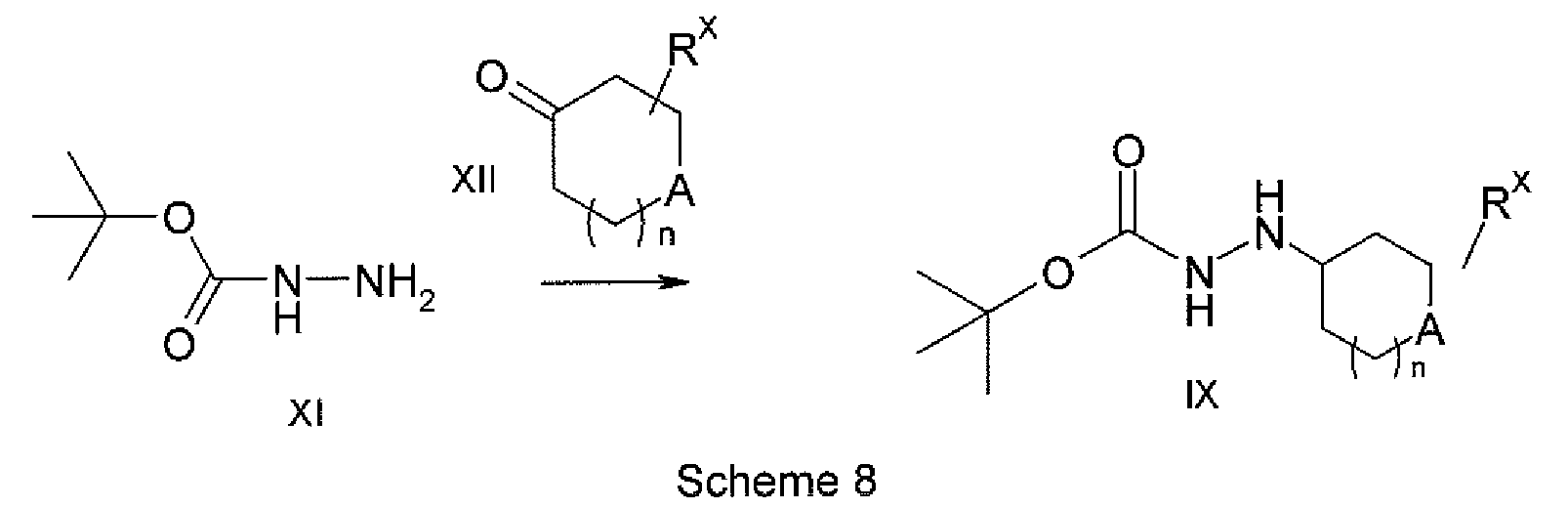
- Compounds of Formula I may be prepared from compounds of Formula XIII, wherein A, n, R2, R4 and RX are as defined for Formula I, according to Scheme 9 by cyanation, by displacement of the chloro substituent of compounds of Formula XIII using a variety of conditions, for example by treatment with potassium or sodium cyanide in the presence of a suitable base such as DABCO in a suitable solvent such as DMSO.

- Compounds of Formula XIII may be prepared from a reaction between compounds of Formula XIV, wherein A, n, R4 and RX are as defined for Formula I and Hal is chlorine or bromine, and compounds of Formula IV, according to Scheme 10. Compounds XIV are reacted with IV in the presence of a suitable base, such as DIPEA, in a suitable solvent, such as THF orACN.

- Compounds of Formula XIV may be prepared according to procedures analogous to those described hereinabove for the preparation of compounds of Formula V.
- It will be readily apparent to those skilled in the art that other compounds of Formula I may be prepared using methods analogous to those outlined above, or by reference to the experimental procedures detailed in the Examples provided herein.
- Those skilled in the art will also appreciate that in the preparation of the compound of Formula I or a solvate thereof, it may be necessary and/or desirable to protect one or more sensitive groups in the molecule or the appropriate intermediate to prevent undesirable side reactions. Suitable protecting groups for use according to the present invention are well known to those skilled in the art and may be used in a conventional manner. See, for example, "Protective groups in organic synthesis" by T.W. Greene and P.G.M. Wuts (John Wiley & sons 1991) or "Protecting Groups" by P.J. Kocienski (Georg Thieme Verlag 1994). Examples of suitable amino protecting groups include acyl type protecting groups (e.g. formyl, trifluoroacetyl, acetyl), aromatic urethane type protecting groups (e.g. benzyloxycarbonyl (Cbz) and substituted Cbz), aliphatic urethane protecting groups (e.g. 9-fluorenylmethoxycarbonyl (Fmoc), t-butyloxycarbonyl (Boc), isopropyloxycarbonyl, cyclohexyloxycarbonyl) and alkyl or aralkyl type protecting groups (e.g. benzyl, trityl, chlorotrityl). Examples of suitable oxygen protecting groups may include for example alky silyl groups, such as trimethylsilyl or tert-butyldimethylsilyl; alkyl ethers such as tetrahydropyranyl or tert-butyl; or esters such as acetate.
- The following examples illustrate the invention. These examples are not intended to limit the scope of the invention, but rather to provide guidance to the skilled artisan to prepare and use the compounds, compositions, and methods of the invention. While particular embodiments of the invention are described, the skilled artisan will appreciate that various changes and modifications can be made without departing from the spirit and scope of the invention.
-

- A solution of cyclopentanone (ALDRICH, 1.54 mL, 17.4 mmol) in MeOH (50 ml) was treated with tert-butyl carbazate (FLUKA, 2.3 g, 17.4 mmol), NaBH3CN (Aldrich, 1.64 g, 26.1 mmol) and glacial AcOH (5 mL). The mixture was stirred at room temperature overnight, cooled over an ice bath and neutralised with NaOH 2N solution. Solvent was evaporated and the residue was partitioned between DCM and H2O. The organic phase was washed with brine, dried and the solvent evaporated under reduced pressure to give the title compound. 1H NMR (300 MHz, DMSO-d6) δ ppm: 8.20 (br.s, 1 H), 4.09 (br.s, 1 H), 1.30-1.59 (m, 8H), 1.37 (s, 9H).
-

- A mixture of Intermediate 1 (1.97 g, 9.8 mmol), 5-Bromo-2,4-dichloropyrimidine (ALDRICH, 2.4 g, 10.78 mmol), DIPEA (FLUKA, 5.1 ml, 29 mmol) and dry EtOH (35 ml) was refluxed for 4 hours. The mixture was concentrated under reduced pressure and the residue partitioned between DCM and 1 M ammonium chloride. The organic layer was treated with brine and dried over MgSO4. The residue was purified by flash chromatography (eluent Hex/AcOEt mixtures 93:7 to 50:50) to give the title compound. 1H NMR (300 MHz, DMSO-d6) δ ppm: 9.77 (s, 1H), 8.37 (s, 1H), 4.82 (m, 1H), 1.46-1.88 (m, 8H), 1.41 (s, 9H). [ES+ MS] m/z 391 (MH)+.
-

- Potassium cyanide (ALDRICH, 213 mg, 3.26 mmol) was added to a suspension of Intermediate 2 (1.07 g, 2.72 mmol) and DABCO (ALDRICH, 305 mg, 2.72 mmol) in a mixture of DMSO/H2O 85/15 (10 ml) at room temperature. The reaction mixture was stirred at room temperature for 3 h and poured into ice water (15 ml). The white solid that appeared was filtered off and dried. The compound was purified by flash chromatography (eluent: Hex/AcOEt mixtures 95:5 to 50:50) to give the title compound. 1H NMR (300 MHz, DMSO-d6) δ ppm: 9.87 (s, 1H), 8.61 (s, 1H), 4.86 (m, 1H), 1.46-1.88 (m, 8H), 1.41 (s, 9H). [ES+ MS] m/z 382 (MH)+.
-

- To a solution of Intermediate 3 (353 mg, 0.92 mmol) in acetonitrile (8 mL), p-toluensulfonic acid (ALDRICH, 391 mg, 2.3 mmol) was added and the resulting reaction mixture was stirred at room temperature overnight. The mixture was washed with water and a saturated solution of sodium bicarbonate. The organic layer was treated with brine and dried over anhydrous Na2SO4. The compound was purified by flash chromatography (eluent: Hex/AcOEt mixtures 100:0 to 40:60) to give the title compound. 1H NMR (300 MHz, d6-DMSO) δ ppm: 8.47 (s, 1H), 4.86 (m, 1H), 4.81 (s, 2H), 1.48-1.79 (m, 8H). [ES+ MS] m/z 282 (MH)+.
-

- To a solution of 1,1-dimethylethyl hydrazinecarboxylate (ALDRICH, 3.0 g, 22.7 mmol) and 2-methylcyclopentanone (ALDRICH, 0.99 g, 10 mmol) in MeOH (20 mL), sodium cyanoborohydride (1.3 g, 23 mmol) and glacial acetic acid (3.6 mL, 63 mmol) were added. After stirring the resulting reaction mixture at room temperature for 16h, it was cooled down to 0 °C and neutralised with 2N aq. NaOH (3.6 mL). The organic solvent was evaporated under vacuum and product was extracted with DCM. The combined organic layers were washed with brine and dried over anhydrous Na2SO4, and the crude product was purified using flash chromatography (elute: Hex/EtOAc 100:0 to 7:3) to yield the title compound. 1H NMR (300 MHz, d6-DMSO) δ ppm: 8.25- 8.10 (m, 1H), 4.09- 3.98 (br., 1H), 3.21- 3.08 (br., 1H), 1.94- 1.78 (m, 1H), 1.72- 1.56 (m, 2H), 1.56-1.42 (br. m, 3H), 1.42- 1.20 (br., 10H), 0.91 (d, 3H).
-

- To a solution of 1,1-dimethylethyl hydrazinecarboxylate (ALDRICH, 3.0 g, 22.7 mmol) and 2-methylcyclopentanone (ALDRICH, 0.99 g, 10 mmol) in MeOH (20 mL), sodium cyanoborohydride (1.3 g, 23 mmol) and glacial acetic acid (3.6 mL, 63 mmol) were added. After stirring the resulting reaction mixture at room temperature for 16h, it was cooled down to 0 °C and neutralised with 2N aq. NaOH (3.6 mL). The organic solvent was evaporated under vacuum and product was extracted with DCM. The combined organic layers were washed with brine and dried over anhydrous Na2SO4, and the crude product was purified using flash chromatography (elute: Hex/EtOAc 100:0 to 7:3) to yield the title compound. 1H NMR (300 MHz, d6-DMSO) δ ppm: 8.21 (br.s, 1H), 4.20 (br. s, 1H). 2.94- 2.77 (br.m, 1H), 1.88- 1.26 (br., 15H), 1.15-0.98 (m, 1H), 0.9 (d, 3H).
-

- To a solution of 5-bromo-2,4-dichloropyrimidine (ALDRICH, 0.42 g, 1.8 mmol) and Intermediate 5 (0.34 g, 1.6 mmol) in i-PrOH (10 mL), DIPEA (0.6 mL, 3.5 mmol) was added and the resulting reaction mixture was stirred at room temperature for 4 days, then refluxed for 3h before it reached completion. The mixture was concentrated under reduced pressure and the residue partitioned between DCM and 1M ammonium chloride. The organic layer was washed with water and brine and dried over anhydrous Na2SO4. The residue was purified by flash chromatography (elute: Hex/EtOAc 100:0 to 3:2) to give the title compound. 1H NMR (300 MHz, CDCl3) δ ppm: 8.29 (br.s, 1H), 6.65-6.26 (br., 1H), 5.09- 4.82 (br., 1H), 2.57- 2.38 (m, 1H), 2.32- 1.09 (br., 15H), 0.8 (d, 3H); [ES+MS] m/z 405 (MH)+.
-

- Potassium cyanide (0.16 g, 1.6 mmol) and DABCO (0.21 g, 1.9 mmol) were added to a solution of Intermediate 7 (0.6 g, 1.6 mmol) in a mixture of DMSO/H2O 9:1 (5 mL) at room temperature. The reaction mixture was stirred at room temperature for 3 h and then ice was added. The solid that precipitated was filtered off and redissolved in DCM. The compound obtained upon solvent evaporation was purified by f!ash chromatography (eluent: Hex/EtOAC 100:0 to 3:2) to give the title compound. 1H NMR (300 MHz, CDCl3) δ ppm: 8.48 (br.s, 1H), 6.6- 6.26 (br., 1H), 5.14- 4.81 (br., 1H), 2.60-2.37 (m, 1H), 2.12-1.10 (br., 15H), 0.8 (d, 3H); 1H NMR (300 MHz, d6-DMSO, 80°C) δ ppm: 9.77- 9.44 (br., 1H), 8.61 (s, 1H), 4.87- 4.48 (br., 1H), 2.47- 2.34 (m, 1H), 2.09-1.08 (br., 15H), 1.02- 0.64 (br., 3H); [ES+MS] m/z 396 (MH)+.
-

- To a solution of Intermediate 8 (0.35g, 0.9 mmol) in dry acetonitrile (5 mL), p-toluensulfonic acid (0.46g, 2.7 mmol) was added and the resulting reaction mixture was stirred at room temperature overnight. The mixture was then concentrated in vacuo and the residue partitioned between DCM and a saturated solution of sodium bicarbonate. The organic layer was washed with water, brine and dried over anhydrous Na2SO4. The residue was purified by flash chromatography (elute: Hex/EtOAc 100:0 to 7:3) to give the title compound. 1H NMR (300 MHz, CDCl3) δ ppm: 8.38 (s, 1H), 5.08- 5.00 (m, 1H), 2.40- 2.24 (m, 1H), 2.16- 2.00 (m, 1H), 2.00- .81 (m, 3H), 1.61- 1.45 (m, 2H), 0.96 (d, 3H); [ES+MS] m/z 296 (MH)+.
-

- To a solution of 5-bromo-2,4-dichloropyrimidine (ALDRICH, 0.42 g, 1.8 mmol) and Intermediate 6 (0.34 g, 1.6 mmol) in i-PrOH (10 mL), DIPEA (0.6 mL, 3.5 mmol) was added and the resulting reaction mixture was stirred at room temperature for 4 days, then refluxed for 3h before it reached completion. The mixture was concentrated under reduced pressure and the residue partitioned between DCM and 1M ammonium chloride. The organic layer was washed with water and brine and dried over anhydrous Na2SO4. The residue was purified by flash chromatography (elute: Hex/EtOAc 100:0 to 3:2) to give the title compound. 1H NMR (300 MHz, CDCl3) δ ppm: 8.27 (br.s, 1H), 6.75-6.22 (br., 1H), 4.88-4.35 (br., 1H), 2.26-1.81 (br., 4H), 1.80- 1.22 (br., 12H), 1.22-0.93 (br., 3H); [ES+MS] m/z 405 (MH)+.
-

- Potassium cyanide (0.52 g, 8 mmol) and DABCO (0.66 g, 5.9 mmol) were added to a solution of Intermediate 10 (2.1 g, 5.3 mmol)) in a mixture of DMSO/H2O 9:1 (10 mL) at room temperature. The reaction mixture was stirred at room temperature for 3 h and then ice was added. The solid that precipitated was filtered off and redissolved in DCM. The compound obtained upon solvent evaporation was purified by flash chromatography (eluent: Hex/EtOAC 100:0 to 3:2) to give the title compound. 1H NMR (300 MHz, CDCl3) δ ppm: 8.46 (br.s, 1H), 6.74- 6.28 (br., 1H), 4.91- 4.39 (br., 1H), 2.22- 1.82 (br., 3H), 1.80-1.21 (br., 13H), 0.8 (d, 3H); 1H NMR (300 MHz, d6-DMSO, 80 °C) δ ppm: 9.84- 9.46 (br., 1H), 8.59 (s, 1H), 4.78- 4.35 (br., 1H), 2.21- 1.99 (br., 1H), 1.99- 1.75 (br., 2H), 1.74- 1.55 (br., 3H), 1.55- 1.14 (br., 10H), 1.14- 0.89 (br., 3H); [ES+ MS] m/z 396 (MH)+.
-

- To a solution of Intermediate 11 (1.8g, 4.5 mmol) in dry acetonitrile (20 mL), p-toluensulfonic acid (2.33g, 13.6 mmol) was added and the resulting reaction mixture was stirred at room temperature overnight. The mixture was then concentrated in vacuo and the residue partitioned between DCM and a saturated solution of sodium bicarbonate. The combined organic layers were washed with water, brine and dried over anhydrous Na2SO4. The residue was purified by flash chromatography (elute: Hex/EtOAc 100:0 to 7:3) to give the title compound. 1H NMR (300 MHz, CDCl3) δ ppm: 8.40 (s, 1H), 4.59- 4.51 (m, 1H), 2.34- 2.17 (m, 1H), 2.04-1.61 (m, 5H), 1.37- 1.19 (m, 1H), 0.95 (d, 3H); [ES+ MS] m/z 296 (MH)+.
-

- To a solution of 1,1-dimethylethyl hydrazinecarboxylate (ALDRICH, 3.0 g, 22.7 mmol) and 3-methylcyclopentanone (ALDRICH, 2.24 g, 22.8 mmol) in dry MeOH (30 mL), sodium cyanoborohydride (2.8 g, 45 mmol) and glacial acetic acid (8.2 mL, 143.2 mmol) were added. After stirring the resulting reaction mixture at room temperature overnight, it was cooled down in an ice bath and neutralised with 2N aq. NaOH (8.2 mL). The organic solvent was removed under reduced pressure and product was extracted with DCM. The combined organic layers were washed with brine and dried over anhydrous Na2SO4, to yield the crude product which was used without any further purification. 1H NMR (300 MHz, CDCl3) δ ppm: 6.70- 6.09 (br., 1H), 4.78- 3.98 (br., 1H), 3.62- 3.45 (m, 1H), 2.20- 1.97 (m, 2H), 1.98- 1.80 (m, 1H), 1.80- 1.62 (m, 2H),1.60-1.34 (m, 10H), 1.34- 1.20 (m, 1H), 1.03- 0.96 (m, 3H).
-

- To a solution of 5-bromo-2,4-dichloropyrimidine (ALDRICH, 5.3 g, 23 mmol) and Intermediate 13 (22.7 mmol) in i-PrOH (40 mL), DIPEA (7.9 mL, 46 mmol) was added and the resulting reaction mixture was stirred at room temperature overnight, then refluxed for 5h before it reached completion. The mixture was concentrated under reduced pressure and the residue partitioned between DCM and 1M ammonium chloride. The combined organic layers were washed with water and brine and dried over anhydrous Na2SO4. The residue was purified by flash chromatography (elute: Hex/EtOAc 100:0 to 3:2) to give the title compound. 1H NMR (300 MHz, CDCl3) δ ppm: 8.27 (s, 1H), 6.75- 6.21 (br., 1H), 5.12- 4.83 (br., 1H), 2.27- 0.77 (m, 19H); [ES+ MS] m/z 405 (MH)+.
-

- Potassium cyanide (1.5 g, 23.7 mmol) and DABCO (1.75 g, 15.6 mmol) were added to a solution of Intermediate 14 (6.3 g, 15.6 mmol) in a mixture of DMSO/H2O 9:1 (40 mL) at room temperature. The reaction mixture was stirred at room temperature for 4 h and then ice was added. The solid that precipitated was filtered off, washed abundantly with water, dried under air and redissolved in DCM. The compound obtained upon solvent evaporation was purified by flash chromatography (eluent: Hex/EtOAC 100:0 to 3:2) to give the title compound. 1H NMR (300 MHz, CDCl3) δ ppm : 8,47 (s, 1H), 6.89- 6.28 (br., 1H), 5.15- 4.82 (br., 1H), 2.29-1.76 (br., 4H), 1.76-1.14 (br., 12H), 1.11-1.00 (m, 3H); 1H NMR (300 MHz, d6-DMSO, 80 °C) δ ppm: 9.81- 9.30 (br., 1H), 8.59 (s, 1H), 5.11-4.75 (m, 1H), 2.15- 1.63 (br., 5H), 1.63- 1.06 (br., 11H), 1.03- 0.98 (m, 3H); [ES+ MS] m/z 396 (MH)+.
-

- To a solution of Intermediate 15 (0.6 g, 1.5 mmol) in dry acetonitrile (20 mL), p-toluensulfonic acid (0.65 g, 3.8 mmol) was added and the resulting reaction mixture was stirred at room temperature overnight. The mixture was then concentrated in vacuo and the residue partitioned between DCM and a saturated solution of sodium bicarbonate. The combined organic layers were washed with water, brine and dried over anhydrous Na2SO4. The residue was purified by flash chromatography (elute: Hex/EtOAc 100:0 to 7:3) to give the title compound. 1H NMR (300 MHz, CDCl3) δ ppm: 8.40 (s, 1H), 5.19- 4.94 (m, 1H), 2.31- 2.14 (m, 1H), 2.08- 1.73 (br.m, 4H), 1.58- 1.13 (m, 2H), 1.10- 1.02 (m, 3H).
-

- To a solution of Intermediate 16 (0.23 g, 0.8 mmol) in dry THF (5 mL), 4-(chloromethyl)benzoyl chloride (ALDRICH, 0.18 g, 0.94 mmol) and DIPEA (0.29 mL, 1.66 mmol) were added and the resulting reaction mixture was stirred at room temperature for 4h. Then, solvent was removed in vacuo and the residue partitioned between DCM and 1N aq, ammonium chloride. The combined organic layer were washed with water and brine and dried over anhydrous Na2SO4. The crude reaction mixture was redissolved in DCM and product was precipitated using hexane. The solid was filtered off, dried under air and used in the next steps without any further purification.
-

- To a mixture of Intermediate 4 (1 g, 3.55 mmol) and 4-(chloromethyl)benzoyl chloride (ALDRICH, 0.805 g, 4.26 mmol) in dry THF (50 mL), DIPEA (1.235 mL, 7.1 mmol) was added and the reaction mixture was stirred at room temperature overnight. Then, solvent was removed in vacuo and the residue partitioned between DCM and 1N HCl. The organic layer was washed with brine, dried over anhydrous MgSO4 and concentrated to dryness. The residue was used in the next step without any further purification.
-

- To a mixture of Intermediate 4 (1 g, 3.55 mmol) and 3-(chloromethyl)benzoyl chloride (ALDRICH, 0.757 mL, 5.32 mmol) in dry THF (50 mL), DIPEA (1.235 mL, 7.1 mmol) was added and the reaction mixture was stirred at room temperature overnight. Then, solvent was removed in vacuo and the residue partitioned between DCM and 1 N HCl. The organic layer was washed with brine, dried over anhydrous MgSO4 and concentrated to dryness. The residue was treated with hexane, the precipitate that was formed was filtered and used in the next step without further purification.
-

- To a solution of 1,1-dimethylethyl hydrazinecarboxylate (ALDRICH, 3.0 g, 22.7 mmol) in i-PrOH (30 mL), cyclohexanone (ALDRICH, 2.4 mL, 23.2 mmol) was added and the resulting reaction mixture was heated to reflux. After 4h, the reaction had reached completion and hence solvent was removed in vacuo. The residue was partitioned between DCM and water. The combined organic phases were washed with brine and dried over anhydrous Na2SO4, yielding the corresponding imine as a white solid. 1H NMR (300 MHz, CDCl3) δ ppm: 7.79- 7.36 (br., 1H), 2.44- 2.35 (m, 2H), 2.29- 2.1 (m, 2H), 1.93-1.81 (m, 1H), 1.79-1.57 (m, 5H), 1.54-1.44 (br., 9H).
- The intermediate imine was dissolved in MeOH (30 mL) and sodium cyanoborohydride (ALDRICH, 45.9 mmol) and glacial acetic acid (8.2 mL, 143.2 mmol) were added. After stirring the resulting reaction mixture at room temperature for 16h, it was cooled down to 0 °C and neutralised with 2N aq. NaOH (8.2 mL). The organic solvent was evaporated under vacuum and product was extracted with DCM. The combined organic layers were washed with brine and dried over anhydrous Na2SO4, yielding the above title compound. 1H NMR (300 MHz, CDCl3) δ ppm: 2.90- 2.76 (m, 1H), 1.94- 1.8 (m, 2H), 1.79- 1.7 (m, 2H), 1.67- 1.57 (m, 1H), 1.54- 1.42 (br., 9H), 1.40- 1.02 (br. m, 6H).
-

- To a solution of 5-bromo-2,4-dichloropyrimidine (ALDRICH, 5.68 g, 25 mmol) and Intermediate 20 (4.8 g, 22.2 mmol) in i-PrOH (40 mL), DIPEA (7.8 mL, 45 mmol) was added and the resulting reaction mixture was stirred at room temperature for 16 h. The mixture was concentrated under reduced pressure and the residue partitioned between DCM and 1M ammonium chloride. The combined organic layers were washed with water and brine and dried over anhydrous Na2SO4. The residue was purified by flash chromatography (elute: Hex/EtOAc 100:0 to 7:3) to give the title compound. 1H NMR (300 MHz, CDCl3) δ ppm: 8.26 (s, 1H), 6.69- 6.16 (br., 1H), 4.64- 4.46 (m, 1H), 2.17-1.99 (m, 1H), 1.90-1.77 (m, 2H), 1.77- 1.60 (m, 2H), 1.60-1.00 (br., 14H); 1H NMR (300 MHz, d6-DMSO) δ ppm: 9.70 (br.s, 1H), 8.44- 8.32 (br., 1H), 4.50- 4.32 (m, 1H), 1.94-1.69 (br.m, 3H), 1.59-1.52 (br.m, 2H), 1.52- 0.94 (br., 14H); [ES+ MS] m/z 405 (MH)+.
-

- Potassium cyanide (0.78 g, 12 mmol) and DABCO (1.16 g, 10 mmol) were added to a suspension of Intermediate 21 (3.7 g, 9 mmol) in a mixture of DMSO/H2O 9:1 (160 mL) at room temperature. The reaction mixture was stirred at room temperature for 3.5 days, before heating it up to 70 °C for further 3h before it reached completion. After having left it to cool down to room temperature, ice was added. The light yellow solid that precipitated was filtered off and redissolved in DCM. The compound obtained upon solvent evaporation was purified by flash chromatography (eluent: Hex/EtOAC 100:0 to 3:2) to give the title compound. 1H NMR (300 MHz, CDCl3) δ ppm: 8.45 (s, 1H), 6.66-6.22 (br., 1H), 4.65- 4.50 (m, 1H), 2.16- 1.97 (m, 1H), 1.93- 1.79 (m, 2H), 1.79- 1.65 (m, 2H), 1.65- 1.04 (br., 14H); 1H NMR (300 MHz, d6-DMSO) δ ppm: 9.81 (br.s, 1H), 8.60 (s, 1H), 4.53- 4.39 (m, 1H), 1.94- 1.71 (br.m, 3H), 1.71- 1.55 (br.m, 2H), 1.55- 0.97 (br., 14H); [ES+ MS] m/z 396 (MH)+.
-

- To a solution of Intermediate 22 (1g, 2.5 mmol) in dry acetonitrile (20 mL), p-toluensulfonic acid (1.0 g, 6 mmol) was added and the resulting reaction mixture was stirred at room temperature overnight. The mixture was then concentrated in vacuo and the residue partitioned between DCM and a saturated solution of sodium bicarbonate. The combined organic layers were washed with water, brine and dried over anhydrous Na2SO4. The residue was purified by flash chromatography (elute: Hex/EtOAc 100:0 to 3:2) to give the title compound. 1H NMR (300 MHz, CDCl3) δ ppm: 8.40 (s, 1H), 4.52-4.37 (m, 1H), 1.95-1.82 (m, 2H), 1.82-1.61 (m, 5H), 1.50- 1.31 (m, 2H), 1.29-1.08 (m, 1H); [ES+ MS] m/z 296 (MH)+.
-

- To a solution of Intermediate 23 (0.57 g, 1,9 mmol) in dry THF (4 mL), 4-(chloromethyl)benzoyl chloride (ALDRICH, 0.43 g, 2,3 mmol) and DIPEA (0.66 mL, 3.8 mmol) were added and the resulting reaction mixture was stirred at room temperature overnight. The mixture was concentrated in vacuo and the residue was partitioned between DCM and 1M aq. ammonium chloride. The combined organic layers were washed with water and brine and dried over anhydrous Na2SO4. The compound obtained upon solvent evaporation was purified by flash chromatography (eluent: Hex/EtOAC 100:0 to 3:2) to give the title compound. 1H NMR (300 MHz, CDCl3) δ ppm: 8.45 (s, 1H), 7.94 (br.s, 1H), 7.87- 7.82 (m, 2H), 7.55 (d, 2H), 4.77- 4.67 (br., 1H), 4.65 (s, 2H), 2.32- 2.05 (br., 1H), 2.01- 1.78 (br., 3H), 1.78- 1.66 (br., 1H), 1.66- 1.38 (br., 3H), 1.37- 1.01 (br., 2H).
-

- Although the aim of this experiment was to synthesise Example 20 using a one-pot reaction, only Intermediate 25 was isolated.
- To a solution of Intermediate 23 (0.12 g, 0.4 mmol) in dry THF (4 mL), 3-(chloromethyl)benzoyl chloride (ALDRICH, 0.07 mL, 0.5 mmol) and DIPEA (0.08 mL, 0.46 mmol) were added and the resulting reaction mixture was stirred at room temperature overnight. Then, 1-methyl-4-(piperidin-4-yl)-piperazine (FLUOROCHEM, 0.09 g, 0.5 mmol) and catalytic sodium iodide were added, and the reaction mixture was stirred at room temperature for further 2 days. Then, more 1-methyl-4-(piperidin-4-yl)-piperazine (0.09 g, 0.5 mmol) and sodium iodide were added, along with ACN (2mL) to overcome solubility issues. After further 16h, more DIPEA (0.14 mL, 0.8 mmol) were added in order to drive the reaction to completion and the reaction mixture was stirred at room temperature for further 24h. Then, the mixture was concentrated in vacuo and the crude reaction mixture was purified by preparative HPLC (SUNFIRE 19x150 mm, ACN:H2O 0.1% TFA, gradient 10-100%) to give the title compound which was used in subsequent steps.
-

- To a solution of tert-butyl carbazate (FLUKA, 4.6 g, 34.6 mmol) in MeOH (124 mL), tetrahydro-4H-pyran-4-one (ALDRICH, 3.47 g, 34.6 mmol), sodium cyanoborohydride (ALDRICH, 3.3 g, 52 mmol) and glacial acetic acid (10 mL) were added. The resulting reaction mixture was stirred at room temperature overnight. The reaction mixture was neutralised with 2N NaOH solution (20 mL) and concentrated in vacuo. Product was extracted with DCM and the organic layer was washed with brine, dried over anhydrous MgSO4 and the solvent evaporated under reduced pressure to give the title compound. 1H NMR (300 MHz, DMSO-d6) δ ppm: 8.19 (br.s, 1H), 4.47- 4.21 (br.s, 1H), 3.82- 3.75 (dt, 2H), 3.29- 3.21 (td, 2H), 2.94- 2.81 (m, 1H), 1.68-1.55 (m, 2H), 1.37 (s, 9H), 1.31-1.11 (m, 2H).
-

- To a solution of Intermediate 26 (3.3 g, 15.1 mmol) in dry EtOH (40 mL), 5-bromo-2,4-dichloropyrimidine (ALDRICH, 3.8 g, 16.6 mmol) dissolved in EtOH (15 mL) and DIPEA (FLUKA, 7.9 mL, 45.4 mmol) were added and the resulting reaction mixture was refluxed for 5 hours. The mixture was concentrated under reduced pressure and the residue partitioned between DCM and 1M ammonium chloride. The organic layer was treated with brine and dried over anhydrous Na2SO4. The residue was purified by flash chromatography (eluent: Hex/AcOEt mixtures 100:0 to 2:3) to give the title compound. 1H NMR (300 MHz, DMSO-d6) δ ppm: 9.78 (s, 1H), 8.39 (s, 1H), 4.75- 4.56 (m, 1H), 3.96- 3.84 (m, 2H), 3.45- 3.32 (m, 2H), 1.83-1.47 (m, 4H), 1.42 (s, 9H).
-

- Potassium cyanide (ALDRICH, 0.29 g, 4.4 mmol) and DABCO (ALDRICH, 0.41 g, 3.7 mmol) were added to a solution of Intermediate 27 (1.5 g, 3.7 mmol) in a mixture of DMSO/H2O 9/1 (15 mL). The reaction mixture was stirred at room temperature for 3h and poured into iced water. The brown solid that precipitated was filtered off and the crude product was purified by flash chromatography (eluent: Hex/AcOEt mixtures 100:0 to 1:1) to give the title compound. 1H NMR (300 MHz, DMSO-d6) δ ppm: 9.87 (s, 1H), 8.63 (s, 1H), 4.78- 4.63 (m, 1H), 3.96- 3.83 (m, 2H), 3.45- 3.36 (m, 2H), 1.83-1.84 (m, 2H), 1.63-1.46 (m, 2H), 1.42 (s, 9H).
-

- To a solution of Intermediate 28 (0.79 g, 2 mmol) in acetonitrile (16 mL), p-toluensulfonic acid (ALDRICH, 0.84 g, 4.9 mmol) was added and the resulting reaction mixture was stirred at room temperature overnight. Solvent was removed under reduced pressure and the residue was re-dissolved in DCM. Solid sodium bicarbonate was added and the resulting mixture was stirred at room temperature for 5 min. The organic layer was then washed with 10% aqueous sodium bicarbonate, water and brine and dried over anhydrous MgSO4. Solvent evaporation in vacuo yielded the title compound. 1H NMR (300 MHz, d6-DMSO) δ ppm: 8.49 (s, 1 H), 4.79 (s, 2H), 4.64-4.49 (m, 1H), 3.97- 3.87 (m, 2H), 3.46- 3.34 (m, 2H), 1.99-1.85 (dq, 2H), 1.59-1.49 (m, 2H).
-

- To a solution of Intermediate 29 (0.58 g, 1.95 mmol) in dry THF (16 mL), 4-bromomethyl benzoyl bromide (ALDRICH, 0.54 g, 1.95 mmol) and DIPEA (0.66 mL, 3.9 mmol) were added and the reaction mixture was stirred at room temperature overnight. Then, solvent was removed in vacuo and the residue partitioned between DCM and water. The organic layer was washed with 1N aqueous NaOH and brine, dried over anhydrous MgSO4 and concentrated to dryness. The residue was dissolved in the minimum amount of DCM and the solution stirred with hexane, the title compound precipitating off as a white solid. 1H NMR (300 MHz, d6-DMSO) δ ppm: 11.17 (s, 1H), 8.65 (s, 1H), 7.9 (d, 2H), 7.6 (d, 2H), 4.89- 4.8 (m, 1H), 4.76 (s, 2H), 3.96- 3.84 (m, 2H), 3.54- 3.35 (m, 2H), 1.98- 1.70 (m, 3H), 1.55-1.36 (m, 1H).
-

- To a solution of Intermediate 26 (3.6 g, 16.8 mmol) in dry EtOH (60 mL), 2,4,5-trichloropyrimidine (ALDRICH, 3.4 g, 18.5 mmol) and DIPEA (FLUKA, 8.5 mL, 50 mmol) were added and the resulting reaction mixture was refluxed for 3h, then stirred at room temperature for 3 days. In order to drive the reaction to completion the reaction mixture was refluxed for further 7h, then stirred at room temperature for 12 h. The mixture was concentrated under reduced pressure and the residue partitioned between DCM and 1M ammonium chloride. The organic layer was treated with brine and dried over anhydrous MgSO4. The residue was purified by flash chromatography (eluent: Hex/AcOEt mixtures 49:1 to 1:1) to give the title compound. 1H NMR (300 MHz, DMSO-d6) δ ppm: 9.80 (s, 1H), 8.28 (s, 1H), 4.75- 4.56 (m, 1H), 3.96- 3.82 (m, 2H), 3.46- 3.31 (m, 2H), 1.82-1.25 (m, 13H).
-

- Potassium cyanide (ALDRICH, 0.58 g, 8.9 mmol) and DABCO (ALDRICH, 0.83 g, 7.4 mmol) were added to a solution of Intermediate 31 (2.7 g, 7.4 mmol) in a mixture of DMSO/H2O 9/1 (30 mL). The reaction mixture was stirred at room temperature for 4h and poured into iced water, but no precipitate appeared. Product was then extracted with ethyl acetate and the combined organic layers were washed with brine, dried over MgSO4 and solvent was removed under reduced pressure. The crude product was purified by flash chromatography (eluent: Hex/AcOEt mixtures 49:1 to 1:1) to give the title compound. 1H NMR (300 MHz, DMSO-d6) δ ppm: 9.90 (s, 1H), 8.52 (s, 1H), 4.84-4.61 (m, 1H), 3.98- 3.82 (m, 2H), 3.51- 3.35 (m, 2H), 1.83-1.20 (m, 13H); [ES+ MS] m/z 354 (MH)+.
-

- To a solution of Intermediate 32 (1.05 g, 3 mmol) in dry acetonitrile (24 mL), p-toluensulfonic acid (ALDRICH, 1.26 g, 7.4 mmol) was added and the resulting reaction mixture was stirred at room temperature overnight. Solvent was removed under reduced pressure and the residue was re-dissolved in DCM. Solid sodium bicarbonate was added and the resulting mixture was stirred at room temperature for 5 min. The organic layer was then washed with 10% aqueous sodium bicarbonate, water and brine and dried over anhydrous MgSO4. After solvent was evaporated in vacuo, the crude product was purified by flash chromatography (eluent: Hex/AcOEt mixtures 49:1 to 1:1) to give the title compound. 1H NMR (300 MHz, d6-DMSO) δ ppm: 8.37 (s, 1H), 4.89 (s, 2H), 4.62- 4.48 (m, 1H), 3.98- 3.86 (m, 2H), 3.45- 3.37 (m, 2H), 2.00- 1.86 (m, 2H), 1.57-1.52 (m, 2H); [ES+ MS] m/z 254 (MH)+.
-

- To a solution of Intermediate 33 (0.66 g, 2.6 mmol) in dry THF (22 mL), 4-bromomethyl benzoyl bromide (ALDRICH, 0.72 g, 2.6 mmol) and DIPEA (0.88 mL, 5.2 mmol) were added and the reaction mixture was stirred at room temperature overnight. Then, solvent was removed in vacuo and the residue partitioned between DCM and water. The organic layer was washed with 1N aqueous NaOH and brine, dried over anhydrous MgSO4 and concentrated to dryness. The residue was dissolved in the minimum amount of DCM and the solution stirred with hexane, the title compound precipitating off. 1H NMR (300 MHz, d6-DMSO) δ ppm: 11.17 (s, 1H), 8.53 (s, 1H), 7.87 (d, 2H), 7.59 (d, 2H), 4.9- 4.75 (m, 3H), 4.00- 3.8 (m, 2H), 3.55- 3.31 (m, 2H), 2.00-1.70 (m, 3H), 1.58-1.35 (m, 1H).
-

- To a solution of 1-acetyl-4-piperidone (FLUKA, 2 mL, 16 mmol) in 1,2-dichloroethane (100 mL), tert-butyl carbazate (FLUKA, 2 g, 16 mmol), sodium triacetoxyborohydride (ALDRICH, 4.88 g, 23 mmol) and glacial acetic acid (0.91 mL) were added. The resulting reaction mixture was stirred at room temperature for 20 h. The reaction mixture was neutralised with 2N NaOH solution (100 mL) and the organic layer was then washed with brine, dried over anhydrous MgSO4 and the solvent evaporated under reduced pressure to give the title compound. 1H NMR (300 MHz, DMSO-d6) δ ppm: 8.29- 8.13 (br.s, 1H), 4.40- 4.37 (m, 1H), 4.01- 3.90 (br., 1H), 3.72- 3.6 (m, 1H), 3.15- 2.80 (m, 2H), 1.96 (s, 3H), 1.73- 1.55 (m, 2H), 1.45- 1.35 (br., 9H), 1.27- 1.05 (br., 2H).
-

- To a solution of Intermediate 35 (4.1 g, 16 mmol) and 5-bromo-2,4-dichloropyrimidine (ALDRICH, 4.1 g, 18 mmol) in EtOH (300 mL), DIPEA (FLUKA, 5.6 mL, 32 mmol) was added and the resulting reaction mixture was refluxed overnight. The mixture was concentrated under reduced pressure and the residue partitioned between DCM and 1M ammonium chloride. The organic layer was treated with brine, dried over anhydrous MgSO4 and solvent was removed in vacuo. The crude product was purified by flash chromatography (eluent: DCM/MeOH mixtures 100:0 to 4:1) to give the title compound. 1H NMR (300 MHz, DMSO-d6) δ ppm: 9.75 (br.s, 1H), 8.36 (s, 1H), 4.72- 4.65 (m, 1H), 4.49- 4.35 (m, 1H), 3.94- 3.81 (m, 1H), 3.55- 3.44 (m, 1H), 3.19- 3.00 (m, 1H), 2.02-1.95 (br., 3H), 1.91-1.56 (m, 2H), 1.48-1.31 (br., 9H), 1.30-1.18 (br., 2H).
-

- Potassium cyanide (ALDRICH, 0.72 g, 11 mmol) and DABCO (ALDRICH, 0.9 g, 8 mmol) were added to a solution of Intermediate 36 (3.2 g, 8 mmol) in a mixture of DMSO/H2O 9/1 (100 mL) and the reaction mixture was stirred at room temperature overnight. Water and ethyl acetate were added, the organic layer was washed with brine, dried over MgSO4 and solvent was removed under reduced pressure. The crude product was purified by flash chromatography (eluent: Hex/AcOEt mixtures 100:0 to 0:100) and then again by preparative HPLC (XTERRA 19x150 mm, ACN:H2O, 0.1%TFA, gradient 30-100%) to give the title compound. 1H NMR (300 MHz, DMSO-d6) δ ppm: 9.88- 9.81 (br., 1H), 8.64 (s, 1H), 4.79- 4.69 (m, 1H), 4.53- 4.38 (m, 1H), 4.07- 3.61 (br., 1H), 3.22- 3.06 (m, 1H), 2.69-2.54 (m, 1H), 2.03- 1.97 (br., 3H), 1.93-1.58 (br., 2H), 1.41 (s, 9H), 1.26- 1.18 (m, 2H); [ES+ MS] m/z 439 (MH)+.
-

- To a solution of Intermediate 37 (3.3 g, 8 mmol) in acetonitrile (300 mL), p-toluensulfonic acid (ALDRICH, 2.7 g, 24 mmol) was added and the resulting reaction mixture was stirred at room temperature overnight. Then, more p-toluensulfonic acid (2.7 g, 24 mmol) was added and the reaction mixture was stirred for further 3 h at room temperature before heating it to 40- 50 °C for 2 h more. Solvent was removed under reduced pressure and the residue was partitioned between DCM and saturated aqueous sodium bicarbonate. The organic layer was washed with brine and dried over anhydrous MgSO4. Solvent was evaporated in vacuo and the crude product was purified by flash chromatography (eluent: Hex/AcOEt mixtures 100:0 to 0:100) to yield the title compound. 1H NMR (300 MHz, d6-DMSO) δ ppm: 8.51 (br., 1H), 4.77 (s, 2H), 4.65- 4.40 (br., 2H), 3.95- 3.81 (m, 1H), 3.21- 3.05 (m, 1H), 2.68- 2.51 (m, 1H), 2.01 (s, 3H), 1.89-1.52 (br., 4H).
-

- To a solution of Intermediate 38 (0.60 g, 2 mmol) in THF (50 mL), 4-bromomethyl benzoyl bromide (ALDRICH, 0.56 g, 2 mmol) and DIPEA (0.7 mL, 4 mmol) were added and the reaction mixture was stirred at room temperature for 30 minutes to yield the title compound which was used in the following reaction without any further purification.
-

- Under a nitrogen atmosphere, triethylamine (0.9 mL, 6.5 mmol) was added to a solution of 1-benzhydrylazetan-3-ol (MAYBRIDGE, 1.033 g, 4.3 mmol) in dry DCM (15 mL), previously cooled to 0 °C. After 5 minutes, methanesulfonyl chloride (ALDRICH, 0.4 mL, 5.2 mmol) was added and the resulting reaction mixture was stirred at 0 °C for 2 h. Water was then added and product was extracted with DCM. The combined organic layers were dried over anhydrous MgSO4 and solvent was removed in vacuo to yield the title compound. 1H NMR (300 MHz, DMSO-d6) δ ppm: 7.58- 7.10 (br., 10H), 5.19- 5.03 (br., 1 H), 4.60- 4.42 (br., 1 H), 3.53-3.42 (br., 2H), 3.17 (br.s, 3H), 3.15- 2.97 (br., 2H).
-

- Intermediate 40 (0.5 g, 1.6 mmol) was dissolved in pyrrolidine (ALDRICH, 3 mL, 36 mmol) and the resulting reaction mixture was heated to 60 °C for 2 h, then to 70 °C for further 2h and finally refluxed for 8 h, before being cooled down to room temperature overnight. A saturated aqueous solution of sodium bicarbonate was added and the product was extracted with DCM. The combined organic layers were dried over anhydrous Na2SO4 and solvent was evaporated under reduced pressure to yield the title compound. 1H NMR (300 MHz, DMSO-d6) δ ppm: 7.45- 7.36 (m, 4H), 7.31- 7.11 (m, 6H), 4.39 (s, 1H),3.55- 3.46 (m, 1H), 3.13- 3.04 (m, 1H), 3.04- 2.92 (m, 1H), 2.84-2.76 (m, 2H), 2.37- 2.23 (br., 4H), 1.70- 1.56 (br., 4H).
-

- To a solution of Intermediate 41 (1.6 mmol) in EtOH (5.2 mL), 1N HCl (1.4 mL) and palladium hydroxide on carbon (ALDRICH, 0.05 mg, 0.38 mmol) were added and the resulting reaction mixture was hydrogenated at room temperature and 3 bar over the weekend. More 1N HCl (3 mL) was added and the mixture was hydrogenated under the same conditiones for further 4 days. The reaction mixture was then freeze-dried and then MeOH was added. The resulting solution was washed with ETOAc, hexane, DCM and diethyl ether to yield the title compound which was used in subsequent steps without any further purification.
-

- A solution of 1,1-dimethylethyl hydrazinecarboxylate (ALDRICH, 9.2 g, 70 mmol) in i-PrOH (50 ml) was treated at 0°C with i-butylaldehyde (ALDRICH; 6.4 ml, 70 mmol) over 15 min and stirring at 0°C for 2 h, then the mixture was stirred 5 h at room temperature. To this solution containing the intermediate hydrazone was added PtO2 and the suspension was hydrogenated at room temperature and 2.6 bar for 48 h. The suspension was filtered and the solvent was removed under reduced pressure to give the title compound. 1H NMR (300 MHz, CDCl3) δ ppm: 6.02 (br.s, 1H), 3.92 (br.s, 1H), 2.66 (d, 2H), 1.73 (m, 1H), 1.46 (s, 9H), 0.93 (d, 6H). [ES+ MS] m/z 189 (MH)+.
-

- The title compound was prepared by a method analogous to that described for Intermediate 43 replacing i-butylaldehyde with trimethylacetaldehyde (ALDRICH). 1H NMR (300 MHz, CDCl3) δ ppm: 8.19 (s, 1H), 3.34 (br.s, 1H), 2.46 (d, 2H), 1.37 (s, 9H), 0.85 (s, 9H) [ES+ MS] m/z 203 (MH)+.
-

- To a solution of 5-bromo-2,4-dichloropyrimidine (15.4 g, 68 mmol) and Intermediate 44 (12.5 g, 62 mmol) in i-PrOH (150 mL), N,N-diisopropylethylamine (14 mL, 80 mmol) was added and the resulting reaction mixture was refluxed for 2.5 h, then stirred at room temperature overnight and again refluxed for further 3h. The mixture was concentrated under reduced pressure and the residue partitioned between DCM and 1 M ammonium chloride. The organic layer was treated with brine and dried over anhydrous MgSO4. The residue was purified by flash chromatography (elute: Hex/EtOAc mixtures 95:1 to 1:1) to give the title compound. 1H NMR (300 MHz, CDCl3) δ ppm: 8.27 (br.s, 1H), 6.85 (br.s, 1H), 4.85-4.63 (br.m, 1H), 2.90-2.65 (br.m, 1H), 1.47 (s, 9H), 0.98 (s, 9H). [ES+ MS] m/z 393 (M)+.
-

- Potassium cyanide (1.6 g, 25 mmol) was added to a suspension of Intermediate 45 (9 g, 23 mmol) and DABCO (2.6 g, 23 mmol) in a mixture of DMSO/H2O 9:1 (100 mL) at room temperature. The reaction mixture was heated at 80 °C for 1.5 h, and then poured into iced water. After being stirred for 1.5h, the yellow product that precipitated was filtered off and washed abundantly with water The compound was redissolved in DCM and the resulting solution was washed with water (twice) and brine and the organic layer was dried over MgSO4. The compound was purified by flash chromatography (eluent: Hex/EtOAC 7:3) to give the title compound. 1H NMR (300 MHz, CDCl3) δ ppm: 8.47 (br.s, 1H), 6.86 (br.s, 1H), 4.85-4.65 (br.m, 1H), 2.90-2.70 (br.m, 1H), 1.47 (s, 9H), 0.99 (s, 9H). [ES+ MS] m/z 384 (M)+.
-

- To a solution of Intermediate 46 (2 g, 5.2 mmol) in dry acetonitrile (100 mL), p-toluenesulfonic acid (13 mmol) was added and the resulting reaction mixture was stirred at room temperature overnight. The mixture was then concentrated in vacuo and the residue partitioned between DCM and a saturated solution of sodium bicarbonate. The organic layer was washed with brine and dried over anhydrous NaHCO3. The residue was purified by preparative HPLC (X-TERRA 19x150 mm, ACN:H2O, 0.1%TFA, gradient 10-100%) to give the title compound. 1H NMR (300 MHz, CDCl3) δ ppm: 8.39 (s, 1H), 3.85 (s, 2H), 1.00 (s, 9H) [ES+ MS] m/z 284 (M+).
-

- A solution of N-methylpiperazine (ALDRICH, 1.46 ml, 13.1 mmol) in dimethylformamide (5 ml) was cooled to 0° C and, then, potassium carbonate (1.81 g, 13.1 mmol) was added. This mixture was stirred at 0° C for 30 min. Then, methyl 4-(bromomethyl) benzoate (ALDRICH, 3 g, 13.1 mmol) was added. The reaction mixture was allowed to warm up to room temperature and stirred for 17 h. The mixture was concentrated under reduce pressure. The residue was dissolved in DCM and washed with water, the aqueous layer was extracted with DCM. The organic layers were combined, washed with water, dried over MgSO4 filtered and the solvent removed under reduce pressure to give the title compound. 1H RMN (300 MHz, CDCl3-d6): 7.97 (d, 2H), 7 40 (d, 2H), 3.90 (s, 3H), 3.55 (s, 2H), 2.47 (br. m, 8H), 2.28 (s, 3H).
-

- A solution of lithium hydroxide (ALDRICH, 337 mg, 14.1 mmol) in H2O (10 ml) was added to a solution of Intermediate 48 (1.4 g, 5.63 mmol) in MeOH (20 ml) and the mixture was heated at reflux for 2h. The mixture was concentrated under reduced pressure. The residue was dissolved in DCM and 2N hydrochloric acid was added to give pH 5. The aqueous layer was partitioned with n-Butanol (5 times) and the fractions were combined, dried over MgSO4, filtered and evaporated under reduce pressure to give the title compound as a white solid. 1H RMN (300 MHz, DMSO-d6): 12.83 (br. m, 1H), 11.05 (br. m, 1H), 7.90 (d, 2H), 7.43 (d, 2H), 4.36 (m, 1H), 3.60 (s, 2H), 3.38-2.80 (br. m, 8H), 2.68 (s, 3H). [ES+ MS] m/z 235 (MH)+.
-

- To a stirred mixture of the Intermediate 4 (84 mg, 0.30 mmol) and DIPEA (FLUKA, 0.1 ml, 0.6 mmol) in THF (5 mL), 4-(chloromethyl)benzoyl chloride (ALDRICH, 68 mg, 0.36 mmol) was added and stirring was continued for 2 hours at room temperature. After this time, N-methylpiperazine (ALDRICH, 0.07 mL, 0.6 mmol) was added and the mixture was stirred at room temperature overnight. The solvent was evaporated under reduced pressure and the resulting crude product was purified by preparative HPLC (XTERRA 19x150 mm, ACN:H2O, 0.1%TFA, gradient 30-100%) to give the title compound. 1H NMR (300 MHz, d6-DMSO) δ ppm: 11.16 (s, 1H), 8.63 (s, 1H), 7.89 (dd, 2H), 7.47 (dd, 2H), 4.93 (m, 1H), 3.32-3.43 (m, 2H), 2.88-3.08 (m, 4H), 2.78 (s, 3H), 2.25-2.44 (m, 2H), 1.84-1.97 (m, 3H), 1.45-1.68 (m, 5H). [ES+ MS] m/z 498 (MH)+.
-

- To a solution of Intermediate 9 (0.14 g, 0.5 mmol) in dry THF (4 mL), 4-(chloromethyl) benzoyl chloride (ALDRICH, 0.14 g, 0.73 mmol) and DIPEA (0.18 mL, 1.05 mmol) were added and the resulting reaction mixture was stirred at room temperature for 22 h. N-methylpiperazine (ALDRICH, 0.07 mL, 0.6 mmol) and catalytic sodium iodide were added, and the reaction mixture was stirred at room temperature for further 7 h. Then, more N, N-diisopropylethylamine (0.18 mL, 1.05 mmol) was added in order to drive the reaction to completion. After 40 h, the mixture was concentrated in vacuo and the crude reaction mixture was purified first by flash chromatography (elute DCM/MeOH 100:0 to 19:1) and then by preparative HPLC (SUNFIRE 19x150 mm, ACN:H2O 0.1% TFA, gradient 10-100%) to give the title compound. 1H NMR (300 MHz, d6-DMSO, 80°C) δ ppm: 10.94 (br.s, 1H), 8.62 (s, 1H), 7.9 (d, 2H), 7.47 (d, 2H), 4.82- 4.72 (m, 1H), 4.20- 3.56 (br., 4H), 3.38- 3.02 (br., 4H), 2.79 (s, 3H), 2.79- 2.42 (br., 3H), 2.04-1.85 (m, 2H), 1.84- 1.63 (m, 2H), 1.62- 1.33 (m, 2H), 0.85 (d, 3H); [ES+ MS] m/z 512 (MH)+.
-

- To a solution of Intermediate 12 (0.20 g, 0.7 mmol) in dry THF (4 mL), 4-(chloromethyl)benzoyl chloride (ALDRICH, 0.16g, 0.883 mmol) and DIPEA (0,23 mL, 1.37 mmol) were added and the resulting reaction mixture was stirred at r.t. for 4 h. Then, N-methylpiperazine (ALDRICH, 0.09 mL, 0.8 mmol) and catalytic sodium iodide were added, and the reaction mixture was stirred at room temperature for further 7 h. Then, more DIPEA (0.23 mL, 1.4 mmol) was added in order to drive the reaction to completion. After 40 h, the mixture was concentrated in vacuo and the crude reaction mixture was purified first by flash chromatography (elute DCM/MeOH 100:0 to 19:1) and then by preparative HPLC (SUNFIRE 19x150 mm, ACN:H2O 0.1% TFA, gradient 10-100%) to give the title compound. 1H NMR (300 MHz, d6-DMSO, 80°C) δ ppm: 10.90 (br.s, 1H), 8.57 (s, 1H), 7.9 (d, 2H), 7.46 (d, 2H), 4.80- 4.58 (br., 1H), 3.69 (s, 2H), 3.43- 2.97 (br., 4H), 2.78 (s, 3H), 2.73- 2.54 (br., 2H), 2.43- 2.04 (br., 2H), 2.04-1.75 (br., 3H), 1.71- 1.49 (m, 2H), 1.35- 1.16 (m, 2H), 1.07 (d, 3H); [ES+ MS] m/z 512 (MH)+.
-

- To a solution of Intermediate 17 (0.1 g, 0.2 mmol) in dry ACN (5 mL), 1-methyl-4-(piperidin-4-yl)-piperazine (FLUOROCHEM, 0.18 g, 0.94 mmol), DIPEA (0.08 mL, 0.44 mmol) and catalytic sodium iodide were added and the resulting reaction mixture was stirred at room temperature overnight. Then, the mixture was concentrated in vacuo and the crude reaction mixture was purified by preparative HPLC (X-TERRA 19x150 mm, ACN:H2O 0.1% TFA, gradient 20-100%) to give the title compound as a mixture of diastereomers, present in a non 1:1 ratio. 1H NMR (300 MHz, d6-DMSO) δ ppm: 11.34-11.23 (br., 1H), 10.02- 9.75 (br., 1H), 8.65 (s, 1H), 7.99 (d, 2H), 7.65 (d, 2H), 5.17- 4.86 (br., 1H), 4.50- 3.64 (br., 4H), 3.55- 3.24 (br., 4H), 3.23- 2.85 (br., 6H), 2.84- 2.56 (br., 4H), 2.46- 1.45 (br., 10H), 1.26- 1.05 (br., 1H), 1.04- 0.88 (m, 3H); [ES+ MS] m/z 595 (MH)+.
-
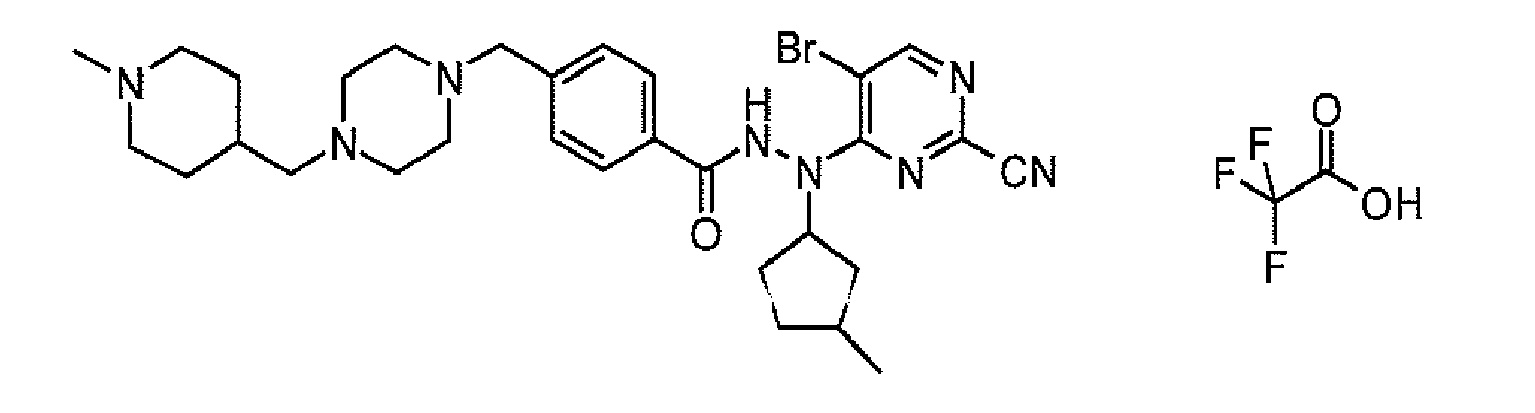
- To a solution of Intermediate 17 (0.1 g, 0.2 mmol) in dry ACN (5 mL), 1-(N-methyl-4-piperidinmethyl)-piperazine (FLUOROCHEM, 0.05 g, 0.3 mmol), DIPEA (0.08 mL, 0.44 mmol) and catalytic sodium iodide were added and the resulting reaction mixture was stirred at room temperature overnight. Then, the mixture was concentrated in vacuo and the crude reaction mixture was purified by preparative HPLC (X-TERRA 19x150 mm, ACN:H2O 0.1% TFA, gradient 10-80%) to give the title compound as a mixture of diastereomers, present in a non 1:1 ratio.. 1H NMR (300 MHz, d6-DMSO) δ ppm: 11.29- 11.17 (br., 1H), 9.54- 9.37 (br., 1H), 8.64 (s, 1H), 7.94 (d, 2H), 7.54 (d, 2H), 5.14- 4.87 (br., 1H), 4.08- 2.56 (br., 20H), 2.24- 1.44 (br., 8H), 1.44- 1.05 (br., 3H), 1.04- 0.89 (m, 3H); [ES+ MS] m/z 609 (MH)+.
-
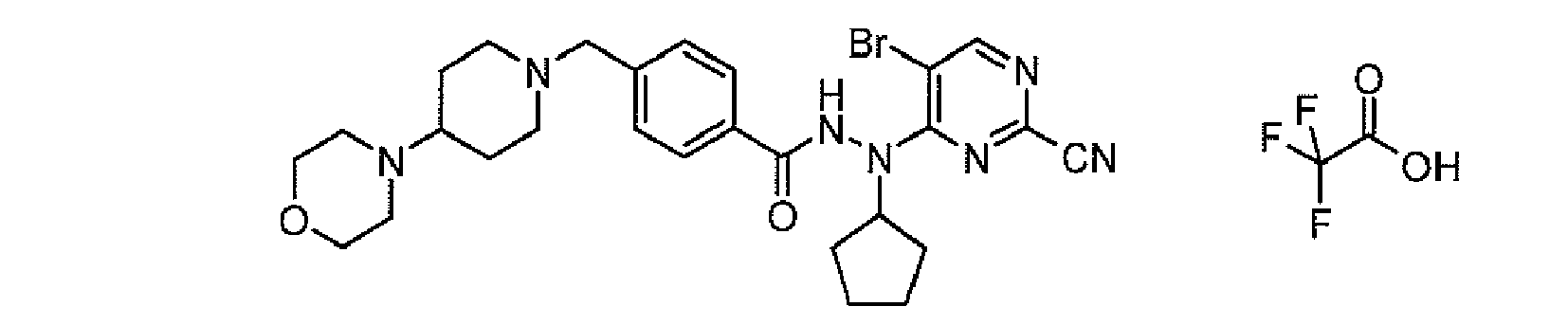
- Intermediate 18 (75 mg, 0.173 mmol) was dissolved in ACN (5 mL) and, then, DIPEA (FLUKA, 0.05 ml, 0.288 mmol), cat. sodium iodide and 4-morpholinopiperidine (ALDRICH, 0.035 g, 0.21 mmol) were successively added. The reaction mixture was stirred at room temperature overnight. After this time, DIPEA (half equivalent) was added and the reaction mixture was stirred at 50 °C until completion. The solvent was evaporated under reduced pressure and the resulting crude product was purified by preparative HPLC (XTERRA, ACN:H2O, 0.1%TFA, gradient 10-100%) to give the title compound. 1H NMR (300 MHz, d6-DMSO) δ ppm: 11.26 (s, 1H), 8.64 (s, 1H), 7.99 (dd, 2H), 7.62 (dd, 2H), 4.95 (m, 1H), 4.45-4.25 (m, 2H), 3.90-2.10 (m, 17H), 1.97-1.84 (m, 3H), 1.68-1.45 (m, 5H). [ES+ MS] m/z 568 (MH)+.
-

- Intermediate 18 (75 mg, 0.173 mmol) was dissolved in ACN (5 mL) and, then, DIPEA (FLUKA, 0.05 ml, 0.288 mmol), cat. sodium iodide and 1-(N-methyl-4-piperidin methyl) piperazine (ALDRICH, 0.041 g, 0.21 mmol) were successively added. The reaction mixture was stirred at room temperature overnight. After this time, DIPEA (half equivalent) was added and the reaction mixture was stirred at 50 °C until completion.
- The solvent was evaporated under reduced pressure and the resulting crude product was purified by preparative HPLC (XTERRA, ACN:H2O, 0.1%TFA, gradient 10-100%) to give the title compound. 1H NMR (300 MHz, d6-DMSO) δ ppm: 11.20 (s, 1H), 9.40-9.30 (m, 1H), 8.63 (s, 1H), 7.93 (dd, 2H), 7.53 (dd, 2H), 4.94 (m, 1H), 4.45-2.10 (m, 24H), 1.97-1.84 (m, 3H), 1.68-1.45 (m, 5H). [ES+ MS] m/z 595 (MH)+.
-

- Intermediate 18 (75 mg, D.173 mmol) was dissolved in ACN (5 mL) and, then, DIPEA (FLUKA, 0.05 ml, 0.288 mmol), cat. sodium iodide and 1-(N-methyl-3-piperidylmethyl) piperazine (FLUOROCHEM, 41 mg, 0.21 mmol) were successively added. The reaction mixture was stirred at room temperature overnight. After this time, DIPEA (half equivalent) was added and the reaction mixture was stirred at 50 °C until completion. The solvent was evaporated under reduced pressure and the resulting crude product was purified by preparative HPLC (XTERRA, ACN:H2O, 0.1%TFA, gradient 10-100%) to give the title compound. 1H NMR (300 MHz, d6-DMSO) δ ppm: 11.23 (s, 1H), 9.40-9.30 (m, 1H), 8.64 (s, 1H), 7.96 (dd, 2H), 7.7-7.5 (m, 2H), 4.94 (m, 1H), 4.45-2.10 (m, 24H), 1.97-1.84 (m, 3H), 1.88-1.45 (m, 5H). [ES+ MS] m/z 595 (MH)+.
-

- Intermediate 18 (75 mg, 0.173 mmol) was dissolved in ACN (5 mL) and, then, DIPEA (FLUKA, 0.05 ml, 0.288 mmol), cat. sodium iodide and (4-methyl-piperazin-1-yl)-piperidin-4-yl-methanone (FLUOROCHEM, 44 mg, 0.21 mmol) were successively added. The reaction mixture was stirred at room temperature overnight. After this time, DIPEA (half equivalent) was added and the reaction mixture was stirred at 50 °C until completion. The solvent was evaporated under reduced pressure and the resulting crude product was purified by preparative HPLC (XTERRA, ACN:H2O, 0.1%TFA, gradient 10-100%) to give the title compound. 1H NMR (300 MHz, d6-DMSO) δ ppm: 11.28 (s, 1H), 10.10-9.70 (m, 2H), 8.65 (s, 1H), 8.00 (dd, 2H), 7.65 (dd, 2H), 4.94 (m, 1H), 4.45-2.10 (m, 22H), 1.97-1.84 (m, 3H), 1.68-1.45 (m, 5H). [ES+ MS] m/z 609 (MH)+.
-

- Intermediate 18 (75 mg, 0.173 mmol) was dissolved in ACN (5 mL) and, then, DIPEA (FLUKA, 0.05 ml, 0.288 mmol), cat. sodium iodide and 1-methyl-4-(piperidin-4yl)-piperazine (FLUOROCHEM, 38 mg, 0.21 mmol) were successively added. The reaction mixture was stirred at room temperature overnight. After this time, DIPEA (half equivalent) was added and the reaction mixture was stirred at 50°C until completion. The solvent was evaporated under reduced pressure and the resulting crude product was purified by preparative HPLC (XTERRA, ACN:H2O, 0.1%TFA, gradient 10-100%) to give the title compound. 1H NMR (300 MHz, d6-DMSO) δ ppm: 11.27 (s, 1H), 10.0-9.4 (m, 2H), 8.64 (s, 1H), 8.00 (dd, 2H), 7.63 (dd, 2H), 4.94 (m, 1H), 3.90-2.10 (m, 22H), 1.97-1.84 (m, 3H), 1.68-1.45 (m, 5H). [ES+ MS] m/z 581 (MH)+.
-

- Intermediate 19 (75 mg, 0.173 mmol) was dissolved in ACN (5 mL) and, then, DIPEA (FLUKA, 0.06 ml, 0.344 mmol), cat sodium iodide and 1-methyl-4-(piperidin-4yl)-piperazine (FLUOROCHEM, 38 mg, 0.21 mmol) were successively added. The reaction mixture was stirred at room temperature overnight. The reaction crude was filtered and the solvent was evaporated under reduced pressure and the resulting crude product was purified by preparative HPLC (XTERRA, ACN:H2O, 0.1%TFA, gradient 10-100%) to give the title compound. 1H NMR (300 MHz, d6-DMSO) δ ppm: 11.29 (s, 1H), 9.8-9.5 (m, 2H), 8.64 (s, 1H), 8.15-7.55 (m, 4H), 4.95 (m, 1H), 3.90-2.10 (m, 22H), 1.97-1.84 (m, 3H), 1.68-1.45 (m, 5H). [ES+ MS] m/z 581 (MH)+.
-

- Intermediate 19 (75 mg, 0.173 mmol) was dissolved in ACN (5 mL) and, then, DIPEA (FLUKA, 0.06 ml, 0.344 mmol), cat. sodium iodide and (4-methyl-piperazin-1-yl)-piperidin-4-yl-methanone (FLUOROCHEM, 44 mg, 0.21 mmol) were successively added. The reaction mixture was stirred at room temperature overnight. The reaction crude was filtered and the solvent was evaporated under reduced pressure and the resulting crude product was purified by preparative HPLC (XTERRA, ACN:H2O, 0.1%TFA, gradient 10-100%) to give the title compound. 1H NMR (300 MHz, d6-DMSO) δ ppm: 11.30 (s, 1H), 10.05-9.55 (m, 2H), 8.65 (s, 1H), 8.15-7.60 (m, 4H), 4.95 (m, 1H), 3.90-2.10 (m, 22H), 1.97-1.84 (m, 3H), 1.68-1.45 (m, 5H). [ES+ MS] m/z 609 (MH)+.
-

- Intermediate 19 (75 mg, 0.173 mmol) was dissolved in ACN (5 mL) and, then, DIPEA (FLUKA, 0.06 ml, 0.344 mmol), cat. sodium iodide and 4-morpholinopiperidine (ALDRICH, 35 mg, 0.21 mmol) were successively added. The reaction mixture was stirred at room temperature overnight. The reaction crude was filtered and the solvent was evaporated under reduced pressure and the resulting crude product was purified by preparative HPLC (XTERRA, ACN:H2O, 0.1%TFA, gradient 10-100%) to give the title compound. 1H NMR (300 MHz, d6-DMSO) δ ppm: 11.29 (s, 1H), 10.5-9.7 (m, 2H), 8.64 (s, 1H), 8.15-7.60 (m, 4H), 4.95 (m, 1H), 3.90-2.10 (m, 19H), 1.97-1.84 (m, 3H), 1.68-1.45 (m, 5H). [ES+ MS] m/z 568 (MH)+.
-

- Intermediate 19 (75 mg, 0.173 mmol) was dissolved in ACN (5 mL) and, then, DIPEA (FLUKA, 0.06 ml, 0.344 mmol), cat. sodium iodide and 1-(N-methyl-3-piperidylmethyl) piperazine (FLUOROCHEM, 41 mg, 0.21 mmol) were successively added. The reaction mixture was stirred at room temperature overnight. The reaction crude was filtered and the solvent was evaporated under reduced pressure and the resulting crude product was purified by preparative HPLC (XTERRA, ACN:H2O, 0.1%TFA, gradient 10-100%) to give the title compound. 1H NMR (300 MHz, d6-DMSO) δ ppm: 11.26 (s, 1H), 9.2-9.5 (m, 1H), 8.64 (s, 1H), 8.2-7.5 (m, 4H), 4.95 (m, 1H), 3.90-2.10 (m, 24H), 1.97-1.84 (m, 3H), 1.68-1.45 (m, 5H). [ES+ MS] m/z 595 (MH)+.
-

- Intermediate 19 (75 mg, 0.173 mmol) was dissolved in ACN (5 mL) and, then, DIPEA (FLUKA, 0.06 ml, 0.344 mmol), cat. sodium iodide and 1-(N-methyl-4-piperidin methyl)piperazine (ALDRICH, 41 mg, 0.21 mmol) were successively added. The reaction mixture was stirred at room temperature overnight. The reaction crude was filtered and the solvent was evaporated under reduced pressure and the resulting crude product was purified by preparative HPLC (XTERRA, ACN:H2O, 0.1%TFA, gradient 10-100%) to give the title compound. 1H NMR (300 MHz, d6-DMSO) δ ppm: 11.23 (s, 1H), 9.6-9.2 (m, 1H), 8.64 (s, 1H), 8.2-7.5 (m, 4H), 4.94 (m, 1H), 3.90-2.10 (m, 24H), 1.97-1.84 (m, 3H), 1.68-1.45 (m, 5H). [ES+ MS] m/z 595 (MH)+.
-

- To a solution of Intermediate 23 (0.643 g, 2.17 mmol) in dry THF (10 mL), 4-(chloromethyl)benzoyl chloride (ALDRICH, 0.45 g, 2.4 mmol) and DIPEA (0.7 mL, 4.35 mmol) were added and the resulting reaction mixture was stirred at room temperature overnight. Then, N- methylpiperazine (ALDRICH, 0.29 mL, 2.6 mmol) and catalytic sodium iodide were added, and the reaction mixture was stirred at room temperature for further 24h. Then, the mixture was concentrated in vacuo and the crude reaction mixture was purified by preparative HPLC (X-TERRA 50x250 mm, ACN:H2O 0.1% TFA, gradient 10-100%) to give the title compound. 1H NMR (300 MHz, d6-DMSO) δ ppm: 11.08 (br.s, 1H), 8.61 (s, 1H), 7.92 (d, 2H), 7.48 (d, 2H), 4.64- 4.50 (m, 1H), 3.83-3.63 (br., 2H), 3.51- 3.24 (br., 2H), 3.19- 2.88 (br., 4H), 2.79 (s, 3H), 2.46- 2.19 (br., 2H), 1.98-1.50 (br. m, 6H), 1.50- 0.92 (br. m, 4H); [ES+ MS] m/z 512 (MH)+.
-

- To a solution of Intermediate 24 (0.21 g, 0.5 mmol) in dry ACN (5 mL), 1-methyl-4-(piperidin-4-yl)-piperazine (FLUOROCHEM, 0.11 g, 0.6 mmol), DIPEA (0.17 mL, 0.96 mmol) and catalytic sodium iodide were added and the resulting reaction mixture was stirred at room temperature overnight. Then, the mixture was concentrated in vacuo and the crude reaction mixture was purified by preparative HPLC (SUNFIRE 19x150 mm, ACN:H2O 0.1% TFA, gradient 10-100%) to give the title compound. 1H NMR (300 MHz, d6-DMSO) δ ppm: 11.19 (s, 1H), 10.06- 9.81 (br., 1H), 8.63 (s, 1H), 8.01 (d, 2H), 7.64 (d, 2H), 4.64- 4.51 (m, 1H), 4.50- 3.70 (br., 4H), 3.54- 3.30 (br., 4H), 3.23- 2.86 (br., 6H), 2.77 (s, 3H), 2.70- 2.55 (br., 1H), 2.10- 1.50 (br., 10H), 1.51- 1.25 (br., 2H), 1.25- 0.96 (br., 2H); [ES+ MS] m/z 595 (MH)+.
-

- To a solution of Intermediate 24 (0.1 g, 0.22 mmol) in dry ACN (5 mL), 4-morpholinopiperidine (ALDRICH, 0.05 g, 0.3 mmol), DIPEA (0.08 mL, 0.44 mmol) and catalytic sodium iodide were added and the resulting reaction mixture was stirred at room temperature overnight. Then, the mixture was concentrated in vacuo and the crude reaction mixture was purified by preparative HPLC (SUNFIRE 19x150 mm, ACN:H2O 0.1 % TFA, gradient 10-100%) to give the title compound. 1H NMR (300 MHz, d6-DMSO) δ ppm: 11.18 (s, 1H), 10.50- 9.98 (br., 1H), 8.63 (s, 1H), 8.01 (d, 2H), 7.63 (d, 2H), 4.66- 4.51 (m, 1H), 4.47- 3.57 (br., 6H), 3.57- 2.77 (br., 8H), 2.33- 2.15 (br., 2H), 2.13-1.68 (br., 7H), 1.68- 1.52 (br., 2H), 1.52- 1.28 (br., 2H), 1.28- 0.96 (br., 2H); [ES+ MS] m/z 582 (MH)+.
-

- To a solution of Intermediate 24 (0.1 g, 0.22 mmol) in dry ACN (5 mL), 1-(N-methyl-4-piperidinmethyl)piperazine (FLUOROCHEM, 0.05 g, 0.3 mmol), DIPEA (0.8 mL, 0.45 mmol) and catalytic sodium iodide were added and the resulting reaction mixture was stirred at room temperature overnight. Then, the mixture was concentrated in vacuo and the crude reaction mixture was purified by preparative HPLC (SUNFIRE 19x150 mm, ACN:H2O 0.1% TFA, gradient 10-100%) to give the title compound. 1H NMR (300 MHz, d6-DMSO) δ ppm: 11.11 (s, 1H), 9.56- 9.32 (br., 1H), 8.62 (s, 1 H), 7.96 (d, 2H), 7.58- 7.49 (m, 2H), 4.71- 4.50 (m, 1H), 4.17- 2.60 (br., 19H), 1.97- 1.53 (br., 9H), 1.53-0.93 (br., 6H); [ES+ MS] m/z 609 (MH)+.
-

- To a solution of Intermediate 25 (12 mg, 0.03 mmol) in dry ACN (4 mL), 1-methyl-4-(piperidin-4-yl)-piperazine (FLUOROCHEM, 7 mg, 0.03 mmol), DIPEA (0.01 mL, 0.05 mmol) and catalytic sodium iodide were added and the resulting reaction mixture was stirred at room temperature overnight. Then, the mixture was concentrated in vacuo and the crude reaction mixture was purified by preparative HPLC (SUNFIRE 19x150 mm, ACN:H2O 0.1% TFA, gradient 10-100%) to give the title compound. 1H NMR (300 MHz, d6-DMSO) δ ppm: 11.20 (s, 1H), 9.94- 9.71 (br., 1H), 8.62 (s, 1H), 8.15- 7.95 (br., 2H), 7.80- 7.60 (m, 2H), 4.64- 4.51 (m, 1H), 4.50- 3.56 (br., 4H), 3.52- 3.26 (br., 4H), 3.18- 2.83 (br., 6H), 2.84- 2.68 (br., 3H), 2.19- 1.49 (br., 11H), 1.49- 1.27 (br., 2H), 1.27- 0.96 (br., 2H); [ES+ MS] m/z 595 (MH)+.
-

- To a solution of Intermediate 24 (0.075 g, 0.17 mmol) in dry ACN (5 mL), DIPEA (FLUKA, 0.058 mL, 0.34 mmol), 4-hydroxypiperidine (ALDRICH, 0.02 g, 0.20 mmol) and a tip of a spatula of sodium iodide were added. The reaction mixture was stirred at room temperature overnight. Once it had reached completion, the mixture was filtered and solvent was evaporated under reduced pressure. The resulting crude product was purified by preparative HPLC (XTERRA 19x150 mm, ACN:H2O, 0.1% TFA, gradient 20-100%) to give the title compound. 1H NMR (300 MHz, DMSO-d6) δ ppm: 11.16 (s, 1H), 9.46 (br., 1H), 8.62 (s, 1H), 8.01 (d, 2H), 7.65 (m, 2H), 4.99 (br., 1H), 4.57 (m, 1H), 4.37 (m, 2H), 4.05-2.89 (m, 5H), 2.08-0.91 (m, 14H). [ES+ MS] m/z 513 (MH)+.
-

- To a solution of Intermediate 24 (0.075 g, 0.17 mmol) in dry ACN (5 mL) DIPEA (FLUKA, 0.087 mL, 0.51 mmol), (4-methyl-piperazin-1-yl)-piperidin-4-yl-methanone (FLUOROCHEM, 0.056 g, 0.20 mmol) and a tip of a spatula of sodium iodide were added. The reaction mixture was stirred at room temperature overnight. Once it had reached completion, the mixture was filtered and solvent was evaporated under reduced pressure. The resulting crude product was purified by preparative HPLC (XTERRA 19x150 mm, ACN:H2O, 0.1%TFA, gradient 20-100%) to give the title compound. 1H NMR (300 MHz, DMSO-d6) δ ppm: 11.18 (s, 1H), 10.08-9.70 (br., 2H), 8.63 (s, 1H), 8.01 (d, 2H), 7.66 (d, 2H), 4.57 (m, 1H), 4.52-2.85 (m, 14H), 2.80 (s, 3H), 1.98-0.95 (m, 15H). [ES+ MS] m/z 623 (MH)+.
-
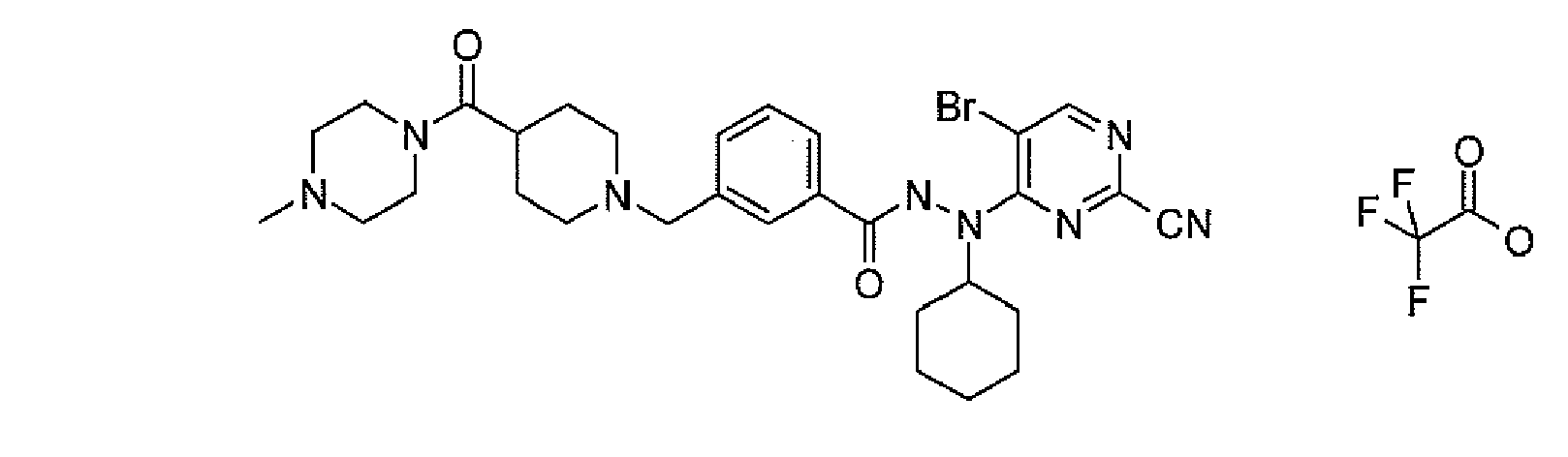
- To a solution of Intermediate 25 (0.05 g, 0.1 mmol) in ACN (3 mL), catalytic sodium iodide was added and the mixture was stirred at room temperature for 10 min. Then, (4-methyl-piperazin-1-yl)-piperidin-4-yl-methanone dihydrochloride (FLUOROCHEM, 0.028 g, 0.1 mmol) and DIPEA (0.04 mL, 0.22 mmol) were added and the resulting reaction mixture was stirred at room temperature overnight. The mixture was then filtered and concentrated in vacuo. The crude reaction mixture was purified by preparative HPLC (X-TERRA 19x150 mm, ACN:H2O 0.1% TFA, gradient 20-80%, A= 230 nm) to give the title compound. 1H NMR (300 MHz, d6-DMSO) δ ppm: 11.20 (br.s, 1H), 10.03- 9.82 (br., 1H), 9.79- 9.58 (br., 1H), 8.62 (s, 1H), 8.14- 8.06 (m, 1H), 8.05-7.99 (br., 1H), 7.79- 7.70 (m, 1H), 7.70- 7.59 (m, 1H), 4.64- 4.51 (m, 1H), 4.50- 4.02 (br., 4H), 3.53- 2.82 (br., 10H), 2.79 (br. s, 3H), 2.00- 1.50 (br., 10H), 1.48- 0.93 (br., 5H); [ES+ MS] m/z 623 (MH)+.
-
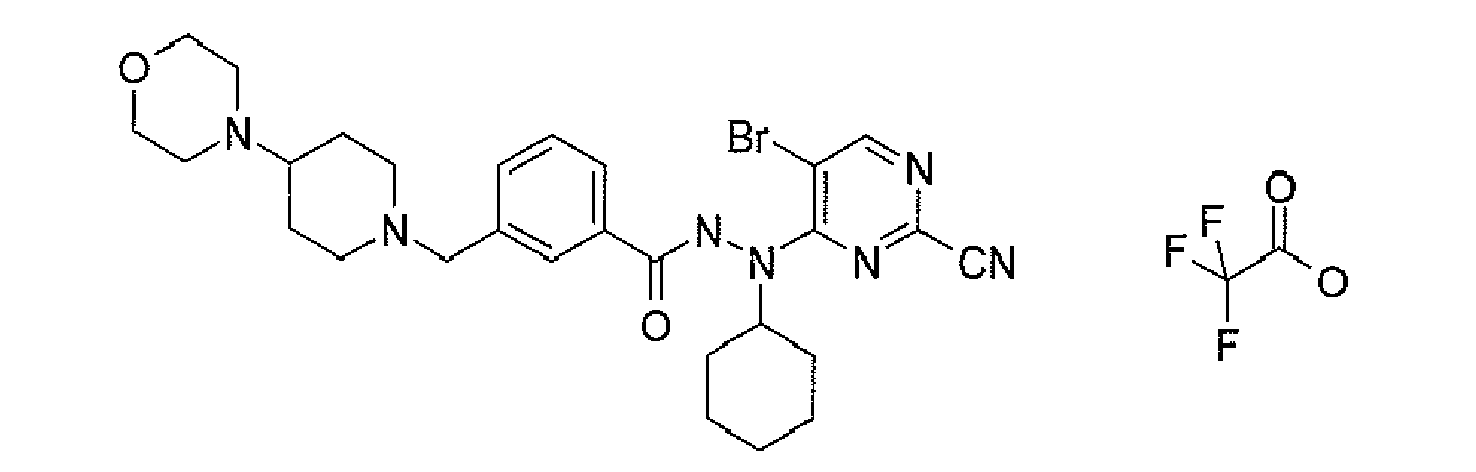
- To a solution of Intermediate 25 (0.05 g, 0.1 mmol) in ACN (3 mL), catalytic sodium iodide was added and the mixture was stirred at room temperature for 10 min. Then, 4-morpholinopiperidine (ALDRICH, 0.023 g, 0.13 mmol) and DIPEA (0.04 mL, 0.22 mmol) were added and the resulting reaction mixture was stirred at room temperature overnight. The mixture was then filtered and concentrated in vacuo. The crude reaction mixture was purified by preparative HPLC (X-TERRA 19x150 mm, ACN:H2O 0.1% TFA, gradient 20-80%, A= 230 nm) to give the title compound. 1H NMR (300 MHz, d6-DMSO) δ ppm: 11.19 (br.s, 1H), 10.48- 9.72 (br., 1H), 8.62 (s, 1H), 8.15- 8.03 (m, 1H), 8.03- 7.94 (br., 1H), 7.76- 7.57 (m, 2H), 4.65- 4.51 (m, 1H), 4.49- 4.11 (br., 2H), 4.10-2.74 (br., 12H), 2.36-2.10 (br., 2H), 2.00- 1.52 (br., 8H), 1.50- 0.94 (br., 5H); [ES+ MS] m/z 582 (MH)+.
-

- To a suspension of Intermediate 24 (0.075 g, 0.17 mmol) in ACN (5 mL), 1-(N-methyl-3-piperidylmethyl)-piperazine (FLUOROCHEM, 0.04 g, 0.2 mmol), DIPEA (0.06 mL, 0.33 mmol) and catalytic sodium iodide were added and the resulting reaction mixture was stirred at room temperature overnight. Then, the mixture was filtered and concentrated in vacuo. The crude reaction mixture was dissolved in methanol and purified by preparative HPLC (X-TERRA 19x150 mm, ACN:H2O 0.1% TFA, gradient 20-100% first, then re-purified using a 20-80% gradient, λ=230 nm) to give the title compound. 1H NMR (300 MHz, d6-DMSO) δ ppm: 11.2- 11.07 (br., 1H), 9.5- 9.3 (br., 1H), 8.62 (s, 1H), 7.97 (d, 2H), 7.74- 7.47 (br., 2H), 4.64- 4.49 (m, 1H), 4.43- 2.57 (br., 19H), 2.09- 1.49 (br., 10H), 1.48- 0.92 (br., 5H); [ES+ MS] m/z 609 (MH)+.
-

- To a solution of Intermediate 17 (0.07 g, 0.15 mmol) in dry ACN (5 mL), N-methylpiperazine (ALDRICH, 0.02 mL, 0.18 mmol), DIPEA (0.05 mL, 0.29 mmol) and catalytic sodium iodide were added and the resulting reaction mixture was stirred at room temperature overnight. Then, the mixture was concentrated in vacuo and the crude reaction mixture was purified by preparative HPLC (X-TERRA 19x150 mm, ACN:H2O 0.1% TFA, gradient 20-100% first, then repurified using a 20-80% gradient) to give the title compound as a mixture of diastereomers, present in a non 1:1 ratio. 1H NMR (300 MHz, d6-DMSO+CD3OD) δ ppm: 11.21- 11.13 (br., 1H), 9.50- 9.27 (br., 1H), 8.62 (s, 1H), 7.89 (d, 2H), 7.46 (d, 2H), 5.37- 5.28 (br., 1H), 3.67- 3.58 (br., 1H), 3.52-3.46 (br., 2H), 3.43- 2.86 (br., 6H), 2.85- 2.68 (br., 3H), 2.57- 2.39 (br., 1H), 2.36- 1.36 (br., 5H), 1.34- 1.07 (br., 2H), 1.06- 0.73 (br., 3H); [ES+ MS] m/z 512 (MH)+.
-
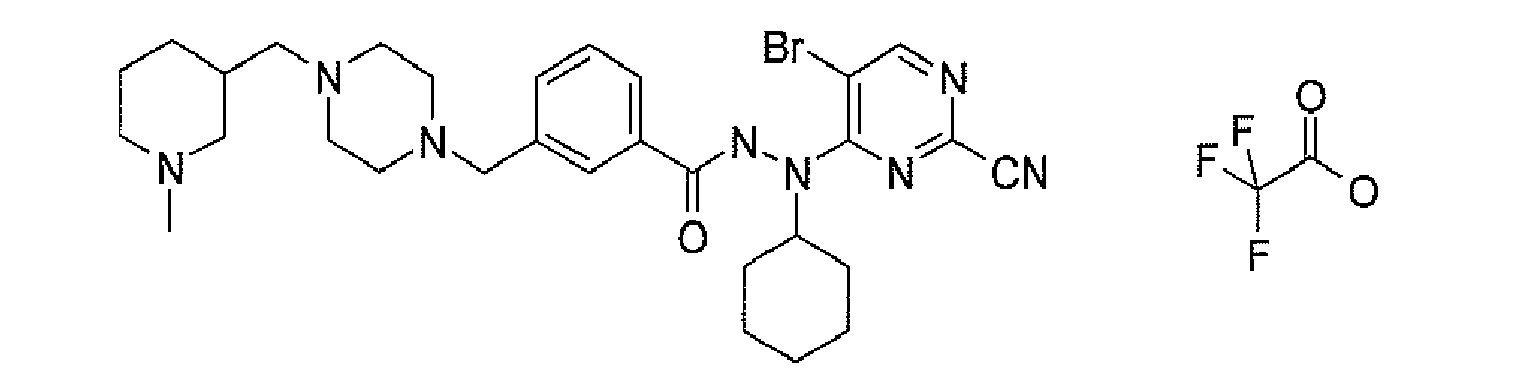
- To a solution of Intermediate 25 (0.1 g, 0.22 mmol) in ACN (8 mL), catalytic sodium iodide was added and the mixture was stirred at room temperature for 10 min. Then, a solution of 1-(N-methyl-3-piperidylmethyl)-piperazine (FLUOROCHEM, 0.053 g, 0.27 mmol) in ACN (2 mL) and DIPEA (0.077 mL, 0.44 mmol) were added and the resulting reaction mixture was stirred at room temperature overnight. The mixture was then concentrated in vacuo and the crude reaction mixture was purified by preparative HPLC (LUNA 250x50 mm, ACN:H2O 0.1% TFA, gradient 20-60%) to give the title compound. 1H NMR (300 MHz, D2O) δ ppm: 8.36 (br.s, 1H), 7.84- 7.77 (m, 1H), 7.75-7.79 (br., 1H), 7.62- 7.65 (m, 1H), 7.55- 7.46 (m, 1H), 4.80- 4.45 (br., 1H), 4.17 (br., 2H), 3.41- 3.26 (br., 2H), 3.24- 3.07 (br., 4H), 3.02- 2.80 (br., 4H), 2.78- 2.69 (br., 1H), 2.67(s, 3H), 2.63- 2.48 (br., 3H), 2.10- 1.37 (br., 10H), 1.37- 0.84 (br., 5H); [ES+ MS] m/z 609 (MH)+.
-

- To a solution of Intermediate 25 (0.1 g, 0.22 mmol) in ACN (8 mL), catalytic sodium iodide was added and the mixture was stirred at room temperature for 10 min. Then, a solution of 1-(N-methyl-4-piperidinmethyl)piperazine (FLUOROCHEM, 0.053 g, 0.27 mmol) in ACN (2 mL) and DIPEA (0.077 mL, 0.44 mmol) were added and the resulting reaction mixture was stirred at room temperature overnight. The mixture was then concentrated in vacuo and the crude reaction mixture was purified by preparative HPLC (LUNA 250x50 mm, ACN:H2O 0.1% TFA, gradient 20-60%) to give the title compound. 1H NMR (300 MHz, D2O) δ ppm: 8.38- 8.35 (br., 1H), 7.88- 7.76 (m, 1H), 7.73- 7.69 (br., 1H), 7.60- 7.54 (m, 1H), 7.53- 7.44 (m, 1H), 4.71- 4.52 (br., 1H), 4.09 (br., 2H), 3.41- 3.32 (m, 2H), 3.24- 3.02 (br., 8H), 2.90- 2.74 (br., 4H), 2.66 (s, 3H), 2.06- 1.54 (br., 7H), 1.54- 0.84 (br., 8H); [ES+ MS] m/z 609 (MH)+.
-

- To a solution of Intermediate 30 (0.085 g, 0.17 mmol) in ACN (3 mL), DIPEA (FLUKA, 0.04 mL, 0.26 mmol) and 1-methyl-4-(piperidin-4-yl)-piperazine (FLUOROCHEM, 0.037 g, 0.2 mmol) were added and the resulting reaction mixture was stirred at room temperature overnight. Solvent was removed under reduced pressure and the resulting crude product was purified by preparative HPLC (SUNFIRE 30x150 mm, ACN:H2O, 0.1%TFA, gradient 10-100%) to give the title compound. 1H NMR (300 MHz, d6-DMSO) δ ppm: 11.25 (s, 1H), 9.88- 9.60 (br., 1H), 8.67 (s, 1H), 8.02 (d, 2H), 7.64 (d, 2H), 4.91-4.77 (m, 1H), 4.47- 4.31 (br., 2H), 4.21- 3.57 (br., 4H), 3.55- 3.28 (br., 6H), 3.20- 2.84 (br., 6H), 2.76 (s, 3H), 2.63- 2.50 (br., 1H), 2.44- 2.24 (br., 2H), 2.07- 1.30 (br., 6H); [ES+ MS] m/z 597 (MH)+.
-

- To a solution of Intermediate 30 (0.08 g, 0.16 mmol) in ACN (3 mL), DIPEA (FLUKA, 0.041 mL, 0.264mmol) and 1-(N-methyl-4-piperidinmethyl)piperazine (FLUOROCHEM, 0.038 g, 0.19 mmol) were added and the resulting reaction mixture was stirred at room temperature overnight. Solvent was removed under reduced pressure and the resulting crude product was purified by preparative HPLC (SUNFIRE 30x150 mm, ACN:H2O, 0.1%TFA, gradient 10-100%) to give the title compound. 1H NMR (300 MHz, d6-DMSO) δ ppm: 11.18 (s, 1H), 9.45- 9.25 (br., 1H), 8.65 (s, 1H), 7.96 (d, 2H), 7.66- 7.42 (br., 2H), 4.91- 4.77 (m, 1H), 4.02- 3.84 (m, 4H), 3.54- 3.34 (br., 4H), 3.10- 2.61 (br., 15H), 2.01-1.16(br., 9H); [ES+ MS] m/z 611 (MH)+.
-

- To a solution of Intermediate 30 (0.087 g, 0.18 mmol) in ACN (3 mL), DIPEA (FLUKA, 0.046 mL, 0.27 mmol) and 1-(N-methyl-3-piperidylmethyl)-piperazine (FLUOROCHEM, 0.043 g, 0.22 mmol) were added and the resulting reaction mixture was stirred at room temperature overnight. Solvent was removed under reduced pressure and the resulting crude product was purified by preparative HPLC (SUNFIRE 30x150 mm, ACN:H2O, 0.1%TFA, gradient 10-100%) to give the title compound. 1H NMR (300 MHz, CD3OD) δ ppm: 8.56 (s, 1H), 8.01 (d, 2H), 7.67 (d, 2H), 5.06- 4.91 (m, 1H), 4.33 (s, 2H), 4.11-3.92 (br., 2H), 3.69- 3.43 (br., 4H), 3.29- 3.14 (br., 4H), 2.95- 2.78 (br., 5H), 2.69- 2.44 (br., 4H), 2.18- 0.77 (br., 11H); [ES+ MS] m/z 611 (MH)+.
-

- To a solution of Intermediate 30 (0.091 g, 0.18 mmol) in ACN (2 mL), DIPEA (FLUKA, 0.046 mL, 0.27 mmol) and (4-methyl-piperazin-1-yl)-piperidin-4-yl-methanone dihydrochloride (FLUOROCHEM, 0.047 g, 0.22 mmol) were added and the resulting reaction mixture was stirred at room temperature overnight. Then, more DIPEA (0.046 mL, 0.27 mmol) was added in order to drive the reaction to completion. The reaction mixture was stirred at room temperature over the weekend. Solvent was then removed under reduced pressure and the resulting crude product was purified by preparative HPLC (SUNFIRE 30x150 mm, ACN:H2O, 0.1%TFA, gradient 10-100%) to give the title compound. 1H NMR (300 MHz, DMSO) δ ppm: 11.28 (s, 1H), 10.11- 9.71 (br., 2H), 8.67 (s, 1H), 8.03 (d, 2H), 7.66 (d, 2H), 4.94- 4.76 (m, 1H), 4.55- 4.26 (br., 3H), 4.24-3.21 (br., 11H), 3.07- 2.68 (br., 8H), 2.01-1.68 (br., 7H), 1.52-1.32 (br., 1H); [ES+ MS] m/z 625 (MH)+.
-

- The title compound was synthesised following an analogous procedure to the one for example 32, with Intermediate 42 being the amine used. 1H NMR (300 MHz, DMSO-d6) δ ppm: 11.21 (br.s, 1H), 8.66 (s, 1H), 7.97 (d, 2H), 7.55 (d, 2H), 4.91- 4.76 (m, 1H), 4.49- 2.77 (br., 15H), 2.05- 1.71 (br., 7H), 1.51-1.31 (m, 1H); [ES+ MS] m/z 540 (MH)+.
-

- To a solution of Intermediate 34 (0.085 g, 0.2 mmol) in ACN (2 mL), DIPEA (FLUKA, 0.05 mL, 0.3 mmol) and 1-methyl-4-(piperidin-4-yl)-piperazine (FLUOROCHEM, 0.044 g, 0.24 mmol) were added and the resulting reaction mixture was stirred at room temperature overnight. Solvent was removed under reduced pressure and the resulting crude product was purified by preparative HPLC (SUNFIRE 30x150 mm, ACN:H2O, 0.1 %TFA, gradient 10-70%) to give the title compound. 1H NMR (300 MHz, d6-DMSO) δ ppm: 11.27 (s, 1H), 9.96- 9.62 (br., 1H), 8.55 (s, 1H), 7.99 (d, 2H), 7.65 (d, 2H), 4.93-4.78 (m, 1H), 4.48- 4.30 (br., 2H), 4.29- 3.66 (br., 4H), 3.57- 3.26 (br., 6H), 3.22- 2.84 (br., 6H), 2.76 (s, 3H), 2.67- 2.51 (br., 1H), 2.47- 2.18 (br., 2H), 2.09- 1.34 (br., 6H); [ES+ MS] m/z 553 (MH)+.
-

- To a solution of Intermediate 34 (0.08 g, 0.19 mmol) in ACN (2 mL), DIPEA (FLUKA, 0.048 mL, 0.33 mmol) and 1-(N-methyl-4-piperidinmethyl)piperazine (FLUOROCHEM, 0.044 g, 0.22 mmol) were added and the resulting reaction mixture was stirred at room temperature overnight. Solvent was removed under reduced pressure and the resulting crude product was purified by preparative HPLC (SUNFIRE 30x150 mm, ACN:H2O, 0.1%TFA, gradient 10-70%) to give the title compound. 1H NMR (300 MHz, d6-DMSO) δ ppm: 11.20 (s, 1H), 9.66- 9.22 (br., 1 H), 8.54 (s, 1 H), 7.93 (d, 2H), 7.60- 7.46 (br., 2H), 4.90- 4.79 (m, 1H), 4.19- 3.58 (m, 4H), 3.55- 3.33 (br., 6H), 3.27- 2.66 (br., 13H), 1.99- 1.18 (br., 9H); [ES+ MS] m/z 567 (MH)+.
-

- To a solution of Intermediate 34 (0.077 g, 0.17 mmol) in ACN (2 mL), DIPEA (FLUKA, 0.043 mL, 0.26 mmol) and (4-methyl-piperazin-1-yl)-piperidin-4-yl-methanone dihydrochloride (FLUOROCHEM, 0.043 g, 0.21 mmol) were added and the resulting reaction mixture was stirred at room temperature overnight. Then, more DIPEA (1 eq.) was added in order to drive the reaction to completion. The reaction mixture was stirred at room temperature for further 6 h and then kept at 4 °C over the weekend. Solvent was then removed under reduced pressure and the resulting crude product was purified by preparative HPLC (SUNFIRE 30x150 mm, ACN:H2O, 0.1%TFA, gradient 10-100%) to give the title compound. 1H NMR (300 MHz, DMSO) δ ppm: 11.29 (s, 1H). 10.15- 9.76 (br., 2H), 8.56 (s, 1H), 8.00 (d, 2H), 7.67 (d, 2H), 4.91- 4.80 (m, 1H), 4.55-4.27 (br., 3H), 4.25- 3.18 (br., 11H), 3.09- 2.70 (br., 8H), 2.01- 1.66 (br., 7H), 1.54- 1.34 (br., 1H); [ES+ MS] m/z 581 (MH)+.
-

- To a solution of Intermediate 39 (1 mmol) in THF (25 mL), DIPEA (FLUKA, 0.026 mL, 1.5 mmol) and N-methylpiperazine (ALDRICH, 0.134 g, 1.21 mmol) were added and the resulting reaction mixture was stirred at room temperature for 20.5 h. Solvent was removed under reduced pressure and the resulting crude product was purified by preparative HPLC (SUNFIRE 30x150 mm, ACN:H2O, 0.1%TFA, gradient 20-60%) to give the title compound. 1H NMR (300 MHz, d6-DMSO) δ ppm: 11.11 (s, 1H), 9.89- 9.16 (br., 1H), 8.65 (s, 1H), 7.91 (d, 2H), 7.47 (d, 2H), 4.87- 4.79 (m, 1H), 4.52- 4.38 (m, 1H), 4.19- 2.85 (br., 8H), 2.78 (s, 3H), 2.73- 2.51 (br., 3H), 2.45- 2.24 (br., 2H), 2.04-1.07 (br., 7H); [ES+ MS] m/z 555 (MH)+.
-

- The title compound was synthesised using Intermediate 39 and 1-methyl-4-(piperidin-4-yl)-piperazine (FLUOROCHEM) and following an analogous procedure to the one for Example 37, to give the title compound in 80% purity. 1H NMR (600 MHz, DMSO-d6) δ ppm: 11.23 (s, 1H), 9.95- 9.70 (br., 1H), 9.68- 9.44 (br., 1H), 8.68 (s, 1H), 8.01 (d, 2H), 7.68- 7.63 (m, 2H), 4.88- 4.83 (m, 1H), 4.54- 4.40 (m, 1H), 4.37 (s, 2H), 3.93- 3.86 (m, 2H), 3.70- 2.87 (br., 9H), 2.81- 2.77 (br., 3H), 2.71- 2.52 (br., 2H), 2.45- 2.28 (br., 2H), 2.09-1.04 (br., 12H).
-

- Intermediate 49 (1 g, 4.3 mmol) was dissolved in thionyl chloride (5 ml). The reaction mixture was stirred at room temperature for 17 hours. The solvent was evaporated in vacuo and the acid chloride was used without any further purification.
- To a stirred solution of Intermediate 47 (200 mg, 0.70 mmol) in pyridine (1 mL) and DIPEA (5 mL), potassium carbonate (193 mg, 1.40 mmol) and previously obtained acid chloride (443 mg, 1.75 mmol) were added and the resulting reaction mixture was stirred at room temperature for 17 hours. The solvent was evaporated in vacuo and the crude reaction mixture was purified by flash chromatography (silica gel, dichloromethane:methanol). The solid was repurified by HPLC (H2O:ACN) to give the title compound. 1H NMR (300 MHz, DMSO) δ ppm: 11.33 (s, 1H), 8.64 (s, 1H), 7.91 (d, 2H), 7.49 (d, 2H), 3.72 (s, 2H), 3.37 (m, 2H), 3.25-2.81 (br, 6H), 2.78 (s, 3H) 0.99 (s, 9H). [ES+ MS] m/z 500 (MH+).
- The compounds of this invention may be tested in one of several biological assays to determine the concentration of compound which is required to have a given pharmacological effect.
- Assays for Falcipain-2, Falcipain-3, and Vivapain-2 are carried out with parasitic recombinant enzymes. Cathepsins K, S, L, and B are carried out with human recombinant enzymes. Standard assay conditions for the determination of kinetic constants used a fluorogenic peptide substrate, typically H-D-VLR-AFC (Falcipain-2, Falcipain-3, Vivapain-2), Z-FR-AFC (Cathepsin K, L, B), or KQKLR-AMC (Cathepsin S) and are determined in 100 mM sodium acetate, pH 5.5, containing 10 mM DTT and 0.5 mM CHAPS (Falcipain-2, Falcipain-3, Vivapain-2), and 100 mM sodium acetate, pH 5.5, containing 5 mM L-cysteine, 1mM CHAPS and 5mM EDTA (Cathepsin K, L, B), or 50mM MES, pH 6.5, containing 0.5mM CHAPS, 10mM L-CYS, 5mM EDTA (Cathepsin S). Stock substrate solutions are prepared at 20 mM in DMSO. The activity assays contained 30 uM substrate (Falcipain-2, Falcipain-3, Vivapain-2), 20 uM substrate (Cathepsin K), 25uM substrate (Cathepsin B), 5uM substrate (Cathepsin L), and 30uM substrate (Cathepsin S). All assays contained 1% DMSO. Independent experiments found that this level of DMSO had no effect on enzyme activity or kinetic constants. All assays are conducted at ambient temperature as end point assays being quenched after 60 minutes with the exception of Cathepsin S at 90 minutes, with 16.6 uM E-64 in 1% DMSO. Product formation (AFC or AMC) is determined from fluorescence (excitation at 405nM; emission at 530nM, AFC, or excitation at 360 nM; emission at 460 nM, AMC) monitored with a LJL Aquest (Molecular Devices) fluorescent plate reader. In the case of kinetic reads (used in mechanism of action studies), the reaction is not quenched but is read in the plate reader every 3 minutes for approximately 90 minutes. In addition, the mechanism of action studies for Falcipain-2 utilize Z-LR-AMC as the substrate. Product formation is determined from the fluorescence of AMC, measured with a LJL Acquest (Molecular Devices) fluorescent plate reader (excitation at 360nM; emission at 460nM).
- Potential inhibitors are evaluated using the quenched read (endpoint) method. Assays are carried out in the presence of variable concentrations of test compound. Reactions are initiated by addition of enzyme and substrate to wells containing inhibitor stamped in 100% DMSO. For endpoint assays, the reaction is quenched with the addition of E64. Dose response data is fit to an IC50 curve with preset fitting tools according to equation 1:

where y is the response at a particular inhibitor concentration x, a is the minimum response value, b is the maximum response value, c is the IC50, and d is the slope of the IC50 curve. Assuming the compound is a competitive inhibitor, the apparent KI can be calculated from IC50, as shown in equation 2:
where appKI is the apparent KI, S is the concentration of substrate, KM is the Michaelis binding constant for substrate, and KI is the binding constant of a competitive inhibitor for free enzyme. For a more direct measurement of the KI and the binding mechanism, we performed mechanism of action studies that included a titration of substrate and inhibitor with a kinetic read. If the progress curves for each of these kinetic assays are linear, the measured rates (v) were fit to equation 3:
where Vm is the maximum velocity, S is the concentration of substrate with Michaelis constant of KM , [I] is the concentration of inhibitor, KI is the binding constant of inhibitor for free enzyme, and αKI is the binding constant of inhibitor for a potential enzyme-substrate complex. - For those compounds whose progress curves were nonlinear, with a decrease in enzyme activity over time characteristic of time-dependent inhibition, the progress curves were fit to equation 4 to yield the kobs:

where [AMC] is the concentration of product formed over time t, v0 is the initial reaction velocity and vS is the final steady state rate. The kobs values were fit to equations 5 and 6, describing a one-step and two-step time dependent binding mechansim respectively:


- Equation 7 describes the apparent KI for competitive compounds and was substituted into equations 5 and 6 to generate the relevant binding constants from the fitting routine. In addition, the initial and final velocities were fit to equation 3 to further define the binding mechanism and potency. A complete discussion of this kinetic treatment has been fully described (Morrison et al., Adv. Enzymol. Relat. Areas Mol. Biol., 1988, 61, 201).
- Compounds can be evaluated for whole cell actvity against the Plasmodium falciparum parasite according to the procedure described in Sijwali S. and Rosenthal P. J., (2004) Proceedings of the National Academy of Sciences of the United States of America (PNAS) 101 (13), 4384-4389 (see in particular "Measurement of Parasite Growth rates and Inhibitor Sensitivity" on page 4385); IC50 values can be calculated as described in Singh A. and Rosenthal P. J., (2001) Antimicrobial Agents and Chemotherapy 45(3), 949-951 (see in particular page 950, first column); synchronised parasites can be prepared as described in Divo A. A. et al., (1985) Protozool. 32, 59-64.
- Compounds can be evaluated for their actvity against bone metastasis using published in vitro models as follows: prostate cancer bone metastases model in rat (Liepe K. et al., (2005) Anticancer Research 25(2A), 1067-1073 and Neudert M. et al., (2003) International Journal of Cancer 107(3), 468-477); models of prostate and breast cancer metastases to bone in mice (Angelucci A. et al., (2004) International Journal of Oncology 25(6), 1713-1720 and Sasaki A. et al., (1995) Cancer Research 55(16), 3551-3557); and other models in various species for evaluating bone metastasis (Rosol T. J. et al, (2003) Cancer. 97, 748-757).
- One compound was employed as a comparator compound. Comparative Example 39, which is a trifluoroacetate salt, was prepared as described hereinabove. The free base of this compound is disclosed in
WO 2005/103012 A1 (page 124, Example 15(2)). - Comparative Example 39: N'-(5-bromo-2-cyano-4-pyrimidinyl)-N'-(2,2-dimethylpropyl)-4-[(4-methyl-1-piperazinyl)methyl]benzohydrazide trifluoroacetate.
- It will be understood by the skilled artisan that under the ezymatic assay conditions described hereinabove, the assay result obtained for the free base of a given compound is expected to be the same as that obtained when a salt of that compound is tested. This is because the buffer used in the assay determines the pH under which the compound is tested; the pH determines the relative amounts of free base to salt of the compound being tested. This has been confirmed by testing in the enzymatic assays the free base, the hydrochloride salt and the trifluoroacetate salt of certain compounds of the type exemplified herein.
- Examples 1-12, 14-25, 27, and 29-36 were tested in the enzymatic assay for cathepsin K according to the procedure described hereinabove.
- Examples 1, 3-12, 14-25, 27, and 29-30 were found to have an IC50 value of less than 1.5 nM in the enzymatic assay for cathepsin K. All Examples tested were found to have IC50 value of less than 13 nM in the enzymatic assay for cathepsin K.
- All exemplified compounds (Examples 1-38 and comparative Example 39) were tested in the enzymatic assays for falcipain-2 and for falcipain-3 according to the procedure described hereinabove.
- All exemplified compounds (Examples 1-38 and comparative Example 39) were tested in the whole cell assay according to the procedure described hereinabove.
- The results of falcipain-2 and falcipain-3 enzymatic assays, and the whole cell assay for the exemplified compounds of the present invention (Examples 1-38) and for comparative Example 39 are shown in the table below.
Table of falcipain-2, falcipain-3 and whole cell assay activities Structure Example No. Falcipain-2 Falcipain-3 Whole cell 
1 A D D 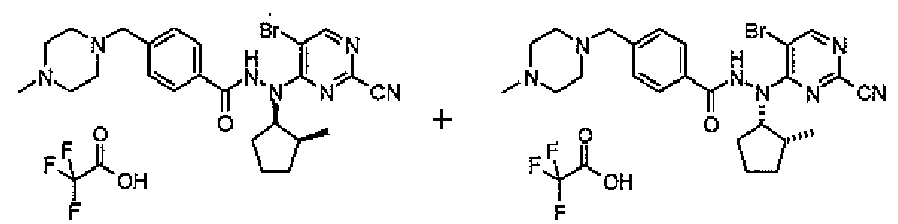
2 B D D 
3 A C C 
4 A B A 
5 A D C 
6 A C D 
7 A C B 
8 A C C 
9 A C C 
10 A C C 
11 A C C 
12 A C C 
13 A C D 
14 A C C 
15 A D C 
16 A C C 
17 A C C 
18 A C D 
19 A C C 
20 A D C 
21 A C D 
22 A C C 
23 A C C 
24 A C C 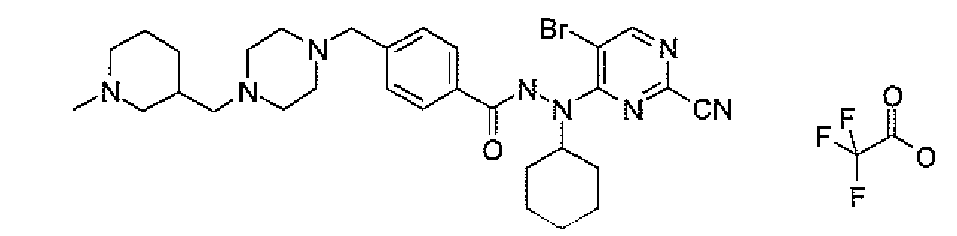
25 A C C 
26 A D D 
27 A C C 
28 A C C 
29 A D D 
30 B C D 
31 A D D 
32 A C D 
33 A D D 
34 B C C 
35 B D D 
36 B D D 
37 A D D 
38 A D E 
comparative 39 D E G -
- X = IC50 in nM
- X<1 A
- 1 <X<2.5 B
- 2.5<X<15 C
- 15<X<150 D
- 150<X<250 E
- 250<X<400 F
- X≥400 G
- The exemplified compounds of the invention exhibit an improved activity in each of the falcipain-2, falcipain-3 and whole cell assays, as compared with comparative Example 39 of the prior art.
Claims (17)
- At least one chemical entity selected from a compound of Formula I:
 Either A represents CH2 and n represents 0 or 1; or A represents -O- or N(C(O)C1-3 alkyl) and n represents 1;When A represents CH2, RX represents an optional methyl substituent on any carbon atom of the ring to which it is attached, otherwise RX is absent;R4 represents halogen;When A represents CH2 or N(C(O)C1-3alkyl), R2 represents -phenyl-C1-3alkylene-X or -phenyl-C1-3alkylene-X-RJ otherwise R2 represents -phenyl-C1-3alkylene-X-RJ; wherein any phenyl group in R2 is optionally substituted with at least one group independently selected from halogen or CF3;RJ represents Z, C1-4alkylene-Z or C(O)Z;X and Z independently represent a monocyclic 4-, 5- or 6-membered, saturated hydrocarbon group containing one or two nitrogen atoms and optionally an oxygen atom, which is optionally substituted with a group selected from: C1-4alkyl, OH and C1-4 alkylOH;and pharmaceutically acceptable derivatives thereof.
 - At least one chemical entity according to claim 1 wherein A represents CH2.
- At least one chemical entity according to claim 1 or claim 2 wherein A represents CH2, n represents 0 and RX represents methyl.
- At least one chemical entity according to any one of claims 1 to 3 wherein R4 represents chlorine, bromine or iodine.
- At least one chemical entity according to any one of claims 1 to 4 wherein A represents CH2 or N(C(O)C1-3alkyl) and R2 represents -phenyl-C1-3alkylene-X-RJ,
wherein phenyl is optionally substituted with one group selected from halogen or CF3. - At least one chemical entity according to any one of claims 1 to 5 wherein X represents piperidine, piperazine or morpholine, each of which is optionally substituted.
- At least one chemical entity according to any one of claims 1 to 6 wherein Z represents piperidine, piperazine or morpholine, each of which is optionally substituted.
- At least one chemical entity selected from:N'-(5-bromo-2-cyano-4-pyrimidinyl)-N'-cyclopentyf-4-[(4-methyl-1-piperazinyl)methyl]benzohydrazide;N'-(5-bromo-2-cyano-4-pyrimidinyl)-N'-[(1 R,2S+1 S,2R)-2-methylcyclo pentyl]-4-[(4-methyl-1-piperazinyl)methyl]benzohydrazide;N'-(5-bromo-2-cyano-4-pyrimidinyl)-N' -[(1 R,2R+1S,2S)-2-methylcyclo pentyl]-4-[(4-methyl-1-piperazinyl)methyl]benzohydrazide;N'-(5-bromo-2-cyano-4-pyrimidinyl)-N'-(3-methylcyclopentyl)-4-{[4-(4-methyl-1-piperazinyl)-1-piperidinyl]methyl}benzohydrazide;N'-(5-bromo-2-cyano-4-pyrimidinyl)-N'-(3-methylcyclopentyl)-4-({4-[(1-methyl-4-piperidinyl)methyl]-1-piperazinyl}methyl)benzohydrazide;N'-(5-bromo-2-cyano-4-pyrimidinyl)-N'-cyclopentyl-4-{[4-(4-morpholinyl)-1-piperidinyl]methyl}benzohydrazide;N'-(5-bromo-2-cyano-4-pyrimidinyl)-N'-cyclopentyl-4-({4-[(1-methyl-4-piperidinyl)methyl]-1-piperazinyl}methyl)benzohydrazide;N'-(5-bromo-2-cyano-4-pyrimidinyl)-N'-cyclopentyl-4-({4-[(1-methyl-3-piperidinyl)methyl]-1-piperazinyl}methyl)benzohydrazide;N'-(5-bromo-2-cyano-4-pyrimidinyl)-N'-cyclopentyl-4-({4-[(4-methyl-1-piperazinyl)carbonyl]-1-piperidinyl}methyl)benzohydrazide;N'-(5-bromo-2-cyano-4-pyrimidinyl)-N'-cyclopentyl-4-{[4-(4-methyl-1-piperazinyl)-1-piperidinyl]methyl}benzohydrazide;N'-(5-bromo-2-cyano-4-pyrimidinyl)-N'-cyclopentyl-3-{[4-(4-methyl-1-piperazinyl)-1-piperidinyl]methyl}benzohydrazide;N'-(5-bromo-2-cyano-4-pyrimidinyl)-N'-cyclopentyl-3-({4-[(4-methyl-1-piperazinyl)carbonyl]-1-piperidinyl}methyl)benzohydrazide;N'-(5-bromo-2-cyano-4-pyrimidinyl)-N'-cyclopentyl-3-{[4-(4-morpholinyl)-1-piperidinyl]methyl}benzohydrazide;N'-(5-bromo-2-cyano-4-pyrimidinyl)-N'-cyclopentyl-3-({4-[(1-methyl-3-piperidinyl)methyl]-1-piperazinyl}methyl)benzohydrazide;N'-(5-bromo-2-cyano-4-pyrimidinyl)-N'-cyclopentyl-3-({4-[(1-methyl-4-piperidinyl)methyl]-1-piperazinyl}methyl)benzohydrazide;N'-(5-bromo-2-cyano-4-pyrimidinyl)-N'-cyclohexyl-4-[(4-methyl-1-piperazinyl)methyl]benzohydrazide;N'-(5-bromo-2-cyano-4-pyrimidinyl)-N'-cyclohexyl-4-{[4-(4-methyl-1-piperazinyl)-1-piperidinyl]methyl}benzohydrazide;N'-(5-bromo-2-cyano-4-pyrimidinyl)-N'-cyclohexyl-4-{[4-(4-morpholinyl)-1-piperidinyl]methyl}benzohydrazide;N'-(5-bromo-2-cyano-4-pyrimidinyl)-N'-cyclohexyl-4-({4-[(1-methyl-4-piperidinyl)methyl]-1-piperazinyl}methyl)benzohydrazide;N'-(5-bromo-2-cyano-4-pyrimidinyl)-N'-cyclohexyl-3-{[4-(4-methyl-1-piperazinyl)-1-piperidinyl]methyl}benzohydrazide;N'-(5-bromo-2-cyano-4-pyrimidinyl)-N'-cyclohexyl-4-[(4-hydroxy-1-piperidinyl)methyl]benzohydrazide;N'-(5-bromo-2-cyano-4-pyrimidinyl)-N'-cyclohexyl-4-({4-[(4-methyl-1-piperazinyl)carbonyl]-1-piperidinyl}methyl)benzohydrazide;N'-(5-bromo-2-cyano-4-pyrimidinyl)-N'-cyclohexyl-3-({4-[(4-methyl-1-piperazinyl)carbonyl]-1-piperidinyl}methyl)benzohydrazide;N'-(5-bromo-2-cyano-4-pyrimidinyl)-N'-cyclohexyl-3-{[4-(4-morpholinyl)-1-piperidinyl]methyl}benzohydrazide;N'-(5-bromo-2-cyano-4-pyrimidinyl)-N'-cyclohexyl-4-({4-[(1-methyl-3-piperidinyl)methyl]-1-piperazinyl}methyl)benzohydrazide;N'-(5-bromo-2-cyano-4-pyrimidinyl)-N'-(3-methylcyclopentyl)-4-[(4-methyl-1-piperazinyl)methyl]benzohydrazide;N'-(5-bromo-2-cyano-4-pyrimidinyl)-N'-cyclohexyl-3-({4-[(1-methyl-3-piperidinyl)methyl]-1-piperazinyl}methyl)benzohydrazide;N'-(5-bromo-2-cyano-4-pyrimidinyl)-N'-cydohexyl-3-({4-[(1-methyl-4-piperidinyl)methyl]-1-piperazinyl}methyl)benzohydrazide;N'-(5-bromo-2-cyano-4-pyrimidinyl)-4-{[4-(4-methyl-1-piperazinyl)-1-piperidinyl]methyl}-N'-(tetrahydro-2H-pyran-4-yl)benzohydrazide;N'-(5-bromo-2-cyano-4-pyrimidinyl)-4-({4-[(1-methyl-4-piperidinyl)methyl]-1-piperazinyl}methyl)-N'-(tetrahydro-2H-pyran-4-yl)benzohydrazide;N'-(5-bromo-2-cyano-4-pyrimidinyl)-4-({4-[(1-methyl-3-piperidinyl)methyl]-1-piperazinyl}methyl)-N'-(tetrahydro-2H-pyran-4-yl)benzohydrazide;N'-(5-bromo-2-cyano-4-pyrimidinyl)-4-({4-[(4-methyl-1-piperazinyl)carbonyl]-1-piperidinyl}methyl)-N'-(tetrahydro-2H-pyran-4-yl)benzohydrazide;N'-(5-bromo-2-cyano-4-pyrimidinyl)-4-{[3-(1-pyrrolidinyl)-1-azetidinyl]methyl}-N'-(tetrahydro-2H-pyran-4-yl)benzohydrazide;N'-(5-chloro-2-cyano-4-pyrimidinyl)-4-{[4-(4-methyl-1-piperazinyl)-1-piperidinyl]methyl}-N'-(tetrahydro-2H-pyran-4-yl)benzohydrazide,N'-(5-chloro-2-cyano-4-pyrimidinyl)-4-({4-[(1-methyl-4-piperidinyl)methyl]-1-piperazinyl}methyl)-N'-(tetrahydro-2H-pyran-4-yl)benzohydrazide;N'-(5-chloro-2-cyano-4-pyrimidinyl)-4-({4-[(4-methyl-1-piperazinyl)carbonyl]-1-piperidinyl}methyl)-N'-(tetrahydro-2H-pyran-4-yl)benzohydrazide;N'-(1-acetyl-4-piperidinyl)-N'-(5-bromo-2-cyano-4-pyrimidinyl)-4-[(4-methyl-1-piperazinyl)methyl]benzohydrazide;N'-(1-acetyl-4-piperidinyl)-N'-(5-bromo-2-cyano-4-pyrimidinyl)-4-{[4-(4-methyl-1-piperazinyl)-1-piperidinyl]methyl}benzohydrazide;and pharmaceutically acceptable derivatives thereof.
- At least one chemical entity selected from:N'-(5-bromo-2-cyano-4-pyrimidinyi)-N'-cyclopentyl-4-[(4-methyl-1-piperazinyl)methyl]benzohydrazide trifluoroacetate;N'-(5-bromo-2-cyano-4-pyrimidinyl)-N'-[(1R,2S+1S,2R)-2-methylcyclo pentyl]-4-[(4-methyl-1-piperazinyl)methyl]benzohydrazide trifluoroacetateN'-(5-bromo-2-cyano-4-pyrimidinyl)-N'-[(1R,2R+1S,2S)-2-methylcyclo pentyl]-4-[(4-methyl-1-piperazinyl)methyl]benzohydrazide trifluoroacetate;N'-(5-bromo-2-cyano-4-pyrimidinyl)-N'-(3-methylcyclopentyl)-4-{[4-(4-methyl-1-piperazinyl)-1-piperidinyl]methyl}benzohydrazide trifluoroacetate;N'-(5-bromo-2-cyano-4-pyrimidinyl)-N'-(3-methylcyclopentyl)-4-({4-[(1-methyl-4-piperidinyl)methyl]-1-piperazinyl}methyl)benzohydrazide trifluoroacetate;N'-(5-bromo-2-cyano-4-pyrimidinyl)-N'-cyclopentyl-4-{[4-(4-morpholinyl)-1-piperidinyl]methyl}benzohydrazide trifluoroacetate;N'-(5-bromo-2-cyano-4-pyrimidinyl)-N'-cyclopentyl-4-({4-[(1-methyl-4-piperidinyl)methyl]-1-piperazinyl}methyl)benzohydrazide trifluoroacetate;N'-(5-bromo-2-cyano-4-pyrimidinyl)-N'-cyclopentyl-4-({4-[(1-methyl-3-piperidinyl)methyl]-1-piperazinyl}methyl)benzohydrazide trifluoroacetate;N'-(5-bromo-2-cyano-4-pyrimidinyl)-N'-cyclopentyl-4-({4-[(4-methyl-1-piperazinyl)carbonyl]-1-piperidinyl}methyl)benzohydrazide trifluoroacetate;N'-(5-bromo-2-cyano-4-pyrimidinyl)-N'-cyclopentyl-4-{[4-(4-methyl-1-piperazinyl)-1-piperidinyl]methyl}benzohydrazide trifluoroacetate;N'-(5-bromo-2-cyano-4-pyrimidinyl)-N'-cyclopentyl-3-{[4-(4-methyl-1-piperazinyl)-1-piperidinyl]methyl}benzohydrazide trifluoroacetate;N'-(5-bromo-2-cyano-4-pyrimidinyl)-N'-cyclopentyl-3-({4-[(4-methyl-1-piperazinyl)carbonyl]-1-piperidinyl}methyl)benzohydrazide trifluoroacetate;N'-(5-bromo-2-cyano-4-pyrimidinyl)-N'-cyclopentyl-3-{[4-(4-morpholinyl)-1-piperidinyl]methyl}benzohydrazide trifluoroacetate;N'-(5-bromo-2-cyano-4-pyrimidinyl)-N'-cyclopentyl-3-({4-[(1-methy(-3-piperidinyl)methyl]-1-piperazinyl}methyl)benzohydrazide trifluoroacetate;N'-(5-bromo-2-cyano-4-pyrimidinyl)-N'-cyclopentyl-3-({4-[(1-methyl-4-piperidinyl)methyl]-1-piperazinyl}methyl)benzohydrazide trifluoroacetate;N'-(5-bromo-2-cyano-4-pyrimidinyl)-N'-cyclohexyl-4-[(4-methyl-1-piperazinyl)methyl]benzohydrazide trifluoroacetate;N'-(5-bromo-2-cyano-4-pyrimidinyl)-N'-cyclohexyl-4-{[4-(4-methyl-1-piperazinyl)-1-piperidinyl]methyl}benzohydrazide trifluoroacetate;N'-(5-bromo-2-cyano-4-pyrimidinyl)-N'-cyclohexyl-4-{[4-(4-morpholinyl)-1-piperidinyl]methyl}benzohydrazide trifluoroacetate;N'-(5-bromo-2-cyano-4-pyrimidinyl)-N'-cyclohexyl-4-({4-[(1-methyl-4-piperidinyl)methyl]-1-piperazinyl}methyl)benzohydrazide trifluoroacetate;N'-(5-bromo-2-cyano-4-pyrimidinyl)-N'-cyclohexyl-3-{[4-(4-methyl-1-piperazinyl)-1-piperidinyl]methyl}benzohydrazide trifluoroacetate;N'-(5-bromo-2-cyano-4-pyrimidinyl)-N'-cyclohexyl-4-[(4-hydroxy-1-piperidinyl)methyl]benzohydrazide trifluoroacetate;N'-(5-bromo-2-cyano-4-pyrimidinyl)-N'-cyclohexyl-4-({4-[(4-methyl-1-piperazinyl)carbonyl]-1-piperidinyl}methyl)benzohydrazide trifluoroacetate;N'-(5-bromo-2-cyano-4-pyrimidinyl)-N'-cyclohexyl-3-({4-[(4-methyl-1-piperazinyl)carbonyl]-1-piperidinyl}methyl)benzohydrazide trifluoroacetate;N'-(5-bromo-2-cyano-4-pyrimidinyl)-N'-cyclohexyl-3-{[4-(4-morpholinyl)-1-piperidinyl]methyl}benzohydrazide trifluoroacetate;N'-(5-bromo-2-cyano-4-pyrimidinyl)-N'-cyclohexyl-4-({4-[(1-methyl-3-piperidinyl)methyl]-1-piperazinyl}methyl)benzohydrazide trifluoroacetate;N'-(5-bromo-2-cyano-4-pyrimidinyl)-N'-(3-methylcyclopentyl)-4-[{4-methyl-1-piperazinyl}methyl]benzohydrazide trifluoroacetate;N'-(5-bromo-2-cyano-4-pyrimidinyl)-N'-cyclohexyl-3-({4-[(1-methyl-3-piperidinyl)methyl]-1-piperazinyl}methyl)benzohydrazide trifluoroacetate;N'-(5-bromo-2-cyano-4-pyrimidinyl)-N'-cyclohexyl-3-({4-[(1-methyl-4-piperidinyl)methyl]-1-piperazinyl}methyl)benzohydrazide trifluoroacetate;N'-(5-bromo-2-cyano-4-pyrimidinyl)-4-{[4-(4-methyl-1-piperazinyl)-1-piperidinyl]methyl}-N'-(tetrahydro-2H-pyran-4-yl)benzohydrazide trifluoroacetate;N'-(5-bromo-2-cyano-4-pyrimidinyl)-4-({4-[(1-methyl-4-piperidinyl)methyl]-1-piperazinyl}methyl)-N'-(tetrahydro-2H-pyran-4-yl)benzohydrazide trifluoroacetate;N'-(5-bromo-2-cyano-4-pyrimidinyl)-4-({4-[(1-methyl-3-piperidinyl)methyl]-1-piperazinyl}methyl)-N'-(tetrahydro-2H-pyran-4-yl)benzohydrazide trifluoroacetate;N'-(5-bromo-2-cyano-4-pyrimidinyl)-4-({4-[(4-methyl-1-piperazinyl)carbonyl]-1-piperidinyl}methyl)-N'-(tetrahydro-2H-pyran-4-yl)benzohydrazide trifluoroacetate;N'-(5-bromo-2-cyano-4-pyrimidinyl)-4-{[3-(1-pyrrolidinyl)-1-azetidinyl]methyl}-N'-(tetra hyd ro-2H-pyran-4-yl) benzohyd razid e trifluoroacetate;N'-(5-chloro-2-cyano-4-pyrimidinyl)-4-{[4-(4-methyl-1-piperazinyl)-1-piperidinyl]methyl}-N'-(tetrahydro-2H-pyran-4-yl)benzohydrazide trifluoroacetate;N'-(5-chloro-2-cyano-4-pyrimidinyl)-4-({4-[(1-methyl-4-piperidinyl)methyl]-1-piperazinyl}methyl)-N'-(tetrahydro-2H-pyran-4-yl)benzohydrazide trifluoroacetate;N'-(5-chloro-2-cyano-4-pyrimidinyl)-4-({4-[(4-methyl-1-piperazinyl)carbonyl]-1-piperidinyl}methyl)-N'-(tetrahydro-2H-pyran-4-yl)benzohydrazide trifluoroacetate;N'-(1-acetyl-4-piperidinyl)-N'-(5-bromo-2-cyano-4-pyrimidinyl)-4-[(4-methyl-1-piperazinyl)methyl]benzohydrazide trifluoroacetate; andN'-(1-acetyl-4-piperidinyl)-N'-(5-bromo-2-cyano-4-pyrimidinyl)-4-{[4-(4-methyl-1-piperazinyl)-1-piperidinyl]methyl}benzohydrazide trifluoroacetate.
- At least one chemical entity according to according to any one of claims 1 to 9 for use in medical therapy.
- Use of at least one chemical entity according to any one of claims 1 to 9 in the manufacture of a medicament for the treatment of a condition susceptible to mediation by a cysteine protease inhibitor.
- Use of at least one chemical entity according to any one of claims 1 to 9 in the manufacture of a medicament for the treatment of malaria.
- A method for the treatment of a human or animal subject suffering from a condition susceptible to mediation by a cysteine protease inhibitor, comprising administering to said human or animal subject an effective amount of at least one chemical entity according to any one of claims 1 to 9.
- A method for the treatment of a human or animal subject suffering from malaria, comprising administering to said human or animal subject an effective amount of at least one chemical entity according to any one of claims 1 to 9.
- A pharmaceutical composition comprising at least one chemical entity according to any one of claims 1 to 9 in admixture with one or more pharmaceutically acceptable carrier and/or excipient.
- A process for the preparation of compounds of Formula I as defined in claim 1, from a reaction between compounds of Formula II, from a reaction between compounds of Formula II, wherein A, n, R4 and RX are as defined for Formula I, compounds of Formula III, wherein Hal is chlorine or bromine, and compounds of Formula IV, wherein X and RJ are as defined for Formula I, according to the Scheme below.

- A process for the preparation of compounds of Formula I as defined in claim 1, from a reaction between compounds of Formula V, wherein A, n, R4 and RX are as defined for Formula I and Hal is chlorine or bromine and compounds of Formula IV, wherein X and RJ are as defined for Formula I, according to the Scheme below.

Priority Applications (9)
| Application Number | Priority Date | Filing Date | Title |
|---|---|---|---|
| EP06381045A EP1918284A1 (en) | 2006-10-30 | 2006-10-30 | Hydrazinopyrimidines as cysteine protease inhibitors |
| TW096140168A TW200825058A (en) | 2006-10-30 | 2007-10-26 | Cysteine protease inhibitors |
| ARP070104761A AR063420A1 (en) | 2006-10-30 | 2007-10-26 | DERIVATIVES OF 2-CIANO-4-PIRIMIDINIL SUBSTITUTED, PROCESS OF PREPARATION OF THE SAME, MEDICINES THAT CONTAIN THEM AND ITS USE FOR THE TREATMENT OF THE MALARIA. |
| JP2009535057A JP2010508322A (en) | 2006-10-30 | 2007-10-26 | Novel substituted pyridine derivatives as cysteine protease inhibitors |
| EP07847076A EP2077841A1 (en) | 2006-10-30 | 2007-10-26 | Novel substituted pyrimidines as cysteine protease inhibitors |
| PCT/EP2007/061516 WO2008052934A1 (en) | 2006-10-30 | 2007-10-26 | Novel substituted pyrimidines as cysteine protease inhibitors |
| US12/444,699 US20100009956A1 (en) | 2006-10-30 | 2007-10-26 | Novel substituted pyrimidines as cysteine protease inhibitors |
| PE2007001464A PE20081471A1 (en) | 2006-10-30 | 2007-10-26 | HETEROARYLNITRILE DERIVATIVES AS CYSTEINE PROTEASE INHIBITORS |
| CL200703100A CL2007003100A1 (en) | 2006-10-30 | 2007-10-26 | COMPOUNDS DERIVED FROM PIRIMIDINA, INHIBITORS OF CISTEINE PROTEASA; PREPARATION PROCESSES; SALES OF COMPOUNDS; PHARMACEUTICAL COMPOSITION; AND USE FOR THE TREATMENT OF MALARIA. |
Applications Claiming Priority (1)
| Application Number | Priority Date | Filing Date | Title |
|---|---|---|---|
| EP06381045A EP1918284A1 (en) | 2006-10-30 | 2006-10-30 | Hydrazinopyrimidines as cysteine protease inhibitors |
Publications (1)
| Publication Number | Publication Date |
|---|---|
| EP1918284A1 true EP1918284A1 (en) | 2008-05-07 |
Family
ID=37882418
Family Applications (1)
| Application Number | Title | Priority Date | Filing Date |
|---|---|---|---|
| EP06381045A Ceased EP1918284A1 (en) | 2006-10-30 | 2006-10-30 | Hydrazinopyrimidines as cysteine protease inhibitors |
Country Status (1)
| Country | Link |
|---|---|
| EP (1) | EP1918284A1 (en) |
Cited By (1)
| Publication number | Priority date | Publication date | Assignee | Title |
|---|---|---|---|---|
| WO2010078906A3 (en) * | 2008-12-18 | 2010-10-14 | Bayer Cropscience Ag | Hydrazides method for production and use thereof as herbicide and insecticide |
Citations (3)
| Publication number | Priority date | Publication date | Assignee | Title |
|---|---|---|---|---|
| WO2003101442A1 (en) * | 2002-05-31 | 2003-12-11 | Smithkline Beecham Corporation | Peptide deformylase inhibitors |
| US20040097493A1 (en) * | 2002-11-18 | 2004-05-20 | Chen Jian Jeffrey | Diazinopyrimidines |
| WO2006027211A1 (en) * | 2004-09-07 | 2006-03-16 | Glaxo Group Limited | 2,4-substituted pyrimidines as cysteine protease inhibitors |
-
2006
- 2006-10-30 EP EP06381045A patent/EP1918284A1/en not_active Ceased
Patent Citations (3)
| Publication number | Priority date | Publication date | Assignee | Title |
|---|---|---|---|---|
| WO2003101442A1 (en) * | 2002-05-31 | 2003-12-11 | Smithkline Beecham Corporation | Peptide deformylase inhibitors |
| US20040097493A1 (en) * | 2002-11-18 | 2004-05-20 | Chen Jian Jeffrey | Diazinopyrimidines |
| WO2006027211A1 (en) * | 2004-09-07 | 2006-03-16 | Glaxo Group Limited | 2,4-substituted pyrimidines as cysteine protease inhibitors |
Cited By (1)
| Publication number | Priority date | Publication date | Assignee | Title |
|---|---|---|---|---|
| WO2010078906A3 (en) * | 2008-12-18 | 2010-10-14 | Bayer Cropscience Ag | Hydrazides method for production and use thereof as herbicide and insecticide |
Similar Documents
| Publication | Publication Date | Title |
|---|---|---|
| US20100009956A1 (en) | Novel substituted pyrimidines as cysteine protease inhibitors | |
| US8178575B2 (en) | Derivatives of azabicyclo octane, the method of making them and the uses thereof as inhibitors of dipeptidyl peptidase IV | |
| JPWO2003070691A1 (en) | N-hydroxycarboxamide derivatives | |
| US8901295B2 (en) | Inhibitors of cyclophilins and uses thereof | |
| US8680282B2 (en) | Cyclic inhibitors of carnitine palmitoyltransferase and treating cancer | |
| WO2023076237A1 (en) | Compounds as glp-1r agonists | |
| US7265145B2 (en) | Substituted piperidines and pyrrolidines as calcium sensing receptor modulators and method | |
| CN108794517B (en) | Arginase inhibitor and preparation method and application thereof | |
| WO2007025774A2 (en) | Cysteine protease inhibitors | |
| US20080221063A1 (en) | Heterocyclic Sulfonamide Derivatives As Inhibitors Of Factor Xa | |
| TW202532069A (en) | Neuroprotective agent | |
| EP1947091A1 (en) | Pyrimidyl nitrile derivatives as cysteine protease inhibitors | |
| WO2006027211A1 (en) | 2,4-substituted pyrimidines as cysteine protease inhibitors | |
| EP2030621A1 (en) | Novel substituted pyrimidines as cysteine protease inhibitors | |
| US9636346B2 (en) | Alpha-oxoacyl amino-caprolactam derivative | |
| US20100105652A1 (en) | Purines as cysteine protease inhibitors | |
| EP2185525B1 (en) | Pyrazole 3,5 carboxylate derivatives preparation and therapeutic application thereof | |
| US20080319031A1 (en) | Novel Tyrosine Derivatives | |
| US20090281161A1 (en) | Organic Compounds | |
| EP1972630A1 (en) | Purines as cysteine protease inhibitors | |
| EP2028182A1 (en) | Cysteine protease inhibitors | |
| KR101116754B1 (en) | 6-amino-N-hydroxyhexaneamide compound having histone deacetylase inhibitory activity and preparation method thereof | |
| JP2011016743A (en) | Cyclic amino compound, or salt thereof | |
| JP2002541256A (en) | Novel endothelin convertase inhibitors, their production and use | |
| CN107304180A (en) | Benzamide derivatives, its preparation method and its in purposes pharmaceutically |
Legal Events
| Date | Code | Title | Description |
|---|---|---|---|
| PUAI | Public reference made under article 153(3) epc to a published international application that has entered the european phase |
Free format text: ORIGINAL CODE: 0009012 |
|
| AK | Designated contracting states |
Kind code of ref document: A1 Designated state(s): AT BE BG CH CY CZ DE DK EE ES FI FR GB GR HU IE IS IT LI LT LU LV MC NL PL PT RO SE SI SK TR |
|
| AX | Request for extension of the european patent |
Extension state: AL BA HR MK RS |
|
| STAA | Information on the status of an ep patent application or granted ep patent |
Free format text: STATUS: THE APPLICATION HAS BEEN REFUSED |
|
| 18R | Application refused |
Effective date: 20080607 |