EP1917279B1 - Production of isotactic and regiorandom polypropylene based polymer and block copolymers - Google Patents
Production of isotactic and regiorandom polypropylene based polymer and block copolymers Download PDFInfo
- Publication number
- EP1917279B1 EP1917279B1 EP06851127.8A EP06851127A EP1917279B1 EP 1917279 B1 EP1917279 B1 EP 1917279B1 EP 06851127 A EP06851127 A EP 06851127A EP 1917279 B1 EP1917279 B1 EP 1917279B1
- Authority
- EP
- European Patent Office
- Prior art keywords
- containing group
- group
- ranging
- hydrogen atom
- block
- Prior art date
- Legal status (The legal status is an assumption and is not a legal conclusion. Google has not performed a legal analysis and makes no representation as to the accuracy of the status listed.)
- Not-in-force
Links
- -1 polypropylene Polymers 0.000 title claims description 64
- 229920001155 polypropylene Polymers 0.000 title claims description 40
- 239000004743 Polypropylene Substances 0.000 title claims description 38
- 229920000642 polymer Polymers 0.000 title claims description 29
- 229920001400 block copolymer Polymers 0.000 title claims description 15
- 125000004435 hydrogen atom Chemical group [H]* 0.000 claims description 52
- 125000004805 propylene group Chemical group [H]C([H])([H])C([H])([*:1])C([H])([H])[*:2] 0.000 claims description 38
- QQONPFPTGQHPMA-UHFFFAOYSA-N propylene Natural products CC=C QQONPFPTGQHPMA-UHFFFAOYSA-N 0.000 claims description 35
- 125000002496 methyl group Chemical group [H]C([H])([H])* 0.000 claims description 33
- 229910052799 carbon Inorganic materials 0.000 claims description 29
- ZOXJGFHDIHLPTG-UHFFFAOYSA-N Boron Chemical compound [B] ZOXJGFHDIHLPTG-UHFFFAOYSA-N 0.000 claims description 25
- 229910052796 boron Inorganic materials 0.000 claims description 25
- XUIMIQQOPSSXEZ-UHFFFAOYSA-N Silicon Chemical compound [Si] XUIMIQQOPSSXEZ-UHFFFAOYSA-N 0.000 claims description 24
- 229910052710 silicon Inorganic materials 0.000 claims description 24
- 239000010703 silicon Substances 0.000 claims description 24
- OAICVXFJPJFONN-UHFFFAOYSA-N Phosphorus Chemical compound [P] OAICVXFJPJFONN-UHFFFAOYSA-N 0.000 claims description 22
- NINIDFKCEFEMDL-UHFFFAOYSA-N Sulfur Chemical compound [S] NINIDFKCEFEMDL-UHFFFAOYSA-N 0.000 claims description 22
- QVGXLLKOCUKJST-UHFFFAOYSA-N atomic oxygen Chemical compound [O] QVGXLLKOCUKJST-UHFFFAOYSA-N 0.000 claims description 22
- 125000005843 halogen group Chemical group 0.000 claims description 22
- 150000002391 heterocyclic compounds Chemical group 0.000 claims description 22
- QJGQUHMNIGDVPM-UHFFFAOYSA-N nitrogen group Chemical group [N] QJGQUHMNIGDVPM-UHFFFAOYSA-N 0.000 claims description 22
- 229910052760 oxygen Inorganic materials 0.000 claims description 22
- 239000001301 oxygen Substances 0.000 claims description 22
- 229910052698 phosphorus Inorganic materials 0.000 claims description 22
- 239000011574 phosphorus Substances 0.000 claims description 22
- 229910052717 sulfur Inorganic materials 0.000 claims description 22
- 239000011593 sulfur Substances 0.000 claims description 22
- OKTJSMMVPCPJKN-UHFFFAOYSA-N Carbon Chemical compound [C] OKTJSMMVPCPJKN-UHFFFAOYSA-N 0.000 claims description 17
- 238000003780 insertion Methods 0.000 claims description 17
- NBVXSUQYWXRMNV-UHFFFAOYSA-N fluoromethane Chemical group FC NBVXSUQYWXRMNV-UHFFFAOYSA-N 0.000 claims description 15
- 229910052748 manganese Inorganic materials 0.000 claims description 15
- 238000000034 method Methods 0.000 claims description 15
- 229930195733 hydrocarbon Natural products 0.000 claims description 8
- 150000002430 hydrocarbons Chemical class 0.000 claims description 8
- 239000004215 Carbon black (E152) Substances 0.000 claims description 7
- ATJFFYVFTNAWJD-UHFFFAOYSA-N Tin Chemical compound [Sn] ATJFFYVFTNAWJD-UHFFFAOYSA-N 0.000 claims description 7
- 229910052782 aluminium Inorganic materials 0.000 claims description 7
- XAGFODPZIPBFFR-UHFFFAOYSA-N aluminium Chemical compound [Al] XAGFODPZIPBFFR-UHFFFAOYSA-N 0.000 claims description 7
- 229910052732 germanium Inorganic materials 0.000 claims description 7
- GNPVGFCGXDBREM-UHFFFAOYSA-N germanium atom Chemical compound [Ge] GNPVGFCGXDBREM-UHFFFAOYSA-N 0.000 claims description 7
- 229910052736 halogen Inorganic materials 0.000 claims description 7
- 150000002367 halogens Chemical class 0.000 claims description 7
- 229920000359 diblock copolymer Polymers 0.000 claims description 5
- 230000000379 polymerizing effect Effects 0.000 claims description 5
- 229910052723 transition metal Inorganic materials 0.000 claims description 5
- 150000003624 transition metals Chemical class 0.000 claims description 5
- 229920000428 triblock copolymer Polymers 0.000 claims description 5
- 229910052751 metal Inorganic materials 0.000 claims description 4
- 239000002184 metal Substances 0.000 claims description 4
- 125000003118 aryl group Chemical group 0.000 claims description 3
- 229910052731 fluorine Inorganic materials 0.000 claims description 3
- 125000001153 fluoro group Chemical group F* 0.000 claims description 3
- 229910052739 hydrogen Inorganic materials 0.000 claims description 3
- 239000001257 hydrogen Substances 0.000 claims description 3
- 229920001296 polysiloxane Polymers 0.000 claims 1
- 239000003054 catalyst Substances 0.000 description 31
- 239000000376 reactant Substances 0.000 description 11
- PAYRUJLWNCNPSJ-UHFFFAOYSA-N Aniline Chemical compound NC1=CC=CC=C1 PAYRUJLWNCNPSJ-UHFFFAOYSA-N 0.000 description 6
- CWRYPZZKDGJXCA-UHFFFAOYSA-N acenaphthene Chemical compound C1=CC(CC2)=C3C2=CC=CC3=C1 CWRYPZZKDGJXCA-UHFFFAOYSA-N 0.000 description 6
- 238000006116 polymerization reaction Methods 0.000 description 6
- XTHFKEDIFFGKHM-UHFFFAOYSA-N Dimethoxyethane Chemical compound COCCOC XTHFKEDIFFGKHM-UHFFFAOYSA-N 0.000 description 5
- 101001110286 Homo sapiens Ras-related C3 botulinum toxin substrate 1 Proteins 0.000 description 5
- 102100022122 Ras-related C3 botulinum toxin substrate 1 Human genes 0.000 description 5
- 150000001448 anilines Chemical class 0.000 description 5
- 150000001875 compounds Chemical class 0.000 description 5
- 239000003446 ligand Substances 0.000 description 5
- 239000000463 material Substances 0.000 description 5
- VGGSQFUCUMXWEO-UHFFFAOYSA-N Ethene Chemical compound C=C VGGSQFUCUMXWEO-UHFFFAOYSA-N 0.000 description 4
- 239000005977 Ethylene Substances 0.000 description 4
- 239000000853 adhesive Substances 0.000 description 4
- 230000001070 adhesive effect Effects 0.000 description 4
- 125000004432 carbon atom Chemical group C* 0.000 description 4
- YXFVVABEGXRONW-UHFFFAOYSA-N Toluene Chemical compound CC1=CC=CC=C1 YXFVVABEGXRONW-UHFFFAOYSA-N 0.000 description 3
- HXGDTGSAIMULJN-UHFFFAOYSA-N acetnaphthylene Natural products C1=CC(C=C2)=C3C2=CC=CC3=C1 HXGDTGSAIMULJN-UHFFFAOYSA-N 0.000 description 3
- 239000002253 acid Substances 0.000 description 3
- 230000015572 biosynthetic process Effects 0.000 description 3
- 239000000203 mixture Substances 0.000 description 3
- 0 *c1c(*)c(I)cc(N)c1 Chemical compound *c1c(*)c(I)cc(N)c1 0.000 description 2
- UEXCJVNBTNXOEH-UHFFFAOYSA-N Ethynylbenzene Chemical group C#CC1=CC=CC=C1 UEXCJVNBTNXOEH-UHFFFAOYSA-N 0.000 description 2
- 229910004039 HBF4 Inorganic materials 0.000 description 2
- KDLHZDBZIXYQEI-UHFFFAOYSA-N Palladium Chemical compound [Pd] KDLHZDBZIXYQEI-UHFFFAOYSA-N 0.000 description 2
- 229910000071 diazene Inorganic materials 0.000 description 2
- 230000010339 dilation Effects 0.000 description 2
- 125000000524 functional group Chemical group 0.000 description 2
- 125000001570 methylene group Chemical group [H]C([H])([*:1])[*:2] 0.000 description 2
- 229910052759 nickel Inorganic materials 0.000 description 2
- RZXMPPFPUUCRFN-UHFFFAOYSA-N p-toluidine Chemical compound CC1=CC=C(N)C=C1 RZXMPPFPUUCRFN-UHFFFAOYSA-N 0.000 description 2
- 229910052763 palladium Inorganic materials 0.000 description 2
- 239000004033 plastic Substances 0.000 description 2
- 229920003023 plastic Polymers 0.000 description 2
- 125000001424 substituent group Chemical group 0.000 description 2
- 238000003786 synthesis reaction Methods 0.000 description 2
- JOXIMZWYDAKGHI-UHFFFAOYSA-N toluene-4-sulfonic acid Chemical compound CC1=CC=C(S(O)(=O)=O)C=C1 JOXIMZWYDAKGHI-UHFFFAOYSA-N 0.000 description 2
- ITMCEJHCFYSIIV-UHFFFAOYSA-N triflic acid Chemical compound OS(=O)(=O)C(F)(F)F ITMCEJHCFYSIIV-UHFFFAOYSA-N 0.000 description 2
- 239000004711 α-olefin Substances 0.000 description 2
- LEAQUNCACNBDEV-KHPPLWFESA-N (Z)-undec-1-en-1-ol Chemical compound CCCCCCCCC\C=C/O LEAQUNCACNBDEV-KHPPLWFESA-N 0.000 description 1
- 238000005160 1H NMR spectroscopy Methods 0.000 description 1
- LZUQTLJOUJXCGR-UHFFFAOYSA-N 2,6-bis(1-phenylethenyl)aniline Chemical class NC1=C(C(=C)C=2C=CC=CC=2)C=CC=C1C(=C)C1=CC=CC=C1 LZUQTLJOUJXCGR-UHFFFAOYSA-N 0.000 description 1
- CPELXLSAUQHCOX-UHFFFAOYSA-N Hydrogen bromide Chemical compound Br CPELXLSAUQHCOX-UHFFFAOYSA-N 0.000 description 1
- AFBPFSWMIHJQDM-UHFFFAOYSA-N N-methyl-N-phenylamine Natural products CNC1=CC=CC=C1 AFBPFSWMIHJQDM-UHFFFAOYSA-N 0.000 description 1
- 229910021585 Nickel(II) bromide Inorganic materials 0.000 description 1
- GRYLNZFGIOXLOG-UHFFFAOYSA-N Nitric acid Chemical compound O[N+]([O-])=O GRYLNZFGIOXLOG-UHFFFAOYSA-N 0.000 description 1
- 239000004793 Polystyrene Substances 0.000 description 1
- QAOWNCQODCNURD-UHFFFAOYSA-N Sulfuric acid Chemical compound OS(O)(=O)=O QAOWNCQODCNURD-UHFFFAOYSA-N 0.000 description 1
- DTQVDTLACAAQTR-UHFFFAOYSA-N Trifluoroacetic acid Chemical compound OC(=O)C(F)(F)F DTQVDTLACAAQTR-UHFFFAOYSA-N 0.000 description 1
- 229910021536 Zeolite Inorganic materials 0.000 description 1
- AFPRJLBZLPBTPZ-UHFFFAOYSA-N acenaphthoquinone Chemical compound C1=CC(C(C2=O)=O)=C3C2=CC=CC3=C1 AFPRJLBZLPBTPZ-UHFFFAOYSA-N 0.000 description 1
- 150000007513 acids Chemical class 0.000 description 1
- 150000001336 alkenes Chemical class 0.000 description 1
- 230000029936 alkylation Effects 0.000 description 1
- 238000005804 alkylation reaction Methods 0.000 description 1
- 229920006125 amorphous polymer Polymers 0.000 description 1
- 150000004945 aromatic hydrocarbons Chemical group 0.000 description 1
- 229920001585 atactic polymer Polymers 0.000 description 1
- 238000006555 catalytic reaction Methods 0.000 description 1
- 238000006243 chemical reaction Methods 0.000 description 1
- 229910052804 chromium Inorganic materials 0.000 description 1
- 229920001577 copolymer Polymers 0.000 description 1
- 229910052802 copper Inorganic materials 0.000 description 1
- 238000000113 differential scanning calorimetry Methods 0.000 description 1
- HNPSIPDUKPIQMN-UHFFFAOYSA-N dioxosilane;oxo(oxoalumanyloxy)alumane Chemical compound O=[Si]=O.O=[Al]O[Al]=O HNPSIPDUKPIQMN-UHFFFAOYSA-N 0.000 description 1
- 238000005227 gel permeation chromatography Methods 0.000 description 1
- 229910052735 hafnium Inorganic materials 0.000 description 1
- 125000000623 heterocyclic group Chemical group 0.000 description 1
- 238000005984 hydrogenation reaction Methods 0.000 description 1
- 238000010348 incorporation Methods 0.000 description 1
- 230000037431 insertion Effects 0.000 description 1
- 229910052741 iridium Inorganic materials 0.000 description 1
- 229910052742 iron Inorganic materials 0.000 description 1
- 150000002739 metals Chemical class 0.000 description 1
- 239000000178 monomer Substances 0.000 description 1
- IPLJNQFXJUCRNH-UHFFFAOYSA-L nickel(2+);dibromide Chemical compound [Ni+2].[Br-].[Br-] IPLJNQFXJUCRNH-UHFFFAOYSA-L 0.000 description 1
- 229910017604 nitric acid Inorganic materials 0.000 description 1
- 125000001997 phenyl group Chemical group [H]C1=C([H])C([H])=C(*)C([H])=C1[H] 0.000 description 1
- 229920002223 polystyrene Polymers 0.000 description 1
- 238000002360 preparation method Methods 0.000 description 1
- 229910052703 rhodium Inorganic materials 0.000 description 1
- 229910052707 ruthenium Inorganic materials 0.000 description 1
- 229910052709 silver Inorganic materials 0.000 description 1
- 239000003203 stereoselective catalyst Substances 0.000 description 1
- 150000003440 styrenes Chemical class 0.000 description 1
- 229910052719 titanium Inorganic materials 0.000 description 1
- IAQRGUVFOMOMEM-ONEGZZNKSA-N trans-but-2-ene Chemical compound C\C=C\C IAQRGUVFOMOMEM-ONEGZZNKSA-N 0.000 description 1
- 230000007306 turnover Effects 0.000 description 1
- 239000010457 zeolite Substances 0.000 description 1
- 229910052725 zinc Inorganic materials 0.000 description 1
- 229910052726 zirconium Inorganic materials 0.000 description 1
Classifications
-
- C—CHEMISTRY; METALLURGY
- C07—ORGANIC CHEMISTRY
- C07C—ACYCLIC OR CARBOCYCLIC COMPOUNDS
- C07C251/00—Compounds containing nitrogen atoms doubly-bound to a carbon skeleton
- C07C251/02—Compounds containing nitrogen atoms doubly-bound to a carbon skeleton containing imino groups
- C07C251/20—Compounds containing nitrogen atoms doubly-bound to a carbon skeleton containing imino groups having carbon atoms of imino groups being part of rings other than six-membered aromatic rings
-
- C—CHEMISTRY; METALLURGY
- C08—ORGANIC MACROMOLECULAR COMPOUNDS; THEIR PREPARATION OR CHEMICAL WORKING-UP; COMPOSITIONS BASED THEREON
- C08F—MACROMOLECULAR COMPOUNDS OBTAINED BY REACTIONS ONLY INVOLVING CARBON-TO-CARBON UNSATURATED BONDS
- C08F10/00—Homopolymers and copolymers of unsaturated aliphatic hydrocarbons having only one carbon-to-carbon double bond
-
- C—CHEMISTRY; METALLURGY
- C08—ORGANIC MACROMOLECULAR COMPOUNDS; THEIR PREPARATION OR CHEMICAL WORKING-UP; COMPOSITIONS BASED THEREON
- C08F—MACROMOLECULAR COMPOUNDS OBTAINED BY REACTIONS ONLY INVOLVING CARBON-TO-CARBON UNSATURATED BONDS
- C08F297/00—Macromolecular compounds obtained by successively polymerising different monomer systems using a catalyst of the ionic or coordination type without deactivating the intermediate polymer
- C08F297/06—Macromolecular compounds obtained by successively polymerising different monomer systems using a catalyst of the ionic or coordination type without deactivating the intermediate polymer using a catalyst of the coordination type
-
- C—CHEMISTRY; METALLURGY
- C08—ORGANIC MACROMOLECULAR COMPOUNDS; THEIR PREPARATION OR CHEMICAL WORKING-UP; COMPOSITIONS BASED THEREON
- C08F—MACROMOLECULAR COMPOUNDS OBTAINED BY REACTIONS ONLY INVOLVING CARBON-TO-CARBON UNSATURATED BONDS
- C08F297/00—Macromolecular compounds obtained by successively polymerising different monomer systems using a catalyst of the ionic or coordination type without deactivating the intermediate polymer
- C08F297/06—Macromolecular compounds obtained by successively polymerising different monomer systems using a catalyst of the ionic or coordination type without deactivating the intermediate polymer using a catalyst of the coordination type
- C08F297/08—Macromolecular compounds obtained by successively polymerising different monomer systems using a catalyst of the ionic or coordination type without deactivating the intermediate polymer using a catalyst of the coordination type polymerising mono-olefins
-
- C—CHEMISTRY; METALLURGY
- C08—ORGANIC MACROMOLECULAR COMPOUNDS; THEIR PREPARATION OR CHEMICAL WORKING-UP; COMPOSITIONS BASED THEREON
- C08F—MACROMOLECULAR COMPOUNDS OBTAINED BY REACTIONS ONLY INVOLVING CARBON-TO-CARBON UNSATURATED BONDS
- C08F297/00—Macromolecular compounds obtained by successively polymerising different monomer systems using a catalyst of the ionic or coordination type without deactivating the intermediate polymer
- C08F297/06—Macromolecular compounds obtained by successively polymerising different monomer systems using a catalyst of the ionic or coordination type without deactivating the intermediate polymer using a catalyst of the coordination type
- C08F297/08—Macromolecular compounds obtained by successively polymerising different monomer systems using a catalyst of the ionic or coordination type without deactivating the intermediate polymer using a catalyst of the coordination type polymerising mono-olefins
- C08F297/083—Macromolecular compounds obtained by successively polymerising different monomer systems using a catalyst of the ionic or coordination type without deactivating the intermediate polymer using a catalyst of the coordination type polymerising mono-olefins the monomers being ethylene or propylene
-
- C—CHEMISTRY; METALLURGY
- C08—ORGANIC MACROMOLECULAR COMPOUNDS; THEIR PREPARATION OR CHEMICAL WORKING-UP; COMPOSITIONS BASED THEREON
- C08F—MACROMOLECULAR COMPOUNDS OBTAINED BY REACTIONS ONLY INVOLVING CARBON-TO-CARBON UNSATURATED BONDS
- C08F297/00—Macromolecular compounds obtained by successively polymerising different monomer systems using a catalyst of the ionic or coordination type without deactivating the intermediate polymer
- C08F297/06—Macromolecular compounds obtained by successively polymerising different monomer systems using a catalyst of the ionic or coordination type without deactivating the intermediate polymer using a catalyst of the coordination type
- C08F297/08—Macromolecular compounds obtained by successively polymerising different monomer systems using a catalyst of the ionic or coordination type without deactivating the intermediate polymer using a catalyst of the coordination type polymerising mono-olefins
- C08F297/083—Macromolecular compounds obtained by successively polymerising different monomer systems using a catalyst of the ionic or coordination type without deactivating the intermediate polymer using a catalyst of the coordination type polymerising mono-olefins the monomers being ethylene or propylene
- C08F297/086—Macromolecular compounds obtained by successively polymerising different monomer systems using a catalyst of the ionic or coordination type without deactivating the intermediate polymer using a catalyst of the coordination type polymerising mono-olefins the monomers being ethylene or propylene the block polymer contains at least three blocks
-
- C—CHEMISTRY; METALLURGY
- C08—ORGANIC MACROMOLECULAR COMPOUNDS; THEIR PREPARATION OR CHEMICAL WORKING-UP; COMPOSITIONS BASED THEREON
- C08F—MACROMOLECULAR COMPOUNDS OBTAINED BY REACTIONS ONLY INVOLVING CARBON-TO-CARBON UNSATURATED BONDS
- C08F110/00—Homopolymers of unsaturated aliphatic hydrocarbons having only one carbon-to-carbon double bond
- C08F110/04—Monomers containing three or four carbon atoms
- C08F110/06—Propene
Definitions
- This invention is directed to block copolymer containing at least one block of regiorandom polypropylene.
- the invention provides:
- C 2 -symmetric means obtaining an identical molecule on 180° rotation.
- regiorandom propylene based polymer means polymer containing substantially propylene units, e.g., at least 90% propylene units, with the amount of other units present being such that the polymer remains amorphous, i.e., so as not to eliminate the amorphous nature of the material.
- Other units that can be present include, for example, consecutive methylene groups.
- regiorandom polypropylene means having the structure where the percentage of p units is at least 1%, typically 15% or greater, but not higher than 99%.
- Regiorandom polypropylene is similar in structure and properties to commercially made poly(ethylene-co-propylene) (EPR) which is a rubbery material with a low Tg and is useful in many commercial applications.
- EPR poly(ethylene-co-propylene)
- the regiorandom polypropylene herein offers advantages over EPR, including controlled molecular weight and molecular weight distribution, and no ethylene runs (ethylene runs in commercial EPR cause small regions of crystallinity in the otherwise amorphous polymer).
- the regiorandom polypropylene herein is an exceptional material because it has such low Tg, e.g., 0°C to -60°C, and is very soft and pliable.
- isotactic propylene based polymer means polymer containing substantially propylene units, e.g., at least 90% propylene units, with the amount of comonomer present being such as not to eliminate the crystallinity of the material.
- Other units that can be present include, for example, units from monomers selected from the group consisting of ethylene, C 4 -C 20 -alpha olefins, and C 4 -C 20 alpha olefins containing functional groups, e.g., undecenyl alcohol, and combinations of these.
- isotactic polypropylene is used herein to mean isotactic propylene based polymer unless the context indicates otherwise.
- multi-block means more than one block and is synonymous with the term “plural block”.
- One embodiment herein, denoted the first embodiment, is directed to diblock copolymer having PDI less than 3 and Mn ranging up to 1,000,000 where one block is isotactic propylene based polymer, e.g., isotactic polypropylene, having T m of greater than 50°C and M n ranging from 1,000 to 999,000 and one block is regiorandom propylene based polymer, e.g., regiorandom polypropylene, having a percentage of 3,1-insertion of polypropylene ranging from 1-99%, e.g. at least 6% or at least 20%, and M n ranging 1,000 to 999,000.
- the diblock copolymer of the first embodiment is useful as a compatibilizer for isotactic polypropylene and ethylene-co-propylene polymers which combination in turn is useful for making plastic wrap, films, and containers for food and other objects.
- Another embodiment herein, denoted the second embodiment, is directed to a triblock copolymer having PDI less than 3 and M n ranging up to 1,000,000 where a first block is isotactic propylene based polymer, e.g., isotactic polypropylene, having T m of greater than 50°C and M n ranging from 1,000 to 998,000 and a second block is regiorandom propylene based polymer, e.g., polypropylene, having a percentage of 3,1-insertion of polypropylene ranging from 1-99%, e.g.
- the triblock copolymer of the second embodiment is useful for medical devices, such as dilation balloon catheters, e.g., as described in EP-A-1508349 A1, shoe soles and as an adhesive component of an adhesive composition.
- Still another embodiment herein, denoted the third embodiment, is directed to a multi-block copolymer having PDI less than 3 and M n ranging up to 1,000,000 comprising at least one block of isotactic propylene based polymer, e.g., isotactic polypropylene, having T m of greater than 50°C and M n ranging from 1,000 to 999,000 and at least one block of regiorandom propylene based polymer, e.g., regiorandom polypropylene, having a percentage of 3,1-insertion of polypropylene ranging from 1-99%, e.g. at least 6% or at least 20%, and M n ranging 1,000 to 999,000.
- a multi-block copolymer having PDI less than 3 and M n ranging up to 1,000,000 comprising at least one block of isotactic propylene based polymer, e.g., isotactic polypropylene, having T m of greater than 50°C and
- the plural block copolymer of the plural block copolymer of the third embodiment is useful for medical devices such as dilation balloon catheters, e.g., as described in EP-A-1508349 A1, shoe soles, and as an adhesive component in an adhesive composition.
- Isotactic polypropylene with T m of greater than 50°C and PDI less than 3., e.g. less than 1.5 can be prepared by polymerizing propylene in the presence of a catalytically effective amount of a complex of the four catalyst embodiments described below at a temperature ranging from -80 to 200°C, e.g. -80 to -70°C.
- Regiorandom polypropylene having a percentage of 3,1-insertion of at least 1%, e.g. at least 6% or at least 20%, and PDI less than 3, e.g. less than 1.2 can be prepared by polymerizing propylene in the presence of a catalytically effective amount of the complex of any one of the four catalyst embodiments at a temperature ranging from -80 to 200°C, e.g. -60 to 50°C.
- a block copolymer comprising a block of isotactic polypropylene of with T m of greater than 50°C and PDI less than 3, e.g. less than 1.5, and a block of regiorandom polypropylene having a percentage of 3,1-insertion of at least 1%, e.g. at least 6% or at least 20%, and a PDI less than 3, e.g. less than 1.2, can be prepared by polymerizing each block in
- the block copolymer is useful as a compatibilizer for isotactic polypropylene and ethylene co-propylene polymers which combination is useful for making plastic wrap, films, and containers for food and other objects.
- the catalyst is a complex having the formula where R 1 , R 2 , R 3 and R 4 may be the same or different, and are each a hydrogen atom, a halogen atom, a fluorocarbon group, a heterocyclic compound residue, an oxygen-containing group, a nitrogen-containing group, a boron-containing group, a sulfur-containing group, a phosphorus-containing group, a silicon-containing group, and two or more of them may be bonded to each other to form a ring or rings;
- R 7 and R 8 are different and neither a hydrogen, and instead are each a halogen atom, a fluorocarbon group, a heterocyclic compound residue, an aromatic group, an oxygen-containing group, a nitrogen-containing group, a boron-containing group, a sulfur-containing group, a phosphorus-containing group, or a carbon-containing group (such as a hydrocarbon), silicon-containing group, and they may be bonded to each other to form a
- the catalyst is a complex having the formula where R 1 , R 2 , R 3 , R 4 , R 7 , and R 8 are as defined above; n is an integer from 1-3; m is an integer from 0-4; M is a group 3-11 transition metal; L is a linking bridge that may be a carbon-containing group (such as a hydrocarbon), a silicon-containing group, or a boron-containing group; Y is a hydrogen atom, a halogen atom, an oxygen-containing group, a sulfur-containing group, a nitrogen-containing group, a boron-containing group, an aluminum-containing group, a phosphorus-containing group, a halogen-containing group, a heterocyclic compound residue, a carbon-containing group, e.g., containing from 1 to 20 carbon atoms, a silicon-containing group, a germanium-containing group or a tin-containing group, and when m is 2, 3 or 4, plural groups Y may
- the catalyst is a complex having the formula where R 1 , R 2 , R 3 , R 4 , R 7 , and R 8 are as defined above; n is an integer from 1-3; m is an integer from 0-4; M is a group 3-11 transition metal; X is a group capable of binding to the metal, e.g.
- R 11 is optional and if plural R 11 groups are present they may be the same or different, and R 11 can be a hydrogen atom, a halogen atom, a fluorocarbon group, a heterocyclic compound residue, an oxygen-containing group, a nitrogen-containing group, a boron-containing group, a sulfur-containing group, a phosphorus-containing group, a carbon-containing group (such as a hydrocarbon), or a silicon-containing group, and two or more of them may be bonded to each other to form a ring or rings);
- L is a linking bridge that may be a carbon-containing group (such as a hydrocarbon), a silicon-containing group, or a boron-containing group;
- Y is a hydrogen atom, a halogen atom, an oxygen-containing group, a sulfur-containing group,
- R 1 is sec-phenethyl
- R 3 is Me
- R 7 Me
- R 8 Ph
- X N(2,6-di-sec-phenethyl-4-methyl-phenyl)
- L is derived from an ⁇ -diketone
- M Ni
- n 1
- Y m Br 2
- all of the stereogenic centers of the sec-phenethyl groups are of the same absolute configuration.
- M in (VIII), (IX) or (X) is Ni.
- the best metals for metallizing (VII) are considered to be Pd and Co.
- Ni, M in (VIII), and (IX) can be, for example, Pd, Co, Ti, Zr, Hf, Cr, Rh, Ir, Fe, Ru, Cu, Ag or Zn.
- the catalyst is a complex having the formula where R 1 , R 2 , R 3 , R 4 , R 7 , and R 8 are as defined above, and R 5 and R 6 may be the same or different, and are each a hydrogen atom, a halogen atom, a fluorocarbon group, a heterocyclic compound residue, an oxygen-containing group, a nitrogen-containing group, a boron-containing group, a sulfur-containing group, a phosphorus-containing group, or a silicon-containing group, and they may be bonded to each other or to one or more of R 1 , R 2 , R 3 , R 4 , R 7 or R 8 to form a ring or rings.
- catalyst is a complex of Formula XI wherein R 1 is a fluorine atom; R 2 is a hydrogen atom; R 3 is a methyl group; R 4 is a hydrogen atom; R 5 /R 6 is an acenaphthyl group; R 7 is a methyl group; and R 8 is an 2,4,6-trimethylphenyl group.
- catalyst is a complex of Formula XI wherein R 1 is a hydrogen atom; R 2 is a hydrogen atom; R 3 is a methyl group; R 4 is a hydrogen atom; R 5 /R 6 is an acenaphthyl group; R 7 is a methyl group; and R 8 is an 2,4,6-trimethylphenyl group.
- catalyst is a complex of Formula XI wherein R 1 is a hydrogen atom; R 2 is a methyl group; R 3 is a hydrogen group; R 4 is a hydrogen atom; R 5 /R 6 is an acenaphthyl group; R 7 is a methyl group; and R 8 is an 2,4,6-trimethylphenyl group.
- catalyst is a complex of Formula XI wherein R 1 is a methyl group; R 2 is a hydrogen atom; R 3 is a methyl group; R 4 is a hydrogen atom; R 5 /R 6 is an acenaphthyl group; R 7 is a methyl group; and R 8 is a 4- t butylphenyl group.
- the complexes of the first to eighth catalyst embodiments are useful as catalysts for the first, second, and third embodiments of the invention.
- the compounds of the following first, second and third reactant embodiments are useful for the preparation of the complexes of the first, second, third or fourth catalyst embodiments.
- the compound is a chiral aniline having the structure where R 1 , R 2 , R 3 and R 4 are as defined above and Ar is selected from aromatic hydrocarbon or heterocycle optionally substituted with one or more hydrogen atoms, halogen atoms, fluorocarbon groups, heterocyclic compound residues, oxygen-containing groups, nitrogen-containing groups, boron-containing groups, sulfur-containing groups, phosphorus-containing groups, carbon-containing groups (such as hydrocarbons containing 1 to 20 carbon atoms), or a silicon-containing groups, and two or more of them may be bonded to each other to form a ring or rings, and is synthesized by a process comprising the step of reacting where R 1 , R 2 , R 3 and R 4 are defined as above, and where Ar is defined as above, in the presence of a catalytically effective amount of CF 3 SO 3 H, or other strong acid excluding HCl or HBF 4 , at a temperature ranging from 20 to 250°C, e
- the compound is an aniline having a structure selected and mixtures thereof, and is synthesized by a process comprising the step of reacting and where R 1 , R 2 , R 3 and Ar are as defined above, in the presence of a catalytically effective amount of CF 3 SO 3 H or other strong acid excluding HCl or HBF 4 , at a temperature ranging from 20 to 250°C, e.g., 100 to 200°C, with the mole ratio of (III):(IIb) ranging from 10:1 to 0.1:1.
- the other strong acids for the first and second reactant embodiments can be, for example, H-Y zeolite (e.g., Linde LZ - Y82), HBr, CF 3 CO 2 H, HNO 3 , H 2 SO 4 or p-toluene sulfonic acid.
- H-Y zeolite e.g., Linde LZ - Y82
- HBr HBr
- CF 3 CO 2 H HNO 3
- H 2 SO 4 p-toluene sulfonic acid
- the compound has the structure where R 1 , R 2 , R 3 , R 4 , R 5 , and R 6 are as defined above
- R 1 is sec-phenethyl
- R 3 is Me
- R 5 /R 6 are H, Me, or are derived from acenaphthenequinone
- R 7 Me
- R 8 Ph
- all the stereogenic centers of the sec-phenethyl groups are of the same absolute configuration.
- Cherian (II) "A C2-Symmetric, Living, ⁇ -diimine Ni(II) catalyst regioblock copolymers from propylene," J. Am. Chem. Soc., 127(40), 13770-13771 (October 2005 , referred to hereinafter as “Cherian (I)” and supporting information therefore, and in Cherian, A.E. et al, "Acid-catalyzed ortho alkylation of anilines with styrenes: an improved route to chiral anilines with bulky substituents," Org. Lett. 7(23), 5135-7 (Nov. 10, 2005 , referred to hereinafter as Cherian (II), and supporting information therefore..
- Cherian (I), the supporting information of Cherian (I), Cherian (II), and the supporting information of Cherian (II) are at least essentially identical with Appendices A, B, C & D respectively forming part of the present US priority application 60/710876 .
- the ligand of complex rac 1 of page 13770 of Cherian (I) is embraced by the third reactant embodiment herein.
- This ligand is made by first making product 15 of Cherian (II), the making of which is described at pages S8 and S9 of supporting information for Cherian (II). The making of this product is also described at page S3 of supporting information for Cherian (I) where it is referred to as rac-4-methyl-2-(sec- (2,4,6-trimethylphenethyl) aniline referred to hereinafter as "MTMPEA.” MTMPEA is reacted with acenaphthene to form said ligand.
- Complex rac-1 is made from said ligand as described at page S4 of supporting information for Cherian (I).
- the complex rac-1 is embraced by the catalyst embodiments herein.
- TOF (turnover frequency) is the number of moles propylene reacted per mole Ni per hour.
- d Determined by gel permeation chromatography (vs. polystyrene standards).
- e Determined by differential scanning calorimetry (second heat). f None detected.
- g Propylene 5g, T rxn -40 °C.
Landscapes
- Chemical & Material Sciences (AREA)
- Organic Chemistry (AREA)
- Inorganic Chemistry (AREA)
- Medicinal Chemistry (AREA)
- Polymers & Plastics (AREA)
- Health & Medical Sciences (AREA)
- Chemical Kinetics & Catalysis (AREA)
- Addition Polymer Or Copolymer, Post-Treatments, Or Chemical Modifications (AREA)
- Transition And Organic Metals Composition Catalysts For Addition Polymerization (AREA)
- Organic Low-Molecular-Weight Compounds And Preparation Thereof (AREA)
- Graft Or Block Polymers (AREA)
- Low-Molecular Organic Synthesis Reactions Using Catalysts (AREA)
- Polyethers (AREA)
Description
- This invention was made at least in part with U.S. Government Support under U.S. Army Research Laboratory and U.S. Army Research Office Grant Number DAAD 19-02-1-0275 Macromolecular Architecture for Performance (MAP) MURI and making use of the Cornell Center for Materials Research Shared Experimental Facilities supported through the NSF MRSEC program (DMR-0079992). The U.S. Government has certain rights in the invention.
- This invention is directed to block copolymer containing at least one block of regiorandom polypropylene.
- Catalysts that are more functional group tolerant for polymerizing functional alkenes and show living behavior, generally produce amorphous atactic polymers.
- We conceived that anilines with ortho-substituents containing stereogenic centers would be universal building blocks for a wide array of stereoselective catalysts. Our initial effort was directed to synthesis of bulky chiral substituents for incorporation into an α-diimine Ni (II) catalyst for the isospecific polymerization of trans-2-butene; this work is described in Cherian, A.E., et al., Chem. Commun. 20, 3565 - 2567 (2003). This work relied on the zeolite-catalyzed reaction of phenylacetylene and p-toluidine as described in Arienti, A., et al., Tetrahedron 53, 3795 - 3804 (1997), followed by subsequent hydrogenation of the resulting 2,6-bis(1-phenyl vinyl) anilines catalyzed by Pd/C. However, the scope of anilines that could be synthesized by this method was limited and the synthesis required two steps.
- The invention provides:
- Diblock copolymers having PDI less than 3 and Mn ranging up to 1,000,000 where one block is isotactic propylene based polymer having Tm greater than 50°C and Mn ranging from 1,000 to 999,000 and one block is regiorandom propylene based polymer having a percentage of 3,1-insertion of polypropylene ranging from 1-99%, and a Mn ranging 1,000 to 999,000;
- Triblock copolymers having PDI less than 3 and Mn ranging up to 1,000,000 where a first block is isotactic propylene based polymer having Tm greater than 50°C and Mn ranging from 1,000 to 998,000 and a second block is regiorandom propylene based polymer having a percentage of 3,1-insertion of propylene ranging from 1-99%, and a Mn ranging 1,000 to 998,000, and a third block is isotactic propylene based polymer having Tm greater than 50°C and a Mn ranging 1,000 to 998,000; and
- Multi-block copolymer having PDI less than 3 and Mn ranging up to 1,000,000 comprising at least one block of isotactic propylene based polymer having Tm greater than 50°C and Mn ranging from 1,000 to 999,000 and at least one block of regiorandom propylene based polymer having a percentage of 3,1-insertion of polypropylene ranging from 1-99%, and a Mn ranging 1,000 to 999,000.
- As used herein the term C2-symmetric means obtaining an identical molecule on 180° rotation.
- As used herein the term "regiorandom propylene based polymer" means polymer containing substantially propylene units, e.g., at least 90% propylene units, with the amount of other units present being such that the polymer remains amorphous, i.e., so as not to eliminate the amorphous nature of the material. Other units that can be present include, for example, consecutive methylene groups.
- As used herein, the term regiorandom polypropylene means having the structure

- As used herein the term 3,1 insertion in respect to polymerization of propylene means formation of

- Regiorandom polypropylene is similar in structure and properties to commercially made poly(ethylene-co-propylene) (EPR) which is a rubbery material with a low Tg and is useful in many commercial applications. The regiorandom polypropylene herein offers advantages over EPR, including controlled molecular weight and molecular weight distribution, and no ethylene runs (ethylene runs in commercial EPR cause small regions of crystallinity in the otherwise amorphous polymer). As a mid-block, the regiorandom polypropylene herein, is an exceptional material because it has such low Tg, e.g., 0°C to -60°C, and is very soft and pliable.
- As used herein the term "isotactic propylene based polymer" means polymer containing substantially propylene units, e.g., at least 90% propylene units, with the amount of comonomer present being such as not to eliminate the crystallinity of the material. Other units that can be present include, for example, units from monomers selected from the group consisting of ethylene, C4-C20-alpha olefins, and C4-C20 alpha olefins containing functional groups, e.g., undecenyl alcohol, and combinations of these. The term "isotactic polypropylene" is used herein to mean isotactic propylene based polymer unless the context indicates otherwise.
- As used herein the term "multi-block" means more than one block and is synonymous with the term "plural block".
- One embodiment herein, denoted the first embodiment, is directed to diblock copolymer having PDI less than 3 and Mn ranging up to 1,000,000 where one block is isotactic propylene based polymer, e.g., isotactic polypropylene, having Tm of greater than 50°C and Mn ranging from 1,000 to 999,000 and one block is regiorandom propylene based polymer, e.g., regiorandom polypropylene, having a percentage of 3,1-insertion of polypropylene ranging from 1-99%, e.g. at least 6% or at least 20%, and Mn ranging 1,000 to 999,000. The diblock copolymer of the first embodiment is useful as a compatibilizer for isotactic polypropylene and ethylene-co-propylene polymers which combination in turn is useful for making plastic wrap, films, and containers for food and other objects.
- Another embodiment herein, denoted the second embodiment, is directed to a triblock copolymer having PDI less than 3 and Mn ranging up to 1,000,000 where a first block is isotactic propylene based polymer, e.g., isotactic polypropylene, having Tm of greater than 50°C and Mn ranging from 1,000 to 998,000 and a second block is regiorandom propylene based polymer, e.g., polypropylene, having a percentage of 3,1-insertion of polypropylene ranging from 1-99%, e.g. at least 6% or at least 20%, and Mn ranging 1,000 to 998,000 and a third block is isotactic propylene based polymer, e.g., isotactic polypropylene, having Tm of greater than 50°C and a Mn ranging 1,000 to 998,000. The triblock copolymer of the second embodiment is useful for medical devices, such as dilation balloon catheters, e.g., as described in
EP-A-1508349 A1, shoe soles and as an adhesive component of an adhesive composition. - Still another embodiment herein, denoted the third embodiment, is directed to a multi-block copolymer having PDI less than 3 and Mn ranging up to 1,000,000 comprising at least one block of isotactic propylene based polymer, e.g., isotactic polypropylene, having Tm of greater than 50°C and Mn ranging from 1,000 to 999,000 and at least one block of regiorandom propylene based polymer, e.g., regiorandom polypropylene, having a percentage of 3,1-insertion of polypropylene ranging from 1-99%, e.g. at least 6% or at least 20%, and Mn ranging 1,000 to 999,000. The plural block copolymer of the plural block copolymer of the third embodiment is useful for medical devices such as dilation balloon catheters, e.g., as described in
EP-A-1508349 A1, shoe soles, and as an adhesive component in an adhesive composition. - Isotactic polypropylene with Tm of greater than 50°C and PDI less than 3., e.g. less than 1.5, can be prepared by polymerizing propylene in the presence of a catalytically effective amount of a complex of the four catalyst embodiments described below at a temperature ranging from -80 to 200°C, e.g. -80 to -70°C.
- Regiorandom polypropylene having a percentage of 3,1-insertion of at least 1%, e.g. at least 6% or at least 20%, and PDI less than 3, e.g. less than 1.2, can be prepared by polymerizing propylene in the presence of a catalytically effective amount of the complex of any one of the four catalyst embodiments at a temperature ranging from -80 to 200°C, e.g. -60 to 50°C.
- A block copolymer comprising a block of isotactic polypropylene of with Tm of greater than 50°C and PDI less than 3, e.g. less than 1.5, and a block of regiorandom polypropylene having a percentage of 3,1-insertion of at least 1%, e.g. at least 6% or at least 20%, and a PDI less than 3, e.g. less than 1.2, can be prepared by polymerizing each block in
- the presence of a catalytically effective amount of complex of any one of the four catalyst embodiments at a temperature ranging from -80 to 200°C, e.g. -80 to -70°C followed or preceded by a temperature ranging from -80 to 200°C, e.g. -80 to 50°C. The block copolymer is useful as a compatibilizer for isotactic polypropylene and ethylene co-propylene polymers which combination is useful for making plastic wrap, films, and containers for food and other objects.
- According to a first catalyst embodiment, the catalyst is a complex having the formula

- According to a second catalyst embodiment, the catalyst is a complex having the formula

- In a subset of the second catalyst embodiment, the case is excluded where R1 is sec-phenethyl, R3 is Me, R7 = Me, R8 = Ph, L is derived from an α-diketone, M is Ni, n is 1, Ym is Br2 and all of the stereogenic centers of the sec-phenethyl groups are of the same absolute configuration.
- According to a third catalyst embodiment, the catalyst is a complex having the formula

- In a subset of the third catalyst embodiment, the case is excluded where R1 is sec-phenethyl, R3 is Me, R7 = Me, R8 = Ph, X = N(2,6-di-sec-phenethyl-4-methyl-phenyl), L is derived from an α-diketone, M is Ni, n is 1, Ym is Br2, and all of the stereogenic centers of the sec-phenethyl groups are of the same absolute configuration.
- Very good results have been obtained when M in (VIII), (IX) or (X) is Ni. Besides Ni, the best metals for metallizing (VII) are considered to be Pd and Co. Besides Ni, M in (VIII), and (IX) can be, for example, Pd, Co, Ti, Zr, Hf, Cr, Rh, Ir, Fe, Ru, Cu, Ag or Zn.
- According to a fourth catalyst embodiment, the catalyst is a complex having the formula

- In a subset of the fourth catalyst embodiment, the case is excluded where R1 is sec-phenethyl, R3 is Me, R5/R6 are derived from an alpha-diketone, and R7 = Me, R8 = Ph, and all of the stereogenic centers of the sec-phenethyl groups are of the same absolute configuration.
- According to a fifth catalyst embodiment, catalyst is a complex of Formula XI wherein R1 is a fluorine atom; R2 is a hydrogen atom; R3 is a methyl group; R4 is a hydrogen atom; R5/R6 is an acenaphthyl group; R7 is a methyl group; and R8 is an 2,4,6-trimethylphenyl group.
- According to a sixth catalyst embodiment, catalyst is a complex of Formula XI wherein R1 is a hydrogen atom; R2 is a hydrogen atom; R3 is a methyl group; R4 is a hydrogen atom; R5/R6 is an acenaphthyl group; R7 is a methyl group; and R8 is an 2,4,6-trimethylphenyl group.
- According to a seventh catalyst embodiment, catalyst is a complex of Formula XI wherein R1 is a hydrogen atom; R2 is a methyl group; R3 is a hydrogen group; R4 is a hydrogen atom; R5/R6 is an acenaphthyl group; R7 is a methyl group; and R8 is an 2,4,6-trimethylphenyl group.
- According to an eighth catalyst embodiment, catalyst is a complex of Formula XI wherein R1 is a methyl group; R2 is a hydrogen atom; R3 is a methyl group; R4 is a hydrogen atom; R5/R6 is an acenaphthyl group; R7 is a methyl group; and R8 is a 4-tbutylphenyl group.
- As mentioned previously, the complexes of the first to eighth catalyst embodiments are useful as catalysts for the first, second, and third embodiments of the invention.
- The compounds of the following first, second and third reactant embodiments are useful for the preparation of the complexes of the first, second, third or fourth catalyst embodiments.
- According to the first reactant embodiment, the compound is a chiral aniline having the structure


- According to the second reactant embodiment, the compound is an aniline having a structure selected
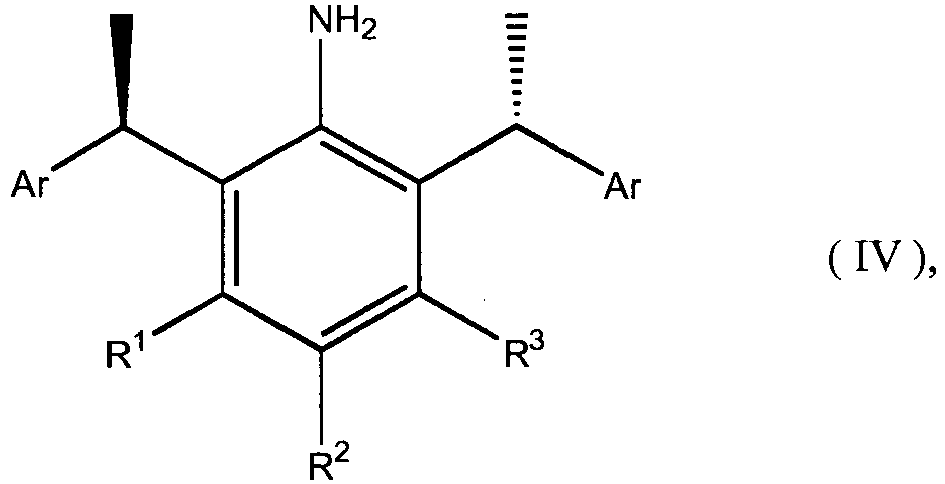


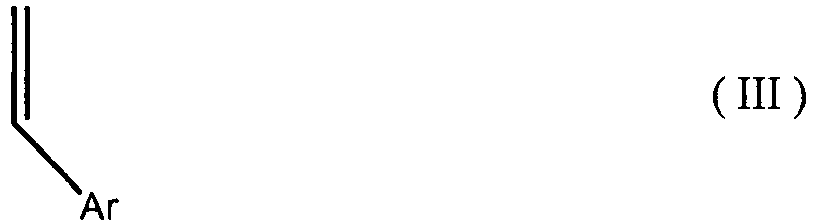
- The other strong acids for the first and second reactant embodiments can be, for example, H-Y zeolite (e.g., Linde LZ - Y82), HBr, CF3CO2H, HNO3, H2SO4 or p-toluene sulfonic acid.
- According to the third reactant embodiment, the compound has the structure

- In a subset of the third reactant embodiment, the case is excluded where R1 is sec-phenethyl, R3 is Me, R5/R6 are H, Me, or are derived from acenaphthenequinone, R7 = Me, R8 = Ph, and all the stereogenic centers of the sec-phenethyl groups are of the same absolute configuration.
- Elements of the invention and working examples are found in Cherian, A.E. et al, "A C2-Symmetric, Living, α-diimine Ni(II) catalyst regioblock copolymers from propylene," J. Am. Chem. Soc., 127(40), 13770-13771 (October 2005, referred to hereinafter as "Cherian (I)" and supporting information therefore, and in Cherian, A.E. et al, "Acid-catalyzed ortho alkylation of anilines with styrenes: an improved route to chiral anilines with bulky substituents," Org. Lett. 7(23), 5135-7 (Nov. 10, 2005, referred to hereinafter as Cherian (II), and supporting information therefore..
- Cherian (I), the supporting information of Cherian (I), Cherian (II), and the supporting information of Cherian (II) are at least essentially identical with Appendices A, B, C & D respectively forming part of the present
US priority application 60/710876 - Products 2, 5, 6, 7, 8, 9, 10 and 11 of Table I at page 5136 of Cherian (II) are embraced by the first reactant embodiment herein. They are made as described in the footnotes to said Table I and as set forth at pages S2, S3, S4, S5, S6, and S7 of the supporting information for Cherian (II).
- Products 3, 13, 14 and 15 of Table II at page 5137 of Cherian (II) are embraced by the second reactant embodiment herein. They are made as described in the footnotes to Table II and at pages S2, S7, S8, and S9 of the supporting information for Cherian (II).
- The ligand of complex rac 1 of page 13770 of Cherian (I) is embraced by the third reactant embodiment herein. This ligand is made by first making product 15 of Cherian (II), the making of which is described at pages S8 and S9 of supporting information for Cherian (II). The making of this product is also described at page S3 of supporting information for Cherian (I) where it is referred to as rac-4-methyl-2-(sec- (2,4,6-trimethylphenethyl) aniline referred to hereinafter as "MTMPEA." MTMPEA is reacted with acenaphthene to form said ligand. This reaction is described at pages S3 and S4 of supporting information for Cherian (I) where the ligand is described as rac-ArN=C(An)C=NAr where Ar is 4-methyl-2-(sec-2,4,6-trimethylphenethyl) phenyl and An is acenaphthene.
- Complex rac-1 is made from said ligand as described at page S4 of supporting information for Cherian (I). The complex rac-1 is embraced by the catalyst embodiments herein. Other complexes embraced by the catalyst embodiments herein are prepared by reacting aniline of the first and second reactant embodiments herein with acenaphthene and metallizing the formed intermediate by reacting it with (DME) MBr2 (DME = 1,2-dimethoxyethane, e.g., (DME) NiBr2).
- A general procedure for polymerization of propylene using the complex rac-1 or corresponding complex of other anilines of the first and second reactant embodiments is described at page S4 of supporting information for Cherian (I).
- Examples of compounds meeting the fourth catalyst embodiment and their making are indicated in the table below.
Table 
Entry a R1 R2 R3 R4 R5/R6 R7 R8 Yield (mg) TOF b (h-1) %3,1-insertions c Mn d (g/mol) Mw/ Mn d Tg e (°C) Tm e (°C) 1 F H CH3 H acenaphthyl CH3 2,4,6-Me3Ph 120 6 7.6 9,200 1.34 n.d. f 135.6 2 H H CH3 H acenaphthyl CH3 2,4,6-Me3Ph 90 4 - 3,700 2.05 - - 3 g H CH3 H H acenaphthyl CH3 2,4,6-Me3Ph 280 14 13.7 18,000 1.26 - - 4 g CH3 H CH3 H acenaphthyl CH3 4- t BuPh 3030 212 14.5 101,600 1.09 -19.9 n.d. f a Polymerization conditions: toluene = 25 mL, Ni = 17 micromol, [Al]/[Ni] = 260, propylene = 15 g, Trxn -60 °C, 24 hours.
b TOF (turnover frequency) is the number of moles propylene reacted per mole Ni per hour.
c Determined by 1H NMR using the equation: % 3,1-insertions = [(1000-B)/(1000+2B)]*100%, where B = CH3/1000 CH2.
d Determined by gel permeation chromatography (vs. polystyrene standards).
e Determined by differential scanning calorimetry (second heat).
f None detected.
gPropylene = 5g, Trxn -40 °C. - A general procedure for diblock polymerization wherein one block is isotactic polypropylene and the second block is regiorandom polypropylene is described at page S5 of the supporting information for Cherian (II) except that the first polymerization is carried out at -78°C instead of -60°C. Other complexes as described above can be substituted for complex rac-1. .
- Polymers described in the text at page 13771 of Cherian (I), second to the last paragraph, are embraced by the first, second and third embodiments herein.
Claims (14)
- A block copolymer selected from:Diblock copolymers having PDI less than 3 and Mn ranging up to 1,000,000 where one block is isotactic propylene based polymer having Tm greater than 50°C and Mn ranging from 1,000 to 999,000 and one block is regiorandom propylene based polymer having a percentage of 3,1-insertion of polypropylene ranging from 1-99%, and a Mn ranging 1,000 to 999,000;Triblock copolymers having PDI less than 3 and Mn ranging up to 1,000,000 where a first block is isotactic propylene based polymer having Tm greater than 50°C and Mn ranging from 1,000 to 998,000 and a second block is regiorandom propylene based polymer having a percentage of 3,1-insertion of propylene ranging from 1-99%, and a Mn ranging 1,000 to 998,000, and a third block is isotactic propylene based polymer having Tm greater than 50°C and a Mn ranging 1,000 to 998,000; andMulti-block copolymer having PDI less than 3 and Mn ranging from up to 1,000,000 comprising at least one block of isotactic propylene based polymer having Tm greater than 50°C and Mn ranging from 1,000 to 999,000 and at least one block of regiorandom propylene based polymer having a percentage of 3,1-insertion of polypropylene ranging from 1-99%, and a Mn ranging 1,000 to 999,000.
- A block copolymer as claimed in Claim 1 that is a diblock copolymer having PDI less than 3 and Mn ranging up to 1,000,000 where one block is isotactic polypropylene having Tm greater than 50°C and Mn ranging from 1,000 to 999,000 and one block is regiorandom polypropylene having a percentage of 3,1-insertion of polypropylene ranging from 1-99%, and a Mn ranging 1,000 to 999,000.
- A block copolymer as claimed in Claim 1 that is a triblock copolymers having PDI less than 3 and Mn ranging up to 1,000,000 where a first block is isotactic polypropylene having Tm greater than 50°C and Mn ranging from 1,000 to 998,000 and a second block is regiorandom polypropylene having a percentage of 3,1-insertion of propylene ranging from 1-99%, and a Mn ranging 1,000 to 998,000, and a third block is isotactic polypropylene having Tm greater than 50°C and a Mn ranging 1,000 to 998,000.
- A block copolymer as claimed in Claim 1 that is a plural-block copolymer having PDI less than 3 and Mn ranging from up to 1,000,000 comprising at least one block of isotactic polypropylene having Tm greater than 50°C and Mn ranging from 1,000 to 999,000 and at least one block of regiorandom polypropylene having a percentage of 3,1-insertion of polypropylene ranging from 1-99%, and a Mn ranging 1,000 to 999,000.
- A method of preparing a block copolymer as claimed in any one of the preceding claims comprising polymerizing each block in the presence of a catalytically effective amount of complex selected from those of the following formulae VIII, IX, X and XI


and the bonds between M and N and L and N are coordinative, covalent, or ionic;

the complex of formula (XI) where R1 is a fluorine atom; R2 is a hydrogen atom; R3 is a methyl group; R4 is a hydrogen atom; R5/R6 is an acenaphthyl group; R7 is a methyl group; and R8 is an 2,4,6-trimethylphenyl group;
the complex of formula (XI) where R1 is a hydrogen atom; R2 is a hydrogen atom; R3 is a methyl group; R4 is a hydrogen atom; R5/R6 is an acenaphthyl group; R7 is a methyl group; and R8 is an 2,4,6-trimethylphenyl group;
the complex of formula (XI) where R1 is a hydrogen atom; R2 is a methyl group; R3 is a hydrogen group; R4 is a hydrogen atom; R5/R6 is an acenaphthyl group; R7 is a methyl group; and R8 is an 2,4,6-trimethylphenyl group; and
the complex of formula (XI) where R1 is a methyl group; R2 is a hydrogen atom; R3 is a methyl group; R4 is a hydrogen atom; R5/R6 is an acenaphthyl group; R7 is a methyl group; and R8 is a 4-tbutylphenyl group. - A method as claimed in Claim 5, wherein the complex is of formula VIII

- A method as claimed in Claim 5, wherein the complex is of formula IX

- A method as claimed in Claim 5, wherein the complex is of formula X

- A method as claimed in Claim 5, wherein the complex is of formula XI

- A method as claimed in Claim 5, wherein the complex is of Formula XI wherein R1 is a fluorine atom; R2 is a hydrogen atom; R3 is a methyl group; R4 is a hydrogen atom; R5/R6 is an acenaphthyl group; R7 is a methyl group; and R8 is an 2,4,6-trimethylphenyl group.
- A method as claimed in Claim 5, wherein the complex is of Formula XI wherein R1 is a hydrogen atom; R2 is a hydrogen atom; R3 is a methyl group; R4 is a hydrogen atom; R5/R6 is an acenaphthyl group; R7 is a methyl group; and R8 is an 2,4,6-trimethylphenyl group.
- A method as claimed in Claim 5, wherein the complex is of Formula XI wherein R1 is a hydrogen atom; R2 is a methyl group; R3 is a hydrogen group; R4 is a hydrogen atom; R5/R6 is an acenaphthyl group; R7 is a methyl group; and R8 is an 2,4,6-trimethylphenyl group.
- A method as claimed in Claim 5, wherein the complex is of Formula XI wherein R1 is a methyl group; R2 is a hydrogen atom; R3 is a methyl group; R4 is a hydrogen atom; R5/R6 is an acenaphthyl group; R7 is a methyl group; and R8 is a 4-tbutylphenyl group.
- The method as claimed in any of Claims 5 to 13, wherein each block is polymerized at a temperature ranging from -80 to 200°C, preferably -80 to -70°C, followed or preceded by a temperature ranging from -80 to 200°C, preferably -80 to 50°C.
Applications Claiming Priority (3)
| Application Number | Priority Date | Filing Date | Title |
|---|---|---|---|
| US71087605P | 2005-08-25 | 2005-08-25 | |
| US11/508,333 US7560523B2 (en) | 2005-08-25 | 2006-08-23 | Production of isotactic and regiorandom polypropylene based polymer and block copolymers |
| PCT/US2006/033601 WO2007117267A2 (en) | 2005-08-25 | 2006-08-25 | Production of isotactic and regiorandom polypropylene based polymer and block copolmyers |
Publications (3)
| Publication Number | Publication Date |
|---|---|
| EP1917279A2 EP1917279A2 (en) | 2008-05-07 |
| EP1917279A4 EP1917279A4 (en) | 2010-03-17 |
| EP1917279B1 true EP1917279B1 (en) | 2014-03-12 |
Family
ID=38088408
Family Applications (1)
| Application Number | Title | Priority Date | Filing Date |
|---|---|---|---|
| EP06851127.8A Not-in-force EP1917279B1 (en) | 2005-08-25 | 2006-08-25 | Production of isotactic and regiorandom polypropylene based polymer and block copolymers |
Country Status (4)
| Country | Link |
|---|---|
| US (3) | US7560523B2 (en) |
| EP (1) | EP1917279B1 (en) |
| JP (1) | JP2009506072A (en) |
| WO (1) | WO2007117267A2 (en) |
Families Citing this family (21)
| Publication number | Priority date | Publication date | Assignee | Title |
|---|---|---|---|---|
| US20100036077A1 (en) | 2005-12-12 | 2010-02-11 | Cornell Research Foundation, Inc. | Regioregular polymerization of alpha-olefins to produce polyethylene with a predominance of methyl substituents |
| US20100012883A1 (en) * | 2008-07-16 | 2010-01-21 | Outlast Technologies, Inc. | Functional Polymeric Phase Change Materials |
| US8404341B2 (en) | 2006-01-26 | 2013-03-26 | Outlast Technologies, LLC | Microcapsules and other containment structures for articles incorporating functional polymeric phase change materials |
| US9234059B2 (en) | 2008-07-16 | 2016-01-12 | Outlast Technologies, LLC | Articles containing functional polymeric phase change materials and methods of manufacturing the same |
| US20100016513A1 (en) * | 2008-07-16 | 2010-01-21 | Outlast Technologies, Inc. | Functional Polymeric Phase Change Materials and Methods of Manufacturing the Same |
| EP2185644A1 (en) * | 2007-08-31 | 2010-05-19 | Stichting Dutch Polymer Institute | Compatibilised polyolefin compositions |
| US20100015430A1 (en) * | 2008-07-16 | 2010-01-21 | Outlast Technologies, Inc. | Heat Regulating Article With Moisture Enhanced Temperature Control |
| US8221910B2 (en) | 2008-07-16 | 2012-07-17 | Outlast Technologies, LLC | Thermal regulating building materials and other construction components containing polymeric phase change materials |
| US8389660B1 (en) * | 2009-06-10 | 2013-03-05 | The Florida State University Research Foundation | Polyolefins having reduced crystallinity |
| US8686087B2 (en) * | 2009-10-02 | 2014-04-01 | Dow Global Technologies Llc | Block composites in soft compounds |
| WO2011041696A1 (en) | 2009-10-02 | 2011-04-07 | Dow Global Technologies Inc. | Block composites and impact modified compositions |
| US8673448B2 (en) | 2011-03-04 | 2014-03-18 | Outlast Technologies Llc | Articles containing precisely branched functional polymeric phase change materials |
| US9296836B2 (en) * | 2011-05-12 | 2016-03-29 | Dow Global Technologies Llc | Non-cyclopentadienyl-based chromium catalysts for olefin polymerization |
| US8697821B1 (en) * | 2013-06-10 | 2014-04-15 | King Fahd University Of Petroleum And Minerals | Pressure sensitive adhesive |
| US10711101B2 (en) | 2014-11-11 | 2020-07-14 | Cornell University | Isotactic polyethers and bimetallic catalysts, methods of making same, and uses thereof |
| US10431858B2 (en) | 2015-02-04 | 2019-10-01 | Global Web Horizons, Llc | Systems, structures and materials for electrochemical device thermal management |
| US10003053B2 (en) | 2015-02-04 | 2018-06-19 | Global Web Horizons, Llc | Systems, structures and materials for electrochemical device thermal management |
| JP6857139B2 (en) | 2015-05-12 | 2021-04-14 | ナヴィックス インターナショナル リミテッドNavix International Limited | Region evaluation by dielectric property analysis |
| US11622713B2 (en) | 2016-11-16 | 2023-04-11 | Navix International Limited | Estimators for ablation effectiveness |
| JP1609255S (en) | 2017-04-03 | 2018-07-17 | ||
| US10968350B2 (en) | 2017-12-06 | 2021-04-06 | Saudi Aramco Technologies Company | Adhesive compositions and methods |
Family Cites Families (17)
| Publication number | Priority date | Publication date | Assignee | Title |
|---|---|---|---|---|
| US3649693A (en) * | 1969-05-02 | 1972-03-14 | Ethyl Corp | Aromatic amine alkylation process |
| US4436936A (en) * | 1981-06-19 | 1984-03-13 | Ciba-Geigy Corporation | Alkylation and aralkylation of aromatic amines |
| NZ303800A (en) * | 1995-01-24 | 2000-05-26 | Univ North Carolina | Olefin polymers and block polymers, preparation, use, catalysts and catalyst intermediates |
| JPH11158213A (en) * | 1997-11-28 | 1999-06-15 | Asahi Chem Ind Co Ltd | Olefin polymerization with novel catalyst system |
| EP0962474B1 (en) * | 1998-06-04 | 2004-04-07 | Japan Polychem Corporation | Propylene block copolymer and resin composition |
| US6825280B1 (en) * | 1998-06-05 | 2004-11-30 | Japan Polychem Corporation | Propylene block copolymer and propylene resin composition |
| US6403738B1 (en) * | 1998-07-29 | 2002-06-11 | E. I. Du Pont De Nemours And Company | Polymerization of olefins |
| CA2409110A1 (en) * | 2000-05-15 | 2001-11-22 | The Lubrizol Corporation | Olefin polymerization catalyst and process and polymer, polymer derivatives, lubricants and fuels thereof |
| US6635733B2 (en) * | 2000-05-23 | 2003-10-21 | Chisso Corporation | Elastomeric polypropylene |
| KR100541582B1 (en) * | 2001-03-15 | 2007-04-16 | 미쓰이 가가쿠 가부시키가이샤 | Automotive part made of polypropylene resin composition |
| JP4171880B2 (en) * | 2001-08-06 | 2008-10-29 | チッソ株式会社 | Metallocene compound, process for producing olefin polymer using catalyst containing the same, and olefin polymer produced by the process |
| US7019157B2 (en) * | 2001-08-06 | 2006-03-28 | Chisso Corporation | Metallocene compounds, production process for olefin polymers using catalysts containing them and olefin polymers produced by the production process |
| WO2003040204A1 (en) * | 2001-11-09 | 2003-05-15 | Japan Polypropylene Corporation | Propylene block copolymer |
| CN100424107C (en) * | 2002-01-31 | 2008-10-08 | 三菱化学株式会社 | propylene-based soft resin composition |
| US6737487B2 (en) * | 2002-07-30 | 2004-05-18 | Equistar Chemicals, Lp | Polyolefin block copolymers |
| US6995279B2 (en) * | 2002-08-02 | 2006-02-07 | Chisso Corporation | Metallocene compounds, processes for the production of olefin polymers using catalysts containing the compounds, and olefin polymers produced by the processes |
| US7176158B2 (en) * | 2002-10-25 | 2007-02-13 | Exxonmobil Chemical Patents Inc. | Polymerization catalyst composition |
-
2006
- 2006-08-23 US US11/508,333 patent/US7560523B2/en not_active Expired - Fee Related
- 2006-08-25 WO PCT/US2006/033601 patent/WO2007117267A2/en not_active Ceased
- 2006-08-25 EP EP06851127.8A patent/EP1917279B1/en not_active Not-in-force
- 2006-08-25 JP JP2008528240A patent/JP2009506072A/en active Pending
-
2008
- 2008-04-22 US US12/081,805 patent/US8039655B2/en not_active Expired - Fee Related
- 2008-04-28 US US12/149,112 patent/US7888444B2/en not_active Expired - Fee Related
Also Published As
| Publication number | Publication date |
|---|---|
| US20080214854A1 (en) | 2008-09-04 |
| EP1917279A2 (en) | 2008-05-07 |
| JP2009506072A (en) | 2009-02-12 |
| WO2007117267A2 (en) | 2007-10-18 |
| US8039655B2 (en) | 2011-10-18 |
| US7560523B2 (en) | 2009-07-14 |
| US7888444B2 (en) | 2011-02-15 |
| US20070123668A1 (en) | 2007-05-31 |
| WO2007117267A3 (en) | 2008-11-20 |
| US20100029882A1 (en) | 2010-02-04 |
| EP1917279A4 (en) | 2010-03-17 |
Similar Documents
| Publication | Publication Date | Title |
|---|---|---|
| US8039655B2 (en) | Production of isotactic and regiorandom polypropylene based polymer and block copolymers | |
| KR101732418B1 (en) | Polyolefin-polystyrene multiblock copolymers and method for manufacturing thereof | |
| KR101848781B1 (en) | Polystyrene-polyolefin-polystyrene triblock copolymer and method for manufacturing the same | |
| WO1998040374A2 (en) | Olefin polymerization catalysts containing group 8-10 transition metals, bidentate ligands, processes employing such catalysts and polymers obtained therefrom | |
| EP2739655B1 (en) | Catalysts for preparing ultra high molecular weight polyethylene (uhmwpe) | |
| Park et al. | Preparation of ansa-metallocenes for production of poly (α-olefin) lubricants | |
| JP2008520813A (en) | Polymer containing isotactic polypropylene | |
| US7176950B2 (en) | Catalyst components, process for their preparation and their use as catalyst components in polymerization of olefins | |
| US6686434B2 (en) | Polymerization of ethylene | |
| KR101946249B1 (en) | Symmetric polyolefin block copolymers and method for manufacturing the same | |
| Gagieva et al. | New fluorine‐containing bissalicylidenimine–titanium complexes for olefin polymerization | |
| KR101834829B1 (en) | Organozinc compound and method for manufacturing thereof | |
| JP2010275382A (en) | Method for producing propylene homopolymer or propylene random copolymer | |
| JP2006519914A (en) | Quasi-living metal catalysts for ethylene homopolymerization and copolymerization with 5-norbornen-2-yl acetate | |
| EP2268651B1 (en) | Sterically emcumbered bidentate and tridentate naphthoxy-imine metallic complexes | |
| KR101621001B1 (en) | Catalyst composition for polymerization of olefin, preparing method of the same, and process for polymerization of olefin using the same | |
| US20230203211A1 (en) | Organometallic complex, catalyst composition employing the same, and method for preparing polyolefin | |
| JP2003513117A (en) | Olefin polymerization catalyst | |
| JP2835369B2 (en) | Method for producing olefin polymer | |
| JPS6358165B2 (en) | ||
| JPS62100506A (en) | Production of polyolefin | |
| CN102037025B (en) | Transition metal initiators supported by ketone diimine ligands for the homopolymerization of olefins and the copolymerization of olefins with polar comonomers | |
| WO2010148381A2 (en) | Group iv olefin polymerization catalysts and polymerization methods | |
| JPH11171915A (en) | Method for producing polymer using copper compound | |
| EP3356426B1 (en) | A process for preparing functional polymers through addition of amino and polymeryl groups to aldehyde moieties |
Legal Events
| Date | Code | Title | Description |
|---|---|---|---|
| PUAI | Public reference made under article 153(3) epc to a published international application that has entered the european phase |
Free format text: ORIGINAL CODE: 0009012 |
|
| 17P | Request for examination filed |
Effective date: 20080305 |
|
| AK | Designated contracting states |
Kind code of ref document: A2 Designated state(s): AT BE BG CH CY CZ DE DK EE ES FI FR GB GR HU IE IS IT LI LT LU LV MC NL PL PT RO SE SI SK TR |
|
| AX | Request for extension of the european patent |
Extension state: AL BA HR MK RS |
|
| R17D | Deferred search report published (corrected) |
Effective date: 20081120 |
|
| RIC1 | Information provided on ipc code assigned before grant |
Ipc: C08F 110/06 20060101AFI20090105BHEP Ipc: C08G 61/04 20060101ALI20090105BHEP |
|
| A4 | Supplementary search report drawn up and despatched |
Effective date: 20100216 |
|
| 17Q | First examination report despatched |
Effective date: 20100602 |
|
| DAX | Request for extension of the european patent (deleted) | ||
| REG | Reference to a national code |
Ref country code: DE Ref legal event code: R079 Ref document number: 602006040701 Country of ref document: DE Free format text: PREVIOUS MAIN CLASS: C08F0004060000 Ipc: C07C0251200000 |
|
| RIC1 | Information provided on ipc code assigned before grant |
Ipc: C08F 10/00 20060101ALI20130603BHEP Ipc: C08F 297/06 20060101ALI20130603BHEP Ipc: C07C 251/20 20060101AFI20130603BHEP Ipc: C08F 110/06 20060101ALI20130603BHEP Ipc: C08F 297/08 20060101ALI20130603BHEP |
|
| GRAP | Despatch of communication of intention to grant a patent |
Free format text: ORIGINAL CODE: EPIDOSNIGR1 |
|
| INTG | Intention to grant announced |
Effective date: 20130927 |
|
| GRAS | Grant fee paid |
Free format text: ORIGINAL CODE: EPIDOSNIGR3 |
|
| GRAA | (expected) grant |
Free format text: ORIGINAL CODE: 0009210 |
|
| AK | Designated contracting states |
Kind code of ref document: B1 Designated state(s): AT BE BG CH CY CZ DE DK EE ES FI FR GB GR HU IE IS IT LI LT LU LV MC NL PL PT RO SE SI SK TR |
|
| REG | Reference to a national code |
Ref country code: GB Ref legal event code: FG4D |
|
| REG | Reference to a national code |
Ref country code: CH Ref legal event code: EP |
|
| REG | Reference to a national code |
Ref country code: AT Ref legal event code: REF Ref document number: 656204 Country of ref document: AT Kind code of ref document: T Effective date: 20140315 |
|
| REG | Reference to a national code |
Ref country code: IE Ref legal event code: FG4D |
|
| REG | Reference to a national code |
Ref country code: DE Ref legal event code: R096 Ref document number: 602006040701 Country of ref document: DE Effective date: 20140424 |
|
| REG | Reference to a national code |
Ref country code: NL Ref legal event code: VDEP Effective date: 20140312 |
|
| PG25 | Lapsed in a contracting state [announced via postgrant information from national office to epo] |
Ref country code: LT Free format text: LAPSE BECAUSE OF FAILURE TO SUBMIT A TRANSLATION OF THE DESCRIPTION OR TO PAY THE FEE WITHIN THE PRESCRIBED TIME-LIMIT Effective date: 20140312 |
|
| REG | Reference to a national code |
Ref country code: AT Ref legal event code: MK05 Ref document number: 656204 Country of ref document: AT Kind code of ref document: T Effective date: 20140312 |
|
| REG | Reference to a national code |
Ref country code: LT Ref legal event code: MG4D |
|
| PG25 | Lapsed in a contracting state [announced via postgrant information from national office to epo] |
Ref country code: CY Free format text: LAPSE BECAUSE OF FAILURE TO SUBMIT A TRANSLATION OF THE DESCRIPTION OR TO PAY THE FEE WITHIN THE PRESCRIBED TIME-LIMIT Effective date: 20140312 Ref country code: FI Free format text: LAPSE BECAUSE OF FAILURE TO SUBMIT A TRANSLATION OF THE DESCRIPTION OR TO PAY THE FEE WITHIN THE PRESCRIBED TIME-LIMIT Effective date: 20140312 Ref country code: SE Free format text: LAPSE BECAUSE OF FAILURE TO SUBMIT A TRANSLATION OF THE DESCRIPTION OR TO PAY THE FEE WITHIN THE PRESCRIBED TIME-LIMIT Effective date: 20140312 |
|
| PG25 | Lapsed in a contracting state [announced via postgrant information from national office to epo] |
Ref country code: LV Free format text: LAPSE BECAUSE OF FAILURE TO SUBMIT A TRANSLATION OF THE DESCRIPTION OR TO PAY THE FEE WITHIN THE PRESCRIBED TIME-LIMIT Effective date: 20140312 |
|
| PG25 | Lapsed in a contracting state [announced via postgrant information from national office to epo] |
Ref country code: NL Free format text: LAPSE BECAUSE OF FAILURE TO SUBMIT A TRANSLATION OF THE DESCRIPTION OR TO PAY THE FEE WITHIN THE PRESCRIBED TIME-LIMIT Effective date: 20140312 Ref country code: BG Free format text: LAPSE BECAUSE OF FAILURE TO SUBMIT A TRANSLATION OF THE DESCRIPTION OR TO PAY THE FEE WITHIN THE PRESCRIBED TIME-LIMIT Effective date: 20140612 Ref country code: EE Free format text: LAPSE BECAUSE OF FAILURE TO SUBMIT A TRANSLATION OF THE DESCRIPTION OR TO PAY THE FEE WITHIN THE PRESCRIBED TIME-LIMIT Effective date: 20140312 Ref country code: IS Free format text: LAPSE BECAUSE OF FAILURE TO SUBMIT A TRANSLATION OF THE DESCRIPTION OR TO PAY THE FEE WITHIN THE PRESCRIBED TIME-LIMIT Effective date: 20140712 Ref country code: BE Free format text: LAPSE BECAUSE OF FAILURE TO SUBMIT A TRANSLATION OF THE DESCRIPTION OR TO PAY THE FEE WITHIN THE PRESCRIBED TIME-LIMIT Effective date: 20140312 Ref country code: RO Free format text: LAPSE BECAUSE OF FAILURE TO SUBMIT A TRANSLATION OF THE DESCRIPTION OR TO PAY THE FEE WITHIN THE PRESCRIBED TIME-LIMIT Effective date: 20140312 Ref country code: CZ Free format text: LAPSE BECAUSE OF FAILURE TO SUBMIT A TRANSLATION OF THE DESCRIPTION OR TO PAY THE FEE WITHIN THE PRESCRIBED TIME-LIMIT Effective date: 20140312 |
|
| PG25 | Lapsed in a contracting state [announced via postgrant information from national office to epo] |
Ref country code: ES Free format text: LAPSE BECAUSE OF FAILURE TO SUBMIT A TRANSLATION OF THE DESCRIPTION OR TO PAY THE FEE WITHIN THE PRESCRIBED TIME-LIMIT Effective date: 20140312 Ref country code: AT Free format text: LAPSE BECAUSE OF FAILURE TO SUBMIT A TRANSLATION OF THE DESCRIPTION OR TO PAY THE FEE WITHIN THE PRESCRIBED TIME-LIMIT Effective date: 20140312 Ref country code: PL Free format text: LAPSE BECAUSE OF FAILURE TO SUBMIT A TRANSLATION OF THE DESCRIPTION OR TO PAY THE FEE WITHIN THE PRESCRIBED TIME-LIMIT Effective date: 20140312 Ref country code: SK Free format text: LAPSE BECAUSE OF FAILURE TO SUBMIT A TRANSLATION OF THE DESCRIPTION OR TO PAY THE FEE WITHIN THE PRESCRIBED TIME-LIMIT Effective date: 20140312 |
|
| REG | Reference to a national code |
Ref country code: DE Ref legal event code: R097 Ref document number: 602006040701 Country of ref document: DE |
|
| PG25 | Lapsed in a contracting state [announced via postgrant information from national office to epo] |
Ref country code: PT Free format text: LAPSE BECAUSE OF FAILURE TO SUBMIT A TRANSLATION OF THE DESCRIPTION OR TO PAY THE FEE WITHIN THE PRESCRIBED TIME-LIMIT Effective date: 20140714 |
|
| PLBE | No opposition filed within time limit |
Free format text: ORIGINAL CODE: 0009261 |
|
| STAA | Information on the status of an ep patent application or granted ep patent |
Free format text: STATUS: NO OPPOSITION FILED WITHIN TIME LIMIT |
|
| PG25 | Lapsed in a contracting state [announced via postgrant information from national office to epo] |
Ref country code: DK Free format text: LAPSE BECAUSE OF FAILURE TO SUBMIT A TRANSLATION OF THE DESCRIPTION OR TO PAY THE FEE WITHIN THE PRESCRIBED TIME-LIMIT Effective date: 20140312 |
|
| 26N | No opposition filed |
Effective date: 20141215 |
|
| REG | Reference to a national code |
Ref country code: DE Ref legal event code: R097 Ref document number: 602006040701 Country of ref document: DE Effective date: 20141215 |
|
| PG25 | Lapsed in a contracting state [announced via postgrant information from national office to epo] |
Ref country code: MC Free format text: LAPSE BECAUSE OF FAILURE TO SUBMIT A TRANSLATION OF THE DESCRIPTION OR TO PAY THE FEE WITHIN THE PRESCRIBED TIME-LIMIT Effective date: 20140312 Ref country code: LU Free format text: LAPSE BECAUSE OF FAILURE TO SUBMIT A TRANSLATION OF THE DESCRIPTION OR TO PAY THE FEE WITHIN THE PRESCRIBED TIME-LIMIT Effective date: 20140825 Ref country code: IT Free format text: LAPSE BECAUSE OF FAILURE TO SUBMIT A TRANSLATION OF THE DESCRIPTION OR TO PAY THE FEE WITHIN THE PRESCRIBED TIME-LIMIT Effective date: 20140312 |
|
| REG | Reference to a national code |
Ref country code: CH Ref legal event code: PL |
|
| PG25 | Lapsed in a contracting state [announced via postgrant information from national office to epo] |
Ref country code: CH Free format text: LAPSE BECAUSE OF NON-PAYMENT OF DUE FEES Effective date: 20140831 Ref country code: LI Free format text: LAPSE BECAUSE OF NON-PAYMENT OF DUE FEES Effective date: 20140831 |
|
| REG | Reference to a national code |
Ref country code: IE Ref legal event code: MM4A |
|
| PG25 | Lapsed in a contracting state [announced via postgrant information from national office to epo] |
Ref country code: SI Free format text: LAPSE BECAUSE OF FAILURE TO SUBMIT A TRANSLATION OF THE DESCRIPTION OR TO PAY THE FEE WITHIN THE PRESCRIBED TIME-LIMIT Effective date: 20140312 |
|
| REG | Reference to a national code |
Ref country code: FR Ref legal event code: PLFP Year of fee payment: 10 |
|
| PG25 | Lapsed in a contracting state [announced via postgrant information from national office to epo] |
Ref country code: IE Free format text: LAPSE BECAUSE OF NON-PAYMENT OF DUE FEES Effective date: 20140825 |
|
| PGFP | Annual fee paid to national office [announced via postgrant information from national office to epo] |
Ref country code: DE Payment date: 20150827 Year of fee payment: 10 Ref country code: GB Payment date: 20150827 Year of fee payment: 10 |
|
| PGFP | Annual fee paid to national office [announced via postgrant information from national office to epo] |
Ref country code: FR Payment date: 20150817 Year of fee payment: 10 |
|
| PG25 | Lapsed in a contracting state [announced via postgrant information from national office to epo] |
Ref country code: GR Free format text: LAPSE BECAUSE OF FAILURE TO SUBMIT A TRANSLATION OF THE DESCRIPTION OR TO PAY THE FEE WITHIN THE PRESCRIBED TIME-LIMIT Effective date: 20140613 |
|
| PG25 | Lapsed in a contracting state [announced via postgrant information from national office to epo] |
Ref country code: TR Free format text: LAPSE BECAUSE OF FAILURE TO SUBMIT A TRANSLATION OF THE DESCRIPTION OR TO PAY THE FEE WITHIN THE PRESCRIBED TIME-LIMIT Effective date: 20140312 Ref country code: HU Free format text: LAPSE BECAUSE OF FAILURE TO SUBMIT A TRANSLATION OF THE DESCRIPTION OR TO PAY THE FEE WITHIN THE PRESCRIBED TIME-LIMIT; INVALID AB INITIO Effective date: 20060825 |
|
| REG | Reference to a national code |
Ref country code: DE Ref legal event code: R119 Ref document number: 602006040701 Country of ref document: DE |
|
| GBPC | Gb: european patent ceased through non-payment of renewal fee |
Effective date: 20160825 |
|
| REG | Reference to a national code |
Ref country code: FR Ref legal event code: ST Effective date: 20170428 |
|
| PG25 | Lapsed in a contracting state [announced via postgrant information from national office to epo] |
Ref country code: FR Free format text: LAPSE BECAUSE OF NON-PAYMENT OF DUE FEES Effective date: 20160831 Ref country code: GB Free format text: LAPSE BECAUSE OF NON-PAYMENT OF DUE FEES Effective date: 20160825 Ref country code: DE Free format text: LAPSE BECAUSE OF NON-PAYMENT OF DUE FEES Effective date: 20170301 |