EP1914551A1 - Process for providing a plant with an identification label - Google Patents
Process for providing a plant with an identification label Download PDFInfo
- Publication number
- EP1914551A1 EP1914551A1 EP06076900A EP06076900A EP1914551A1 EP 1914551 A1 EP1914551 A1 EP 1914551A1 EP 06076900 A EP06076900 A EP 06076900A EP 06076900 A EP06076900 A EP 06076900A EP 1914551 A1 EP1914551 A1 EP 1914551A1
- Authority
- EP
- European Patent Office
- Prior art keywords
- tracer molecules
- seed
- plant
- tracer
- molecules
- Prior art date
- Legal status (The legal status is an assumption and is not a legal conclusion. Google has not performed a legal analysis and makes no representation as to the accuracy of the status listed.)
- Withdrawn
Links
- 238000000034 method Methods 0.000 title claims abstract description 22
- 239000000700 radioactive tracer Substances 0.000 claims abstract description 56
- 238000004519 manufacturing process Methods 0.000 claims abstract description 5
- 241000196324 Embryophyta Species 0.000 claims description 52
- 239000002245 particle Substances 0.000 claims description 15
- 239000000975 dye Substances 0.000 claims description 13
- 239000011248 coating agent Substances 0.000 claims description 11
- 238000000576 coating method Methods 0.000 claims description 11
- 239000008188 pellet Substances 0.000 claims description 6
- 235000013305 food Nutrition 0.000 claims description 5
- 238000001694 spray drying Methods 0.000 claims description 5
- 235000013343 vitamin Nutrition 0.000 claims description 5
- 229930003231 vitamin Natural products 0.000 claims description 4
- 239000011782 vitamin Substances 0.000 claims description 4
- 229940088594 vitamin Drugs 0.000 claims description 4
- 239000000990 laser dye Substances 0.000 claims description 3
- 231100001184 nonphytotoxic Toxicity 0.000 claims description 3
- 239000007793 ph indicator Substances 0.000 claims description 3
- 239000004753 textile Substances 0.000 claims description 3
- 231100000252 nontoxic Toxicity 0.000 claims description 2
- 230000003000 nontoxic effect Effects 0.000 claims description 2
- 229930003270 Vitamin B Natural products 0.000 description 5
- 239000000463 material Substances 0.000 description 5
- PYWVYCXTNDRMGF-UHFFFAOYSA-N rhodamine B Chemical compound [Cl-].C=12C=CC(=[N+](CC)CC)C=C2OC2=CC(N(CC)CC)=CC=C2C=1C1=CC=CC=C1C(O)=O PYWVYCXTNDRMGF-UHFFFAOYSA-N 0.000 description 5
- 229940043267 rhodamine b Drugs 0.000 description 5
- 235000019156 vitamin B Nutrition 0.000 description 5
- 239000011720 vitamin B Substances 0.000 description 5
- 241000234282 Allium Species 0.000 description 4
- 235000002732 Allium cepa var. cepa Nutrition 0.000 description 4
- 229910019142 PO4 Inorganic materials 0.000 description 4
- 238000002474 experimental method Methods 0.000 description 4
- 239000010452 phosphate Substances 0.000 description 4
- NBIIXXVUZAFLBC-UHFFFAOYSA-K phosphate Chemical compound [O-]P([O-])([O-])=O NBIIXXVUZAFLBC-UHFFFAOYSA-K 0.000 description 4
- XLYOFNOQVPJJNP-UHFFFAOYSA-N water Substances O XLYOFNOQVPJJNP-UHFFFAOYSA-N 0.000 description 3
- 241000219310 Beta vulgaris subsp. vulgaris Species 0.000 description 2
- 229920000742 Cotton Polymers 0.000 description 2
- 244000299507 Gossypium hirsutum Species 0.000 description 2
- 235000021536 Sugar beet Nutrition 0.000 description 2
- 240000008042 Zea mays Species 0.000 description 2
- 235000005824 Zea mays ssp. parviglumis Nutrition 0.000 description 2
- 235000002017 Zea mays subsp mays Nutrition 0.000 description 2
- 235000005822 corn Nutrition 0.000 description 2
- 230000000694 effects Effects 0.000 description 2
- 239000000203 mixture Substances 0.000 description 2
- FPIPGXGPPPQFEQ-UHFFFAOYSA-N 13-cis retinol Natural products OCC=C(C)C=CC=C(C)C=CC1=C(C)CCCC1(C)C FPIPGXGPPPQFEQ-UHFFFAOYSA-N 0.000 description 1
- 241000335053 Beta vulgaris Species 0.000 description 1
- 239000005909 Kieselgur Substances 0.000 description 1
- UPYKUZBSLRQECL-UKMVMLAPSA-N Lycopene Natural products CC(=C/C=C/C=C(C)/C=C/C=C(C)/C=C/C1C(=C)CCCC1(C)C)C=CC=C(/C)C=CC2C(=C)CCCC2(C)C UPYKUZBSLRQECL-UKMVMLAPSA-N 0.000 description 1
- VYPSYNLAJGMNEJ-UHFFFAOYSA-N Silicium dioxide Chemical compound O=[Si]=O VYPSYNLAJGMNEJ-UHFFFAOYSA-N 0.000 description 1
- FPIPGXGPPPQFEQ-BOOMUCAASA-N Vitamin A Natural products OC/C=C(/C)\C=C\C=C(\C)/C=C/C1=C(C)CCCC1(C)C FPIPGXGPPPQFEQ-BOOMUCAASA-N 0.000 description 1
- FPIPGXGPPPQFEQ-OVSJKPMPSA-N all-trans-retinol Chemical compound OC\C=C(/C)\C=C\C=C(/C)\C=C\C1=C(C)CCCC1(C)C FPIPGXGPPPQFEQ-OVSJKPMPSA-N 0.000 description 1
- 150000001746 carotenes Chemical class 0.000 description 1
- 235000005473 carotenes Nutrition 0.000 description 1
- 239000004927 clay Substances 0.000 description 1
- 238000001514 detection method Methods 0.000 description 1
- 230000005284 excitation Effects 0.000 description 1
- 239000000945 filler Substances 0.000 description 1
- 235000013312 flour Nutrition 0.000 description 1
- 238000005470 impregnation Methods 0.000 description 1
- 229910052500 inorganic mineral Inorganic materials 0.000 description 1
- 239000011707 mineral Substances 0.000 description 1
- 235000016709 nutrition Nutrition 0.000 description 1
- 230000035764 nutrition Effects 0.000 description 1
- 239000003415 peat Substances 0.000 description 1
- 229920000642 polymer Polymers 0.000 description 1
- KXXXUIKPSVVSAW-UHFFFAOYSA-K pyranine Chemical compound [Na+].[Na+].[Na+].C1=C2C(O)=CC(S([O-])(=O)=O)=C(C=C3)C2=C2C3=C(S([O-])(=O)=O)C=C(S([O-])(=O)=O)C2=C1 KXXXUIKPSVVSAW-UHFFFAOYSA-K 0.000 description 1
- 238000003908 quality control method Methods 0.000 description 1
- 229920006395 saturated elastomer Polymers 0.000 description 1
- 239000000758 substrate Substances 0.000 description 1
- YEOUFHBJWTZWCZ-UHFFFAOYSA-M sulforhodamine G Chemical compound [Na+].C=12C=C(C)C(NCC)=CC2=[O+]C=2C=C(NCC)C(C)=CC=2C=1C1=CC=C(S([O-])(=O)=O)C=C1S([O-])(=O)=O YEOUFHBJWTZWCZ-UHFFFAOYSA-M 0.000 description 1
- 238000011282 treatment Methods 0.000 description 1
- 235000013311 vegetables Nutrition 0.000 description 1
- 238000001429 visible spectrum Methods 0.000 description 1
- 235000019155 vitamin A Nutrition 0.000 description 1
- 239000011719 vitamin A Substances 0.000 description 1
- NCYCYZXNIZJOKI-UHFFFAOYSA-N vitamin A aldehyde Natural products O=CC=C(C)C=CC=C(C)C=CC1=C(C)CCCC1(C)C NCYCYZXNIZJOKI-UHFFFAOYSA-N 0.000 description 1
- 229940045997 vitamin a Drugs 0.000 description 1
- 239000002023 wood Substances 0.000 description 1
Images

Classifications
-
- A—HUMAN NECESSITIES
- A01—AGRICULTURE; FORESTRY; ANIMAL HUSBANDRY; HUNTING; TRAPPING; FISHING
- A01G—HORTICULTURE; CULTIVATION OF VEGETABLES, FLOWERS, RICE, FRUIT, VINES, HOPS OR SEAWEED; FORESTRY; WATERING
- A01G7/00—Botany in general
- A01G7/06—Treatment of growing trees or plants, e.g. for preventing decay of wood, for tingeing flowers or wood, for prolonging the life of plants
Definitions
- the invention relates to a process for providing a plant with an identification label, seed for cultivating plants which seed comprises tracer molecules, a process for preparing said seed, and the use of tracer molecules for identifying a particular plant among one or more other type of plants.
- tracer molecules can be used to identify plants and/or plant parts.
- the plants and/or plant parts are contacted with the tracer molecules which are either taken up inside the plant and/or plant parts or on the surface thereof.
- the origin, time of production or the owner of plant material can be identified.
- tracking and tracing of plant material throughout the production process facilities a better quality control.
- it allows the identification of batches of plant material that have received special treatments or have a specific property.
- An essential drawback of such known application is that the plants and/or plant parts to be treated with the tracer molecules need as such, of course, to be identified first before the tracer molecules can be brought into contact with the plants and/or plant parts concerned. In other words, a pre-selection of the plants needs to be carried out before the tracer molecules can actually be used.
- Object of the present invention is to provide a less time-consuming and labour-intensive process which allows easy identification of plants.
- the present invention relates to a process for providing a plant with an identification label, which process comprises cultivating the plant from seed which comprises tracer molecules, thereby allowing the tracer molecules to be incorporated in the plant, whereby the incorporated tracer molecules generate and/or form the identification label.
- the tracer molecules are preferably fluorescent tracer molecules.
- the tracer molecules are selected from the group consisting of vitamins, food grade dyes, laser dyes, textile dyes and pH indicators.
- Suitable examples of vitamines include Vitamin B and Vitamin A.
- Suitable examples of food grade dyes include Vitamin B Phosphate and Carotene.
- Suitable examples of laser dyes include Rhodamine B and Sulfo Rhodamine G.
- Suitable examples of textile dyes include Basic Red and Basic Yellow.
- pH indicators include Porphyrines and HPTS.
- the tracer molecules are selected from the group consisting of vitamins and food grade dyes.
- the tracer molecules to be used in accordance with the present invention are preferably non-toxic and non-phytotoxic.
- the seed to be applied in accordance with the invention and which comprises the tracer molecules can suitably be obtained by applying the tracer molecules onto the surface of seed particles.
- the seed which comprises the tracer molecules is obtained by adding the tracer molecules to a coating or pellet which is applied onto the seed particles.
- the coating is formed by spray-drying a solution which comprises the tracer molecules on the surface of the seed particles or the coating is formed by impregnating the seed particles with a solution which comprises the tracer molecules.
- the tracer molecules are applied onto the surface of the seed particles by means of a coating which is formed by spray-drying a solution which comprises the tracer molecules on the surface of the seed particles.
- the coating to be used in accordance with the present invention can be of any type commonly used in the seed industry. Suitable examples include mixtures based on different water based non-phytotoxic polymer structures.
- pellets to be used in accordance with the present invention can be of any type commonly used in the seed industry. Suitable examples include mixtures with different clay types, fibres from wood flour or peat, fillers such as different kinds of diatomaceous earth and other inert materials with a specific character.
- the present invention also relates to seed for cultivating plants which seed comprises tracer molecules.
- the present invention provides a process or seed according to the present invention wherein the plant is selected from plant species that are individually planted in field applications. Suitable examples of such plant species include corn, sugar beet, cotton, onion and most vegetable crops.
- the amount of tracer molecules should be sufficient to make plant identification possible.
- the actual amounts to be used will depend on seed particle size, uptake rate of the tracer molecules by the plant, and the size of the plant in question.
- the amount of tracer molecules will suitably be in the range of from 0.1 to 10 mg per pelleted seed.
- the amount of tracer molecules in respect of said plant species will be in the range of from 0.1 to 2 mg per pelleted seed.
- the present invention also relates to the use of tracer molecules for identifying a particular plant among one or more other type of plants, whereby the tracer molecules, present in the plant, originate from the seed of the particular plant.
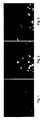
- Figures 1-3 show the result of a test with pelleted Onion seeds.
- the pellet was provided with 0 (blanc), 0.5 and 2 mg Vitamin B phosphate per seed.
- the dye was simply mixed with the pelleting material.
- the pelleted seeds were put into a standard mineral substrate growing medium, and they were provided with normal amounts of water to which standard nutrition solutions were added.
- the difference between the plantlets originating from the differently treated seeds is clearly visible from pictures taken with a blue excitation source (470-490 nm) which illuminated the plantlets, and detection of the emitted fluorescence was allowed with a camera in the green part of the visible spectrum (520-550 nm).
- Figure 1 taken from plantlets which were not treated, barely any plantlet is visible.
- the photograph shown in Figure 4 shows the effect of growing seeds in a growing medium that is provided with different Rhodamine B concentrations. This experiment was done by taking plantlets that were not treated and putting them in a growing solution provided with Rhodamine B to show the uptake of the dye through the roots of the plant. From left to right the Rhodamine B concentrations were 0.01, 0.001, 0.0001, mg/ml water, whereas the right hand plantlet was in a medium without dye (i.e. a blanco experiment). Pictures of the fluorescence from the dye in the plants were taken by illuminating them with green light of a wavelength between 530 nm and 560 nm.
- the fluorescence was detected with a camera provided with a long pass filter, passing all wavelengths longer than 580 nm. There is a clearly visible difference between the plants growing in the medium which were provided with two highest concentrations when compared with the the low concentration and the blanco experiment.
- the yellowish fluorescence is brightest in the left plantlet and is the least in the two plantlets on the right hand side
- the present invention provides a very attractive process for providing a plant with a label that clearly allows the plant to be identified amongst other plants.
Landscapes
- Life Sciences & Earth Sciences (AREA)
- Biodiversity & Conservation Biology (AREA)
- Ecology (AREA)
- Forests & Forestry (AREA)
- Engineering & Computer Science (AREA)
- Wood Science & Technology (AREA)
- Botany (AREA)
- Environmental Sciences (AREA)
- Pretreatment Of Seeds And Plants (AREA)
- Cultivation Of Plants (AREA)
Abstract
The invention provides a process for providing a plant with an identification label, which process comprises cultivating the plant from seed which comprises tracer molecules, thereby allowing the tracer molecules to be incorporated in the plant, whereby the incorporated tracer molecules generate and/or form the identification label. The invention further relates to seed for cultivating plants which seed comprises tracer molecules, a process for preparing seed, and the use of tracer molecules for identifying a particular plant among one or more other type of plants.
Description
- The invention relates to a process for providing a plant with an identification label, seed for cultivating plants which seed comprises tracer molecules, a process for preparing said seed, and the use of tracer molecules for identifying a particular plant among one or more other type of plants.
- It is known from
WO 2004/065945 that tracer molecules can be used to identify plants and/or plant parts. The plants and/or plant parts are contacted with the tracer molecules which are either taken up inside the plant and/or plant parts or on the surface thereof. In this way, the origin, time of production or the owner of plant material can be identified. Moreover, tracking and tracing of plant material throughout the production process facilities a better quality control. Further, it allows the identification of batches of plant material that have received special treatments or have a specific property. An essential drawback of such known application is that the plants and/or plant parts to be treated with the tracer molecules need as such, of course, to be identified first before the tracer molecules can be brought into contact with the plants and/or plant parts concerned. In other words, a pre-selection of the plants needs to be carried out before the tracer molecules can actually be used. Evidently, this makes such an application a time-consuming and labour-intensive exercise. - Object of the present invention is to provide a less time-consuming and labour-intensive process which allows easy identification of plants.
- Surprisingly, it has been found that this can be realised when use is made of seed that comprises tracer molecules.
- Accordingly, the present invention relates to a process for providing a plant with an identification label, which process comprises cultivating the plant from seed which comprises tracer molecules, thereby allowing the tracer molecules to be incorporated in the plant, whereby the incorporated tracer molecules generate and/or form the identification label.
- In the process according to the invention, the tracer molecules are preferably fluorescent tracer molecules.
- Suitably, the tracer molecules are selected from the group consisting of vitamins, food grade dyes, laser dyes, textile dyes and pH indicators.
- Suitable examples of vitamines include Vitamin B and Vitamin A.
- Suitable examples of food grade dyes include Vitamin B Phosphate and Carotene.
- Suitable examples of laser dyes include Rhodamine B and Sulfo Rhodamine G.
- Suitable examples of textile dyes include Basic Red and Basic Yellow.
- Suitable examples of pH indicators include Porphyrines and HPTS.
- Preferably, the tracer molecules are selected from the group consisting of vitamins and food grade dyes.
- The tracer molecules to be used in accordance with the present invention are preferably non-toxic and non-phytotoxic.
- The seed to be applied in accordance with the invention and which comprises the tracer molecules can suitably be obtained by applying the tracer molecules onto the surface of seed particles.
- Preferably, the seed which comprises the tracer molecules is obtained by adding the tracer molecules to a coating or pellet which is applied onto the seed particles.
- Preferably, the coating is formed by spray-drying a solution which comprises the tracer molecules on the surface of the seed particles or the coating is formed by impregnating the seed particles with a solution which comprises the tracer molecules.
- More preferably, the tracer molecules are applied onto the surface of the seed particles by means of a coating which is formed by spray-drying a solution which comprises the tracer molecules on the surface of the seed particles.
- The coating to be used in accordance with the present invention can be of any type commonly used in the seed industry. Suitable examples include mixtures based on different water based non-phytotoxic polymer structures.
- The pellets to be used in accordance with the present invention can be of any type commonly used in the seed industry. Suitable examples include mixtures with different clay types, fibres from wood flour or peat, fillers such as different kinds of diatomaceous earth and other inert materials with a specific character.
- The spray-dry and impregnation processes to be used for applying the coating on the seed particles will be carried out under conditions well understood by the skilled person in the art.
- The present invention also relates to seed for cultivating plants which seed comprises tracer molecules.
- Further, the present invention provides a process or seed according to the present invention wherein the plant is selected from plant species that are individually planted in field applications. Suitable examples of such plant species include corn, sugar beet, cotton, onion and most vegetable crops.
- The amount of tracer molecules should be sufficient to make plant identification possible. The actual amounts to be used will depend on seed particle size, uptake rate of the tracer molecules by the plant, and the size of the plant in question.
- In case of sugar beet, corn, cotton or onion the amount of tracer molecules will suitably be in the range of from 0.1 to 10 mg per pelleted seed. Preferably, the amount of tracer molecules in respect of said plant species will be in the range of from 0.1 to 2 mg per pelleted seed.
- The present invention also relates to the use of tracer molecules for identifying a particular plant among one or more other type of plants, whereby the tracer molecules, present in the plant, originate from the seed of the particular plant.
- The present invention will now be illustrated by means of the following Examples.
- Figures 1-3 show the result of a test with pelleted Onion seeds. The pellet was provided with 0 (blanc), 0.5 and 2 mg Vitamin B phosphate per seed. The dye was simply mixed with the pelleting material. Next, the pelleted seeds were put into a standard mineral substrate growing medium, and they were provided with normal amounts of water to which standard nutrition solutions were added. The difference between the plantlets originating from the differently treated seeds is clearly visible from pictures taken with a blue excitation source (470-490 nm) which illuminated the plantlets, and detection of the emitted fluorescence was allowed with a camera in the green part of the visible spectrum (520-550 nm). In the left photograph (Figure 1) taken from plantlets which were not treated, barely any plantlet is visible. The two right hand photographs (Figures 2 and 3) clearly show the effect of adding vitamin B phosphate to the pellet. The small difference in intensity between the fluorescence detected from both plants treated with the fluorescent tracer shows that the dye uptake by the plant was probably saturated en that lower doses are possible.
- The photograph shown in Figure 4 shows the effect of growing seeds in a growing medium that is provided with different Rhodamine B concentrations. This experiment was done by taking plantlets that were not treated and putting them in a growing solution provided with Rhodamine B to show the uptake of the dye through the roots of the plant. From left to right the Rhodamine B concentrations were 0.01, 0.001, 0.0001, mg/ml water, whereas the right hand plantlet was in a medium without dye (i.e. a blanco experiment). Pictures of the fluorescence from the dye in the plants were taken by illuminating them with green light of a wavelength between 530 nm and 560 nm. The fluorescence was detected with a camera provided with a long pass filter, passing all wavelengths longer than 580 nm. There is a clearly visible difference between the plants growing in the medium which were provided with two highest concentrations when compared with the the low concentration and the blanco experiment. The yellowish fluorescence is brightest in the left plantlet and is the least in the two plantlets on the right hand side
- From the above experiments it will be clear that the present invention provides a very attractive process for providing a plant with a label that clearly allows the plant to be identified amongst other plants.
Claims (13)
- A process for providing a plant with an identification label, which process comprises cultivating the plant from seed which comprises tracer molecules, thereby allowing the tracer molecules to be incorporated in the plant, whereby the incorporated tracer molecules generate and/or form the identification label.
- The process according to claim 1, wherein the tracer molecules are fluorescent tracer molecules.
- The process according to claim 2, wherein the tracer molecules are selected from the group consisting of vitamins, food grade dyes, laser dyes, textile dyes and pH indicators.
- The process according to claim 3, wherein the tracer molecules are selected from the group consisting of vitamins and food grade dyes.
- The process according to claim 3 or 4, wherein the tracer molecules are non-toxic and non-phytotoxic.
- The process according to any one of claims 1-5, wherein the seed which comprises the tracer molecules is obtained by applying the tracer molecules onto the surface of seed particles.
- The process according to claim 6, wherein a coating or pellet is applied on the seed particles which coating or pellet comprises the tracer molecules.
- The process according to claim 7, wherein the coating is formed by spray-drying a solution which comprises the tracer molecules on the surface of the seed particles or the coating is formed by impregnating the seed particles with a solution which comprises the tracer molecules.
- The process according to claim 8, wherein the coating is formed by spray-drying a solution which comprises the tracer molecules on the surface of the seed particles.
- Seed for cultivating plants which seed comprises tracer molecules.
- A process or seed according to any one of claims 1-10, wherein the plant is selected from plant species that are individually planted in field applications.
- A process for preparing seed as defined in claim 10 comprising spray-drying a solution comprising tracer molecules on the surface of seed particles or impregnating seed particles with a solution comprising tracer molecules.
- Use of tracer molecules for identifying a particular plant among one or more other type of plants, whereby the tracer molecules, present in the plant, originate from the seed of the particular plant.
Priority Applications (3)
| Application Number | Priority Date | Filing Date | Title |
|---|---|---|---|
| EP06076900A EP1914551A1 (en) | 2006-10-20 | 2006-10-20 | Process for providing a plant with an identification label |
| PCT/NL2007/050503 WO2008048101A1 (en) | 2006-10-20 | 2007-10-18 | Process for providing a plant with an identification label |
| EP07834641A EP2078206A1 (en) | 2006-10-20 | 2007-10-18 | Process for providing a plant with an identification label |
Applications Claiming Priority (1)
| Application Number | Priority Date | Filing Date | Title |
|---|---|---|---|
| EP06076900A EP1914551A1 (en) | 2006-10-20 | 2006-10-20 | Process for providing a plant with an identification label |
Publications (1)
| Publication Number | Publication Date |
|---|---|
| EP1914551A1 true EP1914551A1 (en) | 2008-04-23 |
Family
ID=37892043
Family Applications (2)
| Application Number | Title | Priority Date | Filing Date |
|---|---|---|---|
| EP06076900A Withdrawn EP1914551A1 (en) | 2006-10-20 | 2006-10-20 | Process for providing a plant with an identification label |
| EP07834641A Withdrawn EP2078206A1 (en) | 2006-10-20 | 2007-10-18 | Process for providing a plant with an identification label |
Family Applications After (1)
| Application Number | Title | Priority Date | Filing Date |
|---|---|---|---|
| EP07834641A Withdrawn EP2078206A1 (en) | 2006-10-20 | 2007-10-18 | Process for providing a plant with an identification label |
Country Status (2)
| Country | Link |
|---|---|
| EP (2) | EP1914551A1 (en) |
| WO (1) | WO2008048101A1 (en) |
Cited By (1)
| Publication number | Priority date | Publication date | Assignee | Title |
|---|---|---|---|---|
| CN105830758A (en) * | 2016-03-30 | 2016-08-10 | 中棉种业科技股份有限公司 | Method for identifying premature senescence resistance of cotton |
Citations (5)
| Publication number | Priority date | Publication date | Assignee | Title |
|---|---|---|---|---|
| DE3543395A1 (en) * | 1985-12-07 | 1987-06-11 | J Gebhard Dr Koch | Identification of plant cultivars, in particular using seeds |
| WO2002017717A1 (en) * | 2000-08-31 | 2002-03-07 | Ondeo Nalco Company | Use of tracers to monitor application of treatment products to cut flowers |
| WO2004065945A1 (en) | 2003-01-24 | 2004-08-05 | Plant Research International B.V. | Identification labels in plants or plant parts |
| DE102004017424A1 (en) * | 2004-04-08 | 2005-11-03 | Hötger, Gerhard | Process to mark bulk solid food grains for human or animal consumption by introduction of colour-stained grains |
| WO2006075953A1 (en) * | 2005-01-13 | 2006-07-20 | Swetree Technologies Ab | A chemical label, plug therefore and plant with this label. |
Family Cites Families (2)
| Publication number | Priority date | Publication date | Assignee | Title |
|---|---|---|---|---|
| DE19642439C1 (en) * | 1996-10-15 | 1997-11-20 | Heinz Dr Ing Ganzelmeier | Treatment of crops based on fluorescence emission |
| JP2006053099A (en) * | 2004-08-13 | 2006-02-23 | Institute Of Physical & Chemical Research | Plant metabolic analysis method, labeled plant production method, labeled plant, and plant NMR measurement method |
-
2006
- 2006-10-20 EP EP06076900A patent/EP1914551A1/en not_active Withdrawn
-
2007
- 2007-10-18 EP EP07834641A patent/EP2078206A1/en not_active Withdrawn
- 2007-10-18 WO PCT/NL2007/050503 patent/WO2008048101A1/en not_active Ceased
Patent Citations (5)
| Publication number | Priority date | Publication date | Assignee | Title |
|---|---|---|---|---|
| DE3543395A1 (en) * | 1985-12-07 | 1987-06-11 | J Gebhard Dr Koch | Identification of plant cultivars, in particular using seeds |
| WO2002017717A1 (en) * | 2000-08-31 | 2002-03-07 | Ondeo Nalco Company | Use of tracers to monitor application of treatment products to cut flowers |
| WO2004065945A1 (en) | 2003-01-24 | 2004-08-05 | Plant Research International B.V. | Identification labels in plants or plant parts |
| DE102004017424A1 (en) * | 2004-04-08 | 2005-11-03 | Hötger, Gerhard | Process to mark bulk solid food grains for human or animal consumption by introduction of colour-stained grains |
| WO2006075953A1 (en) * | 2005-01-13 | 2006-07-20 | Swetree Technologies Ab | A chemical label, plug therefore and plant with this label. |
Cited By (1)
| Publication number | Priority date | Publication date | Assignee | Title |
|---|---|---|---|---|
| CN105830758A (en) * | 2016-03-30 | 2016-08-10 | 中棉种业科技股份有限公司 | Method for identifying premature senescence resistance of cotton |
Also Published As
| Publication number | Publication date |
|---|---|
| WO2008048101A1 (en) | 2008-04-24 |
| EP2078206A1 (en) | 2009-07-15 |
Similar Documents
| Publication | Publication Date | Title |
|---|---|---|
| Viršilė et al. | The distinct impact of multi-color LED light on nitrate, amino acid, soluble sugar and organic acid contents in red and green leaf lettuce cultivated in controlled environment | |
| Viršilė et al. | Lighting intensity and photoperiod serves tailoring nitrate assimilation indices in red and green baby leaf lettuce | |
| Samuolienė et al. | LED lighting and seasonality effects antioxidant properties of baby leaf lettuce | |
| Samuolienė et al. | Supplementary red-LED lighting and the changes in phytochemical content of two baby leaf lettuce varieties during three seasons | |
| Borek et al. | Photosynthetic activity of variegated leaves of Coleus× hybridus hort. cultivars characterised by chlorophyll fluorescence techniques | |
| Urbonavičiūtė et al. | Effect of short-wavelength light on lettuce growth and nutritional quality | |
| Bae et al. | Effects of artificial lighting on bioactivity of sweet red pepper (Capsicum annuum L.) | |
| Ajdanian et al. | The growth and development of cress (Lepidium sativum) affected by blue and red light | |
| Jahan et al. | Impacts of plastic filming on growth environment, yield parameters and quality attributes of lettuce | |
| Marsic et al. | Photosynthetic traits of plants and the biochemical profile of tomato fruits are influenced by grafting, salinity stress, and growing season | |
| Smrke et al. | Influence of reflective foil on persimmon (Diospyros kaki Thunb.) fruit peel colour and selected bioactive compounds | |
| Pokorná-Juríková et al. | The study of irrigation influence on nutritional value of Lonicera kamtschatica–cultivar Gerda 25 and Lonicera edulis berries under the Nitra conditions during 2001–2003 | |
| Lin et al. | Influence of light quality and intensity on biomass and biochemical contents of hydroponically grown lettuce | |
| CN113727600A (en) | Plant cultivation method for increasing content of functional substances | |
| Farhangi et al. | Optimizing LED lighting spectra for enhanced growth in controlled-environment vertical farms | |
| Li et al. | Effects of light quality and photosynthetic photon flux on growth and carotenoid pigments in spinach (Spinacia oleracea L.) | |
| Ngcobo et al. | Artificial daylength enhancement (pre-sunrise and post-sunset) with blue and red led lights affects tomato plant development, yield, and fruit nutritional quality | |
| Grbic et al. | Effect of different light spectra by using coloured plastic films on growth, fresh and dry matter, nutrient solution uptake and secondary metabolites of Perilla frutescens (L.) Britt | |
| Park et al. | Manipulating light quality to promote shoot growth and bioactive compound biosynthesis of Crepidiastrum denticulatum (Houtt.) Pak & Kawano cultivated in plant factories | |
| Ben-Tal et al. | Environmental factors involved in colouration of flowers of Kangaroo Paw | |
| CN102150569B (en) | Method and system for imitating luminous environment | |
| WO2008048101A1 (en) | Process for providing a plant with an identification label | |
| JP2006020565A (en) | Method and apparatus for producing budding vegetables with high polyphenol content | |
| Zhiyu et al. | Effect of light intensity, quality and photoperiod on stem elongation of chrysanthemum cv. Reagan | |
| Gherghina et al. | Biochemical changes under artificial led lighting in some Lactuca sativa L. varieties |
Legal Events
| Date | Code | Title | Description |
|---|---|---|---|
| PUAI | Public reference made under article 153(3) epc to a published international application that has entered the european phase |
Free format text: ORIGINAL CODE: 0009012 |
|
| AK | Designated contracting states |
Kind code of ref document: A1 Designated state(s): AT BE BG CH CY CZ DE DK EE ES FI FR GB GR HU IE IS IT LI LT LU LV MC NL PL PT RO SE SI SK TR |
|
| AX | Request for extension of the european patent |
Extension state: AL BA HR MK RS |
|
| AKX | Designation fees paid | ||
| REG | Reference to a national code |
Ref country code: DE Ref legal event code: 8566 |
|
| STAA | Information on the status of an ep patent application or granted ep patent |
Free format text: STATUS: THE APPLICATION IS DEEMED TO BE WITHDRAWN |
|
| 18D | Application deemed to be withdrawn |
Effective date: 20081024 |