EP1914063A1 - Curing bladder with release layer - Google Patents
Curing bladder with release layer Download PDFInfo
- Publication number
- EP1914063A1 EP1914063A1 EP07118752A EP07118752A EP1914063A1 EP 1914063 A1 EP1914063 A1 EP 1914063A1 EP 07118752 A EP07118752 A EP 07118752A EP 07118752 A EP07118752 A EP 07118752A EP 1914063 A1 EP1914063 A1 EP 1914063A1
- Authority
- EP
- European Patent Office
- Prior art keywords
- rubber
- curing
- bladder
- expandable
- tire
- Prior art date
- Legal status (The legal status is an assumption and is not a legal conclusion. Google has not performed a legal analysis and makes no representation as to the accuracy of the status listed.)
- Withdrawn
Links
- 229920001971 elastomer Polymers 0.000 claims abstract description 57
- 239000005060 rubber Substances 0.000 claims abstract description 54
- 239000000203 mixture Substances 0.000 claims abstract description 39
- 229920005549 butyl rubber Polymers 0.000 claims abstract description 33
- RRHGJUQNOFWUDK-UHFFFAOYSA-N Isoprene Chemical compound CC(=C)C=C RRHGJUQNOFWUDK-UHFFFAOYSA-N 0.000 claims abstract description 26
- 229920001577 copolymer Polymers 0.000 claims abstract description 18
- 229920002379 silicone rubber Polymers 0.000 claims abstract description 13
- 239000004945 silicone rubber Substances 0.000 claims abstract description 13
- VQTUBCCKSQIDNK-UHFFFAOYSA-N Isobutene Chemical group CC(C)=C VQTUBCCKSQIDNK-UHFFFAOYSA-N 0.000 claims abstract description 12
- 229920005555 halobutyl Polymers 0.000 claims abstract description 7
- 125000004968 halobutyl group Chemical group 0.000 claims abstract description 5
- 239000003054 catalyst Substances 0.000 claims description 10
- BASFCYQUMIYNBI-UHFFFAOYSA-N platinum Chemical group [Pt] BASFCYQUMIYNBI-UHFFFAOYSA-N 0.000 claims description 10
- 238000006459 hydrosilylation reaction Methods 0.000 claims description 6
- 229920001296 polysiloxane Polymers 0.000 claims description 6
- 238000000034 method Methods 0.000 claims description 4
- 229910052697 platinum Inorganic materials 0.000 claims description 4
- 125000003342 alkenyl group Chemical group 0.000 claims description 3
- 125000004435 hydrogen atom Chemical group [H]* 0.000 claims description 2
- 239000011256 inorganic filler Substances 0.000 claims description 2
- 229910003475 inorganic filler Inorganic materials 0.000 claims description 2
- 229920006136 organohydrogenpolysiloxane Polymers 0.000 claims description 2
- 238000007493 shaping process Methods 0.000 claims 1
- 239000010410 layer Substances 0.000 description 13
- -1 polytetrafluoroethylene Polymers 0.000 description 13
- 239000000314 lubricant Substances 0.000 description 11
- 239000000463 material Substances 0.000 description 9
- 239000006229 carbon black Substances 0.000 description 7
- 235000019241 carbon black Nutrition 0.000 description 7
- 229920001084 poly(chloroprene) Polymers 0.000 description 7
- 229920005989 resin Polymers 0.000 description 7
- 239000011347 resin Substances 0.000 description 7
- XLOMVQKBTHCTTD-UHFFFAOYSA-N Zinc monoxide Chemical compound [Zn]=O XLOMVQKBTHCTTD-UHFFFAOYSA-N 0.000 description 6
- 239000003921 oil Substances 0.000 description 6
- 235000019198 oils Nutrition 0.000 description 6
- 239000001993 wax Substances 0.000 description 6
- KXGFMDJXCMQABM-UHFFFAOYSA-N 2-methoxy-6-methylphenol Chemical compound [CH]OC1=CC=CC([CH])=C1O KXGFMDJXCMQABM-UHFFFAOYSA-N 0.000 description 5
- JLBJTVDPSNHSKJ-UHFFFAOYSA-N 4-Methylstyrene Chemical compound CC1=CC=C(C=C)C=C1 JLBJTVDPSNHSKJ-UHFFFAOYSA-N 0.000 description 5
- 239000002253 acid Substances 0.000 description 5
- 239000000945 filler Substances 0.000 description 5
- VYPSYNLAJGMNEJ-UHFFFAOYSA-N Silicium dioxide Chemical compound O=[Si]=O VYPSYNLAJGMNEJ-UHFFFAOYSA-N 0.000 description 4
- 239000003963 antioxidant agent Substances 0.000 description 4
- 150000001993 dienes Chemical class 0.000 description 4
- 238000000465 moulding Methods 0.000 description 4
- 229920001568 phenolic resin Polymers 0.000 description 4
- OKTJSMMVPCPJKN-UHFFFAOYSA-N Carbon Chemical compound [C] OKTJSMMVPCPJKN-UHFFFAOYSA-N 0.000 description 3
- 239000002318 adhesion promoter Substances 0.000 description 3
- 150000001875 compounds Chemical class 0.000 description 3
- 239000000806 elastomer Substances 0.000 description 3
- 239000004615 ingredient Substances 0.000 description 3
- 239000003112 inhibitor Substances 0.000 description 3
- 238000005461 lubrication Methods 0.000 description 3
- 239000004014 plasticizer Substances 0.000 description 3
- 239000011787 zinc oxide Substances 0.000 description 3
- 239000004610 Internal Lubricant Substances 0.000 description 2
- KDLHZDBZIXYQEI-UHFFFAOYSA-N Palladium Chemical compound [Pd] KDLHZDBZIXYQEI-UHFFFAOYSA-N 0.000 description 2
- 235000021355 Stearic acid Nutrition 0.000 description 2
- NINIDFKCEFEMDL-UHFFFAOYSA-N Sulfur Chemical compound [S] NINIDFKCEFEMDL-UHFFFAOYSA-N 0.000 description 2
- 239000006230 acetylene black Substances 0.000 description 2
- 239000004359 castor oil Substances 0.000 description 2
- 235000019438 castor oil Nutrition 0.000 description 2
- 238000012668 chain scission Methods 0.000 description 2
- 235000005687 corn oil Nutrition 0.000 description 2
- 239000002285 corn oil Substances 0.000 description 2
- 238000004132 cross linking Methods 0.000 description 2
- 150000002148 esters Chemical class 0.000 description 2
- 239000012530 fluid Substances 0.000 description 2
- 239000007789 gas Substances 0.000 description 2
- ZEMPKEQAKRGZGQ-XOQCFJPHSA-N glycerol triricinoleate Natural products CCCCCC[C@@H](O)CC=CCCCCCCCC(=O)OC[C@@H](COC(=O)CCCCCCCC=CC[C@@H](O)CCCCCC)OC(=O)CCCCCCCC=CC[C@H](O)CCCCCC ZEMPKEQAKRGZGQ-XOQCFJPHSA-N 0.000 description 2
- 229910052736 halogen Inorganic materials 0.000 description 2
- 150000002367 halogens Chemical class 0.000 description 2
- IPCSVZSSVZVIGE-UHFFFAOYSA-N hexadecanoic acid Chemical compound CCCCCCCCCCCCCCCC(O)=O IPCSVZSSVZVIGE-UHFFFAOYSA-N 0.000 description 2
- 238000004519 manufacturing process Methods 0.000 description 2
- QIQXTHQIDYTFRH-UHFFFAOYSA-N octadecanoic acid Chemical compound CCCCCCCCCCCCCCCCCC(O)=O QIQXTHQIDYTFRH-UHFFFAOYSA-N 0.000 description 2
- OQCDKBAXFALNLD-UHFFFAOYSA-N octadecanoic acid Natural products CCCCCCCC(C)CCCCCCCCC(O)=O OQCDKBAXFALNLD-UHFFFAOYSA-N 0.000 description 2
- 230000001590 oxidative effect Effects 0.000 description 2
- 239000000843 powder Substances 0.000 description 2
- 239000000377 silicon dioxide Substances 0.000 description 2
- 239000008117 stearic acid Substances 0.000 description 2
- 229910052717 sulfur Inorganic materials 0.000 description 2
- 239000011593 sulfur Substances 0.000 description 2
- 239000002344 surface layer Substances 0.000 description 2
- 238000001721 transfer moulding Methods 0.000 description 2
- 239000003981 vehicle Substances 0.000 description 2
- XLYOFNOQVPJJNP-UHFFFAOYSA-N water Substances O XLYOFNOQVPJJNP-UHFFFAOYSA-N 0.000 description 2
- WRIDQFICGBMAFQ-UHFFFAOYSA-N (E)-8-Octadecenoic acid Natural products CCCCCCCCCC=CCCCCCCC(O)=O WRIDQFICGBMAFQ-UHFFFAOYSA-N 0.000 description 1
- 150000005208 1,4-dihydroxybenzenes Chemical class 0.000 description 1
- VMAWODUEPLAHOE-UHFFFAOYSA-N 2,4,6,8-tetrakis(ethenyl)-2,4,6,8-tetramethyl-1,3,5,7,2,4,6,8-tetraoxatetrasilocane Chemical compound C=C[Si]1(C)O[Si](C)(C=C)O[Si](C)(C=C)O[Si](C)(C=C)O1 VMAWODUEPLAHOE-UHFFFAOYSA-N 0.000 description 1
- LQJBNNIYVWPHFW-UHFFFAOYSA-N 20:1omega9c fatty acid Natural products CCCCCCCCCCC=CCCCCCCCC(O)=O LQJBNNIYVWPHFW-UHFFFAOYSA-N 0.000 description 1
- NECRQCBKTGZNMH-UHFFFAOYSA-N 3,5-dimethylhex-1-yn-3-ol Chemical compound CC(C)CC(C)(O)C#C NECRQCBKTGZNMH-UHFFFAOYSA-N 0.000 description 1
- HNVRRHSXBLFLIG-UHFFFAOYSA-N 3-hydroxy-3-methylbut-1-ene Chemical compound CC(C)(O)C=C HNVRRHSXBLFLIG-UHFFFAOYSA-N 0.000 description 1
- MQSZOZMNAJHVML-UHFFFAOYSA-N 3-phenylbut-1-yn-1-ol Chemical compound OC#CC(C)C1=CC=CC=C1 MQSZOZMNAJHVML-UHFFFAOYSA-N 0.000 description 1
- VPWNQTHUCYMVMZ-UHFFFAOYSA-N 4,4'-sulfonyldiphenol Chemical class C1=CC(O)=CC=C1S(=O)(=O)C1=CC=C(O)C=C1 VPWNQTHUCYMVMZ-UHFFFAOYSA-N 0.000 description 1
- QSBYPNXLFMSGKH-UHFFFAOYSA-N 9-Heptadecensaeure Natural products CCCCCCCC=CCCCCCCCC(O)=O QSBYPNXLFMSGKH-UHFFFAOYSA-N 0.000 description 1
- 229930185605 Bisphenol Natural products 0.000 description 1
- WKBOTKDWSSQWDR-UHFFFAOYSA-N Bromine atom Chemical compound [Br] WKBOTKDWSSQWDR-UHFFFAOYSA-N 0.000 description 1
- ZAMOUSCENKQFHK-UHFFFAOYSA-N Chlorine atom Chemical compound [Cl] ZAMOUSCENKQFHK-UHFFFAOYSA-N 0.000 description 1
- 239000004593 Epoxy Substances 0.000 description 1
- VGGSQFUCUMXWEO-UHFFFAOYSA-N Ethene Chemical compound C=C VGGSQFUCUMXWEO-UHFFFAOYSA-N 0.000 description 1
- 239000005977 Ethylene Substances 0.000 description 1
- 239000004606 Fillers/Extenders Substances 0.000 description 1
- 241001441571 Hiodontidae Species 0.000 description 1
- KWYHDKDOAIKMQN-UHFFFAOYSA-N N,N,N',N'-tetramethylethylenediamine Chemical compound CN(C)CCN(C)C KWYHDKDOAIKMQN-UHFFFAOYSA-N 0.000 description 1
- 239000005642 Oleic acid Substances 0.000 description 1
- ZQPPMHVWECSIRJ-UHFFFAOYSA-N Oleic acid Natural products CCCCCCCCC=CCCCCCCCC(O)=O ZQPPMHVWECSIRJ-UHFFFAOYSA-N 0.000 description 1
- CBENFWSGALASAD-UHFFFAOYSA-N Ozone Chemical compound [O-][O+]=O CBENFWSGALASAD-UHFFFAOYSA-N 0.000 description 1
- 229910019142 PO4 Inorganic materials 0.000 description 1
- 235000021314 Palmitic acid Nutrition 0.000 description 1
- 239000002202 Polyethylene glycol Substances 0.000 description 1
- YPPQDPIIWDQYRY-UHFFFAOYSA-N [Ru].[Rh] Chemical compound [Ru].[Rh] YPPQDPIIWDQYRY-UHFFFAOYSA-N 0.000 description 1
- 239000012190 activator Substances 0.000 description 1
- 239000000654 additive Substances 0.000 description 1
- 150000001336 alkenes Chemical class 0.000 description 1
- HSFWRNGVRCDJHI-UHFFFAOYSA-N alpha-acetylene Natural products C#C HSFWRNGVRCDJHI-UHFFFAOYSA-N 0.000 description 1
- 150000001412 amines Chemical class 0.000 description 1
- 229940111121 antirheumatic drug quinolines Drugs 0.000 description 1
- 125000003118 aryl group Chemical group 0.000 description 1
- QRUDEWIWKLJBPS-UHFFFAOYSA-N benzotriazole Chemical compound C1=CC=C2N[N][N]C2=C1 QRUDEWIWKLJBPS-UHFFFAOYSA-N 0.000 description 1
- 239000012964 benzotriazole Substances 0.000 description 1
- FSIJKGMIQTVTNP-UHFFFAOYSA-N bis(ethenyl)-methyl-trimethylsilyloxysilane Chemical class C[Si](C)(C)O[Si](C)(C=C)C=C FSIJKGMIQTVTNP-UHFFFAOYSA-N 0.000 description 1
- 230000031709 bromination Effects 0.000 description 1
- 238000005893 bromination reaction Methods 0.000 description 1
- GDTBXPJZTBHREO-UHFFFAOYSA-N bromine Substances BrBr GDTBXPJZTBHREO-UHFFFAOYSA-N 0.000 description 1
- 229910052794 bromium Inorganic materials 0.000 description 1
- 229920005557 bromobutyl Polymers 0.000 description 1
- 238000003490 calendering Methods 0.000 description 1
- 239000000460 chlorine Substances 0.000 description 1
- 229910052801 chlorine Inorganic materials 0.000 description 1
- 229920005556 chlorobutyl Polymers 0.000 description 1
- 239000002131 composite material Substances 0.000 description 1
- 230000003247 decreasing effect Effects 0.000 description 1
- 230000002950 deficient Effects 0.000 description 1
- 230000001419 dependent effect Effects 0.000 description 1
- 150000004985 diamines Chemical class 0.000 description 1
- 125000005266 diarylamine group Chemical group 0.000 description 1
- 235000014113 dietary fatty acids Nutrition 0.000 description 1
- 125000005594 diketone group Chemical group 0.000 description 1
- 239000004205 dimethyl polysiloxane Substances 0.000 description 1
- 230000002708 enhancing effect Effects 0.000 description 1
- 125000002534 ethynyl group Chemical group [H]C#C* 0.000 description 1
- 239000000194 fatty acid Substances 0.000 description 1
- 229930195729 fatty acid Natural products 0.000 description 1
- 150000004665 fatty acids Chemical class 0.000 description 1
- 238000009472 formulation Methods 0.000 description 1
- 239000010439 graphite Substances 0.000 description 1
- 229910002804 graphite Inorganic materials 0.000 description 1
- 238000010438 heat treatment Methods 0.000 description 1
- 125000002887 hydroxy group Chemical group [H]O* 0.000 description 1
- 239000003999 initiator Substances 0.000 description 1
- 238000001746 injection moulding Methods 0.000 description 1
- 229910052741 iridium Inorganic materials 0.000 description 1
- GKOZUEZYRPOHIO-UHFFFAOYSA-N iridium atom Chemical compound [Ir] GKOZUEZYRPOHIO-UHFFFAOYSA-N 0.000 description 1
- QXJSBBXBKPUZAA-UHFFFAOYSA-N isooleic acid Natural products CCCCCCCC=CCCCCCCCCC(O)=O QXJSBBXBKPUZAA-UHFFFAOYSA-N 0.000 description 1
- 239000004200 microcrystalline wax Substances 0.000 description 1
- 235000019808 microcrystalline wax Nutrition 0.000 description 1
- 239000003607 modifier Substances 0.000 description 1
- 239000000178 monomer Substances 0.000 description 1
- WQEPLUUGTLDZJY-UHFFFAOYSA-N n-Pentadecanoic acid Natural products CCCCCCCCCCCCCCC(O)=O WQEPLUUGTLDZJY-UHFFFAOYSA-N 0.000 description 1
- 150000005002 naphthylamines Chemical class 0.000 description 1
- QJGQUHMNIGDVPM-UHFFFAOYSA-N nitrogen group Chemical group [N] QJGQUHMNIGDVPM-UHFFFAOYSA-N 0.000 description 1
- JRZJOMJEPLMPRA-UHFFFAOYSA-N olefin Natural products CCCCCCCC=C JRZJOMJEPLMPRA-UHFFFAOYSA-N 0.000 description 1
- ZQPPMHVWECSIRJ-KTKRTIGZSA-N oleic acid Chemical compound CCCCCCCC\C=C/CCCCCCCC(O)=O ZQPPMHVWECSIRJ-KTKRTIGZSA-N 0.000 description 1
- 235000021313 oleic acid Nutrition 0.000 description 1
- 125000005375 organosiloxane group Chemical group 0.000 description 1
- 229910052762 osmium Inorganic materials 0.000 description 1
- SYQBFIAQOQZEGI-UHFFFAOYSA-N osmium atom Chemical compound [Os] SYQBFIAQOQZEGI-UHFFFAOYSA-N 0.000 description 1
- 230000003647 oxidation Effects 0.000 description 1
- 238000007254 oxidation reaction Methods 0.000 description 1
- 229910052763 palladium Inorganic materials 0.000 description 1
- 239000012188 paraffin wax Substances 0.000 description 1
- 239000003208 petroleum Substances 0.000 description 1
- 239000005011 phenolic resin Substances 0.000 description 1
- NBIIXXVUZAFLBC-UHFFFAOYSA-K phosphate Chemical compound [O-]P([O-])([O-])=O NBIIXXVUZAFLBC-UHFFFAOYSA-K 0.000 description 1
- 239000010452 phosphate Substances 0.000 description 1
- AQSJGOWTSHOLKH-UHFFFAOYSA-N phosphite(3-) Chemical class [O-]P([O-])[O-] AQSJGOWTSHOLKH-UHFFFAOYSA-N 0.000 description 1
- 229920000435 poly(dimethylsiloxane) Polymers 0.000 description 1
- 229920001223 polyethylene glycol Polymers 0.000 description 1
- 150000008442 polyphenolic compounds Chemical class 0.000 description 1
- 235000013824 polyphenols Nutrition 0.000 description 1
- 229920001343 polytetrafluoroethylene Polymers 0.000 description 1
- 239000004810 polytetrafluoroethylene Substances 0.000 description 1
- 150000003248 quinolines Chemical class 0.000 description 1
- 230000002787 reinforcement Effects 0.000 description 1
- 239000006235 reinforcing carbon black Substances 0.000 description 1
- 230000003014 reinforcing effect Effects 0.000 description 1
- 239000012763 reinforcing filler Substances 0.000 description 1
- 238000007788 roughening Methods 0.000 description 1
- 238000010058 rubber compounding Methods 0.000 description 1
- 230000035939 shock Effects 0.000 description 1
- 229920000260 silastic Polymers 0.000 description 1
- 229920005573 silicon-containing polymer Polymers 0.000 description 1
- 239000000126 substance Substances 0.000 description 1
- 229920005992 thermoplastic resin Polymers 0.000 description 1
- 150000007970 thio esters Chemical class 0.000 description 1
- 235000015112 vegetable and seed oil Nutrition 0.000 description 1
- 239000008158 vegetable oil Substances 0.000 description 1
- 125000000391 vinyl group Chemical group [H]C([*])=C([H])[H] 0.000 description 1
- 238000004073 vulcanization Methods 0.000 description 1
Images
Classifications
-
- B—PERFORMING OPERATIONS; TRANSPORTING
- B29—WORKING OF PLASTICS; WORKING OF SUBSTANCES IN A PLASTIC STATE IN GENERAL
- B29C—SHAPING OR JOINING OF PLASTICS; SHAPING OF MATERIAL IN A PLASTIC STATE, NOT OTHERWISE PROVIDED FOR; AFTER-TREATMENT OF THE SHAPED PRODUCTS, e.g. REPAIRING
- B29C33/00—Moulds or cores; Details thereof or accessories therefor
- B29C33/56—Coatings, e.g. enameled or galvanised; Releasing, lubricating or separating agents
- B29C33/60—Releasing, lubricating or separating agents
- B29C33/62—Releasing, lubricating or separating agents based on polymers or oligomers
- B29C33/64—Silicone
-
- B—PERFORMING OPERATIONS; TRANSPORTING
- B29—WORKING OF PLASTICS; WORKING OF SUBSTANCES IN A PLASTIC STATE IN GENERAL
- B29C—SHAPING OR JOINING OF PLASTICS; SHAPING OF MATERIAL IN A PLASTIC STATE, NOT OTHERWISE PROVIDED FOR; AFTER-TREATMENT OF THE SHAPED PRODUCTS, e.g. REPAIRING
- B29C33/00—Moulds or cores; Details thereof or accessories therefor
- B29C33/44—Moulds or cores; Details thereof or accessories therefor with means for, or specially constructed to facilitate, the removal of articles, e.g. of undercut articles
- B29C33/48—Moulds or cores; Details thereof or accessories therefor with means for, or specially constructed to facilitate, the removal of articles, e.g. of undercut articles with means for collapsing or disassembling
- B29C33/50—Moulds or cores; Details thereof or accessories therefor with means for, or specially constructed to facilitate, the removal of articles, e.g. of undercut articles with means for collapsing or disassembling elastic or flexible
- B29C33/505—Moulds or cores; Details thereof or accessories therefor with means for, or specially constructed to facilitate, the removal of articles, e.g. of undercut articles with means for collapsing or disassembling elastic or flexible cores or mandrels, e.g. inflatable
-
- B—PERFORMING OPERATIONS; TRANSPORTING
- B29—WORKING OF PLASTICS; WORKING OF SUBSTANCES IN A PLASTIC STATE IN GENERAL
- B29C—SHAPING OR JOINING OF PLASTICS; SHAPING OF MATERIAL IN A PLASTIC STATE, NOT OTHERWISE PROVIDED FOR; AFTER-TREATMENT OF THE SHAPED PRODUCTS, e.g. REPAIRING
- B29C43/00—Compression moulding, i.e. applying external pressure to flow the moulding material; Apparatus therefor
- B29C43/32—Component parts, details or accessories; Auxiliary operations
- B29C43/36—Moulds for making articles of definite length, i.e. discrete articles
- B29C43/3642—Bags, bleeder sheets or cauls for isostatic pressing
-
- B—PERFORMING OPERATIONS; TRANSPORTING
- B29—WORKING OF PLASTICS; WORKING OF SUBSTANCES IN A PLASTIC STATE IN GENERAL
- B29D—PRODUCING PARTICULAR ARTICLES FROM PLASTICS OR FROM SUBSTANCES IN A PLASTIC STATE
- B29D30/00—Producing pneumatic or solid tyres or parts thereof
- B29D30/06—Pneumatic tyres or parts thereof (e.g. produced by casting, moulding, compression moulding, injection moulding, centrifugal casting)
- B29D30/0601—Vulcanising tyres; Vulcanising presses for tyres
- B29D30/0654—Flexible cores therefor, e.g. bladders, bags, membranes, diaphragms
-
- B—PERFORMING OPERATIONS; TRANSPORTING
- B29—WORKING OF PLASTICS; WORKING OF SUBSTANCES IN A PLASTIC STATE IN GENERAL
- B29D—PRODUCING PARTICULAR ARTICLES FROM PLASTICS OR FROM SUBSTANCES IN A PLASTIC STATE
- B29D30/00—Producing pneumatic or solid tyres or parts thereof
- B29D30/06—Pneumatic tyres or parts thereof (e.g. produced by casting, moulding, compression moulding, injection moulding, centrifugal casting)
- B29D30/0601—Vulcanising tyres; Vulcanising presses for tyres
- B29D30/0662—Accessories, details or auxiliary operations
-
- B—PERFORMING OPERATIONS; TRANSPORTING
- B29—WORKING OF PLASTICS; WORKING OF SUBSTANCES IN A PLASTIC STATE IN GENERAL
- B29D—PRODUCING PARTICULAR ARTICLES FROM PLASTICS OR FROM SUBSTANCES IN A PLASTIC STATE
- B29D30/00—Producing pneumatic or solid tyres or parts thereof
- B29D30/06—Pneumatic tyres or parts thereof (e.g. produced by casting, moulding, compression moulding, injection moulding, centrifugal casting)
- B29D30/0601—Vulcanising tyres; Vulcanising presses for tyres
- B29D30/0654—Flexible cores therefor, e.g. bladders, bags, membranes, diaphragms
- B29D2030/0655—Constructional or chemical features of the flexible cores
-
- B—PERFORMING OPERATIONS; TRANSPORTING
- B29—WORKING OF PLASTICS; WORKING OF SUBSTANCES IN A PLASTIC STATE IN GENERAL
- B29L—INDEXING SCHEME ASSOCIATED WITH SUBCLASS B29C, RELATING TO PARTICULAR ARTICLES
- B29L2022/00—Hollow articles
- B29L2022/02—Inflatable articles
- B29L2022/025—Bladders
-
- B—PERFORMING OPERATIONS; TRANSPORTING
- B29—WORKING OF PLASTICS; WORKING OF SUBSTANCES IN A PLASTIC STATE IN GENERAL
- B29L—INDEXING SCHEME ASSOCIATED WITH SUBCLASS B29C, RELATING TO PARTICULAR ARTICLES
- B29L2030/00—Pneumatic or solid tyres or parts thereof
Definitions
- Pneumatic tires are conventionally manufactured by use of an expandable butyl rubber based bladder.
- a green, uncured, tire is placed in a tire curing mold where the tire is cured, or vulcanized, under conditions of elevated temperature and pressure.
- the open toroidal shaped tire is pressed out against the mold by an expandable butyl rubber based bladder via internal pressure administered to the bladder such by steam, etc.
- Such tire manufacture and use of expandable butyl rubber bladders for such purpose is well known to those having skill in such art.
- interfacial surface of the expandable tire curing bladder of a butyl rubber composition It is important for the interfacial surface of the expandable tire curing bladder of a butyl rubber composition to have adequate interfacial lubricity and sufficiently low adhesion properties between the bladder surface and the inner surface of the tire being vulcanized in the mold.
- the butyl rubber composition for a tire curing bladder contains castor oil as an internal lubricant which is intended to bleed (migrate) to the outer surface of the bladder to promote a continuing lubricity at the interface between the bladder surface and inner surface of the tire being cured ( see US-B- 3,031,423 ).
- an internal lubricant a lubricant contained in the butyl rubber composition designed to bleed to the surface of the bladder
- an internal lubricant such as castor oil or corn oil
- pneumatic rubber vehicle tires are produced by molding and curing green (uncured) and unshaped tires in a molding press.
- the green tire is pressed outwardly against a mold surface by means of an inner fluid-expandable bladder.
- the green tire is shaped against the outer mold surface which defines the tire tread pattern and configuration of the sidewalls.
- heat elevated temperature
- pressure pressure
- the expansion of the bladder is accomplished by application of internal pressure to the inner bladder cavity.
- the pressure is provided by a fluid such as gas, hot water and/or steam, which also participates in the transfer of heat for the curing or vulcanization of the tire.
- the tire is then conventionally allowed to cool somewhat in the mold, sometimes aided by adding cold or cooler water to the bladder. Then the mold is opened, the bladder is collapsed by removal of its internal fluid pressure and the tire is removed from the tire mold.
- the bladder surface can tend to stick to a tire's inner surface after the tire is cured and during the bladder collapsing part of the tire cure cycle. This adhesion may cause roughening of the bladder surface if it is not controlled. This typically reduces bladder durability and can produce defective tires.
- a lubricant which can also transfer to the bladder surface and, thereby, provide a degree of interfacial lubricity between the outer bladder surface and inner tire surfaces during the tire's molding and curing operation.
- a lubricant has sometimes been referred to as a "bladder lubricant," and can be of numerous formulations.
- a silicone polymer e.g., a lubricant comprising a polysiloxane such as for example a polydimethylsiloxane
- an externally applied bladder lubricant is often used as an externally applied bladder lubricant.
- the release of the tire from its curing bladder in an industrial manufacturing setting is intimately associated with both the phenomenon of release (to prevent sticking) and the phenomenon of lubrication (to enhance slipping) between the bladder surface and the inner tire surface.
- the release aspect refers to the basic ability to avoid adhesion, or enhance release, between the bladder surface and inner tire surface and the aspect of lubrication relates to enhancing the ability of the surfaces to slip and enable a movement of the bladder with respect to the tire as the tire is shaped within the mold.
- Butyl rubber is a copolymer of predominantly isobutylene with small amounts of diene monomers, usually isoprene, to give sufficient unsaturation to allow the butyl rubber to be crosslinked.
- Halogenated copolymers of isobutylene and para-methylstyrene are also sometimes used such as for example, chlorobutyl rubber and bromobutyl rubber and brominated copolymers of ethylene and paramethyl styrene. Accordingly, it is desired to provide expandable butyl rubber curing bladders with acceptable lubricity and decreased adhesion of the bladder to the tire surface against which the bladder expands.
- the present invention is directed to an expandable curing bladder according to claim 1, to a press according to claim 5, and to a process according to claim 6.
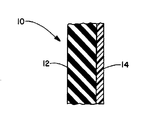
- this Figure shows an expandable curing bladder 10 used in tire making, which has an inner butyl rubber base or core 12 and a high release silicone rubber outside layer 14 bonded thereto.
- This high release silicone rubber outside layer 14 is made of a high release material in accordance with this invention.
- the outside layer 14 (being in contact with a tire when using the bladder 10) may be directly bonded to the base or core 12.
- the base 12 is resin-cured butyl rubber composition, as further described herein.
- the base layer 12 should be elastomeric, should be capable of repeated inflation and deflation with good resistance to flex crack and virtually 100% return to original dimensions, and of good resistance to permeation by inflation gases.
- the outer surface layer 14 is formed of a material having high elongation at break, satisfactory 100% modulus, good release properties, and high cut resistance. This is achieved by providing, as the material of the outside layer 14, a cured elastomeric composition which is a silicone rubber composition as further described herein.
- the material forming outer layer 14 of the curing bladder can be calendered and applied as a thin laminate to the base rubber 12 of the curing bladder 10 by conventional means and cured in a conventional manner.
- the thickness of the outer layer 14 after curing is from 0.025 to 0.25 cm.
- the bladder 10 described herein forms a curing bladder in a tire curing apparatus, such as those described in US-B-4,606,714 and US-B- 6,955,782 .
- the composite rubber article 10 shown herein is generally useful as a material for rubber articles which are subjected to repeated flexure and which therefore must have high durability and fatigue resistance, and which also should have an outer surface or outer layer that has good release properties when in contact with cured rubber.
- the entire bladder 10, and not just the outer surface layer of the silicone rubber composition are formed. This is not preferred, however, since the laminate structure shown in the drawing possess the desirable physical qualities of the base rubber (e.g., high elongation, comparatively low modulus, high permeation resistance) and the desirable qualities, such as low adhesion to cured rubber and good durability which are imparted by the silicone rubber layer 14.
- the laminate structure shown in the drawing possess the desirable physical qualities of the base rubber (e.g., high elongation, comparatively low modulus, high permeation resistance) and the desirable qualities, such as low adhesion to cured rubber and good durability which are imparted by the silicone rubber layer 14.
- the silicone rubber for the outer layer of the expandable bladder is formed from a composition generally comprising an organopolysiloxane containing at least 2 silicon-bonded alkenyl groups per molecule, an organohydrogenpolysiloxane having at least 2 silicon-bonded hydrogen atoms in each molecule, an inorganic filler such as silica or the like, and a hydrosilylation catalyst.
- An adhesion promoter may be added to the composition to promote adhesion of the silicone rubber outer layer to the butyl rubber inner layer.
- a curing inhibitor may be included in the composition to slow the curing rate and increase the pot life of the composition. Details of usable silicone rubber compositions are given for example in US-B- 5,204,384 ; US-B-6,124,407 ; and US-B- 6,464,923 .
- Suitable hydrosilylation catalysts include any of the known platinum, rhodium ruthenium, palladium osmium and iridium hydrosilylation catalysts.
- the hydrosilylation catalyst is a platinum catalyst.
- the hydrosilylation catalyst is selected from finely divided platinum metal, platinum black, chloroplatinic acid, alcohol-modified chloroplatinic acid, chloroplatinic acid/olefin complexes, chloroplatinic acid/diketone complexes, and chloroplatinic acid/divinyltetramethyldisiloxane complexes, as well as thermoplastic resin powders comprising such platinum catalysts.
- Suitable adhesion promoters include those disclosed in US-B- 6,124,407 . As disclosed therein, suitable adhesion promoters may comprise (i) a polysiloxane having an average of at least one silicon-bonded alkenyl group and an average of at least one silicon-bonded hydroxyl group per molecule, or (ii) an epoxy-containing polysiloxane.
- Suitable curing inhibitors include those disclosed in US-B- 6,464,923 .
- suitable curing inhibitors include alkyne alcohols such as 3-methyl-1-buten-3-ol, 3,5-dimethyl-1-hexyn-3-ol, 1-ethinyl-1-cyclohexanol, phenylbutynol; -enine compounds such as 3-methyl-3-penten-1-ine and 3,5-dimethyl-3-hexen-1-ine; vinyl group-containing organosiloxane oligomers such as 1,3,5,7-tetramethyl-1,3,5,7-tetravinylcyclotetrasiloxane and 1,3,5,7-tetramethyl- 1,3,5,7-tetrahexenylcyclotetrasiloxane; and nitrogenous compounds such as benzotriazole and tetramethylethylenediamine, as well as mixtures thereof.
- the silicone rubber is Silastic® EHP50MFG00 Red3016 available commercially from Dow Corning.
- the silicone rubber composition is cured at a temperature ranging from 70 to 200 °C. In another embodiment, the composition is cured at a temperature ranging from 100 to 150 °C.
- Conventional preferred butyl rubbers for use in this invention are typically copolymers of isobutylene and a minor amount of a conjugated diene such as, for example, isoprene.
- the isoprene component is from 0.1 to 5, alternately from 0.5 to 5, weight percent of units of the isobutylene copolymer rubber derived from isoprene, with the remainder being derived from the isobutylene.
- An alternative butyl rubber for the curing bladder comprises a brominated copolymer of isobutylene and paramethyl styrene.
- the brominated copolymer conventionally contains from 0.3 to 2 weight percent bromination.
- Exemplary of such a brominated copolymer is EXXPRO ® from ExxonMobil Chemical reportedly having a Mooney (ML 1+8) viscosity at 125°C of from 45 to 55, a para-methylstyrene content of 5 weight percent, isobutylene content of 94 to 95 weight percent, and a bromine content of 0.8 weight percent.
- EP-A- 0 344 021 describes how to make such copolymers.
- the butyl rubber may comprise a combination of a copolymer of isobutylene and isoprene together with a brominated copolymer of isobutylene and paramethyl styrene.
- the butyl rubber composition for the curing bladder (e.g. tire curing bladder) is resin-cured instead of sulfur-cured, which is a conventional practice for butyl rubber-based curing bladders which are used for rubber products composed of diene-based elastomers.
- the resin curatives are conventionally composed of a small amount of polychloroprene rubber, which is sometimes referred to as a "chloroprene rubber” and acts as a chlorine source, and a phenol-formaldehyde resin.
- the resin cured butyl rubber for the inner layer of the expandable bladder is cured with at least one curative including from 0.5 to 12 phr of a halogenated or non-halogenated phenolic resin curative for crosslinking the isobutylene copolymer rubber (the butyl rubber or halobutyl rubber).
- the curative is not a sulfur-based curative.
- Cure bladders for diene-based rubber products e.g. tires
- the curative is a combination of polychloroprene rubber and phenol-formaldehyde resin.
- the polychloroprene rubber co-curative is conventionally counted toward the 100 parts by weight rubber of the butyl rubber composition even though it has a separate function as a halogen containing elastomer. It may be included in amounts, for example, of up to 10 or even 15 weight percent of the butyl rubber when a halogen source is desirable to activate the resin cure system.
- the butyl rubber composition comprises about 1 to about 10 phr of polychloroprene rubber, such as Neoprene ® from DuPont.
- Resins for curing the butyl rubber-based rubber composition of the curing bladder may be used in amounts, for example, of from 1 to 12 phr and include conventional phenol-formaldehyde resins.
- Such cure systems for bladder compositions are known from US-B- 3,031,423 and US-B- 5,728,311 .
- the cured butyl rubber-based rubber composition for the curing bladder may also contain conventional additives including fillers, stearic acid, resin for curing, antiozonants, antioxidants, processing oils, activators, initiators, plasticizers, waxes, extender oils and the like.
- Antioxidants and antiozonants may desirably be added to the curing bladder composition.
- Antioxidants prevent oxidative crosslinking or oxidative chain scission so that the modulus and fracture properties of the rubber are unchanged during exposure to oxidation especially at elevated temperatures.
- Antidegradants include antioxidants and antiozonants. Amounts used may be, for example, from 0.1 to 10 phr.
- Antiozonants are compounds that prevent chain scission due to exposure to ozone.
- Antidegradants include monophenols, bisphenols, thiophenols, polyphenols, hydroquinone derivatives, phosphites, phosphate blends, thioesters, naphthylamines, diphenol amines as well as other diaryl amine derivatives, para-phenylenes, diamines, quinolines, and blended amines.
- fillers are often incorporated into the curing bladder compositions. They may be used, for example, in amounts in a range of from 20 to 80 phr.
- a preferred filler is carbon black.
- Elastomer reinforcing type fillers are preferred for use in curing bladders.
- Silica may be used in a very minor amount in addition to the carbon black, if desired. Silicas are generally described as synthetic, amorphous silicas, particularly precipitated silicas.
- Fillers include reinforcing fillers such as carbon black which can be used, for example, in amounts from 25 to 75 phr.
- Typical carbon blacks that can be used include, for example, according to standard ASTM designations, acetylene black (e.g., N990), N110, N121, N220, N231, N234, N242, N293, N299, N326, N330, N332, N339, N343, N347, N351, N358, N375, N472, N539, N550, N683, N754, and N765, although acetylene black and N347 and/or N220 carbon blacks are usually preferred.
- Acetylene-derived carbon blacks typically have a higher thermal conductivity than more conventional rubber reinforcing carbon blacks and therefore typically constitute a major amount, and may sometimes constitute the total amount, of the carbon black reinforcement for the curing bladder composition.
- oils and waxes may be used in the curing bladder butyl rubber-based composition depending upon the compatibility of such oils and waxes with the butyl rubber and the other components of the rubber formulation. They may be uniformly dispersed or they may desirably tend to phase separate (migrate to the surface) from the composition.
- Waxes include microcrystalline wax and paraffin wax. Oils include aliphatic-naphthenic aromatic resins, polyethylene glycol, petroleum oils, ester plasticizers, vulcanized vegetable oils, phenolic resin, polymeric esters and rosins. Waxes can be used in conventional individual amounts of, for example, from 1 to 5 or even up to 10 phr. They are usually considered plasticizers and modulus modifiers.
- Fatty acids such as stearic acid, palmitic acid and oleic acid may be used in amounts of 0.1 to 7 phr with a range of 0.2 to 6 phr sometimes being more preferred.
- Zinc oxide may be present, for example, in amounts of 2 to 15 phr.
- the butyl rubber composition for the tire cure bladder may be prepared, for example by mixing, in an internal rubber mixer, sometimes referred to as a first, or non-productive mixing stage, the rubber, micro-encapsulated lubricant, and ingredients such as for example, wax, and zinc oxide, until the mix temperature reaches a temperature in a range of from, for example, 140°C to 200°C, alternatively from 150°C to 180°C.
- the material is dumped from the rubber mixer and milled on an open roll mill, sheeted off and cooled to a temperature below 40°C.
- the cooled rubber composition is added to an internal rubber mixer in a second mixing stage.
- the curatives including any neoprene rubber, resin, preferably brominated phenolic resin, and zinc oxide
- the mix temperature reaches, for example, 110 to 120°C.
- the material is then dumped from the internal rubber mixer and cooled.
- the curing bladder may be molded, for example, in an injection molding machine or a transfer molding machine. If transfer molding is selected, the material obtained from the internal rubber mixer is extruded as a slug.
- a cure rheometer may be used to determine the approximate time to develop optimal cure at specific temperatures. The actual cure time will depend on heating rate and the gauge (thickness) of the curing bladder.
- the curing bladder desirably will have a toroidal shape. For example, bladder material may be cured for 20 to 60 minutes, alternatively from 25 to 40 minutes, at a temperature of from 150°C to 205°C, alternatively from 170°C to 200°C.
- curing bladders of this invention are seen as being useful for molding and curing various pneumatic tires
- other contemplated rubber products cured in such bladder equipped presses include, for example, hoses, various sleeves, and air springs (a shock absorbing spring for commercial vehicles).
Landscapes
- Engineering & Computer Science (AREA)
- Mechanical Engineering (AREA)
- Moulds For Moulding Plastics Or The Like (AREA)
- Heating, Cooling, Or Curing Plastics Or The Like In General (AREA)
- Laminated Bodies (AREA)
Abstract
wherein said butyl rubber comprises a copolymer of isobutylene and isoprene which contains from about 0.5 to about 5 weight percent units derived from isoprene;
wherein said halobutyl rubber is a halogenated butyl rubber comprising a chlorinated or brominated copolymer of isobutylene and isoprene which contains from about 0.5 to about 5 weight percent units derived from isoprene, and wherein
the outer layer (14) comprises a rubber composition comprising a silicone rubber.
Description
- Pneumatic tires are conventionally manufactured by use of an expandable butyl rubber based bladder. For example, a green, uncured, tire is placed in a tire curing mold where the tire is cured, or vulcanized, under conditions of elevated temperature and pressure. In the mold, the open toroidal shaped tire is pressed out against the mold by an expandable butyl rubber based bladder via internal pressure administered to the bladder such by steam, etc. Such tire manufacture and use of expandable butyl rubber bladders for such purpose is well known to those having skill in such art.
- It is important for the interfacial surface of the expandable tire curing bladder of a butyl rubber composition to have adequate interfacial lubricity and sufficiently low adhesion properties between the bladder surface and the inner surface of the tire being vulcanized in the mold.
- Conventionally, the butyl rubber composition for a tire curing bladder contains castor oil as an internal lubricant which is intended to bleed (migrate) to the outer surface of the bladder to promote a continuing lubricity at the interface between the bladder surface and inner surface of the tire being cured ( see
US-B- 3,031,423 ). - Use of corn oil as an internal tire cure butyl rubber bladder lubricant for a similar purpose has also been proposed (see
US-B- 5,580,513 ). - Graphite as a lubricant (see
US-B- 5,538,218 ) and polytetrafluoroethylene powder as a lubricant (seeUS-B- 5,728,311 ) have also been proposed for use in a butyl rubber tire curing bladder. - Even with an internal lubricant (a lubricant contained in the butyl rubber composition designed to bleed to the surface of the bladder) such as castor oil or corn oil, it is often desired to externally apply a polysiloxane based lubricant to the outer bladder surface as to enhance the interfacial lubrication between the bladder and tire surfaces, a practice which is well known to those skilled in such art.
- Thus, from an historical perspective, pneumatic rubber vehicle tires are produced by molding and curing green (uncured) and unshaped tires in a molding press. The green tire is pressed outwardly against a mold surface by means of an inner fluid-expandable bladder. By this method, the green tire is shaped against the outer mold surface which defines the tire tread pattern and configuration of the sidewalls. By application of heat (elevated temperature) and pressure, the tire is molded and cured.
- Historically, the expansion of the bladder is accomplished by application of internal pressure to the inner bladder cavity. The pressure is provided by a fluid such as gas, hot water and/or steam, which also participates in the transfer of heat for the curing or vulcanization of the tire. The tire is then conventionally allowed to cool somewhat in the mold, sometimes aided by adding cold or cooler water to the bladder. Then the mold is opened, the bladder is collapsed by removal of its internal fluid pressure and the tire is removed from the tire mold.
- By such practice, it is recognized that there is substantial relative movement at the interface between the outer contacting surface of the bladder and the inner surface of the tire during the expansion phase of the bladder. Likewise, there is considerable relative movement between the outer contacting surface of the bladder and the cured inner surface of the tire during the collapse and the stripping of the bladder from the tire after the tire has been molded and vulcanized.
- By such practice, it is recognized that the bladder surface can tend to stick to a tire's inner surface after the tire is cured and during the bladder collapsing part of the tire cure cycle. This adhesion may cause roughening of the bladder surface if it is not controlled. This typically reduces bladder durability and can produce defective tires.
- Accordingly, it is often desired to pre-coat the bladder surface, and/or to pre-coat the inner surface of the green tires with a lubricant which can also transfer to the bladder surface and, thereby, provide a degree of interfacial lubricity between the outer bladder surface and inner tire surfaces during the tire's molding and curing operation. Such externally applied lubricant has sometimes been referred to as a "bladder lubricant," and can be of numerous formulations. A silicone polymer (e.g., a lubricant comprising a polysiloxane such as for example a polydimethylsiloxane) is often used as an externally applied bladder lubricant.
- It is to be appreciated that the release of the tire from its curing bladder in an industrial manufacturing setting is intimately associated with both the phenomenon of release (to prevent sticking) and the phenomenon of lubrication (to enhance slipping) between the bladder surface and the inner tire surface. The release aspect refers to the basic ability to avoid adhesion, or enhance release, between the bladder surface and inner tire surface and the aspect of lubrication relates to enhancing the ability of the surfaces to slip and enable a movement of the bladder with respect to the tire as the tire is shaped within the mold.
- Butyl rubber is a copolymer of predominantly isobutylene with small amounts of diene monomers, usually isoprene, to give sufficient unsaturation to allow the butyl rubber to be crosslinked. Halogenated copolymers of isobutylene and para-methylstyrene are also sometimes used such as for example, chlorobutyl rubber and bromobutyl rubber and brominated copolymers of ethylene and paramethyl styrene. Accordingly, it is desired to provide expandable butyl rubber curing bladders with acceptable lubricity and decreased adhesion of the bladder to the tire surface against which the bladder expands.
- In the description of this invention, the term "phr" is sometimes used to refer to "parts by weight of an ingredient per hundred parts by weight of rubber" for various ingredients in a rubber composition.
- The terms "compound," "compounded rubber" and "rubber composition" are intended to be interchangeable terms unless otherwise indicated. The terms "cure" and "vulcanize" are intended to be interchangeable terms unless otherwise indicated. The terms "green" and "uncured" are intended to be interchangeable unless otherwise indicated.
- The present invention is directed to an expandable curing bladder according to claim 1, to a press according to claim 5, and to a process according to claim 6.
- Dependent claims refer to preferred embodiments of the invention.
- Referring now to the sole Figure, this Figure shows an
expandable curing bladder 10 used in tire making, which has an inner butyl rubber base orcore 12 and a high release silicone rubber outsidelayer 14 bonded thereto. This high release silicone rubber outsidelayer 14 is made of a high release material in accordance with this invention. The outside layer 14 (being in contact with a tire when using the bladder 10) may be directly bonded to the base orcore 12. - The
base 12 is resin-cured butyl rubber composition, as further described herein. Thebase layer 12 should be elastomeric, should be capable of repeated inflation and deflation with good resistance to flex crack and virtually 100% return to original dimensions, and of good resistance to permeation by inflation gases. - The
outer surface layer 14 is formed of a material having high elongation at break, satisfactory 100% modulus, good release properties, and high cut resistance. This is achieved by providing, as the material of theoutside layer 14, a cured elastomeric composition which is a silicone rubber composition as further described herein. - The material forming
outer layer 14 of the curing bladder can be calendered and applied as a thin laminate to thebase rubber 12 of thecuring bladder 10 by conventional means and cured in a conventional manner. The thickness of theouter layer 14 after curing is from 0.025 to 0.25 cm. In a preferred embodiment of this invention, thebladder 10 described herein forms a curing bladder in a tire curing apparatus, such as those described inUS-B-4,606,714 andUS-B- 6,955,782 . In fact, thecomposite rubber article 10 shown herein is generally useful as a material for rubber articles which are subjected to repeated flexure and which therefore must have high durability and fatigue resistance, and which also should have an outer surface or outer layer that has good release properties when in contact with cured rubber. - It is possible to form the
entire bladder 10, and not just the outer surface layer of the silicone rubber composition. This is not preferred, however, since the laminate structure shown in the drawing possess the desirable physical qualities of the base rubber (e.g., high elongation, comparatively low modulus, high permeation resistance) and the desirable qualities, such as low adhesion to cured rubber and good durability which are imparted by thesilicone rubber layer 14. - In one embodiment, the silicone rubber for the outer layer of the expandable bladder is formed from a composition generally comprising an organopolysiloxane containing at least 2 silicon-bonded alkenyl groups per molecule, an organohydrogenpolysiloxane having at least 2 silicon-bonded hydrogen atoms in each molecule, an inorganic filler such as silica or the like, and a hydrosilylation catalyst. An adhesion promoter may be added to the composition to promote adhesion of the silicone rubber outer layer to the butyl rubber inner layer. A curing inhibitor may be included in the composition to slow the curing rate and increase the pot life of the composition. Details of usable silicone rubber compositions are given for example in
US-B- 5,204,384 ;US-B-6,124,407 ; andUS-B- 6,464,923 . - Suitable hydrosilylation catalysts include any of the known platinum, rhodium ruthenium, palladium osmium and iridium hydrosilylation catalysts. In one embodiment, the hydrosilylation catalyst is a platinum catalyst. In one embodiment, the hydrosilylation catalyst is selected from finely divided platinum metal, platinum black, chloroplatinic acid, alcohol-modified chloroplatinic acid, chloroplatinic acid/olefin complexes, chloroplatinic acid/diketone complexes, and chloroplatinic acid/divinyltetramethyldisiloxane complexes, as well as thermoplastic resin powders comprising such platinum catalysts.
- Suitable adhesion promoters include those disclosed in
US-B- 6,124,407 . As disclosed therein, suitable adhesion promoters may comprise (i) a polysiloxane having an average of at least one silicon-bonded alkenyl group and an average of at least one silicon-bonded hydroxyl group per molecule, or (ii) an epoxy-containing polysiloxane. - Suitable curing inhibitors include those disclosed in
US-B- 6,464,923 . As disclosed therein, suitable curing inhibitors include alkyne alcohols such as 3-methyl-1-buten-3-ol, 3,5-dimethyl-1-hexyn-3-ol, 1-ethinyl-1-cyclohexanol, phenylbutynol; -enine compounds such as 3-methyl-3-penten-1-ine and 3,5-dimethyl-3-hexen-1-ine; vinyl group-containing organosiloxane oligomers such as 1,3,5,7-tetramethyl-1,3,5,7-tetravinylcyclotetrasiloxane and 1,3,5,7-tetramethyl- 1,3,5,7-tetrahexenylcyclotetrasiloxane; and nitrogenous compounds such as benzotriazole and tetramethylethylenediamine, as well as mixtures thereof. - In one embodiment, the silicone rubber is Silastic® EHP50MFG00 Red3016 available commercially from Dow Corning.
- In one embodiment, the silicone rubber composition is cured at a temperature ranging from 70 to 200 °C. In another embodiment, the composition is cured at a temperature ranging from 100 to 150 °C.
- Conventional preferred butyl rubbers for use in this invention are typically copolymers of isobutylene and a minor amount of a conjugated diene such as, for example, isoprene. Desirably, the isoprene component is from 0.1 to 5, alternately from 0.5 to 5, weight percent of units of the isobutylene copolymer rubber derived from isoprene, with the remainder being derived from the isobutylene.
- An alternative butyl rubber for the curing bladder, although less preferable, comprises a brominated copolymer of isobutylene and paramethyl styrene. The brominated copolymer conventionally contains from 0.3 to 2 weight percent bromination. Exemplary of such a brominated copolymer is EXXPRO® from ExxonMobil Chemical reportedly having a Mooney (ML 1+8) viscosity at 125°C of from 45 to 55, a para-methylstyrene content of 5 weight percent, isobutylene content of 94 to 95 weight percent, and a bromine content of 0.8 weight percent.
EP-A- 0 344 021 describes how to make such copolymers. Alternately, the butyl rubber may comprise a combination of a copolymer of isobutylene and isoprene together with a brominated copolymer of isobutylene and paramethyl styrene. - It is to be appreciated that the butyl rubber composition for the curing bladder (e.g. tire curing bladder) is resin-cured instead of sulfur-cured, which is a conventional practice for butyl rubber-based curing bladders which are used for rubber products composed of diene-based elastomers. As hereinbefore mentioned, the resin curatives are conventionally composed of a small amount of polychloroprene rubber, which is sometimes referred to as a "chloroprene rubber" and acts as a chlorine source, and a phenol-formaldehyde resin.
- In one embodiment, the resin cured butyl rubber for the inner layer of the expandable bladder is cured with at least one curative including from 0.5 to 12 phr of a halogenated or non-halogenated phenolic resin curative for crosslinking the isobutylene copolymer rubber (the butyl rubber or halobutyl rubber). The curative is not a sulfur-based curative. Cure bladders for diene-based rubber products (e.g. tires) do not contain sulfur curatives so that curing is not thereby promoted between the surface of the rubber product and the bladder as would be understood by one having skill in the pertinent art.
- In one embodiment, the curative is a combination of polychloroprene rubber and phenol-formaldehyde resin.
- In practice, the polychloroprene rubber co-curative is conventionally counted toward the 100 parts by weight rubber of the butyl rubber composition even though it has a separate function as a halogen containing elastomer. It may be included in amounts, for example, of up to 10 or even 15 weight percent of the butyl rubber when a halogen source is desirable to activate the resin cure system. In an exemplary embodiment, the butyl rubber composition comprises about 1 to about 10 phr of polychloroprene rubber, such as Neoprene® from DuPont.
- Resins for curing the butyl rubber-based rubber composition of the curing bladder may be used in amounts, for example, of from 1 to 12 phr and include conventional phenol-formaldehyde resins. Such cure systems for bladder compositions are known from
US-B- 3,031,423 andUS-B- 5,728,311 . - The cured butyl rubber-based rubber composition for the curing bladder may also contain conventional additives including fillers, stearic acid, resin for curing, antiozonants, antioxidants, processing oils, activators, initiators, plasticizers, waxes, extender oils and the like.
- Antioxidants and antiozonants may desirably be added to the curing bladder composition. Antioxidants prevent oxidative crosslinking or oxidative chain scission so that the modulus and fracture properties of the rubber are unchanged during exposure to oxidation especially at elevated temperatures. Antidegradants include antioxidants and antiozonants. Amounts used may be, for example, from 0.1 to 10 phr. Antiozonants are compounds that prevent chain scission due to exposure to ozone. Antidegradants include monophenols, bisphenols, thiophenols, polyphenols, hydroquinone derivatives, phosphites, phosphate blends, thioesters, naphthylamines, diphenol amines as well as other diaryl amine derivatives, para-phenylenes, diamines, quinolines, and blended amines.
- Various fillers are often incorporated into the curing bladder compositions. They may be used, for example, in amounts in a range of from 20 to 80 phr. A preferred filler is carbon black. Elastomer reinforcing type fillers are preferred for use in curing bladders. Silica may be used in a very minor amount in addition to the carbon black, if desired. Silicas are generally described as synthetic, amorphous silicas, particularly precipitated silicas. Fillers include reinforcing fillers such as carbon black which can be used, for example, in amounts from 25 to 75 phr. Typical carbon blacks that can be used include, for example, according to standard ASTM designations, acetylene black (e.g., N990), N110, N121, N220, N231, N234, N242, N293, N299, N326, N330, N332, N339, N343, N347, N351, N358, N375, N472, N539, N550, N683, N754, and N765, although acetylene black and N347 and/or N220 carbon blacks are usually preferred. Acetylene-derived carbon blacks typically have a higher thermal conductivity than more conventional rubber reinforcing carbon blacks and therefore typically constitute a major amount, and may sometimes constitute the total amount, of the carbon black reinforcement for the curing bladder composition.
- Various oils and waxes may be used in the curing bladder butyl rubber-based composition depending upon the compatibility of such oils and waxes with the butyl rubber and the other components of the rubber formulation. They may be uniformly dispersed or they may desirably tend to phase separate (migrate to the surface) from the composition. Waxes include microcrystalline wax and paraffin wax. Oils include aliphatic-naphthenic aromatic resins, polyethylene glycol, petroleum oils, ester plasticizers, vulcanized vegetable oils, phenolic resin, polymeric esters and rosins. Waxes can be used in conventional individual amounts of, for example, from 1 to 5 or even up to 10 phr. They are usually considered plasticizers and modulus modifiers. Fatty acids such as stearic acid, palmitic acid and oleic acid may be used in amounts of 0.1 to 7 phr with a range of 0.2 to 6 phr sometimes being more preferred. Zinc oxide may be present, for example, in amounts of 2 to 15 phr.
- The butyl rubber composition for the tire cure bladder may be prepared, for example by mixing, in an internal rubber mixer, sometimes referred to as a first, or non-productive mixing stage, the rubber, micro-encapsulated lubricant, and ingredients such as for example, wax, and zinc oxide, until the mix temperature reaches a temperature in a range of from, for example, 140°C to 200°C, alternatively from 150°C to 180°C. The material is dumped from the rubber mixer and milled on an open roll mill, sheeted off and cooled to a temperature below 40°C. The cooled rubber composition is added to an internal rubber mixer in a second mixing stage. In the second mixing stage (the productive stage), the curatives (including any neoprene rubber, resin, preferably brominated phenolic resin, and zinc oxide) are added and mixed until the mix temperature reaches, for example, 110 to 120°C. The material is then dumped from the internal rubber mixer and cooled.
- The curing bladder may be molded, for example, in an injection molding machine or a transfer molding machine. If transfer molding is selected, the material obtained from the internal rubber mixer is extruded as a slug. A cure rheometer may be used to determine the approximate time to develop optimal cure at specific temperatures. The actual cure time will depend on heating rate and the gauge (thickness) of the curing bladder. The curing bladder desirably will have a toroidal shape. For example, bladder material may be cured for 20 to 60 minutes, alternatively from 25 to 40 minutes, at a temperature of from 150°C to 205°C, alternatively from 170°C to 200°C.
- While the curing bladders of this invention are seen as being useful for molding and curing various pneumatic tires other contemplated rubber products cured in such bladder equipped presses include, for example, hoses, various sleeves, and air springs (a shock absorbing spring for commercial vehicles).
Claims (6)
- An expandable curing bladder (10) for use in the curing of rubber products, the bladder comprising an inner layer (12) and an outer layer (14) bonded to the inner layer (12), whereinthe inner layer (12) comprises a rubber composition comprising, based on parts weight per 100 parts by weight rubber (phr), an isobutylene copolymer rubber selected from butyl rubber and/or halobutyl rubber,
wherein said butyl rubber comprises a copolymer of isobutylene and isoprene which contains from 0.5 to 5 weight percent units derived from isoprene,
wherein said halobutyl rubber is a halogenated butyl rubber comprising a chlorinated or brominated copolymer of isobutylene and isoprene which contains from 0.5 to 5 weight percent units derived from isoprene, and whereinthe outer layer (14) comprises a rubber composition comprising a silicone rubber. - The expandable curing bladder of claim 1 wherein said silicone rubber is formed from a composition comprising an organopolysiloxane containing at least 2 silicon-bonded alkenyl groups per molecule, an organohydrogenpolysiloxane having at least 2 silicon-bonded hydrogen atoms in each molecule, an inorganic filler, and a hydrosilylation catalyst.
- The expandable curing bladder of claim 2 wherein said catalyst is a platinum-containing hydryosilylation catalyst.
- The expandable curing bladder of at least one of the previous claims wherein the outer layer has a thickness ranging from 0.025 to 0.25 cm.
- A curing press for curing an uncured toroidally shaped pneumatic rubber tire, the press comprising an expandable curing bladder according to any of the previous claims.
- A process of shaping and curing a pneumatic tire, the process comprising:(A) providing an expandable curing bladder (10) according to one of the claims 1-4;(B) inserting an uncured toroidally shaped pneumatic rubber tire into a curing mold having said expandable curing bladder positioned therein;(C) closing said curing mold and inflating said expandable curing bladder to expand said expandable curing bladder outwardly against an inner surface of said uncured pneumatic rubber tire to force said uncured pneumatic tire against a mold surface of said curing mold;(D) curing said uncured pneumatic rubber tire in said curing mold at an elevated temperature in a range of 140°C to 180°C;(E) deflating said expandable curing bladder; and(F) removing the resultant cured pneumatic rubber tire from the curing mold and expandable curing bladder.
Applications Claiming Priority (1)
| Application Number | Priority Date | Filing Date | Title |
|---|---|---|---|
| US85278506P | 2006-10-19 | 2006-10-19 |
Publications (1)
| Publication Number | Publication Date |
|---|---|
| EP1914063A1 true EP1914063A1 (en) | 2008-04-23 |
Family
ID=38917658
Family Applications (1)
| Application Number | Title | Priority Date | Filing Date |
|---|---|---|---|
| EP07118752A Withdrawn EP1914063A1 (en) | 2006-10-19 | 2007-10-18 | Curing bladder with release layer |
Country Status (4)
| Country | Link |
|---|---|
| US (1) | US7896633B2 (en) |
| EP (1) | EP1914063A1 (en) |
| CN (1) | CN101239493A (en) |
| BR (1) | BRPI0703647A (en) |
Cited By (3)
| Publication number | Priority date | Publication date | Assignee | Title |
|---|---|---|---|---|
| WO2017116317A1 (en) * | 2015-12-30 | 2017-07-06 | Lang Yuzer Otomotiv Yan Sanayi Ve Ticaret Anonim Sirketi | Silicone based expandable tire curing bladder |
| CN113272378A (en) * | 2018-12-21 | 2021-08-17 | 倍耐力轮胎股份公司 | Capsule containing an additive for tyre compounds, method for preparing same and use in the production of tyres |
| WO2023006160A1 (en) * | 2021-07-29 | 2023-02-02 | Continental Reifen Deutschland Gmbh | Vulcanizable composition for producing a vulcanization bellows |
Families Citing this family (13)
| Publication number | Priority date | Publication date | Assignee | Title |
|---|---|---|---|---|
| JP5459042B2 (en) * | 2010-04-23 | 2014-04-02 | 横浜ゴム株式会社 | Manufacturing method of tire manufacturing bladder |
| CN101914246A (en) * | 2010-08-23 | 2010-12-15 | 江苏东旭科技有限公司 | Regenerated butyl mixing rubber for high-speed vacuum tyre airtight layer and process method thereof |
| EP3137273B1 (en) | 2014-04-30 | 2021-06-02 | Pirelli Tyre S.p.A. | Process for producing tyres for vehicle wheels |
| CN106457933B (en) | 2014-04-30 | 2018-07-06 | 倍耐力轮胎股份公司 | The method that production is used for the tire equipped with accessory of wheel |
| CN104017280B (en) * | 2014-06-23 | 2016-01-20 | 东营金泰轮胎胶囊有限公司 | The production technique of ageing-resistant tyre capsule sizing material |
| US10538041B2 (en) * | 2016-11-17 | 2020-01-21 | Bridgestone Americas Tire Operations, Llc | Tire curing bladder with an air barrier layer |
| JP7148333B2 (en) * | 2018-09-07 | 2022-10-05 | ナブテスコ株式会社 | Bonding of fiber-containing composites |
| EP4000850B1 (en) * | 2019-07-18 | 2024-09-11 | The Yokohama Rubber Co., Ltd. | Tire vulcanization bladder |
| FR3099485B1 (en) * | 2019-07-29 | 2021-07-30 | Michelin & Cie | silicone rubber composition for coating of cooking membrane. |
| FR3103820B1 (en) | 2019-11-29 | 2022-08-05 | Michelin & Cie | Expandable membrane for baking mold coated with a silicone rubber composition |
| FR3103821B1 (en) * | 2019-11-29 | 2021-11-12 | Michelin & Cie | laminate based on silicone rubber compositions |
| FR3107525B1 (en) | 2020-02-20 | 2022-03-04 | Michelin & Cie | Process for modifying expandable curing membranes for the manufacture of tires |
| CN111251517B (en) * | 2020-03-12 | 2022-04-05 | 山西新华防化装备研究院有限公司 | Co-vulcanization method of chlorinated butyl rubber and silicone rubber compound |
Citations (5)
| Publication number | Priority date | Publication date | Assignee | Title |
|---|---|---|---|---|
| USRE25007E (en) * | 1952-01-12 | 1961-07-04 | Us Rubber Co | Vulcanization of butyl rubber with para substituted |
| GB2087914A (en) * | 1980-11-20 | 1982-06-03 | Goodyear Tire & Rubber | Surface-treated tire curing bladder treatment composition therefor and method for curing tires |
| US4710541A (en) * | 1984-10-22 | 1987-12-01 | Bridgestone Corporation | Process for molding and vulcanizing rubber products |
| US4889677A (en) * | 1985-07-29 | 1989-12-26 | Bridgestone Corporation | Process for curing tire employing a bladder lubricant |
| EP0711643A2 (en) * | 1994-09-30 | 1996-05-15 | The Goodyear Tire & Rubber Company | Tire cure bladders containing polytetrafluoroethylene powder and use thereof |
Family Cites Families (13)
| Publication number | Priority date | Publication date | Assignee | Title |
|---|---|---|---|---|
| US4533305A (en) | 1980-11-20 | 1985-08-06 | The Goodyear Tire & Rubber Company | Surface treated tire curing bladder, treatment composition therefor and method for curing tires |
| US5062781A (en) | 1988-08-10 | 1991-11-05 | Firelli Armstrong Tire Corporation | Reinforced tire curing bladder |
| US5204384A (en) | 1991-01-23 | 1993-04-20 | Dow Corning Toray Silicone Co., Ltd. | One-part curable organosiloxane composition |
| JPH0531724A (en) * | 1991-07-31 | 1993-02-09 | Bridgestone Corp | Method for molding and vulcanizing rubber product |
| US5213823A (en) | 1992-03-20 | 1993-05-25 | The Goodyear Tire & Rubber Company | Turnup bladder having outer layer of PVC/acrylonitrile butadiene rubber blend |
| JP3461404B2 (en) | 1995-03-29 | 2003-10-27 | 東レ・ダウコーニング・シリコーン株式会社 | Curable organopolysiloxane composition |
| US6124407A (en) * | 1998-10-28 | 2000-09-26 | Dow Corning Corporation | Silicone composition, method for the preparation thereof, and silicone elastomer |
| US6363989B1 (en) | 1999-02-02 | 2002-04-02 | Pirelli Pneumatici S.P.A. | Anti-tack bladder |
| JP4565478B2 (en) | 2000-02-22 | 2010-10-20 | 東レ・ダウコーニング株式会社 | Method for producing silicone rubber molded product |
| EP1308257A3 (en) | 2001-11-02 | 2005-12-28 | Teijin Limited | Bladder for curing tyres and method for producing tyres |
| US6846444B2 (en) | 2002-12-13 | 2005-01-25 | The Goodyear Tire & Rubber Company | Self-releasing curing bladders |
| JP4359286B2 (en) * | 2003-10-31 | 2009-11-04 | ピレリ・タイヤ・ソチエタ・ペル・アツィオーニ | Inflatable bladder for tire vulcanizer, method for producing the same, and process for producing tires for wheels |
| US6998088B2 (en) * | 2003-11-21 | 2006-02-14 | The Goodyear Tire & Rubber Company | Self-releasing curing bladder containing a micro-encapsulated lubricant and use thereof to cure rubber products such as tires |
-
2007
- 2007-07-18 US US11/879,683 patent/US7896633B2/en not_active Expired - Fee Related
- 2007-10-10 BR BRPI0703647-7A patent/BRPI0703647A/en not_active IP Right Cessation
- 2007-10-18 EP EP07118752A patent/EP1914063A1/en not_active Withdrawn
- 2007-10-19 CN CNA2007101816159A patent/CN101239493A/en active Pending
Patent Citations (5)
| Publication number | Priority date | Publication date | Assignee | Title |
|---|---|---|---|---|
| USRE25007E (en) * | 1952-01-12 | 1961-07-04 | Us Rubber Co | Vulcanization of butyl rubber with para substituted |
| GB2087914A (en) * | 1980-11-20 | 1982-06-03 | Goodyear Tire & Rubber | Surface-treated tire curing bladder treatment composition therefor and method for curing tires |
| US4710541A (en) * | 1984-10-22 | 1987-12-01 | Bridgestone Corporation | Process for molding and vulcanizing rubber products |
| US4889677A (en) * | 1985-07-29 | 1989-12-26 | Bridgestone Corporation | Process for curing tire employing a bladder lubricant |
| EP0711643A2 (en) * | 1994-09-30 | 1996-05-15 | The Goodyear Tire & Rubber Company | Tire cure bladders containing polytetrafluoroethylene powder and use thereof |
Cited By (4)
| Publication number | Priority date | Publication date | Assignee | Title |
|---|---|---|---|---|
| WO2017116317A1 (en) * | 2015-12-30 | 2017-07-06 | Lang Yuzer Otomotiv Yan Sanayi Ve Ticaret Anonim Sirketi | Silicone based expandable tire curing bladder |
| CN113272378A (en) * | 2018-12-21 | 2021-08-17 | 倍耐力轮胎股份公司 | Capsule containing an additive for tyre compounds, method for preparing same and use in the production of tyres |
| CN113272378B (en) * | 2018-12-21 | 2023-07-25 | 倍耐力轮胎股份公司 | Capsules containing additives for tire compounds, process for their preparation and use in tire production |
| WO2023006160A1 (en) * | 2021-07-29 | 2023-02-02 | Continental Reifen Deutschland Gmbh | Vulcanizable composition for producing a vulcanization bellows |
Also Published As
| Publication number | Publication date |
|---|---|
| CN101239493A (en) | 2008-08-13 |
| US20080093771A1 (en) | 2008-04-24 |
| US7896633B2 (en) | 2011-03-01 |
| BRPI0703647A (en) | 2008-06-10 |
Similar Documents
| Publication | Publication Date | Title |
|---|---|---|
| US7896633B2 (en) | Self-releasing curing bladder | |
| US5580513A (en) | Tire curing bladder with improved release characteristics | |
| US5538218A (en) | Tire curing bladder with improved release from the tire innerliner | |
| EP1078955B1 (en) | Tire curing bladder containing lecithin and use thereof | |
| US20060125146A1 (en) | Tire curing bladder of EPDM rubber and use thereof | |
| US6998088B2 (en) | Self-releasing curing bladder containing a micro-encapsulated lubricant and use thereof to cure rubber products such as tires | |
| US5728311A (en) | Tire cure bladders containing polytetrafluoroethylene powder and use thereof | |
| US20200157331A1 (en) | Curable rubber composition | |
| US6846444B2 (en) | Self-releasing curing bladders | |
| CA2138590C (en) | Tire cure bladders containing polytetrafluoroethylene powder and use thereof | |
| KR100569525B1 (en) | Tire cure bladder composition with alkylphenoxypolyalkyleneoxyalkanol | |
| US20090212467A1 (en) | Expandable Bladder | |
| JP2019503902A (en) | Silicone inflatable tire curing bladder |
Legal Events
| Date | Code | Title | Description |
|---|---|---|---|
| PUAI | Public reference made under article 153(3) epc to a published international application that has entered the european phase |
Free format text: ORIGINAL CODE: 0009012 |
|
| AK | Designated contracting states |
Kind code of ref document: A1 Designated state(s): AT BE BG CH CY CZ DE DK EE ES FI FR GB GR HU IE IS IT LI LT LU LV MC MT NL PL PT RO SE SI SK TR |
|
| AX | Request for extension of the european patent |
Extension state: AL BA HR MK RS |
|
| 17P | Request for examination filed |
Effective date: 20081023 |
|
| 17Q | First examination report despatched |
Effective date: 20081120 |
|
| AKX | Designation fees paid |
Designated state(s): DE FR IT NL |
|
| STAA | Information on the status of an ep patent application or granted ep patent |
Free format text: STATUS: THE APPLICATION IS DEEMED TO BE WITHDRAWN |
|
| 18D | Application deemed to be withdrawn |
Effective date: 20090603 |