EP1908751A1 - N-hydroxy benzamides with antitumour activity - Google Patents
N-hydroxy benzamides with antitumour activity Download PDFInfo
- Publication number
- EP1908751A1 EP1908751A1 EP06425676A EP06425676A EP1908751A1 EP 1908751 A1 EP1908751 A1 EP 1908751A1 EP 06425676 A EP06425676 A EP 06425676A EP 06425676 A EP06425676 A EP 06425676A EP 1908751 A1 EP1908751 A1 EP 1908751A1
- Authority
- EP
- European Patent Office
- Prior art keywords
- alkyl
- aryl
- cycloalkyl
- hydrogen
- groups
- Prior art date
- Legal status (The legal status is an assumption and is not a legal conclusion. Google has not performed a legal analysis and makes no representation as to the accuracy of the status listed.)
- Withdrawn
Links
- 230000000259 anti-tumor effect Effects 0.000 title abstract description 10
- VDEUYMSGMPQMIK-UHFFFAOYSA-N benzhydroxamic acid Chemical class ONC(=O)C1=CC=CC=C1 VDEUYMSGMPQMIK-UHFFFAOYSA-N 0.000 title abstract description 5
- 230000000694 effects Effects 0.000 title description 10
- 238000002360 preparation method Methods 0.000 claims abstract description 15
- 150000001875 compounds Chemical class 0.000 claims description 68
- 206010028980 Neoplasm Diseases 0.000 claims description 49
- -1 hydroxy, amino Chemical group 0.000 claims description 31
- 238000011282 treatment Methods 0.000 claims description 22
- 229910052739 hydrogen Inorganic materials 0.000 claims description 20
- 239000001257 hydrogen Substances 0.000 claims description 20
- 125000004435 hydrogen atom Chemical group [H]* 0.000 claims description 20
- 125000003118 aryl group Chemical group 0.000 claims description 16
- 125000000623 heterocyclic group Chemical group 0.000 claims description 13
- 125000000008 (C1-C10) alkyl group Chemical group 0.000 claims description 12
- 125000000217 alkyl group Chemical group 0.000 claims description 12
- 125000000753 cycloalkyl group Chemical group 0.000 claims description 12
- JUJWROOIHBZHMG-UHFFFAOYSA-N Pyridine Chemical compound C1=CC=NC=C1 JUJWROOIHBZHMG-UHFFFAOYSA-N 0.000 claims description 11
- YTPLMLYBLZKORZ-UHFFFAOYSA-N Thiophene Chemical compound C=1C=CSC=1 YTPLMLYBLZKORZ-UHFFFAOYSA-N 0.000 claims description 11
- YLQBMQCUIZJEEH-UHFFFAOYSA-N Furan Chemical compound C=1C=COC=1 YLQBMQCUIZJEEH-UHFFFAOYSA-N 0.000 claims description 10
- 125000003710 aryl alkyl group Chemical group 0.000 claims description 10
- 125000006376 (C3-C10) cycloalkyl group Chemical group 0.000 claims description 8
- KAESVJOAVNADME-UHFFFAOYSA-N Pyrrole Chemical compound C=1C=CNC=1 KAESVJOAVNADME-UHFFFAOYSA-N 0.000 claims description 8
- 125000000304 alkynyl group Chemical group 0.000 claims description 8
- 210000004027 cell Anatomy 0.000 claims description 8
- 125000001072 heteroaryl group Chemical group 0.000 claims description 8
- 210000004072 lung Anatomy 0.000 claims description 8
- 125000002496 methyl group Chemical group [H]C([H])([H])* 0.000 claims description 8
- 210000000496 pancreas Anatomy 0.000 claims description 8
- 125000002023 trifluoromethyl group Chemical group FC(F)(F)* 0.000 claims description 8
- 229910052736 halogen Inorganic materials 0.000 claims description 7
- 150000002367 halogens Chemical group 0.000 claims description 7
- 210000001672 ovary Anatomy 0.000 claims description 7
- 230000007170 pathology Effects 0.000 claims description 7
- IJGRMHOSHXDMSA-UHFFFAOYSA-N Atomic nitrogen Chemical compound N#N IJGRMHOSHXDMSA-UHFFFAOYSA-N 0.000 claims description 6
- RWRDLPDLKQPQOW-UHFFFAOYSA-N Pyrrolidine Chemical compound C1CCNC1 RWRDLPDLKQPQOW-UHFFFAOYSA-N 0.000 claims description 6
- 210000000481 breast Anatomy 0.000 claims description 6
- 125000004093 cyano group Chemical group *C#N 0.000 claims description 6
- RAXXELZNTBOGNW-UHFFFAOYSA-N imidazole Natural products C1=CNC=N1 RAXXELZNTBOGNW-UHFFFAOYSA-N 0.000 claims description 6
- 239000008194 pharmaceutical composition Substances 0.000 claims description 6
- 210000002307 prostate Anatomy 0.000 claims description 6
- 125000001424 substituent group Chemical group 0.000 claims description 6
- 230000003463 hyperproliferative effect Effects 0.000 claims description 5
- 229910052757 nitrogen Inorganic materials 0.000 claims description 5
- 229910052760 oxygen Inorganic materials 0.000 claims description 5
- 125000003837 (C1-C20) alkyl group Chemical group 0.000 claims description 4
- 125000004209 (C1-C8) alkyl group Chemical group 0.000 claims description 4
- FYADHXFMURLYQI-UHFFFAOYSA-N 1,2,4-triazine Chemical compound C1=CN=NC=N1 FYADHXFMURLYQI-UHFFFAOYSA-N 0.000 claims description 4
- ZCYVEMRRCGMTRW-UHFFFAOYSA-N 7553-56-2 Chemical group [I] ZCYVEMRRCGMTRW-UHFFFAOYSA-N 0.000 claims description 4
- WKBOTKDWSSQWDR-UHFFFAOYSA-N Bromine atom Chemical group [Br] WKBOTKDWSSQWDR-UHFFFAOYSA-N 0.000 claims description 4
- 125000006374 C2-C10 alkenyl group Chemical group 0.000 claims description 4
- 125000003358 C2-C20 alkenyl group Chemical group 0.000 claims description 4
- ZAMOUSCENKQFHK-UHFFFAOYSA-N Chlorine atom Chemical group [Cl] ZAMOUSCENKQFHK-UHFFFAOYSA-N 0.000 claims description 4
- PXGOKWXKJXAPGV-UHFFFAOYSA-N Fluorine Chemical group FF PXGOKWXKJXAPGV-UHFFFAOYSA-N 0.000 claims description 4
- 229910003600 H2NS Inorganic materials 0.000 claims description 4
- YNAVUWVOSKDBBP-UHFFFAOYSA-N Morpholine Chemical compound C1COCCN1 YNAVUWVOSKDBBP-UHFFFAOYSA-N 0.000 claims description 4
- NQRYJNQNLNOLGT-UHFFFAOYSA-N Piperidine Chemical compound C1CCNCC1 NQRYJNQNLNOLGT-UHFFFAOYSA-N 0.000 claims description 4
- KYQCOXFCLRTKLS-UHFFFAOYSA-N Pyrazine Chemical compound C1=CN=CC=N1 KYQCOXFCLRTKLS-UHFFFAOYSA-N 0.000 claims description 4
- 125000003342 alkenyl group Chemical group 0.000 claims description 4
- 125000003545 alkoxy group Chemical group 0.000 claims description 4
- GDTBXPJZTBHREO-UHFFFAOYSA-N bromine Chemical group BrBr GDTBXPJZTBHREO-UHFFFAOYSA-N 0.000 claims description 4
- 229910052794 bromium Inorganic materials 0.000 claims description 4
- 125000003178 carboxy group Chemical group [H]OC(*)=O 0.000 claims description 4
- 229910052801 chlorine Inorganic materials 0.000 claims description 4
- 239000000460 chlorine Chemical group 0.000 claims description 4
- 125000001316 cycloalkyl alkyl group Chemical group 0.000 claims description 4
- 125000001495 ethyl group Chemical group [H]C([H])([H])C([H])([H])* 0.000 claims description 4
- 229910052731 fluorine Inorganic materials 0.000 claims description 4
- 239000011737 fluorine Chemical group 0.000 claims description 4
- 239000003102 growth factor Substances 0.000 claims description 4
- 125000001188 haloalkyl group Chemical group 0.000 claims description 4
- 125000004446 heteroarylalkyl group Chemical group 0.000 claims description 4
- 125000000592 heterocycloalkyl group Chemical group 0.000 claims description 4
- 125000002887 hydroxy group Chemical group [H]O* 0.000 claims description 4
- 239000003112 inhibitor Substances 0.000 claims description 4
- 239000011630 iodine Chemical group 0.000 claims description 4
- 229910052740 iodine Chemical group 0.000 claims description 4
- 210000003734 kidney Anatomy 0.000 claims description 4
- 125000000449 nitro group Chemical group [O-][N+](*)=O 0.000 claims description 4
- 125000004433 nitrogen atom Chemical group N* 0.000 claims description 4
- UMJSCPRVCHMLSP-UHFFFAOYSA-N pyridine Natural products COC1=CC=CN=C1 UMJSCPRVCHMLSP-UHFFFAOYSA-N 0.000 claims description 4
- 150000003839 salts Chemical class 0.000 claims description 4
- 229930192474 thiophene Natural products 0.000 claims description 4
- NINIDFKCEFEMDL-UHFFFAOYSA-N Sulfur Chemical group [S] NINIDFKCEFEMDL-UHFFFAOYSA-N 0.000 claims description 3
- 239000002246 antineoplastic agent Substances 0.000 claims description 3
- QVGXLLKOCUKJST-UHFFFAOYSA-N atomic oxygen Chemical compound [O] QVGXLLKOCUKJST-UHFFFAOYSA-N 0.000 claims description 3
- 229940127089 cytotoxic agent Drugs 0.000 claims description 3
- 210000003238 esophagus Anatomy 0.000 claims description 3
- 210000003128 head Anatomy 0.000 claims description 3
- 210000003739 neck Anatomy 0.000 claims description 3
- 239000001301 oxygen Substances 0.000 claims description 3
- 239000000546 pharmaceutical excipient Substances 0.000 claims description 3
- 210000002784 stomach Anatomy 0.000 claims description 3
- 210000001550 testis Anatomy 0.000 claims description 3
- 210000001685 thyroid gland Anatomy 0.000 claims description 3
- 210000003932 urinary bladder Anatomy 0.000 claims description 3
- 125000004178 (C1-C4) alkyl group Chemical group 0.000 claims description 2
- 125000006649 (C2-C20) alkynyl group Chemical group 0.000 claims description 2
- JYEUMXHLPRZUAT-UHFFFAOYSA-N 1,2,3-triazine Chemical compound C1=CN=NN=C1 JYEUMXHLPRZUAT-UHFFFAOYSA-N 0.000 claims description 2
- BBVIDBNAYOIXOE-UHFFFAOYSA-N 1,2,4-oxadiazole Chemical compound C=1N=CON=1 BBVIDBNAYOIXOE-UHFFFAOYSA-N 0.000 claims description 2
- UDGKZGLPXCRRAM-UHFFFAOYSA-N 1,2,5-thiadiazole Chemical compound C=1C=NSN=1 UDGKZGLPXCRRAM-UHFFFAOYSA-N 0.000 claims description 2
- FKASFBLJDCHBNZ-UHFFFAOYSA-N 1,3,4-oxadiazole Chemical compound C1=NN=CO1 FKASFBLJDCHBNZ-UHFFFAOYSA-N 0.000 claims description 2
- MBIZXFATKUQOOA-UHFFFAOYSA-N 1,3,4-thiadiazole Chemical compound C1=NN=CS1 MBIZXFATKUQOOA-UHFFFAOYSA-N 0.000 claims description 2
- JIHQDMXYYFUGFV-UHFFFAOYSA-N 1,3,5-triazine Chemical compound C1=NC=NC=N1 JIHQDMXYYFUGFV-UHFFFAOYSA-N 0.000 claims description 2
- QWENRTYMTSOGBR-UHFFFAOYSA-N 1H-1,2,3-Triazole Chemical compound C=1C=NNN=1 QWENRTYMTSOGBR-UHFFFAOYSA-N 0.000 claims description 2
- 125000000954 2-hydroxyethyl group Chemical group [H]C([*])([H])C([H])([H])O[H] 0.000 claims description 2
- 125000003903 2-propenyl group Chemical group [H]C([*])([H])C([H])=C([H])[H] 0.000 claims description 2
- NSPMIYGKQJPBQR-UHFFFAOYSA-N 4H-1,2,4-triazole Chemical compound C=1N=CNN=1 NSPMIYGKQJPBQR-UHFFFAOYSA-N 0.000 claims description 2
- HBAQYPYDRFILMT-UHFFFAOYSA-N 8-[3-(1-cyclopropylpyrazol-4-yl)-1H-pyrazolo[4,3-d]pyrimidin-5-yl]-3-methyl-3,8-diazabicyclo[3.2.1]octan-2-one Chemical class C1(CC1)N1N=CC(=C1)C1=NNC2=C1N=C(N=C2)N1C2C(N(CC1CC2)C)=O HBAQYPYDRFILMT-UHFFFAOYSA-N 0.000 claims description 2
- 229940123587 Cell cycle inhibitor Drugs 0.000 claims description 2
- 150000001204 N-oxides Chemical class 0.000 claims description 2
- 229910003827 NRaRb Chemical group 0.000 claims description 2
- ZCQWOFVYLHDMMC-UHFFFAOYSA-N Oxazole Chemical compound C1=COC=N1 ZCQWOFVYLHDMMC-UHFFFAOYSA-N 0.000 claims description 2
- PCNDJXKNXGMECE-UHFFFAOYSA-N Phenazine Natural products C1=CC=CC2=NC3=CC=CC=C3N=C21 PCNDJXKNXGMECE-UHFFFAOYSA-N 0.000 claims description 2
- WTKZEGDFNFYCGP-UHFFFAOYSA-N Pyrazole Chemical compound C=1C=NNC=1 WTKZEGDFNFYCGP-UHFFFAOYSA-N 0.000 claims description 2
- CZPWVGJYEJSRLH-UHFFFAOYSA-N Pyrimidine Chemical compound C1=CN=CN=C1 CZPWVGJYEJSRLH-UHFFFAOYSA-N 0.000 claims description 2
- FZWLAAWBMGSTSO-UHFFFAOYSA-N Thiazole Chemical compound C1=CSC=N1 FZWLAAWBMGSTSO-UHFFFAOYSA-N 0.000 claims description 2
- 125000001931 aliphatic group Chemical group 0.000 claims description 2
- 125000003282 alkyl amino group Chemical group 0.000 claims description 2
- 125000004448 alkyl carbonyl group Chemical group 0.000 claims description 2
- 239000002168 alkylating agent Substances 0.000 claims description 2
- 229940100198 alkylating agent Drugs 0.000 claims description 2
- 239000004037 angiogenesis inhibitor Substances 0.000 claims description 2
- 239000003242 anti bacterial agent Substances 0.000 claims description 2
- 230000000340 anti-metabolite Effects 0.000 claims description 2
- 229940088710 antibiotic agent Drugs 0.000 claims description 2
- 229940100197 antimetabolite Drugs 0.000 claims description 2
- 239000002256 antimetabolite Substances 0.000 claims description 2
- 125000000852 azido group Chemical group *N=[N+]=[N-] 0.000 claims description 2
- 125000004432 carbon atom Chemical group C* 0.000 claims description 2
- 125000002057 carboxymethyl group Chemical group [H]OC(=O)C([H])([H])[*] 0.000 claims description 2
- 125000004186 cyclopropylmethyl group Chemical group [H]C([H])(*)C1([H])C([H])([H])C1([H])[H] 0.000 claims description 2
- 125000004663 dialkyl amino group Chemical group 0.000 claims description 2
- 239000003534 dna topoisomerase inhibitor Substances 0.000 claims description 2
- JKFAIQOWCVVSKC-UHFFFAOYSA-N furazan Chemical compound C=1C=NON=1 JKFAIQOWCVVSKC-UHFFFAOYSA-N 0.000 claims description 2
- 239000000138 intercalating agent Substances 0.000 claims description 2
- ZLTPDFXIESTBQG-UHFFFAOYSA-N isothiazole Chemical compound C=1C=NSC=1 ZLTPDFXIESTBQG-UHFFFAOYSA-N 0.000 claims description 2
- CTAPFRYPJLPFDF-UHFFFAOYSA-N isoxazole Chemical compound C=1C=NOC=1 CTAPFRYPJLPFDF-UHFFFAOYSA-N 0.000 claims description 2
- 230000011278 mitosis Effects 0.000 claims description 2
- 125000004430 oxygen atom Chemical group O* 0.000 claims description 2
- 125000001997 phenyl group Chemical group [H]C1=C([H])C([H])=C(*)C([H])=C1[H] 0.000 claims description 2
- 125000004193 piperazinyl group Chemical group 0.000 claims description 2
- 125000002924 primary amino group Chemical group [H]N([H])* 0.000 claims description 2
- PBMFSQRYOILNGV-UHFFFAOYSA-N pyridazine Chemical compound C1=CC=NN=C1 PBMFSQRYOILNGV-UHFFFAOYSA-N 0.000 claims description 2
- 229910052717 sulfur Inorganic materials 0.000 claims description 2
- 125000000999 tert-butyl group Chemical group [H]C([H])([H])C(*)(C([H])([H])[H])C([H])([H])[H] 0.000 claims description 2
- 150000003536 tetrazoles Chemical class 0.000 claims description 2
- 125000005309 thioalkoxy group Chemical group 0.000 claims description 2
- 229940044693 topoisomerase inhibitor Drugs 0.000 claims description 2
- 208000003174 Brain Neoplasms Diseases 0.000 claims 1
- 239000013059 antihormonal agent Substances 0.000 claims 1
- 239000003814 drug Substances 0.000 claims 1
- XEKOWRVHYACXOJ-UHFFFAOYSA-N Ethyl acetate Chemical compound CCOC(C)=O XEKOWRVHYACXOJ-UHFFFAOYSA-N 0.000 description 22
- 238000000034 method Methods 0.000 description 20
- 241000699670 Mus sp. Species 0.000 description 17
- WYURNTSHIVDZCO-UHFFFAOYSA-N Tetrahydrofuran Chemical compound C1CCOC1 WYURNTSHIVDZCO-UHFFFAOYSA-N 0.000 description 12
- 239000000243 solution Substances 0.000 description 12
- WPYMKLBDIGXBTP-UHFFFAOYSA-N benzoic acid Chemical compound OC(=O)C1=CC=CC=C1 WPYMKLBDIGXBTP-UHFFFAOYSA-N 0.000 description 10
- 238000006243 chemical reaction Methods 0.000 description 10
- 239000002904 solvent Substances 0.000 description 10
- YMWUJEATGCHHMB-UHFFFAOYSA-N Dichloromethane Chemical compound ClCCl YMWUJEATGCHHMB-UHFFFAOYSA-N 0.000 description 9
- 102000004232 Mitogen-Activated Protein Kinase Kinases Human genes 0.000 description 9
- 108090000744 Mitogen-Activated Protein Kinase Kinases Proteins 0.000 description 9
- FAPWRFPIFSIZLT-UHFFFAOYSA-M Sodium chloride Chemical class [Na+].[Cl-] FAPWRFPIFSIZLT-UHFFFAOYSA-M 0.000 description 9
- 239000005711 Benzoic acid Substances 0.000 description 8
- 230000005764 inhibitory process Effects 0.000 description 8
- 239000012047 saturated solution Substances 0.000 description 8
- 108010007457 Extracellular Signal-Regulated MAP Kinases Proteins 0.000 description 7
- 102000007665 Extracellular Signal-Regulated MAP Kinases Human genes 0.000 description 7
- UIIMBOGNXHQVGW-UHFFFAOYSA-M Sodium bicarbonate Chemical compound [Na+].OC([O-])=O UIIMBOGNXHQVGW-UHFFFAOYSA-M 0.000 description 7
- 235000010233 benzoic acid Nutrition 0.000 description 7
- OKKJLVBELUTLKV-UHFFFAOYSA-N Methanol Chemical compound OC OKKJLVBELUTLKV-UHFFFAOYSA-N 0.000 description 6
- 241001529936 Murinae Species 0.000 description 6
- SJRJJKPEHAURKC-UHFFFAOYSA-N N-Methylmorpholine Chemical compound CN1CCOCC1 SJRJJKPEHAURKC-UHFFFAOYSA-N 0.000 description 6
- 239000007832 Na2SO4 Substances 0.000 description 6
- PMZURENOXWZQFD-UHFFFAOYSA-L Sodium Sulfate Chemical compound [Na+].[Na+].[O-]S([O-])(=O)=O PMZURENOXWZQFD-UHFFFAOYSA-L 0.000 description 6
- ZMANZCXQSJIPKH-UHFFFAOYSA-N Triethylamine Chemical compound CCN(CC)CC ZMANZCXQSJIPKH-UHFFFAOYSA-N 0.000 description 6
- 230000037396 body weight Effects 0.000 description 6
- 201000011510 cancer Diseases 0.000 description 6
- 210000001072 colon Anatomy 0.000 description 6
- 239000002829 mitogen activated protein kinase inhibitor Substances 0.000 description 6
- 239000000203 mixture Substances 0.000 description 6
- 239000011541 reaction mixture Substances 0.000 description 6
- 229910052938 sodium sulfate Inorganic materials 0.000 description 6
- 230000004614 tumor growth Effects 0.000 description 6
- NYBMAOGHNRBBCT-UHFFFAOYSA-N 2-[(3,5-dichloropyridin-2-yl)amino]-3,4-difluorobenzoic acid Chemical compound OC(=O)C1=CC=C(F)C(F)=C1NC1=NC=C(Cl)C=C1Cl NYBMAOGHNRBBCT-UHFFFAOYSA-N 0.000 description 5
- 239000012074 organic phase Substances 0.000 description 5
- 238000012360 testing method Methods 0.000 description 5
- 241000124008 Mammalia Species 0.000 description 4
- 241001465754 Metazoa Species 0.000 description 4
- 206010035226 Plasma cell myeloma Diseases 0.000 description 4
- 238000011156 evaluation Methods 0.000 description 4
- 238000001704 evaporation Methods 0.000 description 4
- 230000008020 evaporation Effects 0.000 description 4
- 208000032839 leukemia Diseases 0.000 description 4
- 239000007858 starting material Substances 0.000 description 4
- 238000003756 stirring Methods 0.000 description 4
- 230000004083 survival effect Effects 0.000 description 4
- XLYOFNOQVPJJNP-UHFFFAOYSA-N water Substances O XLYOFNOQVPJJNP-UHFFFAOYSA-N 0.000 description 4
- 206010025323 Lymphomas Diseases 0.000 description 3
- 102000043136 MAP kinase family Human genes 0.000 description 3
- 108091054455 MAP kinase family Proteins 0.000 description 3
- 241000699666 Mus <mouse, genus> Species 0.000 description 3
- YXFVVABEGXRONW-UHFFFAOYSA-N Toluene Chemical compound CC1=CC=CC=C1 YXFVVABEGXRONW-UHFFFAOYSA-N 0.000 description 3
- 230000004913 activation Effects 0.000 description 3
- 230000004663 cell proliferation Effects 0.000 description 3
- 239000003795 chemical substances by application Substances 0.000 description 3
- 238000004440 column chromatography Methods 0.000 description 3
- UAOMVDZJSHZZME-UHFFFAOYSA-N diisopropylamine Chemical compound CC(C)NC(C)C UAOMVDZJSHZZME-UHFFFAOYSA-N 0.000 description 3
- 230000002489 hematologic effect Effects 0.000 description 3
- 238000001727 in vivo Methods 0.000 description 3
- 201000001441 melanoma Diseases 0.000 description 3
- 201000000050 myeloid neoplasm Diseases 0.000 description 3
- 229940002612 prodrug Drugs 0.000 description 3
- 239000000651 prodrug Substances 0.000 description 3
- 230000035755 proliferation Effects 0.000 description 3
- 125000006239 protecting group Chemical group 0.000 description 3
- 229910000030 sodium bicarbonate Inorganic materials 0.000 description 3
- 239000011780 sodium chloride Substances 0.000 description 3
- 231100000419 toxicity Toxicity 0.000 description 3
- 230000001988 toxicity Effects 0.000 description 3
- 210000004881 tumor cell Anatomy 0.000 description 3
- 0 *OC(CONC(c(c(Nc(ncc(Cl)c1)c1Cl)c1F)ccc1F)=O)=O Chemical compound *OC(CONC(c(c(Nc(ncc(Cl)c1)c1Cl)c1F)ccc1F)=O)=O 0.000 description 2
- LMDZBCPBFSXMTL-UHFFFAOYSA-N 1-Ethyl-3-(3-dimethylaminopropyl)carbodiimide Substances CCN=C=NCCCN(C)C LMDZBCPBFSXMTL-UHFFFAOYSA-N 0.000 description 2
- NIQVJFSANCUNEH-UHFFFAOYSA-N 2-[(3,5-dichloropyridin-2-yl)amino]-3,4-difluoro-n-(2-hydroxyethoxy)benzamide Chemical compound OCCONC(=O)C1=CC=C(F)C(F)=C1NC1=NC=C(Cl)C=C1Cl NIQVJFSANCUNEH-UHFFFAOYSA-N 0.000 description 2
- DZBNYMPJNDIFHK-MRVPVSSYSA-N 2-[(3,5-dichloropyridin-2-yl)amino]-n-[(2r)-2,3-dihydroxypropoxy]-3,4-difluorobenzamide Chemical compound OC[C@@H](O)CONC(=O)C1=CC=C(F)C(F)=C1NC1=NC=C(Cl)C=C1Cl DZBNYMPJNDIFHK-MRVPVSSYSA-N 0.000 description 2
- FPQQSJJWHUJYPU-UHFFFAOYSA-N 3-(dimethylamino)propyliminomethylidene-ethylazanium;chloride Chemical compound Cl.CCN=C=NCCCN(C)C FPQQSJJWHUJYPU-UHFFFAOYSA-N 0.000 description 2
- NLXLAEXVIDQMFP-UHFFFAOYSA-N Ammonia chloride Chemical compound [NH4+].[Cl-] NLXLAEXVIDQMFP-UHFFFAOYSA-N 0.000 description 2
- KXDAEFPNCMNJSK-UHFFFAOYSA-N Benzamide Chemical compound NC(=O)C1=CC=CC=C1 KXDAEFPNCMNJSK-UHFFFAOYSA-N 0.000 description 2
- GWXXUUPOHGMQSL-UHFFFAOYSA-N Cc1cc(I)cnc1Nc(c(C(O)=O)cc(Br)c1F)c1F Chemical compound Cc1cc(I)cnc1Nc(c(C(O)=O)cc(Br)c1F)c1F GWXXUUPOHGMQSL-UHFFFAOYSA-N 0.000 description 2
- HEDRZPFGACZZDS-UHFFFAOYSA-N Chloroform Chemical compound ClC(Cl)Cl HEDRZPFGACZZDS-UHFFFAOYSA-N 0.000 description 2
- QOSSAOTZNIDXMA-UHFFFAOYSA-N Dicylcohexylcarbodiimide Chemical compound C1CCCCC1N=C=NC1CCCCC1 QOSSAOTZNIDXMA-UHFFFAOYSA-N 0.000 description 2
- GKQLYSROISKDLL-UHFFFAOYSA-N EEDQ Chemical compound C1=CC=C2N(C(=O)OCC)C(OCC)C=CC2=C1 GKQLYSROISKDLL-UHFFFAOYSA-N 0.000 description 2
- LFQSCWFLJHTTHZ-UHFFFAOYSA-N Ethanol Chemical compound CCO LFQSCWFLJHTTHZ-UHFFFAOYSA-N 0.000 description 2
- 229940124647 MEK inhibitor Drugs 0.000 description 2
- MZRVEZGGRBJDDB-UHFFFAOYSA-N N-Butyllithium Chemical compound [Li]CCCC MZRVEZGGRBJDDB-UHFFFAOYSA-N 0.000 description 2
- 108700020796 Oncogene Proteins 0.000 description 2
- VYPSYNLAJGMNEJ-UHFFFAOYSA-N Silicium dioxide Chemical compound O=[Si]=O VYPSYNLAJGMNEJ-UHFFFAOYSA-N 0.000 description 2
- QPQGTZMAQRXCJW-UHFFFAOYSA-N [chloro(phenyl)phosphoryl]benzene Chemical compound C=1C=CC=CC=1P(=O)(Cl)C1=CC=CC=C1 QPQGTZMAQRXCJW-UHFFFAOYSA-N 0.000 description 2
- 239000002253 acid Substances 0.000 description 2
- 150000007513 acids Chemical class 0.000 description 2
- 230000006907 apoptotic process Effects 0.000 description 2
- 210000004556 brain Anatomy 0.000 description 2
- 230000030833 cell death Effects 0.000 description 2
- 230000001413 cellular effect Effects 0.000 description 2
- 239000007810 chemical reaction solvent Substances 0.000 description 2
- 238000004587 chromatography analysis Methods 0.000 description 2
- 238000007796 conventional method Methods 0.000 description 2
- 230000004069 differentiation Effects 0.000 description 2
- 208000037265 diseases, disorders, signs and symptoms Diseases 0.000 description 2
- 208000035475 disorder Diseases 0.000 description 2
- 150000002148 esters Chemical class 0.000 description 2
- 230000012010 growth Effects 0.000 description 2
- NPZTUJOABDZTLV-UHFFFAOYSA-N hydroxybenzotriazole Substances O=C1C=CC=C2NNN=C12 NPZTUJOABDZTLV-UHFFFAOYSA-N 0.000 description 2
- ZCSHNCUQKCANBX-UHFFFAOYSA-N lithium diisopropylamide Chemical compound [Li+].CC(C)[N-]C(C)C ZCSHNCUQKCANBX-UHFFFAOYSA-N 0.000 description 2
- 230000035772 mutation Effects 0.000 description 2
- 239000003960 organic solvent Substances 0.000 description 2
- 230000000144 pharmacologic effect Effects 0.000 description 2
- 108010077182 raf Kinases Proteins 0.000 description 2
- 102000009929 raf Kinases Human genes 0.000 description 2
- 239000000741 silica gel Substances 0.000 description 2
- 229910002027 silica gel Inorganic materials 0.000 description 2
- 239000007787 solid Substances 0.000 description 2
- 239000000126 substance Substances 0.000 description 2
- KKVYYGGCHJGEFJ-UHFFFAOYSA-N 1-n-(4-chlorophenyl)-6-methyl-5-n-[3-(7h-purin-6-yl)pyridin-2-yl]isoquinoline-1,5-diamine Chemical compound N=1C=CC2=C(NC=3C(=CC=CN=3)C=3C=4N=CNC=4N=CN=3)C(C)=CC=C2C=1NC1=CC=C(Cl)C=C1 KKVYYGGCHJGEFJ-UHFFFAOYSA-N 0.000 description 1
- WEPXLRANFJEOFZ-UHFFFAOYSA-N 2,3,4-trifluorobenzoic acid Chemical compound OC(=O)C1=CC=C(F)C(F)=C1F WEPXLRANFJEOFZ-UHFFFAOYSA-N 0.000 description 1
- LMUZDDUDVUCJON-UHFFFAOYSA-N 2-(3,4,5-trichlorothiophene-2-carbonyl)benzoic acid Chemical compound OC(=O)C1=CC=CC=C1C(=O)C1=C(Cl)C(Cl)=C(Cl)S1 LMUZDDUDVUCJON-UHFFFAOYSA-N 0.000 description 1
- KPJANWLDEVDGEA-UHFFFAOYSA-N 2-(thiophene-2-carbonyl)benzoic acid Chemical compound OC(=O)C1=CC=CC=C1C(=O)C1=CC=CS1 KPJANWLDEVDGEA-UHFFFAOYSA-N 0.000 description 1
- JVKUCNQGESRUCL-UHFFFAOYSA-N 2-Hydroxyethyl 12-hydroxyoctadecanoate Chemical compound CCCCCCC(O)CCCCCCCCCCC(=O)OCCO JVKUCNQGESRUCL-UHFFFAOYSA-N 0.000 description 1
- HWKGIJAOWLWZMP-UHFFFAOYSA-N 2-[(3,5-dichloropyridin-2-yl)amino]-3,4-difluoro-n-methoxy-n-methylbenzamide Chemical compound CON(C)C(=O)C1=CC=C(F)C(F)=C1NC1=NC=C(Cl)C=C1Cl HWKGIJAOWLWZMP-UHFFFAOYSA-N 0.000 description 1
- JQZRQUJYZGVCDR-UHFFFAOYSA-N 2-[(3,5-dichloropyridin-2-yl)amino]-n-(2-ethenoxyethoxy)-3,4-difluorobenzamide Chemical compound FC1=CC=C(C(=O)NOCCOC=C)C(NC=2C(=CC(Cl)=CN=2)Cl)=C1F JQZRQUJYZGVCDR-UHFFFAOYSA-N 0.000 description 1
- GRICCHDCKBOLIH-SNVBAGLBSA-N 2-[(3,5-dichloropyridin-2-yl)amino]-n-[[(4r)-2,2-dimethyl-1,3-dioxolan-4-yl]methoxy]-3,4-difluorobenzamide Chemical compound O1C(C)(C)OC[C@@H]1CONC(=O)C1=CC=C(F)C(F)=C1NC1=NC=C(Cl)C=C1Cl GRICCHDCKBOLIH-SNVBAGLBSA-N 0.000 description 1
- NEAQRZUHTPSBBM-UHFFFAOYSA-N 2-hydroxy-3,3-dimethyl-7-nitro-4h-isoquinolin-1-one Chemical class C1=C([N+]([O-])=O)C=C2C(=O)N(O)C(C)(C)CC2=C1 NEAQRZUHTPSBBM-UHFFFAOYSA-N 0.000 description 1
- OCWBGKZFOYMCCN-UHFFFAOYSA-N 3,5-dichloropyridin-2-amine Chemical compound NC1=NC=C(Cl)C=C1Cl OCWBGKZFOYMCCN-UHFFFAOYSA-N 0.000 description 1
- LFUARZWTHSQRCA-UHFFFAOYSA-N Bc1cc(C)cnc1Nc(c(F)c(c(F)c1)F)c1C(NOCC(CO)O)=O Chemical compound Bc1cc(C)cnc1Nc(c(F)c(c(F)c1)F)c1C(NOCC(CO)O)=O LFUARZWTHSQRCA-UHFFFAOYSA-N 0.000 description 1
- LWAONAFZFVHSQC-UHFFFAOYSA-N C=[Br]c1cc(F)cnc1Nc(c(C(NOCC(CO)=O)=O)cc(Br)c1F)c1F Chemical compound C=[Br]c1cc(F)cnc1Nc(c(C(NOCC(CO)=O)=O)cc(Br)c1F)c1F LWAONAFZFVHSQC-UHFFFAOYSA-N 0.000 description 1
- NWZLQACVFAJDTC-UHFFFAOYSA-N CC(C)(C)ONC(c(cc(c(F)c1F)Cl)c1Nc1ncc(C)cc1C)=O Chemical compound CC(C)(C)ONC(c(cc(c(F)c1F)Cl)c1Nc1ncc(C)cc1C)=O NWZLQACVFAJDTC-UHFFFAOYSA-N 0.000 description 1
- INBFTQXFRXQUSQ-UHFFFAOYSA-N CC(C)(C)ONC(c(ccc(F)c1F)c1Nc(ncc(Cl)c1)c1Cl)=O Chemical compound CC(C)(C)ONC(c(ccc(F)c1F)c1Nc(ncc(Cl)c1)c1Cl)=O INBFTQXFRXQUSQ-UHFFFAOYSA-N 0.000 description 1
- QWOJMRHUQHTCJG-UHFFFAOYSA-N CC([CH2-])=O Chemical class CC([CH2-])=O QWOJMRHUQHTCJG-UHFFFAOYSA-N 0.000 description 1
- RTRRNWYPLQFJOJ-UHFFFAOYSA-N CCONC(c(cc(c(F)c1F)F)c1Nc1ncc(C(F)(F)F)cc1Cl)=O Chemical compound CCONC(c(cc(c(F)c1F)F)c1Nc1ncc(C(F)(F)F)cc1Cl)=O RTRRNWYPLQFJOJ-UHFFFAOYSA-N 0.000 description 1
- ZYYJCVCGLNSRDA-UHFFFAOYSA-N CONC(c(cc(c(F)c1F)Cl)c1Nc1ncc(C(F)(F)F)cc1Cl)=O Chemical compound CONC(c(cc(c(F)c1F)Cl)c1Nc1ncc(C(F)(F)F)cc1Cl)=O ZYYJCVCGLNSRDA-UHFFFAOYSA-N 0.000 description 1
- KNOTXKXBMQSUGV-UHFFFAOYSA-N Cc(cc1Br)cnc1Nc(c(C(NOC)=O)cc(C)c1F)c1F Chemical compound Cc(cc1Br)cnc1Nc(c(C(NOC)=O)cc(C)c1F)c1F KNOTXKXBMQSUGV-UHFFFAOYSA-N 0.000 description 1
- VYVSRZCWFMVQHF-UHFFFAOYSA-N Cc(cc1Br)cnc1Nc(c(C(NOC)=O)cc(Cl)c1F)c1F Chemical compound Cc(cc1Br)cnc1Nc(c(C(NOC)=O)cc(Cl)c1F)c1F VYVSRZCWFMVQHF-UHFFFAOYSA-N 0.000 description 1
- KJUJOWVVQBEEDZ-UHFFFAOYSA-N Cc(cc1Br)cnc1Nc(c(C(O)=O)cc(F)c1F)c1F Chemical compound Cc(cc1Br)cnc1Nc(c(C(O)=O)cc(F)c1F)c1F KJUJOWVVQBEEDZ-UHFFFAOYSA-N 0.000 description 1
- UIYPNWGDSZSNBK-UHFFFAOYSA-N Cc(nc1)ccc1Nc(c(C(NOCCO)=O)ccc1F)c1F Chemical compound Cc(nc1)ccc1Nc(c(C(NOCCO)=O)ccc1F)c1F UIYPNWGDSZSNBK-UHFFFAOYSA-N 0.000 description 1
- HXGXGXHFRLOUTP-UHFFFAOYSA-N Cc1c(Nc(c(C(NOCC(O)=O)=O)cc(Br)c2F)c2F)ncc(Br)c1 Chemical compound Cc1c(Nc(c(C(NOCC(O)=O)=O)cc(Br)c2F)c2F)ncc(Br)c1 HXGXGXHFRLOUTP-UHFFFAOYSA-N 0.000 description 1
- OEBCCABCDKMYHJ-UHFFFAOYSA-N Cc1c(Nc(c(C(NOCC=C)=O)cc(F)c2F)c2F)ncc(Br)c1 Chemical compound Cc1c(Nc(c(C(NOCC=C)=O)cc(F)c2F)c2F)ncc(Br)c1 OEBCCABCDKMYHJ-UHFFFAOYSA-N 0.000 description 1
- UMSFARGEUSUHRT-UHFFFAOYSA-N Cc1c(Nc(c(F)c(c(F)c2)F)c2C(NOCC(O)=O)=O)ncc(Cl)c1 Chemical compound Cc1c(Nc(c(F)c(c(F)c2)F)c2C(NOCC(O)=O)=O)ncc(Cl)c1 UMSFARGEUSUHRT-UHFFFAOYSA-N 0.000 description 1
- WVBADHGGZOHIPO-UHFFFAOYSA-N Cc1cc(Nc(c(C(O)=O)cc(F)c2F)c2F)ncc1I Chemical compound Cc1cc(Nc(c(C(O)=O)cc(F)c2F)c2F)ncc1I WVBADHGGZOHIPO-UHFFFAOYSA-N 0.000 description 1
- 102000004127 Cytokines Human genes 0.000 description 1
- 108090000695 Cytokines Proteins 0.000 description 1
- 101000876610 Dictyostelium discoideum Extracellular signal-regulated kinase 2 Proteins 0.000 description 1
- IAZDPXIOMUYVGZ-UHFFFAOYSA-N Dimethylsulphoxide Chemical compound CS(C)=O IAZDPXIOMUYVGZ-UHFFFAOYSA-N 0.000 description 1
- 102100031480 Dual specificity mitogen-activated protein kinase kinase 1 Human genes 0.000 description 1
- 101710146526 Dual specificity mitogen-activated protein kinase kinase 1 Proteins 0.000 description 1
- 102100023266 Dual specificity mitogen-activated protein kinase kinase 2 Human genes 0.000 description 1
- 101710146529 Dual specificity mitogen-activated protein kinase kinase 2 Proteins 0.000 description 1
- 241000282412 Homo Species 0.000 description 1
- 101001052493 Homo sapiens Mitogen-activated protein kinase 1 Proteins 0.000 description 1
- AVXURJPOCDRRFD-UHFFFAOYSA-N Hydroxylamine Chemical compound ON AVXURJPOCDRRFD-UHFFFAOYSA-N 0.000 description 1
- 102000001291 MAP Kinase Kinase Kinase Human genes 0.000 description 1
- 102000019149 MAP kinase activity proteins Human genes 0.000 description 1
- 108040008097 MAP kinase activity proteins Proteins 0.000 description 1
- 108060006687 MAP kinase kinase kinase Proteins 0.000 description 1
- 230000005723 MEK inhibition Effects 0.000 description 1
- 238000000134 MTT assay Methods 0.000 description 1
- 231100000002 MTT assay Toxicity 0.000 description 1
- 102100024193 Mitogen-activated protein kinase 1 Human genes 0.000 description 1
- 208000034578 Multiple myelomas Diseases 0.000 description 1
- 101100381978 Mus musculus Braf gene Proteins 0.000 description 1
- RTYGHUHINFPJCH-UHFFFAOYSA-N N#Cc(cc1)ncc1Nc(c(C(NOCC(CO)O)=O)ccc1F)c1F Chemical compound N#Cc(cc1)ncc1Nc(c(C(NOCC(CO)O)=O)ccc1F)c1F RTYGHUHINFPJCH-UHFFFAOYSA-N 0.000 description 1
- WZKWRMMDQLQAKP-UHFFFAOYSA-N N#Cc(cc1Br)cnc1Nc(c(C(NOCC(CO)O)=O)ccc1F)c1F Chemical compound N#Cc(cc1Br)cnc1Nc(c(C(NOCC(CO)O)=O)ccc1F)c1F WZKWRMMDQLQAKP-UHFFFAOYSA-N 0.000 description 1
- CTQNGGLPUBDAKN-UHFFFAOYSA-N O-Xylene Chemical compound CC1=CC=CC=C1C CTQNGGLPUBDAKN-UHFFFAOYSA-N 0.000 description 1
- VONVUNDFNKBHEF-UHFFFAOYSA-N OC(c(cc(c(F)c1F)Cl)c1Nc1ncc(C(F)(F)F)cc1Cl)=O Chemical compound OC(c(cc(c(F)c1F)Cl)c1Nc1ncc(C(F)(F)F)cc1Cl)=O VONVUNDFNKBHEF-UHFFFAOYSA-N 0.000 description 1
- IJFFLPFRQDYZDE-UHFFFAOYSA-N OC(c(ccc(F)c1F)c1Nc1cnc(C(F)(F)F)cc1)=O Chemical compound OC(c(ccc(F)c1F)c1Nc1cnc(C(F)(F)F)cc1)=O IJFFLPFRQDYZDE-UHFFFAOYSA-N 0.000 description 1
- 108091000080 Phosphotransferase Proteins 0.000 description 1
- 102000001253 Protein Kinase Human genes 0.000 description 1
- 108700020978 Proto-Oncogene Proteins 0.000 description 1
- 102000052575 Proto-Oncogene Human genes 0.000 description 1
- 102000004278 Receptor Protein-Tyrosine Kinases Human genes 0.000 description 1
- 108090000873 Receptor Protein-Tyrosine Kinases Proteins 0.000 description 1
- 101000761953 Schizosaccharomyces pombe (strain 972 / ATCC 24843) Protein kinase byr2 Proteins 0.000 description 1
- KEAYESYHFKHZAL-UHFFFAOYSA-N Sodium Chemical compound [Na] KEAYESYHFKHZAL-UHFFFAOYSA-N 0.000 description 1
- 229920001304 Solutol HS 15 Polymers 0.000 description 1
- 208000024770 Thyroid neoplasm Diseases 0.000 description 1
- 102000040945 Transcription factor Human genes 0.000 description 1
- 108091023040 Transcription factor Proteins 0.000 description 1
- QYKIQEUNHZKYBP-UHFFFAOYSA-N Vinyl ether Chemical class C=COC=C QYKIQEUNHZKYBP-UHFFFAOYSA-N 0.000 description 1
- QQIRAVWVGBTHMJ-UHFFFAOYSA-N [dimethyl-(trimethylsilylamino)silyl]methane;lithium Chemical compound [Li].C[Si](C)(C)N[Si](C)(C)C QQIRAVWVGBTHMJ-UHFFFAOYSA-N 0.000 description 1
- 230000002159 abnormal effect Effects 0.000 description 1
- 150000001241 acetals Chemical class 0.000 description 1
- 230000003213 activating effect Effects 0.000 description 1
- 150000001263 acyl chlorides Chemical class 0.000 description 1
- 235000019270 ammonium chloride Nutrition 0.000 description 1
- 229940121369 angiogenesis inhibitor Drugs 0.000 description 1
- 150000008064 anhydrides Chemical class 0.000 description 1
- 230000002547 anomalous effect Effects 0.000 description 1
- 230000003388 anti-hormonal effect Effects 0.000 description 1
- 230000001028 anti-proliverative effect Effects 0.000 description 1
- 238000003149 assay kit Methods 0.000 description 1
- 230000008901 benefit Effects 0.000 description 1
- 150000001559 benzoic acids Chemical class 0.000 description 1
- 230000033228 biological regulation Effects 0.000 description 1
- 230000005540 biological transmission Effects 0.000 description 1
- 238000001574 biopsy Methods 0.000 description 1
- 239000012830 cancer therapeutic Substances 0.000 description 1
- 150000004657 carbamic acid derivatives Chemical class 0.000 description 1
- 238000002737 cell proliferation kit Methods 0.000 description 1
- 230000010307 cell transformation Effects 0.000 description 1
- 230000036755 cellular response Effects 0.000 description 1
- 230000008859 change Effects 0.000 description 1
- 238000006482 condensation reaction Methods 0.000 description 1
- 231100000135 cytotoxicity Toxicity 0.000 description 1
- 230000003013 cytotoxicity Effects 0.000 description 1
- 230000034994 death Effects 0.000 description 1
- UCQFCFPECQILOL-UHFFFAOYSA-N diethyl hydrogen phosphate Chemical compound CCOP(O)(=O)OCC UCQFCFPECQILOL-UHFFFAOYSA-N 0.000 description 1
- 229940043279 diisopropylamine Drugs 0.000 description 1
- 229960001760 dimethyl sulfoxide Drugs 0.000 description 1
- 210000003527 eukaryotic cell Anatomy 0.000 description 1
- 238000002474 experimental method Methods 0.000 description 1
- 239000012847 fine chemical Substances 0.000 description 1
- USZLCYNVCCDPLQ-UHFFFAOYSA-N hydron;n-methoxymethanamine;chloride Chemical compound Cl.CNOC USZLCYNVCCDPLQ-UHFFFAOYSA-N 0.000 description 1
- 150000002443 hydroxylamines Chemical class 0.000 description 1
- 239000007943 implant Substances 0.000 description 1
- 238000000338 in vitro Methods 0.000 description 1
- 230000003993 interaction Effects 0.000 description 1
- 230000003834 intracellular effect Effects 0.000 description 1
- 238000007912 intraperitoneal administration Methods 0.000 description 1
- 238000001990 intravenous administration Methods 0.000 description 1
- YNESATAKKCNGOF-UHFFFAOYSA-N lithium bis(trimethylsilyl)amide Chemical compound [Li+].C[Si](C)(C)[N-][Si](C)(C)C YNESATAKKCNGOF-UHFFFAOYSA-N 0.000 description 1
- 210000004185 liver Anatomy 0.000 description 1
- 230000007774 longterm Effects 0.000 description 1
- 208000037841 lung tumor Diseases 0.000 description 1
- 239000000463 material Substances 0.000 description 1
- 230000002503 metabolic effect Effects 0.000 description 1
- 238000002156 mixing Methods 0.000 description 1
- 238000010172 mouse model Methods 0.000 description 1
- NKAMYDBSAATSPU-SSDOTTSWSA-N n-[(2r)-2,3-dihydroxypropoxy]-2-(3,4,5-trichlorothiophene-2-carbonyl)benzamide Chemical compound OC[C@@H](O)CONC(=O)C1=CC=CC=C1C(=O)C1=C(Cl)C(Cl)=C(Cl)S1 NKAMYDBSAATSPU-SSDOTTSWSA-N 0.000 description 1
- AWVMVGFKEIPSIM-SNVBAGLBSA-N n-[(2r)-2,3-dihydroxypropoxy]-2-(thiophene-2-carbonyl)benzamide Chemical compound OC[C@@H](O)CONC(=O)C1=CC=CC=C1C(=O)C1=CC=CS1 AWVMVGFKEIPSIM-SNVBAGLBSA-N 0.000 description 1
- 239000012299 nitrogen atmosphere Substances 0.000 description 1
- XZTSFVPMMQNIAJ-UHFFFAOYSA-N o-(2-ethenoxyethyl)hydroxylamine Chemical compound NOCCOC=C XZTSFVPMMQNIAJ-UHFFFAOYSA-N 0.000 description 1
- DCIKEGMDLASJHI-RXMQYKEDSA-N o-[[(4r)-2,2-dimethyl-1,3-dioxolan-4-yl]methyl]hydroxylamine Chemical compound CC1(C)OC[C@H](CON)O1 DCIKEGMDLASJHI-RXMQYKEDSA-N 0.000 description 1
- 231100000590 oncogenic Toxicity 0.000 description 1
- 230000002246 oncogenic effect Effects 0.000 description 1
- KJIFKLIQANRMOU-UHFFFAOYSA-N oxidanium;4-methylbenzenesulfonate Chemical compound O.CC1=CC=C(S(O)(=O)=O)C=C1 KJIFKLIQANRMOU-UHFFFAOYSA-N 0.000 description 1
- 230000001575 pathological effect Effects 0.000 description 1
- 238000011458 pharmacological treatment Methods 0.000 description 1
- 239000012071 phase Substances 0.000 description 1
- 230000026731 phosphorylation Effects 0.000 description 1
- 238000006366 phosphorylation reaction Methods 0.000 description 1
- 102000020233 phosphotransferase Human genes 0.000 description 1
- 230000008569 process Effects 0.000 description 1
- 230000002062 proliferating effect Effects 0.000 description 1
- 108060006633 protein kinase Proteins 0.000 description 1
- 102000004169 proteins and genes Human genes 0.000 description 1
- 108090000623 proteins and genes Proteins 0.000 description 1
- 238000000746 purification Methods 0.000 description 1
- 125000003373 pyrazinyl group Chemical group 0.000 description 1
- 230000009467 reduction Effects 0.000 description 1
- 238000011160 research Methods 0.000 description 1
- 230000004044 response Effects 0.000 description 1
- CYOHGALHFOKKQC-UHFFFAOYSA-N selumetinib Chemical compound OCCONC(=O)C=1C=C2N(C)C=NC2=C(F)C=1NC1=CC=C(Br)C=C1Cl CYOHGALHFOKKQC-UHFFFAOYSA-N 0.000 description 1
- 230000019491 signal transduction Effects 0.000 description 1
- 125000003808 silyl group Chemical group [H][Si]([H])([H])[*] 0.000 description 1
- ODZPKZBBUMBTMG-UHFFFAOYSA-N sodium amide Chemical compound [NH2-].[Na+] ODZPKZBBUMBTMG-UHFFFAOYSA-N 0.000 description 1
- 239000012312 sodium hydride Substances 0.000 description 1
- 229910000104 sodium hydride Inorganic materials 0.000 description 1
- 239000012453 solvate Substances 0.000 description 1
- 210000000952 spleen Anatomy 0.000 description 1
- 230000006641 stabilisation Effects 0.000 description 1
- 230000004936 stimulating effect Effects 0.000 description 1
- 239000000758 substrate Substances 0.000 description 1
- 238000010189 synthetic method Methods 0.000 description 1
- 230000001225 therapeutic effect Effects 0.000 description 1
- 238000002560 therapeutic procedure Methods 0.000 description 1
- 150000007970 thio esters Chemical class 0.000 description 1
- 210000001519 tissue Anatomy 0.000 description 1
- 230000026683 transduction Effects 0.000 description 1
- 238000010361 transduction Methods 0.000 description 1
- 230000004580 weight loss Effects 0.000 description 1
- 239000008096 xylene Substances 0.000 description 1
Classifications
-
- C—CHEMISTRY; METALLURGY
- C07—ORGANIC CHEMISTRY
- C07D—HETEROCYCLIC COMPOUNDS
- C07D213/00—Heterocyclic compounds containing six-membered rings, not condensed with other rings, with one nitrogen atom as the only ring hetero atom and three or more double bonds between ring members or between ring members and non-ring members
- C07D213/02—Heterocyclic compounds containing six-membered rings, not condensed with other rings, with one nitrogen atom as the only ring hetero atom and three or more double bonds between ring members or between ring members and non-ring members having three double bonds between ring members or between ring members and non-ring members
- C07D213/04—Heterocyclic compounds containing six-membered rings, not condensed with other rings, with one nitrogen atom as the only ring hetero atom and three or more double bonds between ring members or between ring members and non-ring members having three double bonds between ring members or between ring members and non-ring members having no bond between the ring nitrogen atom and a non-ring member or having only hydrogen or carbon atoms directly attached to the ring nitrogen atom
- C07D213/60—Heterocyclic compounds containing six-membered rings, not condensed with other rings, with one nitrogen atom as the only ring hetero atom and three or more double bonds between ring members or between ring members and non-ring members having three double bonds between ring members or between ring members and non-ring members having no bond between the ring nitrogen atom and a non-ring member or having only hydrogen or carbon atoms directly attached to the ring nitrogen atom with hetero atoms or with carbon atoms having three bonds to hetero atoms with at the most one bond to halogen, e.g. ester or nitrile radicals, directly attached to ring carbon atoms
- C07D213/72—Nitrogen atoms
- C07D213/74—Amino or imino radicals substituted by hydrocarbon or substituted hydrocarbon radicals
-
- A—HUMAN NECESSITIES
- A61—MEDICAL OR VETERINARY SCIENCE; HYGIENE
- A61P—SPECIFIC THERAPEUTIC ACTIVITY OF CHEMICAL COMPOUNDS OR MEDICINAL PREPARATIONS
- A61P35/00—Antineoplastic agents
-
- C—CHEMISTRY; METALLURGY
- C07—ORGANIC CHEMISTRY
- C07D—HETEROCYCLIC COMPOUNDS
- C07D213/00—Heterocyclic compounds containing six-membered rings, not condensed with other rings, with one nitrogen atom as the only ring hetero atom and three or more double bonds between ring members or between ring members and non-ring members
- C07D213/02—Heterocyclic compounds containing six-membered rings, not condensed with other rings, with one nitrogen atom as the only ring hetero atom and three or more double bonds between ring members or between ring members and non-ring members having three double bonds between ring members or between ring members and non-ring members
- C07D213/04—Heterocyclic compounds containing six-membered rings, not condensed with other rings, with one nitrogen atom as the only ring hetero atom and three or more double bonds between ring members or between ring members and non-ring members having three double bonds between ring members or between ring members and non-ring members having no bond between the ring nitrogen atom and a non-ring member or having only hydrogen or carbon atoms directly attached to the ring nitrogen atom
- C07D213/60—Heterocyclic compounds containing six-membered rings, not condensed with other rings, with one nitrogen atom as the only ring hetero atom and three or more double bonds between ring members or between ring members and non-ring members having three double bonds between ring members or between ring members and non-ring members having no bond between the ring nitrogen atom and a non-ring member or having only hydrogen or carbon atoms directly attached to the ring nitrogen atom with hetero atoms or with carbon atoms having three bonds to hetero atoms with at the most one bond to halogen, e.g. ester or nitrile radicals, directly attached to ring carbon atoms
- C07D213/78—Carbon atoms having three bonds to hetero atoms, with at the most one bond to halogen, e.g. ester or nitrile radicals
- C07D213/84—Nitriles
-
- C—CHEMISTRY; METALLURGY
- C07—ORGANIC CHEMISTRY
- C07D—HETEROCYCLIC COMPOUNDS
- C07D213/00—Heterocyclic compounds containing six-membered rings, not condensed with other rings, with one nitrogen atom as the only ring hetero atom and three or more double bonds between ring members or between ring members and non-ring members
- C07D213/02—Heterocyclic compounds containing six-membered rings, not condensed with other rings, with one nitrogen atom as the only ring hetero atom and three or more double bonds between ring members or between ring members and non-ring members having three double bonds between ring members or between ring members and non-ring members
- C07D213/04—Heterocyclic compounds containing six-membered rings, not condensed with other rings, with one nitrogen atom as the only ring hetero atom and three or more double bonds between ring members or between ring members and non-ring members having three double bonds between ring members or between ring members and non-ring members having no bond between the ring nitrogen atom and a non-ring member or having only hydrogen or carbon atoms directly attached to the ring nitrogen atom
- C07D213/60—Heterocyclic compounds containing six-membered rings, not condensed with other rings, with one nitrogen atom as the only ring hetero atom and three or more double bonds between ring members or between ring members and non-ring members having three double bonds between ring members or between ring members and non-ring members having no bond between the ring nitrogen atom and a non-ring member or having only hydrogen or carbon atoms directly attached to the ring nitrogen atom with hetero atoms or with carbon atoms having three bonds to hetero atoms with at the most one bond to halogen, e.g. ester or nitrile radicals, directly attached to ring carbon atoms
- C07D213/78—Carbon atoms having three bonds to hetero atoms, with at the most one bond to halogen, e.g. ester or nitrile radicals
- C07D213/84—Nitriles
- C07D213/85—Nitriles in position 3
-
- C—CHEMISTRY; METALLURGY
- C07—ORGANIC CHEMISTRY
- C07D—HETEROCYCLIC COMPOUNDS
- C07D213/00—Heterocyclic compounds containing six-membered rings, not condensed with other rings, with one nitrogen atom as the only ring hetero atom and three or more double bonds between ring members or between ring members and non-ring members
- C07D213/02—Heterocyclic compounds containing six-membered rings, not condensed with other rings, with one nitrogen atom as the only ring hetero atom and three or more double bonds between ring members or between ring members and non-ring members having three double bonds between ring members or between ring members and non-ring members
- C07D213/89—Heterocyclic compounds containing six-membered rings, not condensed with other rings, with one nitrogen atom as the only ring hetero atom and three or more double bonds between ring members or between ring members and non-ring members having three double bonds between ring members or between ring members and non-ring members with hetero atoms directly attached to the ring nitrogen atom
-
- C—CHEMISTRY; METALLURGY
- C07—ORGANIC CHEMISTRY
- C07D—HETEROCYCLIC COMPOUNDS
- C07D215/00—Heterocyclic compounds containing quinoline or hydrogenated quinoline ring systems
- C07D215/02—Heterocyclic compounds containing quinoline or hydrogenated quinoline ring systems having no bond between the ring nitrogen atom and a non-ring member or having only hydrogen atoms or carbon atoms directly attached to the ring nitrogen atom
- C07D215/16—Heterocyclic compounds containing quinoline or hydrogenated quinoline ring systems having no bond between the ring nitrogen atom and a non-ring member or having only hydrogen atoms or carbon atoms directly attached to the ring nitrogen atom with hetero atoms or with carbon atoms having three bonds to hetero atoms with at the most one bond to halogen, e.g. ester or nitrile radicals, directly attached to ring carbon atoms
- C07D215/38—Nitrogen atoms
-
- C—CHEMISTRY; METALLURGY
- C07—ORGANIC CHEMISTRY
- C07D—HETEROCYCLIC COMPOUNDS
- C07D237/00—Heterocyclic compounds containing 1,2-diazine or hydrogenated 1,2-diazine rings
- C07D237/02—Heterocyclic compounds containing 1,2-diazine or hydrogenated 1,2-diazine rings not condensed with other rings
- C07D237/06—Heterocyclic compounds containing 1,2-diazine or hydrogenated 1,2-diazine rings not condensed with other rings having three double bonds between ring members or between ring members and non-ring members
- C07D237/10—Heterocyclic compounds containing 1,2-diazine or hydrogenated 1,2-diazine rings not condensed with other rings having three double bonds between ring members or between ring members and non-ring members with hetero atoms or with carbon atoms having three bonds to hetero atoms with at the most one bond to halogen, e.g. ester or nitrile radicals, directly attached to ring carbon atoms
- C07D237/20—Nitrogen atoms
-
- C—CHEMISTRY; METALLURGY
- C07—ORGANIC CHEMISTRY
- C07D—HETEROCYCLIC COMPOUNDS
- C07D333/00—Heterocyclic compounds containing five-membered rings having one sulfur atom as the only ring hetero atom
- C07D333/02—Heterocyclic compounds containing five-membered rings having one sulfur atom as the only ring hetero atom not condensed with other rings
- C07D333/04—Heterocyclic compounds containing five-membered rings having one sulfur atom as the only ring hetero atom not condensed with other rings not substituted on the ring sulphur atom
- C07D333/06—Heterocyclic compounds containing five-membered rings having one sulfur atom as the only ring hetero atom not condensed with other rings not substituted on the ring sulphur atom with only hydrogen atoms, hydrocarbon or substituted hydrocarbon radicals, directly attached to the ring carbon atoms
- C07D333/24—Radicals substituted by carbon atoms having three bonds to hetero atoms with at the most one bond to halogen, e.g. ester or nitrile radicals
-
- C—CHEMISTRY; METALLURGY
- C07—ORGANIC CHEMISTRY
- C07D—HETEROCYCLIC COMPOUNDS
- C07D333/00—Heterocyclic compounds containing five-membered rings having one sulfur atom as the only ring hetero atom
- C07D333/02—Heterocyclic compounds containing five-membered rings having one sulfur atom as the only ring hetero atom not condensed with other rings
- C07D333/04—Heterocyclic compounds containing five-membered rings having one sulfur atom as the only ring hetero atom not condensed with other rings not substituted on the ring sulphur atom
- C07D333/26—Heterocyclic compounds containing five-membered rings having one sulfur atom as the only ring hetero atom not condensed with other rings not substituted on the ring sulphur atom with hetero atoms or with carbon atoms having three bonds to hetero atoms with at the most one bond to halogen, e.g. ester or nitrile radicals, directly attached to ring carbon atoms
- C07D333/28—Halogen atoms
Definitions
- Object of the present invention are novel N-hydroxybenzamides useful for the treatment of pathologies characterised by abnormal cell proliferation, such as tumours.
- a further object of the present invention is the use of said N-hydroxybenzamides for the treatment of hyperproliferative pathologies in mammals, in particular in humans, and pharmaceutical compositions containing said compounds.
- Eukaryotic cells respond to exogenous stimuli activating a series of signal transduction cascades having cellular effects like proliferation, differentiation or apoptosis. Further to interaction of growth factors or cytokines, the transmission of the stimulating signals from receptors to the nucleus requires the regulation of a kinase family known as MAPKs (mitogen activated protein kinases) or ERKs (extracellular signal regulated kinases). For example, the ability of growth factors to promote proliferation depends on the activation of tyrosine-kinase receptors which recruit proteins of the Ras family and sequentially activate Raf (MAPK kinase kinase), MEK (MAPK kinase) and ERK (MAPK).
- MAPKs mitogen activated protein kinases
- ERKs extracellular signal regulated kinases
- the MAP kinase cascade plays an important role in directing the signals from different extra-cellular stimuli and protooncogenes towards the nucleus, where the activation of specific transcription factors results in cellular responses like proliferation, differentiation, survival and apoptosis.
- the transduction signal cascade that involves Raf/MEK/ERK is one of the most important and best known as far as human tumours are concerned.
- Studies on tumour lines and biopsies from human tumours demonstrated that the ERK cascade is constitutively activated in lung, colon, pancreas, kidney and ovary tumours ( Hoshino et al, Oncogene 1999, 18, 813-822 ). It has been demonstrated that the activation of the Raf/MEK/ERK cascade is a necessary and sufficient condition for cell transformation ( Mansour et al. Science, 1994, v. 265, pp. 966-970 ; Cowley et al, Cell, 1994, v. 77, pp.
- oncogenic forms of Ras are present in about one third of human tumours, among them 50% of colon tumours, 30% of lung tumours and more than 9 out of 10 pancreas tumours ( Bos, J.L. Cancer Res. 1989, 49(17), 4682-4689 ). 60% of malignant melanomas and 40-70% of thyroid papillary tumours bear B-raf mutations ( Davies, H et al., Nature 2002, 417(6892), 949-954 ; Cohen, Y et al, Cancer Res. 2003, 63(15), 4561-4567 ).
- MEK plays a pivotal role in this intracellular signals cascade and catalyzes the phosphorylation of ERK1 and ERK2 MAP kinases ( Anderson et al., Nature 1990, v.343, pp. 651-653 ) which are the only MEK substrates identified so far ( Seger et al., J. Biol. Chem., 1992, v. 267, pp. 14373-14381 ).
- MEK inhibition has potential therapeutic benefits.
- some MEK inhibitors arrest the growth of human tumours in experimental models ( Sebolt-Leopold et al,, Nat. Med.
- Some MEK inhibitors such as ARRY-142886 ( Yeh, T. et al., Proc. Am. Assoc. Cancer Res. 2004, 45, Abst. 3888 ; Yeh, T et al., Proc. Am. Assoc. Cancer Res. 2004, 45, Abst. 3889 ; Lee, P. et al., Proc. Am. Assoc. Cancer Res. 2004, 45, Abst. 3890 ; Wallace, E. et al, Proceedings of the American Association of Cancer Research 2004, 45, Abs 3891 ; Winkler, J.D.
- CI-1040 the first MEK inhibitor to enter clinical trials, showed no efficacy in phase II studies, where responses were not observed and only in few patients stabilisation of the pathological conditions was attained.
- the absence of clinical activity of CI-1040 is probably due to its low solubility, high metabolic clearance and low bioavailability. There is therefore the need to develop new MEK inhibitors with an improved pharmacological profile.
- MEK inhibitors and their use in therapy have been disclosed in a number of patents and patent applications, for example US 5,525,625 , WO 98/37881 , WO 99/01421 , WO 99/01426 , WO 00/40235 , WO 00/40237 , WO 00/41505 , WO 00/41994 , WO 00/42002 , WO 00/42003 , WO 00/42022 , WO 00/42029 , WO 00/56706 , WO 00/68199 , WO 00/68200 , WO 00/68201 , WO 01/05390 , WO 01/05391 , WO 01/05392 , WO 01/05393 , WO 01/68619 , WO 01/76570 , WO 02/06213 , WO 02/06520 , WO 02/069960 , WO 03/035626 ,
- the present invention provides novel N-hydroxybenzamides, enantiomers and diastereoisomers thereof, as well as pharmaceutically acceptable salts, pro-drugs and solvates able to inhibit MEK kinase and therefore useful for the treatment of tumours.
- the compounds of the invention have the following general formula I: wherein R1 is selected from hydrogen, trifluoromethyl, C 1-10 alkyl, C 2-10 alkenyl, C 2-10 alkynyl, C 3-10 cycloalkyl, C 3-10 cycloalkylalkyl, aryl, aralkyl, heteroaryl, heteroarylalkyl, heterocyclyl, heterocycloalkyl, said alkyl, alkenyl, alkynyl, cycloalkyl, aryl, heteroaryl and heterocyclyl groups being optionally susbstituted with one to three substituents independently selected from hydroxy, amino, alkyl or cycloalkyl; R2 is selected from hydrogen, C 1-8 alkyl, CO-C 1-8 alkyl, aryl, aralkyl, or C3-10 cycloalkyl, wherein the alkyl, alkylcarbonyl, aryl, aralkyl or cycloalkyl groups are
- R1 groups are hydrogen, methyl, ethyl, tert-butyl, 2-hydroxyethyl, cyclopropylmethyl, 2-propenyl, carboxymethyl, (R)-2,3-dihydroxypropyl.
- Preferred R2 groups are hydrogen, methyl and ethyl.
- R2, R3 and R4 groups are hydrogen, methyl, fluorine, chlorine, bromine, iodine.
- Preferred A heterocycles containing from one to three nitrogen, oxygen, sulphur atoms are: pyrrole, furan, thiophene, pyrazole, thiazole, oxazole, imidazole, isothiazole, isoxazole, 1,2,3-triazole, 1,2,4-triazole, 1,2,4-oxadiazole, 1,3,4-oxadiazole, 1,2,5-oxadiazole, 1,2,5-thiadiazole, 1,3,4-thiadiazole, tetrazole, pyridine, pyrimidine, pyridazine, pyrazine, 1,2,4-triazine, 1,2,3-triazine, 1,2,4-triazine, 1,3,5-triazine; even more preferred are pyrrole, furan, thiophene and pyridine.
- Preferred R7 groups are hydrogen, methyl, trifluoromethyl, fluorine, chlorine, bromine, iodine.
- the NH group is preferred when A is a pyridine ring and the -CH 2 - and -CO- groups are preferred when A is a thiophene ring.
- the compounds of the invention can be prepared from commercially available starting materials using synthetic methods well known to those skilled in the art.
- a useful synthetic procedure for the preparation of the compounds of the invention wherein X is NH comprises the reaction of a heterocyclic amine of formula II A-NH 2 (II) wherein A is as defined above with a benzoic acid of formula III wherein R3, R4 and R5 are as defined above and L is a leaving group, such as halogen or an activated hydroxy group, for example diethylphosphate, trimethylsilyloxy, p-nitrophenoxy, p-toluenesulphonyloxy or methanesulphonyloxy to give a heteroarylamino-benzoic acid of formula IV wherein A, R3, R4 and R5 are as defined above, followed by treatment of the heteroarylamino-benzoic acid IV with a hydroxylamino derivative V to give the compounds of formula I wherein X is NH.
- the reaction of the heterocyclic amine II with benzoic acid III is carried out mixing benzoic acid III with equimolar amounts or with a slight excess of the heterocyclic amine III in an organic solvent such as tetrahydrofuran or toluene, in the presence of a base such as lithium diisopropylamide, n-butyl lithium, sodium hydride or sodium amide.
- the reaction is usually carried out at a temperature comprised between about -78°C and about 80°C and is usually complete in a time comprised between four hours and four days.
- Heteroarylamino benzoic acid IV is then reacted with hydroxylamine V in the presence of a condensing agent such as, 2-ethoxy-1-ethoxycarbonyl-1,2-dihydroquinoline (EEDQ), 1,3-dicyclohexylcarbodiimide (DCC), bromo-tris(pyrrolidino)phosphonium hexafluorophosphate (PyBrOP), (benzotriazolyloxy)trispyrrolidinophosphonium hexafluorophosphate (PyBOP), HOBt, EDCI, diphenylphosphinic chloride.
- a condensing agent such as, 2-ethoxy-1-ethoxycarbonyl-1,2-dihydroquinoline (EEDQ), 1,3-dicyclohexylcarbodiimide (DCC), bromo-tris(pyrrolidino)phosphonium hexafluorophosphate (PyBr
- the compound of formula IV and the compound of formula V are usually mixed in equimolar amounts, optionally in the presence of a base such as triethylamine or diisopropylamine, in an organic solvent such as dichloromethane, tetrahydrofuran, chloroform, xylene, followed by addition of an equimolar amount of the condensing agent.
- a base such as triethylamine or diisopropylamine
- organic solvent such as dichloromethane, tetrahydrofuran, chloroform, xylene
- heteroarylamino benzoic acid IV can be converted, with conventional methods, into the corresponding acyl chloride, mixed anhydride or activated esters such as, for example, the N-hydroxysuccinimido ester, p-nitrophenyl ester, pentafluorophenyl ester or a thioester, followed by addition of the compound of formula V.
- An alternative process for the preparation of the compounds of formula I in which X is NH comprises the reaction of a compound of formula III with a compound of formula V, to give a hydroxamic derivative VI in which, R1, R2, R3, R4, R5 and L are as defined above, followed by reaction of the compound of formula VI with a heterocyclic amine of formula II to give compounds of formula I in which X is NH.
- reaction of compounds of formula III with compounds of formula V can be carried out according to the methods described above for the reaction of the compounds of formula IV with the compounds of formula V.
- the reaction of the compounds of formula VI with the compounds of formula II can be carried out according to the methods described above for the reaction between the compounds of formula II with the compounds of formula IV.
- the compound of formula V used in the condensation reaction with the compounds of formula IV or III may contain a conventional protective group.
- protective groups than can be advantageously used for the protection of a hydroxy group are vinyl ethers, silyl groups, acetals, acetonides and carbamates.
- the protective group can be removed using conventional methods known in organic chemistry.
- the compounds of formula II and III are known and are commercially available or can be prepared with known methods.
- the hydroxylamino derivatives of formula V are known or can be prepared with known methods, for example according to the procedures disclosed in WO 02/06213 .
- the compounds of the invention are useful for the treatment of tumour pathologies and other proliferative disorders.
- the compounds of the invention have been evaluated in biological tests conventionally used for evaluating the inhibition of protein kinases and measuring the cellular effects due to this inhibition.
- the ability of the compounds of the invention to inhibit MEK can be determined with the procedure disclosed in WO 2005/051906 or using a commercially available kit, for example the MEK Activity Assay Kit (Sigma, product code CS0490). In these tests, the compounds of the invention show an IC so lower than 50 ⁇ M for the inhibition of MEK.
- the antiproliferative effects of the compounds of the invention on human tumours lines from different cell histotypes can be evaluated with a number of methods well known to those skilled in the art, for example incubating the cells with the compounds for 144 hours and then determining their cytotoxicity with the MTT assay ( Mosman, T., J. Immunolog. Methods, (1983), 65, 66 ; Green, L.M., J. Immunol. Methods, (1984), 70. 257-268 ).
- the compounds of the invention showed IC 50 values (compound concentration necessary to induce 50% cell death) lower than 50 ⁇ M.
- tumour cells are incubated with the compounds for 96 hours and after this time cell proliferation is determined using the ATP lite cell proliferation kit (Packard).
- the compounds of the invention have IC 50 values (compound concentration necessary to induce 50% cell death) lower than 50 ⁇ M.
- a further object of the invention are pharmaceutical compositions for the treatment of hyperproliferative pathologies in a mammal, the compositions comprising a therapeutically effective amount of a compound of the invention, or a pharmaceutically acceptable salt, pro-drug or hydrate thereof, and one or more pharmaceutically acceptable excipients.
- These pharmaceutical compositions are particularly useful for the treatment of brain, lung, squamous cells, bladder, stomach, pancreas, breast, head, neck, kidney, ovary, prostate, colon-rectum, esophagus, testicles, thyroid tumours or for the treatment of gynaecological tumours.
- compositions can contain, further to a compound of formula I, another chemotherapeutic agent in such an amount to effectively inhibit, together with the compound of formula I, anomalous cell proliferation.
- Chemotherapeutic agents that can be effectively combined with the compounds of the invention are for example mitosis inhibitors, alkylating agents, antimetabolites, intercalating agents, antibiotics, growth factors inhibitors, cell cycle inhibitors, topoisomerase inhibitors, anti-hormonal and angiogenesis inhibitors.
- the compositions of the invention can be prepared with excipients and methods known to those skilled in the art, for example those described in Remington's Pharmaceutical Sciences Handbook, Mack Pub., N.Y., U.S.A. .
- a further object of the invention is a method for the treatment of hyperproliferative disorders in a mammal, the method comprising administering to said mammal a therapeutically effective amount of a compound of the invention, or a pharmaceutically acceptable salt thereof, a pro-drug or a hydrate thereof.
- the method relates to the treatment of tumour pathologies of the brain, lung, squamous cells, bladder, stomach, pancreas, breast, head, neck, kidney, ovary, prostate, colon-rectum, esophagus, testicles, and thyroid, or for the treatment of gynaecological tumours.
- the residue is divided and taken up in HC1 1M (50 ml) and ethyl acetate (2 x 50 ml).
- the organic phases are pooled and washed in sequence with water (50 ml), with a saturated NaCl solution (50 ml) and anhydrified over Na 2 SO 4 .
- the residue is purified by chromatography on silica gel eluting with ethyl acetate and with a 9/1 ethyl acetate/methanol mixture.
- the product-containing fractions are pooled and the solvent is evaporated off to give 3,4-difluoro-2-(3,5-dichloro-2-pyridylamino)benzoic acid.
- the compounds of table 1 are prepared following the procedure of preparation 1 and using suitable benzoic acids and heterocyclic amines as starting products.
- the reaction solvent is evaporated off under reduced pressure, the residue is dissolved in ethyl acetate (25 ml) and the organic solution is washed in sequence with an ammonium chloride saturated solution (25 ml), a NaCI saturated solution (25 ml), a NaHCO 3 saturated solution (25 ml) and finally with a NaCI saturated solution (25 ml).
- the organic phase is anhydrified over Na 2 SO 4 , the solvent is removed under reduced pressure and the obtained residue of N-(2-vinyloxyethoxy)-2-(3,5-dichloro-2-pyridylamino)-3,4-difluorobenzamide is used for the following step without further purification.
- step 1 A mixture of product of step 1 (0.224 mg; 0.5 mmol), p-toluenesulphonic acid monohydrate (0.048 g, 0.25 mmol), methanol (2.5 ml) and water (0.25 ml) is stirred at room temperature for 24 hours.
- the reaction mixture is concentrated under reduced pressure and the residue is extracted with ethyl acetate (2 x 10 ml).
- the organic phases are pooled and washed with a NaHCO 3 saturated solution and dried over Na 2 SO 4 .
- This compound is prepared following the procedure of example 1, using 2-(3,4,5-trichlorothiophene-2-carbonyl)benzoic acid (commercially available from Aurora Fine Chemicals) as starting material.
- Example 180 N-((R)-2,3-Dihydroxypropoxy)-2-(thiophene-2-carbonyl)benzamide
- the product is prepared following the procedure of example 1, using 2-(thiophene-2-carbonyl)benzoic acid, which is commercially available, as starting material.
- This compound is prepared following the procedure of example 1, using 2-(thiophene-2-methyl)benzoic acid (commercially available from Asinex) as starting material.
- the MEK inhibitors used for in vivo antitumour activity studies can be formulated in a suitable medium for endovenous (ev) or oral administration (os).
- ev endovenous
- oral administration os
- the compounds can be administered in 0.9% NaCl or in 0.9%NaCl, solutol HS15 and dimethylsulphoxide mixtures, for example in 87:10:3 (v:v:v) ratio respectively.
- the following murine and human tumour cells from different tissue hystotypes can be used to evaluate the antitumour activity of the compounds of the invention: A375 (human, melanoma), H460 (human, lung), A2780 (human, ovary), PC-3 (human, prostate), LoVo (human, colon), HCT116 (human, colon), BXPC3 (human, pancreas), PANC-1 (human, pancreas), MX-1 (human, breast), MOLT (human, leukemia), multiple myeloma (human, myeloma), YC8 (murine, lymphoma), L1210 (murine, leukemia), 3LL (murine, lung).
- Immunocompetent or immunosuppressed mice of 5-6 weeks are commercially available.
- CD1 nu/nu mice are maintained under sterile conditions.
- Solid tumours from different hystotypes can be transplanted subcutaneously (sc) in the axillary region of immunocompetent mice (murine models) or in immunodeprived (human models).
- Human tumours cell lines originally obtained from ATCC, can be adapted to grow in vivo as solid tumours from "in vitro" cultures.
- Murine or human haematological tumours models can be transplanted in different sites (ev, ip, ic o sc) of immunocompetent mice (murine tumours) or in immunodeprived mice (leukemia, lymphoma and human myeloma tumours).
- mice bearing solid or haematological tumours are randomized in experimental groups (10 mice/group). As far as solid tumours are concerned, a tumour mean weight of 80-100 mg for each group is required to start the treatment; mice with larger or smaller tumours are excluded.
- the experimental groups are randomly allocated into the treatment group with the test substance or into the control group.
- the animals can be treated with the compounds through the intravenous, oral or intraperitoneal route, according to the bioavailability of the products and following different treatment protocols, for example iv once or twice a week or daily per os.
- treatment with the compound can start when tumour weight is comprised between 80 and 100 mg after tumour transplant (day 0).
- the compounds can be administered in a volume of 10 mL/Kg body weight /mouse in a suitable solvent.
- TWI% percentage of inhibition of tumour growth compared to a control group treated with vehicle only
- tumour regression percentage can be calculated as weight regressions of the tumour, determined as tumour weight at a certain day divided by the initial weight of the tumour at the beginning of the treatment.
- the antitumour activity can be determined as percentage increase of the mice mean survival time expressed as (T/C%) ratio between the mean survival time of the treated group (T) and the control group (C). Animals without tumours at the end of the experiment (60 days after tumour transplant) are excluded from calculation and are considered as long-term survivors (LTS).
- Toxicity can be evaluated daily both on the basis of approximate autoptic results and of loss of body weight. When mice die before control animals treated with the vehicle only, or when a meaningful weight loss (>20%) and/or a reduction of spleen and liver dimensions is observed, it is assumed that death is due to toxicity.
- the percentage change of body weight (BWC%) is calculated as follows: 100- (mean body weight of the mice at a given day / mean body weight of the mice at the beginning of the treatment) x 100. This value is calculated one week after treatment with the test compound.
Landscapes
- Chemical & Material Sciences (AREA)
- Organic Chemistry (AREA)
- Health & Medical Sciences (AREA)
- Chemical Kinetics & Catalysis (AREA)
- General Chemical & Material Sciences (AREA)
- Medicinal Chemistry (AREA)
- Nuclear Medicine, Radiotherapy & Molecular Imaging (AREA)
- Pharmacology & Pharmacy (AREA)
- Life Sciences & Earth Sciences (AREA)
- Animal Behavior & Ethology (AREA)
- General Health & Medical Sciences (AREA)
- Public Health (AREA)
- Veterinary Medicine (AREA)
- Pharmaceuticals Containing Other Organic And Inorganic Compounds (AREA)
- Acyclic And Carbocyclic Compounds In Medicinal Compositions (AREA)
Abstract
The present invention relates to N-hydroxy benzamides of formula (I)
wherein groups R1-R5, X and A are as defined in the description, their preparation and their use as antitumour agents.
Description
- Object of the present invention are novel N-hydroxybenzamides useful for the treatment of pathologies characterised by abnormal cell proliferation, such as tumours. A further object of the present invention is the use of said N-hydroxybenzamides for the treatment of hyperproliferative pathologies in mammals, in particular in humans, and pharmaceutical compositions containing said compounds.
- Eukaryotic cells respond to exogenous stimuli activating a series of signal transduction cascades having cellular effects like proliferation, differentiation or apoptosis. Further to interaction of growth factors or cytokines, the transmission of the stimulating signals from receptors to the nucleus requires the regulation of a kinase family known as MAPKs (mitogen activated protein kinases) or ERKs (extracellular signal regulated kinases). For example, the ability of growth factors to promote proliferation depends on the activation of tyrosine-kinase receptors which recruit proteins of the Ras family and sequentially activate Raf (MAPK kinase kinase), MEK (MAPK kinase) and ERK (MAPK). The MAP kinase cascade plays an important role in directing the signals from different extra-cellular stimuli and protooncogenes towards the nucleus, where the activation of specific transcription factors results in cellular responses like proliferation, differentiation, survival and apoptosis.
- The transduction signal cascade that involves Raf/MEK/ERK is one of the most important and best known as far as human tumours are concerned. Studies on tumour lines and biopsies from human tumours demonstrated that the ERK cascade is constitutively activated in lung, colon, pancreas, kidney and ovary tumours (Hoshino et al, Oncogene 1999, 18, 813-822). It has been demonstrated that the activation of the Raf/MEK/ERK cascade is a necessary and sufficient condition for cell transformation (Mansour et al. Science, 1994, v. 265, pp. 966-970; Cowley et al, Cell, 1994, v. 77, pp. 841-852; Brunet et al., Oncogene, 1994, v. 9, pp. 3379-3387). Moreover, oncogenic forms of Ras are present in about one third of human tumours, among them 50% of colon tumours, 30% of lung tumours and more than 9 out of 10 pancreas tumours (Bos, J.L. Cancer Res. 1989, 49(17), 4682-4689). 60% of malignant melanomas and 40-70% of thyroid papillary tumours bear B-raf mutations (Davies, H et al., Nature 2002, 417(6892), 949-954; Cohen, Y et al, Cancer Res. 2003, 63(15), 4561-4567). The functional consequence of these mutations is a constitutively activated cascade of ERK kinase. MEK plays a pivotal role in this intracellular signals cascade and catalyzes the phosphorylation of ERK1 and ERK2 MAP kinases (Anderson et al., Nature 1990, v.343, pp. 651-653) which are the only MEK substrates identified so far (Seger et al., J. Biol. Chem., 1992, v. 267, pp. 14373-14381). Several studies demonstrated that MEK inhibition has potential therapeutic benefits. In particular, some MEK inhibitors arrest the growth of human tumours in experimental models (Sebolt-Leopold et al,, Nat. Med. 1999, 5, 810-816). Some MEK inhibitors, such as ARRY-142886 (Yeh, T. et al., Proc. Am. Assoc. Cancer Res. 2004, 45, Abst. 3888; Yeh, T et al., Proc. Am. Assoc. Cancer Res. 2004, 45, Abst. 3889; Lee, P. et al., Proc. Am. Assoc. Cancer Res. 2004, 45, Abst. 3890; Wallace, E. et al, Proceedings of the American Association of Cancer Research 2004, 45, Abs 3891; Winkler, J.D. et al., 16th EORTC-NCI-AACR Symposium on Molecular Targets and Cancer Therapeutics, Geneva, Switzerland, Sept 27-Oct 1, 2004, Abst. 342), PD-0325901 (Tecle, H et al., 29th American Chemical Society Medicinal Chemistry Symposium, Madison, WI, June 27-July 1, 2004; Kaufman, M. D. et al., Proc. Am. Assoc. Cancer Res. 2004, 45, Abst. 2477) and CI-1040 (Waterhouse et al., Proceedings of the American Society for Clinical Oncology 2003, 22, Abs 816) have entered clinical studies as antitumour agents. However, CI-1040, the first MEK inhibitor to enter clinical trials, showed no efficacy in phase II studies, where responses were not observed and only in few patients stabilisation of the pathological conditions was attained. The absence of clinical activity of CI-1040 is probably due to its low solubility, high metabolic clearance and low bioavailability. There is therefore the need to develop new MEK inhibitors with an improved pharmacological profile.
- MEK inhibitors and their use in therapy have been disclosed in a number of patents and patent applications, for example
US 5,525,625 ,WO 98/37881 WO 99/01421 WO 99/01426 WO 00/40235 WO 00/40237 WO 00/41505 WO 00/41994 WO 00/42002 WO 00/42003 WO 00/42022 WO 00/42029 WO 00/56706 WO 00/68199 WO 00/68200 WO 00/68201 WO 01/05390 WO 01/05391 WO 01/05392 WO 01/05393 WO 01/68619 WO 01/76570 WO 02/06213 WO 02/06520 WO 02/069960 WO 03/035626 WO 03/047523 WO 03/053960 WO 03/077855 WO 03/077914 WO 03/103717 WO 2004/005284 ,WO 2004/045617 ,WO 2004/056789 ,WO 2005/000818 ,WO 2005/007616 ,WO 2005/009975 ,WO 2005/011466 ,WO 2005/023759 ,WO 2005/023251 ,WO 2005/028426 ,WO 2005/046665 ,WO 2005/051300 ,WO 2005/051301 ,WO 2005/051302 ,WO 2005/051906 ,WO 2006/056427 eWO 2006/061712 . - The present invention provides novel N-hydroxybenzamides, enantiomers and diastereoisomers thereof, as well as pharmaceutically acceptable salts, pro-drugs and solvates able to inhibit MEK kinase and therefore useful for the treatment of tumours.
- The compounds of the invention have the following general formula I:

R1 is selected from hydrogen, trifluoromethyl, C1-10 alkyl, C2-10 alkenyl, C2-10 alkynyl, C3-10 cycloalkyl, C3-10 cycloalkylalkyl, aryl, aralkyl, heteroaryl, heteroarylalkyl, heterocyclyl, heterocycloalkyl, said alkyl, alkenyl, alkynyl, cycloalkyl, aryl, heteroaryl and heterocyclyl groups being optionally susbstituted with one to three substituents independently selected from hydroxy, amino, alkyl or cycloalkyl;
R2 is selected from hydrogen, C1-8 alkyl, CO-C1-8 alkyl, aryl, aralkyl, or C3-10 cycloalkyl, wherein the alkyl, alkylcarbonyl, aryl, aralkyl or cycloalkyl groups are optionally substituted with one to three substituents independently selected from hydroxy, amino, alkyl or cycloalkyl;
R3, R4 and R5 are independently selected from hydrogen, hydroxy, halogen, trifluoromethyl, C1-8 alkyl, C1-8 alkoxy, nitro, cyano or -(O)m-CH2)n-R6 and -(NH)m-CH2)n-R6 groups, wherein m is 0 or 1, R6 is hydrogen, hydroxy, carboxy or NRaRb wherein Ra and Rb are independently selected from hydrogen and C1-4 alkyl or, together with the nitrogen atom they are bound to, form a pyrrolidine, piperidine, morpholine or piperazine ring; X is selected from O, S, SO, SO2, NH, CH2, CO;
A is an aromatic or aliphatic 5 to 6-membered heterocycle, containing one to three nitrogen, oxygen or sulphur atoms and optionally substituted on the carbon atoms with 1, 2 or 3 R7 groups or, on the nitrogen atoms, with C1-10 alkyl, aryl, arylalkyl groups or with oxygen atoms to give N-oxides;
R7 is independently selected from hydrogen, C1-20 alkyl, C2-20 alkenyl, C2-20 alkynyl, -OR7a, -SR7a, -CN, nitro, azido, halogen, haloalkyl, -NH2, - NH(C1-10 alkyl), -N(C1-10 alkyl)2, -NHC(=O)O-C1-10 alkyl, -NHC(=O)C1-10 alkyl, -COOH, -C(=O)O-C1-10 alkyl, -C(=O)C1-10 alkyl, -C(O)H, -S(=O)-C1-10 alkyl, -S(=O)2-C1-10 alkyl, -S(=O)-aryl, -S(=O)2-aryl, C3-10 cycloalkyl optionally substituted with 1, 2 or 3 R8 groups, heterocyclyl optionally substituted with 1, 2 or 3 R8 groups;
R7a is selected from H, trifluoromethyl, C1-C20 alkyl, C2-C20 alkenyl, C2-C20 alkynyl, C3-10 cycloalkyl, C3-10 cycloalkylalkyl, aryl, arylalkyl, heteroaryl, heteroarylalkyl, heterocyclyl, heterocycloalkyl, wherein said alkyl, alkenyl, alkynyl, cycloalkyl, aryl, heteroaryl and heterocyclyl groups are optionally substituted with one to three substituents independently selected from hydroxy, amino, alkyl or cycloalkyl;
R8 is independently selected from C1-10 alkyl, C2-10 alkenyl, C2-10 alkynyl, phenyl, halogen, haloalkyl, alkoxy, thioalkoxy, amino, alkylamino, dialkylamino, carboxy, C1-4 alkyl-OC(=O)-, C1-4 alkyl-C(=O)-, aryl-OC(=O)-, C1-4 alkyl-OC(=O)NH-, aryl-OC(=O)NH-, C1-4 alkyl-C(=O)NH-, C1-4 alkyl-C(=O)O-, (C1-4 alkyl-O)r- C1-4 alkyl, HO-(C1-4 alkyl-O)r- C1-4 alkyl-, -OH, -SH, -CN, -N3, -CNO, -CNS, C1-4 alkyl-S(=O)-, C1-4 alkyl-S(=O)2-, H2NS(=O)- and H2NS(=O)2, wherein r is 1 or 2. - Preferred R1 groups are hydrogen, methyl, ethyl, tert-butyl, 2-hydroxyethyl, cyclopropylmethyl, 2-propenyl, carboxymethyl, (R)-2,3-dihydroxypropyl.
- Preferred R2 groups are hydrogen, methyl and ethyl.
- Preferred R2, R3 and R4 groups are hydrogen, methyl, fluorine, chlorine, bromine, iodine.
- Preferred A heterocycles containing from one to three nitrogen, oxygen, sulphur atoms are: pyrrole, furan, thiophene, pyrazole, thiazole, oxazole, imidazole, isothiazole, isoxazole, 1,2,3-triazole, 1,2,4-triazole, 1,2,4-oxadiazole, 1,3,4-oxadiazole, 1,2,5-oxadiazole, 1,2,5-thiadiazole, 1,3,4-thiadiazole, tetrazole, pyridine, pyrimidine, pyridazine, pyrazine, 1,2,4-triazine, 1,2,3-triazine, 1,2,4-triazine, 1,3,5-triazine; even more preferred are pyrrole, furan, thiophene and pyridine.
- Preferred R7 groups are hydrogen, methyl, trifluoromethyl, fluorine, chlorine, bromine, iodine.
- Among X groups, the NH group is preferred when A is a pyridine ring and the -CH2- and -CO- groups are preferred when A is a thiophene ring.
- Particularly preferred are compounds of formula (I) wherein X is NH and A is a pyridine ring, in particular the compounds disclosed in examples 1-71, 73-145, 147-174 and 176-178. Preferred are also the compounds of examples 72, 146 and 175, wherein A is a pyrazine ring, and also the compounds of examples 179-181, wherein A is a thiophene ring.
- The compounds of the invention can be prepared from commercially available starting materials using synthetic methods well known to those skilled in the art.
- A useful synthetic procedure for the preparation of the compounds of the invention wherein X is NH comprises the reaction of a heterocyclic amine of formula II
A-NH2 (II)
wherein A is as defined above
with a benzoic acid of formula III
to give a heteroarylamino-benzoic acid of formula IV
followed by treatment of the heteroarylamino-benzoic acid IV with a hydroxylamino derivative V
- The reaction of the heterocyclic amine II with benzoic acid III is carried out mixing benzoic acid III with equimolar amounts or with a slight excess of the heterocyclic amine III in an organic solvent such as tetrahydrofuran or toluene, in the presence of a base such as lithium diisopropylamide, n-butyl lithium, sodium hydride or sodium amide. The reaction is usually carried out at a temperature comprised between about -78°C and about 80°C and is usually complete in a time comprised between four hours and four days.
- Heteroarylamino benzoic acid IV is then reacted with hydroxylamine V in the presence of a condensing agent such as, 2-ethoxy-1-ethoxycarbonyl-1,2-dihydroquinoline (EEDQ), 1,3-dicyclohexylcarbodiimide (DCC), bromo-tris(pyrrolidino)phosphonium hexafluorophosphate (PyBrOP), (benzotriazolyloxy)trispyrrolidinophosphonium hexafluorophosphate (PyBOP), HOBt, EDCI, diphenylphosphinic chloride. The compound of formula IV and the compound of formula V are usually mixed in equimolar amounts, optionally in the presence of a base such as triethylamine or diisopropylamine, in an organic solvent such as dichloromethane, tetrahydrofuran, chloroform, xylene, followed by addition of an equimolar amount of the condensing agent. The reaction is usually complete in a time period ranging from ten minutes to two hours.
- Alternatively, the heteroarylamino benzoic acid IV can be converted, with conventional methods, into the corresponding acyl chloride, mixed anhydride or activated esters such as, for example, the N-hydroxysuccinimido ester, p-nitrophenyl ester, pentafluorophenyl ester or a thioester, followed by addition of the compound of formula V.
- An alternative process for the preparation of the compounds of formula I in which X is NH comprises the reaction of a compound of formula III with a compound of formula V, to give a hydroxamic derivative VI

- The reaction of compounds of formula III with compounds of formula V can be carried out according to the methods described above for the reaction of the compounds of formula IV with the compounds of formula V. The reaction of the compounds of formula VI with the compounds of formula II can be carried out according to the methods described above for the reaction between the compounds of formula II with the compounds of formula IV.
- In some cases, the compound of formula V used in the condensation reaction with the compounds of formula IV or III may contain a conventional protective group. For example, protective groups than can be advantageously used for the protection of a hydroxy group are vinyl ethers, silyl groups, acetals, acetonides and carbamates. In this case the protective group can be removed using conventional methods known in organic chemistry.
- The compounds of formula II and III are known and are commercially available or can be prepared with known methods. The hydroxylamino derivatives of formula V are known or can be prepared with known methods, for example according to the procedures disclosed in
WO 02/06213 - Thanks to their ability to selectively inhibit protein-kinases MEK1 and MEK2, the compounds of the invention are useful for the treatment of tumour pathologies and other proliferative disorders. The compounds of the invention have been evaluated in biological tests conventionally used for evaluating the inhibition of protein kinases and measuring the cellular effects due to this inhibition.
- For example, the ability of the compounds of the invention to inhibit MEK can be determined with the procedure disclosed in
WO 2005/051906 or using a commercially available kit, for example the MEK Activity Assay Kit (Sigma, product code CS0490). In these tests, the compounds of the invention show an ICso lower than 50 µM for the inhibition of MEK. - The antiproliferative effects of the compounds of the invention on human tumours lines from different cell histotypes (for example, colon, melanoma, lung, prostate, ovary, breast, leukemia, lymphoma, myeloma) can be evaluated with a number of methods well known to those skilled in the art, for example incubating the cells with the compounds for 144 hours and then determining their cytotoxicity with the MTT assay (Mosman, T., J. Immunolog. Methods, (1983), 65, 66; Green, L.M., J. Immunol. Methods, (1984), 70. 257-268). In this test the compounds of the invention showed IC50 values (compound concentration necessary to induce 50% cell death) lower than 50 µM.
- As an alternative, tumour cells are incubated with the compounds for 96 hours and after this time cell proliferation is determined using the ATP lite cell proliferation kit (Packard).
- The compounds of the invention have IC50 values (compound concentration necessary to induce 50% cell death) lower than 50 µM.
- A further object of the invention are pharmaceutical compositions for the treatment of hyperproliferative pathologies in a mammal, the compositions comprising a therapeutically effective amount of a compound of the invention, or a pharmaceutically acceptable salt, pro-drug or hydrate thereof, and one or more pharmaceutically acceptable excipients. These pharmaceutical compositions are particularly useful for the treatment of brain, lung, squamous cells, bladder, stomach, pancreas, breast, head, neck, kidney, ovary, prostate, colon-rectum, esophagus, testicles, thyroid tumours or for the treatment of gynaecological tumours. According to a further aspect, the compositions can contain, further to a compound of formula I, another chemotherapeutic agent in such an amount to effectively inhibit, together with the compound of formula I, anomalous cell proliferation. Chemotherapeutic agents that can be effectively combined with the compounds of the invention are for example mitosis inhibitors, alkylating agents, antimetabolites, intercalating agents, antibiotics, growth factors inhibitors, cell cycle inhibitors, topoisomerase inhibitors, anti-hormonal and angiogenesis inhibitors. The compositions of the invention can be prepared with excipients and methods known to those skilled in the art, for example those described in Remington's Pharmaceutical Sciences Handbook, Mack Pub., N.Y., U.S.A..
- A further object of the invention is a method for the treatment of hyperproliferative disorders in a mammal, the method comprising administering to said mammal a therapeutically effective amount of a compound of the invention, or a pharmaceutically acceptable salt thereof, a pro-drug or a hydrate thereof. In an aspect, the method relates to the treatment of tumour pathologies of the brain, lung, squamous cells, bladder, stomach, pancreas, breast, head, neck, kidney, ovary, prostate, colon-rectum, esophagus, testicles, and thyroid, or for the treatment of gynaecological tumours.
- The invention is illustrated in greater detail in the following experimental section.
-

- Under nitrogen atmosphere, a solution of 3,5-dichloro-2-pyridylamine (1.63 g, 10 mmol; Aldrich, code 135925) and 2,3,4-trifluorobenzoic acid (1.76 g, 10 mmol; Aldrich, code 333824) in anhydrous THF (15 ml) cooled to -78°C is added drop by drop with a solution of 1.06 M of LiHMDS (lithium hexamethyldisilazane) in THF (28.4 ml, 30 mmol). At the end of the addition the reaction mixture is allowed to warm to room temperature and left under stirring for 24 hours. After evaporation of the solvent under reduced pressure, the residue is divided and taken up in HC1 1M (50 ml) and ethyl acetate (2 x 50 ml). The organic phases are pooled and washed in sequence with water (50 ml), with a saturated NaCl solution (50 ml) and anhydrified over Na2SO4. After evaporation of the solvent the residue is purified by chromatography on silica gel eluting with ethyl acetate and with a 9/1 ethyl acetate/methanol mixture. The product-containing fractions are pooled and the solvent is evaporated off to give 3,4-difluoro-2-(3,5-dichloro-2-pyridylamino)benzoic acid.
- The compounds of table 1 are prepared following the procedure of preparation 1 and using suitable benzoic acids and heterocyclic amines as starting products.
Preparation Structure 2. 
3. 
4. 
5. 
6. 
7. 
8. 
9. 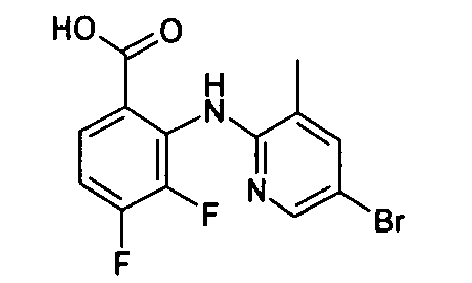
10. 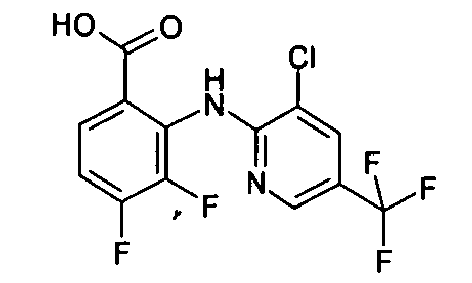
11. 
12. 
13. 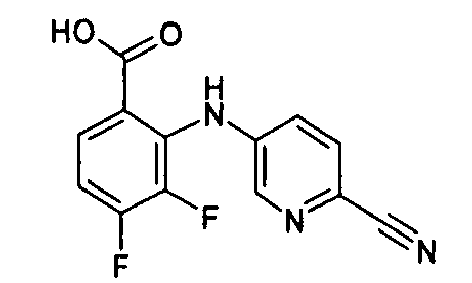
14. 
15. 
16. 
17. 
18. 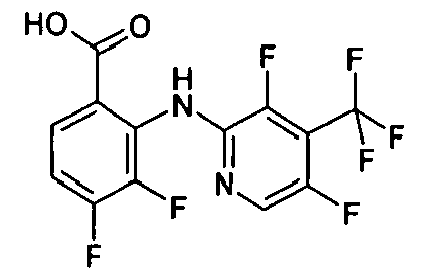
19. 
20. 
21. 
22. 
23. 
24. 
25. 
26. 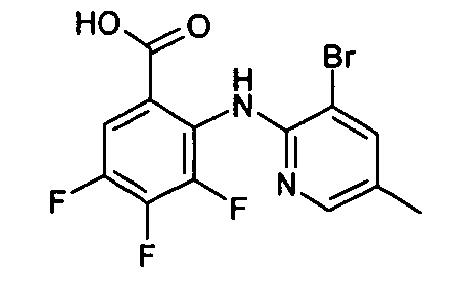
27. 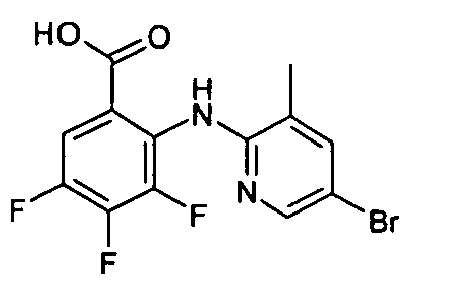
28. 
29. 
30. 
31. 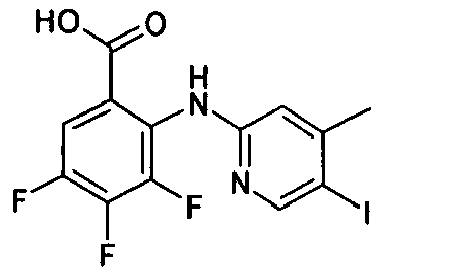
32. 
33. 
34. 
35. 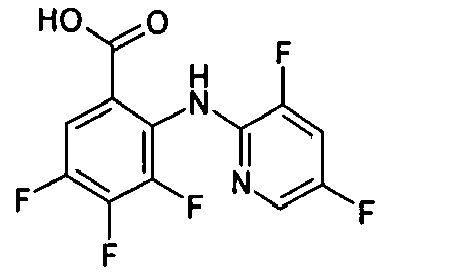
36. 
37. 
38. 
39. 
40. 
41. 
42. 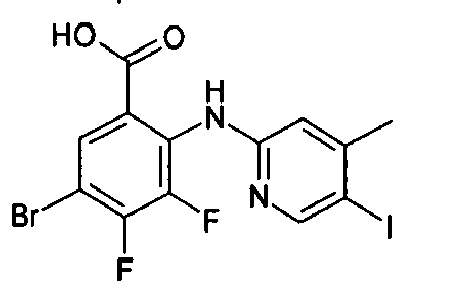
43. 
44. 
45. 
46. 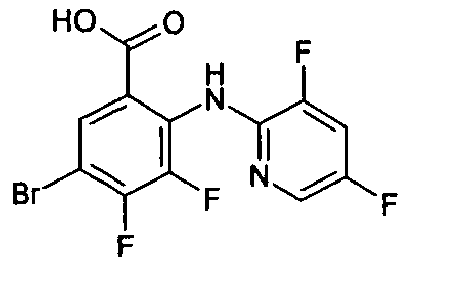
47. 
48. 
49. 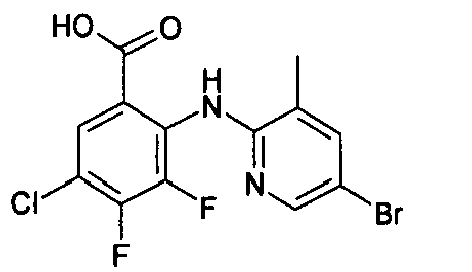
50. 
51. 
52. 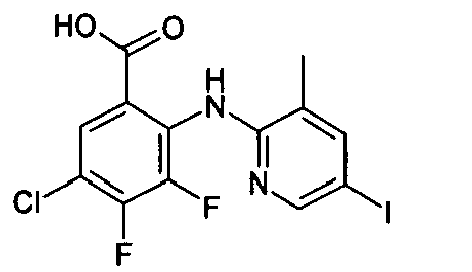
53. 
54. 
55. 
56. 
57. 
58. 
59. 
60. 
61. 
62. 
63. 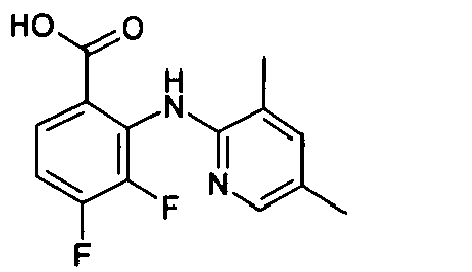
64. 
65. 
66. 
67. 
-

- 3,4-Difluoro-2-(3,5-dichloro-2-pyridylamino)benzoic acid from preparation 1 (0.319 g, 1.0 mmol) is dissolved in dichloromethane (5 ml) and N-methylmorpholine (0.6 ml) and the resulting solution is added with N,O-dimethylhydroxylamine hydrochloride (0.127 g, and 1.30 mmol) and (benzotriazolyloxy)trispyrrolidino phosphonium hexafluorophosphate (PyBOP; 0.52 g, 1.0 mmol). The reaction mixture is stirred for 4 hours at room temperature. A further portion of PyBOP (0.17 g; 0.33 mmol) is added and stirring is continued at room temperature for 24 hours. After evaporation of the reaction solvent under reduced pressure, the residue is dissolved in ethyl acetate (25 ml) and the organic solution is washed in sequence with water (25 ml) and with a saturated solution of NaCl (3 x 25 ml). The organic phase is anhydrified over Na2SO4, the solvent is removed under reduced pressure and the residue is purified by chromatography on silica gel to afford the product.
-

- A solution of 3,4-difluoro-2-(3,5-dichloro-2-pyridylamino)benzoic acid of preparation 1 (0.319 g, 1.0 mmol) and HOBt (0.203 g 1.5 mmol) in dichloromethane (5 ml) is added with EDCI (0.233 g, 1.5 mmol), then left under stirring for 2 hours at room temperature and added with O-(2-vinyloxyethyl)hydroxylamine (0.113 g. 1.1 mmol; obtained according to preparation 47 of
WO02/06213 - A solution of the product from step 1 (0.404 g; 1.0 mmol) in THF/EtOH 1/1 is added at room temperature with 1N HCl (2 mL; 2.0 mmol). The reaction mixture is stirred at room temperature for about one hour, then neutralised by addition of a saturated NaHCO3 solution and diluted with ethyl acetate (25 ml). The organic solution is washed with a NaCl saturated solution (25 ml), anhydrified over Na2SO4, the solvent is evaporated off under reduced pressure and the residue is purified by column chromatography to give N-(2-hydroxyethoxy)-2-(3,5-dichloro-2-pyridylamino)-3,4-difluorobenzamide.
-

- A solution of 3,4-difluoro-2-(3,5-dichloro-2-pyridylamino)benzoic acid of preparation 1 (0.319 g, 1.0 mmol) in anhydrous THF (5 ml) is added with (R)-O-(2,2-dimethyl-1,3-dioxolan-4-yl-methyl)hydroxylamine (0.147 g; 0.1 mmol; prepared according to preparations 70 and 71 of
WO 02/06213 - A mixture of product of step 1 (0.224 mg; 0.5 mmol), p-toluenesulphonic acid monohydrate (0.048 g, 0.25 mmol), methanol (2.5 ml) and water (0.25 ml) is stirred at room temperature for 24 hours. The reaction mixture is concentrated under reduced pressure and the residue is extracted with ethyl acetate (2 x 10 ml). The organic phases are pooled and washed with a NaHCO3 saturated solution and dried over Na2SO4. After evaporation of the solvent the residue is purified by column chromatography to give N-[(R)-2,3-dihydroxypropoxy]-2-(3,5-dichloro-2-pyridylamino)-3,4-difluorobenzamide.
- The compounds reported below in table 2 are prepared following the procedures of Examples 1-3 and using the heteroarylaminobenzoic acids of preparations 1-67 and suitable hydroxylamines as starting products.
Table 2 Example Structure 4. 
5. 
6. 
7. 
8. 
9. 
10. 
11. 
12. 
13. 
14. 
15. 
16. 
17. 
18. 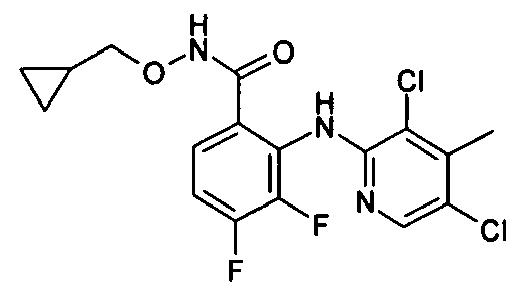
19. 
20. 
21. 
22. 
23. 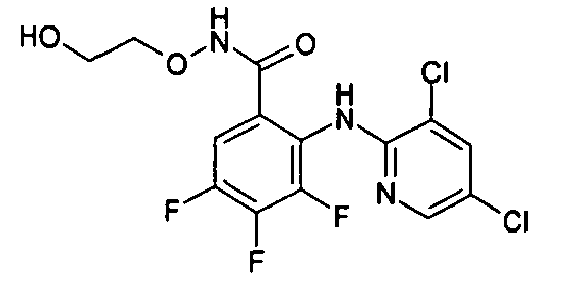
24. 
25. 
26. 
27. 
28. 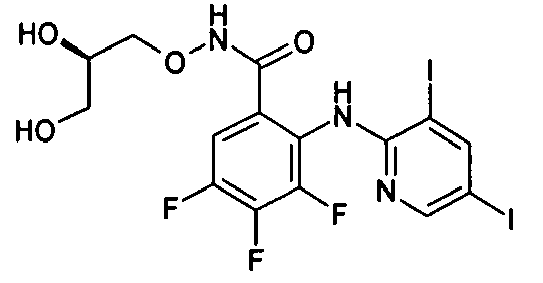
29. 
30. 
31. 
32. 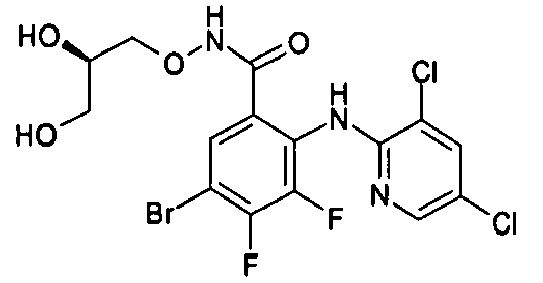
33. 
34. 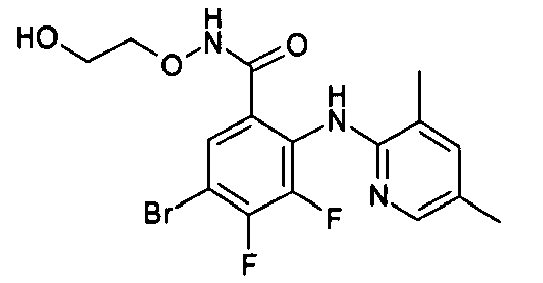
35. 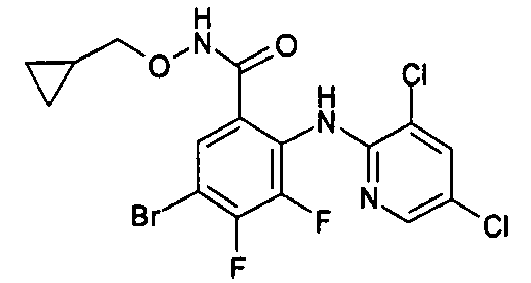
36. 
37. 
38. 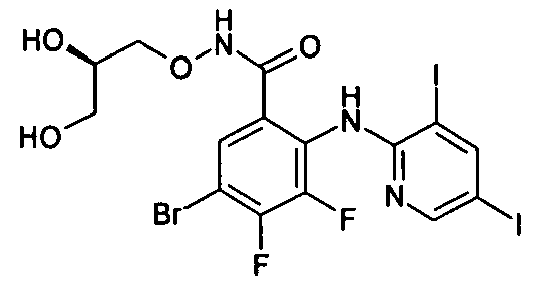
39. 
40. 
41. 
42. 
43. 
44. 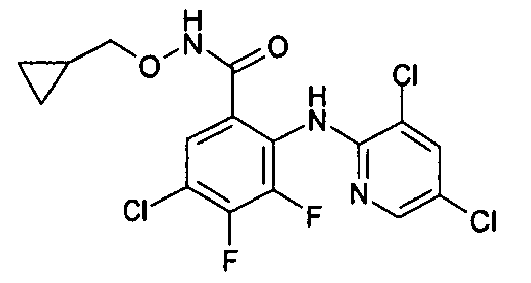
45. 
46. 
47. 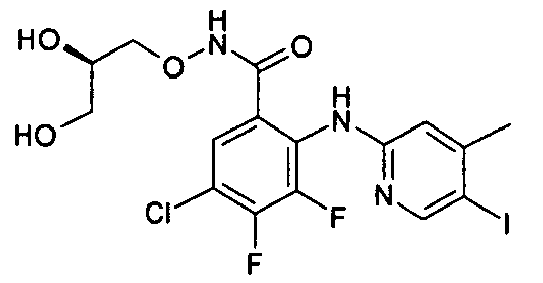
48. 
49. 
50. 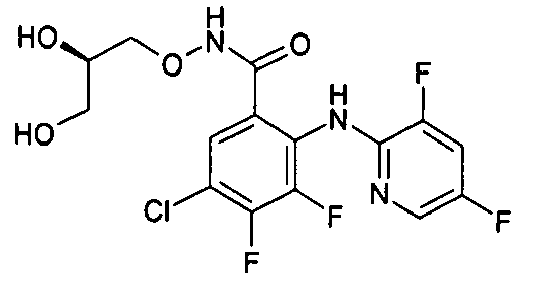
51. 
52. 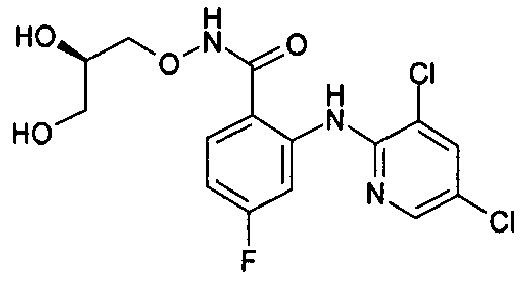
53. 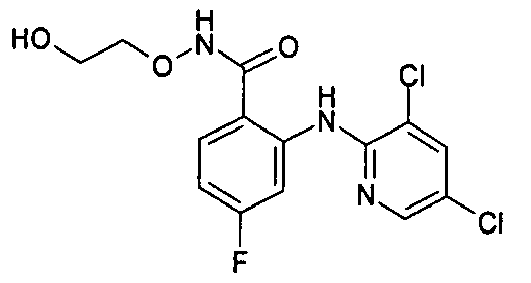
54. 
55. 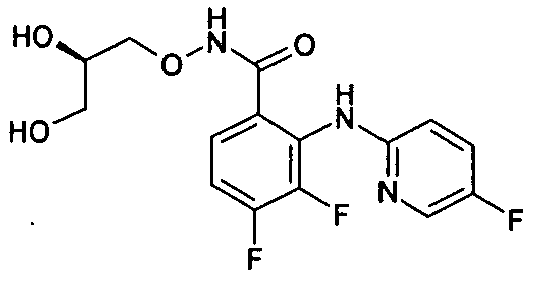
56. 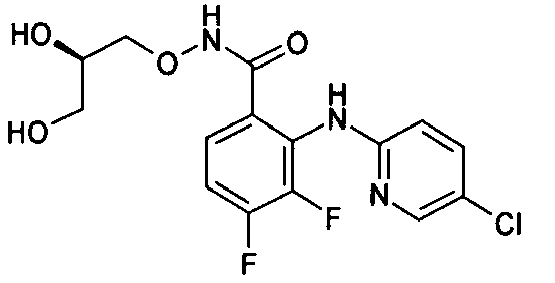
57. 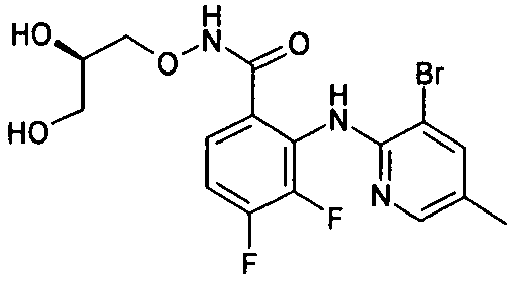
58. 
59. 
60. 
61. 
62. 
63. 
64. 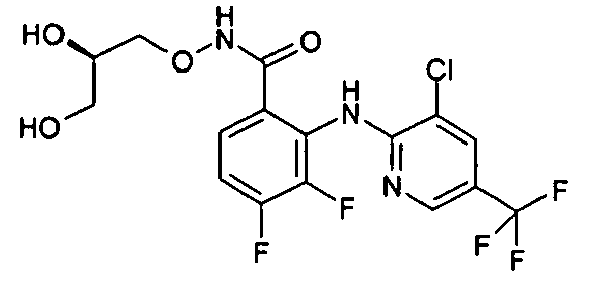
65. 
66. 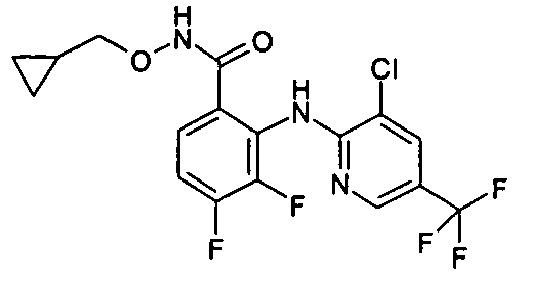
67. 
68. 
69. 
70. 
71. 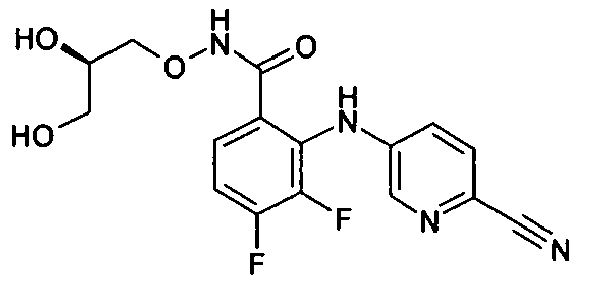
72. 
73. 
74. 
75. 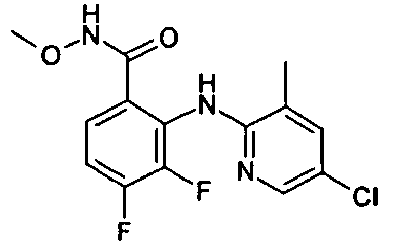
76. 
77. 
78. 
79. 
80. 
81. 
82. 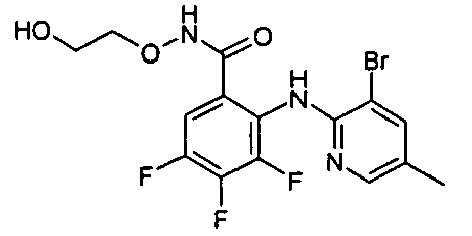
83. 
84. 
85. 
86. 
87. 
88. 
89. 
90. 
91. 
92. 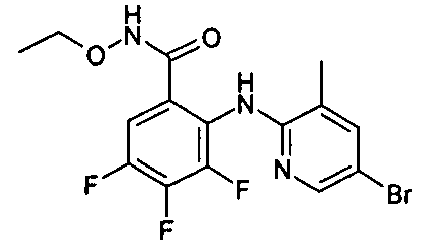
93. 
94. 
95. 
96. 
97. 
98. 
99. 
100. 
101. 
102. 
103. 
104. 
105. 
106. 
107. 
108. 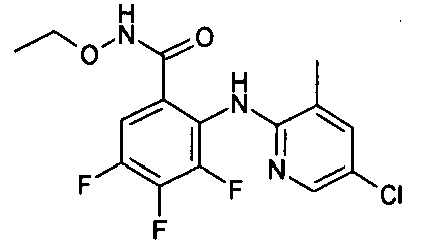
109. 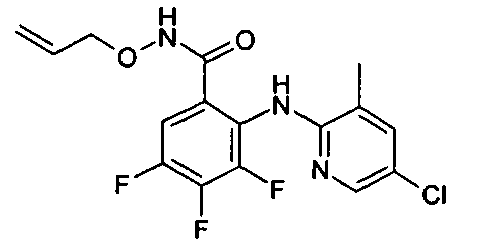
110. 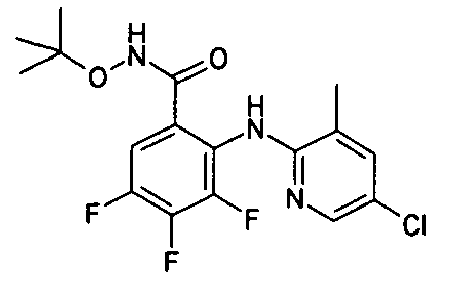
111. 
112. 
113. 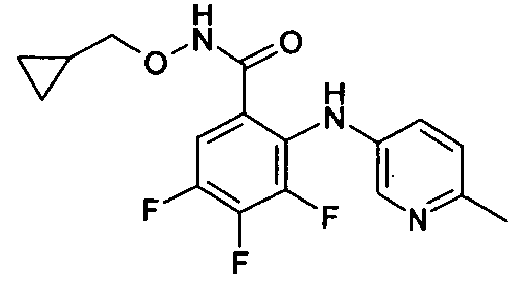
114. 
115. 
116. 
117. 
118. 
119. 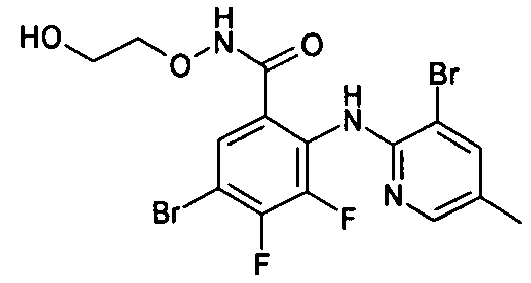
120. 
121. 
122. 
123. 
124. 
125. 
126. 
127. 
128. 
129. 
130. 
131. 
132. 
133. 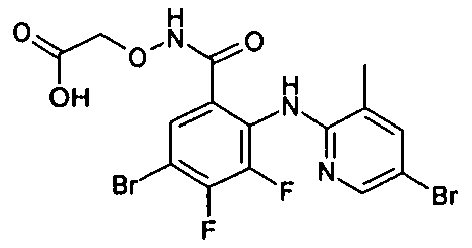
134. 
135. 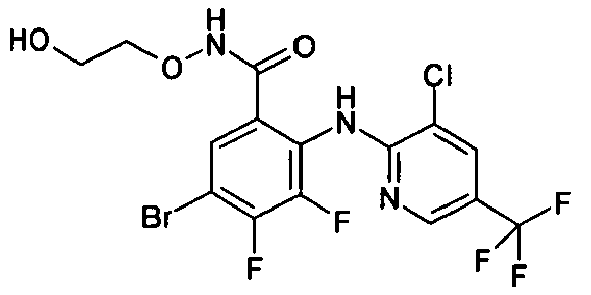
136. 
137. 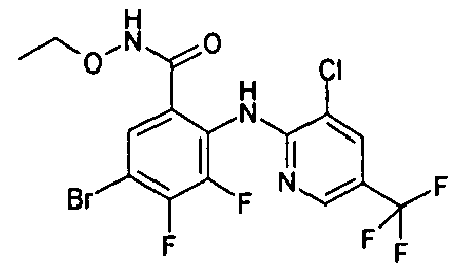
138. 
139. 
140. 
141. 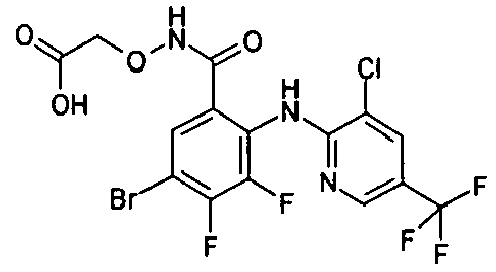
142. 
143. 
144. 
145. 
146. 
147. 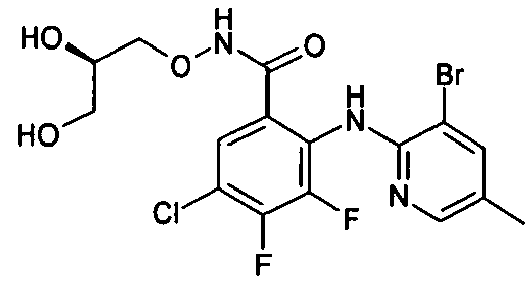
148. 
149. 
150. 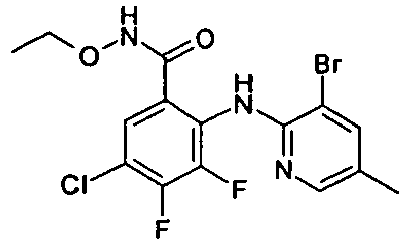
151. 
152. 
153. 
154. 
155. 
156. 
157. 
158. 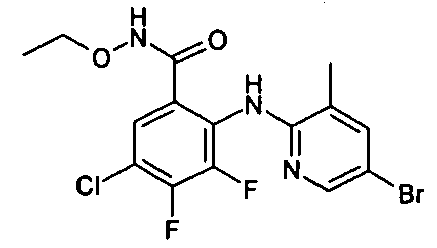
159. 
160. 
161. 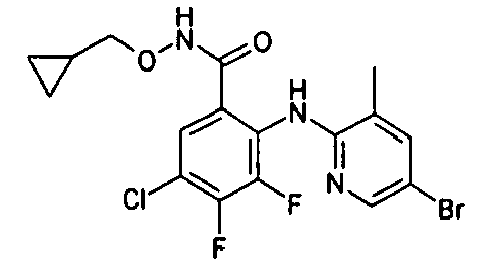
162. 
163. 
164. 
165. 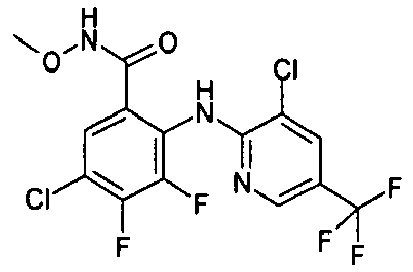
166. 
167. 
168. 
169. 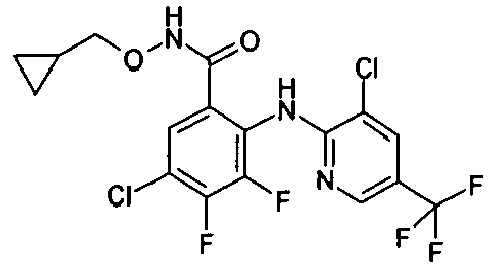
170. 
171. 
172. 
173. 
174. 
175. 
176. 
177. 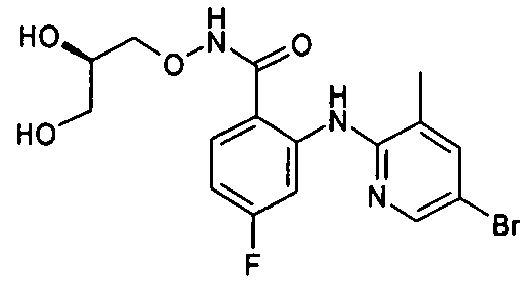
178. 
-

- This compound is prepared following the procedure of example 1, using 2-(3,4,5-trichlorothiophene-2-carbonyl)benzoic acid (commercially available from Aurora Fine Chemicals) as starting material.
-

- The product is prepared following the procedure of example 1, using 2-(thiophene-2-carbonyl)benzoic acid, which is commercially available, as starting material.
-

- This compound is prepared following the procedure of example 1, using 2-(thiophene-2-methyl)benzoic acid (commercially available from Asinex) as starting material.
- In vivo evaluation of antitumour activity
- The MEK inhibitors used for in vivo antitumour activity studies can be formulated in a suitable medium for endovenous (ev) or oral administration (os). For example, for endovenous administration the compounds can be administered in 0.9% NaCl or in 0.9%NaCl, solutol HS15 and dimethylsulphoxide mixtures, for example in 87:10:3 (v:v:v) ratio respectively.
- The following murine and human tumour cells from different tissue hystotypes can be used to evaluate the antitumour activity of the compounds of the invention: A375 (human, melanoma), H460 (human, lung), A2780 (human, ovary), PC-3 (human, prostate), LoVo (human, colon), HCT116 (human, colon), BXPC3 (human, pancreas), PANC-1 (human, pancreas), MX-1 (human, breast), MOLT (human, leukemia), multiple myeloma (human, myeloma), YC8 (murine, lymphoma), L1210 (murine, leukemia), 3LL (murine, lung).
- Immunocompetent or immunosuppressed mice of 5-6 weeks are commercially available. CD1 nu/nu mice are maintained under sterile conditions.
- Solid tumours from different hystotypes (lung, ovary, breast, prostate, pancreas, colon) can be transplanted subcutaneously (sc) in the axillary region of immunocompetent mice (murine models) or in immunodeprived (human models). Human tumours cell lines, originally obtained from ATCC, can be adapted to grow in vivo as solid tumours from "in vitro" cultures.
- Murine or human haematological tumours models can be transplanted in different sites (ev, ip, ic o sc) of immunocompetent mice (murine tumours) or in immunodeprived mice (leukemia, lymphoma and human myeloma tumours).
- Mice bearing solid or haematological tumours are randomized in experimental groups (10 mice/group). As far as solid tumours are concerned, a tumour mean weight of 80-100 mg for each group is required to start the treatment; mice with larger or smaller tumours are excluded.
- The experimental groups are randomly allocated into the treatment group with the test substance or into the control group. The animals can be treated with the compounds through the intravenous, oral or intraperitoneal route, according to the bioavailability of the products and following different treatment protocols, for example iv once or twice a week or daily per os.
- In solid tumour models, treatment with the compound can start when tumour weight is comprised between 80 and 100 mg after tumour transplant (day 0).
- The compounds can be administered in a volume of 10 mL/Kg body weight /mouse in a suitable solvent.
- The following parameters can be determined for the evaluation of the antitumour activity:
- solid primary tumour growth, controlled twice a week in each mouse with a caliper;
- survival time of treated mice with respect to control mice;
- evaluation of the body weight of each mouse twice a week.
- Inhibition of tumour growth, TWI% (percentage of inhibition of tumour growth compared to a control group treated with vehicle only), or relative inhibition of tumour growth RTWI% in case of advanced tumours is evaluated one week after treatment with the compound and tumour weight (TW) can be calculated as follows:

where a and b are the short and long diameters of the tumour mass expressed in millimiters. - Antitumour activity can be determined as inhibition of tumour growth (TWI %), calculated according to the following formula:
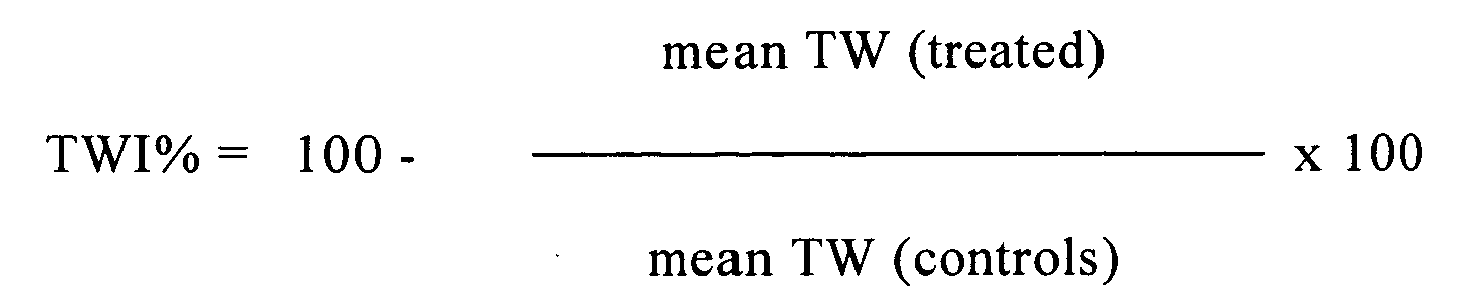
- The relative percentage of inhibition of tumour growth compared to the control group treated with administration vehicle only (RTWI%) is evaluated one week after the last treatment with the product, according to the following formula:

where
- The tumour regression percentage can be calculated as weight regressions of the tumour, determined as tumour weight at a certain day divided by the initial weight of the tumour at the beginning of the treatment.
- In models of haematological tumours the antitumour activity can be determined as percentage increase of the mice mean survival time expressed as (T/C%) ratio between the mean survival time of the treated group (T) and the control group (C). Animals without tumours at the end of the experiment (60 days after tumour transplant) are excluded from calculation and are considered as long-term survivors (LTS).
- Toxicity can be evaluated daily both on the basis of approximate autoptic results and of loss of body weight. When mice die before control animals treated with the vehicle only, or when a meaningful weight loss (>20%) and/or a reduction of spleen and liver dimensions is observed, it is assumed that death is due to toxicity.
- The percentage change of body weight (BWC%) is calculated as follows: 100- (mean body weight of the mice at a given day / mean body weight of the mice at the beginning of the treatment) x 100. This value is calculated one week after treatment with the test compound.
Claims (15)
- Compounds of formula (I)
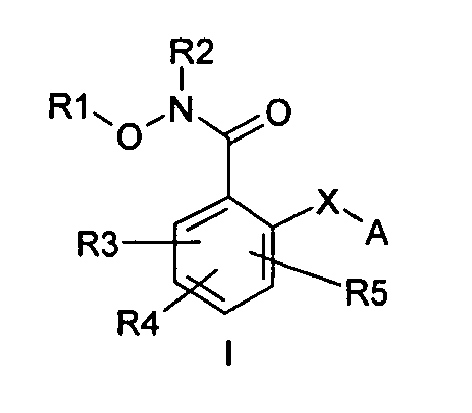 R1 is selected from hydrogen, trifluoromethyl, C1-10 alkyl, C2-10 alkenyl, C2-10 alkynyl, C3-10 cycloalkyl, C3-10 cycloalkylalkyl, aryl, aralkyl, heteroaryl, heteroarylalkyl, heterocyclyl, heterocycloalkyl, said alkyl, alkenyl, alkynyl, cycloalkyl, aryl, heteroaryl, and heterocycle groups being optionally substituted with one to three substituents independently selected from hydroxy, amino, alkyl or cycloalkyl;R2 is selected from hydrogen, C1-8 alkyl, CO-C1-8 alkyl, aryl, aralkyl, or C3-10 cycloalkyl, said alkyl, alkylcarbonyl, aryl, aralkyl or cycloalkyl groups being optionally substituted with one to three substituents independently selected from hydroxy, amino, alkyl or cycloalkyl;R3, R4 and R5 are independently selected from hydrogen, hydroxy, halogen, trifluoromethyl, C1-8 alkyl, C1-8 alkoxy, nitro, cyano or -(O)m-(CH2)n-R6 and - (NH)m-CH2)n-R6 groups, wherein m is 0 or 1, R6 is hydrogen, hydroxy, carboxy or NRaRb wherein Ra and Rb are independently selected from hydrogen and C1-4 alkyl, or, taken together with the nitrogen atom they are bound to, form a pyrrolidine, piperidine, morpholine or piperazine ring;X is selected from O, S, SO, SO2, NH, CH2, CO;A is an aromatic or aliphatic 5-6 membered heterocycle, containing from one to three nitrogen, oxygen or sulphur atoms, and optionally substituted on the carbon atoms with 1, 2 or 3 R7 groups or, on the nitrogen atoms, with C1-10 alkyl, aryl, arylalkyl groups or with oxygen atoms to give N-oxides;R7 is independently selected from hydrogen, C1-20 alkyl, C2-20 alkenyl, C2-20 alkynyl, -OR7a, -SR7a, -CN, nitro, azido, halogen, haloalkyl, -NH2, -NH(C1-10 alkyl), -N(C1-10 alkyl)2, -NHC(=O)O-C1-10 alkyl, -NHC(=O) C1-10 alkyl, -COOH, -C(=O)O-C1-10 alkyl, -C(=O)C1-10 alkyl, -C(O)H, -S(=O)-C1-10 alkyl, -S(=O)2-C1-10 alkyl, -S(=O)-aryl, -S(=O)2-aryl, C3-10 cycloalkyl optionally substituted with 1, 2 or 3 R8 groups, heterocyclyl optionally susbstituted with 1, 2 or 3 R8 groups;R7a is selected from H, trifluoromethyl, C1-C20 alkyl, C2-C20 alkenyl, C2-C20 alkynyl, C3-10 cycloalkyl, C3-10 cycloalkylalkyl, aryl, arylalkyl, heteroaryl, heteroarylalkyl, heterocyclyl, heterocycloalkyl, said alkyl, alkenyl, alkynyl, cycloalkyl, aryl, heteroaryl, heterocycle groups being optionally substituted with one to three substituents independently selected from hydroxy, amino, alkyl or cycloalkyl;R8 is independently selected from C1-10 alkyl, C2-10 alkenyl, C2-10 alkynyl, phenyl, halogen, haloalkyl, alkoxy, thioalkoxy, amino, alkylamino, dialkylamino, carboxy, C1-4 alkyl-OC(=O)-, C1-4 alkyl-C(=O)-, aryl-OC(=O)-, C1-4 alkyl-OC(=O)NH-, aryl-OC(=O)NH-, C1-4 alkyl-C(=O)NH-, C1-4 alkyl-C(=O)O-, (C1-4 alkyl-O)r- C1-4 alkyl, HO-(C1-4 alkyl-O)r- C1-4 alkyl-, -OH, -SH, -CN, -N3, -CNO, -CNS, C1-4 alkyl-S(=O)-, C1-4 alkyl-S(=O)2-, H2NS(=O)- and H2NS(=O)2-, where r is 1 or 2;and enantiomers, diastereoisomers and pharmaceutically acceptable salts thereof.
 - Compounds according to claim 1 wherein R1 is selected from hydrogen, methyl, ethyl, tert-butyl, 2-hydroxyethyl, cyclopropylmethyl, 2-propenyl, carboxymethyl and (R)-2,3-dihydroxypropyl.
- Compounds according to claim 1 or 2 wherein R2 is selected from hydrogen, methyl and ethyl.
- Compounds according to any one of claims 1 - 3 wherein R2, R3 and R4 are independently selected from hydrogen, methyl, fluorine, chlorine, bromine and iodine.
- Compounds according to any one of claims 1 to 4 wherein A is selected from pyrrole, furan, thiophene, pyrazole, thiazole, oxazole, imidazole, isothiazole, isoxazole, 1,2,3- triazole, 1,2,4-triazole, 1,2,4-oxadiazole, 1,3,4-oxadiazole, 1,2,5-oxadiazole, 1,2,5-thiadiazole, 1,3,4-thiadiazole, tetrazole, pyridine, pyrimidine, pyridazine, pyrazine, 1,2,4-triazine, 1,2,3-triazine, 1,2,4-triazine and 1,3,5-triazine.
- Compounds according to claim 5 wherein A is selected from pyrrole, furan, thiophene and pyridine.
- Compounds according to any one of claims 1 to 6 wherein R7 is selected from hydrogen, methyl, trifluoromethyl, fluorine, chlorine, bromine and iodine.
- Compounds according to any one of claims 1 to 7 wherein X is NH and A is a pyridine ring.
- Compounds according to any one of claims 1 to 7 wherein X is -CH2- or -CO- and A is a thiophene ring.
- A compound selected from:


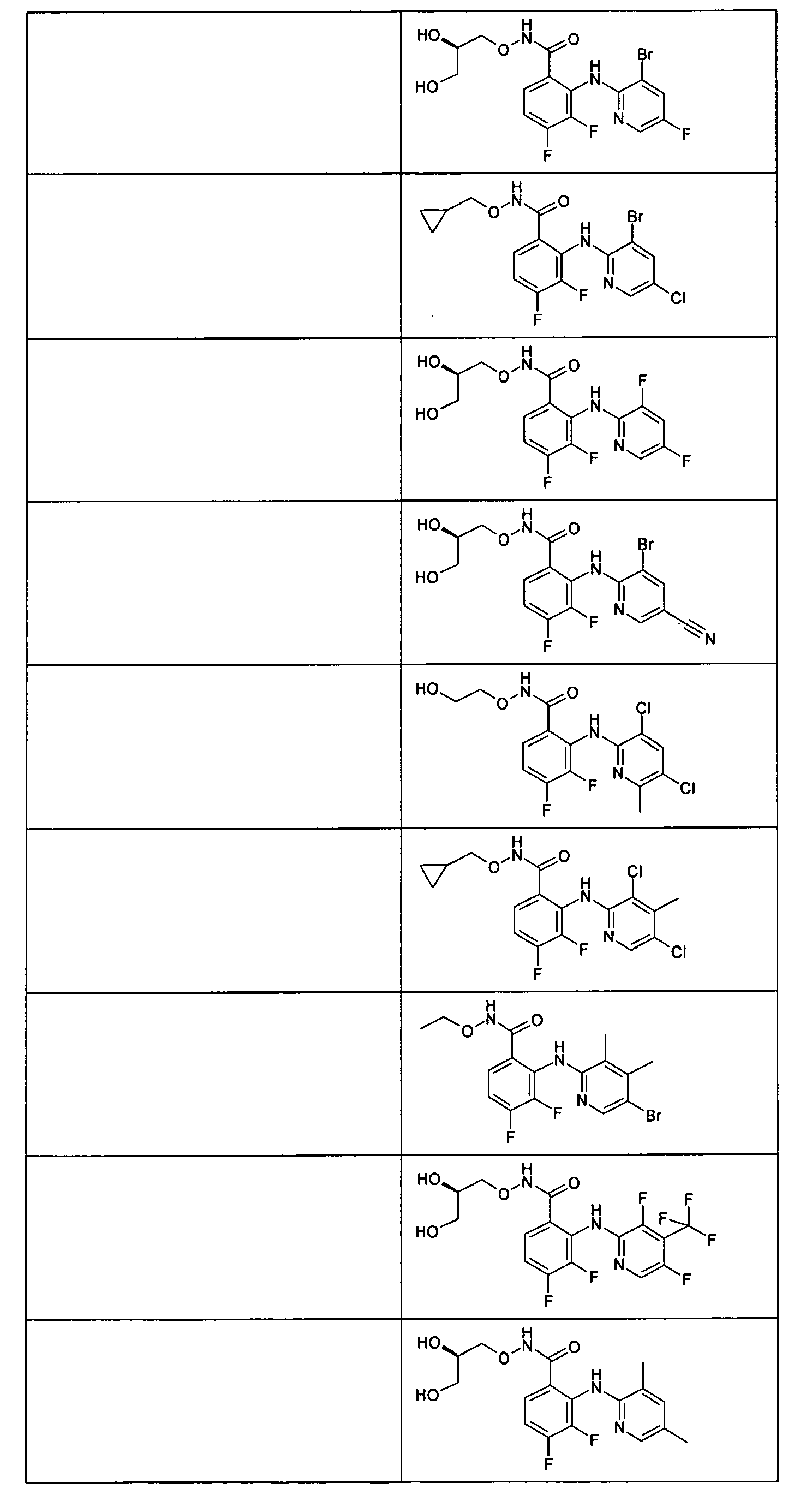
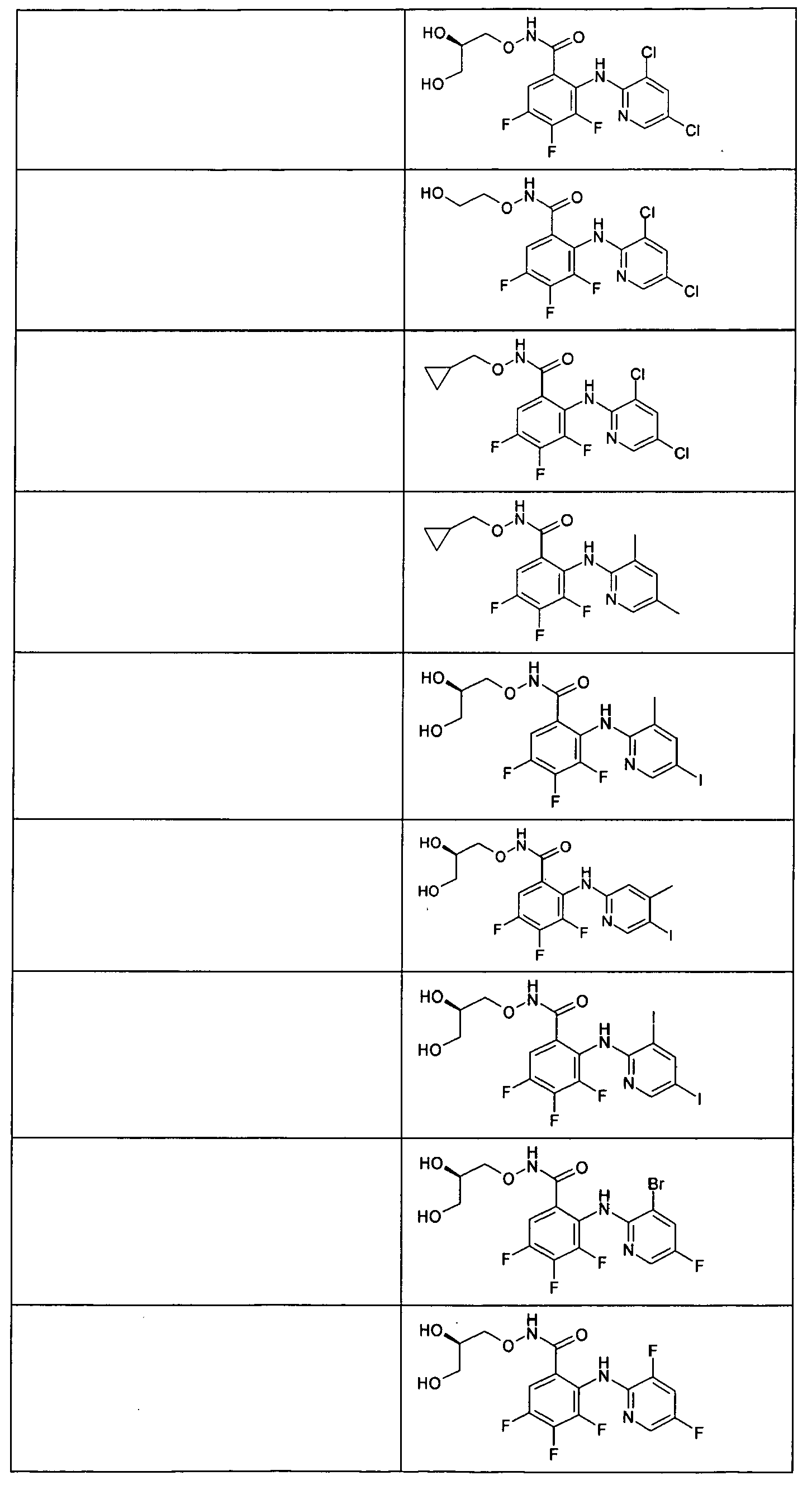
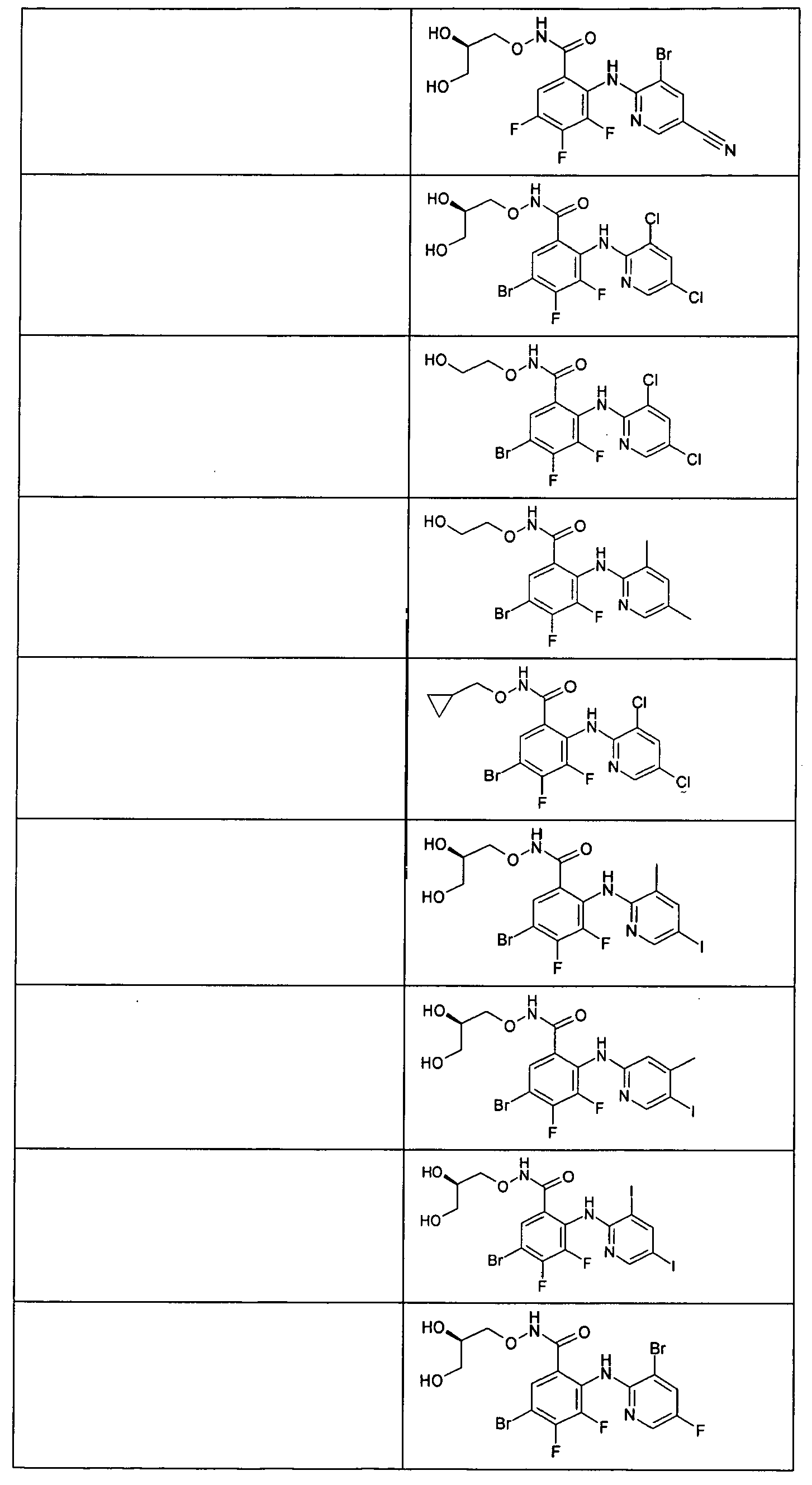


- Compounds according to any one of claims 1 to 10 for use as medicaments.
- Use of the compounds of any one of claims 1 to 10 for the preparation of pharmaceutical compositions for the treatment of hyperproliferative pathologies.
- The use according to claim 12 wherein the hyperproliferative pathologies are brain tumours, lung, squamous cells, bladder, stomach, pancreas, breast, head, neck, kidney, ovary, prostate, colon-rectum, esophagus, testicles, thyroid or gynecological tumours.
- Pharmaceutical compositions containing a compound of any one of claims 1 to 10 in admixture with suitable excipients or vehicles.
- Pharmaceutical compositions according to claim 14 further containing a chemotherapeutic agent selected from mitosis inhibitors, alkylating agents, antimetabolites, intercalating agents, antibiotics, growth factors inhibitors, cell cycle inhibitors, topoisomerase inhibitors, anti-hormonal agents and angiogenesis agents.
Priority Applications (2)
| Application Number | Priority Date | Filing Date | Title |
|---|---|---|---|
| EP06425676A EP1908751A1 (en) | 2006-10-03 | 2006-10-03 | N-hydroxy benzamides with antitumour activity |
| PCT/IB2007/002879 WO2008041088A2 (en) | 2006-10-03 | 2007-10-01 | N-hydroxy benzamides with antitumor activity |
Applications Claiming Priority (1)
| Application Number | Priority Date | Filing Date | Title |
|---|---|---|---|
| EP06425676A EP1908751A1 (en) | 2006-10-03 | 2006-10-03 | N-hydroxy benzamides with antitumour activity |
Publications (1)
| Publication Number | Publication Date |
|---|---|
| EP1908751A1 true EP1908751A1 (en) | 2008-04-09 |
Family
ID=37726656
Family Applications (1)
| Application Number | Title | Priority Date | Filing Date |
|---|---|---|---|
| EP06425676A Withdrawn EP1908751A1 (en) | 2006-10-03 | 2006-10-03 | N-hydroxy benzamides with antitumour activity |
Country Status (2)
| Country | Link |
|---|---|
| EP (1) | EP1908751A1 (en) |
| WO (1) | WO2008041088A2 (en) |
Families Citing this family (4)
| Publication number | Priority date | Publication date | Assignee | Title |
|---|---|---|---|---|
| CN102718702B (en) * | 2011-03-31 | 2015-01-07 | 中国人民解放军军事医学科学院毒物药物研究所 | Aminopyridine derivatives and application thereof |
| CN104370885B (en) * | 2011-03-31 | 2017-10-10 | 中国人民解放军军事医学科学院毒物药物研究所 | Aminopyridine derivatives and uses thereof |
| EP2922847A1 (en) | 2012-11-20 | 2015-09-30 | Vertex Pharmaceuticals Incorporated | Compounds useful as inhibitors of indoleamine 2,3-dioxygenase |
| CN111398472B (en) * | 2020-04-08 | 2022-05-31 | 宁波谱尼测试技术有限公司 | Method for detecting benzohydroxamic acid in flour and flour improver |
Citations (5)
| Publication number | Priority date | Publication date | Assignee | Title |
|---|---|---|---|---|
| WO1993024468A1 (en) * | 1992-06-02 | 1993-12-09 | Ciba-Geigy Ag | Pyrimidinyl- and triazinyl- salicyl- and picolylamides and the use, as herbicides, and preparation thereof |
| WO1999001426A1 (en) * | 1997-07-01 | 1999-01-14 | Warner-Lambert Company | 4-bromo or 4-iodo phenylamino benzhydroxamic acid derivatives and their use as mek inhibitors |
| WO2000069819A1 (en) * | 1999-05-12 | 2000-11-23 | G.D. Searle & Co. | Hydroxamic acid derivatives as matrix metalloprotease inhibitors |
| WO2001085680A2 (en) * | 2000-05-11 | 2001-11-15 | Pharmacia Corporation | Sulfonyl aryl or heteroaryl hydroxamic acid compounds |
| WO2003007954A2 (en) * | 2001-07-19 | 2003-01-30 | Pharmacia Corporation | Sulfonyl aryl hydroxamates and their use as matrix metalloprotease inhibitors |
-
2006
- 2006-10-03 EP EP06425676A patent/EP1908751A1/en not_active Withdrawn
-
2007
- 2007-10-01 WO PCT/IB2007/002879 patent/WO2008041088A2/en not_active Ceased
Patent Citations (5)
| Publication number | Priority date | Publication date | Assignee | Title |
|---|---|---|---|---|
| WO1993024468A1 (en) * | 1992-06-02 | 1993-12-09 | Ciba-Geigy Ag | Pyrimidinyl- and triazinyl- salicyl- and picolylamides and the use, as herbicides, and preparation thereof |
| WO1999001426A1 (en) * | 1997-07-01 | 1999-01-14 | Warner-Lambert Company | 4-bromo or 4-iodo phenylamino benzhydroxamic acid derivatives and their use as mek inhibitors |
| WO2000069819A1 (en) * | 1999-05-12 | 2000-11-23 | G.D. Searle & Co. | Hydroxamic acid derivatives as matrix metalloprotease inhibitors |
| WO2001085680A2 (en) * | 2000-05-11 | 2001-11-15 | Pharmacia Corporation | Sulfonyl aryl or heteroaryl hydroxamic acid compounds |
| WO2003007954A2 (en) * | 2001-07-19 | 2003-01-30 | Pharmacia Corporation | Sulfonyl aryl hydroxamates and their use as matrix metalloprotease inhibitors |
Non-Patent Citations (3)
| Title |
|---|
| KASZTREINER, ENDRE ET AL: "Synthesis of O-substituted hydroxylamines", ACTA CHIMICA ACADEMIAE SCIENTIARUM HUNGARICAE , 84(2), 167-80 CODEN: ACASA2; ISSN: 0001-5407, 1975, XP008075212 * |
| NEZU Y ET AL: "DIMETHOXYPYRIMIDINES AS NOVEL HERBICIDES. PART 2. SYNTHESIS AND HERBICIDAL ACTIVITY OF O-PYRIMIDINYLSALICYLATES AND ANALOGUES", PESTICIDE SCIENCE, ELSEVIER APPLIED SCIENCE PUBLISHER. BARKING, GB, vol. 47, no. 2, 1 June 1996 (1996-06-01), pages 115 - 124, XP000629092, ISSN: 0031-613X * |
| REGEL E ET AL: "C-ACYLIERUNG VON 5 GLIEDRIGEN N-HETEROCYCLEN, I ACYLIERUNG AN C-2 VON IMIDAZOLEN UND BENZIMIDAZOLEN C-ACYLATION OF 5-MEMBERED N-HETEROCYCLES, I. - ACYLATION AT C-2 OF IMIDAZOLES AND BENZIMIDAZOLES", JUSTUS LIEBIGS ANNALEN DER CHEMIE, VERLAG CHEMIE GMBH. WEINHEIM, DE, 1977, pages 145 - 158, XP009003467, ISSN: 0075-4617 * |
Also Published As
| Publication number | Publication date |
|---|---|
| WO2008041088A3 (en) | 2008-07-03 |
| WO2008041088A2 (en) | 2008-04-10 |
Similar Documents
| Publication | Publication Date | Title |
|---|---|---|
| JP4405602B2 (en) | Histone deacetylase inhibitor | |
| JP4510372B2 (en) | Acylphenylurea derivatives, processes for their preparation and their use as medicaments | |
| AU2023285742A1 (en) | Compounds and methods for the targeted degradation of androgen receptor | |
| AU2014209107B2 (en) | Metalloenzyme inhibitor compounds | |
| EP3366293B1 (en) | Dihydronaphthyridines and related compounds useful as kinase inhibitors for the treatment of proliferative diseases | |
| EP2208721B1 (en) | Histone deacetylase inhibitor, composition and use thereof | |
| CN112930214B (en) | Deuterium-containing compounds | |
| JP2020528918A (en) | Compounds and methods for targeted degradation of androgen receptors | |
| JP2022523916A (en) | Bifunctional compounds and methods for ubiquitination targeting androgen receptors | |
| US7662856B2 (en) | Compositions having antimycrobial activity including a hydroxamate or a hydroxamate and a hydroxlyamine | |
| EP1409466A2 (en) | Hiv protease inhibitors, compositions containing the same, their pharmaceutical uses and materials for their synthesis | |
| RU2003122190A (en) | TETRAHYDROPYRIDINE DERIVATIVES, THEIR PRODUCTION AND APPLICATION AS CELL PROLIFERATION INHIBITORS | |
| US20090143446A1 (en) | Thiazolidinone amides, thiazolidine carboxylic acid amides, methods of making, and uses thereof | |
| EP2888260B1 (en) | Substituted azaindole compounds, salts, pharmaceutical compositions thereof and methods of use | |
| EP2809661B1 (en) | Novel morpholinyl derivatives useful as mogat-2 inhibitors | |
| US20060014740A1 (en) | Analogs exhibiting inhibition of cell proliferation, methods of making, and uses thereof | |
| CN110381949B (en) | Heterocyclic compounds and their uses | |
| HUT70561A (en) | Amino acid derivatives, pharmaceutical compns. contg. them and process to prepare the said compds. | |
| JP2007509052A5 (en) | ||
| WO2008041088A2 (en) | N-hydroxy benzamides with antitumor activity | |
| US20040267015A1 (en) | Peptide deformylase inhibitors | |
| WO2008036067A2 (en) | Thiazolidinone amides, thiazolidine carboxylic acid amides, and serine amides, including polyamine conjugates thereof, as selective anti-cancer agents | |
| EP1723127A2 (en) | Analogs exhibiting inhibition of cell proliferation, methods of making, and uses thereof | |
| EP3347343B1 (en) | Azetidinimines as carbapenemases inhibitors | |
| KR20220033689A (en) | Novel compound having histone deacetylases inhibitory activity and use thereof |
Legal Events
| Date | Code | Title | Description |
|---|---|---|---|
| PUAI | Public reference made under article 153(3) epc to a published international application that has entered the european phase |
Free format text: ORIGINAL CODE: 0009012 |
|
| AK | Designated contracting states |
Kind code of ref document: A1 Designated state(s): AT BE BG CH CY CZ DE DK EE ES FI FR GB GR HU IE IS IT LI LT LU LV MC NL PL PT RO SE SI SK TR |
|
| AX | Request for extension of the european patent |
Extension state: AL BA HR MK RS |
|
| AKX | Designation fees paid | ||
| REG | Reference to a national code |
Ref country code: DE Ref legal event code: 8566 |
|
| STAA | Information on the status of an ep patent application or granted ep patent |
Free format text: STATUS: THE APPLICATION IS DEEMED TO BE WITHDRAWN |
|
| 18D | Application deemed to be withdrawn |
Effective date: 20081010 |