EP1908440B1 - Expendable heating sheet, method of manufacturing the same, and heating sheet bag for the same - Google Patents
Expendable heating sheet, method of manufacturing the same, and heating sheet bag for the same Download PDFInfo
- Publication number
- EP1908440B1 EP1908440B1 EP20070019554 EP07019554A EP1908440B1 EP 1908440 B1 EP1908440 B1 EP 1908440B1 EP 20070019554 EP20070019554 EP 20070019554 EP 07019554 A EP07019554 A EP 07019554A EP 1908440 B1 EP1908440 B1 EP 1908440B1
- Authority
- EP
- European Patent Office
- Prior art keywords
- bondable
- thermal fusion
- heating sheet
- expandable
- heating
- Prior art date
- Legal status (The legal status is an assumption and is not a legal conclusion. Google has not performed a legal analysis and makes no representation as to the accuracy of the status listed.)
- Not-in-force
Links
Images




Classifications
-
- A—HUMAN NECESSITIES
- A61—MEDICAL OR VETERINARY SCIENCE; HYGIENE
- A61F—FILTERS IMPLANTABLE INTO BLOOD VESSELS; PROSTHESES; DEVICES PROVIDING PATENCY TO, OR PREVENTING COLLAPSING OF, TUBULAR STRUCTURES OF THE BODY, e.g. STENTS; ORTHOPAEDIC, NURSING OR CONTRACEPTIVE DEVICES; FOMENTATION; TREATMENT OR PROTECTION OF EYES OR EARS; BANDAGES, DRESSINGS OR ABSORBENT PADS; FIRST-AID KITS
- A61F7/00—Heating or cooling appliances for medical or therapeutic treatment of the human body
- A61F7/02—Compresses or poultices for effecting heating or cooling
- A61F7/03—Compresses or poultices for effecting heating or cooling thermophore, i.e. self-heating, e.g. using a chemical reaction
- A61F7/032—Compresses or poultices for effecting heating or cooling thermophore, i.e. self-heating, e.g. using a chemical reaction using oxygen from the air, e.g. pocket-stoves
-
- A—HUMAN NECESSITIES
- A61—MEDICAL OR VETERINARY SCIENCE; HYGIENE
- A61F—FILTERS IMPLANTABLE INTO BLOOD VESSELS; PROSTHESES; DEVICES PROVIDING PATENCY TO, OR PREVENTING COLLAPSING OF, TUBULAR STRUCTURES OF THE BODY, e.g. STENTS; ORTHOPAEDIC, NURSING OR CONTRACEPTIVE DEVICES; FOMENTATION; TREATMENT OR PROTECTION OF EYES OR EARS; BANDAGES, DRESSINGS OR ABSORBENT PADS; FIRST-AID KITS
- A61F7/00—Heating or cooling appliances for medical or therapeutic treatment of the human body
- A61F7/02—Compresses or poultices for effecting heating or cooling
- A61F7/03—Compresses or poultices for effecting heating or cooling thermophore, i.e. self-heating, e.g. using a chemical reaction
-
- A—HUMAN NECESSITIES
- A61—MEDICAL OR VETERINARY SCIENCE; HYGIENE
- A61F—FILTERS IMPLANTABLE INTO BLOOD VESSELS; PROSTHESES; DEVICES PROVIDING PATENCY TO, OR PREVENTING COLLAPSING OF, TUBULAR STRUCTURES OF THE BODY, e.g. STENTS; ORTHOPAEDIC, NURSING OR CONTRACEPTIVE DEVICES; FOMENTATION; TREATMENT OR PROTECTION OF EYES OR EARS; BANDAGES, DRESSINGS OR ABSORBENT PADS; FIRST-AID KITS
- A61F7/00—Heating or cooling appliances for medical or therapeutic treatment of the human body
- A61F2007/0001—Body part
-
- A—HUMAN NECESSITIES
- A61—MEDICAL OR VETERINARY SCIENCE; HYGIENE
- A61F—FILTERS IMPLANTABLE INTO BLOOD VESSELS; PROSTHESES; DEVICES PROVIDING PATENCY TO, OR PREVENTING COLLAPSING OF, TUBULAR STRUCTURES OF THE BODY, e.g. STENTS; ORTHOPAEDIC, NURSING OR CONTRACEPTIVE DEVICES; FOMENTATION; TREATMENT OR PROTECTION OF EYES OR EARS; BANDAGES, DRESSINGS OR ABSORBENT PADS; FIRST-AID KITS
- A61F7/00—Heating or cooling appliances for medical or therapeutic treatment of the human body
- A61F2007/0098—Heating or cooling appliances for medical or therapeutic treatment of the human body ways of manufacturing heating or cooling devices for therapy
-
- A—HUMAN NECESSITIES
- A61—MEDICAL OR VETERINARY SCIENCE; HYGIENE
- A61F—FILTERS IMPLANTABLE INTO BLOOD VESSELS; PROSTHESES; DEVICES PROVIDING PATENCY TO, OR PREVENTING COLLAPSING OF, TUBULAR STRUCTURES OF THE BODY, e.g. STENTS; ORTHOPAEDIC, NURSING OR CONTRACEPTIVE DEVICES; FOMENTATION; TREATMENT OR PROTECTION OF EYES OR EARS; BANDAGES, DRESSINGS OR ABSORBENT PADS; FIRST-AID KITS
- A61F7/00—Heating or cooling appliances for medical or therapeutic treatment of the human body
- A61F7/02—Compresses or poultices for effecting heating or cooling
- A61F2007/0244—Compresses or poultices for effecting heating or cooling with layers
-
- A—HUMAN NECESSITIES
- A61—MEDICAL OR VETERINARY SCIENCE; HYGIENE
- A61F—FILTERS IMPLANTABLE INTO BLOOD VESSELS; PROSTHESES; DEVICES PROVIDING PATENCY TO, OR PREVENTING COLLAPSING OF, TUBULAR STRUCTURES OF THE BODY, e.g. STENTS; ORTHOPAEDIC, NURSING OR CONTRACEPTIVE DEVICES; FOMENTATION; TREATMENT OR PROTECTION OF EYES OR EARS; BANDAGES, DRESSINGS OR ABSORBENT PADS; FIRST-AID KITS
- A61F7/00—Heating or cooling appliances for medical or therapeutic treatment of the human body
- A61F7/02—Compresses or poultices for effecting heating or cooling
- A61F7/03—Compresses or poultices for effecting heating or cooling thermophore, i.e. self-heating, e.g. using a chemical reaction
- A61F7/032—Compresses or poultices for effecting heating or cooling thermophore, i.e. self-heating, e.g. using a chemical reaction using oxygen from the air, e.g. pocket-stoves
- A61F7/034—Flameless
- A61F2007/036—Fuels
- A61F2007/038—Carbon or charcoal, e.g. active
-
- Y—GENERAL TAGGING OF NEW TECHNOLOGICAL DEVELOPMENTS; GENERAL TAGGING OF CROSS-SECTIONAL TECHNOLOGIES SPANNING OVER SEVERAL SECTIONS OF THE IPC; TECHNICAL SUBJECTS COVERED BY FORMER USPC CROSS-REFERENCE ART COLLECTIONS [XRACs] AND DIGESTS
- Y10—TECHNICAL SUBJECTS COVERED BY FORMER USPC
- Y10T—TECHNICAL SUBJECTS COVERED BY FORMER US CLASSIFICATION
- Y10T156/00—Adhesive bonding and miscellaneous chemical manufacture
- Y10T156/10—Methods of surface bonding and/or assembly therefor
-
- Y—GENERAL TAGGING OF NEW TECHNOLOGICAL DEVELOPMENTS; GENERAL TAGGING OF CROSS-SECTIONAL TECHNOLOGIES SPANNING OVER SEVERAL SECTIONS OF THE IPC; TECHNICAL SUBJECTS COVERED BY FORMER USPC CROSS-REFERENCE ART COLLECTIONS [XRACs] AND DIGESTS
- Y10—TECHNICAL SUBJECTS COVERED BY FORMER USPC
- Y10T—TECHNICAL SUBJECTS COVERED BY FORMER US CLASSIFICATION
- Y10T428/00—Stock material or miscellaneous articles
- Y10T428/13—Hollow or container type article [e.g., tube, vase, etc.]
- Y10T428/1334—Nonself-supporting tubular film or bag [e.g., pouch, envelope, packet, etc.]
-
- Y—GENERAL TAGGING OF NEW TECHNOLOGICAL DEVELOPMENTS; GENERAL TAGGING OF CROSS-SECTIONAL TECHNOLOGIES SPANNING OVER SEVERAL SECTIONS OF THE IPC; TECHNICAL SUBJECTS COVERED BY FORMER USPC CROSS-REFERENCE ART COLLECTIONS [XRACs] AND DIGESTS
- Y10—TECHNICAL SUBJECTS COVERED BY FORMER USPC
- Y10T—TECHNICAL SUBJECTS COVERED BY FORMER US CLASSIFICATION
- Y10T428/00—Stock material or miscellaneous articles
- Y10T428/28—Web or sheet containing structurally defined element or component and having an adhesive outermost layer
- Y10T428/2813—Heat or solvent activated or sealable
- Y10T428/2817—Heat sealable
-
- Y—GENERAL TAGGING OF NEW TECHNOLOGICAL DEVELOPMENTS; GENERAL TAGGING OF CROSS-SECTIONAL TECHNOLOGIES SPANNING OVER SEVERAL SECTIONS OF THE IPC; TECHNICAL SUBJECTS COVERED BY FORMER USPC CROSS-REFERENCE ART COLLECTIONS [XRACs] AND DIGESTS
- Y10—TECHNICAL SUBJECTS COVERED BY FORMER USPC
- Y10T—TECHNICAL SUBJECTS COVERED BY FORMER US CLASSIFICATION
- Y10T442/00—Fabric [woven, knitted, or nonwoven textile or cloth, etc.]
- Y10T442/60—Nonwoven fabric [i.e., nonwoven strand or fiber material]
- Y10T442/601—Nonwoven fabric has an elastic quality
Definitions
- the present invention relates to an expandable heating sheet, a method of manufacturing the same, and a heating sheet bag for the same, and more particularly, to an expandable heating sheet which can be used while being fitted to a bendable portion such as an elbow or a knee and can be manufactured at low costs with efficiency, a method of manufacturing the same, and a heating sheet bag for the same.
- a heating composition containing oxidizable metal, activated carbon, inorganic electrolyte, water, water-retaining agent, and the like mixed with each other, and for generating heat when being brought into contact with oxygen in air is received in an air permeable flat bag, and in order to prevent the heating composition from being brought into contact with outside air and to prevent the water from evaporating to diffuse to an outside until the heating composition is used, the air permeable flat bag is hermetically sealed in a non-air permeable outer bag.
- various body warmers having heating properties set depending on portions to be applied such as on body, in pocket, and in a shoe. In order to facilitate attachment at a time of use, those body warmers are each provided with an adhesive layer.
- a heating composition and thermal fusion-bondable resin powder are sprayed, after that, another sheet-like non-woven cloth to be continuously supplied is overlapped thereon, the resultant is combined in a single body by heating and compression bonding by a compressor, the resultant is cut into a desired size, and the resultant is hermetically sealed in an outer bag.
- body warmers other than the above-mentioned body warmer, there are provided body warmers developed with an object of being fitted to a bendable portion such as an elbow or a knee to be used.
- a disposable body warmer in which a heating portion filled with a heating agent (heating composition) is divided into a plurality of sections by a seal portion
- an expandable disposable body warmer having a structure in which a disposable bodywarmer is provided to a desired surface of an expandable material, thereby fitting a body.
- the portable bodywarmer in which the heating portion charged with the heating composition is divided into the plurality of sections, can easily be bent at the seal portion even when the heating composition thereof is hardened due to reaction with oxygen, but is not expandable at the seal portion, so expansion property cannot be obtained for the body warmer as a whole.
- the article in which the disposable body warmer is provided to the desired surface of the expandable material an attachment portion of the disposable body warmer is hardened as reaction of the heat composition with oxygen proceeds, so the disposable body warmer is hard and has no expansion property in the attachment portion.
- WO 2006/006664 discloses a flexible heating element that can be secured to any part of the body by sticking or winding, being stretchable in accordance with the movement of the body to thereby be free from coming off or disengagement.
- a flexible heating element comprising a base material and a covering material and, interposed therebetween, multiple exothermic composition moldings, the exothermic composition moldings at peripheries thereof heat sealed to thereby create segmented heating parts and segmenting parts.
- the inventors of the present invention have made a keen examination to solve the above-mentioned problems, thereby finding that, in a heating sheet obtained by overlapping laminate package materials each containing a thermal fusion-bondable seal material and a stretchable base to both surfaces of a plurality of flat heating bodies arranged an a plane such that thermal fusion-bondable surfaces of the laminate package materials are directed inwardly, and heating and compression bonding the resultant, to thereby combining the resultant in a single body by using, as each thermal fusion-bondable seal material, a thermal fusion-bondable seal material having a repetitive waveform, a thermal fusion-bondable seal material having a repetitive cancavo-convex form, or a thermal fusion-bondable seal material having a plurality of penetration portions, expansion property can easily be obtained.
- the inventors of the present invention attains an expendable heating sheet as claimed in claim 1, a method of manufacturing the same as claimed in claim 7, and a heating sheet bag for the same as claimed in claim 6.
- the present invention provides an expandable heating sheet according to claim 1 including a plurality of flat heating bodies arranged an a plane and laminate package materials each including a thermal fusion-bondable seal material having a repetitive waveform and a stretchable base, the laminate package materials being heated and compression bonded to both surfaces of the plurality of flat heating bodies.
- the present invention provides an expandable heating sheet according to claim 1 including a plurality of flat heating bodies arranged on a plane and laminate package materials each including a thermal fusion-bondable seal material having a repetitive concave-convex form and a stretchable base, the laminate package materials being heated and compression bonded to both surfaces of the plurality of flat heating bodies.
- the present invention provides an expandable heating sheet according to claim 1 including a plurality of flat heating bodies arranged on a plane and laminate package materials each including a thermal fusion-bondable seal material having a plurality of penetration portions and a stretchable base, the laminate package materials being heated and compression bonded to both surfaces of the plurality of flat heating bodies.
- the present invention provides an expandable heating sheet according to claim 1 including a plurality of flat heating bodies arranged on a plane and two laminate package materials which are heated and compression bonded to both surfaces of the plurality of flat heating bodies and are of one type or two types selected from the group consisting of: a laminate package material including a thermal fusion-bondable seal material having a repetitive waveform and a stretchable base; a laminate package material including a thermal fusion-bondable seal material having a repetitive concavo-convex form and the stretchable base; and a laminate package material including a thermal fusion bondable seal material having a plurality of penetration portions and the stretchable base.
- the present invention provides a heating sheet bag according to claim 6 including: the expendable heating sheet according to any one of the above-mentioned aspects; and a non-air permeable flat bag, in which the expandable heating sheet is hermetically sealed in the non-air permeable flat bag.
- the present invention provides a method of manufacturing an expendable heating sheet according to claim 7, including the steps of: arranging a plurality of flat heating bodies on a surface on a thermal fusion-bondable surface side of one laminate package material selected from the group consisting of: a laminate package material including a thermal fusion-bondable seal material having a repetitive waveform and a stretchable base; a laminate package material including a thermal fusion-bondable seal material having a repetitive concavo-convex form and the stretchable base; and a laminate package material including a thermal fusion-bondable seal material having a plurality of penetration portions and the stretchable base; wherein the thermal fusion-bondable seal material comprises a thermal fusion-bondable sheet, a rubber sheet, and a thermal fusion-bondable sheet stuck in the stated order; and wherein: temperatures of the respective thermal fusion-bondable sheets, at which thermal fusion-bondable components used for the thermal fusion-bondable sheets perform fusion-bonding, are different from each other; and one of the thermal fusion
- a thermal fusion-bondable seal material having a stretchability or expansion property which is reduced by being heated is used as the thermal fusion-bondable seal material having the repetitive waveform, the thermal fusion-bondable seal material having the repetitive concavo-convex form, or the thermal fusion-bondable seal material having the plurality of penetration portion, so the expansion property is available in a waveform seal portion, a convex seal portion (portion having small thickness), or the penetration portion. Accordingly, the expandable heating sheet according to the present invention can be used while being fitted to the bendable portion such as an elbow or a knee.
- a direction in which the expandable heating sheet does not have the expansion property is set to a supply direction (direction in which tensile force is applied), or released paper or the like is laid under the expandable heating sheet to temporality eliminate the expansion property, thereby making it possible to easily manufacture the expandable heating sheet with efficiency by using a conventionally used manufacturing device without using a special manufacturing device.
- An expandable heating sheet, a method of manufacturing the same, and a heating sheet bag are applied to a disposable body warmer for warming bendable portions such as elbows and knees, and a method of manufacturing the same.
- FIGS. 1 to 3 are sectional views each showing an example of a structure of the expandable heating sheet before, heating and compression bonding according to the present invention.
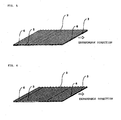
- FIGS. 4 are sectional views each showing an example of a structure of the expandable heating sheet according to the present invention.
- FIGS. 5 to 7 are perspective views each showing an example of a laminate package material (having expansion property in one direction) used for the expandable heating sheet according to the present invention.
- FIGS. 8 to 10 are perspective views each showing an example of a laminate package material (having expansion property in two directions, that is, lengthwise direction and width direction) used for the expandable heating sheet according to the present invention.
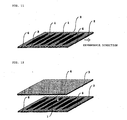
- FIG. 11 is a perspective view showing an example of a state where heating bodies are arranged on the laminate package material in the present invention.
- FIG. 12 is a perspective view showing an example of a state where the laminate package materials are overlapped on both surfaces of the heating bodies such that thermal fusion-bondable surfaces of the laminate package materials are directed inwardly in the present invention.
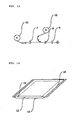
- FIG. 13 is a structural view showing an example of a manufacturing device for the expandable heating sheet according to the present invention.
- FIG. 14 is a perspective view (perspective view with a part being eliminated) showing an example of a heating sheet bag according to the present invention.
- An expandable heating sheet has a structure in which a plurality of flat heating bodies 1 arranged on a plane and two laminate package materials (for example, package material as shown in FIG. 5 or 8 ) each including a thermal fusion-bondable seal material 2 having a repetitive waveform and a stretchable base 6 are overlapped with each other such that the thermal fusion-bondable seal materials 2 are directed inwardly as shown in FIG. 1 , to be heated and compression bonded to each other.
- package materials for example, package material as shown in FIG. 5 or 8
- An expandable heating sheet has a structure in which the plurality of flat heating bodies 1 arranged on a plane and two laminate package materials (for example, package material as shown in FIG. 6 or 9 ) each including a thermal fusion-bondable seal material 3 having a repetitive concavo-convex form and the stretchable base 6 are overlapped with each other such that the thermal fusion-bondable seal materials 3 are directed inwardly as shown in FIG. 2 , to be heated and compression bonded to each other.
- laminate package materials for example, package material as shown in FIG. 6 or 9
- An expandable heating sheet has a structure in which the plurality of flat heating bodies 1 arranged on a plane and two laminate package materials (for example, package material as shown in FIGS. 7 and 10 ) each including a thermal fusion-bondable seal material 5 having a plurality of penetration portions 4 and the stretchable base 6 are overlapped with each other such that the thermal fusion-bondable seal materials 5 are directed inwardly as shown in FIG. 3 , to be heated and compression bonded to each other.
- laminate package materials for example, package material as shown in FIGS. 7 and 10
- An expandable heating sheet according to a fourth embodiment of the present invention has a structure in which the laminate package materials heated and compression bonded to the both surfaces of the heating bodies 1 of the expandable heating sheet according to the first to third embodiments of the present invention are changed to laminate package materials of types different from each other.
- the expandable heating sheet according to the present invention is finally formed to be ones shown in FIGS. 4 .
- portions of the thermal fusion-bondable seal materials 2 (exclusive of portions of heating bodies 1) having the repetitive waveform serves to impart expansion property to the expandable heating sheet. This also applies to a case of the expandable heating sheet according to the second to fourth embodiments.
- the laminate package material used in the expandable heating sheet according to the present invention is a package material finished in each mode as shown in FIGS. 5 to 10 by overlapping the thermal fusion-bondable seal material including a thermal fusion-bondable component such as polyethylene or polypropylene, and the stretchable base each other and heating and fusion-bonding the thermal fusion-bondable seal material and the stretchable base to each other by using a roll, a mold, a compressor, or the like whose compression surface has a waveform or a concavo-convex form, or by overlapping the thermal fusion-bondable seal material including the plurality of penetration portions, and the stretchable base each other and heating and fusion-bonding the thermal fusion-bondable seal material and the stretchable base to each other by using a roll, a mold, a compressor, or the like whose compression surface is a flat surface.
- the laminate package material a material having expansion property in one direction ( FIGS. 5 to 7 )
- the two laminate package materials are arranged such that expandable directions of those coincide with each other.
- the thermal fusion-bondable seal material used in the present invention include, in addition to the thermal fusion-bondable component such as polyethylene or polypropylene, a rubber component such as polybutadiene rubber, polyisoprene rubber, styrene-butadiene rubber, or polyurethane rubber, including as a monomer component, butadiene, isoprene, styrene, or urethane, respectively.
- a rubber component such as polybutadiene rubber, polyisoprene rubber, styrene-butadiene rubber, or polyurethane rubber, including as a monomer component, butadiene, isoprene, styrene, or urethane, respectively.
- thermal fusion-bondable seal material examples include a thermal fusion-bondable seal material obtained by sticking a sheet containing the rubber component and a sheet containing the thermal fusion-bandable component to each other, a thermal fusion-bondable seal material including the sheet containing the rubber component and having a surface impregnated with thermal fusion-bondable resin powder, and a thermal fusion-bondable seal material obtained by mixing the rubber component with the thermal fusion-bondable component, and then melting and stretching the resultant.
- the thermal fusion-bondable seal material obtained by sticking the sheet containing the rubber component (hereinafter sometimes referred to as rubber sheet) to the sheet containing the thermal fusion-bondable component (hereinafter, sometimes referred to as thermal fusion-bondable sheet) is used, and the thermal fusion-bondable seal material has a three-layer structure including the thermal fusion-bondable sheet, the rubber sheet, and the thermal fusion-bondable sheet which are stuck to each other in the stated order.
- temperatures at which fusion-bonding is performed of the thermal fusion-bondable components used for the thermal fusion-bonding sheets are different from each other. It is according to the invention that any one of the thermal fusion-bondable sheets, containing the thermal fusion-bondable component whose fusion-bonding temperature is low, be stuck to the stretchable base.
- the stretchable base used in the present invention may be one which does not contract after stretching once or may be one which freely stretches and contracts, so there is no particular limitation.
- various woven cloths and non-woven cloths may be used therefor. Of those, the non-woven cloth, which moderately stretches and has a nice texture is preferred.
- the laminate package material according to the first embodiment of the present invention ( FIGS. 5 and 8 ) stretches and contracts in the waveform portion of the thermal fusion-bondable seal material 2
- the laminate package material according to the second embodiment of the present invention ( FIGS. 6 and 9 ) stretches and contracts in concave portions (portions having small thickness) of the thermal fusion-bondable seal material 3
- the laminate packagematerial according to the third embodiment of the present invention ( FIGS. 7 and 10 ) stretches and contracts in the portions of the penetration portions 4 of the thermal fusion-bondable seal material 5, thereby obtaining expansion property.
- a maximum stretching ratio ((L - L 0 )/L 0 ) in a direction in which the laminate package material has expansion property is normally 30 to 200% at a room temperature (25°C).
- a maximum stretching ratio in a direction inwhich the laminate package material does not have expansion property is normally less than 30% at the room temperature (25°C).
- the expandable heating sheet according to the present invention uses the laminate package material. Therefore, the portions where the heating body is not provided serve to impart expansion property to the expandable heating sheet.
- an example of a sectional shape of the waveform of the thermal fusion-bondable seal material 2 includes a shape obtained by using a semicircular shape, a semielliptical shape, an arch shape, a mountain shape (trapezoidal shape), a U shape, a V shape, or a shape similar to those, one of those shapes being repetitively joined while being rotated by 180 degrees about an end portion of the shape as a center.
- a height of the waveform is normally 0.05 to 2 mm, and is preferably 0.1 to 1 mm.
- a width of the waveform (wavelength) is normally 0.5 to 20 mm, and is preferably 1 to 10 mm.
- a sectional shape of each convex portion of the thermal fusion-bondable seal material 3 as shown in FIG. 6 may be, for example, a semicircle, a semiellipse, a square, a rectangle, a trapezoid, a triangle, or a shape similar to those.
- a height of the convex portion with respect to the concave portion is normally 0.02 to 2 mm, and is preferably 0.05 to 1 mm.
- a width of the convex portion and the concave portion is normally 0,5 to 20 mm, and is preferably 1 to 10 mm.
- thermal fusion-bondable seal material when the thermal fusion-bondable seal material is formed into a flat sheet with no convex portion and convex portion and a thickness of the thermal fusion-bondable seal material is made small, expansion property is obtained, but there are problems in that the thermal fusion-bondable seal material is easily ripped when being heated and compression bonded and an fusion-bonding strength with respect to the heating body is weakened, thereby causing the thermal fusion-bondable seal material to be easily removed.
- an apex of the each convex portion of the thermal fusion-bondable seal material is heated and compression bonded to the heating body, so there is no problem as described above.
- a planer shape of the penetration portion 4 having an oblong shape as shown in FIG. 7 may be, for example, an ellipse, a semicircle, a rectangle, a trapezoid, a triangle, or a shape similar to those.
- a planer shape of the penetration portion 4 as shown in FIG. 10 may be, for example, in addition to the above-mentioned shapes, a circular shape or a square shape.
- a width of the penetration portion of the oblong shape as shown in FIG. 7 is normally equal to or lower than 20 mm (including a width of a case where cut is simply provided), and is preferably 1 to 10 mm. Further, a size of the penetration portion as shown in FIG.
- the penetration portions are also provided in a peripheral portion thereof such that the expansion property is imparted to an entire portion of the laminate package material.
- the plurality of flat heating bodies 1 on a surface on the thermal fusion-bondable surface (thermal fusion-bondable seal material) side of the laminate package material, there are arranged the plurality of flat heating bodies 1.
- a shape of the heating body is not particularly limited. Examples of the shape may include a circular shape, a semielliptical shape, a semicircular shape, a square shape, a rectangular shape, a polygonal shape, a trapezoidal shape, a rhomboid shape, a parallelogram shape, a triangular shape, and a shape similar to those.
- the heating body does not have expansion property, so it is necessary to arrange the heating bodies so as not to inhibit the expansion property of the expandable heating sheet as much as possible.
- the maximum stretching ratio ((L - L 0 )/L 0 ) based on the expansion property in one direction tends to be substantially proportional to a value obtained by subtracting a length corresponding to portions of the heating bodies from a length corresponding to a portion having the expansion property.
- a heating composition which generates heat by coming into contact with oxygen in air for example, a material including oxidizable metal such as iron, activated carbon, inorganic electrolyte such as sodium chloride, water, and a water retention agent.
- a material including oxidizable metal such as iron, activated carbon, inorganic electrolyte such as sodium chloride, water, and a water retention agent.
- the material preferably include a thickening agent in addition to the above-mentioned components such that the fixation can be performed on the surface of the laminate package material by application or printing. Normal ratios of the components are as follows.
- a ratio of the oxidizable metal is 20 to 80 wt%
- a ratio of the activated carbon is 1 to 10 wt%
- a ratio of the inorganic electrolyte is 1 to 10 wt%
- a ratio of water is 5 to 50 wt%
- a ratio of water retention agent is 1 to 10 wt%
- a ratio of the thickening agent is 0.1 to 10 wt%.
- the plurality of flat heating bodies are arranged and each are laid on one side thereof.
- the laminate package material is overlapped such that the thermal fusion-bondable surface thereof is directed to the heating body side, and the resultant is heated and compressionbonded to be combined into a single body.
- the two laminate package materials may be of different types, but are preferably of the same type. Further, in a case where a package material having expansion property in one direction is used, the two laminate package materials are arranged such that expandable directions of those coincide with each other.
- At least one of the two laminate package materials may be an air permeable package material.
- a glue layer may be provided on the surface on the opposite side of the thermal fusion-bondable surface of the one laminate package material, preferably, the laminate package material having no air permeability.
- the glue layer is covered with release paper or the like during a period prior to use.
- the expandable heating sheet according to the present invention can be successively manufactured by setting a roll 10 around which the laminate package material is wound to a manufacturing device shown in FIG. 13 including a heating body arranging (applying/printing) portion 7, a heating and compression bonding portion 8, and a cutting portion 9, and starting up a manufacturing device.
- a direction in which the laminate package material has the expansion property is set to a supply direction (direction in which tensile force is applied), due to the expansion property, it is difficult to maintain a constant supply rate.
- the expandable heating sheet can be manufactured easily with efficiency.
- release paper or the like is laid under the laminate package material to temporality eliminate the expansion property, thereby making it possible to easily manufacture the expandable heating sheet with efficiency.
- the heating sheet bag according to the present invention includes, as shown in FIG. 14 , an expandable heating sheet 11 as described above and a flat bag 12 with no air permeability, the expandable heating sheet 11 being hermetically sealed in the flat bag 12.
- two non-air permeable package materials 13 made of polyethylene, polypropylene, or the like are overlapped with each other, and are heated and fusion-bonded to each other in a peripheral portion except one side to form a bag shape, after that, the expandable heating sheet 11 is inserted therein, and two non-air permeable package materials 13 are heated and fusion-bonded to each other on the remaining one side, thereby achieving the manufacture.
- thermal fusion-bondable seal material a commercial thermal fusion-bondable sheet (thickness: 70 ⁇ m) including a thermal fusion-bondable component sheet (low-temperature fusion-bonding), a rubber component sheet, and a thermal fusion-bondable component sheet (high-temperature fusion-bonding) was used.
- a stretchable base a commercial non-woven cloth (polyester spunlace) (thickness: 200 ⁇ m) was used. The thermal fusion-bondable seal material and the stretchable base were overlapped with each other such that a surface of a thermal fusion-bondable component (low-temperature fusion-bonding) of those is directed inwardly.
- both surfaces thereof were heated and fusion-bonded to each other by being sandwiched by two molds each having a repetitive waveform in one direction.
- the laminate package material including the thermal fusion-bondable seal material 2 and the stretchable base 6 and having a repetitive waveform as shown in FIG. 5 was obtained. Note that, when the heating and compression bonding were performed, a temperature of the molds was set to a temperature at which the thermal fusion-bondable component sheet (low-temperature fusion-bonding) melts and the thermal fusion-bondable component sheet (high-temperature fusion-bonding) does not melt.
- a height of the waveform of the laminate package material was 0.2 mm, a width of the waveform (wavelength) was 6 mm. Further, the laminate package material was cut into a size of 100 mm by 150 mm. The two laminate package materials structured as described above were manufactured and a surface of one of those was provided with pinholes thereby being air permeable.
- a coating liquid obtained by mixing 63.1 wt% of iron powder, 3.2 wt% of activated carbon, 1.9 wt% of salt (inorganic electrolyte), 26.5 wt% of water, 0.6 wt% of a water retention agent, and 4.7 wt% of a thickening agent was divided to be applied to six positions on a surface on a thermal fusion-bondable surface side of the laminate package material (non-air permeable), thereby obtaining the laminate package material on which heating bodies are arranged as shown in FIG. 11 .
- a shape of each heating body was an ellipse having a major-axis diameter of 80mm, a minor-axis diameter of 15 mm, and a thickness of 1.0 mm.
- the laminate package material air permeable
- the laminate package material air permeable
- the laminate package material air permeable
- the laminate package material was overlapped such that a thermal fusion-bondable surface of the laminate package material is directed to the heating body side and expandable directions of the laminate package materials coincide with each other, and the resultant was heated and compression bonded to each other to be combined in a single body, thereby obtaining a heating sheet as shown in FIG. 4A.
- a surface of the non-air permeable laminate package material was provided with a glue layer and the glue layer was covered with release paper.
- the expandable heating sheet was hermetically sealed in a non-air permeable flat bag having a size of 130 mm by 180 mm, thereby manufacturing a heating sheet bag.
- the two heating sheet bags described above were manufactured and were left for one day and night in a room at 25°C.
- the expandable heating sheet was taken out from one of the heating sheet bags.
- a maximum stretching ratio in a direction in which the expandable heating sheet has expansion property and a maximum stretching ratio in a direction in which the expandable heating sheet does not have the expansion property were immediately measured. As a result, the maximum stretching ratios were 50% and 3%, respectively.
- the expandable heating sheet was taken out from the other heating sheet bag, and was left on a cushion in a room at 25°C, and research was then performed on heating property thereof.
- a maximum temperature of the expandable heating sheet was 50°C, and a time in which a temperature of the expandable heating sheet was equal to or more than 40°C was six hours. Therefore, it was confirmed that the expandable heating sheet had favorable heating property.
- the expandable heating sheet after use (after temperature decrease) was measured for a maximum stretching ratio in the direction in which the expandable heating sheet has the expansion property and a maximum, stretching ratio in the direction in which the expandable heating sheet does not have the expansion property
- the maximum stretching ratios were 48% and 2% which were substantially the same as those in the case before use.
- the laminate package material including the thermal fusion-bondable seal material 3 having the repetitive concavo-convex form and the stretchable base 6 as shown in FIG. 6 was manufactured.
- a thickness of the convex portion of the laminate package material was 0.25 mm
- a thickness of the concave portion thereof was 0.15 mm
- a width of each of the convex portion and the concave portion was 3 mm.
- the expandable heating sheet was manufactured in the same manner as that of Example 1. The expandable heating sheet was hermetically sealed in the non-air permeable flat bag, thereby obtaining a heating sheet bag.
- the two heating sheet bags described above were manufactured and were left for one day and night in a room at 25°C.
- the expandable heating sheet was taken out from one of the heating sheet bags.
- a maximum stretching ratio in a direction in which the expandable heating sheet has expansion property and a maximum stretching ratio in a direction in which the expandable heating sheet does not have the expansion property were immediately measured. As a result, the maximum stretching ratios were 40% and 3%, respectively.
- the expandable heating sheet was taken out from the other heating sheet bag, and was left on a cushion in a room at 25°C, and research was then performed on heating property thereof.
- a maximum temperature of the expandable heating sheet was 48°C, and a time in which a temperature of the expandable heating sheet was equal to or more than 40°C was seven hours. Therefore, it was confirmed that the expandable heating sheet had favorable heating property.
- the expandable heating sheet after use (after temperature decrease) was measured for a maximum stretching ratio in the direction in which the expandable heating sheet has the expansion property and a maximum stretching ratio in the direction in which the expandable heating sheet does not have the expansion property.
- the maximum stretching ratios were 38% and 2% which are substantially the same as those in the case before use.
- thermo fusion-bondable sheet was provided with slits each having a width of 1.0 mm at intervals of 5 mm, and that in place of the two molds each having the repetitive waveform, two flat molds were used, in the same manner as that of Example 1, the laminate package material including the thermal fusion-bondable seal material 5 having the plurality of oblong penetration portions 4 and the stretchable base 6 as shown in FIG. 7 was manufactured. Further, except that the laminate package material structured in this manner was used, the expandable heating sheet was manufactured in the same manner as that of Example 1. The expandable heating sheet was hermetically sealed in the non-air permeable flat bag, thereby obtaining a heating sheet bag.
- the two heating sheet bags described above were manufactured and were left for one day and night in a room at 25°C.
- the expandable heating sheet was taken out from one of the heating sheet bags.
- a maximum stretching ratio in a direction in which the expandable heating sheet has expansion property and a maximum stretching ratio in a direction in which the expandable heating sheet does not have the expansion property were immediately measured. As a result, the maximum stretching ratios were 42% and 2%, respectively.
- the expandable heating sheet was taken out from the other heating sheet bag, and was left on a cushion in a room at 25°C, and research was then performed on heating property thereof.
- a maximum temperature of the expandable heating sheet was 52°C, and a time in which a temperature of the expandable heating sheet was equal to or more than 40°C was five hours. Therefore, it was confirmed that the expandable heating sheet had favorable heating property.
- the expandable heating sheet after use (after temperature decrease) was measured for a maximum stretching ratio in the direction in which the expandable heating sheet has the expansion property and a maximum stretching ratio in the direction in which the expandable heating sheet does not have the expansion property.
- the maximum stretching ratios were 40% and 1% which were substantially the same as those in the case before use.
- Example 2 the laminate package material including the thermal fusion-bondable seal material 2 having the repetitive waveform and the stretchable base 6 as shown in FIG. 5 was obtained. Further, in the same manner as that of Example 2, the laminate package material including the thermal fusion-bondable seal material 3 having the repetitive concavo-convex form and the stretchable material 6 as shown in FIG. 6 was obtained, and the laminate package material was provided with pinholes formed in a surface thereof, thereby being air permeable. Except that those two types of laminate package materials were used, an expandable heating sheet was manufactured as in the same manner as that of Example 1. The expandable heating sheet was hermetically sealed in the non-air permeable flat bag, thereby obtaining a heating sheet bag.
- the two heating sheet bags described above were manufactured and were left for one day and night in a room at 25°C.
- the expandable heating sheet was taken out from one of the heating sheet bags.
- a maximum stretching ratio in a direction in which the expandable heating sheet has expansion property and a maximum stretching ratio in a direction in which the expandable heating sheet does not have the expansion property were immediately measured. As a result, the maximum stretching ratios were 50% and 2%, respectively.
- the expandable heating sheet was taken out from the other heating sheet bag, and was left on a cushion in a room at 25°C, and research was then performed on heating property thereof.
- a maximum temperature of the expandable heating sheet was 50°C, and a time in which a temperature of the expandable heating sheet was equal to or more than 40°C was eight hours. Therefore, it was confirmed that the expandable heating sheet had favorable heating property.
- the expandable heating sheet after use (after temperature decrease) was measured for a maximum stretching ratio in the direction in which the expandable heating sheet has the expansion property and a maximum stretching ratio in the direction in which the expandable heating sheet does not have the expansion property.
- the maximum stretching ratios were 49% and 1% which were substantially the same as those in the case before use.
- Example 2 except that, in the manufacture of the laminate package material according to Example 1, in place of the two molds each having the repetitive waveform in one direction, two molds each having repetitive waveforms in two directions were used, in the same manner as that of Example 1, a laminate package material including the thermal fusion-bondable seal material 2 having the repetitive waveforms and the stretchable base 6 as shown in FIG. 8 was manufactured. Note that a height and a width of the waveform of the laminate package material were the same as those of Example 1. Further, except that the laminate package material was used and six heating bodies each having a diameter of 30 mm and a thickness of 1. 0 mmwere arranged, the expandable heating sheet was manufactured in the same manner as that of Example 1. The expandable heating sheet was hermetically sealed in the non-air permeable flat bag, thereby obtaining the heating sheet bag.
- the two heating sheet bags described above were manufactured and were left for one day and night in a room at 25°C.
- the expandable heating sheet was taken out from one of the heating sheet bags.
- Maximum stretching ratios in two directions in which the expandable heating sheet had expansion property, that is, the lengthwise direction and the width direction were immediately measured. As a result, the maximum stretching ratios were 30% and 24%, respectively.
- the expandable heating sheet was taken out from the other heating sheet bag, and was left on a cushion in a room at 25°C, and research was then performed on heating property thereof.
- a maximum temperature of the expandable heating sheet was 50°C, and a time in which a temperature of the expandable heating sheet was equal to or more than 40°C was six hours. Therefore, it was confirmed that the expandable heating sheet had favorable heating property.
- the expandable heating sheet after use was measured for maximum stretching ratios in the two directions in which the expandable heating sheet has the expansion property, that is, the lengthwise direction and the width direction. As a result, it was determined that the maximum stretching ratios were 27% and 21% which were substantially the same as those in the case before use.
- Example 2 except that, in the manufacture of the laminate package material according to Example 1, in place of the two molds each having the repetitive waveform, two flat molds were used, in the same manner as that of Example 1, the laminate package material including a flat thermal fusion-bondable seal material and the stretchable base was manufactured. Further, except that the laminate package material structured in this manner was used, the expandable heating sheet was manufactured in the same manner as that of Example 1. The expandable heating sheet was hermetically sealed in the non-air permeable flat bag, thereby obtaining a heating sheet bag.
- the two heating sheet bags described above were manufactured and were left for one day and night in a room at 25°C.
- the expandable heating sheet was taken out from one of the heating sheet bags.
- Maximum stretching ratios in two directions, that is, the lengthwise direction and the width direction, were immediately measured. As a result, the maximum stretching ratios were 8% and 2%, respectively.
- the expandable heating sheet was taken out from the other heating sheet bag, and was left on a cushion in a room at 25°C, and research was then performed on heating property thereof.
- a maximum temperature of the expandable heating sheet was 50°C, and a time in which a temperature of the expandable heating sheet was equal to or more than 40°C was six hours. Therefore, it was confirmed that the expandable heating sheet had favorable heating property.
- the expandable heating sheet after use (after temperature decrease) was measured for maximum stretching ratios in the two directions, that is, the lengthwise direction and the width direction. As a result, it was determined that the maximum stretching ratios were 4% and 1% which were lower than the maximum stretching ratios before use.
- the expandable heating sheet according to each of the examples of the present invention includes, as the thermal fusion-bondable seal material, the thermal fusion-bondable seal material having the repetitive waveform, the thermal fusion-bondable seal material having the repetitive concavo-convex form, or the thermal fusion-bondable seal material having the plurality of oblong penetration portions. Accordingly, the expansion property is provided to waveform seal portions, concave seal portions (portions having small thickness), or the penetration portions, so it is revealed that the expansion property can be maintained during or even after use.
Landscapes
- Health & Medical Sciences (AREA)
- Heart & Thoracic Surgery (AREA)
- Life Sciences & Earth Sciences (AREA)
- Thermal Sciences (AREA)
- Engineering & Computer Science (AREA)
- Biomedical Technology (AREA)
- Veterinary Medicine (AREA)
- Vascular Medicine (AREA)
- Physics & Mathematics (AREA)
- Animal Behavior & Ethology (AREA)
- General Health & Medical Sciences (AREA)
- Public Health (AREA)
- Emergency Medicine (AREA)
- Thermotherapy And Cooling Therapy Devices (AREA)
- Bag Frames (AREA)
Description
- The present invention relates to an expandable heating sheet, a method of manufacturing the same, and a heating sheet bag for the same, and more particularly, to an expandable heating sheet which can be used while being fitted to a bendable portion such as an elbow or a knee and can be manufactured at low costs with efficiency, a method of manufacturing the same, and a heating sheet bag for the same.
- Hitherto, there have been used disposable body warmers in which a heating composition containing oxidizable metal, activated carbon, inorganic electrolyte, water, water-retaining agent, and the like mixed with each other, and for generating heat when being brought into contact with oxygen in air is received in an air permeable flat bag, and in order to prevent the heating composition from being brought into contact with outside air and to prevent the water from evaporating to diffuse to an outside until the heating composition is used, the air permeable flat bag is hermetically sealed in a non-air permeable outer bag. There are commercially available various body warmers, having heating properties set depending on portions to be applied such as on body, in pocket, and in a shoe. In order to facilitate attachment at a time of use, those body warmers are each provided with an adhesive layer.
- There are also used disposable body warmers of a sheet type in which the heating composition is retained in spaces of a non-woven cloth, thereby preventing moving toward one side during the use.
- In a method of manufacturing a disposable body warmer of this type, for example, as shown in
FIG. 13 , onto a sheet-like non-woven cloth continuously supplied through rotating rolls, a heating composition and thermal fusion-bondable resin powder are sprayed, after that, another sheet-like non-woven cloth to be continuously supplied is overlapped thereon, the resultant is combined in a single body by heating and compression bonding by a compressor, the resultant is cut into a desired size, and the resultant is hermetically sealed in an outer bag. - Further, as disposable body warmers other than the above-mentioned body warmer, there are provided body warmers developed with an object of being fitted to a bendable portion such as an elbow or a knee to be used. There are listed, for example, as disclosed in
Japanese Utility Model Application Laid-open No. Hei 06-26829 Japanese Utility Model Application Laid-open No. Hei 06-61222 - However, the portable bodywarmer, in which the heating portion charged with the heating composition is divided into the plurality of sections, can easily be bent at the seal portion even when the heating composition thereof is hardened due to reaction with oxygen, but is not expandable at the seal portion, so expansion property cannot be obtained for the body warmer as a whole. Further, with the article in which the disposable body warmer is provided to the desired surface of the expandable material, an attachment portion of the disposable body warmer is hardened as reaction of the heat composition with oxygen proceeds, so the disposable body warmer is hard and has no expansion property in the attachment portion.
-
WO 2006/006664 discloses a flexible heating element that can be secured to any part of the body by sticking or winding, being stretchable in accordance with the movement of the body to thereby be free from coming off or disengagement. There is provided a flexible heating element comprising a base material and a covering material and, interposed therebetween, multiple exothermic composition moldings, the exothermic composition moldings at peripheries thereof heat sealed to thereby create segmented heating parts and segmenting parts. - It is therefore an object of the present invention to provide an expandable heating sheet, which does not lose its expansion property even when a heating composition thereof is hardened due to reaction with oxygen, can be used while being fitted to a bendable portion such as an elbow or a knee, and can be easily manufactured with efficiency, and a heating sheet bag in which the expandable heating sheet is hermetically sealed.
- The inventors of the present invention have made a keen examination to solve the above-mentioned problems, thereby finding that, in a heating sheet obtained by overlapping laminate package materials each containing a thermal fusion-bondable seal material and a stretchable base to both surfaces of a plurality of flat heating bodies arranged an a plane such that thermal fusion-bondable surfaces of the laminate package materials are directed inwardly, and heating and compression bonding the resultant, to thereby combining the resultant in a single body by using, as each thermal fusion-bondable seal material, a thermal fusion-bondable seal material having a repetitive waveform, a thermal fusion-bondable seal material having a repetitive cancavo-convex form, or a thermal fusion-bondable seal material having a plurality of penetration portions, expansion property can easily be obtained. As a result, the inventors of the present invention attains an expendable heating sheet as claimed in
claim 1, a method of manufacturing the same as claimed in claim 7, and a heating sheet bag for the same as claimed inclaim 6. - That is, the present invention provides an expandable heating sheet according to
claim 1 including a plurality of flat heating bodies arranged an a plane and laminate package materials each including a thermal fusion-bondable seal material having a repetitive waveform and a stretchable base, the laminate package materials being heated and compression bonded to both surfaces of the plurality of flat heating bodies. - Further, the present invention provides an expandable heating sheet according to
claim 1 including a plurality of flat heating bodies arranged on a plane and laminate package materials each including a thermal fusion-bondable seal material having a repetitive concave-convex form and a stretchable base, the laminate package materials being heated and compression bonded to both surfaces of the plurality of flat heating bodies. - Further, the present invention provides an expandable heating sheet according to
claim 1 including a plurality of flat heating bodies arranged on a plane and laminate package materials each including a thermal fusion-bondable seal material having a plurality of penetration portions and a stretchable base, the laminate package materials being heated and compression bonded to both surfaces of the plurality of flat heating bodies. - Further, the present invention provides an expandable heating sheet according to
claim 1 including a plurality of flat heating bodies arranged on a plane and two laminate package materials which are heated and compression bonded to both surfaces of the plurality of flat heating bodies and are of one type or two types selected from the group consisting of: a laminate package material including a thermal fusion-bondable seal material having a repetitive waveform and a stretchable base; a laminate package material including a thermal fusion-bondable seal material having a repetitive concavo-convex form and the stretchable base; and a laminate package material including a thermal fusion bondable seal material having a plurality of penetration portions and the stretchable base. - Further, the present invention provides a heating sheet bag according to
claim 6 including: the expendable heating sheet according to any one of the above-mentioned aspects; and a non-air permeable flat bag, in which the expandable heating sheet is hermetically sealed in the non-air permeable flat bag. - Further, the present invention provides a method of manufacturing an expendable heating sheet according to claim 7, including the steps of: arranging a plurality of flat heating bodies on a surface on a thermal fusion-bondable surface side of one laminate package material selected from the group consisting of: a laminate package material including a thermal fusion-bondable seal material having a repetitive waveform and a stretchable base; a laminate package material including a thermal fusion-bondable seal material having a repetitive concavo-convex form and the stretchable base; and a laminate package material including a thermal fusion-bondable seal material having a plurality of penetration portions and the stretchable base; wherein the thermal fusion-bondable seal material comprises a thermal fusion-bondable sheet, a rubber sheet, and a thermal fusion-bondable sheet stuck in the stated order; and wherein: temperatures of the respective thermal fusion-bondable sheets, at which thermal fusion-bondable components used for the thermal fusion-bondable sheets perform fusion-bonding, are different from each other; and one of the thermal fusion-bondable sheets, of which the temperature at which the thermal fusion-bondable component performs the fusion-bonding is lower than the temperature of another one of the thermal fusion-bondable sheets, and the stretchable base are stuck to each other; overlapping one laminate package material selected from the laminate package materials of three types on another-side surfaces of the plurality of flat heating bodies so that the thermal fusion-bondable surface of the one laminate package material is directed to a side of the plurality of flat heating bodies; and combining the one laminate package material, the plurality of flat heating bodies, and the one laminate package material into a single body by heating and compression bonding.
- In the expandable heating sheet according to the present invention, a thermal fusion-bondable seal material having a stretchability or expansion property which is reduced by being heated is used as the thermal fusion-bondable seal material having the repetitive waveform, the thermal fusion-bondable seal material having the repetitive concavo-convex form, or the thermal fusion-bondable seal material having the plurality of penetration portion, so the expansion property is available in a waveform seal portion, a convex seal portion (portion having small thickness), or the penetration portion. Accordingly, the expandable heating sheet according to the present invention can be used while being fitted to the bendable portion such as an elbow or a knee. Further, in the method of manufacturing an expandable heating sheet according to the present invention, a direction in which the expandable heating sheet does not have the expansion property is set to a supply direction (direction in which tensile force is applied), or released paper or the like is laid under the expandable heating sheet to temporality eliminate the expansion property, thereby making it possible to easily manufacture the expandable heating sheet with efficiency by using a conventionally used manufacturing device without using a special manufacturing device.
- In the accompanying drawings:
-
FIG. 1 is a sectional view showing an example of a structure of an expandable heating sheet before heating and compression bonding according to the present invention (first embodiment); -
FIG. 2 is a sectional view showing an example of a structure of an expandable heating sheet before heating and compression bonding according to the present invention (second embodiment); -
FIG. 3 is a sectional view showing an example of a structure of an expandable heating sheet before heating and compression bonding according to the present invention (third embodiment); -
FIGS. 4 are sectional views each showing an example of a structure of the expandable heating sheet according to the present invention; -
FIG. 5 is a perspective view showing an example of a laminate package material used for the expandable heating sheet according to the present invention (first embodiment, having expansion property in one direction); -
FIG. 6 is a perspective view showing an example of a laminate package material used for the expandable heating sheet according to the present invention (second embodiment, having expansion property in one direction); -
FIG. 7 is a perspective view showing an example of a laminate package material used for the expandable heating sheet according to the present invention (third embodiment, having expansion property in one direction); -
FIG. 8 is a perspective view showing an example of a laminate package material used for the expandable heating sheet according to the present invention (first embodiment, having expansion property in two directions, that is, lengthwise direction and width direction); -
FIG. 9 is a perspective view showing an example of a laminate package material used for the expandable heating sheet according to the present invention (second embodiment, having expansion property in two directions, that is, lengthwise direction and width direction); -
FIG. 10 is a perspective view showing an example of a laminate package material used for the expandable heating sheet according to the present invention (third embodiment, having expansion property in two directions, that is, lengthwise direction and width direction); -
FIG. 11 is a perspective view showing an example of a state where heating bodies are arranged on the laminate package material in the present invention; -
FIG. 12 is a perspective view showing an example of a state where the laminate package materials are overlapped on both surfaces of the heating bodies such that thermal fusion-bondable surfaces of the laminate package materials are directed inwardly in the present invention; -
FIG. 13 is a structural view showing an example of a manufacturing device for the expandable heating sheet according to the present invention; and -
FIG. 14 is a perspective view showing an example of a heating sheet bag according to the present invention (perspective view with a part being eliminated). - An expandable heating sheet, a method of manufacturing the same, and a heating sheet bag are applied to a disposable body warmer for warming bendable portions such as elbows and knees, and a method of manufacturing the same.
- Hereinafter, detailed descriptions will be made of the expandable heating sheet according to
claim 1 and its further embodiments according toclaims 2 to 5, the method of manufacturing the same according to claim 7 and its embodiments according toclaims 8 to 10, and the heating sheet bag according toclaim 6 of the present invention with reference toFIGS. 1 to 14 . However, the present invention is not limited by the description. Any non-claimed aspects are for illustrative purposes only:FIGS. 1 to 3 are sectional views each showing an example of a structure of the expandable heating sheet before, heating and compression bonding according to the present invention.FIGS. 4 are sectional views each showing an example of a structure of the expandable heating sheet according to the present invention.FIGS. 5 to 7 are perspective views each showing an example of a laminate package material (having expansion property in one direction) used for the expandable heating sheet according to the present invention.FIGS. 8 to 10 are perspective views each showing an example of a laminate package material (having expansion property in two directions, that is, lengthwise direction and width direction) used for the expandable heating sheet according to the present invention.FIG. 11 is a perspective view showing an example of a state where heating bodies are arranged on the laminate package material in the present invention.FIG. 12 is a perspective view showing an example of a state where the laminate package materials are overlapped on both surfaces of the heating bodies such that thermal fusion-bondable surfaces of the laminate package materials are directed inwardly in the present invention.FIG. 13 is a structural view showing an example of a manufacturing device for the expandable heating sheet according to the present invention.FIG. 14 is a perspective view (perspective view with a part being eliminated) showing an example of a heating sheet bag according to the present invention. - An expandable heating sheet according to a first embodiment of the present invention has a structure in which a plurality of
flat heating bodies 1 arranged on a plane and two laminate package materials (for example, package material as shown inFIG. 5 or8 ) each including a thermal fusion-bondable seal material 2 having a repetitive waveform and astretchable base 6 are overlapped with each other such that the thermal fusion-bondable seal materials 2 are directed inwardly as shown inFIG. 1 , to be heated and compression bonded to each other. - An expandable heating sheet according to a second embodiment of the present invention has a structure in which the plurality of
flat heating bodies 1 arranged on a plane and two laminate package materials (for example, package material as shown inFIG. 6 or9 ) each including a thermal fusion-bondable seal material 3 having a repetitive concavo-convex form and thestretchable base 6 are overlapped with each other such that the thermal fusion-bondable seal materials 3 are directed inwardly as shown inFIG. 2 , to be heated and compression bonded to each other. - An expandable heating sheet according to a third embodiment of the present invention has a structure in which the plurality of
flat heating bodies 1 arranged on a plane and two laminate package materials (for example, package material as shown inFIGS. 7 and10 ) each including a thermal fusion-bondable seal material 5 having a plurality ofpenetration portions 4 and thestretchable base 6 are overlapped with each other such that the thermal fusion-bondable seal materials 5 are directed inwardly as shown inFIG. 3 , to be heated and compression bonded to each other. - An expandable heating sheet according to a fourth embodiment of the present invention has a structure in which the laminate package materials heated and compression bonded to the both surfaces of the
heating bodies 1 of the expandable heating sheet according to the first to third embodiments of the present invention are changed to laminate package materials of types different from each other. - Note that, for example, in a case of the expandable heating sheet according to the first embodiment of the present invention, the expandable heating sheet according to the present invention is finally formed to be ones shown in
FIGS. 4 . In the expandable heating sheet of each ofFIGS. 4 , portions of the thermal fusion-bondable seal materials 2 (exclusive of portions of heating bodies 1) having the repetitive waveform serves to impart expansion property to the expandable heating sheet. This also applies to a case of the expandable heating sheet according to the second to fourth embodiments. - The laminate package material used in the expandable heating sheet according to the present invention is a package material finished in each mode as shown in
FIGS. 5 to 10 by overlapping the thermal fusion-bondable seal material including a thermal fusion-bondable component such as polyethylene or polypropylene, and the stretchable base each other and heating and fusion-bonding the thermal fusion-bondable seal material and the stretchable base to each other by using a roll, a mold, a compressor, or the like whose compression surface has a waveform or a concavo-convex form, or by overlapping the thermal fusion-bondable seal material including the plurality of penetration portions, and the stretchable base each other and heating and fusion-bonding the thermal fusion-bondable seal material and the stretchable base to each other by using a roll, a mold, a compressor, or the like whose compression surface is a flat surface. Further, in a case where, as the laminate package material, a material having expansion property in one direction (FIGS. 5 to 7 ) is used, when the laminate package materials are overlapped on the both surfaces of the heating bodies, the two laminate package materials are arranged such that expandable directions of those coincide with each other. - Note that the thermal fusion-bondable seal material used in the present invention include, in addition to the thermal fusion-bondable component such as polyethylene or polypropylene, a rubber component such as polybutadiene rubber, polyisoprene rubber, styrene-butadiene rubber, or polyurethane rubber, including as a monomer component, butadiene, isoprene, styrene, or urethane, respectively. Examples of the thermal fusion-bondable seal material include a thermal fusion-bondable seal material obtained by sticking a sheet containing the rubber component and a sheet containing the thermal fusion-bandable component to each other, a thermal fusion-bondable seal material including the sheet containing the rubber component and having a surface impregnated with thermal fusion-bondable resin powder, and a thermal fusion-bondable seal material obtained by mixing the rubber component with the thermal fusion-bondable component, and then melting and stretching the resultant.
- Of those, according to the invention the thermal fusion-bondable seal material obtained by sticking the sheet containing the rubber component (hereinafter sometimes referred to as rubber sheet) to the sheet containing the thermal fusion-bondable component (hereinafter, sometimes referred to as thermal fusion-bondable sheet) is used, and the thermal fusion-bondable seal material has a three-layer structure including the thermal fusion-bondable sheet, the rubber sheet, and the thermal fusion-bondable sheet which are stuck to each other in the stated order. In this case, temperatures at which fusion-bonding is performed of the thermal fusion-bondable components used for the thermal fusion-bonding sheets are different from each other. It is according to the invention that any one of the thermal fusion-bondable sheets, containing the thermal fusion-bondable component whose fusion-bonding temperature is low, be stuck to the stretchable base.
- Further, the stretchable base used in the present invention may be one which does not contract after stretching once or may be one which freely stretches and contracts, so there is no particular limitation. For example, various woven cloths and non-woven cloths may be used therefor. Of those, the non-woven cloth, which moderately stretches and has a nice texture is preferred.
- In the present invention, the laminate package material according to the first embodiment of the present invention (
FIGS. 5 and8 ) stretches and contracts in the waveform portion of the thermal fusion-bondable seal material 2, the laminate package material according to the second embodiment of the present invention (FIGS. 6 and9 ) stretches and contracts in concave portions (portions having small thickness) of the thermal fusion-bondable seal material 3, and the laminate packagematerial according to the third embodiment of the present invention (FIGS. 7 and10 ) stretches and contracts in the portions of thepenetration portions 4 of the thermal fusion-bondable seal material 5, thereby obtaining expansion property. A maximum stretching ratio ((L - L0)/L0) in a direction in which the laminate package material has expansion property is normally 30 to 200% at a room temperature (25°C). A maximum stretching ratio in a direction inwhich the laminate package material does not have expansion property is normally less than 30% at the room temperature (25°C). The expandable heating sheet according to the present invention uses the laminate package material. Therefore, the portions where the heating body is not provided serve to impart expansion property to the expandable heating sheet. - In the laminate package material according to the first embodiment of the present invention (
FIGS. 5 and8 ), an example of a sectional shape of the waveform of the thermal fusion-bondable seal material 2 includes a shape obtained by using a semicircular shape, a semielliptical shape, an arch shape, a mountain shape (trapezoidal shape), a U shape, a V shape, or a shape similar to those, one of those shapes being repetitively joined while being rotated by 180 degrees about an end portion of the shape as a center. Further, a height of the waveform (distance between highest portion and lowest portion) is normally 0.05 to 2 mm, and is preferably 0.1 to 1 mm. A width of the waveform (wavelength) is normally 0.5 to 20 mm, and is preferably 1 to 10 mm. - In the laminate package material according to the second embodiment of the present invention, a sectional shape of each convex portion of the thermal fusion-
bondable seal material 3 as shown inFIG. 6 may be, for example, a semicircle, a semiellipse, a square, a rectangle, a trapezoid, a triangle, or a shape similar to those. A shape of the each convex portion of the thermal fusion-bondable seal material 3 as shown inFIG. 9 may be, for example, a circular columnar shape, a semispherical shape, a semielliptical shape, a cubic shape, a rectangular parallelepiped shape, a truncated cone shape, a truncated pyramid shape, a cone shape, a pyramid shape, or a shape similar to those. Further, a height of the convex portion with respect to the concave portion is normally 0.02 to 2 mm, and is preferably 0.05 to 1 mm. A width of the convex portion and the concave portion is normally 0,5 to 20 mm, and is preferably 1 to 10 mm. Note that, when the thermal fusion-bondable seal material is formed into a flat sheet with no convex portion and convex portion and a thickness of the thermal fusion-bondable seal material is made small, expansion property is obtained, but there are problems in that the thermal fusion-bondable seal material is easily ripped when being heated and compression bonded and an fusion-bonding strength with respect to the heating body is weakened, thereby causing the thermal fusion-bondable seal material to be easily removed. In the present invention, an apex of the each convex portion of the thermal fusion-bondable seal material is heated and compression bonded to the heating body, so there is no problem as described above. - In the laminate package material according to the third embodiment of the present invention, a planer shape of the
penetration portion 4 having an oblong shape as shown inFIG. 7 may be, for example, an ellipse, a semicircle, a rectangle, a trapezoid, a triangle, or a shape similar to those. A planer shape of thepenetration portion 4 as shown inFIG. 10 may be, for example, in addition to the above-mentioned shapes, a circular shape or a square shape. A width of the penetration portion of the oblong shape as shown inFIG. 7 is normally equal to or lower than 20 mm (including a width of a case where cut is simply provided), and is preferably 1 to 10 mm. Further, a size of the penetration portion as shown inFIG. 10 is normally 1 to 30 mm, and is preferably 3 to 15 mm in a case where the size is converted into that of the square shape. Note that, in the laminate package material according to the third embodiment of the present invention (FIGS. 7 and10 ), it is preferred that the penetration portions (cutout portions) be also provided in a peripheral portion thereof such that the expansion property is imparted to an entire portion of the laminate package material. - In the expandable heating sheet and the method of manufacturing the same according to the present invention, as shown in
FIG. 11 , on a surface on the thermal fusion-bondable surface (thermal fusion-bondable seal material) side of the laminate package material, there are arranged the plurality offlat heating bodies 1. A shape of the heating body is not particularly limited. Examples of the shape may include a circular shape, a semielliptical shape, a semicircular shape, a square shape, a rectangular shape, a polygonal shape, a trapezoidal shape, a rhomboid shape, a parallelogram shape, a triangular shape, and a shape similar to those. However, the heating body does not have expansion property, so it is necessary to arrange the heating bodies so as not to inhibit the expansion property of the expandable heating sheet as much as possible. For example, the maximum stretching ratio ((L - L0)/L0) based on the expansion property in one direction tends to be substantially proportional to a value obtained by subtracting a length corresponding to portions of the heating bodies from a length corresponding to a portion having the expansion property. - In the present invention, for a structural material of the heating body, there are used a heating composition which generates heat by coming into contact with oxygen in air, for example, a material including oxidizable metal such as iron, activated carbon, inorganic electrolyte such as sodium chloride, water, and a water retention agent. However, it is necessary that the plurality of flat heating bodies be fixed to the surface of the laminate package material as shown in
FIG. 11 , the material preferably include a thickening agent in addition to the above-mentioned components such that the fixation can be performed on the surface of the laminate package material by application or printing. Normal ratios of the components are as follows. That is, a ratio of the oxidizable metal is 20 to 80 wt%, a ratio of the activated carbon is 1 to 10 wt%, a ratio of the inorganic electrolyte is 1 to 10 wt%, a ratio of water is 5 to 50 wt%, a ratio of water retention agent is 1 to 10 wt%, and a ratio of the thickening agent is 0.1 to 10 wt%. - In the expandable heating sheet and the method of manufacturing the same according to the present invention, on the surface of the laminate package material, the plurality of flat heating bodies are arranged and each are laid on one side thereof. After that, as shown in
FIG. 12 , on another-side surfaces of the heating bodies, the laminate package material is overlapped such that the thermal fusion-bondable surface thereof is directed to the heating body side, and the resultant is heated and compressionbonded to be combined into a single body. In this case, the two laminate package materials may be of different types, but are preferably of the same type. Further, in a case where a package material having expansion property in one direction is used, the two laminate package materials are arranged such that expandable directions of those coincide with each other. - Note that, in the present invention, at least one of the two laminate package materials may be an air permeable package material. Further, in order to use the expandable heating sheet while being fusion-bonded to a bendable portion such as an elbow or a knee, a glue layer may be provided on the surface on the opposite side of the thermal fusion-bondable surface of the one laminate package material, preferably, the laminate package material having no air permeability. The glue layer is covered with release paper or the like during a period prior to use.
- The expandable heating sheet according to the present invention can be successively manufactured by setting a
roll 10 around which the laminate package material is wound to a manufacturing device shown inFIG. 13 including a heating body arranging (applying/printing) portion 7, a heating andcompression bonding portion 8, and a cuttingportion 9, and starting up a manufacturing device. In this case, when a direction in which the laminate package material has the expansion property is set to a supply direction (direction in which tensile force is applied), due to the expansion property, it is difficult to maintain a constant supply rate. However, by setting a direction in which the laminate package material does not have the expansion property to the supply direction, the expandable heating sheet can be manufactured easily with efficiency. Further, in a case where the laminate package material has the expansion property in two directions, that is, the lengthwise direction and the width direction, release paper or the like is laid under the laminate package material to temporality eliminate the expansion property, thereby making it possible to easily manufacture the expandable heating sheet with efficiency. - The heating sheet bag according to the present invention includes, as shown in
FIG. 14 , anexpandable heating sheet 11 as described above and aflat bag 12 with no air permeability, theexpandable heating sheet 11 being hermetically sealed in theflat bag 12. In a case of manufacturing the heating sheet bag, for example, two non-airpermeable package materials 13 made of polyethylene, polypropylene, or the like are overlapped with each other, and are heated and fusion-bonded to each other in a peripheral portion except one side to form a bag shape, after that, theexpandable heating sheet 11 is inserted therein, and two non-airpermeable package materials 13 are heated and fusion-bonded to each other on the remaining one side, thereby achieving the manufacture. - Next, examples of the present invention will be described in detail, but the present invention is not limited by the examples.
- As a thermal fusion-bondable seal material, a commercial thermal fusion-bondable sheet (thickness: 70µm) including a thermal fusion-bondable component sheet (low-temperature fusion-bonding), a rubber component sheet, and a thermal fusion-bondable component sheet (high-temperature fusion-bonding) was used. As a stretchable base, a commercial non-woven cloth (polyester spunlace) (thickness: 200 µm) was used. The thermal fusion-bondable seal material and the stretchable base were overlapped with each other such that a surface of a thermal fusion-bondable component (low-temperature fusion-bonding) of those is directed inwardly. Both surfaces thereof were heated and fusion-bonded to each other by being sandwiched by two molds each having a repetitive waveform in one direction. As a result, the laminate package material including the thermal fusion-
bondable seal material 2 and thestretchable base 6 and having a repetitive waveform as shown inFIG. 5 was obtained. Note that, when the heating and compression bonding were performed, a temperature of the molds was set to a temperature at which the thermal fusion-bondable component sheet (low-temperature fusion-bonding) melts and the thermal fusion-bondable component sheet (high-temperature fusion-bonding) does not melt. A height of the waveform of the laminate package material (distance between highest portion and lowest portion) was 0.2 mm, a width of the waveform (wavelength) was 6 mm. Further, the laminate package material was cut into a size of 100 mm by 150 mm. The two laminate package materials structured as described above were manufactured and a surface of one of those was provided with pinholes thereby being air permeable. - Under a nitrogen gas atmosphere, 30 g of a coating liquid obtained by mixing 63.1 wt% of iron powder, 3.2 wt% of activated carbon, 1.9 wt% of salt (inorganic electrolyte), 26.5 wt% of water, 0.6 wt% of a water retention agent, and 4.7 wt% of a thickening agent was divided to be applied to six positions on a surface on a thermal fusion-bondable surface side of the laminate package material (non-air permeable), thereby obtaining the laminate package material on which heating bodies are arranged as shown in
FIG. 11 . Note that a shape of each heating body was an ellipse having a major-axis diameter of 80mm, a minor-axis diameter of 15 mm, and a thickness of 1.0 mm. - Next, as shown in
FIG. 12 , on surfaces of the heating bodies, the laminate package material (air permeable) was overlapped such that a thermal fusion-bondable surface of the laminate package material is directed to the heating body side and expandable directions of the laminate package materials coincide with each other, and the resultant was heated and compression bonded to each other to be combined in a single body, thereby obtaining a heating sheet as shown in FIG. 4A. Further, in order to use the expandable heating sheet while fusion-bonding the expandable heating sheet to a bendable portion such as an elbow or a knee, a surface of the non-air permeable laminate package material was provided with a glue layer and the glue layer was covered with release paper. - The expandable heating sheet was hermetically sealed in a non-air permeable flat bag having a size of 130 mm by 180 mm, thereby manufacturing a heating sheet bag.
- The two heating sheet bags described above were manufactured and were left for one day and night in a room at 25°C. The expandable heating sheet was taken out from one of the heating sheet bags. A maximum stretching ratio in a direction in which the expandable heating sheet has expansion property and a maximum stretching ratio in a direction in which the expandable heating sheet does not have the expansion property were immediately measured. As a result, the maximum stretching ratios were 50% and 3%, respectively.
- Next, the expandable heating sheet was taken out from the other heating sheet bag, and was left on a cushion in a room at 25°C, and research was then performed on heating property thereof. As a result, a maximum temperature of the expandable heating sheet was 50°C, and a time in which a temperature of the expandable heating sheet was equal to or more than 40°C was six hours. Therefore, it was confirmed that the expandable heating sheet had favorable heating property.
- Further, the expandable heating sheet after use (after temperature decrease) was measured for a maximum stretching ratio in the direction in which the expandable heating sheet has the expansion property and a maximum, stretching ratio in the direction in which the expandable heating sheet does not have the expansion property As a result, it was determined that the maximum stretching ratios were 48% and 2% which were substantially the same as those in the case before use.
- In this example, except that, in the manufacture of the laminate package material according to Example 1, in place of the two molds each having the repetitive waveform in one direction, a mold having a repetitive concavo-convex form in one direction and a flat mold were used, in the same manner as that of Example 1, the laminate package material including the thermal fusion-
bondable seal material 3 having the repetitive concavo-convex form and thestretchable base 6 as shown inFIG. 6 was manufactured. Note that a thickness of the convex portion of the laminate package material was 0.25 mm, a thickness of the concave portion thereof was 0.15 mm, and a width of each of the convex portion and the concave portion was 3 mm. Further, except that the laminate package material structured in this manner was used, the expandable heating sheet was manufactured in the same manner as that of Example 1. The expandable heating sheet was hermetically sealed in the non-air permeable flat bag, thereby obtaining a heating sheet bag. - The two heating sheet bags described above were manufactured and were left for one day and night in a room at 25°C. The expandable heating sheet was taken out from one of the heating sheet bags. A maximum stretching ratio in a direction in which the expandable heating sheet has expansion property and a maximum stretching ratio in a direction in which the expandable heating sheet does not have the expansion property were immediately measured. As a result, the maximum stretching ratios were 40% and 3%, respectively.
- Next, the expandable heating sheet was taken out from the other heating sheet bag, and was left on a cushion in a room at 25°C, and research was then performed on heating property thereof. As a result, a maximum temperature of the expandable heating sheet was 48°C, and a time in which a temperature of the expandable heating sheet was equal to or more than 40°C was seven hours. Therefore, it was confirmed that the expandable heating sheet had favorable heating property.
- Further, the expandable heating sheet after use (after temperature decrease) was measured for a maximum stretching ratio in the direction in which the expandable heating sheet has the expansion property and a maximum stretching ratio in the direction in which the expandable heating sheet does not have the expansion property. As a result, it was determined that the maximum stretching ratios were 38% and 2% which are substantially the same as those in the case before use.
- In this example, except that, in the manufacture of the laminate package material according to Example 1, a thermal fusion-bondable sheet was provided with slits each having a width of 1.0 mm at intervals of 5 mm, and that in place of the two molds each having the repetitive waveform, two flat molds were used, in the same manner as that of Example 1, the laminate package material including the thermal fusion-
bondable seal material 5 having the plurality ofoblong penetration portions 4 and thestretchable base 6 as shown inFIG. 7 was manufactured. Further, except that the laminate package material structured in this manner was used, the expandable heating sheet was manufactured in the same manner as that of Example 1. The expandable heating sheet was hermetically sealed in the non-air permeable flat bag, thereby obtaining a heating sheet bag. - The two heating sheet bags described above were manufactured and were left for one day and night in a room at 25°C. The expandable heating sheet was taken out from one of the heating sheet bags. A maximum stretching ratio in a direction in which the expandable heating sheet has expansion property and a maximum stretching ratio in a direction in which the expandable heating sheet does not have the expansion property were immediately measured. As a result, the maximum stretching ratios were 42% and 2%, respectively.
- Next, the expandable heating sheet was taken out from the other heating sheet bag, and was left on a cushion in a room at 25°C, and research was then performed on heating property thereof. As a result, a maximum temperature of the expandable heating sheet was 52°C, and a time in which a temperature of the expandable heating sheet was equal to or more than 40°C was five hours. Therefore, it was confirmed that the expandable heating sheet had favorable heating property.
- Further, the expandable heating sheet after use (after temperature decrease) was measured for a maximum stretching ratio in the direction in which the expandable heating sheet has the expansion property and a maximum stretching ratio in the direction in which the expandable heating sheet does not have the expansion property. As a result, it was determined that the maximum stretching ratios were 40% and 1% which were substantially the same as those in the case before use.
- In the same manner as that of Example 1, the laminate package material including the thermal fusion-
bondable seal material 2 having the repetitive waveform and thestretchable base 6 as shown inFIG. 5 was obtained. Further, in the same manner as that of Example 2, the laminate package material including the thermal fusion-bondable seal material 3 having the repetitive concavo-convex form and thestretchable material 6 as shown inFIG. 6 was obtained, and the laminate package material was provided with pinholes formed in a surface thereof, thereby being air permeable. Except that those two types of laminate package materials were used, an expandable heating sheet was manufactured as in the same manner as that of Example 1. The expandable heating sheet was hermetically sealed in the non-air permeable flat bag, thereby obtaining a heating sheet bag. - The two heating sheet bags described above were manufactured and were left for one day and night in a room at 25°C. The expandable heating sheet was taken out from one of the heating sheet bags. A maximum stretching ratio in a direction in which the expandable heating sheet has expansion property and a maximum stretching ratio in a direction in which the expandable heating sheet does not have the expansion property were immediately measured. As a result, the maximum stretching ratios were 50% and 2%, respectively.
- Next, the expandable heating sheet was taken out from the other heating sheet bag, and was left on a cushion in a room at 25°C, and research was then performed on heating property thereof. As a result, a maximum temperature of the expandable heating sheet was 50°C, and a time in which a temperature of the expandable heating sheet was equal to or more than 40°C was eight hours. Therefore, it was confirmed that the expandable heating sheet had favorable heating property.
- Further, the expandable heating sheet after use (after temperature decrease) was measured for a maximum stretching ratio in the direction in which the expandable heating sheet has the expansion property and a maximum stretching ratio in the direction in which the expandable heating sheet does not have the expansion property. As a result, it was determined that the maximum stretching ratios were 49% and 1% which were substantially the same as those in the case before use.
- In this example, except that, in the manufacture of the laminate package material according to Example 1, in place of the two molds each having the repetitive waveform in one direction, two molds each having repetitive waveforms in two directions were used, in the same manner as that of Example 1, a laminate package material including the thermal fusion-
bondable seal material 2 having the repetitive waveforms and thestretchable base 6 as shown inFIG. 8 was manufactured. Note that a height and a width of the waveform of the laminate package material were the same as those of Example 1. Further, except that the laminate package material was used and six heating bodies each having a diameter of 30 mm and a thickness of 1. 0 mmwere arranged, the expandable heating sheet was manufactured in the same manner as that of Example 1. The expandable heating sheet was hermetically sealed in the non-air permeable flat bag, thereby obtaining the heating sheet bag. - The two heating sheet bags described above were manufactured and were left for one day and night in a room at 25°C. The expandable heating sheet was taken out from one of the heating sheet bags. Maximum stretching ratios in two directions in which the expandable heating sheet had expansion property, that is, the lengthwise direction and the width direction were immediately measured. As a result, the maximum stretching ratios were 30% and 24%, respectively.
- Next, the expandable heating sheet was taken out from the other heating sheet bag, and was left on a cushion in a room at 25°C, and research was then performed on heating property thereof. As a result, a maximum temperature of the expandable heating sheet was 50°C, and a time in which a temperature of the expandable heating sheet was equal to or more than 40°C was six hours. Therefore, it was confirmed that the expandable heating sheet had favorable heating property.
- Further, the expandable heating sheet after use (after temperature decrease) was measured for maximum stretching ratios in the two directions in which the expandable heating sheet has the expansion property, that is, the lengthwise direction and the width direction. As a result, it was determined that the maximum stretching ratios were 27% and 21% which were substantially the same as those in the case before use.
- In this example, except that, in the manufacture of the laminate package material according to Example 1, in place of the two molds each having the repetitive waveform, two flat molds were used, in the same manner as that of Example 1, the laminate package material including a flat thermal fusion-bondable seal material and the stretchable base was manufactured. Further, except that the laminate package material structured in this manner was used, the expandable heating sheet was manufactured in the same manner as that of Example 1. The expandable heating sheet was hermetically sealed in the non-air permeable flat bag, thereby obtaining a heating sheet bag.
- The two heating sheet bags described above were manufactured and were left for one day and night in a room at 25°C. The expandable heating sheet was taken out from one of the heating sheet bags. Maximum stretching ratios in two directions, that is, the lengthwise direction and the width direction, were immediately measured. As a result, the maximum stretching ratios were 8% and 2%, respectively.
- Next, the expandable heating sheet was taken out from the other heating sheet bag, and was left on a cushion in a room at 25°C, and research was then performed on heating property thereof. As a result, a maximum temperature of the expandable heating sheet was 50°C, and a time in which a temperature of the expandable heating sheet was equal to or more than 40°C was six hours. Therefore, it was confirmed that the expandable heating sheet had favorable heating property.
- Further, the expandable heating sheet after use (after temperature decrease) was measured for maximum stretching ratios in the two directions, that is, the lengthwise direction and the width direction. As a result, it was determined that the maximum stretching ratios were 4% and 1% which were lower than the maximum stretching ratios before use.
- As described above, the expandable heating sheet according to each of the examples of the present invention includes, as the thermal fusion-bondable seal material, the thermal fusion-bondable seal material having the repetitive waveform, the thermal fusion-bondable seal material having the repetitive concavo-convex form, or the thermal fusion-bondable seal material having the plurality of oblong penetration portions. Accordingly, the expansion property is provided to waveform seal portions, concave seal portions (portions having small thickness), or the penetration portions, so it is revealed that the expansion property can be maintained during or even after use.
Claims (10)
- An expandable heating sheet, comprising:a plurality of heating bodies (1) which are flat and arranged on a plane; andtwo laminate package materials sandwiching the plurality of heating bodies from both sides thereof,characterized in that the two laminate package materials are selected from the group consisting of: a laminate package material comprising a thermal fusion-bondable seal material (2) having a repetitive waveform and a stretchable base (6); a laminate package material comprising a thermal fusion-bondable seal material (3) having a repetitive concavo-convex form and the stretchable base (6); and a laminate package material comprising a thermal fusion-bondable seal material (5) having a plurality of penetration portions and the stretchable base (6);wherein each thermal fusion-bondable seal material comprises a thermal fusion-bondable sheet, a rubber sheet, and a thermal fusion-bondable sheet stuck in the stated order; andwherein: temperatures of the respective thermal fusion-bondable sheets, at which thermal fusion-bondable components used for the thermal fusion-bondable sheets perform fusion-bonding, are different from each other; andthe thermal fusion-bondable sheet, of which the temperature at which the thermal fusion-bondable component performs the fusion-bonding is lower , and the stretchable base are stuck to each other.
- An expandable heating sheet, according to claim 1, wherein the stretchable base comprises a non-woven cloth.
- An expandable heating sheet according to claim 1, wherein each of the plurality of heating bodies comprises oxidizable metal, activated carbon, inorganic electrolyte, water, a thickening agent, and polymeric water retention agent.
- An expandable heating sheet according to claim 1, wherein at least one of the two laminate package materials comprises an air permeable package material.
- An expandable heating sheet according to claim 1, further comprising a glue layer provided to one of the two laminate package materials on a surface opposite to a thermal fusion-bondable surface thereof.
- A heating sheet bag, comprising:the expandable heating sheet according to claim 1; anda non-air permeable flat bag,wherein the expandable heating sheet is hermetically sealed in the non-air permeable flat bag.
- A method of manufacturing an expandable heating sheet of claim 1, comprising the steps of:arranging a plurality of heating bodies which are flat on a surface on a thermal fusion-bondable surface side of one laminate package material selected from the group consisting of: a laminate package material comprising a thermal fusion-bondable seal material having a repetitive waveform and a stretchable base; a laminate package material comprising a thermal fusion-bondable seal material having a repetitive concavo-convex form and the stretchable base; and a laminate package material comprising a thermal fusion-bondable seal material having a plurality of penetration portions and the stretchable base;wherein the thermal fusion-bondable seal material comprises a thermal fusion-bondable sheet, a rubber sheet, and a thermal fusion-bondable sheet stuck In the stated order; and
wherein: temperatures of the respective thermal fusion-bondable sheets, at which thermal fusion-bondable components used for the thermal fusion-bondable sheets perform fusion-bonding, are different from each other; and
one of the thermal fusion-bondable sheets, of which the temperature at which the thermal fusion-bondable component performs the fusion-bonding is lower than the temperature of another one of the thermal fusion-bondable sheets, and the stretchable base are stuck to each other;
overlapping one laminate package material selected from the laminate packages materials of three types on another-side surfaces of the plurality of flat heating bodies so that the thermal fusion-bondable surface of the one laminate package material is directed to a side of the plurality of heating bodies; and
combining the one laminate package material, the plurality of flat heating bodies, and the one laminate package material into a single body by heating and compression bonding. - A method of manufacturing an expandable heating sheet according to claim 7,
wherein the step of arranging the plurality of heating bodies comprises fixing a coating liquid including a heating composition, which generates heat by coming into contact with oxygen in air, to the surface on the thermal fusion-bondable surface side of one of the laminate package materials by one of application and printing. - A method of manufacturing an expandable heating sheet according to claim 7,
wherein the step of arranging the plurality of flat heating bodies comprises arranging the plurality of flat heating bodies so that each of the plurality of flat heating bodies has an oblong shape extending in a non-expandable direction. - A method of manufacturing an expandable heating sheet according to claim 7, further comprising the step of providing a glue layer on a surface opposite to the thermal fusion-bondable surface of one of the laminate package materials.
Applications Claiming Priority (1)
| Application Number | Priority Date | Filing Date | Title |
|---|---|---|---|
| JP2006275351 | 2006-10-06 |
Publications (2)
| Publication Number | Publication Date |
|---|---|
| EP1908440A1 EP1908440A1 (en) | 2008-04-09 |
| EP1908440B1 true EP1908440B1 (en) | 2009-12-23 |
Family
ID=38983948
Family Applications (1)
| Application Number | Title | Priority Date | Filing Date |
|---|---|---|---|
| EP20070019554 Not-in-force EP1908440B1 (en) | 2006-10-06 | 2007-10-05 | Expendable heating sheet, method of manufacturing the same, and heating sheet bag for the same |
Country Status (4)
| Country | Link |
|---|---|
| US (1) | US20080085386A1 (en) |
| EP (1) | EP1908440B1 (en) |
| CN (1) | CN101156813B (en) |
| DE (1) | DE602007003923D1 (en) |
Families Citing this family (2)
| Publication number | Priority date | Publication date | Assignee | Title |
|---|---|---|---|---|
| NL2017291B1 (en) * | 2016-08-04 | 2017-12-04 | Fatboy The Original B V | Method for manufacturing a sunbag to be filled with air, as well as a sunbag as such. |
| US20200138625A1 (en) * | 2018-11-07 | 2020-05-07 | Electro-Kinesis, Inc. | Exothermically heated elastic adhesive tape and wrap with improvements |
Family Cites Families (13)
| Publication number | Priority date | Publication date | Assignee | Title |
|---|---|---|---|---|
| US5342412A (en) * | 1991-02-25 | 1994-08-30 | Kiribai Chemical Industry Co., Ltd. | Disposable body warmer |
| TW273531B (en) * | 1991-08-14 | 1996-04-01 | Chicopee | Textile-like apertured plastic films |
| JPH0664124A (en) | 1992-08-18 | 1994-03-08 | Japan Gore Tex Inc | Laminate having waterproof and moisture permeable performance and method for producing the same |
| JPH0626829U (en) | 1992-09-01 | 1994-04-12 | 東亜機工株式会社 | Disposable Cairo and poultice tool using it |
| JP2595980Y2 (en) | 1993-02-04 | 1999-06-02 | 日東電工株式会社 | Telescopic disposable body warmer |
| CN1248898A (en) * | 1996-12-31 | 2000-03-29 | 普罗克特和甘保尔公司 | Disposable thermal neck wrap |
| US5906637A (en) * | 1997-08-21 | 1999-05-25 | The Procter & Gamble Company | Disposable elastic thermal uniaxial joint wrap |
| JP2003336042A (en) * | 2002-05-20 | 2003-11-28 | Maikooru Kk | Exothermic composition and exothermic body containing water-absorbing polymer |
| JP4458869B2 (en) * | 2003-08-08 | 2010-04-28 | 花王株式会社 | Exothermic sheet |
| EP1655005A4 (en) * | 2003-07-31 | 2010-12-08 | Kao Corp | Warming tool in a sheet form |
| WO2005120649A1 (en) * | 2004-06-07 | 2005-12-22 | Lee Richard Brody | Therapeutic sports towel |
| US20080269850A1 (en) * | 2004-07-14 | 2008-10-30 | Toshihiro Dodo | Flexible Heat Generating Body |
| WO2006006654A1 (en) * | 2004-07-14 | 2006-01-19 | Mycoal Products Corporation | Heating cloth and process for producing the same |
-
2007
- 2007-09-28 CN CN2007101515984A patent/CN101156813B/en not_active Expired - Fee Related
- 2007-10-05 DE DE200760003923 patent/DE602007003923D1/en active Active
- 2007-10-05 EP EP20070019554 patent/EP1908440B1/en not_active Not-in-force
- 2007-10-05 US US11/867,912 patent/US20080085386A1/en not_active Abandoned
Also Published As
| Publication number | Publication date |
|---|---|
| DE602007003923D1 (en) | 2010-02-04 |
| CN101156813B (en) | 2012-10-03 |
| US20080085386A1 (en) | 2008-04-10 |
| EP1908440A1 (en) | 2008-04-09 |
| CN101156813A (en) | 2008-04-09 |
Similar Documents
| Publication | Publication Date | Title |
|---|---|---|
| KR100360523B1 (en) | Disposable elastic thermal body wrap | |
| EP0427475B1 (en) | Sheet-shaped heat-generating body | |
| JPWO2006006664A1 (en) | Flexible heating element | |
| EP1458561B1 (en) | Activatable laminate structures | |
| JP2009089754A (en) | Heat generation sheet and heat generation sheet bag | |
| US20080087271A1 (en) | Heating body | |
| CN1271264A (en) | Disposable elastic thermal uniaxial joint wrap | |
| JPWO2006006661A1 (en) | Heating element, heat insulation method using the same, and packaging material for mold forming heat generation | |
| JPH02142561A (en) | Exothermic sheet and manufacture thereof | |
| JPWO2006006658A1 (en) | Foot temperature heating element and method of manufacturing the foot temperature heating element | |
| JP2004512141A (en) | Sheet-shaped heating element and method of manufacturing the same | |
| US20220160539A1 (en) | Garment with a configurable convective device | |
| US20170360598A1 (en) | Configurable convective device | |
| EP1908440A1 (en) | Expendable heating sheet, method of manufacturing the same, and heating sheet bag for the same | |
| JP2002054012A (en) | Flexible band for winding and fixing | |
| JP4514956B2 (en) | Adhesive bandage | |
| JP4405057B2 (en) | Band warmer using elastic composite with elasticity only in TD direction | |
| JPH0898856A (en) | Adhesive processing packaging material for body warmers | |
| JP2000288008A (en) | Disposable cairo | |
| JP2002045387A (en) | Band Cairo | |
| JP2009274768A (en) | Packaging structure of adhesive sheet containing drug | |
| JPWO2006006665A1 (en) | Exothermic composition and heating element | |
| JP2018070179A (en) | Bag body component, bag body, and disposable body warmer | |
| WO2006016635A1 (en) | Heat generating stretch body and method for producing the same | |
| MXPA99011483A (en) | Pad, manufacturing method therefor, and emergency sticking plaser. |
Legal Events
| Date | Code | Title | Description |
|---|---|---|---|
| PUAI | Public reference made under article 153(3) epc to a published international application that has entered the european phase |
Free format text: ORIGINAL CODE: 0009012 |
|
| AK | Designated contracting states |
Kind code of ref document: A1 Designated state(s): AT BE BG CH CY CZ DE DK EE ES FI FR GB GR HU IE IS IT LI LT LU LV MC MT NL PL PT RO SE SI SK TR |
|
| AX | Request for extension of the european patent |
Extension state: AL BA HR MK RS |
|
| RIN1 | Information on inventor provided before grant (corrected) |
Inventor name: AJIRI, ASAO Inventor name: MATSUMOTO, YOSHIKI |
|
| 17P | Request for examination filed |
Effective date: 20080708 |
|
| 17Q | First examination report despatched |
Effective date: 20080828 |
|
| AKX | Designation fees paid |
Designated state(s): DE FR GB |
|
| GRAP | Despatch of communication of intention to grant a patent |
Free format text: ORIGINAL CODE: EPIDOSNIGR1 |
|
| GRAS | Grant fee paid |
Free format text: ORIGINAL CODE: EPIDOSNIGR3 |
|
| GRAA | (expected) grant |
Free format text: ORIGINAL CODE: 0009210 |
|
| AK | Designated contracting states |
Kind code of ref document: B1 Designated state(s): DE FR GB |
|
| REG | Reference to a national code |
Ref country code: GB Ref legal event code: FG4D |
|
| REF | Corresponds to: |
Ref document number: 602007003923 Country of ref document: DE Date of ref document: 20100204 Kind code of ref document: P |
|
| PLBE | No opposition filed within time limit |
Free format text: ORIGINAL CODE: 0009261 |
|
| STAA | Information on the status of an ep patent application or granted ep patent |
Free format text: STATUS: NO OPPOSITION FILED WITHIN TIME LIMIT |
|
| 26N | No opposition filed |
Effective date: 20100924 |
|
| PGFP | Annual fee paid to national office [announced via postgrant information from national office to epo] |
Ref country code: DE Payment date: 20131021 Year of fee payment: 7 Ref country code: FR Payment date: 20131022 Year of fee payment: 7 Ref country code: GB Payment date: 20131021 Year of fee payment: 7 |
|
| REG | Reference to a national code |
Ref country code: DE Ref legal event code: R119 Ref document number: 602007003923 Country of ref document: DE |
|
| GBPC | Gb: european patent ceased through non-payment of renewal fee |
Effective date: 20141005 |
|
| PG25 | Lapsed in a contracting state [announced via postgrant information from national office to epo] |
Ref country code: DE Free format text: LAPSE BECAUSE OF NON-PAYMENT OF DUE FEES Effective date: 20150501 Ref country code: GB Free format text: LAPSE BECAUSE OF NON-PAYMENT OF DUE FEES Effective date: 20141005 |
|
| REG | Reference to a national code |
Ref country code: FR Ref legal event code: ST Effective date: 20150630 |
|
| PG25 | Lapsed in a contracting state [announced via postgrant information from national office to epo] |
Ref country code: FR Free format text: LAPSE BECAUSE OF NON-PAYMENT OF DUE FEES Effective date: 20141031 |